Title: The Woodranger
A story of the pioneers of the Debatable Grounds
Author: George Waldo Browne
Illustrator: L. J. Bridgman
Release date: December 21, 2025 [eBook #77515]
Language: English
Original publication: New York: A. Wessels Company, 1899
Other information and formats: www.gutenberg.org/ebooks/77515
Credits: Produced by Donald Cummings and the Online Distributed Proofreading Team at https://www.pgdp.net
THE WOODRANGER
A Story of the Pioneers of the Debatable Grounds
BY
AUTHOR OF
“TWO AMERICAN BOYS IN
HAWAII,” ETC.
Illustrated by
NEW YORK
A. WESSELS COMPANY
1907
Copyright, 1899
By L. C. Page and Company
(Incorporated)
All rights reserved
TO
MY MERRY LITTLE SON
HOPING IT WILL INTEREST AND INSTRUCT HIM
THIS VOLUME IS MOST AFFECTIONATELY INSCRIBED
[3]
[5]
| PAGE | |
|---|---|
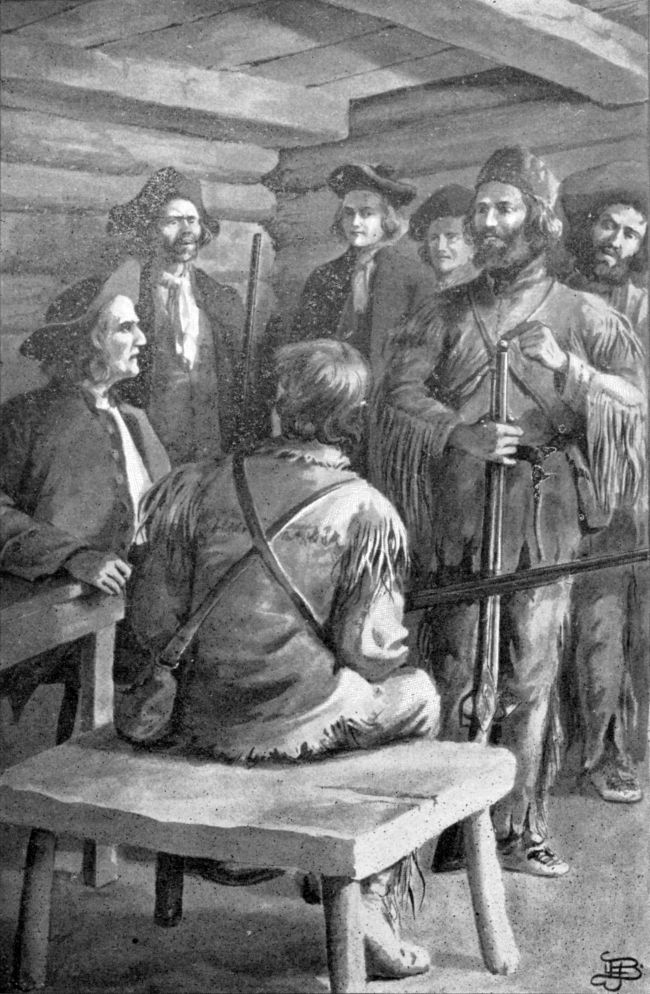
| “‘I’m Under Oath’” | Frontispiece |
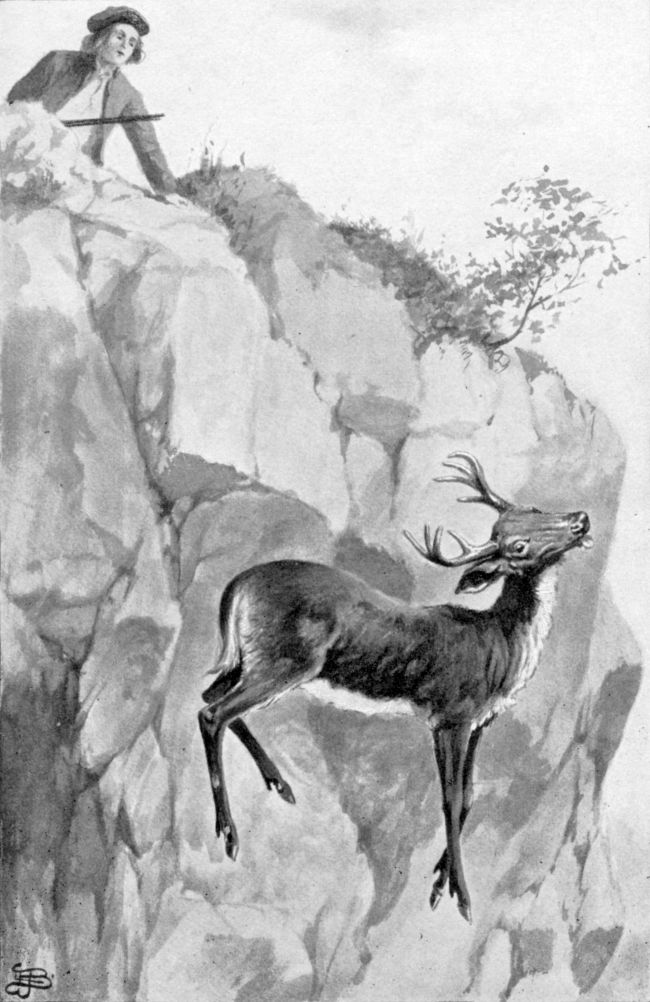
| “The Deer Sprang Out over the Dizzy Brink” | 15 |
| “Archie Improved His Opportunity to Drop the Noose over Her Head” | 144 |
| “His Right Arm Moved Slowly To and Fro” | 278 |
In order to understand the scenes about to be described, it is necessary to take a hasty glance at the general situation in 1740 of the colonists in the vicinity of the Merrimack River. It should be borne in mind that New England was only a narrow strip of country along the seacoast, and was divided into four provinces,—Rhode Island, Connecticut, Massachusetts, and New Hampshire.
Unfortunately for the welfare of the pioneers in the last-named province, the boundary line between New Hampshire and Massachusetts was a matter of dispute for nearly a hundred years. The difference had arisen from a misconception at the outset in regard to the source of the Merrimack River, which was believed by its early discoverers and explorers to rise in the west and follow an easterly course to the ocean. Accordingly, the province of Massachusetts claimed not only all of the land to the southwest of the other province, but a strip three miles wide along the east bank of the stream to its supposed source in the great lake (Winnepesaukee), including not only the debatable [8]ground of Namaske, but a tract of country to its south and east, called the “Chestnut Country,” on account of the large number of those trees growing there.
In 1719 a part of this territory was settled by a party of colonists from the north of Ireland, known as Scotch-Irish, from their having previously emigrated to that country from Scotland. These settlers, who called their new town first Nutfield and then Londonderry, in honour of the county from whence they had come, supposed that the deeds and grants which they had received from the province of New Hampshire would allow them to hold the debatable ground. They were upright, courageous men and women, but were rigid Presbyterians, and for this reason met with little favour from their equally austere Puritan neighbours from Massachusetts.
In order to colonise the disputed territory, Massachusetts at about this time began a system of granting lands as a reward for meritorious service in fighting the Indians, and among others was a grant to the survivors of the famous “Snow Shoe Expedition” of the tract of land below Namaske Falls, which had gained the disreputable name of Old Harrytown. The leader of the expedition, Captain Tyng, was dead, but in honour of him the new town was named Tyng Township.
In one respect the settlers of Tyng Township were [9]fortunate. They arrived during one of those transitory intervals of comparative peace, which came and went during the long and sanguinary struggle with the Indians like flashes of sunlight on a stormy day. In 1725, following several victories of the whites over their savage enemies, foremost of which was Lovewell’s fight, the chief of the Abnaki Indians, then the leading tribe in New England, signed a treaty of peace at Boston. This treaty was not broken until 1744, and the whole history of Tyng Township is included within these two dates.
As stated above, some of the Scotch-Irish, under grants from New Hampshire, had already settled in the territory granted by Massachusetts to Tyng’s men, and an intense rivalry at once sprang up between the settlements. The English were determined and aggressive, the Scotch stubborn and ready to fight to the bitter end for what they considered their rights, and before long both sides were ready to resort to arms the moment an overt act of their rivals should seem to call for such measures.
G. Waldo Browne.
As the distant baying of a hound broke like a discordant note upon the quiet of the summer afternoon, a youth sprang upright on the pinnacle of a cliff which reared its bald head above the surrounding forest, and listened for a repetition of the unexpected alarm.
The young listener presented a striking figure, the strong physique of limb and body brought into bold relief against the sky, and each feature clearly outlined, as he gazed into space. He was in his nineteenth year, above the medium height, but so symmetrical in form that he did not look out of proportion. His high cheek-bones, clear blue eyes, straight nose, well-curved chin, and firm-set mouth showed the characteristics of the Lowland sons of old Scotland. His name was Norman McNiel.
For nearly an hour he had lain there on the summit [12]of Rock Rimmon, gazing in a dreamy way over the broad panorama of wilderness, while his mind carried him back across the stormy sea to his early home in Northern Ireland, which he had left a year before to come to this country with his young foster-sister Rilma and their aged grandfather, Robert MacDonald, last of the noted MacDonalds of Glencoe.
“It was Archer’s bark!” he exclaimed. “He must have followed me, and now has started a deer from its favourite haunt in Cedar Swamp. Hark! there he sounds his warning again, and never bugle of bold clansman rang clearer over the braes o’ bonny Scotland. He is coming this way! Forsooth! A bonny hunter am I with not a grain of powder in my horn, and the last bullet sent on a fruitless errand after a wild bird. A pretty kettle of fish is this for a McNiel!”
Another cry from the hound at that moment, clearer, louder, nearer, held his entire attention, and sent the warm blood tingling through his veins. Far and wide over the valley rang the deep bass baying of the hound, the wooded hills on either side catching up the wild sound, and flinging it back and forth, until it seemed as if a dozen dogs were on the heels of some poor hunted victim.
The chase continued to draw swiftly nearer and nearer. As if the race had become too earnest for [13]it to keep up its running outcries, only an occasional short, sharp cry came from the hound. Soon this too ceased, and Norman was beginning to fear the chase was taking another course, when the sharp report of a firearm awoke the silence.
A howl from the hound quickly followed, while this was succeeded by a more pitiful cry, and the furious crashing of bodies plunging headlong through the thick undergrowth.
Immediately succeeding the renewed baying of the hound, Norman became aware of the sound of some one pushing his way rapidly through the growth off to his right, and at an acute angle to the course being taken by the deer. The next moment he was surprised to see a human figure burst into the opening at the lower end of the cliff, apparently making for the summit of Rock Rimmon. His surprise was heightened by a second discovery swiftly following the first. The newcomer was an Indian, carrying in his hand the gun with which he had shot at the deer.
Seeing Norman, instead of approaching any nearer the cliff, the red man abruptly changed his course, disappearing the next moment in the forest with the Indian’s peculiar loping gait.
“Christo, the last of the Pennacooks!” exclaimed Norman. “It was he who fired the shot. I—”
He was cut short in the midst of his speculation [14]by the sudden appearance of the hunted deer on the opposite side of the clearing.
Though Rock Rimmon has a sheer descent of nearly a hundred feet on the south, its ascent is so gradual on the north as to make it an easy feat to reach its top. A growth of stunted pitch-pines grew to within fifty yards of Norman’s standing place. The ledge was covered with moss in spots, while here and there a scrubby oak found a precarious living.
Although expecting to get a sight of the deer, as he imagined the fugitive to be, Norman was still considerably surprised to see the hunted creature bound out from the matted pines, and leap straight up the rocky pathway! Close upon its heels followed the hound, no longer keeping up its resonant baying.
The fugitive deer seemed to have a purpose in pursuing this narrow course, as it might have turned slightly to the right or left, and escaped its inevitable fate on the cliff. The large, lustrous eyes, glancing wildly around, saw nothing clearly. The blood was flowing freely from its panting sides, and it was evident its strength was nearly spent. To Norman, who had seen but a few of its kind, there was a human expression in the soft light of its great, mournful eye, and intuitively he shrank back, as he saw the doomed creature approaching.
[15]
In its fatal alarm the terrified animal had not seen him. In fact it seemed to see nothing in its pathway,—not even the precipice cutting off further retreat. As if preferring death by a mad leap over the chasm, it sped to the very brink without checking the speed of its flying feet! Norman held his breath with a feeling of horror at the inevitable fate of the poor creature. The hound, as if realising the desperate strait to which it had driven its prey, stopped. Then, with a last mournful glance backward, and a sharp cry of pain and despair, the deer sprang out over the dizzy brink, its beautiful form sinking swiftly upon the stony earth at the foot of Rock Rimmon!
[16]
So sudden and strange was the leap to death of the hunted deer, that Norman McNiel stood for a moment stupefied by a sense of horror at the strange sight. The hound, a magnificent animal, as if sharing its master’s feeling with an added shame for the part it had taken in the matter, crept to his side, and sank silently upon the rock at his feet.
“He escaped you, Archer,” said the young master, patting the dog on its head, “and me, too, for that matter. But I cannot see that either was to blame. The poor creature met his fate bravely.”
Then, to satisfy himself that the deer was really killed, he approached to the extremity of the cliff, and peered into the depths below. He discovered, at his first glance, the mutilated form of the creature. There could be no doubt of its death. The sound of footsteps at that instant arrested his attention. Looking from the shapeless body of the deer, he saw two men pushing their way through the dense [17]growth skirting the bit of clearing at the foot of the ledge.
The foremost of the newcomers was an entire stranger to him, though he guessed that he belonged to the Tyng colonists, who had settled below the falls. He wore a suit of clothes made from the coarse homespun cloth so common among the Massachusetts men, and his firearm was of the English pattern usually carried by them. He was not much, if any, over thirty years of age, with a countenance robbed of its slight share of good looks by a stubble of reddish beard.
His companion, whom Norman remembered as having seen once or twice the previous season, was several years the senior of the other, and of altogether different appearance. He was clad in a well-worn suit of buckskin, the frills on the leggins badly frayed from long contact with the briars and brushwood of the forest. His feet were encased in a pair of Indian moccasins, while he wore on his head a cap of fox skin, with the tail of the animal hanging down to the back of his neck. Though bronzed by long exposure to the summer sun and winter wind, scarred by wounds, and rendered shaggy by its untrimmed beard, his face bore that stamp of frank, honest simplicity which was sure to win for the man the respect and confidence of those he met. The silver streaks in the hair falling in profusion [18]about his neck told that he was passing the prime of life. Still there was great strength in the long, muscular limbs, and, while he moved generally with a slow, shuffling gait, he was capable of astonishing swiftness of movement whenever it was called for.
He showed his natural instinct as a woodsman by the noiseless way in which he emerged from the forest, in marked contrast to the slouching steps of his companion. Stuck in his belt could be seen the handle of a serviceable knife, while he carried a heavy, long-barrelled rifle of a pattern unknown in this vicinity at that time. The weapon showed that it had seen long and hard service.
Norman was about to speak to him, when the other exclaimed, in the tone of one announcing an important discovery:
“Look there, Woodranger! if you want to believe me. It’s the critter that got the shot we heerd, and it’s a deer as I told ye. A shot out o’ season, too, mind ye, Woodranger. Ef I could clap my eyes on the fool he’d walk to Chelmsford with me to-morrer, or I ain’t deer reeve o’ this grant o’ Tyng Township, honourably and discreetly ’p’inted by the Gineral Court o’ the Province o’ Massachusetts.”
“It seems to me, Gunwad,” said his companion, speaking in a more deliberate tone, as he advanced to the deer’s mutilated form, “that the creetur must have taken a powerful tumble over the rock hyur. [19]I reckon a jump off’n Rock Rimmon would be nigh ’bout enough to stop the breath o’ most any deer.”
“What made the deer jump off’n the rock, Woodranger? It was thet air dog at its heels! And ef there ain’t a hunk o’ lead in the critter big ernough to send the man thet fired it to Chelmsford I’ll eat the carcass, hoofs, horns, and, hide.”
With these words he bent over the still warm body of the deer, and began a diligent search for some sign of the wound supposed to have been made by the shot.
Woodranger dropped the butt of his rifle upon the ground, and stood leaning on its muzzle, while he watched with curious interest the proceeding of his companion.
Gunwad’s search was not made in vain, for a minute later he held up between the thumb and forefinger of his left hand, which was reeking with blood from its contact with the dead deer, the bullet he had hoped to find.
“What do you think of it now?” he demanded, showing by his tone and manner that he was highly pleased with his discovery. “What do ye call thet?”
“I suppose it would require no great knowledge o’ warfare to pronounce it a bullet,—leastways a pellet o’ lead fit for the weepon o’ a red. It was never the bullet o’ a white man’s gun. But that [20]does not enter into the question. That bullet was not the death o’ this deer.”
“You’re talking at random now. Mebbe it didn’t kill the deer, but ef the dog hadn’t driven the critter over the rock, thet lead would hev fixed it for salting.”
“I’m not so sure o’ that, friend Gunwad. If you’ll look a leetle cluser you’ll see that the bullet didn’t touch any vital. It sort o’ slewed up’ards and side—”
“Much has thet got to do erbout it!” broke in Gunwad, beginning to show anger. “I shall begin to think ye air consarned in the matter. Fust ye say it wasn’t the bullit o’ a white man, and I should like to know what cause ye hev for saying thet.”
“It was never run by any mould,” replied Woodranger, calmly, as he took the bullet in his hand; “it was hammered out.”
“Say!” exclaimed Gunwad, suddenly changing the drift of the conversation, “Ye’re a sharp one, Woodranger. They say ye’re the best guide and Injun trailer in the two provinces. Help me fasten this bizness on that Injun at the Falls, and I’ll gin ye the best pair o’ beaver skins ye ever sot eyes on for years.”
“You mean Christo,” said the other.
“I reckon he’s the only red left in these parts, and ’arly riddance to him! Jess show thet is an [21]Injun bullit, and I’ve settled his ’count, sure’s one and one make two.”
“That savours too much o’ wanton killing, Gunwad. I ain’t no special grudge ag’in this Christo, though it may be I have leetle fellowship for the race. There be honest men, for all I can say, among the dusky-skins, and Christo may be one o’ ’em. At any rate till I ketch him in red devilryment I’m not going to condemn him. Ah, Gunwad, I ’low I live by the chase, and if I do say it, who has no designment to boast o’ the simple knack o’ drawing bead on wildcat or painter, bear or stag, Old Danger never barks at the same creetur but once; but he never spits fire in the face o’ any creetur that can’t do more good by dying than living.”
“Look here, Woodranger!” exclaimed Gunwad, impatiently, “I can see through yer logic. Ye air ag’in this law o’ protecting deer.”
“I’m ag’in the law that’s ag’in man. ’Tain’t natur to fill the woods with game, and then blaze the trees with notices not to tech a creetur. Mind you, I’m ag’in wanton killing, and him don’t live as can say I ever drew bead on a deer out o’ pure malice. I have noticed that it’s the same chaps as makes these laws as are the ones to resort to wanton destruction. To kill jess for the fun o’ killing is wanton. It is the great law o’ natur for one kind to war on another, the strong on the weak, from the biggest brute to [22]the smallest worm, and man wars on ’em all. If he must do so, let there be as much fairness as is consistent with human natur. No, I’m not a liker o’ the law that professes to defend the helpless, but does it so the wanton slayer can get his glut o’ slaughter in a fall’s hunt. I—”
The Woodranger might have continued his rude philosophy much longer had not a movement of the hound on the cliff attracted their attention, and both men glanced upward to see, with surprise, Norman McNiel looking quietly down upon them.
“Hilloa!” exclaimed Gunwad, divining the situation at once, “here is the deer slayer, or I’m a fool. Stand where ye air, youngster!” raising his gun to his shoulder, as he spoke.
[23]
“Don’t make any wanton move,” warned Woodranger. “If I’m not mistaken the younker is one o’ the Scotch settlers on the river, and he’s a likely lad, or I’m no jedge o’ human natur’.”
“I jess want him to know he ain’t going to play Injun with me,” replied Gunwad. Then, speaking in a louder key to Norman, he said:
“Climb down hyur, youngster, and see thet ye air spry erbout it, for I don’t think o’ spending the night in these woods.”
“I will be with you in a moment,” said Norman, starting toward the west end of the cliff, where he could descend with comparative ease. He had overheard enough to understand that Gunwad would prove no friend to him, though he did not realise the deer reeve’s full intent.
“One o’ ’em condemned furriners!” muttered Gunwad. “I’d as soon snap him up as thet copper-skin. Hi, there, youngster! be keerful how ye handle thet shooting-iron,” as Norman inadvertently lifted the [24]weapon toward his shoulder in trying to avoid a bush.
“You have nothing to fear, as it isn’t loaded. I—”
“Isn’t loaded, eh?” demanded the deer reeve. “Let me take it.”
Norman handed him the firearm, as requested, and then turned to look at Woodranger, who was watching the scene in silence, with a look in his blue eyes that it was difficult to read.
“I reckon I’ve got all the evidence I shall need,” said Gunwad, after hastily examining the gun. “You’ll need to go with me to Chelmsford, youngster, to answer the grave charge of shooting deer out o’ season. It’ll only cost ye ten pounds, or forty days’ work for the province. Better have waited ernother day afore ye took yer leetle hunt!”
“I have shot no deer, sir,” replied Norman. “Neither have I hunted deer.”
“Don’t make yer case enny wuss by trying to lie out o’ it. The circumstances air all ag’in ye. Air ye coming erlong quiet like, or shall I hev to call on Woodranger to help me?”
“Where are you going to take me?” asked Norman, feeling his first real alarm. “Grandfather will be worried about me if I go away without telling him—”
“Old man will be worrited, eh? O’ all the oxcuses [25]to git out’n a bad fix thet’s the tarnalest. D’ye hear thet, Woodranger?”
Nettled by the words, Norman showed some of the spirit of the McNiels, exclaiming sharply:
“Sir, I have hunted no deer, shot no deer, and there is no reason why you should make me prisoner. I have transgressed no law, as far as I know.”
“Ignerance is no excuse for breaking a law, youngster. The facts air all ag’in ye. Ain’t this yer dog? and weren’t he chasing thet deer?”
“He was chasing the deer, but surely you do not blame the hound for doing what his natural instinct told him to do? To him all seasons are as one, and the laws of man unknown.”
“A good p’int, lad,” said Woodranger, speaking for the first time since Norman had reached the foot of the cliff.
“But it does not clear yer frills from the law made by honourable law-makers and sanctioned by good King George,” retorted Gunwad, angrily. “Ye ’low yer dog was chasing the deer?”
“I have not said he was my dog, sir. He came to my house about a week ago and would stay with us. I—”
“’Mounts to the same as if he wus yers. I s’pose ye deny this is yer gun and thet it’s as empty as a last year’s nutshell?”
“The gun is mine, sir, and it is empty because I [26]wasted my ammunition on a hawk an hour since. I had no more powder with me.”
“A story jess erbout in keeping with the other. Afore ye take up lying fer a bizness I should ’vise ye to do a leetle practising. But I hev got evidence ernough, so kem erlong without enny more palaver.”
Norman saw that it would be useless to remonstrate with the obstinate deer reeve, and he began to realise that he might have serious trouble with him before he could convince him and his friends of his innocence. Accordingly he hesitated before he said:
“I am innocent of this charge, sir, but if you will allow me to go home and tell sister and grandfather—”
“Go home!” again broke in Gunwad, who had no respect for another’s feelings. “If thet ain’t the coolest thing I ever heerd of. I s’pose ye think I’m innercent ernough to let ye take yer own way o’ going to Chelmsford to answer to the grave charge o’ shooting deer out o’ season. Did ye ever see the match o’ thet consarned audacity, Woodranger?”
“It seems ag’in reason for me to think the lad means to play you double, Gunwad,” said the Woodranger, deliberately. “It seems too bad to put the lad to this inconvanience. I ’low, down ’mong ’em strangers it’ll be a purty sharp amazement for him [27]to prove his innercence, but the lad’s tongue tells a purty straight story. I disbelieve he was consarned in the killing o’ the deer.”
“Oh, ho! so thet’s the way the stick floats with ye, Woodranger? Mebbe ye know crossways, but Captain Blanchard has the name o’ being square and erbove board in his dealings. Ye can go down ef ye wanter, jess to show thet the deer jumped off’n the rock o’ its own free will. Ha, ha! thet’s a kink fer ye to straighten.”
“It would be easier done ’cording to my string o’ knots, than to fairly prove the lad was to blame for its killing. I’ve heerd o’ deer jumping off’n sich places out o’ a pure wish to end their days. Up north, some years sence, I see, myself, an old sick buck march plumb down and sort o’ throw hisself over a cliff o’ rock, where the leetle life left in him was knocked flat. I was laying in ambushment for him, but seeing the creetur’s intentions I jess waited to see what he would do. As I have said afore, I do not believe in wanton killing, and deer, ’cording to my mind, is next to the human family. This air rock has peculiar ’tractions for the low-spirited, and ther’ are them as say the ghost o’ poor Rimmon haunts the place, and it ain’t so onreasonable in the light o’ some other things.”
Woodranger’s speech had reference to the legend current among the Indians that a daughter of the [28]mighty chief of the North, Chicorua, once fell in love with a Pennacook brave; but her dusky lover proved recreant to Rimmon, as the maiden was called, and she, unable to credit the stories told of her betrothed, sought this locality by stealth to learn if reports were true concerning him. Alas for her hopes! she was soon only too well satisfied of their truthfulness, and, rather than return to her home, in her grief and disappointment, she courted death by leaping from this high rock. Hence the name Rock Rimmon.
“How long has it been sence the Indian killer turned philosopher and begun to preach?” demanded Gunwad, whose coarse nature failed to appreciate the sentiments of his companion.
“Let’s see,” said Woodranger, ignoring the other’s sneering words, “the law ag’in killing deer will be off afore you get the lad tried. If I remember right it was to last from the first day o’ January to the first day o’ August, and it being now nigh about six o’clock on the last day o’ July, there are only six hours or so left—”
“What difference does thet make?” cried Gunwad, with increasing anger. “Ef ye keep me hyur till to-morrow morning it’ll be the same. But I ain’t trying the youngster. Ef he’ll kem erlong Squire Blanchard will settle his ’count.”
“And give you half the fine, I s’pose,” continued [29]the imperturbable Woodranger, with his accustomed moderation.
“I shall ’arn it!” snapped the other. “But it’s ye making me more trubble than he, Woodranger.”
“I have a plan by which I may be able to more than even things with you, Gunwad, as bad as I have been. What time will you start for Chelmsford in the morning?”
“An hour erfore sunup.”
“Where do you think o’ taking the lad to-night?”
“Down to Shepley’s.”
“He’s away, and the women folks might object to having a deer slayer in the house.”
“I shall stay with him.”
“They might object to you, too! But that ain’t neither here nor there. I reckon the lad’s folks are going to be greatly consarned over his disappearance, so I have been thinking it would be better to let him go home now.”
Gunwad was about to utter an angry speech, when the three were startled by the ringing note of a bugle sounding sharply on the still afternoon air. The first peal had barely died away before it was followed by two others in rapid succession, louder, clearer, and more prolonged each time.
“It’s grandfather!” exclaimed Norman, excitedly. “There is something wrong at home.”
[30]
“If I should agree to answer for the lad’s being on hand to-morrow morning an hour afore sunup, would you let him go home till then?” asked Woodranger, the calmest one of the three, continuing the subject in his mind as if no interruption had occurred.
As a matter of fact, Gunwad had been puzzling himself over the best method to adopt in order to keep his prisoner safely until he could deliver him over to the proper authorities. Of a cowardly, treacherous nature, he naturally had little confidence in others. He believed the youthful captive to be a dangerous person, knowing well the valour of the McNiels, though he would not have acknowledged to any one that he feared him. Woodranger’s proposition offered a way out of his dilemma without compromising himself, in case it should fail. Accordingly he asked, with an eagerness the woodsman did not fail to observe:
“Would ye dare take the risk, Woodranger?”
[31]
“In season and out I have a knack o’ following my words like a deerhound on the track o’ a stag.”
“I know it, Woodranger, so I hope ye won’t harbour enny feeling fer my question. Ef ye say ye’ll hev the youngster on hand at Shepley’s at sunrise, I shall let him be in yer hands. But, mind ye, I shall look to ye fer my divvy in the reward if he’s not on hand.”
“I will walk along with you, lad,” said the Woodranger, without replying to Gunwad, who remained watching them as they started away, muttering under his breath:
“I s’pose it’s risky to let the youngster off in his care. Twenty-four dollars ain’t to be picked up in these sand-banks every day, and I’m sure of it if I get the leetle fool to Chelmsford. It’s a pity to let sich a good fat deer go to waste, and I’ve a mind to help myself to as much meat as I can carry off. It’s no harm, seeing the killing is done, and I had no hand in it.”
Glancing back as they were losing sight of Rock Rimmon, the Woodranger saw the deer reeve carrying out his intention, and laughed in his silent way.
Norman was not only willing but glad to have the company of the woodsman, whose fame he had heard so often mentioned by the settlers. As soon as they were beyond the hearing of Gunwad, he thanked his companion for his kindly intervention.
[32]
“I have nary desire for you to mention it, lad. But if you don’t mind, you may tell me what you can of this deer killing. It may be only a concait o’ mine, but my sarvices may be desirable afore you get out’n this affair. In that case it might be well for me to know the full particulars.”
“You are very kind, Mr.—Mr.—”
“You may call me Woodranger, as the rest do. Time may have been when I had another name, but this one suits me best now. If you have been in these parts very long, you may have heard of me, though I trust not through any malicious person. I ’low none o’ us are above having enemies. But I can see that you are anxious to get home, so tell me in a few words all you can about the deer.”
“There is really little to tell, Mr. Woodranger. I was lying on the top of Rock Rimmon when I heard Archer bark, and I felt sure he had started a deer near Cedar Swamp. Soon after, I heard some one fire a gun. A moment later I saw Christo, the friendly Indian, coming toward the cliff, but at sight of me he turned and went the other way.”
“So it was, as I thought, Christo who shot the deer. I’m sorry for that. The poor fellow has enough to answer for to pacify those who are determined to persecute him, simply because he is a red man. As if it was not enough to see the last foot o’ territory belonging to his race stripped from [33]his tribe, and the last o’ his people driven off like leaves before an autumn wind.”
This speech, coming from one whom he had heard of as an Indian fighter, seemed so strange to Norman that he exclaimed:
“So you are a friend to the Indians! I supposed you hated them.”
“We are all God’s critters, lad, and I hate not even the lowest. Though it has been my fortune to be pitted ag’inst the dusky varmints in some clus quarters, I never drew bead on an Injun with a wanton thought. Mebbe on sich ’casions as Lovewell’s fight, where the blood of white and red ran ankle deep, and that Injun fiend, bold Paugus— Hark! there’s the horn ag’in! Your kin must be anxious about you. Ha! how the old bugle awakes old-time memories. But don’t let me hinder you. I will meet you by the river to-morrer morning at sunrise, when we can start for Chelmsford. By the way, I wish you wouldn’t say anything about Christo until I think it best.”
Without further loss of time, Norman darted away from the Woodranger in a course which soon brought him in sight of the river.
On the opposite bank of the stream the young refugee discovered his grandfather, still holding to his lips the horn which was awakening the wild-wood with its clear notes, as in years long since past it [34]had rung over the hills and vales of his native land. At sight of Norman the aged bugler quickly removed his beloved instrument from his bearded lips, and while the echoes of the horn died slowly away he watched the approach of his grandson, who had pulled a canoe out from a bunch of bushes on the river bank and began his laborious trip across the rapid stream.
In the years of his vigorous manhood Robert MacDonald must have been a typical Highlander of Bonnie Scotland. As he stood there on the bank of the river, in the shifting light of the setting sun, his thin, whitened locks tossed in the gentle breeze, and his spare form half supported by a stout staff, he looked like one of the patriarchs of old appearing in the midst of that wild-wood scene. If the passage of time had left deep tracks across a brow once lofty and white as snow, if the lines about the mouth had deepened into wrinkles and the loss of teeth allowed an unpleasant compression of the lips, his clear blue eyes had lost little if any of their old-time lustre. His face kindled with a new fire, as he watched the approach of Norman.
“He’s a noble laddie, every inch o’ him!” he mused, falling deeper into his native dialect as he continued: “Weel, alack an’ a day, why should he no be a bonnie laddie wi’ the bluid o’ the MacDonalds an’ McNiels coorsin’ thro’ his veins. [35]Shame upon the ane wha wud bring dishonour tae sic a fair name. He has nane o’ his faither’s weakness. He’s MacDonald, wi’ the best o’ the McNiel only. Hoo handy he is wi’ the skim-shell o’ a craft that looks ower licht tae waft a feather ower the brawlin’ burn.”
“What can be the matter, grandfather, that you are so excited?” asked Norman, as he ran the canoe upon the sandy bank and leaped out.
“It’s the wee lassie. She left me awhile since tae look for the geese, an’ she hasna cum back. She’s been awa a lang time.”
“I would not worry, grandfather. You know the geese have an inclination to get back to their kind at old Archie’s. But I will lose no time in going to help Rilma fetch them home.”
“Dae sae, my braw laddie, for I’m awfu’ shilly the day. I canna tell thee it was a catamount’s cry, but it did hae the soond tae my auld ear. But dinna credit ower muckle an auld man’s ears, which dinna hear sae clear as on the day the redcoats mowed doon the auld clan at Glencoe.”
At the mention of the word “catamount” Norman felt a sudden fear. He knew that a pair of the dreaded creatures had been seen in the vicinity several times of late, and that the presence of the geese would be likely to call them from their skulking-places in the dense forest skirting the few log houses near by. So [36]leaving his aged relative to follow at his leisure, he bounded up the path leading to the house. Thinking of his empty gun, he was anxious to get a new supply of powder before putting himself in the pathway of any possible danger.
All of the dwellings of Tyng Township were of the most primitive character. There being no sawmill on the river at that period, the houses were built of hewn or unhewn logs, as the fancy or capacity for work of the owner dictated. The MacDonald cottage was smaller than the average, but the logs making its four walls had been hewn on the inside. The building was low-storied, and had small openings or loop-holes for windows, over which small mats of skins had been arranged to stop the apertures whenever it was desired. Originally the space of the building had been divided into only two apartments on the lower floor, but one of these had been subdivided, so there were two sleeping-rooms, one for Rilma and another for Mr. MacDonald, besides the living room, on the first floor. Norman occupied the unfinished loft for his bedchamber. Some of the houses of Tyng Township, or Old Harrytown, as it was quite as frequently called, had no floor, but in this hewn logs embedded in the sand and cemented along the seams or cracks afforded a solid foundation. A stone chimney at one end carried off the smoke from the wide-mouthed fireplace, which added [37]a cheerfulness as well as genial warmth in cold weather to the primitive dwelling.
The furnishing of this typical frontier house was in keeping with its surroundings. The kitchen, or room first entered, which served as sitting-room, parlour, dining-room, and living apartment, was supplied with a three-legged table, a relic of ancient days that had been the gift of a neighbour, two old chairs which had been repaired from some broken ones, while a rude bench answered for a third seat. In one corner was an iron-bound chest, which had been the only piece of furniture, if it deserved that name, that had been brought from their native land. It held the plain wardrobes of the three. Hanging to the sooty crane in the fireplace was an iron pot, while in a niche in the rocky wall was a pewter pot, a frying-pan, and a skillet. In another small opening cut higher in the side of the building reposed the scanty supply of household utensils, a couple of pewter spoons, two wooden spoons, three knives, a couple of broken cups, a pewter dipper, and three wooden forks, with four rude plates made from two thicknesses of birch bark. There was also a small earthen pot.
Over the fireplace, hung on pegs driven in the chinks of the logs, was a long-barrelled musket of Scottish pattern, whose bruised stock and dinted iron bespoke hard usage. This was the weapon Robert MacDonald had carried in the desperate [38]fight at Glencoe, when his clan had been completely routed by the English. Near by hung a powder-horn, grotesquely carved like an imp’s head, and in close companionship was a bullet-pouch. Near it was another peg, the usual resting-place of an even more highly prized relic than any of these ancient pieces of property, namely, the bugle with which the old Highlander had called home the truant Norman.
The room, though rudely furnished, bore every trace of neatness and thrift, with an air of comfort in spite of its simple environments. The rough places in the walls were concealed by wreaths of leaves and ferns, and the table was bordered with a frill made of maple leaves knit together by their stems. On a shelf, made of pins driven into the wall, lay three books, one of them a volume of hymns, the second a collection of Scottish songs and ballads, while the third was a manuscript book of records of the Clan MacDonald, with some added notes of the McNiels.
The door was made by four small poles fastened together at the corners with wooden pins and strings cut from deer hide, the whole covered with a bear skin carefully tanned and the fur closely trimmed.
In his anxiety to go in search of Rilma, Norman did not stop to replenish his horn from the general supply of powder, but snatched that of his grandfather [39]from its peg, and, loading his gun as he went along, left the house.
His home was near a small tributary of the Merrimack, which joined the main stream a short distance below the falls. The house stood a short distance back from what was considered the main road of the locality, a regularly laid out highway running from Namaske to the adjoining town of Nutfield or Londonderry, and following an old Indian trail. This road also led, a short distance (half a mile) above the falls, past two or three dwellings, to a more spacious log house which was the home of another Scottish family by the name of Stark. Archibald Stark, the head of this household, was a fine representative of his race, and he and his beautiful wife, with their seven children, four boys and three girls, were a typical frontier family, cheerful, rugged, hospitable, and progressive.
As the geese which had caused Rilma to leave her home had been the gift of Bertha Stark, the oldest daughter of the family, Norman hurried toward the home of these people, never doubting but he should find Rilma loitering there to continue some girlish gossip.
Soon after crossing the brook, however, his sharp eyes discovered fresh footprints in the soft earth near the bank of the stream and along a path leading to a small pond in the brook, where the water had [40]been held back by a dam of fallen brushwood. He was sure the tracks had been made by Rilma.
“The geese have got away from her and gone to the Pool,” he concluded. “I shall find her there. Better still, by waiting here I can head off the foolish geese from going back to their old home, as they will be pretty sure to do.”
He had barely come to this conclusion, when he was startled by a loud squawk, quickly followed by a scream.
Something was wrong! He bounded along the narrow pathway toward the scene, while the outcries continued with increasing volume.
Meanwhile Rilma, having been obliged to go quite to Mr. Stark’s house to find her truants, was returning with them, as Norman had imagined, when, on reaching the path leading to the little pond, the contrary creatures darted toward the Pool with loud cries. She followed, but not swift enough to stop the runaways.
The geese had gained the bank of the little pond, and she was following a few yards behind them, when a dark form sprang from a thicket bordering the pathway, and seized the foremost goose.
Thinking at first it was a dog attacking her geese, Rilma called out sharply to the brute, as she bounded toward the spot. But a second glance showed her not a dog but a big wildcat!
[41]
Nothing daunted by this startling discovery, the brave girl flourished the stick she carried in her hand and ran to defend the poor goose. So furiously did she rain her blows about the wildcat’s head that it dropped its prey and sprang upon her! With one sweep of its paw it tore the stout dress from her shoulder and left the marks of its cruel claws in her flesh. But the squawking goose, fluttering about on the ground, seemed a more tempting bait for the wildcat, which abandoned its attack on Rilma and sprang again on the goose.
Flung to the ground by the fierce assault of the beast, Rilma quickly regained her feet, and, seeing her favourite goose in deadly danger, she again attempted its rescue, although the blood was flowing in a stream from the wound in her shoulder. It was at this moment that Norman appeared on the scene.
Rilma and the catamount were engaged in too close a combat for him to shoot the creature without endangering her life, so he shouted for her to retreat, as he rushed to her assistance. But it was now impossible for her to do that. Having torn her dress nearly from her, and aroused at the sight of the blood flowing so freely, the enraged beast was in the act of fixing its terrible teeth in Rilma’s body, when Norman pushed the muzzle of the gun into the wildcat’s mouth, and pulled the trigger.
A dull report followed, and the catamount fell [42]over dead. Norman was about to bear Rilma, who was now unconscious from pain and fright, away from the place, when a terrific snarl rang in his ears from over his head! Looking up, he saw to his horror a second wildcat, mate to the other, lying on the branch of an overhanging tree, and in the act of springing upon him!
[43]
Norman McNiel did not possess an excitable nature, and his thoughts did not flow with that acute swiftness so common to some persons, but he more than made up for this by a clearer comprehension of matters. The sight of the wildcat, preparing to give its fatal spring, did not rob him of his presence of mind, though he realised that in a hand-to-hand encounter with the brute he was likely to become its victim. Still, the possibility of deserting Rilma was something he did not for a moment consider. He would defend her until the last. Accordingly, as the second growl of the aroused animal grated harshly on his ears, he caught his gun by its barrel and stood ready to use it as a club.
Then the long tail of the creature lashed its sides, and its lissom form shot toward him like a cannon ball. But, as the wildcat left its perch, there was a flash so near Norman’s head that he was almost blinded, and the report of a firearm rang out. Another [44]and louder growl came from the catamount, as it fell at his feet in the throes of death.
“Look out she don’t get her claws on you!” cried a voice at his elbow, a warning Norman quickly obeyed, pulling Rilma away with him.
“She dies hard,” affirmed the newcomer, advancing to the side of Norman, “but I reckon that lead was run for her. If I had been a minute later you would have had a tussle old Woodranger himself might not have cared for.”
The speaker, who made this remark with the unconcern and cool criticism of a man with years of experience as a hunter, was in reality but a boy of eleven years of age, though as large as the majority are at thirteen or fourteen. He was not prepossessing in his looks. His countenance was marred by a beaked nose and chin inclined to meet it, while his skin was abundantly tattooed with freckles, and his coarse hair verged on an unhappy reddish hue. But the dark blue eyes redeemed somewhat the plainness of the other features, and his independent, perfect self-control of spirit more than made up for the slight Dame Nature had given him in other respects. He was familiarly called Johnny or Jack Stark by his playmates and companions, and he afterward became the celebrated General Stark, the hero of Bennington.
“You are right, Johnny,” exclaimed Norman, [45]“and if your hand had not been steady and eye true neither Rilma nor I would ever have lived to thank you for your coming. Poor lassie! I fear she has been—no! She opens her eyes,—she lives! You have no more to fear, dear sister; they are both dead. Don’t move if it hurts you. Jack and I will carry you home.”
Though not inclined to show deep emotion, Norman exhibited great joy at the returning consciousness of Rilma, whom he loved with all the tender regard of one who feels that another is all the world to him. Gently he placed the tattered dress about the bleeding form and with his hand wiped away the blood from the wounds made by the wildcat.
“Old Mother Hester!” cried Rilma, quickly gaining her feet, “did the horrid creature kill her?”
Norman understood that “Mother Hester” was the name she had given to the poor goose, whose mangled body, torn and lacerated beyond recognition, lay a short distance away.
“She is dead, Rilma, but let us be thankful that you, too, were not killed. If I had been a minute later you would have been overpowered by the fearful cat, and then Jack saved us both from the other. But they are dead, and we have no more to fear from them.”
Although grieved over the loss of her favourite goose, Rilma felt thankful that she had escaped with [46]even the dreadful scratches of the wildcat, none of which had been very deep.
“I can walk, dear brother; and I want to get away from this place as soon as possible. Jack will look after the other goose for us.”
Taking the hint, Norman led her gently along the path, saying as he did so:
“Won’t you come with us, Jack?”
“I think I will, Norman, as I have something I want to say to you as soon as you feel like hearing it. I was on my way to your house when I heard your shot, and hurried to your assistance. I will make myself useful, too, by carrying home the body of the dead goose and driving the other along. Some one can come up and look after the wildcats later.”
“You are very thoughtful, Jack, as well as brave. I do not believe there is another boy of your age who could have shot that wildcat as you did.”
“You say that because you do not know Rob Rogers. He shot a big black bear, that was nosing around his father’s house, when he was only seven, and you know I am almost eleven. Robby, since he has begun to go with Woodranger, has become a mighty hunter, and he’s only fourteen now.”
The conversation was checked at this point by the appearance of Mr. MacDonald, who had heard the firing and was greatly excited over the affair.
[47]
“Oh, my bairns!” he cried, “hoo gled I am tae find that ye hae na been— Why, my wee lassie! What hae they been doing to ye?”
Norman gave a brief account of the encounter with the wildcats, his grandfather catching up Rilma in his arms and bearing her toward the house as he finished, forgetful of his infirmities. The old Highlander sobbed like a child at intervals, while alternately he would burst forth into expressions of endearment and thankfulness in his picturesque speech.
Seeing that Rilma was being cared for, Norman started back to help Johnny Stark find the surviving goose, which was found skulking in the bushes nearly frightened to death. Catching it after some trouble, Norman carried it homeward in his arms, while Johnny bore the body of its dead mate.
“I will get father to send Goodman Roberts to look after the carcasses of the wildcats, as soon as I get home,” said the latter, as he walked at the heels of Norman, the path being too narrow at places for a couple to walk abreast. “What I wanted to speak to you about,” he continued, “was the canoe match which is talked of to take place on the river next month. You know three Scotch boys are to race against three English boys. Brother Bill and Robby Rogers have been chosen to represent our side, and we want another. We have spoken [48]to father about it, and he agrees with us that you are the one. Now will you do it?”
“Of course I am willing to do anything I can, but I am afraid I have not had as much practice as I need. You know I have not been here as long as the rest of you, though nothing suits me better than a paddle on the water.”
“You’ll have over a month in which to practise. I’ll risk you, and so will the others. I understand John Goffe is to be one of their crew, though no one seems to know who the others will be. Johnny is a good one with the paddles, but he is nowhere with Rob. Bill will beat anybody else they can get, and with you to help our side will be safe.”
“You mustn’t be overconfident, Johnny, but if I take hold I will do the best I can.”
By the time they had reached the house Norman had decided to accept the invitation to take part in the canoe match, and Johnny Stark, having performed his errand successfully, lost no further time in running home to tell the good news.
Mr. MacDonald dressed Rilma’s wounds as best he could, with the simple means at his command, though she bravely declared that she did not suffer any pain.
It was then getting to be quite dark, and, lighting his corn-cob pipe, Mr. MacDonald took his favourite position in the doorway to smoke and meditate over [49]the events of his checkered life. These had ever been hallowed occasions to Norman and Rilma, who had sat at his feet for many an hour listening to the pathetic tales of which he seemed to have no end. In these twilight talks they had heard him tell over and over again, until every word was familiar to them, the stories of the fate of the brave MacDonalds in the Pass of Glencoe, and the downfall of the last of the McNiels.
On this evening Rilma had lain down on her simple couch for rest and release from the pain of her wounds, so that Norman was alone with his grandfather.
“Ha, ma laddie!” broke in Mr. MacDonald. “Ye’re that glum ye dinna seem like yersel’ the nicht. Trouble na ower the few scratches o’ a cat, the bonnie lassie wull sune be hersel’,” he continued, attributing Norman’s silence to thoughts of Rilma.
“I must confess, grandfather, I was not thinking of poor Rilma, though I ought to be ashamed to own it. I was thinking of a little affair which happened this afternoon, and how best I could break it to you. I would have spoken of it before, but I did not wish to arouse Rilma’s fears.”
With the characteristic reserve of his nature, the old Highlander removed his pipe from his lips without speaking, signifying as plainly by his silence as [50]he might have done by words his desire for an explanation. At a loss how to begin, Norman hesitated for a time, the only sound heard above the steady roar of Namaske being the mournful cries of a whippoorwill in the direction of Rock Rimmon, until finally he gave a detailed account of his arrest by Gunwad for hunting deer out of season.
“Ha, ma laddie!” exclaimed his grandfather, when he had finished. “Ye dinna want tae be low-speerited wi’ anxiety ower that, though it does look a bit squally for ye. I’m gled ye telt the auld man, for noo he’ll ken just hoo tae trim his licht. Then, tae, an auld man’s coonsel may na cum amiss wi’ a young heid.”
“Grandfather, I had no more to do with hunting or killing that deer than you did.”
“In intent, my braw laddie. But ye maun remember I never crossed the brawlin’ stream. But avaunt wi’ sic nonsense! It behooves us tae see what can be dune for ye, noo ye hae fa’en in the net.”
“Can they do anything with me, grandfather? Woodranger bade me be hopeful.”
“Wha is this Woodranger, laddie, that ye speak sae freely o’? I dinna ken but I may hae heard the name afore.”
“He is a man who lives by hunting and scouting, grandfather. During the Indian troubles he did great service to the families who were molested by [51]the red men, and everybody seems to like him. He has been all over the country, and he is very friendly to me.”
“Is he Scotch, laddie? That maks a’ the difference in the warld in this affair.”
“I am not sure, though I should say he is. He seems very honest.”
“Hoot! awa wi’ yer nonsense if ye canna tell an Englishman frae a Scotchman. Let me but get my auld een on him an’ I’ll tell ye if he’s a true laddie. What’s his name?”
“Just what I told you, grandfather,—Woodranger. At least that is all he would give me.”
“A bit against him, laddie. But allooin’ he is yer freend, I am a bit feart ye’re nae pleasant fixed. This Gunwad ye say is an Englishman?”
“I have no doubt of that. I can see that this foolish feeling between the colonists is going to be against me.”
“Ah, ma laddie, that’s whaur the shoe grips! Every Englishman, wumman, and bairn looks on us as intruders, as they dae every Presbyterian, wha they hate waur than wildcats. I see noo I did mak’ a bit o’ a mistak’ in droppin’ here, but auld Archie Stark thocht it was best for us. I dinna ken whaur this misunderstandin’ is gaen tae end. Seems tae me it will be the destruction o’ baith pairties. But dinna ye lat this little maitter cum intae yer dreams, my [52]laddie. Sleep gie’s ane a clear heid, an’ it’s a clear heid ye’ll need the morn amang the Britishers at Chelmsford.”
Taking this hint, Norman, after having seen that Rilma was as comfortable as could be expected, sought his humble couch under the rough rafters of his pioneer home.
[53]
After a restless sleep Norman was astir an hour before sunrise. His grandfather was already up and preparing a breakfast for him.
“You maun eat, ma laddie. It seems unco’ that ye maun gang tae meet thae Britishers alane. I fain wad gang wi’ ye.”
“That cannot be, grandfather. It would not do to leave Rilma here alone. Never fear but I shall come back safely.”
As soon as he had eaten hastily of the plain meal, Norman kissed Rilma and taking his gun started to leave the house.
“If the lassie disna mind, I’ll walk wi’ ye tae the river’s bank,” said his grandfather. “I’ll nae be gane lang, lassie, so hae nae fear.”
Norman felt that his grandfather’s real object in accompanying him was to get a look, if possible, at the Woodranger, who was expected to meet him on the river bank. But nothing of the kind was said until they came in sight of the stream, when they [54]discovered the forester already on hand. He had crossed over to the east bank, and at sight of Norman said:
“I am glad you are so promptly here, lad; it shows a good mark to be prompt. It always pays to be prompt. As we shall have to go down on this side, I thought I would come over and save—”
Woodranger, with a sudden change in his demeanour unusual to him, stopped in the midst of his speech, to fix his gaze closely on the old Highlander. The latter was eyeing him no less intently. Anxious to break the embarrassing silence, Norman said, quickly:
“My grandfather, Woodranger. He felt so anxious about me that he has come down to see me fairly started.”
“So yo’ air Woodranger?” asked Mr. MacDonald, as if such a thing was not possible, while shifting looks of doubt, curiosity, fear, and confidence crossed his features. The forester soon recovered his wonted composure, replying to the other’s interrogation:
“Men call me that, MacDonald. I have heerd o’ you, and I’m glad to meet you. I hope you have no undue consarn over the lad.”
“Th’ laddie is puir, Woodranger,” cried the old man, putting aside further reserve and grasping the forester’s hand. “Yo’ll hel’ him out o’ this trouble?”
“He shall not lack for a friend. I trust the lad [55]will have no great difficulty. Where is the dog, lad?”
“Gone, Woodranger, but I do not know where. I thought perhaps Gunwad took him with him. I did not see him after I met you.”
“I see him sneaking through the woods as if he had committed some grievous misdeed, but thought he might be pulling home.”
“Ye’re no in sympathy wi’ thae Britishers?” asked Mr. MacDonald at this juncture.
“Nay, old man; I’m neutral. It is a foolish quarrel and no good can come o’ it.”
“Neutral!” exclaimed the old Highlander, to whom, with his stubborn, aggressive nature, such a thing seemed impossible, and then a new shade of misapprehension came over his countenance, as he scrutinised the ranger’s rifle.
“A French weapon!” he exclaimed. “Nae guid can come o’ a man’s bein’ neutral an’ a-carryin’ a French gun.”
“We are in luck, lad,” said Woodranger, ignoring the last speech of Mr. MacDonald. “I l’arned last evening that Captain Blanchard had come to Tyng Township yesterday, so I see him and he says you can be tried without going to Chelmsford. That will save you twenty-five miles o’ walking.”
“I am glad of that!” exclaimed Norman, “and I hail it as a good omen. Do you hear that, grandfather? [56]I have not got to go to Chelmsford to have my trial.”
Mr. MacDonald only shook his head, seeming too much engrossed over the appearance of the Woodranger to reply by words.
“I don’t like to cut short any speech you wish to make to the old man, lad, but it’s time we were on our way. A mile or more o’ the river has run by sence we stopped here. It’s an ’arly start that makes an ’arly end to the jarney. Good morning, Mr. MacDonald; have no undue consarn over the lad.”
Fully understanding the Woodranger’s anxiety to meet Gunwad promptly, Norman hastily caught the hand of his grandfather, as he murmured his good-bye, while the forester moved silently away.
“I jest want to say a word to ye, ma laddie,” said Mr. MacDonald, in an undertone. “I dinna ken whut to mak o’ this man ca’d Woodranger, but ye canna be owre careful. He carries a French weapon, an’ is neutral in a quarrel whin every true Scot shud stan’ by his colours. I dinna ken what tae mak o’ the man.”
With this dubious warning, which no words of Norman could shake, he stood there watching the twain until their forms had disappeared in the distance. Even then he hesitated about starting homeward. His head continued to move back and forth, [57]and his lips became tightly compressed, as if fearful they might allow something to escape that he was anxious to conceal.
Tyng Township comprised a strip of territory three miles wide, and extending six miles along the east bank of the river, so it was not necessary for them to cross over. In fact, that would have necessitated a return to that side before reaching their destination. After leaving his home Norman saw but a few houses for some distance, the land being little more than sand patches, and too poor to support a crop of any kind.
“I do not wonder it is called Old Harrytown,” Norman said, as he noticed this, “and they say only the Old Harry could live here.”
“Tyng’s men got a bad bargain when they got it,” said the Woodranger. “Though it may be that they think more of the fish than the soil. They be fat and plenty. The deer, too, are sleek; but they are fading away with the red hunter. Sich be the great unwritten law that a man’s associates must go with him.”
They had not gone more than a mile before they were met by Gunwad, who showed his satisfaction at seeing them.
“Was afeerd th’ feller mought gin ye th’ slip, Woodranger.”
The forester making no reply to this statement, [58]the three walked on in silence, the appearance of the deer reeve putting an end to all conversation.
Another mile down the stream they began to come in sight of the log houses of the pioneers, who were trying under adverse circumstances to found themselves homes in the new town. As they came in sight of one of these typical homes, they saw a tall, cadaverous man mounted on the top of a blackened log fence surrounding a cleared patch bordering the house. He was bareheaded, and had no covering for his feet, save a generous coating of dirt, and his lank body was clad in a coarse shirt, made, by long contact with the earth, the colour of the soil, and a pair of gray homespun trousers stopping short in their downward career a little below the knees. As he sat there on his elevated perch, his long arms were doubled akimbo over his knees, which stuck up sharp and pointed.
At first it looked as if his occupation was the watching of the gyrations of one of his big toes, as it scraped back and forth on the charred surface of the log, but a closer inspection showed that he was gazing at a patch of broad-leaved plants looking suspiciously like that much despised weed of lane and pasture, the mullein. But if so, it had been cultivated with assiduous care, and had flourished like “the green bay-tree” of the story-writer.
At sight of our party he suddenly checked the [59]movements of his toe, his jaws stopped their rapid grinding, and he cried out in a shrill, piping voice:
“Hello, Ranger! Wot in creation is yer sweeping by fer like a falling hemlock? Ain’t fergot an ol’ man in his weakness, hev ye?”
“Not a forgit, Zack Bitlock, but as we have a lettle amazement with ’Squire Blanchard we wanted to be sure and get to him afore he should leave for down the river. A fine morning.”
“Mornin’s well ’nough; ’bout as ye air mind to look at yit. But it’s pesky gloomy to me. Say, Ranger, I kalkilate ye mus’ be a tol’rable good jedge o’ ’backer?”
“Mebbe I know the leaf from dock root, though I can’t say as I’m much o’ a jedge o’ the quality, Zack, seeing I never—”
“Look a-here, Ranger! I want yer honest opine consarnin’ thet air stuff,” pointing, as he spoke, to the rows of green, broad-leaved plants adorning his primitive garden, and comprising most of its contents.
Approaching the fence, the Woodranger looked over, saying, after a brief survey of the scene:
“I see leetle but mullein, though I must say, while not claiming to be an apt jedge in sich matters, it has made a good growth. How is it, Zack, you give so much ’tention to raising sich useless truck, though it be said it is excellent for cattle?”
[60]
“It’s my gol-danged foolishness, Ranger, which made me spend my valer’ble time raising sich truck. I ain’t got no cattle to feed it. My ol’ woman ’lowed it was mullein a goodish spell ago, but I larfed at her. An’ then, when I see thet she wuz right an’ I wuz wrong, like the hog I wuz, I had to hol’ my mouth and keep on growing mullein! Gol dang! To think, I, Zack Bitlock, in my sound mind an’ common sense, sh’u’d be a-weedin’ out an’ prunin’ up an’ ’tendin’ mullein, thinkin’ all th’ while ’twas ’backer!”
“How did it happen, Zack?” asked Woodranger, who could not help smiling at the look of utter disgust and shame on the other’s wrinkled countenance.
“It all kem o’ my blamed smartness! Ye see I figger yit out like this. Joe Butterfield, he don’t pertend to know more’n other folks, an’ so las’ year he kem to me an’ wanted to know what was th’ bes’ thing to make taters grow. He had seed mine climbin’ like all creation, and seein’ he wuz too blamed green to raise ennything but fun fer his betters, I tole him th’ very bes’ thing was rotten hemlock, an’ to put a chockin’ handful in each hill. Well, what did th’ dried-in-the-oven fool do but follow my ’vice, only he put a double portion in each hill, so as to beat me at my own game, I s’pose. I larfed to myself all th’ while ’em taters didn’t stick up a top. Ye see th’ hemlock wuz so durned dryin’ it jess baked the taters afore they c’u’d sprout. Joe [61]laid it to th’ seed, an’ I s’posed thet wuz the las’ o’ it, ’ceptin’ a good stock o’ jokes I had laid in fer spare talk with Joe.
“But I can see now th’ critter was sharper’n I ’lowed, an’ he mus’ hev smelled a mice. So when I kem to ’quire fer backer plants he gin me more’n I wanted. Leastways he give me what I s’posed wuz backer plants, an’ now, drat my pictur’! ef I ain’t been ’tendin’ an’ nussin’ ’em blamed ol’ mulleins, an’ a-workin’ my jaws all th’ while, thinkin’ what a Thanksgivin’ I’d hev chowin’ th’ backer. Oh! th’ fool ingineuity o’ some men!”
Smiling at the evident disappointment and chagrin of Zack Bitlock, Woodranger started on, when the other called out to him:
“Say! seems to me ye hev got a smart start fer th’ shootin’-match.”
“I can’t say that I’ve given the matter a thought, Zack. Been away perambulating the forests for a good space o’ time.”
“A shootin’-match, an’ ye not know yit, Ranger? I do vum! thet’s amazin’. But there is to be a tall shoot at th’ Pines this mornin’. Cap’en Goffe is to be there, an’ Dan Stevens; an’ I overheerd las’ evenin’ Rob Rogers wuz to kem. Everybuddy’ll be on hand. Coorse ye’ll go now, Ranger?”
“Onsartain, Zack, onsartain. If we have time the lad and I may be there. Good morning.”
[62]
“Ye may be thar, Woodranger, an’ I see no reason w’y ye shouldn’t; but with th’ youngster it’ll be different. I reckon he’ll be fur from hyur then, ’less my plans miscarry,” said Gunwad, who had been silent.
Without noticing this speech, the forester moved ahead at a rate of speed which showed he was anxious to make up for the few minutes lost in conversation with Goodman Bitlock. Norman kept close beside him, while Gunwad, the deer reeve, followed at his heels.
Zack Bitlock did not shift his position on the fence until he had watched them out of sight, when he left his perch, exclaiming:
“Blamed queer ef th’ ol’ Ranger is goin’ to er shoot an’ won’t own yit! Thar’s sumthin’ afoot. But I’ll l’arn their dodge or I ain’t up to shucks,” and without further delay he shuffled down the road after the others.
[63]
The destination of Norman and his companions was a small settlement at the lower end of Tyng Township called Goffe’s Village, out of respect to one of its foremost inhabitants, John Goffe, afterward known as Colonel Goffe the Ranger.
This little hamlet stood at the mouth of a small stream known as Cohas Brook, which flowed into the Merrimack five miles below the Falls of Namaske.
Before reaching Goffe’s Village, Norman and his companions passed a cross-road leading over the hill and toward the Scotch-Irish settlement on the east. About a mile up this road, at a point called “The Three Pines,” or “Chestnut Corners,” the shooting-match was expected to take place during the forenoon.
As Tyng Township was settled during an interval of peace, there was no fort or garrison within its limits. Neither was there a public house of [64]any kind, so Norman must be tried at the house of one of the most active inhabitants of the town, this having been arranged for by the Woodranger.
Somewhat to our hero’s surprise, several persons were gathered about the house, as early as it was, and he knew by their looks and low-spoken speeches that they had been watching for his coming. In fact, though he did not know it, Gunwad had taken great pains to circulate the story of his arrest, and had boasted loudly that his trial would be worth attending. News of that kind travels fast, and, as short as the time had been, quite a crowd had collected, some coming several miles from the adjoining town, Londonderry, the former home of the Scotch-Irish now in Harrytown.
Among the others was a boy of fourteen, who attracted more than his share of attention. His name was Robert Rogers, and he was destined to be known within a few years, not only throughout New England but the entire country, as chief of that famous band of Indian fighters, “Rogers’s Rangers.” Already he was considered a crack shot with the rifle, and the fleetest runner in that vicinity. A strong bond of friendship bound him to the Woodranger, who had become his tutor in the secrets and hidden ways of woodcraft. No doubt he owed much of his future success to this early training. He was strongly and favourably impressed by the appearance [65]of Norman, and he said aside to a companion:
“He’s a likely youth; and mind you, Mac, if they are overhard with him there’s going to be trouble,” an expression finding an echo in older hearts there, though the others were more cautious in their utterances.
“Hush, Robby!” admonished the boy’s friend; “say nothing rash. Captain Blanchard has the credit of being an extremely fair man, and, withal, one with a handy knack of getting out of a bad scrape easily. Here he comes, as prompt as usual.”
Norman was being led into the house by Gunwad, who had now assumed charge of his prisoner. They were met at the door by a tall, rather austere appearing man, whom our hero knew by the little he had overheard was ’Squire Blanchard.
“You are promptly on hand, Goodman Gunwad,” said the latter; “come right in this way,” escorting the little party into the house, which was more commodious than most of the dwellings.
The deer reeve frowned at the salutation of Captain Blanchard, for it did not please him. Notwithstanding the simplicity of those times, a stronger class feeling existed than is known to-day. As a distinguishing term, the expression “Mister,” which we apply without reserve or distinction, was given [66]only to those who were looked upon as in the upper class, “Goodman” being used in its place when a person of supposed inferior position was addressed. The cause for Gunwad’s vexation is apparent, as he aspired to rank higher than a “Goodman.” But he thought it policy to conceal his chagrin, though no doubt it made him more irritable in the scenes which followed.
At the same time that the prisoner was led into the house by his captor, a small group of men, in the unmistakable dress of the Scotch-Irish, and headed by a tall, bony young man named John Hall, gathered about the door.
Woodranger nodded familiarly to these stern-looking men, but before entering the house he turned to speak to a medium-sized man, with the air of a woodsman and the breeding of a gentleman about him. He was none other than Captain Goffe, who, while he did not belong to the Tyng colony, was living in the midst of these men. It is safe to say that he was on friendly terms with every person present, or who might be there that day. The spectators, noticing this brief consultation between the forester and the soldier-scout, nodded their heads knowingly.
’Squire Blanchard then put an end to all conversation by saying:
“I understand this is your prisoner whom you [67]charge with killing deer out of season, Goodman Gunwad?”
“He is, cap’en.”
“Are your witnesses all here?”
“All I shall need, I reckon.”
“Are your witnesses here, prisoner?”
“I have none, sir.”
“Then, unless objection is raised by the prisoner or the complainant, the case will be opened without further delay. I think there is a little matter several are anxious to attend to,” alluding to the forthcoming shooting-match.
“Th’ sooner th’ better, cap’en,” said Gunwad, showing by his appearance that he was well pleased. “I reckon it won’t take long to salt his gravy.”
“I understand you charge this young man, whose name I believe is McNiel—”
“A son, cap’en, of thet hated McNiel—”
“Silence, sir, while I am speaking!” commanded ’Squire Blanchard. “You charge this Norman McNiel with shooting deer out of season?”
“I do, sir.”
“You will take oath and then describe what reason you have for considering the prisoner guilty.”
As soon as he had been properly sworn Gunwad went on to describe in his blunt, rough way how he had been attracted to Rock Rimmon by a gun-shot. Upon reaching the spot he had found a dead deer [68]there, while the prisoner and his dog were the only living creatures that he saw in the vicinity. The youth’s gun was empty, and he acknowledged his hound had started and followed the deer.
“I knowed the youngster o’ a furriner,” he concluded, “as the boy livin’ with thet ol’ refugee o’ a MacDonald at the Falls, so I lost no time in clappin’ my hands on him.”
These allusions to Norman’s father and grandfather it could be seen were given to antagonise, as much as possible, the Scotch-Irish spectators. But ’Squire Blanchard ended, or cut short, his speech by asking if he had witnesses to prove his statements.
“Woodranger here was with me, an’ I reckon his word is erbout as good as enny the youngster can fetch erlong. Woodranger, step this way, an’ tell th’ ’squire whut ye know erbout this young poacher.”
In answer to ’Squire Blanchard’s request, but not to Gunwad’s, the forester took the witness-stand, and, after being duly sworn, answered the questions asked him without hesitation or wavering.
“You were with Gunwad yesterday, Woodranger, when he met the prisoner at Rock Rimmon?”
“I was, cap’en.”
“And you saw the deer he had shot?”
“I see the carcass o’ a dead deer laying at the foot o’ Rock Rimmon, cap’en.”
“It was the deer the prisoner is supposed to have [69]shot?” asked ’Squire Blanchard, noticing the Woodranger’s cautious way of replying.
“It was the only deer I see.”
“You saw Gunwad take a bullet from its body?”
“I did. I see, too, that the lead had not found a vital spot.”
“Do you mean to say the deer was not killed by the shot?”
“That’s what I mean.”
Gunwad was seen to scowl at this acknowledgment, while the spectators listened for the next question and reply in breathless eagerness.
“What was the cause of the creature’s death, then?”
“It was killed by its fall from Rock Rimmon. To be more correct, I should say its leap from the top of Rimmon, which you mus’ know is a smart jump.”
“But it was driven over the cliff by a hound at its heels?”
“It could have gone round if it had wished. I ’low it was hard pressed, but it looked to me the critter took that way to get out o’ a bad race.”
A murmur of surprise ran around the crowded room, while Gunwad was heard to mutter an oath between his teeth.
“You say that for the benefit of the prisoner?” demanded Blanchard, sharply.
[70]
“I do not need to, cap’en. Besides, I’m under oath.”
“Do you mean to say that a deer would jump off Rock Rimmon intent on its own destruction, Woodranger? Now, as a man who lives in the forest, knows its most hidden secrets and worships its solitudes, answer me if you can.”
Even Gunwad was silent now, and the knot of talkers outside the door, realising that the conversation between the justice and the witness had reached a point of more than ordinary interest, abruptly ended their discussion, to listen with the others.
“Cap’en Blanchard,” said the Woodranger, in his simple, straightforward way, “I ’low I’ve spent a goodish portion o’ my life in the woods, ranging ’em fur and wide it may be, sometime on the trail o’ a red man, sometime stalking the deer, the bear, or the painter. Being a man not advarse to l’arning, though the little book wit I got inter my head onc’t has slipped out, I have picked up some o’ Natur’s secrets. I can foller the Indian’s trail where some might not read a sign. The trees tell me the way to go in the darkness o’ night; and the leaf forewarns me the weather for the morrer. If I do say it, and I think I may be pardoned for the boasting, few white men can show greater knack at trailing the Indian or stalking the four-footed critters o’ the woods. My eye is trained to its mark, my hand to its work, and [71]Ol’ Danger here,” tapping the barrel of his long rifle, “never has to bark the second time at the same critter. I hope you’ll pardon me for saying all this, seeing no man has enny right to boast o’ the knacks o’ Natur’. If I have been a better scholard in her school than in that o’ man, it is because her teachings have been more to my heart. Her ways are ways of peace and read like an open book, but the ways o’ man are ways o’ consait and past finding out. Though I live by my rifle, I do not believe in wanton killing, and I never drew bead on critter with a malicious thought.
“But pardon me for so kivering the trail o’ your question as not to find it. One is apt to study the manners o’ ’em into whose company he is constantly thrown. So I have studied the ways o’ the critters o’ the woods very keerfully, to find ’em with many human traits. They have their joys and their sorrers, their loves and hates, their hopes and despairs, just like the human animal. In the wilds o’ the North I once saw a sick buck walk deliberately up to the top o’ a high bluff, and, after stopping a minute, while he seemed to be saying his prayers, jump to death on the rocks below. At another time, I sat and watched a leetle mole, old and sick, dig him a leetle hole in the earth, crawl in, and kiver himself over to die. I remember once I had a dog, and if I do say it, as knows best, he was the [72]keenest hound on the scent and the truest fri’nd a man ever had. But at last his limbs come to be cramped with rheumatiz, his eyesight was no longer to be trusted, and his poor body wasted away for the food he had no appetite to eat. In his distress he lay down in my pathway, and asked me, in that language the more pathetic for lacking words, to put an end to his misery by a shot from my gun.
“I say, Cap’en Blanchard, I’ve witnessed sich as these, and, mind ye, while I do not pretend that deer leaped to its death o’ its own free will on Rock Rimmon, in the light o’ sich doings as I’ve known it might have done it rather than to find heels for the hound any longer.”
Though the Woodranger had spoken at this great length, and in his roundabout manner, not a sound fell on the scene to break the clear flow of his voice. It was evident his wild, rude philosophy had taken effect in the rugged breasts of those hardy pioneers. Even ’Squire Blanchard paused for a considerable space before asking his next question.
“Granting all that, Woodranger, it has but slight bearing on the fact of the prisoner’s guilt or innocence. I understand you to say it was his hound which had started the deer, and which was driving the creature that way—to its death, according to your own words.”
“If I ’lowed as much as that, cap’en, I said more’n [73]the truth will bear me out in. I will answer you by asking you a question.”
“Go ahead in your way, Woodranger,” consented the other. “I suppose I should accept from you what I would from no other person.”
“Thank you, cap’en. This is the leetle p’int I’ve to unravel from my string o’ knots: If a nigger should come to your house and stop overnight, would that make him your slave for the rest o’ his life?”
“No.”
“I figgered it that way. Wal, that deerhound, and he was a good one, come to this lad o’ his own free will and stayed with him whether or no. Yesterday the critter took it into his head to start a deer from Cedar Swamp, and he did so without the knowledge o’ the lad. The dog left, too, as soon as he see the mischief he’d done. Dogs may not understand man’s laws, but they sometimes know when they have broke ’em.”
“But there is no denying that the prisoner shot the animal?” demanded ’Squire Blanchard, as if determined not to be beaten at every point.
“Not if that chunk o’ lead will fit the bore o’ his gun,” holding out the bullet Gunwad had taken from the deer’s body. “The lad has his gun with him, if I mistake not.”
A ripple of excitement ran around the room at this [74]speech, and Gunwad, as if fearing the trial was going contrary to his wishes, broke in with the exclamation, directed to no one in particular, but heard by all:
“This is er purty piece o’ tomfoolery!”
[75]
’Squire Blanchard rapped smartly on the table in front of him for order, before he said:
“You may try the bullet in the prisoner’s gun, Woodranger.”
Reaching forward and taking Norman’s firearm, he held it in his left hand, with inverted muzzle, while he laid the bullet on the top. There the round piece of lead rested, being too large to drop down the long, slender throat. For the first time a murmur of applause was heard.
Gunwad stamped his foot, exclaiming:
“It isn’t the weepon he had yesterday!”
In answer to ’Squire Blanchard’s questioning look, Woodranger said:
The three short words, spoken so impressively by the man who would have sooner given his life than lie, were sufficient,—sufficient for all except the angry deer reeve.
“That will do for the present, Woodranger,” declared the justice.
[76]
“Hol’ on!” exclaimed Gunwad. “I want to ask him a question.”
“You will have plenty of time as soon as I have examined the prisoner.”
Compelled to remain quiet, the deer reeve then listened to Norman’s straightforward account of the little affair. Of course his version exactly agreed with what the Woodranger had given, and at its conclusion ’Squire Blanchard was frank enough to say:
“There doesn’t seem to be sufficient evidence to hold the prisoner. The complainant fails to prove that it was his dog which started the deer, or that it was he who shot it, therefore, I command the release of Norman McNiel. But according to your own account of shooting at the hawk, young man, I should not advise you to have very high hopes at the shooting-match. This court stands adjourned. Now, boys, for the Three Pines!”
A loud cheer greeted “his Honour’s” unique way of dissolving his court, while the infuriated Gunwad pushed his way forward, crying, in a loud voice:
“Ye betrayed me, Woodranger! I thought ye wuz my fri’nd and ye proved my Judas! It wuz a miserable sneak game to cheat me out’n my reward, but I’ll hev the skunk wot fired thet shot, be he a white-livered furriner or a copper-skin.”
The Woodranger managed to leave the room [77]without coming in contact with the irate speaker. Some of those present tried to check the deer reeve’s bitter utterances. The majority seemed well pleased with the way the trial had ended, though it had called forth several animated discussions among the spectators. Naturally the Scotch-Irish, to a man, complimented ’Squire Blanchard on his way of disposing of the case. This very state of satisfaction among those they so thoroughly disliked, however, awakened keen distrust among the Tyng colonists, who began to develop a strong opposition to the course the matter had taken. ’Squire Blanchard was the town’s clerk, and one of the most active of the grantees. But some declared that he had favoured their rivals, though he had been perfectly honest in his treatment of the case. Gunwad, naturally, was determined to get what advantage he could from this mixed situation.
“It’s nothin’ but downright insult to ’low this young furriner to come in hyur an’ shoot down our deer without regard to our laws. I ain’t ag’in sayin’ thet Cap’en Blanchard didn’t ’vestigate as he oughter.”
“Woodranger ain’t inclined to the belief that the boy did it,” ventured a bystander. “There ain’t many who doubt the word of him. He fit with Lovewell and is parfectly honest.”
As if the last was the natural result of the first [78]act, and beyond dispute, the speaker retired in a satisfied manner.
“He lied in this!” exclaimed Gunwad, but quickly qualifying his statement, for fear he had made it stronger than would be accepted. “At least he put it in sich light as to deceive the cap’en. A deer killin’ itself,—the idee! He didn’t give me a fair chance.”
“Better let it drop here, Gunwad,” said a friend. “No good will come of stirring the mess.”
“Ef ye had been trod on as I hev ye wouldn’t feel so easy erbout yit. I’d like to git er rope eround the hull Irish gang an’ be th’ one to shake ’em over Namaske! Bet yer life I w’u’dn’t hol’ on to thet rope only long ernough to see thet they were in a way to git wet to their livers.”
“Bet you wouldn’t hold on to that rope any longer than I could get my fist on you, you little runt of a Britisher!” exclaimed a voice at his elbow, and turning about the deer reeve was startled to find the tall, muscular figure of young Hall confronting him.
“Better be careful how you talk such foolery here!” declared the latter. “Unless you want more trouble than you can handle.”
The cowardly Gunwad offered no reply, breathing easier when the other had gone beyond hearing.
The shooting-match was an event important enough to arrest the attention of the spectators, and [79]turn their thoughts into another channel than shooting deer out of season. The majority at once started toward the shooting grounds.
Still Gunwad remained just outside the house discoursing to a little group of listeners, who were in sympathy with him, on the grievous wrong he believed had been done him, and to embitter the others as much as possible against their rivals.
“I s’pose ye know who this young upstart is,” he half questioned, and, as if to answer it himself, continued:
“I know as well as ef it was writ in a book. One o’ ’em Irishers tole me, so I got it straight. They hate him like pizen, but don’t like to let on. Ye all know th’ Irishers air all refugees, an’ thet they fust fled from Scotland for treason to th’ king, who got arter ’em like a mad bull. They went to Ireland, which they soon had to quit fer more treason. Ye see it’s in him, bone and blood. Finally they concluded to come to this kentry in a body, an’ mus’ needs git out in th’ dark. Some o’ their inimies got hol’ o’ their scheme, but didn’t let on. So when th’ lot got ready to start they found their way stopped by armed men. They managed to git away, when some on ’em looked round for th’ traitor, an’ it weren’t long afore th’ Judas was found. He was Arch McNiel, this boy’s father. He got away, but he killed two o’ ’em afore he got clear. His escape [80]didn’t do him much good, fer he was shot dead on th’ king’s highway two days later. His wife, ol’ man MacDonald’s darter, took it so to heart she died right off. Thet left th’ ol’ Scotchman with th’ boy on his hands, only he was a baby then. Now if there is enny ones I despise it’s Judases, and it’s sich fellers as th’ McNiels as kem hyur to rob us o’ our—”
No sooner had his release become known than one after another of the onlookers crowded around Norman to congratulate him, among the rest being Robert Rogers, who wrung his hand heartily.
“The ’squire was perfectly fair,” he said. “Of course Gunwad had no proof against you. He is an evil man, anyway. If you had been sent to gaol there would have been some lively times in Old Harrytown, and some of the Londonderry boys might have had a finger in the stew.”
“Such language is ill-timed,” said the Woodranger. “I find it is well never to resort to wanton talk, as talking but leads to fighting. There is enough of that to do with the red men. The whites have enough to answer for in bounty on scalps of the misguided savages, without killing each other. Harrytown is not worth the spilling o’ a drop o’ innocent blood.”
“I wish to thank you for your kindness to me, Woodranger,” said Norman, improving his first opportunity to express his appreciation of the [81]forester’s proof of friendship. “I am sure if it hadn’t been for you I should have had to go to Chelmsford.”
“I was under oath, lad, and told of the affair just as it was. I’m very thankful I’m not given to deceiving. True, men resort to such manner o’ doings when tracking the red man, but that is only the natural artifices o’ warfare. In peace it is—”
“Look there, Woodranger!” interrupted young Rogers, pulling the speaker’s sleeve; “you upbraided me for talking trouble. Will you listen to the arguments of Gunwad?”
At first the Woodranger was inclined to merely glance toward the man, whom it was evident he despised. But, as his gaze ran over the deer reeve and his knot of listeners, his countenance quickly changed its hue, and he became an intent hearer of the other’s garbled account of Norman’s father. He trembled from head to foot, and as Gunwad reached that point where he used the words “to rob us o’ our”—the forester, with that swift, silent step so natural to him, glided to the deer reeve’s side. Before the story-teller realised his presence, he seized him with one hand by the throat. As the powerful fingers tightened, their victim was lifted clear from his feet, and held at arm’s length by the iron-like grasp of Woodranger.
The deer reeve could not utter a word, and he [82]seemed in imminent danger of being choked to death, but he struggled violently to break from the hand which had so unexpectedly caught and held him like a huge bat twisting and squirming in mid-air.
“Utter another word o’ sedition and I’ll warp your head from your shoulders!” exclaimed the forester, sharply. “Let this be a warning to sich petty whippers and growlers as you,” flinging the other to the ground, and striding away from the place as if escaping from some obnoxious creature.
This violent display of anger on the part of the Woodranger, who had never shown anything of the kind before, so startled the onlookers that not a word was spoken until he had gone beyond hearing. As soon as the dazed Gunwad had begun to recover his senses, he shook his fist after the retreating forester, muttering maledictions he was careful the other should not hear. Fortunately the few left about the place did not care to engage in any row, so the affair was speedily forgotten, except by Gunwad, in the interesting and exciting scenes which followed.
As he strode away in righteous wrath, Woodranger caught Norman by the hand, saying:
“Come with me to the shoot, lad. I fear me much I’ve committed a foolish indiscretion in letting my temper run away with my jedgment. A man never knows his strength till he has tried his weakness. [83]Oh, the shoot will not detain you more than a couple o’ hours. You will get home as soon as your grandfather will expect you. You have that shot at the hawk to redeem, and this is your time.”
[84]
A shooting-match in the days of the pioneers was always sure to attract a large crowd of spectators and a goodly number of marksmen. Such was the case in Tyng Township. It is true there had been a spirited trial of the kind at the last Thanksgiving, among the Tyngsmen, but over eight months had elapsed since then, and as keen an interest was felt on this occasion as before. In fact, there was greater excitement and anxiety, as certain elements had entered into this contest which had been unknown in the other. Previously there had been merely a friendly rivalry among kindred spirits. Now scores were to be settled between antagonistic parties.
The match had been the outcome of a boyish dispute and quarrel. Willie Tyng, a grandson of the celebrated Captain Tyng of the “snow-shoe expedition,” and Archie Gamble, son of one of the foremost Scotch-Irish settlers, had together shot at an eagle. One shot missed the bird, while the other brought the victim to the ground. Then each claimed the [85]honour of the successful shot, each being really at a loss to prove his assertion. From angry words they came to challenge each other to a test with the gun, in order to show who was the better marksman. Then, the friends of the two taking up the dispute, plans were made for a general match, which all could enter who wished.
As the most convenient grounds for the affair, the plateau on the summit of the elevation known as Chestnut Corners, or the Three Pines, was selected. This had really been chosen as the site for a proposed meeting-house, so a clearing large enough for the occasion had been made.
Fortunately, the day did not promise the excessive heat of the closing of July, and the fog which had hung over the river during the morning had lifted, so the weather was all that could be asked.
“I suppose you will win the prize in the first class,” said Norman to the Woodranger, as he walked along on the right hand side of the forester, while Rob Rogers kept step on the other side.
“Doubtful, my lad, doubtful. Such sport does well enough for boys, but it seems to me a wanton waste o’ powder to an ol’ man, who has but enough for the game he must o’ necessity bring down. Then, too, having been perambulating the woods so much of late, I had nary inkling o’ such doings. However, I ’vise you to try a bead, just to show ’em [86]that with proper practice you can ketch the bird’s eye, e’en if it be a hawk.”
“You must enter on our side, Woodranger,” said Rob. “We’re going to beat ’em to-day if it takes a tooth.”
“Ordinarily that is right, Robby, but it is good reason why I should not mix in the ’fair. ’Twould only stir bad blood and aggravate the ol’ wound. No, no, lads, I’m neutral in this quarrel. It’s my humble opinion this match had better been settled ’mong the lads, where it begun. A shooting-match is a dangerous ’fair where there is hot blood ready to be spilt. It looks so there was going to be a goodish crowd.”
They were then approaching the grounds, which were already thronged with loud-talking men and boys, who had come early so as not to miss any of the “fun.”
Already the committee, consisting of three men from each party, had perfected the preliminary arrangements. The contesting marksmen had been divided into two classes. The boys, or younger members of the rival factions, were to pit themselves against each other first, after which the men were to try their more experienced hands. This decision meeting with the approval of all, the names of the youthful claimants for the honour were listed, until six on each side had been included.
[87]
Among those on the Tyng Township part were Johnny Goffe, Willie Tyng, John Spaulding, and Burton Woods, with two others. The Scotch-Irish were represented by Norman McNiel, Robert Rogers, Archie Gamble, and three more, whose names need not be given.
Our hero had been somewhat loath to participate in the trial, though he felt certain he need not feel ashamed of his skill with his rifle. Woodranger had advised him to enter the list, so he had done so. Some objection was raised at first to Robert Rogers, as he lived out of town. But when he cheerfully offered to withdraw, it was almost demanded by all that he remain.
This selection of the marksmen took nearly half an hour’s time. Then a hundred yards, the distance agreed upon, was measured off, and the target put up against the trunk of a big pine. The object at which they were to shoot was a stave about six inches wide and a couple of feet long, which had been rived from a pine expressly for this occasion. Near its centre had been marked a spot the size of a bullet, which was called the bull’s-eye. Around this a line had been traced, making a circle just an inch in diameter. Outside of this mark were two more circles, each an added inch in size, so the largest was three inches across. Whichever side should succeed in placing the greater number of [88]bullets inside the inch ring would be declared the victor. Should all fail to come so near to the bull’s-eye, the party which should put the most inside the second or middle circle would be the winner. Failing in this the third circle would count, but no bullet hitting the stave outside that should, under any circumstances, be counted at all.
By this time seventy-five persons had gathered on the clearing, an anxious, curious, excitable crowd, anticipating the result with conjectures in regard to the relative skill of the different contestants. It was pretty generally agreed that the parties were very evenly matched, though the ability of Norman was less known than that of his companions.
“Now, stand back, so the boys can have a chance at a clear field,” said Captain Goffe, who had been unanimously chosen master of ceremonies. A skurrying to get out of the way followed. Woodranger, who had scarcely spoken since the beginning, took a position where he could command a view of the whole situation. Assuming his favourite position, with arms akimbo across the muzzle of his rifle, he watched and waited in silence.
It had been decided that the firing should be done alternately by the two parties. It fell to the Tyng boys to lead, and young Goffe stepped into the small arena designated as the marksman’s stand. [89]Taking careful aim, he sent the first ball inside the smallest ring, amid the cheers of those who were in sympathy with him.
“Beat that with yer Gambles and McNiels if you can!” called out a lusty voice. “Three cheers for Johnny Goffe!”
Three hearty huzzas were given for the boy marksman, while the name of the first on the list of the Scotch-Irish was called. He was a tall, strapping youth by the name of MacKnight, afterward noted as a sturdy patriot in the French and Indian wars and in that of American Independence. Perhaps he was overconfident of his skill, for, with a hasty aim, he sent his bullet barely in the second ring. Groans on the part of the English succeeded, but not a cheer from their rivals. The disappointed lad retired crestfallen from the scene.
Again the Tyng portion of the crowd was on the alert, as the second of their favourites took his position. Put on his guard perhaps by the failure of MacKnight, he raised his gun slowly and carefully until it was on a line with the mark. His hand trembled, showing the suppressed excitement under which he was labouring. Hesitating a moment, he lowered the weapon, while the Scotch-Irish took advantage of the action to break forth into loud jeers.
The lack of confidence the boy marksman evinced was manifested by the result of his shot. His bullet [90]fell outside of the second line, and the opposing party gave shouts of derision.
Archie Gamble’s turn came next. He took a careful aim, occupying what seemed to the bystanders a long time, but fired at his first poise.
“First ring!” cried the foremost of those who rushed forward to examine the stave. A deafening cheer went up from the Scotch-Irish. But this applause proved premature, for, upon closer examination, it was found that the lead, while it had cut the line, lay with its larger part outside of the mark. The Tyng boys were still ahead.
Willie Tyng then took the stand, sending a bullet with such accuracy that it lodged inside the smallest ring. The applause from his admirers was louder and more prolonged than any before.
This so disconcerted the next marksman that he missed the stave altogether! At least that was the excuse his friends made. Be that as it might, the result was the same.
One-half of the rivals had now tried their hands and the Tyng boys were well ahead. As soon as he could make himself heard for the wild cries uttered, the person, who had interjected his boastful words before, again shouted:
“Git home, ye sons o’ Scotch-Irish Macs, and take yer blunderbusses with yer. They may do to hang yer pots an’ kittles on, but they never—”
[91]
Captain Goffe tried to check this foolish speech at the outset, but the speaker would not stop, though the cheers of his companions drowned his concluding words.
The sun of the Tyng boys seemed to be in the ascendant surely, for their fourth representative placed his bullet inside the magical circle. Their score now stood at three. Every Scotch-Irish boy left on the list had got to score the centre circle in order to make a record even with their rivals. Even the most candid of their opponents could not blame the English crowd for the loud huzzas which followed their last triumph.
“Norman McNiel!” called off Captain Goffe, as soon as he could make himself heard above the confusion of voices. Then the young refugee stepped quickly into the ring, and silence again fell on the scene. No one present really knew his ability as a marksman, and it is safe to say he was watched with keener interest and deeper anxiety than any one before him. Should he fail, the Scotch-Irish might as well bid adieu to their hopes. More curious than anxious, the rival party looked on in silence, somewhat indifferent as to the result.
This being his first appearance before a crowd, and realising how much was depending upon himself and his two companions, Norman felt a nervousness which was ominous of his failure. It was with difficulty [92]he quieted his nerves enough to hold his gun steadily. He had been taught that the first sight was best, and the report of his weapon rang out before the spectators were prepared for the shot.
But, as usual, some one was beside the stave in the twinkling of an eye. No one was expecting the announcement he yelled forth in wild excitement, unless it was the Woodranger, who had smiled as he had seen Norman pull the trigger:
“The bull’s-eye! He’s cut out the dot!”
At first the spectators could not realise the truth of these words, but as soon as it was found to be so such shouts went from the Scotch-Irish as awoke the surrounding woods and put to shame the applause of their rivals.
“It is the handsomest shot I’ve seen for many a day,” frankly declared Captain Goffe, who made no attempt to still the shouts, though his sympathies were really with the other side.
It was a proud moment for Norman, though he retired modestly to the background. Woodranger, speaking for the first time since the opening of the match, was heard to say:
“The lad has it in him. It is a natural knack few can boast of. Aweel, it will be so much to the red man’s cost, or I cannot read the futur’.”
The fifth Tyng representative failed to get nearer the bull’s-eye than the outer edge of the second ring. [93]His competitor sent his bullet so as to cut the inside circle, very similar to the shot of Archie Gamble. His effort was considered better than the others, however, as he made a perfect line shot.
The sixth and last contestant for the honour of Tyng Township proved himself worthy of the confidence placed in him. His bullet struck by the side of Johnny Goffe’s. The Tyng boys had now assured their triumph beyond dispute, no matter what the result of the concluding trial. So they were jubilant, while the Scotch-Irish were correspondingly low-spirited.
The latter party had, wisely or not, kept their most hopeful champion for the last. For his years, Robert Rogers had been considered the best shot in Silver River country. Thus some persisted in cheering, as he took the stand. A portion of the opposition improved the opportunity to deride the boy marksman.
“Give ’em all th’ chance that belongs to ’em,” cried a burly onlooker. “We’re safe. See Rob’s hand tremble. It’s ten to one he couldn’t hit th’ broadside o’ a deer. Say, Rob, did ye ever hev th’ buck fever?”
“Close your mouth or I’ll take your head for a target, Bill Exeter, and I’ll hit the bull’s-eye, too,” cried young Rogers, sharply, as he prepared to take aim. He was nettled and disappointed by the [94]blundering shots of all his associates, except Norman. “’Taint no fair show, anyway,” he continued, “when a bull’s-eye don’t count more’n a ringer. I told ’em so and—”
Spang! rang out the sharp report of his weapon, in the midst of his own speech. The smoke had not cleared away before the cry came tauntingly above the medley of sounds:
“Rob ain’t hit the stave!”
“Prove it or I’ll make you eat them words!” he exclaimed, fiercely, starting toward the target.
“It’s so, and I can prove it by Captain Goffe. There ain’t no new hole made in the stave since Ben Butterfield fired. Where’s your boasts now, Rob Rogers?”
“As sound as a nut. No new hole in the stave, eh? Does that prove that I ain’t hit the bull’s-eye? Look where Norman McNiel put his lead, and if I ain’t got a chunk of lead there on top of his I’ll never draw bead again on buck nor redskin.”
The youthful scout showed that he was terribly in earnest, and a deep silence fell on the scene, while Captain Goffe, removing the target, began an examination for the bullet in the pine. In a minute he had extricated a piece of lead, somewhat flattened, but with the shape of the bullet still remaining. As he held this up to the gaze of the spectators, he said:
[95]
“McNiel’s bullet is still left in the tree, directly beneath where this was embedded. Rob was right; he put his bullet through the bull’s-eye in the exact track—”
He was not allowed to finish. The Scotch-Irish spectators began to yell themselves hoarse. The score of their team, though lower than the other side, showed two of the best shots which had been made. If they had been defeated, it was a proud defeat.
Rob Rogers crossed over to where Norman and Woodranger were conversing, and grasping our hero’s hand, exclaimed:
“Mac, I like your style, and I want you for a friend. When you go on the trail of the red enemy I want you to let me go with you. Woodranger, I wish to thank you for training me in the way you have.”
“Tut, tut, lad! the knack o’ drawing a true bead is God’s gift, not man’s. He who gave life sees fit to give the power to take it. It is the manner in which that gift is used that counts in the great string o’ knots at the last. You both made good shots, lads, and you’ll make a powerful team—a powerful team, lads.”
“I shall be glad to go with you, Rob,” said Norman, as he clasped the other’s hand.
Little did either of them dream of the stern reality [96]which was to cement the boyish pledge so impulsively made. Little did any of those young marksmen dream of the more trying test of their skill which was so soon to come. Those who now hung their heads with shame were destined to lift them with a proud consciousness of duty well done in the savage warfare so soon to carry terror to their New England homes.
[97]
The English were exultant over the victory won by their champions, while the Scotch-Irish claimed, as they well could, that the best shots had been made by two of their competitors. If decided upon the real merits of the match, they believed the championship belonged to them. Still, that was not exactly according to the rules of the trial, which, it could now be seen, had not been made so as to obtain the fairness intended. The truth was, no one had anticipated such marksmanship among the young rivals.
With the contest of the youthful members over, talk concerning the trial among the men speedily put the other in the background, except to a few. If excitement had run high before, it was evident it would reach boiling pitch this time, and the more timid began to tremble for the result.
As in the other match, representatives were to be chosen for each side, the difference being that only three were to participate from each party this time. [98]But in order to satisfy others who were desirous of showing their skill, a third trial was to be had, in which all were to be allowed to take part in a sort of off-hand shooting.
Knowing his unerring skill with his rifle, it was natural the Woodranger should be urged by both sides to champion their cause. But the forester was wise enough to see that it would be better for him, if not for the rest, to keep in the background.
“Such doings may be well and fitting for lads, but it seems to me a grievous waste o’ powder for ol’ men to be shooting at a stave. No good can come o’ it. It’s the unwritten law o’ natur’ that men should war on the wild creatur’s o’ the forest, and if they must, it is enough to burn their powder for the helpless and innocent that cannot speak for themselves. The lads have made a good showing, if I do say it. When the war-whoop o’ the red man is heard again in our midst, as it is sartin to be at no distant day, it shows we shall have bonnie boys to take our places. No; these doings ain’t to my consarn. I may have a knack at drawing bead on the buck or the b’ar, or the red man if he crosses my path, but I do not believe in wanton waste o’ powder. Besides, I’m no man’s inimy. The wild, boundless forest is my free domain, and the good Lord gave it to me as neutral ground.”
These words, spoken in his deliberate, impressive [99]way, emphasised with a shake of the head, convinced the others that it was useless to urge the forester further to enter the match. But if he would not become a principal in the proceedings, would he not act as manager? Finally, with great reluctance, seeing what no one else foresaw, that an open rupture was imminent before the affair was well over, he consented to accept the responsible part. He did this more in the hope of averting a crisis than for any other reason.
The distance for the men was to be the same as for the boys, but with the former only bull’s-eye shots were to count, except in case no one should hit the centre, when the nearest shot would be considered. After one round at the target, a trial at a living mark by the successful ones was to end the matter.
It soon proved that the men were more unreasonable than the boys had been, and more competitors wished to enter than were called for. It required all of the tact at the command of the Woodranger to select those who should enter the competition. In the midst of his perplexing duties, Zack Bitlock, still barefooted and dishevelled in appearance, pushed his way forward to the forester’s side, saying, in his peculiar tone:
“Ef yit’s all th’ same to ye, Ranger, I want the taking o’ yer rifle a leetle bit. I thought mebbe I [100]sh’uld wanter be in th’ shoot at live things, an’ yit mought be prudent fer me to try th’ iron a bit aforehand, seein’ yit’s new to my hand, an’ Frinch, too.”
Woodranger paused in his work, to gaze on the speaker fully a minute before he replied:
“Sich a request passes my comprehension, seeing a man’s rifle is the last thing he should surrender. I remember when I was with that brave, but misguided man, Cap’n Lovewell, that a red man asked that same question o’ me. It may be he lacked your politeness about it, for the ways o’ a red man ain’t the ways o’ a white man, and something must be ’lowed for the difference. Well, as I was saying, when I interrupted myself, the red man asked, in his way, for my rifle. I ’lowed Old Danger to answer for himself. I reckon the red was satisfied with the reply, for he never repeated his request. No, Bitlock; I will give the last crumb o’ dried bread or the last shred o’ venison in my wallet to a suffering fellow man; but my rifle, never! I would not do that for my brother, had I been blessed with sich. A man’s rifle is a part o’ himself.”
“Put the Puritan fool off the ground!” cried a brawny Presbyterian, starting forward, as if to carry out his threat. This aggressive action instantly called forth decisive opposition, and the rash speaker was seized and rudely flung to the earth. The spark [101]which alone had been needed to set fire to the combustible natures of the rival factions had been unwittingly applied. Words and blows lie near together.
Seeing the inevitable result, the Woodranger was about to appeal to the hot-headed leaders, when a most unexpected turn was given to the situation. It was so sudden and startling as to carry a new terror to every heart.
A newcomer appeared upon the scene,—a young boy, bare-headed, bare-footed, and so nearly exhausted from long running that he could scarcely get his breath. Facing the wondering crowd a moment, he finally managed to utter the single word:
“Fire!”
There are few words in the language of man which carry greater terror with them than that monosyllable, and the personal differences of the spectators were quickly forgotten, as every one waited for the explanation expected.
Seeing the boy was going to fall, Captain Goffe sprang forward to catch him in his arms. After a brief rest the young messenger aroused enough to say:
“There is a fire in the pines above Lund’s. It’s going like the wind toward Benson’s house. It’s licking up everything before it. They sent me to tell you here, and I ran as fast as I could.”
[102]
A forest fire at that season was always a source of danger, and this one, beyond the control of those who had set it, meant more than the usual peril. Several homes were menaced, to say nothing of the threatened loss in other ways. It was perhaps fortunate that a part of those homes in danger belonged to Scotch-Irish people, who had settled in the vicinity of Cohas, for that would surely enlist them in fighting the flames. Of course the shooting-match was instantly abandoned. All feelings of animosity quickly put aside, the two factions, as one, ran down the road toward the scene of the conflagration.
Now that their attention had been turned in that direction, huge columns of black smoke could be seen rising above the tree-tops, and some declared they could hear the crackling and rumbling of the flames. In a little more than a minute after the news had reached them every person had left the grounds about the target pine, so swiftly did one and all awaken to their duty.
Norman had been talking with Robert Rogers and Johnny Goffe when the announcement came, and they were among the foremost in the rush for the scene of the fire.
[103]
In less than twenty minutes the leaders of the approaching party were within plain sight of the conflagration, and paused for a hurried survey of the wild scene. The fire had gained great headway, and every moment was of priceless value. Starting in a piece of brushwood to the south of the small stream, it had spread to the right and left, crossing the Cohas in half a dozen places, and now was menacing the homes of several colonists in the vicinity.
The foremost of the comers, as cool and collected as at the outset, was the Woodranger, and it was he who first comprehended the situation and formed a plan of action.
“Half a dozen o’ you come with me to the defence o’ the houses,” he said, in a tone heard plainly above the roar of the fire. “The rest divide into two parties, and going ahead of the columns o’ fire, on the east and west, dig trenches, so as to stop the flames both ways. A few men along the road ought to keep the fire from crossing it.”
[104]
Captain Goffe quickly led a gang to do the fighting of the fire on the east, while Alexander McMurphy, with as many more men, went to the south on the Londonderry line. Others remained to guard the road, while the Woodranger and ten others rushed to save the threatened houses.
Norman, Rob Rogers, and Johnny Goffe joined this last party.
It was soon found that the owners of the dwellings had already left them, taking with them to a safe distance all they could of their household effects. With such rude tools as the colonists had to work with, home-made hoes and shovels, the rescuers began to dig trenches around the menaced homes, and to clear away whatever combustible matter lay in the way.
They had barely begun, however, when the wind shifted, so as to drive the fire directly down upon them. A portion of the men retreated back into the woods, unable to stand the heat.
Seeing that the Woodranger showed no signs of giving up, Norman held to his post, digging with renewed vigour, though the smoke encircled him and the heat fairly took away his breath. It was terrible working there, but so long as any of his companions stood the test, he was determined not to give up. He knew Robert and Johnny were keeping stubbornly at their digging.
[105]
The fire licked up the underbrush like chaff, hissing, crackling, roaring with demoniac glee, as it spread through the dwarf pitch-pines, or leaped up the tall monarchs of the forest faster than the most nimble wildcat or the swiftest bird, until the doomed giant would be enveloped in a fiery shroud, the crimson folds of which twisted and fluttered in fantastic shapes, or leaped high into the air, making a grand, but terrible, spectacle.
The air was filled with bewildered birds driven from their retreats in the woods, while snakes and other creeping things glided hither and thither in a wild race away from the pursuing flames. The cries and hisses of the terrified creatures added to the horror of the conflagration.
In the midst of the exciting work the Woodranger called to his companions to seize the pine brushes they had provided themselves with in case of an emergency, and go with him to help fight back the fire which was crossing the danger line below them.
The three boys quickly obeyed the forester, and some of those who had previously sought flight now returned to battle manfully beside them. In this way the flames were baffled in their attempt to reach the houses. As if maddened by this repulse, the conflagration suddenly swerved to the right.
“The wind didn’t change any too soon,” declared [106]the Woodranger, as he stopped to wipe his perspiring brow. “Rest a bit, lads; you did nobly. Unless I’m mistaken, and no man has the knack o’ telling what a fire may do next, there is leetle to fear here now. If the wind does take a notion to send it back, it cannot make the showing it did before. It is swinging around toward Perham’s. Lads, you had better run out to that opening and make a stand. The rest o’ you may come with me. If we can hold it in check fifteen minutes longer, I opine the worst will be over.”
The opening in question was a clearing of about three acres in extent, which had been sown with barley, and the grain was then ripe for the scythe. Norman led the way to the upper side of this field, where the three found themselves with their hands full. A manful fight enabled them to keep back the encroaching flames, until a shrill scream rang in their ears, and caused them to pause in their wild work long enough to glance around for the object of the alarm.
The flames beat down upon them so at that moment that they were obliged to retreat toward the centre of the opening. As soon as the smoke had cleared from their eyes sufficiently for them to look about, they found themselves beside a big rock-pile, which Mr. Perham had heaped up in clearing his land.
[107]
Upon the top of the stone heap they were startled to find a girl, about a dozen years old, crouching on the rocks, too terrified to move or speak, except to utter her heartrending screams. She had started to cross the clearing, and suddenly found herself surrounded by the conflagration; for, unnoticed by the boys in their excitement, the fire had swept around to the lower side of the clearing, so they were all encircled by a fiery girdle. Licking up the ripe barley, like shavings strewn in its pathway, the flames were rushing toward them with the speed of a race-horse.
“We are lost!” cried Johnny Goffe. “We shall be burned to death!”
Knowing that they could not long remain there, though it would be equally futile to try to break through the fiery circle, Norman sprang up the rock-pile, and caught the trembling girl in his arms. If he could escape himself he was determined to save her. How it was to be done he had no idea.
As he descended with his burden, wild shrieks of despair came from outside the circle of flames. It was the child’s mother calling for her lost little one! It was a moment none of them would ever forget. Under the dark pall of the lowering smoke, Rob and Johnny gazed on each other in silent terror. But a most unexpected way of deliverance was opened to them.
[108]
In reaching little Alice Perham, Norman dislodged a round stone from the pile, which went bounding down to the edge of the fire. Then into the fiery girdle it went, making for itself a narrow pathway, as it crushed down the grain and extinguished the blaze where it tore up the loose earth.
Norman saw the effect, and, seating Alice safely one side, with a glad shout he began to roll other stones that way, calling on his companions to do the same.
“Keep them in one track as much as you can, and we will soon have a path for us to follow.”
The second stone rolling through the gap of the first, crushing more of the barley into the light earth, made the rent wider. Robert and Johnny quickly followed Norman’s example, and for a brief while a perfect shower of rocks went bounding down the hillside, until a considerable opening had been torn in the blazing band. But the flames were getting so near on other quarters that it was impossible for the boys to remain there longer.
“Now’s our time!” cried Norman, catching Alice again in his arms. “Follow me!”
Running at the top of their speed, they soon burst through the burning barrier into the group of excited women and children which had huddled together just out of reach of the conflagration.
Their clothes torn and burned in places and their [109]hair pretty badly singed and skin blistered, the boys presented a sorry appearance. As Norman had protected her somewhat by his jacket, Alice had escaped with the least injury. But no one had received any serious harm, and, like the rugged boys they were, they thought little of their slight burns.
Mrs. Perham, who, a minute before, had been wringing her hands and shedding scalding tears of grief, was now crying with joy, as she held Alice in her arms.
The women and children had nearly all gathered in this vicinity, and as the wind continued to carry the fire away from that quarter there was little trouble in stopping its advance. In other places, too, the men were getting control of the conflagration, so fifteen minutes later the fighting was practically over, unless the fire should break out in some new section.
Though of brief duration, it had been hot work while it had lasted, so one and all were glad to drop upon the ground wherever they might be, or seek some more comfortable resting-place, until they should regain something of their wasted vigour.
The shooting-match was quite forgotten for the time being, and even the rancorous feeling, resulting from it, unheeded as the rival colonists talked of the [110]great danger which had been barely averted by their timely and almost superhuman efforts.
“It was well we came to the fire in a body,” declared the Woodranger, who had suffered less from his exertions than any one else, though no man had equalled him in effective work. “So many coming at once fresh for the fight could do more than four times the number coming singly or in pairs. I ’low continual dropping will wear away a stone, but fire isn’t to be worn out in that way. It is a matter of thanksgiving that no lives were lost,” and every one agreed with him.
Norman was generously praised for his rescue of Alice Perham, and he was urged to remain until he had entirely recovered from his exertions. But he knew his grandfather and Rilma would be anxiously awaiting him, so he started homeward at once. As it was not considered safe to leave the fire without watchers, to see it did not catch in some new place, the Woodranger volunteered his services.
Having escaped so easily the charges brought against him by Gunwad, Norman felt in good spirits, notwithstanding his recent experience. He often found himself thinking of his new-found friend, the Woodranger, and he could not help wondering why the singular man had taken such an interest in him. The pleasant reflections filling his mind made him poorly prepared to meet the startling intelligence his [111]grandfather was trembling to communicate to him the moment he should appear. That Rilma should not hear it, he had stood for an hour anxiously awaiting him by the river’s bank where he had parted from him in the morning.
[112]
Upon seeing Norman approaching, Mr. MacDonald hurried forward to meet him, so excited and alarmed that he could not speak.
“What is it, grandfather?” asked Norman, anxiously, as he half supported his aged relative, while they began to move slowly up the path. “Something has happened since I went away. Have—have Rilma’s injuries proved more serious than we thought?”
“It’s nae that, ma laddie. It’s th’ sorriest bit o’ news I hae heard since comin’ tae this place. A man has been here this day an’ telt me that this hame is nae oors—that we maun leave it!”
It was some time before Norman could fully understand the incoherent account of his grandfather, but gradually he learned the truth. Two men had been there and served a notice for them to move away from the place, which they claimed was theirs.
“Tae think we are again fugitives!” moaned the broken-hearted man. “What hae I dune tae merit [113]this? An auld man i’ th’ wilda’, far frae the terrible scenes whaur I’ve suffered an’ lost sae muckle, I hae hoped for peace,—a few days o’ quiet to see the sun o’ my life set. Weel, it is feint tae be. An’ this seems the mair cruel deed o’ them a’, an’ God wists the last was terrible. A refugee amang strangers in an alien wilda’!”
By the time they reached the house he was weeping like a child, and, leading him to one of the seats, Norman placed his hand on his gray head, saying, softly:
“Do not despair, grandfather; it may not be as bad as you think. Who came to see you, and what did he say?”
“There were twa o’ them, laddie, an’ ilk said we’re on lan’ which is theirs. I denied the lee, when they ca’d me a thief an’ a leear! Oh, could I but laid my haun’ on my staff then I wadna hae spared the skellum! I—”
“I hope you did not strike one of them, grandfather,” said Norman, who could see that such a course would only add to the seriousness of their situation.
“I dinna care! I dinna care!” moaned the old Highlander.
It seemed that neither of the visitors had given any name, but from such fragments of description as Norman could gather, he concluded that one of them [114]had been Gunwad. Now that he came to think of it, he remembered that he had not seen the deer reeve at the shooting-match or the fire. No doubt, upon his failure to prove his charges of shooting deer out of season, he had taken this move to renew his persecution. How serious it might become he had yet no way of judging.
When Mr. MacDonald became calmer, he was able to converse with Norman more intelligently.
“I hae kep’ this frae Rilma,” he said. “Puir bairn! I couldna bear to hae her ken it. Hoo lang it seemed afore ye cam!”
“But I have come safely, grandfather, and I come free! They did not prove me guilty, and let us hope this new trouble will be as easily overcome. How is dear sister?”
Before a reply could be given her own sweet voice fell on their ears, and, looking around, they were surprised to find her standing in the opening leading to the inner apartment.
“I am better, dear brother,” she said. “Please do not blame me, but I have heard every word that has been said, so I know your troubles, as it is right I should. Why did you want to rob me of the privilege of trying to comfort you in your grief, grandfather? Is it because you prize home more than me?”
“The gude Lord forgie me, bonnie lassie! Ae [115]kiss frae your sweet lips is worth mair than a’ the hames in the wilda’.”
“Here is the kiss, dearest of grandfathers, with one for count! So cheer up and let the sun shine. Tears ill become a MacDonald.”
“Till ye hae seen a MacDonald weep ye canna ken what weepin’ is. But forgie me, bonnie lassie, sic a little angel as ye is enough to cheer the heart o’ an auld man, though it be hardened as leather.”
She had twined her arms about his neck and was kissing away the tear-drops, while he folded her to his bosom.
“Easy, grandfather,” said Norman; “remember the hurts on her tender shoulders.”
“Never mind them, grandfather, but hug just as hard as you want to. You don’t hurt a mite, and I was never so happy in my life!”
Rilma’s tender entreaties were not without avail, for soon the other lifted his gray head, and as she brushed back the thin locks from the noble temple, he said, in a merry tone:
“I dinna ken how tae thank ye, ma bonnie lassie. Ye hae lifted the load frae ma heart. See! I smile! I’m a MacDonald again.”
The childish joy of the old Highlander was something pathetic to witness. Knowing how quickly it might be driven away, Norman turned aside to conceal his emotion. Rilma, younger, more confiding [116]and confident, continued her caresses, until he laughed in genuine happiness.
“What do we care for an old log cabin, grandfather? Norman can build another, better than this; but he cannot bring us another grandfather like you. I am going to enjoy your dear old self while I can.”
Her light-heartedness was contagious, and it wasn’t long before all three were chatting as merrily as if no unscrupulous enemy were trying to rob them of home and peace of mind.
“There is one thing certain, grandfather,” said Norman, “this Gunwad cannot say we robbed knowingly. The good names of MacDonald and McNiel—”
“Wheesht, ma laddie! wad ye mar the sunlicht by the darkness o’ that name? Ye dinna ken what ye say,” and as his transition from childlike grief to childlike joy had been swift, so did he instantly assume something of the fire of his earlier years. The broad, high brow contracted with a frown, and the deep, sunken eyes flashed with a lustre which gave a wild appearance to his countenance, showing the intensity of his pent-up feelings. The slim, bony fingers clutched his staff closely, while he brought it smartly down upon the floor.
This sudden change in his demeanour frightened Rilma, but Norman showed that he was prepared for it. Instead of trembling for what he had said, he exclaimed, boldly:
[117]
“I am sorry to have pained you, grandfather, by my words. Why is it you always fly into a rage when father’s name— Please do not interrupt me, or think me rude. I must speak and I will! I claim the right to speak his name to you, who have been so kind to me. You know I have persisted in bearing it, when you have wished me to take that of MacDonald. I do not love it less for that, neither will I believe in the dishonour of McNiel until I know some reason for doing so. You have never allowed me to speak of father, but the time has come when you must speak. I am old enough and brave enough to know the truth, be it ever so dreadful. Nothing can be worse to me than this bitter silence.”
“Lad, hae I e’er been unkind to ye?”
“You have been as kind as any father to Rilma and me, dear grandfather, in everything but this silence. I would not pain you for the world by asking that which it seemed to me I had no right to hear. But I do believe I ought to know this secret hanging over my father’s name and mine, for what he bore must I bear.”
“Ye hae trouble enough o’ yer ain withoot that that anither was only owergled tae lay doon. Lad, it is better I remain silent as I hae sae lang.”
“You wrong us all when you say that, grandfather. It is your duty to tell; it is my duty and Rilma’s to know. If you persist much longer in [118]keeping it from me, I will learn it from some other source, if I have to cross the sea and get it from strangers. I have for some time been thinking of asking it of you, and I feel that the occasion has come. Now, under the cloud of this other oppression, let me know all,—remember, be it ever so shameful or ever so sad, all.”
Robert MacDonald buried his face in his hands and groaned aloud, saying, while his young companions waited anxiously:
“Alas! it never rains but it pours! Maun I tell it? A’, Jeannette, ma ain wranged, kilt bairn, the dearest, sweetest that e’er blessed a fond faither’s heart, shall I speak anither word?”
Then, as he lifted his head and met Norman’s clear, unflinching gaze, and beheld Rilma’s innocent surprise, his heart seemed to tell him it was right that he should tell all.
As he began, unheard and unobserved by the three, the figure of the Woodranger appeared in the doorway, he having drawn near with his natural silence, but with no thought of listening to that which might not concern him. At the sound of the narrator’s voice he stopped, and something in the old Highlander’s tones or words caused him to remain motionless as a statue, his long rifle resting its butt on the ground, while it supported on its muzzle the forester’s bearded chin.
[119]
“The McNiels are a bonnie race o’ men,” began the old Highlander, “an’ those o’ them are yet livin’ wha honour their memory. The braw Daniel, then ane o’ the Council o’ Londonderry, writ the resolutions o’ opposition tae the cowardly an’ treacherous Lundy, governor of Ireland an’ tool in the hauns o’ James, an’ which, signed by twenty ithers o’ the council, was placarded in the public places an’ read to the people, awakenin’ them tae that braw defence o’ the cause. Frae him are ye descended, Norman, wi’ the best bluid o’ the MacDonalds in your veins.
“Forgie an auld man’s weakness, ma laddie, but it was a prood day when my Jeannette became the bride o’ Archie McNiel, she ne’er dreamin’ o’ the cloud sae low ower her happiness, nor I o’ the day when I should speak the name in shame. I ne’er minded my loneliness in seein’ her gang awa’ frae the auld hame, for I had a son, Alick, the same age as Archie, an’ he had come hame wi’ a bonnie bride. [120]Weel micht I be prood o’ my Alick, for he was a handsome lad, wi’ a’ the pride an’ bravery o’ his grandfaither, the bauld but headstrong Chiel o’ Glencoe.[1] Yer grandmither, Heaven bless her sainted memory, ne’er recovered from her terrible experience in the mountain o’ Glencoe on that fearful day. She died soon after yer mither was born, leavin’ her a wee, wee bairn in ma airms.
[1] A stalwart Highlander who led his clan against the English in the bitter struggles of those times, until he and his followers were completely routed, those who were not killed defending their homes and loved ones, perishing in the mountains of hunger and cold. To this day the wild, gloomy Pass of Glencoe, where this tragedy took place, is fittingly known in the Gaelic tongue as the “Glen of Weeping.” Among the few who escaped were Robert MacDonald, the youngest son of the chief, and his young wife.
“The same year this double marriage in ma familie took place the good Faither MacGregor started wi’ his flock for Ameriky, an’ at the same time cum that awfu’ affair that finished wreckin’ an auld man’s life.
“The wicked James o’ England had deed in France, but he had left a son, the Pretender, as ilka ane cam’ to ca’ him, wha tried to carry oot the plans o’ his faither. Twa years afore Faither MacGregor an’ his pairty started for Ameriky, this Pretender tried to stir up anither strife amang the Scots, but miserably failed. But it cam’ oot that he left ane ahint tae play the spy an’ betrayer. That [121]ane was Archie McNiel! God forgie that I should be the ane to say it.
“This traitor planned to hae the little band o’ emigrants waylaid an’ slaughtered while on their journey to the coast. But ane he took into his confidence confessed the secret, and he was frustrated in his evil ettle. In escapin’ he killed ane o’ the pairty. A fugitive frae that day, withoot tellin’ Jeannette o’ his infamous doings, he fled wi’ her tae the highlands. While in his concealment, ma lad, Alick, ran ower him quite accidental like. Thinkin’ the braw laddie was after him, he killed his brother! My bonnie boy lived long enough to reach hame an’ tell me what his brother had done, an’ also telt me that the ither had fa’en under his avengin’ blow.
“In my double grief I searched for Jeannette, until I succeeded in gettin’ her hame. She lived only lang enough for ye tae be born, when her white soul fled to whaur weepin’ is na kent. She deed o’ grief an’ shame, Archie McNiel her murderer. Left alane wi’ Mary an’ you, I lived for you twa until Mary married again, an’ goin’ to her new hame left Rilma, a bit o’ a bairn, in my keepin’. I ne’er wist what become o’ her frae that day. In ma loneliness I cam’ tae this country, hopin’ tae begin life anew, and wi’ the sorrow left out.
“There, ma braw laddie, ye hae the truth o’ him wha should hae been the licht an’ strength o’ oor [122]lives, but wha flung a’ awa’. Do you wonder I hate him, him wha twa times took my ain life by killin’ those dearest tae me? Ay, I’m an auld man noo, but e’en in my weakness I rise to curse his name!”
Here the narrator broke down, burying his face in his hands, while he wept scalding tears. Norman crossed to his side, and, gently raising his head, said, softly:
“I am sorry to have caused you so much pain, grandfather. I am sorry for father’s sin. I am sorry for poor mother,—for you,—for Rilma,—for all. Now that I know the sad truth, we will let the matter drop. Poor, misguided father, he must have been deceived some way; but I promise you his name shall not be spoken again.”
At this juncture the Woodranger, who had remained a silent listener to this pathetic story, turned on his heel, and, with a look on his countenance no man had ever seen, stole away as noiselessly as he had come.
When his grandfather had become more calm, Norman told him of the forenoon’s adventure, hoping thus to draw the other’s mind from the affairs which it could be plainly seen were resting heavily on his heart.
“I am going up to see Archie Stark,” said Norman, finally. “He can tell us better what to do than any other man, and his advice will be more [123]trustworthy. His word will have more weight with the others, too. So cheer up, grandfather, while I am gone. I will be back soon. Rilma, you must keep as still as possible. There, I won’t be away long this time.”
In order to keep even with the events as they transpired, it will be necessary to mention a little incident which occurred on that forenoon, before continuing with the fortunes of Norman. Unknown to him, Mr. MacDonald had not been the only one Gunwad and his companion had come to Namaske to see on that summer day. On leaving the old Highlander, they sought a humble cabin on the bank of a small stream tributary to the Merrimack River, and known to this day in memory of its dusky occupant, at that time the sole survivor in the vicinity of the once powerful confederacy of the Pennacooks.
The two approached the bark dwelling with all the caution of hunters on the trail. Gunwad’s companion led the way, dodging from tree to tree, or crawling on his hands and knees through the undergrowth, where it was thick enough to conceal his form, the deer reeve imitating his example. Why the twain should have adopted this cautious way of reaching the humble home of the solitary Indian, in a time of peace, can only be explained by the fact that both were arrant cowards. Christian, or Christo, as his name had been shortened, was what was known [124]as a “praying Indian,” and on amicable terms with the white settlers. Still, there were always those who were so prejudiced against the race as not to believe one of them under any circumstance. So Christo had a hard time of it, though he went about his simple methods of getting a living with apparent unconcern.
Gunwad now bore in his pocket a warrant for Christo’s arrest for shooting deer out of season. Having failed in proving his charge against Norman, and remembering what the Woodranger had said about the bullet found in the deer belonging to an Indian, he had lost no time in seeking his capture. This Pennacook being the only red man known to be in the vicinity, he felt sure he was on the right track this time. He had, in his own mind, two reasons for this cautious way of attack. He was afraid, if he gave the Indian the opportunity, he might resist, or else take to the forest, and thus escape.
The deer reeve, after half an hour’s loss of time, found that he and his companion had taken their trouble for nothing. Upon closer approach, the rude dwelling gave every appearance of being empty.
“He may be hidin’ inside, ready to shoot us down in cold blood,” declared the deer reeve, with a shudder.
“The bird has flown,” said the other. “There’s [125]no doubt of that,” starting boldly toward the wigwam.
“I might have known he would take advantage o’ the time thet young refugee cost me,” muttered Gunwad, following at the other’s heels. “Let’s look in an’ see ef there’s enny trace o’ the red rascal.”
A few primitive cooking utensils, an old net for catching fish, a pair of discarded moccasins, and a pile of boughs in one corner were about all that caught the gaze of the intruders.
“He’s gone, sure ’nough,” acknowledged Gunwad. “So has my share in the reward. They’re bound to beat me out’n it. But the redskin, if he ever dares to come back, shall pay dearly for the trouble he has made me. It’ll add interest, too, to my ’count with them Scot refugees, or I don’t know black from white. Let’s git back to Cohas.”
As nothing better could be done, the couple started for the lower end of the town, Gunwad but poorly satisfied with the result of his visit, though he was well pleased with the fright he had given Mr. MacDonald.
[126]
Norman made a wiser choice than he realised at the time in seeking Mr. Archibald Stark, or “Old Archie,” as he was generally called, though he was then only forty-seven years old. This Mr. Stark, the father of Johnny, who figured in our hero’s adventure with the wildcats, was a native of Glasgow, Scotland. When a young man he had emigrated to this country, settling first in Nutfield, but afterward moving to Old Harrytown, upon a lot he had bought of a grantee of the Massachusetts province. The Stark homestead contained about five hundred acres of land, of better quality than the land below it, and extended for about half a mile along the east bank of the river above the falls. Mr. Stark was an educated man, and his wife a beautiful, kind-hearted woman. They had seven children, four boys and three girls, and as there were no schools in the vicinity at that time, these were taught at home. It was under that kindly and unselfish instruction John Stark got the education which was so much help to [127]him in the important part he was to act in the coming wars against Indians and foreign enemies.
Imbued with the true spirit of progress and a hard worker, Mr. Stark was the best farmer in Harrytown. He had chosen his location with happier results than many of the Tyng men, who had been obliged to get theirs by lot, and he bent his whole attention to improving his land, and gave but little time to fishing and hunting.
“The abundance of fish in the river and game in the woods,” he used to say, “is both a blessing and a curse to the settlers. It is a blessing, as it affords a means of sustenance to some who might go hungry; a curse, as many spend their time on the hunt when they should be improving the soil and their homes. The spade and the hoe are the staffs of life, not the fishing-pole and the gun. Living by the hunt is well enough for the savages, but it is not the true way for civilised people. I am sorry that my boys have such an inclination for living in the woods. I do believe that Johnny had rather tramp all day through the wilderness in pursuit of a deer than to eat a good meal of victuals when he is hungry.”
Norman found Mr. Stark at work, with his two older boys, William and Johnny, on a new lot he was clearing off. Johnny was driving a yoke of oxen, “twitching off” some fallen trees, which had to be drawn together to be burned.
[128]
Archie Stark and Mr. MacDonald had been on intimate terms ever since the latter had come to Harrytown, and he was perfectly familiar with the old Highlander’s sorrows and anxieties. He knew the sad story of the massacre of Glencoe, as well as the siege of Londonderry, and even of the mistaken course of Archie McNiel, though he never hinted of the latter to Norman, whom he respected none the less for the mistakes of his parent. His greeting, on this August afternoon, was in keeping with his genial nature:
“Ho, me lad! come to give an old man a lift? I was thinking of you this morning and wondering where I could find a likelier lad to help me clear away these stumps and trees, so as to get this into fit mowage. I tell you, my lad, it has got to be done, let them fish who will. Civilised men and women need bread and butter, and oxen and cows must have hay these long, cold winters. I’ll give you three shillings a day. Is it a bargain?”
Three shillings is equal to seventy-five cents, as we reckon it, but colonial money of those days was of less value than the pound sterling of Great Britain, which would reduce that amount to about fifty cents a day.
Though this offer had come most unexpectedly to Norman, it instantly appealed to his judgment as an opportunity too good to be lost.
[129]
“I thank you, Mr. Stark; I think I will accept. But I must free my mind of another matter before I can begin work. I am sorry to—”
“Tut—tut, lad! don’t let any excuses trouble you. Take a seat on this fallen tree and tell me all about it. It is always best to have a free mind. It is too hot this weather to keep at it all the time. Let the oxen rest, Johnny. Billy, you run down to the spring and get a gourd of cool water. Now, go ahead, my lad, and mind you make a clean breast of it.”
Encouraged with these kindly words, Norman at once began his account of the shooting of the deer, and of Gunwad’s subsequent course of action, the other listening without interruption until he had finished.
“Well, lad,” said Mr. Stark, “I can see why you worry; but cast that off. I am willing to allow that this Gunwad has it in his power to work you evil, if his plans succeed. You, or your grandfather, which amounts to the same, got your lot of a New Hampshire grantee, while I got mine of a Massachusetts party, one of which had just about as good a title as the other. But you are in the way of these Tyng colonists. This Gunwad has bought the right or title, or whatever you may call it, of the Tyng man who drew that lot. Now he, Gunwad, claims it, and warns you off. Several others have done the same, [130]and cases are in the court unsettled. In fact, they cannot be settled until this boundary line has been settled. If the lower province (Massachusetts) makes good her claim, you will have to lose your home, always supposing you will get a little for improvements.”
“So you advise grandfather and me to move away?”
“Hold right on, lad! I advise nothing of the kind. These Tyng grantees have shouldered a burden they little thought of at the outset. Though they are carrying matters with a high hand now, it is by no means certain they are going to win in the end. Candidly, I do not think Gunwad’s warning will amount to much at this time. At the next Proprietors’ Meeting a vote may be passed to sustain such action, for he will have the township behind him. But even then, with the boundary line settled to their satisfaction, there is something concerned with their success here which few seem to have taken into serious consideration. In getting these grants the colonists have certain conditions to carry out, in order to hold their title. They have got to build a house of seven foot stud, that is wall, and eighteen feet square; have got to clear four acres of ground and help build a church within four years. Now none of these conditions were complied with by the grantee of the lot you occupy. Neither has Tyng [131]Township yet built any meeting-house or settled a minister, though they can be excused for this on account of the failure of any one to raise a mill, as was expected. The mill is now nearly done, and I expect the lumber will be sawed in season to build the meeting-house this fall. I mention these facts that you may understand the exact situation. Within a year I believe this boundary dispute will be settled for ever. If Massachusetts loses, these grants of Harrytown will not be worth a fig to these Tyng men.”
“What will happen then?” asked Norman.
“The Scotch-Irish grant from New Hampshire will hold the territory, all except the reserve about Namaske. Your homestead comes in that territory, but I think you will have no trouble. I have been studying the situation considerably, and these are my honest convictions. Wait and see what Gunwad’s next move will be. Now I come back to my question. Are you going to help me this month, beginning to-morrow?”
“I shall be glad to do so, as there is not more at home than grandfather can do.”
“I am glad of it, as I want to get this lot cleared before the fall rains. I mean to sow a piece of winter rye. And while you are coming here to work, and after, I want Rilma to attend our studies. She can go home with you, if she comes up in the afternoon.”
[132]
Norman thanked Mr. Stark for his kindness, and returned home in better spirits than when he had left. His report, too, awakened the hopes of Mr. MacDonald.
The following morning he began work in Mr. Stark’s stump-field, beginning by driving the oxen to draw off the fallen trees and uproot the stumps, learning a lesson of patience and fortitude from those useful creatures he never forgot.
Mr. Stark worked busily in the new clearing with his help, always willing to take hold of the butt end of the log if it happened to come nearest to him. Nothing seemed to fret him, except a shirk. He despised a lazy person.
On the second day that Norman worked for him Zack Bitlock came shambling into the lot, to begin work. He was still barefooted, his lank figure clothed in earth-coloured shirt and trousers. He was accompanied by a youth of fifteen, the exact counterpart of the father, even to the bare feet, the sunburned face, the shirt and trousers. He led, by a piece of deer thong, a lean, lank dog, clay-coloured, like the clothes of its master. Its most remarkable feature was its ears, which were of such enormous size as to flop up and down with a sort of “gushy” noise as the creature jogged along at the heels of its human companions.
“Gol dang yit, ’squire!” greeted the new arrival, [133]Goodman Bitlock, senior, “seen the cur’usist sight an’ heerd the cur’usist noise down yander on th’ sand piles ye ever sot eyes an’ ears on. Me an’ Lige an’ th’ tarnal dorg—Lige w’u’d take ther critter erlong—wuz comin’ erlong when th’ dolefulest sound ye ever sot hearin’ on come frum th’ side o’ th’ road. Sez I to Lige, sez I: ‘Wot in creation mought thet be?’ An’ th’ dorg pricked up his ears, an’ when thet dorg pricks up his ears set yit down fer good an’ all there’s sumthin’ round!
“Wul, Lige an’ me looked, but all I c’u’d see was a leetle albiner squirrel a-sottin’ on th’ sand pile, but I c’u’d see th’ leetle runt wuz cryin’ so yit had los’ yit’s pa an’ ma an’ other ’lations. I wuz natcherly struck by yits ’pearance, an’ I says, says I:
“‘Whut’s th’ tarnal trubble, leetle feller?’
“Then th’ poo’ thing rubbed th’ tears erway with one fore paw, an’ yit says, says yit:
“‘Mister, ye air kind, but ye can’t hel’ me.’
“‘But I can show ye my good-will,’ says I, I says, ‘so pipe erhead, my eetle fri’nd.’
“Then yit give yits big, sorrerful eyes anuther dab with yits paw, an’ says, says yit:
“‘Ye can’t hel’ me, mister. Me pa died yesterday an’ he willed me th’ hull o’ Ol’ Harrytown, but yit wuz with th’ perwision thet I live in yit, an’ I,’ givin’ ernuther dab fer yits eye with yits paw, ‘I hev got to starve to death!’
[134]
“Gol dang ef I don’t think thet poo’ albiner wuz erbout right. Ef we don’t all starve to death on these sand heaps yit’ll be becos we hev got so dried up thet th’ wind will blow us erway.”
“That’s a pretty good story, Zack,” declared Mr. Stark. “If you were as good in breaking in stump-land as you are at story-telling, you would be worth your wages.”
“Which is saying as much thet I ain’t now. Go erlong, ’squire, ef I weren’t so tarnal good-natured I’d git mad.”
Norman had now turned the oxen over to Johnny Stark, and with Goodman Bitlock was helping Mr. Stark fell the big trees growing on the edge of the clearing, which the owner wished to make larger. These pines, many of them of huge size, after being felled had to have their branches cut away, so the cattle could pull them together. In some cases they had to be chopped in twain before the stout oxen could draw them. Those best suited to his purpose Mr. Stark was saving to be hewn for the timbers of a sawmill he was intending to build at an early day.
Lige Bitlock, though he was older and bigger than the Stark boys, did not offer to do any work. He spent the most of his time following his dog through the adjacent growth, or fishing from the bank of the river.
“If I had such a shiftless boy as that of yours, [135]Goodman Bitlock,” said Mr. Stark, bluntly, “I’d tie a deer thong around his neck and throw him over the falls.”
“Go easy, ’squire, go easy. Thet boy ain’t no fool, an’ he says, says he, he’s goin’ to make a big hunter like Woodranger.”
“Got a mighty poor showing, then. What would a whole regiment of Woodrangers amount to? The more we have of such men the less there is done in improvement.”
“Woodranger fit with Lovewell,” replied Bitlock, in whose mind such a deed made a man a hero fit to worship afar off. “If my Lige c’u’d ’a’ fit with Lovewell—”
“He’d been killed long before this, and that would have been a wise dispensation of Providence to get rid of refuse matter. But if he is so smart I want him to go down to Mr. Perham’s, and get my long deer rope which he borrowed more than six months ago. I do wish men would return as readily as they borrow. We shall need the line in pulling over the leaning pine up yonder. It will give the oxen more than they can pull if it falls back over the ridge.”
“Is th’ rope heavy, ’squire?”
“Weighs about half a ton! Perhaps you think Johnny had better go along with him. I can’t spare him. If I could I would send him alone. The oxen must be kept to work.”
[136]
“Why can’t Archie go?” asked Bitlock.
Archie was two years younger than Johnny, and, as he was not at work, his father did not object to his going.
“Min’ ye, Lige, ye come right back,” said his father. “Don’t go off inter th’ woods, ’cos ye know erbout thet wildcat screech we heerd.”
Lige promised to return as quickly as possible, and with his dog at his side, and little Archie Stark following behind, he set out down the road.
“Dunno but I oughter gone with thet boy,” muttered Bitlock, as he gazed after his hopeful son, scratching his head with sluggish movements. After standing five minutes looking vacantly at the space where he had last seen Lige, Goodman Bitlock leisurely picked up his axe, and, after spending five minutes more in flicking off an accumulation of dirt with a pine bough, he got to work again.
When it was getting to be time for the boys to return, he began to cast anxious glances down the road, until he was startled by the sight of a well-known figure approaching at a swift run. It was Lige, and he was startled because it was unusual to see him running at that rate, unless he was in pursuit of a squirrel or some frightened denizen of the woods. Lige showed, too, that he was labouring under great excitement, while his dog kept close beside him, uttering quick, short yelps.
[137]
“Why! whut’s happened now?” cried Bitlock, dropping his axe, and standing with extended arms and wide-opened mouth. “Whut’s scart ye so, Lige?”
By this time all in the clearing had stopped work, to learn what the trouble was.
“I ain’t scart, dad!” replied Lige, as soon as he could get his breath enough to speak. “I ain’t a bit scart, dad; and I’ve come right back, as ye tole me.”
Goodman Bitlock drew a breath of relief, while the others resumed work. The proud father said, in a complimentary tone:
“Ye’re a smart boy, Lige, an’ ye’ll ermount to sumthin’. How ye mus’ hev run to git hyur so soon.”
“I did, dad.”
He said nothing of Archie or the rope, and Mr. Stark, thinking his son would soon appear with the deer thong, asked no questions, until five minutes had passed without bringing the missing boy.
“We want that rope,” declared Mr. Stark, impatiently. “Why didn’t you bring it along, Lige?”
“I left it with Arch.”
“Where is Archie?”
“With th’ rope, mister. I had to run to get hyur right back.”
Mr. Stark grumbled a little because of the non-appearance [138]of Archie, but for fifteen minutes more nothing wrong was suspected. Then, upon being questioned more closely, Lige blurted out:
“I don’t know but th’ b’ar eat him up! I had to run ’way from him to git right back.”
Mr. Stark’s inquiries grew more pointed, and the frightened youth explained that a big bear had attacked them, and that he had barely escaped by running for his life.
“And what has become of my poor boy?” cried the distracted father.
Though realising that it was too late to save Archie, if he had fallen into the clutches of the bear, Mr. Stark, Norman, and the others at once started down the road as fast as they could run.
[139]
Meanwhile what has happened to little Archie Stark? Bears, as well as other wild beasts, were prowling about in the forests, often coming very near to the scattered dwellings of the pioneers, and at that season of the year were inclined to be ugly. If Archie had met one there was small chance that his father and friends would find him alive. This was the more certain from the fact that fully half an hour had elapsed since Lige Bitlock had returned to the clearing, and they would have a mile to go before reaching the scene of his peril, according to the frightened youth’s incoherent report.
The boys had made the journey to Mr. Perham’s in safety, and, getting the rope, started on their return with as little delay as possible. As the long line of deer thong was quite heavy, they took turns in carrying it, Lige having the first task at lugging.
No sooner had Archie taken the rope than, notwithstanding his repeated promises to his father about getting “right back,” Lige began to leave the [140]road at intervals, to make détours into the adjoining forest, always led in these wanderings by his dog, Pluck. Archie remonstrated with him in vain, trying to frighten him by declaring that he would start up a wildcat or a bear.
“I sh’u’d jes’ like to scare up a cat an’ see Pluck pull its fur! Dad says there is one on th’ island an’—hark! thet dorg has scart up sumthin’! When thet dorg barks it means sumthin’!” and he bounded in the direction of the sound.
But Lige Bitlock had not fairly vanished from sight before he reappeared with redoubled speed, the yelping dog close beside him. At the same time was heard the crashing of a huge body lumbering through the undergrowth at their heels.
“A b’ar!” yelled Lige, “a b’ar! Run fer yer life, Arch!”
It proved that the dog had run upon a couple of cubs in the woods, but it had scarcely begun to bark at them before the old mother bear appeared. Now a bear is not the most ferocious creature in the world if not aroused by some unusual action. But a mother bear, filled with the idea that harm is threatening her cubs, is about as ugly a customer as any one could wish to meddle with. Lige Bitlock was prudent to flee, but he was a coward to leave his younger friend to the mercy of the enraged beast.
In order to carry the rope with as much ease as [141]possible, Archie had coiled it about his shoulders. When he saw the brute rushing toward him he found it difficult to free himself from his burden without stopping in his flight. So he was obliged to flee, his speed greatly retarded by the coil of deer thong. He called to his companion, but Lige, looking back over his shoulder, and seeing the bear close on Archie, sped away faster than before, while his dog, Pluck, proved itself anything but true to its name.
Archie quickly realised that he could not outrun the bear, though he was favoured in his flight by the fact that one of the cubs, which kept beside its mother, was continually getting in the clumsy creature’s way, thus checking her pursuit. He was a brave boy, and determined to fight for his life when he found that further flight was useless. Seeing a chestnut-tree standing a short distance back from the road, and with branches coming down within easy reach, he resolved to try and climb it before the bear should overtake him.
Accordingly he plunged through the brushwood, and, quickly reaching the tree, seized one of the lower limbs, and swung himself up just as the brute snapped at his bare feet. It was a narrow escape, but, having fairly got into the chestnut, he ascended like a squirrel to the top. There he paused for his first breathing spell, and to see what the bear would do next.
[142]
Not to be cheated of its prey, the aroused creature, after giving a furious growl, began to climb the tree with a celerity wonderful for one so clumsy in its movements on the ground. As she mounted higher and higher, Archie began to tremble lest she should reach him. So up he went, until the branches became so slender and pliant as almost to refuse to bear his weight. Surely the bear could not reach him there.
After gaining a perch as high as she could very well get, the bear stopped, glaring up fiercely at him and renewing her savage grunts and growls. She was within eight or ten feet of him, and Archie was desperate. He felt that he must surely be caught, as she soon began to ascend still higher, the chestnut swaying far over on one side, as her ponderous body rose.
But Mistress Bruin had really climbed as high as she could. After a few futile attempts to reach her victim, she settled back into her resting-place, and resumed her threatening cries.
Thinking that at the worst he would only be compelled to remain there until friends should come to his rescue, Archie was beginning to feel hopeful, when the bear began new tactics, which were to prove more dangerous than any before.
She began to shake the tree vigorously, and the whole top of the chestnut shook as if assailed by [143]a September gale. At the outset Archie was nearly flung from his precarious perch. Soon succeeding in getting a firmer hold, he held on for dear life, until the bear stopped, grunting and threatening to renew her attacks.
He was so high in the air that he knew a fall to the ground meant broken limbs, if not instant death. He could not pass the bear, so that escape was cut off. During the brief respite allowed him his mind was very active, until he believed he had hit upon a plan which might enable him to escape. He could not be any worse off if it failed.
He still carried the rope coiled about his shoulders, and he at once began to remove it, the bear watching his work with evident curiosity, growling occasionally, and trying to reach the line with one of her fore paws. He wasn’t a great while in getting the line free, and, calculating on the length needed for his purpose, he proceeded to fasten that part to the trunk of the chestnut, as far below him as he could without getting in reach of the watchful brute. Then he made a running noose in the opposite end of the thong, being careful to see that the loop would slip freely.
With an earnestness a human being might have exhibited the bear continued to watch him, abandoning for the time her attacks on the tree. As Archie lowered the noose toward her she snapped at it [144]furiously, and, missing it, snarled and tried to hit it with her paw.
Anxiously Archie waited his opportunity, allowing the line to dangle above her head, though careful to keep it just out of her reach. By and by she seemed to lose interest in it, and renewed her assaults on the chestnut, more determined than ever, it seemed, to accomplish her intentions.
The critical moment for the brave boy had come, and, not without many misgivings as to the result, and holding to his precarious perch with one hand, as she began her vigorous shaking Archie improved his opportunity to drop the noose over her head. So adroitly did he perform this act that the stout line fell fairly above her big neck.
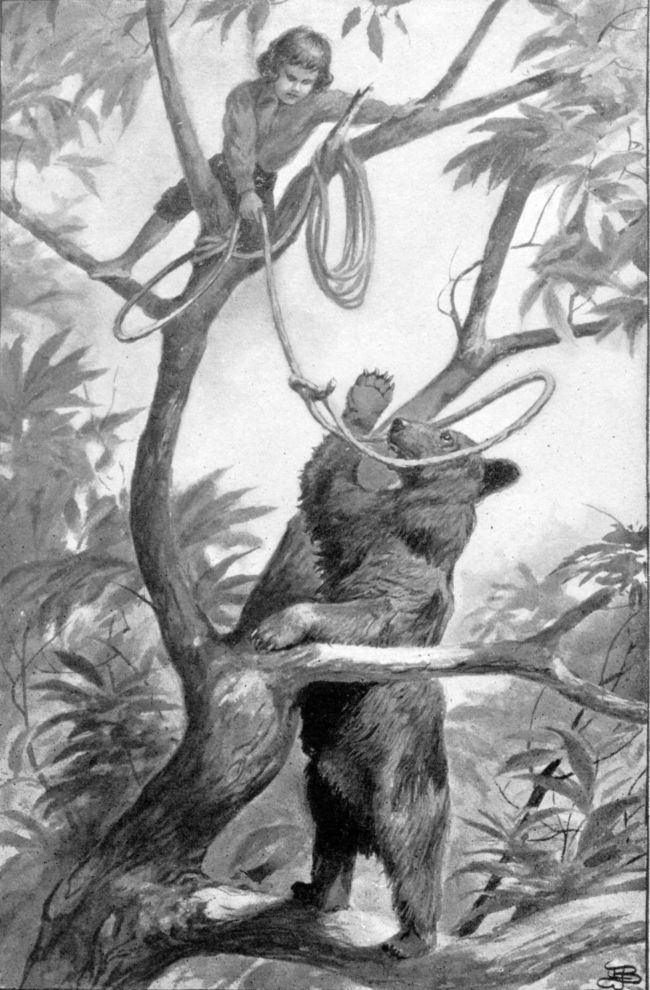
“ARCHIE IMPROVED HIS OPPORTUNITY TO DROP THE NOOSE OVER HER HEAD.”
The moment she felt the line straighten she stopped her attack, and tried to free herself from the entangling rope. Finding herself unable to do that, the brute became enraged, and loosened one paw from the tree to seize on the offending object. The movement was fatal to her. Archie, watching his time, gave the tree a vigorous shake, feeling that it was his turn. The result surprised even him. The huge beast suddenly lost her hold, and, with a furious growl, went crashing down through the thick branches.
At first Archie’s heart was filled with fear. He thought he had miscalculated the length of the rope, [145]and that the bear would fall to the ground before reaching its limit. Then he was frightened lest the rope should break. These thoughts flew rapidly through his mind. Then there came a shock which nearly threw him from the tree. As soon as it had passed he looked anxiously downward, to see a dark form struggling in mid-air a few feet above the ground. It was the bear, which soon became quite motionless. He could hardly credit his eyes, but upon looking a second time he found the huge carcass still there, helpless now.
The danger over, Archie felt very weak from reaction after the excitement, and as he descended the tree he came near losing his hold several times. But that was really no evidence of fear. He had shown himself extremely courageous in the moment of great peril, and had acted with wonderful fortitude and forethought.
The dead bear’s cubs were whining piteously under the tree, trying in vain to reach the lifeless form of their mother dangling above their heads. Archie watched his opportunity to drop to the ground beyond their clutch, not knowing but they might make him trouble in their distracted state.
A minute later he was running up the road as fast as he could go, though with different feelings stirring his bosom from those which had caused Lige Bitlock to use his long legs in covering the [146]ground. After running a short distance he slackened his speed to a walk, and he was pursuing his way in this deliberate manner when he was discovered by his father and the others. At sight of him Mr. Stark ran forward and clasped him in his arms, with terms of endearment.
Showing considerable surprise at this greeting, Archie broke loose, saying:
“Did you get tired of waiting for the rope, father? I had to leave it in the chestnut, but if you will let me have your stout knife I can soon get it for you.”
“My bonnie boy! what has happened? The bear—where is it?”
“Hanging high and dry, father, in the old chestnut in the hollow. Hilloa, Lige! I see you got home all right!”
Then, upon being questioned, Archie told his story in a modest way, and was at once the hero of the hour. Around the Stark hearthstone that evening bear stories were the one absorbing topic of conversation. The skin of Mistress Bruin was kept for many years in the family, as a memento of her youthful conqueror.
Mr. Stark had been so wrought up over the affair that he declared no more work should be done that day. But, as it was then half past five, Norman did not feel that he was losing very much time. As Rilma came daily to recite her lessons, he waited as [147]usual to go home with her. No sister could have been dearer to him than she, and those walks were never forgotten, when in later life they were both called into the midst of more exciting scenes. She delighted to go over with him her studies, gathering new light and interest from his kindly suggestions, while he told her whatever of interest had happened to him during the day. And dull and dreary as were those hours of toil in the stump-field, he found many an incident which pleased her.
One evening he had to tell her that Gunwad had been seen in the neighbourhood of Christo’s lone cabin, but they felt easier when they found that he had not been at their home.
“Perhaps he will not try to harm us again,” she said.
“We will hope not,” he replied, though he knew only too well that such a hope was vain. The unprincipled deer reeve was not one to give up so easily.
His worst fears were realised a week later, when, as he and Rilma were returning from Mr. Stark’s, they heard the sound of angry voices, as they approached their home. There was no mistaking the speakers. The first was their grandfather, whose tone, as well as words, showed that he was in a raging passion:
“Out o’ ma house, ye uncanny fule, afore I brak’ this staff ower yer thick heid!”
[148]
The reply was Gunwad’s, lower, and with an aggravating inflection in the speech:
“Lay so much as a finger on me ef ye dare, ye ol’ Scot refugee. I say, strike me ef ye dare, ye cowardly furriner!”
“I must get there before grandfather strikes him, or it will fare ill with us,” cried Norman, rushing toward the house at the top of his speed.
[149]
Though expecting to meet an exciting scene, Norman was not prepared for the startling tableau which greeted his gaze as he bounded into the house. Two men, companions of Gunwad, stood like guards at the door, while the deer reeve had advanced to the opposite side of the room, and was shaking his fist in Mr. MacDonald’s face. The latter, who had allowed all the intense passion of his nature to assert itself, had retreated to the corner, and was in the act of bringing his stout staff down on the head of his tormentor.
With an exclamation of warning, Norman sprang between the two, catching his grandfather’s uplifted arm in an attempt to turn the intended blow from the deer reeve. He succeeded in his purpose at the cost of a stinging stroke on his own shoulder, caused by a sudden turning of the cane.
“Don’t strike him, grandfather!” he cried. “Be calm; don’t you see it is his desire to make you do him harm, and then—”
[150]
“Stand aside, lad! nae sic a dog insults me in my ain hoose! Let me get but ae whack at him, lad!”
“No—no, grandfather! you must not so much as touch him. Goodman Gunwad, please leave this house at once. Grandfather is an old man and so broken down as not to be himself. When he has recovered from the excitement your visit has given him we will talk with you. But now, please spare him.”
Norman’s appearance had been so sudden and unexpected that the two men in the doorway had not yet comprehended the situation, while it was not until he had finished speaking that the deer reeve recovered sufficiently to say a word. Then he exclaimed, in his blustering way:
“So—so, my Scotch bantam! so ye pick up th’ quarrel? Jest lay a hand on me ef ye wanter. I kem hyur peaceful to ask th’ ol’ furriner when he was goin’ to git out’n my house, and he flew at me like a cat. Be keerful how ye use me,” retreating a step, as Norman started forward, showing by his manner that he had no fear for the other. “Here, Holster, Lawton, don’t let the hot-headed Scotchmen kill me. They air two to one.”
“I am not going to lay a hand on you, Goodman Gunwad, if you will go your way peacefully,” said Norman, as the deer reeve’s companions advanced into the centre of the room.
[151]
“It’s ernough thet ye hev threatened me, an’ I can prove it. I order you, Holster and Lawton, to take th’ ripscallion off. The sooner these furriners air driven out o’ Tyngstown th’ better ’twill be fer all honest people.”
“You shall not lay a hand on grandfather,” cried Norman, as the man called Holster again moved forward. “If grandfather has offered to do one of you harm it was because you drove him to it. I—”
“Bah!” exclaimed Gunwad, “I ain’t foolin’ round hyur fer nothin’. Pull ’em both—”
Though no one had heard the approach of a newcomer, a shadow at that moment fell across the pathway of the irate deer reeve, and he stopped in the midst of his excited speech as the stalwart figure of the Woodranger confronted him.
“So you are stirring a bit o’ an amazement, Gunwad?” demanded the forester, sternly. “Sich conduct on your part seems ill-timed to me, who is not an adept in the wanton ways o’ men. What would you have with this old man and the lad?”
“I want ’em to git out’n my house! I jes’ come civil like, armed with proper authority, and this youngster has sassed me and th’ ol’ man has tried to club me. I can prove it by my friends here.”
“No matter about that. Did my ears hear aright, or was it the whispering o’ a pine, which said that this is your abode?”
[152]
“I said plain ernough thet this is my house! I own this lot, seein’ I come into fair possession by law. I bought it of one of the grantees of Tyng Township, of which this is a part. There was no trouble till those ’demned furriners kem hyur.”
“Easy, Gunwad, easy! When you talk o’ furriners you hit us all on the head. It is only the poor red man who can say that, and not many o’ them, seeing the way we’ve kicked ’em from our path, as we would dead leaves. It is them as have reason to complain.”
“Ye know well ernough what I mean, Woodranger. It’s these miserable Scotch intruders.”
“Who got here afore you did, Gunwad. It may be, without wishing to be other than neutral in a flame which should never have been kindled, that I have—”
“How long has it been sence ye hev sided with these dogs?” broke in the deer reeve. “So ye hev been a snake in—”
“Be keerful, Gunwad!” warned the forester, this last statement being more than he could listen to in silence. “Be keerful and not awaken an old man’s ire. A snake in the grass, never! I seek no quarrel with man, and I find none in the free domain o’ natur’. It is only where the contentions o’ civilisation come that men get at cross purposes. I ’low that wild creeturs fight, but that should be a lesson [153]to man and not an example. Don’t you so much as lay a finger on the old man, Gunwad, or I shall forget my prudence.”
Woodranger showed that he was making a mighty effort to keep his feelings under control, while he appeared unusually excited. Gunwad feared him, and yet with his two companions behind him, and, what he considered of greater benefit, the law, he tried to think he had nothing to fear. Happily for him, the man named Lawton came to his assistance at that moment.
“You forget the notice I have to read, Gunwad. Perhaps that will bring them to their senses.”
“Yes, read the document, Lawton,” said Gunwad, with a look of relief. “Mebbe that will bring ’em to their senses.”
By this time Lawton had produced from his pocket a formidable-looking paper, which he quickly unfolded and began to read:
“‘At a meeting of the Proprietors of Tyng Township, so called, regularly warned and assembled at the house of Mr. Isaac Farwell, Innholder, in Dunstable, the 21st of August, 1740:
“‘Voted that those persons whose lands in said township and part of the original Proprietary are trespassed upon, or are possessed by any person claiming them under grant from New Hampshire, shall within three months from this meeting prosecute [154]such persons, who are and be deprived for the future of any benefit or assistance from the Proprietary in the defence or recovery of any such lands.
“‘Also voted that Messrs. Ephraim Hildreth, William Lawton, and Joseph Blanchard be a Committee fully empowered and directed at the charge of this Proprietary (by taking a legal owner) to assist in suing and defending in any action commenced or to be commenced of trespass or ejectment for or against any person or persons in trial of the title or trespass, as aforesaid, on any land belonging to the Proprietary or grantee. Thereof said Committee, or any one of them, are directed also at the cost of the Proprietary that if Proprietor, as aforesaid, be arrested and carried into the Province of New Hampshire[2] by any writ or process for improving on their lands there to redeem them from such arrests or arrest, and to take a power of attorney to appear in their names to prosecute and defend in any matter, jointly or severally according to the whole tenor of this vote.
“‘[Signed]
“‘Ephraim Hildreth,
“‘William Lawton,
“‘Joseph Blanchard.’”
[2] Tyng Township was claimed to belong to Massachusetts.
“What d’ye think o’ thet?” demanded Gunwad, triumphantly, as the other finished reading. “I [155]reckon thet settles matters at one clip. I’ve got the province o’ Massachusetts and good King George the Second behind me.”
“It is not for me, who is better varsed in the open ways o’ the free woods to dissemble, Gunwad, and I must confess that the course taken by the new town is most ill considered. I’m afeerd they will see disappointment soon, and have reason to regret such thoughtless—”
“Air ye a fool or crazy, Woodranger? We’ll hev every furriner out o’ Tyngstown inside a year. Thet new law jes’ fixes every one o’ ’em, and I ain’t goin’ to let my chance slip. I shall hev to ax ye to step one side.”
“Not to allow you to harm a hair on the head o’ this old, innocent man, who never wronged—”
“So ye stan’ in fer him? Holster and Lawton, take keer o’ him an’ I’ll throw th’ ol’ ripscallion out!”
It was a critical moment. Norman felt that a fight was coming. Robert MacDonald showed it by the wild light in his eye and the look of stern determination upon his countenance, as he drew his tall figure up until he fairly towered, like a blazing column, above Gunwad. Fearing the worst, Norman gently pushed Rilma to a safer distance, while he moved nearer his grandfather.
The bronzed features of the Woodranger suddenly lost their look of wonted calm. With his habitual swift but silent movement he glided to the side of [156]the deer reeve, the fingers of his left hand closed on Gunwad’s long nose, and before that worthy could realise what was taking place he was led to the door. Then, fairly lifted from his feet, he was sent several yards away, where he fell in a heap on the ground. Before his companions could interfere, if they had any intention of doing so, the forester turned toward them, pointing without a word in the direction of the door.
“I have no quarrel with you, Woodranger,” said Lawton, beginning to retreat. “Come, Holster, let’s get out of this.”
Without further words the two joined Gunwad, who, as he regained his feet, shook his fist at the house, saying:
“Ye shall pay dearly fer this, Woodranger. Ye’re a traitor, and every man in Tyngstown shall know it. Ez fer ye, ye ol’ Scotch dunderhead, ye shall be driven out o’ Tyngstown with a withewood at yer heels.”
The Woodranger was trembling from head to foot, but he offered no reply, saying to himself rather than to any one else:
“Man’s consait is beyond comprehension. Ill fares it with him who loses command o’ himself. I much fear me I’ve committed an indiscretion. The babbling creetur’ did arouse me more than I knew. Well, alack! I’m not overmuch pleased with myself. Man never knows his weakness till he lets his temper [157]overrule his jedgment. I very much fear I’ve committed an indiscretion.”
“Are the dolts a’ awa’, Norman, ma laddie?” asked Mr. MacDonald, still trembling from the effect of his recent excitement.
“Yes, grandfather, and let us hope they will not come back.”
“They will, ma laddie, mark an auld man’s words. Sir,” addressing the Woodranger, “I like the wey ye handled th’ auld skellum, only I wad hae liked tae hae had my ain fingers in the place o’ yours.”
“I very much fear me I have committed an indiscretion, and that my fingers pinched a bit harder than I knew. But he vexed me exceedingly. I hope you will not suffer for my indiscretion.”
“We wish to thank you, Woodranger,” said Norman, “for helping us get rid of the men. Do you think Gunwad can really drive us away?”
“I’ll warrant he will not without some stern opposition. This trouble between the two factions of settlers is an amazement no man can read, though I am of the opinion the end is nearer than most calculate. My advice, and such offering cannot be counted high on account o’ its commonness, is not to let the varmint give you a worry.”
“Oh, kind sir,” cried Rilma, “is it such a dreadful thing to be a refugee? You are an honest man and you will tell me truly.”
[158]
“Nay, my bonnie lass, let not your heart run away with your jedgment, as my temper did with mine. You are too young and too gentle to let such matters trouble your pretty head. But I will say this much, and I have no wish to dissemble, that it is seldom a term of dishonour. He who wears it lightest wears it best. For that matter we’re all refugees, my bonnie lass, and can only make the best o’ it.”
“What! maun ye gang awa’ sae soon, maister, an’ withoot givin’ us yer name?” asked the old Highlander. “If I mistake not you’re ca’d Woodranger, but I fain wad ca’ ye by a dearie name.”
“No name is so dear to man as that he bears amid the scenes he loves best. That race, which is seldom at fault in such things, deemed it suited to me. I have no desire to exchange it for another. Nay, ol’ man, it has stood by me many a year and it must remain until the eend. Ol’ Danger would lose his faith in me, and my foot would lose its lightness, should I change it now,” and shaking his head, he moved swiftly and silently away.
“I dinna read, I dinna read him!” muttered Mr. MacDonald, shaking his own head, as he watched the forester out of sight.
“He is brave and kind-hearted,” said Norman, warmly. “I cannot help liking him.”
Then their conversation naturally turned upon the deer reeve and his companion, even Norman being [159]obliged to acknowledge that their visit meant them trouble if not serious harm. To give up their home was a sacrifice which seemed too great to be met. At any rate, they resolved to wait and see what Gunwad’s next movement would be toward evicting them.
Day after day, however, passed without any change in the situation, as far as they knew. Gunwad had not reappeared, but what his silence boded them was more than they could foresee. Perhaps he had some deeper laid scheme, which was requiring further time to perfect. It might be he had given up his intentions, though they could not believe that.
The real cause of the prolonged delay was not from any willingness on the part of Gunwad, but rather a natural necessity arising from the slow methods of law. Among the early settlers of New England there were few who understood the principles or the workings of legal force, and thus the jurisdiction of courts was limited. The few judges who had been invested with power to sit upon suits were generally men without any legal education to prepare them for their perplexing duties. Thus there was no system or harmony in their rulings, and the inhabitants were commonly compelled to apply to the General Assembly, which assumed and exercised jurisdiction in imitation of the English Parliament, as a Court of Errors and Chancery. So the deer reeve was obliged to prepare a petition and [160]send it to Boston, that it might in its order be placed before the proper officials.
While he was fretting and fuming over the slow process of law, his intended victims were gradually forgetting his threat, and Norman, who was still working for Mr. Stark, became greatly interested in the proposed canoe match. Though of frequent occurrence on the frontier, a boat race never failed to arouse a keen and wide-spread interest, being second only to a trial with arms. This trial, planned by the youth of Harrytown, was of greater novelty than usual, and sure to awaken more than ordinary rivalry. In fact, owing to the opposing spirits existing among these colonists, old as well as young could talk of little else.
Norman McNiel, Robert Rogers, and William Stark were unanimously selected to represent the Scotch-Irish settlers, while Johnny Goffe, William Tyng, and James Hazard made up the English crew. It is needless to say that both sides began at once to practise earnestly.
During one of these careful trainings on the part of Norman and his companions, they were delighted to see the Woodranger paddling swiftly and silently down the stream.
“Let’s watch him, and perhaps we can learn something from him. Woodranger, you know, is considered the best paddler in these parts.”
[161]
To the general spectator there is something fascinating in the way a boat glides through the silvery water under the propulsion of an expert oarsman. And if this is true of the clumsy boat, the fascination is doubled and trebled at the sight of the birchen craft of the Indian, which seems to skim the current without touching,—to fly without wings! As Billy Stark had said, the Woodranger was not equalled in the use of the paddle. His canoe was of Indian make, about eighteen feet long, and built from the winter bark of the white birch, which is tougher than that of the summer. His smooth, wide-bladed paddle was of the clearest poplar, “as light as a feather and as strong as ironwood.” In his skilful handling it touched the water without making a sound, each stroke sending his frail bark yards on its course.
The forester had seen the young canoeists, and it wasn’t long before he sped alongside of them.
“A fine evening for your practice, lads, which I hope my coming will not check. In my humble opinion you will need all the benefit you can get from such trials.”
“We are right glad you have come, Woodranger,” said Billy Stark, who seemed inclined to do the talking, “and we want you to give us a lesson.”
“Nay, nay, lads, that I cannot do! I have no [162]desire to dissemble in this amazement, and I am free to confess that I am neutral in the quarrel hanging over this affair. It would be ill-advised for me to lend counsel or assistance even to my friends.”
“Do you think the Cohas boys are going to beat us?” asked Billy, showing disappointment at the forester’s reply.
“It is not my knack to be able to tell you, seeing there are true lads at Goffe’s. I can tell you that nothing is ever lost in being prepared to do your best. It isn’t so much what you can do individually, as what you are able to do all together. I see Rob has the bow paddle, Billy the middle, and Norman the stern. In my humble opinion, that shows good jedgment. Your craft is a good one, its brown colour showing that it is made of winter bark, and your paddles appear to be clean ash. I prefer poplar, which is lighter and less inclined to spring, but that is only an old man’s whim. It all lies with you; good evening,” and, without further words, the Woodranger sped away as silently as he had come.
“Funny he couldn’t give us just a hint!” said Billy.
“It seems to me he did give us two hints, which may be the winning of the victory for us. Let us be prepared to do our best, and to work together. Let that be our key-note. Now, boys, together!”
[163]
It was a still September day,—an ideal day for the canoe match. The sky had taken on that peculiar sapphire hue so common to the season. Never had the limpid current of the Merrimack shone clearer along the two-mile course where it moved with sluggish motion toward the Falls of Namaske. If the day was ideal, so was this portion of the sparkling stream an ideal track for the light barks of the rival canoeists.
At a point where a bend in the bank curved sharply toward the west, cutting in twain the beach of white sand, a crowd of spectators had gathered to witness the great event of the autumn. A dozen feet above these twin knots of anxious watchers, standing on a wide, smooth breadth of land,—a natural terrace,—were twice their numbers. Under the giant pines, rearing their straight trunks from seventy-five to one hundred feet into the air without a branch to mar their symmetry, and tufted at the top with oval masses of foliage, the view was extended [164]and beautiful. A hundred yards to the rear the ground ascended abruptly in a far-reaching hill, which was covered with a heavy growth of trees.
Not satisfied with such advantages as the others had obtained to watch the race, four adventurous boys had climbed into the topmost branches of a pine growing on the river’s bank, and which some storm had so far uprooted as to cause the forest monarch to lean far out over the water. Foremost of this quartette was Lige Bitlock, for once obliged to leave his dog in the background. From this position a good view of the river was had for the entire distance of the course, so straight does the stream flow at this portion of its journey.
It was now a quarter to two o’clock, and in fifteen minutes the race was expected to start. Both parties of the rivals were already on the ground, or rather water, the observed of all and the subjects of a continual flow of running comments. All of the preliminary arrangements had been made, excepting that most important one of selecting a judge. That was the exact situation, though in the minds of all a unanimous selection had been made by both sides. Woodranger was that choice. But the forester for some reason had not appeared, and until he came and accepted the trust, it could not be said a judge had been obtained. No one knew where he was. Neither was it certain he would come at all. In that [165]dilemma Captain Goffe was expected to decide the match. It was generally understood that he would not accept if the Woodranger came. So you see that while the judge was really chosen, no one knew who he would be.
In this anxious delay, though the time set had not fully arrived, the onlookers, as they generally do, got impatient. The two committees were besieged with questions.
It was to be a three-mile race, the canoeists going up-stream a mile, and turning and going down-stream a mile below the starting-place. This rather unusual way of conducting the match had been decided upon from a wish to give the spectators the best possible opportunity to witness the trial. Both teams were claimed to be in fine condition, and certainly everything else was in their favour.
Naturally, none were more impatient for the match to open than the contestants, who had paddled to positions nearly opposite the spectators, and were discussing the prospect in whispers among themselves.
“Do you think we shall win?” asked Billy Stark, who was a little nervous over the trying situation.
“Let us think so until we are fairly beaten,” replied Norman. “Remember very much depends on the last mile. Don’t get winded going up the stream. If Johnny does get ahead of us, don’t let [166]that fact discourage you. It is the last part that counts.”
“And be careful how you drop your paddle,” said Robert Rogers, who was not inclined to talk much on occasions like that. “You must not get ahead of Mac and me. Remember, Billy, that we must move exactly together.”
“Ay, you remember those were the last words of Woodranger,” said Norman.
“I wonder where the old fellow is,” commented Billy. “I believe I could do better if he were here. I had rather he would be judge than Captain Goffe. It doesn’t seem right to have Johnny’s father to decide a race in which his own boy is captain.”
“That is why Captain Goffe does not like to accept. Captain Blanchard was asked, but he said he couldn’t be here. What is that cheering for?”
Until then the crowds had been silent, but now a lusty cheer was given by those on the terrace, though the spectators below them remained quiet. The cause of the outburst was soon explained by the appearance of Captain Blanchard, who had been seen by those from their elevated position before their companions.
“I had rather he would be umpire than Goffe,” declared young Rogers.
Meanwhile a conversation of somewhat similar nature, though varied to suit the desires of the rival [167]crew, had been carried on. It is, perhaps, needless to say that the Cohas boys were as confident of winning the match as their opponents. The spectators seemed about equally divided in their favours and hopes.
“I tell you what it is, Mac, I’ll wager my first fall pelt that the Namaske boys are going to whip ’em others!” exclaimed a tall, bony looker-on, whose appearance showed plainly his place of nativity.
“Ne’er fear o’ my taking ye up, Archie, though it do seem Goffe’s crew air in deadly ’arnest,” replied a companion.
“An’ going to bite vict’ry right out o’ th’ Scotch boys’ teeth!” exclaimed a third. “I’ll take yer bet, Archie, ef McPherson daresn’t!”
“Done!” was the quick rejoinder of the first speaker. “I’m sure o’ doubling my game.”
“Th’ Goffes were never beaten!” interjected another. “See whut a breadth o’ chist Johnny has. Jis’ like his father. An’ sich forearms! Then there’s Jimmy! Jimmy’s going to last till th’ last stroke. Ah, Cap’n Goffe knowed who to pick. With him fer judge we’re sure.”
“Avaunt wi’ yer nonsense! Whut’s Johnny Goffe’s brawn compared to young McNiel’s arm? Mac can take one in each hand an’ flip their heels togither. Whut’s Johnny’s craft compared to Robby Rogers’s cunning? Robby is Woodranger’s favourite [168]and trained in his ways. Them two air th’ boys fer me,—the boys who made th’ handsomest shots at th’ Pines. But whut air th’ committees doing now? Why be they buzzing Cap’n Blanchard so?”
The committees, aided by Captain Goffe, were urging Captain Blanchard to accept the position of judge of the race, when a louder cheering than any before broke upon the scene, the wild cries prolonged into a series of huzzas which rang far and wide up and down the river. Nor had they far to look for the explanation, for a canoe, skimming the water with bird-like swiftness, and holding the well-known figure of the Woodranger, was to be seen near at hand.
The chairman of the committee at once beckoned to the forester, who sped his light craft near to the anxious group.
“You’re the one we’ve been looking and waiting for, Woodranger. We want you to act as judge of the match. You’re better versed in canoeing than any of us, and you’re just the one to decide the race.”
To the surprise and disappointment of all, the forester shook his head.
“I durst not do it, man, I durst not do it. Varsed in the ways o’ dipping a paddle I may be, and though it be not proper for me to say it, I may have picked up the knack o’ the red man’s cunning. But there [169]be personal p’ints in this matter, which would make it an indiscretion for me to meddle. I might be accused, and mind you I say not without reason, o’ partiality. Robby, you mus’ remember, is my pupil in the great school o’ natur’. And the lad, McNiel,—but I need not detail my mind. They’re six likely lads, and I love and respect them all. I thought mebbe I’d sort o’ trail along behind, and if anything—mind you, I say if anything unforeseen does happen,—not that I’m expecting it,—I’ll be near to lend a helping hand. More’n that I durst not undertake. I cannot dissemble; I’m neutral in this matter.”
Understanding that it would be useless to urge the Woodranger to do what his judgment did not dictate, the committee then pressed Captain Blanchard to accept the trust. The latter did not hesitate, after finding that their first choice could not be pressed into service. His acceptance was very agreeable to both sides, for though the Proprietors’ clerk of Tyng Township at the time, he was known to be always fair in his dealings with both factions.
No sooner was this decision reached than Chairman Hall jumped upon a handy stump, and shouted so as to be heard by every one:
“Arrangements completed. ’Squire Blanchard will decide the race. Are you in the canoes ready for the word?”
[170]
“Ready!” rang out the word in six voices, as if spoken by one, falling clearly on the profound silence which had now bound the spectators.
“Ready it is, then. Time! One, two, three—go!”
So well had the starter timed himself that it was exactly two o’clock by Captain Blanchard’s watch as the signal was given.
As one the six paddles dropped into the water, and side by side the two canoes shot up the stream, while loud, prolonged cheers from the spectators made the woods ring.
“It were a fair start and above discussion,” said the Woodranger to himself, as he sent his light bark in the silvery track of the rival canoes. “I’m afeerd Robby has set a stroke that’ll puzzle ’em to hold to the eend. Three miles ain’t like spinning a few yards for fun. But, Lordy’s me! how I do take on, and the race only begun.”
It was a beautiful sight to witness, to see the six paddles rise and fall with such automatic precision that they seemed to be moved by machinery, while the heads and bodies of the rowers rose and sank with equal regularity. After the first outburst the crowds again became silent, and, except the splash of a paddle now and then, as one of the rowers failed to feather the edge as he wished, not a sound broke the stillness of the autumn air.
[171]
But it was soon evident that the boys of Cohas were gaining on the others. At first the spectators were in some doubt of this, but it soon became certain, even to the most skeptical. Renewed cheering was then begun, though only the friends of the English boys now did the shouting.
“What’d I tell ye!” cried an overzealous admirer. “Johnny Goffe is sure to come in ahead. Hurrah for the boys o’ Cohas!”
Others took up the cry, until it rang far and wide, encouraging the three from the lower settlement to greater exertions. Woodranger, hearing the cries and realising the situation, shook his head.
Straight as a bee-line did the canoes speed up the river toward the buoy in the middle of the stream, around which they were expected to pass and then return to the goal two miles down the watery course. The boys of Cohas were showing themselves to be of true metal, as well they might and should, for the work they were destined to perform in later years. Every one of the three earned a name that for border sagacity and intrepidity still lives in colonial history. Johnny Goffe, well worthy of the name of his father, who trained John Stark in the manual of arms and was General Sullivan’s master of tactics, sufficient honour for one, to say nothing of his own proud career, had set the stroke for his crew; and if it was begun at a tremendous pace, he showed no [172]signs of faltering, as slowly, inch by inch, yard by yard, they continued to gain on their rivals. At the turning-point, as they swung silently and swiftly around the buoy, the boys of Cohas were three canoe lengths in the lead!
Some of the spectators had followed as near as they could in canoes, while others had tried to keep the race in sight by running along the bank. Foremost of all flew the Woodranger, casting furtive glances, ever and anon, toward the rivals.
“The boys of Cohas have turned the buoy four rods ahead!” some one shouted, and others catching up the cry, it rang from throat to throat, until it was heard from start to finish.
“The boys of Cohas lead—the race is theirs! Hurrah for the Tyng boys! Hurrah for Johnny Goffe!”
If the latter was getting the lion’s share of the praise, he was the coolest of the trio.
“Well done, my hearties!” he cried, as they sent the canoe head down the stream. “It will be easier now, and we ought to win!”
“We will!” exclaimed Jimmy Hazard, from between his clenched teeth. But, while he would not own it to himself, he was sorely tried with the long up-pull.
If the boys of Namaske felt any undue anxiety, they did not show it, but continued to rush ahead [173]with a stroke which their rivals did not equal for precision and silence.
“They handle their paddles like Indians,” said the Woodranger to himself, paying them the highest compliment he could. But shaking his head, he resumed, “I have strange misgivings. I hope they have not committed an indiscretion by letting the others get so far ahead of them. No—no! it cannot be. Alack! how childish I am getting to be.”
Now that the canoes had turned the upper end of the course, there was a scramble on the part of the spectators to get where they could best witness the close struggle they believed must take place on the last quarter. Captain Blanchard, in a canoe, had already stationed himself where he could command a close view of the finish, the critical point in the trial.
The boys of Cohas, confident of victory, and with the strength such confidence gives, were still sending their canoe gliding over the water at an amazing rate of speed, their friends now continually urging them on with exultant cries.
Neither were the boys of Namaske idle. They realised that it would not do for them to allow their rivals to gain another foot, and as they swept around the buoy they quickened their movements, soon lessening the distance between them and the others. So closely were the spectators watching them, that [174]even the fraction gained was noticed, and the Scotch-Irish improved their opportunity to cheer. But their cries were drowned by renewed yells from the others, who felt that the honours belonged to them.
“Robby has a good arm for a lad o’ his age,” soliloquised the Woodranger, as he witnessed the spurt of those whom it was plain he favoured in spite of his wish to remain neutral; “but he’s too young to hold out to the eend. I’m much afeerd—alack a man! why will I fill my ol’ mind with sich foolishness. They are all likely lads, and the best must win.”
As one better versed in canoeing, as well as in all phases of wildwood life, Norman had gladly consented to allow Robby Rogers, though younger than himself, to be the leader of their crew; but now he was beginning to think the boy ranger was making a mistake in not giving their rivals a closer pull at the outset. It was true he felt as fresh as at the opening, but of what avail would be all of their reserved energy if they delayed too long the effort to recover the distance they had lost? Certainly it would soon be too late for them to hope to gain the victory. Filled with these thoughts, he said, in a low tone, but plainly heard by the others:
“Has not the time come for us, Rob?”
The reply came in a clear tone:
“Quicker—deeper, lads!”
[175]
Then something of the reserved strength of the three was brought into action. The paddles flashed forth a continual stream of sunlight, while the silvery trail behind the flying canoe was unbroken for a long distance. Their friends on the river bank, realising the change, gave an encouraging cheer. This was drowned, however, by the shouts of the Tyngs party, who seemed determined to do all the applauding.
Johnny Goffe caught something of the meaning of this new outburst on the part of the Cohas party, and he endeavoured to arose his companions to still more effective work. Then, for the first time, he learned that his crew had begun to feel the effect of their overtasked strength. But this did not disconcert him. With the advantage they had already won, it was only necessary for them to hold their own now. He never doubted their ability to do that.
It was a beautiful sight to see the rival canoes skimming the silvery current like twin birds, the swift-moving paddles looking not unlike the white wings of a pair of snowy swans. If the friends of the boys of Namaske boasted that their champions had begun to gain on the Cohas crew, the admirers of the latter claimed that it was not enough to give them any alarm. The Woodranger, than whom no one had watched the contest closer, or with nicer calculation, knew that half a canoe’s length had [176]been taken from the gap lying between the two crafts.
Two-thirds of the distance had now been made, and both crews were apparently doing their best. Slowly but surely the boys of Namaske were overhauling the others. As this became certain, all cheering ended, as if the situation was now too momentous for any display of feeling, and every one stood in silence, intently watching the race. With the skill and rapidity which seemed to be a sort of second nature to him, the Woodranger was keeping almost abreast of the rivals, when he thus was the first to see the disaster which befel the rear crew.
Suddenly, as Billy Stark plied his paddle with increasing power, a sharp crack, sounding like the report of a firearm, rang loud and clear, and he reeled over as if shot, and fell in the bottom of the canoe. Nearly every spectator thought he had been shot, and cries of horror were heard in every direction.
But there had been no gunshot, no foul play, as far as any person was concerned. Instead, an accident had occurred almost as disastrous, as far as the match seemed concerned. His paddle had snapped asunder under his great exertions, sending him upon his back at the feet of his companions.
The frail bark careened, and as Norman and Rob [177]realised the disaster to their assistant, both felt that their hopes were lost. In the face of such odds they could not hope to win.
“It’s no use,—our race is over!” gasped Rob. He had hardly given utterance to the hopeless words, when a clarion voice rang over the water, crying:
“The brave never give up!”
It was the Woodranger who uttered the stirring declaration, and the words came like an inspiration to Norman McNiel, who quickly rallied, saying to his companion:
“Don’t give up, Rob! We must win!”
It was fortunate then they were comparatively as fresh as at the outset. The exertions of the race so far had only served to temper the vigour in their strong limbs. Rob Rogers instantly threw off his fears, and, himself again, he handled his paddle as he had never done before. Norman had already set the example, and as if the strength of two Billy Starks had been imparted to their arms, they sent the canoe ahead like an arrow sprung from a bow with giant power. Before the spectators had recovered from their surprise enough to realise what had taken place, the two boys had covered half of the distance between them and their rivals.
It was true it was now two against three, but they seemed possessed of the strength of four. The scene which followed held the onlookers dumb with [178]wonder. In his excitement Lige Bitlock climbed so far out on his perch that the branch beneath him broke with a loud snap, sending him headforemost into the water. But no one heeded his cries or appeals for help, while he floundered in the river. Every eye and every thought was concentrated on a more stirring sight.
Johnny Goffe heard and realised enough to know that something had befallen his opponents, but he felt that it must have been to their advantage, for he found that they were gaining on him faster than ever.
“They must not—they shall not beat us!” he cried. “On, Jimmy, Willy, win or die!”
It was a stirring appeal, but Jimmy Hazard was too worn out to rally successfully, while his companions lacked the iron will and reserved strength of the sturdy limbs of Norman McNiel and Robert Rogers. Swifter and swifter this couple sent their light craft onward toward the goal, gaining on their rivals at every bite of the paddles. Nearer and nearer they flew, foot by foot, yard by yard, until they were now abreast!
But both were now down close to the finish line. The Tyngs spectators still believed and hoped that their champions could hold their own for the short distance left.
“Hold ’em a jiffy, Johnny!” yelled an excited [179]onlooker. “Don’t let ’em get ahead. Hurrah for the boys of Cohas!”
The other side was silent, breathless, during that brief interval of fearful suspense.
[180]
With the cries of frenzied spectators ringing in their ears, with such wild energy in their limbs as they had never known, Norman and Rob sent their canoe ahead of the boys of the Cohas. The next moment they crossed the line four yards in the lead of their rivals.
The boys of Namaske had won! What cheering followed! Never was such a scene witnessed on the banks of the Merrimack River, never, unless in the unwritten history of the red men some such race had been made and won by the dusky champions of the birchen skiff. The Scotch-Irish shouted until they were hoarse, and shouted still, when hardly an articulate sound left their lips. Let it be said to their credit, the Tyng colonists acted a most generous part.
Johnny Goffe was the first to clasp the hands of his successful rivals, expressing his honest congratulations.
“And to think,” said the humiliated Billy Stark, [181]“they did it without me. No, Johnny, I deserve none of your praise. That miserable paddle of mine broke like a pine limb in the midst of it, when I was needed most. Woodranger told me that knot would sometime spoil it, but I thought I knew better than the old man, with all his cunning. I am sorry, Norman, Rob, that I failed so, but honestly it was no fault of mine.”
“We know it, Billy,” said Rob. “But candidly I think we did better than we could have done if you had not broken your paddle. Do you know that put such strength into my arm as I had never felt before. It seems to require some great crisis to bring out a feller to his best.”
“That and Woodranger’s words,” said Norman. “Do you know, Rob, it seemed just as if he had given me his strength when he shouted to us. Where is he now?”
“Why, there he goes up the river! What has happened? There is a great commotion going on up by the leaning pine.”
“Some one is in the river. Looks as though he was drowning.”
“And there goes Woodranger to save him. He’s all right now. Let’s talk some more about the match. Don’t you boys feel grand?”
“Why shouldn’t they?” asked a brawny spectator, who had elbowed his way down to the river’s bank. [182]“I want to get hold of their hands. Boys,” he continued, as he held a hand of each of the victors, “I’d rather walked a hundred miles than to miss that sight.”
That seemed to be the sentiment of all, even among the Tyng colonists. It was noticed that day, and Archie Stark commented upon it, that there appeared to be less bitter feeling among the younger generation than was shown by their parents.
“It shows that this difference of opinion is going to wear away,” he declared.
In the congratulations showered upon him from every side, and among them the sweet praise of Rilma, Norman ought to have felt proud and satisfied. But there was one who had not come near him or Rob, whom he had desired to see at that time above all others. That one was the Woodranger. So he looked and waited for the opportunity to speak to him, as soon as Lige Bitlock had been rescued from his ducking. But no sooner had the forester saved the half-drowned boy than he disappeared, and no one saw him again that day.
Somewhat to Norman’s surprise, his grandfather had come to witness the match, and he praised him as only he could. Probably no one there felt prouder of the victory than the old Highlander.
“Yer a true MacDonald wi’ the best o’ McNiel,” he said.
[183]
After the trial was over the majority of the spectators lingered about the place, several participating in impromptu races on the river. Norman, Rilma, and Mr. MacDonald, however, soon sought their home.
On the whole, the match had passed off satisfactorily, and it was much talked of for many days. No one, not even the defeated boys of Cohas, felt worse than Billy Stark. But of course no blame was attached to him, and in the joy of the others he soon forgot the mishap which had robbed him of his share of the coveted glory.
In the month of October, generally during the full moon, it was customary for many of the pioneers to take what was considered “the fall hunt,” just as the Indians had done before them. Some did this from a desire to lay in a stock of meat for the winter, and many others from the pleasure they found in it. These excursions were not usually extended to a great distance on account of the plentiful supply of game near home.
Though this was his second season in the country, Norman had not taken one of these trips, which he felt must be filled with sport and adventure. He had found that his friends, the Scotch-Irish, were less inclined, as a rule, to pursue such expeditions. But upon speaking his wishes to Rob Rogers, the boy ranger, he at once found a congenial spirit.
“I have been thinking of the same thing, Mac, [184]and I have decided on the direction to go. The rest are scurrying toward the Uncannoonucs or up the river. We want to go to old Pawtuckaway Mountain, taking Massabesic Pond on our way. I will tell you what else I have been thinking of. Let’s ask Woodranger to go with us. He’s the best company we could have. And ask the Stark boys to go.”
“Just what I would like to do. I am sure Billy and Johnny will be glad to do so. But can we get Woodranger? I have not seen him since the canoe match. Wasn’t it singular he left in the way he did?”
“To you it may seem so, but to me it was just like him. He has been ‘perambulating the woods,’ as he calls it, ever since, I dare say. He’ll come in soon, and then I’ll speak to him about it. I am sure he will go with us, so you can make your calculations accordingly.”
The boy ranger proved himself a true prophet in more ways than one. The very next day the Woodranger appeared at Goffe’s Falls, and he readily consented to accompany the boys on the proposed hunt. That evening Rob came up to see Norman and tell the good news.
“I have seen the Stark boys,” said our hero, “and they are as anxious to go as we are. Mr. Stark has consented, provided Woodranger is to go, and grandfather [185]has kindly promised that I may be gone four days. I can get ready any time the rest can.”
“Then we’ll start Monday morning, and I predict that we’ll have a grand old time. Have you got plenty of powder and ball?”
“Plenty of powder, and I will run up some balls to-morrow. I suppose we shall want to take some skins with us, as a protection from the night air?”
“Just a blanket apiece. Don’t want to load down with such articles. A blanket, a bough house, a sheltered spot in the woods, and you will sleep like a bear in winter.
Now that they began to get ready to go, the greatest fear of the boys was that a storm might set in at the time they wished to start, and last for a week or more. But the eventful Monday was ushered in with a clear sun. Norman felt more reluctance than he had anticipated about leaving home; but, knowing his desire to go, both his grandfather and Rilma earnestly desired him to improve the opportunity, declaring they would have no difficulty in getting along for a few days without him.
“It’s yersel’ I am worried ower, laddie. Ye maun be unco careful. An’ mind ye, laddie, tak the auld [186]horn. It’ll prove handy, always remembering it was that which sounded the ca’ to airms in Glencoe, it was that which rallied the lads to battle when the Britons swarmed ower us like bees, an’ that which sounded the retreat when it was a’ ower wi’ the bauld clan. Tak it, laddie; ye’re worthy o’ it.”
Nothing loath, Norman did as he was requested, and kissing Rilma a tender good-bye, and clasping the old Highlander’s hand in his, he hastened after his companions, who were waiting for him a little below the house.
It was the first time he had met the Woodranger since the canoe race, and the forester’s greeting was most cordial.
“Don’t think I am less glad to see you, lad, because I ran away that day. I have always noticed that the best trait a man has is that o’ caution, and, the truth be told, I durst not meet you then. I feared me much I had committed a blameful indiscretion in bawling out like a loon, as I did. Tell me truly, lad, hast heerd any one speak very bitter o’ that indiscretion o’ mine?”
“Not one has mentioned it within my hearing, Woodranger. But I want to tell you that it saved us the match. We should have given up after Billy’s mishap, if you had not spoken as you did.”
“I feared it, lads, I did. It seemed a sorry amazement to spoil sich a fine race. It pleases me [187]much to know people were so considerate o’er my foolishness. Aweel, now’s me, lad, we are but weak mortals, no stronger in our greatest strength than our weakest p’int. It was a handsome race. I’m proud o’ sich lads.”
[188]
The outfit of the little party was very simple. The Woodranger was content with his faithful Danger thrown over his shoulder, and plenty of ammunition. Of course the boys had been careful to take a good supply of powder and ball. The Stark boys, at the urgent request of their mother, had a bagful of bread and doughnuts, which she knew would not come amiss. Johnny had strenuously opposed this, as he considered it showed a weakness on the part of hunters. Each of them, excepting the forester, carried a wolf-skin made into as small a roll as possible, and fastened on their backs. Johnny had objected even to this, but before their return he was glad to have heeded a mother’s thoughtful interest.
They left the Falls by the main road leading to the centre of the Scotch-Irish settlement, but upon reaching the few scattered homes of these pioneers the Woodranger plunged boldly into the primeval forest, stretching away in every direction farther [189]than the eye could survey, mile on mile of wildwood, broken only here and there by some small clearing of an adventurous settler. Extending over such a vast area, the forests covered mountain and hillside, valley and plain, margined the banks of numerous ponds, or fringed with overhanging branches innumerable silvery streams.
Norman, who had not seen as much of wildwood life as his companions, felt a strange, awe-inspiring sensation on entering deeper and deeper into the trackless and sunless region. The Woodranger showed that he was in his true element, and it was not long before the exuberance of spirit, welling up in his heart, as the fountain in the forest finds an outlet for its overflowing treasures, sought an escape in his rude, philosophical speech:
“Man is nearest human natur’ when alone with the works o’ his Creator. I do not have to go to the haunts o’ man to find the imprint o’ his hand. It is on the forest everywhere. What better evidence do you want o’ man’s pride than in yon pine, which lifts its cap a good fifty feet above the heads of its neighbours? What is more typical o’ man’s aggressive natur’ than that oak, which claims, and holds too, double the sarcuit o’ territory that even the proud pine possesses? In that silver birch, growing by the bank o’ that leetle stream, is the very personification o’ grace and beauty and modesty. [190]See how the tiny vines cling to it, as if it were their natural mother. I love the birch best o’ all the wildwood trees. It may be there are more useful ones, and I am mindful of the ash that makes a tolerable paddle, and the poplar, better yet. There be many others better and more useful, I allow, but still I love the birch.
“The other day, at the shooting-match, which was ’p’inted to take place on sacred ground ’cording to my idee, I thought o’ the forests then. To him who could ’a’ looked down on that mob there was only an uneven flooring o’ heads, one looking very much like another. But underneath were all kind o’ visages, and some were black with hate, and some were white with rage; some wore peaceful looks, and some looks o’ trouble and o’ fear. Everywhere was a spirit o’ rebellion and extermination o’ the other. Some were men o’ intellect and eddication, stalwart o’ figure and handsome o’ feature; others were dwafted in body, stunted in mind, and poor in the knowledge that comes from others’ experience. I pity sich, and none more than myself.
“To him who stands on the mountain and looks down on the forest, the sight presents a scene o’ many hues, but symmetrical and suggestful o’ quiet and repose. But below is a gnarled and tangled mass o’ drooping branches, mossy trunks o’ fallen trees, stunted undergrowth stifling for the sunlight [191]o’ which it has been robbed, distorted limbs and knotted roots that will thrust their forbidding bodies into sight, all festooned, here and there, with draperies o’ ferns and vines reeking with the cold sweat o’ their damp environments. Dead trees, like spectres o’ departed greatness, thrust their skeleton arms mutely toward the sunlight, while lean, starved trees eke out a miserable existence beside more fortunate kindred, which have grown to undue girth, just as some men fatten on their relations. An asthmatic beech, a consumptive pine, a stunted birch live only at the mercy of some big overbearing oak.
“So you see it is continual warfare among the trees,—a case o’ the survival o’ the strongest, as it is among men. A hundred infant trees have been dwarfed and suffocated by this giant pine, which, like some big general, will stand lordly and grand until the silent axe o’ the gray destroyer shall fell it to make room for another, which will grow and fatten on its decaying carcass. Unnumbered seedlings spring each season from the rich mould o’ them which have perished afore ’em, and they, too, become food for the next generation. Not one in a thousand survives in the struggle for the sunlight which means life to them, and yet in the grand march o’ ages those few have made the innumerable host surrounding us.
“I never see one o’ the Massachusetts men without thinking o’ the tall, haughty, defiant pine, unbending [192]to the strongest blasts, and as changeless as the December sky on a moonlit night. The Scotch-Irish remind me o’ the stubborn, aggressive oak, spreading out its branches where it listeth, severe and fearless, but generous and hospitable to those who find the way to its heart. The two clans o’ trees can never live together, as many other species o’ the forest do.
“But forgive me, lads, for running off into this sarmon at the outset. You must think me a pretty companion to let my foolish tongue lead me sich a race. I fear me much my tongue is like a runaway brook, for ever babbling o’ what it cannot in reason know. I often find myself listening to its lectures, when there be none other to hear, unless the trees have ears.”
“But your talk is always interesting. You have such new ideas.”
“As old as natur’, lad, as old as natur’.”
At this juncture, very much to the surprise of Norman, they came upon a hard-beaten path, winding through the forest.
“It is an old Indian trail,” said the Woodranger, “and it leads down to the shore o’ a pond, which we shall reach sooner than you now think. Look! even now we ketch a glimmer o’ the water through the tree-tops. You see that neck o’ land holding that leetle patch o’ earth out into the pond by the throat? [193]Weel, that is called Deer Neck. It was a favourite drive for the red men, who delighted in chasing the deer down here by the dozen, and, having cornered ’em, kill ’em off at their pleasure.
“It was a plan o’ the reds to lop down brushwood wherever they found a deer path, until they had built an enclosure of considerable extent. They were never particular about having the fence straight; in fact, it was better to let it jog as it happened. But they were sure to bring the ends close together at the mouth, so there was leetle chance for the creatur’ to get out once he had entered the pound. Some o’ ’em, too, would always guard the gap. Inside the grounds was filled with hedges and mazes o’ brushwood, while at every corner they set snares made o’ deer thongs o’ amazing strength. One end o’ the thong was usually made fast to a sapling, if one was convanient. If not, a loose pole was used, they being keerful to have it heavy enough so the deer could not drag it away.”
“But with their tools I should have thought it would have taken them a lifetime to build such a pen.”
“Hast seen the beavers work, lad? These patient creatur’s, with only their teeth for axes, have felled some o’ the biggest trees o’ the forest. The industrious beaver can teach the red man no lesson o’ patience. There were many hands, too, you must [194]remember, working for the general good and not for individual gain, as the whites do.
“The red, too, had a way o’ running down the deer, in case he was hunting alone and missed his mark. It was a sort o’ unwritten law with ’em that if the hunter missed his shot, he must run down the creatur’ to save himself from disgrace. So, when the frightened deer bounded away, he would give one o’ his unyarthly screeches and follow. But he knew better than to keep running at first. A moose never stops running, once he starts, until he either escapes or falls dead in his tracks. But a deer, after running a little way and finding it is not pursued, will stop to browse. The red knew this, and would creep upon his game, and when near enough give another yell, which would send the animal on another spurt. In this way the red would follow the deer for hours, and worry it by these jerky pursuits. It would get dry then, and drink its fill of the first pool or stream. That would load down its stomach so it could no longer make its big jumps, while its runs would be shorter. Each stop stiffened its joints.
“The cunning red, no matter how parched his tongue was, would not allow a drop o’ water down his throat. Dashing a handful into his face, as he crossed some brook, he would keep repeating his manœuvres, until at last the poor hunted brute would turn hopelessly at bay. The red then makes short [195]work o’ it. Without stopping for the flesh to cool, he cuts a piece from behind the fore shoulder, and begins to eat it. Neither does he allow himself, in his overheated condition, to stand still a minute. Slinging as much o’ the carcass as he can well carry o’er his shoulder, he starts on a trot to his home. He knows if he stops he will soon be too stiff to move. It may be he has run a hundred miles in this race. Such races generally average fifty miles, though it may end near where it started, the bewildered deer going in nearly a circle. The endurance o’ the red is wonderful. I have known one to run continually for twenty-four hours, and kiver every hour from four to five miles through a wilderness o’ swamp and upland. But here we are at old Massabesic, which is an Indian name for Place o’ Much Water. It is a goodish sized pool, and there is another off yender as large as this, hitched on by a narrer rim o’ water, so the two look like a pair o’ spectacles.”
[196]
While the boys stopped to admire the silvery sheet of water, hedged with wildwood growing to the very edge, the Woodranger reached silently into a dense thicket of bushes hanging out over the shore of the pond, and pulled from its hiding-place a birch canoe, with its paddle.
Norman and the Stark boys could not help expressing surprise at seeing this done, but Rob Rogers said:
“Don’t let Woodranger surprise you, Mac, by pulling a canoe out of a thicket like that. I honestly believe he has one in every pond and stream in New England. And the fun of it is he can always lay his hand on one when he wants it.”
“Nay, lad, it is one o’ man’s weak p’ints to be o’er confident. I remember this summer o’ coming to a leetle strayed-away corner o’ water that I generally skim in my birch rather than tramp around, but I didn’t find the canoe. Mebbe some red took it; mebbe it had drifted away. I do not purtend to [197]say. I know it cost me twenty miles o’ perambulating through a dense briar.”
“How many canoes do you suppose you have, Woodranger, in hiding like this?” asked the boy ranger.
“I trust it is no indiscretion o’ mine to say that I have a goodish number. I find ’em very convanient, too. Step in, lads, and we’ll cross this bit o’ water in a jiffy.”
To four such boys, who revelled in the life of the woods, this trip was already proving delightful. With that easy movement, born of the forester, the Woodranger pushed the light bark out from its shelter, and, springing nimbly in with his passengers, sent it flying over the sparkling water. The day was clear, and the refreshing breeze coming over the lake brought a feeling of exhilaration to the five.
“This is better than dragging through the brushwood, with the vines and briars tugging at your jacket,” declared Billy Stark. “For my part, I wish we could go this way all of the distance.”
“Where would be your deer you have boasted of bagging?” asked Rob.
“Oh, well, perhaps I should want to go ashore long enough to capture that. But I didn’t know Massabesic was so large, Woodranger.”
“As I said, it is a goodish sized pool. It was [198]a favourite spot o’ the reds, who had a village on the north shore, until the plague killed so many o’ ’em there weren’t enough left to be sociable. That was just afore the whites kem, and over yender,” pointing to the right, “is the ruined cabin o’ the last o’ their tribe in this vicinity, an Indian maiden. She married the first settler in these parts, who kem here while her people were dying at short notice. He was a negro, who had kem with John Smith on his v’yage to this country. He was an escaped slave, and their union seemed to me pathetic, being, as they were, the outcasts o’ two races. But how the water has taken on its winter clothes within a few days. There is snow in the air.”
“Water with winter clothes!” exclaimed Billy Stark, while the other boys did not try to conceal their wonder at such a statement. “I never heard of water having clothes.”
“Neither did you ever o’ the bear wearing a jacket, and yet his suit o’ warm fur is in every sense his clothes. So it might be said o’ every creatur’ that runs or flies. I can’t say so positive o’ the fish that swim in the water, but I have marked a difference in dress o’ the streams and ponds in which they live. Take the babbling brook in the summer and you will find it merrily dancing in its white and silvery frock, just as if, like the human creatur’, it had thrown off its gray garb o’ winter. [199]But when cold weather comes you see that same brook with a deep blue on. Then, too, in summer its song has a gentle, babbling sound, as if it felt good-will toward all, but in the cold season it rushes on with a harsh, gurgling noise, as if it were fretting over the prospect ahead, for all the world like man, scolding for what he knows not. It is the same with the pond. Last summer old Massabesic had a sunny smile rippling all over her fair figure; but now she is donning the dull, leaden hue o’ winter. How much more cheerless, too, do the waves dash and break on her beaches. All things change with the seasons, even to the coats o’ the bear and the beaver, the wolf and the rabbit. But hark! do my old ears deceive me, or is that the cry o’ human throat? Your ears are keener than mine.”
“It is a cry for help from some one,” said Norman, and the others nodded their heads, as they continued to listen.
“It comes from the east shore,” said Rob. “Who can it be and what is the trouble?”
“We will soon know, lad, we will soon know,” and the Woodranger began to send the canoe over the water at redoubled speed.
“If I only had a paddle,” said Rob.
“Nay, lad, let not that consarn thee. Whoever it be, he has lusty lungs. Keep a sharp lookout, for were it not in peaceful times one might be only [200]called discreet if he looked on sich bawling as lacking common sense.”
The boys needed no urging to maintain a close watch ahead, and it wasn’t long before the blue line of the distant shore loomed up into a rugged breastwork of forest. As the forester continued to ply his paddle with vigorous strokes, they watched with increasing earnestness the scene ahead. To their wonder, the shouts of the person had stopped.
“Look sharp, lads,” were the Woodranger’s words, while he kept at his task with unabated power.
“I see something dark in the top of that maple off to the left, which may be a man,” said Rob, pointing in the direction he was looking.
“So do I,” said Norman. “It is a man, who has climbed into the top, or I am mistaken.”
As the canoe bore them nearer the boys became certain of this fact, though the person remained perfectly quiet. The tree into which he had climbed was not as high as others standing close at hand, while it grew so near the shore that its branches hung out over the water.
“What does he mean by staying there?” asked Billy. “Hadn’t we better shout to him, Woodranger?”
“Not yet, lad, not yet. Watch him as close as you would a cat, and have your weepons handy. He may be there for a bit o’ an amazement against our [201]peace o’ mind, thinking we are greenies. It is a man sure, and he do lay amazing still, seeing he has clumb so high.”
The Woodranger had himself taken a good view of the mysterious stranger in the tree-top, before he resumed his paddling.
As the canoe continued to approach the spot the man remained without moving, though once Rob believed he was motioning to them.
“He has seen us, that is certain. But what can his queer actions mean? I can see his white face turned toward us.”
“It is Zack Bitlock!” exclaimed Norman, recognising the strange person. “He cannot mean us any harm.”
By this time the canoe had got quite near, and with another vigorous stroke the Woodranger sent it gliding within easy view of the man in the tree-top, and then stopped to take a careful survey of him.
[202]
“Sha’n’t I speak to him?” asked Billy Stark, as he watched the peculiar action, or rather non-action, of Goodman Bitlock, who remained perfectly motionless.
The Woodranger silenced the young speaker with a motion of the hand, while he said, in a low tone:
“There be nothing without reason, and there be reason for that silence. Do you not see under the maple that leetle varmint o’ a skunk? Can it be possible the simpleton has been treed by a skunk? Maybe it is not harder to believe than that a man could be drove into ambushment by a porcupine. Sich I have known.”
Now that the forester had called their attention in that direction, the boys saw an animal of the unpopular family named by their companion. It was sitting quietly on its haunches, looking up into the tree with an air of triumph at having run its big game to earth, or rather into air. But before either of the boys could express their surprise at the situation, [203]the Woodranger made another and more startling discovery.
“Look in the pines on the right, lads. D’you see them dark balls curled up in the crotch? They are what keeps our man so still. They be a couple o’ wolverines, and, seeing they be tough leetle customers to handle sometimes, it looks so we had a lively leetle amazement ahead. Hi!”
The single exclamation was called from the Woodranger by a sudden commotion in both maple and pine. Zack Bitlock, either becoming too tired of remaining in his cramped position longer without moving, or else alarmed at some threatening movement of his enemies, shifted himself slightly higher.
He had barely done so before two short screams came from the pine, and a pair of lissom forms shot out toward the frightened man, who uttered a wild yell of terror, and pitched head first into the water. The forester’s ever handy rifle was brought to his shoulder, and its ringing report rang out as the twin creatures were midway in their flight. The next moment Rob Rogers fired, but whether his bullet hit its mark or not, or whether he had shot at the same animal the Woodranger had, one of the wolverines suddenly plunged downward, while the other reached the maple.
It was the turn of Norman and the Stark boys now, and simultaneously they fired at the snarling [204]brute in the tree, which, with an angry growl, dropped headlong into the pond. But the creatures seemed to die hard. The first had struck almost on top of the struggling man, and instantly attacked him, with snarls and growls of rage.
Zack Bitlock shrieked for help, while he strove to beat off his ferocious assailant. The second, with a willingness to succour its mate really creditable, went to its assistance, and between the two the situation of the half-drowned man was getting to be serious.
Rob began to reload his weapon with all haste possible. Norman shifted his gun, so as to club off the angry brutes, while Johnny Stark proposed to carry “war into camp” by jumping into the water, that he might mingle in the fight.
With a few swift, silent movements of the paddle the Woodranger sent the canoe alongside the struggling combatants, churning the water into foam with their desperate endeavours. Drawing the long, keen knife he always carried, the forester quickly buried its blade to the handle in the nearest wolverine. But before he could reach the other it retreated out of harm’s way. Then, as if determined on a last furious resort, it charged on the canoe!
The Woodranger thus found it necessary to turn his efforts toward keeping the frail craft right side up. Johnny Stark hit the wolverine a tremendous blow [205]over the head, just as its claws grasped the rim of the canoe, and Norman next dealt it such a whack that it fell back into the water. As if possessed of a charmed life, it still offered battle, but it finally retreated, swimming rapidly toward a little headland projecting into the pond a dozen yards below.
“It’s going to get away!” cried Johnny, and he would have followed it into the water had not the hand of the Woodranger held him back.
“Let the varmint go, lad! You can do no good, and you may get a scratch you’ll remember. Let the pesky leetle varmint go.”
But the plucky wolverine was not destined to escape. As it crawled upon the rocky shore, Rob Rogers had his rifle to his shoulder, and, with a good aim, he sent a bullet into its brain. Springing high into the air, with an angry snarl, the doomed creature fell upon the rocks.
“Well done, Robby!” said the Woodranger. “That fixes him. On the whole I’m glad the creatur’ weren’t allowed to get away. O’ all the four-footed denizens o’ the wilderness I set the wolverine down as the meanest. It’s a sort o’ cross between the bear and the weasel, having all the vices and cunning o’ both, with their good qualities left out, and the temper o’ the wolf added. It shows its ugliness in its looks, its only claim to beauty being its bushy tail, which it seems to have got from the [206]wolf. Its savageness is only equalled by its cunning. It is not as clumsy as a bear, and it can climb trees almost as well as a wildcat. It is nothing unusual for one to lie on some perch overhead, and wait for something to come along for it to pounce on to and devour. It don’t hesitate to take man for its victim, and I tell you, with its long, sharp claws and teeth, it’s no frolic to have it clinging to your back, as I have found more’n once. But Goodman Bitlock has crawled out o’ the water, and we must see what we can do for him.”
As the water was not over four feet deep where he had fallen into the pond, Zack Bitlock had easily reached the shore, the moment he had managed to get clear from the wolverines. The water was dripping from his clothes, and as he stood there, trembling from fright and the chilling effects of his impromptu bath, he presented a most ludicrous figure.
“Is thet ye, Ranger?” he asked between his chattering teeth, as the forester brought the canoe close to the shore. “I’m mighty glad to see ye.”
“What sort o’ an amazement was you up to?” asked the other. “Looked so you were handsomely treed.”
“Wuss’n thet, Ranger! I was clean, teetotally cornered. I was jes’ beginning to wonder how I was goin’ to git out, when ye hove in sight.”
[207]
“How did it happen?”
“It didn’t happen, Ranger; it jes’ did. Ye see I was comin’ down through th’ woods a-harkin’ fer a deer, when all ter-wunst one o’ th’ gol-dangest, meanest lookin’ skunks you ever seed slid under my feet! Mebbe I didn’t holler, knowin’ whut th’ pesky creetur’s air liable to do. When I’d got over my holler I ups ol’ Ginger—they say guns do better ef ye name ’em, so I chucked on mine th’ bes’ I could think of, an’ th’ most ’propriate. Wull, I let ol’ Ginger flop. Thet is I gin him a chaince, but he didn’t flip a yip! He didn’t so much as wink. Seein’ then th’ skunk wus purty lively, I shinned the nearest tree in double-quick time. Then I s’posed the tarnal warmint would git erway, but it sort o’ set up guard duty like right under thet tree, an’ th’ Lord only knowed when it’d git off. So I begun to holler like blazes. When I had fetched erbout my third whoop, I heerd a move in thet pine, an’ I looked thet way, an’ saw thet pair o’ wolverines, which I s’pose had been thar all th’ time waitin’ fer me. I see thet my hollerin’ wuz goin’ to make ’em take me at short notice, so I shet my mouth an’ kept as still as I could fer th’ tree shakin’. But, Lord Harry! I don’t know how I sh’u’d kem out ef ye hadn’t kem erlong.”
“Where’s your gun, Bitlock?”
“Where I drapped yit when I clumb the tree. [208]Didn’t expect me to climb a tree with a gun in my fist, did ye?”
“Well, I see the leetle varmint that driv you to roost has left in a hurry, so get your weapon and come with us, if you want to.”
“I sh’u’d be most s’prisin’ happy to do so, Ranger, but ye see ’twon’t do fer me to git inter thet canoo in my wet clothes. I sh’u’d git my sartin death o’ cold. No, Ranger, I must keep on my feet till I git th’ circulation to movin’. Much obleeged, though.”
“Just as you say, Bitlock. We expect to camp down by the Devil’s Den to-night, and you can follow the shore to the place if you want to.”
“Mebbe I will; I’ll see. I’m jes’ on aidge to bark a deer.”
Seeing they could not help him any further, the Woodranger turned the canoe again toward the north and sent it flying over the pond, leaving Bitlock still standing on the shore wringing the water from his clothes.
[209]
Little was said by the occupants of the canoe, while the Woodranger continued to use the paddle with his swift, silent strokes, until a cove on the northeast shore of Massabesic loomed plainly into view. The pines in that quarter grew quite to the water’s edge, their long arms at places falling over into the pond.
“Take the paddle awhile, Rob,” said the forester, “and I will drop a line for our supper, seeing we have taken no game this afternoon. To-morrow we surely shall not have to depend on sich supplies. Not that I object to a good meal o’ Massabesic perch or pike. At the mouth of some of its streams I have pulled in as fine a salmon trout as you’d care for. Ha! there’s enough for any two o’ you hungry boys,” he declared, as he hauled in a fine specimen of the finny tribe. “Two more sich as he, and we’ll run in ashore.”
Five minutes later Rob was sending the canoe into a little bay, hidden from view until the beholder [210]was close upon it by a dense border of bushes encircling the horseshoe-shaped shore. To the surprise of the boys, they saw a well-worn path leading back into the growth from the apex of the circular retreat.
“Is it possible you have been here so many times, Woodranger, as to have made a beaten path into the woods?”
“Possible, my lad, but not probable. ’Tis another trail o’ the reds. It leads back to another camping-place o’ the dusky tribe. I generally seek this place, as just above here it is extremely dry and sheltered for a camping spot. It is elevated enough to command a goodish survey o’ the water.”
By this time the canoe had touched on the sandy beach. The boys jumped out, and began at once to remove their outfits. When the forester had concealed his frail bark to his satisfaction under some overhanging bushes, he led the way back into the depths of the forest.
After following the path for a short distance, the little party found itself under the low-spreading arms of a giant pine, which stood on the backbone of a slight ridge of land. A background of high rocks on the north and west formed a protection from the cold winds, while the south was open to receive the sun, making an ideal camping-place.
“There is a cave just back here called the Devil’s [211]Den,” said Rob, who alone of the boys had been there before. “We’ll visit it by and by. But first I imagine Woodranger will want us to bring together some wood for a fire.”
“Sartin, lad, sartin; and while you be about that I’ll set things in order here. If you go near the cave I would not advise you to go in, as it is damp and cold within at this season.”
The four boys at once went in quest of the wood, and they were so successful that in a few minutes they had brought a good-sized pile of dried branches and fallen saplings, so that the Woodranger was enabled soon to have a cheerful fire blazing. Seeing that the latter was busy about the forthcoming meal, and that they were not needed, the boys started up the hillside under the lead of Rob, to visit the cave with the ominous name of Devil’s Den.
They soon found themselves at the foot of an immense cliff, which was rent and seamed in several places. The largest of these fissures was nearly in the middle of the rocky wall, and the young explorers found that it led an unknown depth into the earth. Billy and Johnny started to penetrate its recess, but it was so dark and damp that, after going a short distance, they were glad to turn back.
“If I had a torch,” said the resolute Johnny, “I’d go to the end.”
“You’d have a smart tramp to get back for supper, [212]if you went to the end,” said Rob. “There is an account which says a dog once ran in here after a fox, and though the dog was never known to come out, he was heard barking underground two miles away from here!”
“Fudge, Rob! you know that is a story,” declared Billy.
“Ask Woodranger if it isn’t so—I mean the story.”
“Look here, boys!” called out Johnny, who had left the others to wander into the forest; “here are what look like two graves under this chestnut. Can anybody have been buried here?”
“Injuns!” declared Billy.
At that moment the report of a gun rang out clearly in the distance, quickly succeeded by a human cry.
“Who can that be?” asked Johnny.
“Zack Bitlock, I think,” replied Norman. “I wonder what trouble he has got into now.”
Putting all thoughts of the grave mounds from their minds, the four boys returned to the Woodranger to consult with him in regard to this new alarm. The forester was busily engaged in tending the fish, which he had impaled upon spits improvised from hazel sticks, and placed over the fire. Not until he had seen the delicious morsels browned to a nicety, and removed them from the fire, did he offer [213]to reply to the anxious inquiries of his young companions.
“Yes, I heerd the gun-shot, and likewise I heerd a goodish part o’ the holler, as if the feller was a loon. Likewise I hear him coming through the breshwood near at hand.”
As the Woodranger finished speaking, they, too, heard a heavy, lumbering step in the woods just below them, and as they listened to the sounds the ungainly figure of Zack Bitlock burst into sight. He had evidently seen the fire some time before, for he was headed directly toward it. He had a wild, scared look on his homely face, which made him look more unprepossessing than ever.
“Lord Harry!” he gasped, as he staggered into the little arena holding our group of hunters, “I never was so scared in my born life. That air weepon o’ mine has gone stark, starin’ mad! A leetle spell ago I axed it to speak its piece, an’ it never yipped. Jes’ now, as I was walkin’ erlong, it begun to hiss and sputter, and then flew off like a wildcat! I hove it aside an’ run fer life.”
Bitlock was greatly excited, and he could not stand still while he told his story. Instead of replying to him, the Woodranger said:
“Draw round, lads, and help yourselves to the fish. Br’iled fish to be good must be eaten warm from the coals. Then, too, as soon as you have satisfied your [214]appetites, you had better lop down some of them boughs, if you want any protection for the night. As for myself, I’m fain to allow I do not care for sich contraptions. But seeing you are less used to outdoor life, and the nights be a bit coolish at this season, I want to know that you are comfortable. Come up, Zack, and eat a bit o’ br’iled fish. It will warm you ’mazingly.”
“Gol dang it, Ranger! I’m going home. That is, if I can get Rob to take me over th’ pond.”
“’Twon’t do, Zack. Ketch your death o’ cold in that soaked skin. Stop till morning, sure. Eat and get dry now.”
Goodman Bitlock was glad enough to obey, and a minute later he was eating voraciously, and after supper he hovered over the fire, so as to dry his wet clothes. Under the direction of the forester the boys soon constructed a comfortable bough house. By the time this was finished it was quite dark, and the stars were beginning to peep out in the sky.
[215]
When at last the party had got comfortably settled around the cheerful camp-fire, Rob asked:
“Are those mounds up near the Devil’s Den the graves of white people, Woodranger?”
“One is and one isn’t, lad, though I reckon the good angel has writ out their records alike. Them graves were made for an Indian maid and her white lover. It was one o’ them ’fairs with which these parts be all writ over.”
“So there is a story, Woodranger,” said the four boys, in a chorus. “You must tell it to us.”
“Mebbe it will while away a few minutes, and if you’ll pile a leetle more bresh on the fire, I’ll tell you the sad story o’ Princess Avawanda.
“Among the first white settlers in this vicinity was a Frenchman by the name o’ Le Roche. He built him a cabin six or eight miles, as the crow flies, to the east o’ this place. His wife came with him, and a son about one and twenty.
“This youngster, whose name I disremember, was [216]fond o’ the chase, which shows to me that he was above dissembling. I opine he was a likely lad. During one o’ his perambulations o’ the woods he run ’pon a deer. It was just above here, and, heedless o’ any harm from it, he shot the varmint. Scurcely had it toppled over before half a dozen reds leaped out o’ their ambushment and caught him as fast as a fish in a net. He was taken to their camp on a goodish sized stream which flows into the pond.
“The youngster, Le Roche, was knowing to leetle o’ Indian warfare, but he supposed the reds weren’t on the warpath at that time. So they weren’t, but this was their fishing and hunting grounds, and, ’cording to their idee, the deer hereabouts belonged to ’em. But the older warriors seemed to persuade the younger into the belief that it was best to let the young man off, on the expectation that he would do better. Not understanding a word o’ that which was said to him, the youngster was ’lowed to depart in peace, though he was not given back his gun.
“Joyed to get off so easy, he didn’t mind his loss, but when he come along hereabouts, he was overtaken by the chief’s daughter, Avawanda, who had brought his gun. She told in that tongue which he did not understand that he must leave that corner at once. She told him some o’ the warriors were ill-pleased with ’lowing him his liberty. More by her gestures than her words, she made him realise the [217]risk she had run in coming to him, and the danger o’ his situation. She had seen him during the council o’ her race, and in the manner o’ a woman’s way her heart had gone out to him. I don’t say she told him as much as this, though it was an Indian’s way.
“The youngster went boldly on his way, but he hadn’t gone twenty yards afore some arrows whistled around his head, and two reds leaped in front o’ him flourishing their tomahawks and howling like wolves.
“Though taken unawares, the youngster killed the foremost, and engaged in a hand-to-hand grapple with the other. It must have been a tough battle, for at last, when the Indian girl, attracted by the cries and struggles, reached the spot, both lay as if dead.
“In the short time she had known the young Frenchman he had awakened a strong passion in her breast for him, and she bent tenderly over him to see if there was any sign o’ life left. After a hasty examination, she was joyed to find that he lived. But it would be impossible for him to reach home. Not daring to leave him there, she carried his well-nigh lifeless body to the cave. Laying it down on a bed o’ leaves, she started for his home, to tell his father what she had done.
“It was a bolder amazement than she knew in going to the youngster’s father with the story of his adventure, but she was honest and fearless, as the innocent ever are. When Le Roche heard o’ the fate [218]o’ his boy, at first he could ne’er believe it. But Avawanda seemed honest, though he swore she should die if she had deceived him. Poor child! As if she had not risked enough in going there to him. Should her father l’arn o’ it, he would put her to death at once. But Le Roche got two or three friends to go with him, and started for this place, under the lead o’ the girl.
“’Pon getting here, the wounded youngster was not to be found. Sartin, then, that Avawanda had led him into a trap, Le Roche swore he would kill her. She fled for her life, and he and his companions follered her.
“Their anger making them resky, the leetle party crept down to the Indian village. There they see the boy a captive, and undergoing a course o’ torture. It seemed the reds had found him at the cave while Avawanda was gone, and, knowing he’d killed two o’ their number, set about avenging their deaths. Maddened by the sight, Le Roche called upon his friends to attack ’em with him.
“A bloody fight must have followed, though none o’ the whites were killed. But do his best, Le Roche did not manage to bear off his son, who somehow was lost in the scramble. At last, having killed three o’ the reds, and his companions being so hard hit they could do no more fighting, the Frenchman was fain to get away.
[219]
“He was coming up the path just below here, when he was surprised to see the Indian girl coming toward the cave, with his boy’s body in her arms. Without stopping to think that she might have resked her life to save his son, and was then trying to get him away from his enemies, though they were her kin, Le Roche could think only o’ treachery. Believing she was trying to hide his body, he shot her dead with her loved one in her arms.
“Upon reaching the side o’ his boy, he found that the same bullet o’ his which had taken Avawanda’s life had given him his death-wound! The youngster lived long enough to tell his father that she had saved him from the torture, and was bearing him to that place until she could find some way to get him home.
“‘She died for me, father! and the same bullet has cost me my life, for otherwise I might have got well. I have one favour to ask. Bury us here side by side.’
“The grief-stricken father could promise nothing less, and so you see their graves here on this little hill, within sight of the beautiful sheet o’ water Avawanda loved so well. The granite walls o’ the hillside, which were silent witnesses o’ that day’s awful work, guard through the long years their lonely rest. But don’t let the sad story rob you o’ your evening’s enj’yment. How beautiful old Massabesic looks under the starry eyes o’ the night. So [220]your gun is getting to be onsartain, Zack. Is as glum as a beetle when you want it to talk, and pops off in the most onreasonable way when it should hold its tongue, eh?”
By this time Bitlock had got his clothes pretty well dried, and he had also got into a more amiable frame of mind, so it was a free and cheerful group gathered there under the pines amid the solitude of the forest. For a long time the six talked about the topics interesting them most, the Woodranger filling in the waste places of conversation with many incidents of his checkered life, until at last he signified that it was time to seek rest.
Scraping a few leaves together, and selecting a moss-covered stone for a pillow, he stretched his stalwart figure at full length on his primitive couch. In a brief time he sank into a child-like slumber, a smile, now and then, hovering over his bronzed and bearded countenance, as if some sweet vision of happy days gone by had flitted through his dreams. Bitlock was soon snoring loudly close by the fire. Norman and the other boys gladly lay down on their simple beds of leaves and boughs, covered with their skin robes, and were soon enjoying their well-earned rest.
[221]
When the boys awoke in the morning they found the Woodranger already astir. In fact, he had not only brought the wood and re-kindled the fire, but he had some fine fish broiling and had completed the other preparations for breakfast.
“Why didn’t you speak to us,” said Norman, “and we would have helped you?”
“Nay, lad, that would have been childish in me. You will find afore night that you have needed every bit o’ rest you have got. You have a goodish walk afore you to-day.”
“I think you said we should reach Pawtuckaway Mountain to-day?”
“I trust we shall be ’lowed to reach there by sundown, though we shall have no water-courses to help us out. But you have none too much time in which to wash for breakfast. This fish to be at its best needs to be eaten smoking hot. That is the great secret o’ the flavour o’ all food. Nothing is so good [222]that has been ’lowed to lose the flavour o’ its cooking.”
During the meal, at Bitlock’s request, the Woodranger concluded to let Norman and Rob take him across the pond in the canoe, in order that he might return home. Before they started, Johnny Stark went in quest of the firearm, which the frightened man had thrown away the previous night.
The journey across the pond and back proving uneventful, upon the return of Norman and Rob the Woodranger carefully concealed his canoe, so they might have it on their way back, after which they “broke camp” at the Devil’s Den.
Their course now lay through a wilderness of vegetation. At first they advanced quite rapidly through the pine forest, but upon reaching the expanses of smaller hard woods, such as gray birches, hazels, dogwoods, alders, sumachs, ironwoods, water-bushes, grapes, apple shrubs, and running hemlocks, which grew almost everywhere in the swamp and along the margins of the streams, they often found it difficult to get along. Here the Woodranger showed the advantage of his training by the greater ease and speed with which he picked his way.
“It comes very much o’ practice,” he said, as Billy Stark for the twentieth time was sent flying headlong to the ground by getting caught in a network [223]of vines. “If you had brought your foot around with a swinging stride, and not tried to step so boldly over it, lad, you ne’er would have got caught as you did. But, alack a man, a lad like you ne’er minds a tumble like that. I do believe you enj’y it. It does you good. Look hyur, lads!”
The Woodranger’s speech had taken a sudden turn, and ended with an earnestness which caused the boys to hasten to his side with what speed they could. He had stopped near the bank of a small stream, and, as they joined him, pointed to some freshly made tracks in the soft earth near the water’s edge. The imprint was as wide as that made by the forester’s moccasin, though shorter, so as to give it a more round shape. Rob Rogers was the first to recognise it, and he exclaimed, with some excitement:
“A bear’s track, Woodranger!”
“B’ar sign sure, lad. And the creatur’ has been here inside an hour. See how it has trod its way to its drinking-place.”
The boys had already seen a beaten path leading to the place, and at once they said:
“Shall we follow him up, Woodranger?”
The forester shook his head.
“We have no use for him just now. Mebbe when we come back we’ll try a hand with him. But you [224]remember it is buck or moose that we are the most detarmined to find. Until we have satisfied our peace o’ mind in that direction other game must wait.”
Half an hour’s advance was then made in comparative silence, when again the Woodranger stopped, and, with a smile on his lips, pointed to the ground, saying:
“Can you read that sign, Robby?”
The boy ranger and his young companions quickly reached the spot, to see a smaller imprint than that made by the bear, but which bore some resemblance to it.
“Wildcat!” was Rob’s prompt reply.
“How do you know but it’s a cub’s track?” asked the forester.
“In the bear’s tracks there were traces of the claws, but here there are none to be seen. Besides, the track is not so round.”
“Good for you, lad. It is a wildcat, and a big one, jedging by its foot. How long since it was here?”
“Less than an hour. The earth is scarcely dry here where the sun does not fall.”
“Good jedgment, lad. But I reckon we have as leetle use for cat as we have for b’ar at this time. We’ll let the varmint go his way, while we go ours. In the hollow o’er that ridge, if I mistake not, we [225]shall find something for our dinner. Hark! hear that?”
The loud, piercing scream of a hawk had broken the silence of the forest, and looking up through a rift in the forest canopy they discovered the lone bird circling in the air, as it kept up its cries of alarm.
“Let me get a shot at it!” cried Billy, excitedly.
“A wanton waste o’ powder, lad,” said the Woodranger. “Instead o’ firing away your ammunition, let’s watch the bird a bit. I opine it is pretty well frightened.”
“What can have frightened it?”
“A man and a white one at that. Just wait a minute and see if I’m not right.”
“How can you know it is a white man?”
“Because a red is too often seen to raise all that rumpus for, and—ha! just as I expected. And the fool has burned his powder for nothing.”
The report of a gun had been heard in the midst of the forester’s speech, immediately following which, with a louder scream, the hawk flew to a greater height.
“Who can it be?” asked Norman.
“Not one you would be hankering to meet, if my ol’ ears don’t deceive me,” replied the Woodranger, resuming his advance.
“You don’t mean Gunwad?”
[226]
“I do. None but sich a varmint would be wasting his ammunition on a hawk. No truer saying than ‘birds o’ feather flock together’ was e’er spoken; and it is equally true that birds o’ feather war on each other.”
“But how could you tell this was Gunwad? You must have had another reason for being so sure.”
“Exactly, lad. I knowed it was the deer reeve by the peculiar sound o’ his gun. If you want the proof o’ sight we’ll perambulate that way.”
“No—no! But can you tell any one by the report of his gun?”
“Ginerally, lad, after a fair trial. I find it is a handy knack.”
After this, little was said for half an hour. Norman was thinking of the near presence of Gunwad, and was wondering if his having come into that region meant anything to him. In one respect he was relieved to know the unprincipled deer reeve was near; he could not be troubling those at home. This fear had made him loath to leave them. In the midst of his speculations he found that the Woodranger had again stopped, and the boys had imitated his example. As the little group waited in silence, the younger members of the party wondering what this sudden halt signified, a tremulous, guttural cry, repeated three times in rapid succession, reached their ears.
[227]
“There’s our dinner,” said the forester, in a low tone, “and I will warrant you he is a fat old gobbler. Mind you how husky his voice is. To save running after him I will ask him to come and deliver himself up.”
When the Woodranger had finished speaking, he placed his left hand to his lips, and half closing it, he gave expression to a cry so like that of the wild turkey that even Rob Rogers looked surprised. Giving this sound three times in quick succession, he stopped and listened with his companions.
They didn’t have to wait long before the answer was sounded, louder and clearer than the notes before. Again the Woodranger gave forth his challenge, and again he received his reply. When these calls and replies had been made alternately half a dozen times, it was evident the turkey was near at hand. Each time the answering cry grew nearer and clearer, until the forester, parting the shrubbery with one hand, and pointing into the forest ahead with the other, said, in a whisper:
“See the old fellow and his brood! I s’pose you are anxious to try your hands, lads, and you’ll have no fairer chance. Take your pick, and fire when I give the word.”
It was a beautiful sight that greeted the eyes of the boys, as their companion ceased speaking, and one that must have stirred the heart of any sportsman. [228]Marching through the forest, with head held high, with the air of one leading a victorious legion, strutted the largest turkey gobbler any of them had ever seen. Close behind him came the hen, and at her heels, following in single file, like a war-party of red men going to battle, were the family brood of ten, the young nearly as large as the parent turkeys.
Notwithstanding his great weight, the leader stepped noiselessly over the leaf-strewn pathway, while he was continually looking upward or sidewise, on the alert for the least suspicion of danger. He stopped abruptly in full view, his head bent slightly over and his small, clear eye looking sharply ahead. So suddenly had this been done, as if he had in some unknown manner been warned of peril, that one foot remained raised. In a moment every member of the turkey train was motionless.
The old chief of the feathered legion seemed about to give expression to another cry, and the Woodranger raised his hand as a signal for the boys to fire. Norman had chosen a fine bronze gobbler of good size, and his young companions had each selected a victim, but before they had time to aim and fire, a dark, lissom form was seen to spring from behind a huge boulder upon the leader of the troop. The hen gave a quick, sharp cry of alarm, and in the twinkling of an eye disappeared with her brood.
[229]
An exclamation of disgust left the Woodranger’s lips, and at the same moment his long rifle leaped to his shoulder. No sooner had his eye ran along its barrel than the ringing report of the firearm awoke the solitude of the forest. So swiftly had one act followed another, that the triumphant cry of the nimble assailant ended in a howl of pain, while it made a second involuntary leap into the air in the struggles of death. It fell about midway between the little group of spectators and the now lifeless turkey.
“Rob me o’ my dinner in that way, will ye, ye sneaking thief! I reckon it will be the last turkey you’ll ever try to carry off afore my eyes.”
With these words, showing more excitement than was his wont, the Woodranger began to leisurely reload his weapon.
“What is it?” asked Johnny, without stopping to look at the creature; “and where did the turkeys go to so quick?”
[230]
“It’s a cat, lad, and a monster. It thought to cheat us o’ our dinner, but I reckon Ol’ Danger gin it a dinner it won’t digest. Let’s take a peep at the creatur’.”
As the Woodranger had said, the wildcat, for such it was, was a big one, and as it lay there, though harmless enough then, the boys could not help shuddering. They found the turkey dead, too, though its slayer had not mutilated its body.
“It’ll make us a good dinner,” declared the Woodranger, “and half a mile yon is a fit spot for us to make our nooning. First I’m going to skin the cat. While I’m doing it, you might pluck the gobbler.”
The spot selected by the Woodranger for a stopping-place was in one of the most beautiful valleys they had ever seen. Through the centre a good-sized brook ran merrily on its way, while a pine-clad hill on the north completely sheltered them from the cold wind, and the sun shone down upon the spot with a genial warmth. The boys at once set about gathering some dried wood with which to build a fire. During one of these searching trips, Norman ran upon an apple-tree standing in a sheltered nook, which was still laden with fruit. These apples were uncommonly large and fair for wild fruit, and so well had the tree been protected from the frosts that they still retained their flavour. Upon [231]tasting one of them and finding it so good, Norman called to the others to join him.
Such a feast of fruit followed as none of them had ever enjoyed, while the Woodranger was nothing loath to eat his share. In the joy of this find, the turkey feast was put in the background, and baked apples became an important part of that festive meal.
“I wonder if the Injuns ever eat any apples?” said Billy, regardless of his grammar.
“Weel, lad, do not flatter yourself that they have never been to this very tree. I have heerd o’ there being sich a tree somewhere in these parts, but I ne’er had the good fortune to stumble upon it. Apples and nuts made a goodish part o’ the living o’ the reds during the autumn. I must say these are the best apples I ever tasted. Neither does this turkey require much effort to swallow. It was a plump creature.”
“Do wildcats often attack turkeys in that way?” asked Billy, as they finally moved back from their dinner, to seek comfortable resting-places for half an hour before resuming their wanderings.
“That is the cat’s favourite way,” replied the Woodranger, as he made himself comfortable at the foot of an ash which threw out its gnarled roots in such a way as to afford arms upon which to rest. “In fact, it is their only successful way. The turkey is a wary bird, and the wildcat is its worst enemy. [232]Still, the four-footed creatur’ stands but leetle chance o’ ketching even a young turkey, so cautious is it by instinct, and so fleet o’ foot. You have seen how it can get out o’ the way o’ danger, to-day. Afore you could wink an eye, every one was out o’ sight, and a goodish hunt you would have had to find one on ’em. The cat knows that its only chance o’ ketching a turkey is by springing from a tree, so it resorts to a trick. Ah! the cat is as full o’ quirks and quibbles as a porkypine is o’ quills.
“Getting its evil eye on a brood o’ turkeys, instead o’ trying to keep them from knowing it is round, it takes particular pains to be seen. It steals up behind ’em, until it is seen, when it steals away with well-feigned sheepishness. Then it reappears, and, after having got the attention o’ the turkeys, skulks out o’ sight ag’in. This it keeps doing until it has got the direction the turkeys are going fixed in its cunning head. After that, it steals away by a roundabout course and conceals itself in the path of the turkeys, where it waits till they come along. Thinking their enemy is behind them, the turkeys are not so watchful in front, and so they fall into the trap. You have seen the result o’ the cat’s manœuvring to-day. It is not often at this season one sees such a brood o’ turkeys still together, but these were, doubtless, on their way to the sea-coast, where they like to spend their winters, to return in the spring.”
[233]
After a short rest, the party again were on the move, and, having now fairly entered the game-lands, were wide-awake for sport and adventure. The incidents of that afternoon were rapid and exciting enough to satisfy their most prodigal desires, but it would be scarcely interesting to detail them all. Norman and Rob each shot a deer, while of smaller game they got more than they could well care for. The deer they dressed, and the Woodranger spitted the meat upon tall, slender saplings, from whence it could be taken home whenever they could do so, while in the meantime it was safe from the clutches of prowling beasts.
Finally, as the sunlight was fading from the corrugated crest of Mount Pawtuckaway, toward which they had been going all day, the Woodranger halted at the foot of a high, moss-covered cliff, near the base of the mountain, saying, as he cast his keen eyes about him:
“I ne’er think we shall find a likelier place to pitch our camp. It is well protected from the north and west; there be plenty o’ pines to get your boughs for your bed; and here be a goodish fountain o’ the purest water in the world. I see no need to go farther, and I jedge you lads are tired enough to be glad to hear the news.”
[234]
Mount Pawtuckaway is the highest of three mountain peaks. Rearing its serried heights nearly a thousand feet above sea level, this rocky range is about as rugged a place as can be found in New England. At that time it was covered, wherever there was earth enough upon the rocks to support a shrub of any kind, by a forest of stunted pines, hemlocks, spruces, and cedars. But at frequent intervals the naked head of some granite cliff raised its gray crown into plain sight. Surrounding the heights at their base were forests of pines, divided at certain angles and corners by patches of white beeches, black maples, or walnuts. In the distance a silvery disc, glimmering above the tree-tops, marked the shores of a sheet of water.
The boys were tired, but they took hold with a hearty good-will to assist the Woodranger in preparing the evening meal, for they were hungry as well as weary. Generous portions of the venison had [235]been reserved, and as soon as a fire had been kindled the forester was roasting goodly slices to an appetising brown.
At that season of the year evening comes on quickly after sunset, and as the five finished their camp meal, the last rays of daylight had faded from the mountain crags.
“You said, Woodranger,” ventured Rob, during a lull in the conversation, “that there was a story connected with the naming of this mountain Pawtuckaway. We should like to hear it.”
“There is an Indian legend, lad, which pretends to explain why it is called by the name you give, which means the place o’ the big buck. I don’t mind telling the tale, though mebbe it be but a bit o’ fancy work cleverly wrought by the red man’s cunning. The reds did have a knack o’ weaving pretty consaits together, the better than the white man, perhaps, because he lived nearer to natur’.
“’Cording to the traditions o’ the red man, this locality has always been a favourite stamping-ground for the brown deer. Among the many which lived hereabouts was a buck, bigger, fleeter o’ foot, and more cunning than any o’ his kind. So wide did his fame become that hunters came from afar to trail him down. But he had the knack o’ outwitting his pursuers, none of whom were able to track him arter he had reached the side o’ this mountain. So the [236]simple red man kem to believe this buck possessed a charmed life.
“’Mong the others that come and hunted in vain the cunning creatur’ was the Pennacook brave, Kinkinnasett, the warrior o’ the flying foot. He vowed by the stars that he’d run down the big buck or ne’er follow the trail ag’in. There was a girl mixed up in the ’fair, too, for Kinkinnasett loved an Indian maid, who was also beloved by another. But with sich coyness had she shown her favours that both warriors were hopeful. At last, to settle a matter that was beginning to stir bad blood, the maid said she would marry the one who would bring her the antlers o’ this buck. Kinkinnasett and his rival at once set forth on a hunt which later became a legend among the red men, the bold and fiery relating it while the more timid held their breath. It was told to me by an old chief in a low tone, while he kept the camp-fire burning its brightest, for one and all believed that the foolish braves had angered the Great Spirit by their action.
“Kinkinnasett, so the story runs, was the one to start the big buck from its favourite haunt just below here. It was then about midday, and he at once gave chase. It was such a chase as Kinkinnasett had ne’er known, as no living red man had e’er taken. He had failed three times, with fair range, to bring down the buck with his far-flying arrows, and now [237]he tried all the artifices known to him to entrap the wary creatur’. When he had given it chase for awhile, he paused to see if the hunted buck would stop to look back.
“Unlike the brown deer, many o’ which he had run down ’twixt sun and sun, the star-eyed buck did not stop,—did not look back! With his head thrown back on his shoulders, and his broad antlers cutting a path through the forest wherever he went, the very mountain resounding with his terrible tread, he bounded on and on, Kinkinnasett following as best he could. Once completely around the mountain did he pursue the buck, and, though he boasted o’ the flying foot, he ne’er got any nearer the fugitive.
“From a high perch the rival Pennacook, Sagawa, the Fox, looked down on the failure o’ his brother brave, and he resolved, notwithstanding that he, by doing it, broke the true code o’ hunters, to bring down the buck with the charmed life, or prove that it could not be done. Unknown to any one, he had that morning dipped his arrow in the oil o’ the witch-hazel, and under sich incantations as to ensure it the power to pierce the spell that might be thrown o’er a common shaft.
“Seeing the buck finally coming near him, he poised his stout bow that was fitted with the arrow of cur’us power. The flying creatur’ was just below [238]him, when he sent the winged shaft on its deadly mission. Then his joy knew no bounds, as he saw the star-eyed buck o’ the charmed life actually fall on his knees!
“Sure now o’ his victim, if he could reach it before Kinkinnasett should come along, he leaned out over the rock, holding on by a shrub, so as to swing himself downward. Under his weight the bush parted from its frail support, and he was sent headlong toward the rocks below, to what seemed certain death. So thought Kinkinnasett, who had got near enough to see the accident to his rival. To his surprise, the warrior struck on the back of the crippled buck. Then, instead o’ throwing off his burden, the wounded animal sprang upon its feet and bounded away, with Sagawa clinging to it!
“Not one whit slower did the buck flee, so Kinkinnasett was still obliged to do his utmost to keep in sight o’ the wildest flight he had e’er seen.
“After going half-way around the mountain ag’in, and seeing that there was a chance to cut off the fleeing buck, Kinkinnasett climbed a spur o’ rock, and let himself down right in the pathway o’ the creatur’. It was a critical p’int, where a gulf o’ a hundred feet opened at his feet, and, on the other hand, a sheer wall o’ granite reached upward from a rocky shelf not more’n a gun-rod wide. Sure o’ his game now, Kinkinnasett raised his bow for his [239]last shot. Then the heels o’ the buck rattled around his head, and he was flung back upon the narrow shelf o’ rock, while the desperate animal, with Sagawa still on its back, leaped o’er the brink into the depths below! A terrific noise followed, and, with the sound of rushing water ringing in his ears, Kinkinnasett was left in darkness.
“A party o’ Pennacooks, in search o’ the missing warriors, found Kinkinnasett the next day, where the heels o’ the star-eyed buck had sent him. It was seen that he must soon depart to the happy hunting-grounds, but he lived long enough to tell them o’ the fate o’ Sagawa and the strange buck. In the gorge, which had been dry before, a tempest o’ boiling water was raging, the only evidence ever found o’ Sagawa and the star-eyed buck. The reds have always believed that the pond is bottomless and that it would be death to the warrior who should be bold enough to go near it. So the tale ends in a tragedy, as most Indian tales do. It is natural they should, for their lives were tragedies in themselves.”
“I have been to the pond,” said Rob, “and an ugly place it is. A quaking bog encircles it, so one cannot very well get to the water. The first time I was there it was still enough, but the next it was boiling and tossing just as if there was a big fire under it.”
[240]
“Ah, lad,” said the Woodranger, “it is a onnatural spot, and I have no hankering to hang around it.”
“But I should like to have seen the star-eyed buck,” said Johnny. “Do you suppose it was bigger than a moose, Woodranger?”
“Scurcely, lad, scurcely. I opine the reds exaggerated in their descriptions. It was but human natur’ for ’em to do it.”
“Don’t you suppose we could find a moose, Woodranger?”
“We can find one pretty soon if we want to,” replied the forester. “I have heerd the call o’ a bull moose twice sence I was telling that Indian tale. It was fur away, but it is coming nearer.”
“Then we can see one! Can’t we stalk it, Woodranger?”
Billy Stark asked this question, but he was scarcely more excited than his young companions.
“Nay, nay, lads! Calm yourselves. Stalking moose is dangerous bizness for youngsters, and I may be committing a sinful indiscretion in permitting it. You must promise me you will keep by me and do just as I say.”
“We promise that, Woodranger. Lead the way!”
“Hush, lads! it may not be the old fellow’s whim to come any nearer, though it be a fine night for creeping. List, lads!”
[241]
In answer to the Woodranger’s request, the boys instantly became perfectly still, though their hearts beat with unwonted quickness, as they listened and waited. A perfect silence lay on the scene around them. After five minutes of this breathless stillness, when a strange feeling of oppression bound one and all, the dull, heavy cry of an owl came from the beech. It was actually a relief to hear it. Then, from far away, was borne faintly to their ears the plaintive, prolonged howl of a restless wolf. This was answered from another direction, soon succeeded by the scream of a wildcat not far distant. Again the uneasy owl broke forth with his glum tu whoot, tu whoot!
These outcries, of nightly occurrence, had died away, and silence once more reigned, when a wild, peculiar sound filled the forest, ending more abruptly than it had begun, as if the creature giving it utterance had been suddenly checked in the midst of its cry. It seemed a sort of cross between a grunt and a roar, with a harsh, grating sound at the end. Appearing to open from a far distance, it ended apparently near at hand.
[242]
“The moose!” exclaimed Rob Rogers, unable to remain silent any longer. But a warning gesture from the Woodranger enjoined silence again, and, wondering what his object could be now, the boys obeyed without a word.
Three minutes passed, seeming to them half an hour, when for the second time they heard the strange call. This time, however, it came from an opposite direction to the one before, and was farther away.
“It is as I opined,” declared the Woodranger; “there be two o’ ’em. But they be drawing together. It means a fight at their meeting-place.”
“I wish I could see it!” exclaimed the four boys in the same breath and using exactly the same words.
“It’s a good night for moose-creeping,” mused the Woodranger. “The wind is right for us,” wetting one of his fingers and holding it up to prove what he had said. “I may be committing a great indiscretion, seeing you are mere novices in woodcraft, [243]but if you have a mind to obey me, I’ll resk it. It’ll be a goodish tramp, and it has got to be made as the painter creeps. The moose is wary,—is a tough creatur’ when aroused. At this time o’ the year he is the most dangerous o’ all the quadrupeds that stalk the forest. Them out to-night are on the war-path. Foller me if you want to see a sight worth a night’s perambulating, but do it with light heels and a clear head.”
The Woodranger then carefully covered the fire, and without further words started into the forest, skirting the base of the mountain with that silent, rapid step of his, which puzzled the boys to imitate. By this time the full moon was peering over the crest of the mountain on the east, giving the wild scene that peculiar lustre belonging to its light. Not a breath of air stirred the tree-tops, while the atmosphere had that clear crispness belonging to October.
Speaking to his young companions only at rare intervals, and then in whispers, the Woodranger continued to thread the forest like a shadow for more than a mile. The boys did their best to move as silently as he, but somehow the dry twigs always seemed to be where they stepped, though in all that distance the moccasined feet of their guide had not given back a sound.
As soon as they had left the base of the mountain, [244]their course had been through a growth of hard woods, beech, maple, walnut, with the accompanying smaller growths of kindred nature. The surface of the ground was, for the most part, uneven, and often they were forced to make considerable detours in order to get around huge boulders piled in their way. Sometimes, too, they were forced to climb sharp ascents, and then descend broken declivities. During all this time, no sound of the moose had reached their ears.
But now the Woodranger paused on the summit of a rocky hill, covered with a growth of oaks, which was not so dense but that the moonlight threw broad bars of silver across their path. As if anticipating what was coming, the forester bent his head forward in a listening attitude, while his whole form remained as motionless as a statue. The four boys, without questioning his motives, did as he did, though keeping so quiet soon brought pains to every joint.
The call of the moose was now plainly heard, and freighted with greater anger and impatience than before. Its reply came almost instantaneously this time, and from so near at hand that the younger listeners could not help starting with surprise.
“They are going to meet, as I thought, by the little pond half a mile below here,” said the Woodranger, in his cautious whisper. “Lads, if we go on, it must be with a proper trailing o’ good jedgment. [245]It isn’t the knack o’ a good guide to worry his comrades, but knowing a lad’s wanton waste o’ care and patience, I don’t want you to run your heads into the slipping noose without proper words spoken. I have promised to get every one o’ you home in presentable shape, and I ’low I think more o’ that leetle word’n all the moose round old Pawtuckaway. Let me see your weepon, Norman.”
Our hero handed the forester his rifle, and the other, holding it so the moonlight fell fairly upon it, looked carefully at its priming, and also scanned the firearm from butt to muzzle.
“You put in the amount o’ powder I told you, lad?”
“I did, Woodranger.”
“And rammed the lead down keerfully, properly wadded?”
“Yes.”
“Let me take your hand, lad.”
When the guide had taken the proffered hand and held it fully a minute, he loosened his clasp, and, giving back Norman his rifle, declared:
“You’ll do, lad. Robby I know o’ old; but it won’t do any harm for me to look at your priming, Robby. Often one’s futur’ depends on the way he has placed a grain o’ powder.”
Rob’s weapon passing satisfactory examination, he then looked at the guns of the Stark boys, both of [246]which he re-touched with a few grains of powder from his horn, after which he looked closely at the flints. As he had done with Norman, he held the hand of each, and found Billy labouring under great excitement. Saying nothing of this, the Woodranger continued:
“You will walk next to me, Norman, then Johnny and Billy, with Robby to kiver the rear. Remember under no circumstances are you to fire until I give the signal. I know o’ a good kiver for us, which we will reach at our next perambulation. The breeze still comes from the west-sou’west, and the night is favourable for you to see an amazement you’ll ne’er disremember, unless that ol’ bull disapp’ints us. You ne’er can tell what a bull moose is going to do next. Mebbe this one is mad enough to foller to the eend. Creep!”
With the utterance of the last word, the Woodranger stealthily advanced again, his companions at his heels in the order mentioned. To Norman, more than to his young companions, this noiseless march through the wilderness was something strange and thrilling, though he had never felt calmer in his life. While he had never seen one, he knew that the moose was the monarch of the New England forests. If the Woodranger had shown unusual caution in allowing them to accompany him so far, he understood the reason underlying his action, and he resolved [247]it should be no fault of his if the other ever had reason to regret the risk he was taking.
He was in the midst of these reflections when the forester again stopped, and motioned for his companions to do the same. They had now gained the edge of a thicket of hemlocks, a few rods in length, which grew on a slight eminence of land. Through this brush barrier was to be seen, here and there, a glimmer of water. But they had not taken a second glance about them before the cry of one of the moose, now clearer and more startling than ever, was heard.
“He’s near by!” whispered Rob. “I wonder where—”
The Woodranger checked him with a motion of the hand. Then he dropped silently upon his hands and knees, and began to crawl into the midst of the hemlocks, beckoning for the others to follow. Nothing loath, they soon gained his side. At that moment a loud splash in the water was heard. Then they gazed on a sight well worth all the pains they had taken.
Outlined in the clear moonlight, with a vividness which exaggerated his size and made him seem to the boys like a monster beast, the moose stood in plain sight of the curious watchers. The water of the pond reaching nearly to his knees, he had thrown his antlered head up, expanded his nostrils, [248]and sniffed the still air for danger, or an answer to his challenge.
As they watched the giant creature, he swayed his head to and fro with a sort of seesaw motion, without moving the body or limbs. At that moment Norman felt the Woodranger’s hand laid on his arm, and, as the grasp tightened, he was led, as if by intuition, to look toward the forest on their left. He could scarcely suppress an exclamation of amazement, as he looked on an exact counterpart of the first moose, except that the newcomer, which was moving through the growth at a shambling trot, was larger and more fierce-looking than the other.
How the ponderous and ungainly creature, with an apparently clumsy, unwieldy gait, could move with such ease and silence, was a mystery to the young onlookers. But, as noiselessly as he had come, it was certain his rival had been warned of his approach. The head of the waiting moose stopped its gyrations, but the grating of his teeth was plainly heard.
When within fifty yards of the moose in the water, the newcomer halted. He was now nearly opposite our little party, and would have afforded a good mark for the Woodranger’s rifle. But his weapon, as well as those of the boys, was single-barrelled. Should he prove successful with his shot, [249]it would in all probability arouse the other moose to attack them, and prudence demanded that he move with extreme caution in challenging two such foes. Then, too, he had a desire nearly as strong as that of his young companions to see what the fierce animals would do to each other.
At that moment, however, a change suddenly came over the attitude of the smaller moose, which began to sniff the air in an uneasy manner. The meaning of this was made apparent by the words of the Woodranger, spoken in a cautious whisper:
“The wind has changed! He has scented us. We are in for an amazement!”
[250]
The boys understood at once their danger. Happily for them, however, the situation was quickly changed by a short, hoarse, rasping roar from the larger moose. This cry, which made the young hunters tremble, brought from the other animal an answer even more terrific, leaving no doubt of his acceptance of the challenge.
What followed baffles detailed description. Renewed splashing came from the edge of the pond. The big, staring eyes of the second moose glowered with rage and jealousy, his teeth champed together with a harsh, grating sound, his hair stood erect, while he lowered his horns so the points of his mighty head stood out in front like the lance of a doughty knight of old. Then his ponderous form shot through the bushes, immediately following which the breathless listeners heard another splash of water, another grunt of defiance, a clash, like the ringing of many swords, and the battle of the monarchs was begun.
[251]
The scene that succeeded was one never to be forgotten by the witnesses. It was evidently from the start a combat to the death, and its whole aspect was appalling. The clashing of their huge antlers could have been heard for miles on that clear, still, frosty night. Reeling back from the first shock, the furious antagonists rallied with redoubled vigour, swaying from side to side, twisting their ponderous necks, each striving with limb and body, head and antlers, to overpower his rival.
Such a struggle could not last long. Soon the smaller moose was pushed back toward the shore of the pond, whose water was churned into foam by the combatants. It was already evident that the other was to be the victor. Then, above the clashing of the terrible horns, sounded a bellow of pain. The huge antlers of one of the opposing monarchs was now crimsoned with blood. The next moment, with another roar of rage and suffering, the other staggered sidewise, and then was hurled to the ground with a shock which made the earth tremble for rods away.
With a grunt of triumph the victorious brute, shaking aloft his cruel, reeking horns, looked around, as if expecting another enemy ready for him. Save for his heavy breathing, not a sound broke the stillness of the scene. As far as the little group of spectators could see, the fallen monarch lay perfectly still.
[252]
The victor stood under the edge of the forest overhanging the pond, where the bars of moonlight showed his gigantic form plainly to the concealed hunters.
“He scents us!” whispered the Woodranger. “He’ll find us in a jiffy, onless he takes it into his head to go away, which it ain’t at all likely he will do in his ugly mood. No, he won’t run off now, and we don’t want him to if he would. Stand firm, lads, and when I give the word fire. Don’t waste your powder.”
The big animal had begun to roll its heavy head, and show signs of greater uneasiness.
“It’s too far to resk a shot,” muttered the Woodranger, but not loud enough to be heard any distance. “The time to take him will be when he crosses that bar o’ moonlight yonder. Norman, hold your shot. ’Twon’t be best for all to fire at first, as one can ne’er tell what a bullet is going to do with a moose. Be ready for the signal, Rob, and kiver that dark spot behind the fore leg. Johnny and Billy follow. Now for an amazement!”
As he finished speaking in his low tone, the forester drew the barrel of his rifle across one of the small hemlocks, making a noise like the scraping of a moose’s horn against a tree.
He had no sooner done this than the moose, evidently believing it to be the movement of another [253]rival, gave a deep grunt, and started noiselessly toward the little group in the thicket. Knowing that the critical moment was at hand, the boys clutched their weapons with firmer holds, and the three who were to fire at the Woodranger’s signal raised themselves, as silently as possible, on one knee, and held their rifles in readiness for the word.
“When his shoulder comes under the moonlight,” whispered the Woodranger. But, as if knowing by some strange intuition that it was the danger-line, the moose paused in the shadows of the deep forest before reaching the little opening. For three or four minutes he stood there peering into the space around him, listening for some sound to guide him.
At last, as if intending to circle the dangerous ground, as is the habit of the creature, before charging an unknown enemy, the moose began to move off into the deeper woods. The boys felt their muscles relax, though big lumps had come into their throats and they could hear each other breathe. It was a disappointment to see the big fellow go away without trying to get him.
The Woodranger was evidently as anxious as they, and he had no intention of losing the opportunity of capturing the monster, or to risk a more unfavourable situation. Again he scraped his rifle barrel across the hemlock, and then he gave expression to a grunt, [254]imitating the moose so perfectly and sounding so near that the four boys gave starts of terror in spite of their schooling. But this was forgotten in the exciting scenes quickly following.
The moose stopped abruptly in his silent advance, turned sharply and, regardless of the consequence, bounded forward with all of his former rage.
Ever on the alert, Rob Rogers was ready for the monster, and as his huge form dashed into the opening his rifle rang out on the night air. A moment later the weapons of the Stark boys pealed forth simultaneously. But the moon makes an uncertain light for the best marksman, and if the boys hit the desperate animal, their shots did not in the least check his advance. With more fury than ever he charged on the little party in the hemlocks.
Norman, feeling that it was time for him to act, had raised his rifle to take aim at the next favourable opportunity, when he felt a thrill of horror at the sound of another moose at his elbow.
The Woodranger had already heard the cautious movements of the moose in the rear, and its low, harsh grunt had barely fallen on Norman’s ears before the forester exclaimed:
“Look to the other, lad! I’ll care for the creatur’ in front.”
[255]
It was indeed a moment fraught with great peril to the little party. As if it were not enough to meet the enraged monster in front without the appearance of this second giant, stealing upon their rear so swiftly and silently!
Quickly understanding the situation, and vexed to think he had missed the moose at which he had fired, Rob Rogers began to reload his gun with a dexterity an older woodsman might have envied. In a trice he had poured a stiff charge of powder into the barrel of his weapon, and, as brief as was the interval, he was actually dropping a bullet down its throat as the ringing sound of the Woodranger’s firearm awoke the silence. In answer to “Old Danger’s” loud alarm, the oncoming moose gave a terrific roar of pain, staggered for a moment in his advance, and then fell in a huddled heap a few yards away.
Meanwhile Norman had not been idle. Knowing [256]that not only his life but the safety of his companions as well depended on his efforts, he calmly faced the newcomer. The report of the forester’s rifle had scarcely rung out before that of his own succeeded. Then there was a second outburst of pain, a crash in the undergrowth, and Norman suddenly felt himself hurled fiercely to the earth.
The charge of the dying moose was its last movement, for it fell near the young ranger, one long fore limb over his body and the bulky neck over his head!
“Norman’s killed!” cried Billy Stark, the first to break the silence following the end of the startling fight. “The moose—”
“God spare him!” cried the Woodranger, ignoring everything else, as he sprang to the side of the unconscious youth. With swift action he lifted the moose’s leg, and gently dragged our hero away from the body of the dead creature. Then he fell upon his knees over him and began to rub his hands and chafe his temple. “I’ll ne’er lift head again if he be dead. Look up, lad! Open your eyes. Smile once a-more!”
The other boys had now gathered about the spot, upon which the pale moon threw a weird light, making their forms look phantom-like, as they flitted to and fro.
“Is he dead?” asked Rob, in a low tone.
[257]
“I pray not, lad. Get me a leetle water from the pond.”
Rob lost no time in obeying the simple command, and then, as the Woodranger bathed Norman’s brow with the cooling liquid, he exclaimed, happily:
“He lives, lad! Thank God I am not his slayer in dragging him down here.” Then, as if this were not sufficiently plain, he added: “It would have seemed like wanton killing for me to have ’lowed him to be taken away in that keerless manner. I oughter knowed! I oughter knowed!”
The strong man showed great emotion, and as Norman started to a sitting posture he caught him in his arms, crying:
“Forgi’ me, laddie, forgi’ me! Say that you are not hurt and that you forgi’ an ol’ man’s keerlessness. I love thee none the less, lad, that I ’lowed you to fall in sich a trap.”
“I am not hurt, Woodranger,” said Norman, now able to think and act clearly. “The old fellow did give me a hard thwack over the head, but I think I came out of it better than he did. Is the other one dead?”
“I think I may be safe in saying so, seeing Ol’ Danger spoke his purtiest piece. But that was an awful indiscretion o’ mine. I do not wish to dissemble, but I was deceived o’er that other creatur’. I had no idee he had the life to do that.”
[258]
“Do you think it is the moose which was beaten by the other on the shore of the pond?” asked Rob, who showed great joy to find that his friend had come off so well, after all.
“I think so, lad. He wasn’t so hard hit as we s’posed. But you may see for yourself.”
Taking the hint, Rob ran out to where the battle between the giants had taken place, and though he found ample evidence of the fight, he failed to find the body of the smaller moose. There could be no longer any doubt. He had rallied sufficiently to make his attack on Norman. It was a light-hearted group of moose hunters which gathered about the huge forms of the monarchs of the wilderness.
“You have got a knack at shooting, lad,” said the Woodranger, addressing Norman, “or you could ne’er have fired a shot like that. Your life depended on it. I had to use my ammunition on the other, or it might have fared ill with us from him. Mind you, I say might have fared ill, for no man can foretell what a mad moose may do.”
“To think,” said Rob, who had not recovered from his chagrin at the thought that he had missed his mark, “that I should have blundered so. Don’t blame me, Woodranger, but I never felt more certain of my aim.”
“Ne’er chide thyself, lad. Older gunners than you have missed their moose. But ere we mourn [259]let us see if you did not after all send the bit o’ lead where it oughter done its duty.”
Upon examination, it was found that all three of the bullets fired by the three boys had hit the animal, and one of them had touched a vital spot. This proved to be Rob’s bullet beyond dispute, so that he felt in better spirits.
“You see, lad, you have no reason to complain. You did remarkably well; but a moose, like a red, dies hard. Perk up, lad! it’s myself who desarves the chiding for throwing away my lead on a creatur’ a’ready death-struck. They be monster moose. This a-one will not weigh less’n thirteen hundred, while the other is scurcely a hundredweight lighter.”
Continuing to talk while he kept his hands busy, the Woodranger soon removed the antlers of the giant brutes. The horns from the larger, as near as they could estimate, were over five feet, and the blades were over a foot in width. This pair had twenty-six points, while those of the other, but a trifle smaller, had twenty-four. Both pairs were in good condition, and the boyish possessors felt extremely proud of them, it having been voted that Norman should have those belonging to the moose he had killed, while Rob seemed entitled to the others. The Woodranger waived all claim to them.
“You fairly ’arned ’em, lads. I have memory sufficient o’ this amazement without sich reminders.”
[260]
Altogether it was an adventure none of them would be likely to forget, but it had ended happily, and all were pleased with their night’s work. It was past midnight before they got back to their camping-place under the cliff of old Pawtuckaway, and the boys were glad of an opportunity to rest. Both moose had been dressed by the Woodranger, and the meat, after reserving a generous portion to take to camp, had been spitted upon trees, whence they could get it later.
The sky was then overcast, and inside of two hours it was snowing hard, so that four or five inches fell before sunrise. It continued to snow until noon, and the hunters remained in camp under such poor shelter as they had hastily raised. The tedium of the occasion was removed by the Woodranger’s quaint stories of forest life, of which he seemed to have no end. His keen power of observation was apparent in all that he said, and the boys learned more that day than they had ever dreamed before of the lives and habits of the dumb creatures of the wilderness. That afternoon they had a grand hunt for deer, succeeding in getting two fine specimens.
The next day the boys were glad to return to their homes, loaded down with as much game as they could carry, with several loads carefully placed where the wild beasts could not reach it, for them to go after whenever they should find it convenient. While [261]we are speaking of the matter, it may be well to say that this was done at one trip, through the kindness of Mr. Stark, who lent the boys his oxen to draw home the load. There were roads and cart-paths to within two or three miles of Pawtuckaway, which they followed with the team, making it easier to go and come, though there had to be a goodly amount of lugging and tugging to be done at the end of the route.
Of course warm welcomes greeted them at home, and Norman was relieved to find that nothing had been seen or heard of Gunwad. However, they were all to be forcibly reminded of him a few days later, when one of the most disgraceful affairs which blot the history of Old Harrytown took place.
[262]
The Monday following his return from the hunt Norman resumed work at Mr. Stark’s, and on his way there in the morning he saw Christo, the praying Indian, sitting in his doorway smoking his blackened pipe with complacent ease. As he had not seen the red man for some time, he stopped to speak to him, little realising under what different circumstances they were next to meet. Though the Pennacook was inclined to be morose over the misfortunes of himself and his race, he had learned to like the lad. On this occasion Christo seemed very glad to see him, and asked him particularly about his hunt to Pawtuckaway, and his eye kindled with some of its old-time fire as he spoke of the deer hunts his tribe had made in that vicinity in the years gone by.
“Were the deer very plenty there then, Christo?”
“Many moose; many bear; good hunting grounds.”
Though he usually carried his dinner, that day [263]Norman went home for his noonday meal. He was seated at the table, eating, when he and his grandfather saw Gunwad, with two strange men, coming up the road. Expecting that the deer reeve was about to pay them another visit, they were relieved to see him keep on past the house. When he was about to pass out of sight, however, he stopped in the middle of the road, to shake his fist toward them and stamp his foot in evident rage.
“He disna want tae cum within reach o’ my staff!” exclaimed Mr. MacDonald, moving uneasily on his seat.
“Never mind him, grandfather; he is not worth a thought.”
“He’s a fit hireling for the British usurpers!”
“Nay, grandfather, now you do an honest body of men an injustice. Gunwad is no more the representative of the Tyngs men than—”
“Tut, tut, laddie! I houp the Woodranger has got nane o’ his simple jabberings into yer noddle.”
“I try to do all justice, grandfather. It is possible the English will show that they have better rights here than we and our friends. It is a foolish quarrel, and it seems to me we are being made into catspaws for those higher in power. But don’t let anything I have said worry you. Mr. Stark tells me the Tyngs men are planning to raise their meeting-house the last of the week. He is going [264]to the raising, and I think I shall. I believe it is the duty of all to turn out, for they have had a hard time in getting it.”
“A’ their ain faut, laddie. They hae nae business here. I’m feart ye hae got ideas intae yer heid that are nae healthy.”
Leaving Norman to return to Mr. Stark’s as soon as he had finished his dinner, let us keep in sight of Gunwad, whose purpose in coming to Namaske was to make another attempt to find and arrest Christo. He had good reasons to believe he should be successful this time, as he had been informed from a reliable source that the red man was again at home.
Accordingly, though he approached with somewhat more boldness than before, he advanced with some caution toward the humble abode, which again had every appearance of being deserted.
“If the red fool has run away this time I’ll scour th’ woods till I find him!” muttered the deer reeve, as he continued to draw nearer with his companions. A little later he was no longer in doubt. Christo was again missing!
“The coppery sneak somehow got wind I was comin’!” he exclaimed. “But he can’t be fur away; he’s hidin’ somewhere in th’ woods. Mebbe he’s watchin’ us, and thinks he can keep foolin’ me in this way. I calculate two can play at some sich game. I’ll tear down his ol’ shanty afore I’ll go back empty-handed [265]this time. I hev a scheme thet’ll call him in. Jes’ ye wait a minnit.”
The deer reeve then scraped together a few leaves and small sticks from the edge of the forest, and with his flint and steel and tinder-box, which every man carried in those days, he quickly set fire to the combustible pile.
“Ain’t ye afeerd ye’ll excite the onery cuss to fire on us?” asked one of his companions, who could see that this was a dangerous course to pursue.
“It would be the dearest shot he ever fired,” replied Gunwad. “Get me some more underbrush, so the fire’ll rise higher. Ha, ha! nobody would shed enny tears ef th’ ol’ bark hull itself should burn.”
He had barely uttered the words when a puff of wind caught up the pile of burning matter and carried it through the opening leading into the cabin. Fanned then by the wind, the blaze spread rapidly right and left.
“For the Lord’s sake, Gunwad!” cried his companions, “put it out before the old hut burns up!”
Then, seeing the deer reeve showed no inclination to stop the fire, one of them started forward to do so, when Gunwad caught him by the arm and held him back, saying:
“Let it burn, Bedlock! It’s the best sight I have seen for many a day. If that don’t call th’ red fool [266]home, I don’t know what will. Let’s get back where we sha’n’t ’tract so much ’tention.”
Gunwad seemed really pleased at the result of his work, and he watched the fire streaming higher and higher, until the home of Christo was fairly enveloped in the flames. While the three stood gazing on the burning wigwam, without lifting a hand to extinguish the fire, new actors appeared on the scene.
The newcomers were none other than Norman and the Woodranger, the latter having come along just as our hero was starting to return to Mr. Stark’s. They had barely exchanged greetings before the fire arrested their attention, and, realising the direction from whence it appeared, they hurried toward the place. But they reached the scene too late to save the dwelling, which, being little more than a bark shell, had burned quickly.
The presence of Gunwad, who had not been able to get out of sight in season to escape the eyes of the forester, suggested to him that the deer reeve had knowledge of the cause of the fire, and he said:
“Did you, like us, Goodman Gunwad, get here too late to save the red man’s home?”
“’Pears to me yer eyes oughter tell ye,” replied the deer reeve, who moved uneasily under the other’s close scrutiny. “I reckon there won’t be any tears shed over th’ cleanin’ up. Th’ fool might hev stayed at home.”
[267]
“Where is Christo?”
“I don’t know as I’m obleeged to keep track o’ th’ red nigger.”
“I can ne’er dissemble, Gunwad,” said the Woodranger, with more directness, as if the truth was evident to him, “I hope you ne’er had any hand in this. I say it for your sake, and for the sake o’ every man in Harrytown.”
“Bah! Th’ ol’ shell weren’t worth what has already been said. The red was never overfriendly to me, or any white man, for that matter, except it was ye.”
This insinuation was lost upon the Woodranger, who continued to make the deer reeve uneasy by his steady look.
“It isn’t the worth o’ the building, Gunwad, but the principle at stake. It was all the abiding-place the last o’ the red race had. Here, in sight o’ his ancestral home, he had hoped to pass the remainder o’ his natural days in peace. So he told me. I cannot dissemble, Gunwad, but to me it seems a greater wrong to fire the simple dwelling o’ this untutored red than it would be to set torch to the proudest home in the king’s land. Alack a man! I’m sorry to see this and to know—”
“As it happens, I did not set fire to th’ miserable ol’ wigwam!” broke in Gunwad, who moved away, muttering under his breath words he was careful the other should not hear.
[268]
“I am glad to hear you say that, Gunwad, for I feared me you had committed an indiscretion which would work you naught but evil. If you know how the fire caught, I would advise you to see the unhappy red man, and explain it to him.”
“I shall do nothing of the kind!” exclaimed the deer reeve, who the next minute disappeared from the scene with his companions following at his heels.
“I’m sorry o’ this,” said the Woodranger to Norman, when the others had left them standing alone by the smoking ruins. “I fear me it bodes harm to the white settlers along the valley. It is just sich amazements as this, as keeps the reds on edge.”
“But there is peace with the Indians now, Woodranger, and has been since Lovewell’s victory over the Pequawketts.”
“Soon to be broken, lad, soon to be broken, I fear me. Alack a man! if the whites would remember that they are civilised, and not lower themselves to the level o’ savages in treating with ’em, far less o’ innocent blood would be shed. But there’s no reason in an angry man’s heart, and one like Gunwad will kindle more fires than a hundred better men can put out.”
“Gunwad has gone down by the house,” said Norman, who could not forget that fact. “I hope he will not trouble grandfather, who is easily aroused at sight of him.”
[269]
“I read your thoughts, lad. Go on to your work, and I will see this Gunwad does not vex the old man.”
“Thank you, Woodranger. I shall feel safe if you are near him. I suppose I must go on to Mr. Stark’s. The days are short at this season of the year.”
[270]
Though the Woodranger started away from the scene of the burned wigwam with Norman, he lingered somewhat in sight of the place, as if loath to depart. Even after he passed down the road from sight of the spot, he cast anxious glances back, as if he were looking for the homeless Pennacook.
“I must try and see him, and counsel with him,” he said, aloud. “I am sure the whites will gladly make his loss good to him. But, alack a man! it is not that. It is the arrow o’ wrong which will enter his heart. He cannot understand that one Gunwad does not represent the white population, as a red may represent a whole tribe o’ his race.”
As the Woodranger came in sight of Mr. MacDonald’s home, he saw the old Highlander standing in the middle of the road, looking anxiously in the direction whence he was coming. At sight of him, the other started to retreat toward the house; then, as if thinking better of it, he remained by the side of the highway, saying, as the forester approached:
[271]
“What means yon fire, Maister Woodranger? I felt it was a hame burnin’.”
“So it was, my good man, and no home less than that of Christo, the praying Indian.”
“I’m sad for Christo, though I ne’er felt weel acquaint wi’ the strange coloured man. Say, Maister Woodranger, I houp there was nae unfair work in it.”
“So do I, Mr. MacDonald. I trust that Gunwad has passed by in peace?”
“He did, maister. I dinna like that man.”
“Not the best o’ company, sir. I trust you are feeling well to-day.”
“As weel as an auld man should expect. This weather is tryin’ on sic’ a broken-doon frame as mine.”
“Nay, my good friend, you are not one who should talk o’ a broken-down frame. You are ne’er an ol’ man.”
“Auld in sorrow, sir, if nae in years.”
“That is because you live too much in the past, my good friend. Live so the light o’ the futur’ shall build beacon-fires along your trail. He who lives in the past lives a life o’ double sorrow. It makes him ol’ in his prime. It has made you ol’ in your sixties, when sich a stalwart frame as thine should be erect as the pine.”
There was truth in the bold declaration, and even in the bitterness of his heart the old Highlander [272]knew it. But to be told the fact in that sudden manner amazed him. It was some time before he could manage to exclaim:
“Who taught thee that, man?”
“I did not have to look to man to l’arn it. The leetle, nimble-footed squirrel, his merry heart the target for every thoughtless youth, taught me the blessed secret. The bird has retold it in his song. I read it in the heart o’ natur’. Man don’t want to go to the school o’ civilisation to be told the things which make life worth living. Your days have been all yesterdays. You have fought the battle o’ Glencoe till you have wrung your heart dry!”
“Ye lie, man! I hae a mind to beat the truth into yer thick held wi’ my staff. What dae ye ken o’ sorrow?”
The Woodranger, appearing perfectly indifferent to his excitement, replied in his slow, simple manner:
“All that any man knows who has seen all that is dear to him slip away,—his heart plucked out by piecemeal, and put back all bleeding and torn, to heal as it might. Man is a poor, misguided fool who continually prods his wounds, that he may let others see ’em bleed. Do not think me ungrateful, sir. I love thee as a son might a father.”
“I canna understand you!” muttered the old Highlander. “I—I think ye be a MacDonald!”
“As if that was the highest compliment you could [273]pay me. I have no knack o’ dissembling; if you mean I’m lacking in common sense, then out with it, man. What availed all the boasts o’ your MacDonalds? They were the weakest in their strength, the most foolish in their wisdom! You remind me o’ an oak, which one stroke o’ the lightning blasted while it stood proudly defying its wrath. Pardon me again, sir, for my tongue does babble like a brook, which to be made useful, must be dammed.”
Mr. MacDonald, used all his life to speak his mind without being contradicted, was dumfounded. At first, he was angered, then perplexed, and then he finally managed to say, though his words were scarcely in keeping with the trend of the conversation:
“Ye’re a Scotchman?”
“If I am, it was my birthright; if I am not, I do not bewail the fact.”
“A Scotchman,” resumed the Highlander, “and yet gaun amang the boastful Britons, an’ carryin’ a French gun;” as if this last fact was the greatest sin.
“The oak growing beside the poplar, sir, is none the less an oak. I’ve seen a birch growing from the rotten side o’ a maple, where a seed had somehow lodged, but it was still a birch, as pure as the mother stock. I habitate with all men equally, and not less with my red brother whose ways are peaceful. As to carrying a French rifle, I cannot dissemble. Did [274]they make one more to my liking I should not be above carrying one. As to the weapon I have here, which I am free to confess is a loved companion, it is a bit o’ a consait o’ mine. The stock, it may be, was made by a Frencher, as I took it from the hand o’ Father Ralle, as the red-hearted priest fell on the day his horde was routed at Norridgewock. The barrel was sadly twisted, and not liking the thing, I had one wrought by the cunning o’ Old Seth. It may be he did follow something the Frencher’s style, but he was not ashamed to put his mark on it. That tells whether it be French or not,” holding up, as he spoke, the firearm so Mr. MacDonald could read, engraved on a tablet sunk into the stock, the initials “S. P.”
Those letters stood for the name of the best known man in New England at that time, Seth Pomroy, “the Gunmaker of Northampton,” afterwards noted as a soldier in the Indian wars and the Revolution. Many of the brave men of the Woodranger’s days carried rifles of his make, which were not excelled by any that could be found.
At that moment, Rilma, who had been watching the two from the door, rushed forward with childish impetuosity to greet the Woodranger, but her grandfather would fain have kept her back.
“Bide in the hoose, lassie. I will soon cum in mysel’.”
[275]
“But I want to speak to Woodranger, grandfather.”
“Back, I say! A man who openly boasts o’ seekin’ the companionship o’ wild beasts in preference to men is nae fit company for sic a wee lassie as thee.”
Rilma retreated, as ordered, though she could not help showing her disappointment. The Woodranger turned silently away, and without another word started down the road. But Mr. MacDonald called to him:
“Had on, man! I havena said my last wird wi’ ye yet. I wud question ye much more.”
The forester stopped, saying in his simple, straightforward way:
“Your incivility surprises me, sir. It is true I have habitated with the wild creatur’s o’ the forest, but in all my perambulating I ne’er met wolf with less o’ humanity, nor bear with more o’ brute than you exhibit in chiding the child o’ thy only son. It may be I’m unsuited to mingle in the genteel ways o’ civilisation, but I’ve l’arned what you have not, that the finest natur’ has the most sensitive heart. I may have forgotten the leetle book l’arning I got, but I have picked up a leetle o’ the wisdom that wells from the springs o’ natur’. An’ while man’s l’arning is e’er open to error, natur’ is ne’er at fault.”
[276]
The Highlander showed that he felt the merited rebuke, and his next words were milder:
“If I ought to cane ye for yer insolence I’ll overlook ye. If ye care to speak to the strange man, lassie, who is a saint or a deil, ye may.”
“I do want to speak to him, grandfather. I love him as if he was my own father.”
At the utterance of this simple speech, which was but the honest conviction of an unsophisticated heart, she ran swiftly to his side, and to the amazement of the old Highlander he clasped her in his arms. While he stood there trembling between suppressed excitement and wonder he seemed to have suddenly become possessed of a new idea, for he asked with great earnestness:
“Ye’re a Scotchman! Did ye ken my son Alick?”
“I may have met him, sir!” was the surprising reply.
“May have met him, man?” fairly shrieked the other. “Can ye say that and be so quiet? My Alick was a bonnie boy, the noblest o’ the MacDonalds.”
“Which may be a poor meed o’ praise, sir. But I do not wish to pain a father’s heart. Nothing that I can say will mend the broken dish. There, child, I must be gone.”
The latter sentence was addressed to Rilma, and, [277]kissing her, he tenderly disengaged her hands, and before she or her grandfather could speak had disappeared around a turn in the road below the house.
“Run after him, lassie!” cried the Highlander. “Tell him to cum back. I fain wud ask him mair o’ Alick.”
Nothing loath she obeyed, but when she reached the place where he had last been seen, the Woodranger was not in sight. Disappointed she returned to the house.
“I dinna read him!” muttered the old man. “An’ ye say there was tears in his e’en as he let ye go, lassie? A strange man surely.” Then, after a pause, he added: “He maun be a MacDonald!”
[278]
Norman was returning from Mr. Stark’s at the close of the day, when, as he was passing the path leading from the road to the ruins of Christo’s wigwam, he fancied he heard some one speak. At a loss to know the meaning of the sound, he approached the little clearing about the Pennacook’s home. As he drew nearer the cries became plainer, though not more intelligible, and he discovered the dark figure of Christo, the homeless warrior, standing at the edge of the forest.
Half-concealed by the deep shadows falling about him, the Pennacook was looking intently at the little pile of ashes which marked his ruined home, and his right arm moved slowly to and fro, while he continued his low, intense speech, which Norman could not fail to know was expressive of the deepest feeling, though he could not understand a word.
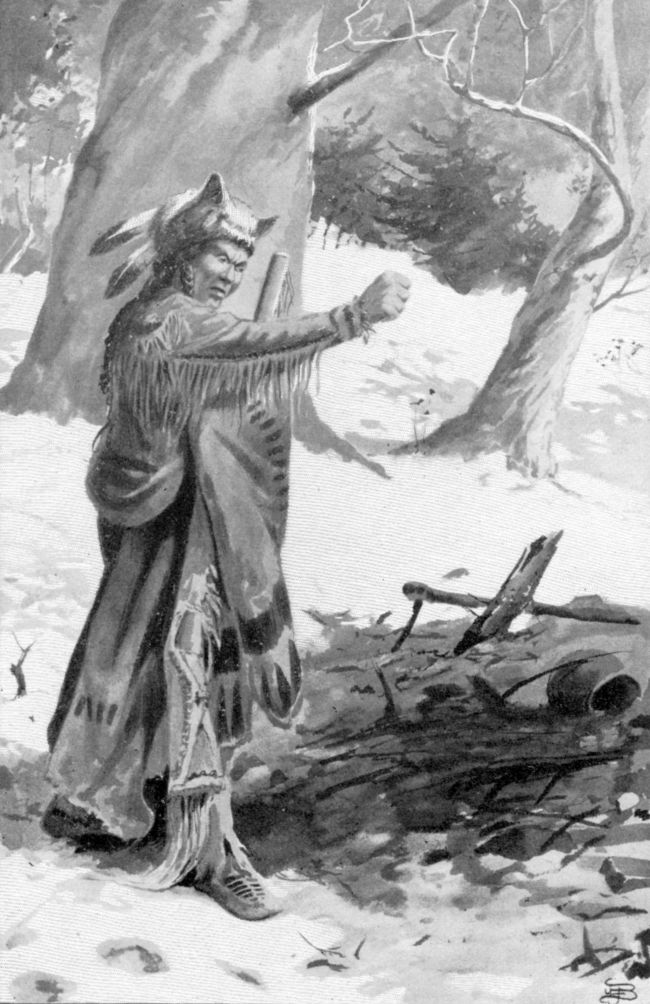
“I wish Woodranger was here,” thought our hero as he stood a silent spectator of the dramatic scene. “I dare not break in upon him.”
[279]
These thoughts had barely shaped themselves in his mind, when the Indian, with a wider and fiercer sweep of his arm, suddenly turned away, and pulling his blanket closer about his tall form, disappeared in the forest, and never again was he seen in the vicinity of Namaske.
Norman resumed his homeward journey with a heavy heart.
“I am sorry for him. I wish it had not happened. If Woodranger had only been here he might have pacified him.”
Upon reaching his home, he found his grandfather still labouring under great excitement over the conversation he had had with the Woodranger.
“He’s a strange man, laddie. I dinna read him.”
“What did he say, grandfather?” asked Norman, who was both surprised and interested to know what the forester had said to so excite his grandfather.
“Say, lad? He said much. Why, he said to my teeth—an’ me a MacDonald!—he said twa times, in as many words, that I was but a puir, misguided fule! Min’ ye, he said that, an’ I ne’er raised a finger. I was—I was dumb! No ane e’er lived to say that afore. Say, lad, d’ye think I’m gaun awa’ wi’ my min’? He said that I was auld afore my time; that my stalwart frame was in its prime. Weel, it may be he was not sae far frae the truth, aifter a’. Is my form so bent, lad?” and the old [280]Highlander drew himself up, until he stood as straight as a post, six feet and three inches of stalwart manhood.
“You were never more erect, grandfather, and you really are not so very old.”
“Sixty-eight, laddie. Cum tae think o’t, I’m nae sae dreadfu’ auld. The MacDonalds hae always been lang-lived. But that strange man compared us as faither an’ son. Can he be sae young?”
“Woodranger once said he was forty-four. People have got into a peculiar habit of calling him old, when—”
“Just the age o’ ma Alick, the bonniest laddie in a’ Scotland!” exclaimed Mr. MacDonald, his excitement returning. “Gang an’ find that Woodranger, laddie, as soon as may be. I want to hear him ca’ me a fule again, and see if I will stand idle by.”
The Woodranger, however, very much to their disappointment, was not seen again in that vicinity for some time. Mr. MacDonald continued to speak of him almost every day, and declare that he would find him.
About that time Mr. Stark was troubled by the depredations of a deer in his corn shed, which he had built on to the end of his barn. The creature had come two or three times, and, having got a taste of the grain, was pretty sure to come again. With so many boy hunters in the family, of course he [281]had only to mention the fact to them, to be rid of the troublesome visitor. But he happened to do so in the presence of Zack Bitlock, who at once said:
“Let me look arter the creatur’, ’squire. I’m in want o’ some meat. ’Sides, th’ boys will fill th’ poor creatur’ full o’ lead, an’ as like as not let it git away.”
Anticipating that there might be fun in store for them by yielding to Goodman Bitlock, the boys did so with good grace. This would not hinder them from being on hand to witness the squatter’s work, and also to get the deer if it escaped the other, as they expected it would.
Goodman Bitlock’s gun was a poor affair, as we already know, and he was an indifferent marksman. But these facts did not enter into his plans. He first borrowed the long deer thong which had served little Archie Stark to such good purpose in hanging the bear. Subsequent events, by the way, would seem to indicate that that affair suggested to him his plan. He made a running noose in one end of the line and adjusted it to such a nicety that the unsuspecting deer would thrust its head through when it reached into the crib for its morning meal. The other end he carried back into the loft among the corn shucks, and his simple arrangements were complete.
Late in the evening Goodman Bitlock crawled up into the midst of the corn shucks to wait and [282]watch for his victim. Not to be caught unawares, he got a firm hold on the end of the line and then began his lonely vigil.
It is quite likely he fell asleep, for the deer did not appear on the scene to act its part until the day was breaking, when the boys, Billy, Johnny, and Archie, who were concealed in the cattle shed, saw a fine looking buck approach the place and thrust its head and antlers through the noose, and begin to eat ravenously of the succulent corn. But its movements had partly dislodged the line, and feeling it drawing upon its neck, the buck sprang backward with its first show of fright.
The violent movement of the buck brought a wild cry from the loft, giving it genuine alarm. The terrified deer tried to break away, and started toward the forest with mighty bounds. This quickly brought through the opening the doubled-up figure of Zack Bitlock.
Somehow the squatter had got tangled up in the line, and now he found it impossible to get clear. He gave utterance to half smothered cries, as he was rudely jerked along at the heels of the terrified deer.
“Help—save me!” he cried. “I’m a goner!”
The boys quickly left their place of concealment, to save the unfortunate man, whose situation was as perilous as it was ridiculous.
[283]
Billy and Johnny had their guns with them, but, owing to the peculiar situation of Goodman Bitlock, a shot would endanger his life. So, while they followed at the top of their speed, the buck fled much faster toward the woods. Whatever was done to save the victim must be done quickly.
“He’ll kill Zack!” cried Archie, who was finding it impossible to keep up with his brothers. It certainly looked as if poor Goodman Bitlock was on his last deer hunt.
But an unforeseen accident suddenly changed the situation. The frightened deer, finding its flight at last stopped by the top of a fallen pine, instead of going around it made a bound into the air, to leap the obstruction. It cleared even the topmost branches, but it had not counted on the burden it was dragging away. The consequence was, Goodman Bitlock was jerked up under the mass of branches, and there he stuck. The deer, on the other side, managed to get his feet to the ground, but beyond that he could not go.
By the time the boys reached the scene, Bitlock had recovered sufficient to begin a series of cries that was heart-rending:
“Save me! I’m hung dead! I’m a goner!”
“Have you got the deer, Goodman Bitlock?” asked Johnny, who, finding there was no cause for further alarm, enjoyed the situation. This was [284]especially the more gratifying, as the squatter had boasted loudly of his scheme for catching the creature. His reply was filled with despair:
“Got th’ Ol’ Harry! I wish I hadn’t. Shoot him, quick!”
“But that would fill him full of lead!” replied Johnny, with provoking coolness. “Say, Zack, that is a pretty certain way of—”
“Kill him, Johnny! He’s sawin’ me right in two! Oh—oh—oh! Cut th’ rope if ye can’t shoot him.”
The boys did not delay longer, but advanced into the thicket so as to get a shot at the struggling buck. Before they could get into position to fire, the buck suddenly bounded off into the woods with redoubled speed. Goodman Bitlock had managed to get a knife out of his pocket and cut the thong.
Though they had lost the deer, the boys felt they had got as much sport out of the affair as they had expected.
“Gol-dang me!” exclaimed the discomfited squatter, as he scrambled to his feet, looking exceedingly battered and bruised but not seriously hurt, “when I git over this, boys, I want ye to larrup me with a hickory sprout till ye git tired. Say, ef ye won’t say ennything erbout my foolishness I’ll make ye th’ handsomest pair o’ snow-shoes ye ever put on yer feet, I will, honest.”
[285]
So the matter was dropped by the boys, except among themselves; but the victim must have told some one himself, for the story leaked out, and for a long time Bitlock’s deer was a standing joke in Old Harrytown.
[286]
At this time, the all-absorbing topic of conversation in Tyng Township was the raising of the new meeting-house, which had been long deferred on account of the failure to build a mill to saw the necessary lumber. In this important event, however, the Scotch-Irish showed little interest. It is true they had no meeting-house, as the place of worship was invariably called at that period, but they were able to attend divine services in the town across the river, and thus did not miss the building as much as their rivals. The Tyng colonists had held occasional meetings at private houses, but it was not altogether convenient or satisfactory. Then, too, there was a provision in their grant calling for a house of worship, and until it was built they could not conscientiously reply to the attacks of the others, who were not above ridicule. So the raising of the meeting-house became the one theme of conversation.
All through the summer it had been planned to have the new house ready for dedication at Thanksgiving; [287]but the season had been so unfavourable for out-of-door work, taken with other delays and difficulties, that this had finally been given up. This became the more necessary, as Thanksgiving came early that year, the thirteenth of November having been appointed.
But raising day came at last, fair but cold. Early in the morning the men began to gather from far and near. Raisings in those times were important events, and men, and even women, often came long distances to be present and to lend such assistance as they could, either in helping raise the big timbers or in assisting to prepare the supper for the crowd of hungry workmen. If the raising of an ordinary house would draw such a crowd, how many more must come to the raising of a meeting-house. Men were at this raising under the Three Pines of Tyng Township from Chelmsford, twenty-five miles distant, from Old Dunstable, the home of the late Captain Tyng, from Nottingham, Naticook, Londonderry, Chester, and other towns. One singular thing was noticed and commented upon. Among the big crowd the most casual observer did not fail to notice the absence of the Scotch-Irish. It is true Mr. Archibald Stark was there, as he had said he should be, and also a few others, but not a “baker’s dozen,” as some one remarked.
But this did not trouble Mr. Anderson, the master [288]builder, as long as he saw in the eighty or more men collected enough strength to lift the stout frame lying there ready to be put into proper position.
Raisings meant something different in those days from what they do now, when a building is “put up” by piecemeal. A whole side was stoutly joined together on the ground, and then raised bodily by sheer strength. Poles, with iron spikes in the end, were used to facilitate the lifting, when the form had been raised as high as one could easily reach. Then, at the loud command of the boss, “Up, up, up!” went the heavy timbers, nothing like the cobwebs we put into buildings to-day, until the tenons would slip into the mortises with a sharp report, and the whole would stand as firm “as the rock-ribbed hills!”
Tyng meeting-house being a large building for those days, its timbers were uncommonly big, and being poorly seasoned, were extremely heavy; but “many hands make light work,” and one side after another went up, amid loud cheering and not a little drinking.
Three sides had thus been brought into position, and the men seized with a hearty will on the skeleton of the remaining wall.
“Now, boys! all together,” cried Mr. Anderson; “heave-o!”
Two men, who were not able to lift as well as some of the rest, had each been stationed at the foot [289]of the corner posts, so as to keep them from slipping, and so far there had been no accident. But this time, either one of the men had not planted himself with the necessary firmness, or else the men had been more careless than common in lifting the ponderous form, for one of the posts began to slip on the frozen ground.
“Hold firm, there, Robbins!” yelled Mr. Anderson. “Up with her, boys! Heave-o! heave-o!”
Slowly rose the mighty frame, notwithstanding that it was still slipping in spite of the frantic efforts of the man at the base. It had risen so far that in another moment it would be secure on its own footing, when the man called Robbins lost his presence of mind. Instead of bracing himself more firmly and holding on, he loosened his clutch and retreated.
The action imperilled the life of every man under the timbers. Should the lifters drop the frame, a few might escape as it fell, but many would certainly be crushed under the falling broadside. Each man, knowing this, held upon the massive frame with all the strength he could muster, so that for a moment the whole form was held balanced almost free from the ground. It was a terrible moment. Even the noisy Mr. Anderson was silent.
Sometimes one young in experience will do what an older person would fail to accomplish successfully. [290]It is certain no man there could have reached the foot of that sliding post as quickly as did Norman McNiel. His position had been favourable for the action, but what was of more vital importance, while others held their breath with terror, he had presence of mind equal to the emergency. That post had got to be held firm, or all would be lost!
Near the foot of the timber was a stout hornbeam lever, which some one had thrown down a moment before. Seizing this, and throwing enough of his weight upon the lifting timber to keep it down, he planted one end of the stout stick against the stonework, and brought the lever over the foot of the post, so as to hold it where it was. Assured that he could keep it from slipping further, he shouted to the overtaxed workmen:
“Now, all together, up with it! I can hold the foot.”
His words gave hope to the nearly exhausted men, who, with an almost superhuman effort, tugged anew at the heavy woodwork, which began to rise again.
“Heave-o, boys! Up she goes!” cried Mr. Anderson, exultantly.
The next moment tenon and mortise met, a loud report followed, and the huge broadside stood erect and firm.
While Mr. Anderson and a few others flew to drive [291]in the pins to make sure of their work, most of the men sank upon the ground to rest. There was general rejoicing, and one more enthusiastic than the rest proposed three cheers for Tyngtown’s new meeting-house.
“And three more for Norman McNiel,” said Mr. Anderson, “who made it possible. If it hadn’t been for him, there would have been no cheering, I can tell you.”
Every one felt the truth of this, and one after another grasped Norman’s hand, with generous thanksgiving on their lips.
Thus Tyng Township meeting-house was raised, and the colonists went to their respective homes with lighter hearts than they had known since accepting the responsibilities of their grant. Norman went home with Mr. Stark, who praised him heartily for his brave conduct.
“Mark my words, lad, you have made more friends to-day than you had before. When a man’s life is in actual danger, he is apt to appreciate the effort made in his behalf. I minded that Gunwad was not there. He has lost ground. That burning of Christo’s cabin has set every one against him. It was a miserable act, wholly uncalled for. Well, I am glad their meeting-house is at last on its feet. They cannot get it finished before another summer.”
If the Tyng colonists could not have their meeting-house [292]to hold services in on Thanksgiving day, they could at least observe the occasion with their accustomed ardour, and a shooting-match, intended to eclipse anything of the kind, was arranged to take place at that time. It was expected that marksmen would come from far and near to participate in the trial at arms. After persistent coaxing, the Woodranger had been finally obtained to act as manager of the ceremonies, but on the thirteenth a snow-storm set in. Every one was glad to hover over the wide-mouthed fireplace for such warmth and comfort as it afforded. It was the gloomiest Thanksgiving ever known in Tyng Township, and its storm, to some, foreboded the end.
The Woodranger was stopping at Captain Goffe’s, but as soon as he had seen that the shooting-match would not take place, he showed his uneasiness at the enforced idleness.
“What! never at rest?” asked Mr. Goffe, senior. “Don’t you ever get tired, old man?”
“I should dissemble the great truth o’ natur’ if I said I did not, sir. Ask the old man if he is never tired who sits in the chimney-corner and sucks his thumbs, cap’n. I may have my weakness, but man on the move is seldom tired. He gets oneasy, it is true, but motion is life, inactivity death. Man might as well be a stump, fit only to be put up in the clearing to stop deer from trespassing, as to sit [293]idly down. I think I’ll perambulate over toward ol’ Pawtuckaway, and mebbe I shall hark a deer or a moose.”
The snow fell so rapidly that before midnight a foot and a half lay on the ground. Winter, it might be said, had fairly set in.
[294]
The big snow-storm, which ushered in Thanksgiving day, lasted until the fifteenth, when the weather cleared away biting cold. Then, on the twenty-second, the cold abated, and a thaw set in, with peculiar characteristics which have marked it in history as a season not to be forgotten. It began to rain November twenty-fourth, and for twenty days successively it kept unceasingly at it, but every evening the stars would appear as bright as ever, and continue to shine until past midnight. At daybreak the rain would again commence to fall as furiously as ever.
With the ground frozen and a big body of snow, this warm rain brought such a freshet as the oldest settler had never seen. The ice in the Merrimack broke up and the swollen stream carried huge cakes on its turgid current, to the danger of lives and property.[3]
[3] The snow melted and a freshet occurred in the Merrimack River, nothing like it having been experienced there for seventy years. At Haverhill, the stream rose fifteen feet, and many houses were floated off.—Perley’s Historic Storms of New England.
[295]
At Cohas general alarm reigned, but at Namaske only one dwelling was threatened, and that was the home of Robert MacDonald, which unfortunately stood so low and near the bank of the stream that the water came almost to the door. Still the occupants, finding at last that it was rising no higher, hoped and believed that it would subside before doing them harm.
Archibald Stark called one afternoon to see if there had been any change since the previous day and very confidently told them he believed the worst over.
Accordingly, the inmates retired that evening without dreaming of further danger. But Norman had not fallen asleep, when a terrific roar and rumbling, such as he had never heard in his life before, awoke the night.
Springing off his couch, he had barely begun to dress himself before another crash was heard, and then a sound like the thunder of Namaske, increased tenfold in volume.
A loud rap at the door quickly followed, and a stentorian voice called out:
“Quick! your lives are in peril!”
It was the Woodranger, and he showed his impatience by renewed thumping against the log wall of the cabin.
The next moment Norman was down on the [296]lower floor, and found Mr. MacDonald already dressed, while Rilma appeared the following minute.
Norman had already opened the door, and the Woodranger came in as Rilma appeared.
“The river has broken over its bank!” exclaimed the forester. “The ice dammed the stream and—hark!—we must get out o’ this amazement if we value our lives. Lassie, let me carry you. Lad, follow with your grandfather. Let there be no delay.”
While speaking he caught the trembling Rilma in his strong arms, and strode out of the door. Clasping his precious burden close to his breast, the Woodranger swiftly passed the little valley lying between the doomed dwelling and the higher land.
Norman would have kept beside him, but his grandfather, in his excitement, stumbled and nearly fell, just as the rushing water seemed upon them!
“Hurry, grandfather!” cried Norman, helping him to his feet. “The river is making a channel around our home!”
“The horn!” exclaimed the dazed Highlander. “I maun hae the auld—”
Without stopping to hear more, Norman bounded into the house, seized the horn, and an instant later was back beside his aged companion.
But that moment lost was fatal to his hopes. So [297]swiftly had the river risen and swept down on its new course, that the wall of water was in plain sight as Norman regained the side of his grandfather.
Seizing him by the hand, and half dragging him along, he sped in the direction the Woodranger had taken.
But Mr. MacDonald seemed bewildered, and he did not move with the necessary haste. Midway across the narrow valley Norman saw that it was hopeless to think of escaping, though he pulled harder than ever upon his aged companion in the endeavour to get him beyond the reach of the rushing stream. Alone he might have escaped.
The Woodranger, who had borne Rilma to a place of safety, gently put her down and sprang back to lend his assistance to the others. Seeing their peril, he would have rushed in to save them at the risk of his own life, but he was too late.
Sweeping everything in its pathway, the watery column reached the hapless pair. Fortunately for Mr. MacDonald, the current struck him in such a way that he was tossed toward the high ground, and dropped almost at the feet of the Woodranger, who quickly caught hold of him and dragged him away from the surging flood. Then he turned to look for Norman.
At that moment Mr. Stark, his boys, and half [298]a dozen others appeared on the scene, having come to warn his friends of the peril threatening their home.
Norman was caught by the swirling waters and borne away at a fearful speed. He tried to save himself, but a cake of ice struck him on the head, and that was the last he knew until he lay in the arms of the Woodranger and the words of Mr. Stark came into his ears:
“Mark how he loves the boy.”
Opening his eyes, our hero looked around in a bewildered way, a wild, strange roar of rushing water ringing in his ears. He saw about him a little knot of anxious watchers, the nearest of them the forester, upon his knees, bending over him.
“Father, I thank thee, thou hast seen it well to spare him. Lad, speak, and tell me that my ol’ eyes do not deceive me. Thy life has been spared.”
“I think I must be living, Woodranger,” replied Norman, “but it does seem queer. Perhaps my mind is not clear yet. Where are Rilma and grandfather?”
“Safe, lad. At least the lassie is safe and well cared for. Your grandfather did get a serious amazement. It may have been a chunk o’ ice struck him, but he has been taken with the lassie to the home o’ Mr. Stark.”
“Where the boy must be taken without further [299]delay,” said that kind-hearted man. “Let me help you lift him on my sled, Woodranger.”
Mr. Stark was the owner of a big hand-sled, which had been covered with warm fur robes. Norman was placed upon the sled, and willing hands drew him to the hospitable home, where the party was met by Mrs. Stark.
He was then put on a comfortable bed, a warming-pan placed at his feet, some herbs put as hot as he could bear to his head, and that was the last he knew until morning.
Norman awoke feeling very much improved, and under the motherly care of Mrs. Stark he soon declared that he wanted to sit up. But that she would not allow.
“I promised Woodranger he should be called as soon as you awoke. He seems as uneasy as a fish out of water. Here he comes now.”
[300]
As kind Mrs. Stark spoke, the Woodranger entered the apartment in his swift, noiseless way, to pause just inside the skin door.
“Forgive me—”
“Come right this way, Woodranger,” said Norman, holding out a hand. “I want to see you, and talk with you.”
“So you shall, lad, so you shall. These ol’ eyes ne’er looked on a more gladsome sight than to see you alive at this hour, and so well. But ere I get my ol’ tongue to babbling like a runaway brook, there is the leetle lassie, who is pining to come to you. Come, lassie!”
Then, to Norman’s joy, Rilma came swiftly to his side, and they were locked in each other’s arms.
“I cried for you, brother, as I saw that awful flood rush over you. I never expected to see you again alive. And I never should if brave Woodranger had not plunged into the roaring water and [301]saved you. Norman, we all owe our lives to him. He is the bravest, noblest man in the world.”
“Amen, dear sister; he is all of that. Come here, dear Woodranger, and let me thank you.”
“Nay, lad, I cannot dissemble; it would be a blameful indiscretion. While you chat with the lassie I will go out and ketch a whiff o’ fresh air. That fire do burn up amazing stout,” and before any of them could interpose he had left the house.
“The strangest man I ever saw, as well as the best,” said Mrs. Stark. “And he seems queerer than ever to-day. Why, as early as it is, he has been to Goffe’s and back this morning. I can’t imagine what he is doing. Acts as if he was looking for some one. But, excuse me, and I will take myself out of the way, so you can talk.”
“No—no, mother Stark; we don’t want you to go. But you have not told me of grandfather, Rilma.”
“He is better than you, I think, Norman, though he is more nervous and excited than ever. Woodranger wouldn’t let me stay a great while with him. He wants no one but Woodranger, not even Mr. Stark.”
“I must go in and see him by and by. But the old home. Was the house carried off by the river?”
“Archie tells me it was not injured,” replied Mrs. Stark, “though the water completely surrounded it, [302]and had it risen another foot must have undermined it. The river is falling away fast, and we do not think there is any further danger. Here comes Woodranger back.”
“Come in, Woodranger,” called out Norman. “Don’t run off like that again.”
“Mebbe I won’t, lad, mebbe I won’t again. We have much to be thankful for, lad. I think the river is dropping away. I thought perhaps I could cross this afternoon.”
“You are not going away, Woodranger? We shall not let you.”
“Here is the horn, lad,” said the Woodranger, abruptly, handing Norman the MacDonald bugle which had come so near costing him his life. “I found it tight gripped in your hand. For a wonder, your grandfather has not inquired after it.”
Norman took the bugle with an expression of thanks, saying he would give it to his grandfather as soon as he could. Then, seeing that the Woodranger appeared about to be leaving again, he said:
“Aren’t you going to stay with me, Woodranger? You cannot be going away?”
“Not fur, lad. I cannot dissemble, but I s’pose I oughter go down to Goffe’s. Mebbe when you get a leetle stronger, I shall have something to say to you.”
“Say it now, Woodranger. I shall—”
[303]
“I durst not, lad, I durst not. Wait a leetle,” and with these words he went out of the house, and a few minutes later disappeared down the road.
“I never saw him so uneasy,” said Mrs. Stark.
Though Norman had not received any injuries which were likely to be permanent, he soon found that it would be several days before he should be able to leave the house. But the week that followed was not unpleasant to him. Rilma was with him, the Stark boys came into his room at their will, and twice Rob Rogers visited him. Of course he saw considerable of the Woodranger, but not as much as he wished.
The day before Christmas, in the afternoon, he was allowed to see his grandfather, whom he had not seen since that night’s adventure. The Woodranger and Rilma were with them. He was surprised to find him looking so wan and feeble. But the old Highlander grasped his hand with something of his usual vigour.
“It does ma auld een guid tae gaze on thee again. Ye’ll soon be hame again.”
“And we shall be so glad, grandfather.”
“Nay, lad, I shall ne’er return tae the auld hame. I hae had a presentiment that my day be almos’ ower.”
“What’s that, MacDonald?” asked the Woodranger. “Are you getting childish again? I never [304]knew a MacDonald to die o’ sich a leetle clip as that which you say is going to kill you. You are no true—”
“Zounds, sirrah!” cried the other, suddenly starting up. “I’m no’ deed yet! Get me my cane, Norman, an’ let me whack him at my will. Ye’ may ca’ me a fule, but ye ne’er shall say I’m ne’er a true MacDonald. My faither, sirrah, was the Chiel o’ Glencoe!”
“So much the worse for you, MacDonald. But I’m not here to stir an amazement. It should be a day o’ peace. Quiet your heart, MacDonald. I have enough to still my own. I’m sore perplexed to say what lies next my heart. The trail o’ the red man is easy to follow, and the tracks o’ the bear are picked up like beech-nuts arter a frost. But the whims o’ the heart are spun finer than spider threads. I cannot see these to pick ’em up!”
Never had the others seen the Woodranger so excited, and they were almost startled at his appearance.
“What is it, Woodranger?” asked Norman. “Has the old house gone, after all? We can soon build another, and better one.”
“It is o’ Alick, my bonnie boy, he wishes to speak. Ye’re tae tell me mair o’ Alick,” declared Mr. MacDonald.
[305]
“Nay, nay! I cannot dissemble longer. Lad, your father is coming home!”
No five words that he could have spoken would have caused greater surprise. In fact, the little group gazed on him in speechless wonder. Norman was the first to break the silence:
“What do you mean, Woodranger?”
“Just what I said, lad. Your father is living—is even now on his way here. He should have been here a week ago. I am sure he is now at Goffe’s.” Norman was unable to make any reply, while such thoughts as he had never known filled his mind. His first and most natural one was the inquiry made of himself: “Is Woodranger mad? He has acted strangely for a week, is it improbable that he has at last lost his reason?” Then he continued, in a different train: “Can it be possible father is alive and coming to me?” Trembling from head to foot, he caught the forester by the arm, saying:
“As you love me, Woodranger, tell me truly what you mean. Is father living, after all? Is he coming here?”
“I ne’er dissemble, lad. I—”
“Forgive me, Woodranger; I did not mean to doubt you. I don’t know what I did mean. But you can explain. Please do.”
“It is I who should crave forgiveness, lad, for the deception I have acted. But it was my foolish way [306]to get round the truth. I have known that Archie McNiel lived, and I have known the truth o’ his life these years, but I did not know you were living here until last summer. Then I sent at once to Archie to come with all speed possible, but, to make your surprise complete, I said nothing to you. I hope you will all forgive me. I haven’t prevaricated the great truth, because no one has questioned me. I—”
“Hold, man!” cried Mr. MacDonald, breaking into his speech, “d’ye dare tell me that graceless McNiel—the murderer—”
“Stop, MacDonald!” said the Woodranger, “this is no time for your silliness. Archie McNiel comes with a name as pure as thine. Ah, far more so, for the MacDonalds, with all their boasts o’ warlike deeds, can show leetle else. You have told me in your confidential moments, which I am free to confess is taking a man in his weakness, that you would receive your Alick if he came under the shadow of the gallows. He would have to come in that way if he came. Archie McNiel comes with a heart as pure and spotless as this wee lassie. Here is the proof o’ what I say, which I have carried long to give you.”
As the Woodranger ceased speaking, he drew from under his hunting-frock a parcel, carefully wrapped in deer skin. As he handed this to Mr. MacDonald, he said:
[307]
“I’m going once more to meet him. He’ll come to-night, I’m sure. Meanwhile, watch and wait. I admonish thee, MacDonald, to receive him with open arms. It is the last written request o’ thy son.”
“Some one will go with you, Woodranger,” said Norman. “I am sure Mr. Stark will be willing to do so.”
“Nay, lad, I must go alone. He will not be overlong in coming. If I fail to come back with him, yet I will see you all sometime.”
He had reached the door. Then, as if prompted by a sudden impulse, he retraced his steps, and swiftly kissed the three, Mr. MacDonald first, then Norman, and last Rilma, whom he held closely in his arms for a long minute. Putting her down then, he noiselessly left the room before one of the three could call him back.
[308]
It would indeed be difficult to describe the conflicting emotions felt by the little group, as the Woodranger went out of the house. Each felt that the strange man had departed with no intention of returning—at least for a considerable time. Mr. MacDonald was the only one to speak, and he ordered, in his own peculiar way, that some one be sent after him. In the excitement the paper was forgotten. It was not long before Mr. Stark and his good wife entered the apartment, and they were equally surprised over what had been said and done.
In the midst of their questions, steps were heard without the dwelling. Then, as Mr. Stark opened the door, a stranger advanced to enter.
“I am Archie McNiel,” he said, “and I have been told that I—I should find my long-lost son Norman here.”
“Come in,” said Mr. Stark, simply, stepping aside as the other obeyed.
[309]
Norman could remain silent no longer, and springing forward, he cried, as the newcomer caught him in his outspread arms:
“Father!”
“My son—found at last!”
During this affecting meeting the others in the room turned aside to conceal their emotion, Mr. MacDonald alone watching the reunited twain closely, while he showed that he was making a great effort to remain calm.
“I cannot realise this is indeed you, father,” said Norman, finally.
“Nor I, that at last I hold you in my arms, my son. I had long since given you up as dead. About two months ago I got word from one who signed himself as ‘The Woodranger,’ to come at once—that you and father were living here. I came with all possible haste. Father,” turning to the old Highlander, “have you no welcome for me?”
“I dinna ken. Ye’re—” and then he stopped.
“Woodranger has told you all?”
“He has telt me naething. Whaur is the man?”
“He would not come back with me. I could not persuade him, as much as I wanted to. His countenance seemed very familiar to me.”
“I dinna read him.”
“He gave you a paper which explains all? I know my name has been under a cloud, but I have [310]been innocent of all imputed to me. Read the paper, sir, if you would know the truth.”
With trembling hand, Mr. MacDonald unrolled the manuscript, worn and soiled, and began to read. He had not progressed far, before he found that it was a confession showing that Alick MacDonald, and not Archie McNiel, was the guilty party, and that he had so skilfully covered his course as to escape detection. When he had read so far, he stopped, and, crumpling the paper in his hand, exclaimed:
“I will not believe it!” and threw the paper into the fire. The flames caught quickly upon it, and filling the wide-mouthed fireplace with its fiery waves for a moment, the blaze died down, showing only a charred cobweb of its remains.
“It is better so,” said Archie McNiel. “There is nothing between us now, Robert MacDonald. If I have caused you a pang, I ask to be forgiven. Let the past be forgotten, and let us, on this Christmas eve, clasp hands across the void of years.”
“Amen,” said Archie Stark. “Peace on earth, good-will toward men.”
“If that strange man had only stayed,” declared Mr. MacDonald, as he allowed the arms of his son-in-law to encircle his neck. The reunion was now complete.
Mr. Stark’s invitation was so urgent for them to remain with him the next day that the reunited [311]family consented. The first settlers in America gave little, if any, observation to Christmas, as a rule. The English colonists ignored it altogether, believing it infested with too much popery; but that was a day which those gathered at Mr. Stark’s never forgot. In many respects it was the happiest they ever knew.
The following day, Norman, his father, grandfather, and Rilma returned to their home, which soon bore more than its old-time cheerfulness. In fact, the tide had turned in the affairs of Tyng Township, and they were benefited by it.
It may have been due to his loss of favour from the burning of Christo’s cabin, or from other reasons, but Gunwad did not offer to trouble them any more. In fact, there was not much time for him to do so, as the following May the boundary dispute, which had kept the two provinces embroiled so long, was happily settled. Perhaps not happily to all, for many were the losers, but it was settled for all time. By that settlement, the brave men of the “Snow-shoe Expedition” under Captain Tyng lost their claim to Tyng Township. The grant was now within New Hampshire’s jurisdiction. It is true they were given another township in the province of Maine, but it was so far away that some of the men preferred to buy off the Presbyterians and remain. Some went back to their former homes, and a few [312]emigrated to the new grant, where they found less to contend with.
The meeting-house which had cost them so much money and anxiety was soon after burned; and then the name of the town was changed, and the last link connecting those trying years with the new existence was broken. War with the Indians broke out afresh, during which no men in New England did nobler or more effective work than those who went from what was once derisively called Old Harrytown, and comprised the Debatable Ground.
It is scarcely necessary to detail the incidents of Archie McNiel’s life after the unfortunate affair which separated himself from his loved ones, and kept him in ignorance of their fates so long. In the light of their new-found happiness the old wounds healed. He became one of the most respected citizens of his adopted land. Norman became not only that, but one of the most noted and helpful. History has depicted, in varied language, the after-life of all our other characters, but the historian aims at glittering generalities rather than the many little personalities which are the sum and substance of all lives. I hope to tell very many of these before I am done with the Woodranger Tales.
THE END.
Transcriber’s Notes:
Obvious punctuation and spelling inaccuracies were silently corrected.
Archaic, variable, and dialectal spelling has been preserved.
Variations in hyphenation and compound words have been preserved.