
Title: The giant world
Author: Ray Cummings
Illustrator: Hugh Rankin
C. C. Senf
Release date: December 20, 2025 [eBook #77512]
Language: English
Original publication: Indianapolis, IN: Popular Fiction Publishing Company, 1928
Other information and formats: www.gutenberg.org/ebooks/77512
Credits: Greg Weeks, Mary Meehan & the online Distributed Proofreaders Canada team at https://www.pgdpcanada.net
By RAY CUMMINGS
NOTE—This: serial, while complete in itself, is a
sequel to Explorers Into Infinity, which
narrated the previous adventures of Brett and Martt
on the distant world. The story appeared in
Weird Tales for last April, May and June.
[Transcriber's Note: This etext was produced from
Weird Tales January, February, March 1928.]
| 1 | THE SUMMONS |
| 2 | STOLEN INTO SMALLNESS |
| 3 | THE THING IN THE FOG |
| 4 | THE WILD NIGHT RIDE |
| 5 | CLIMBING INTO LARGENESS UNFATHOMABLE |
| 6 | THE BLOOD-RED DAY |
| 7 | THE FIGHT ON THE PARAPET |
| 8 | YOUTH! |
I was startled. Yet I think that I subconsciously I was prepared for it; expecting it. The little cylinder flipped out of its tube and dropped on my desk before me. My name was on it, glowing with tiny luminous letters: Frank Elgon, Interplanetary Mails, Division 4, Great-New York. It looked just like any other Departmental message cylinder. But instinctively I knew it was not; and my heart was beating fast as I clicked it open.
Relayed through Code Headquarters. I saw that on the small rolled tape inside. And saw the signature, Dr. Gryce. It should not have been startling, but my fingers were trembling as I unrolled the tape and hooked it into the automatic decoder. And I stood gripping my chair as the line of English letters pricked themselves on the blank white sheet at which I was staring:
"Frank—I can not bear it any longer. We must go—we must find Brett at any cost. Will you stand by us? Come at once. Hurry.
Dr. Gryce."
My mind leaped back. I sat at my desk staring blankly, while in the office around me all the bustling activity of the accursed Interplanetary Mails faded before the surging visions of my memory. It was four years since that other momentous day when Dr. Gryce had sent for me. And I had gone to him; and listened amazed at his weird, fantastic theories. Our sun, planets, and stars—all the vastness of the star-filled heavens, he had told me then—were but the infinite smallness of a greater world. All this that we call our Celestial Universe was no more than an atom—of the giant world encompassing it.
Fantasy! Yet it had proved sober, tragic fact. Tragic, because Dr. Gryce's older son, Brett, had gone out there to that giant world. Gone, and never returned. Nor been heard from; four years now, while old Dr. Gryce at the end of his life waited despairingly.
I had known always that the time would come when Dr. Gryce would wait no longer. He would send for me—friend of Brett—and friend of his other two children, Martt and Francine. For a year every cylinder that had dropped on my desk had made my heart leap that it might contain this summons which now lay before me.
"I can not bear it any longer. Will you stand by us?" So simple an appeal! But I knew the turgid torrent of heartache—the final desperation of an old man's suffering—which prompted it.
Young Grante at the desk next to mine was sorting his pile of official communications newly arrived by the Venus mail. I turned to him.
"I'm going away," I told him. In spite of myself—an unfortunate mannerism when I am perturbed—my voice sounded gruff, ill-tempered. "There is no time to argue—will you please notify Official 4 that my—my post is vacant."
He raised his eyebrows. "Vacant?"
"Yes. I'm going away." I was on my feet. Outwardly calm, but within me was a seething emotion. Going away! Out there into the immensity of the Unknown, where my friend Brett had gone, not to return. Young Grante could not guess. He was thinking Great-London perhaps—or the Asiatic province. Or perchance, Venus, or Mars.
I laughed harshly. "Don't question me, Grante. Just tell them—my post is vacant."
I left the room with his amazed stare following me. In the corridor, through a window I caught a glimpse of the tenth pedestrian level; its crowd of people moving upon the diverse activities of their tiny lives. Already I felt apart from them. Frank Elgon, Division 4. Presently, to such of them as knew me, I would be no more than a memory. "That young, rather quarrelsome Elgon, who walked out of his office in a temper, and vanished." They would say that, and then forget me.
I laughed again. But the thought brought a pang of regret, and a shudder.
In ten minutes I was within a pneumatic cylinder, speeding underground to the Southern Pennsylvania area, to the home of Dr. Gryce.
II
Martt and Frannie met me at the outer gateway. Their manner held a singular gravity. I had expected them to be excited, of course. But their grave, somber smiles of greeting, their instinctively hushed voices, seemed unnatural. This was no reckless, devil-may-care spirit of high adventure which I had anticipated the twins of Dr. Gryce would display. Sober drama. Their involuntary glances at the white house nestling against the hillside carried a foreboding.
Drama, but it seemed almost to be tragedy. My heart sank. There was something very wrong here with the Gryces; something more imminent than the fact of Brett's absence over four years.
But I said nothing. Dear little Frannie gave me her two hands. They were cold.
Martt said, "Thank you for coming, Frank. Father is—waiting for you." His voice, usually flaunting, mocking at everything with the reckless spirit of youth, chilled me with its queerly broken tone.
We crossed the flowering gardens to the white house standing so peaceful in the afternoon sunlight. Martt led the way. The twins were twenty-one years old now. Alike physically, and in temperament. Both smaller than average height; slim and delicate of mold; blue-eyed, and fair of hair. They were always laughing; carefree—the spirit of irresponsible youth. But not today. I regarded Martt, trudging ahead of me—debonair, jaunty of figure in his tight black silk trousers and loose white shirt, bare-headed, his crisp, curly hair tousled by the wind. But there was a slump to his shoulders, a heaviness to his tread. And little Frannie behind him: girlishly beautiful, with her tossing golden curls, her familiar house costume of gray blouse and widely flaring knee-length trousers. But there was upon her a preternatural solemnity; a maturity of aspect indefinable.
At the doorway Martt turned and fixed me with his somber, blue-eyed gaze. And spoke with the same queer hush to his voice.
"Father is upstairs, Frank. He is—dying. He wants very much to live until you arrive."
Upon the pillows in the darkened room lay Dr. Gryce's head with its shaggy, snow-white hair, the mound of the sheet betraying his pitifully wasted body.
Martt said softly, very gently, "Frank is here, Father. You see he came in time—plenty of time."
But the head, with face to the wall, did not move; no stirring marked the fragile body lying there.
Martt gave a cry; with Frannie he rushed to the bedside. It was all too evident. In a moment Martt stood up, leaned silently against the bedpost, a hand before his eyes as though dazed. And Frannie knelt at the bed and sobbed.
We expect death all our lives, yet the instinct of life within us never ceases to feel a shock, and a revulsion. For a long time these children of Dr. Gryce did not move or speak. Then Frannie leaped to her feet. Her face was tear-stained; but her sobs were suddenly checked, and her eyes were blazing.
"Martt! His last wish—the very last thing he said—was that we go out ourselves and find Brett. He said it—he said Brett might need us—his dying wish. And I'm going, and so are you. We've got to, Martt! And we want Frank with us. Oh, Frank, you'll go with us, won't you? Out there—to join Brett?"
III
The burial was passed. We had not spoken of our enterprise, but it had never left my thoughts. This boy and girl so newly come to maturity—but I was twenty-nine. Upon me would fall the main responsibility.
We sat at last in Dr. Gryce's study—the three of us alone—to discuss our task. With the first poignancy of their shock and sorrow already dulled by time, upon the faces of Martt and Frannie was stamped grimly their simple purpose.
"But, Martt," I said, "Brett's vehicle was very intricate. It traveled in Space—but in Time as well. And grew gigantic in size. Your father's genius built it. But we have no such genius to build another——"
"You forget," he interrupted. "Think back, Frank. That day you came here. And we showed you the models of the vehicle. There were four of them——"
Then I remembered. Dr. Gryce had shown me four small models. One he had sent back into Time. A flash, like a dissipating puff of vapor it was gone into the Past; still here in Space above the taboret on which it was standing, but vanished with centuries of Time to hide it from my sight.
Another of the models, with Time unchanged, Dr. Gryce had sent into Infinite Smallness. I remembered watching it dwindling; a speck, a pinhead, then invisible even to the microscope.
Two of the models were left. Martt and Frannie, but seventeen years old then, had taken one into the garden. Had started it growing in size. I recalled our frantic efforts to check its growth, lest it demolish the house. This was the one in which Martt and Brett had gone to the giant world and in which Brett had returned alone to that distant part of our universe.
One model had remained. I had never thought of it since. Martt was saying, ". . . and we still have that last model. Father kept it very carefully." Martt's smile was wistful with the memory. "I think he—Father—had a premonition that he would not live to carry out his purpose. . . . The model is here."
He opened a locked steel box. Again I gazed silently at that small cube of milk-white metal—a cube the length of my forearm, with its tiny tower on top, its glasslike balcony, its windows and its doors.
"It's all complete," said Martt. "And I know how to operate it."
Frannie said with a touch of breathlessness, "For a month past, Father has been gathering the necessary instruments. And the supplies—you see he—he really thought he was going to live——"
"We're all ready," Martt added. "We will increase this model to normal size. Load it with our supplies. We can start tomorrow, Frank."
IV
Five million light-years from Earth! Who of finite human mind can conceive such unfathomable distance! Yet, as I crouched on the floor of the vehicle gazing down at the radiance emerging from the black void which was our first sight of the Inner Surface, the distance had seemed no more than gigantic. We were, in size, many million times our Earthly stature. The tiny Earth, from our larger viewpoint, was a little orange spinning above us in the void—a mere one-twentieth light-year away.
Martt, for all his youth, had proved competent. He had made the trip once before with Brett; he handled the vehicle carefully, and with skill. He said now, as we three crouched by the floor window, "We'll soon be down to the atmosphere, Frank. I'm checking our fall—we want no errors——"
We were reversed in Time—holding very nearly at a single instant, so that on the Inner Surface the time now was the same as it had been when we left the Earth.
We argued the point; Martt said, "I think when we land—we should choose the point in Time about four years beyond Brett's landing. So that it will be four years to us—and also to him. Don't you?"
We decided upon that, so that we would reach the Inner Surface and find Brett had been there four years. It seemed to strike a greater normality. Find Brett! Would we find him? I wondered, as I knew Martt and Frannie were wondering. But in our plans we always took it for granted.
The radiance beneath us grew brighter. And at last we entered the upper strata of atmosphere, falling gently downward. It was a fair, beautiful land, as Brett and Martt had said. A sylvan landscape, with an air of quiet peace upon it. A broad vista of land and water; patches of human habitation—houses, villages; a city.
Martt was at the telescope. "Pretty good, Frank! I've hit it—I see the city—off there, isn't it? And the crescent lake."
He changed our direction slightly. As we dropped, the broad crescent lake lay beneath us. Trees bordered its banks; and to the right was the city of low-roofed, crescent-shaped buildings banked with flowers. And beyond the city a rolling country of gently undulating hills, with a jagged mountain range up near the horizon.
From this height it was a visibly concave surface. And it was gray and colorless, for we were passing abnormally through its Time. Then Martt threw off the Time-switch; we took the normal Time-rate of the realm. And in size we were also normal.
At a height of perhaps a thousand feet Martt held us poised above the city. "They'll see us now," he said. "If—if Brett is down there he'll recognize us. I'll land in the grove where we landed before. We'll give Brett time to get there to meet us."
With the Time-switch off, color and movement had sprung into the scene. The forests were a somber growth of dull, orange-colored vegetation. The water was a shimmering purple; and above us was a purple sky, with faint clouds, and dim stars up there—stars which seemed very small and very close.
The white houses gleamed and glowed in the starlight. Yet it seemed not night; nor day either. A queerly shimmering twilight. Shadowless, as though everything were vaguely phosphorescent.
In the broad city streets there was movement. Vehicles; people. And the people now were gathered in groups, staring up at us.
We landed in the little clearing at the edge of the lake near the city. And now at the last, Frannie gave voice to the fear which was within us all. "Oh Frank, do you think Brett will be here?"
There were human figures in the near-by thickets. I saw them through the windows, but we were too busy with the landing to look closely. The vehicle came to rest. Martt and I flung open the door. The vegetation was thick near by; we stepped from the vehicle onto a soft, mossy sward, and stood in a timid group, with tumultuously beating hearts.
"Martt! Frannie! Frank!" It was his voice! Brett was here! And we saw him step from a thicket. His familiar voice; his familiar figure, but so fantastically garbed that it brought to me a wild desire to laugh, for I was half hysterical with the relief of seeing him.
Frannie cried, "Brett! My brother! You're all right, Brett, aren't you? I'm glad you're all right."
Under stress, how inarticulate are we humans! I said awkwardly, "How are you, Brett? We thought we'd come and see you."
He took Frannie in his arms. And wrung Martt's hand, and mine, while his strange companions stood in the background among the trees, watching us.
"Of course I'm all right," he declared. "And terrifically happy." A shadow crossed his face; his glance went to the vehicle's doorway. "Father didn't come with you?"
Then Martt showed a wisdom far beyond his years. This was no time to bring sorrow to Brett. Martt said smoothly, "Father is better than he has ever been, Brett. We'll tell you—later."
"Good! That's fine!" Brett's face was radiant. "You're just in time, you three. I'm to be married tonight."
But even then as I wrung his hand again, and congratulated him, I had a premonition that it was not to be.
"Life is pleasant here," said Brett. "Pleasant, and indolent. It does not make for progress, but it is happiness—and I'm beginning to wonder if that is not best, after all."
We were sitting in an arcaded passage on the roof of the home where Brett lived. Crescent archways opened to the roof, where stood banks of vivid flowers, with a vista of the city beyond. The building seemed of baked earth, rough like adobe, and of dull orange color. It was a two-storied, crescent-shaped structure, set upon a wide street-corner near the edge of the city. The home of Leela's father. I had never forgotten Leela—the girl Brett and Martt had rescued from the giant on their first visit here. Brett had fallen in love with her. It was she whom tonight he was to marry. And this was her father's home—Greedo, the old musician.
"I have lived here with them six months," Brett said.
Martt exclaimed, "Six months! Why Brett, you have been gone four years!"
We had miscalculated the Time-change of the vehicle. Our purpose had been to strike this realm of the Inner Surface at a point in Time which to Brett would be four years. But now we found it six months only.
Brett smiled. "I'm glad you didn't postpone your arrival. You've no idea how pleased I am to have you—tonight of all nights."
We had not yet seen Leela, or her father. Brett said that Leela would be up presently to greet us. The city was excited over our coming. A crowd was gathered in the street before the house; Brett had made them a brief speech; Frannie, Martt and I had stood at the parapet and waved to them.
Then Brett had spoken of a younger sister of Leela's. Her name was Zelea—they called her Zee.
Martt sat up at this. "Where was she when we were here before?"
"Away," said Brett. "She was too young to meet a man then. Only now has she come to be sixteen. You'll like her, Martt. I want you to like her."
"I will," said Martt enthusiastically, "if she's anything like Leela."
"You were telling us about the life here," I suggested. "We always called this land the Inner Surface——"
"Yes," he agreed. "It is concave, like the inner shell of some great, hollow globe. Within the space it encloses——" He gestured to where, through the arcade, a segment of purple, star-filled sky was visible. "All that which we of Earth called the Celestial Universe is enclosed by this concave shell. You would think that this must be a gigantic region——" He smiled again. "It is not. Compared to our present enormous size, I imagine the circumference of this Inner Surface is not unduly great. I don't know. These people have not explored very far. They are not wanderers—they are too indolent, too contented, to wander."
He paused to drink from a shallow receptacle which stood before us, and offered Martt and me what appeared to be arrant cylinders to smoke.
"I have learned a little of the language. Proper names are impossible to translate. But the meaning of their word for this land, I call in English. Romantica. The romantic land. It is, I fancy, about five hundred miles square. Beyond it lie forests and mountains. No one here has ever penetrated them. There are wild beasts, birds, insect life—and fish and reptiles in the water. But they are not dangerous—not aggressive. It is not because of them that these people avoid exploration. It is—just indolence."
"I don't wonder," I said. "This is very peaceful here—I have no desire to do anything in particular." From the city streets a drone of activity floated up to us; but it was almost somnolent.
"It's always like this," said Brett. "Almost no change of seasons—the light always the same. There is no disease here—or very little. Food—grains, and what we would call vegetables, grow abundantly in this rich soil. The trees give milk—even the bark and pulp of them are edible. Life is easy. There is nothing to struggle against.
"Through generations, it has made the people kindly. There is little crime. No struggle for land, or food or clothing. Crimes involving sex——" He gestured. "Wherever humans exist there will be crimes of that origin. But our women here are very sensible, and when a woman does what is right—well, you know, don't you, that most deeds of violence into which men plunge over women have a woman's wrong actions at the bottom of them? There is little of that here, for the women take care that there shall not be.
"So they call their country Romantica. They are not a scientific people. They do not struggle for advancement. Art has taken the place of science. Painting. Sculpture. Music. They have developed music very far. It has a soul here. It speaks—it sings—it seems a living entity. It is—what music ought to be, but seldom is—the pure voice of love, of romance. . . . I was telling you about our country. Most of its population live in villages, and in individual dwellings strewn about the hills. There are but two large cities. This one—the largest—they call Crescent. Or at least their word for it suggests the shape of the lake. The other city is about fifty miles from here"—he gestured again—"off there where you see the line of mountains. They call it Reaf. It's a quaint city. Built largely over the water—rivers there—hot, subterranean rivers which rush underground—under the mountains. They go—who knows where? No one has ever been down them. The mountains are honeycombed with caves, tunnels, passages leading within, and up. Always up. But into them no one has ever penetrated. Legends tell fabulous tales of a great world up there. The giants, we think——"
When Brett and Martt had first come here, giants had appeared. Dwindling giants—strange, savage beings of half-human aspect. They had appeared—no one knew from where. Growing smaller until they were normal size to this realm. Not many had been seen. Some had kept on dwindling; they had grown so small, when attacked, that they had become invisible. At the thought, I moved my foot involuntarily with a shudder of uneasiness. Here on the floor beside me now, men like beasts might be lurking, so small I could not see them. Yet in a moment they might grow to a stature greater than my own. . . .
Men like beasts! . . . And I remembered that, with size gigantic, they had destroyed the third city of Romantica.
Upon Brett's face lay a cloud of apprehension. "We have never heard from them since. It is thought—I think myself—that they came from the subterranean rivers, or through the underground passages of the mountains. I conceive this concave surface upon which we're living to be the inner surface of a shell. It may not be very thick—there at Reaf. Above it—beyond it—up or down are mere comparative terms—beyond it must lie some vastly greater outside world. This whole realm is doubtless within an atom of that greater world. It would be a convex surface up there—with a sky and stars beyond. . . .
"We have never seen the giants since that time when Martt and I rescued Leela. Everyone here seems to have forgotten them——" Brett's voice was heavy with apprehension. "These people are so trustful! They forget so quickly! No one worries. Our rulers here—a venerable man and woman long past the age when death is expected—are so gentle, kindly, that they can not imagine harm coming to their people. They have forgotten the Hill City which the giants destroyed. Trampled upon it! Six or eight giants—they must have been several hundred feet tall—stamping, kicking the building! I've been there—I've seen the ruins—strewn for miles—and with buildings, colonnades and terraces mashed into the ground! There were no more than half a thousand people surviving that destruction of the Hill City—and thousands died. But everyone says now, 'The giants are gone. We are safe.'"
Brett's voice had risen to a swift vehemence. "It's been like living on a volcano to me, all these months. There are no weapons here. My own few flash-cylinders—of what use would a tiny flash of lightning be against beings so gigantic? We've got to do something. For if those giants come again——"
A step sounded in the oval doorway near at hand. Leela stood smilingly, deprecatingly before us.
II
Brett said, "Come here, Leela. This is my sister, and my friend, Frank Elgon. And here's Martt."
Leela advanced hesitantly, her face a wave of color as she met our gazes. She was smaller, and even slighter than Frannie, her figure adorned and revealed by its single, simple garment—more like a short, glistening veil than a dress. Her hair was long and dark, caught by a band at her neck, and flowing free beneath. Her arms and legs were bare. At her wrists, gray-blue bands with small tassels; on her feet, queerly high-heeled wooden sandals, with tasseled thongs crossing on her ankles. The sandals clacked as she walked; her step was mincing, with a suggestion of the Orientals of our Earth.
Brett eyed the sandals with a humorous twinkle. "For why are those, Leela?"
Her blush heightened. "In honor of our guests. I thought you would like them."
With a swift gesture, she stooped, untied the thongs and cast the sandals off. Her feet were very white, small and delicately formed, with rounded, polished nails stained pink. She stood untrammeled, lithe and graceful as a faun.
"I am glad to meet Brett's sister—and his friend. And you, Martt—I am glad to see you again." Her voice was soft as a Latin's. She shook hands with Martt and with me, and returned Frannie's affectionate embrace.
As I saw them together—these two girls of different worlds—I was struck with the dissimilarity of them. Pert, vivacious little Frannie, blue-eyed, fair of hair—brown-skinned from the outdoor life she loved. And Leela—smooth, white skin, dark hair and luminous eyes, a fragile grace to her every movement. None of my words are adequate. There was about her an aura of romance; a strange wild spirit of something for which every man in his soul has a longing; a beauty with a quality ethereal—half human, but half divine.
A twinge of conscience came to me that I—Frank Elgon—could think such thoughts and see such beauty in any girl who was not Frannie.
Leela was saying, "My father would have you come down soon. And Zee is down there—Zee is very much excited, Brett. There is so much to do before tonight——"
Brett's arm was around her. "And you—of course you're not excited, are you, Leela?"
She returned his caress, embarrassed further by his teasing. He added, "We will be down presently."
"Yes," she said; and with a pretty gesture, she left us.
The sandals lay discarded on the floor. Brett gathered them up, regarding them tenderly. "She is so easy to tease, I love to do it. But if you try that with Zee——"
"You shouldn't tease her," said Frannie. "She's a darling. I love her already."
Brett's wedding day! For all his quiet, whimsical teasing of Leela, the love he bore her enveloped him like a shining cloak. Yet his father whom he loved so dearly was dead, and Brett did not know it. I whispered to Martt about it later.
"I think we should not tell him," said Martt. "Not—until we have to."
And we did not. Looking back on it now, how much was to happen to Brett—to Martt, to us all! What fearsome things—danger, desperation, despair—were to be our allotted portion before we even thought again of old Dr. Gryce who was dead!
III
Brett was to be married that evening—a public festival and ceremony over which the whole city was in an anticipatory fever.
"The festival of lights and music," said Brett. "They hold it at periodic times. It is a wonderful sight. It generally includes a marriage—girls find it romantic. Leela selected it for us. Greedo is in charge of it—Leela and Zee always take part in its music. We must go down—they are waiting for us—there is so much for them to do between now and this evening."
"I'll help," said Frannie. "Come on, Martt—I guess you want to meet Zee, don't you?"
IV
We found Leela's father to be a grave, black-robed, kind-faced old man of an age indeterminate. Sixty, or eighty, I could not have told. In vigorous health, evidently. His figure was spare, straight, but not tall. His thick, gray-black hair he wore long to the base of the neck.
He greeted us quietly, with an admirable dignity commanding immediate respect.
"You are a musician," I said, after we had been talking for a time. "Brett has told us something about your music here. It must be very beautiful."
He smiled. "Music is a wonderful thing. It ennobles. There is in it a touch of something beyond our poor human understanding. A touch of—what you call Divinity."
"You speak our language very well," I exclaimed.
"A language is not difficult. All minds are similar—that is why music can make so universal an appeal." His voice was earnest, his eyes sparkling. It was the subject most absorbing to him.
I said, "You teach music——"
He raised a deprecating hand. "Yes. But that is nothing. I teach the fundamentals"—he struck his breast—"the rest comes from within. For myself, I am a mere retailer of sound. A peddler of something someone else has made. The composer—he is the real artist. I have hoped that some day Leela will compose. Brett has promised that he will urge her. . . . Just now, she sings." He twinkled at Leela. "I fear she thinks she sings very well. Pouf! It is nothing! She, too, is only a sound-peddler."
With a burst, Zee entered the room. A smaller replica of Leela. Yet how different! She came like a mountain torrent tumbling from the hillside. Her short, dull-red draperies whirled about her elfin figure. Her dark eyes were blazing. Black hair, flying over her shoulders with her tumultuous entrance.
"Father! That is not so!" She stamped one of her bare feet, then rose on strong, supple toes and whirled half around. The muscles stood out beneath the smooth satin skin of her calves. "Leela, why do you let him say such a thing? You sing beautifully." She whirled back. "And what am I, then?"
The old man was wholly unperturbed. "You, Zee? Why, you are a peddler of movement. Very swift, tempestuous movement, generally." He added to me, "She thinks she is an artist. She is not. She is only a dancer."
V
It was what on Earth would have been termed late evening when we started for the festival. Greedo, with his two daughters, had left half an hour before.
We were dressed now in the fashion of the country. Brett had suggested it; Martt had insisted upon it. I remembered with what a jaunty swagger Martt had worn his clothes upon his return to Earth that other time. He was dressed similarly now. A cloth shirt of glaring green, with a high, rolling collar in front, and low in the back; short trousers very wide and flapping at the knee. The trousers were a lighter green, with dark green stripes; his stockings were tan; and his green shoes were long and pointed. Over his shirt was a short tan jacket, wide-shouldered and with puffed sleeves, and bangles dangling from elbows and wrists. And there was a skirt to the jacket, rolling upward at the waist.
My own costume was in the same fashion; and though it was a sober gray, befitting my more mature years, I felt for a time awkward and foolish in it. But when in the crowded city streets I found that no one seemed particularly to remark me, I soon forgot it.
Brett wore a long cloak; I did not see how he was dressed. Frannie also wore a cloak. Just before leaving she tossed it aside, and stood before me, waiting for my admiration, with her characteristic twinkle, and her pert upflung face daring me to disapprove. Even by contrast with Leela and Zee, to my eyes at least Frannie was very pretty. She wore the single draped garment with silver cords crossed at her breasts to shape her figure; and with banded wrists, and tasseled bands above the knees. Her blond curls were tied with flowing tassels. The whole costume, a gray and blue, with a single deep-blue flower in her hair. And thin, flexible sandals on her little feet.
She eyed me. "Do you like me, Frank?"
"I—why, why—Frannie——" I would have told her then that I loved her, as I had very nearly told her myriad times in ten years past. But who was I to ask the love of any girl? A sorter of planetary messages, poor as a towerman in the lower traffic! "I—why yes, Frannie. Of course I like you. You're—beautiful."
She had a quaint little circular hat, stiff and round, with a dull-red plume and a tassel. We men wore hats of a solidly wooden aspect—low, round crowns and triangular brims. Martt's was sea-green, with tassels all around its brim. But mine and Brett's were sober gray, and unadorned.
We started on foot. The city streets were dim in the luminous twilight. Overhead, the sky with its thin-strewn stars was cloudless. A holiday aspect was everywhere. Crowds of people were in the streets. Young men and girls, gay with laughter. Most of them were cloaked. A vehicle, with runners like a sleigh gliding over the grassy pavement, drawn by a squat, four-legged animal, went by us. It was jammed with girls; one of them leaned out and waved at me. Her slim white arm came down; her hand twitched off my hat, sent it spinning. I caught a glimpse of her face; dark, laughing eyes, a mouth with mocking lips stained red. . . .
The sleigh passed on.
With Brett leading us we turned toward the lake. Most of the crowd seemed to be heading that way. Occasionally we were recognized. Stares of interest at us, the strangers, and cheers for Brett.
He said to me, "They're all very happy, Frank. Like children." I fancied that he sighed—he, for whom this night of all nights should have been his happiest.
In a group, with the swirling merrymakers about us, we made our way to the lake shore. The water was rippled by a gentle night breeze; the stars gleamed on the water surface with tiny silver paths. Boats were here—double canoes with outriders; and a few sailboats, small, single-masted, with triangular and crescent sails.
We found a small canoe; Brett sculled it with a broad-bladed paddle. Other boats were around us. A long canoe with a dozen sweeping paddles shot by us with the racing strokes of its men, and with shouts from its laughing girls. Another, smaller, turned over. Its men swam, and righted it. They climbed aboard, hauling up the girls. The wet draperies clung to them; they came up like dripping, gleeful water-sprites, tossing their black hair. . . . A barge went slowly along, drawn by two canoes. A lighted canopy was over its occupants—a huge, woven garland of flowers. The canopy gleamed with spots of vivid-colored lights.
"The luminous flowers," said Brett. And I saw that the large purple blossoms were gleaming with a purple light—a phosphorescence inherent in them; and red blossoms, like crimson lanterns; and others orange, and green. Music floated upward from the barge, soft and sweet over the water. The tinkle of strings—the voices of girls singing, and men humming with a deeper background of harmony. . . .
A night for love-making. The night romantic. Brett's wedding night—and yet, he had sighed. I knew why, for upon my own heart lay a weight of apprehension, heavier because it was so incongruous. Martt quite evidently did not feel it—he was shouting and laughing constantly with his pleasure. A girl from a neighboring boat tossed him a large, blood-red, glowing blossom. It fell short, went into the water and slowly sank, staining the water with its red light. Martt all but turned us over trying to rescue it.
Frannie, too, seemed gay. I tried to smile; but I felt that it was forced. The depression upon me would not be shaken off. It grew to seem almost sinister. The very atmosphere of happiness around me seemed to intensify it. These merrymakers—in the midst of life. . . . At such a moment as this, death could choose to strike. . . .
"Look!" shouted Martt. "The lights off there—is that where we're going?"
A patch of gay-colored lights gleamed from over the water ahead. "Yes," said Brett. "An island there, where they hold the festival. It's not far."
It was an irregular circular island, a mile perhaps in extent. The lake waters indented it with a hundred tiny bays, inlets, and narrow, placid waterways. We ascended one of them. The surface of the island was gently undulating, and wooded, with mossy dells—nooks arched with the luminous flowers. Nooks for love-making.
The whole island was strewn thick with the flowers; they grew upon tall, single stems—gay-colored lanterns nodding in the breeze. Beneath them were laughing couples; some hidden, sought and found by groups of marauding girls, to seize the man and laughingly whisk him away. And everywhere was music, soft as an echo. . . .
We ascended the narrow waterways, came to a lagoon with a glassy surface wherein a thousand spots of the lantern-flowers were mirrored like colored stars. Near the shore here, beyond a dock at which we landed, was a broad enclosed space with an arcade of the lantern-flowers arching over it. Brilliant with their light. Most of the crowd seemed congregated there—a milling throng on the level floor inside, with liquid strains of music mingling with the shouts and laughter.
"We'll go in there," said Brett. "I'll find seats for you—then I must leave, to join Leela and her father. There is to be a musical program. But first—just Greedo, Zee and Leela, and our marriage. Most of the music comes afterward."
Within the arcade the lights blended into a kaleidoscope of color. All the cloaks were discarded now. Costumes vividly splashed as a painter's palette. Heavy perfumes. And that soft, echoing music. I could not tell its source.
At one end of the room was a raised, canopied platform, with doors behind it. Most of the crowd were choosing low seats, like stools ranged in rows. Brett got us settled.
"I'll leave you now—and meet you over there by the right-hand end of the platform, afterward."
He left us. With Frannie between us, Martt and I sat quiet, watching and listening. We had not long to wait. The light around us began to dim; sliding curtains were obscuring the flowers over us. A hush fell upon the crowd. The soft music was stilled. A hush of expectancy.
The arcade was in gloom. The light on the platform intensified. A deep-red glow, with a single spot focused upon a small, raised dais. Into the red glow came Greedo, robed unobtrusively in black. He was carrying a crescent frame of strings. He seated himself, and in the silence swept his hands across the strings. His fingers plucked them like a harp; and then his other hand slid upon them. The staccato notes rippled clear as a mountain rill, soft, muted to seem an echo of music. And blended with them was a low, crying melody—a fragment, then silence.
Leela had appeared. She crossed through the red glow, mounted the dais, and stood in the silver light—Leela, robed to her feet in a misty silver veil through which her figure vaguely was outlined. She stood there drooping—a Naiad veiled in the fountain mist. . . . Then Greedo's music sounded. And Leela sang.
It was like nothing I had ever heard before. Music, toned strangely, with strange intervals to make it neither major nor minor. Not happiness, nor yet sadness. A wistfulness. A longing. But with the promise of fulfilment.
I listened, breathlessly; and the arcade around me faded. Greedo's figure in the shadow was forgotten. There was only the white figure of Leela; her face, the purity of girlhood, her eyes half closed, her lips parted with the song. Nothing else—save myself. I stood in a void, stretching out my arms to Romance. All that I had ever dreamed, and vaguely longed for without understanding what it meant, was upon me. All that woman could mean to man—the spirit of the ideal never to be attained in mortal flesh—seemed suddenly attained. Romance—that thing elusive—intangible as a thought in the vaguest of dreams. It was mine!
The song ended. Applause rang out. Leela was gone.
Martt breathed beside me, "Frank! Wasn't that—wonderful! It was like——Look, here comes Zee!"
Zee was on the platform—a whirlwind of veils, stained by the red light, white limbs flashing as she whirled. Greedo's music was faster now. Snapping staccato, with a thrum of melody. The lights changed to a mingled riot of color within which Zee was dancing. An elf. A sprite of the woodland, with tossing hair and fluttering arms; and a laughing face. . . . A figure in the fairy-tale of a child. . . .
But only for a moment. Then the dance slowed. Maturity came suddenly. Zee mounted the dais, and the light there was abruptly green. She stood in an attitude of terror, her eyes wide, hands before her, posturing with horror.
It made my heart leap. For an instant I fancied it had been real. But the light turned silver. The horror faded into a passion of love, her white arms extended, her breasts rising and falling beneath the veils, her red lips parted with passionate longing. The abandonment of youth—so young, with newly awakened passion as yet but half understood. Then again she was whirling around the platform, leaping on her bare toes, light as a faun. . . .
Behind me, suddenly a woman screamed! The reality of a long scream of terror! Greedo's music ceased. The lights wavered. Zee was gone. A scream from the audience; then another. A chaos of mingled cries. Clattering of feet. Stools overturned. . . . Someone fell against me. I went down, recovered and climbed upright. The audience was in a panic. I heard Martt shout, "Look, Frank! Look there over the water!"
People were pushing me—surging to escape from the arcade. Shouting. Calling to one another. And the woman behind me was still screaming.
I saw it then. Through the open side of the arcade, out a mile or more over the water, the great giant figure of a man was standing, waist-deep in the lake, his naked torso towering a hundred feet above it. A giant, wading in the lake, his face grotesque, malevolently grinning in the starlight!
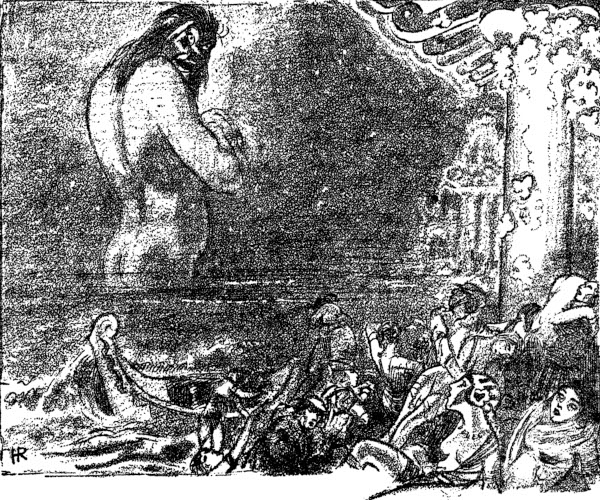
"The giant grinned malevolently in the starlight."
VI
The crowd within the arcade was in a wild panic of terror. I was pushed and shoved, knocked down by heedless, rushing figures. Everyone was trying to get outside. In a moment I was swept away. I could not get back to where I was sitting, or even tell where the spot had been. Martt and Frannie I could not see; the place was all a dim chaos of disheveled, panic-stricken figures. A moment before they had been so gay and jaunty! . . .
A girl rushed past me. The veiling had been torn from her shoulders. Her eyes for an instant met mine, as she searched my face hoping to recognize in me the companion from whom she had been separated. Her dark eyes were wide, red-rimmed with fear. Her face, with all the beauty of youth gone from it, was chalk-white.
She turned and rushed away from me. I thought again, "In the midst of life . . . why, this is horrible!" That giant off there—he could wade to the island in a few moments. . . .
I fought my way out of the arcade, out under the trees by the edge of the lagoon. There was more room out there. In the starlight I could see figures rushing aimlessly away, scattering under the lantern-flowers . . . others hurriedly crowding the boats. One boat was overturned. I wondered vaguely if the struggling figures in the water would be drowned.
Back near the wall of the arcade I saw a girl's figure running. It seemed familiar. Was it Frannie? I dashed after her. But people running in between us blocked me. I lost sight of her; saw her momentarily as she seemed to dart around the farther arcade corner. But when I got there, she was not in sight. Was it Frannie? Had she gone this way? Or into that door, back into the rear of the arcade?
I stood in doubt. Then I saw Brett, running past me, out under the lantern-flowers some fifty feet away. His cloak was discarded; he was bare-headed. Brett in his marriage robe! Black and white, with golden tassels gayly dangling from the rolled skirt of his jacket. He was disheveled; as he ran, I saw him tear off the jacket impatiently and toss it away.
"Brett! Oh, Brett!"
He stopped; whirled toward me. "Frank! Where's Frannie—and Martt?"
"I do not know," I said. "I lost them. That giant——"
"The giant is wading the other way now." He pulled me past a thicket, and pointed. I could see the back of the giant's naked shoulders, towering up against the stars. He was going the other way—wading toward the far-distant opposite lake shore. And now against the island's banks, the waves the giant made were beginning to pound.
Brett said: "I don't know where Leela is. I was in there with her—and with Zee. I rushed out when the alarm came—when I went back they were gone." He stood irresolute. "We must find them, Frank. And get back home." He drew a long breath. "It has come, you see, as I feared."
"I thought I saw Frannie," I said. "Running—that way. But I'm not sure. I lost sight of her——"
From behind the pavilion came a scream. The scream of a girl. Familiar. . . . The blood drained from Brett's face. "Leela!"
And then I heard Frannie screaming from there also. We ran. The two girls were standing there clinging to each other. They seemed unharmed. But they were trembling, shuddering, arms gripping one another.
"Leela! What is it?" Brett held her off, regarding her. "You're not hurt, are you? What is it?"
We four seemed alone here beside the arcade. Lantern-flowers were over us; a thicket was near by. Frannie's arms were around me.
"Frank—oh——" She choked; she seemed struggling to tell me something.
I held her close. "You're not hurt, Frannie. Just frightened. What became of Martt?"
Oh, horrible! What gruesome, horrible thing was this! Within my arms I could feel her sensibly shrinking! Her shoulders within my encircling arm, melting . . . palpably dwindling.
Horrible! And there was a great cry from Brett. "Leela! My God, Leela——"
At the horror of it, Brett and I stood dumbly staring; and again the girls clung together. They seemed dizzy; they swayed, almost fell, then steadied themselves.
Visibly smaller now, like beautifully formed little children, clinging together, no taller than my waist.
Dwindling!
Then Frannie pointed to the thicket. Two small human figures stood there—a foot high, no more. A grinning gnomelike man, with black matted hair on his naked chest; and a woman—a woman thick and shapeless. A foot in height. But they were shrinking very fast. And beside them were four small animals with horns—grotesque like a dream mingling dog and horse and moose. The animals, too, were dwindling.
Brett saw them; but neither he nor I made a move. At our feet Frannie and Leela, no higher than our ankles now, were gazing up at us, with tiny upraised arms, pleading.
"Leela! Frannie!" We knelt by them. Then Brett in an agony of terror lifted Leela in his hand. "Leela! Don't—don't get any smaller!"
Then he put her down. She ran, half fell the distance of my foot to reach Frannie. And I heard Frannie's tiny voice calling up to us in gasps, "We're going! He—that man there with the woman—caught us. Forced—down our throats—a drug. We—going——"
Smaller than my finger. Then so small we knelt to see them. They were huddled against the side of a pebble. Then they seemed struggling toward the pebble. Behind it. Under it. Under its curve. . . .
Brett cried, "Don't move, Frank! My God, we might trample on them! Don't move!"
The figures in the thicket had vanished. By the pebble which Brett guarded so carefully I thought I saw Leela and Frannie. Saw a movement, as though an ant were there, hiding under the pebble.
Then—they were not visible. We did not dare look too closely. They were gone! Still there within a foot of our straining eyes—but so immeasurably distant! Lost! Gone! Stolen into smallness!
Within the arcade, when the alarm had sounded, Martt leaped to his feet, dragging Frannie after him. He saw me knocked to the floor, but could not reach me. A press of panic-stricken people was sweeping him away, but he clung to Frannie. Then he saw me regain my feet; saw me looking around. But I did not see him; and though he shouted at me, in the noise and confusion his words were lost.
Frannie gasped, "What is it? What's the matter, Martt? What is it?"
Martt did not know. But he guessed, and his heart went cold with fear. "We must get outside, Frannie. Hold tight! This way—it's nearer! There goes Frank—we'll join him outside."
Martt was forcing a way for them through the crowd. Frannie stumbled. Her hold on him was broken. She fell; and before he could reach her he was knocked backward by a running man. When he regained his feet a swift-moving group was between him and Frannie. He saw two girls stop and help her up; then discard her. Saw her turn, confused, and run into a space where the crowd was thinner. He was being shoved away from her.
"Frannie! Wait! This way!"
But she did not hear him. And then he could no longer see her; there were too many people in between. He struggled in that direction, then he thought he saw me, and turned momentarily the other way. . . .
Martt found himself alone, outside the arcade. The crowd was thinner. Still he was not certain of the cause of all this panic. Then he saw the giant. Stood, and stared with tumultuously beating heart.
A man bumped into him; for an instant he thought that it was Brett. Memory of Brett reminded him that Brett was probably within the arcade, back of the platform-stage. He saw an opening, there in the arcade wall; he thought it was a doorway, leading back of the stage. He started for it, ran headlong into a girl standing there, staring out over the water to where the giant now had faced about and was wading away.
"Martt!"
"You, Zee! Where's Brett? Where are Leela and your father?"
She clung to him, her draperies drooping, her hair tumbling in great dark waves over her white shoulders as she shook her head.
"I do not know. They were in there a moment ago. Frannie came in—she and Leela were at the other door. Martt—that giant——"
"He's going away, Zee. Look! You see him turned about? Don't be frightened. We must find Brett. I don't know where Frank is—I lost him. There he is—isn't that Frank? Oh—Frank!"
They ran toward a man's figure, passing along a distant line of trees. But when they caught up with it, the man was a stranger. Ahead of them, hidden by a thicket, voices were shouting. A rhythmic call. Martt and Zee listened; but Martt could not understand the shouted words.
"What is it, Zee? Can you understand them?"
"They're saying, 'The messenger from Reaf!' Some messenger from Reaf has come with news."
"Come on. Let's go see what it is."
He gripped her hand. They ran swiftly through the woods. They were already several hundred feet from the arcade. The lagoon was on its other side; ahead of them was a patch of woods, dark, for the lantern-flowers did not grow along here. And beyond the woods, the shore of the island where the shouting sounded.
They ran. Soon Zee was ahead, leaping like a young chamois, her veils and hair flying.
"Wait!" he called. "Not so fast!"
She stopped abruptly. And Martt stopped. There was a pounding on the shore; waves rolling up, as though the peaceful lake were torn by a storm.
"What's that, Zee?" But the shouting began again; and without answering, Zee started ahead.
The starlit lake came into view. Like a distant, monstrous shadow, the retreating giant was visible against the stars. On the shore, white waves were rolling up. A boat was here, with its sail flapping. A wave caught it, turned it over.
On the strand a group of people were standing with the man who had come in this boat from Reaf. Zee joined the group. In a moment she returned.
"He says—the messenger says—that giants are in Reaf! The city is emptied—the people have scattered into the country. The road to Crescent is crowded with people coming here."
"Giants! There—as well as here——"
"Yes. They did not attack. There were two giants. They stood in the lake and laughed while the people fled from the city. Hundreds were killed in the rush to get out—hundreds were swept away into the subterranean rivers and the giants stood and laughed. The city is deserted, and the two giants are there now."
Men were helping the messenger right his boat. The group on the shore scattered back over the island, calling, "Giants! Giants are in Reaf!"
The messenger climbed into his boat, headed it out over the now calmer lake.
Martt and Zee momentarily were alone. He stared at her. He was stunned, confused. Giants, everywhere. This thing that had been worrying Brett for so long had come. Death, everywhere.
"Let's get back, Zee. We must find Brett."
It seemed shorter along the shore—a turn of the island near by, into the lagoon, and thus back to the arcade. They started off, running again. It was deserted along here. Zee was leading. Suddenly she stopped in full flight, gripped Martt, drew him behind a huge, pot-bellied tree trunk which stood near the water's edge.
"Zee, what——?"
"There, over there."
"Where? I don't see anything."
She whispered insistently, "Over there—in that open space. Back from the shore."
She was crouching, and he crouched beside her; followed her gesture with his gaze—and saw what she saw.
Tiny moving figures on the ground. Four of them, small dark blobs against the white sand. They were about a hundred feet away from where Martt and Zee were crouching. They had come out of the woods evidently, and were crossing this patch of white sand, heading for the water. Martt blinked and rubbed his eyes, staring at them. They moved in tiny leaps, bounding soundlessly over the sand. Each of them a foot long perhaps. Strange in shape; animal or human, he could not say.
"What are they, Zee?"
But she did not answer. Her little body was shrinking against him; he could feel her shudder.
The figures seemed long and thin, horizontal to the ground, with something sticking upright like a tower from the middle of them. Martt gasped. He had thought them four animals, with humps like upright towers. They were not. He saw them now as running dogs with horns, each with a tiny human figure on its back. And he gasped again. They were growing larger!
They crossed the sand in bounds and momentarily stopped. Already they were fully half normal size. Four horned animals that might have been grotesque dogs, or horses. Saddled; and mounted upon them, a heavy-set, half-naked man; a strange, shapeless woman—and two girls!
Normal size now! No, already they were larger! Growing rapidly larger! Frannie and Leela!
Martt half started to his feet. He opened his mouth to shout impulsively, but Zee drew him back and silenced him. The four animals were taking to the water. Swimming with heads stretched out. Martt could see Frannie and Leela bending forward, each clutching the horn of her mount. In single file the animals swam swiftly out into the starlit lake. They did not seem to be growing any further. Twice normal size perhaps. Soon they were four dark blobs on the shining water. Visually seeming smaller by distance. V-shaped lines of silver phosphorescence streamed out in the water behind them with their swift forward progress.
And presently they were vanished.
Martt and Zee stood up. They could not explain it. They tried to, but could not. But the main facts were clear. That had been a man and woman giant, and four of their animals. They had captured Frannie and Leela. Had made the girls and the animals change size like themselves. They had all, just now, been very small in size. To escape observation coming across the island to its shore, Martt concluded.
He said, "We must get to Brett—tell him about this. And then—go after them——"
Again they started running along the shore, intending to turn at the lagoon-mouth for the arcade. Martt's thoughts flew swift as his legs. Leela and Frannie captured . . . they must be rescued . . . then all of them would get into the vehicle and go to Earth—get out of this danger. . . .
Zee was saying, "That is Reaf, off that way where they went."
The wading giant had also gone that way. The messenger had said that Reaf was deserted, that giants were there. Evidently Reaf was the place at which these giants first appeared. Evidently it was the point of entrance and departure for them into and out of this realm. Leela and Frannie were being taken to Reaf. . . .
Martt's heart leaped. An idea was forming in his mind. A plan—a mad, reckless plan. But it seemed possible of success. . . . He thought of the vehicle. It would be of no use against these giants. It was too unwieldy. Besides, shut up in it one could not attack. And when they stopped it to disembark, the giants would overwhelm it. Or, if at the moment it was too gigantic for them, then they would escape before the occupants of the vehicle could get out to stop them. . . . And besides, the vehicle was too precious—no chances like that should be taken with it.
Martt told himself that he must get Brett to hide the vehicle. Guard it somehow. . . .
A mad idea, this plan he was pondering. . . . They came to the lagoon-mouth; and here, to crystallize Martt's plan, to make it seem feasible—here lay a small sailboat, deserted by its owner. It lay, half pulled up on the sand, around the bend of the lagoon.
"Zee! Stop! Wait! I want to talk to you."
Zee had been bounding ahead of him. She stopped, waited, faced him. He was breathless.
"That sailboat," he said. "It's one of the fast kind, isn't it?"
"Yes." She regarded it. "Yes. Very fast."
It was no more than a shell. A flat, spoon-shaped affair, with a small cockpit just large enough for two; and it had a very tall, flexible mast, and an overlarge crescent sail. The sail was flapping. Out on the lake the wind had risen. It was blowing directly toward Reaf.
"Zee, listen—could you sail that boat?"
"Oh, yes."
"You could handle it in that wind out there?"
"Yes. Of course."
"And it would go—how fast, Zee?"
"You mean—to Reaf?" She was as excited as he.
"Yes. To Reaf. We could get there. Go after them. Cautiously. We could hide before we got there. I've a plan——"
"How long to Reaf?" She pondered. "Three—what you call hours. We go fast in a wind like that."
"Yes. That's it. Fast. Three hours. Zee, listen. Reaf must be where the giants go to leave for their own world. They're taking Frannie and Leela there. You see? And if we can get there—get into Reaf"—he gestured—"Zee, if they—those giants are very big, then we to them are small. Tiny. And it's quite dark. It would be dark in the caverns near Reaf—the houses there near the subterranean rivers. We would be so small the giants might not see us."
He drew a long breath. "My plan, Zee, is to get in there, hide, and find a giant from whom we can steal the drugs. With the drugs——"
She was trembling with excitement. No fear now. Reckless as only youth can be. "Oh Martt, if we could get the drugs! Brett said the giants must be using drugs. And make ourselves larger than the giants——"
"Yes. Then I can fight them. Rescue Leela and Frannie. We've got to do it. Bring Leela and Frannie safely back. We'll say, 'Here they are, Brett.' But if we wait, if we stop now it will be too late."
Before Martt's eyes was the vision of himself and Zee returning victoriously with the rescued girls. And with the drugs in his possession. There would be no danger then. The giants, knowing the drugs were stolen, would not dare remain. . . . They would all escape up into their own world. . . .
"Will you do it, Zee? Shall we go?"
"Yes."
Martt thought of his flash-cylinder. "I wish I had it, Zee."
"Where is it?"
"In the vehicle. But we have no time to get it."
"I think it would not be of much use."
"No. I don't think so either. But all I've got is this." He displayed a knife whose blade, as long as his hand, slid back into its handle for a sheath.
"Good," she said. He replaced the knife. They climbed into the boat. Martt shoved it off.
In a moment they were beyond the quiet lagoon, heading out into the starlit lake, with the lights of the island fading behind them.
II
The wind was strong when they were beyond the island. The sail bellied out in front of them like a great crescent dish; the spoon-shaped boat, barely skimming the surface of the water, rode high on a white wave beneath it. Zee lay on her side, upraised upon an elbow with her hand on the knife-blade rudder that trailed the water behind them. Beside her, hunched with arms wrapping his upraised knees, Martt sat and peered ahead under the sail.
The lake was dim in the starlight; its concavity rose to the horizon. It seemed empty ahead. No boats. The wading giant had vanished; the swimming figures were gone.
As they sailed with the wind, the night seemed windless and calm, save that the lake boiled under them, swiftly passing. Martt was in no mood to talk. Zee, too, was silent, engrossed with her task of guiding the boat.
Occasionally, with a surreptitious, sidelong glance, Martt regarded her intent little face, earnest and solemn. Long, dark lashes, tendrils of dark hair around the slim white column of her throat; her outstretched limbs revealed by the stirring draperies. . . . A lock of her hair flew across his cheek. He touched it, cast it away.
"Zee?"
"Yes, Martt?"
"I was thinking—you dance very beautifully."
She turned to him, and smiled; a whimsical smile, and her eyes were dark woodland dells of fairyland. "Father does not think so. A peddler of movement—violent, tempestuous movement! Do you think that, Martt?"
"No," he assured her. "Of course I don't." As she turned back to her steering, his fingers furtively caught a hem of her robe and held it.
There was a long silence. Then he said, as though there had been no silence, "Of course I don't. I think you dance beautifully." And he added, "It made me——" His tongue was about to say, "It made me love you," but his beating heart smothered the words. He amended, "It made me think that your father was very wrong to say that. And about Leela, too."
At the mention of Leela he saw a shadow cross Zee's face. He tensed himself; set his jaw grimly. This was no time for thoughts of love. Leela, and his sister Frannie, were captured by giants. There was work, danger for him and for Zee, up ahead in this starlit night. He would need all his wits, all his resourcefulness. . . .
He remembered the one visit he had formerly made to Reaf; tried to recall how the city lay. Tried to plan what he and Zee would do, now when they got there.
He said, "Zee, the rivers at Reaf that plunge into the mountains—no one has been in them very far?"
"No," she said.
"Can you walk along their banks, inside, under the mountains?"
She nodded. "In some places there are narrow ledges beside the water. But how far—no one knows."
"And in other places—near Reaf, I mean—there are tunnels? Passageways?"
"Yes. Back into the caves and beyond."
"I think," he said, "that back through there is the way to the giants' huge outer world. They've come down, and through the ground behind the mountains. Do you suppose they'll take Leela and Frannie up to their own realm? Or keep them in Reaf?"
"I think—we do not know anything about it," she said.
He smiled grimly. "You're right, we don't. Why the giants should come here at all I don't know. But we're going to know more about it before we get through with them, Zee. What I'm hoping is that we might find one of them alone. We've got to get the drugs away from them somehow. We've got to."
Martt remembered once arguing with Brett about the giants. Brett had thought that they used some drug—two drugs—one to shrink proportionately each of their body cells, and the other similarly to increase the size of the cells. Drugs of the kind had already been sought for on Earth. Nitrogen was the basis for growth. And the new element, Parogen, had been found to cause a shrinkage. In Mars they had developed such drugs further—but they were still impractical for human use.
These giants evidently had something of the kind. And it must be radio-active—it must cause a radiation affecting vegetable or animal matter in near proximity to the changing body. The garments of the giants expanded and contracted with their bodies. But Brett had said that a weapon in your hand—particularly one of mineral—would not change size. . . . The thought was to some slight degree, at least, comforting to Martt; the giants would be unarmed.
Zee's voice broke in on his thoughts. "Look, there are the mountains behind Reaf."
Over the lake, ahead of them the distant horizon was a haze of phosphorescence. But to the left a line of shore had become visible; and now Martt saw up ahead the vague, dark outlines of the mountains. Sharp, jagged peaks, tinged with a green-white.
Another hour. The shore to the left was nearer. Undulating land along the lake. A ribbon of road along the water . . . Martt thought he could see blobs moving along it. Away from Reaf, moving toward Crescent.
"The refugees from Reaf," said Zee. "The messenger said all the roads were crowded."
Another half-hour. Ahead the mountains frowned, rising sheer from the water. The lake was more shallow here; they began passing flat, muddy islands, with river channels flowing between them as in a delta. A blur there, at the foot of the mountains, was Reaf. The silver phosphorescence of the lake was darkening; the water looked muddy, turgid. In a narrow channel between two islands, Martt noticed a quite visible current flowing toward Reaf. It rippled the water as it passed over a bar which Zee skilfully avoided.
There were other islands, with water bubbling up from them, and clouds of steam rising. Zee trailed her hand overboard.
"We are in the warm water now. Feel it, Martt."
The lake water, fed by boiling springs from all this region, was noticeably warmer. And every moment the current toward Reaf was becoming stronger. Martt knew that all this part of the lake converged to the mouths of the subterranean rivers at Reaf; converged and plunged under the ground.
The city of Reaf was now in sight. It spread sidewise over an area of a mile or two. The houses were perched on stilts, like flat, awkward, long-legged birds squatting in the water.
During all this time Martt and Zee had been watching closely for any sign of giants. There were none in sight—nothing that seemed alive over this turgid water, the disconsolate group of houses, the sheer cliffs with the sullen mountains above them. Two yawning black openings showed where the rivers entered. . . .
A deserted city, its inhabitants fled. Some had been drowned, the messenger said. There would be no floating bodies; the current would have sucked them all into those yawning black mouths. . . . A deserted city. But somewhere in there among the houses, giants might be lurking. . . .
Martt said abruptly, "We'd better get the sail down. They can see it too easily." They were still some two miles from the outskirts of the city. But no more than half a mile from the nearer shore. It swung past them to the left; perpendicular black cliffs rising from the water with a narrow rocky strip along the bottom against which the water sucked.
Zee helped Martt lower the sail. There were poles aboard; the lake here was no more than five feet deep. They could pole the boat ashore. Walk unobserved toward the nearer river-mouth. Into the city, to hide among its buildings.
With a thrill of apprehension Martt realized that they might already have been seen. But he thought it unlikely. From the hot water, vapor was rising in a fog. It hung like a white shroud over Reaf. Once in it, surrounded by the fog, they would be comparatively safe.
"Zee, can you swim?"
"Oh, yes," she said. "But Martt, if you get in the water, be very careful of the rivers."
Silently they poled the boat to shore. Drew it up from the current, left it on a shelving rock ledge. The strip here was some ten feet wide; the hot, black lake in front, sluggishly surging toward Reaf; and above them the smooth cliff-face.
The wind had turned—a swirling current turned by the mountains. The fog from Reaf came rolling down upon them. It grew dark; the stars were obscured. In the humid steam they could see no more than twenty feet.
"Good," said Martt. "This is what we want." He spoke in a half-whisper; stoutly, but his heart was beating fast. He drew his knife and opened its blade. "Come on, Zee. And listen, you keep close to me. Whatever happens, we must keep together. And if you see anything—or hear anything—don't speak. Just touch my arm."
They started, creeping silently along the rocks in the fog. It seemed miles. The water was hot beside them. The fog, like a gray curtain, opened reluctantly before their advance. Presently the ghostly outlines of houses were visible, a group of them clinging forlornly together near the shore. Wooden platforms like balconies connected them. A bridge came over and down to the rocks.
Then other buildings. A large one of two stories, backed against the cliff-face. Martt and Zee went under it, groping in the blackness among its piling. The close, heavy air smelt of fish.
They came out to find that the rocky shore had ended. A narrow incline walk led out and up over the water to another group of ghostly buildings. They were some thirty feet away, standing on stilts some ten feet high. In the gray darkness of the fog their shadowy outlines were barely visible.
Martt stopped. "Zee," he whispered, "how far are we from the nearest river-mouth?"
"Not far," she said. "Listen."
In the silence he heard the rush of water. As he stood there, suddenly this whole adventure seemed impractical. There were no giants here. They had all gone on, up into largeness unfathomable, taking Leela and Frannie with them. How could he follow? Even if he dared plunge under the mountains, he could never reach that outer realm. It was gigantic—compared to his present size it might be a million miles away.
Or, if there were giants still lurking here in Reaf, of what use to seek them out and be killed by them?
For an instant Martt hopelessly considered turning back. But he never reached the decision; Zee's fingers gripped his arm—cold, shuddering fingers. He stared, as he saw her staring, and within him his blood seemed to stop its flow.
Something was coming down the narrow incline bridge at the foot of which Martt and Zee were standing frozen, transfixed with horror. Something . . . in all the dark murk of fog Martt could not make it out. An animal? It seemed oblong, the size of a large dog. He could see its moving legs—eight or ten legs, moving as it walked. He felt Zee stir beside him; he withstood his impulse to run. That would make too much noise; the thing would bound after them—catch them. . . .
There was a rotting post beside Zee. She and Martt crouched there and watched with a horrified fascination the thing as it came padding down the incline. It was vaguely green-white; it seemed luminous. As it approached, Martt saw it was a sleek body, moving lithe like a panther. A green-white thing. And then he saw that it was headless. A blunt end, with a gaping, dripping mouth and a shining green eye on a protruding stalk. It stopped, turned the eye to look upward and back.
Martt's breath was stopped. In the silence he seemed to hear his own tumultuously beating heart, and Zee's. The thing was coming on again. Now Martt could hear sounds from it. A whining; a babbling. And from the houses, up there at the end of the incline, came another sound. A great, heavy breathing. A giant was up there asleep! This thing—like nothing of Zee's world—belonged to the giants! Martt's heart, for all his horror, leaped with exultation. A giant, asleep! A giant smaller in size now, if he were up in those houses. He would have the drugs; they could steal the drugs from him while he slept.
The thing on the incline was quite close. It glowed with its own light, greenly phosphorescent, like the ghost of something in a dream, leprous with its missing head.
Another moment. It was passing close beside Martt. A luminous liquid dripping from the gaping slit of its mouth. Its eye on the stalk peered ahead. Its voice was clearly audible. A whine; and babbling sounds like words.
Revulsion, even more than fear, swept Martt. This thing was muttering words! Animal, or human—it was talking, babbling to itself. Strange words of an unknown tongue—but human words. Babbling them as though with reason unhinged. Gruesome! This leprous thing—leprous of body; and leprous of mind!
It passed within an arm's length of Martt as he crouched. And suddenly, without conscious thought, he struck at it with his naked knife. Horrible! The knife sank, but the thing was scarce ponderable! Martt's hand with the knife went down and through the luminous green body, with a feeling of warmth and a wet stickiness, but no more.
The force of the blow, unresisted, threw Martt off his balance. He fell forward, but still clutched the knife. The thing, with a sharp, horrible cry of pain, lurched backward. Then stood with its eye quivering, poised for its attack.
Frannie forced her way out of the crowded arcade, with its struggling, panic-stricken occupants. She was confused, terrified. Separated from me, and then from Martt, her only idea was to find us again; or find Brett. Outside the arcade she turned aimlessly to where the crowd momentarily was least dense. Panic-stricken people—all strangers. Then she saw Leela in the shadow of a doorway of the arcade, and ran to her.
"Leela! What is it? What has happened?"
People around them were shouting. Leela said, "Giants. There is a giant off there in the lake. I was looking for Brett. He came out here. Oh, Frannie——"
The two girls clung to each other. It was dark where they stood. At the moment the crowd had surged the other way. Suddenly Frannie became aware of a dark form looming beside her. A man twice the size of herself. She tried to scream, but a great palm went over her face. She felt herself being jerked from her feet. . . .
She half fainted; recovered to find herself in a thicket within a few feet of the arcade. Leela was beside her. Leela panted, "Don't scream, Frannie! They'll—kill us if we scream!"
The man was with them, and a thick-set lump of a woman. Not so large now. Almost normal in size, for they were dwindling. The man was naked to the waist, a gray-white, barrel-like chest matted with hair. A face, fearsome with menacing eyes, and a head of matted black locks.
And in the thicket were four horned animals; saddled, like large horses with spreading antlers. The animals were dwindling. . . .
The man rasped a command at Leela. From his belt he drew small pellets, white like tiny pills of medicine. He thrust one at Leela, forced it down her throat. Leela gasped, "You must take it, Frannie. He says—it is harmless—but if we resist—he will kill."
Then the man thrust his fingers into Frannie's mouth, his arm holding her roughly. She gulped, swallowed. It was an acrid taste. . . .
The man pushed her roughly from the thicket. And pushed Leela. His triumphant laugh was the rasp of a file on metal. Leela and Frannie stumbled to the wall of the arcade, stood clinging together. And suddenly, with the realization of what was upon her, Leela screamed. And Frannie screamed, though she did not yet understand.
A wave of nausea possessed Frannie. Her head was reeling. Voices sounded near by—familiar men's voices. My voice, and Brett's! We came running at the sound of the screams.
Frannie held tight to the swaying Leela as Brett and I rushed up. And I took Frannie in my arms. Brett was demanding, "Leela, what is it? You're not hurt, are you? What is it?"
Frannie wanted to try and tell me. "Frank—oh——" She choked; her throat was constricted.
And then Frannie really knew! Within my arms she felt herself shrinking! Growing smaller; but it was not so much that; rather was it that my encircling arm was expanding, holding her more loosely.
With the horror of it, Brett and I stood apart. Frannie's nausea was passing; her head was steadier, but dizzy with the strange movement of the scene around her. She clung to Leela, and, of everything within her vision, only Leela was unchanging. The wall of the arcade was slowly passing upward; its nearer corner was moving slowly away; Brett and I were growing. Our waists reaching to Frannie's head; and then our knees. She gazed upward to where, fifteen or twenty feet above her, our horrified faces stared down.
The mind always takes its personal viewpoint. Frannie and Leela were dwindling into smallness. But now that the nausea and dizziness were past, to them, they alone were normal. Everything else seemed changing . . . the whole scene, growing gigantic. . . .
It was a slow, crawling growth—a steady, visible movement. The ground beneath their feet was a fine white sand. To Frannie's sight this patch of sand had originally been some ten feet, with the arcade wall on one side, and a thicket on the other. But the ground was shifting outward with herself as a center. Under her bare feet she could feel its steady movement—drawing outward, shifting so that her feet were drawn apart. She had to move them constantly.
Beside her now she saw my foot and ankle as large as herself; the towering shafts of my legs—my face a hundred feet or more above her. The arcade wall stretched up almost out of sight—lantern-flowers loomed up there like great colored suns. . . . The thicket was a hundred feet away—a tangle of jungle.
Then Frannie saw the giant Brett reach down and pick Leela up on his hand—saw Leela whirled gasping into the air. A moment, then Brett set her gently back on the ground. She was some twenty feet from Frannie. She ran, half stumbled across the rough white ground until again the girls were together.
The arch of my sandaled foot was now as tall as Frannie. The arcade wall was very distant; the thicket was a blur in the distance. That small patch of white sand had unrolled to a great stony plain. Rough; yellow-white stones strewn everywhere. Frannie saw my feet and Brett's—as large as the arcade once had been—moving away with great surging bounds up into the air and back. A boulder was near by—a rock as tall as Frannie. It was visibly growing. She gripped Leela—together they crept to the boulder's side, huddled there.
But they could not remain still. The boulder was expanding. It towered over them; but it was drawing away as well, for the ground was expanding. Constantly they shifted their position to remain close to it, to huddle under its protecting curve. It had been a rock taller than their heads; it was now a mountain. It loomed above them—a bulging cliff-face of naked, ragged rock.
Then it was no longer moving. Everything now had steadied; the ground was motionless. A normality came to Leela and Frannie. Their terror faded into apprehension, and a desire, a determination to do what they could to help themselves. They stood up and looked around them.
II
They were in the midst of a vast, rock-strewn plain, illumined by a half twilight. It seemed miles in extent—a rolling country of naked rock over which, for a sky, hung a remote murk of distance. A naked landscape, rolling upward to a circular horizon, with the circular mountain of rock standing beside them at its center.
Leela now seemed quite calm. She said, "We are not unfathomably small. Too small for Brett to see us, but not if he gets a glass to magnify. He will mark the spot where we are—he will do something, Frannie—we must not be too much frightened."
There seemed nothing that they could do to help themselves. No use to wander; though no great harm either, for they could roam for miles over this rocky waste to cover no more than a foot or two of the white sand Brett would be guarding.
To Frannie's imagination came the thought of insects! A crawling ant in that white sand would now be a monster gigantic! She gazed around in terror, but there was nothing of the kind in sight.
A desolate landscape, empty of movement. Frannie's heart leaped. In the distance something was moving! She gripped Leela.
"There's something out there—something moving out there!"
Tiny moving specks. Too terrified to run, the girls stood staring. A mile or two away, specks were moving across the rocky plain. They seemed coming nearer. They separated into four specks. Four gray blobs, coming swiftly forward.
In a few moments they were distinguishable. Four running animals, bounding, leaping over the rocks. Animals with horns. Two of them running free; two with riders.
Leela gasped, "That's the giant! And the woman! They're coming to find us!"
For a moment the two girls stood transfixed, heedless that they would be discovered. To Frannie came the thought: The giant, the woman and the four animals had been dwindling. They had stood in the thicket, hiding from Brett. They were coming from the thicket now, riding over the vast rocky plain headlong to regain their captives. Brett could not see them; they were too small. Brett was probably standing a few feet from here on the sand—afraid to come closer for fear of treading upon the girls; and those few feet were miles away across this naked desert.
The four animals came leaping forward. They ran low to the ground, necks extended like huge dogs on a trail. Already they were no more than half a mile away. The figures of the riding man and woman showed plainly. They all seemed about normal size as compared to Frannie and Leela.
Abruptly Frannie recovered her wits. "We must hide! They must not find us!"
They hid, out of sight around a corner of the lower rock-face of the mountain; crouched, waiting with wildly beating hearts.
But it was useless. Either they had been seen or the animals scented them. Soon they heard the man calling his mount. No noise of galloping hoofs, for the beasts ran lightly on padded feet. A moment, then the animals burst into view around the jutting rock; bounded up and stopped before the crouching girls.
The man dismounted. His grin was a leer of triumph. He spoke to Leela—a harsh, guttural command in her own language, as he had spoken before when he forced the drug upon her.
Leela dragged herself to her feet, and Frannie after her. The man spoke again. Less harshly this time, and at greater length. He gestured at Frannie.
Leela said, with a quiver in her voice that she tried to hold to calmness, "He tells me that his name is Rokk. This woman here is his mate—he calls her Mobah. He says they come from a very big world—down here to our world of infinite smallness. Oh, Frannie, what can we do? He says they are going to take us with them, up there to that Giant World."
Frannie, too, strove for calmness. "Ask him—why? What harm have we done to him? Tell him—we don't want to go——"
Leela turned to this man who had called himself Rokk. Then she appealed to the woman—but the woman stared dumbly and turned away.
"Frannie—he says we will learn later what he wants. He says—we will not be harmed if we cause no trouble. We are going—he says he is going to take us——"
"Which way?" Frannie interrupted.
"I don't know. I suppose to Reaf."
"Ask him."
Leela asked him. "Yes, by way of Reaf. He says we will mount the animals—he calls them dhranes. They run very swiftly—as Brett describes your wolves of the northern ice-fields of your Earth."
Frannie demanded, "He says we go to Reaf?"
"Yes. We will cross the island—out the lagoon—riding the dhranes as they swim."
Memory of the island—the arcade—the lagoon and the lake came to Frannie. The island! It seemed so remote, so gigantic. This vast rocky waste surrounding them now was only a small patch of white sand beside the arcade wall.
She said swiftly, "Leela, ask him how we can ever do that when we are so small? Why, it must be hundreds of miles—for us in this size—just to reach the shore of the island."
"I told him that. He said, 'Of course.' He said he has been riding from the thicket ever since he got small enough to avoid Brett's sight. While they were still diminishing they were riding. He was afraid Brett would see them—but he had to take that chance."
"I mean," said Frannie breathlessly, "tell him we must get larger. It is too far in this small size. Tell him you know the island and the lake well—we will help him escape——"
Leela nodded eagerly. "So that if we get large, Brett may see us?"
"Yes. Try and get him to make us large at once—now. Tell him we'll help him——"
Rokk grinned sardonically at Leela's words. Leela turned to Frannie in chagrin.
"He says he will do as he thinks best—and we will do as we are told."
Rokk added another command. Leela said, "We must mount the dhranes, Frannie. I think we had better do as he says—and not talk. Can you ride a saddle like that?"
From Frannie's viewpoint, the dhranes were now about the size of small horses—four-legged, long-haired, shaggy beasts with crooked, wide-spreading antlers. They moved as though on springs. Frannie was reminded by their movements of giant leopards she had seen in cages on Earth. But they seemed gentle, docile enough. The saddles were oblong, padded with fur, with a high and a low foot-rail, both upon the same side, on which the rider's feet could rest.
"I can ride that," said Frannie; and nimbly mounted. There was no bridle; Frannie leaned forward and clutched the antlers. Leela mounted. Rokk moved his dhrane about by spoken words, and by slapping its haunches with his hands.
Leela said, "He is going to give us some of the drug, Frannie. Some now—to make us larger. But before we are very large he says we will be beyond the arcade, in the woods where Brett can not see us. We will ride very fast——"
The animals lapped their drug eagerly. The man and woman took theirs, with Leela and Frannie. To Frannie again came a moment of nausea—a reeling of the senses. But it was quickly passed.
Rokk shouted. Frannie tensed herself. The dhrane under her bounded forward. The ride began.
III
At first Frannie clung tensely to the antlers; but soon she found it was not necessary to do so. The dhrane ran with long, smooth bounds; sure-footed on the rocks as a chamois, noiseless, lithe as a great cat. It ran, with head extended, low to the ground; beneath her, Frannie could feel the play of its smooth muscles, rippling under its shaggy skin.
The woman Mobah rode her dhrane behind Frannie. Leela was directly ahead, with Rokk leading. In single file they bounded forward. Leela's black hair and draperies flew in the wind. She rode, bending forward, her body loosely responsive to the animal's bounds.
The wind of their forward movement sang in Frannie's ears. The ground fled by under her with a blur of yellow movement. And all around her was the murky night, rushing at her, passing, and closing in behind.
A wild, night ride like the fairy dream of a child. Wild, and free . . . a fairy dream. . . .
An exaltation was upon Frannie; she urged her mount to greater speed. And thought of the drug she had taken. . . .
The drug was acting. The rushing night seemed shrinking. Everywhere the murk was contracting. The ground was smoothing and turning from its yellow to white. Overhead a remote—very remote—spot of red light shone like a dying sun in the heavens. A lantern-flower! Frannie's heart leaped with triumph. They were growing larger. . . .
She heard Rokk shout to his dhrane; felt her own mount stretch closer to the ground as the speed was increasing. The rushing night contracting . . . they seemed riding up . . . and up . . . the ground, the night was shrinking under them. . . .
A wild, night ride up through a fairy's dream . . . it seemed endless. Wildly free, with the exaltation of a child's fancy upon it. . . .
Frannie became aware that the vast rocky plain was shrunken to a smoother level. And ahead now, she saw a great forest, with colored suns about it. Soon they were in the forest. A jungle. Flat, orange stalks of grass twenty feet high. The dhranes bounded through them. Shaggy outlines of tree trunks, each vast as a mountain. They rose into unfathomable murky distance overhead. But these were all dwindling. The giant jungle was shrinking . . . passing slowly, but ever faster.
A fantasy . . . the dream of a child. . . .
Rokk called again. Their pace slackened. Frannie saw an open space ahead. Coarse white sand—a patch of it half a mile in extent. Beyond it a broad beach. Water shining off there. The lake, with stars above it.
The dhranes ran more slowly. The white open space shrank as they traversed it. The beach rushed at them. It had narrowed. Frannie saw it as almost of normal aspect—the narrow shore of the island. The lake was starlit—beautiful.
Rokk paused a moment at the water's edge. Frannie gazed around. The woods were behind them. A large, dark tree-trunk was near by on the shore. Frannie gazed that way idly; and though she did not know it, Martt and Zee were crouching there, staring with a confused fascination. A moment. The shore shrunk further; the water had advanced to lap the stamping, impatient feet of the dhranes. Rokk spoke softly. His dhrane waded in, with the others following.
Frannie again gripped her beast's horns. The water rose almost to the saddle. It was warm and pleasant. The dhrane swam smoothly, swiftly, with neck stretched out, nose skimming the surface.
A dwindling silver lake. Ripples of silver-green phosphorescence; lines of silver fire diverging behind the swimming animals. . . .
Frannie turned to gaze at the receding island. An island already shrunken, dotted with shrinking colored lights. And ahead, the empty starlit lake.
IV
Riding over the land, it had been a breathless whistling of wind, a swift surging of the ground beneath Frannie's feet. Here in the lake it was quiet and calm; the warm lapping of the silver-streaked water; the quiet stars overhead. Frannie heard Rokk talking back over his shoulder to Leela, and then Leela drew in her mount and spoke to Frannie.
"He says the giants have all gone back through Reaf to their own world. One was wading out here toward Reaf. He was very large then; he is to stay in Reaf on guard, while we go on. He is there now—it is not far."
"How big are we, Leela? Did he say?" There was no way, here in the lake, by which size could be compared. The exaltation of the ride—its swift, tempestuous movement—the wild, romantic fantasy of it—all this was leaving Frannie. A depression was upon her. She added, "Oh, Leela, Brett did not see us! And Frank—will we ever see them again?"
Leela said, "We are about twice normal size—it will not be far to Reaf, swimming like this." In the starlight, Frannie could see that Leela was smiling; a wistful, heavy-hearted smile. She was trying to be brave. And Frannie smiled back.
"We mustn't get frightened, Leela. Just watch our chance—try to escape. You stay by me all you can. I mean—when we get"—there was a catch in her voice—"when we get—under the mountains beyond Reaf."
Leela nodded. Rokk was calling, and Leela urged her dhrane forward.
Soon the left-hand shore and the mountains ahead were visible. The water grew warmer. Small islands appeared. The dhranes panted with the heat of the water; in the muddy channels between the islands, sometimes they floundered. Steam was in the air; ahead it lay like a bank of fog, with the frowning mountains rising above it.
Presently, through the fog, the houses of Reaf came into view. Small ghostly outlines of houses on stilts. To the right of them was a yawning black mouth where one of the rivers plunged into the mountain. The turgid current was swinging that way; Rokk urged the dhrane across it, to the left.
Soon they were swimming among the houses. These seemed very small. Frannie reached up from the dhrane's back and laid her hand on the roof of one as she passed it. Rokk was heading inshore. The mountain here was a frowning cliff-face, with a very narrow ledge at the water level. The ledge ended in a wooden incline bridge leading upward to a group of buildings near shore. Six or eight small houses with doors and rectangles of windows, clustered there together, perched on stiff wooden legs over the water. The incline bridge connected them with the shore, and they were strung together by a broad wooden platform.
Rokk shouted, and from behind the buildings a giant appeared. He had been sitting in the water. He stood up, with mud and slime dripping from him. A man, like Rokk, but younger. His hair was sleek and black, and fell long to his bared chest, across which a skin was draped. His face was broad and flat, and hairless. He stood with the water to his knees, beside the buildings with his arm arched over their roofs as he leaned against them.
He smiled. He called, "Ae, Rokk!" And Rokk answered, "Ae, Degg."
They spoke together. Then they spoke in Leela's language. Leela murmured to Frannie, "This man Degg is to remain here until we are safely above."
Rokk issued his commands. Degg sat down again in the water, waist-deep, with his arms holding his hunched-up knees. He yawned and waved his hand as Rokk swam his dhrane away.
Again in single file, they swam. As they passed the buildings Frannie chanced to glance up. On the porch-like platform up there she caught a glimpse of a green-white shape—a thing stretched out somnolent—a thing, headless!
It was only a glimpse. Frannie's swimming dhrane carried her beyond sight of it. . . . She was shuddering.
The water now was unpleasantly hot. The current was strong. It was beginning to ripple the water. Ugly, white ripples . . . sinister.
The dhranes swam with the moving water. But they tossed their heads, uneasy. . . . Rokk was continually shouting, forcing his mount forward.
There were no houses here. The cliff-face was moving swiftly past. And then a black mouth swept into view. A hundred feet high and twice as broad. A mouth, with steam like the fetid breath of a monster. . . .
The water was sweeping that way. Surging in a torrent. White water, leaping over jagged rock-points that split it into foam. . . .
And from the mouth came a sullen roaring. . . .
Frannie's dhrane lifted its head with a sharp bleat of fear. Its body was swung sidewise by the tumbling water, but it recovered and swam desperately.
The roaring rose to a deafening torrent of sound. White water was leaping everywhere. Frannie half closed her eyes; she could see a whirling blob which was Leela ahead of her. Then the black mouth opened to encompass the world as Frannie was swept into it.
An inferno of roaring blackness. . . .
In the fog and darkness at the foot of the incline, Martt stood tense, with upraised knife. The green-white thing was poised for its leap. It was not babbling now; its eye on the stalk glared balefully. A shudder swept Martt, as Frannie had shuddered an hour before when she and Leela passed this way, and she had caught a glimpse of this thing lying somnolent on the platform above.
Martt muttered, "Stay back, Zee." And then the headless thing leaped. Martt caught it on his outflung hand and knife, but did not stop it. He felt his hand sinking within it—a soft, sticky warmth. Its body came on, and struck his chest—a blow as though a soft, yielding pillow had struck him.
There was a moment, there in the darkness, of unutterable horror as Martt felt and saw his body mingled with the body of this gleaming thing clawing at him. He struck wildly, fighting, kicking in a panic of futility. Wet, warm and sticky! He seemed to tear its body apart. But the glowing, lurid outlines, wavering, came back always into shape.
The thing itself was in a panic. Lunging, twisting. Its claws scraped Martt's face, too imponderable to scratch. The slit of its mouth opened to grip his throat; its teeth sank impotently within his flesh. Pressing against him . . . the slime of it was warm, with a stench, noisome. . . .
Horrible! A nausea made Martt reel. And the thing now was crying with terrible, frightened cries. But they were low, suppressed.
Martt staggered. And suddenly the lurid green shape gathered itself and fled. Martt saw a quivering dark wound in its side. It fled whimpering along the rocks of the shore and disappeared.
Martt relaxed. He was unhurt. He stooped to the water and washed the stickiness from him. He felt a wild, hysterical desire to laugh.
"Zee, it—that thing was as frightened as I was!"
"Are you all right, Martt? It's gone! What was it?" She clutched at him anxiously.
"Yes—all right. It couldn't hurt me and I couldn't hurt it. Not much." He laughed again, but suddenly sobered. "Zee, there's a giant up there asleep. Hear him?"
They listened. From up there in the fog the deep, heavy breathing still sounded. Martt whispered, "You wait here, Zee. I'll creep up on him—get the drugs." He turned to her tensely. "Zee, you stay here. Close against the rocks. Whatever happens, you stay here. I'll—if I get the drugs—I'll make myself very large. Kill him—then I'll come back to you. Don't move—whatever happens."
He left her. The wooden incline sloped sharply upward. The fog momentarily seemed clearing. Martt saw above him the outlines of the houses, a broad platform connecting them. And stretched the length of the platform was the huge, recumbent figure of a man. He seemed about forty feet tall. He lay hunched, cramped for space, with one arm upflung to the roof of a house, and one leg dangling nearly to the water.
Martt reached the platform. He crept past the giant's legs. The waist, wrapped in a skin, was rising and falling with the giant's breathing. Martt's own breath was held. His heart was thumping wildly. The giant stirred; Martt stepped nimbly aside to avoid the movement of the great body.
At the giant's waist he paused, reached up, fumbling. There seemed a belt here, with pockets. The drugs should be there. The bulge of the giant's middle was nearly as high as Martt's chest as he stood upright. He reached up, and over, feeling with careful fingers.
With a thrill of triumph, Martt found two cylinders, each as long as his forearm. In the starlight he opened them, drew from each a flat, square tablet of compressed powder. The drugs! But which was for growth and which for shrinkage? One was larger than the other. It suggested growth. It was flat and square—the length of Martt's thumb. Impulsively he would have crushed it in his mouth and swallowed it. But a thought gave him pause. This giant was nearly seven times larger than himself. This expanded dose of the drug then would be too great. Martt bit off a corner of the white tablet. Swallowed it. An acrid taste. . . . He replaced the remainder in the cylinder and put both cylinders in his pocket, tying his jacket close around them. Would they expand with his body? He could only hope so.
Expand? How did he know but that he had taken the wrong drug? Well, he could soon rectify that. . . . A panic swept Martt that the giant might awaken too soon. . . . The drug was taking effect; Martt was sick and dizzy. He reeled to a post at an outer corner of the platform. Clung there. He all but slipped and fell into the water ten feet below.
A moment, then the sickness passed. He was growing! He could feel the post shrinking within his grip. The outlines of the houses were contracting. The knife in his hand, already tiny, slipped and fell into the water with a splash.
The post soon was too small for Martt to hold. He reached over and steadied himself upon the grass roof of the nearest house. It was melting under his hands. The sleeping giant lay at his feet, a giant no longer; a man, like himself—the two of them crowding a tiny, flimsy platform with toy houses beside it, and black water flowing sluggishly close underneath.
A sense of power swept Martt. A triumph. He was not afraid of this man, unarmed like himself. Already the man was undersized. . . . Why, Martt could grip him, choke him! . . . These toy houses—a sweep of Martt's arm would have scattered them.
Martt was bending awkwardly over the roof-tops. A ripping, tearing noise sounded. The platform, the houses, quivered, wavered, collapsed! The whole structure, bending beneath the weight of the two huge bodies, gave way. Martt found himself floundering in warm, muddy water, entangled in a debris of splintered wood and grasslike house-roofs.
And with him, his antagonist, awakened to a startled confusion, floundering, struggling to get upon his feet.
Martt rose to his knees. The shallow lake bottom was sticky with mud. A house-roof hung upon his shoulder. He heaved it off; stood upright, dripping, breathless. The other man was up also. In the starlight, amid the floating wreckage, they faced each other. Martt was the taller; and he was still growing. He saw his enemy shrinking before him. A slim young fellow, with long black hair. A broad, flat face, with a startled surprize on it.
Martt laughed. And shouted, "I've got you now!" He would have leaped. But abruptly he recalled Zee, tiny in size, huddled there by the shore. A lunge of his body—or of this other man's body—a flip of one of these torn housebeams—and Zee would be killed. . . .
Martt turned and waded rapidly away. He wondered if the other man would follow him. Martt wanted to get him farther out into the lake. It was an error; for as Martt turned to look back, he saw his antagonist's hand go to his belt; and then to his mouth. More of the drug! Martt thought that he had in his own pocket all there was of it here. But the giant had more. Already he was growing. As Martt stood undecided, he saw the giant growing like himself. He was smaller than Martt now, but growing more swiftly. He stood for an instant with his arms upflung toward the stars; then he came wading forward.
The mountains were at Martt's right hand. Shrinking, swiftly contracting. The water now came not much over his ankles; a small patch of wreckage marked where the collapsed buildings had stood.
Martt retreated slightly; he turned, moved to the cliff-face with his back against it.
Then, with a swirl of water, his enemy rushed at him. Martt met the rush unyielding. They locked. Swaying, struggling each to throw the other. The lake at their ankles was lashed white. They fought silently, grimly. The fellow was strong; he pushed Martt backward against the Mountain. His hands strove for Martt's throat. But Martt ripped them away. With a body-hold he bent his adversary backward; but always he could feel the man's body swelling within his grasp.
A desperation seized Martt. If he could not win now, at once, he would lose. This fellow was growing too large. Beside them, as they swayed, Martt caught a glimpse of the mountain. It was now a cliff not much higher than his head. At his feet Martt was dimly aware of a small black hole in the cliff into which water was rushing.
One of Martt's legs was wrapped around the legs of his adversary; and suddenly the man tipped. They went down together, Martt on top. It was like falling into a puddle of water. They lunged, rolled over. And then the giant rose, with Martt clinging to him. He was much larger than Martt now; he heaved himself upward, flung Martt against the cliff. Martt's head and shoulders went over its top. Jagged spires of rock; loose rocks lying there. The giant jerked Martt back; he fell on his feet; saw his antagonist towering over him.
But in Martt's hand now was a jagged lump of rock which he had snatched from the cliff. He flung it, and it caught the giant full on the forehead. He staggered, and as his grip on Martt loosened, Martt leaped away.
And the giant came crashing down, his huge body falling before the hole in the mountain; blocking it so that the surging lake backed up with a deepening torrent of the hot, black water.
II
Martt stood panting in the starlight. He had won. The scene around him was still dwindling, but in a moment it stopped. Cliffs to his shoulder. A shrunken, shallow lake. Its tiny flat islands were no bigger than his foot. Along its shore where the cliff ended he could see the open country. Tiny threads of roads. An island with points of colored light—the island of the festival. At his feet, miniature houses on stilts, many of them strewn on the water, trampled by this combat of giants in which he had been victorious.
And the fallen giant there in the water, blocking the river-mouth, the water deepening against his side.
Martt took a cautious step. Zee was down there somewhere. Then he saw her figure, dimly, in the mist which hung over the lake at his ankles. She seemed about the size of his finger. She was standing at the water's edge, waving up to him.
He bent down—carefully. He said softly, "I see you, Zee. You must get larger. I'll give you some of the drug to take."
She shouted, "Yes." It was a very tiny voice, echoing from far away.
Martt's jacket had been partly torn from him. One of his shoulders was bare, bleeding from where he had been thrown against the cliff-top. He stooped and dashed water upon the wound; and saw Zee crouch and shield herself from the deluge of water he splashed.
He thought, "Careful, Martt;" and from his pocket drew one of the cylinders. The tablets of the drug still were the size of his thumb. He took one, laid it carefully at the water's edge, near Zee. It was nearly the size of her body. She walked to it, examined it.
"Break it," he said. "Eat some—about the size of your thumb."
He could hardly have seen a speck of it so small. Zee found a loose rock. She pounded at the white tablet. Ate a fragment. And presently Martt gave her some of the other drug to stop her growth; and she was his own size, standing beside him, gazing at the shrunken scene in wonderment.
III
They stood consulting over what they should do. They had the precious drugs. Should they return with them to Brett, or go on and rescue Frannie and Leela? Martt was confident. With the drugs in his pocket, all sense of fear was passed. It was obvious that the world here was in no danger. This fallen giant at their feet was the last. But Frannie and Leela were captured; were taken up to that other realm. To delay following would be most dangerous of all.
And Zee agreed. Her eyes were sparkling. She stretched out her white arms. She said, "With this power we would be cowards to turn back——"
The giant still had some of the drugs about his person. Martt bent over him.
"Zee! He isn't dead!"
The young giant's face was white; blood was on his forehead where the rock had struck. He opened his eyes; rolled over in the water. The dammed river surged again into its black hole.
"Zee, look! He isn't dead!"
He sat up; smiled in a daze, struggled to rise to his feet but could not.
The rock which Martt had hurled lay like a great boulder in the lake. Martt seized it, but Zee caught his wrist.
"Martt! Don't——"
A sense of shame struck at Martt; he dropped the rock. "Zee, can you talk to him—try if he understands your language."
She spoke, and the young giant answered. He was trying to smile, grateful for the words. Zee stooped and splashed water on his wounded forehead.
"Martt, he says his name is Degg—he has seen Leela and Frannie—a man and woman took them into the river-mouth."
The fellow did not seem greatly hurt. He was frightened, watchful, but docile enough. Martt took the drugs from him. "Ask him the way up to his world—it will help us——"
It was the one thing that would help them! Martt realized it.
Degg, outwardly at least, seemed friendly enough. When Zee promised that they would not hurt him—would take him to his own world, the only way he would ever get there, since he had no drugs—he agreed readily to lead them.
"But we must be careful," said Martt. "Never let him get larger than ourselves. And watch him, always."
At Degg's direction, first they diminished their stature until, compared to the buildings of Reaf, they were about fifty feet tall. Degg said, in Zee's language, "We wade now into the black river. Rokk likes to swim—but wading is easier."
They were ready to start. Soon they would be beyond this world—up into largeness unfathomable. Martt said, "We must leave some message for Brett. Let him know what became of us."
There was no way to leave a written message. Conspicuously on a rock near the shore, Martt left the broad belt of his jacket. As he turned away, Degg was calling softly, "Ae! Eeff! Eeff, come here!" The green-white, headless thing was lurking among the rocks. "Eeff, come here!"
It advanced, whimpering. Compared to Martt's fifty-foot stature it seemed now no bigger than a rat. Martt conquered his aversion and stood waiting while it approached. In the starlight it glowed unreal; its eye on the stalk pointed distrustfully at Martt. It stood at Degg's feet; whimpering—and mumbling words.
Degg said to Zee, "It is afraid of your man. I tell it you will do no harm. It wants to come with us." He stooped over. "Eeff, you come with us?"
It understood, partly the words spoken in Zee's language, and partly the gesture. It said mouthingly, "Yes, Eeff come—with you."
Uncanny! Horrible! Martt shuddered. Degg was saying, "It is a very good friend to me. May we take it?"
"All right," said Martt shortly, when Zee translated. But it worried him. He resolved more than ever to watch Degg carefully, and to watch this headless thing Degg called a friend.
They fed a small morsel of the drug to Eeff, until it had grown to a size normal to them. Then they started. The black mouth of the river, to them in this size, seemed a passageway ten or twelve feet high and twice as broad. The river swirled about their legs; hot, with steam rising. Soon they were in darkness, following the river around a bend. But only for a moment. Martt and Zee were hand in hand. Degg was in advance; Martt could just distinguish Degg's figure with the shining blob of Eeff in the water beside him.
Darkness. But Martt's eyes were growing accustomed to it. And now the rocks of the caverns seemed to be giving light—a dim phosphorescence. The cavern expanded. They waded across a broad, shallow lake where the water was calm. Then again into a tunnel. Miles down its tortuous course with the river swirling and tumbling about them.
Sometimes there was a dry ledge upon which they could walk. Sometimes the river deepened, and they had to swim. Always Degg advanced grimly, steadily, and silently. A foreboding grew upon Martt. Were they going right? Was this the way Frannie and Leela had gone? Once he whispered, "Do you think, Zee, that he's tricking us?"
She shook her head. "You have all the drugs. He would not dare."
They had waded for hours. Then ahead of them they saw Degg pause. The river here plunged straight down into a black abyss. To the left a passageway turned upward. It was some ten feet high and two or three times as wide. It went up at an incline into the green, luminous darkness. They followed Degg. A mile perhaps, steadily climbing. Martt calculated. They had already walked possibly fifteen miles—and they were more than eight times the normal size of Zee's world. That was more than a hundred and twenty miles underground—most of it downward.
Martt realized that he was tired. And hungry. Before leaving Reaf he had thought of food necessary for this trip. Degg had a concentrated food—a dull brown powder. Martt promptly had appropriated it—had tested it to make sure it was not a size-drug. . . .
The passageway abruptly opened into black, empty space. A rocky slope rolling gently upward, strewn with huge black boulders. It extended as far as Martt could see, upward into a luminous darkness. Overhead was a black sky—murky with distance.
Degg stopped. "We begin getting large here."
Zee translated it to Martt.
"Let's eat, then," said Martt. "Zee, aren't you tired and hungry?"
There was water lying in flat pools on the rocks. It was clear, cold and sweet. They sat down, talking and eating. Then Zee slept. And Degg slept also.
Martt sat alert, watching, while the headless thing stretched itself somnolent on a rock near by, its single eye on the stalk wilting downward in drowsiness.
Martt strove to master his revulsion. He called softly, "Eeff! Eeff, come here!"
But it would not come. It moved farther away, whimpering to itself.
IV
"Zee, wake up! We've got to get started. You've slept hours."
The real size-change now began. In single file they walked up the black slope. It shrank beneath them—creeping, crawling, dwindling away under their feet. The boulders shrank into rocks, into pebbles. In an hour they were walking upon a smooth surface.
The black void was no longer empty. Mountains showed ahead—and to the sides. Giant faces of rock, looming into unfathomable distance of the black sky. The mountains were drawing closer; contracting, rushing down with a violent movement.
Martt apprehensively glanced behind. A wall of dwindling rock was coming after them. The drug in these larger doses seemed acting with a multiplied power. The scene was a dizzy swirl of movement. Mountains closing in everywhere. To Martt came a flash of terror. They would be crushed. Their bodies were growing tremendously to fill this constricted space. . . .
Degg had stopped walking. They were gathered in a group. They were now in the center of a circular valley, with a ring of mountains closing in. A ten-mile valley . . . a mile . . . a hundred feet. . . .
But the mountains shrank to hills; to a low cliff-wall—a ridge. . . . It closed in. . . .
"Now!" shouted Degg. They leaped over the low ledge of encircling rock; scrambled over it and fell on a level ground above. . . .
Beside them Martt saw a small jagged hole in the ground. . . . The size of his waist . . . his fist . . . his finger. . . . It dwindled, closed and was gone; while again, above them and all about, were black, empty spaces, filled soon with shrinking canyons out of which hastily they climbed. . . .
A fantasmagoria of climbing, struggling upward to avoid being crushed by their own growth. . . .
There was a canyon too narrow, with sides too high. . . . They had to stop their growth, and climb its jagged, precipitous side. The climb took hours. There was another meal, while Martt slept and Zee remained on guard.
Then another valley. Broad, with a steeply inclined floor. They grew out of it; into another; and another. . . .
Martt became conscious of a change in the air. Cooler, with a dankness. And now at last, overhead the void was no longer black. A suggestion of purple. And suddenly as they leaped from a chasm which shrank and closed under them, Martt saw a sky. Somber purple, with stars.
A new conception of it all swept Martt. His Earth—the stars of its Universe. The Inner Surface of the Atom, Zee's realm—millions of times larger. And now—compared to Reaf . . . was he now a million times the size of Reaf? . . . Or a million million? Largeness, unfathomable. A convex world out here. The surface of a globe, whirling in Space. And overhead, still other stars, so gigantic—so remote!
V
Martt gazed curiously around. They were at last in Degg's world—the region of the Arcs. A tumbled land of crags upon which lay a gray-black snow. Martt's heart sank before its utter desolation—a tumbled waste, upheaved as though by some cataclysm of nature. Desolation! And as though to veil it, a fall of blackish snow—a somber, tragic shroud.
It was night. And, Martt surmised, a winter season. Yet the air was not cold; merely dank. And the snow seemed not cold, congealed perhaps by the dank, heavy air; but to Martt's touch, not cold, no more than chill.
With her bare limbs and filmy veiling, Zee was shivering. Martt discarded his jacket, but she did not want it.
He said, "But you must be cold, Zee."
"I'm not." She shook herself. "I'm—frightened. This—night up here—it's like a tomb, Martt."
Tomblike, indeed. A dank, chill silence brooded over the night. And then, almost unheralded, it was not night, but day. A small, cold-red sun leaped up from the distant black horizon. A day of dull, flat light. It stained the snow with blood. . . .
Blood everywhere. . . .
Degg said somberly to Zee, "Always blood. It is an omen. . . . My land, doomed——" There was a quiver in Zee's voice as she repeated his words to Martt.
They had come now not to mistrust Degg. He seemed a well-meaning youth. Simple-minded. He had told them something of his world—of Rokk, and the woman Mobah. Degg, in his heart, hated and feared Rokk.
"Why?" demanded Zee.
He turned his dark, solemn eyes upon her. "You are too gentle, little girl Zee, to understand. We have many—horrible things here in Arc. I would not talk of them with you."
It had been Rokk's plan, Degg said, to take Leela and Frannie to the place where he lived. Degg was to join Rokk there. . . . It was not so very far. . . . Degg called it Rokk's mound. They were headed that way now. Soon it would be night again—Martt could do what he thought was best toward rescuing the two girl prisoners. And Martt promised he would protect Degg.
Vaguely in Martt's mind had been the idea that he could use the drugs again now—make himself still larger—catch Rokk unawares. But the large drug would take no further effect. The maximum size had been reached. Degg did not know why; save that these drugs were for smallness—the large one merely an antidote to the other.
Martt was left without tangible plan. But his first desire was to get near Rokk's mound—whatever sort of place that might be. And he would decide then what could be done.
The blood-red sun came swiftly up in a low arc, and plunged as swiftly down again. To Martt, it had been some half an hour of daylight. Now came the brooding night—and in another half-hour the sun would again make its low sweep.
Martt urged Degg forward. Eeff was leading—lurid, green-white against the black of the ground. Then it stopped. Its eye quivered; it screamed—a long, shuddering, half-human cry of fright.
Degg stood frozen—a statue in the gloom. And then Martt—and Zee also, for she uttered a low, suppressed cry—saw what had frightened Eeff.
It was about a hundred feet away—a dull, glowing red as though the blood of sunlight were upon it. A thing which might have been a long, blood-red vine. Not animal, but vegetable. It lay on the ground—a great, thick stem, with upflung leafy branches waving like tentacles. At intervals, upon long stalks, were round spots of green light. Gleaming, baleful eyes.
The thing was lying its length upon the ground. Not quiescent, but everywhere in quivering, undulating, snakelike movement. Its eyes seemed all turned this one way. Eyes suggesting an intelligence—a reasoning behind them. A thing, not animal but vegetable! Its brain, lacking even the least vestige of human or animal restraint, cast in a mold unutterably horrible.
Eeff was crouching at Degg's feet, babbling with terror. Degg muttered, "It is unrooted! Free! It—I told Rokk they would break free some time—before he was ready!"
"Unrooted!" Zee echoed.
Unrooted! It was slithering, out there in the darkness. . . . It shrank to a blood-red blur. . . . It vanished. . . .
They went on again. Degg would not talk, save to reiterate fearsomely, "I knew they would cast off their roots! Roaming, everywhere. And Rokk thought he dared to grow them——"
A rise of ground lay ahead. Beyond its crest only the purple sky was visible, with stars sweeping in rapid, low arcs. Martt, Degg and Zee were walking together, with Eeff close before them.
Eeff began whimpering again; then screamed. And ahead, from over the crest of the hill, as though in answer came an echoing scream! Yet not an echo! A scream, human! It drove the blood to Martt's heart; stopped his breathing. The scream of a voice familiar—a girl's voice—Frannie!
For all the horror surging over him, Martt leaped forward. And stopped, stricken on the hill-crest.
Beneath him in the gloom lay a shallow, bowl-like depression. The starlight illumined it wanly. Frannie was down there, struggling in the grip of a blood-red, vegetable thing! A segment of it was wrapped around her, dragging her forward. The light of it drenched her with blood; its myriad green eyes glared throughout its waving length.
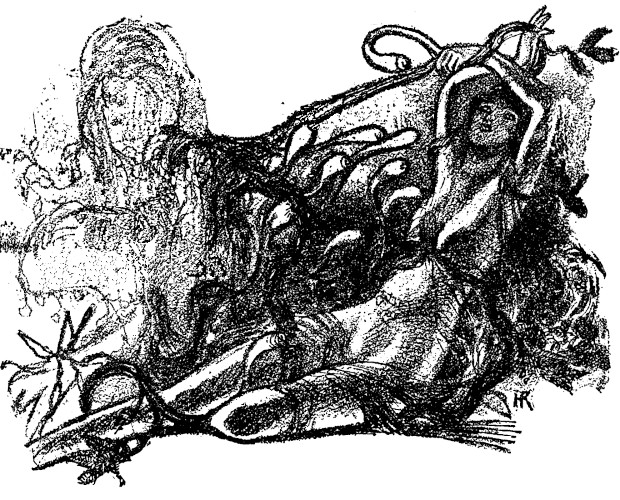
"Frannie struggled in the grip of the blood-red, vegetable thing."
And ahead of it was a line of others of its kind, leading the way, slithering up and over the opposite slope!
To Frannie, the subterranean river was an inferno of roaring blackness. Her dhrane was whirled along, sometimes swimming, sometimes floundering desperately. Frannie clung to its antlers and closed her eyes. . . . An eternity. . . . She heard Rokk shouting; felt the dhrane scrambling upon solid ground. The water dropped away from its sides. . . .
Frannie found herself and her dhrane standing in a dull, luminous darkness upon a ledge by the river. The other dhranes were there. Rokk spoke to Leela.
"What does he say?" Frannie demanded.
"He says we must get larger—this is too dangerous."
They followed then the methods used afterward by Degg in guiding Martt and Zee. Wading, in a large size, they went down the river. Then into the passageway leading upward.
And then the climb into largeness. To Frannie it seemed unending; but though they were only an hour or two ahead of Martt in starting, they were several hours ahead when they reached the giant world. Frannie and Leela were near to exhaustion, even though they had ridden most of the way. Rokk had not paused to sleep.
It was day when they reached the desolate land of the Arcs. Then a tomblike night; then blood-red day again.
Rokk rode now with Frannie and Leela beside him, and the woman Mobah behind. Rokk was jubilant. He talked swiftly to Leela. At intervals, Leela translated.
"He says he is glad to have us. He is taking us to his house—his mound, he calls it. He says, very soon there is something important happening up here. He is going to take us—show us it—happening." Leela shuddered.
"What is going to happen?" Frannie demanded.
"I don't know. Something—sinister, horrible. You saw his face when he told me?"
Frannie had seen it, indeed, but she was striving to master her fear. There was something queerly sinister, inhuman, about Rokk. And his smile had a leer to it. Shining in his dark eyes, which often were fixed thoughtfully on Leela, there was a look Frannie could not fail to understand. The woman, Mobah, had noticed it. Once, over her broad expressionless face a torrent of passion had swept. Hate? Jealousy? It flashed at Leela—and at Frannie—and was instantly gone.
Frannie said now, "Ask him what he wants of us. Why did he ever go down into our world?"
Leela listened to Rokk's smiling explanation. The man's voice was soft, caressing. Leela went white.
"He says, Frannie—he says his world here is very harsh—not good to live in. There is very little food—he says that he and some other men—his followers—are planning to descend into my world and conquer it. Kill all its men—Frannie, don't you understand?—kill, just the men of my world——"
There was a silence. Then Leela added, with a frightened hush to her voice, "Up here all is bleak and terrible. The women are all like this woman behind us—unbeautiful——"
Rokk was riding faster now, and soon, as they ascended a rise of ground, his home came into view. It lay on a falling slope, with paths trodden in the snow about it—a bulging mound built of pressed blocks of the gray-black snow. It rose above the surface perhaps ten feet—an oblong mound twenty feet wide and five times as long, like the grave of some giant buried there, with a small upright chimney at its farther end for a headstone. A few rectangles of white marked its doors and windows as though one might care to stand on the ground and gaze down at the coffin entombed within. Near by, two other mounds lay like the graves of children, with beaten paths connecting them.
Rokk's home was set alone in the midst of this snowy waste! Frannie's heart was cold with apprehension. What was to be her fate—and Leela's—within?
At Rokk's call a half-grown boy appeared in a doorway of the main mound. He led the dhranes away. Frannie and Leela were taken down a crude flight of icy steps and into the mound. It was much longer than it appeared; it seemed to extend at least another story underground, for Frannie saw an incline leading downward.
They had entered the top story. Rokk led them along a passageway; Frannie saw low-roofed rooms, with ceilings curved to the mound. Each with a window opening at the ground level; and with crude furniture seemingly fashioned from stone blocks.
Into such a room Rokk ushered them. He was smiling, bowing like a friendly host; his words to Leela were suave. But in his eyes there was an unmistakable irony, and when Frannie hesitated at the door, he pushed her roughly.
Mobah had disappeared. Rokk stood a moment talking to Leela. The door to the passageway was open. Rokk and Leela had their backs to it. Frannie became aware that beyond the door Mobah was standing listening. And in the dimness there, Frannie caught a glimpse of the woman's intense face. It was torn with a jealous passion—a torrent of loosed passion debasing its calm stolidity into an aspect almost bestial.
As Rokk turned slightly, the lurking woman silently fled. Rokk bowed to Frannie, and to Leela—a bow ceremoniously grotesque, but with a dignity, nevertheless. His hand lingered on Leela's white arm, but Leela jerked away. He shrugged, smiled, and went through the door, barring it after him.
"Oh, Frannie!" Leela at last gave way. She sobbed with fright unrestrained; and this gave Frannie additional strength to be calm. She sat Leela on the couch—a railed slab of stone, with a litter of furs on it like the bed of an animal. She tried to comfort Leela. Then left her; tried the door softly. It was stoutly barred.
Then she tried the window. It had a pane as transparent as glass, but evidently unbreakable. Frannie struck it recklessly with her fist. And there seemed no way to open the window. Through it Frannie could see along the snow-covered ground outside. The night had just come. The ground was dark, with faint stars showing above.
Frannie sat on the bed with Leela. They were both so exhausted that for a time they slept. Hours, perhaps—Frannie never knew. Then she awoke. The scene in the room was unchanged. It was night again. Leela was awake. Frannie began questioning her as to what Rokk most recently had said. Leela was outwardly calm now.
"He—insists we are not to be harmed, Frannie. He told me—just before he left—that he wanted me to like him." A shiver ran over Leela's frail body. "He will work to make me like him—he will be very good to me. And you—he says there is a young man—that man he left back in Reaf—named Degg. He is sure Degg will like you, Frannie."
"Did he say any more about that important thing which is going to happen?"
"Yes. He said he is going to take us somewhere—as soon as we have rested, and Degg has come to join us here. Take us somewhere—where we shall see a wonderful awesome sight. Frannie, he told me the men here in this world do not like their women. He has brought me and you—to show us to the men—that they may see how beautiful women can be. Then—they will join him to go down into smallness—to conquer——"
Leela choked. She added, and a hush fell upon her voice: "Frannie, this Rokk has planned it all. He says there is too little food here. The women—and the children that the men no longer want to feed—are all placed apart. Exiled to a city—where he is going to take us. And show us——"
A tapping at the window checked her. The girls stared at each other with the blood draining from their faces. A gentle tapping from outside. A scraping, fumbling as though soft fingers were working at the window.
Frannie stood up, trembling. Then she moved along the wall, and with her face to the window, peered out. The tapping had stopped. Outside she saw a faint, lurid red glow. And three gleaming spots of green. Moving, peering. And then like the tendrils of a creeping vine, a leafy something, with a red sheen upon it, gently beating at the pane; tapping—fumbling.
Frannie drew back. "Leela—out there——" But another sound stopped her. Someone—something—was unbarring the door of their room! The two girls were frozen with terror, incapable of sound or movement. A bar dropping with a muffled thump! The door slowly began opening inward. . . .
It was the woman Mobah. Her face was grim; her dull eyes were smoldering green-black coals. She flung a menacing glance at the girls, moved swiftly across the room. Her fingers at the pane touched some hidden lock. The window swung open.
Mobah darted back, seized Leela, tried to shove her toward Frannie and the window. Leela screamed, resisted, fought with all her little strength and called a warning to Frannie.
But it was too late. Through the window a thick, red-glowing tentacle came slithering. Its green eyes were waving triumphantly. It caught Frannie; rolled back upon itself, jerking her upward.
Heavy steps sounded in the passageway outside the room, and Rokk's alarmed voice, shouting. Rokk burst in. He knocked Mobah aside with a blow of his fist, and swept Leela protectingly backward.
The segment of red thing within the room slithered out the window, carrying Frannie with it.
II
"She is gone, my lady Leela. It is unfortunate, but we can not help it. She is lost—we shall never see her again."
Leela and Rokk were alone in the room. Leela shrank upon the couch; against his gaze she huddled with a corner of the robe drawn to shield her white limbs. He stood before her.
"Gone, Leela. Dead, by now. . . . Don't shudder, little white woman. It is the law of life—some live, some die. . . . But Degg will be sorry."
She had no words, no heart with which to answer.
He went on, with a frown crossing his face. "That vegetable thing coming here has changed my plans. It has no right to be unrooted. I grew it, Lady Leela—and many others of its kind—for a certain purpose. But now it has broken away, before I was quite ready to dig it up. It thinks it is full-grown. It is conscious of its power. And that which during all its growth I have taught it to do——" He shrugged. "I suppose they have all broken loose. All roaming——" A horrible grimness came to Rokk's voice. "Well, they will do what I taught them—we shall have to hurry if we wish to see it, Lady Leela."
Leela summoned words. "To see—what?"
He smiled. "You are impatient—and as becomes only a woman—curious! You shall see, little white woman—blood-red things——" He gestured. "Enough of that. But you shall realize how great is Rokk. I planned it all. But now I shall have to change my plans a little. I had wanted to show you and your friend—the little Frannie—to the men of this world. So that they—our men—would know how beautiful women can be. There is no time now, with the red things broken loose. We shall have to be careful, my Leela. I shall send word to all the men everywhere to have a care. . . . I wish Degg would come—but we can not wait for him now. . . . There are animals, too, who should be guarded from these roaming red vines I have grown. You have not seen our animals, Leela? Degg has one—a very friendly thing; we call it Eeff. It is but half human—and only half materialized into substance. A loyal friend, if it likes you. But its mentality is that of an imbecile. . . . I talk too much, like a loose-tongued woman. There is no time—we must start."
He called roughly, "Mobah! Come here at once!"
The woman appeared, sullen, defiant. On the flesh of her heavy gray shoulder was a red bruise where Rokk had struck her.
"Mobah! Bring the dhranes. We are leaving for the Ice City. Tell my boy here to have Degg follow us when he comes. . . . Hurry! . . ."
III
They rode fast. Alternate night and day—endless frozen wastes. Occasionally they passed single mounds, isolated like that of Rokk. Others in groups; blood-stained graveyards by day—eery and gruesome in the starlight. Leela saw many of the green-white animals, lurking like werewolves prowling among the mounds. And there were men gazing curiously at the travelers. To them often Rokk gave a warning that the vegetable things were loose.
But he said to Leela, "There really is no danger. These things I have grown will do my purpose in the Ice City. Then I will command them back to their fields. Let them rot there harmlessly in a red welter. I can control them. They know me for their creator—their master."
There were few women or girls to be seen about the mounds. Rokk said, with a horrible irony, "We have sent most of them to the Ice City. It is a very beautiful place—we men have sent our women there. The women——" He laughed sarcastically. "They are very stupid. They do not guess our purpose."
They rode in silence. Then Rokk spoke again. "My woman, Mobah"—he glanced behind at the patient figure riding behind them—"I have kept Mobah with me. She is good to work in the mound. But you, my Lady Leela——" He chuckled. "We shall get rid of Mobah all in good time. We do not want her around, do we? But I will not make you work, Leela. In your city of Crescent, little white woman, you and I will be very great people. I shall be the leader of all our men——"
Again Leela did not answer.
A red day plunged into night. Far to the left across the snowy wastes to the distant horizon, Leela saw a white radiance in the sky. A vague patch of silver, as of light reflected from some remote distance below the horizon. Rokk waved his hand.
"You see that, Leela? That is where I found the drugs. This globe is very fair, off there. Longer days and nights. A warm, fruitful summer. Food is there. Trees, with fruit. But it is all owned by another race of people. They will not let us in. They are very powerful—very far advanced in civilization. A wonderful age of science. . . . They know everything. I crept into one of their cities and stole the drugs."
To Leela then was driven home the conception of how vast is God's great plan of the Universe. This miserable region owned by Rokk's people was no more than the Polar waste of this globe. A fairer land of science lay there where the distant radiance showed. A great, cultured civilization perhaps. And farther beyond it—other races—all on this one tiny globe whirling among these stars. . . .
They came at last within sight of the City of Ice. In the starlight it glittered with a pale sheen. It stood on a broad plateau above the surrounding valleys—a place of white spires, glittering under the stars, the whole surrounded by a high white wall of ice.
And as they came closer, Leela saw within the city a yellow-red glare. Behind it, a high tower of stone dominated the scene; the glare painted the tower a yellow-red upon one side. "The pit of fire," said Rokk. "The one place in all our realm where the fires underground come near the surface. It brings a warmth—a beauty. You shall see." He laughed his horrible laugh. "That is why we tell the women they should like it here——"
They approached the wall. Rokk gazed around. "We are but just in time." In the farther distance beyond the city was a red sheen against the ground. Rokk understood it, though at the moment Leela did not. "Just in time, little woman. I had thought we might better enter by the tunnel under the wall. But that is not necessary."
They rode through a gate, plunged at once into a passageway, and emerged presently within the stone tower, left the dhranes there, and mounted the tower. At its top, Rokk stood with Leela. Mobah sullenly was behind them. Rokk glanced back at her. He said softly, "I think perhaps she guesses what is to happen. But she can do nothing about it."
Presently Mobah moved away and disappeared. Rokk patted his belt. "I have all the drugs here, Leela. All there are in this whole realm—except a very little of each which I left with Degg. We must guard them carefully."
To Leela came the thought that she might gain possession of the drugs and thus escape. But Rokk was very watchful.
They stood upon a broad balcony, with the single tower room behind them and a breast-high parapet in front. At the parapet, Leela gazed down. From this height the city lay spread beneath them. It was still night. A simple, placid scene, quiet, and in a measure beautiful. A few broad streets of packed, gray-black snow. Flat, oblong houses of ice blocks which were white and glittering, with spires and minarets occasionally adorning them.
Directly beneath Leela, at the foot of the tower, was a yawning yellow-red pit. She could see directly down into it; a glare, some great distance down to where the fires of the earth were broken out. Rising wisps of smoke . . . a sulfurous, fiery breath . . . and a torrent of grateful heat surging upward.
Around the pit, the city was built of stone for a distance, like a broad, square park. Trees were growing there; huge, graceful ferns; blue-green leaves like great flopping ears of an animal. And giant palms, hung with purple fruit. . . . A tropical garden, with flower-lined, winding paths. . . . By contrast with all this bleak region Leela had seen, the single little park was very beautiful.
There were a few women moving about the city—dull, heavy-looking, shapeless women robed in a monotone of drab garments. Uninspired of aspect. Yet each had a soul . . . desires . . . longings. . . .
In the park a woman sat and played with a little girl. There was another woman, newly arrived here, with a baby at her breast. . . .
Rokk's voice broke upon Leela's thoughts with a rasp. "But who is to feed them? It gets very tiresome, giving them food. . . . Ah! Now you shall see my solution, Lady Leela——"
Beyond the city walls, out over the starlit, snowy wastes, spots of red sheen were visible. Moving. Coming nearer. Spots of red sheen resolving into long, thin lines of red. Undulating, twisting, slithering forward. Green spots of eyes, waving, peering.
Red, growing things unrooted. Coming monstrously to do that for which during all their growth they had been trained. There seemed thousands of them. Over every distant slope they came closing in upon the city. Thick red vines a hundred feet long. Others grown into a tangled clump, every separate tendril of which was in slimy movement. A red boll, like the bulging trunk of a tree. It rolled, leaped. Another of a flat, round central growth, with prickling spines like huge needles standing erect, and waving, groping tentacles. It hitched itself along, awkwardly.
They came from everywhere. Red, gleaming monsters of the ground, advancing with a grim, uncanny silence, closing in upon the city.
Leela watched, with the blood freezing in her veins. Within the city no alarm had sounded. The woman in the park played with her little girl. But the baby at the other woman's breast was crying. . . .
The first of the red things reached the city wall. Slithered up like some monstrous red ivy growing there. A thing of dangling green pods from which a slimy juice was dripping. A segment of it raised high over the wall, with green eyes staring down.
In a near-by street a headless, friendly animal gave out its imbecilic cry. The two women in the park looked and saw, and screamed. . . .
The red thing rose and slithered over the wall. Stretched its length down a street; then encircled a house, its wide-flung segments slithering into every door and window. Screams from in there sounded over the silent, starlit city. Shrill, throat-tearing screams of women . . . and the piping, terrified cries of children. . . .
The alarm spread. The cries were caught up, echoed from everywhere about the city. Women and girl children were rushing in a panic from the houses. . . .
Over the wall at its every point, the red things were climbing . . . spreading over the city . . . filling the streets . . . climbing with a red, leafy growth into houses . . . green peering eyes, searching everywhere. . . .
One of the flat, round growths with prickling spines—needles each as long as a human body—lurched itself into the park. With a sudden spring it caught a running woman. Its tentacles tossed her aloft. She fell, impaled upon its swordlike spines. Its tentacles pulled an arm from her body . . . tossed the arm away. . . . The woman was still screaming—horribly. . . .
Leela, sickened, covered her face with her hands. She heard Rokk's gloating voice, "You see—my solution? Look, little white woman! Make your heart stout, like Rokk's. This is the law of life. Some live, some die. We—you and I—will live, for love, when this blood-red day is over."
Day! The dawn had come. The red sun rose from the horizon in its low arc. Red, staining everything.
Leela, with a fascination, again involuntarily stared. The city was a chaos of terror. From windows, with reason fled, women were leaping. The red things caught them as they fell. . . . On a flat housetop a woman crouched with a baby in her arms, and a little girl huddling at her knees. A slim red arm came up over the parapet of roof. Other red things came up, and poised with watching green eyes. The woman fought the red arm with all her meager strength. It seized the baby, waved the small, gray-white body aloft, dashed it to a red pulp against the stone of the parapet. Other arms jerked the little girl away. A flat, red thing engulfed the woman and sat mouthing and tearing. . . .
In the park a crowd of the women were huddled. Some were trying to climb the high railing at the pit of fire, but could not. The red things slithered among them. . . .
The blood-red day! A white, glittering city, stained crimson now. Splashed and stained; and upon it the red sun poured a polluting, gory light. . . .
The blood-red day. . . .
Martt stood in the starlight at the top of the slope, frozen into immobility with horror. Frannie was struggling in the grip of the red vine, being dragged along, with others of its kind leading the way. Grown and taught for nothing but the blood-red day of the Ice City, these things with single purpose were dragging Frannie there.
Martt stood stricken for an instant. The red thing paused. All its green eyes turned. Beyond it the other things came to a stop, irresolute, and then slithered on. But the one with Frannie lay momentarily quiescent; only its eyes were quivering.
Martt became aware that Zee and Degg were beside him. Eeff was crouching at its master's feet, whimpering with terror. Martt shouted, "Zee, run back! Come on, Degg!"
He caught a glimpse of Degg's face, gray with fright. But his eyes showed a sudden determination. And Degg leaped, with Martt after him.
The red thing flung up its forward tentacles, and shoved Frannie farther back within its folds. Degg leaped for the clump of its branches where Frannie was entangled.
Martt, running forward, abruptly stopped. One of the drug cylinders within his pockets had bumped his thigh. A thought swept him—the drug for smallness! He stopped; recklessly poured from the cylinder nearly half its contents. And stood, with a huge buckle of his jacket, crushing the white tablets into a powder in his hand.
Degg had fought his way to Frannie. He had torn her loose, thrust her violently away, but was himself entrapped. He fought, ripping, tearing at the red branches, struggling to avoid the sinuous tentacles which curled back at him. A thick tendril of the vine had wound itself about his legs. . . .
With the powder in his left hand, Martt rushed forward. There was a part of the red thing which seemed of lesser size and strength. Martt rushed in among its lashing brambles. They entwined him. He ducked the sweep of a tentacle thick as his body. Eyes on the branches peered into his face. He seized one, pulled it off. A slime with a red phosphorescence was on his fingers. A pod struck his face; he tore it open and scattered its seeds. A red, noisome juice spattered him. . . .
Martt was fighting only with his right hand. One of his legs was gripped and held; he kicked, striving to free it.
These smaller branches were easily broken. They mashed, some of them like a porous, tropical plant, oozing sap. They were spongy. Martt scattered a little of the white powder; sifted it through his fingers. The vegetable growth sucked it up—the drug mingled with the sap of its bruises.
The branches were dwindling. Upon vegetable the drug acted more swiftly than upon animal cells. The smaller tendrils shriveled. Then branches of greater thickness. Martt could feel them letting go their hold—shrinking, loosening their grip.
Around him in a moment was a shriveled, shrunken bramble. He kicked himself free. A huge tentacle from another portion licked back and seized him; whirled him aloft. But he kept his wits. Tore at it with his fingers; rubbed the drug into its bruised bark. Along all its length, the drug acted. Martt's weight brought its shriveled strength to the ground. He fell upon his feet; tore himself loose again. Stamped and tore, and leaped away.
Throughout all the length of the monstrous vine, now, the drug was acting. Martt momentarily stood inactive, panting. He saw that Degg had freed Frannie—saw her and Zee huddled at a distance on the slope near by. Degg was still fighting; one of his legs seemed queerly twisted; an arm of the red vine held him, but he kept his feet. Eeff was darting forward and back, too much terrified to approach, yet anxious to help.
The vine everywhere was shrinking. Martt ran to free Degg. But he was too late. The largest remaining tentacle lashed forward; it caught Degg, whirled him up in the air and flung him heavily to the ground. Degg lay still.
A moment. Then the vine was so shriveled that Martt waded throughout its lashing length. Tore it apart. Scattered it. Stamped upon its twisting, slithering red segments.
All dwindling. Separate, dismembered segments quivering around him . . . smaller . . . red, twisting lines, with tiny green eyes. . . . They winked and vanished into smallness. . . .
II
"Is he dead? Oh, Martt, do you think he is dead?"
They bent over Degg and he opened his eyes. Martt knelt and lifted his head. It was evident that he was dying; and evident, too, that he knew it. He spoke, laboriously whispered words in Zee's language. He tried to gesture toward Zee; on his face was an earnestness, almost a desperation lest he might fail to give his dying message.
Martt said, "Zee, he's trying to talk to you. Bend closer—he's talking."
Zee knelt at his head. He was panting, struggling breathlessly with each word. "Rokk—was going to take your sister Leela to the—City of Ice. Now that the red things are loose—I think you will find—him and her—there."
His breath ended with a long sigh. But he began again. "Eeff will lead you. Tell Eeff—to take you through the—tunnel into the—stone tower. And—hurry!"
His eyes closed. Then they opened very wide. They tried to focus on Zee's face. She bent lower to hear his faint whisper. "Hurry! You understand—about Leela, there with Rokk. He means, for her, a thing very terrible. You must—hurry." He added, with a breath so faint she barely heard his words, "You are—so very beautiful, little Zee. I never saw—any woman so beautiful. But I am not Rokk—I could not have harmed you."
He stiffened just a trifle; then went limp, his head with staring eyes dangling backward over Martt's arm.
Martt laid him gently on the ground. Eeff went and sat by him, crying softly.
III
It was red day when they approached the City of Ice. Eeff had led them, as Degg suggested. They saw the city from far off, with a red glow staining its white glitter. Then Eeff plunged them into a black tunnel. It seemed miles. Then it ascended, and they emerged into a wave of heat, with a yellow-red glare beside them.
They were at the bottom of a tall stone tower; a doorway was near at hand. Martt gazed up the tower's side. A man was up there, behind a parapet, gazing out at the city: a man's head and shoulders, queerly foreshortened. But Martt recognized him.
Rokk!
Martt pushed Zee and Frannie hastily into the tower. He commanded, "You two stay here, with Eeff. I'm going up. You stay here."
Again Martt thought of the drug cylinders he was carrying. He drew them from his pockets, handed them swiftly to Zee. "Keep these. Whatever happens—if I don't come back—use them. Eeff will lead you home. To Reaf. Ask it if it can lead you."
Zee said, in her own language, "Eeff, come here. Can you lead me back—down there where we met Degg in that place called Reaf? You remember? Where the water was?"
The headless thing turned its eye upon her. It chattered, "Yes, I remember. I can go there—but I want Degg. I want to go back to Degg."
Martt, alone, mounted the circular incline softly, and as swiftly as he dared. Had Rokk seen him? He did not think so. Was Leela up there? . . . If he could get behind Rokk unobserved. . . .
Half-way up there was an oval window in the tower through which Martt caught his first view of the interior of the city.
The sun was sinking at the horizon. The end of the blood-red day! A silence had fallen with the falling sun. A crimson city, strewn with what had once been living, human flesh and blood—dismembered now . . . strewn . . . unnamable. . . .
And climbing the walls, red monsters slithering away—seeking other horrors.
The silent nightfall of the blood-red day.
Martt's gorge rose. He turned from the window, and mounted the incline.
The room at the top was circular, with many windows. An empty room of stone, almost dark, with the starlight streaming in dimly to illumine it.
Martt crept softly. Through a doorway he could see Rokk's figure on the balcony outside. And another figure. Leela, white of face, with her black hair streaming, and her tattered, dirt-stained veiling falling about her. Leela! She was standing, half turned, shuddering with horror. She saw Martt! Surprize, wonderment, joy mirrored her face. His fingers went to his lips warningly. But not quite in time. She uttered a low cry, instantly checked.
Rokk swing about. He, too, saw Martt; he stiffened, with his shoulders flung back against the parapet and his jaw dropping. Martt had instantly leaped, but Rokk met him squarely, surged forward, and they fell.
Rokk was the stronger; Martt knew it at once. He rolled, desperately struggling to come on top, with his legs braced against the floor. But Rokk flung him off and regained his feet.
Instantly Martt was up, quicker, lighter than his antagonist. He struck for Rokk's face, missed and then caught Rokk full on the chest with his fist. The man staggered, but he was not hurt. Rokk's swing went wide, as Martt nimbly ducked. Again they came together. Surged across the balcony, kicking, tearing, seeking each other's throats. Locked, with legs entwined they struck the parapet, rebounded, fell and rolled together to the opposite wall. A primitive struggle of men using only the weapons with which nature had endowed them. Fighting grimly, almost silently, each with no thought but to kill.
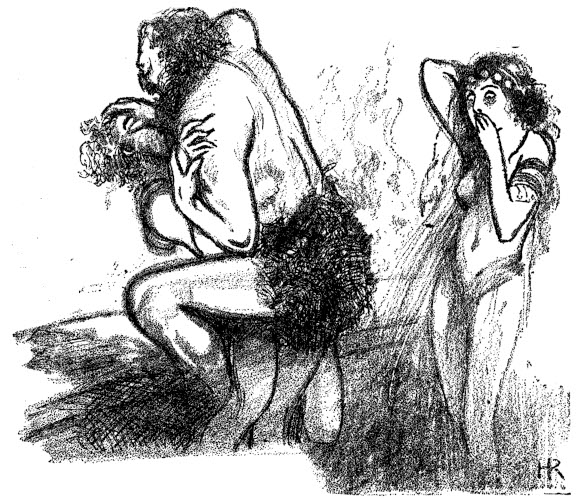
"He had no other thought but to kill."
Leela, near by, stood helpless, confused, a hand pressed against her mouth in terror. There was a sound, a startled outcry. Frannie and Zee were in the tower room, with Eeff cowering behind them.
Martt momentarily was on top of his adversary, with Rokk's hairy hand beneath his chin, pressing his head back. Martt ripped the hand away. He called, "Run! Run—all of you!"
Rokk heaved him backward, half rose, and surged over on top. Martt saw vaguely another figure appear on the balcony. A heavy, gray-faced woman. He heard Rokk pant, "Mobah!"
The woman leaped upon the scene. She avoided Zee and Frannie. She strove to get at Martt. She kicked; she tried to strike at him. He heard Zee's voice, "Frannie! Leela! Help me!" As he fought, he was aware that the three girls were pulling at the woman—pulling her away, holding her.
Martt momentarily had slackened his efforts. Rokk's fist caught him in the face, dazed him. Martt felt Rokk lifting him up, heaving him. His body struck the three-foot-wide, level top of the parapet. He clung desperately, as Rokk leaped up to throw him off.
They were locked together, rolling on the parapet top! Martt at its edge, his head momentarily over, felt a wave of heat—saw, far down, the red-yellow glare. Rokk suddenly tried to cast him loose. Then was pushing. They were both lying at the edge.
Scrambling. Panting. And suddenly Zee was up on the parapet, crouching—her frail white hands gouging at Rokk's face. It confused him. He relaxed. Martt gave one last desperate surge. He saw, and felt Rokk's body slipping, sliding over the edge, feet first. Rokk's hold on Martt was torn away, by his own weight and by Zee's frenzied, plucking fingers. His face, close to Martt's for an instant, showed wide, terrified eyes; a mouth that gaped.
His hold broke. His body slid. He was gone! Martt lay panting at the edge, with Zee's steadying grip upon him. A cry sounded. A wail. The woman Mobah had torn loose from Frannie and Leela. She leaped to the parapet. Poised for an instant—a grim, gray statue of despair. Bereft of reason, she called, "Rokk! Rokk!" And with a long, shuddering cry, she plunged.
There was silence for a moment on the parapet. No one looked down. And from over the distant, desolate horizon, presently the red sun came up with the dawn of a new day.
Life is very strange. Brett and I—Frank Elgon of the Interplanetary Mails—of full maturity, at the peak of our physical and mental strength—how inglorious were the parts we played! So inconsequential I scarcely have the heart to recount our futile actions. Yet we thought always that we were doing our best.
We stood there beside the arcade, helplessly watching Frannie and Leela disappear into smallness. Brett left me to guard the spot. He rushed away; came back to tell me that the giant wading in the lake was gone, that he could not find Martt or Zee.
For a time we watched the small pebble beneath which Leela and Frannie had vanished. We even dared to move it carefully, but we could not see them.
The island was emptying of its people. We thought that Martt and Zee might have gone home. We decided to go and join them. Perhaps to take our vehicle, make it small to search for Leela, since we had no drugs.
I told Brett of his father's death. And it was well advanced into the morning before we learned that people on the island had seen Martt and Zee sailing for Reaf. Hours during which we had aimlessly searched, and prepared the vehicle for its trip into smallness to try and find Leela and Frannie.
Martt and Zee had sailed for Reaf! Following the giant! We had thought of doing that, to try and obtain the drugs. But it had seemed reckless, foolhardy, impossible of success. Yet Martt had done it without hesitation. There is a caution comes at thirty which does not hamper twenty-one.
We procured a boat. Provisioned it. And sailed for Reaf, armed with our flash-cylinders. And there we found a huge belt lying on the rocks near a scattered wreck of buildings strewn upon the water.
Martt's belt, of a size which showed us he had used the drug! He had left the belt to explain that he had gone on to the giant world.
But we were utterly helpless! We could not follow him. We were starting aimlessly toward the river, when along the rocks there, we saw four moving figures. Normal in size. Martt, returning with the three girls! All of them tattered, bruised, blood-stained, their garments dirty and torn. But unharmed.
They waved at us. We landed and ran along the rocks. Martt's smile was tired, but very happy.
"Here they are, Brett. I brought them back—Zee and I did—here they are." He added, "We had a headless thing named Eeff. It led us back, but just now at the last, it ran away. It said it wanted to find Degg. It ran, forgetting it needed the drugs. A half-witted, cowardly sort of thing, but I liked it. Oh, there is so much to tell you——"
Deeds of youth! No caution, no pondering! Glorious deeds of youth, unfettered by maturity! No theory—just accomplishment!
Frannie was saying to me, "Oh Frank——" I held out my hand, but she flung herself upon me. "Frank, I—I've wanted so to get back to you!"
She clung to me. Her arms went around my neck. She was kissing me! Me, Frank Elgon! Poor as a guider of the lower traffic, and just now proved so inglorious of action. But Frannie was kissing me! And whispering, "Oh, Frank, I love you! Don't you know it? Haven't you always known it? You'd never say it to me. Please—please say it now!"
I murmured, "I love you, Frannie!" And held her close. That this could happen to me, ineffectual Frank Elgon!
II
Our last evening in Crescent. We were all going to the Earth—all but old Greedo. Brett and Leela had decided to be married on Earth. Frannie and I also, for Frannie did not seem to care how poor I was. Greedo wanted to go; but he said he was too old. A visit to Earth for his daughters, and then he hoped we would come back. Our last evening. I chanced to go alone to the roof-top of Greedo's home. Its banks of flowers were vivid in the twilight. A breeze rustled the tall potted ferns. The stars overhead were glowing with a silver radiance, mirrored in the distant, placid waters of the lake. Within the house downstairs, Leela's softly singing voice floated up.
Two figures sat in the starlight, among the flowers. Zee and Martt; close together, with his arm around her, and her head against his side, the tangle of her dark hair enveloping him.
I heard him say, awkwardly but very tenderly, "Three couples can be married at once, on Earth, Zee. Let's do that. Shall we?"
And heard her answering whisper, "Yes. Let's."
I tiptoed silently away.
THE END