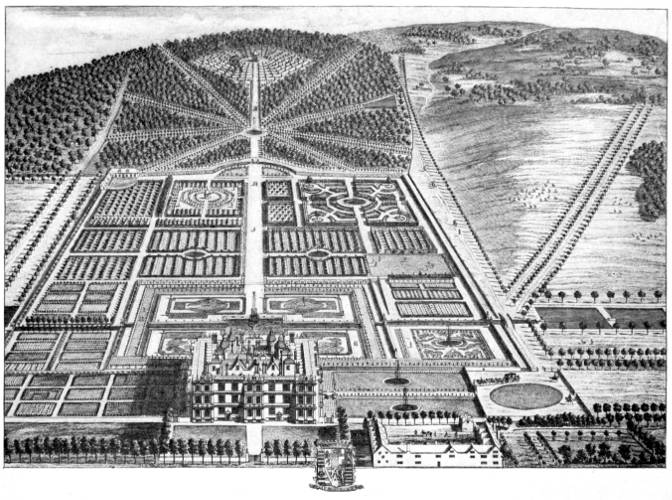
LONG LEATE
By L. Knyff and J. Kip
Title: The treatment of nature in English poetry between Pope and Wordsworth
Author: Myra Reynolds
Release date: December 17, 2025 [eBook #77487]
Language: English
Original publication: Chicago, IL: The University of Chicago Press, 1909
Other information and formats: www.gutenberg.org/ebooks/77487
Credits: Jamie Brydone-Jack, Karin Spence and the Online Distributed Proofreading Team at https://www.pgdp.net (This file was produced from images generously made available by The Internet Archive)
BETWEEN POPE AND WORDSWORTH
By
MYRA REYNOLDS
CHICAGO
THE UNIVERSITY OF CHICAGO PRESS
1909
Copyright 1909 By
The University of Chicago
Composed and Printed By
The University of Chicago Press
Chicago, Illinois, U. S. A.
[v]
The eighteenth century is a period of transition and as such its literature holds two elements, a vital impulse past its prime but still dominant, and a new conception gradually emerging into dominance. It is the interweaving of these elements, the slow fading of the old, the slow gain of the new in fulness, definiteness, and ardor of statement, that make this period peculiarly interesting for detailed study. The interest persists even when the transition to be studied is limited to so narrow a section of human experience as the attitude toward Nature.
The investigation, the results of which are embodied in this book, was primarily undertaken to determine the place of Nature in the poetry before Wordsworth. Every genius is, to be sure, more or less of a miracle, and certainly not to be accounted for by any conditions of literary heredity or even environment. But he cannot, on the other hand, be justly thought of as an isolated phenomenon. Though not the direct heir of any particular predecessors, he is, nevertheless, in a vital and inescapable way, the heir of the general tone and temper of his own and preceding times. In that fact lies the justification of a study along historical lines of any recognized tendency in thought. The pleasure of the biologist in the lower forms of life is paralleled by the delight of the student of literature in tracing out the first vague, ineffective attempts to express ideas that are afterward regnant. In the present study the final effect is one of surprise to discover not only how early the new thought of Nature finds expression, but how completely the ideas of the period of Wordsworth were represented in the germ in the eighteenth century. The whole impression is that before the work of such men as Wordsworth, Scott, Coleridge, Shelley, Keats, and Byron, there was a great stir of getting ready. It may fairly be said that before Wordsworth most[vi] of his characteristic thoughts on Nature had received explicit statement.
In the pursuance of this study it soon became apparent that to confine it to poetry was to limit the investigation unwarrantably. The interest of the work was many times increased, and the deductions were rendered much more certain, when the same transitions, the same periods of change, the same tastes, the same emotions, revealed themselves side by side in poetry, painting, fiction, travels, and gardens. Furthermore, the vitality of the new impulse toward Nature is shown by the number of directions in which it insistently demanded expression. Almost independently of each other the various arts seem to have been pushed forward from within to some sort of recognition of the growing interest in the external world. In each art there seemed to be an unconscious preparation for the master that was to come. Notably does this appear from the chapter on painting. Constable and Turner were foreshadowed and prepared for as evidently as was Wordsworth. When at the end of such a period of preparation the great poet or artist comes, he is great by virtue of his power to penetrate beneath literary conventions and to give final literary form to the half-articulate thoughts and feelings out of which the thoughts and feelings of his own epoch grow. He has his natural place in the development. The significance of his work rests in the fact that while it directs the future it also sums up the past.
The first edition of this book has long been out of print. The natural impulse, after an interval of ten years, is to subject a new edition to a complete revision, with the rewriting of many portions. Revision as drastic as might be desirable has not, however, proved practicable. Various studies of special authors have been brought up to date in the light of new material concerning them, as, notably, in the sketch of Lady Winchilsea. Two chapters, the one on “Painting” and the one on “Gardening,” are entirely new, and it has, fortunately, proved possible to add a number of interesting illustrations of these chapters, mainly from old prints. With these exceptions the book remains substantially as it was[vii] ten years ago. In no case has further study made it necessary to modify any of the general conclusions on the basis of the earlier work. More intensive work in the different realms has happily but reinforced these conclusions.
Myra Reynolds
August, 1909
| PAGE | ||
|---|---|---|
| List of Illustrations | xi | |
| Introduction | xv | |
| CHAPTER | ||
| I | The Treatment of Nature in English Classical Poetry | 1 |
| II | Indications of a New Attitude toward Nature in the Poetry of the Eighteenth Century | 58 |
| III | Fiction | 203 |
| IV | Travels | 223 |
| V | Gardening | 246 |
| VI | Landscape Painting | 273 |
| VII | General Summary | 327 |
| Bibliographical Index | 369 | |
| General Index | 378 | |
[xi]
| FACING PAGE | |
|---|---|
| Long Leate | 249 |
| “The House and gardens of the Rt. Hon. Thomas Lord Viscount Weymouth, Baron Warminster, L. Knyff, Del. I. Kip, Sculp.” | |
| Hagley Park | 261 |
| “A View in Hagley Park, belonging to Sir Thos. Lyttleton Bart., to whom this Plate is inscrib’d by his most obed’t. Serv’t. T. Smith. G. Vivares Sculp.” Published Oct. 1749. | |
| John Maitland, Duke of Lauderdale | 275 |
| “From the original of Sir Peter Lely in the Collection of the Right Hon. the Earl of Lauderdale. Drawn by Wm. Hilton, R.A. and Engraved with Permission by I. S. Agar.” The print here reproduced was published March 1, 1820. | |
| Mrs. Carnac | 280 |
| By Sir Joshua Reynolds. In the Wallace Collection, London. From a photograph by the Muchmore Art Company, London. | |
| Squire Hallet and His Wife | 283 |
| By Thomas Gainsborough. Now in the possession of Lord Rothschild. From a photograph by Braun, Clement & Cie. | |
| A Calm | 286 |
| By Willem van de Velde. In the Gallery at Dulwich, London. “Drawn, engraved and published by R. Cockburn, Dulwich, 1818.” | |
| Dunnington Cliff | 288 |
| “A View of Dunnington Cliff. On the River Trent (Five [xii]Miles South East of Derby) belonging to the Right Honourable the Earl of Huntington, to whom this Plate is inscrib’d by his Lordships most Dutiful and most humble Serv’t. T. Smith. G. Vivares Sculp. Act of Parliam’t. Augt. 25, 1745.” | |
| Derwentwater | 291 |
| “A View of Derwent-Water, Towards Borrodale. A Lake near Keswick in Cumberland. To Edward Stephenson Esq’r. of Cumberland. This Plate is inscrib’d by his most Obliged humble Servant Will’m. Bellers. Painted after Nature by William Bellers. Engraved by Messrs. Chatelin & Ravenet. Published according to Act of Parliament October the 10th 1752.” | |
| Mount Snowdon | 293 |
| “A View of Snowden, in the Vale of Llan Beriis, in Caernarvon Shire. I. Boydell. Del. & Sculp. Published according to Act of Parliament by J. Boydell at the Globe near Durham Yard in the Strand 1750.” | |
| Cader-Idris | 297 |
| “The Summit of Cader-Idris Mountain in North Wales. Richard Wilson pinx’t. E. & M. Rooker sculpser’t. Published July 17, 1775 by John Boydell, Engraver in Cheapside London.” | |
| Kilgarren Castle | 300 |
| “Kilgarren Castle in South Wales, Richard Wilson pinx’t. Will’m. Elliott sculp’t. Published July 17th 1775 by John Boydell Engraver in Cheapside London.” | |
| Snowdon | 304 |
| By Richard Wilson. In the Manchester City Art Gallery. From a photograph by Sherratt and Hughes, Manchester. | |
| The Market Cart | 307 |
| Painted by Thomas Gainsborough. In the National Gallery. | |
| Pembroke | 311 |
| “Engraved by I. Walker from an Original Picture by Paul Sandby Esq. R. A. Published May 1st 1797.” | [xiii] |
| Lodore Waterfall | 315 |
| “Drawn by Jos’h. Farington. Engraved by W. Byrne and T. Medland. London. Published as the Act directs, April, 1785.” | |
| The Wood Cutters | 318 |
| Painted by G. Morland. Engraved by W. Ward. Published by T. Simpson, St. Paul’s Church Yard, London, 1792. |
[xv]
The general theme of the treatment of Nature in literature is not a new one. Schiller’s essay entitled “Ueber die naive und sentimentale Dichtung” (1794), was the first attempt to state and explain the difference between the classical way of looking at Nature and the modern way. The externality in the classical attitude toward Nature, he attributed to the fact that the Greeks were in their thoughts and habits of life so a part of Nature that they felt no impulse to seek her with the passionate longing of the modern poet, whose ardent and heartfelt love of Nature is but the result of a mode of thought and life out of harmony with her. This essay, however inadequate as a presentation of the Greek attitude toward Nature,[1] determined the lines of much succeeding study.
Alexander von Humboldt in his “Kosmos” (1845–58), in the midst of his scientific generalization and his encyclopedic accumulation of natural facts, takes occasion to discuss the treatment of Nature in poetry and landscape painting. The chapter on landscape painting is chiefly confined to such topographical, botanical, and other pictorial representations as serve to add to our knowledge of distant lands. The boundaries of the whole question are enlarged by a representation of the profound feeling for Nature in Semitic and IndoEuropean[xvi] races. There is a brief study of the mediaeval feeling for Nature as it appears in Dante, and finally of the treatment of Nature in some prose writers of the eighteenth century. The only English poets mentioned are Shakspere, Thomson, and Byron, the subject of English poetry being disposed of in less than a page.
In Ruskin’s “Modern Painters” (1843–60) are several most interesting chapters on landscape in classical, mediaeval, and modern times. “Of the Pathetic Fallacy” and “The Moral of Landscape” are also suggestive though misleading studies.
Victor de Laprade’s “La sentiment de la nature” (1866, 1868) contains in full the theories already suggested in the preface to his “Les symphones.” In the introductory chapters he outlines his conception of the development of art. He regards architecture as essentially the expression of man’s interest in religion; sculpture of his interest in the demi-god or hero; painting of his interest in the complex and varied life of man as man; while the characteristic art of the present age is music with which the love of Nature is closely allied, since both affect the mind indirectly through indeterminate and vaguely suggestive harmonies, and both tend by their complexity and subtlety to rouse sweet reveries, luxurious emotion, nameless longings, ineffectual aspirations, but leave the conscience and the will untouched. No one can read these critical studies by Laprade or his earlier poems without feeling his enthusiastic joy in the presence of Nature. But he feared this joy and counted it a part of the concupiscence of the flesh except as it became an avenue to communion with the divine spirit. His indictment against the passion for Nature in modern music, painting, poetry, fiction, science is that the material is everywhere exalted at the expense of the spiritual. To be of value the presentation of the external[xvii] world in whatever realm of art should subordinate its appeal to the senses, and emphasize its appeal to man’s inner life. Laprade’s work is a plea for idealism as against realism. In all his brilliant presentation of the attitude toward external Nature of different races in different epochs, this point of view must be taken into account. In his rapid survey of English poetry the poets to receive closest attention are Shakspere, Spenser, and Milton. In later times the most significant of the poets who “gravitent autour de Lord Byron” are Wordsworth and Shelley, who, in their attitude toward Nature, are respectively moralist and metaphysician. Byron’s distinction is that he alone found “le juste équilibre entre l’exubérance de la nature et celle du pur esprit.” Thomson’s “Seasons” are of value because of good genre pictures and vivid descriptions of English sports, but the initial force in the return to Nature is Burns.
Unquestionably the most important of the books that treat of Nature in the realm of art is Biese’s “Die Entwickelung des Naturgefühls im Mittelalter und in der Neuzeit” (1888).[2] The book is written with enthusiasm and is stimulating and suggestive. The subject-matter is well in hand, and so thoroughly organized that the great movements in the historical development of the love of Nature are easily grasped. The plan is comprehensive, including not only poetry, but, in briefer outline, landscape painting and gardening, and, incidentally, even fiction and philosophy. The least satisfactory portion of the book is the treatment of the love of Nature in English life and thought. There is some stress on[xviii] the development of the English garden, but English landscape painting is not mentioned. In the casual mention of English fiction the emphasis is on Defoe. In poetry two epochs are recognized, that of Shakspere and that of Byron. The chapter on Shakspere is a close and valuable study. The work of Byron is estimated with justness and sympathy, as is also that of Shelley. But the study of Wordsworth as a poet of Nature is singularly inadequate. His genius is considered as essentially of the pastoral-idyllic order, with now and then glimpses of an “echte Liebe für die Natur,” and an unmistakable pantheism. He is chiefly important as having done for England what Scott did for Scotland and Moore for Ireland, and as sounding certain notes which rang again in Byron “in verstärkter Tonart.” Thomson is the only eighteenth-century poet studied. Here again is a failure to recognize the real importance of the poet’s work. Biese acknowledges the truth of Thomson’s separate pictures of Nature, and his genuine love of the country, but denies his importance as a “pathfinder,” saying that he but followed where Pope’s “Pastorals” and “Windsor Forest” had marked out the way.
In 1887 appeared John Veitch’s “The Feeling for Nature in Scottish Poetry.” The first volume begins with the early romances and national epics, and takes up the chief poets down to James VI. The second volume is devoted to the modern period from Ramsay to David Gray. Most of the authors treated belong to the nineteenth century, but there are admirable brief studies of Ramsay, Thomson, Hamilton of Bangour, Bruce, Fergusson, and Burns. There is also a short but interesting chapter on the rise of landscape painting, with especial attention to its development in Scotland. Veitch’s book is written out of a full knowledge and warm appreciation of Scottish poetry and of Scottish Nature, and[xix] his critical dicta are usually trustworthy, though he shows, perhaps, a tendency to overemphasize the influence of Scottish poetry on the love of Nature in succeeding English poetry.
In John Campbell Shairp’s “Poetic Interpretation of Nature” (1889) are to be found studies of Homer, Lucretius, and Virgil; of Chaucer, Shakspere, and Milton; and of Wordsworth. Two chapters are devoted to the eighteenth century. Ramsay is the poet to whom the reappearance of the feeling for natural beauty is traced. Thomson is praised for his minute faithfulness in description, and his genuine love of the country, but his tawdry diction and superficial conception of Nature are heavy indictments against him. The chapter on Collins, Gray, Goldsmith, Burns, Cowper, Ossian, and the Ballads is interesting, but from its brevity is necessarily inadequate. The most suggestive chapter in the book is the one in which there is a classification of the ways in which poets deal with Nature.[3] The whole subject of the treatment of Nature in poetry is an attractive one to Mr. Shairp, and he frequently recurs to it in his “Studies in Poetry and Philosophy” and “Aspects of Poetry.”
In many books, also, not devoted exclusively to the treatment of Nature in literature there are special studies and much running comment of a valuable sort. This is true of almost all essays on the early nineteenth-century poets, and especially so of the various essays on Wordsworth. There is something to be found in manuals of English literature, as in[xx] Gosse’s “Eighteenth Century” in the chapter, “The Dawn of Naturalism,” in various notes in Perry’s “English Literature of the Eighteenth Century,” Phelps’ “The English Romantic Movement,” and others; also, in some histories, as in Lecky’s “History of England in the Eighteenth Century;” in some philosophical studies, as in Leslie Stephen’s “English Thought in the Eighteenth Century” (“The Literary Reaction”), and in Stopford Brooke’s “Theology in the English Poets” (passim); in various literary studies, as in McLaughlin’s “Studies in Mediaeval Life and Literature” (“The Mediaeval Feeling for Nature”), Vernon Lee’s “Euphorion” (“The Outdoor Poetry”), Symonds’ “Essays Speculative and Suggestive” (“Landscape,” “Nature Myths and Allegories”), Burroughs’ “Fresh Fields” (“Birds and Poets”), and Fischer’s “Drei Studien zur Englischen Litteraturgeschichte” “Ueber den Einfluss der See auf die Englische Litteratur”).[4]
The books indicated show that there is much interest in the general theme of Nature as an element of art. The literary periods that have been most studied are, however, the[xxi] Greek and Roman, the mediaeval, and the modern. The treatment of Nature in so barren a time as the eighteenth century in England has naturally received little close attention. In my own work on this period I have endeavored to discover what indications there are that the attitude toward Nature of the early nineteenth century is but the legitimate outcome of influences actively at work during the eighteenth century. This study is therefore one of origins.
I have divided my work into three parts. I have endeavored to give first a general statement of the chief characteristics that marked the treatment of Nature under the dominance of the English classical poets. Then follows a detailed study of such eighteenth-century poets as show some new conception of Nature. The third division is made up of briefer studies of the fiction, the books of travel, the landscape gardening, and the painting of the eighteenth century, the purpose being to determine in how far the spirit found in the poetry reveals itself in other realms in which the love of Nature might be expected to find expression.
[1]
The poetry of the English classical period falls naturally into four subdivisions:
1. The period of inception may be reckoned as beginning with Waller’s first couplets in 1621 and including the work of his followers, Denham, Davenant, and Cowley.[5]
2. The period of establishment includes the work between the Restoration and about 1700. Dryden is the central figure.
3. The period of culmination is a brief period covering less than the first quarter of the eighteenth century. Pope is the central figure.
4. The period of decadence extends from about 1725 to the end of the century.
Any generalizations concerning the attitude of this classical period toward Nature must be based on a large number of specific instances, but in collecting and using these specific instances certain cautions must be observed. Chief among these is the necessity of keeping in mind the point of view from which the study should be made. It is not the purpose to discover all that has been said about Nature by the classical poets between 1623 and 1798. It is the purpose, rather, to eliminate exceptions, and to dwell on the general, obvious qualities, the typical features, of the classical poet’s conception of Nature. This principle determines the relative importance of the periods noted above. Illustrations drawn from a large number of poems in the second and third periods would serve as the basis for a general statement. Illustrations from[2] periods one and four would need to be scrutinized, for they might be purely classical, or they might be survivals of the Elizabethan romantic age or prophecies of the modern romantic age. Cowley, for instance, belongs to the first classical period because he wrote in couplets, but his diction, his conceits, and in some respects his attitude toward Nature are post-Elizabethan rather than classical. Illustrations from his poems are of value, therefore, for the present purpose, only when they are in accord with the spirit afterward found in the time of Dryden and Pope. So, too, Milton and Marvell, though coming chronologically within the first and second periods, stand in the main quite aloof from any tendencies that can be called classical, and their poetry is referred to only when it seems to illustrate the dominant classical conception. Abundant and valuable illustration of the classical conception may be drawn from the fourth period because tendencies are nowhere more clearly shown than in the inevitable exaggerations of a time of decadence, but the legitimacy of any illustration is determined by its likeness to the dominating traits of the preceding periods. While this study is confined in the main to the poets of the period, journals, letters, travels, essays, and plays have been quoted where they serve as proof that the poetry represents the spirit of the age in which it was written.
Pope called Wycherley an “obstinate lover of the town,”[6] and the phrase may well be taken to mark one characteristic of the orthodox classicists. Poems, letters, journals, biographies, and essays bear witness to the reluctance with which the men and women of this age bade farewell to the “dear, damned, distracting town.”[7] Charles Lamb’s lifelong devotion to Fleet Street and the Strand, and the sentiment of the cockneys who, as Hazlitt said, preferred hanging in London[3] to a natural death out of it,[8] have their true prototypes in the classical age. “When a man is tired of London he is tired of life,” is Dr. Johnson’s dictum. Gibbon said that when he visited the country it was to see his friends and not the trees. Boswell’s only justification of a hastily expressed liking for the country was that he had “appropriated the finest descriptions in the ancient Classicks to certain scenes there.”[9] But not even the classics could reconcile most people to a country life. It was dreary, monotonous, difficult. There was no society, no news. The days went yawningly by with no vivid interests, no stirring occurrences. “No person of sense,” exclaimed Mr. Mallet’s sister, “would live six miles out of London.”[10] To live in the country was to be buried. Lord Bathurst looked upon his sojourn in his country home as a “sound nap”[11] preparatory to Parliament. “If you wish to know how I live, or rather lose, a life in the country,” wrote Pope, “Martial will inform you in one line:
Pope found pure air and regular hours a physical necessity, but he often rebelled at his banishment from town delights, as did his “fond virgin” when compelled to seek wholesome country air.
[4]
Isabella in Dryden’s “The Wild Gallant” speaks the general sentiment: “He I marry must promise me to live at London. I cannot abide to be in the country, like a wild beast in the wilderness.”[14] So, too, Harriet, in “The Man of Mode,” counted all beyond Hyde Park a desert, and said that her love of the town was so intense as to make her hate the country even in pictures and hangings.[15] In “Epsom Wells” the apostle of “a pretty innocent country life” is the boor, Clodpate, but Lucia assures him that people really live nowhere but in London, for the “insipid dull being” of country folk cannot be called life.[16] It was in much the same spirit that Lady Mary Pierrepont responded to Lord Montagu’s proposition that they should live at Wharnecliffe. “Very few people,” she said, “that have settled entirely in the country but have grown at length weary of one another.”[17] Her preference for town life recurs in her poem, “The Bride in the Country.”
[5]
When Shenstone’s young squire went forth to London in search of a wife the desired lady declared that she “could breathe nowhere else but in town.”[19] Lyttleton’s fair maiden finds country life “supinely calm, and dully innocent,” and affirms that
Young’s Fulvia had a similar passion for the town.
In Aaron Hill’s poems we find a characteristic contest over the respective merits of city and country. Philemon exclaims,
Damon endeavors to defend
by calling in evidence Cowley’s retirement to the shades, but Philemon triumphantly shows that Cowley’s dislike of the town was a clear case of sour grapes. In the end Damon recognizes that it is weak and unmanly to prefer the country.[22] Browne’s Celia explains to Chloe that country life may become endurable if one does not give herself up to “dull landscape,” but learns to think of the country as “the town in miniature.”[23]
Such expressions as these are typical. They indicate the[6] general dislike for any life away from the city. And even those who loved the country, or thought they did, were far enough from caring for any but the tamest of its possible delights. Pope’s list of country pleasures, though half humorous, is nevertheless suggestive. In contrast to Mrs. M.’s devotion to “play-houses, parks, assemblies, London,” he depicts his own “rapture” in the presence of “gardens, rookeries, fishponds, arbours.”[24] When Bolingbroke “retired from the Court and glory to his country-seat and wife”[25] he bravely insisted that he liked the change. “Here,” he wrote from Dawley, “I shoot strong and tenacious roots. I have caught hold of the earth and neither my enemies nor my friends will find it an easy matter to transplant me again.”[26] But we must join Pope in the laugh against such a catching hold of the earth when we learn that Bolingbroke paid £200 to have his country halls painted with rakes, prongs, spades, and other insignia of husbandry in order to make it perfectly evident that he really did live on a farm.[27] The genuine lover of the country in the classical age expended his enthusiasm on the mild and easy pleasures of a well-kept country house easily accessible from the city. That a sane man could choose to live as Wordsworth did in the Lake District would have passed belief. In general, the country was thought of but as a good place to recruit one’s jaded energies, or as a refuge where disappointments might be hidden and disgrace forgotten.
According to Gay,
[7]
and his deserted, lovelorn Araminta felt that only the melancholy shades and croaking ravens of the country could suit her unhappy fate.[29] Watts thought that none but “useless souls” should “to woods retreat.”[30] On the whole, the words of the city mouse to his country cousin expressed the prevailing sentiment:
The poet might sing the charms of the country if he chose, but he was, after all, as Denham said of Virgil and Cowley, only “gilding dirt.”[32]
The attitude toward Nature in the literature of any age may be tested in two ways: by what is said, and by what is left unsaid, and of these the second is perhaps the more significant. Certainly in the poetry of the classical period the persistent ignoring of the grand and terrible in Nature comes home to the mind as a convincing proof of the prevailing distaste for wild scenery. And when we apply the other test and find that the conspiracy of silence is broken only by expressions indicative of positive dislike of such scenes, the case becomes a strong one. This point may be clearly illustrated by a somewhat detailed study of the poetical treatment of the mountains and the sea.
Rarely in the long period between Waller and Wordsworth do we find any trace of the modern feeling toward mountains. If they are spoken of at all it is to indicate the difficulty in surmounting them or to express the general distaste for anything so savagely and untamably wild. It[8] is interesting to note that passages expressing the most active dislike of mountains show really some close observation and a good deal of picturesque energy of phrase. They were evidently the outcome of a personal experience, the unpleasantness of which demanded forcible epithets. They show that when men were compelled by the exigencies of travel to go into a mountainous region there was not wanting a perception of certain characteristic mountain qualities, but that these qualities were only those exciting repulsion and terror. In no case does a sense of the sublimity and beauty of mountains find, or even apparently seek, expression. This is true in travels, fiction, biography, and letters, as well as in poetry. A few typical illustrations may be given. Howell, who went abroad twice before 1622, strikes the keynote of the travelers who came later. He distinctly objected to the “monstrous abruptness” of the “Pyereny Hills” and he found the Alps even more “high and hideous.” He was obliged to admit that the Welsh mountains were but mole-hills compared to the Alps, but he thought the scale more than turned by the fact that those “huge, monstrous excrescences of nature” were entirely useless, while “Eppint and Penminmaur” at least furnished grass for the cattle.[33] John Evelyn regarded the Alps chiefly as an unpleasant barrier between the “sweete and delicious” gardens of France and the corresponding topiary paradises of Italy, and his final conception of them is as the place where Nature swept up the rubbish of the earth to clear the Plains of Lombardy.[34] Addison was another of these early travelers, and he, too, found the journey over the Alps most trying. The “irregular, misshapen scenes” of a mountainous region gave him little pleasure.[35] He preferred[9] the safe monotony of plains. Both Evelyn and Addison expended all the descriptive energy they had to spare for mountains on Vesuvius, but it was, of course, its character as a striking and curious natural phenomenon that attracted them.[36] Burnet of the Charter House, the tutor of Lady Mary Pierrepont, in his “Theory of the Earth” gives a theological reason for the existence of mountains. He conceives the present world as a gigantic ruin, the result of sin. Originally the earth was perfectly smooth. “It had the beauty of youth and blooming nature, fresh and fruitful, and not a wrinkle, scar, or fracture in all its body; no rocks nor mountains, no hollow caves, nor gaping channels, but even and uniform all over. And the smoothness of the earth made the face of the heavens so too; the air was calm and serene; none of those tumultuary motions and conflicts of vapours, which the winds cause in ours. ’Twas suited to a golden age, and to the first innocency of nature.” But as a punishment for sin the interior fluid of the earth was allowed to break through the beautiful smooth crust, and in the ensuing chaos were piled up those “wild, vast, and indigested heaps of stone and earth,” those “great ruins” that we call mountains.[37] In 1715 Pennecuik said that the swelling hills of Tweeddale were, for the most part, green, grassy, and pleasant, but he objected to the bordering mountains as being “black, craigie, and of a melancholy aspect, with deep and horrid precipices, a wearisome and comfortless piece of way for travellers.”[38] In 1756 Thomas Amory commented on the “dreadful northern fells,” and called Westmoreland a “frightful country,” and spoke of “the ranges and groups of mountains horrible to behold.”[39] So late as[10] 1773 Dr. Johnson said of the Highlands of Scotland: “An eye accustomed to flowery pastures and waving harvests is astonished and repelled by this wide extent of hopeless sterility. The appearance is that of matter incapable of form or usefulness, dismissed by Nature from her care.”[40] In the same year Hutchinson deprecates the “dreary vicinage of mountains and inclement skies” in the Lake District. He describes Stainmore thus: “As we proceeded Spittle presented its solitary edifice to view; behind which Stainmore arises, whose heights feel the fury of both eastern and western storms; ... a dreary prospect extended to the eye; the hills were clothed in heath, and all around a scene of barrenness and deformity.... All was wilderness and horrid waste over which the wearied eye travelled with anxiety.... The wearied mind of the traveller endeavours to evade such objects, and please itself with the fancied images of verdant plains, purling streams, and happy groves.”[41]
The attitude toward mountains in the passages already referred to appears in the poetry of the period with the same general tone, though with less insistence. Throughout Waller’s poetry the only epithets applied to mountains are “savage”[42] and “craggy.”[43] Marvell, the most genuine[11] lover of Nature in this age, was yet of the age in his feeling toward mountains, for he characterizes them as ill-designed excrescences that deform the earth and frighten heaven, and he calls upon them to learn beauty from the soft access and easy slopes of a well-rounded hill.[44] The unpleasant phrase, “high, huge-bellied mountains”[45] in one of Milton’s youthful poems is hardly atoned for by the lines in “L’Allegro,”
and his poetry is, in general, marked by the absence of mountain scenery. Dryden’s most famous mountains are “drowsy” and “seem to nod.”[47] In Blackmore’s summary of the charges made by Lucretius concerning the “unartful contrivance of the world,” mountains are styled “the earth’s dishonor and encumbering load.” The only defense made by the poet is that these incumbrances do nevertheless restrain the tides, yield veins of ore, and bear forests of useful wood.[48] So John Philips defends his comfortable hypothesis that nothing is made in vain by the fact that even “that cloud-piercing hill Plinlimmon” is of some value since it furnishes “shrubby browze” for the goats.[49] And Yalden explains how erring Nature supplies her own defects by filling with mines the “vast excrescences of hills” that distort the surface of the earth.[50] Prior’s only mountain is Lebanon with[12] “craggy brow.”[51] Pope has some “bright mountains” that serve to prop the incumbent sky,[52] and he occasionally mentions mountains with such epithets as “hanging,”[53] “hollow,”[53] and “headlong.”[54] Tickell showed his attitude toward mountains in his address to Lord Lonsdale whom he proposed to visit at Lowther Castle near Penrith, declaring that he did not dread the harsh climate and rude country, for the Earl’s presence would be sufficient to “hush every wind and every mountain smooth.”[55] Parnell instances in his catalogue of the horrors of Ireland her hills that with naked heads meet the tempests.[56] Dr. Akenside speaks of a “horrid pile of hills.”[57] Along with this frank disapproval of mountains is a similar dislike for their concomitants such as precipices, wildernesses, and even dense thickets.[58]
[13]
One cause of this antipathetic attitude toward mountains and wild scenery is, doubtless, as has been often suggested, the hardships and perils of travel before good roads were built. Biese quotes several eighteenth-century letters from German travelers to show how much “die schlechten[14] Strassen” had to do with the failure to appreciate the romantic beauty of the Alps.[59] He finds another partial explanation of the small interest in mountain travel in the fact that scientific study of natural phenomena such as glaciers, geological formations, mountain flora and fauna, was as yet in its infancy and that thus one whole class of motives for enduring fatigue and braving difficulties was wanting.[60] But these two reasons do not sufficiently account for the lack of mountain fervor. It is not merely good roads and scientific enthusiasm that bid men seek mountain solitudes today. Preoccupation with terror and fatigue were not the only nor the chief reason for this general dislike of wild scenery. The two charges even more persistently and definitely brought against mountains are that they are useless, and that they are a deformity on the surface of the earth. Now the first of these is but another expression of the dominant utilitarian standards of value, and the second is an outcome of the prevailing desire for orderly and systematic arrangement. Pronounced irregularity[15] of outline was as irritating to the artistic consciousness as was exceptional license in verse forms. Mountains entered an inevitable protest against the spirit that found its highest pleasure in the symmetrical complexities of a typical eighteenth-century garden. That this protest was on a great scale with accompanying suggestions of mystery and of a remote irresistible power, gives an added reason why the age turned thus decisively from forms of nature to which a romantic age yields fullest homage. Thus the attitude toward mountains finds its real explanation not so much in external conditions as in the spirit of the times.
The place of the ocean in the classical poetry is likewise significant. It awakened no sense of elation as in Byron, no sense of mysterious kinship as in Shelley. It was simply a waste of waters, dangerous at times, and always wearisome. Though more often mentioned than the mountains, it received an even more narrow and conventional treatment. Except in some elaborate similes there are few descriptions of more than a line in length. We find merely casual mention by means of stock epithets, or very short and unmeaning descriptive phrases. To Waller the sea is “the world’s great waste,” “a watery field,” a “watery wilderness,” or a “main,” liquid, or troubled, or angry, as the case may be.[61] Dryden’s epithets are hardly more felicitous. He uses “watery”[62] with an insistence that finally becomes ludicrous. He has one or two little ocean pictures written apparently for their own sake, but his best use of the ocean is in similitudes.[62] In succeeding poets the treatment of the ocean is exceedingly commonplace and unimaginative. Such small interest as the sea aroused was of a prosaic, utilitarian sort. Young’s “Sea[16] Pieces” and “Ocean” may serve as examples, and they are little more than eulogies of England’s commercial and naval prowess. It is for Britain that “the servant Ocean” “both sinks and swells.” It is solely with reference to her prosperity that soft Zephyr, keen Eurus, Notus, and rough Boreas ”urge their toil.”
is the unvaried theme. The few descriptive passages are of periods when “storms deface the fluid glass,” and seem to have been composed in accordance with Pope’s famous recipe for poetical tempests.[64] The most popular sea poem of the eighteenth century was Falconer’s “Shipwreck” written in 1762. It is a sufficiently remarkable production when thought of as the work of a common sailor but it is difficult for the modern reader to understand the extravagant praise bestowed upon it in its own day.[65] Its tame and conventional love story, its descriptions of the sylvan scenes where Palemon and Anna gave pledges of undying affection, its moralizings on the beneficial effect of poetry, the evils of war, the corrupting lust of gold, its long digression on cities and heroes “renowned in antiquity,” its invocation to the Muses, its mythology, its reverence for “sacred Maro’s art,” are all[17] of the commonplace, classical order. There is in the actual shipwreck scene some vigorous writing, but it deals almost entirely with the emotions of the sailors, and the management of the ship. It would be difficult to find any really effective lines descriptive of the storm itself. The following quotations may stand as fairly representative of the best passages:
One of the most striking characteristics of the descriptive parts of the poem is the daring and novel use of technical sea terms. Such lines as,
are praised as minutely accurate but it certainly needs a specialist’s training to understand them.[68] There is nothing new in Falconer’s poem except his use of realism in describing[18] the ship’s maneuvers. The sea is, to be sure, more prominent than we have found it in preceding poems, but it is the same “desert waste,” the same “faithless deep,” the same “watery plain,” and is deformed by the typical classical storm. Strange as it may seem, it is yet true that the poets of sea-girt England were very slow in making the discovery of the ocean.[69] The main points in the eighteenth-century conception of the sea were its usefulness as a commercial highway and its destructive power in storms. This impression of irresistible force is sometimes vivid enough to result in strong phrasing, but the changing beauty, the majesty, the mysterious suggestiveness of the sea found no expression in English classical poetry. Even in the poems that mark the transition spirit the adequate word for the sea is surprisingly slow to come.
In connection with the failure to understand or love the mountains or the sea we may note the avoidance of winter[70] or the conception of it as the “deformed wrong side of the year.” Lyttleton thoroughly disliked “gloomy winter’s unauspicious reign,”[71] and Pope said that its bleak prospects set his very imagination a-shivering.[72] Lady Montagu called the glistening snows a painful sight, and said that the whole country was in winter “deform’d by rains and rough with blasting winds.” The “icy, cold, depressing hand” of winter, brought in a season of privations, discomfort, and dangers. Throughout the classical period the typical phrases are “shuddering winter,” “winter’s dreary gloom,” “the sad, inverted year.” Storm and blasts “deface the year.” Hailstorms “deform[19] the flowery spring.” Clouds “sadden the inverted year.” Winter’s “joyless reign” is a season marked by “dusky horrors.”
is a typical description.[73] Another indication of the dislike of this season is found in a curious “Pastoral” by Washbourne in which hell is represented as a place where it is “alwaies winter.”[74] It will be observed later that a sense of joy in winter scenes is one of the very early indications of a reviving interest in the out-door world.
Correspondent with the dislike and neglect of the grand and the terrible in Nature is a similar feeling toward such aspects of the external world as especially suggest mystery, remoteness, unseen forces. That this is true may be seen by a study of the sky phenomena that appear, or fail to appear, in this classical poetry. The day-time sky is but briefly and vaguely mentioned or it passes unobserved. A phrase so imaginative as Blackmore’s “blue gulph of interposing sky”[75][20] is rare. In general it is only the more striking aspects of the sky that are noticed, such aspects as would catch the attention of a child or of a mere casual observer. Fleeting, delicate effects are unheeded. Clouds receive little attention except as they portend or accompany a storm, and even then their chief use is in similitudes. Apparently the best-known appearance of the day-time sky is the rainbow. But though it is often mentioned there is singularly little variety in the phrases used to describe it. A brief summary of those phrases most frequently used is interesting: “Painted clouds;” “the clouds’ gaudy bow;” “the gaudy heavenly bow;” “the watery bow;” “the painted bow;” “painted tears;” “the gaudy drapery of heaven’s fair bow;” “the showery arch;” the bow “painted by Iris;” the bow “deck’d like a gaudy bride;” “the painted arch of summer skies,”[76] and so on through a wearisome list of kaleidoscopic combinations of the same words. The constant repetition of adjectives so unmeaning as “watery” and “showery,” or so external and artificial as “gaudy” and “painted” is as characteristic of the general attitude toward Nature as is the fact that the attention of poets should have been concentrated on the obvious beauties of the rainbow rather than on the finer, more subtle charms of the sky. In the same way sunrise, and especially sunset, are often mentioned and occasionally described. But there is practically no discriminating and appreciative study of what was actually to be seen in the heavens. It was more natural to sit at home and read the classics, and then announce that the[21] golden god of day “drives down his flaming chariot to the sea.”[77]
Twilight had, as might be expected, little charm or suggestiveness. Moonlight also plays a most subordinate part in this poetry.[78] We seldom find anything more direct or vivid than the time-honored statement that “fair” or “pale” Cynthia “mounts the vaulted sky,” and “adorns the night” with her silver beams.[79]
The night sky was counted beautiful because of its stars. The recurrent conception is that the azure heavens are adorned with these orbs of gold. The favorite words are “spangled” and “gilded.”[80] In Young’s “Night Thoughts” we might expect to find some faithful and sympathetic study of the[22] nocturnal heavens, but in the first eight books not seventy-five lines refer even remotely to external Nature, and in the ninth book the stress is laid on “the moral emanations of the skies.” In his efforts to find a sufficiently varied star vocabulary, Young was driven to the invention of some new phrases, but in no case do they show imaginative power. They are perfunctory and stiff and indicate that his mind was on the “system of divinity” he meant his stars to teach rather than on the stars themselves.[81] In Burnet’s “Theory of the Earth,” a work already quoted from, we find a striking, because an exaggerated, example of the way an undue love of order could modify one’s aesthetic perception. Burnet enjoyed the night sky but he felt that the stars might have been more artistically arranged:
They lie carelessly scattered as if they had been sown in the heaven like seed, by handfuls, and not by a skilful hand neither. What a beautiful hemisphere they would have made if they had been placed in rank and order; if they had all been disposed into regular figures, and the little ones set with due regard to the greater, and then all finished and made up into one fair piece or great composition according to the rules of art and symmetry! What a surprising beauty this would have been to the inhabitants of the earth! What a lovely roof to our little world! This indeed might have given us some temptation to have thought that they had been all made for us; but lest any such vain imagination should now enter into our thoughts Providence (besides more important reasons) seems on purpose to have left them under the negligence or disorder which they appear unto us.[82]
The final impression from the study of these passages that[23] refer to stars or moonlight is that the poets of this period were not unlike Peter Bell into whose heart “nature ne’er could find the way.”
Night itself, aside from its starry glories, was thought of but to be feared for its brown horrors and melancholy shades. The conception of daylight as useful and safe was a part of classical good sense. The earliest poem in which we find the beauty and something of the spiritual power of night represented is by Lady Winchilsea. Later we find the characteristic sentimental melancholy of the poets involved in a tissue of moonlight and mystery, while the faint colors and pearly dews of the dawn, and the gentle sadness of evening shades, or in extreme cases, even midnight glooms, seem to be the only fit setting for struggling emotions and vague aspirations. There are also, as we shall see, throughout the romantic revival, not infrequent studies of the sky, especially of sunrise and sunset, from what we may call the artist’s point of view. But all this belongs to the new spirit and is a very evident break from classical traditions. Poetry in which the classical note is dominant shows the utmost coldness and barrenness in all that has to do with the beauty and significance of the sky whether by night or by day.[84]
[24]
In contrast to the general turning away from the grand or the mysterious in Nature we find a certain friendly feeling toward the gentler forms of out-door life. Spring and summer, blue skies, gently sloping hills, flowery valleys, cool springs, and shady groves appear in the poetry with a frequency indicative of some real delight in them.[85] But real affection for Nature even in her idyllic forms, an affection the evident outgrowth of personal experience, is the exception rather than the rule. When such regard for Nature is apparent, however narrow in scope, it is rightly to be regarded as an indication of a new feeling toward the external world, for in general these so-called idyllic descriptions are to the last degree artificial and unreal. They show that what the poet really enjoyed was not so much Nature itself, as the creation of fanciful pictures of Nature, the flowing combination of attractive details into such scenes as he would like to find in the country in case he should go there. Garth’s description of the Fortunate Islands is typical. There
The details of this listless, luxurious description are such as are combined and recombined in many a picture of supposedly English scenes. The poet found his pleasure in the vague, highly generalized representation of such scenery as might exist in some imagined Elysium or Garden of Eden. The final effect on the mind of the reader is never one of reality. All is traditional and bookish. Perhaps there is no more effective way of showing the general characteristics of these poetical descriptions than by an accumulation of examples. Since there is no danger of spoiling the poetry, it may be permissible for purposes of emphasis, to print in italics such phrases as belong to the common poetical stock. The first passage is Rosamond’s description of Woodstock Park:
Here the union of phrases, all conventional in their character, is entirely fortuitous and undiscriminating. It is impossible not to feel that Addison picked up his items at random, according to the scheme of his verse. Take next this invocation by Broome:
[26]
Or Shenstone’s description of the place of his birth:
Or Lyttleton’s lines:
Or Congreve’s description of the scenery along the Thames:
Or Parnell’s
Or Prior’s
Or Pope’s
[27]
Or Marriott’s
Further quotation is useless. It is easy to see that these passages have no individuality. They might be transposed from poet to poet without injustice either to poem or poet. They are like ready-made clothing, cut out by the quantity to fit the average figure, and never having any niceness or perfection of fit for any individual form. They are not specific. They have no local color. They are, furthermore, absolutely superficial. There is no hint of anything deeper than the conventional external details mentioned.
Throughout the classical age the most genuine interest in Nature had to do with parks and gardens. The formal garden, however, which held its own in England till early in the eighteenth century, makes but a small figure in the poetry of the period. Its affinities were rather with prose. In later poetry we find many references to the classical garden, but they are of the nature of a scornful retrospect, and they belong to the new spirit. The subject of gardening will be presented in a separate section.
In the study of the evolution of the love of Nature from Waller to Wordsworth we may perhaps mark out three stages in the attitude toward the external world. The last of these stages is the one based on the cosmic sense, or the recognition of the essential unity between man and Nature. Of this Wordsworth stands as the first adequate representative. The second stage is marked by the recognition of the world about us as beautiful and worthy of close study, but[28] this study is detailed and external rather than penetrating and suggestive. Very much of the work of the transition period is of this sort. In the first stage Nature is counted of value chiefly as a storehouse of similitudes illustrative of human actions and passions. This first stage represents the use of Nature most characteristic of the classical poetry.
A study of the abundant similitudes of this period indicates that they were drawn from a very narrow range of natural facts. The lily, the rose, the lark, the nightingale, the wren, bees, stars, drops of dew, the sea in a storm, the oak and the ivy, leaves, the Milky Way—these are the most important sources of similitudes. The poet chose his similes from facts already canonized by long literary service, or from the obvious facts of the park or the town garden. There is, in the second place, little apparent effort to secure accuracy or picturesque effect in the statement of the illustrative side of the simile. The entire emphasis is on the human fact to be illustrated. There is, therefore, in the third place, a failure to perceive subtle or delicately true analogies. In most comparisons the likeness is superficial or it is far fetched. The similes from Nature were not the literary expression of inner congruities. They were consciously sought for as a part of the necessary adornment of poetry. Sheridan says:
[29]
It is this elaborate desire for similitudes, together with the small knowledge of nature that led not only to wearisome iteration of the same similes but also to the still more wearisome iteration of the same points of comparison. A rose, for instance, is a perennially beautiful source of comparisons,[97] but in the eighteenth-century poetry it is used almost exclusively either with the lily in matters of the complexion, or by itself as representative of a young maiden. If she is overtaken by misfortune the rose is easily blasted by northern winds. If she is neglected the rose withers on its stalk. If she weeps the rose bends its head surcharged with dew. If she dies young, the rosebud is blasted before it is blown. The words of the “Angry Rose” to the poet gently satirize this prevalence of rose similes.
The nightingale also has a conventional use. He generally represents the poet and is either singing with a thorn against his breast, or is engaged in a musical contest with other birds, in which contest he quickly silences all competitors, or is himself driven away by the clamorous noise of a crowd of common birds. The lark has his own established set of applications. Dryden, Waller, and Savage represent the poet as a lark singing when the sun shines, and Waller suits the figure to the times by making the Queen the Sun.[99] Tickell called himself an artless lark.[100] Cowley professed[30] himself emulous of the lark.[101] Somerville is a morning lark.[102] Wycherley compares both Virgil and Pope to larks.[103] Any Fair One has a voice like a lark, and to Dyer’s delighted ear the maidens who spun English yarn sang like a whole choir of larks.[104] Not infrequently comparisons are drawn from the old custom of daring larks by mirrors or objects that would excite terror.[105] The wren carried aloft on the eagle’s back serves a variety of poetical purposes, but is especially apt when representing a needy poet and some powerful patron.[106] Bees are by far the most prolific source of similitude. Their number, their activity, their stings, their honey-making are all recognized means of illustration.[107]
To express great numbers the most useful similes are drawn from stars, pearly drops of dew, and, most frequently, leaves in autumn.[108] An exceedingly popular simile is that[31] of the oak and ivy, or the elm and the vine.[109] Its use is obvious. The rising and the setting sun represent various forms of prosperity and adversity.[110] From Waller on, the Milky Way typifies virtues so numerous that they shine in one undistinguished blaze.[111] A large class of similitudes is drawn from water in some form. In this respect Dryden is typical. It is surprising to observe how many of his metaphors and similes are based on seas, streams, and storms,[112] and his most excellent use of Nature is in these similitudes, though after going over many of them one comes to feel that they are all made upon much the same pattern. After Dryden conventional comparisons based on floods and angry seas are frequent.
[32]
The customary form of the river simile of this period is the comparison of some man’s character, or actions, or literary style to some historic rivers with marked features. Prior uses the rapid Volga to represent the impetuous “young Muscovite,” while he compares his own king to the gentle Thames;[113] and he compares the Romans to the Tyber.[114] Pope scornfully likens Curll to the Uridanus.[115] Cowley compares Jonathan to the fair Jordan.[116] Halifax compares the reign of Charles II to the Thames.[117] Armstrong wishes his own style to combine the qualities of the Tweed and the Severn.[118] Hughes likened his Muse to the wanton Thames.[119] Roscommon thought a dull style was like the passive Soane.[120] Somerville compared Allan Ramsay’s poetry to Avona’s silver tide.[121] Thomson said that De La Cour’s numbers went gliding along in “trickling cadence” and were like the flow of the Euphrates.[122] Chief among similes of this sort is Denham’s well-known apostrophe to the Thames.[123] There[33] is also frequent use of rivers in a more general way, as when Parnell compares the strains of the Psalmist to a rolling river,[124] and Stanhope compares Pope’s style to a gliding river,[125] and Addison compares Milton’s poems to a clean current showing an odious bottom,[126] and Dryden compares Sir Robert Howard’s style to a mighty river.[127] The use of a river as a simile for life is not infrequent. For various purposes the Nile was often used. Its annual overflow and its unknown fountain-head are the chief characteristics drawn upon. The river similes seem as a whole to be more effectively worked out and more gracefully managed than most of the other similes of the period, although they have in no case the beauty and profound symbolism characteristic of the river similes of Wordsworth, Matthew Arnold, and Lowell.
[34]
Another common form of comparison is that in which the seasons or the various aspects of the day are used to describe some person. One of the happiest examples is from Marvell.
Later similes are less graceful, but they usually have the antithetical form of expression.[129]
Fairly numerous similes are drawn from trees. Dryden gives typical examples, as,
This equal spread of roots and branches, the heavy fall of a great tree, and the superior height of some tall pine or cedar, are the chief sources of similitudes.
The abundant commonplaces, the fluent ineptitudes, of these eighteenth-century similes did not escape satire in their own day. Now and then a critic looked with scorn upon the ingenious and exhausting attempts of the poet lovers to devise comparisons adequately expressive of the beauty, the fascination, the cruelty, the coldness, the inconstancy, of their Cynthias of the minute. Butler thus notes the tendency of poor and unmeaning metaphors to advance in a mob when female charms were to be depicted:
[35]
This easy method of praising a mistress is also humorously described by Ambrose Philips:
And Swift in his “Apollo’s Edict,” 1720, specifically prohibits the use of some of the more wearisomely frequent similitudes. Some of the laws he imposes on the poets of his realm are:
In general we may say of the similitudes of this period that in no other literary form was Nature so widely used, and in no other form with so little beauty and spirit; that they were based on an insufficient and inexact knowledge of Nature; and that they were used without any sympathetic sense of inner fitness.
A further characteristic of the use of Nature in the classical[36] period is a personification of natural objects with the ulterior purpose of making them conscious of the charms or emotions of some person. When such personification arises out of an intimate identification of man with Nature, a subjective recognition of the unity of all existence, or when it is the outgrowth of a supreme passion compelling the phenomena of Nature into apparent sympathy with its own joy or grief, the expression is sure to bear the mark of inner conviction or strong emotion. But when the personification is manifestly a laborious artistic device, when it is based on neither belief nor passion, it must be considered the mark of an age slightly touched by real feeling for nature. And such, in general, were the personifications so freely used in the English classical poetry. There is an artificiality, even a grotesqueness, about some of them that forbids even temporary poetic credence on the part of the reader. A good example is in Waller’s “At Pens-hurst,” where the susceptible deer and beeches and clouds mourn with Waller over the cruelty of his stony-hearted Sacharissa.[133] At the death of any illustrious man or fair lady all Nature was convulsed with grief. When Caelestia died the rivulets were flooded by the tears of the water-gods, the brows of the hills were furrowed by new streams, the heavens wept, sudden damps overspread the plains, the lily hung its head, and birds drooped their wings. When Amaryllis had informed Nature of the death of Amyntas all creation “began to roar and howl with horrid yell.”[134] When Thomas Gunston died just before he had finished his seat at Newington, Watts declared that the curling vines would in grief untwine their amorous arms, the stately elms would drop leaves for tears, and that even the unfinished gates[37] and buildings would weep.[135] In love poetry Nature is frequently represented as abashed and discomfited before the superior charms of some fair nymph. Aurora blushes when she sees cheeks more beauteous than her own. Lilies wax pale with envy at a maiden’s fairness.[136] When bright Ophelia comes lilies droop and roses die before their lofty rival.[137] So the sun, when he sees the beautiful ladies in Hyde Park,
And when that modest luminary is aware of the presence of the fair Maria he
Nature is thus constantly compelled into admiring submission to some Delia or Phyllis or Chloris. Even further than this do the poets go; they make all the beauty of Nature a direct outcome of the lady’s charms. In the gardens at Penshurst the peace and glory of the alleys was given by Dorothea’s more than human grace.[140] No spot could resist the civilizing effect of her beauty. The most charming example of this sort of fanciful exaggeration is in Marvell’s verses on Maria and the Nunappleton gardens.
[38]
If later examples of the subordination of Nature to man were so graceful and quaintly tender as this poem of Marvell’s we might simply regard them as permissible instances of pathetic fallacy. But even taken at its best we cannot fail to see that this conception of Nature in its relation to man is quite unlike the dominant conception in the romantic school. In the one case we have the subordination of Nature; in the other the ministry of Nature. A significant comparison might be made between Marvell’s Maria, and Wordsworth’s Lucy.[142] The one is the typical fair maiden ruling over her flower world and inspiring to beautiful life all the gentle Nature forms about her. The other is “Nature’s lady.” Her whole being is molded by her susceptibility to the deeper influences of Nature untouched by art. Maria gives to the external world the charm that it has. Lucy is graced by the spirit of nature with all lovely qualities. But Marvell’s poem is really no fair criterion of the use of Nature in the classical love and elegiac poetry, for in most of that poetry the emotion, the passion, that would justify extravagant or even impossible conceptions is conspicuously absent. The extravagance of speech stood as the sign of an intensity of feeling that did not exist. The poet was not swept away by overwhelming passion. He worked out his verses with conscious deliberation. A lady-love was one of the necessary[39] poetical stage properties, so the poet cast about him for a Phyllis or an Amoret, and then cast about him for something to say to her. Such lines as Waller’s on Dorothea, who is so much admired by the plants that
are at once felt to be merely cold, tasteless hyperbole. The lines do not win a second’s suspension of disbelief. Modes of speech, a conception of Nature, such that high-wrought emotion might justify it, or that might be natural and inevitable when the poet’s thought was ruled by a living mythology, became mere frigid conventionalities when there was no passion, and when the spirits of stream and wood no longer won even poetic faith.
To speak of the poetic diction of the classical poetry has become a commonplace of criticism. By universal consent certain words and phrases seem to have been stamped as reputable, national, and present, and to have formed the authorized storehouse of poetical supplies. If one writer hit out a good word or phrase, it became common property like air or sunshine, and other writers did not waste their time beating the bush for a different form of words. Frequently words in the accepted diction may be traced to some Latin author, but the point to be noted here is that, whatever the origin of the word, its use is incessant. The fatal grip with which certain words clung to the poetical mind in the classical period receives interesting exemplification from a comparison of Chapman’s and Pope’s translations of Homer. It will be observed that in frequent passages Pope uses the words “purple,” “deck,” “adorn,” and “paint,” chief words in the[40] classical poetic diction. But in the corresponding passages in Chapman some other form of words is used. And in most cases Pope’s use of these terms has no warrant in the original. Likewise, in Dryden’s translation of Virgil the stock diction is used when there is no idea or picture in the Latin to call for it and when the use of the stock phraseology results in distinct loss of force or beauty. Compare, for instance, Virgil’s vivid “flavescet” and Dryden’s tame “the fields adorned”[144] used with reference to harvests of ripened grain. Or compare “novis rubeant quam prata coloribus” and “painted meads;”[145] “noctem ducentibus astris,” and “stars adorn the skies.”[146] We find the same spirit illustrated in Dryden’s modernization of Chaucer. The fresh, spontaneous simplicity of a poet like Chaucer serves exceptionally well to show the comparatively insipid and feeble treatment of Nature on the part of those poets who were content to take their expressions, as well as their facts, at second hand. “The briddes” becomes “the painted birds;” “a goldfinch” is amplified into a “goldfinch with gaudy pride of painted plumes.” “At the sun upriste” becomes
The same point is well exemplified in some of the changes made by Percy in the Ballads. For instance,
was modernized to,
[41]
Full illustration would require much more space than is here at command, but the point to be made is clear, namely, that even when the poet had his natural facts furnished for him, he instinctively put them into the molds of an accepted poetic diction.
By all odds the most frequent and significant words in this stock poetic diction, so far as it has to do with the presentation of nature, are indicative of dress or adornment in some form. The word “paint” is everywhere. Snakes and lizards and birds; morning and evening; gardens, meadows, and fields; prospects, scenes, and landscapes; hills and valleys; clouds and skies; sunbeams and rainbows; rivers and waves; and flowers from tulips to white lilies—nothing escapes. It is little wonder that Somerville called God “the Almighty Painter.”[149] The word “paint” is really an Elizabethan survival, and as such came into the possession of Cowley, whose use of it is absolutely vicious. A rainbow is “painted tears.” The wings of birds are “painted oars.” David after the fight with the giant is “painted gay with blood,” and the blood of the Egyptians lost in the Red Sea “new paints the waters’ name.”[150] “Gaudy” is another word of frequent occurrence. In general the meaning was as now, “ostentatiously fine” as we see in Shakspere’s phrase, “rich but not gaudy,” and in Dryden’s “gaudy pride of painted plumes.” In that sense it was fitly applied to peacocks,[42] and perhaps even to rainbows, but such phrases as “a gaudy fly,”[151] the “gaudy plumage”[152] of falcons; the “gaudy axles of the fixed stars,”[153] the “gaudy month” of May,[154] the “gaudy opening dawn,”[155] the “gaudy milky soil”[156] and the “gaudy Tagus”[157] seem to have no exact meaning. “Bright” might often serve as a synonym, but not in the application of the word to flies and falcons. The word “adorn” is likewise eminently serviceable. Fruit adorns the trees, fleecy flocks adorn the hills, flowers adorn the green, rainbows adorn clouds, blades of grass adorn fields, vegetables adorn gardens, Phoebus adorns the west and is himself adorned with all his light, and Emma’s eyes adorn the fields she looks on. “Deck” is another favorite. Flora’s rich gifts deck the field, herbs deck the spring, and corals deck the deep. Vales, meadows, fields, mountains, rivers, shores, plains, paths, turf, gardens—all are profusely “damasked” or “enamell’d” or “embroidered.” The wings of butterflies and linnets are “gilded.” The rising sun gilds the morn; the gaudy bow gilds the sky; gaudy light gilds the heavens; lightning gilds the storm; meteors and stars gild the night; and a duchess gilds the rural sphere when she condescends to visit the country.
These milliner-like words were not, however, the only ones that the poet could claim as lawful heritage. He knew, for instance, that he could always call honey “a dewy harvest,” or “balmy dew,” or “ambrosial spoils,” and have[43] his hearers know what he meant. His birds, though almost necessarily a “choir,” could be “feathered” or “tuneful” or “plumy” or “warbling” according to his taste. His fish were easily labeled as “finny,” “scaly,” or “watery.”
Breezes were “whispering,” “balmy,” “ambrosial;” zephyrs were “gentle,” “soft,” and “bland;” gales were “odoriferous,” “wanton,” “Elysian;” and no other kinds of winds blew except in storm similes. “Vernal” and “verdant” come in at every turn. From Waller on, the epithet “watery” seems eminently satisfactory to the poetic mind. Dryden may be taken as illustrative. To him the ocean is a “watery desert,” a “watery deep,” a “watery plain,” a “watery way,” a “watery reign.” The shore is a “watery brink,” or a “watery strand.” Fish are a “watery line” or a “watery race.” Sea-birds are “watery fowl.” The launching of ships is a “watery war.” Streams are “watery floods.” Waves are “watery ranks.”[158] The word occurs with wearisome iteration in succeeding poets. It is applied not only to the sea but to rivers, clouds, and rain, to glades, meads, and flowers, to landscapes, to mists, to the sky, to the sun, and to the rainbow. The set phrases for the sky are such as “azure sky,” “heaven’s azure,” “concave azure,” “azure vault,” “azure waste,” “blue sky,” “blue arch,” “blue expanse,” “blue vault,” “blue vacant,” “blue serene,” “aërial concave,” “aetherial vault,” “aërial vault,” “vaulted sky,” “vaulted azure,” with such other changes as may be rung on these words. The chief words applied to stars, “spangle” and “twinkle,” have been already noted. The usual adjectives for streams and[44] brooks are pleasant, easy words like “liquid,” “lucid,” “limpid,” “purling,” “murmuring,” and “bubbling.” “Rural,” “rustic,” and “sylvan” are epithets applied to anything belonging to the country, whether to the hours spent there, the songs of the birds, or the charming country-maidens and their loves, their bowers, their bliss, their toil. “Flowery” is so constantly used as descriptive of brooks, borders, banks, vales, hills, paths, plains, and meads, that it really has not much more meaning than the definite article prefixed to a noun. “Vocal” is applied to vales, shades, hills, shores, mountains, grots, and woodlands. “Pendent” and “hanging” belong to cliffs, precipices, mountains, shades, and woods. “Headlong” and “umbrageous” are favorite adjectives for groves or shades of any sort. “Mossy” applies to grottos, fountains, streams, caves, turf, banks, and so on. “Gray” is the usual descriptive word for twilight, and “brown” for night. “Lawns” are usually “dewy.”
Some words in this poetic diction are no longer much used. “Breathing,” is an example. It usually referred to the air in gentle motion, as “breathing gales,” but we also find “breathing earth,” referring to mists, and “breathing sweets,” and “breathing flowers” or “breathing roses,” where the reference is to perfume. “Maze” and “mazy” are also much used. The Thames and other streams lead along “mazy trains.” The track of the hare is an “airy maze.” Paths meet in narrow mazes and stars unite in a mazy, complicated dance. Milton’s stream flows with “mazy error.” This word “error” is frequently used in its exact derived meaning. In another place Milton speaks of streams that wander with “serpent error.”[159] Blair has a stream that slides along in “grateful errors.”[160] In Falconer the light strays through the forest with[45] “gay romantic error.”[161] In Gay the fly floats about with “wanton errors.”[162] Dyer winds along a mazy path with “error sweet.”[163] Armstrong’s “error” leads him through endless labyrinths.[164] Addison’s waves roll in “restless errors,”[165] and Thomson treads the “maze of autumn with cheerful error.”[166] “Amusive” is a word applied by Pitt to the ocean, and by Mallet to clouds; Shenstone says that country joys “amuse securely.”[167] It seems to be half apologetic in tone in some cases; in others it merely means pleasing. Thomson used the word as verb or adjective several times.[168] We also find it in Parnell.[169] “Lawn” is used in the sense of an open glade in the woods. Even so late as Wordsworth this meaning persists.[170] One unpleasant but not uncommon word is “sweat.” It may be a survival from the metaphysical conceits, for we find in Dr. Donne a reference to the “sweet sweat of roses,” and Cowley has flowery Hermon “sweat” beneath the dews of night. Dryden has flowers sweat at night.[171] Fenton’s flowers
[46]
Even Gray talks about the “sickly dews”[173] of night, and Thomson has caverns “sweat.”[174] Garth, as a physician, may possibly be excused for having the “sickening flowers” drink up the silver dew, and the grass tainted with “sickly sweats of dew,” but when he has the fair oak adorned with “luscious sweats,”[175] he has gone into the realm of aesthetics, and no excuse can prevail.
The power of fashion in words in a conventional age is further shown by the prevalence of adjectives ending in “y.” They are favorites with Dryden, and hold their own steadily through the century that followed. Beamy, bloomy, forky, branchy, flamy, purply, steepy, spumy, surgy, foamy, blady, dampy, chinky, sweepy, sheltry, moony, paly, tusky, heapy, miny, saggy, and many more, occur where at present there would be no ending or the ending “-ing.”
The stock poetic diction may serve also to illustrate the indebtedness of the English classical poets to their Latin masters in the matter of phraseology. Compare, for instance, the use of the word “cavus” in its application to “montes,” “cavernae,” “trunci,” “saxa,” “umbra,” and “flumina,” and the English word, “hollow,” as applied to caves, rocks, mountains, shores, valleys, and even to the dark. Or compare the Latin use of “horridus,” meaning rough, rugged, wild, with “horrid,” in its application to mountains, rocks, and thickets. “Savage mountains” and “shaggy mountains” sound like an echo from Virgil’s “montes feri” and “intonsi montes.” The fundamental conception is certainly the same. Milton’s “hairy thickets” and bushes with “frizzled hair” and Dryden’s “hairy honours of the vine” are suggestive of the Latin use of “comae” as a trope for foliage. The word “honours,”[47] as applied to foliage or fruits, is also of Latin origin. The “tristis” or “dura hiems” of Virgil finds its echo in the general epithets applied to winter in English poetry. “Deform’d” and “inverted” seem to be mere Latin transcripts. Dryden was fond of the word “nodding.” He used it twice in translations in places where some other word would more accurately represent the original.[176] In its application to mountains the word may, perhaps, be traced to Virgil’s “nutantem mundum.” Its further use by Dryden, Pope, Akenside, Shenstone, and others, with reference to forests, rocks, and precipices, is apparently a later outgrowth from its application to mountains. “Sylvan Muse” and “silvestris musa;” “flowery plains” and “florea rura;” “liquid fountains” and “liquidi fontes;” “mossy springs” and “muscosi fontes,” are but a few of the many exact parallels between the English and Latin phrases descriptive of scenery. So, too, the superficial conception of the various beauties of Nature as “adornments” of the earth finds its prototype in such expressions as “lucidum caeli decus,” applied to the moon, or “pulla ficus, ornat arborem,” or “vitis ut arboribus decori est, ut vitibus uvae.” An instructive example of the way in which borrowed epithets lose their significance and become merely conventional is the word “painted” in its application to birds. In Virgil “pictaeque volucrae”[177] meant birds of many colors, or of bright colors. Milton uses the phrase “painted wings,”[178] referring apparently to brilliant birds in the Garden of Eden.[48] But by Pope’s time the word “painted” had become a stock epithet with its connotation so vaguely widened that it would be difficult to give its exact meaning. It was simply indefinitely associated with birds, hence Pope applied it to the brown wings of a pheasant.[179] Shenstone uses it of the wings of a fly,[180] and Parnell applies it to the eye of a peacock,[181] and Waller to the peacock’s nest.[182] In the same way “painted,” in its application to flowers, might easily be a picturesque descriptive adjective for bright blossoms of any sort, but being gradually more and more closely associated with flowers, it would lose its first meaning and come to be applied to white lilies as well as tulips. “Purple” is another borrowed word. It brought with it its whole train of Latin meanings. In ordinary English speech “purple” had a fairly definite reference to a specific color composed of red and blue, but in the English classical poetry it was used in exactly the Latin sense. The fundamental idea of “purpureus” was color, but a secondary meaning was brightness; in its twofold application it was a descriptive epithet applicable to light,[183] to flowers in general, to roses, spring, or morning. The English phrases, “morning’s purple wings,” “the purple day,” “the purple east,” “the purpled air,” “ground empurpled with roses,” “the purple spring,” “purple daffodils,” are such as would serve the purpose of a modern impressionist[49] painter, but in eighteenth-century poetry they chiefly indicate a knowledge of the classics. They were clearly imitative phrases.
In individual cases the charge of imitation is a hazardous one to make because so difficult to prove. However close the parallelism, it is always possible to believe that two persons thought of the same thing independently. Where a whole literary period is under consideration as here, all that can be said is that the similarities between the English and the Latin forms of expression are numerous and striking, that the phrases are frequently such as would not naturally occur to an English poet, that the English poets had little first-hand knowledge of Nature, and that they knew their Virgil and Horace by heart. But after all, the inner conviction of imitation with which one turns from a consecutive reading of the two literatures is a more legitimate proof, perhaps, than even a liberal assemblage of debatable specific cases.
The imitation is not confined to diction. Many of the favorite similes, especially those drawn from trees, bees, leaves in autumn, the oak and vine, angry seas, and streams, have a Latin cast. They seem to be worked out on Virgilian models, and it is impossible not to feel that the English poet owed more to his classical library than to his knowledge of Nature. One striking mark of imitation is the prevalence of the artificial cumulative simile so common in Virgil.
The details in the Latin pastoral poetry are also freely transferred to descriptions of English scenes. The poet could not describe English meadows without a desire to transplant therein some fairer blooms from “the unenvious fields of Greece and Rome.” English rivers, skies, seas, plains, hills, and valleys were presided over by classic deities. Ceres, Pomona, and Bacchus, Dryads and Naiads, were as omnipotent as if they were still believed in. The hardy[50] English shepherd was transformed into a languid swain eternally seeking mossy caves as a refuge against burning heats. His chief occupation was to lie beside some murmuring rill, or beneath some spreading beech, or under some myrtle hedge, and charm the listening vale with love ditties played on his pipe: or, for variety, to enter into some amoebean contest with a neighboring swain concerning the rival beauty of their respective nymphs. His chief troubles were the coyness, fickleness, and desertion of this same much-praised Phyllis or Chloris,[184] and the occasional incursion of nightly predatory wolves among his fleecy flocks. And all this calmly in the face of the fact that there were no predatory animals in English forests, that the chief enemies of the English shepherd were cold and storm, and that he would be much more likely to seek a sunny bank than a cooling grot. The classical English poets not only knew nothing of the genuine English shepherd such as Wordsworth’s Michael, but they did not wish to know of him. It was their ambition to follow in the path marked out by the Mantuan swain. If they could write so that every line would “confess Virgil”[185] they were satisfied. Pope said that it was the poet’s office[51] to represent shepherds not as they are but as they may be conceived to have been in some past golden age.[186] That golden age existed apparently in the Italy of Virgil and the Greece of Theocritus. Dryden gave the acceptable advice,
Except in burlesque no poet of that day cared to change “Strephon and Phyllis” into “Tom and Bess.” The great effort was to dignify humble themes by constant reference to the great poems of the past.
The general structure of many English poems was evidently conformed to Latin models. A comparison of the “Pastorals” of Pope, Gay, and Ambrose Philips with Virgil’s “Eclogues” would sufficiently establish this point.[188]
Throughout the classical poetry of Nature there is little reliance on first-hand observation. There was safety and dignity in following Dick Minim’s advice, “When you sit down to write think what your favorite author would say under such and such circumstances,” and the favorite authors were sure to be Virgil, and Horace, and Ovid.
The imitations were not, however, exclusively from the Latin authors. Often the Latin borrowings came at second hand from other English poets, and English poets borrowed freely from each other. A single instance may be cited to show how an insipid and almost unmeaning collocation of[52] words could hold its own and be re-echoed from poet to poet. Addison’s couplet,
was imitated by Tickell in,
and twice by Pope in,
and
Compare also,
But one other sort of imitation can be noticed here, and that is a natural outcome from the use of the rhymed couplet. It is what Pope calls “the sure return of still expected rhymes.” The common rhyme of “stream” and “theme” has already been noted. Pope calls attention to others:
The last reference is an ungracious hit at one of Wycherley’s poems recommendatory of Pope’s “Pastorals,” but the[53] rhyme of “breeze” and “trees” is certainly of a bewildering frequency. There is a stanza in point in one of the doubtful poems attributed to Gray:
One cause of the artificial and forced effect of the classical poetry of Nature is undoubtedly the sameness of impression produced by this frequent recurrence of the same rhymes.
In the foregoing study of the attitude of the classical poets toward Nature certain dominant characteristics have been indicated, all of them pointing to a lack of interest in Nature. The attention of the age was concentrated elsewhere. Not Nature, but man was the supreme interest. And the limitations must be drawn even more closely, for the interest was not in man as man according to the democratic spirit of the succeeding romantic age, nor in man as a creature of daring, of wild passions, of lawless enthusiasms, of boundless energies, as in the preceding Elizabethan age, but man as part of a well-organized social system. Man in London was the central thought of the age. This supremacy of the interest in man accounts for the acknowledged preference for city life. In the country bad roads and poor conveyances effectually separated men from each other. In the city the wits of the coffee-house and the beaux and belles of the drawing-room were able to gain the social converse and mutual admiration necessary to their happiness. What they had to say to each other was incomparably more interesting than any revelation from Nature’s solitary places. Men feared and disliked mountains and the sea because these natural features stood as obstacles to the easy pursuit of many pleasures, and because[54] in the presence of forces so vast and elemental men felt themselves overawed and threatened. What they could not understand and conquer was their foe. They turned uneasily from all forms of Nature that suggest mysterious, unseen forces over which man has no control. The limitless spaces of the sky, the “solemn midnight’s tingling silentness,” the magical charm of moonlight, whatever is infinite in its suggestiveness, drawing the spirit of man into the vast, shadowy realms of the unknown, filled them with dismay. In Nature as in everything else they instinctively confined themselves to such portions of truth as they could clearly state and use. The kind of Nature they loved was that in which man was easily supreme. Their delight in cultivated rural England was largely based on its power of ministering to man’s ease and physical well-being.[196] Their delight in the formal garden[55] grew out of their pleasure in seeing the triumphal expenditure of human effort. There Nature was “rhymed and twisted and harmonized” at pleasure. Man’s supremacy was nowhere else more effectually acknowledged. Not art concealed but art manifest was the ideal. Evelyn’s enjoyment of French and Italian gardens is almost always based on his pleasure in some mechanical device whereby man had conquered Nature.[197] What Cowley most enjoyed in the country[56] was the sense of his own skill and mastery. The “best natured” satisfaction of all is, he says, the husbandman’s delight in “looking round about him and seeing nothing but the effects and improvements of his own art.”[198] The supremacy of the interest in man is further explanatory of the facts already sufficiently commented upon that the most abundant use of Nature was in similitudes for human qualities and passions, that these similitudes were drawn from a surprisingly small number of natural phenomena, and that the Nature side of the similitudes was often carelessly and ignorantly handled. The dominance of man is also back of the conception of Nature as stirred by man’s joys and woes, and plunged into despair by his death. Nature is, at the utmost, but the comparatively unimportant background against which man acts his part, and there is seldom any effort to suit the background to the picture. There is likewise significance in the twofold fact that in the set poetic diction there are many words and phrases relating to Nature and comparatively few relating to man. Where there was a concentration of interest the vividness of the conception demanded new and original forms of speech, while the stock diction,[57] like cant in religious expression, showed the absence of genuine feeling. It is in Pope’s “Pastorals” not in “The Dunciad” that we find stock words, conventional phrases, and hereditary similes.
In summary we may note that the characteristic attitude toward Nature in the classical period is marked by:
a) Prevailing dislike or neglect of the grand or the terrible in Nature as mountains, the ocean, storms, and winter.
b) A similar dislike or neglect of the mysterious or the remote, as the various phenomena of the sky.
c) A certain apparent friendliness toward the gentle, pleasant, serviceable forms of Nature as in rural cultivated England, in spring and summer, in good weather, in various forms of horticulture.
d) An especial pleasure in Nature ordered and made symmetrical by art, as in formal gardens and parks.
e) Descriptions of a highly generalized sort with almost no touches of local color.
f) Full but conventional and superficial use of Nature in similitudes for human passions and actions.
g) Narrow, uninterested, and hence frequently inaccurate observation of natural facts.
h) Cold and lifeless imitation of the forms and details without the spirit of Latin models.
i) A vocabulary restricted and imitative in character.
j) An underlying conception of Nature as entirely apart from man, and to be reckoned with merely as his servant or his foe.
[58]
In this chapter the method of work is quite unlike that in the preceding study. The typical and the dominant are not regarded. Attention is rather converged upon the significant exception. We are led into nooks and corners and byways. The most famous author is not necessarily the one on whom emphasis is placed. In searching for legitimate proof of a tendency we may safely turn to the work of men of unoriginal genius and moderate power. A study of this sort would certainly give a distorted view if it were for a moment thought to represent the period as a whole. But if it is held in mind that the attitude toward Nature was in general through the eighteenth century marked by indifference and artificiality, we may throw as high lights as we please on the exceptions. This study will serve its purpose if, in its following-out of the complexities and inconsistencies that make a transition period interesting, it shall succeed in showing that, along with the classical feeling toward Nature, there was also a real and vital love for the out-door world, and that this new attitude toward Nature is marked by first-hand observation, by artistic sensitiveness to beauty, by personal enthusiasm for Nature, by a recognition of the effect of Nature on man, and, occasionally, by an imaginative conception of Nature somewhat in the Wordsworthian sense.
The new attitude toward Nature, of which Thomson is the first adequate exponent, finds occasional and not ineffective expression during the two decades before the publication of “Winter” in 1726. In the works of John Philips (1676-1709),[59] Ambrose Philips (1675–1749), Lady Winchilsea (1661–1720), John Gay (1685–1732), Thomas Parnell (1679–1718), William Pattison (1706–1727), Allan Ramsay (1686–1758), Robert Riccaltoun (1691–1769), and Dr. Armstrong (1709–1779), we become more or less definitely aware of a new outlook on the external world.
Dr. Johnson praised John Philips’ poem “Cyder”[199] because it had the “peculiar merit” of being “grounded in truth.” On the whole this poem is of the didactic classical order, but here and there among the minutely accurate horticultural precepts we come upon indications that the poet was not insensible to the charms of Nature in other than its utilitarian aspects. His delight in color may be seen from his specific descriptions of apples. The pippin is “burnish’d o’er with gold;” the red-streak “with gold irradiate and vermilion shines.” “Plumbs” are “sky-dyed.” He notes the “Ore, Azure, Gules,” and the blending of colors in the rainbow. He observes the contrast between fields yellow with grain, and green pasture land. And he sees the colored edges of clouds when the sun breaks through. There is also apparent a sensitiveness to odors. He speaks of cowslip-posies “faintly sweet,” of odorous herbs, of the fragrance of apples on a dewy autumn morning, and of “the perfuming flowery bean.” Mr. Shairp credits Thomson with being the first poet to mention the fragrance of the bean fields,[200] but Philips is at least twenty years ahead of Thomson in noting this fact.
We see further indication of Philips’ enjoyment of Nature in a few lines,
[60]
which were perhaps the earliest expression in the eighteenth century of that pleasure in high hills and wide prospects that was so marked a characteristic of later poetry. Philips’ explanation of the satisfaction he found in an early morning walk, namely, that the mind perplexed with irksome thought is calmed by the influence of Nature,[202] seems like a prophecy of the thought afterward dominant concerning man’s indebtedness to Nature.
In Ambrose Philips’ “Pastorals” we find a mingling of first-hand observation and classical imitation. His references to the ancients, his amoebean contests, the supposed effect of the death of Albino on the external world, the emphasis on dangers from heat and the nightly wolf, the frequent use of cumulative comparisons,[203] and, in general, the form of his “Pastorals,” show how closely he was held by conventional ideas. Furthermore, his facile use of Nature is always determined by his attitude toward some pastoral nymph or swain. He rejoices to paint an idyllic background for some Rosalind. He heaps up images from Nature to express the amorous praises of some Colinet. He has no conception of a relation between man and Nature more intimate than the highly artificial one of his “Pastorals.” What is of importance in his poetry is the fact that in the midst of his imitations and conventionalities are many true and charming observations drawn entirely from English country life and not found in earlier eighteenth-century poetry. His work is, to be sure, rendered weak and childish by two unpleasant mannerisms in diction: his use of adjectives ending in “y,” as “bloomy,” “dampy,” “bluey,” “steepy,” “purply,” and so on, and his use of diminutives such as “kidlings,” “lambkins,”[61] “younglings,” “firstlings,” and “steerlings.” But on the whole we find in his poems a more full and accurate knowledge of Nature than is at all common in the poetry of the time. He notes the fleeting, dusky shadows cast by moving clouds, the glossiness of plums, the blue color of mists, the sweet odors of morning, the moaning of the night wind in the grove, the sportive chase of swallows, the loud note of the cuckoo, the speckled breast of the thrush, and the song of the blackbird “fluting through his yellow bill.” He usually calls flowers, trees, birds, and other animals by their specific names, and he seldom extends his list beyond his own probable observation. That Philips had a genuine love for Nature in her milder forms is further seen from the preface to his “Pastorals.” “As in Painting,” he says, “so in Poetry, the country affords not only the most delightful scenes and prospects, but likewise the most pleasing images of life.” He loved the songs of birds because the “sedate and quiet harmony” of their simple strains gives “a sweet and gentle composure to the mind.” And he was conscious of an “unspeakable sort of satisfaction” when he saw “a little country-dwelling, advantageously situated amidst a beautiful variety of hills, meadows, fields, woods and rivulets.”
Lady Winchilsea is, in the study of the poetry of Nature, the most significant of the minor poets before Thomson. She was a friend of Rowe and Pope, and was honored by complimentary verses from them.[204] She is known now chiefly because of Wordsworth’s reference to her,[205] and through the poems published in Ward’s “English Poets.”[206][62] Three of the poems there given, “The Nightingale,” “The Tree,” “A Nocturnal Revery,” have to do with Nature. With these exceptions the eighty-one poems in the collection of 1713[207] are thoroughly classical in their form and spirit, though unmarked by any preponderance of artificial fancies. But these three short poems are remarkable productions when thought of in connection with their author’s poetical environment. They are the earliest eighteenth-century poems in which Nature is frankly chosen as the theme, and they show a personal knowledge that must have been the accumulated result of many experiences.
The observation in “The Nightingale” is especially truthful and sympathetic. That there is no attempt to describe the bird is an omission justified by the fact that the nightingale is seldom seen.[208] The two characteristics noted in the bird’s song are its exceeding sweetness and its sadness, or rather, its sense of pain.[209] A comparison of the phrases[63] in the note will show that Lady Winchilsea listened with the hearing ear of a true poet. But we cannot fail to notice as well that the song is not fully heard or reported. In the other poets we find represented a richness, a fulness, an ecstasy, a tumult, not even hinted at in Lady Winchilsea’s poem.[210] Nor does she mention the passion most poets have heard in the song.[211] But however incomplete the impression received may have been, the poetical record of what was perceived is both truthful and vivid. She seems to write as she listens and the reader follows the variations of the song through their effect on her own mind.
In the fifty-two lines of the poem on Night twenty-two natural facts are recorded. Some of these would not escape the most careless, but only close observation would discover such details as the sleepy cowslip, the grass standing upright, the unusual strength of odors, the clearer sound of falling waters, the horse’s audible cropping of the grass, the waving moon seen in the stream, and the distant call of the curlew. Lady Winchilsea’s love of Nature was of the most unambitious sort. To have seen the stately tree, to have heard the nightingale, to know all she did about night, would not have[64] called her beyond the gates of her own park. But her joy in Nature needed no strong or novel stimulus. It is her distinction that she had fixed an “exquisite regard” on the commonest facts of the external world, and that she spoke quite clearly and simply from her own life. Hence her knowledge had the new quality of being specific and local and accurately defined.
Still more noteworthy is Lady Winchilsea’s spiritual sensitiveness to Nature. Such a phrase as “the mysterious face of heaven” marks a new conception of the sky. Night is no longer “the parent of fears” but a time whose solemn quiet suggests a strange and subtle sense of something too high for syllables to speak. Nature is to her no mere background for human life. Man is influenced by Nature. His rage is disarmed. His spirit is led to feel a sedate content. And sometimes in moments of especial insight there is revealed to him in the inferior world an existence “like his own.” Not often before Wordsworth is there so distinct a prevision of his way of looking at Nature.[212]
In the slow turning of English poetry from the artificial to the natural John Gay was distinctly helpful, yet the reader of “Trivia,” “The Fan,” “The Epistles,” the “Fables,” and even the “Eclogues” would hardly suspect their author of knowing, in any close way, any life outside the city. It is only in “Rural Sports,” written when he was twenty-eight, and “The Shepherd’s Week,” when he was twenty-nine, that we find any real study of Nature. In “Rural Sports” hunting and especially fishing are described with the enthusiasm and technical accuracy of an expert. There is no hint of the feeling toward animals that made Thomson and Cowper abhor hunting. There is simply a thoroughly sportsmanlike knowledge of details, a sense of pleasurable excitement in[65] the chase, and joy in victory. This delight in open-air pursuits is often far enough removed from any real love of Nature, and is here of much less significance than casual passages showing Gay’s love of the world about him. He tells us that it was his habit to take morning walks through the fields,[213] that at sunset he often strayed out to the cliffs near Barnstaple, and lingered to watch the glowing colors of the sunset, and the later beauty of an “unclouded sky” bright with stars and a silver moon that marked a glittering path along the sea.[214] Gay’s love of Nature was largely confined to the milder aspects, but he seems not to have been entirely indifferent to hills. In speaking of Cotton Hill in North Devonshire he said,
In six or seven unimportant passages Gay speaks of hills or mountains, apparently using the words interchangeably, but not in a manner indicating much knowledge of them. Yet such little pictures as that of the dawn when the sun “strikes the distant eastern hills with light,” or that of “the evening star shining above the western hill,” show some recognition of hills as an attractive part of a landscape. Gay knows flowers and birds and trees with some definiteness. He speaks of many domestic animals. He notes colors and odors.[216] He observes the lengthened shadows stretched[66] across the meadows in the late afternoon, the long flight of crows seeking the wood at sunset, the streams “wrinkled”[217] by a fresh breeze, the yellow showers of leaves in autumn. Abundant and varied as is this use of Nature, it is not marked by especial delicacy of feeling or accuracy of observation. But for all that “The Shepherd’s Week” is a notable piece of work, and it is in these pastorals that we find Gay’s real service. Whether meant as a friendly aid in Pope’s castigation of Ambrose Philips or not, these poems were unquestionably meant as a good-humored satire on pastorals that ventured to deal truthfully with English rustic life. The Latin form was counted the ideal one for pastoral. To this form Gay held, evidently with the conscious purpose of suggesting the Latin at every turn. Then he filled in this mold with the homeliest, most realistic details of English country life.[218] The plain, practical truth of these details is simply amazing as will be seen from the passages indicated in the note. See also the flowers brought in, the primrose, kingcup, clover, daisie, gilliflower, mary-gold, butter-flowers, cowslip, and others; and the animals, the witless lamb, frisking kid, udder’d cow, clucking hen, waddling goose, squeaking pigs, worrying cur, whining swine, paddling ducks, guzzling hogs, and others; and the country sports, as romping in the fields, blindman’s buff, hot cockles, swinging, and others.[219] In Pastoral IV is an assemblage of curious country superstitions; in Pastoral I are given signs of rain; in Pastoral V are funeral[67] customs; and in Pastoral VI an account of the favorite country songs. These poems are a veritable treasure-house for the student of folklore. They might also serve as a diary of country occupations. Take for example Bumkinet’s reminiscences of Blouzelinda’s life in Pastoral V. In such a wood, he remembers, they gathered fagots. There he drew down hazel boughs and stuffed her apron with brown nuts. In another place he had helped her hunt for her strayed hogs, and as they drove the untoward creatures to the sty had seized the opportunity to tell his love. At the dairy he had often seen her making butter pats, or feeding with floods of whey the hogs that crowded to the door. In the barn as he plied the flail, he had watched her sift out food for the hens. In the field she had ranged the sheaves as he pitched them on the growing mow. The object of these pastorals was to show the absurd incongruity between the Latin form with its suggestions of Arcadian days, and the roughness of English country life. The result was unexpected. Readers in general, indifferent to scholarly congruities, were delighted with the novelty, the air of freshness and truth, in the pictures scattered through the “Pastorals.” Poetry had suddenly and without meaning to do it, gone from the city and the park to the very plainest and most matter-of-fact sort of country people and country occupations, and had somehow made them attractive. Blouzelinda and Buxoma are not in the same order of beings as the traditional Phyllis and Chloris, and they are equally far removed from the vulgar repulsive country wenches in Swift’s coarse satires. They are real beings with a charm of their own, and the love they inspire in Lobbin Clout and Cuddy is an everyday, quite comprehensible affair.
The dirge for Blouzelinda indicates well the covert laugh with which Gay wrote these descriptions of country life. The clergyman said
[68]
After the funeral the men trudged
This sense of fun is everywhere apparent, and shows how unwittingly Gay broke a lance in a new cause. Yet some parts of his Preface are startlingly modern in their plea for truth to Nature. Here is a passage which, so far as its spirit is concerned, might have been said by either Crabbe or Wordsworth.
Thou wilt not find my shepherdesses idly piping on oaten reeds, but milking the kine, tying up the sheaves, or, if the hogs are astray, driving them to the styes. My shepherd gathereth none other nosegays but what are the growth of our own fields; he sleepeth not under myrtle shades, but under a hedge; nor doth he vigilantly defend his flock from wolves for there are none.
Whatever Gay meant to do, he really did accomplish what his Preface states as his aim. He turned poetry away from the “insipid delicacy” of the conventional pastoral, and truthfully represented the “plain downright hearty cleanly folk” of rustic England. And external Nature, though nowhere dwelt upon for its own sake, is everywhere present and so vividly portrayed, that the reader had what was certainly a poetic novelty at that day, “a lively landscape of his own country, just as he might have seen it, if he had taken a walk in the fields at the proper season.”
The use of external Nature in Parnell’s poems has narrow limits. There is no mention of winter, autumn, or summer. Mountains are merely noted in passing as disagreeable features in the poet’s dreary surroundings in Ireland. There[69] is but one line about the sea. Wild scenery of whatever sort is ignored. The only storm is described in some conventional lines in “The Hermit.” There is almost no record of specific knowledge of trees, or flowers, or birds. There are few indications of openness to sensuous impressions from specific forms, colors, odors, sounds. But in spite of these widely inclusive negations, Parnell is of distinct importance as a poet of Nature. He has, to begin with, some accurate first-hand observation. He speaks once of the “differing green” of trees in spring. He describes a fern with some minuteness. There are two charming descriptions of banks and skies reflected in clear water.[220] Other fresh observations are,
or this of the close of a storm,
Such lines are of value for they indicate, though they are few in number, some power of direct vision and of restrained, simple expression.
Parnell’s distinctive excellence is, however, along different lines. He records not facts but impressions. He is essentially a poet of the spring; he felt intensely all the glad, abundant life of the early year. But there is not a description of spring in his poems. He gives instead curiously happy descriptive touches that suggest far more than they say.
[70]
Note such lines as,
or
or
There is a lilt in such lines, a joyousness, an off-hand certainty of touch, not in keeping with the customary cold and labored descriptions of spring.
Of still greater significance is Parnell’s literary use of Nature. In the “Night Piece” the external scene serves as an appropriate background for the thought presented. The few natural facts are so well chosen and so delicately touched that all the moral reflections seem permeated with an appropriate out-of-doors atmosphere. The calm, perfect beauty of the picture of night with its closing suggestions of mystery and sadness, the fading of the pale moon, and the sounds that come over the long lake, fit exactly the course of the poet’s melancholy meditation and contribute to it. The gay, light pictures in the “Hymn to Contentment” are equally well suited to the spirit of joyous praise with which that poem concludes.
Bishop Jebb has pointed out for the enjoyment of the “classical and pious reader” the similarity between the moral reflections in this poem and those in Cardinal Bona’s “Divina Psalmodia.”[227] Parnell’s close adherence to the thought of the cardinal in the didactic part of the poem, and the fact that the last forty-two lines, the ones that deal with Nature, are entirely Parnell’s own, give striking proof of the originality of his thought concerning the external world and its power[71] over the human heart. It is in these lines that we find his most subtly suggestive conception of Nature. He represents himself as sad at heart. He seeks contentment in earthly pomp, in the paths of knowledge, in solitary search after diverting scenes in Nature, but in vain. At last he goes to a wood, and as he yields himself to the influence of the place becomes suddenly aware that in this quiet spot the true spirit of contentment is speaking to him wise lessons of self-control and communion with God. In gratitude for the joy that has come to him through Nature he utters a song of praise to the “source of all Nature,” but as he looks about him on the glad world, he feels that his song is merely an expression in words of the great chorus of thanksgiving going always silently up from sun and moon and stars, from seas, woods, and streams.
Such work as this is indeed remarkable before 1713; and for spirituality and insight, for what has well been called “a sense of the thing behind the thing,” it was many years before it was paralleled.
“The Morning Contemplation” is the only one of Pattison’s poems that has much to do with Nature. It was written, his friend tells us, on the banks of a river where the young poet used to wander, endeavoring to attune his verses to the smoothness and harmony of the stream. He was especially sensitive to the “sadly pleasing melancholy” of moonlight nights and solitary walks, and he was one of the first poets to express a longing for solitude with Nature. Gilded rooms of state, the purple slavery of towns, rob him of the bliss he finds in the living forest. When alone in the spacious fields he thinks himself almost a god. Even little scrubby thorns are to him more pleasing objects than courts can show. Nature charms his senses and soothes his soul; she is his best teacher, and he trusts her plain instructions.
[72]
reads like a crude prevision of Wordsworth’s “The Tables Turned.” The “excellent morality” of “The Morning Contemplation” is much in the vein of Dyer’s “Grongar Hill.” Every fact in Nature arouses some thought or some emotion. By contrast or analogy it suggests human life, as in the lines,
Pattison’s poem is of real importance, because its early date[228] ranks it as probably the first of the eighteenth-century poems that treat of Nature in the romantic, sentimental, fervid fashion afterward brought to its culmination by the Wartons.
Allan Ramsay’s education was of the most limited sort, so that, in early life at least, the development of his genius was unbiased by a knowledge of Latin and Greek or even English models. After he was fifteen he lived in Edinburgh and there began to be infected by the pseudo-classicism of his day. The poems in which country scenes and people were most fully represented were, however, pretty clear and unadulterated records of his early experiences in the secluded mountainous district of Lanarkshire where he was brought up. The best poems of this sort are the pastoral dialogues, “Patie and Roger,” 1721, and “Jenny and Meggy,” 1723, or rather,[73] “The Gentle Shepherd,” 1725, which is a combination of the two pastorals thrown into completer dramatic form. A second edition of “The Gentle Shepherd” appeared in the same year as Thomson’s “Winter.”[229] It is worthy of note that the service rendered by Gay to English poetry is in many respects paralleled by Allan Ramsay’s contributions to Scottish song. There are in Ramsay’s pastorals similar closely studied scenes from peasant life, wherein are minutely described the superstitions,[230] the household customs,[231] the out-door occupations,[232] the trials,[233] and the pleasures[234] of the homely folk among the hills of Scotland. But there are important differences. What Gay did lightly and without serious intent was with Ramsay a service of love. He was not laughing in his sleeve at the very truth he so capitally portrayed. Throughout his work there is, in general, an air of sincerity. It is as if Gay wrote from the point of view of an outsider with an unfailingly keen eye, and a quick sense of humor. But Ramsay wrote from a life that he had known and loved, and that he thoroughly respected.[235] There are occasional false notes in his pastorals. He gives his shepherds flutes and reeds; his comparisons, especially his cumulative similes, are conventional; he makes rather stiff use[74] of personification; and his desire to make his hero and heroine well born interferes with the pastoral simplicity of the drama. But these are extraneous and hardly affect the real texture of the work.
We find in Ramsay’s poems occasional hints that his presentation of homely Scottish scenes and people was not merely instinctive, but that it was in some measure a deliberate choice. In “Tartana,” written in 1721, he said that his chosen muses were those that wandered through the clover meadows and the groves along the smooth meandering Tweed or by the gentle Tay, or where the haughty Clyde roared over lofty cataracts.
And again, protesting against the narrowness of poetic rules and customs, he said,
[75]
and he called a wide, wild garden where all sorts of plants grew in wanton confusion, a paradise made by Nature herself. Even more emphatic is his Preface to “The Evergreen” in 1724. In commendation of the poems he had collected he said,
The morning rises as she does in the Scottish horizon. We are not carried to Greece or Italy for a shade, a Stream, or a Breeze.... I find not Fault with these Things, as they are in Greece or Italy: But with a Northern Poet for fetching his Materials from these Places, in a Poem, of which his own Country is the Scene; as our Hymners to the Spring and Makers of Pastorals frequently do.
Ramsay’s use of external Nature is more charming than Gay’s. Scottish poetry had never, in its attitude toward the out-door world, passed through so barren and arid a period as that of the pseudo-classicism in England, nor had the Scottish people ever lost their sense of the beauty and especially of the mysterious power of glens and braes and burns. So Ramsay’s love of Nature was not without a considerable background in the way of national poetic spirit. He spoke out in fresh, true words what everybody knew, and described scenes familiar to every eye. There are, however, distinct limitations in Ramsay’s knowledge of Nature and his power of sympathetic representation. His recognition of colors is fresh and charming, but elementary, like that shown in ballads. “Caledonian hills are green,” “beneath a green shade,” “the simmer green,” “a green meadow,” “my native green plains,” are characteristic phrases.
and
are almost the only instances of any other color than green. Such phrases as “scented meadows,” “sweet scented rucks,”[76] “new blown scents,” “sweetest briar,” “blooming fragrance,” show the same simple, undifferentiated recognition of odors. A few lines as,
are more specific representations of sounds, but we do not often find words so discriminating. His references to trees, flowers, and birds are of the same general, limited sort. There are “bonny haughs” and “bonny woods;” there are rising plants, primroses, daisies, and gowans; there are “quiristers on high,” the merle, the mavis, and the lark. But there is no subtle, detailed observation. It is the open, frank, spontaneous joy of a child happy in the glad world about him. Ramsay’s best lines are descriptive of shining days, clear heavens, dancing streams. “The sun shines sweetly, a’ the lift looks blue,”[240] “ae shining day,” “ae clear morn of May,” “the morning shines,” “the lift’s unclouded blue,” “fair simmer mornings” indicate the general atmosphere of the scenery introduced. Occasional closer touches are seen in such lines as,
and
Best of all are the lines about streams;
[77]
are descriptions almost perfect of their kind. In their beauty and freshness they show that the eye was on the object. Mr. Shairp says of Habbie’s How, “A pool in a burn among the Lowland Hills could hardly be more naturally described,” and one need not be a Scotchman to feel sure that the same is true of the minor descriptive touches.
Though Ramsay was brought up in a rugged part of Scotland, he seems to have had none of the modern feeling for mountains. But he speaks of “black, heathery mountains,” of “northern mountains clad with snow,” of “mountains clad with purple bloom,” and of hills that “smile with purple heather.” Once he exclaims,
and he notes that
Such passages, though they show no love for the mountains, are yet sufficiently picturesque and exact to save Ramsay from the imputation of never having seen the wild country around him. To the ocean he gives but a single line,
It is interesting to note that in Ramsay as in Gay, Nature is made subordinate to man, in the sense that the pictures from Nature are nowhere elaborated or dwelt upon ostensibly[78] for their own sake. The main interest is in the study of the characters.
The chief contribution of Gay and Ramsay to the growing love of Nature in poetry had to do with the natural man in natural scenes, rather than with the natural scene itself. Gay’s service in the way of external Nature was largely the outcome of his fidelity to the fact. Ramsay did more. He not only gave separate pictures both beautiful and true, but he somehow fused them with the human elements of his pastoral in such a way that we cannot think of the racy love-scenes apart from their fresh and lovely surroundings.
In 1725, or shortly before, were written three poems on Winter.[250] They are important as marking the first real turning from the softer to the sterner aspects of Nature. Dr. Armstrong’s poem was inspired by a winter spent among the wild romantic scenes about the River Esk. His later poetry is not important so far as the use of Nature is concerned. He became a great admirer of Thomson whose style he imitated with some success, but he shows little of Thomson’s sensitiveness to natural beauty. His point of view is that of the physician and his hatred of the town is based on his objection to smoke and bad air,[251] while his summons to the mountains rests on the value of exercise and oxygen.[252] One of the most effective passages is his apostrophe to the Liddal, that stream “unknown to song, where he played when life was young.”[253] The only poem on which we need[79] to dwell is the “Winter,” which, though often unintelligible from its inflated and periphrastic form of expression, has yet a rugged vigor and originality. It shows occasionally a homely realism suggestive of Crabbe, as in the description of the shivering clown. The observation is most of it first-hand. The description of the birds that, when the storm comes on,
suggest Thomson’s famous redbreast. Note also the truth of lines such as these:
or these:
or, to strike a lovelier note, this closing hint of the coming spring:
The whole poem is characterized by a delight in the wildest phases of winter weather and it shows an originality of conception, a fulness of observation, and an occasional strength of expression remarkable in a boy not yet sixteen.
Riccaltoun’s “A Winter’s Day” is chiefly remarkable because its author was a friend of Thomson in his boyhood and doubtless helped to cultivate his taste for Nature; because it was this poem that suggested Thomson’s descriptions of winter; and because winter was at that time a new poetic theme. The “masterly touches” of which Thomson speaks are hard to find unless he referred merely to the rough truth[80] in the catalogue-like summaries of natural facts. A discussion of Thomson’s “Winter” will come more naturally in the next section.
In this study of the period preceding Thomson we have still to notice the indications that even Pope and Addison were not left untouched by the new spirit. Such indications, however, show but faintly in their poetry. Addison’s “Cursus Glacialis” (1699) was written in Latin, and the few descriptive lines are purely conventional. It is simply an attempt to show that the vigorous sports of winter
Pope’s “Pastorals” appeared in Tonson’s “Miscellany” in 1709. They were enthusiastically received, and apparently considered a charmingly natural presentation of country life. Wycherley called Pope’s Muse “a sprightly lass of the plains,” and said, that “in her modest and natural dress she outshone all Apollo’s court ladies in their more artful, laboured, and costly finery.”[254] But no assemblage of such contemporary judgments could convince a modern reader that these poems show any real traces of a conception of the outer world unlike that of the classicists. “Windsor Forest” (1713) must be more carefully noted, both because of Wordsworth’s implied commendation[255] in his reference to the “passage or two” that contain new images of external Nature, but chiefly because it is, as Courthope observes, the first “professed composition on local scenery” since Denham, and Marvell.[256] The poem was written at two different times. The first 290 lines have to do with the country. They were written in 1704, at about the same time as the “Pastorals.” Although this[81] part of the poem purported to be the outcome of daily rides in Windsor Forest, the descriptions are so vague and general that most of them would fit any other spot as well. The lines that show personal observation are certainly few. What passages Wordsworth meant can only be surmised. He may have had in mind the description of the pheasants. But more exact observation is shown in the references to the doves flocking on the naked, frosty trees, the flight of the clamorous lapwing, the trembling of trees reflected in a stream, and the purple heather.[257] That Pope had some desire to conform to the truth in representing English scenery is indicated by his doubt as to the advisability of referring to the vintage in describing an English autumn.[258] And when he revised his poems he omitted “blushing,” as not being applicable to violets,[259] and “wolves,” as not belonging to England.[260] Warton points out, also, that in adapting a Latin description of the Eurotas to serve him in a description of the Thames, he changed “laurels” to “willows”.[261]
In spite of these indications of a desire to be true to Nature, it is to Pope’s prose rather than his poetry that we must turn for any real influence in favor of simplicity and truth in the presentation of natural facts. Though in reading Pope’s letters every statement is instinctively taken cum grano salis, because of his known insincerity and striving after effect, we now and then strike passages that have a genuine tone of pleasure in such mild forms of Nature as his physical condition[82] enabled him to know.[262] Addison’s “Essays” also show real delight in the milder forms of the external world. “A beautiful prospect,” he says, “delights the soul as much as a demonstration.” “A man of polite imagination often feels a greater satisfaction in the prospect of fields and meadows than another does in the possession.”[263] We note, too, his pleasure in wide views,[264] in sunset,[265] and in spring.[266] He also deprecated the use of pagan mythology as meaningless in the poetry of a Christian nation,[267] and he heartily praised Ambrose Philips’ attempts to confine English pastorals to English scenes.[268] And finally, both Pope and Addison were strong influences in bringing about the change from the formal to the natural school of gardening.[269]
In a statement of the influences in this period that make for a new spirit toward Nature we must not forget that it was in reality a classical period, most of its tendencies and all of its[83] best work being classical. The indications of the new spirit are fugitive, occasional, and usually unconscious. With this proviso, we may sum up the new tendencies. The change from the formal to the natural school of gardening was begun in this period, and owed much to Pope and Addison. The artificial shepherds and shepherdesses of the conventional pastoral were supplanted by real English and Scottish peasants, as in the work of Ambrose Philips, Gay, and Ramsay. There was a growing sense of the beauty and charm of the external world, as in Lady Winchilsea, Parnell, and Ramsay. In most of the poets mentioned in this period there was a new quickness and minuteness of observation leading to a wider knowledge of natural facts. There was appreciative recognition of new aspects of Nature, as night and winter. There was not lacking a hint of the romantic note of melancholy which later became one characteristic of the poetry of Nature. And there was recognition of the spiritual potencies in the external world. There was also an occasional self-conscious statement of new principles, as humorously in Gay, seriously in Ramsay, and casually in Pope and Addison.
James Thomson (1700–1748) is confessedly the most important figure in the early history of Romanticism. He foreshadowed the new spirit in various ways, as in his strong love of liberty, his constant plea for the poor as against the rich, his preference for blank verse, his imitation of older models, especially Spenser, and in his tendency toward comprehensive schemes; but his chief importance is in his attitude toward external Nature. If, however, we take into consideration all his work, we shall find in more than three-fourths of it the utmost apparent indifference to Nature. In the five tragedies[84] written between 1738 and 1748 there is no hint that their author knew more of the world about him than the veriest classicist of them all. In “Alfred” (1740), written by Thomson and Mallet, there are occasional descriptive touches, but these are almost too slight to mention when we think what effects might have been produced in a play the action of which occurs on a beautiful wooded island inhabited only by a few peasants. In the other tragedies Nature is drawn upon merely for conventional similitudes, as in “Edward and Elenora” (1739), where five of the eleven similitudes are the comparison of rage or fierce passions to tempests; or in “Sophonisba,” an earlier play (1728), where there is not a fresher or more forceful comparison than that of an army to a torrent, passion to a whirlwind, the hero to a lion, and the heroine to a blooming morn. In the 3,300 lines of the tedious poem, “Liberty” (1734–36), not more than fifty refer to external Nature, and of these the only passages that suggest, even remotely, the author of “The Seasons” are the descriptions of the sullen land of Sarmatia[270] and the shaggy mountain charms of the Swiss Alps.[271] “The Castle of Indolence,” written in 1733, is the only one of the poems written after 1730 that indicates any genuine love of Nature. The charm of this poem for modern readers is perhaps largely due to its use of external Nature, for, though there is little of the rich, elaborate description characteristic of “The Seasons,” what there is, is so exquisitely appropriate that all the listless, luxurious life of this land of soft delights is seen through a romantic and picturesque setting of waving, shadowy woods, sunny glades, and silver streams. Yet a closer study of the descriptive stanzas shows little more than a musically felicitous combination of the attributes conventionally recognized as belonging[85] to a pleasing landscape. The only lines really indicative of a love of Nature such as the classicists had not known are the following from the second canto:
It is to “The Seasons” (1726–30) that we must go if we wish to understand Thomson’s work as a poet of Nature. A brief analysis of the study of external Nature in these poems will serve to show both in what respects Thomson’s work was the outcome of a new spirit, and in what respects its affiliations are with the old.
An important part of Thomson’s poetical endowment was his quick sensitiveness to the sights and sounds and odors of the world about him. He looked on Nature with the eye of an artist, but not of an artist in black and white. It was not form but color that attracted him. There are occasional descriptions, as of the garden in “Spring”[273] and of the precious stones in “Summer,”[274] where the lines glow like a painter’s palette, and throughout “The Seasons” there is a general impression of rich and varied coloring. That this impression is stronger than a list of the color terms used would seem to justify is due to two facts, both characteristic of Thomson’s work in general. In the first place he did not care for nicely discriminated shades or delicate tints. He loved broad masses of strong, clear color. He dwells with ever new[86] delight on blue as seen in the sky or reflected in water, and on green, “smiling Nature’s universal robe.” In the second place he is especially rich in such words as indicate color in general without specification as to the kind. “The flushing year,” “every-coloured glory,” “the boundless blush of spring,” “the innumerous-coloured scene of things,” “unnumbered dyes,” “hues on hues,” are typical phrases. Motion also caught his eye more quickly than form. The dancing light and shade in a forest pathway, the waving of branches, the flow of water, the rapid flight or slow march of clouds, the golden, shadowy sweep of wind over ripened grain, count for much in the pleasurable impression made upon his mind by different scenes.
It is evident that Thomson received more through his eye than through his ear, but he was very far from being indifferent to the sounds of Nature. The hum of bees, the low of cattle, the bleating of sheep are frequently noted. The songs of birds, while often represented by some general phase, as “the music of the woods,” or “woodland hymns,” are now and then more minutely specified, as in the fine description of the “symphony of spring.”[275] There is also effective representation of the sounds heard in storms, as in the summer thunderstorm.[276] The most frequent sounds are, as is inevitable in an English poet whose facts come from actual observation, those made by water, as the plaint of purling rills, the thunder of impetuous torrents, or the growling of frost-imprisoned rivers.
While Thomson was not the first poet to speak of the odor of the bean-flower, his words show a keen appreciation of that perfume, and certainly the “smell of dairy” was a country odor first poetically noticed by him. His sensitiveness to[87] odors is not especially marked, yet it is safe to say that he was in this respect more observant than his immediate predecessors or contemporaries.
In reading the poetry of Nature after Dryden in historical sequence, there is, in coming to “The Seasons,” a sudden sense of freedom and elation, a sense of having at last come upon a poet who writes freely and spontaneously from a large personal experience, whose facts press in upon him even too abundantly. He knows many kinds of Nature and under varying aspects. His garden picture, though somewhat too much in the floral catalogue style, shows how well he knew the cultivated flowers he described, and he speaks with no less loving minuteness of furze, the thorny brake, the purple heather, dewy cowslips, white hawthorn, and lilies of the vale. It is a pleasure to see how much he knew about birds. He describes their habits with remarkable accuracy and minuteness. He shows their tender arts in courtship,[277] their skill in nest-building,[278] and the “pious frauds” whereby they lure away the would-be trespasser.[279] In no poetry between Marvell and Thomson do we find birds so fully described, and Marvell has nothing so charming and sympathetic as Thomson’s winter redbreast.[280] Thomson’s scope is also wider in that he knew the birds of the seashore[281] as well as those of wood and meadow. Equally close attention is given to the various domestic fowl. The peacock had flaunted his painted tail through poetry for a hundred years, and is now for the first time outranked as an object of interested observation by the hen, the duck, and the turkey.[282] The frequent descriptions of domestic animals, especially[88] the sheep,[283] the horse,[284] and the ox,[285] also show minute knowledge such as could not have been gained from books. It is, moreover, a significant fact that through these numerous and varied studies there runs a genuine love for animals. Thomson was, at least in poetic theory, a vegetarian, and he vigorously denounced the killing of animals for food as conduct worthy only of wild beasts.[286] His poetical invectives against hunting are as vigorous as Cowper’s.[287] He objects to caging birds,[288] and his indignation waxes high over the bees “robb’d and murder’d” by man’s tyranny.[289] The only unoffending animal that escapes Thomson’s wide sympathy is the fish.[290] The skill with which the monarch of the brook is lured from his dark haunt and at last “gaily” dragged to land is described with a gusto in curious contrast to the pity lavished on the tortured worm that may have served for bait.[291]
As we have just seen, the animals that Thomson described were those that any country lad might know rather than those that had been canonically set apart for poetical service. The same independent judgment is evident in his study of other neglected realms in the world of Nature. He gloried in storms and winter. Though he now and then falls into the conventional phraseology, and speaks of winter as drear and awful, he yet in the same breath exclaims that he finds its horrors congenial. The contrast of a first winter in London turns his mind with full emphasis to the days of his youth when he wandered with unceasing joy through virgin snows, and[89] listened to the roar of the winds and the bursting torrent, and watched the deep tempest brewing in the grim sky. Such experiences he remembers with joy for they “exalt the soul to solemn thought.”[292] Through all the descriptive portions of the “Winter” there is a vigorous, manly enthusiasm as tonic and bracing as the bright, frosty days themselves. Thomson’s pleasure in the sterner phenomena of Nature is further shown by his evident delight in tracing the progress of any storm, whether the thunder storm of summer,[293] the devastating wind and rain of autumn,[294] or the black gloom of a winter tempest.[295] These fierce tempests certainly are of more comparative importance in “The Seasons” than they are in Nature. Their frequent choice may be in part due to their dramatic qualities of rapidity and force. The crashing and hurtling of the elements was a subject not unsuited to Thomson’s splendid but ponderous and swelling style. But in the main it is only fair to suppose that he wrote of storms well because he had many times watched them with an interest that had made him remember them.
With many other aspects of Nature was Thomson familiar. He knew much of the sky both by day and by night. His few short descriptions of the starry heavens are worth more than all Young’s far-sought epithets.[296] One phrase concerning the radiant orbs
seems a conscious turning away from the old artificial conception. One of the finest moonlight passages[298] is reminiscent of Milton in two lines,
[90]
but the close,
is Thomson’s own, and is a good example of the full sweet harmony that marks his verse at its best. There are many passages and apparently casual phrases indicative of the closeness with which he watched clouds.[299] The doubling fogs that roll around the hills and wrap the world in a “formless gray confusion” through which the shepherd stalks gigantic is described with a Wordsworthian felicity and precision.[300]
The descriptions referred to below of early morning,[301] of sunset,[302] of evening,[303] and of night[304] may be perhaps taken as among the best examples of their sort in “The Seasons.” As a whole they show conclusively from what long intimacy with Nature Thomson wrote. The very freshness of morning breathes from the sunrise picture in “Summer” and the little picture in “Autumn” is more delicately suggestive than many a more pretentious description of the dawning day. The sunset after the rain in “Spring” is one of the best examples of Thomson’s power to paint word pictures. It would be difficult for any canvas to present a scene at once so mellow and radiant, and so transfused with the joy of a renovated earth. As exquisite in their way are the descriptions of the slow approach of “Sober Evening” with her circling shadows[91] and the softly swelling breeze that stirs the stream and wood; and the later description of the strange uncertain mingling of light and darkness in a summer night in England. These passages and others that might be quoted show to what fine issues Thomson’s pen was sometimes touched, but it cannot be denied that his really intimate and exact knowledge of Nature and her ways could not hold all his descriptions subject to the charm of simplicity and truth.
As further illustrative of Thomson’s knowledge of all that pertained to the country we have his admirably vivid and detailed accounts of the homely labors of a farmer’s life, as plowing,[305] sowing,[306] reaping,[307] hay making,[308] and sheep shearing.[309] Of these the sheep shearing is the most simply charming and natural. It is also the most noteworthy, because sheep and shepherds had long been the very substance out of which pastorals were woven so that in such descriptions the contrast between the new and the old way of looking at country life is sharply defined. Thomson’s pastoral queen and shepherd king are at the opposite pole from the sentimental, affected, useless nymphs and swains who had before posed as the guardians of English sheep. His shepherds are sturdy fellows, doing honest work and plenty of it, and as such they had no predecessors in English classical poetry. The sheep, too, are real animals. They have to be watched with a vigilance of which no flower-crowned swain playing on an oaten pipe would be capable. And they must be washed and sheared and branded. In winter they must be housed and fed, no matter what the dangers on the dark, stormy hills. It is this strong, refreshing air of reality in Thomson’s poetry, and his unfeigned respect and admiration for the[92] actual country life in England that completed the work begun by the ugly satire of Swift and the mock pastorals of Gay, and made the old, conventional, pseudo-classic pastoral from that time on an impossibility in English poetry.
The phrase, “dislike of boundaries,” is perhaps not very apt, but it may serve to describe what is certainly a pervasive quality of Thomson’s work, and a significant quality, for if there was one thing more pleasing than another to an orthodox classicist it was a well-defined limit. Thomson preferred the blank verse to the couplet because the unrhymed, flowing lines gave a certain freedom. There is an air of abundance, of even undue exuberance about much of his work. Even his diction presents this idea of lavishness. There is a surprisingly large number of such words as “effulgent,” “refulgent,” “effusion,” “diffusion,” “suffusion,” “profusion,” from the roots “fundo” and “fulgeo” with their idea of a liberal pouring out. “Luxuriant,” “ample,” “prodigal,” “boundless,” “unending,” “ceaseless,” “immense,” “interminable,” “immeasurable,” “vast,” “infinite,” are typical words.
are typical phrases. In one short description the birds are “innumerous;” they are “prodigal” of harmony; their joy overflows in music “unconfined;” the song of the linnets is “poured out profusely.”[310] In another short passage the stores of the vale are “lavish,” the lily is “luxuriant” and grows[93] in fair “profusion,” the flowers are “unnumbered,” beauty is “unbounded,” and bees fly in “swarming millions.”[311] When images come into his mind it is by the ten thousand. In spring the country is “one boundless blush,” “far diffused around.” He loves the “liberal air,” “lavish fragrance,” “full luxuriance,” “extensive harvests,” “immeasurable,” or “exhaustless” stores, “copious exhalations.” All is superlative, exaggerated, scornful of limits. It was “the unbounded scheme of things” that most appealed to him.
The same point receives illustration in his sense for landscape. He rejoiced in a wide view.[312] He loved to seek out some proud eminence and there let his eye wander “far excursive,” and dwell on “boundless prospects.” Such scenes not only gave him a chance for picturesque enumerations without any especial demand for minute discrimination, but they satisfied his preference for grand, general effects.
Closely connected with the sense for landscape is the use of geographical romance,[313] or the heightening of poetic effect by the accumulation of sounding geographical names.[314] The finest example of this device is in the lines descriptive of the thunder re-echoed among the mountains.[315] In this passage the impression of sublimity is due to the suggestions of mysterious elemental forces subtly associated with such names as Carnarvon, Penmaenmawr, Snowdon, Thule, and Cheviot.[316] This mental following of the thunder from peak to distant peak, this endeavor to strengthen the impression[94] by the use of the remote and the unknown, show a mind set toward romantic rather than classical ideals.
A further indication of Thomson’s defiance of limits is his curiosity. His mind goes back of the present fact and restlessly strives after causes and origins.[317] In imagination he seeks to penetrate to the vast eternal springs from which Nature refreshes the earth.[318] The most poetic example of this questioning spirit is in his address to the winds that blow with boisterous sweep to swell the terrors of the storm.
The classical spirit held itself to useful questions that could have some rational answer. It is the romantic spirit that pushes its inquiries into the realms of the unknowable.
Throughout this study of Thomson’s work there has been an implicit recognition of his strong love for Nature. This fact receives further definite confirmation from his letters. It is interesting to note that his early life was almost as fortunate in its environment as Wordsworth’s. When he was a year old his father moved to Southdean, a small hamlet near Jedborough. Here the lad remained till he entered the university at Edinburgh at fifteen,[320] and here he apparently passed most of his vacations till he went to London at twenty-five.[95] One of his especial friends was Dr. Cranston of Ancrum whose love of Nature was equal to his own. Thomson’s letters to Dr. Cranston, though somewhat stilted and high-flown, show clearly the eagerness with which they had together explored the picturesque country along the Tiviot and its tributary streams, the Ale and the Jed. In the first letter from London, under the date April 3, 1725, was written, “I wish you joy of the spring.” In September of the same year Thomson wrote from Barnet:
Now I imagine you seized with a fine romantic kind of melancholy on the fading of the year; now I figure you wandering, philosophical and pensive, ’midst the brown, wither’d groves, while the leaves rustle under your feet, the sun gives a farewell parting gleam, and the birds
Then again when the heavens wear a more gloomy aspect, the winds whistle, and the waters spout, I see you in the well-known clough, beneath the solemn arch of tall, thick embowering trees, listening to the amusing lull of the many steep, moss-grown cascades, while deep, divine contemplation, the genius of the place, prompts each swelling awful thought. I am sure you would not resign your place in that scene at any easy rate. None ever enjoyed it to the height you do, and you are worthy of it. There I walk in spirit and disport in its beloved gloom. This country I am in is not very entertaining; no variety but that of woods, and them we have in abundance; but where is the living stream? the airy mountain? or the hanging rock? with twenty other things that elegantly please the lover of nature. Nature delights me in every form.
Later in life Thomson was “more fat than bard beseems,” and correspondingly indolent, and his biographers give the impression that no beauty of the world about him could compete with the charms of an easy chair. But his letters still bear witness to a love of Nature as real if not as active as that of his youth. In July, 1743, he wrote to Mr. Lyttleton promising to spend some weeks with him at Hagley:
As this will fall in Autumn, I shall like it the better, for I think that[96] season of the year the most pleasing and the most poetical. The spirits are not then dissipated with the gaiety of spring, and the glaring light of summer, but composed into a serious and tempered joy. The year is perfect.... The muses, whom you obligingly say I shall bring with me, I shall find with you—the muses of the great, simple country, not the little, fine-lady muses of Richmond Hill.
Again four or five years later, he wrote to Paterson, “Retirement and nature are more and more my passion every day.”[321]
This passion for Nature finds frequent expression in the poems, but no citation of specific instances can be so convincing as the general impression of unforced personal enthusiasm made upon the reader of “The Seasons.” Moreover, Thomson’s conception of the effect of Nature on man, the next topic, may be fairly counted as but a transcript from his own experience, and therefore as further illustrative of his love for Nature.
In “The Seasons” as in preceding poetry both man and Nature have a place, but there is a great transfer of emphasis. Nature had been ignored or counted as the servant, the background, the accompaniment of man. Now the human incidents are few and unimportant and are used chiefly to lay additional stress by their tone on the spirit characteristic of each season. Nature is loved and studied and described purely for her own sake. There is very little use of natural facts as similes for human qualities, and there is, practically, no use of pathetic fallacy. The effect of Nature on the man sensitive to her high ministration is represented as twofold.[97] In the first place and chiefly, she storms his senses with her ravishing delights. She gives him pleasures of the most rich and varied sort. She enchants him with color and harmony and perfume. These pleasures are, however, of the eye and ear. They do not touch the deeper joys of the heart. Of the appeal of Nature to the soul of man, in the true Wordsworthian sense, Thomson knew little. Yet occasional passages indicate that he had received from Nature gifts higher than that of mere external, sensuous enjoyment. He attributes to Nature in at least a partially Wordsworthian sense, the power of soothing, elevating, and instructing. He sings the “infusive force” of spring on man,
It is his delight to “meditate the book of Nature” for thence he hopes to “learn the moral song.”[323] At the soft evening hour, he
Not only does he attend to Nature’s voice from month to month, and watch with admiration her every shape, but he
While these and a few other similar passages would hardly be remarked in the poetry of Nature after Wordsworth, they are of great historical importance because they show the early beginning of that spirit which received its final and perfect expression seventy years later in “The Lyrical Ballads.”
[98]
Thomson’s two dominant conceptions in his thought of God in Nature were as the almighty Creator and the ever-active Ruler. The whole tenor of his poems goes to show that he saw in Nature not God himself but God’s hand. Even his invocations to Nature, animate and inanimate, to praise God in one general song of adoration, are but highly emotional and figurative statements of the conception that God is not all, but Lord of all. Now and then, however, in the midst of the old ideas there comes the breath of a new thought. In one line we find the cold, conventional idea; in the next, an intimation of divine immanence. God’s beauty walks forth in the spring. His spirit breathes in the gales. The seasons “are but the varied God.” God is the Universal Soul of Heaven and earth. He is the Essential Presence in all Nature.[326] Such sentences as these, whether uttered consciously, or half unconsciously under the influence of poetic excitement, clearly prefigure the modern conception of the union and inter-penetration of the physical and spiritual worlds.
Of the two general points to be kept in view in the study of Thomson as a poet of Nature the second was a consideration of his affiliations with the classical spirit. It is surprising to observe in how few respects such affiliations can be justly predicated. There are occasional references to his Doric reed, and frequent invocations to his muse. As preliminary justification of his choice of themes are quotations from Virgil and Horace. The authority of the “Rural Maro” and the example of Cincinnatus lend added dignity to the English plow. Personifications of the conventional type often appear. There is one purely didactic description of the cure for a pest of insects, and another description of the method by which[99] bees are robbed of their honey, that are evidently framed on Latin models. Nor do we miss the ever-recurring advice to read the page of the Mantuan swain beneath a spreading tree on a warm noon.
We also find that toward mountains and the sea Thomson held almost the traditional attitude. His nearness to the coast and his knowledge of shore birds show that he could not have been entirely ignorant of the ocean, but it apparently made little impression on him, for he seldom mentions it even casually, and but once with any emphasis. It is then one of the elements of a wild, fierce storm that sweeps the coast. A few of his epithets for mountains, as “keen-air’d” and “forest-rustling,” are new though not especially felicitous, and he often mentions mountains by name, or as bounding some distant prospect. But in general his conception and his phraseology are those of his contemporaries. He speaks of the Alps as “dreadful,” as “horrid, vast, sublime,” and again as “horrid mountains.” There is nowhere any evidence of the modern feeling toward mountains, though there are frequent expressions of appreciative love for green hills.
The point in which Thomson shows strongest traces of the old influence is his diction. He often has the new thought before he has found the appropriate dress for it. Birds are still the “plumy” or “feathery people,” and fish are the “finny race.” “Shaggy” and “nodding” are used of mountains and rocks and forests, and “deformed” and “inverted” of winter, in true classical fashion. “Maze” is one of his most frequent words. “Horrid” still holds a useful place. “Amusing” is five times applied to the charms of some landscape. Leaves are the “honours” of trees, paths are “erroneous,” caverns “sweat,” and all sorts of things are “innumerous.” He also makes large use of Latinized words such as “turgent,” “bibulous,” “relucent,” “luculent,”[100] “irriguous,” “gelid,” “ovarious,” “incult,” “concactive,” “hyperborean.” These words can hardly be said to belong to any received poetic diction. They are rather a mannerism of Thomson’s style, and an outgrowth of his delight in swelling, sounding phrases.
From this summary we at once perceive how few and comparatively unimportant were the characteristics held in common by Thomson and the classicists in their treatment of external Nature.
This study of “The Seasons” shows that so far as intrinsic worth is concerned the poems are marked by a strange mingling of merits and defects, but that, considered in their historical place in the development of the poetry of Nature, their importance and striking originality can hardly be over-stated. Though Thomson talked the language of his day, his thought was a new one. He taught clearly, though without emphasis, the power of Nature to quiet the passions and elevate the mind of man, and he intimated a deeper thought of divine immanence in the phenomena of Nature. But his great service to the men of his day was that he shut up their books, led them out of their parks, and taught them to look on Nature with enthusiasm. This service is of the greater historical value because it was so well adapted to the times. To begin with, it was a necessary first step. People cannot love what they do not know. Lead them to Nature, teach them to observe with amazement and delight, and the other steps follow in due course in accordance with the power of each soul to receive the deeper influences of Nature. In the second place, men were just ready to take this first decisive step away from the artificial to the natural. The work of the poets who immediately preceded Thomson had been too slight and fragmentary to count for much in the way of influence, yet they were most clear indications of a tendency, a[101] silent preparation of the general poetic mind, for such work as Thomson’s. He was at once and easily understood because, while his poems in their spontaneous freshness and charm, their rich, easy fulness of description, their minute observation, their sweep of view, their unforced enthusiasm, must have come as a revelation, it was a revelation in no sense defiant or iconoclastic. In the main it was a revelation of new delights, not of disturbing theories, or vexing problems. A touch more of subtlety, of vision, of mystery, of the faculty divine, and Thomson might have waited for recognition as Wordsworth did.[327]
John Dyer’s (1700–1758) more ambitious poems, “The Ruins of Rome” (1740) and “The Fleece” (1757), belong to a much later period than the present. Of these the first may be passed over as containing hardly a touch of Nature. The second is a long didactic poem showing much technical knowledge of sheep-raising, weaving, dyeing, and home and foreign trade. It has frequent panegyrics of liberty and simplicity. It abounds with geographical details, and is notable as having so many full and often exact descriptive references to the rivers of Great Britain. The Avon, the Severn, the Thames, the Towy, the Vaga, the Ryddol, the Ystwith, the Clevedoc, the Lune, the Coker, the Ouze, and the Usk are chief among these. He is apparently always conscious of the rivers, rills, streams, or waterfalls in any landscape. But in general the poem is conventional in diction,[328] in the choice of similitudes, and in the occasional descriptions. Its use of geographical[102] details, though sometimes suggestive and stimulating, as in the lines,
is more often simply wearisome. It is true of Dyer, as it was of Thomson, that his really excellent poetry of Nature was written when he was fresh from long and familiar knowledge of Nature in her wilder forms, and that travel and contact with men served to dull the power of these early experiences. “Grongar Hill” and “The Country Walk” were published the same year as Thomson’s “Summer,” and were doubtless written the year before. They could hardly have been a result of the impetus given by Thomson to the study of Nature. They are rather an original and independent contribution toward the same end. They were the expression of personal experience, and the direct outcome of native taste and singularly fortunate environment. Dyer’s life before his school days at Westminster was spent in the wild and romantic country in Carmarthenshire, and during the years immediately preceding the publication of these two poems he was wandering through other parts of South Wales as an “itinerant painter.” His previous study with Richardson had helped to develop that artistic sensitiveness to external impressions so apparent in his early work. He notes the colors and shapes of the trees grouped below him, the gloomy pine and sable yew, the blue poplar, the yellow beech, the fir with its slender, tapering trunk, the sturdy oak with its broad-spread boughs. The changing horizon line as he climbs the hill, the long level lines of the lawn, the various movements of rivers running swift or slow, through sun and shade, the streaks of meadow, the close, small lines of distant[103] hedges, the curling spires of smoke, are observations that show the trained eye.[330] His colors seem to be rather carefully discriminated. Yellow receives unusual emphasis. The linnet’s yellow plumage, the yellow foliage of the beech, the mountain-tops shining yellow in the sun, and even the “yellow barn” catch his eye. This preference for yellow characterizes his later work. He speaks of “yellow corn,” “yellow tillages,” “yellowing plains,” and the “yellow Tiber.” He also liked the words “golden” and “sunny.” Purple is applied to evening and to the groves at evening, and seems to be used with some real sense of the modern specific meaning of the word. In later work the color purple became almost a stock epithet with him;
are typical phrases. He also notices the “thousand flaming flowers” in the fields, the silver and gold of the morning clouds, the shining of lakes, the evening colors reflected in slow streams, and the soft fair hues of distant mountain[104] summits. He delights in the sounds of Nature, especially in the songs of birds. Not for many years after Dyer is there so effective a bit of bird-song poetry as the closing lines of “Grongar Hill.” Nor is he indifferent to odors, for he notes the perfumed breeze from the valley, the fragrant brakes, and the sweet-smelling honeysuckle. It is worthy of note that in these two short poems nearly a hundred natural facts are mentioned.
In this wide observation Dyer includes some features not hitherto counted as parts of a poetic landscape. The “windy summit wild and high,” naked rocks, and barren ground, are mingled with the softer details, and
He nowhere dwells upon mountains in his descriptions, but the slight touches here and there and the general tone of the poems are sufficient to show his great delight in mountain scenery. He represents himself as climbing slowly and looking back often so as not to miss a single phase of the view unfolding before him. Once on the top he gazes out over the lovely prospect and exclaims,
In “The Fleece” are further indications of this love of mountains and wide views. The passage beginning
is typical.
and
have something of the modern touch.
[105]
The prevailing interest in these poems is in Nature, but there are one or two charming pictures of homely life. The old man’s hut and garden on the edge of the wood, and the barnyard scene are as attractive as they are realistic. And surely the tattered old man digging up cabbage in the shade might have been expected to wait at least for Crabbe or Wordsworth to introduce him into the select company of the Muses. The same may be said of the tramp asleep by the roadside.[339]
In any tabulation Dyer’s use of Nature would seem to be much more abundant than it is for in “The Fleece” he of necessity used a large number of geographical details merely to mark out localities and with no more literary quality than there would be on a map. His chief use of Nature is twofold, and is best seen in the short poems, “Grongar Hill” and “The Country Walk.” He describes a landscape with loving minuteness for its own sake, and he regards it as the occasion for a strain of half-melancholy reflection on human life. This gentle, quaintly precise moralizing is unlike the typical classical didacticism in that it seems to spring inevitably from the effect of natural objects on the poet’s mind, instead of being itself a main thing and laboriously illustrated by such natural facts as came to hand.
The entire impression made by the two poems is that they were written by one who knew Nature better than books. The negative as well as the positive qualities of the poem show this. There are almost no conventional phrases.[340] Of the personified abstract qualities, two at least, Pleasure and Quiet, are so imaginatively conceived as not to belong to the[106] category of cold classical personifications. The only classical allusion is significant as being to the “fair Castalian springs” “deserted now” by all but “slavish hinds.”[341] But the poems show something more than first-hand as opposed to bookish knowledge of Nature. Their author evidently loved to linger over the charms of Nature in solitude, to let them sink into his mind and heart. There is a power of quiet contemplation, of “wise passiveness,” such as Thomson never knew. The closing lines of “Grongar Hill,”
show a wonderfully true and delicate apprehension of the spiritual influences that speak through Nature’s forms. It is putting into plainer words what was the underlying conception in Parnell’s “Hymn to Contentment.”
As has been observed, Dyer speedily left his first love and devoted himself to laborious, didactic blank verse. We cannot find that his two short poems attracted much attention at the time. Thomson’s glory blazed forth so effulgently that lesser lights were but dimly seen. Now, however, as we go from poet to poet of the period, we cannot fail to be impressed by the unusual sincerity, simplicity, and truth with[107] which Dyer wrote of Nature. And we feel that while he lacked Thomson’s power and fertility, he was nearly equal to him in originality, and superior to him in delicacy.
David Mallet’s (1705–65) chief poems in which there is use of external Nature are “A Fragment,” “The Excursion,” and “Amyntor and Theodora.” The undated “A Fragment” reads like a poetical exercise in the style of Dyer’s “The Country Walk” and “Grongar Hill.” The octosyllabic verse, the general plan of a walk at different times of day, the ascent of a hill for the view, the pleasure in the solitude of Nature, the moralizing invocations to Health and Freedom, are all suggestive of Dyer. The description of the noontide woodland retreat, of the forest sounds, and of the poet’s revery are like passages in “The Country Walk,” while both the spirit and form of some passages in “Grongar Hill” are paralleled by such lines as,
or,
“The Excursion” and “Amyntor and Theodora” are interesting because of their relation to the work of Thomson. Thomson and Mallet were students together at Edinburgh, and there was evidently a close literary comradeship between them, which lasted through the first years of their London life. During the summer of 1726 they were both engaged in literary work, the result of which was, on Thomson’s part, “Summer,” and on Mallet’s, about 300 lines of the first[108] canto of “The Excursion.”[344] There was a vigorous interchange of letters concerning the two poems, each author giving advice and criticism on the passages sent him by the other.[345] A comparison of the poems shows numerous resemblances. As an illustration we may take the sunrise with which each poem opens. The order of occurrences is the same in each—night, faint gleams in the east, breaking clouds, rising mists, retreat of wild animals, song of birds, work of shepherds, full rising of sun, praise to God, reflections on the inspiration to be gained from Nature. There are also many curious verbal similarities. In Thomson the meek-eyed Morn, mother of dews, comes faint-gleaming in the east to destroy night’s doubtful empire, and before the lustre of her face the clouds break white away. In Mallet sacred Morn pale-glimmering comes with dewy radiance through the doubtful twilight and spreads a whitening lustre over the sky. In Thomson the powerful King of Day looks in boundless majesty abroad. In Mallet the King of Glory looks abroad on Nature. These are but suggestions of the many unmistakable but baffling and intricately interwoven similarities in the two poems. If we had but these two poems it would be, perhaps, impossible to say which poet exerted the stronger influence. Thomson’s deference to Mallet’s judgment is evident. “Winter” was submitted to him for correction,[346] and the splendid passage on precious stones in “Summer” was an addition proposed by him.[347] Thomson also greatly admired Mallet’s work.[348] Thomson’s work, on the other hand, bears the impress of a genuine enthusiasm and a manysided[109] personal experience, while Mallet’s work reads like that of a facile versifier speaking out of a meager experience and with a forced enthusiasm. At any rate, when we come to “Amyntor and Theodora,” published years after the full edition of “The Seasons,” Mallet is clearly imitative in thought and phrase. The ocean, for instance, is described as “through boundless space diffused, magnificently dreadful.” Again it is “diffused immense,” and “magnificently various.” In its depths “immeasurably sunk,” “ten thousand thousand tribes endless range.” Its stormy waves are “mountains surging to the stars, commotion infinite” and they break in “boundless undulation.” Storms are presaged by “doubling clouds on clouds.” The earth glows with “the boundless blush of spring.” At sunset the sea shines with “an unbounded blush.” A comparison of these phrases with those quoted from Thomson on p. 92, will serve to show in how exaggerated and inartistic a form Thomson’s mannerisms reappeared in the later work of Mallet. Mallet’s work, if it had been first in the field, would have marked a distinct advance in the conception of Nature. As it is he is of real importance as indicating the influence of Dyer, and especially of Thomson.
“The Wanderer” by Richard Savage (1698–1743) appeared in 1729. Of this poem Dr. Johnson says that it was “never denied to abound with strong representations of nature,” but a study of the five long, confused, formless cantos hardly confirms such an opinion. Most of the descriptions, like those of Mallet’s “Excursion,” are of scenes too remote for damaging comparisons with the reality, as of sunrise at the north pole, or of wide prospects from unknown mounts. The various details are brought together with little sense of unity. He called the poem a vision, and he had perhaps a right to dreamlike combinations of facts, but the result is not a contribution[110] to the study of external Nature. His diction is vague and inexpressive. There is large use of stock poetic words, and there are many Thomsonian echoes. Most of the descriptions are tame, classical imitations. They show almost no first-hand knowledge of the country. There is, however, one characteristic of his poetry that cannot fail to arrest the attention, and that is his use of color. Not even Thomson is so lavish with bright tints, and they are sometimes nicely discriminated. Illustrative passages are referred to in the note.[349] He observes the color of “crooked, sunny roads” that change “from brown, to sandy-red, and chalky hues.” He perceives the “green grass yellowing into hay.” His sunset sky has several colors that had not been noted in poetry. Some of the clouds had “the unripen’d cherry’s die;” others were “mild vermilion,” “streaked through white,” and there was in the sky a tinge of “floating green,” the result of the “blue veil’d yellow” of certain distant clouds. In a moonrise picture there are eight colors, besides twelve words indicative of brightness, and that in a description of thirteen lines. The best of these descriptions is that of the peas and beans in blossom. References such as those to the peas that with their “mixed flowers of red and azure” run in “colour’d lanes along the furrows,” and to the beans that after a rain “fresh blossom in a speckled flower” bear the mark of first-hand observation. The same may be said of his brief touches descriptive of the roads and the fields and the sunset sky already referred to. There is also fairly abundant reference to birds, though but a single line,
[111]
exhibits any special felicity in expression. On the whole, Savage is important in the history of the poetry of Nature merely for his detailed insistence on color.
Among the minor poets of this period was Stephen Duck (1705–1756). He spent most of his life on a farm where he early began to write verses which attracted much local attention and finally gained for their author substantial favor at Court. His “Thresher’s Labour” is interesting simply because it is a realistic treatment of a homely English theme.[350] Duck’s poems were popular in their own day, but his treatment of Nature is commonplace.
The poetry of these four years is interesting because it indicates how early Thomson’s influence made itself felt, as in the work of Mallet and Savage; and also because it shows a use of Nature quite unlike Thomson’s and equally significant of coming tendencies, as in the work of Dyer.
The choice of 1756 as the date to mark the close of this period is based on the appearance in that year of Joseph Warton’s “Essay on Pope.” In the twenty-six years between Thomson’s “Seasons” and this “Essay,” the most important literary works are in prose, as the novels of Fielding, Richardson, and Smollett, and the theological writings of Butler, Hume, and Warburton. The period is marked by the establishment of numerous periodicals, by the work of editors, and of compilers. The most important poetry of the period was the “Essay on Man,” “Moral Essays,” and “The Dunciad” by Pope. In writing of this sort there is, of course, little use of external Nature. And it has already been shown that the tragedies of Thomson and the later work[112] of Armstrong, Mallet, and Dyer which appeared during these years, either ignore Nature or treat it in a stiff or simply imitative manner. But there are in the twenty-six years poems that are not only in accord with the changing attitude toward Nature, but that distinctly aid in the evolution of the new conception. The chief names are William Somerville (1675–1742), William Shenstone (1714–63), Matthew Greene, (1696–1737), William Collins (1721–59), William Hamilton (1704–54), Edward Young (1683–1765), Dr. Akenside (1721–70), Thomas Gray (1716–71), Joseph Warton (1722–1800), and Thomas Warton (1728–90). There are other authors whose works are not, as a whole, of importance in this study, but who have written single poems of some significance. Some of these minor poets are Samuel Boyse (1708–49), William Whitehead (1715–85), Dr. John Dalton (1709–63), R. Potter (1721–1804), William Mason (1724–97), Francis Coventry (d. 1759?), Richard Jago (1715–81), Moses Mendes (d. 1758), William Thompson (1712?–66?), Joseph Relph (1712–43), John Gilbert Cooper (1723–69), and Robert Blair (1699–1746).
Somerville, “a country gentleman and a skillful and useful Justice of the Peace,” was a mighty hunter in his day, and found, in leisure hours, great pleasure in throwing into blank verse the accumulated wisdom of years in the field. “The Chace” he calls his “bold, instructive song,” and it so well carries out the second epithet as to be of interest only to his “brethren of the couples” to whose kindness he commends it. There is the most minute description of the kinds of hounds, the breeding of dogs, the care of whelps, their habits, their diseases and the best remedies, and the most desirable kennels. In “Field Sports” we have almost as close a description of hawking. Both poems are, however, destitute of any real love of Nature. The diction, except for a free use of canine[113] technicalities, is extremely limited and commonplace; and we look in vain for the occasional happy touch, the felicitous epithet or line, that would indicate any original or appreciative knowledge of the external world. When this vigorous squire went out to hunt he had eyes but for the dogs and the game. His few descriptions are of the conventional type, as:
They are weak imitations, lifeless and vague. “Hobbinol” is a disagreeable poem. Its very ugly rural pictures might perhaps rank as realistic studies of English country life, but so far as any country atmosphere is concerned they are of no importance. The smock-race, the wrestling match, the drunken affray, might as well have taken place in any city slums.
Somerville had a catholic taste in poetry. He greatly admired Homer, Virgil, Pope, Allan Ramsay, and Thomson. The last poet he not only admired, but imitated. The passage beginning,
is a pretty clear echo from Thomson’s “Hymn,” and the closing twenty-five lines of “The Chace” must have been studied from the closing twenty-two lines of “Autumn.” Somerville is noteworthy in the present study only because he wrote on country themes, and imitated Thomson.
Shenstone is a much more important figure in the history of the poetry of Nature. His sensitiveness to the new spirit and his reverence for the old form make him an interesting transitional influence. His “Prefatory Essay on Elegy”[114] shows this Janus attitude and, what is more, his own consciousness of it. “If the author has hazarded throughout the use of English or modern allusions, he hopes it will not be imputed to an entire ignorance, or to the least disesteem, of the ancient learning. He has kept the ancient plan and method in his eye, though he builds his edifice with the materials of his own nation. In other words, through a fondness for his native country he has made use of the flowers it produced, though, in order to exhibit them to the greater advantage, he has endeavored to weave his garland by the best model he could find.”[353] This statement is interesting as being directly opposed to the thought in Gay’s experiment. Both poets mean to hold by the Latin form and use English materials, the one to show that the two are incompatible, the other to show that they may be united. Neither Gay nor Shenstone thought of discarding the Latin form. In the same “Essay” he claims that in his use of Nature he has drawn only on personal experience. “If he describes a rural landskip, or unfolds the train of sentiments it inspired, he fairly drew his picture from the spot; and felt very sensibly the affection he communicates. If he speaks of his humble shed, his flocks and his fleeces, he does not counterfeit the scene; who having (whether through choice or necessity, is not material) retired betimes to country solitudes, and sought his happiness in rural employments, has a right to consider himself as a real shepherd. The flocks, the meadows and the grottoes are his own, and the embellishment of his farm his sole amusement. As the sentiments, therefore, were[115] inspired by Nature, and that in the earlier part of his life, he hopes they will retain a natural appearance.” This plea for first-hand observation is important because it is the most direct of the early critical remarks on the poetical treatment of Nature.
Shenstone’s delight in Nature was evidently genuine. He grants that men may be dazzled by the city;
and they learn again
He speaks with scorn of those “bounded souls” who enjoy in Nature only the satisfaction of present needs, or the prospect of future gain, and who cannot on “the mere landscape” feast their eyes, and apostrophizes them thus:
But to the true lover of Nature,
[116]
Shenstone also defends the doctrine that beauty is its own excuse for being.
Though Shenstone’s work is often undeniably tame and diffuse, and though his interests were bounded by his farm, he is of significance because of his thorough enjoyment of quiet country places, his indignant rejection of the utilitarian view of Nature, and his courageous plea for truth to English scenes.
Greene’s chief poem, “The Spleen,” was published in 1737, after his death. The subject is not one that would lead to much use of Nature, but there is at least one picture that cannot be passed over.[358] In his sketch of the ideal life he describes his ideal home. Its surroundings are most charming and natural, and the whole scene, in its unity and reality of effect, contrasts well with such fanciful combinations as the garden in Tickell’s “To a Lady before Marriage.” One line in this description,
is remarkable in that, in so few words, it not only presents a complete picture, but also awakens the feeling that would be excited by the scene itself.
[117]
Hamilton’s chief use of Nature is in gentle little allegories of life. “The Rhone and the Arar,” though a description of two rivers, is obviously didactic in all its details. Spring, summer, and winter in Ode III are but “moral shows,” spread out for man’s instruction. Though Hamilton’s scenes are usually of the soft, delicious, vaguely pleasing sort, and his diction largely classical, yet now and then in his rather monotonous spring poetry we find a fresh line or phrase, as when he comments on spring’s gift of beauty to “each nameless field.” He finds joy in the prickly briar rose, the bright-colored weed, the lion’s yellow tooth, in a thousand flowers never sowed by art.[360] He is filled with gratitude as he looks upon the smiling face of Nature and the radiant glories of the sky, or listens to the music of the opening year.[361] In “Contemplation” he exclaims,
More distinctive, however, than this love of the spring-time world, is Hamilton’s sense of communion with Nature. The lines,
and this address to the passions that tyrannize over him,
are new evidences of the spirit that animated Lady Winchilsea, Dyer, and Parnell.
[118]
Hamilton’s most important poem is “The Braes of Yarrow.” In this ballad there is a remarkable blending of external Nature with the tragedy of love and death. The use of the phrase, “the Braes of Yarrow,” in the refrain adds a curiously subtle touch to the pathos of the poem. Tradition had so closely associated the sloping hills and the winding stream of Yarrow with stories of unhappy love in far-off days that the name was in itself enough to strike the keynote of pathos in Hamilton’s ballad. The tone or color that human experience had once given to the scenery was carried on by that scenery so that it became the appropriate background for a new tale of grief. The one descriptive stanza,
and a single line in the maiden’s lament,
are an appropriate setting for the happy love of the bonny bride and her comely swain. But Nature is also compelled, as it were, to share in the grief, and is implicated in the crime. On Yarrow’s rueful flood floats the body of the slain knight; her doleful hills echo the cries of sorrow. And the desolate bride prays that rain and dew may forever forsake the fields where her lover was so basely slain. The descriptive element in Hamilton’s ballad is of further interest as having suggested some of the details in Wordsworth’s “Yarrow Unvisited.”
“The Deity,” a poem by Samuel Boyse, and much praised in its own day,[362] is of importance here merely because of its Thomsonian imitations, and because of its conception of God in Nature. This conception is, in the main, the typical[119] classical one, as in “Omnipotence,” where the central idea is,
In “Providence,” however, the modified classical conception is apparent, the ever-working power of God being dwelt upon. All Nature is represented as being each moment derived from the Creator.
are characteristic lines.
That Boyse was an admirer of Thomson we know from the lines addressed to him,
In reading Boyse it is difficult to point out exact echoes from Thomson, but the impression remains that certain passages, especially in “Glory,” are, in spite of their couplets, but weak paraphrases of some portions of Thomson’s work, noticeably “The Hymn.”
Young’s literary career lasted from 1713 to 1762. His “Ocean” and “Sea Pieces” and the only book of the “Night Thoughts” (1742–45), in which there is much use of external Nature, have already been briefly characterized. They need little further discussion here. The preface to “Ocean” is more worthy of note than the poem itself. In this preface Young deprecates slavish following of the models of antiquity, declaring that “originals only have true life.” Due deference to the great standards of antiquity requires that “the motives[120] and fundamental method of their working” should be imitated rather than the works themselves. He then defends his choice of the ocean as a subject, saying that it is, like the subjects chosen by the ancients, both national and great, and adds the significant phrase, “and (what is strange) hitherto unsung.” “The crude ore of romanticism” which Mr. Gosse finds in Young, has to do with his despairing attitude toward life and death, not with his attitude toward external Nature. His love of darkness, which seems at first thought akin to the sentimental melancholy of the romantic poetry, is really an unemotional choice of a fit background for his visions of gloom. His strongest lines on night represent not its beauty, nor its melancholy, but its divinity, or, rather, its theological import. The following are typical:
At night the sense of sacred quiet is “the felt presence of the deity.”[366] In occasional passages Young has more or less definite previsions of scattered ideas in later poetry,[367] but[121] these are incidental, and of merely curious interest. Taken in the bulk, his work is so slightly and coldly concerned with the outer world as to offer no real contribution to the new feeling for Nature.
Collins possesses many of the qualities and the defects of the romantic spirit. He made plans almost as comprehensive and visionary as those of Coleridge. His indolence, his wavering, irresolute disposition, his morbid sensitiveness, the intensity of his emotions, his love of liberty, his passion for “high romance and Gothic diableries,” together with his new sense of the mystery of Nature, set him quite apart from the men who were his friends, from Dr. Johnson, Armstrong, Aaron Hill, from Garrick, Quin, and Foote, even from Thomson. His interests were not those of his day, for his admiration turned to Aeschylus, Sophocles, and Euripides, rather than to Virgil and Horace.[368] In English poetry he gave his allegiance to Spenser, Milton, and Shakspere, rather than to Dryden and Pope.[369] He was devoted to music. He[122] was also deeply interested in the remote history of his own country, and in the legendary lore and superstitions of any land. Dr. Johnson says of him: “He loved fairies, genii, giants, and monsters; he delighted to rove through the meanders of enchantment, to gaze on the magnificence of golden palaces, to repose by the waterfalls of Elysian gardens.”
Collins was a town-bred poet and could have known little of the country at first hand. We might therefore expect all his imagery to be of the conventional sort in the “Eclogues” written in his early school days. But such is not the case. In the later poems the use of Nature, slight as it is, is marked by unusual originality and imaginative power. There is everywhere present a sense of delight in the wilder, freer, in the more remote and mysterious, aspects of Nature. He makes Fear sit
and listen to
His gifted wizard seers
Note also the description of the “wide, wild storm,” in the “Ode to Liberty,” and especially the skilful mingling of landscape details and superstitious terrors in the “Ode on Popular Superstitions.” The “bewitch’d, low, marshy, willow brake,” “the spot where hums the sedgy reed,” the “dim hill that seems up-rising near,” “Uist’s dark forest,” “the watery strath or quaggy moss,” “the damp, dark fen,” are slight touches, but they serve perfectly to suggest the fit home of the kelpie, the will-o’-the-wisp, the mischievous[123] fairy folk, and the phantom train of gliding ghosts. But Collins’ most appreciative use of Nature is in the “Ode to Evening (1746).” That poem was doubtless the result of personal experience, for it notes facts, such as the rising of the beetle in the path at twilight, that were not yet stock poetical property. The lines,
could hardly have been written by one unfamiliar with the slow disappearance of a landscape as night comes on. More remarkable are the simplicity and directness of touch by which the few details are made to stand for complete pictures. The cloudy sunset, the silence of evening, the calm lake amid the upland fallows, the fading view, the windy day in autumn, are all excellent examples of the stimulative as opposed to the delineative description. But the final impression made on the mind is powerful mainly because in some way that escapes analysis the very mood and spirit of evening, its calm, its tender melancholy, breathe through the unpretending lines. We seldom find in the eighteenth century, personifications so high and spiritual, description so essentially poetical, or workmanship so perfect in its simplicity.
Dr. Akenside’s “The Pleasures of the Imagination,” though not published till 1744, was begun in 1738 when the author was but seventeen, and completed when he was twenty-one. In 1757 it was remodeled and many additions were made. In its first form the poem was essentially a product of the author’s precocious, brilliant youth. Yet it has little of the fire and passion of youth. It is a smooth, correct, rather frigid exposition of certain philosophical principles. The whole poem seems like an illustration of Akenside’s belief that poetry is true eloquence in meter.[370] It is not[124] marked by any especially rich or faithful portrayal of Nature, nor is there much description. In point of fact, such descriptions as occur are often marred by eighteenth-century periphrases such as calling honey “ambrosial spoils;” the sun, “the radiant ruler of the year;” flowers, “the purple honors of the spring;” water, “a delicious draught of cool refreshment;” and frogs, “the grave, unwieldly inmates of the neighboring pond.” There is also frequent use of stock words and of worn-out similitudes. But in spite of its coldness, this poem is an important contribution to the development of the poetry of Nature because of its new conception of the relation between man and Nature.
When the poet endeavors to explore the “secret paths of early genius,” he imagines inspiration as coming to the lonely youth from some “wild river’s brink at eve,” or from “solemn groves at noon,”[371] and there is one passage that lays a Wordsworthian emphasis on the effect of Nature on the soul of a child:
[125]
But the great scene of Nature does not appear the same to all. It is only to the finer spirits that the true meaning of the outer world is revealed.[373] These nobler souls are all “naked and alive”[374] to the influences of Nature to which they respond as Memnon’s image to the touch of the morning.[375] Form, color, sound, motion, detain the enlivened sense, and soon the soul perceives the deep concord between these attributes of matter and the mind of man.[376] The passions are lulled to a divine repose. The intellect itself suspends its graver cares. Love and joy alone possess the soul
For the happy man whom neither sordid wealth nor the gaudy spoils of honor can seduce to leave the sweets of Nature,
[126]
If men feel themselves cramped by custom, by sordid policies, let them appeal
All these call us to beneficent activity.
But even the susceptible soul must come to Nature in an open, receptive mood. The sacred rites of the Naiads are sought in vain by the “eyes of care.” No vision is granted to the preoccupied guest.[380] There is also an independent life in Nature, or at least a spirit that is no reflection of man’s moods, but with qualities of its own whereby man is influenced.
The power of Nature over man is constant and varied.[127] She is endowed with such enchantment, made up of forms so exquisitely fair, breathed through with such ethereal sweetness, that she can at will “raise or depress the impassioned soul.”[383] Her dark woods rouse him to solemn awe. Her gay landscapes with blue skies and silver clouds give an impression of winning mirth. There is in the rising sun something kindred to man’s spirit. At evening the “breath divine of nameless joy,” that steals through the heart, is but another message from the spirit of love that rules the world. All the forms of the external world are but visible expressions of such thoughts of God as the mind of man is fitted to receive. The soundness of this interpretation of Nature is not here in question. We are merely concerned with the fact that in the middle of the century we find a statement of poetical creed which, so far as the thought is concerned, might come from “The Excursion” or “The Prelude.” Akenside is one of the first of the poets of the age to insist on the beauty of all Nature,[384] and to show an abiding sense of the spiritual elements that give significance to the external forms of Nature. He was also the first one to emphasize the platonic doctrine of the identity of truth and beauty,
A minor poet, John Gilbert Cooper, must be mentioned because of one poem, “The Power of Harmony” (1745). In execution it is heavy and involved. It is a clumsy attempt to work out a theory of beauty. The preface is more interesting[128] than the poem. In this preface he says: “It is the design of the poem to show that constant attention to what is perfect and beautiful in Nature will, by degrees, harmonize the soul to a responsive regularity and sympathetic order.” In the poem he ascribes to “each natural scene a moral power,” and traces even the song of birds and the frisking of cattle to the effect
He believes also that all parts of Nature are beautiful. Shagged rocks, barren heaths, precipices, sable woods, headlong rivers, all are examples of the principle of harmony and so of beauty.
Somewhat earlier in the period is another minor poet who would be today practically unknown had not Southey preserved his work. This is Joseph Relph, the son of a Cumberland statesman. He was born in Shergham, where he spent most of his unhappy life. His “Cumbrian Pastorals” were, Southey says, transcripts from real life. They are among the very earliest attempts to represent the Cumberland dialect, and they are a close record of Cumberland superstitions and games and customs. The poems show an original study of the scenery about Shergham, as in the following lines:
Blair’s one important poem is “The Grave” (1743). Its aim is a moral one, and it makes but slight use of the outer[129] world. There is, however, one interesting realistic description of a row of ragged elms
These elms, the cheerless unsocial yew, the wan moon, the howling wind, the screech owl, the moss-grown stones skirted with nettles, are descriptive details that serve very well to add the desired “supernumerary horror” to the scene. “The Grave” is one of the earliest poems to give to melancholy reflections on man’s mortality the Nature setting that was later recognized as the conventionally appropriate one.
William Thompson is best known by his “Epithalamium” (1736), “Sickness” (1745) and especially his “Hymn to May,” written “not long after.” His poems were published in a volume in 1757. His “Milkmaid” is a stilted, artificial pastoral filled in with homely details. Colin begs politely and on his knees that Lucy will smile upon him;
Lucy, of course, sighed and blushed a sweet consent. This pastoral, together with his admiration of Pope’s Alexis, who was so
would hardly lead one to suspect much satisfactory study of Nature in Thompson’s poetry. But there is apparent in the “Hymn” and even in “Sickness,” through all the florid, exuberant diction and obscure forms of expression, a genuine[130] delight in the beauty and freshness of the outer world. He was a great admirer of Thomson, who as
and his poems show Thomson’s influence in expression and general conception. Such phrases as the “boundless majesty of day,” the “sun’s refulgent throne,” the “vernant showery bow profusive,” clouds of “ten thousand inconsistent shapes,” are suggestive. Here is a typical Thomsonian passage:
Or take this one:
There are many other suggestions of Thomson in these “tender and florid” descriptions of “the beauties, the pleasures, and the loves” of spring. William Thompson is of importance in this study merely because he is one more poet who loved Nature, who wrote of her with enthusiasm, and who imitated Thomson. His chief use of Nature is in similitudes and in frequent enthusiastic summaries of the charms of Nature.
Moses Mendes published in 1751 four poems named in imitation of Thomson, “Spring,” “Summer,” “Autumn,” and “Winter.” There is some first-hand observation in such lines as,
[131]
or,
but more often the observations are of the conventional imitative sort, as in this couplet:
which is hardly true of an English scene. On the whole the passages in which Mendes treats of Nature, while rather fanciful and decorative, are not indicative of any real knowledge of Nature.
Jago’s most important poems are “Edge Hill” (1767), “The Swallow” (1748), “The Blackbirds” (1753), and “The Goldfinches.” The last two are love stories of the birds named, each love story being disastrously ended by the cruelty of man in taking innocent life. “The Swallow” is an allegory of life and death. “Edge Hill” is notable for its pleasure in wide views which are minutely traced, and, alas, made “generally interesting by reflections, historical, philosophical, and moral.” The new note is struck by the exceptional frequency and evident appreciation with which the poet notes the mountains in the different views. Of “Dafset’s ridgy mountain,” he says,
To the west
[132]
In 1750 appeared Francis Coventry’s “Pens-hurst,” a poem in rhymed octosyllabics, notable chiefly for its many imitations of Milton. Another poem written by Coventry to the Honorable Wilmot Vaughan indicates that the two friends had found some pleasure in mountain climbing:
In the “World,” April 12, 1753, Coventry also had an article entitled “Strictures on the absurd Novelties introduced in Gardening,” which was a plea for simplicity and naturalness.
William Mason, who is a poet known chiefly because he had insight enough to appreciate Gray, may, in this study, be lightly passed over. His dramas “Elfrida” (1752), and “Caractacus” (1759) were written on the model of the ancient Greek tragedy. They have little to do with external Nature, although in order to introduce “touches of pastoral description” such as had especially delighted him in “Comus” and “As You Like It” he had laid the scene of “Elfrida” in “an old romantic forest.” “Caractacus” is a Druid play the action of which takes place on or near “majestic Snowden,” but there is only a single passage in which the wild scenery is made effective in the poem, and that is the ode beginning,
[133]
Later on the ode allies itself with romantic work by its use of the supernatural but it makes slight use of Nature. Mason’s chief significance in this study is in what he had to say about gardens. In “To a Water Nymph” (1747), there is a protest against the elaborate Gothic fountains then fashionable, and also against shell work and mineral grottoes. His long work, “The English Garden,” will be spoken of later.
The greatest name in this period is that of Thomas Gray. His prose will be taken up under “Travels.” His poetry falls into three periods.[389] The first or classical period, in spite of an occasional good line, such as
is entirely conventional in its use of Nature, the prevailing tone being exemplified in such phrases as “the attic warbler,” “the purple year,” and “Venus’ train.” But in the two poems of 1742–50, we find close and appreciative study of the country about Windsor and Stoke Pogis. In the ode on “Eton College” the wistful pleasure with which the poet recalls his childhood is intensified by his memory of the beloved hills and fields, the silver-winding stream, and the pleasant paths inseparably associated with the care-free days of his youth. In the “Elegy” the use of Nature is highly artistic. The purpose of the poem is a human one—the sympathetic representation of the honorable labor, the innocent joys, the tender and wholesome affections of the poor, the general tone being that of a pensive melancholy induced by the thought of death. Nature is used in due subordination to the theme, and with exquisite fitness. Every detail of the opening twilight picture contributes its own touch to prepare the mind for the succeeding reflections on death. The sounds, the tinkling of the distant folds, the droning of the[134] beetle, the complaining of the owl, are such as emphasize silence, which is itself an accompaniment and an emblem of death. The ivy-mantled tower, the rugged elms, the black yews, have been immemorially associated with death. There is also a subtle analogy in the withdrawal of light, the life of Nature. So, too, each detail in the first picture of morning, has its human purpose. The stirring sounds are interesting and of pathetic import because they once waked an answering throb of life in the hearts of men who now hear them no more. The enumeration of homely country tasks has its chief value in the suggested delight of the workman in his occupation and the resultant emphasis by contrast on the pathos of death.
In the last six stanzas of the poem we find the true romantic conception of the relation between man and Nature. The poet is represented as a shy, solitary being in communion with Nature, and drawing his inspiration from her. In the morning he hurries to some hillside that he may watch the sunrise; at noon he stretches himself at full length under some beech-tree by the side of a brook, and pores over the waters as they babble by; or he wanders through the woods, murmuring to himself his wayward fancies. This poet is certainly far enough removed from the typical town-bred poet of the classical régime. He is rather of the same race as Warton’s Enthusiast, and he at least suggests Wordsworth’s Poet who murmurs by the running brooks a music sweeter than their own.[390] In these stanzas Nature is not only the appropriate dramatic background. It is taken up into the mental action and becomes at least in part the occasion of the poet’s moods, and it is entirely through the relation of the poet to Nature that these moods are revealed to the reader.
Nature is thus throughout the poem made strictly subservient[135] to the human theme, but the intrinsic beauty of the brief descriptions, quite apart from the context, cannot pass unnoticed. Separate lines have the power of suggesting whole pictures. For example in
the ringing blow of the ax, the crash of the falling tree, smite upon the ear. The stanza beginning
suggests several themes for the landscape artist. There is also a wide, peaceful landscape effect in
And the line
brings up all the details of a humble farmyard. These and other descriptions in the “Elegy” are distinctively English in spirit and detail. They are the result of first-hand knowledge, they are drawn with a firm hand, and they are used with an instinctive recognition of artistic fitness.
A new range of sympathies, however, appears in the poems of Gray’s third or purely romantic period. Here he writes of northern mythologies and superstitions or gives transcripts of Norse tales, and the pictures interwoven with the human elements are of a wild and savage character. In “The Bard,” mountain, precipice, and torrent form a setting without which the fiery denunciation of the poet would lose half its force. The storm and the whirlwind sweep through these poems. Rough and frowning steeps, foaming floods, warring winds, the heights of Snowdon and huge Plinlimmon, darkness, cold, make up the terrible but dramatically appropriate environment for the fierce, imprecatory elegy which the bard utters over his lost companions, for the fatal and[136] dreadful song of the gigantic sisters weaving “the loom of Hell.”
In one or two other poems there is effective use of Nature. The joy of a convalescent able at last to go out of doors was not an uncommon subject through this period, but there is no better expression of it than in “A Fragment” by Gray. The feeling, and in passages, the phraseology, are almost Wordsworthian.
is an illustrative stanza. There are also some exquisite lines on birds, as,
and,
Though undated these lines in their spirit and workmanship ally themselves at once with the period of the “Elegy” rather than with the later work. They also accurately represent Gray’s dominant attitude toward Nature, his knowledge of sweet, homely things, and the delicate perfection of his literary touch.
The Rev. R. Potter’s chief poem is “A Farewell Hymn to the Country, Attempted in the Manner of Spenser’s Epithalamion” (1749). The poem shows much sympathetic knowledge of some parts of Nature, especially of birds and[137] trees. He speaks of the quail that “runnes piping o’er the land,” of the “mavis-haunted grove,” and of the nightingale that delights “the stillness of the night.” He declares that his entire orchard, plums, pears, grapes, permains, and all, is at the service of these, his “fellow-poets.” At evening
He does not often refer to specific trees, but he gives little suggestive pictures as of “the uncertain shaded grove,” or
or of delightful resting places roofed with “inwoven branches.” The stream for which he cared most was “the gentle Tave” in Norfolk. He mentions many flowers, but in no new or finely descriptive manner. His sensitiveness to perfumes we may see in such lines as,
or in such phrases as “this flowre-perfumed aire.” The poem is rich in color, as in the descriptions of sunrise, and of various kinds of fruit.
Though it would be difficult to quote specific lines to prove the statement, it is nevertheless true that the whole poem conveys in a quite unusual degree a sense of warm, abiding affection for the simple scenes of the country. “Smit with the peaceful joys of lowly life,” he gives thanks for “the unmoved quiet of his silver daies,” and thinks with dread of “the cares and pains in mad cities.” His use of Nature is almost entirely in a running assemblage of sweet sights and sounds to justify his preference for country life.
[138]
Another of the minor poets of this period is Dr. John Dalton. In 1755 he wrote a “Descriptive Poem,” inscribed to “Two Ladies, the Daughters of Lord Lonsdale.” It is long, rambling, tedious, but it is of historical importance as being probably the first poetical tribute to the beauty of Westmoreland and Cumberland.
He speaks of the streams that
and says that
Of Keswick and Skiddaw he writes,
There are several passages in the poem indicative of Dr. Dalton’s unusually close study of streams, especially those near Lowther Castle, and in the picturesque valley of Borrowdale. With evident delight he traces the stream from its mountain source, over tuneful falls, under broad spreading boughs, along silent meadows, to the wide lake. There is also a fine passage descriptive of a patriarchal oak near Lowther. It is the first sustained description of a specific tree with anything like the modern feeling. It is represented as standing in a “sunny plain alone.” Its reverend age, its majesty, are especially dwelt upon. The poem shows some excellent first-hand observation. Dr. Dalton is ahead of Wordsworth in noticing the “azure roofs” of the lowly cottages. And he should have the credit of discovering the beauty of the vale of Derwentwater, and the majesty of giant Skiddaw, fourteen years before Gray made his famous tour, and nearly half a century before the Lake poets set up their monopoly.
The most important work of this period was doubtless that of the Warton brothers. Their father was also a poet, and he struck the romantic note in his hatred of city life and his longing for solitude in the country. Joseph Warton had a long literary career during which he edited books, wrote poems, and contributed articles to periodicals. Those of his poems that were of especial note in the history of Romanticism were written early in life, between 1740 and 1753. “The Enthusiast” (1740), “Odes on Various Subjects” (1746), and “Ode on Mr. West’s Translation of Pindar” (1744) are the chief ones to be studied. In these poems there[140] are many summaries of such objects in Nature as give pleasure, but there is little actual description. In details and phraseology there are frequent echoes from Milton and Thomson.[393]
In general, though unoriginal in expression, the poems are marked by an unmistakably genuine love of Nature, and of Nature untouched by man. The poet dislikes Versailles whose fountains cast
Even Kent—
cannot design like Nature. No gardens however artfully adorned can charm like “unfrequented meads and pathless wilds.” The poet finds peculiar pleasure in all the wild, solitary, mournful aspects of Nature. He loves “hollow winds” and “ever-beating waves,” and hoary mountains where
[141]
He wishes for
He escapes from the hated city’s “tradeful hum” and seeks for solitude at “the deep dead of night” under the pale light of the moon. He is alive to all the mysterious, romantic suggestions of Nature. He is charmed by the little dancing fays that sip night-dews and “laugh and love” in the dales. In storms he hears demons and goblins shrieking through the dark air. He is also deeply conscious of the effect of Nature on man. He finds himself even oppressed by the boundless charms of “brooks, hill, meadow, dale,” and it is his belief that all Nature conspires
Nature can give happiness beyond that of luxury or gratified ambition. These poems mark a new phase in the feeling toward Nature, because, with little description, with no theory to propound, no moral to teach, no human interest to exemplify, the poet with a rapt fervor and intensity cries out for solitary communion with Nature as a necessity of his own being. Warton is also, I think, the first of the romantic poets to advocate a return to Nature in the sense in which Rousseau used the phrase:
[142]
Joseph Warton’s exceptionally strong love of Nature is emphasized by the testimony of Bowles who traces his own love of Nature to companionship with Dr. Warton, and by the testimony of his brother Thomas in a poem, “An Ode Sent to a Friend.” In this poem Thomas Warton tells of his brother’s delight in walks at morning and evening through unfrequented grassy lanes, or in the deep forest, or up steep hills “to view the length of landscape ever new.”
A part of the service which Warton rendered to the poetry of Nature rests in the fact that he led the attention from Pope to poets who had treated of Nature with imaginative power. He had only scorn for
“the courtly silken lay,” “the polished lyrics,” of his own day. But it is in his prose that we find the best evidence of his break with the classicists. In the dedication prefixed to the “Essay on Pope” (1756) he divided English poets into four classes, putting in the first class only Spenser, Shakspere, and Milton. Of Pope he said, “I revere the memory of Pope; I respect and honor his abilities, but I do not think him at the head of his profession.” He then proceeded to show the difference “betwixt a man of wit, a man of sense, and a true poet.” In the first and second sections of the “Essay” he minutely discusses Pope’s descriptive poetry showing that his idea of pastoral poetry as representing some golden age was but “an empty notion,” and commenting severely on his mixture of British and Grecian ideas. He condemns “Windsor Forest” because its images are “equally applicable to any place whatsoever.” In contrast with Pope he puts Thomson, of whose “Seasons” he gives a most discriminating eulogy. It is too long to quote entire, but a part[143] of it must be given if only to show its remarkably modern tone.
Thomson was blessed with a strong and copious fancy; he hath enriched poetry with a variety of new and original images, which he painted from nature itself, and from his own actual observations; his descriptions have, therefore, a distinctness and truth, which are utterly wanting to those of poets who have only copied from each other, and have never looked abroad on the objects themselves. Thomson was accustomed to wander away into the country for days, and for weeks, attentive to “each rural sight, each rural sound,” while many a poet, who has dwelt for years in the Strand, has attempted to describe fields and rivers, and generally succeeded accordingly. Hence that nauseous repetition of the same circumstances; hence that disgusting impropriety of introducing what may be called a set of hereditary images, without proper regard to the age, or climate, or occasion in which they were formerly used.... And if our poets would accustom themselves to contemplate fully every object, before they attempted to describe it, they would not fail of giving their readers more new and complete images than they generally do.[399]
Wordsworth himself was hardly more emphatic in his scorn of vague descriptions and hereditary images, and in his plea for simple truth to Nature. The passages already quoted are sufficient to show how self-conscious and theoretical was Warton’s romanticism. He was not, however, so far as the study of Nature alone is concerned, the first self-conscious worker in the new field. Ramsay and Shenstone had already, apologetically to be sure, but none the less distinctly, entered their protest against the conventional imitations of their day. But Warton uttered no apology. His theory was fully established in his own mind. He came down on the classicists with hammer and tongs, and enunciated in 1756 at least two of the cardinal doctrines of the poets of Nature who wrote forty years later.
Thomas Warton’s poems seem at first reading to be but a[144] patchwork of phrases from Milton.[400] “The Pleasures of Melancholy” (1745) was written when he was but seventeen. The theme of this poem is a defense of solitude against various social pleasures, and it has the customary note of delight in darkness, tombs, pale shrines, “fav’rite midnight haunts,” “pale December’s foggy glooms,” and “the pitying moon.” “The First of April,” “Ode on the Approach of Summer,” and “Morning, an Ode,” are of more importance so far as the love of Nature is concerned. The lines on the opening spring show close observation.
The rooks swarm with clamorous call and
The fisher “bursting through the crackling sedge”
He notes also the kite that sails above the crowded roof of the dove-cote, the plumy crest of thistles, the russet tints and gleams of light in the tops of trees at sunset, the faint, varying shades of green when the new foliage appears on the trees, and the blue tint of the unchanging pine standing in[145] their midst. Warton’s pleasure in wide views is indicated in several passages where he speaks of climbing a hill for the sake of the broad prospect of field and stream. He had also an appreciation of wild Nature, as we see from the descriptions in “The Grave of King Arthur.” Warton’s work is of interest because of the many attractive details scattered through his poems, but there is little unity of effect. The general impression is that he saw Nature first through Milton’s eyes, and that when he afterward made many charming discoveries for himself he tried to express them in the “Il Penseroso” manner.
His chief influence was through his “Observations on the Faerie Queen” and in his “History of Poetry,” but except as attention was thus directed to older writers, these works had no effect on the poetry of Nature.
In Joseph Warton’s “Enthusiast” (1740) the love of solitary communion with Nature was supreme. About fourteen years later appeared William Whitehead’s “Enthusiast,” which is of interest here because it shows so well the typical eighteenth-century view in contrast to the pure romanticism of Warton. In Whitehead’s “Enthusiast” the poet yields instinctively to the new spirit, but is suddenly recalled to himself, is rendered sane by the wise admonitions of Reason. It is a bright day in May. The poet, entranced by the beauty about him, walks forth,
Then Reason whispers “monitory strains,” and teaches the Enthusiast that “light, and shade, and warmth, and air,” that the “philosophic calmness,” the visionary sense of “universal love,” which come to man from Nature, must sink into insignificance before the exalted joys of Virtue, and reminds the poet that “man was made for man.” The intrinsic value of this poem is slight, but it is noteworthy because we see the two tendencies contending for mastery. Whitehead was no poet. He simply reflected in a turbid fashion what more original men were saying. His tolerably full statement of the romantic attitude toward Nature, with his subsequent assertion of the triumphant good sense of classicism is, therefore, valuable testimony to the twofold spirit of the age.
In general we may say that we find during this period, rural didactic poetry treating of English subjects in the manner of John Philips in “Cyder,” as in Somerville and Smart. There is good local color in some descriptive poems as in Shenstone, Gray, Dr. Dalton, and Relph. There is throughout the period first-hand observation, but it is not so abundant, nor is the openness of the poet’s mind to sensuous impression so apparent as in some preceding work. There is, however, delicate and poetic handling of material as in the poems of Gray and Collins and Greene. There is a self-conscious endeavor to break away from ancient models, as in Ramsay’s “Preface” and Shenstone’s “Preface,” and from existing poetic domination as in Warton’s protest against Pope.[147] Truth to Nature, independence of observation, as necessary poetic qualities, are for the first time openly and theoretically insisted on in Warton’s “Essay.” There is scorn of the utilitarian view of Nature, as in Shenstone. The debt of man to Nature is dwelt upon with new emphasis by Young, Shenstone, and especially Akenside. The sense of a divine spirit in Nature is clearly expressed by Akenside, and less clearly by Young. The purely romantic love of Nature in connection with sentimental melancholy is fully exemplified in Joseph Warton. There is strong personal enthusiasm for Nature in Shenstone, Akenside, and Joseph Warton. There is love of animals in Shenstone and Jago. There is notable representation of country people in Relph and Gray and Somerville.
From the “Essay on Pope” to the “Lyrical Ballads” is a long period but any subdivision would be purely arbitrary. It is chiefly characterized by the development and emphasis of influences already manifestly operant. The most valuable work is that of James Macpherson (1736–96), James Beattie (1735–1803), Robert Burns (1759–96), William Cowper (1731–1800), William Blake (1757–1827), and George Crabbe (1754–1832). Oliver Goldsmith (1728–74) is of less importance. John Brown (1715–66), John Langhorne (1735–79), Christopher Smart (1722–71), John Logan (1748–88), and William Lisle Bowles (1762–1850), though minor poets, are significant in their poetry of Nature. Of less note are William Julius Mickle (1735–88), James Grainger (1724–66), Michael Bruce (1746–67), James Graeme (1749–72), John Scott (1730–83), and Richard Cumberland (1732–1811).
John Brown, otherwise unimportant, is interesting because of his early appreciation of the scenery of the English lakes.[148] He wrote a description of Keswick[401] in a letter to Lyttleton, and his undated “Fragment of a Rhapsody Written at the Lakes of Westmoreland” is probably the outcome of the same visit. The “Fragment” is short and may be quoted entire as well because of its beauty, as because of its subject and early date:
For a curious coincidence compare Wordsworth’s lines written thirty years later:
John Langhorne was born at Kirby-Stephen in Westmoreland. His best poems were published in 1766, though his “Fables of Flora” did not appear till 1771. Langhorne had an enthusiastic personal love for Nature. He dwelt with[149] rapture on stream and flower and field and sky.[402] His wish was,
Or again,
His preference for Nature untouched by art is seen in the charming little “Fable”[405] showing the superiority of the wild rose to the more splendid cultivated rose. And in another “Fable” he says,
That he had a tender feeling toward animals is shown by his poems on birds and by his protest against the cruelty of confining birds in cages. The most striking characteristic of Langhorne’s poems is his direct expression of the excellence of the gift that Nature’s hand bestows. A part of his excellent gift is the inspiration to poetry. The young shepherd was inspired with “poetic charms” as he wandered through the wild scenes
In his own experience
were born of “spring’s green hours,” and the murmuring shore spoke to him “divine words,”[407] while in earlier days “each lay that falter’d from his tongue” had been “from Eden’s murmurs caught.”[408] In an ode to the “Genius of Westmoreland,” he says that she kindled the “sacred fire” in his heart, that she gave him “thoughts too high to be exprest.” Again he speaks of an hour in his youth when
Statements still more remarkable as foreshadowing later doctrines are found in such lines as,
Or these lines,
Langhorne’s perception of the power of Nature over man, and his passionate sense of personal indebtedness to Nature are the keynotes of his work. In a narrow way and with feeble speech he shows a mental and spiritual experience of[151] the same type as that which Wordsworth records of his own youth. His motive in writing, “an unaffected wish to promote the love of Nature and the interests of humanity,” is likewise Wordsworthian.
In Christopher Smart’s one great poem, the “Song to David” (1763), the use of Nature is of so strange a character that it refuses classification under the customary categories. The chief thought of the poem in the parts where Nature is used has to do with the creative energy of God, the song of praise that is eternally his from all existence, and the exceeding sweetness, strength, beauty, and glory of the Spirit of God in man. These themes are not new with Smart in this poem. In his prize poems ten years before he had taken the attributes of God as his subject, and the general line of thought, and the method of proof by the rapid accumulation of illustrative images drawn from Nature are practically the same as in the “Song to David.” Here and there are instances of the same noble conceptions and striking phrases, as in this picture of a tree:
Or this description of the Leviathan that,
It is, however, only in the “Song” that the early themes[152] are treated with sustained energy of thought and splendor of imagery. In this poem each thought is abundantly illustrated from Nature. The details are brought together from every clime and season. They are poured forth with impetuous ardor. The excited imagination of the poet does not hesitate and choose. The universe is laid under contribution. There is a prodigal heaping-up of the treasures of Nature, an almost barbaric splendor of images. Does the poet wish to say that all Nature praises God? The earth passes before him as in a vision. The great song of adoration swells upon his ear from every form of harmonious activity. Seasons change, almonds glow, tendrils climb, fruit trees blossom, birds build their nests, bell-flowers nod, the spotted ounce and her cubs play, harvests ripen, wild carnations blow, the pheasant shows his glossy neck, the squirrel hoards nuts, the map of Nature is crowded with scenes of beauty, the crocus “burnishes alive” upon the snow-clad earth, the bullfinch sings his flute note, the redbreast balances on the hazel spray, silver fish glide through rivers, cataracts fall, fruits are luscious, gums give out incense, all to “heap up the measure, load the scales” with praise to the Lord who is great and glad. In this rapid summary there is a pomp, an energy, an activity that is indescribable. A later stanza on strength is almost terrifying in its powerful imagery.
Except Blake’s “Tiger” I recall no poem marked by the same tenseness and abrupt energy.
Many of the details in Smart’s poems were drawn from[153] his reading, especially from the Hebrew Scriptures. They could not have come from observation for they have little to do with the “old, oft catalogued repository of things in sky and wave and land.” The images are fresh, original, daring. They startle the mind out of passivity.
Another point to be noted is the peculiar combination of facts. Bears, sleek tigers, ponies, and kids, are the beasts assembled to illustrate God’s creative activity, and so in other combinations. Objects the least likely to suggest each other are brought together. In the same way facts from Nature and from human nature are strangely mingled. Among beauteous things are reckoned a fleet before a gale, a host in glittering armor, a wild garden, a moonlight night, and a virgin before her spouse.
Amidst the prettinesses, decencies, timidities, of the eighteenth-century poetry of Nature, this poem by Smart sounds out like a trumpet. The marshaled facts move forward like a cohort of soldiers with a splendid tread that shakes the earth. The whole effect is Hebraic, apocalyptic.
Mickle’s chief poems are “Syr Martyn” (1767) “Pollio” (1762) and some shorter pieces. In “Pollio” Mickle makes frequent references to his own love of Nature. The country he knew best was that about Roslin Castle where he was brought up, but he was not unfamiliar with other parts of southeast Scotland as is shown by his references to the Forth, the Annan, the Wauchope, the Ewes, to the dales of Tiviot, and to various country seats. His interest in Nature was varied in character. In “Almada Hill” (1781) and “May Day” there are frequent appreciative lines on mountains, as:
There are briefer references in such phrases as, “the hills of[154] Cheviot,” “the thyme-clad mountain,” “the mountains gray,” “Old Snowden,” “Snowden’s hoary side,” “the curving mountain’s craggy brow,” which serve at least to show that Mickle was not unconscious of the scenery about him. One or two lines indicate the effect of the sea on his mind. As he stood on Almada Hill and looked out over old Ocean,
it was
that held his impatient imagination. Even so brief a passage serves to illustrate the awakened curiosity, the new sense of pleasure in the infinite and the unknown, that characterized the romantic impulse. Another modern note in Mickle is his interest in moonlight and stars. There are several picturesque descriptive lines, as,
In spite of the classical note in such a phrase as “silver empress” these lines show not only genuine pleasure in the[155] loveliness of night, but also first-hand knowledge of its phenomena. Closeness of observation is further indicated in the lines on birds, as in the description of the “sootie black-bird,” that chants his shrill vespers from the topmost spray of some tall tree, or of the eagle that sails through the sky with “wide-spread wings unmov’d” till suddenly he “sheer descends” on the brow of Snowdon.
In his representation of flowers Mickle notes the “daisie-whitened plain,” and “the white and yellow flowers that love the dank,” but he was especially attracted by flowers growing among rocks or upon cliffs. One close observation is of the twinkling lines of gossamer that on summer mornings hang from spray to spray.
Mickle’s poems show a genuine love of Nature. He abounds in reminiscences of his happy youth
His chief use of Nature is in the passages where he gives these early associations, and in the many similitudes in his “Elegies.” He always sees Nature in a pathetic or joyous union with past experiences in his own life or in that of others.
Grainger’s chief poem, “The Sugar Cane,” appeared in 1764. The theme and outline are presented in the first four lines:
Grainger recognizes as his poetical masters, Maro, the “pastoral Dyer” (“The Fleece”), “Pomona’s bard” (“Cyder”), Smart (“The Hop Garden”), and Somerville (“The Chace”). “The Sugar Cane” is a purely didactic poem and is no real[156] contribution to the new feeling toward Nature. The first part of the “Ode to Solitude,” a long ode beginning,
is another example of the sentimental view of Nature, with frequent and obvious imitations of Milton; but the last half of the poem declares that only the old and feeble should seek the solitude of the country, that shades are no medicine for a troubled mind, and, in general, that the proper business of mankind is man.
Chronologically Macpherson’s “Poems of Ossian” belong in the five years before the publication of Percy’s “Reliques” (1765), and they are a part of the same general stream of influence, the revival of folklore. These poems are epic in character, their aim being the celebration of the exploits of Celtic heroes. They are of importance in this study because the adventures of Fingal, Ossian, Oscar, and Gaul are throughout closely associated with natural scenery of a wild and romantic sort.[420] Mist-covered mountains, storm-swept skies, rough streams, desolate shores, dim moonlight nights, are the most frequent scenic details, and they are so wrought into the story that the human tragedy and the scene where it was enacted cannot be thought of apart. The three ways in which Nature is used in these poems, as dramatic background, in similitudes, and in apostrophes, will serve to illustrate both the prominence given to Nature and the close union between human emotions and the varying phenomena of the external world. A fine example of a bright description to usher in a sudden contrasting portent of disaster is in the opening lines of “Temora”:
The blue waves of Erin roll in light. The mountains are covered with day. Trees shake their dusky heads in the breeze. Gray torrents pour their noisy streams. Two green hills, with aged oaks, surround a narrow plain. The blue course of a stream is there.[157]
The song that was “lovely, but sad, and left silence in Carric-Thura,” has an autumn picture as its fit setting:
The description of the desolation of Balclutha is the prelude to the song of mourning for the unhappy Moina.[422] The use of Nature in apostrophes is characteristic of the Ossian poems. Of these the most famous is the address to the sun.[422] There are frequent apostrophes to winds, streams, and tempests, to stars, and especially to the moon. Two good examples are the poet’s address to the evening star in “The Songs of Selma,” and to the moon in “Dar Thula.” Of these the second may be quoted as fairly typical:
Daughter of heaven, fair art thou! the silence of thy face is pleasant! Thou comest forth in loveliness. The stars attend thy blue course in the east. The clouds rejoice in thy presence, O Moon! they brighten their dark-brown sides. Who is like thee in heaven, light of the silent night? The stars are ashamed in thy presence.... But thou thyself shalt fail one night, and leave thy blue path in heaven. The stars will then lift their heads.... Thou art now clothed with thy brightness. Look from thy gates in the sky. Burst the cloud, O wind! that the daughter of night may look forth; that the shaggy mountains may brighten, and the ocean roll its white waves in light.
It will be observed that in almost every apostrophe there is beautiful external description together with an underlying analogy to the thought of the poem. In the passages quoted above, the triumphant brightness of the moon in her blue path, and the suggestion of the coming night when she shall fail in heaven, are but types of the beauty of Dar Thula and[158] of the day when, though the winds of spring shall be abroad, though the flowers shall shake their heads on the green hills, and the woods shall wave their growing leaves, the white-bosomed maiden shall not again move in the steps of her loveliness.
Dr. Blair in his full study of the similitudes of Ossian admits that they are too “thick-sown,” and that they are drawn from a narrow range of objects. But he claims, on the other hand, that the similes have the exceptional vividness that comes from first-hand observation,[423] and that they show an imaginative perception of subtle analogies.[424] Dr. Blair’s recognition of beauty and congruity was so quickened by his partisanship of Ossian that his conclusions usually need to be scrutinized in the cold light of facts. The subtlety of the analogies certainly often escapes the ordinary reader, but no one can fail to observe the pathetic beauty of the little pictures into which the similitudes are often elaborated. Music, for instance, is compared to “the rising breeze, that whirls at first the thistle’s beard, then flies dark-shadowy over the grass.” Again a song is “like the voice of a summer breeze, when it lifts the head of flowers and curls the lakes and streams.” The heroes contended “like gales of spring, as they fly along the hill, and bend by turns the feebly-whistling grass.” The warriors are “bright as the sunshine before a storm; when the west wind collects the clouds, and Morven[159] echoes over all her oaks.” In these and many similar comparisons we see how the beauty of the suggested natural picture led the poet into a use of details not necessary for his illustrations. The importance of the poetry of Ossian in the evolution of the poetry of Nature rests on its early date, its close interweaving of human emotions and natural scenes, and its abundant and appreciative use of wild, free Nature.
Percy’s “Reliques” appeared in 1765. The publication of these ballads was of great importance to the cause of the romantic revival in general. The ballads were, however, of somewhat less significance in their influence on the new feeling toward Nature. A ballad would never interrupt the story for a description, and there would, of course, never be any hint of a philosophy of Nature. But throughout the ballads there are casual touches of description showing a genuine love for some forms of Nature, especially the forest, green hills, and moors. “Upon the wide moors,” “on moors so broad,” “over the fields so brown,” “over the lea,” “over the downs,” are characteristic phrases. The castles are usually on a hill and command a wide view.[425] The love of the hills is indicated by such little pictures as
or,
But it is the forest that most often appears.[160]
gives the fresh, open-air setting of most of these tales of love and heroism;
are typical forest pictures.[437] But the gude green wood is not always fresh and blooming, as we see from occasional lines such as[161]
Trees are not often mentioned individually except the oak and the willow, the latter always representing sorrow.
There is occasional use of Nature in simple comparisons, as, “White as evir the snaw lay on the dike,” “drye as a clot of claye,” “light of foot as stag that runs in forest wild,” his “een like gray gosehawk’s stair’d wyld.”
There are also some homely pictures of everyday country life, as in “Take Thy Old Cloak about Thee,” “Plain Truth and Blind Ignorance” (Somersetshire dialect), “The Ew-Bughts Marion,” and “The Auld Good Man.”
The use of Nature in the “Ballads,” slight and limited as it is, gives an impression of vivid reality. It is what Schiller would call the simple as opposed to the sentimental love of Nature, the first being characteristic of early races who are Nature, and the last of the moderns who seek Nature.[442] On eighteenth-century readers who, as a class, knew little about the external world outside their parks and gardens, the effect of the descriptive touches in the “Ballads” would be to lead them into lovely regions where Nature was as spontaneous and free as the knights and fair ladies themselves.
Michael Bruce imitated Milton’s “Lycidas” in an elegy called “Daphnis” and imitated Gray in some “Runic Odes,”[162] which were lauded as “truly Runic and truly Grayan.” In these poems the use of Nature is slight and conventional. His “Lochleven” (1766) is more significant. In this poem he celebrates
of his native land. He finds all Nature full of joy.
Clouds arrested in their swift course by lofty mountains, lakes that hold a mirror to the sky, songsters twittering o’er their young, waters glowing beneath western clouds, hoary-headed Grampius clad in snow, are counted among his pleasures. He prefers life in the country, for there
He loved especially the Gairney, a stream that flows into Loch Leven, because, as a lad, he lay on its banks and composed poetry. He speaks with evident knowledge of other streams, the gulfy Po, “slow and silent among its waving reeds,” and the rapid Queech rushing impetuous over broken steeps. It is natural that Bruce should know, as he did, especially water birds. The “wild-shrieking gull,” “patient heron,” “dull bittern,” the “clamorous mew,” and the “slow-wing’d crane” moving heavily along the shore, were doubtless birds that he had often seen. Bruce’s pleasure in wide views is shown by this poem, “Lochleven,” for it is a description of the prospect spread out before him as he stands on “Mount Lomond.” Bruce’s “Elegy” was written when he felt himself dying of consumption. It represents his[163] delight in all forms of Nature’s life and his deep melancholy at bidding farewell to the spring-time world.
By a process of selection we find in Bruce’s poems his real love for the outer world. This is not, however, the impression made by his poems as a whole. His knowledge of Nature was limited, and his expression was often rigid and formal. He died young, before he had really attained the mastery of his own thought, and his importance lies not so much in actual accomplishment as in scattered suggestions of his tendencies and possibilities.
Bruce’s most intimate friend was John Logan, who, in 1770, published an edition of Bruce’s poems and included some “wrote by other authors.” In 1781, when he published his own works, he laid claim to a number of the poems that had appeared in the edition of Bruce’s poems in 1770. Among these the most important was “The Cuckoo,”[443] a poem well worth the sharp controversy waged over it by the respective friends of the two authors. There is nothing else in this period that rings so fresh and clear as this little ode. One stanza may be quoted to illustrate its beauty, its simplicity, and naturalness. This stanza is also of peculiar interest because it so definitely foreshadows Wordsworth’s “To the Cuckoo.”
Logan’s other poems, though he has nothing equal to the cuckoo song in spontaneity and exquisite simplicity, are yet of real value. His “Braes of Yarrow” is an effective presentation of the ancient, sorrow-laden Yarrow motif. As is[164] fitting in a ballad, the touches of description are of the briefest sort, but the forest, the bonny braes, and the sounding stream are felt through all the plaintive story. “Ossian’s Hymn to the Sun” is a poetical paraphrase of the famous apostrophe in “Balclutha.” It has some fine lines, but is inferior in strength to the original. The “Ode Written in Spring” is a laudation of a certain fair Maria in the true classical fashion, but the new note is struck in the first five stanzas descriptive of spring.
are lines showing fresh observation and easy, natural expression. Another passage characterizes autumn as “the Sabbath of the year.” Limited in compass as is Logan’s good work it is of value because marked by exceptional purity and sweetness.
Most of James Graeme’s poems were written before he was twenty. His tastes are thus referred to by his friend, Dr. Robert Anderson:
A passion for romantic fiction and fabulous history, appeared in him very early in life.... Of the Gothic, Celtic and Oriental mythology he was a warm admirer; and frequently attempted imitations of the wild and flowery fictions of the northern and eastern nations.... Like other votaries of the Muses, he was passionately fond of rural scenery, and delighted in walking alone in the fields.[165]
His chief poems of Nature are some descriptive elegies. Occasionally there is a fairly good line, as
or
showing at least a hint of first-hand observation. But on the whole the poems are a composite of phrases belonging to the typical poetry of sentimental melancholy. His characteristic attitude toward Nature is shown by his constant preference for chilly midnight when howlets scream and ravens croak, and when he, with pensive care, tunes the voice of woe and sheds “teary torrents” over grass-green graves. One poem, on “Curling,” is, however, quite different in tone, for it is a crudely realistic and technical description of the game and the peasants who engage in it. The tastes of Graeme and his attempts are of more significance than his actual work, which is of little value.
The bent of Goldsmith’s mind was toward the study of man in social relations. His use of Nature is accessory and limited. In “The Traveller” (1764) the real interest is in manners and customs.[444] When the pilgrim is in the Alps with a wide prospect before him, it is the thought of man’s grand heritage that impresses him. In the account of Switzerland there is only a vague general description of the country, but a full, sympathetic description of the peasant. So, too, in Italy, France, Holland, and even in England. In the few descriptions that do occur there are occasional lines indicative of first-hand observation, as in this picturesque couplet on the scenery in Holland:
We also find effective combinations of geographical names that give a certain charm of remoteness and melody; and there is a sense of space and movement conveyed by the rapidly presented and wide landscapes.
In “The Deserted Village” (1770) the central thought is still man, and the purpose didactic, but there is effective though not abundant use of Nature. Even here, however, it is only Nature inseparably associated with man. Nine-tenths of the poem has to do directly with human nature. The other tenth merely gives charming pictures of the country close about a village. Scattered lines are of perfect workmanship, as that one descriptive of the straggling fence,
and
In the picture of desolation the details are selected with delicacy and precision. Each touch helps the general impression. The value of such work becomes more apparent when put into contrast with the description of torrid climes. In Goldsmith and in Thomson what was seen at first hand had the grace and power of truth, but scenes in remote lands, known only through the distorting spectacles of books, were credited with an odd mixture of incongruous details. Except for one use of mountains in a simile there is no indication that Goldsmith knew any but tame scenery.
In general we may say that Goldsmith showed a direct, simple-hearted pleasure in the open-air world, that he was a sympathetic observer of the more obvious facts of Nature, and that he had a bright, easy way of recording those facts. The simplicity of his work is combined with a quick perception of artistic form. But he has hardly a touch of what Matthew Arnold calls “natural magic,” and he is in no sense[167] a revealer. He was on the surface of things. Of the higher ministry of Nature to man’s spiritual needs he knew nothing.
In his prose works Goldsmith has several vigorous attacks on falseness and affectation in poetry. In 1759 he characterized Italian poetry at its lowest ebb, as “no longer an imitation of what we see, but of what a visionary might wish. The zephyrs breathe a most exquisite perfume; the trees wear eternal verdure; fauns, dryads, and hamadryads stand ready to fan the sultry shepherdess ... who is so simple and innocent as often to have no meaning.” This attack on the falseness and affectation of Italian poetry might be quoted verbatim by a modern critic of the popular eighteenth-century pastorals. Goldsmith also praised Gay’s poems saying that “he has hit upon the true spirit of pastoral poetry.” Goldsmith has other keen critical remarks that point in the direction of the new spirit but they do not bear directly on the study of Nature. He is important chiefly because of his interest in man as man, his close and sympathetic delineation of the poor and ignorant.
In 1766 James Beattie had written 150 lines of “The Minstrel.” The poem was then laid aside for the “Essay on Truth” and not taken up again till 1770. The first book was published anonymously in 1771. The second book appeared with the author’s name in 1774. The poem consists of 122 Spenserian stanzas. Its design is “to trace the progress of a poetical genius ... till that period when he may be supposed capable of appearing in the world as a minstrel,”[445] and its theme is really the effect of mountain scenery on a poetically sensitive mind. The child, Edwin, is brought up in a remote village among the Scotch hills, and his genius is developed through the varied influence of wild[168] natural scenery until he becomes “itinerant poet and musician.” As a lad his chief pleasure was to follow
He loved to climb craggy cliffs
He was
He listened
When storms came up in black array
He visited haunted streams by moonlight and let his imagination dwell on graves and ghosts. His soul was possessed by the “mystic transports” born of “melancholy and solitude.” He scanned all Nature with a “curious and romantic eye,” and his imagination was stirred by “old heroic ditties,” by
The second stage of Edwin’s education comes through his companionship with a wise hermit, who, like Wordsworth’s[169] Solitary, had “sought for glory in the paths of guile,” but finally, dissatisfied with success and stung with remorse, had hidden himself in a deep retired abode in the mountains, there to commune with Nature. From a lofty eminence Edwin chanced to look down one day upon this savage dell, shut in by mountains and rocks piled on rocks, and he saw the “one cultivated spot” with its garden of roses and herbs, and he heard the voice of the hermit soliloquizing on the vanity of human life. In subsequent interviews the hermit discoursed learnedly on history, art, and sciences.
The intrinsic value of this poem is not great. It is important because of the conception which it embodies. Edwin finds in Nature adequate instruction and inspiration; the hermit, adequate consolation. His words are,
Now the power of wild scenery over the plastic mind is exactly Wordsworth’s idea in his account of the Wanderer’s youth,[446] and the power of Nature to minister to a mind diseased is one of the leading thoughts in his account of the Solitary,[447] while the thought of tracing a child’s experiences with Nature until under her tutelage he becomes a poet is the fundamental idea of the “Prelude.”[448] It is certainly of more than merely curious interest thus to find in the rather vague, ineffective stanzas of the earlier poet general conceptions which afterward appear as the ruling ideas of the poet confessedly greatest in his treatment of Nature.
The character of Edwin was autobiographic and shows[170] Beattie’s personal love of Nature. In a letter to the Dowager Lady Forbes, October, 1772, he wrote:
I find you are willing to suppose that, in Edwin, I have given only a picture of myself as I was in my younger days. I confess the supposition is not groundless. I have made him take pleasure in the scenes in which I took pleasure, and entertain sentiments similar to those of which, even in my early youth, I had repeated experience. The scenery of a mountainous country, the ocean, the sky, thoughtfulness and retirement, and sometimes melancholy objects and ideas, had charms in my eyes, even when I was a school boy; and at a time when I was so far from being able to express, that I did not understand my own feelings, or perceive the tendency of my own pursuits and amusements.
Beattie never lost this keen delight in Nature. When he was schoolmaster at Fordoun, at the foot of the Grampian Hills, his greatest pleasure was found in the neighboring mountains and wooded glens. His biographer also says that he would frequently “pass the whole night among the fields, gazing on the sky, and observing the various aspects it assumed till the return of day.” Beattie’s poems bear conclusive evidence of his love of Nature in all her forms. Mountains, and the sea, wild scenes of various sorts, storms, torrents, night, clouds, the sky, streams, meadows, groves, summer and winter, wide views, are regarded with genuine delight. But there are certain curious limitations. There are almost no specific flowers, birds, or trees mentioned in all this abundant study of the external world. This use of the general instead of the specific is one element of an effect too often perceived, an indefiniteness of outline, a vague blurring of edges, the result of which is not mysterious suggestiveness but simply dimness and confusion. There is also an unexpected feebleness of vocabulary and lack of direct observation. The old word “murmur,” for instance, is applied with wearisome insistence to springs, rills, water, the ocean, pines, woods, groves, and gales. So the interest in[171] wild Nature, when analyzed, shows a rather monotonous and undiscriminating succession of cliffs and precipices. But it would be unfair to press these limitations too far. There are many true observations happily presented, as in the following lines which are selected as illustrative:
He finds pleasure in old oak trees that
In winter he watches
Lines such as these show knowledge both fresh and close, and the expression is marked by picturesque effectiveness.
But Beattie’s real contribution to the study of Nature lies, as has been indicated, in his own personal enthusiasm, and his steadfast belief in the effect of Nature on man. In one stanza he even set forth the doctrine, held to be sufficiently[172] startling forty years later in Wordsworth’s day, that country rustics from their familiarity with Nature, gain a nicer sense of moral purity than is known among the poor of a city.[449] Upon all men he urged the study of Nature as a moral duty.
The message of Nature is one not to be ignored.
Though less popular than the “Essay on Truth,” Beattie’s “Minstrel” met with almost immediate favor. Lyttleton said to Mrs. Montagu who sent him the first book in 1771:
I read your “Minstrel” last night, with as much rapture as poetry, in her noblest, sweetest charms, ever raised in my soul. It seemed to me that my once most beloved minstrel, Thomson, was come down[173] from heaven, refined by the converse of purer spirits than those he lived with here, to let me hear him sing again the beauties of virtue.[452]
And Cowper wrote in 1784: “Though I cannot afford to deal largely in so expensive a commodity as books, I must afford to purchase at least the poetical works of Beattie.”[453] Mr. Dyce says that the success of “The Minstrel” (Book First) “was complete. The voice of every critic was loud in its praise; and before the second book appeared, four editions of the first had been dispersed throughout the kingdom.”[454]
“The Minstrel” is of importance in the historical development of the poetry of Nature because of the ideas it emphasizes, and because its immediate popularity is an indication of the change in taste since the beginning of the century.
Most of John Scott’s poems were on rural subjects,[455] and he is of especial interest because of his abundant and close observation of natural facts. Mr. Hoole says of him, “He was certainly no servile copyist of the thoughts of others; for living in the country, and being a close and accurate observer,[174] he painted what he saw;” and again, “He cultivated the knowledge of natural history and botany, which enabled him to preserve the truth of Nature with many discriminating touches, perhaps not excelled by any descriptive poet since the days of Thomson.” It was Scott’s avowed purpose to enrich poetry by the use of many natural facts not before observed. In the introduction to the “Amoebaean Eclogues” he said, “Much of the rural imagery which our country affords, has already been introduced in poetry, but many obvious and pleasing appearances seem to have totally escaped notice. To describe these is the business of the following Eclogues.” After this explicit announcement, two gentle youths, in responsive verse, call attention to over two hundred rapidly stated natural facts. A fact to a line is about the average, as in these lines:
The second of these “Eclogues” has to do with the care of farms and is as minute as Cowper’s treatise on the cucumber. There is nowhere in these poems any poetical fusion of[175] facts. They read rather like the notebooks of a professional observer. Yet it is certainly significant to find at this date so persistent and systematic a search for natural facts, and that not in the service of science but of poetry. In “Amwell” Scott calls on the Muse of Thomson, Dyer, and Shenstone for his inspiration. The poem is a description of the prospect from a certain “airy height” near Amwell. A single illustration will show the minute observation and catalogue style in this commemoration of “lonely sylvan scenes.”
There is a pleasant homely grace in these lines about the cottage, worth more than all the historical episodes “introduced to secure interest.” In the “Elegies” and “Odes” there is no use of Nature different from that observed in the other poems, unless, indeed, mention should be made of Scott’s belief that Nature gives her fairest smiles to those “who know a Saviour’s love.” One further characteristic is to be found in a large number of the poems, and that is enjoyment of a wide view. He describes views as seen from “Musla’s cornclad[176] heights,” from “Grove Hill,” the cliff at Bath, from “Chadwell’s cliffs,” from “Widbury’s prospect-yielding hill,” from “Upton’s elm-divided plains,” from “Clifton’s rock,” from Amwell, and other spots. The poems read as if he had spent many days climbing hills and prospecting for views.
Richard Cumberland wrote in 1776 several “Odes,” something in the style of Gray’s “Bard,” in honor of the artist Romney. In the “Dedication to Romney” he spoke with enthusiasm of the Lake Region.
In truth a more pleasing tour than these lakes hold out to men of leisure and curiosity cannot be devised. We penetrate the Glaziers, traverse the Rhone and the Rhine, whilst our domestic lakes of Ulls-water, Keswick, and Windermere, exhibit scenes in so sublime a stile, with such beautiful colourings of rock, wood, and water, backed with so tremendous a disposition of mountains, that if they do not fairly take the lead of all the views of Europe, yet they are indisputably such as no English traveller should leave behind him.
One of the poems, the “Ode to the Sun,” has Helvellyn, Skiddaw, the Derwent, Lodore, “Keswick’s sweet fantastic vale,” “stately Windermere,” “Savage Wyburn,” and “delicious Grasmere’s calm retreat” as its important scenic elements. He considers
as but “the spruce impertinence of art.” From them comes no rapture such as that excited by the “gigantic shapes” of mountains. The Thames is but a tame stream compared with “old majestic Derwent” forcing his independent course. In contrast to the grandeur and splendor of Nature man seems but “weak, contemptible, and vain, the tenant of a day.” Imperial Ulls-water is not only declared to be superior in charm to Loch Lomond or Killarney, but it can maintain its own even against “ought that learned Poussin[177] drew” or anything painted by “dashing Rosa.” Eighteenth-century praise of scenery could go no farther.
William Blake’s “Poetical Sketches,” published in 1783, were written between 1769 and 1777.[457] The “Songs of Innocence” appeared in 1788–9; “Book of Thel,” 1789; “The Marriage of Heaven and Hell,” 1790; and “Songs of Experience” in 1794. In the first volume Nature was the leading subject; in the next human interests were in the ascendent, and Nature was used only in fresh, ballad-like touches. In the later work Nature is slightly used and for the most part in the form of mystical symbolism.
It was Blake’s theory that man is “imprisoned in his five senses,” and he counted it his mission to reveal to closed eyes the spiritual as the only real fact of existence. In his early work this theory, as yet unexaggerated in application, led to a treatment of Nature, not untrue to facts, but characterized especially by qualities of simplicity and vision such as are not found again before Wordsworth. In these years of his youth Blake was essentially the poet of childhood and spring in all their sweet, potent, indefinable charm.
gives the keynote to these songs of delight. The joy of Nature is everywhere insisted on. The sun makes the sky happy; the vales rejoice; spring cannot hide its joy when buds and blossoms come; the happy blossoms look on merry birds; groves are happy and green woods rejoice; dimpling streams, the air, green hills, meadows, and birds laugh with delight. Here is one exquisite example:[178]
He contrasts the clamor and destruction of city streets with the true joy in Nature. In the silent woods, delights blossom around, numberless beauties blow. The green grass springs in joy, and the nimble air kisses the leaves. The brook stretches its arms along the silent meadow, its silver inhabitants sport and play. The youthful sun joys like a hunter roused to the chase.[460] In “Fragments” and “Couplets,” excerpts from his MS book, occurs this fine, though casual statement of the opposition between town and country:
Blake cared much for sleep as the time when man was most free from the tyranny of the senses. Many of his characters are represented as asleep, and the conception is transferred to many lovely scenes in Nature. He pictures summer as sleeping beneath oaks; flowers shut their eyes in sleep; the west wind sleeps on the lake; and dawn sleeps in heaven. With this is associated an evident pleasure in the silence of Nature, apparently the pathetic complement of its joys. There is a silent sleep over the deep of heaven; the evening star speaks silence to the lake. At night the moon is silent, and the earth, and the sea.
Occasional passages show the character of Blake’s own love of Nature, as,
His feeling toward flowers was as intimate, as tenderly protecting, as was that of Burns toward small animals. Sun and stars, winds, clouds, dew, and angels are represented as caring for the happy blossoms.
All of Blake’s poetry of Nature is as freshly beautiful as the dewy mornings, the spring-time green, the shining skies, as clear and transparent as the limpid, dimpling streams he loved. There are also frequent passages that besides their metrical flow and exquisite charm of external suggestion seem to reveal the essential spirit of the object described. One of the loveliest examples is the word of the Lily of the Valley.
For fine contrasts, each poem perfect of its kind, see “The Lamb” and “The Tiger.” The modest simplicity of the one is as adequately portrayed as the dread magnificence of the other. There is no description. There is interpretation of the most penetrating sort.
He has also frequent similes worked out with picturesque detail, as in this one from “The Couch of Death”:
He was like a cloud tossed by the winds, till the sun shines, and the drops of rain glisten, the yellow harvest breathes, and the thankful eyes of villagers are turned up in smiles; the traveller, that hath taken shelter under an oak, eyes the distant country with joy.
One secret of the effectiveness of Blake’s best work is his[180] recognition of the unity of all existence. The prefatory stanza to “Auguries of Innocence,”
is a brief poetic statement of the creed afterward elaborated in Wordsworth’s “Primrose on the Rock” and Tennyson’s “Flower in the Crannied Wall.” The thought back of the lines is the one in Wordsworth’s mind when he looked on “the meanest flower that blows.” It is this underlying consciousness of essential spiritual unity in all existence that gives to the work of both Blake and Wordsworth its subtle power.
There could hardly be two more dissimilar ways of approaching Nature than those of John Scott and William Blake. They stand at opposite poles, the one with no sense of unity, no power of poetic fusion or interpretation, but with a wide, accurate, and often picturesque assemblage of natural facts; the other with a prevailing tone of unreality and mysticism, a fine scorn of the actual, but with a swift recognition of the spirit of Nature, and an abiding sense of cosmic unity. Yet each represents a characteristic phase of the new feeling for Nature as seen in Wordsworth. On the one hand, the practiced eye and the inevitable ear; on the other, the vision and the faculty divine.
In its significance as a prophecy of Wordsworth and Shelley, the early poetry of William Blake is of especial importance.
Crabbe’s poetry falls into two periods, the first one closing with “The Newspaper” in 1785, and the second beginning with “The Parish Register” after an interval of twenty-two years. In the first of these periods we find but slight use[181] of external Nature. The occasional similitudes are of a formal conventional type. The two longest descriptive passages are of a dismal winter scene,[462] and of some sterile summer fields that mock man’s need with profitless blooms.[463] There is no expression of pleasure in Nature. It is her pitiless, anti-human aspects that Crabbe sees. The charm of Nature independent of utility seems to have no meaning for him. He consciously repudiates
as unworthy poetic material.[464] Rough or barren Nature as the background or occasion of man’s misery is the thought of these early poems.
Crabbe’s second period does not properly belong in a study of development which has “The Lyrical Ballads” as its terminus ad quem, but it may be briefly spoken of here because of the interesting contrast it offers to the first period. A suggestive study might be made of the descriptive element in “The Village” (1783) as compared with that of “The Borough” (1810). The scene of each is a seaside village on the Suffolk coast, but we note many changes in the presentation. In the first place, in “The Borough” Nature plays a much more important part than in “The Village.” There is a leisurely elaborateness of description as if the poet enjoyed the work for its own sake. There is, to be sure, insistence on the ugly realistic details of the scenes about a country town, but there is in addition a recognition that even along this rocky coast and in these barren fields where Nature defies man’s industry there may be found her gift of beauty. The “greedy ocean” of “The Village” is now “a glorious page[182] of nature’s book” on which the poorest may gaze with delight. The firm, fair sands on quiet summer evenings, the lovely “limpid blue and evanescent green” as shadows run over the waves on a fresh day, serene winter-views where strange effects of fog add mystery to the scene, the majesty of a storm at sea—all these are now reckoned a part of the pleasures of the poor in a seaside village. The sterile fields, too, have rare blossoms and curious grasses. There are pleasant walks with every scene rich in beauty. The evening twilight is sweet with jasmine odors.[465] “The Borough” is as realistic as “The Village,” but it has a broader outlook and depicts the attractive as well as the forbidding aspects of the Suffolk coast near Aldborough. In later poems the scope becomes still wider. Besides the frequent strong and truthful ocean pictures there are some beautiful descriptions of autumn days, moonlight nights, and soft, rich inland scenes. It is especially noteworthy that though there are seldom any gay or bright aspects of Nature presented, yet Nature is no longer represented as a force inimical to man. On the contrary, there is something in even her most useless forms that gives to man a strangely profound pleasure. The simple music of a cascade has in it a soothing power that words will not express. In the clear, silent night there is a quiet joy that lessens the sting of mortal pain. These positive expressions of pleasure in Nature are not numerous, but they are important as marking a distinct change of tone. They are the more significant because they occur chiefly in the poems after 1819.
Yet it must not pass unnoticed that what Crabbe wrote in these late poems, he had perceived and felt in his youth. In his description of Richard he gives an account of his own boyhood. Of the ocean he says,[183]
He recalls how he explored every creek and bay, how he took long walks over the hilly heath and mossy moors. Most of the scenery in “The Borough” as well as that in “The Village” is a memory picture of the country he knew so well in boyhood. It seems strange that this genuine love and accurate knowledge of Nature should not have found fuller expression in his early poetry. The explanation is perhaps twofold. His interest was primarily in man. He said that the finest scenes in Nature were less attractive to him than faces on a crowded street. He meant to be the portrait painter of poor people as he had seen them in a seaside village. His bitter pictures of country vice and ignorance and folly had in them no touch of patronage or contempt. He simply gave a hard, truthful representation of sordid life, and Nature had no meaning for him except as it was brought into connection with that life. When in after years his own lot was a happier[184] one, and when a wider experience had brought him into contact with thrifty country folk, the bitterness of his early thought of man was greatly modified. With new views of man came an openness of mind to the gentler aspects of Nature. The real love of his boyhood, no longer crushed down by an over-mastering sense of human misery, was allowed free play. Furthermore, his later work was doubtless influenced by the new spirit of poetry about him. His son says that while at first but a cool admirer of the Lake poets, he came soon to love them and took no books oftener in his hands. All of Crabbe’s work in which there is much use of Nature comes more than ten years after the “Lyrical Ballads,” hence his growingly full use of Nature might easily be due in part to the influence of the new school of poetry. His free life, the different class of peasants he saw, the new poetry he was reading, would all have their effect in turning his attention to Nature. But the Nature he chose to write about was that which he had known and loved as a boy.
William Cowper as a poet of Nature, is marked first by the narrowness of the limits within which he writes. Mountains[467] are merely mentioned. Night is nowhere described. Moonlight plays no part in his poetry.[468] The stars are occasionally spoken of, but only in a conventional manner as “shining hosts,” “fair ministers of light,” or “beamy fires.” Of wild scenery there is none. The nearest approach to it is[185] in two brief descriptions of rocky bluffs on the seashore.[469] His references to the ocean are brief and not of much importance; nor are there any storms except in a few lines about “a driving, dashing rain” with thunder and lightning used as an “apt similitude.”[470] The one winter storm is merely a gentle fall of snow that comes after the evening curtains are tight drawn.[471] The similitudes, though often carefully elaborated, show little if any new use of Nature, and they are drawn from a small number of natural facts.[472]
The explanation of this narrowness of limit is twofold. Cowper described only what he had seen,[473] and he had seen no country but his own, and only a very small and comparatively uninteresting portion of that. The Downs about Bath, where he seems to have been for a short time when he was about eighteen, was the nearest approach to wild scenery that he had ever known. During the seventeen years before the writing of “The Task” (1785) he had seldom left Olney, and never for a fortnight together.[474] His knowledge was further limited by his continued ill-health. He was ignorant of certain phases of the out-door world simply because his physical infirmities kept him in the house.
This explanation of the narrow range of the Nature in Cowper’s poetry is not entirely satisfactory, for when we come to his letters we find suggestions of a wider experience and sympathy than the poems would indicate. In a letter to Joseph Hill he wrote:[186]
I was always an admirer of thunderstorms, even before I knew whose voice I heard in them; but especially an admirer of thunder rolling over the great waters. There is something singularly majestic in the sound of it at sea, where the eye and the ear have uninterrupted opportunity of observation, and the concavity above, being made spacious, reflects it with more advantage.... We have indeed been regaled with some of those bursts of ethereal music.... But when the thunder preaches, an horizon bounded by the ocean is the only sounding board.
To the Rev. William Unwin, September 26, 1781, he wrote:
I think, with you, that the most magnificent object under heaven is the great deep; and can not but feel an unpolite species of astonishment when I consider the multitudes that view it without emotion, and even without reflection. In all its various forms it is an object of all others the most suited to affect us with lasting impressions of the awful power that created and controls it. I am the less inclined to think this negligence excusable, because, at a time of life when I gave as little attention to religious subjects as any man, I yet remember that the waves would preach to me, and that in the midst of dissipation I had an ear to hear them. One of Shakespeare’s characters says, “I am never merry when I hear sweet music.” The same effect that harmony seems to have had upon him I have experienced from the sight and sound of the ocean, which have often composed my thoughts into a melancholy not unpleasing nor without its use.
He had also, during these years at Olney, made many an imaginary evening journey to remote lands by means of books of travel, of which he was especially fond. But when he came to write poems, only what he had known at first hand and with long familiarity occurred to him. Experiences merely casual, or remote in time, and facts gained from books slipped away. He remembered only what he habitually saw. The scenes about Olney he knew, literally, by heart, and of these he wrote.
A characteristic excellence of Cowper’s treatment of Nature is that, within his narrow circuit, his knowledge is of[187] unusual fulness and accuracy. The charm of truthful description is everywhere apparent. In pictures of homely country occupations, such as feeding the hens,[475] foddering the cattle,[476] cutting wood,[477] plowing,[478] threshing,[479] there are no false touches, no hasty work. All is the result of first-hand, leisurely, sympathetic observation. His description of the garden is from memory, but it almost seems as if he were walking from flower to flower and taking notes, so minute is the characterization, so exact each epithet in the representation of the various colors, forms, odors, and ways of growth of the flowers in this garden that the poet sees under the snows of winter.[480]
The same love of precise detail is illustrated in his descriptions of trees. In noting their color he does not, like Thomson, enjoy general, broadly inclusive words, but he gives the exact shade and tells to what tree it belongs. When he takes a walk he sees that the trunks of the ash, the lime, and the beech shine distinctly under their shadowy foliage. The willow is a “wannish gray.” The poplar is likewise gray, but there is a touch of silver in the lining of the leaves. The elm is deeper green than the ash, and the oak of a deeper green still. The maple, the beech, and the lime have glossy leaves that shine in the sun. The sycamore changes from green to tawny, and then to scarlet, according to the season.[481]
This highly differentiated knowledge is evident also in various passages on the sounds of Nature. In a letter to Newton he wrote: “The notes of all our birds and fowls please me, without one exception; ... and as to insects ... in whatever key they sing, from the gnat’s fine treble to the bass of the humble bee, I admire them all.”[188]
Equally specific is his record of the sounds from winds and waters, as in these lines:
Or these about forest sounds:
In wider descriptions, as of extended views, there is absolutely no blurring of edges. The picture is as clear, distinct, and exact as a photograph. There is no inartistic mixing of foreground and background. A good example is the view described in the first book of “The Task.”[484] The eye travels over the landscape with its river shining like molten glass; on its banks droop the elms, on either side are level plains sprinkled with cattle, beyond is the sloping land covered with hedgerows, groves, heaths, with here and there a square tower or tall spire, and in the distance smoking towns; and at last the scene is lost in the clouds on the horizon.
Many little pictures, complete in a few lines, serve even better to illustrate the exquisite truth of Cowper’s work. Note this description of the shifting lights in a forest pathway:
Or this of the squirrel just come from winter quarters in some lonely elm:
Equally felicitous are the descriptions of tall grass fledged with icy feathers on a frosty morning,[487] or of the redbreast in a sheltered woodland path in winter.[488] These pictures and other similar ones immediately take a permanent place in one’s mental picture gallery. It would be difficult indeed for a painting to make the light dance as it does in that forest path. The squirrel absolutely tingles with life. The right word comes easily and the lines show exquisite deftness of literary touch. It is rare in any poetry to find more excellent examples of pure description than these and other passages in “The Task.” Cowper had the mind that watches and receives. He looked about him and wrote down in simple, sincere words the loveliness he found. He took notes, but they were of the right sort, mental and unconscious, the inevitable imprint on a sensitive mind of scenes that had ministered to his deepest need.
The ministry of Nature to human needs is a cardinal principle in Cowper’s poetry. Nor was this conception merely theoretic. It was rather a transcript from his own experience. From childhood he had loved Nature,[489] and poems about Nature,[490] and he had always planned to live in the country.[491] After years of disappointment and terrifying fears, comparative[190] peace came to him amid quiet country scenes. The instincts of his early days revived. Nature offered him a paradise of rich delights. She enchanted him. She gave him heart-consoling joys. She sweetened his bitter life, alluring him with smiles from gloom to happiness. The glory of each new morning was a lesson in hope. He found in Nature the nurse of wisdom, a power that could compose his passions and exalt his mind. He felt that in the country God spoke directly to his heart.[492]
The obverse of this genuine love of the country is an equally genuine detestation of the town and town standards. The crowds that swarm to city streets are the subjects of repeated invectives, and there is even more emphatic scorn of sham lovers of Nature, as cockneys in suburban villas; girls who but for the show and dress-parade of the country would hurry back to the city; men who love hunting and fishing, and call it a love of Nature; sentimentalists, who exclaim over Thomson’s poetry, but prefer to read it in the city.[493] His own relationship with Nature was too intimate and too sacred to admit of indifference or profanation on the part of others.
Cowper’s literary use of Nature was largely determined by his purpose in writing. His poetical thesis received its dogmatic summing-up in the famous dictum,
and to the establishment of this thesis nearly all his use of Nature is made more or less directly subservient.
This is clearly seen in his use of summaries. He has a habit of analyzing Nature into separate facts and then classifying these facts under topics. For instance, to make a list of his sounds one hardly needs to search through the poems. They will be found already grouped together. So, too, the garden flowers, the greenhouse flowers, the colors of trees, country occupations, and country pleasures, are arranged under heads instead of being scattered through various descriptions. Then there are many summaries of miscellaneous facts. Now the literary purpose of nearly every assemblage of details is the establishment or illustration of some point connected with the general conception of the superior attractions of the country. The catalogues of facts have a definite argumentative value, and the artistic selection of these facts out of the mass known is determined by the especial point under consideration. In “Retirement” there is a rapid enumeration of many phases of Nature in various seasons, the purpose being to show that all forms of Nature are pleasing to a poet’s mind. The following passage is a good example of a summary the purpose of which is to present a concrete, picturesque, amplified statement of the creed that Nature gives a wisdom higher than can come from books:
Frequent summaries are used to show that in the country God gives especial revelations of his power. The long flower catalogue is to show that the beauty of the flushing spring but speaks to man of the in-dwelling of God.[496] The ceaseless activity of Nature is attested by another summary.[497] Still further summaries illustrate the power of Nature over the man wearied with cares of state.[498] The beautiful summary of rural sounds is to show the exhilarating effect of Nature on the languid mind and heart.[499] It is this underlying purpose that gives unity to passages which would otherwise be hardly more than catalogues.
Another characteristic way in which Cowper presents Nature is in descriptive passages used as a background for his own meditative figure. The beautiful description of the sheltered path where he walked in winter[500] would lose much of its meaning if we were not throughout conscious of the poet’s presence and his delighted response to all the influences about him. Nearly all the passages that might otherwise be called pure description are given warmth and tone by the fact that we go with the poet, and, as it were, hear him talk about the scene as one he has long known and loved, until[193] it takes an added interest from his personality, or we seem to see him in semi-identification with the scenes. It is the apparent equality, the comradeship, between the hare, the squirrel, and the poet in the solitary winter retreat that adds to the beauty of the spot the needed human touch. Nature is thus suffused with human experience and takes on a new interest. But it usually happens that these descriptions become, further, either the appropriate setting for a certain train of reflections on the part of the poet, or they directly suggest these suggestions. In the winter retreat just spoken of the fearless, innocent animal life becomes the occasion of a long disquisition on the lesson of benevolence taught by Nature to man. In the sheltered walk the poet finds his mind soothed and prepared for a Wordsworthian contemplation on Nature as the teacher of the wise, so that ultimately many of Cowper’s descriptions, as well as his summaries, become contributory to his main purpose.
Cowper’s knowledge of natural facts was not more remarkable than John Scott’s. His range was much narrower than Thomson’s. Other men had loved Nature with passionate intensity. To other minds Nature had suggested deep thoughts of God and man. Cowper came when many elements of the new attitude toward Nature had been clearly voiced. What marks him out as holding a unique position is not only that he gave body and emphasis to the new thought, but especially that he became its propagandist. He analyzed the effect of Nature on man, he translated his personal experiences into a theory which he set himself to interpret and promulgate. He wrote with the zeal of a convert. Joy such as had come to him late in life was man’s natural heritage. Men must be called back from the perverted and ruinous life of towns to the simplicity of Nature. His theme is stated abstractly, repeated in concrete form, illustrated[194] and amplified with the patience and ardor of absolute conviction. He was the preacher of the new religion of Nature.
Robert Burns was deeply sensitive to the charms of Nature. In a letter to Mrs. Dunlop he said:
I have some favorite flowers in Spring, among which are the mountain-daisy, the harebell, the foxglove, the wild brier-rose, the budding birk and the hoary hawthorn, that I view and hang over, with particular delight. I never hear the loud, solitary whistle of the curlew in a Summer noon, or the wild mixing cadence of a troop of grey-plover in an Autumnal morning, without feeling an elevation of soul like the Enthusiasm of Devotion or Poetry.[501]
Again he says:
I have various sources of pleasure which are in a manner peculiar to myself.... Such is the peculiar pleasure I take in the season of Winter more than in the rest of the year.... There is scarcely any earthly object gives me more—I don’t know if I should call it pleasure, but something which exalts me, something which enraptures me—than to walk in the sheltered side of a wood or high plantation in a cloudy winter day, and hear a stormy wind howling among the trees and raving o’er the plain. It is my best season for devotion; my mind is rapt up in a kind of enthusiasm to Him who ... walks on the wings of the wind.[502]
Note also what Mr. Walker, his companion on the border tour, says of him:[195]
I had often, like others, experienced the pleasures which arise from the sublime or elegant landscape, but I never saw those feelings so intense as in Burns. When we reached a rustic hut on the river Tilt, where it is overhung by a woody precipice, from which there is a noble waterfall, he threw himself on the heathy seat, and gave himself up to a tender, abstracted, and voluptuous enthusiasm of imagination.... It was with much difficulty that I prevailed upon him to leave the spot.[503]
This susceptibility to Nature was one of the signs by which “Coila” knew that Burns would be the poet of Scotland. He represents her as saying to him:
In his “Commonplace Book,” Burns records his eager desire to write verse that shall make “the fertile banks of Irvine, the romantic woodlands & sequestered scenes on Aire, and the healthy, mountainous source, & winding sweep of Doon emulate Tay, Forth, Ettrick, Tweed, &c.” And his love of Nature was limited in scope to just these scenes of which he speaks. He had no interest in mountains or the sea. Mr. Douglas calls attention to the fact that, “living in full face of the Arran hills he never names them.”[505] He was[196] as narrow in his limits and as vividly local in the Nature he chose to represent as was Cowper, but what he loved he loved with intensity. In the beautiful and picturesque scenery about Ayr he found poetic inspiration. To William Simson he said,
and in “The Brigs of Ayr” he says the simple bard may learn his tuneful trade from every bough.
Burns’ knowledge of the Nature about him was abundant and exact, and he was keenly critical of any note of falsity in the poems of others. He objected to the “Banks of the Dee” because of the line,
“In the first place,” he said, “the nightingale sings in a low bush, but never from a tree; and in the second place, there never was a nightingale seen or heard on the banks of the Dee, nor the banks of any other river in Scotland. Exotic, rural imagery is always comparatively flat.”[506]
Again he said of another song, “It is a fine song, but for consistency’s sake, alter the name ‘Adonis.’ Was there ever such banns published, as a purpose of marriage between Adonis and Mary? These Greek and Roman pastoral appellations have a flat, insipid effect in a Scot song.”[507] He gives especial praise to Rev. Dr. Cririe, because “like Thomson,” the poet had “looked into Nature for himself,” and had nowhere been content with a “copied description.”[508]
When Burns wrote a descriptive poem of set purpose he was comparatively commonplace and uninteresting as in[197] “The Fall of Foyers” or “Admiring Nature.” His best descriptions come in, by chance as it were, in the midst of some vivid human interests. One of the most beautiful is a stanza in “Halloween”:
Work so perfect as this is rare in any age. The beauty of the poem is simply the beauty of the stream itself.
Burns’ chief use of Nature, however, is in connection with man. External Nature is illustration, background, frame, for human emotions. “The Lass of Cressnock Banks” was written at twenty-two and is the first one of his poems in which there is any distinct use of Nature. It is merely an assemblage of twelve formally drawn-out similes to represent the beauty of the lassie. Some of these similes are conventional and unmeaning, as when her hair is likened to curling mist on a mountain side,[509] her forehead to a rainbow, her lips to ripe cherries, and her teeth to a flock of sheep. In later poems the similitudes are simpler and sweeter, but they are drawn from a small number of facts and those of the more obvious sort, as the “simmer morn,” “the flower in May,” “the opening rose.” A much more effective use of Nature is as dramatic background either by congruity or contrast. As fine examples of the use of Nature to give the keynote of the human emotion it accompanies we have the[198] opening lines of the “Elegy,” “Farewell Song to the Banks of Ayr,” “Raving Winds around Her Blowing,” and “Farewell to Ballochmyle.” The more usual form is to represent a natural picture in contrast to the human emotion, as in “The Chevalier’s Lament,” “The Lament of Mary, Queen of Scots,” or best of all, “The Banks of Doon.”
It is characteristic of Burns that his knowledge was wider and his sympathy keener in the realm of animate than of inanimate Nature. He apparently thought of animals almost as if they had been human. The address to a mouse is as tenderly and genuinely sympathetic as if it had been to a hurt child. On winter nights he listens to the wind and cannot sleep for thinking of the “ourie cattle” and “silly sheep” and helpless birds that “cow’r” with “chittering wing.”[510] He scorned hunting and said there was no warm poetic heart that did not inly bleed at man’s savage cruelty.[511] He found it impossible to reconcile so-called “sport” with his ideas of virtue.[512] He knew animals, especially birds, in an intimate, friendly fashion. In the description of their manners and habits there is the most minute realism. The following phrases are illustrative: “Ye grouse that crap the heather bud;” “Ye curlews calling thro’ a clud;” “Ye whirring paitrick brood;” “Ye fisher herons watching eels;” “sooty coots;” “speckled teals;” “whistling plover;”
In accurate first-hand observation, in abundant knowledge, in the use of felicitous descriptive epithets, in great personal joy in Nature, in delight in winter, in love for animals, and in a critical estimate of the value of truthful portrayal, Burns represents the new spirit.
William Lisle Bowles is another of the reputed “fathers” of modern poetry. His slender title to the distinction thus conferred upon him by Rev. George Gilfillan,[514] rests on the admiration of Coleridge,[515] Southey,[516] and Lovel for his early poems.[517] From 1798 to the end of his life Bowles wrote constantly, so the list of his works is a long one; but in the present study we are concerned only with the poems before 1798, the ones that stirred Coleridge to abandon metaphysics for poetry.
From fourteen to nineteen years of age Bowles was in Winchester School under the tutelage of Dr. Joseph Warton, who won the boy’s confidence and inspired him with his own tastes. In the “Monody on the Death of Dr. Warton,” written eighteen years after these school days, Bowles says of Warton,[200]
Warton also taught him to love literature. He learned to read Greek poets with “young-eyed sympathy,” and he went with “holier joy” to
Charmed, the lad bent his soul
“Unheeded midnight hours” were beguiled by the wild song of Ossian, and his fancy found a “magic spell” in the “Odes” of his master, Dr. Warton.
The influences of these early school days had awakened Bowles to love of Nature and of poetry, and when sorrow came it was to Nature and to poetry that he turned for relief. His “Sonnets” are the direct and genuine expression of a personal grief. They were composed, he says, during a tour in which he “sought forgetfulness of the first disappointment in early affections,”[518] and they are pervaded by a melancholy unmistakably real. But along with this deep sadness is a frequent recognition of the power of Nature to give at least temporary respite from grief. Not only does she “steep each sense in still delight,”[519] but she bestows “a soothing charm.”[520] The lovely sights and sounds of morning
The river Itchen brings “solace to his heart.”[522] After visiting the Cherwell he says:
In the midst of sorrow he is
What Bowles saw in Nature was largely determined by his state of mind. His own sadness led him to a quick perception of the pensive or melancholy suggestions in any scene. He loved sequestered streams, romantic vales, the hush of evening. The sounds he heard were soft and plaintive. The river Wainsbeck makes “a plaintive song among its “mossy-scattered rocks.”[525] He listens to the wind and seems to hear a plaint of sorrow.[526] Sea sounds are
Of the bells at Ostend he says:
Again, his own striving after self-control leads him to look with pleasure on such natural objects as have withstood the[202] shock of tempests. Rugged Malvern Hill, on which the “parting sun sits smiling,” teaches him a lesson of victory over grief, and he exclaims,
Some of the brief descriptions in these sonnets are not without a certain beauty in themselves, as in this passage from “Dover Cliffs”:
But here, as elsewhere in the poems, the chief thought is human grief; and the most important characteristic of the poems, taken as a whole, is the intimate union between the spirit of a man and the spirit of Nature. It was always Bowles’ theory, says Clark,[531] that Nature is the true subject of poetry; but he does not, in his later work, strike so true and simple a note as in these early sonnets.
Such general statements as are to be drawn from this study of specific poets can be more advantageously made after the chapters on “Fiction,” “Travels,” “Gardening,” and “Painting,” for these chapters offer facts that modify or confirm the impressions gained from the poetry.[203]
The great achievement of the eighteenth century was in the development of fiction. The famous names here are, of course, Richardson, Fielding, Smollett, and Sterne. After them, and also to a less degree contemporary with them, are many writers of fiction the quality of whose work has consigned them to the list of “The Neglected, the Disdained, the Forgotten,” and in most cases it would be a literary misfortune if by any chance they should fall into the fourth class, “The Resuscitated.” As literature they are almost unreadable. It is only from the historical point of view that they can arouse any real interest. For the present purpose I do not pretend to have read all the works of fiction written in the eighteenth century. The forty-three mentioned here were selected because by their dates they represent the century as a whole, and because they represent also the various kinds of fiction. I shall first speak of these briefly in chronological order, and then indicate such general statements as may seem the legitimate outcome of the facts presented. The one point to be considered is the use made of external Nature in the novel or romance.
The “Sir Roger de Coverley” papers (Addison and Steele, 1712) are continuous narratives marked by some at least of the characteristics of the coming English novel. Many of these papers purport to be written from the country and Will Wimble complains that they “begin to smell confoundedly of woods and meadows.” After a time the author finds himself growing short of subjects in the country, and[204] returns to town as the true “field of game for sportsmen of his species.” Though written from the country the papers have nothing about country scenes except frequent phrases such as, “We then took a walk in the fields,” and one brief description of “a solemn walk of elms,” unless, indeed, we might add the pleasure the author took in his friend’s poultry yard. The stress is all on country people.
“Robinson Crusoe” (Defoe, 1719), the first great example of the voyage imaginaire, necessarily regards Nature from the point of view of immediate utility. The whole interest of the book rests on the mechanical ingenuity whereby man subdues Nature. There are few if any passages where Robinson Crusoe is represented as being in any way sensitive to the beauty or charm of Nature.
In “Pamela” (Richardson, 1740) there is much talk about the value of travel in Great Britain and on the continent, but there is not a word about the scenery of the places visited. Pamela sums up her impressions of travel in England in one sentence. “These excursions have given me infinite delight and pleasure, and enlarged my notions of the wealth and power of the kingdom” (Vol. III, p. 304). When Lord B. and Pamela are spending their honeymoon in their Kentish house they plan certain improvements such as cutting a vista through the coppice; they train the vines around the windows because they love the mingled odors of woodbines and jessamines; and they listen for two hours at a stretch to the “responsive songs of two warbling nightingales” (Vol. II, p. 163). Earlier in their career, during a walk in the garden, the fragrance from a bank of flowers inspires Lord B. to sing a typical eighteenth-century song of which this is one stanza:
There is not a hint in the book of any feeling toward Nature except such as is characteristic of the pseudo-classical poetry.
In “Joseph Andrews” (Fielding, 1742) there are four brief passages in which Nature is touched upon. Two of these are evidently meant as satires on the ordinary descriptions of sunrise. The first one is as follows:
“Aurora now began to show her blooming cheeks over the hills, whilst ten millions of feathered songsters, in jocund chorus, repeated odes a thousand times sweeter than those of our laureate” (p. 43; cf. p. 219). The longest description is of a vale with a winding rivulet, many trees, and soil “spread with a verdure which no paint could imitate,” the whole place being such as “might have raised romantic ideas in older minds than those of Joseph and Fanny” (p. 226).
In “Jonathan Wild” (Fielding, 1743) there are no references to the world of Nature.
In “David Simple” (Sarah Fielding, 1744) the search of the hero for a true friend is so complicated and absorbing an occupation that there is no room for observation of the external world.
In “Clarissa Harlowe” (Richardson, 1748) there is one simile drawn from Nature (Vol. II, p. 478), one mention of the “variegated prospects” from Hampstead Heath (Vol. III, p. 198), and one reference to an overgrown ivy so thick as to be a shelter from the rain (Vol. I, p. 394).
In “Roderick Random” (Smollett, 1748) there are no references to Nature.
Of the eight passages referring to Nature in “Tom Jones”[206] (Fielding, 1749) two are satirical of the conventional descriptions and similitudes of the day.
Aurora now first opened her casement, Anglicé, the day began to break (Vol. II, p. 9).
As in the month of June, the damask rose, which chance hath planted among the lilies, with their candid hues mixes his vermilion; or, as some playful heifer in the pleasant month of May diffuses her odoriferous breath over the flowery meadows; or as, in the blooming month of April, the gentle, constant dove, perched on some fair bough, sits meditating on her mate, so sits Sophia, looking a hundred charms, and breathing as many sweets, her thoughts being fixed on her Tommy (Vol. II, p. 61).
A third passage, also satirical, is, “And now the moon began to put forth her silver light, as the poets call it (though she looked at that time more like a piece of copper)” (Vol. II, p. 172). There is one appreciative reference to the attractive scenery of Devon and Dorset. The description of Mr. Allworthy’s estate which owed “less to art than to nature,” is modern in tone and marks the break already made with the formal garden (Vol. I, p. 12). In another passage there is an expression of pleasure in a wide prospect, seen by moonlight, for “the solemn light which the moon casts on all objects is beyond expression beautiful, especially to an imagination which is desirous of cultivating melancholy ideas” (Vol. I, p. 422). The other passages are of no significance.
“Peter Wilkins” (Robert Paltock, 1751) is the first and most famous of the successors of “Robinson Crusoe.” The scene of Peter’s trials and successes is laid in Africa and the southern islands. There is but one brief passage in which there is even the slightest indication that the author thought of Nature from any but the utilitarian point of view.
“Pompey the Little” (Coventry, 1751) is a romance ostensibly relating with serio-comic minuteness the life and[207] adventures of a lapdog much in the manner of the novele picaresco of Mendozo and Aleman, but really dealing in thinly disguised social satire. It makes no use of Nature, unless we may count poor Mr. Rhymer who looks at the moon and quotes Milton to the extravagant amusement of a group of dandies who observe him.
In “Peregrine Pickle” (Smollett, 1751) Peregrine sings one of the conventional songs to Emilia, beginning,
This is the only use of Nature in the book. The eighteen months of travel in France and Holland do not suggest a single phrase about the scenery of those countries.
Mrs. Lennox’s “The Female Quixote” (1752) is a record of the absurd and futile attempts of a beautiful maiden unfortunately brought up on “the languishing love romances of the Calprenedos and the Scuderis” to make over the practical world about her according to the laws of love and chivalry. Almost all her adventures occur in the country, but there are only two references to the out-door world. Of the estate of the marquis it is said: “The most laborious endeavours of art had been expended to make it appear like the beautiful product of wild uncultivated nature.”
In another passage the heroine is said to lead her unhappy friend into the garden, “supposing a person whose uneasiness proceeded from love would be pleased with the sight of groves and streams.”
In “Ferdinand Count Fathom” (Smollett, 1753) there is merely a conventional description of a furious storm.
In “Sir Charles Grandison” (Richardson, 1753) there are two interesting passages concerning the estate of Sir Charles. It was his aim not “to force and distort nature, but to help it as he finds it, without letting art be seen in his works, where[208] he can possibly avoid it” (Vol. II, p. 276). A part of the estate was evidently laid out according to the ideas of Kent and Brown, but the orchard “with its regular semicircle rows of pears, apples, cherries, plums and apricots, arranged according to the season of flowering,” belonged to the days of Sir Thomas, when symmetry and regularity ruled (Vol. IV, p. 238). In this novel also is Richardson’s frequently quoted description of Savoy, “equally noted for its poverty and rocky mountains ... one of the worst countries under heaven” (Vol. III, pp. 138–42).
We have now passed the middle of the century and there has not been in the works of fiction mentioned a single passage indicating any close observation or love of Nature, and hardly a passage showing any knowledge of Nature except as found in parks and gardens. But in 1756–66 there appeared a fantastic novel by Thomas Amory called “The Life of John Buncle,” which is notable in the present study because nearly all the adventures whereby the hero gains and loses his seven Socinian wives occur among the mountains of Westmoreland and Cumberland. We have but to compare the book with Mrs. Ward’s “Robert Elsmere” to see how extravagantly unreal are most of Amory’s descriptions. They often contain marvels equal to those of “Vathek.” The mountains are made as lofty and dangerous as the most inaccessible Alps, and they are so heaped in together that progress from one valley to another would be out of the question were it not for convenient caves and natural tunnels by which the venturesome hero makes his way from vale to vale. But in the midst of these absurdities and impossibilities, there are occasional passages of effective description, and of real appreciation of wild mountain scenery. It is an entirely new note in fiction and it followed close upon the poem by Dr. Dalton, which was probably the first poetical tribute to the scenery of the Lakes.[209] Mr. Amory aptly describes mountain tarns as pools of “black, standing, unfathomable water” (Vol. I, p. 290). He frequently gives enthusiastic descriptions of the views from mountain tops. In one passage he says: “I climbed up to the top by a steep, craggy way. This was very difficult and dangerous, but I had an enchanting prospect when I gained the summit of the hill.... The vast hills had a fine effect in the view” (Vol. II, p. 122; cf. Vol. I, p. 167).
Of Westmoreland he says:
The Vale of Keswick and Lake of Derwentwater, in Cumberland, are thought by those who have been there to be the finest point of view in England, and extremely beautiful they are, far more so than Dr. Dalton has been able to make them appear in his descriptive poem; or than the Doctor’s brother, Mr. Dalton, has painted them in his fine drawings; and yet they are inferior in charms to the vale, the lake, the brooks, the shaded sides of the surrounding mountains, and the tuneful falls of water to which we came in Westmoreland. In all the world, I believe, there is not a more glorious scene to be seen in the fine time of the year (Vol. III, p. 93).
And, again, “Westmoreland is the most beautiful and romantic solitude in the world” (Vol. III, p. 151). The first volume of Amory’s book appeared in 1756. The other volumes, written at intervals thereafter, were published in 1766. The best passages are in the third volume, but at the latest they must have been written three years before Gray made his tour to the lakes. It would be interesting to know whether Gray had read “John Buncle,” as Amory had Dalton’s poem. At any rate Amory’s novel shows how early the Lake District was visited by lovers of the beautiful, for he not only describes it himself, but he speaks as if there were already a good deal of discussion as to the rival charms of Keswick and Westmoreland.
In “Rasselas” (Dr. Johnson, 1759) the scenery of the Happy Valley is briefly described. Since it was a spot[210] where “all the diversities of the world were brought together, the blessings of nature were collected, and its evils were extracted and excluded,” it would be in vain to look for first-hand description. We have merely an impossible combination of millennial details. After leaving the Happy Valley Imlac wanders through the world, but his only impression from Nature is a feeling of repulsion at the “barren uniformity” of the ocean. When he tried to be a poet he did, to be sure, turn to Nature. He “ranged mountains and deserts for images and similitudes” in true classical style. He studied trees and flowers, he wandered along rivulets, and sometimes he watched the clouds, for “to a poet nothing can be useless.” Dr. Johnson’s use of Nature in “Rasselas” is tasteless and insipid.
Sterne’s one allusion to Nature in “Tristram Shandy” (1759–67) is too characteristic to be omitted. It occurs in the description of a journey.
There is nothing more terrible to travel-writers than a large rich plain, especially if it is without great rivers or bridges; and presents nothing to the eye but one unvaried picture of plenty; for after they have once told you that it is delicious or delightful (as the case may happen); that the soil was grateful and that nature pours out all her abundance, etc., they have then a large plain upon their hands which they know not what to do with and which is of little or no use to them but to carry them to the next town.
In “Almoran and Hamet” (Hawkesworth, 1761), an oriental tale, there is no use of Nature except in a few far-fetched similes, and one or two phrases about the lengthening evening shadows.
In “Sir Launcelot Greaves” (Smollett, 1762) there is no reference to Nature except in a sarcastic allusion to poets who cannot talk of a beautiful girl without “blending the lily and the rose and bringing in a parcel of similes of cowslips, carnations, pinks, and daisies.”[211]
Mrs. Brooke’s “The History of Lady Julia Mandeville” (1763) has a hero and a heroine who rejoice in “a genuine taste for elegant nature,” and their letters contain some descriptive passages evidently intended to combine vividness and elegance. The gardens and parks behind the house are “romantic beyond the wantonness of imagination,” and the whole adjoining country has “every charm of lovely unadorned nature.” Beyond the house there is “an avenue of the tallest trees which lets in the prospect of a fruitful valley, bounded at a distance by a mountain, down the sides of which rushes a foaming cascade, which spreads into a thousand meandering streams in the vale below.” In the woods are rustic temples “in the most elegant style of simplicity.” At the close of a walk they come to a grotto “wildly lovely, its entrance almost hidden by the vines that flaunt over its top,” and there they find an opportune repast with servants in attendance. The motherly care with which Mrs. Brooke preserves her delicately bred characters from roughness or fatigue or hunger interferes somewhat with her attempts to represent “simple, unadorned nature,” and in spite of her protests against “the gloomy haunts of London” she never quite gets out into the free country. Her raptures have a forced, made-up air. The exclamatory ecstacy of such passages as the following is certainly open to suspicion:
“What a divine morning! how lovely is the face of nature! The blue serene of Italy with the lovely verdure of England! But behold a more charming object than nature herself! The sweet, the young, the blooming Lady Julia!”
There is a more genuine ring to Lady Wilmot’s protest, “The finest landscape is a dreary wild without people.”
Most of the action in Mrs. Brooke’s second novel, “Emily Montague,” is laid in Canada, which country Mrs. Brooke had visited. The book represents her enjoyment of the[212] strange scenes about her. The beauty of the river Montmorenci more than repays Miss Arabella Fermor for the fatigues of a voyage across the Atlantic. The hero finds that the streams and mountains of England seem petty when he is in the presence of the majesty and sublimity of the western world. The descriptions are perhaps over-elaborate, but they are not ineffective, and they show much closer knowledge of natural phenomena and more real interest in them, than do the tamer passages in the preceding novel.
In the famous “Castle of Otranto” (Walpole, 1764) there is no use whatever of Nature.
In Brooke’s “Fool of Quality” (1766) the sky is fitly spoken of as “a stupendous expanse sumptuously furnished with a profusion of planets.” Certainly no other sort of sky would have presumed to bend down over Mr. Brooke’s stupendous little prig of a hero. The chief use of Nature, however, is in similes for Harry’s countenance which is “like sunshine on a dark day,” or a “lake on a summer’s evening showing heaven in its bosom,” or, if bathed in tears as it frequently was, “like the sun in a shower.”
The charm of “The Vicar of Wakefield” (Goldsmith, 1766) rests upon its sweetness and purity, its quaint humor, and its quality of fresh, open-air wholesomeness. Its use of Nature is of the most casual, unemphasized sort. There are not in the whole work twenty-five lines concerning the country scenes in which all the action takes place. And yet these simple, direct phrases have a magical power of suggestion. The seat under the hawthorn where the family drank their tea and watched the sunset, the dinner in the hayfield, the brief description of the little farm, have in them the power of reality and do more to give a free, out-of-doors atmosphere to the story than all Mrs. Brooke’s panegyrics. But here, as in Goldsmith’s other works, the stress is on the characters,[213] and the little, truthful pictures of Nature seem almost accidental.
In Sterne’s “Sentimental Journey” (1768) there is no use of external Nature.
Of Mackenzie’s “Man of Feeling” (1771) the same may be said unless, indeed, we except one reference to a scene “not unlike Salvator’s backgrounds.”
Smollett’s “Humphrey Clinker” (1771) is the last of his novels and the only one in which there is effective use of Nature. Smollett was born and brought up in the valley of the Leven; and he spent some months there before the final trip to Italy for his health. He was in Leghorn about a year before he died, and during this year he wrote “Humphrey Clinker.” It recounts the travels of Matthew Bramble in search of health. The love of Nature comes out chiefly in the letters supposed to be written from Scotland. He speaks with pleasure of the “huge dusky mountains of the West Highlands, piled one over another,” and of Loch Lomond, that “surprising body of pure, transparent water, unfathomably deep in many places,” with its green, wooded islands. His delight in the wild scenery of Scotland is thus expressed:
I have seen the Lago di Gardi, Albano, De Vico, Bolsena, and Geneva, and upon my honor, I prefer Loch Lomond to them all; a preference which is certainly owing to the verdant islands that seem to float upon its surface, affording the most enchanting objects of repose to the excursive view. Nor are the banks destitute of beauties, which even partake of the sublime. On this side they display a sweet variety of woodland, cornfield, and pasture, with several agreeable villas emerging as it were out of the lake, till at some distance the prospect terminates in huge mountains, covered with heath, which being in the bloom, affords a very rich covering of purple. Everything here is romantic beyond imagination.... Above the house is a romantic glen or cleft of a mountain covered with hanging woods, having at bottom a stream of fine water that forms a number of cascades in its descent to form the Leven; so that the scene is quite enchanting....[214] This country is amazingly wild, especially towards the mountains, which are heaped upon the backs of one another, making a most stupendous appearance of savage nature, with hardly any signs of cultivation, or even of population. All is sublimity, silence, and solitude (pp. 261–65).
On the country of Ossian he says:
These are the lonely hills of Morven, where Fingal and his heroes enjoyed the same pastime. I feel an enthusiastic pleasure when I survey the brown heath that Ossian was wont to tread; and hear the wind whistle through the bending grass.... The poems of Ossian are in every mouth.
Smollett’s love for the Leven, that “charming stream ... transparent, pastoral, delightful,” is further evidenced by this “Ode to the Leven,” a single stanza of which may be quoted here:
Smollett has one character who labored under ἀγροφοβια, or horror of green fields, but that was manifestly not his own case. Though he completely ignored Nature in his other books, “Humphrey Clinker” is ample proof of his sensitiveness to Nature and his descriptive power. It needed a touch of homesickness and the vivifying force of early associations to bring the feeling to the surface, but as soon as it found expression there was revealed a closeness of observation and a genuineness of affection for Nature in her milder forms not found in any novel before “Humphrey Clinker.” The nearest approach to it is in the fantastic work of Amory.
In Clara Reeve’s “Old English Baron” (1777) there is one[215] brief conventional passage about the morning serenade of the birds and the fragrance of the woodbine (p. 27).
In “Julia de Roubigné” (1777) Mackenzie makes more use of Nature than he had in “The Man of Feeling.” Julia and Savillon are both represented as finding pleasure in the beautiful country around them. In one letter Julia says: “Methinks I should hate to have been born in a town; when I say my native brook, or my native hill, I talk of friends of whom the remembrance warms my heart.” In the serenity of Nature she finds calmness after spiritual tumult. Belville, the home of Julia, is described as “a venerable pile, the remains of ancient Gothic magnificence.” The most attractive part of the estate was “a wild and rocky dell, where tasteless wealth had never warred on nature, nor even elegance refined or embellished her beauties. The walks are only worn by the tread of shepherds and the banks only smoothed by the feeding of their flocks.” There is great regret expressed when the new owner of Belville cuts down the trees, and puts in modern adornments “which they call Chinese.” In this novel Mackenzie shows a real though narrow appreciation of free, unsubdued Nature.
In Fanny Burney’s “Evelina” (1778) the only touch of Nature is a criticism of Vauxhall Gardens as being too formal and regular. In “Cecilia” (1782) there is no use of Nature.
William Beckford’s “Vathek” (1784) is an extravaganza where there is no pretense of representing Nature as it is. A single quotation will give the general tone. It is a description of a high mountain:
Upon it grew a hundred thickets of eglantine and other fragrant shrubs, a hundred arbours of roses, jessamines and honeysuckle, as many clumps of orange trees, cedar, and citron whose branches interwoven with the palm, the pomegranate, and the vine, presented every[216] luxury that could regale the eye or the taste. The ground was strewed with violets, harebells, and pansies, in the midst of which sprang forth tufts of jonquils, hyacinths, and carnations, with every other perfume that impregnates the air.
In Dr. Moore’s “Zeluco” (1786) neither the hero himself, that “finished model of depravity,” nor any of the characters associated with him, show any knowledge of the existence of any world outside their own intrigues and counter-intrigues.
Mrs. Inchbald’s “A Simple Story” (1791) is a study of true and false education. There is in it no word concerning Nature. The same may be said of her “Nature and Art,” published in 1796.
Godwin’s story, “Caleb Williams” (1794), has one brief, conventional description of a sunrise. This ignoring of Nature seems the more surprising in Godwin since his next novel, published ten years later, “Fleetwood, or the New Man of Feeling,” is full of the wild scenery of Wales and is really the study of a character made sensitive by early and constant communion with Nature. But this novel would carry us into the next century.
Another novel of some repute toward the close of the century is Robert Bage’s “Hermsprong, or Man as He Is Not” (1796). It was read chiefly for its political bias toward the popular democratical doctrines. The scene is laid chiefly in the country and there are occasional pleasant bits of description. They are unimportant, but the book cannot be dismissed without a reference to the hero who was compelled, by lack of funds, to seek a country retreat, and who fortified his failing resolution to leave the beloved city by quoting Thomson’s “Seasons.”
The two authors who first made extensive use of Nature in fiction are Mrs. Charlotte Smith and Mrs. Ann Radcliffe.
Mrs. Smith shows in her novels and poems a really ardent[217] enjoyment, though seldom a close knowledge, of Nature. She indulges in long and animated descriptions of places of which she has only vaguely heard and the result is sometimes as amazing as the scenes in “Vathek.” In “The Old Manor House” (1793), her best work, a part of the scene is laid in the northern United States and Canada. Here is her idea of spring in that region:
The forest in only a few days after the severest weather, which had buried the whole country in snow, burst into bloom, and presented, beneath the tulip tree and the magnolia, a more brilliant variety of flowers than art can collect in the most cultivated European garden.
The following is a description of Canada on the banks of the St. Lawrence, “a very few days” after the severest winter weather:
On the opposite side of the river lay an extensive savannah, alive with cattle and coloured with such a variety of swamp plants that their colour, even at that distance, detracted something from the vivid green of the new-sprung grass.... The acclivity on which the tents stood sinking very suddenly on the left, there gave place to a cypress swamp ... while the rocks rising suddenly and sharply were clothed with wood of various species; the evergreen oak, the scarlet oak, the tulip tree and magnolia, seemed bound together by festoons of flowers, some resembling the convolvuluses of our garden, and others the various sorts of clematis with vegenias and the Virginia creeper ... beneath these fragrant wreaths that wound about the trees, tufts of rhododendrons, and azalia, of andromedas and calmias, grew in the luxuriant beauty; and strawberries already ripening, or even ripe, peeped forth among the rich vegetation of grass and flowers.
Mrs. Smith’s imagination certainly had other laws than the dull ones imposed by the facts of the case. She could hardly have mixed up zones and seasons and flowers and fruits more successfully if she had tried. But the notable point here is that there was in her mind an instinctive and inevitable dwelling upon the scenery of the country through[218] which she led her hero. The English scenes are much better. The following passage shows well her emotional openness to the influence of Nature.
Just as he arrived at the water, from the deep gloom of the tall firs through which he passed, the moon appeared behind the opposite coppices, and threw her long line of trembling radiance on the water. It was a cold but clear evening, and, though early in November, the trees were not yet entirely stripped of their discoloured leaves; a low wind sounded hollow through the firs and stone pines over his head, and then faintly sighed among the reeds that crowded into the water; no other sound was heard but, at distant intervals, the cry of the wild fowl concealed among them, or the dull murmur of the current, which was now low. Orlando had hardly ever felt himself so impressed with those feelings which inspire poetic effusions: Nature appeared to pause and to ask the turbulent and troubled heart of man, whether his silly pursuits were worth the toil he undertook for them. Peace and tranquillity seemed here to have retired to a transient abode; and Orlando, as slowly he traversed the narrow path over ground made hollow by the roots of these old trees, stepped as lightly as if he feared to disturb them. Insensibly he began to compare this scene, the scene he every day saw of rural beauty and rural content with those into which his destiny was about to lead him.
Mrs. Barbauld says that Mrs. Smith was one of the first to introduce description of scenery into fiction. That she had predecessors we have already seen, but it is true that she laid much more stress on Nature than had any other novelist except Mrs. Radcliffe. Mrs. Smith has frequent descriptions that are not needed for the progress of the plot or the development of the characters, but are written purely for their own sake. She also often uses Nature as dramatic background and she represents her hero as deeply influenced by Nature. Mrs. Smith’s poems further attest her love of Nature. In one poem she says,
In another she addresses the South Downs,
Mrs. Smith’s life was a most unhappy one, and she found her real comfort in Nature.
Mrs. Radcliffe’s “Romance of a Forest” (1791) appeared two years before “The Old Manor House,” and “The Mysteries of Udolpho” (1794) one year after. In these novels by Mrs. Radcliffe the romantic landscape was presented in its complete form. Except in the most rapid parts of the story there is greater stress on the scenery than on the characters. Emily, Adeline, and Clara seldom indulge in an emotion without first describing the dell or glen or forest glade, to which they have wandered. They are never too deeply agitated to observe the glories of sunrise and sunset. A wide view can soothe any grief. This susceptibility of the heroines to Nature is represented as one of their greatest charms. Mrs. Radcliffe had never seen most of the scenes she described. She had never been in France, Italy, or Switzerland. The landscapes she gives us do not bear the stamp of reality. They are ideal compositions but they are never merely an inventory nor are they impossible combinations. Though not exactly true, they can be read with pleasure because the details are blended into harmonious and lovely pictures which seem to have caught the actual spirit of the places described. She delighted in all kinds of Nature, peaceful or wild, but her especial pleasure was in those phases of Nature ignored by the classicists. Mountains, the ocean, the phenomena of the sky, and deep forests, are chiefly dwelt upon in her descriptions. Her love of the ocean is really a new element in the general attitude toward Nature. Painting, poetry, and fiction had up to this time put little stress on[220] the ocean, but Mrs. Radcliffe in frequent passages shows that her own feeling was that of Adeline, of whom she says, “Of all the grand objects which nature had exhibited the ocean supplied her with the most sublime admiration. She loved to wander alone by its shore.” It is, however, in the representation of forest scenes that Mrs. Radcliffe’s most effective work is done. The wild and terrifying influence of the dark woods that cover the Apennines, all the dim and shadowy loveliness, all the mystery and suggestiveness of the romantic forest about the ruined abbey, reappear in her descriptions. Her feeling toward mountains is one of almost extravagant delight in their vastness, their wildness, their remoteness, and inaccessibility. She is deeply sensitive to all the “goings on” in the sky. She catches with accuracy the most ethereal, delicate, evanescent effects. It is especially mystery and remoteness that she loves, hence night, moonlight, and stars attract her. Closely connected with her pleasure in the sky is her artistic openness to all aërial transformations. In her wide views over land and sea, in vistas caught through forest glades, in pictures of twilight or dawn, of sunrise or sunset, she seldom fails to note the quick shiftings of color and form, the interplay of light and shade, the dimness, the transparency, the luminosity, resulting from atmospheric changes.
She looked upon Nature not only, as she said of one of her own characters, “with the eye of an artist, but with the raptures of a poet.” The effect of Nature on man in soothing his grief, modifying his passions, and elevating his character is everywhere insisted upon. As Adeline’s eyes “wandered through the romantic glades that opened into the forest her heart was gladdened.” Through the melancholy boughs the evening twilight, which still colored the air, “diffused a solemnity that vibrated in thrilling sensations upon the[221] hearts of the travellers.... The tranquillity of the scene, which autumn had touched with her sweetest tints, softened her mind to a tender kind of melancholy.”
The Alps “filled her mind with sublime emotions.” The solitary grandeur of these scenes both “assisted and soothed the melancholy of her heart.” The stillness and total seclusion of the scene, the stupendous mountains, the gloomy grandeur of the woods, “diffuse a sacred enthusiasm over the mind and awaken sensations truly sublime.” Such a scene “fills the soul with emotions of indescribable awe, and seems to lift it to a nobler nature.” “It was in the tranquil observation of beautiful nature” that Clara’s mind recovered its tone. The moonlight on the sea seemed to “diffuse peace.” Twilight sometimes “inspires the mind with pensive tenderness,” sometimes “exalts it to sublime meditations.” The Alps inspire reflections that “soften and elevate the heart and fill it with the certainty of a present God.” Such expressions were repeated with an insistence that becomes monotonous. There is, indeed, an element of sameness in all the descriptions, an effect the more tiresome because they are so numerous. So large a descriptive element would hardly be admitted in a novel today unless justified by some remarkable power of word-painting. Mrs. Radcliffe’s descriptions would doubtless invite the modern reader, at least after a steady progress through four or five volumes, to do some judicious skipping. But thought of as in her own day, Mrs. Radcliffe must always rank as a discoverer, so new and fresh was this element she brought into fiction. As is usual with discoverers she overworked her idea. She was not a great genius. She was often weakly sentimental. But she had a genuine and most ardent love of Nature, and, when at her best, had exceptional descriptive power. Her fame and her influence on succeeding literature rest on these characteristics.[222]
In “Fiction,” as in “Travels” and “Poetry,” there is the transfer of interest from what man does or is, to the powers of untrammeled Nature. The new spirit here, as in “Travels,” is late in finding adequate expression. We can hardly put any real beginnings of it earlier than “John Buncle” (1756–66). Even after that, development is spasmodic and slow. In most of the novels and romances we find the romantic impulse to see strange lands, but men and manners absorb the attention of the travelers. Mrs. Radcliffe’s fugitives in “The Romance of the Forest,” the travelers in “The Mysteries of Udolpho,” and Mrs. Brooke’s soldier in “Emily Montague” are the first to make much of the scenery through which they pass.
In general we may say that novels had little to do with Nature, and romances much. This may account for the lack of reality in the descriptions. There is nothing in any work of fiction at all correspondent to the temperate, truthful, clear-cut work of Cowper and Burns. There is practically nothing of the bald realism of John Scott, whose poetry was written rather in the scientific temper with which most travels were undertaken. Nor, on the other hand, is there anything of the visionary, mystical power of Blake. The best use of Nature in fiction is more akin to the emotionalism of Beattie. Except for Mrs. Radcliffe, and she came late in the century, fiction contributed less to bring about the new attitude toward Nature than did any other form of art expression.[223]
It is impossible to do more here than merely to sketch the possibilities in a “History of the Tour and the Guide Book,” because the mass of material to be gone over is so great. Pinkerton’s “Catalogue of Voyages and Travels,” published in 1814, gives over 4,500 books. It is so elaborately tabulated that it is not easy to use, but it is possible to cull from its voluminous pages a fairly compendious list of such travels as were published in England in the eighteenth century. In this list there are about 360 books. Of these 360 books all but 84 are travels outside of Great Britain and Ireland. Their distribution through the century indicates a steady growth of interest in foreign lands, for nearly half of the English accounts of travels in other countries belong in the last quarter of the century. But these foreign tours, however interesting in themselves, are outside the present field of inquiry. They were undertaken usually with some definite purpose. Antiquities, curiosities, minerals; laws, manners, customs; utilitarian possibilities—these were the leading subjects of inquiry. In the titles such phrases as, “relating chiefly to the history, antiquities, and geography;” “remarks on Characters and Manners;” “chiefly relative to the knowledge of mankind, industry, literature, and natural history;” “with an account of the most memorable sieges;” “containing a great variety of geographical, topographical and political observations;” “containing specially a description of fortified towns;” “containing a Picture of the Country, the Manners, and the Actual Government,” are of constant recurrence and serve to mark out the general scope of these[224] works. There are, to be sure, in these books, many scattered descriptions of the natural scenes visited. This is especially true of the “Travels” in the last quarter of the century. But to study these descriptions, even superficially, would be too wide a work for the present limits. Furthermore, the accounts of the tours made in the United Kingdom will doubtless reveal the characteristics of the observations made in foreign lands.
One of the early books of English travel in the eighteenth century is Mr. Martin’s “Description of the Western Islands of Scotland” (1703). It is this book that stirred Dr. Johnson to make his visit to the Hebrides, and it is from this that Mallet drew the details for his “Amyntor and Theodora.” In the Preface Martin says:
Perhaps it is peculiar to those isles, that they have never been described till now by any man that was a native of the country, or had traveled them.... Descriptions of countries, without the natural histories of them, are now justly reckoned to be defective. This I had a particular regard to in the following descriptions, and have everywhere taken notice of the nature of the climate and soil, and of the remarkable cures performed by the natives merely by the use of simples.
This preliminary promise of first-hand observation, especially so far as Nature is concerned, is hardly carried out. The book is a credulous, entertaining, unsifted narrative of whatever marvels came to his ears. His interest rested chiefly on strange cures made by the use of “simples.” The “Description” has the negative importance of entirely ignoring Nature. In its 120 pages there is not a word or phrase in recognition of the wild and beautiful scenery in these islands.
The same distinction holds of Brand’s “Brief Description of Orkney, Zetland, Pightland-Firth, and Caithness” (1701). Brand was one of a commission sent by the General Assembly to inquire into religious matters in the northern islands, so it[225] is not strange that he bestows much attention on heathenish and popish rites, charms, and superstitions. He is also much interested in the prevailing diseases and the means of cure employed by the natives, and he says much of their customs, manners, and personal appearance. He describes the crops, the climate, the favorite articles of food, but his eyes are holden to the charms of scenery.
In 1715 appeared Alexander Pennecuik’s “Description of Tweeddale.” He was a physician and for thirty years his employment had obliged him to know and observe every corner of Tweeddale. He found great pleasure in “herbalizing shady groves and mountains,” and the chief value of his work is accordingly in its numerous botanical observations. Not a stray sentence indicates pleasure in the beauty of the Lowland mountains.
Except for the work of Brand, Martin, and Pennecuik, the first half of the century shows but a meager list of travels. Besides eight “Tours” published anonymously, Pinkerton records only Gordon’s “Itinerarium Septentrionale” (in Scotland and Northern England) in 1726, and Macky’s “Journey through England” in 1732. In 1762 appeared Hamilton’s “Letters from Antrim,” the chief subject of which was announced to be “the Natural History of the Basaltes.” Mr. Hamilton spoke occasionally of the beautiful and picturesque appearance of the Irish coast, but he professed himself an advocate of Mr. Locke’s system of a dictionary of pictures in preference to a dictionary of tedious descriptions. From 1764 to 1769 Mr. Bushe added his contribution to Irish “Travels,” the objects dwelt upon in his “Hibernia Curiosa” being “Manners, observations on the state of Trade and Agriculture, and Natural Curiosities.”
Much of the work in “Travels” or “Tours” in the eighteenth century is thrown into the form of familiar letters.[226] By far the most important of these tourists’ letters from the present point of view is Dr. Brown’s description of Keswick in a letter to Lyttleton. This letter was printed at Newcastle in 1767 but it was written at least a year earlier for Dr. Brown died in 1766. Even this date puts it with “John Buncle” and Dr. Dalton’s “Descriptive Poem” as being one of the three earliest descriptions of the Lake Region.[532] Since it is so little known some unusually long extracts from it may be of value:
But at Keswick, you will on one side of the lake, see a rich and beautiful landskip of cultivated fields.... On the opposite shore you will find rocks and cliffs of stupendous height, hanging broken over the lake in horrible grandeur, some of them a thousand feet high; the woods climb up their steep and shaggy sides, where mortal foot never yet approached: on these dreadful heights the eagles build their nests; a variety of waterfalls are seen pouring from their summits and tumbling from rock to rock, in rude and terrible magnificence, while on all sides of this immense amphitheatre the lofty mountains rise around, piercing the clouds in shapes as spiry and fantastic as the very rocks of Dovedale. To this I must add the frequent and bold projection of the cliffs into the lake, forming noble bays and promontories; in other parts they finely retire from it and often open in abrupt chasms or clefts, through which at hand you see rich and uncultivated vales, and, beyond these, at various distance, mountain rising over mountain, among which, new prospects present themselves in mist, till the eye is lost in an agreeable perplexity,
Were I to analyze the two places in their constituent principles, I should tell you that the full perfection of Keswick consists of three circumstances, beauty, horror, and immensity united....
So much for what I would call the permanent beauties of this astonishing scene. Were I not afraid of being tiresome I could now dwell as long on its varying or accidental beauties.... Sometimes a serene air and clear sky disclose the tops of the highest hills; at others, you see the clouds involving their summits, resting on their sides or descending to their base, and rolling among the valleys, as in a vast furnace; when the winds are high, they roar among the cliffs and caverns like peals of thunder; then too the clouds are seen in vast bodies sweeping along the hills in gloomy greatness, while the lake joins the tumult and tosses like a sea; but in calm weather the whole scene becomes new; the lake is a perfect mirror and the landscape in all its beauty, islands, fields, woods, rocks and mountains, are seen inverted and floating on its surface. I will now carry you to the top of a cliff, where, if you dare approach the ridge, a new scene of astonishment presents itself; where the valley, lake and islands are seen lying at your feet; where this expanse of water appears diminished to a little pool amidst the vast and immeasurable objects that surround it; for here the summits of more distant hills appear beyond those you have already seen; and rising behind each other in successive ranges and azure groups of craggy and broken steeps, form an immense and awful picture, which can only be expressed by the image of a tempestuous sea of mountains. Let me now conduct you down again to the valley and conclude with one circumstance more, which is, that a walk by still moonlight (at which time the distant waterfalls are heard in all their variety of sound) among these enchanting dales, opens such scenes of delicate beauty, repose and solemnity as exceed all description.
Mr. Gilpin knew Dr. Brown’s “Letter,” for in his Cumberland “Tour” (1772) he justified his own preference for Keswick by saying that this region had also been singled out by Dr. Brown, “who was a man of taste and had seen every part of this country.” Mr. Hutchinson quoted the whole of the “Letter.” Mr. West went to Keswick with the “Letter” in hand, trembling with eagerness to experience the joys it depicted. Certainly this “Letter from Keswick” in the delight with which[228] it dwells on the wild and terrible elements of Nature, in its detailed observation, in its artistic appreciation of the accidental effects of atmospheric conditions, and in its sensitiveness to the spirit of the place, comes very close to the modern enthusiasm for mountains. The details are sometimes exaggerated and the author’s rapture may seem over-stated, but the genuineness of his feeling, and the reality of his knowledge of mountains and lake, must remain unquestioned. The “Letter” is one of the first, and the most considerable of the early contributions to the literature of the Lakes.
The great period of English travels began in 1767 with Arthur Young’s “Six Weeks’ Tour in the Southern Counties of England and Wales.” In 1768 (June to November) he wrote his “Six Months’ Tour in the North of England.” His next important work, “A Farmer’s Tour through the East of England,” was published in 1771. His “Tour in Ireland” appeared in 1779. The professed design of these sketches was husbandry. Agriculture, industry, population, farming experiments, prices, laws—these were the topics on which he wished to inform himself and others. He had apparently, in his original plan, no thought of describing the country through which he passed. There is in this respect a significant difference between the books of 1767–68 and that of 1779. In the first two he kept the text rigorously free from all weakening admixture of landscape, the enthusiastic descriptions of scenery appearing as footnotes. In the last, the descriptions are boldly incorporated into the text, and form, what is more, a surprisingly large proportion of it. In 1767–68 he described such places as he happened to pass near. In 1779 he followed up one river and down another professedly in search of “wild and romantic landscapes.” In general character, however, the descriptions do not greatly vary in the three books. The most numerous[229] descriptions are of gentlemen’s estates, perhaps in courteous repayment of hospitalities received. These accounts are always detailed and often tedious. Young apparently went about with the polite owner, sat in his seats, looked down his vistas, observed his temples, and took notes thereon. Our chief interest in these passages is the testimony they bear to Young’s own preference for estates where art had done the least and Nature most. “The owner has had the good judgment merely to assist nature,” or “merely to render natural beauties accessible” are characteristic words of praise. The best descriptions are not, however, of estates, but of grand natural scenes. It is views from Persfeld on the Why (Wye);[533] the wild country along the Tees; the English Lakes; the waterfalls and wild glens near Powerscourt; the mountains and lakes of Killarney, that really stir him. Such spots he describes with an enthusiasm that never flags. He is tediously minute. He cannot let a detail escape. And through all there is an eager, overflowing delight, a rapturous pleasure in wild scenery such as we find in no traveler before Young except Brown. He broods over a fine landscape. He is unwilling to lose one of its possible charms. At Derwentwater he rows all around the lake, around each island, stops to hunt up unseen waterfalls, climbs all crags that promise fine views. He is indefatigable. No peril stops him. He wonders why the people of Keswick do not at once cut paths to the fine views so that no one need miss them. As he climbs Skiddaw he laughs with scorn as he mentally compares “the effects of a Louis’ magnificence to the play of nature in the vale of Keswick.” His exclamation, “How trifling the labors of art to the mere sport of nature!” certainly marks a rebound from conventional[230] standards. The view of “Winandermere” from the heights on the eastern shore is, he thinks, “the most superlative view that nature can exhibit” or, if not, she is “more fertile in beauties” than his imagination can conceive. “To ride the eighteen miles from Bernard Castle to the falls of the Tees one could well afford,” he says, “a journey of a thousand miles.” He rides out to Haws Water. He makes a close study of Hulls Water. The whole region holds him with a fascination nowhere repeated till he finds himself, ten years later, among similar wild scenes in Ireland. Here, almost forgetting that he is a scientific farmer in search of information, he wanders along the picturesque banks of the Liffey, the Boyne, the Nore, the Boyle, visits Lake Ennel, Loch Earne, the lakes of Killarney, and writes descriptions in the manner of the most voluminous and ardent of modern sightseers. Young’s significance in this study rests not so much on any artistic excellence of expression as on his wide observation, his personal enthusiasm for Nature, and his early date.
The next traveler of importance was Thomas Gray. The openness of Gray’s mind to pleasure from the external world is hardly at all indicated in his poetry. In his prose we find it especially in the “Journal in the Lakes” in 1769. Thirty years before this, his “Journal in France” had given some hint of his taste for wild scenery, but at that time, though he expressed great pleasure in the “magnificent rudeness” of the Alps, he had not entirely broken away from the current conceptions and the current phraseology, as is shown by the sentence: “You here meet with all the beauties so savage and horrid a place can present you with.”
Gray’s published letters extend from 1739 to 1770. Scattered through these are occasional passages indicative of a genuine love of Nature. In the midst of a humorous letter to Walpole (Sept. 1737) he speaks of “venerable beeches[231] ... always dreaming out their old stories to the winds.” After he came back from Scotland, in 1765, he wrote to Mr. Mason:
I am returned from Scotland charmed with my expedition; it is of the Highlands I speak; the Lowlands are worth seeing once, but the mountains are ecstatic, and ought to be visited in pilgrimage once a year. None but these monstrous creatures of God know how to join so much beauty with so much horror. A fig for your poets, painters, gardeners, and clergymen, that have not been up among them; their imagination can be made up of nothing but bowling-greens, flowering shrubs, horse-ponds, Fleet ditches, shell-grottoes, and Chinese rails.
So early as 1739 he expressed his dislike of formal gardens in his sarcastic description of the grounds at Versailles. The same feeling of irritation at the preponderance of art over Nature recurs in his description of Warwick in 1754. That even the most natural garden did not satisfy Gray as did wild Nature we see from Mason’s lines written just after the death of Gray. He evidently had not approved of “The Garden” as a subject for a poem and Mason represents him as saying:
In general, however, the testimony of the letters is to a scientific rather than a poetic love of Nature. There are many exact records of the weather, of the coming crops, of the blossoming of flowers. A single example may serve as typical. It is a record of observations made at Stoke Pogis in July, 1754.[232]
Barley was in ear on the first day; gray and white peas in bloom. The bean flowers were going off. Duke-cherries in plenty on the 5th; hearts were also ripe. Green melons on the 6th, but watry and not sweet. Currants began to ripen on the 8th, and red gooseberries had changed color.
And so on with nearly a hundred more of the tabulated natural facts.
Of Gray as a traveler Sir James Mackintosh is quoted by Mitford as saying: “Gray was the first discoverer of the natural beauties in England, and has marked out the course of every picturesque journey that can be made in it.”
The dogmatic absoluteness of such a statement is its own ruin. We have already seen that Gray had at least three predecessors, Dalton, Amory, and Brown, in his recognition of the beauty of the Lake Region, and many a new tour was sought out by later lovers of the picturesque. But Gray’s “Journal in the Lakes,” though not first, is certainly most important. Both in feeling and in spontaneity and adequacy of expression it shows a marked advance on his preceding work, and as literature it is distinctly in advance of what others had done.
The whole of this famous tour occupied but three weeks, and the trip in the Lakes but ten days. Gray was by no means so unwearied in sight-seeing as Young. He was “not fond of dirt,” and he was fastidious about roads and inns. He did not go on an eager search for views. He did not climb Skiddaw, and he passed by Orrest-Head. He saw what he could see comfortably. His descriptions are quiet and controlled. They have none of the “dizzy raptures” of Brown and Young. There is no straining after epithets, no struggle to find expression adequate to the emotion. The following brief quotations may serve to indicate his style:
The shining purity of the lake, just ruffled by the breeze, enough to show it is alive.[233]
The lake majestic in its calmness.
Little shining torrents hurry down the rocks.
The grass was covered with a hoar frost, which soon melted, and exhaled in a thin blueish smoke.
In the evening walked alone down to the lake after sunset and saw the solemn colouring of night draw on, the last gleam of sunshine fading away on the hill-tops, the deep serene of the waters and the long shadows of the mountains thrown across them.
At distance heard the murmur of many waterfalls not audible in the day-time. Wished for the moon, but she was dark to me and silent, hid in her vacant interlunar cave.
The charm of Gray’s descriptions lies in a certain bare perfection of phrase, in his direct, unadorned statement of beautiful facts. His words have a vital, penetrating quality, while his sense of form, his artistic reticence, keep his enthusiasm free from exclamatory extravagances.
Thomas Pennant’s first tour in Scotland was made in 1769. The notes taken on this tour were put into shape and published in 1771. Dissatisfied with the result, he went again in 1772, and his “Second Tour in Scotland and the Hebrides” appeared in 1776. In the first tour his professed object was the study of zoölogy. In the second he was assisted by two friends, one trained in botany, and the other well up in Scotch customs and legends. But Pennant’s interest was not confined to zoölogy and botany, to manners and customs. His curiosity was omnivorous and insatiable. Everything was fish that came to his net, and his industry in note-taking was prodigious. The two journeys occupied six months, and the record of what he saw and heard filled 570 folio pages.
In this mass of observations not more than ten pages, all told, have anything to do with the scenery through which he passed. Such descriptive passages as do occur are usually of torrents, rapid, rocky rivers, or the shores of lakes. The best of these are of the banks of the Nith, the falls of CoryLin[234] in the Clyde, the Cascades at Moness, which he calls “an epitome of everything that can be admired in the curiosity of waterfalls,” the falls and streams near Loch Maree, Aysgarth Force in the Ure, the little lake of Barrisdale on the Inverness coast, Coniston, and Derwentwater. He prides himself on being one of the first to describe Coniston.
The scenery about this lake, which is scarcely mentioned, is extremely noble. The east and west sides are bounded by high hills often wooded; but in general composed of grey rock, and coarse vegetation; much juniper creeps along the surface; and some beautiful hollies are finely intermixed. At the northwestern extremity the vast mountains called Coniston fells form a magnificent mass. In the midst is a great bosom retiring inward, which affords great quantities of fine slate.
He very often notes wide views, and he has an unfailing interest of a scientific, botanical sort in the forests through which they pass.
He never, however, notes any but the permanent details of a scene. There is not a hint that he saw the varying, evanescent, atmospheric effects, so important an element in the beauty and sublimity of mountain scenery. He does admit that the “Highlands like other beauties, have their good and bad days,” but there is nothing in his books to show that he knew them apart.
On the whole he shows a preference for a region of smooth, rich, arable land. On leaving the Highlands his comment is,
The country continually improves; the mountains sink gradually into small hills; the land is highly cultivated, well planted, and well inhabited. I was struck with rapture at a sight so long new to me. Nothing can equal the contrast between the black, barren, dreary glens of the morning ride and the soft scenes of the evening.
He dislikes the Borrowdale end of Derwentwater where “all the possible variety of Alpine scenery is exhibited, with all the horror of precipice, broken crag, or overhanging rock,[235] or insulated pyramidal hills.” He prefers the outlook toward Skiddaw.
But the opposite or northern view is in all respects a strong and beautiful contrast; Skiddaw shows its vast base, and bounding all that part of this vale, rises gently to a height that sinks the neighboring hills; opens a pleasing front, smooth and verdant, smiling over the country like a gentle, generous lord, while the fells of Barrowdale frown upon it like a hardened tyrant. Skiddaw is covered with grass to within half a mile of the summit; after which it becomes stony.
So far as Nature is concerned, the passages cited show Pennant at his best. His descriptions are full, clear, painstaking, but unimaginative. He is as impersonal and impartial, as conscientiously exact, in taking notes on a landscape as in recording the annual haul of fish in Scotch lakes. Beautiful scenes were to him an object of intellectual curiosity. They made no artistic or emotional appeal. “The visions of the hills and the souls of lonely places” were a strain upon him. He was glad to come forth into fertile valleys and pleasant corn lands.
All this is true, and Pennant shows much less of the new spirit than Brown, Amory, Young, and Gray. But his work was done independently of theirs, and in 1769. He must have been in the Lake District a month before Gray, and he penetrated into much wilder regions of Scotland than had before been described. That his instinctive shrinking from wild scenes should have been so far overcome as it was, that he should have been often forced into admiration, is of itself proof of the strength of the new impulse.
The Rev. William Gilpin made many tours and gave full accounts of them, but the accounts were not published till years after the tours were made. His chief travels in their order are:
(1) Tour in Norfolk, Cambridge, Suffolk, and Essex[236] (1769; account published 1809); (2) tour along the river Wye (1770; published 1782); (3) tour in Cumberland and Westmoreland (1772; published 1786); (4) tour in North Wales (1773; published 1809); (5) tour in Hampshire, Sussex, and Kent (1774; published 1804); (6) tour in the Highlands of Scotland (1776; published 1789); (7) tour in Western England (before 1778; published 1798).
Mr. Gilpin’s point of view is clearly stated in the Preface to the first of these publications. “The following little work proposes a new object of pursuit: that of examining the face of a country by the rules of picturesque beauty.” He hopes that no one will consider his plan unduly light and trivial for a clergyman. He is himself convinced that to study the beauty of a country is as noble, in a way as useful, as to study its agriculture.
By picturesque beauty Gilpin always means beauty that can be put into a picture. He draws pictures of mountains to show whether they have or have not a good sky-line. Some are too regular, some are grotesque, some look deformed. He seldom dwells long on wide views because they are so difficult to make interesting in a picture. The grandeur of Penmaenmawr and Snowdon hardly makes up to him for their lack of picturesqueness. Penmaenmawr “has no variety of line, but is one heavy lumpish form.” He starts up Snowdon, but finding that it is merely “a collection of mountains formed on the old gigantic plan of heaping mountain on mountain,” he does not go to the top, but contents himself with quoting Pennant’s description of the view.
Gilpin’s language is often borrowed from the art of painting. He calls the steep banks of rivers “side screens;” the changing view before him as he floats down the river is a “front screen.” He is always talking about foregrounds and backgrounds and perspective and composition. He says[237] that Nature is great in design, an admirable colorist, and that she harmonizes tints with infinite variety and beauty. But, he adds,
she is seldom so correct in composition as to produce a harmonious whole. Either the foreground or the background is disproportioned, or some awkward line runs through the piece; or a tree is ill placed, or a bank is formal; or something or other is not as it should be.
With his sense of form Gilpin has also an unusual sensitiveness to color, and to varieties of light and shade. The following description of a sunset is typical:
The sun was now descending low, and cast the broad shades of evening athwart the landscape, while his beams, gleaming with yellow lustre through the valleys, spread over the inlightened summits of the mountains a thousand lovely tints—in sober harmony where some deep recess was faintly shadowed—in splendid hue where jutting knolls or promontories received fuller radiance of the diverging ray. The air was still. The lake, one vast expanse of crystal mirror. The mountain shadows, which sometimes give the water a deep, black hue (in many circumstances extremely picturesque) were softened here into a mild blue tint which swept over half the surface. The other half received the fair impression of every radiant form that glowed around. The inverted landscape was touched in fainter colours than the real one. Yet it was more than laid in. It was almost finished. What an admirable study for the pallet is such a scene as this!
“No one can paint a country properly,” he says, “unless he has seen it in various lights.” The local variations caused by the weather, the time of day, the time of year, “cannot be too much attended to by all lovers of landscape.” “Every landscape is seen best under some peculiar illumination.” He has always the painter’s eye for fogs, mist, haze, soft coloring, atmosphere.
Gilpin studied Nature according to the rules of art, because, as he said, these rules were drawn from Nature. No man resented more quickly than he the transforming[238] hand of man in natural scenes. If lands must be turned to agricultural uses, if fields must be marked off, he only wishes that it might be made as little apparent as possible. He hates “a multiplicity of glaring temples” in a landscape. He thinks most so-called adornments in private grounds are mere “expensive deformity,” and he calls regular clipped hedges “objects of deformity.” He apologizes for his severe strictures on several estates in the Cumberland region by saying that the grand natural scenes so filled his thought that he could not restrain his contempt for mere embellished, artificial ones. Such passages are an emphatic indication of the revolution in taste since the days of the formal garden. Here is a characteristic sentence written as they leave the Lakes: “Here the hills grow smooth and lumpish, and the country at every step loses some of the wild strokes of Nature and degenerates, if I may so speak, into cultivation.”
Not infrequently Gilpin turns from the painter’s study of the scene, and gives something of its poetical quality. In speaking of the appeal made by the Lake Country to the imagination he says, “No tame country, however beautiful, however adorned, can distend the mind like this awful and majestic scenery.” Of “Ulzwater” on a perfectly serene day he says, “So solemn and splendid a scene raises in the mind a sort of enthusiastic calm which spreads a mild complacence over the breast, a tranquil pause of mental operations which may be felt but not described.” And again in his “Essay on Picturesque Travel,”
We are most delighted when some grand scene, though perhaps of incorrect composition, rising before the eyes, strikes us beyond the power of thought—when the vox faucibus haeret and every mental operation is suspended. In this pause of intellect, this deliquum of the soul, an enthusiastic sensation of pleasure overspreads it. We rather feel than survey the scene.[239]
These last passages inevitably recall Wordsworth’s analysis of his own emotions before a beautiful view when
or the better-known lines in “Tintern Abbey.”
Gilpin, if we take the whole extent of his work, represents the new spirit more fully than any of the other early travelers. He notes the permanent and the evanescent. He observes color, form, and motion. The technical quality of his descriptions does not seriously interfere with the impression they give of pleasure in free, wild Nature, and he again and again shows himself capable of an imaginative communion with Nature.
In 1770 appeared “Letters from Snowdon” by Joseph Cradock. This book is the first record I have found of travels in Wales for the special purpose of enjoying the scenery. Mr. Cradock says that he had long wished to visit “The Welsh Alps, the summit of Snowdon” and he seems to find the reality even more attractive than his imagination had pictured it. The beautiful little valleys “environed by mountains that scale the heavens,” and “the infinitely extensive and variegated prospect” from the top of Snowdon enchant him. The travelers are caught in tempestuous weather but Mr. Cradock rejoices in the war of the elements and quotes Thomson’s description of a thunderstorm in Carnarvon. He particularly recommends the valley of the Dryryd to painters delighting in romantic Nature because of its picturesque wooded hills, its naked mountains, rocky rivers, foaming cataracts, transparent lakes, and ruined castles. Gilpin’s journey up Snowdon was made in the same year but even his account hardly shows the unforced, uncritical enthusiasm for wild Nature evinced by Mr. Cradock.
In 1773, Mr. Hutchinson and his brother, an accomplished[240] draughtsman, made a tour through the Lakes. In 1774, after the death of his brother, Mr. Hutchinson went over the ground again in order to verify his brother’s incomplete sketches. The observations made in these two tours were published under the title “An Excursion to the Lakes in Westmoreland and Cumberland.” Hutchinson’s dislike of the wild and desolate region of Stainmore has already been cited, but that quotation alone would give a most unfair impression of the book as a whole. His pleasure in Nature is great. He cares especially for artistic effects of light and shade, and he often spends pages on the changing beauty of a landscape seen at sunset, or sunrise, or after a storm. A single passage may stand as illustrative of many similar ones in the book.
At the foot of this vast range of hills three smaller mounts, of an exact conic form, running parallel, beautified the scene, being covered with verdure to their crowns; the nearest, called Dufton Pike, was shadowed by a passing cloud, save only the summit of its cone, which was touched by a beam which painted it with gold; the second pike was all enlightened and gave its verdure to the prospect as if mantled with velvet; the third stood shadowed, whilst all the range of hills behind were struck with sunshine, showing their cliffs, caverns, and dells in grotesque variety and giving the three pikes a picturesque projection on the landscape.
Mr. Hutchinson had evidently read many of the books treating especially of the beauty of Nature. He quotes the whole of Dr. Brown’s “Letter” and much of Mr. Dalton’s “Poem.” He also quotes freely from Thomson’s “Seasons,” Mason’s “Garden,” and Pennant’s account of Derwentwater. Some of his most effective descriptions are of the road from Keswick to Ambleside, “the finest ride in the north of England;” of the cataract near Ambleside, probably Stock Gill Force; of the ascent of Skiddaw and of a thunderstorm seen from its summit; of Derwentwater from various points of view, and of a moonlight row upon the lake. They are too[241] long to quote, but they all show faithful and minute observation, artistic appreciation of beauties of form and color, and, occasionally, a lively sense of the deeper significance of the places visited.
Five or six years after Mr. Hutchinson’s “Tour” there appeared an important “Guide to the Lakes,” by Mr. West. The second edition, revised and annotated by Mr. Cockin came out in 1779, and the ninth edition in 1807. A special feature of West’s “Guide” was its “Addenda” under which heading he published all the best-known descriptions of the Lakes. The chief of these were Dr. Brown’s “Letter,” portions of Dr. Dalton’s “Poem,” the whole of Gray’s “Journal,” Mr. Cumberland’s “Ode to the Sun,” selections from Relph’s “Cumberland Pastorals,” and two descriptions of tours in search of noted caves. In 1807 were added Mrs. Radcliffe’s “Ride over Skiddaw” (1794) and the Rev. James Plumptre’s “Night Piece on the Banks of Windermere.” The “Guide” itself shows much careful investigation, is written in a clear, intelligible fashion, and betrays genuine and discriminating love of Nature.
The most important English tours were made between 1768 and 1778. Pennant, Gray, Young, Gilpin, and Hutchinson made during these ten years sixteen rather extended journeys, of which they gave full accounts. Besides these we have Dr. Johnson’s “A Journey to the Hebrides” (1773; published 1775), Boswell’s “Journal of a Tour to the Hebrides” (1773; published 1786), and Bray’s “Tour into Derbyshire” (1777). In Boswell’s “Journey” there is not the slightest indication of any interest in the scenery through which they passed, and the general impression given by Boswell is that Johnson’s indifference was equal to his own. For instance, Boswell wonders at the outset if a man who has known “the felicity of London life” can fail to find any narrower existence[242] “insipid or irksome.” He quotes Dr. Johnson as saying at Portree that he “longed to be again in civilized life.” He records his famous sayings, “By seeing London I have seen as much of life as the world can show,” and “Who can like the Highlands?” This is not quite fair to Johnson, because in his own account of the Scotch tour and in his letters there are a few passages that indicate close observation, and even enjoyment, of the wild scenes about him. The finest passage is a description of a storm:
The night came on while we had yet a great part of the way to go, though not so dark but that we could discern the cataracts which poured down the hills on one side, and fell into one general channel that ran with great violence on the other. The wind was loud, the rain was heavy, and the whistling of the blast, the fall of the shower, the rush of the cataracts, and the roar of the torrent, made a nobler chorus of the rough music of Nature than it had ever been my chance to hear before.
But Johnson’s attitude toward the external world was, on the whole, the typical classical one, and is well illustrated by his reply to Mr. Thrale’s attempt to win his admiration of a fine prospect. “Never heed such nonsense; a blade of grass is always a blade of grass, whether in one country or another. Let us, if we do talk, talk about something; men and women are my subjects of inquiry.”
Mr. Bray’s “Tour” has a full map and is written somewhat in the guide-book style. Industries, architecture, history, family chronicles, anecdotes, inscriptions, fill up its 135 closely printed folio pages. There is comparatively little about the scenes through which he passed. In describing the various estates which he visited pages are given to house-furnishings for a single paragraph on the grounds. But these seldom go unnoticed. He dislikes the formal garden. He objects to the regular cascades at Matlock. He thinks that the conceits in the water-works at Chatsworth might have been[243] deemed wonderful when they were made, “but those who have contemplated the waterfalls which nature exhibits in this country ... will receive little pleasure from seeing a temporary stream falling down a flight of steps, spouted out of the mouths of dolphins or dragons, or squirted from the leaves of a copper tree.” The most extended description is of the gardens at Stowe, which he praises because, though laid out in the formal style, their regularity has been broken up and disguised. Mr. Bray also shows a liking for wild and romantic scenery. He frequently mentions wide views, and condemns Compton Wyngate because it has no prospect, of which, he adds, “our ancestors appear to have scarce ever thought.” The spots he enjoyed most are Matlock High Tor, and wild places on the Dove and the Derwent, Aysgarth Force in the Ure, and rocky Gordale. He noted especially waterfalls and rivers. Of the Derwent at Matlock he says:
It is a most romantic and beautiful ride. The river is sometimes hid behind trees, sometimes it glides smooth and calm, sometimes a distant fall is heard; here it tumbles over a ledge of rocks stretching quite across, there it rushes over rude fragments, torn by storms from the impending masses. Each side, but particularly the farther one, is bordered by lofty rocks, generally clothed with wood, in the most picturesque manner.
Passages such as this, though perhaps not very effective, show an attention arrested by the beauties of Nature. There is a closeness of detail indicating first-hand observation, and the prevailing tone shows that Mr. Bray justly claims for himself “a taste for nature in her genuine simplicity.”
Of the “Travels” after 1778, numerous as they are, few need special mention, because almost no really new elements appear in them. A few new tours are sketched out, as to the Isle of Wight and the Isle of Man. But in general the same[244] old ground is gone over, the preference still being accorded to Scotland, Wales, and the English Lakes. In 1796, but three years before Wordsworth went to Dove Cottage, there appeared four new “Tours” to the Lakes by Rudworth, Walker, Houseman, and Hutchinson. In 1794–95 there were five “Tours” in Wales. Of a few of these “Tours” after 1778 perhaps some mention should be made.
The Rev. Mr. Shaw’s “Tour” (1788) in the west of England is significant for two reasons. It is one of the first books to make literary associations prominent in the description. He says that Woodstock is classic ground because Chaucer lived there; Horton is sacred because of Milton; Beaconsfield, because of Waller; Windsor Forest, because of Pope; and Stoke Pogis, because of “the sublime and the pathetic Gray.” The second point of significance is Mr. Shaw’s evident irritation at the apparently overweening attention to mountains. He says that if people could forget Skiddaw and Ben Lomond for a little while they might be able to see the rich beauty of the champaign country about Malvern Hills. Mr. Shaw goes back to the “crowds and bustle” of London with great regret because, he says, no matter what society you find there, nothing can make up for the pensive enjoyments of a feeling mind in a picturesque country.
Hassel’s “Tour of the Isle of Wight” (1790) is in the style of Gilpin’s work. The general knowledge of the Lake Country and the general admiration of it is shown by his comparisons. A certain spot has “all the appearance of a Westmoreland scene.” Certain noble hills “rise with all the majesty of the Skiddaw mountains.” Hassel’s purpose is a search for the picturesque. He especially notes rich effects of color, and the varying lights of sunrise and sunset. He sees Nature in a succession of pictures, but his language is free from the technicalities of Gilpin.[245]
Robertson’s “Tour in the Isle of Man” (1794) has little effective description, but it is noteworthy as one of the first books of travel to be infected by the sentimental melancholy of the romances. His Manxmen “recline by some romantic stream” in the true pensive spirit. He visits churchyards and solitary places. He pores over the mazy stream, he watches the rooks, he listens to the sighing evening breeze, very much like one of Mrs. Brooke’s lovelorn heroes. Occasionally he has some expressions of deeper import, as when he says that Nature not only charms the eye “but purifies and ennobles the soul.” “The mind is filled with divine enthusiasm.” He is, however, perhaps adequately characterized by the word “romantic,” which he uses until it becomes almost unbearable.
Of “Travels” in general we may say that the transfer of emphasis from man to Nature is strongly marked. The love of Nature as shown in “Travels” is later in development than it is in poetry, but when the new feeling does find expression it sounds no uncertain note, and by the end of the century has reached a statement as bold and unqualified as that which is found in the poetry itself.[246]
When Charles II returned to England in 1660 he brought with him a knowledge of the new style of gardening in France, and an ambition to reform English taste according to French models. He committed the care of the royal gardens of Whitehall, St. James, and Hampton Court to French gardeners, and he spent money lavishly in various attempts to naturalize French flowers, fruits, and vines in English soil. With memories of the glories of Versailles he summoned Le Nôtre, the famous designer of French palatial gardens, and Grillet, noted for his skill in hydraulics, to plan the parks of St. James and Greenwich.[534] It is not certain that Le Nôtre actually came to England, but the royal parks and some great estates were laid out according to the dominant ideas of the French designer if not under his direct supervision. The French traditions thus established were carried on by John Rose who was sent to study the gardens at Versailles and who was appointed royal gardener in England. Rose’s pupil and successor, George London, in about 1690 took Henry Wise as partner and the two were for nearly a quarter of a century the recognized authorities on gardens in England. On the accession of Queen Anne, Wise became royal gardener, and London then confined himself to country work. He is said to have supervised most of the notable English estates, riding sometimes fifty or sixty miles a day in the course of his business.
London and Wise not only designed and developed gardens[247] but they were influential writers on garden topics. Among their best works were “The Compleat Gard’ner,” 1699, and “The Retir’d Gardener,” 1706. These books, though they contained much new and original material, were in the main translations from French authors and contributed to the predominance of French influence. Evelyn’s writings also did much to establish French canons of taste in England. He had seen and greatly admired the work of Le Nôtre in the gardens of the Tuileries, Fountainebleau, and St. Germain, and in his “Dairy” he recorded fully the impression made upon him by the grandeur, beauty, and especially by the artificial marvels of these parks.
The French style was not, however, allowed all the honors. It met with a powerful rival in the Dutch taste that came in with William and Mary in 1688. This taste gradually prevailed over the French so that even London and Wise were affected by the new ideas from Holland and Flanders. Gardens laid out in the same decade were, the one French, the other Dutch in tone, or French and Dutch characteristics were mingled in the same garden. Melbourne Hall, Derbyshire, the gardens of which were remodeled and enlarged by Henry Wise between 1704–11 is cited by Blomfield and Thomas in “The Formal Garden in England” as “a very valuable instance of a garden laid out when the French influence was still dominant,” while the gardens at Levens in Westmoreland, laid out soon after 1690, and remaining almost unaltered to the present day, are referred to by Miss Amherst as “a most perfect example of the Dutch type of garden of this period.”[535] But whether Dutch or French in type, all the great gardens from 1660 to nearly the middle of the eighteenth century come under the general designation of formal gardens.[248]
The most striking features of the Dutch style were topiary work, potted plants and shrubs, dwarf trees, and water-works of “quaint forms and surprise arrangements.” The gardens of Le Nôtre were especially marked by long, broad, straight avenues radiating from a goose-foot; much use of architecture in the way of temples, long and massive flights of steps, balustrades, columns, and urns; much statuary; fountains with many high and complicated jets, with magnificent marble basins, and with elaborate carving in representations of men and animals; many hedges both high and low; long and broad terraces; and parterres laid out in intricate plant embroidery.[536]
LONG LEATE
By L. Knyff and J. Kip
Our most accurate idea of the plans of these formal gardens comes from such books as “Les dèlices de la Grande Bretagne et de l’Irlande,” published in Leyden in 1707; “Britannia Illustrata” by Knyff and Kip, 1709; “Views of Kent” by Badeslade, 1722; and other early county histories.[537] One of Kip’s [249]plans of Longleat is here reproduced. The grounds at Longleat were laid out between 1682 and 1690 under the supervision of London.[538] Though of exceptional magnificence, their characteristic features as shown in the plan are fairly typical of other great gardens of the period. Bird’s-eye views such as Kip gives are necessarily unfair representations since they crowd into startling juxtaposition features that are in reality widely separated, and since they do not even suggest charms of color, light and shade, fragrance, movement, the change of the seasons. But such plans are, nevertheless, of especial value in revealing the governing ideas of the garden designers.
One of these ideas is admirably brought out by Sir William Temple in his essay, “On the Gardens of Epicurus: or of Gardening in the Year 1685,” the most important article on gardening published in England in the seventeenth century. It is mostly given up to exposures, soils, scions, grafts, seeds, and the like, but here and there are significant statements[250] of theory. “Among us,” he says, “the beauty of building and planting is placed chiefly in certain proportions, symmetries, and uniformities, our walks and our trees ranged so as to answer one another and at exact distances.” This defense of order in beauty is illustrated by his description of Moor Park, Hertfordshire, according to his taste the sweetest garden ever known. It was divided into quarters by gravel walks, and adorned with two fountains and eight statues in each quarter. The straight terrace walk had a summer-house at each end. On each side of the parterre was a cloister, over each cloister an airy walk, at the end of each airy walk a summer-house, and so on.[539] “Certain proportions, symmetries, and uniformities” is a phrase characteristic of classicism in thought and literary style as well as in gardens and it shows how completely the ideal garden represented the dominant thought of the age. Equally characteristic and interesting is Temple’s reason for approving of this style of gardening. In exact figures, with regular and definite intervals, it is, he says, “hard to make any great or remarkable faults.” In this sentence there is surely a suggestion of one reason for the love of order, of limits clearly set, that marked the classical spirit. Symmetries and proportions and uniformities were a specific against great and remarkable faults such as had resulted from the undue license of a romantic age. The beaten path had legitimate attractions for an age that had lost its way among the pleasures of the pathless woods.
A second principle underlying the formal garden was the delight men took in controlling Nature and in seeing evidences of such control. Radiating straight avenues as against[251] vagrant paths; water flowing out of marble temples, down marble steps, and rising again in almost unbelievable shapes, as against a natural winding stream; a tree cut into difficult shapes as against a tree following the normal spread of branch and leaf—all of these show an exceptional satisfaction in the marks of human interference with Nature. Order in a garden, and skilful management of Nature by art, are of course legitimate sources of delight, but when these two principles are pushed to the exclusion of other sources of delight, reaction becomes inevitable.
Indications of revolt against the formal garden began early in the eighteenth century. Even so early as 1703 in James’s translation of Le Blond’s[540] treatise on the theory and practice of gardening there was a plea for simplification in the architectural details of a garden, accompanied by a protest against fantastic verdant sculpture. Plain hedges cut square with a regular succession of balls on top, and with niches sunk for statues or seats, was all the elaboration Le Blond could sanction. No new principles were inculcated by Le Blond. His defense of “a plain regularity” was really a protest against the cluttered and confused effect of gardens of the Dutch type. His dictum that “Art should give place to Nature, Art being used only to set off the beauties of Nature” sounds more revolutionary than it was apparently meant to be, for the gardens he describes are purely of the formal type, but his work shows a recognition of some of the whimsical extravagances in the formal gardens of his day, and an effort to apply the recognized rules with good sense and a certain degree of restraint.
The English essayists, notably Addison and Pope, were early exponents of a freer style of gardening. In “The Tatler”[252] (August 31, 1710) Addison laughed the tulip mania out of court, and lightly set aside “the best ordered parterres” as of less charm than “a spot of daisies or banks of violets.” Slight as it is, this preference for the wild flower over the garden rarity, for fields and hedgerows over the choicest plant embroidery, strikes a new note in the garden literature of the eighteenth century. Two years later, in “The Spectator” for September 6, 1712, Addison gave an account of an imaginary garden evidently made to his taste and far enough removed from the formal garden. The irregularity and wildness of his flower-garden, the wandering rill that runs “as it would do in an open Field,”[541] the trees and shrubs growing freely, are what he prides himself upon. The whole picture is a plea for the “beautiful Wildness of Nature” as against “the nicer Elegancies of Art.” But Addison’s strongest utterance, and the one in which the theoretical side is most fully discussed is in “The Spectator” for June 25, 1712. In contrasting the works of Nature and Art, Nature is throughout given the preference.
There is something more bold and masterly in the rough careless Strokes of Nature, than in the nice Touches and Embellishments of Art. The Beauties of the most stately Garden or Palace lie in a narrow Compass; the Imagination immediately runs them over, and requires something else to gratify her, but in the wide Fields of Nature the Sight wanders up and down without Confinement, and is fed with an infinite variety of Images, without any certain Stint or Number.... Our British Gardeners, on the contrary, instead of humouring Nature, love to deviate from it as much as possible. Our Trees rise in Cones, Globes,[253] and Pyramids. We see the Marks of the Scissors upon every Plant and Bush. I do not know whether I am singular in my Opinion, but, for my own part, I would rather look upon a Tree, in all its Luxuriancy and Diffusion of Boughs and Branches than when it is thus cut and trimmed into a Mathematical Figure; and cannot but fancy that an Orchard in Flower looks infinitely more delightful than all the little Labyrinths of the most finished Parterre.
Pope followed up this attack in a wittier fashion in “The Guardian” (September 29, 1713). He, too, prefers “the amiable simplicity of unadorned nature” to “the nicer scenes of art.” Only people of the common level of understanding are, he thinks, “principally delighted with the little niceties and fantastical operations of art,” while “persons of genius .... are always most fond of nature.” His chief attack is on sculptured greens, and he gives a sarcastic account of a town gardener who was so skilful that he could cut “family pieces of men, women, or children,” and who had for sale the most elaborate greens. His catalogue was as follows:
Adam and Eve in yew; Adam a little shattered by the fall of the tree of knowledge in the great storm; Eve and the serpent very flourishing. The tower of Babel, not yet finished. St. George in box; his arms scarce long enough, but will be in condition to stick the dragon by next April. A green dragon of the same, with a tail of ground-ivy for the present. N. B. These two not to be sold separately.... An old maid of honour in wormwood.... Divers eminent modern poets in bays somewhat blighted to be disposed of, a pennyworth. A quickset hog, shot up into a porcupine by its being forgot a week in rainy weather [and so on].
That the true principles of “gardening finely” were matters of common discussion is indicated by a letter from Pope to Lord Bathurst, September 23, 1719, on the subject of the gardens the prince of Wales was about to construct at Richmond. One critic, said Pope, protested against too much art for according to his notion gardening was little more than “sweeping Nature.”[254]
There were some who could not bear evergreens, and called them never-greens; some who were angry at them only when cut into shapes, and gave the modern gardeners the name of evergreen tailors; ... and some who were in a passion against anything in shape, even against clipped hedges, which they called green walls.
In the midst of this literary discussion comes the work of another practical gardener, Stephen Switzer, a pupil of London and Wise. His “The Nobleman, Gentleman and Gardener’s Recreation” appeared in 1715 and was published again with additions as “Ichnographia Rustica” in 1718. Switzer’s work shows several indications of new ideals. He is the first of the writers on gardens to hold up Milton’s[542] description of a garden as a model to be followed. He also protested against the cutting-down of fine old trees at the command of so-called “Improvers of Estates.” He said he knew not “whether to think with Pity or Disdain” of a property owner who could thus sanction the wanton destruction of “noble Oaks and other umbrageous Trees.” He likewise urged the abandonment of box-work and “such like trifling ornaments,” and said that “the largest walk in the most magnificent garden one can think of” was to his taste inferior to “a level easy walk of gravel or sand shaded over with Trees and running thro’ a cornfield or Pasture ground.” More revolutionary still was his advice to abolish walls and to embellish the whole estate. London and Wise had insisted upon the boundary wall as necessary to give dignity to the gardens and to unite them architecturally with the house, but Switzer said he would “throw the Garden open to all View, to the unbounded Felicities of distant Prospect, and the expansive Volumes of Nature herself.” This substitution of the sunk fence for the boundary walls is generally counted as “the beginning of the end of Formal Gardening.” Horace Walpole credits[255] Bridgeman with having first suggested this innovation, but the new scheme almost certainly originated with Switzer.
In gardening theoretical exposition and discussion would, from the nature of the case, antedate the actual construction of gardens according to new principles. Pope was one of the first, if not the first, to put the new ideas into practice. In 1718 he took a long lease of a house and five acres of land at Twickenham, and he at once set about the construction of a garden according to his own ideas. Said Horace Walpole, “It was a little bit of ground of five acres, enclosed with three lanes; and seeing nothing. Pope had twisted and twirled and rhymed and harmonized this, till it appeared two or three sweet little lawns opening and opening beyond one another, and the whole surrounded by thick impenetrable woods.”[543] The plan of the garden drawn by John Searle after Pope’s death shows that in the five acres Pope had a shell temple, a large mount, two small mounts, a bowling green, a vineyard, a quincunx, an obelisk in memory of his mother, and hot-houses and gardeners’ sheds.[544] This garden could hardly be called “natural” but it was an undoubted protest against the formal school and was so regarded, and Pope was counted “the prophet of the new school.” Blomfield and Thomas[545] in reviewing the decay of formal gardening say, “It now became the fashion to rave about Nature, and to condemn the straightforward work of the formal school as so much brutal sacrilege. Pope and Addison led the way with about as much love of Nature as the elegant Abbé Delille some three generations later.” Mason calls Kent,[256] the reputed father of landscape gardening, “Pope’s bold associate.”[546] Walpole dwells on the assistance Kent had from Pope and thinks that the ideas of some of Kent’s best works were really borrowed from Pope’s garden at Twickenham.[547] Hazlitt emphasizes the healthy and important influence in this direction exercised by Pope.[548] In “The Quarterly” for 1816, in a review of Humphrey Repton’s work, we find the influence of Pope commented on as follows: “He so completely developed the principles of true gardening that the theories of succeeding writers have been little more than amplifications of his short general precepts.”
Pope’s paper in “The Guardian” was in 1713, and his garden was practically completed by 1718[549] but his most influential utterance on the theory of gardening did not come till 1731, and before that time other significant writings had appeared.[550] One of these was “Huetiana,” a translation in 1722 of the work of Pierre Daniel Huet (1630–1721), bishop of Avranches.[257] In the chapter on “Natural Beauties preferable to Artistic ones” he comments thus on the bad taste of his age:
Polite society ... requires palisades erected with the line and at the point of the shears. The green shades of these tufted birches and of those great oaks which were found at the birth of time, are in bad taste and worthy of the grossness of our fathers. Is not to think thus to prefer a painted face to the natural colour of a beautiful countenance? But the depravity of this judgment is discovered in our pictures and in our tapestries. Paint on one side a fashionable garden, and on the other one of those beautiful landscapes in which Nature spreads her riches undisguised; one will present a very tedious object, the other will charm you by its delight. You will be tired of the one at the first glance. You will never weary of looking at the other, such is the force of Nature to make itself beloved in spite of the pilferings and deceits of art.[551]
There were doubtless many other evidences of a changing taste, but the book that most distinctly marks a new era is Batty Langley’s “New Principles of Gardening” in 1728. In his Introduction is the iconoclastic statement, “Nor is there any Thing more shocking than a stiff, regular Garden where after we have seen one quarter thereof, the very same is repeated in all the remaining Parts.” His campaign against regularity is consistently carried out through the book. He comments on some gardens that seem to him “forbidding” because laid out with “that abominable Mathematical Regularity and Stiffness, that nothing that’s bad could equal them.” And again, “Nor is there any Thing more ridiculous ... than a Garden which is regular.” Of straight walks and hedges he wrote, “To be condemned to pass along the famous vista from Moscow to Petersburg, or that other from Agra to Lahore in India, must be as disagreeable a sentence, as to be condemned to labor at the gallies. I conceived some idea of the sensation ... from walking but a few minutes,[258] immured, betwixt Lord D——’s high shorn yew hedges.” He regards cutting down fine old oaks in order to make a regular garden as “a Crime of so high a Nature, as not to be pardon’d.” In planning his grounds he allows “no three trees to range together in a strait line.” He advises conducting the walks so that they shall lead through “small Enclosures of Corn ... Hop-Gardens ... Melon-Grounds ... Paddocks of Deer, Sheep, Cows, ... with rural Enrichments of Hay-Stacks, Wood-Piles, etc.” His final dictum is that all gardens must be “grand, beautiful, and natural.” He is thoroughly romantic in his idea of beauty, for not only is regularity debarred, but “misshapen Rocks, strange precipices, Mountains, old Ruins,” are counted as indispensable. If ruins cannot be actually found or built, he would even have them “painted on Canvas.” Batty Langley’s book is of especial importance since at so early a date it formulates many of the principles on which the landscape gardeners worked.
Pope’s “Fourth Epistle” in 1731 marks an epoch in English garden literature, not because he says anything new but because of the great weight of his name and because of the high literary quality of the poem. Pope’s scornful picture of the formal garden sums up most of the characteristics objected to by earlier writers:
Pope also gives explicit support to the theories of the landscape gardeners. In the lines,
are given, he said, in concise form the three heads to which all rules of gardening are reducible, namely “the contrasts, the management of surprises, and the concealment of bounds.” The fundamental distinction between Pope’s conception of a garden and that of the formal school rests in the fact that Pope would seek to conceal or obscure all traces of man’s interference with Nature, while Nature’s ductility or manageableness was frankly shown in the formal garden and constituted one of its charms. Pope was also definitely in line with the landscape gardeners in his belief that the garden should melt imperceptibly into the surrounding park scenery. “Conceal art,” “destroy boundaries,” “imitate Nature,” these were Pope’s maxims and they sum up the doctrines of the new school.
The three professional gardeners who established the landscape school were Bridgeman, Kent, and Brown. To the first of these Horace Walpole gives much credit. After commenting on the gardens of London and Wise he says,
Absurdity could go no further and the tide turned. Bridgeman, the next fashionable designer of gardens, was far more chaste, and whether from good sense, or that the nation had been struck and reformed by the admirable paper in “The Guardian,” No. 173, he banished verdant sculpture, and did not even revert to the square precision of the foregoing age. He enlarged his plans, disdained to make every division tally to its opposite; and, though he still adhered much to straight walks with high clipped hedges, they were only his great lines, the rest he[260] diversified by wilderness, and with loose groves of oak.... As his reformation gained footing he ventured further, and in the royal garden at Richmond dared to introduce cultivated fields, and even morsels of a forest appearance.... But the capital stroke, the leading step to all that has followed, was (I believe the first thought was Bridgeman’s) the destruction of walls for boundaries, and the invention of fossés—an attempt then deemed so astonishing that the common people called them Ha! Ha’s! to express their surprise at finding a sudden and unperceived check to their walk.
Though Switzer gave early expression to the ideas praised by Walpole, Bridgeman was apparently the first to put these ideas into practice in any notable way. His work at Stow was complete some years before 1724, for in that year Lord Percival wrote, “Bridgeman laid out the ground and plan’d the whole, which can not fail of recommending him to business. What adds to the bewty of this garden is, that it is not bounded by walls, but by a Ha Ha, which leaves you the sight of a bewtifull woody country, and makes you ignorant how far the high planted walks extend.”
William Kent (1685–1748) was Bridgeman’s successor at Stow, and here and in other great gardens, he made bold experiments along the lines rather timidly marked out by Bridgeman. Walpole says of Kent, “At that moment appeared Kent, painter enough to taste the charms of landscape, bold and opinionative enough to dare and to dictate, and born with a genius to strike out a great system from the twilight of imperfect essays. He leaped the fence and saw that all Nature was a garden.” Kent’s dominating principle, “Study Nature and follow her laws,” marked the completeness of his break with the formal schools, and was the basis of his best work, but it led also to absurdities. Since Nature apparently abhors a straight line, all paths and avenues and streams were sent serpentining around in the most tedious and unmeaning fashion. Francis [261]Coventry said that no follower of Kent would be willing to go to heaven on a straight line. Kent even went so far, at one time, in his desire to follow Nature, as to plant dead trees in his parks. But, on the whole, his work was marked by a genuine love of Nature, and he at least succeeded, as Walpole says, in “routing professed art.”[552]
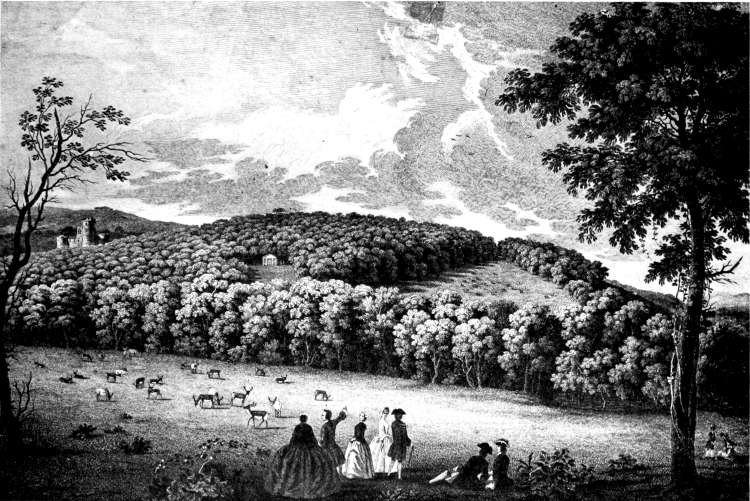
HAGLEY PARK
By Thomas Smith
Kent’s most important gardens come between 1730 and 1748. One of the first of those incited by the beauty of his “Elysian scenes” to make over their own domains was Lord Lyttleton. His estate, Hagley, was a ferme ornée much admired in its own day, and an excellent illustration of the new style. The accompanying print shows that the forest trees come close to the house and grow unfettered. There are open glades ornamented by temples and seats, and enlivened by the presence of animals, which, according to the new scheme of beauty, had at last come into their own as ornamental elements of a landscape. Philip Southcote’s “Wooburn Farm” is another early ferme ornée. Charles Hamilton’s “Pain’s Hill,” in Surrey, shows a somewhat different type, which Walpole calls “the forest or savage garden.” In this garden, continues Walpole, “all is great and foreign and rude; the walks seem not designed, but cut through the wood of pines; and the style of the whole is so grand and conducted with so serious an air of wild and uncultivated extent, that when you look down on this seeming forest you are amazed to find it contain a very few acres.” The approximate date of “Wooburn Farm” and “Pain’s Hill” is determined by the fact that in 1761, in Dodsley’s “London and its Environs,” they are spoken of as “but lately laid out,” and so not very much advanced in growth, but yet “very beautiful and[262] extremely well worth seeing.”[553] The most famous eighteenth-century “ferme ornée” was Shenstone’s estate, known as “Leasowes,” and this is also somewhat earlier in date, for a poetical tribute dated 1754 calls it “that new-form’d Arcadia.” Eight other poetical eulogies show the place of Leasowes in popular esteem. Dodsley published a map of the place with thirty pages of minute description of the arrangement of the grounds.[554] There was a prescribed order in viewing the estate, the path leading from surprise to surprise,[263] a gay, lively scene being immediately succeeded by one “cool, gloomy, solemn, and sequestered.” Various scenes were sentimentally suited to particular persons, or to especial trains of thought. One glade was devoted to lovers, another to fairies; one spot was set apart for reflections on death, another for communion with the spirit of Virgil. Each separate portion had its rocks, waters, trees, and shrubs, arranged according to a ruling idea, the idea being brought into prominence by a suggestive inscription, and further emphasized by a seat so placed that from it the idea could present itself with cumulative effect. Shenstone paid great attention to artistic combinations. In his “Unconnected Thoughts on Gardening,”[555] 1764], he said concerning the art of “distancing and approximating,”
A straight-lined avenue that is widened in front, and planted there with ewe trees, then firs, then with trees more and more fady, till they end in the almond-willow, or silver osier, will produce a very remarkable deception of the former kind; which deception will be encreased, if the nearer dark trees are proportionable and truly larger than those at the end of the avenue that are more fady.
Shenstone’s work was certainly based on the most elaborate art but his whole purpose was so to use art as to conceal it. “Art,” he said, “should never be allowed to set a foot in the province of nature, otherwise than clandestinely and by night.” “Whatever thwarts nature is treason.” Whenever art is allowed to appear, “night, gothicism, confusion and absolute chaos are come again.”
One of the earliest poetical champions of the picturesque development of landscape gardening is William Mason, author of “The English Garden,” a long didactic poem,[264] begun in 1767 but not published till 1772, and then in an incomplete form. The purpose of the book is to apply “the rules of imitative art to real nature.” Folly and Wealth are called “the cruel pair” who, “borrowing aid from geometric skill,” strive by line, plummet, and unfeeling shears, to deform the fair surface of mother earth. Claude Lorraine, Salvator Rosa, Ruysdael, are called upon as the true law-givers in gardening. Much credit for the banishment of false taste is accorded to Addison and Pope. Of the latter he says,
Mason claims both Bacon and Milton as progenitors, the former “because in developing the constituent properties of a princely garden, he had largely expatiated upon the unadorned natural wildness which we now deem the essence of the art;” the latter “because of his having made this natural wildness the leading idea in his description of Paradise.”[556] Another element of interest in Mason’s Preface is his reason for writing his poem in blank verse. He confessed that the didactic nature of the theme seemed to call for the heroic couplet, but since every charm in gardens springs from variety, since the gardens he praised represented Nature scorning control, he felt that he must get a verse form as unfettered as Nature herself.[557] During the slow publication of Mason’s[265] “English Garden” there appeared in 1770 Thomas Whateley’s “Observations on Modern Gardening,” which summed up in admirable fashion the achievements of the landscape school. It is of especial importance as being “the very first treatise professedly on landscape art.”[558] Walpole’s “The History of the Modern Taste in Gardening,” was written in 1770, but was not printed till 1785 when it came from the Strawberry Hill press with a French translation on the opposite pages by the Duc de Nivernois. The essays by Walpole and Whateley cover about the same ground and advocate the principles of the same school, but Walpole’s fame and his brilliant style have combined to give his work pre-eminence, and his essay ranks in the garden literature of the eighteenth century as Sir William Temple’s essay does in the seventeenth century.
William Kent’s successor in gardening was Lancelot Brown (1715–83) who was kitchen-gardener at Stow when Kent was there as designer. Brown’s original work does not begin till about the middle of the century when he became royal gardener and was employed at Blenheim. After that he was concerned in laying out or in altering “half the gardens in the country.” In 1767 Viscount Irwin thus eulogized him:
But immortal Brown, while enjoying to the full the favor of owners of great estates, had sturdy and loud-spoken critics. The ruthlessness with which he destroyed fine old grounds, and especially fine avenues of great trees, the unhomelike effect of his stretches of bare, undulating lawn, his serpentining walks and streams, aroused active hostility. Cowper in “The Task,” 1785, said,
Late in the century Richard Payne Knight was so extreme in his attack on Brown’s unpicturesque smoothness and finish as to express a preference even for the formality of the old school. He thus describes the designers of the school of Brown:
To his mind statues, urns, terraces, mounds, parterres, topiary work, though all “against Nature,” were preferable to a whole estate “shorn and shaved” after the manner of Brown. Sir Uvedale Price (1747–1829) to whom Knight dedicated his poem also opposed Brown, saying in prose with almost equal heat what his friend had put into verse.[562] The points made against the works of Brown, and likewise of his master, Kent, were the tameness and monotony, the[268] over-cultivated appearance, of their grounds. The central thought of Knight and Price, as of Gilpin,[563] their contemporary, and, earlier, of Mason in “The English Garden,” was that a garden should be “picturesque,” that is, should be “composed” as a picture is. Landscape painting secured its best effects from rough, natural, varied scenes, hence gardens should, if possible, show similar combinations. The essential difference between Brown and the advocates of the picturesque is brought out by two plates published by Knight. The first of these shows the truly picturesque. The elements of the landscape are: a stream flowing at its own will between natural and uneven banks; groups of spreading trees and shaggy shrubs in natural union; fern-covered knolls; intricate thickets; mossy stones; “cherished weeds;” a prostrate tree, rough and gnarled; “native stumps and roots” overgrown with wild vines; and a rude bridge. The second plate shows the same scene as “dressed by an improver,” evidently of the Brown school. We now see the stream flowing between close-shaven banks; over it a frail Chinese bridge; clumps of trees in the most orderly and trim fashion; the grounds smoothed and cleaned like a drawing-room; unmeaning curves in stream and walk; and a vast expanse of lawn stretching in monotonous undulations to the bare-looking modern house.
The controversy was carried over from Brown to his disciple and imitator, Sir Humphrey Repton (1752–1818). Repton in a courteous “Letter to Uvedale Price,” 1794, and again in his “Sketches and Hints on Landscape Gardening” (chap. vii and Appendix), 1795, defended the principles of landscape gardening adopted by Kent and Brown and followed in his own work. Price answered in “A Letter to Humphrey[269] Repton,” 1795. In opposition to the claims of the devotees of the picturesque Repton put forward the beauty to be found “in the milder scenes that have charms for common observers,” and he protested against the rigid application of the laws governing landscape painting to an art so different in its views and possibilities as gardening. But Repton, though he had entered upon his work as the disciple and imitator of Brown, gradually changed, discarding the formalities of Brown and adopting a more varied and natural style of ornamentation. He made use of some of the ideas of the “artistical” or picturesque school, but so modified them according to the dictates of good sense and good taste, as to establish the beautiful and natural parks and gardens in which England led the world.
The picturesque garden had two offshoots that cannot be passed over. The idea of imitating a picture, when carried to an excess, led to frantic effort to put cliffs, precipices, gnarled oaks, ruined, moss-grown fortresses, ivy-hung abbeys, into every landscape. Frequent sage advice is given as to the best ways to secure these effects. Richard Jago, a friend of Shenstone, urges the importance of appropriate sites—a cliff for a ruined castle, a well-water’d vale for “the mouldering abbey’s fretted windows.”[564] In 1772 Gilpin criticized Shuckburgh because the ruins were not “happily fabricated,” but he adds in exculpation, “It is not every man, who can build a house, that can execute a ruin.” There follows a long list of the mechanical difficulties, with the following conclusion, “When it is well done, we allow, that nothing can be more beautiful: but we see everywhere[270] so many absurd attempts of this kind, that when we walk through a piece of improved ground, and hear of being carried next to see the ruins, if the master of the scene be with us, we dread the encounter.” In “The Spiritual Quixote,” 1773, is an amusing account of a visit of Sir Geoffry Wildgoose to a noted estate. The ignorant keeper in showing off various objects of interest calls attention to the “turpentine walks,” and then leads the way to the ruins explaining that it was built “but a few years ago; and his Lordship used to say, he could have built it as old again, if he had had a mind.” An antiquary present exclaims,
I don’t at all approve of these deceptions.... I don’t wonder that any gentleman should wish to have his woods or gardens adorned with these venerable Gothic structures; as they strike the imagination with vast pleasure, both by the greatness of the object, and also by giving us a melancholy idea of their past grandeur and magnificence. But for a man to build a ruin, or to erect a modern house in the style of our Gothic ancestors—appears to me the same absurdity ... as that which many people have of late run into, of having their pictures drawn in the habits of Vandyke or Sir Peter Lely.
Mr. Mason, in “The English Garden” deprecates building ruins, but thinks a man to be congratulated if on his grounds
This search after ruins was a morbid and exaggerated development of the new love of the old, the wild, the picturesque, just as the sentimental melancholy in poetry was a morbid and exaggerated development of the new poetic turning to emotional introspection, to solitude, to thoughts of death and the grave. In the extreme form both phases were ephemeral, and, it is interesting to note, were nearly contemporaneous.[271] Batty Langley was advocating “ruins” in gardens in 1728 but it is not till after the middle of the century that they seem to have been accepted as a necessary part of an estate, and this is just the period when the spirit of sentimental melancholy in poetry, a spirit that had found early expression in the night-piece of Parnell and Lady Winchilsea, reached its culmination.
The subject of oriental gardens was also much discussed in prose and verse. In 1752 appeared “An Account of the Emperor of China’s Gardens at Pekin” by Père Attiret, translated by Sir H. Beaumont (i.e., Joseph Spence).[565] In 1760 came Goldsmith’s “Description of a Chinese Garden.” Most influential of all was “A Dissertation on Oriental Gardens” by Sir William Chambers in 1772. The practical influence of the discussion of Chinese gardens went little beyond the building of summer-houses and bridges in the Chinese style. But the naturalistic school in England was strengthened by an appeal to the Chinese method of copying Nature “in all her beautiful irregularities,” while the sentimentality of gardens such as Leasowes seemed to receive sanction from the efforts[272] of Chinese gardeners to construct scenes with the express purpose of arousing certain emotions. The “fancies and surprises” of Chinese effects were pleasing to those who, as Sir William Chambers, thought Kent’s English gardens “no better than so many fields.” The popularity of writings on oriental gardening is furthermore significant of the enlarged horizons, the prevailing interest in the new and the remote, characteristic of one phase of romanticism, and it is to be classed as a sign of the times along with the interest in oriental eclogues in the realm of poetry.
Incomplete and cursory as so short a study of so great a subject must be, the facts here presented seem to warrant the following statements:
The feeling toward Nature in the period studied shows in gardening the same order of development, nearly the same dates, and the same phases as in poetry. There was first in both a pleased recognition of the supremacy of man, a rigid exclusiveness, a love of order, of symmetry, and of definite limits. Then came, in the early eighteenth century, a tentative turning from art to Nature; then an epoch-making statement in each art, Thomson’s “Seasons” from 1726 to 1730, and Pope’s “Epistle” in 1731. From this point on the development was in mass and variety rather than in the enunciation of new principles. The growing love for wild Nature in the poetry, and the passion for the picturesque in gardening proceed side by side. At the end of the century all is ready in both arts for the splendid work of the new era. Throughout the century both have had curiously correspondent offshoots or temporary fads—sentimental melancholy in poetry, and the ruins, artificial and real, in gardening; foreign eclogues and studies of distant countries in the one art, and Chinese gardens in the other.[273]
It is the purpose of this chapter to indicate how far and in what way painting lent itself to the expression of that new love for Nature which, as we have seen, gradually became dominant in the realm of poetry, fiction, travels, and gardening. Such an inquiry is beset with peculiar difficulties in the case of pictures because they are seldom dated. At best we usually know only whether a picture is early or late in the artist’s career. After the beginning of public exhibitions with catalogues, which was not till 1760, something like accuracy in dates becomes possible, but the information thus obtained is not entirely reliable for the reason that pictures were not always exhibited the year they were painted, and it is certainly inadequate because so small a proportion of the pictures painted reached any exhibition. Furthermore, the pictures most important in establishing the early use of landscape would come before 1760. A second difficulty arises from the inaccessibility of much of the material, especially the important early material. Whatever was printed in a book had many chances of survival. A single brief poem indicative of a new love of Nature, even though a poem but lightly regarded by the author and his contemporaries, would hold its small place in his works and share in the reduplicated life of the tragedies, satires, and didactic poems to which he intrusted his fame. But an equally slight picture, though equally indicative of a new tendency, would have no such fate. Unregarded, unpurchased, its ultimate destiny would be destruction, or, possibly, burial in some attic. Even such of these pictures as still hold their[274] own in some collection are widely scattered and often in private galleries not open to public inspection.
This inaccessibility of much of the original material would be an insuperable difficulty from the point of view of the student of technique, but is less formidable in the present study which has to do not with qualities that would give the picture high or low artistic rank so much as with the thoughts the artist strove to express, his tastes, his feelings, the conception of Nature that guided his work. For this purpose we have as authentic material not only original pictures whenever obtainable, but also reproductions of various sorts, along with biographies, letters, and critical essays. From these scattered sources it becomes possible to make a brief but not wholly inadequate statement concerning the place of the external world in English eighteenth-century art.
As a picturesque accessory in portraiture landscape received early recognition in English art. Even the miniaturists found space for landscape backgrounds,[566] and Vandyck, who was painting in England from 1621 to 1641, established the use of landscape elements in large portraits in oil. Sometimes, where the portrait is inevitably in the open air, as in the equestrian portrait of Charles I in the National Gallery, the landscape is worked out with much beauty of detail, but as a rule Vandyck makes use of Nature as an accessory rather than as a full background. Various [275]devices, as an open window or door, a space framed in by heavily draped curtains and massive pillars, or an outlook over a balustrade, serve to enrich the picture by a glimpse of sky, a bright horizon line, or a stretch of vaguely indicated country. He also frequently uses a rock as the direct background, the rock revealing itself as such only at the edge where tufts of foliage or a gnarled tree branch out against the sky and an indeterminate landscape.[567] In no case does Vandyck subordinate the portrait to the landscape, nor does he combine the portrait and the landscape with the idea of securing a general decorative effect. The landscape remains always simply as background or as an enlivening detail.
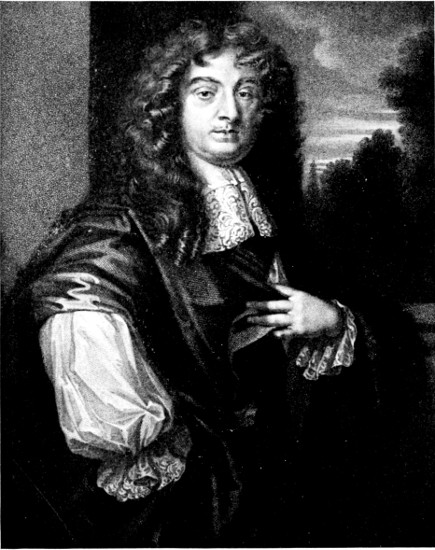
JOHN MAITLAND, DUKE OF LAUDERDALE
By Sir Peter Lely
Vandyck’s most important successor, Sir Peter Lely, who was in England from 1641 to 1680, but whose great vogue was after 1660, made frequent use of open-air settings, especially in his portraits of women. The “Windsor Beauties”[568] sufficiently attest his command of landscape effects. Princess Mary as Diana, the duchess of Cleveland as Minerva, the duchess of Richmond, the countess of Falmouth, Mrs. Middleton as Pomona, Mrs. Stewart, are fair women whose picturesque beauty is enhanced by the poetic and romantic landscapes against which they stand. There is, to be sure, no attempt at verisimilitude. There is no thought of a real landscape to which the person in the picture has some natural relation. Walpole says in derogation of Lely that his nymphs trail their embroideries and fringes through the thorns and[276] briars of pastoral landscapes, but the fact is that these Dianas and Minervas and innocent shepherdesses of the Nell Gwynn variety are no more in these landscapes than they are actual goddesses or country maidens. The landscape is but a sort of wall-painting or figured tapestry used as a decorative background. These portraits are of importance in the present study because they show that while Lely as portrait painter rightly cared especially for the figure, he had yet an appreciation not common in his time of the beauty of the world about him.
It would seem as if the example of Vandyck and Lely and their great fame would have established the use of landscape as a portrait convention, and it is true that Lely’s pupils[569] made some attempts in this direction, but under the leadership of Sir Godfrey Kneller (1646–1723) the custom gradually fell into disuse. Kneller, practically supreme in England during the half-century before his death, painted the kings and queens and royal families of England, the beaux and the belles, the statesmen and the wits, so that a gallery of his portraits would afford a survey of the notable social and intellectual England of his day. Commissions came in upon him too rapidly to allow much time for carefully studied backgrounds. Sometimes he uses a rock background in[277] the manner of Vandyck, but even more conventionalized, as in his “Madam Turner,”[570] and there is an occasional landscape in the manner of Lely, as in the “Countess of Ranelagh.”[571] The “Hampton Court Beauties,”[572] painted in emulation of the “Windsor Beauties,” are the portraits in which we should expect the richest use of landscape, and Kneller’s tall, elaborately gowned ladies, do stand in front of gardens with pillars and balustrades, with hints here and there of a red sunset, but not even the best of these backgrounds, that in the portrait of Lady Middleton with lamb and crook, has Lely’s grace and poetic suggestiveness. Now and then, when there is some reason to emphasize the portrait as a picture, Kneller brings all his ingenuity into play and crowds the canvas with decorative detail. The little duke of Gloucester, for instance, is rendered almost pathetically childish by his varied and elaborate surroundings,[573] but the combination of draped curtains, marble steps, massive pillars, a huge sculptured urn loaded with flowers, a balustraded terrace, and, beyond it, a park landscape under a cloudy sky, gives an impression of confused magnificence, with none of the artistic restraint of Vandyck, none of the elusive, romantic charm of Lely.
After Kneller, Jervas (1675–1739), Richardson (1665–1745), Hudson (1701–79), and Highmore (1692–1780) were leaders in portrait painting. Jervas has occasional effects reminiscent of Lely as in the portraits of Dorothy Walpole and Mrs. Howard.[574] Hudson’s “Duchess of Ancaster,”[575][278] clad in the richest brocade, roped with pearls, stands stiffly erect in front of a rock that harks back to Vandyck. These pictures and others of their class well illustrate the wooden and unmeaning use of landscape characteristic of the mid-eighteenth century. Certain conventions from the great days of a century earlier still remained, but deprived of all charm or significance. With the successors of Kneller portrait painting reached the lowest point of the decline that had been steadily going on since Vandyck, or, at least, since Lely. Walpole, who had a high opinion of Kneller, said of his successors,
They have either left us hideous and literal transcripts of the awkward, tight-laced, behooped, and bewigged generation of beaux and belles before them; or, quitting all probability, or even possibility, have given us Arcadian shepherdesses, and soi-disant Greeks and Romans, where wigs and flounces and frippery mingle with crooks, sheep, thunderbolts, and Roman draperies.[576]
The darkness that seemed thus at the middle of the century to be settling down around the art of portrait painting was, however, the darkness that precedes the dawn, or, in this instance, the full day, for with the first portraits of Sir Joshua Reynolds after he returned from Rome in 1752, and with the work of Thomas Gainsborough, his immediate contemporary, we enter upon the supreme period of British portraiture, a period in which there seemed suddenly to spring into being all the grace and skill, all the sense of beauty and poetry, all the power of imaginative interpretation, that had been waning in English art annals since the days of Vandyck. And with this great revival in the art there came a striking revival of interest in the use of landscape in portraiture.
Sir Joshua Reynolds (1723–92) made use of landscape[279] backgrounds in portraits of various kinds. His full-length portrait of Keppel was completed in 1753 and was the picture that established his fame. It is thus described by Lord Gower: “The gallant young sailor is represented as literally walking out of the canvas. His countenance is full of animation, and as he seems to step briskly, bareheaded, across the beach, his locks are blown backward from his forehead by the gale.... In the background a wild sea breaks on the shore.” This portrait, says Lord Gower, “made an epoch in that form of art.”[577] The epoch-making characteristics of the picture were, in the first place, the striking animation and naturalness of the figure as opposed to the monotony and woodenness of pose adopted by artists such as Hudson, and, in the second place, the genuine open-air effect of the whole picture, the perfectly simple and natural union of the figure and the landscape. In some other portraits of men Reynolds made use of landscape backgrounds, as in the half-lengths of Admiral Keppel (1780) and that of Lord Heathfield (1787) in which the figures stand forth boldly against a stormy sky with a suggestion of an ocean view. Some landscapes show reminiscences of Vandyck, as in the backgrounds of the equestrian portraits of Captain Orme (exhibited 1761) and Lord Ligonier[578] (about 1760), or in the conventionalized tree-trunks and distant view in the half-length of the archbishop of Armagh.[579] It is, however, in full-lengths of women and children, either singly or in groups, that Sir Joshua makes freest use of landscape. The little Princess Sophia Matilda of Gloucester, a chubby baby rolling on the grass with her dog; Prince William of Gloucester in plum-colored[280] cavalier costume standing on a hill against the sky; the Lady Caroline Montague Scott, a bright-eyed little maiden standing in a snowy landscape, her hands in a big muff; little Miss Cholmondeley valiantly carrying her dog over a brook; the four-year-old Viscount Althorp, a quaint little figure outlined against lovely effects of sky and foliage, are but a few of the children Reynolds has painted with admirable life and charm and in the midst of natural out-door surroundings. Even more elaborate attention is given to the landscape backgrounds in the full-lengths of women. Such portraits as those of the Marchioness Camden, Mrs. Crewe as St. Geneviève, the Viscountess Crosbie, Lady Betty Compton, the Duchess of Devonshire, the countess of Salisbury, Miss Mary Moncton, the Duchess of Rutland, Lady Bampfylde, Mrs. Bonfoy, or Mrs. Carnac, show abundantly the skill with which Reynolds united figures, drapery, and landscape so as to secure a harmonious and decorative general effect.[580] It often happens, indeed, that the faces of these tall aristocratic ladies are hardly remembered, so strongly is the attention caught by the flow of line, the shimmer of fabrics, the abundance of [281]charming scenic detail. Mrs. Jameson says that Reynolds was the first English artist to venture upon light and gay landscape backgrounds. In his portraits of women we do not find the stormy skies, rude rocks, and blustering weather against which Lely’s ladies posed. Reynolds delights in typical English park scenery, with its variety of wood and water, its soft, dim distances, its rich clumps of trees. He often uses, too, the architectural elements appropriate to a park, but never in a hard or obtrusive fashion. His steps and balustrades, his columns and urns, gleam out from masses of foliage or are overhung with a wealth of vines and flowers. The whole effect is rich and stately, suggestive of lovely order and nurture, and is particularly well suited to the fashionable dames who are thus enshrined. In general we may say that Sir Joshua’s use of landscape in portraiture surpasses in amount that of any preceding master, and that his scenic backgrounds are unrivaled in the qualities of naturalness and charm, and in artistic suitability for the personages portrayed.[581]
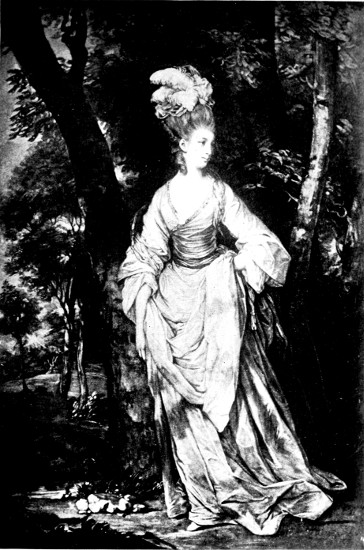
MRS. CARNAC
By Sir Joshua Reynolds
Thomas Gainsborough (1727–88) uses landscape with as much insistence as Reynolds, but not in the same manner. His backgrounds are not so elaborately worked out, yet with all their slightness and sketchiness they are more imaginatively suggestive. It is, indeed, astonishing to perceive with how little reality of detail Gainsborough contrives to call up a vital impression of Nature in her most enchanting aspects. A still subtler source of charm rests in his power to fuse[282] figures and landscape into an effect of perfect unity. The “Musidora” in the National Gallery is a picture before which, even in its present state, one could linger long in absorbed contemplation, without once mentally separating the figure and its surroundings. There is such a harmonious blending of lovely lines, of soft, rich hues, that the whole picture seems to have sprung from a single impulse. Sir Walter Armstrong says that in general Gainsborough’s landscape backgrounds “are nothing more than the extension over the unoccupied part of the canvas of the sentiment governing the sitter.”[582] Mr. Van Dyke points out the effect of the landscape in the famous portrait of “Mrs Graham,” where “the castle wall, the deep glen at the left, the loneliness of the background, add to the romance of her face.”[583] The portrait of Mrs. Robinson as “Perdita”[584] or that of “Mrs. Sheridan”[585] are even more convincing proofs of his ability to present a landscape inexplicably akin to the personality of the sitter, a landscape that in some indefinably but most real way interprets and emphasizes that personality. It is in full-length portraits of women whose beauty is enhanced by an air of pensive melancholy that this subtle use of landscape is mainly found. But in group portraits such as that of “Mrs Moody and her Children,” or, lovelier still, that of “Mrs. Sheridan and Mrs. Tickell,”[586] are landscape backgrounds every line and color of which serve to carry out and complete the grace and tenderness characteristic of the figures. [283]In the “Squire Hallet and his Wife”[587] there is a harmony so penetrating that it haunts the mind like music. In “The Mall”[588] where there is no individual portraiture we seem at first to have but a Watteau-like effect of fashionably attired dames in a setting of rich park scenery. But presently we perceive that the whole picture conveys a sense of pathos. The ancient trees stretching up against the soft sky in immemorial majesty and beauty give to the onlooker a keen sense of the futile and evanescent life fluttering away its brief hour under their solemn and mysterious shadows.[589]
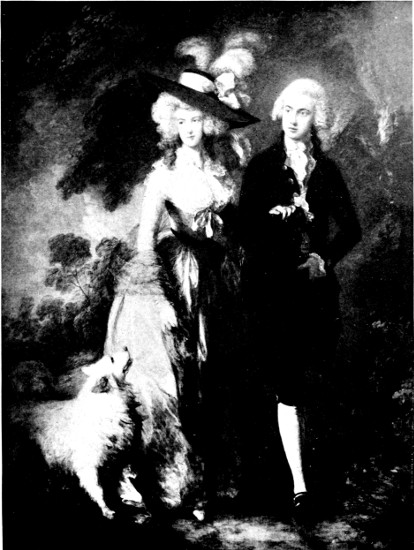
SQUIRE HALLET AND HIS WIFE
By Thomas Gainsborough
On the same wall in the Wallace collection hang Reynolds’ “Mrs. Carnac” and Gainsborough’s “Perdita.” Both pictures exemplify the possible heightened attractiveness of a portrait in which the artist has made skilful use of a landscape background. They also serve to illustrate a central point of unlikeness in the use of landscape by the two great artists. In Reynolds’ picture the beautiful setting can be conceived of as a landscape quite apart from the stately lady whose pose, figure, and draperies it so advantageously sets off. There is artistic harmony but there is no essential union. But Gainsborough’s background cannot be thought of by itself. It merely makes us conscious that the fair Perdita is out in the light and air, that behind her are real forest depths, that the pensive, appealing charm of her face is enhanced by the pathetic loveliness of Nature herself. With Gainsborough we have reached the subtlest and most perfect use of Nature in portraiture, and his supremacy is based on the fact that his landscapes serve the true purpose of backgrounds.[284] They never offer an individual beauty that rivals or eclipses that of the person, but they contribute to build up an impression the very heart of which is the characteristic effect made by the sitter.
After Gainsborough, from the studios of great artists such as Romney, Raeburn, Opie, and Hoppner, Sir Thomas Lawrence and Sir Thomas Beechey, and many of lesser note, came many portraits with landscape work of power and significance, but it is not, in pursuance of this topic, necessary to take up their work in detail, for the reason that Reynolds and Gainsborough led the way, and for the further reason that after them there arose no new or superior way of using Nature in portraiture.
English landscape painting from 1660 to 1800 falls naturally into three periods. During the first of these which ends in 1707 with the death of the younger Van de Velde, there was considerable landscape work, but nearly all of it was by foreign artists.[590] We do, to be sure, find early in the period an[285] Englishman, Robert Streater (1624–80), who, in addition to his fame as a painter of historical and mythological subjects on walls and ceilings, was counted “incomparable” in landscape. His contemporary popularity is attested by the fact that in James II’s collection were five of his landscapes, but such examples of his work as are accessible in public galleries hardly substantiate his reputation. He founded his style, it is said, on “the late Italians.”[591] At the end of the period is Francis Barlow (1626–1702) who, anticipating the themes of George Morland, crowded his farmyard scenes with fowls of many varieties, with pigs, sheep, horses, cows, donkeys, and even deer. A tinted drawing by him in the South Kensington Gallery illustrates his lively conceptions, and indicates his clever use of landscape backgrounds. Working with Barlow as an engraver was Francis Place[592] (1647–1728) whose best plates were of animals, but who sometimes etched landscapes “for his own amusement.” A print of his “View of Scarborough” in the Print Room of the British Museum shows, in spite of the conventional wool-bag clouds, a notable attempt to represent truly a bold and rugged cliff with a distant sea-view and waves rolling gently in on a curving[286] beach. But with these unimportant exceptions the painters of landscape in England before 1707 were foreigners. And of the foreign artists only the Van de Veldes, father and son, achieved more than local and temporary fame. Willem Van de Velde the Elder (1610–93) was already a famous painter of sea-pieces when Charles II called him to England in 1675. At Hampton Court may still be seen many of his huge canvases, chiefly important as pictorial chronicles of English naval achievement, but showing also effective use of sea and sky. The eighteenth-century estimate of Willem Van de Velde the Younger (1633–1707) is expressed in Walpole’s dictum, “Pre-eminence is no more to be contested with Raphael for history than with Van de Velde for sea-pieces,” and he still ranks as one of the great marine painters. English galleries, both public and private, are rich in beautiful examples of his work.[593] No other name so illustrious occurs in Walpole’s annals of this period. Of the other foreign painters it is sufficient to say that they were men whose habits of thought, whose tastes, as well as their technique, had been established in Holland, Flanders, or Italy, and who did their mature work in England because the desire of Charles II to revive the art activities fostered by his father seemed to offer a good professional opening. The fact that they painted in England had hardly more influence on the course of English art than would have been exerted by the importation of their pictures. They founded no schools, they excited little emulation or even imitation. They were merely second- or third-rate workmen who painted along in a manner studiously reminiscent of their earlier masters. Such slight effect as their work had in developing the love of Nature [287]in England came from the fact that Englishmen at last saw depicted some of the wild or romantic scenes of their own country, scenes from Scotland and the Isle of Jersey, from the neighborhood of Derbyshire Peak, from along the banks of the Thames. But such slight influence as this attention to local scenery might have had, was, it must be insisted, nearly neutralized by the fact that these representations of English scenery were always so “touched up” in the style of some Dutch or Italian master as to be practically unrecognizable. Instead of observing Nature the artists “composed” pictures, using elements conventionally accepted as picturesque. They trained themselves to see England through the eyes of Salvator Rosa or Ruysdael or Claude Lorraine or the Poussins.
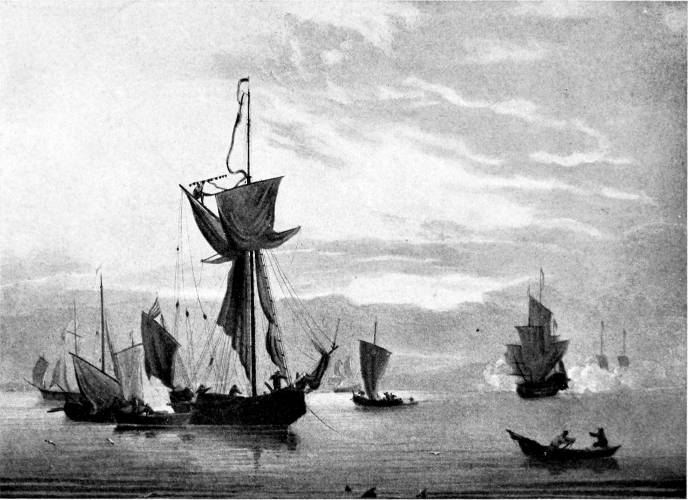
A CALM
By Willem van de Velde
The second period of landscape art in England comprises the forty-eight years between the death of the younger Van de Velde (1707) and the return of Richard Wilson from Italy in 1755. In studying this period a convenient point of departure is given by M. Rouquet’s “L’état des arts en Angleterre,” published in 1755. His only reference to landscape art is in the following interesting but rather vague paragraph:
Rien n’est si riant que les campagnes de ce pays-là, plus d’un Peintre y fait un usage heureux des aspects charmans qui s’y présentent de toutes parts: les tableaux de paysage y sont fort à la mode, ce genre y est cultivé avec autant de succes qu’aucun autre. Il y a peu de maîtres dans ce talent qui ayent été beaucoup supérieurs aux Peintres de paysage qui jouissent aujourd’hui en Angleterre de la première réputation.[594]
M. Rouquet’s words seem to imply a much larger amount of successful and popular landscape work than extant pictures or the meager annals of the time would indicate. Possibly in the landscapes that were “fort à la mode” were[288] included important Italian works, or the works of foreigners painting in England. There must have been, also, more landscape production than is in any way recorded, so that M. Rouquet doubtless had knowledge of pictures now practically non-existent. And even the following summary of such names and works as have survived a century and a half will give his words a modified justification.
Peter Monamy (1670–1749) was a marine painter of the school of the younger Van de Velde. “The Old East India Wharf at London Bridge,” a large and interesting canvas at the South Kensington Gallery, and “The Calm,” a small but very attractive picture at Dulwich, go far toward the maintenance of his great contemporary reputation. A second marine painter of much promise was Charles Brooking (1723–59). Of the few pictures by him in London galleries the most delightful is “The Calm,” a picture recently added to the National Gallery. A series of his naval reviews was reproduced by Boydell in 1753, and other works were engraved by Canot and Ravenet. Samuel Scott (1710–72), after Van de Velde the most important marine painter of the century, did some of his fine views of the Thames and old London bridges as early as 1745. Excellent examples of his work are in the National Gallery and at South Kensington.
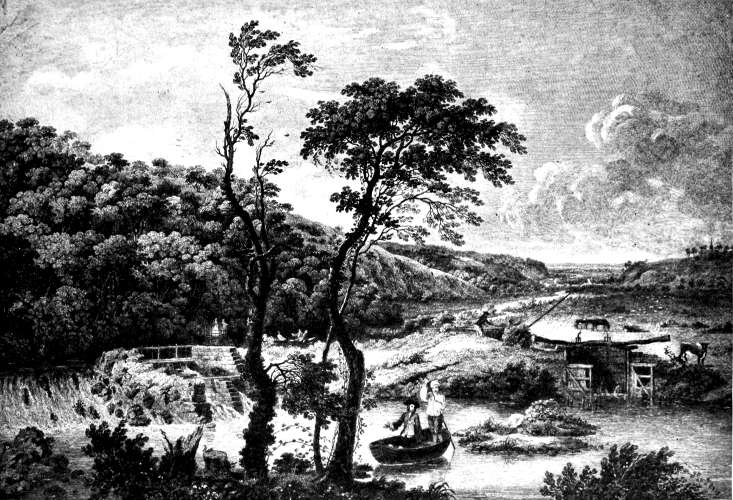
DUNNINGTON CLIFF
By Thomas Smith
There were also during this period several men whose chief pictures were of animals, but with considerable incidental use of landscape. James Seymour (1702–52), known as a portrait painter of fine horses, also painted many hunting-scenes where horses and dogs are trooping at full speed through broken country. Contemporary with Seymour was John Wootton (d. 1765) the excellence of whose representations of animals is well shown by his illustrations of Gay’s “Fables” in 1731. Wootton was also painting landscapes in the Italian manner before 1751. George Stubbs (1724–1806)[289] began his work as an animal painter before the middle of the century. In 1740 he broke away from conventions by resolving never to copy any picture but “to look into Nature for himself and consult and study her only.” This sturdy independence ripened in 1754 into a determination to visit Italy in order to test his opinion that “Nature is superior to all Art,” a dictum worthy of note so early in the century.
Landscape painting specifically so called begins with the topographical draughtsmen of the early eighteenth century. If a draughtsman had any susceptibility to the beauties of Nature his sketch almost insensibly took on various adjuncts from the scenes about him till his work gradually merged into landscape painting for its own sake. One of the earliest topographers was Samuel Buck (1696–1779) who, with his brother Nathanael, brought out over five hundred views between 1723 and 1753.[595] Their work, stiff and crude as it is, did not confine itself to buildings or bird’s-eye views but shows some attempts at adornment by the introduction of sky and foliage. William Taverner (1703–72), another early topographer and landscape painter as well, is represented in South Kensington by one sepia drawing of a path by a river, and by a singularly attractive water-color landscape, a composition in the Italian style. Mr. Cosmo Monkhouse refers also to a view of a sand-pit at Woolwich, and to “an extensive and beautiful landscape” (now at Whitworth Institute, Manchester) showing the view from Richmond Hill. Taverner’s reputation was justly high in his own day. Smollett in “Humphrey Clinker” makes Matthew Bramble say of Taverner in a letter to Dr. Lewis (May 19),
This young gentleman of Bath is the best landscape painter now living: I was struck with his performances as I had never been by[290] painting before. His trees not only have a richness of foliage, and warmth of colouring which delight the view; but also a certain magnificence in the disposition and spirit in the expression, which I cannot describe.... If there is any taste for ingenuity left ... this artist, I apprehend, will make a capital figure, as soon as his works are known.[596]
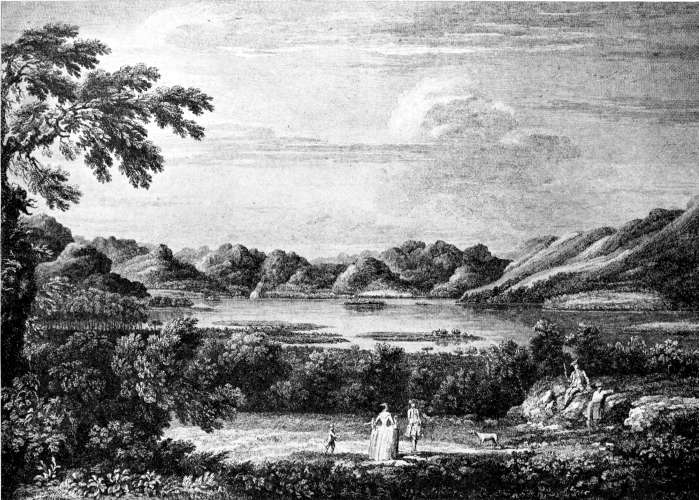
DERWENTWATER
By William Bellers
After Taverner’s death “The Gentleman’s Magazine” for 1772 reiterated Smollett’s statement but in a stronger form calling Taverner “one of the best landscape painters England ever produced.” Mr. Monkhouse speaks of him as “the artist who could most justly challenge Paul Sandby’s claim to the title of the father of the English school of water-colours in the production of faithful landscape.”[597] About contemporary with Taverner is George Lambert (1710–65), engravings from whose landscapes were published in 1749. In the Print Room of the British Museum his work is represented by six attractive engravings, and there is a fresh, modern looking painting by him in the National Gallery.[598] Lambert chose as themes mixed country of slow streams or quiet lakes, with bushy shores; low, wooded hills; stretches of arable land with thatched cottages under embowering trees. In most of his pictures the rich, peaceful scene is enlivened by the presence of domestic animals, cows standing lazily in pools, sheep huddling along the road, horses coming heavily home from the day’s work. There are also men, women, and children engaged in various country sports or occupations. George Lambert is one of the first English artists to attempt what may be called domestic landscape. Contemporary with Lambert is Thomas Smith (d. 1767), known as “Smith of Derby” from the town where he chiefly resided. His [291]“Views of Chatsworth” are dated 1744, and Vivares engraved some of his views of Derbyshire in 1745. A print from his “View of Dunnington Cliff,” dated 1745, shows a river winding in tortuous fashion into the remote distance, with wooded hills on one side, balanced on the other by meadows stretching away to a low hill crowned with a little church. The foreground shows scraggly trees, a waterfall, a lock, cattle grazing, and figures variously occupied. The crowded canvas lacks unity of impression and is thoroughly conventional in arrangement, but the details are English and are painted with manifest appreciation and a very evident attempt at fidelity. George Smith (1714–76), or “Smith of Chichester,” belongs in time with Lambert and Thomas Smith. He and his brothers were the first to establish a local school of landscape art. In 1760 he was awarded a premium of fifty pounds for “A Landskip, half-length,” the first premium given by the “Society of Arts” for landscape work, but he had done considerable Claudesque painting before this time. In spite of his imitative manner his themes are the lovely scenes about Chichester, and he painted them with genuine affection. A pleasing example of his Italian style is in the South Kensington Gallery. A dark line of foreground with tufted brownish trees on each side frames in a still lake; a fine effect of distance is given by misty blue hills beyond the lake; and sunset effects—a tender blue sky with grayish little clouds softly brightened by yellow light from the diffused golden glow along the horizon—are delicately repeated in the mirror-like water. Another early artist of whom little seems to be known is William Bellers.[599] Numerous engravings by Mason from landscapes “Painted after Nature by William Bellers” occur from 1752 to 1759. He was a Cumberland man and nearly all of his pictures are of scenes in that county[292] and in Westmoreland. As art his work cannot rank high, but not even his fluffy hills, tossed together without a suggestion of rock foundation, nor his lack of aërial perspective, can obscure the delight with which he painted the picturesque scenery of his native regions. Bellers was apparently the first one of the long line of Lake Country artists and his pictures antedate by some years the known descriptions in poetry, travels, and fiction. Thomas Smith also painted in Westmoreland and other northern counties but there is no means of determining whether his pictures are earlier or later than those of Bellers. Alexander Cozens (d. 1786), was sent to study art in Italy. He returned to England in 1746 and exhibited from 1760 to 1781. There are at South Kensington several examples of his work, especially two interesting mountain landscapes. In the British Museum are fifty-four drawings which belong to his Italian period. Some of these are extensive views. Some of them show interesting experiments such as the attempt to represent sunlight streaming through clouds. “Altogether,” says Mr. Monkhouse, “these show that Cozens before his arrival in England, was a well-trained artist who observed Nature for himself, and was not without poetical skill” and Mr. Monkhouse finds in the “imagination, ingenuity, and trained skill” of the father adequate explanation of his son, John Robert Cozens, whose work will be noted in the next section.[600] The work of Alexander Cozens was particularly that of teaching art.[601] John [293]Boydell (1719–1804), better known as a publisher of prints than as an original artist, yet did some interesting early work. In 1736 his interest in scenery was aroused by “a book of well-executed landscape engravings.” In 1745 he brought out a series of “landscapes for learners” the tremendous success of which laid the foundation of his great fortune, and throughout his life his activities as publisher were largely affected by his love of scenery. He was the first artist to paint in Wales. A large print done by him from one of his own pictures and bearing the date 1750 is an attempt to represent Mount Snowdon. Paul Sandby (1725–1809) is of more importance in the history of landscape art than any of the men already mentioned, but most of his work belongs after 1755. His sketches in the Highlands, whither he went as draughtsman on a road survey, were, however, made during the years 1746–51[602] and his exquisite aquatint studies of the country about Windsor belong about 1751–52 when he was with his brother Thomas at the deputy ranger’s lodge at Windsor.
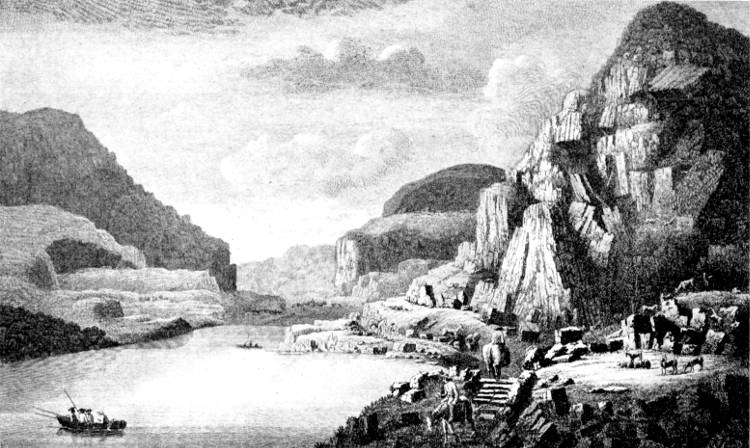
MOUNT SNOWDON
By John Boydell
That early landscape painting was not confined to England may be shown by reference to some Scotch and Irish artists. Alexander Runciman (1736–85) was born in Edinburgh. He began to paint landscapes before he was twelve. “Furnished with pencils, and brushes, and colours, he took to the fields; his first sketches were rocks, trees, and waterfalls.” At fourteen he was placed in the studio of John and Robert Norris where he showed himself “one of the wildest enthusiasts[294] that ever devoted themselves to the art.” “Other artists,” it was said, “talked meat and drink, but Runciman talked landscape.” By 1755 Runciman set up as landscape painter on his own account, but he speedily learned that though landscape might bring applause it was not an art whereby even a moderate livelihood could be obtained and by 1760 the young painter had turned to other realms.[603] John Norris, of whom little is known except that he was Runciman’s teacher, was nevertheless in his day reckoned “a celebrated landscape painter.” Brydall says that he was “probably the first to create, or at least to minister to the taste for landscape in the Scottish metropolis.”[604] In Ireland was an obscure artist named Rogers who has been called “the father of landscape art” in that country. His pupil, Butts (d. 1764), painted early landscapes said to be “impressive copies of the wild scenes which abound in the county of Cork, and the romantic views that abound on the margin of Black Water.”
From this catalogue of names and dates several facts emerge. In the first place, nearly all the landscape work mentioned belongs after 1740. From 1707 to about 1740 English landscape art can hardly be said to exist at all. Even the foreign artists so much in evidence in the preceding period are no longer to be found in England.[605] George II frankly hated “boetry and bainting” and the reigns before[295] him were hardly more hospitably inclined to aesthetic claims outside the realms of portraiture and history painting. This lack of royal patronage would sufficiently account for the dearth of foreign painters, and perhaps, also, for the lack of English landscape painters. All native art-impulse would likewise feel the inevitably deadening effect of the universal and rigid acceptance of foreign canons of art. But whatever the cause, the fact remains that most of the English landscapes M. Rouquet speaks so enthusiastically of in 1755 must have been painted in the preceding fifteen years.
In the second place, the landscape art, though technically not of high rank, is yet, by its amount, the range of its themes, and its suggestions of a new personal feeling toward the external world, an important contribution to the growing love of Nature. The output of the years 1740–55 is really surprisingly large and correspondingly varied in theme. There are three artists who paint successful marines, and three whose studies of animal life take good rank. In landscapes we find much emphasis on the pastoral beauty of England, its hills, streams, lakes, woods, meadows, and thatched cottages. Wilder scenery is also portrayed, for by the middle of the century the Highlands of Scotland, Derbyshire and Yorkshire, the Lake District, and Wales, have all received recognition as true subjects for landscape art. And there is, in the case of every artist, even of those who feel most strongly the dominance of foreign masters, a very evident study of the details of English landscapes and an eagerness to record in painting the charms felt by the artist. It should also be noted that, though nearly all the more important pictures were the work of English artists, yet native artists began to paint scenery at about the same time in England, Scotland, and Ireland.
The period from 1755 to 1800 is throughout rich in landscape production, but the thirty years between 1755 and 1785[296] is the most significant portion of the period. These are the years during which landscape art was established in England and during which it won the greatest laurels it was to have before the great days of the early nineteenth century. The two famous artists of this notable thirty years were Wilson and Gainsborough and it will simplify the account if we take up their work before that of their lesser contemporaries.
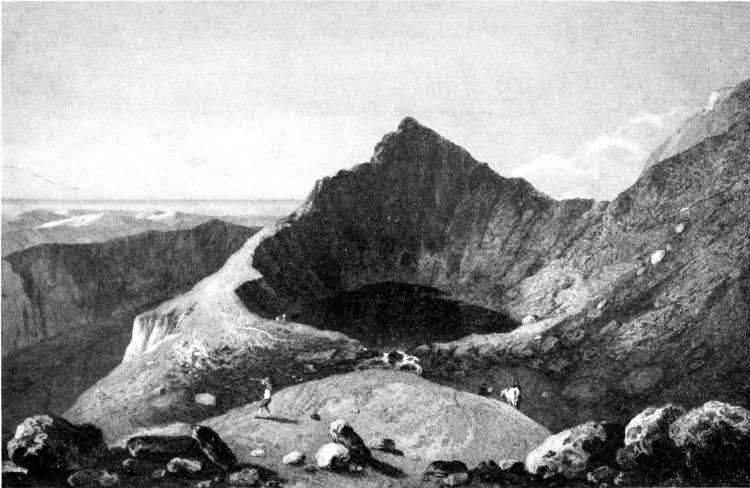
THE SUMMIT OF CADER-IDRIS
By Richard Wilson
Richard Wilson (1714–82) was born at Penegoes near Machynlleth, Montgomeryshire, Wales, but while still a child, his father, the Rev. John Wilson, went to live at Mold, Flintshire, and there the lad was brought up. Talent of some sort as an artist he early evinced and at fifteen he was sent to London to study portrait painting, a profession at which he worked steadily for twenty-one years, and by which he apparently made a fair income though his portraits never rose much above mediocrity.[606] At thirty-six he went to Italy for further study. During his six years there he devoted himself exclusively to landscape. He remained in Venice a year; with William Lock he made a slow tour from Venice to Rome; with Lord Dartmouth he went to Naples; from Rome as his headquarters he made many excursions into the surrounding regions; and throughout all these travels he [297]was tireless in the production of studies, sketches, pictures. Through the generous praise of recognized authorities such as Zucarelli, Mengs, and Vernet, a report of his surprising achievements reached England, and when he returned to London in 1755 it was to find his reputation practically established. His solemn style did not, however, at once commend itself to the artists of his time. Wright says that his return excited “some interest and much criticism in the coteries of art,” and that certain artists “who then constituted themselves, what they called A Committee of Taste, and led the understanding of the public in art” sat in judgment on Wilson’s work and resolved “That the manner of Mr. Wilson was not suited to the English, and that if he hoped for patronage he must change it for the lighter style of Zucarelli.” When this committee waited on Wilson it was met with cool contempt,[607] and he painted on in his own fashion. But the committee’s estimate of patronage was apparently correct, for during the lifetime of the artist, in spite of the fact that during a period of twenty-five years he assiduously painted landscapes, he did not achieve an even moderately comfortable livelihood. His life was one of sordid financial shifts and of growing bitterness of spirit, until, in 1780, through a small inheritance, he was enabled to retire to a little patrimony in Wales, where, broken and enfeebled, he spent the two years before his death.
Wilson’s work as a landscape painter began certainly as early as 1750 in Italy, and all probabilities are in favor of the supposition that it began earlier in England. To be sure, no juvenile sketches, no anecdotes of youthful tendencies, remain to substantiate this conjecture. Even the “View of Dover,” the one landscape known to have been painted before the Italian visit, is no longer in existence. But the[298] fact that this picture was at once engraved by J. S. Miller would seem to indicate that it was counted a work of some importance. Furthermore, when Wilson began his work in Italy there was no apprentice period. Work done in the early years there shows a management of landscape detail and composition quite equal to that of his later work, and such as would not be prepared for by the most zealous study in portraiture. It is, indeed, hardly believable that a pronounced passion for landscape such as characterized Wilson should never have tempted his brush till he was thirty-six, and should then, at the chance words of a fellow-artist suddenly open out before him as his life-work. Edwards Edwardes is responsible for the anecdote that attributes Wilson’s change from portraiture to landscape to the advice of Zucarelli. But we have, on the other hand, the more probable account given by Mr. Hastings in a volume of etchings made by him from the Ford collection of Wilson’s paintings. Mr. Hastings gives Mr. R——s (probably Mr. Samuel Rogers, the author of “Italy” and an art connoisseur) as authority for the statement that an influential patron of the arts, Mr. William Lock of Norbury, perceived Wilson’s bent toward landscape of the grand sort, and urged him to go to Italy as the best place to perfect himself in that art. Mr. Beaumont Fletcher, Wilson’s latest biographer, considers that the artist was fully conscious of his powers as a landscape painter, and that his visit to Rome was premeditated for the purpose of study in that particular line.[608] Sir Walter Armstrong also maintains the probability, almost certainty, of landscape work by Wilson prior to the Italian tour.[609][299]
The landscapes painted by Wilson between 1755 and 1760, the date of the first public exhibition of pictures[610] in England, cannot be absolutely identified, but he was probably spending much of his time in painting from the sketches made in Italy. In the exhibition of 1760 was his “Niobe.” In the same year he painted an upright picture of the Arno for the drawing-room mantel-piece of a patron in Platt Hall, Manchester. In 1761 were exhibited “The Lake of Nemi” and other Italian pictures. The “Phaeton” appeared in 1763, the “L’Anconetta” in 1764, the “Villa Madama” in 1765, and many other Italian pictures in these and successive years. By 1768 he had exhibited about thirty landscapes nearly all of which were based on his Italian sketches, and it was his custom through his life to paint pictures the chief elements of which were the sunny skies and ruined temples of classic regions.
A recognition of the great influence of Italy over Wilson’s mind and art should not, however, be allowed to obscure the fact that he gave equally sympathetic response to the scenes of his own land. When Stothard was a student at the Royal Academy he asked Wilson to suggest to him something to copy, and Wilson, who happened to be looking out over the Thames, responded that there could not well be anything better to copy than that. That he loved English scenery becomes apparent when we study such pictures as the lovely “English Landscape”[611] in the possession of the Rev. Stopford Brooke, the “River Scene with Castle” in the South Kensington Gallery, the “View on the Wye”[611] in the National Gallery, the “De Tabley House” in the possession of A. T. Hollingsworth,[612][300] “Wilton in Wiltshire,”[613] “View in Kew Gardens,”[614] “Sion House,” and “A View near Chester.” The dates of these English pictures can seldom be determined, but it is evident that he made occasional sketching tours, for the exhibitions record views in Bedfordshire, Devonshire, and Cheshire, besides those of places in the immediate neighborhood of London such as St. James’ Park, Windsor Great Park, Kew Gardens, and Hounslow Heath.
But none of these English pictures, and few even of his Italian ones, can compare in dignity and beauty with his notable Welsh views. He certainly visited Wales before 1766 for in that year he exhibited two views from North Wales, “Carnarvon Castle” and “Northwest View of Snowdon.” It seems very likely that when he was painting at Manchester and Chester in 1760 he took the opportunity to visit his old home, but there are no dated Welsh pictures before 1766. But even this date gives him no predecessors among artists painting in Wales except men so inferior as John Boydell and Anthony Devis. Other Welsh pictures were exhibited by Wilson in 1771 and 1774. In 1775 Boydell published “Six Views in Wales,” engravings by Byrne and Rooker from Wilson’s pictures. Britton in his “Fine Arts in England” (1805) said that “Wilson’s ‘Six Views’ were the most important topographical views ever published in England.” But they only partially represent the great amount of work done by Wilson on Welsh subjects. In the Print Room of the British Museum are engravings from many other fine Welsh pictures such as “The Great Bridge over the Taafe,” engraved by Canot, “Kilgarren Castle,” engraved by Elliott, “Pembroke Castle” by Mason, “Carnarvon [301]Castle” by Byrne, “Snowdon Hill” by Woollett, “The Summit of Cader Idris” by E. and M. Rooker. Even in the engravings these are pictures of very great nobility and charm. One original “Snowdon” picture is in the Manchester Art Gallery. It is called “A Welsh Valley with Snowdon Hill” and is of the rarest beauty. The rough foreground slopes, the distant mountain bathed in light and delicately outlined against the softest of skies, the mists rising from the hidden valleys, are magically combined into a picture adequate in its presentation of the facts of Nature, and having, also, a strong poetic and imaginative appeal. A beautiful print after Wilson in the British Museum is another, “Snowdon Hill,” by Woollett. The loneliness, the serenity, the majesty, and the beauty of mountain regions are portrayed by Wilson with an essentially modern feeling.
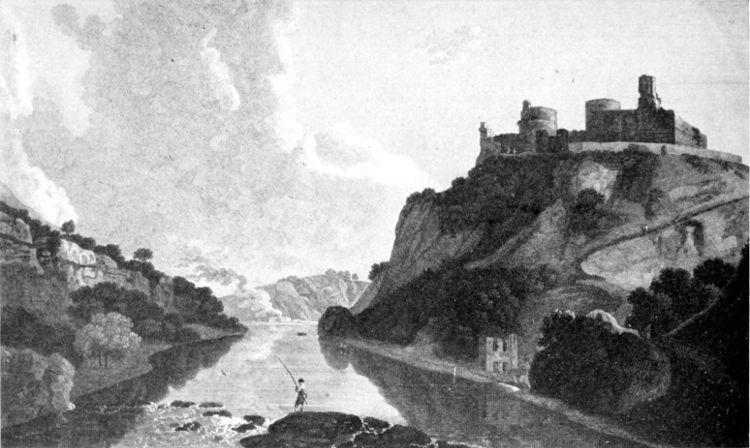
KILGARREN CASTLE
By Richard Wilson
It was many years before any other artist so well illustrated Blake’s phrase, “Great things are done when men and mountains meet,”[615] as did Wilson. For fifteen impressionable years he had lived in North Wales and his mind and heart had been insensibly affected by the sublimity of mountain scenes. Wales had given as important and effective tutelage to him as did the Lake District to the youthful Wordsworth sixty years later. Wilson is reported to have said that Wales “afforded every requisite for a landscape painter” but we need no testimony beyond his pictures to show with what power these rugged cliffs and deep ravines, these silent lakes and tarns, these tumultuous streams and waterfalls, these lonely mountain masses towering into the sky, spoke to him both as an artist and as a man when, in mature life with mature power, he returned to the land of his birth. He painted Welsh scenes with boldness and freedom, with grandeur, dignity, and impressiveness, and with a power of divination[302] that must put him high in the ranks of painters of mountain scenery in any age.[616]
In one characteristic Wilson’s Italian and Welsh pictures[303] are alike. He was temperamentally susceptible to the pathos of ruins. His Italian pictures are steeped in a sense of inescapable sadness. Through the loveliness of Nature runs the mournful memory of fallen grandeur, of races who have lived and loved and are no more. But the ruined strongholds and castles of his own land touched him even more deeply. The bright stillness of Kilgarren Castle on its rocky cliff, mirrored in the smooth surface of the river below, is more beautiful and more subtly suggestive of “old, unhappy, far-off things” than are the Italian pictures.
Through all Wilson’s pictures we feel, furthermore, a quality of genuineness in both observation and feeling. He studied the great masters of landscape, but not as a copyist. He compared their work with Nature which he studied for himself. Ruskin says of him,
Here, at last, we feel, is an honest Englishman, who has got away out of all the Camere, and the Loggie, and the Stanze, and the schools, and the Disputas ... and has laid himself down with His own poor eyes and heart, and the sun casting his light between ruins—possessor, he, of so much of the evidently blessed peace of things—he and the poor lizard in the cranny of the stones beside him.[617]
Mr. Beaumont Fletcher in developing this conception of Wilson as one able to see with his own eyes, very justly points out that his idealism, even in the Italian pictures, is based on a singularly close representation of the facts of Nature. Even Sir Joshua Reynolds when he objects to Wilson’s use of classical figures incidentally testifies to the truth of his landscapes which are, says Sir Joshua, “too near common nature to admit the supernatural.”[618]
Wilson has been called “a painter’s painter,” and various testimonies show how deeply impressed later distinguished[304] artists were by his work. Sir James D. Linton[619] points out that “Turner carried Wilson’s methods so far in some of the works of his early middle period as almost to amount to imitation,” and notes a picture by Turner of “Kilgarrin Castle” “so like Wilson in manner, treatment, and colour that it might fairly be called a ‘Wilson Turner.’” Constable, also, though he did not choose the grand themes, and though he rejected the classical mannerisms of Wilson, was yet one of his great admirers. Of a visit to the gallery of Sir John Leicester in 1823 he wrote, “I recollect nothing so much as a large, solemn, bright, warm, fresh landscape by Wilson, which still swims in my brain like a delicious dream. Poor Wilson! think of his fate, think of his magnificence.”[620] Of Wilson’s place in the development of art Ruskin says, “I believe that with the name of Richard Wilson the history of sincere landscape art, founded on a meditative love of nature, begins with England.”
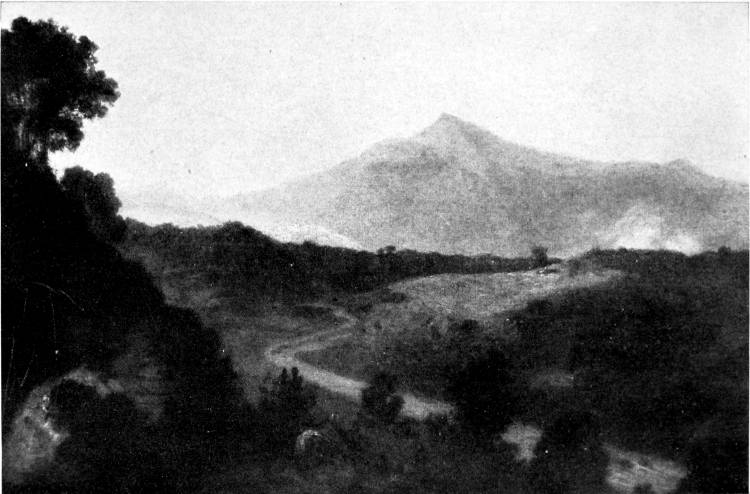
A WELSH VALLEY WITH SNOWDON HILL
By Richard Wilson
Thomas Gainsborough, though mainly known as a portrait painter, showed an early and persistent bent toward landscape. Before he was twelve it was his delight to spend his mornings in the woods near his home at Sudbury in Suffolk, sketching from streams, trees, cattle, sheep, and peasants. In 1741, at fourteen years of age, he went to London and studied, first under Gravelot, then under Hayman, and finally set up a studio of his own. His ostensible work was portraits for which he charged from three to five guineas, but he likewise painted landscapes for such prices as they would bring. From 1745 to 1759 he was again in Suffolk, but this time at Ipswich, twenty-two miles east from his old home at Sudbury, and in the region between the Orwell and the Stour, the region afterward made famous by Constable. [305]During the Ipswich period he was slowly building up a reputation as a portrait painter; but here, too, he made “Madam Nature, not man, his sole study.” He did much sketching along the picturesque banks of the Orwell and in the groves of oaks and elms in the neighborhood of Ipswich. That he painted many landscapes while at Ipswich is indicated by the fact that Governor Thicknesse called upon him in 1754,[621] and was much struck by the great beauty of the small landscapes mingled with the rather stiff portraits in the artist’s studio. None of these landscapes can now be identified, but it was their excellence that gained from Governor a commission to paint “Landguard Fort,” important as the earliest known of Gainsborough’s landscapes, though, even in this case, the original picture has perished and is known only through Thomas Major’s engraving. To the latter part of the Ipswich period belong the “Cornard Wood,” “View of Dedham” and two small uprights in the National Gallery, besides seven or eight other canvases attributed to these years. The landscapes of this period were strongly influenced by Dutch artists. The most noteworthy picture of the Ipswich years, the “Cornard Wood,” might almost, says Mr. Boulton, have been painted by Both or Berghem. The Dutch fidelity to the details of the scene in this picture was shown in two other probably contemporary landscapes of which Mr. Fulcher wrote, “They were both drawn and coloured in the open air: in one of them a young oak is painted leaf for leaf, while ferns and grasses are portrayed with microscopic fidelity.”[622] Gainsborough’s life at Bath (1760–74) was marked by almost exclusive attention to portraiture, yet in the midst of his successes here he wrote, “I’m sick of portraits and wish very much to take my viol-da-gam and walk off to some sweet[306] village where I can paint landskip and enjoy the fag-end of life in quietness and ease.” Quin said at this time that when a portrait was on the easel Gainsborough was disposed to growl at all sublunary things, but if he was engaged on a landscape “he was all gaiety, his imagination in the skies.” He employed the intervals between sittings in studying the fine trees in his neighborhood. He painted numerous landscapes and rural scenes during the Bath period, the more celebrated ones, such as the “Market Cart” of the National Gallery, the “Harvest Wagon,” and the “Cottage Door,” belonging to the later years of that period. During Gainsborough’s last or London period (1774–88) he still kept up his interest in Nature and took a house on Kew Green that he might have a convenient center for sketching tours along the banks of the Thames, and many landscapes were produced during these years. Walpole says of one exhibited in 1777 that it was “by far the finest landscape ever painted in England, and equal to the great masters.” Another in 1779 Walpole called “most natural, bold, and admirable.” Six landscapes in 1780 he characterized as “charming, very spirited, as admirable as the great masters.”[623] Walpole’s favorable opinion of Gainsborough was quite generally shared by artists and critics, but even in his case there was but a small purchasing public, so that when he died in 1788 his house was found to be filled with unsold landscapes. This fact, and the large sums he could command for portraits, make it all the more striking that out of a total of eight hundred and eighty-seven pictures about a fifth should be landscapes.[624]
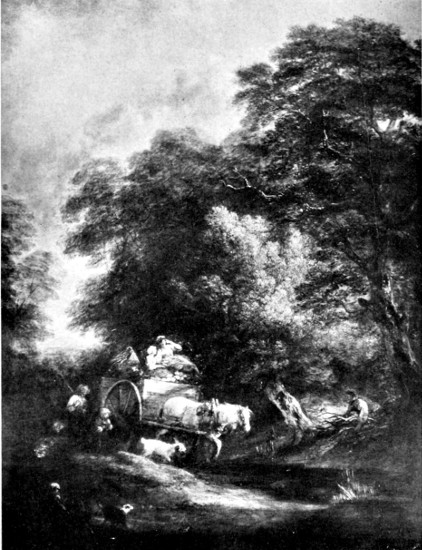
THE MARKET CART
By Thomas Gainsborough
In the landscapes of the Bath and London periods the labored accuracy of the early work gives place to the “landscape generalization” by which Gainsborough’s mature [307]paintings are characterized. In these later landscapes, of which the great “Watering Place” in the National Gallery may be taken as the supreme example, there is an apparent ignoring of the separate facts of Nature. No oaks are painted leaf for leaf. There is not even sufficient definiteness to make the kind of tree unmistakable. Yet the effect of Nature is adequately rendered. The mind is conducted into genuine woodland coolness and shade. As we look we become gradually conscious of the mysterious charm of Nature herself. These landscapes not only satisfy the eye by wonderful harmonies of color and flowing line, but they speak appealingly to the emotions. Constable says of them, “They are soothing, tender, and affecting. The stillness of noon, the depths of twilight, and the dews and pearls of morning are all to be found on the canvases of this most benevolent and kind-hearted man. On looking at them we find tears in our eyes and we know not what brings them.”[625]
In theme Gainsborough is distinctively English, and even within this limit his range is narrow. The grander elements in Nature did not stir his imagination. Mountains, the ocean, storms, were, to be sure, not entirely absent from his pictures. In 1781 he had apparently been painting along the coast, for Walpole comments on two pictures “of sea and land,” “so fine and natural that one stepped back for fear of being splashed.” One of these was, Mr. Conway thinks, the Duke of Westminster’s “Coast Scene,” “a sparkling picture, articulately suggestive of a single delightful idea,” a windy day on an estuary. In 1783 Gainsborough made a trip to Cumberland and Westmoreland, gaily predicting that on his return he would show “your Grays and Dr. Browns to be but tawdry fan-painters.”[626] Sir Walter Armstrong[308] reproduces a chalk drawing subsequent to this period in which “the hills in the distance are thoroughly true in mass, perspective, and aërial envelope;”[627] Mr. Fletcher is of the opinion that had Gainsborough “lived a few years longer, he would undoubtedly have taken a new departure in landscape art;”[628] and Mr. Boulton finds in the pictures after 1783 a new tendency to deal with rocky foreground and mountain scenery.[629] Yet a few successful coast scenes and a late and certainly rather slight interest in mountain regions can hardly affect the statement that Gainsborough was, on the whole, but little moved by the grander aspects of Nature. He cared as little for the majestic, the terrible, the awe-inspiring, as he did for the trim, the formal, and the precise. What he loved to portray was the gently varied and picturesque scenery of his own countryside. He sought out woodland roads, lanes with steep grassy banks, trees heavy with foliage, tangled copses, pools of still water, skies glowing with sunset hues, or deepening into twilight, or with the blue showing through rifted storm clouds. Cumberland and Westmoreland had for him no appeal comparable to the remembered charm of Suffolk.
Gainsborough’s pictures of rural life do not properly come under the head of landscape painting, but the representation of country activities, and pure landscapes run into each other by many gradations. If we consider those pictures in which landscape elements distinctly predominate we shall find that the figures of men and animals are hardly more than animating or decorative details. One of the artist’s rare theoretical statements was to the effect that a landscape should admit[309] only such figures as “create a little business for the eye to be drawn from the trees in order to return to them with more glee.”[630] Accordingly the figures whether of men or animals were painted because they helped out the scheme of light, of color, of form in the picture as a whole. But while this is true, it is likewise true that his rustic groups, his shaggy horses, his cattle, and goats, and donkeys, and pigs are something more than picturesque elements in the landscape. They help to individualize and interpret it, and they give it a quaint, homely charm. The grandeur of Wilson’s themes, the solemnity of his tone, make the few small figures in his pictures seem strikingly incongruous with the scene, but Gainsborough’s figures have an intimate union with the landscape.
However impossible it may be to determine who is the “father” of English landscape art, there can be no question as to the value of having at the formative period of that art two men so unlike in education, temperament, and taste as Wilson and Gainsborough. One brought in the Italian, the other the Dutch influence, yet each was too strong an individuality to be a mere copyist. The one painted with poetic comprehension and in a grand manner, not only the sunny skies, clear air, bright lakes, and ruined temples of classic lands, but also, and with equal power, scenes of dignity, grandeur, and pathos, in his own land, while the other painted with genuine tenderness and affection the lovely scenes of rural England. Both loved Nature passionately and strove to express that love in their pictures. From the point of view of a growing taste for the beauties of the out-door world, both artists are of the greatest importance. The transfer of interest from man to Nature is as marked in their pictures as in any other realm of thought and emotion.[310]
Contemporary with Wilson and Gainsborough were many artists of lesser note whose work is nevertheless important because of the cumulative testimony it bears to the growing interest in Nature. The catalogues of the Society of Artists (1761–91), of the Free Society (1761–83), and of the Royal Society which began its exhibitions in 1769,[631] supplemented by some other scattered sources of information, give an idea of the scope and the themes of this work, though not many of the original pictures are now accessible.
We find, in the first place, that nearly all the artists who were painting from Nature before 1755 continued their work for periods of considerable length after that date. Boydell published forty plates from the “Derbyshire Views” of Thomas Smith who continued to exhibit till 1767.[632] Samuel Scott exhibited occasional sea and shore views to 1771. Between 1761–74 George Smith of Chichester exhibited over a hundred landscapes some of which show a reaching-out into new realms. He has not only genre pictures such as “A Country Family Picking Their Own Hops” (1761)[633] and “Cottages in a Wood” (1773), but experiments such as “Moonlight,” “Mist,” “Sunset,” and eighteen “Frost” or “Snow” scenes. William Bellers is credited, between 1761–73, with seventy-seven landscapes, twenty-eight of them being views in the Lake District. Alexander Cozens [311]lived till 1786 and exhibited many small landscapes in which he paid especial attention to “chiaro-oscuro.” His chief work, however, was as a teacher, and he published some books on art, notable among them being “The Shape, Skeleton, and Foliage of Thirty-Two Species of Trees” (1771, republished 1786). Taverner was also working as late as 1772. George Stubbs was constantly represented in exhibitions from 1761 to 1803.
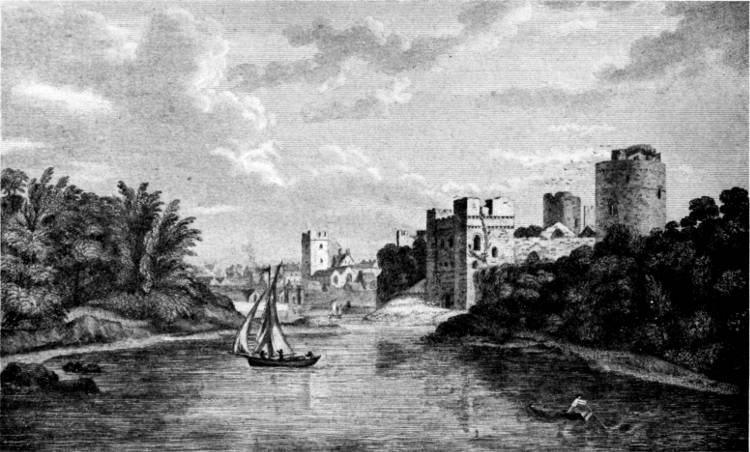
PEMBROKE CASTLE
By Paul Sandby
Of far more importance than any of the artists mentioned in the foregoing paragraph is Paul Sandby,[634] who, as has already been indicated, was the first to make known to art the wild and beautiful scenery of the Scotch Highlands. In 1773 he exhibited his first Welsh picture, and after that he did much work in Wales. Though not the first to paint in that region—for Boydell, Wilson, Farington, and Devis were ahead of him—he yet did much to show its picturesque possibilities. His important Welsh “aquatint views taken on the spot” appeared in four sets of twelve plates each, beginning in 1775, the very year of Boydell’s publication of Wilson’s “Six Views.” These mountain pictures, especially those of the second series, justly rank as the most vital landscape work contemporary with Wilson and Gainsborough. “Llangolin in Denbigh,” “Conwyd Mill,” “Llanberis Lake and Great Mountain Snowdon,” “Pont-y-Pair over the River Conway” are but a few of the many pictures that show with what enthusiasm Sandby surrendered himself to impressions from the grand scenery of Wales. The striking change from early eighteenth-century topographical sketches where the building was merely rendered slightly more attractive by washed-in skies and greensward is evidenced by such pictures as[312] Sandby’s “Wynnestay, Seat of Sir Watkins William Wynne” which is a pure landscape with no house visible. So, too, in “Chirk Castle” there is but the faintest indication of the castle in the distance. Sandby’s original purpose may have been topographical but the outcome was pure landscape of great interest and significance.
There are, in addition to these older men, several artists whose work begins about 1760 or soon after. Anthony Devis exhibited in 1761–63 eight pictures, chiefly “Views in Wales.” He would thus antedate all painters of Welsh scenery except Boydell. In 1761–78 James Lambert exhibited numerous landscapes including many with titles such as “A Misty Morning with Ewes and Lambs,” “Landscape with Ewes and Lambs,” “A Farm-yard with Cattle.” George Barret (1732–84) was an Irish painter who had taken a premium for landscape from the Dublin Society before he came to England in 1762. Of the fifty-five landscapes exhibited by him in England during the years 1764–82 the earliest were of Powerscourt Park in Ireland, but from 1769 to 1772 he shows Scotch and Lake District views, and in 1776–77 three pictures of “Llanberis Pool in the Mountains of Snowdon.” The list of his pictures shows some interesting special studies as “A Moonlight, with the Effect of a Mist; a Study from Nature” (1767); “A Group of Beech Trees” (1776); “A View of Windermere Lake, in Westmoreland, the effect, the sun beginning to appear in the morning, with the mists breaking and dispersing” (1781). Barret was a very popular painter. Of his premium picture in 1764 Barry wrote, “My friend and countryman, Barret, does no small honour to Landscape amongst us; I have seen nothing to match his last year’s premium picture. It has discovered to me a very great want in the aërial part of my favourite Claude’s performances.” Barret’s work brought prices never before paid[313] for landscapes, Lord Dalkeith having given fifteen hundred pounds for three of them. The Rev. John Lock commissioned him to paint the principal rooms of his house from skirting to ceiling with landscape scenes.[635] Richard Wright (1735–75) was a marine painter known sometimes as “Wright of the Isle of Man.” In 1764 he took a premium of fifty guineas for a sea-piece from which Woollett engraved “The Fishery.” Such themes as “A Ship in a Squall,” “The Sun Dispersing a Fog,” “A Fresh Gale,” “A Moonlight,” show attempts at the representation of other aspects of the sea than merely as a background for England’s navy. Wright exhibited till 1773. Another marine painter, John Cleveley, exhibited from 1764–86. Fleets, royal yachts, ships of war, distinguished naval events, are his chief themes. Dominic Serres (1722–93) exhibited after 1765. He, too, was chiefly occupied with naval affairs, particularly so after 1780 when he became marine painter to his majesty. The Rev. William Gilpin (1723–1804) contributed to the interest in home scenery by numerous sketches and, especially, by his book, “Forest Scenery” (1786). Far more gifted was his younger brother, Sawrey Gilpin (1733–1807), who excelled as an animal painter. His most abundant as well as his most spirited and accurate work is in portraits of fine horses and dogs. But he painted other animals also, birds, deer, foxes, tigers, and even “American Bears” (1798). There is in the South Kensington Museum a beautiful canvas by Gilpin called “Cows in a Landscape.” It has a smooth, clear, decorative effect, the cows are broadly, simply, but realistically painted, and the landscape gives in most suggestive fashion the mists, the faintly illumined sky, the dewy feeling, of early morning.[636][314]
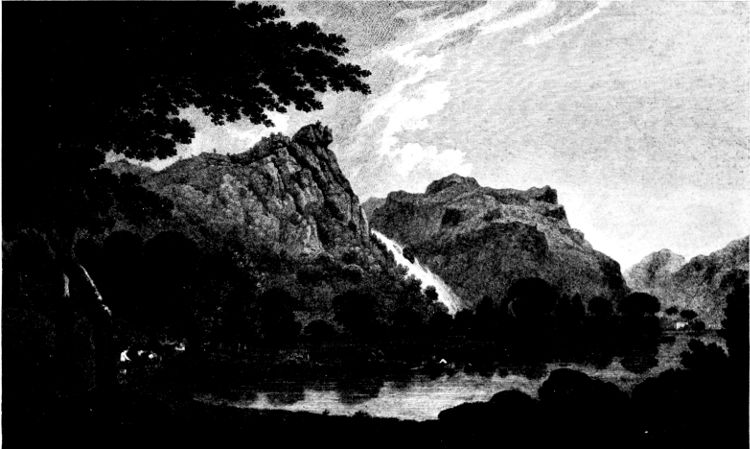
LODORE WATERFALL
By Joseph Farington
The men enumerated in the preceding paragraph did all of their work, or, in a few cases such as Paul Sandby and Sawrey Gilpin who painted through the century, did much of their most characteristic work, before 1785. There is still another group of men who were born about the middle of the century the bulk of whose work, or whose most significant work, belongs before 1800. Of professional marine painters we have Robert Cleveley who began to exhibit in 1780; the more celebrated Nicholas Pocock (1741–1821); and John Thomas Serres (1759–1825), all of whom carried on the traditional representation of noted ships, harbors, and naval actions. David Allan’s (1744–96) best work is his set of illustrations of “The Gentle Shepherd.” He went to the Pentland Hills and studied both the places and the people he wished to represent. “He visited,” says Cunningham, “every hill, dale, tree, stream, and cottage, which could be admitted into the landscape of the poet.... Glaid’s farm house, the Monk’s burn, the Linn, the Washing Green, Habbie’s How, New Hall House, and that little breast-deep basin in the burn, called Peggie’s pool, were all carefully drawn.” It was Allan’s endeavor to do in painting what Ramsay had done half a century before in poetry, and though his pictures are far from expressing the brightness and beauty of the poem, they fairly take rank as important attempts to represent native landscapes from careful, first-hand observation. James de Loutherbourg (1740–1812) came to England about 1770, and was constantly represented in the exhibitions during the rest of the century. His vigorous storms and sea-scapes were long popular. The public taste that could laud De Loutherbourg’s pictures and neglect Wilson’s was severely satirized by “Peter Pindar.”[637] But De Loutherbourg has [315]another claim to recognition in that he was one of the staunchest defenders of the picturesque scenery of the British Isles as against that of other lands. He maintained that no English painter need go abroad for inspiration when he had access to the Highlands of Scotland, the Lake District of Cumberland, and the mountainous region of North Wales. It was to further this idea that he opened his panorama of English scenery in 1782, a show by which Gainsborough was fascinated, and which, apparently, prompted his visit to the Lakes in 1783.[638] Thomas Hearne (1744–1817) is of importance in the early history of water-color. In 1777 he began a series of tours through Great Britain for the purpose of illustrating “The Antiquities of Great Britain” for which he made fifty-two drawings. Mr. Cosmo Monkhouse praises him for close and fresh observation of Nature, for excellence in atmospheric perspective, for truth of sunlight, and for beauty of trees and skies.[639] Though he lived well into the nineteenth century, much of his most finished work belongs before 1800. Joseph Farington (1747–1821) was a pupil[316] of Richard Wilson. He exhibited almost yearly from 1765 to 1813. He may possibly have been with Wilson in Wales before 1766. At any rate he exhibited in 1768 and 1770 views of Snowdon Hill and Penmaenmawr. Between 1778 and 1784 are views of “Ambleside,” “Skiddaw and Derwentwater,” “Lodore,” “Rydal Waterfall,” “Borrodale Grange,” “Winandermere from High-harig.” Mr. Gilpin in his book on Cumberland (1786) says that descriptions are useless since there are prints so accurate and beautiful as these of Mr. Farington. Mr. Farington also has many views from Kent, Sussex, Devonshire, Oxford, and Buckinghamshire. John Rathbone (1750–1807), sometimes called “the Manchester Wilson,” began to exhibit in 1785. Of his forty-eight recorded landscapes eleven represent Lake District scenes, and most of the others are from similar scenery in Derbyshire, Lancashire, on the Wye, or in Wales. Julius Caesar Ibbetson (1759–1817) painted Welsh views after 1796 and Cumberland views after 1798. He is best known, however, as a skilful painter of animals and of groups of gay, rollicking rustic figures in an agreeable landscape setting. Of the six pictures by him in the South Kensington Museum the one called “Jack in his Glory” is most characteristic. The “Conway Castle, North Wales” (1794) has the added interest of being a moonlight scene. Abraham Pether (1756–1812) began to exhibit in 1777. From 1784 to 1800 at least a fifth of his exhibited pictures were simply entitled “Moonlight.” He painted “a water-mill,” “an iron foundry,” “a waterfall,” “a fire,” and “ruins” by moonlight. He also chose as themes “Evening,” “Sunset,” “Morning just before Dawn,” “Evening and Rain,” and other unusual and delicately discriminated natural phenomena. Edward Dayes (1763–1804), the master of Girtin, made many studies in the Lake District after 1790. The “Windermere” and “Keswick Lake” in the gallery[317] at South Kensington attest the truthfulness and charm of his work.
The most important landscape painters of the second half of the century have yet to be mentioned, Morland, Girtin, and Cozens. John Robert Cozens (1752–99) began to exhibit when only fifteen years of age. At twenty-four he was taken by Mr. Robert Payne Knight to Switzerland to make sketches of the scenery. Of the work done on this trip Mr. Monkhouse says,
These drawings of 1776 are remarkable in the history not only of English water-colour painting and English art, but in the history of landscape painting of all time. They are the first successful[640] attempt to give a true impression of Alpine scenery. From the first Cozens seems to have found his way to render its character, to convey the grandeur of its snow-crowned peaks, the depth of its valleys, the solitude of its lakes, the appearance of its slopes, “fledged,” as Shelley sang, “with pines,” the sun striking through the gorges on high-perched cot, or village, the chill of the shaded hollows filled with mist, the cloaks of cloud about the shoulders of the hills,—and all this not in a pretty conventional or a grand conventional manner, but with a style that was Nature’s own.... His mountains look their height, and suggest their bulk and weight.[641]
Cozens was in England again by 1779. A second visit to Italy with Mr. Beckford ended in 1783 and resulted like the first tour in a large number of water-color drawings. Mr. Thornbury comments on a view of a glacier valley executed at this time as “worthy of all praise for its multitudinousness, breadth, and grand, harmonious simplicity, as well as for the dazzling purity of its colour.”[642] Constable said of Cozens[318] that he was “all poetry,” and that “he was the greatest genius that ever touched landscape;” and Turner said that from Cozens’ “Hannibal Crossing the Alps” (1776) he had learned more than from anything he had before seen.[643]
Thomas Girtin (1775–1802) had a short life but he came early to the maturity of his genius. He exhibited at the Royal Academy from 1794 to 1801. In about 1796 he went to the north of England and to Scotland with James Moore, and there “made many sketches of pure landscape, recording the grand effects of light and shade upon the swelling moors and rolling downs, with a breadth and simplicity and a large regard to truth never equalled before.”[644] In the South Kensington Gallery are many water-colors by Girtin that show his excellent drawing and his skill in the use of color. Four Yorkshire views, a “Coast Scene,” and three river scenes well illustrate the truth and vigor with which he represented landscape. Mr. Ruskin said of Girtin’s work, “He is often as impressive to me as Nature herself; nor do I doubt that Turner owed more to his teaching and companionship than to his own genius in the first years of his life.”[645]
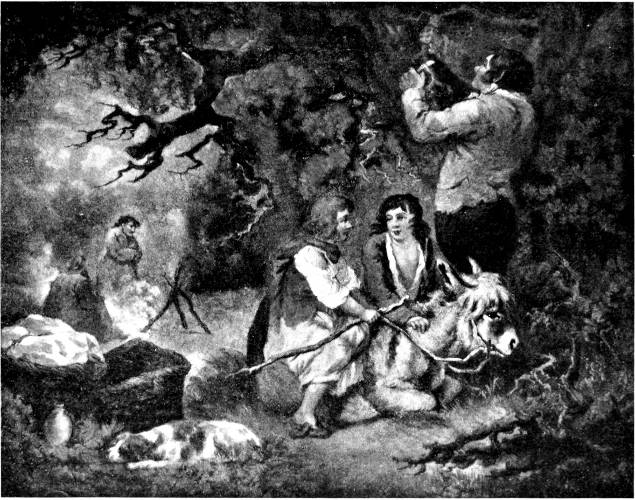
THE WOOD CUTTERS
By George Morland
George Morland (1763–1804) exhibited at the Royal Academy at the age of ten, and from that time on each year saw many pictures from his brush. He seldom painted pure landscapes. But whatever his theme the landscape setting is almost invariably worthy of particular attention. In many notable pictures of gipsies or wood-cutters it is, in fact, not the fat, invertebrate figures of men and women that hold the eye. The imagination is captured instead by the [319]bower of shade, by the deep wild-wood of the background. So, too, in various coast scenes, the chalk cliffs against which breakers dash in blinding spray, the trees bending before the wind, the rifts of blue sky showing through scattering storm clouds, the feeling of rain in the air, certainly count for as much in the general impression as do the men tugging at the rope or lading wagons with the spoils of the sea. Nearly all of Morland’s domestic pictures have an exquisite framework of old oak trees, climbing vines, and flowering shrubs. J. T. Smith[646] says that Morland was “the first artist who gave the sturdy oak its peculiar character in landscape painting.”
As a painter of animals Morland excels. His horses are of especial interest for he does not expend his art on portraits of noted racers or thoroughbreds, but on work-horses, and preferably on such horses at the moment of release from toil. “The Inside of a Stable” (1791) in the National Gallery, and “Horses in a Stable” (1791) in the South Kensington Gallery are two of his finest works; and they show not only his power of painting dim old interiors in the softest blend of color, but they show particularly the attentive sympathy with which he had studied horses. Many similar pictures could be cited but chief among them for pathetic understanding is “The Blind White Horse.” Pigs were among Morland’s favorite subjects. So frequently did he introduce them into his pictures that the title-page of a book of his sketches portrayed him leaning over a fence and making a drawing of three fat sows. The animals in his pictures were all studied from the life. The white horse so often depicted by him was modeled from an old nag he bought and kept for a fortnight in his painting room. He regularly kept by him various sorts of animals for study, “dogs, rabbits, guinea-pigs, fowls, ducks, pigeons, mice, and many other kinds of livestock,”[647][320] and sooner or later these were sure to appear in his pictures with convincing realism.
Morland rather defiantly declared that “the barn, the cow-house and the piggery” were his favorite themes, but he has another class of subjects, his numerous pictures of children, in which the out-door setting is of great charm. Reynolds had painted beautiful pictures of high-born, well-dressed children; and Gainsborough had given lovely, pathetic, somewhat idealized representations of cottage children; but Morland takes us into the realm of childhood itself, and his gay, romping lads and lasses swing on gates, play games, go nutting, sail toy boats, in the midst of most delightfully real out-of-door surroundings.[648] All that Morland does is simple, genuine, spontaneous, and has a permanent appeal, and his landscape without being especially beautiful or at all novel, has a sort of homely, intimate, and obvious charm.
A survey of the century shows that there has been from 1700 to 1800 a remarkable change in the attitude of painting toward the external world. From a predominating interest in man as shown in history-painting and portraiture, with, at the best, landscape as an unimportant background or adornment, we come to a period when landscape is not only a very important element in portraiture, but is counted as so valuable in itself that figures take rank as hardly more than insignificant landscape detail. The development of the love of Nature is shown in painting in England somewhat later than in poetry: Thomson antedates the early English landscape painters, and Wordsworth’s characteristic poetry of Nature is somewhat earlier than the great paintings of Turner and,[321] Constable. But in abundance and variety of theme the English landscape artists have, by the end of the century, surpassed even the poetry of the period. Pastoral England receives especially full recognition. The ocean is, however, comparatively unimportant as a source of inspiration, even as we have seen it to be in the poetry of the same years. Perhaps the most striking fact is the remarkable influence of mountains in reawakening the love of Nature. The most enthusiastic and original landscape work was based on the wild scenery of Scotland, Ireland, Wales, and the Lake District.[649]
Two other facts that bear upon the period as a whole should, in conclusion, be noted. The first of these is the stimulus given to the interest in Nature in England by the sketches brought home by artists who had been in foreign lands. Nearly every artist studied in Italy so that separate mention of Italian scenes is not necessary. But some artists went into newer fields. Charles Fox (1749–1809) is interesting as being the first recorded artist to visit Norway, Sweden, and Russia for the purpose of representing the wild[322] scenery of those countries. Draughtsmen accompanied almost every public or private expedition to remote regions. William Pars went with Dr. Chandler to Greece, 1764–66, and with Lord Palmerston to various parts of the continent in 1767. Thomas Hearne was in the Leeward Islands with Sir Ralph Payne in 1771–75. John Cleveley went with Sir Joseph Banks to the Hebrides in 1772, and with Captain Phipps to the North Sea in 1774. John Webber was with Captain Cook on his last voyage to the South Seas in 1776–80. A. M. Devis was in the Orient for the East India Company in 1788. And William Alexander went with Lord Macartney to China in 1792. These men brought back hundreds of views, many of which were exhibited at the Royal Academy and later appeared as illustrations in the books describing the various tours. The interest aroused by these pictures is an evidence of the new romantic delight in whatever is remote, and especially in the landscape characteristic of distant lands. But it must be noted that the importance of this work is lessened by the two facts that most of it belongs late in the century, after English landscape art was already fairly well established, and that, in the second place, much of it is of merely curious interest and intended to show the oddities in flora or fauna or in human life in the various countries.
The second point is the prolonged dominance of foreign models. Walpole in his “Anecdotes of Painting” (1762–71) said quite justly that English artists drew “rocks and precipices and castellated mountains” not because they saw such objects in England but because “Salvator wandered amongst Alps and Apennines.” But the artists were not alone in preferring to look at Nature through Italian spectacles. Poets, too, gave praise to the Poussins, Salvator Rosa, and Claude Lorrain. When Thomson in “The Castle of Indolence”[323] (1748) had the cool airy halls of his palace decorated with landscapes he chose
A quarter of a century later we find these artists in undiminished authority, for Mason (“The English Garden,” 1772) declares that the true law-givers in the realm of the picturesque are Claude, Salvator Rosa, and Ruysdael. An interesting illustration of the general acceptance of the Italian or Dutch masters comes in 1754 from the realm of house decoration. In that year Mr. Jackson of Battersea published “An Essay on the Invention of Engraving and Printing ... and the Application of it to the Making of Paper Hangings” in which he advised, in order to show “the Taste of the owner,” “the introduction into the Pannels of the Paper” of prints taken from “the works of Salvator Rosa, Claude Lorrain, Gasper Poussin, Berghem, or Wouverman or any other great master” in landscape. But perhaps, after all, no class of writers shows more clearly the tendency to regard English scenes from the point of view of Italian landscape art than do the early travelers. Dr. Brown in his famous “Letter from Keswick” says that to give a complete idea of the beauty of that region would require the united powers of Claude, Salvator, and Poussin. “The first should throw his delicate sunshine over the cultivated vales, the scattered cots, the groves, the lake, and wooded islands. The second should dash out the horror of the rugged cliffs, the steeps, the hanging woods, and foaming waterfalls; while the grand pencil of Poussin should crown the whole with the majesty of impending mountains.” So, too, Mr. Cradock says his utmost of Snowdon when he boldly declares that it is as rich a region to him as Tivoli or Frascati, and that “the romantic imagination of Salvator Rosa was never inspired with a more tremendous[324] idea, nor his extravagant pencil never produced a bolder precipice.” Mr. Hutchinson in praising Keswick and Skiddaw says that “Claude in his happiest hour never struck out a finer landscape.” In a summary of the glories of the Lake District he says, “The painters [sic] of Poussin describe the nobleness of Hulls-water; the works of Salvator Rosa express the romantic and rocky scenes of Keswick; and the tender and elegant touches of Claude Loraine, and Smith, pencil forth the rich variety of Windermere.” West’s “Guide” is professedly written in the interests of landscape painting, but not of English landscape art, though by 1778 there was strong and abundant English work. In each scene West still finds suggestions of Italian painters only. Throughout his tour he marked many “Stations” from which the artist in search of material could get hints for pictures. On Coniston Lake he would find verified “the delicate touches of Claude,” on Windermere-water “the noble scenes of Poussin,” on Derwentwater “the stupendous, romantic ideas of Salvator Rosa.” A traveler across Lancaster Sands would see the mountain of Ingleborough from “as happy a point of view as that selected by Claude in his picture of Soracte on the Tyber.” The region of the Langdale Pikes is “as grand an assemblage of mountains, dells, and chasms, as ever the fancy of Poussin suggested, or the genius of Rosa invented.”
Later in the century the scenic school of the Italians partially gave way before the growing supremacy of the Dutch artists. In 1795 “Anthony Pasquin” in a critical review of the pictures exhibited in that year says,
When many of our present race of landscape painters wish to make a study, they do it by their firesides; they take an old perished copy of Wynants, Ruysdael, or Hobbima, or a damaged copy from some eminent artist, and compose by stealing a tree from one, a dock-leaf from[325] another, and a waterfall from a third. By this means we have Flemish landscapes peopled with English figures, and the same unvaried scenes served up ad infinitum.
That the taste of the purchasing public remained, until late in the century, steadily in favor of foreign work may be shown in various ways. Hogarth’s satires on the rage for “Old Masters” and Foote’s comedy “Taste” (1752) in which a picture is pronounced excellent until discovered to be by “an Englishman now living” when it is discarded as “not worth house-room,” are significant mid-century attacks on the undiscriminating demand for continental pictures. Records of sale by the celebrated auctioneer Longford illustrate the same fact. In 1764 he sold a collection of two hundred and fifty paintings belonging to Roger Hearne. About one third of these were landscapes, but not a single English artist, unless Van de Velde should be so counted, is represented in the list. In 1765 the pictures of “Mr. Samuel Scott, Painter (who is retiring into the Country)” were sold. Of these pictures thirty-three were his own landscapes. Of the remaining ninety canvases nearly all were landscapes, but again with no English names in the list except Lambert and Marlow. In 1768 Mr. Thomas Payne’s collection, largely made up of landscapes, has one each by Monamy, Swaine, Lambert, Scott, and three by Wootton. In 1769 the pictures of Smith of Derby were sold. He had five by Brooking, but all the rest were his own unsold canvases of Lake District, Derbyshire, and Yorkshire views. George Barret’s sale in 1771 was an attempt to dispose of sixty-seven of his own views in Wales, Ireland, and the Lake District. He advertised “waterfalls, effects of morning, of evening, of moonlight, a remarkable great tree, etc., etc.” It is not till 1790 that we come upon a distinctively English collection. In that year “Mr. Serres, Jun., Marine Painter (Going to[326] Italy)” offered for sale five hundred and fifteen pictures nearly two hundred of which were landscapes by English artists. Thirty-two artists were named in the list. This slow development of English appreciation for English landscape art makes all the more evident the vitality of the impulse that led to productivity so ample and varied in that field.[327]
During the period from Waller to Pope the general feeling toward Nature was one of indifference. The whole emphasis was on man in his higher social relations, and only such parts of Nature as were easily subordinated to man were looked upon with pleasure. The facts of Nature were little known. They were stated in terms merely imitative and conventional. The new feeling toward Nature, as exemplified in the early nineteenth-century poets, especially Wordsworth, on the contrary, is marked by full and first-hand observation, by a rich, sensuous delight in form, color, sound, and motion; by a strong preference for the wilder, freer forms of Nature’s life, by an enthusiasm for Nature passionate in its intensity, by a recognition of the divine life in Nature, and finally by a consciousness of the inter-penetration of that life and the life of man. At the beginning of the eighteenth century, in poetry, travels, fiction, painting, and gardens, it was the classical feeling toward Nature that predominated. By the end of the century the new feeling had found abundant, varied, and original statement. The change is a great one. From Pope to Wordsworth, from Le Nôtre to Repton, from Kneller to Turner, from Richardson to Mrs. Radcliffe, from Brand to Gilpin, the pendulum swings. Whether men painted pictures or made gardens, or went on journeys, or told tales of love and adventure, or wrote poems, the new spirit was at work within them, sending them forth into the world of Nature and bidding them bear witness to her power and loveliness.
Early manifestations of the new spirit did not, however,[328] find exactly contemporaneous expression in these various art-forms. Thomson’s “Seasons” and Pope’s “Fourth Epistle” are in 1726–31. Gainsborough and Wilson do not bring out their work until after 1755. Thomas Amory’s “John Buncle” is in 1756–66, and Brown’s “Keswick Letter” comes within the same period. Thus the decisive beginnings of the new spirit in painting, fiction, and travels are about contemporary, but are thirty years behind poetry and gardening. Furthermore, the time between the decisive beginnings and the final full expression is greatly varied. In poetry it is seventy-three years, in gardening about sixty-five, in painting about fifty, in fiction not over twenty-five, and in travels only about fifteen years.
In spite of these variations in date there seems to be in each art the same general order of development. First there is a dim period of tentative, unconscious, or apologetic indications of a new spirit. Then some original mind seizes upon the new idea and gives it consistency and at least partially adequate expression. After this there follows a period of less vigorous but widespread and varied efforts to find a statement for some portions of the new thought. Then a master mind seems to feel all these diffused, struggling, half-expressed conceptions and sums them up in the final perfect form. In the poetry of Nature these stages are clearly marked in the work before Thomson, in Thomson, in the period from Thomson to Wordsworth, and in Wordsworth. In painting are Wilson and Gainsborough on the one hand and Turner on the other. In gardening, travels, and fiction we find the periods marked respectively by Kent and Repton, Brown and Gilpin, Amory and Mrs. Radcliffe. In these three art-forms, especially in the last two, we do not find the period of development ending in the work of consummate genius. We go rather from a meager statement to a statement[329] that is full, manysided, enthusiastic. The progress is in the love of Nature rather than in the power of adequate, final expression. The development in gardening is more in the nature of a series of experiments open to wide discussion, and the final outcome takes the form given it by the man whose study of past failures and successes has led him to the surest comprehension of the artistic and mechanical laws involved. A glance at the accompanying table will make the general statement clear, the main point being that in at least five of the ways in which men express their ideas it is possible to trace the growth of a complete change of attitude toward Nature. The poets who helped to bring about this change have already been studied in detail, but some further general statements may not be out of place here.
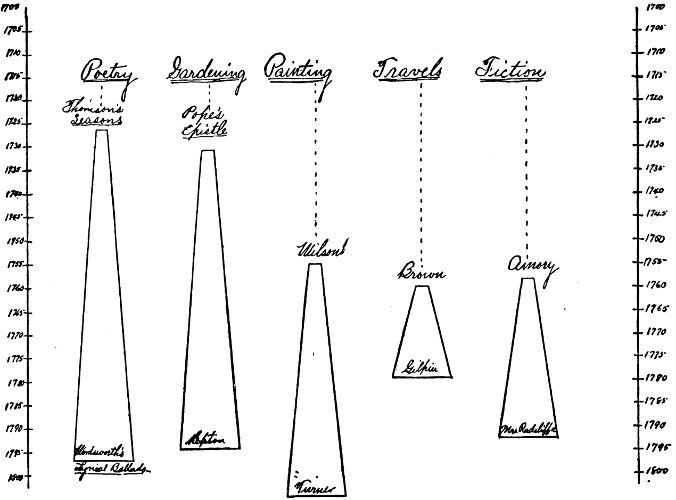
As a rule, such significant poetry of Nature as appeared during the transition period was the work of men who had spent much of their youth in the country or in country villages; it was practically their earliest poetic venture, and usually the work of their youth; and, in most cases where there was an extended literary career, the poetry of Nature speedily gave way to work of a didactic or dramatic sort, in which Nature played but a small part. To any such general statement there would be of course important exceptions. Blake, for instance, was a town-bred poet. So was Collins, and his “Ode to Evening” is not his earliest work. Cowper was town-bred. He was old when he began to write, and his poetry of Nature is his latest rather than his earliest work. But, taken as a whole, the poetry of Nature during the eighteenth century bears out the statement as made. It is well illustrated by Armstrong, who was born and who apparently spent his youth in Castleton, a little village in the wildest part of the mountainous country around the Derbyshire peaks, wrote his “Winter” before he was fifteen, went to Edinburgh[330] and then to London to study, and wrote as the work of his mature years a didactic poem on the “Art of Preserving Health.” Or by Dyer, who was brought up in South Wales, wrote “Grongar Hill” and “The Country Walk” at twenty-five,[331] went up to London, and wrote as his mature work “The Ruins of Rome” and “The Fleece.” Or by Thomson, who lived until he was fifteen in Southdean, a little hamlet at the foot of the Cheviot Hills, the last of whose “Seasons” appeared when he was thirty and whose later work was a succession of dreary tragedies. Or by Akenside, who, though brought up in Newcastle-on-Tyne, made frequent visits to the country during his youth, wrote “The Pleasures of the Imagination” at seventeen during one of these visits, and in his after life wrote much prose and poetry in which there is no hint of the early enthusiasm. Allan Ramsay lived in a secluded spot among the Pentland Hills until he was fifteen, and his earliest important poem, “The Gentle Shepherd,” is really a memory picture. William Pattison spent his youth at Appleby, a village on the Eden, in Westmoreland, where he wrote his earliest poems. Mickel spent his youth at Langholme on the Esk, and his first important poem, “Pollio,” written at eighteen, was in memory of his life there. Bruce was brought up at Kinneswood, a village on Lochleven, and his early poetry had much to do with the scenery about that place. Beattie spent his youth at Lawrencekirk and Fordoun on the east coast of Scotland, and “The Minstrel,” his first important poem, is a record of his early life. It would certainly be a misreading of these facts to infer that to write well of Nature the poet must have been brought up in the country. Genius has the rare gift of seeing a very little and straightway knowing a great deal. It would be equally wrong to infer that poets write of Nature when they are young and give it up when they put away childish things. The import of these facts in this period seems to be merely that there was a genuine and widespread love of Nature on the part of many isolated poets, who, by the circumstances of their lives, knew Nature better than they did literature, but[332] that this love was not sufficiently robust in individual cases to withstand the cramping influences of city life and literary coteries. The developing tradition was carried on not so much by the persistent influence of a few as by the constant springing up of the same spirit in many minds.
In a transition period the predominant spirit is self-conscious, authoritative, and full of maxims drawn from its own successes. The new spirit comes in, as it were, by chance. It is but slightly theoretic, following instinct rather than well-defined principles. In its first stages it is apologetic rather than aggressive. These characteristics, on the whole, mark the love of Nature in the early eighteenth-century poetry. There are, however, occasional indications that some poets, at least, not only wrote according to new canons of taste, but were distinctly conscious of their revolt from the old. So early as 1709 Ambrose Philips in the Preface to his “Pastorals” justified his choice of country themes by pointing out the pleasing effect of natural scenes on the mind. John Gay’s enunciation of a creed, though meant as a satire, was so just a condemnation of existing poetic conventions, and so apt a prophecy of one phase of the new spirit that it really deserves to rank among revolutionary statements of theory. Allan Ramsay’s Preface to “The Evergreens” is equally emphatic in its scorn of classical limitations, and it was meant in downright earnest. The thought of the Preface finds expression several times in his poems as well. Dyer gives utterance to a similar scorn of Parnassus in “The Country Walk.” Shenstone, in his “Prefatory Essay on Elegy,” shows a timid but perfectly clear recognition of the fact that he is breaking away from poetical canons. Mason in the Preface to “Elfrida” says that he has introduced descriptions with a purpose of rendering the drama more pleasing. Whitehead’s “Enthusiast” with its elaborate[333] statement of both sides of the case in man versus Nature is an important indication of the clearness with which the points of the controversy were at that time recognized. The strongest and most detailed statement of a creed came about four years later in Joseph Warton’s “Essay on Pope” (1756). Nothing else so clear, direct, and full appeared before the Prefaces of Wordsworth. After Warton it is not so necessary to indicate all self-conscious statements. It will suffice briefly to indicate Langhorne’s statement of his purpose in writing, Goldsmith’s vigorous attacks on falseness and affectation in poetry, Beattie’s Wordsworthian Preface to “The Minstrel,” John Scott’s criticism on existing poetry and his statement of his own aim in the Preface to his “Amoebaean Eclogues,” Crabbe’s expressed determination to treat of Nature as it really is, Cowper’s pleasure in the fact that his knowledge and inspiration come straight from Nature and his persistent reiteration of his belief in the superiority of the country over the city, and finally Burns’ many critical remarks on the essential qualities of descriptive poetry.
The characteristics of the poetry of Nature that was growing up during the eighteenth century have been already indicated in one way and another, but it seems necessary here to gather them up into general statements. The easiest and clearest way will be to make a somewhat detailed summary of such traits of this poetry as seem to foreshadow the later treatment of Nature, especially as exemplified in Wordsworth. In the comparison I keep mainly to Wordsworth both for the sake of simplicity, and because, though in romantic periods each poet works out his own salvation along original and self-determined lines, yet Wordsworth more nearly than any other poet expresses the variety and complexity of interest in the new feeling toward Nature.[334]
Wordsworth said that a part of his endowment as a poet was a peculiar openness to sense impressions, and that this endowment was cultivated by his environment in youth until the real facts of Nature were perceived by him with fulness and accuracy. In his wholesale condemnation of the period between “Paradise Lost” and “The Seasons” the chief count in the indictment is the absence of new images drawn from Nature. Full, accurate, first-hand knowledge of Nature is then with Wordsworth a sine qua non, a basis on which interpretation must rest. During the eighteenth century no one man had Wordsworth’s inevitable ear or practiced eye, but the whole impression made is that men were at last out of doors, looking and listening for themselves. Each man sees many facts not before noted, and collectively the poetry of the period presents a great body of natural phenomena of all sorts. Poets, artists, travelers, writers of fiction, unite to swell the stock of facts about the external world. Dorothy Wordsworth’s “Journals” show with what delight she and her brother dwelt upon the baldest statement of the actual facts of Nature. Gray in his “Letters,” John Scott in his “Eclogues,” show this same pleasure in simply cataloguing the lovely facts of the out-door world. Lady Winchilsea, Gay, Thomson, Dyer, Cowper, Burns, all the landscape painters from Wilson to Girtin, Mrs. Smith and Mrs. Radcliffe, are but leaders of the many who were striving to make report of what they found in waters and skies, in field, mountain, and plain. The wide range of these facts is astonishing. The knowledge of the poet is no longer confined to parks and gardens, to the mild and lovely aspects of Nature. His aroused curiosity pushes him out into new realms of inquiry. All kinds of Nature, animate and inanimate, wild and tame, remote and close at hand, attract interested attention.
The mere mass and variety of this accumulated knowledge[335] is sufficiently significant in its bearing on the development of a new taste for Nature, but a further general question arises as to the accuracy and delicacy of the observation. There certainly was none of the scientific spirit that would feel the charm of bare exactness, and there was hardly any of Wordsworth’s feeling that to misrepresent a fact of Nature would be sacrilege. Facts were, indeed, often noted in a loose, careless way, as if of slight importance. But taken as a whole the observation bears the mark of the eye on the object. From Lady Winchilsea to Bowles every poet who has been esteemed noteworthy in the study of Nature gives the impression that he speaks from personal knowledge, and no poetry can make that impression unless it is in its main lines true. Delicacy of observation is another matter.
What the eighteenth-century poets did was to give truthful expression to very many natural facts of a kind fairly obvious to an age well versed in the lore of field and wood; but new to an age just emerged from the gates of a park. It is observation of this abundant, truthful, obvious sort that we find in Ambrose Philips, Gay, Ramsay, Shenstone, John Scott, and largely this even in Thomson. The commonest facts of Nature, the blue sky, wild flowers on a rocky ledge, rough little streams, were a wonder and a delight. Discrimination comes after general and obvious facts have been accepted and assimilated. It is inevitable, even setting aside their different temperaments, that Cowper should have more of it than Thomson. The strange thing is that in the early stages of the poetry of Nature we should find any observation so close and delicate as that in the study of night by Lady Winchilsea, of burns and mountain pools by Allan Ramsay, of winter skies and ice-burdened streams by Armstrong; or as that in Thomson’s sunset after rain, Dyer’s wide views and homely bits of country life, Collins’ evening, Gray’s skylark[336] and song-thrush, Thomas Warton’s opening spring, Logan’s cuckoo, and Scott’s trees.
The fulness and accuracy of the eighteenth-century study of Nature may be further seen by a brief analysis of the sense impressions most frequently noted.
Wordsworth is said to have been physically deficient in the sense of smell, hence the noticeable absence of odors in his poems may be accounted for. But it is doubtless true of all poetry that fragrances are more scantily recorded than are other facts, and that there is seldom any delicate discrimination between various sorts of sweet odors. For this reason such slight study of odors as we find in the transition poetry is the more to be dwelt upon. There are certainly not infrequent observations showing close knowledge. J. Philips notes the faint sweetness of cowslips; Relph speaks of the odor of the “fresh prumrose on the furst of May;” Dyer and Shenstone of the fragrance of brakes; Dyer of sweet-smelling honeysuckles; Shenstone, Thomas Warton, and Cowper of the fragrant woodbine; J. Philips and Mickle of scented orchards; Cowper calls attention to the odor of limes and the fresh smell of turf; Lady Winchilsea speaks of the “aromatic pain” from the odor of a jonquil, the “potent fragrance” of which is recognized also by Thomson. Two odors frequently mentioned are of “the perfuming flowery bean” celebrated first by John Philips, then by Gay, Thomson, Savage, Shenstone, and Joseph Warton; and the fragrance of hay noted by Thomson, Gay, Ramsay, Savage, Potter, Relph, Thomas Warton, and Mickle. When homely, unusual odors, like that of the bean, are noticed there is often exceptional vividness of statement. What took rank in the poet’s mind as his own discovery brought out a natural freshness of phrase. One other fact frequently noted is that odors are strongest at morning or evening or after a rain. These[337] specific references are of real importance in showing new powers of perception, but it must be admitted that in general the use of odors was of the conventional sort, referring rather vaguely to sweet breezes blowing over flowery fields.
The sensitiveness to sound so often remarked in Wordsworth’s poems is a characteristic of the poetry of Nature throughout the century before Wordsworth. The music of Nature was a source of widespread delight. The “pleasant noise of waters,” for instance, receives some notice from nearly every poet in the list, while in travels and fiction some of the most effective passages are on the sounds of rapid streams and waterfalls. In poetry the old words “warbling,” “tinkling,” and “murmuring,” are still much used, but Ramsay’s rill that “makes a singin din,” Thomson’s roused-up river that “thunders” through the rocks, Mallet’s river with its “sounding sweep,” Collins’ “brawling springs,” and Cowper’s “chiming rills” are a few of the phrases that mark a more individual and personal way of listening. One of Wordsworth’s often-quoted lines on sound has to do with the greater distinctness of the song of mountain streams by night. Mr. Heard gives this passage as an instance of Wordsworth’s peculiarly close observation. But the clearness with which falling or running water is heard at night had been noted at least six times in the literature before Wordsworth. Lady Winchilsea mentioned it in her “Revery.” Beattie speaks of waterfalls heard from afar amid the lonely night, and again of the quiet evening when naught but the torrent is heard on the hill. The lines in John Brown’s “Rhapsody” have already been quoted, as also his “Letter” in which he notes the variety of sounds from distant waterfalls as one of the attractions of a walk at night. And Gray also speaks of the murmur of many waterfalls not audible in the day time. Several other authors, as Dyer and Mallet, have[338] practically the same idea when they mention the unusual clearness of the sound of falling water in a breathless noon, or in the depths of a silent forest.
The sounds made by winds are also often and particularly noted. They sigh through reeds, they make a remote and hollow noise in “wintery pines,” they murmur through the poplars, they rustle lightly over “deep embattled ears of corn,” they join in concert with woods and waters, or they sweep in mighty harmonies through ancient forests. The whispering breezes, and dying gales of the classical poetry do not often occur. Brown in his “Letter” shows how deeply he was impressed by the roaring of the winds through the mountains, and the one passage in which Dr. Johnson showed any appreciation of wild Nature is a description of the combined sounds of streams and wind on a stormy night in Scotland. A characteristic passage is Thomson’s fine description of thunder among the mountains. Wordsworth, from the peculiar delicacy of his perceptions and perhaps from his contemplative Nature, was deeply sensitive to the silences in the world about him. There is some though but little indication of a similar pleasure in preceding poetry. One of the best passages is Thomson’s description of the boding silence before a storm. This has, however, much less of the real Wordsworthian spirit than has Brown’s conception of the silence that spoke from the starry vault, the shadowy cliffs, the motionless groves, and the faint mirror of the placid lake.
Of sounds from animate Nature the emphasis is of course on birds. But the feathered choir of the classical period has been resolved into distinct species, each with a voice of its own. The nightingale is not supplanted but she is no longer a monopolist in the realms of the muses. In this transition poetry the cuckoo takes an interesting place. Wordsworth’s address to the bird as “the darling of the spring” gives the[339] association of ideas found in most of the early poems. The cuckoo is the harbinger of spring. Armstrong and A. Philips have the loud note of the cuckoo as one of the first hints of the opening year, and Thomson’s symphony of spring is introduced by “the first note the hollow cuckoo sings.” Mendes says it is “the cuckoo that announceth spring,” and Gray speaks of the cuckoo’s note as part of “the untaught harmony of spring.” The peculiarity of the cuckoo’s note is also often mentioned. Other birds have many notes, says John Cunningham, “the cuckoo has but two.” Logan, as Wordsworth after him, records the fact that the bird is usually unseen, and both speak of the schoolboy’s surprise as the strange cry falls on his ear. The lark, the nightingale, and the linnet are frequently mentioned, but usually in terms somewhat conventional. They had been in poetry so long that a distinct effort would have been needed to think of them under new phrases. To be released from the captivity of a stock diction and conventional sentiment they waited for Shelley and Keats and Wordsworth. It is in observations on birds not counted poetical property that we find fresh and exact expression. A mark of the new spirit is the pleasure in such sounds as the call of the curlew, the boom of the bittern, the chattering of magpies, the caw of rooks, the piping of quails, the scream of jays, the clang of seamews, the shrill clamor of cranes, the shriek of the gull, the whistle of plovers, the whir of the partridge. To hear such sounds the poet must wander over moors, by sedgy lakes, along rough shores, far enough from trim parks. To bring such sounds into poetry marked a great revolution in taste from the days of the lorn nightingale and the plaintive turtle. As a whole we may say that the treatment of sound in eighteenth-century poetry is abundant, accurate, and often very effective.[340]
The process of passing from general to specific statements as a result of increased knowledge shows itself again in the use of color. The universal paint of the classical school has been resolved into some of its constituent elements. These are not many, however, and there is not much nice discrimination into shades and tints. The colors most often observed are green, blue, yellow or gold, purple, red or crimson, and brown, the order given being the order of their frequency. Purple is used less frequently than in the classical poetry and usually has some real artistic significance. Yellow, a comparatively new word, is used often of harvests, of trees in autumn, of moonlight, and of various sunlight effects. Dyer gave early prominence to the word as an epithet applied to Nature. Brown is applied in somewhat the conventional manner to streams and shadows. Thomson, Dyer, Savage, and Cowper made the most effective use of color, and it is important to observe that their advance consisted not so much in seeing many more colors than had been seen before, as in discovering color in many more objects than formerly. They did not merely see that “all above is blue and all below is green.” They saw the blue heavens, but they saw, too, the blue of “sky dyed plumbs,” of mists, of distant hills, of streams and bays, of ice-films, of the halcyon’s wing, of curling smoke, of the lightning flash. The endive, the lavender, the lilac, the violet, the harebell, the heath-flower, are singled out as blue. And Dyer speaks of the blue color of the poplars, and Dalton of blue slate roofs. Not merely the general green of a summer landscape is commented upon, but there are closer observations concerning the varying shades of green as the trees are massed together. The russet tints brought out in green tree tops at sunset, the funereal green of yews, the yellow-green in a sunset sky, the yellow tinge in green grass almost ready for the scythe, the glossy green of the holly, the deep green of[341] box, the contrasting green of elm, oak, and maple, are some typical observations.
The use of color, however, seems, on the whole, in spite of its abundance and picturesqueness, hardly so varied and individual as the use of sound.
A division into colors and sounds leaves many sorts of observation unnoted, and frequently these are of great importance as indicating close knowledge; but they have been so often commented upon in the study from author to author that even a suggestive recapitulation is hardly needed here. Enough has been called to mind to show that there was much knowledge of the external world, and that much of this knowledge was reported in words so direct and truthful that they must have come from personal experience.
In the classical period we have seen that only the milder forms of Nature were cared for. Wordsworth was, on the other hand, essentially the poet of mountains, lakes, and streams. It will be of interest to note the attitude of the transition poetry toward the various kinds of Nature. And first we may sum up the evidences of mountain enthusiasm.
In the first fifty years of the century we have only the expressions of pleasure in climbing mountains or hills by J. Philips, Gay, and Dyer; the various descriptive references in Ramsay and in Mallet; Boydell’s crude work in Wales, and Paul Sandby’s sketches in the Highlands. Ramsay and Mallet show a consciousness of mountains, and evidently regard them as noticeable and picturesque elements of a scene, and Dyer is of distinct importance because of his lingering pleasure in the beautiful views opening up before him as he climbs the mountain, and especially because of his poetic comprehension of mountain solitudes. But it is during the next thirty-five years (1750–85) that we find the most adequate eighteenth-century treatment of mountains.[342] During this period Brown, Pennant, Young, Gray, and Gilpin visited Scotland, Wales, and the English Lakes, and wrote of mountains with an enthusiasm hardly equaled in the succeeding century. In fiction were Amory’s eulogy of Westmoreland, and his exaggerated pictures of Cumberland, and Smollett’s description of the country round Loch Leven. In painting, Boydell, Devis, Sandby, Bellers, Wilson, Barret, Farington, and John Cozens were studying mountain scenery in Scotland, in northern England, in Wales, Ireland, and in the Alps. In poetry we have Coventry’s address to Vaughan on mountain climbing; Dalton’s apostrophe to Skiddaw; Brown’s rhapsody on the mountains and lakes of Westmoreland; the mountain scenery in Gray’s “Bard” and the poems of “Ossian;” the many descriptive references in Dyer’s “Fleece,” Jago’s “Edge Hill,” Mickle’s “Almada Hill” and “May Day,” and Scott’s “Amwell;” and Beattie’s study of the influence of mountains on a poetic mind. During the last twenty-five years of the century there is, in poetry, a curious apparent cessation of mountain interest. The most highly poetic minds, Blake, Cowper, and Burns, have none of it. Crabbe does not touch upon mountains. Lesser poets, except Bowles at the very end of the century, are equally silent. This is not, however, true in other realms of art. Mountain scenery is still, during these years, a large element in romances, and in travels, and many artists are sketching in the picturesque regions opened up to them by earlier students of mountain landscapes.
Many lovers of Nature and of poetry have commented with surprise on the slow development of the poetic appreciation of mountains. It is, perhaps, even more strange that English poetry should have been still slower in its discovery of the ocean. It is as if English poets from Dryden to Byron had all lived inland. Even in Wordsworth, in spite of some[343] wonderful lines, there is no treatment of the ocean at all comparable to his study of mountains. In the classical age the ocean was a dreary waste. In the transition poetry we do not find much more knowledge or appreciation. The one quality of the ocean that receives anything like adequate expression is its boundlessness. Characteristic lines are by John G. Cooper.
Armstrong says that the “floating wilderness”
Mickle looks upon the awful solitude of ocean and his imagination is stirred by
These are the best lines I have found. The chief expressions of pleasure in the ocean are Gay’s mild delight in a sunset across the sea, and subsequent moonlight effects, and Beattie’s pleasing dread as he seeks the shore to listen to the wide-weltering waves. We find in Cowper’s letters a more appreciative passage on the ocean than occurs in any of the poetry. The most sincere ocean enthusiasm is in Mrs. Radcliffe’s romances. Travelers, even those who went along the coast of Wales and among the Scottish islands or to the Isle of Wight, say little of the sea. The ocean was, in fact, much such a burden as Sterne’s plain. When the poet had once said that it was big and awful his stock of impressions was exhausted. In painting, the ocean was not entirely ignored, but in this province, too, there was meagerness of conception and expression. The ocean waited for Turner and Byron and Shelley.[344]
One of the interesting characteristics of the love of Nature in the eighteenth century is a delight in wide views. What had in the classical period “tired the travelling eye,” with the dawning of the new spirit gave satisfaction. It was in accord with the mental revolt against close boundaries of any sort. From the day when John Philips ventured to express some pleasure in the view from a hill, and Gay climbed Cotton Hill to raise his mind nearer heaven, and Dyer spent days in studying with an artist’s eye the colors and forms of the view from Grongar Hill, to the time when Beattie eagerly climbed the rugged steeps of Scottish mountains so that he might see the morning mists rolling and tumbling over the rough hills beneath him, do we find this pronounced delight in wide views. Even poets who show no great love for mountains, as Thomson, Mallet, Collins, the Wartons, Langhorne, Mickle, and John Scott, and even poets of confessedly tame scenery as Cowper, love “green heights” and extended prospects. To the expression of this feeling Amory and Mrs. Radcliffe, Brown, Young, and Pennant make large contributions. This feeling shows itself also in gardening. The cutting-down of tall hedges, the opening-up of vistas, were a result of the change of taste and a contribution to it.
We have seen that during the classical poetry the skies in favor were cloudless and that of all sky phenomena the rainbow excited most attention. In the transition poetry we find much of this love of fair summer skies and expressed sometimes with a new freshness as when Dyer wishes nothing above his head but “the roof on which the gods do tread,” or when Ramsay looks with joy upon “the lift’s unclouded blue,” or when the clear gladness of heaven shines down from the lovely skies of Blake. But on the whole, references to the serene day-time sky are conventional. It is another illustration of the fact that such aspects of Nature as were[345] already known and had come to be spoken of after a set fashion were slow to be emancipated into a new phraseology. Better work is done in describing what Coleridge calls the “goings-on” of the sky. Thomson knew the sky in all its phases. Parnell describes well the airy tumult of clouds after a storm. Mallet has one or two rather effective studies of a stormy sky. One of Beattie’s best descriptions is of a shifting cloudy sky on a windy autumn day, and he has other effective cloud studies. But taken in the mass the material is scanty and not of great value. It was Wordsworth and Shelley who first gave adequate expression to the mysterious and varied charm of the day-time sky.
The love of the night sky and of night itself is first found in Lady Winchilsea, and for close observation and delicate feeling there is nothing better throughout the century. There is, however, much use of night, moonlight, and stars in a new and appreciative fashion. In Gay’s “Dione” there are several attractive little moonlight pictures. Parnell was impressed by the depth, the serenity, and the silence of a starry sky on a clear night. Coventry observes how fast the moon travels through light clouds as if bent on a journey, while in clear weather she sits steady empress of the skies. Joseph Warton notes the shining of hills and streams under the light of a full moon. Mickle has some beautiful lines on both moon and stars as they rise from behind certain favorite hills. He walks much at night and loves to watch the trembling line of light from the moon as it shines across the lake, or the soft effect of the yellow moonlight sleeping on the hills. Beattie stays out all night to watch the aspects of the sky till the dawn of day. Morning and evening twilight are less often spoken of. There is certainly nothing else in the century to compare with Collins’ “Evening.” Sunset and sunrise are often described, but nowhere with more general[346] effectiveness than in Thomson, or with more minute color study than in Savage.
Closely connected with the knowledge of the sky is the new feeling toward storms. In the classical poetry they had been ignored or used as similes for disaster. But one of the first evidences of a new spirit was in the appreciative description of winter storms, as in Riccaltoun, Armstrong, and Thomson. The early descriptions and the multiplicity of storms in Thomson and Mallet give at first the impression that this element held a larger place in poetry than it really did. Ramsay has some good lines on winter storms. There is an admirable stanza in Collins’ “Ode to Liberty,” and another in Thomas Warton’s “Grave of King Arthur.” In Beattie’s “Minstrel,” and in several of Burns’ poems there are expressions of delight in the fierce play of the elements, but that exhausts the list of notable passages. It is only in Beattie that we find any of the modern sense of kinship between the tumult of life and Nature’s fierce conflicts, and the imaginative force of a passage like that in “The Excursion” where the Wanderer longs to be a spirit and so mingle with primal energies in their mightiest activities, or the lyric passion of a cry like that in Shelley’s apostrophe to the West Wind, are not even hinted at.
The most pronounced change came with reference to these grander, wilder aspects of Nature. We have still to note the treatment of the gentle pleasant things of Nature, as birds, flowers, trees.
There was, through the classical period, abundant delight, in a general way, in meadows bursting into bloom, and in bright blossoms in the garden. The use of the words “flowery,” “adorned,” “decked,” “enameled,” etc., usually had reference to fields of flowers thought of in a vague, pleasant way. The changes that come during the transition poetry[347] are a resolving of the general into the specific, a concentration of attention on English flowers, and a greatly increased knowledge of individual flowers. The rose and the lily often give place to homelier blooms as those of peas and beans, the bramble rose, butter flowers, clover, heath-bells, crowfoot, the tangled vetch, the mandrake, the thistle. The increased minuteness of observation shows itself in such garden studies as we find in Thomson and Cowper. A feeling of personal relationship toward flowers finds its highest and sweetest expression in Burns’ “Daisy.”
In the classical poetry trees in general are an important part of the stock-in-trade. The new feeling shows itself in a growing tendency to think of trees as individuals. In a landscape trees are mentioned by name. The thin leav’d ash, whispering poplars, the glossy rind’d beech, venerable oaks tossing giant arms, waving elms, quivering aspens, murmuring pines, hoary willows, sycamores green, tawny, or scarlet, according to the season, white-blossomed hawthorn, deep green hollies, elders with silver blossoms, stand out from the mass and are known for their own qualities. Minute observation is indicated by the descriptive phrases used. The color of the trunk, the spread of the branches, the changing hue of the leaves, the kind of blossoms, are severally noted. Two special studies of trees are by Lady Winchilsea and Dr. Dalton, and are of early date. Dyer and Cowper give the best studies of trees seen in a mass, and yet individually noted. While there is not a touch of the deep forest in this poetry, there are many lines describing woodland effects. Thomson, Potter, and Cowper find especial pleasure in the lovely interplay of light and shade in a pathway overhung by woven branches. The brown shadows and the softened light in a deeply wooded nook are observed. Gentle streams sing happily under a cooling covert of green boughs.[348] The quiet of the woods is broken only by the plash of waters, the rustle of boughs, the whisper of leaves, the hum of insects, the song of birds, sounds from distant flocks and herds, or the stroke of the woodman’s axe. Trees also form an important part of every general landscape. But no poet has given so much of the real forest feeling as Mrs. Radcliffe. Of travelers Young has most to say about trees but his observations are largely scientific and utilitarian. On the whole we may say that trees are given abundant and discriminating attention, but that this attention seldom penetrates beyond external, artistic qualities. Personal friendship for trees such as we find in Lowell, for instance, has hardly yet reached expression.
Birds have already been discussed under sound, but it remains here to state that the habits of birds, their manner of flight, their nests, the trees they choose, their ways of protecting their young, were all topics on which much was known. Of minor poets, those who knew birds well, are Jago, Potter, and Bruce. Gray adds some perfect touches. Best of all for accurate description and real understanding are Thomson, Cowper, and Burns. The prominent place of the cuckoo has already been spoken of. The redbreast and the thrush with “speckly breast” rank not far behind in interest. The redbreast found early honor in Armstrong’s “Winter,” and then in Thomson’s, and is one of the pleasing elements in Cowper’s “Winter Walk.” On the whole, birds of the lakes and streams seem to be better known than birds of the tree and copse.
One phase of the literary treatment of birds is a recognition of their rights as free, living beings. This feeling, not toward birds alone but toward all animals, is one of the marks of the new spirit. There is even in Lady Winchilsea’s “Revery” a slight hint of the conception that animals would not suffer if man had not proved himself a tyrant, and Gay[349] carries out the same thought in one of his “Fables.” Thomson’s protests against killing animals for food are the first strong statements of the new feeling. Shenstone, in “Rural Elegance” and “The Dying Kid,” shows some sympathetic regard for animals. Jago and Potter and Langhorne protested vigorously against cruelty to birds. Beattie had the strongest possible dislike toward so-called English sports. The feeling of close fellowship and almost human love toward animals, so marked in Wordsworth and Coleridge, did not find expression in the transition poetry until Burns and Cowper gave it full statement.
Throughout the poetry of the eighteenth century we have observed a turning from the general to the specific. There is likewise a similar tendency to localization. The classical poetry of Nature belonged to no special spot, hardly to any special country. The poetry of Wordsworth and of Walter Scott was, on the other hand, eminently local. They celebrated the mountains and islands and streams of the region they knew. Wordsworth complained that before his day no one had sung of British mountains. It is interesting to note the growth of this passion for certain spots definitely pointed out and named, certain natural scenes known and loved as a person might be. A brief survey of the mountains and streams thus celebrated in eighteenth-century poetry will serve as illustrative. After Dyer’s “Grongar Hill” come other mountains of Wales. The hoary heights of huge Plynlymmon; the wide, aërial side of Cader-ydris; the craggy summits of cold Snowdon, king of mountains; Clyder’s cloud-enveloped head; Caer-caraduc, and others are spoken of with evident pleasure and not a little artistic perception. In Scotland the hills of Cheviot, the Pentland Hills, the mountains in the Ossian country, and those around Lochleven, are chief. In England we have the scarry side[350] of Braids, Dafset’s ridgy mountain, Edge-Hill, Almada Hill, Derwent’s naked peaks, huge Breaden, blue-topp’d Wrekin, giant Skiddaw, the solemn wall of Malvern, the Cambrian Hills, the hills of Ilmington, and others. The spirit of localization in its application to mountains does not often go beyond calling the mountain by its own name, and using some phrase showing that this mountain is known as separate from the general mass. In its application to streams the feeling is more detailed in expression. Ramsay’s streams and pools are closely localized. Dyer celebrates not only Towy’s flood, but the Vaga, the Ryddal, the Ystwith, the Clevedoc, the Lune, and especially the Usk. Dr. Dalton traces the course of the Borrowdale Beck from Lodore Falls to the lake. Langhorne follows the track of the Bela through solitary meads, and then through the rough realms of Stainmore. He also celebrates his joy as a child in the river Eden. Smollett, on his sick bed, writes an ode to Leven Water. Bruce sings of the Po, the Queech, the Severn, and especially of his youthful delight in the Gairney. Mickle writes of the Forth, the Annan, the Ewes, and the Wauchope, but dwells with most zest on his early love of the Esk. Of peculiar interest is Akenside’s apostrophe to the Wansbeck. Hamilton, Langhorne, and Logan wrote of the Yarrow, Cowper of the Ouse, Burns of the Ayr, the Doon, the Nith, the Afton, the Devon, and many another Scotch stream, while Bowles wrote of the Itchin, the Tweed, the Cherwell, and the Wansbeck. A map might be made on which should be represented only the mountains and streams spoken of with some particularity, with something more than a mere mention, in English poetry between 1650 and 1720, and a similar map of the period from 1720 to 1795. A comparison of the two would be an interesting commentary on the growth of knowledge and interest in British scenes.[351]
All that has been so far presented goes to show that in the antithesis between town and country the balance of favor swung round during the eighteenth century to the country. Usually the preference is implicit, and is to be inferred from the change of theme, but occasionally the antithesis is sharply stated, as, to take types, in Thomson, the Wartons, and Cowper. It is Thomson who first gives adequate statement of the transfer of sovereignty from the “fine lady muses of Richmond Hill” to “the muses of the simple country.” It is his hatred of the noisome town, his delight in fields and woods untouched by man, that established the new canon of taste. In the Wartons, twenty years later, the breach between the city and the country is almost an impassable gulf. Combined with the love of Nature in her external forms there is that spirit of romantic melancholy by virtue of which the poet regards Nature as a refuge from the tormenting complexities that beset the life of men in communities. There is usually a touch, sometimes more than a touch, of morbidness in the passionate eagerness to escape not only from the city into Nature, but from man and all traces of his dominion into a solitude free from all human suggestiveness. Forty years after the Wartons, Cowper’s famous epigram, “God made the country and man made the town,” summed the matter up according to the new view. Cowper is as emphatic in his preferences as his predecessors, and much more detailed and minute in his expression. With him there is no vague generalizing, no morbid or passionate over-statement. His love of the country is a fundamental fact not only in his physical, but also and even especially in his moral and spiritual, life. It is a fixed principle, quiet, rational, inevitable. The anti-classical side of the city and country antithesis receives in Cowper’s poetry its most decisive and most reasonable eighteenth-century statement. We hardly find anything so[352] conclusive in fiction or in travels. There is an occasional expression of regret at going back to towns after a trip through the mountains and lakes, but as a rule the preference for the country is left to be inferred from the general tenor of the traveler’s writings. Mrs. Brooke protests much against London, and declares her preference for Nature unadorned. Mackenzie’s Julia rejoices over her country birth and education, and Mrs. Radcliffe reiterates the desirability of living far from towns and as close as possible to the influence of Nature. Cowper, however, remains as having given the final, emphatic statement.
Through all this detailed study and wide knowledge of Nature there runs an undercurrent of personal enthusiasm which is quite a separate thing from the knowledge of Nature, but which led to that knowledge and was fed by it. Sometimes we are left to infer this enthusiasm from results, but oftener it finds clear statement. There is frequent expression of such “unspeakable joy” as Ambrose Philips felt when he gazed on a little country home, or of Ramsay’s “heartsome joy” on a bright spring morning
or of Hamilton’s rapturous joy as he lies on the flowering turf, his soul “commercing with the sky.” In many passages Thomson expresses his passionate delight in the music, the color, the fragrances of the out-door world. Dyer’s joys run high as he lies on the mountain-turf. Shenstone says that the beauties of Nature alone bear perpetual sway, and he thinks with scorn of a soul so narrow that it cannot relish Nature’s calm delights. Joseph Warton cannot find words to express the ecstasy with which he looks on Nature. John Langhorne’s only wish is that he may enjoy the blessings Nature gives to those who love her, and says that her charm[353] alone is unfading. Beattie says that the man who goes to Nature has rapture ever new. Cowper thinks that any man who turns away from Nature starves deservedly. Burns says that he looked upon Nature with boundless joy. This feeling of exhilaration, of rapturous delight, is pervasive. It is often inadequate, or vague, or extravagant in statement, but the delight is unfeigned, the enthusiasm real, and in poet after poet it demanded expression. That it seldom found the perfect statement only means that art is long and that much thinking and feeling in an age as in an individual must go before the final art-form.
Much of this delight in Nature is in kind though not in degree like that which Wordsworth in “Tintern Abbey” calls his second period of love for Nature, the time when the colors and forms of the external world were a sufficiently engrossing pleasure, and he felt no need of “a remoter charm by thought supplied.” But Wordsworth quickly passed from this stage of pleasure to another. In his best descriptions, as in “The Yew Trees,” he gives a few external details, and then at once penetrates to the inner spirit of the scene. He is like a portrait painter who represents the features with truth and simplicity but makes the face live because he has divined the qualities of soul behind it. Now whatever philosophical tenets Wordsworth held he certainly thought of this soul of Nature, whether of Nature as a whole, or in special parts, as in some way a manifestation of divinity. In other words he saw God immanent in Nature. The classical conception also saw God in Nature, but as the remote Architect, Artificer, Lawgiver. The universe was dead, cold, inert matter. For the difficulty with which it was made to serve men’s needs the defenders of Omnipotence felt apologetic explanations necessary. We have seen that during the eighteenth century there came a great and joyous[354] awakening to the external charm of the world. Are there also indications that the divine life in Nature was felt?
Throughout the eighteenth century the usual thought of God in relation to Nature is the classical one. He is the author and controller of the universe; but there are some poems or passages or separate lines that seem to indicate a new conception. Lady Winchilsea recognizes a curious correspondence between Nature and her own heart, and says that in the quiet of a beautiful night she feels the presence of something too high for syllables to speak. There is a similar feeling in Hamilton’s description of a silent grove. In the “Nocturnal Revery” and in “Contemplation” the idea of divinity is not explicitly stated, but in Parnell’s “Hymn” the song of praise is professedly to the Source of all Nature, because through Nature the divine spirit had spoken peace to the poet’s troubled heart. The incessant and ever-present creative activity of God is clearly set forth in Thomson’s “Hymn.” Each ray of sunshine, every blossoming flower of spring, every leaping stream, every rolling orb, performs its function as a direct expression of divine energy. And some lines give a further suggestion of divine immanence. The rolling year is full of God. The seasons are but the varied God. The beauty of God walks forth in the flushing spring. Such expressions as these mark a half-involuntary poetic seizing of the new idea of Nature as the bodily presence of which God was the soul, but they do not indicate Thomson’s leading ideas. Mallet, imitative of Thomson in this as in other respects, usually speaks of God as the Creator, but in one passage touches on the full stream of universal Goodness that is ever-flowing through earth, air, and sea, and on the ceaseless song of praise going up from the great community of Nature’s sons. Boyse in his “Deity” thinks of God as an Almighty Architect, but has a few lines in which[355] he represents all Nature as being momently derived from God. Young has a significant line when he says that night is the “felt presence of the Deity.” The theme of Akenside’s poem is to show the response which the imaginative mind finds in Nature, and this response is, he says, the voice of the divine spirit. His conception is usually, to be sure, that the divine spirit speaks through the forms of Nature, rather than that the form and the spirit have an essential union. Yet sometimes he speaks more clearly the new thought. He says that the man who loves Nature holds daily converse with God himself; the beauty of Nature flows directly from God; the order in Nature is sacred; the influence whereby Nature soothes and cheers and elevates man is really a divine influence. This is the fullest recognition of an in-dwelling God until we reach Cowper. In his poetry we find a clear statement of belief in the lines,
but the point is not one on which he dwells. These passages certainly foreshadow Wordsworth’s conception of God in Nature, but they are comparatively feeble and unimaginative in expression. There is nothing so Wordsworthian in Thomson’s sonorous lines or in Akenside’s ample statement as there is the feeling that penetrates the brief words of Lady Winchilsea and Parnell. Compared to these even Cowper seems cold and intellectual.
Wordsworth did not, however, lay special stress on his belief that the spirit he felt in Nature was divine. He rather took that for granted, or allowed it to be implied in the passionate fulness and intensity of his expressions of gratitude to that spirit for gifts of mind and heart. This sense of indebtedness to Nature found no place in the classical poetry. But in the transition period it receives surprisingly full and[356] varied expression. Sometimes it takes the form of personal gratitude for special gifts; sometimes it is a general statement of what man owes to Nature. A brief review of the more significant passages will serve to show the characteristics of this feeling toward Nature.
To begin with, Nature gives peace. This is the gift most often spoken of. Even John Philips said that Nature calmed his mind. Ambrose Philips liked the songs of birds because they brought him into a mood of “sweet and gentle composure.” Lady Winchilsea enjoyed the night because its influence disposed her heart to silent musings and made her conscious of a “sedate content.” Parnell had long vainly sought contentment until at last his heart received the message of peace through the voices of Nature. Hamilton said that all the passions in the troubled breast of man could be calmed by the quiet of a grove. Thomson finds in Nature a power that can “serene his soul” and “harmonize his heart.” Dyer finds peace and quiet in “the meads and mountain-heads.” Mallet follows Thomson in thought and phrase when he represents that Nature has power to “serene the soul.” Akenside says that the spirit of Nature lulls man’s passions to a divine repose. Cooper says that a contemplation of the order and regularity in Nature’s life will induce a like harmonious action in the human heart, and that the fiercest passions of horror and revenge can be soothed by Nature. Joseph Warton says that all Nature conspires to soothe and harmonize the mind. William Whitehead speaks of the “philosophic calmness” that comes to man from Nature. Beattie’s hermit found in Nature a power that could subdue the wildest passions and give “profound repose.” Bruce found in Nature “harmony of mind.” Bowles felt a “soothing charm” that brought “solace to his heart” and “bore him on serene.” So, too, was it with[357] Cowper. Nature gave him heart-consoling joys, and brought peace and quiet into his life. This power of Nature to soothe the mind of man and to modify his passions receives full expression also in Mrs. Radcliffe’s romances.
Nature gives not only peace and rest to man; she gives him joy. The sense of ecstasy and rapture in this joy has already been indicated in the passages expressive of personal enthusiasm for Nature. Sometimes it was a joy rising out of the delight of agreeable physical sensations, as when Lady Winchilsea felt in the odor of the jonquil a pleasure so keen that it was pain, or when Langhorne sank down oppressed by the boundless charms of field and wood, or such joy as Gray’s convalescent knew when he went out again into Nature. But here a more spiritual joy is referred to. It is rather the disturbing joy of elevated thoughts of which Wordsworth speaks. This uplift of soul in the presence of Nature is felt by Parnell when he seeks to give expression to the great chorus of thanksgiving to God from all existences. Lady Winchilsea and John Langhorne felt it when Nature gave them “thoughts too high to be express’t.” Akenside felt it, and in a truly Wordsworthian sense, when he said that in the presence of Nature the intellect is charmed into a suspension of its graver cares, while love and joy alone possess the soul. Burns finds that Nature exalts, enraptures him, making him conscious of an elevation of soul. And, finally, in Gilpin, we find, though awkwardly expressed, an exact statement of the enthusiastic calm, the visionary joy, with which Wordsworth looked on Nature.
A third gift of Nature is poetical inspiration, and that, too, in the sense in which Wordsworth believed that Nature set him apart for poetry and assisted him in his development. Akenside’s apostrophe to the Wansbeck along whose banks he wandered in childhood, “led in silence by some powerful[358] hand unseen,” his assertion that these influences fixed the color of his life for every future year, his thought of Nature’s “tender discipline” when skies and streams and groves conspire to guide the predestined sons of Fancy, are strikingly Wordsworthian. Langhorne says that in his lonely youth “the woodland genius” came and touched him with the holy flame of poetry. To the “Genius of Westmoreland” he ascribes the sacred fire within his breast. The whole theme of Beattie’s “Minstrel” is, as has been pointed out, the effect of Nature on a poetically sensitive mind.
Nature also gives a wisdom such as books and schools cannot give. The earliest expression of this thought is in Pattison’s comparison of the deep wisdom drawn from Nature and the superficial knowledge of the schools. Gay in the contest between the shepherd who knew Nature and the philosopher who knew cities and books determined that Nature without the schools can make men wise. Langhorne says that “fair Philosophy,” like Poetry, must be sought for in Nature. There is, however, no other eighteenth-century statement of this idea so complete as Cowper’s eulogy of the wisdom of the heart that Nature gives.
Nature is also considered as inspiring to morality and virtue. Gay, in a fable already quoted from, says that Nature can make men “moral” and “good,” if they will learn her lessons. Thomson meditates on Nature because thence he hopes to learn lessons of morality. Mallet says that Nature inspires the soul with “virtuous raptures” and prompts man to forsake sin-born vanities and low pursuits. Akenside’s chief theme is the power of Nature to lead men from petty interests and hurried, sordid lives into a beneficent and ordered activity of the soul. Cooper ascribes to “every natural scene a moral power.” John Langhorne says that the sweet sensations of Nature move the “springs of virtue’s[359] love,” and have a “moral use,” and that religion, fled from books, can be found in Nature whence we first drew both our knowledge and our virtue. Beattie says that the charms of Nature work “the soul’s eternal health.” They inspire love and gentleness. They incite to high living, and the man who neglects them can hardly hope to be forgiven. A pervading thought in Cowper’s poems is his moral and spiritual indebtedness to Nature.
Wordsworth not infrequently indicates his belief that the spirit of Nature consciously blesses man. This idea is sometimes found in the transition poetry, as in Hamilton’s “Contemplation,” and especially in Akenside and Cowper who represent Nature as making the happiness of man “her dear and only aim.”
So far we have discussed the knowledge of Nature and the feeling toward it rather than its use in literature. That this knowledge was abundant and varied, that this feeling was enthusiastic and often deeply reverential, may, perhaps, pass without further question. But a different problem presents itself when we ask what literary use the eighteenth-century poet made of Nature. It must be conceded at the outset that many references to natural facts are not literary at all. In Mallet’s “Excursion,” for instance, his journey through stellar spaces renders frequent mention of the sky and stars inevitable, but the references might as well be to macadamized roads. His purpose is merely to get from one point of vantage to another. Such brief, cold, unpicturesque use of details for purposes of transition are really non-literary. In any tabular statement of an author’s work some discount must be made to allow for this mechanical use of Nature, and in certain authors, as notably Mallet and Young, the discount is large. Another non-literary use of Nature is in the catalogue or summary. John Scott gives the extreme[360] example of this unorganized accumulation of details. The instinct of the artist is wanting. The poet does not even attempt to make Nature a part of a well-fused literary product. He is encumbered by his material. He crowds his canvas. His full and realistic presentation is without artistic reservations. His record is prompted simply by interest in the separate facts. No literary purpose determines his selection or rejection of detail. A recognized theme, unity, proportion, are absent. Such summaries may be of the highest importance as showing the abundance and exactness of the author’s knowledge of Nature, and separate phrases may have real literary quality, but the passage as a whole is no more literary than an inventory.
When, however, a purpose is apparent in the use of Nature, when there is discrimination under the dominance of a central idea, then, however crude and feeble the actual result, there is at least an attempt to use Nature in a literary way.
This dominating purpose may be merely description for its own sake, an attempt to present aspects of Nature in successive, isolated, artistically composed pictures, each complete in itself and having its parts organically related. Such description is entirely objective. Its aim is the reproduction of sights and sounds by which Nature under given conditions appeals to the senses. When highly elaborated its obvious danger is that there will be, in spite of the most artistic management, a certain vagueness and heaviness of effect. There are, nevertheless, very beautiful examples of pure detailed description dissociated from any purpose except that of making a picture in words, in both Thomson and Cowper, and here and there less successful examples in other writers.
A more subtle use of Nature is when the poet assembles his details in order to reproduce not a scene or an aspect of Nature, but the typical impression they have made on his[361] mind. Lady Winchilsea tells many facts about night, but her purpose is not the description of a single night; it is the reproduction of the loving delight and tender awe awakened in her own heart by many soft summer nights. The purpose of Parnell’s descriptive details is the reproduction of the mood of spiritual content induced by certain scenes. Passages such as these are often more or less detailed summaries, but they have literary quality because the motif produces unity of effect.
Again, the facts and descriptions may be adduced in support of a theory, as in Young’s “Night Thoughts,” Akenside’s “Pleasures of the Imagination,” Shenstone’s “Progress of Taste,” Beattie’s “Minstrel,” and Cowper’s “Task.” Here too, an organizing purpose is discernible, though there is the greatest possible difference in the various ways of using the material for the given purpose; Young’s facts, for instance, being used in a cold, argumentative fashion, while Beattie’s and Cowper’s are suffused with emotion.
Another use of Nature is based on the poet’s perception of the analogies between external Nature and human life or character. One outcome of this sense for analogies is in abundant similitudes, a literary use of Nature common in all languages, at all periods. In the pseudo-classical poetry of England we have seen that the similitudes were conventional and superficial. In a period of intimate knowledge and love of the outer world there is stress on the truth and beauty of the picture from Nature as well as on the human fact symbolized, and the analogy is subtly and sympathetically conceived. Wordsworth’s
is perfect in itself as a picture of Nature, and it is exquisitely apt in describing Lucy. He discovered in Nature that which[362] in its inner significance was truly a counterpart of the human idea. With regard to the similitudes of the transition poetry I have noted two interesting facts. In the first place, in proportion to the whole use of Nature, the use of Nature in similitudes is very much less in the transition than in the classical poetry. In the second place, in no other way of using Nature was the changed conception of the outer world so slow to manifest itself. Stock similes persisted even in authors who, in other respects, gave clear evidence of the new spirit. It was apparently easier to be original and individual in a new realm, than to break away from the established conventions of an accepted literary form.
As another outcome of the recognized correspondence between Nature and life the facts of Nature become, as it were, an allegory of human experience. From Dyer on there is a strain of pensive, gently didactic moralizing drawn from the poet’s observation of Nature. A river, however beautiful in itself because of its ceaseless motion, its shifting colors, its varied banks, its progress to the sea, is transformed in the poet’s mind into a symbol of the vicissitudes and the final goal of life. Of the more obvious analogies of this sort we find many examples, but of the highly imaginative use of Nature whereby the external fact, however truly and beautifully perceived, seems hardly thought of except as a symbol of the hidden things of the spirit and of the life to come, we find almost no examples outside of Blake.
The use of Nature in connection with man’s joys or sorrows may be lyrical or it may be dramatic in tone. Under the lyrical use of Nature may be classed the numerous passages in which the poet dwells upon his youth and the early joy he had in forest, stream, and field. The homesick longing, the genuine human feeling, and the marks of local fidelity to fact make this use of Nature usually excellent. It often[363] takes the form of an apostrophe to some specific river or grove or hill. This autobiographic use of Nature is well exemplified in Thomson, Akenside, Beattie, Langhorne, Mickle, Bruce, and Cowper. Again, the poet recounts with lyrical fervor his debt to Nature. He gives thanks for content, joy, peace, serenity, or he implores Nature to appease the longings of his sick heart, to restore his soul to health. In either case there is a mingling of human emotions and details from Nature. Such passages may easily be feebly hysterical, but sometimes as in Dyer, Beattie, Akenside, Langhorne, and Cowper, they are marked by genuine beauty and pathos as well as by directness of vision. Perhaps the best examples of scenes thus indissolubly connected with phases of spiritual experience are Bowles’ sonnets, and unquestionably the highest purely lyrical use of Nature is in Burns’ songs.
Nature is used dramatically when it is made the appropriate background or accompaniment of human life. This use of Nature may be merely to intensify the reader’s impression by certain effects of harmony or contrast. Night, for instance, is considered the appropriate setting for reflections on man’s mortality, as in Young and Parnell. A certain sort of scenery becomes the conventionally fit background for romantic aspirations and dejections, as in all the sentimental melancholy poets. But oftener Nature is not merely a background. It is mingled with the thought and action. This is true of most of the reflective, moralizing poetry, and is true in a more dramatic sense in such pastorals as Ramsay’s and Gay’s where it is impossible to think of the people and their doings apart from the Nature about them. A similar dramatic use of Nature is to be seen in Gray, in Collins, in Ossian, and, in a briefer form, in the Ballads. It is, however, in romantic fiction that this use of Nature is most abundant during the eighteenth century. As background, as accompaniment,[364] and further, even as a force contributing to the progress of the story by its determining influence on mood and character, external Nature plays an important part. This background, indeed, sometimes becomes unduly important, almost usurping the place of the picture, as in Mrs. Radcliffe’s romances.
Nature may, finally, be regarded not only as making a sensuous appeal to man, or as entering in some way into relationship with him, but as having an independent and separate existence. The poet who thus conceives of Nature gives little detailed external description; nor does he think of a scene in its human connotations, but he goes through facts and perceives the spirit of the scene, the essential qualities that make it what it is. Of such use of Nature we find few eighteenth-century examples. It demands not only Wordsworth’s wise passiveness of mood, and clarity of vision, and depth of feeling, but likewise the power to speak the inevitable word.
The detailed study of a barren field in its most barren aspect would be inexcusably dull and dreary from any but the historical point of view. The moment that point of view is adopted interest begins. The study of literature as a growth, and evolution, gives a new significance to periods of transition. The pleasure of the biologist in the lower forms of life is paralleled by the delight of the student of literature in tracing out the first vague, ineffective attempts to express ideas that are afterward regnant.
The final effect of the present study is one of surprise to find how completely the ideas of the early nineteenth-century poetry of Nature were represented in the germ in the eighteenth century. The whole impression is that before the work of such men as Wordsworth, Coleridge, and Scott there was a great stir of getting ready. The love of Nature was awake[365] in the hearts of men. Their eyes were open to her beauty. Their ears drank in her harmonies. Their spirits were conscious of her higher gifts. Before Wordsworth most of his characteristic thoughts on Nature had received fairly explicit statement.
We note also the vitality of the impulse toward Nature as indicated by the many directions in which it pushed out and demanded expression. With little self-conscious direction and independently of each other apparently, the various arts were irresistibly impelled to some sort of expression of the new interest in the external world. Nor can we ignore the fact that behind all forms of art expression there must have been the great impulsive force of a love of Nature active in the hearts of the mute inglorious many.
When at the end of such a period of preparation the great poet comes, he is great by virtue of his power to penetrate beneath literary conventions and to give free, vigorous, adequate expression to the struggling, half-articulate thoughts and feelings of his own age. He is not an inexplicable, isolated phenomenon. He has his natural place in the development. The profound significance of the work that marks an epoch in thought is that it not only directs the future, but it sums up the past.[367]
[369]
“British Novelists, An Edition with Essays and Lives.” Ed. Anne Letitia Barbauld. 50 vols. London, 1810.
“British Poets, Less-Known.” Ed. C. C. Clarke. 3 vols. Edinburgh, 1868.
“British Poets, Works of the.” Ed. Thomas Park. 42 vols. “Supplement.” 6 vols. London, 1805–1808.
“British Poets.” Ed. Robert Anderson. 13 vols. Edinburgh, 1794.
“Collection of Poems by Several Hands.” Ed. R. Dodsley. 6 vols. London, 1755–1758. “Supplement,” Ed. Pearch. 4 vols. 1783.
“Collection of Voyages and Travels in All Parts of the World.” Ed. John Pinkerton. 17 vols. London, 1809.
“English Poets, Later.” Ed. Robert Southey. 3 vols. London, 1807.
“English Poets, The Works of.” Ed. Dr. Samuel Johnson. 63 vols. London, 1779–1781.
“English Poets from Chaucer to Cowper.” Ed. Alexander Chalmers. 21 vols. London, 1810.
“Fugitive Poets, Classical Arrangement of.” Ed. John Bell. 8 vols. London, 1789.
Addison, Joseph. “Works.” 6 vols. Bohn Ed., London, 1892.
Akenside, Mark. “Poetical Works.” Ed. Dyce. London, 1885.
Amory, Thomas. “Life of John Buncle.” 3 vols. London, 1825.
Armstrong, John. “Poems.” Park’s “British Poets,” Vol. 34.
Armstrong, Sir Walter. “Gainsborough and His Place in British Art.” Scribners, 1898.
Badeslade. “Views of Kent,” 1722.
Bage, Robert. “Hermsprong.” Mrs. Barbauld’s “British Novelists.”
Baily, J. T. Herbert. “George Morland” (“Connoisseur,” Extra Number), 1906.
Beattie, James. “Poetical Works.” Aldine Ed., London.
Beckford, William. “Vathek.”
Biese, Alfred. “Die Entwickelung des Naturgefühls im Mittelalter und der Neuzeit.” Leipzig, 1892.[370]
Blackmore, Richard. “Poems.” Dr. Johnson’s “English Poets,” Vol. 23.
Blair, Robert. “Poems.” Chalmers’ “English Poets,” Vol. 15.
Blake, William. “Works.” Eds. Ellis and Yeats. 3 vols. London, 1893.
Blomfield, Reginald, and Thomas, Inigo. “The Formal Garden.” London, 1892.
Blümner, Hugo. “Die Farbenbezeichnungen bei den römischen Dichtern.” Berlin, 1895.
Boswell, James. “Life of Dr. Johnson.” Ed. Birkbeck Hill. 6 vols. Oxford, 1887.
Boulton, William B. “Thomas Gainsborough.”
Bowles, William Lisle. “Poetical Works.” Ed. C. C. Clarke. Edinburgh, 1868.
Boyse, Samuel. “Poems.” Chalmers’ “English Poets,” Vol. 14.
Brand, J. “Brief Description of Orkney, Zetland,” etc. Pinkerton’s “Collection,” Vol. 3.
“Britannia Illustrata.” Knyff and Kip. London, 1709.
Britton, John. “Fine Arts in England,” 1805.
Brooke, Henry. “The Fool of Quality.” 3 vols. New York, 1860.
Brooke, Mrs. “History of Lady Julia Mandeville.” Mrs. Barbauld’s “British Novelists.” “The History of Emily Montagu.” 4 vols. London, 1769.
Brooke, Stopford A. “Theology in the English Poets.” London, 1891.
Broome, William. “Poems.” Dr. Johnson’s “English Poets,” Vol. 43.
Brown, Dr. John. “Poems.” Anderson’s “British Poets,” Vol. 10. “Description of Keswick.” Bell’s “Fugitive Poets,” Vol. 2, Notes.
Browne, Isaac Hawkins. Bell’s “Fugitive Poets.”
Bruce, Michael. “Poems.” Anderson’s “British Poets,” Vol. 11, Pt. 1.
Bryan, Michael. “Dictionary of Painters and Engravers.” London, 1884.
Brydall, Robert. “Art in Scotland.” London, 1859.
Buckingham, Duke of. “Poems.” Dr. Johnson’s “English Poets,” Vol. 25.
Burnet, Thomas. “The Sacred Theory of the Earth.” 2 vols. London, 1759.
Burney, Fanny. “Evelina.” London, 1892. “Cecilia.” 2 vols. London, 1890.[371]
Burns, Robert. “Works.” Ed. William Scott Douglas. London, 1891.
Burroughs, John. “Fresh Fields.” Boston, 1885.
Butler, Samuel. “Poems.” Dr. Johnson’s “English Poets,” Vols. 6 and 7.
Chambers, Sir William. “Dissertation on Oriental Gardens.” London, 1772.
Chapman, George. “Homer’s Iliad and Odyssey.” Ed. R. H. Shepherd. London, 1885.
Charlanne, Louis. “L’influence française en Angleterre au XVII^e siècle.” Paris, 1906.
Chaucer, Geoffrey. “Poetical Works.” 6 vols. Aldine Ed., London, 1883.
Collins, William. “Poetical Works.” Ed. M. M. Thomas. Aldine Ed., London.
Congreve, William. “Poems.” Dr. Johnson’s “English Poets,” Vol. 29.
Conway, W. M. “The Artistic Development of Gainsborough and Reynolds.”
Cooper, J. G. “Poems.” Chalmers’ “English Poets,” Vol. 15.
Coventry, Francis. “Poems.” Dodsley’s “Collection,” Vol. 4. “Pompey the Little.” Mrs. Barbauld’s “British Novelists,” Vol. 23.
Cowley, Abraham. “Poems.” Dr. Johnson’s “English Poets,” Vols, 1 and 2.
Cowper, William. “Poetical Works.” Ed. William Benham. New York, 1889.
Crabbe, George. “Poetical Works.” 8 vols. London, 1851.
Cunningham, Allen. “British Painters.” London, 1879.
Dalton, Dr. John. “Poems.” Bell’s “Fugitive Poets,” Vol. 2.
Davenport, Cyril. “Mezzotints.” Methuen, 1904.
Defoe, Daniel. “The Life and Strange Surprising Adventures of Robinson Crusoe.” Ed. G. A. Aitken. London, 1895.
Denham, John. “Poems.” Dr. Johnson’s “English Poets,” Vol. 9.
Downing, A. J. “Landscape Gardening and Rural Architecture.” New York, 1860.
Dryden, John. “Works.” 9 vols. Eds. Scott and Saintsbury. Edinburgh, 1882.
Duck, Stephen. “Poems.” Southey’s “Later English Poets,” Vol. 2.[372]
Dyer, John. “Poems.” Dr. Johnson’s “English Poets,” Vol. 53.Evelyn, John. “The Diary of John Evelyn from 1641 to 1705.” Ed. William Bray. London, 1890.
Falconer, William. “Poetical Works.” Aldine Ed., London, 1882. “Famous Parks and Gardens of the World.” London, 1880.
Fenton, Elijah. “Poems.” Chalmers’ “English Poets,” Vol. 10.
Fielding, Henry. “Works.” 10 vols. Ed. Leslie Stephen. London, 1882.
Fielding, Sarah. “The Adventures of David Simple.” 2 vols. London, 1741.
Fischer, Ch. A. “Drei Studien zur englischen Litteraturgeschichte.” Gotha, 1892.
Fletcher, A. E. “Gainsborough.” Scribner’s Sons, 1904.
Fletcher, Beaumont. “Richard Wilson.” Scribner’s Sons, 1908.
Frankau, Julia. “Eighteenth-Century Colour-Prints,” 1900.
Fulcher, Thomas. “Life of Gainsborough,” 1856.
Garth, Sir Samuel. “Poems.” Dr. Johnson’s “English Poets,” Vol. 20.
Gay, John. “Poems.” Dr. Johnson’s “English Poets,” Vols. 41 and 42.
Gilpin, William. “Observations, Relative Chiefly to Picturesque Beauty.” 11 vols. 1783–1809.
Goodwin, Gordon. “British Mezzotinters. James McArdell.” London, Bullen, MCMIII.
Gosse, Edmund. “Seventeenth Century Studies.” London, 1885. “From Shakespeare to Pope.” New York, 1885. “A History of Eighteenth Century Literature.” New York, 1891.
Gower, F.S.A., Lord Ronald Sutherland. “Sir Joshua Reynolds, F.R.A.” Bell & Sons, 1902.
Grainger, James. “Poems.” Chalmers’ “English Poets,” Vol. 14.
Graves, Richard. “The Spiritual Quixote.” 3 vols., 1773.
Gray, Thomas. “Works.” Ed. Edmund Gosse. 4 vols. New York, 1890.
Green, Matthew Paris. Chalmers’ “English Poets,” Vol. 15.
Hamilton, Rev. Wm. “Letters from Antrim.” Pinkerton’s “Collection,” Vol. 3.
Hassel, J. “Tour to the Isle of Wight.” Pinkerton’s “Collection,” Vol. 2.
Hastings, Thomas. “Etchings from the Works of Wilson in the Ford Collection,” 1825.[373]
Hawkesworth, John. “Almoran and Hamet.” Mrs. Barbauld’s “British Novelists.”
Hill, Aaron. “Poems.” Anderson’s “British Poets,” Vol. 8.
Howe, Walter. Ed. of “The Gardener: As Considered in Literature by Some Polite Writers.” G. P. Putnam’s Sons.
Howell, James. “Epistolae Ho-Elianae.” London, 1737.
Hughes, John. “Poems.” Dr. Johnson’s “English Poets,” Vol. 22.
Humboldt, Alexander von. “Kosmos.” 4 vols. Stuttgart, 1890.
Hutchinson, W. “An Excursion to the Lakes in Westmoreland and Cumberland.” London, 1776.
Inchbald, Mrs. “A Simple Story.” Mrs. Barbauld’s “British Novelists.”
Jago, Richard. “Poems.” Anderson’s “British Poets,” Vol. 11.
Jenyns, Soame. “Poems.” Bell’s “Fugitive Poets,” Vol. 1.
Johnson, Samuel. “Works.” 9 vols. Oxford English Classics, 1825.
King, William. “Poems.” Dr. Johnson’s “English Poets,” Vol. 20.
Knight, Richard Payne. “The Landscape, A Didactic Poem,” 1794.
Langhorne, John. “Poems.” “British Poets,” Vol. 11.
Langley, Batty. “New Principles of Gardening,” 1728.
Laprade, Victor de. “La sentiment de la nature chez les modernes.” Paris, 1870.
Lecky, W. E. H. “History of England in the Eighteenth Century.” 8 vols. New York, 1882.
Lee, Vernon. “Euphorion.” Boston, 1885.
Lennox, Mrs. “The Female Quixote.” Mrs. Barbauld’s “British Novelists.”
“Les délices de la Grande Bretagne et de l’Irlande.” Leyden, 1707.
Logan, John. “British Poets,” Vol. 11.
London, J. C. “Encyclopaedia of Gardening.” London, 1871.
Lyttleton, Lord. “Poems.” Dr. Johnson’s “English Poets,” Vol. 56.
Mackenzie, Henry. “The Man of Feeling.” “Julia de Roubigné.” Mrs. Barbauld’s “British Novelists.”
Macpherson, James. “Poems of Ossian.” Ed. Dr. Blair. Tauchnitz Ed. Leipzig, 1847.
McLaughlin, Edward T. “Studies in Mediaeval Life and Literature.” New York, 1894.
Mallet, David. “Poems.” Dr. Johnson’s “English Poets,” Vol. 53.
Manson, James A. “George Morland.”
Marriott, Mr. “Poems.” Dodsley’s “Supplement,” Vol. 4.[374]
Martin, Mr. “Description of the Western Islands of Scotland.” Pinkerton’s “Collection,” Vol. 3.
Marvell, Andrew. “Works.” 4 vols. Ed. Grosart. Fuller Worthies’ Library, 1875.
Mason, William. “Poems.” London, 1764. “The English Garden.” Jencks’s “Rural Poetry.”
Mendes, Moses. “The Seasons.” Bell’s “Fugitive Poets,” Vol. 6.
Mickle, Wm. J. “Poems.” Park’s “British Poets,” Vol. 34.
Miller, Hugh. “Impressions of England and Its People.” London, 1847.
Milton, John. “Poetical Works.” 3 vols. Ed. Masson. New York, 1894.
Monkhouse, Cosmo. “The Earlier English Water-Colour Painters.” Suley & Co., 1897.
Montagu, Lady Mary Wortley. “Letters and Works.” 2 vols. London, 1887.
Moore, Dr. “Zeluco.” Mrs. Barbauld’s “British Novelists.”
Nettleship, J. T. “George Morland” (“Portfolio,” Dec. 1898).
Nichols, Rose Standish. “English Pleasure Gardens.”
Oliphant, Mrs. M. O. W. “The Reign of Queen Anne.” The Century Co., 1894.
Paltock, Robert. “The Life and Adventures of Peter Wilkins.” 2 vols. London, 1884.
Parnell, Thomas. “Poetical Works,” London, 1890.
Pattison, William. “Poems.” Anderson’s “British Poets.”
Pennant, Thomas. “Tours in Scotland.” Pinkerton’s “Collection,” Vol. 3.
Pennecuik, Alexander. “Works in Prose and Verse.” Leith, 1815.
Percy, Bishop. “Reliques of Ancient English Poetry.” 3 vols. Ed. H. B. Wheatley. London, 1891.
Perry, T. S. “English Literature in the Eighteenth Century.” New York, 1883.
Petrarca, Francesco. “Lettere Famigliari.” 5 vols. Florence, 1863.
Phelps, W. L. “The Beginnings of the English Romantic Movement.” Boston, 1893.
Philips, Ambrose. Dr. Johnson’s “English Poets,” Vol. 14.
Philips, John. Dr. Johnson’s “English Poets,” Vol. 21.
Pitt, Christopher. “Poems.” Dr. Johnson’s “English Poets,” Vol. 43.[375]
Pope, Alexander. “Works.” 10 vols. Eds. Edwin and Courthope. London, 1671.
Potter, R. “Poems.” Bell’s “Fugitive Poets,” Vol. 6.
Price, Sir Uvedale. “An Essay on the Picturesque.” London, 1794.
Prior, Matthew. Dr. Johnson’s “English Poets,” Vols. 30, 31.
Radcliffe, Mrs. “Romance of a Forest.” 3 vols. London, 1803. “Mysteries of Udolpho.” 4 vols. London, 1803.
Ramsay, Allan. “Poems.” 2 vols. Paisley, 1877.
Redgrave, Gilbert. “Water-Color Painting in England.” New York, 1892.
Reeve, Cora. “Old English Baron.” Mrs. Barbauld’s “British Novelists,” Vol. 21.
Repton, Humphrey. “Landscape Gardening and Landscape Architecture.” Ed. J. C. Loudon. London, 1840.
Richardson, Samuel. “Works.” Ed. Leslie Stephen. 12 vols. London, 1883.
Robertson, David. “Tour through the Isle of Man.” Pinkerton’s “Collection,” Vol. 2.
Roscommon, Earl of. “Poems.” Dr. Johnson’s “English Poets,” Vol. 10.
Rouquet. “L’etat des arts en Angleterre et L’Irlande.”
Rowe, Nicholas. “Poems.” Dr. Johnson’s “English Poets,” Vol. 26.
Ruskin, John. “Modern Painters,” 2 vols. Brantwood Ed. London, 1891.
Salaman, Malcolm C. “Old Engravers of England.” London, Cassell & Co., 1907.
Sandby, Thomas. “Thomas and Paul Sandby.”
Savage, Richard. Dr. Johnson’s “English Poets,” Vol. 45.
Scott, John. “Poems.” Anderson’s “British Poets,” Vol. 11, Pt. 2.
Shairp, J. C. “On the Poetic Interpretation of Nature.” Boston, 1890.
Shaw, Rev. Mr. “Tour to the West of England.” Pinkerton’s “Collection,” Vol. 2.
Shenstone, William. “Poems.” Dr. Johnson’s “English Poets,” Vol. 52. “Unconnected Thoughts on Landscape Gardening,” in “Works.” 3 vols. London, 1764–1769.
Sieveking, Albert. “Gardens Ancient and Modern,” 1899.
Smart, Christopher. “Poems.” Chalmers’ “English Poets,” Vol. 16. “Song to David.” Clarke’s “Less Known British Poets,” Vol. 3.[376]
Smith, Mrs. Charlotte. “The Old Manor House.”
Smollett, Tobias. “Works.” 6 vols. London, 1890.
Somerville, William. “Poems.” Dr. Johnson’s “English Poets,” Vol. 47.
Spratt, Thomas. “Poems.” Dr. Johnson’s “English Poets,” Vol. 9.
Stephen, Leslie. “English Thought in the Eighteenth Century.” 2 vols. London, 1887.
Stepney, George. “Poems.” Dr. Johnson’s “English Poets.”
Sterne, Laurence. “Works.” Ed. James P. Browne. 2 vols. London, 1885.
Swift, Jonathan. “Poems.” Dr. Johnson’s “English Poets,” Vols. 39 and 40.
Switzer, Stephen. “The Nobleman, Gentleman, and Gardener’s Recreation,” 1715 (as “Ichnographia Rustica” 1718).
Symonds, J. A. “Essays Speculative and Suggestive.” London, 1893.
Taine, H. A. “Voyage en Italie.” Paris, 1893.
Temple, Sir William. “Works.” 2 vols. Ed. Jonathan Swift. London, 1831.
Thompson, William. “Poems.” Anderson’s “British Poets,” Vol. 10.
Thomson, James. “Poetical Works.” 2 vols. Aldine Ed., London, 1867.
Tickell, Thomas. “Poems.” Dr. Johnson’s “English Poets,” Vol. 26.
Veitch, John. “The Feeling for Nature in Scottish Poetry.” 2 vols. Edinburgh, 1887.
Waller, Edmund. “Poems.” Dr. Johnson’s “English Poets,” Vol. 8.
Walpole, Horace. “Works.” 5 vols. London, 1789.
Warton, Joseph. “Poems.” Clarke’s “Less Known British Poets,” Vol. 3. Dodsley’s “Collection,” Vol. 3. “An Essay on the Genius and Writings of Pope.” 2 vols. London, 1806.
Warton, Thomas. “Poems.” Anderson’s “British Poets,” Vol. II, Pt. 2.
Watts, Isaac. “Poems.” Dr. Johnson’s “English Poets,” Vol. 46.
Whateley, Thomas. “Observations on Modern Gardening.” London, 1798.
Whitehead, William. Anderson’s “British Poets,” Vol. II, Pt. 2.
Whitman, Alfred. “The Print Collector’s Handbook,” George Bell, 1901.
Winchilsea, Lady (Anne Finch). “Miscellany Poems on Several Occasions. Written by a Lady,” 1713. “The Poems of Anne,[377] Countess of Winchilsea.” Ed. Myra Reynolds. The University of Chicago Press, 1903.
Wordsworth, William. “Poetical Works.” New York, 1889.
Wright, Thomas, Esq. “The Life of Richard Wilson, Esq., R. A.” London, 1824.
Yalden, Thomas. “Poems.” Dr. Johnson’s “English Poets,” Vol. 10.
Young, Arthur. “Tour in Ireland.” Pinkerton’s “Collection,” Vol. 3. “Tour through Southern Counties.” London, 1772. “Tour in Ireland.” 2 vols. London, 1780. “A Farmer’s Tour.” 4 vols. London, 1771.
Young, Edward. “Poems.” Dr. Johnson’s “English Poets,” Vols. 50, 51, 52.[378]
[1] Humboldt was the first to attack Schiller’s view. He said that after a full reading of Greek and Roman authors he found himself unable to accept Schiller’s statement without many reservations. Later Biese spoke of Schiller’s essay as “jener bahnbrechende Aufsatz,” but showed that the statement of the case was inadequate because it was based on the poetry of a single period and thus failed to take account of many phases of Nature presented in the poetry after the brief “reflexionslose naive homerische Zeit.”
[2] Biese has two earlier important books: “Die Entwickelung des Naturgefühls bei den Griechen” (1882) and “Die Entwickelung des Naturgefühls bei den Römern” (1884). In “Zeitschrift für vergleichende Litteraturgeschichte,” Neue Folge, Siebenter Band (1894), p. 311, is a valuable annotated summary of recent (since 1882) German studies on “das antike und das deutsche Naturgefühl.”
[3] (a) They express childlike delight in the open-air world. (b) They use Nature as the background or setting for human action or emotion. (c) They see Nature through historic coloring. (d) They make Nature sympathize with their own feelings. (e) They dwell upon the inhuman or infinite side of Nature. (f) They give description for its own sake. (g) They interpret Nature by imaginative sympathy. (h) They use Nature as a symbol of spirit.
[4] For additions to this bibliography see “The Journal of Germanic Philology,” II, 239 (1898), in which is an article by Mr. Camillo von Klenze giving a comprehensive résumé of books and articles dealing with the Nature-sense. To these books should be added “Types of Scenery and Their Influence on Literature,” the Romanes lecture at Oxford, 1898, by Sir Archibald Geikie, a delightful, sketchy study of Cowper, Thomson, Burns, Macpherson, Scott, and Wordsworth in relation to their environment; “The Treatment of Nature in the Works of Nicholas Lenau” (The University of Chicago Press, 1902), by Mr. von Klenze, an admirably full and discriminating study of the attitude toward Nature as shown by one of the most important German contemporaries of Tennyson and Browning; “The Treatment of Nature in German Literature from Günther to the Appearance of Goethe’s ‘Werther,’” a careful presentation of the development of the love of Nature in the half-century before 1774 (Max Batt, The University of Chicago Press, 1902); “The Feeling for Nature in Old English Poetry,” by Elizabeth Deering Hanscom (“Journal of English and Germanic Philology,” V, 439).
[5] Gosse, “From Shakespeare to Pope.”
[6] Pope, “Letters,” I, 73.
[7] Pope, “A Farewell to London.”
[8] Hazlitt, “On Londoners and Country People.”
[9] Boswell, “Life of Dr. Johnson,” III, 178 and note.
[10] Pope, “Letters,” IV, 449.
[11] Ibid., III, 346.
[12] Ibid., I, 67.
[13] Pope, “Works,” III, 226.
[14] Dryden, “Works,” II, 74.
[15] Etherege, “The Man of Mode,” Act III, sc. 1; Act V, sc. 3.
[16] Shadwell, “Epsom Wells,” Act II, sc. 1.
[17] Montagu, “Letters and Works,” I, 72.
[18] Ibid., II, 505.
[19] Shenstone, “A Ballad.”
[21] Young, “On Women.”
[22] Aaron Hill, “Dialogue between Damon and Philemon.”
[23] Isaac Hawkins Browne, “From Celia to Chloe.”
[24] Pope, “Letters,” IV, 476; cf. “From Soame Jenyns in the Country to the Lord Lovelace in Town.”
[25] Ibid., IV, 253.
[26] Ibid., II, 113.
[27] Ibid., II, 133.
[28] Gay, “Fables,” First Series, No. 33.
[29] Gay, “Araminta.”
[30] Watts, “To David Polhill.” Cf. Shenstone, “The Progress of Taste,” iv, 172; Lyttleton, “To Mr. Poyntz.”
[31] Cowley, “The Country Mouse.”
[32] Denham, “On Mr. Abraham Cowley’s Death,” l. 79.
[33] James Howell, “Epistolae Ho Elianae,” Book I, sec. 1, Letters 23, 43.
[34] John Evelyn, “Diary” (1641–1706), pp. 36, 185–89.
[35] Addison, “Geneva and the Lake,” “Remarks on Italy.”
[36] Evelyn, “Diary,” p. 126; Addison, “Remarks on Italy.”
[37] Thomas Burnet, “Theory of the Earth,” chapter on “Mountains.”
[38] Pennecuik, “Description of Tweeddale,” p. 45.
[39] Thomas Amory, “Life of John Buncle,” I, 291; II, 97.
[40] Dr. Johnson, “Works,” IX, 35. Cf. also Dr. Johnson’s remark to Boswell, “He said, he would not wish not to be disgusted in the Highlands; for that would be to lose the power of distinguishing, and a man might then lie down in the middle of them. He wished only to conceal his disgust.” See also his answer to the question, “How do you like the Highlands?” “The question seemed to irritate him, for he answered, ‘How, Sir, can you ask me what obliges me to speak unfavorably of a country where I have been hospitably entertained? Who can like the Highlands? I like the inhabitants very well.’”—Boswell’s “Life of Johnson,” V, 317, 377.
[41] Hutchinson, “Excursion to the Lakes,” pp. 11, 17.
[42] Waller, “To My Lord Admiral.”
[43] Waller, “Story of Phoebus and Daphne.”
[44] Marvell, “Upon the Hill and Grove at Billbarrow.”
[45] Milton, “A Paraphrase on Psalm CXIV.”
[46] Veitch calls attention to the fact that Shakspere showed little if any delight in mountains, and that Milton went over Switzerland without bringing back an image of the Alps which he thought fit to preserve.—“Nature in Scottish Poetry,” I, 107.
[47] Dryden, “The Indian Emperor.”
[48] Blackmore, “The Creation,” iii, 409.
[49] John Philips, “Cyder,” i, 106.
[50] Yalden, “To Sir Humphrey Mackworth.”
[51] Prior, “Solomon,” i, 52.
[52] Pope, “The Temple of Fame.”
[53] Pope, “On St. Cecilia’s Day.”
[54] Pope, “Windsor Forest,” l. 210.
[55] Tickell, “Oxford,” l. 441.
[56] Parnell, “To Mr. Pope,” l. 83.
[57] Dr. Akenside, “Pleasures of the Imagination,” ii, 274 (first version).
[58] This indifference to mountains or dislike of them was not a new thing. For further illustrations see Perry, “English Literature of the Eighteenth Century,” pp. 144–48. Humboldt, “Kosmos,” Book II, p. 16, says: “Von dem ewigen Schnee der Alpen, wenn sie sich am Abend oder am frühen Morgen röthen, von der Schönheit des blauen Gletscher-Eises, von der grossartigen Natur der schweizerischen Landschaft ist keine Schilderung aus dem Alterthum auf uns gekommen: und doch gingen ununterbrochen Staatsmänner, Heerführer, und in ihrem Gefolge Litteraten durch Helvetien nach Gallien. Alle diese Reisenden wissen nur über die unfahrbaren scheusslichen Wege zu klagen; das Romantische der Naturscenen beschäftigte sie nie.... Silius Italicus ... beschreibt die Alpengegend als eine schrecken-erregende vegetationslose Einöde, während er mit Liebe alle Felsen-schluchten Italiens und die buschigen Ufer des Liris (Garigliano) besingt.”
An interesting early exception to this general statement is Petrarch’s description of his ascent of Mt. Ventoux. In a letter dated April 26, 1335 (Petrarca, “Lettere Famigliari,” I, 481), he tells how this mountain ever before his eyes, had been from childhood a temptation to him, and how he was finally stimulated to make the ascent by an account of the wide view gained by Philip of Macedon from one of the highest mountains in Thessaly. The most significant passage in this letter is that in which are strangely mingled Petrarch’s pleasure in the magnificent prospect and his ascetic fear of a consequent undue subordination of the soul of man.
“At last I turned to the occasion of my expedition. The sinking sun and lengthening shadows admonished me that the hour of departure was at hand, and, as if started from sleep, I turned around and looked to the west. The Pyrenees—the eye could not reach so far, but I saw the mountains of Lyonnais distinctly, and the sea by Marseilles; the Rhone, too, was there before me. Observing these closely, now thinking on the things of earth, and again, as if I had done with the body, lifting my mind on high, it occurred to me to take out the copy of St. Augustine’s Confessions that I always kept with me; a little volume but of unlimited value and charm. And I call God to witness that the first words on which I cast mine eyes were these: ‘Men go to wonder at the heights of mountains, the ocean floods, rivers’ long courses, ocean’s immensity, the revolutions of the stars—and of themselves they have no care!’ My brother asked me what was the matter. I bade him not disturb me. I closed the book, angry with myself for not ceasing to admire things of earth, instead of remembering that the human soul is beyond comparison the subject for admiration. Once and again, as I descended, I gazed back, and the lofty summit of the mountain seemed to me scarcely a cubit high compared with the sublime dignity of man.” Translated and commented on by McLaughlin, “The Mediaeval Feeling for Nature.” See also Biese, “Die Entwickelung des Naturgefühls,” p. 151: “Und somit eröffnet uns dieser Brief, mit seiner Mischung reinen, modernen Naturgenusses und dogmatisch-asketischer Rückbesinnung, einen Blick in ein zwie-spältiges Herz eines an der Wende zweier Zeiten stehenden Menschen; es reagiert gleichsam der mittelalterliche Geist wider die aufkeimende moderne Empfindung.”
Another significant utterance comes in 1541 in a letter by Gessner quoted by Biese, p. 328. It shows a recognition of the greatness and majesty of the Alps, and has something of the modern feeling: “So lange mir Gott Leben schenken wird, habe ich beschlossen, jährlich einige Berge oder doch einen zu besteigen, teils um die Gebirgsflora kennen zu lernen, teils um den Körper zu kräftigen und den Geist zu erfrischen. Welchen Genuss gewährt es nicht die ungeheuren Bergmassen zu betrachten und das Haupt in die Wolken zu erheben! Wie stimmt es zur Andacht, wenn man umringt ist von den Schneedomen, die der grosse Weltbaumeister an dem einen langen Schöpfungstage geschaffen hat! Wie leer is doch das Leben, wie niedrig das Streben derer, die auf dem Erdboden umher kriechen, nur um zu erwerben und spiessbürgerlich zu geniessen! Ihnen bleibt das irdische Paradies verschlossen.“ Biese thinks that Rousseau’s “Nouvelle Héloise” (1761) “die Augen über die Herrlichkeiten der neuentdeckten Alpenwelt öffnete.” It is interesting to note in this connection that the beginning of enthusiastic interest in the mountains of the English Lake District found expression somewhat earlier in Dalton’s poem (1755), Amory’s novel (1756), and Brown’s “Letter” and “Rhapsody” (before 1766 and probably before 1760). The earliest of the Ossian poems belong in 1760. Goethe’s “Briefe aus der Schweiz vom Jahre 1779” are according to Biese the first full and enthusiastic recognition by a German poet of the romantic charms of the Alps (“Die Entwickelung,” etc., p. 393).
[59] Biese, “Die Entwickelung,” etc., pp. 353–55; Lecky, “History of England,” VI, 180–83.
[60] Biese, “Die Entwickelung,” etc., pp. 324, 328.
[61] Waller, “A Panegyric to My Lord Protector,” st. 11; “Instructions to a Painter,” l. 228; “On the Danger His Majesty Escaped,” ll. 5, 63, 156.
[62] Dryden under “Similitudes,” p. 31, and “Diction,” p. 43.
[63] Young, “The Merchant,” strain 2, st. 15; strain 3, st. 9; strain 8, sts. 13–17.
[64] For a Tempest take Eurus, Zephyr, Auster and Boreas and cast them together in one verse; add to these rain and lightning, quantum sufficit: mix your clouds and billows well together till they foam, and thicken your description here and there with a quicksand. Brew your tempest well in your head before you set it a blowing. “The Art of Sinking in Poetry.”
[65] See “Monthly Review,” XXVII, 197, where Falconer’s descriptions are said to be equal to “anything in the Aeneid.”
[66] Falconer, “The Shipwreck,” canto ii, ll. 157, 268, 346.
[67] Ibid., ll. 148–66.
[68] These descriptions rouse Dr. Clarke to a climax of admiration. “Homer has been admired by some for reducing a catalogue of ships into tolerably flowing verse; but who, except a poetical sailor, the nursling of Apollo, educated by Neptune, would ever have thought of versifying his own sea-language? What other poet would even have dreamt of reef-tackles, haliards, clue-garnets, buntlines, lashings, laniards, and fifty other terms equally obnoxious to the soft sing-song of modern poetasters.”—“Monthly Review,” XXVII.
[69] Biese notes the same fact with regard to German poetry (“Die Entwickelung,” p. 320).
[70] Cf. Veitch, “Feeling for Nature,” I, 117.
[71] Lyttleton, “An Epistle to Mr. Pope.”
[72] Pope, “Letters,” I, 178.
[73] For illustrative passages, see Montagu, “Letters and Works,” II, 464; Congreve, “Tears of Amaryllis,” l. 50; Broome, “Daphnis and Lycidas,” l. 47; Shenstone, “Upon a Visit in Winter;” Pitt, “Hymn to Apollo;” Hughes, “Myra;” Savage, “Wanderer,” i, 42, 52; John Scott, “Elegy on Winter;” Akenside, “On the Winter Solstice.”
[74] For a similar dislike of winter in mediaeval poetry see McLaughlin, “Studies in Mediaeval Life and Literature,” p. 20. He quotes as typical the following from a Latin student song: “The cold icy harshness of winter, its fierceness, and dull, miserable inactivity.”
[75] Blackmore, “Creation,” ii, 393. Cf. Wordsworth’s
Cf. also Dryden’s “The abyss of heaven, the court of stars” (“Works,” IV, 76).
[76] For illustrative passages, see Waller, “Of the Lady;” Cowley, “Davideis,” ii, 440; “Hymn to Light,” and “Shortness of Life,” st. 11; Young, “Ocean,” st. 23; Broome, “Paraphrase of Ecclesiastes;” Yalden, “Hymn to Morning;” John Philips, “Cyder,” ii, 293; Tickell, “Prospect of Peace;” Gay, “The Espousal;” Rowe, “The Queen’s Success;” Watts, “Disappointment;” Pitt, “Verses,” etc., etc.
[77] For descriptions of this sort, see Hughes, “Court of Neptune;” Prior, “Solomon,” iii, 557; Broome, “Poem on Death,” l. 151; Gay, “Rural Sports,” ii, 323; Gay, “Wine,” l. 141; Beattie, “The Minstrel,” i, 17; etc., etc.
[78] Cf. Biese, “Die Entwickelung,” etc., p. 307.
[79] The following are illustrative phrases: “Silver Cynthia lights the world,” Garth, “Claremont,” l. 284; “Pale Cynthia mounts the vaulted sky,” Shenstone, “Elegy VI;” “Cynthia came, riding on her silver car,” Beattie, “The Minstrel,” ii, 12; “Cynthia’s silver white,” Hughes, “The Picture;” “Cynthia, fair regent of the night,” Gay, “Trivia,” iii, 3; “Cynthia’s silver ray,” Addison, “Imitation of Milton;” “Cynthia, great Queen of Night,” Garth, “Dispensary,” v, 282; “Pale Cynthia’s melancholy light,” Falconer, “Shipwreck,” i, 311.
[80] The following are illustrative phrases: “Rich spangles,” Waller, “Of the Queen;” “Spangled nights,” Cowley, “Davideis,” i, 94; “Spangled sphere,” Cowley, “The Extasy;” “Burning spangles of sidereal gold,” Broome, “Paraphrase of Eccl.;” “Freezing spangles,” Tickell, “On the Prospect of Peace;” “The sky spangled with a thousand eyes,” Gay, “Fables,” i, 11; “Spangled pole,” Pitt, “On the Death of Mr. Stanhope;” “Heaven’s gilded troops,” Cowley, “Davideis,” i, 183; “Stars that gild the gloomy night,” Parnell, “Hymn to Contentment;” “Twinkling stars who gild the skies,” Watts, “Sun, Moon,” etc.; “Shooting star that gilds the night,” Somerville, “Hobbinol,” iii, 261; “Stars that gild the northern skies,” Pitt, “Congress of Cambray;” “Meteor that gilds the night,” Somerville, “Field Sports,” i, 139; “Globes of light in fields of azure shine,” Watts, “God’s Dominion;” “Orbs of gold in fields of azure lie,” Parnell, “Queen Anne’s Peace,” l. 38; “Yon blue tract enriched with orbs of light,” Parnell, “David,” l. 358.
[81] Some of Young’s phrases are “rolling spheres,” “tuneful spheres,” “revolving spheres,” “unnumbered lustres,” “sparks of night,” “lucid orbs,” “radiant choir,” “etherial fires,” “mathematic glories,” “aërial racers,” “midnight counselors,” “nocturnal suns,” “etherial armies,” “radiant lamps,” “splendours,” “ambient orbs,” “nocturnal sparks,” “night’s radiant scale,” etc.
[82] Burnet, “Theory of the Earth,” chapter on “Stars.” Cf. Prior, “Solomon,” i, 502–11.
[83] Wordsworth, “Peter Bell.”
[84] Ruskin (“Modern Painters,” III, 248) comments on Dante’s “intense detestation of all mist, rack of cloud or dimness of rain.” McLaughlin says of clouds, moonlight, etc.: “Let any reader of mediaeval poetry recall how imperceptible a part they play in it, even as plain facts of description. A line in one of the Latin songs expresses the feeling: their thought of clouds is how delightful not to see them. Moonlight, too, is seldom dwelt on as poetical; the most romantic touch that comes to my mind with it, is in Chrestien de Troyes where it shines over the reconciliation of estranged lovers. Just as we find little notice of sunrise, sunset, clouds, and moon, we find little feeling for the stars. They are mentioned occasionally in a facile way, though scarcely ever with manifest sentiment.”—“Studies in Mediaeval Life and Literature,” p. 21. Mr. Symonds says of the same period: “The earth is felt chiefly through the delightfulness of healthy sensations. The stars and clouds, and tempests of the heavens, the ever-recurring miracle of sunrise, the solemn pageant of sunsetting are almost as though they were not in this literature.”—J. A. Symonds, “Essays Speculative and Suggestive,” p. 300.
[85] In commenting on mediaeval out-door poetry Vernon Lee says (“Euphorion,” p. 120): “Spring, spring, endless spring—for three long centuries throughout the world a dreary green monotony of spring.... Moreover this mediaeval spring is the spring neither of the shepherd, nor of the farmer, nor of any man to whom spring brings work and anxiety and hope of gain; it is a mere vague spring of gentlefolk, or at all events of well-to-do burgesses, taking their pleasure on the lawns of castle parts.”
[86] Garth, “Dispensary,” iv, 309.
[87] Addison, “Rosamond,” Act I, sc. 1. Cf. a longer description in the same poem beginning, “O the soft, delicious view” (Act II, sc. 3).
[88] Broome, “On the Seat of War in Flanders.”
[89] Shenstone, “The Progress of Taste,” iii, 7.
[90] Lyttleton, “Eclogue IV.”
[91] Congreve, “The Birth of the Muse.”
[92] Parnell, “Health: An Eclogue.”
[93] Prior, “Solomon,” iii, 158.
[94] Pope, “Winter.”
[95] Marriott, “Rinaldo and Armida.”
[96] Sheridan, “New Simile for the Ladies.” (Dr. Johnson, “Life of Swift.”)
[97] For an interesting study of the rose in literature from Ausonius to Waller see Symonds, “Essays,” “The Pathos of the Rose in Poetry,” p. 368.
[98] Gay, “Fables,” i, 45.
[99] Dryden, “Works,” XI, 13; Waller, “To the Queen;” Savage, “To Bessy.”
[100] Tickell, “To Mr. Addison.”
[101] Cowley, “The Shortness of Life.”
[102] Somerville, “Field Sports.”
[103] Wycherley, “To Mr. Pope.”
[104] Dyer, “The Fleece.”
[105] Dryden, “Works,” IV, 202; IX, 162.
[106] Ibid., I, 214; V, 365; Congreve, “On His Taking of Namur;” st. 2.
[107] See as illustrative of the bee similitudes: Waller, “Battle of the Summer Islands,” canto iii, l. 24; Cowley, “The Inconstant,” st. 6; Milton, “Paradise Lost,” i, 768; Dryden, “Works,” IX, 145, 172; II, 463; Hughes, “The Triumph of Peace,” l. 118; Prior, “Alma,” iii, 171; Pope, “Dunciad,” iv, 79; Pope, “Temple of Fame;” Gay, “Trivia,” ii, 555; Congreve, “Ovid’s Art of Love Imitated,” l. 200; A. Philips, “To James Craggs,” l. 151; Stepney, “To the Earl of Carlisle,” l. 26; Buckingham, “Essay on Poetry,” l. 255; Young, “Night Thoughts,” ii, 462; vi, 516; Akenside, “Odes,” i, I, st. 2; Dyer, “Fleece,” ii, 496; iii, 413; iv, 317; Somerville, “To Allan Ramsay,” l. 24; Watts, “Divine Songs,” xx, etc.
[108] See as illustrative: Cowley, “Davideis,” iv, 728; “Isaiah, ch. 34,” st. 2; “Plagues of Egypt,” st. 9; Milton, “Paradise Lost,” i, 302; Dryden, “Works,” III, 354, 422; Prior, “The Turtle and the Sparrow,” l. 206; King, “Art of Love,” l. 1700; Pope, “Essay on Criticism,” ii, 109; “Temple of Fame,” l. 430; Young, “Night Thoughts,” v, 336; “The Last Day,” ii, 183; Blair, “The Grave,” l. 469, etc.
[109] See as illustrative: Waller, “On Repairing St. Paul’s,” l. 25; Cowley, “Davideis,” ii, 58; Milton, “Paradise Lost,” v, 215; Yalden, “To His Perjured Mistress,” l. 11; Parnell, “The Hermit,” l. 41; Young, “Satire IV,” l. 1; Dyer, “The Fleece,” ii, 648; Halifax, “On the Death of Charles II,” l. 77.
[110] See as illustrative Dryden’s use of the sun in “Works,” IV, 276; II, 148, 185, 215, 454, etc.
[111] See as illustrative: Waller, “To Amoret;” Addison, “An Account of the Greatest English Poets;” Spratt, “On the Death of the Lord Protector;” Dryden, “Works,” XI, 132; Cowley, “Clad All in White.”
[112] As illustrative of Dryden’s use of similitudes drawn from water note the following: Revenge and rage are sudden floods; joys are torrents that overflow all banks; contending passions are tides that flow against currents; fame is a swelling current; anger is a dammed up stream that gets new force by opposition; a ruined life, destroyed fortunes, are shipwrecks; love is like springtides, full and high, or like a flood that bursts through all dams, or like a stream that cannot return to its fountain, or like tides that do turn; the disappointed lover dies like an unfed stream; the mind of a capricious tyrant is like a vast sea open to every wind that blows; the army of the enemy comes like the wind broke loose upon the main; an obdurate foe is as deaf to supplication as seas and wind to sinking mariners; an open mind is a crystal brook; grief undermines the soul as banks are sapped away by streams; the voice of a mob is like winds that roar in pursuit of flying waves; unspeakable anger is like water choking up the narrow vent of the vessel from which it is poured; and so on through a long list.
[113] Prior, “Carmen Seculare,” st. 22.
[114] Ibid., st. 4.
[115] Pope, “Dunciad,” ii, 182.
[116] Cowley, “Davideis,” ii, 20.
[117] Halifax, “On the Death of Charles II,” l. 125.
[118] Armstrong, “Benevolence,” l. 152.
[119] Hughes, “Greenwich Park.”
[120] Roscommon, “Essay on Translated Verse,” l. 316.
[121] Somerville, “An Epistle to Allan Ramsay,” l. 5.
[122] Thomson. “To De La Cour.”
[123] Denham, “Cooper’s Hill.” The lines are,
Pope’s lines (“Dunciad,” iii, 169), beginning,
are a parody rather than an imitation. The same cannot be said of the line (“Temple of Fame,” l. 374),
Prior has these lines (“Carmen Seculare,” st. 22),
Fr. Knapp addresses the sea on the Irish coast in the following lines (“To Mr. Pope”):
Mallet has the lines (cf. “Verbal Criticism,” l. 228):
In Dyer we have a fainter echo (“The Country Walk,” l. 69):
[124] Parnell, “David,” l. 49.
[125] Stanhope, “Progress of Dullness.”
[126] Addison, “An Account of the Greatest English Poets.”
[127] Dryden, “Works,” XI, 7.
[128] Marvell, “An Epitaph upon ——.”
[129] Cf. Cowley, “Davideis,” iii, 553, and Pope, “Spring,” l. 81.
[130] Dryden, “Works,” XI, 131; III, 390; II, 451.
[131] Butler, “Satire to a Bad Poet.”
[132] Ambrose Philips, “Epistle to a Friend.”
[133] Congreve, “The Mourning Muse of Alexis,” l. 89; cf. also Fenton, “Florelia.”
[134] Congreve, “The Tears of Amaryllis for Amyntas,” l. 143.
[135] Watts, “A Funeral Poem on Thomas Gunston,” ll. 252, 308. Compare the indifference of Nature to the death of Lucy whose body is
[136] Cowley, “Constantia and Philetus,” sts. 5, 10.
[137] Shenstone, “Roxana.” For an interesting variation of this theme see Cowley, “The Spring.”
[138] Hughes, “Cupid’s Review,” l. 17.
[139] Marvell, “Upon Appleton House,” l. 661.
[140] Waller, “At Penshurst.”
[141] Marvell, “Upon Appleton House,” l. 689.
[142] Wordsworth, “Lucy.”
[143] Waller, “At Penshurst.”
[144] Virgil, “Eclogues,” iv, 28; Dryden, “Pastoral,” iv, l.
33.[145] Virgil, “Georgics,” iv, 306; Dryden, “Georgics,” iv, 433.
[146] Virgil, “Georgics,” iii, 156; Dryden, “Georgics,” iii, 250.
[147] Dryden, “Works,” XII, 5; XI, 221.
[148] Percy, “Reliques,” II, 190.
[149] Somerville, “To Anne Coventry,” l. 25.
[150] Cowley, “The Shortness of Life,” st. 11; “The Muse;” “Davideis,” ii, 29; “The Plagues of Egypt,” st. 17.
[151] Blackmore, “Creation,” vi, 170; v, 101; Yalden, “The Insect.”
[152] Somerville, “Field Sports,” l. 161.
[153] Pitt, “Earl Stanhope;” “Ps. 144.”
[154] Tickell, “Kensington Garden;” Somerville, “Rural Games,”
i, 94.[155] Dyer, “Grongar Hill,” l. 65.
[156] Dryden, “Works,” VI, 228.
[157] Cowley, “Ode 2.”
[158] Many of these words occur in the translations by Dryden but in none of the instances quoted is there any justification in the Latin phrase for the adjective “watery.” For instance, “watery way” = spumantibus undis; “watery reign” = altum; “watery deep” = pelago, and so on through the list.
[159] Milton, “Paradise Lost,” iv, 239; vii, 302.
[160] Blair, “The Grave.”
[161] Falconer, “The Shipwreck,” i, 359.
[162] Gay, “Rural Sports,” i, 226.
[163] Dyer, “Ruins of Rome,” l. 86.
[164] Armstrong, “Art of Preserving Health,” ii, 7.
[165] Addison, “To the King,” l. 115.
[166] Thomson, “Autumn,” l. 626; cf. also “Summer,” l. 1574; “Autumn,” l. 628.
[167] Pitt, “Ode to John Pitt,” st. 5; Mallet, “Amyntor and Theodora,” i, 153; Shenstone, “To a Lady;” “Rural Elegance,” st. 17.
[168] See Thomson, “Spring,” ll. 215, 767; “Summer,” l. 1547.
[169] Parnell, “Hymn to Contentment.”
[170] Wordsworth, “Three Years She Grew.”
[171] Dryden, “Works,” II, 360; IX, 104.
[172] Fenton, “Florelio,” l. 43.
[173] Gray, “Progress of Poetry.”
[174] Thomson, “Autumn,” l. 843.
[175] Garth, “Dispensary,” ii, 3, 14; iv, 260.
[176] Virgil, “Georgics,” i, 329, “quo maxuma motu Terra tremit;” Dryden, “Georgics,” i, 430, “the mountains nod and earth’s entrails tremble.” Virgil, “Eclogue 6,” “rigidas motare cacumina quercus;” Dryden, “Pastoral 6,” “nodding forests to the numbers danced;” cf. Pope, “Messiah,” “nodding forests on the mountain dance,” and Milton, “Comus,” l. 38, “nodding horror of the wood.”
[177] Virgil, “Georgics,” iii, 243; “Aeneid,” iv, 525.
[178] Milton, “Paradise Lost,” vii, 434.
[179] Pope, “Windsor Forest,” l. 118; cf. note in Courthope edition.
[180] Shenstone, “Virtuoso.”
[181] Parnell, “Anacreontic.”
[182] Waller, “On a Brede of Divers Colors.”
[183] Hugo Blümner, “Die Farbenbezeichnungen bei den römischen Dichtern,” pp. 184–98. Blümner shows that πορφύρεος was used by the Greeks with widely varying meanings, and adds, “Ganz ähnlich ist der Gebrauch, den die römischen Dichter von purpureus machen nur zweilfellos in viel weniger ursprünglicher Weise.” He says further that the Latin poetical use of “purpureus” did not follow the speech of daily life.
[184] This constant use of Latin and Greek names for English peasants was frequently satirized. Dryden makes Limberham say to Brainsick, “But why, of all names, would you choose a Phyllis? There have been so many Phyllises in song I thought there was not another to be had for love or money.”—“Works,” VI, 62. Cf. Watts, “Meditation in a Grove”:
[185] Compare Ridley’s characteristic commendation of Christopher Pitt’s poems,
and Pitt’s precept in Vida’s “Art of Poetry,” i, 102,
[187] Dryden, “Works,” XV, 231.
[188] Compare especially Gay’s “Monday,” Pope’s “Spring,” and Virgil’s “Third Eclogue.” Also Gay’s “Thursday,” and Virgil’s “Eighth Eclogue.”
[189] Addison, “Letter from Italy” (1701).
[190] Tickell, “Oxford” (1707).
[191] Pope, “January and May,” l. 454.
[192] Pope, “Epistle to Dr. Arbuthnot,” l. 149.
[193] William Thomson, “To the Author of Leonidas.”
[194] Pope, “Essay on Criticism,” i, 350.
[195] Gray, “Ode.”
[196] In this connection see the following passages from Ruskin, Humboldt, and Veitch on Nature in the poetry of the ancients:
“Thus, as far as I recollect, without a single exception, every Homeric landscape, intended to be beautiful, is composed of a fountain, a meadow, and a shady grove. This ideal is very interestingly marked, as intended for a perfect one, in the fifth book of the Odyssey; when Mercury himself stops for a moment, though on a message, to look on a landscape ‘which even an immortal might be gladdened to behold.’... Now the notable things in this description are, first, the evident subservience of the whole landscape to human comfort, to the foot, the taste, or the smell; and, secondly, that throughout the passage there is not a single figurative word expressive of the things being in any wise other than plain grass, fruit, or flower.... If we glance through the references to pleasant landscape which occur in other parts of the Odyssey, we shall always be struck by this quiet subjection of their every feature to human service, and by the excessive similarity in the scenes. Perhaps the spot intended, after this, to be most perfect, may be the garden of Alcinous, where the principal ideas are, still more definitely, order, symmetry, and fruitfulness.”—Ruskin, “Modern Painters,” chapter on “Classical Landscape.”
“Homer looks on nature as it affects man—its power of sustaining life, its subserviency to our physical wants. Hence the side of nature which is lovingly regarded by him is not mountain, or rock, or wild sea—all fruitless and barren—but flat soft meadow-land, diversified, it may be, with tree and fountain, filled with waving grass—good pasture-land for nourishing the useful ox, or cow, or sheep.... In Theocritus ... we do not go beyond the softer side ... the accessories of the shepherd’s life faithfully noted.... The aspect of nature which Virgil loved was the soft and pastoral side of Italian scenery. In so far as he has depicted free nature, it is seen almost wholly from the human side, and in its relation to man’s works, life and action.”—Veitch, “The Feeling for Nature in Scottish Poetry,” I, 88–91.
“Es is oftmals ausgesprochen worden, dass die Freude an der Natur, wenn auch dem Alterthume nicht fremd, doch in ihm als Ausdruck des Gefühls sparsamer und minder lebhaft gewesen sei denn in der neueren Zeit.... In dem hellenischen Alterthum ... das eigentlich Naturbeschreibende zeigt sich dann nur als ein Beiwerk, weil in der griechischen Kunstbildung sich alles gleichsam im Kreise der Menschheit bewegt.
“Beschreibung der Natur in ihrer gestaltenreichen Mannigfaltigkeit Naturdichtung als ein abgesonderter Zweig der Litteratur, war den Griechen völlig fremd. Auch die Landschaft erscheint bei ihnen nur als Hintergrund eines Gemäldes, vor dem menschliche Gestalten sich bewegen. Leidenschaften in Thaten ausbrechend fesselten fast allein den Sinn. Ein bewegtes öffentliches Volksleben zog ab von der dumpfen, schwärmerischen Versenkung in das stille Treiben der Natur; ja den physischen Erscheinungen wurde immer eine Beziehung auf die Menschheit beigelegt, sei es in den Verhältnissen der äusseren Gestaltung oder der inneren anregenden Thatkraft. Fast nur solche Beziehungen machten die Naturbetrachung würdig, unter der sinnigen Form des Gleichnisses, als abgesonderte kleine Gemälde voll objectiver Lebendigkeit in das Gebiet der Dichtung gezogen zu werden.”—“Kosmos,” II, 5, 6.
[197] In this connection compare the following significant passage from Taine: “Rien ne m’a plus intéressé dans les villas romaines que leurs anciens maîtres. Les naturalistes le savent, on comprend trés-bien l’animal d’aprés la coquille. L’endroit où j’ai commencé à le comprendre est la villa Albani.... Cette villa est un débris, comme le squellette fossile d’une vie qui a duré deux siècles, et dont le principal plaisir consistait dans la conversation, dans la belle représentation, dans les habitudes de salon, et d’antichambre. L’homme ne s’intéressait pas aux objets inanimés, il ne leur reconnaissait pas une âme et une beauté propre; ils ne servaient que de fond au tableau, fond vague et d’importance moins qu’accessoire. Toute l’attention était occupée par le tableau lui-meme, c’est-à-dire par l’intrigue et le drame humain. Pour reporter quelque partie de cette attention sur les arbres, les eaux, le paysage, il fallait les humaniser, leur ôter, leur forme et leur disposition naturelle, leur air ‘sauvage,’ l’apparence du désordre et du désert, leur donner autant que possible l’aspect d’un salon, d’un galerie à colonnades, d’une grande cour de palais.”—Taine, “Voyage en Italie,” I, 231, 232 (Paris, Librairie Hatchette et Cie, 1893).
[198] Cowley, “Of Agriculture.”
[199] “Cyder,” i, 248.
[200] Shairp, “The Poetic Interpretation of Nature,” p. 199.
[201] “Cyder,” i, 563.
[202] “Cyder,” ii, 65.
[203] “Pastorals,” i, 6; iii, 1, 6; iii, 41–44; iii, 69–74; i, 10; iv, 154; v, 8; i, 27; ii, 59; ii, 125–28; iii, 65–68; iv, 153–60.
[204] Rowe, “An Epistle to Flavia;” Pope, “An Impromptu to Lady Winchilsea.”
[205] Wordsworth, “Essay, Supplementary to the Preface.”
[206] The estimate of Lady Winchilsea here given was based on the 1713 edition of her poems. In 1903, through the kindness of Mr. Edmund Gosse and of the Earl of Winchilsea, I was enabled to bring out a complete edition of her works. In the Introduction to those poems I have endeavored to indicate Lady Winchilsea’s literary qualities and affiliations, and to give some idea of her life and personality. So far as her attitude toward Nature is concerned nothing is to be found in the scope of her voluminous verse that is of higher significance than the poems published by Ward. The new fact that does emerge from a fuller knowledge of her writings is the very interesting relation between her poetry of Nature and the events of her life. For an analysis of this relation I must refer to pp. cxxxiii-cxxxiv of the Introduction to my edition of her poems (“The Poems of Anne, Countess of Winchilsea,” The University of Chicago Press, 1903).
[207] “Miscellany Poems on Several Occasions,” Written by a Lady, 1713.
[208] In the references to the nightingale by Chaucer, Milton, Cowper, Wordsworth, Keats, Shelley, Matthew Arnold, and Mrs. Browning, the only approaches to description of the appearance of the bird are Matthew Arnold’s “tawny-throated,” Keats’ “full-throated,” and Coleridge’s “bright, bright eyes, their eyes both bright and full.”
[209] Cf. Milton’s, “sweetest, saddest plight;” or “most musical, most melancholy;” and Shelley’s, “melodious pain;” and Keats’ “plaintive anthem;” and Matthew Arnold’s, “Wild, unquenched, deep-sunken, old-world pain.” Coleridge speaks once of “pity-pleading strains,” but in another poem contends for the “merry nightingale,” and refuses to hear anything but “love and joyance” in the song.
[210] Cf. Matthew Arnold’s
and Chaucer’s “lusty nightingale” whose voice made a “loud rioting;” and Shelley’s “storm of sound;” and Wordsworth’s “tumultuous harmony;” and Keats’ “pouring forth thy soul abroad in such an ecstasy;” and Coleridge’s
[211] Cf. Arnold’s “Eternal passion!” Milton’s “amorous power;” Shelley’s “voluptuous nightingale;” Coleridge’s “wanton song;” and all of Mrs. Browning’s “Bianca among the Nightingales.”
[212] Cf. Gosse, “Gossip in a Library,” p. 123; “Eighteenth Century,” p. 35.
[213] Gay, “Rural Sports,” i, 35.
[214] Ibid., i, 99.
[215] Gay’s “Chair.”
[216] See “Coquette Mother and Daughter” for a second reference to the fragrant bean-flower before Thomson.
[217] Compare Tennyson’s “wrinkled sea” in “The Eagle.”
[218] As illustrative of this point compare, Virgil, Eclogue viii, 27, 28, and Gay, Pastoral III, 59–62; Virgil, Eclogue i, 59–63, and Gay, Pastoral III, 67–72; Virgil, Eclogue v, 36–39, and Gay, Pastoral V, 83–87; Virgil, Eclogue v, 76–78, and Gay, Pastoral V, 153–58; Virgil, Eclogue iv, 1–3, and Gay, Pastoral VI, 1–3; Virgil, Eclogue vi, and Gay, Pastoral VI; Virgil, Eclogue viii, and Gay, Pastoral IV.
[219] Pastoral I.
[220] “Night Piece on Death;” “The Hermit.”
[221] “Health.”
[222] “The Flies.”
[223] “The Hermit.”
[224] “Anacreontic.”
[225] “Anacreontic.”
[226] “Health.”
[227] Parnell, “Poetical Works,” p. 77.
[228] Pattison died in 1727, and he was in college during the four preceding years. The records of his life are scanty, but he probably wrote this poem before 1723, when he left the region of his dear Ituna, that being the stream on whose banks he was accustomed to murmur out his verses.
[229] See Ramsay, “Poems,” I, xxvii.
[230] Cf. “Richy and Sandy,” l. 8; “Robert, Richy, and Sandy,” ll. 31–34; “Gentle Shepherd,” i, 1, 89; i, 1, 148; ii, 2, 17–40; ii, 3, 27–47; v, 1, 19–43.
[231] Cf. “Gentle Shepherd,” i, 2, 190–93, 207; i, 2, 200–204; ii, 1, 76–86; ii, 2, Prologue; ii, 1, Prologue; iii, 3, 111–16; v, 2, Prologue.
[232] Cf. “Gentle Shepherd,” i, 1, 205; i, 2, 1–4.
[233] Cf. “Richy and Sandy,” ll. 49, 50; “Gentle Shepherd,” i, 1, 43, 44, 67–70, 156; i, 2, 131–37; song viii.
[234] “Gentle Shepherd,” i, 2, 138–47; ii, 4, 43–66; iv, 2, 148–58.
[235] In the copious notes to the 1815 edition of Pennecuik’s “Tweeddale” is a full account of the country about New-Hall, accompanied by quotations from Ramsay’s poem, to show the accuracy of his descriptions.
[236] “Answer to the Foregoing” (to Somerville).
In the poems addressed to Allan Ramsay on the publication of his works in 1721 we find significant critical approval based on Ramsay’s avoidance of tame Nature, and his turning from the authority of the schools. The simile of a garden recurs in a poem by “C. T.” He planted trees in equal rows and arranged flowers in a parterre, but found his labor in vain. The narrow scene became daily more distasteful to him, and finally he went back to the fields where “Nature wantoned in her prime.” Here he found space, variety, surprise, and was content. Ja. Arbuckle praises Ramsay for roaming over hill and dale and leaving “carpet-ground” to “tender-footed beasts,” and for choosing to subsist on his native stock while other poets pilfered fame by picking the locks of their predecessors.—“Poems of Allan Ramsay,” I, 4–7.
[237] “The Gentle Shepherd,” ii, 4, 62.
[238] Ibid., 50.
[239] “The Gentle Shepherd,” ii, 4, 10.
[240] “To Mr. William Starrat,” l. 46.
[241] “The Gentle Shepherd,” iii, 3, 41.
[242] Ibid., i, 1, 137.
[243] Ibid., Prologue, i, 2.
[244] Ibid., Prologue, ii, 3.
[245] Ibid., iii, 3, 43.
[246] “The Gentle Shepherd,” i, 2, 7.
[247] “An Ode to the Ph—,” 1721, st. 1.
[248] “Answer to the Foregoing.”
[249] “Prospect of Plenty.”
[250] (a) Dr. Armstrong’s “Winter” in “Imitations of Shakespeare,” written in 1725, though not published till 1770.
(b) Riccaltoun’s “A Winter’s Day,” written before 1725, published in Savage’s “Miscellany” in 1726, and in “Gentleman’s Magazine,” 1740.
(c) Thomson’s “Winter,” written in fragments before 1725, but fused into one poem at Mallet’s suggestion in 1726.
[251] “The Art of Preserving Health,” i, 64–96.
[252] Ibid., i, 97–102; iii, 39–52.
[253] Ibid., iii, 71–96.
[254] Pope, “Works,” VI, 36, 37.
[255] Wordsworth, “Essay Supplementary to the Preface,” 1815.
[256] Pope, “Works,” I, 322; Denham, “Cooper’s Hill;” Marvell, “Upon the Hill and Grove at Billbarrow,” and “Upon Appleton House.”
[257] Veitch in “Feeling for Nature in Scottish Poetry,” II, 52, credits Thomson with being the first poet to mention purple heather, but this mention by Pope is more than twenty years earlier.
[258] Pope, “Works,” I, 346, n. 3; but compare “Autumn,” l. 74.
[259] Ibid., I, 269, n. 1.
[260] Ibid., I, 283, n. 3; 296, n. 9.
[261] Ibid., I, 293; cf. Warton, “Essay on Pope,” I, 6.
[262] (a) Description of moonshine walk. (This letter, perhaps a sincere expression when first written (1713), was a favorite of Pope’s. When he published his “Letters” he made an amusing blunder by transferring this passage to a letter dated February 10, 1715, at which time the park where he was supposed to have watched the moonshine and reflected on mortality, was under water from the great flood of February 9; see “Letters,” I, 367.)
(b) “Pleasure in Birds,” etc., I, 338.
(c) “Twickenham in Spring,” IV, 72, 74.
(d) “Autumn,” IV, 89.
[263] “Spectator,” June 21, 1712 (No. 411).
[264] Ibid., June 23, 1712 (No. 412); June 25, 1712 (No. 414).
[265] Ibid., June 23, 1712 (No. 412).
[266] Ibid., May 31 (No. 393).
[267] Ibid., October 30, 1712 (No. 523).
[268] Ibid., October 30, 1712 (No. 523); cf. “Guardian,” Nos. 22, 23, 28, 30, 32, 40.
[269] See further discussion under “Gardening.”
[270] “Liberty,” Part 3, ll. 514–26.
[271] Ibid., Part 4, ll. 348–62.
[272] “The Castle of Indolence,” canto ii, st. 3.
[273] “Spring,” ll. 529–55.
[274] “Summer,” ll. 140–59. Suggested probably by Mallet. See Letter, August 2, 1726: “Your hint of the sapphire, emerald, ruby, strikes my imagination with a pleasing taste, and shall not be neglected.”
[275] “Spring,” ll. 574–613.
[276] “Summer,” ll. 1116–68.
[277] “Spring,” ll. 614–30.
[278] Ibid., ll. 636–60.
[279] Ibid., ll. 690–701.
[280] “Winter,” ll. 245–56.
[281] “Spring,” ll. 21–25; “Winter,” ll. 144–47.
[282] “Spring,” ll. 770–85.
[283] “Summer,” ll. 371–422.
[284] “Spring,” ll. 808–20; “Summer,” ll. 506–15.
[285] “Spring,” ll. 362–71; “Summer,” ll. 489–93.
[286] “Spring,” ll. 336–73.
[287] “Autumn,” ll. 360–457; “Winter,” ll. 788–93.
[288] “Spring,” ll. 702–28.
[289] “Autumn,” ll. 1172–1207.
[290] “Spring,” ll. 394–442.
[291] Ibid., ll. 189, 388.
[292] “Winter,” ll. 1–14.
[293] “Summer,” ll. 1103–68.
[294] “Autumn,” ll. 311–48.
[295] “Winter,” ll. 72–201.
[296] See as illustrative, “Winter,” ll. 127, 738–41.
[297] “Summer,” l. 1704.
[298] “Autumn,” ll. 1088–1102.
[299] See as illustrative, “Spring,” ll. 30–31, 139–41, 145–51, 398–444; “Winter,” ll. 54–57, 77–80, 195–96, 202–3, etc.
[300] “Autumn,” ll. 710–31; cf. Wordsworth, “Prelude,” viii, 265.
[301] “Autumn,” ll. 151–52; “Summer,” ll. 47–66.
[302] “Spring,” ll. 189–202.
[303] “Summer,” ll. 1647–59.
[304] Ibid., ll. 1682–98.
[305] “Spring,” ll. 34–43.
[306] Ibid., ll. 44–47.
[307] “Autumn,” ll. 153–69.
[308] “Summer,” ll. 352–70.
[309] Ibid., ll. 371–442.
[310] “Spring,” ll. 589–608.
[311] “Spring,” ll. 494–509.
[312] “Spring,” ll. 107–13, 950–62; “Summer,” ll. 1406–41.
[313] W. D. McClintock, unpublished notes.
[314] “Summer,” ll. 819–29; “Autumn,” ll. 781–804; cf. Shairp, “Poetic Interpretation of Nature,” p. 191, for the geographical use of Nature in Milton.
[315] “Summer,” ll. 1161–68.
[316] Cf. Wordsworth, “To Joanna,” ll. 54–65.
[317] “Winter,” ll. 714–16; “Spring,” ll. 849–52.
[318] “Autumn,” ll. 773–76.
[319] “Winter,” ll. 116–17.
[320] In 1720 there appeared in the “Edinburgh Miscellany,” a poem entitled, “On a Country Life by a Student in the University.” The poem is interesting as being Thomson’s first poetical treatment of the theme which he was afterward to adopt. The verse is in somewhat stiff and formal heroic couplets, and the poem is marked by classicisms. But there are lines and phrases suggestive of Thomson’s later work and the plan and general tone are, as Sir Harris Nicholas has pointed out, strongly suggestive of “The Seasons.” The young poet’s love of country life is quite clearly genuine.
[321] Cf. also remarks in Preface to second, third, and fourth editions of “Winter”: “I know no subject more elevating, more amusing; more ready to awake the poetical enthusiasm, the philosophical reflection, and the moral sentiment, than the works of Nature. Where can we meet with such variety, such beauty, such magnificence? All that enlarges and transports the soul? What more inspiring than a calm, wide survey of them?”
[322] “Spring,” ll. 868–74.
[323] “Autumn,” ll. 670–72. Cf. Wordsworth, “The Tables Turned,” st. 6.
[324] “Summer,” ll. 1380–82.
[325] “Autumn,” l. 1309.
[326] Compare Pope’s rhetorical statement of the same speculative conception.
[327] Since the publication of this study of Thomson I have read with much interest Leon Morel’s “James Thomson: Sa vie et ses œuvres,” 1895. Chaps. iii and iv of Part II deal fully with Thomson’s attitude toward external Nature and with his technical excellences as a descriptive poet.
[328] Dyer uses almost as many words ending in “y” as Ambrose Philips. “Stenchy,” “towery,” “framy,” “sleeky,” “thready,” “cropsy,” “spiry,” are illustrative.
[329] “The Fleece,” i, 193.
[330] In “Observations on the River Wye,” by William Gilpin, pp. 103–8, Dyer’s “Grongar Hill” is, however, criticized for not accurately representing distance. The grove must be distant if it can be rightfully called purple, but the castle beyond it “is touched with all the strength of a foreground; you see the very ivy creeping upon the walls.”
[331] “The Fleece,” i, 577.
[332] Ibid., ii, 55.
[333] Ibid., 310.
[334] Ibid., 518.
[335] Ibid., 241.
[336] “The Fleece,” i, 555.
[337] Ibid., 59.
[338] Ibid., 41.
[339] “The Country Walk,” ll. 86–99; 33–40.
[340] He calls the sun “Phoebus” and “Apollo;” he occasionally uses such words as “swain,” “bloomy,” “sylvan,” “verdant,” “flowery;” and he speaks of “the wanton zephyr;” and he refers to a grove as the “haunt of Phyllis.”
[341] “The Country Walk,” ll. 58–63.
[342] Cf. “Grongar Hill,” l. 137.
[343] Cf. “The Country Walk,” l. 120.
[344] Thomson to Mallet, September, 1726.
[345] Thomson’s letters to Mallet in 1726.
[346] Letter to Mallet, July 10, 1725.
[347] Ibid., August 2, 1726.
[348] Letters to Mallet, June 13 and July 10, 1726.
[349] Cf. “The Wanderer,” v, 237, 238 (roads); v, 253–68 (fields and bushes); v, 230–35 (sunset); v, 363–74 (the rainbow); iv, 59–63 (morning); iii, 15–27 (moonrise); v, 8, 15–20 (foliage and flowers); v, 203–10 (bean fields); i, 195–98 (winter landscape); iv, 85–96 (sunrise).
[350] In 1730 appeared a parody entitled “The Thresher’s Miscellany” by “Arthur Duck.”
[351] “The Chace,” ii, 79–82.
[352] “To the Right Honorable Lady Anne Coventry.”
[353] An excellent example is “Nancy of the Vale” which takes as its model,
but compares Nancy to the “wild-duck’s tender young,” to the water-lily on Avon’s side, her eyes to the azure plume of the halcyon, etc.
[354] “Rural Elegance,” st. 20.
[355] Ibid., st. 19.
[356] “Rural Elegance,” sts. 4, 5, 6, 8.
[357] Ibid., st. 16.
[358] “The Spleen,” ll. 646–87.
[359] Ibid., l. 681.
[360] “The Epistle of the Thistle.”
[361] “Contemplation.”
[362] See Hervey, “Meditations,” ii, 239; Fielding, “Tom Jones,” VII, chap. i.
[363] “To Thomson on Sophonisba.”
[364] “Night Thoughts,” v, 126–30.
[365] Ibid., 176.
[366] Ibid., 171.
[367] See “Night Thoughts,” vi, where there is an interesting statement of the theory afterward expounded in Coleridge’s “Ode to Dejection.” Compare Young’s,
with Coleridge’s,
In the same passage by Young is the line concerning the power of our senses that
from which Wordsworth took a line in “Tintern Abbey.” In Satire I, 249 there are some lines that sound absurdly like certain stanzas in “Peter Bell”:
The lines
come between the similar passages by Gay and Gray.
Cf. also the simile of the eagle and the serpent (“Vanquished Love,” Book II, 226), with Shelley’s “Revolt of Islam,” i, sts. 8–10.
[368] “Ode to Fear,” “Ode to Simplicity,” “An Epistle to Sir Thomas Hanmer,” “Ode to Pity.”
[369] “Ode to Fear,” “On the Poetical Character,” “Popular Superstitions,” st. 11, “An Epistle to Sir Thomas Hanmer.”
[370] Mason, “Memoirs of Gray,” p. 261.
[371] “Pleasures of Imagination,” Book IV, 26 (1770).
[372] “Pleasures of Imagination,” Book IV, 38–51 (1770); cf. “Hymn to the Naiads,” ll. 243–49; cf. Wordsworth, “Prelude,” Book I, 402, and many other passages concerning the silent power of Nature over him in his youth.
[373] “Pleasures of Imagination,” Book I, 136–40 (1757).
[374] Ibid., 120 (1744).
[375] Ibid., 150 (1757).
[376] Ibid., 153–60 (1757).
[377] Ibid., 168–75 (1757); cf. Wordsworth, “Tintern Abbey,” ll. 41–49.
[378] “Pleasures of Imagination,” Book III, 591–6O5 (1744). This “sacred order” of the universe is one of the points on which Wordsworth dwells, and he refers frequently to the tranquilizing, steadying effect which the contemplation of this order and harmony will have on the mind of man. See “Excursion,” Book IV, 1198–1219, 1254–65.
[379] “Pleasures of Imagination,” Book III, 615–33 (1744).
[380] “Odes,” Book I, Ode 14, st. 4–6; cf. Wordsworth’s statement that Nature reveals herself to the heart that “watches and receives.”
[381] “Odes,” Book I, Ode 5, st. 8.
[382] “Pleasures of Imagination,” Book I, 670–75 (1757).
[383] “Pleasures of Imagination,” Book III, 484 (1757).
[384] Ibid., I, 576–89 (1757).
[385] Ibid., 432–37 (1757). Akenside’s presentation of this doctrine has led Gosse to call him a “sort of frozen Keats,” but Akenside’s pleasure in Nature was philosophical rather than sensuous. His scientific delight in the analyzed rainbow (“Pleasures of Imagination,” Book II, 103–20 [1744]) would have filled Keats with horror.
[386] “Sickness,” v, 5.
[387] “Hymn to May,” st. 20.
[388] “Sickness,” v, 17.
[389] Phelps, “The Beginnings of the English Romantic Movement.”
[390] Wordsworth, “A Poet’s Epitaph,” st. 10.
[391] “On the Pleasure Arising from Vicissitude.”
[392] “Couplet about Birds.”
[393] “All-beauteous Nature! by thy boundless charms,” “the vast, various Landscape,” “sight-refreshing green,” “the thousand-colored tulip,” are typical Thomsonian phrases.
are some of the characteristic instances of the echoes from Milton.
[394] “The Enthusiast.”
[395] Ibid.
[396] “Ode to Fancy.”
[397] “The Enthusiast.”
[398] “The Enthusiast.” Cf. Thomson, “Liberty,” ii, 1–26, for a similar eulogy of a past golden age, but without Warton’s modern application.
[399] “An Essay on the Genius and Writings of Pope.”
[400] Note such lines as
[401] See under “Travels.”
[402] “Hope.”
[403] “Vision of Fancy,” Elegy 3.
[404] Ibid.
[405] “Fable IV.”
[406] “The Bee Flower.”
[407] “To the Rev. Lamb.”
[408] “Fable IV.”
[409] “Autumnal Elegy.”
[410] “Fable X.”
[411] “Inscription on the Door of a Study.”
[412] “The Immensity of the Supreme Being.”
[413] Ibid., l. 56. Cf. also the similar lines in “Hymn to the Supreme Being,” st. 16. It was apparently a favorite image. See Browning’s reference to it in his poem on Smart.
[414] “Almada Hill,” l. 330.
[415] “The Sorceress,” st. 4.
[416] “Elegy,” st. 4.
[417] “Syr Martyn,” ii, 31.
[418] “Pollio,” st. 3.
[419] “Eskdale Braes,” st. 1.
[420] See Bailey Saunders, “Life and Letters of James Macpherson,” p. 14.
[421] “Carric-Thura.”
[422] “Carthon.”
[423] Dr. Blair has a significant comment on the truth in the poems of Ossian. “The introduction of foreign images betrays a poet copying not from nature, but from other writers. Hence so many lions and tigers, and eagles and serpents which we meet with in the similes of modern poets; as if these animals had acquired some right to a place in poetical comparisons for ever, because employed by ancient authors. They employed them with propriety, as objects generally known in their country; but they are absurdly used for illustration by us, who know them only at second-hand, or by description.”
[424] Blair’s “Critical Dissertation,” in Tauchnitz ed. of the “Ossian Poems.”
[425] See “Child of Elle,” “Edom o’ Gordon,” “Hardyknute,” and others.
[426] “Robin and Makyne.”
[427] “Lord Thomas and Fair Annet.”
[428] “Robin Hood and Guy of Gisborne.”
[429] “Adam Bell.”
[430] “Barbara Allan’s Cruelty.”
[431] “The Marriage of Sir Gawaine.”
[432] “Gil Morice.”
[433] “King Edward IV and Tanner of Tamworth.”
[434] “The King and the Miller of Mansfield.”
[435] “Adam Bell.”
[436] “Robin Hood and Guy of Gisborne.”
[437] For the forest in mediaeval poetry see Vernon Lee, “Euphorion,” p. 122.
[438] “Hardyknute.”
[439] “Young Waters.”
[440] “Young Waters.”
[441] “The Heir of Linne.”
[442] Schiller, “Ueber die Naive und Sentimentale Dichtung.”
[443] The poem is quoted entire by Gosse in his “Eighteenth Century Literature.”
[444] In this poem about 16 per cent. of the lines have something to do with Nature. In Wordsworth’s “Descriptive Sketches” over 50 per cent. of the lines treat of Nature.
[445] “The Minstrel,” Preface.
[446] Wordsworth, “The Excursion,” i, 108–300.
[447] Ibid., iv, 466–600.
[448] Wordsworth, “The Prelude,” “Advertisement.”
[449] “The Minstrel,” i, 52.
[450] Ibid., 10.
[451] Ibid., 9. Of this stanza Gray said in a letter to Beattie, March, 1771: “But this, of all others, is my favorite stanza. It is true poetry; it is inspiration; only (to show it is mortal) there is one blemish; the word garniture suggesting an idea of dress, and, what is worse, of French dress.” Beattie said he had often wished “to alter this same word, but had not been able to hit upon a better.”—Dyce, “Memoir of Beattie,” p. xxxvii.
Gray’s praise of Beattie was faint compared to Beattie’s admiration of Gray. In 1765 he declared that he had “long and passionately admired” Gray’s writings. He thought Gray’s poems finer than those of his contemporaries in any nation. He thought his taste most exact, his judgment most sound, and his learning most extensive. See Dyce, “Memoir of Beattie,” pp. xvi, xviii.
[452] Dyce, “Memoir of Beattie,” p. xxxvi.
[453] Cowper, Letter to Rev. William Unwin, April, 1784.
[454] Dyce, “Memoir of Beattie,” p. xxxv.
[455] His chief poems are, “Four Moral Eclogues” (1778); “Four Elegies” (published 1760 but written earlier); “Amwell, A Descriptive Poem” (published 1776 but written 1768); and “Odes and Amoebaean Eclogues” (1782). His “Epistle on the Garden” and “Essay on Painting” will be spoken of later.
It is interesting to note the spirit of apology with which Scott’s friends and admirers comment on his choice of subjects. In such poetry there is little opportunity for genius, for, says Mr. Hoole, “A hill, a vale, a forest, a rivulet, a cataract, can be described only by general terms; the hill must swell, the vale sink, the rivulet murmur, and the cataract foam.” Mr. Hoole recognizes the “slight estimation” in which descriptive poetry is commonly held, but thinks there are devices to render it attractive and calls attention to the skill with which Mr. Scott has made his poems “interesting by the introduction of historical incidents, apt illusions, and moral reflections.”
[456] At this line Mr. Hoole’s admiration broke down. He could only regret that Mr. Scott’s desire for novelty had led him to admit such circumstances as no versification can make poetical.
[457] See “Advertisement” to “Poetical Sketches.”
[458] Introduction to “Songs of Innocence.”
[459] “Night.”
[460] “Contemplation.”
[461] “Book of Thel.”
[462] “Inebriety.”
[463] “The Village.”
[464] “The Choice.”
[465] “The Borough” especially Letters I and IX.
[466] “Tales of the Hall,” Book IV.
[467] In a letter to Newton, November 16, 1791, he wrote: “I would that I could see some of the mountains which you have seen; especially because Dr. Johnson has pronounced that no man is qualified to be a poet who has never seen a mountain. But mountains I shall never see, unless, perhaps, in a dream, or unless there are such in heaven.”
[468] See “Task,” i, 764; iv, 254–58. The best lines on the moon are in “Task,” iv, 3,
[469] “Task,” i, 520; vi, 495.
[470] “Truth,” l. 238.
[471] “Task,” iv, 322.
[472] Illustrative similitudes are those drawn from the thunderstorm “Truth,” l. 238), deer (“Task,” iii, 108), peacocks and pheasants (“Truth,” l. 58), elm and vine (“Retirement,” l. 129), moles (“Task,” i, 276), etc.
[473] In a letter to Rev. William Unwin, October, 1784, Cowper wrote, “My descriptions are all from nature; not one of them second-handed.”
[474] Letter to Lady Herbert, October 12, 1785.
[475] “Task,” v, 58.
[476] Ibid., 27.
[477] Ibid., 41.
[478] Ibid., i, 161.
[479] Ibid., 358.
[480] Ibid., vi, 147.
[481] Ibid., i, 304.
[482] “Task,” i, 195.
[483] Ibid., 185.
[484] Ibid., 159.
[485] Ibid., 346.
[486] “Task,” vi, 310.
[487] Ibid., v, 22.
[488] Ibid., vi, 77.
[489] Ibid., i, 109, 142.
[490] Ibid., iv, 700.
[491] Ibid., 695.
[492] See “Hope,” ll. 39–60; “Task,” iii, 721; iv, 780; iii, 301; and other passages. In the passage from “Hope” compare the line:
and Wordsworth’s
[493] See “Retirement,” ll. 481, 563; “Task,” iii, 314, 306.
[494] “Task,” i, 749.
[495] “Task,” vi, 109; cf. ll. 84–117 of Wordsworth’s “The Tables Turned”:
See also, “To My Sister”:
[496] “Task,” vi, 121–97.
[497] Ibid., i, 369.
[498] “Retirement,” l. 419.
[499] “Task,” vi, 181.
[500] Ibid., 59.
[501] Burns, “Works,” V, 185.
[502] Ibid., I, 28. Cf. lines in the “Epistle to William Simson”:
[503] Burns, “Works,” IV, 272.
[504] “The Vision,” sts. 36, 37.
[505] Burns, “Works,” I, 18. In one poem Burns declares that he prefers “wild mossy moors” to “Forth’s sunny shores,” but a characteristic reason,
forbids the use of the passage as a proof of real enjoyment of the wild in Nature.
[506] Burns, “Works,” VI, 242.
[507] Ibid., p. 241.
[508] Ibid., V, 165.
[509] Burns warmly admired Ossian, and this phrase sounds like an echo from one of the Ossian poems.
[510] Burns, “A Winter Night.”
[511] Ibid., “The Brigs of Ayr.”
[512] Ibid., “Works,” V, 231.
[513] Burns, “Elegy on Captain Henderson.”
[514] Bowles, “Poetical Works,” II, XII (ed. 1855).
[515] See sonnet by Coleridge.
[516] “After this third edition came out, my friend Mr. Crutwell, the printer, wrote a letter saying that two young gentlemen, strangers, one a particularly handsome and pleasing youth, lately from Westminster School, [Robert Southey] and both literary and intelligent, spoke in high commendation of my volume.”—Bowles, “Poems” (Introduction to ed. of 1837).
[517] “Fourteen Sonnets,” 1789. The same with additions, 1790. The same reproduced with illustrations, 1798.
[518] Bowles, “Poems,” Introduction to edition of 1837.
[519] “Hope.”
[520] “The Tweed Visited.”
[521] “Elegy Written at the Hotwells, Bristol.”
[522] “To the River Itchen.”
[523] “The River Cherwell.”
[524] “Elegy Written at the Hotwells, Bristol.”
[525] “The River Wainsbeck.”
[526] Ibid.
[527] “At Tynemouth Priory.”
[528] “Absence.”
[529] “The Bells, Ostend.”
[530] “At Malvern.”
[531] Bowles, “Memoir.”
[532] I have been unable to find the exact date of this letter, but in all probability it antedates “The Life of John Buncle” and the “Descriptive Poem” by some years. It was probably before 1760, because at that time occurred the quarrel between Lyttleton and Brown. It seems also probable that it was before 1756, because at that time Dr. Brown took the living at Great Horkesley, near Colchester. The most natural period for the Letter is between 1748 and 1754, for at some time during that period, and apparently during the early part of it, Dr. Brown held the living of Morland, Westmoreland. (See “Brown,” “Osbaldiston,” “Lyttleton” in “Nat. Dict. of Biog.” and memoir of Brown in “British Poets.”)
[533] Young explains that he cannot find anyone to spell the names for him so he must spell them as they are pronounced.
[534] Cf. L. Charlanne, “L’influence française en Angleterre au XVII^e siècle,” p. 115.
[535] Alicia Amherst, “A History of Gardening in England,” p. 206.
[536] Few of these details, except the radiating avenues and the high jets of water characteristic of Le Nôtre’s gardens, were absolutely new after 1660. Topiary work was of Roman origin. “It is said to have been invented by Matius, a friend of the emperor Augustus. The chief gardener was known as the “topiarius” and it was his none too easy task to see that the evergreens were artistically shorn” (Nichols, “English Pleasure Gardens,” p. 39). The cutting of trees and shrubs into quaint forms was introduced into England in the early Tudor period and became very popular. The clipped garden at Heslington, near York, is said to date from about 1560. In 1618 Lawson in his “A New Orchard and Garden” wrote, “Your Gardiner can frame your lesser wood to the shape of men armed in the field, ready to give battell; or swift-running Grey Hounds to chase the Deere, or hunt the Hare.” There was also early protest against such work. Bacon in his “Essay on Gardens” said, “I, for my part, do not like images cut out in juniper or other garden stuff; they be for children.” Of figured and colored knots Bacon said, “They be but toys; you may see as good sights many times in tarts.” He also objected to fantastic fountains where the water spouted forth in “feathers, drinking glasses, canopies, and the like.”
[537] In the Arts and Crafts Museum at Hamburg there is a fine and perhaps unique historical collection of garden prints, a collection made by Professor Brinckmann, director of the Museum, and shown at the great Gardening Exhibition in Hamburg, 1897 (Albert Forbes Sieveking, “Gardens Ancient and Modern,” 1897).
[538] Sir John Thynne bought Longleat in 1541 and was occupied during 1567–79 in building the mansion. The baron Thynne who made the gardens became viscount in 1682 and Kip’s plans date sometime after that year. Lady Winchilsea, who visited often at Longleat, wrote, about 1690, a poem to Lady Worsley, the only daughter of Viscount Weymouth, in which she speaks of
She comments on the finish in details and on the splendid effect of the whole. She describes labyrinths, flowery groves, smooth grass terraces, but she devotes her most eager lines to the fountains. Words are inadequate to
[539] Horace Walpole says of this description, “Any man might design and build as sweet a garden, who had been born in, and never stirred out of Holburn.” In Mason’s “English Garden” is another scornful description of Temple’s idea of a perfect garden.
[540] This treatise is quoted almost entire in Nichols’ “English Pleasure Gardens” in the chapter on “French Fashions.”
[541] Mr. Barrington in “On the Progress of Gardening,” 1782 (“Archaeologia,” Vol. V) says that Lord Bathurst, at Ryskins, near Colebrook, was the first to make a winding stream through a garden. “So unusual was the effect that his friend, Lord Stafford, could not believe it had been done on purpose, and supposing it had been for economy, asked him to own fairly how little more it would have cost to have made the course of the brook in a straight direction.”
[542] “Paradise Lost,” Book IV, 299.
[543] Letter from Horace Walpole to Sir Horace Mann, June 20, 1760. For a description of Twickenham see “Famous Parks and Gardens” (Nelson and Sons, London, 1880), p. 134.
[544] Pope, “Works” (Elwin and Courthope), V, 182.
[545] Blomfield and Thomas, “The Formal Garden in England,” p. 80.
[546] William Mason, “The English Garden” (1772). In the edition of 1738 Dr. Burgh in his notes calls Bacon the prophet, Milton the herald, and Addison, Pope, and Kent the champions of the true taste in gardening.
[547] Horace Walpole, “Essay on Modern Gardening” (written in 1770, printed in 1785).
[548] William Hazlitt, “Gleanings in Old Garden Literature,” p. 66 (ed. 1882).
[549] Letter to Jervas, December 12, 1718. Pope, “Works” (Elwin and Courthope), IV, 494.
[550] In the very full bibliography (covering the years 1516–1836) given by Miss Amherst in “A History of Gardening in England” more than sixty books or articles are listed between 1700 and 1725. Most of these seem from the titles to be of purely horticultural interest and have to do with the kitchen garden or the fruit garden rather than with ornamental grounds. One popular sort of title in which the word “Recreation” is the keynote would seem to indicate something more than a collection of practical precepts, but on investigation “The Ladies’ Recreation” (1707), “The Clergyman’s Recreation” (1714), “The Gentleman’s Recreation” (1717), “The Lady’s Recreation” (1718), and the rest, prove to be severely technical, treating only of the planting and nurture of gardens.
[551] Quoted by Sieveking in “Gardens Ancient and Modern,” p. 122.
[552] There is a discriminating eulogy of Kent by Francis Coventry in “The World,” April 12, 1753. But see also Coventry’s “Strictures on the Absurd Novelties Introduced into Gardening, and a Humorous Description of Squire Mushroom’s Villa,” “The World,” November 15, 1753.
[553] In Mr. Dallaway’s “Supplementary Anecdotes” to Walpole’s “On Modern Gardening” (In Walpole’s “Anecdotes of Painting,” III, 819,) is the statement that Mr. Southcote at Wooburn Farm in Surrey, and the Hon. C. Hamilton at Pain’s Hill, Surrey, undoubtedly preceded Shenstone in priority of design.
[554] Sir Walter Scott said of this sketch, “I can trace, even to childhood, a pleasure derived from Dodsley’s description of Shenstone’s Leasowes, and I envied the poet much more for the pleasure of accomplishing the objects detailed in his friend’s sketch of his grounds, than for the possession of pipe, crook, flock, and Phyllis to boot.” For another full prose description of Leasowes and the neighboring place, Hagley, see Hugh Miller’s “Impressions of England and English People,” pp. 95–132, 147–69. See also “On the Tenants of the Leasowes,” Essay XXI in “Essays” (1758–65) by Goldsmith, for a description of Leasowes gone to decay. There is an interesting supposed conversation between Shenstone and a utilitarian cockney visitor in “Blackwood’s,” XIV, 262 (1823). Another early description is in “Letters on the Beauties of Hagley, Envil, and the Leasowes,” by Joseph Heeley, 1777. There are poetical descriptions in Woodhouse’s “Poems” and in Giles’ “Miscellanies.” In Shenstone’s “Works,” published by Dodsley in 1773 are collected nine poetical tributes to the place. In “The Spiritual Quixote” (1773) one of the noted exploits of Mr. Geoffry Wildgoose, the quixotic reformer, is an attempted defacement of the gardens at Leasowes in order thereby to save the soul of his friend Shenstone from being wedded to idols. The influence and fame of this garden are indicated by the fact that the Marquis de Giradin at Ermonville called his own place “The Leasowes of France.” Anderson, in his Preface to Shenstone’s “Works” says that the planning of pleasure grounds in the manner of Leasowes “seems to require as great powers of mind as those which we admire in the descriptive poems of Thomson, or in the noble landscapes of Salvator Rosa, or the Poussins.” For later descriptions see “Shenstone and the Leasowes” in “Once a Week,” 1862, by Edward Jesse.
[555] Downing, in “Landscape Gardening,” p. 20, says that the term “landscape gardening” was first used in this essay. The essay begins, “Gardening may be divided into three species ... kitchen-gardening ... parterre-gardening ... and landskip, or picturesque gardening.”
[556] For a full statement of Mason’s views on this point see the notes to the first book of “The English Garden.” Switzer had already made a similar claim in regard to Milton. It is interesting to note in this connection that Kent often referred his love of Nature in gardens to his study of Spenser’s “Fairy Queen.”
[557] Mason, “The English Garden,” “General Postscript.”
[558] In “The Garden: As Considered in Literature by Some Polite Persons,” edited by Walter Howe (“Knickerbocker Nuggets” series, G. P. Putnam’s Sons), may be found essays by Pliny the Elder, Pliny the Younger, Lord Bacon, Sir William Temple, Addison, Pope, Lady Mary Wortley Montagu, Whateley, Goldsmith, Walpole, and Evelyn. A fine edition of Sir William Temple’s essay, “On the Gardens of Epicurus,” with illustrations, has been brought out by Chatto and Windus.
[559] Viscount Irwin, “The Rise and Progress of the Present Taste in Planting,” 1767.
[560] Cowper, “The Task,” Book III, “The Gardens,” l. 764.
[561] Richard Payne Knight, “The Landscape, A Didactic Poem,” 1794.
[562] Uvedale Price, “An Essay on the Picturesque” (1794–98).
[563] William Gilpin, “Observations ... Relative Chiefly to Picturesque Beauty.” Eleven separate volumes, 1783–1809.
[564] Richard Jago, “Edge Hill, or the Rural Prospect Delineated and Moralized,” 1767. In this poem Jago describes the country seats of fifty gentlemen. The most important are Farnborough, Packington, Shuckburgh, and Leasowes.
[565] There are many indications about the middle of the century of a widespread interest in all that pertained to China. In about 1750 Mrs. Montague remodeled her house in Hill Street and made a Chinese room of which she wrote, “Sick of Grecian elegance and symmetry, or Gothick grandeur and magnificence, we must all seek the barbarious goût of the Chinese; and fat-headed pagods and shaking manderins bear the prizes from the finest works of antiquity.... You will wonder I should condemn the taste I have complied with but in trifles I shall always conform to the fashion.” As early as 1750 appeared William Halfpenny’s “New Designs for Chinese Temples ... Garden Seats,” etc. In 1753 in “The World” for March, Coventry satirizes the rage for Chinese furniture. In April there is a protest against the excessive use of Chinese bridges and buildings in gardens. In February, 1754, and March, 1755, are pleas for an “anti-Chinese society.” Chippendale’s “Gentleman and Cabinet-Maker’s Directory” of 1753 and Sir William Chambers’ more influential “Book on Chinese Buildings,” 1757, did much to establish the taste for Chinese furnishings and for Chinese garden accessories, and also to render that taste more correct.
[566] As illustrative see Isaac Oliver’s (1566–1617) portrait of Sir Philip Sidney who is represented as seated on a turf-covered rock, leaning against a broad tree-trunk, while in the rear is a formal arcaded garden with a distant row of trees sending up slender green spires against a sunset sky. (Reproduced in Gosse and Garnett, “An Illustrated History of English Literature.”) Compare also Oliver’s portrait of himself where is seen through the open window a broad river flowing at the base of castle-crowned crags. (Reproduced in Horace Walpole, “Anecdotes of Painting,” III, 176.)
[567] Among Vandyck’s contemporaries in England the one who made most successful use of landscape was Mytens (in England after 1618), another foreigner, to whom is attributed the interesting portrait of “Sir Jeffrey Hudson, the Dwarf” at Hampton Court. The diminutive figure is represented as standing in a full landscape in which there is an admirable effect of distance and of clear, harmonious coloring.
[568] Now in William III’s State Bedroom at Hampton Court but formerly in the Queen’s Bedchamber at Windsor Castle.
[569] The ablest of Lely’s pupils was John Greenhill (1649–76). One of his portraits at the Dulwich Gallery is described by Mr. Cartwright as “My first wife’s pictur, Like a sheppardess.” It shows a charming lady in low satin bodice and pearls, her right hand resting on the head of a sheep, while behind her is a landscape of brown trees and rough tower-crowned hills under a gray and misty sky. William Wissing (1656–87), another pupil of Lely, and a rival of Kneller in popular favor, also made some attractive use of vaguely indicated stretches of landscape, but usually his portrait accessories were pillars, heavily draped curtains, stormy skies, with, as the loveliest point, a flowering rose-bush, an elaborately painted thistle, a vase of flowers, in the foreground. Two characteristic portraits are those of Mrs. Knott and Mrs. Lawson at Hampton Court.
[570] Reproduced from engraving by Isaac Becket in Cyril Davenport, “Mezzotints,” p. 94.
[571] Engraved by J. Smith. Reproduced in Davenport, “Mezzotints,” p.100.
[572] In William III’s Presence Chamber at Hampton Court. “Lady Middleton” is No. 54.
[573] Reproduced in Mrs. Oliphant’s “The Reign of Queen Anne.”
[574] Reproduced in Walpole, “Letters,” IX, 484, and II, Frontispiece.
[575] Engraved by J. McArdell, a famous example of his work. Reproduced in Davenport, “Mezzotints.”
[576] Horace Walpole, “Anecdotes of Painting,” II, 442.
[577] Lord Ronald Sutherland Gower, F.S.A., “Sir Joshua Reynolds, F.R.A.,” p. 23.
[578] The last four portraits mentioned are in the National Gallery.
[579] Reproduced in Lord Gower’s “Sir Joshua Reynolds.”
[580] These pictures of women and children are for the most part in private galleries. But no artist has been more fully and adequately represented in engravings than Reynolds. In the Print Room of the British Museum there are twelve large albums of prints after his paintings. There are also numerous reproductions in books such as Cyril Davenport’s “Mezzotints,” Lord Gower’s “Sir Joshua Reynolds,” Alfred Whitman’s “The Print Collector’s Handbook,” Gordon Goodwin’s “British Mezzotinters,” and Julia Frankau’s “Eighteenth-Century Colour-Prints.” The most important of the engravers of Reynolds’ pictures were James McArdell (1729–65), Valentine Green (1739–1813), S. W. Reynolds (1773–1835), John Raphael Smith (1752–1812) and Caroline Watson (1761?–1814). Valentine Green began in 1780 a series of Reynolds’ “Beauties of the Present Age” on the plan of Lely’s and Kneller’s “Beauties.” These engravings were originally issued at fifteen shillings each, but they have increased enormously in value. At a recent sale a proof of the “Duchess of Rutland” brought a thousand pounds, nearly five times as much as Reynolds received for the original picture (Salaman, “Old Engravers of England,” p. 138).
[581] It seems strange that Reynolds did not do more in the way of pure landscape. In the South Kensington gallery is a pleasing little brown landscape, “The Entrance to Mrs. Thrale’s Park at Streatham.” Lord Gower in “Sir Joshua Reynolds, R.A.” reproduces a landscape in the possession of Lord Northcote and entitled “A Study from Sir Joshua’s Villa at Richmond Hill.” We find mention, also, of other landscapes, but they form no significant part of his work.
[582] Sir Walter Armstrong, “Gainsborough and His Place in British Art,” p. 171
[583] John C. Van Dyke, “Old English Masters,” p. 58.
[584] In the Wallace Gallery, London. Reproduced in Sir Walter Armstrong’s “Gainsborough,” p. 88.
[585] Owned by the Lord Rothschild. Reproduced in Sir Walter Armstrong’s “Gainsborough,” p. 124.
[586] These two pictures are in the Dulwich Gallery, London.
[587] Owned by the Lord Rothschild. Reproduced by Braun, Clement & Cie.
[588] Owned by Sir Algernon Neeld. Reproduced in Sir Walter Armstrong’s “Gainsborough,” p. 140.
[589] For an account of the engravings from Gainsborough’s pictures see H. P. Horne, “Engraved Works of Gainsborough and Romney,” 1891.
[590] Aside from the works of the Van de Veldes English public galleries have very few examples of landscape painting in England during the years 1660–1707. From Walpole’s “Anecdotes of Painting” and from standard dictionaries of art and biography a partial list of the foreigners painting in England at this time may be compiled. Chief among them were Hendrik Danckerts who, after painting landscapes in Italy, came to England about 1667 and was engaged by Charles II to paint views; Cornélius Bol who, during the same reign, was painting views of the Thames; John Looten (d. 1680), whose chosen subjects were “glades, dark oaken groves, land-storms, and waterfalls;” Henry Lankrink (1628–92), a successful imitator of Salvator Rosa in the depiction of rough country, was especially commended for “the beauty and freedom” of his skies, and employed by Lely to paint some of his backgrounds; John Sybrecht (1630–1703), a painter of pictures of the Rhine, who was in England after 1680, and whose “Prospect of Longleat” was one of the pictures at Newstead Abbey, Lord Byron’s home; Philip Boul who left a pocketbook of sketches of Derbyshire and the Peak, “worked out in the Salvator Rosa style;” Henry Verzagen who devoted himself to “ruins and landscapes;” Adrien Vandiest (1655–1704), who came to England in 1672 and seven of whose landscapes were in Sir Peter Lely’s collection; Jan Van Wyck (d. 1702) who painted “excellent landscapes” from scenes in Scotland and the isle of Jersey; and Jan Griffier (1645–1718) who painted mixed scenes of river and rich country in the manner of Ruysdael, and who was so much of an enthusiast that he bought a yacht and, “embarking with his family and pencils passed his whole time on the Thames.”
[591] Streater’s “Boscobel House,” one of the pictures in James II’s collection, is at Hampton Court. At Dulwich a picture described in Cartwright’s catalogue as “A large Landschift done by Streeker” is now ascribed to Streater.
[592] Francis Place is noteworthy as one of the first Englishmen, if not the very first, to practice the newly discovered art of mezzotint engraving (M. C. Salamon, “The Old Engravers of England,” pp. 52, 66).
[593] There are fourteen sea-pieces by him in the National Gallery; eight in the Wallace collection at Hertford House; and several at Hampton Court. At Dulwich are two pictures by him, “A Calm” and “A Brisk Breeze” that are especially attractive examples of his style.
[594] M. Rouquet was a French enamel painter who came to England in 1725.
[595] Afterward brought together in Buck’s “Antiquities,” published in 1774.
[596] “Humphrey Clinker” was published in 1771 and the supposed time of Matthew Bramble’s visit to Bath is not much earlier. Taverner was sixty-eight in 1771.
[597] Cosmo Monkhouse, “The Earlier English Water-Colour Painters.”
[598] Bequeathed by Miss Haines in 1898.
[599] See Print Room, British Museum, for prints from his paintings.
[600] Cosmo Monkhouse, “The Earlier English Water-Colour Painters,” pp. 35, 36.
[601] Cozens had a curious way of getting hints for landscape composition. He taught his pupils to splash paint on the bottoms of earthenware plates and to stamp impressions therefrom on sheets of damp paper. The accidental forms thus struck out were counted a help to invention. The early exhibitions record many bizarre attempts at landscapes such as “A landscape done in needlework and human hair” (1772), “three drawings made upon a board with a hot iron“ (1777), “flowers cut in cork,” “three small landscapes made in oil with Trees and Shrubs in sea-weed” (1780). These were apparently exhibited in all seriousness. In 1770 there was “A landscape in colored wax.”
[602] In the Print Room of the British Museum are sixty-eight small sketches made by Paul Sandby in the neighborhood of Edinburgh, but most of these are of figures.
[603] Allan Cunningham, “The Lives of the Most Eminent British Painters” (1879), II, 210.
[604] Brydall, “Art in Scotland.”
[605] Zucarelli (1701–88) on a first visit to London painted some landscapes but he was chiefly occupied as scene painter at the opera. The great vogue of his pictures belongs in his second visit (1752–73). Jan Griffier’s sons should perhaps be mentioned. Jan (d. 1750) was especially noted as a copier of Claude’s pictures. Robert, who painted in his father’s style, died in 1760.
[606] There is in the National Portrait Gallery, one of the more important of Wilson’s portraits before his Italian visit, entitled, “The Two Princes and their Tutor,” a stiff, formal, but not uninteresting picture. The most admirable portrait by Wilson, that of the artist Mortimer, deserves the high praise it has won from competent critics, and shows what Wilson could do with a congenial subject and after the enfranchisement of his art by his work as a landscape painter. Except for a portrait of himself this portrait of Mortimer is the only one done by him after his return from Italy. It came into the possession of Mr. John Britton who, in 1842, wrote a pamphlet about it and the paintings and merits of Wilson in general (Cunningham’s “British Painters,” I, 153). The portrait of Mortimer is now in the Gibson Gallery of the Royal Academy, London. Reproduced in Beaumont Fletcher’s “Richard Wilson.”
[607] T. Wright, “The Life of Richard Wilson, R.A.,” p. 72.
[608] Beaumont Fletcher, “Richard Wilson, R.A.,” p. 90.
[609] Sir Walter Armstrong, “Gainsborough and His Place in English Art,” p. 63.
[610] In 1755 there had been an exhibition started by Hogarth for the benefit of the Foundling Hospital. It was the success of this enterprise that led to the establishment of public exhibitions in 1760.
[611] Reproduced in Beaumont Fletcher’s “Richard Wilson, R.A.”
[612] Reproduced in “Magazine of Fine Arts,” November, 1805.
[613] Engraved by W. Watts in 1786. Print Room of British Museum.
[614] Engraved by W. Birch in 1779. Print Room of British Museum.
[615] Quoted by Beaumont Fletcher in his “Life of Wilson,” p. 24.
[616] There are several landscapes by Wilson in the public galleries of London. Two large canvases in the National Gallery, “The Villa of Maecenas” and “Niobe,” were painted for Sir George Beaumont and by him presented to the nation in 1726. They are heavy and dark pictures and do not so satisfactorily represent Wilson’s genius as do some of the eight smaller landscapes in the same gallery, notably the charming little picture “On the River Wye.” In the South Kensington Gallery there are six landscapes by Wilson with several others “by or after” him. The most effective of these is a “Landscape Composition” in the Italian style. At Dulwich is a fine Italian picture, “The Cascatella and Villa of Maecenas near Tivoli.” A more nearly adequate idea of Wilson’s work may be found in the Manchester Art Gallery where, besides a fine example of his Italian pictures, a large canvas entitled “Cicero’s Villa,” are one of Wilson’s most triumphant Welsh pictures, the “Welsh Valley with Snowdon Hill,” and a magnificent English scene, a “Landscape with Ruins.” The Art Gallery at Glasgow has one of the loveliest and most mysteriously suggestive of Wilson’s pictures, called “The Convent Twilight;” and a delicate little Scotch landscape (exhibited 1762) entitled “View of Holt Bridge on the River Dee.” It is apparent that most of Wilson’s pictures are in private galleries. In 1814 there was an exhibition of his works but they have not been brought together in any great number since. Some of his sketches had been published at Oxford in 1811 under the title “Studies and Designs by Richard Wilson, done at Rome in the Year 1752.” In 1825 appeared a book of forty etchings made by Mr. Thomas Hastings after the pictures in the Ford collection, a notable collection that came into the possession of Lady Ford through her brother and her husband both of whom had been admirers of Wilson’s work. In 1863 there appeared “Thirty-seven Sketches and Designs in Crayon” by Richard Wilson, R.A. (London, William Tigg). Probably the best place to study Wilson’s pictures as a whole is the Print Room of the British Museum where there are forty-five engravings from his work, several of these engravings being exceptionally fine reproductions. Wilson has been fortunate in the fact that his landscapes have appealed to the best engravers and etchers. Besides the “Six Views in Wales” already spoken of there were “Twelve Original Views in Italy” published by Boydell in 1776, and very many single pictures have been reproduced. The prices brought by Wilson’s pictures have been in modern times fairly large. In 1875 his “View on the Arno” brought 1,800 guineas. “An Evening Scene in Wales” brought 380 guineas. Some of the engravings also bring high prices, especially those of Woollett.
[617] John Ruskin, “The Art of England,” Lecture VI, “George Robson and Copley Fielding.”
[618] Sir Joshua Reynolds, “The Fourteenth Discourse.”
[619] In the “Magazine of Fine Arts,” November, 1805.
[620] C. R. Leslie, R.A., “Memoirs of the Life of John Constable” (ed. 1845), p. 110.
[621] William Boulton, “Thomas Gainsborough,” p. 47.
[622] George William Fulcher, “The Life of Thomas Gainsborough,” p. 175.
[623] William Boulton, “Thomas Gainsborough,” p. 249.
[624] Sir Walter Armstrong, “Gainsborough and His Place in English Art.”
[625] C. R. Leslie, R.A., “Memoirs of John Constable” (ed. 1845), p. 354.
[626] A letter to Pearce at Bath. William Boulton, “Thomas Gainsborough,” p. 277.
[627] Sir Walter Armstrong, “Gainsborough and His Place in English Art,” p. 149.
[628] A. E. Fletcher, “Thomas Gainsborough, R.A.,” p. 161.
[629] William Boulton, “Thomas Gainsborough,” p. 278.
[630] In a letter to William Jackson written about 1768.
[631] Algernon Graves, F. S. A., “The Society of Artists and the Free Society,” 1907; “The Royal Academy Exhibitors,” 1906.
[632] Thomas Gray in his “Journal” for October 13, 1769, says, “At the ale-house where I dined in Malham, Vivares, the landscape painter, had lodged for a week or more; Smith and Bellers had also been there, and two prints of Gordale have been engraved by them.”
[633] Horace Walpole in “Anecdotes of Painting” (pub. 1762–71), II, 717 (ed. 1826), suggested hop-fields as new picturesque material for artists. Scott in his “Essay on Painting” reiterated the idea, giving Walpole credit as its originator. They apparently did not know George Smith’s picture.
[634] There is a fine collection of Sandby’s drawings in the Print Room of the British Museum. For particulars of his life see William Sandby, “Thomas and Paul Sandby: Their Lives and Works.”
[635] Cosmo Monkhouse, “The Earlier English Water-Colour Painters,” p. 24.
[636] It is said that Gilpin’s landscape backgrounds were frequently put in by other men, notably by Barret.
[637] Wolcot (“Peter Pindar”) in his verse comments on the exhibitions of 1782, 1783, 1785, 1786, says in an apostrophe to De Loutherbourg:
[638] Walter Thornbury, “The Life of J. M. W. Turner, R.A.,” pp. 113–15.
[639] Cosmo Monkhouse, “The Earlier English Water-Colour Painters,” p. 62.
[640] Edmund Garvey, an inferior painter, had exhibited “Three Views of the Alps” in 1770, and an artist named Morris had in 1769 exhibited “A Waterfall in the Alps.”
[641] Cosmo Monkhouse, “The Earlier English Water-Colour Painters,” p. 38.
[642] Walter Thornbury, “The Life of J. M. W. Turner, R.A.,” p. 50.
[643] Of the twenty-seven pictures by Cozens in the South Kensington Gallery all but one or two are Italian scenes. Even more interesting for study is the fine collection of drawings by him in the Print Room of the British Museum.
[644] Cosmo Monkhouse, “The Earlier English Water-Colour Painters,” p. 86.
[645] Many of Girtin’s drawings are in the British Museum.
[646] J. T. Smith, “Nollekins and His Times,” II, 339 (London, 1828).
[647] James A. Manson, “George Morland,” p. 80.
[648] Many of Morland’s pictures have been engraved. There are numerous reproductions in “George Morland” by J. T. Herbert Baily (“Connoisseur,” Extra Number, 1906) and in “George Morland” by J. T. Nettleship (“The Portfolio,” December, 1898).
[649] Biese in “Die Entwickelung des Naturgefühls,” pp. 209–48, gives a brief résumé of the development of landscape painting in Germany. He calls Rubens and his school the first to make the painting of Nature an independent branch of art, while Ruysdael (1681) is the one in whom “die ganze Poesie der Natur” finds expression. His chapter closes with these words: “Alle diese grossen Niederländer eilen weit der Poesie ihrer Zeit voraus; Gebirge und Meer finden im Wort erst 100 Jahre später ihrer begeisterten Schilderer, und ein in sich stimmungsvoll, abgeschlossenes, lyrisches Landschaftsbild wird erst am Ende des achtzehnten Jahrhunderts in der deutschen Dichtung geboren.” In England, it will be observed, the love of Nature finds earlier and more abundant expression in poetry than in painting, and its completest expression in Wordsworth’s poetry precedes its complete expression in the great English landscape painters of the early nineteenth century. See also for brief résumé of “Landschaftsmalerei” as an indication mainly of the increasing knowledge of distant lands, new forms of vegetation, etc., Humboldt, “Kosmos,” II, 47–58.
Transcriber’s Notes:
1. Obvious printers’, punctuation and spelling errors have been
corrected silently.
2. Some hyphenated and non-hyphenated versions of the same words have
been retained as in the original.