
Title: Ethel's trial
in becoming a missionary
Author: Lucy Ellen Guernsey
Release date: December 12, 2025 [eBook #77449]
Language: English
Original publication: Philadelphia: American Sunday-School Union, 1871
Other information and formats: www.gutenberg.org/ebooks/77449
Transcriber's notes: Unusual and inconsistent spelling is as printed.
New original cover art included with this eBook is granted to the public domain.
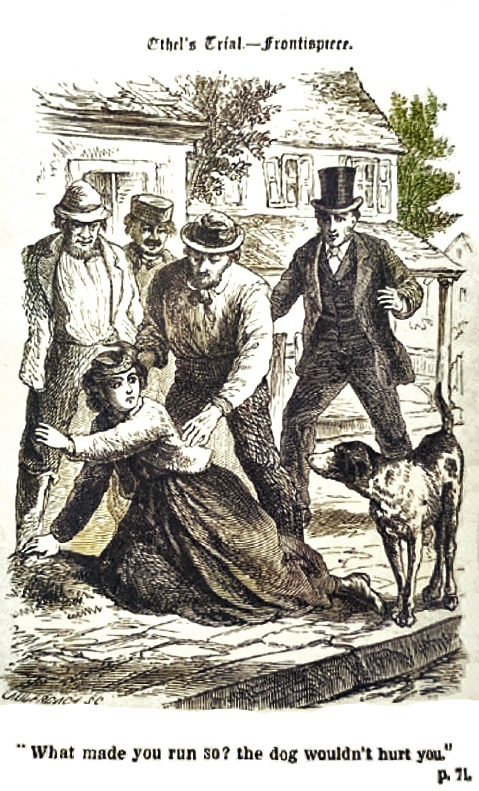
Ethel's Trial.—Frontispiece.
"What made you run so? The dog wouldn't hurt you."
IN BECOMING A MISSIONARY.
BY
LUCY ELLEN GUERNSEY
AUTHOR OF "IRISH AMY," "COMFORT ALLISON," "THE TATTLER,"
"NELLY; OR THE BEST INHERITANCE," "TWIN ROSES," ETC.

PHILADELPHIA:
AMERICAN SUNDAY-SCHOOL UNION
NO. 1122 CHESTNUT STREET.
——————————
NEW YORK: 7, 8 & 10 BIBLE HOUSE, ASTOR PLACE.
————————————————————————————————————————————————————————————————
Entered, according to Act of Congress, in the year 1871, by the
AMERICAN SUNDAY-SCHOOL UNION,
in the Office of the Librarian of Congress at Washington.
————————————————————————————————————————————————————————————————
PREFACE.
——————
THIS book is dedicated to the "large girls" in our Sunday-schools and
Bible-classes, and especially to those who have taken upon themselves
the name and vows of the Christian disciple. I hope they may find that
in its pages which will stimulate them to new desires after holiness,
new efforts for usefulness, and a more hearty desire to know and to do
"the whole" of God's will concerning them.
CONTENTS.
——————
CHAPTER
XVII.—AUNT DORINDA IS SURPRISED
ETHEL'S TRIAL.
——————
THE BIG BOY.
"BROTHER HENRY, I wish you would come out into the garden," said Ethel Dalton to her brother, one morning in the spring, as he sat reading his paper, after breakfast, in the pretty shady breakfast-room of Dr. Ray's house in Ironton.
"What is the matter now?" asked Mrs. Ray, Ethel's sister, smiling. "What have you found in the garden—a spider or a boa-constrictor?"
Ethel coloured, but made no reply. Mr. Dalton laid down his paper, and taking his hat went out with his sister into the garden.
"Well, what is it, my dear?" said he, kindly. "What do you wish me to do or to see?"
"There is a great rough ragged boy leaning over the railings by the hyacinth beds; and I am afraid to go there!" said Ethel.
"What are you afraid of?" asked Mr. Dalton. "What do you think the boy would do to you here on a public street, and in broad daylight?"
Ethel did not know exactly, so she did not answer.
Mr. Dalton walked on till he came in sight of the boy. He was evidently one of the hands from the iron-works at the landing below, and was rather a rough-looking subject certainly, but there was nothing alarming in his appearance. On the contrary, his eyes were bright and clear; and he had a very thoughtful and at the same time bright and good-humoured face.
"Good-morning!" said Mr. Dalton pleasantly as he came near. "Are you fond of flowers that you look at them so earnestly?"
The big boy smiled very pleasantly. "Yes, I'm very fond of them," he answered. "I've got a pretty nice little garden at our place; but I don't have much time to work at it. You see we go to work at seven and knock off at six, and I have a good many chores to do for mother besides, so I don't get much time."
"No, I should think not. You must be fond of a garden to have any time at all."
"Well, I think flowers help to make a little place look bright and cheerful," said the big boy. "Somehow, they seem to do my eyes good after I have been working in the smoke all day. I haven't got any such hyacinths as those, though."
Mr. Dalton whispered to Ethel, "Gather him a bunch of flowers, my dear."
Ethel had begun to feel a little ashamed of her fears by this time. She gathered a fine bunch of choice flowers, and handed them to the boy, who thanked her with all due politeness.
"Mother will be glad to see these," said he. "She loves flowers as well as I do; and I am going right home so she will have them before they are faded. We are all off work to-day because the blast is out of order, so I shall have a good chance to put my garden to rights."
"I suppose you like to have a holiday sometimes?" said Ethel, feeling as though she would like to say something.
The big boy smiled. "Well, yes, miss, it does come rather pleasant on some accounts; but then, you see, if I don't have the work, I don't have the pay, and three idle days makes a good deal of difference in a week, when a fellow has himself and his old mother, and nothing but his wages to live upon."
"Then you support your mother as well as yourself," said Ethel.
"Well, I don't know who has a better right," replied the lad, rather gruffly. "She supported me when I was young, and it is my business to support her now that she is old."
And nodding a good-morning, the big boy walked away.
"Well, Ethel, the great rough ragged boy does not seem to be a very dangerous character," said Mr. Dalton, smiling. "Nothing so very alarming, after all."
"I am sure he seems a very good boy," replied Ethel "but then I could not know that, you know."
"Suppose he had not been a good boy, what hurt do you think he would have done you in broad daylight, and in your brother's garden?"
Ethel hung her head.
"Ethel," said her brother, gravely, "do you know that it is a very sad thing to be such a coward? What do you think you will ever be good for in the world, if you are so afraid of everything and nothing?"
Ethel looked rather offended. "I am sure I cannot help it, brother. It is natural to me."
"It may be natural to you,—I have no doubt that it is so in some degree,—but I am not sure that you cannot help it for all that."
"People cannot help their natural dispositions," said Ethel.
"That is where you make a very serious mistake, little sister. People can help their natural dispositions, if they take the right way to do so; and it is their bounden duty to try. You have no right to indulge any disposition, however natural, which hinders your usefulness or makes you troublesome to others, and cowardice does both. It is, besides, the mother of many other faults,—of falsehood and cruelty among the rest. You can overcome this fault as you can overcome others, and only in the same way,—that is to say, by honest effort, and by prayer for the assistance of the Holy Spirit."
"I don't know what efforts to make," said Ethel, rather sullenly.
"Why, for instance, when you saw the foundry-boy leaning over the rails this morning, you might have observed him a little, instead of running away. Had you done so, you would have seen that he was a good, intelligent-looking lad in spite of his rough foundry-clothes, and that, instead of meditating any great crime, he was only admiring your hyacinths and heart's-ease. Thus you would have escaped the sin of uncharitableness, and you might have had the pleasure of doing a good and kind action of your own free will.
"So in other cases, when you see any such dreadful object as a mouse or a cricket, instead of running and screaming, you might stand still and look at the fearful monster, reasoning with yourself at the same time that the mouse or cricket cannot possibly hurt you, that it is a pretty and curious creature after all, and well worth watching. You were very much interested yesterday in my account of my travels in China and India, and of what our friend Miss Beecher has been doing in Persia. You think there is no harm in being a coward; but if every one had been as much afraid of cockroaches and spiders as you are, the gospel would never have been preached in India and China to this day. Cockroaches alone would have been an effectual barrier to the spread of Christianity!"
Ethel laughed rather uneasily. She was not pleased with the conversation, and was glad when Mr. Dalton looked at his watch, and said it was time for him to go. She gathered up her flowers, and went into the house feeling vexed and uncomfortable.
"What a fuss brother Henry makes about nothing!" said she to herself: "As if I were to blame for being delicate and nervous. I am sure I don't see how I can help it; and I don't see why I should, either. I don't want to be a regular dragoon!"
By which you may see that Ethel was rather proud of her cowardice than otherwise.
Ethel was very much the youngest of her family; so much so, that her brother and sisters were grown-up, and one of them was married at the time she was born; and that her own mother died. Mrs. Bayard, the elder sister, who had very lately lost an infant, took the little motherless baby home, and cared for it in the kindest manner; and with this sister Ethel lived till she was sixteen years old,—that is, till just before my story commences. At this time, Mr. and Mrs. Bayard had gone to California, where they expected to remain for some years; and Ethel had come to stay with her other sister, Mrs. Dr. Ray, at least till her education should be finished.
Ethel's brother, Mr. Henry Dalton, had never seen his youngest sister till within a week past. He had been a missionary in India for many years, and from thence he had sent Ethel a great many beautiful presents and interesting letters. "Brother Henry" had been a kind of hero of romance in Ethel's eyes, and she was always longing for the happy time when he should come home, and the still happier time when, her education finished so far as school and school-books went, she should return with her brother to India, and help him in his missionary work. The thought of seeing her brother the sooner was one thing which reconciled her to remaining behind when Mr. and Mrs. Bayard removed to California. There was another circumstance which had helped also, but this Ethel did not acknowledge even to herself. She was much afraid of the journey.
Mr. Dalton had arrived in Ironton a week before, and so far all Ethel's anticipations had been realized. Mr. Dalton was even handsomer than his picture; his manners were peculiarly polished and gentle; and when he preached on Sunday, Ethel was entirely satisfied. Everybody had admired the sermon; and old Miss Grimshaw, who was very critical, had offended and pleased Ethel at the same time, by saying that it was a shame for such a man as Mr. Dalton to be wasted on heathens and savages. Anybody was good enough for them, and men of such talents were wanted at home. She was a proud and happy girl as she walked home by her brother's side that day.
Mr. Dalton, on his part, was well satisfied with what he saw of his little sister. Ethel had been well and carefully brought up by Mrs. Bayard; and if she had never known a mother's care, she had never missed it. If Mrs. Bayard had erred at all, it had been on the side of kindness. She had certainly made rather a baby of Ethel, but her indulgence was not of a kind to do her nursling any great harm. Ethel had learned to obey with a word or look before she could speak plainly; she had learned to tell the truth, to be kind and polite to all, and to be specially careful of the feelings of those with whom she lived every day,—a lesson not always learned even by very good people.
"On the whole, she is an uncommonly good girl," said Mrs. Ray that evening, as she was talking with her brother about Ethel. "Juliet is a remarkably good manager with children; and she never made any difference between Ethel and her own, except that I think she indulged Ethel more than she did the boys. That was only natural, I suppose, as she was the only girl in the family after the twins died. Ethel has only one ruinous fault, and that is rather an inconvenient one, both for herself and other people."
"You mean her timidity," said Mr. Dalton.
"Timidity does not express it," replied Mrs. Ray. "She is the greatest coward I ever saw."
"But what is she afraid of?"
"Of every thing. Of mice, and rats, and spiders, and all sorts of insects; of strange cats and dogs; of cows, and horses, and pigs, and peddlers, and beggars. I dread to go out in the street with her, she is so afraid of the crossings; and she is sure to stop short in the most dangerous place of all. If she goes out in the carriage, she is certain the horses are going to run away; and she made Dr. Ray more angry than I ever saw him, by screaming the other day when one of the horses shied a little at a steam-engine. She really did put us in great danger, for the streets were crowded, and if the horses had run away, we should have been badly off. Dr. Ray scolded her well, and told her he would never take her out in the carriage again until he learned to control herself. Ethel thought herself very hardly used, but, really, I could not blame Matthew."
"Nor I," said Mr. Dalton. "These screaming people are dreadful trials in any case of danger. How came Ethel to be such a coward?"
"Why, I suppose it was partly natural, but not altogether. When she was about ten years old, Juliet was obliged to go home to see Mr. Bayard's mother, who was very ill, for several weeks, and she got Miss Carrington to stay in the house and take care of the children. Miss Carrington was afraid of her shadow; and she taught Ethel to think it 'fine' to be very timid and delicate, and to be afraid of everything. Miss Carrington always professed a great horror of strong-minded, masculine women."
"She did not suffer in that way herself, it seems," said Mr. Dalton, dryly. "I wonder Juliet should have selected such a person to take charge of the children."
"My dear brother, have you lived so long in this world without finding out that people have to take not what they want, but what they can get," said Mrs. Ray, laughing. "Juliet was obliged to leave home very suddenly. She knew that Miss Carrington was an excellent teacher and a very good, faithful, energetic housekeeper, and she thought herself fortunate in engaging her. Besides, Juliet is rather timid in the matter of burglars and spiders herself. She did not attach much consequence to Ethel's fears, thinking that she would outgrow them, and that they might be made worse by noticing them: and then, as I said, she was always very tender with Ethel. After all, it is not a very serious fault,—not like lying or mischief making."
"That is true," said Mr. Dalton; "and yet one fault indulged and petted introduces others."
GRAVE THOUGHTS.
ETHEL retreated to her room, and busied herself in learning her Italian lesson. She was very fond of learning languages; and she had lately been studying Italian with great zest; but somehow she found it hard to fix her attention on such interesting questions as "Have you the good tailor's gold?" "Will you send for some milk?" and so on.
Ethel was very sensitive to blame, especially from people that she loved; and she was apt to brood over it till she sometimes magnified a very slight censure into a serious grievance. Now, as she sat at her desk, with grammar and exercise-book before her, and with her eyes on the page, she found certain words of her brother's ringing in her ears, and giving her a very uncomfortable feeling somewhere,—she did not know whether it was in her heart or in her temper.
"If every one had been as much afraid of insects as you are, the gospel would not have been preached in India to this day. Cockroaches then would have been an effectual bar to the spread of Christianity!"
Ethel, as I have said before, had built many castles in the air on the foundation of her brother's mission in India. Ever since she could remember, ever since the first box of presents containing the curious figures of baked clay, dressed in the costumes of all the different castes, had come to her, a little girl of ten years old,—she had dreamed of going out to India with her brother as a missionary. Mrs. Bayard had an intimate friend and schoolmate who was attached to the mission in Persia, and with whom she corresponded. Ethel had helped to fill more than one box of pretty presents to be distributed among the girls of Miss Beecher's school, for she was very skilful both with needle and pencil. Miss Beecher was very much interested in Ethel, and had written her a good many letters; and Ethel felt a personal attachment to every girl in the school. It was very natural that Ethel should be interested in missionary work, and should think of becoming a missionary herself.
She knew of course that there would be many unpleasant things to be encountered; but she was apt, in her dreaming hours, to put all these things out of sight, and dwell only upon the pleasures, the delights, of travelling and seeing new and strange sights, the wonders of tropical vegetation and the luxuries of tropical fruits, and most of all the delight of helping her brother to convert and teach the heathen; for Ethel, with all her dreaminess, was honestly desirous of doing good. She had often pictured herself as meeting with some mother about to throw her baby to the crocodiles of the Ganges, and by her persuasions and arguments inducing the poor woman to turn to the true God, and save her child.
But the cockroaches! Ironton was a famous place for these humid insects—for humid they are— especially West Ironton. They had been imported by a lady who brought some boxes of sweetmeats from Havana, and they had multiplied till they were a serious nuisance: but they were seldom seen on the east side. Ethel well remembered the night she spent with Anna Burgers. The girls had been out at a concert together, and had some supper after they went up-stairs, and Ethel had dropped a bit of cake under the table. She could see it quite plainly by the moonlight as she lay in bed, and was sleepily wondering whether it would grease the carpet, and whether she ought not to pick it up, when the cake suddenly began to move rapidly toward the fireplace, as if it had become sensible that it had no business where it was. Ethel started up in bed with a little scream.
"What 'is' the matter?" asked Anna, sleepily.
"The cake!" exclaimed Ethel. "Don't you see? That piece of cake on the floor. It is running away!"
Anna looked and laughed. "I suppose a cockroach has got it," said she. "Yes, there he is! I see his back!"
"A cockroach!" repeated Ethel, more terrified than ever. "Do you have cockroaches?"
"Yes, indeed, and dreadful torments they are," replied Anna. "They come out as soon as the lights are out, and run over everything. But they don't bite that is one comfort—and they cannot get under the mosquito-bars—that is another: so you need not be afraid of them. We have tried every way to get rid of them, but without success so far."
Anna was asleep again in five minutes, but Ethel could not sleep. She well remembered now how she had lain and shivered all night; how, every time she dropped asleep, she had wakened with a start from a dream of the horrid creatures running over her; and how in the morning she found that one of them had taken refuge in the toe of her boot. She had fully decided that she would never spend another night with Anna Burgers.
But there were a great many cockroaches in India. Ethel knew that very well; and there were other creatures even worse, such as centipedes, and large spiders and lizards, which ran all about the houses, and were encouraged because they caught insects. And there were snakes, too,—horrible poisonous cobras and tic polongas. And then the wolves, and jackals, and the tigers! Ethel remembered the story her brother had written to her of a tiger which had walked into a friend's bungalow, in the middle of a terrible storm, and laid itself down at the gentleman's feet, trembling and foaming like a frightened dog. True, the tiger had retired and done nobody any harm, but Ethel felt that the very sight of him would have killed her. And then the storms; and she could never sleep in a high wind, and was dreadfully afraid of lightning. Then there was crossing the ocean; that could not be helped. To be sure, Henry talked much of returning to India by the way of California, when the Pacific railroad should be finished; but then there were such dreadful railroad accidents, and the Indians on the plains did such horrible things!
Ethel had known all these things all her life, but somehow she had never before thought of them as hindrances in the way of her favorite plan. Now, as she thought them all over, she began to see that her fears were likely utterly to defeat the great wish of her life.
"I wish I was not such a coward," she thought. "I don't see what I am to do. I am sure I should die if I should find a centipede on my dress. I should never wait to have him bite me; and then the snakes! But I don't see how I can help it. I am naturally timid. Sister Juliet said she really thought I could not help it, and Miss Carrington always said she hated strong-minded women. I am sure I 'cannot' help it if I was made delicate and nervous. But then to give up going on a mission after I have looked forward to it all my life. Oh dear, what shall I do!"
And Ethel laid her head down on her desk and fairly cried. It was very hard certainly to have one's cherished life-plan overset and defeated by cockroaches, and to see an army of spiders standing in the way of teaching the gospel to the heathen; but there seemed no help for it, so Ethel thought at last, for she was quite sure that she could never overcome her fears so as to face these dreadful dangers.
There was no use in crying about it, however; and if she had red eyes at the Italian class, that hateful Delia Wilkins would be sure to notice them and ask her what was the matter before all the girls. It would not do to neglect her lessons either; so Ethel dried her eyes and applied herself with new diligence to "sending the son of the good tailor for some milk." When her fears were not concerned, she was a conscientious girl; and she knew it was her duty to make the most of her school-days.
"Henry said he found all the languages he knew useful to him at one time and another. But, oh, those horrid cockroaches!"
THE BURGLAR ALARM.
DINNER was late at Dr. Ray's. He was a physician in very large practice, and was hardly ever at home for more than a few minutes from ten in the morning till six at night. He was a kind-hearted and good-tempered man, very fond of young people, and it was a great pleasure to him to receive his sister-in-law into his family. He had been very angry at Ethel for screaming, and trying to throw herself out of the carriage, when the horses started to run, and had reproved her severely.
"I shall be careful how I take you out again," he said, in conclusion. "Apart from the danger to life and limb, I don't like to lose my temper; and if there is anything which exasperates me beyond endurance, it is to have a woman scream when there is anything serious the matter."
Ethel had not forgotten and, I fear, she had not forgiven her brother-in-law's reproof. She had been rather cool to him ever since, and had secretly wondered how sister Emily had ever married "such a rough sort of person." But Dr. Ray, who was really the injured party, had quite forgotten Ethel's offence, and was ready to be good friends with her again.
"Oh, Ethel! I was looking for you," said he, as Ethel entered the room, with her hat on and her books in her hands.
"I have just come home from Italian class," replied Ethel.
"But do you carry all that load of books over to the west side every day?" asked the doctor, looking at the books which Ethel rather wearily deposited on a side table. "That will never do. We shall have you with a backache presently."
"They are a load," admitted Ethel; "but the signorina wishes us always to bring our dictionaries."
"Then you must ride, and you must have a smaller dictionary. I have one somewhere, which I should think would answer your purpose; and I will give you a lot of car tickets."
"A 'lot' of car tickets," repeated Ethel to herself. "What a coarse expression." Then asked aloud, in a tone of some surprise, "Do you understand Italian, brother?"
"I did once, at least," replied the doctor, somewhat dryly. "I lived four years in Florence, where they are supposed to speak that language with considerable fluency. You see, Ethel, you can't always tell from a toad's personal appearance how far he can hop."
Dr. Ray's memory was a treasury of proverbs from all nations, and he took a certain mischievous delight in producing the oddest of them for the benefit of his fastidious little sister-in-law.
"But you must have some car tickets," he continued, taking up his outer coat and putting his hands first into one pocket and then into another. "I have some, I know, in a paper box. That isn't it." He laid down a pretty little chip box, which Ethel took up.
"What a nice little box! How pretty it would be, varnished with black sealing-wax and trimmed with gold paper."
"Well, you may have it, as soon as the leeches are out of it," replied the doctor, still rummaging his pockets.
"Leeches!" exclaimed Ethel, with a little scream, and dropping the box as if it burned her fingers. "Oh, brother, you 'don't' carry leeches in your 'pockets?'"
"Where would you have me carry them?—In my mouth?" asked the doctor. "No; I don't carry them about with me as pets; but I have to put some on a lady's throat after dinner; and I stopped and bought them on my way, to save them the trouble and expense of sending."
Ethel shuddered. "I am sure I should rather die than have those horrid things on my throat."
"Well, perhaps you would; but then you see Mrs. Gray has a baby three months old, and several children besides, one of which is quite helpless: so she cannot afford to die rather than have leeches on her throat. Here are your car tickets at last. Now don't go walking all the way over to Addison Square again with twenty pounds of books on your arm. That won't do at all! Where is Emily? Oh, here she comes. Let us have dinner, my love. I must be off directly afterward."
"Oh, inconsistent man!" said Mrs. Ray. "How long have you preached that people should sit still after dinner."
"Much longer than you or I have practised it, madam. But Mrs. Gray is in great distress, and need, you know, makes the old wife to trot!"
Ethel could never understand the sorts of half laughing conversation which went on between her sister and her husband. She would have liked to be elevated all the time, and, above all, she hated to be laughed at. She was rather inclined to make a martyr of Emily; but Emily was so undeniably happy and cheerful that she had been obliged to give up the idea, and conclude that Emily liked it. She thanked her brother rather coolly for the car tickets, but did not promise to use them. Much as she was afraid of crossings, and cows, and other dangers of the walk to West Ironton, she feared the street-car and the drawbridge more. She once happened to be in the car with a crazy man, and she had never ventured to enter one since, unless she had somebody with her.
"The Cunningham's had a great fright last night," said Dr. Ray at dinner-time.
"How so?" asked Mrs. Ray.
"A burglar attempted to get into the house. He tried to open old Mrs. Cunningham's bedroom window, and had actually raised it, when the old lady jumped up, and snatching her cane which she always kept at her bedside, she dealt the man a sound rap over the fingers, at the same time calling her son at the top of her voice, and making all the noise she could. The man outside beat a hasty retreat, leaving the window open. We must have our fastenings looked over, Emily. I dare say some of them are out of order."
"I will do it for you," said Mr. Dalton, "I am an experienced house tinker and carpenter, especially where bolts, are concerned."
"Why, you don't really think we are in any danger, do you?" asked Ethel, laying down her knife and fork, and turning pale.
"No more than other people," replied Dr. Ray; "but burglars are apt to go in squads, and it is well to be prepared. We are no more likely to be robbed because we look to our window-fastenings than a man is likely to die because he has made his will."
"What would be the best thing to do if the house should be broken into?" asked Emily.
"Bolt your door, and make all the noise you can," replied her husband. "Very few houses are worth the risk of a fight."
"I should not dare to make any noise," said Ethel. "I should be too much frightened to scream."
"That would be a very good effect of fright in most cases," replied the doctor. "In general, screaming is both useless and dangerous; but in the case of housebreakers, the great thing is to raise an alarm."
Dr. Ray intended no allusion to Ethel's conduct in the carriage, indeed, he had forgotten all about it. But Ethel chose to think that he was talking at her, as she said, and she drew herself up and tried to look very dignified, while the tears came into her eyes and the colour to her cheeks. Dr. Ray took no notice of her, but continued talking to his wife and brother-in-law. Mr. Dalton related various anecdotes of thieves in India, and thus diverged to the Thugs and the Malay pirates.
"Oh, dear!" thought Ethel. "There is another thing. I am sure I shall never dare to go to India. I wish I had never thought of it. I wish they would stop talking. I shall never dare to go to bed."
"Well, I must be off," said the doctor, starting up. "Harry, I shall leave you to look over the windows and doors, especially of my office; but don't make the door so safe that I cannot get in; for I dare say I shall be out late."
"I do wish the doctor would spare himself a little," said Mrs. Ray. "He has been out in the cold all day; and now he is going clear up to Mrs. Gray's again, and on foot too."
"Why doesn't he ride?" asked Ethel.
"He has had the gray horse out, and the other is a little lame," replied Emily. "Matthew spares every one but himself."
"And me!" thought Ethel, but she did not say so. As she was holding the candle for Mr. Dalton to put a screw in the window-fastening, she said, rather timidly:
"Brother Henry, do you think it is safe to leave the office door with only a night-latch?"
"Safer, on the whole, than having Emily get up in the cold to let in the doctor," replied Mr. Dalton.
"But suppose somebody else should get a night-key to fit the latch?"
"Why, then, somebody could open the door and walk in, no doubt; but such a thing is not very likely to happen."
"Well, it does not seem safe to me," persisted Ethel. "I wish the doctor would have Thomas Jones sleep in the office, and open the door for him."
"Thomas Jones's wife might demur to that," said Mr. Dalton, smiling. "Perhaps she is afraid of burglars as well."
"And then perhaps Thomas might be in league with the robbers," said Ethel, musingly. "I have often heard of such things."
"Oh Ethel! Ethel!" exclaimed her brother. "How many burglars you do make to yourself! Do you know anything about poor Thomas Jones, which should lead you to think that he would conspire to rob his employers?"
"Nothing; only such things 'have' happened, you know!"
"And such things have happened as young ladies stealing goods out of the shops," said Mr. Dalton. "But you would not like to have any one suspect you of going to stores for such purposes, would you?"
"Of course not," said Ethel; "but that is different. Thomas Jones is a common working-man."
"And is Thomas Jones's character for honesty any less dear to him because his daily bread and that of his family depend upon it. You ought never to hint such a suspicion without the strongest reason. You might do the poor man an injury which he would never get over; and, besides, such fancies are a serious violation of that charity which 'thinketh no evil.'"
Ethel was silent, feeling somewhat ashamed of herself.
Mr. Dalton saw that she did so, and changed the subject. After he had looked over all the window-fastenings and bolts, and pronounced them as safe as they could be made, he went up to his room and brought down a good-sized box, which his sister had never seen before.
"My two big trunks have come at last," said he. "I was obliged to leave them behind in the custom house at Boston. I have brought each of you a work-box; but they are not alike. How shall we decide the choice?" As he spoke, he brought out two light wooden cases, and set them on the table. They were of about the same size, but of different shapes.
"Let us choose without seeing them; and let Ethel choose first," said Mrs. Ray.
This was agreed upon, and each took the case nearest to her. Mrs. Ray's turned out to be a very roomy, commodious work-box, beautifully lacquered and varnished, and containing various compartments and "cubby-holes." Ethel's was much more showy. It was a miniature cabinet, with one large drawer at the bottom, and various smaller ones above shut in by little doors. The whole was beautifully inlaid with different kinds of wood, and trimmed with silver. Ethel exclaimed with delight.
"The very thing I have always wished for so much," said she. "Do see all the cunning little drawers!"
"You have not found them all yet," said Mr. Dalton. "Look again."
Ethel looked, but she could find no more.
Mr. Dalton pressed down one of the ornamental studs, and opened a little shallow drawer, whose existence no one would have suspected.
"Now you will have a safe place to put your money and jewelry when you have any," said he.
"But, then, mine is prettier than Emily's," said Ethel, after she had admired each drawer separately, and shut up the doors to contemplate the general effect. "It is not fair that I should have the prettiest. Let Emily take this, and I will have hers."
"No, no; we will abide by our choice," said Mrs. Ray. "Besides, mine is more convenient for me than your beautiful cabinet. My needle-work is nearly all of a practical character, you know. Really and truly, my dear, I would much rather have this box," she added, seeing that Ethel still looked dissatisfied. "I should have chosen this, if I had seen them both. Go get your basket, and put your working things into your pretty drawers."
"She is very generous, is she not?" said Mr. Dalton, when Ethel had left the room.
"She is, indeed," returned Emily, warmly. "She has nothing selfish about her, except when her fears are concerned. Her cowardice lies at the bottom of almost all her faults."
The excitement of the new work-box and of unpacking some beautiful choice and ivory ornaments put the burglars out of Ethel's held, and kept them out till she went to bed. And no sooner did she find herself alone in her room than they came trooping back, not in single files but in battalions. She hardly dared to open her windows and shut her blinds; and as she did so, she was struck with a new terror at observing how very close the branches of the elm-tree came to her window. An active man could easily climb the tree and get in. She drew back hastily, and bolted both window and blind in a great hurry.
"How I do wish brother Henry slept in the next room, and not across the hall," she thought. "I don't see why Emily did not give him the front room, on this side. I should never make him hear. Then the doctor is out, and I dare say will not be at home till morning; and Thomas and Mary would never hear, even if—" And then Ethel stopped, remembering what her brother had said of the charity which thinketh no evil.
Then she began to think about the office door, with no fastening but the night-latch.
"I dare say plenty of people have the same shaped keys, for all brother Henry says about it; and, besides, what would be easier than to pick the lock? I declare it is too bad," said Ethel, half aloud and almost crying. "It is downright selfish for Dr. Ray to expose all our lives by leaving the door open."
Ethel thought about the open door till she could bear it no longer. "I shall hear the doctor as soon as he comes up on the steps," said she. "I am sure I shall not sleep a bit for dreaming of those horrid wretches Henry was talking about; and I will run down and open the door before Dr. Ray has time to knock."
So saying, Ethel stepped softly down the backstairs, and bolted not only the office door but the inner door leading from the office into the hall. Mrs. Ray usually slept in the bedroom on the lower floors; but her room was in course of being papered and painted, and she and the doctor occupied one room in the third story. When Ethel had finished her fortifications, she ran up-stairs, and going to bed as expeditiously as possible, she was soon asleep.
She was presently aroused by a noise under her window. She started up and listened. Some one was trying the windows of Emily's room. She heard him go from one window to another, and finally she heard the sash yield, and a man jump in. She was sure of it! There could be no mistake. She heard him treading softly about, opening first one door and then another till he passed into the office, by a door which opened through a closet, and which Ethel had quite forgotten. Just at that minute she remembered another leading from the office into the track hall. A desk stood against this door, which was seldom used, and as Ethel listened breathlessly, she heard the robber removing this desk with evident caution, to avoid making a noise. Once in the hall, there was nothing to hinder him and his confederates from coming up-stairs and murdering the whole family.
It was too much. Ethel flew from the bed and tugged frantically at the bell, uttering scream on scream, so utterly beside herself that when Henry knocked at her door and then opened it, she only screamed the louder, taking him for one of the robbers.
"For goodness' sake, what is the matter?" called out Emily, from the upper landing. "What does ail Ethel?"
"Robbers! Burglars in the study!" gasped Ethel, when she discovered at last who her brother was: "I heard a man get into the window of Emily's room. There, don't you hear?" as a movement was heard below.
"There is somebody down-stairs," said Henry, listening. He advanced to the stair-head, followed by Ethel, who dared not stay behind. Lo! There was the doctor coming up as coolly as possible, trimming his candle as he ascended.
"Halloo! What is the row?" he asked, looking up and seeing all the family assembled on the landing. "What is all this noise' about? And what in the name of common sense, Emily, made you bolt all the office doors? I knocked and rung till I was tired, and I had to make a burglar of myself; and get in at the window after all—so much for your fastenings, Henry,— and then I thought I should spend the night in the office. Didn't you hear the bell, Jones?"
"The bell is down, sir! The painters took it down this afternoon. But who bolted the office door? I didn't!"
"Nor I!" said Emily.
"And I am sure I didn't," said Mrs. Jones. "It must have been Miss Ethel. I thought I heard her go down-stairs."
Everybody looked at Ethel, whose cheeks were as scarlet as they had been pale before. Dr. Ray set down his candle, dropped into his chair, and burst into one of his great hearty laughs, in which he was joined after a minute by every one of the company.
"Oh, Ethel! Ethel! You will be the death of me," groaned the doctor, holding his hand to his side. "So you first bolted me out of my own house, and when I was forced to break into it, you were for treating me as a burglar. It is a hard case if a man can't break into his own premises."
"I don't know whether the law would make that burglary or not," said Mr. Dalton.
"If I am sent to State's prison, Ethel will have to go too as an accessory before the fact," returned the doctor. "But come, go to bed. You will all have your deaths of cold, and that will be worse than robbery. Come, Ethel, never mind. There is no great harm done, and the joke is worth the trouble." And laughing again, the doctor proceeded up-stairs to bed.
Ethel retreated to her room, feeling as though she should like to take to her bed and never leave it again. She was very sensitive to laughter, especially to Dr. Ray's, who, good-natured as he was, was a little given to teasing. How soundly she must have slept! A dozen robbers might have gone over the house without her hearing them. Heartily ashamed and vexed, she crept into and cried herself to sleep.
A LONG TALK.
ETHEL would have given a great deal for a good excuse for staying in her own room the next morning; and she lingered so long, that Emily came to see what was the matter.
"Come, Ethel, breakfast is ready and waiting. Why don't you come down?"
"I would rather not," said Ethel, colouring violently. "I don't care for any breakfast, if Anna will bring me some tea."
"Are you sick?" asked her sister.
"No; but I don't want to come down—not till the doctor is gone."
"Oh!" exclaimed Emily, suddenly enlightened. "I see now what is the matter. You are afraid Matthew will laugh at you; is that it?"
"Well, he does laugh at me, and you know he does, Emily," replied Ethel, tearfully. "I can't bear it."
"Oh, you should not mind. You know he would do anything in the world for you; and besides, Ethel," added Emily, gravely, "I think you may be very well satisfied if Matthew does nothing but laugh at what happened last night. A good many gentlemen would not have thought it a very nice joke to be fastened out in the cold and rain, after such a hard day's work as Matthew had yesterday. It was not very pleasant for him to go round trying the doors and windows of his own house; and if he does nothing but laugh at the trouble you caused him, I think you can hardly complain."
Emily's words presented the matter in a new light to Ethel, who had heretofore considered herself as altogether the aggrieved party. She remembered all at once that Dr. Ray had not spoken a single unkind word after all the trouble she had given him. As she hesitated a moment before speaking, Emily coughed violently.
"You are coughing again," said Ethel, anxiously; for Emily had suffered several months from a very painful affection of the throat, which was apt to return if she took the least cold.
"Yes, I am afraid I took cold last night. I was so startled, I never stopped to put on my stockings and shoes. Come, are you ready?"
Ethel hesitated no longer, but followed her sister down-stairs, feeling very shy and very much ashamed of herself.
Dr. Ray's eyes twinkled, and he pulled the end of his mustache, as he was apt to do when enjoying a joke; but he bade Ethel good-morning very kindly, and made no allusion to the events of the night before. His face grew suddenly grave as Emily coughed again.
"That won't do," said he. "How have you taken cold?"
"Last night, I suppose," said Emily.
"Humph! Yes, I suppose so. The next time, don't run out on the cold matting with your bare feet, even if the house be on fire. You must stay by the fire all day to-day and nurse yourself."
"Oh, brother! And lose the concert which she has been looking forward to all the week," exclaimed Ethel.
"I am very sorry, sister, but there is no help for it," said the doctor, kindly but gravely. "Emily has been too ill lately to run any risks; and it is a very chilly, damp day,—one of the worst of this very trying spring. If she should take another hard cold, there is no saying what might come of it."
This was all the doctor said; not a word of reproach was addressed to Ethel either by him or his wife, but Ethel felt this very forbearance to be a severe reproach, and began to justify and excuse herself in her usual pathetic tone.
"I suppose you think it is all my fault, brother; but I am sure I don't see why. I am not to blame for being naturally timid and nervous."
"Perhaps not. I do not know that anybody said you were," replied Dr. Ray. "Whether you are to blame for petting and nursing your fears, indulging your fancies, and making no effort to overcome them is another matter. 'I' think you are; and I tell you plainly, little sister, that unless you do make an effort to overcome these useless and 'seemless' fears, you will never be good for anything in this world unless it be to exercise the patience and forbearance of those about you. Come into the office, Emily, and let me look into your throat."
"Yes, that is always the way," said Ethel, indignantly, as Dr. Ray and his wife left the room; "I am always the one to blame. It is too bad!"
"Gently, gently," said Mr. Dalton. "Who do you think was to blame, if not yourself?"
"I don't know that any one was to blame, unless it might be you and the doctor, for telling such horrid stories and frightening me to death," said Ethel.
"Ethel, I want to have a serious talk with you about this matter," said Mr. Dalton, gravely, "a good deal depends upon it. Suppose you come up to my room, and help me to put away my things. I am going to unpack my big trunks."
Ethel followed her brother with a martyr-like air, as of one unjustly condemned going to execution. Henry did not seem very much disposed to begin the lecture. He unpacked his boxes, talked over their contents, and gave the history of each article as he took it out, till Ethel almost forgot what she had come for. At last Henry said, somewhat abruptly:
"Ethel, you believe in God, don't you?"
"Why, Henry, what a question! Of course I do!" replied Ethel.
"I am not so sure about the 'of course;' but we will let that go for the present. You believe that there is a God: what do you believe about him? Think now, before you answer."
Ethel thought a little, and then answered, "I believe that he is everywhere present, that he is all-powerful, all-wise, and perfectly good."
"Do you think you love him?"
"Yes," said Ethel, seriously. "I do believe, brother, that I love him."
"And do you think he loves you?"
"He must love me, I suppose: why, yes, of course he does, or he would not have done so much for me," said Ethel. "Yes, I am sure he loves me!"
"Then, Ethel, what are you afraid of?" asked her brother, gravely. "Cannot this almighty, all-wise, all-good, and everywhere present God, whom you love and who loves you, protect you for one single night? Which of his attribute do you distrust—his power or his wisdom or his goodness, that you live in this constant terror?"
Ethel looked as if a new idea had been presented to her.
"Ethel, when Juliet taught you to say your prayers, as a little child, did she not teach you one which begins, 'Lighten our darkness?'"
"She did," replied Ethel, surprised. "How did you know?"
"Because our own mother taught Juliet, Emily, and me, when we were little children," replied Mr. Dalton.
"That was not my mamma," said Ethel.
"No, your mamma came afterward, and a very sweet, lovely woman she was. I loved her dearly, and mourned her loss greatly, though I never saw her many times. But will you repeat that prayer for me, Ethel?"
Ethel repeated in a low, reverent voice:
"Lighten our darkness, O Lord, we beseech thee, and by thy great mercy
defend us from all terrors and dangers of this night, for the love of
thy Son, our Saviour Jesus Christ."
"That is the way I learned it," said Mr. Dalton. "I remember asking mother what terrors meant; and she said they meant fears: that we asked our Father in heaven to protect us from all dangers, and from the fear of them. Do you still use this prayer, Ethel?"
"Yes, brother, after my other prayers. It seems so natural, somehow. It makes me think of sister Juliet."
"Ethel, what is it to pray in faith?"
"It is to ask God for what we need or desire, believing that he will give us what we ask for if it is best for us to have it," answered Ethel.
"Exactly so. And what is the promise made to the prayer of faith?"
"There are so many of them," said Ethel, hesitating.
"Yes, I know there are a great many of them," said her brother, smiling; "but tell me one of them?"
"'Whatsoever ye shall ask in prayer, believing, ye shall receive.' That is one," replied Ethel, after thinking a little.
"Yes, that is one, and a very large and full one," said her brother. "Do you believe it?"
"It is God's word," replied Ethel; "so it must be true."
"Yes, but do you believe it?" asked her brother, with a keen glance. "It does not seem to me that you can believe it, or that you can have any real trust in God whatever."
"I don't see why you should say so," said Ethel.
"Because, my dear child, if you really and truly trusted God, and believed that he is not only able but willing to take care of you, you would not be so afraid of everything and everybody. If, for instance, you believed really in your heart that God would hear your prayer at night, and preserve you from all harm and dangers of the night, you would go to bed and sleep without fear, because you would know that no real harm could happen to you. At least, you would try to overcome your fears by these considerations, and by degrees you would succeed."
"It is natural for me to be afraid," said Ethel, rather sullenly. "I can't help it."
"Are you sure you wish to help it, Ethel?" asked her brother. "Are you sure you do not think it rather lady-like and refined to be as you say—delicate and nervous?"
Ethel did not answer. In her heart she did think so.
"As to its being natural to you to be a coward, I have no doubt it is partly true," continued Mr. Dalton; "but it does not follow by any means that you cannot help it. People often correct their natural dispositions. Do you think sister Juliet was a very indolent person?"
"Sister Juliet!" exclaimed Ethel. "No, indeed. She was the most industrious person I ever saw—more so, even, than Emily."
"Well, Ethel, Juliet was by nature rather the most indolent little person I ever knew in my life. She was lazy about everything, and the most accomplished little 'shirk' I think I ever met with. She contrived to slip her neck out of everything, and made everybody wait on her."
"Well, I never should have guessed that," said Ethel. "Mr. Bayard used to say that she was unmercifully industrious."
"Yes, she went rather to the other extreme in after-life; but as a child, and until she was about fifteen, she was just what I describe."
"What was it that cured her?" asked Ethel.
"What cures all of us, my dear, when we are cured at all,—the grace of God. When Juliet was fifteen, she became a disciple of our Lord,—not only by name and profession, but in heart and life a Christian. The Holy Spirit showed her that indolence was a grievous sin, and a wasting of the time and talents which were given her for her master's service. She discovered that the indulgence of this sin was undermining and destroying everything good in her, as does any 'indulged' sin, however small it may seem in itself. She resolved to conquer herself, and she did so; but she had many hard struggles before she gained the victory."
"I don't see that cowardice is a sin," said Ethel.
"There is undoubtedly a degree of natural timidity which cannot be called a sin," replied her brother. "It is no sin for a child to be afraid in the dark. There is no sin in the disgust we naturally feel toward certain animals, or in that instinctive fear which leads all animals, man included, to shun what is likely to hurt them. But if we allow this fear to govern us, to interfere with our usefulness and the comfort and fear of those around us, it becomes a sin. A man is not a coward if he is afraid of being shot when he goes into battle; but he becomes one if he yields to that fear and runs away."
"It is all very well for you to talk, brother; but the fact is, you don't know anything about it," said Ethel. "You can't tell how I feel. Matthew is just so. He scolded me for being afraid and making a fuss, just as if I could help it; and I know I can't help it. Of course he does not understand. Doctors never do. Their hearts get perfectly hardened to suffering of all sorts by seeing so much of it."
"There I think you make a great mistake, Ethel," said her brother. "I do not think doctors are more hard-hearted and indifferent to suffering than other men, but they have to keep their feelings under control. You know the other day Matthew was called suddenly to see a man who had his arm crushed in the rolling-mill, and I went with him. It was a dreadful sight, as you may suppose, and the poor man was suffering terribly. Suppose that Matthew, instead of attending to his business, had begun to think how horrible the sight was, and how dreadful it was to see him suffer so.
"Suppose that the man who rescued his companion at the imminent risk of his own life had said to himself, 'Oh, I can't go near him; I shall be killed if I do.' What would have become of the sufferers? You say people get used to these things; but how do they so? They were not used to them when they began. Is it not by controlling themselves and overcoming their fears and feelings?"
Henry paused, and walked two or three times up and down the room. "I shall say no more, Ethel," he said, at last. "There is no use in talking to you so long as you justify yourself all the time. These fears of yours are a great sorrow and trouble to me; because, unless they can be overcome, they present an insuperable obstacle to a plan on which I have thought a great deal, and on which my heart has been set for several years."
Ethel's heart began to beat fast. "Do you mean—" she asked, and then stopped.
"I mean that I have for several years cherished the hope that I might take you to Persia with me, as an assistant to our friend Miss Beecher in her girls' schools. It would be very pleasant to me to have a home and housekeeper of my own; and we are always in want of help. I thought I might begin at once to teach you the languages, especially Syriac; and I calculated that at the end of the three years I expected to remain at home, you would be ready to return with me. But my pretty castle in the air is likely to vanish like a bubble," he continued, smiling rather sadly.
Ethel was so much agitated that she could hardly speak. So Henry had been cherishing the same plans as herself.
"But, brother Henry, I don't understand," she managed to say. "I thought you were going to India again."
"No; I am going back to Persia, where my work began in the first place, you know. I have always hoped that it might be so arranged, and my wishes are likely to be fulfilled so far as that is concerned. But it, seems that I must give up all thought of taking you with me, unless, at least, you can learn to be a brave woman. The journey is a long and somewhat dangerous one; and there are many unpleasant things constantly to be encountered in the life of a missionary. A coward would be only a hinderance and a burden to me. I am very sorry, very much disappointed; but, as you say, there is no use in talking, and we will drop the subject."
"But going to Persia is not like going to India," faltered Ethel.
"No; in some respects it is better, and in others rather worse. The journey is far more toilsome and dangerous. If you are afraid to go to bed with the office door unbolted, how would you bear sleeping in a tent where you have no fastenings at all, and hearing the wolves howling outside; or hiding from savage hordes in a haystack, as Miss Beecher was once obliged to do? It would not do to succumb or faint under such circumstances, you see."
The conversation was here interrupted, and Ethel escaped to her room, feeling more unhappy and ashamed than she had done in all her life before. She had often considered how she should open the subject of her becoming a missionary, to Henry. She had pictured his surprise, and had gone over and over again the objections he was likely to urge, and the arguments she would bring forward to meet them. And now, it appeared, that Henry had been cherishing the same idea,—that he had wished to take her to Persia, whither she had always wished to go, and as an assistant to her dear Miss Beecher. He had meant to have her teach the very girls in whom she had always felt such an interest. The only obstacle in the way, as it seemed, was one of which she had never thought—her own utter unfitness for the place and its duties. She could not but see that Henry was right. It would never do for a missionary to be a coward. And she was an egregious coward. She would not deny it, and hitherto she had felt no disposition to do so. She had, as Henry said, thought it "fine" to be nervous and timid. It was all because she had such delicate sensibilities. But what if these delicate sensibilities were to interfere with and thwart the grand plan of her life? What was to be done about that?
The first thing to be done about it, according to Ethel's view of the fitness of things, was to sit down and cry. Crying was an amusement in which she frequently indulged, and she did it very prettily, it must be confessed. Her tears came easily, in large, bright drops, without any violent sobs and disfiguring convulsions of the face. But somehow she did not find her usual comfort in tears. For almost the first time in her life, she had a real heart trouble, and she did not find it at all nice,—not at all like the sentimental distresses which she was apt to conjure up for herself. She was thoroughly disappointed and mortified. The real strength and earnestness which lay at the bottom of her character, and which had been enlisted on the side of her missionary scheme, was aroused by her brother's words, and protested against being baffled and put down. She was really and truly unhappy.
Ethel had for a year been a member of the church, and believed herself to be a true disciple of Christ; and it must be confessed that in most respects she was a consistent Christian. Her religious life, as far as it went, was a real, genuine life; and though her religious experience was not very deep, it was true. As fast as she was made aware of her faults, she strove to conquer them, and to live very near to her Divine Master. She had had the advantage of a thoroughly Christian bringing up and training, which had taught her to be truthful, kind, and polite, industrious and faithful in her work, conscientious and self-restrained in her amusements. Hitherto her way had been easy to her.
In all continued efforts, like pursuing a study, for instance, the hard place does not lie at the beginning, but a shorter or longer time afterward. The lion which guards the threshold does not show himself at the gate, but hides somewhere inside, ready to take us unawares. Every one who has learned music or a new language, knows what it is to come to the "hard place." It is when the interest of novelty has worn off and that of use has not begun; when we work day after day, seeming to make absolutely no progress; when we cannot understand something—meet with some unexpected difficulty—that we are discouraged, and wish we had not begun. But if we keep resolutely on doing our best, working doggedly and steadily at whatever hinders us, we presently find, we hardly know how, that the hard place is left behind, and we are going on finely again.
It is very much so in the matter of the Christian life and experience. Nobody sees the whole of his sins and imperfections at once. If we did, we should perhaps be utterly discouraged. We go on honestly correcting one fault after another, and perhaps congratulating ourselves that we are so ready to sacrifice all for Christ, till, by-and-by, we are plainly shown that something must be given up which we are by no means ready to relinquish. We are shown that some habit or quality on which we have perhaps prided ourselves must be overcome or laid aside; our pride which we call self-respect; our resentment of injuries, just resentment, as we think it; our dainty self-indulgence which we call refined taste; or a love of the beautiful, or some darling desire of self-culture and improvement, perfectly legitimate in itself, but conflicting with the duty we owe to others. Then, indeed, comes the real hand-to-hand struggle, the real conflict with Apollyon, which shows us what we are made of. If we have the love of God in our hearts, and strive with humility, and a due dependence on the aid which is promised us, we are sure to conquer at last, though we may be sorely wounded and bruised in the battle, and even defeated over and over again; but if we decline the combat, and try to avoid it by shutting our eyes and refusing to see the enemy, woe to us. Not one more step of real progress is possible; and though we may fancy we are going forward, we shall find to our sorrow that we have turned our backs, and are travelling again to the city of Destruction.
Ethel had now come to this place. It had been easy walking hitherto. She had not been called upon for any great sacrifice or humiliation. But here was a barrier stretching right across her way. After she had made up her mind to enlist openly on the side of her Saviour, the idea of devoting her life to the cause of missions, which had at first been only a childish fancy, became a fixed and settled purpose. She had talked the matter over with Juliet, and Juliet had made no objection, provided Henry's consent could be gained. Ethel felt that she had promised herself to this work; and, yet, how was she ever to perform it? Never, it was plain, unless she could conquer her cowardice, which she had always declared she could not conquer, and which she had never really wished to conquer. She must own that cowardice to be a fault—a sin—and this in itself involved a great sacrifice of pride; and she must make many painful efforts, and probably be defeated many times. Ethel felt instinctively that if she were to give up the purpose of being a missionary for any such reason, she should never be good for anything else. If she were providentially prevented from going by her own illness or that of friends, or by some plain call of duty at home, that would be another thing; but to give up because she was afraid to go, it would be a final defeat. No: she was not willing to give it up; but, on the other hand, neither was she willing to own herself a sinner in that which kept her back, and to strive humbly after amendment. It was a very hard plan, and she saw no escape.
PROSPECTING.
NEVER had Ethel been so unhappy in her life, as she was during the next two or three weeks; never had she been so irritable, and so utterly unreasonable and troublesome in her terrors and fancies. She seemed lent upon proving to herself and others that she could not help being afraid of her own shadow and that of every one else.
"Ethel," said her brother, one pleasant morning, "I have found out where our foundry-boy lives. I was driving with the doctor last evening, and saw him at work in his garden. Suppose you walk up with me to see the old lady, and carry her some of those flower-seeds which Emily says she has no room for in the garden. I dare say they will be very acceptable."
"I am sure she is welcome to them," said Emily. "Mr. B— gave the doctor three times more seeds than we can possibly use. I have supplied all the children's gardens on both sides of us, and there are quantities left. It is a pity somebody should not have them."
"I have another design in going, for which the seeds will furnish a good excuse," continued Mr. Dalton. "I want to 'prospect' for a Sunday-school and mission service in that neighbourhood; and I dare say this old lady can give me some idea of how the land lies."
"What! Among the foundry-men!" exclaimed Ethel.
"Exactly. Why not? They seem to be a fine set of fellows, and the place is swarming with children. If I succeed, I shall depend on your Bible-class girls for teachers. But come, will you go with me?"
"Do, Ethel; the walk will be good for you," said Emily. "I only wish I could go. I am so tired of being shut up in the house."
Emily had not been out since the night of the burglar alarm. The cold she had caught brought back all her throat trouble, and Dr. Ray was seriously concerned about her.
"I don't know what to make of Ethel," said Emily, when her sister had left the room. "I begin to think that I have never understood her at all, and that I did not know what I was about in undertaking the charge of her. Her fears have always been vexatious enough, but they are becoming perfectly intolerable. I don't so much mind myself, but she annoys the doctor so."
"Matthew is wonderfully good-natured and patient with her," observed Mr. Dalton.
"He is good-natured and patient with everybody," replied Emily; "and for that very reason I don't like to have him imposed upon; but I don't know what to do. If I say a word to Ethel, she begins to cry; and that is what I cannot bear very well just now."
"You had better not trouble yourself about her at present," said Mr. Dalton; "you are too unwell to be worried. I think, myself, that Ethel is passing through a kind of crisis."
"Yes; that is just what Matthew says when his patients are worse than usual," said Emily, laughing. "'You are passing through a "crisis,"' he says. 'You will be a great deal better after it.'"
"Exactly so," replied Mr. Dalton, laughing, in his turn. "I am inclined to believe that Ethel is passing through just such a crisis, and that she will be better after it. I think she is trying hard to justify herself in her own eyes, and I do not think she will succeed. I can see that there is a struggle in her mind, and that she is very unhappy under it. We must all try to have patience with her, and help her if possible."
The conversation was here interrupted by the entrance of Ethel, prepared for her walk.
"I wish you would stop at Mrs. Fowler's, and ask her to send up some sponge-cake and a mould of ice-cream, Ethel," said Emily. "By the way, Henry, you should make acquaintance with Mrs. Fowler. She is the daughter of old Mr. Bond, of whom we used to buy sweeties when we went to Mrs. Clark's school, and a very good religious woman. I dare say she can tell you about your foundry-men and their families, for she has lived over there on the hill."
Ethel was evidently nervous in the expectation of a lecture; but her brother did not seem disposed to lecture, and chatted on about various matters till they reached the very neat and pleasant shop, where Mrs. Fowler reigned supreme over bonbons, cakes, fruits, and flowers.
"I must ask you to write your order yourself, Miss Ethel," said Mrs. Fowler.
And as she spoke, Ethel noticed that her hand was bandaged.
"How have you hurt your hand?" she asked.
"We had an accident last night," replied Mrs. Fowler. "My girl set her dress on fire, and mine running down-stairs with it all in a blaze. Luckily, I had a large shawl at hand, which threw round her, and by getting her down on the floor, I stifled the flame before she was seriously burned. I thought we were gone for a minute, for she was perfectly beside herself with fright, and I could hardly hold her; and, aside from the danger to herself, we have light muslin curtains to the windows and over an archway. As it was, I scorched my hands and sprained my wrists; but that is nothing to what it might have been."
"No doubt you saved her life," said Mr. Dalton. "How did her dress take fire?"
"She dropped a match on her dress. She said there was only a little blaze at first; and I dare say, if she had had her wits about her, she might have put it out in a minute; but she is always scared out of her wits if the least accident happens."
Ethel blushed, as if she thought the remark a personal one, and glanced at her brother.
"Well, it was a happy circumstance to her that all people are not scared out of their wits," stud Mr. Dalton.
"So I told her," replied Mrs. Fowler. "She was very sorry when she saw how I had hurt my hand.
"'Jane,' says I, 'I don't grudge the pain in my hand at all, if you will only learn something by this business. If I had been as crazy as you, you would have been burned up, and the house too."
"'Well, Mrs. Fowler,' says she, 'I do mean to try and learn, and not to be such a coward.'
"I believe she will do it too, for she is a good girl in the main."
"My sister tells me that you have lived up on the hill, and know people there," said Mr. Dalton. "What do you think would be the prospect of success, if any one were to establish an afternoon Sunday-school and a mission service in that neighbourhood?"
"It would be a grand thing, and no mistake," replied Mrs. Fowler, warmly. "There are quantities of children, and another class who need teaching still more,—I mean the half grown-up boys and girls, who now do nothing but hang about and gossip all Sunday afternoon."
"But are they not a very rough set?" said Ethel. "I should not think it would answer at all for young ladies to try teaching among them."
Mrs. Fowler laughed. "I don't believe there is one of them who would ever give a young lady a saucy word or look. They are almost all American-born; and all the middle-aged and elderly men are married, and have families of their own. Besides, I never knew a lady to be affronted when she was about any work of kindness."
"Nor I; either,—at least, not in this country," said Mr. Dalton. "Can you tell me of any good people to whom I can apply?"
"I don't think you will go amiss with any of them, unless it may be some of the families up by the Brewery. There are some Roman Catholics in that neighbourhood, and one family of professed infidels. The people are no great church goers; but I think that is more than anything because there is no place to go."
"There is the church on the avenue; that is not very far-off," remarked Ethel.
"Yes; but the seats are all rented and the rents are very high, especially since they fixed over the church, and put in all that paint and stained glass," said Mrs. Fowler. "Seats which used to rent for fifteen dollars have been raised to seventy and eighty dollars, and no poor man can afford to pay such prices."
"Ah, that opens the way to a very wide subject, which you and I will talk over some day," said Mr. Dalton. "But can you give me the names of some of the good people up there?"
Ethel fidgeted a great deal while her brother, with pocket-book in hand, stood talking over the counter with Mrs. Fowler. Presently, Mr. Dalton turned around to her.
"I think this Mrs. Trim must be the mother of our acquaintance, Ethel. Mrs. Fowler says she is a widow with one son, who works in the foundry."
"Our acquaintance!" repeated Ethel, to herself. "Henry talks as though we knew him intimately. I do wish he would not stand talking here so long. What if somebody should come in?"
At last somebody did come in, and Mr. Dalton, bidding Mrs. Fowler good-afternoon, left the shop and walked on toward the suburb, where most of the foundry hands lived.
"Mrs. Fowler seems to talk as though the prospect was encouraging," remarked Mr. Dalton. "She is a very intelligent woman. I should like to secure her help in our Sunday-school, if we succeed in starting it."
"I think she is very forward," said Ethel. "She stood and talked with you as though she had—as though she was—" Ethel's sentence seemed to grow rather entangled.
"Well, as though she had or was what?" asked her brother. "I thought she stood and talked as though she were a sensible, brave Christian woman. That is the impression which I received of her character."
Ethel did not answer; and they walked on a little way in silence, till they came to a house in front of which lay a fine large dog stretched out across the sidewalk. Ethel shrank back with her usual little scream.
"What now?" asked Mr. Dalton.
"Oh, brother, that great horrid dog: I can't go past him. I am sure he is not safe. Suppose he should be mad, and bite me?"
"And suppose you should be mad, and bite him?" said Mr. Dalton. "I know who I think looks the more sensible of the two at this moment. Come, Ethel, you really must not be so silly. The dog is perfectly gentle, as you may see by looking at him; and if he were not, you are going exactly the right way to work to make him attack you. There is nothing which provokes dogs, and animal's in general, so much as to see people afraid of them. There! See how politely he makes way for us."
The big dog, at this moment, sat up on his haunches, and beating his tail lazily against the ground, he seemed to invite their notice. Unluckily, at that moment, he caught sight of a cow in the street, and evidently conceiving that he was bound to preserve the street free from all trespassers, he rushed open mouthed at the intruder, who, of course, put down her head and ran straight-forward, after the manner of cows when attacked.
Ethel screamed at the top of her voice, and started to run also, but, catching her foot in her dress, she tripped and down she fell, sprawling in any thing but a desirable or graceful attitude, just at the feet of a group of foundry-men who were coming home from their work.
Before Mr. Dalton could reach her, one of the men had raised Ethel,—his black hands leaving a very visible impression on her delicate gray plush jacket.
"Well, you did get a tumble, sure enough," said the foundry-man, kindly. "What was the matter? What made you run so? The dog wouldn't hurt you."
Ethel burst into tears of shame and vexation, and seemed likely to go into hysterics on the spot.
"My sister is, unfortunately, very timid," said Mr. Dalton, coming up. "Have you hurt yourself, Ethel?"
But Ethel was, by this time, far beyond speaking.
"The young lady had better come right into our house," said a young man of the group, opening, as he spoke, the gate of the very house where the dog had been lying. "Mother will just about have supper ready; and a cup of tea will do her good. But, my goodness, miss, you needn't be afraid of my old Lion. He plays with all the young ones in the street."
"Thank you; we will come in, since you are so kind," said Mr. Dalton. "I believe you are the very man I was looking for."
"And you are the gentleman I saw down in the doctor's garden," returned Richard Trim. "I see you going by with the doctor last night. Come right in, miss."
"Come, Ethel," said her brother, so decidedly that Ethel made no difficulty about the matter.
As the other man passed along, Ethel heard the one who had picked her up say to his companion, "Well, if 'my' girl was to make such a fool of herself as that, I'd box her ears."
The big boy led the way around the corner of the house into a clean sunny kitchen. The table was set for supper, and a wonderfully neat, cheerful-looking little old woman was just taking some very tempting-looking biscuits out of the stove-oven.
"I've brought you some company, ma," said the big boy. "This is the young lady who sent you the flowers the other day. She got a fall just now, and I brought her in to rest and have some tea."
"Why, yes, to be sure," exclaimed Mrs. Trim, in a cheery, high-pitched voice, which seemed exactly in keeping with her appearance. "And so you had a fall, dear? Did you hurt you? There, there, don't cry," she continued, soothing Ethel as though she had been a baby. "Tell granny where you hurt you?"
"I didn't hurt myself much," sobbed Ethel; "but—but—I was so frightened."
"Lion ran after that cow of Green's, and scared her," explained the big boy. "You see, that cow is always trying to get into our yard," he added, turning to Mr. Dalton. "She is as cunning as an imp, and can open any gate; and she has got in two or three times and raised the mischief: so Lion drives her off whenever he sees her."
"He is a clever dog," observed Mr. Dalton. "But why do you not have the cow taken up?"
"Well, I hate to do that," replied Richard Trim. "You see, she belongs to a widow woman, who has not much else to depend on. The children pretend to watch her, but they get playing, and then she slips away. But I hope, now you have come, you will stop and take tea with us, Mr. —"
"My name is Dalton," said Mr. Dalton. "This is my sister, Miss Ethel Dalton."
The big boy nodded to Ethel in acknowledgment of the introduction.
"Yes, do stay and take tea with us," chimed in the old woman. "I am sure your little sister will feel better when she has had a cup of tea. Young girls are apt be 'narvous,' so I wouldn't mind, dear," she added, kindly, turning to Ethel. "We should be so pleased to have you stay. I kept the flowers you sent me ever so long. I never saw anything so sweet. Now do stay. You won't put me out the least bit."
Mr. Dalton saw that the invitation was sincere, and that Ethel would be the better for the rest. Indeed, with her red eyes, she was hardly presentable in the street.
"You are very kind, I am sure; and we shall be glad of a cup of tea," said he. "Indeed, we were coming to see you, at any rate. My sister, Mrs. Ray, has sent your son some flower-seeds. She had a present of a large quantity, more than she has any room for, and, knowing that you are fond of flowers, she hopes you will accept these."
"I'm sure she is very kind," said the big boy, colouring through all his black, as he looked at the parcel of seeds,—varieties of balsams, Drummond's phlox, Salpiglossis, and other desirable sorts, all of Vick's best. "I don't feel as though I ought to take such a present."
"Nonsense," said Mr. Dalton, smiling. "You would do as much for me in a minute; and I dare say I shall want your help about carrying out a plan I have in my head. I have brought you Vick's catalogue with the seeds. There is a deal of valuable information in it."
"Well, I am sure," said the big boy, and then he stopped and turned over the seeds again; "just see, ma, six kinds of balsams."
"You must take the lady some of our tomato and pepper plants," said his mother. "You know you always have such good luck with them. But now go and wash yourself, for tea is all ready. You couldn't have done anything for Dicky which would have pleased him so much," she added, as her son left the room. "He generally does buy a few flower-seeds every spring, besides what we save from our own garden; but it has been rather a hard winter for us, what with sickness and Dicky's being out of work a part of the time. Not that I ought to complain, either."
The entrance of Richard put a stop to the conversation for a moment, and they all sat down to the tea-table, which was neatly set out with gay china, and as Ethel observed, two real silver spoons for the company. She had partly got over her fright and discomposure, and she could not be insensible to the kindness with which she had been received.
"What beautiful china!" said she, looking at her cup, which was different from those used by the old woman and her son. "It is real Japan china, is it not?"
"I expect it is," replied Mrs. Trim, evidently much pleased. "My father was a sailor, and brought home these cups from China or Japan, I don't know which. He was in India, too, and brought home some of the idols the people worship, for ma was a great hand for curiosities. I'll show them to you after supper."
This led the conversation to India, and Mrs. Trim and her son were deeply interested when they heard that Mr. Dalton had been in that wonderful country. Dick had a great many questions to ask, and very intelligent questions they were; and Ethel had never seen her brother more animated in conversation.
"And so you were a missionary?" said Mrs. Trim. "Dear me! Didn't you feel it a privilege to go and preach the gospel to those poor critters? Just think of the poor mothers throwing their babes into the river to the crocodiles!"
"It seems worse, almost, to kill the little babies than grown folks, somehow. Babies are so innocent and helpless. Do you ever mean to go back there?"
"Sometime or other, I hope," replied Mr. Dalton; "or, if not there, to some other missionary field. As you say, I feel it a great privilege to carry the gospel to those poor people."
"I am sure I should. If I was your sister, I should want to go along with you. Young ladies do go, I know. There was Mrs. Whitney, that I used to know in P—. She taught a school, and afterward she went out to the Sandwich Islands. Shouldn't you like to go with your brother, dear?"
At this moment old Lion poked his head in at the door, and Ethel started as usual.
"The young lady would have to get over being afraid of dogs first," said the big boy, apparently resenting Ethel's terrors as an imputation on his friend Lion. "But I am not so sure, after all, about these foreign missions," he added, seeing Ethel blush and look disconcerted. "It seems as though there was enough work for missionaries and good people to do nearer home."
"Such as what?" asked Mr. Dalton.
"Well, for instance, here is this neighbourhood," said Richard. "There are plenty of folks here who never see the inside of a church from one year's end to another, or speak to a minister, unless some of them are married or there is a death in the family. And, yet, I suppose their souls are worth as much as the heathen in India?"
"I suppose they are," replied Mr. Dalton. "That is a sad state of things; but whose fault is it?"
"Well, it is partly their fault, and partly it is nobody's, I suppose."
"It must be somebody's, I should say."
"Well, sir, it is just like this. The nearest church is that on the avenue,—half a mile away. That church is full already—church and Sunday-school both; and if it wasn't, the pew rents are so high that poor folks can't afford to pay them. If a man has got a wife and three or four children to keep out of his earnings, he don't feel as though he could pay thirty or forty dollars a year for a seat. He can't do it unless he pinches himself, and he won't do it unless he is very pious, indeed. The children go to Sunday-school for a while, to be sure,—some of them—but they get to feel too old for that pretty soon, and so they slip away."
"But there are the free seats," said Ethel.
"Yes; but you see every one knows the free seats are for poor folks, and a man don't like to own himself poor, if he can help it. It is like taking charity. That mayn't be just the right way to look at it, but that is the way they feel."
"I don't wonder at it," said Ethel. "I think I should feel just so."
"You see it is not that they want to save their money, altogether," continued Richard Trim. "I don't think our men are at all stingy, in general. I believe if a little chapel were to be built up here, a great many people would not only go to it, but they would be willing to give something toward it, though it might be only a little."
"I understand, and I am very glad to hear you say so," said Mr. Dalton. "It was on partly a matter of that kind that I wanted to see you. You see I am having a vacation from missionary work just now, and I am as it were unattached; and I have been wondering whether it would be possible to start a service and a Sunday-school in this neighbourhood."
Both Mrs. Trim and Richard took up the idea with enthusiasm, and it was talked over in all its bearings.
"We should have to hire a room somewhere near, to begin with," said Mr. Dalton. "Can you think of any suitable place?"
"There is the large room over Mr. Sutton's grocery," said Richard. "It is a rough place, not much like a church to be sure; but it is clean and comfortable."
"I dare say it will answer very well," said Mr. Dalton. "I have not been used to very church-like places of late years, you know. And about teachers?"
"What a pity Mrs. Fowler has moved away," said Mrs. Trim. "She is such a nice lady, and so kind to everybody."
"Yes; she would be a great help. I shall depend upon you and Richard to help us, Mrs. Trim."
"Me!" said Richard, colouring. "I don't know enough to teach in a Sunday-school."
"Any man knows enough to teach in a Sunday-school, my friend, who will be faithful in studying the Scriptures, and ask God for the teaching of his Spirit. You will learn in the art of teaching."
"I shall learn that I don't know anything, I expect," said Richard, evidently not displeased.
"That was the most important thing I learned in my missionary education," said Mr. Dalton, smiling. "But suppose we get together a room full of little boys and girls; you can take a class of the one and your mother of the other, can you not?"
"Ma can, I am sure," said Richard. "She is always studying her Bible. As for me, I will think about it, and let you know. When shall I see you again?"
"Why, let me see. This is Monday: to-morrow I shall be engaged in getting up my lecture on India for the Bible-classes. By the way, don't you want to come, or don't you care about magic-lantern pictures?"
"I should like to come," said the big boy, colouring; "but then, you see—"
"It is a free lecture, you know," said Mr. Dalton. "Come, and bring your mother and any one else you like. We are obliged to have passes to prevent too great a crowd; but I will give you one. Well, Thursday evening, I will come up here again, and we will see what can be done."
"And, in the meantime, ma can see some of the neighbours and talk to them, and I can mention it to the men."
"Exactly so. Come, Ethel, Emily will think we are lost. Good-night."
ETHEL'S UNHAPPINESS.
"I DO think, brother, you are remarkable for one thing," said Ethel, as they were walking homeward, "and that is, the power you have of adapting yourself to all sorts of people."
"I don't think I quite understand you," said Mr. Dalton. "What do you mean by 'adapting' myself?"
"Why, when you were talking to Mrs. Fowler in the shop, it seemed as if you had known her all your life, and knew just what to say to her; and it was the same with Mrs. Trim and her son. Nobody would have known that you were not used to keeping just such company always. Some people never can get on with poor folks in that way. They are either condescending and gracious, like that man who addressed the Sunday-school last Sunday, or they are stiff and scared, and don't know what to say,—like myself," concluded Ethel.
"I suspect the difficulty is the same in both cases," remarked Mr. Dalton.
"And that difficulty is—"
"Self-consciousness,—not to be rude and very self-conceited," replied her brother, smiling. "But, Ethel, if I have that wonderful gift, I assure you I am not in the least aware of it. Why should I 'adapt' myself either to Mrs. Fowler or the Trims? We had a very favourable introduction in Mrs. Trim's kindness to you, and we had the same subjects of interest."
"Yes, I know," said Ethel; "and I noticed that you talked just as you do at home, or at Mrs. Verplank's, or any of the places where we visit."
"Well, why not? How would you have me talk?"
"To be sure, the people who talk of adapting themselves, always seem to me to make a great jumble of it," said Ethel, candidly. "There was that man I was speaking of who addressed the children last Sunday. He talked regular baby talk,—only not so funny and amusing as Mrs. Jones's baby talk; and I thought he never would have done. The infants were perfectly tired out, and as naughty as they could be; and, really, I did not so much blame them. But Mrs. Verplank thought it was beautiful: he adapted himself to the children's minds so prettily."
"Mrs. Verplank has no children of her own," said Mr. Dalton, dryly. "But as to this matter of adaptation, Ethel, there is something to be said on both sides. I should not think of talking to Mrs. Trim about the new translation of sacred books which I was discussing with Professor Van Alstine last night; but neither should I to Mrs. Verplank."
"After all, I suppose real good breeding and a real interest in the people one talks to, and the things one talks about, are the main things," said Ethel, thoughtfully. "I mean, of course, after the great thing of all,—loving one's neighbour as one's self."
"I quite agree with you, my love," replied Mr. Dalton; "I think you have gone to the root of the matter."
Ethel looked pleased. "But don't you think, brother, that good breeding is necessary, in order to do good in the best way?"
"Undoubtedly; and a great many good people's efforts suffer for the want of that very thing. They offend and disgust where they mean to help, and neutralize all the good they attempt by their manner of setting about it. And condescension—adaptation, if you like—is the very worst of all breeding."
"Brother, do you think I might take a class in your Sunday-school, if you do establish one," asked Ethel, after they had walked on in silence a little way.
"I don't know," replied Mr. Dalton, rather absently, as it seemed.
"Because, you know, I have had a good deal of experience in the infant-class for the last year; and I really am not needed there, and I might take the infant-class if you had one."
"I should like it of all things, little sister," said Mr. Dalton; "but I see grave difficulties in the way."
"What difficulties?" asked Ethel, surprised.
"Richard Trim's dog Lion for one, and widow Green's cow for another; and the many things which are always coming in your way. Suppose, for instance, your infant-class was in session, and a thunder-storm should come up, what would you do?"
Ethel coloured, and walked on in silence a little way. Then she said, in a deeply mortified tone:
"According to that, I need never think of doing anything,—any of the things I have set my heart on doing. It is very hard."
"It 'is' very hard," repeated her brother, sighing; "very hard for me, I assure you, Ethel. Nobody likes to have his castle in the air tumbled about his ears. I should like dearly to have you take the infant-class, supposing we have one; and I have notions in my head about sewing-schools and singing-classes; but I don't see how you are to help me about them, so long as you cannot pass a cow in the street, or hear a peal of thunder without going into hysterics. Fear is very irreligious, especially among children."
"I am sure I don't want to go, if you don't want me," said Ethel, in an offended tone. "I thought you would be glad of help at first, at any rate."
"But I do want you very much, my dear, for that and for other things. It is just the fact that I do want you which makes me so unhappy about this fault of yours."
"It is 'not' a fault," said Ethel, doggedly. "I can't help it."
"Well, then, this hinderance. But tell me, do you think such a scene as that to-day would be likely to increase your influence with your pupils or their parents?"
Ethel made no answer, and Mr. Dalton, after a little silence, began talking of something else.
Ethel did not again mention the subject of the mission-school; but during the week she was particularly active in inviting her own scholars in the infant-class, and took care to let Henry know that she was so.
"I will show him that I 'am' good for something, and can do some good in the world, if I am afraid of cows," said she to herself. "Mr. Maverick says there is more interest than usual in the Bible-class, and I have noticed that Anna Burgers has been very serious lately. I mean to take an opportunity to talk to her, and to some of the other girls. And I mean to study the Bible and pray more than I have done. I will take an hour in the middle of the day, and I will go regularly through some good books,—'Personal Religion,' or Mrs. More's 'Practical Piety.' As for being a missionary, why, if I really am not fit for it, that makes it plainly my duty to give it up cheerfully, and think no more about it. I had set my heart on it, but I must submit—that is all."
And so Ethel tried to content herself; but she was not satisfied or at peace. Her conscience told her that this was not honestly submitting to failure after having done her best to succeed. She had no right to give up, and say she was not fitted for the great work to which she had consecrated herself, till she had honestly and with all her might lived to make herself so.
She carried out her plans of proceeding with a great deal of zeal, but she was not happy in it. Her prayers were all unreal and cold, and seemed to go no deeper than her lips. It seemed as though she were under a close roof shut in away from God. She had a feeling as if her Lord were grieved with her and was turning his sorrowful face away,—as if she could not as it were catch his eyes. The promises of his word appeared as if they were nothing to her. She was wretchedly unhappy but she said to herself, that it was so at times with everybody,—that devotional feelings and religious experience were very dependent on bodily health, and she was not very well. The clouds would pass by-and-by, and she should feel better again. Meantime, she invited her pupils as she had promised herself, and sought for opportunities of religious conversation with her schoolmates, and tried hard to think that all was well with her.
"Oh, Ethel, will you come to-morrow, and spend the evening and stay all night with me," said Anna Burgers, one day, after the Italian class was dismissed. "Mamma and Aunt Sarah are going out, and we shall be quite by ourselves. We are in a new house, and so you need not be afraid of the roaches," she added, smiling.
Ethel smiled, but blushed a little. "I did not know you had moved," said she. "Was it not rather sudden?"
"Yes, quite so to mamma and all of us, except papa. It seems he meant to give us a surprise; and he has bought that pretty new house opposite Mrs. Bayard's old place. But will you come? It will be so nice."
Ethel considered. Here seemed to be just the opportunity she wished for serious conversation with Anna.
"I will come, to be sure, if Emily does not object; and I dare say she will not. How glad you must be to move out of that disagreeable home!"
"Yes, it is very nice," said Anna, simply. "Papa has been occupied in business matters so long, it is pleasant to feel a little easy again. I am so thankful on mamma's account, because now she can have Aunt Sarah with her once more. Then you think I may depend on your coming?"
"Oh, yes. I cannot imagine anything which should prevent me."
"Anna never loses a chance of telling everybody that they have grown rich," said Delia Wilkins, with her usual sneer, when Anna was gone. "If I did feel so grand about it, I would keep it to myself, I think."
"You ought not to say so, Delia," returned Ethel. "It isn't right. I don't think you ought to judge people in that way. You wouldn't like it yourself."
"And it isn't at all fair to Anna, either," said Ellen Davis. "She never thinks of boasting, I am sure. When they were poor, she never hesitated to say she could not afford this and that."
"Dear me! What have I said to bring down such a flood of reproof upon me, I wonder?" said Delia, affectedly. "You have taken to preaching lately, Ethel. I suppose you are practising for the mission you are going to undertake?"
Ethel coloured, but did not answer; and the party separated.
"Don't you mean to take the horse-car, Ethel," asked Ellen Davis, as they came near the station. "You have such a long walk."
"No; I believe not. I like the walk, and the exercise is good for me," replied Ethel.
"Well, good-by, then. I shall ride."
As Ethel walked along, carrying her heavy load of books, she was aware of an unpleasant weight on her conscience. She knew that the exercise was "not" good for her, and that Dr. Ray had expressly desired her never to walk both ways. She had told Ellen something very like a falsehood. She tried to turn her attention to something else, and began meditating what she should say to Anna when they should be alone together. She had crossed the bridge and was slowly creeping up the hill, when somebody drove up to the sidewalk and called to her. She started with an exclamation, as usual, and looking up, she saw Dr. Ray.
"Walking again, Ethel," said he. "How comes that?"
"The car was gone," said Ethel, taken by surprise, and having recourse to the first excuse she could think of to avert a lecture, or, what she dreaded still more, a laugh from her brother-in-law.
"You should have waited, then. But get in, and I will take you home: I am going that way."
"I am so near home now, that it does not matter," said Ethel, blushing; "and, besides, I have an errand to do on the way; but I should be glad if you would take my books."
"Tumble them in then, and mind you do not walk again. If the car is gone, wait for another. You will save time by it in the end."
When Ethel reached her own room, she sat down as usual, and took up her "Personal Religion," but somehow she found it very hard to fix her attention. That weight on her conscience, which had troubled her so much, was increased tenfold. She knew that she had lied both to Ellen Davis and her brother-in-law. She had sinned grievously, and yet she was unwilling to own that she had sinned; for she felt as if the confession of this one fault would involve a great deal more. She finished her allotted portion of reading, however, and went down-stairs to practise her music-lesson, feeling tired, irritable, and in anything but a pleasant state of mind or body. She made so many mistakes that Emily noticed them.
"What is the matter, Ethel?" she asked. "It is something wonderful for you to boggle so."
"I believe the mischief is in me or in the piano, I don't know which," said Ethel, fretfully. "I can't do anything with it."
"I wouldn't try," said Emily, kindly. "You are tired with your Italian lessons. I think, on the days that you go over to the other side, you would do better to practise directly after breakfast."
"I can't practise when Matthew is in the house," said Ethel. "He is always making fun of me."
"How many times does it take to make 'always?'" asked her sister.
"Well, he did so once; and he will do so again. I can't bear it."
"Ethel," said Emily, gravely, "do you know that you are growing very irritable and fretful?"
Ethel made no answer.
"I dare say it is partly because you do not feel very well," continued her sister; "but I think you should be careful how you give way to fretfulness. There is nothing which grows faster by indulgence, as I know by experience," she added, smiling. "I don't like to see it in you: your temper has always been so even and pleasant. I am afraid you are working too hard, and that these Italian lessons are too much for your strength. Don't you think you had better give them up for the present?"
"I don't like to do that," said Ethel. "I may never have so good a chance again."
"That is true; but, then, if it is going to make you sick—"
"But I am not sick, Emily: I am only tired just now. As to my being fretful, I am sure I did not know it, only everybody seems to think that all I do is to worry now-a-days. Henry,—"
But here Ethel's voice was lost in tears, and hearing her brother-in-law's voice, she made haste to escape to her own room, where she had a hearty crying-fit, and, by dint of dwelling on all the injuries she had received, as she thought, from her brother and sister, she contrived, in some degree, to forget the load on her conscience, and to get up a comforting feeling of martyrdom.
"But it is my duty to be cheerful," said Ethel, when she was thoroughly tired of crying. "Of course, it is very hard that I should be treated so unkindly, and especially by Henry, from whom I had expected so much—" here the tears came into play again—"but it is my duty to be brave and cheerful, and show that I am a true Christian. I am thankful for this opportunity of talking to Anna, and I mean to improve it. She is a dear, sweet girl, and she will make such a useful Christian. If I can't do the work I had set my heart upon, I must do what I can, that is all. It is very hard, to be sure, but then I hope I shall be able to bear it."
By this time, Ethel had argued herself into a very comfortable state of self-delusion, and was ready to bathe her eyes, dress her hair becomingly, and come down to dinner with a good appetite. She was so cheerful, and bore Dr. Ray's jokes so good-humouredly, that Emily was delighted, and congratulated herself on the effects of her little lecture.
"Well, Ethel, the first step toward the establishment of my mission service has been successfully taken," said Mr. Dalton. "I have hired the room Robert Trim told us of, and have given notice that I shall preach there next Sunday afternoon at three o'clock; and a Sunday-school will be organized immediately afterward."
"Humph!" said Dr. Ray. "I thought you were having a vacation. That is your notion of a rest from missionary labor, is it?"
"Why, not exactly," replied Mr. Dalton, smiling. "But I have not preached for four whole months, except once, since I came here; and I begin to find myself hungry for work again."
"Oh, well, I know by experience that there is no use in talking; so I shall not throw away my breath. You will need to have your wits about you. Those iron-workers are shrewd fellows, and will pick out the weak places in your arguments."
Ethel looked indignant, but Henry only smiled.
"They are the kind of hearers I like," said he. "Any amount of criticism, even of cavilling, is better than the sleepy indifference which treats everything with the same neglect, or the frivolity which laughs at everything alike."
"What will you do for teachers?" asked Emily.
"I shall take as many as possible from among the people themselves; and for the rest, I must look to the young people in our church. I suppose there is no use in asking Emily?"
"Not a bit," returned the doctor, decidedly. "Emily has no throat or lungs to spend on Sunday-school teaching; and, besides, I cannot spare her on Sunday afternoons. It is the only time I ever have to myself, and I want her to share it with me."
"How selfish Dr. Ray is!" thought Ethel. "He thinks of nothing but his own comfort."
"I must find a melodeon or harmonium somewhere, and somebody to play on it," said Mr. Dalton. "I don't exactly know how to go to work at that. Ethel, can you give me an idea?"
Ethel considered a little. "I don't know unless you take Juliet's."
"You might just as well have it as not," said Emily. "It stands there in the hall, and nobody even touches it once in three months. I suppose it would be perfectly safe up there."
"Perfectly safe, and all the better for being used now and then. What say you, Ethel? Will you come and play for us, and train our choir?"
Ethel was just preparing to be offended at not being asked to play, but when the request came, she shrank back as usual, and exclaimed:
"Oh, dear, no! I never could do it, I am sure. I should be frightened to death."
"Ah, well, we won't make a martyr of you," said Mr. Dalton. "I dare say somebody will turn up. There is your friend, Anna Burgers; doesn't she play?"
"I don't believe she would do it," replied Ethel. "She has so much to do in the other school."
"I don't think you ought to expect those who have classes in Sunday-school already to help you in your new school," said Emily. "It is too much for anybody to undertake."
"I know it is not fair; and yet, I generally, find that if I want a little extra work done, I am much safer in asking some one who is pretty busy already, than in appealing to a person who has nothing else to do. However, I don't mean to call upon those who are working in the other school, if I can help it. If worse comes to worst, I can play the melodeon myself."
ANNA.
PROMPTLY as Ethel had refused to take charge of the music in her brother's new chapel, she was not at all pleased that her refusal had been so easily accepted. She would have liked to be urged a little more.
That very evening, she opened the neglected instrument and played for an hour, doing her very best, that Henry might see what he was losing.
"How very well Ethel plays," she heard him say to Dr. Ray in the parlour. "It is a pity she cannot turn her talent to good account."
"She does almost everything well that she undertakes," returned Dr. Ray. "It is a pity, as you say, that with all her gifts she should be made worse than useless by her absurd affectations. Not that her fears are all affectations, either, but at least one-half of them are so. It is a great pity, for, as matters are at present, she is likely to be nothing but a torment to herself and every one else. It is the more strange that she does not perceive self-control to be a duty, because she is so conscientious about everything else. I don't think she would tell a lie for the world."
A sharp pang darted through Ethel's heart as she heard these words.
"I have always been fond of the child," continued Dr. Ray. "I was glad to have her come here, thinking she would be a comfort to Emily. It grieves me that I have to leave Emily alone so much, especially since we lost our children; and I hoped Ethel would be company and comfort to her, poor girl! These bereavements are hard enough for us all; but I often think they are far worse for the women, because they have to stay quietly at home in the empty place. But, then, women have to take the hard end of everything, poor souls."
Ethel listened in astonishment, and some annoyance. Having made up her mind that Dr. Ray was an unfeeling bear, she did not quite like to unmake it again, and confess that her judgment had been mistaken and uncharitable.
"I am very much troubled about Ethel, myself," said Mr. Dalton; "but I cannot help hoping that she may overcome these fancies after a while."
"The main thing is to get her attention directed from herself," said Dr. Ray. "As it is, she is in danger of becoming that sad object, a confirmed hypochondriac. Only a little while ago, she was fancying she had a cancer coming; and now she thinks she has disease of the heart. I cannot help thinking she has the root of the matter in her, and all she wants is to have her conscience roused, and get a worthy object in life to take her out of herself."
"So he thinks I am selfish as well as affected," thought Ethel. "I wonder what I shall hear next?"
She was not destined to hear any more just now, for somebody called for the doctor. And Mr. Dalton joined Emily in the parlour, whither Ethel was presently called to play some duets with her sister.
No objection was made to Ethel's going to spend the night with Anna Burger.
"You had better run in and see Mrs. Rose, while you are so near," said Emily. "Juliet will like to hear from the family."
Mrs. Rose had lived next to Mrs. Bayard's for many years, and Ethel was very fond of her. She was a plain person, not very well educated, but a good Christian woman, and always ready to help with hands and purse every one who needed assistance; and everybody in her neighbourhood called upon her, as a matter of course, whenever anything was the matter.
Anna welcomed her friend warmly, as usual, and proceeded to make her comfortable; but Ethel was not quite at her ease. Her head was full of her projects as to serious conversation with Anna, and she was puzzling her head as to the best means of introducing the subject.
"Please to say grace, Ethel," said Anna, when their tea was ready.
She had been used to hear her brothers or her young aunt perform this of in her father's absence, and it never occurred to her that Ethel would be embarrassed.
But Ethel, thinking of herself as usual, blushed and stammered, made but a lame business of it; and then troubled herself all through the meal with wondering what Anna would think of her.
"The Bible-class is filling up again," said Anna, after they had settled themselves with their work. "Five new girls came in last Sunday."
"Who were they?" asked Ethel.
"Nobody that we know. Three of them were shop-girls from Mrs. Randall's. She brought them in herself."
"How disagreeable!" said Ethel.
"Why, I don't know. Why should it be disagreeable?"
"One don't like to be mixed up with everybody."
"There is no great mixing up in just being in the same Bible-class with people; and if there were, I don't see what hurt it would do," said Anna. "They are just the sort of girls one would wish to bring under Bible-class influence, because I suppose they have a good many temptations to do wrong which we know nothing about. Mr. Maverick seemed very much pleased, and asked the girls to try and bring their friends with them. And after all, Ethel, if we are to do people good, I don't see but we must be 'mixed up' with them; mustn't we? We must be acquainted with them, and let them see that we are interested in them for their own sakes, and that we do not feel above them."
"But we 'must' be superior to people, if we are to do them good," said Ethel, doubtfully.
"Possibly; though I don't know that I should agree to that always. We may be superior in some things, but not in others; and anyhow, Ethel, I think the more really superior a person is, the less she will be conscious of her superiority."
Ethel seemed to find something rather unpleasant in this remark, for she worked on some minutes in silence.
"How pleasant it must be to have your brother at home again," said Anna, presently.
Ethel assented with a little sigh.
"I suppose you would hardly remember him?"
"I never saw him before," said Ethel. "He went away before I was born, and has never been at home since. We have always corresponded ever since I could write; and I had his picture: but, after all, we are really strangers," added Ethel, with another little sigh. "One never knows a person from his letters."
"Not fully; but then we never know our most intimate friends entirely," said Anna. "I should think your brother would make an excellent missionary. I heard him that Sunday he preached for Mr. Verplank, and I never heard a sermon I liked so much. There seemed such a reality about everything he said. I have thought about it ever since. One hears enough about the duty of loving God, but I never thought so much of his loving us."
Here seemed to be just the opening that Ethel wanted, but while she was thinking what to say first, Anna went on.
"Does your brother mean to go back to India?"
"Not to India," replied Ethel. "He is going to stay at home three years, and then he is going to Persia, where he began at first."
"What? Where Miss Beecher is living?" exclaimed Anna. "Oh, Ethel, I should think you would go with him! I would in a moment, if I were situated as you are. It would be so nice to be with one's own brother and with Miss Beecher, and you would feel so much more interest in those girls, because you have done a good deal for them already. Why don't you go?"
"I have thought of it sometimes," said Ethel, sighing again.
"If I were in your place, I would begin studying the languages directly," continued Anna, with enthusiasm. "Why, it would be perfectly delightful! You could learn them pretty well in three years, and be prepared to go to work directly. Then, I would learn all sorts of housework and sewing and contriving, because, of course, every such thing would be useful; and I would practise teaching every chance I had."
"You are very much in earnest about it," said Ethel, smiling, though she felt a little vexed, she hardly knew why. "Why don't you prepare, and go as a missionary yourself?"
"I could not leave home, even if I were a fit person in other respects," replied Anna, sighing, in her turn. "I am the only child, you know; and mother's health is so infirm that it would not be right for me to leave her. But you seem to have no duties to keep you at home."
"No; I don't suppose that I am necessary to anybody," said Ethel, rather sadly; "but, Anna, you know the text: 'He that loveth father or mother more than me, is not worthy of me.'"
"I know," said Anna; "but that is not the point exactly, Ethel."
"Perhaps you think you are not fit in other respects," continued Ethel. "Perhaps you think you do not love Him at all."
"That would not stand in your way at any rate; for I suppose you must think you do, or you would not have joined the church."
Ethel thought Anna meant to evade the subject, and was the more determined to press it upon her. "But tell me, Anna, don't you think you ought to love God and try to serve him?"
"Everybody ought to do so, I suppose," replied Anna. "But now tell me honestly, Ethel, do you really love him? Love him, I mean, as you do Mrs. Bayard, or your brother?"
"Why, yes, I hope so," returned Ethel. "Of course the heart is very deceitful, as the Bible says; and I may be deluded as well as others, but I do hope I love him."
"Well, I can't understand that," said Anna, frankly.
"Understand what?"
"How you can speak in that way. If I love anybody, I know it. There is no chance of delusion in the case. Suppose any one should ask me whether I loved my mother, and I should say, 'Why, yes, I hope so. I may be deceived, but I do hope I love her.' I don't think she would be very much flattered."
"Well, Anna, how would you go to work to prove that you loved your mother?"
"I should not wish to prove it. I think it would prove itself."
"But how?"
"Because I would rather be with her than with any one else in the world," returned Anna, earnestly. "Because I love to do what will give her pleasure, or help her in her work, and nothing makes me so wretched as to see that I have grieved her,—and I know that I do grieve her sometimes: I am so quick-tempered. Because nothing makes me feel so much like doing right as the thought, 'Mother will be pleased.' Because, oh! I can't tell you all, but I would do anything, give up anything, for mother," added Anna, in a trembling voice; "and when I think of losing her, as I have to do sometimes—" Anna was silent, and looked steadfastly out of the window for some minutes.
Ethel was silent also. She felt somehow as though she had been caught in her own trap.
"I don't know whether I make you understand me, Ethel," said Anna presently, in her usual cheerful voice.
"Oh, yes, I understand," replied Ethel.
"Well, if I loved God as—as any one ought to love him, I don't think I should have to examine myself so closely as to find it out. I should 'know' it."
"Well, Anna, why don't you love him?" asked Ethel.
At this moment the conversation was disagreeably interrupted. A young woman opened the door, and came into the parlour without speaking. She was very pale, her lips trembled, and her dress was disarranged. She did not seem to notice any one, though she looked straight before her. Ethel started with her usual little scream.
"Hush!" said Anna. "You will make her worse."
"What is the matter?" stammered Ethel. "Has she been drinking?"
"No: but she has fits sometimes; and I am afraid she has one coming on. I did not think of that, or I would not have let Sarah go out. However, there is no danger. Help me to get her on the sofa; and perhaps it may pass over."
At this moment the poor girl began to make a distressing sound, between a moan and a cry, while her face grew visibly disturbed. Ethel waited for no more, but catching her hat and shawl, which lay on the piano, she flew out of the house, and never stopped till she had reached the next corner, where a street-car was just preparing to start. Ethel jumped in, and was well on her way home before she had time to consider what she had done, or what account she could give of herself to her sister. The ride was rather a long one, and before she reached home, Ethel began to feel heartily ashamed and very much embarrassed. She knew that Anna was alone in the house with the sick girl, for she had heard Anna give the other servants permission to go out. What would Anna do, and what would she think of Ethel's conduct? What would Emily say to her? Oh, if she had only had the wit to run over and call Mrs. Rose!
"I will send Matthew over directly," said she to herself; "and they will think I came home for that purpose. But then it will be just the same as telling a lie; and, besides, he will not be at home, for he had a meeting to attend. Oh, dear! I wish I had not run away. I was just coming to the point with Anna; and now I shall never dare to say a word about it again."
Usually, when Ethel wanted to escape from a disagreeable subject of thought, she diverted herself by crying; but she did not quite like to begin weeping in a street-car: so she was forced to think till she found herself at home.
The door was fastened as usual in the evening, and Emily opened it for her.
"Why, Ethel, what brings you home?" she exclaimed. "Has anything happened?"
"Do let me come in, Emily," said Ethel, in a faint voice, and with her hand on her side, for, as Dr. Ray had said, it was one of her favourite delusions to imagine that she had disease of the heart. She dropped into a chair as she spoke, and made a feeble attempt to undo the buttons on her dress.
"What's the matter now?" said a hearty voice—the last Ethel would have desired to hear under the circumstances—and Matthew came out of the parlour in his dressing-gown. "What is it, Ethel?"
"Oh, my heart!" gasped Ethel, now really ready for a hysterical paroxysm, and pressing her chest with her hand. "Oh, my heart!"
"Nonsense, child! That isn't your heart; that's your stomach," said the doctor. "Emily, bring me the bottle of valerian and ammonia I prepared for you the other day."
Now every one who has taken it knows that valerian and ammonia is not at all a nice preparation. The first taste was enough for Ethel, and she pushed it away.
"Don't give me that horrid stuff: you will poison me," said she, with sufficient energy to show that she was in no present danger of dying. "Oh, dear! I was so frightened."
"But what, brought you home this time in the evening?" asked Emily. "I thought you were to stay all night."
"Well, I did; but Mrs. Burgers' girl had a fit; and it frightened me so I could not stay."
"Ah, poor thing! So she is sick again?" said Dr. Ray. "But did not Mrs. Burgers tell you there was no danger? I should think she would have kept you from running off in this wild way; or did she send for me?"
"Mrs. Burgers is not at home, nor Sarah," said Ethel, rather reluctantly. "Anna and I were alone in the house with her; and the girl came into the room moaning, and making up faces: oh, it was dreadful! She looked as if she were possessed."
"Oh, Ethel, you didn't run away and leave Anna alone!" exclaimed Emily, in a reproachful tone. "How could you do so?"
"I could not do her any good by staying; and I thought I could send Matthew over there," replied Ethel.
"But why didn't you call Mrs. Rose?"
"I don't know. I didn't think—"
"You did not think of anything or anybody but yourself, as usual, I suspect," said Dr. Ray, more sternly than Ethel had ever heard him speak to anybody. "I had better go over after all, Emily. Anna is there alone, and sometimes these attacks are very alarming to inexperienced people."
"But you are not fit to go out, Matthew," said Emily, anxiously. "You stayed at home from the society meeting because you were sick."
"Not sick so much as very tired," returned the doctor. "There comes the car now." And seizing his hat and hailing the conductor, Dr. Ray rushed out, swinging himself into his coat as he went.
"You had better go to bed, Ethel," said Emily, somewhat sharply, for her patience with Ethel began to wax threadbare. "It would certainly be a good thing, as the doctor says, if you could learn to think of somebody besides yourself."
"Why, Emily!" exclaimed Ethel, beginning to cry.
"Now don't begin to cry. That will not mend matters. I must say, I think you are very much to blame; and I am heartily ashamed of you. I don't know what Mrs. Burgers will think, or what apology I shall make to her for your conduct. I know one thing, and that is, if you keep on in your present course, indulging yourself in all sorts of absurd fancies and giving way to all sorts of petty and nonsensical terrors, no human being will be able to live with you. I must tell you that you bring great discredit upon your Christian profession, and do more harm than you can ever hope to do good."
Ethel stood silenced and astounded; for Emily was usually the gentlest of women, and reproved, when she felt obliged to do so, with a soft reluctance which took away all sting from her words.
Perhaps some of her sharpness on this occasion was due to a special personal disappointment.
Dr. Ray had had a very hard day. He had been out all the morning. He had been called away from his dinner, and sent for to perform an operation some six miles out of town; and he had come home at last, too tired to think of attending the scientific society to which he belonged. Emily had made fresh coffee for her husband, and then piled him up luxuriously on the sofa to rest, while she read a new book to him; and it was very hard that he should be turned out again: so it was no wonder she was not a little vexed.
SELF-EXAMINATION.
ETHEL gathered up her things and retreated to her own room, without saying another word in self-defence. She shut and bolted her door with some unnecessary emphasis, and sat down to enjoy her usual fits of crying; but somehow the tears did not come. She was angry, ashamed, and disappointed: angry at Emily for her sharp words; angry and ashamed at herself for running away, and making herself ridiculous, as she felt she had done; and disappointed at the failure of her plans for Anna's conversion. Nor was this all. Her conscience was seriously disturbed.
Dr. Ray's stern words rang in her ears, and could not be got rid of. "You were thinking of yourself, as usual."
Was it true that she was always thinking of herself? And was selfishness, after all, the ground of all her troubles?
"I suppose it was really so in this case," she thought. "If I had been thinking of Anna or of the poor girl, instead of myself, I should have stopped and helped her. Oh how I wish I had! I went over there just because I wanted to do Anna good—" And here Ethel stopped again, for an unpleasant suspicion crossed her mind that even her selfishness had been at the bottom of her desires. Had she not been quite as anxious for the glory of Anna's conversion—quite as desirous to show Henry that she could do some good in the world—as she had been to benefit Anna?
It is sometimes possible for one who really desires to serve God, to go on for a long time in a course of self-deception; but, if the desire is sincere, that person is certain to awake, sooner or later, and perceive the truth. Ethel had done this. She had continued to shut her eyes to her true condition in a wonderful manner. When she was uncomfortably aroused, as in the case of her first conversation with Henry on the subject of going to Persia, she usually took refuge in crying; and, as she was one of those persons who find a certain relief and even enjoyment in tears, she usually wept away all her discomfort, and there was an end of the matter for that time.
But now she was not to get off so easily. The truth had gained an entrance into her mind, and, like a light brought into a long shut up room, was showing her all the dark, dusty, and foul corners, all the rust and mould which was destroying what she valued most, all the spiders and other horrid creatures which had there taken up their abode. Alone as she was, she hid her face for shame as she thought of the sins she had committed during the last few weeks,—the failures of temper; the uncharitable judgments; the falsehoods; above all, the selfishness!
It was true, as Matthew said, she always thought of herself first and last. She professed to desire above all things to serve God, but it was herself that she served first of all. Then she remembered how, all the time she had made an open profession of religion, she had solemnly resolved that she would consecrate her life to missionary work. She opened her desk, and took out the paper on which she had written down her resolutions. It was solemnly and strongly expressed, and had been sincere at the time: Ethel was sure of that. She had anticipated opposition from her friends, especially from her brother; but that obstacle had been taken away, or, rather, it had never existed. The only obstacle lay in herself, in her own weakness and folly; but instead of striving and praying against that weakness, she had nursed and petted it as something pretty and praiseworthy. She had never once asked for help to overcome it. She had been prepared to give up the cherished plan of her life rather than own herself in a fault.
And even in her missionary schemes, had not self been uppermost? Had she not thought more of the praise she should win and the pleasures she should enjoy than of anything else? It had not been so at first. Then she thought of the value and blessedness of God's truth, the worth of souls, the happiness of making it her life's business to extend the Redeemer's kingdom. But of late, her desires had waxed faint and feeble; and as she thought of the inconvenience and danger she was sure to encounter, she had secretly rejoiced to think that after all she was not fit for a missionary life, and had a good excuse for giving up the plan which had once been so dear to her.
If Ethel had been really as silly and superficial as she often appeared, the present would have been a very perilous crisis for her. She would have been in danger of giving up her Christian hopes, of concluding that there was no use in trying. But she had at the bottom of her character a real foundation of conscience and principle, and a genuine admiration of what was good and true. She had made an honest consecration of herself to God and his service; and though she had wandered away, she was not to be suffered to lose herself utterly. Now at last her eyes were opened, and she saw how she had wandered away—how far-away were those green pastures and still waters which she had once found so delightful.
She saw that it was no "state of health," no arbitrary hiding of her Lord's face, which had of late made her prayers so dry and unreal, her Bible reading so uninteresting and even distasteful, her lessons in the Sunday-school so unprofitable both to herself and to others. It was sins,—sins not only unrepented of, but actually indulged in and petted.
It was only since she came to live at Dr. Ray's that Ethel had become really aware of the fact that sin lay at the bottom of the great defect of her character,—her timidity, and shrinking from everything in the least disagreeable and distasteful. As a child she had been so good in other respects, so obedient and easily managed, that Mrs. Bayard had considered this one defect as of little consequence. Then Ethel had been greatly indulged as being the only girl, and an orphan, beside. Mr. Bayard was very much away from home, and when at home, he made a pet and playmate of Ethel. The boys sometimes laughed at her, it is true; but they never teased her in earnest; and Mrs. Bayard was one of those persons who, naturally as it were, take upon themselves everything inconvenient and disagreeable,—a dangerous person to live with for one given to self-indulgence.
But at Dr. Ray's, matters were different. Neither he nor Emily ever spared themselves when anything was to be done for the benefit of others. It was natural that they should see Ethel's defects more plainly than if she had always lived with them; and though not at all disposed to be hard on her, they both saw how important it was that she should overcome her fault. Emily had talked to Ethel seriously upon the matter, and had tried to convince her of her duty; but she had not seemed to succeed very well. Ethel could not be brought to see, or at least own, that it was a fault, and had always one answer,—a shower of tears, and the declaration that it was not her fault, that she was nervous and delicate, and it was very hard that she should be blamed for what she could not help.
Now a fault, even a pretty serious fault, may remain in the character of a Christian, and, as long as he is not made aware of it, may do his general character little harm; but just as soon as he becomes conscious that it is a fault, he must do his best to get rid of it, if he would not have his whole soul poisoned thereby. It is, to use a homely illustration, like a lump of sugar or salt at the bottom of a glass of water. As long as it is not dissolved and stirred up, the water above is little affected by it; but the moment the spoon is put into the tumbler, the salt can be tasted in every drop of the water: so it may be compared to the seed of a poisonous weed, which may remain unhurtful because dry and ungrowing for years. But let the seed once begin to germinate, and it must be got rid of with all speed.
Ethel's self-indulgence, so long as she did not recognize it as a sin, had, indeed, interfered with her usefulness, and caused herself and others a good deal of annoyance; but it had not hindered her from being truthful, affectionate, cheerful, and industrious. But the moment she was made aware of its true nature, it lost the comparatively harmless nature of an infirmity and became a wilful sin,—a sin of presumption;—and one such sin, however small it may seem in the beginning, is enough to destroy any Christian character. The consciousness of something wrong, which, yet, she would not own or investigate, made her fretful, and easy to take offence. The dislike of being found fault with made her untruthful. The determination, hardly perhaps acknowledged, to justify herself, and show that she "could not help" her fault, had made her selfish, exacting, and unkind; and all, together, had raised up a barrier between herself and her God which had clouded her religious experience, deprived her devotions of all value and comfort, and, probably, utterly destroyed the influence over the friend whom, next to her own family, she loved best in the world.
Utterly wretched, Ethel knew not where to turn for help. Presently she heard Henry come into his room, and moved by a sudden impulse she went and knocked at his door, which was opened to her directly. Ethel knew in a moment that Henry had heard the story of her evening's adventure, and she was not sorry.
"Well, my little sister," said he, kindly, but rather sadly, "can I do anything to help you?"
"I don't know," replied Ethel, with a trembling lip. "I don't know whether any one can help me."
"Come in, and sit down," said Henry, drawing forward a comfortable arm-chair, and placing Ethel therein. "You look tired out. Now tell me all about it."
"I don't know where to begin," said Ethel, feeling just a little comforted by the kind tone and looks. "It is all so miserable. I feel as if I had lost my way a long time ago, and had been wandering about ever since. You were right, Henry, in what you said that day, and I have been wrong all through. I can see it now; and I might have seen it then, but I would not."
"Tell me what happened this evening: that will be a good place to begin," said Henry. "I have heard it from Emily; but I should like to have your version."
Ethel told the story, not sparing herself or excusing herself in the least.
"It is a bad business," said Henry.
"Indeed it is, and it will be worse with Anna than with any one else," said Ethel. "Anna is warm-hearted, generous, and unselfish; but she is quick-tempered; and then we have always been such friends. I know she will feel it very much, and I am afraid she will find it hard to forgive me. But that, is not the worst. I am sure she has been thinking very seriously lately; and I was talking to her about the duty of trying to love God, at the very moment the poor girl came in. I shall never dare to speak of the subject to her again; and I am afraid she will think all religion a worthless pretence."
Mr. Dalton smiled a little. "She may, perhaps, think so of 'your' religion, Ethel; but I do not believe she will think so of all religion. She has before her every day too many examples of true and consistent godliness to allow her to come to any such conclusion as that."
"I am sure I hope so," said Ethel. "I don't care what she thinks of me. She cannot think worse than I do of myself. I begin to think that I have been mistaken all the time, and that I have never been a Christian at all."
"Now you are making a very common mistake," said Henry. "It does not follow because a mason has put some bad bricks or defective workmanship into a wall either that the foundations of the wall have been badly laid, or that they have never been laid at all. It may be well enough to examine the foundations, but it would be a bad plan to pull down the house in order to do it. But you are tired and discouraged to-night, and in no state to look at anything calmly. If you will take my advice, though it may sound unfeeling perhaps—"
"I will take it whatever it is," said Ethel.
"Well, then, I advise you to lay this whole subject aside for to-night, to say your prayers, read your Bible, and then to go to bed and try to sleep. To-morrow we will have another talk about the matter."
"I have been trying to pray," said Ethel, "but it seems to do no good."
"Never mind that. Pray all the same. If you can get no farther, pray because it is right to do so. Obedience always brings a blessing."
Ethel did as she was told, and somewhat guided and comforted by the mere repetition of the sacred words of prayer, she crept into bed, and at last fell asleep.
DR. RAY'S PRESCRIPTION.
ETHEL slept rather late, and woke the next morning with a confused feeling that something very unpleasant had happened. At first, she could not remember what it was, but presently it all came over her at once, and she turned over and hid her face with a groan.
"Oh, dear! I wish I had not woke up," was her first thought. "I wish I might stay in bed, and not see anybody." The second thought was a better one. "It must be late; and Matthew likes to have every one punctual at breakfast. I can do as much as that, any how."
This was a good beginning. Ethel dressed, and said her prayers; the latter sorrowfully enough.
"I have no right to expect Him to hear me, I am such a sinner," said she; and then the thought came into her mind that the very fact of her being a sinner gave her a right; for did not Jesus Christ come into the world to save sinners?
The bell rung just as she was ready, and she made haste down. She was actually the first person in the dining-room,—a thing which had never occurred before. Presently, Henry came in, and then Emily and the doctor. The doctor kissed her as usual; and, as he noticed the appealing glance she gave him, he repeated the kiss, and asked, kindly, "How is the side this morning?"
"I 'won't' cry," thought Ethel, as she felt a choking lump in her throat: she forced back the tears, and answered, "Better, thank you."
At family prayers, Dr. Ray read the prayer for "thy sick servant, for whom our prayers are desired;" and though it was nothing unusual, it made Ethel's heart beat, and she wondered if he were thinking of poor Mary.
"How did you find your patient last night?" asked Mr. Dalton, after they were seated at the table. He saw that Ethel longed, but did not dare to ask.
"I will tell you after breakfast," returned the doctor, glancing at Ethel.
"Please, brother, tell me now," said Ethel, imploringly.
"Well, keep yourself quiet," returned the doctor, kindly. "It may not be so bad, after all; but it is very uncomfortable. You see, Anna alone was unable to get poor Mary on the sofa, and she fell against the sharp corner of the bookcase. She has got an ugly cut on her head, and, I am afraid, a bad shake of the brain; but it is not easy to judge of these epileptic cases. She was insensible when I left her last night, and I presume I shall find her so this morning. Take care, Ethel; don't faint! Drink some hot coffee."
Ethel put out her hand blindly, to feel for the coffee cup she could not see. Some one held it to her lips. She made a brave effort to drink, and that was the last she knew, till she heard a voice say, "She is coming to herself."
Then she opened her eyes, and found herself lying on the sofa, with Emily bathing her face.
"There, that's better," said the doctor, kindly. "Lie still awhile, and you will be all right." He bent over her as he spoke, and Ethel whispered: "Indeed, brother, I did try not to faint."
"I saw you did, my dear. I understand all about it," returned Dr. Ray. "Never mind now. Lie still a little, and then you will be ready for your breakfast."
"You don't think the poor girl will die, do you, Matthew?" said Ethel, when Dr. Ray came in from his office to see, as he said, how she was getting on.
She was not getting on very comfortably. She had not been able to eat anything, though she tried hard, to please Emily; and her head felt too weak and giddy for any of her usual employments: so she was fain to content herself with lying back in the great chair and making tatting. She looked anxiously into Dr. Ray's face as she spoke.
"My child, I cannot possibly tell," answered the doctor gravely, but kindly. "Doctors may be mistaken like other folks, you know. It is a very unfortunate affair altogether, and I would give a great deal if it had not happened; but there is no use in wishing that now. The only thing is to make the best of it."
"I can't see any best to make of it," said Ethel, sadly. "I cannot see a ray of hope or comfort anywhere."
"There is where you make a mistake, my dear girl," replied Dr. Ray. "No human being ought ever to be in a place to say that. If you have committed a very great sin, (which I do not deny) that is no reason for despair. It is only a reason for repentance, asking forgiveness, and beginning again. Peter committed a great sin: his was a sin of cowardice, as well as yours; but if he had given up to despair, a great deal would have been lost, not only to himself, but to all the world."
"If it had been only this one sin: if I had merely been surprised into running away and leaving Anna, it would have been bad enough," said Ethel; "but that is not all, nor the worst. I have done wrong in every way. I have been cross and fretful with Emily. I have been selfish and self-indulgent about all sorts of things; and I have been deceitful, too," she added, with a great effort, determined to make a clean breast of it. "I have gone on letting you think I rode over to the West side when I went to take my lessons; and I have not been in the street-car once since you gave me those tickets."
"That accounts for the side-aches," said the doctor. "It is not necessary to suppose any heart disease. But, Ethel, it seems to me that you have done a little more than 'let me think,' haven't you?"
"Yes, indeed, I have," replied Ethel, colouring. "I have told more than one lie about it."
"I am very sorry to hear this, Ethel," said Dr. Ray. "I have always thought you one of the most sincere, truthful girls in the world, I was telling Henry so the other night."
"Yes, I heard you," replied Ethel. "I have always prided myself on being truthful."
"That is not the way to remain so," said Dr. Ray, as Ethel paused. "When we begin to pride ourselves on our good qualities, we find out pretty soon that they are not much to be proud of."
"I know that very well now," returned Ethel. "But it does not seem to me that I shall ever be proud again. I can see nothing in myself but sin and folly."
"Then, my dear, you have got to a very good place," said Dr. Ray, kindly. "In general, a man must be convinced that he is sick, before he can be cured. But you know, Ethel, there is medicine provided for such sickness as yours,—medicine far better than any of mine, for it never fails to suit every case. There is one remedy for all your troubles, and that is the cure of Christ. There is a prescription for you. I leave you to think it over; for there is a great deal contained in it, far more than appears at the first glance. Can I do anything for you before I go out?"
"Are you going over to Mrs. Burger's?" asked Ethel.
The doctor nodded.
"Can you wait till I write a little note to Anna?"
"I will wait, whether I can or not," replied the doctor: "only be short; for my list is a tremendous one; and I must get out this afternoon to look after my operation case. Some day I hope I shall see you show the spirit which that poor man's wife did. But write your note, dear, and make it as brief as you can."
"How good he is, and how wickedly unjust I have always been to him," thought Ethel, as she got out her desk. Perhaps it was well that she did not have much time to think over her note. It ran thus:
"DEAR ANNA:—I am not well enough to come and see you; and, besides,
I am not sure you would wish to see me: so I write by Matthew. I was
very wicked and mean to leave you so last night, and I feel as if I had
murdered that poor girl. Do forgive me, if you can; and please, dear
Anna, don't judge of religious people by me.
"As ever, your friend,
"ETHEL DALTON."
When she was left alone, Ethel began to think over the doctor's prescription. "I know that the blood of Christ cleanseth us from all sin," said she to herself, as she turned over the leaves of her Bible; "and that the greatest sinner need not despair of pardon. I have asked his forgiveness, and I suppose I ought to think that I have it; though I cannot feel as if I were forgiven: but after all, I want more than forgiveness. I want help and direction. I want to know what to do, and what to avoid."
At that moment, her eye fell on a text in the Gospel of Luke.
"And he said to them all, If any man will come after me, let him deny
himself, and take up his cross 'daily,' and follow me."
"I wonder if that is what Matthew was thinking about?" she thought. "I wonder if that is the one I need? To deny myself 'daily'—to take up the cross 'daily'—what would that mean for me?"
Ethel lay back in her chair considering for a long time. She began to see wonderful meanings in that taking up of the cross.
"Why, I have never done it once, that I can see—never at least in this matter. I have indulged, instead of denying myself. I have encouraged and petted my own weakness; and I have always thought it a sufficient reason for not doing anything that it was disagreeable. I begin to see. I must take up the cross daily and hourly. I don't think I need seek for occasions. There will be plenty of them."
"How are you getting on, little sister?" said Henry, looking in, presently. "Are you feeling better?"
"I don't know. I don't feel very well, as far as that, goes," replied Ethel. "It seems very idle to sit here all the morning making tatting; but I cannot help it. My head is giddy the moment I try to go about to do anything which requires attention."
"Then it seems to be clear that sitting still and making tatting is your work for the present," replied Henry, smiling. "Would you rather be alone, or shall I give you the benefit of my brilliant society?"
"I wish you would come and sit with me, and let me tell you all I have been thinking about," said Ethel.
"With all the pleasure in life, my dear. I wonder whether I may venture to bring 'my' tatting—my whittling, as Mrs. Jones disrespectfully calls it—into this room?"
"Your wood-carving? Yes, I am sure you may," replied Ethel. "The shavings will be easily swept off the matting; and Emily is not a fussy housekeeper. She does not mind a little litter."
"Emily seems a very comfortable person to live with," said Mr. Dalton, as he sat himself down opposite Ethel, who had spread a large newspaper on the floor to receive the cuttings of his work.
"She is, indeed; and so is Dr. Ray," replied Ethel, somewhat earnestly. "Matthew has been so kind to me this morning."
"He is always kind, I think, though his manners are a little abrupt, sometimes," said Mr. Dalton. "Now, then, tell me all you have been thinking about, as you say. I can listen all the better for having my hands busy."
Ethel went over with all the thoughts which had been occupying her during the morning, concealing nothing and excusing nothing in her past conduct.
"I think you have followed at least a part of the depth of Matthew's prescription," said Mr. Dalton, after a little silence. "Tell me now, Ethel, what has lain at the root of all your troubles?"
"Selfishness!" replied Ethel, promptly.
"Do you believe selfishness was at the bottom of your cowardice?"
"Yes, I believe so, Henry. I was always thinking of myself. If I had had any spirit of self-sacrifice, I should have learned to control my fears, and to act in spite of them. The other day, when I made such a fool of myself about the dog, I never thought of his hurting 'you.' Just so it was last night. I never thought what might happen to Anna or poor Mary. It was all my wretched, miserable self. And so it has been all my life long. I thought it a good enough reason for refusing to sit up at Mrs. Merton's with Mary Rose the night her little girl died, that I could not bear to be in the house with a corpse. If I had not been selfish, I should have thought that it was no worse for me than Mary, and, that whether it was or not, somebody must do it. Yes, it has been self-indulgence all the time."
"I rather think you are right, though I did not expect that answer," said Mr. Dalton, thoughtfully. "I supposed you would say want of faith."
"Well, and that is selfishness, too," said Ethel. "I should have thought of what the Lord had promised to do for me, and what I had promised to do for him."
"True. I see your head has not been so giddy but that you could think to good purpose. Well, and now for the remedy."
"The remedy must be, as Matthew says, in the cross," said Ethel; "in taking up the cross daily, and denying myself."
"But how? You might deny yourself in many ways: such as in dress, and in eating nice things, and visiting."
"There would be no very heavy cross in that; because, really, I don't care so very much for any of those things. It seems to me that I must take up the real cross which God gives me, and not make one for myself, which will be light and pretty," said Ethel. "It would be no cross for me to fasten my collar with a common pin instead of a gold one. But it would be for me to see a caterpillar crawling on my frock and sit still, without screaming, till I could get rid of it. It would not be nearly so much of a cross for me to go without meat for dinner as it would be for me to go and do the marketing; because I dislike the sight and smell of the raw meat, and I am afraid of the butchers' dogs."
"Exactly so. Your illustrations are precisely to the point, my dear child. Here comes Matthew."
Ethel looked up in her brother-in-law's face with a glance of inquiry. He put a little note into her hand.
"That is from Anna," said he. "The girl is rather better, though not in a pleasant way. She Was unconscious last night, and now she is crazy; but even that state of things is an improvement."
"Then she may get well after all?" said Ethel, eagerly.
"She may, and that is all I can say," returned the doctor. "The state of her general health is against her. I am sorry to bring you such a bad report, dear; but I suppose you want to hear the truth."
"Yes, indeed," replied Ethel. "Oh how I do wish I could do something for her, or to help Mrs. Burgers!"
"You must try to get well yourself, child. That is the first thing. Then we shall see what can be done."
Ethel shut herself up in her own room to read Anna's note. It was short and to the point, as her own had been.
"DEAR ETHEL:—I thought last night I never could forgive you, or speak
to you again; but I think I can now. Of course I must as long as you
have asked me. I can't write any more now, but I will see you at
Italian class.
"Truly yours,
"A. B."
RECONCILIATION.
"ARE you sure you feel well enough to go over to your Italian lesson, Ethel?" asked Emily, the next day but one, as Ethel came down with her hat on and her books in her hands.
"Oh, yes. I think so; if I ride. I want to go particularly to meet Anna Burgers; but I will stay at home, if you think best, Emily."
"I dare say it will not hurt you, if you ride both ways; but you know Matthew says you must be careful about walking at present. And by the way, Ethel—but never mind," said Emily.
"Never mind what? What were you going to say?"
"I was going to ask you to go and see if Mrs. Smith will come and wash on Monday; but it is of no great consequence."
"I will go," said Ethel. "It is only a little out of my way. Perhaps Anna will go with me."
"But you will have to cross the common, you know."
"Nevertheless I will go," said Ethel, smiling rather sadly, for she knew what Emily meant. Many cows were pastured on this common, and cows had always been among her special bugbears.
Ethel had to wait for the horse-car, and was rather late; so that when she arrived at the school-room, nearly all the girls were assembled. She stopped in the ante-room to dispose of her hat and shawl, and, as she did so, she heard Ellen Davis say decidedly:
"Well, I know one thing; if I were Anna Burgers, I would never speak to Ethel Dalton again as long as I lived."
"That won't be Annie's way, I know," said Margaret Fleming. "She will be very angry for a little while, and then she will get all over it; especially if Ethel begs her pardon. Anna never can 'keep her temper,' whether good or bad," concluded Margaret, laughing.
"Ethel won't beg her pardon," said Delia Wilkins, in her usual sneering tones. "Ethel will never think she has done anything wrong. There is one comfort about it: she will never dare to 'preach' any more. If she does, we shall know how to answer her."
Ethel well knew to what Delia alluded. Delia and two or three other girls of her set were in the habit of cheating at lessons. They stole their translations, read their verbs and declensions from bits of paper concealed in their hands, and Delia boasted of having all her elder sister's corrected exercise-books in her possession. Old Mr. Burgoine, the French teacher, who was very nearsighted, very good-natured, and not a little absent-minded, had never discovered these tricks; but the Italian teacher was very much sharper-sighted, and was, moreover, used to the evasions of former pupils,—French and Italian girls. She had several times found out Delia and her friends, and had exposed them in a way calculated to make them feel very small indeed. Delia had vowed vengeance upon her; but a number of the older girls, with Ethel at their head, sustained the signorina, and declared that she did quite right,—that such practices were dishonourable and wicked, and ought to be exposed.
"We shall not hear any more lectures from her," continued Delia. "And I don't believe Anna Burgers will take her part after this—Ethel has been so wonderfully religious lately there has been no living with her. Anybody can see now what it all amounts to."
"I don't deny that Ethel did very wrong, and that she is a great coward: but that is no sign she is a hypocrite."
"Well, now, 'I' think it is."
"A hypocrite is one who pretends to be what he is not, in order to deceive people," said Margaret, with an admirable imitation of the clear, precise tone and manner of Mr. Goodman, the teacher of logic and mathematics. "You will allow that, I suppose, young lady."
"Yes, I suppose so," returned Ellen, as Delia was silent.
"Well, then, Ethel is not a hypocrite; for she never pretended to be anything else than a coward. But when Delia pretends to have her lesson, when she does not know one word of it—I leave you to make the application for yourselves."
"Well done, Margaret. Delia is no match for you, that is certain," exclaimed Ellen Davis, and one or two others; and Ellen added, "You have certainly profited by Mr. Goodman's instructions. No wonder he says you are his favourite pupil. You wouldn't be so long, though, if he knew how you made fun of him behind his back."
"I don't make fun of him," said Margaret. "I only imitate him."
All this time, Ethel was standing at the outer door, uncertain what to do,—whether to go away, or go into the school-room as if nothing had happened. It had never occurred to her that all the girls would hear the story.
"But I must just take it as part of my punishment, I suppose," said she, wiping the tears from her eyes: for she was very sensitive to the opinions of her schoolmates. She went to the door as she spoke, and met Anna face to face.
She had considered a good deal as to how she should encounter Anna, and, perhaps, it was as well that both were taken by surprise.
"Oh, Ethel! I am so glad you have come," said Anna, as naturally and cordially as if nothing had happened. "Dr. Ray said he did not believe you would be able to stir; and I was coming over to see you. Will you show me about this translation a little? I have had hardly any time to study, and I can't make head or tail of it."
Ethel's eyes filled with fresh tears, but she was determined not to cry. She put her arms around Anna's neck and kissed her.
"You are the very best girl that ever lived," said she.
"What! Because I want you to help me with my translation?" asked Anna, and then added, were gravely, "Ethel, I suppose we may as well have it out. I never was more angry in my life than I was at you that night. I thought your leaving me alone with Mary in that way was something I never could forgive. I think 'now' it was very wrong. You know I can't think that wrong is right just because you do it."
"Of course not," said Ethel. "I don't wish you should. It 'was' mean and wicked."
"I thought, for a while, I could never forgive you in the world," continued Anna; "but you know it is not my way to keep up a grudge. Then came your note, and, of course, I could not be angry after that, you know."
"I 'don't' know," said Ethel. "Every one doesn't forgive because they are asked to do so."
"Well, I think it would be a very hard-hearted person who did not. Anyhow, that isn't my way. Besides, I got thinking about something else. I will tell you some time," said Anna, looking down, and then cheerfully, after a moment's silence, "I don't like to have to forgive people. I would rather think that there is nothing to forgive. But you know I can't do so in this case, for I do think it was wrong."
"I am sure I am glad to be forgiven," said Ethel. "It seems to me I shall never be happy again till that poor girl is well. How is she?"
Anna shook her head. "She is very little if any, better," she replied. "She doesn't know any one, and lies stupid almost all the time. But you mustn't take all the blame of that, Ethel. It was very thoughtless in me to let Sarah go out: but Mary's fits don't so often come so near together; and she had one only last week: so I didn't think of there being any danger. But come, sit down here, and tell me what this means."
"Well, I declare!" said Delia, as, a few minutes later, she came out of the school-room and found the girls with their heads together over one book. "Well, I declare!"
"Do you?" asked Anna, bluntly. "What do you declare?"
"What a wonderful fine scene, to be sure! 'Forgiveness Displayed; or, The Reconciled Enemies.' Girls, come and look at the tableau."
"I told you just how it would be," said Ellen Davis. "I knew Anna would never keep angry for three days together."
"You make that remark as if you thought it rather derogatory, Miss Davis," said the signorina, who had come in, as usual, without being seen or heard. "Pray, how long ought a Christian to 'keep angry,' as you say? You think much of the Bible, you Protestants. Who is it that says, 'I say not unto thee until seven times: but, until seventy times seven'!"
"I don't pretend to be a Christian," said Ellen, rather sullenly.
"Indeed! I was not aware that I had any heathens or Mohammedans in my class. We will send for the good missionary, Miss Dalton's brother, to convert you, Miss Davis. I do not know what grounds of quarrel Miss Burgers and her friend may have had, but I think they are quite right to—to—I do not know the English phrase. We say 'riconciliarsi.'"
"To make it up," said Ethel. "We did not have a quarrel, exactly," she continued, making a neat effort to speak quietly, though her burning cheeks and trembling hands showed her agitation. "I did Anna a great injury. I was very wicked and selfish, and did great harm; but Anna has been good enough to forgive me. That is all."
"I don't know what you have done, but I think you are two very good girls," said the signorina, who, with all her spirit and sharpness in school, was a soft-hearted little body. "I dare say you will be better friends than ever. Come, young ladies, let us lose no more time."
"Anna, will you walk with me across the common?" asked Ethel, after school was out. "I have an errand to do for sister Emily."
Before Anna could answer, Delia "put in her word."
"Oh, go by all means, Anna. Ethel is such an excellent companion. The first cow you meet, she will run away screaming, and leave you to face the dreadful animal alone. Then you can have a chance for another affecting scene."
Ethel made no answer, and Delia went on imagining various perils to which they might be exposed in crossing the common.
"I'll tell you what it is, Delia Wilkins," said Anna, at last breaking out quite unexpectedly, "you talk about cowards, and you are ten times as great a coward as Ethel. It is the meanest and basest kind of cowardice to strike one who you know will not or cannot strike back. You know perfectly well that Ethel never can defend herself from your tongue; and so you think you can use it against her just as you please. If Ethel is a coward, you are no better—so there!"
"Don't, Anna," said Ethel. "Let Delia say what she pleases. She cannot say worse of me than I think of myself. Only there is one thing, Delia, that I think you ought to consider, not so much for my sake as for your own. Some day or other you will have to be judged yourself; and I am afraid it will go hard with you, if it is measured to you again with the same measure that you deal to other people."
"I don't pretend to be religious, as you do," returned Delia. "If I did, I would try to be consistent."
"It makes no difference whether you or I pretend to be religious or not," said Ethel. "You will not be judged by that—of—"
"Well, there, I don't want to hear any more," interrupted Delia. "I don't believe anything will ever cure you of preaching. I think you had better wait till you see whether that poor girl lives or not, before you say any more. It does not become a murderer to be quoting Scripture."
Ethel turned deadly pale, and caught at the door for support. Margaret and Anna sprang to her aid, and Ellen brought her a chair.
"You are a coward, Delia, and no mistake," said Margaret. "Never mind, Ethel; we all know what Delia is. She is like Mr. Goodman's little pug dog. If she did not bark and bite, nobody would take any notice of her. Do you feel better? Shall I get you some water or anything?"
"I should like to have some water," said Ethel. "It is silly to mind it so much, but I have not been well lately. Emily thought I had better not come out, and I dare say she was right. Delia, I have only one thing more to say to you. You may think and speak as ill of me as you please,—even to calling me a murderer, as you did just now;—but if you excuse yourself from doing what you know is your duty, on the ground of my inconsistency or that of any other professing Christian, you will make a mistake which you will regret forever. Come, Anna, I should like to get out into the fresh air."
"Good for Ethel," said Margaret Fleming. "Delia, I don't see how you could have the heart to speak to her so, when you saw how badly she felt, and how ready she was to own her faults. Your tongue will bring you into worse trouble than Ethel's, if you don't mind."
"Never you mind my tongue. You look out for yourself," retorted Delia. "My tongue makes people mind their own business, and think twice before they meddle with me," and she left the room.
"I cannot understand how any girl can like to make herself so disagreeable," said Margaret. "There is not a person in the school who does not dread and dislike Delia Wilkins, clever as she is; while poor Ethel, with all her affectations, never made an enemy in her life."
"I never heard Ethel answer her so promptly," said Mary Rose. "Generally, she 'wilts down,' as the boys say, and cries or creeps away without a word. Poor girl, how badly she feels."
"I dare say this affair will make a change in Ethel," said Margaret. "She is really and truly one of the best girls in school, and would have great influence, only she spoils it all with her silly fears and affectations. I am glad that Anna has made it up with her. They have been friends so long that it seemed a pity they should quarrel."
"I dare say it was very good in Anna," said Ellen, with a toss of her head and a twist of her mouth, which she meant to express a great deal of force and dignity; "but 'I' should not have done it. If anybody treats me ill, I don't want any more to do with them. They may be as sorry as they please, but it does not mend matters. I never can care for them or trust them again. I dare say it is very, foolish and wicked, and all that," she added, with an air which showed plainly that she did not think anything of the sort; "but that is my way, and I can't help it."
"How many friends do you think you would have left in the world, if people were to do so by you?" asked Margaret, who was Ellen's cousin, and pretty well acquainted with her life and manners at home. "Suppose grandmamma had treated you so after that affair with Anne, what would have become of you?"
"That is none of your business that I can see," returned Ellen, colouring violently; "but, of course, I am always wrong in your eyes. Of course I am a heathen and a wretch, because I don't belong to the church, and don't pretend to be what I know I am not."
"Now, Nelly, that is not true, as you know," said Margaret, kindly. "You know whether I have ever taken your part, and stood up for you, or not. I did not mean to, hurt your feelings by alluding to Anne. I only want to make you see that, even as regards this world, your principle won't work. We must all forgive, because we all need forgiveness—not only from God but from one another. Fortunately, you are like a good many other people,—a good deal better than the principles you profess," she added, smiling.
"And I don't think you are as good as the principles you profess," said Ellen, mollified and smiling in her turn, "or you would not have come down on Delia so savagely. I never saw her so entirely taken down and shut up."
"Of course I am not so good as my principles: 'that understands itself,' as Mr. Burgoine says," returned Margaret. "I was vexed at Delia for her ungenerous attack on poor Ethel; and, really, she needs 'taking down and shutting up,' as you say, now and then."
"I don't think the taking down and shutting up process is very good for the one who performs it," remarked Mary Rose. "I know I am very apt to get my conscience a little pinched in doing it."
"You! Oh, you are the rose without a thorn, we all know," said Ellen. "You should never attempt to do anything sharp or savage. Margaret is of another kind: she is a brier,—a sweet brier, if you like; but still with plenty of 'prickers,' as the children say. Come, Maggy, are you ready?"
THE JUNE—BUG.
"ANNA, what was that something else you said you got thinking of that night? You said you would tell me sometime."
Ethel had "faced the dreadful perilous pass" of the cow-bestudded common, done her errand at Mrs. Smith's, and was now walking with Anna toward the corner where she should meet the horse-car. She had certainly been very considerably scared, especially when one big red cow was taken with a sudden fit of playfulness in her neighbourhood, and performed some of the graceful antics for which cows are famous; but she had walked valiantly on and had not even allowed herself to look back, though she had all the time a feeling that the cow's horns were not an inch from her sash-bow. It was not so bad coming back; for most of the cows had gone home, and there were none very near the path.
"You said you would tell me sometime," continued Ethel. "Tell me now."
"Well, you must not take it for more than it is worth," said Anna, looking straight before her. "It was your brother's sermon. That one on the text 'We love Him, because He first loved us.' You remember it, don't you?"
"I remember it very well," replied Ethel. "I know you said you liked it."
"I don't know how it was, but I never heard a sermon which made such an impression on me," continued Anna. "Perhaps I was just in the mood to be impressed. I never in my life had such a sense of God's love for the whole human race; his endless forbearance, and patience, and kindness toward those who will not love him, nor try to please him. I thought of him day after day waiting upon the creatures he has made, giving them hundreds and thousands of blessings, and ready at any moment to receive and forgive, and make happy forever, those who had been the most wicked and ungrateful that could be."
"I know," said Ethel, in a low voice. "'All day long I have stretched forth my hands unto a disobedient and a gainsaying people.'"
"Well, I thought about that," said Anna. "You know I am not good at expressing my feelings; but I thought it all over, and could not forget it; and I could not be unforgiving when thinking of Him."
"But, Anna, if you see this love so plainly; how can you hold out against it?" asked Ethel, presently. "You are too generous not to love any one who loves you so much."
"I don't hold out," replied Anna, shortly. "That is, I don't mean to. Ethel, I am going to try to be a good, faithful servant of his from this time; and I want you to help me and pray for me. Will you?"
"Indeed, indeed, I will," replied Ethel, as soon as she could speak. "I don't know how I can help you, for I am so miserably weak and unworthy myself; but I will if I can. Oh, Anna, I never was so glad of anything in my life."
"I am afraid I shall be very inconsistent, and do a great many wrong things," continued Anna. "I have such a quick temper, and it is always getting me into scrapes; but after all, one had better be an inconsistent disciple than not to be a disciple at all."
"Of course," said Ethel.
A little while before she might very likely have preached a gentle little sermon to Anna about the necessity of governing her temper, but she felt very humble just now, and altogether too much discouraged about herself, to feel like preaching to others.
"Anna, let, me say one thing to you," said Ethel, with unusual energy, after they had walked a little way in silence. "Don't ever allow yourself to think that your temper, or any other fault you are conscious of, is a little fault and of no consequence, or that you cannot help it, and therefore you are not to blame for it. That is just what has ruined me. Ever since I came to live with Emily, I have been finding out that my timidity and my constant avoidance of anything disagreeable, just because it was disagreeable, were faults. In the bottom of my heart, I knew I was wrong; but I would not confess it nor try to conquer myself. Especially since Henry came home, I have seen more clearly than ever I did before how foolish I was, and how unfit for any sort of usefulness; and yet I would not try to overcome my fears, or deny myself in any way. I refused the cross, and so I have the rod instead. I feel like the man in the iron cage,—as if I had got to a place where I could not get out."
"But, Ethel, is that right?" asked Anna.
"No. I know it is not; but I do not seem to know how to escape from it. I have asked forgiveness, and I believe yes, I really do believe—that I have it; but, somehow, I cannot feel it or realize it. I feel so lonely, so shut away—" Ethel's voice died away.
"Well, I can't pretend to advise you; but I know what I should do," said Anna.
"Well, what would you do?"
"I should go on doing all sorts of duties just the same as though I could feel rightly," said Anna.
"But suppose, when you prayed, the words seemed to go no deeper than your lips, and your heart felt as dry as dust, and it seemed as though there were nobody to hear or answer you."
"I should go on praying all the same, just because it was my duty," said Anna; "and I should do other things in the same way: everything that I could find to do for other people, especially. It may not be the best way; but I should try it."
"I believe you are right, Anna; and that this very thing is part of what Matthew meant by taking up the cross daily," said Ethel. "I will try it at any rate. Here is the car, and I must go. I promised Matthew I would not walk any more just now. Good-by, Anna; come and see me as soon as you can."
Ethel was so much occupied with what Anna had told her that she actually forgot to be afraid of the drawbridge. She went straight to her room, and, in her thanksgiving and prayers for her friend, she seemed to find a little lightening of the burden which oppressed her soul.
"Are you going up to the 'Hill' for your evening service, Henry?" asked Ethel, as they rose from dinner, the next Sunday afternoon.
"Yes, a little before seven. I have promised to meet my choir and practise with them a little; though I fear it will not come to a great deal without the instrument."
"I was going to ask you whether you would like to have me go up and play for you," said Ethel, blushing deeply. "I have been looking over the books a little."
"I wondered what had set you to practising church music at such a rate," remarked Emily. "But won't you be too tired, dear, after being in church and Sunday-school this morning?"
"Oh, no. I rested this afternoon on purpose."
"I shall be perfectly delighted; and so, I am sure, will every one else," said Mr. Dalton. "It was just what I have been wishing for, if you think you can do it."
"We might call for Anna, and she would help us," said Ethel. "You know she has a beautiful voice."
"That is well thought of; but you need not go so far out of your way," said Dr. Ray. "I have to make a call near them, and I thought of looking in again on poor Mary: so I will take Anna and drive up in the carriage."
"Then I will go and get ready," said Ethel; "and put on a thin dress, for the weather has grown very warm, and playing the organ is not cool work."
"Ethel, come here a moment," called Dr. Ray from the office, as Ethel came down-stairs.
He was standing before his case of bottles, pouring something into a very small vial, which he corked and handed to Ethel.
"Put that in your pocket, in case you get faint or scared," said he.
"Dutch courage!" said Ethel, smiling, as she took the bottle.
"Why, not exactly; though even Dutch courage is better than none, sometimes. But you know you have been faint once or twice of late; and the very knowledge that you have a remedy in your pocket may help you if you feel any unpleasant symptoms. This is a good move of yours, dear, and I don't want you to break down. How pretty you look in your cool muslins."
Ethel did indeed look wonderfully pretty in her simple muslin suit and dainty hat and gloves, all fresh and flower-like from top to toe.
"Am I too much dressed?" said she. "I thought it would look somewhat more respectful to the place and the people, if I made myself nice."
"You are not at all too much dressed; and you are quite right to make yourself look nicely. They will think all the more of you. Now, keep up good courage; and, Ethel, dear, try not to think about yourself. I dare say you will get on famously."
Mr. Dalton and Ethel found the members of the choir waiting for them, and there was great rejoicing when they heard that Ethel had come to play the organ. The practising went off prosperously, Richard Trim being one of the principal performers. Anna arrived just before service time.
"How are you going to make out?" she whispered to Ethel.
"Very well, I think; if I don't break down. Anna, don't you think I might take off my sack? It is very warm."
"Of course. Nobody can see you. I wish we need not have lights. The June-bugs will come in like a swarm of bees."
"June-bugs!" said Ethel, with a little, a very little, start.
She had a special dread and dislike of these creatures. It is well known that the Melolontha Vulgaris (to give him the benefit of his learned name) is a constant attendant at evening church during the warm weather in early summer, and that he is very zealous in his blundering attentions to any one who is afraid of him. Ethel often said if there were only one June-bug in the world, he would fly half-way round it to jump in her face; and, really, she did seem to be specially persecuted by them.
"Oh, dear," she said to herself, as the lamps were lighted before service, and she saw her enemies beginning to swarm into the open windows, as usual. "I am glad I never thought of the June-bugs. I am sure I never should have dared to come. But I must not begin watching them, or I shall never be able to stand it. I never saw so many anywhere."
And, indeed, the June-bugs were unusually abundant and lively. Ethel tried her best to forget them and to attend to the service, and she succeeded beyond her hopes. Her anxieties about the music helped to withdraw her attention from her enemies, and, fortunately, the strongest light was in the centre of the room.
Mr. Dalton preached one of his best sermons: the room was full and the people earnest and attentive, joining in the singing with a zeal which showed how much they enjoyed it. Everything went on well, and Ethel never once thought of the little bottle of "Dutch courage" in her pocket. The last hymn was given out. It was rather a long one; and, just as Ethel was concluding the first verse, an unusually large June—bug came flying over her head, knocked his own head against the ceiling, and tumbled down, not on the keys, which would have been bad enough, but right into the neck of Ethel's dress, next her skin, where he kicked, struggled, and scratched with all his might.
Ethel never knew how she got through that hymn; but she did get through it somehow, and without missing a note, though it was certainly nipped off rather short at the end.
Anna, looking back, saw that something was the matter, and the moment the benediction was said, she came round to Ethel's side.
"What is the matter, child?" she exclaimed, in alarm, for Ethel was very pale.
"Do take that thing out of my neck!" said Ethel, pointing to the struggling insect.
Anna saw it all in a moment. She put in her hand and pulled out the audacious intruder, which soared away to enjoy the singular pleasure which a June-bug seems to feel in bumping his hard back against the ceiling.
"Oh, dear!" sighed Ethel, finding her voice. "I thought that hymn would be too much for me. How did I get through it?"
"Perfectly well," replied Anna. "Was that thing on your neck when you were playing?"
"All the time," said Ethel. "Oh, dear! I never knew they had so many claws."
"Well, I declare, you have got pretty good spunk!" said Richard Trim, looking admiringly at Ethel. "I don't hardly believe I could have done it myself."
"I couldn't, I know," cried a young girl, one of the choir. "I should have screamed murder."
"It was all my fault taking off my sack," said Ethel. "I am glad I did not spoil the music."
"Well, little sister, you made out famously," remarked Mr. Dalton, when the congregation had dispersed. "I did not discover a single failure in the music: only you stopped rather suddenly at last."
"No wonder, poor child," said Anna. "The only marvel was that she got through it at all."
"Why, what was the matter?" asked Mr. Dalton.
Anna told him what had happened.
"You certainly deserve a very long credit mark, my dear," said Mr. Dalton. "It is a great victory. I am not laughing at you, little sister," he added, as Ethel looked imploringly at him. "I consider it as I say,—a great victory, and gained over a great enemy!"
"A June-bug is not such a great enemy in point of size," said Ethel; "though he felt large enough when he was inside my dress."
"I was not thinking of the poor beetle," said Mr. Dalton.
As they were coming down the hill, there were two young women walking before them, and they heard one of them say to the other:
"Didn't Miss Dalton look lovely? I mean to make my new suit just like hers. It looks so much more genteel than those furred up things."
"And it won't cost as much either; for you won't need nearly so much muslin," replied the other. "I wonder how much she had to buy. If I knew her, I would ask her."
"You have done a good work already, Ethel," said her brother. "You must make acquaintance with those girls."
"I shall see them on Wednesday evening, and then I will give them all needful information," replied Ethel. "Anna, I have not had a chance to ask, you about Mary. How is she?"
"Oh, we hope she is a great deal better; but we are not sure till we hear what Dr. Ray says," replied Anna. "She has been sensible all day; but she is very, very weak; and Mrs. Rose is afraid that her apparent improvement is only what she calls a 'lighting up for death.'"
"But did not Matthew see her when he called for you?" asked Ethel.
"He did not call for me: he met me in the street just at the corner of the square, and said he would bring me up to the chapel first, so that I might be ready to help you at the beginning."
"How very kind he is," said Ethel.
"Brother, I have something to tell you about Anna," said Ethel, after they had committed her to the charge of a neighbour whom they encountered, and were walking homeward by themselves. "She asked me to tell you; for she wants to talk to you, and she is too shy to begin."
Ethel then repeated the substance of the conversation she had had with Anna.
"I am very thankful!" said Mr. Dalton. "Do you know, Ethel, I was greatly discouraged about that very sermon. I came so far short of what I desired and intended to express that it seemed to me an absolute failure. But, after all, it has done good in this case, and who can tell in how many more?"
"Anna said she never heard a sermon which made so much impression on her," said Ethel. "It made her see things in a new light. She had always heard that she ought to love Him, but she never thought of His love to her. I wish you could preach a sermon which would do me as much good."
"What sort of good do you wish?" asked Mr. Dalton.
"I don't know that I can make you understand, because I don't understand very well myself," replied Ethel. "I want to be made to 'feel' things. I read the Bible every day, and try to believe that its promises are for me; but I don't 'feel' them to be so. I feel as though I had nothing to do with them. I pray every day; but I have no feeling that the Lord hears me. I know that he does, of course, because his word says so; but there is no reality about it. It all seems a formal service, done as a matter of duty. There is no enjoyment and no comfort in it."
"Are you quite sure there is no comfort?" asked her brother. "Could you be comfortable in leaving off prayer?"
"No, indeed! That would be worse than all."
"Then there is, after all, some comfort in prayer. However, I understand your case. I have been, I think, in pretty nearly the same place. What do you think has brought you into this desert land,—this valley of Bacca?"
"I know only too well: it was my wilful, presumptuous sin," replied Ethel. "I have tried to repent, and forsake the sin; but yet I do not seem to get out of the valley at all."
"You must be content to abide therein till you are taken out by a stronger hand than your own," said Mr. Dalton. "'Whom the Lord loveth, he chasteneth,' you know, Ethel, and we must let him choose his own mode of discipline; and comfort ourselves with thinking that the very chastening is an evidence of his love."
"But if one has no faith," said Ethel, doubtfully.
"What you want is not the feeling, but the action of faith, as some one says, whom I was reading yesterday," said Mr. Dalton. "'Persevere in the action, and the feeling will come in good time,—all the sooner, if you wait patiently for it.'"
"But some people say that duty-service is worth nothing," said Ethel. "Don't you remember?—No, you don't, for you were not with us up at the Springs that summer; but old Dr. Sparks used regularly to pray in the meeting that we might not have come in hither from a sense of duty."
"I think the doctor was wrong," said Mr. Dalton. "In the first place, if the people 'had' come, there was no particular use in praying about that; and in the second, a sense of duty was a very good reason for coming. The feelings of the best people are very variable, and are influenced by so many things, that they are not greatly to be depended upon as motives to action; but we can always do things because they are right, and because God has commanded them; and the very doing of them in that way brings with it, oftentimes, the blessing of warm feeling which we desire. You see what a blessing went with that very sermon with which I was so dissatisfied, but which I preached because it was the best I could do."
"I see," said Ethel. "I am glad I spoke to you, though I don't much like talking about one's feelings."
"Nor I," replied Mr. Dalton. "I believe a great deal of good genuine feeling which might have resulted in action is 'talked' away. Moreover, talking of religious feelings and experiences is too often a trap set for flattery,—fishing for compliments, as the school-girls say. However, I think it very desirable, for young Christians especially, to have some one experienced person to whom they may go for religious teaching and counsel, even in the most sacred matters. A mother is a young girl's natural counsellor, but all have not this resource. The next person is the pastor, and after him the Sunday-school teacher. But after the parents, the pastor has the first right."
"Some pastors do not like to be troubled in that way," said Ethel.
"Very few would object to it, I suspect, where the desire for counsel is honest. I believe, where one would be annoyed, twenty would be gratified. As it is, pastors preach a great deal in the dark, because they know so very little about the real religious life of their people. Here we are at home. How slowly we have walked!"
"Good news for you, Ethel," said Dr. Ray, as they entered the parlour. "Mary is decidedly better. I think her almost entirely, if not quite, out of danger. But how did you succeed?"
"Pretty well, I believe," answered Ethel. "I did not need your bottle, brother. Henry will tell you all about it. I should like to go up-stairs."
"Did she really get through without breaking down?" asked Emily, after Ethel left the room. "I have been worrying about her all the evening."
"You might have spared yourself the trouble," replied Mr. Dalton. "Ethel has behaved like a real heroine, though in rather a small matter." And he proceeded to give an account of Ethel's adventure.
"Well done for the heroine!" exclaimed Dr. Ray. "I would not have believed it was in her."
"It really was a grand thing for her to do, was it not?"
"It was indeed, and she shall have something to remember it by," said the doctor.
Ethel went to her room, and knelt down by her bedside. She remained kneeling a long time, and when she arose, her face, though stained with tears, was calm and happy, and wore a settled expression, as if she had come to some grave decision. She opened her desk, and taking out the paper on which, a year and more before, she had recorded her resolve to be a missionary, she added a few words, and put it away again. The words were only a date and a text of Scripture.
"'O Lord, I will praise Thee. Though Thou wast angry with me, Thine
anger is turned away, and Thou comfortest me. Behold, God is my
salvation: I will trust, and be not afraid.'"
SMALL BEGINNINGS.
"EMILY, shall I go to market this morning?" asked Ethel, the following Monday, after she had finished her usual morning's work of putting the parlour to rights.
Emily looked up surprised from the work she was engaged in cutting out.
"To market!" said she. "Oh, I should be ever so much obliged to you, Ethel. Jane is busy, and I have all this work to get ready for Mrs. Markham. But you don't like to do marketing?"
"Oh, I don't mind—at least it does not matter whether I do or not," said Ethel. "'Don't like it' has been too much of an excuse of mine, I think."
"But the dogs, Ethel?"
"Well, they won't eat me more than any one else, I suppose; and if they do, I ought to take it as a compliment to the general sweetness of my appearance. What shall I buy?"
"You may order a loin of veal, and ask Mr. Begg to send the sweetbread; and as to vegetables, get whatever looks the best: only don't be too extravagant."
Ethel made her way without accident through the throng of buyers and sellers to the stall where she wished to deal. Mr. Begg was a big, good-humoured Dutchman, with a flock of yellow-haired, fat-faced children, two or three of whom were usually to be found tumbling about their father's place of business. Ethel recognized one of them as a pupil at the Sunday-school.
"Why, Greta, is that you?" said she. "What are you doing here? Helping your father?"
Little Greta stuck her chin into her neck, and looked up from under her eyelids, but was taken with a sudden fit of shyness, and would not answer.
"Why don't you speak to the lady?" asked Mr. Begg. "You is always talking about her at home."
"Greta is a very good girl," said Ethel; "and she sings nicely."
"She like her school first-rate," remarked Mr. Begg. "All the others they want to go too; but my vife say there be too many of dem: the young lady will not want dem all."
"But indeed we do want them all!" said Ethel, eagerly—"Every one of them. Those who are too large for the infant room can go into the other."
"Vell, you see, we live on the 'Hill,' and it a good way for dem to go," said Mr. Begg, who was evidently much pleased.
"Then I will tell you how we can arrange it," said Ethel. "You know my brother has started a Sunday evening service at the 'Hill,' and he is to have a Sunday-school in the afternoon. Let the children come there instead of to the large school. That will be only a short walk for them."
"Is that gentleman that preached yesterday and the Sunday before your brother? If I had known dat, I vould have went to hear him," said Mr. Begg. "We went past when dey vas singing, and my vife say, 'Dat sounds so good, I wish I vas up dere.'"
"Then you will let the children come next Sunday, and come yourself, won't you, Mr. Begg?" asked Ethel. "You will come, won't you, Greta, and bring all your playmates—the more the better."
"We will," said Greta, and then whispered to her father.
"Oh, the young lady don't want to see your puppies," said the butcher. "The dog has got some pups, and the little girl she wants to show dem to you."
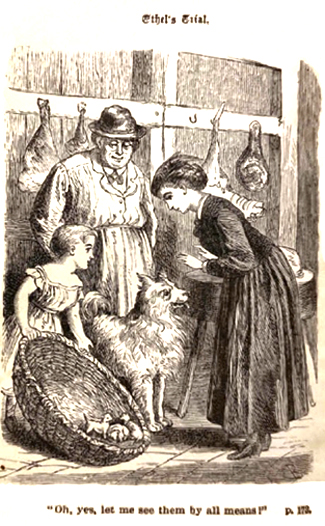
Ethel's Trial.
"Oh, yes, let me see them by all means!"
"Oh, yes, let me see them, by all means," said Ethel. "I never saw any little puppies."
Whereupon Mr. Begg led the way, and Ethel found herself behind the stall, admiring the three round little animated balls, and trying hard not to shrink from the polite attentions of their mother, a big collie, who was evidently much flattered at the compliments paid to her offspring, and returned them by licking Ethel's hands and face as she bent over the basket. At last she disengaged herself, and took her leave, promising to be at the school to meet the children the next Sunday.
"Well, brother, I have gained some new recruits for your school," said Ethel to Mr. Dalton, as she met him at the gate. "All the little Beggs, and all their cousins, the little Hagues: so I shall have to be there on purpose to meet them, whether you want me or not."
"You know perfectly well, miss, that I do want you. But what about the other school?"
"Oh, they can spare me as well as not; and it is time for some of the other girls—Mary Rose or Maggy Flemming—to take their turn in helping Mrs. Cummings. Not Anna, though; we must have her up at the 'Hill.' And I don't believe I shall be afraid of Lion any more, because Mr. Begg's big dog licked my face, and I never said a word, though I felt as if I was being swallowed. I dare say I shall end by liking dogs, after all."
"And June-bugs too, perhaps?"
"No, indeed—the stupid things!"
"But, Ethel, I thought the whole Begg tribe were Romanists. I am sure Mrs. Trim told me so."
"So they are; that is just the beauty of it," said Ethel. "I hope we shall get at the parents through the children, just as Mr. Verplank did at those McCormicks. They were all Romanists, and now they come regularly to church; and two of the girls are in the Bible-class."
"I see you enter into the real spirit of the thing," said Mr. Dalton. "Things look brighter to-day, do they not, Ethel?"
"They do, indeed; thanks to you," replied Ethel, with that sudden brightening of the face which made her look so wonderfully pretty.
"Thanks to the great Comforter of all," said her brother. "Ethel, when shall we take up our great subject again?"
"Please, Henry, I wish you would wait a little first," answered Ethel. "I am thinking of it all the time; but I would rather wait awhile—say till Christmas—before saying any more about the matter."
"Very well; I will agree to that. What are you going to do now?"
"Practise music till luncheon-time. Will you come and sing duets with me?"
At luncheon-time, Dr. Ray came in—an unusual circumstance, for he rarely ate lunch.
"What is going to happen?" asked his wife.
"Nothing very bad, I hope. Here, young lady, is a nest of June-bugs for you."
"A nest of June-bugs!" said Ethel, looking at the pretty morocco box which the doctor handed her. "Shall I open it?"
"Of course; what else is it for? Emily, I don't mind if I take a cup of tea, seeing you have it made."
Ethel opened her box, and discovered a pretty gold pin and sleeve-buttons, each set with a diamond beetle.
"Oh, how lovely!" she exclaimed, "Are they enamelled?"
"No; they are the real insects—first cousins to your friends the Melolonthites. I had the date put on them, you see."
"What a quaint fancy and what a pretty one!" said Ethel, examining the brilliant green-and-gold insects. "I shall think all the world of them, Matthew. Nobody else would have thought of such a thing."
"Well, I owed you some reparation for laughing at you; and I thought you would like them as mementos of your grand victory. I must be off again, though. Don't wait dinner for me if I am late, Emily."
The next Sunday found Ethel and Anna at the chapel, as the girls liked to call it, in good season. The room was more than half filled with children, and almost every one had some brother, or cousin, or friend who was "coming next Sunday." To Ethel were assigned the infants, as she had desired, including all the Beggs, and their cousins the Hagues: Anna had a nice class of girls from nine to twelve. Two other classes of younger girls were given to two moulders' wives, nice, motherly women, and Mr. Dalton himself took the large boys.
"Richard, you must just turn to and help," said he to Richard Trim.
"I was going into your class," said Richard, colouring.
"Yes; but we can't spare you to go into my class—not at present, at any rate. We want you to teach those boys in the corner."
"But I don't know enough to teach," objected Richard.
"You can teach what you know, and what you don't know you can learn."
"I can ask ma, to be sure," said Richard. "She knows a great deal about the Bible. Well, I don't want to shirk, Mr. Dalton, so I will take the class; at least until you can get somebody else."
"Very good. But why is your mother not here? I depended on her most of anybody."
"I wanted her to come, but she would not," said Richard. "She said she was too old, and, did not understand the new-fashioned ways of managing; and the young people would not want her."
"We don't intend to have any new-fashioned ways; and we do want her," returned Mr. Dalton. "I shall come and have a talk with her. Well, it seems the classes are all provided, for the present. Some of them are too large; but that can be rectified when we have more teachers. I must look out among the men for somebody to take another class of boys."
"Mr. Murdoch would be a good man," said one of the boys.
"Who is Mr. Murdoch?" asked Mr. Dalton.
"Why, don't you know him? Why, he's the boss-moulder," replied the boy, in a tone of great surprise, as if not knowing the boss-moulder argued one's self unknown.
"You know I have not lived here very long," said Mr. Dalton, excusing his ignorance of that great man. "Why do you think Mr. Murdoch would be a good man, David?"
"Oh, he knows lots about the Bible, and everything. They say he reads Latin and Greek; but I don't know about that. Anyhow, he is mighty pious, and won't let any of the men swear or use bad words in the shop; but he is real good, though."
"I can easily believe it," said Mr. Dalton, gravely. "Has he any children?"
"Oh, yes. Them two red-haired girls over there is his'n; and he has got a boy, but he don't live at home, now. He has gone in the country, on a farm."
"I must make his acquaintance," said Mr. Dalton. "Now we will go on with our lessons."
It is not my purpose to follow out particularly the history of the Iron Hill Mission, as it soon came to be called. The school grew and prospered. Mr. Murdoch was found out, and at once consented to take a class. He was a big, red-haired Scotchman, and Mr. Dalton ascertained that he really did understand, not only Latin and Greek, but also Hebrew, and was very curious about things in general, especially about the Eastern tongues. They fraternized at once.
"Ye see," said Mr. Murdoch, in explanation, "I began to be educated for a minister, at the University of Glasgow; but my father died, and my mither was left with a handful of lasses to put out in the world, and but little to do it with. I could have worked my own way through the University, you know, but then there were the lasses. So, as I had always a turn for working in iron and brass, like Tubal-Cain of old, and as a cousin of my own had a place in one of our great works, why I just left the University and took to the foundry. But I saw no reason why I should forget what I had learned, or why I should not learn more; so I kept my father's old books—he was a minister, and a well-learned man—and studied them whilst I had time."
"I see!" said Mr. Dalton. "I dare say you found your books a great comfort."
"Indeed and I did. There is wonderful comfort to be found in books, if you use them right. And so, Mr. Dalton, if you can lend me the books, I will take a look at the Syriac with much pleasure."
"I will not only lend you the books, but give you all the help in my power, if you need help," said Mr. Dalton. "It will keep me in practice. But in return, you must take my class of boys. You are the very man I want in the Sunday-school."
"I shall do it with much pleasure," said Mr. Murdoch, and so the matter was settled.
Mr. Murdoch soon gained unbounded influence over his class, who looked up to him with immense reverence and regard.
"Emily, have you seen a Syriac grammar lying about among your books?" asked Mr. Dalton, a few days after his conversation with the boss-moulder.
"I cannot say that I have noticed it," replied Emily, gravely: "but you know I have not much time for light and trifling reading, so I may have overlooked it."
"You might easily have done so, for it is unbound, and looks very much like a paper-covered novel," said Mr. Dalton. "I can't think what I have done with it. I want it to lend to Mr. Murdoch."
"Perhaps Ethel may know something about it. She takes a general charge of all the books in the house. I will ask her when she comes in. How much she has brightened up lately, has she not?"
"She has, indeed. I hope she has turned the corner of that crisis we were talking of the other day, and that she will now go on in a course of steady improvement."
"At the same time, to quote Matthew again, we must not be surprised or discouraged, if she has some drawbacks," remarked Emily, smiling.
"Of course not," said Mr. Dalton. "How old is Ethel? I always forget people's ages."
"Ethel is sixteen," replied Emily. "Don't you remember? She was born and mamma died the year you went abroad for the first time."
"Then in three years she will be nineteen," said Mr. Dalton, musingly.
"Yes, I suppose so. People generally grow old at about that rate, if they live: I know what you are thinking of, Henry," she added, more gravely: "but I hope you will not be hasty. I cannot think that there is in our timid little sister much of the stuff whereof martyrs are made."
"A missionary is not necessarily a martyr," said Mr. Dalton. "I do not consider myself one by any means. On the contrary, though I have had a good many unpleasant things to encounter, and have passed through some trying scenes, I think I have enjoyed life as much as I should have done in any situation whatever."
"Yes, but you are not Ethel," said Emily. "Consider how she has been brought up how she has been petted and indulged, and how she has always shrunk from anything in the least degree disagreeable or dangerous. When she first came here, she would scream if she saw a caterpillar, and alarm the whole house on the bare suspicion of a mouse."
"I know," said Mr. Dalton; "but Emily, have you not noticed a change in Ethel lately?"
"I have, certainly," replied Emily. "There was that affair at the chapel—nobody could have behaved better than she did on that occasion. Then she has lately taken the marketing upon herself, and she does it very nicely too. It was her own offer to undertake it. I asked her if she would not be afraid of the dogs, but she said she must learn not to mind such things. Yes, I do think she is making a great effort to improve; but yet—"
"Don't you think, Emily, that what Ethel needs most is a distinct, definite object in life—an object grand enough to overshadow and reduce to their true proportions all these small difficulties of hers?"
"Perhaps so. It is what everybody needs. But still, I cannot imagine Ethel made into an effective missionary. To be sure, I remember that Janet Beecher used to be as much afraid of cows and caterpillars as Ethel herself. However, there is time for a great many things to happen in three years, and perhaps Ethel may find an object nearer home than Persia."
"Still, I would not say anything to discourage her, Emily."
"Oh, not a word, of course. Indeed, I would do everything in my power to help her, if I thought her heart was really set upon the work."
"Wait and see," said her brother. "Here she comes. Little sister, have you seen anything of a Syriac grammar?"
"It is in my room—I was looking it over," said Ethel, blushing. "I will bring it to you directly."
"Any time to-day will do," said Mr. Dalton. "I have promised to lend it to Mr. Murdoch."
"Oh, dear!" said Ethel, in a tone of disappointment. "What does he want with it?"
"To study it, I suppose, my dear. I have another, however, which is much at your service; only I would not advise you to undertake the language alone. Whenever you are ready to begin, I will help you."
"Thank you. I should like it ever so much," said Ethel. "I will go and find the book directly."
As she left the room, Mr. Dalton and Emily exchanged glances, but said nothing.
TREATING OF COOKING.
ETHEL was not satisfied with undertaking the marketing. She had always disliked going into the kitchen, so that she had never even acquired the art of clear-starching, preserving, and cake-baking, which most American young ladies, at least out of the great cities, learn to practise in great perfection. But she "did not like" to work about the stove, and put her hands into all sorts of things; and this had heretofore been a sufficient reason for her never learning to cook. Now, however, she was in a little danger of going to the opposite extreme, and doing things simply because they "were" disagreeable and distasteful. She had set herself to take up the cross daily, and she was in some danger of making crosses for herself, instead of being content with those which her Lord sent her; and those which he sends are always just the ones we need.
It was not altogether a motive of self-denial, however, which took Ethel into the kitchen on this particular day. She had been reading over that paper in her desk, to which she now frequently referred, and thinking whether she were doing all in her power to fit herself for the work she had undertaken.
"I cannot begin upon Syriac till vacation, because my present lessons take all my spare time. I don't know that I can do any more for my class than I am doing, unless we get the sewing-school started. Let me see. I can sew pretty well: Miss Carrington took care of that, so I have one thing to thank her for, at any rate. I think I can cut and make all my own underclothes, and I know how to use the machine. I rather think I could make a dress, if it had not too much trimming. I will try it on the next cheap dress I buy; or I might make over that pink cambric.
"But there is housework, especially cooking. I don't know the least thing about cooking. If I were set to boil potatoes, I should not know how long a time they would need; and I am sure I should not know how to bake a loaf of decent bread, if people were suffering. I wonder if Mrs. Jones would teach me. She is an excellent cook, and she is very good-natured. I mean to ask her. Emily will be away to-morrow, and it will be a good time to begin."
Great was Mrs. Jones's amazement when Ethel entered the kitchen next morning, and preferred an humble request to be allowed to take lessons in cooking. Mrs. Jones was the wife of Dr. Ray's man-servant, and an excellent woman in every way. She was an accomplished cook, and, like other great artists, she did not at all like being interfered with; but she had known Ethel from her babyhood, and was very fond of her.
"Bless your heart, my dear, what has put that into your head?" she asked.
"Why, you know, Mrs. Jones, everybody ought to know something of housework," said Ethel. "I have often heard you say that, yourself. You know I don't understand the least thing about cooking, and I might be so placed that the knowledge would be very desirable."
"That is true, dear. '"Can do" is easy to carry about,' my grandmother used to say. Ladies would often be a deal better off if they understood housework better, and so would the people that work for them. Well, now, I am going to make some pies, and you may as well begin upon them as upon anything else. It is surprising what pie-crust folks do make and eat—just like leather or pasteboard. No wonder it is called unhealthy. I don't suppose you ever 'touched' a bit of crust in all your born days."
"Never, except to eat it."
"Ah, well, there must be a first time to everything. But, my dear child, you want to put on an apron, and take off your rings and cuffs, the first thing. Never go into the kitchen to work without an apron."
"True; I forgot that. Well, now, what shall I do first? Remember, I don't know even the A B C of pie-crust, so I shall have to begin at the beginning."
Mrs. Jones proved a good teacher. She did not take it for granted that her pupil knew things which she had never heard of; or confuse her with too many directions at once. Ethel was content to be told, (which is not always the case with pupils,) and the pies were successfully accomplished and baked.
"Now, then, as the oven is just right, and we have the things about, suppose you make some batter-cakes for luncheon," suggested Mrs. Jones. "Mr. Henry likes them; and it will save me baking bread to-day."
The cakes were as successful as the pies, and Ethel was secretly delighted to see her brother help himself to a third and fourth, remarking, apologetically, that they were so light they hardly amounted to anything. She kept her own counsel, however, and magnanimously allowed Mrs. Jones to have all the praise of both cakes and pies.
Every day for the three weeks that Emily stayed away, did Ethel take a lesson in some branch of cooking. She was very successful in general.
"Well, you haven't spoiled anything yet," said Mrs. Jones, on the day that Emily was expected home.
Ethel, grown bold with her success, was proposing to Mrs. Jones that they should have something unusually good to welcome the travellers, and suggested, among other things, that marvellous compound—alas! almost unknown to the present generation—a transparent pudding; adding, rather doubtfully, "If you think I could make it."
"Well, you haven't spoiled anything yet," said Mrs. Jones; "and I don't see why you should spoil that, as long as you have me to show you. I will say for you, you are about the easiest person I ever tried to teach. That's one reason you have such good luck: you don't take anything for granted, and you ain't afraid of being told, as some young ladies are. When people have to find out everything by their own experience, why, of course, they make lots of mistakes."
"That is the advantage of not knowing anything at all, to begin with," said Ethel. "My French master always says that he would rather take a perfectly ignorant pupil than one who has been half taught."
"There is something in that," said Mrs. Jones. "Well, my dear, we will make the pudding, and some chocolate-cake, too, if you like. The doctor is very fond of chocolate-cake, and always eats it, though he says it is very unwholesome. Dear me, we all have our inconsistencies," added Mrs. Jones, in a tone of beneficent toleration for the infirmities of humanity; "and all doctors are full of notions about eating and drinking. Dr. Ray is no worse than the rest of them."
"I don't think he is as bad as some," remarked Ethel. "Dr. Millar will not let the children have anything but porridge for breakfast and supper. Emma can't bear it, and the poor little thing comes to school ready to faint away, sometimes."
"Humph," said Mrs. Jones, in a tone of immense contempt. "He likes good thing enough himself, I dare say."
"I should think he did," replied Ethel. "I never saw any man eat as he did the night the Club was held here. But, perhaps, he thinks plain living is better for the children."
"Plain living is one thing, and starvation is another," said Mrs. Jones. "I don't see why good things—in moderation, of course—should hurt children any more than grown folks. What is sauce for the goose is sauce for the gander."
"But, perhaps, not always for the gosling," said Ethel, smiling.
"Well, maybe not always. Anyhow, it is real cruelty to force children to eat what they dislike. But my dear, what has set you so earnestly on learning to cook? You ain't thinking of getting married, are you?"
"Oh, dear, no," returned Ethel. "But, you know, brother Henry may need a housekeeper some time; and at any rate, I don't see that it can do any harm for me to understand housework."
Mrs. Jones set down the dish she was buttering, and looked at Ethel with an odd expression between reproof and affectionate pride.
"It's just come over me what you are after," said she. "I can see it all like a book. You are thinking of going with Mr. Henry, when he goes back to them heathen countries. Now don't say no, for I know better."
"Well, suppose I am," said Ethel, smiling, though she felt a little confused and annoyed, "is there anything wrong in that? Why should not I be a missionary as well as Miss Beecher?"
"There's nothing wrong in it, of course; only I can't bear the thought of it," replied Mrs. Jones. "You, that I nursed when you was a baby, going out to them outlandish places."
"But why not? Why should it be any worse for me than for Miss Beecher?"
"There is a sight of difference between you and Miss Beecher," said Mrs. Jones, rather indignantly. "Miss Beecher is a great deal older, for one thing."
"Yes, she is now, but she was not when she went out there. She was only twenty years and I shall be nineteen before it is time for Henry to return."
"And then, Miss Beecher was very differently situated," continued Mrs. Jones. "She would have had to work for a living anyhow, and she might just as well teach school there as here; but you will have enough to support you handsomely without doing anything at all."
"T don't see how that is any argument," said Ethel. "If Miss Beecher's only object had been to earn a living, she could have done it much more easily here than in Persia. She had the offer of an excellent situation at the very time she decided to go abroad. The more property I have, the better I can support myself; and do just so much more good."
"Folks can find good enough to do at home, if they have a mind to," said Mrs. Jones, rather stoutly.
"I know that very well. There is good to be done everywhere. I dare say the first apostles might have found good enough to do in Judea, without going into strange countries. But there are people enough, who cannot possibly go abroad, to do the work at home. There are fifty ladies, for example, who can and will teach Sunday-school classes here in Ironton, for one who will or can go to teach in India or Africa."
"That's true," said Mrs. Jones. "But when the Lord has given anybody as much as he has to you, it does seem as though he meant you should stay at home and enjoy it."
"I think, when the Lord gives anyone as much as he has me, he means that person should use what he gives for his service, and for the good of those who are not as well off," said Ethel, with animation. "He does not give us everything to use just for our own benefit and pleasure. I am sure you agree with me in that, dear Jonesy; because, unless you do, you would not deny yourself everything except necessary clothes, in order to help your poor niece and her children," added she, slyly. "Why don't you enjoy what you have, and leave them to take care of themselves?"
Mrs. Jones laughed. "Well, you've got me there, my dear, that's a fact. But then, doing for one's own flesh and blood seems different from doing for people in a far-away country, don't it?"
"It certainly does; and yet you know the Bible says, 'He hath made of one blood all nations that dwell on the earth.'"
"But, excuse me, my dear, do you think you are just the one to go on a mission?" asked Mrs. Jones, after a little silence. "Don't you think you are 'most too—too—?"
"Too silly and ignorant and cowardly, and all that," said Ethel, finishing the sentence for her. "Yes, indeed, I do; but you know, even if I go, I shall have three years to prepare myself; and I hope to overcome some of my faults by that time. I know how silly I have always been, and how selfish, too—afraid of everything, and unwilling to touch or do anything in the least disagreeable. I have lived a selfish and useless life so far," said Ethel, blushing; "but that is no reason I should keep on doing so. I am going to try and do differently."
"Now you are rather too hard on yourself," said Mrs. Jones; "though I won't deny but there was room for improvement. But have you really made up your mind to be a missionary?"
"I have made up my mind to fit myself for it, at any rate," said Ethel; "as for the going, that must be as Providence pleases. I see no reason why I should not learn everything that a missionary ought to know; and then I shall be ready to go or stay at home, as may seem best. Since we have said so much about it, I will tell you that I do very much wish to go back to Persia with Henry. I have been thinking about it a long time, but more than ever for the last three or four weeks. I have not said as much to any one else, and I don't want you to tell anybody at present. I tell you, because you can help me a great deal in learning the things that I want to know about housekeeping and work of all sorts; and you have always been so good to me, ever since I was born, that I am sure you will not fail me now. You will help me, won't you, dear Jonesy?"
Mrs. Jones wiped her eyes. "Indeed, my dear, you talk very sensible; and I am sure I will help you all I can. You knew I have always loved you dearly, ever since I took out of your dear good mother's arms, when you were only three days old. I should feel badly to have you go away among all them Turks and heathen, that's a fact. But then you seem to have a real call; and if you have, and it comes from the Lord, why, I am not the one to say a word against it; and I will help you every way I can."
Ethel put her arms round the kind old woman's neck, and kissed her. "I was sure you would," said she; "and now tell me what to do to this next. See how thick it is!"
"Dear me, yes; I forgot all about it!" exclaimed Mrs. Jones, recalled at once to present and earthly things. "It would have been spoiled in another minute. Take it off the fire directly."
"Why, how warm you look, dear!" said Emily, kissing her sister on her arrival. "Your cheeks are as red as roses!"
"I have been busy," replied Ethel, smiling. "I am so glad you have come. Dinner will be all ready by the time you have changed your dress."
"How have you fared since I have been gone?" asked Emily, after they were seated at the table. "Has Mrs. Jones taken good care of you?"
"Admirable!" replied Mr. Dalton. "Don't fancy that we have missed you in the least. We have lived on the fat of the land, I assure you."
"What beautiful bread!" said Dr. Ray. "I have not seen any like it since I went away. If I found a professorship in the new college, it shall be of cooking, and I will put Mrs. Jones in the chair."
Ethel blushed, and her face dimpled all over with smiles, in spite of her efforts to look perfectly unconscious; for it was she who had made the bread. The dinner was a decided success, and Ethel felt paid for her fatigue and the heat of the kitchen when she saw how the travellers enjoyed it.
"I declare it is worth while to go away for a fortnight, if one is to be so feasted on his return," said the doctor, helping himself to another piece of cake; and then, as Mrs. Jones entered the room, "Mrs. Jones, what injury have I ever done you, that you should lay such snares for my digestion as this cake and pudding?"
"As to that, you wasn't obliged to eat it, you know," replied Mrs. Jones, who always "spoke her mind" to everybody. "Besides, I didn't make either the cake or the pudding—it was Miss Ethel."
"Ethel!" exclaimed everybody at once.
"Yes, indeed," said Mrs. Jones, enjoying the surprise. "She made the cake and the pudding and the bread, and the caper-sauce for the lamb; and she stuffed and baked the fish all herself. Didn't you, dear?"
"Why, not quite by myself," said Ethel: "you showed me how, you know."
"Anyhow, you did it all with your own hands," returned Mrs. Jones; "and it ain't everybody that knows enough to be told how."
"That is a very just remark of yours, Mrs. Jones," said Dr. Ray. "It is 'not' everybody, by a great deal, who knows enough to be told. But to think of the dear distinguishing herself in the cooking line! What put it into your little pate, my dear?"
"I wanted to learn how," replied Ethel, blushing and smiling, as usual; "and I thought it would be a good time to begin when there was nobody here but Henry."
"'Fiat experimentum in corpore vili;' which means, my dear, that you should always try experiments on persons of no consequence," said the doctor. "You don't look as though you had been poisoned, Henry."
"Indeed I have not," replied Mr. Dalton. "I have wondered what Ethel was so busy about all the morning, and what made her cheeks so red at dinner-time; but I never guessed the secret."
"But I hope you have not tired yourself," said Emily. "How is the pain in your side?"
"Better," said Ethel. "It has troubled me but once since you went away."
"But what put it into your head?" asked Emily.
"Why, I wanted to learn while I had a chance," replied Ethel. "It is a good thing to understand all sorts of work; and perhaps I may some time want to teach people to cook myself."
"That would be disinterested—to teach people to cook yourself!" said the doctor, gravely. "Do you, then, mean to go among the cannibals, some of these fine days?"
"Perhaps," replied Ethel, laughing. "There is no telling where one may go; and after all, one would always like to be properly armed, you know."
"Good," said the doctor. "You are learning to hold your own, I see. I shall have to take care how I tease you. Seriously, dear, I think this an excellent move of yours, and better for your health than all the medicine I could give you."
"I am glad to hear you say so, brother, because I want to keep on with my work," said Ethel. "I want to learn to do everything about house before—while I have a good opportunity."
Emily and Henry again exchanged glances, but neither spoke, and the conversation turned on other topics.
SEWING-SCHOOL.
ETHEL'S hands were now very full of work. Her infant-class had increased beyond the capacity of the room which held it, though she had sent three classes into the large room—a change which was not accomplished without many tears and remonstrances on the part of the promoted infants. A sewing-school had also been started "on the Hill," the chief burden of which fell on Ethel and Anna. It began with Anna's class of girls. Mr. Dalton one evening showed his missionary magic-lantern to the children and parents, with a lecture descriptive of the pictures, and of places and people he had seen in his travels. Of course, all the children were greatly interested, and especially Anna's class. This interest was increased by Anna's borrowing Ethel's book of Eastern photographs to show them, and by her reading them a letter which Miss Beecher had written to the Bible-class, giving an account of the school-girls, and describing their delight at receiving the box of presents sent by the said Bible-class.
"I wish we could send them something from 'this' school," said Matty Brown, the youngest and brightest of the girls. "How nice it would be to get a letter all the way from Persia, wouldn't it?"
"I wish we could," said another. "Do you think we could manage it, Miss Burgers?"
"Perhaps we might," said Anna.
"I'm afraid we couldn't sew good enough to make anything worth while," said Mary Yeager. "I shouldn't want to send things so far unless they were 'nice,' you know."
"Don't you know how to sew, Mary?" asked Anna.
"No, ma'am—not very good," replied Mary.
"I can't, either," said Matty Brown. "Ma is going to teach me to use the sewing-machine, some day when she has time."
"You ought all to know how to sew," said Anna, who had been well taught that old-fashioned accomplishment, and was a proficient in the use of the needle. "You ought to know how to make and mend all your own clothes. Then you can work, not only for yourselves, but for those who are worse off than you are."
"I should like to know how to crochet and work worsted," said Jenny Millar. Jenny's father was rather better off than most of the fathers belonging to the class, and she was in no way inclined to make the worst of that circumstance. "I don't care about plain work."
"Crochet-work and working worsted are all very well in their places," said Anna; "but they are of very little consequence compared to plain sewing and knitting. Nobody ever went cold and ragged for want of worsted work, but a good many do both because they don't know the proper use of a sewing-needle. What would you say to a man who said he did not care to learn reading and writing—he wanted to learn Latin?"
The girls laughed, and Jenny looked rather affronted. "I don't expect to have to work for my living," she said, with a toss of her head. "My father is rich enough to make a lady of me: my mother says so."
"Your father's being rich will never of itself make a lady of you," said Anna. "Neither will the fact of your not working for a living. Riches and fine clothes have little to do with the matter. It takes a great deal more than these to make a lady."
"I am sure Mrs. Fowler is respected, and she works for a living," said Mary Yeager.
"So are a great many other women, who work hard all their lives," replied Anna. "Kindness and good habits and manners, and consideration for the feelings of those about her, make any woman respectable."
"I should like to learn to sew plain work real nicely," said little Christine Murdoch. "Mother often says she is so sorry she cannot teach us."
"Why cannot she teach you?" asked Anna.
"Oh, don't you know? She has a stiff arm," replied Christine.
And Elsie added, "She broke her arm on the ship coming to this country, and it wasn't set right; so, when it got well, the joint was spoiled. But she can do a many things, though she cannot sew," added Elsie, with pride. "Father says he wonders how she keeps everything about the house so nice as she does. Mother says she learned to sew in school; and she can do beautiful work—that is, she could do it in old times, when she had her arm."
"I wish we could have a sewing-school," said Christine.
"Oh, Miss Burgers, how nice it would be!" exclaimed Matty Brown. "Couldn't we have one, don't you suppose? We could come on Saturday afternoons, and you could teach us. I am sure every one would like it; wouldn't you, girls?"
Every one agreed that it would be "perfectly splendid," and one girl added that it would be "awful nice." "Awful" was an adjective and adverb of all-work upon Iron Hill. *
* "Awful," "splendid," and "you know" are common colloquial
barbarisms.—EDITOR.
"Well, I will talk to my mother, and see what she says," said Anna, at last. "If she is willing to have me begin, I will see what can be done."
"Why, Miss Burgers, do 'you' have to mind your mother?" asked Mary Yeager, in a tone of great surprise. "A grown-up young lady like you."
"Certainly I mind my mother," replied Anna, not sorry for the odd question. "I mind my mother just as much now as I did when I was three years old."
"And do you ask her every time you want to go anywhere, just as 'we' have to?" continued Mary.
"Just the same, Mary. I never go anywhere or undertake anything of any importance, without asking my mother. I prefer to do it, because I love my mother, and would rather please her than any one in the world."
Mary was evidently much impressed with the idea that a grown-up young lady, who wore flounces, and a hat with a little bird in it, should mind her mother of her own accord; and Anna hoped the lesson would have a good effect.
The project of the sewing class was discussed through the week; and on Sunday, Anna told the girls that they might come the next Saturday, and bring their own work either sewing or knitting.
It was presently found that the school could not be confined to Anna's class. All Ethel's little girls immediately became wild upon the subject, and petitioned so earnestly to be allowed to come, that there was nothing for it but to say that she would see what could be done. Ethel went home, and talked the matter over with Emily.
"It would be an excellent thing for the children," said Emily; "excellent in every way. I have always regretted that the sewing-school at the Home was given up. One gains such a hold, not only on the girls, but on their mothers."
"The chief trouble seems to be to know what to set such little ones about," said Ethel. "Of course, they know nothing of sewing."
"Oh, you will need quantities of patchwork for them; that is the best for the infants," replied Emily. "It is easy and pleasant, and admits of a great many beginnings and leavings off; which are always desirable with young children. I will look over my own and Juliet's piece-trunks, and see what I can find; and I will baste up a quantity for you to begin upon. I only wish I could take hold and help you; but you know—or rather you 'don't' know, but you will soon find out—how much talking such a class involves; and the doctor will not let me use my throat at present."
"I suppose it will be a pretty noisy affair," said Ethel. "That is the worst of it."
"You must not let it be noisy," said Emily, decidedly. "You must begin with establishing strict order, and you must maintain it. Unless you do, your school will be nothing but a nuisance, and the children will be worse for it, instead of better."
Ethel looked a little doubtful. "I know it is so in Sunday-school," said she; "at least in the infant room; but I thought, perhaps the children would not come to the sewing-school if we were too strict with them."
"Then let them stay away," said Emily; "but there is no danger."
"You don't want to let them get the idea that they are doing you a favour by coming to school," said Mr. Dalton, who had entered in time to hear the discussion. "That is a very mischievous notion, and subversive of all good. Make them understand that you are doing them a great kindness and favour by teaching them, and that the continuance of the favour depends upon their good conduct, and they will think a great deal more of their privileges."
"Depend upon it, Henry is right," said Emily. "I remember very well the case of Kitty Fisher!"
"What was that?" asked Ethel.
"It happened when we had the large school at the Home," said Emily. "We had an average attendance of eighty children of the very roughest class—not at all equal in social standing to your Iron Hill pupils; but regular street children. For some little time we had had trouble in the class to which Kitty belonged. The teacher, Miss Edwards, was a gentle little thing, and her scholars walked over her, so that at last she became discouraged and stayed away, and Juliet took the class. The work was given out as usual.
"'I don't want to do that,' said Kitty Fisher, throwing down her work, which was a brown factory-garment. 'I want some white cloth, like that girl's over there!'
"'You must take the work that is given you, Kitty,' answered Juliet, in her quiet, polite way.
"Kitty evidently took the mild tone in which Juliet spoke for a sign of giving way. She was never more mistaken in her life. She gave the work a push, which threw it on the floor, and said, with a toss of her head, 'I sha'n't do that. If I can't have the work I want, I shall just go home—so!'
"In another moment, before she had time even to think of resistance, Kitty found herself put out in the yard, and the door shut in her face. Her bonnet was handed out to her, and she was told to go, and not to show herself again. We never had a more orderly or industrious school than that day. Kitty lingered about, and at recess attempted to come in with the others; but she was sternly repulsed, and departed crying.
"The next Saturday she came again, with a very humble petition, and she was allowed to come in and resume her place, on promising that she would try to be a good girl. She kept her word for that day, taking extraordinary pains with her work. Juliet was careful to praise her as much as she honestly could; and never was a lamb meeker or more quiet than Kitty. When school was out, she lingered around the door, as if she had something to say.
"'Well, Kitty, what is it?' asked Juliet, who was putting up the work. 'Do you want anything?'
"Kitty put up her face, and said, in a sort of scared half-whisper, 'Please, teacher, I want to kiss you.'
"Juliet said she was never more surprised in her life. 'She was not a very agreeable object,' said she; 'but I should have kissed her if she had been twenty times worse.'
"From that time we had no more trouble with Miss Kitty, or her class."
"But suppose she had not come back," said Ethel.
"Then we should have let her stay away," replied Emily. "It is not worth while to endanger the prosperity of the school for the sake of one scholar."
"How I do wish you could help us; you have so much experience!" sighed Ethel. "I am afraid we shall make a great many mistakes."
"I dare say you will make some mistakes,—that is to be expected," said Emily; "but you must remember that neither Juliet nor any of us had any experience when we began at the Home. Don't you remember the direction of the old French teacher? 'If you want to learn to speak, "speak!" If you wish to learn to write, "write!"' It is only by doing things that one learns to do them.
"That is Mrs. Jones's way of teaching," remarked Ethel. "When she taught me to make pie-crust, she made me do everything about it with my own hands, while she sat by and showed me what to do."
"Mrs. Jones has the correct theory and practice of teaching," said Mr. Dalton.
"Well, then, we will just go over and do the best we can," said Ethel; "and when we are puzzled, we will come and ask Emily what comes next."
"There is no particular danger of your making any very serious mistakes, unless you undertake too much at a time," remarked Emily. "When Mrs. Upjohn undertook to oversee our school, she thought the children might as well be learning something else while they were working, and she tried to teach them to repeat hymns and other things. The consequence was what was to be expected. The work was not half done, nor the hymns half learned."
"I thought we might, perhaps, have a little singing," said Ethel.
"There would be no harm in that, provided you took a separate time for it. Indeed, I think it would be a very good plan to stop work once or twice, and sing for five minutes or so."
"I want to learn all the best ways," said Ethel; "because—because I might, some time, have to manage some such thing by myself."
The sewing-school met the next Saturday, and behold, not one girl in the school was absent,—not even Jenny Millar, who, however, declared that she did not come to learn to sew. She wanted to learn how to work worsted, or some such thing.
"We cannot undertake that, at present," said Ethel. "If you all take pains, and behave very well, perhaps we may, by-and-by, teach you some pretty fancy-work as a reward, but not at present. Do you know how to make buttonholes, Jenny?"
No; Jenny did not know how to make buttonholes, nor how to stitch, and it soon appeared that she could not hem or fell neatly.
"You see, you have a great deal to learn before you come to fancy-work," said Anna, smiling. "Let me see how neatly you will do this hem; and when you learn that, we will teach you something else."
Jenny murmured and tossed her head, but finally concluded to stay, "just for once."
On the whole, the first day was a success. Ethel's infants were delighted with the patchwork, and succeeded as well as could be expected. Several of the girls wanted to learn to knit, and these were placed in a class by themselves,—Anna promising to try and find them a teacher as soon as possible.
"I believe I know just the person, if she will consent," said Ethel. "Old Mrs. Trim, Richard Trim's mother, I mean. I noticed, the day we called there, how very fast and skilfully she was knitting."
"What, that nice little old lady, who sits on the front seat in chapel?" asked Anna. "Oh, I should love to have her in the school. Where does she live? Can't we go and see her to-night? It is not late."
Ethel hesitated a moment. She remembered Widow Green's cow and the big dog; but she would not refuse. Her heart beat rather unpleasantly fast as they drew near the house, and she saw that old Lion was lying, as usual, directly across the gate, and looking, from his size, greatly "out of drawing" with the little cottage and garden.
"What an immense dog!" said Anna, who was not herself especially valiant where dogs were concerned. "Do you think he is gentle?"
"Oh, yes, I believe so," replied Ethel. "He seemed quiet enough the other day, where people were concerned, though he runs after cows in rather a startling manner. Come, old fellow," she added, making an heroic effort and speaking to the dog, who lay flapping his big tail against the broad sidewalk in a lazily polite manner—"Come, old fellow, get up, and let us come in, won't you?"
Lion executed a portentous yawn, which made Ethel feel as if she were going to be swallowed, and then rose to make way for them. He evidently thought himself obliged by civility to do the honours of the place in the absence of his master, for he accompanied them to the side door, (front doors on Iron Hill being only used at funerals or other great occasions,) and with divers nods of his head and wags of his tail, made them free of the premises.
The window was open, but Mrs. Trim was not to be seen, though they could hear her moving about up-stairs.
"How neat everything looks!" said Anna. "See what fine balsam-plants."
"Yes, they are larger than Emily's, though they were planted later," replied Ethel. "Those balsams are associated with my first visit to Iron Hill; and a wonderful goose I made of myself. I feel like calling myself names every time I think of it."
"What did you do?" asked Anna.
"I will tell you another time. Here comes Mrs. Trim."
Mrs. Trim received them with her usual chatty cordiality, and insisted on their sitting down to rest themselves, and drinking a glass of her ginger-beer. Ethel had never tasted ginger-beer in her life, but she found the cool, foamy beverage far from disagreeable, and was glad to show that she enjoyed it. Mrs. Trim was evidently very much flattered by the proposition that she should take the knitting class.
"But I rather guess you had better get some of your folks to look after it," said she. "Not but I should like to do it; but then, you see, there are folks about here who mightn't like it if you was to pass over them, and come to me for a teacher. It might make feeling, you see."
"It would be very foolish for any one to be displeased about such a thing as that," said Anna, rather warmly. "There is no question of passing people over. It is only as to who will make the best teacher for the class."
"That's all so," replied Mrs. Trim. "It is very foolish for folks to set themselves up one above another, and have notions about gentility, and all that; but, my dears, 'folks' is 'folks,' all the world over; and if you are going to do any good in the world, you must be content to work in it 'as it is,' and not as it ought to be."
"That is true," said Anna, "but we had quite set our hearts on having you in the sewing-school, Mrs. Trim."
"I am sure it is very good of you, dear; and, as I said, I should like it of all things; but really I don't think it's best. This chapel and mission's a-going to do all the good in the world up here, if it's only managed right; and I don't want to have the least thing happen to set folks against it. There's Millar's folks, now. Millar pretends he don't believe in anything, not even that he's got a soul to be saved; and his wife laughs at pious folks, and says they only pretend to believe the Bible, and all that. I never was so surprised in my life as I was when I heard that they had let their children go to Sunday-school."
"I found Jenny Millar was the most untaught girl in my class, though she was the best dressed," remarked Anna. "All the others knew something about the Bible and the history of our Lord but herself, and I was surprised at her ignorance. What you tell me, explains the matter, and I shall take special pains with her."
"Just so," said Mrs. Trim, earnestly. "Poor little dear, my heart has often ached for her when I have heard her father talking his nonsense before her. Well, Mrs. Millar said, last night, she believed she'd go to chapel Sunday evening, if it was only to hear those girls sing,—meaning you, my dears, I suppose. I couldn't help hoping that the truth might find its way to her heart, poor thing. Now, you see, if you were to set me to teaching her girl, she might not exactly like it, and so I think it Will be better if you can get some of your own friends to take the class."
"I see," said Anna. "I dare say you may be right, Mrs. Trim. How nice your garden looks!"
"Yes; Dick is awful proud of his garden," replied Mrs. Trim. "Some folks say he is silly to spend so much time on his flowers and things; but I don't think so. They help to make it pleasant for him; and when he comes from work, or when they have a holiday, as they do once in a while when the Works is out of order, instead of going to the saloon or the grocery, he goes to work weeding and trimming his vines and things. He thinks an awful sight of the flowers your sister sent him—especially the balsams; but he has put two or three of them in pots for a sick, bed-ridden girl, over there on the other corner. I wish you young ladies would go to see her, some day. It would be a real kindness, for she don't see many people, and she is a great sufferer."
"What is the matter with her?" asked Anna.
"She has got something on her leg," replied Mrs. Trim. "I don't know the nature of it, but it hurts her dreadfully at times. She is fond of reading, but her head is weak, and she can't read long at a time."
"If she likes flowers, I might bring you some for her," said Ethel.
"It would do her twice as much good if you was to go and see her yourself," replied Mrs. Trim. "The very sight of your pretty, nice dresses and hats would do her good,—she sees so few pretty things."
Ethel hesitated. She had, as we have seen, a great horror of severe illness, and especially of anything disgusting or frightful. But a minute's thought decided her.
"I will go, of course," said she. "I will try to come up early next week. Come, Anna, we must go, now. Good-night, Mrs. Trim. Good-night, old Lion," she added, patting the dog's head as he put it up to her. "You and I shall turn out good friends, after all."
AUNT DORINDA.
"WHAT a nice old lady she is!" said Anna, as they were walking homeward. "But does it not seem absurd for these people to be setting themselves up one above another, and thinking about gentility and social position."
"I don't know," replied Ethel. "Why is it more absurd for them than for anybody else?"
"I don't suppose it is more absurd; only it seems rather more comical, somehow: Miss Millar is the only very aspiring young lady in my class. She says her mother won't let her wash dishes, or do any such work, because she means to make a lady of her. She was greatly surprised when I told her that I washed the breakfast dishes every morning, and that a great many ladies always dusted their parlours themselves. I have liked her the least of any girl in the class; but I somehow feel attracted toward her, after what Mrs. Trim told us about her parents. Poor child, between her mother's gentility and her father's infidelity, she has not much chance for her life."
"I think the children of such parents are worse off than those whose parents are merely careless and thoughtless," remarked Ethel. "The two little boys seem to be good children, and sing their hymns with a special relish. But who shall we find to take our knitting class?"
"There is Mrs. Rose."
"She is the very one, if she can find time; but then she has so much to do as it is. It hardly seems fair to ask her to undertake anything else."
"She is more likely to find time than a great many people who are doing nothing," remarked Anna. "I remember very well something I once heard Mr. Verplank say to my father: 'When I want some extra piece of work done in the church or the Sunday-school, I never think of going to the people who have abundance of leisure. I ask some one who has his or her hands pretty well filled already.' See, there is Mrs. Ray, standing at the gate, looking for us. I wonder if anything has happened?"
Ethel quickened her pace, and was met by Emily with a face and gesture of comical dismay.
"What has happened?" asked Ethel.
"Aunt Dorinda!" whispered Emily.
Ethel groaned, and sat down on the horse-block.
"When did she come?" she asked, presently.
"This afternoon, at four."
"Is she going to stay?"
"Of course, I suppose so. She has brought two big trunks. And now, while I have a chance, Ethel, I want to tell you something. Of course, we must all be very respectful and kind to Aunt Dorinda; but you must make up your mind that you will hold your own, and 'not' be walked over by her. Of course, she will want to interfere with everything, as usual."
"I hope she won't want to interfere with the sewing-school," said Anna, who knew something of Aunt Dorinda's peculiarities.
"She will, you may be sure," replied Ethel. "She will have some fine, grand system of her own about it. They say she had not been introduced to the President five minutes before she had advised him as to the Alabama claims, the Indian question, and the reform of the Patent Office."
"I suspect there must be a little exaggeration in that story, as she herself would remark," said Emily, laughing. "But never mind; we must make the best of her, that is all. Anna, won't you come in to dinner?"
Anna declined, and went on her way.
Ethel called after her, "Don't forget to see Mrs. Rose early in the week."
"See Mrs. Rose about what?" asked Emily.
"About teaching our knitting class. We have six or seven girls whose mothers want them to learn to knit, and we cannot attend to them and the others at the same time."
"Then you had a full school?"
"I should think so. Not one girl was absent, great or small. We had thirty-three scholars, and heard of several more who were coming. We wanted Mrs. Trim to take the knitting girls, but she thought some of the other people would be offended if she were asked to teach, and that we had better ask 'some of our own folks,' as she said. But, oh dear, Emily! What shall we do with Aunt Dorinda?"
"We won't borrow trouble," replied Emily. "Perhaps she may not care to interfere, and then Henry will know how to manage her. But come, dear, you had better go and dress, and that will refresh you for your dinner. You have just half an hour."
Miss Dorinda Atwood was a lady somewhere between fifty and sixty, of independent fortune, well educated, and a sincere Christian. How was it, then, that her advent was looked upon as a misfortune wherever she appeared, as she did pretty regularly at the houses of any of her numerous relatives? The question is easily answered. Miss Dorinda Atwood had no capacity whatever for minding her own business. 'Wherever she went, she advised, directed, and interfered, right and left, with everybody's most private affairs and arrangements. Nothing was sacred from her, from household arrangements and nursery management to affairs of the heart or religious experiences.
All her life Miss Dorinda had been giving advice. She had begun with her own father and mother before she was six years old, and she had gone on with the families of her brothers and sisters, nephews and nieces, pastors and fellow church-members. She had been sufficiently disinterested, very benevolent and liberal with her money, and sincerely desirous of doing good; yet at fifty-five, there was not one of her own family who did not dread her like a nightmare.
Ethel dressed herself for dinner, and came down, when it was ready, to find Miss Dorinda in the parlour, talking to Dr. Ray in her usual loud emphatic voice, which, somehow, wearied the ear like some noisy piece of machinery.
"Why, 'Dr.' Ray. It is not 'possible' that 'you,' a 'physician,' can admit the practice of dining at 'six' o'clock. I don't wonder at it in silly, fashionable people, but I should suppose 'any' one who made a study of the human frame, would know better. Is it possible you can advise your patients to take their meals at such unhealthy hours?"
"I don't usually give my patients a great deal of advice about their household arrangements, unless they are more than usually bad," replied Dr. Ray, in the dry tone which showed that he was annoyed. "For myself, I don't find it desirable to work after dinner, and, therefore, I like to have it late in the day. Well, dear, how has the day gone with you?"
"Oh, nicely," replied Ethel. "How do you do, Aunt Dorinda?"
Aunt Dorinda was diverted for a moment from the dinner question by Ethel's appearance, but she began upon it again as soon as they were seated at the table. Dr. Ray, like other middle-aged gentlemen who work hard all day, enjoyed his late dinner, and liked to have something good, and to discuss it at his leisure, with an accompaniment of lively light conversation. But Miss Dorinda did not approve of light conversation. She had always made it a rule, she said, to improve her mind by conversing with every one she met, upon the subject with which he or she was best acquainted. Accordingly, she questioned Dr. Ray about the sanitary condition of Ironton; slid related various striking and unsavory facts concerning tenement-houses, and sewerage in large cities.
Dr. Ray at last grew restless under the infliction, especially as he perceived that Miss Dorinda's stories were spoiling his wife's dinner as well as his own.
"Suppose we start another subject," said he, good-humoredly. "I hear enough about sickness during the day."
"Dr. Forrester used to say, when I was at C—, that if there was any one subject which ought by common consent to be banished from conversation in a health establishment, it was the subject of health," remarked Emily.
"Don't mention Dr. Forrester. I never want to hear of 'him' again," said Aunt Dorinda.
"Why, aunt, I thought he was a great friend of yours," said Emily.
"I 'used' to think he was a sensible man, but I have changed my mind. I was the means of sending Lily Adams to him, but I will never send any one there again. Three or four weeks after she went, I stopped there to see her. If you will believe it, there she was in a room with a carpet 'all' OVER the floor, and warmed by 'steam;' and a regular spring bed, as luxurious as anything she was used to at home. And there was Lily eating 'eggs' and 'meat' for her breakfast, and drinking 'tea,' and going up and down in the 'elevator.' I asked her how many miles she walked in a day, and she said she hardly walked at all—the doctor would not let her." And Miss Dorinda stopped short with a look which expressed a dozen exclamation points at least.
"Yes," said the doctor, calmly. "Forrester was very judicious with Lily. I always told them at home, that she took too much exercise."
"'Judicious!'" said Miss Dorinda, with a sniff. "Yes, very judicious, no doubt! I talked to Dr. Forrester myself. I said to him,—
"'Dr. Forrester, you are entirely in the wrong. These carpets and easy-chairs and spring beds in the rooms—these luxuries of the table, are all wrong, 'radically' WRONG! What your patients need are not luxuries. They want 'rousing' and 'invigorating' and HARDENING,—THAT is what they want. You ought to take up every carpet, and have only two meals a day, and those of the very plainest. Lily Adams don't want coddling; she wants bracing and rousing, and you ought to give it her.'
"And do you believe he just went into his room, and shut the door, without a word. And the next time I went to Lily's room, there was a card on it, with 'No visitors allowed.' Of course I went in, however; I knew it could not mean 'me.' I told Lily what she ought to do, and tried to get her out to walk; but she said the doctor would not allow it, and she must do as he said. So I just came away, and left her to her own destruction."
"But Lily is almost well, Aunt Dorinda," said Ethel. "The doctor says, in another year, if she is careful, she may be as well as anybody."
"Nonsense, Ethel! She may appear better, but it cannot possibly be that she has made any permanent improvement under such treatment as that. Air and exercise—air and exercise—they are the great panaceas for illness. Don't you think so, Dr. Ray?"
"Air and exercise are very good things in their places; but they are no more to be administered indiscriminately than any other remedies," replied Dr. Ray. "I have seen more than one patient aired and exercised out of the world in my time."
Miss Dorinda was "amazed," and "shocked," and "distressed," to find her nephew so far behind the most "distinguished" men of the time.
But Dr. Ray continued to eat his dinner, undisturbed by the shower of emphatic participles, till Emily's mention of a new club-book changed the subject and brought Aunt Dorinda out on the subject of indiscriminate reading.
It was a fashion at Dr. Ray's for the family to spend most of the summer evenings on a long veranda, which led into the garden. Thither Emily and Ethel now brought their work—Emily, the basketful of patchwork which she was basting for the "infants," and Ethel, some pretty, dainty little garment she was crocheting for a neighbour's young baby. Mr. Dalton came and sat down by Ethel on the step, and began talking about the sewing-school and its prospect. Aunt Dorinda went up-stairs, and presently came down with an immense bundle, which filled both her arms, and was as much as she could carry.
"I have brought some work with me, which I expect you all to take hold of and help me about," said she, as she set down her bundle. "You and Ethel ought to be especially interested in it, Emily, because it is missionary work. What 'are' you doing, Emily—sewing 'patchwork?' Now, 'do' you," said Miss Dorinda, in pathetically argumentative tones, "DO you consider it an employment worthy of a rational and immortal being, to spend precious time in putting together little pieces of calico, or crocheting worsted?"
"As to that," replied Emily, "immortal little babies have mortal bodies, and need jackets and cloaks to keep them warm; and it would be hardly worthy of a rational being to set little children to sewing patchwork, without basting it beforehand."
"But why should they sew patchwork at all?" persisted Aunt Dorinda. "Why should they not as well learn to sew upon the sleeve of a shirt, for some poor missionary or minister?"
"In the first place, because they cannot, usually, sew well enough; and in the second place, because it is not as pleasant for them, Aunt Dorinda. They like the bright colours, and feel a great deal of interest in seeing the blocks go together."
"And, pray, who are these children who are to be so entertained?" asked Aunt Dorinda. "Not 'poor' children, of course!"
"They are the children of Ethel's sewing class, up at Henry's chapel," answered Emily.
"A sewing class, indeed! I should not have suspected Ethel of such an undertaking. Tell me all about it, my dear," she continued, turning to Ethel, who heartily wished Emily had kept her basket out of sight. "I dare say I can give you some valuable assistance."
"There is nothing so very much to tell," said Ethel. "Anna Burgers and myself meet the girls of the Sunday-school on Saturday afternoon, and teach them to sew. That is all."
"How many have you?" was the next question.
"About thirty-five."
"All little children?"
"Oh, no! About fifteen are little ones. The rest are quite large girls. By-the-by, Henry, we gave one class to that tall McHenry's girl, who said she was going to make her dress like mine, you know, and she managed it nicely. She really has copied my suit quite accurately, and you don't know how much better she looks."
"That ought to show you, Ethel, the importance of always being plainly dressed, especially when you go among poor people," said Aunt Dorinda, solemnly. "You see how that poor simplicity has already been corrupted by your example. Perhaps you may have laid the foundation of a love a dress and fashion, which will prove the ruin of that immortal soul. I don't exactly see what you find to laugh at," said Miss Dorinda, in a tone of some irritation, as Mr. Dalton smiled. "I am speaking only the plain truth."
"Oh, Aunt Dorinda, if you had seen Martha McHenry's dress before, you would know what Henry was smiling at," exclaimed Ethel, laughing outright. "I never saw so many puffs and ruffles and trimmings on any one person in my life. Her present suit is perfect simplicity compared with the one she wore that first Sunday. That was why I said she looked so much better."
Miss Dorinda looked rather disconcerted, and hastened to change the subject. "I am glad to hear of this sewing-school. It exactly fits in with my own plans. I will supply them with work at once, and oversee the school for you while I remain. Of course, you will be glad to have some competent person at the head of the affair."
Ethel looked at her sister with a face of such blank dismay that Emily could hardly forbear laughing.
"What is your work, Aunt Dorinda?" asked Emily.
"Missionary work, of course. I am preparing a box to send to the girls' school at O—, a suit of clothing for each girl in the school. I have a whole trunkful of them, and I have brought down two of them to show you."
So saying, Aunt Dorinda proceeded to unfold her package and display its contents. They consisted of two high-necked, long-sleeved frocks of thick, dark calico, incredibly ugly, and tasteless in colour and design; two aprons ditto, of another kind of ugly calico, and various undergarments of coarse brown factory and thick yellow flannel.
"You see, everything is plain and substantial; nothing to minister in the least degree to the love of dress or finery. I bought two whole pieces of the calico very cheap, because the man said it was not a popular pattern. 'Never mind,' said I; 'it will do very well for the missionaries.' And do you believe, a lady standing by, and whom I had never seen, took me up quite sharply. 'Poor missionaries!' said she. 'People think anything which is too coarse or too tasteless to wear at home, will do for the missionaries.'"
"She was very much in the right, I think," remarked Emily. "I never could see why missionaries should not have pretty and tasteful clothes, as well as other people."
Meantime, Mr. Dalton had been gravely inspecting the finished suits which Miss Dorinda had displayed upon the railing of the veranda. "Do I understand you that these clothes are meant for the school-girls at O—, Miss Atwood?" he asked.
"Of course—for the girls of Miss Beecher's and Mrs. W.'s schools."
"I am sorry to tell you that they will be of no earthly use," said Mr. Dalton. "We do not make any change in the girls' dress when they come to us. On the contrary, we prefer to have them wear their national costume, as they have always been used to do, only encouraging them to keep clean and tidy. We think it best to avoid everything which can needlessly wound their prejudices, or have a tendency to separate them from their own friends at home."
Miss Dorinda looked very blank at this intelligence. "Now, I should attack their prejudices the first thing," said she. "I always make a 'point' of doing so."
"No wonder you always set everybody against you," thought Mr. Dalton; but he said, "You would not find that course answer very well, if you were a missionary. 'I' always make a point of respecting the feelings of my people, so far as it is possible."
"But don't you think the girls would wear these things if their teachers ordered it?" asked Miss Dorinda.
"Possibly some of them might do so, if it were made a matter of discipline; but many of them would rather go home."
"I should think the teachers would insist on their dressing in civilized fashion," said Aunt Dorinda.
"Why should they do so? So long as their own dress is modest, becoming, and suitable, why should they not wear it?"
"But I have cut out twenty-five suits," said Miss Dorinda, in an injured tone, "and I have material enough for ten more."
"You might give them to some public institution,—say to the Five-Points Mission, or some of the Refugees," suggested Emily, consolingly.
"But after I had planned it all out so nicely!" said Aunt Dorinda. "I think, after all, you must be mistaken, Mr. Dalton."
"Anybody who has had any experience will tell you the same, my dear Miss Atwood. Ethel will lend you some of Miss Beecher's letters to read."
"What sort of things would be nice to send, brother Henry?" asked Ethel.
"Any small, pretty, and tasteful articles which you would like to wear yourself," replied Mr. Dalton.
"Such as handkerchiefs?"
"Yes; handkerchiefs are always acceptable; so are towels and napkins, and toilet articles of all kinds, especially fine tooth-combs. We never can have too many of these articles; and they are not to be bought in the country. Working implements would, I presume, be very acceptable as presents for the girls."
"I am glad to hear that," said Emily. "When we send our box, I will make an investment in poor Mary Stone's needle-books and emery cushions. I dare say her slippers and mice and butterflies will be pleasing novelties out there."
"I presume so. Then, pretty articles for the adornment of the house (if they are not too heavy for transportation) are always hailed with delight."
"There, now! I am so glad to hear that," exclaimed Ethel. "Margaret Fleming and her cousin paint such lovely little pictures on academy boards. They would be easy to pack and to carry; and I am sure they would like to send some of them. I think we shall make out a beautiful box,—don't you, Emily?"
"If you are going to make such a fancy fair, cousin, of the matter, I will have nothing to do with it," said Miss Dorinda, decidedly. "There is quite enough of such nonsense going at home. As to these things, I dare say plenty of people will like to have them and we can set the children of your sewing-school to work at them directly. How many times do you meet them?"
"Once a week, on Saturday afternoons," answered Ethel, rather faintly.
"Don't you think that is too seldom? You might meet them three times, I should think,—say from four to half-past six or seven."
"I don't think that would do," said Ethel, plucking up a little spirit. "It would interfere with our dinner and with their tea. Then they go to school; and they want the time after school to play in; and besides, I don't think I could spare the time myself."
"Or the strength," added Dr. Ray. "I decidedly object to Ethel's taking any more upon herself at present. I think, as the girls have begun this undertaking, Aunt Dorinda, they had better be left to manage it themselves. It would be a pity for you to waste your valuable time and strength on such a small and trifling affair, but it is very good practice for them."
Aunt Dorinda did not seem to know whether to be pleased or offended. She knew of old that there was no use in opposing Dr. Ray when he had once set his foot down, and she liked to be told that her time and strength were too valuable to be wasted on small undertakings.
"Nothing that concerns the welfare of immortal souls can be small or trifling," said she, solemnly. "But, as you say, it is very good practice for the girls. I must talk further with you about this business of sending things to the missionaries, Mr. Dalton. I cannot but think yet, that you are mistaken."
"But, Aunt Dorinda, when Henry has been years on the spot!" said Ethel, rather indignantly.
"I can't help that, my dear. Judgments formed at a distance, and by disinterested people, are often more correct and reasonable than those formed on the spot. In the latter case, there are always so many points to influence the feelings and the judgment, that an opinion formed under such circumstances is almost always partial and one-sided. But, Emily, I think I will retire," she added. "I have had a long journey, and it is growing late. I make it a rule never to sit up after half-past nine. Good-night!"
"What 'shall' we do with her?" said Emily, with a kind of groan, after Aunt Dorinda had "retired," (she was not urged to reconsider her decision.) "She talks of staying all summer."
"She always talks of it, but she never does it," replied Ethel. "You will see she will change her mind in two or three weeks. I should not wonder if she took it into her head to go to California and see Juliet. But, oh dear! I wish she had not come just now."
"We must keep her out of the sewing-school, somehow or other!" said Emily, decidedly. "I well remember how she plagued us before, at the Home."
"And yet, she is a good woman too, and means to do right," said Ethel. "What a pity it is that she makes herself so disagreeable: I cannot understand it!"
"The secret lies in her self-conceit, and her disregard of other people's rights and feelings," remarked Dr. Ray. "As she says herself, she is always attacking people's prejudices; and everything is a prejudice, with her, with which she does not agree. If she were to try to convert a Jew, she would begin by insisting that he should eat pork directly. Then, as I said, she could never learn the art of minding her own business. You will see, she will not have been here three days before she will have advised Emily upon every point of her domestic economy and household management."
"I think I will refer her to Mrs. Jones," said Emily.
"It is a great pity she should make herself so disagreeable to everybody," said Ethel. "With her money, and her desire of doing good, how much she might accomplish if she would only be reasonable!"
"Well, she won't," said Dr. Ray, who seemed specially aggrieved, and disposed to, look on the darkest side of the picture. There was some excuse for him. As a very hard-working professional man, whose whole day was passed amid scenes of suffering, distress, and grief, the few cheerful hours he spent at home with his family were beyond measure precious to him; and it was hard to have them engrossed by somebody who talked to him about the very subjects he wished to forget, and who had no sense of delicacy to prevent her intruding her advice and opinion upon his most private and personal affairs.
"You will see she won't," he continued. "She will persist in sending those hideous rags to those unlucky school-girls, and in officering poor Ethel's needle brigade. I should not wonder if she were to wish to visit my patients with me."
"That makes me think of something Mrs. Trim told me about a poor girl up on the 'Hill,'" said Ethel, and she repeated the story. "I thought I might just run in before Sunday-school, and carry her a bunch of flowers. Mrs. Trim says she loves flowers, and Richard has put some of his best balsams in pots for her. Then, if she seemed pleased, I could go and see her again; and at any rate, my visit would do no harm."
"Is it a respectable place?" asked the doctor.
"Oh yes, indeed, brother, perfectly respectable," replied Ethel. "Her sister works on a sewing-machine, for some one down town, and this poor thing is left alone a great deal,—only the neighbours go in and see to her."
"What ails her?" was the next question.
"Mrs. Trim did not know exactly. Well, I believe I will 'retire,' like Aunt Dorinda, for I am tired enough. My head feels like an exhausted receiver."
"Wonders will never cease," remarked Dr. Ray, when Ethel had gone. "Think of the chicken's proposing, of her own accord, to go and see a strange sick woman! What has come over the child?"
"She has got an object in life," replied Mr. Dalton. "Therein lies the explanation of the whole mystery."
"And do you know what that object is?"
"I think I do, but I would rather not mention it. I dare say it will declare itself in time. Good-night."
CATHY LEE.
THE next day, Aunt Dorinda had a headache.
"A very unusual thing," she remarked, "and wholly owing to the late dinner."
She never had any patience with other people's headaches, believing that the word headache was in most cases a convenient synonym for temper or laziness; but of course, her own was quite a different matter. She persisted, contrary to Dr. Ray's advice, in going to church in the morning; but after luncheon, she declared that she must lie down, instead of going up to the "Hill" with Ethel, as she had intended.
It is to be feared that Ethel was not quite so sorry for Aunt Dorinda's headache as Christian charity required. At any rate, it was with a light heart that she went into the drawing-room, dressed for walking, and carrying a beautiful bunch of flowers.
"Can I do anything for you before I go, Aunt Dorinda?"
Instead of answering the question, Miss Atwood looked Ethel over from head to foot.
"Now, 'Ethel!'" she exclaimed. "You are 'not' going up to your Sunday-school in such a dress as 'that!'"
"Why not, aunt?" asked Ethel, in surprise and surveying herself in the mirror. "I don't see anything wrong about my dress."
"'Well!'" said Miss Atwood. "If you don't see anything wrong in going among poor children with such a dress as 'that!' It looks like a fashion-plate!"
"But it is nothing but my marseilles suit, and striped petticoat, which I have worn ever so many times. Nobody ever found fault with it before; and I can't very well go and dress myself over now. Henry will be waiting for me."
"Do, at least, take off that wide blue sash and scarf, and put on a bonnet instead of that absurd hat. Ah, Ethel, if you were only thinking of the value of the souls you are going to teach, you would not spend so much time in dressing yourself in a way just calculated to take off the children's attention from their lessons. I am afraid, after all, you are thinking more of pleasing your own vanity, than you are of serving your Master."
"Come, Ethel, are you ready?" asked Mr. Dalton, opening the door. "We have no time to spare, if you mean to visit the sick woman before the school opens."
"I am sorry I cannot go with you," remarked Aunt Dorinda. "I have no doubt I could give you some valuable hints. Now, Mr. Dalton, in your address to the children, don't use long words and talk over their heads. Be simple, direct, and conversational in your manner, and use plenty of illustrations."
"Well, I declare," said Ethel, as Mr. Dalton smiled and closed the door, "you must be obliged to her. I believe, after all, the story is true about her advising the President. I dare say she did."
"She is quite capable of it," remarked Mr. Dalton, smiling.
"And the best of it is that she won't take the least bit of advice from any one herself," continued Ethel. "She is always offended if any one hints that she might do anything differently. She did not like it at all because Emily told her this morning that she would be more comfortable with a thinner dress. Do you think I am too much dressed, Henry?"
"Why, no; I see nothing wrong about you. You are dressed like other young ladies, are you not? Only rather more plainly than the most of them. Why?"
"Aunt Dorinda says I ought to take off my sash, and put on a bonnet."
"Never mind Aunt Dorinda," said Mr. Dalton, with some impatience. "We have no time to spare; for you want to call on your sick woman before school, and I want to see that the library is in proper order."
Mr. Dalton left Ethel at the house where Catherine Lee lived, and went on his way to the school-room.
Ethel stood hesitating for a moment or two. She was as shy of strangers as a little child, and it did seem a formidable undertaking to go up those outside stairs and knock at a door where she had never been before.
"But they can't do me any harm," she reflected; "and if they don't want to see me, I can come away. I must learn not to be afraid of everybody."
She mounted the stairs accordingly, and knocked at the door. It was opened by a somewhat hard-featured middle-aged woman, who looked at Ethel with an expression which said plainly enough, "Who are you, and what do you want here?"
"I beg your pardon," said Ethel, a little timidly; but thinking a straight-forward course was the best, "I am Ethel Dalton, sister of Mr. Dalton, the minister. I heard that your sister was sick, and I have brought her some flowers from our garden."
"Oh," said the woman, her face relaxing a little. "Come in, will you? I'll speak to my sister; I dare say she will like to see you. Take a chair."
Ethel took a chair, and sat down while the woman went into the next room. Presently she came out and asked Ethel to walk in.
"Cathy ain't quite so well as usual. She feels the changes in the weather; but she will be glad of the flowers."
The first thing which struck Ethel was the furniture of the room, which was in excellent taste, although very plain. Everything was as neat as hands could make it. The next was the eager, wasted face of the sick girl, with its bright, hollow eyes turned toward her. Ethel went up to the bed.
"I am afraid you will think me very unceremonious," she said, smiling; "but I heard you were fond of flowers, and so I have brought you some from our garden. I might have asked Mrs. Trim to come and introduce me; but I had only a few minutes to spare before Sunday-school, so I thought I would venture alone."
"I am sure it was very good in you," said the sick girl,—"wasn't it, Mary Anne? Oh, what lovely, lovely flowers!"
Ethel felt her eyes fill with tears as she saw the looks Catherine bestowed on the nosegay. "I am so glad you like them," she said, simply.
"Do sit down," said Mary Anne, handing her a chair,—"there, where she can look at you! 'T ain't often she sees anything so pretty. Them flowers in your hat's a'most as nice as the real ones!"
Never had a compliment pleased Ethel so much. "Your sister has been sick a long time," said she.
"Nigh upon two years, ain't it, Cathy?"
"Two years next month since I was first taken," said Cathy; "but I haven't been in bed all that time. I was able to sit up some till after we came here."
"Then you have not always lived here?"
"Oh, no! We lived out in Burnsville till after ma died. We had a real nice, pretty home out there,—not so very smart. 'Twas only a little brown house, but it was nice and comfortable, and oh, it was so lovely all round there! I could see the outlet from my window, and the mill, and the little church-steeple rising up against the trees; and then the great lilac-bushes, bigger than any I ever saw,—oh, 't was lovely!"
"There ain't no use in talking about it," observed Mary Anne. "It ain't ours now, and it won't be again!"
"You must find living here a great change," Ethel ventured to say; "though your windows are pleasant, too!"
"Yes, it might be a great deal worse," replied Cathy. "If I could only get up to the window, I wouldn't complain; but I do get awful tired, lying here alone day after day. You see, Mary Anne has to go down to the shop at seven, and she doesn't get home most days till almost seven again. The neighbours are very good, especially Mrs. Trim; but after all, it is pretty lonesome."
"Yes, indeed, it must be," said Ethel.
"There ain't no help for it, as I can see," said Mary Anne, abruptly. "I have got to earn bread end clothes, fire and house-rent, for both of us, and I can't make near so much at home as I can working down to the shop."
"Where do you work?" asked Ethel.
"At Smith & Robinson's. They make all sorts of lady's underwear. They have a hundred girls at work, and thirty machines running all the time. At first, it seemed as if I should go crazy with the noise, but I've got more used to it now. Still, I am glad enough when Sunday comes and I can sit down and be quiet."
"And I am disturbing your quiet," said Ethel, rising. "You must excuse me for coming on Sunday."
"There ain't any excuse needed," returned Mary Anne. "I ain't fond of having neighbours running in and gossiping about everything on Sunday. It ain't the way I was brought up; but coming to do one such a kindness is another thing. If you ever come up here on a week-day, and would look in on Cathy, I'm sure she would be pleased; wouldn't you, Cathy?"
"Yes, indeed," replied Cathy; "but, perhaps, the young lady wouldn't like it. You see, we can't receive you now as we once could have done," she added, in a tone of apology.
"I understand," said Ethel. "I shall like to come, if you like to have me. Are you able to read?" she asked, struck with a sudden thought.
"Oh, yes. I read a good deal when I am at my best,—and when I have anything to read."
"Because, I was thinking you might have a book from the Sunday-school library," explained Ethel. "We have some very good ones, and I can draw a volume for you, if you will tell me what you like."
"I like books of travels and stories best," said Cathy.
"Well, I will find you a nice book; and I will try to come and see you again very soon."
"I'm sure you are very good," said Cathy. "It will be something to look forward to."
"You won't disappoint her, will you?" asked Mary Anne, following Ethel to the door. "She'll be thinking of you all the time till you come. You just go into the shop and ask for the key, and they'll give it to you."
"I will come if I can, you may be sure," said Ethel. "Does your sister have any physician?"
"No; not lately. We had one for a while—Dr. Brown. They say he did wonderful cures on some, but he never did Cathy no good, and he said she couldn't be cured. We paid him more than a hundred dollars, all for nothing, and worse, for she has never been as well since he doctored her."
"Well, I must go, or I shall be too late for the school. Good-by, Miss Lee, I will be sure to come again."
Aunt Dorinda was on the veranda when Ethel went home.
"So, you did not change your dress, after all," said she, frowning ominously.
"I had no time, and Henry did not think it necessary," replied Ethel; "and I was glad I did not, for Miss Mary Anne Lee paid me a compliment," she added, smiling. "She said it was as good as a picture for Cathy to see me."
"No doubt such a compliment was very valuable," said Aunt Dorinda, sarcastically.
"It was not the compliment," said Ethel. "It was the feeling that poor Cathy was pleased and diverted. After all, it must be a pleasure to her to see anything fresh or pretty."
"Did you have any talk with her on religious subjects?"
"No," replied Ethel; "there did not seem to be any time. I only stayed a few minutes; and, then, I was a perfect stranger, you know."
"It appears you found time and confidence for idle remarks on dress," said Aunt Dorinda, severely. "Ethel, you are very wrong—very much to blame. Suppose that poor girl dies before you see her again—her blood may rest on your head."
Ethel was very sensitive to blame. She coloured, and the tears stood in her eyes. "But aunt, how could I? I had never seen her before, and I did not know at all what her feelings were."
"Couldn't you ask her if she were a Christian?"
"I should not have liked to do that."
"Liked to do it! As if liking had anything to do with it! What did you talk about?"
"We did not talk a great deal," said Ethel. "Cathy told me about the place where they used to live in the country; and Mary Anne about her work and her sister. I did not like to stay long. I thought they would rather have the Sunday to themselves. They seemed glad to see me, and I promised to call again soon. I sent her a book from the library by one of the children, as she said she was fond of reading."
"Well, there is no help for it now, but I must think you did very wrong,—'very' wrong, indeed," replied Aunt Dorinda, with emphasis, "gossiping about the country, and about work, and new hats, on this holy day, and when the salvation of an immortal soul was at stake. I thought you professed to be a Christian, Ethel; but if such be the fruits of your religion, I must say I think you need to examine the grounds of your hope, and see that you are not building on the sandy foundation of mistaken confidence. I must say, have seen nothing in you, as yet, which would make me think you sincere. A true Christian is humble and teachable, as well as ready on all occasions to say a word for her Master. Don't you know that if you are ashamed of him, he will be ashamed of you? And you must be ashamed of him, or you would not have denied him, as it seems you did this afternoon."
Ethel was naturally sensitive to blame, as I have said before. She was not very strong, and she was both tired and hungry, so it is perhaps no great wonder that she burst into tears and retreated to her room, feeling very much discouraged and very unhappy. She was sitting by her window in a very disconsolate frame of mind, when Emily came in and found her, and by degrees won from her the story of Aunt Dorinda's lecture.
"Never mind her," said Emily, soothingly; "it is only Aunt Dorinda, you know! I don't think you did anything wrong at all. You could not attack the poor thing all at once in that way; and if you had done it, it is ten to one she would have been disgusted, and would not have wished to see you again."
"That is what I thought," said Ethel; "but I don't know. I feel terribly discouraged somehow. I don't see why Aunt Dorinda should talk so to me, unless I were to blame!"
"Because you did not take her advice about your dress," answered Emily, shrewdly. "Depend upon it, if you had taken off that unlucky blue sash, Aunt Dorinda would have seen nothing wrong about your Christian character. I know her of old. Come, now, don't think any more about it. Lie down, and I will send up your dinner and a nice cup of coffee, and you can have a good time reading and resting."
"Where's the musician?" asked Dr. Ray, as dinner was announced.
"Lying down in her room. I told her I would send up her dinner. She is very tired, and not very well."
"I think she is doing too much on Sunday," said the doctor. "I shall have to take her in hand."
"I suppose she has been crying, and is ashamed to show herself!" said Miss Atwood.
"Well, Aunt Dorinda, I wish you would be careful how you talk to Ethel!" returned Emily. "She is easily discouraged, and you hurt her feelings very deeply!"
"For 'feelings' read 'temper'!" said Miss Atwood.
"When they are somebody else's feelings, and not your own!" interjected the doctor. "Well, come, here is the dinner. Send Ethel something nice, and I will go up and see her by-and-by."
By dint of a good long rest and a cup of coffee, Ethel was able to get up and dress herself for the evening service,—a full proof to Aunt Dorinda's mind that her agitation proceeded from temper, and deserved reproof and correction rather than sympathy.
"Oh dear! I 'am' tired!" said Ethel, throwing herself on the sofa after her return. "How hot it was!"
"Why did you go, then?" asked Miss Atwood, shortly.
"On account of playing the organ, Aunt Dorinda," replied Ethel. "I am organist, you know. Henry, did you notice that Mr. and Mrs. Begg were at chapel?"
"I should hope Mr. Dalton had something better to think of than looking to see who attended church!" said Miss Atwood, severely. "Though I know a great many clergymen do it."
"I don't think I am at all above it, Miss Atwood; and excuse me, but I don't see why I should be. I am naturally interested in seeing that my people attend church regularly, and that outsiders are drawn in. In this case, I am specially interested, because the Beggs are a Roman Catholic family, whose children come to Sunday-school. Are you sure they were there, Ethel?"
"Oh, yes. They came in late, and sat quite near the door. I should not have noticed them, I dare say, only for Mr. Begg's singing in the last hymn. I wish he would come all the time. He has such a superb bass voice, and we are weak in men's voices. I should think you would have noticed his singing."
"And is 'that' all you think of Ethel? Here is a poor sinner, come seeking for the truth, and all you think of is that you wish he would come all the time, not that he may hear and be saved, but because he has a fine bass voice."
Ethel did not know what to say. She was not used to being taken up in Aunt Dorinda's way. She had been very much delighted at seeing the good butcher and his wife in church, for many reasons; and it was not strange that, having the charge of the music, and feeling all the responsibility of a young organist, she should rejoice in any probable accession to her force.
"I have not had a chance to ask you how you found your sick girl," said Mr. Dalton, to nuke a diversion. "Was she glad to see you?"
"Oh, yes, and so much pleased with the flowers. I think her sister seemed a little shy at first, as if she suspected me of some design; but she thawed out, and asked me to come again. I am sure they have an interesting history, if one only knew it."
"You don't know what is the matter with her?" said Dr. Ray.
"No, I couldn't ask, of course—"
"I don't see why!" interrupted Miss Atwood.
Ethel thought she did, but she did not notice the interruption.
"Has the girl had any advice, do you know?" asked Dr. Ray.
"Mary Anne said they had paid over a hundred dollars to Dr. Brown, but he did her no good, and said she could not be cured."
"I dare say," returned the doctor, again. "I wonder how much money that impudent quack carries away from poor people in this city. If you go again, Ethel, you may tell the girl that I will come and see her, if she likes to have me. I might, at least, put her in the way of managing herself better, and making herself more comfortable. They need not mind about the expense. I shall not ask them anything,—at least, till I see that I can do her some good."
"I am sure you are very good, brother," said Ethel, gratefully.
"Not a bit," replied the doctor, perversely. "It is all scientific curiosity."
As the days went on, it became evident that Aunt Dorinda did not mean to forgive Ethel for disregarding her advice, or rather commands. In fact, it was an offence which Aunt Dorinda found it very hard to forgive. She professed great liberality of opinion on many subjects, and was in favour of freedom of thought and action; but practically, she considered that people ought to use their freedom to think and act in just the direction she thought proper to point out. She professed great contempt for prejudice; but if she took up a prejudice herself, nothing on earth could convince her that she was mistaken. She had made up her mind that Ethel was vain, worldly, and ill-tempered, and she meant, as she said, to cure her of these faults, and, if she were self-deceived, to make her know it.
Two or three days after that unlucky Sunday, she came into Ethel's room as she was preparing for bed, announced that she had come for some serious conversation, and began by asking Ethel, solemnly, whether she supposed she were a Christian.
"Why, yes, aunt, I hope so! Why do you ask?"
"Because, to tell you the truth, Ethel,—and I always speak truth without reference to people's so-called 'feelings,'" (a severe emphasis on the feelings,)—"I see very little in your conduct to lead me to think so. I want you to begin and tell me your experience from the beginning, that I may judge whether you have been truly converted."
"I don't think I could, Aunt Dorinda!" said Ethel, very much disturbed. "I never did tell my feelings to anybody, only to Juliet and Henry. I should not know how to begin."
"Just as I supposed!" returned Aunt Dorinda. "No clearness! No definiteness! Unwilling to speak a word on religious subjects, though you can talk fast enough about everything else."
"But, Aunt Dorinda—"
"Now let me put some practical 'tests' to you!" continued Miss Atwood. "Would you be willing to give up everything you value, if you were called upon to do so? For instance, do you think you have grace enough to be willing to be blind or helpless, if the Lord saw fit?"
"I don't know, Aunt Dorinda. I have never thought about it!"
"Or, to take another case, and one which comes still nearer home," continued Miss Atwood: "I see that you have an inordinate fondness for dress. Would you be willing to sacrifice all that, and to dress as plainly as I do?"
"I think I could, if I saw it was my duty," said Ethel; "but, Aunt Dorinda, I don't think I am very fond of dress."
"Of course you don't. That is a part of the self-deception which is blinding your eyes to your true condition!" returned Aunt Dorinda, triumphantly. "You love your dress better than you love the interests of your Master's kingdom, better than you love perishing souls, and yet you say you are not fond of it. Would you be willing to leave all that you have in this country, and go as a missionary to the heathen?"
We, who have followed Ethel through these pages, know that to be a missionary was the most earnest desire of her heart; but that desire was to her a most sacred thing, as yet only to be mentioned to that Friend who knew the inmost recesses of her soul. It did not seem to her a possible thing that she should talk the matter over with Aunt Dorinda, of all people in the world! She coloured, and was silent.
"There, you see you cannot meet one of these 'tests'!" said Miss Atwood. "I might give you many more; but I am sure you must see your true condition by this time. I have suspected it all along, and I am determined that I, at least, will be faithful to you. Don't you 'see' now, Ethel, that you are not a Christian? Answer me!"
"Aunt Dorinda, I wish you would please go away, and leave me to myself!" said Ethel, driven to desperation. "I don't understand you at all, and I don't think you understand me!"
"Of course you think I don't understand you," said Miss Atwood, rising. "That is always the cry. I am sorry to see you show such a temper and spirit, Ethel; but you may see in them another proof of the truth of what I have just told you. If your feelings were right, you would gladly accept reproof. You may deceive yourself by busying yourself with your Sunday-school, and such duties, but all that is worse than useless unless you are a true Christian. I will leave you now, but I shall not let the subject drop."
For several days Ethel was very unhappy.
Aunt Dorinda lost no opportunity of expressing by words and hints her opinion of Ethel's true state. Poor Ethel could do nothing right, and every opinion or sentiment she ventured to put forth was met with sarcasm or reproof, or a flat contradiction. It seemed to her that Miss Atwood took particular pleasure in bringing up disagreeable subjects, and in making slighting or contemptuous remarks upon everything she valued the most. Ethel's church, Ethel's friends, Ethel's pursuits, were all the subjects of animadversion; and if Ethel showed the least annoyance, it was taken as a new proof of her self-deception or hypocrisy.
Nor were these outside annoyances the worst part of her trial. She was always disposed to attach altogether too much weight to the opinions of others, and she really began seriously to doubt whether she had any right to the hope she had been cherishing. She scrutinized her conduct and feelings with the most anxious care. Would she really be willing to become blind, or lame, or suffer any of those trials of which Miss Atwood had spoken? Was her desire of being a missionary a genuine outgrowth of divine love, or was it only a desire to go with her brother? Would she be willing to go to some station away from her brother, among strangers? With many such questions she tormented herself, and the more she looked at herself, the more puzzled and bewildered she became.
If Henry had been at home, he might have helped her, but he had gone out of town for a few days. Emily was far from well, and Ethel knew that in her state of health her mind ought not to be disturbed. Dr. Ray was more than usually busy, and besides, Ethel felt that his own share of the annoyance arising from Aunt Dorinda's presence was enough for him to bear. So she went on in darkness as well as she could, very unhappy, and very much in doubt as to what she ought to do.
"Ethel, why don't you take this opportunity and go up and see your sick girl?" asked Emily, one pleasant afternoon. "Aunt Dorinda is out, so she will not offer to go with you."
Ethel smiled rather sadly.
"I know she is a trial, dear," said Emily, smoothing her sister's hand, and speaking in that peculiarly gentle voice which Ethel always found so soothing and comforting. "I see that she makes you very uncomfortable; but never mind,—she will not stay long, and we must just use her as a 'means of grace,' as your dear mother used to say,—that is all."
"I don't know exactly what you mean, Emily," said Ethel. "Is it right to look upon the faults of other people as sent for our improvement?"
"That is not precisely my idea—that they are sent for our improvement. But you will allow, my dear, that we must be affected in some way by the faults of those we live with. If we let them fret and worry us, and make us repining and impatient, we are the worse for them; while if we try to bear them with patience and gentleness, if we are careful to do nothing to provoke them, and, when we are vexed, to govern our tempers and examine whether we ourselves are not to blame,—why, then we are the better for them; and whatever makes us better is a means of grace, isn't it?"
"I see," replied Ethel; "but it does not seem very flattering to the person concerned."
"We may remember that others are, most likely, doing the same by us!" said Emily, smiling. "But do you think you will go to see Cathy this afternoon?"
"Yes, I believe so. I promised to go, and she seemed pleased at the idea of seeing me again."
"Then will you carry her this bottle of lavender-water, with my love? I got it on purpose for her."
"Oh, thank you ever so much!" exclaimed Ethel. "I thought of that very thing, but I had spent the last penny of my allowance on the cards and tickets for my infants. I will take her some flowers as well; she was so much pleased with those you sent her before."
"You might carry her one of those new geraniums, if you don't mind the load!" remarked Emily. "They are full of buds, and will blossom well in the house."
"And she has a nice east window," said Ethel. "May I take your big basket? That will hold everything, and the flowers will be fresher than if I carried them in my hand."
On her way, Ethel called on Mrs. Trim, to tell her that they had secured a teacher for the knitting class. Lion lay at the gate as usual, but Ethel had quite got over her fear of him, and he, on his part, had decided that she was a person to be trusted. Ethel found the windows closed and the door locked. Mrs. Trim was evidently not at home, and she went on her way to see Catherine Lee. She found the door locked; and then she remembered how Mary Anne had told her that she would find the key in the shop below. She went down, and asked a young girl, who was reading a yellow-covered pamphlet behind the counter, for the key to Miss Lee's room. The young person laid down her book, and scrutinized Ethel from head to foot before she condescended to answer.
"The key hangs behind the door there, close by you," she said, at last. "Are you a friend of the Lees?"
"Yes; Miss Lee knew I was coming," replied Ethel.
"I suppose you are one of the teachers in this new Sunday-school?" continued the young woman. "Well, you can take the key, and leave it here when you go away. I suppose Mary Anne Lee will be more stuck up than ever, now she has some one from the other side to visit her."
Ethel did not think this amiable remark called for any reply. She took the key and went up-stairs, the young woman remarking, as if to society in general, that she "didn't want any Sunday-school teachers poking round after 'her.'"
As Ethel opened the door, she heard a faint moaning from the bedroom, and a moment afterward Cathy's voice was heard asking, "Who is there? Oh, please get me some water!"
Ethel hastened to the bedside.
"Oh, Miss Milton, is it you? I thought it was Mrs. Trim!" said Cathy, who was evidently suffering great pain. "I tipped over my water-pitcher, and in trying to save it, I hurt my leg; and, oh dear, I am in such distress!"
"What can I do for you?" asked Ethel. "You want some water first, of course. Where do you get it?"
"At the well over there by the tavern,—you can see it from the window; but never mind. Perhaps Mrs. Trim or some one will come presently."
Ethel looked out of the window. The well was close to the tavern door, and several farmers and teamsters were standing about it, waiting for their turns to fill their pails. Ten minutes before, Ethel would have lacked courage to face them; and even now she was conscious of an inward sinking of heart; but then Cathy was suffering for the water.
"I will go and bring you some," said she; and taking a little pail, she descended the stairs, and crossed the road to the pump.
"Would you please pump me some water?" she asked, touching one of the men on the arm to attract his attention.
"'Miss!'" said the man, starting as he turned round, and looking at Ethel as if she had dropped from another planet.
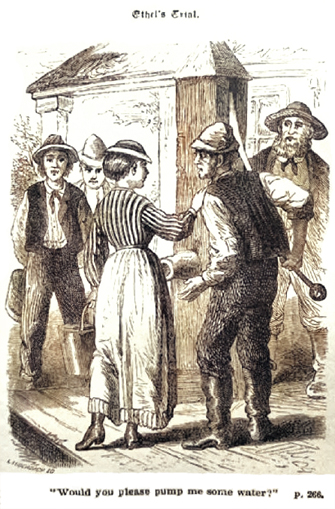
Ethel's Trial.
"Would you please pump me some water?"
She was plainly enough dressed, but there was always something remarkably elegant in her appearance, and her little confusion made her look even prettier than usual.
"There is a poor sick girl in need of fresh water over there, and she had no one to bring it to her," explained Ethel, feeling that her appearance needed accounting for. "I shall be much obliged to you if you will pump it for me."
The teamster not only pumped the water, but insisted on carrying it across the road for her.
And as Ethel turned away, she heard some one say, "Well, if that ain't the prettiest girl I have seen for many a day!"
"And a real lady, too—anybody can see that," remarked another. "I wonder who she is?"
Cathy drank the water as if she had been three days in the desert; and Ethel began to consider what to do next, as she saw how distressed the poor thing looked.
"Can I do anything else for you? You seem in so much pain."
"It's my leg," said Cathy. "I twisted it and made it swell, and the bandages are too tight. If you would call Mrs. Trim, she will undo it, and put a wet cloth on it."
"Mrs. Trim is not at home," said Ethel. And then, with a great effort, "Cannot I do what is wanted? I have no experience, but you might tell me how."
"Oh my dear, if you could! But, no, I won't ask you. You ain't used to fixing such things, I guess I can stand it till Mrs. Trim comes."
But even as she spoke, a spasm passed across her face, which turned purple with pain, and she uttered an involuntary cry.
Never did a more earnest prayer ascend than the short one which went up from Ethel's heart that moment:
"Lord, help me to do what is right!"
Then she spoke decidedly:
"Cathy, you had better let me try what I can do. You can tell me, you know!"
Cathy made no more objection, and Ethel uncovered the leg and proceeded to unloosen the bandages. Her courage and strength almost gave way at the critical point; but she contrived to splash her own face with cold water in wetting the bandages, and at last the task was accomplished.
"There, I feel better already!" said Cathy, sinking back. "How shall I ever thank you? But oh, I am so faint!"
Ethel thought of the lavender-water, and getting it out, she bathed Cathy's face and hands, and had the pleasure of seeing her colour return after a few minutes.
"Oh, how nice and sweet that is! What is it?" asked Cathy.
"Lavender-water. My sister sent you a bottle full of it, with her love, and this geranium. She thought you would like to see it blossom."
"Set it in the window, please. I will look at it by-and-by," said Cathy. "I love flowers, but I can't do anything but rest just now."
Ethel saw that plainly enough. She wetted Cathy's handkerchief with the perfume, and then went quietly about, putting the flowers in water and arranging the room. She then came back and sat down by the bedside.
Cathy seemed to have sunk into a doze, but presently she opened her eyes and fixed them on Ethel.
"How nice you do look!" she said, with an air of languid pleasure. "All so fresh and neat. It was real good in you to come up here in the heat to see me!"
"I don't mind the heat very much," replied Ethel. "I am very glad I came. You feel easier, don't you?"
"Oh yes, ever so much,—but sleepy. Can you sing, Miss Dalton?"
"Yes," replied Ethel, anticipating the request. "Would you like to have me sing for you?"
"I'd be real glad if you would. I used to sing once, and so did mother; but Mary Anne can't."
Ethel hardly knew what induced her to make the choice, but she sang Topliff's "Consider the lilies."
Cathy lay listening, and when Ethel had finished, she saw that tears were on the sick girl's cheeks.
"I never heard that sung before, but I have said it to myself often enough, especially since you brought the flowers Sunday!" said she. "I wish Mary Anne could hear you. She is a real Christian, I do think, but she doesn't take so much comfort out of her religion as I do, and as I think she ought to; but I can tell you it 'is' real hard to have faith sometimes."
"Yes, indeed," said Ethel. "Even I know that; and of course it must be harder for you, because you have so much to bear."
"Well, I don't know about that," replied Cathy. "I think, when the Lord sends the burden, he sends the faith along to bear it, so that we shall not be utterly broken down. I used to be a regular wild girl,—wild, I mean, about running and taking walks and climbing. I used to be real glad of an excuse to walk miles at a time. I wouldn't have believed then that I could stand it to be shut up here as I am; and yet I do, you see."
"You think the help comes with the trial?" said Ethel, thinking of Aunt Dorinda's tests and her own perplexity. "A lady asked me the other day if I had faith enough to be willing to be blind, and it troubled me that I was not able to answer her."
"I call that borrowing trouble," remarked Cathy. "So long as you have faith enough to be willing to do and bear what comes along every day, why should you worry about what may never happen? The grace will come when it is needed. When the Lord gave his people the manna for one day's food, he did not mean them to be worrying for fear they should not have it the next."
"I might have thought of that," said Ethel. "I am so glad, Cathy, that you feel so; it does me good to hear. Shall I sing again?"
"Do, if you ain't tired. Do you know an old Methodist hymn beginning:
"'Come, my brethren, let us try
For a little season'?
"I don't suppose you do, though: mother used to sing it, and I should love to hear it again."
Ethel did know the quaint, sad melody and rugged words of the old hymn, and she sang it through.
"That is the way to do, I think," remarked Cathy,—"to look at the Lord, and not too much at ourselves. I've heard folks, and ministers too, talk about our being humbled by a sight of our own sins; but it does seem to me that one real sight of the Lord's love for us does more to make us really humble and faithful than looking at our own sins forever. Is not that some one coming up the stairs?"
Ethel went into the outer room, and met Dr. Ray at the door.
"So I have found you?" said he. "Emily told me you were up here, and I thought I would call and take you home. How is your patient?"
"She has been suffering very much, but she is better," said Ethel. "Shall I ask her if she will see you?"
"If you like."
"My brother, Dr. Ray, is here," said Ethel, re-entering Cathy's room; "he has called for me: and he wishes to know if you would like to see him."
"I should like it," replied Cathy, evidently embarrassed; "but his time is worth a good deal, I expect!"
"Never mind that," said the doctor himself, overhearing the remark. "We'll call it a friendly visit."
Dr. Ray's manner, in spite of its occasional bluntness, was one to inspire confidence and trust. Cathy was easily won to give the whole history of her illness. Her trouble had come from an injury in the first place.
"It was never so bad till that Dr. Brown doctored it. He was sure he could cure it, and he hurt me dreadfully with the things he put on; but it grew worse all the time, and finally, when we had no more money, he said there was no use in trying any more. For my part, I wished he hadn't begun; but then, as I tell Mary Anne, we acted for the best, and that is all we could do."
"Exactly," said Dr. Ray. "Shall I look at your leg? Ethel, my dear, go into the other room."
"It has been real bad this afternoon," observed Cathy, as Ethel went out. "I was 'most crazy with the pain when your sister first came, but she put a wet cloth on it, and did it all up new for me; so it is quite easy now. I hated to trouble her, but it was a comfort to get it done, I can tell you."
The doctor gave vent to a whistle of surprise, but said nothing. He looked at the leg, and did it up again. Cathy looked eagerly at him.
"Well, I must see you again, and talk with your sister about you, before I can say certainly; but I think it can be cured. Of one thing I am sure: you can be made very much more comfortable very soon, and one of your worst annoyances can be removed directly. I will send up something for a dressing, this evening, with proper directions; and, as I may not be able to come when she is at home, I wish your sister would step into my office at noon to-morrow."
Cathy's thanks were murmured in a very confused manner, but they were understood and accepted.
"Don't dwell too much on what I said about your being cured," said Dr. Ray, at parting. "Helped you may be, I am quite sure. As for the rest, you must hope and pray: you know how to do both, I dare say. Ethel will come and see you again. You may do one another a deal of good. Come, Ethel, my dear, it is time we were going home. Emily will be waiting for us."
AUNT DORINDA IS SURPRISED.
"SO you think Cathy can be cured," said Ethel, as they were riding homeward.
"I am not so sure, of course, but I think so," replied the doctor. "It will be a slow business, and I may not succeed at all, but I mean to try. I wonder if she would be willing to go to the hospital. It would be a great deal better for her. It is miserable for her to lie there alone, all day; and she is liable to hurt herself just as she did to-day, and so, perhaps, undo in a minute all that can be done for her in a month."
"It would be better; and yet, the sisters would find it hard to be separated," said Ethel. "Mary Anne seems to look upon Cathy rather as a child than as a sister."
"She is a good deal older than Catherine, is she?"
"Oh, yes! I should say she was near forty; but she may not be so old as she looks."
"You see, they are separated almost all the time, as it is," remarked the doctor. "Mary Anne is away all day. I dare say, too, they do not live very plentifully."
"I should think not, from what I saw to-day," said Ethel. "I went into their pantry to look for a glass. It was as clean as possible, but there seemed to be very little of anything to eat."
"And the girl needs nourishing food above all things. Well, we will see what can be done. Dear, how did you ever find courage to play the doctor?"
"I did not find it, brother,—it was given to me," said Ethel, in a low voice. "I could not have believed it myself. Of course, Cathy told me what to do, and I would not see her suffering so when I was able to help her."
"I always said you had the stuff in you," remarked the doctor; "but I never saw any one come out as you have done lately. It is a great pleasure to me to see my little girl growing into a woman."
"Or your chicken developing into a tough old hen," said Ethel, laughing to get rid of a certain choking in her throat, which threatened a shower of tears. "I shall be able to assert myself as independently as Aunt Dorinda, before I get through."
"I hope not!" exclaimed the doctor. "One of her is enough for a family."
Ethel went up to her room, and came down looking very quiet and happy, and like herself again.
"How did you find your friend?" asked Aunt Dorinda.
"She was suffering very much when I went in, but I left her quite comfortable," replied Ethel. "Matthew came in to see her, and he thinks she may be very much helped, if not cured."
"Did you have any religious conversation with her this time?"
"Yes; we had a nice talk. I feel as if she had done me a great deal of good!"
"I don't see how you were likely to do each other much good in that line," said Aunt Dorinda. "Don't deceive yourself, Ethel. Don't indulge a false hope."
"Aunt Dorinda, why do you talk to me in that way?" asked Ethel. "Why do you take it for granted that I am not a Christian?"
"By their fruits ye shall know them," said Aunt Dorinda, oracularly.
"Perhaps you are not the best judge of the fruits," said Ethel, surprised at her own courage. "A peach might be the best peach in the world, but if your digestion were out of order, or you had the jaundice, you might easily think the fruit insipid or bitter. You have taken a dislike to me for some reason,—I suppose, because I did not obey you about my dress,—and nothing I can do is right in your eyes. Isn't it just possible that the fault may be in you, at least as much as in me?"
Aunt Dorinda coloured scarlet, but she seemed too much astonished to answer.
"I dare say I am inconsistent a great many times," continued Ethel, in rather a tremulous voice; "but really and truly, I don't think I am more so than you are, or than a great many people are whose sincerity I should never think of doubting. You asked me, the other day, whether I would be willing to be blind, and I was a good deal troubled because I could not answer. It made me very unhappy. But I have been talking to Cathy about it, and I think I see more clearly. Cathy said that trying to apply such tests to ourselves was borrowing trouble,—that if our Father sent such trials, he would send the grace to bear them. She said she never could have believed she would be so contented to lie still all day, when she used to run all over the fields and walk miles at a time. And I am sure I never would have thought I could do what I did to-day. If any one had asked me, I should have said it was impossible; but when the time came, the help came with it."
Aunt Dorinda sat looking very steadily out into the garden.
"I hope I have not offended you, Aunt Dorinda," said Ethel, presently. "You know you always say that you like plain speaking."
"Plain speaking is one thing, and—but it does not signify," said Aunt Dorinda. "You are the first person who ever told me that I was prejudiced and inconsistent. There, don't say any more, child. Perhaps I have no right to complain, but it is hard, at my age, to be reproved by a girl like you."
"I did not mean to reprove you, Aunt Dorinda; I only meant to defend myself."
"It is best to defend ourselves without hurting other people!" said Miss Atwood.
"But that is not always possible," returned Ethel; "and, indeed, I am sorry if I hurt you. But you did hurt me cruelly!"
The entrance of Dr. and Mrs. Ray interrupted the conversation, much to Ethel's relief.
All through dinner Miss Atwood was very silent, and she retired to her room very early.
"What ails Aunt Dorinda?" said Emily.
"I am afraid I have offended her mortally," said Ethel; "but she drove me into a corner, and even chickens must fight under such circumstances. I told her I did not think that I was more inconsistent than herself. She seemed perfectly amazed, and wondered that any one could think she was inconsistent!"
"No doubt! People who pride themselves on always speaking their minds will rarely bear any plain speaking from others."
All the next day Miss Atwood was very cool and distant to Ethel. She absolutely declined to take any interest in the discussion about Catherine Lee, and spent the most of her time in her own room, writing letters. The next day she announced that she was going away.
"But is not that rather sudden, Aunt Dorinda?"
"Yes; I meant to spend most of the summer with you, but I have changed my plans. I see I can be of no use here, and I cannot afford to pass my time in mere visiting. Life is too short for that!"
"I hope nobody has offended you, aunt," said the doctor.
"Nobody has offended me. I am not one to be offended!" replied Miss Atwood, solemnly. "I had hoped, when I came, to be of great use to Emily and Ethel both—to Ethel especially, who, I hoped, from her youth, would be easily influenced and trained into a useful woman. But I see that I can do nothing. Ethel is devoted to dress and vanity—to self, in short; and everything I can say only gives her food for more self-deception!"
"I think you do Ethel great injustice!" said Emily, very much vexed with this attack. "She is not selfish,—very far from it; and as to her being fond of dress, it has been hard work for her to learn to pay a proper attention to it."
"That is all nonsense, Emily! Do you think I cannot read a girl like Ethel?"
"Which do you think more likely to understand Ethel's character, her own brother and sister, who have always known her, or yourself?"
"Well, we won't quarrel, just as I am going away," said Miss Atwood. "Maybe I am mistaken in Ethel; I am sure I hope so. I was always fond of you, Matthew, and I wanted to love your wife and sister, and to have them love me. But I don't know how it is. There is your Aunt Cecilia, who has not a dozen clear ideas in her head,—she is all soft and sweet like a—a great charlotte russet!" said Miss Atwood, rather at a loss for a comparison. "I don't mean that she isn't sincere and good, and all that; but what does she amount to? All she ever does is to look pretty, and dress nicely, and spoil children, and crochet baby blankets, and knit baby's socks, and give away little useless presents. I don't believe she ever cared half as much for anybody as I do; and yet everybody is glad to see her, and sorry when she goes away,—and nobody cares when I go away!" added Miss Atwood, winking suspiciously. "The very people I have done the most for would keep out of my way if they could. It is very hard, but I suppose there is no help for it!"
"I don't know exactly what the charm is about Mrs. Bland!" said Emily. "But her manner is certainly very lovely. It is a kind of rest to be in the room with her. She has the knack of entering into one's feelings and finding out what one wants. She may not be very original or profound, but she is very kind and gentle."
"Well, well, I don't want to hear her praises over again. I have had Mrs. Bland held up to me as a model till I am sick of her."
"I did not mean to hold her up as a model to you, aunt."
"But you think I ought to take pattern by her, nevertheless."
"Perhaps we might all take pattern from one another, in certain things," said Emily, mildly. "You might learn a good deal from Aunt Cecilia, and she might borrow with advantage from you. For my part, I mean to learn from both of you."
"Well, I dare say I am a disagreeable, interfering old woman," said Aunt Dorinda, in a burst of frankness. "I don't know but I am rather too fond of giving advice, but it is hard to refrain when you see people going wrong. Maybe I was hard upon Ethel, too. I have my own notions, and they seem to me to be right ones, and, according to them, Ethel is wrong in many things; but perhaps I judged her hastily, as you say. I can't make people like me, and I don't suppose I ever shall, but I don't bear malice. Matthew, I wish you would take this money and use it for that lame girl, according to your discretion; and this is for Ethel's sewing class."
"Oh, Aunt Dorinda, how kind you are!" exclaimed Emily. "But please don't go away now, or I shall think you are offended with us. Do stay another week, at least."
After a good deal of urging Miss Atwood consented; and, really, the week was a pleasanter one than had ever been spent in Aunt Dorinda's company before. Emily and Ethel took care to pay her a great deal of attention.
Ethel asked her to go to the sewing-school, and Miss Atwood went; and she not only found no fault, but she made every child in the school a present of a cheap but useful pair of scissors, and a good-sized cake. She went to see Cathy Lee, and had a long talk with her, in which she discovered the means of doing the poor girl a great favour.
"Can you work, at all?" asked Miss Atwood.
"I cannot sew," replied Cathy; "but I can crochet. I make tatting, sometimes, but it is rather apt to make my shoulder ache."
"Can you crochet nicely, so as to make baby-things?"
"Oh yes, ma'am! I can do all such work. But worsted costs money; and I don't like to ask Mary Anne to buy it for me, though I know she would in a minute."
"It would be nice if you could have work from the fancy shops," remarked Ethel.
"I have thought of that; but we don't know anybody here, and people might not like to trust a stranger."
"Aunt Dorinda, would you mind sitting here while I run over to speak to Matty McHenry a minute?" asked Ethel. "I will not be gone long."
"What a sweet young lady Miss Dalton is!" remarked Cathy, when Ethel was gone. "She and that Miss Burgers are doing a great deal of good here."
"You think their influence is good, then? I am glad to hear it."
"Oh yes, excellent; especially among the young girls. They have such pretty, cordial manners; and then, they don't interfere without reason, as some ladies do."
Miss Atwood winced a little.
"That Matty McHenry has been a different girl since she began to go to Sunday-school. I can see a great change in her dress and manners; and when she comes to see me, she is talking about her sewing class, and the books Miss Burgers lends her, instead of just the gossip and scandal of the neighbourhood. She brings her Bible lesson to me, that I may help her find out the questions, and I think she begins to feel a real interest in religious matters. It will be a grand thing if she is drawn in, for she is the leader of all the girls about her, and has a great deal of influence."
"Have you had any direct religious conversation with her?" asked Miss Atwood.
"Only as it grew out of the lessons. I did not think it best. She seems to be going on so well that I did not like to run the risk of doing mischief by interfering. I can speak a word or two in connection with the lessons without her taking alarm; when, if I were to begin on her personally, she might be startled, and not come again. She perfectly worships Miss Dalton and Miss Burgers."
"Perhaps you are right!" said Miss Atwood, sighing. "How do you feel about going to the hospital?"
"At first I could not bear the thought of it, but I am getting reconciled now," replied Cathy. "I think, if it is finally decided that I must go, I shall make up my mind to it—or have it made up for me!" she added, smiling.
"How have it made up for you?" asked Miss Atwood.
"Why, generally I don't find much use in trying to make myself feel right about things," replied Cathy. "Most times, the more I try to make myself feel charitable, or contented, or loving, the more I can't do it, especially since I have been sick. But I think I have found out a better way. I tell the Lord all about it, and ask him to make me feel as I ought to, and then I just wait; and by-'n-by the right feeling comes, without my knowing how. Sometimes I go to sleep feeling just as bad as I can, and when I wake up in the morning it is all right with me."
"How long have you been a Christian, Cathy?" asked Miss Atwood.
"I'm sure I don't know," Cathy replied. "My mother was one of the best women that ever lived, and I had a first-rate Sunday-school teacher. I always loved to go to church and Sunday-school, and to read in the Bible, and it kind of grew up with me. I remember how I used to study over my lesson going cross-lots to Sunday-school," continued Cathy, dreamily. "I used to go along by the side of the outlet quite a ways, and then through a piece of woods where there were some big pine-trees, that, when the wind blew, used to be always saying, 'Hush! Hush!' And when I had time, I used to sit down under a tree and learn a hymn or something. When I shut my eyes and say over some of those verses, it seems just as though I could hear the wind in the leaves and the water going over the dam, and smell the smell of the woods. Sometimes I wonder whether there will be such places in heaven: do you think there will? It tells about the river of the water of life and the tree of life on both sides of the river, in the Revelation, you know."
"There will be everything that is best and pleasantest for us; of that we may be sure," said Miss Atwood. She had come prepared with her several formulas of questions and texts, whereby she meant to find out whether Catherine Lee were truly a Christian; but somehow the listening to the sick girl's simple memories and experiences put them all out of her head. She perceived that it gave Cathy pleasure to talk of her country life, and she was really for once content to listen and let her companion go on to express herself in her own way; whereby she showed that though she had been teaching others all her life, she had not quite lost what the good and wise German calls "the divine art of learning."
"I am afraid I have kept you waiting a long time, aunt," said Ethel, apologetically. "Matty had so much to say about her scholars and other matters that I could not get away."
"I have been having such a nice visit from your aunt," said Cathy. "Please do come and see me again, Miss Atwood. I should be so glad to see you!"
"Ethel," said Miss Atwood, after some minutes of profound silence, "do you know, that with all my visiting among the poor, this is the very first time that any poor person asked me heartily to call again?"
Ethel did not know exactly what to reply.
"And yet I said very little to her," continued Aunt Dorinda, musingly. "I just listened, and let her run on."
"Perhaps that was the reason," Ethel ventured to say. "I suppose everybody likes to be listened to, sometimes; and Cathy is alone so much that she likes to talk when she has an opportunity. Don't you think she is a nice girl, aunt?"
"I should say she was one of the Lord's little ones," replied Aunt Dorinda. "What is the other sister like?"
"I don't know Mary Anne so well," replied Ethel. "She is older and more reserved, and I think she is of a disposition to take things harder than Cathy; but I am sure she is a good Christian woman, and very independent. I liked it of her that she was determined to pay at least a part of Cathy's board at the hospital herself."
"Yes; it showed the right spirit," replied Miss Atwood. "Is there a worsted store anywhere on our way home, Ethel?"
"Oh yes, Aunt Dorinda, a very nice one. Would you like to stop?" asked Ethel, much wondering what Aunt Dorinda, with her hatred and contempt of fancy-work, could want in a worsted store.
"Yes; I want to buy some things." Miss Atwood did not seem disposed to talk; so Ethel walked on in silence till they came to the place.
"Here is the shop," said Ethel. "It is not so showy as some of those over the river, but Mrs. Randall keeps the best of everything, and she can tell you just what you want to know about patterns and quantities, and so on; and she is always ready to answer questions."
"So much the better," said Miss Atwood. "I hate show, and I like to have people understand their business. Now, Ethel, I want you to pick out everything necessary for some baby blankets and jackets, and other worsted things; and send all the materials to Cathy. I will leave you money to pay her for making, if you can find out the proper price."
"Mrs. Randall can tell us all about it," said Ethel, delighted beyond measure. "How good of you, Aunt Dorinda! It will give so much pleasure."
Aunt Dorinda sat by with marvellous patience while Ethel and Mrs. Randall discussed shades and patterns, and even condescended to pronounce an opinion upon two differing styles of border.
Mrs. Randall was much interested in Cathy's story, and promised, if she succeeded in her present undertaking, to give her all the work she could do.
"I have a beautiful new pattern for a shawl, Miss Ethel," said she. "You spoke some time ago about making a large one, like Miss Fleming's, you know."
"Yes, I know," said Ethel. "I did mean to make one for myself, but I have spent the money in another way, so I can't afford it just now."
Mrs. Randall smiled significantly. She was herself a Sunday-school teacher, and she guessed where the money had gone.
"Mission schools and sewing-schools are expensive luxuries," said she. "I know that from my own experience. And, by-the-by, I must give you some needles and thread for your school. So you think you will not make the shawl?"
"I really and truly cannot afford it now, Mrs. Randall, I am sorry to say. Thank you, just as much for the offer of the pattern."
"Ethel, did you really spend the money you had meant for your shawl on your sewing class?" asked Miss Atwood, after they had left the shop.
"Yes, aunt; I did not need it so very much, you see. I wished to make it because I like such work, and the shawls are pretty and becoming; but then I could do without it well enough."
"How do you manage your charities?" asked Miss Atwood. "Do you lay by a certain sum for them?"
"No, aunt; I never thought of doing that. I take them just as they come."
"And don't you sometimes find yourself out of money for such objects when you want it the most?"
"I certainly do," answered Ethel, considering. "Last Saturday I wanted half a dollar for the Home Mission collection, and I had not a cent."
"Shall I tell you what I think is a better way of managing?"
"If you please, aunt."
"The way I do is to lay by always a certain proportion of my income,—say, for illustration, ten per cent.," said Miss Atwood. "When my money comes in, I take out that much, whatever the proportion may be, and lay it aside. I say to myself, 'Now that is mine no longer; it belongs to charity,' and I never touch it on any account. Thus you see I can make a pretty exact calculation of my resources,—so much for missions, so much for the Sunday-school, and so always leaving a margin for unforeseen calls."
"I see," said Ethel; "I think it is an excellent way, and I mean to try it. But, aunt, I am sure you spend a great deal more than ten per cent. of your income on charity!"
"Maybe I do. That is none of your business, Miss," returned Miss Atwood, good-humoredly. "I should say ten per cent. was as much as you ought to lay by, at least to begin with, so long as you have to dress yourself out of your allowance. When you are richer, you can lay by a larger percentage, if you like."
"But the proportion would be the same, whether I had much or little, wouldn't it?" asked Ethel, doubtfully.
"In figures, but not in reality. Twenty dollars bears the same proportion to two hundred that two hundred does to two thousand; but suppose a man earns two hundred dollars, and gives away twenty, how much does he have left?"
"One hundred and eighty."
"But suppose he gives away two hundred out of two thousand, how much does he have left?"
"Eighteen hundred," replied Ethel. "I understand now what you mean. It would be a greater gift for Cathy to give away forty cents out of the four dollars she will earn by her crochet-work than it would be for me to give twenty dollars, because she would have so much less left. Thank you very much, Aunt Dorinda."
The next afternoon Ethel carried the bundle of wool up to Cathy, who was as much delighted as was to be expected. Mary Anne, who was at home, was equally pleased.
"It's more to her a great deal than if any one had given her the money," said she to Ethel, outside the door. "Even if she earns ever so little, it will be a comfort to her, besides the pleasure of the work. The only thing she ever frets about is that I have to work so hard, and she can't do anything. I tell her she does as much for me as I do for her, but she can't always feel so. I don't know what I shall do without her to come home to!" continued Mary Anne, looking straight before her. "At first I thought I couldn't have it so, no way; but the doctor made me see 't was best for her, so of course I gave in. Sometimes I think I must quit house keeping and go to service somewhere while she is in the hospital; but then there are the things. They ain't many nor worth much, to be sure, but they are all that's left of our old home, and I should hate to part with them."
"Of course," said Ethel; "but the things might be stored somewhere."
"Well, I'll think it over," said Mary Anne, and then added earnestly, "Miss Dalton, you'll never know in this world how much good you've done me. That Sunday when you came in first, I was ready to give up in despair. I couldn't see no comfort nowhere. I was tired to death with my work, and the folks below were making such a noise; Cathy was kind of low and discouraged, too, which is very uncommon with her; and I did feel so bad. It seemed just as if the Lord had forgot me, somehow, 'like a broken vessel,' as the Psalm says; and there wasn't and never would be anything but noise, and confusion, and hard work, forever. Then you came in, looking so nice and pretty and sweet, with your flowers,—I declare for 't I never thought what folks were made handsome for before, and you sat down and talked so kind of quiet and cheerful, and the flowers you brought were so sweet.
"I ain't good at expressing my feelings, as Cathy is, but somehow I seemed to realize that God was in the world, after all, and hadn't left it to run on by itself, as some folks say. It was just as though he had sent you to me with a message."
Ethel had not many words wherewith to answer, but she kissed Mary Anne's hard, tanned cheek with real sisterly affection; and went home feeling happier, and more humbled in her own eyes, than she had ever done before. Nothing makes a child of God more lowly, or gives him such a deep, and, at the same time, comforting sense of his own unworthiness and littleness, than the conviction that the Master has employed him to do His own work.
When Ethel went into her own room, she found a large bundle lying on her bed, and a note in Aunt Dorinda's manly handwriting. Much surprised, she opened the note, and read as follows:
"DEAR ETHEL:—I think I was wrong, and did you injustice. I 'was'
prejudiced, as you said. Show me that you forgive me by accepting a
little present from me, and making yourself a shawl like the one you
gave up for the sake of your mission class. I think if you and I could
learn to put up with each other's ways, we might do each other good;
and I will try, if you will."
Ethel carried her note and her bundle of wool to Emily, who was both touched and amused.
"Do you think I ought to take such an expensive present from her, Emily, when she has done so much for the school already?"
"Of course, my dear. You must not hurt her feelings by refusing, especially after she has made such a concession. It is the very first time I ever knew her confess herself mistaken. Perhaps we have been prejudiced, too, and have allowed ourselves to be blinded by her odd ways to the good there really is in her. She would be a very useful woman if she could only be a little more like other folks."
"She was lovely at Cathy's, yesterday," said Ethel; "and all the way home. And, oh, Cathy was so pleased with her work, and Mary Anne, too!"
"What work?" asked Emily.
"Some crochet-work which Aunt Dorinda sent Cathy. Well, I will begin my shawl directly, so as to show how much I value it. Do you think I had better answer her note?"
"I think I would," said Emily.
So Ethel wrote:
"DEAR AUNT DORINDA:—I have just found your pretty present, and thank
you for it ever so much. I feel as if you had done me a deal of good
already; and I am sorry I ever was ungracious to you. Please remember
me, and pray for me."
"Well, I never thought I could feel sorry to see the last of Miss Atwood," remarked Mrs. Jones, the next day, to Ethel. "If she would always be as she has been this last week, I would always be glad to see her. She is a good woman, and no mistake; but she is dreadful disagreeable sometimes, with her meddling, domineering ways; and somehow, the disagreeableness of good folks is harder to bear than any other. You feel as though they hadn't any right to it."
MORE BURGLARS.
"ETHEL, do you know of a good woman who wants a place as seamstress and so on?" asked Anne Burgers, as they met in the school-room, where Ethel still went for her Italian lessons.
They were both very early, and had the ante-room quite to themselves. Ethel answered the question by another.
"Why, what has become of your Mary?"
"Oh, she has gone to work with a dressmaker. You know she has not had a single fit since her accident, and is growing quite strong and well. And so, because we have kept her when nobody else would have her, and taken care of her all through her illness, she is going to leave us the first minute she is good for something. That is not the least like the grateful and devoted servants in the little books; but I am afraid it is something which happens rather often in real life."
"'The man who benefits his fellow-creatures in the expectation of being rewarded by their gratitude, will be often condemned to suffer the pangs of disappointment.' I read that in a book," said Ethel.
"I thought you didn't make it up yourself. But do you know of anybody? For a seamstress we must have, and one who knows how to run the sewing-machine."
"There is Mary Anne Lee, Cathy's sister, you know!" said Ethel. "She understands all sorts of work; and she told me that she had partly made up her mind to go to a place, if Cathy went to the hospital. You might see her. I wish she would go to your mother's; it would be a great deal better for her than, living there alone."
"She seems a nice woman, too," said Anna, reflectively; "and then she could help us about our Sunday-school work."
Ethel laughed. "I heard an editor say once that one trouble of being connected with a paper was that a man came to look upon everything in heaven and earth only as material for articles. I think you and I are in the same danger. We make the universe revolve round that Iron Hill Mission."
"Well, it might just as well revolve round that as anything else, for aught I know. By the way, do you know that Millar girl?"
And hereupon the two girls plunged into a whole ocean of that sort of Sunday-school talk which may be heard whenever two earnest teachers of the same school come together.
"But about Mary Anne: do you think she would come?"
"It would be easy to find out. The chief obstacle in the way seemed to be the want of some place to stow her things."
"She might put them in our garret. They would be safe there, and not at all in any one's way. Well, I will tell mother about her."
"Here are the two missionaries in earnest consultation, as usual!" said Margaret Fleming, as she came in with her cousin, Milly Davis. "What is the great point of interest now? Has Jane Stubbs got the measles, or Johnny Brown torn his new jacket and trowsers?"
"Laugh as much as you like," said Anna, good-humoredly. "If you once got engaged in the school, you would understand the feeling better. Come, Maggy, come and take a class! We want another teacher or two ever so much!"
"I have been thinking of it,—that is, if you want me," said Margaret. "Our school is full enough both of teachers and scholars."
"Oh, do!" exclaimed Ethel. "My infants are running over their room, and I could give you a nice little class directly. I am sure my brother would be ever so much pleased. Won't you come, Milly?"
"No, thank you," returned Milly. "I don't fancy being mixed up with all sorts of children. If one could ever find such poor people as one reads about in books,—English books especially,—there would be some pleasure in it; but one never sees such poor people here!"
"Nor anywhere else, I suspect," said Ethel. "One does not set about any sort of missionary work for pleasure; and just think, Nelly, what the missionaries have to go through. When they go out in the villages round the mission, the ladies very often sleep in the huts with the whole family, goats and buffaloes and all; and sometimes the buffaloes get loose and fight with one another. Fancy being in a room with two fighting buffaloes!"
"That would be a poor place for you, Ethel," said Margaret, laughing.
"Oh, I am not half as much afraid of cows as I used to be," replied Ethel, laughing in her turn. "I can pass a cow in the street with considerable confidence. But, Nelly, what is to become of all the poor people, and all the heathen, if no one is to go near them for fear of entomological specimens?"
"You used to be as much afraid of them as anybody," retorted Nelly. "I remember how you screamed out in Sunday-school because you saw a spider on your dress."
"I don't think I am quite as great a fool as I used to be," said Ethel, candidly. "But if I had been ever so silly, that does not answer my question, Nelly."
"And, besides, Ethel don't scream at insects any more," said Anna. "Do you know, she played through a long hymn and never missed a note, though she had a great June-bug kicking and scratching her neck, under her dress, all the time."
"I did, really," said Ethel.
"But why didn't you take it out?"
"I couldn't get at it," said Ethel. "I assure you, I never played such a long piece of music in my life,—not even our duet at examination last year."
"Well, I don't believe I could have done as much as that," said Nelly, in honest admiration. "But tell me truly, Ethel, do you really like going among those Iron Hill people?"
"I do, honestly," replied Ethel. "I didn't at first. I was afraid of the people, and I did not know how to get on with them. I had an idea that one must adopt some peculiar way of talking,—like something in a book; and that the people ought to be humble, and grateful, and all that. But I soon found out my mistake, by Henry's help; and now I get on pretty well. Of course, one meets with disagreeable things, sometimes; and you have to go when you don't feel like it, and would rather stay at home; but then you know, Nelly, we are not sent into the world just to please ourselves, and to do nothing but what we like."
"What 'are' we sent for," asked Nelly, abruptly. "I am sure 'I' don't know."
"I will tell you what I think about it, if you won't think I am preaching," said Ethel, blushing.
"Preach away," returned Nelly. "I would as soon hear you as any other."
"I think, then, that we are God's servants, and are sent here to do his work," said Ethel. "Not so much his servants, either, as his children. He lays out our work for us, and we are to do it. Sometimes it is easy,—sometimes it is very hard; but hard or easy, he expects us to do it the best we can, with all the helps He gives us; and it is no excuse for us to say that the work is disagreeable, and we don't like it, and so on. We may neglect our work and go pleasure-seeking, but we shall gain nothing by that. We only have to work so much harder, and our work, comes to nothing. It is all thrown away."
"And suppose we fail?" said Nelly.
"That is the beauty of working for Him,—we can't fail," replied Ethel, with animation. "We may fail in accomplishing the very particular thing which we undertake to do,—we may make ever so many mistakes; but if our work is done for him, he accepts the intention, and will bring good out of our very mistakes. But if we go on cautiously, and heedfully, and are willing to be directed by those who have experience, we need not make any such dreadful mistakes. I don't know whether I make you understand, Nelly."
"Oh yes, I understand. Thank you for your sermon, Ethel. It has, at least, the merit of being short and plain."
"If you would only try and act on it, Nelly dear!" said Anna.
"What, you too? That is more than I bargained for," said Nelly, but without any of her usual irritation. "Well, I will think about it."
"I will tell you one very nice thing you might do," said Ethel. "You know we are getting ready a box to send to Miss Beecher's school at O—. Now, if you would paint some of your pretty pictures,—you and Margaret make such lovely little landscapes and flowers,—they would go into the box nicely, and be very acceptable as presents to the girls, and the teachers too."
"Well, I will," said Nelly. "I say, why wouldn't a lot of photographs be nice?—Pictures of public buildings and scenery and so on? My brother would give me no end of them."
"They would be the very thing," replied Ethel.
"And by the way, I can give you ever so many calico pieces for your sewing-school, if you want them. Aunt Nancy gave me a great bagful, which she has been collecting for ever so long. But don't you care about patchwork?"
"Indeed we do!" exclaimed Anna. "We never can have enough. You will be a darling, Nelly, if you can give us some pretty new pieces of calico; and if you could find time to baste some of them—"
"I shall be better yet! Well, I will see what I can do," said Nelly, as she turned away.
"Won't it be a triumph, if we get Nelly Davis at work for the sewing-school?"
"We must be very careful," said Ethel. "If she gets the least notion that we are trying to manage her, she will fly off directly."
"Well, girls, you ought to make great allowance for Nelly," said Margaret Fleming. "She is sometimes a trial,—nobody knows that better than I do,—but she has had a great deal to contend with. Of course, I can't tell family secrets, but she did have a dreadful home before she came to grandmother's. Her father and mother always quarrelled, and whenever one petted her, the other always spited her. It is no wonder her temper was spoiled. It will be a grand thing for her if you can get her engaged in anything, so as to make her forget her own feelings, and leave off watching people to see whether they don't mean to affront her in some way. Well, I will come up next Sunday; but how shall I find the place?"
"I will call for you," said Anna; and so the affair was settled.
Before the end of the week Cathy Lee was safely established in the hospital, and Mary Anne had gone to work at Mrs. Burger's.
"I sha'n't earn so much money," she said to one of her shop acquaintances who wondered at her for "going out;" "but then I shall have a home. I get two dollars a week instead of five, but then I shall have no expenses but my dress, which doesn't cost much, and what I do for Cathy."
"But then, when you work in the shop, you are independent," said the other. "I think a great deal of that. I come and go as I please, out of shop-hours, and am accountable to nobody."
"Independence is not always a good thing," said Mary Anne, severely. "There is another reason why I am willing to live out, and that is that I may have some time to be with Cathy. Mrs. Burgers will let me have two afternoons in the week to spend with her."
It is not to be supposed that Ethel and Anna met with no vexations and disappointments in their efforts upon Iron Hill. They had their full share of naughty children and dull children and unreasonable mothers who whipped and scolded their offspring without mercy, but were furiously angry at their receiving the most gentle reproof from anybody else. But as my object has been to give a history of Ethel herself, and not of her school, I have not thought it best to use up space and time in narrating too many particulars.
There was no doubt whatever that the school had done Ethel a great deal of good. She had lost that excessive timidity which used to make her appear haughty and cold, when she was only shy and awkward. She had learned to talk fearlessly to all sorts of people, and without thinking in the least of her own dignity. She had learned to forget herself. She had learned to face cows, and dogs, and horse-cars, and all the other dreadful dangers which used to make her miserable; and at the end of her day's work she was only too glad to be carried home in the doctor's chaise behind his most spirited horse.
She went up to the hospital to see Cathy Lee, and carried newspapers and fruit to the men in the soldiers' wards, without the slightest hesitation. She had sat up all night with one of her little scholars, the child of a widow on the hill; and when the child died, toward morning, she went bravely the length of two vacant lots to call up Mrs. Trim, and helped her to lay out the poor little corpse. Was this the Ethel who, six months before, had been afraid to go into the garden because Richard Trim, now her faithful ally and devoted servant, was leaning over the rails? Yes, the very same,—with this difference, that she had learned to live to her Master, instead of to herself,—with this difference, that she had some object in life besides living on easily and pleasantly from day to day, avoiding everything irksome or disagreeable, and excusing all her shortcomings and faults by the one apology, "It is natural to me, and I can't help it."
For Ethel all the time kept her great object steadily in view. She had made up her mind to be a missionary; and had put herself on a six months' probation, to see whether it would be a possible thing that she should fit herself for the place. It was for this end that she courted every opportunity of making herself useful at home and abroad, that she strove to learn every sort of domestic work, that she went to market, and learned to bake, and did up her own muslins,—and would have done her own washing, if Mrs. Jones could have been brought to allow it, and resolutely disciplined herself to overcome her fears of insects and other crawling creatures. It was for this that she studied her Bible so diligently, with all the helps she could find, and stored her memory with illustrations of Scripture. Her probation was almost at an end, when her labours at the Hill met with a disagreeable interruption. She sprained her ankle, and the manner of it was this:
Ethel had not quite forgotten her fears of burglars, and she was apt to start at any unusual noise at night. She was doing her best to discipline herself out of these fancies, as she called them, and, as often happens in such cases, she was rather inclined to go to the opposite extreme. Thus it happened, one night, that she absolutely refused for some time to believe, or, indeed, to listen to the report of her own ears, which, about one o'clock, assured her that somebody was walking about under her windows.
"It is just one of your fancies," she said to herself; severely. "You are always imagining some terrible bugbear or other."
But the ears insisting on the correctness of their report, and adding the further information that somebody or something was trying the blinds. Ethel first sat up in bed and listened, and then crept to the window, which, as usual, was open at the top, and did the same; and the more she listened, the more certain she became that there was something very suspicious going on below. She pushed up the sash very softly. The noise stopped for a moment or two, as though the intruders were listening, and then went on again.
Ethel ventured to peep out, and could see distinctly that there were two men at least near the corner of the house, and that they were working at the shutters of the kitchen window. Ethel's heart sprang up into her throat. What was to be done now? She sat down to steady herself a moment and to think. She remembered that the doctor had once said the best thing for any one to do under such circumstances was to make as much noise as possible; and she was just going to give her bell a violent pull, when she thought of Emily. A sudden alarm would be very bad for her: Ethel was cool enough to think of that.
Emily slept up in the third story still,—her room below obstinately insisting on smelling of paint and varnish whenever it was shut up a little while; and the doctor had caused his night-bell to be so altered that it rang in Jones's room. Then Jones would go to the door, and finding out the state of the case, either called Dr. Ray, or else sent the ringer away to a young physician, a friend and protégé of the doctor's, who was only willing to be called up at night. In an instant, Ethel had reflected that if she went down and pulled the office-bell, Jones would come to the door as usual, and she would tell him the story, and send him to call his master, without alarming Emily, or leading her to think that anything unusual was the matter. If Mr. Dalton had been at home, Ethel's natural course would have been to call him; but he was away in New York.
Could she do it? The office was quite on the other side of the house, and there was always a light kept there and in the hall. Suppose the robbers should see her,—suppose they were already in the house? Ethel's heart grew sick with fear,—not for herself, but for Emily, if she should be waked suddenly by the appearance of a burglar in her room (for the doctor never would lock his door).
"It must be done, that's all!" said Ethel desperately, to herself.
She slipped on her dressing-gown, put her feet into her slippers without stopping for her stockings, succeeded in opening her door without noise, and, getting down to the office door, she carefully and softly unlocked it, and gave the bell a sharp and sudden pull. As she did so, she inadvertently stepped off the doorsill. Her slipper turned to one side, and she felt a sudden sharp, sickening pain in her ankle; but she gave the bell another pull, shut the door, and, too sick and faint to stand another moment, dropped on a chair.
She knew the bell had rung, for she had heard the distant tinkle; but it seemed half an hour before Jones, coming down-stairs, opened his mouth for an exclamation, which was nipped in the bud by Ethel's sharp, imperative whisper.
"Hush! Don't make a noise, and alarm Mrs. Ray. There are burglars trying to get into the kitchen. I saw them. Go call Dr. Ray, as quietly as you can."
"Are you sure, Miss?" asked Jones, incredulously. "Wasn't it just a notion of yours?"
"I tell you I saw them, and they are there now," returned Ethel, in the same sharp whisper. "I peeped out through the blinds."
"I'll go and listen," said Jones, evidently still thinking the burglars all a creation of Ethel's fancy. He went back to the kitchen, taking a match from the safe as he passed.
"There's somebody at the pantry, sure enough," said he, returning, after a minute's listening. "Three men, at least, I should say. They are doing nothing now, but listening. I had best call the doctor."
The doctor was called, as if to an ordinary case, and came down yawning, to be astonished by Jones's story, and the sight of Ethel in her dressing-gown. He heard the story, and seemed, at first, disposed to treat the whole as one of Ethel's terrors, until Jones confirmed its truth.
"They will be gone now with all this bustle, no doubt," said he. "Let us go and explore. Dear, are you afraid to stay here?"
"No," said Ethel. "Only go quick."
Then Ethel heard the splutter of a match, and saw the gas lighted in the kitchen; and the next moment somebody ran along the gravel path, and Ethel heard him jump over the fence.
"They are gone now, anyhow," said the doctor, coming back. "You had better go up-stairs to bed, and Jones and I will explore. But what's the matter?" As Ethel tried to rise, and sank back in the chair.
"I have hurt my foot, somehow," said Ethel. "I sprained it, I think, by slipping off the step as I was ringing the bell."
"Whew!" whistled the doctor. "Let me look. I should think you had sprained it! You poor little dear, you have hurt yourself badly. You must let me carry you up-stairs."
And before Ethel had time to object, she was taken up in the doctor's strong arms, and safely deposited in her own bed. The ankle was examined and bandaged, and Ethel made as comfortable as circumstances would admit. Mrs. Jones came to sit with her for the rest of the night.
"You have not been gone long," said Emily, sleepily, as the doctor came back. "What was it?"
"Nothing very serious, I hope," replied Dr. Ray, with an inward thanksgiving that his wife had not been alarmed.
"Only a slight accident. I did all that was necessary without leaving the house."
"I thought I heard you moving about."
"Yes; I went into the kitchen and pantry. Go to sleep now, there's a jewel."
In the morning Emily heard the story, and very much surprised she was.
"We have much reason to be thankful to Ethel," said the doctor. "It was a great exercise of courage and presence of mind for any one, and especially for Ethel. The worst of it is that in going about in the dark, she has sprained her ankle, and I am afraid she will be laid up for a while."
"Poor little dear, what a pity!" said Emily. "Only to think of her going down to the door and ringing the bell herself, to save me. I always told you she had the elements of a fine woman in her. But who would have believed her capable of such an exploit, six months ago?"
"Henry's coming has been the making of her, and I fear it will be the means of losing her as well," remarked the doctor. "I am much mistaken if she is not training herself to go out with him when he returns to the East."
"I have thought of the same thing a good many times lately," answered Emily, sighing. "I know it has always been a favourite plan of Henry's. It would be a great sacrifice to let her go, but I don't know that we ought to discourage her."
"By no means. Let her train herself as much as she likes. It gives her a grand object in life, which is just what she wants. There are three years to spare before she needs to decide, and a great many things may happen in that time. Ethel is a wonderfully pretty girl, and she grows more attractive every day."
"I know what you mean," said Emily; "but, Matthew, if she should at last decide to go, what will you say?"
"Then it will all depend on her health," replied the doctor. "If she is as well and strong as she promises to be, I should not feel justified in holding her back. Do you notice how much better she is than she used to be? We don't hear any more about the heart disease since the sewing-school began."
AND LAST.
FOR two or three days Ethel bore her confinement to the sofa very well; but as Saturday drew near, she began to fret. What was to become of the sewing-school and the infant-class, and the music, and all the rest of it? She was sure she could ride up to the Hill if the doctor would only let her, and made an attempt to demonstrate the fact by walking across the room. Unfortunately for the success of the experiment, she dropped down half-way, and nearly fainted with the pain in her ankle.
Dr. Ray was very much displeased. "Ethel," said he, "do you want to be lame for life? Do you think your own interests or those of any one else will be promoted by your becoming a helpless cripple?"
"Of course not," replied Ethel, rather alarmed. "Do you think there is any danger of that?"
"There is imminent danger of it, if you go on trying to walk at present. If you keep quiet, and do as you are bid, I think you may be about again in six weeks at farthest. If you don't, you are likely to be laid up for life. And what is more, Ethel, unless you will follow my directions exactly, I will have nothing to do with your ankle. You will have to find some other surgeon, for I will have no patient who will not obey directions."
Dr. Ray was by no means one of those wonderful heroes whose "irresistible wills" make such a figure in the minds of some (usually single) ladies. He had no ambition to "sway all who came under his influence," or to "make everything bend to his indomitable resolution." Nevertheless, when he set his foot down, he meant to be obeyed, and he had a way with him at such times which did not invite discussion.
Ethel gave up the point, sullenly enough it must be confessed; but she did give it up, and tried no more experiments.
She was lying still, without any pretence of employment and feeling very forlorn and rebellious indeed, when Dr. Ray came back and sat down beside her. Ethel roused herself and tried to speak, if not pleasantly at least indifferently.
"You sitting down at this time of day?" said she. "That is a wonderful sight."
"Yes, a rare one, at any rate; but I am likely to have a spare half-hour for once, owing to the stupidity of the blacksmith, who has put on my horse's shoes so that they hurt him. These rests which, so to speak, come of themselves, or, at least, without our seeking, are very grateful sometimes."
"Yes, if one does not feel all the time that one ought to be up and doing," replied Ethel, with a sigh. "In that case they are anything but grateful."
"My dear," said the doctor, "shall I impart to your youthful mind a piece of wisdom learned by experience, which has been a great comfort to me?"
"If you please," said Ethel.
"It does not sound like anything so very remarkable," continued the doctor; "in fact, at first sight, it may sound like a truism. Nevertheless, I was thirty years in learning it. My comforting truth is simply this: 'It never is or can be our duty to do what it is absolutely impossible that we should accomplish.' In other words, the work which we cannot possibly do is not our work, and therefore we are to feel no responsibility about it."
"I understand your truth and its application," said Ethel, after a moment's consideration. "You mean that as I cannot possibly go to Iron Hill, it is not my duty to go."
"Exactly."
"But, brother, one may feel anxiety and grief, if not responsibility," remarked Ethel. "My conscience may not reproach me for staying away when I am not able to go to the sewing-school; but I cannot help feeling uneasy lest things should go wrong, and grief at not meeting my scholars."
"I grant that," replied Dr. Ray; "but, my dear, you should know by this time where to lay all such burdens as that. Don't you think the Master whom you are trying to serve at Iron Hill can get the work done without you? And don't you believe he will hear you if you ask him in faith to supply your place? And ought you to repine if he sees fit for a time to give your work to somebody else?"
Ethel was silent for a little space; then she said, in a low voice, "I believe the truth is I don't want him to let any one else do my work."
"That is it! A good deal, you see, depends on whether you call it 'your' work or 'his' work. 'Your' work can only be done in certain times and places, and under certain circumstances; his work can be done at all times, and in any place where he puts you."
"I believe you are right," said Ethel; "but yet—" She did not finish the sentence.
"But yet—" said the doctor.
Then, as Ethel did not answer, he drew his chair closer to her, and went on talking in the peculiar gentle quiet tone which had soothed and comforted so many sick nerves and hearts.
"My dear, I don't want to penetrate your secrets, if you have any; but I believe I see what your mind is running on, and what makes it so peculiarly hard, as you think, that you should be laid up just now. Unless I have read you wrongly during the last few months, you have a grand purpose in view, and you have been resolutely training yourself for that end,—conquering your fears and fancies, and learning all sorts of ways of making yourself useful. You feel particularly interested in your school at Iron Hill, not only for its own sake, but because there you are all the time learning and practising what will fit you for usefulness in the great career you have marked out for yourself. Have I guessed rightly?"
"You have, indeed," replied Ethel. "But how did you guess it?"
"Oh, I am not an absolute 'non compos!'" said the doctor, smiling. "I can put two and two together, and find out the sum. And tell me, do you believe your great aim to be such as the Master can approve and bless?"
"Yes, indeed, I do," answered Ethel. "And you mean that all you do shall be done to his service?"
"I do, indeed!"
"Then, my dear, let me ask you a simple question. Which do you think best understands the training which is to fit you for this great work, the Master or yourself? Whose lessons are likely to be the best worth learning,—those which he gives you, or those which you select for yourself?"
"Those which he gives me, of course," replied Ethel, without hesitation. "I am sure of that. I see your meaning, brother. You mean that as this misfortune is sent or allowed by him, I may use it in preparing myself for his service as I have used my work at the Mission!"
"Just so; exactly. You may learn a great many different things while you are lying here on the sofa—"
"You mean patience and humility, and so on."
"Yes; all the passive virtues, and more than that. You can use your head pretty well, can't you? I have not heard of any new symptoms of 'softening of the brain,'" he added, mischievously; for brain disease used to be one of Ethel's favourite bugbears.
Ethel laughed. "I have come to the conclusion of old Father William in 'Little Alice,'" said she. "I am so perfectly sure I have none, that I do it again and again. I believe my brain was made so soft originally that it admits of no more softening. How I used to torment myself with such fancies when I had nothing to do but to notice every little disagreeable feeling."
"Well, then, to keep the fancies from coming back, suppose you go to work at some study. How would you like reading a little Italian with me?"
Ethel thought it would be charming; but the next day, when the doctor came in to see her, she had something new to talk about.
"Brother, don't you think that, if I am to teach or have the charge of girls, I ought to know something of physiology?"
"Certainly, my dear. Every one ought to know something about the structure and functions of the human body."
"I was going to say that I should like to have you give me some lessons on the subject, if you thought it would be a good plan," said Ethel. "We might read our Italian all the same. There is time enough," she added, sighing.
"I think that a very good plan," said Dr. Ray, very much pleased. "But, dear, I thought you used to detest all such studies."
"Well, I do think they are horrid," replied Ethel, candidly. "The pictures are so perfectly ghastly. But, then, if one ought to know it, that does not matter."
"Perhaps you will not think it so very horrid, when you learn something about the science," said the doctor. "But come, let us have some Dante. Don't begin at the beginning. Turn over to the twenty-eighth canto of the Purgatorio."
Ethel did as she was bid, and, as they read on, she was surprised at not only the poetical feeling but the learning displayed by her brother-in-law.
"You must have studied a great deal at some time or other," said she. "Now 'please' don't quote that horrid proverb about the toad. But why did you never tell me you knew Italian, brother? You might have helped Anna and me so much."
"Why, to give you an Italian proverb this time, do you know why the toads have no tails?"
"I am sure I don't."
"Because they never asked for any," replied the doctor, smiling. "You never asked me to help you about that or anything else."
"I was very unjust to you in a great many ways," said Ethel, blushing as she remembered her fancies about her brother-in-law. "I used to think you had no feeling and no sympathy for me."
"I know. I understood it exactly. I thought you would find me out in time."
With all the patience that Ethel could muster, and all that her friends could do to help her, she found her confinement very tedious. She missed the interests which had lately occupied her, and she found it rather hard to keep herself in a proper frame of mind,—hard not to be a little jealous when Anna told her how well Mary Rose managed the infant room, and how useful Margaret Fleming and Nelly Davis were in the sewing-school; for Nelly had really been "drawn into the vortex," as she declared, and her friends were much amused to see how enthusiastic she became. Ethel began to feel a little as if her place were filled—as if she were likely to be no longer wanted or cared for in the school, and the feeling cost her a few tears and a pretty sharp struggle with herself.
But she forgot all about her jealousy the first time she was allowed to ride up to Iron Hill, on a Saturday afternoon, and saw how heartily glad both children and teachers were to see her again. Her scholars almost quarrelled as to who should take her hat and cloak, and who should sit next her in the class. The Sunday-school had enlarged greatly in her absence, and now contained almost every child on the Hill.
The evening congregations had also increased, and there was serious talk of a subscription for building a chapel and organizing a church. The partners in the foundry promised a good large subscription to begin with, and Mr. Melsence offered the gift of an eligible lot of land for building purposes.
There had also been some opposition to contend with. Mr. Millar lost no opportunity of ridiculing the whole affair and imputing the worst of motives to those engaged in it, and his wife tried her best to make the mothers of the children jealous of their teachers' influence. She had taken Jenny out of the school; but Jenny, being used to have her own way, had soon come back again, and attended with great regularity. The proprietor of the lager-beer saloon had also done his best to break up the services, even setting some of his customers to make a disturbance under the chapel windows; but the second time this was done, two policemen were on hand, and the disturbers were promptly taken into custody.
The Roman Catholic priest was also very bitter against the Sunday-schools especially, and for a while, several of the German children were withdrawn. But they presently came dropping back one by one, and at last one family became regular attendants at the chapel. The Iron Hill Mission was evidently a success, and Mr. Dalton did not hesitate to say that this success was more owing to his young lady assistants than to his own labours.
"Ethel has a special aptitude for teaching," said he, one day, talking over the matter with Emily. "She knows how to keep the attention of the children awake and to keep them interested, not by amusing them all the time, but by making them do their work well and thoroughly. Moreover, she has the art or knack, or whatever it is, of government. She knows how to 'prevent' disturbances and to keep up discipline without making a fuss about it."
"In short," said Emily, smiling and sighing at the same time, "she is exactly made for a missionary."
"Exactly."
"I think you ought to be careful how you influence her, Henry," said Emily, gravely. "You know how she looks up to you, and how much weight she attaches to your opinion."
"I mean she shall decide the matter wholly for herself," replied Mr. Dalton. "It has always been a favourite project of mine, I may say ever since she was born, to have Ethel educated for the missionary work; but I have never but once mentioned the matter to her. She knows what my wishes are, of course; but I have said not one word to persuade her, and I do not intend to do so; but if Ethel herself makes up her mind that she wishes to go out with me when I return, I shall certainly do all in my power to advance her purpose and assist her preparations."
"I shall not say a word against it," said Emily, sighing. "Nobody knows how much I shall miss her; but, after all, my sister is no more to me, I suppose, than other people's sisters and daughters are to them. I believe in my heart that Ethel is unusually fitted for the work of a missionary, and that if her father and mother were here to speak, they would approve of her devoting herself to this work. When do you mean to talk to her again?"
"Whenever she comes to me desiring me to do so. She particularly wished that nothing should be said to her till after Christmas. That was when we began our work together at Iron Hill. I think she then put herself upon a certain probation to convince herself as to her own qualifications. I imagine she will open the subject after holidays, and of course she will have no secrets from you."
The Christmas holidays were a success at Iron Hill. There was a chapel trimming, of course, to which Richard Trim contributed some beautiful nasturtiums and geraniums, carefully raised for the purpose. There was a missionary lecture with the magic-lantern, and finally a Christmas-tree for the Sunday-and sewing-schools, with plenty of pretty presents, and good things to eat, for which latter the executive committee were largely indebted to good Mrs. Fowler's generosity. Everything went off delightfully, and the next Sunday Mr. Dalton gave notice of a meeting of the men to take measures for building a permanent chapel and school-room. Yes, the Iron Hill mission was certainly a success.
"I have come to ask a favour, brother Henry," said Ethel, entering her brother's room on the last day of the old year.
"Well," said Mr. Dalton, "I am pretty safe, I suppose, in saying 'Yes' beforehand, since your requests are not commonly unreasonable. Do you want me to hold your worsted while you wind it?"
"You may, if you please, though that is not what I was going to ask."
Mr. Dalton held out his hands, and Ethel invested them with the wool, which she proceeded to wind into a "haycock," after the approved fashion of skilful crochet-workers.
"Well, now tell me what is your great favour?" asked Mr. Dalton, when the haycock was well under way. "You have me at advantage, for I cannot get away from you."
"I want you to teach me Syriac, or Turkish, or whatever it is you speak out there," said Ethel, trying to speak lightly, though her hands trembled.
"Syriac!" said Mr. Dalton. "And why does the little sister want to learn Syriac?"
"I shall have to speak it, I suppose, when I go out there with you," replied Ethel. "And if I learn it beforehand, it will be so much clear gain, will it not?"
"It certainly will," replied Mr. Dalton. And then, after a little pause, "So you have decided?"
"I have decided to try, if you think I have any chance of success," replied Ethel. "You can begin to judge by this time, I should think, whether I am likely to be a help or a hindrance to you."
"I see no reason why you should not be a great help, not only to me, but to every one around us," said Mr. Dalton. "I was remarking to Emily the other day that you seemed to have a special aptitude for teaching and governing children. But, little sister, have you counted the cost?"
"I have counted it so far, I suppose, as any one can count it beforehand," said Ethel. "I have considered the grief of parting from friends, the dangers and inconveniences of the journey, and the many annoyances to which I must necessarily be exposed. I have read over and over all Miss Beecher's letters, and everything else which I can find to read on the subject. Yes, I think I have counted the cost, as far as it is possible beforehand, and still I desire to go. I have promised Matthew one thing—that I will be governed by his judgment as to the matter of health; and if he says I am not well enough, I will give up the undertaking: but I am not very much alarmed about that."
"Then you have talked to the doctor?"
"He talked to me," replied Ethel. "He found out my secret, as did Mrs. Jones; and we have had several conversations on the subject. He says he wishes he could go himself."
"I wish, with all my heart, he would!" exclaimed Mr. Dalton. "Such a medical man as he would be worth everything."
"Of course, that is out of the question," said Ethel; "but Matthew says he means to talk to Dr. Denman,—that unfortunate young man to whom Jones sends the people who come on stormy nights. But, Henry, you have not answered my question. Will you teach me Syriac?"
"I will, indeed, my dear little sister," said Mr. Dalton, kissing her; "and more gladly and thankfully than I can tell you. You could not ask me to do anything which would give me so much pleasure. When shall we begin?"
"To-morrow, if you like. I should like to begin on New Year's day."
"But what about the roaches and the spiders, and so on?" asked Mr. Dalton, smiling.
"I am going to make a collection of them to send to Aunt Dorinda!" replied Ethel, smiling in her turn. "I wonder what she will say to me?"
"She will say it is just what she expected, and that she always foresaw it; and, what is more, she will really think so," replied Mr. Dalton. "I am thankful that she does not turn her own attention that way. What a fine kettle of hot water she would have worked up for us in about a month's time."
"Oh, you do not do Aunt Dorinda justice!" said Ethel. "As she would say, you cannot forgive her for lecturing you about your sermon. There is a great deal of good in Aunt Dorinda, after all."
"I have never thought of denying it," replied her brother. "The more is the pity that she neutralizes it by her disagreeable manners."
"She told me, after Cathy Lee asked her to come and see her, that Cathy was the very first poor person who ever invited her cordially to call again," continued Ethel. "I was always glad that Aunt Dorinda stayed that last week. I have had quite a different feeling toward her ever since. But to return to our great subject: Henry, do you think I may consider the matter settled—settled, I mean, as far as anything can be so long beforehand?"
"I think we may, my dear and may that Divine Master, to whom you have dedicated your life's work, bless that work to his service, and you in doing it, so that you may at last hear the sentence, 'Thou hast been faithful over a few things, I will make thee ruler over many things; enter thou into the joy of thy Lord."
There is little more to be added to this history.
The Iron Hill Mission has ceased to be a mission, and become a healthy, self-supporting free church, well attended and growing all the time. Old Mrs. Trim has gone home; and Richard has taken to wife that very Matty McHenry whose taste in dress was moulded upon Ethel's. Cathy Lee is well, and, though one leg is a little contracted, she can walk as well as ever. The two sisters are once more living together, making money at dress-making, and already talk of buying back their old home, and living once more in the country among old friends. Anna Burgers is married, but still lives at home, and finds time for many good works among the poor and ignorant.
The doctor's house is more full of children's voices. Aunt Dorinda is a frequent visitor, rather to the detriment of family government, it must be confessed, for she thinks the children ought to have everything they want, and fears that Emily will spoil them by over-strictness. But, as Emily herself says, she does no great harm, and it is worth some trouble to see the old lady so happy.
Ethel's third year of probation is rapidly drawing to a close, and it is no secret now that she is to go to Persia with her brother in the spring. Of course a great many different opinions are expressed about the matter; but Ethel herself has never wavered for a moment since that New Year's eve when she made her final resolution. She has all the time been preparing herself for the work she has in view; and she is quite ready to take it up in humility indeed, but without fear, resting in Him who has promised to them that lay down their lives for Him a thousand-fold more in this life, and in the world to come life everlasting.
Which of my readers, on finishing this book, will lay it down, and honestly, in the fear of the Lord, ask herself, "Have 'I' any responsibility in this matter? Is there any one better able to go out on this work than I am?" Lift up your eyes, dear girls, and see the fields white to the harvest, and the good grain being wasted and stolen, and trodden under foot, because there is no one to gather it, and then ask yourselves, "Is there no place for me to work in all this wide field?"
THE END.