The Project Gutenberg eBook of Scottish chapbook literature
This eBook is for the use of anyone anywhere in the United States and
most other parts of the world at no cost and with almost no restrictions
whatsoever. You may copy it, give it away or re-use it under the terms
of the Project Gutenberg License included with this eBook or online
at www.gutenberg.org. If you are not located in the United States,
you will have to check the laws of the country where you are located
before using this eBook.
Title: Scottish chapbook literature
Author: William Harvey
Release date: December 12, 2025 [eBook #77447]
Language: English
Original publication: Paisley: Alexander Gardner, 1903
Credits: Mairi and the Online Distributed Proofreading Team at https://www.pgdp.net (This file was produced from images generously made available by The Internet Archive)
*** START OF THE PROJECT GUTENBERG EBOOK SCOTTISH CHAPBOOK LITERATURE ***
[1]
Scottish Chapbook Literature
[2]
[3]
Scottish
Chapbook Literature
By WILLIAM HARVEY Author of
“Scottish Life and Character in Anecdote and Story,”
“Kennethcrook: Some Sketches of Village Life,”
“Robert Burns in Stirlingshire,”
&c., &c.
PAISLEY: ALEXANDER GARDNER Publisher by Appointment to the late Queen Victoria
1903
[4]
PRINTED BY
ALEXANDER GARDNER, PAISLEY
[5]
PREFACE.
The diffusion of knowledge by means of the Chapbook
practically began with the introduction of printing into
Scotland. From the days when the Gude and Godlie
Ballates of the Wedderburns were put in circulation,
down to the middle of last century, the chapman was a
travelling publisher of much importance. In crowded
mart and on solitary moor he plied his calling: there he
sold his broadsides by the ream, here he tempted the
reading rustic to a judicious selection from his pack: in
both cases he did what he could to spread knowledge
and line his pockets.
The object of this volume is to provide a brief account
of the chapman and his literary wares: to present a
short survey of the literature of the common people
during a period of three centuries, to trace the rise and
influence of the Chapbook, and to mark its decay, or
rather its blending into the cheap publication of the
present time. The most important of the Chapbooks are
discussed at length, and as many of them are valuable for
the light they throw upon the life and customs of the
[6]people among whom they circulated, the extracts that
have been made will doubtless be read with interest and
enjoyment.
Much biographical and bibliographical information concerning
authors and printers and publishers is given. The
greater part of this is presented in footnotes, which have
been introduced freely with the view of enhancing the
usefulness and value of the work, and at the same time
preventing the text from becoming overloaded with details.
To facilitate reference, an alphabetical list of all Chapbooks
referred to in the volume is included. It will be
found at page 145. A Glossary and General Index have
also been added.
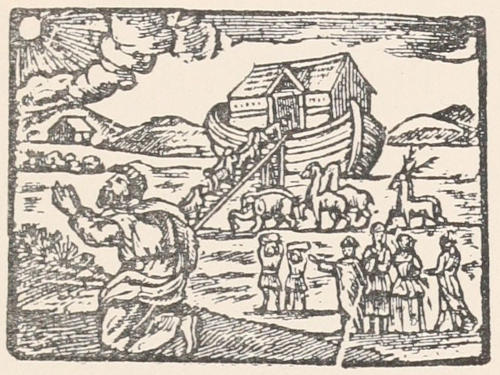
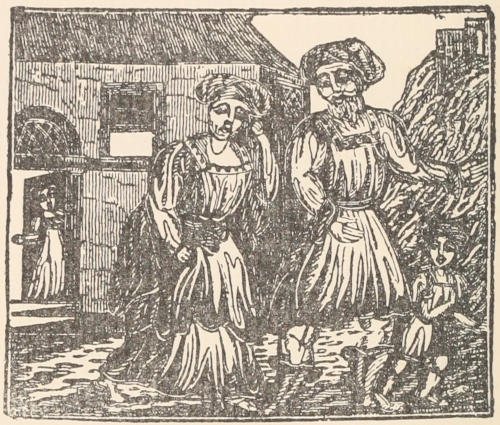
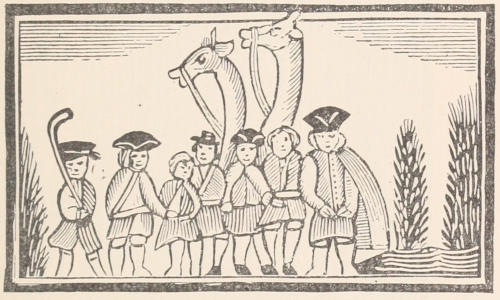
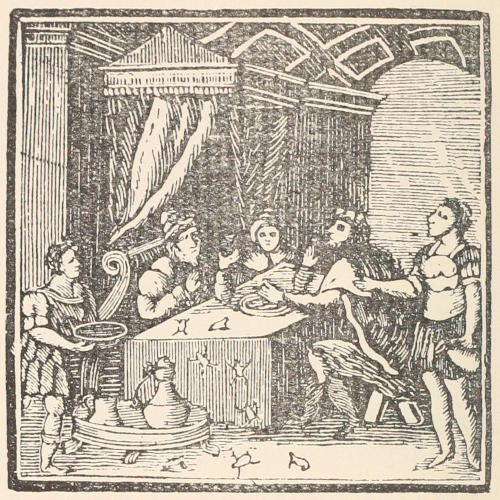
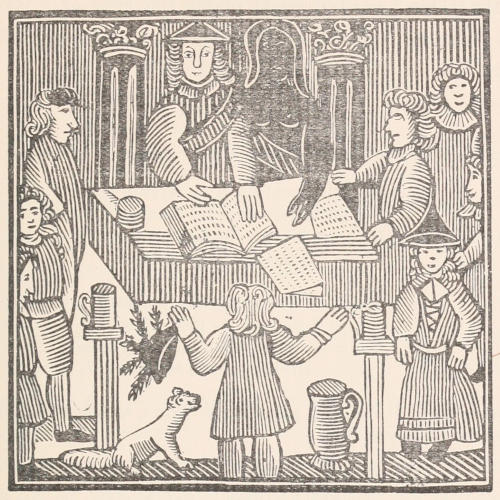
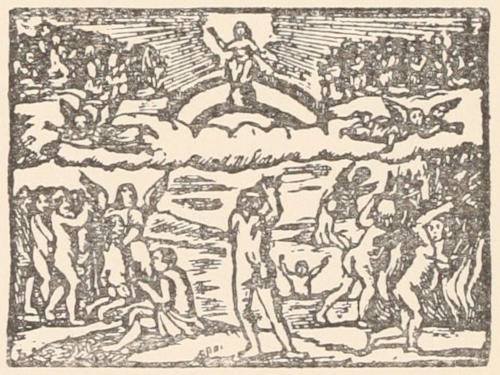
In the matter of Illustrations the book is well supplied.
A number of the quaintest pictures are reproduced, many
of which shew at once the crudities of art and the pictorial
limitations with which early printers had to contend.
No pains have been spared to make the volume worthy
the subject of which it treats, and it is hoped that it will
be of value both as a contribution to the literature of the
social life of Scotland, and as supplying, in the absence
of an exhaustive history, a hitherto unwritten chapter of
the literary annals of our country.
Nothing has yet been done in the way of providing an
exhaustive history of Scottish chapbook literature, but the
wish for such a work has not remained unexpressed. So long
ago as the late twenties of last century, when the chapman
was still a person of considerable importance, and chapbooks—properly
so called—were in wide circulation, it was believed
that Sir Walter Scott would undertake the task. When it
became evident that the author of Waverley was not to do
anything, a hope was expressed that William Motherwell
might become the historian of the vulgar literature. That
poet entertained the idea himself, but subsequently abandoned
it owing to paucity of materials and want of leisure. Other
writers may have thought to do something, but up to the
present time nothing of a general nature has been accomplished.
Certain departments of our chapbook literature,
however, have not lacked their editors and historians. The
[10]Humorous Prose Chapbooks of Scotland[1] found an able editor
in Professor Fraser, although the work done is but a portion
of his original scheme; and George Mac Gregor—notwithstanding
that his volumes are not much more than a paraphrase
of Professor Fraser’s books—accomplished a notable
work in The Collected Writings of Dougal Graham.[2] The
volumes published by Robert Lindsay of Glasgow[3] are valuable
for the specimens of chapbooks which they contain; and
Robert Hays Cunningham has compiled a not unmeritorious
work in his Amusing Prose Chapbooks Chiefly of Last [the
Eighteenth] Century.[4] But these are only fragments. It is
true that Dougal Graham was the chief writer of secular
Scottish chapbooks, and that the humorous production found
a wider circle of readers than the sermon or the serious poem,
but the Skellat Bellman of Glasgow and the comic effusion
are not, on that account, wholly representative of Scotland’s
cheap literature of a by-gone day. It is to be regretted that
too often that section of our chapbooks has been held up as
typical of the whole, and that our fathers have not received
[11]the credit which is due them for their appreciation of history
and theology. The more serious chapbooks—such as those
which recounted the deeds of Wallace and the achievements
of Bruce, and those which contained the fiery eloquence of
the Covenanters, and, later, of the Erskines—have been almost
entirely overlooked. The song chapbooks, too, of
which there were myriads, have only been referred to incidentally
when they happened to be humorous. It is to be
hoped—though every hour that passes makes the task more
difficult of accomplishment—that some day a history of
our national chapbooks will be written, so that a record may
be preserved of a most interesting chapter of our literary
annals.
Many difficulties beset a writer on this subject, and probably
the greatest is to define exactly what a chapbook is. In
Chambers’s Encyclopædia publications of the chapbook order
are defined as
“a variety of old and scarce tracts of a homely kind,
which at one time formed the only popular literature.
In the trade of the bookseller they are distinguishable
from the ordinary products of the press by their inferior
paper and typography, and are reputed to have been
sold by chapmen or pedlars.”
This may be Encyclopædia information, but it is hardly
accurate, and was apparently written by one who knew
[12]nothing about the subject. The chapbook is much more
than, and is sometimes very different from what is here
defined. In a general sense it is anything from a broadside
to a decent-sized volume, and it received its name, “chapbook,”
not on account of its size or its contents, but in virtue
of the fact that it was chiefly circulated by the pedlars who
sought to carry civilization and soft goods into hamlets and
farm-towns far from the madding crowd. These men were
known as chapmen. The derivation of the word shews that
a “chapman” was simply a “cheap-man”; and chap literature
may therefore be truthfully set down as “cheap literature.”[5][13]In these days of “World’s Classics” and Sixpenny Reprints,
“Penny Poets” and “Halfpenny Novelettes,” chapbooks are
unknown, while cheap literature is more in evidence than
ever it was. But though it is true that chapbook literature
derived its name from the fact that it was vended by chapmen,
it in reality existed before it was added to the pedlar’s
pack of multifarious goods, just as it flourished apart from
the chapman altogether, and continued to survive after he
had ceased to vend it to any extent.
[14]
The chapman, although still with us, and hated no less
fervently than ever, is not in these days the indispensable
travelling merchant of by-gone years. At the time when
the telegraph and the telephone were undreamt of, and “iron
horses” were things to be discussed with bated breath and
wondering eyes, the smaller towns and villages of Scotland
dwelt in complete isolation from each other. News—even
bad news—travelled slowly; the stage-coach—where there
was one—lumbered along, a prey to bad roads and drunken
drivers; and the average Scot who desired to go from home
expressed a lofty contempt for a conveyance, and increased
his mileage by what was facetiously termed “shanks’
machine.” In such times and circumstances, the pedlar was
a necessity. His pack of needles and laces, buttons and
tapes, handkerchiefs and cravats, and other trifles, formed
the stock from which many a matron replenished the store,
that supplied her with the means of passing the long winter
nights.
That the chapman’s life was not all lavender, is evident
from the literature and the successor he has left behind.
Various references in Dougal Graham’s booklets prove that
his lot was not a happy one. By many people he was
tolerated as a necessary evil, and in The Loss of the Pack—a
chapbook which doubtless had a wide circulation—we learn
something of the esteem (or, rather, want of esteem) in which the
travelling merchant was held. The author of that poem says:—
[15]
“It fires, it boils my vera blude,
And sweets me at ilk pore,
To think how aft I’m putten wud,
When drawing near a door:
Out springs the mastiff, through the mud,
Wi’ fell Cerberian roar,
And growling, as he really would
Me instantly devour,
Alive that day.
“‘Ye’re come frae Glasgow, lad, I true;’
(The pert guidwife presumes;)
‘Ye’ll be a malefactor, too,
Ye’ll hae your horse and grooms;
What de’il brings siccan chaps like you
To lea’ your wabs and looms?
Wi’ beggars, packmen, and sic crew,
Our door it never tooms
The live-lang day.’”
But this angry outburst on the part of “the pert guidwife”
at an end, she lapses into kindlier speech and indicates
the more humane side of the pedlar’s life:
“‘Nae doubt ye’ll e’en right hungry be,
I see your belly’s clung:
[16]
I ha’e some parritch here to gi’e
As soon’s a sang ye’ve sung;
Come, lilt it up wi’ blithesome glee;
Ye’re supple, smart, and young,
And gin ye please our John and me,
Ye’se get the kirnan rung
To lick, this day.’”
It was the “lilting up wi’ blithesome glee” that constituted
the pedlar’s passport to every farm-town. The songs he sang
and the stories he told brought him bed and breakfast and
sometimes helped to lighten his pack. When newspapers
were unknown the chapman was a moving “Intelligencer,”
who carried the doings of the outer world into remote parts,
and extended the horizon of many who otherwise might have
been inclined to think that the earth was their own and the
fulness thereof.
The chapman did not change much in the course of years,
The frontispiece to Mr. John Ashton’s Chapbooks of the
Eighteenth Century[6] is a portrait of a pedlar reproduced
from The Cries and Habits of the City of London, published
in 1709. The attire of the man in the picture is that of the
period to which he belongs, but beyond that there is nothing
[17]to distinguish him from the street-vendor of to-day. There
he stands, with his tray of nick-nacks and cheap jewellery
suspended in front of him like the street-pedlar to be seen at
any time in the busy thoroughfares of Edinburgh, Glasgow,
or Dundee. The city hawker, like his brother who vended in
rural parts, was not slow to recognise a valuable and saleable
commodity in broadsides and booklets. These he added to
his goods, and ere long gave them a name derived from himself.
Just when he did this is somewhat difficult to say. Broadsides
and booklets similar to those which at a subsequent period
formed the staple of chapbook literature were issued from
the Scottish presses at a very early date. Indeed, the earliest
printed examples of our popular poetry are comprised in a
series of black-letter chapbooks published by “Walter Chepman
and Androw Myllar, Edinburgh, in the year M.D.VIII.”
In the previous year these two printers—burgesses of Edinburgh—received
a patent under the hand of James IV. which
entitled them to establish a printing-press. The instrument
set forth that Chepman and Myllar had, at the request of His
Majesty,
“for our plesour, the honour, and profitt of our Realme
and leigis, takin on thame to furnis and bring hame ane
prent, with all stuff belangand thereto, and expert men
to use the samyne, for imprenting within our Realme
of the bukis of our Lawis ... and all utheris bukis
[18]that salbe sene necessar, and to sel the sammyn for
competent pricis,” etc.
The printers duly implemented their bargain, and started
business in the Cowgate,[7] from which place these black-letter
chapbooks issued. A few years later Scotland was in the
throes of the fight for Protestantism. The press was called
into use both for and against the new order. “During the
heat of the Reformation,” says one writer, “there were many
‘ballatis, sangis, blasphematious rhymes, alsweill of kirkmen
as temporal and utheris tragedies’ published.” Robert Lekprevick,
another early Scottish printer, issued many broadsides
of a political and ecclesiastical character in the interests
of Protestantism. So partisan were these productions that
Sir Robert Maitland was constrained to say in his verses “On
the Malice of Poets”—
“Sum of the poyets, and makars, that are now,
Of grit despyte, and malice are sa fow
That all lesingis, that can be inventit,
They put in writ, and garris thame be prentit.”
The chief of the broadside authors of this period was
Robert Sempill. Along with him may be mentioned Sir
[19]William Kirkcaldy of Grange and Sir John Maitland, Lord
Thirlestane and the Earl of Glencairn, John Davidson and
Nicol Burne. Reference should also be made to the brothers
Wedderburn of Dundee, whose Gude and Godlie Ballates[8]
were so popular in their day, and are believed originally to
have been issued singly in broadside form. Writers of the
Reformation period, too—notably Buchanan and Knox—issued
tractates not dissimilar in appearance from the chapbooks
of a later age. But these, in one sense at least, were
not chapbook literature. They may have done much, in an
indirect way, to fire the imagination of “the rascal multitude,”
but they must have been sealed books to many of the
commonalty, with whom reading was an unknown accomplishment.
The Scottish printers were not long at work ere their
labours were viewed with apprehension. The Scots Parliament,
jealous, doubtless, of the power of the press, early
[20]instituted a press-censorship. On 1st February, 1551-52, it
ordained—
“That na Prentar presume, attempt or tak upone hand
to prent ony bukis ballatis, sangis, blasphematiounis
rymes, or tragedies, outhir in Latin or Englis toung in
ony tymes to cum, unto the tyme the samin be sene,
vewit, and examit be sum wyse and discreit persounis
depute thairto ... and thaireftir ane licence had
and obtenit ... under the pain of confiscatioun
of all the Prentaris gudis, and banisshing him of the
Realme for ever.”
Notwithstanding these restrictions, the art of printing
developed in many directions.
As time went on, education became more general and
broadsides more numerous. The single sheet was the vehicle
by which many authors sought to reach the public. Ballads
and songs, old and new, genuine and fictitious, made their
appearance in broadside form, and thus ceased to be
dependant on oral tradition for their existence. It is not
too much to suppose that these broadsides circulated among
all classes. Their cost could not have been great, and if
they were vended at fairs and markets, as is not unlikely,
they may be accepted as the earliest form of our chapbook
literature. In many ways they resembled the productions
[21]common in later times, and as Mr. T. F. Henderson says in
his Scottish Vernacular Literature,[9]
“they indicate the existence in Scotland, in the seventeenth
century or earlier, of a great variety of forgotten
lyrics, most of them coloured with the ingenuous indelicacy
which, more or less, tinges all our early literature,
and some of them very much akin to the ditties collected
by Burns.”
This, the vulgar literature of an earlier age, would seem to
have met at the hands of our fathers a fate similar to that
which we have awarded to the chapbook literature of later
times, and which our children may mete out to the cheap
ephemeral publications of these days.
During the seventeenth century and down to the time of
Allan Ramsay, broadsides were in general circulation, and by
their means popular interest in our national song was kept
alive. Many of our most widely-known lyrics appeared
originally in song-sheets. The earliest version of “Auld
Lang Syne” was so published, and so also was “Maggie
Lauder,” “The Blythesome Bridal,” and numberless others.
Habbie Simpson, the famous piper of Kilbarchan, was immortalised
by Robert Sempill of Beltrees and the broadside
press; and thousands all over Scotland learned how—
[22]
“At fairs he played before the spear-men
All gaily graithed in their gear, man:
Steel bonnets, jacks, and swords so clear, then,
Like ony bead:”
and then, with the author, asked—
“Now, wha will play before such weir-men,
Sen Habbie’s dead?”
This, and other productions by Sempill and his contemporaries,
popularised the single sheet publication, and Allan
Ramsay seems instinctively to have turned to the broadside
printer when he added poetry to the prosaic duties of a wig-maker.
He soon became the laureate of the Edinburgh
streets, and his biographer tells us that “the women of
Edinburgh were wont to send out their children with a
penny to buy ‘Ramsay’s last piece.’”[10] These broadsides of
the author of The Gentle Shepherd were published in the
early years of the eighteenth century, but before this date
chapbooks of eight, sixteen, twenty-four, and sometimes a
greater number of pages, had become common.
Mr. John Ashton, in his Introduction to the volume of
English Chapbooks of the Eighteenth Century, says that in
England the chapbook proper did not exist before the year
[23]1700.[11] There is ample evidence that it was known in Scotland
before that date. In 1644 we find the famous Glasgow
divine, Zachary Boyd, complaining to the General Assembly,
in the vigorous language of the period, that “their schools
and country were stained, yea pestered, with idle books, and
their children fed on fables, love-songs, baudry ballads,
heathen husks, youth’s poison;” and a complaint of this
kind clearly indicates that chapbook literature, in the form
of “idle books” and “fables,” “love-songs,” and “baudry
ballads,” was in general, if not approved, circulation. The
troubles which came upon the country with the Restoration,
and the long period of unrest that preceded the Revolution
of 1688, doubtless turned men’s thoughts to more serious
matters. The Covenanting divines who were ejected from
their pulpits by Claverhouse and his dragoons, sought to
spread the truth according to their light by means of the
press, and numerous sermons were issued in chapbook form.
Admirers of the “Scots Worthies,” too, prepared tracts
relating to them, their sufferings, and their prophecies,
[24]which, we may suppose, were read with avidity in quiet
corners by their followers, and treasured almost as carefully
as the Bible, for their peculiar interpretation of which they
were ready to lay down their lives. “The internal evidence
of the chapbooks relating to Peden, Cargill, and other
worthies of the ‘Killing-time,’” writes George Mac Gregor,
“indicates that their first editions were published within a
few years at least of the events recorded in them.”[12]
The Revolution of 1688 may be said to mark the beginning
of the period which may be called the chapbook era. There
were earlier indications, as has been pointed out, but from
that date the commonalty were supplied with booklets and
broadsides in gradually increasing numbers, and the work
of their distribution was taken up more generally and
thoroughly by the scores of pedlars who did their best to
keep village joined to village and hamlet in touch with
hamlet.
“Books and pamphlets,” writes Mr. J. M. Barrie in
the chapter, “A Literary Club,” which appears in Auld
Licht Idylls, “were brought into the town by the flying
stationers, as they were called, who visited the square
periodically, carrying their wares on their backs, except
at the Muckly [an occasional fair], when they had their
stall and even sold books by auction. The flying
[25]stationer best known in Thrums was Sandersy Riach,
who was stricken from head to foot with palsy, and
could only speak with a quaver in consequence. Sandersy
brought to the members of the club all the great books
he could get second-hand, but his stock in trade was
Thrummy Cap and Akenstaff, The Fishwives of Buckhaven,
The Devil upon Two Sticks, Gilderoy, Sir James
the Rose, The Brownie of Badenoch, The Ghaist of
Firenden, and the like.”[13]
The chapbook period—if one may set limits where points
are difficult to adjust—may be said to have extended from
1688 to 1830. From the date of the Revolution chapbooks
gradually increased in number and importance, down to
1746, when Dougal Graham published his metrical History
of the Rebellion. Graham was a new and distinct force in
Scottish chapbook literature. The popularity of this class of
reading was greatly enhanced by his many productions, and
during the next thirty years the gradual increase of the
earlier period gave place to a circulation that went up by
leaps and bounds. By 1775 they doubtless had attained
their widest limits, and for the next fifty years their prestige
remained unchallenged. With the later twenties of the
nineteenth century, however, the literature shewed signs of
decay. Probably the fact that little new was being added
[26]accounted in some degree for this, but doubtless the chief
reason was the introduction of other literature of a cheap
kind. Gradually chapbooks lost the potent sway they had
had. Societies and publishers set themselves to issue series
little calculated to offend public taste in the way the broad
publications of Graham had done, or, rather, were beginning
to do. One firm, that of Messrs. D. Webster & Son of
Edinburgh, considering it desirable to print the old chapbooks
“in a more correct and neat form,” began the issue of
a series under the high-sounding title, “Caledonian Classics
of the Common People.” But even “apt alliteration’s
artful aid” failed to do much, and this series, in common
with others, did not meet with unbounded success. Popular
taste demanded something entirely different from what had
been, and the chapbooks, though still lingering for many
years, were gradually superseded by, or became merged in,
the cheap literature with which we are familiar to-day.
It has been said that the chapbook varied in size. Leaving
out of consideration what are known as broadsides, it was a
publication of any extent from eight pages to two hundred
pages, and sold at prices ranging from a penny to a shilling.
Sometimes, in the larger and more expensive productions,
there was an attempt at artistic printing, but, as a general rule,
chapbook literature did little credit to the followers of Caxton.
The paper was invariably of the coarsest kind. The heavy
duty on that article of manufacture kept it dear, and
[27]accounts for the rude appearance of many of these productions.
A study of a number of chapbooks from any one press reveals
some of the difficulties with which the printer had to contend.
For one thing, his type not unfrequently gave out. An
edition of Allan Ramsay’s Collection of Scotch Proverbs forms
one of the chapbooks of G. Caldwell of Paisley. This book
naturally entailed a heavy drain on “capitals,” and it is
amusing to notice with what frequency the compositor had to
fall back on “italics” or “lower-case” letters when his
Roman capitals failed him. Sometimes the paper ran
short. In these days, the proverbial editorial blue-pencil
is called into use to effect a judicious condensation. The
chapbook printer scorned such a method. His reader must
have everything, and the last page or so was occasionally
set in a smaller size of type, so that all the author’s work
might appear. At other times, the story was too short to
fill the desired number of pages, and trifles of any kind were
introduced to fill up space. In this last-mentioned respect,
the editor of the present day still follows the chapbook
publisher. In the matter of illustrations, some amazing
results were achieved. Anything in the way of ornament
was called into service, and one picture had frequently to do
duty in many chapbooks. So long as an illustration did not
deal with a specific subject, the matter was of little moment;
but when it came to the portrait of one man—and that man
probably a creature of the artist’s imagination—doing duty
[28]for several authors, the result was as amusing as it was
absurd. A few examples may be mentioned. A number of
religious chapbooks, issued in Glasgow and “printed for the
booksellers,” were adorned with an illustration on the title
page. This was a clergyman of the conventional type, clad
in gown and bands, and wearing a full-bottomed wig. There
was apparently only one woodcut in the printer’s stock, and
it did duty in turn for John Welch and Donald Cargill,
William Secker and Ebenezer Erskine, Thomas Wilcocks and
Isaac Watts. No less amusing was the combination effected
on another occasion. A History of Wallace, the renowned
Scottish Champion, was issued at Glasgow, without date,
“printed for the booksellers.” At the first glance the illustration
on the cover did not seem quite accurate. It was the
portrait of a man wearing a crown. Now, not even the
Scottish Rights Association or the “Britain v. England”
patriots ever claimed a crown for Wallace, and there was
evidently an error somewhere. A scrutiny of certain other
chapbooks explained the matter. The portrait requisitioned
to adorn the History of Wallace had done duty in another
chapbook as an illustration of Henry the Second of England!
For the humour of the thing, one could wish that it had been
Edward Longshanks. Less glaringly absurd were some other
combinations. A portrait of a man in Highland costume—with
an unmistakable claymore and an abbreviated kilt—adorned
a history of Prince Charlie. Accompanied by other
[29]text, it served to represent Rob Roy. A Highland piper, seated
on a stool or “creepie,” and playing lustily on his pipes, embellished
the front page of Odds and Ends, and a footnote, which
referred to one of the anecdotes contained in the publication,
set forth that he was “the Piper who was carried away for
dead during the Plague in London, but revived before interment.”
Without the explanatory footnote, he adorned The
Scotch Haggis; somewhat appropriately he embellished the
History of James Allan, the Celebrated Northumberland
Piper, and he also played in The Long Pack, or the Robbers
Discovered. So far as the artist was concerned, Dick Turpin
and O’Donnel, the Irish assassin, wore a garb and features
common to each other in the chapbook, and in real life alien
to them both. These facts are not without consolation to
those of us who have had to submit to the not very tender
mercies of the newspaper artist. A comparison of a number
of song-chapbooks, with the same imprint, shows that the
early printer was alive to the possibilities of variation, and
that he frequently “rung the changes” on certain pieces.
When a song was put into type, it was seemingly kept
“standing” for some time, and made to serve in several
chapbooks ere the type was distributed. This afforded the
printer an easy and cheap method of producing a number of
publications, and meant that if any one wanted a collection
of songs, he had to buy a greater quantity of books than
[30]would have been the case if the contents of each sheet had
been entirely different.
The chapbook printer did not greatly concern himself with
questions of literary ownership. He was, in this way, as
great a thief and pirate as the men whose exploits he sometimes
recounted in penny pamphlets. Readers of Allan
Ramsay will remember that, in his Address to the Town
Council of Edinburgh, the poet bewails the action of “Lucky
Reid.” He begins by saying:—
“Your poet humbly means and shaws,
That, contrair to just rights and laws,
I’ve suffered muckle wrang,
By Lucky Reid and ballad-singers,
Wha thumb’d with their coarse, dirty fingers,
Sweet Adie’s funeral sang;
They spoil’d my sense, and staw my cash,
My muse’s pride murgully’d,
And printing it like their vile trash,
The honest lieges whilly’d.”
“Lucky” Reid was the relict of John Reid, who had a printing
establishment in Bell’s Wynd, Edinburgh, and who did an
extensive business in the production of popular literature.
She, Ramsay explains in a footnote to his poem, “with the
hawkers,” reprinted his pastoral on Addison, without his
knowledge, “on ugly paper, full of errors.” Having made
[31]his plaint to the civic fathers, he pleads that he may be
allowed “to guide his gear” himself, when—
“clean and fair the type shall be,
The paper like the snaw,
Nor shall our town think shame wi’ me,
When we gang far awa.”
Ramsay’s was only one of many complaints that might have
been made on the score of literary piracy. Byron may have
heard of such things when he coined his phrase about
Barrabas.
While the vast majority of chapbooks were issued singly,
and were what may be called fugitive productions, there were
one or two publications which took the form of series. One
of these, issued at Edinburgh and undated, was known as the
Select Collection, and ran to a good many numbers. Each
part consisted of eight pages. Another, also undated, was
named The Edinbury (sic) Gleaner: being a Collection of
Anecdotes, etc., for the Amusement of Youth. The title-page
stated that it was “To be published in numbers, with a
beautiful wood engraving, price 3 Pence, by W. Smith, Bristo
Port, Edina.” It consisted of sixteen pages, and, in the
preface setting forth the aims of the publication, the editor
invited contributions from readers. In these days of two
guineas per column and five pounds per page, it is interesting
[32]to hear the terms on which this old-world editor was prepared
to accept MSS.
“As the work is to be published in numbers,” he says,
in somewhat halting English, “the editor hereby intimates
to any person who has any entertaining piece by
them (either in prose or verse), that they will send such
pieces to him (free of postage); and if he approves of
the same, and print it, they shall receive a few copies
without any expence whatever.”
The chapbook literature of Scotland, in addition to those
productions—sermons, poems, songs, and sketches—which
were of native origin, included many chapbooks of English
authorship. They issued from Scottish presses, were vended by
Scottish chapmen at Scottish fairs and markets and all over
Scotland, but they were not Scottish books. While it is impossible
to say how many chapbooks found readers north of
Tweed, it is worth noting that Robert Hays Cunningham, in
his Amusing Prose Chapbooks Chiefly of the Last [the
Eighteenth] Century, which is a Scottish production and is
doubtless intended to be representative, only includes four
[33]that are distinctly Scottish in a collection of twenty-five.
These four are The Comical Sayings of Paddy from Cork
(Scottish in authorship, as it was written or compiled by
Dougal Graham); The Penny Budget of Wit and Package of
Drollery (a collection of mainly Scottish anecdotes); Mansie
Wauch, Tailor in Dalkeith (a condensation of Delta’s famous
work); and The Life and Astonishing Adventures of Peter
Williamson, who was carried off when a Child from Aberdeen
and sold for a Slave. But none of the others in Cunningham’s
collection was unknown to our fathers, though they are
all of English origin. The Comical History of the King and
the Cobbler, Mother Bunch’s Closet Newly Broke Open, The
History of the Blind Beggar of Bethnal Green, are three
among many that were familiar as household words; while
Jack the Giant Killer and Blue Beard, Simple Simon and
Dick Whittington, have descended in all their grotesque glory
to our own time.
In any survey of Scottish chapbook literature, it is almost
essential that English productions should be excluded or only
referred to incidentally. English chapbooks supplemented
our national supply, but did not enrich it. “Scottish chapbooks,”
writes Professor Fraser, with perhaps just a touch of
the perfervid Scot, were “superior in every respect to kindred
productions in England, Ireland, and France.” With a pronouncement
such as that from a man who knew the subject so
intimately as Fraser did, we may well consider the Scottish
[34]publications in themselves and apart—as far as we may—from
the booklets of the sister kingdom.
Chapbook literature has been divided into many sections.
Professor Fraser proposed to deal with the subject under five
headings; John Ashton (and his arrangement is applicable to
Scottish as well as English chapbooks) divided it into ten
sections; and Cunningham, finding both of these proposals
inadequate for his needs, set out the literature in no fewer
than thirteen divisions. Probably an arrangement something
like that of Fraser’s is as good as any. We shall therefore
glance briefly at our chapbook literature under the following
five sections:—
I.
—Humorous.
II.
—Instructive.
III.
—Romantic.
IV.
—Superstitious.
V.
—Songs and Ballads.
[35]
I. HUMOROUS.
The humorous booklet undoubtedly occupied foremost place
in public favour. It frequently depicted a phase of life
which was familiar to readers, and dealt with men whose
acquaintance they had made in the flesh. The stories that
were recounted may have been broad—coarse, sometimes, as
the paper on which they were printed—but they were always
true to actual life as the commonalty saw it. “John Cheap,
the Chapman,” was to be found at every fair and in every
hamlet, and “Leper the Tailor” was a visitor at every farm-town.
What is more reasonable, then, than that books
which dealt with these worthies should be bought rapidly
and read with delight? In addition to their enjoying first
place in popularity, the humorous chapbooks are unique in
that we know something of some of their authors. Much
of our vulgar literature, like a great deal of our ballad
minstrelsy, is the work of innominate writers. Certain songs
have been traced to particular poets, sermons invariably
appeared with their authors’ names, but the great bulk of
general chapbook literature was published anonymously.
[36]And, with the exception of the most characteristic of the
humorous booklets, the authorship has continued in obscurity.
Dougal Graham, the Skellat Bellman of Glasgow, is the
chief of chapbook writers, and he must always occupy a
prominent place in any history of our vulgar literature. He
was born at Raploch (a hamlet that nestles at the foot of the
rock on which Stirling Castle stands), in or about the year
1724, and we are told that he was
“The wittiest fellow in his time,
Either for prose or making rhyme.”
In view of his subsequent career, there was something appropriate
in the place of his birth. He was born within
sight of the Jousting Flats, where the ancient fraternity of
chapmen of the counties of Stirling and Clackmannan were
wont for centuries to engage in sports: he was born under
the shadow of the Palace of the Stuart Kings, and this may
have given him that interest in the “Auld Hoose” which
impelled him to follow Prince Charlie through victory and
defeat to Culloden, and to write his History of the Rebellion;
and he was almost a native of Stirling, one of the towns
which were subsequently to become centres of chapbook
enterprise. Little or nothing is known of Graham’s early
life. It is believed that he was for some time engaged in
farm-service at Campsie, and that at an early period he
relinquished that employment, for which, from his deformity,
[37]he must have been unsuited, and turned pedlar. He was
pursuing this calling when Prince Charlie raised his standard
in the West Highlands. Meeting the Pretender’s army in
the neighbourhood of Stirling, he joined it—in the capacity
of sutler or camp-follower, it is surmised—and was with it in
all its subsequent marchings. He himself tells us, in the
preface to his History of the Rebellion, that he was “an eye-witness
to most of the movements of the armies, from the
rebels first crossing the Ford of Frew to their final defeat at
Culloden.” Then Dougal’s faith failed him. “Life,” he
says, in his own rugged phraseology,
“was preciouser to him
Than all the Princes in Christendom;”
and, cutting himself apart from Jacobite and Royalist, he
returned to his native Stirlingshire. From this time onwards,
for more than thirty years, he was the moving spirit in the
production and sale of Scottish chapbook literature.[15]
[38]
One of the earliest and best of Graham’s books is The
Whole Proceedings of Jockey and Maggy, which is believed
to have been published in 1755.[16] It is written with considerable
dramatic power, and gives a striking and faithful
representation of rustic life and manners in the eighteenth
century. We are introduced to Jockey and Maggy at a fair
in a neighbouring town, and, accompanying them on the way
home, learn something of how a country wooing is effected.
They agree to accept each other for “better or worse,” and
thereafter communicate the fact to their mothers, who immediately
set about preparing for the wedding. The main
feature in a marriage of that time was the feast, and the
author gives us a delightful glimpse of what comprised it.
“The wooing being over,” he writes, “and the day
being set, Jockey’s mither killed the black boul horn’d
[39]yeal Ewe, that lost her lamb the last year, three hens
an’ a gule-fitted cock to prevent the ripples, five peck o’
maut maskit in the meikle kirn, a pint o’ trykle to mak’
it thicker an’ sweeter an’ maumier for the mouth;
5 pints o’ whisky, wherein was garlic and spice, for the
raisin’ o’ the wind an’ the clearing o’ their water.”
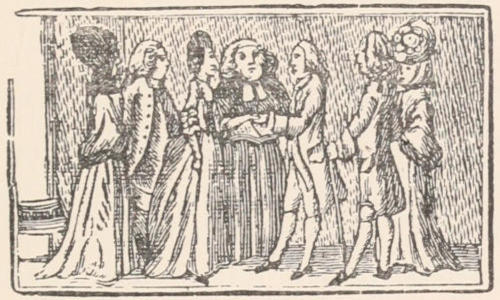
The Wedding of Jockey and Maggy—from “The Whole Proceedings
of Jockey and Maggy,” by Dougal Graham.
Then follows a description of the bridal procession.
“The friends and good neighbours went a’ wi’ John to
the kirk, where Maggy chanced to meet him, and was
married by the minister. The twa companies joined the
gither and cam hame in a croud; at every change-house
they chanced to pass by, Providence stopt their proceedings
with full stoups, bottles and glasses, drinking their
healths, ‘wishing them much joy, ten girls and a boy.’
Jockey, seeing so many wishing well to his health, coupt
up what he got to augment his health, and gar him live
[40]lang, which afterwards coupt him up and proved detrimental
to the same.
“So hame cam they to the dinner, where his mither
presented to them a piping-het haggis, made o’ the
creish o’ the black boul horn’d Ewe, boil’d in the meikle
bag, mixt with bear-meal, onions, spice and mint.”
The heavy dinner, with the drink he had consumed on the
way home, proved too much for the bridegroom, who had to
be assisted to bed. Then the respective qualities of the
young spouses were discussed by their parents; they disagreed,
words came to blows, and the marriage feast ended in
a regular Donnybrook.
“His friends and her friends being in a mixt multitude,
some took his part, some took her’s; and there did
a battle begin in the clap of a hand, being a very fierce
tumult, which ended in blood; they struck so hard with
stones, sticks, beetles, and barrow-trams; pigs, pots,
stoups and trunchers were flying like bombs and
granadoes. The crook bouls and tangs were all
employed as weapons of war, till doon cam the bed, with
a great mou of peats! So this disturbet their bedding.
“The hamsheughs were very great, until auld uncle
Rabby came in to redd them; and a sturdy auld fallow
he was. He stood stively with a stiff rumple, and by
strength of his arms rave them sindry, flinging the tane
[41]east and the tither west, until they stood a’ round about
like as many breathless forfoughten cocks, and no ane
durst steer anither for him; Jockey’s mither was driven
o’er a kist, and brogit a’ her hips on a round heckle; up
she gat, and rinning to fell Maggy’s mither wi’ the ladle,
swearing she was the mither o’ a’ the mischief that happened,
Uncle Rabby ran in between them, he having a
lang nose, like a trumpet, she recklessly came o’er his
lobster neb a drive wi’ the ladle till the blood sprang
oot, an’ ran down his auld grey beard and hang like
snuffy bubbles at it. O! then he gaed wood, and looked
as waefu’ like as he had been a tod-lowrie come frae
worrying the lambs, wi’ his bloody mouth. Wi’ that he
gets an auld flail, and rives awa’ the supple, then drives
them a’ to the back o’ the door, but yet nane wan oot;
then wi’ chirten an’ chappen down comes the clayhallen
and the hen bawk, wi’ Rab Reid the fiddler, who had
crept up aside the hens for the preservation of his fiddle.”
As a description of the humours of rustic life, Jockey and
Maggy’s Courtship is difficult to excel. Scenes such as those
depicted were not uncommon, and they belong to a time
when the whole machinery of ecclesiastical law was brought
into motion to impart decency and order to “blithesome
bridals.” But even strait-laced Scotland would not be Kirk-ridden,
and the eighteenth century Scot enjoyed life to the
full, and sinned, sometimes to his heart’s content, in spite of
[42]scowling Holy Willies and stools of repentance. The remainder
of Jockey and Maggy’s Courtship deals with some of
the sins of Jockey’s youth and their consequences. He had
loved one of his mother’s maids not wisely but too well, and
this coming to the ears of the Kirk-Session he is summoned
to answer for his misdeeds. But he proves intractable, and
aided and abetted by his mother, who delivers herself of a
denunciatory harangue against the repentance stool, he
refuses to come under the censure of the Church. We get
an interesting glimpse of what Church discipline really was,
and of the material with which the elders of the Kirk had to
deal. In his mother, Jockey had a stout defender and voluble
advocate, but death put an end to her pleading, and he
was left to fight his battle alone. Then he yielded to the
order of the Kirk, and submitted to public correction.
“Upon Sunday thereafter, John comes with Uncle
Rabby’s auld wide coat, a muckle grey-tailed wig, and
a big bonnet that covered his face, so that he seemed
more like an old Pilgrim than a young fornicator;
mounts the creepy[17] wi’ a stiff, stiff back, as he had been
[43]a man of sixty. Every one looked at him, thinking he
was some old stranger that knew not the stool of repentance
by another seat, so that he passed the first day unknown
but to very few; yet on the second it came to be
known, and the whole parish, with many more, came to
see him, which caused such a confusion that he was
absolved and got his children baptized the next day.”
Love, Courtship, and Marriage are the themes most frequently
dealt with in Graham’s chapbooks. They were
subjects at which a great deal of fun might be poked, and in
which everybody was more or less interested. Books treating
of them were assured a ready sale.
The Coalman’s Courtship to the Creelwife’s Daughter is one
which deserves to be mentioned alongside Jockey and Maggy’s
Courtship. Sawny, a young coalman, is, like his friend Jockey,
desirous of securing a wife, but, not being informed in the
art of courtship, he applies to his mother for counsel and
advice. That worthy dame—contrary to the general belief
that mothers never wish their sons to marry—enters heartily
into the project, and lays all her advice and experience at
Sawny’s disposal.
She advises him
“to go in wi’ braw good manners, and something manfu’;
to put on a Sunday’s face and sigh as he were a saint;
to sit down beside her as he were a Mess John; to keek
[44]aye till her, now and then, with a stolen look, and haud
his mouth as mim and grave as a May paddock.”
She also enjoins him “to crack weel o’ their wealth and
hide their poverty.”
Sawny was a “blate wooer.” Having considered the
matter, he thought it would be judicious to approach his
sweetheart by means of her mother. After selling his coals
one day, he attires himself in his best and proceeds in quest
of Katie’s mother. They meet, and, over a gill and a “het
pint,” old Be-go promises her daughter to Sawny. Having
obtained the mother’s consent, he, a few days later, sets out
on a visit to his intended bride, to ascertain whether she is
agreeable to his proposal. An amusing dialogue ensues.
Sawny.—“Now, Katty, do you ken what am come
about?”
Kate.—“Oh yes, my mither telt me; but I’m no ready
yet. I hae twa gowns to spin and things to mak’.”
Sawny.—“Tute, things to mak’! ye hae as mony things
as ye’ll need, woman; canna ye spin gowns in oor ain
hoose wi’ me, as weel as here wi’ an auld girning mither?”
Kate.—“But, dear Saunders, ye maun gie a body time
to think on’t—’twad be ill-far’d to rush thegither just at
the first.”
Sawny.—“And do ye think I hae nothing a-do but
come here every ither day hoiting after you! it’ll no do;
[45]I maun be either aff wi’ ye or on wi’ ye; either tell me
or tak’ me, for I ken o’ ither twa, an’ some o’ ye I will
hae; for, as am a sinner, my mither is gaun to be
married, too, an’ she can get a bit man o’ ony shape or
trade.”
Kate.—“’Deed then, Saunders, since ye’re in sic a
haste, ye maun e’en tak’ them that’s readiest, for am no
ready yet.”
Sawny.—“A, dear woman, when your mither and my
mither’s pleased, and am willing to venture on ye, what
a sorrow ails ye?”
Kate.—“Na, na, I’ll think on’t twa or three days; it’s
o’er lang a term to see without a thought.”
Sawny.—“Wode, I think ye’re a cumstrarie piece o’
stuff; it’s true enough ye’re mither said of ye, that ye’re
no for a poor man.”
Kate.—“And what mair said she o’ me?”
Sawny.—“Wode, she said you could do naething but
wash mugs and scoure gentleman’s bonny things; but
hissies that is bred amang gentle houses minds me o’ my
mither’s cat, but ye’re far costlier to keep, for she wastes
nayther saep nor water, but spits in her lufe and washes
ay at her face, and wheens o’ ye can do naether thing;”
and up he gets.
Kate.—“O, Saunders, but ye be short; will ye no
stay till my mither come hame?”
[46]
Sawny.—“I’ve staid lang aneugh for onything I’ll be
the better; and am nae sae short as your tottom o’ a
taylor that I could stap in my shoe.”
Chagrined at being repulsed where no repulse was dreamt
of, and having fired off this parting shot at his rival, the
“tottom of a taylor,” Sawny made his way home feeling, like
many a slighted lover before and since, that he might now
take melancholy farewell of the earth, the moon, and the
stars.
“‘O death, death!’ he exclaimed, ‘I thought the
jade wad a jumped at me; no comfort or happiness mair
for poor me. O, mither, gae mak’ my kist and bake my
burial bread, for I’ll die this night or soon the morn.’”
But a broken heart is only fatal on rare occasions. With
the dawn came Katie’s mother, anxious to smooth matters,
and effect the union so much desired by Sawny, and perhaps
not altogether unwished by the independent sweetheart of
yesterday.
“In comes auld Be-go, his good mither,” says the
author, “who had left her daughter in tears for the
slighting of Sawny, and hauls him and his mither away
to get a dinner of dead fish, where a’ was agreed upon,
and the wedding to be upon Wednesday; no bridal folks
but the mithers and themselves twa.”
[47]
Thus the matter that was first discussed over “a gill and a
het pint,” was concluded on the strength of “a dinner of
dead fish,” and all that remained to do was the tying of the
nuptial knot. The coalman and the creelwife belonged to a
class not in very close touch with the Church—they were representative
of the “lapsed masses” in a time before that
phrase was coined—and they did not, therefore, trouble themselves
about marriage in the orthodox fashion. A “Cheap
Priest” was requisitioned. He tied the Gordian knot as
securely as the Moderator of the General Assembly could
have done, and as perfunctorily as the High Priest of Gretna
Green would have done if an enraged parent had been knocking
at the door for admission with the butt-end of a well-primed
pistol. The slipshod manner was not altogether lost
on the creelwife.
The priest,[18] says Graham, gave them “twa-three
words and twa-three lines, took their penny and a good
drink, wished them joy, and gaed his wa’s. ‘Now,’ said
auld Be-go, ‘if that be your minister, he’s but a drunken
[48]——; mony a ane drinks up a’, but he leaves naething;
he’s got that penny for deevil a haet; ye micht hae
cracked lufes on’t, tane ane anither’s word, a kiss and a
hoddle at a hillock side, and be as well if no better; I
hae seen some honest men say mair o’er their brose nor
what he said a’ thegither; but an ye’re pleased, am
pleased; a bout in the bed ends a’ and makes firm wark,
sae here’s to you and joy to the bargain—it’s ended now,
weel I wat!’”
The History of the Haverel Wives, another of Graham’s
chapbooks, differs widely from those already mentioned,
but is not the least important of his works. Many editions
have been issued. One, printed at Stirling by William
Macnie, bears the following elaborate title:—
“The History of the Haverel Wives; or, The Folly
of Witless Women Displayed. Written by Humphrey
Clinker, the Clashing Wives’ Clerk. Being a Comical
Conference between Maggy and Janet, his Two Old
Aunts. With Janet’s advice to Maggy concerning
marriage, with the manner in which she courted her
husband, which began by taking him by the twa lugs
and kissing him. To which is added, An Oration on the
Virtues of the Old Women and the Pride of the Young.
Dictated by Janet Clinker, and written by Humphrey
Clinker, the Clashing Wives’ Clerk.”
[49]
This dual production—the History was sometimes published
apart from the Oration—is freer from indecencies
than certain others of Graham’s compositions. In it the
author indulges his satire against “clashing wives.” A prefatory
note reads:—
“It is a certain old saying, That where women are
conven’d in crowds, there can be but little silence; and
some have acknowledged that it was a great bondage for
them to hold their peace in the church; and where there
is much talk by ignorant speakers, it is diverting for
persons of understanding to hear them. Therefore, we
have furnished the public with a small collection of old
wives’ noted sayings and wonders, which they relate
happened in their own time, also what has been told
them by their forefathers.”
With this preface, we are introduced to Maggy and Janet
busily “cracking” “at their rocks.” The first subject they
discuss is Maggy’s age, and this leads to an interesting description
of Scottish life and custom in pre-Reformation
times.
“‘Indeed, Janet,’ replies Maggy, in answer to the
question of how old she may be, ‘that’s what naebody
kens, for my father and mother had sae mony o’ us they
ne’er counted how auld ane o’ us was; they minded ay
wha o’ us was born first, and wha was neist ane anither,
[50]and that was a’ that e’er we socht to ken aboot it; but I
ha’e mind o’ the mirk Munanday.’[19]
“‘Hout, tout, woman, the mirk Munanday,’ exclaims
Janet, ‘I mind since there was na Munandays at a’,
and Sabbath days was nae come in fashion; there was a
day they ca’d Sunday came ance i’ the ouk for it; we
ken’d ay when it came, for my father cow’d ay his beard
when the bell rang, and then everybody ran to the kirk
that had onything to do, gin it were to buy saut or
shune, for the chapman chiels set up a’ their creims at
the kirk door, and the lasses wad a gotten keeking
glasses, red snoods, needles, prins, elshinirons, gimblets,
brown bread, and black saep, forby sweety wives’ things,
and rattles for restless little anes; the men wad a bought
pints o’ ale and gotten a whang o’ gude cheese to chew i’
the time o’ drinking o’t. Ay, ay, there was braw
markets on Sunday i’ the time o’ paepery; we had nae
ministers then but priests, mess Johns, black friars and
[51]white friars, monks, abbots, and bishops; they had nae
wives, yet the best o’ them wad a spoken baudy
language, and kissed the lasses; fickle, sykin bodies
they were, unco ill to please; they wad baith curs’d folk
and bless’d them just as we paid them; indeed, they
were unco greedy o’ the penny, and pray’d ay to the
dead fouk, and gard the living pay them for’t; and
although they had play’d the loon wi’ a poor hizey, she
durst na speak o’t for her very life, for they could gie
ony body o’er to the de’il when they liket. They didna
gar fouk learn to read, and pray like our new ministers,
but thump on your breast, strake your fingers o’er aboon
your nose, tell your beads, and rin bare-fit thro’ amang
hard stanes and cauld snaw.”
Dougal was never a friend of the Roman hierarchy. In
his metrical History of the Rebellion he apostrophises the
children of the Pope in lines beginning—
“You Papists are a cursed race,”
and the History of the Haverel Wives testifies that he was
equally unfriendly in prose. The description of a Scottish
Sunday before the Reformation is historically true, and
proves that the prolific pedlar was not ignorant of the social
life of an earlier day. Maggy, after listening to the harangue
of her friend, and learning that the priests were
[52]possessed of all power over men and death and devils, asks
pertinently enough—
“What’s come o’ them a’ now? I’m sure the like o’
thae fouks that had sae meikle power needed neither dee
nor yet be sick: they wad live a’ their days.”
The answering of this question affords Janet another opportunity
of indulging her antipathy to “Paepery,” and
gives her a chance to air her views on Episcopacy. This
part of the chapbook is interesting as preserving a fair reflection
of the minds of the common people on the subject of
Prelacy. Lonely graves on the moorlands of the west, and
memories of the Grassmarket of Edinburgh, could still move
men to tears; the terrible sufferings of the Covenant days
were things but of yesterday, and—rightly or wrongly—Bloody
Claverhouse and his Dragoons, and relentless Archbishop
Sharp, were still emissaries of the devil and typical
representatives of Scottish Episcopacy. In these days a good
true-blue Presbyterian can sit down to breakfast and make a
hearty meal in spite of the fact that his newspaper tells him
the Churches are “praying for union;” but at the time when
the chapbook was written, things were very different.
Every Presbyterian held the same opinion as the Skellat
Bellman of Glasgow, and only refrained from expressing it
because, unlike Dougal Graham, he was seldom “unco glib
at the pen.”
[53]
The most of the priests, says Janet, are “dead and
rotten, and the rest o’ them gade awa to Italy, where the
auld Pape their faither, the deil, the witches, brownies,
and fairies dwal;[20] and than we gat anither sort o’ gospel
fouks they ca’d curits—fine sort o’ dainty honest fouks
they war, but geyan greedy.... They bid to hae
tithes o’ everything that grew; mony a time my faither
wisht they wad tak tithes o’ his hemp too, if it were to
hang themsels. They were ay warst whare a puir man
or wife died, though they left weans fatherless and
mitherless: a deed they wad a sent their bellman, and
wi’ his lang prelatic fingers he wad a harled the upper
pair o’ blankets aff o’ the poor things’ bed for some rent
that they gard fouks pay for dying, a sae did they een,
and yet they keepit a hantle o’ braw haly days and days
o’ meikle meat—Fastren’s-e’en and Yule days, when we
got our wames fou o’ fat brose, and suppit Yule sowens
till our sarks had been like to rive; and, after that,
eaten toasted cheese and white puddings well spiced.
[54]O! braw times for the guts! Well, I wat, onybody
might live then that had onything to live on.”
In this strain, Janet “haivers” on to the end of the
chapter, in answer to Maggy’s questions. She discusses the
devil and his wife (is there any other record of Satan having
added matrimony to his sins?); blackamoors and what they
are made of; and that fruitful subject of discussion in all
ages—the minister. Janet points out, in a woman’s unerring
way, the many faults of the minister, his wife, and “twa
gigglet, gilliegaukies o’ dochters;” and tells how she would
preach if she had the chance of “wagging her pow in the
pu’pit.” Then she proceeds to give her younger sister some
advice concerning marriage; and the chapbook—in some of
its editions—concludes with her “Oration on the Virtues of
the Old Women and the Pride of the Young.” In a humorous
fashion she expatiates on her sex, pointing out their many
vices, and wherein they have fallen from the high estate
they enjoyed when she, “Janet, was a Janet.” She regrets
that they will not speak their mother tongue, and will not
even swear in it, “but must have southern oaths.” Having
said her say, she imparts some advice to her readers as
to waling a good husband or a perfect wife.
“If a puir man want a perfect wife, let him wale a
weel-blooded hissie, wi’ braid shouders and thick about
the haunches, that has been lang servant in ae house, tho’
[55]twice or thrice awa’ and ay fied back; that’s weel liket
by the bairns and the bairns’ mither; that’s naeway
cankard to the cats nor kicks the colley-dogs amang her
feet; that wad let a’ brute beasts live, but rats, mice,
lice, flaes, neits, and bugs, that bites the wee bairns in
their cradles; that carefully combs the young things’
heads, washes their faces and claps their cheeks, snites
the snotter frae their nose as they were a’ her ain—that’s
the lass that will mak’ a good wife; for them that dauts
the young bairns will ay be kind to auld folk an they
had them.
“And ony hale-hearted, halsome lassie that wants to
halter a good husband, never tak’ a widow’s ae son, for a’
the wifely gates in the world will be in him, for want of
a father to teach him manly actions; neither tak’ a sour-looking
sumf wi’ a muckle mouth and a wide guts, who
will eat like a horse and soss like a sow, suffer none to
sup but himsel’, eat your meat and the bairns’ baith;
when hungry angry, when fu’ of pride, ten sacks will
not haud his sauce, tho’ a pea-shap wad haud his siller.
But go, tak’ your chance, and, if cheated, chamer not on
me, for fashionable fouk flee to fashionable things, for
lust is brutish blind and fond love is blear-ey’d.”
The three works of Dougal Graham, with which we have
dealt, and from which we have given extracts illustrative of
[56]their style and the subjects of which they treat, are, in
certain respects, different from the other productions attributed
to the Skellat Bellman’s pen. They show that their
author was possessed of an inventive faculty, and that he
could create characters and make them play their parts in the
development of a plot. The plot was never intricate, but the
sketches had a dramatic construction which is wanting in his
other chapbooks. Such histories, for example, as those which
relate the Entertaining Exploits of George Buchanan, or the
Comical Transactions of Lothian Tom, are merely a number
of stories gathered from many sources, and thrown together
with a certain amount of local colour. John Falkirk the
Merry Piper, Paddy from Cork, and Simple John—like
George Buchanan and Lothian Tom—are called into service
merely to enable Graham to weave his anecdotes, wise and
otherwise, and his witticisms, new and old, into a composite
whole. It would seem, indeed, as though the Skellat Bellman,
like authors of a later date, had found it impossible to
keep up a continuous output of original matter, and had
descended to mere hackwork or pot-boiling. To say this is
not to say that there is nothing of interest in these collections
of facetious anecdotes and droll misfortunes. Like his other
sketches, they are valuable for the light they shed on Scottish
life and custom in a by-gone time.
Two chapbooks, attributed to Graham, differ in construction
from the anecdotal compilations such as The Exploits
[57]of George Buchanan, or the dramatic sketches of the
nature of Jockey and Maggy’s Courtship. These are John
Cheap the Chapman, and Leper the Taylor. The former is
understood to be autobiographical in part. “John Cheap”
is an interesting fellow, and in his company—though often-times
it is more agreeable than polite—we can wander over a
large stretch of lowland Scotland and learn something of the
life he lived. He got his
“name of John Cheap the chapman, by his selling
twenty needles for a penny, and twa leather laces for a
farthing. He swore no oaths but one, Let me never
sin; and he used no imprecations but, Let me never cheat
nor be cheated, but rather cheat than be cheated.”
Many a man in a higher walk of life than that in which
John Cheap moved, could plead guilty to harbouring the
same wish.
In this sketch, the author paints with a broad brush. The
trials of a pedlar’s life are duly set forth. One quotation will
suffice for illustration.
“I prevailed,” says John Cheap, “to get staying in a
great farmer’s house, about two miles from Haddington;
they were all at supper when I went in; I was ordered
to sit down behind their backs. The goodwife then took
a dish, went round the servants, and collected a sowp out
of every cog, which was sufficient to have served three
[58]men. The goodwife ordered me to be laid in the barn
all night for my bed, but the bully-fac’d goodman swore
he had too much stuff in it to venture me there; the
guidwife said I should not ly within the house, for I
would be o’er near the lasses’ bed; then the lads swore
I should not go with them, for I was a forjesket little
fellow, and (wha kens whether I was honest or not) he
may fill his wallet wi’ our cloaths and gang his wa’ or
daylight. At last I was conducted out to the swine’s
stye, to sleep with an old sow and seven pigs, and there I
lay for two nights.”
To the pictures of early Church life, which are found in the
History of the Haverel Wives, may be added one from Leper
the Taylor. It belongs to a later age, and while the others
dealt with the Church in the days of Popery and Episcopacy,
this gives us a glimpse of matters as they existed under
Presbytery. It illustrates ecclesiastical life in Glasgow at the
time when Dougal Graham held the position of Skellat
Bellman. The Kirk-Session, acting in conjunction with
the Town Council, appointed certain officers, known as
“civileers,” whose duty was to see that everybody attended
Church at both diets of worship on Sabbath.[21] These
[59]functionaries pounced upon Leper on one occasion, and the
following extract narrates the sequel:—
“Leper was in use to give his lads their Sunday’s
supper, which obliged him to stay from the kirk in the
afternoon, he having neither wife nor servant maid; so
on Sunday afternoon, as he was at home cooking his
[60]pot, John Muckle-cheeks and James Puff-and-Blaw, two
Civileers, having more zeal than knowledge, came upon
him and said, What’s the matter, Sir, you go not to the
kirk? Leper replied, I am reading my book, and cooking
my pot, which I think is the work of necessity.
Then says the one to the other, Don’t answer the graceless
fellow, we’ll make him appear before his betters; so
[61]they took the kail-pot, and puts a staff through the
bowls, and bears it to the Clerk’s chamber. Leper, who
was never at a loss for invention, goes to the Principal of
the College, his house, no body being at home but a lass
roasting a leg of mutton; Leper says, My dear, will you
go and bring a pint of ale, and I’ll turn the spit till you
come back; the lass was no sooner gone than he runs
[62]away with the leg of mutton, which served his lads and
him for his supper. When the Principal came home, he
was neither to bin nor ha’d, he was so angry; so on
Monday he goes and makes complaint to the Lord
Provost, who sends two officers for Leper, who came
immediately. My Lord asked him, How he dared to
take away the Principal’s mutton? Leper replied, How
came your Civileers to take away my kail-pot? I am
sure there is less sin in making a pot-full of kail than
roasting a leg of mutton: Law-makers should not be
law-breakers, so I demand justice on the Civileers. The
Provost asked him what justice he would have? Says
he, Make them carry the pot back again; as for the
Principal, a leg of mutton won’t make him and me fall
out. So they were forced to carry the pot back again,
and Leper caused the boys to huzza after them to their
disgrace.”
Of the other humorous chapbooks attributed to Graham,
no lengthy mention need be made. At most, as has been
indicated, he was only editor of them; and they are, for the
greater part, merely collections of facetiæ. Many of the
stories were chestnuts even in Dougal’s time, and some of them
are none the fresher for the fact that they have been fathered
on every beadle and minister of distinction within the last
decade. He had an eye for a good story, and one seldom lost
[63]anything in being retailed by him. If the George Buchanan
of his pages is rather a buffoon than the first statesman of
his age, it should be borne in mind that the Bellman wrote
for a people who demanded mirth, and that the George
Buchanan of history—if Graham had chosen to treat him
seriously—would have cut a sorry figure in the company of
Paddy from Cork and Lothian Tom, and would not have
been so much appreciated as the ribald courtier of a
ribald age.
Besides the Skellat Bellman of Glasgow, there were a
number of others who contributed humour to Scottish chapbook
literature. One of the most notable of these was William
Cameron, who in certain respects was a fitting successor to
Dougal Graham. He, like Graham, was born within sight of
Stirling Castle; like him, too, he wandered over a large part
of Scotland as a “flying stationer;” and, like him, he ultimately
settled down in Glasgow and became one of the
worthies of St. Mungo.[22] Cameron has a connection with
Graham’s work in respect that he edited Janet Clinker’s
[64]Oration, and, giving it a new title, sent it forth on a fresh
lease of life. His own words are:—
“I fell in with Janet Clinker’s Oration on the Wit of
the Old Wives and the Pride of the Young Women.
This piece never fails. I have turned it ‘heels over
head’ many times; and, when it would sell no longer, I
gave it a fresh name, as well as a new introduction, and
sold it as freely as ever.... I changed its title to
Grannie M’Nab’s Lecture on the Women, and sold it
through the West of Scotland.”
Cameron was author of one or two chapbooks. He wrote
The Prophecies of ‘Hawkie’: a Cow, which poked fun at a
prophet who “prophesied in Fife and appeared in Glasgow,
and converted numbers.” The book sold well, and secured
for Cameron the name by which he was subsequently known—he
was “Hawkie” to two generations of Glaswegians.
Another of his productions is The Gauger’s Journey to the
Land of Darkness: what he discovered there and his journey
back. It narrates the story of an exciseman who, being found
drunk and asleep by some colliers, was taken down a pit and
laid in a corner. When he awoke, he fancied he was in
another world.
The Life of Mansie Wauch, Tailor in Dalkeith, is a notable
chapbook, and cannot be overlooked in this connection. It
is—as many of the chapbooks were—a condensation of a
[65]larger work, and, in its extended form, is still widely
esteemed. There is this difference between “Delta’s”[23]
creation and all of those of Graham, that he is always
respectable. Mansie, like many other mortals in chapbook
literature, finds himself in strange places and the victim of
unfortunate circumstances—such as his experience of “calf-love”
and his adventures in the playhouse—but he never loses
his self-respect or finds it necessary to be obscene to be
emphatic. Doubtless these very characteristics led to his being
less widely appreciated by the common people, but he has
this much to his credit that when, in later times, a movement
originated to suppress or supplant the coarse productions of
the Skellat Bellman, it did not—because it could not—affect
him.
There were a number of chapbooks in verse which deserve
to be noticed under the present heading. One of the most
popular of these was Alexander Wilson’s[24] humorous poem,
[66]Watty and Meg; or, the Wife Reformed—Owre True a Tale,
which was first published in 1792, and considered worthy of
the Ayrshire Bard. Another was, The Comical Story of
Thrummy Cap and the Ghost, from the pen of John Burness,[25]
a cousin of the national poet. Both of these effusions enjoyed
a wide popularity as chapbooks; they were reprinted time
and again, down to the very close of the period when these
[67]books may be said to have ceased to be vended; and then
they passed on into standard collections of our national
verse, through which they are known to a wide circle of
readers. Two other publications which were popular, but
which had not that fate, are—(1) The Comical Tale of
Margaret and the Minister, which narrates how Margaret,
having been invited to dinner at the manse, accepted the
invitation; and then, through ignorance or misadventure,
affixed the table-cover instead of a napkin to her breast: all
went well until, having swallowed some mustard, she beat a
hasty retreat from the room to hide her discomfiture, and
dragged the cloth and dishes with her; (2) The Dominie
Deposed, with a Sequel, by William Forbes, A.M., late schoolmaster
of Petercoulter. This sets forth in vigorous verse the
lamentation of a dominie, who had the misfortune to sweetheart,
as Mr. Henley might say, “with all his heart, and
soul, and strength.”[26]
[68]
While these were the most important of the humorous
chapbooks, there were many others of a similar kind but
of lesser merit. Graham called forth numerous imitators,
and stories of love, courtship, and marriage fell fast from the
chapbook press. The Art of Courtship,[27] a somewhat commonplace
[69]production, which, in Professor Fraser’s judgment,
“bears strong signs of having been written or edited by
Dougal Graham, or at least suggested by his writings,” was
one; A Diverting Courtship,[28]
and The Pleasures of Matrimony,[29]
were others. Subjects of such a nature lent themselves
to broad treatment; and the chapbook writer of a
century ago—like the enterprising publisher of to-day—gave
the public what it wanted, rather than what was good for
it. If Graham was imitated in these productions, he also had
[70]companions who issued publications after the style of Paddy
from Cork and the Exploits of George Buchanan.
A collection of amusing, and sometimes coarse, anecdotes
was published at Glasgow in 1767, under title, The Comical
Notes and Sayings of the Reverend Mr. John Pettigrew,
Minister in Govan,[30] and a budget of stories of a more
general character was issued with the name of The Scotch
Haggis.[31] In addition to these, there were Odds and Ends;
or, a Groat’s Worth of Fun for a Penny,[32] and Grinning
Made Easy; or, Funny Dick’s Unrivalled Collection of Jests.[33]
By way of description, these books of facetiæ do not call for
much attention. Anything in the way of wit and humour
was pressed into service. The editors did what they could to
caricature Scotland, before Punch and other enterprising
[71]London periodicals found this a pleasant and paying duty.
Many of the more characteristically Scottish anecdotes in
these chapbooks have been made familiar to modern readers
through the dignified pages of Dean Ramsay’s volume and
the works of other gleaners in the field of Scottish story.
[72]
II. INSTRUCTIVE.
Under the heading of “Instructive Chapbooks,” much falls
to be noticed. It is a section which readily sub-divides itself,
although at the same time it is difficult to arrive at any very
exact classification. Following Professor Fraser’s plan, which,
unfortunately, he did not elaborate, an attempt will be made
to range the productions under one or another of these five
heads:—(a) Historical; (b) Biographical; (c) Religious and
Moral; (d) Manuals of Instruction; (e) Almanacks.
(a) Historical.—The historical chapbook was much in
evidence, and few outstanding events in national history were
overlooked. There were publications dealing with The Battle
of Otterburn, The Battle of Bothwell Bridge, The Battle of
Drumclog, Executions in Scotland from the Year 1600, The
Battle of Killiecrankie, The Massacre of Glencoe, and The
Rebellion of 1745-6. Then there were others that dealt with
such subjects as Scotland, Edinburgh, and Glasgow and the
High Church.
Three of these chapbooks have the merit of being written
by eye-witnesses of the actions they describe. The account
[73]of The Battle of Bothwell Bridge was composed “by the
Laird of Torfoot, an Officer in the Presbyterian Army.” It
forms a 16 page chapbook, and is written, as will be readily
understood, from the Presbyterian point of view. A later
editor of this work, in an undated edition issued by G. Caldwell
of Paisley, added a footnote which strangely confuses the
author of the Scots Worthies—John Howie of Lochgoin—with
Old Mortality of the Waverley Novels. Referring to
the John Howie of the Covenant days, the editor says,
“The grandson of this person (John Howie) was the
person whom the Great Unknown calls Old Mortality.
I have been from infancy familiar with the history of
this author of the epitaphs, this repairer of the tombs
of the martyrs; but I never heard him called Old
Mortality. Everybody in the west of Scotland is
familiar with the name of John Howie—Old Mortality
is the name in romance.”
It is quite apparent that the editor confused Robert Paterson
with John Howie. An abridgement of this narrative,
together with an account of The Battle of Drumclog, was
issued as another chapbook. That portion relating to Drumclog
was also from the Laird of Torfoot’s pen. It was
extracted, a prefatory note explains, “from an American
Newspaper entitled, the National Gazette.” Like that which
[74]chronicles the doings at Bothwell Bridge, it is written in
sympathy with the Covenanters.
For the author of the most important of all the Scottish
historical chapbooks, we must return to Dougal Graham. If
the Caledonian Mercury is correct in its statement that Prince
Charlie was the first to plunge into the Forth at the Ford of
Frew, it may have been that courageous incident which impelled
the little hunchback to throw in his lot with the
Jacobite army. He followed the Young Chevalier in his
triumphant march into England, returned with him in his
hasty retreat northwards, and witnessed the sun of the
Stuarts set in blood on Culloden Moor. It is not improbable
that he took notes of the incidents he witnessed, and, like the
war-correspondent of a later day, set about their extension
with all possible speed. Culloden was fought on the 16th of
April, 1746. By September of the same year Graham was in
a position to announce the publication of his History. The
following advertisement appeared in the columns of the
Glasgow Courant for September 29, 1746:—
“That there is to be sold by James Duncan, Printer
in Glasgow, in the Saltmercat, the 2nd Shop below
Gibson’s Wynd, a Book intituled A full, particular, and
true Account of the late Rebellion in the Year 1745 and
1746, beginning with the Pretender’s Embarking for
Scotland, and then an Account of every Battle, Siege,
[75]and Skirmish that has happened in either Scotland or
England.
“To which is added, several Addresses and Epistles to
the Pope, Pagans, Poets, and the Pretender: all in
Metre. Price Four Pence. But any Bookseller or Pack-men
may have them easier from the said James Duncan,
or the Author, D. Graham.
“The like has not been done in Scotland since the
days of Sir David Lindsay.”
That last exclamation shews that Graham had faith in his
work (what poet has not?), and there is little doubt that it
became at once extremely popular. It dealt with a subject
in which there was the most intense interest; it appeared ere
Scotland had recovered from the effects of the shock of the
Rebellion; and in the pedlars’ wallets it was carried over the
length and breadth of the land. It would seem that, with
the exception of two copies, the first edition has been read
out of existence. Graham’s History is scarcer than the
Shakespeare folios or the “Kilmarnock” Burns! The title-page
of his book contained the couplet—
“Composed by the poet, D. Graham,
In Stirlingshire he lives at hame”—
which is at once a biographical note and a specimen of the
author’s doggerel. But, its rough and frequently infelicitous
[76]rhymes notwithstanding, the work affords good reading.
Dougal’s information was received at first hand, and he
paints his pictures with the baldness of reality. Here, for
example, is his description of the arms of the men who went
forth to battle for the White Rose:—
“Old scythes, with their rumples even,
Into a tree they had been driven;
And some with batons of good oak
Vow’d to kill at every stroke;
Some had hatchets upon a pole,
Mischievous weapons, antick and droll.”
These were the weapons that cleared the way to the Scottish
capital and routed Cope’s army at Prestonpans! The expedition
into England is duly set down in the historian’s halting
numbers, and he does not hesitate to chronicle the chagrin of
those
“to plunder London that were keen”
when the order went forth at Derby to retreat. The incidents
of the homeward march are narrated. This is how he speaks
of the eight days’ sojourn at Glasgow:—
“Eight days they did in Glasgow rest,
Until they were all cloth’d and drest;
And tho’ they on the best o’t fed,
The town they under tribute laid.
[77]
Ten thousand sterling made it pay,
For being of the Georgian way,
Given in goods and ready cash,
Or else to stand a plundering lash.”
Those “to plunder London that were keen” having been
baulked of their aims on the capital, did their best to recoup
themselves at the expense of Glasgow. The thrilling scenes
on Culloden Moor are graphically described. Here is what
he says of Cumberland’s artillery:—
“It hew’d them down, ay, score by score,
As grass doth fall before the mower;
Breaches it made as large and broad
As avenues in through a wood.”
The subsequent wanderings of “Bonnie Prince Charlie”
in the western isles are duly set forth, although much of
what is said must be imaginary so far as Graham is concerned,
or told at second-hand. Many editions of the
book were published, and some of them differed widely
from others, for Dougal found it necessary on occasion
to express himself as a good Hanoverian rather than as a
discredited Jacobite. It is usual to characterise the work
as “Hudibrastic,” and from the extracts given it will be seen
that the criticism is not unjust. In point of literary workmanship,
it has small claim to distinction, but it is not without
[78]merit as the record of an eye-witness. “It contains,”
says Chambers, “and in this consists the chief value of all
such productions, many minute facts which a work of more
pretensions would not admit.” Dougal wrote with a graphic
pen, and had his facility in verse been equal to his power of
description, the metrical History of the Rebellion had not now
been a forgotten volume.[34]
[79]
Under the heading “Historical,” may be included those
broadsides and chapbooks which referred to topical events.
Frequently the matters dealt with were too local or too
trivial to be regarded as history in the proper acceptation of
the word, but a passing sentence at least may be awarded
them. There was one, for example (and it certainly rises to
the dignity of history), which provided “An Account of the
Massacre of Captain Porteous of the City Guard,” and
another which set forth “A Particular Account of the Great
Mob at Glasgow that happened on Tuesday, 9th of February,
1779; with an account of the Magistrates’ and Trades’
activity in assisting to suppress the same.” Occasionally,
when an important event was to take place, a chapbook in
connection therewith was put in circulation. “Hawkie” tells
us that he published an account of Ancient King Crispin,
which was sold in Edinburgh on the day of a Crispin procession
in that town. Sometimes rivals in trade sought the
help of the flying-stationer. Cameron says that he sold, for
a newspaper office, a broadside entitled, The Expiring Groans,
Death, and Funeral Procession of the “Beacon” Newspaper.
It is safe to say that the erewhile proprietors of the extinguished
Beacon did not engage “Hawkie” to spread the
news of their disaster. Sometimes these topical chapbooks
consisted of the last speeches of condemned criminals. At a
time when public executions were in force, and when great
crowds of all classes assembled to see a fellow-mortal dance
[80]into eternity, such literature commanded a ready sale. The
last speeches were usually supplied to the “flying-stationers”
on the day before the execution, and “pattered” among the
assembling multitude. When no speech was forthcoming, the
chapman, recognising that the opportunity was too good to
be lost, invented something that would sell. A case in point
may be mentioned, and the pedlar’s own words quoted[35]:—
“There was a man named Robertson under sentence
of death in Glasgow for housebreaking and theft, and
the execution, which took place 7th April, 1819, brought
‘flying-stationers’ from every quarter.... The
day before Robertson’s execution, Jamie [Blue] and I
were in Wilson Street, and in a bookseller’s shop saw a
tract entitled, ‘A Reprieve from the Punishment of
Death.’ As a reprieve was expected for Robertson, we
considered that this tract was likely to sell.
“We asked the price, and were told ‘three half-pence.’
We took four dozen each, and started, Jamie in the
Candleriggs, and I in Bell’s Wynd. I had scarcely
reached Albion Street before I had sold the four dozen,
and turning back for more I met Jamie, who had sold
about three dozen. On the head of our good luck we
proposed a ‘dram,’ to which Jamie agreed, on condition
that we would go to one Millar’s cellar in the Saltmarket.
[81]
“I would not consent to this as it was too far, and we
might be dogged by other speech-criers, who would find
out the shop where we got the tracts; but Jamie, who
was naturally of a cringing disposition, would go there,
as they had given him a dram in the morning on pledging
his spectacles. We went, got the glass, and started
again; at night I had nine shillings.
“Next morning we started it again, although the apparatus
of death was now fixed in front of the jail. We
continued pattering the ‘Reprieve’ till one o’clock, when
the people were collecting for the execution. By this
time we were both drunk, and had come as far as ‘The
Cross.’ Jamie ‘took’ down the High Street, and I the
Saltmarket.
“I had not gone far, when a boy came and told me to
‘stop, as Jamie had been taken to the police office.’ A
policeman came down the Saltmarket, and I was sure he
was in search of me, but at that time there were no less
than seven speech-criers who used stilts, and not being so
well known I escaped. I went to the printers to get
some more books, and found there dozens of speech-criers
in as deep sorrow as if they had been friends of
the unfortunate man, on account of being prohibited
crying the speeches, and thereby deprived of a fuddle.”
[82]
Having sold the fictitious Reprieve for all he was worth,
Cameron turned his attention to the Last Speech. A continuation
of the above extract gives us an interesting glimpse
of the business.
“Thomas Duncan,” he writes, “would sell no speeches
to be cried in Glasgow. John Muir also printed
speeches, and the criers went to him to try to get
some. When the criers left, Duncan told me he would
give me half-a-ream if I would go and sell them in
Paisley; I took them, and had got to the foot of the
Saltmarket when they were bringing the unfortunate
man out to the scaffold. I went through the Briggate,
started on the old bridge, and sold them all in one hour.
“I could have sold more, but was afraid to go back, as I
had not kept my promise. I went to Muir’s and got
seven quires, intending to go to Paisley; but by this
time Muir had sold his speeches, and the criers were out
on the street.
“When they began to cry, they were all apprehended
and taken to the ‘Old Guard House’ in Montrose
Street, where upwards of fifty were kept over the Fast
Day.... I ... started for Paisley. After
I passed through Tradeston I changed my mind, and
took the road by Renfrew for Greenock.
“When I got to Renfrew there were two ‘patterers’
[83]there before me; when I saw them I was aware they
were for Greenock also. A dram was proposed. They
were as ‘kittle’ neighbours as Glasgow could produce.
One of them, William Anderson, had been three times
transported for seven years; he and the other man,
James Johnston, could never meet without a fight.” In
this case they did fight. “Anderson got Johnston
down, and when down put Johnston’s books in the fire,
and held them till they were burned. Johnston got an
opportunity and burned Anderson’s books.” Later on
Cameron’s stock received the same treatment, “and,” he
adds, “we were all without a book.”
The extract is interesting as affording an illustration of life
in the days of spectacular executions, and as showing the
character of the men who “pattered” the speeches of the
criminals. Fifty or sixty of these ruffians—hardly more
respectable than the central figure in the tragedy—moving
through the dense throng and shouting their wares, did
nothing to dignify a public hanging.
Last Speeches and Confessions were, as a rule, melancholy
productions, chiefly notable for their bad grammar and the
spirit of lamentation in which they were written. Sometimes
they were accompanied by a short history of the crime for
which the extreme penalty was being exacted, or by some
“Verses” called forth by the incident. In these days, when
[84]public executions are no longer carried out, and when the
populace cannot even indulge its morbid curiosity so far as
to hail the hoisting of the black flag, the chapbook has been
superseded by the newspaper. In the public prints the
revolting details are duly served up, and a confession—where
one is made and supplied to the reporters—awarded due
prominence and set out with all the blandishments of
expressive headlines and effective type. The relish and
avidity with which such news is read prove that human
nature has not changed much since the days when fifty
flying-stationers found it worth their while to risk being laid
by the heels for vending literature of a similarly sensational
kind.[36]
(b) Biographical.—In many instances the biographical
chapbook was closely allied to the historical. The History of
Sir William Wallace, the Renowned Scottish Champion, The
History of the Life and Death of the Great Warrior, Robert
[85]Bruce, King of Scotland, and The History of the Black
Douglas, really comprise a narrative of the wars of Scottish
independence. Again, The Life and History of Mary, Queen
of Scots, and The Life and Meritorious Transactions of
John Knox, the Great Scottish Reformer, supply an account
of Scotland during the troublous Reformation days. The
History of Prince Charles Edward Stuart, commonly called
the Pretender, is largely and naturally a resumé of the
rebellion of 1745. More distinctly biographical are the
chapbooks which deal with Michael Scott and John Welch,
Alexander Peden and Donald Cargill, Thomas the Rhymer
and Robert Burns, William Lithgow and Peter Williamson,
Paul Jones and Rob Roy. None of these is remarkable for
literary excellence. They are, as a rule, bald narratives of
[86]incidents in the lives of the subjects with whom they deal,
and, without exception, they may be said to present the traditional
view of the person they describe. The craze of
modern historical writers to alter the conventional colours of
certain portraits was undreamt of by these old-world authors.
Wallace is not in these badly-printed pages the beer-stealing
thief of Sir Herbert Maxwell, and there is no suggestion that
in digging the pits at Bannockburn Bruce was treacherous
rather than strategical. The Good Lord James is “the Black
Douglas” of the tender heart, and Knox is the stout
Reformer “who never feared the face of man.” Mary Queen
of Scots and Prince Charlie come in for not unfriendly treatment,
and a good deal is forgiven them on account of the
circumstances in which they found themselves. The “Lives”
of John Welch and John Knox, Alexander Peden and
Donald Cargill, are drawn either wholly or in part from
Howie’s Scots Worthies, and are written in the sympathetic
style of the Foxe of the Scottish Reformation and Covenant
Days. A notable biographical chapbook was the History of
the Kings and Queens of England and Scotland from the
Reign of James the First to Victoria the First. This, which
must have been published during the later forties of the nineteenth
century, is “Part II.” of an earlier book, which dealt
with the English sovereigns from William the Conqueror to
Elizabeth. Each monarch is represented by a woodcut and
a short biography.
Bruce and de Boune—from the “History of the Life and Death of the
Great Warrior, Robert Bruce, King of Scotland.”
[87]
The two outstanding literary portraits in the gallery of chapbook
literature are Thomas the Rhymer and Robert Burns.
Here Thomas of Ercildoune is Thomas of “the east corner
of Fife.” He was born near Crail, according to this chapbook
writer, and much credit was given to his prophecies, although
“they are hard to be understood.”[37] The chapbook on the
national poet, which is entitled An Interesting Account of
Robert Burns, the Ayrshire Bard, is largely made up of
extracts from letters of the poet and of his brother Gilbert.
The salient points of Burns’s life are narrated in a simple
manner, and occasionally a word of apology is offered for his
misdeeds. But there is no enthusiasm; the author is not
even a “common Burnsite,” and if a stranger chanced on this
booklet for a knowledge of the “peasant poet,” he would
doubtless conclude that Mr. Henley’s “half-read M.P.’s and
sheriffs, and divines and provosts flushed with literary
patriotism” had a poor excuse for drinking oceans of whisky
and eating mountains of haggis, and belching forth be-fuddled
speeches every 25th of January. The pen-portrait is about
as indistinct as the woodcut which forms the frontispiece.
The Wreck of Robinson Crusoe—from “The Surprizing Life
and most Strange Adventures of Robinson Crusoe.”
Rob Roy, the Celebrated Highland Freebooter, or Memoirs
of the Osbaldistone Family, and the History of Paul Jones,
[88]the Pirate, may be mentioned as typical examples of the
Scottish chapbook literature which dealt with Notorious Characters,
Highwaymen, and Burglars. Rob Roy is nothing
more than a fictitious account of the Highland cateran
written up from Scott’s novel. We meet the creations of the
Author of Waverley—Die Vernon, Bailie Nicol Jarvie, Dougal
Craitur, Rasleigh, Andrew Fairservice, and all the others—but
they are mere skeletons, not the living beings that move
in the pages of Scott. The Life of Paul Jones would not be
wanting in readers. It presents in small compass the life-story
of one who for a considerable time “kept the coasts of
[89]the United Kingdom in a constant state of alarm,” and disputed
Britannia’s right to rule the waves.
(c) Religious and Moral.—This is a section in which Scottish
chapbook literature was largely supplemented by English
productions. Sermons by outstanding martyrs and divines,
such as James Renwick and Ebenezer Erskine, were in great
demand, but the Scot was not averse from nurturing his Presbyterian
soul on the pulpit orations of clergymen furth of the
realm. The English Nonconformist always commanded a wide
public. Of notable sermons may be mentioned, Man’s Great
Concernment, and Christ’s Glorious Appearance to God! or
the End of Time; The Grones of Believers under their
Burdens, and God’s Little Remnant Keeping their Garments
Clean in an Evil Day; The Plant of Renown, and A
Wedding Ring fit for the Finger; A Choice Drop of Honey
[90]from the Rock Christ, and Sins and Sorrows Spread before
God. A sermon that passed through many editions was The
Stone rejected by the Builders, exalted as the Head Stone of
the Corner. Preached at Perth, at the opening of the Synod
of Perth and Stirling, on October 10, 1732, it gave rise, its
author tells us, “to three days’ warm debate” in that
reverend Synod. In the other Courts of the Church it was
taken up and as warmly debated, and it led eventually to the
secession of its author[38] and his associate friends from the
Church of Scotland. Other religious books were many and
varied. There was Divine Songs for the Use of Children, by
[91]Isaac Watts, with its faulty rhymes and homely phrases;
and there was also—one can hardly conceive it possible in
the land of Jenny Geddes and Jacob Primmer—A Prayer
Book for Families and Private Persons upon various subjects
and occasions. A Scottish sheriff, famous more for his
erratic judgments than his law, recently stated that so far as
Scotland was concerned the word “Liturgy” was a nickname.
Probably this particular directory of devotion deserved such
an epithet, and Carlyle may have seen it ere he wrote about
“worshipping by machinery.” The compiler has discharged
his duty in such manner that—a prefatory note explains—“the
Prayers are so arranged that when any one is too long
to be used without inconvenience, it may be shortened by
leaving out some of the paragraphs; and this may be done
without injury to the connection.” If history speaks truthfully,
[92]the extensive devotional exercises of the pulpit did
not lend themselves to such a laudable arrangement. An
early chapbook writer, whose productions were of a religious
character, was William Mitchell, better known as “The Tinclarian
Doctor.” Many of his booklets were originally
printed by John Reid, Bell’s Wynd, Edinburgh, husband of
the piratical “Lucky Reid,” against whom Allan Ramsay
complained to the Town Council. Mitchell, says George
Mac Gregor, “was an odd being who sought by his works to
spread ‘light’ through Scotland. He was a lamplighter in
[93]Edinburgh for twelve years, but losing this situation, he got,
as he says himself, ‘an inward call from the Spirit to give
light to the ministers.’ His works may be classed among the
chapbooks of Scotland, for, though he sold them himself, and
did not allow them to be retailed by the chapmen, they are
of the same description.”[39] Incidents in Holy Writ frequently
formed subjects for chapbooks, and these were almost invariably
illustrated. The New Pictorial Bible, which comprised
notices of the most important events in Scripture from “the
creation of light” to “the last day” foreshadowed in “Revelation,”
was a series of forty-six illustrations. The History
of Abraham, Isaac, and Jacob, The History of Joseph and
His Brethren, The History of Moses, Jonah’s Mission to the
[94]Ninevites, and The Life, Journeyings, and Death of the
Apostle Paul, were some of the subjects. The Life of Paul
and Jonah’s Mission, which, in the chapbooks I have examined,
were added merely to eke out space, do not seem to have lent
themselves to illustration, but the other subjects were profusely
embellished with woodcuts. The higher critic draws
none of his inspiration from these books. So far as the artist
is concerned, it was a serpent that tempted Eve, the sun and
the moon did stand still, and it was a fish that swallowed
Jonah.[40] One of the most curious, and certainly one of the
most repellant of these Biblical chapbooks, is that entitled,
The Life and Death of Judas Iscariot, or the Lost and Undone
Son of Perdition. It is possible to feel a kindly interest
in the mortal who played a necessary part in a disagreeable
[95]business even though one may have never read a line of
Marie Corelli, but the Judas of these pages is not calculated
to inspire esteem. He was a villain of the deepest dye—a
man who, to his other crimes, added those of murdering his
father and marrying his mother. Indeed, one rises from a
perusal of this booklet with the conviction that the historic
transaction for thirty pieces of silver was not the greatest of
Iscariot’s sins. Two other popular chapbooks were The
Pilgrim’s Progress, told in a series of twenty-one realistic
pictures, and Evan’s Sketch of all Religions, an abridgment
of a larger work which gives particulars of forty-two different
sects, including “Atheists,” “Jumpers,” and “Hutchinsonians.”
Religious poetry was not unrepresented in the chapman’s
wallet, and the Grave by Blair, which ran through
numerous editions, may be cited as a typical example. The
religious chapbook occasionally took a form which has been
[96]perpetuated and developed in the later tracts issued by
Missionary Societies and similar bodies. This was the life-story
of some precocious youth with an early genius for
Christianity. Typical examples are found in An Account of
the Last Words of Christian Kerr, who died at Edinburgh on
the 4th of February, 1702, in the 11th year of her age, and in
A Brief Memoir of Urcilla Gebbie, who died at Galston on the
28th of August, aged 15 years.
Noah entering the Ark—from “The New Pictorial Bible.”
Hagar and Ishmael cast out—from “The History of
Abraham, Isaac, and Jacob.”
Joseph sold into Egypt—from “The History of Joseph and his Brethren.”
The Plague of Frogs—from “The History of Moses: giving an account
of his birth, his being found by Pharoah’s daughter in the ark of
bulrushes, and the miracles wrought by him for the deliverance of
the children of Israel.”
The Sun and Moon Stand Still—from “The New Pictorial Bible.”
Jonah is swallowed by a fish—from “The New Pictorial Bible.”
Daniel cast into the den of Lions—from “The New Pictorial Bible.”
Sarah promised a Son—from “The History of Abraham, Isaac, and Jacob.”
The term “Moral” embraces a number of secular chapbooks.
The Wonderful Advantages of Drunkenness deserves
to be remembered for its “Comparisons of Drunkenness.” It
gives the following comparisons and explanations:—
[97]
“As drunk as an Owl—as drunk as a Sow—as drunk
as a Beggar—as drunk as the Devil—as drunk as a
lord. The explanation of which is as follows: A man
is as drunk as an Owl when he cannot see. He is as
drunk as a Sow when he tumbles in the dirt. He is as
drunk as a Beggar when he is very impudent. He is as
drunk as the Devil when he is inclined to mischief; and
as drunk as a lord when he is everything that is bad.”
One cannot fail to be impressed with the distinct temperance
note which is sounded in Scottish chapbook literature.
It is true that there are verses in praise of “Scottish Whiskie,”
and also that there is the equivocal song entitled the “Effects
of Whiskey”; but these notwithstanding, there are many
chapbooks which are directed against the use of intoxicants.
The most notable is undoubtedly Scotland’s Skaith; or, the
Sad Effects of Drunkenness, exemplified in the History of
Will and Jean. This poem, from the pen of Hector Macneill,[41]
had an almost unprecedented run of popularity,
[98]although it is doubtful if more than one verse is known
to-day, and many who quote it would probably be at a loss
to give the author’s name—
“Of a’ the ills poor Caledonia
E’er yet preed, or e’er will taste,
Brew’d in hell’s black pandemonia,
Whisky’s ill will skaith her maist!”
Temperance teaching is inculcated in A Night frae Hame,
and, in a lesser degree, in Rab and Ringan. The subject is
also dealt with in the Oration on Teetotalization, and in the
Dialogue between John and Thomas on sundry questions.
The vigorous verses entitled a Protest against Whisky, might
have been written by an uncompromising Rechabite. Chapbooks
of this nature could not fail to exert some influence
upon the people who read them, and although, as unspeakable
Scots, we may never be able to get over our thirst for
the barley bree, it is gratifying to know that—even in our
darkest hour—we endeavoured to free ourselves from one at
least of our original and selected sins.
Allan Ramsay’s Collection of Scotch Proverbs should not
be overlooked in this section. First published in 1736, this
volume of “sententious saws of antecedent centuries,” as
William Motherwell would call it, was considerably abridged,
and frequently produced as a penny chapbook. It professed
[99]to contain “all the wise sayings and observations of the old
people of Scotland,” and as it circulated at a time when the
average Scot punctuated his conversation with proverbial
expressions, it doubtless sold as readily as anything in the
pedlar’s pack.
The Old Hound—from “The Fables of Æsop, the Celebrated Ancient
Philosopher.”
An old hound who had been an excellent good one in his time, had at
last by reason of years, become feeble and unserviceable. However,
being in the field one day, he happened to be the first to
come up with the same, but his decayed teeth prevented him
from keeping his hold of it, and it escaped. His master, being
in a passion, was going to strike him. “Ah, do not strike your
old servant,” said the dog, “it is not my heart or inclination,
but my strength that fails me. If what I am now displeases
you, pray don’t forget what I have been?”
Moral:—“It is a sad thing to be treated unkindly by the man you
have served.”
(d) Manuals of Instruction.—This is a section which
cannot be said to be distinctly Scottish, There was The
Housewife’s Cookery Book, which provided recipes for many
[100]things from the roasting of beef to the fermenting of wines;
and there was The Housekeeper, which gave practical instruction
in domestic economy. The bashful swain who
found it difficult to woo in words on the 14th of February,
found refuge in The Valentine Writer; while The Art of
Courtship or The Accomplished Courtier or the New Academy
of Compliments, assisted him towards the same end all the
year round.[42] There were text-books on the making of
money and on personal etiquette; and treatises on divers
subjects from the killing of vermin to the art of swimming.
The Burial of Jacob—from “The History of Joseph and his Brethren.”
(e) Almanacs.—These were hardy annuals, and were
always in great demand. Their number is legion. Only one
[101]or two can be noticed, and these in a very general way. In
Kelly’s Collection of Scottish Proverbs, published at London
in 1721, there is a reference to an early almanac in the maxim,
“Buchanan’s Almanac, lang foul and lang fair.” The Aberdeen
Almanac enjoyed a wide popularity, and readers of
Burns will remember that the poet, writing to his friend,
Gavin Hamilton, during the Edinburgh period of his life,
said he was “in a fair way of becoming as eminent as Thomas
à Kempis or John Bunyan,” and that he might expect henceforth
to see his “birthday inserted among the wonderful
events in the Poor Robin’s and Aberdeen Almanacs.”
“The Aberdeen Almanac (or Prognostication, as it
was commonly called),” writes Dr. William Wallace,
“was among the first of the kind issued in Scotland.
It was founded in 1623 by Edward Raban, Aberdeen’s
first printer, enjoyed a long life, and acquired an almost
proverbial celebrity. It had an immense circulation,
accounted for by the fact that Aberdeen had for long
a monopoly (in Scotland) of the sale of almanacs.”[43]
When this monopoly was broken down, other almanacs were
rapidly put in circulation. Poor Robin’s, which existed for
nearly two centuries—from 1664 to 1823—also enjoyed considerable
[102]popularity north of Tweed. A typical example of
these publications, but of later date, is to be found in Orr’s
Scottish Almanac, which still circulates widely and preserves
all the outstanding features of the almanac of a by-gone day.
Published by the firm of Messrs. Francis Orr & Sons,
Glasgow, who issued many chapbooks during the first half
of the nineteenth century, this annual has changed but
slightly—if at all—in its appearance. Features have been
forced upon it, and things of which it once took note have
passed out of everyday life, but, when allowances of these
kinds have been made, it is still—in its paper and general
get-up—the chapbook almanac of long ago. Any one
searching in the mass of cheap literature of these days for
a lineal descendant of the chapbook family, could hardly
find a nearer representative in the direct line than Orr’s
Scottish Almanac.
Solomon’s Temple—from “The New Pictorial Bible.”
[103]
III. ROMANTIC.
Scotland’s contribution to this section of our chapbook
literature is remarkable for its poverty. Few of the
romantic chapbooks were of native growth. Apart from
certain of Dougal Graham’s productions and Mansie Wauch,
which have been considered under the heading “Humorous,”
the most notable romances of Scottish origin were those by
the Ettrick Shepherd.[44]Duncan Campbell and his dog Oscar,
and The Long Pack; or, The Robbers Discovered, are two
of Hogg’s tales which were in much demand as chapbooks.
They were printed by the thousand, and editions came from
almost every press in the country. Although in many cases
they were published anonymously, the authorship was occasionally
acknowledged, and these tales did much to increase
the popularity of the Ettrick Shepherd with the Scottish
people. His Brownie of Bodsbeck, appearing shortly after
Old Mortality, was sometimes compared by the literati of
[104]Edinburgh with that work, to the disadvantage of the former,
but his shorter tales, such as those mentioned, circulating
widely among that class of people whom Messrs. Henley and
Henderson would call “the uncritical,” were read and enjoyed
for themselves alone. At many a fireside the touching tale
of Duncan Campbell and his faithful dog has moved readers
and hearers to tears. So familiar did it become in time that
matrons all over the country were able to tell the story to
[105]their children without the book, and garnished occasionally
with little touches of added pathos that detracted nothing
from the genius of Hogg. The popularity accorded to
Duncan Campbell was equalled by that meted out to The
Long Pack. The concealment of a robber in a pedlar’s pack
was a thing that concerned the everyday life of the people,
and many a later chapman who had the good fortune to
possess a large stock of goods would be looked upon with
suspicious eyes until he opened his bundle and proved that
there was no robber where no robber should be. The people
of those days, like their successors of our time, enjoyed a
spice of sensation, and doubtless gloated over the “moving
pack” from which, when the fatal shot was fired, “blood
gushed out upon the floor like a torrent, and a hideous roar,
followed by the groans of death, issued from the pack.”
Hogg was a master of the gruesome, and in this sketch he
maintains the rôle to the very end. The body “lay open for
inspection for a fortnight,” and, even after it was buried,
the neighbours “confidently reported that his grave was
opened and his corpse taken away!” Hogg has fallen upon
evil days, and to many his romances are practically non-existent.
The copious tears of the up-to-date “Kailyairder”
blind the eyes of his readers, who, in their endeavour to
master the “pidgin” Scots that flows from his pen, forget
that Scottish life was lived generations before London publishers
found a Klondyke in the joys and sorrows of every
[106]Scottish village. But to those who care to read them, the
Ettrick Shepherd’s tales are still accessible in the two volumes
of his collected romances.[45]
Jack the Giant Killer and the Giant—from the “History of Jack the
Giant Killer, containing his Birth and Parentage—His meeting
with the King’s Son—His noble Conquests over many monstrous
Giants—and, his relieving a beautiful Lady, whom he afterwards
married,” etc.
Christopher North[46] was laid under tribute to the extent of
Blind Allan, which was extracted from the now forgotten
Lights and Shadows of Scottish Life. In addition to these,
there were a few, such as Allan Barclay, and The Broken
Heart: a Tale of the Rebellion of 1745; The Ghost of my
Uncle, and John Hetherington’s Dream; The Murder Hole,
and The Strange Adventures of Tam Merrilees, by innominate
writers, but the great bulk of romance was of alien
manufacture. Many of the fairy tales which still delight and
terrify young readers were in constant circulation. Ali Baba
and the Forty Thieves, Aladdin and the Wonderful Lamp,
and Sinbad the Sailor; Beauty and the Beast, Whittington
and his Cat, and Jack the Giant Killer; Gulliver’s Travels,
Robinson Crusoe, and Baron Munchausen; Hero and Leander,
The Siege of Troy, and The King and the Cobbler, may be
cited as representative types of the romantic literature of the
pedlar’s wallet. But, beyond the fact that they were
extremely popular with readers north of Tweed, these are
in no sense Scottish.
[107]
IV. SUPERSTITIOUS.
Unlike the Romantic, the Superstitious chapbook flourished
vigorously in Scotland. Some one has said that the average
Scot spoke to and of God as though He had been a next-door
neighbour. This familiarity was not confined to the Divinity.
A very material Devil held Scotland in fear and trembling,
and, aided by numberless servants, kept the powers—both
civil and ecclesiastical—in active employment. Many chapbooks
went to the elucidation of “Satan’s Invisible World,”
of which, one of 24 pages, published by C. Randall at Stirling
in 1807, may be regarded as a typical specimen. It is
entitled:—
“Satan’s Invisible World Discover’d: or, the History
of Witches and Warlocks; containing The Wonderful
Relation of Major Weir and His Sister; The Witches
of Calder, Pittenweem, Borrowstounness, Bargarran and
Culross; and a Remarkable Proclamation, which was
heard at the Cross of Edinburgh at Twelve o’clock at
night, in the Reign of King James the IV. of Scotland.”
[108]
The above may be said to be the ordinary chapbook
version—and there were many more or less varied editions—of
George Sinclair’s credulous work, a duodecimo, which was
printed at Edinburgh by John Reid in 1685, and the full
title of which is as follows:—
“Satan’s Invisible World Discovered; or A Choice
Collection of Modern relations, proving evidently against
the Sadducees and Atheists of this present Age that
there are Devils, Spirits, Witches and Apparitions, from
Authentick Records, Attestations of Famous Witnesses
and undoubted Verity. To all which is added, That
Marvellous History of Major Weir and His Sister.
With two Relations of Apparitions at Edinburgh. By
George Sinclair,[47] late Professor of Philosophy in the
Colledge of Glasgow.”
This is not the place to refer at any length to that terrible
condition of matters which led to so many innocents being
sacrificed to the demands of a deluded people. The literature
[109]of witchcraft and devilry affords amusing reading in
these days, but it is almost impossible to gauge the seriousness
with which it must have been read by folks who found
it difficult to distinguish an old woman from a witch. The
stories are ludicrously absurd to a modern reader: they were
doubtless very real to the simple Scots of a by-gone day. One
is inclined for once to oppose Sydney Smith in his exclamation,
“Thank God, I was born so late,” and wish that he
could have met some of these children of the devil in the
flesh. How exciting it would be, for example, if one
could join Major Weir[48] in his fiery chariot at Edinburgh,
[110]and ride out with him as far as Dalkeith; or
how comforting it would be if one could venture out with
Luggy, the Zetland fisherman and wizard, knowing that
he could cast out a line and, from the depths of the
ocean, bring up “fish well boiled and roasted.” The chapbook
says his companions “would make a merry meal
thereof, not questioning who was cook,” and one would be
prepared to be similarly silent if one could meet him on
these terms. The marks of Peter’s finger and thumb, and
the finding of the piece of money, lose something of the
miraculous alongside Luggy’s wonderful feat. If the “chapman
[111]billies” of Burns’s day vended books of this kind, and
were at all communicative as to the nature of their wares, the
wonder is that “Tam o’ Shanter” did not witness something
more infernal than “warlocks and witches in a dance” during
that immortal ride from Ayr to the Shanter Farm.
Witchcraft formed a common subject for chapbook treatment.
Among others there were The Life and Transactions
with the Trial and Burning of Maggie Lang, the Cardonald
Witch, who was executed at Paisley in 1697; The History
of Witches, Ghosts, and Highland Seers; Witchcraft Detected
and Prevented, or the School of Black Art Newly Opened;
Witchcraft Proven, Arraign’d and Condemned, etc., by a
Lover of the Truth; and The Life and Transactions with the
Trial and Burning of Maggie Osborne, the Ayrshire Witch.
In the Elegy in Memory of Sir Robert Grierson of Lag,
we are introduced to a Devil who is as remorseless as the
creation of Milton, and who is in keeping with the superstition
of the time. If there is a material Devil, there is
also a material Hell, and Lag is there without even the
privilege of Judas, who, according to a kindly legend, gets
out to cool himself for one day in each year. The Elegy is
24 pages of what is probably as ribald verse as ever was put
forward in connection with religion. It is not lacking in
point, and one or two impressive lines save it from being
altogether commonplace. There is something striking in the
idea that Satan cannot weep. The author says:—
[112]
“Could such a furious fiend as I
Shed tears, my cheeks would never dry;
But I could mourn both night and day,
’Cause Lag from earth is ta’en away.”
It is interesting to learn who have served the Devil. Beginning
with Cain, he claims quite a host of notabilities—Saul,
Doeg, Ahab, of early days; and Clavers, Middleton,
Fletcher, King Charles, of Covenant times, are all
“Among the princes of my pit.”
None of these, however, not even
“My dear cousin, Provost Mill,”
is worthy to be named with Lag for his exertions on behalf
of the Prince of Darkness. Nor in the hour of death was he
forsaken by his master. “For,” says the Devil,
“when I heard that he was dead,
A legion of my den did lead
Him to my place of residence,
Where still he’ll stay, and not go hence:
For purgatory, I must tell,
It is the lowest place in Hell:
Well plenish’d with the Romish sort,
Where thousands of them do resort.
There many a prince and pope doth dwell,
[113]
Fast fetter’d in that lower cell,
And from that place they ne’er win free,
Though greedy priests for gain do lie
In making ignorants conceive
They’ll bring them from the infernal cave.
...
This Lag will know and all the rest
Who of my lodging are possest,
On earth no more they can serve me,
But still I have their company;
With this I must my grief allay,
So I no more of Lag will say.”
It is interesting to note—though the authority is “The
Father of Lies”—that according to this Presbyterian rhymer
there is such a place as “purgatory.” As a rule, the
Covenanter denied its existence, even as “the lowest pit of
Hell.”
Superstitious literature of a different and slightly more
respectable kind was that which treated of the prophetic
utterances of Thomas the Rhymer, Alexander Peden, and
Donald Cargill. Where a fulfilment of a prophecy is desired,
it is sometimes an easy matter to find it, and the populace
which enrolled Peden and Cargill among men of more than
natural power would have sent them—a few years earlier or a
[114]few years later—to the stake to be burned as wizards endowed
with powers from the Evil One.
There was yet another class of superstitious chapbooks—that
which dealt with dreams and fortune-telling. Three
which were common to Britain were, The New Fortune
Book; or, the Conjuror’s Guide, which largely concerned
itself with fortune-telling by cards; Napoleon Bonaparte’s
Book of Fate, which is still on sale in various forms; and
Mother Bunch’s Golden Fortune-Teller, which was perhaps
the most popular of all. There were others that bore
evidence of being more distinctly Scottish. Such, for example,
was The Spaewife, or Universal Fortune-Teller, wherein
your future welfare may be known, by Physiognomy, Cards,
Palmistry, and Coffee Grounds: Also, a Distinct Treatise on
Moles. The matter comprising this book is just the nonsense
which, notwithstanding our School Boards, our vanity,
and our superior intelligence, finds thousands of readers
(shall we say believers?) at the present time. Two chapbooks—The
Golden Dreamer; or, Dreams Realised, containing
the Interpretation of a Great Variety of Dreams; and
The True Fortune Teller; or, The Universal Book of Fate—deserve
to be noticed for a different reason. Undated
editions of these were issued at Glasgow, “printed for the
Booksellers,” and appended to both there is a note “To the
Reader” in the following terms:—
[115]
“The foregoing pages are published principally to
show the superstitions which engrossed the mind of the
population of Scotland during a past age, and which are
happily disappearing before the progress of an enlightened
civilization. It is hoped, therefore, that the
reader will not attach the slightest importance to the
solutions of the dreams as rendered above, as dreams are
generally the result of a disordered stomach, or an excited
imagination!”
It almost seems like a case of wilful fraud to ask a person
to pay a penny for a dream-book which, when he has referred
to it for the meaning of his yesternight’s dream, gives him a
solution, and then—in effect—tells him that he had better
consult a doctor, as his stomach is disordered. Still, one
cannot but admire the candour of the old-world publisher.
How many of the dream-books at present on sale are as
honest?
[116]
V. SONGS AND BALLADS.
For number and variety, the song chapbook occupies first
place. Considerable notice has already been taken of the
broadside which flourished during the seventeenth and
eighteenth centuries, and is, indeed, far from being extinct
even at the present date, and little further need be said here.
Of the song chapbook, however, a more detailed account may
be given.
The Trial of Sir John Barleycorn—from “The Whole Trial and Indictment
of Sir John Barleycorn, Knt., A Person of noble Birth
and Extraction and well known by Rich and Poor throughout
the Kingdom of Great Britain; Being accused of several Misdemeanours,
by him committed against His Majesty’s Liege People;
by killing some, wounding others, and bringing Thousands to
Beggary, and ruins many a poor family.”
It was ordinarily the single sheet broadside folded so as to
form a book of 8 pages, and, like the other productions vended
by the chapman, was usually badly printed on execrable
paper. As is the case with the song-sheets which are still
issued from “Poets’ Boxes” and other similar adjuncts of
Parnassus, all sorts and conditions of verse were admitted to
its pages. The choicest lyrics of Burns and Tannahill, Lady
Nairne and Susanna Blamire are found in company with
doggerel stanzas by the veriest tyro in rhyme; and verses
dealing with local events of momentary importance are sandwiched
between songs written for all time. Unholy hands
[117]are laid on sacred lines, and poems are sometimes parodied
and altered out of all recognition. “Scots Wha Hae” in a
common chapbook version was spun out to four verses more
than its normal length. The extra stanzas were hardly an
improvement, and it is possible that it was this version that
[118]came under the notice of the “southron loon” who characterized
the war-song as “swaggering rant.”[49] A parody of
Burns’s “Ode” was published under the title of “Wellington’s
Address,” and the opening stanza may be quoted as a
sample:—
[119]
“Britons bauld though Britons few,
On the plains o’ Waterloo;
Britons, heroes always true
To rights and liberty.
Fire your blood my vet’ran boys,
Usurpation’s yoke despise;
Slavery fa’s and slavery dies,
Before brave British play.”
If the “Iron Duke” had been as indifferent a soldier as he
is a poet in this “Address” put into his mouth, Napoleon
might never have learned that little lesson about “striking
his medals at London;” or, if Wellington had met the
bard, he would probably have told him what he told an
ultra-obsequious hero-worshipper who doffed his hat to the
great soldier, and remarked how pleased he was to do so—“Don’t
be a damned fool!” The author of The Gentle
Shepherd waxed wroth with Lucky Reid over the liberties she
took with his text, and one wonders what he would have said
had he seen the later version of “Lochaber No More.”
Borrowing Ramsay’s title, some minstrel who “rhymed in
[odd] numbers” composed a Jacobite song, of which the
following are the closing stanzas:—
“Defeating of Johnny Coup at Prestonpans
Enliven’d our hearts and encouraged our clans;
Being flush’d with success, we to England did steer,
But valiant Duke William put us all in great fear.
[120]
“He fought us, he beat us, he ruin’d us quite,
And now we are all in a sorrowful plight!
May Heaven its blessing upon thee, love, pour,
For thee nor Lochaber I ne’er shall see more.”
If the Jacobite lines were as broken as these, they were in a
sorrowful plight indeed.
It is only fair, however, to say that these doggerel
effusions formed a small percentage of the songs which were
issued in chapbook form. The best of our national
minstrelsy was put in circulation in this way, although
acknowledgments of authorship were seldom made. Publishers
apparently believed that the song, not the singer, deserved
to survive. Burns had a chapbook devoted to himself, and a
fairly good selection of his songs is given in it; and he and
other bards—Tannahill, Hogg, Scott, Lady Nairne, Susanna
Blamire, Jean Elliot, Ramsay, Sempill, Macneill—are represented
in many publications.
It is not improbable that, so far as Scottish song is concerned,
the chapbook in one way did a distinct disservice to
the cause. Rude productions such as those cited were committed
to print and stereotyped for all time, or as much of it
as they might survive. In this way their crudities were perpetuated.
Had topical ballads such as “The Lamentation
for Mr. M’Kay” and “Wellington’s Address,” and lyrics of
love like “The True Lovers’ Farewell” and “The Sailor’s
[121]Journal,” been cast upon the world after the manner of our
early ballad minstrelsy, and made to depend for existence
on oral tradition, they, in passing from mouth to mouth,
might have been shorn of their faulty rhymes and infelicitous
expressions as the poly-sided stone is smoothed of its angularities
by the ebb and flow of many tides. The means taken
for their preservation may have proved their undoing!
[122]
CONCLUSION.
The foregoing survey, brief though it is, may be sufficient
to indicate the varied nature, as well as the poverty and riches,
of the productions that went to the formation of our chapbook
literature. Every one of the five divisions was supplemented
by publications from beyond the Border; and even
though Professor Fraser’s opinion, that the English chapbook
was inferior to the Scottish, be true, no student of the subject
can fail to be struck with the variety which the English compositions
gave to the publications of the north. We have
nothing, for example, to take the place of The Comical
History of the King and the Cobbler; and there is no doubt
that the Scot would laugh as hilariously as the Englishman
over the “entertaining and merry tricks” that were enacted
in the Strand in the early hours of the morning, when the
King of all England discussed a pot of ale with the poor
follower of St. Crispin. The wonder is that we have nothing.
These tales of King Henry the Eighth are in line with the
adventures of King James the Fifth, and it does seem strange
that Harry Tudor never suggested The Gudeman of Ballengeich[123]to a Scottish author as a subject for chapbook treatment.
Again, our romances and fairy tales would make a
poor show were it not for the classics imported from south of
Tweed; and our sermons and religious verse would lose much
in bulk at least if we expunged the tractates of English
ministers and the simple rhymes of Isaac Watts. Mother
Bunch and Mrs. Shipton were not native born. The adventures
of Dick Turpin, George Barnwell, and James Allan the
Northumberland Piper, were pleasing variants to those of
Rob Roy, Paul Jones the Pirate, and Gilderoy.
It has been said that the chapbook existed in all its vigour
down to the early years of the nineteenth century, and George
Mac Gregor, clearly confounding a part with the whole,
says: “An impression of their vulgarity got abroad, they
were regarded by public moralists as pestilential, and therefore
deserving extinction.”[50] Such a remark can only apply
to the broadly humorous effusions of Graham and productions
of a similar kind, and we must look elsewhere for an
explanation of the passing away of the distinctive chapbook.
The introduction of periodical literature had as much to
do with the matter as anything. A notable printer and
publisher of chapbooks in Haddington was Mr. G. Miller,
who sought to impart something new to the cheap literature
in existence by the starting of a penny literary paper.
[124]This he entitled The Cheap Magazine, and readers of A
Window in Thrums will remember that it was in the pages
of that periodical that Tammas Haggart read the account of
the origin of cock-fighting. But the natives of Thrums and
other places appreciated the old familiar booklets better than
The Cheapy, and, after a short existence, it expired.
Other publishers endeavoured to succeed where Miller had
failed, but they, too, were unsuccessful, until the Messrs.
Chambers took the matter in hand. The first number of
Chambers’s Edinburgh Journal was produced on 4th February,
1832. From the beginning its success was phenomenal.
Fifty thousand copies of the first issue were put in circulation,
and, so heartily was the new venture taken up, that the third
number totalled the remarkable figure of eighty thousand.
Chambers’s Journal was followed by other publications of a
similar kind, such as Hogg’s Instructor and the Scottish
Reader, which have collapsed, and The People’s Friend, which
was founded in 1869, and still flourishes vigorously.
To keep pace with this newer form of cheap literature, some
of the chapbook firms began the issue of “New and Improved
Series.” Reference has already been made to the “Caledonian
Classics of the Common People.” Another series, “illustrated
with fine wood-cuts,” was issued by James Watt, Montrose;
and publishers in Edinburgh, Glasgow, and elsewhere, hoping
to gratify popular taste, set about the preparation of emasculated
versions of Graham’s works. But the public that
[125]might have gone on enjoying the realistic pictures of Scottish
life which amused their fathers would not tolerate the colourless
outlines, and ere long they ceased to sell in any great
quantity.
The work of destruction begun by Chambers’s Journal and
other similar periodicals was assisted by the increase of daily
and weekly newspapers. The abolition of the duty on this
form of literature gave an impetus to journalism, and soon
organs of all kinds began to issue from all parts of the
country. The bi-weekly of the city became a daily, sometimes
with several editions; and soon every town with a few
thousand inhabitants could boast as many rival newspapers as
churches. The circulation of these sheets demanded the
institution of the newsagent, who soon made his (or her)
appearance in town and village and hamlet.[51] The Advertiser,
or the Journal, or the Gazette, penetrated with the mail-coach
into rural parts, and was displayed in the window of
the local post-office beside ginger-bread horses and double-strong
peppermints. By and by the local newsagent found
that she could sell song-sheets and dream-books, almanacs and
penny-histories as well as newspapers; and then the “Flying
[126]Stationer” awoke to find his occupation gone. The business
of vending popular literature was silently transferred from
one agency to another, and the chapman became the occasional
character he is to-day. He could still push his trade
at farm-towns remote from hamlets, and follow his vocation
at fairs and centres of interest, but as a permanent and
general means of supply he had outlived his time.
Something has already been said of the nature and character
of the literary chapman, and, in taking leave of him
here, a few notes may be added. Like his great prototype,
John Cheap, he was seldom a respectable being, and not
unfrequently turned pedlar when he had failed in a higher
line of merchandise. The able-bodied man who makes
Saturday night hideous in our busy streets with his raucous
rendering of “the newest and popular songs of the day,” and
spends his profits in the nearest tavern, is not an unworthy
successor to, as he certainly maintains the inglorious traditions
of, the “Flying Stationer” of a century ago. Hawkie
describes two of them as being “as ‘kittle’ neighbours as
Glasgow could produce,” and the description might apply to
many, including Cameron himself. Of course, in the city,
amid the excitement of fairs and hangings, the pedlar was
seen at his worst, and to those who may incline to the opinion
that the outline here given is lurid rather than just, the following
sketch of the chapman as he appeared in rural places
will be more acceptable. It is taken from a volume of
[127]Scottish sketches, which was published in 1872, under title,
Round the Grange Farm; or, Good Old Times.
“Old Dauvit was a middle-sized, broad-shouldered
man, with a keen, pawky eye, and a very sleek, worldly
face. He was always clad in a blue coat like a large
surtout, with big metal buttons, homespun grey vest and
trousers, while his head was surmounted by a huge broad
bonnet with a red top; round his neck he wore a green
and yellow Indian neckerchief, which encircled his unbleached
shirt collar. The lappels of his coat and vest
pockets were the only fanciful parts of his dress; his
pack was tied in a linen table-cover and slung over his
shoulders, but Dauvit strode on as if he felt no burden,
planting his staff firmly on the ground, and keeping a
sharp eye on business. His stock consisted, perhaps, of
hardware goods, comprising five-bawbee knives, needles,
pins of all sizes, from the small ‘mannikin’ to the large
‘Willie Cossar;’ thimbles, scissors, bone-combs, specks;
also ballads such as ‘Gill Morice’ and ‘Sir James the
Rose,’ or four and eight page pamphlets generally comprehending
among the number ‘John Cheap the Chapman,’
‘The King and the Cobbler,’ and ‘Ali Baba or
the Forty Thieves.’ Dauvit had his regular ‘rounds,’
which he traversed twice, or it might be many times a
year, usually contriving at nightfall to reach some
[128]friendly farmhouse, where the cog of porridge and bed
of straw were cheerfully given in return for his budget of
news, his packet of chapbooks, or small parcel of tea and
sugar, bespoken on his last visit. Every person, from
the peer to the peasant, welcomed and encouraged
Dauvit to castle and cot. When he entered a house he
had always a suitable remark to set off his rustic bow and
confident familiar smile. ‘Uncommon fine weather,
mistress,’ was his favourite salutation, varying the ‘fine’
with ‘coarse,’ ‘cauld,’ ‘dry,’ ‘wat,’ or ‘changeable,’ to
suit the weather. Then followed some complimentary
remark, such as, ‘I needna ask if ye’re weel the day, for
ye’re the very picture o’ health;’ or some decidedly
pleasant observation, especially to the young lasses, as
‘fair fa’ your bonny face, I haena seen your match in a’
the borders;’ or, ‘Eh, now! but a sight of you’s a gude
thing, I wonder if I hae ony nice ribbon in my pack for
you the day,’ with, it might be, ‘Ye’re a comely lassie;
I wish he saw you the noo that likes ye best.’ Of course,
after such flattering speeches Dauvit was asked to lay
down his pack and give them his news; and then he,
nothing loath, opened up his budget of information, told
the mistress when he last saw her married daughter, and
how she was looking; delivered the message to Jenny
the kitchen-maid, received from some far-away brother;
or told the master all about the various ‘craps’ upon
[129]the different farms he passed through, generally ending
with—‘I hae seen nae pasture to compare wi’ your ain,’
or, ‘Ye’ve braw corn, maister, in the park down there.’
He was generally asked to join the family of the small
farmer at meals; but he was a very moderate eater and
well bred in his own fashion, handing all the plates of
bread to the company at table till told again and again
‘that he was eatin’ nane his sel’ but only watchin’ other
folk.’ Dauvit learned about all the marriages likely to
take place, and, throwing himself in the way of the
bridegroom or bride, would make him or her a present of
a ribbon or neckerchief; then, after a joke and an
encomium on the absent one, expressing his certainty
that two such ‘weel-doin’ industrious young folk couldna
but be happy,’ he would inform them that he ‘was aye
at hame frae the last Monday o’ the ae month to the first
Monday o’ the other; or, if they wad either write what
they wanted or come owre, he wad gie them some grand
bargains,’ adding ‘that he wad tak’ the siller as they
could gie him it?’ But Geordie Johnston o’ the Shaw
remarked, after doing, as he termed it, a ‘gude stroke wi’
Dauvit,’ that ‘he wasna sae accommodatin’ as he made
believe.’ When business was over, if he could reach
another farm-town before dark, he would roll up the
pack, and, wishing them all ‘a gude afternoon,’ speed on
his way; but, if it was near nightfall, he remained and
[130]spent the evening, sitting with the assembled household
round the fire, retailing his news, or it might be slyly,
but faithfully, delivering a message or letter to some lad
or lass amongst the company from an absent sweetheart.
The fore supper was the best time for gossip, and this,
during winter, was from lowsin’ time, about five o’clock,
until eight, when the cows were milked and the horses
suppered. All eagerly listened to Dauvit’s summary of
news, as well they might, for his budget was varied,
extending from Parliamentary discussion to domestic
cookery, the bairns listening so intently and so quietly
that they generally fell asleep on their stools, while the
older part of the audience, unwilling to break the thread
of his narrative, scarcely interrupted him with a single
question.”
This picture is more pleasing than that of the drunken
crew with whom Hawkie and the Glasgow police hob-nobbed,
and it presents what is the most favourable
sketch that could be drawn of the travelling pedlar.
But it is not essentially different from the coarser portrait
to be found in John Cheap the Chapman. Both characters
are wily merchants, ever ready to watch the main
chance, and to further their interests by a word in season or
a remark that is flattering rather than complimentary. The
life they live is the same, and when one is a little more
[131]decently clad—in tongue and manner—than the other, it is
due to the fact that the portrait came from a feminine pen.
Dauvit doubtless broke as many commandments as John
Cheap, and it was well for him that his author, being a
woman, had not, presumably, so intimate a knowledge of her
subject and his sins as had Dougal Graham of “John Cheap”
and his shortcomings.
It is to be feared—perhaps regretted—that the “Flying
Stationer” seldom acquired wealth. If he had watched his
business, it could have made him a man of money. There
were large profits on his wares. William Cameron tells us
that he could buy eight-page ballads at twopence a dozen,
and states that, out of a capital of twopence, he made six
shillings in about three hours. On another occasion, he
bought tracts at three half-pence a dozen and sold them so
well that by night he had nine shillings, and was drunk into
the bargain. Sometimes, when there was a ready purchase,
the price of the chapbook went up a hundred per cent., and,
notwithstanding the increase, sold by the ream.
The chapman had various ways of going to work. A great
deal of his success lay in his being able to “patter” well. If
he could give an attractive rendering of the song or ballad he
was selling, he was sure to draw a crowd of customers. Sometimes
recourse was had to the practice of vending straw. The
“Flying Stationer,” pretending that the books he carried
were of a particularly interesting nature, informed his
[132]audience that he dared not “call” them, but that he would
sell them a straw for a penny and give them a copy of the
book to the bargain. This “catch” seldom failed. The
selling of the straw was more or less a piece of imposition,
but sometimes the unscrupulous chapman descended to even
greater fraud. When the worst came to the worst, he did
not hesitate to “patter” one thing and sell another.
Cameron, in his interesting reminiscences of a pedlar’s life,
affords an illustration of this, and the good folks of Paisley
were his victims.
“Paisley,” he writes, “was the first town that ever I
imposed on, by selling useless paper for books. One
Saturday night I could get no books to buy, as there
was only one bookseller in Paisley who sold them, George
Caldwell, residing in Dyer’s Wynd, Moss Street, who
had retired from business; and in a room of his dwelling-house
was selling off the remainder of his stock.
“That night he was out, and had taken the key of the
room along with him; I wearied waiting for him, and
seeing a number of papers lying on the kitchen table, I
bargained for them with Mrs. Caldwell; and she, honest
woman, not knowing the purpose for which I wanted
them, sold them to me. I went out into the street, told
a long tale, and sold the papers. Times were good then.
I drew upwards of four shillings. None challenged me
[133]that night, but on the Monday following, when I was at
the ‘Cross,’ a young woman came to me and said, ‘You
rascal, you cheated me on Saturday night; you sold me
a newspaper instead of a book.’ I asked her, ‘What she
gave for it?’ She said, ‘A halfpenny.’ And I told her
‘She could never be cheated with a newspaper for a halfpenny.’”[52]
John Milne, a poet-pedlar of Aberdeenshire, who sold his
own effusions over a wide tract of the East of Scotland, always
pleaded his cause in a verse of doggerel. He was one of the
later-day chapmen. His poems frequently dealt with incidents
connected with the great religious struggle that culminated
in the Disruption of 1843, and these he recited at
fairs and markets, always concluding with the following
lines:—
“I, Jock Milne of the Glen,
Wrote this poem wi’ my ain pen;
And I’m sure I couldna sell it cheaper,
For it’ll hardly pay the price o’ the paper.”[53]
The chapman was not always dealt with in life in a kindly
fashion, and it is to be feared that he frequently found himself
[134]deserted and alone in the hour of death. Sometimes in
the gloaming of his days he found “a hained rig” in the
shelter of a city hospital, but it is likely that more often he
died,
“a cadger-powny’s death
At some dyke-side.”
Mr. Alan Reid, writing of John Burness, the author of
Thrummy Cap, says his end was unutterably sad. “His
occupation was anything but lucrative; his spirit was broken,
and his physique impaired through struggles and disappointments;
and at Portlethen, in 1826, the toiling wayfarer was
overtaken in a snowstorm and literally ‘driven to the wall’
by the conqueror Death.”[54] The shroud of many, like that
of Burness, was woven by the snowy flakes of a wintry blast.
The flying-stationer did not lack his elegist. Part of a
lament for Dougal Graham has been preserved, but it is more
in relation to the bellman than the pedlar side of his character,
and a few lines from the “Elegy on Peter Duthie”[55]
may be quoted in preference to it. Duthie, who flourished
from 1721 to 1812, was a flying-stationer for “upwards of
[135]eighty years,” and when at length he passed away his memory
was embalmed in elegaic verse, from which the following is an
extract:—
“Lament ye people, ane an’ a’,
For Peter Duthie’s e’en awa’;
Nae mair will Pate e’er travel round
The circle o’ his native ground;
Nae mair shall he last speeches cry,
Nor in the barns will ever lie;
Nae mair shall he again appear
To usher in the infant year
With Almanacks frae Aberdeen,
The best and truest ever seen;
Nae mair shall he again proclaim
The prophecies in Rhymer’s name;
Nor sell again the great commands,
Nor praise the book ca’d Meally Hands;
Nor Arry’s ware for lads and lasses,
Which for the highest wisdom passes;
Nor shall he Jock and Maggie’s tale
Again expose to view or sale;
Nae mair shall he e’er gain a dram
Upon the tricks o’ Louden Tam;
Buchanan’s wit he cannot praise,
As aft he did in former days;
[136]
Nor tell how Leper threw the cat
Into auld Janet’s boiling pat.
...
[Death’s] sov’reign will nae doubt it was,
Altho’ we canna tell the cause,
To drive poor Peter from the earth,
An’ cause sic mourning into Perth,
Where lang the honest body dwelt,
Where mony a hunder beuk he selt,
An’ where ten thousand wad defend him,
And sae wad ilk ane done that kend him.
Alas! poor Pate! nae mair will ye
Tell tales again wi’ mirth and glee;
Lang will the country lasses weary,
To see that face was ay sae cheery,
A face weel kent o’er Britain’s Isle,
A face ay painted with a smile.
O, wha will now fill up thy place,
And fill it with so good a grace?
There’s only one that I do ken,
Among the mortal sons o’ men,
An’ that is Jackey, ance thy friend,
The fittest fellow e’er I kend;
Thy customers he knew right well,
An’ can a canty story tell,
[137]
On winter nights, while round the ingle,
The wheels an’ reels an’ plates do jingle,
So let him now tak’ up thy trade,
An’ then I’m sure his fortune’s made.”
If “Jackey” took up the business where Peter Duthie left
it, and lived to anything like the age of his predecessor, the
chances are that his elegist—if he had one—would not be
under the necessity of looking for somebody to succeed him.
By that time, the newsagent would be supplanting the
“Flying Stationer.”
The chapbook was issued from many towns in Scotland,
and Dr. Robert Chambers—though his figure is believed to
be well within the mark—put the annual circulation at
200,000. The leading presses were those of Glasgow, Edinburgh,
Falkirk, Stirling, and Paisley. Many of the chapbooks
were issued without printer’s name, and cannot therefore
be assigned to any particular office. In Edinburgh, the
great places of publication were Niddery’s Wynd and Cowgate,
and the most notable printers were J. Morren and Alexander
Robertson. In Glasgow, the firm of James and Matthew
Robertson did an extensive business, and are understood to
have realised £30,000 from the work. Their premises were
situated in the historic Saltmarket. Other printers of the
same locality were R. Hutchison and Thomas Duncan.
Francis Orr, who started business in 1790, was a notable
[138]Glasgow printer. In 1825, he assumed his three sons as
partners, and his firm has since been known as that of
Francis Orr & Sons. James, the last of the three sons, died
so recently as 1899, leaving wealth to the value of about a
million sterling. Paisley and Falkirk had two outstanding
publishers. In the former town, George Caldwell carried on
business, and was the original printer of many of Dougal
Graham’s productions; in the latter place, T. Johnston
issued a numerous collection of chapbooks. Stirling had no
fewer than four printers engaged in the business. There were
the two separate firms of C. Randall and M. Randall, and
J. Fraser and W. Macnie, one or another of whose imprints
appear on many publications. A number of other towns
throughout Scotland—Leith, Dundee, Aberdeen, Kilmarnock,
Irvine, Newton-Stewart, Haddington, Montrose, Airdrie—contributed
to the general stock, and endeavoured to meet
the demands of the “Flying Stationer.”
In criticising our chapbook literature, the prevailing tone
has been either—as in the case of George MacGregor—to
say that “no one need regret that the days of chapbooks are
gone[56];” or—as in the case of Professor Fraser—to say that
they “should be read in the light of the age that gave them
birth.”[57] Neither position is quite just to the literature
[139]itself. In the mass that circulated over Scotland there was a
considerable leaven of indecency, just as there is more than a
suggestion of filth in the literature of to-day. Writing of
what was virtually the chapbook era, Mr. Henley described
Scotland, out of the fulness of his ignorance and epigram,
as a land of “fornication and theology.” To the Southron
mind, therefore, it will not appear strange that Erskine’s
Sermons were sandwiched between The Comical Adventures of
Lothian Tom and Jockey and Maggy’s Courtship, or that
Isaac Watts’s Divine Songs lay cheek for jowl with The Coalman’s
Courtship of the Creelwife’s Daughter. There were
many tastes to be suited, and in this direction we are probably
as diverse as our fathers were. Any bookseller will supply
you with Newman’s Apologia and Jude the Obscure.
The distinctive chapbook—that is, the broadly humorous
production of which Dougal Graham was author-in-chief—affords
a faithful reflex of life as it really was. Graham was
an early “kailyairder,” who reared his plants from a stronger
and more strictly Scottish soil than Barrie or Maclaren or
Crockett. These later workers in the same field met uncommon
Scots who knew more about Hell than the sins that
fit a man for it, and who were religious to the point of
extravagance. Their narrowness of view and their feeling for
sanctity are insisted on, and only a glimpse of their normal
condition is given here and there by way of comedy or burlesque.
The weavers of Thrums, and the villagers of Drumtochty,
[140]and the rustics around Cairn Edward lived in the
time when, as the old Scotswoman said, swearing was regarded
as “a grand set-aff to the conversation,” and yet not one of
them could say “Damn it!” to save his life. It may be that
the exigencies of modern taste, or the sympathies of the
authors, demanded that their mouths be closed against the
“aith that wad relieve” them, but to that extent many
readers may think them less truthfully Scottish in their walk
and conversation. The authors of some of the chapbooks felt
no such scruples; and in their desire to paint life as they
saw it, had no inclination to tone down that forceful beauty
of our native tongue which is not taught at school. Their
wish was like that of old Oliver—to have warts and all. It
may be also, so far as Graham at least is concerned, that the old
author was more intimately acquainted than the new with the
life portrayed. The modern “kailyairder” writes from his
study—it may be in London or in Liverpool—of a life he
only knows by hearsay or from observation in long past years;
Dougal Graham condescended on scenes and manners,
customs and traits which he himself had witnessed or
experienced—he was neither a son of the soil nor a chapman
for nothing. What Fraser says of him, in comparison with
the historian, is true of him as compared with J. M. Barrie
or Ian Maclaren.
[141]
“He possessed this advantage over the ordinary
historian,” writes Fraser, “that the latter, from his
superior height and position, seldom condescended to
enter the huts of the poor; and when he did enter, the
inmates were frightened into their ‘Sunday clothes and
manners’ by his stately and majestic presence. But
Dougal, being himself one of the poorest, introduces us
into the most secret, domestic, and everyday life and
thoughts of the lower classes of the last [the eighteenth]
century. Nothing is hidden from him. He is treated
with a familiarity which shows that his hosts have no
wish to hide anything.”[58]
But if the recent “kailyairder” has not repeated the
expressive Scots of the Skellat Bellman and his compeers, it
cannot be said that the modern novelist has forgotten the
incidents which bulk in the chapbook pages. The dominie,
or the minister, is still occasionally “deposed” for the old
lechery to help out an attractive plot, and even the prim,
semi-religious authoress can insinuate a good deal about the
nameless “Pleasures of Matrimony.” And although it is
sometimes embellished with art and occasionally obscured
with indifferent grammar, the incident round which much of
Jockey and Maggy’s Courtship circles is so frequently turned
[142]to account that one wonders what the average novelist would
do if it were an impossibility for children to be born out of
wedlock. The newspaper, too, often provides all the naked
realism of the chapbook; and the generation which supports
the journal supplying the longest account of the obscenities
of the Breach of Promise and Divorce Courts, is hardly
entitled to pronounce a very strong judgment against the
indecencies of the antiquated chapbook. If there must be
filth, the vulgar frankness of Graham is preferable to the
insinuated suggestiveness of the present-day romancist.
Mention has already been made of the suppression of the
chapbook by the literary periodical and of the abolition of the
flying-stationer by the resident newsagent. Alongside these
factors, there was a third, which had much to do with altering
the tone of the compositions which circulated among the working
classes. This was the wide distribution of religious tracts.
Many of these—issued by the Religious Tract Society which
was instituted in 1799—came from south the Border. Others
were of Scottish production. During the forties of last century
the land was deluged with pamphlets and tracts, many
of which had reference to the Morisonian controversy. Series
were issued at different towns, such as Perth, Edinburgh,
Kelso, and Falkirk, and in 1848 Stirling revived the position
it held in the dissemination of the older chapbooks by the
establishment of a Tract Depot. This organisation, which is
now known as “The Stirling Tract Enterprise,” originated in
[143]the hobby and Free Church leanings of a Stirling seed merchant.
It began in a very casual way—its inception was
almost unconscious—but when it attained its jubilee, in
October, 1898, the trustees were able to state that they had
circulated something like four hundred and seventy millions
of publications during the fifty years. These productions are
distributed over all the world, and, so far as Scotland is concerned,
they must have largely taken the place of the old
religious chapbook.
In its other departments, chapbook literature has equally
developed. The old romances were followed by a succession
of lurid penny and twopenny dreadfuls issued at Glasgow,
but chiefly dealing with American life. An attempt was
made to counteract the influence of these by the issue of a
series of religious tales under title, “The Stirling Stories.”
A more recent Scottish publication with a similar aim, though
not ostensibly religious, is the series of “People’s Penny
Stories,” issued by Messrs. John Leng & Co., Dundee. In
addition to these Scottish issues, there is a bewildering
plethora of productions of English growth. Penny romances
abound, and weekly miscellanies of the Tit-Bits order are
legion. The advertising fiend, too, does much towards this
multiplication of books. Enterprising soap-boilers now
add literature to their business, and a man may shave
himself into possession of a library of shabby editions
of famous authors. The free distribution of almanacs and
[144]dream-books is carried on wholesale by pushing patent-medicine
vendors. Mother Shipton and Mother Bunch have
given place to Mother Seigel, and Dr. Williams and his pink
pills have superseded Dr. Faustus and Major Weir. When
this gratis circulation and the gorgeous array of cheap
literature are compared with the chapbooks of an earlier time,
one may be inclined to commiserate the old-world reader.
And yet he had compensating advantages. If he did not
have the newest discoveries in photography or the latest
achievements in colour-printing, neither was he invited to buy
soap that wouldn’t wash clothes, or tempted to gorge himself
on pills worth a guinea a box.
The Last Day—from “The New Pictorial Bible.”
FOOTNOTES
[1]The Humorous Chapbooks of Scotland. By John Fraser. New York:
Henry L. Hinton, publisher, 744 Broadway. 1873.
[2]The Collected Writings of Dougal Graham, “Skellat” Bellman of Glasgow.
Edited, with notes, by George Mac Gregor. Glasgow. 1883. 2 vols.
[3] Robert Lindsay, Queen Street, Glasgow, printed several volumes
(reprints) of representative chapbooks.
[4]Amusing Prose Chapbooks Chiefly of Last Century. Edited by Robert
Hays Cunningham. Glasgow. 1889.
[5] “The prefix ‘chap,’” says Professor Fraser, “originally meant ‘to
cheap or cheapen,’ as in the word ‘cheapening-place,’ meaning a market-place,—hence
the English Cheapside and Eastcheap.” The word “chap,”
meaning “a fellow,” is a mere shortening of the name. “In addition,”
writes George Mac Gregor, “it may be stated that the word ‘chapman’ is
derived from the Anglo-Saxon ‘ceap-man,’ ceap meaning ‘a sale, or bargain’;
and it is related to the Suio-Gothic or Swedish keop-a, whence is
derived the Scottish ‘coup’ or ‘cowp,’ now confined to horse-selling,
colloquially spoken of as ‘horse-cowping.’” The chapman, like his
successor of to-day, had to procure a licence, and in old byelaws and
proclamations he is classed among “Hawkers, Vendors, Pedlars, petty
Chapmen, and unruly people.” There are occasional references in English
literature to these itinerant merchants. Chaucer speaks of the commercial
travellers of the age of the “Canterbury Tales” as
“A compane of chapmen riche;”
and in “The Winter’s Tale” there is a description of them on their literary
side. The servant (act iv. scene 3) gives the following account of the
wares of Autolycus:—“He hath songs for man, and woman, of all sizes;
no milliner can so fit his customers with gloves; he has the prettiest love-songs
for maids; so without bawdry, which is strange; with such delicate
burdens of dildos and fadings.” Thus introduced, Autolycus describes his
wares. He has one ballad, “to a very doleful tune, How a usurer’s wife
was brought to bed of twenty money-bags at a burden; and how she
longed to eat adders’ heads and toads carbonadoed:” and another, “of a
fish that appeared upon the coast, on Wednesday, the fourscore of April,
forty thousand fathom above water, and sung this ballad against the hard
hearts of maids:” and yet another, of “two maids wooing a man.”
Readers of “Tam o’ Shanter” will remember that Burns there speaks of
“chapman billies.” In his Dictionarie of the French and English Tongues,
which was published at London in 1611, Cotgrave defines the chapman
thus:—“Bissoüart, m. A paultrie Pedlar, who in a long packe or maunde
(which he carries for the most part open, and hanging from his necke before
him) hath Almanacks, Bookes of News, or other trifling wares to sell.” In
“Troilus and Cressida,” and also in “Love’s Labour Lost,” Shakespeare
refers to the chapman in the sense of a general dealer. In the former
(act iv. scene 1) Paris says—
“Fair Diomed, you do as Chapmen do,
Dispraise the thing that you desire to buy;”
and in the latter (Act ii, scene 1), the Princess of France exclaims—
“Beauty is bought by judgment of the eye,
Not uttered by base sale of Chapmen’s tongues.”
[6]Chapbooks of the Eighteenth Century, with Facsimiles, Notes, and Introduction.
By John Ashton. London. 1882.
[7] Two earlier works than the chapbooks here mentioned, viz., Expositio
Sequentiarum, dated 1505, and The Interpretation of Many Ambiguous
Words, by Master John Garland, also dated 1505, appear to have been
printed by Androw Myllar, but it is conjectured that they were printed at
Rouen, where Myllar may have gained instruction in the art of typography.
[8] “That patchwork of blasphemy, absurdity, and gross obscenity, which
the zeal of an early Reformer spawned under the captivating title of Ane
Compendvious Booke of Godlie and Spiritvall Songs”—vide Motherwell’s
Minstrelsy, Ancient and Modern: Glasgow, 1827—Introduction, p. lix.
Motherwell’s criticism is neither accurate nor just. There were more than
one Reformer at the making of the “Gude and Godlie Ballates,” and probably
many readers will prefer the words of another writer who says the
hymns “quickened and refreshed the little companies of evangelical Christians
that struggled for religious reform.” Blasphemy, absurdity, and
obscenity were, doubtless, far removed from the minds of many early
readers of these quaint broadsides.
[9]Scottish Vernacular Literature: a Succinct History. By T. F. Henderson.
London. 1898.
[10]The Poems of Allan Ramsay. Paisley: Alexander Gardner. 1877.
Vol. I., p. xvi.
[11] “The Chap-Book proper did not exist [in England] before the former
date [1700], unless the Civil War and political tracts can be so termed.
Doubtless these were hawked by the pedlars, but they were not those
pennyworths, suitable to everybody’s taste, and within the reach of anybody’s
purse, owing to their extremely low price, which must, or ought to
have, extracted every available copper in the village, when the Chapman
opened his budget of brand new books.”—Chapbooks of the Eighteenth Century,
p. vii.
[12]The Collected Writings of Dougal Graham. Vol. I., p. 71.
[14] Another of these was The Paisley Repository, which was published in
occasional numbers, which varied from 4 to 12 pages. The parts were
printed locally, sometimes at one press and sometimes at another.
[15] Leaving Stirlingshire, Graham migrated to Glasgow where, it is said,
he learned printing, and thereafter set up a press in the Saltmarket. He
became a familiar figure in the Second City, the more so after his appointment,
about 1770, to the post of “Skellat” Bellman. This office brought
him a salary of £10 a year and a picturesque uniform. Dougal was one of
two civic functionaries. There were in his time the advertising or
“skellat” bellman, and the mort or death bellman. The “skellat” bellman,
at a time when newspapers were unknown, was almost the only
advertising medium in existence, and the post must therefore have been
one of considerable monetary value. In addition to his salary, the official
had a graded scale of fees for his proclamations. The word skellat, according
to Jamieson, is of Norse origin, and is traced to the same root as our word
squeal. It was applied to the bells of monasteries, and also to bells worn
by persons of distinction to keep their inferiors out of the way. Dougal
continued in office till his death, which took place in July, 1779.
[16] This is the date suggested by Professor Fraser, but it is purely conjectural.
Sheriff Strathern, in a paper on “Chapman Literature,” read to
the Glasgow Archæological Society on 6th April, 1865, regards this production
as the earliest of Graham’s prose publications, and says “it was
published in 1783.” This, too, would seem to be conjectural. Graham was
in his grave four years before that date, and it is hardly likely that this,
the most important of his prose writings, was not in print during his lifetime.
The year suggested by Fraser is probably nearer the truth.
[17] The “creepy,” or “cock-stool,” or “black-stool,” or—to give it its
more dignified name—“the stool of repentance,” was erected in front of
the pulpit, and the delinquent who had to sit thereon was, in consequence,
in full view of the congregation. No mercy—in the way of screening from
sight—was extended to victims, indeed the rule in some parishes was
that the offenders had to stand during the service, that they might be the
better seen and the more humiliated.
[18] There were men in other parts of Scotland, besides Gretna Green,
who were willing to tie the nuptial knot without question and for a small
consideration. Ministers who had been deposed, or who had found it convenient
to leave their parishes, were always ready to assist when invited.
These men, of course, were not recognised in any way by the Church.
The “Cheap Priest” of Graham’s pages is doubtless typical of his class,
and no injustice is done to him by the portrait which is drawn.
[19] The day referred to as “the mirk Munanday” was Monday, the 25th
of March, 1652. In consequence of an eclipse of the sun there was total
darkness for eight minutes. Great fear possessed the people, and there is
an entry in the Records of the Burgh of Peebles which sets forth that the
inhabitants of that place began to pray to God. There is a reference to
the occasion in Law’s Memorials. He says: “The like, as thought by
astrologers, was not since the darkness at our Lord’s Passion. The country
people, tilling, loosed their ploughs, and thought it had been the latter
day.... The birds clapped to the ground.”
[20] A prevalent opinion among the common people of a by-gone day seems
to have been that witches, brownies, and other “unco bodies,” were
inhabitants of foreign countries. Here we have a reference to them as
being domiciled in Italy, and in The History of John Cheap the Chapman,
there is a remark about London being their home. John Cheap explains
to a woman at Tweedside that he had been at Temple-bar, in London,
when she answers—“Yea, yea, lad, an ye be cum’d frae London ye’re no
muckle worth, for the folks there awa’ is a’ witches and warlocks, deils,
brownies, and fairies.”
[21] The subject of Sabbath observance and regular attendance at worship
has long received the attention of the Scottish Church. In every part of
the kingdom the Sabbath-breaker was found. The evil was to a certain
extent a local one, arising from local causes, and consequently each Kirk
Session framed enactments to suit its own needs. Occasionally—as Leper
the Taylor sets forth—the Church called in the assistance of the civic
authorities. In the records of the Guildry and Trade Incorporations of
Dundee there are various references to church attendance and Sabbath
observance. The Bonnetmaker Craft considered the question of the keeping
of the Lord’s Day in 1665. Finding that it was not observed as it
ought to have been, they passed an act rendering the brethren liable in a
penalty of forty shillings for transgression of the Sabbath in any manner of
way, but especially if the transgression took the form of drinking in a
tavern, or of abstention from divine service. This enactment was deemed
sufficient to meet the cases of brethren in ordinary, as they were called,
but if the defaulter was a member of the Trade Council his sin was
punishable by deposition from office. Despite these penalties, the evil
continued, and eighteen years later, the same Corporation was forced to
pass more stringent acts. At that time—1683—they declared it an offence
to hang out bonnets, clothes, or fish to dry. Each of these articles had its
own penalty. In the case of bonnets, the fine was 6/8; clothes, 4/-; and
fish, 3/-. Here again attendance at church is introduced, although in an
indirect way. Certain practices are declared to be punishable if they are
indulged in “in time of sermon.” If water was carried from a well in time
of sermon, the penalty was 8/-; gathering kail during the same period was
apparently less offensive, as the fine was only 5/-. The kindly call of one
neighbour on another was censured by the Craft if the visit were made “in
time of sermon;” and, unless there was a good excuse, such as illness, a
penalty was imposed. A first offender was mulct in a sum of 12/-; if the
offence were repeated, the amount was doubled and a “rebuke before the
Craft” added to it; and if the practice were indulged in a third time, the
delinquent was haled before the Kirk Session, and thereafter rebuked in
presence of the congregation. The civic and church authorities in Aberdeen
fought the evil of Sabbath journeying by means which would appear
strangely ludicrous if adopted in these days. Watchers were stationed at
the various places by which citizens could pass out of the town, to take the
names of those who sought to escape the sermon. Apparently the enquiries
of these watchers were sometimes met with the excuse that the persons
were journeying to a neighbouring church to attend service there, for we
find the Session circumventing this by ordaining “that na inhabitant within
the burgh sall ... go to sermons in Futtie Kirk on the Sabbath,” but
resort to “their ain parish kirks” within the burgh, and hear sermons
there “both before and after noone.” If they bowed to this order, it cost
them the usual collection; if they preferred Futtie, they had to contribute
a collection plus 6/8 of a fine, “for the use of the poor.” The penalties
imposed at Stirling were more severe. In 1649 the Kirk Session of that place
took into consideration the case of a citizen who bore the honourable name
of “Johne Smythe.” They found him guilty of “vaiging through the
fields unnecessarlie in time of sermon.” On a previous occasion Smythe
had been admonished, and as the admonition had not proved a sufficient
deterrent, the Session ordained him to make public repentance before the
congregation for his fault, “and to stand before the pulpit all the tyme of
sermon.” The Rev. George S. Tyack, B.A., in his article entitled “Discipline
in the Kirk,” which appears in Mr. William Andrew’s work on By-gone
Church Life in Scotland, mentions several instances of Sabbath breaking in
different parts of the country. “In 1627,” he writes, “nine millers at
Stow, in Midlothian, had to do public penance and pay forty shillings for
that ‘their milnes did gang on the Sabbath;’ and in 1644, another miller,
in Fifeshire, was sentenced to a fine of thirty shillings, with the same
addition, for a similar offence. The uncertainty of the weather was not
admitted as any excuse for Sunday harvesting, as is shown by a fine
inflicted (together with the usual penance) upon one Alexander Russell and
his servant, for ‘leading corn on the Sabbath evening,’ at Wester Balrymont.
There are records of the stool of repentance being called into use
for the correction of fishermen who mended their nets, of sundry people
who gathered nuts, of a woman who ‘watered her kail,’ and of another who
‘seethed bark’ on a Sunday. The last named had to stand in the jagg for
three Sundays as well.” An interesting case, and one with a deal of
humanity in it, came before the Fraserburgh Kirk Session. A woman, the
wife of one William Whyte, was accused of breaking the Sabbath by
grinding corn. She admitted the charge, but pleaded that having got the
“roche corn giffen her the same morning,” she ground it to satisfy the
“hunger of herself and her young anes.” Even in those days of rigid
observance and drastic punishment of offences, this particular Session was
not wholly unfeeling. They found her guilty of the charge, but overlooked
her “repentance upon ye alledgit necessitie.” Had Mrs. Whyte lived
further south, she might have fared worse. The Kirk Session of Stow have
an inglorious immortality in a record which states that they compelled one,
William Howatson, to do public penance on account of his having walked
on a Sunday “a short distance to see his seik mother.” These are but a few
instances, but they show the rigour with which Sabbath observance was
enforced, and prove that Graham’s statements are not exaggerated.
[22] Cameron’s life-story is told in Hawkie: the Autobiography of a Gangrel,
edited by John Strathesk (Glasgow: David Robertson & Co.). He was
born in 1781 at Plean, in the parish of St. Ninians, Stirlingshire, was
educated at a school in the adjoining village of Milton, and thereafter
apprenticed to a tailor in Stirling. He was of a roving, reckless disposition,
and was, by turns, tailor, schoolmaster, actor, mender-of-broken-china,
field-preacher, flying-stationer and street-orator. The last years of his life
were spent in Glasgow, where he died in 1851.
[23] David MacBeth Moir, better known as “Delta,” was born at Musselburgh
in 1798. He studied for the medical profession, qualified early, and
from his eighteenth year was a practitioner in his native town. Amid the
cares of his profession he found time to cultivate literature. He contributed
to the Edinburgh Magazine from its commencement, and for many years
was a frequent writer to Blackwood. His contributions to the latter of
these miscellanies were occasionally signed with the Greek Δ (Delta), and
in time he came to be better known by the initial than by his name. He
died at Dumfries in 1851.
[24] The author of this notable chapbook was born at Paisley on 6th July,
1776. He was apprenticed to the craft of weaving, and worked for some
time at this calling in Paisley, Lochwinnoch, and Queensferry. Subsequently
he became a pedlar, and, in company with his brother-in-law,
travelled about in this capacity for three years. In 1790 he published a
collection of his poems which, however, did not meet with great success.
Four years later he emigrated to America, where the remainder of his days
were passed. At first he travelled as a pedlar over a large part of the
State of New Jersey, but afterwards he took up teaching. He devoted
much time to ornithology, and by many he has been recognised as a
naturalist rather than as a poet. He died—to some extent a martyr to
ornithology—on the 23rd of August, 1813, and was interred at Southwark,
Philadelphia.
[25] John Burness was (according to the sketch of his life which he prefixed
to his volume of Plays, Poems, and Metrical Tales, published in 1819 at
Montrose), the youngest son of William Burness, farmer, Bogjorgan, in the
parish of Bervie. He was born on the 23rd of May, 1771, learned the trade
of baker in Brechin, and followed his calling for some years in different
places in Forfarshire. In 1794 he enlisted in the Angus Fencible Volunteer
Corps of Infantry. He was with this regiment when it was stationed in
Dumfries in 1796, and while there made the acquaintance of his relative,
Robert Burns, who perused Thrummy Cap, and—according to another
authority—told him “it was the best ‘ghaist’ story he had ever seen in
the Scottish dialect.” The Angus Fencibles were disbanded at Peterhead
in 1799. Burness proceeded to Stonehaven, where he set up in business as
a baker, and continued in that place for nearly four years. Later he joined
the Forfar Militia, in which he served till 1815, when he was discharged.
He then took up the calling of a book-canvasser, which he pursued until
his death, which occurred at Portlethen in 1826.
[26] A lesser-known poetical chapbook was “The Magic Pill; or, Davie
and Bess. A Tale. Relating Davie’s Courtship to Bess, and how he Forsook
her—How Nanse, Bessie’s Mother, went to the Doctor for a Pill, which
she got, with Directions how to Use it—How it had the desired effect, by
being put into Davie’s Pouch by Bess, at a Wedding, which Discover’d
Davie’s Love to Bess, and they were Married. Likewise, how Nanse, being
a Widow, went to the Doctor with Twa Fat Hens, to return thanks for the
Pill, and how she wanted to buy a Pill for herself, to gain a Neighbour
Carle she liked; with an Account of what the Doctor said to her, and a
Receipt how to make up this Pill, and an Advice to all young women how
to Use it. EDINBURGH: Printed for the Booksellers in Town and
Country. By R. Menzies, Lawnmarket. (Price One Penny).” 8 pp.
[27]The Art of Courtship, containing An Interesting Dialogue that passed
between William Lawson and his sweetheart Bessy Gibb. Also two Love-Letters
which he sent to his Sweetheart, and her Answers: Very beneficial for
such blate wooers, or young beginners, as have not gotten the art of courtship.
And two receipts: The one for young Men how to wale a good wife,
and the other for young Women how to wale a good husband.... Stirling:
printed and sold by M. Randall, 12mo, N.D. “Hawkie,” in his Autobiography,
refers to this chapbook. At page 92, he says, in relating his
adventures as a flying-stationer:—“An old copy of an eight-page book
entitled Willie Lawson’s Courtship of Bess Gibb, was the first that I tried,
It was a peck of ill-put-together nonsense, but I afterwards found that
nonsense was the article that ‘took’ best in the street. Of this piece I sold
a number of reams, and cleaned out the shop; I have never seen it since,
and it is a small loss to the public.” There were other chapbooks very
similar in title to this in circulation. The Accomplished Courtier; or, A
New School of Love, published at Edinburgh in 1764, was not unlike the
Letter Writers of a later date. Another, also published in Edinburgh in
1764, was entitled The Art of Courtship, and contained “Amorous dialogues,
love letters, complimental expressions, with a particular description
of Courtship,” etc., etc. A more pretentious work was A New Academy
of Compliments; or, the Complete English Secretary, which was published
at Glasgow in 1783. It is a duodecimo of 132 pages, and has the appearance
of being made up of the contents of a number of smaller books.
There are sections dealing with letter-writing and the art of good-breeding;
and chapters which treat of moles and their meanings and the interpretations
of dreams. Then there are “dialogues very witty and pleasing,” and
“the Comical Humours of Jovial London Gossips, in a Dialogue between a
Maid, Wife, and Widow, over a Cup of the Creature.” To all this is added
“A Collection of the newest Play-House Songs.”
[28] “An Account of a diverting Courtship that lately happened in this
Neighbourhood between a Woman of four-score and a Youth of eighteen,
whom she married. Likewise an Account of the great and most wonderful
Concessions this fond old Woman made, during the Courtship, in order to
secure this young Man for a Husband.
“1. She solemnly promised, under the penalty of keeping separate Beds,
which would break her Heart, to be blind to all his Faults,—never to scold
or be jealous, even if she should catch him toying with a young Lass.
“2. To support and cherish Him, suppose he got sick or lazy; and to be
ready, at all times, to light and help him Home from the Alehouse, drunk
or sober.
“3. That, even if he should get a Child or two by the bye, she would
nourish and cherish them as if they were her own.
“But, sorrowful to relate, poor Granny could not keep her word; for
the third week after Marriage, she detected him kissing yellow Meg in her
own bed-chamber, broke his head with the tatoe beetle, and scolded most
furiously—on which he ran off with Meg to Edinburgh, after robbing the
old Wife of seventy pounds sterling.” 8 pp. N.D.
[29]The Pleasures of Matrimony, interwoven with Sundry Comical and
Delightful Stories, with the charming Delights and ravishing Sweets of
Wooing and Wedlock, in all its diverting Enjoyments. By Author Reid,
Glasgow. Glasgow: Printed for the Booksellers.
[30]The Comical Notes and Sayings of the Rev. Mr. John Pettigrew,
Minister in Govan. Glasgow: 1767.
[31]The Scotch Haggis: a Selection of Choice Bon-Mots, Irish Blunders,
Repartees, Anecdotes, etc.
Care to our coffin adds a nail no doubt,
While every laugh so merry draws one out.
Glasgow: Printed for the Booksellers. 12mo. 24 pp. N.D.
[32]Odds and Ends; or, a Groat’s-worth of Fun for a Penny. Being a
Collection of the Best Jokes, Comic Stories, Anecdotes, Bon-Mots, etc.
Printed for the Booksellers. 12mo, 24 pp. N.D.
[33]Grinning Made Easy; or, Funny Dick’s Unrivalled Collection of Jests,
Jokes, Bulls, Epigrams, etc., with many other descriptions of Wit and
Humour. Glasgow: Printed for the Booksellers. 12mo. 24 pp. N.D.
[34] Elizabeth Isabella Spence (George MacGregor calls her Mr. E. J.
Spence), an observant tourist if somewhat inaccurate author, writes as
follows concerning Graham in her work, Sketches of the Present Manners,
Customs, and Scenery of Scotland. (2 Vols. London, 1811.) Vol. I.,
p. 147. “On the side of the hill, above the old village of Campsie, are to be
seen the traces of a turf cottage, the birthplace and early residence of
Dougal Graham, who, about the year 1750, wrote a rhyming history of the
rebellion of 1745. He was lame from his infancy; but, having an
inherent propensity to wander, he, with many others of his countrymen,
joined the Pretender on his arrival at Doune, and continued in his train
until his departure from Scotland, but in what capacity is unknown. He
was afterwards reduced to great poverty, and hawked ballads about the
streets of Glasgow, till the magistrates, in reward of his services, gave him
the charge of the music-bells, which situation he retained till his death
near sixty years ago. He had little imagination; in his compositions he
adhered to a bare recital of facts in doggrel rhyme; and, as he says, is
likely to please only those who, like himself, had no other than a common
education. The volume, however, contains some curious anecdotes not
noticed by historians of events at that particular period; and though it
possesses otherwise little merit, it serves to illustrate the propensity to
literary pursuits amongst the lowest of the Scotch.” This somewhat
amusing note is chiefly interesting for the statement that Graham was a
native of Campsie. The author was either misinformed or misled. Dougal
narrates some biography in the first edition of his metrical History, and
among other things states that he was born at Raploch.
[35]Hawkie: the Autobiography of a Gangrel, p. 93.
[36] A notable chapbook of this order, and one that would find a ready
sale all over Scotland is the following:—“West Port Murders! A Full
and Correct Account of the Trial of William Burke and Helen M’Dougal,
before the High Court of Justiciary, on Wednesday, the 24th Dec.,
1828, for the wilful murder of Mary Campbell or Docherty, with the
felonious intent of selling her body to a Surgeon, as a subject for Dissection,
and of the Sentence, Confession, and Execution of Burke. Falkirk:
Printed by T. Johnston.” 24 pp. N.D. This particular edition is
embellished with a crude illustration, which is doubtless intended as a portrait
of Burke.
[37] J. Ross, in The Book of Scottish Poems, Ancient and Modern, p. 13,
says this chapbook is “very likely from the pen of Dougal Graham.”
Ross gives no authority or reason for his statement, and “very likely” it
is not a production of “the metrical historian of the Rebellion.”
[39]The Collected Writings of Dougal Graham. Vol. I., p. 73.
[40] The illustration referred to is in The New Pictorial Bible. There are,
as stated in the text, no pictures in Jonah’s Mission to the Ninevites.
[41] Hector Macneill, who was born at Roslin in 1746, was the son of a retired
Captain of the 42nd Highlanders. Shortly after his birth, the family
removed to the west of Stirlingshire, and in due time Macneill entered the
Stirling Grammar School, which was then under the capable management
of Dr. David Doig. When a young man, he emigrated to the West Indies,
where he was engaged for a short time in a counting-house. He returned
to Scotland in 1795, when he published Scotland’s Skaith. A year later he
went out again to Jamaica, coming back to Scotland in 1800. He died at
Edinburgh on March 15, 1818, aged seventy-two.
[47] George Sinclair, who was born in 1630, was appointed to the Chair of
Philosophy in Glasgow University in 1654, but eight years later—in 1662—was
ejected from office on account of his non-compliance with Episcopacy.
He thereafter devoted his time and energies to the business of mineral surveying
and engineering, and in 1670 he superintended the introduction of
water into Edinburgh. In addition to the above contribution to the literature
of witchcraft, he wrote various works on astronomy, hydrostatics, and
mathematics.
[48] Major Weir, who has been called the prince of Scottish wizards, was
the son of a farmer in Clydesdale. He entered the army, held a commission
as Lieutenant for some time, and took part in the quelling of the
insurgents in Ireland in 1641. Later, he settled in Edinburgh, joined the
Town Guard, and in time was promoted to the position of Major of that
body. In that credulous age when Satan, forgetting his Bible, went about,
not as a “roaring lion,” but as a docile cat or timid hare, or took upon
himself some more lovely form of passion, and made compacts with many
people, he found a ready recruit in the Major. Gradually it was voiced
abroad that Weir was in league with the Devil. He was put on trial on
April 9, 1670, when he “confessed himself guilty of a life of wretched
hypocrisy and vice—guilty, in fact, of crimes possible and impossible. He
felt some relief in the idea that the Devil had the larger share in his misdeeds.”
He was sentenced to be burned, and five days later the doom was
carried out “between Edinburgh and Leith, at a place called Gallowlee.”
The memory of the wizard of the West Bow was long held in dread, and
for more than a century his house remained tenantless. At length a
person foolhardy enough to occupy the place was found in William
Patullo, an old soldier, and this is what happened:—
“On the very first evening after Patullo and his spouse had taken up
their abode in the house,” says the author of Reekiana, “a circumstance
took place which effectually deterred them and all others from ever again
inhabiting it. About one o’clock in the morning, as the worthy couple
were lying awake in their bed, a dim, uncertain light proceeded from the
gathered embers of their fire, and all being silent around them, they
suddenly saw a form like a calf, but without the head, come through the
lower panel of the door and enter the room: a spectre more horrible, or
more spectre-like conduct, could scarcely have been conceived. The phantom
immediately came forward to the bed, and setting its forefeet on the
stock, looked steadfastly in all its awful headlessness at the unfortunate
pair, who were of course, almost ready to die with fright. When it had
contemplated them thus for a few minutes, to their great relief it took
itself away, and slowly retiring, vanished from their sight. As might be
expected, they deserted the house next morning, and for another half
century no other attempt was made to embank this part of the world of
light from the aggressions of the world of darkness.” There is something
amusing in the expression “looked steadfastly in all its awful headlessness.”
How a headless object without eyes could look at all is known only to the
Patullos and the author of Reekiana.
[49] “Scots Wha Hae” in one chapbook version began as follows:—
“Near Bannockburn King Edward lay,
The Scots they were not far away;
Each eye bent on the break of day,
Glimm’ring frae the east.
“At last the sun shone o’er the heath,
Which lighted up the field of death,
While Bruce, with soul-inspiring breath,
His heroes thus addressed.”
Then followed the version, according to Burns, to which these stanzas
were added by way of finish:—
“Now fury kindled every eye,
‘Forward! forward!’ was the cry;
‘Forward, Scotland, do or die!’
And where’s the knave shall turn?
“At last they all run to the fray,
Which gave to Scotland liberty;
And long did Edward rue the day
He came to Bannockburn.”
Thomson’s monstrous interpolations are kindly, compared with these
verses.
[50]The Collected Writings of Dougal Graham. Vol. I., p. 77.
[51] In the early years of the nineteenth century there were no newsagents
in the Scottish towns, and the sale of the few newspapers in existence was
undertaken by the regular booksellers and by law-agents. The latter have
ceased to regard this as part of their duty, but many booksellers still have
a newspaper counter.
[52]“Hawkie”: the Autobiography of a Gangrel, p. 35.
[53] It is due to Milne’s memory to say that as a man he was distinctly
more respectable than the average pedlar.
[54]The Bards of the Angus and Mearns, p. 75. By Alan Reid. Paisley.
[55]Memoirs of the late John Kippen, Cooper in Methven, near Perth, to
which is added an Elegy on Peter Duthie, who was upwards of eighty
years a flying-stationer. Stirling: Printed by C. Randall. 12mo. 24 pp.
[56]The Collected Writings of Dougal Graham. Vol. I., p. 79.
[57]The Humorous Chapbooks of Scotland. By John Fraser. Part I., p. 114.
[58]The Humorous Chapbooks of Scotland. By John Fraser. Part II.,
p. 215.
[145]
LIST OF CHAPBOOKS REFERRED TO IN THE PRECEDING PAGES.
Kirnan-rung, “That long staff with a circular frame on the head of it, used anciently for agitating the cream, when upstanding kirns were fashionable.”—Gall. Encycl.
Kist, chest.
Lufe, hand.
Maist, most.
Mair, more.
Makar, poet.
[150]Maumier, sweeter, pleasanter.
Maun, must.
Mou, mouth.
Muckle, much.
Munanday, Monday.
Murgully’d, mismanaged, abused.
Nayther, neither.
Neb, nose.
Neist, next.
Neits, nits.
Ouk, week.
Outhir, either.
Paepery, Popery.
Preed, tasted.
Prent, printing-press.
Prins, pins.
Redd, separate.
Ripples, a weakness in the back.
Rive, burst.
Rumple, the rump.
Saep, soap.
Saut, salt.
Sen, since.
Shaws, shows.
Shune, shoes.
Sic, such.
Siccan, such-like.
Skaith, harm.
Snites, wipes.
Socht, sought.
Sowp, sup.
Stap, put.
Staw, stole.
Steer, stir.
Stively, stoutly, firmly.
Sumf, a blockhead.
Supple, the part of a flail that strikes the grain.