The Spectator
in three volumes: volume 2
A New Edition
Reproducing the Original Text
Both as First Issued
and as Corrected by its Authors
with Introduction, Notes, and Index
edited by Henry Morley
1891
Note: Links from this page to Spectator Volume 1 will work if:
- you place the other Spectator folder in the same folder with this Spectator Volume 2 folder
- then rename the Spectator folder SV1
- then rename the html file Spectator1.html
These cross-volume links are marked [Volume 1 Link(s): ].
Simply click on your Back button to return to this page.
Table of Contents
- No. 203 Tuesday, October 23, 1711 Addison
- No. 204 Wednesday, October 24, 1711 Steele
- No. 205 Thursday, October 25, 1711 Addison
- No. 206 Friday, October 26, 1711 Steele
- No. 207 Saturday, October 27, 1711 Addison
- No. 208 Monday, October 28, 1711 Steele
- No. 209 Tuesday, October 30, 1711 Addison
- No. 210 Wednesday, October 31, 1711 Hughes
- No. 211 Thursday, November 1, 1711 Addison
- No. 212 Friday, November 2, 1711 Steele
- No. 213 Saturday, November 3, 1711 Addison
- No. 214 Monday, November 5, 1711 Steele
- No. 215 Tuesday, November 6, 1711 Addison
- No. 216 Wednesday, November 7, 1711 Steele
- No. 217 Thursday, November 8, 1711 Budgell
- No. 218 Friday, November 9, 1711 Steele
- No. 219 Saturday, November 10, 1711 Addison
- No. 220 Monday, November 12, 1711 Steele
- No. 221 Tuesday, November 13, 1711 Addison
- No. 222 Wednesday, November 14, 1711 Steele
- No. 223 Thursday, November 15, 1711 Addison
- No. 224 Friday, November 16, 1711 Hughes
- No. 225 Saturday, November 17, 1711 Addison
- No. 226 Monday, November 19, 1711 Steele
- No. 227 Tuesday, November 20, 1711 Addison
- No. 228 Wednesday, November 21, 1711 Steele
- No. 229 Thursday, November 22, 1711 Addison
- No. 230 Friday, November 23, 1711 Steele
- No. 231 Saturday, November 24, 1711 Addison
- No. 232 Monday, November 26, 1711 Hughes
- No. 233 Tuesday, November 27, 1711 Addison
- No. 234 Wedneday, November 28, 1711 Steele
- No. 235 Thursday, November 29, 1711 Addison
- No. 236 Friday, November 30, 1711 Steele
- No. 237 Saturday, December 1, 1711 Addison
- No. 238 Monday, December 3, 1711 Steele
- No. 239 Tuesday, December 4, 1711 Addison
- No. 240 Wednesday, December 5, 1711 Steele
- No. 241 Thursday, December 6, 1711 Addison
- No. 242 Friday, December 7, 1711 Steele
- No. 243 Saturday, December 8, 1711 Addison
- No. 244 Monday, December 10, 1711 Steele
- No. 245 Tuesday, December 11, 1711 Addison
- No. 246 Wednesday, December 12, 1711 Steele
- No. 247 Thursday, December 13, 1711 Addison
- No. 248 Friday, December 14, 1711 Steele
- No. 249 Saturday, December 15, 1711 Addison
- No. 250 Monday, December 17, 1711
- No. 251 Tuesday, December 18, 1711 Addison
- No. 252 Wedneday, December 19, 1711 Steele
- No. 253 Thursday, December 20, 1711 Addison
- No. 254 Friday, December 21, 1711 Steele
- No. 255 Saturday, December 22, 1711 Addison
- No. 256 Monday, December 24, 1711 Addison
- No. 257 Tuesday, December 25, 1711 Addison
- No. 258 Wednesday, December 26, 1711 Steele
- No. 259 Thursday, December 27, 1711 Steele
- No. 260 Friday, December 28, 1711 Steele
- No. 261 Saturday, December 29, 1711 Addison
- No. 262 Monday, December 31, 1711 Steele
- No. 263 Tuesday, January 1, 1712 Steele
- No. 264 Wednesday, January 2, 1712 Steele
- No. 265 Thursday, January 3, 1712 Addison
- No. 266 Friday, January 4, 1712 Steele
- No. 267 Saturday, January 5, 1712 Addison
- No. 268 Monday, January 7, 1712 Steele
- No. 269 Tuesday, January 8, 1712 Addison
- No. 270 Wednesday, January 9, 1712 Steele
- No. 271 Thursday, January 10, 1712 Addison
- No. 272 Friday, January 11, 1712 Steele
- No. 273 Saturday, January 12, 1712 Addison
- No. 274 Monday, January 14, 1712 Steele
- No. 275 Tuesday, January 15, 1712 Addison
- No. 276 Wednesday, January 16, 1712 Steele
- No. 277 Thursday, January 17, 1712 Budgell
- No. 278 Friday, January 18, 1712 Steele
- No. 279 Saturday, January 19, 1712 Addison
- No. 280 Monday, January 21, 1712 Steele
- No. 281 Tuesday, January 22, 1712 Addison
- No. 282 Wednesday, January 23, 1712 Steele
- No. 283 Thursday, January 24, 1712 Budgell
- No. 284 Friday, January 25, 1712 Steele
- No. 285 Saturday, January 26, 1712 Addison
- No. 286 Monday, January 28, 1712 Steele
- No. 287 Tuesday, January 29, 1712 Addison
- No. 288 Wednesday, January 30, 1712 Steele
- No. 289 Thursday, January 31, 1712 Addison
- No. 290 Friday, February 1, 1712 Steele
- No. 291 Saturday, February 2, 1712 Addison
- No. 292 Monday, February 4, 1712
- No. 293 Tuesday, February 5, 1712 Addison
- No. 294 Wednesday, February 6, 1712 Steele
- No. 295 Thursday, February 7, 1712 Addison
- No. 296 Friday, February 8, 1712 Steele
- No. 297 Saturday, February 9, 1712 Addison
- No. 298 Monday, February 11, 1712 Steele
- No. 299 Tuesday, February 12, 1712 Addison
- No. 300 Wednesday, February 13, 1712 Steele
- No. 301 Thursday, February 14, 1712 Budgell
- No. 302 Friday, February 15, 1712 Steele
- No. 303 Saturday, February 16, 1712 Addison
- No. 304 Monday, February 18, 1712 Steele
- No. 305 Tuesday, February 19, 1712 Addison
- No. 306 Wednesday, February 20, 1712 Steele
- No. 307 Thursday, February 21, 1712 Budgell
- No. 308 Friday, February 22, 1712 Steele
- No. 309 Saturday, February 23, 1712 Addison
- No. 310 Monday, February 25, 1712 Steele
- No. 311 Tuesday, February 26, 1712 Addison
- No. 312 Wednesday, February 27, 1712 Steele
- No. 313 Thursday, February 28, 1712 Budgell
- No. 314 Friday, February 29, 1712 Steele
- No. 315 Saturday, March 1, 1712 Addison
- No. 316 Monday, March 3, 1712 Hughes
- No. 317 Tuesday, March 4, 1712 Addison
- No. 318 Wednesday, March 5, 1712 Steele
- No. 319 Thursday, March 6, 1712 Budgell
- No. 320 Friday, March 7, 1712 Steele
- No. 321 Saturday, March 8, 1712 Addison
- No. 322 Monday, March 10, 1712 Steele
- No. 323 Tuesday, March 11, 1712 Addison
- No. 324 Wednesday, March 12, 1712 Steele
- No. 325 Thursday, March 13, 1712 Budgell
- No. 326 Friday, March 14, 1712 Steele
- No. 327 Saturday, March 15, 1712 Addison
- No. 328 Monday, March 17, 1712 Steele
- No. 328b Monday, March 17, 1712 Addison
- No. 329 Tuesday, March 18, 1712 Addison
- No. 330 Wednesday, March 19, 1712 Steele
- No. 331 Thursday, March 20, 1712 Budgell
- No. 332 Friday, March 21, 1712 Steele
- No. 333 Saturday, March 22, 1712 Addison
- No. 334 Monday, March 24, 1712 Steele
- No. 335 Tuesday, March 25, 1712 Addison
- No. 336 Wednesday, March 26, 1712 Steele
- No. 337 Thursday, March 27, 1712 Budgell
- No. 338 Friday, March 28, 1712
- No. 339 Saturday, March 29, 1712 Addison
- No. 340 Monday, March 31, 1712 Steele
- No. 341 Tuesday, April 1, 1712 Budgell
- No. 342 Wednesday, April 2, 1712 Steele
- No. 343 Thursday, April 3, 1712 Addison
- No. 344 Friday, April 4, 1712 Steele
- No. 345 Saturday, April 5, 1712 Addison
- No. 346 Monday, April 7, 1712 Steele
- No. 347 Tuesday, April 8, 1712 Budgell
- No. 348 Wednesday, April 9, 1712 Steele
- No. 349 Thursday, April 10, 1712 Addison
- No. 350 Friday, April 11, 1712 Steele
- No. 351 Saturday, April 12, 1712 Addison
- No. 352 Monday, April 14, 1712 Steele
- No. 353 Tuesday, April 15, 1712 Budgell
- No. 354 Wednesday, April 16, 1712 Steele
- No. 355 Thursday, April 17, 1712 Addison
- No. 356 Friday, April 18, 1712 Steele
- No. 357 Saturday, April 19, 1712 Addison
- No. 358 Monday, April 21, 1712 Steele
- No. 359 Tuesday, April 22, 1712 Budgell
- No. 360 Wednesday, April 23, 1712 Steele
- No. 361 Thursday, April 24, 1712 Addison
- No. 362 Friday, April 25, 1712 Steele
- No. 363 Saturday, April 26, 1712 Addison
- No. 364 Monday, April 28, 1712 Steele
- No. 365 Tuesday, April 29, 1712 Budgell
- No. 366 Wednesday, April 30, 1712 Steele
- No. 367 Thursday, May 1, 1712 Addison
- No. 368 Friday, May 2, 1712 Steele
- No. 369 Saturday, May 3, 1712 Addison
- No. 370 Monday, May 5, 1712 Steele
- No. 371 Tuesday, May 6, 1712 Addison
- No. 372 Wednesday, May 7, 1712 Steele
- No. 373 Thursday, May 8, 1712 Budgell
- No. 374 Friday, May 9, 1712 Steele
- No. 375 Saturday, May 10, 1712 Hughes
- No. 376 Monday, May 12, 1712 Steele
- No. 377 Tuesday, May 13, 1712 Addison
- No. 378 Wednesday, May 14, 1712 Pope
- No. 379 Thursday, May 15, 1712 Budgell
- No. 380 Friday, May 16, 1712 Steele
- No. 381 Saturday, May 17, 1712 Addison
- No. 382 Monday, May 19, 1712 Steele
- No. 383 Tuesday, May 20, 1712 Addison
- No. 384 Wednesday, May 21, 1712 Addison
- No. 385 Thursday, May 22, 1712 Budgell
- No. 386 Friday, May 23, 1712 Steele
- No. 387 Saturday, May 24, 1712 Addison
- No. 388 Monday, May 26, 1712 Barr
- No. 389 Tuesday, May 27, 1712 Budgell
- No. 390 Wednesday, May 28, 1712 Steele
- No. 391 Thursday, May 29, 1712 Addison
- No. 392 Friday, May 30, 1712 Steele
- No. 393 Saturday, May 31, 1712 Addison
- No. 394 Monday, June 2, 1712 Steele
- No. 395 Tuesday, June 3, 1712 Budgell
- No. 396 Wednesday, June 4, 1712 Henley
- No. 397 Thursday, June 5, 1712 Addison
- No. 398 Friday, June 6, 1712 Steele
- No. 399 Saturday, June 7, 1712 Addison
- No. 400 Monday, June 9, 1712 Steele
- No. 401 Tuesday, June 10, 1712 Budgell
- No. 402 Wednesday, June 11, 1712 Steele
- No. 403 Thursday, June 12, 1712 Addison
- No. 404 Friday, June 13, 1712 Budgell
- No. 405 Saturday, June 14, 1712 Addison
- No. 406 Monday, June 16, 1712 Steele
- No. 407 Tuesday, June 17, 1712 Addison
- No. 408 Wednesday, June 18, 1712 Pope
- No. 409 Thursday, June 19, 1712 Addison
- No. 410 Friday, June 20, 1712 Tickell
- No. 411 Saturday, June 21, 1712 Addison
- No. 412 Monday, June 23, 1712 Addison
- No. 413 Tuesday, June 24, 1712 Addison
- No. 414 Wednesday, June 25, 1712 Addison
- No. 415 Thursday, June 26, 1712 Addison
- No. 416 Friday, June 27, 1712 Addison
List of Original Advertisements Included
|
Tuesday, October 1, 1711 |
Addison |
Phœbe pater, si das hujus mihi nominis usum,
Nec fals, Clymene culpam sub imagine celat;
Pignora da, Genitor
Ov. Met.
There is a loose Tribe of Men whom I have not yet taken Notice of, that
ramble into all the Corners of this great City, in order to seduce such
unfortunate Females as fall into their Walks. These abandoned
Profligates raise up Issue in every Quarter of the Town, and very often,
for a valuable Consideration, father it upon the Church-warden. By this
means there are several Married Men who have a little Family in most of
the Parishes of
London
and
Westminster
, and several
Batchelors who are undone by a Charge of Children.
When a Man once gives himself this Liberty of preying at large, and
living upon the Common, he finds so much Game in a populous City, that
it is surprising to consider the Numbers which he sometimes propagates.
see many a young Fellow who is scarce of Age, that could lay his
Claim to the
Jus trium Liberorum
, or the Privileges which were
granted by the
Roman
Laws to all such as were Fathers of three
Children: Nay, I have heard a Rake
who
was not quite five and
twenty, declare himself the Father of a seventh Son, and very prudently
determine to breed him up a Physician. In short, the Town is full of
these young Patriarchs, not to mention several batter'd Beaus, who, like
heedless Spendthrifts that squander away their Estates before they are
Masters of them, have raised up their whole Stock of Children before
Marriage.
I must not here omit the particular Whim of an Impudent Libertine, that
had a little Smattering of Heraldry; and observing how the Genealogies
of great Families were often drawn up in the Shape of Trees, had taken a
Fancy to dispose of his own illegitimate Issue in a Figure of the same
kind.
—
Nec longum tempus et ingens
Exiit ad cœlum ramis felicibus arbos,
Miraturque novas frondes, et non sua poma.
Virg.
2
The Trunk of the Tree was mark'd with his own Name,
Will Maple
.
Out of the Side of it grew a large barren Branch, Inscribed
Mary
Maple
, the Name of his unhappy Wife. The Head was adorned with five
huge Boughs. On the Bottom of the first was written in Capital
Characters
Kate Cole
, who branched out into three Sprigs,
viz.
William, Richard,
and
Rebecca. Sal Twiford
gave Birth to
another Bough, that shot up into
Sarah, Tom, Will,
and
Frank
. The third Arm of the Tree had only a single Infant in it,
with a Space left for a second, the Parent from whom it sprung being
near her Time when the Author took this Ingenious Device into his Head.
The two other great Boughs were very plentifully loaden with Fruit of
the same kind; besides which there were many Ornamental Branches that
did not bear. In short, a more flourishing Tree never came out of the
Herald's Office.
What makes this Generation of Vermin so very prolifick, is the
indefatigable Diligence with which they apply themselves to their
Business. A Man does not undergo more Watchings and Fatigues in a
Campaign, than in the Course of a vicious Amour. As it is said of some
Men, that they make their Business their Pleasure, these Sons of
Darkness may be said to make their Pleasure their Business. They might
conquer their corrupt Inclinations with half the Pains they are at in
gratifying them.
Nor is the Invention of these Men less to be admired than their Industry
or Vigilance. There is a Fragment of
Apollodorus
the Comick Poet
(who was Contemporary with
Menander
) which is full of Humour as
follows:
Thou mayest shut up thy Doors, says he, with Bars and Bolts:
It will be impossible for the Blacksmith to make them so fast, but a Cat
and a Whoremaster will find a Way through them
. In a word, there is
no Head so full of Stratagems as that of a Libidinous Man.
Were I to propose a Punishment for this infamous Race of Propagators, it
should be to send them, after the second or third Offence, into our
American
Colonies, in order to people those Parts of her
Majesty's Dominions where there is a want of Inhabitants, and in the
Phrase of
Diogenes
, to
Plant Men
. Some Countries punish
this Crime with Death; but I think such a Banishment would be
sufficient, and might turn this generative Faculty to the Advantage of
the Publick.
In the mean time, till these Gentlemen may be thus disposed of, I would
earnestly exhort them to take Care of those unfortunate Creatures whom
they have brought into the World by these indirect Methods, and to give
their spurious Children such an Education as may render them more
virtuous than their Parents. This is the best Atonement they can make
for their own Crimes, and indeed the only Method that is left them to
repair their past Mis-carriages.
I
likewise desire them to consider, whether they are not bound in
common Humanity, as well as by all the Obligations of Religion and
Nature, to make some Provision for those whom they have not only given
Life to, but entail'd upon them,
tho' very unreasonably, a Degree of
Shame and
Disgrace
.
here I cannot but take notice of those
depraved Notions which prevail among us, and which must have taken rise
from our natural Inclination to favour a Vice to which we are so very
prone, namely, that
Bastardy
and
Cuckoldom
should be
look'd upon as Reproaches, and that the
Ignominy
which
only due
to Lewdness and Falsehood, should fall in so unreasonable a manner upon
the Persons who
are
innocent.
I have been insensibly drawn into this Discourse by the following
Letter, which is drawn up with such a Spirit of Sincerity, that I
question not but the Writer of it has represented his Case in a true and
genuine Light.
Sir,
'I am one of those People who by the general Opinion of the World are
counted both Infamous and Unhappy.
'My Father is a very eminent Man in this Kingdom, and one who bears
considerable Offices in it. I am his Son, but my Misfortune is, That I
dare not call him Father, nor he without Shame own me as his Issue, I
being illegitimate, and therefore deprived of that endearing
Tenderness and unparallel'd Satisfaction which a good Man finds in the
Love and Conversation of a Parent: Neither have I the Opportunities to
render him the Duties of a Son, he having always carried himself at so
vast a Distance, and with such Superiority towards me, that by long
Use I have contracted a Timorousness when before him, which hinders me
from declaring my own Necessities, and giving him to understand the
Inconveniencies I undergo.
'It is my Misfortune to have been neither bred a Scholar, a Soldier,
nor to any kind of Business, which renders me Entirely uncapable of
making Provision for my self without his Assistance; and this creates
a continual Uneasiness in my Mind, fearing I shall in Time want Bread;
my Father, if I may so call him, giving me but very faint Assurances
of doing any thing for me.
'I have hitherto lived somewhat like a Gentleman, and it would be very
hard for me to labour for my Living. I am in continual Anxiety for my
future Fortune, and under a great Unhappiness in losing the sweet
Conversation and friendly Advice of my Parents; so that I cannot look
upon my self otherwise than as a Monster, strangely sprung up in
Nature, which every one is ashamed to own.
'I am thought to be a Man of some natural Parts, and by the continual
Reading what you have offered the World, become an Admirer thereof,
which has drawn me to make this Confession; at the same time hoping,
if any thing herein shall touch you with a Sense of Pity, you would
then allow me the Favour of your Opinion thereupon; as also what Part
I, being unlawfully born, may claim of the Man's Affection who begot
me, and how far in your Opinion I am to be thought his Son, or he
acknowledged as my Father. Your Sentiments and Advice herein will be a
great Consolation and Satisfaction to,
Sir,
Your Admirer and Humble
Servant,
W. B.
C.
that
Georg. II. v. 89.
Infamy.
Shame
suffer and are
Contents
|
Wednesday, October 24, 1711 |
Steele |
Urit grata protervitas,
Et vultus nimium lubricùs aspici.
Hor.
I am not at all displeased that I am become the Courier of Love, and
that the Distressed in that Passion convey their Complaints to each
other by my Means. The following Letters have lately come to my hands,
and shall have their Place with great Willingness. As to the Reader's
Entertainment, he will, I hope, forgive the inserting such Particulars
as to him may perhaps seem frivolous, but are to the Persons who wrote
them of the highest Consequence. I shall not trouble you with the
Prefaces, Compliments, and Apologies made to me before each Epistle when
it was desired to be inserted; but in general they tell me, that the
Persons to whom they are addressed have Intimations, by Phrases and
Allusions in them, from whence they came.
To the Sothades
1.
"The Word, by which I address you, gives you, who understand
Portuguese, a lively Image of the tender Regard I have for you. The
Spectator'S late Letter from
Statira gave me the Hint to use the
same Method of explaining my self to you. I am not affronted at the
Design your late Behaviour discovered you had in your Addresses to me;
but I impute it to the Degeneracy of the Age, rather than your
particular Fault. As I aim at nothing more than being yours, I am
willing to be a Stranger to your Name, your Fortune, or any Figure
which your Wife might expect to make in the World, provided my
Commerce with you is not to be a guilty one. I resign gay Dress, the
Pleasure of Visits, Equipage, Plays, Balls, and Operas, for that one
Satisfaction of having you for ever mine. I am willing you shall
industriously conceal the only Cause of Triumph which I can know in
this Life. I wish only to have it my Duty, as well as my Inclination,
to study your Happiness. If this has not the Effect this Letter seems
to aim at, you are to understand that I had a mind to be rid of you,
and took the readiest Way to pall you with an Offer of what you would
never desist pursuing while you received ill Usage. Be a true Man; be
my Slave while you doubt me, and neglect me when you think I love you.
I defy you to find out what is your present Circumstance with me; but
I know while I can keep this Suspence.
I am your admired
Belinda.
Madam,
"It is a strange State of Mind a Man is in, when the very
Imperfections of a Woman he loves turn into Excellencies and
Advantages. I do assure you, I am very much afraid of venturing upon
you. I now like you in spite of my Reason, and think it an ill
Circumstance to owe one's Happiness to nothing but Infatuation. I can
see you ogle all the young Fellows who look at you, and observe your
Eye wander after new Conquests every Moment you are in a publick
Place; and yet there is such a Beauty in all your Looks and Gestures,
that I cannot but admire you in the very Act of endeavouring to gain
the Hearts of others.
My Condition is the same with that of the Lover
in the
Way of the World2, I have studied your Faults so long,
that they are become as familiar to me, and I like them as well as I
do my own. Look to it, Madam, and consider whether you think this gay
Behaviour will appear to me as amiable when an Husband, as it does now
to me a Lover. Things are so far advanced, that we must proceed; and I
hope you will lay it to Heart, that it will be becoming in me to
appear still your Lover, but not in you to be still my Mistress.
Gaiety in the Matrimonial Life is graceful in one Sex, but
exceptionable in the other. As you improve these little Hints, you
will ascertain the Happiness or Uneasiness of,
Madam, Your most
obedient,
Most humble Servant,
T.D.
Sir,
'When I sat at the Window, and you at the other End of the Room
by my Cousin, I saw you catch me looking at you. Since you have the
Secret at last, which I am sure you should never have known but by
Inadvertency, what my Eyes said was true. But it is too soon to
confirm it with my Hand, therefore shall not subscribe my Name.
Sir,
'There were other Gentlemen nearer, and I know no Necessity you
were under to take up that flippant Creature's Fan last Night; but you
shall never touch a Stick of mine more, that's pos.
Phillis.
To Colonel R——s
3 in Spain.
'Before this can reach the best of Husbands and the fondest Lover,
those tender Names will be no more of Concern to me. The Indisposition
in which you, to obey the Dictates of your Honour and Duty, left me,
has increased upon me; and I am acquainted by my Physicians I cannot
live a Week longer. At this time my Spirits fail me; and it is the
ardent Love I have for you that carries me beyond my Strength, and
enables me to tell you, the most painful Thing in the Prospect of
Death, is, that I must part with you. But let it be a Comfort to you,
that I have no Guilt hangs upon me, no unrepented Folly that retards
me; but I pass away my last Hours in Reflection upon the Happiness we
have lived in together, and in Sorrow that it is so soon to have an
End. This is a Frailty which I hope is so far from criminal, that
methinks there is a kind of Piety in being so unwilling to be
separated from a State which is the Institution of Heaven, and in
which we have lived according to its Laws. As we know no more of the
next Life, but that it will be an happy one to the Good, and miserable
to the Wicked, why may we not please ourselves at least, to alleviate
the Difficulty of resigning this Being, in imagining that we shall
have a Sense of what passes below, and may possibly be employed in
guiding the Steps of those with whom we walked with Innocence when
mortal? Why may not I hope to go on in my usual Work, and, tho'
unknown to you, be assistant in all the Conflicts of your Mind? Give
me leave to say to you, O best of Men, that I cannot figure to myself
a greater Happiness than in such an Employment: To be present at all
the Adventures to which human Life is exposed, to administer Slumber
to thy Eyelids in the Agonies of a Fever, to cover thy beloved Face in
the Day of Battle, to go with thee a Guardian Angel incapable of Wound
or Pain, where I have longed to attend thee when a weak, a fearful
Woman: These, my Dear, are the Thoughts with which I warm my poor
languid Heart; but indeed I am not capable under my present Weakness
of bearing the strong Agonies of Mind I fall into, when I form to
myself the Grief you will be in upon your first hearing of my
Departure. I will not dwell upon this, because your kind and generous
Heart will be but the more afflicted, the more the Person for whom you
lament offers you Consolation. My last Breath will, if I am my self,
expire in a Prayer for you. I shall never see thy Face again.
'Farewell for ever. T.
Saudades. To have
saudades
of anything is to yearn with
desire towards it.
Saudades da Patria
is home sickness. To say
Tenho
Saudades
without naming an object would be taken to mean I am all
yearning to call a certain gentleman or lady mine.
In Act I. sc. 3, of Congreve's
Way of the World
, Mirabell
says of Millamant,
'I like her with all her faults, nay, like her for her faults. Her
'follies are so natural, or so artful, that they become her; and those
affectations which in another woman would be odious, serve but to make
her more agreeable. I'll tell thee, Fainall, she once used me with
that insolence, that in revenge I took her to pieces, sifted her, and
separated her failings; I studied 'em and got 'em by rote. The
Catalogue was so large, that I was not without hopes one day or other
to hate her heartily: to which end I so used myself to think of 'em,
that at length, contrary to my design and expectation, they gave me
every hour less and less disturbance; 'till in a few days it became
habitual to me to remember 'em without being displeased. They are now
grown as familiar to me as my own frailties; and, in all probability,
in a little time longer I shall like 'em as well.'
The name was commonly believed to be Rivers, when this
Paper was published.
Contents
|
Thursday, October 25, 1711 |
Addison |
Decipimur specie recti
Hor.
When I meet with any vicious Character that is not generally known, in
order to prevent its doing Mischief, I draw it at length, and set it up
as a Scarecrow; by which means I do not only make an Example of the
Person to whom it belongs, but give Warning to all Her Majesty's
Subjects, that they may not suffer by it.
, to change the
Allusion
, I have marked out several of the Shoals and Quicksands of
Life,
am continually employed in discovering those
which
are
still concealed, in order to keep the Ignorant and Unwary from running
upon them. It is with this Intention that I publish the following
Letter, which brings to light some Secrets of this Nature.
Mr.
Spectator,
'There are none of your Speculations which I read over with greater
Delight, than those which are designed for the Improvement of our Sex.
You have endeavoured to correct our unreasonable Fears and
Superstitions, in your Seventh and Twelfth Papers; our Fancy for
Equipage, in your Fifteenth; our Love of Puppet-Shows, in your
Thirty-First; our Notions of Beauty, in your Thirty-Third; our
Inclination for Romances, in your Thirty-Seventh; our Passion for
French Fopperies, in your Forty-Fifth; our Manhood and Party-zeal,
in your Fifty-Seventh; our Abuse of Dancing, in your Sixty-Sixth and
Sixty-Seventh; our Levity, in your Hundred and Twenty-Eighth; our Love
of Coxcombs, in your Hundred and Fifty-Fourth, and Hundred and
Fifty-Seventh; our Tyranny over the Henpeckt, in your Hundred and
Seventy-Sixth. You have described the
Pict in your Forty-first; the
Idol, in your Seventy-Third; the Demurrer, in your Eighty-Ninth; the
Salamander, in your Hundred and Ninety-Eighth. You have likewise taken
to pieces our Dress, and represented to us the Extravagancies we are
often guilty of in that Particular. You have fallen upon our Patches,
in your Fiftieth and Eighty-First; our Commodes, in your
Ninety-Eighth; our Fans in your Hundred and Second; our Riding Habits
in your Hundred and Fourth; our Hoop-petticoats, in your Hundred and
Twenty-Seventh; besides a great many little Blemishes which you have
touched upon in your several other Papers, and in those many Letters
that are scattered up and down your Works. At the same Time we must
own, that the Compliments you pay our Sex are innumerable, and that
those very Faults which you represent in us, are neither black in
themselves nor, as you own, universal among us. But, Sir, it is plain
that these your Discourses are calculated for none but the fashionable
Part of Womankind, and for the Use of those who are rather indiscreet
than vicious. But, Sir, there is a Sort of Prostitutes in the lower
Part of our Sex, who are a Scandal to us, and very well deserve to
fall under your Censure. I know it would debase your Paper too much to
enter into the Behaviour of these Female Libertines; but as your
Remarks on some Part of it would be a doing of Justice to several
Women of Virtue and Honour, whose Reputations suffer by it, I hope you
will not think it improper to give the Publick some Accounts of this
Nature. You must know, Sir, I am provoked to write you this Letter by
the Behaviour of an infamous Woman, who having passed her Youth in a
most shameless State of Prostitution, is now one of those who gain
their Livelihood by seducing others, that are younger than themselves,
and by establishing a criminal Commerce between the two Sexes. Among
several of her Artifices to get Money, she frequently perswades a vain
young Fellow, that such a Woman of Quality, or such a celebrated
Toast, entertains a secret Passion for him, and wants nothing but an
Opportunity of revealing it:
Nay, she has gone so far as to write
Letters in the Name of a Woman of Figure, to borrow Money of one of
these foolish
Roderigo's3, which she has afterwards appropriated
to her own Use. In the mean time, the Person who has lent the Money,
has thought a Lady under Obligations to him, who scarce knew his Name;
and wondered at her Ingratitude when he has been with her, that she
has not owned the Favour, though at the same time he was too much a
Man of Honour to put her in mind of it.
'When this abandoned Baggage meets with a Man who has Vanity enough to
give Credit to Relations of this nature, she turns him to very good
Account, by repeating Praises that were never uttered, and delivering
Messages that were never sent. As the House of this shameless Creature
is frequented by several Foreigners, I have heard of another Artifice,
out of which she often raises Money. The Foreigner sighs after some
British Beauty, whom he only knows by Fame: Upon which she promises,
if he can be secret, to procure him a Meeting. The Stranger, ravished
at his good Fortune, gives her a Present, and in a little time is
introduced to some imaginary Title; for you must know that this
cunning Purveyor has her Representatives upon this Occasion, of some
of the finest Ladies in the Kingdom. By this Means, as I am informed,
it is usual enough to meet with a German Count in foreign Countries,
that shall make his Boasts of Favours he has received from Women of
the highest Ranks, and the most unblemished Characters. Now, Sir, what
Safety is there for a Woman's Reputation, when a Lady may be thus
prostituted as it were by Proxy, and be reputed an unchaste Woman; as
the Hero in the ninth Book of
Dryden's Virgil is looked upon as a
Coward, because the Phantom which appeared in his Likeness ran away
from
Turnus? You may depend upon what I relate to you to be Matter
of Fact, and the Practice of more than one of these female Pandars. If
you print this Letter, I may give you some further Accounts of this
vicious Race of Women.
Your humble Servant,
Belvidera.
I shall add two other Letters on different Subjects to fill up my Paper.
Mr.
Spectator,
'I am a Country Clergyman, and hope you will lend me your Assistance
in ridiculing some little Indecencies which cannot so properly be
exposed from the Pulpit.
'A Widow Lady, who straggled this Summer from
London into my Parish
for the Benefit of the Air, as she says, appears every
Sunday at
Church with many fashionable Extravagancies, to the great Astonishment
of my Congregation.
'But what gives us the most Offence is her theatrical Manner of
Singing the Psalms.
She introduces above fifty
Italian Airs into the
hundredth Psalm, and whilst we begin
All People in the old solemn
Tune of our Forefathers, she in a quite different Key runs Divisions
on the Vowels, and adorns them with the Graces of
Nicolini; if she
meets with Eke or Aye, which are frequent in the Metre of
Hopkins
and
Sternhold4, we are certain to hear her quavering them half a
Minute after us to some sprightly Airs of the Opera.
'I am very far from being an Enemy to Church Musick; but fear this
Abuse of it may make my
Parish ridiculous, who already look on the
Singing Psalms as an Entertainment, and no Part of their Devotion:
Besides, I am apprehensive that the Infection may spread, for Squire
Squeekum, who by his Voice seems (if I may use the Expression) to be
cut out for an
Italian Singer, was last
Sunday practising the same
Airs.
'I know the Lady's Principles, and that she will plead the Toleration,
which (as she fancies) allows her Non-Conformity in this Particular;
but I beg you to acquaint her, That Singing the Psalms in a different
Tune from the rest of the Congregation, is a Sort of Schism not
tolerated by that Act.
I am, Sir,
Your very humble Servant,
R. S.
Mr. Spectator,
'In your Paper upon Temperance, you prescribe to us a Rule of
drinking, out of Sir
William Temple, in the following Words;
The
first Glass for myself, the second for my Friends, the third for
Good-humour, and the fourth for mine Enemies. Now, Sir, you must
know, that I have read this your
Spectator, in a Club whereof I am a
Member; when our President told us, there was certainly an Error in
the Print, and that the Word
Glass should be
Bottle; and therefore
has ordered me to inform you of this Mistake, and to desire you to
publish the following
Errata: In the Paper of
Saturday, Octob.
13, Col. 3. Line 11, for
Glass read
Bottle.
L.
Yours, Robin Good-fellow.
L.
Metaphor
that
As the Roderigo whose money Iago used.
Thomas Sternhold who joined Hopkins, Norton, and others in
translation of the Psalms, was groom of the robes to Henry VIII. and
Edward VI.
Contents
|
Friday, October 26, 1711 |
Steele |
Quanto quisque sibi plura negaverit,
A Diis plura feret—
Hor.
There is a Call upon Mankind to value and esteem those who set a
moderate Price upon their own Merit; and Self-denial is frequently
attended with unexpected Blessings, which in the End abundantly
recompense such Losses as the Modest seem to suffer in the ordinary
Occurrences of Life. The Curious tell us, a Determination in our Favour
or to our Disadvantage is made upon our first Appearance, even before
they know any thing of our Characters, but from the Intimations Men
gather from our Aspect. A Man, they say, wears the Picture of his Mind
in his Countenance; and one Man's Eyes are Spectacles to his who looks
at him to read his Heart. But tho' that Way of raising an Opinion of
those we behold in Publick is very fallacious, certain it is, that
those, who by their Words and Actions take as much upon themselves, as
they can but barely demand in the strict Scrutiny of their Deserts, will
find their Account lessen every Day. A modest Man preserves his
Character, as a frugal Man does his Fortune; if either of them live to
the Height of either, one will find Losses, the other Errors, which he
has not Stock by him to make up. It were therefore a just Rule, to keep
your Desires, your Words and Actions, within the Regard you observe your
Friends have for you; and never, if it were in a Man's Power, to take as
much as he possibly might either in Preferment or Reputation. My Walks
have lately been among the mercantile Part of the World; and one gets
Phrases naturally from those with whom one converses: I say then, he
that in his Air, his Treatment of others, or an habitual Arrogance to
himself, gives himself Credit for the least Article of more Wit, Wisdom,
Goodness, or Valour than he can possibly produce if he is called upon,
will find the World break in upon him, and consider him as one who has
cheated them of all the Esteem they had before allowed him. This brings
a Commission of Bankruptcy upon him; and he that might have gone on to
his Life's End in a prosperous Way, by aiming at more than he should, is
no longer Proprietor of what he really had before, but his Pretensions
fare as all Things do which are torn instead of being divided.
There is no one living would deny
Cinna
the Applause of an agreeable
and facetious Wit; or could possibly pretend that there is not something
inimitably unforced and diverting in his Manner of delivering all his
Sentiments in Conversation, if he were able to conceal the strong Desire
of Applause which he betrays in every Syllable he utters. But they who
converse with him, see that all the Civilities they could do to him, or
the kind Things they could say to him, would fall short of what he
expects; and therefore instead of shewing him the Esteem they have for
his Merit, their Reflections turn only upon that they observe he has of
it himself.
If you go among the Women, and behold
Gloriana
trip into a Room with
that theatrical Ostentation of her Charms,
Mirtilla
with that soft
Regularity in her Motion,
Chloe
with such an indifferent Familiarity,
Corinna
with such a fond Approach, and
Roxana
with such a Demand of
Respect in the great Gravity of her Entrance; you find all the Sex, who
understand themselves and act naturally, wait only for their Absence, to
tell you that all these Ladies would impose themselves upon you; and
each of them carry in their Behaviour a Consciousness of so much more
than they should pretend to, that they lose what would otherwise be
given them.
I remember the last time I saw
Macbeth
, I was wonderfully taken with
the Skill of the Poet, in making the Murderer form Fears to himself from
the Moderation of the Prince whose Life he was going to take away. He
says of the King,
He bore his Faculties so meekly
; and justly inferred
from thence, That all divine and human Power would join to avenge his
Death, who had made such an abstinent Use of Dominion. All that is in a
Man's Power to do to advance his own Pomp and Glory, and forbears, is so
much laid up against the Day of Distress; and Pity will always be his
Portion in Adversity, who acted with Gentleness in Prosperity.
The great Officer who foregoes the Advantages he might take to himself,
and renounces all prudential Regards to his own Person in Danger, has so
far the Merit of a Volunteer; and all his Honours and Glories are
unenvied, for sharing the common Fate with the same Frankness as they do
who have no such endearing Circumstances to part with. But if there were
no such Considerations as the good Effect which Self-denial has upon the
Sense of other Men towards us, it is of all Qualities the most desirable
for the agreeable Disposition in which it places our own Minds. I cannot
tell what better to say of it, than that it is the very Contrary of
Ambition; and that Modesty allays all those Passions and Inquietudes to
which that Vice exposes us. He that is moderate in his Wishes from
Reason and Choice, and not resigned from Sourness, Distaste, or
Disappointment, doubles all the Pleasures of his Life.
Air, the
Season, a
Sun-shiny
Day, or a fair Prospect, are Instances of
Happiness, and that which he enjoys in common with all the World, (by
his Exemption from the Enchantments by which all the World are
bewitched) are to him uncommon Benefits and new Acquisitions. Health is
not eaten up with Care, nor Pleasure interrupted by Envy. It is not to
him of any Consequence what this Man is famed for, or for what the other
is preferred. He knows there is in such a Place an uninterrupted Walk;
he can meet in such a Company an agreeable Conversation: He has no
Emulation, he is no Man's Rival, but every Man's Well-wisher; can look
at a prosperous Man, with a Pleasure in reflecting that he hopes he is
as happy as himself; and has his Mind and his Fortune (as far as
Prudence will allow) open to the Unhappy and to the Stranger.
Lucceius
has Learning, Wit, Humour, Eloquence, but no ambitious
Prospects to pursue with these Advantages; therefore to the ordinary
World he is perhaps thought to want Spirit, but known among his Friends
to have a Mind of the most consummate Greatness. He wants no Man's
Admiration, is in no Need of Pomp. His Cloaths please him if they are
fashionable and warm; his Companions are agreeable if they are civil and
well-natured. There is with him no Occasion for Superfluity at Meals,
for Jollity in Company, in a word, for any thing extraordinary to
administer Delight to him. Want of Prejudice and Command of Appetite are
the Companions which make his Journey of Life so easy, that he in all
Places meets with more Wit, more good Cheer and more good Humour, than
is necessary to make him enjoy himself with Pleasure and Satisfaction.
T.
Sun-shine
, and in the first reprint.
Contents
|
Saturday, October 27, 1711 |
Addison |
Omnibus in terris, quœ sunt à Gadibus usque
Auroram et Gangem, pauci dignoscere possunt
Vera bona, atque illis multùm diversa, remotâ
Erroris nebulâ—
Juv.
In my last
Saturday's
Paper I laid down some Thoughts upon Devotion in
general, and shall here shew what were the Notions of the most refined
Heathens on this Subject, as they are represented in
Plato's
Dialogue
upon Prayer, entitled,
Alcibiades the Second
, which doubtless gave
Occasion to
Juvenal's
tenth Satire, and to the second Satire of
Persius
; as the last of these Authors has almost transcribed the
preceding Dialogue, entitled
Alcibiades the First
, in his Fourth
Satire.
The Speakers in this Dialogue upon Prayer, are
Socrates
and
Alcibiades
; and the Substance of it (when drawn together out of the
Intricacies and Digressions) as follows.
Socrates
meeting his Pupil
Alcibiades
, as he was going to his
Devotions, and observing his Eyes to be fixed upon the Earth with great
Seriousness and Attention, tells him, that he had reason to be
thoughtful on that Occasion, since it was possible for a Man to bring
down Evils upon himself by his own Prayers, and that those things, which
the Gods send him in Answer to his Petitions, might turn to his
Destruction: This, says he, may not only happen when a Man prays for
what he knows is mischievous in its own Nature, as
Œdipus
implored
the Gods to sow Dissension between his Sons; but when he prays for what
he believes would be for his Good, and against what he believes would be
to his Detriment. This the Philosopher shews must necessarily happen
among us, since most Men are blinded with Ignorance, Prejudice, or
Passion, which hinder them from seeing such things as are really
beneficial to them. For an Instance, he asks
Alcibiades
, Whether he
would not be thoroughly pleased and satisfied if that God, to whom he
was going to address himself, should promise to make him the Sovereign
of the whole Earth?
Alcibiades
answers, That he should doubtless look
upon such a Promise as the greatest Favour that he could bestow upon
.
Socrates
then asks him, If after
receiving
this great
Favour he would be content
ed
to lose his Life? or if he would receive
it though he was sure he should make an ill Use of it? To both which
Questions
Alcibiades
answers in the Negative. Socrates then shews him,
from the Examples of others, how these might very probably be the
Effects of such a Blessing. He then adds, That other reputed Pieces of
Good-fortune, as that of having a Son, or procuring the highest Post in
a Government, are subject to the like fatal Consequences; which
nevertheless, says he, Men ardently desire, and would not fail to pray
for, if they thought their Prayers might be effectual for the obtaining
of them. Having established this great Point, That all the most apparent
Blessings in this Life are obnoxious to such dreadful Consequences, and
that no Man knows what in its Events would prove to him a Blessing or a
Curse, he teaches
Alcibiades
after what manner he ought to pray.
In the first Place, he recommends to him, as the Model of his Devotions,
a short Prayer, which a
Greek
Poet composed for the Use of his
Friends, in the following Words;
O
Jupiter,
give us those Things
which are good for us, whether they are such Things as we pray for, or
such Things as we do not pray for: and remove from us those Things which
are hurtful, though they are such Things as we pray for.
In the second Place, that his Disciple may ask such Things as are
expedient for him, he shews him, that it is absolutely necessary to
apply himself to the Study of true Wisdom, and to the Knowledge of that
which is his chief Good, and the most suitable to the Excellency of his
Nature.
In the third and last Place he informs him, that the best Method he
could make use of to draw down Blessings upon himself, and to render his
Prayers acceptable, would be to live in a constant Practice of his Duty
towards the Gods, and towards Men. Under this Head he very much
recommends a Form of Prayer the
Lacedemonians
made use of, in which
they petition the Gods,
to give them all good Things so long as they
were virtuous
. Under this Head likewise he gives a very remarkable
Account of an Oracle to the following Purpose.
When the
Athenians
in the War with the
Lacedemonians
received many
Defeats both by Sea and Land, they sent a Message to the Oracle of
Jupiter Ammon
, to ask the Reason why they who erected so many Temples
to the Gods, and adorned them with such costly Offerings; why they who
had instituted so many Festivals, and accompanied them with such Pomps
and Ceremonies; in short, why they who had slain so many Hecatombs at
their Altars, should be less successful than the
Lacedemonians
, who
fell so short of them in all these Particulars. To this, says he, the
Oracle made the following Reply;
I am better pleased with the Prayer of
the
Lacedemonians,
than with all the Oblations of the
Greeks.
this
Prayer implied and encouraged Virtue in those who made it, the
Philosopher proceeds to shew how the most vicious Man might be devout,
so far as Victims could make him, but that his Offerings were regarded
by the Gods as Bribes, and his Petitions as Blasphemies. He likewise
quotes on this Occasion two Verses out of
Homer
, in which the Poet
says, That the Scent of the
Trojan
Sacrifices was carried up to Heaven
by the Winds; but that it was not acceptable to the Gods, who were
displeased with
Priam
and all his People.
The Conclusion of this Dialogue is very remarkable.
Socrates
having
deterred
Alcibiades
from the Prayers and Sacrifice which he was going
to offer, by setting forth the above-mentioned Difficulties of
performing that Duty as he ought, adds these Words,
We must therefore
wait till such Time as we may learn how we ought to behave ourselves
towards the Gods, and towards Men
. But when will that Time come, says
Alcibiades
, and who is it that will instruct us? For I would fain see
this Man, whoever he is.
is one, says
Socrates
, who takes care of
you; but as
Homer
tells us
, that
Minerva
removed the Mist from
Diomedes
his Eyes, that he might plainly discover both Gods and Men;
so the Darkness that hangs upon your Mind must be removed before you are
able to discern what is Good and what is Evil. Let him remove from my
Mind, says
Alcibiades
, the Darkness, and what else he pleases, I am
determined to refuse nothing he shall order me, whoever he is, so that I
may become the better Man by it. The remaining Part of this Dialogue is
very obscure: There is something in it that would make us think
Socrates
hinted at himself, when he spoke of this Divine Teacher who
was to come into the World, did not he own that he himself was in this
respect as much at a Loss, and in as great Distress as the rest of
Mankind.
learned Men look upon this Conclusion as a Prediction of our
Saviour, or at least that Socrates, like the High-Priest
, prophesied
unknowingly, and pointed at that Divine Teacher who was to come into the
World some Ages after him. However that may be, we find that this great
Philosopher saw, by the Light of Reason, that it was suitable to the
Goodness of the Divine Nature, to send a Person into the World who
should instruct Mankind in the Duties of Religion, and, in particular,
teach them how to Pray.
Whoever reads this Abstract of
Plato's
Discourse on Prayer, will, I
believe, naturally make this Reflection, That the great Founder of our
Religion, as well by his own Example, as in the Form of Prayer which he
taught his Disciples, did not only keep up to those Rules which the
Light of Nature had suggested to this great Philosopher, but instructed
his Disciples in the whole Extent of this Duty, as well as of all
others. He directed them to the proper Object of Adoration, and taught
them, according to the third Rule above-mentioned, to apply themselves
to him in their Closets, without Show or Ostentation, and to worship him
in Spirit and in Truth. As the
Lacedemonians
in their Form of Prayer
implored the Gods in general to give them all good things so long as
they were virtuous, we ask in particular
that our Offences may be
forgiven, as we forgive those of others
. If we look into the second
Rule which
Socrates
has prescribed, namely, That we should apply
ourselves to the Knowledge of such Things as are best for us, this too
is explain'd at large in the Doctrines of the Gospel, where we are
taught in several Instances to regard those things as Curses, which
appear as Blessings in the Eye of the World; and on the contrary, to
esteem those things as Blessings, which to the Generality of Mankind
appear as Curses. Thus in the Form which is prescribed to us we only
pray for that Happiness which is our chief Good, and the great End of
our Existence, when we petition the Supreme Being for
the coming of his
Kingdom, being solicitous for no other temporal Blessings but our daily
Sustenance
. On the other side, We pray against nothing but Sin, and
against
Evil
in general, leaving it with Omniscience to determine what
is really such. If we look into the first of
Socrates
his Rules of
Prayer, in which he recommends the above-mentioned Form of the ancient
Poet, we find that Form not only comprehended, but very much improved in
the Petition, wherein we pray to the Supreme Being that
his Will may be
done:
which is of the same Force with that Form which our Saviour used,
when he prayed against the most painful and most ignominious of Deaths,
Nevertheless not my Will, but thine be done
. This comprehensive
Petition is the most humble, as well as the most prudent, that can be
offered up from the Creature to his Creator, as it supposes the Supreme
Being wills nothing but what is for our Good, and that he knows better
than ourselves what is so.
L.
having received
, and in first reprint.
Iliad
, viii. 548, 9.
Iliad
, v. 127.
John
xi. 49.
Contents
|
Thursday, October 1, 1711 |
Addison |
—Veniunt spectentur ut ipsæ.
Ov.
1
I have several Letters of People of good Sense, who lament the Depravity
or Poverty of Taste the Town is fallen into with relation to Plays and
publick Spectacles. A Lady in particular observes, that there is such a
Levity in the Minds of her own Sex, that they seldom attend any thing
but Impertinences. It is indeed prodigious to observe how little Notice
is taken of the most exalted Parts of the best Tragedies in
Shakespear
; nay, it is not only visible that Sensuality has devoured
all Greatness of Soul, but the Under-Passion (as I may so call it) of a
noble Spirit, Pity, seems to be a Stranger to the Generality of an
Audience. The Minds of Men are indeed very differently disposed; and the
Reliefs from Care and Attention are of one Sort in a great Spirit, and
of another in an ordinary one. The Man of a great Heart and a serious
Complexion, is more pleased with Instances of Generosity and Pity, than
the light and ludicrous Spirit can possibly be with the highest Strains
of Mirth and Laughter: It is therefore a melancholy Prospect when we see
a numerous Assembly lost to all serious Entertainments, and such
Incidents, as should move one sort of Concern, excite in them a quite
contrary one.
the Tragedy of
Macbeth
, the other Night
, when the
Lady who is conscious of the Crime of murdering the King, seems utterly
astonished at the News, and makes an Exclamation at it, instead of the
Indignation which is natural to the Occasion, that Expression is
received with a loud Laugh: They were as merry when a Criminal was
stabbed. It is certainly an Occasion of rejoycing when the Wicked are
seized in their Designs; but I think it is not such a Triumph as is
exerted by Laughter.
You may generally observe, that the Appetites are sooner moved than the
Passions: A sly Expression which alludes to Bawdry, puts a whole Row
into a pleasing Smirk; when a good Sentence that describes an inward
Sentiment of the Soul, is received with the greatest Coldness and
Indifference. A Correspondent of mine, upon this Subject, has divided
the Female Part of the Audience, and accounts for their Prepossession
against this reasonable Delight in the following Manner. The Prude, says
he, as she acts always in Contradiction, so she is gravely sullen at a
Comedy, and extravagantly gay at a Tragedy. The Coquette is so much
taken up with throwing her Eyes around the Audience, and considering the
Effect of them, that she cannot be expected to observe the Actors but as
they are her Rivals, and take off the Observation of the Men from her
self. Besides these Species of Women, there are the
Examples
, or the
first of the Mode: These are to be supposed too well acquainted with
what the Actor was going to say to be moved at it. After these one might
mention a certain flippant Set of Females who are Mimicks, and are
wonderfully diverted with the Conduct of all the People around them, and
are Spectators only of the Audience. But what is of all the most to be
lamented, is the Loss of a Party whom it would be worth preserving in
their right Senses upon all Occasions, and these are those whom we may
indifferently call the Innocent or the Unaffected. You may sometimes see
one of these sensibly touched with a well-wrought Incident; but then she
is immediately so impertinently observed by the Men, and frowned at by
some insensible Superior of her own Sex, that she is ashamed, and loses
the Enjoyment of the most laudable Concern, Pity. Thus the whole
Audience is afraid of letting fall a Tear, and shun as a Weakness the
best and worthiest Part of our Sense.
| Pray settle what is to be a proper Notification of a
Person's being in Town, and how that differs according to People's
Quality. |
Sir,
'As you are one that doth not only pretend to reform, but effects it
amongst People of any Sense; makes me (who are one of the greatest of
your Admirers) give you this Trouble to desire you will settle the
Method of us Females knowing when one another is in Town: For they
have now got a Trick of never sending to their Acquaintance when they
first come; and if one does not visit them within the Week which they
stay at home, it is a mortal Quarrel. Now, dear Mr. Spec, either
command them to put it in the Advertisement of your Paper, which is
generally read by our Sex, or else order them to breathe their saucy
Footmen (who are good for nothing else) by sending them to tell all
their Acquaintance. If you think to print this, pray put it into a
better Style as to the spelling Part. The Town is now filling every
Day, and it cannot be deferred, because People take Advantage of one
another by this Means and break off Acquaintance, and are rude:
Therefore pray put this in your Paper as soon as you can possibly, to
prevent any future Miscarriages of this Nature. I am, as I ever shall
be,
Dear Spec,
Your most obedient
Humble Servant,
Mary Meanwell. |
Mr.
Spectator,
October
the 20th.
'I have been out of Town, so did not meet with your Paper dated
September the 28th, wherein you, to my Heart's Desire, expose that
cursed Vice of ensnaring poor young Girls, and drawing them from their
Friends. I assure you without Flattery it has saved a Prentice of mine
from Ruin; and in Token of Gratitude as well as for the Benefit of my
Family, I have put it in a Frame and Glass, and hung it behind my
Counter. I shall take Care to make my young ones read it every
Morning, to fortify them against such pernicious Rascals. I know not
whether what you writ was Matter of Fact, or your own Invention; but
this I will take my Oath on, the first Part is so exactly like what
happened to my Prentice, that had I read your Paper then, I should
have taken your Method to have secured a Villain. Go on and prosper.
Your most obliged Humble Servant,
Mr.
Spectator,
'Without Raillery, I desire you to insert this Word for Word in your
next, as you value a Lover's Prayers. You see it is an Hue and Cry
after a stray Heart (with the Marks and Blemishes underwritten) which
whoever shall bring to you, shall receive Satisfaction. Let me beg of
you not to fail, as you remember the Passion you had for her to whom
you lately ended a Paper.
Noble, Generous, Great, and Good,
But never to be understood;
Fickle as the Wind, still changing,
After every Female ranging,
Panting, trembling, sighing, dying,
But addicted much to Lying:
When the Siren Songs repeats,
Equal Measures still it beats;
Who-e'er shall wear it, it will smart her,
And who-e'er takes it, takes a Tartar.
T.
Spectaret Populum ludis attentius ipsis
.-Hor.
Acted Saturday, October 20.
Contents
|
Tuesday, October 30, 1711 |
Addison |
There are no Authors I am more pleased with than those who shew human
Nature in a Variety of Views, and describe the several Ages of the World
in their different Manners. A Reader cannot be more rationally
entertained, than by comparing the Virtues and Vices of his own Times
with those which prevailed in the Times of his Forefathers; and drawing
a Parallel in his Mind between his own private Character, and that of
other Persons, whether of his own Age, or of the Ages that went before
him. The Contemplation of Mankind under these changeable Colours, is apt
to shame us out of any particular Vice, or animate us to any particular
Virtue, to make us pleased or displeased with our selves in the most
proper Points, to clear our Minds of Prejudice and Prepossession, and
rectify that Narrowness of Temper which inclines us to think amiss of
those who differ from our selves.
If we look into the Manners of the most remote Ages of the World, we
discover human Nature in her Simplicity; and the more we come downwards
towards our own Times, may observe her hiding herself in Artifices and
Refinements, Polished insensibly out of her Original Plainness, and at
length entirely lost under Form and Ceremony, and (what we call) good
Breeding. Read the Accounts of Men and Women as they are given us by the
most ancient Writers, both Sacred and Prophane, and you would think you
were reading the History of another Species.
Among the Writers of Antiquity, there are none who instruct us more
openly in the Manners of their respective Times in which they lived,
than those who have employed themselves in Satyr, under what Dress
soever it may appear; as there are no other Authors whose Province it is
to enter so directly into the Ways of Men, and set their Miscarriages in
so strong a Light.
Simonides
, a Poet famous in his Generation, is, I think, Author of
the oldest Satyr that is now extant; and, as some say, of the first that
was ever written. This Poet flourished about four hundred Years after
the Siege of
Troy
; and shews, by his way of Writing, the Simplicity,
or rather Coarseness, of the Age in which he lived. I have taken notice,
in my Hundred and sixty first Speculation, that the Rule of observing
what the
French
call the
bienséance
, in an Allusion, has been found
out of later Years; and that the Ancients, provided there was a Likeness
in their Similitudes, did not much trouble themselves about the Decency
of the Comparison. The Satyr or Iambicks of
Simonides
, with which I
shall entertain my Readers in the present Paper, are a remarkable
Instance of what I formerly advanced. The Subject of this Satyr is
Woman. He describes the Sex in their several Characters, which he
derives to them from a fanciful Supposition raised upon the Doctrine of
Præexistence. He tells us, That the Gods formed the Souls of Women out
of those Seeds and Principles which compose several Kinds of Animals and
Elements; and that their Good or Bad Dispositions arise in them
according as such and such Seeds and Principles predominate in their
Constitutions. I have translated the Author very faithfully, and if not
Word for Word (which our Language would not bear) at least so as to
comprehend every one of his Sentiments, without adding any thing of my
own. I have already apologized for this Author's Want of Delicacy, and
must further premise, That the following Satyr affects only some of the
lower part of the Sex, and not those who have been refined by a Polite
Education, which was not so common in the Age of this Poet.
In the Beginning God made the Souls of Womankind out of different
Materials, and in a separate State from their Bodies.
The Souls of one Kind of Women were formed out of those Ingredients
which compose a Swine. A Woman of this Make is a Slut in her House and
a Glutton at her Table. She is uncleanly in her Person, a Slattern in
her Dress, and her Family is no better than a Dunghill.
A Second Sort of Female Soul was formed out of the same Materials
that enter into the Composition of a Fox. Such an one is what we call
a notable discerning Woman, who has an Insight into every thing,
whether it be good or bad. In this Species of Females there are some
Virtuous and some Vicious.
A Third Kind of Women were made up of Canine Particles. These are
what we commonly call Scolds, who imitate the Animals of which they
were taken, that are always busy and barking, that snarl at every one
who comes in their Way, and live in perpetual Clamour.
The Fourth Kind of Women were made out of the Earth. These are your
Sluggards, who pass away their Time in Indolence and Ignorance, hover
over the Fire a whole Winter, and apply themselves with Alacrity to no
kind of Business but Eating.
The Fifth Species of Females were made out of the Sea. These are
Women of variable uneven Tempers, sometimes all Storm and Tempest,
sometimes all Calm and Sunshine. The Stranger who sees one of these in
her Smiles and Smoothness would cry her up for a Miracle of good
Humour; but on a sudden her Looks and her Words are changed, she is
nothing but Fury and Outrage, Noise and Hurricane.
The Sixth Species were made up of the Ingredients which compose an
Ass, or a Beast of Burden. These are naturally exceeding slothful,
but, upon the Husband's exerting his Authority, will live upon hard
Fare, and do every thing to please him. They are however far from
being averse to Venereal Pleasure, and seldom refuse a Male
Companion.
The Cat furnished Materials for a Seventh Species of Women, who are
of a melancholy, froward, unamiable Nature, and so repugnant to the
Offers of Love, that they fly in the Face of their Husband when he
approaches them with conjugal Endearments. This Species of Women are
likewise subject to little Thefts, Cheats and Pilferings.
The Mare with a flowing Mane, which was never broke to any servile
Toil and Labour, composed an Eighth Species of Women. These are they
who have little Regard for their Husbands, who pass away their Time in
Dressing, Bathing, and Perfuming; who throw their Hair into the nicest
Curls, and trick it up with the fairest Flowers and Garlands. A Woman
of this Species is a very pretty Thing for a Stranger to look upon,
but very detrimental to the Owner, unless it be a King or Prince who
takes a Fancy to such a Toy.
The Ninth Species of Females were taken out of the Ape. These are
such as are both ugly and ill-natured, who have nothing beautiful in
themselves, and endeavour to detract from or ridicule every thing
which appears so in others.
The Tenth and last Species of Women were made out of the Bee; and
happy is the Man who gets such an one for his Wife. She is altogether
faultless and unblameable; her Family flourishes and improves by her
good Management. She loves her Husband, and is beloved by him. She
brings him a Race of beautiful and virtuous Children. She
distinguishes her self among her Sex. She is surrounded with Graces.
She never sits among the loose Tribe of Women, nor passes away her
Time with them in wanton Discourses. She is full of Virtue and
Prudence, and is the best Wife that Jupiter can bestow on Man.
I shall conclude these Iambicks with the Motto of this Paper, which is a
Fragment of the same Author:
A Man cannot possess any Thing that is
better than a good Woman, nor any thing that is worse than a bad one
.
As the Poet has shewn a great Penetration in this Diversity of Female
Characters, he has avoided the Fault which
Juvenal
and Monsieur
Boileau
are guilty of, the former in his sixth, and the other in his
last Satyr, where they have endeavoured to expose the Sex in general,
without doing Justice to the valuable Part of it. Such levelling Satyrs
are of no Use to the World, and for this Reason I have often wondered
how the
French
Author above-mentioned, who was a Man of exquisite
Judgment, and a Lover of Virtue, could think human Nature a proper
Subject for Satyr in another of his celebrated Pieces, which is called
The Satyr upon Man
. What Vice or Frailty can a Discourse correct,
which censures the whole Species alike, and endeavours to shew by some
Superficial Strokes of Wit, that Brutes are the more excellent Creatures
of the two? A Satyr should expose nothing but what is corrigible, and
make a due Discrimination between those who are, and those who are not
the proper Objects of it.
L.
Of the poems of Simonides, contemporary of Æschylus, only
fragments remain. He died about 467 B.C.
Contents
|
Wednesday, October 31, 1711 |
John Hughes |
Nescio quomodo inhæret in mentibus quasi seculorum quoddam augurium
futurorum; idque in maximis ingeniis altissimisque animis et existit
maxime et apparet facillime.
Cic. Tusc. Quæst.
To the Spectator.
Sir,
'I am fully persuaded that one of the best Springs of generous and
worthy Actions, is the having generous and worthy Thoughts of our
selves. Whoever has a mean Opinion of the Dignity of his Nature, will
act in no higher a Rank than he has allotted himself in his own
Estimation. If he considers his Being as circumscribed by the
uncertain Term of a few Years, his Designs will be contracted into the
same narrow Span he imagines is to bound his Existence. How can he
exalt his Thoughts to any thing great and noble, who only believes
that, after a short Turn on the Stage of this World, he is to sink
into Oblivion, and to lose his Consciousness for ever?
'For this Reason I am of Opinion, that so useful and elevated a
Contemplation as that of the
Soul's Immortality cannot be resumed
too often. There is not a more improving Exercise to the human Mind,
than to be frequently reviewing its own great Privileges and
Endowments; nor a more effectual Means to awaken in us an Ambition
raised above low Objects and little Pursuits, than to value our selves
as Heirs of Eternity.
'It is a very great Satisfaction to consider the best and wisest of
Mankind in all Nations and Ages, asserting, as with one Voice, this
their Birthright, and to find it ratify'd by an express Revelation. At
the same time if we turn our Thoughts inward upon our selves, we may
meet with a kind of secret Sense concurring with the Proofs of our own
Immortality.
'You have, in my Opinion, raised a good presumptive Argument from the
increasing Appetite the Mind has to Knowledge, and to the extending
its own Faculties, which cannot be accomplished, as the more
restrained Perfection of lower Creatures may, in the Limits of a short
Life. I think another probable Conjecture may be raised from our
Appetite to Duration it self, and from a Reflection on our Progress
through the several Stages of it:
We are complaining, as you observe
in a former Speculation,
of the Shortness of Life, and yet are
perpetually hurrying over the Parts of it, to arrive at certain little
Settlements, or imaginary Points of Rest, which are dispersed up and
down in it.
'Now let us consider what happens to us when we arrive at these
imaginary Points of Rest: Do we stop our Motion, and sit down
satisfied in the Settlement we have gain'd? or are we not removing the
Boundary, and marking out new Points of Rest, to which we press
forward with the like Eagerness, and which cease to be such as fast as
we attain them?
Our Case is like that of a Traveller upon the
Alps,
who should fancy that the Top of the next Hill must end his Journey,
because it terminates his Prospect; but he no sooner arrives as it,
than he sees new Ground and other Hills beyond it, and continues to
travel on as before
1.
'This is so plainly every Man's Condition in Life, that there is no
one who has observed any thing, but may observe, that as fast as his
Time wears away, his Appetite to something future remains. The Use
therefore I would make of it is this, That since Nature (as some love
to express it) does nothing in vain, or, to speak properly, since the
Author of our Being has planted no wandering Passion in it, no Desire
which has not its Object, Futurity is the proper Object of the Passion
so constantly exercis'd about it; and this Restlessness in the
present, this assigning our selves over to further Stages of Duration,
this successive grasping at somewhat still to come, appears to me
(whatever it may to others) as a kind of Instinct or natural Symptom
which the Mind of Man has of its own Immortality.
'I take it at the same time for granted, that the Immortality of the
Soul is sufficiently established by other Arguments: And if so, this
Appetite, which otherwise would be very unaccountable and absurd,
seems very reasonable, and adds Strength to the Conclusion. But I am
amazed when I consider there are Creatures capable of Thought, who, in
spite of every Argument, can form to themselves a sullen Satisfaction
in thinking otherwise. There is something so pitifully mean in the
inverted Ambition of that Man who can hope for Annihilation, and
please himself to think that his whole Fabrick shall one Day crumble
into Dust, and mix with the Mass of inanimate Beings, that it equally
deserves our Admiration and Pity. The Mystery of such Mens Unbelief is
not hard to be penetrated; and indeed amounts to nothing more than a
sordid Hope that they shall not be immortal, because they dare not be
so.
'This brings me back to my first Observation, and gives me Occasion to
say further, That as worthy Actions spring from worthy Thoughts, so
worthy Thoughts are likewise the Consequence of worthy Actions: But
the Wretch who has degraded himself below the Character of
Immortality, is very willing to resign his Pretensions to it, and to
substitute in its Room a dark negative Happiness in the Extinction of
his Being.
'The admirable
Shakespear has given us a strong Image of the
unsupported Condition of such a Person in his last Minutes, in the
second Part of King
Henry the Sixth, where Cardinal
Beaufort, who
had been concerned in the Murder of the good Duke
Humphrey, is
represented on his Death-bed. After some short confused Speeches which
shew an Imagination disturbed with Guilt, just as he is expiring, King
Henry standing by him full of Compassion, says,
Lord Cardinal! if thou think'st on Heaven's Bliss,
Hold up thy Hand, make Signal of that Hope!
He dies, and makes no Sign!—
'The Despair which is here shewn, without a Word or Action on the Part
of the dying Person, is beyond what could be painted by the most
forcible Expressions whatever.
'I shall not pursue this Thought further, but only add, That as
Annihilation is not to be had with a Wish, so it is the most abject
Thing in the World to wish it. What are Honour, Fame, Wealth, or Power
when compared with the generous Expectation of a Being without End,
and a Happiness adequate to that Being?
'I shall trouble you no further; but with a certain Gravity which
these Thoughts have given me, I reflect upon some Things People say of
you, (as they will of Men who distinguish themselves) which I hope are
not true; and wish you as good a Man as you are an Author.
I am, Sir,
Your most obedient humble Servant,
T. D.
Z.
'Hills peep o'er Hills, and Alps on Alps arise.'
Pope's
Essay on Criticism
, then newly published.
Contents
|
Thursday, November 1, 1711 |
Addison |
Fictis meminerit nos jocari Fabulis.
Phæd.
Having lately translated the Fragment of an old Poet which describes
Womankind under several Characters, and supposes them to have drawn
their different Manners and Dispositions from those Animals and Elements
out of which he tells us they were compounded; I had some Thoughts of
giving the Sex their Revenge, by laying together in another Paper the
many vicious Characters which prevail in the Male World, and shewing the
different Ingredients that go to the making up of such different Humours
and Constitutions.
Horace
a Thought
which is something akin to
this, when, in order to excuse himself to his Mistress, for an Invective
which he had written against her, and to account for that unreasonable
Fury with which the Heart of Man is often transported, he tells us that,
when
Prometheus
made his Man of Clay, in the kneading up of his Heart,
he season'd it with some furious Particles of the Lion. But upon turning
this Plan to and fro in my Thoughts, I observed so many unaccountable
Humours in Man, that I did not know out of what Animals to fetch them.
Male Souls are diversify'd with so many Characters, that the World has
not Variety of Materials sufficient to furnish out their different
Tempers and Inclinations. The Creation, with all its Animals and
Elements, would not be large enough to supply their several
Extravagancies.
Instead therefore of pursuing the Thought of
Simonides
, I shall
observe, that as he has exposed the vicious Part of Women from the
Doctrine of Præexistence, some of the ancient Philosophers have, in a
manner, satirized the vicious Part of the human Species in general, from
a Notion of the Soul's Postexistence, if I may so call it; and that as
Simonides
describes Brutes entering into the Composition of Women,
others have represented human Souls as entering into Brutes. This is
commonly termed the Doctrine of Transmigration, which supposes that
human Souls, upon their leaving the Body, become the Souls of such Kinds
of Brutes as they most resemble in their Manners; or to give an Account
of it as Mr.
Dryden
has described it in his Translation of
Pythagoras
his Speech in the fifteenth Book of
Ovid
, where that
Philosopher dissuades his Hearers from eating Flesh:
Thus all things are but alter'd, nothing dies,
And here and there th' unbody'd Spirit flies:
By Time, or Force, or Sickness dispossess'd,
And lodges where it lights, in Bird or Beast,
Or hunts without till ready Limbs it find,
And actuates those according to their Kind:
From Tenement to Tenement is toss'd:
The Soul is still the same, the Figure only lost.
Then let not Piety be put to Flight,
To please the Taste of Glutton-Appetite;
But suffer inmate Souls secure to dwell,
Lest from their Seats your Parents you expel;
With rabid Hunger feed upon your Kind,
Or from a Beast dislodge a Brother's Mind.
Plato
the Vision of
Erus
the
Armenian
, which I may possibly
make the Subject of a future Speculation, records some beautiful
Transmigrations; as that the Soul of
Orpheus
, who was musical,
melancholy, and a Woman-hater, entered into a Swan; the Soul of
Ajax
,
which was all Wrath and Fierceness, into a Lion; the Soul of
Agamemnon
, that was rapacious and imperial, into an Eagle; and the
Soul of
Thersites
, who was a Mimick and a Buffoon, into a Monkey
.
.
Congreve
, in a Prologue to one of his Comedies
, has touch'd
upon this Doctrine with great Humour.
Thus Aristotle's Soul of old that was,
May now be damn'd to animate an Ass;
Or in this very House, for ought we know,
Is doing painful Penance in some Beau.
I shall fill up this Paper with some Letters which my last
Tuesday's
Speculation has produced. My following Correspondents will shew, what I
there observed, that the Speculation of that Day affects only the lower
Part of the Sex.
From my House in the Strand, October 30, 1711.
Mr.
Spectator,
'Upon reading your
Tuesday's Paper, I find by several Symptoms in my
Constitution that I am a Bee. My Shop, or, if you please to call it
so, my Cell, is in that great Hive of Females which goes by the Name
of
The New Exchange; where I am daily employed in gathering together
a little Stock of Gain from the finest Flowers about the Town, I mean
the Ladies and the Beaus. I have a numerous Swarm of Children, to whom
I give the best Education I am able: But, Sir, it is my Misfortune to
be married to a Drone, who lives upon what I get, without bringing any
thing into the common Stock.
Now, Sir, as on the one hand I take care
not to behave myself towards him like a Wasp, so likewise I would not
have him look upon me as an Humble-Bee; for which Reason I do all I
can to put him upon laying up Provisions for a bad Day, and frequently
represent to him the fatal Effects
his4 Sloth and Negligence may
bring upon us in our old Age. I must beg that you will join with me in
your good Advice upon this Occasion, and you will for ever oblige
Your humble Servant,
Melissa.
Picadilly, October 31, 1711.
Sir,
'I am joined in Wedlock for my Sins to one of those Fillies who are
described in the old Poet with that hard Name you gave us the other
Day. She has a flowing Mane, and a Skin as soft as Silk: But, Sir, she
passes half her Life at her Glass, and almost ruins me in Ribbons. For
my own part, I am a plain handicraft Man, and in Danger of breaking by
her Laziness and Expensiveness. Pray, Master, tell me in your next
Paper, whether I may not expect of her so much Drudgery as to take
care of her Family, and curry her Hide in case of Refusal.
Your loving Friend,
Barnaby Brittle.
Cheapside, October 30.
Mr.
Spectator,
I am mightily pleased with the Humour of the Cat, be so kind as to
enlarge upon that Subject.
Yours till Death,
Josiah Henpeck.
P. S. You must know I am married to a
Grimalkin.
Wapping, October 31, 1711.
Sir,
'Ever since your
Spectator of
Tuesday last came into our Family,
my Husband is pleased to call me his
Oceana, because the foolish old
Poet that you have translated says, That the Souls of some Women are
made of Sea-Water. This, it seems, has encouraged my Sauce-Box to be
witty upon me. When I am angry, he cries Pr'ythee my Dear
be calm;
when I chide one of my Servants, Pr'ythee Child
do not bluster. He
had the Impudence about an Hour ago to tell me, That he was a
Sea-faring Man, and must expect to divide his Life between
Storm and
Sunshine. When I bestir myself with any Spirit in my Family, it is
high Sea in his House; and when I sit still without doing any thing,
his Affairs forsooth are
Wind-bound. When I ask him whether it
rains, he makes Answer, It is no Matter, so that it be
fair Weather
within Doors. In short, Sir, I cannot speak my Mind freely to him, but
I either
swell or
rage, or do something that is not fit for a
civil Woman to hear. Pray,
Mr.
Spectator, since you are so sharp
upon other Women, let us know what Materials your Wife is made of, if
you have one. I suppose you would make us a Parcel of poor-spirited
tame insipid Creatures; but, Sir, I would have you to know, we have as
good Passions in us as your self, and that a Woman was never designed
to be a Milk-Sop.
Martha Tempest.
L.
Odes
, I. 16.
In the
Timæus
Plato derives woman and all the animals
from man, by successive degradations. Cowardly or unjust men are born
again as women. Light, airy, and superficial men, who carried their
minds aloft without the use of reason, are the materials for making
birds, the hair being transmuted into feathers and wings. From men
wholly without philosophy, who never looked heavenward, the more brutal
land animals are derived, losing the round form of the cranium by the
slackening and stopping of the rotations of the encephalic soul. Feet
are given to these according to the degree of their stupidity, to
multiply approximations to the earth; and the dullest become reptiles
who drag the whole length of their bodies on the ground. Out of the very
stupidest of men come those animals which are not judged worthy to live
at all upon earth and breathe this air, these men become fishes, and the
creatures who breathe nothing but turbid water, fixed at the lowest
depths and almost motionless, among the mud. By such transitions, he
says, the different races of animals passed originally and still pass
into each other.
In the Epilogue to
Love for Love.
that his
Contents
|
Friday, November 2, 1711 |
Steele |
—Eripe turpi
Colla jugo, liber, liber dic, sum age—
Hor.
Mr.
Spectator,
'I Never look upon my dear Wife, but I think of the Happiness Sir
Roger De Coverley enjoys, in having such a Friend as you to expose in
proper Colours the Cruelty and Perverseness of his Mistress. I have
very often wished you visited in our Family, and were acquainted with
my Spouse; she would afford you for some Months at least Matter enough
for one
Spectator a Week. Since we are not so happy as to be of your
Acquaintance, give me leave to represent to you our present
Circumstances as well as I can in Writing. You are to know then that I
am not of a very different Constitution from
Nathaniel Henroost,
whom you have lately recorded in your Speculations; and have a Wife
who makes a more tyrannical Use of the Knowledge of my easy Temper
than that Lady ever pretended to. We had not been a Month married,
when she found in me a certain Pain to give Offence, and an Indolence
that made me bear little Inconveniences rather than dispute about
them. From this Observation it soon came to that pass, that if I
offered to go abroad, she would get between me and the Door, kiss me,
and say she could not part with me; and then down again I sat. In a
Day or two after this first pleasant Step towards confining me, she
declared to me, that I was all the World to her, and she thought she
ought to be all the World to me. If, she said, my Dear loves me as
much as I love him, he will never be tired of my Company. This
Declaration was followed by my being denied to all my Acquaintance;
and it very soon came to that pass, that to give an Answer at the Door
before my Face, the Servants would ask her whether I was within or
not; and she would answer No with great Fondness, and tell me I was a
good Dear. I will not enumerate more little Circumstances to give you
a livelier Sense of my Condition; but tell you in general, that from
such Steps as these at first, I now live the Life of a Prisoner of
State; my Letters are opened, and I have not the Use of Pen, Ink and
Paper, but in her Presence. I never go abroad, except she sometimes
takes me with her in her Coach to take the Air, if it may be called
so, when we drive, as we generally do, with the Glasses up. I have
overheard my Servants lament my Condition, but they dare not bring me
Messages without her Knowledge, because they doubt my Resolution to
stand by 'em. In the midst of this insipid Way of Life, an old
Acquaintance of mine,
Tom Meggot, who is a Favourite with her, and
allowed to visit me in her Company because he sings prettily, has
roused me to rebel, and conveyed his Intelligence to me in the
following Manner. My Wife is a great Pretender to Musick, and very
ignorant of it; but far gone in the
Italian Taste.
Tom goes to
Armstrong, the famous fine Writer of Musick, and desires him to put
this Sentence of
Tully1 in the Scale of an
Italian Air, and
write it out for my Spouse from him.
An ille mihi liber cui mulier
imperat? Cui leges imponit, præscribit, jubet, vetat quod videtur?
Qui nihil imperanti negare, nihil recusare audet? Poscit? dandum est.
Vocat? veniendum. Ejicit? abeundum. Minitatur? extimiscendum.
Does he
live like a Gentlemanwho is commanded by a Woman? He to whom she
gives Law, grants and denies what she pleases? who can neither deny
her any thing she asks, or refuse to do any thing she commands?
'To be short, my Wife was extremely pleased with it; said the
Italian was the only Language for Musick; and admired how
wonderfully tender the Sentiment was, and how pretty the Accent is of
that Language, with the rest that is said by Rote on that Occasion.
Mr.
Meggot is sent for to sing this Air, which he performs with
mighty Applause; and my Wife is in Ecstasy on the Occasion, and glad
to find, by my being so much pleased, that I was at last come into the
Notion of the
Italian; for, said she, it grows upon one when one
once comes to know a little of the Language; and pray, Mr.
Meggot,
sing again those Notes,
Nihil Imperanti negare, nihil recusare. You
may believe I was not a little delighted with my Friend
Tom's
Expedient to alarm me, and in Obedience to his Summons I give all this
Story thus at large; and I am resolved, when this appears in the
Spectator, to declare for my self. The manner of the Insurrection I
contrive by your Means, which shall be no other than that
Tom
Meggot, who is at our Tea-table every Morning, shall read it to us;
and if my Dear can take the Hint, and say not one Word, but let this
be the Beginning of a new Life without farther Explanation, it is very
well; for as soon as the
Spectator is read out, I shall, without
more ado, call for the Coach, name the Hour when I shall be at home,
if I come at all; if I do not, they may go to Dinner. If my Spouse
only swells and says nothing,
Tom and I go out together, and all is
well, as I said before; but if she begins to command or expostulate,
you shall in my next to you receive a full Account of her Resistance
and Submission, for submit the dear thing must to,
Sir,
Your most obedient humble Servant,
Anthony Freeman.
P. S. I hope I need not tell you that I desire this may be in your
very next.
T.
Paradox
V. on the Thesis that All who are wise are Free,
and the fools Slaves.
Contents
|
Saturday, November 3, 1711 |
Addison |
—Mens sibi conscia recti.
Virg.
It is the great Art and Secret of Christianity, if I may use that
Phrase, to manage our Actions to the best Advantage, and direct them in
such a manner, that every thing we do may turn to Account at that great
Day, when every thing we have done will be set before us.
In order to give this Consideration its full Weight, we may cast all our
Actions under the Division of such as are in themselves either Good,
Evil, or Indifferent. If we divide our Intentions after the same Manner,
and consider them with regard to our Actions, we may discover that great
Art and Secret of Religion which I have here mentioned.
A good Intention joined to a good Action, gives it its proper Force and
Efficacy; joined to an Evil Action, extenuates its Malignity, and in
some Cases may take it wholly away; and joined to an indifferent Action
turns it to a Virtue, and makes it meritorious as far as human Actions
can be so.
In the next Place, to consider in the same manner the Influence of an
Evil Intention upon our Actions. An Evil Intention perverts the best of
Actions, and makes them in reality, what the Fathers with a witty kind
of Zeal have termed the Virtues of the Heathen World, so many
shining
Sins
.
destroys the Innocence of an indifferent Action, and gives an
evil Action all possible Blackness and Horror, or in the emphatical
Language of Sacred Writ, makes
Sin exceeding sinful
.
If, in the last Place, we consider the Nature of an indifferent
Intention, we shall find that it destroys the Merit of a good Action;
abates, but never takes away, the Malignity of an evil Action; and
leaves an indifferent Action in its natural State of Indifference.
It is therefore of unspeakable Advantage to possess our Minds with an
habitual good Intention, and to aim all our Thoughts, Words, and Actions
at some laudable End, whether it be the Glory of our Maker, the Good of
Mankind, or the Benefit of our own Souls.
This is a sort of Thrift or Good-Husbandry in moral Life, which does not
throw away any single Action, but makes every one go as far as it can.
It multiplies the Means of Salvation, increases the Number of our
Virtues, and diminishes that of our Vices.
is something very devout, though not solid, in
Acosta's
Answer
to
Limborch
, who objects to him the Multiplicity of Ceremonies in
the
Jewish
Religion, as Washings, Dresses, Meats, Purgations, and the
like. The Reply which the
Jew
makes upon this Occasion, is, to the
best of my Remembrance, as follows: 'There are not Duties enough (says
he) in the essential Parts of the Law for a zealous and active
Obedience. Time, Place, and Person are requisite, before you have an
Opportunity of putting a Moral Virtue into Practice. We have, therefore,
says he, enlarged the Sphere of our Duty, and made many Things, which
are in themselves indifferent, a Part of our Religion, that we may have
more Occasions of shewing our Love to God, and in all the Circumstances
of Life be doing something to please him.
St. Evremond
has endeavoured to palliate the Superstitions of
the Roman Catholick Religion with the same kind of Apology, where he
pretends to consider the differing Spirit of the Papists and the
Calvinists, as to the great Points wherein they disagree. He tells us,
that the former are actuated by Love, and the other by Fear; and that in
their Expressions of Duty and Devotion towards the Supreme Being, the
former seem particularly careful to do every thing which may possibly
please him, and the other to abstain from every thing which may possibly
displease him
.
But notwithstanding this plausible Reason with which both the Jew and
the Roman Catholick would excuse their respective Superstitions, it is
certain there is something in them very pernicious to Mankind, and
destructive to Religion; because the Injunction of superfluous
Ceremonies makes such Actions Duties, as were before indifferent, and by
that means renders Religion more burdensome and difficult than it is in
its own Nature, betrays many into Sins of Omission which they could not
otherwise be guilty of, and fixes the Minds of the Vulgar to the shadowy
unessential Points, instead of the more weighty and more important
Matters of the Law.
This zealous and active Obedience however takes place in the great Point
we are recommending; for, if, instead of prescribing to our selves
indifferent Actions as Duties, we apply a good Intention to all our most
indifferent Actions, we make our very Existence one continued Act of
Obedience, we turn our Diversions and Amusements to our eternal
Advantage, and are pleasing him (whom we are made to please) in all the
Circumstances and Occurrences of Life.
is this excellent Frame of Mind, this
holy Officiousness
(if I may
be allowed to call it such) which is recommended to us by the Apostle in
that uncommon Precept, wherein he directs us to propose to ourselves the
Glory of our Creator in all our most indifferent Actions,
whether we
eat or drink, or whatsoever we do.
A Person therefore who is possessed with such an habitual good
Intention, as that which I have been here speaking of, enters upon no
single Circumstance of Life, without considering it as well-pleasing to
the great Author of his Being, conformable to the Dictates of Reason,
suitable to human Nature in general, or to that particular Station in
which Providence has placed him.
lives in a perpetual Sense of the
Divine Presence, regards himself as acting, in the whole Course of his
Existence, under the Observation and Inspection of that Being, who is
privy to all his Motions and all his Thoughts, who knows all his
Down-sitting and his Up-rising, who is about his Path, and about his
Bed, and spieth out all his Ways.
In a word, he remembers that the
Eye of his Judge is always upon him, and in every Action he reflects
that he is doing what is commanded or allowed by Him who will hereafter
either reward or punish it.
was the Character of those holy Men of
old, who in that beautiful Phrase of Scripture are said to have
walked
with God?
.
When I employ myself upon a Paper of Morality, I generally consider how
I may recommend the particular Virtue which I treat of, by the Precepts
or Examples of the ancient Heathens; by that Means, if possible, to
shame those who have greater Advantages of knowing their Duty, and
therefore greater Obligations to perform it, into a better Course of
Life; Besides that many among us are unreasonably disposed to give a
fairer hearing to a Pagan Philosopher, than to a Christian Writer.
I shall therefore produce an Instance of this excellent Frame of Mind in
a Speech of
Socrates
, which is quoted by
Erasmus
.
This great Philosopher on the Day of his Execution, a little before the
Draught of Poison was brought to him, entertaining his Friends with a
Discourse on the Immortality of the Soul, has these Words:
Whether or
no God will approve of my Actions, I know not; but this I am sure of,
that I have at all Times made it my Endeavour to please him, and I have
a good Hope that this my Endeavour will be accepted by him.
We find in
these Words of that great Man the habitual good Intention which I would
here inculcate, and with which that divine Philosopher always acted. I
shall only add, that
Erasmus
, who was an unbigotted Roman Catholick,
was so much transported with this Passage of
Socrates
, that he could
scarce forbear looking upon him as a Saint, and desiring him to pray for
him; or as that ingenious and learned Writer has expressed himself in a
much more lively manner:
When I reflect on such a Speech pronounced by
such a Person, I can scarce forbear crying out, Sancte Socrates, ora
pro nobis:
O holy Socrates, pray for us7.
L.
Rom
. vii. 16.
Arnica Collatio de Veritate Relig. Christ. cum Erudito
Judæo
, published in 1687, by Philippe de Limborch, who was eminent as
a professor of Theology at Amsterdam from 1667 until his death, in 1712,
at the age of 79. But the learned Jew was the Spanish Physician Isaac
Orobio, who was tortured for three years in the prisons of the
Inquisition on a charge of Judaism. He admitted nothing, was therefore
set free, and left Spain for Toulouse, where he practised physic and
passed as a Catholic until he settled at Amsterdam. There he made
profession of the Jewish faith, and died in the year of the publication
of Limborch's friendly discussion with him.
The Uriel Acosta, with whom Addison confounds Orobio, was a gentleman of
Oporto who had embraced Judaism, and, leaving Portugal, had also gone to
Amsterdam. There he was circumcised, but was persecuted by the Jews
themselves, and eventually whipped in the synagogue for attempting
reformation of the Jewish usages, in which, he said, tradition had
departed from the law of Moses. He took his thirty-nine lashes,
recanted, and lay across the threshold of the synagogue for all his
brethren to walk over him. Afterwards he endeavoured to shoot his
principal enemy, but his pistol missed fire. He had another about him,
and with that he shot himself. This happened about the year 1640, when
Limborch was but a child of six or seven.
Sur la Religion.
Œuvres (Ed. 1752), Vol. III. pp. 267,
268.
I
Cor
. x. 31.
Psalm
cxxxix. 2, 3.
Genesis
v.22; vi. 9
Erasm. Apophthegm. Bk. III.
Contents
|
Monday, November 5, 1711 |
Steele |
I did some time ago lay before the World the unhappy Condition of the
trading Part of Mankind, who suffer by want of Punctuality in the
Dealings of Persons above them; but there is a Set of Men who are much
more the Objects of Compassion than even those, and these are the
Dependants on great Men, whom they are pleased to take under their
Protection as such as are to share in their Friendship and Favour. These
indeed, as well from the Homage that is accepted from them, as the hopes
which are given to them, are become a Sort of Creditors; and these
Debts, being Debts of Honour, ought, according to the accustomed Maxim,
to be first discharged.
When I speak of Dependants, I would not be understood to mean those who
are worthless in themselves, or who, without any Call, will press into
the Company of their Betters. Nor, when I speak of Patrons, do I mean
those who either have it not in their Power, or have no Obligation to
assist their Friends; but I speak of such Leagues where there is Power
and Obligation on the one Part, and Merit and Expectation on the other.
The Division of Patron and Client, may, I believe, include a Third of
our Nation; the Want of Merit and real Worth in the Client, will strike
out about Ninety-nine in a Hundred of these; and the Want of Ability in
Patrons, as many of that Kind. But however, I must beg leave to say,
that he who will take up another's Time and Fortune in his Service,
though he has no Prospect of rewarding his Merit towards him, is as
unjust in his Dealings as he who takes up Goods of a Tradesman without
Intention or Ability to pay him.
the few of the Class which I think
fit to consider, there are not two in ten who succeed, insomuch that I
know a Man of good Sense who put his Son to a Blacksmith, tho' an Offer
was made him of his being received as a Page to a Man of Quality
.
There are not more Cripples come out of the Wars than there are from
those great Services; some through Discontent lose their Speech, some
their Memories, others their Senses or their Lives; and I seldom see a
Man thoroughly discontented, but I conclude he has had the Favour of
some great Man. I have known of such as have been for twenty Years
together within a Month of a good Employment, but never arrived at the
Happiness of being possessed of any thing.
There is nothing more ordinary, than that a Man who is got into a
considerable Station, shall immediately alter his manner of treating all
his Friends, and from that Moment he is to deal with you as if he were
your Fate. You are no longer to be consulted, even in Matters which
concern your self, but your Patron is of a Species above you, and a free
Communication with you is not to be expected. This perhaps may be your
Condition all the while he bears Office, and when that is at an End, you
are as intimate as ever you were, and he will take it very ill if you
keep the Distance he prescribed you towards him in his Grandeur. One
would think this should be a Behaviour a Man could fall into with the
worst Grace imaginable; but they who know the World have seen it more
than once. I have often, with secret Pity, heard the same Man who has
professed his Abhorrence against all Kind of passive Behaviour, lose
Minutes, Hours, Days, and Years in a fruitless Attendance on one who had
no Inclination to befriend him. It is very much to be regarded, that the
Great have one particular Privilege above the rest of the World, of
being slow in receiving Impressions of Kindness, and quick in taking
Offence. The Elevation above the rest of Mankind, except in very great
Minds, makes Men so giddy, that they do not see after the same Manner
they did before: Thus they despise their old Friends, and strive to
extend their Interests to new Pretenders. By this means it often
happens, that when you come to know how you lost such an Employment, you
will find the Man who got it never dreamed of it; but, forsooth, he was
to be surprized into it, or perhaps sollicited to receive it. Upon such
Occasions as these a Man may perhaps grow out of Humour; and if you are
so, all Mankind will fall in with the Patron, and you are an Humourist
and untractable if you are capable of being sour at a Disappointment:
But it is the same thing, whether you do or do not resent ill Usage, you
will be used after the same Manner; as some good Mothers will be sure to
whip their Children till they cry, and then whip them for crying.
There are but two Ways of doing any thing with great People, and those
are by making your self either considerable or agreeable: The former is
not to be attained but by finding a Way to live without them, or
concealing that you want them; the latter is only by falling into their
Taste and Pleasures: This is of all the Employments in the World the
most servile, except it happens to be of your own natural Humour. For to
be agreeable to another, especially if he be above you, is not to be
possessed of such Qualities and Accomplishments as should render you
agreeable in your self, but such as make you agreeable in respect to
him. An Imitation of his Faults, or a Compliance, if not Subservience,
to his Vices, must be the Measures of your Conduct. When it comes to
that, the unnatural State a Man lives in, when his Patron pleases, is
ended; and his Guilt and Complaisance are objected to him, tho' the Man
who rejects him for his Vices was not only his Partner but Seducer. Thus
the Client (like a young Woman who has given up the Innocence which made
her charming) has not only lost his Time, but also the Virtue which
could render him capable of resenting the Injury which is done him.
would be endless to recount the
Tricks
of turning you off from
themselves to Persons who have less Power to serve you, the Art of being
sorry for such an unaccountable Accident in your Behaviour, that such a
one (who, perhaps, has never heard of you) opposes your Advancement; and
if you have any thing more than ordinary in you, you are flattered with
a Whisper, that 'tis no Wonder People are so slow in doing for a Man of
your Talents, and the like.
After all this Treatment, I must still add the pleasantest Insolence of
all, which I have once or twice seen; to wit, That when a silly Rogue
has thrown away one Part in three of his Life in unprofitable
Attendance, it is taken wonderfully ill that he withdraws, and is
resolved to employ the rest for himself.
When we consider these things, and reflect upon so many honest Natures
(which one who makes Observation of what passes, may have seen) that
have miscarried by such sort of Applications, it is too melancholy a
Scene to dwell upon; therefore I shall take another Opportunity to
discourse of good Patrons, and distinguish such as have done their Duty
to those who have depended upon them, and were not able to act without
their Favour.
Patrons are like
Plato's
Guardian Angels, who are
always doing good to their Wards; but negligent Patrons are like
Epicurus's
Gods, that lie lolling on the Clouds, and instead of
Blessings pour down Storms and Tempests on the Heads of those that are
offering Incense to them
.
Dulcis inexperta cultura potentis amici,
Expertus metuit
Hor.
A son of one of the inferior gentry received as page by a
nobleman wore his lord's livery, but had it of more costly materials
than were used for the footmen, and was the immediate attendant of his
patron, who was expected to give him a reputable start in life when he
came of age. Percy notes that a lady who described to him the custom not
very long after it had become obsolete, remembered her own husband's
giving £500 to set up such a page in business.
Trick
The Dæmon or Angel which, in the doctrine of Immortality
according to Socrates or Plato, had the care of each man while alive,
and after death conveyed him to the general place of judgment (Phædon,
p. 130), is more properly described as a Guardian Angel than the gods of
Epicurus can be said to pour storms on the heads of their worshippers.
Epicurus only represented them as inactive and unconcerned with human
affairs.
Contents
|
Tuesday, November 6, 1711 |
Addison |
—Ingenuas didicisse fideliter artes
Emollit mores, nec sinit esse feros.
Ov.
I consider an Human Soul without Education like Marble in the Quarry,
which shews none of its inherent Beauties, 'till the Skill of the
Polisher fetches out the Colours, makes the Surface shine, and discovers
every ornamental Cloud, Spot, and Vein that runs through the Body of it.
Education, after the same manner, when it works upon a noble Mind, draws
out to View every latent Virtue and Perfection, which without such Helps
are never able to make their Appearance.
If my Reader will give me leave to change the Allusion so soon upon him,
I shall make use of the same Instance to illustrate the Force of
Education, which
Aristotle
has brought to explain his Doctrine of
Substantial Forms, when he tells us that a Statue lies hid in a Block of
Marble; and that the Art of the statuary only clears away the
superfluous Matter, and removes the Rubbish. The Figure is in the Stone,
the Sculptor only finds it. What Sculpture is to a Block of Marble,
Education is to a Human Soul. The Philosopher, the Saint, or the Hero,
the Wise, the Good, or the Great Man, very often lie hid and concealed
in a Plebeian, which a proper Education might have disinterred, and have
brought to Light. I am therefore much delighted with Reading the
Accounts of Savage Nations, and with contemplating those Virtues which
are wild and uncultivated; to see Courage exerting it self in
Fierceness, Resolution in Obstinacy, Wisdom in Cunning, Patience in
Sullenness and Despair.
Mens Passions operate variously, and appear in different kinds of
Actions, according as they are more or less rectified and swayed by
Reason. When one hears of Negroes, who upon the Death of their Masters,
or upon changing their Service, hang themselves upon the next Tree, as
it frequently happens in our
American
Plantations, who can forbear
admiring their Fidelity, though it expresses it self in so dreadful a
manner? What might not that Savage Greatness of Soul which appears in
these poor Wretches on many Occasions, be raised to, were it rightly
cultivated? And what Colour of Excuse can there be for the Contempt with
which we treat this Part of our Species; That we should not put them
upon the common foot of Humanity, that we should only set an
insignificant Fine upon the Man who murders them; nay, that we should,
as much as in us lies, cut them off from the Prospects of Happiness in
another World as well as in this, and deny them that which we look upon
as the proper Means for attaining it?
Since I am engaged on this Subject, I cannot forbear mentioning a Story
which I have lately heard, and which is so well attested, that I have no
manner of Reason to suspect the Truth of it. I may call it a kind of
wild Tragedy that passed about twelve Years ago at St.
Christophers
,
one of our
British
Leeward Islands. The Negroes who were the persons
concerned in it, were all of them the Slaves of a Gentleman who is now
in
England
.
This Gentleman among his Negroes had a young Woman, who was look'd upon
as a most extraordinary Beauty by those of her own Complexion. He had at
the same time two young Fellows who were likewise Negroes and Slaves,
remarkable for the Comeliness of their Persons, and for the Friendship
which they bore to one another. It unfortunately happened that both of
them fell in love with the Female Negro above mentioned, who would have
been very glad to have taken either of them for her Husband, provided
they could agree between themselves which should be the Man. But they
were both so passionately in Love with her, that neither of them could
think of giving her up to his Rival; and at the same time were so true
to one another, that neither of them would think of gaining her without
his Friend's Consent. The Torments of these two Lovers were the
Discourse of the Family to which they belonged, who could not forbear
observing the strange Complication of Passions which perplexed the
Hearts of the poor Negroes, that often dropped Expressions of the
Uneasiness they underwent, and how impossible it was for either of them
ever to be happy.
After a long Struggle between Love and Friendship, Truth and Jealousy,
they one Day took a Walk together into a Wood, carrying their Mistress
along with them: Where, after abundance of Lamentations, they stabbed
her to the Heart, of which she immediately died. A Slave who was at his
Work not far from the Place where this astonishing Piece of Cruelty was
committed, hearing the Shrieks of the dying Person, ran to see what was
the Occasion of them. He there discovered the Woman lying dead upon the
Ground, with the two Negroes on each side of her, kissing the dead
Corps, weeping over it, and beating their Breasts in the utmost Agonies
of Grief and Despair. He immediately ran to the _English_ Family with
the News of what he had seen; who upon coming to the Place saw the Woman
dead, and the two Negroes expiring by her with Wounds they had given
themselves.
We see in this amazing Instance of Barbarity, what strange Disorders are
bred in the minds of those Men whose Passions are not regulated by
Virtue, and disciplined by Reason. Though the Action which I have
recited is in it self full of Guilt and Horror, it proceeded from a
Temper of Mind which might have produced very noble Fruits, had it been
informed and guided by a suitable Education.
It is therefore an unspeakable Blessing to be born in those Parts of the
World where Wisdom and Knowledge flourish; tho' it must be confest,
there are, even in these Parts, several poor uninstructed Persons, who
are but little above the Inhabitants of those Nations of which I have
been here speaking; as those who have had the Advantages of a more
liberal Education, rise above one another by several different Degrees
of Perfection. For to return to our Statue in the Block of Marble, we
see it sometimes only begun to be chipped, sometimes rough-hewn and but
just sketched into an human Figure; sometimes we see the Man appearing
distinctly in all his Limbs and Features, sometimes we find the Figure
wrought up to a great Elegancy, but seldom meet with any to which the
Hand of a
Phidias
or
Praxiteles
could not give several nice Touches
and Finishings.
Discourses of Morality, and Reflections upon human Nature, are the best
Means we can make use of to improve our Minds, and gain a true Knowledge
of our selves, and consequently to recover our Souls out of the Vice,
Ignorance, and Prejudice, which naturally cleave to them. I have all
along profest myself in this Paper a Promoter of these great Ends; and I
flatter my self that I do from Day to Day contribute something to the
polishing of Mens Minds: at least my Design is laudable, whatever the
Execution may be. I must confess I am not a little encouraged in it by
many Letters, which I receive from unknown Hands, in Approbation of my
Endeavours; and must take this Opportunity of returning my Thanks to
those who write them, and excusing my self for not inserting several of
them in my Papers, which I am sensible would be a very great Ornament to
them. Should I publish the Praises which are so well penned, they would
do Honour to the Persons who write them; but my publishing of them would
I fear be a sufficient Instance to the World that I did not deserve them.
C.
Contents
|
Wednesday, November 7, 1711 |
Steele |
Siquidem hercle possis, nil prius, neque fortius:
Verum si incipies, neque perficies naviter,
Atque ubi pati non poteris, cum nemo expetet,
Infecta pace ultrò ad eam venies indicans
Te amare, et ferre non posse: Actum est, ilicet,
Perîsti: eludet ubi te victum senserit.
Ter.
To Mr. Spectator,
Sir,
This is to inform you, that Mr. Freeman
1 had no sooner taken Coach,
but his Lady was taken with a terrible Fit of the Vapours, which,'tis
feared will make her miscarry, if not endanger her Life; therefore,
dear Sir, if you know of any Receipt that is good against this
fashionable reigning Distemper, be pleased to communicate it for the
Good of the Publick, and you will oblige
Yours,
A. Noewill.
Mr.
Spectator,
'The Uproar was so great as soon as I had read the
Spectator
concerning Mrs.
Freeman, that after many Revolutions in her Temper,
of raging, swooning, railing, fainting, pitying herself, and reviling
her Husband, upon an accidental coming in of a neighbouring Lady (who
says she has writ to you also) she had nothing left for it but to fall
in a Fit. I had the Honour to read the Paper to her, and have a pretty
good Command of my Countenance and Temper on such Occasions; and soon
found my historical Name to be
Tom Meggot in your Writings, but
concealed my self till I saw how it affected Mrs. Freeman. She looked
frequently at her Husband, as often at me; and she did not tremble as
she filled Tea, till she came to the Circumstance of
Armstrong's
writing out a Piece of
Tully for an Opera Tune: Then she burst out,
She was exposed, she was deceiv'd, she was wronged and abused. The
Tea-cup was thrown in the Fire; and without taking Vengeance on her
Spouse, she said of me, That I was a pretending Coxcomb, a Medler that
knew not what it was to interpose in so nice an Affair as between a
Man and his Wife. To which Mr.
Freeman; Madam, were I less fond of
you than I am, I should not have taken this Way of writing to the
Spectator, to inform a Woman whom God and Nature has placed under my
Direction with what I request of her; but since you are so indiscreet
as not to take the Hint which I gave you in that Paper, I must tell
you, Madam, in so many Words, that you have for a long and tedious
Space of Time acted a Part unsuitable to the Sense you ought to have
of the Subordination in which you are placed. And I must acquaint you
once for all, that the Fellow without, ha
Tom! (here the Footman
entered and answered Madam) 'Sirrah don't you know my Voice; look upon
me when I speak to you: I say, Madam, this Fellow here is to know of
me my self, whether I am at Leisure to see Company or not. I am from
this Hour Master of this House; and my Business in it, and every where
else, is to behave my self in such a Manner, as it shall be hereafter
an Honour to you to bear my Name; and your Pride, that you are the
Delight, the Darling, and Ornament of a Man of Honour, useful and
esteemed by his Friends; and I no longer one that has buried some
Merit in the World, in Compliance to a froward Humour which has grown
upon an agreeable Woman by his Indulgence. Mr.
Freeman ended this
with a Tenderness in his Aspect and a downcast Eye, which shewed he
was extremely moved at the Anguish he saw her in; for she sat swelling
with Passion, and her Eyes firmly fixed on the Fire; when I, fearing
he would lose all again, took upon me to provoke her out of that
amiable Sorrow she was in, to fall upon me; upon which I said very
seasonably for my Friend, That indeed Mr.
Freeman was become the
common Talk of the Town; and that nothing was so much a Jest, as when
it was said in Company Mr.
Freeman had promised to come to such a
Place. Upon which the good Lady turned her Softness into downright
Rage, and threw the scalding Tea-Kettle upon your humble Servant; flew
into the Middle of the Room, and cried out she was the unfortunatest
of all Women: Others kept Family Dissatisfactions for Hours of Privacy
and Retirement: No Apology was to be made to her, no Expedient to be
found, no previous Manner of breaking what was amiss in her; but all
the World was to be acquainted with her Errors, without the least
Admonition. Mr.
Freeman was going to make a soft'ning Speech, but I
interposed; Look you, Madam, I have nothing to say to this Matter, but
you ought to consider you are now past a Chicken; this Humour, which
was well enough in a Girl, is insufferable in one of your Motherly
Character. With that she lost all Patience, and flew directly at her
Husband's Periwig.
I got her in my Arms, and defended my Friend: He
making Signs at the same time that it was too much; I beckoning,
nodding, and frowning over her Shoulder, that
he2 was
lost if he did not persist.
In this manner
3 flew round and round the Room in a Moment, 'till the
Lady I spoke of above and Servants entered; upon which she fell on a
Couch as breathless. I still kept up my Friend; but he, with a very
silly Air, bid them bring the Coach to the Door, and we went off, I
forced to bid the Coachman drive on. We were no sooner come to my
Lodgings, but all his Wife's Relations came to enquire after him; and
Mrs.
Freeman's Mother writ a Note, wherein she thought never to have
seen this Day, and so forth.
In a word, Sir, I am afraid we are upon a thing we have no Talents
for; and I can observe already, my Friend looks upon me rather as a
Man that knows a Weakness of him that he is ashamed of, than one who
has rescu'd him from Slavery. Mr.
Spectator, I am but a young Fellow,
and if Mr.
Freeman submits, I shall be looked upon as an Incendiary,
and never get a Wife as long as I breathe. He has indeed sent Word
home he shall lie at
Hampstead to-night; but I believe Fear of the
first Onset after this Rupture has too great a Place in this
Resolution. Mrs.
Freeman has a very pretty Sister; suppose I
delivered him up, and articled with the Mother for her for bringing
him home. If he has not Courage to stand it, (you are a great Casuist)
is it such an ill thing to bring my self off, as well as I can? What
makes me doubt my Man, is, that I find he thinks it reasonable to
expostulate at least with her; and Capt. SENTREY will tell you, if you
let your Orders be disputed, you are no longer a Commander. I wish you
could advise me how to get clear of this Business handsomely.
Yours,
Tom Meggot.
T.
See
we
he
Contents
|
Thursday, November 1, 1711 |
Budgell |
—Tunc fœmina simplex,
Et pariter toto repetitur clamor ab antro.
Juv. Sat. 6.
I shall entertain my Reader to-day with some Letters from my
Correspondents. The first of them is the Description of a Club, whether
real or imaginary I cannot determine; but am apt to fancy, that the
Writer of it, whoever she is, has formed a kind of Nocturnal Orgie out
of her own Fancy: Whether this be so or not, her Letter may conduce to
the Amendment of that kind of Persons who are represented in it, and
whose Characters are frequent enough in the World.
Mr. Spectator,
'In some of your first Papers you were pleased to give the Publick a
very diverting Account of several Clubs and nocturnal Assemblies; but
I am a Member of a Society which has wholly escaped your Notice, I
mean a Club of She-Romps. We take each a Hackney-Coach, and meet once
a Week in a large upper Chamber, which we hire by the Year for that
Purpose; our Landlord and his Family, who are quiet People, constantly
contriving to be abroad on our Club-Night. We are no sooner come
together than we throw off all that Modesty and Reservedness with
which our Sex are obliged to disguise themselves in publick Places. I
am not able to express the Pleasure we enjoy from Ten at Night 'till
four in the Morning, in being as rude as you Men can be, for your
Lives. As our Play runs high the Room is immediately filled with
broken Fans, torn Petticoats, Lappets of Head-dresses, Flounces,
Furbelows, Garters, and Working-Aprons. I had forgot to tell you at
first, that besides the Coaches we come in our selves, there is one
which stands always empty to carry off our dead Men, for so we call
all those Fragments and Tatters with which the Room is strewed, and
which we pack up together in Bundles and put into the aforesaid Coach.
It is no small Diversion for us to meet the next Night at some
Member's Chamber, where every one is to pick out what belonged to her
from this confused Bundle of Silks, Stuffs, Laces, and Ribbons. I have
hitherto given you an Account of our Diversion on ordinary
Club-Nights; but must acquaint you farther, that once a Month we
demolish a Prude, that is, we get some queer formal Creature in
among us, and unrig her in an Instant. Our last Month's Prude was so
armed and fortified in Whalebone and Buckram that we had much ado to
come at her; but you would have died with laughing to have seen how
the sober awkward Thing looked when she was forced out of her
Intrenchments. In short, Sir,'tis impossible to give you a true Notion
of our Sports, unless you would come one Night amongst us; and tho' it
be directly against the Rules of our Society to admit a Male Visitant,
we repose so much Confidence in your Silence and Taciturnity,
that 'twas agreed by the whole Club, at our last Meeting, to give you
Entrance for one Night as a Spectator.
I am, Your Humble Servant,
Kitty Termagant.
P. S. We shall demolish a Prude next Thursday.
Tho' I thank
Kitty
for her kind Offer, I do not at present find in my
self any Inclination, to venture my Person with her and her romping
Companions. I should regard my self as a second
Clodius
intruding on
the Mysterious Rites of the
Bona Dea
, and should apprehend being
Demolished
as much as the
Prude
.
The following Letter comes from a Gentleman, whose Taste I find is much
too delicate to endure the least Advance towards Romping. I may perhaps
hereafter improve upon the Hint he has given me, and make it the Subject
of a whole
Spectator;
in the mean time take it as it follows in his
own Words.
Mr. Spectator,
'It is my Misfortune to be in Love with a young Creature who is daily
committing Faults, which though they give me the utmost Uneasiness, I
know not how to reprove her for, or even acquaint her with. She is
pretty, dresses well, is rich, and good-humour'd; but either wholly
neglects, or has no Notion of that which Polite People have agreed to
distinguish by the Name of Delicacy. After our Return from a Walk
the other Day she threw her self into an Elbow-Chair, and professed
before a large Company, that she was all over in a Sweat. She told
me this Afternoon that her Stomach aked; and was complaining
Yesterday at Dinner of something that stuck in her Teeth. I treated
her with a Basket of Fruit last Summer, which she eat so very
greedily, as almost made me resolve never to see her more. In short,
Sir, I begin to tremble whenever I see her about to speak or move. As
she does not want Sense, if she takes these Hints I am happy; if not,
I am more than afraid, that these Things which shock me even in the
Behaviour of a Mistress, will appear insupportable in that of a Wife.
I am, Sir, Yours, &c.
My next Letter comes from a Correspondent whom I cannot but very much
value, upon the Account which she gives of her self.
Mr.
Spectator,
I am happily arrived at a State of Tranquillity, which few People
envy, I mean that of an old Maid; therefore being wholly unconcerned
in all that Medley of Follies which our Sex is apt to contract from
their silly Fondness of yours, I read your Railleries on us without
Provocation. I can say with
Hamlet,
—Man delights not me,
Nor Woman neither—
Therefore, dear Sir, as you never spare your own Sex, do not be afraid
of reproving what is ridiculous in ours, and you will oblige at least
one Woman, who is
Your humble Servant,
Susannah Frost.
Mr.
Spectator,
I am Wife to a Clergyman, and cannot help thinking that in your Tenth
or Tithe-Character of Womankind
1 you meant my self, therefore I
have no Quarrel against you for the other Nine Characters.
Your humble Servant,
A.B.
X.
See
Contents
|
Friday, November 9, 1711 |
Steele |
Quid de quoque viro et cui dicas sæpe caveto.
Hor.
I happened the other Day, as my Way is, to strole into a little
Coffee-house beyond Aldgate; and as I sat there, two or three very plain
sensible Men were talking of the
Spectator
. One said, he had that
Morning drawn the great Benefit Ticket; another wished he had; but a
third shaked his Head and said, It was pity that the Writer of that
Paper was such a sort of Man, that it was no great Matter whether he had
it or no. He is, it seems, said the good Man, the most extravagant
Creature in the World; has run through vast Sums, and yet been in
continual Want; a Man, for all he talks so well of Œconomy, unfit for
any of the Offices of Life, by reason of his Profuseness. It would be an
unhappy thing to be his Wife, his Child, or his Friend; and yet he talks
as well of those Duties of Life as any one. Much Reflection has brought
me to so easy a Contempt for every thing which is false, that this heavy
Accusation gave me no manner of Uneasiness; but at the same Time it
threw me into deep Thought upon the Subject of Fame in general; and I
could not but pity such as were so weak, as to value what the common
People say out of their own talkative Temper to the Advantage or
Diminution of those whom they mention, without being moved either by
Malice or Good-will. It will be too long to expatiate upon the Sense all
Mankind have of Fame, and the inexpressible Pleasure which there is in
the Approbation of worthy Men, to all who are capable of worthy Actions;
but methinks one may divide the general Word Fame into three different
Species, as it regards the different Orders of Mankind who have any
Thing to do with it. Fame therefore may be divided into Glory, which
respects the Hero; Reputation, which is preserved by every Gentleman;
and Credit, which must be supported by every Tradesman. These
Possessions in Fame are dearer than Life to these Characters of Men, or
rather are the Life of those Characters. Glory, while the Hero pursues
great and noble Enterprizes, is impregnable; and all the Assailants of
his Renown do but shew their Pain and Impatience of its Brightness,
without throwing the least Shade upon it. If the Foundation of an high
Name be Virtue and Service, all that is offered against it is but
Rumour, which is too short-liv'd to stand up in Competition with Glory,
which is everlasting.
Reputation, which is the Portion of every Man who would live with the
elegant and knowing Part of Mankind, is as stable as Glory, if it be as
well founded; and the common Cause of human Society is thought concerned
when we hear a Man of good Behaviour calumniated: Besides which,
according to a prevailing Custom amongst us, every Man has his Defence
in his own Arm; and Reproach is soon checked, put out of Countenance,
and overtaken by Disgrace.
The most unhappy of all Men, and the most exposed to the Malignity or
Wantonness of the common Voice, is the Trader. Credit is undone in
Whispers. The Tradesman's Wound is received from one who is more private
and more cruel than the Ruffian with the Lanthorn and Dagger. The Manner
of repeating a Man's Name, As;
Mr
. Cash,
Oh! do you leave your Money
at his Shop? Why, do you know Mr
. Searoom?
He is indeed a general
Merchant
. I say, I have seen, from the Iteration of a Man's Name,
hiding one Thought of him, and explaining what you hide by saying
something to his Advantage when you speak, a Merchant hurt in his
Credit; and him who, every Day he lived, literally added to the Value of
his Native Country, undone by one who was only a Burthen and a Blemish
to it. Since every Body who knows the World is sensible of this great
Evil, how careful ought a Man to be in his Language of a Merchant? It
may possibly be in the Power of a very shallow Creature to lay the Ruin
of the best Family in the most opulent City; and the more so, the more
highly he deserves of his Country; that is to say, the farther he places
his Wealth out of his Hands, to draw home that of another Climate.
In this Case an ill Word may change Plenty into Want, and by a rash
Sentence a free and generous Fortune may in a few Days be reduced to
Beggary. How little does a giddy Prater imagine, that an idle Phrase to
the Disfavour of a Merchant may be as pernicious in the Consequence, as
the Forgery of a Deed to bar an Inheritance would be to a Gentleman?
Land stands where it did before a Gentleman was calumniated, and the
State of a great Action is just as it was before Calumny was offered to
diminish it, and there is Time, Place and Occasion expected to unravel
all that is contrived against those Characters; but the Trader who is
ready only for probable Demands upon him, can have no Armour against the
Inquisitive, the Malicious, and the Envious, who are prepared to fill
the Cry to his Dishonour. Fire and Sword are slow Engines of
Destruction, in Comparison of the Babbler in the Case of the Merchant.
For this Reason I thought it an imitable Piece of Humanity of a
Gentleman of my Acquaintance, who had great Variety of Affairs, and used
to talk with Warmth enough against Gentlemen by whom he thought himself
ill dealt with; but he would never let any thing be urged against a
Merchant (with whom he had any Difference) except in a Court of Justice.
He used to say, that to speak ill of a Merchant, was to begin his Suit
with Judgment and Execution. One cannot, I think, say more on this
Occasion, than to repeat, That the Merit of the Merchant is above that
of all other Subjects; for while he is untouched in his Credit, his
Hand-writing is a more portable Coin for the Service of his
Fellow-Citizens, and his Word the Gold of Ophir to the Country wherein
he resides.
T.
Contents
|
Saturday, November 10, 1711 |
Addison |
Vix ea nostra voco—
Ov.
There are but few Men, who are not ambitious of distinguishing
themselves in the Nation or Country where they live, and of growing
considerable among those with whom they converse. There is a kind of
Grandeur and Respect, which the meanest and most insignificant Part of
Mankind endeavour to procure in the little Circle of their Friends and
Acquaintance. The poorest Mechanick, nay the Man who lives upon common
Alms, gets him his Set of Admirers, and delights in that Superiority
which he enjoys over those who are in some Respects beneath him. This
Ambition, which is natural to the Soul of Man, might methinks receive a
very happy turn; and, if it were rightly directed, contribute as much to
a Person's Advantage, as it generally does to his Uneasiness and
Disquiet.
I shall therefore put together some Thoughts on this Subject, which I
have not met with in other Writers: and shall set them down as they have
occurred to me, without being at the Pains to Connect or Methodise them.
All Superiority and Preeminence that one Man can have over another, may
be reduced to the Notion of Quality, which, considered at large, is
either that of Fortune, Body, or Mind. The first is that which consists
in Birth, Title, or Riches, and is the most foreign to our Natures, and
what we can the least call our own of any of the three Kinds of Quality.
In relation to the Body, Quality arises from Health, Strength, or
Beauty, which are nearer to us, and more a Part of our selves than the
former. Quality, as it regards the Mind, has its Rise from Knowledge or
Virtue; and is that which is more essential to us, and more intimately
united with us than either of the other two.
The Quality of Fortune, tho' a Man has less Reason to value himself upon
it than on that of the Body or Mind, is however the kind of Quality
which makes the most shining Figure in the Eye of the World.
As Virtue is the most reasonable and genuine Source of Honour, we
generally find in Titles an Imitation of some particular Merit that
should recommend Men to the high Stations which they possess. Holiness
is ascribed to the Pope; Majesty to Kings; Serenity or Mildness of
Temper to Princes; Excellence or Perfection to Ambassadors; Grace to
Archbishops; Honour to Peers; Worship or Venerable Behaviour to
Magistrates; and Reverence, which is of the same Import as the former,
to the inferior Clergy.
In the Founders of great Families, such Attributes of Honour are
generally correspondent with the Virtues of the Person to whom they are
applied; but in the Descendants they are too often the Marks rather of
Grandeur than of Merit. The Stamp and Denomination still continues, but
the Intrinsick Value is frequently lost.
The Death-Bed shews the Emptiness of Titles in a true Light. A poor
dispirited Sinner lies trembling under the Apprehensions of the State he
is entring on; and is asked by a grave Attendant how his Holiness does?
Another hears himself addressed to under the Title of Highness or
Excellency, who lies under such mean Circumstances of Mortality as are
the Disgrace of Human Nature. Titles at such a time look rather like
Insults and Mockery than Respect.
The truth of it is, Honours are in this World under no Regulation; true
Quality is neglected, Virtue is oppressed, and Vice triumphant. The last
Day will rectify this Disorder, and assign to every one a Station
suitable to the Dignity of his Character; Ranks will be then adjusted,
and Precedency set right.
Methinks we should have an Ambition, if not to advance our selves in
another World, at least to preserve our Post in it, and outshine our
Inferiors in Virtue here, that they may not be put above us in a State
which is to Settle the Distinction for Eternity.
Men in Scripture are called
Strangers
and
Sojourners
upon
Earth
,
and Life a
Pilgrimage
. Several Heathen, as well as Christian Authors,
under the same kind of Metaphor, have represented the World as an Inn,
which was only designed to furnish us with Accommodations in this our
Passage. It is therefore very absurd to think of setting up our Rest
before we come to our Journey's End, and not rather to take care of the
Reception we shall there meet, than to fix our Thoughts on the little
Conveniences and Advantages which we enjoy one above another in the Way
to it.
Epictetus
makes use of another kind of Allusion, which is very
beautiful, and wonderfully proper to incline us to be satisfied with the
Post in which Providence has placed us. We are here, says he, as in a
Theatre, where every one has a Part allotted to him. The great Duty
which lies upon a Man is to act his Part in Perfection. We may indeed
say, that our Part does not suit us, and that we could act another
better. But this (says the Philosopher) is not our Business. All that we
are concerned in is to excel in the Part which is given us.
it be an
improper one, the Fault is not in us, but in him who has
cast
our
several Parts, and is the great Disposer of the Drama
.
The Part that was acted by this Philosopher himself was but a very
indifferent one, for he lived and died a Slave. His Motive to
Contentment in this Particular, receives a very great Inforcement from
the above-mentioned Consideration, if we remember that our Parts in the
other World will be new cast, and that Mankind will be there ranged in
different Stations of Superiority and Præeminence, in Proportion as
they have here excelled one another in Virtue, and performed in their
several Posts of Life the Duties which belong to them.
There are many beautiful Passages in the little Apocryphal Book,
entitled,
The Wisdom of
Solomon, to set forth the Vanity of Honour,
and the like temporal Blessings which are in so great Repute among Men,
and to comfort those who have not the Possession of them. It represents
in very warm and noble Terms this Advancement of a good Man in the other
World, and the great Surprize which it will produce among those who are
his Superiors in this.
Then shall the righteous Man stand in great
Boldness before the Face of such as have afflicted him, and made no
Account of his Labours. When they see it, they shall be troubled with
terrible Fear, and shall be amazed at the Strangeness of his Salvation,
so far beyond all that they looked for. And they repenting and groaning
for Anguish of Spirit, shall say within themselves; This was he whom we
had sometime in Derision, and a Proverb of Reproach. We Fools accounted
his Life Madness, and his End to be without Honour. How is he numbered
among the Children of God, and his Lot is among the Saints!
the Reader would see the Description of a Life that is passed away in
Vanity and among the Shadows of Pomp and Greatness, he may see it very
finely drawn in the same Place
. In the mean time, since it is
necessary in the present Constitution of things, that Order and
Distinction should be kept in the World, we should be happy, if those
who enjoy the upper Stations in it, would endeavour to surpass others in
Virtue, as much as in Rank, and by their Humanity and Condescension make
their Superiority easy and acceptable to those who are beneath them: and
if, on the contrary, those who are in meaner Posts of Life, would
consider how they may better their Condition hereafter, and by a just
Deference and Submission to their Superiors, make them happy in those
Blessings with which Providence has thought fit to distinguish them.
C.
Epict. Enchirid. ch. 23.
Wisd., ch. v. 1-5.
Ch. v. 8-14.
Contents
|
Monday, November 12, 1711 |
Steele |
Rumoresque serit varios
Virg.1
Sir,
'Why will you apply to my Father for my Love? I cannot help it if he
will give you my Person; but I assure you it is not in his Power, nor
even in my own, to give you my Heart. Dear Sir, do but consider the
ill Consequence of such a Match; you are Fifty-five, I Twenty-one. You
are a Man of Business, and mightily conversant in Arithmetick and
making Calculations; be pleased therefore to consider what Proportion
your Spirits bear to mine; and when you have made a just Estimate of
the necessary Decay on one Side, and the Redundance on the other, you
will act accordingly. This perhaps is such Language as you may not
expect from a young Lady; but my Happiness is at Stake, and I must
talk plainly. I mortally hate you; and so, as you and my Father agree,
you may take me or leave me: But if you will be so good as never to
see me more, you will for ever oblige,
Sir,
Your most humble Servant,
Henrietta.
Mr.
Spectator2,
'There are so many Artifices and Modes of false Wit, and such a
Variety of Humour discovers it self among its Votaries, that it would
be impossible to exhaust so fertile a Subject, if you would think fit
to resume it. The following Instances may, if you think fit, be added
by Way of Appendix to your Discourses on that Subject.
'
That Feat of Poetical Activity mentioned by
Horace, of an Author
who could compose two hundred Verses while he stood upon one Leg
3,
has been imitated (as I have heard) by a modern Writer; who priding
himself on the Hurry of his Invention, thought it no small Addition to
his Fame to have each Piece minuted with the exact Number of Hours or
Days it cost him in the Composition. He could taste no Praise till he
had acquainted you in how short Space of Time he had deserved it; and
was not so much led to an Ostentation of his Art, as of his Dispatch.
—Accipe si vis,
Accipe jam tabulas; detur nobis locus, hora,
Custodes: videamus uter plus scribere possit.
Hor.
'This was the whole of his Ambition; and therefore I cannot but think
the Flights of this rapid Author very proper to be opposed to those
laborious Nothings which you have observed were the Delight of the
German Wits, and in which they so happily got rid of such a tedious
Quantity of their Time.
'I have known a Gentleman of another Turn of Humour, who, despising
the Name of an Author, never printed his Works, but contracted his
Talent, and by the help of a very fine Diamond which he wore on his
little Finger, was a considerable Poet upon Glass. He had a very good
Epigrammatick Wit; and there was not a Parlour or Tavern Window where
he visited or dined for some Years, which did not receive some
Sketches or Memorials of it. It was his Misfortune at last to lose his
Genius and his Ring to a Sharper at Play; and he has not attempted to
make a Verse since.
'
But of all Contractions or Expedients for Wit, I admire that of an
ingenious Projector whose Book I have seen
4. This Virtuoso being a
Mathematician, has, according to his Taste, thrown the Art of Poetry
into a short Problem, and contrived Tables by which any one without
knowing a Word of Grammar or Sense, may, to his great Comfort, be able
to compose or rather to erect
Latin Verses. His Tables are a kind of
Poetical Logarithms, which being divided into several Squares, and all
inscribed with so many incoherent Words, appear to the Eye somewhat
like a Fortune-telling Screen. What a Joy must it be to the unlearned
Operator to find that these Words, being carefully collected and writ
down in Order according to the Problem, start of themselves into
Hexameter and Pentameter Verses?
A Friend of mine, who is a Student in
Astrology, meeting with this Book, performed the Operation, by the
Rules there set down; he shewed his Verses to the next of his
Acquaintance, who happened to understand
Latin; and being informed
they described a Tempest of Wind, very luckily prefixed them, together
with a Translation, to an Almanack he was just then printing, and was
supposed to have foretold the last great Storm
5.
'I think the only Improvement beyond this, would be that which the
late Duke of
Buckingham mentioned to a stupid Pretender to Poetry,
as the Project of a
Dutch Mechanick,
viz. a Mill to make Verses.
This being the most compendious Method of all which have yet been
proposed, may deserve the Thoughts of our modern Virtuosi who are
employed in new Discoveries for the publick Good: and it may be worth
the while to consider, whether in an Island where few are content
without being thought Wits, it will not be a common Benefit, that Wit
as well as Labour should be made cheap.
I am, Sir, Your humble Servant, &c.
Mr.
Spectator,
'I often dine at a Gentleman's House, where there are two young
Ladies, in themselves very agreeable, but very cold in their
Behaviour, because they understand me for a Person that is to break my
Mind, as the Phrase is, very suddenly to one of them. But I take this
Way to acquaint them, that I am not in Love with either of them, in
Hopes they will use me with that agreeable Freedom and Indifference
which they do all the rest of the World, and not to drink to one
another
only, but sometimes cast a kind Look, with their Service to,
Sir, Your humble Servant.
Mr.
Spectator,
'I am a young Gentleman, and take it for a Piece of Good-breeding to
pull off my Hat when I see any thing particularly charming in any
Woman, whether I know her or not. I take care that there is nothing
ludicrous or arch in my Manner, as if I were to betray a Woman into a
Salutation by Way of Jest or Humour; and yet except I am acquainted
with her, I find she ever takes it for a Rule, that she is to look
upon this Civility and Homage I pay to her supposed Merit, as an
Impertinence or Forwardness which she is to observe and neglect. I
wish, Sir, you would settle the Business of salutation; and please to
inform me how I shall resist the sudden Impulse I have to be civil to
what gives an Idea of Merit; or tell these Creatures how to behave
themselves in Return to the Esteem I have for them. My Affairs are
such, that your Decision will be a Favour to me, if it be only to save
the unnecessary Expence of wearing out my Hat so fast as I do at
present.
'There are some that do know me, and won't bow to me.
I am, Sir,
Yours,
T.D.
T.
—Aliena negotia centum
Per caput, et circa saliunt latus.
Hor.
This letter is by John Hughes.
—in hora saepe ducentos,
Ut magnum, versus dictabat stans pede in uno.
Sat
. I. iv. 10.
A pamphlet by John Peter,
Artificial Versifying, a New Way
to make Latin Verses.
Lond. 1678.
Of Nov. 26, 1703, which destroyed in London alone property
worth a million.
Contents
|
Tuesday, November 13, 1711 |
Addison |
—Ab Ovo
Usque ad Mala—
Hor.
When I have finished any of my Speculations, it is my Method to consider
which of the ancient Authors have touched upon the Subject that I treat
of. By this means I meet with some celebrated Thought upon it, or a
Thought of my own expressed in better Words, or some Similitude for the
Illustration of my Subject. This is what gives Birth to the Motto of a
Speculation, which I rather chuse to take out of the Poets than the
Prose-writers, as the former generally give a finer Turn to a Thought
than the latter, and by couching it in few Words, and in harmonious
Numbers, make it more portable to the Memory.
My Reader is therefore sure to meet with at least one good Line in every
Paper, and very often finds his Imagination entertained by a Hint that
awakens in his Memory some beautiful Passage of a Classick Author.
was a Saying of an ancient Philosopher, which I find some of our
Writers have ascribed to Queen Elizabeth, who perhaps might have taken
occasion to repeat it, That a good Face is a Letter of Recommendation
. It naturally makes the Beholders inquisitive into the Person who is
the Owner of it, and generally prepossesses them in his Favour. A
handsome Motto has the same Effect. Besides that, it always gives a
Supernumerary Beauty to a Paper, and is sometimes in a manner necessary
when the Writer is engaged in what may appear a Paradox to vulgar Minds,
as it shews that he is supported by good Authorities, and is not
singular in his Opinion.
I must confess, the Motto is of little Use to an unlearned Reader, for
which Reason I consider it only as
a Word to the Wise
. But as for my
unlearned Friends, if they cannot relish the Motto, I take care to make
Provision for them in the Body of my Paper. If they do not understand
the Sign that is hung out, they know very well by it, that they may meet
with Entertainment in the House; and I think I was never better pleased
than with a plain Man's Compliment, who, upon his Friend's telling him
that he would like the
Spectator
much better if he understood the
Motto, replied,
That good Wine needs no Bush
.
I
heard of a Couple of Preachers in a Country Town, who endeavoured
which should outshine one another, and draw together the greatest
Congregation. One of them being well versed in the Fathers, used to
quote every now and then a
Latin
Sentence to his illiterate Hearers,
who it seems found themselves so edified by it, that they flocked in
greater Numbers to this learned Man than to his Rival. The other finding
his Congregation mouldering every
Sunday
, and hearing at length what
was the Occasion of it, resolved to give his Parish a little
Latin
in
his Turn; but being unacquainted with any of the Fathers, he digested
into his Sermons the whole Book of Quæ Genus, adding however such
Explications to it as he thought might be for the Benefit of his People.
He afterwards entered upon
As in præsenti
, which he converted in
the same manner to the Use of his Parishioners. This in a very little
time thickned his Audience, filled his Church, and routed his
Antagonist.
The natural Love to
Latin
which is so prevalent in our common People,
makes me think that my Speculations fare never the worse among them for
that little Scrap which appears at the Head of them; and what the more
encourages me in the Use of Quotations in an unknown Tongue is, that I
hear the Ladies, whose Approbation I value more than that of the whole
Learned World, declare themselves in a more particular manner pleased
with my
Greek
Mottos.
Designing this Day's Work for a Dissertation upon the two Extremities of
my Paper, and having already dispatch'd my Motto, I shall, in the next
place, discourse upon those single Capital Letters, which are placed at
the End of it, and which have afforded great Matter of Speculation to
the Curious. I have heard various Conjectures upon this Subject. Some
tell us that C is the Mark of those Papers that are written by the
Clergyman, though others ascribe them to the Club in general: That the
Papers marked with R were written by my Friend Sir
Roger
: That L
signifies the Lawyer, whom I have described in my second Speculation;
and that T stands for the Trader or Merchant: But the Letter X, which is
placed at the End of some few of my Papers, is that which has puzzled
the whole Town, as they cannot think of any Name which begins with that
Letter, except
Xenophon
and
Xerxes
, who can neither of them be
supposed to have had any Hand in these Speculations.
In
to these inquisitive Gentlemen, who have many of them made
Enquiries of me by Letter, I must tell them the Reply of an ancient
Philosopher, who carried something hidden under his Cloak. A certain
Acquaintance desiring him to let him know what it was he covered so
carefully;
I cover it,
says he,
on purpose that you should not know
.
I have made use of these obscure Marks for the same Purpose. They are,
perhaps, little Amulets or Charms to preserve the Paper against the
Fascination and Malice of evil Eyes; for which Reason I would not have
my Reader surprized, if hereafter he sees any of my Papers marked with a
Q, a Z, a Y, an &c., or with the Word
Abracadabra
.
I shall, however, so far explain my self to the Reader, as to let him
know that the Letters, C, L, and X, are Cabalistical, and carry more in
them than it is proper for the World to be acquainted with.
who
are versed in the Philosophy of Pythagoras, and swear by the
Tetrachtys
, that is, the Number Four, will know very well that the
Number
Ten
, which is signified by the Letter X, (and which has so much
perplexed the Town) has in it many particular Powers; that it is called
by Platonick Writers the Complete Number; that One, Two, Three and Four
put together make up the Number Ten; and that Ten is all. But these are
not Mysteries for ordinary Readers to be let into. A Man must have spent
many Years in hard Study before he can arrive at the Knowledge of them.
We had a Rabbinical Divine in
England
, who was Chaplain to the Earl of
Essex
in Queen
Elizabeth's
Time, that had an admirable Head for
Secrets of this Nature. Upon his taking the Doctor of Divinity's Degree,
he preached before the University of
Cambridge
, upon the
First
Verse
of the
First
Chapter of the
First
Book of
Chronicles
, in which,
says he, you have the three following Words,
Adam, Sheth, Enosh
He divided this short Text into many Parts, and by discovering several
Mysteries in each Word, made a most Learned and Elaborate Discourse.
Name of this profound Preacher was Doctor
Alabaster
, of whom the
Reader may find a more particular Account in Doctor
Fuller's
Book of
English
Worthies
. This Instance will, I hope, convince my Readers
that there may be a great deal of fine Writing in the Capital Letters
which bring up the Rear of my Paper, and give them some Satisfaction in
that Particular. But as for the full Explication of these Matters, I
must refer them to Time, which discovers all things.
C.
Diogenes Laertius, Bk. V. ch. I.
Quæ Genus
and
As in Præsenti
were the first words in
collections of rules then and until recently familiar as part of the
standard Latin Grammar, Lilly's, to which Erasmus and Colet contributed,
and of which Wolsey wrote the original Preface.
Abraxas, which in Greek letters represents 365, the number
of the deities supposed by the Basilidians to be subordinate to the All
Ruling One, was a mystical name for the supreme God, and was engraved as
a charm on stones together with the figure of a human body (Cadaver),
with cat's head and reptile's feet. From this the name Abracadabra may
have arisen, with a sense of power in it as a charm. Serenus Sammonicus,
a celebrated physician who lived about A.D. 210, who had, it is said, a
library of 62,000 volumes, and was killed at a banquet by order of
Caracalla, said in an extant Latin poem upon Medicine and Remedies, that
fevers were cured by binding to the body the word Abracadabra written in
this fashion:
Abracadabra
Abracadabr
Abracadab
Abracada
and so on, till there remained only the initial A. His word was taken,
and this use of the charm was popular even in the Spectator's time. It
is described by Defoe in his
History of the Plague.
The number Four was called Tetractys by the Pythagoreans,
who accounted it the most powerful of numbers, because it was the
foundation of them all, and as a square it signified solidity. They said
it was at the source of Nature, four elements, four seasons, &c., to
which later speculators added the four rivers of Paradise, four
evangelists, and association of the number four with God, whose name was
a mystical Tetra grammaton, Jod, He, Vau, He.
Where it is explained that Adam meaning Man; Seth, placed;
and Enosh, Misery: the mystic inference is that Man was placed in
Misery.
Contents
|
Wednesday, November 14, 1711 |
Steele |
Cur alter fratrum cessare, et ludere, et ungi,
Præferat Herodis palmetis pinguibus
Hor.
Mr. Spectator,
'There is one thing I have often look'd for in your Papers, and have
as often wondered to find my self disappointed; the rather, because I
think it a Subject every way agreeable to your Design, and by being
left unattempted by others, seems reserved as a proper Employment for
you; I mean a Disquisition, from whence it proceeds, that Men of the
brightest Parts, and most comprehensive Genius, compleatly furnished
with Talents for any Province in humane Affairs; such as by their wise
Lessons of Œconomy to others have made it evident, that they have the
justest Notions of Life and of true Sense in the Conduct of it—: from
what unhappy contradictious Cause it proceeds, that Persons thus
finished by Nature and by Art, should so often fail in the Management
of that which they so well understand, and want the Address to make a
right Application of their own Rules. This is certainly a prodigious
Inconsistency in Behaviour, and makes much such a Figure in Morals as
a monstrous Birth in Naturals, with this Difference only, which
greatly aggravates the Wonder, that it happens much more frequently;
and what a Blemish does it cast upon Wit and Learning in the general
Account of the World? And in how disadvantageous a Light does it
expose them to the busy Class of Mankind, that there should be so many
Instances of Persons who have so conducted their Lives in spite of
these transcendent Advantages, as neither to be happy in themselves,
nor useful to their Friends; when every Body sees it was entirely in
their own Power to be eminent in both these Characters? For my part, I
think there is no Reflection more astonishing, than to consider one of
these Gentlemen spending a fair Fortune, running in every Body's Debt
without the least Apprehension of a future Reckoning, and at last
leaving not only his own Children, but possibly those of other People,
by his Means, in starving Circumstances; while a Fellow, whom one
would scarce suspect to have a humane Soul, shall perhaps raise a vast
Estate out of Nothing, and be the Founder of a Family capable of being
very considerable in their Country, and doing many illustrious
Services to it. That this Observation is just, Experience has put
beyond all Dispute. But though the Fact be so evident and glaring, yet
the Causes of it are still in the Dark; which makes me persuade my
self, that it would be no unacceptable Piece of Entertainment to the
Town, to inquire into the hidden Sources of so unaccountable an Evil.
I am,
Sir,
Your most Humble Servant.
What this Correspondent wonders at, has been Matter of Admiration ever
since there was any such thing as humane Life.
Horace
reflects upon
this Inconsistency very agreeably in the Character of
Tigellius
, whom
he makes a mighty Pretender to Œconomy, and tells you, you might one
Day hear him speak the most philosophick Things imaginable concerning
being contented with a little, and his Contempt of every thing but mere
Necessaries, and in Half a Week after spend a thousand Pound. When he
says this of him with Relation to Expence, he describes him as unequal
to himself in every other Circumstance of Life. And indeed, if we
consider lavish Men carefully, we shall find it always proceeds from a
certain Incapacity of possessing themselves, and finding Enjoyment in
their own Minds.
.
Dryden
has expressed this very excellently in the
Character of
Zimri
.
A Man so various, that he seem'd to be
Not one, but all Mankind's Epitome.
Stiff in Opinion, always in the Wrong,
Was every Thing by Starts, and Nothing long;
But in the Course of one revolving Moon,
Was Chymist, Fidler, Statesman, and Buffoon.
Then all for Women, Painting, Rhiming, Drinking,
Besides ten thousand Freaks that died in thinking;
Blest Madman, who could every Hour employ
In something new to wish or to enjoy!
In squandering Wealth was his peculiar Art,
Nothing went unrewarded but Desert.
This loose State of the Soul hurries the Extravagant from one Pursuit to
another; and the Reason that his Expences are greater than another's,
is, that his Wants are also more numerous. But what makes so many go on
in this Way to their Lives End, is, that they certainly do not know how
contemptible they are in the Eyes of the rest of Mankind, or rather,
that indeed they are not so contemptible as they deserve.
Tully
says,
it is the greatest of Wickedness to lessen your paternal Estate. And if
a Man would thoroughly consider how much worse than Banishment it must
be to his Child, to ride by the Estate which should have been his had it
not been for his Father's Injustice to him, he would be smitten with the
Reflection more deeply than can be understood by any but one who is a
Father. Sure there can be nothing more afflicting than to think it had
been happier for his Son to have been born of any other Man living than
himself.
It is not perhaps much thought of, but it is certainly a very important
Lesson, to learn how to enjoy ordinary Life, and to be able to relish
your Being without the Transport of some Passion or Gratification of
some Appetite. For want of this Capacity, the World is filled with
Whetters, Tipplers, Cutters, Sippers, and all the numerous Train of
those who, for want of Thinking, are forced to be ever exercising their
Feeling or Tasting. It would be hard on this Occasion to mention the
harmless Smoakers of Tobacco and Takers of Snuff.
The slower Part of Mankind, whom my Correspondent wonders should get
Estates, are the more immediately formed for that Pursuit: They can
expect distant things without Impatience, because they are not carried
out of their Way either by violent Passion or keen Appetite to any
thing. To Men addicted to Delight
s
, Business is an Interruption; to
such as are cold to Delights, Business is an Entertainment. For which
Reason it was said to one who commended a dull Man for his Application,
No Thanks to him; if he had no Business, he would have nothing to do.
T.
i. e.
The Duke of Buckingham, in Part I. of
Absalom and Achitophel.
Contents
|
Thursday, November 15, 1711 |
Addison |
O suavis Anima! qualem te dicam bonam
Antehac fuisse, tales cùm sint reliquiæ!
Phæd.
When I reflect upon the various Fate of those Multitudes of Ancient
Writers who flourished in
Greece
and
Italy
, I consider Time as an
Immense Ocean, in which many noble Authors are entirely swallowed up,
many very much shattered and damaged, some quite disjointed and broken
into pieces, while some have wholly escaped the Common Wreck; but the
Number of the last is very small.
Apparent rari nantes in gurgite vasto.
Among the mutilated Poets of Antiquity, there is none whose Fragments
are so beautiful as those of
Sappho
. They give us a Taste of her Way
of Writing, which is perfectly conformable with that extraordinary
Character we find of her, in the Remarks of those great Criticks who
were conversant with her Works when they were entire. One may see by
what is left of them, that she followed Nature in all her Thoughts,
without descending to those little Points, Conceits, and Turns of Wit
with which many of our modern Lyricks are so miserably infected. Her
Soul seems to have been made up of Love and Poetry; She felt the Passion
in all its Warmth, and described it in all its Symptoms. She is called
by ancient Authors the Tenth Muse; and by
Plutarch
is compared to
Cacus
the Son of
Vulcan
, who breathed out nothing but Flame. I do
not know, by the Character that is given of her Works, whether it is not
for the Benefit of Mankind that they are lost. They were filled with
such bewitching Tenderness and Rapture, that it might have been
dangerous to have given them a Reading.
An Inconstant Lover, called
Phaon
, occasioned great Calamities to this
Poetical Lady. She fell desperately in Love with him, and took a Voyage
into
Sicily
in Pursuit of him, he having withdrawn himself thither on
purpose to avoid her. It was in that Island, and on this Occasion, she
is supposed to have made the Hymn to
Venus
, with a Translation of
which I shall present my Reader. Her Hymn was ineffectual for the
procuring that Happiness which she prayed for in it.
Phaon
was still
obdurate, and
Sappho
so transported with the Violence of her Passion,
that she was resolved to get rid of it at any Price.
was a Promontory in
Acarnania
called
Leucrate
on the Top
of which was a little Temple dedicated to Apollo. In this Temple it was
usual for
despairing
Lovers to make their Vows in secret, and
afterwards to fling themselves from the Top of the Precipice into the
Sea, where they were sometimes taken up alive. This Place was therefore
called,
The Lover's Leap
; and whether or no the Fright they had been
in, or the Resolution that could push them to so dreadful a Remedy, or
the Bruises which they often received in their Fall, banished all the
tender Sentiments of Love, and gave their Spirits another Turn; those
who had taken this Leap were observed never to relapse into that
Passion.
Sappho
tried the Cure, but perished in the Experiment.
having given this short Account of
Sappho
so far as it regards
the following Ode, I shall subjoin the Translation of it as it was sent
me by a Friend, whose admirable Pastorals and
Winter-Piece
have been
already so well received
. The Reader will find in it that Pathetick
Simplicity which is so peculiar to him, and so suitable to the Ode he
has here Translated. This Ode in the Greek (besides those Beauties
observed by Madam
Dacier
) has several harmonious Turns in the Words,
which are not lost in the
English
. I must farther add, that the
Translation has preserved every Image and Sentiment of
Sappho
,
notwithstanding it has all the Ease and Spirit of an Original. In a
Word, if the Ladies have a mind to know the Manner of Writing practised by the so much celebrated
Sappho
,
they may here see it in its genuine and natural Beauty, without
any foreign or affected Ornaments.
An Hymn to Venus
| I |
O Venus, Beauty of the Skies,
To whom a Thousand Temples rise,
Gayly false in gentle Smiles,
Full of Love's perplexing Wiles;
O Goddess! from my Heart remove
The wasting Cares and Pains of Love. |
| II |
If ever thou hast kindly heard
A Song in soft Distress preferr'd,
Propitious to my tuneful Vow,
O gentle Goddess! hear me now.
Descend, thou bright, immortal Guest,
In all thy radiant Charms confest. |
| III |
Thou once didst leave Almighty Jove,
And all the Golden Roofs above:
The Carr thy wanton Sparrows drew;
Hov'ring in Air they lightly flew,
As to my Bower they wing'd their Way:
I saw their quiv'ring Pinions play. |
| IV |
The Birds dismist (while you remain)
Bore back their empty Carr again:
Then You, with Looks divinely mild,
In ev'ry heav'nly Feature smil'd,
And ask'd what new Complaints I made,
And why I call'd you to my Aid? |
| V |
What Phrenzy in my Bosom rag'd,
And by what Care to be asswag'd?
What gentle Youth I could allure,
Whom in my artful Toiles secure?
Who does thy tender Heart subdue,
Tell me, my Sappho, tell me Who? |
| VI |
Tho' now he Shuns thy longing Arms,
He soon shall court thy slighted Charms;
Tho' now thy Off'rings he despise,
He soon to thee shall Sacrifice;
Tho' now he freeze, he soon shall burn,
And be thy Victim in his turn. |
| VII |
Celestial Visitant, once more
Thy needful Presence I implore!
In Pity come and ease my Grief,
Bring my distemper'd Soul Relief;
Favour thy Suppliant's hidden Fires,
And give me All my Heart desires. |
Madam
Dacier
observes, there is something very pretty in that
Circumstance of this Ode, wherein
Venus
is described as sending away
her Chariot upon her Arrival at
Sappho's
Lodgings, to denote that it
was not a short transient Visit which she intended to make her.
Ode
was preserved by an eminent
Greek
Critick
, who inserted it intire in
his Works, as a Pattern of Perfection in the Structure of it.
Longinus
has quoted another Ode of this great Poetess, which is
likewise admirable in its Kind, and has been translated by the same Hand
with the foregoing one. I shall oblige my Reader with it in another
Paper. In the mean while, I cannot but wonder, that these two finished
Pieces have never been attempted before by any of our Countrymen. But
the Truth of it is, the Compositions of the Ancients, which have not in
them any of those unnatural Witticisms that are the Delight of ordinary
Readers, are extremely difficult to render into another Tongue, so as
the Beauties of the Original may not appear weak and faded in the
Translation.
C.
Leucas
Ambrose Philips, whose Winter Piece appeared in No. 12 of
the
Tatler
, and whose six Pastorals preceded those of Pope. Philips's
Pastorals had appeared in 1709 in a sixth volume of a Poetical
Miscellany issued by Jacob Tonson. The first four volumes of that
Miscellany had been edited by Dryden, the fifth was collected after
Dryden's death, and the sixth was notable for opening with the Pastorals
of Ambrose Philips and closing with those of young Pope which Tonson had
volunteered to print, thereby, said Wycherley, furnishing a Jacob's
ladder by which Pope mounted to immortality. In a letter to his friend
Mr. Henry Cromwell, Pope said, generously putting himself out of
account, that there were no better eclogues in our language than those
of Philips; but when afterwards Tickell in the
Guardian
, criticising
Pastoral Poets from Theocritus downwards, exalted Philips and passed
over Pope, the slighted poet took his revenge by sending to Steele an
amusing one paper more upon Pastorals. This was ironical exaltation of
the worst he could find in Philips over the best bits of his own work,
which Steele inserted (it is No. 40 of the
Guardian
). Hereupon
Philips, it is said, stuck up a rod in Button's Coffee House, which he
said was to be used on Pope when next he met him. Pope retained his
wrath, and celebrated Philips afterwards under the character of Macer,
saying of this
Spectator
time,
When simple Macer, now of high renown,
First sought a Poet's fortune in the town,
'Twas all the ambition his high soul could feel,
To wear red stockings, and to dine with Steele.
Dionysius of Halicarnassus.
Contents
|
Friday, November 16, 1711 |
Hughes |
—Fulgente trahit constrictos Gloria curru
Non minus ignotos generosis
Hor. Sat. 6.
If we look abroad upon the great Multitudes of Mankind, and endeavour to
trace out the Principles of Action in every Individual, it will, I
think, seem highly probable that Ambition runs through the whole
Species, and that every Man in Proportion to the Vigour of his
Complection is more or less actuated by it. It is indeed no uncommon
thing to meet with Men, who by the natural Bent of their Inclinations,
and without the Discipline of Philosophy, aspire not to the Heights of
Power and Grandeur; who never set their Hearts upon a numerous Train of
Clients and Dependancies, nor other gay Appendages of Greatness; who are
contented with a Competency, and will not molest their Tranquillity to
gain an Abundance: But it is not therefore to be concluded that such a
Man is not Ambitious; his Desires may have cut out another Channel, and
determined him to other Pursuits; the Motive however may be still the
same; and in these Cases likewise the Man may be equally pushed on with
the Desire of Distinction.
Though the pure Consciousness of worthy Actions, abstracted from the
Views of popular Applause, be to a generous Mind an ample Reward, yet
the Desire of Distinction was doubtless implanted in our Natures as an
additional Incentive to exert our selves in virtuous Excellence.
Passion indeed, like all others, is frequently perverted to evil
and ignoble Purposes; so that we may account for many of the
Excellencies and Follies of Life upon the same innate Principle, to wit,
the Desire of being remarkable: For this, as it has been differently
cultivated by Education, Study and Converse, will bring forth suitable
Effects as it falls in with an
ingenuous
Disposition, or a corrupt
Mind; it does accordingly express itself in Acts of Magnanimity or
selfish Cunning, as it meets with a good or a weak Understanding. As it
has been employed in embellishing the Mind, or adorning the Outside, it
renders the Man eminently Praise-worthy or ridiculous. Ambition
therefore is not to be confined only to one Passion or Pursuit; for as
the same Humours, in Constitutions otherwise different, affect the Body
after different Manners, so the same aspiring Principle within us
sometimes breaks forth upon one Object, sometimes upon another.
It cannot be doubted, but that there is as great Desire of Glory in a
Ring of Wrestlers or Cudgel-Players, as in any other more refined
Competition for Superiority. No Man that could avoid it, would ever
suffer his Head to be broken but out of a Principle of Honour. This is
the secret Spring that pushes them forward; and the Superiority which
they gain above the undistinguish'd many, does more than repair those
Wounds they have received in the Combat. '
Mr.
Waller's
Opinion,
that
Julius Cæsar
, had he not been Master of the
Roman
Empire, would
in all Probability have made an excellent Wrestler.
Great Julius
on the Mountains bred,
A Flock perhaps or Herd had led;
He that the World subdued, had been
But the best Wrestler on the Green.2
That he subdued the World, was owing to the Accidents of Art and
Knowledge; had he not met with those Advantages, the same Sparks of
Emulation would have kindled within him, and prompted him to distinguish
himself in some Enterprize of a lower Nature. Since therefore no Man's
Lot is so unalterably fixed in this Life, but that a thousand Accidents
may either forward or disappoint his Advancement, it is, methinks, a
pleasant and inoffensive Speculation, to consider a great Man as
divested of all the adventitious Circumstances of Fortune, and to bring
him down in one's Imagination to that low Station of Life, the Nature of
which bears some distant Resemblance to that high one he is at present
possessed of. Thus one may view him exercising in Miniature those
Talents of Nature, which being drawn out by Education to their full
Length, enable him for the Discharge of some important Employment. On
the other Hand, one may raise uneducated Merit to such a Pitch of
Greatness as may seem equal to the possible Extent of his improved
Capacity.
Thus Nature furnishes a Man with a general Appetite of Glory, Education
determines it to this or that particular Object. The Desire of
Distinction is not, I think, in any Instance more observable than in the
Variety of Outsides and new Appearances, which the modish Part of the
World are obliged to provide, in order to make themselves remarkable;
for any thing glaring and particular, either in Behaviour or Apparel, is
known to have this good Effect, that it catches the Eye, and will not
suffer you to pass over the Person so adorned without due Notice and
Observation. It has likewise, upon this Account, been frequently
resented as a very great Slight, to leave any Gentleman out of a Lampoon
or Satyr, who has as much Right to be there as his Neighbour, because it
supposes the Person not eminent enough to be taken notice of. To this
passionate Fondness for Distinction are owing various frolicksome and
irregular Practices, as sallying out into Nocturnal Exploits, breaking
of Windows, singing of Catches, beating the Watch, getting Drunk twice a
Day, killing a great Number of Horses; with many other Enterprizes of
the like fiery Nature: For certainly many a Man is more Rakish and
Extravagant than he would willingly be, were there not others to look on
and give their Approbation.
One very Common, and at the same time the most absurd Ambition that ever
shewed it self in Humane Nature, is that which comes upon a Man with
Experience and old Age, the Season when it might be expected he should
be wisest; and therefore it cannot receive any of those lessening
Circumstances which do, in some measure, excuse the disorderly Ferments
of youthful Blood: I mean the Passion for getting Money, exclusive of
the Character of the Provident Father, the Affectionate Husband, or the
Generous Friend. It may be remarked, for the Comfort of honest Poverty,
that this Desire reigns most in those who have but few good Qualities to
recommend them. This is a Weed that will grow in a barren Soil.
Humanity, Good Nature, and the Advantages of a Liberal Education, are
incompatible with Avarice. 'Tis strange to see how suddenly this abject
Passion kills all the noble Sentiments and generous Ambitions that adorn
Humane Nature; it renders the Man who is over-run with it a peevish and
cruel Master, a severe Parent, an unsociable Husband, a distant and
mistrustful Friend. But it is more to the present Purpose to consider it
as an absurd Passion of the Heart, rather than as a vicious Affection of
the Mind. As there are frequent Instances to be met with of a proud
Humility, so this Passion, contrary to most others, affects Applause, by
avoiding all Show and Appearance; for this Reason it will not sometimes
endure even the common Decencies of Apparel.
A covetous Man will call
himself poor, that you may sooth his Vanity by contradicting him
. Love
and the Desire of Glory, as they are the most natural, so they are
capable of being refined into the most delicate and rational Passions.
'Tis true, the wise Man who strikes out of the secret Paths of a private
Life, for Honour and Dignity, allured by the Splendour of a Court, and
the unfelt Weight of publick Employment, whether he succeeds in his
Attempts or no, usually comes near enough to this painted Greatness to
discern the Dawbing; he is then desirous of extricating himself out of
the Hurry of Life, that he may pass away the Remainder of his Days in
Tranquillity and Retirement.
It may be thought then but common Prudence in a Man not to change a
better State for a worse, nor ever to quit that which he knows he shall
take up again with Pleasure; and yet if human Life be not a little moved
with the gentle Gales of Hopes and Fears, there may be some Danger of
its stagnating in an unmanly Indolence and Security. It is a known Story
of
Domitian
, that after he had possessed himself of the
Roman
Empire,
his Desires turn'd upon catching Flies. Active and Masculine Spirits in
the Vigour of Youth neither can nor ought to remain at Rest: If they
debar themselves from aiming at a noble Object, their Desires will move
downwards, and they will feel themselves actuated by some low and abject
Passion.
Thus if you cut off the top Branches of a Tree, and will not suffer it
to grow any higher, it will not therefore cease to grow, but will
quickly shoot out at the Bottom. The Man indeed who goes into the World
only with the narrow Views of Self-interest, who catches at the
Applause of an idle Multitude, as he can find no solid Contentment at
the End of his Journey, so he deserves to meet with Disappointments in
his Way; but he who is actuated by a noble Principle, whose Mind is so
far enlarged as to take in the Prospect of his Country's Good, who is
enamoured with that Praise which is one of the fair Attendants of
Virtue, and values not those Acclamations which are not seconded by the
impartial Testimony of his own Mind; who repines not at the low Station
which Providence has at present allotted him, but yet would willingly
advance himself by justifiable Means to a more rising and advantageous
Ground; such a Man is warmed with a generous Emulation; it is a virtuous
Movement in him to wish and to endeavour that his Power of doing Good
may be equal to his Will.
The Man who is fitted out by Nature, and sent into the World with great
Abilities, is capable of doing great Good or Mischief in it. It ought
therefore to be the Care of Education to infuse into the untainted Youth
early Notices of Justice and Honour, that so the possible Advantages of
good Parts may not take an evil Turn, nor be perverted to base and
unworthy Purposes. It is the Business of Religion and Philosophy not so
much to extinguish our Passions, as to regulate and direct them to
valuable well-chosen Objects: When these have pointed out to us which
Course we may lawfully steer, 'tis no Harm to set out all our Sail; if
the Storms and Tempests of Adversity should rise upon us, and not suffer
us to make the Haven where we would be, it will however prove no small
Consolation to us in these Circumstances, that we have neither mistaken
our Course, nor fallen into Calamities of our own procuring.
Religion therefore (were we to consider it no farther than as it
interposes in the Affairs of this Life) is highly valuable, and worthy
of great Veneration; as it settles the various Pretensions, and
otherwise interfering Interests of mortal Men, and thereby consults the
Harmony and Order of the great Community; as it gives a Man room to play
his Part, and exert his Abilities; as it animates to Actions truly
laudable in themselves, in their Effects beneficial to Society; as it
inspires rational Ambitions, correct Love, and elegant Desires.
Z.
ingenious
In the Poem
To Zelinda.
Contents
|
Saturday, November 17, 1711 |
Addison |
Nullum numen abest si sit Prudentia
Juv.
I have often thought if the Minds of Men were laid open, we should see
but little Difference between that of the Wise Man and that of the Fool.
There are infinite
Reveries
, numberless Extravagancies, and a
perpetual Train of Vanities which pass through both. The great
Difference is that the first knows how to pick and cull his Thoughts for
Conversation, by suppressing some, and communicating others; whereas the
other lets them all indifferently fly out in Words. This sort of
Discretion, however, has no Place in private Conversation between
intimate Friends. On such Occasions the wisest Men very often talk like
the weakest; for indeed the Talking with a Friend is nothing else but
thinking aloud
.
Tully
has therefore very justly exposed a Precept delivered by some
Ancient Writers, That a Man should live with his Enemy in such a manner,
as might leave him room to become his Friend; and with his Friend in
such a manner, that if he became his Enemy, it should not be in his
Power to hurt him. The first Part of this Rule, which regards our
Behaviour towards an Enemy, is indeed very reasonable, as well as very
prudential; but the latter Part of it which regards our Behaviour
towards a Friend, savours more of Cunning than of Discretion, and would
cut a Man off from the greatest Pleasures of Life, which are the
Freedoms of Conversation with a Bosom Friend. Besides, that when a
Friend is turned into an Enemy, and (as the Son of
Sirach
calls him) a
Bewrayer of Secrets, the World is just enough to accuse the
Perfidiousness of the Friend, rather than the Indiscretion of the Person
who confided in him.
Discretion does not only shew it self in Words, but in all the
Circumstances of Action; and is like an Under-Agent of Providence, to
guide and direct us in the ordinary Concerns of Life.
There are many more shining Qualities in the Mind of Man, but there is
none so useful as Discretion; it is this indeed which gives a Value to
all the rest, which sets them at work in their proper Times and Places,
and turns them to the Advantage of the Person who is possessed of them.
Without it Learning is Pedantry, and Wit Impertinence; Virtue itself
looks like Weakness; the best Parts only qualify a Man to be more
sprightly in Errors, and active to his own Prejudice.
Nor does Discretion only make a Man the Master of his own Parts, but of
other Mens. The discreet Man finds out the Talents of those he Converses
with, and knows how to apply them to proper Uses. Accordingly if we look
into particular Communities and Divisions of Men, we may observe that it
is the discreet Man, not the Witty, nor the Learned, nor the Brave, who
guides the Conversation, and gives Measures to the Society. A Man with
great Talents, but void of Discretion, is like
Polyphemus
in the
Fable, Strong and Blind, endued with an irresistible Force, which for
want of Sight is of no Use to him.
Though a Man has all other Perfections, and wants Discretion, he will be
of no great Consequence in the World; but if he has this single Talent
in Perfection, and but a common Share of others, he may do what he
pleases in his particular Station of Life.
At the same time that I think Discretion the most useful Talent a Man
can be Master of, I look upon Cunning to be the Accomplishment of
little, mean, ungenerous Minds. Discretion points out the noblest Ends
to us, and pursues the most proper and laudable Methods of attaining
them: Cunning has only private selfish Aims, and sticks at nothing which
may make them succeed. Discretion has large and extended Views, and,
like a well-formed Eye, commands a whole Horizon: Cunning is a Kind of
Short-sightedness, that discovers the minutest Objects which are near at
hand, but is not able to discern things at a distance. Discretion, the
more it is discovered, gives a greater Authority to the Person who
possesses it: Cunning, when it is once detected, loses its Force, and
makes a Man incapable of bringing about even those Events which he might
have done, had he passed only for a plain Man. Discretion is the
Perfection of Reason, and a Guide to us in all the Duties of Life;
Cunning is a kind of Instinct, that only looks out after our immediate
Interest and Welfare. Discretion is only found in Men of strong Sense
and good Understandings: Cunning is often to be met with in Brutes
themselves, and in Persons who are but the fewest Removes from them. In
short Cunning is only the Mimick of Discretion, and may pass upon weak
Men, in the same manner as Vivacity is often mistaken for Wit, and
Gravity for Wisdom.
The Cast of Mind which is natural to a discreet Man, makes him look
forward into Futurity, and consider what will be his Condition Millions
of Ages hence, as well as what it is at present. He knows that the
Misery or Happiness which are reserv'd for him in another World, lose
nothing of their Reality by being placed at so great Distance from him.
The Objects do not appear little to him because they are remote. He
considers that those Pleasures and Pains which lie hid in Eternity,
approach nearer to him every Moment, and will be present with him in
their full Weight and Measure, as much as those Pains and Pleasures
which he feels at this very Instant. For this Reason he is careful to
secure to himself that which is the proper Happiness of his Nature, and
the ultimate Design of his Being. He carries his Thoughts to the End of
every Action, and considers the most distant as well as the most
immediate Effects of it. He supersedes every little Prospect of Gain and
Advantage which offers itself here, if he does not find it consistent
with his Views of an Hereafter. In a word, his Hopes are full of
Immortality, his Schemes are large and glorious, and his Conduct
suitable to one who knows his true Interest, and how to pursue it by
proper Methods.
I have, in this Essay upon Discretion, considered it both as an
Accomplishment and as a Virtue, and have therefore described it in its
full Extent; not only as it is conversant about worldly Affairs, but as
it regards our whole Existence; not only as it is the Guide of a mortal
Creature, but as it is in general the Director of a reasonable Being. It
is in this Light that Discretion is represented by the Wise Man, who
sometimes mentions it under the Name of Discretion, and sometimes under
that of Wisdom. It is indeed (as described in the latter Part of this
Paper) the greatest Wisdom, but at the same time in the Power of every
one to attain. Its Advantages are infinite, but its Acquisition easy; or
to
of her in the Words of the Apocryphal Writer whom I quoted in
my last
Saturday's
Paper,
Wisdom is glorious, and never fadeth away,
yet she is easily seen of them that love her, and found of such as seek
her. She preventeth them that desire her, in making herself first known
unto them. He that seeketh her early, shall have no great Travel: for he
shall find her sitting at his Doors. To think therefore upon her is
Perfection of Wisdom, and whoso watcheth for her shall quickly be
without Care. For she goeth about seeking such as are worthy of her,
sheweth her self favourably unto them in the Ways, and meeteth them in
every Thought1.
C.
Wisdom
vi. 12-16.
Contents
|
Monday, November 19, 17111 |
Steele |
—Mutum est pictura poema.
Hor.
2
I have very often lamented and hinted my Sorrow in several Speculations,
that the Art of Painting is made so little Use of to the Improvement of
our Manners. When we consider that it places the Action of the Person
represented in the most agreeable Aspect imaginable, that it does not
only express the Passion or Concern as it sits upon him who is drawn,
but has under those Features the Height of the Painter's Imagination.
What strong Images of Virtue and Humanity might we not expect would be
instilled into the Mind from the Labours of the Pencil? This is a Poetry
which would be understood with much less Capacity, and less Expence of
Time, than what is taught by Writings; but the Use of it is generally
perverted, and that admirable Skill prostituted to the basest and most
unworthy Ends. Who is the better Man for beholding the most beautiful
Venus
, the best wrought
Bacchanal
, the Images of sleeping
Cupids
,
languishing Nymphs, or any of the Representations of Gods, Goddesses,
Demy-gods, Satyrs,
Polyphemes
, Sphinxes, or Fauns? But if the Virtues
and Vices, which are sometimes pretended to be represented under such
Draughts, were given us by the Painter in the Characters of real Life,
and the Persons of Men and Women whose Actions have rendered them
laudable or infamous; we should not see a good History-Piece without
receiving an instructive Lecture. There needs no other Proof of this
Truth, than the Testimony of every reasonable Creature who has seen the
Cartons in Her Majesty's Gallery at
Hampton—Court
: These are
Representations of no less Actions than those of our Blessed Saviour and
his Apostles. As I now sit and recollect the warm Images which the
admirable
Raphael
has raised, it is impossible even from the faint
Traces in one's Memory of what one has not seen these two Years, to be
unmoved at the Horror and Reverence which appear in the whole Assembly
when the mercenary Man fell down dead; at the Amazement of the Man born
blind, when he first receives Sight; or at the graceless Indignation of
the Sorcerer, when he is struck blind. The Lame, when they first find
Strength in their Feet, stand doubtful of their new Vigour. The heavenly
Apostles appear acting these great Things, with a deep Sense of the
Infirmities which they relieve, but no Value of themselves who
administer to their Weakness. They know themselves to be but
Instruments; and the generous Distress they are painted in when divine
Honours are offered to them, is a Representation in the most exquisite
Degree of the Beauty of Holiness. When St.
Paul
is preaching to the
Athenians
, with what wonderful Art are almost all the different
Tempers of Mankind represented in that elegant Audience? You see one
credulous of all that is said, another wrapt up in deep Suspence,
another saying there is some Reason in what he says, another angry that
the Apostle destroys a favourite Opinion which he is unwilling to give
up, another wholly convinced and holding out his Hands in Rapture; while
the Generality attend, and wait for the Opinion of those who are of
leading Characters in the Assembly. I will not pretend so much as to
mention that Chart on which is drawn the Appearance of our Blessed Lord
after his Resurrection.
Authority, late Suffering, Humility and
Majesty, Despotick Command, and
Divine
Love, are at once seated in
his celestial Aspect. The Figures of the Eleven Apostles are all in the
same Passion of Admiration, but discover it differently according to
their Characters.
Peter
his Master's Orders on his Knees with
an Admiration mixed with a more particular Attention: The two next with
a more open Ecstasy, though still constrained by the Awe of the Divine
Presence: The beloved Disciple, whom I take to be the Right of the
two first Figures, has in his Countenance Wonder drowned in Love; and
the last Personage, whose Back is towards the Spectator
s
, and his Side
towards the Presence, one would fancy to be St.
Thomas
, as abashed by
the Conscience of his former Diffidence; which perplexed Concern it is
possible
Raphael
thought too hard a Task to draw but by this
Acknowledgment of the Difficulty to describe it.
The whole Work is an Exercise of the highest Piety in the Painter; and
all the Touches of a religious Mind are expressed in a Manner much more
forcible than can possibly be performed by the most moving Eloquence.
invaluable Pieces are very justly in the Hands of the greatest and
most pious Sovereign in the World; and cannot be the frequent Object of
every one at their own Leisure: But as an Engraver is to the Painter
what a Printer is to an Author, it is worthy Her Majesty's Name, that
she has encouraged that Noble Artist, Monsieur
Dorigny
, to publish
these Works of
Raphael
. We have of this Gentleman a Piece of the
Transfiguration, which, I think, is held a Work second to none in the
World.
Methinks it would be ridiculous in our People of Condition, after their
large Bounties to Foreigners of no Name or Merit, should they overlook
this Occasion of having, for a trifling Subscription, a Work which it is
impossible for a Man of Sense to behold, without being warmed with the
noblest Sentiments that can be inspired by Love, Admiration, Compassion,
Contempt of this World, and Expectation of a better.
It is certainly the greatest Honour we can do our Country, to
distinguish Strangers of Merit who apply to us with Modesty and
Diffidence, which generally accompanies Merit. No Opportunity of this
Kind ought to be neglected; and a modest Behaviour should alarm us to
examine whether we do not lose something excellent under that
Disadvantage in the Possessor of that Quality. My Skill in Paintings,
where one is not directed by the Passion of the Pictures, is so
inconsiderable, that I am in very great Perplexity when I offer to speak
of any Performances of Painters of Landskips, Buildings, or single
Figures. This makes me at a loss how to mention the Pieces which Mr.
Boul
exposes to Sale by Auction on
Wednesday
next in
Shandois-street
: But having heard him commended by those who have
bought of him heretofore for great Integrity in his Dealing, and
overheard him himself (tho' a laudable Painter) say, nothing of his own
was fit to come into the Room with those he had to sell, I fear'd I
should lose an Occasion of serving a Man of Worth, in omitting to speak
of his Auction.
T.
Swift to Stella, Nov. 18, 1711.
'Do you ever read the SpectatorS? I never do; they never come in my
way; I go to no coffee-houses. They say abundance of them are very
pretty; they are going to be printed in small volumes; I'll bring them
over with me.'
Pictura Poesis erit.
Hor.
Brotherly
cœlestial
Michel Dorigny, painter and engraver, native of St.
Quentin, pupil and son-in-law of Simon Vouet, whose style he adopted,
was Professor in the Paris Academy of Painting, and died at the age of
48, in 1665. His son and Vouet's grandson, Nicolo Dorigny, in aid of
whose undertaking Steele wrote this paper in the Spectator, had been
invited from Rome by several of the nobility, to produce, with licence
from the Queen, engravings from Raphael's Cartoons, at Hampton Court. He
offered eight plates 19 inches high, and from 25 to 30 inches long, for
four guineas subscription, although, he said in his Prospectus, the five
prints of Alexander's Battles after Lebrun were often sold for twenty
guineas.
Contents
Contents, p.2
Advertisement
There is arrived from Italy
a Painter
who acknowledges himself the greatest Person of the Age in that Art,
and is willing to be as renowned in this Island
as he declares he is in Foreign Parts.
The Doctor paints the Poor for nothing.
|
Tuesday, November 20, 1711 |
Addison |
In my last
Thursday's
Paper I made mention of a Place called
The
Lover's Leap
, which I find has raised a great Curiosity among several
of my Correspondents. I there told them that this Leap was used to be
taken from a Promontory of
Leucas
.
Leucas
was formerly a Part
of
Acarnania
, being
joined to
it by a narrow Neck of Land, which
the Sea has by length of Time overflowed and washed away; so that at
present
Leucas
is divided from the Continent, and is a little Island
in the
Ionian
Sea. The Promontory of this Island, from whence the
Lover took his Leap, was formerly called
Leucate
. If the Reader has a
mind to know both the Island and the Promontory by their modern Titles,
he will find in his Map the ancient Island of
Leucas
under the Name of
St.
Mauro
, and the ancient Promontory of
Leucate
under the Name of
The Cape of St.
Mauro.
Since I am engaged thus far in Antiquity, I must observe that
Theocritus
in the Motto prefixed to my Paper, describes one of his
despairing Shepherds addressing himself to his Mistress after the
following manner,
Alas! What will become of me! Wretch that I am! Will
you not hear me? I'll throw off my Cloaths, and take a Leap into that
Part of the Sea which is so much frequented by Olphis the Fisherman.
And tho' I should escape with my Life, I know you will be pleased with
it.
I shall leave it with the Criticks to determine whether the Place,
which this Shepherd so particularly points out, was not the
above-mentioned
Leucate
, or at least some other Lover's Leap, which
was supposed to have had the same Effect. I
believe, as all the
Interpreters do, that the Shepherd means nothing farther here than that
he would drown himself, since he represents the Issue of his Leap as
doubtful, by adding, That if he should escape with
Life
, he knows
his Mistress would be pleased with it; which is, according to our
Interpretation, that she would rejoice any way to get rid of a Lover who
was so troublesome to her.
After this short Preface, I shall present my Reader with some Letters
which I have received upon this Subject. The first is sent me by a
Physician.
Mr.
Spectator,
'The Lover's Leap, which you mention in your
223d Paper, was
generally, I believe, a very effectual Cure for Love, and not only for
Love, but for all other Evils. In short, Sir, I am afraid it was such
a Leap as that which
Hero took to get rid of her Passion for
Leander. A Man is in no Danger of breaking his Heart, who breaks his
Neck to prevent it. I know very well the Wonders which ancient Authors
relate concerning this Leap; and in particular, that very many Persons
who tried it, escaped not only with their Lives but their Limbs. If by
this Means they got rid of their Love, tho' it may in part be ascribed
to the Reasons you give for it; why may not we suppose that the cold
Bath into which they plunged themselves, had also some Share in their
Cure? A Leap into the Sea or into any Creek of Salt Waters, very often
gives a new Motion to the Spirits, and a new Turn to the Blood; for
which Reason we prescribe it in Distempers which no other Medicine
will reach. I could produce a Quotation out of a very venerable
Author, in which the Frenzy produced by Love, is compared to that
which is produced by the Biting of a mad Dog. But as this Comparison
is a little too coarse for your Paper, and might look as if it were
cited to ridicule the Author who has made use of it; I shall only hint
at it, and desire you to consider whether, if the Frenzy produced by
these two different Causes be of the same Nature, it may not very
properly be cured by the same Means.
I am, Sir,
Your most humble Servant, and Well-wisher,
Esculapius.'
Mr.
Spectator,
'I am a young Woman crossed in Love. My Story is very long and
melancholy. To give you the heads of it: A young Gentleman, after
having made his Applications to me for three Years together, and
filled my Head with a thousand Dreams of Happiness, some few Days
since married another. Pray tell me in what Part of the World your
Promontory lies, which you call
The Lover's Leap, and whether one
may go to it by Land? But, alas, I am afraid it has lost its Virtue,
and that a Woman of our Times would find no more Relief in taking such
a Leap, than in singing an Hymn to
Venus. So that I must cry out
with
Dido in
Dryden's Virgil,
Ah! cruel Heaven, that made no Cure for Love!
Your disconsolate Servant,
Athenais.'
Mister Spictatur,
' My Heart is so full of Lofes and Passions for Mrs.
Gwinifrid, and
she is so pettish and overrun with Cholers against me, that if I had
the good Happiness to have my Dwelling (which is placed by my
Creat-Cranfather upon the Pottom of an Hill) no farther Distance but
twenty Mile from the Lofer's Leap, I would indeed indeafour to preak
my Neck upon it on Purpose. Now, good Mister
Spictatur of
Crete
Prittain, you must know it there is in
Caernaruanshire a fery pig
Mountain, the Glory of all
Wales, which is named
Penmainmaure, and
you must also know, it iss no great Journey on Foot from me; but the
Road is stony and bad for Shooes. Now, there is upon the Forehead of
this Mountain a very high Rock, (like a Parish Steeple) that cometh a
huge deal over the Sea; so when I am in my Melancholies, and I do
throw myself from it, I do desire my fery good Friend to tell me in
his
Spictatur, if I shall be cure of my grefous Lofes; for there is
the Sea clear as Glass, and as creen as the Leek: Then likewise if I
be drown, and preak my Neck, if Mrs.
Gwinifrid will not lose me
afterwards. Pray be speedy in your Answers, for I am in crete Haste,
and it is my Tesires to do my Pusiness without Loss of Time. I remain
with cordial Affections, your ever lofing Friend,
Davyth ap
Shenkyn.'
P. S. 'My Law-suits have brought me to
London, but I have lost my
Causes; and so have made my Resolutions to go down and leap before the
Frosts begin; for I am apt to take Colds.'
Ridicule, perhaps, is a better Expedient against Love than sober Advice,
and I am of Opinion, that
Hudibras
and
Don Quixote
may be as
effectual to cure the Extravagancies of this Passion, as any of the old
Philosophers. I shall therefore publish, very speedily, the Translation
of a little
Greek
Manuscript, which is sent me by a learned Friend. It
appears to have been a Piece of those Records which were kept in the
little Temple of
Apollo
, that stood upon the Promontory of
Leucate
.
The Reader will find it to be a Summary Account of several Persons who
tried the Lover's Leap, and of the Success they found in it. As there
seem to be in it some Anachronisms and Deviations from the ancient
Orthography, I am not wholly satisfied myself that it is authentick, and
not rather the Production of one of those
Grecian
Sophisters, who have
imposed upon the World several spurious Works of this Nature. I
this by way of Precaution, because I know there are several Writers, of
uncommon Erudition, who would not fail to expose my Ignorance, if they
caught me tripping in a Matter of so great Moment
.
C.
divided from
his Life.
The following Advertisement appeared in Nos.
-
,
,
and
, with the word
certainly
before
be ready
after the first insertion:
 |
There is now Printing by Subscription two Volumes of the SpectatorS on
a large Character in Octavo; the Price of the two Vols. well Bound and
Gilt two Guineas. Those who are inclined to Subscribe, are desired to
make their first Payments to Jacob Tonson, Bookseller in the Strand,
the Books being so near finished, that they will be ready for the
Subscribers at or before Christmas next.
The Third and Fourth Volumes of the Lucubrations of Isaac Bickerstaff,
Esq., are ready to be delivered at the same Place.
N .B. The Author desires that such Gentlemen who have not received
their Books for which they have Subscribed, would be pleased to
signify the same to Mr. Tonson. |
Contents
Contents, p.2
|
Wednesday, November 21, 1711 |
Steele |
Percunctatorem fugito, nam Garrulus idem est.
Hor.
There is a Creature who has all the Organs of Speech, a tolerable good
Capacity for conceiving what is said to it, together with a pretty
proper Behaviour in all the Occurrences of common Life; but naturally
very vacant of Thought in it self, and therefore forced to apply it self
to foreign Assistances. Of this Make is that Man who is very
inquisitive. You may often observe, that tho' he speaks as good Sense as
any Man upon any thing with which he is well acquainted, he cannot trust
to the Range of his own Fancy to entertain himself upon that Foundation,
but goes on to still new Enquiries. Thus, tho' you know he is fit for
the most polite Conversation, you shall see him very well contented to
sit by a Jockey, giving an Account of the many Revolutions in his
Horse's Health, what Potion he made him take, how that agreed with him,
how afterwards he came to his Stomach and his Exercise, or any the like
Impertinence; and be as well pleased as if you talked to him on the most
important Truths. This Humour is far from making a Man unhappy, tho' it
may subject him to Raillery; for he generally falls in with a Person who
seems to be born for him, which is your talkative Fellow. It is so
ordered, that there is a secret Bent, as natural as the Meeting of
different Sexes, in these two Characters, to supply each other's Wants.
I had the Honour the other Day to sit in a publick Room, and saw an
inquisitive Man look with an Air of Satisfaction upon the Approach of
one of these Talkers.
The Man of ready Utterance sat down by him, and rubbing his Head,
leaning on his Arm, and making an uneasy Countenance, he began; 'There
is no manner of News To-day. I cannot tell what is the Matter with me,
but I slept very ill last Night; whether I caught Cold or no, I know
not, but I fancy I do not wear Shoes thick enough for the Weather, and I
have coughed all this Week: It must be so, for the Custom of washing my
Head Winter and Summer with cold Water, prevents any Injury from the
Season entering that Way; so it must come in at my Feet; But I take no
notice of it: as it comes so it goes. Most of our Evils proceed from too
much Tenderness; and our Faces are naturally as little able to resist
the Cold as other Parts. The
Indian
answered very well to an
European
, who asked him how he could go naked; I am all Face.'
I observed this Discourse was as welcome to my general Enquirer as any
other of more Consequence could have been; but some Body calling our
Talker to another Part of the Room, the Enquirer told the next Man who
sat by him, that Mr. such a one, who was just gone from him, used to
wash his Head in cold Water every Morning; and so repeated almost
verbatim
all that had been said to him. The Truth is, the Inquisitive
are the Funnels of Conversation; they do not take in any thing for their
own Use, but merely to pass it to another: They are the Channels through
which all the Good and Evil that is spoken in Town are conveyed. Such as
are offended at them, or think they suffer by their Behaviour, may
themselves mend that Inconvenience; for they are not a malicious People,
and if you will supply them, you may contradict any thing they have said
before by their own Mouths. A farther Account of a thing is one of the
gratefullest Goods that can arrive to them; and it is seldom that they
are more particular than to say, The Town will have it, or I have it
from a good Hand: So that there is room for the Town to know the Matter
more particularly, and for a better Hand to contradict what was said by
a good one.
I have not known this Humour more ridiculous than in a Father, who has
been earnestly solicitous to have an Account how his Son has passed his
leisure Hours; if it be in a Way thoroughly insignificant, there cannot
be a greater Joy than an Enquirer discovers in seeing him follow so
hopefully his own Steps: But this Humour among Men is most pleasant when
they are saying something which is not wholly proper for a third Person
to hear, and yet is in itself indifferent. The other Day there came in a
well-dressed young Fellow, and two Gentlemen of this Species immediately
fell a whispering his Pedigree. I could overhear, by Breaks, She was his
Aunt; then an Answer, Ay, she was of the Mother's Side: Then again in a
little lower Voice, His Father wore generally a darker Wig; Answer, Not
much. But this Gentleman wears higher Heels to his Shoes.
As the Inquisitive, in my Opinion, are such merely from a Vacancy in
their own Imaginations, there is nothing, methinks, so dangerous as to
communicate Secrets to them; for the same Temper of Enquiry makes them
as impertinently communicative: But no Man, though he converses with
them, need put himself in their Power, for they will be contented with
Matters of less Moment as well. When there is Fuel enough, no matter
what it is—Thus the Ends of Sentences in the News Papers, as,
This
wants Confirmation, This occasions many Speculations
, and
Time will
discover the Event
, are read by them, and considered not as mere
Expletives.
One may see now and then this Humour accompanied with an insatiable
Desire of knowing what passes, without turning it to any Use in the
world but merely their own Entertainment. A Mind which is gratified this
Way is adapted to Humour and Pleasantry, and formed for an unconcerned
Character in the World; and, like my self, to be a mere Spectator. This
Curiosity, without Malice or Self-interest, lays up in the Imagination a
Magazine of Circumstances which cannot but entertain when they are
produced in Conversation. If one were to know, from the Man of the first
Quality to the meanest Servant, the different Intrigues, Sentiments,
Pleasures, and Interests of Mankind, would it not be the most pleasing
Entertainment imaginable to enjoy so constant a Farce, as the observing
Mankind much more different from themselves in their secret Thoughts and
publick Actions, than in their Night-caps and long Periwigs?
Mr. Spectator,
'Plutarch tells us, that Caius Gracchus, the Roman, was
frequently hurried by his Passion into so loud and tumultuous a way of
Speaking, and so strained his Voice as not to be able to proceed. To
remedy this Excess, he had an ingenious Servant, by Name Licinius,
always attended him with a Pitch-pipe, or Instrument to regulate the
Voice; who, whenever he heard his Master begin to be high, immediately
touched a soft Note; at which,'tis said, Caius would presently abate
and grow calm.
'Upon recollecting this Story, I have frequently wondered that this
useful Instrument should have been so long discontinued; especially
since we find that this good Office of Licinius has preserved his
Memory for many hundred Years, which, methinks, should have encouraged
some one to have revived it, if not for the publick Good, yet for his
own Credit. It may be objected, that our loud Talkers are so fond of
their own Noise, that they would not take it well to be check'd by
their Servants: But granting this to be true, surely any of their
Hearers have a very good Title to play a soft Note in their own
Defence. To be short, no Licinius appearing and the Noise
increasing, I was resolved to give this late long Vacation to the Good
of my Country; and I have at length, by the Assistance of an ingenious
Artist, (who works to the Royal Society) almost compleated my Design,
and shall be ready in a short Time to furnish the Publick with what
Number of these Instruments they please, either to lodge at
Coffee-houses, or carry for their own private Use. In the mean time I
shall pay that Respect to several Gentlemen, who I know will be in
Danger of offending against this Instrument, to give them notice of it
by private Letters, in which I shall only write, Get a Licinius.
'I should now trouble you no longer, but that I must not conclude
without desiring you to accept one of these Pipes, which shall be left
for you with Buckley; and which I hope will be serviceable to you,
since as you are silent yourself you are most open to the Insults of
the Noisy.
I am, Sir, &c.
W. B.
'I had almost forgot to inform you, that as an Improvement in this
Instrument, there will be a particular Note, which I call a Hush-Note;
and this is to be made use of against a long Story, Swearing,
Obsceneness, and the like.
Contents
Contents, p.2
|
Thursday, November 22, 1711 |
Addison |
—Spirat adhuc amor,
Vivuntque commissi calores
Æoliæ fidibus puellæ.
Hor.
the many famous Pieces of Antiquity which are still to be seen at
Rome
, there is the Trunk of a Statue
which has lost the Arms,
Legs, and Head; but discovers such an exquisite Workmanship in what
remains of it, that
Michael Angelo
declared he had learned his whole
Art from it. Indeed he studied it so attentively, that he made most of
his Statues, and even his Pictures in that
Gusto
, to make use of the
Italian
Phrase; for which Reason this maimed Statue is still called
Michael Angelo's
School.
A
of
Sappho
, which I design for the Subject of this Paper
, is in as great Reputation among the Poets and Criticks, as the
mutilated Figure above-mentioned is among the Statuaries and Painters.
Several of our Countrymen, and Mr.
Dryden
in particular, seem very
often to have copied after it in their Dramatick Writings; and in their
Poems upon Love.
Whatever might have been the Occasion of this Ode, the English Reader
will enter into the Beauties of it, if he supposes it to have been
written in the Person of a Lover sitting by his Mistress. I shall set to
View three different Copies of this beautiful Original: The first is a
Translation by
Catullus
, the second by Monsieur
Boileau
, and the
last by a Gentleman whose Translation of the
Hymn to Venus
has been so
deservedly admired.
Ad Lesbiam
Ille mî par esse deo videtur,
Ille, si fas est, superare divos,
Qui sedens adversus identidem te,
Spectat, et audit.
Dulce ridentem, misero quod omnis
Eripit sensus mihi: nam simul te,
Lesbia, adspexi, nihil est super mî
Quod loquar amens.
Lingua sed torpet, tenuis sub artus
Flamnia dimanat, sonitu suopte
Tinniunt aures, gemina teguntur
Lumina nocte.
learned Reader will know very well the Reason why one of these Verses
is printed in
Roman
Letter
; and if he compares this Translation
with the Original, will find that the three first Stanzas are rendred
almost Word for Word, and not only with the same Elegance, but with the
same short Turn of Expression which is so remarkable in the
Greek
, and
so peculiar to the
Sapphick
Ode. I cannot imagine for what Reason
Madam
Dacier
has told us, that this Ode of
Sappho
is preserved
entire in
Longinus
, since it is manifest to any one who looks into
that Author's Quotation of it, that there must at least have been
another Stanza, which is not transmitted to us.
The second Translation of this Fragment which I shall here cite, is that
of Monsieur
Boileau
.
Heureux! qui prés de toi, pour toi seule soûpire:
Qui jouït du plaisir de t'entendre parler:
Qui te voit quelquefois doucement lui soûrire.
Les Dieux, dans son bonheur, peuvent-ils l'égaler?
Je sens de veine en veine une subtile flamme
Courir par tout mon corps, si-tost que je te vois:
Et dans les doux transports, où s'egare mon ame,
Je ne sçaurois trouver de langue, ni de voix.
Un nuage confus se répand sùr ma vuë,
Je n'entens plus, je tombe en de douces langueurs;
Et pâle, sans haleine, interdite, esperduë,
Un frisson me saisit, je tremble, je me meurs.
The Reader will see that this is rather an Imitation than a Translation.
The Circumstances do not lie so thick together, and follow one another
with that Vehemence and Emotion as in the Original. In short, Monsieur
Boileau
has given us all the Poetry, but not all the Passion of this
famous Fragment. I shall, in the last Place, present my Reader with the
English
Translation.
| I |
Blest as th'immortal Gods is he,
The Youth who fondly sits by thee,
And hears and sees thee all the while
Softly speak and sweetly smile. |
| II |
'Twas this deprived my Soul of Rest,
And raised such Tumults in my Breast;
For while I gaz'd, in Transport tost,
My Breath was gone, my Voice was lost: |
| III |
My Bosom glowed; the subtle Flame
Ran quick through all my vital Frame;
O'er my dim Eyes a Darkness hung;
My Ears with hollow Murmurs rung. |
| IV |
In dewy Damps my Limbs were chil'd;
My Blood with gentle Horrors thrill'd;
My feeble Pulse forgot to play;
I fainted, sunk, and dy'd away. |
Instead of giving any Character of this last Translation, I shall desire
my learned Reader to look into the Criticisms which
Longinus
has made
upon the Original. By that means he will know to which of the
Translations he ought to give the Preference. I shall only add, that
this Translation is written in the very Spirit of
Sappho
, and as near
the
Greek
as the Genius of our Language will possibly suffer.
Longinus
has observed, that this Description of Love in
Sappho
is an
exact Copy of Nature, and that all the Circumstances which follow one
another in such an Hurry of Sentiments, notwithstanding they appear
repugnant to each other, are really such as happen in the Phrenzies of
Love.
I wonder, that not one of the Criticks or Editors, through whose Hands
this Ode has passed, has taken Occasion from it to mention a
Circumstance related by
Plutarch
.
Author in the famous Story of
Antiochus
, who fell in Love with
Stratonice
, his Mother-in-law, and
(not daring to discover his Passion) pretended to be confined to his Bed
by Sickness, tells us, that
Erasistratus
, the Physician, found out the
Nature of his Distemper by those Symptoms of Love which he had learnt
from
Sappho's
Writings
.
Stratonice
was in the Room of the Love-sick Prince, when these
Symptoms discovered themselves to his Physician; and it is probable,
that they were not very different from those which
Sappho
here
describes in a Lover sitting by his Mistress. This Story of
Antiochus
is so well known, that I need not add the Sequel of it, which has no
Relation to my present Subject.
C.
The Belvidere Torso.
The other translation by Ambrose Philips. See note to No.
.
Wanting in copies then known, it is here supplied by
conjecture.
In Plutarch's
Life of Demetrius.
'When others entered Antiochus was entirely unaffected. But when
Stratonice came in, as she often did, he shewed all the symptoms
described by Sappho, the faltering voice, the burning blush, the
languid eye, the sudden sweat, the tumultuous pulse; and at length,
the passion overcoming his spirits, a swoon and mortal paleness.'
Contents
Contents, p.2
|
Friday, November 23, 1711 |
Steele |
Homines ad Deos nullâ re propiùs accedunt, quam salutem Hominibus dando.
Tull.
Human Nature appears a very deformed, or a very beautiful Object,
according to the different Lights in which it is viewed. When we see Men
of inflamed Passions, or of wicked Designs, tearing one another to
pieces by open Violence, or undermining each other by secret Treachery;
when we observe base and narrow Ends pursued by ignominious and
dishonest Means; when we behold Men mixed in Society as if it were for
the Destruction of it; we are even ashamed of our Species, and out of
Humour with our own Being:
in another Light, when we behold them
mild, good, and benevolent, full of a generous Regard for the publick
Prosperity, compassionating
each
other's
Distresses, and relieving each other's Wants, we can hardly believe they
are Creatures of the same Kind. In this View they appear Gods to each
other, in the Exercise of the noblest Power, that of doing Good; and the
greatest Compliment we have ever been able to make to our own Being, has
been by calling this Disposition of Mind Humanity. We cannot but observe
a Pleasure arising in our own Breast upon the seeing or hearing of a
generous Action, even when we are wholly disinterested in it. I cannot
give a more proper Instance of this, than by a Letter from
Pliny
, in
which he recommends a Friend in the most handsome manner, and, methinks,
it would be a great Pleasure to know the Success of this Epistle, though
each Party concerned in it has been so many hundred Years in his Grave.
To MAXIMUS.
What I should gladly do for any Friend of yours, I think I may now
with Confidence request for a Friend of mine.
Arrianus Maturius is
the most considerable Man of his Country; when I call him so, I do not
speak with Relation to his Fortune, though that is very plentiful, but
to his Integrity, Justice, Gravity, and Prudence; his Advice is useful
to me in Business, and his Judgment in Matters of Learning: His
Fidelity, Truth, and good Understanding, are very great; besides this,
he loves me as you do, than which I cannot say any thing that
signifies a warmer Affection. He has nothing that's aspiring; and
though he might rise to the highest Order of Nobility, he keeps
himself in an inferior Rank; yet I think my self bound to use my
Endeavours to serve and promote him; and would therefore find the
Means of adding something to his Honours while he neither expects nor
knows it, nay, though he should refuse it.
Something, in short, I
would have for him that may be honourable, but not troublesome; and I
entreat that you will procure him the first thing of this kind that
offers, by which you will not only oblige me, but him also; for though
he does not covet it, I know he will be as grateful in acknowledging
your Favour as if he had asked it
2.
Mr. Spectator,
The Reflections in some of your Papers on the servile manner of
Education now in Use, have given Birth to an Ambition, which, unless
you discountenance it, will, I doubt, engage me in a very difficult,
tho not ungrateful Adventure. I am about to undertake, for the sake of
the
British Youth, to instruct them in such a manner, that the most
dangerous Page in
Virgil or
Homer may be read by them with much
Pleasure, and with perfect Safety to their Persons.
Could I prevail so far as to be honoured with the Protection of some
few of them, (for I am not Hero enough to rescue many) my Design is to
retire with them to an agreeable Solitude; though within the
Neighbourhood of a City, for the Convenience of their being instructed
in Musick, Dancing, Drawing, Designing, or any other such
Accomplishments, which it is conceived may make as proper Diversions
for them, and almost as pleasant, as the little sordid Games which
dirty School-boys are so much delighted with. It may easily be
imagined, how such a pretty Society, conversing with none beneath
themselves, and sometimes admitted as perhaps not unentertaining
Parties amongst better Company, commended and caressed for their
little Performances, and turned by such Conversations to a certain
Gallantry of Soul, might be brought early acquainted with some of the
most polite
English Writers. This having given them some tolerable
Taste of Books, they would make themselves Masters of the
Latin
Tongue by Methods far easier than those in
Lilly, with as little
Difficulty or Reluctance as young Ladies learn to speak
French, or
to sing
Italian Operas. When they had advanced thus far, it would be
time to form their Taste something more exactly: One that had any true
Relish of fine Writing, might, with great Pleasure both to himself and
them, run over together with them the best
Roman Historians, Poets,
and Orators, and point out their more remarkable Beauties; give them a
short Scheme of Chronology, a little View of Geography, Medals,
Astronomy, or what else might best feed the busy inquisitive Humour so
natural to that Age. Such of them as had the least Spark of Genius,
when it was once awakened by the shining Thoughts and great Sentiments
of those admired Writers, could not, I believe, be easily withheld
from attempting that more difficult Sister Language, whose exalted
Beauties they would have heard so often celebrated as the Pride and
Wonder of the whole Learned World. In the mean while, it would be
requisite to exercise their Style in Writing any light Pieces that ask
more of Fancy than of Judgment: and that frequently in their Native
Language, which every one methinks should be most concerned to
cultivate, especially Letters, in which a Gentleman must have so
frequent Occasions to distinguish himself. A Set of genteel
good-natured Youths fallen into such a Manner of Life, would form
almost a little Academy, and doubtless prove no such contemptible
Companions, as might not often tempt a wiser Man to mingle himself in
their Diversions, and draw them into such serious Sports as might
prove nothing less instructing than the gravest Lessons. I doubt not
but it might be made some of their Favourite Plays, to contend which
of them should recite a beautiful Part of a Poem or Oration most
gracefully, or sometimes to join in acting a Scene of
Terence,
Sophocles, or our own
Shakespear. The Cause of
Milo might again
be pleaded before more favourable Judges,
Cæsar a second time be
taught to tremble, and another Race of
Athenians be afresh enraged
at the Ambition of another
Philip. Amidst these noble Amusements, we
could hope to see the early Dawnings of their Imagination daily
brighten into Sense, their Innocence improve into Virtue, and their
unexperienced Good-nature directed to a generous Love of their
Country.
I am, &c.
T.
of each
Pliny, Jun, Epist. Bk. II. Ep. 2. Thus far the paper is by
John Hughes.
Contents
Contents, p.2
|
Saturday, November 24, 1711 |
Addison |
O Pudor! O Pietas!
Mart.
Looking over the Letters which I have lately received from from my
Correspondents, I met with the following one, which is written with such
a Spirit of Politeness, that I could not but be very much pleased with
it my self, and question not but it will be as acceptable to the Reader.
Mr. Spectator
1,
You, who are no Stranger to Publick Assemblies, cannot but have
observed the Awe they often strike on such as are obliged to exert any
Talent before them. This is a sort of elegant Distress, to which
ingenuous Minds are the most liable, and may therefore deserve some
remarks in your Paper. Many a brave Fellow, who has put his Enemy to
Flight in the Field, has been in the utmost Disorder upon making a
Speech before a Body of his Friends at home: One would think there was
some kind of Fascination in the Eyes of a large Circle of People, when
darting altogether upon one Person. I have seen a new Actor in a
Tragedy so bound up by it as to be scarce able to speak or move, and
have expected he would have died above three Acts before the Dagger or
Cup of Poison were brought in. It would not be amiss, if such an one
were at first introduced as a Ghost or a Statue, till he recovered his
Spirits, and grew fit for some living Part.
As this sudden Desertion of one's self shews a Diffidence, which is not
displeasing, it implies at the same time the greatest Respect to an
Audience that can be. It is a sort of mute Eloquence, which pleads for
their Favour much better than Words could do; and we find their
Generosity naturally moved to support those who are in so much
Perplexity to entertain them. I
was extremely pleased with a late
Instance of this Kind at the Opera of
Almahide, in the Encouragement
given to a young Singer
2, whose more than ordinary Concern on her
first Appearance, recommended her no less than her agreeable Voice,
and just Performance. Meer Bashfulness without Merit is awkward; and
Merit without Modesty, insolent. But modest Merit has a double Claim
to Acceptance, and generally meets with as many Patrons as Beholders.
I am, &c.
It is impossible that a Person should exert himself to Advantage in an
Assembly, whether it be his Part either to sing or speak, who lies under
too great Oppressions of Modesty. I remember, upon talking with a Friend
of mine concerning the Force of Pronunciation, our Discourse led us into
the Enumeration of the several Organs of Speech which an Orator ought to
have in Perfection, as the Tongue, the Teeth
the Lips
, the Nose, the
Palate, and the Wind-pipe. Upon which, says my Friend, you have omitted
the most material Organ of them all, and that is the Forehead.
But notwithstanding an Excess of Modesty obstructs the Tongue, and
renders it unfit for its Offices, a due Proportion of it is thought so
requisite to an Orator, that Rhetoricians have recommended it to their
Disciples as a Particular in their Art.
Cicero
tells us that he never
liked an Orator who did not appear in some little Confusion at the
Beginning of his Speech, and confesses that he himself never entered
upon an Oration without Trembling and Concern. It is indeed a kind of
Deference which is due to a great Assembly, and seldom fails to raise a
Benevolence in the Audience towards the Person who speaks. My
Correspondent has taken notice that the bravest Men often appear
timorous on these Occasions, as indeed we may observe, that there is
generally no Creature more impudent than a Coward.
—Linguá melior, sedfrigida bello
Dextera—
A
Tongue and a feeble Arm are the Qualifications of
Drances
in
Virgil
; as
Homer
, to express a Man both timorous and sawcy, makes
use of a kind of Point, which is very rarely to be met with in his
Writings; namely, that he had the Eyes of a Dog, but the Heart of a
Deer
.
A just and reasonable Modesty does not only recommend Eloquence, but
sets off every great Talent which a Man can be possessed of. It
heightens all the Virtues which it accompanies like the Shades in
Paintings, it raises and rounds every Figure, and makes the Colours more
beautiful, though not so glaring as they would be without it.
Modesty is not only an Ornament, but also a Guard to Virtue. It is a
kind of quick and delicate
Feeling
in the Soul, which makes her shrink
and withdraw her self from every thing that has Danger in it. It is such
an exquisite Sensibility, as warns her to shun the first Appearance of
every thing which is hurtful.
I cannot at present recollect either the Place or Time of what I am
going to mention; but I have read somewhere in the History of Ancient
Greece
, that the Women of the Country were seized with an
unaccountable Melancholy, which disposed several of them to make away
with themselves. The Senate, after having tried many Expedients to
prevent this Self-Murder, which was so frequent among them, published an
Edict, That if any Woman whatever should lay violent Hands upon her
self, her Corps should be exposed naked in the Street, and dragged about
the City in the most publick Manner. This Edict immediately put a Stop
to the Practice which was before so common. We may see in this Instance
the Strength of Female Modesty, which was able to overcome the Violence
even of Madness and Despair. The Fear of Shame in the Fair Sex, was in
those Days more prevalent than that of Death.
If Modesty has so great an Influence over our Actions, and is in many
Cases so impregnable a Fence to Virtue; what can more undermine Morality
than that Politeness which reigns among the unthinking Part of Mankind,
and treats as unfashionable the most ingenuous Part of our Behaviour;
which recommends Impudence as good Breeding, and keeps a Man always in
Countenance, not because he is Innocent, but because he is Shameless?
Seneca
thought Modesty so great a Check to Vice, that he prescribes to
us the Practice of it in Secret, and advises us to raise it in ourselves
upon imaginary Occasions, when such as are real do not offer themselves;
for this is the Meaning of his Precept, that when we are by ourselves,
and in our greatest Solitudes, we should fancy that
Cato
stands before
us, and sees every thing we do. In short, if you banish Modesty out of
the World, she carries away with her half the Virtue that is in it.
After these Reflections on Modesty, as it is a Virtue; I must observe,
that there is a vicious Modesty, which justly deserves to be ridiculed,
and which those Persons very often discover, who value themselves most
upon a well-bred Confidence. This happens when a Man is ashamed to act
up to his Reason, and would not upon any Consideration be surprized in
the Practice of those Duties, for the Performance of which he was sent
into the World. Many an impudent Libertine would blush to be caught in a
serious Discourse, and would scarce be able to show his Head, after
having disclosed a religious Thought. Decency of Behaviour, all outward
Show of Virtue, and Abhorrence of Vice, are carefully avoided by this
Set of Shame-faced People, as what would disparage their Gayety of
Temper, and infallibly bring them to Dishonour. This is such a Poorness
of Spirit, such a despicable Cowardice, such a degenerate abject State
of Mind, as one would think Human Nature incapable of, did we not meet
with frequent Instances of it in ordinary Conversation.
There is another Kind of vicious Modesty which makes a Man ashamed of
his Person, his Birth, his Profession, his Poverty, or the like
Misfortunes, which it was not in his Choice to prevent, and is not in
his Power to rectify. If a Man appears ridiculous by any of the
afore-mentioned Circumstances, he becomes much more so by being out of
Countenance for them. They should rather give him Occasion to exert a
noble Spirit, and to palliate those Imperfections which are not in his
Power, by those Perfections which are; or to use a very witty Allusion
of an eminent Author, he should imitate
Cæsar
, who, because his Head
was bald, cover'd that Defect with Laurels.
C.
This letter is by John Hughes.
Mrs. Barbier
Iliad
, i. 225.
Contents
Contents, p.2
|
Monday, November 26, 1711 |
Hughes1 |
Nihil largiundo gloriam adeptus est.
Sallust.
My wise and good Friend, Sir
Andrew Freeport
, divides himself almost
equally between the Town and the Country: His Time in Town is given up
to the Publick, and the Management of his private Fortune; and after
every three or four Days spent in this Manner, he retires for as many to
his Seat within a few Miles of the Town, to the Enjoyment of himself,
his Family, and his Friend. Thus Business and Pleasure, or rather, in
Sir
Andrew
, Labour and Rest, recommend each other. They take their
Turns with so quick a Vicissitude, that neither becomes a Habit, or
takes Possession of the whole Man; nor is it possible he should be
surfeited with either. I often see him at our Club in good Humour, and
yet sometimes too with an Air of Care in his Looks: But in his Country
Retreat he is always unbent, and such a Companion as I could desire; and
therefore I seldom fail to make one with him when he is pleased to
invite me.
The other Day, as soon as we were got into his Chariot, two or three
Beggars on each Side hung upon the Doors, and solicited our Charity with
the usual Rhetorick of a sick Wife or Husband at home, three or four
helpless little Children all starving with Cold and Hunger. We were
forced to part with some Money to get rid of their Importunity; and then
we proceeded on our Journey with the Blessings and Acclamations of these
People.
'Well then', says Sir Andrew, 'we go off with the Prayers and good
Wishes of the Beggars, and perhaps too our Healths will be drunk at
the next Ale-house: So all we shall be able to value ourselves upon,
is, that we have promoted the Trade of the Victualler and the Excises
of the Government. But how few Ounces of Wooll do we see upon the
Backs of those poor Creatures? And when they shall next fall in our
Way, they will hardly be better dressd; they must always live in Rags
to look like Objects of Compassion. If their Families too are such as
they are represented, tis certain they cannot be better clothed, and
must be a great deal worse fed: One would think Potatoes should be all
their Bread, and their Drink the pure Element; and then what goodly
Customers are the Farmers like to have for their Wooll, Corn and
Cattle? Such Customers, and such a Consumption, cannot choose but
advance the landed Interest, and hold up the Rents of the Gentlemen.
'But of all Men living, we Merchants, who live by Buying and Selling,
ought never to encourage Beggars. The Goods which we export are indeed
the Product of the lands, but much the greatest Part of their Value is
the Labour of the People: but how much of these People's Labour shall
we export whilst we hire them to sit still? The very Alms they receive
from us, are the Wages of Idleness. I have often thought that no Man
should be permitted to take Relief from the Parish, or to ask it in
the Street, till he has first purchased as much as possible of his own
Livelihood by the Labour of his own Hands; and then the Publick ought
only to be taxed to make good the Deficiency. If this Rule was
strictly observed, we should see every where such a Multitude of new
Labourers, as would in all probability reduce the Prices of all our
Manufactures. It is the very Life of Merchandise to buy cheap and sell
dear. The Merchant ought to make his Outset as cheap as possible, that
he may find the greater Profit upon his Returns; and nothing will
enable him to do this like the Reduction of the Price of Labour upon
all our Manufactures. This too would be the ready Way to increase the
Number of our Foreign Markets: The Abatement of the Price of the
Manufacture would pay for the Carriage of it to more distant
Countries; and this Consequence would be equally beneficial both to
the Landed and Trading Interests. As so great an Addition of labouring
Hands would produce this happy Consequence both to the Merchant and
the Gentle man; our Liberality to common Beggars, and every other
Obstruction to the Increase of Labourers, must be equally pernicious
to both.
Sir
Andrew
then went on to affirm, That the Reduction of the Prices of
our Manufactures by the Addition of so many new Hands, would be no
Inconvenience to any Man: But observing I was something startled at the
Assertion, he made a short Pause, and then resumed the Discourse.
'It
may seem, says he, a Paradox, that the Price of Labour should be reduced
without an Abatement of Wages, or that Wages can be abated without any
Inconvenience to the Labourer, and yet nothing is more certain than that
both those Things may happen. The Wages of the Labourers make the
greatest Part of the Price of every Thing that is useful; and if in
Proportion with the Wages the Prices of all other Things should be
abated, every Labourer with less Wages would be still able to purchase
as many Necessaries of Life; where then would be the Inconvenience? But
the Price of Labour may be reduced by the Addition of more Hands to a
Manufacture, and yet the Wages of Persons remain as high as ever.
The
admirable Sir William Petty
2 has given Examples of
this in some of his Writings: One of them, as I remember, is that of a
Watch, which I shall endeavour to explain so as shall suit my present
Purpose. It is certain that a single Watch could not be made so cheap in
Proportion by one only Man, as a hundred Watches by a hundred; for as
there is vast Variety in the Work, no one Person could equally suit
himself to all the Parts of it; the Manufacture would be tedious, and at
last but clumsily performed: But if an hundred Watches were to be made
by a hundred Men, the Cases may be assigned to one, the Dials to
another, the Wheels to another, the Springs to another, and every other
Part to a proper Artist; as there would be no need of perplexing any one
Person with too much Variety, every one would be able to perform his
single Part with greater Skill and Expedition; and the hundred Watches
would be finished in one fourth Part of the Time of the first one, and
every one of them at one fourth Part of the Cost, tho' the Wages of
every Man were equal. The Reduction of the Price of the Manufacture
would increase the Demand of it, all the same Hands would be still
employed and as well paid. The same Rule will hold in the Clothing, the
Shipping, and all the other Trades whatsoever. And thus an Addition of
Hands to our Manufactures will only reduce the Price of them; the
Labourer will still have as much Wages, and will consequently be enabled
to purchase more Conveniencies of Life; so that every Interest in the
Nation would receive a Benefit from the Increase of our Working People.
Besides, I see no Occasion for this Charity to common Beggars, since
every Beggar is an Inhabitant of a Parish, and every Parish is taxed
to the Maintenance of their own Poor
3.
For my own part, I cannot be mightily pleased with the Laws which have
done this, which have provided better to feed than employ the Poor. We
have a Tradition from our Forefathers, that after the first of those
Laws was made, they were insulted with that famous Song;
Hang Sorrow, and cast away Care,
The Parish is bound to find us, &c.
And if we will be so good-natured as to maintain them without Work,
they can do no less in Return than sing us
The Merry Beggars.
What then? Am I against all Acts of Charity? God forbid! I know of no
Virtue in the Gospel that is in more pathetical Expressions
recommended to our Practice.
I was hungry and ye4 gave me no
Meat, thirsty and ye gave me no Drink, naked and ye clothed me not, a
Stranger and ye took me not in, sick and in prison and ye visited me
not.
Our Blessed Saviour treats the Exercise or Neglect of Charity
towards a poor Man, as the Performance or Breach of this Duty towards
himself. I shall endeavour to obey the Will of my Lord and Master: And
therefore if an industrious Man shall submit to the hardest Labour and
coarsest Fare, rather than endure the Shame of taking Relief from the
Parish, or asking it in the Street, this is the Hungry, the Thirsty,
the Naked; and I ought to believe, if any Man is come hither for
Shelter against Persecution or Oppression, this is the Stranger, and I
ought to take him in. If any Countryman of our own is fallen into the
Hands of Infidels, and lives in a State of miserable Captivity, this
is the Man in Prison, and I should contribute to his Ransom. I ought
to give to an Hospital of Invalids, to recover as many useful Subjects
as I can; but I shall bestow none of my Bounties upon an Alms-house of
idle People; and for the same Reason I should not think it a Reproach
to me if I had withheld my Charity from those common Beggars. But we
prescribe better Rules than we are able to practise; we are ashamed
not to give into the mistaken Customs of our Country: But at the same
time, I cannot but think it a Reproach worse than that of common
Swearing, that the Idle and the Abandoned are suffered in the Name of
Heaven and all that is sacred, to extort from Christian and tender
Minds a Supply to a profligate Way of Life, that is always to be
supported, but never
relieved.
Z
.
Or Henry Martyn?
Surveyor-general of Ireland to Charles II. See his
Discourse of Taxes
(1689).
Our idle poor till the time of Henry VIII. lived upon alms.
After the dissolution of the monasteries experiments were made for their
care, and by a statute 43 Eliz. overseers were appointed and Parishes
charged to maintain their helpless poor and find work for the sturdy. In
Queen Anne's time the Poor Law had been made more intricate and
troublesome by the legislation on the subject that had been attempted
after the Restoration.
you
throughout, and in first reprint.
X.
Contents
Contents, p.2
|
Tuesday, November 27, 1711 |
Addison |
—Tanquam hec sint nostri medicina furoris,
Aut Deus ille malis hominum mitescere discat.
Virg.
I shall, in this Paper, discharge myself of the Promise I have made to
the Publick, by obliging them with a Translation of the little
Greek
Manuscript, which is said to have been a Piece of those Records that
were preserved in the Temple of
Apollo
, upon the Promontory of
Leucate
: It is a short History of the Lover's Leap, and is inscribed,
An Account of Persons Male and Female, who offered up their Vows in the
Temple of the
Pythian Apollo,
in the Forty sixth Olympiad, and leaped
from the Promontory of
Leucate
into the
Ionian Sea,
in order to cure
themselves of the Passion of Love
.
This Account is very dry in many Parts, as only mentioning the Name of
the Lover who leaped, the Person he leaped for, and relating, in short,
that he was either cured, or killed, or maimed by the Fall. It indeed
gives the Names of so many who died by it, that it would have looked
like a Bill of Mortality, had I translated it at full length; I have
therefore made an Abridgment of it, and only extracted such particular
Passages as have something extraordinary, either in the Case, or in the
Cure, or in the Fate of the Person who is mentioned in it. After this
short Preface take the Account as follows.
Battus, the Son of
Menalcas the
Sicilian, leaped for
Bombyca
the Musician: Got rid of his Passion with the Loss of his Right Leg
and Arm, which were broken in the Fall.
Melissa, in Love with
Daphnis, very much bruised, but escaped with
Life.
Cynisca, the Wife of
Æschines, being in Love with
Lycus; and
Æschines her Husband being in Love with
Eurilla; (which had made
this married Couple very uneasy to one another for several Years) both
the Husband and the Wife took the Leap by Consent; they both of them
escaped, and have lived very happily together ever since.
Larissa, a Virgin of
Thessaly, deserted by
Plexippus, after a
Courtship of three Years; she stood upon the Brow of the Promontory
for some time, and after having thrown down a Ring, a Bracelet, and a
little Picture, with other Presents which she had received from
Plexippus, she threw her self into the Sea, and was taken up alive.
N. B. Larissa, before she leaped, made an Offering of a Silver
Cupid in the Temple of
Apollo.
Simaetha, in Love with
Daphnis the
Myndian, perished in the
Fall.
Charixus, the Brother of
Sappho, in Love with
Rhodope the
Courtesan, having spent his whole Estate upon her, was advised by his
Sister to leap in the Beginning of his Amour, but would not hearken to
her till he was reduced to his last Talent; being forsaken by
Rhodope, at length resolved to take the Leap. Perished in it.
Aridæus, a beautiful Youth of
Epirus, in Love with
Praxinoe,
the Wife of
Thespis, escaped without Damage, saving only that two of
his Fore-Teeth were struck out and his Nose a little flatted.
Cleora, a Widow of
Ephesus, being inconsolable for the Death of
her Husband, was resolved to take this Leap in order to get rid of her
Passion for his Memory; but being arrived at the Promontory, she there
met with
Dimmachus the
Miletian, and after a short Conversation
with him, laid aside the Thoughts of her Leap, and married him in the
Temple of
Apollo.
N. B. Her Widow's Weeds are still to be seen hanging up in the
Western Corner of the Temple.
Olphis, the Fisherman, having received a Box on the Ear from
Thestylis the Day before, and being determined to have no more to do
with her, leaped, and escaped with Life.
Atalanta, an old Maid, whose Cruelty had several Years before driven
two or three despairing Lovers to this Leap; being now in the fifty
fifth Year of her Age, and in Love with an Officer of
Sparta, broke
her Neck in the Fall.
Hipparchus being passionately fond of his own Wife who was enamoured
of
Bathyllus, leaped, and died of his Fall; upon which his Wife
married her Gallant.
Tettyx, the Dancing-Master, in Love with
Olympia an Athenian
Matron, threw himself from the Rock with great Agility, but was
crippled in the Fall.
Diagoras, the Usurer, in Love with his Cook-Maid; he peeped several
times over the Precipice, but his Heart misgiving him, he went back,
and married her that Evening.
Cinædus, after having entered his own Name in the Pythian Records,
being asked the Name of the Person whom he leaped for, and being
ashamed to discover it, he was set aside, and not suffered to leap.
Eunica, a Maid of
Paphos, aged Nineteen, in Love with
Eurybates.
Hurt in the Fall, but recovered.
N. B. This was her second Time of Leaping.
Hesperus, a young Man of
Tarentum, in Love with his Master's
Daughter. Drowned, the Boats not coming in soon enough to his Relief.
Sappho, the
Lesbian, in Love with
Phaon, arrived at the Temple
of
Apollo, habited like a Bride in Garments as white as Snow. She
wore a Garland of Myrtle on her Head, and carried in her Hand the
little Musical Instrument of her own Invention. After having sung an
Hymn to
Apollo, she hung up her Garland on one Side of his Altar,
and her Harp on the other.
She then tuck'd up her Vestments, like a
Spartan Virgin, and amidst thousands of Spectators, who were anxious
for her Safety, and offered up Vows for her Deliverance,
marched1
directly forwards to the utmost Summit of the Promontory, where after
having repeated a Stanza of her own Verses, which we could not hear,
she threw herself off the Rock with such an Intrepidity as was never
before observed in any who had attempted that dangerous Leap. Many who
were present related, that they saw her fall into the Sea, from whence
she never rose again; tho' there were others who affirmed, that she
never came to the Bottom of her Leap, but that she was changed into a
Swan as she fell, and that they saw her hovering in the Air under that
Shape. But whether or no the Whiteness and Fluttering of her Garments
might not deceive those who looked upon her, or whether she might not
really be metamorphosed into that musical and melancholy Bird, is
still a Doubt among the
Lesbians.
Alcæus, the famous
Lyrick Poet, who had for some time been
passionately in Love with
Sappho, arrived at the Promontory of
Leucate that very Evening, in order to take the Leap upon her
Account; but hearing that
Sappho had been there before him, and that
her Body could be no where found, he very generously lamented her
Fall, and is said to have written his hundred and twenty fifth Ode
upon that Occasion.
| Leaped in this Olympiad |
|
|
2502 |
|
Males |
124 |
|
|
Females |
126 |
|
| Cured |
|
|
1203 |
|
Males |
51 |
|
|
Females |
69 |
|
C.
she marched
350
, and in first reprint.
150
, corrected by an Erratum.
Contents
Contents, p.2
|
Wednesday, November 28, 1711 |
Steele |
Vellum in amicitia erraremus.
Hor.
1
You very often hear People, after a Story has been told with some
entertaining Circumstances, tell it over again with Particulars that
destroy the Jest, but give Light into the Truth of the Narration. This
sort of Veracity, though it is impertinent, has something amiable in it,
because it proceeds from the Love of Truth, even in frivolous Occasions.
If such honest Amendments do not promise an agreeable Companion, they do
a sincere Friend; for which Reason one should allow them so much of our
Time, if we fall into their Company, as to set us right in Matters that
can do us no manner of Harm, whether the Facts be one Way or the other.
Lies which are told out of Arrogance and Ostentation a Man should detect
in his own Defence, because he should not be triumphed over; Lies which
are told out of Malice he should expose, both for his own sake and that
of the rest of Mankind, because every Man should rise against a common
Enemy: But the officious Liar many have argued is to be excused, because
it does some Man good, and no Man hurt. The Man who made more than
ordinary speed from a Fight in which the
Athenians
were beaten, and
told them they had obtained a complete Victory, and put the whole City
into the utmost Joy and Exultation, was check'd by the Magistrates for
his Falshood; but excused himself by saying,
O Athenians!
am I your
Enemy because I gave you two happy Days? This Fellow did to a whole
People what an Acquaintance of mine does every Day he lives in some
eminent Degree to particular Persons. He is ever lying People into good
Humour, and, as
Plato
said, it was allowable in Physicians to lie to
their Patients to keep up their Spirits, I am half doubtful whether my
Friend's Behaviour is not as excusable. His Manner is to express himself
surprised at the Chearful Countenance of a Man whom he observes
diffident of himself; and generally by that means makes his Lie a Truth.
will, as if he did not know any
thing
of the Circumstance, ask
one whom he knows at Variance with another, what is the meaning that Mr.
such a one, naming his Adversary, does not applaud him with that
Heartiness which formerly he has heard him? He said indeed, (continues
he) I would rather have that Man for my Friend than any Man in
England
; but for an Enemy—This melts the Person he talks to, who
expected nothing but downright Raillery from that Side. According as he
sees his Practices succeeded, he goes to the opposite Party, and tells
him, he cannot imagine how it happens that some People know one another
so little; you spoke with so much Coldness of a Gentleman who said more
Good of you, than, let me tell you, any Man living deserves. The Success
of one of these Incidents was, that the next time that one of the
Adversaries spied the other, he hems after him in the publick Street,
and they must crack a Bottle at the next Tavern, that used to turn out
of the other's Way to avoid one another's Eyeshot. He will tell one
Beauty she was commended by another, nay, he will say she gave the Woman
he speaks to, the Preference in a Particular for which she her self is
admired. The pleasantest Confusion imaginable is made through the whole
Town by my Friend's indirect Offices; you shall have a Visit returned
after half a Year's Absence, and mutual Railing at each other every Day
of that Time. They meet with a thousand Lamentations for so long a
Separation, each Party naming herself for the greater Delinquent, if the
other can possibly be so good as to forgive her, which she has no Reason
in the World, but from the Knowledge of her Goodness, to hope for. Very
often a whole Train of Railers of each Side tire their Horses in setting
Matters right which they have said during the War between the Parties;
and a whole Circle of Acquaintance are put into a thousand pleasing
Passions and Sentiments, instead of the Pangs of Anger, Envy,
Detraction, and Malice.
To the
Spectator.
Devonshire, Nov. 14, 1711.
Sir,
There arrived in this Neighbourhood two Days ago one of your gay
Gentlemen of the Town, who being attended at his Entry with a Servant
of his own, besides a Countryman he had taken up for a Guide, excited
the Curiosity of the Village to learn whence and what he might be. The
Countryman (to whom they applied as most easy of Access) knew little
more than that the Gentleman came from
London to travel and see
Fashions, and was, as he heard say, a Free-thinker: What Religion that
might be, he could not tell; and for his own Part, if they had not
told him the Man was a Free-thinker, he should have guessed, by his
way of talking, he was little better than a Heathen; excepting only
that he had been a good Gentleman to him, and made him drunk twice in
one Day, over and above what they had bargained for.
I do not look upon the Simplicity of this, and several odd Inquiries
with which I shall not trouble you to be wondered at, much less can I
think that our Youths of fine Wit, and enlarged Understandings, have
any Reason to laugh. There is no Necessity that every Squire in
Great
Britain should know what the Word Free-thinker stands for; but it
were much to be wished, that they who value themselves upon that
conceited Title were a little better instructed in what it ought to
stand for; and that they would not perswade themselves a Man is really
and truly a Free-thinker in any tolerable Sense, meerly by virtue of
his being an Atheist, or an Infidel of any other Distinction. It may
be doubted, with good Reason, whether there ever was in Nature a more
abject, slavish, and bigotted Generation than the Tribe of
Beaux
Esprits, at present so prevailing in this Island. Their Pretension to
be Free-thinkers, is no other than Rakes have to be Free-livers, and
Savages to be Free-men, that is, they can think whatever they have a
Mind to, and give themselves up to whatever Conceit the Extravagancy
of their Inclination, or their Fancy, shall suggest; they can think as
wildly as they talk and act, and will not endure that their Wit should
be controuled by such formal Things as Decency and common Sense:
Deduction, Coherence, Consistency, and all the Rules of Reason they
accordingly disdain, as too precise and mechanical for Men of a
liberal Education.
This, as far as I could ever learn from their Writings, or my own
Observation, is a true Account of the
British Free-thinker.
Our
Visitant here, who gave occasion to this Paper, has brought with him a
new System of common Sense, the Particulars of which I am not yet
acquainted with, but will lose no Opportunity of informing my self
whether it contain any
thing3 worth Mr.
Spectator'S Notice. In
the mean time, Sir, I cannot but think it would be for the good of
Mankind, if you would take this Subject into your own Consideration,
and convince the hopeful Youth of our Nation, that Licentiousness is
not Freedom; or, if such a Paradox will not be understood, that a
Prejudice towards Atheism is not Impartiality.
I am, Sir, Your most humble Servant,
Philonous.
Splendide mendax.
Hor.
think
think
Contents
Contents, p.2
|
Thursday, November 29, 1711 |
Addison |
Populares
Vincentum strepitus
Hor.
There is nothing which lies more within the Province of a Spectator than
publick Shows and Diversions; and as among these there are none which
can pretend to vie with those elegant Entertainments that are exhibited
in our Theatres, I think it particularly incumbent on me to take Notice
of every thing that is remarkable in such numerous and refined
Assemblies.
It is observed, that of late Years there has been a certain Person in
the upper Gallery of the Playhouse, who when he is pleased with any
Thing that is acted upon the Stage, expresses his Approbation by a loud
Knock upon the Benches or the Wainscot, which may be heard over the
whole Theatre. This Person is commonly known by the Name of the
Trunk-maker in the upper Gallery
. Whether it be, that the Blow he
gives on these Occasions resembles that which is often heard in the
Shops of such Artizans, or that he was supposed to have been a real
Trunk-maker, who after the finishing of his Day's Work used to unbend
his Mind at these publick Diversions with his Hammer in his Hand, I
cannot certainly tell. There are some, I know, who have been foolish
enough to imagine it is a Spirit which haunts the upper Gallery, and
from Time to Time makes those strange Noises; and the rather, because he
is observed to be louder than ordinary every Time the Ghost of
Hamlet
appears. Others have reported, that it is a dumb Man, who has chosen
this Way of uttering himself when he is transported with any Thing he
sees or hears. Others will have it to be the Playhouse Thunderer, that
exerts himself after this Manner in the upper Gallery, when he has
nothing to do upon the Roof.
But having made it my Business to get the best Information I could in a
Matter of this Moment, I find that the Trunk-maker, as he is commonly
called, is a large black Man, whom no body knows. He generally leans
forward on a huge Oaken Plant with great Attention to every thing that
passes upon the Stage. He is never seen to smile; but upon hearing any
thing that pleases him, he takes up his Staff with both Hands, and lays
it upon the next Piece of Timber that stands in his Way with exceeding
Vehemence: After which, he composes himself in his former Posture, till
such Time as something new sets him again at Work.
It has been observed, his Blow is so well timed, that the most judicious
Critick could never except against it. As soon as any shining Thought is
expressed in the Poet, or any uncommon Grace appears in the Actor, he
smites the Bench or Wainscot. If the Audience does not concur with him,
he smites a second Time, and if the Audience is not yet awaked, looks
round him with great Wrath, and repeats the Blow a third Time, which
never fails to produce the Clap. He sometimes lets the Audience begin
the Clap of themselves, and at the Conclusion of their Applause ratifies
it with a single Thwack.
He is of so great Use to the Play-house, that it is said a former
Director of it, upon his not being able to pay his Attendance by reason
of Sickness, kept one in Pay to officiate for him till such time as he
recovered; but the Person so employed, tho' he laid about him with
incredible Violence, did it in such wrong Places, that the Audience soon
found out that it was not their old Friend the Trunk-maker.
It has been remarked, that he has not yet exerted himself with Vigour
this Season. He sometimes plies at the Opera; and upon
Nicolini's
first Appearance, was said to have demolished three Benches in the Fury
of his Applause.
has broken half a dozen Oaken Plants upon
Dogget
and seldom goes away from a Tragedy of
Shakespear
, without leaving
the Wainscot extremely shattered.
The Players do not only connive at his obstreperous Approbation, but
very cheerfully repair at their own Cost whatever Damages he makes. They
had once a Thought of erecting a kind of Wooden Anvil for his Use that
should be made of a very sounding Plank, in order to render his Stroaks
more deep and mellow; but as this might not have been distinguished from
the Musick of a Kettle-Drum, the Project was laid aside.
In the
while, I cannot but take notice of the great Use it is to an
Audience, that a Person should thus preside over their Heads like the
Director of a Consort, in order to awaken their Attention, and beat time
to their Applauses; or, to raise my Simile, I have sometimes fancied the
Trunk-maker in the upper Gallery to be like
Virgils
Ruler of the
Wind, seated upon the Top of a Mountain, who, when he struck his Sceptre
upon the Side of it, roused an Hurricane, and set the whole Cavern in an
Uproar
.
It is certain, the Trunk-maker has saved many a good Play, and brought
many a graceful Actor into Reputation, who would not otherwise have been
taken notice of. It is very visible, as the Audience is not a little
abashed, if they find themselves betrayed into a Clap, when their Friend
in the upper Gallery does not come into it; so the Actors do not value
themselves upon the Clap, but regard it as a meer
Brutum fulmen
, or
empty Noise, when it has not the Sound of the Oaken Plant in it. I know
it has been given out by those who are Enemies to the Trunk-maker, that
he has sometimes been bribed to be in the Interest of a bad Poet, or a
vicious Player; but this is a Surmise which has no Foundation: his
Stroaks are always just, and his Admonitions seasonable; he does not
deal about his Blows at Random, but always hits the right Nail upon the
.
The
inexpressible Force wherewith he lays them on,
sufficiently shows the Evidence and Strength of his Conviction. His Zeal
for a good Author is indeed outrageous, and breaks down every Fence and
Partition, every Board and Plank, that stands within the Expression of
his Applause.
As I do not care for terminating my Thoughts in barren Speculations, or
in Reports of pure Matter of Fact, without drawing something from them
for the Advantage of my Countrymen, I shall take the Liberty to make an
humble Proposal, that whenever the Trunk-maker shall depart this Life,
or whenever he shall have lost the Spring of his Arm by Sickness, old
Age, Infirmity, or the like, some able-bodied Critick should be advanced
to this Post, and have a competent Salary settled on him for Life, to be
furnished with Bamboos for Operas, Crabtree-Cudgels for Comedies, and
Oaken Plants for Tragedy, at the publick Expence. And to the End that
this Place should be always disposed of according to Merit, I would have
none preferred to it, who has not given convincing Proofs both of a
sound Judgment and a strong Arm, and who could not, upon Occasion,
either knock down an Ox, or write a Comment upon
Horace's
Art of
Poetry. In short, I would have him a due Composition of
Hercules
and
Apollo
, and so rightly qualified for this important Office, that the
Trunk-maker may not be missed by our Posterity.
C.
Thomas Doggett, an excellent comic actor, who was for many
years joint-manager with Wilkes and Cibber, died in 1721, and bequeathed
the Coat and Badge that are rowed for by Thames Watermen every first of
August, from London Bridge to Chelsea.
Æneid
I. 85.
That.
Contents
Contents, p.2
|
Friday, November 30, 1711 |
Steele |
—Dare Jura maritis.
Hor.
Mr.
Spectator,
'You have not spoken in so direct a manner upon the Subject of
Marriage as that important Case deserves. It
would not be improper to
observe upon the Peculiarity in the Youth of
Great Britain, of
railing and laughing at that Institution; and when they fall into it,
from a profligate Habit of Mind, being insensible of the
Satisfaction1 in that Way of Life, and treating their Wives with the most
barbarous Disrespect.
'Particular Circumstances and Cast of Temper, must teach a Man the
Probability of mighty Uneasinesses in that State, (for unquestionably
some there are whose very Dispositions are strangely averse to
conjugal Friendship;) but no one, I believe, is by his own natural
Complexion prompted to teaze and torment another for no Reason but
being nearly allied to him: And can there be any thing more base, or
serve to sink a Man so much below his own distinguishing
Characteristick, (I mean Reason) than returning Evil for Good in so
open a Manner, as that of treating an helpless Creature with
Unkindness, who has had so good an Opinion of him as to believe what
he said relating to one of the greatest Concerns of Life, by
delivering her Happiness in this World to his Care and Protection?
Must not that Man be abandoned even to all manner of Humanity, who can
deceive a Woman with Appearances of Affection and Kindness, for no
other End but to torment her with more Ease and Authority? Is any
Thing more unlike a Gentleman, than when his Honour is engaged for the
performing his Promises, because nothing but that can oblige him to
it, to become afterwards false to his Word, and be alone the Occasion
of Misery to one whose Happiness he but lately pretended was dearer to
him than his own? Ought such a one to be trusted in his common
Affairs? or treated but as one whose Honesty consisted only in his
Incapacity of being otherwise?
'There is one Cause of this Usage no less absurd than common, which
takes place among the more unthinking Men: and that is the Desire to
appear to their Friends free and at Liberty,
and without those
Trammels they have so much ridiculed.
To avoid2 this they fly
into the other Extream, and grow Tyrants that they may seem Masters.
Because an uncontroulable Command of their own Actions is a certain
Sign of entire Dominion, they won't so much as recede from the
Government even in one Muscle, of their Faces. A kind Look they
believe would be fawning, and a civil Answer yielding the Superiority.
To this must we attribute an Austerity they betray in every Action:
What but this can put a Man out of Humour in his Wife's Company, tho'
he is so distinguishingly pleasant every where else? The Bitterness of
his Replies, and the Severity of his Frowns to the tenderest of Wives,
clearly demonstrate, that an ill-grounded Fear of being thought too
submissive, is at the Bottom of this, as I am willing to call it,
affected Moroseness; but if it be such only, put on to convince his
Acquaintance of his entire Dominion, let him take Care of the
Consequence, which will be certain, and worse than the present Evil;
his seeming Indifference will by Degrees grow into real Contempt, and
if it doth not wholly alienate the Affections of his Wife for ever
from him, make both him and her more miserable than if it really did
so.
However inconsistent it may appear, to be thought a well-bred Person
has no small Share in this clownish Behaviour: A Discourse therefore
relating to good Breeding towards a loving and a tender Wife, would be
of great Use to this Sort of Gentlemen. Could you but once convince
them, that to be civil at least is not beneath the Character of a
Gentleman, nor even tender Affection towards one who would make it
reciprocal, betrays any Softness or Effeminacy that the most masculine
Disposition need be ashamed of; could you satisfy them of the
Generosity of voluntary Civility, and the Greatness of Soul that is
conspicuous in Benevolence without immediate Obligations; could you
recommend to People's Practice the Saying of the Gentleman quoted in
one of your Speculations,
That he thought it incumbent upon him to
make the Inclinations of a Woman of Merit go along with her Duty:
Could you, I say, perswade these Men of the Beauty and Reasonableness
of this Sort of Behaviour, I have so much Charity for some of them at
least, to believe you would convince them of a Thing they are only
ashamed to allow: Besides, you would recommend that State in its
truest, and consequently its most agreeable Colours; and the Gentlemen
who have for any Time been such professed Enemies to it, when Occasion
should serve, would return you their Thanks for assisting their
Interest in prevailing over their Prejudices. Marriage in general
would by this Means be a more easy and comfortable Condition; the
Husband would be no where so well satisfied as in his own Parlour, nor
the Wife so pleasant as in the Company of her Husband: A Desire of
being agreeable in the Lover would be increased in the Husband, and
the Mistress be more amiable by becoming the Wife. Besides all which,
I am apt to believe we should find the Race of Men grow wiser as their
Progenitors grew kinder, and the Affection of the Parents would be
conspicuous in the Wisdom of their Children; in short, Men would in
general be much better humoured than they are, did not they so
frequently exercise the worst Turns of their Temper where they ought
to exert the best.
MR.
Spectator,
I
am a Woman who left the Admiration of this whole Town, to throw
myself (
for3 Love of Wealth) into the Arms of a Fool. When I
married him, I could have had any one of several Men of Sense who
languished for me; but my Case is just. I believed my superior
Understanding would form him into a tractable Creature. But, alas, my
Spouse has Cunning and Suspicion, the inseparable Companions of little
Minds; and every Attempt I make to divert, by putting on an agreeable
Air, a sudden Chearfulness, or kind Behaviour, he looks upon as the
first Act towards an Insurrection against his undeserved Dominion over
me. Let every one who is still to chuse, and hopes to govern a Fool,
remember
Tristissa.
St. Martins, November 25.
Mr.
Spectator,
This is to complain of an evil Practice which I think very well
deserves a Redress, though you have not as yet taken any Notice of it:
If you mention it in your Paper, it may perhaps have a very good
Effect. What I mean is the Disturbance some People give to others at
Church, by their Repetition of the Prayers after the Minister, and
that not only in the Prayers, but also the Absolution and the
Commandments fare no better, winch are in a particular Manner the
Priest's Office: This I have known done in so audible a manner, that
sometimes their Voices have been as loud as his. As little as you
would think it, this is frequently done by People seemingly devout.
This irreligious Inadvertency is a Thing extremely offensive: But I do
not recommend it as a Thing I give you Liberty to ridicule, but hope
it may be amended by the bare Mention.
Sir, Your very humble Servant,
T. S.
T.
Satisfactions
For this Reason should they appear the least like what
they were so much used to laugh at, they would become the Jest of
themselves, and the Object of that Raillery they formerly bestowed on
others. To avoid &c.
by
, and in first reprint.
Contents
Contents, p.2
|
Saturday, December 1, 1711 |
Addison |
Visu carentem magna pars veri latet.
Senec. in Œdip.
It is very reasonable to believe, that Part of the Pleasure which happy
Minds shall enjoy in a future State, will arise from an enlarged
Contemplation of the Divine Wisdom in the Government of the World, and a
Discovery of the secret and amazing Steps of Providence, from the
Beginning to the End of Time. Nothing seems to be an Entertainment more
adapted to the Nature of Man, if we consider that Curiosity is one of
the strongest and most lasting Appetites implanted in us, and that
Admiration is one of our most pleasing Passions; and what a perpetual
Succession of Enjoyments will be afforded to both these, in a Scene so
large and various as shall then be laid open to our View in the Society
of superior Spirits, who perhaps will join with us in so delightful a
Prospect!
It is not impossible, on the contrary, that Part of the Punishment of
such as are excluded from Bliss, may consist not only in their being
denied this Privilege, but in having their Appetites at the same time
vastly encreased, without any Satisfaction afforded to them. In these,
the vain Pursuit of Knowledge shall, perhaps, add to their Infelicity,
and bewilder them into Labyrinths of Error, Darkness, Distraction and
Uncertainty of every thing but their own evil State.
Milton
has thus
represented the fallen Angels reasoning together in a kind of Respite
from their Torments, and creating to themselves a new Disquiet amidst
their very Amusements; he could not properly have described the Sports
of condemned Spirits, without that Cast of Horror and Melancholy he has
so judiciously mingled with them.
Others apart sate on a Hill retired,
In Thoughts more elevate, and reason'd high
Of Providence, Foreknowledge, Will, and Fate,
First Fate, Freewill, Foreknowledge absolute,
And found no End in wandring Mazes lost.1
In our present Condition, which is a middle State, our Minds are, as it
were, chequered with Truth and Falshood; and as our Faculties are
narrow, and our Views imperfect, it is impossible but our Curiosity must
meet with many Repulses. The Business of Mankind in this Life being
rather to act than to know, their Portion of Knowledge is dealt to them
accordingly.
From hence it is, that the Reason of the Inquisitive has so long been
exercised with Difficulties, in accounting for the promiscuous
Distribution of Good and Evil to the Virtuous and the Wicked in this
World.
hence come all those pathetical Complaints of so many
tragical Events, which happen to the Wise and the Good; and of such
surprising Prosperity, which is often the Lot
` of the Guilty and the
Foolish; that Reason is sometimes puzzled, and at a loss what to
pronounce upon so mysterious a Dispensation.
Plato
expresses his Abhorrence of some Fables of the Poets, which seem
to reflect on the Gods as the Authors of Injustice; and lays it down as
a Principle, That whatever is permitted to befal a just Man, whether
Poverty, Sickness, or any of those Things which seem to be Evils, shall
either in Life or Death conduce to his Good. My Reader will observe how
agreeable this Maxim is to what we find delivered by a greater
Authority.
Seneca
written a Discourse purposely on this
Subject
, in which he takes Pains, after the Doctrine of the
Stoicks
, to shew that Adversity is not in itself an Evil; and mentions
a noble Saying of
Demetrius
, That
nothing would be more unhappy than
a Man who had never known Affliction
. He compares Prosperity to the
Indulgence of a fond Mother to a Child, which often proves his Ruin; but
the Affection of the Divine Being to that of a wise Father who would
have his Sons exercised with Labour, Disappointment, and Pain, that they
may gather Strength, and improve their Fortitude. On this Occasion the
Philosopher rises into the celebrated Sentiment, That there is not on
Earth a Spectator more worthy the Regard of a Creator intent on his
Works than a brave Man superior to his Sufferings; to which he adds,
That it must be a Pleasure to
Jupiter
himself to look down from
Heaven, and see
Cato
amidst the Ruins of his Country preserving his
Integrity.
This Thought will appear yet more reasonable, if we consider human Life
as a State of Probation, and Adversity as the Post of Honour in it,
assigned often to the best and most select Spirits.
But what I would chiefly insist on here, is, that we are not at present
in a proper Situation to judge of the Counsels by which Providence acts,
since but little arrives at our Knowledge, and even that little we
discern imperfectly; or according to the elegant Figure in Holy Writ,
We see but in part, and as in a Glass darkly .
It is to be considered, that Providence
in its Œconomy regards the whole System of Time and
Things together,
so that
we cannot discover the beautiful Connection
between Incidents which lie widely separated in Time, and by losing so
many Links of the Chain, our Reasonings become broken and imperfect.
Thus those Parts in the moral World which have not an absolute, may yet
have a relative Beauty, in respect of some other Parts concealed from
us, but open to his Eye before whom
Past, Present
, and
To come
, are
set together in one Point of View: and those Events, the Permission of
which seems now to accuse his Goodness, may in the Consummation of
Things both magnify his Goodness, and exalt his Wisdom. And this is
enough to check our Presumption, since it is in vain to apply our
Measures of Regularity to Matters of which we know neither the
Antecedents nor the Consequents, the Beginning nor the End.
I
relieve my Reader from this abstracted Thought, by relating here
a
Jewish
Tradition concerning
Moses
which seems to be a kind of
Parable, illustrating what I have last mentioned. That great Prophet, it
is said, was called up by a Voice from Heaven to the top of a Mountain;
where, in a Conference with the Supreme Being, he was permitted to
propose to him some Questions concerning his Administration of the
Universe.
the midst of this Divine
Colloquy
he was commanded to
look down on the Plain below. At the Foot of the Mountain there issued
out a clear Spring of Water, at which a Soldier alighted from his Horse
to drink. He was no sooner gone than a little Boy came to the same
Place, and finding a Purse of Gold which the Soldier had dropped, took
it up and went away with it. Immediately after this came an infirm old
Man, weary with Age and Travelling, and having quenched his Thirst, sat
down to rest himself by the Side of the Spring. The Soldier missing his
Purse returns to search for it, and demands it of the old Man, who
affirms he had not seen it, and appeals to Heaven in witness of his
Innocence.
Soldier not believing his Protestations, kills him.
Moses
fell on his Face with Horror and Amazement, when the Divine
Voice thus prevented his Expostulation: 'Be not surprised,
Moses
, nor
ask why the Judge of the whole Earth has suffer'd this Thing to come to
pass: The Child is the Occasion that the Blood of the old Man is spilt;
but know, that the old Man whom thou saw'st, was the Murderer of that
Child's Father
.
Paradise Lost
, B. II. v. 557-561.
In Saturday's Spectator,
for
'reward'
read
'lot.'
Erratum in No.
.
De Constantia Sapientis
.
Since Providence, therefore
, and in 1st rep.
Henry More's
Divine Dialogues
.
Conference
No letter appended to original issue or reissue. Printed in
Addison's
Works
, 1720. The paper has been claimed for John Hughes in the
Preface to his
Poems
(1735).
Contents
Contents, p.2
|
Monday, December 3, 1711 |
Steele |
Nequicquam populo bibulas donaveris Aures;
Respue quod non es
Persius, Sat. 4.
Among all the Diseases of the Mind, there is not one more epidemical or
more pernicious than the Love of Flattery. For as where the Juices of
the Body are prepared to receive a malignant Influence, there the
Disease rages with most Violence; so in this Distemper of the Mind,
where there is ever a Propensity and Inclination to suck in the Poison,
it cannot be but that the whole Order of reasonable Action must be
overturn'd, for, like Musick, it
So softens and disarms the Mind,
That not one Arrow can Resistance find.
First we flatter ourselves, and then the Flattery of others is sure of
Success. It awakens our Self-Love within, a Party which is ever ready to
revolt from our better Judgment, and join the Enemy without. Hence it
is, that the Profusion of Favours we so often see poured upon the
Parasite, are represented to us, by our Self-Love, as Justice done to
Man, who so agreeably reconciles us to our selves. When we are overcome
by such soft Insinuations and ensnaring Compliances, we gladly
recompense the Artifices that are made use of to blind our Reason, and
which triumph over the Weaknesses of our Temper and Inclinations.
But were every Man perswaded from how mean and low a Principle this
Passion is derived, there can be no doubt but the Person who should
attempt to gratify it, would then be as contemptible as he is now
successful. 'Tis the Desire of some Quality we are not possessed of, or
Inclination to be something we are not, which are the Causes of our
giving ourselves up to that Man, who bestows upon us the Characters and
Qualities of others; which perhaps suit us as ill and were as little
design'd for our wearing, as their Cloaths. Instead of going out of our
own complectional Nature into that of others, 'twere a better and more
laudable Industry to improve our own, and instead of a miserable Copy
become a good Original; for there is no Temper, no Disposition so rude
and untractable, but may in its own peculiar Cast and Turn be brought to
some agreeable Use in Conversation, or in the Affairs of Life.
Person
of a rougher Deportment, and less tied up to the usual Ceremonies of
Behaviour, will, like
Manly
in the Play
, please by the Grace which
Nature gives to every Action wherein she is complied with; the Brisk and
Lively will not want their Admirers, and even a more reserved and
melancholy Temper may at some times be agreeable.
When there is not Vanity enough awake in a Man to undo him, the
Flatterer stirs up that dormant Weakness, and inspires him with Merit
enough to be a Coxcomb. But if Flattery be the most sordid Act that can
be complied with, the Art of Praising justly is as commendable: For 'tis
laudable to praise well; as Poets at one and the same time give
Immortality, and receive it themselves for a Reward: Both are pleased,
the one whilst he receives the Recompence of Merit, the other whilst he
shews he knows now to discern it; but above all, that Man is happy in
this Art, who, like a skilful Painter, retains the Features and
Complection, but still softens the Picture into the most agreeable
Likeness.
There can hardly, I believe, be imagin'd a more desirable Pleasure, than
that of Praise unmix'd with any Possibility of Flattery. Such was that
which
Germanicus
enjoyed, when, the Night before a Battle, desirous of
some sincere Mark of the Esteem of his Legions for him, he is described
by
Tacitus
listening in a Disguise to the Discourse of a Soldier, and
wrapt up in the Fruition of his Glory, whilst with an undesigned
Sincerity they praised his noble and majestick Mien, his Affability, his
Valour, Conduct, and Success in War. How must a Man have his Heart
full-blown with Joy in such an Article of Glory as this? What a Spur and
Encouragement still to proceed in those Steps which had already brought
him to so pure a Taste of the greatest of mortal Enjoyments?
It sometimes happens, that even Enemies and envious Persons bestow the
sincerest Marks of Esteem when they least design it. Such afford a
greater Pleasure, as extorted by Merit, and freed from all Suspicion of
Favour or Flattery. Thus it is with
Malvolio
; he has Wit, Learning,
and Discernment, but temper'd with an Allay of Envy, Self-Love and
Detraction:
Malvolio
turns pale at the Mirth and good Humour of the
Company, if it center not in his Person; he grows jealous and displeased
when he ceases to be the only Person admired, and looks upon the
Commendations paid to another as a Detraction from his Merit, and an
Attempt to lessen the Superiority he affects; but by this very Method,
he bestows such Praise as can never be suspected of Flattery. His
Uneasiness and Distastes are so many sure and certain Signs of another's
Title to that Glory he desires, and has the Mortification to find
himself not possessed of.
A
Name is fitly compared to a precious Ointment
, and when we are
praised with Skill and Decency, 'tis indeed the most agreeable Perfume,
but if too strongly admitted into a Brain of a less vigorous and happy
Texture, 'twill, like too strong an Odour, overcome the Senses, and
prove pernicious to those Nerves 'twas intended to refresh. A generous
Mind is of all others the most sensible of Praise and Dispraise; and a
noble Spirit is as much invigorated with its due Proportion of Honour
and Applause, as 'tis depressed by Neglect and Contempt: But 'tis only
Persons far above the common Level who are thus affected with either of
these Extreams; as in a Thermometer, 'tis only the purest and most
sublimated Spirit that is either contracted or dilated by the Benignity
or Inclemency of the Season.
Mr.
Spectator,
'The Translations which you have lately given us from the
Greek, in
some of your last Papers, have been the Occasion of my looking into
some of those Authors; among whom I chanced on a Collection of Letters
which pass under the Name of
Aristænetus. Of all the Remains of
Antiquity, I believe there can be Nothing produc'd of an Air so
gallant and polite; each Letter contains a little Novel or Adventure,
which is told with all the Beauties of Language and heightened with a
Luxuriance of Wit.
There are several of them translated
3, but with
such wide Deviations from the Original, and in a Style so far
differing from the Authors, that the Translator seems rather to have
taken Hints for the expressing his own Sense and Thoughts, than to
have endeavoured to render those of
Aristænetus. In the following
Translation, I have kept as near the Meaning of the
Greek as I
could, and have only added a few Words to make the Sentences in
English fit together a little better than they would otherwise have
done. The Story seems to be taken from that of
Pygmalion and the
Statue in
Ovid: Some of the Thoughts are of the same Turn, and the
whole is written in a kind of Poetical Prose.
Philopinax to Chromation.
"Never was Man more overcome with so fantastical a Passion as mine.
I have painted a beautiful Woman, and am despairing, dying for the
Picture. My own Skill has undone me; 'tis not the Dart of Venus,
but my own Pencil has thus wounded me. Ah me! with what Anxiety am I
necessitated to adore my own Idol? How miserable am I, whilst every
one must as much pity the Painter as he praises the Picture, and own
my Torment more than equal to my Art. But why do I thus complain?
Have there not been more unhappy and unnatural Passions than mine?
Yes, I have seen the Representations of Phædra, Narcissus, and
Pasiphæ. Phædra was unhappy in her Love; that of Pasiphæ was
monstrous; and whilst the other caught at his beloved Likeness, he
destroyed the watery Image, which ever eluded his Embraces. The
Fountain represented Narcissus to himself, and the Picture both
that and him, thirsting after his adored Image. But I am yet less
unhappy, I enjoy her Presence continually, and if I touch her, I
destroy not the beauteous Form, but she looks pleased, and a sweet
Smile sits in the charming Space which divides her Lips. One would
swear that Voice and Speech were issuing out, and that one's Ears
felt the melodious Sound. How often have I, deceived by a Lover's
Credulity, hearkned if she had not something to whisper me? and when
frustrated of my Hopes, how often have I taken my Revenge in Kisses
from her Cheeks and Eyes, and softly wooed her to my Embrace, whilst
she (as to me it seem'd) only withheld her Tongue the more to
inflame me. But, Madman that I am, shall I be thus taken with the
Representation only of a beauteous Face, and flowing Hair, and thus
waste myself and melt to Tears for a Shadow? Ah, sure 'tis something
more, 'tis a Reality! for see her Beauties shine out with new
Lustre, and she seems to upbraid me with such unkind Reproaches. Oh
may I have a living Mistress of this Form, that when I shall compare
the Work of Nature with that of Art, I may be still at a loss which
to choose, and be long perplex'd with the pleasing Uncertainty.
T.
Wycherley's
Plain Dealer
.
Eccles
, vii. I.
In a volume of translated
Letters on Wit, Politicks, and
Morality,
edited by Abel Boyer, in 1701. The letters ascribed to
Aristænetus of Nicer in Bithynis, who died A.D. 358, but which were
written after the fifth century, were afterwards translated as
Letters
of Love and Gallantry, written in Greek by Aristænetus.
This volume,
12mo (1715), was dedicated to Eustace Budgell, who is named in the
Preface as the author of the
Spectator
papers signed X.
Contents
Contents, p.2
|
Tuesday, December 4, 1711 |
Addison |
Bella, horrida bella!
Virg.
I have sometimes amused myself with considering the several Methods of
managing a Debate which have obtained m the World.
The first Races of Mankind used to dispute, as our ordinary People do
now-a-days, in a kind of wild Logick, uncultivated by Rules of Art.
Socrates
introduced a catechetical Method of Arguing. He would ask his
Adversary Question upon Question, till he had convinced him out of his
own Mouth that his Opinions were wrong. This Way of Debating drives an
Enemy up into a Corner, seizes all the Passes through which he can make
an Escape, and forces him to surrender at Discretion.
Aristotle
changed this Method of Attack, and invented a great Variety
of little Weapons, call'd Syllogisms. As in the
Socratick
Way of
Dispute you agree to every thing which your Opponent advances, in the
Aristotelick
you are still denying and contradicting some Part or
other of what he says.
Socrates
conquers you by Stratagem,
Aristotle
by Force: The one takes the Town by Sap, the other Sword in Hand.
The Universities of
Europe
, for many Years, carried on their Debates
by Syllogism, insomuch that we see the Knowledge of several Centuries
laid out into Objections and Answers, and all the good Sense of the Age
cut and minced into almost an Infinitude of Distinctions.
When our Universities found that there was no End of Wrangling this Way,
they invented a kind of Argument, which is not reducible to any Mood or
Figure in
Aristotle
. It was called the
Argumentum Basilinum
(others
write it
Bacilinum
or
Baculinum
) which is pretty well express'd in
our
English
Word
Club-Law
. When they were not able to confute their
Antagonist, they knock'd him down. It was their Method in these
polemical Debates, first to discharge their Syllogisms, and afterwards
to betake themselves to their Clubs, till such Time as they had one Way
or other confounded their Gainsayers.
is in
Oxford
a narrow
Defile
, (to make use of a military Term) where the Partizans used
to encounter, for which Reason it still retains the Name of
Logic-Lane
. I
heard an old Gentleman, a Physician, make his
Boasts, that when he was a young Fellow he marched several Times at the
Head of a Troop of
Scotists,
and cudgel'd a Body of
Smiglesians
half the length of
High-street
, 'till they had dispersed
themselves for Shelter into their respective Garrisons.
Humour, I find, went very far in
Erasmus's
Time. For that Author
tells us
, That upon the Revival of
Greek
Letters, most of the
Universities in
Europe
were divided into
Greeks
and
Trojans
. The
latter were those who bore a mortal Enmity to the Language of the
Grecians
, insomuch that if they met with any who understood it, they
did not fail to treat him as a Foe.
Erasmus
himself had, it seems, the
Misfortune to fall into the Hands of a Party of
Trojans
, who laid him
on with so many Blows and Buffets that he never forgot their Hostilities
to his dying Day.
There is a way of managing an Argument not much unlike the former, which
is made use of by States and Communities, when they draw up a hundred
thousand Disputants on each Side, and convince one another by Dint of
Sword.
certain Grand Monarch
was so sensible of his Strength in
this way of Reasoning, that he writ upon his Great Guns—
Ratio ultima
Regum, The Logick of Kings
; but, God be thanked, he is now pretty well
baffled at his own Weapons. When
was to do with a Philosopher of
this kind, one should remember the old Gentleman's Saying, who had been
engaged in an Argument with one of the
Roman
Emperors
. Upon his
Friend's telling him, That he wonder'd he would give up the Question,
when he had visibly the Better of the Dispute;
I am never asham'd
,
says he,
to be confuted by one who is Master of fifty Legions
.
I
but just mention another kind of Reasoning, which may be called
arguing by Poll; and another which is of equal Force, in which Wagers
are made use of as Arguments, according to the celebrated Line in
Hudibras
.
But the most notable way of managing a Controversy, is that which we may
call
Arguing by Torture
.
is a Method of Reasoning which has been
made use of with the poor Refugees, and which was so fashionable in our
Country during the Reign of Queen
Mary
, that in a Passage of an Author
quoted by Monsieur
Bayle
it is said the Price of Wood was raised
in
England
, by reason of the Executions that were made in
Smithfield
.
Disputants convince their Adversaries with a
Sorites
, commonly called a Pile of Faggots. The Rack is also a
kind of Syllogism which has been used with good Effect, and has made
Multitudes of Converts. Men were formerly disputed out of their Doubts,
reconciled to Truth by Force of Reason, and won over to Opinions by the
Candour, Sense and Ingenuity of those who had the Right on their Side;
but this Method of Conviction operated too slowly. Pain was found to be
much more enlightning than Reason. Every Scruple was looked upon as
Obstinacy, and not to be removed but by several Engines invented for
that Purpose. In a Word, the Application of Whips, Racks, Gibbets,
Gallies, Dungeons, Fire and Faggot, in a Dispute, may be look'd upon as
Popish Refinements upon the old Heathen Logick.
There is another way of Reasoning which seldom fails, tho' it be of a
quite different Nature to that I have last mentioned. I mean, convincing
a Man by ready Money, or as it is ordinarily called, bribing a Man to an
Opinion. This Method has often proved successful, when all the others
have been made use of to no purpose. A Man who is furnished with
Arguments from the Mint, will convince his Antagonist much sooner than
one who draws them from Reason and Philosophy. Gold is a wonderful
Clearer of the Understanding; it dissipates every Doubt and Scruple in
an Instant; accommodates itself to the meanest Capacities; silences the
Loud and Clamorous, and brings over the most Obstinate and Inflexible.
Philip of Macedon
was a Man of most invincible Reason this Way. He
refuted by it all the Wisdom of
Athens
, confounded their Statesmen,
struck their Orators dumb, and at length argued them out of all their
Liberties.
Having here touched upon the several Methods of Disputing, as they have
prevailed in different Ages of the World, I shall very suddenly give my
Reader an Account of the whole Art of Cavilling; which shall be a full
and satisfactory Answer to all such Papers and Pamphlets as have yet
appeared against the
Spectator
.
C.
Defile
The followers of the famous scholastic philosopher, Duns
Scotus (who taught at Oxford and died in 1308), were Realists, and the
Scotists were as Realists opposed to the Nominalists, who, as followers
of Thomas Aquinas, were called Thomists. Abuse, in later time, of the
followers of Duns gave its present sense to the word Dunce.
The followers of Martin Simglecius a Polish Jesuit, who
taught Philosophy for four years and Theology for ten years at Vilna, in
Lithuania, and died at Kalisch in 1618. Besides theological works he
published a book of Disputations upon Logic.
Erasm.
Epist
.
Louis XIV.
Adrian, cited in Bacon's
Apophthegms
.
Hudibras, Pt. II. c. i, v. 297. See [Volume 1 links:
to
. ]
And. Ammonius in Bayle's
Life
of him, but the saying was of
the reign of Henry VIII.
A Sorites, in Logic,—from
a heap—is a
pile of syllogisms so compacted that the conclusion of one serves as a
premiss to the next.
Contents
Contents, p.2
|
Wednesday, December 5, 1711 |
Steele |
—Aliter not fit, Avite, liber.
Mart.
Mr.
Spectator,
I am of one of the most genteel Trades in the City, and understand
thus much of liberal Education, as to have an ardent Ambition of being
useful to Mankind, and to think That the chief End of Being as to this
Life. I had these good Impressions given me from the handsome
Behaviour of a learned, generous, and wealthy Man towards me when I
first began the World. Some Dissatisfaction between me and my Parents
made me enter into it with less Relish of Business than I ought; and
to turn off this Uneasiness I gave my self to criminal Pleasures, some
Excesses, and a general loose Conduct. I know not what the excellent
Man above-mentioned saw in me, but he descended from the Superiority
of his Wisdom and Merit, to throw himself frequently into my Company.
This made me soon hope that I had something in me worth cultivating,
and his Conversation made me sensible of Satisfactions in a regular
Way, which I had never before imagined. When he was grown familiar
with me, he opened himself like a good Angel, and told me, he had long
laboured to ripen me into a Preparation to receive his Friendship and
Advice, both which I should daily command, and the Use of any Part of
his Fortune, to apply the Measures he should propose to me, for the
Improvement of my own. I assure you, I cannot recollect the Goodness
and Confusion of the good Man when he spoke to this Purpose to me,
without melting into Tears; but in a word, Sir, I must hasten to tell
you, that my Heart burns with Gratitude towards him, and he is so
happy a Man, that it can never be in my Power to return him his
Favours in Kind, but I am sure I have made him the most agreeable
Satisfaction I could possibly,
in being ready to serve others to my
utmost Ability, as far as is consistent with the Prudence he
prescribes to me. Dear Mr.
Spectator, I do not owe to him only the
good Will and Esteem of my own Relations, (who are People of
Distinction) the present Ease and Plenty of my Circumstances, but also
the Government of my Passions, and Regulation of my Desires. I doubt
not, Sir, but in your Imagination such Virtues as these of my worthy
Friend, bear as great a Figure as Actions which are more glittering in
the common Estimation. What I would ask of you, is to give us a whole
Spectator upon Heroick Virtue in common Life, which may incite Men
to the same generous Inclinations, as have by this admirable Person
been shewn to, and rais'd in,
Sir, Your most humble Servant.
Mr.
Spectator,
I am a Country Gentleman, of a good plentiful Estate, and live as the
rest of my Neighbours with great Hospitality. I have been ever
reckoned among the Ladies the best Company in the World, and have
Access as a sort of Favourite. I never came in Publick but I saluted
them, tho' in great Assemblies, all round, where it was seen how
genteelly I avoided hampering my Spurs in their Petticoats, while I
moved amongst them; and on the other side how prettily they curtsied
and received me, standing in proper Rows, and advancing as fast as
they saw their Elders, or their Betters, dispatch'd by me. But so it
is, Mr.
Spectator, that all our good Breeding is of late lost by the
unhappy Arrival of a Courtier, or Town Gentleman, who came lately
among us: This Person where-ever he came into a Room made a profound
Bow, and fell back, then recovered with a soft Air, and made a Bow to
the next, and so to one or two more, and then took the Gross of the
Room, by passing by them in a continued Bow till he arrived at the
Person he thought proper particularly to entertain. This he did with
so good a Grace and Assurance, that it is taken for the present
Fashion; and there is no young Gentlewoman within several Miles of
this Place has been kissed ever since his first Appearance among us.
We Country Gentlemen cannot begin again and learn these fine and
reserved Airs; and our Conversation is at a Stand, till we have your
Judgment for or against Kissing, by way of Civility or Salutation;
which is impatiently expected by your Friends of both Sexes, but by
none so much as
Your humble Servant,
Rustick Sprightly.
December 3, 1711.
Mr.
Spectator,
I
was the other Night at
Philaster1, where I expected to hear your
famous Trunk-maker, but was happily disappointed of his Company, and
saw another Person who had the like Ambition to distinguish himself in
a noisy manner, partly by Vociferation or talking loud, and partly by
his bodily Agility. This was a very lusty Fellow, but withal a sort of
Beau, who getting into one of the Side-boxes on the Stage before the
Curtain drew, was disposed to shew the whole Audience his Activity by
leaping over the Spikes; he pass'd from thence to one of the entering
Doors, where he took Snuff with a tolerable good Grace, display'd his
fine Cloaths, made two or three feint Passes at the Curtain with his
Cane, then faced about and appear'd at t'other Door: Here he affected
to survey the whole House, bow'd and smil'd at random, and then shew'd
his Teeth, which were some of them indeed very white: After this he
retired behind the Curtain, and obliged us with several Views of his
Person from every Opening.
During the Time of Acting, he appear'd frequently in the Prince's
Apartment, made one at the Hunting-match, and was very forward in the
Rebellion. If
there were no Injunctions to the contrary, yet this
Practice must be confess'd to diminish the Pleasure of the Audience,
and for that Reason presumptuous and unwarrantable: But since her
Majesty's late Command has made it criminal
2, you have Authority to
take Notice of it.
Sir,
Your humble Servant,
Charles Easy.
T.
Beaumont and Fletcher's
Philaster
had been acted on the
preceding Friday, Nov. 30. The Hunt is in the Fourth Act, the Rebellion
in the Fifth.
At this time there had been added to the playbills the line
By her Majesty's Command no Person is to be admitted behind the
Scenes.
Contents
Contents, p.2
|
Thursday, December 6, 1711 |
Addison |
—Semperque relinqui
Sola sibi, semper longam incomitata videtur
Ire viam—
Virg.
Mr. Spectator,
Though you have considered virtuous Love inmost of its Distresses, I
do not remember that you have given us any Dissertation upon the
Absence of Lovers, or laid down any Methods how they should support
themselves under those long Separations which they are sometimes
forced to undergo. I am at present in this unhappy Circumstance,
having parted with the best of Husbands, who is abroad in the Service
of his Country, and may not possibly return for some Years. His warm
and generous Affection while we were together, with the Tenderness
which he expressed to me at parting, make his Absence almost
insupportable. I think of him every Moment of the Day, and meet him
every Night in my Dreams. Every thing I see puts me in mind of him. I
apply myself with more than ordinary Diligence to the Care of his
Family and his Estate; but this, instead of relieving me, gives me but
so many Occasions of wishing for his Return. I frequent the Rooms
where I used to converse with him, and not meeting him there, sit down
in his Chair, and fall a weeping. I love to read the Books he
delighted in, and to converse with the Persons whom he esteemed. I
visit his Picture a hundred times a Day, and place myself over-against
it whole Hours together. I pass a great part of my Time in the Walks
where I used to lean upon his Arm, and recollect in my Mind the
Discourses which have there passed between us: I look over the several
Prospects and Points of View which we used to survey together, fix my
Eye upon the Objects which he has made me take notice of, and call to
mind a thousand [agreeable] Remarks which he has made on those
Occasions. I write to him by every Conveyance, and contrary to other
People, am always in good Humour when an East-Wind blows, because it
seldom fails of bringing me a Letter from him. Let me entreat you,
Sir, to give me your Advice upon this Occasion, and to let me know how
I may relieve my self in this my Widowhood.
I am, Sir, Your most humble Servant,
Asteria.
Absence is what the Poets call Death in Love, and has given Occasion to
abundance of beautiful Complaints in those Authors who have treated of
this Passion in Verse.
Ovid's
Epistles are full of
.
Otway's
Monimia
talks very tenderly upon this Subject
.
It was not kind
To leave me like a Turtle, here alone,
To droop and mourn the Absence of my Mate.
When thou art from me, every Place is desert:
And I, methinks, am savage and forlorn.
Thy Presence only 'tis can make me blest,
Heal my unquiet Mind, and tune my Soul.
The Consolations of Lovers on these Occasions are very extraordinary.
Besides those mentioned by
Asteria
, there are many other Motives of
Comfort, which are made use of by absent Lovers.
I remember in one of
Scudery's
Romances, a Couple of honourable Lovers
agreed at their parting to set aside one half Hour in the Day to think
of each other during a tedious Absence. The Romance tells us, that they
both of them punctually observed the Time thus agreed upon; and that
whatever Company or Business they were engaged in, they left it abruptly
as soon as the Clock warned them to retire. The Romance further adds,
That the Lovers expected the Return of this stated Hour with as much
Impatience, as if it had been a real Assignation, and enjoyed an
imaginary Happiness that was almost as pleasing to them as what they
would have found from a real Meeting. It was an inexpressible
Satisfaction to these divided Lovers, to be assured that each was at the
same time employ'd in the same kind of Contemplation, and making equal
Returns of Tenderness and Affection.
If I may be allowed to mention a more serious Expedient for the
alleviating of Absence, I shall take notice of one which I have known
two Persons practise, who joined Religion to that Elegance of Sentiments
with which the Passion of Love generally inspires its Votaries. This
was, at the Return of such an Hour, to offer up a certain Prayer for
each other, which they had agreed upon before their Parting. The
Husband, who is a Man that makes a Figure in the polite World, as well
as in his own Family, has often told me, that he could not have
supported an Absence of three Years without this Expedient.
Strada, in one of his Prolusions,
gives an Account of a
chimerical Correspondence between two Friends by the Help of a certain
Loadstone,
had such Virtue in it, that if it touched two several
Needles, when one of the Needles so touched
began
, to move, the
other, tho' at never so great a Distance, moved at the same Time, and in
the same Manner. He tells us, that the two Friends, being each of them
possessed of one of these Needles, made a kind of a Dial-plate,
inscribing it with the four and twenty Letters, in the same manner as
the Hours of the Day are marked upon the ordinary Dial-plate. They then
fixed one of the Needles on each of these Plates in such a manner, that
it could move round without Impediment, so as to touch any of the four
and twenty Letters. Upon their Separating from one another into distant
Countries, they agreed to withdraw themselves punctually into their
Closets at a certain Hour of the Day, and to converse with one another
by means of this their Invention. Accordingly when they were some
hundred Miles asunder, each of them shut himself up in his Closet at the
Time appointed, and immediately cast his Eye upon his Dial-plate. If he
had a mind to write any thing to his Friend, he directed his Needle to
every Letter that formed the Words which he had occasion for, making a
little Pause at the end of every Word or Sentence, to avoid Confusion.
The Friend, in the mean while, saw his own sympathetick Needle moving of
itself to every Letter which that of his Correspondent pointed at. By
this means they talked together across a whole Continent, and conveyed
their Thoughts to one another in an Instant over Cities or Mountains,
Seas or Desarts.
If Monsieur
Scudery
, or any other Writer of Romance, had introduced a
Necromancer, who is generally in the Train of a Knight-Errant, making a
Present to two Lovers of a Couple of those above-mentioned Needles, the
Reader would not have been a little pleased to have seen them
corresponding with one another when they were guarded by Spies and
Watches, or separated by Castles and Adventures.
In the mean while, if ever this Invention should be revived or put in
practice, I would propose, that upon the Lover's Dial-plate there should
be written not only the four and twenty Letters, but several entire
Words which have always a Place in passionate Epistles, as
Flames,
Darts, Die, Language, Absence, Cupid, Heart, Eyes, Hang, Drown
, and the
like. This would very much abridge the Lover's Pains in this way of
writing a Letter, as it would enable him to express the most useful and
significant Words with a single Touch of the Needle.
C.
Orphan
, Act II.
In one of Strada's Prolusions he
; Lib. II. Prol. 6.
begun
, and in first reprint.
Contents
Contents, p.2
|
Friday, December 7, 1711 |
Steele |
Creditur, ex medio quia res arcessit, habere
Sudoris minimum—
Hor.
Mr.
Spectator,
Your Speculations do not so generally prevail over Men's Manners as I
could wish.
A former Paper of yours
1 concerning the Misbehaviour of
People, who are necessarily in each other's Company in travelling,
ought to have been a lasting Admonition against Transgressions of that
Kind: But I had the Fate of your Quaker, in meeting with a rude Fellow
in a Stage-Coach, who entertained two or three Women of us (for there
was no Man besides himself) with Language as indecent as was ever
heard upon the Water. The impertinent Observations which the Coxcomb
made upon our Shame and Confusion were such, that it is an unspeakable
Grief to reflect upon them. As much as you have declaimed against
Duelling, I hope you will do us the Justice to declare, that if the
Brute has Courage enough to send to the Place where he saw us all
alight together to get rid of him, there is not one of us but has a
Lover who shall avenge the Insult. It would certainly be worth your
Consideration, to look into the frequent Misfortunes of this kind, to
which the Modest and Innocent are exposed, by the licentious Behaviour
of such as are as much Strangers to good Breeding as to Virtue.
Could
we avoid hearing what we do not approve, as easily as we can seeing
what is disagreeable, there were some Consolation; but since
in a Box
at a Play,2 in an Assembly of Ladies, or even in a Pew at Church,
it is in the Power of a gross Coxcomb to utter what a Woman cannot
avoid hearing, how miserable is her Condition who comes within the
Power of such Impertinents? And how necessary is it to repeat
Invectives against such a Behaviour? If the Licentious had not utterly
forgot what it is to be modest, they would know that offended Modesty
labours under one of the greatest Sufferings to which human Life can
be exposed. If one of these Brutes could reflect thus much, tho' they
want Shame, they would be moved, by their Pity, to abhor an impudent
Behaviour in the Presence of the Chaste and Innocent. If you will
oblige us with a
Spectator on this Subject, and procure it to be
pasted against every Stage-Coach in
Great-Britain, as the Law of the
Journey, you will highly oblige the whole Sex, for which you have
professed so great an Esteem; and in particular, the two Ladies my
late Fellow-Sufferers, and,
Sir,
Your most humble Servant,
Rebecca Ridinghood.
Mr.
Spectator,
The Matter which I am now going to send you, is an unhappy Story in
low Life, and will recommend it self, so that you must excuse the
Manner of expressing it. A poor idle drunken Weaver in
Spittle-Fields has a faithful laborious Wife, who by her Frugality
and Industry had laid by her as much Money as purchased her a Ticket
in the present Lottery. She had hid this very privately in the Bottom
of a Trunk, and had given her Number to a Friend and Confident, who
had promised to keep the Secret, and bring her News of the Success.
The poor Adventurer was one Day gone abroad, when her careless
Husband, suspecting she had saved some Money, searches every Corner,
till at length he finds this same Ticket; which he immediately carries
abroad, sells, and squanders away the Money without the Wife's
suspecting any thing of the Matter. A Day or two after this, this
Friend, who was a Woman, comes and brings the Wife word, that she had
a Benefit of Five Hundred Pounds. The poor Creature over-joyed, flies
up Stairs to her Husband, who was then at Work, and desires him to
leave his Loom for that Evening, and come and drink with a Friend of
his and hers below. The Man received this chearful Invitation as bad
Husbands sometimes do, and after a cross Word or two told her he
wou'dn't come.
His Wife with Tenderness renewed her Importunity, and
at length said to him, My Love! I have within these few Months,
unknown to you, scraped together as much Money as has bought us a
Ticket in the Lottery, and now here is Mrs. Quick
come3 to tell
me, that 'tis come up this Morning a Five hundred Pound Prize. The
Husband replies immediately, You lye, you Slut, you have no Ticket,
for I have sold it. The poor Woman upon this Faints away in a Fit,
recovers, and is now run distracted. As she had no Design to defraud
her Husband, but was willing only to participate in his good Fortune,
every one pities her, but thinks her Husband's Punishment but just.
This, Sir, is Matter of Fact, and would, if the Persons and
Circumstances were greater, in a well-wrought Play be called
Beautiful Distress. I have only sketched it out with Chalk, and know
a good Hand can make a moving Picture with worse Materials.
Sir, &c.
Mr.
Spectator,
I am what the World calls a warm Fellow, and by good Success in Trade
I have raised myself to a Capacity of making some Figure in the World;
but no matter for that. I have now under my Guardianship a couple of
Nieces, who will certainly make me run mad; which you will not wonder
at, when I tell you they are Female Virtuosos, and during the three
Years and a half that I have had them under my Care, they never in the
least inclined their Thoughts towards any one single Part of the
Character of a notable Woman.
Whilst they should have been considering
the proper Ingredients for a Sack-posset, you should hear a Dispute
concerning the
magnetick4, Virtue of the
Loadstone, or perhaps the Pressure of the Atmosphere: Their Language
is peculiar to themselves, and they scorn to express themselves on the
meanest Trifle with Words that are not of a
Latin Derivation. But
this were supportable still, would they suffer me to enjoy an
uninterrupted Ignorance; but, unless I fall in with their abstracted
Idea of Things (as they call them) I must not expect to smoak one Pipe
in Quiet. In a
late Fit of the Gout I complained of the Pain of that
Distemper when my Niece
Kitty begged Leave to assure me, that
whatever I might think, several great Philosophers, both ancient and
modern, were of Opinion, that both Pleasure and Pain were imaginary
Distinctions5, and that there was no such thing as either
in
rerum Natura. I have often heard them affirm that the Fire was not
hot; and one Day when I, with the Authority of an old Fellow, desired
one of them to put my blue Cloak on my Knees; she answered, Sir, I
will reach the Cloak; but take notice, I do not do it as allowing your
Description; for it might as well be called Yellow as Blue; for Colour
is nothing but the various Infractions of the Rays of the Sun.
Miss
Molly told me one Day; That to say Snow was white, is allowing a
vulgar Error; for as it contains a great Quantity of nitrous
Particles, it might
more reasonably be supposed to6 be black. In
short, the young Husseys would persuade me, that to believe one's Eyes
is a sure way to be deceived; and have often advised me, by no means,
to trust any thing so fallible as my Senses. What I have to beg of you
now is, to turn one Speculation to the due Regulation of Female
Literature, so far at least, as to make it consistent with the Quiet
of such whose Fate it is to be liable to its Insults; and to tell us
the Difference between a Gentleman that should make Cheesecakes and
raise Paste, and a Lady that reads
Locke, and understands the
Mathematicks. In which you will extreamly oblige
Your hearty Friend and humble Servant,
Abraham Thrifty.
T.
[Volume 1 link:
].
at a Box in a Play,
and in first reprint.
comes
, and in first reprint.
magnetical
, and in first reprint.
Distractions
, and in first reprint.
may more seasonably
, and in first reprint.
Contents
Contents, p.2
|
Saturday, December 8, 1711 |
Addison |
Formam quidem ipsam, Marce fili, et tanquam faciem Honesti vides: quæ si
oculis cerneretur, mirabiles amores (ut ait Plato) excitaret Sapientiæ.—
Tull. Offic.
I do not remember to have read any Discourse written expressly upon the
Beauty and Loveliness of Virtue, without considering it as a Duty, and
as the Means of making us happy both now and hereafter. I design
therefore this Speculation as an Essay upon that Subject, in which I
shall consider Virtue no further than as it is in it self of an amiable
Nature, after having premised, that I understand by the Word Virtue such
a general Notion as is affixed to it by the Writers of Morality, and
which by devout Men generally goes under the Name of Religion, and by
Men of the World under the Name of Honour.
Hypocrisy it self does great Honour, or rather Justice, to Religion, and
tacitly acknowledges it to be an Ornament to human Nature. The Hypocrite
would not be at so much Pains to put on the Appearance of Virtue, if he
did not know it was the most proper and effectual means to gain the Love
and Esteem of Mankind.
We learn from
Hierodes
, it was a common Saying among the Heathens,
that the Wise Man hates no body, but only loves the Virtuous.
Tully
has a very beautiful Gradation of Thoughts to shew how amiable
Virtue is. We love a virtuous Man, says he, who lives in the remotest
Parts of the Earth, though we are altogether out of the Reach of his
Virtue, and can receive from it no Manner of Benefit; nay, one who died
several Ages ago, raises a secret Fondness and Benevolence for him in
our Minds, when we read his Story: Nay, what is still more, one who has
been the Enemy of our Country, provided his Wars were regulated by
Justice and Humanity, as in the Instance of
Pyrrhus
whom
Tully
mentions on this Occasion in Opposition to
Hannibal
. Such is the
natural Beauty and Loveliness of Virtue.
Stoicism, which was the Pedantry of Virtue, ascribes all good
Qualifications, of what kind soever, to the virtuous Man.
Cato
in the Character
Tully
has left of him, carried Matters so
far, that he would not allow any one but a virtuous Man to be handsome.
This indeed looks more like a Philosophical Rant than the real Opinion
of a Wise Man; yet this was what
Cato
very seriously maintained. In
short, the Stoics thought they could not sufficiently represent the
Excellence of Virtue, if they did not comprehend in the Notion of it all
possible Perfection[s]; and therefore did not only suppose, that it was
transcendently beautiful in it self, but that it made the very Body
amiable, and banished every kind of Deformity from the Person in whom it
resided.
It is a common Observation, that the most abandoned to all Sense of
Goodness, are apt to wish those who are related to them of a different
Character; and it is very observable, that none are more struck with the
Charms of Virtue in the fair Sex, than those who by their very
Admiration of it are carried to a Desire of ruining it.
A virtuous Mind in a fair Body is indeed a fine Picture in a good Light,
and therefore it is no Wonder that it makes the beautiful Sex all over
Charms.
As Virtue in general is of an amiable and lovely Nature, there are some
particular kinds of it which are more so than others, and these are such
as dispose us to do Good to Mankind. Temperance and Abstinence, Faith
and Devotion, are in themselves perhaps as laudable as any other
Virtues; but those which make a Man popular and beloved, are Justice,
Charity, Munificence, and, in short, all the good Qualities that render
us beneficial to each other. For which Reason even an extravagant Man,
who has nothing else to recommend him but a false Generosity, is often
more beloved and esteemed than a Person of a much more finished
Character, who is defective in this Particular.
The two great Ornaments of Virtue, which shew her in the most
advantageous Views, and make her altogether lovely, are Chearfulness and
Good-Nature. These generally go together, as a Man cannot be agreeable
to others who is not easy within himself. They are both very requisite
in a virtuous Mind, to keep out Melancholy from the many serious
Thoughts it is engaged in, and to hinder its natural Hatred of Vice from
souring into Severity and Censoriousness.
If Virtue is of this amiable Nature, what can we think of those who can
look upon it with an Eye of Hatred and Ill-will, or can suffer their
Aversion for a Party to blot out all the Merit of the Person who is
engaged in it. A Man must be excessively stupid, as well as
uncharitable, who believes that there is no Virtue but on his own Side,
and that there are not Men as honest as himself who may differ from him
in Political Principles. Men may oppose one another in some Particulars,
but ought not to carry their Hatred to those Qualities which are of so
amiable a Nature in themselves, and have nothing to do with the Points
in Dispute. Men of Virtue, though of different Interests, ought to
consider themselves as more nearly united with one another, than with
the vicious Part of Mankind, who embark with them in the same civil
Concerns. We should bear the same Love towards a Man of Honour, who is a
living Antagonist, which
Tully
tells us in the forementioned Passage
every one naturally does to an Enemy that is dead. In short, we should
esteem Virtue though in a Foe, and abhor Vice though in a Friend.
I speak this with an Eye to those cruel Treatments which Men of all
Sides are apt to give the Characters of those who do not agree with
them. How many Persons of undoubted Probity, and exemplary Virtue, on
either Side, are blackned and defamed? How many Men of Honour exposed to
publick Obloquy and Reproach? Those therefore who are either the
Instruments or Abettors in such Infernal Dealings, ought to be looked
upon as Persons who make use of Religion to promote their Cause, not of
their Cause to promote Religion.
C.
we find that
Cato
&c.
Contents
Contents, p.2
|
Monday, December 10, 1711 |
Steele |
—Judex et callidus audis.
Hor.
Covent-Garden, Dec. 7.
Mr.
Spectator,
I cannot, without a double Injustice, forbear expressing to you the
Satisfaction which a whole Clan of Virtuosos have received from those
Hints which you have lately given the Town on the Cartons of the
inimitable Raphael. It
1 should be methinks the Business of a
Spectator to improve the Pleasures of Sight, and there cannot be a
more immediate Way to it than recommending the Study and Observation
of excellent Drawings and Pictures. When I first went to view those of
Raphael which you have celebrated, I must confess 1 was but barely
pleased; the next time I liked them better, but at last as I grew
better acquainted with them, I fell deeply in love with them, like
wise Speeches they sunk deep into my Heart; for you know,
Mr.
Spectator, that a Man of Wit may extreamly affect one for the Present,
but if he has not Discretion, his Merit soon vanishes away, while a
Wise Man that has not so great a Stock of Wit, shall nevertheless give
you a far greater and more lasting Satisfaction: Just so it is in a
Picture that is smartly touched but not well studied; one may call it
a witty Picture, tho' the Painter in the mean time may be in Danger of
being called a Fool. On the other hand, a Picture that is thoroughly
understood in the Whole, and well performed in the Particulars, that
is begun on the Foundation of Geometry, carried on by the Rules of
Perspective, Architecture, and Anatomy, and perfected by a good
Harmony, a just and natural Colouring, and such Passions and
Expressions of the Mind as are almost peculiar to
Raphael; this is
what you may justly style a wise Picture, and which seldom fails to
strike us Dumb, till we can assemble all our Faculties to make but a
tolerable Judgment upon it. Other Pictures are made for the Eyes only,
as Rattles are made for Childrens Ears; and certainly that Picture
that only pleases the Eye, without representing some well-chosen Part
of Nature or other, does but shew what fine Colours are to be sold at
the Colour-shop, and mocks the Works of the Creator. If the best
Imitator of Nature is not to be esteemed the best Painter, but he that
makes the greatest Show and Glare of Colours; it will necessarily
follow, that he who can array himself in the most gaudy Draperies is
best drest, and he that can speak loudest the best Orator. Every Man
when he looks on a Picture should examine it according to that share
of Reason he is Master of, or he will be in Danger of making a wrong
Judgment. If Men as they walk abroad would make more frequent
Observations on those Beauties of Nature which every Moment present
themselves to their View, they would be better Judges when they saw
her well imitated at home: This would help to correct those Errors
which most Pretenders fall into, who are over hasty in their
Judgments, and will not stay to let Reason come in for a share in the
Decision. 'Tis for want of this that Men mistake in this Case, and in
common Life, a wild extravagant Pencil for one that is truly bold and
great, an impudent Fellow for a Man of true Courage and Bravery, hasty
and unreasonable Actions for Enterprizes of Spirit and Resolution,
gaudy Colouring for that which is truly beautiful, a false and
insinuating Discourse for simple Truth elegantly recommended. The
Parallel will hold through all the Parts of Life and Painting too; and
the Virtuosos above-mentioned will be glad to see you draw it with
your Terms of Art. As the Shadows in Picture represent the serious or
melancholy, so the Lights do the bright and lively Thoughts: As there
should be but one forcible Light in a Picture which should catch the
Eye and fall on the Hero, so there should be but one Object of our
Love, even the Author of Nature. These and the like Reflections well
improved, might very much contribute to open the Beauty of that Art,
and prevent young People from being poisoned by the ill Gusto of an
extravagant Workman that should be imposed upon us.
I am, Sir,
Your
most humble Servant.
Mr.
Spectator,
Though I am a Woman, yet I am one of those who confess themselves
highly pleased with a Speculation you obliged the World with some time
ago
2, from an old
Greek Poet you call
Simonides, in relation to
the several Natures and Distinctions of our own Sex. I could not but
admire how justly the Characters of Women in this Age, fall in with
the Times of
Simonides, there being no one of those Sorts I have not
at some time or other of my Life met with a Sample of. But, Sir, the
Subject of this present Address, are a Set of Women comprehended, I
think, in the Ninth Specie of that Speculation, called the Apes; the
Description of whom I find to be, "That they are such as are both ugly
and ill-natured, who have nothing beautiful themselves, and endeavour
to detract from or ridicule every thing that appears so in others."
Now, Sir, this Sect, as I have been told, is very frequent in the
great Town where you live; but as my Circumstance of Life obliges me
to reside altogether in the Country, though not many Miles from
London, I can't have met with a great Number of 'em, nor indeed is
it a desirable Acquaintance, as I have lately found by Experience. You
must know, Sir, that at the Beginning of this Summer a Family of these
Apes came and settled for the Season not far from the Place where I
live. As they were Strangers in the Country, they were visited by the
Ladies about 'em, of whom I was, with an Humanity usual in those that
pass most of their Time in Solitude. The Apes lived with us very
agreeably our own Way till towards the End of the Summer, when they
began to bethink themselves of returning to Town; then it was,
Mr.
Spectator, that they began to set themselves about the proper and
distinguishing Business of their Character; and, as 'tis said of evil
Spirits, that they are apt to carry away a Piece of the House they are
about to leave, the Apes, without Regard to common Mercy, Civility, or
Gratitude, thought fit to mimick and fall foul on the Faces, Dress,
and Behaviour of their innocent Neighbours, bestowing abominable
Censures and disgraceful Appellations, commonly called Nicknames, on
all of them; and in short, like true fine Ladies, made their honest
Plainness and Sincerity Matter of Ridicule. I could not but acquaint
you with these Grievances, as well at the Desire of all the Parties
injur'd, as from my own Inclination. I
hope, Sir, if you can't propose
entirely to reform this Evil, you will take such Notice of it in some
of your future Speculations, as may put the deserving Part of our Sex
on their Guard against these Creatures; and at the same time the Apes
may be sensible, that this sort of Mirth is so far from an innocent
Diversion, that it is in the highest Degree that Vice which is said to
comprehend all others
3.
I am, Sir, Your humble Servant,
Constantia Field.
T.
In No. 226. Signor Dorigny's scheme was advertised in Nos.
,
,
,
, and
.
No.
.
Ingratitude.
Ingratum si dixeris, omnia dixeris.
Contents
Contents, p.2
|
Tuesday, December 11, 1711 |
Addison |
Ficta Voluptatis causâ sint proxima Veris.
Hor.
There is nothing which one regards so much with an Eye of Mirth and Pity
as Innocence, when it has in it a Dash of Folly. At the same time that
one esteems the Virtue, one is tempted to laugh at the Simplicity which
accompanies it. When a Man is made up wholly of the Dove, without the
least Grain of the Serpent in his Composition, he becomes ridiculous in
many Circumstances of Life, and very often discredits his best Actions.
The
Cordeliers
tell a Story of their Founder St.
Francis
, that as he
passed the Streets in the Dusk of the Evening, he discovered a young
Fellow with a Maid in a Corner; upon which the good Man, say they,
lifted up his Hands to Heaven with a secret Thanksgiving, that there was
still so much Christian Charity in the World. The Innocence of the Saint
made him mistake the Kiss of a Lover for a Salute of Charity. I am
heartily concerned when I see a virtuous Man without a competent
Knowledge of the World; and if there be any Use in these my Papers, it
is this, that without presenting Vice under any false alluring Notions,
they give my Reader an Insight into the Ways of Men, and represent human
Nature in all its changeable Colours. The Man who has not been engaged
in any of the Follies of the World, or, as
Shakespear
expresses it,
hackney'd in the Ways of Men
, may here find a Picture of its Follies
and Extravagancies. The Virtuous and the Innocent may know in
Speculation what they could never arrive at by Practice, and by this
Means avoid the Snares of the Crafty, the Corruptions of the Vicious,
and the Reasonings of the Prejudiced. Their Minds may be opened without
being vitiated.
It is with an Eye to my following Correspondent, Mr.
Timothy Doodle
,
who seems a very well-meaning Man, that I have written this short
Preface, to which I shall subjoin a Letter from the said Mr.
Doodle
.
Sir,
I could heartily wish that you would let us know your Opinion upon
several innocent Diversions which are in use among us, and which are
very proper to pass away a Winter Night for those who do not care to
throw away their Time at an Opera, or at the Play-house. I would
gladly know in particular, what Notion you have of Hot-Cockles; as
also whether you think that Questions and Commands, Mottoes, Similes,
and Cross-Purposes have not more Mirth and Wit in them, than those
publick Diversions which are grown so very fashionable among us. If
you would recommend to our Wives and Daughters, who read your Papers
with a great deal of Pleasure, some of those Sports and Pastimes that
may be practised within Doors, and by the Fire-side, we who are
Masters of Families should be hugely obliged to you. I need not tell
you that I would have these Sports and Pastimes not only merry but
innocent, for which Reason I have not mentioned either Whisk or
Lanterloo, nor indeed so much as One and Thirty. After having
communicated to you my Request upon this Subject, I will be so free as
to tell you how my Wife and I pass away these tedious Winter Evenings
with a great deal of Pleasure. Tho' she be young and handsome, and
good-humoured to a Miracle, she does not care for gadding abroad like
others of her Sex. There is a very friendly Man, a Colonel in the
Army, whom I am mightily obliged to for his Civilities, that comes to
see me almost every Night; for he is not one of those giddy young
Fellows that cannot live out of a Play-house. When we are together, we
very often make a Party at Blind-Man's Buff, which is a Sport that I
like the better, because there is a good deal of Exercise in it. The
Colonel and I are blinded by Turns, and you would laugh your Heart out
to see what Pains my Dear takes to hoodwink us, so that it is
impossible for us to see the least Glimpse of Light. The poor Colonel
sometimes hits his Nose against a Post, and makes us die with
laughing. I have generally the good Luck not to hurt myself, but am
very often above half an Hour before I can catch either of them; for
you must know we hide ourselves up and down in Corners, that we may
have the more Sport. I only give you this Hint as a Sample of such
Innocent Diversions as I would have you recommend; and am,
Most
esteemed Sir, your ever loving Friend,
Timothy Doodle.
The following Letter was occasioned by my last
Thursday's
Paper upon
the Absence of Lovers, and the Methods therein mentioned of making such
Absence supportable.
Sir,
Among the several Ways of Consolation which absent Lovers make use of
while their Souls are in that State of Departure, which you say is
Death in Love, there are some very material ones that have escaped
your Notice. Among these, the first and most received is a crooked
Shilling, which has administered great Comfort to our Forefathers, and
is still made use of on this Occasion with very good Effect in most
Parts of Her Majesty's Dominions. There are some, I know, who think a
Crown-Piece cut into two equal Parts, and preserved by the distant
Lovers, is of more sovereign Virtue than the former. But since
Opinions are divided in this Particular, why may not the same Persons
make use of both? The Figure of a Heart, whether cut in Stone or cast
in Metal, whether bleeding upon an Altar, stuck with Darts, or held in
the Hand of a Cupid, has always been looked upon as Talismanick in
Distresses of this Nature. I am acquainted with many a brave Fellow,
who carries his Mistress in the Lid of his Snuff-box, and by that
Expedient has supported himself under the Absence of a whole Campaign.
For my own Part, I have tried all these Remedies, but never found so
much Benefit from any as from a Ring, in which my Mistress's Hair is
platted together very artificially in a kind of True-Lover's Knot. As
I have received great Benefit from this Secret, I think myself obliged
to communicate it to the Publick, for the Good of my Fellow-Subjects.
I desire you will add this Letter as an Appendix to your Consolations
upon Absence, and am,
Your very humble Servant,
T. B.
I shall conclude this Paper with a Letter from an University Gentleman,
occasioned by my last
Tuesday's
Paper, wherein I gave some Account of
the great Feuds which happened formerly in those learned Bodies, between
the modern
Greeks
and
Trojans
.
Sir,
This will give you to understand, that there is at present in the
Society, whereof I am a Member, a very considerable Body of
Trojans,
who, upon a proper Occasion, would not fail to declare ourselves. In
the mean while we do all we can to annoy our Enemies by Stratagem, and
are resolved by the first Opportunity to attack Mr.
Joshua Barnes1, whom we look upon as the
Achilles of the opposite Party. As for
myself, I have had the Reputation ever since I came from School, of
being a trusty
Trojan, and am resolved never to give Quarter to the
smallest Particle of
Greek, where-ever I chance to meet it. It is
for this Reason I take it very ill of you, that you sometimes hang out
Greek Colours at the Head of your Paper, and sometimes give a Word
of the Enemy even in the Body of it.
When I meet with any thing of
this nature, I throw down your Speculations upon the Table, with that
Form of Words which we make use of when we declare War upon an Author.
Græcum est, non potest legi.2
I give you this Hint, that you may for the future abstain from any
such Hostilities at your Peril.
Troilus.
C.
Professor of Greek at Cambridge, who edited Homer, Euripides,
Anacreon, &c., and wrote in Greek verse a History of Esther. He died
in 1714.
It is Greek. It cannot be read.
This passed into a proverb from Franciscus Accursius, a famous
Jurisconsult and son of another Accursius, who was called the Idol of
the Jurisconsults. Franciscus Accursius was a learned man of the 13th
century, who, in expounding Justinian, whenever he came to one of
Justinian's quotations from Homer, said
Græcum est, nec potest legi
.
Afterwards, in the first days of the revival of Greek studies in Europe,
it was often said, as reported by Claude d'Espence, for example, that to
know anything of Greek made a man suspected, to know anything of Hebrew
almost made him a heretic.
Contents
Contents, p.2
|
Wednesday, December 12, 1711 |
Steele |

Mr. Spectator,
As your Paper is Part of the Equipage of the Tea-Table, I conjure you
to print what I now write to you; for I have no other Way to
communicate what I have to say to the fair Sex on the most important
Circumstance of Life, even the Care of Children. I do not understand
that you profess your Paper is always to consist of Matters which are
only to entertain the Learned and Polite, but that it may agree with
your Design to publish some which may tend to the Information of
Mankind in general; and when it does so, you do more than writing Wit
and Humour.
Give me leave then to tell you, that of all the Abuses
that ever you have as yet endeavoured to reform, certainly not one
wanted so much your Assistance as the Abuse in
nursing1 Children.
It is unmerciful to see, that a Woman endowed with all the Perfections
and Blessings of Nature, can, as soon as she is delivered, turn off
her innocent, tender, and helpless Infant, and give it up to a Woman
that is (ten thousand to one) neither in Health nor good Condition,
neither sound in Mind nor Body, that has neither Honour nor
Reputation, neither Love nor Pity for the poor Babe, but more Regard
for the Money than for the whole Child, and never will take further
Care of it than what by all the Encouragement of Money and Presents
she is forced to; like
Æsop's Earth, which would not nurse the Plant
of another Ground, altho' never so much improved, by reason that Plant
was not of its own Production. And since another's Child is no more
natural to a Nurse than a Plant to a strange and different Ground, how
can it be supposed that the Child should thrive? and if it thrives,
must it not imbibe the gross Humours and Qualities of the Nurse, like
a Plant in a different Ground, or like a Graft upon a different Stock?
Do not we observe, that a Lamb sucking a Goat changes very much its
Nature, nay even its Skin and Wooll into the Goat Kind? The Power of a
Nurse over a Child, by infusing into it, with her Milk, her Qualities
and Disposition, is sufficiently and daily observed: Hence came that
old Saying concerning an ill-natured and malicious Fellow, that he had
imbibed his Malice with his Nurse's Milk, or that some Brute or other
had been his Nurse. Hence
Romulus and
Remus were said to have been
nursed by a Wolf,
Telephus the Son of
Hercules by a Hind,
Pelias
the Son of
Neptune by a Mare, and
Ægisthus by a Goat; not that
they had actually suck'd such Creatures, as some Simpletons have
imagin'd, but that their Nurses had been of such a Nature and Temper,
and infused such into them.
'Many Instances may be produced from good Authorities and daily
Experience, that Children actually suck in the several Passions and
depraved Inclinations of their Nurses, as Anger, Malice, Fear,
Melancholy, Sadness, Desire, and Aversion. This
Diodorus, lib. 2,
witnesses, when he speaks, saying, That
Nero the Emperor's Nurse had
been very much addicted to Drinking; which Habit
Nero received from
his Nurse, and was so very particular in this, that the People took so
much notice of it, as instead of
Tiberius Nero, they call'd him
Biberius Mero. The same
Diodorus also relates of
Caligula,
Predecessor to
Nero, that his Nurse used to moisten the Nipples of
her Breast frequently with Blood, to make
Caligula take the better
Hold of them; which, says
Diodorus, was the Cause that made him so
blood-thirsty and cruel all his Life-time after, that he not only
committed frequent Murder by his own Hand, but likewise wished that
all human Kind wore but one Neck, that he might have the Pleasure to
cut it off.
Such like Degeneracies astonish the Parents,
who not
knowing after whom the Child can take,
see2 one to incline to
Stealing, another to Drinking, Cruelty, Stupidity; yet all these are
not minded. Nay it is easy to demonstrate, that a Child, although it
be born from the best of Parents, may be corrupted by an ill-tempered
Nurse. How many Children do we see daily brought into Fits,
Consumptions, Rickets, &c., merely by sucking their Nurses when in a
Passion or Fury? But indeed almost any Disorder of the Nurse is a
Disorder to the Child, and few Nurses can be found in this Town but
what labour under some Distemper or other.
The first Question that is
generally asked a young Woman that wants to be a Nurse,
Why3 she
should be a Nurse to other People's Children; is answered, by her
having an ill Husband, and that she must make Shift to live. I think
now this very Answer is enough to give any Body a Shock if duly
considered; for an ill Husband may, or ten to one if he does not,
bring home to his Wife an ill Distemper, or at least Vexation and
Disturbance. Besides as she takes the Child out of meer Necessity, her
Food will be accordingly, or else very coarse at best; whence proceeds
an ill-concocted and coarse Food for the Child; for as the Blood, so
is the Milk; and hence I am very well assured proceeds the Scurvy, the
Evil, and many other Distempers. I
beg of you, for the Sake of the
many poor Infants that may and will be saved, by weighing this Case
seriously, to exhort the People with the utmost Vehemence to let the
Children suck their own
Mothers4, both for the Benefit of Mother
and Child. For the general Argument, that a Mother is weakned by
giving suck to her Children, is vain and simple; I will maintain that
the Mother grows stronger by it, and will have her Health better than
she would have otherwise: She will find it the greatest Cure and
Preservative for the Vapours and future Miscarriages, much beyond any
other Remedy whatsoever: Her Children will be like Giants, whereas
otherwise they are but living Shadows and like unripe Fruit; and
certainly if a Woman is strong enough to bring forth a Child, she is
beyond all Doubt strong enough to nurse it afterwards. It grieves me
to observe and consider how many poor Children are daily ruin'd by
careless Nurses; and yet how tender ought they to be of a poor Infant,
since the least Hurt or Blow, especially upon the Head, may make it
senseless, stupid, or otherwise miserable for ever?
'But I cannot well leave this Subject as yet; for it seems to me very
unnatural, that a Woman that has fed a Child as Part of her self for
nine Months, should have no Desire to nurse it farther, when brought
to Light and before her Eyes, and when by its Cry it implores her
Assistance and the Office of a Mother. Do not the very cruellest of
Brutes tend their young ones with all the Care and Delight imaginable?
For how can she be call'd a Mother that will not nurse her young ones?
The Earth is called the Mother of all Things, not because she
produces, but because she maintains and nurses what she produces. The
Generation of the Infant is the Effect of Desire, but the Care of it
argues Virtue and Choice. I am not ignorant but that there are some
Cases of Necessity where a Mother cannot give Suck, and then out of
two Evils the least must be chosen; but there are so very few, that I
am sure in a Thousand there is hardly one real Instance; for if a
Woman does but know that her Husband can spare about three or six
Shillings a Week extraordinary, (altho' this is but seldom considered)
she certainly, with the Assistance of her Gossips, will soon perswade
the good Man to send the Child to Nurse, and easily impose upon him by
pretending In-disposition. This Cruelty is supported by Fashion, and
Nature gives Place to Custom.
Sir, Your humble Servant.
T.
nursing of
, and in first reprint.
seeing
, and in 1st r.
is, why
, and in 1st. r.
Mother
,
Contents
Contents, p.2
|
Thursday, December 13, 1711 |
Addison |
We are told by some antient Authors, that
Socrates
was instructed in
Eloquence by a Woman, whose Name, if I am not mistaken, was
Aspasia
. I
have indeed very often looked upon that Art as the most proper for the
Female Sex, and I think the Universities would do well to consider
whether they should not fill the Rhetorick Chairs with She Professors.
It has been said in the Praise of some Men, that they could Talk whole
Hours together upon any Thing; but it must be owned to the Honour of the
other Sex, that there are many among them who can Talk whole Hours
together upon Nothing. I have known a Woman branch out into a long
Extempore Dissertation upon the Edging of a Petticoat, and chide her
Servant for breaking a China Cup, in all the Figures of Rhetorick.
Were Women admitted to plead in Courts of Judicature, I am perswaded
they would carry the Eloquence of the Bar to greater Heights than it has
yet arrived at. If
one doubts this, let him but be present at those
Debates which frequently arise among the Ladies
of the
British
Fishery.
The first Kind therefore of Female Orators which I shall take notice of,
are those who are employed in stirring up the Passions, a Part of
Rhetorick in which
Socrates
his Wife had perhaps made a greater
Proficiency than his above-mentioned Teacher.
The second Kind of Female Orators are those who deal in Invectives, and
who are commonly known by the Name of the Censorious. The Imagination
and Elocution of this Set of Rhetoricians is wonderful. With what a
Fluency of Invention, and Copiousness of Expression, will they enlarge
upon every little Slip in the Behaviour of another? With how many
different Circumstances, and with what Variety of Phrases, will they
tell over the same Story? I have known an old Lady make an unhappy
Marriage the Subject of a Month's Conversation. She blamed the Bride in
one Place; pitied her in another; laughed at her in a third; wondered at
her in a fourth; was angry with her in a fifth; and in short, wore out a
Pair of Coach-Horses in expressing her Concern for her. At length, after
having quite exhausted the Subject on this Side, she made a Visit to the
new-married Pair, praised the Wife for the prudent Choice she had made,
told her the unreasonable Reflections which some malicious People had
cast upon her, and desired that they might be better acquainted. The
Censure and Approbation of this Kind of Women are therefore only to be
consider'd as Helps to Discourse.
A third Kind of Female Orators may be comprehended under the Word
Gossips
. Mrs.
Fiddle Faddle
is perfectly accomplished in this Sort
of Eloquence; she launches out into Descriptions of Christenings, runs
Divisions upon an Headdress, knows every Dish of Meat that is served up
in her Neighbourhood, and entertains her Company a whole Afternoon
together with the Wit of her little Boy, before he is able to speak.
The Coquet may be looked upon as a fourth Kind of Female Orator. To give
her self the larger Field for Discourse, she hates and loves in the same
Breath, talks to her Lap-dog or Parrot, is uneasy in all kinds of
Weather, and in every Part of the Room: She has false Quarrels and
feigned Obligations to all the Men of her Acquaintance; sighs when she
is not sad, and Laughs when she is not Merry. The Coquet is in
particular a great Mistress of that Part of Oratory which is called
Action, and indeed seems to speak for no other Purpose, but as it gives
her an Opportunity of stirring a Limb, or varying a Feature, of glancing
her Eyes, or playing with her Fan.
As for News-mongers, Politicians, Mimicks, Story-Tellers, with other
Characters of that nature, which give Birth to Loquacity, they are as
commonly found among the Men as the Women; for which Reason I shall pass
them over in Silence.
I have often been puzzled to assign a Cause why Women should have this
Talent of a ready Utterance in so much greater Perfection than Men. I
have sometimes fancied that they have not a retentive Power, or the
Faculty of suppressing their Thoughts, as Men have, but that they are
necessitated to speak every Thing they think,
if so, it would
perhaps furnish a very strong Argument to the
Cartesians
, for the
supporting of their
Doctrine
, that the Soul always thinks. But as
several are of Opinion that the Fair Sex are not altogether Strangers to
the Art of Dissembling and concealing their Thoughts, I have been forced
to relinquish that Opinion, and have therefore endeavoured to seek after
some better Reason. In
to it, a Friend of mine, who is an
excellent Anatomist, has promised me by the first Opportunity to dissect
a Woman's Tongue, and to examine whether there may not be in it certain
Juices which render it so wonderfully voluble
or
flippant, or
whether the Fibres of it may not be made up of a finer or more pliant
Thread, or whether there are not in it some particular Muscles which
dart it up and down by such sudden Glances and Vibrations; or whether in
the last Place, there may not be certain undiscovered Channels running
from the Head and the Heart, to this little Instrument of Loquacity, and
conveying into it a perpetual Affluence of animal Spirits. Nor must I
omit the Reason which
Hudibras
has given, why those who can talk on
Trifles speak with the greatest Fluency; namely, that the Tongue is like
a Race-Horse, which runs the faster the lesser Weight it carries.
Which of these Reasons soever may be looked upon as the most probable, I
think the
Irishman's
Thought was very natural, who after some Hours
Conversation with a Female Orator, told her, that he believed her Tongue
was very glad when she was asleep, for that it had not a Moment's Rest
all the while she was awake.
That excellent old Ballad of
The Wanton Wife of Bath
has the following
remarkable Lines.
I think, quoth Thomas, Womens Tongues
Of Aspen Leaves are made.
And
, though in the Description of a very barbarous Circumstance,
tells us, That when the Tongue of a beautiful Female was cut out, and
thrown upon the Ground, it could not forbear muttering even in that
Posture.
—Comprensam forcipe linguam
Abstulit ense fero. Radix micat ultima linguæ,
Ipsa jacet, terræque tremens immurmurat atræ;
Utque salire solet mutilatæ cauda colubræ
Palpitat:—4`
If a tongue would be talking without a Mouth, what could it have done
when it had all its Organs of Speech, and Accomplices of Sound about it?
I might here mention the Story of the Pippin-Woman, had not I some
Reason to look upon it as fabulous.
I must confess I am so wonderfully charmed with the Musick of this
little Instrument, that I would by no Means discourage it. All that I
aim at by this Dissertation is, to cure it of several disagreeable
Notes, and in particular of those little Jarrings and Dissonances which
arise from Anger, Censoriousness, Gossiping and Coquetry. In short, I
would always have it tuned by Good-Nature, Truth, Discretion and
Sincerity.
C.
that belong to our
Opinion
,
and
Met
. I. 6, v. 556.
Contents
Contents, p.2
|
Friday, December 14, 1711 |
Steele |
Hoc maximè Officii est, ut quisque maximè opis indigeat, ita ei
potissimùm opitulari.
Tull.
There are none who deserve Superiority over others in the Esteem of
Mankind, who do not make it their Endeavour to be beneficial to Society;
and who upon all Occasions which their Circumstances of Life can
administer, do not take a certain unfeigned Pleasure in conferring
Benefits of one kind or other. Those whose great Talents and high Birth
have placed them in conspicuous Stations of Life, are indispensably
obliged to exert some noble Inclinations for the Service of the World,
or else such Advantages become Misfortunes, and Shade and Privacy are a
more eligible Portion. Where Opportunities and Inclinations are given to
the same Person, we sometimes see sublime Instances of Virtue, which so
dazzle our Imaginations, that we look with Scorn on all which in lower
Scenes of Life we may our selves be able to practise. But this is a
vicious Way of Thinking; and it bears some Spice of romantick Madness,
for a Man to imagine that he must grow ambitious, or seek Adventures, to
be able to do great Actions. It is in every Man's Power in the World who
is above meer Poverty, not only to do Things worthy but heroick. The
great Foundation of civil Virtue is Self-Denial; and there is no one
above the Necessities of Life, but has Opportunities of exercising that
noble Quality, and doing as much as his Circumstances will bear for the
Ease and Convenience of other Men; and he who does more than ordinarily
Men practise upon such Occasions as occur in his Life, deserves the
Value of his Friends as if he had done Enterprizes which are usually
attended with the highest Glory.
of publick Spirit differ rather in
their Circumstances than their Virtue; and the Man who does all he can
in a low Station, is more
a
Hero than he who omits any worthy
Action he is able to accomplish in a great one. It is not many Years ago
since
Lapirius
, in Wrong of his elder Brother, came to a great Estate
by Gift of his Father, by reason of the dissolute Behaviour of the
First-born. Shame and Contrition reformed the Life of the disinherited
Youth, and he became as remarkable for his good Qualities as formerly
for his Errors.
Lapirius
, who observed his Brother's Amendment, sent
him on a New-Years Day in the Morning the following Letter:
Honoured Brother,
I enclose to you the Deeds whereby my Father gave me
this House and Land: Had he lived 'till now, he would not
have bestowed it in that Manner; he took it from the Man
you were, and I restore it to the Man you are. I am,
Sir,
Your affectionate Brother,
and humble Servant,
P. T.
As great and exalted Spirits undertake the Pursuit of hazardous Actions
for the Good of others, at the same Time gratifying their Passion for
Glory; so do worthy Minds in the domestick Way of Life deny themselves
many Advantages, to satisfy a generous Benevolence which they bear to
their Friends oppressed with Distresses and Calamities. Such Natures one
may call Stores of Providence, which are actuated by a secret Celestial
Influence to undervalue the ordinary Gratifications of Wealth, to give
Comfort to an Heart loaded with Affliction, to save a falling Family, to
preserve a Branch of Trade in their Neighbourhood, and give Work to the
Industrious, preserve the Portion of the helpless Infant, and raise the
Head of the mourning Father. People whose Hearts are wholly bent towards
Pleasure, or intent upon Gain, never hear of the noble Occurrences among
Men of Industry and Humanity. It would look like a City Romance, to tell
them of the generous
who the other Day sent this Billet to an
eminent Trader under Difficulties to support himself, in whose Fall many
hundreds besides himself had perished; but because I think there is more
Spirit and true Gallantry in it than in any Letter I have ever read from
Strepkon
to
Phillis
, I shall insert it even in the mercantile honest
Stile in which it was sent.
Sir,
'I Have heard of the Casualties which have involved you
in extreme Distress at this Time; and knowing you to be a
Man of great Good-Nature, Industry and Probity, have resolved
to stand by you. Be of good Chear, the Bearer brings with
him five thousand Pounds, and has my Order to answer your
drawing as much more on my Account. I did this in Haste,
for fear I should come too late for your Relief; but you may
value your self with me to the Sum of fifty thousand Pounds;
for I can very chearfully run the Hazard of being so much
less rich than I am now, to save an honest Man whom
I love.
Your Friend and Servant,
W. S.2
I think there is somewhere in
Montaigne
Mention made of a Family-book,
wherein all the Occurrences that happened from one Generation of that
House to another were recorded. Were there such a Method in the
Families, which are concerned in this Generosity, it would be an hard
Task for the greatest in
Europe
to give, in their own, an Instance of
a Benefit better placed, or conferred with a more graceful Air. It has
been heretofore urged, how barbarous and inhuman is any unjust Step made
to the Disadvantage of a Trader; and by how much such an Act towards him
is detestable, by so much an Act of Kindness towards him is laudable. I
remember to have heard a Bencher of the
Temple
tell a Story of a
Tradition in their House, where they had formerly a Custom of chusing
Kings for such a Season, and allowing him his Expences at the Charge of
the Society: One of our Kings, said my Friend, carried his Royal
Inclination a little too far, and there was a Committee ordered to look
into the Management of his Treasury. Among other Things it appeared,
that his Majesty walking
incog
, in the Cloister, had overheard a poor
Man say to another, Such a small Sum would make me the happiest Man in
the World. The King out of his Royal Compassion privately inquired into
his Character, and finding him a proper Object of Charity, sent him the
Money. When the Committee read their Report, the House passed his
Account with a Plaudite without further Examination, upon the Recital of
this Article in them.
| For making a Man happy: |
£ |
s. |
d. |
|
10 |
0 |
0 |
T.
an
W. P.
corrected by an Erratum in No.
to W.S.
Contents
Contents, p.2
|
Saturday, December 15, 1711 |
Addison |
When I make Choice of a Subject that has not been treated on by others,
I throw together my Reflections on it without any Order or Method, so
that they may appear rather in the Looseness and Freedom of an Essay,
than in the Regularity of a Set Discourse. It is after this Manner that
I shall consider Laughter and Ridicule in my present Paper.
Man is the merriest Species of the Creation, all above and below him are
Serious. He sees things in a different Light from other Beings, and
finds his Mirth
a
rising from Objects that perhaps cause something like
Pity or Displeasure in higher Natures. Laughter is indeed a very good
Counterpoise to the Spleen; and it seems but reasonable that we should
be capable of receiving Joy from what is no real Good to us, since we
can receive Grief from what is no real Evil.
I
in my [Volume 1 link:
] raised a Speculation on the Notion of a
Modern Philosopher
, who describes the first Motive of Laughter to be
a secret Comparison which we make between our selves, and the Persons we
laugh at; or, in other Words, that Satisfaction which we receive from
the Opinion of some Pre-eminence in our selves, when we see the
Absurdities of another or when we reflect on any past Absurdities of our
own. This seems to hold in most Cases, and we may observe that the
vainest Part of Mankind are the most addicted to this Passion.
I have read a Sermon of a Conventual in the Church of
Rome
, on those
Words of the Wise Man,
I said of Laughter, it is mad; and of Mirth,
what does it?
Upon which he laid it down as a Point of Doctrine, that
Laughter was the Effect of Original Sin, and that
Adam
could not laugh
before the Fall.
Laughter, while it lasts, slackens and unbraces the Mind, weakens the
Faculties, and causes a kind of Remissness and Dissolution in all the
Powers of the Soul: And thus far it may be looked upon as a Weakness in
the Composition of Human Nature. But if we consider the frequent Reliefs
we receive from it, and how often it breaks the Gloom which is apt to
depress the Mind and damp our Spirits, with transient unexpected Gleams
of Joy, one would take care not to grow too Wise for so great a Pleasure
of Life.
The Talent of turning Men into Ridicule, and exposing to Laughter those
one converses with, is the Qualification of little ungenerous Tempers. A
young Man with this Cast of Mind cuts himself off from all manner of
Improvement. Every one has his Flaws and Weaknesses; nay, the greatest
Blemishes are often found in the most shining Characters; but what an
absurd Thing is it to pass over all the valuable Parts of a Man, and fix
our Attention on his Infirmities to observe his Imperfections more than
his Virtues; and to make use of him for the Sport of others, rather than
for our own Improvement?
We therefore very often find, that Persons the most accomplished in
Ridicule are those who are very shrewd at hitting a Blot, without
exerting any thing masterly in themselves. As there are many eminent
Criticks who never writ a good Line, there are many admirable Buffoons
that animadvert upon every single Defect in another, without ever
discovering the least Beauty of their own. By this Means, these unlucky
little Wits often gain Reputation in the Esteem of Vulgar Minds, and
raise themselves above Persons of much more laudable Characters.
If the Talent of Ridicule were employed to laugh Men out of Vice and
Folly, it might be of some Use to the World; but instead of this, we
find that it is generally made use of to laugh Men out of Virtue and
good Sense, by attacking every thing that is Solemn and Serious, Decent
and Praiseworthy in Human Life.
We may observe, that in the First Ages of the World, when the great
Souls and Master-pieces of Human Nature were produced, Men shined by a
noble Simplicity of Behaviour, and were Strangers to those little
Embellishments which are so fashionable in our present Conversation. And
it is very remarkable, that notwithstanding we fall short at present of
the Ancients in Poetry, Painting, Oratory, History, Architecture, and
all the noble Arts and Sciences which depend more upon Genius than
Experience, we exceed them as much in Doggerel, Humour, Burlesque, and
all the trivial Arts of Ridicule. We meet with more Raillery among the
Moderns, but more Good Sense among the Ancients.
The two great Branches of Ridicule in Writing are Comedy and Burlesque.
The first ridicules Persons by drawing them in their proper Characters,
the other by drawing them quite unlike themselves. Burlesque is
therefore of two kinds; the first represents mean Persons in the
Accoutrements of Heroes, the other describes great Persons acting and
speaking like the basest among the People.
Don Quixote
is an Instance
of the first, and
Lucian's
Gods of the second. It is a
among
the Criticks, whether Burlesque Poetry runs best in Heroick Verse, like
that of the
Dispensary;
or in Doggerel, like that of
Hudibras
. I
think where the low Character is to be raised, the Heroick is the proper
Measure; but when an Hero is to be pulled down and degraded, it is done
best in Doggerel.
If
Hudibras
had been set out with as much Wit and Humour in Heroick
Verse as he is in Doggerel, he would have made a much more agreeable
Figure than he does; though the generality of his Readers are so
wonderfully pleased with the double Rhimes, that I do not expect many
will be of my Opinion in this Particular.
I shall conclude this Essay upon Laughter with observing that the
Metaphor of Laughing, applied to Fields and Meadows when they are in
Flower, or to Trees when they are in Blossom, runs through all
Languages; which I have not observed of any other Metaphor, excepting
that of Fire and Burning when they are applied to Love. This shews that
we naturally regard Laughter, as what is in it self both amiable and
beautiful. For this Reason likewise
Venus
has gained the Title of
the Laughter-loving Dame, as
Waller
has
Translated it, and is represented by
Horace
as the Goddess who
delights in Laughter.
Milton
,
a joyous Assembly of imaginary
Persons
, has given us a very Poetical Figure of Laughter.
whole
Band of Mirth is so finely described, that I shall
set
down
the
Passage
at length.
But come thou Goddess fair and free,
In Heaven yeleped Euphrosyne,
And by Men, heart-easing Mirth,
Whom lovely Venus at a Birth,
With two Sister Graces more,
To Ivy-crowned Bacchus bore:
Haste thee, Nymph, and bring with thee
Jest and youthful jollity,
Quips and Cranks, and wanton Wiles,
Nods, and Becks, and wreathed Smiles,
Such as hang on Hebe's Cheek,
And love to live in Dimple sleek:
Sport that wrinkled Care derides,
And Laughter holding both his Sides.
Come, and trip it, as you go,
On the light fantastick Toe:
And in thy right Hand lead with thee
The Mountain Nymph, sweet Liberty;
And if I give thee Honour due,
Mirth, admit me of thy Crew,
To live with her, and live with thee,
In unreproved Pleasures free.
C.
Hobbes.
Sir Samuel Garth, poet and physician, who was alive at this
time (died in 1719), satirized a squabble among the doctors in his poem
of
the Dispensary
.
The piercing Caustics ply their spiteful Pow'r;
Emetics ranch, and been Cathartics sour.
The deadly Drugs in double Doses fly;
And Pestles peal a martial Symphony.
L'Allegro
.
set it
Contents
Contents, p.2
|
Monday, December 17, 1711 |
|
Disce docendus adhuc, quæ censet amiculus, ut si
Cæcus iter monstrare velit; tamen aspice si quid
Et nos, quod cures proprium fecisse, loquamur.
Hor.
Mr.
Spectator,
'You see the Nature of my Request by the
Latin Motto which I address
to you. I am very sensible I ought not to use many Words to you, who
are one of but few; but the following Piece, as it relates to
Speculation in Propriety of Speech, being a Curiosity in its Kind,
begs your Patience. It was found in a Poetical Virtuoso's Closet among
his Rarities; and since the several Treatises of Thumbs, Ears, and
Noses, have obliged the World, this of Eyes is at your Service.
'The first Eye of Consequence (under the invisible Author of all) is
the visible Luminary of the Universe. This glorious Spectator is said
never to open his Eyes at his Rising in a Morning, without having a
whole Kingdom of Adorers in
Persian Silk waiting at his Levée.
Millions of Creatures derive their Sight from this Original, who,
besides his being the great Director of Opticks, is the surest Test
whether Eyes be of the same Species with that of an Eagle, or that of
an Owl: The one he emboldens with a manly Assurance to look, speak,
act or plead before the Faces of a numerous Assembly; the other he
dazzles out of Countenance into a sheepish Dejectedness. The Sun-Proof
Eye dares lead up a Dance in a full Court; and without blinking at the
Lustre of Beauty, can distribute an Eye of proper Complaisance to a
Room crowded with Company, each of which deserves particular Regard;
while the other sneaks from Conversation, like a fearful Debtor, who
never dares
to look out, but when he can see no body, and no body
him.
The next Instance of Opticks is the famous
Argus, who (to speak in
the Language of
Cambridge) was one of an Hundred; and being used as
a Spy in the Affairs of Jealousy, was obliged to have all his Eyes
about him. We have no Account of the particular Colours, Casts and
Turns of this Body of Eyes; but as he was Pimp for his Mistress
Juno, 'tis probable he used all the modern Leers, sly Glances, and
other ocular Activities to serve his Purpose. Some look upon him as
the then King at Arms to the Heathenish Deities; and make no more of
his Eyes than as so many Spangles of his Herald's Coat.
The
next upon the Optick List is old
Janus, who stood in a
double-sighted Capacity, like a Person placed betwixt two opposite
Looking-Glasses, and so took a sort of retrospective Cast at one View.
Copies of this double-faced Way are not yet out of Fashion with many
Professions, and the ingenious Artists pretend to keep up this Species
by double-headed Canes and Spoons
1; but there is no Mark of this
Faculty, except in the emblematical Way of a wise General having an
Eye to both Front and Rear, or a pious Man taking a Review and
Prospect of his past and future State at the same Time.
I must own, that the Names, Colours, Qualities, and Turns of Eyes vary
almost in every Head; for, not to mention the common Appellations of
the Black, the Blue, the White, the Gray, and the like; the most
remarkable are those that borrow their Title
s from Animals, by
Vertue of some particular Quality or Resemblance they bear to the Eyes
of the respective Creature
s; as that of a greedy rapacious Aspect
takes its Name from the Cat, that of a sharp piercing Nature from the
Hawk, those of an amorous roguish Look derive their Title even from
the Sheep, and we say such a
n one has a Sheep's Eye, not so much to
denote the Innocence as the simple Slyness of the Cast: Nor is this
metaphorical Inoculation a modern Invention, for we find
Homer
taking the Freedom to place the Eye of an Ox, Bull, or Cow in one of
his principal Goddesses, by that frequent Expression of
Now as to the peculiar Qualities of the Eye, that fine Part of our
Constitution seems as much the Receptacle and Seat of our Passions,
Appetites and Inclinations as the Mind it self; and at least it is the
outward Portal to introduce them to the House within, or rather the
common Thorough-fare to let our Affections pass in and out. Love, Anger, Pride, and Avarice, all visibly
move in those little Orbs. I know a young Lady that can't see a certain
Gentleman pass by without shewing a secret Desire of seeing him again by
a Dance in her Eye-balls; nay, she can't for the Heart of her help
looking Half a Street's Length after any Man in a gay Dress. You can't
behold a covetous Spirit walk by a Goldsmith's Shop without casting a
wistful Eye at the Heaps upon the Counter. Does not a haughty Person
shew the Temper of his Soul in the supercilious Rowl of his Eye? and how
frequently in the Height of Passion does that moving Picture in our Head
start and stare, gather a Redness and quick Flashes of Lightning, and
make all its Humours sparkle with Fire,
as Virgil finely describes it.
—Ardentis ab ore
Scintillæ absistunt: oculis micat acribus ignis.3
As for the various Turns of
the Eye-sight, such as the voluntary or
involuntary, the half or the whole Leer, I shall not enter into a very
particular Account of them; but let me observe, that oblique Vision,
when natural, was anciently the Mark of Bewitchery and magical
Fascination, and to this Day 'tis a malignant ill Look; but when 'tis
forced and affected it carries a wanton Design, and in Play-houses,
and other publick Places, this ocular Intimation is often an
Assignation for bad Practices: But this Irregularity in Vision,
together with such Enormities as Tipping the Wink, the Circumspective
Rowl, the Side-peep through a thin Hood or Fan, must be put in the
Class of Heteropticks, as all wrong Notions of Religion are ranked
under the general Name of Heterodox. All the pernicious Applications
of Sight are more immediately under the Direction of a
Spectator; and
I hope you will arm your Readers against the Mischiefs which are daily
done by killing Eyes, in which you will highly oblige your wounded
unknown Friend,
T. B.
Mr.
Spectator,
You professed in several Papers your particular Endeavours in the
Province of
Spectator, to correct the Offences committed by Starers,
who disturb whole Assemblies without any Regard to Time, Place or
Modesty. You complained also, that a Starer is not usually a Person to
be convinced by Reason of the Thing, nor so easily rebuked, as to
amend by Admonitions. I thought therefore fit to acquaint you with a
convenient Mechanical Way, which may easily prevent or correct
Staring, by an Optical Contrivance of new Perspective-Glasses, short
and commodious like Opera Glasses, fit for short-sighted People as
well as others, these Glasses making the Objects appear, either as
they are seen by the naked Eye, or more distinct, though somewhat less
than Life, or bigger and nearer. A Person may, by the Help of this
Invention, take a View of another without the Impertinence of Staring;
at the same Time it shall not be possible to know whom or what he is
looking at. One may look towards his Right or Left Hand, when he is
supposed to look forwards: This is set forth at large in the printed
Proposals for the Sale of these Glasses, to be had at Mr.
Dillon's
in
Long-Acre, next Door to the
White-Hart. Now, Sir, as your
Spectator has occasioned the Publishing of this Invention for the
Benefit of modest Spectators, the Inventor desires your Admonitions
concerning the decent Use of it; and hopes, by your Recommendation,
that for the future Beauty may be beheld without the Torture and
Confusion which it suffers from the Insolence of Starers. By this
means you will relieve the Innocent from an Insult which there is no
Law to punish, tho' it is a greater Offence than many which are within
the Cognizance of Justice.
I am,
Sir,
Your most humble Servant,
Abraham Spy.
Q.
Apostle spoons and others with fancy heads upon their handles.
The ox-eyed, venerable Juno.
Æn. 12, v. 101.
Contents
Contents, p.2
|
Tuesday, December 18, 1711 |
Addison |
Lingua centum sunt, oraque centum.
Ferrea Vox.
Virgil.
There is nothing which more astonishes a Foreigner, and frights a
Country Squire, than the
Cries of London
. My good Friend Sir
Roger
often declares, that he cannot get them out of his Head or go to Sleep
for them, the first Week that he is in Town. On the contrary,
Will.
Honeycomb
calls them the
Ramage de la Ville
, and prefers them to the
Sounds of Larks and Nightingales, with all the Musick of the Fields and
Woods. I have lately received a Letter from some very odd Fellow upon
this Subject, which I shall leave with my Reader, without saying any
thing further of it.
Sir,
"I am a Man of all Business, and would willingly turn my Head to any
thing for an honest Livelihood. I have invented several Projects for
raising many Millions of Money without burthening the Subject, but I
cannot get the Parliament to listen to me, who look upon me, forsooth,
as a Crack, and a Projector; so that despairing to enrich either my
self or my Country by this Publick-spiritedness, I
would make some
Proposals to you relating to a Design which I have very much at Heart,
and which may procure me
a1 handsome Subsistence, if you will be
pleased to recommend it to the Cities of
Londonand
Westminster.
The Post I would aim at, is to be Comptroller-General of the
London
Cries, which are at present under no manner of Rules or Discipline. I
think I am pretty well qualified for this Place, as being a Man of
very strong Lungs, of great Insight into all the Branches of our
BritishTrades and Manufactures, and of a competent Skill in Musick.
The Cries of
Londonmay be divided into Vocal and Instrumental. As
for the latter they are at present under a very great Disorder. A
Freeman of
Londonhas the Privilege of disturbing a whole Street for
an Hour together, with the Twanking of a Brass-Kettle or a Frying-Pan.
The Watchman's Thump at Midnight startles us in our Beds, as much as
the Breaking in of a Thief. The Sowgelder's Horn has indeed something
musical in it, but this is seldom heard within the Liberties. I would
therefore propose, that no Instrument of this Nature should be made
use of, which I have not tuned and licensed, after having carefully
examined in what manner it may affect the Ears of her Majesty's liege
Subjects.
Vocal Cries are of a much larger Extent, and indeed so full of
Incongruities and Barbarisms, that we appear a distracted City to
Foreigners, who do not comprehend the Meaning of such enormous
Outcries.
Milk is generally sold in a note above
Ela, and in Sounds
so
exceeding2 shrill, that it often sets our Teeth
on3 Edge.
The Chimney-sweeper is
confined4 to no certain
Pitch; he sometimes utters himself in the deepest Base, and sometimes
in the sharpest Treble; sometimes in the highest, and sometimes in the
lowest Note of the Gamut. The same Observation might be made on the
Retailers of Small-coal, not to mention broken Glasses or Brick-dust.
In these therefore, and the like Cases, it should be my Care to
sweeten and mellow the Voices of these itinerant Tradesmen, before
they make their Appearance in our Streets; as also to accommodate
their Cries to their respective Wares; and to take care in particular,
that those may not make the most Noise who have the least to sell,
which is very observable in the Venders of Card-matches, to whom I
cannot but apply that old Proverb of
Much Cry but little Wool.
'Some of these last mentioned Musicians are so very loud in the Sale
of these trifling Manufactures, that an honest Splenetick Gentleman of
my Acquaintance bargained with one of them never to come into the
Street where he lived: But what was the Effect of this Contract? Why,
the whole Tribe of Card-match-makers which frequent that Quarter,
passed by his Door the very next Day, in hopes of being bought off
after the same manner.
'It is another great Imperfection in our
LondonCries, that there is
no just Time nor Measure observed in them. Our News should indeed be
published in a very quick Time, because it is a Commodity that will
not keep cold. It should not, however, be cried with the same
Precipitation as Fire: Yet this is generally the Case. A Bloody Battle
alarms the Town from one End to another in an Instant. Every Motion of
the
Frenchis Published in so great a Hurry, that one would think
the Enemy were at our Gates. This likewise I would take upon me to
regulate in such a manner, that there should be some Distinction made
between the spreading of a Victory, a March, or an Incampment, a
Dutch, a
Portugalor a
SpanishMail. Nor must I omit under this
Head, those excessive Alarms with which several boisterous Rusticks
infest our Streets in Turnip Season; and which are more inexcusable,
because these are Wares which are in no Danger of Cooling upon their
Hands.
'There are others who affect a very slow Time, and are, in my Opinion,
much more tuneable than the former; the Cooper in particular swells
his last Note in an hollow Voice, that is not without its Harmony; nor
can I forbear being inspired with a most agreeable Melancholy, when I
hear that sad and solemn Air with which the Public are very often
asked, if they have any Chairs to mend? Your own Memory may suggest to
you many other lamentable Ditties of the same Nature, in which the
Musick is wonderfully languishing and melodious.
'I
am always pleased with that particular Time of the Year which is
proper for the pickling of Dill and Cucumbers; but alas, this Cry,
like the Song of the
Nightingale5, is not heard above two Months.
It would therefore be worth while to consider, whether the same Air
might not in some Cases be adapted to other Words.
'It might likewise deserve our most serious Consideration, how far, in
a well-regulated City, those Humourists are to be tolerated, who, not
contented with the traditional Cries of their Forefathers, have
invented particular Songs and Tunes of their own: Such as was, not
many Years since, the Pastryman, commonly known by the Name of the
Colly-Molly-Puff; and such as is at this Day the Vender of Powder and
Wash-balls, who, if I am rightly informed, goes under the Name of
Powder-Watt.
'I must not here omit one particular Absurdity which runs through this
whole vociferous Generation, and which renders their Cries very often
not only incommodious, but altogether useless to the Publick; I mean,
that idle Accomplishment which they all of them aim at, of Crying so
as not to be understood. Whether or no they have learned this from
several of our affected Singers, I will not take upon me to say; but
most certain it is, that People know the Wares they deal in rather by
their Tunes than by their Words; insomuch that I have sometimes seen a
Country Boy run out to buy Apples of a Bellows-mender, and Gingerbread
from a Grinder of Knives and Scissars. Nay so strangely infatuated are
some very eminent Artists of this particular Grace in a Cry, that none
but then Acquaintance are able to guess at their Profession; for who
else can know, that
Work if I had it, should be the Signification of
a Corn-Cutter?
'Forasmuch therefore as Persons of this Rank are seldom Men of Genius
or Capacity, I think it would be very proper, that some Man of good
Sense and sound Judgment should preside over these Publick Cries, who
should permit none to lift up their Voices in our Streets, that have
not tuneable Throats, and are not only able to overcome the Noise of
the Croud, and the Rattling of Coaches, but also to vend their
respective Merchandizes in apt Phrases, and in the most distinct and
agreeable Sounds. I do therefore humbly recommend my self as a Person
rightly qualified for this Post; and if I meet with fitting
Encouragement, shall communicate some other Projects which I have by
me, that may no less conduce to the Emolument of the Public.'
I am
Sir, &c.,
Ralph Crotchet.
an
exceedingly
an
contained
Nightingales
Contents
Contents, p.2
Dedication of the Fourth Volume of The Spectator
To The Duke of Marlborough1.
My
LORD,
As it is natural to have a Fondness for what has cost us so much Time
and Attention to produce, I hope Your Grace will forgive an endeavour to
preserve this Work from Oblivion, by affixing to it Your memorable Name.
I shall not here presume to mention the illustrious Passages of Your
Life, which are celebrated by the whole Age, and have been the Subject
of the most sublime Pens; but if I could convey You to Posterity in your
private Character, and describe the Stature, the Behaviour and Aspect of
the Duke of
Marlborough
, I question not but it would fill the Reader
with more agreeable Images, and give him a more delightful Entertainment
than what can be found in the following, or any other Book.
One cannot indeed without Offence, to Your self, observe, that You excel
the rest of Mankind in the least, as well as the greatest Endowments.
Nor were it a Circumstance to be mentioned, if the Graces and
Attractions of Your Person were not the only Preheminence You have above
others, which is left, almost, unobserved by greater Writers.
Yet how pleasing would it be to those who shall read the surprising
Revolutions in your Story, to be made acquainted with your ordinary Life
and Deportment? How pleasing would it be to hear that the same Man who
had carried Fire and Sword into the Countries of all that had opposed
the Cause of Liberty, and struck a Terrour into the Armies of
France
,
had, in the midst of His high Station, a Behaviour as gentle as is usual
in the first Steps towards Greatness? And if it were possible to express
that easie Grandeur, which did at once perswade and command; it would
appear as clearly to those to come, as it does to his Contemporaries,
that all the great Events which were brought to pass under the Conduct
of so well-govern'd a Spirit, were the Blessings of Heaven upon Wisdom
and Valour: and all which seem adverse fell out by divine Permission,
which we are not to search into.
have pass'd that Year of Life wherein the most able and fortunate
Captain, before Your Time, declared he had lived enough both to Nature
and to Glory
; and Your Grace may make that Reflection with much more
Justice. He spoke it after he had arrived at Empire, by an Usurpation
upon those whom he had enslaved; but the Prince of
Mindleheim
may
rejoice in a Sovereignty which was the Gift of Him whose Dominions he
had preserved.
Glory established upon the uninterrupted Success of honourable Designs
and Actions is not subject to Diminution; nor can any Attempts prevail
against it, but in the Proportion which the narrow Circuit of Rumour
bears to the unlimited Extent of Fame.
We may congratulate Your Grace not only upon your high Atchievements,
but likewise upon the happy Expiration of Your Command, by which your
Glory is put out of the Power of Fortune: And when your Person shall be
so too, that the Author and Disposer of all things may place You in that
higher Mansion of Bliss and Immortality which is prepared for good
Princes, Lawgivers, and Heroes, when
He
in
His
due Time removes them
from the Envy of Mankind, is the hearty Prayer of,
My
Lord
,
Your Grace's
Most Obedient,
Most Devoted
Humble Servant
,
The
Spectator
.
John Churchill, afterwards Duke of Marlborough, was at this
time 62 years old, and past the zenith of his fame. He was born at Ashe,
in Devonshire, in 1650, the son of Sir Winston Churchill, an adherent of
Charles I. At the age of twelve John Churchill was placed as page in the
household of the Duke of York. He first distinguished himself as a
soldier in the defence of Tangier against the Moors. Between 1672 and
1677 he served in the auxiliary force sent by our King Charles II. to
his master, Louis XIV. In 1672, after the siege of Maestricht, Churchill
was praised by Louis at the head of his army, and made
Lieutenant-colonel. Continuing in the service of the Duke of York,
Churchill, about 1680, married Sarah Jennings, favourite of the Princess
Anne. In 1682 Charles II. made Churchill a Baron, and three years
afterwards he was made Brigadier-general when sent to France to announce
the accession of James II. On his return he was made Baron Churchill of
Sandridge. He helped to suppress Monmouth's insurrection, but before the
Revolution committed himself secretly to the cause of the Prince of
Orange; was made, therefore, by William III., Earl of Marlborough and
Privy Councillor. After some military service he was for a short time
imprisoned in the Tower on suspicion of treasonous correspondence with
the exiled king. In 1697 he was restored to favour, and on the breaking
out of the War of the Spanish Succession in 1701 he was chief commander
of the Forces in the United Provinces. In this war his victories made
him the most famous captain of the age. In December, 1702, he was made
Duke, with a pension of five thousand a year. In the campaign of 1704
Marlborough planned very privately, and executed on his own
responsibility, the boldest and most distant march that had ever been
attempted in our continental wars. France, allied with Bavaria, was
ready to force the way to Vienna, but Marlborough, quitting the Hague,
carried his army to the Danube, where he took by storm a strong
entrenched camp of the enemy upon the Schellenberg, and cruelly laid
waste the towns and villages of the Bavarians, who never had taken arms;
but, as he said, 'we are now going to burn and destroy the Elector's
country, to oblige him to hearken to terms.' On the 13th of August, the
army of Marlborough having been joined by the army under Prince Eugene,
battle was given to the French and Bavarians under Marshal Tallard, who
had his head-quarters at the village of Plentheim, or Blenheim. At the
cost of eleven thousand killed and wounded in the armies of Marlborough
and Eugene, and fourteen thousand killed and wounded on the other side,
a decisive victory was secured, Tallard himself being made prisoner, and
26 battalions and 12 squadrons capitulating as prisoners of war. 121 of
the enemy's standards and 179 colours were brought home and hung up in
Westminster Hall. Austria was saved, and Louis XIV. utterly humbled at
the time when he had expected confidently to make himself master of the
destinies of Europe.
For this service Marlborough was made by the Emperor a Prince of the
Empire, and his 'Most Illustrious Cousin' as the Prince of Mindelsheim.
At home he was rewarded with the manor of Woodstock, upon which was
built for him the Palace of Blenheim, and his pension of £5000 from the
Post-office was annexed to his title. There followed other victories, of
which the series was closed with that of Malplaquet, in 1709, for which
a national thanksgiving was appointed. Then came a change over the face
of home politics. England was weary of the war, which Marlborough was
accused of prolonging for the sake of the enormous wealth he drew
officially from perquisites out of the different forms of expenditure
upon the army. The Tories gathered strength, and in the beginning of
1712 a commission on a charge of taking money from contractors for
bread, and 2 1/2 per cent, from the pay of foreign troops, having
reported against him, Marlborough was dismissed from all his
employments. Sarah, his duchess, had also been ousted from the Queen's
favour, and they quitted England for a time, Marlborough writing,
'Provided that my destiny does not involve any prejudice to the public,
I shall be very content with it; and shall account myself happy in a
retreat in which I may be able wisely to reflect on the vicissitudes of
this world.' It was during this season of his unpopularity that Steele
and Addison dedicated to the Duke of Marlborough the fourth volume of
the
Spectator
.
Julius Cæsar
.
Contents
Contents, p.2
|
Wednesday, December 19, 1711 |
Steele |
Erranti, passimque oculos per cuncta ferenti.
Virgil
1
Mr. Spectator,
'I am very sorry to find by your Discourse upon the Eye, 1 that you
have not thoroughly studied the Nature and Force of that Part of a
beauteous Face. Had you ever been in Love, you would have said ten
thousand things, which it seems did not occur to you: Do but reflect
upon the Nonsense it makes Men talk, the Flames which it is said to
kindle, the Transport it raises, the Dejection it causes in the
bravest Men; and if you do believe those things are expressed to an
Extravagance, yet you will own, that the Influence of it is very great
which moves Men to that Extravagance. Certain it is, that the whole
Strength of the Mind is sometimes seated there; that a kind Look
imparts all, that a Year's Discourse could give you, in one Moment.
What matters it what she says to you, see how she looks, is the
Language of all who know what Love is. When the Mind is thus summed up
and expressed in a Glance, did you never observe a sudden Joy arise in
the Countenance of a Lover? Did you never see the Attendance of Years
paid, over-paid in an Instant? You a
Spectator, and not know that the
Intelligence of Affection is carried on by the Eye only; that
Good-breeding has made the Tongue falsify the Heart, and act a Part of
continual Constraint, while Nature has preserved the Eyes to her self,
that she may not be disguised or misrepresented. The poor Bride can
give her Hand, and say,
I do, with a languishing Air, to the Man she
is obliged by cruel Parents to take for mercenary Reasons, but at the
same Time she cannot look as if she loved; her Eye is full of Sorrow,
and Reluctance sits in a Tear, while the Offering of the Sacrifice is
performed in what we call the Marriage Ceremony. Do you never go to
Plays? Cannot you distinguish between the Eyes of those who go to see,
from those who come to be seen? I am a Woman turned of Thirty, and am
on the Observation a little; therefore if you or your Correspondent
had consulted me in your Discourse on the Eye, I could have told you
that the Eye of
Leonora is slyly watchful while it looks negligent:
she looks round her without the Help of the Glasses you speak of, and
yet seems to be employed on Objects directly before her. This Eye is
what affects Chance-medley, and on a sudden, as if it attended to
another thing, turns all its Charms against an Ogler. The Eye of
Lusitania is an Instrument of premeditated Murder; but the Design
being visible, destroys the Execution of it; and with much more Beauty
than that of
Leonora, it is not half so mischievous. There is a
brave Soldier's Daughter in Town, that by her Eye has been the Death
of more than ever her Father made fly before him. A beautiful Eye
makes Silence eloquent, a kind Eye makes Contradiction an Assent, an
enraged Eye makes Beauty deformed. This little Member gives Life to
every other Part about us, and I believe the Story of
Argus implies
no more than that the Eye is in every Part, that is to say, every
other Part would be mutilated, were not its Force represented more by
the Eye than even by it self. But this is Heathen
Greek to those who
have not conversed by Glances. This, Sir, is a Language in which there
can be no Deceit, nor can a Skilful Observer be imposed upon by Looks
even among Politicians and Courtiers. If you do me the Honour to print
this among your Speculations, I shall in my next make you a Present of
Secret History, by Translating all the Looks of the next Assembly of
Ladies and Gentlemen into Words, to adorn some future Paper.
I am,
Sir,
Your faithful Friend,
Mary Heartfree.
Dear Mr.
Spectator,
I have a Sot of a Husband that lives a very scandalous Life, and
wastes away his Body and Fortune in Debaucheries; and is immoveable to
all the Arguments I can urge to him. I would gladly know whether in
some Cases a Cudgel may not be allowed as a good Figure of Speech, and
whether it may not be lawfully used by a Female Orator.
Your humble Servant,
Barbara Crabtree.
Mr.
Spectator2,
Though I am a Practitioner in the Law of some standing, and have heard
many eminent Pleaders in my Time, as well as other eloquent Speakers
of both Universities, yet I agree with you, that Women are better
qualified to succeed in Oratory than the Men, and believe this is to
be resolved into natural Causes. You have mentioned only the
Volubility of their Tongue; but what do you think of the silent
Flattery of their pretty Faces, and the Perswasion which even an
insipid Discourse carries with it when flowing from beautiful Lips, to
which it would be cruel to deny any thing? It is certain too, that
they are possessed of some Springs of Rhetorick which Men want, such
as Tears, fainting Fits, and the like, which I have seen employed upon
Occasion with good Success. You must know I am a plain Man and love my
Money; yet I have a Spouse who is so great an Orator in this Way, that
she draws from me what Sum she pleases. Every Room in my House is
furnished with Trophies of her Eloquence, rich Cabinets, Piles of
China, Japan Screens, and costly Jars; and if you were to come into my
great Parlour, you would fancy your self in an
India Ware-house:
Besides this she keeps a Squirrel, and I am doubly taxed to pay for
the China he breaks. She is seized with periodical Fits about the Time
of the Subscriptions to a new Opera, and is drowned in Tears after
having seen any Woman there in finer Cloaths than herself: These are
Arts of Perswasion purely Feminine, and which a tender Heart cannot
resist. What I would therefore desire of you, is, to prevail with your
Friend who has promised to dissect a Female Tongue, that he would at
the same time give us the Anatomy of a Female Eye, and explain the
Springs and Sluices which feed it with such ready Supplies of
Moisture; and likewise shew by what means, if possible, they may be
stopped at a reasonable Expence: Or, indeed, since there is something
so moving in the very Image of weeping Beauty, it would be worthy his
Art to provide, that these eloquent Drops may no more be lavished on
Trifles, or employed as Servants to their wayward Wills; but reserved
for serious Occasions in Life, to adorn generous Pity, true Penitence,
or real Sorrow.
I am, &c.
T.
quis Temeros oculus mihi fascinat Agnos
Virg.
This letter is by John Hughes.
Contents
Contents, p.2
|
Thursday, December 20, 1711 |
Addison |
Indignor quicquam reprehendi, non quia crasse
Compositum, illepideve putetur, sed quia nuper.
Hor.
There is nothing which more denotes a great Mind, than the Abhorrence of
Envy and Detraction. This Passion reigns more among bad Poets, than
among any other Set of Men.
As there are none more ambitious of Fame, than those who are conversant
in Poetry, it is very natural for such as have not succeeded in it to
depreciate the Works of those who have. For since they cannot raise
themselves to the Reputation of their Fellow-Writers, they must
endeavour to sink it to their own Pitch, if they would still keep
themselves upon a Level with them.
The
Wits that ever were produced in one Age, lived together in
so good an Understanding, and celebrated one another with so much
Generosity, that each of them receives an additional Lustre from his
Contemporaries, and is more famous for having lived with Men of so
extraordinary a Genius, than if he had himself been the
sole Wonder
of the Age. I need not tell my Reader, that I here point at the
Reign of
Augustus
, and I believe he will be of my Opinion, that
neither
Virgil
nor
Horace
would have gained so great a Reputation in
the World, had they not been the Friends and Admirers of each other.
Indeed all the great Writers of that Age, for whom singly we have so
great an Esteem, stand up together as Vouchers for one another's
Reputation. But at the same time that
Virgil
was celebrated by
Gallus, Propertius, Horace, Varius, Tucca
and
Ovid
, we know that
Bavius
and
Maevius
were his declared Foes and Calumniators.
In our own Country a Man seldom sets up for a Poet, without attacking
the Reputation of all his Brothers in the Art. The Ignorance of the
Moderns, the Scribblers of the Age, the Decay of Poetry, are the Topicks
of Detraction, with which he makes his Entrance into the World: But how
much more noble is the Fame that is built on Candour and Ingenuity,
according to those beautiful Lines of Sir
John Denham
, in his Poem on
Fletcher's
Works!
But whither am I strayed? I need not raise
Trophies to thee from other Mens Dispraise:
Nor is thy Fame on lesser Ruins built,
Nor needs thy juster Title the foul Guilt
Of Eastern Kings, who, to secure their Reign,
Must have their Brothers, Sons, and Kindred slain.
I am
to find that an Author, who is very justly esteemed among the
best Judges, has admitted some Stroaks of this Nature into a very fine
Poem; I mean
The Art of Criticism
, which was publish'd some Months
since, and is a Master-piece in its kind
. The Observations follow
one another like those in
Horace's Art of Poetry
, without that
methodical Regularity which would have been requisite in a Prose Author.
They are some of them uncommon, but such as the Reader must assent to,
when he sees them explained with that Elegance and Perspicuity in which
they are delivered. As for those which are the most known, and the most
received, they are placed in so beautiful a Light, and illustrated with
such apt Allusions, that they have in them all the Graces of Novelty,
and make the Reader, who was before acquainted with them, still more
convinced of their Truth and Solidity. And here give me leave to mention
what Monsieur
Boileau
has so very well enlarged upon in the Preface to
his Works, that Wit and fine Writing doth not consist so much in
advancing Things that are new, as in giving Things that are known an
agreeable Turn. It is impossible for us, who live in the lat
t
er Ages
of the World, to make Observations in Criticism, Morality, or in any Art
or Science, which have not been touched upon by others. We have little
else left us, but to represent the common Sense of Mankind in more
strong, more beautiful, or more uncommon Lights. If a Reader examines
Horace's Art of Poetry
, he will find but very few Precepts in it,
which he may not meet with in
Aristotle
, and which were not commonly
known by all the Poets of the
Augustan
Age. His Way of expressing and
applying them, not his Invention of them, is what we are chiefly to
admire.
For this Reason I think there is nothing in the World so tiresome as the
Works of those Criticks who write in a positive Dogmatick Way, without
either Language, Genius, or Imagination. If the Reader would see how the
best of the
Latin
Criticks writ, he may find their Manner very
beautifully described in the Characters of
Horace, Petronius,
Quintilian
, and
Longinus
, as they are drawn in the Essay of which I
am now speaking.
Since I have mentioned
Longinus
, who in his Reflections has given us
the same kind of Sublime, which he observes in the several passages that
occasioned them; I cannot but take notice, that our
English
Author has
after the same manner exemplified several of his Precepts in the very
Precepts themselves. I shall produce two or three Instances of this
Kind. Speaking of the insipid Smoothness which some Readers are so much
in Love with, he has the following Verses.
These Equal Syllables alone require,
Tho' oft the Ear the open Vowels tire,
While Expletives their feeble Aid do join,
And ten low Words oft creep in one dull Line.
The gaping of the Vowels in the second Line, the Expletive
do
in the
third, and the ten Monosyllables in the fourth, give such a Beauty to
this Passage, as would have been very much admired in an Ancient Poet.
The Reader may observe the following Lines in the same View.
A needless Alexandrine ends the Song,
That like a wounded Snake, drags its slow Length along.
And afterwards,
'Tis not enough no Harshness gives Offence,
The Sound must seem an Eccho to the Sense.
Soft is the Strain when Zephyr gently blows,
And the smooth Stream in smoother Numbers flows;
But when loud Surges lash the sounding Shore,
The hoarse rough Verse shou'd like the Torrent roar.
When Ajax strives some Rock's vast Weight to throw,
The Line too labours, and the Words move slow;
Not so, when swift Camilla scours the Plain,
Flies o'er th' unbending Corn, and skims along the Main.
The
Distich upon
Ajax
in the foregoing Lines, puts me in
mind of a Description in
Homer's
Odyssey, which none of the Criticks
have taken notice of
. It is where
Sisyphus
is represented lifting
his Stone up the Hill, which is no sooner carried to the top of it, but it immediately tumbles to the Bottom. This double Motion of the Stone is admirably described in the Numbers of these Verses; As in the four first it is heaved up by several
Spondees
intermixed with proper Breathing places, and at last trundles down in a continual Line of
Dactyls
.
It would be endless to quote Verses out of
Virgil
which have this particular Kind of Beauty in the Numbers; but I may take an Occasion in a future Paper to shew several of them which have escaped the Observation of others.
I
conclude this Paper without taking notice that we have three Poems in our Tongue, which are of the same Nature, and each of them a Master-Piece in its Kind; the Essay on Translated Verse
, the Essay on the Art of Poetry
, and the Essay upon Criticism.
single Product
At the time when this paper was written Pope was in his
twenty-fourth year. He wrote to express his gratitude to Addison and
also to Steele. In his letter to Addison he said,
'Though it be the highest satisfaction to find myself commended by a
Writer whom all the world commends, yet I am not more obliged to you
for that than for your candour and frankness in acquainting me with
the error I have been guilty of in speaking too freely of my brother
moderns.'
The only moderns of whom he spoke slightingly were men of whom
after-time has ratified his opinion: John Dennis, Sir Richard Blackmore,
and Luke Milbourne. When, not long afterwards, Dennis attacked with his
criticism Addison's Cato, to which Pope had contributed the Prologue,
Pope made this the occasion of a bitter satire on Dennis, called
The
Narrative of Dr. Robert Norris
(a well-known quack who professed the
cure of lunatics)
upon the Frenzy J. D
. Addison then, through Steele,
wrote to Pope's publisher of this 'manner of treating Mr. Dennis,' that
he 'could not be privy' to it, and 'was sorry to hear of it.' In 1715,
when Pope issued to subscribers the first volume of Homer, Tickell's
translation of the first book of the Iliad appeared in the same week,
and had particular praise at Button's from Addison, Tickell's friend and
patron. Pope was now indignant, and expressed his irritation in the
famous satire first printed in 1723, and, finally, with the name of
Addison transformed to Atticus, embodied in the Epistle to Arbuthnot
published in 1735. Here, while seeing in Addison a man
Blest with each talent and each art to please,
And born to live, converse, and write with ease,
he said that should he, jealous of his own supremacy, 'damn with faint
praise,' as one
Willing to wound, and yet afraid to strike,
Just hint the fault and hesitate dislike,
Who when two wits on rival themes contest,
Approves of both, but likes the worse the best:
Like Cato, give his little Senate laws,
And sits attentive to his own applause;
While wits and templars every sentence raise:
And wonder with a foolish face of praise:
Who would not laugh if such a man there be?
Who would not weep if Addison were he?
But in this
Spectator
paper young Pope's
Essay on Criticism
certainly was not damned with faint praise by the man most able to give
it a firm standing in the world.
Odyssey
Bk. XI. In Ticknell's edition of Addison's works
the latter part of this sentence is omitted; the same observation having
been made by Dionysius of Halicarnassus.
Wentworth Dillon, Earl of Roscommon, author of the 'Essay
on Translated Verse', was nephew and godson to Wentworth, Earl of
Strafford. He was born in Ireland, in 1633, educated at the Protestant
University of Caen, and was there when his father died. He travelled in
Italy, came to England at the Restoration, held one or two court
offices, gambled, took a wife, and endeavoured to introduce into England
the principals of criticism with which he had found the polite world
occupied in France. He planned a society for refining our language and
fixing its standard. During the troubles of King James's reign he was
about to leave the kingdom, when his departure was delayed by gout, of
which he died in 1684. A foremost English representative of the chief
literary movement of his time, he translated into blank verse Horace's
Art of Poetry, and besides a few minor translations and some short
pieces of original verse, which earned from Pope the credit that
in all Charles's days
Roscommon only boasts unspotted lays,
he wrote in heroic couplets an 'Essay on Translated Verse' that was
admired by Dryden, Addison, and Pope, and was in highest honour wherever
the French influence upon our literature made itself felt. Roscommon
believed in the superior energy of English wit, and wrote himself with
care and frequent vigour in the turning of his couplets. It is from this
poem that we get the often quoted lines,
Immodest words admit of no Defence:
For Want of Decency is Want of Sense.
The other piece with which Addison ranks Pope's Essay on
Criticism, was by John Sheffield, Duke of Buckingham, who was living
when the
Spectator
first appeared. He died, aged 72, in the year 1721.
John Sheffield, by the death of his father, succeeded at the age of nine
to the title of Earl of Mulgrave. In the reign of Charles II he served
by sea and land, and was, as well as Marlborough, in the French service.
In the reign of James II. he was admitted into the Privy Council, made
Lord Chamberlain, and, though still Protestant, attended the King to
mass. He acquiesced in the Revolution, but remained out of office and
disliked King William, who in 1694 made him Marquis of Normanby.
Afterwards he was received into the Cabinet Council, with a pension of
£3000. Queen Anne, to whom Walpole says he had made love before her
marriage, highly favoured him. Before her coronation she made him Lord
Privy Seal, next year he was made first Duke of Normanby, and then of
Buckinghamshire, to exclude any latent claimant to the title, which had
been extinct since the miserable death of George Villiers, Duke of
Buckingham, the author of the
Rehearsal
. When the
Spectator
appeared
John Sheffield had just built Buckingham House—now a royal palace—on
ground granted by the Crown, and taken office as Lord Chamberlain. He
wrote more verse than Roscommon and poorer verse. The
Essay on Poetry
,
in which he followed the critical fashion of the day, he was praised
into regarding as a masterpiece. He was continually polishing it, and
during his lifetime it was reissued with frequent variations. It is
polished quartz, not diamond; a short piece of about 360 lines, which
has something to say of each of the chief forms of poetry, from songs to
epics. Sheffield shows most natural force in writing upon plays, and
here in objecting to perfect characters, he struck out the often-quoted
line
A faultless monster which the world ne'er saw.
When he comes to the epics he is, of course, all for Homer and Virgil.
Read Homer once, and you can read no more;
For all books else appear so mean, so poor,
Verse will seem Prose; but still persist to read,
And Homer will be all the Books you need.
And then it is supposed that 'some Angel' had disclosed to M. Bossu, the
French author of the treatise upon Epic Poetry then fashionable, the
sacred mysteries of Homer. John Sheffield had a patronizing recognition
for the genius of Shakespeare and Milton, and was so obliging as to
revise Shakespeare's Julius Cæsar and confine the action of that play
within the limits prescribed in the French gospel according to the
Unities. Pope, however, had in the Essay on Criticism reckoned
Sheffield, Duke of Buckingham, among the sounder few
Who durst assert the juster ancient Cause
And have restored Wit's Fundamental Laws.
Such was the Muse, whose Rules and Practice tell,
Nature's chief Masterpiece is writing well.
With those last words which form the second line in the
Essay on
Poetry
Pope's citation has made many familiar. Addison paid young Pope
a valid compliment in naming him as a critic in verse with Roscommon,
and, what then passed on all hands for a valid compliment, in holding
him worthy also to be named as a poet in the same breath with the Lord
Chamberlain.
Contents
Contents, p.2
|
Friday, December 21, 1711 |
Steele |
When I consider the false Impressions which are received by the
Generality of the World, I am troubled at none more than a certain
Levity of Thought, which many young Women of Quality have entertained,
to the Hazard of their Characters, and the certain Misfortune of their
Lives. The first of the following Letters may best represent the Faults
I would now point at, and the Answer to it the Temper of Mind in a
contrary Character.
My dear Harriot,
If thou art she, but oh how fallen, how changed, what an Apostate! how
lost to all that's gay and agreeable! To be married I find is to be
buried alive; I can't conceive it more dismal to be shut up in a Vault
to converse with the Shades of my Ancestors, than to be carried down
to an old Manor-House in the Country, and confined to the Conversation
of a sober Husband and an awkward Chamber-maid. For Variety I suppose
you may entertain yourself with Madam in her Grogram Gown, the Spouse
of your Parish Vicar, who has by this time I am sure well furnished
you with Receipts for making Salves and Possets, distilling Cordial
Waters, making Syrups, and applying Poultices.
Blest Solitude! I wish thee Joy, my Dear, of thy loved Retirement,
which indeed you would perswade me is very agreeable, and different
enough from what I have here described: But, Child, I am afraid thy
Brains are a little disordered with Romances and Novels: After six
Months Marriage to hear thee talk of Love, and paint the Country
Scenes so softly, is a little extravagant; one would think you lived
the Lives of Sylvan Deities, or roved among the Walks of Paradise,
like the first happy Pair. But pr'ythee leave these Whimsies, and come
to Town in order to live and talk like other Mortals. However, as I am
extremely interested in your Reputation, I would willingly give you a
little good Advice at your first Appearance under the Character of a
married Woman: 'Tis a little Insolence in me perhaps, to advise a
Matron; but I am so afraid you'll make so silly a Figure as a fond
Wife, that I cannot help warning you not to appear in any publick
Places with your Husband, and never to saunter about St. James's
Park together: If you presume to enter the Ring at Hide-Park
together, you are ruined for ever; nor must you take the least notice
of one another at the Play-house or Opera, unless you would be laughed
at for a very loving Couple most happily paired in the Yoke of
Wedlock. I would recommend the Example of an Acquaintance of ours to
your Imitation; she is the most negligent and fashionable Wife in the
World; she is hardly ever seen in the same Place with her Husband, and
if they happen to meet, you would think them perfect Strangers: She
never was heard to name him in his Absence, and takes care he shall
never be the Subject of any Discourse that she has a Share in. I hope
you'll propose this Lady as a Pattern, tho' I am very much afraid
you'll be so silly to think Portia, &c. Sabine and Roman Wives
much brighter Examples. I wish it may never come into your Head to
imitate those antiquated Creatures so far, as to come into Publick in
the Habit as well as Air of a Roman Matron. You make already the
Entertainment at Mrs. Modish's Tea-Table; she says, she always
thought you a discreet Person, and qualified to manage a Family with
admirable Prudence: she dies to see what demure and serious Airs
Wedlock has given you, but she says she shall never forgive your
Choice of so gallant a Man as Bellamour to transform him to a meer
sober Husband; 'twas unpardonable: You see, my Dear, we all envy your
Happiness, and no Person more than
Your humble Servant,
Lydia.
Be not in pain, good Madam, for my Appearance in Town; I shall
frequent no publick Places, or make any Visits where the Character of
a modest Wife is ridiculous. As for your wild Raillery on Matrimony,
'tis all Hypocrisy; you, and all the handsome young Women of our
Acquaintance, shew yourselves to no other Purpose than to gain a
Conquest over some Man of Worth, in order to bestow your Charms and
Fortune on him. There's no Indecency in the Confession, the Design is
modest and honourable, and all your Affectation can't disguise it.
I am married, and have no other Concern but to please the Man I Love;
he's the End of every Care I have; if I dress, 'tis for him; if I read
a Poem or a Play, 'tis to qualify myself for a Conversation agreeable
to his Taste: He's almost the End of my Devotions; half my Prayers are
for his Happiness. I love to talk of him, and never hear him named but
with Pleasure and Emotion. I am your Friend, and wish your Happiness,
but am sorry to see by the Air of your Letter that there are a Set of
Women who are got into the Common-Place Raillery of every Thing that
is sober, decent, and proper: Matrimony and the Clergy are the Topicks
of People of little Wit and no Understanding. I own to you, I have
learned of the Vicar's Wife all you tax me with: She is a discreet,
ingenious, pleasant, pious Woman; I wish she had the handling of you
and Mrs. Modish; you would find, if you were too free with her, she
would soon make you as charming as ever you were, she would make you
blush as much as if you had never been fine Ladies. The Vicar, Madam,
is so kind as to visit my Husband, and his agreeable Conversation has
brought him to enjoy many sober happy Hours when even I am shut out,
and my dear Master is entertained only with his own Thoughts. These
Things, dear Madam, will be lasting Satisfactions, when the fine
Ladies, and the Coxcombs by whom they form themselves, are irreparably
ridiculous, ridiculous in old Age.
I am, Madam, your most humble
Servant,
Mary Home.
Dear Mr. Spectator,
You have no Goodness in the World, and are not in earnest in any thing
you say that is serious, if you do not send me a plain Answer to this:
I happened some Days past to be at the Play, where during the Time of
Performance, I could not keep my Eyes off from a beautiful young
Creature who sat just before me, and who I have been since informed
has no Fortune. It would utterly ruin my Reputation for Discretion to
marry such a one, and by what I can learn she has a Character of great
Modesty, so that there is nothing to be thought on any other Way. My
Mind has ever since been so wholly bent on her, that I am much in
danger of doing something very extravagant without your speedy Advice
to,
Sir, Your most humble Servant.
I am sorry I cannot answer this impatient Gentleman, but by another
Question.
Dear Correspondent, Would you marry to please other People, or your
self?
T.
Contents
Contents, p.2
|
Saturday, December 22, 1711 |
Addison |
Laudis amore tumes? sunt certa piacula, quæ te
Ter pure lecto poterunt recreare libello.
Hor.
The Soul, considered abstractedly from its Passions, is of a remiss and
sedentary Nature, slow in its Resolves, and languishing in its
Executions. The Use therefore of the Passions is to stir it up, and to
put it upon Action, to awaken the Understanding, to enforce the Will,
and to make the whole Man more vigorous and attentive in the
Prosecutions of his Designs. As this is the End of the Passions in
general, so it is particularly of Ambition, which pushes the Soul to
such Actions as are apt to procure Honour and Reputation to the Actor.
But if we carry our Reflections higher, we may discover further Ends of
Providence in implanting this Passion in Mankind.
It was necessary for the World, that Arts should be invented and
improved, Books written and transmitted to Posterity, Nations conquered
and civilized: Now since the proper and genuine Motives to these and the
like great Actions, would only influence virtuous Minds; there would be
but small Improvements in the World, were there not some common
Principle of Action working equally with all Men.
such a Principle
is Ambition or a Desire of Fame, by which
great
Endowments are not
suffered to lie idle and useless to the Publick, and many vicious Men
over-reached, as it were, and engaged contrary to their natural
Inclinations in a glorious and laudable Course of Action. For we may
further observe, that Men of the greatest Abilities are most fired with
Ambition: And
on the contrary, mean and narrow Minds are the least
actuated by it: whether it be that
a Man's Sense of his own
Incapacities makes
him
despair of coming at Fame, or that
he has
not enough range of Thought to look out for any Good which does not
more immediately relate to
his
Interest or Convenience, or that
Providence, in the very Frame of
his Soul
, would not subject
him
to such a Passion as would be useless to the World, and a Torment
to
himself
.
Were not this Desire of Fame very strong, the Difficulty of obtaining
it, and the Danger of losing it when obtained, would be sufficient to
deter a Man from so vain a Pursuit.
How few are there who are furnished with Abilities sufficient to
recommend their Actions to the Admiration of the World, and to
distinguish themselves from the rest of Mankind? Providence for the most
part sets us upon a Level, and observes a kind of Proportion in its
Dispensation towards us. If it renders us perfect in one Accomplishment,
it generally leaves us defective in another, and seems careful rather of
preserving every Person from being mean and deficient in his
Qualifications, than of making any single one eminent or extraordinary.
And among those who are the most richly endowed by Nature, and
accomplished by their own Industry, how few are there whose Virtues are
not obscured by the Ignorance, Prejudice or Envy of their Beholders?
Some Men cannot discern between a noble and a mean Action. Others are
apt to attribute them to some false End or Intention; and others
purposely misrepresent or put a wrong Interpretation on them. But the
more to enforce this Consideration, we may observe that those are
generally most unsuccessful in their Pursuit after Fame, who are most
desirous of obtaining it. It
Salust's
Remark upon
Cato
, that the
less he coveted Glory, the more he acquired it
.
Men take an ill-natur'd Pleasure in crossing our Inclinations, and
disappointing us in what our Hearts are most set upon. When therefore
they have discovered the passionate Desire of Fame in the Ambitious Man
(as no Temper of Mind is more apt to show it self) they become sparing
and reserved in their Commendations, they envy him the Satisfaction of
an Applause, and look on their Praises rather as a Kindness done to his
Person, than as a Tribute paid to his Merit. Others who are free from
this natural Perverseness of Temper grow wary in their Praises of one,
who sets too great a Value on them, lest they should raise him too high
in his own Imagination, and by Consequence remove him to a greater
Distance from themselves.
But further, this Desire of Fame naturally betrays the ambitious Man
into such Indecencies as are a lessening to his Reputation. He is still
afraid lest any of his Actions should be thrown away in private, lest
his Deserts should be concealed from the Notice of the World, or receive
any Disadvantage from the Reports which others make of them. This often
sets him on empty Boasts and Ostentations of himself, and betrays him
into vain fantastick Recitals of his own Performances: His Discourse
generally leans one Way, and, whatever is the Subject of it, tends
obliquely either to the detracting from others, or to the extolling of
himself. Vanity is the natural Weakness of an ambitious Man, which
exposes him to the secret Scorn and Derision of those he converses with,
and ruins the Character he is so industrious to advance by it. For tho'
his Actions are never so glorious, they lose their Lustre when they are
drawn at large, and set to show by his own Hand; and as the World is
more apt to find fault than to commend, the Boast will probably be
censured when the great Action that occasioned it is forgotten.
this very Desire of Fame is looked on as a Meanness
and
Imperfection in the greatest Character. A solid and substantial
Greatness of Soul looks down with a generous Neglect on the Censures and
Applauses of the Multitude, and places a Man beyond the little Noise and
Strife of Tongues. Accordingly we find in our selves a secret Awe and
Veneration for the Character of one who moves above us in a regular and
illustrious Course of Virtue, without any regard to our good or ill
Opinions of him, to our Reproaches or Commendations. As on the contrary
it is usual for us, when we would take off from the Fame and Reputation
of an Action, to ascribe it to Vain-Glory, and a Desire of Fame in the
Actor. Nor is this common Judgment and Opinion of Mankind ill-founded:
for certainly it denotes no great Bravery of Mind to be worked up to any
noble Action by so selfish a Motive, and to do that out of a Desire of
Fame, which we could not be prompted to by a disinterested Love to
Mankind, or by a generous Passion for the Glory of him that made us.
Thus is
a thing difficult to be obtained by all, but particularly
by those who thirst after it, since most Men have so much either of
Ill-nature, or of Wariness, as not to gratify
or
sooth the Vanity
of the Ambitious Man, and since this very Thirst after Fame naturally
betrays him into such Indecencies as are a lessening to his Reputation,
and is it self looked upon as a Weakness in the greatest Characters.
In the next Place, Fame is easily lost, and as difficult to be preserved
as it was at first to be acquired. But this I shall make the Subject of
a following Paper
C.
all great
the Sense of their own
them
they have
their
their Souls
them
themselves
Sallust.
Bell. Catil
. c. 49.
and an
and
Contents
Contents, p.2
|
Monday, December 24, 1711 |
Addison |
There are many Passions and Tempers of Mind which naturally dispose us
to depress and vilify the Merit of one rising in the Esteem of Mankind.
All those who made their Entrance into the World with the same
Advantages, and were once looked on as his Equals, are apt to think the
Fame of his Merits a Reflection on their own Indeserts; and will
therefore take care to reproach him with the Scandal of some past
Action, or derogate from the Worth of the present, that they may still
keep him on the same Level with themselves. The like Kind of
Consideration often stirs up the Envy of such as were once his
Superiors, who think it a Detraction from their Merit to see another get
ground upon them and overtake them in the Pursuits of Glory; and will
therefore endeavour to sink his Reputation, that they may the better
preserve their own. Those who were once his Equals envy and defame him,
because they now see him their Superior; and those who were once his
Superiors, because they look upon him as their Equal.
But further, a Man whose extraordinary Reputation thus lifts him up to
the Notice and Observation of Mankind draws a Multitude of Eyes upon him
that will narrowly inspect every Part of him, consider him nicely in all
Views, and not be a little pleased when they have taken him in the worst
and most disadvantageous Light. There are many who find a Pleasure in
contradicting the common Reports of Fame, and in spreading abroad the
Weaknesses of an exalted Character. They publish their ill-natur'd
Discoveries with a secret Pride, and applaud themselves for the
Singularity of their Judgment which has searched deeper than others,
detected what the rest of the World have overlooked, and found a Flaw in
what the Generality of Mankind admires. Others there are who proclaim
the Errors and Infirmities of a great Man with an inward Satisfaction
and Complacency, if they discover none of the like Errors and
Infirmities in themselves; for while they are exposing another's
Weaknesses, they are tacitly aiming at their own Commendations, who are
not subject to the like Infirmities, and are apt to be transported with
a secret kind of Vanity to see themselves superior in some respects to
one of a sublime and celebrated Reputation. Nay, it very often happens,
that none are more industrious in publishing the Blemishes of an
extraordinary Reputation, than such as lie open to the same Censures in
their own Characters, as either hoping to excuse their own Defects by
the Authority of so high an Example, or raising an imaginary Applause to
themselves for resembling a Person of an exalted Reputation, though in
the blameable Parts of his Character. If all these secret Springs of
Detraction fail, yet very often a vain Ostentation of Wit sets a Man on
attacking an established Name, and sacrificing it to the Mirth and
Laughter of those about him. A Satyr or a Libel on one of the common
Stamp, never meets with that Reception and Approbation among its
Readers, as what is aimed at a Person whose Merit places him upon an
Eminence, and gives him a more conspicuous Figure among Men. Whether it
be that we think it shews greater Art to expose and turn to ridicule a
Man whose Character seems so improper a Subject for it, or that we are
pleased by some implicit kind of Revenge to see him taken down and
humbled in his Reputation, and in some measure reduced to our own Rank,
who had so far raised himself above us in the Reports and Opinions of
Mankind.
Thus we see how many dark and intricate Motives there are to Detraction
and Defamation, and how many malicious Spies are searching into the
Actions of a great Man, who is not always the best prepared for so
narrow an Inspection. For we may generally observe, that our Admiration
of a famous Man lessens upon our nearer Acquaintance with him; and that
we seldom hear the Description of a celebrated Person, without a
Catalogue of some notorious Weaknesses and Infirmities. The Reason may
be, because any little Slip is more conspicuous and observable in his
Conduct than in another's, as it is not of a piece with the rest of his
Character, or
it is impossible for a Man at the same time to be
attentive to the more important
Part
of his Life, and to keep a
watchful Eye over all the inconsiderable Circumstances of his Behaviour
and Conversation; or because, as we have before observed, the same
Temper of Mind which inclines us to a Desire of Fame, naturally betrays
us into such Slips and Unwarinesses as are not incident to Men of a
contrary Disposition.
After all it must be confess'd, that a noble and triumphant Merit often
breaks through and dissipates these little Spots and Sullies in its
Reputation; but if by a mistaken Pursuit after Fame, or through human
Infirmity, any false Step be made in the more momentous Concerns of
Life, the whole Scheme of ambitious Designs is broken and disappointed.
The smaller Stains and Blemishes may die away and disappear amidst the
Brightness that surrounds them; but a Blot of a deeper Nature casts a
Shade on all the other Beauties, and darkens the whole Character. How
difficult therefore is it to preserve a great Name, when he that has
acquired it is so obnoxious to such little Weaknesses and Infirmities as
are no small Diminution to it when discovered, especially when they are
so industriously proclaimed, and aggravated by such as were once his
Superiors or Equals; by such as would set to show their Judgment or
their Wit, and by such as are guilty or innocent of the same Slips or
Misconducts in their own Behaviour?
But were there none of these Dispositions in others to censure a famous
Man, nor any such Miscarriages in himself, yet would he meet with no
small Trouble in keeping up his Reputation in all its Height and
Splendour. There must be always a noble Train of Actions to preserve his
Fame in Life and Motion. For when it is once at a Stand, it naturally
flags and languishes. Admiration is a very short-liv'd Passion, that
immediately decays upon growing familiar with its Object, unless it be
still fed with fresh Discoveries, and kept alive by a new perpetual
Succession of Miracles rising up to its View. And
the greatest
Actions of a celebrated
Person
labour under this Disadvantage,
that however surprising and extraordinary they may be, they are no more
than what are expected from him; but on the contrary, if they fall any
thing below the Opinion that is conceived of him, tho' they might raise
the Reputation of another, they are a Diminution to
his
.
One would think there should be something wonderfully pleasing in the
Possession of Fame, that, notwithstanding all these mortifying
Considerations, can engage a Man in so desperate a Pursuit; and yet if
we consider the little Happiness that attends a great Character, and the
Multitude of Disquietudes to which the Desire of it subjects an
ambitious Mind, one would be still the more surprised to see so many
restless Candidates for Glory.
Ambition raises a secret Tumult in the Soul, it inflames the Mind, and
puts it into a violent Hurry of Thought: It is still reaching after an
empty imaginary Good, that has not in it the Power to abate or satisfy
it. Most other Things we long for can allay the Cravings of their proper
Sense, and for a while set the Appetite at Rest: But Fame is a Good so
wholly foreign to our Natures, that we have no Faculty in the Soul
adapted to it, nor any Organ in the Body to relish it; an Object of
Desire placed out of the Possibility of Fruition. It may indeed fill the
Mind for a while with a giddy kind of Pleasure, but it is such a
Pleasure as makes a Man restless and uneasy under it; and which does not
so much satisfy the present Thirst, as it excites fresh Desires, and
sets the Soul on new Enterprises. For how few ambitious Men are there,
who have got as much Fame as they desired, and whose Thirst after it has
not been as eager in the very Height of their Reputation, as it was
before they became known and eminent among Men?
is not any
Circumstance in
Cæsar's
Character which gives me a greater Idea of
him, than a Saying which
Cicero
tells us
he frequently made use
of in private Conversation,
That he was satisfied with his Share of
Life and Fame, Se satis vel ad Naturam, vel ad Gloriam vixisse
. Many
indeed have given over their Pursuits after Fame, but that has proceeded
either from the Disappointments they have met in it, or from their
Experience of the little Pleasure which attends it, or from the better
Informations or natural Coldness of old Age; but seldom from a full
Satisfaction and Acquiescence in their present Enjoyments of it.
Nor is Fame only unsatisfying in it self, but the Desire of it lays us
open to many accidental Troubles which those are free from who have no
such a tender Regard for it. How often is the ambitious Man cast down
and disappointed, if he receives no Praise where he expected it? Nay how
often is he mortified with the very Praises he receives, if they do not
rise so high as he thinks they ought, which they seldom do unless
increased by Flattery, since few Men have so good an Opinion of us as we
have of our selves? But if the ambitious Man can be so much grieved even
with Praise it self, how will he be able to bear up under Scandal and
Defamation? For the same Temper of Mind which makes him desire Fame,
makes him hate Reproach. If he can be transported with the extraordinary
Praises of Men, he will be as much dejected by their Censures. How
little therefore is the Happiness of an ambitious Man, who gives every
one a Dominion over it, who thus subjects himself to the good or ill
Speeches of others, and puts it in the Power of every malicious Tongue
to throw him into a Fit of Melancholy, and destroy his natural Rest and
Repose of Mind? Especially when we consider that the World is more apt
to censure than applaud, and himself fuller of Imperfections than
Virtues.
We may further observe, that such a Man will be more grieved for the
Loss of Fame, than he could have been pleased with the Enjoyment of it.
For tho' the Presence of this imaginary Good cannot make us happy, the
Absence of it may make us miserable: Because in the Enjoyment of an
Object we only find that Share of Pleasure which it is capable of giving
us, but in the Loss of it we do not proportion our Grief to the real
Value it bears, but to the Value our Fancies and Imaginations set upon
it.
So inconsiderable is the Satisfaction that Fame brings along with it,
and so great the Disquietudes, to which it makes us liable. The Desire
of it stirs up very uneasy Motions in the Mind, and is rather inflamed
than satisfied by the Presence of the Thing desired. The Enjoyment of it
brings but very little Pleasure, tho' the Loss or Want of it be very
sensible and afflicting; and even this little Happiness is so very
precarious, that it wholly depends on the Will of others.
are not
only tortured by the Reproaches which are offered us, but are
disappointed by the Silence of Men when it is unexpected; and humbled
even by their Praises
.
C.
Parts
Name
Oratio pro M. Marcello
.
I shall conclude this Subject in my next Paper.
Contents
Contents, p.2
|
Tuesday, December 25, 17111 |
Addison |
That I might not lose myself upon a Subject of so great Extent as that
of Fame, I have treated it in a particular Order and Method. I have
first of all considered the Reasons why Providence may have implanted in
our Mind such a Principle of Action. I have in the next Place shewn from
many Considerations, first, that Fame is a thing difficult to be
obtained, and easily lost; Secondly, that it brings the ambitious Man
very little Happiness, but subjects him to much Uneasiness and
Dissatisfaction. I shall in the last Place shew, that it hinders us from
obtaining an End which we have Abilities to acquire, and which is
accompanied with Fulness of Satisfaction. I need not tell my Reader,
that I mean by this End that Happiness which is reserved for us in
another World, which every one has Abilities to procure, and which will
bring along with it Fulness of Joy and Pleasures for evermore.
How the Pursuit after Fame may hinder us in the Attainment of this great
End, I shall leave the Reader to collect from the three following
Considerations.
First
, Because the strong Desire of Fame breeds several vicious Habits
in the Mind.
Secondly
, Because many of those Actions, which are apt to procure
Fame, are not in their Nature conducive to this our ultimate Happiness.
Thirdly
, Because if we should allow the same Actions to be the proper
Instruments, both of acquiring Fame, and of procuring this Happiness,
they would nevertheless fail in the Attainment of this last End, if they
proceeded from a Desire of the first.
These three Propositions are self-evident to those who are versed in
Speculations of Morality. For which Reason I shall not enlarge upon
them, but proceed to a Point of the same Nature, which may open to us a
more uncommon Field of Speculation.
From what has been already observed, I think we may make a natural
Conclusion, that it is the greatest Folly to seek the Praise or
Approbation of any Being, besides the Supreme, and that for these two
Reasons, Because no other Being can make a right Judgment of us, and
esteem us according to our Merits; and because we can procure no
considerable Benefit or Advantage from the Esteem and Approbation of any
other Being.
In the first Place, No other Being can make a right Judgment of us, and
esteem us according to our Merits. Created Beings see nothing but our
Outside, and can
therefore
only frame a Judgment of us from our
exterior Actions and Behaviour; but how unfit these are to give us a
right Notion of each other's Perfections, may appear from several
Considerations. There are many Virtues, which in their own Nature are
incapable of any outward Representation: Many silent Perfections in the
Soul of a good Man, which are great Ornaments to human Nature, but not
able to discover themselves to the Knowledge of others; they are
transacted in private, without Noise or Show, and are only visible to
the great Searcher of Hearts. What Actions can express the entire Purity
of Thought which refines and sanctifies a virtuous Man? That secret Rest
and Contentedness of Mind, which gives him a Perfect Enjoyment of his
present Condition? That inward Pleasure and Complacency, which he feels
in doing Good? That Delight and Satisfaction which he takes in the
Prosperity and Happiness of another? These and the like Virtues are the
hidden Beauties of a Soul, the secret Graces which cannot be discovered
by a mortal Eye, but make the Soul lovely and precious in His Sight,
from whom no Secrets are concealed. Again, there are many Virtues which
want an Opportunity of exerting and shewing themselves in Actions. Every
Virtue requires Time and Place, a proper Object and a fit Conjuncture of
Circumstances, for the due Exercise of it. A State of Poverty obscures
all the Virtues of Liberality and Munificence. The Patience and
Fortitude of a Martyr or Confessor lie concealed in the flourishing
Times of Christianity. Some Virtues are only seen in Affliction, and
some in Prosperity; some in a private, and others in a publick Capacity.
But the great Sovereign of the World beholds every Perfection in its
Obscurity, and not only sees what we do, but what we would do. He views
our Behaviour in every Concurrence of Affairs, and sees us engaged in
all the Possibilities of Action. He discovers the Martyr and Confessor
without the Tryal of Flames and Tortures, and will hereafter entitle
many to the Reward of Actions, which they had never the Opportunity of
Performing. Another Reason why Men cannot form a right Judgment of us
is, because the same Actions may be aimed at different Ends, and arise
from quite contrary Principles. Actions are of so mixt a Nature, and so
full of Circumstances, that as Men pry into them more or less, or
observe some Parts more than others, they take different Hints, and put
contrary Interpretations on them; so that the same Actions may represent
a Man as hypocritical and designing to one, which make him appear a
Saint or Hero to another. He therefore who looks upon the Soul through
its outward Actions, often sees it through a deceitful Medium, which is
apt to discolour and pervert the Object: So that on this Account also,
He
is the only proper Judge of our Perfections, who does not guess at
the Sincerity of our Intentions from the Goodness of our Actions, but
weighs the Goodness of our Actions by the Sincerity of our Intentions.
But further; it is impossible for outward Actions to represent the
Perfections of the Soul, because they can never shew the Strength of
those Principles from whence they proceed. They are not adequate
Expressions of our Virtues, and can only shew us what Habits are in the
Soul, without discovering the Degree and Perfection of such Habits. They
are at best but weak Resemblances of our Intentions, faint and imperfect
Copies that may acquaint us with the general Design, but can never
express the Beauty and Life of the Original. But the great Judge of all
the Earth knows every different State and Degree of human Improvement,
from those weak Stirrings and Tendencies of the Will which have not yet
formed themselves into regular Purposes and Designs, to the last entire
Finishing and Consummation of a good Habit. He beholds the first
imperfect Rudiments of a Virtue in the Soul, and keeps a watchful Eye
over it in all its Progress, 'till it has received every Grace it is
capable of, and appears in its full Beauty and Perfection. Thus we see
that none but the Supreme Being can esteem us according to our proper
Merits, since all others must judge of us from our outward Actions,
which can never give them a just Estimate of us, since there are many
Perfections of a Man which are not capable of appearing in Actions; many
which, allowing no natural Incapacity of shewing themselves, want an
Opportunity of doing it; or should they all meet with an Opportunity of
appearing by Actions, yet those Actions maybe misinterpreted, and
applied to wrong Principles; or though they plainly discovered the
Principles from whence they proceeded, they could never shew the Degree,
Strength and Perfection of those Principles.
And as the Supreme Being is the only proper Judge of our Perfections, so
is He the only fit Rewarder of them. This is a Consideration that comes
home to our Interest, as the other adapts it self to our Ambition. And
what could the most aspiring, or the most selfish Man desire more, were
he to form the Notion of a Being to whom he would recommend himself,
than such a Knowledge as can discover the least Appearance of Perfection
in him, and such a Goodness as will proportion a Reward to it.
Let the ambitious Man therefore turn all his Desire of Fame this Way;
and, that he may propose to himself a Fame worthy of his Ambition, let
him consider that if he employs his Abilities to the best Advantage, the
Time will come when the supreme Governor of the World, the great Judge
of Mankind, who sees every Degree of Perfection in others, and possesses
all possible Perfection in Himself, shall proclaim His Worth before Men
and Angels, and pronounce to him in the Presence of the whole Creation
that best and most significant of Applauses,
Well done, thou good and
faithful Servant, enter thou into thy Master's Joy
.
C.
This being Christmas Day, Addison has continued to it a
religious strain of thought.
Contents
Contents, p.3
|
Wednesday, December 26, 1711 |
Steele |
Divide et Impera.
Pleasure and Recreation of one Kind or other are absolutely necessary to
relieve our Minds and Bodies from too constant Attention and Labour:
Where therefore publick Diversions are tolerated, it behoves Persons of
Distinction, with their Power and Example, to preside over them in such
a Manner as to check any thing that tends to the Corruption of Manners,
or which is too mean or trivial for the Entertainment of reasonable
Creatures. As to the Diversions of this Kind in this Town, we owe them
to the Arts of Poetry and Musick: My own private Opinion, with Relation
to such Recreations, I have heretofore given with all the Frankness
imaginable; what concerns those Arts at present the Reader shall have
from my Correspondents. The first of the Letters with which I acquit
myself for this Day, is written by one who proposes to improve our
Entertainments of Dramatick Poetry, and the other comes from three
Persons, who, as soon as named, will be thought capable of advancing the
present State of Musick.
Mr.
Spectator,
'I am considerably obliged to you for your speedy Publication of my
last in yours of the 18th Instant, and am in no small Hopes of being
settled in the Post of
Comptroller of the Cries. Of all the
Objections I have hearkened after in publick Coffee-houses there is
but one that seems to carry any Weight with it,
viz. That such a
Post would come too near the Nature of a Monopoly. Now, Sir, because I
would have all Sorts of People made easy, and being willing to have
more Strings than one to my Bow; in case that of
Comptroller should
fail me, I have since formed another Project, which, being grounded on
the dividing a present Monopoly, I hope will give the Publick an
Equivalent to their full Content. You know, Sir, it is allowed that
the Business of the Stage is, as the
Latin has it,
Jucunda et
Idonea dicere Vitæ. Now there being but one Dramatick Theatre
licensed for the Delight and Profit of this extensive Metropolis, I do
humbly propose, for the Convenience of such of its Inhabitants as are
too distant from
Covent-Garden, that another
Theatre of Ease may
be erected in some spacious Part of the City; and that the Direction
thereof may be made a Franchise in Fee to me, and my Heirs for ever.
And
that the Town may have no Jealousy of my ever coming to an Union
with the Set of Actors now in being, I do further propose to
constitute for my Deputy my near Kinsman and Adventurer,
Kit
Crotchet1, whose long Experience and Improvements in those Affairs
need no Recommendation. 'Twas obvious to every Spectator what a quite
different Foot the Stage was upon during his Government; and had he
not been bolted out of his Trap-Doors, his Garrison might have held
out for ever, he having by long Pains and Perseverance arriv'd at the
Art of making his Army fight without Pay or Provisions. I must confess
it, with a melancholy Amazement, I see so wonderful a Genius laid
aside, and the late Slaves of the Stage now become its Masters, Dunces
that will be sure to suppress all Theatrical Entertainments and
Activities that they are not able themselves to shine in!
Every Man that goes to a Play is not obliged to have either Wit or
Understanding; and I insist upon it, that all who go there should see
something which may improve them in a Way of which they are capable.
In short, Sir, I would have something
done as well as
said on the
Stage. A Man may have an active Body, though he has not a quick
Conception; for the Imitation therefore of such as are, as I may so
speak, corporeal Wits or nimble Fellows, I would fain ask any of the
present Mismanagers, Why should not Rope-dancers, Vaulters, Tumblers,
Ladder-walkers, and Posture-makers appear again on our Stage? After
such a Representation, a Five-bar Gate would be leaped with a better
Grace next Time any of the Audience went a Hunting. Sir, these Things
cry loud for Reformation and fall properly under the Province of
Spectator General; but how indeed should it be otherwise, while
Fellows (that for Twenty Years together were never paid but as their
Master was in the Humour) now presume to pay others more than ever
they had in their Lives; and in Contempt of the Practice of Persons of
Condition, have the Insolence to owe no Tradesman a Farthing at the
End of the Week. Sir, all I propose is the publick Good; for no one
can imagine I shall ever get a private Shilling by it: Therefore I
hope you will recommend this Matter in one of your this Week's Papers,
and desire when my House opens you will accept the Liberty of it for
the Trouble you have receiv'd from,
Sir,
Your Humble Servant,
Ralph Crotchet.
P. S. I have Assurances that the Trunk-maker will declare for us.
Mr.
Spectator,
"We
whose Names are subscribed
2, think you the properest Person to
signify what we have to offer the Town in Behalf of our selves, and
the Art which we profess,
Musick. We conceive Hopes of your Favour
from the Speculations on the Mistakes which the Town run into with
Regard to their Pleasure of this Kind; and believing your Method of
judging is, that you consider Musick only valuable, as it is agreeable
to, and heightens the Purpose of Poetry, we consent that That is not
only the true Way of relishing that Pleasure, but also, that without
it a Composure of Musick is the same thing as a Poem, where all the
Rules of Poetical Numbers are observed, tho' the Words have no Sense
or Meaning; to say it shorter, meer musical Sounds are in our Art no
other than nonsense Verses are in Poetry. Musick therefore is to
aggravate what is intended by Poetry; it must always have some Passion
or Sentiment to express, or else Violins, Voices, or any other Organs
of Sound, afford an Entertainment very little above the Rattles of
Children. It was from this Opinion of the Matter, that when Mr.
Clayton had finished his Studies in
Italy, and brought over the
Opera of
Arsinoe, that Mr.
Haym and Mr.
Dieupart, who had the
Honour to be well known and received among the Nobility and Gentry,
were zealously inclined to assist, by their Solicitations, in
introducing so elegant an Entertainment as the
Italian Musick
grafted upon
English Poetry. For this End Mr.
Dieupart and Mr.
Haym, according to their several Opportunities, promoted the
Introduction of
Arsinoe, and did it to the best Advantage so great a
Novelty would allow. It is not proper to trouble you with Particulars
of the just Complaints we all of us have to make; but so it is, that
without Regard to our obliging Pains, we are all equally set aside in
the present Opera. Our Application therefore to you is only to insert
this Letter, in your Papers, that the Town may know we have all Three
joined together to make Entertainments of Musick for the future at Mr.
Clayton's House in
York-buildings. What we promise ourselves, is,
to make a Subscription of two Guineas, for eight Times; and that the
Entertainment, with the Names of the Authors of the Poetry, may be
printed, to be sold in the House, with an Account of the several
Authors of the Vocal as well as the Instrumental Musick for each
Night; the Money to be paid at the Receipt of the Tickets, at Mr.
Charles Lillie's. It will, we hope, Sir, be easily allowed, that we
are capable of undertaking to exhibit by our joint Force and different
Qualifications all that can be done in Musick; but lest you should
think so dry a thing as an Account of our Proposal should be a Matter
unworthy your Paper, which generally contains something of publick
Use; give us leave to say, that favouring our Design is no less than
reviving an Art, which runs to ruin by the utmost Barbarism under an
Affectation of Knowledge. We aim at establishing some settled Notion
of what is Musick, as recovering from Neglect and Want very many
Families who depend upon it, at making all Foreigners who pretend to
succeed in
England to learn the Language of it as we our selves have
done, and not be so insolent as to expect a whole Nation, a refined
and learned Nation, should submit to learn them. In a word, Mr.
Spectator, with all Deference and Humility, we hope to behave
ourselves in this Undertaking in such a Manner, that all
English Men
who have any Skill in Musick may be furthered in it for their Profit
or Diversion by what new Things we shall produce; never pretending to
surpass others, or asserting that any Thing which is a Science is not
attainable by all Men of all Nations who have proper Genius for it: We
say, Sir, what we hope for is not expected will arrive to us by
contemning others, but through the utmost Diligence recommending
ourselves.
We are, Sir,
Your most humble Servants,
Thomas Clayton,
Nicolino Haym,
Charles Dieupart.
Christopher Rich, of whom Steele wrote in No. 12 of the
Tatler
as Divito, who
'has a perfect art in being unintelligible in discourse and
uncomeatable in business. But he, having no understanding in his
polite way, brought in upon us, to get in his money, ladder-dancers,
rope-dancers, jugglers, and mountebanks, to strut in the place of
Shakespeare's heroes and Jonson's humorists.'
Thomas Clayton (see note on p. 72) had set Dryden's
Alexander's Feast
to music at the request of Steele and John Hughes;
but its performance at his house in York Buildings was a failure.
Clayton had adapted English words to Italian airs in the drama written
for him by Motteux, of
Arsinoe, Queen of Cyprus
, and called it his own
opera. Steele and Addison were taken by his desire to nationalize the
opera, and put native music to words that were English and had
literature in them. After
Camilla
at Drury Lane, produced under the
superintendence of Nicolino Haym, Addison's
Rosamond
was produced,
with music by Clayton and Mrs. Tofts in the part of Queen Eleanor. The
music killed the piece on the third night of performance. The coming of
Handel and his opera of
Rinaldo
set Mr. Clayton aside, but the
friendship of Steele and Addison abided with him, and Steele seems to
have had a share in his enterprises at York Buildings. Of his colleagues
who join in the signing of this letter, Nicola Francesco Haym was by
birth a Roman, and resident in London as a professor of music. He
published two good operas of sonatas for two violins and a bass, and
joined Clayton and Dieupart in the service of the opera, until Handel's
success superseded them. Haym was also a man of letters, who published
two quartos upon Medals, a notice of rare Italian Books, an edition of
Tasso's Gerusalemme, and two tragedies of his own. He wrote a
History
of Music
in Italian, and issued proposals for its publication in
English, but had no success. Finally he turned picture collector, and
was employed in that quality by Dr. Mead and Sir Robert Walpole.
Charles Dieupart, a Frenchman, was a fine performer on the violin and
harpsichord. At the representation of
Arsinoe
and the other earliest
operas, he played the harpsichord and Haym the violoncello. Dieupart,
after the small success of the design set forth in this letter, taught
the harpsichord in families of distinction, but wanted self-respect
enough to save him from declining into a player at obscure ale-houses,
where he executed for the pleasure of dull ears solos of Corelli with
the nicety of taste that never left him. He died old and poor in 1740.
Contents
Contents, p.3
|
Thursday, December 27, 1711 |
Steele |
Quod decet honestum est, et quod honestum est decet.
Tull.
There are some Things which cannot come under certain Rules,
but which one would think could not need them. Of this kind are outward
Civilities and Salutations. These one would imagine might be regulated
by every Man's Common Sense without the Help of an Instructor; but that
which we call Common Sense suffers under that Word; for it sometimes
implies no more than that Faculty which is common to all Men, but
sometimes signifies right Reason, and what all Men should consent to. In
this latter Acceptation of the Phrase, it is no great Wonder People err
so much against it, since it is not every one who is possessed of it,
and there are fewer, who against common Rules and Fashions, dare obey
its Dictates. As to Salutations, which I was about to talk of, I observe
as I strole about Town, there are great Enormities committed with regard
to this Particular. You shall sometimes see a Man begin the Offer of a
Salutation, and observe a forbidding Air, or escaping Eye, in the Person
he is going to salute, and stop short in the Pole of his Neck. This in
the Person who believed he could do it with a good Grace, and was
refused the Opportunity, is justly resented with a Coldness the whole
ensuing Season. Your great Beauties, People in much Favour, or by any
Means or for any Purpose overflattered, are apt to practise this which
one may call the preventing Aspect, and throw their Attention another
Way, lest they should confer a Bow or a Curtsie upon a Person who might
not appear to deserve that Dignity. Others you shall find so obsequious,
and so very courteous, as there is no escaping their Favours of this
Kind. Of this Sort may be a Man who is in the fifth or sixth Degree of
Favour with a Minister; this good Creature is resolved to shew the
World, that great Honours cannot at all change his Manners; he is the
same civil Person he ever was; he will venture his Neck to bow out of a
Coach in full Speed, at once, to shew he is full of Business, and yet is
not so taken up as to forget his old Friend. With a Man, who is not so
well formed for Courtship and elegant Behaviour, such a Gentleman as
this seldom finds his Account in the Return of his Compliments, but he
will still go on, for he is in his own Way, and must not omit; let the
Neglect fall on your Side, or where it will, his Business is still to be
well-bred to the End. I think I have read, in one of our
English
Comedies, a Description of a Fellow that affected knowing every Body,
and for Want of Judgment in Time and Place, would bow and smile in the
Face of a Judge sitting in the Court, would sit in an opposite Gallery
and smile in the Minister's Face as he came up into the Pulpit, and nod
as if he alluded to some Familiarities between them in another Place.
But now I happen to speak of Salutation at Church, I must take notice
that several of my Correspondents have importuned me to consider that
Subject, and settle the Point of Decorum in that Particular.
I do not pretend to be the best Courtier in the World, but I have often
on publick Occasions thought it a very great Absurdity in the Company
(during the Royal Presence) to exchange Salutations from all Parts of
the Room, when certainly Common Sense should suggest, that all Regards
at that Time should be engaged, and cannot be diverted to any other
Object, without Disrespect to the Sovereign. But as to the Complaint of
my Correspondents, it is not to be imagined what Offence some of them
take at the Custom of Saluting in Places of Worship. I have a very angry
Letter from a Lady, who tells me
of
one of her Acquaintance,
who
,
out of meer Pride and a Pretence to be rude, takes upon her to return no
Civilities done to her in Time of Divine Service, and is the most
religious Woman for no other Reason but to appear a Woman of the best
Quality in the Church. This absurd Custom had better be abolished than
retained, if it were but to prevent Evils of no higher a Nature than
this is; but I am informed of Objections much more considerable: A
Dissenter of Rank and Distinction was lately prevailed upon by a Friend
of his to come to one of the greatest Congregations of the Church of
England
about Town: After the Service was over, he declared he was
very well satisfied with the little Ceremony which was used towards God
Almighty; but at the same time he feared he should not be able to go
through those required towards one another: As to this Point he was in a
State of Despair, and feared he was not well-bred enough to be a
Convert. There have been many Scandals of this Kind given to our
Protestant Dissenters from the outward Pomp and Respect we take to our
selves in our Religious Assemblies. A Quaker who came one Day into a
Church, fixed his Eyes upon an old Lady with a Carpet larger than that
from the Pulpit before her, expecting when she would hold forth. An
who designs to come over himself, and all his Family, within
few Months, is sensible they want Breeding enough for our Congregations,
and has sent his two
eldest
Daughters to learn to dance, that they
may not misbehave themselves at Church: It is worth considering whether,
in regard to awkward People with scrupulous Consciences, a good
Christian of the best Air in the World ought not rather to deny herself
the Opportunity of shewing so many Graces, than keep a bashful Proselyte
without the Pale of the Church.
elder
Contents
Contents, p.3
|
Friday, December 28, 1711 |
Steele |
Singula de nobis anni prædantur euntes.
Hor.
Mr.
Spectator,
I am now in the Sixty fifth Year of my Age, and having been the
greater Part of my Days a Man of Pleasure, the Decay of my Faculties
is a Stagnation of my Life. But how is it, Sir, that my Appetites are
increased upon me with the Loss of Power to gratify them? I write
this, like a Criminal, to warn People to enter upon what Reformation
they may please to make in themselves in their Youth, and not expect
they shall be capable of it from a fond Opinion some have often in
their Mouths, that if we do not leave our Desires they will leave us.
It is far otherwise; I am now as vain in my Dress, and as flippant if
I see a pretty Woman, as when in my Youth I stood upon a Bench in the
Pit to survey the whole Circle of Beauties. The Folly is so
extravagant with me, and I went on with so little Check of my Desires,
or Resignation of them, that I can assure you, I very often meerly to
entertain my own Thoughts, sit with my Spectacles on, writing
Love-Letters to the Beauties that have been long since in their
Graves. This is to warm my Heart with the faint Memory of Delights
which were once agreeable to me; but how much happier would my Life
have been now, if I could have looked back on any worthy Action done
for my Country? If I had laid out that which I profused in Luxury and
Wantonness, in Acts of Generosity or Charity? I have lived a Batchelor
to this Day; and instead of a numerous Offspring, with which, in the
regular Ways of Life, I might possibly have delighted my self, I have
only to amuse my self with the Repetition of Old Stories and Intrigues
which no one will believe I ever was concerned in. I do not know
whether you have ever treated of it or not; but you cannot fall on a
better Subject, than that of the Art of growing old. In such a Lecture
you must propose, that no one set his Heart upon what is transient;
the Beauty grows wrinkled while we are yet gazing at her. The witty
Man sinks into a Humourist imperceptibly, for want of reflecting that
all Things around him are in a Flux, and continually changing: Thus he
is in the Space of ten or fifteen Years surrounded by a new Set of
People whose Manners are as natural to them as his Delights, Method of
Thinking, and Mode of Living, were formerly to him and his Friends.
But the Mischief is, he looks upon the same kind of Errors which he
himself was guilty of with an Eye of Scorn, and with that sort of
Ill-will which Men entertain against each other for different
Opinions: Thus a crasie Constitution, and an uneasie Mind is fretted
with vexatious Passions for young Mens doing foolishly what it is
Folly to do at all. Dear Sir, this is my present State of Mind; I hate
those I should laugh at, and envy those I contemn. The Time of Youth
and vigorous Manhood passed the Way in which I have disposed of it, is
attended with these Consequences; but to those who live and pass away
Life as they ought, all Parts of it are equally pleasant; only the
Memory of good and worthy Actions is a Feast which must give a quicker
Relish to the Soul than ever it could possibly taste in the highest
Enjoyments or Jollities of Youth. As for me, if I sit down in my great
Chair and begin to ponder, the Vagaries of a Child are not more
ridiculous than the Circumstances which are heaped up in my Memory.
Fine Gowns, Country Dances, Ends of Tunes, interrupted Conversations,
and midnight Quarrels, are what must necessarily compose my Soliloquy.
I beg of you to print this, that some Ladies of my Acquaintance, and
my Years, may be perswaded to wear warm Night-caps this cold Season:
and that my old Friend
Jack Tawdery may buy him a Cane, and not
creep with the Air of a Strut. I must add to all this, that if it were
not for one Pleasure, which I thought a very mean one 'till of very
late Years, I should have no one great Satisfaction left; but if I
live to the 10th of
March, 1714, and all my Securities are good, I
shall be worth Fifty thousand Pound.
I am, Sir,
Your most humble Servant,
Jack Afterday.
Mr.
Spectator,
You will infinitely oblige a distressed Lover, if you will insert in
your very next Paper, the following Letter to my Mistress. You must
know, I am not a Person apt to despair, but she has got an odd Humour
of stopping short unaccountably, and, as she her self told a Confident
of hers, she has cold Fits. These Fits shall last her a Month or six
Weeks together; and as she falls into them without Provocation, so it
is to be hoped she will return from them without the Merit of new
Services. But Life and Love will not admit of such Intervals,
therefore pray let her be admonished as follows.
Madam,
I Love you, and I honour you: therefore pray do not tell me of
waiting till Decencies, till Forms, till Humours are consulted and
gratified. If you have that happy Constitution as to be indolent for
ten Weeks together, you should consider that all that while I burn
in Impatiences and Fevers; but still you say it will be Time enough,
tho' I and you too grow older while we are yet talking. Which do you
think the more reasonable, that you should alter a State of
Indifference for Happiness, and that to oblige me, or I live in
Torment, and that to lay no Manner of Obligation upon you? While I
indulge your Insensibility I am doing nothing; if you favour my
Passion, you are bestowing bright Desires, gay Hopes, generous
Cares, noble Resolutions and transporting Raptures upon, Madam,
Your most devoted humble Servant.
Mr.
Spectator,
Here's a Gentlewoman lodges in the same House with me, that I never
did any Injury to in my whole Life; and she is always railing at me to
those that she knows will tell me of it. Don't you think she is in
Love with me? or would you have me break my Mind yet or not?
Your
Servant,
T. B.
Mr.
Spectator,
I am a Footman in a great Family, and am in Love with the House-maid.
We were all at Hot-cockles last Night in the Hall these Holidays; when
I lay down and was blinded, she pulled off her Shoe, and hit me with
the Heel such a Rap, as almost broke my Head to Pieces. Pray, Sir, was
this Love or Spite?
T.
Contents
Contents, p.3
|
Saturday, December 29, 1711 |
Addison |
My Father, whom I mentioned in my first Speculation, and whom I must
always name with Honour and Gratitude, has very frequently talked to me
upon the Subject of Marriage. I was in my younger Years engaged, partly
by his Advice, and partly by my own Inclinations in the Courtship of a
Person who had a great deal of Beauty, and did not at my first
Approaches seem to have any Aversion to me; but as my natural
Taciturnity hindred me from showing my self to the best Advantage, she
by degrees began to look upon me as a very silly Fellow, and being
resolved to regard Merit more than any Thing else in the Persons who
made their Applications to her, she married a Captain of Dragoons who
happened to be beating up for Recruits in those Parts.
This unlucky Accident has given me an Aversion to pretty Fellows ever
since, and discouraged me from trying my Fortune with the Fair Sex. The
Observations which I made in this Conjuncture, and the repeated Advices
which I received at that Time from the good old Man above-mentioned,
have produced the following Essay upon Love and Marriage.
The pleasantest Part of a Man's Life is generally that which passes in
Courtship, provided his Passion be sincere, and the Party beloved kind
with Discretion. Love, Desire, Hope, all the pleasing Motions of the
Soul rise in the Pursuit.
It is easier for an artful Man who is not in Love, to persuade his
Mistress he has a Passion for her, and to succeed in his Pursuits, than
for one who loves with the greatest Violence. True Love has ten thousand
Griefs, Impatiences and Resentments, that render a Man unamiable in the
Eyes of the Person whose Affection he sollicits: besides, that it sinks
his Figure, gives him Fears, Apprehensions and Poorness of Spirit, and
often makes him appear ridiculous where he has a mind to recommend
himself.
Those Marriages generally abound most with Love and Constancy, that are
preceded by a long Courtship. The Passion should strike Root, and gather
Strength before Marriage be grafted on it. A long Course of Hopes and
Expectations fixes the Idea in our Minds, and habituates us to a
Fondness of the Person beloved.
There is Nothing of so great Importance to us, as the good Qualities of
one to whom we join ourselves for Life; they do not only make our
present State agreeable, but often determine our Happiness to all
Eternity. Where the Choice is left to Friends, the chief Point under
Consideration is an Estate: Where the Parties chuse for themselves,
their Thoughts turn most upon the Person. They have both their Reasons.
The first would procure many Conveniencies and Pleasures of Life to the
Party whose Interests they espouse; and at the same time may hope that
the Wealth of their Friend will turn to their own Credit and Advantage.
The others are preparing for themselves a perpetual Feast. A good Person
does not only raise, but continue Love, and breeds a secret Pleasure and
Complacency in the Beholder, when the first Heats of Desire are
extinguished. It puts the Wife or Husband in Countenance both among
Friends and Strangers, and generally fills the Family with a healthy and
beautiful Race of Children.
I should prefer a Woman that is agreeable in my own Eye, and not
deformed in that of the World, to a Celebrated Beauty. If
marry one
remarkably beautiful, you must have a violent Passion for her, or you
have not the proper Taste of her Charms; and if you have such a Passion
for her, it is odds but it
would
be imbittered with Fears and
Jealousies.
Good-Nature and Evenness of Temper will give you an easie Companion for
Life; Virtue and good Sense, an agreeable Friend; Love and Constancy, a
good Wife or Husband. Where we meet one Person with all these
Accomplishments, we find an hundred without any one of them. The World,
notwithstanding, is more intent on Trains and Equipages, and all the
showy Parts of Life; we love rather to dazzle the Multitude, than
consult our proper Interest
s
; and, as I have elsewhere observed, it is
one of the most unaccountable Passions of human Nature, that we are at
greater Pains to appear easie and happy to others, than really to make
our selves so. Of all Disparities, that in Humour makes the most unhappy
Marriages, yet scarce enters into our Thoughts at the contracting of
them. Several that are in this Respect unequally yoked, and uneasie for
Life, with a Person of a particular Character, might have been pleased
and happy with a Person of a contrary one, notwithstanding they are both
perhaps equally virtuous and laudable in their Kind.
Before Marriage we cannot be too inquisitive and discerning in the
Faults of the Person beloved, nor after it too dim-sighted and
superficial. However perfect and accomplished the Person appears to you
at a Distance, you will find many Blemishes and Imperfections in her
Humour, upon a more intimate Acquaintance, which you never discovered or
perhaps suspected. Here therefore Discretion and Good-nature are to shew
their Strength; the first will hinder your Thoughts from dwelling on
what is disagreeable, the other will raise in you all the Tenderness of
Compassion and Humanity, and by degrees soften those very Imperfections
into Beauties.
Marriage enlarges the Scene of our Happiness and Miseries. A Marriage of
Love is pleasant; a Marriage of Interest easie; and a Marriage, where
both meet, happy. A happy Marriage has in it all the Pleasures of
Friendship, all the Enjoyments of Sense and Reason, and indeed, all the
Sweets of Life.
is a greater Mark of a degenerate and vicious
Age, than the common Ridicule
which
passes on this State of Life.
It is, indeed, only happy in those who can look down with Scorn or
Neglect on the Impieties of the Times, and tread the Paths of Life
together in a constant uniform Course of Virtue.
will
that
Contents
Contents, p.3
|
Monday, December 31, 1711 |
Steele |
Nulla venenato Littera mista Joco est.
Ovid.
I think myself highly obliged to the Publick for their kind Acceptance
of a Paper which visits them every Morning, and has in it none of those
Seasonings
that recommend so many of the Writings which are in Vogue
among us.
As, on the one Side, my Paper has not in it a single Word of News, a
Reflection in Politics, nor a Stroak of Party; so on the other, there
are no Fashionable Touches of Infidelity, no obscene Ideas, no Satyrs
upon Priesthood, Marriage, and the like popular Topics of Ridicule; no
private Scandal, nor any Thing that may tend to the Defamation of
particular Persons, Families, or Societies.
There is not one of these above-mentioned Subjects that would not sell a
very indifferent Paper, could I think of gratifying the Publick by such
mean and base Methods. But notwithstanding I have rejected every Thing
that savours of Party, every Thing that is loose and immoral, and every
Thing that might create Uneasiness in the Minds of particular Persons, I
find that the Demand of my Papers has encreased every Month since their
first Appearance in the World. This does not perhaps reflect so much
Honour upon my self, as on my Readers, who give a much greater Attention
to Discourses of Virtue and Morality, than ever I expected, or indeed
could hope.
When I broke loose from that great Body of Writers who have employed
their Wit and Parts in propagating Vice and Irreligion, I did not
question but I should be treated as an odd kind of Fellow that had a
mind to appear singular in my Way of Writing:
the general Reception
I have found, convinces me that the World is not so corrupt as we are
apt to imagine; and that if those Men of Parts who have been employed in
vitiating the Age had endeavour'd to rectify and amend it, they needed
not
have sacrificed their good Sense and Virtue to their Fame and
Reputation.
Man is so sunk in Vice and Ignorance, but there are still
some hidden Seeds of Goodness and Knowledge in him; which give him a
Relish of such Reflections and Speculations as have an
Aptness
to
improve the Mind, and make the Heart better.
I have shewn in a former Paper, with how much Care I have avoided all
such Thoughts as are loose, obscene or immoral; and I believe my Reader
would still think the better of me, if he knew the Pains I am at in
qualifying what I write after such a manner, that nothing may be
interpreted as aimed at private Persons. For this Reason when I draw any
faulty Character, I consider all those Persons to whom the Malice of the
World may possibly apply it, and take care to dash it with such
particular Circumstances as may prevent all such ill-natured
Applications. If I write any Thing on a black Man, I run over in my Mind
all the eminent Persons in the Nation who are of that Complection: When
I place an imaginary Name at the Head of a Character, I examine every
Syllable and Letter of it, that it may not bear any Resemblance to one
that is real. I know very well the Value which every Man sets upon his
Reputation, and how painful it is to be exposed to the Mirth and
Derision of the Publick, and should therefore scorn to divert my Reader,
at the Expence of any private Man.
As I have been thus tender of every particular Person's Reputation, so I
have taken more than ordinary Care not to give Offence to those who
appear in the higher Figures of Life. I
not make myself merry even
with a Piece of Paste-board that is invested with a Publick Character;
for which Reason I have never glanced upon the late designed Procession
of his Holiness and his Attendants
, notwithstanding it might have
afforded Matter to many ludicrous Speculations. Among those Advantages,
which the Publick may reap from this Paper, it is not the least, that it
draws Mens Minds off from the Bitterness of Party, and furnishes them
with Subjects of Discourse that may be treated without Warmth or
Passion.
is said to have been the first Design of those Gentlemen
who set on Foot the Royal Society
; and had then a very good Effect,
as it turned many of the greatest Genius's of that Age to the
Disquisitions of natural Knowledge, who, if they had engaged in
Politicks with the same Parts and Application, might have set their
Country in a Flame. The Air-Pump, the Barometer, the Quadrant, and the
like Inventions were thrown out to those busie Spirits, as Tubs and
Barrels are to a Whale, that he may let the Ship sail on without
Disturbance, while he diverts himself with those innocent Amusements.
I have been so very scrupulous in this Particular of not hurting any
Man's Reputation that I have forborn mentioning even such Authors as I
could not name without Honour. This I must confess to have been a Piece
of very great Self-denial: For as the Publick relishes nothing better
than the Ridicule which turns upon a Writer of any Eminence, so there is
nothing which a Man that has but a very ordinary Talent in Ridicule may
execute with greater Ease. One might raise Laughter for a Quarter of a
Year together upon the Works of a Person who has published but a very
few Volumes.
which
Reason
I am astonished, that those who have
appeared against this Paper have made so very little of it. The
Criticisms which I have hitherto published, have been made with an
Intention rather to discover Beauties and Excellencies in the Writers of
my own Time, than to publish any of their Faults and Imperfections. In
the mean while I should take it for a very great Favour from some of my
underhand Detractors, if they would break all Measures with me so far,
as to give me a Pretence for examining their Performances with an
impartial Eye: Nor shall I look upon it as any Breach of Charity to
criticise the Author, so long as I keep clear of the Person.
In the mean while, 'till I am provoked to such Hostilities, I shall from
time to time endeavour to do Justice to those who have distinguished
themselves in the politer Parts of Learning, and to point out such
Beauties in their Works as may have escaped the Observation of others.
As the first Place among our
English
Poets is due to
Milton
; and as
I have drawn more Quotations out of him than from any other, I shall
enter into a regular Criticism upon his
Paradise Lost
, which I shall
publish every
Saturday
'till I have given my Thoughts upon that Poem.
I shall not however presume to impose upon others my own particular
Judgment on this Author, but only deliver it as my private Opinion.
Criticism is of a very large Extent, and every particular Master in this
Art has his favourite Passages in an Author, which do not equally strike
the best Judges. It will be sufficient for me if I discover many
Beauties or Imperfections which others have not attended to, and I
should be very glad to see any of our eminent Writers publish their
Discoveries on the same Subject. In short, I would always be understood
to write my Papers of Criticism in the Spirit which
Horace
has
expressed in those two famous Lines;
—Si quid novisti rectius istis,
Candidus imperti; si non, his utere mecum,
'If you have made any better Remarks of your own, communicate them
with Candour; if not, make use of these I present you with.'
C.
not to
Aptness in them
Fifteen images in waxwork, prepared for a procession on
the 17th November, Queen Elizabeth's birthday, had been seized under a
Secretary of State's warrant. Swift says, in his Journal to Stella, that
the devil which was to have waited on the Pope was saved from burning
because it was thought to resemble the Lord Treasurer.
The Royal Society was incorporated in 1663 as the Royal
Society of London 'for promoting Natural Knowledge.' In the same year
there was an abortive insurrection in the North against the infamy of
Charles II.'s government.
Reasons
Contents
Contents, p.3
|
Tuesday, January 1, 1712 |
Steele |
Gratulor quod eum quem necesse erat diligere, qualiscunque esset, talem
habemus ut libenter quoque diligamus.
Trebonius apud Tull.
Mr,
Spectator,
I am the happy Father of a very towardly Son, in whom I do not only
see my Life, but also my Manner of Life, renewed. It would be
extremely beneficial to Society, if you would frequently resume
Subjects which serve to bind these sort of Relations faster, and
endear the Ties of Blood with those of Good-will, Protection,
Observance, Indulgence, and Veneration. I would, methinks, have this
done after an uncommon Method, and do not think any one, who is not
capable of writing a good Play, fit to undertake a Work wherein there
will necessarily occur so many secret Instincts, and Biasses of human
Nature which would pass unobserved by common Eyes. I thank Heaven I
have no outrageous Offence against my own excellent Parents to answer
for; but when I am now and then alone, and look back upon my past
Life, from my earliest Infancy to this Time, there are many Faults
which I committed that did not appear to me, even till I my self
became a Father. I had not till then a Notion of the Earnings of
Heart, which a Man has when he sees his Child do a laudable Thing, or
the sudden Damp which seizes him when he fears he will act something
unworthy. It is not to be imagined, what a Remorse touched me for a
long Train of childish Negligencies of my Mother, when I saw my Wife
the other Day look out of the Window, and turn as pale as Ashes upon
seeing my younger Boy sliding upon the Ice. These slight Intimations
will give you to understand, that there are numberless little Crimes
which Children take no notice of while they are doing, which upon
Reflection, when they shall themselves become Fathers, they will look
upon with the utmost Sorrow and Contrition, that they did not regard,
before those whom they offended were to be no more seen. How many
thousand Things do I remember, which would have highly pleased my
Father, and I omitted for no other Reason, but that I thought what he
proposed the Effect of Humour and old Age, which I am now convinced
had Reason and good Sense in it. I cannot now go into the Parlour to
him, and make his Heart glad with an Account of a Matter which was of
no Consequence, but that I told it, and acted in it. The good Man and
Woman are long since in their Graves, who used to sit and plot the
Welfare of us their Children, while, perhaps, we were sometimes
laughing at the old Folks at another End of the House. The Truth of it
is, were we merely to follow Nature in these great Duties of Life,
tho' we have a strong Instinct towards the performing of them, we
should be on both Sides very deficient. Age is so unwelcome to the
Generality of Mankind, and Growth towards Manhood so desirable to all,
that Resignation to Decay is too difficult a Task in the Father; and
Deference, amidst the Impulse of gay Desires, appears unreasonable to
the Son. There are so few who can grow old with a good Grace, and yet
fewer who can come slow enough into the World, that a Father, were he
to be actuated by his Desires, and a Son, were he to consult himself
only, could neither of them behave himself as he ought to the other.
But when Reason interposes against Instinct, where it would carry
either out of the Interests of the other, there arises that happiest
Intercourse of good Offices between those dearest Relations of human
Life. The Father, according to the Opportunities which are offered to
him, is throwing down Blessings on the Son, and the Son endeavouring
to appear the worthy Offspring of such a Father. It is after this
manner that
Camillus and his firstborn dwell together.
Camillus
enjoys a pleasing and indolent old Age, in which Passion is subdued,
and Reason exalted. He waits the Day of his Dissolution with a
Resignation mixed with Delight, and the Son fears the Accession of his
Father's Fortune with Diffidence, lest he should not enjoy or become
it as well as his Predecessor. Add to this, that the Father knows he
leaves a Friend to the Children of his Friends, an easie Landlord to
his Tenants, and an agreeable Companion to his Acquaintance. He
believes his Son's Behaviour will make him frequently remembered, but
never wanted. This Commerce is so well cemented, that without the Pomp
of saying,
Son, be a Friend to such a one when I am gone; Camillus
knows, being in his Favour, is Direction enough to the grateful Youth
who is to succeed him, without the Admonition of his mentioning it.
These Gentlemen are honoured in all their Neighbourhood, and the same
Effect which the Court has on the Manner of a Kingdom, their
Characters have on all who live within the Influence of them.
My Son and I are not of Fortune to communicate our good Actions or
Intentions to so many as these Gentlemen do; but I will be bold to
say, my Son has, by the Applause and Approbation which his Behaviour
towards me has gained him, occasioned that many an old Man, besides my
self, has rejoiced. Other Men's Children follow the Example of mine,
and I have the inexpressible Happiness of overhearing our Neighbours,
as we ride by, point to their Children, and say, with a Voice of Joy,
There they go.
'You cannot,
Mr.
Spectator, pass your time better than insinuating
the Delights which these Relations well regarded bestow upon each
other. Ordinary Passions are no longer such, but mutual Love gives an
Importance to the most indifferent things, and a Merit to Actions the
most insignificant. When we look round the World, and observe the many
Misunderstandings which are created by the Malice and Insinuation of
the meanest Servants between People thus related, how necessary will
it appear that it were inculcated that Men would be upon their Guard
to support a Constancy of Affection, and that grounded upon the
Principles of Reason, not the Impulses of Instinct.
It is from the common Prejudices which Men receive from their Parents,
that Hatreds are kept alive from one Generation to another; and when
Men act by Instinct, Hatreds will descend when good Offices are
forgotten. For the Degeneracy of human Life is such, that our Anger is
more easily transferred to our Children than our Love. Love always
gives something to the Object it delights in, and Anger spoils the
Person against whom it is moved of something laudable in him. From
this Degeneracy therefore, and a sort of Self-Love, we are more prone
to take up the Ill-will of our Parents, than to follow them in their
Friendships.
One would think there should need no more to make Men keep up this
sort of Relation with the utmost Sanctity, than to examine their own
Hearts. If every Father remembered his own Thoughts and Inclinations
when he was a Son, and every Son remembered what he expected from his
Father, when he himself was in a State of Dependance, this one
Reflection would preserve Men from being dissolute or rigid in these
several Capacities. The Power and Subjection between them, when
broken, make them more emphatically Tyrants and Rebels against each
other, with greater Cruelty of Heart, than the Disruption of States
and Empires can possibly produce. I shall end this Application to you
with two Letters which passed between a Mother and Son very lately,
and are as follows.
Dear FRANK,
If the Pleasures, which I have the Grief to hear you pursue in Town,
do not take up all your Time, do not deny your Mother so much of it,
as to read seriously this Letter. You said before Mr. Letacre,
that an old Woman might live very well in the Country upon half my
Jointure, and that your Father was a fond Fool to give me a
Rent-Charge of Eight hundred a Year to the Prejudice of his Son.
What Letacre said to you upon that Occasion, you ought to have
born with more Decency, as he was your Father's well-beloved
Servant, than to have called him Country-put. In the first place,
Frank, I must tell you, I will have my Rent duly paid, for I will
make up to your Sisters for the Partiality I was guilty of, in
making your Father do so much as he has done for you. I may, it
seems, live upon half my Jointure! I lived upon much less, Frank,
when I carried you from Place to Place in these Arms, and could
neither eat, dress, or mind any thing for feeding and tending you a
weakly Child, and shedding Tears when the Convulsions you were then
troubled with returned upon you. By my Care you outgrew them, to
throw away the Vigour of your Youth in the Arms of Harlots, and deny
your Mother what is not yours to detain. Both your Sisters are
crying to see the Passion which I smother; but if you please to go
on thus like a Gentleman of the Town, and forget all Regards to your
self and Family, I shall immediately enter upon your Estate for the
Arrear due to me, and without one Tear more contemn you for
forgetting the Fondness of your Mother, as much as you have the
Example of your Father. O Frank, do I live to omit writing myself,
Your Affectionate Mother, A.T.
MADAM,
I will come down to-morrow and pay the Money on my Knees. Pray write
so no more. I will take care you never shall, for I will be for ever
hereafter,
Your most dutiful Son,
F.T.
I will bring down new Heads for my Sisters. Pray let all be
forgotten.
T.
Contents
Contents, p.3
|
Wednesday, January 2, 1712 |
Steele |
—Secretum iter et fallentis Semita vitæ.
Hor.
It has been from Age to Age an Affectation to love the Pleasure of
Solitude, amongst those who cannot possibly be supposed qualified for
passing Life in that Manner. This People have taken up from reading the
many agreeable things which have been writ on that Subject, for which we
are beholden to excellent Persons who delighted in being retired and
abstracted from the Pleasures that enchant the Generality of the World.
This Way of Life is recommended indeed with great Beauty, and in such a
Manner as disposes the Reader for the time to a pleasing Forgetfulness,
or Negligence of the particular Hurry of Life in which he is engaged,
together with a Longing for that State which he is charmed with in
Description. But when we consider the World it self, and how few there
are capable of a religious, learned, or philosophick Solitude, we shall
be apt to change a Regard to that sort of Solitude, for being a little
singular in enjoying Time after the Way a Man himself likes best in the
World, without going so far as wholly to withdraw from it. I have often
observed, there is not a Man breathing who does not differ from all
other Men, as much in the Sentiments of his Mind, as the Features of his
Face. The Felicity is, when anyone is so happy as to find out and follow
what is the proper Bent of this Genius, and turn all his Endeavours to
exert himself according as that prompts him. Instead of this, which is
an innocent Method of enjoying a Man's self, and turning out of the
general Tracks wherein you have Crowds of Rivals, there are those who
pursue their own Way out of a Sowrness and Spirit of Contradiction:
These Men do every thing which they are able to support, as if Guilt and
Impunity could not go together. They choose a thing only because another
dislikes it; and affect forsooth an inviolable Constancy in Matters of
no manner of Moment. Thus sometimes an old Fellow shall wear this or
that sort of Cut in his Cloaths with great Integrity, while all the rest
of the World are degenerated into Buttons, Pockets and Loops unknown to
their Ancestors. As insignificant as even this is, if it were searched
to the Bottom, you perhaps would find it not sincere, but that he is in
the Fashion in his Heart, and holds out from mere Obstinacy. But I am
running from my intended Purpose, which was to celebrate a certain
particular Manner of passing away Life, and is a Contradiction to no
Man. but a Resolution to contract none of the exorbitant Desires by
which others are enslaved. The best way of separating a Man's self from
the World, is to give up the Desire of being known to it. After a Man
has preserved his Innocence, and performed all Duties incumbent upon
him, his Time spent his own Way is what makes his Life differ from that
of a Slave. If they who affect Show and Pomp knew how many of their
Spectators derided their trivial Taste, they would be very much less
elated, and have an Inclination to examine the Merit of all they have to
do with: They would soon find out that there are many who make a Figure
below what their Fortune or Merit entities them to, out of mere Choice,
and an elegant Desire of Ease and Disincumbrance. It would look like
Romance to tell you in this Age of an old Man who is contented to pass
for an Humourist, and one who does not understand the Figure he ought to
make in the World, while he lives in a Lodging of Ten Shillings a Week
with only one Servant: While he dresses himself according to the Season
in Cloth or in Stuff, and has no one necessary Attention to any thing
but the Bell which calls to Prayers twice a Day. I say it would look
like a Fable to report that this Gentleman gives away all which is the
Overplus of a great Fortune, by secret Methods to other Men. If he has
not the Pomp of a numerous Train, and of Professors of Service to him,
he has every Day he lives the Conscience that the Widow, the Fatherless,
the Mourner, and the Stranger bless his unseen Hand in their Prayers.
This Humourist gives up all the Compliments which People of his own
Condition could make to him, for the Pleasures of helping the Afflicted,
supplying the Needy, and befriending the Neglected. This Humourist keeps
to himself much more than he wants, and gives a vast Refuse of his
Superfluities to purchase Heaven, and by freeing others from the
Temptations of Worldly Want, to carry a Retinue with him thither. Of all
Men who affect living in a particular Way, next to this admirable
Character, I am the most enamoured of
Irus
, whose Condition will not
admit of such Largesses, and perhaps would not be capable of making
them, if it were.
Irus
, tho' he is now turned of Fifty, has not
appeared in the World, in his real Character, since five and twenty, at
which Age he ran out a small Patrimony, and spent some Time after with
Rakes who had lived upon him: A Course of ten Years time, passed in all
the little Alleys, By-Paths, and sometimes open Taverns and Streets of
this Town, gave
Irus
a perfect Skill in judging of the Inclinations
of Mankind, and acting accordingly. He seriously considered he was poor,
and the general Horror which most Men have of all who are in that
Condition.
Irus
judg'd very rightly, that while he could keep his
Poverty a Secret, he should not feel the Weight of it; he improved this
Thought into an Affectation of Closeness and Covetousness. Upon this one
Principle he resolved to govern his future Life; and in the thirty sixth
Year of his Age he repaired to Long-lane, and looked upon several
Dresses which hung there deserted by their first Masters, and exposed to
the Purchase of the best Bidder. At this Place he exchanged his gay
Shabbiness of Cloaths fit for a much younger Man, to warm ones that
would be decent for a much older one.
Irus
came out thoroughly
equipped from Head to Foot, with a little oaken Cane in the Form of a
substantial Man that did not mind his Dress, turned of fifty. He had at
this time fifty Pounds in ready Money; and in this Habit, with this
Fortune, he took his present Lodging in St.
John Street
, at the
Mansion-House of a Taylor's Widow, who washes and can clear-starch his
Bands. From that Time to this, he has kept the main Stock, without
Alteration under or over to the value of five Pounds. He left off all
his old Acquaintance to a Man, and all his Arts of Life, except the Play
of Backgammon, upon which he has more than bore his Charges.
Irus
has,
ever since he came into this Neighbourhood, given all the Intimations,
he skilfully could, of being a close Hunks worth Money: No body comes to
visit him, he receives no Letters, and tells his Money Morning and
Evening. He has, from the publick Papers, a Knowledge of what generally
passes, shuns all Discourses of Money, but shrugs his Shoulder when you
talk of Securities; he denies his being rich with the Air, which all do
who are vain of being so: He is the Oracle of a Neighbouring Justice of
Peace, who meets him at the Coffeehouse; the Hopes that what he has must
come to Somebody, and that he has no Heirs, have that Effect where ever
he is known, that he every Day has three or four Invitations to dine at
different Places, which he generally takes care to choose in such a
manner, as not to seem inclined to the richer Man. All the young Men
respect him, and say he is just the same Man he was when they were Boys.
He uses no Artifice in the World, but makes use of Men's Designs upon
him to get a Maintenance out of them. This he carries on by a certain
Peevishness, (which he acts very well) that no one would believe could
possibly enter into the Head of a poor Fellow. His Mein, his Dress, his
Carriage, and his Language are such, that you would be at a loss to
guess whether in the Active Part of his Life he had been a sensible
Citizen, or Scholar that knew the World. These are the great
Circumstances in the Life of
Irus
, and thus does he pass away his Days
a Stranger to Mankind; and at his Death, the worst that will be said of
him will be, that he got by every Man who had Expectations from him,
more than he had to leave him.
I have an Inclination to print the following Letters; for that I have
heard the Author of them has some where or other seen me, and by an
excellent Faculty in Mimickry my Correspondents tell me he can assume my
Air, and give my Taciturnity a Slyness which diverts more than any Thing
I could say if I were present. Thus I am glad my Silence is attoned for
to the good Company in Town. He has carried his Skill in Imitation so
far, as to have forged a Letter from my Friend Sir
Roger
in such a
manner, that any one but I who am thoroughly acquainted with him, would
have taken it for genuine.
Mr.
Spectator,
Having observed in
Lilly's Grammar how sweetly
Bacchus and
Apollo run in a Verse: I have (to preserve the Amity between them)
call'd in
Bacchus to the Aid of my Profession of the
Theatre. So
that while some People of Quality are bespeaking Plays of me to be
acted upon such a Day, and others, Hogsheads for their Houses against
such a Time; I am wholly employ'd in the agreeable Service of Wit and
Wine: Sir, I have sent you Sir
Roger de Coverley's Letter to me,
which pray comply with in Favour of the
Bumper Tavern. Be kind, for
you know a Player's utmost Pride is the Approbation of the
Spectator.
I am your Admirer, tho' unknown,
Richard Estcourt
1
To Mr. Estcourt at his House in
Covent-Garden.
Coverley, December the 18th, 1711.
Old Comical Ones,
The Hogsheads of Neat Port came safe, and have gotten thee good
Reputation in these Parts; and I am glad to hear, that a Fellow who
has been laying out his Money ever since he was born, for the meer
Pleasure of Wine, has bethought himself of joining Profit and Pleasure
together. Our Sexton (poor Man) having received Strength from thy Wine
since his fit of the Gout, is hugely taken with it: He says it is
given by Nature for the Use of Families, that no Steward's Table can
be without it, that it strengthens Digestion, excludes Surfeits,
Fevers and Physick; which green Wines of any kind can't do. Pray get a
pure snug Room, and I hope next Term to help fill your Bumper with our
People of the Club; but you must have no Bells stirring when the
Spectator comes; I forbore ringing to Dinner while he was down with
me in the Country. Thank you for the little Hams and
Portugal
Onions; pray keep some always by you. You know my Supper is only good
Cheshire Cheese, best Mustard, a golden Pippin, attended with a Pipe
of
John Sly's Best. Sir Harry has stoln all your Songs, and tells
the Story of the 5th of
November to Perfection.
Yours to serve you,
Roger de Coverley.
We've lost old
John since you were here.'
T.
Richard Estcourt, born at Tewkesbury in 1688, and educated
in the Latin school there, stole from home at the age of 15 to join a
travelling company of comedians at Worcester, and, to avoid detection,
made his first appearance in woman's clothes as Roxana in
Alexander the
Great
. He was discovered, however, pursued, brought home, carried to
London, and bound prentice to an apothecary in Hatton Garden. He escaped
again, wandered about England, went to Ireland, and there obtained
credit as an actor; then returned to London, and appeared at Drury Lane,
where his skill as a mimic enabled him to perform each part in the
manner of the actor who had obtained chief credit by it. His power of
mimicry made him very diverting in society, and as he had natural
politeness with a sprightly wit, his company was sought and paid for at
the entertainments of the great. 'Dick Estcourt' was a great favourite
with the Duke of Marlborough, and when men of wit and rank joined in
establishing the Beefsteak Club they made Estcourt their
Providore
,
with a small gold gridiron, for badge, hung round his neck by a green
ribbon. Estcourt was a writer for the stage as well as actor, and had
shown his agreement with the
Spectator's
dramatic criticisms by
ridiculing the Italian opera with an interlude called
Prunella
. In the
Numbers of the
Spectator
for December 28 and 29 Estcourt had
advertised that he would on the 1st of January open 'the Bumper' Tavern
in James's Street, Westminster, and had laid in
'neat natural wines, fresh and in perfection; being bought by Brooke
and Hellier, by whom the said Tavern will from time to time be
supplied with the best growths that shall be imported; to be sold by
wholesale as well as retail, with the utmost fidelity by his old
servant, trusty Anthony, who has so often adorned both the theatres in
England and Ireland; and as he is a person altogether unknowing in the
wine trade, it cannot be doubted but that he will deliver the wine in
the same natural purity that he receives it from the said merchants;
and on these assurances he hopes that all his friends and acquaintance
will become his customers, desiring a continuance of their favours no
longer than they shall find themselves well served.'
This is the venture which Steele here backs for his friend with the
influence of the
Spectator
.
Contents
Contents, p.3
|
Thursday, January 3, 1712 |
Addison |
Dixerit e multis aliquis, quid virus in angues
Adjicis? et rabidæ tradis ovile lupæ?
Ov.
One of the Fathers, if I am rightly informed, has defined a Woman to be
an Animal that delights in Finery
. I have
already treated of the Sex in two or three Papers, conformably to this
Definition, and have in particular observed, that in all Ages they have
been more careful then the Men to adorn that Part of the Head, which we
generally call the Outside.
This Observation is so very notorious, that when in ordinary Discourse
we say a Man has a fine Head, a long Head, or a good Head, we express
ourselves metaphorically, and speak in relation to his Understanding;
whereas when we say of a Woman, she has a fine, a long or a good Head,
we speak only in relation to her Commode.
It is observed among Birds, that Nature has lavished all her Ornaments
upon the Male, who very often appears in a most beautiful Head-dress:
Whether it be a Crest, a Comb, a Tuft of Feathers, or a natural little
Plume, erected like a kind of
on the very Top of the Head.
As
Nature on the contrary
has poured out her Charms in the greatest
Abundance upon the Female Part of our Species, so they are very
assiduous in bestowing upon themselves the finest Garnitures of Art. The
Peacock in all his Pride, does not display half the Colours that appear
in the Garments of a
British
Lady, when she is dressed either for a
Ball or a Birth-day.
But to return to our Female Heads. The Ladies have been for some time in
a kind of
moulting Season
, with regard to that Part of their Dress,
having cast great Quantities of Ribbon, Lace, and Cambrick, and in some
measure reduced that Part of the human Figure to the beautiful globular
Form, which is natural to it. We have for a great while expected what
kind of Ornament would be substituted in the Place of those antiquated
Commodes. But our Female Projectors were all the last Summer so taken up
with the Improvement of their Petticoats, that they had not time to
attend to any thing else; but having at length sufficiently adorned
their lower Parts, they now begin to turn their Thoughts upon the other
Extremity, as well remembring the old Kitchen Proverb, that if you light
your Fire at both Ends, the middle will shift for it self.
I am engaged in this Speculation by a Sight which I lately met with at
the Opera. As I was standing in the hinder Part of the Box, I took
notice of a little Cluster of Women sitting together in the prettiest
coloured Hoods that I ever saw.
of them was Blue, another Yellow,
and another Philomot
; the fourth was of a Pink Colour, and the fifth
of a pale Green. I looked with as much Pleasure upon this little
party-coloured Assembly, as upon a Bed of Tulips, and did not know at
first whether it might not be an Embassy of
Indian
Queens; but upon my
going about into the Pit, and taking them in Front, I was immediately
undeceived, and saw so much Beauty in every Face, that I found them all
to be
English
. Such Eyes and Lips, Cheeks and Foreheads, could be the
Growth of no other Country. The Complection of their Faces hindred me
from observing any farther the Colour of their Hoods, though I could
easily perceive by that unspeakable Satisfaction which appeared in their
Looks, that their own Thoughts were wholly taken up on those pretty
Ornaments they wore upon their Heads.
I am informed that this Fashion spreads daily, insomuch that the Whig
and Tory Ladies begin already to hang out different Colours, and to shew
their Principles in their Head-dress. Nay if I may believe my Friend
Will. Honeycomb
, there is a certain old Coquet of his Acquaintance who
intends to appear very suddenly in a Rainbow Hood, like the
Iris
in
Dryden's Virgil
, not questioning but that among such a variety of
Colours she shall have a Charm for every Heart.
My Friend
Will
., who very much values himself upon his great Insights
into Gallantry, tells me, that he can already guess at the Humour a Lady
is in by her Hood, as the Courtiers of
Morocco
know the Disposition of
their present Emperor by the Colour of the Dress which he puts on. When
Melesinda
wraps her Head in Flame Colour, her Heart is set upon
Execution. When she covers it with Purple, I would not, says he, advise
her Lover to approach her; but if she appears in White, it is Peace, and
he may hand her out of her Box with Safety.
Will, informs me likewise, that these Hoods may be used as Signals. Why
else, says he, does
Cornelia
always put on a Black Hood when her
Husband is gone into the Country?
Such are my Friend
Honeycomb's
Dreams of Gallantry. For my own part, I
impute this Diversity of Colours in the Hoods to the Diversity of
Complexion in the Faces of my pretty Country Women.
Ovid
in his Art of
Love has given some Precepts as to this Particular, though I find they
are different from those which prevail among the Moderns. He recommends
a Red striped Silk to the pale Complexion; White to the Brown, and Dark
to the Fair. On the contrary my Friend
Will
., who pretends to be a
greater Master in this Art than
Ovid
, tells me, that the palest
Features look the most agreeable in white Sarsenet; that a Face which is
overflushed appears to advantage in the deepest Scarlet, and that the
darkest Complexion is not a little alleviated by a Black Hood. In short,
he is for losing the Colour of the Face in that of the Hood, as a Fire
burns dimly, and a Candle goes half out, in the Light of the Sun. This,
says he, your
Ovid
himself has hinted, where he treats of these
Matters, when he tells us that the blue Water Nymphs are dressed in Sky
coloured Garments; and that
Aurora
, who always appears in the Light of
the Rising Sun, is robed in Saffron.
Whether these his Observations are justly grounded I cannot tell: but I
have often known him, as we have stood together behind the Ladies,
praise or dispraise the Complexion of a Face which he never saw, from
observing the Colour of her Hood, and has been very seldom out in these
his Guesses.
I have Nothing more at Heart than the Honour and Improvement of the
Fair Sex
, I cannot conclude this Paper without an Exhortation to the
British
Ladies, that they would excel the Women of all other Nations
as much in Virtue and good Sense, as they do in Beauty; which they may
certainly do, if they will be as industrious to cultivate their Minds,
as they are to adorn their Bodies: In the mean while I shall recommend
to their most serious Consideration the Saying of an old
Greek
Poet,
C.
On the contrary as Nature
Feuille mort
, the russet yellow of dead leaves.
'I will not meddle with the Spectator. Let him fair-sex it to the
world's end.'
Swift's Journal to Stella.
T
. corrected by an erratum in No.
.
Contents
Contents, p.3
|
Friday, January 4, 1712 |
Steele |
Id vero est, quod ego mihi puto palmarium,
Me reperisse, quomodo adolescentulus
Meretricum ingenia et mores possit noscere:
Mature ut cum cognórit perpetuo oderit.
Ter. Eun. Act. 5, Sc. 4.
No Vice or Wickedness which People fall into from Indulgence to
Desire
s
which are natural to all, ought to place them below the
Compassion of the virtuous Part of the World; which indeed often makes
me a little apt to suspect the Sincerity of their Virtue, who are too
warmly provoked at other Peoples personal Sins. The unlawful Commerce of
the Sexes is of all other the hardest to avoid; and yet there is no one
which you shall hear the rigider Part of Womankind speak of with so
little Mercy. It is very certain that a modest Woman cannot abhor the
Breach of Chastity too much; but pray let her hate it for her self, and
only pity it in others.
Will. Honeycomb
calls these over-offended
Ladies, the Outragiously Virtuous.
I do not design to fall upon Failures in general, with relation to the
Gift of Chastity, but at present only enter upon that large Field, and
begin with the Consideration of poor and publick Whores. The other
Evening passing along near
Covent-Garden
, I was jogged on the Elbow as
I turned into the Piazza, on the right Hand coming out of
James-street
, by a slim young Girl of about Seventeen, who with a pert
Air asked me if I was for a Pint of Wine. I do not know but I should
have indulged my Curiosity in having some Chat with her, but that I am
informed the Man of the
Bumper
knows me; and it would have made a
Story for him not very agreeable to some Part of my Writings, though I
have in others so frequently said that I am wholly unconcerned in any
Scene I am in, but meerly as a Spectator.
Impediment being in my
Way, we stood
under
one of the Arches by Twilight; and there I
could observe as exact Features as I had ever seen, the most agreeable
Shape, the finest Neck and Bosom, in a Word, the whole Person of a Woman
exquisitely Beautiful. She affected to allure me with a forced
Wantonness in her Look and Air; but I saw it checked with Hunger and
Cold: Her Eyes were wan and eager, her Dress thin and tawdry, her Mein
genteel and childish. This strange Figure gave me much Anguish of Heart,
and to avoid being seen with her I went away, but could not forbear
giving her a Crown. The poor thing sighed, curtisied, and with a
Blessing, expressed with the utmost Vehemence, turned from me. This
Creature is what they call
newly come upon the Town
, but who, I
suppose, falling into cruel Hands was left in the first Month from her
Dishonour, and exposed to pass through the Hands and Discipline of one
of those Hags of Hell whom we call Bawds. But lest I should grow too
suddenly grave on this Subject, and be my self outragiously good, I
shall turn to a Scene in one of
Fletcher's
Plays, where this Character
is drawn, and the Œconomy of Whoredom most admirably described. The
Passage I would point to is in the third Scene of the second Act of
The
Humorous Lieutenant. Leucippe
who is Agent for the King's Lust, and
bawds at the same time for the whole Court, is very pleasantly
introduced, reading her Minutes as a Person of Business, with two Maids,
her Under-Secretaries, taking Instructions at a Table before her. Her
Women, both those under her present Tutelage, and those which she is
laying wait for, are alphabetically set down in her Book; and as she is
looking over the Letter
C
, in a muttering Voice, as if between
Soliloquy and speaking out, she says,
Her Maidenhead will yield me; let me see now;
She is not Fifteen they say: For her Complexion—-
Cloe, Cloe, Cloe, here I have her,
Cloe, the Daughter of a Country Gentleman;
Here Age upon Fifteen. Now her Complexion,
A lovely brown; here 'tis; Eyes black and rolling,
The Body neatly built; she strikes a Lute well,
Sings most enticingly: These Helps consider'd,
Her Maidenhead will amount to some three hundred,
Or three hundred and fifty Crowns, 'twill bear it handsomly.
Her Father's poor, some little Share deducted,
To buy him a Hunting Nag—
These Creatures are very well instructed in the Circumstances and
Manners of all who are any Way related to the Fair One whom they have a
Design upon.
Cloe
is to be purchased with
350
Crowns, and the
Father taken off with a Pad; the Merchant's Wife next to her, who
abounds in Plenty, is not to have downright Money, but the mercenary
Part of her Mind is engaged with a Present of Plate and a little
Ambition. She is made to understand that it is a Man of Quality who dies
for her. The Examination of a young Girl for Business, and the crying
down her Value for being a slight Thing, together with every other
Circumstance in the Scene, are inimitably excellent, and have the true
Spirit of Comedy; tho' it were to be wished the Author had added a
Circumstance which should make
Leucippe's
Baseness more odious.
It must not be thought a Digression from my intended Speculation, to
talk of Bawds in a Discourse upon Wenches; for a Woman of the Town is
not thoroughly and properly such, without having gone through the
Education of one of these Houses. But the compassionate Case of very
many is, that they are taken into such Hands without any the least
Suspicion, previous Temptation, or Admonition to what Place they are
going. The last Week I went to an Inn in the City to enquire for some
Provisions which were sent by a Waggon out of the Country; and as I
waited in one of the Boxes till the Chamberlain had looked over his
Parcel, I heard an old and a young Voice repeating the Questions and
Responses of the Church-Catechism. I thought it no Breach of good
Manners to peep at a Crevice, and look in at People so well employed;
but who should I see there but the most artful Procuress in the Town,
examining a most beautiful Country-Girl, who had come up in the same
Waggon with my Things,
Whether she was well educated, could forbear
playing the Wanton with Servants, and idle fellows, of which this Town
,
says she,
is too full
: At the same time,
Whether she knew enough of
Breeding, as that if a Squire or a Gentleman, or one that was her
Betters, should give her a civil Salute, she should curtsy and be
humble, nevertheless.
Her innocent
forsooths, yes's, and't please
you's, and she would do her Endeavour
, moved the good old Lady to take
her out of the Hands of a Country Bumpkin her Brother, and hire her for
her own Maid. I staid till I saw them all marched out to take Coach; the
brother loaded with a great Cheese, he prevailed upon her to take for
her Civilities to
his
Sister. This poor Creature's Fate is not far off
that of her's whom I spoke of above,
it is not to be doubted, but
after she has been long enough a Prey to Lust she will be delivered over
to Famine; the Ironical Commendation of the Industry and Charity of
these antiquated Ladies
, these
Directors of Sin, after they can no
longer commit it, makes up the Beauty of the inimitable Dedication to
the
Plain-Dealer
, and is a Masterpiece of Raillery on this Vice.
But to understand all the Purleues of this Game the better, and to
illustrate this Subject in future Discourses, I must venture my self,
with my Friend
Will
, into the Haunts of Beauty and Gallantry; from
pampered Vice in the Habitations of the Wealthy, to distressed indigent
Wickedness expelled the Harbours of the Brothel.
T.
under in
fifty
. These
Wycherley's
Plain-Dealer
having given offence to many ladies, was
inscribed in a satirical
billet doux
dedicatory 'To My Lady B .'
Contents
Contents, p.3
|
Saturday, January 5, 1712 |
Addison |
Cedite Romani Scriptores, cedite Graii.1
Propert
is nothing in Nature
more irksome than
general Discourses,
especially when they turn chiefly upon Words. For this Reason I shall
wave the Discussion of that Point which was started some Years since,
whether
Milton's Paradise Lost
may be called an Heroick Poem? Those
who will not give it that Title, may call it (if they please) a
Divine
Poem
. It
be sufficient to its Perfection, if it has in it all the
Beauties of the highest kind of Poetry; and as for those who
alledge
it is not an Heroick Poem, they advance no more to the Diminution
of it, than if they should say
Adam
is not
Æneas
, nor
Eve
Helen
.
I shall therefore examine it by the Rules of Epic Poetry, and see
whether it falls short of the
Iliad
or
Æneid
, in the Beauties which
are essential to that kind of Writing.
first thing to be considered
in an Epic Poem, is the Fable
, which is perfect or imperfect,
according as the Action which it relates is more or less so. This Action
should have three Qualifications in it. First, It
be but One
Action. Secondly, It should be an entire Action; and, Thirdly, It should
be a great Action
. To consider the Action of the
Iliad
,
Æneid
,
and
Paradise Lost
, in these three several Lights.
Homer
preserve
the Unity of his Action hastens into the Midst of Things, as
Horace
has observed
: Had he
up to
Leda's Egg
, or begun much later,
even at the Rape of
Helen
, or the Investing of
Troy
, it is manifest
that the Story of the Poem would have been a Series of several Actions.
He therefore opens his Poem with the Discord of his Princes, and
artfully
interweaves, in the several succeeding Parts of it, an
Account of every Thing
material
which relates to
them
and had
passed before that fatal Dissension. After the same manner,
Æneas
makes his first Appearance in the
Tyrrhene
Seas, and within Sight of
Italy
, because the Action proposed to be celebrated was that of his
settling himself in
Latium
. But because it was necessary for the
Reader to know what had happened to him in the taking of
Troy
, and in
the preceding Parts of his Voyage,
Virgil
makes his Hero relate it by
way of Episode in the second and third Books of the
Æneid
. The
Contents of both which Books come before those of the first Book in the
Thread of the Story, tho' for preserving of this Unity of Action they
follow them in the Disposition of the Poem.
Milton
, in imitation of
these two great Poets, opens his
Paradise Lost
with an Infernal
Council plotting the Fall of Man, which is the Action he proposed to
celebrate; and as for those great Actions, which preceded, in point of
Time, the Battle of the Angels, and the Creation of the World, (which
would have entirely destroyed the Unity of his principal Action, had he
related them in the same Order that they happened) he cast them into the
fifth, sixth, and seventh Books, by way of Episode to this noble Poem.
Aristotle
allows, that
Homer
has nothing to boast of as to
the Unity of his Fable
, tho' at the same time that great Critick and
Philosopher endeavours to palliate this Imperfection in the
Greek
Poet, by imputing it in some measure to the very Nature of an Epic Poem.
have been of opinion, that the
Æneid
also labours
in this
Particular, and has Episodes which may be looked upon as Excrescencies
rather than as Parts of the Action.
the contrary, the Poem, which we
have now under our Consideration, hath no other Episodes than such as
naturally arise from the Subject, and yet is filled with such a
Multitude of astonishing
Incidents
, that it gives us at the same
time a Pleasure of the greatest Variety, and of the greatest
Simplicity; uniform in its Nature, tho' diversified in the Execution.
I must observe also, that as
Virgil
, in the Poem which was designed to
celebrate the Original of the
Roman
Empire, has described the Birth of
its great Rival, the
Carthaginian
Commonwealth:
Milton
, with the
like Art, in his Poem on the
Fall of Man
, has related the Fall of
those Angels who are his professed Enemies. Besides the many other
Beauties in such an Episode, its running parallel with the great Action
of the Poem hinders it from breaking the Unity so much as another
Episode would have done, that had not so great an Affinity with the
principal Subject. In
, this is the same kind of Beauty which the
Criticks admire in
The Spanish Frier
, or
The Double Discovery
where the two different Plots look like Counter-parts and Copies of one
another.
The second Qualification required in the Action of an Epic Poem, is,
that it should be an
entire
Action: An Action is entire when it is
complete in all its Parts; or, as
Aristotle
describes it, when it
consists of a Beginning, a Middle, and an End. Nothing should go before
it, be intermixed with it, or follow after it, that is not related to
it. As on the contrary, no single Step should be omitted in that just
and regular Progress which it must be supposed to take from its Original
to its Consummation. Thus we see the Anger of
Achilles
in its Birth,
its Continuance and Effects; and
Æneas's
Settlement in
Italy
,
carried on thro' all the Oppositions in his Way to it both by Sea and
Land. The Action in
Milton
excels (I think) both the former in this
Particular; we see it contrived in Hell, executed upon Earth, and
punished by Heaven.
Parts of it are told in the most distinct
Manner, and grow out of one another in the most natural
Order
.
The third Qualification of an Epic Poem is its
Greatness
. The Anger of
Achilles
was of such Consequence, that it embroiled the Kings of
Greece
, destroyed the Heroes of
Troy
, and engaged all the Gods in
Factions.
Æneas's
Settlement in
Italy
produced the
Cæsars
, and
gave Birth to the
Roman
Empire.
Milton's
Subject was still greater
than either of the former; it does not determine the Fate of single
Persons or Nations, but of a whole Species. The united Powers of Hell
are joined together for the Destruction of Mankind, which they affected
in part, and would have completed, had not Omnipotence it self
interposed. The principal Actors are Man in his greatest Perfection, and
Woman in her highest Beauty. Their Enemies are the fallen Angels: The
Messiah their Friend, and the Almighty their Protector. In short, every
thing that is great in the whole Circle of Being, whether within the
Verge of Nature, or out of it, has a proper Part assigned it in this
noble Poem.
In Poetry, as in Architecture, not only the Whole, but the principal
Members, and every Part of them, should be Great. I
not presume to
say, that the Book of Games in the
Æneid
, or that in the
Iliad
, are
not of this Nature, nor to reprehend
Virgil's
Simile of the Top
,
and many other of the same
kind
in the
Iliad
, as liable to any
Censure in this Particular; but I think we may say, without
derogating from
those wonderful Performances, that there is an unquestionable
Magnificence in every Part of
Paradise Lost
, and indeed a much greater
than could have been formed upon any Pagan System.
But
Aristotle
, by the Greatness of the Action, does not only mean that
it should be great in its Nature, but also in its Duration, or in other
Words that it should have a due Length in it, as well as what we
properly call Greatness. The
Measure of this kind of Magnitude, he
explains by the following Similitude.
An Animal, no bigger than a
Mite, cannot appear perfect to the Eye, because the Sight takes it in at
once, and has only a confused Idea of the Whole, and not a distinct Idea
of all its Parts; if on the contrary you should suppose an Animal of ten
thousand Furlongs in length, the Eye would be so filled with a single
Part of it, that it could not give the Mind an Idea of the Whole. What
these Animals are to the Eye, a very short or a very long Action would
be to the Memory. The first would be, as it were, lost and swallowed up
by it, and the other difficult to be contained in it.
Homer
Virgil
have shewn their principal Art in this Particular; the Action
of the
Iliad
, and that of the
Æneid
, were in themselves exceeding
short, but are so beautifully extended and diversified by the
Invention
of
Episodes
, and the Machinery of Gods, with the like poetical
Ornaments, that they make up an agreeable Story, sufficient to employ
the Memory without overcharging it.
Milton's
Action is enriched with
such a Variety of Circumstances, that I have taken as much Pleasure in
reading the Contents of his Books, as in the best invented Story I ever
met with. It is possible, that the Traditions, on which the
Iliad
and
Æneid
were built, had more Circumstances in them than the History of
the
Fall of Man
, as it is related in Scripture. Besides, it was easier
for
Homer
and
Virgil
to dash the Truth with Fiction, as they were in
no danger of offending the Religion of their Country by it. But as for
Milton
, he had not only a very few Circumstances upon which to raise
his Poem, but was also obliged to proceed with the greatest Caution in
every thing that he added out of his own Invention. And, indeed,
notwithstanding all the Restraints he was under, he has filled his Story
with so many surprising Incidents, which bear so close an Analogy with
what is delivered in Holy Writ, that it is capable of pleasing the most
delicate Reader, without giving Offence to the most scrupulous.
The modern Criticks have collected from several Hints in the
Iliad
and
Æneid
the Space of Time, which is taken up by the Action of each of
those Poems; but as a great Part of
Milton's
Story was transacted in
Regions that lie out of the Reach of the Sun and the Sphere of Day, it
is impossible to gratify the Reader with such a Calculation, which
indeed would be more curious than instructive; none of the Criticks,
either Ancient or Modern, having laid down Rules to circumscribe the
Action of an Epic Poem with any determin'd Number of Years, Days or
Hours.
This Piece of Criticism on
Milton's Paradise Lost
shall be carried on
in the following
Saturdays
Papers
.
L.
'Give place to him, Writers of Rome and Greece.'
This
application to Milton of a line from the last elegy (25th) in the second
book of Propertius is not only an example of Addison's felicity in
choice of motto for a paper, but was so bold and well-timed that it must
have given a wholesome shock to the minds of many of the
Spectator's
readers. Addison was not before Steele in appreciation of Milton and
diffusion of a true sense of his genius. Milton was the subject of the
first piece of poetical criticism in the
Tatler
; where, in his sixth
number, Steele, having said that 'all Milton's 'thoughts are wonderfully
just and natural,' dwelt on the passage in which Adam tells his thoughts
upon first falling asleep, soon after his creation. This passage he
contrasts with 'the same apprehension of Annihilation' ascribed to Eve
in a much lower sense by Dryden in his operatic version of
Paradise
Lost
. In
Tatlers
and
Spectators
Steele and Addison had been equal
contributors to the diffusion of a sense of Milton's genius. In Addison
it had been strong, even when, at Oxford, in April, 1694, a young man
trained in the taste of the day, he omitted Shakespeare from a rhymed
'Account of the chief English Poets,' but of Milton said:
'Whate'er his pen describes I more than see,
Whilst ev'ry verse, array'd in majesty,
Bold and sublime, my whole attention draws,
And seems above the critics' nicer laws.'
Eighteen years older than he was when he wrote that, Addison now
prepares by a series of Saturday Essays,—the Saturday Paper which
reached many subscribers only in time for Sunday reading, being always
set apart in the
Spectator
for moral or religious topics, to show
that, judged also by Aristotle and the "critics' nicer laws," Milton was
even technically a greater epic poet than either Homer or Virgil. This
nobody had conceded. Dryden, the best critic of the outgoing generation,
had said in the Dedication of the Translations of
Juvenal
and
Persius
, published in 1692,
"As for Mr. Milton, whom we all admire with so much Justice, his
Subject, is not that of an Heroick Poem, properly so call'd: His
Design is the Losing of our Happiness; his Event is not prosperous,
like that of all other Epique Works" (Dryden's French spelling of
the word Epic is suggestive. For this new critical Mode was one of the
fashions that had been imported from Paris); "His Heavenly Machines
are many, and his Human Persons are but two. But I will not take Mr.
Rymer's work out of his Hands: He has promised the World a Critique
on that Author; wherein, tho' he will not allow his Poem for Heroick,
I hope he will grant us, that his Thoughts are elevated, his Words
sounding, and that no Man has so happily copy'd the manner of Homer;
or so copiously translated his Grecisms and the Latin Elegancies of
Virgil. 'Tis true he runs into a Flat of Thought, sometimes for a
Hundred Lines together, but 'tis when he is got into a Track of
Scripture ... Neither will I justify Milton for his Blank Verse,
tho' I may excuse him, by the Example of Hanabal Caro and other
Italians who have used it: For whatever Causes he alledges for the
abolishing of Rhime (which I have not now the leisure to examine), his
own particular Reason is plainly this, that Rhime was not his Talent;
he had neither the Ease of doing it, nor the Graces of it."
So Dryden, who appreciated Milton better than most of his critical
neighbours, wrote of him in 1692. The promise of Rymer to discuss Milton
was made in 1678, when, on the last page of his little book,
The
Tragedies of the Last Age consider'd and examined by the Practice of the
Ancients and by the Common Sense of all Ages, in a letter to Fleetwold
Shepheard, Esq
. (father of two ladies who contribute an occasional
letter to the
Spectator
), he said:
"With the remaining Tragedies I
shall also send you some reflections on that Paradise Lost of
Milton's, which some are pleased to call a Poem, and assert Rhime
against the slender Sophistry wherewith he attaques it."
But two years
after the appearance of Dryden's
Juvenal
and
Persius
Rymer prefixed
to his translation of Réné Rapin's
Reflections on Aristotle's Poesie
some Reflections of his own on Epic Poets. Herein he speaks under the
head Epic Poetry of Chaucer, 'in whose time language was not capable of
heroic character;' or Spenser, who "wanted a true Idea, and lost himself
by following an unfaithful guide, besides using a stanza which is in no
wise proper for our language;" of Sir William Davenant, who, in
Gondibert
, "has some strokes of an extraordinary judgment," but "is
for unbeaten tracks and new ways of thinking;" "his heroes are
foreigners;" of Cowley, in whose
Davideis
"David is the least part of
the Poem," and there is want of the "one illustrious and perfect action
which properly is the subject of an Epick Poem": all failing through
ignorance or negligence of the Fundamental Rules or Laws of Aristotle.
But he contemptuously passes over Milton without 'mention.' Réné Rapin,
that great French oracle of whom Dryden said, in the Preface to his own
conversion of
Paradise Lost
into an opera, that he was 'alone
sufficient, were all other critics lost, to teach anew the Art of
Writing,' Réné Rapin in the work translated and introduced by Rymer,
worshipped in Aristotle the one God of all orthodox critics. Of his Laws
he said,
'There is no arriving at Perfection but by these Rules, and they
certainly go astray that take a different course.... And if a Poem
made by these Rules fails of success, the fault lies not in the Art,
but in the Artist; all who have writ of this Art, have followed no
other Idea but that of Aristotle.'
Again as to Style,
'to say the truth, what is good on this subject is all taken from
Aristotle, who is the only source whence good sense is to be drawn,
when one goes about to write.'
This was the critical temper Addison resolved to meet on its own ground
and do battle with for the honour of that greatest of all Epic Poets to
whom he fearlessly said that all the Greeks and Latins must give place.
In so doing he might suggest here and there cautiously, and without
bringing upon himself the discredit of much heresy,—indeed, without
being much of a heretic, —that even the Divine Aristotle sometimes fell
short of perfection. The conventional critics who believed they kept the
gates of Fame would neither understand nor credit him. Nine years after
these papers appeared, Charles Gildon, who passed for a critic of
considerable mark, edited with copious annotation as '
the Laws of
Poetry
' (1721), the Duke of Buckingham's 'Essay on Poetry,' Roscommon's
'Essay on Translated Verse,' and Lord Lansdowne 'on Unnatural Flights in
Poetry,' and in the course of comment Gildon said that
'Mr. Addison in the Spectators, in his criticisms upon Milton, seems
to have mistaken the matter, in endeavouring to bring that poem to the
rules of the epopœia, which cannot be done ... It is not an Heroic
Poem, but a Divine one, and indeed of a new species. It is plain that
the proposition of all the heroic poems of the ancients mentions some
one person as the subject of their poem... But Milton begins his poem
of things, and not of men.'
The Gildons are all gone; and when, in the next generation after theirs,
national life began, in many parts of Europe, strongly to assert itself
in literature against the pedantry of the French critical lawgivers, in
Germany Milton's name was inscribed on the foremost standard of the men
who represented the new spirit of the age. Gottsched, who dealt French
critical law from Leipzig, by passing sentence against Milton in his
'Art of Poetry' in 1737, raised in Bodmer an opponent who led the revolt
of all that was most vigorous in German thought, and put an end to
French supremacy. Bodmer, in a book published in 1740
Vom Wunderbaren
in der Poesie
, justified and exalted Milton, and brought Addison to his
aid by appending to his own work a translation of these Milton papers
out of the
Spectator
. Gottsched replied; Bodmer retorted. Bodmer
translated
Paradise Lost
; and what was called the English or Milton
party (but was, in that form, really a German national party) were at
last left masters of the field. It was right that these papers of
Addison should be brought in as aids during the contest. Careful as he
was to conciliate opposing prejudices, he was yet first in the field,
and this motto to the first of his series of Milton papers, 'Yield place
to him, Writers of Greece and Rome,' is as the first trumpet note of the
one herald on a field from which only a quick ear can yet distinguish
among stir of all that is near, the distant tramp of an advancing host.
so irksom as
say
Aristotle,
Poetics
, III. § I, after a full discussion of
Tragedy, begins by saying,
'with respect to that species of Poetry which imitates by Narration
... it is obvious, that the Fable ought to be dramatically
constructed, like that of Tragedy, and that it should have for its
Subject one entire and perfect action, having a beginning, a middle,
and an end;'
forming a complete whole, like an animal, and therein differing,
Aristotle says, from History, which treats not of one Action, but of one
Time, and of all the events, casually connected, which happened to one
person or to many during that time.
Poetics
, I. § 9.
'Epic Poetry agrees so far with Tragic as it is an imitation of great
characters and actions.'
Aristotle (from whose opinion, in this matter alone, his worshippers
departed, right though he was) ranked a perfect tragedy above a perfect
epic; for, he said,
'all the parts of the Epic poem are to be found in Tragedy, not all
those of Tragedy in the Epic poem.'
Nec reditum Diomedis ab interitu Meleagri,
Nec gemino bellum Trojanum orditur ab ovo,
Semper ad eventum festinat, et in medias res,
Non secus ac notas, auditorem rapit—
De Arte Poet.
II. 146-9.
with great Art
the Story
Poetics
, V. § 3. In arguing the superiority of Tragic to
Epic Poetry, Aristotle says,
'there is less Unity in all Epic imitation; as appears from this—that
any Epic Poem will furnish matter for several Tragedies ... The
Iliad, for example, and the Odyssey, contain many such subordinate
parts, each of which has a certain Magnitude and Unity of its own; yet
is the construction of those Poems as perfect, and as nearly
approaching to the imitation of a single action, as possible.'
labours also
Circumstances
Simplicity
.
Dryden's
Spanish Friar
has been praised also by Johnson
for the happy coincidence and coalition of the tragic and comic plots,
and Sir Walter Scott said of it, in his edition of Dryden's
Works
, that
'the felicity does not consist in the ingenuity of his original
conception, but in the minutely artificial strokes by which the reader
is perpetually reminded of the dependence of the one part of the Play
on the other. These are so frequent, and appear so very natural, that
the comic plot, instead of diverting our attention from the tragic
business, recalls it to our mind by constant and unaffected allusion.
No great event happens in the higher region of the camp or court that
has not some indirect influence upon the intrigues of Lorenzo and
Elvira; and the part which the gallant is called upon to act in the
revolution that winds up the tragic interest, while it is highly in
character, serves to bring the catastrophe of both parts of the play
under the eye of the spectator, at one and the same time.'
Method
Æneid
, Bk. VII. 11. 378-384, thus translated by Dryden:
'And as young striplings whip the top for sport,
On the smooth pavement of an empty court,
The wooden engine files and whirls about,
Admir'd, with clamours, of the beardless rout;
They lash aloud, each other they provoke,
And lend their little souls at every stroke:
Thus fares the Queen, and thus her fury blows
Amidst the crowds, and trundles as she goes.'
nature
offence to
Poetics
, II. section 4, where it is said of the
magnitude of Tragedy.
Intervention
Contents
Contents, p.3
|
Monday, January 7, 1712 |
Steele |
—Minus aptus acutis
Naribus Horum Hominum.
Hor.
Mr.
Spectator1,
'As you are
Spectator-General, I apply myself to you in the
following Case; viz. I d
o not wear a Sword, but I often divert my self
at the Theatre, where I frequently see a Set of Fellows pull plain
People, by way of Humour
and2 Frolick, by the Nose, upon
frivolous or no Occasions. A Friend of mine the other Night applauding
what a graceful Exit Mr.
Wilks made, one of these Nose-wringers
overhearing him, pinched him by the nose. I was in the Pit the other
Night, (when it was very much crowded) a Gentleman leaning upon me,
and very heavily, I very civilly requested him to remove his Hand; for
which he pulled me by the Nose. I would not resent it in so publick a
Place, because I was unwilling to create a Disturbance; but have since
reflected upon it as a thing that is unmanly and disingenuous, renders
the Nose-puller odious, and makes the Person pulled by the Nose look
little and contemptible. This Grievance I humbly request you would
endeavour to redress.
I am your Admirer, &c.
James Easy.
Mr.
Spectator,
Your Discourse of the 29th of
December on Love and Marriage is of so
useful a Kind, that I cannot forbear adding my Thoughts to yours on
that Subject. Methinks it is a Misfortune, that the Marriage State,
which in its own Nature is adapted to give us the compleatest
Happiness this Life is capable of, should be so uncomfortable a one to
so many as it daily proves. But the Mischief generally proceeds from
the unwise Choice People make for themselves, and Expectation of
Happiness from Things not capable of giving it. Nothing but the good
Qualities of the Person beloved can be a Foundation for a Love of
Judgment and Discretion; and whoever expects Happiness from any Thing
but Virtue, Wisdom, Good-humour, and a Similitude of Manners, will
find themselves widely mistaken. But how few are there who seek after
these things, and do not rather make Riches their chief if not their
only Aim? How rare is it for a Man, when he engages himself in the
Thoughts of Marriage, to place his Hopes of having in such a Woman a
constant, agreeable Companion? One who will divide his Cares and
double his Joys? Who will manage that Share of his Estate he intrusts
to her Conduct with Prudence and Frugality, govern his House with
Œconomy and Discretion, and be an Ornament to himself and Family?
Where shall we find the Man who looks out for one who places her chief
Happiness in the Practice of Virtue, and makes her Duty her continual
Pleasure? No: Men rather seek for Money as the Complement of all their
Desires; and regardless of what kind of Wives they take, they think
Riches will be a Minister to all kind of Pleasures, and enable them to
keep Mistresses, Horses, Hounds, to drink, feast, and game with their
Companions, pay their Debts contracted by former Extravagancies, or
some such vile and unworthy End; and indulge themselves in Pleasures
which are a Shame and Scandal to humane Nature. Now as for the Women;
how few of them are there who place the Happiness of their Marriage in
the having a wise and virtuous Friend? one who will be faithful and
just to all, and constant and loving to them? who with Care and
Diligence will look after and improve the Estate, and without grudging
allow whatever is prudent and convenient? Rather, how few are there
who do not place their Happiness in outshining others in Pomp and
Show? and that do not think within themselves when they have married
such a rich Person, that none of their Acquaintance shall appear so
fine in their Equipage, so adorned in their Persons, or so magnificent
in their Furniture as themselves? Thus their Heads are filled with
vain Ideas; and I heartily wish I could say that Equipage and Show
were not the Chief Good of so many Women as I fear it is.
After this Manner do both Sexes deceive themselves, and bring
Reflections and Disgrace upon the most happy and most honourable State
of Life; whereas if they would but correct their depraved Taste,
moderate their Ambition, and place their Happiness upon proper
Objects, we should not find Felicity in the Marriage State such a
Wonder in the World as it now is.
Sir, if you think these Thoughts worth inserting
among3 your own,
be pleased to give them a better Dress, and let them pass abroad; and
you will oblige
Your Admirer,
A. B.
Mr.
Spectator,
As I was this Day walking in the Street, there happened to pass by on
the other Side of the Way a Beauty, whose Charms were so attracting
that it drew my Eyes wholly on that Side, insomuch that I neglected my
own Way, and chanced to run my Nose directly against a Post; which the
Lady no sooner perceived, but fell out into a Fit of Laughter, though
at the same time she was sensible that her self was the Cause of my
Misfortune, which in my Opinion was the greater Aggravation of her
Crime. I being busy wiping off the Blood which trickled down my Face,
had not Time to acquaint her with her Barbarity, as also with my
Resolution,
viz. never to look out of my Way for one of her Sex
more: Therefore, that your humble Servant may be revenged, he desires
you to insert this in one of your next Papers, which he hopes will be
a Warning to all the rest of the Women Gazers, as well as to poor
Anthony Gape.
Mr.
Spectator,
I desire to know in your next, if the merry Game of
The Parson has
lost his Cloak, is not mightily in Vogue amongst the fine Ladies this
Christmas; because I see they wear Hoods of all Colours, which I
suppose is for that Purpose: If it is, and you think it proper, I will
carry some of those Hoods with me to our Ladies in
Yorkshire;
because they enjoyned me to bring them something from
London that
was very New. If you can tell any Thing in which I can obey their
Commands more agreeably, be pleased to inform me, and you will
extremely oblige
Your humble Servant
Oxford, Dec. 29.
Mr.
Spectator,
Since you appear inclined to be a Friend to the Distressed, I beg you
would assist me in an Affair under which I have suffered very much.
The reigning Toast of this Place is
Patetia; I have pursued her with
the utmost Diligence this Twelve-month, and find nothing stands in my
Way but one who flatters her more than I can. Pride is her Favourite
Passion; therefore if you would be so far my Friend as to make a
favourable Mention of her in one of your Papers, I believe I should
not fail in my Addresses. The Scholars stand in Rows, as they did to
be sure in your Time, at her Pew-door: and she has all the Devotion
paid to her by a Crowd of Youth
s who are unacquainted with the Sex,
and have Inexperience added to their Passion: However, if it succeeds
according to my Vows, you will make me the happiest Man in the World,
and the most obliged amongst all
Your humble Servants.
Mr.
Spectator,
I came
to4 my Mistress's Toilet this Morning, for I am admitted
when her Face is stark naked: She frowned, and cryed Pish when I said
a thing that I stole; and I will be judged by you whether it was not
very pretty.
Madam, said I, you
shall5 forbear that Part of your
Dress; it may be well in others, but you cannot place a Patch where it
does not hide a Beauty.
T.
This Letter was written by Mr. James Heywood, many years
wholesale linen-draper on Fish-street Hill, who died in 1776, at the age
of 90. His 'Letters and Poems' were (including this letter at p.100) in
a second edition, in 12mo, in 1726.
or
amongst
at
should
Contents
Contents, p.3
|
Tuesday, January 8, 1712 |
Addison |
—Ævo rarissima nostro
Simplicitas—
Ovid.
I was this Morning surprised with a great knocking at the Door, when my
Landlady's Daughter came up to me, and told me, that there was a Man
below desired to speak with me. Upon my asking her who it was, she told
me it was a very grave elderly Person, but that she did not know his
Name. I immediately went down to him, and found him to be the Coachman
of my worthy Friend Sir
Roger De Coverley
. He told me that his Master
came to Town last Night, and would be glad to take a Turn with me in
Gray's-Inn
Walks.
I was wondring in my self what had brought Sir
Roger
to Town, not having lately received any Letter from him, he told
me that his Master was come up to get a Sight of Prince
Eugene
and that he desired I would immediately meet him.
I was not a little pleased with the Curiosity of the old Knight, though
I did not much wonder at it, having heard him say more than once in
private Discourse, that he looked upon Prince
Eugenio
(for so the
Knight always calls him) to be a greater Man than
Scanderbeg
.
I was no sooner come into
Grays-Inn Walks
, but I heard my Friend upon
the Terrace hemming twice or thrice to himself with great Vigour, for he
loves to clear his Pipes in good Air (to make use of his own Phrase) and
is not a little pleased with any one who takes notice of the Strength
which he still exerts in his Morning Hems.
I was touched with a secret Joy at the Sight of the good old Man, who
before he saw me was engaged in Conversation with a Beggar-Man that had
asked an Alms of him. I could hear my Friend chide him for not finding
out some Work; but at the same time saw him put his Hand in his Pocket
and give him Six-pence.
Our Salutations were very hearty on both Sides, consisting of many kind
Shakes of the Hand, and several affectionate Looks which we cast upon
one another. After which the Knight told me my good Friend his Chaplain
was very well, and much at my Service, and that the
Sunday
before he
had made a most incomparable Sermon out of Dr.
Barrow
. I have left,
says he, all my Affairs in his Hands, and being willing to lay an
Obligation upon him, have deposited with him thirty Marks, to be
distributed among his poor Parishioners.
He then proceeded to acquaint me with the Welfare of
Will Wimble
.
which he put his Hand into his Fob and presented me in his Name with a
Tobacco-Stopper, telling me that
Will
had been busy all the Beginning
of the Winter in turning great Quantities of them; and that he
made
a Present of one to every Gentleman in the Country who has good
Principles, and smoaks. He added, that poor
Will
was at present under
great Tribulation, for that
Tom Touchy
had taken the Law of him for
cutting some Hazel Sticks out of one of his Hedges.
Among other Pieces of News which the Knight brought from his
Country-Seat, he informed me that
Moll White
was dead; and that about
a Month after her Death the Wind was so very high, that it blew down the
End of one of his Barns. But for my own part, says Sir
Roger
, I do not
think that the old Woman had any hand in it.
He afterwards fell into an Account of the Diversions which had passed in
his House during the Holidays; for Sir
Roger
, after the laudable Custom
of his Ancestors, always keeps open House at
Christmas
. I learned
from him that he had killed eight fat Hogs for the Season, that he had
dealt about his Chines very liberally amongst his Neighbours, and that
in particular he had sent a string of Hogs-puddings with a pack of Cards
to every poor Family in the Parish. I have often thought, says Sir
Roger
, it happens very well that
Christmas
should fall out in the
Middle of the Winter. It
the most dead uncomfortable Time of the
Year, when the poor People would suffer very much from their
Poverty and Cold
, if they had not good Cheer, warm Fires, and
Christmas
Gambols to support them. I love to rejoice their poor Hearts at this
season, and to see the whole Village merry in my great Hall. I allow a
double Quantity of Malt to my small Beer, and set it a running for
twelve Days to every one that calls for it. I have always a Piece of
cold Beef and a Mince-Pye upon the Table, and am wonderfully pleased to
see my Tenants pass away a whole Evening in playing their innocent
Tricks, and smutting one another. Our Friend
Will Wimble
is as merry
as any of them, and shews a thousand roguish Tricks upon these
Occasions.
I was very much delighted with the Reflection of my old Friend, which
carried so much Goodness in it. He
launched out into the Praise of
the late Act of Parliament
for securing the Church of
England
, and
told me, with great Satisfaction, that he believed it already began to
take Effect, for that a rigid Dissenter, who chanced to dine at his
House on
Christmas
Day, had been observed to eat very plentifully of
his Plumb-porridge.
After having dispatched all our Country Matters, Sir
Roger
made several
Inquiries concerning the Club, and particularly of his old Antagonist
Sir
Andrew Freeport
. He asked me with a kind of Smile, whether Sir
Andrew
had not taken Advantage of his Absence, to vent among them some
of his Republican Doctrines; but soon after gathering up his Countenance
into a more than ordinary Seriousness, Tell me truly, says he, don't you
think Sir
Andrew
had a Hand in the Pope's Procession—-but without
giving me time to answer him, Well, well, says he, I know you are a wary
Man, and do not care to talk of publick Matters.
The Knight then asked me, if I had seen Prince
Eugenio
, and made me
promise to get him a Stand in some convenient Place where he might have
a full Sight of that extraordinary Man, whose Presence does so much
Honour to the
British
Nation. He
very long on the Praises of
this Great General, and I found that, since I was with him in the
Country, he had drawn many Observations together out of his reading in
Baker's
Chronicle, and other Authors,
who
always lie in his Hall
Window, which very much redound to the Honour of this Prince.
Having passed away the greatest Part of the Morning in hearing the
Knight's Reflections, which were partly private, and partly political,
he asked me if I would smoak a Pipe with him over a Dish of Coffee at
Squire's
. As I love the old Man, I take Delight in complying with
every thing that is agreeable to him, and accordingly waited on him to
the Coffee-house, where his venerable Figure drew upon us the Eyes of
the whole Room. He had no sooner seated himself at the upper End of the
high Table, but he called for a clean Pipe, a Paper of Tobacco, a Dish
of Coffee, a Wax-Candle, and the
Supplement
with such an Air of
Cheerfulness and Good-humour, that all the Boys in the Coffee-room (who
seemed to take pleasure in serving him) were at once employed on his
several Errands, insomuch that no Body else could come at a Dish of Tea,
till the Knight had got all his Conveniences about him.
L.
Prince Eugene was at this in London, and caressed by
courtiers who had wished to prevent his coming, for he was careful to
mark his friendship for the Duke of Marlborough, who was the subject of
hostile party intrigues. During his visit he stood godfather to Steel's
second son, who was named, after, Eugene.
had made
Cold and Poverty
The Act against Occasional Conformity, 10 Ann. cap. 2.
that
Contents
Contents, p.3
|
Wednesday, January 9, 1712 |
Steele |
Discit enim citius, meminitque libentius illud,
Quod quis deridet, quam quod probat.
Hor.
I
not know that I have been in greater Delight for these many Years,
than in beholding the Boxes at the Play the last Time
The Scornful
Lady
was acted. So great an Assembly of Ladies placed in gradual
Rows in all the Ornaments of Jewels, Silk and Colours, gave so lively
and gay an Impression to the Heart, that methought the Season of the
Year was vanished; and I did not think it an ill Expression of a young
Fellow who stood near me, that called the Boxes Those Beds of Tulips. It
was a pretty Variation of the Prospect, when any one of these fine
Ladies rose up and did Honour to herself and Friend at a Distance, by
curtisying; and gave Opportunity to that Friend to shew her Charms to
the same Advantage in returning the Salutation. Here that Action is as
proper and graceful, as it is at Church unbecoming and impertinent. By
the way, I must take the Liberty to observe that I did not see any one
who is usually so full of Civilities at Church, offer at any such
Indecorum during any Part of the Action of the Play.
Such beautiful Prospects gladden our Minds, and when considered in
general, give innocent and pleasing Ideas. He that dwells upon any one
Object of Beauty, may fix his Imagination to his Disquiet; but the
Contemplation of a whole Assembly together, is a Defence against the
Encroachment of Desire: At least to me, who have taken pains to look at
Beauty abstracted from the Consideration of its being the Object of
Desire; at Power, only as it sits upon another, without any Hopes of
partaking any Share of it; at Wisdom and Capacity, without any
Pretensions to rival or envy its Acquisitions: I say to me, who am
really free from forming any Hopes by beholding the Persons of beautiful
Women, or warming my self into Ambition from the Successes of other Men,
this World is not only a meer Scene, but a very pleasant one. Did
Mankind but know the Freedom which there is in keeping thus aloof from
the World, I should have more Imitators, than the powerfullest Man in
the Nation has Followers. To be no Man's Rival in Love, or Competitor in
Business, is a Character which if it does not recommend you as it ought
to Benevolence among those whom you live with, yet has it certainly this
Effect, that you do not stand so much in need of their Approbation, as
you would if you aimed at it more, in setting your Heart on the same
things which the Generality doat on. By this means, and with this easy
Philosophy, I am never less at a Play than when I am at the Theatre; but
indeed I am seldom so well pleased with the Action as in that Place, for
most Men follow Nature no longer than while they are in their
Night-Gowns, and all the busy Part of the Day are in Characters which
they neither become or act in with Pleasure to themselves or their
Beholders. But to return to my Ladies: I was very well pleased to see so
great a Crowd of them assembled at a Play, wherein the Heroine, as the
Phrase is, is so just a Picture of the Vanity of the Sex in tormenting
their Admirers. The Lady who pines for the Man whom she treats with so
much Impertinence and Inconstancy, is drawn with much Art and Humour.
Her Resolutions to be extremely civil, but her Vanity arising just at
the Instant that she resolved to express her self kindly, are described
as by one who had studied the Sex. But when my Admiration is fixed upon
this excellent Character, and two or three others in the Play, I must
confess I was moved with the utmost Indignation at the trivial,
senseless, and unnatural Representation of the Chaplain. It is possible
there may be a Pedant in Holy Orders, and we have seen one or two of
them in the World; but such a Driveler as Sir
Roger
, so bereft of all
manner of Pride, which is the Characteristick of a Pedant, is what one
would not believe could come into the Head of the same Man who drew the
rest of the Play. The Meeting between
Welford
and him shews a Wretch
without any Notion of the Dignity of his Function; and it is out of all
common Sense that he should give an Account of himself
as one sent four
or five Miles in a Morning on Foot for Eggs.
It is not to be denied,
but his Part and that of the Maid whom he makes Love to, are excellently
well performed; but a Thing which is blameable in it self, grows still
more so by the Success in the Execution of it. It is so mean a Thing to
gratify a loose Age with a scandalous Representation of what is
reputable among Men, not to say what is sacred, that no Beauty, no
Excellence in an Author ought to attone for it; nay, such Excellence is
an Aggravation of his Guilt, and an Argument that he errs against the
Conviction of his own Understanding and Conscience. Wit should be tried
by this Rule, and an Audience should rise against such a Scene, as
throws down the Reputation of any thing which the Consideration of
Religion or Decency should preserve from Contempt. But all this Evil
arises from this one Corruption of Mind, that makes Men resent Offences
against their Virtue, less than those against their Understanding. An
Author shall write as if he thought there was not one Man of Honour or
Woman of Chastity in the House, and come off with Applause: For an
Insult upon all the Ten Commandments, with the little Criticks, is not
so bad as the Breach of an Unity of Time or Place. Half Wits do not
apprehend the Miseries that must necessarily flow from Degeneracy of
Manners; nor do they know that Order is the Support of Society. Sir
Roger
and his Mistress are Monsters of the Poets own forming; the
Sentiments in both of them are such as do not arise in Fools of their
Education. We all know that a silly Scholar, instead of being below
every one he meets with, is apt to be exalted above the Rank of such as
are really his Superiors: His Arrogance is always founded upon
particular Notions of Distinction in his own Head, accompanied with a
pedantick Scorn of all Fortune and Preheminence, when compared with his
Knowledge and Learning. This very one Character of Sir
Roger
, as silly
as it really is, has done more towards the Disparagement of Holy Orders,
and consequently of Virtue it self, than all the Wit that Author or any
other could make up for in the Conduct of the longest Life after it. I
do not pretend, in saying this, to give myself Airs of more Virtue than
my Neighbours, but assert it from the Principles by which Mankind must
always be governed. Sallies of Imagination are to be overlooked, when
they are committed out of Warmth in the Recommendation of what is Praise
worthy; but a deliberate advancing of Vice, with all the Wit in the
World, is as ill an Action as any that comes before the Magistrate, and
ought to be received as such by the People.
T.
Beaumont and Fletcher's. Vol. II.
Contents
Contents, p.3
|
Thursday, January 10, 1712 |
Addison |
Mille trahens varios adverso sole colores.
Virg.
I receive a double Advantage from the Letters of my Correspondents,
first as they shew me which of my Papers are most acceptable to them;
and in the next place as they furnish me with Materials for new
Speculations. Sometimes indeed I do not make use of the Letter it self,
but form the Hints of it into Plans of my own Invention; sometimes I
take the Liberty to change the Language or Thought into my own Way of
Speaking and Thinking, and always (if it can be done without Prejudice
to the Sense) omit the many Compliments and Applauses which are usually
bestowed upon me.
Besides the two Advantages above-mentioned which I receive from the
Letters that are sent me, they give me an Opportunity of lengthning out
my Paper by the skilful Management of the subscribing Part at the End of
them, which perhaps does not a little conduce to the Ease, both of my
self and Reader.
Some will have it, that I often write to my self, and am the only
punctual Correspondent I have. This Objection would indeed be material,
were the Letters I communicate to the Publick stuffed with my own
Commendations: and if, instead of endeavouring to divert or instruct my
Readers, I admired in them the Beauty of my own Performances. But I
shall leave these wise Conjecturers to their own Imaginations, and
produce the three following Letters for the Entertainment of the Day.
Sir,
'I was last Thursday in an Assembly of Ladies, where there were
Thirteen different coloured Hoods. Your Spectator of that Day lying
upon the Table, they ordered me to read it to them, which I did with a
very clear Voice, 'till I came to the Greek Verse at the End of it.
I must confess I was a little startled at its popping upon me so
unexpectedly. However, I covered my Confusion as well as I could, and
after having mutter'd two or three hard Words to my self, laugh'd
heartily, and cried, A very good Jest, Faith. The Ladies desired me
to explain it to them; but I begged their pardon for that, and told
them, that if it had been proper for them to hear, they may be sure
the Author would not have wrapp'd it up in Greek. I then let drop
several Expressions, as if there was something in it that was not fit
to be spoken before a Company of Ladies. Upon which the Matron of the
Assembly, who was dressed in a Cherry-coloured Hood, commended the
Discretion of the Writer for having thrown his filthy Thoughts into
Greek, which was likely to corrupt but few of his Readers. At the
same time she declared herself very well pleased, that he had not
given a decisive Opinion upon the new-fashioned Hoods; for to tell you
truly, says she, I was afraid he would have made us ashamed to shew
our Heads. Now, Sir, you must know, since this unlucky Accident
happened to me in a Company of Ladies, among whom I passed for a most
ingenious Man, I have consulted one who is well versed in the Greek
Language, and he assures me upon his Word, that your late Quotation
means no more, than that Manners and not Dress are the Ornaments of a
Woman. If this comes to the Knowledge of my Female Admirers, I shall
be very hard put to it to bring my self off handsomely. In the mean
while I give you this Account, that you may take care hereafter not to
betray any of your Well-wishers into the like Inconveniencies. It is
in the Number of these that I beg leave to subscribe my self,
Tom Trippit.
Mr. Spectator,
' Your Readers are so well pleased with your Character of Sir Roger De
Coverley, that there appeared a sensible Joy in every Coffee-house,
upon hearing the old Knight was come to Town. I am now with a Knot of
his Admirers, who make it their joint Request to you, that you would
give us publick Notice of the Window or Balcony where the Knight
intends to make his Appearance. He has already given great
Satisfaction to several who have seen him at Squire's Coffee-house.
If you think fit to place your short Face at Sir Roger's Left Elbow,
we shall take the Hint, and gratefully acknowledge so great a Favour.
I am, Sir,
Your most Devoted
Humble Servant,
C. D.
Sir,
' Knowing that you are very Inquisitive after every thing that is
Curious in Nature, I will wait on you if you please in the Dusk of the
Evening, with my Show upon my Back, which I carry about with me in a
Box, as only consisting of a Man, a Woman, and an Horse. The two first
are married, in which State the little Cavalier has so well acquitted
himself, that his Lady is with Child. The big-bellied Woman, and her
Husband, with their whimsical Palfry, are so very light, that when
they are put together into a Scale, an ordinary Man may weigh down the
whole Family. The little Man is a Bully in his Nature; but when he
grows cholerick I confine him to his Box till his Wrath is over, by
which Means I have hitherto prevented him from doing Mischief. His
Horse is likewise very vicious, for which Reason I am forced to tie
him close to his Manger with a Pack-thread. The Woman is a Coquet. She
struts as much as it is possible for a Lady of two Foot high, and
would ruin me in Silks, were not the Quantity that goes to a large
Pin-Cushion sufficient to make her a Gown and Petticoat. She told me
the other Day, that she heard the Ladies wore coloured Hoods, and
ordered me to get her one of the finest Blue. I am forced to comply
with her Demands while she is in her present Condition, being very
willing to have more of the same Breed. I do not know what she may
produce me, but provided it be a Show I shall be very well
satisfied. Such Novelties should not, I think, be concealed from the
British Spectator; for which Reason I hope you will excuse this
Presumption in
Your most Dutiful,
most Obedient,
and most Humble Servant,
S. T.
L.
Contents
Contents, p.3
|
Friday, January 11, 1712 |
Steele |
Longa est injuria, longæ
Ambages
Virg.
1
Mr.
Spectator,
The Occasion of this Letter is of so great Importance, and the
Circumstances of it such, that I know you will but think it just to
insert it, in Preference of all other Matters that can present
themselves to your Consideration. I need not, after I have said this,
tell you that I am in Love. The Circumstances of my Passion I shall
let you understand as well as a disordered Mind will admit. That
cursed Pickthank Mrs.
Jane! Alas, I am railing at one to you by her
Name as familiarly as if you were acquainted with her as well as my
self: But I will tell you all, as fast as the alternate Interruptions
of Love and Anger will give me Leave. There is a most agreeable young
Woman in the World whom I am passionately in Love with, and from whom
I have for some space of Time received as great Marks of Favour as
were fit for her to give, or me to desire. The successful Progress of
the Affair of all others the most essential towards a Man's Happiness,
gave a new Life and Spirit not only to my Behaviour and Discourse, but
also a certain Grace to all my Actions in the Commerce of Life in all
Things tho' never so remote from Love.
You know the predominant
Passion spreads its self thro' all a Man's Transactions, and exalts or
depresses
him2 according to the Nature of such Passion. But alas,
I have not yet begun my Story, and what is making Sentences and
Observations when a Man is pleading for his Life? To begin then: This
Lady has corresponded with me under the Names of Love, she my
Belinda, I her
Cleanthes. Tho' I am thus well got into the Account
of my Affair, I cannot keep in the Thread of it so much as to give you
the Character of Mrs.
Jane, whom I will not hide under a borrowed
Name; but let you know that this Creature has been since I knew her
very handsome, (tho' I will not allow her even she
has been for the
future) and during the Time of her Bloom and Beauty was so great a
Tyrant to her Lovers, so over-valued her self and under-rated all her
Pretenders, that they have deserted her to a Man; and she knows no
Comfort but that common one to all in her Condition, the Pleasure of
interrupting the Amours of others. It is impossible but you must have
seen several of these Volunteers in Malice, who pass their whole Time
in the most labourous Way of Life in getting Intelligence, running
from Place to Place with new Whispers, without reaping any other
Benefit but the Hopes of making others as unhappy as themselves. Mrs.
Jane happened to be at a Place where I, with many others well
acquainted with my Passion for
Belinda, passed a
Christmas
Evening. There was among the rest a young Lady so free in Mirth, so
amiable in a just Reserve that accompanied it; I wrong her to call it
a Reserve, but there appeared in her a Mirth or Chearfulness which was
not a Forbearance of more immoderate Joy, but the natural Appearance
of all which could flow from a Mind possessed of an Habit of Innocence
and Purity. I must have utterly forgot
Belinda to have taken no
Notice of one who was growing up to the same womanly Virtues which
shine to Perfection in her, had I not distinguished one who seemed to
promise to the World the same Life and Conduct with my faithful and
lovely
Belinda. When the Company broke up, the fine young Thing
permitted me to take Care of her Home. Mrs.
Jane saw my particular
Regard to her, and was informed of my attending her to her Father's
House. She came early to
Belinda the next Morning, and asked her if
Mrs.
Such-a-one had been with her? No. If Mr.
Such-a-one's Lady?
No. Nor your Cousin
Such-a-one? No. Lord, says Mrs.
Jane, what is
the Friendship of Woman?—Nay, they may laugh at it. And did no one
tell you any thing of the Behaviour of your Lover Mr.
What d'ye call
last Night? But perhaps it is nothing to you that he is to be married
to young Mrs.—on
Tuesday next?
Belinda was here ready to die with
Rage and Jealousy. Then Mrs.
Jane goes on: I have a young Kinsman
who is Clerk to a Great Conveyancer, who shall shew you the rough
Draught of the Marriage Settlement. The World says her Father gives
him Two Thousand Pounds more than he could have with you. I went
innocently to wait on
Belinda as usual, but was not admitted; I writ
to her, and my Letter was sent back unopened. Poor
Betty her Maid,
who is on my Side, has been here just now blubbering, and told me the
whole Matter. She says she did not think I could be so base; and that
she is now odious to her Mistress for having so often spoke well of
me, that she dare not mention me more. All our Hopes are placed in
having these Circumstances fairly represented in the
Spectator, which
Betty says she dare not but bring up as soon as it is brought in;
and has promised when you have broke the Ice to own this was laid
between us: And when I can come to an Hearing, the young Lady will
support what we say by her Testimony, that I never saw her but that
once in my whole Life. Dear Sir, do not omit this true Relation, nor
think it too particular; for there are Crowds of forlorn Coquets who
intermingle themselves with other Ladies, and contract Familiarities
out of Malice, and with no other Design but to blast the Hopes of
Lovers, the Expectation of Parents, and the Benevolence of Kindred. I
doubt not but I shall be,
Sir,
Your most obliged
humble Servant,
Cleanthes.
Will's Coffee-house,
Jan. 10.
Sir,
The other Day entering a Room adorned with the Fair Sex, I offered,
after the usual Manner, to each of them a Kiss; but one, more scornful
than the rest, turned her Cheek. I did not think it proper to take any
Notice of it till I had asked your Advice.
Your humble Servant,
E. S.
The Correspondent is desir'd to say which Cheek the Offender turned to
him.
T.
Ubi visus eris nostra medicabilis arte
Fac monitis fugias otia prima meis.
Ovid.
Rem. Am
.
it
Contents
Contents, p.3
Advertisement
From the Parish-Vestry,
January 9.
All Ladies who come to Church in the New-fashioned Hoods,
are desired to be there before Divine Service begins,
lest they divert the Attention of the Congregation.
Ralph.
|
Saturday, January 12, 1712 |
Addison |
Notandi sunt tibi Mores.
Hor.
Having examined the Action of
Paradise Lost
, let us in the next place
consider the Actors.
This is Aristotle's Method of considering, first the Fable, and secondly
the Manners; or, as we generally call them
in
English
, the Fable and the Characters.
Homer
has excelled all the Heroic Poets that ever wrote, in the
Multitude and Variety of his Characters. Every God that is admitted into
this Poem, acts a Part which would have been suitable to no other Deity.
His Princes are as much distinguished by their Manners, as by their
Dominions; and even those among them, whose Characters seem wholly made
up of Courage, differ from one another as to the particular kinds of
Courage in which they excel. In short, there is scarce a Speech or
Action in the
Iliad
, which the Reader may not ascribe to the Person
that speaks or acts, without seeing his Name at the Head of it.
Homer
does not only outshine all other Poets in the Variety, but also
in the Novelty of his Characters. He has introduced among his
Grecian
Princes a Person who had lived thrice the Age of Man, and conversed with
Theseus, Hercules, Polyphemus
, and the first Race of Heroes.
principal Actor is the
Son
of a Goddess, not to mention the
Offspring of other Deities, who have
likewise a Place in his Poem,
and the venerable
Trojan
Prince, who was the Father of so many Kings
and Heroes. There is in these several Characters of
Homer
, a certain
Dignity as well as Novelty, which adapts them in a more peculiar manner
to the Nature of an Heroic Poem. Tho' at the same time, to give them the
greater Variety, he has described a
Vulcan
, that is a Buffoon among
his Gods, and a
Thersites
among his Mortals.
Virgil
falls infinitely short of
Homer
in the Characters of his
Poem, both as to their Variety and Novelty.
Æneas
is indeed a perfect
Character, but as for
Achates
, tho' he is stiled the Hero's Friend, he
does nothing in the whole Poem which may deserve that Title.
Gyas
,
Mnesteus
,
Sergestus
and
Cloanthus
, are all of them Men of the same
Stamp and Character.
Fortemque Gyan, fortemque Cloanthum.
There are indeed several very Natural Incidents on the Part of
Ascanius
; as that of
Dido
cannot be sufficiently admired. I do not
see any thing new or particular in
Turnus
.
Pallas
and
Evander
are
remote
Copies of
Hector
and
Priam
, as
Lausus
and
Mezentius
are
almost Parallels to
Pallas
and
Evander
. The Characters of
Nisus
and
Eurialus
are beautiful, but common.
We must not forget the Parts
of Sinon, Camilla, and some few others, which are fine Improvements
on the Greek Poet.
In short, there is neither that Variety nor
Novelty in the Persons of the
Æneid
, which we meet with in those of
the
Iliad
.
If
look into the Characters of
Milton
, we shall find that he has
introduced all the Variety
his Fable
was capable of receiving. The
whole Species of Mankind was in two Persons at the Time to which the
Subject of his Poem is confined. We have, however, four distinct
Characters in these two Persons. We see Man and Woman in the highest
Innocence and Perfection, and in the most abject State of Guilt and
Infirmity.
two last Characters are, indeed, very common and obvious,
but the two first are not only more magnificent, but more new
than
any Characters either in
Virgil
or
Homer
, or indeed in the whole
Circle of Nature.
Milton
so sensible of this Defect in the Subject of his Poem, and
of the few Characters it would afford him, that he has brought into it
two Actors of a Shadowy and Fictitious Nature, in the Persons of
Sin
and
Death
, by which means he has
wrought into
the Body of his
Fable a very beautiful and well-invented Allegory. But notwithstanding
the Fineness of this Allegory may attone for it in some measure; I
cannot think that Persons of such a Chymerical Existence are proper
Actors in an Epic Poem; because there is not that measure of Probability
annexed to them, which is requisite in Writings of this kind,
as I
shall shew more at large hereafter
.
Virgil
has, indeed, admitted Fame as an Actress in the
Æneid
, but
the Part she acts is very short, and none of the most admired
Circumstances in that Divine Work. We
in Mock-Heroic Poems,
particularly in the
Dispensary
and the
Lutrin
several
Allegorical Persons of this Nature which are very beautiful in those
Compositions,
may, perhaps, be used as an Argument, that the Authors
of them were of Opinion,
such
Characters might have a Place in an
Epic Work. For my own part, I should be glad the Reader would think so,
for the sake of the Poem I am now examining, and must further add, that
if such empty unsubstantial Beings may be ever made use of on this
Occasion, never were any more nicely imagined, and employed in more
proper Actions, than those of which I am now speaking.
Another Principal Actor in this Poem is the great Enemy of Mankind. The
of
Ulysses
in
Homer's Odyssey
is very much admired by
Aristotle
,
as perplexing that Fable with very agreeable Plots and
Intricacies, not only by the many Adventures in his Voyage, and the
Subtility of his Behaviour, but by the various Concealments and
Discoveries of his Person in several Parts of that Poem. But the Crafty
Being I have now mentioned, makes a much longer Voyage than
Ulysses
,
puts in practice many more Wiles and Stratagems, and hides himself under
a greater Variety of Shapes and Appearances, all of which are severally
detected, to the great Delight and Surprize of the Reader.
We may likewise observe with how much Art the Poet has varied several
Characters of the Persons that speak to his infernal Assembly. On the
contrary, how has he represented the whole Godhead exerting it self
towards Man in its full Benevolence under the Three-fold Distinction of
a Creator, a Redeemer and a Comforter!
Nor must we omit the Person of
Raphael
, who amidst his Tenderness and
Friendship for Man, shews such a Dignity and Condescension in all his
Speech and Behaviour, as are suitable to a Superior Nature.
The Angels
are indeed as much diversified in Milton, and distinguished by their
proper Parts, as the Gods are in Homer or Virgil. The Reader will
find nothing ascribed to Uriel, Gabriel, Michael, or Raphael, which
is not in a particular manner suitable to their respective Characters.
There
another Circumstance in the principal Actors of the
Iliad
and
Æneid
, which gives a
peculiar
Beauty to those two Poems, and
was therefore contrived with very great Judgment. I mean the Authors
having chosen for their Heroes, Persons who were so nearly related to
the People for whom they wrote.
Achilles
was a Greek, and
Æneas
the
remote Founder of
Rome
. By this means their Countrymen (whom they
principally proposed to themselves for their Readers) were particularly
attentive to all the Parts of their Story, and sympathized with their
Heroes in all their Adventures. A
Roman
could not but rejoice in the
Escapes, Successes and Victories of
Æneas
, and be grieved at any
Defeats, Misfortunes or Disappointments that befel him; as a
Greek
must
have had the same Regard for
Achilles
. And it is plain, that each of
those Poems have lost this great Advantage, among those Readers to whom
their Heroes are as Strangers, or indifferent Persons.
Milton's
Poem is admirable in this respect, since it is impossible for
any of its Readers, whatever Nation, Country or People he may belong to,
not to be related to the Persons who are the principal Actors in it; but
what is still infinitely more to its Advantage, the principal Actors in
this Poem are not only our Progenitors, but our Representatives. We have
an actual Interest in every thing they do, and no less than our utmost
Happiness is concerned, and lies at Stake in all their Behaviour.
I shall subjoin as a Corollary to the foregoing Remark, an admirable
Observation out of
Aristotle
, which hath been very much misrepresented
in the Quotations of some Modern Criticks.
'If a Man of perfect and consummate Virtue falls into a Misfortune, it
raises our Pity, but not our Terror, because we do not fear that it
may be our own Case, who do not resemble the Suffering Person. But as
that great Philosopher adds, If we see a Man of Virtue mixt with
Infirmities, fall into any Misfortune, it does not only raise our Pity
but our Terror; because we are afraid that the like Misfortunes may
happen to our selves, who resemble the Character of the Suffering
Person.'
I shall
another Opportunity to observe, that a Person of
an absolute and consummate Virtue should never be introduced
in Tragedy, and shall only remark in this Place, that the foregoing Observation of
Aristotle
tho' it may be true in other Occasions, does not hold in this; because in the present
Case, though the Persons who fall into Misfortune are of the
most perfect and consummate Virtue, it is not to be considered
as what may possibly be, but what actually is our own Case;
since we are embarked with them on the same Bottom, and
must be Partakers of their Happiness or Misery.
In this,
some other very few Instances,
Aristotle's
Rules
for Epic Poetry (which he had drawn from his Reflections upon
Homer
) cannot be supposed to quadrate exactly with the Heroic
Poems which have been made since his Time; since it is plain
his Rules would
still have been
more perfect, could he have
perused the
Æneid
which was made some hundred Years after
his Death.
In my next, I shall go through other Parts of
Milton's
Poem;
and hope that what I shall there advance, as well as what I have
already written, will not only serve as a Comment upon
Milton,
but upon
Aristotle.
L.
These are what Aristotle means by the Fable and &c.
Offspring
Son of Aurora who has
that his Poem
It was especially for the novelty of
Paradise Lost
, that
John Dennis had in 1704 exalted Milton above the ancients. In putting
forward a prospectus of a large projected work upon 'the Grounds of
Criticism in Poetry,' he gave as a specimen of the character of his
work, the substance of what would be said in the beginning of the
Criticism upon Milton. Here he gave Milton supremacy on ground precisely
opposite to that chosen by Addison. He described him as
'one of the greatest and most daring Genius's that has appear'd in the
World, and who has made his country a glorious present of the most
lofty, but most irregular Poem, that has been produc'd by the Mind of
Man. That great Man had a desire to give the World something like an
Epick Poem; but he resolv'd at the same time to break thro' the Rules
of Aristotle. Not that he was ignorant of them, or contemned them....
Milton was the first who in the space of almost 4000 years resolv'd
for his Country's Honour and his own, to present the World with an
Original Poem; that is to say, a Poem that should have his own
thoughts, his own images, and his own spirit. In order to this he was
resolved to write a Poem, that, by virtue of its extraordinary
Subject, cannot so properly be said to be against the Rules as it may
be affirmed to be above them all ... We shall now shew for what
Reasons the choice of Milton's Subject, as it set him free from the
obligation which he lay under to the Poetical Laws, so it necessarily
threw him upon new Thoughts, new Images, and an Original Spirit. In
the next place we shall shew that his Thoughts, his Images, and by
consequence too, his Spirit are actually new, and different from those
of Homer and Virgil. Thirdly, we shall shew, that besides their
Newness, they have vastly the Advantage of Homer and Virgil.']
Paradise Lost
, Book II.
interwoven in
Sir Samuel Garth in his
Dispensary
, a mock-heroic poem
upon a dispute, in 1696, among doctors over the setting up of a
Dispensary in a room of the College of Physicians for relief of the sick
poor, houses the God of Sloth within the College, and outside, among
other allegories, personifies Disease as a Fury to whom the enemies of
the Dispensary offer libation. Boileau in his
Lutrin
a mock-heroic
poem written in 1673 on a dispute between two chief personages of the
chapter of a church in Paris, la Sainte Chapelle, as to the position of
a pulpit, had with some minor allegory, chiefly personified Discord, and
made her enter into the form of an old precentor, very much as in
Garth's poem the Fury Disease
'Shrill Colon's person took,
In morals loose, but most precise in look.'
that such
Poetics
II. § 17; III. §6.
particular
1
Poetics
II. § ii. But Addison misquotes the first clause. Aristotle
says that when a wholly virtuous man falls from prosperity into adversity,
'this is neither terrible
nor piteous, but
shocking. Then he adds that our pity is
excited by undeserved
misfortune, and our terror by some resemblance between the sufferer
and ourselves.'
have been still
Contents
Contents, p.3
|
Monday, January 14, 1712 |
Steele |
Audire est operæ pretium, procedere recte
Qui mœchis non vultis.
Hor.
I have upon several Occasions (that have occurred since I first took
into my Thoughts the present State of Fornication) weighed with my self,
in behalf of guilty Females, the Impulses of Flesh and Blood, together
with the Arts and Gallantries of crafty Men; and reflect with some Scorn
that most Part of what we in our Youth think gay and polite, is nothing
else but an Habit of indulging a Pruriency that Way. It will cost some
Labour to bring People to so lively a Sense of this, as to recover the
manly Modesty in the Behaviour of my Men Readers, and the bashful Grace
in the Faces of my Women; but in all Cases which come into Debate, there
are certain things previously to be done before we can have a true Light
into the Subject Matter; therefore it will, in the first Place, be
necessary to consider the impotent Wenchers and industrious Haggs, who
are supplied with, and are constantly supplying new Sacrifices to the
Devil of Lust. You are to know then, if you are so happy as not to know
it already, that the great Havock which is made in the Habitations of
Beauty and Innocence, is committed by such as can only lay waste and not
enjoy the Soil. When you observe the present State of Vice and Virtue,
the Offenders are such as one would think should have no Impulse to what
they are pursuing; as in Business, you see sometimes Fools pretend to be
Knaves, so in Pleasure, you will find old Men set up for Wenchers. This
latter sort of Men are the great Basis and Fund of Iniquity in the Kind
we are speaking of: You shall have an old rich Man often receive Scrawls
from the several Quarters of the Town, with Descriptions of the new
Wares in their Hands, if he will please to send Word when he will be
waited on. This Interview is contrived, and the Innocent is brought to
such Indecencies as from Time to Time banish Shame and raise Desire.
With these Preparatives the Haggs break their Wards by little and
little, 'till they are brought to lose all Apprehensions of what shall
befall them in the Possession of younger Men. It is a common Postscript
of an Hagg to a young Fellow whom she invites to a new Woman,
She has,
I assure you, seen none but old Mr. Such-a-one
. It pleases the old
Fellow that the Nymph is brought to him unadorned, and from his Bounty
she is accommodated with enough to dress her for other Lovers. This is
the most ordinary Method of bringing Beauty and Poverty into the
Possession of the Town: But the particular Cases of kind Keepers,
skilful Pimps, and all others who drive a separate Trade, and are not in
the general Society or Commerce of Sin, will require distinct
Consideration. At the same time that we are thus severe on the
Abandoned, we are apt to represent the Case of others with that
Mitigation as the Circumstances demand. Calling Names does no Good; to
speak worse of any thing than it deserves, does only take off from the
Credit of the Accuser, and has implicitly the Force of an Apology in the
Behalf of the Person accused. We shall therefore, according as the
Circumstances differ, vary our Appellations of these Criminals: Those
who offend only against themselves, and are not Scandals to Society, but
out of Deference to the sober Part of the World, have so much Good left
in them as to be ashamed, must not be huddled in the common Word due to
the worst of Women; but Regard is to be had to their Circumstances when
they fell, to the uneasy Perplexity under which they lived under
senseless and severe Parents, to the Importunity of Poverty, to the
Violence of a Passion in its Beginning well grounded, and all other
Alleviations which make unhappy Women resign the Characteristick of
their Sex, Modesty. To do otherwise than thus, would be to act like a
Pedantick Stoick, who thinks all Crimes alike, and not like an impartial
Spectator
, who looks upon them with all the Circumstances that diminish
or enhance the Guilt. I am in Hopes, if this Subject be well pursued,
Women will hereafter from their Infancy be treated with an Eye to their
future State in the World; and not have their Tempers made too
untractable from an improper Sourness or Pride, or too complying from
Familiarity or Forwardness contracted at their own Houses. After these
Hints on this Subject, I shall end this Paper with the following genuine
Letter; and desire all who think they may be concerned in future
Speculations on this Subject, to send in what they have to say for
themselves for some Incidents in their Lives, in order to have proper
Allowances made for their Conduct.
January 5, 1711.
Mr.
Spectator,
'The Subject of your Yesterday's Paper is of so great Importance, and
the thorough handling of it may be so very useful to the Preservation
of many an innocent young Creature, that I think every one is obliged
to furnish you with what Lights he can, to expose the pernicious Arts
and Practices of those unnatural Women called Bawds. In order to this
the enclosed is sent you, which is
verbatim the Copy of a Letter
written by a Bawd of Figure in this Town to a noble Lord. I have
concealed the Names of both, my Intention being not to expose the
Persons but the Thing.
I am,
Sir,
Your humble ServantMy Lord,
'I having a great Esteem for your Honour, and a better Opinion of
you than of any of the Quality, makes me acquaint you of an Affair
that I hope will oblige you to know. I have a Niece that came to
Town about a Fortnight ago. Her Parents being lately dead she came
to me, expecting to a found me in so good a Condition as to a set
her up in a Milliner's Shop. Her Father gave Fourscore Pounds with
her for five Years: Her Time is out, and she is not Sixteen; as
pretty a black Gentlewoman as ever you saw, a little Woman, which I
know your Lordship likes: well shaped, and as fine a Complection for
Red and White as ever I saw; I doubt not but your Lordship will be
of the same Opinion. She designs to go down about a Month hence
except I can provide for her, which I cannot at present. Her Father
was one with whom all he had died with him, so there is four
Children left destitute; so if your Lordship thinks fit to make an
Appointment where I shall wait on you with my Niece, by a Line or
two, I stay for your Answer; for I have no Place fitted up since I
left my House, fit to entertain your Honour. I told her she should
go with me to see a Gentleman a very good Friend of mine; so I
desire you to take no Notice of my Letter by reason she is ignorant
of the Ways of the Town. My Lord, I desire if you meet us to come
alone; for upon my Word and Honour you are the first that ever I
mentioned her to. So I remain,
Your Lordship's
Most humble Servant to Command.
'I beg of you to burn it when you've read it.
T.
Contents
Contents, p.3
|
Tuesday, January 15, 1712 |
Addison |
—tribus Anticyris caput insanabile—
Juv.
I was Yesterday engaged in an Assembly of Virtuosos, where one of them
produced many curious Observations which he had lately made in the
Anatomy of an Human Body. Another of the Company communicated to us
several wonderful Discoveries, which he had also made on the same
Subject, by the Help of very fine Glasses. This gave Birth to a great
Variety of uncommon Remarks, and furnished Discourse for the remaining
Part of the Day.
The different Opinions which were started on this Occasion, presented to
my Imagination so many new Ideas, that by mixing with those which were
already there, they employed my Fancy all the last Night, and composed a
very wild Extravagant Dream.
I was invited, methoughts, to the Dissection of a
Beau's Head
and of a
Coquet's Heart
, which were both of them laid on a Table before us. An
imaginary Operator opened the first with a great deal of Nicety, which,
upon a cursory and superficial View, appeared like the Head of another
Man; but upon applying our Glasses to it, we made a very odd Discovery,
namely, that what we looked upon as Brains, were not such in reality,
but an Heap of strange Materials wound up in that Shape and Texture, and
packed together with wonderful Art in the several Cavities of the Skull.
For, as
Homer
tells us, that the Blood of the Gods is not real Blood,
but only something like it; so we found that the Brain of a Beau is not
real Brain, but only something like it.
The
Pineal Gland
, which many of our Modern Philosophers suppose to be
the Seat of the Soul, smelt very strong of Essence and Orange-flower
Water, and was encompassed with a kind of Horny Substance, cut into a
thousand little Faces or Mirrours, which were imperceptible to the naked
Eye, insomuch that the Soul, if there had been any here, must have been
always taken up in contemplating her own Beauties.
We observed a long
Antrum
or Cavity in the
Sinciput
, that was filled
with Ribbons, Lace and Embroidery, wrought together in a most curious
Piece of Network, the Parts of which were likewise imperceptible to the
naked Eye. Another of these
Antrums
or Cavities was stuffed with
invisible Billetdoux, Love-Letters, pricked Dances, and other Trumpery
of the same Nature. In another we found a kind of Powder, which set the
whole Company a Sneezing, and by the Scent discovered it self to be
right
Spanish
. The several other Cells were stored with Commodities of
the same kind, of which it would be tedious to give the Reader an exact
Inventory.
There was a large Cavity on each side of the Head, which I must not
omit. That on the right Side was filled with Fictions, Flatteries, and
Falshoods, Vows, Promises, and Protestations; that on the left with
Oaths and Imprecations. There issued out a
Duct
from each of these
Cells, which ran into the Root of the Tongue, where both joined
together, and passed forward in one common
Duct
to the Tip of it. We
discovered several little Roads or Canals running from the Ear into the
Brain, and took particular care to trace them out through their several
Passages. One of them extended itself to a Bundle of Sonnets and little
musical Instruments. Others ended in several Bladders which were
filled either with Wind or Froth. But the latter Canal entered into a
great Cavity of the Skull, from whence there went another Canal into the
Tongue. This great Cavity was filled with a kind of Spongy Substance,
which the
French
Anatomists call
Galimatias
, and the
English
,
Nonsense.
The Skins of the Forehead were extremely tough and thick, and, what very
much surprized us, had not in them any single Blood-Vessel that we were
able to discover, either with or without our Glasses; from whence we
concluded, that the Party when alive must have been entirely deprived of
the Faculty of Blushing.
The
Os Cribriforme
was exceedingly stuffed, and in some Places damaged
with Snuff. We could not but take notice in particular of that small
Muscle which is not often discovered in Dissections, and draws the Nose
upwards, when it expresses the Contempt which the Owner of it has, upon
seeing any thing he does not like, or hearing any thing he does not
understand. I need not tell my learned Reader, this is that Muscle which
performs the Motion so often mentioned by the
Latin
Poets, when they
talk of a Man's cocking his Nose, or playing the Rhinoceros.
We did not find any thing very remarkable in the Eye, saving only, that
the
Musculi Amatorii
, or, as we may translate it into
English
, the
Ogling Muscles
, were very much worn and decayed with use; whereas on
the contrary, the
Elevator
, or the Muscle which turns the Eye towards
Heaven, did not appear to have been used at all.
I have only mentioned in this Dissection such new Discoveries as we were
able to make, and have not taken any notice of those Parts which are to
be met with in common Heads. As for the Skull, the Face, and indeed the
whole outward Shape and Figure of the Head, we could not discover any
Difference from what we observe in the Heads of other Men. We were
informed, that the Person to whom this Head belonged, had passed for
a
Man
above five and thirty Years; during which time he Eat and Drank
like other People, dressed well, talked loud, laught frequently, and on
particular Occasions had acquitted himself tolerably at a Ball or an
Assembly; to which one of the Company added, that a certain Knot of
Ladies took him for a Wit. He was cut off in the Flower of his Age by
the Blow of a Paring-Shovel, having been surprized by an eminent
Citizen, as he was tendring some Civilities to his Wife.
When we had thoroughly examined this Head with all its Apartments, and
its several kinds of Furniture, we put up the Brain, such as it was,
into its proper Place, and laid it aside under a broad Piece of Scarlet
Cloth, in order to be
prepared
, and kept in a great Repository of
Dissections; our Operator telling us that the Preparation would not be
so difficult as that of another Brain, for that he had observed several
of the little Pipes and Tubes which ran through the Brain were already
filled with a kind of Mercurial Substance, which he looked upon to be
true Quick-Silver.
He applied himself in the next Place to the
Coquet's Heart
, which he
likewise laid open with great Dexterity. There occurred to us many
Particularities in this Dissection; but being unwilling to burden my
Reader's Memory too much, I shall reserve this Subject for the
Speculation of another Day.
L.
Contents
Contents, p.3
|
Wednesday, January 16, 1712 |
Steele |
Errori nomen virtus posuisset honestum.
Hor.
Mr. Spectator,
'I hope you have Philosophy enough to be capable of bearing the
Mention of your Faults. Your Papers which regard the fallen Part of
the Fair Sex, are, I think, written with an Indelicacy, which makes
them unworthy to be inserted in the Writings of a Moralist who knows
the World. I cannot allow that you are at Liberty to observe upon the
Actions of Mankind with the Freedom which you seem to resolve upon; at
least if you do, you should take along with you the Distinction of
Manners of the World, according to the Quality and Way of Life of the
Persons concerned. A Man of Breeding speaks of even Misfortune among
Ladies without giving it the most terrible Aspect it can bear: And
this Tenderness towards them, is much more to be preserved when you
speak of Vices. All Mankind are so far related, that Care is to be
taken, in things to which all are liable, you do not mention what
concerns one in Terms which shall disgust another. Thus to tell a rich
Man of the Indigence of a Kinsman of his, or abruptly inform a
virtuous Woman of the Lapse of one who till then was in the same
degree of Esteem with her self, is in a kind involving each of them in
some Participation of those Disadvantages. It is therefore expected
from every Writer, to treat his Argument in such a Manner, as is most
proper to entertain the sort of Readers to whom his Discourse is
directed. It is not necessary when you write to the Tea-table, that
you should draw Vices which carry all the Horror of Shame and
Contempt: If you paint an impertinent Self-love, an artful Glance, an
assumed Complection, you say all which you ought to suppose they can
possibly be guilty of. When you talk with this Limitation, you behave
your self so as that you may expect others in Conversation may second
your Raillery; but when you do it in a Stile which every body else
forbears in Respect to their Quality, they have an easy Remedy in
forbearing to read you, and hearing no more of their Faults. A Man
that is now and then guilty of an Intemperance is not to be called a
Drunkard; but the Rule of polite Raillery, is to speak of a Man's
Faults as if you loved him. Of this Nature is what was said by
Cæsar: When one was railing with an uncourtly Vehemence, and broke
out, What must we call him who was taken in an Intrigue with another
Man's Wife? Cæsar answered very gravely,
A careless Fellow. This was
at once a Reprimand for speaking of a Crime which in those Days had
not the Abhorrence attending it as it ought, as well as an Intimation
that all intemperate Behaviour before Superiors loses its Aim, by
accusing in a Method unfit for the Audience. A Word to the Wise.
All I
mean here to say to you is, That the most free Person of Quality can
go no further than being
a kind Woman1; and you should never say
of a Man of Figure worse, than that he knows the World.
I am,
Sir,
Your most humble Servant,
Francis Courtly.
Mr.
Spectator,
'I am a Woman of an unspotted Reputation, and know nothing I have ever
done which should encourage such Insolence; but here was one the other
Day, and he was dressed like a Gentleman too, who took the Liberty to
name the Words Lusty Fellow in my Presence. I doubt not but you will
resent it in Behalf of,
Sir,
Your Humble Servant,
Celia.
Mr.
Spectator,
'You lately put out a dreadful Paper, wherein you promise a full
Account of the State of criminal Love; and call all the Fair who have
transgressed in that Kind by one very rude Name which I do not care to
repeat: But 1 desire to know of you whether I am or I am not of those?
My Case is as follows. I am kept by an old Batchelour, who took me so
young, that I knew not how he came by me: He is a Bencher of one of
the Inns of Court, a very gay healthy old Man; which is a lucky thing
for him, who has been, he tells me, a Scowrer, a Scamperer, a Breaker
of Windows, an Invader of Constables, in the Days of Yore when all
Dominion ended with the Day, and Males and Females met helter skelter,
and the Scowrers drove before them all who pretended to keep up Order
or Rule to the Interruption of Love and Honour. This is his way of
Talk, for he is very gay when he visits me; but as his former
Knowledge of the Town has alarmed him into an invincible Jealousy, he
keeps me in a pair of Slippers, neat Bodice, warm Petticoats, and my
own Hair woven in Ringlets, after a Manner, he says, he remembers. I
am not Mistress of one Farthing of Money, but have all Necessaries
provided for me, under the Guard of one who procured for him while he
had any Desires to gratify. I know nothing of a Wench's Life, but the
Reputation of it: I have a natural Voice, and a pretty untaught Step
in Dancing. His Manner is to bring an old Fellow who has been his
Servant from his Youth, and is gray-headed: This Man makes on the
Violin a certain Jiggish Noise to which I dance, and when that is over
I sing to him some loose Air, that has more Wantonness than Musick in
it. You must have seen a strange window'd House near
Hide-Park,
which is so built that no one can look out of any of the Apartments;
my Rooms are after that manner, and I never see Man, Woman, or Child,
but in Company with the two Persons above-mentioned. He sends me in
all the Books, Pamphlets, Plays, Operas and Songs that come out; and
his utmost Delight in me as a Woman, is to talk over old Amours in my
Presence, to play with my Neck, say
the Time was, give me a Kiss,
and bid me be sure to follow the Directions of my Guardian (the
above-mentioned Lady) and I shall never want. The Truth of my Case is,
I suppose, that I was educated for a Purpose he did not know he should
be unfit for when I came to Years. Now, Sir, what I ask of you, as a
Casuist, is to tell me how far in these Circumstances I am innocent,
though submissive; he guilty, though impotent?
I am,
Sir,
Your constant Reader,
Pucella.
To the Man called the Spectator.
Friend,
'Forasmuch as at the Birth of thy Labour, thou didst promise upon thy
Word, that letting alone the Vanities that do abound, thou wouldst
only endeavour to strengthen the crooked Morals of this our
Babylon,
I gave Credit to thy fair Speeches, and admitted one of thy Papers,
every Day save
Sunday, into my House; for the Edification of my
Daughter
Tabitha, and to the end that Susannah the Wife of my Bosom
might profit thereby. But alas, my Friend, I find that thou art a
Liar, and that the Truth is not in thee; else why didst thou in a
Paper which thou didst lately put forth, make mention of those vain
Coverings for the Heads of our Females, which thou lovest to liken
unto Tulips, and which are lately sprung up amongst us? Nay why didst
thou make mention of them in such a seeming, as if thou didst approve
the Invention, insomuch that my Daughter
Tabitha beginneth to wax
wanton, and to lust after these foolish Vanities? Surely thou dost see
with the Eyes of the Flesh. Verily therefore, unless thou dost
speedily amend and leave off following thine own Imaginations, I will
leave off thee.
Thy Friend as hereafter thou dost demean thyself,
Hezekiah Broadbrim.
T.
an unkind
Contents
Contents, p.3
|
Thursday, January 17, 1712 |
Budgell |
—fas est et ab hoste doceri.
Virg.
Mr. Spectator,
'I am so great a Lover of whatever is French, that I lately
discarded an humble Admirer, because he neither spoke that Tongue, nor
drank Claret. I have long bewailed, in secret, the Calamities of my
Sex during the War, in all which time we have laboured under the
insupportable Inventions of English Tire-Women, who, tho' they
sometimes copy indifferently well, can never compose with that Goût
they do in France.
I was almost in Despair of ever more seeing a Model from that dear
Country, when last Sunday I over-heard a Lady, in the next Pew to me,
whisper another, that at the Seven Stars in King-street
Covent-garden, there was a Madamoiselle compleatly dressed just
come from Paris.
I was in the utmost Impatience during the remaining part of the
Service, and as soon as ever it was over, having learnt the Milleners
Addresse, I went directly to her House in King-street, but was
told that the French Lady was at a Person of Qualitys in
Pall-mall, and would not be back again till very late that Night. I
was therefore obliged to renew my Visit very early this Morning, and
had then a full View of the dear Moppet from Head to Foot.
You cannot imagine, worthy Sir, how ridiculously I find we have all
been trussed up during the War, and how infinitely the French Dress
excels ours.
The Mantua has no Leads in the Sleeves, and I hope we are not lighter
than the French Ladies, so as to want that kind of Ballast; the
Petticoat has no Whale-bone; but fits with an Air altogether galant
and degagé: the Coiffeure is inexpressibly pretty, and in short,
the whole Dress has a thousand Beauties in it, which I would not have
as yet made too publick.
I thought fit, however, to give this Notice, that you may not be
surprized at my appearing à la mode de Paris on the next
Birth-Night. I am, Sir,
Your humble Servant,
Teraminta.
Within an Hour after I had read this Letter, I received another from the
Owner of the Puppet.
Sir,
'On Saturday last, being the 12th Instant, there arrived at my House
in King-street, Covent-Garden, a French Baby for the Year 1712. I
have taken the utmost Care to have her dressed by the most celebrated
Tyre-women and Mantua-makers in Paris, and do not find that I have
any Reason to be sorry for the Expence I have been at in her Cloaths
and Importation: However, as I know no Person who is so good a Judge
of Dress as your self, if you please to call at my House in your Way
to the City, and take a View of her, I promise to amend whatever you
shall disapprove in your next Paper, before I exhibit her as a Pattern
to the Publick.
I am, Sir,
Your most humble Admirer,
and most obedient Servant,
Betty Cross-stitch.
As I am willing to do any thing in reason for the Service of my
Country-women, and had much rather prevent Faults than find them, I went
last Night to the House of the above-mentioned Mrs.
Cross-stitch
. As
soon as I enter'd, the Maid of the Shop, who, I suppose, was prepared
for my coming, without asking me any Questions, introduced me to the
little Damsel, and ran away to call her Mistress.
The Puppet was dressed in a Cherry-coloured Gown and Petticoat, with a
short working Apron over it, which discovered her Shape to the most
Advantage. Her Hair was cut and divided very prettily, with several
Ribbons stuck up and down in it. The Millener assured me, that her
Complexion was such as was worn by all the Ladies of the best Fashion in
Paris
. Her Head was extreamly high, on which Subject having long since
declared my Sentiments, I shall say nothing more to it at present. I was
also offended at a small Patch she wore on her Breast, which I cannot
suppose is placed there with any good Design.
Her Necklace was of an immoderate Length, being tied before in such a
manner that the two Ends hung down to her Girdle; but whether these
supply the Place of Kissing-Strings in our Enemy's Country, and whether
our
British
Ladies have any occasion for them, I shall leave to their
serious Consideration.
After having observed the Particulars of her Dress, as I was taking a
view of it altogether, the Shop-maid, who is a pert Wench, told me that
Mademoiselle
had something very Curious in the tying of her Garters;
but as I pay a due Respect even to a pair of Sticks when they are in
Petticoats, I did not examine into that Particular.
Upon the whole I was well enough pleased with the Appearance of this gay
Lady, and the more so because she was not Talkative, a Quality very
rarely to be met with in the rest of her Countrywomen.
As I was taking my leave, the Millener farther informed me, that with
the Assistance of a Watchmaker, who was her Neighbour, and the ingenious
Mr.
Powell
, she had also contrived another Puppet, which by the help
of several little Springs to be wound up within it, could move all its
Limbs, and that she had sent it over to her Correspondent in
Paris
to
be taught the various Leanings and Bendings of the Head, the Risings of
the Bosom, the Curtesy and Recovery, the genteel Trip, and the agreeable
Jet, as they are now practised in the Court of
France
.
She added that she hoped she might depend upon having my Encouragement
as soon as it arrived; but as this was a Petition of too great
Importance to be answered
extempore
, I left her without a Reply, and
made the best of my way to
Will. Honeycomb's
Lodgings, without whose
Advice I never communicate any thing to the Publick of this Nature.
X.
Contents
Contents, p.3
|
Friday, January 18, 1712 |
Steele |
Sermones ego mallem
Repentes per humum.
Hor.
Mr.
Spectator,
Sir,
Your having done considerable Service in this great City, by
rectifying the Disorders of Families, and several Wives having
preferred your Advice and Directions to those of their Husbands,
emboldens me to apply to you at this Time. I am a Shop-keeper, and tho
but a young Man, I find by Experience that nothing but the utmost
Diligence both of Husband and Wife (among trading People) can keep
Affairs in any tolerable Order. My Wife at the Beginning of our
Establishment shewed her self very assisting to me in my Business as
much as could lie in her Way, and I have Reason to believe twas with
her Inclination; but of late she has got acquainted with a Schoolman,
who values himself for his great Knowledge in the
Greek Tongue. He
entertains her frequently in the Shop with Discourses of the Beauties
and Excellencies of that Language; and repeats to her several Passages
out of the
Greek Poets, wherein he tells her there is unspeakable
Harmony and agreeable Sounds that all other Languages are wholly
unacquainted with. He has so infatuated her with his Jargon, that
instead of using her former Diligence in the Shop, she now neglects
the Affairs of the House, and is wholly taken up with her Tutor in
learning by Heart Scraps of
Greek, which she vents upon all
Occasions. She told me some Days ago, that whereas I use some
Latin
Inscriptions in my Shop, she advised me with a great deal of Concern
to have them changed into
Greek; it being a Language less
understood, would be more conformable to the Mystery of my Profession;
that our good Friend would be assisting to us in this Work; and that a
certain Faculty of Gentlemen would find themselves so much obliged to
me, that they would infallibly make my Fortune: In short her frequent
Importunities upon this and other Impertinences of the like Nature
make me very uneasy; and if your Remonstrances have no more Effect
upon her than mine, I am afraid I shall be obliged to ruin my self to
procure her a Settlement at
Oxford with her Tutor, for she's already
too mad for
Bedlam. Now, Sir, you see the Danger my Family is
exposed to, and the Likelihood of my Wife's becoming both troublesome
and useless, unless her reading her self in your Paper may make her
reflect. She is so very learned that I cannot pretend by Word of Mouth
to argue with her. She laughed out at your ending a Paper in
Greek,
and said 'twas a Hint to Women of Literature, and very civil not to
translate it to expose them to the Vulgar. You see how it is with,
Sir,
Your humble Servant.
Mr.
Spectator,
If you have that Humanity and Compassion in your Nature that you take
such Pains to make one think you have, you will not deny your Advice
to a distressed Damsel, who intends to be determined by your Judgment
in a Matter of great Importance to her. You must know then, There is
an agreeable young Fellow, to whose Person, Wit, and Humour no body
makes any Objection, that pretends to have been long in Love with me.
To this I must add, (whether it proceeds from the Vanity of my Nature,
or the seeming Sincerity of my Lover, I won't pretend to say) that I
verily believe he has a real Value for me; which if true, you'll allow
may justly augment his Merit for his Mistress. In short, I am so
sensible of his good Qualities, and what I owe to his Passion, that I
think I could sooner resolve to give up my Liberty to him than any
body else, were there not an Objection to be made to his Fortunes, in
regard they don't answer the utmost mine may expect, and are not
sufficient to secure me from undergoing the reproachful Phrase so
commonly used, That she has played the Fool. Now, tho' I am one of
those few who heartily despise Equipage, Diamonds, and a Coxcomb, yet
since such opposite Notions from mine prevail in the World, even
amongst the best, and such as are esteemed the most prudent People, I
can't find in my Heart to resolve upon incurring the Censure of those
wise Folks, which I am conscious I shall do, if when I enter into a
married State, I discover a Thought beyond that of equalling, if not
advancing my Fortunes. Under this Difficulty I now labour, not being
in the least determined whether I shall be governed by the vain World,
and the frequent Examples I meet with, or hearken to the Voice of my
Lover, and the Motions I find in my Heart in favour of him. Sir, Your
Opinion and Advice in this Affair, is the only thing I know can turn
the Ballance; and which I earnestly intreat I may receive soon; for
till I have your Thoughts upon it, I am engaged not to give my Swain a
final Discharge.
Besides the particular Obligation you will lay on me, by giving this
Subject Room in one of your Papers, tis possible it may be of use to
some others of my Sex, who will be as grateful for the Favour as,
Sir,
Your Humble Servant,
Florinda.
P. S. To tell you the Truth I am Married to Him already, but pray say
something to justify me.
Mr.
Spectator,
You will forgive Us Professors of Musick if We make a second
Application to You, in order to promote our Design of exhibiting
Entertainments of Musick in
York-Buildings. It is industriously
insinuated that Our Intention is to destroy Operas in General, but we
beg of you to insert this plain Explanation of our selves in your
Paper. Our Purpose is only to improve our Circumstances, by improving
the Art which we profess. We see it utterly destroyed at present; and
as we were the Persons who introduced Operas, we think it a groundless
Imputation that we should set up against the Opera in it self. What we
pretend to assert is, That the Songs of different Authors
injudiciously put together, and a Foreign Tone and Manner which are
expected in every thing now performed among us, has put Musick it self
to a stand; insomuch that the Ears of the People cannot now be
entertained with any thing but what has an impertinent Gayety, without
any just Spirit, or a Languishment of Notes, without any Passion or
common Sense. We hope those Persons of Sense and Quality who have done
us the Honour to subscribe, will not be ashamed of their Patronage
towards us, and not receive Impressions that patronising us is being
for or against the Opera, but truly promoting their own Diversions in
a more just and elegant Manner than has been hitherto performed.
We
are, Sir,
Your most humble Servants,
Thomas Clayton.
Nicolino Haym.
Charles Dieupart
1.
There will be no Performances in
York-buildings
till after that
of the Subscription.
T.
See
Contents
Contents, p.3
|
Saturday, January 19, 1712 |
Addison |
Reddere personæ scit convenientia cuique.
Hor.
We have already taken a general Survey of the Fable and Characters in
Milton's Paradise Lost
.
Parts which remain to be considered,
according to
Aristotle's
Method, are the
Sentiments
and the
Language
.
Before I enter upon the first of these, I must advertise my Reader, that
it is my Design as soon as I have finished my general Reflections on
these four several Heads, to give particular Instances out of the Poem
which is now before us of Beauties and Imperfections which may be
observed under each of them, as also of such other Particulars as may
not properly fall under any of them. This I thought fit to premise, that
the Reader may not judge too hastily of this Piece of Criticism, or look
upon it as Imperfect, before he has seen the whole Extent of it.
The Sentiments in an Epic Poem are the Thoughts and Behaviour which the
Author ascribes to the Persons whom he introduces, and are
just
when
they are conformable to the Characters of the several Persons. The
Sentiments have likewise a relation to
Things
as well as
Persons
,
and are then perfect when they are such as are adapted to the Subject.
If
either of these Cases the Poet
endeavours to argue or explain, to magnify or diminish, to raise
Love or Hatred, Pity or Terror, or
any other Passion, we ought to consider whether the Sentiments he makes
use of are proper for
those
Ends.
Homer
is
by the
Criticks for his Defect as to this Particular in several parts of the
Iliad
and
Odyssey
, tho' at the same time those, who have treated
this great Poet with Candour, have attributed this Defect to the Times
in which he lived
. It was the Fault of the Age, and not of
Homer
,
if there wants that Delicacy in some of his Sentiments which now appears
in the Works of Men of a much inferior Genius. Besides, if there are
Blemishes in any particular Thoughts, there is an infinite Beauty in the
greatest Part of them. In short, if there are many Poets who would not
have fallen into the Meanness of some of his Sentiments, there are none
who could have risen up to the Greatness of others.
Virgil
has
excelled all others in the Propriety of his Sentiments.
Milton
shines
likewise very much in this Particular: Nor must we omit one
Consideration which adds to his Honour and Reputation.
Homer
and
Virgil
introduced Persons whose Characters are commonly known among
Men, and such as are to be met with either in History, or in ordinary
Conversation.
Milton's
Characters, most of them, lie out of Nature,
and were to be formed purely by his own Invention. It shews a greater
Genius in
Shakespear
to have drawn his
Calyban,
than his
Hotspur
or
Julius Cæsar:
The one was to be supplied out of his own
Imagination, whereas the other might have been formed upon Tradition,
History and Observation. It was much easier therefore for
Homer
to
find proper Sentiments for an Assembly of
Grecian
Generals, than for
Milton
to diversify his infernal Council with proper Characters, and
inspire them with a Variety of Sentiments. The Lovers of
Dido
and
Æneas
are only Copies of what has passed between other Persons.
Adam
and
Eve
, before the Fall, are a different Species from that of
Mankind, who are descended from them; and
but a Poet of the most
unbounded Invention, and the most exquisite Judgment, could have filled
their Conversation and Behaviour with
so many apt
Circumstances
during their State of Innocence.
Nor is it sufficient for an Epic Poem to be filled with such Thoughts as
are
Natural
, unless it abound also with such as are
Sublime
. Virgil
in this Particular falls short of
Homer
. He has not indeed so many
Thoughts that are Low and Vulgar; but at the same time has not so many
Thoughts that are Sublime and Noble. The Truth of it is,
Virgil
seldom
rises into very astonishing Sentiments, where he is not fired by the
Iliad
. He every where charms and pleases us by the Force of his own
Genius; but seldom elevates and transports us where he does not fetch
his Hints from
Homer
.
Milton's
chief Talent, and indeed his distinguishing Excellence, lies
in the Sublimity of his Thoughts. There are others of the Moderns who
rival him in every other part of Poetry; but in the Greatness of his
Sentiments he triumphs over all the Poets both Modern and Ancient,
Homer
only excepted. It is impossible for the Imagination of Man to
distend itself with greater Ideas, than those which he has laid together
in his first,
second
, and sixth Book
s
. The seventh, which describes
the Creation of the World, is likewise wonderfully Sublime, tho' not so
apt to stir up Emotion in the Mind of the Reader, nor consequently so
perfect in the Epic Way of Writing, because it is filled with less
Action.
the judicious Reader compare what
Longinus
has observed
on several Passages in
Homer
, and he will find Parallels for most
of them in the
Paradise Lost
.
From what has been said we may infer, that as there are two kinds of
Sentiments, the Natural and the Sublime, which are always to be pursued
in an Heroic Poem, there are also two kinds of Thoughts which are
carefully to be avoided. The first are such as are affected and
unnatural; the second such as are mean and vulgar. As for the first kind
of Thoughts, we meet with little or nothing that is like them in
Virgil:
has none of those
trifling
Points and Puerilities
that are so often to be met with in
Ovid
, none of the Epigrammatick
Turns of
Lucan
, none of those swelling Sentiments which are so
frequent in
Statins
and
Claudian
, none of those mixed Embellishments
of
Tasso
. Every thing is just and natural.
Sentiments shew that he
had a perfect Insight into human Nature, and that he knew every thing
which was the most proper to
affect it
.
Mr.
Dryden
has in some Places, which I may hereafter take notice of,
misrepresented
Virgil's
way of thinking as to this Particular, in the
Translation he has given us of the
Æneid
. I do not remember that
Homer
any where falls into the Faults above-mentioned, which were
indeed the false Refinements of later Ages.
Milton
, it must be
confest, has sometimes erred in this Respect, as I shall shew more at
large in another Paper; tho' considering how all the Poets of the Age in
which he writ were infected with this wrong way of thinking, he is
rather to be admired that he did not give more into it, than that he did
sometimes comply with the vicious Taste which still prevails so much
among Modern Writers.
But
several Thoughts may be natural which are low and groveling,
an Epic Poet should not only avoid such Sentiments as are unnatural or
affected, but also such as are
mean
and vulgar.
Homer
has opened
a great Field of Raillery to Men of more Delicacy than Greatness of
Genius, by the Homeliness of some of his Sentiments. But, as I have
before said, these are rather to be imputed to the Simplicity of the Age
in which he lived, to which I may also add, of that which he described,
than to any Imperfection in that Divine Poet.
Zoilus
among the
Ancients, and Monsieur
Perrault
,
among the Moderns, pushed their
Ridicule very far upon him, on account of some such Sentiments. There is
no Blemish to be observed in
Virgil
under this Head, and but
a
very
few in Milton.
I
give but one Instance of this Impropriety of
Thought
in
Homer
, and at the same time compare it with an Instance of the same
Nature, both in
Virgil
and
Milton
. Sentiments which raise Laughter,
can very seldom be admitted with any Decency into an Heroic Poem, whose
Business it is to excite Passions of a much nobler Nature.
Homer
,
however, in his Characters of
Vulcan
and
Thersites
, in his
Story of
Mars
and
Venus
,
in his Behaviour of
Irus
and in
other Passages, has been observed to have lapsed into the Burlesque
Character, and to have departed from that serious Air which seems
essential to the Magnificence of an Epic Poem. I remember but one Laugh
in the whole Æneid, which rises in the fifth Book, upon
Monætes
, where
he is represented as thrown overboard, and drying himself upon a Rock.
But this Piece. of Mirth is so well timed, that the severest Critick can
have nothing to say against it; for it is in the Book of Games and
Diversions, where the Reader's Mind may be supposed to be sufficiently
relaxed for such an Entertainment. The only Piece of Pleasantry in
Paradise Lost
, is where the Evil Spirits are described as rallying the
Angels upon the Success of their new invented Artillery. This Passage I
look upon to be the most exceptionable in the whole Poem, as being
nothing else but a String of Punns, and those too very indifferent ones.
—
Satan beheld their Plight,
And to his Mates thus in Derision call'd.
O Friends, why come not on those Victors proud?
Ere-while they fierce were coming, and when we,
To entertain them fair with open Front,
And Breast, (what could we more?) propounded terms
Of Composition, straight they chang'd their Minds,*
Flew off,
and into strange Vagaries fell
As they would dance: yet for a Dance they seem'd
Somewhat extravagant, and wild; perhaps
For Joy of offer'd Peace; but I suppose
If our Proposals once again were heard,
We should compel them to a quick Result.
To whom thus Belial
in like gamesome Mood:
Leader, the Terms we sent were Terms of Weight,
Of hard Contents,
and full of force urg'd home;
Such as we might perceive amus'd them all,
And stumbled
many: who receives them right,
Had need, from Head to Foot, will understand;
Not understood,
this Gift they have besides,
They shew us when our Foes walk not upright.
Thus they among themselves in pleasant vein
Stood scoffing17——
I.
It is in Part II. of the
Poetics
, when treating of
Tragedy, that Aristotle lays down his main principles. Here after
treating of the Fable and the Manners, he proceeds to the Diction and
the Sentiments. By Fable, he says (§ 2),
'I mean the contexture of incidents, or the Plot. By Manners, I mean,
whatever marks the Character of the Persons. By Sentiments, whatever
they say, whether proving any thing, or delivering a general
sentiment, &c.'
In dividing Sentiments from Diction, he says (§22): The Sentiments
include whatever is the Object of speech, Diction (§ 23-25) the words
themselves. Concerning Sentiment, he refers his reader to the
rhetoricians.
argues or explains, magnifies or diminishes, raises
these
René le Bossu says in his treatise on the Epic, published
in 1675, Bk, vi. ch. 3:
'What is base and ignoble at one time and in one country, is not
always so in others. We are apt to smile at Homer's comparing Ajax to
an Ass in his Iliad. Such a comparison now-a-days would be indecent
and ridiculous; because it would be indecent and ridiculous for a
person of quality to ride upon such a steed. But heretofore this
Animal was in better repute: Kings and princes did not disdain the
best so much as mere tradesman do in our time. 'Tis just the same with
many other smiles which in Homer's time were allowable. We should now
pity a Poet that should be so silly and ridiculous as to compare a
Hero to a piece of Fat. Yet Homer does it in a comparison he makes of
Ulysses... The reason is that in these Primitive Times, wherein the
Sacrifices ... were living creatures, the Blood and the Fat were the
most noble, the most august, and the most holy things.'
such Beautiful
Longimus on the Sublime, I. § 9. of Discord, Homer says
(Pope's tr.):
While scarce the skies her horrid head can bound,
She stalks on earth.
(Iliad iv.)
Of horses of the gods:
Far as a shepherd from some spot on high
O'er the wide main extends his boundless eye,
Through such a space of air, with thund'ring sound,
At one long leap th' immortal coursers bound.
(Iliad v.)
Longinus quotes also from the
Iliad
xix., the combat of the Gods, the
description of Neptune,
Iliad
xi., and the Prayer of Ajax,
Iliad
xvii.
little
affect it. I remember but one line in him which has been
objected against, by the Criticks, as a point of Wit. It is in his ninth
Book, where Juno, speaking of the Trojans, how they survived the
Ruins of their City, expresses her self in the following words;
Num copti potuere copi, num incense cremorunt Pergama?
Were the Trojans taken even after they were Captives, or did Troy burn
even when it was in Flames?
low
Zoilus, who lived about 270 B. C., in the time of Ptolemy
Philadelphus, made himself famous for attacks upon Homer and on Plato
and Isocrates, taking pride in the title of Homeromastix. Circe's men
turned into swine Zoilus ridiculed as weeping porkers. When he asked
sustenance of Ptolemy he was told that Homer sustained many thousands,
and as he claimed to be a better man than Homer, he ought to be able to
sustain himself. The tradition is that he was at last crucified, stoned,
or burnt for his heresy.
Charles Perrault, brother of Claude Perrault the architect and ex-physician,
was himself Controller of Public Buildings under Colbert, and
after his retirement from that office, published in 1690 his Parallel between
the Ancients and Moderns, taking the side of the moderns in the controversy,
and dealing sometimes disrespectfully with Homer. Boileau replied to him
in
Critical Reflections on Longinus
.
Sentiments
Iliad
, Bk. i., near the close.
Iliad
, Bk. ii.
Bk. v., at close.
Odyssey
, Bk. xviii
Paradise Lost
, Bk. vi. 1. 609, &c. Milton meant that the
devils should be shown as scoffers, and their scoffs as mean.
Contents
Contents, p.3
|
Monday, January 21, 1712 |
Steele |
Principibus Placuisse viris non ultima I laus est.
Hor.
The Desire of Pleasing makes a Man agreeable or unwelcome to those with
whom he converses, according to the Motive from which that Inclination
appears to flow. If your Concern for pleasing others arises from innate
Benevolence, it never fails of Success; if from a Vanity to excel, its
Disappointment is no less certain.
we call an agreeable Man, is he
who is endowed with
the
natural Bent to do acceptable things from
a Delight he takes in them meerly as such; and the Affectation of that
Character is what constitutes a Fop. Under these Leaders one may draw up
all those who make any Manner of Figure, except in dumb Show. A rational
and select Conversation is composed of Persons, who have the Talent of
Pleasing with Delicacy of Sentiments flowing from habitual Chastity of
Thought; but mixed Company is frequently made up of Pretenders to Mirth,
and is usually pestered with constrained, obscene, and painful
Witticisms. Now and then you meet with a Man so exactly formed for
Pleasing, that it is no matter what he is doing or saying, that is to
say, that there need no Manner of Importance in it, to make him gain
upon every Body who hears or beholds him. This Felicity is not the Gift
of Nature only, but must be attended with happy Circumstances, which add
a Dignity to the familiar Behaviour which distinguishes him whom we call
an agreeable Man. It is from this that every Body loves and esteems
Polycarpus
. He is in the Vigour of his Age and the Gayety of Life, but
has passed through very conspicuous Scenes in it; though no Soldier, he
has shared the Danger, and acted with great Gallantry and Generosity on
a decisive Day of Battle. To have those Qualities which only make other
Men conspicuous in the World as it were supernumerary to him, is a
Circumstance which gives Weight to his most indifferent Actions; for as
a known Credit is ready Cash to a Trader, so is acknowledged Merit
immediate Distinction, and serves in the Place of Equipage to a
Gentleman. This renders
Polycarpus
graceful in Mirth, important in
Business, and regarded with Love in every ordinary Occurrence. But not
to dwell upon Characters which have such particular Recommendations to
our Hearts, let us turn our Thoughts rather to the Methods of Pleasing
which must carry Men through the World who cannot pretend to such
Advantages. Falling in with the particular Humour or Manner of one above
you, abstracted from the general Rules of good Behaviour, is the Life of
a Slave. A Parasite differs in nothing from the meanest Servant, but
that the Footman hires himself for bodily Labour, subjected to go and
come at the Will of his Master, but the other gives up his very Soul: He
is prostituted to speak, and professes to think after the Mode of him
whom he courts. This Servitude to a Patron, in an honest Nature, would
be more grievous than that of wearing his Livery; therefore we will
speak of those Methods only which are worthy and ingenuous.
The happy Talent of Pleasing either those above you or below you, seems
to be wholly owing to the Opinion they have of your Sincerity. This
Quality is to attend the agreeable Man in all the Actions of his Life;
and I think there need no more be said in Honour of it, than that it is
what forces the Approbation even of your Opponents. The guilty Man has
an Honour for the Judge who with Justice pronounces against him the
Sentence of Death it self. The Author of the Sentence at the Head of
this Paper, was an excellent Judge of human Life, and passed his own in
Company the most agreeable that ever was in the World.
Augustus
lived
amongst his Friends as if he had his Fortune to make in his own Court:
Candour and Affability, accompanied with as much Power as ever Mortal
was vested with, were what made him in the utmost Manner agreeable among
a Set of admirable Men, who had Thoughts too high for Ambition, and
Views too large to be gratified by what he could give them in the
Disposal of an Empire, without the Pleasures of their mutual
Conversation. A certain Unanimity of Taste and Judgment, which is
natural to all of the same Order in the Species, was the Band of this
Society; and the Emperor assumed no Figure in it but what he thought was
his Due from his private Talents and Qualifications, as they contributed
to advance the Pleasures and Sentiments of the Company.
Cunning People, Hypocrites, all who are but half virtuous, or half wise,
are incapable of tasting the refined Pleasure of such an equal Company
as could wholly exclude the Regard of Fortune in their Conversations.
Horace
, in the Discourse from whence I take the Hint of the present
Speculation, lays down excellent Rules for Conduct in Conversation with
Men of Power; but he speaks it with an Air of one who had no Need of
such an Application for any thing which related to himself. It shews he
understood what it was to be a skilful Courtier, by just Admonitions
against Importunity, and shewing how forcible it was to speak Modestly
of your own Wants. There is indeed something so shameless in taking all
Opportunities to speak of your own Affairs, that he who is guilty of it
towards him upon whom he depends, fares like the Beggar who exposes his
Sores, which instead of moving Compassion makes the Man he begs of turn
away from the Object.
I cannot tell what is become of him, but I remember about sixteen Years
ago an honest Fellow, who so justly understood how disagreeable the
Mention or Appearance of his Wants would make him, that I have often
reflected upon him as a Counterpart of
Irus
, whom I have formerly
mentioned. This Man, whom I have missed for some Years in my Walks, and
have heard was someway employed about the Army, made it a Maxim, That
good Wigs, delicate Linen, and a chearful Air, were to a poor Dependent
the same that working Tools are to a poor Artificer. It was no small
Entertainment to me, who knew his Circumstances, to see him, who had
fasted two Days, attribute the Thinness they told him of to the Violence
of some Gallantries he had lately been guilty of. The skilful Dissembler
carried this on with the utmost Address; and if any suspected his
Affairs were narrow, it was attributed to indulging himself in some
fashionable Vice rather than an irreproachable Poverty, which saved his
Credit with those on whom he depended.
The main Art is to be as little troublesome as you can, and make all you
hope for come rather as a Favour from your Patron than Claim from you.
But I am here prating of what is the Method of Pleasing so as to succeed
in the World, when there are Crowds who have, in City, Town, Court, and
Country, arrived at considerable Acquisitions, and yet seem incapable of
acting in any constant Tenour of Life, but have gone on from one
successful Error to another: Therefore I think I may shorten this
Enquiry after the Method of Pleasing; and as the old Beau said to his
Son, once for all, Pray, Jack,
be a fine Gentleman
, so may I, to my
Reader, abridge my Instructions, and finish the Art of Pleasing in a
Word, Be rich.
T.
that
Contents
Contents, p.3
|
Tuesday, January 22, 1712 |
Addison |
Pectoribus inhians spirantia consulit exta.
Virg.
Having already given an Account of the Dissection of a Beau's Head, with
the several Discoveries made on that Occasion; I shall here, according
to my Promise, enter upon the Dissection of a Coquet's Heart, and
communicate to the Public such Particularities as we observed in that
curious Piece of Anatomy.
I should perhaps have waved this Undertaking, had not I been put in mind
of my Promise by several of my unknown Correspondents, who are very
importunate with me to make an Example of the Coquet, as I have already
done of the Beau. It is therefore in Compliance with the Request of
Friends, that I have looked over the Minutes of my former Dream, in
order to give the Publick an exact Relation to it, which I shall enter
upon without further Preface.
Our Operator, before he engaged in this Visionary Dissection, told us,
that there was nothing in his Art more difficult than to lay open the
Heart of a Coquet, by reason of the many Labyrinths and Recesses which
are to be found in it, and which do not appear in the Heart of any other
Animal.
He desired us first of all to observe the
Pericardium
, or outward Case
of the Heart, which we did very attentively; and by the help of our
Glasses discern'd in it Millions of little Scars, which seem'd to have
been occasioned by the Points of innumerable Darts and Arrows, that from
time to time had glanced upon the outward Coat; though we could not
discover the smallest Orifice, by which any of them had entered and
pierced the inward Substance.
Every Smatterer in Anatomy knows that this
Pericardium
, or Case of the
Heart, contains in it a thin reddish Liquor, supposed to be bred from
the Vapours which exhale out of the Heart, and, being stopt here, are
condensed into this watry Substance. Upon examining this Liquor, we
found that it had in it all the Qualities of that Spirit which is made
use of in the Thermometer, to shew the Change of Weather.
Nor must I here omit an Experiment one of the Company assured us he
himself had made with this Liquor, which he found in great Quantity
about the Heart of a Coquet whom he had formerly dissected. He affirmed
to us, that he had actually inclosed it in a small Tube made after the
manner of a Weather Glass; but that instead of acquainting him with the
Variations of the Atmosphere, it shewed him the Qualities of those
Persons who entered the Room where it stood. He affirmed also, that it
rose at the Approach of a Plume of Feathers, an embroidered Coat, or a
Pair of fringed Gloves; and that it fell as soon as an ill-shaped
Perriwig, a clumsy Pair of Shoes, or an unfashionable Coat came into his
House: Nay, he proceeded so far as to assure us, that upon his Laughing
aloud when he stood by it, the Liquor mounted very sensibly, and
immediately sunk again upon his looking serious. In short, he told us,
that he knew very well by this Invention whenever he had a Man of Sense
or a Coxcomb in his Room.
Having cleared away the
Pericardium
, or the Case and Liquor
above-mentioned, we came to the Heart itself. The outward Surface of it
was extremely slippery, and the
Mufro
, or Point, so very cold withal,
that, upon endeavouring to take hold of it it glided through the Fingers
like a smooth Piece of Ice.
The Fibres were turned and twisted in a more intricate and perplexed
manner than they are usually found in other Hearts; insomuch that the
whole Heart was wound up together in a Gordian Knot, and must have had
very irregular and unequal Motions, whilst it was employed in its Vital
Function.
One thing we thought very observable, namely, that, upon examining all
the Vessels which came into it or issued out of it, we could not
discover any Communication that it had with the Tongue.
We could not but take Notice likewise, that several of those little
Nerves in the Heart which are affected by the Sentiments of Love,
Hatred, and other Passions, did not descend to this before us from the
Brain, but from the Muscles which lie about the Eye.
Upon weighing the Heart in my Hand, I found it to be extreamly light,
and consequently very hollow, which I did not wonder at, when upon
looking into the Inside of it, I saw Multitudes of Cells and Cavities
running one within another, as our Historians describe the Apartments of
Rosamond's
Bower. Several of these little Hollows were stuffed with
innumerable sorts of Trifles, which I shall forbear giving any
particular Account of, and shall therefore only take Notice of what lay
first and uppermost, which, upon our unfolding it and applying our
Microscopes to it, appeared to be a Flame-coloured Hood.
We were informed that the Lady of this Heart, when living, received the
Addresses of several who made Love to her, and did not only give each of
them Encouragement, but made every one she conversed with believe that
she regarded him with an Eye of Kindness; for which Reason we expected
to have seen the Impression of Multitudes of Faces among the several
Plaits and Foldings of the Heart; but to our great Surprize not a single
Print of this nature discovered it self till we came into the very Core
and Center of it. We there observed a little Figure, which, upon
applying our Glasses to it, appeared dressed in a very fantastick
manner. The more I looked upon it, the more I thought I had seen the
Face before, but could not possibly recollect either the Place or Time;
when, at length, one of the Company, who had examined this Figure more
nicely than the rest, shew'd us plainly by the Make of its Face, and the
several Turns of its Features, that the little Idol which was thus
lodged in the very Middle of the Heart was the deceased Beau, whose Head
I gave some Account of in my last
Tuesday's
Paper.
As soon as we had finished our Dissection, we resolved to make an
Experiment of the Heart, not being able to determine among our selves
the Nature of its Substance, which differ'd in so many Particulars from
that of the Heart in other Females. Accordingly we laid it into a Pan of
burning Coals, when we observed in it a certain Salamandrine Quality,
that made it capable of living in the midst of Fire and Flame, without
being consumed, or so much as singed.
As we were admiring this strange
Phœnomenon
, and standing round the
Heart in a Circle, it gave a most prodigious Sigh or rather Crack, and
dispersed all at once in Smoke and Vapour. This imaginary Noise, which
methought was louder than the burst of a Cannon, produced such a violent
Shake in my Brain, that it dissipated the Fumes of Sleep, and left me in
an Instant broad awake.
L.
Contents
Contents, p.3
|
Wednesday, January 23, 1712 |
Steele |
Spes incerta futuri.
Virg.1
It is a lamentable thing that every Man is full of Complaints, and
constantly uttering Sentences against the Fickleness of Fortune, when
People generally bring upon themselves all the Calamities they fall
into, and are constantly heaping up Matter for their own Sorrow and
Disappointment.
which produces the greatest Part of the
Delusions
of Mankind, is a false Hope which People indulge with so sanguine a
Flattery to themselves, that their Hearts are bent upon fantastical
Advantages which they had no Reason to believe should ever have arrived
to them. By this unjust Measure of calculating their Happiness, they
often mourn with real Affliction for imaginary Losses. When I am talking
of this unhappy way of accounting for our selves, I cannot but reflect
upon a particular Set of People, who, in their own Favour, resolve every
thing that is possible into what is probable, and then reckon on that
Probability as on what must certainly happen.
Will. Honeycomb
, upon my
observing his looking on a Lady with some particular Attention, gave me
an Account of the great Distresses which had laid waste that her very
fine Face, and had given an Air of Melancholy to a very agreeable
Person, That Lady, and a couple of Sisters of hers, were, said
Will.
,
fourteen Years ago, the greatest Fortunes about Town; but without having
any Loss by bad Tenants, by bad Securities, or any Damage by Sea or
Land, are reduced to very narrow Circumstances. They were at that time
the most inaccessible haughty Beauties in Town; and their Pretensions to
take upon them at that unmerciful rate, was rais'd upon the following
Scheme, according to which all their Lovers were answered.
'Our Father is a youngish Man, but then our Mother is somewhat older,
and not likely to have any Children: His Estate, being £800 per Annum,
at 20 Years Purchase, is worth £16,000. Our Uncle who is above 50, has
£400
per Annum
, which at the foresaid Rate, is £8000. There's a Widow
Aunt, who has £10,000 at her own Disposal left by her Husband, and an
old Maiden Aunt who has £6000. Then our Father's Mother has £900
per
Annum
, which is worth £18,000 and £10,000 each of us has of her own,
which can't be taken from us. These summ'd up together stand thus.
| Father's |
£800→ |
£16000 |
|
| Uncle's |
£400→ |
£8000 |
|
| Aunts' |
£10000 |
|
|
|
+£6000→ |
£16000 |
|
| Grandmother |
£900→ |
£18000 |
|
| Own each |
£1000→ |
£3000 |
|
|
Total |
£61000 |
This equally divided between us three, amounts to £20000; and, allowance being given for Enlargement upon common Fame, we may lawfully pass for £30000 Fortunes. |
In Prospect of this, and the Knowledge of her own personal Merit, every
one was contemptible in their Eyes, and they refus'd those Offers which
had been frequently made 'em. But
mark the End:
The Mother dies, the
Father is married again, and has a Son, on him was entail'd the
Father's, Uncle's, and Grand-mother's Estate. This cut off £43,000.
The Maiden Aunt married a tall Irishman, and with her went the £6000. The
Widow died, and left but enough to pay her Debts and bury her; so that
there remained for these three Girls but their own £1000. They had
by
this time passed their Prime, and got on the wrong side of Thirty; and
must pass the Remainder of their Days, upbraiding Mankind that they mind
nothing but Money, and bewailing that Virtue, Sense and Modesty are had
at present in no manner of Estimation.
I mention this Case of Ladies before any other, because it is the most
irreparable: For tho' Youth is the Time less capable of Reflection, it
is in that Sex the only Season in which they can advance their Fortunes.
But if we turn our Thoughts to the Men, we see such Crowds of Unhappy
from no other Reason, but an ill-grounded Hope, that it is hard to say
which they rather deserve, our Pity or Contempt. It is not unpleasant to
see a Fellow after grown old in Attendance, and after having passed half
a Life in Servitude, call himself the unhappiest of all Men, and pretend
to be disappointed because a Courtier broke his Word. He that promises
himself any thing but what may naturally arise from his own Property or
Labour, and goes beyond the Desire of possessing above two Parts in
three even of that, lays up for himself an encreasing Heap of
Afflictions and Disappointments. There are but two Means in the World of
gaining by other Men, and these are by being either agreeable or
considerable. The Generality of Mankind do all things for their own
sakes; and when you hope any thing from Persons above you, if you cannot
say, I can be thus agreeable or thus serviceable, it is ridiculous to
pretend to the Dignity of being unfortunate when they leave you; you
were injudicious, in hoping for any other than to be neglected, for such
as can come within these Descriptions of being capable to please or
serve your Patron, when his Humour or Interests call for their Capacity
either way.
It would not methinks be an useless Comparison between the Condition of
a Man who shuns all the Pleasures of Life, and of one who makes it his
Business to pursue them. Hope in the Recluse makes his Austerities
comfortable, while the luxurious Man gains nothing but Uneasiness from
his Enjoyments. What is the Difference in the Happiness of him who is
macerated by Abstinence, and his who is surfeited with Excess? He who
resigns the World, has no Temptation to Envy, Hatred, Malice, Anger, but
is in constant Possession of a serene Mind; he who follows the Pleasures
of it, which are in their very Nature disappointing, is in constant
Search of Care, Solicitude, Remorse, and Confusion.
January the 14th, 1712.
Mr. Spectator,
I am a young Woman and have my Fortune to make; for which Reason I
come constantly to Church to hear Divine Service, and make Conquests:
But one great Hindrance in this my Design, is, that our Clerk, who was
once a Gardener, has this Christmas so over-deckt the Church with
Greens, that he has quite spoilt my Prospect, insomuch that I have
scarce seen the young Baronet I dress at these three Weeks, though we
have both been very constant at our Devotions, and don't sit above
three Pews off. The Church, as it is now equipt, looks more like a
Green-house than a Place of Worship: The middle Isle is a very pretty
shady Walk, and the Pews look like so many Arbours of each Side of it.
The Pulpit itself has such Clusters of Ivy, Holly, and Rosemary about
it, that a light Fellow in our Pew took occasion to say, that the
Congregation heard the Word out of a Bush, like Moses. Sir Anthony
Love's Pew in particular is so well hedged, that all my Batteries have
no Effect. I am obliged to shoot at random among the Boughs, without
taking any manner of Aim. Mr. Spectator, unless youll give Orders
for removing these Greens, I shall grow a very awkward Creature at
Church, and soon have little else to do there but to say my Prayers. I
am in haste,
Dear Sir,
Your most Obedient Servant,
Jenny Simper.
T.
Et nulli rei nisi Pœnitentiæ natus.
Pollutions
Contents
Contents, p.3
|
Thursday, January 24, 1712 |
Budgell |
Magister artis et largitor ingeni
Venter
Pers.
Lucian
rallies the Philosophers in his Time, who could not agree
whether they should admit
Riches
into the number of
real Goods
; the
Professors of the Severer Sects threw them quite out, while others as
resolutely inserted them.
I am apt to believe, that as the World grew more Polite, the rigid
Doctrines of the first were wholly discarded; and I do not find any one
so hardy at present, as to deny that there are very great Advantages in
the Enjoyment of a plentiful Fortune. Indeed the best and wisest of Men,
tho' they may possibly despise a good Part of those things which the
World calls Pleasures, can, I think, hardly be insensible of that Weight
and Dignity which a moderate Share of Wealth adds to their Characters,
Councils, and Actions.
We find it is a General Complaint in Professions and Trades, that the
richest Members of them are chiefly encouraged, and this is falsly
imputed to the Ill-nature of Mankind, who are ever bestowing their
Favours on such as least want them. Whereas if we fairly consider their
Proceedings in this Case, we shall find them founded on undoubted
Reason: Since supposing both equal in their natural Integrity, I ought,
in common Prudence, to fear foul Play from an Indigent Person, rather
than from one whose Circumstances seem to have placed him above the bare
Temptation of Money.
This Reason also makes the Common-wealth regard her richest Subjects, as
those who are most concerned for her Quiet and Interest, and
consequently fittest to be intrusted with her highest Imployments. On
the contrary,
Cataline's
Saying to those Men of desperate Fortunes,
who applied themselves to him, and of whom he afterwards composed his
Army, that
they had nothing to hope for but a Civil War
, was too true
not to make the Impressions he desired.
I believe I need not fear but that what I have said in Praise of Money,
will be more than sufficient with most of my Readers to excuse the
Subject of my present Paper, which I intend as an Essay on
The Ways to
raise a Man's Fortune
, or,
The Art of growing Rich.
The first and most infallible Method towards the attaining of this End,
is
Thrift:
All Men are not equally qualified for getting Money, but it
is in the Power of every one alike to practise this Virtue, and I
believe there are very few Persons, who, if they please to reflect on
their past Lives, will not find that had they saved all those Little
Sums which they have spent unnecessarily, they might at present have
been Masters of a competent Fortune.
Diligence
justly claims the next
Place to
Thrift:
I find both these excellently well recommended to
common use in the three following
Italian
Proverbs,
Never do that by Proxy which you can do yourself.
Never defer that 'till To-morrow which you can do To-day.
Never neglect small Matters and Expences.
A third Instrument of growing Rich, is
Method in Business
, which, as
well as the two former, is also attainable by Persons of the meanest
Capacities.
The famous
De Wit
, one of the greatest Statesmen of the Age in which
he lived, being asked by a Friend, How he was able to dispatch that
Multitude of Affairs in which he was engaged? reply'd, That his whole
Art consisted in doing
one thing at once
. If, says he, I have any
necessary Dispatches to make, I think of nothing else 'till those are
finished; If any Domestick Affairs require my Attention, I give myself
up wholly to them 'till they are set in Order.
In short, we often see Men of dull and phlegmatick Tempers, arriving to
great Estates, by making a regular and orderly Disposition of their
Business, and that without it the greatest Parts and most lively
Imaginations rather puzzle their Affairs, than bring them to an happy
Issue.
From what has been said, I think I may lay it down as a Maxim, that
every Man of good common Sense may, if he pleases, in his particular
Station of Life, most certainly be Rich. The Reason why we sometimes see
that Men of the greatest Capacities are not so, is either because they
despise Wealth in Comparison of something else; or at least are not
content to be getting an Estate, unless they may do it their own way,
and at the same time enjoy all the Pleasures and Gratifications of Life.
But besides these ordinary Forms of growing Rich, it must be allowed
that there is Room for Genius, as well in this as in all other
Circumstances of Life.
Tho' the Ways of getting Money were long since very numerous; and tho'
so many new ones have been found out of late Years, there is certainly
still remaining so large a Field for Invention, that a Man of an
indifferent Head might easily sit down and draw up such a Plan for the
Conduct and support of his Life, as was never yet once thought of.
We daily see Methods put in practice by hungry and ingenious Men, which
demonstrate the Power of Invention in this Particular.
It is reported of
Scaramouch
, the first famous Italian Comedian, that
being at
Paris
and in great Want, he bethought himself of constantly
plying near the Door of a noted Perfumer in that City, and when any one
came out who had been buying Snuff, never failed to desire a Taste of
them: when he had by this Means got together a Quantity made up of
several different Sorts, he sold it again at a lower Rate to the same
Perfumer, who finding out the Trick, called it
Tabac de mille fleures
,
or
Snuff of a thousand Flowers
. The Story farther tells us, that by
this means he got a very comfortable Subsistence, 'till making too much
haste to grow Rich, he one Day took such an unreasonable Pinch out of
the Box of a
Swiss
Officer, as engaged him in a Quarrel, and obliged
him to quit this Ingenious Way of Life.
Nor can I in this Place omit doing Justice to a Youth of my own Country,
who, tho' he is scarce yet twelve Years old, has with great Industry and
Application attained to the Art of beating the Grenadiers March on his
Chin. I am credibly informed that by this means he does not only
maintain himself and his Mother, but that he is laying up Money every
Day, with a Design, if the War continues, to purchase a Drum at least,
if not a Colours.
I shall conclude these Instances with the Device of the famous
Rabelais
, when he was at a great Distance from
Paris
, and without
Money to bear his Expences thither. This ingenious Author being thus
sharp set, got together a convenient Quantity of Brick-Dust, and having
disposed of it into several Papers, writ upon one
Poyson for Monsieur
,
upon a second,
Poyson for the Dauphin
, and on a third,
Poyson for the
King
. Having made this Provision for the Royal Family of
France
, he
laid his Papers so that his Landlord, who was an Inquisitive Man, and a
good Subject, might get a Sight of them.
The Plot succeeded as he desired: The Host gave immediate Intelligence
to the Secretary of State. The Secretary presently sent down a Special
Messenger, who brought up the Traitor to Court, and provided him at the
King's Expence with proper Accommodations on the Road. As soon as he
appeared he was known to be the Celebrated
Rabelais
, and his Powder
upon Examination being found very Innocent, the Jest was only laught at;
for which a less eminent
Drole
would have been sent to the Gallies.
Trade and Commerce might doubtless be still varied a thousand Ways, out
of which would arise such Branches as have not yet been touched. The
famous
Doily
is still fresh in every one's Memory, who raised a
Fortune by finding out Materials for such Stuffs as might at once be
cheap and genteel. I
heard it affirmed, that had not he discovered
this frugal Method of gratifying our Pride, we should hardly have been
able
to carry on the last War.
I regard Trade not only as highly advantageous to the Commonwealth in
general; but as the most natural and likely Method of making a Man's
Fortune, having observed, since my being a
Spectator
in the World,
greater Estates got about
Change
, than at
Whitehall
or at St.
James's
. I believe I may also add, that the first Acquisitions are
generally attended with more Satisfaction, and as good a Conscience.
I must not however close this Essay, without observing that what has
been said is only intended for Persons in the common ways of Thriving,
and is not designed for those Men who from low Beginnings push
themselves up to the Top of States, and the most considerable Figures in
Life. My
of
Saving
is not designed for such as these, since
nothing is more usual than for
Thrift
to disappoint the Ends of
Ambition
; it being almost impossible that the Mind should
be
intent
upon Trifles, while it is at the same time forming some great Design.
I may therefore compare these Men to a great Poet, who, as
Longinus
says, while he is full of the most magnificent Ideas, is not always at
leisure to mind the little Beauties and Niceties of his Art.
I would however have all my Readers take great care how they mistake
themselves for uncommon
Genius's
, and Men above Rule, since it is very
easy for them to be deceived in this Particular.
X.
In his Auction of Philosophers.
able so well
descend to and be
Contents
Contents, p.3
|
Thursday, January 1, 1712 |
Addison |
Posthabui tamen illorum mea seria Ludo.
Virg.1
An unaffected Behaviour is without question a very great Charm; but
under the Notion of being unconstrained and disengaged, People take upon
them to be unconcerned in any Duty of Life. A general Negligence is what
they assume upon all Occasions, and set up for an Aversion to all manner
of Business and Attention.
I am the carelessest Creature in the World,
I have certainly the worst Memory of any Man living
, are frequent
Expressions in the Mouth of a Pretender of this sort. It is a professed
Maxim with these People never to
think
; there is something so solemn
in Reflexion, they, forsooth, can never give themselves Time for such a
way of employing themselves. It happens often that this sort of Man is
heavy enough in his Nature to be a good Proficient in such Matters as
are attainable by Industry; but alas! he has such an ardent Desire to be
what he is not, to be too volatile, to have the Faults of a Person of
Spirit, that he professes himself the most unfit Man living for any
manner of Application. When this Humour enters into the Head of a
Female, she gently professes Sickness upon all Occasions, and acts all
things with an indisposed Air: She is offended, but her Mind is too lazy
to raise her to Anger, therefore she lives only as actuated by a violent
Spleen and gentle Scorn. She has hardly Curiosity to listen to Scandal
of her Acquaintance, and has never Attention enough to hear them
commended. This Affectation in both Sexes makes them vain of being
useless, and take a certain Pride in their Insignificancy.
Opposite to this Folly is another no less unreasonable, and that is the
Impertinence of being always in a Hurry. There are those who visit
Ladies, and beg Pardon afore they are well seated in their Chairs, that
they just called in, but are obliged to attend Business of Importance
elsewhere the very next Moment: Thus they run from Place to Place,
professing that they are obliged to be still in another Company than
that which they are in.
Persons who are just a going somewhere
else should never be detained;
let
all the World allow that
Business is to be minded, and their Affairs will be at an end. Their
Vanity is to be importuned, and Compliance with their Multiplicity of
Affairs would effectually dispatch 'em. The Travelling Ladies, who have
half the Town to see in an Afternoon, may be pardoned for being in
constant Hurry; but it is inexcusable in Men to come where they have no
Business, to profess they absent themselves where they have. It has been
remarked by some nice Observers and Criticks, that there is nothing
discovers the true Temper of a Person so much as his Letters. I have by
me two Epistles, which are written by two People of the different
Humours above-mentioned. It is wonderful that a Man cannot observe upon
himself when he sits down to write, but that he will gravely commit
himself to Paper the same Man that he is in the Freedom of Conversation.
I have hardly seen a Line from any of these Gentlemen, but spoke them as
absent from what they were doing, as they profess they are when they
come into Company. For the Folly is, that they have perswaded themselves
they really are busy. Thus their whole Time is spent in suspense of the
present Moment to the next, and then from the next to the succeeding,
which to the End of Life is to pass away with Pretence to many things,
and Execution of nothing.
Sir,
The Post is just going out, and I have many other Letters of very
great Importance to write this Evening, but I could not omit making my
Compliments to you for your Civilities to me when I was last in Town.
It is my Misfortune to be so full of Business, that I cannot tell you
a Thousand Things which I have to say to you. I must desire you to
communicate the Contents of this to no one living; but believe me to
be, with the greatest Fidelity,
Sir,
Your most Obedient,
Humble Servant,
Stephen Courier.
Madam,
I hate Writing, of all Things in the World; however, though I have
drunk the Waters, and am told I ought not to use my Eyes so much, I
cannot forbear writing to you, to tell you I have been to the last
Degree hipped since I saw you. How could you entertain such a Thought,
as that I should hear of that silly Fellow with Patience? Take my Word
for it, there is nothing in it; and you may believe it when so lazy a
Creature as I am undergo the Pains to assure you of it by taking Pen,
Ink, and Paper in my Hand. Forgive this, you know I shall not often
offend in this Kind. I am very much
Your Servant,
Bridget Eitherdown.
The Fellow is of your Country, pr'ythee send me Word how ever whether
he has so great an Estate.
Jan. 24, 1712.
Mr. Spectator,
'I am Clerk of the Parish from whence Mrs. Simper sends her
Complaint, in your Yesterday's Spectator. I must beg of you to
publish this as a publick Admonition to the aforesaid Mrs. Simper,
otherwise all my honest Care in the Disposition of the Greens in the
Church will have no Effect: I shall therefore with your Leave lay
before you the whole Matter. I was formerly, as she charges me, for
several Years a Gardener in the County of Kent: But I must
absolutely deny, that 'tis out of any Affection I retain for my old
Employment that I have placed my Greens so liberally about the Church,
but out of a particular Spleen I conceived against Mrs. Simper (and
others of the same Sisterhood) some time ago. As to herself, I had one
Day set the Hundredth Psalm, and was singing the first Line in order
to put the Congregation into the Tune, she was all the while curtsying
to Sir Anthony in so affected and indecent a manner, that the
Indignation I conceived at it made me forget my self so far, as from
the Tune of that Psalm to wander into Southwell Tune, and from
thence into Windsor Tune, still unable to recover my self till I had
with the utmost Confusion set a new one. Nay, I have often seen her
rise up and smile and curtsy to one at the lower End of the Church in
the midst of a Gloria Patri; and when I have spoke the Assent to a
Prayer with a long Amen uttered with decent Gravity, she has been
rolling her Eyes around about in such a Manner, as plainly shewed,
however she was moved, it was not towards an Heavenly Object. In fine,
she extended her Conquests so far over the Males, and raised such Envy
in the Females, that what between Love of those and the Jealousy of
these, I was almost the only Person that looked in the Prayer-Book all
Church-time. I had several Projects in my Head to put a Stop to this
growing Mischief; but as I have long lived in Kent, and there often
heard how the Kentish Men evaded the Conqueror, by carrying green
Boughs over their Heads, it put me in mind of practising this Device
against Mrs. Simper. I find I have preserved many a young Man from
her Eye-shot by this Means; therefore humbly pray the Boughs may be
fixed, till she shall give Security for her peaceable Intentions.
Your Humble Servant,
Francis Sternhold.
T.
Strenua nos exercet inertia.
Hor.
but
Contents
Contents, p.3
|
Saturday, January 26, 1712 |
Addison |
Ne, quicunque Deus, quicunque adhibebitur heros,
Regali conspectus in auro nuper et ostro,
Migret in Obscuras humili sermone tabernas:
Aut, dum vitat humum, nubes et inania captet.
Hor.
Having already treated of the Fable, the Characters, and Sentiments in
the
Paradise Lost
, we are in the last Place to consider the Language;
and as the Learned World is very much divided upon Milton as to this
Point, I hope they will excuse me if I appear particular in any of my
Opinions, and encline to those who judge the most advantageously of the
Author.
It
requisite that the Language of an Heroic Poem should be both
Perspicuous and Sublime
. In proportion as either of these two
Qualities are wanting, the Language is imperfect. Perspicuity is the
first and most necessary Qualification; insomuch that a good-natur'd
Reader sometimes overlooks a little Slip even in the Grammar or Syntax,
where it is impossible for him to mistake the Poet's Sense. Of this Kind
is that Passage in Milton, wherein he speaks of Satan.
—God and his Son except,
Created thing nought valu'd he nor shunn'd.
And that in which he describes Adam and Eve.
Adam the goodliest Man of Men since born
His Sons, the fairest of her Daughters Eve.
It is plain, that in the former of these Passages according to the
natural Syntax, the Divine Persons mentioned in the first Line are
represented as created Beings; and that, in the other, Adam and Eve are
confounded with their Sons and Daughters.
little Blemishes as
these, when the Thought is great and natural, we should, with Horace
impute to a pardonable Inadvertency, or to the Weakness of human Nature,
which cannot attend to each minute Particular, and give the last
Finishing to every Circumstance in so long a Work. The Ancient Criticks
therefore, who were acted by a Spirit of Candour, rather than that of
Cavilling, invented certain Figures of Speech, on purpose to palliate
little Errors of this nature in the Writings of those Authors who had so
many greater Beauties to attone for them.
If Clearness and Perspicuity were only to be consulted, the Poet would
have nothing else to do but to cloath his Thoughts in the most plain and
natural Expressions. But since it often happens that the most obvious
Phrases, and those which are used in ordinary Conversation, become too
familiar to the Ear, and contract a kind of Meanness by passing through
the Mouths of the Vulgar, a Poet should take particular Care to guard
himself against Idiomatick Ways of Speaking. Ovid and Lucan have many
Poornesses of Expression upon this Account, as taking up with the first
Phrases that offered, without putting themselves to the Trouble of
looking after such as would not only have been natural, but also
elevated and sublime.
has but few Failings in this Kind, of
which, however, you may meet with some Instances, as
in the
following Passages.
Embrios and Idiots, Eremites and Fryars,
White, Black, and Grey,—with all their Trumpery,
Here Pilgrims roam—
—A while discourse they hold,
No fear lest Dinner cool;—when thus began
Our Author—
Who of all Ages to succeed, but feeling
The Evil on him brought by me, will curse
My Head, ill fare our Ancestor impure,
For this we may thank Adam—
The Great Masters in Composition, knew very well that many an elegant
Phrase becomes improper for a Poet or an Orator, when it has been
debased by common Use. For this Reason the Works of Ancient Authors,
which are written in dead Languages, have a great Advantage over those
which are written in Languages that are now spoken. Were there any mean
Phrases or Idioms in Virgil and Homer, they would not shock the Ear of
the most delicate Modern Reader, so much as they would have done that of
an old Greek or Roman, because we never hear them pronounced in our
Streets, or in ordinary Conversation.
It is not therefore sufficient, that the Language of an Epic Poem be
Perspicuous, unless it be also Sublime. To this end it ought to deviate
from the common Forms and ordinary Phrases of Speech. The Judgment of a
Poet very much discovers it self in shunning the common Roads of
Expression, without falling into such ways of Speech as may seem stiff
and unnatural; he must not swell into a false Sublime, by endeavouring
to avoid the other Extream. Among the Greeks, Æschylus, and sometimes
Sophocles, were guilty of this Fault; among the Latins, Claudian and
Statius; and among our own Countrymen, Shakespear and Lee. In these
Authors the Affectation of Greatness often hurts the Perspicuity of the
Stile, as in many others the Endeavour after Perspicuity prejudices its
Greatness.
has observed, that the Idiomatick Stile may be avoided, and
the Sublime formed, by the following Methods
.
First
,
the Use of Metaphors
: Such are those of Milton.
Imparadised in one another's Arms.
—And in his Hand a Reed
Stood waving tipt with Fire.—
The grassie Clods now calv'd,—
Spangled with Eyes—
In these and innumerable other Instances, the Metaphors are very bold
but just; I must however observe that the Metaphors are not
so
thick
sown in Milton which always savours too much of Wit; that they never
clash with one another,
, as Aristotle observes, turns a Sentence
into a kind of an Enigma or Riddle
; and that he seldom has recourse
to them where the proper and natural Words will do as well.
Another way of raising the Language, and giving it a Poetical Turn, is
to make use of the Idioms of other Tongues. Virgil is full of the Greek
Forms of Speech, which the Criticks call Hellenisms, as Horace in his
Odes abounds with them much more than Virgil. I need not mention the
several Dialects which Homer has made use of for this end. Milton, in
conformity with the Practice of the Ancient Poets, and with Aristotle's
Rule, has infused a great many Latinisms, as well as Græcisms, and
sometimes Hebraisms, into the Language of his Poem; as towards the
Beginning of it.
Nor did they not perceive the evil Plight
In which they were, or the fierce Pains not feel,
Yet to their Gen'ral's Voice they soon obey'd.—
—Who shall tempt with wand'ring Feet
The dark unbottom'd Infinite Abyss,
And through the palpable Obscure find out
His uncouth way, or spread his airy Flight
Upborn with indefatigable Wings
Over the vast Abrupt!
—So both ascend
In the Visions of God— Book 2.
Under this Head may be reckon'd the placing the Adjective after the
Substantive, the Transposition of Words, the turning the Adjective into
a Substantive, with several other Foreign Modes of Speech which this
Poet has naturalized to give his Verse the greater Sound, and throw it
out of Prose.
The third Method mentioned by Aristotle is what agrees with the Genius
of the Greek Language more than with that of any other Tongue, and is
therefore more used by Homer than by any other Poet. I mean the
lengthning of a Phrase by the Addition of Words, which may either be
inserted or omitted, as also by the extending or contracting of
particular Words by the Insertion or Omission of certain Syllables.
Milton has put in practice this Method of raising his Language, as far
as the Nature of our Tongue will permit, as in the Passage
above-mentioned, Eremite,
for
what is Hermit, in common Discourse. If
you observe the Measure of his Verse, he has with great Judgment
suppressed a Syllable in several Words, and shortned those of two
Syllables into one, by which Method, besides the above-mentioned
Advantage, he has given a greater Variety to his Numbers. But this
Practice is more particularly remarkable in the Names of Persons and of
Countries, as Beëlzebub, Hessebon, and in many other Particulars,
wherein he has either changed the Name, or made use of that which is not
the most commonly known, that he might the better depart from the
Language of the Vulgar.
The same Reason recommended to him several old Words, which also makes
his Poem appear the more venerable, and gives it a greater Air of
Antiquity.
I must likewise take notice, that there are in Milton several Words of
his own coining, as Cerberean, miscreated, Hell-doom'd, Embryon Atoms,
and many others. If
Reader is offended at this Liberty in our
English Poet, I would recommend him to a Discourse in Plutarch
,
which shews us how frequently Homer has made use of the same Liberty.
Milton, by the above-mentioned Helps, and by the Choice of the noblest
Words and Phrases which our Tongue would afford him, has carried our
Language to a greater Height than any of the English Poets have ever
done before or after him, and made the Sublimity of his Stile equal to
that of his Sentiments.
I have been the more particular in these Observations on Milton's Stile,
because it is that Part of him in which he appears the most singular.
The Remarks I have here made upon the Practice of other Poets, with my
Observations out of Aristotle, will perhaps alleviate the Prejudice
which some have taken to his Poem upon this Account; tho' after all, I
must confess that I think his Stile, tho' admirable in general, is in
some places too much stiffened and obscured by the frequent Use of those
Methods, which Aristotle has prescribed for the raising of it.
This Redundancy of those several Ways of Speech, which Aristotle calls
foreign Language, and with which Milton has so very much enriched, and
in some Places darkned the Language of his Poem, was the more proper for
his use, because his Poem is written in Blank Verse. Rhyme, without any
other Assistance, throws the Language off from Prose, and very often
makes an indifferent Phrase pass unregarded; but where the Verse is not
built upon Rhymes, there Pomp of Sound, and Energy of Expression, are
indispensably necessary to support the Stile, and keep it from falling
into the Flatness of Prose.
Those
have not a Taste for this Elevation of Stile, and are apt to
ridicule a Poet when he departs from the common Forms of Expression,
would do well to see how Aristotle has treated an Ancient Author called
Euclid
, for his insipid Mirth upon this Occasion. Mr. Dryden used to
call
these
sort of Men his Prose-Criticks.
I
, under this Head of the Language, consider Milton's Numbers, in
which he has made use of several Elisions, which are not customary among
other English Poets, as may be particularly observed in his cutting off
the Letter Y, when it precedes a Vowel.
This, and some other
Innovation in the Measure of his Verse, has varied his Numbers in such a
manner, as makes them incapable of satiating the Ear, and cloying the
Reader, which the same uniform Measure would certainly have done, and
which the perpetual Returns of Rhime never fail to do in long Narrative
Poems. I shall close these Reflections upon the Language of Paradise
Lost, with observing that Milton has copied after Homer rather than
Virgil in the length of his Periods, the Copiousness of his Phrases, and
the running of his Verses into one another.
L.
Aristotle,
Poetics
, ii. §26.
'The excellence of Diction consists in being perspicuous without being
mean.'
Verum ubi plura nitent in carmine, non ego paucis
Offendar maculis, quas aut incuria fudit,
Aut humana parum cavit natura.
De Ar. Poet.
, II. 351-3.
see an Instance or two
Poetics
, ii. § 26
,like those in Milton
'That language is elevated and remote from the vulgar idiom which
employs unusual words: by unusual, I mean foreign,
metaphorical, extended—all, in short, that are not common words. Yet,
should a poet compose his Diction entirely of such words, the result
would be either an enigma or a barbarous jargon: an enigma if composed
of metaphors, a barbarous jargon if composed of foreign words. For the
essence of an enigma consists in putting together things apparently
inconsistent and impossible, and at the same time saying nothing but
what is true. Now this cannot be effected by the mere arrangement of
words; by the metaphorical use of them it may.'
On Life and Poetry of Homer
, wrongly ascribed to Plutarch,
Bk. I. § 16.
Poetics
, II. § 26.
'A judicious intermixture is requisite ... It is without reason,
therefore, that some critics have censured these modes of speech, and
ridiculed the poet for the use of them; as old Euclid did, objecting
that versification would be an easy business, if it were permitted to
lengthen words at pleasure, and then giving a burlesque example of
that sort of diction... In the employment of all the species of
unusual words, moderation is necessary: for metaphors, foreign words,
or any of the others improperly used, and with a design to be
ridiculous, would produce the same effect. But how great a difference
is made by a proper and temperate use of such words may be seen in
heroic verse. Let any one put common words in the place of the
metaphorical, the foreign, and others of the same kind, and he will be
convinced of the truth of what I say.'
He then gives two or three examples of the effect of changing poetical
for common words. As, that (in plays now lost)
'the same Iambic verse occurs in Æschylus and Euripides; but by means
of a single alteration—the substitution of a foreign for a common and
usual word—one of these verses appears beautiful, the other ordinary.
For Æschylus in his Philoctetes says, "The poisonous wound that eats
my flesh." But Euripides for
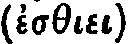
"eats" says
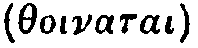
"banquets on."'
this
This is not particularly observed. On the very first page
of
P. L.
we have a line with the final y twice sounded before a vowel,
Invoke thy aid to my adventurous song.
Again a few lines later,
That to the height of this great argument
I may assert Eternal Providence.
Ten lines farther we read of the Serpent
Stirr'd up with envy and revenge.
We have only an apparent elision of y a few lines later in his aspiring
To set himself in glory above his peers,
for the line would be ruined were the y to be omitted by a reader. The
extreme shortness of the two unaccented syllables, y and a, gives them
the quantity of one in the metre, and allows by the turn of voice a
suggestion of exuberance, heightening the force of the word glory. Three
lines lower Milton has no elision of the y before a vowel in the line,
Against the throne and monarchy of God.
Nor eight lines after that in the words 'day and night.' There is elision
of y in the line,
That were an ignominy and shame beneath
This downfall.
But none a few lines lower down in
Sole reigning holds the tyranny of heaven.
When the y stands by itself, unaccented, immediately after an accented
syllable, and precedes a vowel that is part of another unaccented
syllable standing immediately before an accented one, Milton accepts the
consequence, and does not attempt to give it the force of a distinct
syllable. But Addison's vague notion that it was Milton's custom to cut
off the final y when it precedes a vowel, and that for the sake of being
uncommon, came of inaccurate observation. For the reasons just given,
the y of the word glory runs into the succeeding syllable, and most
assuredly is not cut off, when we read of
the excess
Of Glory obscured: as when the sun, new ris'n,
Looks through the horizontal misty air,
but the y in ' misty ' stands as a full syllable because the word air is
accented. So again in
Death as oft accused
Of tardy execution, since denounc'd
The day of his offence.
The y of ' tardy' is a syllable because the vowel following it is
accented; the y also of ' day' remains, because, although an unaccented
vowel follows, it is itself part of an accented syllable.
Contents
Contents, p.3
|
Monday, January 28, 1712 |
Steele |
Nomina Honesta prætenduntur vitiis.
Tacit.
York, Jan. 18, 1712.
Mr. Spectator,
I pretend not to inform a Gentleman of so just a Taste, whenever he
pleases to use it; but it may not be amiss to inform your Readers,
that there is a false Delicacy as well as a true one. True Delicacy,
as I take it, consists in Exactness of Judgment and Dignity of
Sentiment, or if you will, Purity of Affection, as this is opposed to
Corruption and Grossness. There are Pedants in Breeding as well as in
Learning. The Eye that cannot bear the Light is not delicate but sore.
A good Constitution appears in the Soundness and Vigour of the Parts,
not in the Squeamishness of the Stomach; And a false Delicacy is
Affectation, not Politeness. What then can be the Standard of Delicacy
but Truth and Virtue? Virtue, which, as the Satyrist long since
observed, is real Honour; whereas the other Distinctions among Mankind
are meerly titular. Judging by that Rule, in my Opinion, and in that
of many of your virtuous Female Readers, you are so far from deserving
Mr. Courtly's Accusation, that you seem too gentle, and to allow too
many Excuses for an enormous Crime, which is the Reproach of the Age,
and is in all its Branches and Degrees expresly forbidden by that
Religion we pretend to profess; and whose Laws, in a Nation that calls
it self Christian, one would think should take Place of those Rules
which Men of corrupt Minds, and those of weak Understandings follow. I
know not any thing more pernicious to good Manners, than the giving
fair Names to foul Actions; for this confounds Vice and Virtue, and
takes off that natural Horrour we have to Evil. An innocent Creature,
who would start at the Name of Strumpet, may think it pretty to be
called a Mistress, especially if her Seducer has taken care to inform
her, that a Union of Hearts is the principal Matter in the Sight of
Heaven, and that the Business at Church is a meer idle Ceremony. Who
knows not that the Difference between obscene and modest Words
expressing the same Action, consists only in the accessary Idea, for
there is nothing immodest in Letters and Syllables. Fornication and
Adultery are modest Words: because they express an Evil Action as
criminal, and so as to excite Horrour and Aversion: Whereas Words
representing the Pleasure rather than the Sin, are for this Reason
indecent and dishonest. Your Papers would be chargeable with something
worse than Indelicacy, they would be Immoral, did you treat the
detestable Sins of Uncleanness in the same manner as you rally an
impertinent Self-love and an artful Glance; as those Laws would be
very unjust, that should chastise Murder and Petty Larceny with the
same Punishment. Even Delicacy requires that the Pity shewn to
distressed indigent Wickedness, first betrayed into, and then expelled
the Harbours of the Brothel, should be changed to Detestation, when we
consider pampered Vice in the Habitations of the Wealthy. The most
free Person of Quality, in Mr. Courtly's Phrase, that is, to speak
properly, a Woman of Figure who has forgot her Birth and Breeding,
dishonoured her Relations and her self, abandoned her Virtue and
Reputation, together with the natural Modesty of her Sex, and risqued
her very Soul, is so far from deserving to be treated with no worse
Character than that of a kind Woman, (which is doubtless Mr. Courtly's
Meaning, if he has any,) that one can scarce be too severe on her, in
as much as she sins against greater Restraints, is less exposed, and
liable to fewer Temptations, than Beauty in Poverty and Distress. It
is hoped therefore, Sir, that you will not lay aside your generous
Design of exposing that monstrous Wickedness of the Town, whereby a
Multitude of Innocents are sacrificed in a more barbarous Manner than
those who were offered to Moloch. The Unchaste are provoked to see
their Vice exposed, and the Chaste cannot rake into such Filth without
Danger of Defilement; but a meer
Spectator may look into the Bottom,
and come off without partaking in the Guilt. The doing so will
convince us you pursue publick Good, and not meerly your own
Advantage: But if your Zeal slackens, how can one help thinking that
Mr. Courtly's Letter is but a Feint to get off from a Subject, in
which either your own, or the private and base Ends of others to whom
you are partial, or those
of whom you are afraid, would not endure a
Reformation?
I am, Sir, your humble Servant and Admirer, so long as you tread in
the Paths of Truth, Virtue, and Honour.
Mr.
Spectator,
Trin. Coll. Cantab. Jan. 12, 1711-12.
It is my Fortune to have a Chamber-Fellow, with whom, tho' I agree
very well in many Sentiments, yet there is one in which we are as
contrary as Light and Darkness. We are both in Love: his Mistress is a
lovely Fair, and mine a lovely Brown. Now as the Praise of our
Mistresses Beauty employs much of our Time, we have frequent Quarrels
in entering upon that Subject, while each says all he can to defend
his Choice. For my own part, I have racked my Fancy to the utmost; and
sometimes, with the greatest Warmth of Imagination, have told him,
That Night was made before Day, and many more fine Things, tho'
without any effect: Nay, last Night I could not forbear saying with
more Heat than Judgment, that the Devil ought to be painted white. Now
my Desire is, Sir, that you would be pleased to give us in Black and
White your Opinion in the Matter of Dispute between us; which will
either furnish me with fresh and prevailing Arguments to maintain my
own Taste, or make me with less Repining allow that of my
Chamber-Fellow. I
know very well that I have Jack Cleveland
1 and
Bond's Horace on my Side; but then he has such a Band of Rhymers and
Romance-Writers, with which he opposes me, and is so continually
chiming to the Tune of Golden Tresses, yellow Locks, Milk, Marble,
Ivory, Silver, Swan, Snow, Daisies, Doves, and the Lord knows what;
which he is always sounding with so much Vehemence in my Ears, that he
often puts me into a brown Study how to answer him; and I find that I
am in a fair Way to be quite confounded, without your timely
Assistance afforded to,
Sir,
Your humble Servant,
Philobrune.
T.
Cleveland celebrates brown beauties in his poem of 'the
Senses Festival.' John Bond, who published Commentaries on Horace and
Persius, Antony à Wood calls 'a polite and rare critic whose labours
have advanced the Commonwealth of Learning very much.'
Z.
Contents
Contents, p.3
|
Tuesday, January 29, 1712 |
Addison |
I look upon it as a peculiar Happiness, that were I to choose of what
Religion I would be, and under what Government I would live, I should
most certainly give the Preference to that Form of Religion and
Government which is established in my own Country. In this Point I think
I am determined by Reason and Conviction; but if I shall be told that I
am acted by Prejudice, I am sure it is an honest Prejudice, it is a
Prejudice that arises from the Love of my Country, and therefore such an
one as I will always indulge. I have in several Papers endeavoured to
express my Duty and Esteem for the Church of England, and design this as
an Essay upon the Civil Part of our Constitution, having often
entertained my self with Reflections on this Subject, which I have not
met with in other Writers.
That Form of Government appears to me the most reasonable, which is most
conformable to the Equality that we find in human Nature, provided it be
consistent with publick Peace and Tranquillity. This is what may
properly be called Liberty, which exempts one Man from Subjection to
another so far as the Order and Œconomy of Government will permit.
Liberty should reach every Individual of a People, as they all share one
common Nature; if it only spreads among particular Branches, there had
better be none at all, since such a Liberty only aggravates the
Misfortune of those who are depriv'd of it, by setting before them a
disagreeable Subject of Comparison. This Liberty is best preserved,
where the Legislative Power is lodged in several Persons, especially if
those Persons are of different Ranks and Interests; for where they are
of the same Rank, and consequently have an Interest to manage peculiar
to that Rank, it differs but little from a Despotical Government in a
single Person. But the greatest Security a People can have for their
Liberty, is when the Legislative Power is in the Hands of Persons so
happily distinguished, that by providing for the particular Interests of
their several Ranks, they are providing for the whole Body of the
People; or in other Words, when there is no Part of the People that has
not a common Interest with at least one Part of the Legislators.
If there be but one Body of Legislators, it is no better than a Tyranny;
if there are only two, there will want a casting Voice, and one of them
must at length be swallowed up by Disputes and Contentions that will
necessarily arise between them. Four would have the same Inconvenience
as two, and a greater Number would cause too much Confusion. I could
never read a Passage in Polybius, and another in Cicero, to this
Purpose, without a secret Pleasure in applying it to the English
Constitution, which it suits much better than the Roman. Both these
great Authors give the Pre-eminence to a mixt Government, consisting of
three Branches, the Regal, the Noble, and the Popular. They had
doubtless in their Thoughts the Constitution of the Roman Commonwealth,
in which the Consul represented the King, the Senate the Nobles, and the
Tribunes the People. This Division of the three Powers in the Roman
Constitution was by no means so distinct and natural, as it is in the
English Form of Government. Among several Objections that might be made
to it, I think the Chief are those that affect the Consular Power, which
had only the Ornaments without the Force of the Regal Authority. Their
Number had not a casting Voice in it; for which Reason, if one did not
chance to be employed Abroad, while the other sat at Home, the Publick
Business was sometimes at a Stand, while the Consuls pulled two
different Ways in it. Besides, I do not find that the Consuls had ever a
Negative Voice in the passing of a Law, or Decree of Senate, so that
indeed they were rather the chief Body of the Nobility, or the first
Ministers of State, than a distinct Branch of the Sovereignty, in which
none can be looked upon as a Part, who are not a Part of the
Legislature. Had the Consuls been invested with the Regal Authority to
as great a Degree as our Monarchs, there would never have been any
Occasions for a Dictatorship, which had in it the Power of all the three
Orders, and ended in the Subversion of the whole Constitution.
Such an History as that of Suelonius, which gives us a Succession of
Absolute Princes, is to me an unanswerable Argument against Despotick
Power. Where the Prince is a Man of Wisdom and Virtue, it is indeed
happy for his People that he is absolute; but since in the common Run of
Mankind, for one that is Wise and Good you find ten of a contrary
Character, it is very dangerous for a Nation to stand to its Chance, or
to have its publick Happiness or Misery depend on the Virtues or Vices
of a single Person.
into the
History
I have mentioned, or
into any Series of Absolute Princes, how many Tyrants must you read
through, before you come to an Emperor that is supportable. But this is
not all; an honest private Man often grows cruel and abandoned, when
converted into an absolute Prince. Give a Man Power of doing what he
pleases with Impunity, you extinguish his Fear, and consequently
overturn in him one of the great Pillars of Morality. This too we find
confirmed by Matter of Fact. How many hopeful Heirs apparent to grand
Empires, when in the Possession of them, have become such Monsters of
Lust and Cruelty as are a Reproach to Human Nature.
Some tell us we ought to make our Governments on Earth like that in
Heaven, which, say they, is altogether Monarchical and Unlimited. Was
Man like his Creator in Goodness and Justice, I should be for following
this great Model; but where Goodness and Justice are not essential to
the Ruler, I would by no means put myself into his Hands to be disposed
of according to his particular Will and Pleasure.
It is odd to consider the Connection between Despotic Government and
Barbarity, and how the making of one Person more than Man, makes the
rest less. About nine Parts of the World in ten are in the lowest State
of Slavery, and consequently sunk into the most gross and brutal
Ignorance. European Slavery is indeed a State of Liberty, if compared
with that which prevails in the other three Divisions of the World; and
therefore it is no Wonder that those who grovel under it have many
Tracks of Light among them, of which the others are wholly destitute.
Riches and Plenty are the natural Fruits of Liberty, and where these
abound, Learning and all the Liberal Arts will immediately lift up their
Heads and flourish.
a Man must have no slavish Fears and
Apprehensions hanging upon his Mind,
who
will indulge the Flights
of Fancy or Speculation, and push his Researches into all the abstruse
Corners of Truth, so it is necessary for him to have about him a
Competency of all the Conveniencies of Life.
The first thing every one looks after, is to provide himself with
Necessaries. This Point will engross our Thoughts 'till it be satisfied.
If this is taken care of to our Hands, we look out for Pleasures and
Amusements; and among a great Number of idle People, there will be many
whose Pleasures will lie in Reading and Contemplation. These are the two
great Sources of Knowledge, and as Men grow wise they naturally love to
communicate their Discoveries; and others seeing the Happiness of such a
Learned Life, and improving by their Conversation, emulate, imitate, and
surpass one another, till a Nation is filled with Races of wise and
understanding Persons. Ease and Plenty are therefore the great
Cherishers of Knowledge: and as most of the Despotick Governments of the
World have neither of them, they are naturally over-run with Ignorance
and Barbarity. In Europe, indeed, notwithstanding several of its Princes
are absolute, there are Men famous for Knowledge and Learning; but the
Reason is because the Subjects are many of them rich and wealthy, the
Prince not thinking fit to exert himself in his full Tyranny like the
Princes of the Eastern Nations, lest his Subjects should be invited to
new-mould their Constitution, having so many Prospects of Liberty within
their View. But in all Despotic Governments, tho' a particular Prince
may favour Arts and Letters, there is a natural Degeneracy of Mankind,
as you may observe from Augustus's Reign, how the Romans lost themselves
by Degrees till they fell to an Equality with the most barbarous Nations
that surrounded them. Look upon Greece under its free States, and you
would think its Inhabitants lived in different Climates, and under
different Heavens, from those at present; so different are the Genius's
which are formed under Turkish Slavery and Grecian Liberty.
Besides Poverty and Want, there are other Reasons that debase the Minds
of Men, who live under Slavery, though I look on this as the Principal.
This natural Tendency of Despotic Power to Ignorance and Barbarity, tho'
not insisted upon by others, is, I think, an unanswerable Argument
against that Form of Government, as it shews how repugnant it is to the
Good of Mankind, and the Perfection of human Nature, which ought to be
the great Ends of all Civil Institutions.
L.
Historian
that
Contents
Contents, p.3
|
Wednesday, January 30, 1712 |
Steele |
—Pavor est utrique molestus.
Hor.
Mr. Spectator,
'When you spoke of the Jilts and Coquets, you then promised to be very
impartial, and not to spare even your own Sex, should any of their
secret or open Faults come under your Cognizance; which has given me
Encouragement to describe a certain Species of Mankind under the
Denomination of Male Jilts. They are Gentlemen who do not design to
marry, yet, that they may appear to have some Sense of Gallantry,
think they must pay their Devoirs to one particular Fair; in order to
which they single out from amongst the Herd of Females her to whom
they design to make their fruitless Addresses. This done, they first
take every Opportunity of being in her Company, and then never fail
upon all Occasions to be particular to her, laying themselves at her
Feet, protesting the Reality of their Passion with a thousand Oaths,
solliciting a Return, and saying as many fine Things as their Stock of
Wit will allow; and if they are not deficient that way, generally
speak so as to admit of a double Interpretation; which the credulous
Fair is apt to turn to her own Advantage, since it frequently happens
to be a raw, innocent, young Creature, who thinks all the World as
sincere as her self, and so her unwary Heart becomes an easy Prey to
those deceitful Monsters, who no sooner perceive it, but immediately
they grow cool, and shun her whom they before seemed so much to
admire, and proceed to act the same common-place Villany towards
another. A Coxcomb flushed with many of these infamous Victories shall
say he is sorry for the poor Fools, protest and vow he never thought
of Matrimony, and wonder talking civilly can be so strangely
misinterpreted. Now, Mr. Spectator, you that are a professed Friend to
Love, will, I hope, observe upon those who abuse that noble Passion,
and raise it in innocent Minds by a deceitful Affectation of it, after
which they desert the Enamoured. Pray bestow a little of your Counsel
to those fond believing Females who already have or are in Danger of
broken Hearts; in which you will oblige a great Part of this Town, but
in a particular Manner,
Sir Your (yet Heart-whole) Admirer,
and devoted humble Servant,
Melainia.
Melainie's Complaint is occasioned by so general a Folly, that it is
wonderful one could so long overlook it. But this false Gallantry
proceeds from an Impotence of Mind, which makes those who are guilty of
it incapable of pursuing what they themselves approve. Many a Man wishes
a Woman his Wife whom he dares not take for such. Tho' no one has Power
over his Inclinations or Fortunes, he is a Slave to common Fame. For
this Reason I think Melainia gives them too soft a Name in that of Male
Coquets. I know not why Irresolution of Mind should not be more
contemptible than Impotence of Body; and these frivolous Admirers would
be but tenderly used, in being only included in the same Term with the
Insufficient another Way. They whom my Correspondent calls Male Coquets,
shall hereafter be called Fribblers. A Fribbler is one who professes
Rapture and Admiration for the Woman to whom he addresses, and dreads
nothing so much as her Consent. His Heart can flutter by the Force of
Imagination, but cannot fix from the Force of Judgment. It is not
uncommon for the Parents of young Women of moderate Fortune to wink at
the Addresses of Fribblers, and expose their Children to the ambiguous
Behaviour which Melainia complains of, till by the Fondness to one they
are to lose, they become incapable of Love towards others, and by
Consequence in their future Marriage lead a joyless or a miserable Life.
As therefore I shall in the Speculations which regard Love be as severe
as I ought on Jilts and Libertine Women, so will I be as little merciful
to insignificant and mischievous Men. In order to this, all Visitants
who frequent Families wherein there are young Females, are forthwith
required to declare themselves, or absent from Places where their
Presence banishes such as would pass their Time more to the Advantage of
those whom they visit. It is a Matter of too great Moment to be dallied
with; and I shall expect from all my young People a satisfactory Account
of Appearances. Strephon has from the Publication hereof seven Days to
explain the Riddle he presented to Eudamia; and Chloris an Hour after
this comes to her Hand, to declare whether she will have Philotas, whom
a Woman of no less Merit than her self, and of superior Fortune,
languishes to call her own.
To the
Spectator.
Sir1,
'Since so many Dealers turn Authors, and write quaint Advertisements
in praise of their Wares, one who from an Author turn'd Dealer may be
allowed for the Advancement of Trade to turn Author again. I will not
however set up like some of 'em, for selling cheaper than the most
able honest Tradesman can; nor do I send this to be better known for
Choice and Cheapness of China and Japan Wares, Tea, Fans, Muslins,
Pictures, Arrack, and other Indian Goods. Placed as I am in
Leadenhall-street, near the India-Company, and the Centre of that
Trade, Thanks to my fair Customers, my Warehouse is graced as well as
the Benefit Days of my Plays and Operas; and the foreign Goods I sell
seem no less acceptable than the foreign Books I translated, Rabelais
and Don Quixote: This the Criticks allow me, and while they like my
Wares they may dispraise my Writing. But as 'tis not so well known yet
that I frequently cross the Seas of late, and speaking Dutch and
French, besides other Languages, I have the Conveniency of buying and
importing rich Brocades, Dutch Atlasses, with Gold and Silver, or
without, and other foreign Silks of the newest Modes and best
Fabricks, fine Flanders Lace, Linnens, and Pictures, at the best Hand:
This my new way of Trade I have fallen into I cannot better publish
than by an Application to you. My Wares are fit only for such as your
Readers; and I would beg of you to print this Address in your Paper,
that those whose Minds you adorn may take the Ornaments for their
Persons and Houses from me. This, Sir, if I may presume to beg it,
will be the greater Favour, as I have lately received rich Silks and
fine Lace to a considerable Value, which will be sold cheap for a
quick Return, and as I have also a large Stock of other Goods. Indian
Silks were formerly a great Branch of our Trade; and since we must not
sell 'em, we must seek Amends by dealing in others. This I hope will
plead for one who would lessen the Number of Teazers of the Muses, and
who, suiting his Spirit to his Circumstances, humbles the Poet to
exalt the Citizen. Like a true Tradesman, I hardly ever look into any
Books but those of Accompts. To say the Truth, I cannot, I think, give
you a better Idea of my being a downright Man of Traffick, than by
acknowledging I oftener read the Advertisements, than the Matter of
even your Paper. I am under a great Temptation to take this
Opportunity of admonishing other Writers to follow my Example, and
trouble the Town no more; but as it is my present Business to increase
the Number of Buyers rather than Sellers, I hasten to tell you that I
am,
Sir, Your most humble,
and most obedient Servant,
Peter Motteux.
T.
Peter Anthony Motteux, the writer of this letter, was born
in Normandy, and came as a refugee to England at the Revocation of the
Edict of Nantes. Here he wrote about 14 plays, translated Bayle's
Dictionary, Montaigne's Essays, and Don Quixote, and established himself
also as a trader in Leadenhall Street. He had a wife and a fine young
family when (at the age of 56, and six years after the date of this
letter) he was found dead in a house of ill fame near Temple Bar under
circumstances that caused a reward of fifty pounds to be offered for the
discovery of his murderer.
Contents
Contents, p.4
|
Thursday, January 31, 1712 |
Addison |
Vitæ summa brevis spem nos vetat inchoare longam.
Hor.
Upon taking my Seat in a Coffee-house I often draw the Eyes of the whole
Room upon me, when in the hottest Seasons of News, and at a time that
perhaps the Dutch Mail is just come in, they hear me ask the Coffee-man
for his last Week's Bill of Mortality: I find that I have been sometimes
taken on this occasion for a Parish Sexton, sometimes for an Undertaker,
and sometimes for a Doctor of Physick. In this, however, I am guided by
the Spirit of a Philosopher, as I take occasion from hence to reflect
upon the regular Encrease and Diminution of Mankind, and consider the
several various Ways through which we pass from Life to Eternity. I am
very well pleased with these Weekly Admonitions, that bring into my Mind
such Thoughts as ought to be the daily Entertainment of every reasonable
Creature; and can consider, with Pleasure to my self, by which of those
Deliverances, or, as we commonly call them, Distempers, I may possibly
make my Escape out of this World of Sorrows, into that Condition of
Existence, wherein I hope to be Happier than it is possible for me at
present to conceive.
But this is not all the Use I make of the above-mentioned Weekly Paper.
Bill of Mortality
is in my Opinion an unanswerable Argument for a
Providence. How can we, without supposing our selves under the constant
Care of a Supreme Being, give any possible Account for that nice
Proportion, which we find in every great City, between the Deaths and
Births of its Inhabitants, and between the Number of Males and that of
Females, who are brought into the World? What else could adjust in so
exact a manner the Recruits of every Nation to its Losses, and divide
these new Supplies of People into such equal Bodies of both Sexes?
Chance could never hold the Balance with so steady a Hand. Were we not
counted out by an intelligent Supervisor, we should sometimes be
over-charged with Multitudes, and at others waste away into a Desart: We
should be sometimes a
populus virorum
, as Florus elegantly expresses it,
a Generation of Males, and at others a Species of Women. We may extend
this Consideration to every Species of living Creatures, and consider
the whole animal World as an huge Army made up of innumerable Corps, if
I may use that Term, whose Quotas have been kept entire near five
thousand Years, in so wonderful a manner, that there is not probably a
single Species lost during this long Tract of Time. Could we have
general Bills of Mortality of every kind of Animal, or particular ones
of every Species in each Continent and Island, I could almost say in
every Wood, Marsh or Mountain, what astonishing Instances would they be
of that Providence which watches over all its Works?
I have heard of a great Man in the Romish Church, who upon reading those
Words in the Vth Chapter of Genesis, And all the Days that Adam lived
were nine hundred and thirty Years, and he died; and all the Days of
Seth were nine hundred and twelve Years, and he died; and all the Days
of Methuselah were nine hundred and sixty nine Years, and he died;
immediately shut himself up in a Convent, and retired from the World, as
not thinking any thing in this Life worth pursuing, which had not regard
to another.
The Truth of it is, there is nothing in History which is so improving to
the Reader, as those Accounts which we meet with of the Deaths of
eminent Persons, and of their Behaviour in that dreadful Season. I may
also add, that there are no Parts in History which affect and please the
Reader in so sensible a manner. The Reason I take to be this, because
there is no other single Circumstance in the Story of any Person, which
can possibly be the Case of every one who reads it. A Battle or a
Triumph are Conjunctures in which not one Man in a Million is likely to
be engaged; but when we see a Person at the Point of Death, we cannot
forbear being attentive to every thing he says or does, because we are
sure that some time or other we shall our selves be in the same
melancholy Circumstances. The General, the Statesman, or the
Philosopher, are perhaps Characters which we may never act in; but the
dying Man is one whom, sooner or later, we shall certainly resemble.
It is,
, for the same kind of Reason that few Books,
written
in English, have been so much perused as Dr. Sherlock's Discourse
upon Death; though at the same time I must own, that he who has not
perused this Excellent Piece, has not perhaps read one of the strongest
Persuasives to a Religious Life that ever was written in any Language.
The Consideration, with which I shall close this Essay upon Death, is
one of the most ancient and most beaten Morals that has been recommended
to Mankind. But its being so very common, and so universally received,
though it takes away from it the Grace of Novelty, adds very much to the
Weight of it, as it shews that it falls in with the general Sense of
Mankind. In short, I would have every one consider, that he is in this
Life nothing more than a Passenger, and that he is not to set up his
Rest here, but to keep an attentive Eye upon that State of Being to
which he approaches every Moment, and which will be for ever fixed and
permanent. This single Consideration would be sufficient to extinguish
the Bitterness of Hatred, the Thirst of Avarice, and the Cruelty of
Ambition.
I am very much pleased with the Passage of Antiphanes a very ancient
Poet, who lived near an hundred Years before Socrates, which represents
the Life of Man under this View, as I have here translated it Word for
Word.
not grieved, says he, above measure for thy deceased Friends
. They
are not dead, but have only finished that Journey which it is
necessary for every one of us to take: We ourselves must go to that
great Place of Reception in which they are all of them assembled, and in
this general Rendezvous of Mankind, live together in another State of
Being.
I think I have, in a former Paper, taken notice of those beautiful
Metaphors in Scripture, where Life is termed a Pilgrimage, and those who
pass through it are called Strangers and Sojourners upon Earth. I shall
conclude this with a Story,
I have somewhere read in the Travels
of Sir John Chardin
; that Gentleman after having told us, that the
Inns which receive the Caravans in Persia, and the Eastern Countries,
are called by the Name of Caravansaries, gives us a Relation to the
following Purpose.
A Dervise, travelling through Tartary, being arrived at the Town of
Balk, went into the King's Palace by Mistake, as thinking it to be a
publick Inn or Caravansary. Having looked about him for some time, he
enter'd into a long Gallery, where he laid down his Wallet, and spread
his Carpet, in order to repose himself upon it after the Manner of the
Eastern Nations. He had not been long in this Posture before he was
discovered by some of the Guards, who asked him what was his Business in
that Place? The Dervise told them he intended to take up his Night's
Lodging in that Caravansary. The Guards let him know, in a very angry
manner, that the House he was in was not a Caravansary, but the King's
Palace. It happened that the King himself passed through the Gallery
during this Debate, and smiling at the Mistake of the Dervise, asked him
how he could possibly be so dull as not to distinguish a Palace from a
Caravansary? Sir, says the Dervise, give me leave to ask your Majesty a
Question or two. Who were the Persons that lodged in this House when it
was first built? The King replied, His Ancestors. And who, says the
Dervise, was the last Person that lodged here? The King replied, His
Father. And who is it, says the Dervise, that lodges here at present?
The King told him, that it was he himself. And who, says the Dervise,
will be here after you? The King answered, The young Prince his Son. 'Ah
Sir, said the Dervise, a House that changes its Inhabitants so often,
and receives such a perpetual Succession of Guests, is not a Palace but
a Caravansary."
L.
Bills of Mortality, containing the weekly number of
Christenings and Deaths, with the cause of Death, were first compiled by
the London Company of Parish Clerks (for 109 parishes) after the Plague
in 1592. They did not give the age at death till 1728.
which have been written
; for they
Sir John Chardin was a jeweller's son, born at Paris, who
came to England and was knighted by Charles II. He travelled into Persia
and the East Indies, and his account of his voyages was translated into
English, German, and Flemish. He was living when this paper appeared,
but died in the following year, at the age of 70.
Contents
Contents, p.4
|
Friday, February 1, 1712 |
Steele |
Projicit ampullas et sesquipedalia verba.
Hor.1
The Players, who know I am very much their Friend, take all
Opportunities to express a Gratitude to me for being so. They could not
have a better Occasion of Obliging me, than one which they lately took
hold of.
desired my Friend
Will. Honeycomb
to bring me to the
Reading of a new Tragedy; it is called The distressed Mother
. I must
confess, tho' some Days are passed since I enjoyed that Entertainment,
the Passions of the several Characters dwell strongly upon my
Imagination; and I congratulate to the Age, that they are at last to see
Truth and humane Life represented in the Incidents which concern Heroes
and Heroines. The Stile of the Play is such as becomes those of the
first Education, and the Sentiments worthy those of the highest Figure.
It was a most exquisite Pleasure to me, to observe real Tears drop from
the Eyes of those who had long made it their Profession to dissemble
Affliction; and the Player, who read, frequently throw down the Book,
till he had given vent to the Humanity which rose in him at some
irresistible Touches of the imagined Sorrow. We have seldom had any
Female Distress on the Stage, which did not, upon cool Examination,
appear to flow from the Weakness rather than the Misfortune of the
Person represented: But in this Tragedy you are not entertained with the
ungoverned Passions of such as are enamoured of each other merely as
they are Men and Women, but their Regards are founded upon high
Conceptions of each other's Virtue and Merit; and the Character which
gives Name to the Play, is one who has behaved her self with heroic
Virtue in the most important Circumstances of a Female Life, those of a
Wife, a Widow, and a Mother. If there be those whose Minds have been too
attentive upon the Affairs of Life, to have any Notion of the Passion of
Love in such Extremes as are known only to particular Tempers, yet, in
the above-mentioned Considerations, the Sorrow of the Heroine will move
even the Generality of Mankind. Domestick Virtues concern all the World,
and there is no one living who is not interested that Andromache should
be an imitable Character. The generous Affection to the Memory of her
deceased Husband, that tender Care for her Son, which is ever heightned
with the Consideration of his Father, and these Regards preserved in
spite of being tempted with the Possession of the highest Greatness, are
what cannot but be venerable even to such an Audience as at present
frequents the English Theatre. My Friend
Will Honeycomb
commended
several tender things that were said, and told me they were very
genteel; but whisper'd me, that he feared the Piece was not busy enough
for the present Taste. To supply this, he recommended to the Players to
be very careful in their Scenes, and above all Things, that every Part
should be perfectly new dressed. I was very glad to find that they did
not neglect my Friend's Admonition, because there are a great many in
his Class of Criticism who may be gained by it; but indeed the Truth is,
that as to the Work it self, it is every where Nature. The Persons are
of the highest Quality in Life, even that of Princes; but their Quality
is not represented by the Poet with Direction that Guards and Waiters
should follow them in every Scene, but their Grandeur appears in
Greatness of Sentiment
s
, flowing from Minds worthy their Condition.
To make a Character truly Great, this Author understands that it should
have its Foundation in superior Thoughts and Maxims of Conduct. It is
very certain, that many an honest Woman would make no Difficulty, tho'
she had been the Wife of Hector, for the sake of a Kingdom, to marry the
Enemy of her Husband's Family and Country; and indeed who can deny but
she might be still an honest Woman, but no Heroine? That may be
defensible, nay laudable in one Character, which would be in the highest
Degree exceptionable in another. When Cato Uticensis killed himself,
Cottius a Roman of ordinary Quality and Character did the same thing;
upon which one said, smiling, 'Cottius might have lived, tho' Cæsar has
seized the Roman Liberty.' Cottius's Condition might have been the
same, let things at the upper End of the World pass as they would. What
is further very extraordinary in this Work, is, that the Persons are all
of them laudable, and their Misfortunes arise rather from unguarded
Virtue than Propensity to Vice. The Town has an Opportunity of doing
itself Justice in supporting the Representation of Passion, Sorrow,
Indignation, even Despair itself, within the Rules of Decency, Honour
and Good-breeding; and since there is no one can flatter himself his
Life will be always fortunate, they may here see Sorrow as they would
wish to bear it whenever it arrives.
Mr. Spectator,
I am appointed to act a Part in the new Tragedy called The Distressed
Mother: It is the celebrated Grief of Orestes which I am to personate;
but I shall not act it as I ought, for I shall feel it too intimately
to be able to utter it. I was last Night repeating a Paragraph to my
self, which I took to be an Expression of Rage, and in the middle of
the Sentence there was a Stroke of Self-pity which quite unmanned me.
Be pleased, Sir, to print this Letter, that when I am oppressed in
this manner at such an Interval, a certain Part of the Audience may
not think I am out; and I hope with this Allowance to do it to
Satisfaction. I am, Sir,
Your most humble Servant,
George Powell.
Mr. Spectator,
'As I was walking t'other Day in the Park, I saw a Gentleman with a
very short Face; I desire to know whether it was you. Pray inform me
as soon as you can, lest I become the most heroick Hecatissa's Rival.
Your humble Servant to command,
Sophia.
Dear Madam,
It is not me you are in love with, for I was very ill and kept my
Chamber all that Day.
Your most humble Servant,
The
Spectator
.
T.
Spirat Tragicum satis, et fœliciter Audet.
Hor.
This is a third blast of the Trumpet on behalf of Ambrose
Philips, who had now been adapting Racine's
Andromaque
.
Contents
Contents, p.4
|
Saturday, February 2, 1712 |
Addison |
Ubi plura nitent in carmine, non ego paucis
Offendor maculis, quas aut Incuria fudit,
Aut Humana parum cavit Natura.
Hor.
I have now considered Milton's
Paradise Lost
under those four great
Heads of the Fable, the Characters, the Sentiments, and the Language;
and have shewn that he excels, in general, under each of these Heads. I
hope that I have made several Discoveries which may appear new, even to
those who are versed in Critical Learning. Were I indeed to chuse my
Readers, by whose Judgment I would stand or fall, they should not be
such as are acquainted only with the French and Italian Criticks, but
also with the Ancient and Moderns who have written in either of the
learned Languages. Above all, I would have them well versed in the Greek
and Latin Poets, without which a Man very often fancies that he
understands a Critick, when in Reality he does not comprehend his
Meaning.
It is in Criticism, as in all other Sciences and Speculations; one who
brings with him any implicit Notions and Observations which he has made
in his reading of the Poets, will find his own Reflections methodized
and explained, and perhaps several little Hints that had passed in his
Mind, perfected and improved in the Works of a good Critick; whereas one
who has not these previous Lights is very often an utter Stranger to
what he reads, and apt to put a wrong Interpretation upon it.
Nor is it sufficient, that a Man who sets up for a Judge in Criticism,
should have perused the Authors above mentioned, unless he has also a
clear and Logical Head. Without this Talent he is perpetually puzzled
and perplexed amidst his own Blunders, mistakes the Sense of those he
would confute, or if he chances to think right, does not know how to
convey his Thoughts to another with Clearness and Perspicuity.
Aristotle, who was the best Critick, was also one of the best Logicians
that ever appeared in the World.
. Lock's
Essay on Human Understanding
would be thought a very odd
Book for a Man to make himself Master of, who would get a Reputation by
Critical Writings; though at the same time it is very certain, that an
Author who has not learned the Art of distinguishing between Words and
Things, and of ranging his Thoughts, and setting them in proper Lights,
whatever Notions he may have, will lose himself in Confusion and
Obscurity. I might further observe, that there is not a Greek or Latin
Critick who has not shewn, even in the Style of his Criticisms, that he
was a Master of all the Elegance and Delicacy of his Native Tongue.
The Truth of it is, there is nothing more absurd, than for a Man to set
up for a Critick, without a good Insight into all the Parts of Learning;
whereas many of those who have endeavoured to signalize themselves by
Works of this Nature among our English Writers, are not only defective
in the above-mentioned Particulars, but plainly discover, by the Phrases
which they make use of, and by their confused way of thinking, that they
are not acquainted with the most common and ordinary Systems of Arts and
Sciences. A
general Rules extracted out of the French Authors
,
with a certain Cant of Words, has sometimes set up an Illiterate heavy
Writer for a most judicious and formidable Critick.
One great Mark, by which you may discover a Critick who has neither
Taste nor Learning, is this, that he seldom ventures to praise any
Passage in an Author which has not been before received and applauded by
the Publick, and that his Criticism turns wholly upon little Faults and
Errors. This part of a Critick is so very easie to succeed in, that we
find every ordinary Reader, upon the publishing of a new Poem, has Wit
and Ill-nature enough to turn several Passages of it into Ridicule, and
very often in the right Place.
Mr. Dryden has very agreeably
remarked in those two celebrated Lines,
Errors, like Straws, upon the Surface flow;
He who would search for Pearls must dive below
3.
A true Critick ought to dwell rather upon Excellencies than
Imperfections, to discover the concealed Beauties of a Writer, and
communicate to the World such things as are worth their Observation. The
most exquisite Words and finest Strokes of an Author are those which
very often appear the most doubtful and exceptionable to a Man who wants
a Relish for polite Learning; and they are these, which a sower
undistinguishing Critick generally attacks with the greatest Violence.
observes, that it is very easie to brand or fix a Mark upon what
he calls
Verbum ardens
, or, as it may be rendered into English, a
glowing bold Expression, and to turn it into Ridicule by a cold
ill-natured Criticism. A little Wit is equally capable of exposing a
Beauty, and of aggravating a Fault; and though such a Treatment of an
Author naturally produces Indignation in the Mind of an understanding
Reader, it has however its Effect among the Generality of those whose
Hands it falls into, the Rabble of Mankind being very apt to think that
every thing which is laughed at with any Mixture of Wit, is ridiculous
in it self.
Such a Mirth as this is always unseasonable in a Critick, as it rather
prejudices the Reader than convinces him, and is capable of making a
Beauty, as well as a Blemish, the Subject of Derision. A Man, who cannot
write with Wit on a proper Subject, is dull and stupid, but one who
shews it in an improper Place, is as impertinent and absurd. Besides, a
Man who has the Gift of Ridicule is apt to find Fault with any thing
that gives him an Opportunity of exerting his beloved Talent, and very
often censures a Passage, not because there is any Fault in it, but
because he can be merry upon it. Such kinds of Pleasantry are very
unfair and disingenuous in Works of Criticism, in which the greatest
Masters, both Ancient and Modern, have always appeared with a serious
and instructive Air.
As I intend in my next Paper to shew the Defects in Milton's
Paradise
Lost
, I thought fit to premise these few Particulars, to the End that
the Reader may know I enter upon it, as on a very ungrateful Work, and
that I shall just point at the Imperfections, without endeavouring to
enflame them with Ridicule. I
also observe with Longinus
, that
the Productions of a great Genius, with many Lapses and Inadvertencies,
are infinitely preferable to the Works of an inferior kind of Author,
which are scrupulously exact and conformable to all the Rules of correct
Writing.
I
conclude my Paper with a Story out of Boccalini
which
sufficiently shews us the Opinion that judicious Author entertained of
the sort of Criticks I have been here mentioning. A famous Critick, says
he, having gathered together all the Faults of an eminent Poet, made a
Present of them to Apollo, who received them very graciously, and
resolved to make the Author a suitable Return for the Trouble he had
been at in collecting them. In order to this, he set before him a Sack
of Wheat, as it had been just threshed out of the Sheaf. He then bid him
pick out the Chaff from among the Corn, and lay it aside by it self.
Critick applied himself to the Task with great Industry and Pleasure,
and after having made the due Separation, was presented by Apollo with
the Chaff for his Pains
.
L.
First published in 1690.
Dryden accounted among critics 'the greatest of his age' to
be Boilean and Rapin. Boileau was the great master of French criticism.
René Rapin, born at Tours in 1621, taught Belles Lettres with
extraordinary success among his own order of Jesuits, wrote famous
critical works, was one of the best Latin poets of his time, and died at
Paris in 1687. His
Whole Critical Works
were translated by Dr. Basil
Kennett in two volumes, which appeared in 1705. The preface of their
publisher said of Rapin that
'he has long dictated in this part of letters. He is acknowledged as
the great arbitrator between the merits of the best writers; and
during the course of almost thirty years there have been few appeals
from his sentence.'
(See also a note on p. 168, vol. i. [Volume 1 links:
of
]) René le
Bossu, the great French authority on Epic Poetry, born in 1631, was a
regular canon of St. Genevieve, and taught the Humanities in several
religious houses of his order. He died, subprior of the Abbey of St.
Jean de Cartres, in 1680. He wrote, besides his Treatise upon Epic
Poetry, a parallel between the philosophies of Aristotle and Descartes,
which appeared a few months earlier (in 1674) with less success. Another
authority was Father Bouhours, of whom see note on p. 236, vol. i.
[Volume 1 links:
of
. ] Another was Bernard le Bovier de Fontenelle.
called by Voltaire the most universal genius of his age. He was born at
Rouen in 1657, looking so delicate that he was baptized in a hurry, and
at 16 was unequal to the exertion of a game at billiards, being caused
by any unusual exercise to spit blood, though he lived to the age of a
hundred, less one month and two days. He was taught by the Jesuits, went
to the bar to please his father, pleaded a cause, lost it, and gave up
the profession to devote his time wholly to literature and philosophy.
He went to Paris, wrote plays and the 'Dialogues of the Dead,' living
then with his uncle, Thomas Corneille. A discourse on the Eclogue
prefixed to his pastoral poems made him an authority in this manner of
composition. It was translated by Motteux for addition to the English
translation of Bossu on the Epic, which had also appended to it an Essay
on Satire by another of these French critics, André Dacier. Dacier, born
at Castres in 1651, was educated at Saumur under Taneguy le Févre, who
was at the same time making a scholar of his own daughter Anne. Dacier
and the young lady became warmly attached to one another, married,
united in abjuring Protestantism, and were for forty years, in the
happiest concord, man and wife and fellow-scholars. Dacier and his wife,
as well as Fontenelle, were alive when the Spectator was appearing; his
wife dying, aged 69, in 1720, the husband, aged 71, in 1722. André
Dacier translated and annotated the
Poetics
of Aristotle in 1692, and
that critical work was regarded as his best performance.
Annus Mirabilis,
st. 39.
Ad Brutum
. Orator. Towards the beginning:
'Facile est enim verbum aliquod ardens (ut ita dicam) notare, idque
restinctis jam animorum incendiis, irridere.'
On the Sublime
, § 36.
Trajan Boccalini, born at Rome in 1554, was a satirical
writer famous in Italy for his fine criticism and bold satire. Cardinals
Borghese and Cajetan were his patrons. His 'Ragguagli di Parnasso' and
'la Secretaria di Parnasso,' in which Apollo heard the complaints of the
world, and dispensed justice in his court on Parnassus, were received
with delight. Afterwards, in his 'Pietra di Parangone,' he satirized the
Court of Spain, and, fearing consequences, retired to Venice, where in
1613 he was attacked in his bed by four ruffians, who beat him to death
with sand-bags. Boccalini's Ragguagli di Parnasso has been translated
into English, in 1622, as 'News from Parnassus.' Also, in 1656, as
'Advertisements from Parnassus,' by H. Carey, Earl of Monmouth. This
translation was reprinted in 1669 and 1674, and again in 1706 by John
Hughes, one of the contributors to the
Spectator
.
To this number of the
Spectator
, and to several numbers
since that for January 8, in which it first appeared, is added an
advertisement that, The First and Second Volumes of the
Spectator
in 8vo
are now ready to be delivered to the subscribers by J. Tonson, at
Shakespeare's Head, over-against Catherine Street in the Strand.
Contents
Contents, p.4
|
Monday, February 4, 1712 |
Addison |
Illam, quicquid agit, quoquo Vestigia flectit,
Componit furlim, subsequiturque decor.
Tibull. L. 4.
As no one can be said to enjoy Health, who is only not sick, without he
feel within himself a lightsome and invigorating Principle, which will
not suffer him to remain idle, but still spurs him on to Action: so in
the Practice of every Virtue, there is some additional Grace required,
to give a Claim of excelling in this or that particular Action. A
Diamond may want polishing, though the Value be still intrinsically the
same; and the same Good may be done with different Degrees of Lustre. No
man should be contented with himself that he barely does well, but he
should perform every thing in the best and most becoming Manner that he
is able.
Tully tells us he wrote his Book of Offices, because there was no Time
of Life in which some correspondent Duty might not be practised; nor is
there a Duty without a certain Decency accompanying it, by which every
Virtue 'tis join'd to will seem to be doubled. Another may do the same
thing, and yet the Action want that Air and Beauty which distinguish it
from others; like that inimitable Sun-shine Titian is said to have
diffused over his Landschapes; which denotes them his, and has been
always unequalled by any other Person.
There is no one Action in which this Quality I am speaking of will be
more sensibly perceived, than in granting a Request or doing an Office
of Kindness. Mummius, by his Way of consenting to a Benefaction, shall
make it lose its Name; while Carus doubles the Kindness and the
Obligation: From the first the desired Request drops indeed at last, but
from so doubtful a Brow, that the Obliged has almost as much Reason to
resent the Manner of bestowing it, as to be thankful for the Favour it
self. Carus invites with a pleasing Air, to give him an Opportunity of
doing an Act of Humanity, meets the Petition half Way, and consents to a
Request with a Countenance which proclaims the Satisfaction of his Mind
in assisting the Distressed.
The Decency then that is to be observed in Liberality, seems to consist
in its being performed with such Cheerfulness, as may express the
God-like Pleasure is to be met with in obliging one's Fellow-Creatures;
that may shew Good-nature and Benevolence overflowed, and do not, as in
some Men, run upon the Tilt, and taste of the Sediments of a grutching
uncommunicative Disposition.
Since I have intimated that the greatest Decorum is to be preserved in
the bestowing our good Offices, I will illustrate it a little by an
Example drawn from private Life, which carries with it such a Profusion
of Liberality, that it can be exceeded by nothing but the Humanity and
Good-nature which accompanies it.
is a Letter of Pliny's
which I
shall here translate, because the Action will best appear in its first
Dress of Thought, without any foreign or ambitious Ornaments.
Pliny to Quintilian.
Tho I am fully acquainted with the Contentment and just Moderation of
your Mind, and the Conformity the Education you have given your
Daughter bears to your own Character; yet since she is suddenly to be
married to a Person of Distinction, whose Figure in the World makes it
necessary for her to be at a more than ordinary Expence in Cloaths and
Equipage suitable to her Husbands Quality; by which, tho her
intrinsick Worth be not augmented, yet will it receive both Ornament
and Lustre: And knowing your Estate to be as moderate as the Riches of
your Mind are abundant, I must challenge to my self some part of the
Burthen; and as a Parent of your Child. I present her with Twelve
hundred and fifty Crowns towards these Expences; which Sum had been
much larger, had I not feared the Smallness of it would be the
greatest Inducement with you to accept of it. Farewell.
Thus should a Benefaction be done with a good Grace, and shine in the
strongest Point of Light; it should not only answer all the Hopes and
Exigencies of the Receiver, but even out-run his Wishes: 'Tis this happy
manner of Behaviour which adds new Charms to it, and softens those Gifts
of Art and Nature, which otherwise would be rather distasteful than
agreeable. Without it, Valour would degenerate into Brutality, Learning
into Pedantry, and the genteelest Demeanour into Affectation. Even
Religion its self, unless Decency be the Handmaid which waits upon her,
is apt to make People appear guilty of Sourness and ill Humour: But this
shews Virtue in her first original Form, adds a Comeliness to Religion,
and gives its Professors the justest Title to the Beauty of Holiness. A
Man fully instructed in this Art, may assume a thousand Shapes, and
please in all: He may do a thousand Actions shall become none other but
himself; not that the Things themselves are different, but the Manner of
doing them.
If you examine each Feature by its self, Aglaura and Callidea are
equally handsome; but take them in the Whole, and you cannot suffer the
Comparison: Tho one is full of numberless nameless Graces, the other of
as many nameless Faults.
The Comeliness of Person, and Decency of Behaviour, add infinite Weight
to what is pronounced by any one. 'Tis the want of this that often makes
the Rebukes and Advice of old rigid Persons of no Effect, and leave a
Displeasure in the Minds of those they are directed to: But Youth and
Beauty, if accompanied with a graceful and becoming Severity, is of
mighty Force to raise, even in the most Profligate, a Sense of Shame.
Milton, the Devil is never described ashamed but once, and that at the
Rebuke of a beauteous Angel.
So spake the Cherub, and his grave Rebuke,
Severe in youthful Beauty, added Grace
Invincible: Abash'd the Devil stood,
And felt how awful Goodness is, and saw
Virtue in her own Shape ho'w lovely I saw, and pin'd
His Loss
2.
The Care of doing nothing unbecoming has accompanied the greatest Minds
to their last Moments. They avoided even an indecent Posture in the very
Article of Death. Thus Cæsar gathered his Robe about him, that he might
not fall in a manner unbecoming of himself:
the greatest Concern
that appeared in the Behaviour of Lucretia, when she stabbed her self,
was, that her Body should lie in an Attitude worthy the Mind which had
inhabited it.
Ne non procumbat honeste
Extrema hæc etiam cura, cadentis erat
3.
'Twas her last Thought, How decently to fall.
Mr.
Spectator,
I am a young Woman without a Fortune; but of a very high Mind: That
is, Good Sir, I am to the last degree Proud and Vain. I am ever
railing at the Rich, for doing Things, which, upon Search into my
Heart, I find I am only angry because I cannot do the same my self. I
wear the hooped Petticoat, and am all in Callicoes when the finest are
in Silks. It is a dreadful thing to be poor and proud; therefore if
you please, a Lecture on that Subject for the Satisfaction of
Your Uneasy Humble Servant,
JEZEBEL.
Z.
Bk. vi. ep. 32.
Par. L.
, Bk. iv. 11. 844-9.
Ovid.
Fast
., iii. 833.
Contents
Contents, p.4
|
Tuesday, February 5, 1712 |
Addison |
famous Gratian
in his little Book wherein he lays down Maxims
for a Man's advancing himself at Court, advises his Reader to associate
himself with the Fortunate, and to shun the Company of the Unfortunate;
which, notwithstanding the Baseness of the Precept to an honest Mind,
may have something useful in it for those who push their Interest in the
World. It is certain a great Part of what we call good or ill Fortune,
rises out of right or wrong Measures, and Schemes of Life. When I hear a
Man complain of his being unfortunate in all his Undertakings, I
shrewdly suspect him for a very weak Man in his Affairs. In Conformity
with this way of thinking, Cardinal Richelieu used to say, that
Unfortunate and Imprudent were but two Words for the same Thing. As the
Cardinal himself had a great Share both of Prudence and Good-Fortune,
his famous Antagonist, the Count d'Olivarez, was disgraced at the Court
of Madrid, because it was alledged against him that he had never any
Success in his Undertakings. This, says an Eminent Author, was
indirectly accusing him of Imprudence.
Cicero recommended Pompey to the Romans for their General upon three
Accounts, as he was a Man of Courage, Conduct, and Good-Fortune. It was
perhaps, for the Reason above-mentioned, namely, that a Series of
Good-Fortune supposes a prudent Management in the Person whom it
befalls, that not only Sylla the Dictator, but several of the Roman
Emperors, as is still to be seen upon their Medals, among their other
Titles, gave themselves that of Felix or Fortunate. The Heathens,
indeed, seem to have valued a Man more for his Good-Fortune than for any
other Quality, which I think is very natural for those who have not a
strong Belief of another World. For how can I conceive a Man crowned
with many distinguishing Blessings, that has not some extraordinary Fund
of Merit and Perfection in him, which lies open to the Supreme Eye, tho'
perhaps it is not discovered by my Observation? What is the Reason
Homer's and Virgil's Heroes do not form a Resolution, or strike a Blow,
without the Conduct and Direction of some Deity? Doubtless, because the
Poets esteemed it the greatest Honour to be favoured by the Gods, and
thought the best Way of praising a Man was to recount those Favours
which naturally implied an extraordinary Merit in the Person on whom
they descended.
Those who believe a future State of Rewards and Punishments act very
absurdly, if they form their Opinions of a Man's Merit from his
Successes. But certainly, if I thought the whole Circle of our Being was
concluded between our Births and Deaths, I should think a Man's
Good-Fortune the Measure and Standard of his real Merit, since
Providence would have no Opportunity of rewarding his Virtue and
Perfections, but in the present Life. A Virtuous Unbeliever, who lies
under the Pressure of Misfortunes, has reason to cry out, as they say
Brutus did a little before his Death, O Virtue, I have worshipped thee
as a Substantial Good, but I find thou art an empty Name.
But to return to our first Point. Tho' Prudence does undoubtedly in a
great measure produce our good or ill Fortune in the World, it is
certain there are many unforeseen Accidents and Occurrences, which very
often pervert the finest Schemes that can be laid by Human Wisdom. The
Race is not always to the Swift, nor the Battle to the Strong. Nothing
less than infinite Wisdom can have an absolute Command over Fortune; the
highest Degree of it which Man can possess, is by no means equal to
fortuitous Events, and to such Contingencies as may rise in the
Prosecution of our Affairs. Nay, it very often happens, that Prudence,
which has always in it a great Mixture of Caution, hinders a Man from
being so fortunate as he might possibly have been without it. A Person
who only aims at what is likely to succeed, and follows closely the
Dictates of Human Prudence, never meets with those great and unforeseen
Successes, which are often the effect of a Sanguine Temper, or a more
happy Rashness; and this perhaps may be the Reason, that according to
the common Observation, Fortune, like other Females, delights rather in
favouring the young than the old.
Upon the whole, since Man is so short-sighted a Creature, and the
Accidents which may happen to him so various, I cannot but be of Dr.
Tillotson's Opinion in another Case, that were there any Doubt of a
Providence, yet it certainly would be very desirable there should be
such a Being of infinite Wisdom and Goodness, on whose Direction we
might rely in the Conduct of Human Life.
It is a great Presumption to ascribe our Successes to our own
Management, and not to esteem our selves upon any Blessing, rather as it
is the Bounty of Heaven, than the Acquisition of our own Prudence. I am
very well pleased with a Medal which was struck by Queen Elizabeth, a
little after the Defeat of the Invincible Armada, to perpetuate the
Memory of that extraordinary Event. It is well known how the King of
Spain, and others, who were the Enemies of that great Princess, to
derogate from her Glory, ascribed the Ruin of their Fleet rather to the
Violence of Storms and Tempests, than to the Bravery of the English.
Elizabeth, instead of looking upon this as a Diminution of her
Honour, valued herself upon such a signal Favour of Providence, and
accordingly in
the Reverse of the Medal above mentioned,
has
represented
a Fleet beaten by a Tempest, and falling foul upon one
another, with that Religious Inscription,
Afflavit Deus et dissipantur.
He blew with his Wind, and they were scattered.
It
remarked of a famous Grecian General, whose Name I cannot at
present recollect
, and who had been a particular Favourite
of Fortune, that upon recounting his Victories among his Friends, he
added at the End of several great Actions, And in this Fortune had no
Share. After which it is observed in History, that he never prospered in
any thing he undertook.
As Arrogance, and a Conceitedness of our own Abilities, are very
shocking and offensive to Men of Sense and Virtue, we may be sure they
are highly displeasing to that Being who delights in an humble Mind, and
by several of his Dispensations seems purposely to shew us, that our own
Schemes or Prudence have no Share in our Advancement
s
.
Since on this Subject I have already admitted several Quotations which
have occurred to my Memory upon writing this Paper, I will conclude it
with a little Persian Fable. A
of Water fell out of a Cloud into
the Sea, and finding it self lost in such an Immensity of fluid Matter,
broke out into the following Reflection: 'Alas! What an
insignificant
Creature am I in this prodigious Ocean of Waters; my Existence is
of no
Concern
to the Universe, I am reduced to a Kind of
Nothing, and am less then the least of the Works of God.'
so
happened, that an Oyster, which lay in the Neighbourhood of this Drop,
chanced to gape and swallow it up in the midst of this
its
humble
Soliloquy. The Drop, says the Fable, lay a great while hardning in the
Shell, 'till by Degrees it was ripen'd into a Pearl, which falling into
the Hands of a Diver, after a long Series of Adventures, is at present
that famous Pearl which is fixed on the Top of the Persian Diadem.
L.
Balthasar Gracian, a Spanish Jesuit, who died in 1658,
rector of the Jesuits' College of Tarragona, wrote many books in Spanish
on Politics and Society, among others the one here referred to on the
Courtier; which was known to Addison, doubtless, through the French
translation by Amelot de la Houssaye.
Corrected by an
erratum
to
you see in
, but in reprint
altered by the addition of
has represented
.
Timotheus the Athenian.
Altered by an
erratum
to
inconsiderable
to avoid the
repetition 'insignificant,' and insignificancy;' but in the reprint the
second word was changed.
significancy
his
Contents
Contents, p.4
|
Wednesday, February 6, 1712 |
Steele |
Difficile est plurimum virtutem revereri qui semper secunda fortuna
sit usus.
Tull. ad Herennium.
Insolence is the Crime of all others which every Man is most apt to rail
at; and yet is there one Respect in which almost all Men living are
guilty of it, and that is in the Case of laying a greater Value upon the
Gifts of Fortune than we ought. It is here in England come into our very
Language, as a Propriety of Distinction, to say, when we would speak of
Persons to their Advantage, they are People of Condition. There is no
doubt but the proper Use of Riches implies that a Man should exert all
the good Qualities imaginable; and if we mean by a Man of Condition or
Quality, one who, according to the Wealth he is Master of, shews himself
just, beneficent, and charitable, that Term ought very deservedly to be
had in the highest Veneration; but when Wealth is used only as it is the
Support of Pomp and Luxury, to be rich is very far from being a
Recommendation to Honour and Respect. It is indeed the greatest
Insolence imaginable, in a Creature who would feel the Extreams of
Thirst and Hunger, if he did not prevent his Appetites before they call
upon him, to be so forgetful of the common Necessity of Human Nature, as
never to cast an Eye upon the Poor and Needy. The Fellow who escaped
from a Ship which struck upon a Rock in the West, and join'd with the
Country People to destroy his Brother Sailors and make her a Wreck, was
thought a most execrable Creature; but does not every Man who enjoys the
Possession of what he naturally wants, and is unmindful of the
unsupplied Distress of other Men, betray the same Temper of Mind? When a
Man looks about him, and with regard to Riches and Poverty beholds some
drawn in Pomp and Equipage, and they and their very Servants with an Air
of Scorn and Triumph overlooking the Multitude that pass by them; and,
in the same Street, a Creature of the same Make crying out in the Name
of all that is Good and Sacred to behold his Misery, and give him some
Supply against Hunger and Nakedness, who would believe these two Beings
were of the same Species? But so it is, that the Consideration of
Fortune has taken up all our Minds, and, as I have often complained,
Poverty and Riches stand in our Imaginations in the Places of Guilt and
Innocence. But in all Seasons there will be some Instances of Persons
who have Souls too large to be taken with popular Prejudices, and while
the rest of Mankind are contending for Superiority in Power and Wealth,
have their Thoughts bent upon the Necessities of those below them. The
Charity-Schools which have been erected of late Years, are the greatest
Instances of publick Spirit the Age has produced: But indeed when we
consider how long this Sort of Beneficence has been on Foot, it is
rather from the good Management of those Institutions, than from the
Number or Value of the Benefactions to them, that they make so great a
Figure. One would think it impossible, that in the Space of fourteen
Years there should not have been five thousand Pounds bestowed in Gifts
this Way, nor sixteen hundred Children, including Males and Females, put
out to Methods of Industry. It is not allowed me to speak of Luxury and
Folly with the severe Spirit they deserve; I shall only therefore say, I
shall very readily compound with any Lady in a Hoop-Petticoat, if she
gives the Price of one half Yard of the Silk towards Cloathing, Feeding
and Instructing an Innocent helpless Creature of her own Sex in one of
these Schools.
Consciousness of such an Action will give her
Features a nobler Life on this illustrious Day
, than all the Jewels
that can hang in her Hair, or can be clustered at her Bosom. It would be
uncourtly to speak in harsher Words to the Fair, but to Men one may take
a little more Freedom. It is monstrous how a Man can live with so little
Reflection, as to fancy he is not in a Condition very unjust and
disproportioned to the rest of Mankind, while he enjoys Wealth, and
exerts no Benevolence or Bounty to others. As for this particular
Occasion of these Schools, there cannot any offer more worthy a generous
Mind. Would you do an handsome thing without Return? do it for an Infant
that is not sensible of the Obligation: Would you do it for publick
Good? do it for one who will be an honest Artificer: Would you do it for
the Sake of Heaven? give it to one who shall be instructed in the
Worship of him for whose Sake you gave it. It is methinks a most
laudable Institution this, if it were of no other Expectation than that
of producing a Race of good and useful Servants, who will have more than
a liberal, a religious Education. What would not a Man do, in common
Prudence, to lay out in Purchase of one about him, who would add to all
his Orders he gave the Weight of the Commandments to inforce an
Obedience to them? for one who would consider his Master as his Father,
his Friend, and Benefactor, upon the easy Terms, and in Expectation of
no other Return but moderate Wages and gentle Usage? It is the common
Vice of Children to run too much among the Servants; from such as are
educated in these Places they would see nothing but Lowliness in the
Servant, which would not be disingenuous in the Child. All the ill
Offices and defamatory Whispers which take their Birth from Domesticks,
would be prevented, if this Charity could be made universal; and a good
Man might have a Knowledge of the whole Life of the Persons he designs
to take into his House for his own Service, or that of his Family or
Children, long before they were admitted. This would create endearing
Dependencies: and the Obligation would have a paternal Air in the
Master, who would be relieved from much Care and Anxiety from the
Gratitude and Diligence of an humble Friend attending him as his
Servant. I fall into this Discourse from a Letter sent to me, to give me
Notice that Fifty Boys would be Cloathed, and take their Seats (at the
Charge of some generous Benefactors) in St.
Bride's
Church on
Sunday
next. I wish I could promise to my self any thing which my Correspondent
seems to expect from a Publication of it in this Paper; for there can be
nothing added to what so many excellent and learned Men have said on
this Occasion: But that there may be something here which would move a
generous Mind, like that of him who writ to me, I shall transcribe an
handsome Paragraph of Dr.
Snape's
Sermon on these Charities, which my
Correspondent enclosed with this Letter.
The wise Providence has amply compensated the Disadvantages of the Poor
and Indigent, in wanting many of the Conveniencies of this Life, by a
more abundant Provision for their Happiness in the next. Had they been
higher born, or more richly endowed, they would have wanted this Manner
of Education, of which those only enjoy the Benefit, who are low enough
to submit to it; where they have such Advantages without Money, and
without Price, as the Rich cannot purchase with it. The Learning which
is given, is generally more edifying to them, than that which is sold to
others: Thus do they become more exalted in Goodness, by being depressed
in Fortune, and their Poverty is, in Reality, their Preferment2.
T.
Queen Anne's birthday. She was born Feb. 6, 1665, and died
Aug. 1, 1714, aged 49.
From January 24 there occasionally appears the
advertisement.
'Just Published.
'A very neat Pocket Edition of the Spectator, in two volumes 12mo.
Printed for S. Buckley, at the Dolphin, in Little Britain, and J.
Tonson, at Shakespear's Head, over-against Catherine-Street in the
Strand.'
Contents
Contents, p.4
|
Thursday, February 7, 1712 |
Addison |
Prodiga non sentit pereuntem fæmina censum:
At velut exhaustâ redivivus pullulet arcâ
Nummus, et è pleno semper tollatur acervo,
Non unquam reputat quanti sibi gandia constent.
Juv.
Mr. Spectator,
I am turned of my great Climacteric, and am naturally a Man of a meek
Temper. About a dozen Years ago I was married, for my Sins, to a young
Woman of a good Family, and of an high Spirit; but could not bring her
to close with me, before I had entered into a Treaty with her longer
than that of the Grand Alliance. Among other Articles, it was therein
stipulated, that she should have £400 a Year for Pin-money, which I
obliged my self to pay Quarterly into the hands of one who had acted
as her Plenipotentiary in that Affair. I have ever since religiously
observed my part in this solemn Agreement. Now, Sir, so it is, that
the Lady has had several Children since I married her; to which, if I
should credit our malicious Neighbours, her Pin-money has not a little
contributed. The Education of these my Children, who, contrary to my
Expectation, are born to me every Year, streightens me so much, that I
have begged their Mother to free me from the Obligation of the
above-mentioned Pin-money, that it may go towards making a Provision
for her Family. This Proposal makes her noble Blood swell in her
Veins, insomuch that finding me a little tardy in her last Quarter's
Payment, she threatens me every Day to arrest me; and proceeds so far
as to tell me, that if I do not do her Justice, I shall die in a Jayl.
To this she adds, when her Passion will let her argue calmly, that she
has several Play-Debts on her Hand, which must be discharged very
suddenly, and that she cannot lose her Money as becomes a Woman of her
Fashion, if she makes me any Abatements in this Article. I hope, Sir,
you will take an Occasion from hence to give your Opinion upon a
Subject which you have not yet touched, and inform us if there are any
Precedents for this Usage among our Ancestors; or whether you find any
mention of Pin-money in Grotius, Puffendorf, or any other of the
Civilians.
I am ever
the humblest of your Admirers,
Josiah Fribble, Esq.
As there is no Man living who is a more professed Advocate for the Fair
Sex than my self, so there is none that would be more unwilling to
invade any of their ancient Rights and Privileges; but as the Doctrine
of Pin-money is of a very late Date, unknown to our Great Grandmothers,
and not yet received by many of our Modern Ladies, I think it is for the
Interest of both Sexes to keep it from spreading.
Mr. Fribble may not, perhaps, be much mistaken where he intimates, that
the supplying a Man's Wife with Pin-money, is furnishing her with Arms
against himself, and in a manner becoming accessary to his own
Dishonour. We may indeed, generally observe, that in proportion as a
Woman is more or less Beautiful, and her Husband advanced in Years, she
stands in need of a greater or less number of Pins, and upon a Treaty of
Marriage, rises or falls in her Demands accordingly. It must likewise be
owned, that high Quality in a Mistress does very much inflame this
Article in the Marriage Reckoning.
But where the Age and Circumstances of both Parties are pretty much upon
a level, I cannot but think the insisting upon Pin-money is very
extraordinary; and yet we find several Matches broken off upon this very
Head. What would a Foreigner, or one who is a Stranger to this Practice,
think of a Lover that forsakes his Mistress, because he is not willing
to keep her in Pins; but what would he think of the Mistress, should he
be informed that she asks five or six hundred Pounds a Year for this
use? Should a Man unacquainted with our Customs be told the Sums which
are allowed in Great Britain, under the Title of Pin-money, what a
prodigious Consumption of Pins would he think there was in this Island?
A Pin a Day, says our frugal Proverb, is a Groat a Year, so that
according to this Calculation, my Friend Fribble's Wife must every Year
make use of Eight Millions six hundred and forty thousand new Pins.
I am not ignorant that our British Ladies allege they comprehend under
this general Term several other Conveniencies of Life; I could therefore
wish, for the Honour of my Countrywomen, that they had rather called it
Needle-Money, which might have implied something of Good-housewifry, and
not have given the malicious World occasion to think, that Dress and
Trifles have always the uppermost Place in a Woman's Thoughts.
I know several of my fair Reasoners urge, in defence of this Practice,
that it is but a necessary Provision they make for themselves, in case
their Husband proves a Churl or a Miser; so that they consider this
Allowance as a kind of Alimony, which they may lay their Claim to,
without actually separating from their Husbands. But with Submission, I
think a Woman who will give up her self to a Man in Marriage, where
there is the least Room for such an Apprehension, and trust her Person
to one whom she will not rely on for the common Necessaries of Life, may
very properly be accused (in the Phrase of an homely Proverb) of being
Penny wise and Pound foolish.
It is observed of over-cautious Generals, that they never engage in a
Battel without securing a Retreat, in case the Event should not answer
their Expectations; on the other hand, the greatest Conquerors have
burnt their Ships, or broke down the Bridges behind them, as being
determined either to succeed or die in the Engagement. In the same
manner I should very much suspect a Woman who takes such Precautions for
her Retreat, and contrives Methods how she may live happily, without the
Affection of one to whom she joins herself for Life. Separate Purses
between Man and Wife are, in my Opinion, as unnatural as separate Beds.
A Marriage cannot be happy, where the Pleasures, Inclinations, and
Interests of both Parties are not the same. There is no greater
Incitement to Love in the Mind of Man, than the Sense of a Person's
depending upon him for her Ease and Happiness; as a Woman uses all her
Endeavours to please the Person whom she looks upon as her Honour, her
Comfort, and her Support.
For this Reason I am not very much surprized at the Behaviour of a rough
Country 'Squire, who, being not a little shocked at the Proceeding of a
young Widow that would not recede from her Demands of Pin-money, was so
enraged at her mercenary Temper, that he told her in great Wrath, 'As
much as she thought him her Slave, he would shew all the World he did
not care a Pin for her.' Upon which he flew out of the Room, and never
saw her more.
Socrates, in Plato's Altibiades, says, he was informed by one, who had
travelled through Persia, that as he passed over a great Tract of Lands,
and enquired what the Name of the Place was, they told him it was the
Queen's Girdle; to which he adds, that another wide Field which lay by
it, was called the Queen's Veil; and that in the same Manner there was a
large Portion of Ground set aside for every part of Her Majesty's'
Dress. These Lands might not be improperly called the Queen of Persia's
Pin-money.
I
my Friend Sir
Roger
, who I dare say never read this Passage
in Plato, told me some time since, that upon his courting the Perverse
Widow (of whom I have given an Account in former Papers) he had disposed
of an hundred Acres in a Diamond-Ring, which he would have presented her
with, had she thought fit to accept it; and that upon her Wedding-Day
she should have carried on her Head fifty of the tallest Oaks upon his
Estate. He further informed me that he would have given her a Cole-pit
to keep her in clean Linnen, that he would have allowed her the Profits
of a Windmill for her Fans, and have presented her once in three Years
with the Sheering of his Sheep
for her
Under-Petticoats. To which
the Knight always adds, that though he did not care for fine Cloaths
himself, there should not have been a Woman in the Country better
dressed than my Lady Coverley. Sir
Roger
perhaps, may in this, as well
as in many other of his Devices, appear something odd and singular, but
if the Humour of Pin-money prevails, I think it would be very proper for
every Gentleman of an Estate to mark out so many Acres of it under the
Title of The Pins.
L.
to keep her in
Contents
Contents, p.4
|
Friday, February 8, 1712 |
Steele |
Nugis addere pondus.
Hor.
Dear Spec.
Having lately conversed much with the Fair Sex on the Subject of your
Speculations, (which since their Appearance in Publick, have been the
chief Exercise of the Female loquacious Faculty) I found the fair Ones
possess'd with a Dissatisfaction at your prefixing Greek Motto's to
the Frontispiece of your late Papers; and, as a Man of Gallantry, I
thought it a Duty incumbent on me to impart it to you, in Hopes of a
Reformation, which is only to be effected by a Restoration of the
Latin to the usual Dignity in your Papers, which of late, the Greek,
to the great Displeasure of your Female Readers, has usurp'd; for tho'
the Latin has the Recommendation of being as unintelligible to them as
the Greek, yet being written of the same Character with their
Mother-Tongue, by the Assistance of a Spelling-Book it's legible;
which Quality the Greek wants: And since the Introduction of Operas
into this Nation, the Ladies are so charmed with Sounds abstracted
from their Ideas, that they adore and honour the Sound of Latin as it
is old Italian. I am a Sollicitor for the Fair Sex, and therefore
think my self in that Character more likely to be prevalent in this
Request, than if I should subscribe myself by my proper Name.
J.M.
I desire you may insert this in one of your Speculations, to shew my
Zeal for removing the Dissatisfaction of the Fair Sex, and restoring
you to their Favour.
Sir,
I was some time since in Company with a young Officer, who entertained
us with the Conquest he had made over a Female Neighbour of his; when
a Gentleman who stood by, as I suppose, envying the Captain's good
Fortune, asked him what Reason he had to believe the Lady admired him?
Why, says he, my Lodgings are opposite to hers, and she is continually
at her Window either at Work, Reading, taking Snuff, or putting her
self in some toying Posture on purpose to draw my Eyes that Way. The
Confession of this vain Soldier made me reflect on some of my own
Actions; for you must know, Sir, I am often at a Window which fronts
the Apartments of several Gentlemen, who I doubt not have the same
Opinion of me. I must own I love to look at them all, one for being
well dressed, a second for his fine Eye, and one particular one,
because he is the least Man I ever saw; but there is something so
easie and pleasant in the Manner of my little Man, that I observe he
is a Favourite of all his Acquaintance. I could go on to tell you of
many others that I believe think I have encouraged them from my
Window: But pray let me have your Opinion of the Use of the Window in
a beautiful Lady: and how often she may look out at the same Man,
without being supposed to have a Mind to jump out to him. Yours,
Aurelia Careless.'
Twice.
Mr. Spectator,
'I have for some Time made Love to a Lady, who received it with all
the kind Returns I ought to expect. But without any Provocation, that
I know of, she has of late shunned me with the utmost Abhorrence,
insomuch that she went out of Church last Sunday in the midst of
Divine Service, upon my coming into the same Pew. Pray, Sir, what must
I do in this Business?
Your Servant,
Euphues.'
Let her alone Ten Days.
York, Jan. 20, 1711-12.
Mr.
Spectator,
'We have in this Town a sort of People who pretend to Wit and write
Lampoons: I have lately been the Subject of one of them. The Scribler
had not Genius enough in Verse to turn my Age, as indeed I am an old
Maid, into Raillery, for affecting a youthier Turn than is consistent
with my Time of Day; and therefore he makes the Title to his Madrigal,
The Character of Mrs. Judith Lovebane, born in the Year
16801.
What I desire of you is, That you disallow that a Coxcomb who pretends
to write Verse, should put the most malicious Thing he can say in
Prose. This I humbly conceive will disable our Country Wits, who
indeed take a great deal of Pains to say any thing in Rhyme, tho' they
say it very ill.
I am,
Sir,
Your Humble Servant,
Susanna Lovebane.'
Mr.
Spectator,
'We are several of us, Gentlemen and Ladies, who Board in the same
House, and after Dinner one of our Company (an agreeable Man enough
otherwise) stands up and reads your Paper to us all. We are the
civillest People in the World to one another, and therefore I am
forced to this way of desiring our Reader, when he is doing this
Office, not to stand afore the Fire. This will be a general Good to
our Family this cold Weather. He will, I know, take it to be our
common Request when he comes to these Words, Pray, Sir, sit down;
which I desire you to insert, and you will particularly oblige
Your Daily Reader,
Charity Frost.'
Sir,
I am a great Lover of Dancing, but cannot perform so well as some
others; however, by my Out-of-the-Way Capers, and some original
Grimaces, I don't fail to divert the Company, particularly the Ladies,
who laugh immoderately all the Time. Some, who pretend to be my
Friends, tell me they do it in Derision, and would advise me to leave
it off, withal that I make my self ridiculous. I don't know what to do
in this Affair, but I am resolved not to give over upon any
Account, 'till I have the Opinion of the
Spectator.
Your humble Servant,
John Trott.'
If Mr. Trott is not awkward out of Time, he has a Right to
Dance let who will Laugh: But if he has no Ear he will
interrupt others; and I am of Opinion he should sit still.
Given under my Hand this Fifth of February, 1711-12.
The
Spectator
.
T.
1750
Contents
Contents, p.4
|
Saturday, February 9, 1712 |
Addison |
—velut si
Egregio inspersos reprendas corpore nævos.
Hor.
After what I have said in my last Saturday's Paper, I shall enter on the
Subject of this without further Preface, and remark the several Defects
which appear in the Fable, the Characters, the Sentiments, and the
Language of Milton's
Paradise Lost
; not doubting but the Reader will
pardon me, if I alledge at the same time whatever may be said for the
Extenuation of such Defects. The first Imperfection which I shall
observe in the Fable is that the Event of it is unhappy.
Fable of every Poem is, according to Aristotle's Division, either
Simple or Implex
. It is called Simple when there is no change of
Fortune in it: Implex, when the Fortune of the chief Actor changes from
Bad to Good, or from Good to Bad. The Implex Fable is thought the most
perfect; I suppose, because it is more proper to stir up the Passions of
the Reader, and to surprize him with a greater Variety of Accidents.
The Implex Fable is therefore of two kinds:
the first the chief Actor
makes his Way through a long Series of Dangers and Difficulties, till he
arrives at Honour and Prosperity, as we see in the
Story of Ulysses
. In the second, the chief Actor in the Poem falls from some eminent
Pitch of Honour and Prosperity, into Misery and Disgrace. Thus we see
Adam and Eve sinking from a State of Innocence and Happiness, into the
most abject Condition of Sin and Sorrow.
The most taking Tragedies among the Ancients were built on this last
sort of Implex Fable,
the Tragedy of Œdipus, which
proceeds upon a Story, if we may believe Aristotle, the most proper for
Tragedy that could be invented by the Wit of Man
. I have taken some
Pains in a former Paper to shew, that this kind of Implex Fable, wherein
the Event is unhappy, is more apt to affect an Audience than that of the
first kind; notwithstanding many excellent Pieces among the Ancients, as
well as most of those which have been written of late Years in our own
Country, are raised upon contrary Plans. I must however own, that I
think this kind of Fable, which is the most perfect in Tragedy, is not
so proper for an Heroic Poem.
Milton seems to have been sensible of this Imperfection in his Fable,
and has therefore endeavoured to cure it by several Expedients;
particularly by the Mortification which the great Adversary of Mankind
meets with upon his Return to the Assembly of Infernal Spirits,
it is
described in
a,
beautiful Passage of the Tenth Book; and likewise
by the Vision wherein Adam at the close of the Poem sees his Off-spring
triumphing over his great Enemy, and himself restored to a happier
Paradise than that from which he fell.
There is another Objection against Milton's Fable, which is indeed
almost the same with the former, tho' placed in a different Light,
namely, That the Hero in the
Paradise Lost
is unsuccessful, and by no
means a Match for his Enemies.
gave Occasion to Mr. Dryden's
Reflection, that the Devil was in reality Milton's Hero
.
I think I have obviated this Objection in my first Paper.
The
Paradise
Lost
is an Epic
or a
Narrative Poem,
and
he that looks for an Hero
in it, searches for that which Milton never intended;
but
if he
will needs fix the Name of an Hero upon any Person in it, '
certainly
the Messiah who is the Hero, both in the Principal Action, and in the
chief Episodes
. Paganism could not furnish out a real Action for a
Fable greater than that of the Iliad or Æneid, and therefore an Heathen
could not form a higher Notion of a Poem than one of that kind, which
they call an Heroic.
Milton's is not of a
sublimer
Nature I
will not presume to determine: It is sufficient that I shew there is in
the
Paradise Lost
all the Greatness of Plan, Regularity of Design, and
masterly Beauties which we discover in Homer and Virgil.
I must in the next Place observe, that Milton has interwoven in the
Texture of his Fable some Particulars which do not seem to have
Probability enough for an Epic Poem, particularly in the Actions which
he ascribes to Sin and Death, and the Picture which he draws of the
Limbo of Vanity, with other Passages in the second Book. Such Allegories
rather savour of the Spirit of Spenser and Ariosto, than of Homer and
Virgil.
In the Structure of his Poem he has likewise admitted of too many
Digressions. It is
observed by Aristotle, that the Author of an
Heroic Poem should seldom speak himself, but throw as much of his Work
as he can into the Mouths of those who are his Principal Actors
.
Aristotle has given no reason for this Precept; but I presume it is
because the Mind of the Reader is more awed and elevated when he hears
Æneas or Achilles speak, than when Virgil or Homer talk in their own
Persons. Besides that assuming the Character of an eminent Man is apt to
fire the Imagination, and raise the Ideas of the Author.
tells us
,
mentioning his Dialogue of Old Age, in which Cato is the chief Speaker,
that upon a Review of it he was agreeably imposed upon, and fancied that
it was Cato, and not he himself, who uttered his Thoughts on that
Subject.
If the Reader would be at the Pains to see how the Story of the Iliad
and the Æneid is delivered by those Persons who act in it, he will be
surprized to find how little in either of these Poems proceeds from the
Authors. Milton has, in the general disposition of his Fable, very
finely observed this great Rule; insomuch that there is scarce a third
Part of it which comes from the Poet; the rest is spoken either by Adam
and Eve, or by some Good or Evil Spirit who is engaged either in their
Destruction or Defence.
From what has been here observed it appears, that Digressions are by no
means to be allowed of in an Epic Poem. If the Poet, even in the
ordinary course of his Narration, should speak as little as possible, he
should certainly never let his Narration sleep for the sake of any
Reflections of his own. I have often observed, with a secret Admiration,
that the longest Reflection in the Æneid is in that Passage of the
Tenth Book, where Turnus is represented as dressing himself in the
Spoils of Pallas, whom he had slain. Virgil here lets his Fable stand
still for the-sake of the following Remark. How is the Mind of Man
ignorant of Futurity, and unable to bear prosperous Fortune with
Moderation? The Time will come when Turnus shall wish that he had left
the Body of Pallas untouched, and curse the Day on which he dressed
himself in these Spoils. As the great Event of the Æneid, and the Death
of Turnus, whom Æneas slew because he saw him adorned with the Spoils of
Pallas, turns upon this Incident, Virgil went out of his way to make
this Reflection upon it, without which so small a Circumstance might
possibly have slipped out of his Reader's Memory.
, who was an
Injudicious Poet, lets drop his Story very frequently for the sake of
his unnecessary Digressions, or his Diverticula, as Scaliger calls them.
If he gives us an Account of the Prodigies which preceded the Civil
War, he declaims upon the Occasion, and shews how much happier it would
be for Man, if he did not feel his Evil Fortune before it comes to pass;
and suffer not only by its real Weight, but by the Apprehension of it.
Complaint
for
his Blindness, his Panegyrick on Marriage,
his Reflections on Adam and Eve's going naked, of the Angels eating, and
several other Passages in his Poem, are liable to the same Exception,
tho' I must confess there is so great a Beauty in these very
Digressions, that I would not wish them out of his Poem.
I have, in a former Paper, spoken of the Characters of Milton's
Paradise
Lost
, and declared my Opinion, as to the Allegorical Persons who are
introduced in it.
If we look into the Sentiments, I think they are sometimes defective
under the following Heads: First, as there are several of them too much
pointed, and some that degenerate even into Punns. Of this last kind I
am afraid is that in the First Book, where speaking of the Pigmies, he
calls them,
—The small Infantry
Warrdon by Cranes—
Blemish
that
appears in some of his Thoughts, is his
frequent Allusion to Heathen Fables, which are not certainly of a Piece
with the Divine Subject, of which he treats. I do not find fault with
these Allusions, where the Poet himself represents them as fabulous, as
he does in some Places, but where he mentions them as Truths and Matters
of Fact. The Limits of my Paper will not give me leave to be particular
in Instances of this kind; the Reader will easily remark them in his
Perusal of the Poem.
A third fault in his Sentiments, is an unnecessary Ostentation of
Learning, which likewise occurs very frequently. It is certain that both
Homer and Virgil were Masters of all the Learning of their Times, but it
shews it self in their Works after an indirect and concealed manner.
Milton seems ambitious of letting us know, by his Excursions on
Free-Will and Predestination, and his many Glances upon History,
Astronomy, Geography, and the like, as well as by the Terms and Phrases
he sometimes makes use of, that he was acquainted with the whole Circle
of Arts and Sciences.
If, in the last place, we consider the Language of this great Poet, we
must allow what I have hinted in a former Paper, that it is often too
much laboured, and sometimes obscured by old Words, Transpositions, and
Foreign Idioms. Seneca's Objection to the Style of a great Author,
Riget
ejus oratio, nihil in eâ placidum nihil lene
, is what many Criticks make
to Milton: As I cannot wholly refuse it, so I have already apologized
for it in another Paper; to which I may further add, that Milton's
Sentiments and Ideas were so wonderfully Sublime, that it would have
been impossible for him to have represented them in their full Strength
and Beauty, without having recourse to these Foreign Assistances. Our
Language sunk under him, and was unequal to that Greatness of Soul,
which furnished him with such glorious Conceptions.
A second Fault in his Language is, that he often affects a kind of
Jingle in his Words, as in the following Passages, and many others:
And brought into the World a World of Woe.
—Begirt th' Almighty throne
Beseeching or besieging—
This tempted our attempt—
At one slight bound high overleapt all bound.
I
there are Figures for this kind of Speech, that some of the
greatest Ancients have been guilty of it, and that Aristotle himself has
given it a place in his Rhetorick among the Beauties of that Art.
But as it is in its self poor and trifling, it is I think at present
universally exploded by all the Masters of Polite Writing.
The last Fault which I shall take notice of in Milton's Style, is the
frequent use of what the Learned call Technical Words , or Terms of Art.
It
one of the great Beauties of Poetry, to make hard things
intelligible, and to deliver what is abstruse
of
it self in such
easy Language as may be understood by ordinary Readers: Besides, that
the Knowledge of a Poet should rather seem born with him, or inspired,
than drawn from Books and Systems. I have often wondered how Mr. Dryden
could translate a Passage out of Virgil after the following manner.
Tack to the Larboard, and stand off to Sea.
Veer Star-board Sea and Land.
Milton makes use of Larboard in the same manner. When he is upon
Building he mentions Doric Pillars, Pilasters, Cornice, Freeze,
Architrave. When he talks of Heavenly Bodies, you meet with Eccliptic
and Eccentric, the trepidation, Stars dropping from the Zenith, Rays
culminating from the Equator. To which might be added many Instances of
the like kind in several other Arts and Sciences.
I
in my next
Papers
give an Account of the many particular
Beauties in Milton, which would have been too long to insert under those
general Heads I have already treated of, and with which I intend to
conclude this Piece of Criticism.
L.
Poetics
, cap. x. Addison got his affected word 'implex' by
reading Aristotle through the translation and notes of André Dacier.
Implex was the word used by the French, but the natural English
translation of Aristotle's
and
is
into simple and complicated.
Stories of Achilles, Ulysses, and Æneas.
Poetics
, cap. xi.
that
Dediction of the Æneid; where, after speaking of small
claimants of the honours of the Epic, he says,
'Spencer has a better for his "Fairy Queen" had his action been
finished, or been one; and Milton if the Devil had not been his hero,
instead of Adam; if the giant had not foiled the knight, and driven
him out of his stronghold, to wander through the world with his
lady-errant; and if there had not been more machining persons that
human in his poem.'
or
Episode
greater
Poetics
, cap. xxv. The reason he gives is that when the
Poet speaks in his own person 'he is not then the Imitator.' Other Poets
than Homer, Aristotle adds,
'ambitious to figure throughout themselves, imitate but little and
seldom. Homer, after a few preparatory lines, immediately introduces a
man or woman or some other character, for all have their character.'
Of Lucan, as an example of the contrary practice, Hobbes said in his
'Discourse concerning the Virtues of an Heroic Poem,'
'No Heroic Poem raises such admiration of the Poet, as his hath done,
though not so great admiration of the persons he introduceth.'
Letters to Atticus
, Bk. xiii., Ep. 44.
Poetices
, Lib. iii. cap. 25.
of
which
Rhetoric
, iii. ch. II, where he cites such verbal jokes
as, You wish him
(i.e. to side with Persia—to ruin
him), and the saying of Isocrates concerning Athens, that its
sovereignty
was to the city a beginning
of evils. As this closes Addison's comparison of Milton's practice with
Aristotle's doctrine (the following papers being expressions of his
personal appreciation of the several books of
Paradise Lost
), we may
note here that Milton would have been quite ready to have his work tried
by the test Addison has been applying. In his letter to Samuel Hartlib,
sketching his ideal of a good Education, he assigns to advanced pupils
logic and then
'rhetoric taught out of the rules of Plato, Aristotle, Phalereus,
Cicero, Hermogenes, Longinus. To which poetry would be made
subsequent, or, indeed, rather precedent, as being less subtile and
fine, but more simple, sensuous, and passionate. I mean not here the
prosody of a verse, which they could not but have hit on before among
the rudiments of grammar; but that sublime art which in Aristotle's
Poetics, in Horace, and the Italian commentaries of Castelvetro,
Tasso, Mazzoni, and others, teaches what the laws are of a true epic
poem, what of a dramatic, what of a lyric, what decorum is, which is
the grand masterpiece to observe. This would make them soon perceive
what despicable creatures our common rhymers and play-writers be; and
show them what religious, what glorious and magnificent use might be
made of poetry, both in divine and human things.'
in
Saturday's Paper
Contents
Contents, p.4
|
Monday, February 11, 1712 |
Steele |
Nusquam Tuta fides.
Virg.
'I am a Virgin, and in no Case despicable; but yet such as I am I must
remain, or else become, 'tis to be feared, less happy: for I find not
the least good Effect from the just Correction you some time since
gave, that too free, that looser Part of our Sex which spoils the Men;
the same Connivance at the Vices, the same easie Admittance of
Addresses, the same vitiated Relish of the Conversation of the
greatest of Rakes (or in a more fashionable Way of expressing one's
self, of such as have seen the World most) still abounds, increases,
multiplies.
'The humble Petition therefore of many of the most strictly virtuous,
and of my self, is, That you'll once more exert your Authority, and
that according to your late Promise, your full, your impartial
Authority, on this sillier Branch of our Kind: For why should they be
the uncontroulable Mistresses of our Fate? Why should they with
Impunity indulge the Males in Licentiousness whilst single, and we
have the dismal Hazard and Plague of reforming them when married?
Strike home, Sir, then, and spare not, or all our maiden Hopes, our
gilded Hopes of nuptial Felicity are frustrated, are vanished, and you
your self, as well as Mr. Courtly, will, by smoothing over immodest
Practices with the Gloss of soft and harmless Names, for ever forfeit
our Esteem. Nor think that I'm herein more severe than need be: If I
have not reason more than enough, do you and the World judge from this
ensuing Account, which, I think, will prove the Evil to be universal.
'You must know then, that since your Reprehension of this Female
Degeneracy came out, I've had a Tender of Respects from no less than
five Persons, of tolerable Figure too as Times go: But the Misfortune
is, that four of the five are professed Followers of the Mode. They
would face me down, that all Women of good Sense ever were, and ever
will be, Latitudinarians in Wedlock; and always did, and will, give
and take what they profanely term Conjugal Liberty of Conscience.
'The two first of them, a Captain and a Merchant, to strengthen their
Argument, pretend to repeat after a Couple, a Brace of Ladies of
Quality and Wit, That Venus was always kind to Mars; and what Soul
that has the least spark of Generosity, can deny a Man of Bravery any
thing? And how pitiful a Trader that, whom no Woman but his own Wife
will have Correspondence and Dealings with? Thus these; whilst the
third, the Country Squire, confessed, That indeed he was surprized
into good Breeding, and entered into the Knowledge of the World
unawares. That dining t'other Day at a Gentleman's House, the Person
who entertained was obliged to leave him with his Wife and Nieces;
where they spoke with so much Contempt of an absent Gentleman for
being slow at a Hint, that he had resolved never to be drowsy,
unmannerly, or stupid for the future at a Friend's House; and on a
hunting Morning, not to pursue the Game either with the Husband
abroad, or with the Wife at home.
'
The next that came was a Tradesman,
no1 less full of the Age
than the former; for he had the Gallantry to tell me, that at a late
Junket which he was invited to, the Motion being made, and the
Question being put, 'twas by Maid, Wife and Widow resolved
nemine
contradicente, That a young sprightly Journeyman is absolutely
necessary in their Way of Business: To which they had the Assent and
Concurrence of the Husbands present. I dropped him a Curtsy, and gave
him to understand that was his Audience of Leave.
'I am reckoned pretty, and have had very many Advances besides these;
but have been very averse to hear any of them, from my Observation on
these above-mentioned, 'till I hoped some Good from the Character of
my present Admirer, a Clergyman. But I find even amongst them there
are indirect Practices in relation to Love, and our Treaty is at
present a little in Suspence, 'till some Circumstances are cleared.
There is a Charge against him among the Women, and the Case is this:
It is alledged, That a certain endowed Female would have appropriated
her self to and consolidated her self with a Church, which my Divine
now enjoys; (or, which is the same thing, did prostitute her self to
her Friend's doing this for her): That my Ecclesiastick, to obtain the
one, did engage himself to take off the other that lay on Hand; but
that on his Success in the Spiritual, he again renounced the Carnal.
I put this closely to him, and taxed him with Disingenuity. He to
clear himself made the subsequent Defence, and that in the most solemn
Manner possible: That he was applied to and instigated to accept of a
Benefice: That a conditional Offer thereof was indeed made him at
first, but with Disdain by him rejected: That when nothing (as they
easily perceived) of this Nature could bring him to their Purpose,
Assurance of his being entirely unengaged before-hand, and safe from
all their After-Expectations (the only Stratagem left to draw him in)
was given him: That pursuant to this the Donation it self was without
Delay, before several reputable Witnesses, tendered to him gratis,
with the open Profession of not the least Reserve, or most minute
Condition; but that yet immediately after Induction, his insidious
Introducer (or her crafty Procurer, which you will) industriously
spread the Report, which had reached my Ears, not only in the
Neighbourhood of that said Church, but in London, in the University,
in mine and his own County, and where-ever else it might probably
obviate his Application to any other Woman, and so confine him to this
alone: And, in a Word, That as he never did make any previous Offer of
his Service, or the least Step to her Affection; so on his Discovery
of these Designs thus laid to trick him, he could not but afterwards,
in Justice to himself, vindicate both his Innocence and Freedom by
keeping his proper Distance.
'This is his Apology, and I think I shall be satisfied with it. But I
cannot conclude my tedious Epistle, without recommending to you not
only to resume your former Chastisement, but to add to your Criminals
the Simoniacal Ladies, who seduce the sacred Order into the Difficulty
of either breaking a mercenary Troth made to them whom they ought not
to deceive, or by breaking or keeping it offending against him whom
they cannot deceive. Your Assistance and Labours of this sort would be
of great Benefit, and your speedy Thoughts on this Subject would be
very seasonable to,
Sir, Your most obedient Servant,
Chastity Loveworth.'
T.
nor
Contents
Contents, p.4
|
Tuesday, February 12, 1712 |
Addison |
Malo Venusinam, quam te, Cornelia, Mater
Gracchorum, si cum magnis virtutibus affers
Grande supercilium, et numeras in dote triumphos.
Tolle tuum precor Annibalem victumque Syphacem
In castris, et cum totâ Carthagine migra.
Juv.
It is observed, that a Man improves more by reading the Story of a
Person eminent for Prudence and Virtue, than by the finest Rules and
Precepts of Morality. In the same manner a Representation of those
Calamities and Misfortunes which a weak Man suffers from wrong Measures,
and ill-concerted Schemes of Life, is apt to make a deeper Impression
upon our Minds, than the wisest Maxims and Instructions that can be
given us, for avoiding the like Follies and Indiscretions on our own
private Conduct. It is for this Reason that I lay before my Reader the
following Letter, and leave it with him to make his own use of it,
without adding any Reflections of my own upon the Subject Matter.
Mr.
Spectator,
'Having carefully perused a Letter sent you by Josiah Fribble, Esq.,
with your subsequent Discourse upon Pin-Money, I do presume to trouble
you with an Account of my own Case, which I look upon to be no less
deplorable than that of Squire Fribble. I
am a Person of no
Extraction, having begun the World with a small parcel of Rusty Iron,
and was for some Years commonly known by the Name of Jack Anvil
1. I
have naturally a very happy Genius for getting Money, insomuch that by
the Age of Five and twenty I had scraped together Four thousand two
hundred Pounds Five Shillings, and a few odd Pence. I
then launched
out into considerable Business, and became a bold Trader both by Sea
and Land, which in a few Years raised me a very
great2 Fortune.
For these my Good Services I was Knighted in the thirty fifth Year of
my Age, and lived with great Dignity among my City-Neighbours by the
Name of Sir John Anvil. Being in my Temper very Ambitious, I was now
bent upon making a Family, and accordingly resolved that my
Descendants should have a Dash of Good Blood in their Veins. In order
to this, I made Love to the Lady Mary Oddly, an Indigent young Woman
of Quality. To cut short the Marriage Treaty, I threw her a Charte
Blanche, as our News Papers call it, desiring her to write upon it her
own Terms. She was very concise in her Demands, insisting only that
the Disposal of my Fortune, and the Regulation of my Family, should be
entirely in her Hands. Her Father and Brothers appeared exceedingly
averse to this Match, and would not see me for some time; but at
present are so well reconciled, that they Dine with me almost every
Day, and have borrowed considerable Sums of me; which my Lady Mary
very often twits me with, when she would shew me how kind her
Relations are to me. She had no Portion, as I told you before, but
what she wanted in Fortune, she makes up in Spirit. She at first
changed my Name to Sir John Envil, and at present writes her self Mary
Enville. I have had some Children by her, whom she has Christened with
the Sirnames of her Family, in order, as she tells me, to wear out the
Homeliness of their Parentage by the Father's Side. Our eldest Son is
the Honourable Oddly Enville, Esq., and our eldest Daughter Harriot
Enville. Upon her first coming into my Family, she turned off a parcel
of very careful Servants, who had been long with me, and introduced in
their stead a couple of Black-a-moors, and three or four very genteel
Fellows in Laced Liveries, besides her French woman, who is
perpetually making a Noise in the House in a Language which no body
understands, except my Lady Mary. She next set her self to reform
every Room of my House, having glazed all my Chimney-pieces with
Looking-glass, and planted every Corner with such heaps of China, that
I am obliged to move about my own House with the greatest Caution and
Circumspection, for fear of hurting some of our Brittle Furniture. She
makes an Illumination once a Week with Wax-Candles in one of the
largest Rooms, in order, as she phrases it, to see Company. At which
time she always desires me to be Abroad, or to confine my self to the
Cock-loft, that I may not disgrace her among her Visitants of Quality.
Her Footmen, as I told you before, are such Beaus that I do not much
care for asking them Questions; when I do, they answer me with a sawcy
Frown, and say that every thing, which I find Fault with, was done by
my Lady Mary's Order. She tells me that she intends they shall wear
Swords with their next Liveries, having lately observed the Footmen of
two or three Persons of Quality hanging behind the Coach with Swords
by their Sides. As soon as the first Honey-Moon was over, I
represented to her the Unreasonableness of those daily Innovations
which she made in my Family, but she told me I was no longer to
consider my self as Sir John Anvil, but as her Husband; and added,
with a Frown, that I did not seem to know who she was. I was surprized
to be treated thus, after such Familiarities as had passed between us.
But she has since given me to know, that whatever Freedoms she may
sometimes indulge me in, she expects in general to be treated with the
Respect that is due to her Birth and Quality. Our Children have been
trained up from their Infancy with so many Accounts of their Mother's
Family, that they know the Stories of all the great Men and Women it
has produced. Their Mother tells them, that such an one commanded in
such a Sea Engagement, that their Great Grandfather had a Horse shot
under him at Edge-hill, that their Uncle was at the Siege of Buda, and
that her Mother danced in a Ball at Court with the Duke of Monmouth;
with abundance of Fiddle-faddle of the same Nature. I was, the other
Day, a little out of Countenance at a Question of my little Daughter
Harriot, who asked me, with a great deal of Innocence, why I never
told them of the Generals and Admirals that had been in my Family. As
for my Eldest Son Oddly, he has been so spirited up by his Mother,
that if he does not mend his Manners I shall go near to disinherit
him. He drew his Sword upon me before he was nine years old, and told
me, that he expected to be used like a Gentleman; upon my offering to
correct him for his Insolence, my Lady Mary stept in between us, and
told me, that I ought to consider there was some Difference between
his Mother and mine. She is perpetually finding out the Features of
her own Relations in every one of my Children, tho', by the way, I
have a little Chubfaced Boy as like me as he can stare, if I durst say
so; but what most angers me, when she sees me playing with any of them
upon my Knee, she has begged me more than once to converse with the
Children as little as possibly, that they may not learn any of my
awkward Tricks.
'You must farther know, since I am opening my Heart to you, that she
thinks her self my Superior in Sense, as much as she is in Quality,
and therefore treats me like a plain well-meaning Man, who does not
know the World. She dictates to me in my own Business, sets me right
in Point of Trade, and if I disagree with her about any of my Ships at
Sea, wonders that I will dispute with her, when I know very well that
her Great Grandfather was a Flag Officer.
'
To compleat my Sufferings, she has teazed me for this Quarter of
a3 Year last past, to remove into one of the Squares at the other
End of the Town, promising for my Encouragement, that I shall have as
good a Cock-loft as any Gentleman in the Square; to which the
Honourable Oddly Enville, Esq., always adds, like a Jack-a-napes as he
is, that he hopes 'twill be as near the Court as possible.
'In short, Mr.
Spectator, I am so much out of my natural Element, that
to recover my old Way of Life I would be content to begin the World
again, and be plain Jack Anvil; but alas! I am in for Life, and am
bound to subscribe my self, with great Sorrow of Heart,
Your humble Servant,
John Enville, Knt.'
L.
This has been said to refer to a Sir Ambrose Crowley, who
changed his name to Crawley.
considerable
corrected by an
erratum
in
.
an
Contents
Contents, p.4
|
Wednesday, February 13, 1712 |
Steele |
Diversum vitio vitium prope majus.
Hor.
Mr.
Spectator,
'When you talk of the Subject of Love, and the Relations arising from
it, methinks you should take Care to leave no Fault unobserved which
concerns the State of Marriage. The great Vexation that I have
observed in it, is, that the wedded Couple seem to want Opportunities
of being often enough alone together, and are forced to quarrel and be
fond before Company. Mr. Hotspur and his Lady, in a Room full of their
Friends, are ever saying something so smart to each other, and that
but just within Rules, that the whole Company stand in the utmost
Anxiety and Suspence for fear of their falling into Extremities which
they could not be present at. On the other Side, Tom Faddle and his
pretty Spouse where-ever they come are billing at such a Rate, as they
think must do our Hearts good who behold 'em. Cannot you possibly
propose a Mean between being Wasps and Doves in Publick? I should
think if you advised to hate or love sincerely it would be better: For
if they would be so discreet as to hate from the very Bottom of their
Hearts, their Aversion would be too strong for little Gibes every
Moment; and if they loved with that calm and noble Value which dwells
in the Heart, with a Warmth like that of Life-Blood, they would not be
so impatient of their Passion as to fall into observable Fondness.
This Method, in each Case, would save Appearances; but as those who
offend on the fond Side are by much the fewer, I would have you begin
with them, and go on to take Notice of a most impertinent Licence
married Women take, not only to be very loving to their Spouses in
Publick, but also make nauseous Allusions to private Familiarities,
and the like. Lucina is a Lady of the greatest Discretion, you must
know, in the World; and withal very much a Physician: Upon the
Strength of these two Qualities there is nothing she will not speak of
before us Virgins; and she every Day talks with a very grave Air in
such a Manner, as is very improper so much as to be hinted at but to
obviate the greatest Extremity. Those whom they call good Bodies,
notable People, hearty Neighbours, and the purest goodest Company in
the World, are the great Offenders in this Kind. Here I think I have
laid before you an open Field for Pleasantry; and hope you will shew
these People that at least they are not witty: In which you will save
from many a Blush a daily Sufferer, who is very much
Your most humble Servant,
Susanna Loveworth.'
Mr.
Spectator,
'In yours of Wednesday the 30th past, you and your Correspondent are
very severe on a sort of Men, whom you call Male Coquets; but without
any other Reason, in my Apprehension, than that of paying a shallow
Compliment to the fair Sex, by accusing some Men of imaginary Faults,
that the Women may not seem to be the more faulty Sex; though at the
same time you suppose there are some so weak as to be imposed upon by
fine Things and false Addresses. I can't persuade my self that your
Design is to debar the Sexes the Benefit of each other's Conversation
within the Rules of Honour; nor will you, I dare say, recommend to
'em, or encourage the common Tea-Table Talk, much less that of
Politicks and Matters of State: And if these are forbidden Subjects of
Discourse, then, as long as there are any Women in the World who take
a Pleasure in hearing themselves praised, and can bear the Sight of a
Man prostrate at their Feet, so long I shall make no Wonder that there
are those of the other Sex who will pay them those impertinent
Humiliations. We should have few People such Fools as to practise
Flattery, if all were so wise as to despise it. I don't deny but you
would do a meritorious Act, if you could prevent all Impositions on
the Simplicity of young Women; but I must confess I don't apprehend
you have laid the Fault on the proper Person, and if I trouble you
with my Thoughts upon it I promise my self your Pardon. Such of the
Sex as are raw and innocent, and most exposed to these Attacks, have,
or their Parents are much to blame if they have not, one to advise and
guard 'em, and are obliged themselves to take Care of 'em: but if
these, who ought to hinder Men from all Opportunities of this sort of
Conversation, instead of that encourage and promote it, the Suspicion
is very just that there are some private Reasons for it; and I'll
leave it to you to determine on which Side a Part is then acted. Some
Women there are who are arrived at Years of Discretion, I mean are got
out of the Hands of their Parents and Governours, and are set up for
themselves, who yet are liable to these Attempts; but if these are
prevailed upon, you must excuse me if I lay the Fault upon them, that
their Wisdom is not grown with their Years. My Client, Mr. Strephon,
whom you summoned to declare himself, gives you Thanks however for
your Warning, and begs the Favour only to inlarge his Time for a Week,
or to the last Day of the Term, and then he'll appear
gratis, and pray
no Day over.
Yours,
Philanthropes.'
Mr.
Spectator,
'I was last Night to visit a Lady who I much esteem, and always took
for my Friend; but met with so very different a Reception from what I
expected, that I cannot help applying my self to you on this Occasion.
In the room of that Civility and Familiarity I used to be treated with
by her, an affected Strangeness in her Looks, and Coldness in her
Behaviour, plainly told me I was not the welcome Guest which the
Regard and Tenderness she has often expressed for me gave me Reason to
flatter my self to think I was. Sir, this is certainly a great Fault,
and I assure you a very common one; therefore I hope you will think it
a fit Subject for some Part of a Spectator. Be pleased to acquaint us
how we must behave our selves towards this valetudinary Friendship,
subject to so many Heats and Colds, and you will oblige,
Sir, Your humble Servant,
Miranda.'
Sir,
'I cannot forbear acknowledging the Delight your late Spectators on
Saturdays have given me; for it is writ in the honest Spirit of
Criticism, and
called to my Mind the following four Lines I had read
long since in a Prologue to a Play called Julius Cæsar
1 which has
deserved a better Fate. The Verses are addressed to the little
Criticks.
Shew your small Talent, and let that suffice ye;
But grow not vain upon it, I advise ye.
For every Fop can find out Faults in Plays:
You'll ne'er arrive at Knowing when to praise.
Yours, D. G.'
T.
By William Alexander, Earl of Stirling (who died in 1640);
one of his four 'Monarchicke Tragedies.' He received a grant of Nova
Scotia to colonize, and was secretary of state for Scotland.
Contents
Contents, p.4
|
Thursday, February 14, 1712 |
Budgell |
Possint ut Juvenes visere fervidi
Multo non sine risu,
Dilapsam in cineres facem.
Hor.
We are generally so much pleased with any little Accomplishments, either
of Body or Mind, which have once made us remarkable in the World, that
we endeavour to perswade our selves it is not in the Power of Time to
rob us of them. We are eternally pursuing the same Methods which first
procured us the Applauses of Mankind. It is from this Notion that an
Author writes on, tho' he is come to Dotage; without ever considering
that his Memory is impaired, and that he has lost that Life, and those
Spirits, which formerly raised his Fancy, and fired his Imagination. The
same Folly hinders a Man from submitting his Behaviour to his Age, and
makes Clodius, who was a celebrated Dancer at five and twenty, still
love to hobble in a Minuet, tho' he is past Threescore. It is this, in a
Word, which fills the Town with elderly Fops, and superannuated Coquets.
Canidia, a Lady of this latter Species, passed by me Yesterday in her
Coach. Canidia was an haughty Beauty of the last Age, and was followed
by Crowds of Adorers, whose Passions only pleased her, as they gave her
Opportunities of playing the Tyrant. She then contracted that awful Cast
of the Eye and forbidding Frown, which she has not yet laid aside, and
has still all the Insolence of Beauty without its Charms. If she now
attracts the Eyes of any Beholders, it is only by being remarkably
ridiculous; even her own Sex laugh at her Affectation; and the Men, who
always enjoy an ill-natured Pleasure in seeing an imperious Beauty
humbled and neglected, regard her with the same Satisfaction that a free
Nation sees a Tyrant in Disgrace.
Will. Honeycomb
, who is a great Admirer of the Gallantries in King
Charles the Second's Reign, lately communicated to me a Letter written
by a Wit of that Age to his Mistress, who it seems was a Lady of
Canidia's Humour; and tho' I do not always approve of my Friend
Will's
Taste, I liked this Letter so well, that I took a Copy of it, with which
I shall here present my Reader.
To
Cloe.
Madam,
'Since my waking Thoughts have never been able to influence you in my
Favour, I am resolved to try whether my Dreams can make any Impression
on you. To this end I shall give you an Account of a very odd one
which my Fancy presented to me last Night, within a few Hours after I
left you.
'Methought I was unaccountably conveyed into the most delicious Place
mine Eyes ever beheld, it was a large Valley divided by a River of the
purest Water I had ever seen. The Ground on each Side of it rose by an
easie Ascent, and was covered with Flowers of an infinite Variety,
which as they were reflected in the Water doubled the Beauties of the
Place, or rather formed an Imaginary Scene more beautiful than the
real. On each Side of the River was a Range of lofty Trees, whose
Boughs were loaden with almost as many Birds as Leaves. Every Tree was
full of Harmony.
'I had not gone far in this pleasant Valley, when I perceived that it
was terminated by a most magnificent Temple. The Structure was
ancient, and regular. On the Top of it was figured the God Saturn, in
the same Shape and Dress that the Poets usually represent Time.
'As I was advancing to satisfie my Curiosity by a nearer View, I was
stopped by an Object far more beautiful than any I had before
discovered in the whole Place. I fancy, Madam, you will easily guess
that this could hardly be any thing but your self; in reality it was
so; you lay extended on the Flowers by the side of the River, so that
your Hands which were thrown in a negligent Posture, almost touched
the Water. Your Eyes were closed; but if your Sleep deprived me of the
Satisfaction of seeing them, it left me at leisure to contemplate
several other Charms, which disappear when your Eyes are open. I could
not but admire the Tranquility you slept in, especially when I
considered the Uneasiness you produce in so many others.
'While I was wholly taken up in these Reflections, the Doors of the
Temple flew open, with a very great Noise; and lifting up my Eyes, I
saw two Figures, in human Shape, coming into the Valley. Upon a nearer
Survey, I found them to be
Youth and
Love. The first was encircled
with a kind of Purple Light, that spread a Glory over all the Place;
the other held a flaming Torch in his Hand. I could observe, that all
the way as they came towards us, the Colours of the Flowers appeared
more lively, the Trees shot out in Blossoms, the Birds threw
themselves into Pairs, and Serenaded them as they passed: The whole
Face of Nature glowed with new Beauties. They were no sooner arrived
at the Place where you lay, when they seated themselves on each Side
of you. On their Approach, methought I saw a new Bloom arise in your
Face, and new Charms diffuse themselves over your whole Person. You
appeared more than Mortal; but, to my great Surprise, continued fast
asleep, tho' the two Deities made several gentle Efforts to awaken
you.
'After a short Time,
Youth (displaying a Pair of Wings, which I had
not before taken notice of) flew off.
Love still remained, and holding
the Torch which he had in his Hand before your Face, you still
appeared as beautiful as ever. The glaring of the Light in your Eyes
at length awakened you; when, to my great Surprise, instead of
acknowledging the Favour of the Deity, you frowned upon him, and
struck the Torch out of his Hand into the River.
The God after having
regarded you with a Look that spoke at
once1 his Pity and
Displeasure, flew away. Immediately a kind of Gloom overspread the
whole Place. At the same time I saw an hideous Spectre enter at one
end of the Valley. His Eyes were sunk into his Head, his Face was pale
and withered, and his Skin puckered up in Wrinkles. As he walked on
the sides of the Bank the River froze, the Flowers faded, the Trees
shed their Blossoms, the Birds dropped from off the Boughs, and fell
dead at his Feet. By these Marks I knew him to be
Old-age. You were
seized with the utmost Horror and Amazement at his Approach. You
endeavoured to have fled, but the Phantome caught you in his Arms. You
may easily guess at the Change you suffered in this Embrace.
For my
own Part, though I am still too full of the
frightful2 Idea, I
will not shock you with a Description of it. I was so startled at the
Sight that my Sleep immediately left me, and I found my self awake, at
leisure to consider of a Dream which seems too extraordinary to be
without a Meaning. I am, Madam, with the greatest Passion,
Your most Obedient,
most Humble Servant, &c.'
X.
the same time
dreadful
Contents
Contents, p.4
|
Friday, February 15, 1712 |
Steele |
Lachrymæque decoræ,
Gratior et pulchro veniens in corpore Virtus.
Vir. Æn. 5.
I read what I give for the Entertainment of this Day with a great deal
of Pleasure, and publish it just as it came to my Hands. I shall be very
glad to find there are many guessed at for Emilia.
Mr.
Spectator1,
If this Paper has the good Fortune to be honoured with a Place in your
Writings, I shall be the more pleased, because the Character of Emilia
is not an imaginary but a real one. I
have industriously obscured the
whole by the Addition of one or two Circumstances of no Consequence,
that the Person it is drawn from might still be concealed; and that
the Writer of it might not be in the least suspected, and for
other2 Reasons, I chuse not to give it the Form of a Letter: But if,
besides the Faults of the Composition, there be any thing in it more
proper for a Correspondent than the
Spectator himself to write, I
submit it to your better Judgment, to receive any other Model you
think fit.
I am,
Sir,
Your very humble Servant.'
There is nothing which gives one so pleasing a Prospect of human
Nature, as the Contemplation of Wisdom and Beauty: The latter is the
peculiar Portion of that Sex which is therefore called Fair; but the
happy Concurrence of both these Excellencies in the same Person, is
a Character too celestial to be frequently met with. Beauty is an
over-weaning self-sufficient thing, careless of providing it self
any more substantial Ornaments; nay so little does it consult its
own Interests, that it too often defeats it self by betraying that
Innocence which renders it lovely and desirable. As therefore Virtue
makes a beautiful Woman appear more beautiful, so Beauty makes a
virtuous Woman really more virtuous. Whilst I am considering these
two Perfections gloriously united in one Person, I cannot help
representing to my Mind the Image of Emilia.
Who ever beheld the charming Emilia, without feeling in his Breast
at once the Glow of Love and the Tenderness of virtuous Friendship?
The unstudied Graces of her Behaviour, and the pleasing Accents of
her Tongue, insensibly draw you on to wish for a nearer Enjoyment of
them; but even her Smiles carry in them a silent Reproof to the
Impulses of licentious Love. Thus, tho' the Attractives of her
Beauty play almost irresistibly upon you and create Desire, you
immediately stand corrected not by the Severity but the Decency of
her Virtue. That Sweetness and Good-humour which is so visible in
her Face, naturally diffuses it self into every Word and Action: A
Man must be a Savage, who at the Sight of Emilia, is not more
inclined to do her Good than gratifie himself. Her Person, as it is
thus studiously embellished by Nature, thus adorned with
unpremeditated Graces, is a fit Lodging for a Mind so fair and
lovely; there dwell rational Piety, modest Hope, and chearful
Resignation.
Many of the prevailing Passions of Mankind do undeservedly pass
under the Name of Religion; which is thus made to express itself in
Action, according to the Nature of the Constitution in which it
resides: So that were we to make a Judgment from Appearances, one
would imagine Religion in some is little better than Sullenness and
Reserve, in many Fear, in others the Despondings of a melancholly
Complexion, in others the Formality of insignificant unaffecting
Observances, in others Severity, in others Ostentation. In Emilia it
is a Principle founded in Reason and enlivened with Hope; it does
not break forth into irregular Fits and Sallies of Devotion, but is
an uniform and consistent Tenour of Action; It is strict without
Severity, compassionate without Weakness; it is the Perfection of
that good Humour which proceeds from the Understanding, not the
Effect of an easy Constitution.
By a generous Sympathy in Nature, we feel our selves disposed to
mourn when any of our Fellow-Creatures are afflicted; but injured
Innocence and Beauty in Distresses an Object that carries in it
something inexpressibly moving: It softens the most manly Heart with
the tenderest Sensations of Love and Compassion, till at length it
confesses its Humanity, and flows out into Tears.
Were I to relate that part of Emilia's Life which has given her an
Opportunity of exerting the Heroism of Christianity, it would make
too sad, too tender a Story: But when I consider her alone in the
midst of her Distresses, looking beyond this gloomy Vale of
Affliction and Sorrow into the Joys of Heaven and Immortality, and
when I see her in Conversation thoughtless and easie as if she were
the most happy Creature in the World, I am transported with
Admiration. Surely never did such a Philosophic Soul inhabit such a
beauteous Form! For Beauty is often made a Privilege against Thought
and Reflection; it laughs at Wisdom, and will not abide the Gravity
of its Instructions.
Were I able to represent Emilia's Virtues in their proper Colours
and their due Proportions, Love or Flattery might perhaps be thought
to have drawn the Picture larger than Life; but as this is but an
imperfect Draught of so excellent a Character, and as I cannot, will
not hope to have any Interest in her Person, all that I can say of
her is but impartial Praise extorted from me by the prevailing
Brightness of her Virtues. So rare a Pattern of Female Excellence
ought not to be concealed, but should be set out to the View and
Imitation of the World; for how amiable does Virtue appear thus as
it were made visible to us in so fair an Example!
Honoria's Disposition is of a very different Turn: Her Thoughts are
wholly bent upon Conquest and arbitrary Power. That she has some Wit
and Beauty no Body denies, and therefore has the Esteem of all her
Acquaintance as a Woman of an agreeable Person and Conversation; but
(whatever her Husband may think of it) that is not sufficient for
Honoria: She waves that Title to Respect as a mean Acquisition, and
demands Veneration in the Right of an Idol; for this Reason her
natural Desire of Life is continually checked with an inconsistent
Fear of Wrinkles and old Age.
Emilia cannot be supposed ignorant of her personal Charms, tho' she
seems to be so; but she will not hold her Happiness upon so
precarious a Tenure, whilst her Mind is adorned with Beauties of a
more exalted and lasting Nature. When in the full Bloom of Youth and
Beauty we saw her surrounded with a Crowd of Adorers, she took no
Pleasure in Slaughter and Destruction, gave no false deluding Hopes
which might encrease the Torments of her disappointed Lovers; but
having for some Time given to the Decency of a Virgin Coyness, and
examined the Merit of their several Pretensions, she at length
gratified her own, by resigning herself to the ardent Passion of
Bromius. Bromius was then Master of many good Qualities and a
moderate Fortune, which was soon after unexpectedly encreased to a
plentiful Estate. This for a good while proved his Misfortune, as it
furnished his unexperienced Age with the Opportunities of Evil
Company and a sensual Life. He might have longer wandered in the
Labyrinths of Vice and Folly, had not Emilia's prudent Conduct won
him over to the Government of his Reason. Her Ingenuity has been
constantly employed in humanizing his Passions and refining his
Pleasures. She shewed him by her own Example, that Virtue is
consistent with decent Freedoms and good Humour, or rather, that it
cannot subsist without 'em. Her good Sense readily instructed her,
that a silent Example and an easie unrepining Behaviour, will always
be more perswasive than the Severity of Lectures and Admonitions;
and that there is so much Pride interwoven into the Make of human
Nature, that an obstinate Man must only take the Hint from another,
and then be left to advise and correct himself. Thus by an artful
Train of Management and unseen Perswasions, having at first brought
him not to dislike, and at length to be pleased with that which
otherwise he would not have bore to hear of, she then knew how to
press and secure this Advantage, by approving it as his Thoughts,
and seconding it as his Proposal. By this Means she has gained an
Interest in some of his leading Passions, and made them accessary to
his Reformation.
There is another Particular of Emilia's Conduct which I can't
forbear mentioning: To some perhaps it may at first Sight appear but
a trifling inconsiderable Circumstance but for my Part, I think it
highly worthy of Observation, and to be recommended to the
Consideration of the fair Sex. I have often thought wrapping Gowns
and dirty Linnen, with all that huddled Œconomy of Dress which
passes under the general Name of a Mob, the Bane of conjugal Love,
and one of the readiest Means imaginable to alienate the Affection
of an Husband, especially a fond one. I have heard some Ladies, who
have been surprized by Company in such a Deshabille, apologize for
it after this Manner; Truly I am ashamed to be caught in this
Pickle; but my Husband and I were sitting all alone by our selves,
and I did not expect to see such good Company —This by the way is a
fine Compliment to the good Man, which 'tis ten to one but he
returns in dogged Answers and a churlish Behaviour, without knowing
what it is that puts him out of Humour.
Emilia's Observation teaches her, that as little Inadvertencies and
Neglects cast a Blemish upon a great Character; so the Neglect of
Apparel, even among the most intimate Friends, does insensibly
lessen their Regards to each other, by creating a Familiarity too
low and contemptible. She understands the Importance of those Things
which the Generality account Trifles; and considers every thing as a
Matter of Consequence, that has the least Tendency towards keeping
up or abating the Affection of her Husband; him she esteems as a fit
Object to employ her Ingenuity in pleasing, because he is to be
pleased for Life.
By the Help of these, and a thousand other nameless Arts, which 'tis
easier for her to practise than for another to express, by the
Obstinacy of her Goodness and unprovoked Submission, in spight of
all her Afflictions and ill Usage, Bromius is become a Man of Sense
and a kind Husband, and Emilia a happy Wife.
Ye guardian Angels to whose Care Heaven has entrusted its dear
Emilia, guide her still forward in the Paths of Virtue, defend her
from the Insolence and Wrongs of this undiscerning World; at length
when we must no more converse with such Purity on Earth, lead her
gently hence innocent and unreprovable to a better Place, where by
an easie Transition from what she now is, she may shine forth an
Angel of Light.
T.
The character of Emilia in this paper was by Dr. Bromer, a
clergyman. The lady is said to have been 'the mother of Mr. Ascham, of
Conington, in Cambridgeshire, and grandmother of Lady Hatton.' The
letter has been claimed also for John Hughes (
Letters of John Hughes
,
&c., vol. iii. p. 8), and Emilia identified with Anne, Countess of
Coventry.
some other
Contents
Contents, p.4
|
Saturday, February 16, 1712 |
Addison |
—volet hæc sub luce videri,
Judicis argulum quæ non formidat acumen.
Hor.
I have seen in the Works of a Modern Philosopher, a Map of the Spots in
the Sun. My last Paper of the Faults and Blemishes in Milton's
Paradise
Lost
, may be considered as a Piece of the same Nature. To pursue the
Allusion: As it is observed, that among the bright Parts of the Luminous
Body above mentioned, there are some which glow more intensely, and dart
a stronger Light than others; so, notwithstanding I have already shewn
Milton's Poem to be very beautiful in general, I shall now proceed to
take Notice of such Beauties as appear to me more exquisite than the
rest. Milton has proposed the Subject of his Poem in the following
Verses.
Of Man's first disobedience, and the fruit
Of that forbidden tree, whose mortal taste
Brought Death into the World and all our woe,
With loss of Eden, till one greater Man
Restore us, and regain the blisful Seat,
Sing Heavenly Muse—
These Lines are perhaps as plain, simple and unadorned as any of the
whole Poem, in which Particular the Author has conformed himself to the
Example of Homer and the Precept of Horace.
His Invocation to a Work which turns in a great measure upon the
Creation of the World, is very properly made to the Muse who inspired
Moses in those Books from whence our Author drew his Subject, and to the
Holy Spirit who is therein represented as operating after a particular
manner in the first Production of Nature. This whole Exordium rises very
happily into noble Language and Sentiment, as I think the Transition to
the Fable is exquisitely beautiful and natural.
The Nine Days Astonishment, in which the Angels lay entranced after
their dreadful Overthrow and Fall from Heaven, before they could recover
either the use of Thought or Speech, is a noble Circumstance, and very
finely imagined. The Division of Hell into Seas of Fire, and into firm
Ground impregnated with the same furious Element, with that particular
Circumstance of the Exclusion of Hope from those Infernal Regions, are
Instances of the same great and fruitful Invention.
The Thoughts in the first Speech and Description of Satan, who is one of
the Principal Actors in this Poem, are wonderfully proper to give us a
full Idea of him. His Pride, Envy and Revenge, Obstinacy, Despair and
Impenitence, are all of them very artfully interwoven. In short, his
first Speech is a Complication of all those Passions which discover
themselves separately in several other of his Speeches in the Poem. The
whole part of this great Enemy of Mankind is filled with such Incidents
as are very apt to raise and terrifie the Reader's Imagination. Of this
nature, in the Book now before us, is his being the first that awakens
out of the general Trance, with his Posture on the burning Lake, his
rising from it, and the Description of his Shield and Spear.
Thus Satan talking to his nearest Mate,
With head up-lift above the wave, and eyes
That sparkling blazed, his other parts beside
Prone on the Flood, extended long and large,
Lay floating many a rood—
Forthwith upright he rears from off the pool
His mighty Stature; on each hand the flames
Driv'n backward slope their pointing Spires, and roared
In Billows, leave i'th' midst a horrid vale.
Then with expanded wings he steers his flight
Aloft, incumbent on the dusky Air
That felt unusual weight—
—His pondrous Shield
Ethereal temper, massie, large and round,
Behind him cast; the broad circumference
Hung on his Shoulders like the Moon, whose orb
Thro' Optick Glass the Tuscan Artist views
At Ev'ning, from the top of Fesole,
Or in Valdarno, to descry new Lands,
Rivers, or Mountains, on her spotted Globe.
His Spear (to equal which the tallest pine
Hewn on Norwegian Hills to be the Mast
Of some great Admiral, were but a wand)
He walk'd with, to support uneasie Steps
Over the burning Marl—
To which we may add his Call to the fallen Angels that lay plunged and
stupified in the Sea of Fire.
He call'd so loud, that all the hollow deep
Of Hell resounded—
But there is no single Passage in the whole Poem worked up to a greater
Sublimity, than that wherein his Person is described in those celebrated
Lines:
—He, above the rest
In shape and gesture proudly eminent
Stood like a Tower, &c.
His Sentiments are every way answerable to his Character, and suitable
to a created Being of the most exalted and most depraved Nature. Such is
that in which he takes Possession of his Place of Torments.
—Hail Horrors! hail
Infernal World! and thou profoundest Hell
Receive thy new Possessor, one who brings
A mind not to be changed by place or time.
And Afterwards,
—Here at least
We shall be free; th'Almighty hath not built
Here for his envy, will not drive us hence:
Here we may reign secure; and in my choice
To reign is worth Ambition, tho' in Hell:
Better to reign in Hell, than serve in Heav'n.
Amidst those Impieties which this Enraged Spirit utters in other places
of the Poem, the Author has taken care to introduce none that is not big
with absurdity, and incapable of shocking a Religious Reader; his Words,
as the Poet himself describes them, bearing only a Semblance of Worth,
not Substance. He is likewise with great Art described as owning his
Adversary to be Almighty. Whatever perverse Interpretation he puts on
the Justice, Mercy, and other Attributes of the Supreme Being, he
frequently confesses his Omnipotence, that being the Perfection he was
forced to allow him, and the only Consideration which could support his
Pride under the Shame of his Defeat.
Nor must I here omit that beautiful Circumstance of his bursting out in
Tears, upon his Survey of those innumerable Spirits whom he had involved
in the same Guilt and Ruin with himself.
—He now prepared
To speak; whereat their doubled ranks they bend
From wing to wing, and half enclose him round
With all his Peers: Attention held them mute.
Thrice he assayed, and thrice in spite of Scorn
Tears such as Angels weep, burst forth—
Catalogue of Evil Spirits has abundance of Learning in it, and a
very agreeable turn of Poetry, which rises in a great measure from
its
describing the Places where they were worshipped, by those
beautiful Marks of Rivers so frequent among the Ancient Poets. The
Author had doubtless in this place Homer's Catalogue of Ships, and
Virgil's List of Warriors, in his View. The Characters of Moloch and
Belial prepare the Reader's Mind for their respective Speeches and
Behaviour in the second and sixth Book. The Account of Thammuz is finely
Romantick, and suitable to what we read among the Ancients of the
Worship which was paid to that Idol.
—Thammuz came next behind.
Whose annual Wound in Lebanon allured
The Syrian Damsels to lament his fate,
In amorous Ditties all a Summer's day,
While smooth Adonis from his native Rock
Ran purple to the Sea, supposed with Blood
Of Thammuz yearly wounded: the Love tale
Infected Zion's Daughters with like Heat,
Whose wanton Passions in the sacred Porch
Ezekiel saw, when by the Vision led
His Eye survey'd the dark Idolatries
Of alienated Judah.—
The
will pardon me if I insert as a Note on this beautiful
Passage, the Account given us by the late ingenious Mr. Maundrell
of
this Ancient Piece of Worship, and probably the first Occasion of such a
Superstition.
'We came to a fair large River—doubtless the Ancient
River Adonis, so famous for the Idolatrous Rites performed here in
Lamentation of Adonis. We had the Fortune to see what may be supposed to
be the Occasion of that Opinion which Lucian relates, concerning this
River, viz. That this Stream, at certain Seasons of the Year, especially
about the Feast of Adonis, is of a bloody Colour; which the Heathens
looked upon as proceeding from a kind of Sympathy in the River for the
Death of Adonis, who was killed by a wild Boar in the Mountains, out of
which this Stream rises. Something like this we saw actually come to
pass; for the Water was stain'd to a surprizing Redness; and, as we
observ'd in Travelling, had discolour'd the Sea a great way into a
reddish Hue, occasion'd doubtless by a sort of Minium, or red Earth,
washed into the River by the Violence of the Rain, and not by any Stain
from Adonis's Blood.'
The Passage in the Catalogue, explaining the manner how Spirits
transform themselves by Contractions or Enlargement of their Dimensions,
is introduced with great Judgment, to make way for several surprizing
Accidents in the Sequel of the Poem. There follows one, at the very End
of the first Book, which is what the French Criticks call Marvellous,
but at the same time probable by reason of the Passage last mentioned.
As soon as the Infernal Palace is finished, we are told the Multitude
and Rabble of Spirits immediately shrunk themselves into a small
Compass, that there might be Room for such a numberless Assembly in this
capacious Hall. But it is the Poet's Refinement upon this Thought which
I most admire, and which is indeed very noble in its self. For he tells
us, that notwithstanding the vulgar, among the fallen Spirits,
contracted their Forms, those of the first Rank and Dignity still
preserved their natural Dimensions.
Thus incorporeal Spirits to smallest Forms
Reduced their Shapes immense, and were at large,
Though without Number, still amidst the Hall
Of that Infernal Court. But far within,
And in their own Dimensions like themselves,
The great Seraphick Lords and Cherubim,
In close recess and secret conclave sate,
A thousand Demy-Gods on Golden Seats,
Frequent and full—
The Character of Mammon and the Description of the Pandæmonium, are full
of Beauties.
There are several other Strokes in the first Book wonderfully poetical,
and Instances of that Sublime Genius so peculiar to the Author. Such is
the Description of Azazel's Stature, and of the Infernal Standard, which
he unfurls; as also of that ghastly Light, by which the Fiends appear to
one another in their Place of Torments.
The Seat of Desolation, void of Light,
Save what the glimm'ring of those livid Flames
Casts pale and dreadful—
The Shout of the whole Host of fallen Angels when drawn up in Battel
Array:
—The universal Host up sent
A Shout that tore Hell's Concave, and beyond
Frighted the reign of Chaos and old Night.
The Review, which the Leader makes of his Infernal Army:
—He thro' the armed files
Darts his experienc'd eye, and soon traverse
The whole Battalion mews, their Order due,
Their Visages and Stature as of Gods.
Their Number last he sums; and now his Heart
Distends with Pride, and hard'ning in his strength
Glories—
The Flash of Light which appear'd upon the drawing of their Swords:
He spake: and to confirm his words outflew
Millions of flaming Swords, drawn from the thighs
Of mighty Cherubim; the sudden Blaze
Far round illumin'd Hell—
The sudden Production of the Pandæmonium;
Anon out of the Earth a Fabrick huge
Rose like an Exhalation, with the Sound
Of dulcet Symphonies and Voices sweet.
The Artificial Illuminations made in it:
—From the arched Roof
Pendent by subtle Magick, many a Row
Of Starry Lamps and blazing Crescets, fed
With Naphtha and Asphaltus, yielded Light
As from a Sky—
There are also several noble Similes and Allusions in the First Book of
Paradise Lost. And here I must observe, that when Milton alludes either
to Things or Persons, he never quits his Simile till it rises to some
very great Idea, which is often foreign to the Occasion that gave Birth
to it. The Resemblance does not, perhaps, last above a Line or two, but
the Poet runs on with the Hint till he has raised out of it some
glorious Image or Sentiment, proper to inflame the Mind of the Reader,
and to give it that sublime kind of Entertainment, which is suitable to
the Nature of an Heroick Poem. Those who are acquainted with Homer's and
Virgil's way of Writing, cannot but be pleased with this kind of
Structure in Milton's Similitudes. I am the more particular on this
Head, because ignorant Readers, who have formed their Taste upon the
quaint Similes, and little Turns of Wit, which are so much in Vogue
among Modern Poets, cannot relish these Beauties which are of a much
higher Nature, and are therefore apt to censure Milton's Comparisons in
which they do not see any surprizing Points of Likeness.
Perrault was a Man of this viciated Relish, and for that very Reason has
endeavoured to turn into Ridicule several of Homer's Similitudes, which
he calls
Comparisons a longue queue
, Long-tail'd Comparisons
. I
shall conclude this Paper on the First Book of Milton with the Answer
which Monsieur Boileau makes to Perrault on this Occasion;
'Comparisons,
says he, in Odes and Epic Poems, are not introduced only to illustrate
and embellish the Discourse, but to amuse and relax the Mind of the
Reader, by frequently disengaging him from too painful an Attention to
the Principal Subject, and by leading him into other agreeable Images.
Homer, says he, excelled in this Particular, whose Comparisons abound
with such Images of Nature as are proper to relieve and diversifie his
Subjects. He continually instructs the Reader, and makes him take
notice, even in Objects which are every Day before our Eyes, of such
Circumstances as we should not otherwise have observed.'
To this he
adds, as a Maxim universally acknowledged,
'That it is not necessary in
Poetry for the Points of the Comparison to correspond with one another
exactly, but that a general Resemblance is sufficient, and that too much
Nicety in this Particular favours of the Rhetorician and Epigrammatist.'
In short, if we look into the Conduct of Homer, Virgil and Milton, as
the great Fable is the Soul of each Poem, so to give their Works an
agreeable Variety, their Episodes are so many short Fables, and their
Similes so many short Episodes; to which you may add, if you please,
that their Metaphors are so many short Similes. If the Reader considers
the Comparisons in the first Book of Milton, of the Sun in an Eclipse,
of the Sleeping Leviathan, of the Bees swarming about their Hive, of the
Fairy Dance, in the view wherein I have here placed them, he will easily
discover the great Beauties that are in each of those Passages.
L.
his
A journey from Aleppo to Jerusalem at Easter, A.D. 1697. By
Henry Maundrell, M.A. It was published at Oxford in 1703, and was in a
new edition in 1707. It reached a seventh edition in 1749. Maundrell was
a Fellow of Exter College, which he left to take the appointment of
chaplain to the English factory at Aleppo. The brief account of his
journey is in the form of a diary, and the passage quoted is under the
date, March 15, when they were two days' journey from Tripoli. The
stream he identifies with the Adonis was called, he says, by Turks
Ibrahim Pasha. It is near Gibyle, called by the Greeks Byblus, a place
once famous for the birth and temple of Adonis. The extract from
Paradise Lost and the passage from Maundrell were interpolated in the
first reprint of the Spectator.
See note to No. 279. Charles Perrault made himself a
lasting name by his Fairy Tales, a charming embodiment of French nursery
traditions. The four volumes of his Paralièle des Anciens et des
Modernes 1692-6, included the good general idea of human progress, but
worked it out badly, dealing irreverently with Plato as well as Homer
and Pindar, and exalting among the moderns not only Molière and
Corneille, but also Chapelain, Scuderi, and Quinault, whom he called
'the greatest lyrical and dramatic poet that France ever had.' The
battle had begun with a debate in the Academy: Racine having ironically
complimented Perrault on the ingenuity with which he had elevated little
men above the ancients in his poem (published 1687), le Siècle de Louis
le Grand. Fontenelle touched the matter lightly, as Perrault's ally, in
his Digression sur les Anciens et les Modernes but afterwards drew back,
saying, 'I do not belong to the party which claims me for its chief.'
The leaders on the respective sides, unequally matched, were Perrault
and Boileau.
Contents
Contents, p.4
|
Monday, February 18, 1712 |
Steele |
Vulnus alit venis et cæco carpitur igni.
Virg.
The Circumstances of my Correspondent, whose Letter I now insert, are so
frequent, that I cannot want Compassion so much as to forbear laying it
before the Town. There is something so mean and inhuman in a direct
Smithfield Bargain for Children, that if this Lover carries his Point,
and observes the Rules he pretends to follow, I do not only wish him
Success, but also that it may animate others to follow his Example. I
know not one Motive relating to this Life which would produce so many
honourable and worthy Actions, as the Hopes of obtaining a Woman of
Merit: There would ten thousand Ways of Industry and honest Ambition be
pursued by young Men, who believed that the Persons admired had Value
enough for their Passion to attend the Event of their good Fortune in
all their Applications, in order to make their Circumstances fall in
with the Duties they owe to themselves, their Families, and their
Country; All these Relations a Man should think of who intends to go
into the State of Marriage, and expects to make it a State of Pleasure
and Satisfaction.
Mr. Spectator,
I have for some Years indulged a Passion for a young Lady of Age and
Quality suitable to my own, but very much superior in Fortune. It is
the Fashion with Parents (how justly I leave you to judge) to make all
Regards give way to the Article of Wealth. From this one Consideration
it is that I have concealed the ardent Love I have for her; but I am
beholden to the Force of my Love for many Advantages which I reaped
from it towards the better Conduct of my Life. A certain Complacency
to all the World, a strong Desire to oblige where-ever it lay in my
Power, and a circumspect Behaviour in all my Words and Actions, have
rendered me more particularly acceptable to all my Friends and
Acquaintance. Love has had the same good Effect upon my Fortune; and I
have encreased in Riches in proportion to my Advancement in those Arts
which make a man agreeable and amiable. There is a certain Sympathy
which will tell my Mistress from these Circumstances, that it is I who
writ this for her Reading, if you will please to insert it. There is
not a downright Enmity, but a great Coldness between our Parents; so
that if either of us declared any kind Sentiment for each other, her
Friends would be very backward to lay an Obligation upon our Family,
and mine to receive it from hers. Under these delicate Circumstances
it is no easie Matter to act with Safety. I have no Reason to fancy my
Mistress has any Regard for me, but from a very disinterested Value
which I have for her. If from any Hint in any future Paper of yours
she gives me the least Encouragement, I doubt not but I shall surmount
all other Difficulties; and inspired by so noble a Motive for the Care
of my Fortune, as the Belief she is to be concerned in it, I will not
despair of receiving her one Day from her Father's own Hand.
I am, Sir,
Your most obedient humble Servant,
Clytander.
To his Worship the Spectator,
The humble Petition of Anthony Title-Page, Stationer, in the Centre of
Lincolns-Inn-Fields,
Sheweth,
That your Petitioner and his Fore-Fathers have been Sellers of Books
for Time immemorial; That your Petitioner's Ancestor, Crouchback
Title-Page, was the first of that Vocation in Britain; who keeping his
Station (in fair Weather) at the Corner of Lothbury, was by way of
Eminency called the Stationer, a Name which from him all succeeding
Booksellers have affected to bear: That the Station of your Petitioner
and his Father has been in the Place of his present Settlement ever
since that Square has been built: That your Petitioner has formerly
had the Honour of your Worship's Custom, and hopes you never had
Reason to complain of your Penny-worths; that particularly he sold you
your first Lilly's Grammar, and at the same Time a Wit's Commonwealth
almost as good as new: Moreover, that your first rudimental Essays in
Spectatorship were made in your Petitioner's Shop, where you often
practised for Hours together, sometimes on his Books upon the Rails,
sometimes on the little Hieroglyphicks either gilt, silvered, or
plain, which the Egyptian Woman on the other Side of the Shop had
wrought in Gingerbread, and sometimes on the English Youth, who in
sundry Places there were exercising themselves in the traditional
Sports of the Field.
From these Considerations it is, that your Petitioner is encouraged to
apply himself to you, and to proceed humbly to acquaint your Worship,
That he has certain Intelligence that you receive great Numbers of
defamatory Letters designed by their Authors to be published, which
you throw aside and totally neglect: Your Petitioner therefore prays,
that you will please to bestow on him those Refuse Letters, and he
hopes by printing them to get a more plentiful Provision for his
Family; or at the worst, he may be allowed to sell them by the Pound
Weight to his good Customers the Pastry-Cooks of London and
Westminster. And your Petitioner shall ever pray, &c.
To the Spectator,
The humble Petition of Bartholomew Ladylove, of Round-Court in the
Parish of St. Martins in the Fields, in Behalf of himself and
Neighbours,
Sheweth,
That your Petitioners have with great Industry and Application arrived
at the most exact Art of Invitation or Entreaty: That by a beseeching
Air and perswasive Address, they have for many Years last past
peaceably drawn in every tenth Passenger, whether they intended or not
to call at their Shops, to come in and buy; and from that Softness of
Behaviour, have arrived among Tradesmen at the gentle Appellation of
the Fawners.
That there have of late set up amongst us certain Persons of
Monmouth-street and Long-lane, who by the Strength of their Arms, and
Loudness of their Throats, draw off the Regard of all Passengers from
your said Petitioners; from which Violence they are distinguished by
the Name of the Worriers.
That while your Petitioners stand ready to receive Passengers with a
submissive Bow, and repeat with a gentle Voice, Ladies, what do you
want? pray look in here; the Worriers reach out their Hands at
Pistol-shot, and seize the Customers at Arms Length.
That while the Fawners strain and relax the Muscles of their Faces in
making Distinction between a Spinster in a coloured Scarf and an
Handmaid in a Straw-Hat, the Worriers use the same Roughness to both,
and prevail upon the Easiness of the Passengers, to the Impoverishment
of your Petitioners.
Your Petitioners therefore most humbly pray, that the Worriers may not
be permitted to inhabit the politer Parts of the Town; and that
Round-Court may remain a Receptacle for Buyers of a more soft
Education.
And your Petitioners, &c.
The Petition of the New-Exchange, concerning the Arts of Buying and
Selling, and particularly valuing Goods by the Complexion of the Seller,
will be considered on another Occasion.
T.
Contents
Contents, p.4
|
Tuesday, February 19, 1712 |
Addison |
Non tali auxilio, nec defensoribus istis
Tempus eget.
Virg.
Our late News-Papers being full of the Project now on foot in the Court
of France, for Establishing a Political Academy, and I my self having
received Letters from several Virtuoso's among my Foreign
Correspondents, which give some Light into that Affair, I intend to make
it the Subject of this Day's Speculation. A general Account of this
Project may be met with in the Daily Courant of last Friday in the
following Words, translated from the Gazette of Amsterdam.
Paris, February 12.
''Tis confirmed that the King has resolved to establish a new Academy
for Politicks, of which the Marquis de Torcy, Minister and Secretary
of State, is to be Protector. Six Academicians are to be chosen,
endowed with proper Talents, for beginning to form this Academy, into
which no Person is to be admitted under Twenty-five Years of Age: They
must likewise each have an Estate of Two thousand Livres a Year,
either in Possession, or to come to 'em by Inheritance. The King will
allow to each a Pension of a Thousand Livres. They are likewise to
have able Masters to teach 'em the necessary Sciences, and to instruct
them in all the Treaties of Peace, Alliance, and others, which have
been made in several Ages past. These Members are to meet twice a Week
at the Louvre. From this Seminary are to be chosen Secretaries to
Ambassies, who by degrees may advance to higher Employments.
Cardinal Richelieu's Politicks made France the Terror of Europe. The
Statesmen who have appeared in the Nation of late Years, have on the
contrary rendered it either the Pity or Contempt of its Neighbours. The
Cardinal erected that famous Academy which has carried all the Parts of
Polite Learning to the greatest Height. His chief Design in that
Institution was to divert the Men of Genius from meddling with
Politicks, a Province in which he did not care to have any one else
interfere with him. On the contrary, the Marquis de Torcy seems resolved
to make several young Men in France as Wise as himself, and is therefore
taken up at present in establishing a Nursery of Statesmen.
Some private Letters add, that there will also be erected a Seminary of
Petticoat Politicians, who are to be brought up at the Feet of Madam de
Maintenon, and to be dispatched into Foreign Courts upon any Emergencies
of State; but as the News of this last Project has not been yet
confirmed, I shall take no farther Notice of it.
Several of my Readers may doubtless remember that upon the Conclusion of
the last War, which had been carried on so successfully by the Enemy,
their Generals were many of them transformed into Ambassadors; but the
Conduct of those who have commanded in the present War, has, it seems,
brought so little Honour and Advantage to their great Monarch, that he
is resolved to trust his Affairs no longer in the Hands of those
Military Gentlemen.
The Regulations of this new Academy very much deserve our Attention. The
Students are to have in Possession, or Reversion, an Estate of two
thousand French Livres per Annum, which, as the present Exchange runs,
will amount to at least one hundred and twenty six Pounds English. This,
with the Royal Allowance of a Thousand Livres, will enable them to find
themselves in Coffee and Snuff; not to mention News-Papers, Pen and Ink,
Wax and Wafers, with the like Necessaries for Politicians.
A Man must be at least Five and Twenty before he can be initiated into
the Mysteries of this Academy, tho' there is no Question but many grave
Persons of a much more advanced Age, who have been constant Readers of
the Paris Gazette, will be glad to begin the World a-new, and enter
themselves upon this List of Politicians.
The Society of these hopeful young Gentlemen is to be under the
Direction of six Professors, who, it seems, are to be Speculative
Statesmen, and drawn out of the Body of the Royal Academy. These six
wise Masters, according to my private Letters, are to have the following
Parts allotted them.
The first is to instruct the Students in State Legerdemain, as how to
take off the Impression of a Seal, to split a Wafer, to open a Letter,
to fold it up again, with other the like ingenious Feats of Dexterity
and Art. When the Students have accomplished themselves in this Part of
their Profession, they are to be delivered into the Hands of their
second Instructor, who is a kind of Posture-Master.
This Artist is to teach them how to nod judiciously, to shrug up their
Shoulders in a dubious Case, to connive with either Eye, and in a Word,
the whole Practice of Political Grimace.
The Third is a sort of Language-Master, who is to instruct them in the
Style proper for a Foreign Minister in his ordinary Discourse. And to
the End that this College of Statesmen may be thoroughly practised in
the Political Style, they are to make use of it in their common
Conversations, before they are employed either in Foreign or Domestick
Affairs. If one of them asks another, what a-clock it is, the other is
to answer him indirectly, and, if possible, to turn off the Question. If
he is desired to change a Louis d'or, he must beg Time to consider of
it. If it be enquired of him, whether the King is at Versailles or
Marly, he must answer in a Whisper. If he be asked the News of the late
Gazette, or the Subject of a Proclamation, he is to reply, that he has
not yet read it: Or if he does not care for explaining himself so far,
he needs only draw his Brow up in Wrinkles, or elevate the Left
Shoulder.
The Fourth Professor is to teach the whole Art of Political Characters
and Hieroglyphics; and to the End that they may be perfect also in this
Practice, they are not to send a Note to one another (tho' it be but to
borrow a Tacitus or a Machiavil) which is not written in Cypher.
Their Fifth Professor, it is thought, will be chosen out of the Society
of Jesuits, and is to be well read in the Controversies of probable
Doctrines, mental Reservation, and the Rights of Princes. This Learned
Man is to instruct them in the Grammar, Syntax, and construing Part of
Treaty-Latin; how to distinguish between the Spirit and the Letter, and
likewise demonstrate how the same Form of Words may lay an Obligation
upon any Prince in Europe, different from that which it lays upon his
Most Christian Majesty. He is likewise to teach them the Art of finding
Flaws, Loop-holes, and Evasions, in the most solemn Compacts, and
particularly a great Rabbinical Secret, revived of late Years by the
Fraternity of Jesuits, namely, that contradictory Interpretations, of
the same Article may both of them be true and valid.
When our Statesmen are sufficiently improved by these several
Instructors, they are to receive their last Polishing from one who is to
act among them as Master of the Ceremonies. This Gentleman is to give
them Lectures upon those important Points of the Elbow Chair, and the
Stair Head, to instruct them in the different Situations of the
Right-Hand, and to furnish them with Bows and Inclinations of all Sizes,
Measures and Proportions. In short, this Professor is to give the
Society their Stiffening, and infuse into their Manners that beautiful
Political Starch, which may qualifie them for Levées, Conferences,
Visits, and make them shine in what vulgar Minds are apt to look upon as
Trifles. I have not yet heard any further Particulars, which are to be
observed in this Society of unfledged Statesmen; but I must confess, had
I a Son of five and twenty, that should take it into his Head at that
Age to set up for a Politician, I think I should go near to disinherit
him for a Block-head. Besides, I should be apprehensive lest the same
Arts which are to enable him to negotiate between Potentates might a
little infect his ordinary behaviour between Man and Man. There is no
Question but these young Machiavils will, in a little time, turn their
College upside-down with Plots and Stratagems, and lay as many Schemes
to Circumvent one another in a Frog or a Sallad, as they may hereafter
put in Practice to over-reach a Neighbouring Prince or State.
We are told, that the Spartans, tho' they punished Theft in their young
Men when it was discovered, looked upon it as Honourable if it
succeeded. Provided the Conveyance was clean and unsuspected, a Youth
might afterwards boast of it. This, say the Historians, was to keep them
sharp, and to hinder them from being imposed upon, either in their
publick or private Negotiations. Whether any such Relaxations of
Morality, such little
jeux d'esprit
, ought not to be allowed in this
intended Seminary of Politicians, I shall leave to the Wisdom of their
Founder.
In the mean time we have fair Warning given us by this doughty Body of
Statesmen: and as Sylla saw many Marius's in Cæsar, so I think we may
discover many Torcy's in this College of Academicians. Whatever we think
of our selves, I am afraid neither our Smyrna or St. James's will be a
Match for it. Our Coffee-houses are, indeed, very good Institutions, but
whether or no these our British Schools of Politicks may furnish out as
able Envoys and Secretaries as an Academy that is set apart for that
Purpose, will deserve our serious Consideration, especially if we
remember that our Country is more famous for producing Men of Integrity
than Statesmen; and that on the contrary, French Truth and British
Policy make a Conspicuous Figure in
Nothing
, as the Earl of Rochester
has very well observed in his admirable Poem upon that Barren Subject.
L.
Contents
Contents, p.4
|
Wednesday, February 20, 1712 |
Steele |
Quæ forma, ut se tibi semper
Imputet?
Juv.
Mr.
Spectator1,
'I write this to communicate to you a Misfortune which frequently
happens, and therefore deserves a consolatory Discourse on the
Subject. I was within this Half-Year in the Possession of as much
Beauty and as many Lovers as any young Lady in England. But my
Admirers have left me, and I cannot complain of their Behaviour. I
have within that Time had the Small-Pox; and this Face, which
(according to many amorous Epistles which I have by me) was the Seat
of all that is beautiful in Woman, is now disfigured with Scars. It
goes to the very Soul of me to speak what I really think of my Face;
and tho' I think I did not over-rate my Beauty while I had it, it has
extremely advanc'd in its value with me now it is lost. There is one
Circumstance which makes my Case very particular; the ugliest Fellow
that ever pretended to me, was and is most in my Favour, and he treats
me at present the most unreasonably. If you could make him return an
Obligation which he owes me, in liking a Person that is not
amiable;—But there is, I fear, no Possibility of making Passion move
by the Rules of Reason and Gratitude. But say what you can to one who
has survived her self, and knows not how to act in a new Being. My
Lovers are at the Feet of my Rivals, my Rivals are every Day bewailing
me, and I cannot enjoy what I am, by reason of the distracting
Reflection upon what I was. Consider the Woman I was did not die of
old Age, but I was taken off in the Prime of my Youth, and according
to the Course of Nature may have Forty Years After-Life to come. I
have nothing of my self left which I like, but that
I am,
Sir,
Your most humble Servant,
Parthenissa.'
When Lewis of France had lost the Battle of Ramelies, the Addresses to
him at that time were full of his Fortitude, and they turned his
Misfortune to his Glory; in that, during his Prosperity, he could never
have manifested his heroick Constancy under Distresses, and so the World
had lost the most eminent Part of his Character. Parthenissa's Condition
gives her the same Opportunity; and to resign Conquests is a Task as
difficult in a Beauty as an Hero. In the very Entrance upon this Work
she must burn all her Love-Letters; or since she is so candid as not to
call her Lovers who follow her no longer Unfaithful, it would be a very
good beginning of a new Life from that of a Beauty, to send them back to
those who writ them, with this honest Inscription, Articles of a
Marriage Treaty broken off by the Small-Pox. I have known but one
Instance, where a Matter of this Kind went on after a like Misfortune,
where the Lady, who was a Woman of Spirit, writ this Billet to her
Lover.
Sir,
'If you flattered me before I had this terrible Malady, pray come and
see me now: But if you sincerely liked me, stay away; for I am not the
same
Corinna.'
The Lover thought there was something so sprightly in her Behaviour,
that he answered,
Madam,
'I am not obliged, since you are not the same Woman, to let you know
whether I flattered you or not; but I assure you, I do not, when I
tell you I now like you above all your Sex, and hope you will bear
what may befall me when we are both one, as well as you do what
happens to your self now you are single; therefore I am ready to take
such a Spirit for my Companion as soon as you please.
Amilcar.'
If Parthenissa can now possess her own Mind, and think as little of her
Beauty as she ought to have done when she had it, there will be no great
Diminution of her Charms; and if she was formerly affected too much with
them, an easie Behaviour will more than make up for the Loss of them.
Take the whole Sex together, and you find those who have the strongest
Possession of Men's Hearts are not eminent for their Beauty: You see it
often happen that those who engage Men to the greatest Violence, are
such as those who are Strangers to them would take to be remarkably
defective for that End. The fondest Lover I know, said to me one Day in
a Crowd of Women at an Entertainment of Musick, You have often heard me
talk of my Beloved: That Woman there, continued he, smiling when he had
fixed my Eye, is her very Picture. The Lady he shewed me was by much the
least remarkable for Beauty of any in the whole Assembly; but having my
Curiosity extremely raised, I could not keep my Eyes off of her. Her
Eyes at last met mine, and with a sudden Surprize she looked round her
to see who near her was remarkably handsome that I was gazing at. This
little Act explain'd the Secret: She did not understand herself for the
Object of Love, and therefore she was so. The Lover is a very honest
plain Man; and what charmed him was a Person that goes along with him in
the Cares and Joys of Life, not taken up with her self, but sincerely
attentive with a ready and chearful Mind, to accompany him in either.
I can tell Parthenissa for her Comfort, That the Beauties, generally
speaking, are the most impertinent and disagreeable of Women. An
apparent Desire of Admiration, a Reflection upon their own Merit, and a
precious Behaviour in their general Conduct, are almost inseparable
Accidents in Beauties. All you obtain of them is granted to Importunity
and Sollicitation for what did not deserve so much of your Time, and you
recover from the Possession of it, as out of a Dream.
You are ashamed of the Vagaries of Fancy which so strangely mis-led you,
and your Admiration of a Beauty, merely as such, is inconsistent with a
tolerable Reflection upon your self: The chearful good-humoured
Creatures, into whose Heads it never entred that they could make any Man
unhappy, are the Persons formed for making Men happy. There's Miss Liddy
can dance a Jigg, raise Paste, write a good Hand, keep an Account, give
a reasonable Answer, and do as she is bid; while her elder Sister Madam
Martha is out of Humour, has the Spleen, learns by Reports of People of
higher Quality new Ways of being uneasie and displeased. And this
happens for no Reason in the World, but that poor Liddy knows she has no
such thing as a certain Negligence that is so becoming, that there is
not I know not what in her Air: And that if she talks like a Fool, there
is no one will say, Well! I know not what it is, but every Thing pleases
when she speaks it.
Ask any of the Husbands of your great Beauties, and they'll tell you
that they hate their Wives Nine Hours of every Day they pass together.
There is such a Particularity for ever affected by them, that they are
incumbered with their Charms in all they say or do. They pray at publick
Devotions as they are Beauties. They converse on ordinary Occasions as
they are Beauties. Ask Belinda what it is a Clock, and she is at a stand
whether so great a Beauty should answer you. In a Word, I think, instead
of offering to administer Consolation to Parthenissa, I should
congratulate her Metamorphosis; and however she thinks she was not in
the least insolent in the Prosperity of her Charms, she was enough so to
find she may make her self a much more agreeable Creature in her present
Adversity. The Endeavour to please is highly promoted by a Consciousness
that the Approbation of the Person you would be agreeable to, is a
Favour you do not deserve; for in this Case Assurance of Success is the
most certain way to Disappointment. Good-Nature will always supply the
Absence of Beauty, but Beauty cannot long supply the Absence of
Good-Nature.
P. S.
Madam, February 18.
'I have yours of this Day, wherein you twice bid me not to disoblige
you, but you must explain yourself further before I know what to do.
Your most obedient Servant,
The
Spectator
.'
T.
Mr. John Duncombe ascribed this letter to his relative,
John Hughes, and said that by Parthenissa was meant a Miss Rotherham,
afterwards married to the Rev. Mr. Wyatt, master of Felsted School, in
Essex. The name of Parthenissa is from the heroine of a romance by Roger
Boyle, Earl of Orrery.
Contents
Contents, p.4
|
Thursday, February 21, 1712 |
Budgell |
—Versate diu quid ferre recusent
Quid valeant humeri—
Hor.
I am so well pleased with the following Letter, that I am in hopes it
will not be a disagreeable Present to the Publick.
Sir,
'Though I believe none of your Readers more admire your agreeable
manner of working up Trifles than my self, yet as your Speculations
are now swelling into Volumes, and will in all Probability pass down
to future Ages, methinks I would have no single Subject in them,
wherein the general Good of Mankind is concern'd, left unfinished.
'I have a long time expected with great Impatience that you would
enlarge upon the ordinary Mistakes which are committed in the
Education of our Children. I the more easily flattered my self that
you would one time or other resume this Consideration, because you
tell us that your [Volume 1 link:
168th Paper] was only composed of a few broken Hints;
but finding myself hitherto disappointed, I have ventur'd to send you
my own Thoughts on this Subject.
'I remember Pericles in his famous Oration at the Funeral of those
Athenian young Men who perished in the Samian Expedition, has a
Thought very much celebrated by several Ancient Criticks, namely, That
the Loss which the Commonwealth suffered by the Destruction of its
Youth, was like the Loss which the Year would suffer by the
Destruction of the Spring. The Prejudice which the Publick sustains
from a wrong Education of Children, is an Evil of the same Nature, as
it in a manner starves Posterity, and defrauds our Country of those
Persons who, with due Care, might make an eminent Figure in their
respective Posts of Life.
'
I have seen a Book written by Juan Huartes
1, a Spanish Physician,
entitled
Examen de Ingenios, wherein he lays it down as one of his
first Positions, that Nothing but Nature can qualifie a Man for
Learning; and that without a proper Temperament for the particular Art
or Science which he studies, his utmost Pains and Application,
assisted by the ablest Masters, will be to no purpose.
'He illustrates this by the Example of Tully's Son Marcus.
'Cicero, in order to accomplish his Son in that sort of Learning which
he designed him for, sent him to Athens, the most celebrated Academy
at that time in the World, and where a vast Concourse, out of the most
Polite Nations, could not but furnish a young Gentleman with a
Multitude of great Examples, and Accidents that might insensibly have
instructed him in his designed Studies: He placed him under the Care
of Cratippus, who was one of the greatest Philosophers of the Age,
and, as if all the Books which were at that time written had not been
sufficient for his Use, he composed others on purpose for him:
Notwithstanding all this, History informs us, that Marcus proved a
meer Blockhead, and that Nature, (who it seems was even with the Son
for her Prodigality to the Father) rendered him incapable of improving
by all the Rules of Eloquence, the Precepts of Philosophy, his own
Endeavours, and the most refined Conversation in Athens. This Author
therefore proposes, that there should be certain Tryers or Examiners
appointed by the State to inspect the Genius of every particular Boy,
and to allot him the Part that is most suitable to his natural
Talents.
'Plato in one of his Dialogues tells us, that Socrates, who was the
Son of a Midwife, used to say, that as his Mother, tho' she was very
skilful in her Profession, could not deliver a Woman, unless she was
first with Child; so neither could he himself raise Knowledge out of a
Mind, where Nature had not planted it.
'Accordingly the Method this Philosopher took, of instructing his
Scholars by several Interrogatories or Questions, was only helping the
Birth, and bringing their own Thoughts to Light.
'The Spanish Doctor above mentioned, as his Speculations grow more
refined, asserts that every kind of Wit has a particular Science
corresponding to it, and in which alone it can be truly Excellent. As
to those Genius's, which may seem to have an equal Aptitude for
several things, he regards them as so many unfinished Pieces of Nature
wrought off in haste.
'There are, indeed, but very few to whom Nature has been so unkind,
that they are not capable of shining in some Science or other. There
is a certain Byass towards Knowledge in every Mind, which may be
strengthened and improved by proper Applications.
'
The Story of Clavius
2 is very well known; he was entered in a
College of Jesuits, and after having been tryed at several Parts of
Learning, was upon the Point of being dismissed as an hopeless
Blockhead, 'till one of the Fathers took it into his Head to make an
assay of his Parts in Geometry, which it seems hit his Genius so
luckily that he afterwards became one of the greatest Mathematicians
of the Age. It is commonly thought that the Sagacity of these Fathers,
in discovering the Talent of a young Student, has not a little
contributed to the Figure which their Order has made in the World.
'How different from this manner of Education is that which prevails in
our own Country? Where nothing is more usual than to see forty or
fifty Boys of several Ages, Tempers and Inclinations, ranged together
in the same Class, employed upon the same Authors, and enjoyned the
same Tasks? Whatever their natural Genius may be, they are all to be
made Poets, Historians, and Orators alike. They are all obliged to
have the same Capacity, to bring in the same Tale of Verse, and to
furnish out the same Portion of Prose. Every Boy is bound to have as
good a Memory as the Captain of the Form. To be brief, instead of
adapting Studies to the particular Genius of a Youth, we expect from
the young Man, that he should adapt his Genius to his Studies. This, I
must confess, is not so much to be imputed to the Instructor, as to
the Parent, who will never be brought to believe, that his Son is not
capable of performing as much as his Neighbour's, and that he may not
make him whatever he has a Mind to.
'If the present Age is more laudable than those which have gone before
it in any single Particular, it is in that generous Care which several
well-disposed Persons have taken in the Education of poor Children;
and as in these Charity-Schools there is no Place left for the
over-weening Fondness of a Parent, the Directors of them would make
them beneficial to the Publick, if they considered the Precept which I
have been thus long inculcating. They might easily, by well examining
the Parts of those under their Inspection, make a just Distribution of
them into proper Classes and Divisions, and allot to them this or that
particular Study, as their Genius qualifies them for Professions,
Trades, Handicrafts, or Service by Sea or Land.
'How is this kind of Regulation wanting in the three great
Professions!
'Dr. South complaining of Persons who took upon them Holy Orders, tho'
altogether unqualified for the Sacred Function, says somewhere, that
many a Man runs his Head against a Pulpit, who might have done his
Country excellent Service at a Plough-tail.
'In like manner many a Lawyer, who makes but an indifferent Figure at
the Bar, might have made a very elegant Waterman, and have shined at
the Temple Stairs, tho' he can get no Business in the House.
'I have known a Corn-cutter, who with a right Education would have
been an excellent Physician.
'To descend lower, are not our Streets filled with sagacious Draymen,
and Politicians in Liveries? We have several Taylors of six Foot high,
and meet with many a broad pair of Shoulders that are thrown away upon
a Barber, when perhaps at the same time we see a pigmy Porter reeling
under a Burthen, who might have managed a Needle with much Dexterity,
or have snapped his Fingers with great Ease to himself, and Advantage
to the Publick.
'The Spartans, tho' they acted with the Spirit which I am here
speaking of, carried it much farther than what I propose: Among them
it was not lawful for the Father himself to bring up his Children
after his own Fancy. As soon as they were seven Years old they were
all listed in several Companies, and disciplined by the Publick. The
old Men were Spectators of their Performances, who often raised
Quarrels among them, and set them at Strife with one another, that by
those early Discoveries they might see how their several Talents lay,
and without any regard to their Quality, dispose of them accordingly
for the Service of the Commonwealth. By this Means Sparta soon became
the Mistress of Greece, and famous through the whole World for her
Civil and Military Discipline.
'If you think this Letter deserves a place among your Speculations, I
may perhaps trouble you with some other Thoughts on the same Subject.
I am, &c.
X.
Juan Huarte was born in French Navarre, and obtained much
credit in the sixteenth century for the book here cited. It was
translated into Latin and French. The best edition is of Cologne, 1610.
Christopher Clavius, a native of Bamberg, died in 1612,
aged 75, at Rome, whither he had been sent by the Jesuits, and where he
was regarded as the Euclid of his age. It was Clavius whom Pope Gregory
XIII. employed in 1581 to effect the reform in the Roman Calendar
promulgated in 1582, when the 5th of October became throughout Catholic
countries the 15th of the New Style, an improvement that was not
admitted into Protestant England until 1752. Clavius wrote an Arithmetic
and Commentaries on Euclid, and justified his reform of the Calendar
against the criticism of Scaliger.
Contents
Contents, p.4
|
Friday, February 22, 1712 |
Steele |
Jam proterva
Fronte petet Lalage maritum.
Hor.
Mr.
Spectator,
'I give you this Trouble in order to propose my self to you as an
Assistant in the weighty Cares which you have thought fit to undergo
for the publick Good. I am a very great Lover of Women, that is to say
honestly, and as it is natural to study what one likes, I have
industriously applied my self to understand them. The present
Circumstance relating to them, is, that I think there wants under you,
as
Spectator, a Person to be distinguished and vested in the Power and
Quality of a Censor on Marriages. I lodge at the Temple, and know, by
seeing Women come hither, and afterwards observing them conducted by
their Council to Judges Chambers, that there is a Custom in Case of
making Conveyance of a Wife's Estate, that she is carried to a Judge's
Apartment and left alone with him, to be examined in private whether
she has not been frightened or sweetned by her Spouse into the Act she
is going to do, or whether it is of her own free Will. Now if this be
a Method founded upon Reason and Equity, why should there not be also
a proper Officer for examining such as are entring into the State of
Matrimony, whether they are forced by Parents on one Side, or moved by
Interest only on the other, to come together, and bring forth such
awkward Heirs as are the Product of half Love and constrained
Compliances? There is no Body, though I say it my self, would be
fitter for this Office than I am: For I am an ugly Fellow of great Wit
and Sagacity. My Father was an hail Country-'Squire, my Mother a witty
Beauty of no Fortune: The Match was made by Consent of my Mother's
Parents against her own: and I am the Child of a Rape on the
Wedding-Night; so that I am as healthy and as homely as my Father, but
as sprightly and agreeable as my Mother. It would be of great Ease to
you if you would use me under you, that Matches might be better
regulated for the future, and we might have no more Children of
Squabbles. I shall not reveal all my Pretensions till I receive your
Answer; and am, Sir,
Your most humble Servant,
Mules Palfrey.
Mr. Spectator,
I am one of those unfortunate Men within the City-Walls, who am
married to a Woman of Quality, but her Temper is something different
from that of Lady Anvil. My Lady's whole Time and Thoughts are spent
in keeping up to the Mode both in Apparel and Furniture. All the Goods
in my House have been changed three times in seven Years. I have had
seven Children by her; and by our Marriage Articles she was to have
her Apartment new furnished as often as she lay in. Nothing in our
House is useful but that which is fashionable; my Pewter holds out
generally half a Year, my Plate a full Twelvemonth; Chairs are not fit
to sit in that were made two Years since, nor Beds fit for any thing
but to sleep in that have stood up above that Time. My Dear is of
Opinion that an old-fashioned Grate consumes Coals, but gives no Heat:
If she drinks out of Glasses of last Year, she cannot distinguish Wine
from Small-Beer. Oh dear Sir you may guess all the rest. Yours.
P. S. I could bear even all this, if I were not obliged also to eat
fashionably. I have a plain Stomach, and have a constant Loathing of
whatever comes to my own Table; for which Reason I dine at the
Chop-House three Days a Week: Where the good Company wonders they
never see you of late. I am sure by your unprejudiced Discourses you
love Broth better than Soup.
Will's, Feb. 19.
Mr. Spectator,
You may believe you are a Person as much talked of as any Man in Town.
I
am one of your best Friends in this House, and have laid a Wager you
are so candid a Man and so honest a Fellow, that you will print this
Letter, tho' it is in Recommendation of a new Paper called
The
Historian1. I have read it carefully, and find it written with
Skill, good Sense, Modesty, and Fire. You must allow the Town is
kinder to you than you deserve; and I doubt not but you have so much
Sense of the World, Change of Humour, and instability of all humane
Things, as to understand, that the only Way to preserve Favour, is to
communicate it to others with Good-Nature and Judgment. You are so
generally read, that what you speak of will be read. This with Men of
Sense and Taste is all that is wanting to recommend
The Historian.
I am, Sir,
Your daily Advocate,
Reader Gentle.
I was very much surprised this Morning, that any one should find out my
Lodging, and know it so well, as to come directly to my Closet-Door, and
knock at it, to give me the following Letter. When I came out I opened
it, and saw by a very strong Pair of Shoes and a warm Coat the Bearer
had on, that he walked all the Way to bring it me, tho' dated from York.
My Misfortune is that I cannot talk, and I found the Messenger had so
much of me, that he could think better than speak. He had, I observed, a
polite Discerning hid under a shrewd Rusticity: He delivered the Paper
with a Yorkshire Tone and a Town Leer.
Mr. Spectator,
The Privilege you have indulged John Trot has proved of very bad
Consequence to our illustrious Assembly, which, besides the many
excellent Maxims it is founded upon, is remarkable for the
extraordinary Decorum always observed in it. One Instance of which is
that the Carders, (who are always of the first Quality) never begin to
play till the French-Dances are finished, and the Country-Dances
begin: But John Trot having now got your Commission in his Pocket,
(which every one here has a profound Respect for) has the Assurance to
set up for a Minuit-Dancer. Not only so, but he has brought down upon
us the whole Body of the Trots, which are very numerous, with their
Auxiliaries the Hobblers and the Skippers, by which Means the Time is
so much wasted, that unless we break all Rules of Government, it must
redound to the utter Subversion of the Brag-Table, the discreet
Members of which value Time as Fribble's Wife does her Pin-Money. We
are pretty well assured that your Indulgence to Trot was only in
relation to Country-Dances; however we have deferred the issuing an
Order of Council upon the Premisses, hoping to get you to join with
us, that Trot, nor any of his Clan, presume for the future to dance
any but Country-Dances, unless a Horn-Pipe upon a Festival-Day. If you
will do this you will oblige a great many Ladies, and particularly
Your most humble Servant,
Eliz. Sweepstakes.
York, Feb. 16.
I never meant any other than that Mr. Trott should confine himself to
Country-Dances. And I further direct, that he shall take out none but
his own Relations according to their Nearness of Blood, but any
Gentlewoman may take out him.
London, Feb. 21.
The Spectator.
T.
Steele's papers had many imitations, as the
Historian
, here
named; the
Rhapsody, Observator, Moderator, Growler, Censor, Hermit,
Surprize, Silent Monitor, Inquisitor, Pilgrim, Restorer, Instructor,
Grumbler
, &c. There was also in 1712 a
Rambler
, anticipating the name of
Dr. Johnson's
Rambler
of 1750-2.
Contents
Contents, p.4
|
Saturday, February 23, 1712 |
Addison |
Dî, quibus imperium est animarum, umbræque silentes,
Et Chaos, et Phlegethon, loca nocte silentia late;
Sit mihi fas audita loqui! sit numine vestro
Pandere res alta terra et caligine mersas.
Virg.
I have before observed in general, that the Persons whom Milton
introduces into his Poem always discover such Sentiments and Behaviour,
as are in a peculiar manner conformable to their respective Characters.
Every Circumstance in their Speeches and Actions is with great Justness
and Delicacy adapted to the Persons who speak and act. As the Poet very
much excels in this Consistency of his Characters, I shall beg Leave to
consider several Passages of the Second Book in this Light. That
superior Greatness and Mock-Majesty, which is ascribed to the Prince of
the fallen Angels, is admirably preserved in the Beginning of this Book.
His opening and closing the Debate; his taking on himself that great
Enterprize at the Thought of which the whole Infernal Assembly trembled;
his encountering the hideous Phantom who guarded the Gates of Hell, and
appeared to him in all his Terrors, are Instances of that proud and
daring Mind which could not brook Submission even to Omnipotence.
Satan was now at hand, and from his Seat
The Monster moving onward came as fast
With horrid strides, Hell trembled as he strode,
Th' undaunted Fiend what this might be admir'd,
Admired, not fear'd—
The same Boldness and Intrepidity of Behaviour discovers it self in the
several Adventures which he meets with during his Passage through the
Regions of unformed Matter, and particularly in his Address to those
tremendous Powers who are described as presiding over it.
The Part of Moloch is likewise in all its Circumstances full of that
Fire and Fury which distinguish this Spirit from the rest of the fallen
Angels. He is described in the first Book as besmeared with the Blood of
Human Sacrifices, and delighted with the Tears of Parents and the Cries
of Children. In the Second Book he is marked out as the fiercest Spirit
that fought in Heaven: and if we consider the Figure which he makes in
the Sixth Book, where the Battle of the Angels is described, we find it
every way answerable to the same furious enraged Character.
—Where the might of Gabriel fought,
And with fierce Ensigns pierc'd the deep array
Of Moloc, furious King, who him defy'd,
And at his chariot wheels to drag him bound
Threatened, nor from the Holy one of Heav'n
Refrain'd his tongue blasphemous; but anon
Down cloven to the waste, with shatter'd arms
And uncouth pain fled bellowing.—
It may be worth while to observe, that Milton has represented this
violent impetuous Spirit, who is hurried only by such precipitate
Passions, as the first that rises in that Assembly, to give his Opinion
upon their present Posture of Affairs. Accordingly he declares himself
abruptly for War, and appears incensed at his Companions, for losing so
much Time as even to deliberate upon it. All his Sentiments are Rash,
Audacious and Desperate. Such is that of arming themselves with their
Tortures, and turning their Punishments upon him who inflicted them.
—No, let us rather chuse,
Arm'd with Hell flames and fury, all at once
O'er Heavens high tow'rs to force resistless way,
Turning our tortures into horrid arms
Against the Torturer; when to meet the Noise
Of his almighty Engine he shall hear
Infernal Thunder, and for Lightning see
Black fire and horror shot with equal rage
Among his Angels; and his throne it self
Mixt with Tartarean Sulphur, and strange Fire,
His own invented Torments—
His preferring Annihilation to Shame or Misery, is also highly suitable
to his Character; as the Comfort he draws from their disturbing the
Peace of Heaven, that if it be not Victory it is Revenge, is a Sentiment
truly Diabolical, and becoming the Bitterness of this implacable Spirit.
Belial is described in the first Book, as the Idol of the Lewd and
Luxurious. He is in the Second Book, pursuant to that Description,
characterised as timorous and slothful; and if we look in the Sixth
Book, we find him celebrated in the Battel of Angels for nothing but
that scoffing Speech which he makes to Satan, on their supposed
Advantage over the Enemy. As his Appearance is uniform, and of a Piece,
in these three several Views, we find his Sentiments in the Infernal
Assembly every way conformable to his Character. Such are his
Apprehensions of a second Battel, his Horrors of Annihilation, his
preferring to be miserable rather than not to be. I need not observe,
that the Contrast of Thought in this Speech, and that which precedes it,
gives an agreeable Variety to the Debate.
Mammon's Character is so fully drawn in the First Book, that the Poet
adds nothing to it in the Second. We were before told, that he was the
first who taught Mankind to ransack the Earth for Gold and Silver, and
that he was the Architect of Pandæmonium, or the Infernal Place, where
the Evil Spirits were to meet in Council. His Speech in this Book is
every way suitable to so depraved a Character. How proper is that
Reflection, of their being unable to taste the Happiness of Heaven were
they actually there, in the Mouth of one, who while he was in Heaven, is
said to have had his Mind dazled with the outward Pomps and Glories of
the Place, and to have been more intent on the Riches of the Pavement,
than on the Beatifick Vision. I shall also leave the Reader to judge how
agreeable the following Sentiments are to the same Character.
—This deep World
Of Darkness do we dread? How oft amidst
Thick cloud and dark doth Heav'ns all-ruling Sire
Chuse to reside, his Glory unobscured,
And with the Majesty of Darkness round
Covers his Throne; from whence deep Thunders roar
Mustering their Rage, and Heav'n resembles Hell?
As he our Darkness, cannot we his Light
Imitate when we please? This desart Soil
Wants not her hidden Lustre, Gems and Gold;
Nor want we Skill or Art, from whence to raise
Magnificence; and what can Heav'n shew more?
Beelzebub, who is reckoned the second in Dignity that fell, and is, in
the First Book, the second that awakens out of the Trance, and confers
with Satan upon the Situation of their Affairs, maintains his Rank in
the Book now before us. There is a wonderful Majesty described in his
rising up to speak. He acts as a kind of Moderator between the two
opposite Parties, and proposes a third Undertaking, which the whole
Assembly gives into. The Motion he makes of detaching one of their Body
in search of a new World is grounded upon a Project devised by Satan,
and cursorily proposed by him in the following Lines of the first Book.
Space may produce new Worlds, whereof so rife
There went a Fame in Heav'n, that he erelong
Intended to create, and therein plant
A Generation, whom his choice Regard
Should favour equal to the Sons of Heaven:
Thither, if but to pry, shall be perhaps
Our first Eruption, thither or elsewhere:
For this Infernal Pit shall never hold
Celestial Spirits in Bondage, nor th' Abyss
Long under Darkness cover. But these Thoughts
Full Counsel must mature:—
It is on this Project that Beelzebub grounds his Proposal.
—What if we find
Some easier Enterprise? There is a Place
(If ancient and prophetick Fame in Heav'n
Err not) another World, the happy Seat
Of some new Race call'd Man, about this Time
To be created like to us, though less
In Power and Excellence, but favoured more
Of him who rules above; so was his Will
Pronounc'd among the Gods, and by an Oath,
That shook Heav'n's whole Circumference, confirm'd.
The Reader may observe how just it was not to omit in the First Book the
Project upon which the whole Poem turns: As also that the Prince of the
fallen Angels was the only proper Person to give it Birth, and that the
next to him in Dignity was the fittest to second and support it.
There is besides, I think, something wonderfully Beautiful, and very apt
to affect the Reader's Imagination in this ancient Prophecy or Report in
Heaven, concerning the Creation of Man. Nothing could shew more the
Dignity of the Species, than this Tradition which ran of them before
their Existence. They are represented to have been the Talk of Heaven,
before they were created. Virgil, in compliment to the Roman
Commonwealth, makes the Heroes of it appear in their State of
Pre-existence; but Milton does a far greater Honour to Man-kind in
general, as he gives us a Glimpse of them even before they are in Being.
The rising of this great Assembly is described in a very Sublime and
Poetical Manner.
Their rising all at once was as the Sound
Of Thunder heard remote—
The Diversions of the fallen Angels, with the particular Account of
their Place of Habitation, are described with great Pregnancy of
Thought, and Copiousness of Invention. The Diversions are every way
suitable to Beings who had nothing left them but Strength and Knowledge
misapplied. Such are their Contentions at the Race, and in Feats of
Arms, with their Entertainment in the following Lines.
Others with vast Typhæan rage more fell
Rend up both Rocks and Hills, and ride the Air
In Whirlwind; Hell scarce holds the wild Uproar.
Their Musick is employed in celebrating their own criminal Exploits, and
their Discourse in sounding the unfathomable Depths of Fate, Free-will
and Fore-knowledge.
The several Circumstances in the Description of Hell are finely
imagined; as the four Rivers which disgorge themselves into the Sea of
Fire, the Extreams of Cold and Heat, and the River of Oblivion. The
monstrous Animals produced in that Infernal World are represented by a
single Line, which gives us a more horrid Idea of them, than a much
longer Description would have done.
—Nature breeds,
Perverse, all monstrous, all prodigious Things,
Abominable, inutterable, and worse
Than Fables yet have feign'd, or Fear conceiv'd,
Gorgon's, and Hydra's, and Chimera's dire.
This Episode of the fallen Spirits, and their Place of Habitation, comes
in very happily to unbend the Mind of the Reader from its Attention to
the Debate. An ordinary Poet would indeed have spun out so many
Circumstances to a great Length, and by that means have weakned, instead
of illustrated, the principal Fable.
The Flight of Satan to the Gates of Hell is finely imaged. I have
already declared my Opinion of the Allegory concerning Sin and Death,
which is however a very finished Piece in its kind, when it is not
considered as a Part of an Epic Poem. The Genealogy of the several
Persons is contrived with great Delicacy. Sin is the Daughter of Satan,
and Death the Offspring of Sin. The incestuous Mixture between Sin and
Death produces those Monsters and Hell-hounds which from time to time
enter into their Mother, and tear the Bowels of her who gave them Birth.
These are the Terrors of an evil Conscience, and the proper Fruits of
Sin, which naturally rise from the Apprehensions of Death. This last
beautiful Moral is, I think, clearly intimated in the Speech of Sin,
where complaining of this her dreadful Issue, she adds,
Before mine Eyes in Opposition sits
Grim Death my Son and Foe, who sets them on,
And me his Parent would full soon devour
For want of other Prey, but that he knows
His End with mine involv'd—
I need not mention to the Reader the beautiful Circumstance in the last
Part of this Quotation. He will likewise observe how naturally the three
Persons concerned in this Allegory are tempted by one common Interest to
enter into a Confederacy together, and how properly Sin is made the
Portress of Hell, and the only Being that can open the Gates to that
World of Tortures.
The descriptive Part of this Allegory is likewise very strong, and full
of Sublime Ideas. The Figure of Death,
the Regal Crown upon his Head,
his Menace of Satan, his advancing to the Combat, the Outcry at his
Birth, are Circumstances too noble to be past over in Silence, and
extreamly suitable to this King of Terrors. I need not mention the
Justness of Thought which is observed in the Generation of these several
Symbolical Persons; that Sin was produced upon the first Revolt of
Satan, that Death appear'd soon after he was cast into Hell, and that
the Terrors of Conscience were conceived at the Gate of this Place of
Torments. The Description of the Gates is very poetical, as the opening
of them is full of Milton's Spirit.
—On a sudden open fly
With impetuous Recoil and jarring Sound
Th' infernal Doors, and on their Hinges grate
Harsh Thunder, that the lowest Bottom shook
Of Erebus. She open'd, but to shut
Excell'd her Pow'r; the Gates wide open stood,
That with extended Wings a banner'd Host
Under spread Ensigns marching might pass through
With Horse and Chariots rank'd in loose Array;
So wide they stood, and like a Furnace Mouth
Cast forth redounding Smoak and ruddy Flame.
In Satan's Voyage through the Chaos there are several Imaginary Persons
described, as residing in that immense Waste of Matter. This may perhaps
be conformable to the Taste of those Criticks who are pleased with
nothing in a Poet which has not Life and Manners ascribed to it; but for
my own Part, I am pleased most with those Passages in this Description
which carry in them a greater Measure of Probability, and are such as
might possibly have happened. Of this kind is his first mounting in the
Smoke that rises from the Infernal Pit, his falling into a Cloud of
Nitre, and the like combustible Materials, that by their Explosion still
hurried him forward in his Voyage; his springing upward like a Pyramid
of Fire, with his laborious Passage through that Confusion of Elements
which the Poet calls
The Womb of Nature, and perhaps her Grave.
The Glimmering Light which shot into the Chaos from the utmost Verge of
the Creation, with the distant discovery of the Earth that hung close by
the Moon, are wonderfully Beautiful and Poetical.
L.
Contents
Contents, p.4
|
Monday, February 25, 1712 |
Steele |
Connubio Jungam stabili—
Virg.
Mr.
Spectator,
'I am a certain young Woman that love a certain young Man very
heartily; and my Father and Mother were for it a great while, but now
they say I can do better, but I think I cannot. They bid me love him,
and I cannot unlove him. What must I do? speak quickly.
Biddy Dow-bake.
Dear
Spec,
Feb. 19, 1712.
'I have lov'd a Lady entirely for this Year and Half, tho' for a great
Part of the Time (which has contributed not a little to my Pain) I
have been debarred the Liberty of conversing with her. The Grounds of
our Difference was this; that when we had enquired into each other's
Circumstances, we found that at our first setting out into the World,
we should owe five hundred Pounds more than her Fortune would pay off.
My Estate is seven hundred Pounds a Year, besides the benefit of
Tin-Mines. Now, dear
Spec, upon this State of the Case, and the Lady's
positive Declaration that there is still no other Objection, I beg
you'll not fail to insert this, with your Opinion as soon as possible,
whether this ought to be esteemed a just Cause or Impediment why we
should not be join'd, and you will for ever oblige
Yours sincerely,
Dick Lovesick.
P. S. Sir, if I marry this Lady by the Assistance of your Opinion, you
may expect a Favour for it.
Mr.
Spectator,
I have the misfortune to be one of those unhappy Men who are
distinguished by the Name of discarded Lovers; but I am the less
mortified at my Disgrace, because the young Lady is one of those
Creatures who set up for Negligence of Men, are forsooth the most
rigidly Virtuous in the World, and yet their Nicety will permit them,
at the Command of Parents, to go to Bed to the most utter Stranger
that can be proposed to them. As to me my self, I was introduced by
the Father of my Mistress; but find I owe my being at first received
to a Comparison of my Estate with that of a former Lover, and that I
am now in like manner turned off, to give Way to an humble Servant
still richer than I am. What makes this Treatment the more extravagant
is, that the young Lady is in the Management of this way of Fraud, and
obeys her Father's Orders on these Occasions without any Manner of
Reluctance, and does it with the same Air that one of your Men of the
World would signifie the Necessity of Affairs for turning another out
of Office. When I came home last Night I found this Letter from my
Mistress.
Sir,
I hope you will not think it is any manner of Disrespect to your
Person or Merit, that the intended Nuptials between us are
interrupted. My Father says he has a much better Offer for me than
you can make, and has ordered me to break off the Treaty between us.
If it had proceeded, I should have behaved my self with all suitable
Regard to you, but as it is, I beg we may be Strangers for the
Future. Adieu.
Lydia.
This great Indifference on this Subject, and the mercenary Motives for
making Alliances, is what I think lies naturally before you, and I beg
of you to give me your Thoughts upon it. My Answer to Lydia was as
follows, which I hope you will approve; for you are to know the
Woman's Family affect a wonderful Ease on these Occasions, tho' they
expect it should be painfully received on the Man's Side.
Madam,
"I have received yours, and knew the Prudence of your House so well,
that I always took Care to be ready to obey your Commands, tho' they
should be to see you no more. Pray give my Service to all the good
Family.
Adieu,
The Opera Subscription is full.
Clitophon."
Memorandum. The Censor of Marriage to consider this Letter, and report
the common Usages on such Treaties, with how many Pounds or Acres are
generally esteemed sufficient Reason for preferring a new to an old
Pretender; with his Opinion what is proper to be determined in such
Cases for the future.
Mr. Spectator,
There is an elderly Person, lately left off Business and settled in
our Town, in order, as he thinks, to retire from the World; but he has
brought with him such an Inclination to Talebearing, that he disturbs
both himself and all our Neighbourhood. Notwithstanding this Frailty,
the honest Gentleman is so happy as to have no Enemy: At the same time
he has not one Friend who will venture to acquaint him with his
Weakness. It is not to be doubted but if this Failing were set in a
proper Light, he would quickly perceive the Indecency and evil
Consequences of it. Now, Sir, this being an Infirmity which I hope may
be corrected, and knowing that he pays much Deference to you, I beg
that when you are at Leisure to give us a Speculation on Gossiping,
you would think of my Neighbour: You will hereby oblige several who
will be glad to find a Reformation in their gray-hair'd Friend: And
how becoming will it be for him, instead of pouring forth Words at all
Adventures to set a Watch before the Door of his Mouth, to refrain his
Tongue, to check its Impetuosity, and guard against the Sallies of
that little, pert, forward, busie Person; which, under a sober
Conduct, might prove a useful Member of a Society. In Compliance with
whose Intimations, I have taken the Liberty to make this Address to
you.
I am, Sir,
Your most obscure Servant
Philanthropos.
Mr. Spectator,
Feb. 16, 1712.
'This is to Petition you in Behalf of my self and many more of your
gentle Readers, that at any time when you have private Reasons against
letting us know what you think your self, you would be pleased to
pardon us such Letters of your Correspondents as seem to be of no use
but to the Printer.
'It is further our humble Request, that you would substitute
Advertisements in the Place of such Epistles; and that in order
hereunto Mr. Buckley may be authorized to take up of your zealous
Friend Mr. Charles Lillie, any Quantity of Words he shall from time to
time have occasion for.
'The many useful parts of Knowledge which may be communicated to the
Publick this Way, will, we hope, be a Consideration in favour of your
Petitioners.'
And your Petitioners, &c.
Note
, That particular Regard be had to this Petition; and the Papers
marked Letter R may be carefully examined for the future
.
T.
R. is one of Steele's signatures, but he had not used it
since [Volume 1 link:
] for August 3, 1711, every paper of his since that date
having been marked with a T.
Contents
Contents, p.4
|
Tuesday, February 26, 1712 |
Addison |
Nec Veneris pharetris macer est; aut lampade fervet:
Inde faces ardent, veniunt a dote sagittæ.
Juv.
Mr. Spectator,
'I am amazed that among all the Variety of Characters, with which you
have enriched your Speculations, you have never given us a Picture of
those audacious young Fellows among us, who commonly go by the Name of
Fortune-Stealers. You must know, Sir, I am one who live in a continual
Apprehension of this sort of People that lye in wait, Day and Night,
for our Children, and may be considered as a kind of Kidnappers within
the Law. I am the Father of a Young Heiress, whom I begin to look upon
as Marriageable, and who has looked upon her self as such for above
these Six Years. She is now in the Eighteenth Year of her Age. The
Fortune-hunters have already cast their Eyes upon her, and take care
to plant themselves in her View whenever she appears in any Publick
Assembly. I have my self caught a young Jackanapes with a pair of
Silver Fringed Gloves, in the very Fact. You must know, Sir, I have
kept her as a Prisoner of State ever since she was in her Teens. Her
Chamber Windows are cross-barred, she is not permitted to go out of
the House but with her Keeper, who is a stay'd Relation of my own; I
have likewise forbid her the use of Pen and Ink for this Twelve-Month
last past, and do not suffer a Ban-box to be carried into her Room
before it has been searched. Notwithstanding these Precautions, I am
at my Wits End for fear of any sudden Surprize. There were, two or
three Nights ago, some Fiddles heard in the Street, which I am afraid
portend me no Good; not to mention a tall Irish-Man, that has been
seen walking before my House more than once this Winter. My Kinswoman
likewise informs me, that the Girl has talked to her twice or thrice
of a Gentleman in a Fair Wig, and that she loves to go to Church more
than ever she did in her Life. She gave me the slip about a Week ago,
upon which my whole House was in Alarm. I immediately dispatched a Hue
and Cry after her to the Change, to her Mantua-maker, and to the young
Ladies that Visit her; but after above an Hour's search she returned
of herself, having been taking a Walk, as she told me, by Rosamond's
Pond. I have hereupon turned off her Woman, doubled her Guards, and
given new Instructions to my Relation, who, to give her her due, keeps
a watchful Eye over all her Motions. This, Sir, keeps me in a
perpetual Anxiety, and makes me very often watch when my Daughter
sleeps, as I am afraid she is even with me in her turn. Now, Sir, what
I would desire of you is, to represent to this fluttering Tribe of
young Fellows, who are for making their Fortunes by these indirect
Means, that stealing a Man's Daughter for the sake of her Portion, is
but a kind of Tolerated Robbery; and that they make but a poor Amends
to the Father, whom they plunder after this Manner, by going to bed
with his Child. Dear Sir, be speedy in your Thoughts on this Subject,
that, if possible, they may appear before the Disbanding of the Army.
I am, Sir,
Your most humble Servant,
Tim. Watchwell.
Themistocles, the great Athenian General, being asked whether he would
chuse to marry his Daughter to an indigent Man of Merit, or to a
worthless Man of an Estate, replied, That he should prefer a Man without
an Estate, to an Estate without a Man. The worst of it is, our Modern
Fortune-Hunters are those who turn their Heads that way, because they
are good for nothing else. If a young Fellow finds he can make nothing
of Cook and Littleton, he provides himself with a Ladder of Ropes, and
by that means very often enters upon the Premises.
The same Art of Scaling has likewise been practised with good Success by
many military Ingineers. Stratagems of this nature make Parts and
Industry superfluous, and cut short the way to Riches.
Nor is Vanity a less Motive than Idleness to this kind of Mercenary
Pursuit. A Fop who admires his Person in a Glass, soon enters into a
Resolution of making his Fortune by it, not questioning but every Woman
that falls in his way will do him as much Justice as he does himself.
When an Heiress sees a Man throwing particular Graces into his Ogle, or
talking loud within her Hearing, she ought to look to her self; but if
withal she observes a pair of Red-Heels, a Patch, or any other
Particularity in his Dress, she cannot take too much care of her Person.
These are Baits not to be trifled with, Charms that have done a world of
Execution, and made their way into Hearts which have been thought
impregnable. The Force of a Man with these Qualifications is so well
known, that I am credibly informed there are several Female Undertakers
about the Change, who upon the Arrival of a likely Man out of a
neighbouring Kingdom, will furnish him with proper Dress from Head to
Foot, to be paid for at a double Price on the Day of Marriage.
We must however distinguish between Fortune-Hunters and
Fortune-Stealers. The first are those assiduous Gentlemen who employ
their whole Lives in the Chace, without ever coming at the Quarry.
Suffenus has combed and powdered at the Ladies for thirty Years
together, and taken his Stand in a Side Box, 'till he has grown wrinkled
under their Eyes. He is now laying the same Snares for the present
Generation of Beauties, which he practised on their Mothers. Cottilus,
after having made his Applications to more than you meet with in Mr.
Cowley's Ballad of Mistresses, was at last smitten with a City Lady of
£20,000 Sterling: but died of old Age before he could bring Matters to
bear. Nor must I here omit my worthy Friend Mr.
Honeycomb
, who has often
told us in the Club, that for twenty years successively, upon the death
of a Childless rich Man, he immediately drew on his Boots, called for
his Horse, and made up to the Widow.
he is rallied upon his ill
Success,
Will
, with his usual Gaiety tells us, that he always found
her
Pre-engaged.
Widows are indeed the great Game of your Fortune-Hunters. There is
scarce a young Fellow in the Town of six Foot high, that has not passed
in Review before one or other of these wealthy Relicts. Hudibrass's
Cupid,
—took his Stand
Upon a Widow's Jointure Land
2,
is daily employed in throwing Darts, and kindling Flames. But as for
Widows, they are such a Subtle Generation of People, that they may be
left to their own Conduct; or if they make a false Step in it, they are
answerable for it to no Body but themselves. The young innocent
Creatures who have no Knowledge and Experience of the World, are those
whose Safety I would principally consult in this Speculation. The
stealing of such an one should, in my Opinion, be as punishable as a
Rape. Where there is no Judgment there is no Choice; and why the
inveigling a Woman before she is come to Years of Discretion, should not
be as Criminal as the seducing of her before she is ten Years old, I am
at a Loss to comprehend.
L.
them
Hudibras, Part I., Canto 3, II. 310-11.
Contents
Contents, p.4
|
Wednesday, February 27, 1712 |
Steele |
Quod huic Officium, quæ laus, quod Decus erit tanti, quod adipisci cum
colore Corporis velit, qui dolorem summum malum sibi persuaserit? Quam
porro quis ignominiam, quam turpitudinem non pertulerit, ut effugiat
dolorem, si id summum malum esse decrevit?
Tull. de Dolore tolerando.
It is a very melancholy Reflection, that Men are usually so weak, that
it is absolutely necessary for them to know Sorrow and Pain to be in
their right Senses. Prosperous People (for Happy there are none) are
hurried away with a fond Sense of their present Condition, and
thoughtless of the Mutability of Fortune: Fortune is a Term which we
must use in such Discourses as these, for what is wrought by the unseen
Hand of the Disposer of all Things. But methinks the Disposition of a
Mind which is truly great, is that which makes Misfortunes and Sorrows
little when they befall our selves, great and lamentable when they
befall other Men. The most unpardonable Malefactor in the World going to
his Death and bearing it with Composure, would win the Pity of those who
should behold him; and this not because his Calamity is deplorable, but
because he seems himself not to deplore it: We suffer for him who is
less sensible of his own Misery, and are inclined to despise him who
sinks under the Weight of his Distresses. On the other hand, without any
Touch of Envy, a temperate and well-govern'd Mind looks down on such as
are exalted with Success, with a certain Shame for the Imbecility of
human Nature, that can so far forget how liable it is to Calamity, as to
grow giddy with only the Suspence of Sorrow, which is the Portion of all
Men. He therefore who turns his Face from the unhappy Man, who will not
look again when his Eye is cast upon modest Sorrow, who shuns Affliction
like a Contagion, does but pamper himself up for a Sacrifice, and
contract in himself a greater Aptitude to Misery by attempting to escape
it. A Gentleman where I happened to be last Night, fell into a Discourse
which I thought shewed a good Discerning in him: He took Notice that
whenever Men have looked into their Heart for the Idea of true
Excellency in human Nature, they have found it to consist in Suffering
after a right Manner and with a good Grace. Heroes are always drawn
bearing Sorrows, struggling with Adversities, undergoing all kinds of
Hardships, and having in the Service of Mankind a kind of Appetite to
Difficulties and Dangers. The Gentleman went on to observe, that it is
from this secret Sense of the high Merit which there is in Patience
under Calamities, that the Writers of Romances, when they attempt to
furnish out Characters of the highest Excellence, ransack Nature for
things terrible; they raise a new Creation of Monsters, Dragons, and
Giants: Where the Danger ends, the Hero ceases; when he won an Empire,
or gained his Mistress, the rest of his Story is not worth relating. My
Friend carried his Discourse so far as to say, that it was for higher
Beings than Men to join Happiness and Greatness in the same Idea; but
that in our Condition we have no Conception of superlative Excellence,
or Heroism, but as it is surrounded with a Shade of Distress.
It is certainly the proper Education we should give our selves, to be
prepared for the ill Events and Accidents we are to meet with in a Life
sentenced to be a Scene of Sorrow: But instead of this Expectation, we
soften our selves with Prospects of constant Delight, and destroy in our
Minds the Seeds of Fortitude and Virtue, which should support us in
Hours of Anguish. The constant Pursuit of Pleasure has in it something
insolent and improper for our Being. There is a pretty sober Liveliness
in the Ode of
Horace
to
Delius
, where he tells him, loud Mirth, or
immoderate Sorrow, Inequality of Behaviour either in Prosperity or
Adversity, are alike ungraceful in Man that is born to die. Moderation
in both Circumstances is peculiar to generous Minds: Men of that Sort
ever taste the Gratifications of Health, and all other Advantages of
Life, as if they were liable to part with them, and when bereft of them,
resign them with a Greatness of Mind which shews they know their Value
and Duration. The Contempt of Pleasure is a certain Preparatory for the
Contempt of Pain: Without this, the Mind is as it were taken suddenly by
any unforeseen Event; but he that has always, during Health and
Prosperity, been abstinent in his Satisfactions, enjoys, in the worst of
Difficulties, the Reflection, that his Anguish is not aggravated with
the Comparison of past Pleasures which upbraid his present Condition.
Tully
tells us a Story after
Pompey
, which gives us a good Taste of the
pleasant Manner the Men of Wit and Philosophy had in old Times of
alleviating the Distresses of Life by the Force of Reason and
Philosophy.
Pompey
, when he came to
Rhodes
, had a Curiosity to visit the
famous Philosopher
Possidonius
; but finding him in his sick Bed, he
bewailed the Misfortune that he should not hear a Discourse from him:
But you may, answered Possidonius; and immediately entered into the
Point of Stoical Philosophy, which says Pain is not an Evil. During the
Discourse, upon every Puncture he felt from his Distemper, he smiled and
cried out, Pain, Pain, be as impertinent and troublesome as you please,
I shall never own that thou art an Evil.
Mr. Spectator,
Having seen in several of your Papers, a Concern for the Honour of the
Clergy, and their doing every thing as becomes their Character, and
particularly performing the publick Service with a due Zeal and
Devotion; I am the more encouraged to lay before them, by your Means,
several Expressions used by some of them in their Prayers before
Sermon, which I am not well satisfied in: As their giving some Titles
and Epithets to great Men, which are indeed due to them in their
several Ranks and Stations, but not properly used, I think, in our
Prayers. Is it not Contradiction to say, Illustrious, Right, Reverend,
and Right Honourable poor Sinners? These Distinctions are suited only
to our State here, and have no place in Heaven:
We see they are
omitted in the Liturgy; which I think the Clergy should take for their
Pattern in their own Forms of
Devotion1. There is another
Expression which I would not mention, but that I have heard it several
times before a learned Congregation, to bring in the last Petition of
the Prayer in these Words,
O let not the Lord be angry and I will speak
but this once; as if there was no Difference between
Abraham's
interceding for
Sodom, for which he had no Warrant as we can find, and
our asking those Things which we are required to pray for; they would
therefore have much more Reason to fear his Anger if they did not make
such Petitions to him. There is another pretty Fancy: When a young Man
has a Mind to let us know who gave him his Scarf, he speaks a
Parenthesis to the Almighty, Bless,
as I am in Duty bound to pray, the
right honourable the Countess; is not that as much as to say, Bless
her, for thou knowest I am her Chaplain?
Your humble Servant,
J. O.
T.
Devotion. Another Expression which I take to be improper,
is this, the whole Race of Mankind, when they pray for all Men; for Race
signifies Lineage or Descent; and if the Race of Mankind may be used for
the present generation, (though I think not very fitly) the whole Race
takes in all from the Beginning to the End of the World. I don't
remember to have met with that Expression in their sense anywhere but in
the old Version of Psal. 14, which those Men, I suppose, have but little
Esteem for. And some, when they have prayed for all Schools and Nurserys
of good Learning and True Religion, especially the two Universities, add
these Words, Grant that from them and all other Places dedicated to thy
Worship and Service, may come forth such Persons. But what do they mean
by all other Places? It seems to me that this is either a Tautology, as
being the same with all Schools and Nurserys before expressed, or else
it runs too far; for there are general Places dedicated to the Divine
Service which cannot properly be intended here.
Contents
Contents, p.4
|
Thursday, February 28, 1712 |
Budgell |
Exigite ut mores teneros ceu pollice ducat,
Ut si quis cerâ vultum facit.
Juv.
I shall give the following Letter no other Recommendation, than by
telling my Readers that it comes from the same Hand with that of last
Thursday
.
Sir,
'I send you, according to my Promise, some farther Thoughts on the
Education of Youth, in which I intend to discuss that famous Question,
whether the Education at a Publick School, or under a private Tutor,
is to be preferred?
'As some of the greatest Men in most Ages have been of very different
Opinions in this Matter, i shall give a short Account of what i think
may be best urged on both sides, and afterwards leave every Person to
determine for himself.
'It is certain from
Suetonius, that the Romans thought the Education
of their Children a business properly belonging to the Parents
themselves; and
Plutarch, in the
Life of Marcus Cato, tells us, that
as soon as his Son was capable of Learning,
Cato would suffer no Body
to Teach him but himself, tho' he had a Servant named
Chilo, who was
an excellent Grammarian, and who taught a great many other Youths.
'On the contrary, the
Greeks seemed more inclined to Publick Schools
and Seminaries.
' A private Education promises in the first place Virtue and
Good-Breeding; a publick School Manly Assurance, and an early
Knowledge in the Ways of the World.
'
Mr.
Locke in his celebrated Treatise of
Education1, confesses
that there are Inconveniencies to be feared on both sides;
If, says
he,
I keep my Son at Home, he is in danger of becoming my young
Master; If I send him Abroad, it is scarce possible to keep him from
the reigning Contagion of Rudeness and Vice. He will perhaps be more
Innocent at Home, but more ignorant of the World, and more sheepish
when he comes Abroad. However, as this learned Author asserts, That
Virtue is much more difficult to be attained than Knowledge of the
World; and that Vice is a more stubborn, as well as a more dangerous
Fault than Sheepishness, he is altogether for a private Education; and
the more so, because he does not see why a Youth, with right
Management, might not attain the same Assurance in his Father's House,
as at a publick School. To this end he advises Parents to accustom
their Sons to whatever strange Faces come to the House; to take them
with them when they Visit their Neighbours, and to engage them in
Conversation with Men of Parts and Breeding.
'It may be objected to this Method, that Conversation is not the only
thing necessary, but that unless it be a Conversation with such as are
in some measure their Equals in Parts and Years, there can be no room
for Emulation, Contention, and several of the most lively Passions of
the Mind; which, without being sometimes moved by these means, may
possibly contract a Dulness and Insensibility.
'One of the greatest Writers our Nation ever produced observes, That a
Boy who forms Parties, and makes himself Popular in a School or a
College, would act the same Part with equal ease in a Senate or a
Privy Council; and Mr.
Osborn speaking like a Man versed in the Ways
of the World, affirms, that the well laying and carrying on of a design to rob an
Orchard, trains up a Youth insensibly to Caution, Secrecy and
Circumspection, and fits him for Matters of greater Importance.
'In short, a private Education seems the most natural Method for the
forming of a virtuous Man; a Publick Education for making a Man of
Business. The first would furnish out a good Subject for
Plato's
Republick, the latter a Member for a Community over-run with Artifice
and Corruption.
'It must however be confessed, that a Person at the head of a publick
School has sometimes so many Boys under his Direction, that it is
impossible he should extend a due proportion of his Care to each of
them. This is, however, in reality, the Fault of the Age, in which we
often see twenty Parents, who tho' each expects his Son should be made
a Scholar, are not contented altogether to make it worth while for any
Man of a liberal Education to take upon him the Care of their
Instruction.
'In our great Schools indeed this Fault has been of late Years
rectified, so that we have at present not only Ingenious Men for the
chief Masters, but such as have proper Ushers and Assistants under
them; I must nevertheless own, that for want of the same Encouragement
in the Country, we have many a promising Genius spoiled and abused in
those Seminaries.
'I am the more inclined to this Opinion, having my self experienced the
Usage of two Rural Masters, each of them very unfit for the Trust they
took upon them to discharge. The first imposed much more upon me than
my Parts, tho' none of the weakest, could endure; and used me
barbarously for not performing Impossibilities. The latter was of
quite another Temper; and a Boy, who would run upon his Errands, wash
his Coffee-pot, or ring the Bell, might have as little Conversation
with any of the Classicks as he thought fit. I have known a Lad at
this Place excused his Exercise for assisting the Cook-maid; and
remember a Neighbouring Gentleman's Son was among us five Years, most
of which time he employed in airing and watering our Master's grey
Pad. I scorned to Compound for my Faults, by doing any of these
Elegant Offices, and was accordingly the best Scholar, and the worst
used of any Boy in the School.
'I shall conclude this Discourse with an Advantage mentioned by
Quintilian, as accompanying a Publick way of Education, which I have
not yet taken notice of; namely, That we very often contract such
Friendships at School, as are a Service to us all the following Part
of our Lives.
'I shall give you, under this Head, a Story very well known to several
Persons, and which you may depend upon as a real Truth.
'Every one, who is acquainted with Westminster-School, knows that
there is a Curtain which used to be drawn a-cross the Room, to
separate the upper School from the lower. A Youth happened, by some
Mischance, to tear the above-mentioned Curtain:
The Severity of the
Master
2 was too well known for the Criminal to expect any Pardon for
such a Fault; so that the Boy, who was of a meek Temper, was terrified
to Death at the Thoughts of his Appearance, when his Friend, who sat
next to him, bad him be of good Cheer, for that he would take the
Fault on himself. He kept his word accordingly. As soon as they were
grown up to be Men the Civil War broke out, in which our two Friends
took the opposite Sides, one of them followed the Parliament, the
other the Royal Party.
'As their Tempers were different, the Youth, who had torn the Curtain,
endeavoured to raise himself on the Civil List, and the other, who had
born the Blame of it, on the Military: The first succeeded so well,
that he was in a short time made a Judge under the Protector. The
other was engaged in the unhappy Enterprize of Penruddock and Groves
in the West. I suppose, Sir, I need not acquaint you with the Event of
that Undertaking. Every one knows that the Royal Party was routed, and
all the Heads of them, among whom was the Curtain Champion, imprisoned
at Exeter. It happened to be his Friend's Lot at that time to go to
the Western Circuit: The Tryal of the Rebels, as they were then
called, was very short, and nothing now remained but to pass Sentence
on them; when the Judge hearing the Name of his old Friend, and
observing his Face more attentively, which he had not seen for many
Years, asked him, if he was not formerly a Westminster-Scholar; by the
Answer, he was soon convinced that it was his former generous Friend;
and, without saying any thing more at that time, made the best of his
Way to London, where employing all his Power and Interest with the
Protector, he saved his Friend from the Fate of his unhappy
Associates.
'
The Gentleman, whose Life was thus preserv'd by the Gratitude of his
School-Fellow, was afterwards the Father of a Son, whom he lived to
see promoted in the Church, and who still deservedly fills one of the
highest Stations in it
3.
X.
Some Thoughts concerning Education
, § 70. The references to
Suetonius and Plutarch's
Life of Cato
are from the preceding section.
Richard Busby; appointed in 1640.
The allusion is to Colonel Wake, father of Dr. William
Wake, who was Bishop of Lincoln when this paper was written, and because
in 1716 Archbishop of Canterbury. The trials of Penruddock and his
friends were in 1685.
Contents
Contents, p.4
|
Friday, February 29, 1712 |
Steele |
Tandem desine Matrem
Tempestiva sequi viro.
Hor. Od. 23.
Feb. 7, 1711-12.
Mr. Spectator,
I am a young Man about eighteen Years of Age, and have been in Love
with a young Woman of the same Age about this half Year. I go to see
her six Days in the Week, but never could have the Happiness of being
with her alone. If any of her Friends are at home, she will see me in
their Company; but if they be not in the Way, she flies to her
Chamber. I can discover no Signs of her Aversion; but either a Fear of
falling into the Toils of Matrimony, or a childish Timidity, deprives
us of an Interview apart, and drives us upon the Difficulty of
languishing out our Lives in fruitless Expectation. Now, Mr.
Spectator, if you think us ripe for Œconomy, perswade the dear
Creature, that to pine away into Barrenness and Deformity under a
Mother's Shade, is not so honourable, nor does she appear so amiable,
as she would in full Bloom. [There is a great deal left out before he
concludes] Mr. Spectator,
Your humble Servant,
Bob Harmless.
If this Gentleman be really no more than Eighteen, I must do him the
Justice to say he is the most knowing Infant I have yet met with. He
does not, I fear, yet understand, that all he thinks of is another
Woman; therefore, till he has given a further Account of himself, the
young Lady is hereby directed to keep close to her Mother. The
Spectator
.
I cannot comply with the Request in Mr. Trott's Letter; but let it go
just as it came to my Hands, for being so familiar with the old
Gentleman, as rough as he is to him. Since Mr. Trott has an Ambition to
make him his Father-in-Law, he ought to treat him with more Respect;
besides, his Style to me might have been more distant than he has
thought fit to afford me: Moreover, his Mistress shall continue in her
Confinement, till he has found out which Word in his Letter is not
wrightly spelt.
Mr. Spectator,
I shall ever own my self your obliged humble Servant for the Advice
you gave me concerning my Dancing; which unluckily came too late: For,
as I said, I would not leave off Capering till I had your Opinion of
the Matter; was at our famous Assembly the Day before I received your
Papers, and there was observed by an old Gentleman, who was informed I
had a Respect for his Daughter; told me I was an insignificant little
Fellow, and said that for the future he would take Care of his Child;
so that he did not doubt but to crosse my amorous Inclinations. The
Lady is confined to her Chamber, and for my Part, am ready to hang my
self with the Thoughts that I have danced my self out of Favour with
her Father. I hope you will pardon the Trouble I give; but shall take
it for a mighty Favour, if you will give me a little more of your
Advice to put me in a write Way to cheat the old Dragon and obtain my
Mistress. I am once more,
Sir,
Your obliged humble Servant, John Trott.
York, Feb. 23, 1711-12.
Let me desire you to make what Alterations you please, and insert this
as soon as possible. Pardon Mistake by Haste.
I never do pardon Mistakes by Haste. The
Spectator
.
Feb. 27, 1711-12.
Sir,
Pray be so kind as to let me know what you esteem to be the chief
Qualification of a good Poet, especially of one who writes Plays; and
you will very much oblige,
Sir, Your very humble Servant, N. B.
To be a very well-bred Man. The
Spectator
.
Mr. Spectator,
You are to know that I am naturally Brave, and love Fighting as well
as any Man in England. This gallant Temper of mine makes me extremely
delighted with Battles on the Stage. I give you this Trouble to
complain to you, that Nicolini refused to gratifie me in that Part of
the Opera for which I have most Taste. I observe it's become a Custom,
that whenever any Gentlemen are particularly pleased with a Song, at
their crying out Encore or Altro Volto, the Performer is so obliging
as to sing it over again. I was at the Opera the last time Hydaspes
was performed. At that Part of it where the Heroe engages with the
Lion, the graceful Manner with which he put that terrible Monster to
Death gave me so great a Pleasure, and at the same time so just a
Sense of that Gentleman's Intrepidity and Conduct, that I could not
forbear desiring a Repetition of it, by crying out Altro Volto in a
very audible Voice; and my Friends flatter me, that I pronounced those
Words with a tolerable good Accent, considering that was but the third
Opera I had ever seen in my Life. Yet, notwithstanding all this, there
was so little Regard had to me, that the Lion was carried off, and
went to Bed, without being killed any more that Night. Now, Sir, pray
consider that I did not understand a Word of what Mr. Nicolini said to
this cruel Creature; besides, I have no Ear for Musick; so that during
the long Dispute between 'em, the whole Entertainment I had was from
my Eye; Why then have not I as much Right to have a graceful Action
repeated as another has a pleasing Sound, since he only hears as I
only see, and we neither of us know that there is any reasonable thing
a doing? Pray, Sir, settle the Business of this Claim in the Audience,
and let us know when we may cry Altro Volto, Anglicè, again, again,
for the Future. I am an Englishman, and expect some Reason or other to
be given me, and perhaps an ordinary one may serve; but I expect your
Answer.
I am, Sir,
Your most humble Servant,
Toby Rentfree.
Nov. 29.
Mr. Spectator,
You must give me Leave, amongst the rest of your Female
Correspondents, to address you about an Affair which has already given
you many a Speculation; and which, I know, I need not tell you have
had a very happy Influence over the adult Part of our Sex: But as many
of us are either too old to learn, or too obstinate in the Pursuit of
the Vanities which have been bred up with us from our Infancy, and all
of us quitting the Stage whilst you are prompting us to act our Part
well; you ought, methinks, rather to turn your Instructions for the
Benefit of that Part of our Sex, who are yet in their native
Innocence, and ignorant of the Vices and that Variety of Unhappinesses
that reign amongst us.
I must tell you, Mr. Spectator, that it is as much a Part of your
Office to oversee the Education of the female Part of the Nation, as
well as of the Male; and to convince the World you are not partial,
pray proceed to detect the Male Administration of Governesses as
successfully as you have exposed that of Pedagogues; and rescue our
Sex from the Prejudice and Tyranny of Education as well as that of
your own, who without your seasonable Interposition are like to
improve upon the Vices that are now in vogue.
I who know the Dignity of your Post, as Spectator, and the Authority a
skilful Eye ought to bear in the Female World, could not forbear
consulting you, and beg your Advice in so critical a Point, as is that
of the Education of young Gentlewomen. Having already provided myself
with a very convenient House in a good Air, I'm not without Hope but
that you will promote this generous Design. I must farther tell you,
Sir, that all who shall be committed to my Conduct, beside the usual
Accomplishments of the Needle, Dancing, and the French Tongue, shall
not fail to be your constant Readers. It is therefore my humble
Petition, that you will entertain the Town on this important Subject,
and so far oblige a Stranger, as to raise a Curiosity and Enquiry in
my Behalf, by publishing the following Advertisement.
I am, Sir,
Your constant Admirer,
M. W.
T.
Contents
Contents, p.4
The Boarding-School for young Gentlewomen, which was formerly kept on
Mile-End-Green, being laid down, there is now one set up almost opposite
to it at the two Golden-Balls, and much more convenient in every
Respect; where, beside the common Instructions given to young
Gentlewomen, they will be taught the whole Art of Paistrey and
Preserving, with whatever may render them accomplished. Those who please
to make Tryal of the Vigilance and Ability of the Persons concerned may
enquire at the two Golden-Balls on Mile-End-Green near Stepney, where
they will receive further Satisfaction.
This is to give Notice, that the Spectator has taken upon him to be
Visitant of all Boarding-Schools, where young Women are educated; and
designs to proceed in the said Office after the same Manner that the
Visitants of Colleges do in the two famous Universities of this Land.
All Lovers who write to the Spectator, are desired to forbear one
Expression which is in most of the Letters to him, either out of
Laziness, or want of Invention, and is true of not above two thousand
Women in the whole World; viz.
She has in her all that is valuable in
Woman.
|
Saturday, March 1, 1712 |
Addison |
Nec deus intersit, nisi dignus vindice nodus
Inciderit.
Hor.
advises a Poet to consider thoroughly the Nature and Force of his
Genius
.
Milton
seems to have known perfectly well, wherein his
Strength lay, and has therefore chosen a Subject entirely conformable to
those Talents, of which he was Master. As his Genius was wonderfully
turned to the Sublime, his Subject is the noblest that could have
entered into the Thoughts of Man. Every thing that is truly great and
astonishing, has a place in it. The whole System of the intellectual
World; the
Chaos
, and the Creation; Heaven, Earth and Hell; enter into
the Constitution of his Poem.
Having in the First and Second Books represented the Infernal World with
all its Horrors, the Thread of his Fable naturally leads him into the
opposite Regions of Bliss and Glory.
If
Milton's
Majesty forsakes him any where, it is in those Parts of his
Poem, where the Divine Persons are introduced as Speakers. One may, I
think, observe that the Author proceeds with a kind of Fear and
Trembling, whilst he describes the Sentiments of the Almighty. He dares
not give his Imagination its full Play, but chuses to confine himself to
such Thoughts as are drawn from the Books of the most Orthodox Divines,
and to such Expressions as may be met with in Scripture. The Beauties,
therefore, which we are to look for in these Speeches, are not of a
Poetical Nature, nor so proper to fill the Mind with Sentiments of
Grandeur, as with Thoughts of Devotion. The Passions, which they are
designed to raise, are a Divine Love and Religious Fear. The Particular
Beauty of the Speeches in the Third Book, consists in that Shortness and
Perspicuity of Style, in which the Poet has couched the greatest
Mysteries of Christianity, and drawn together, in a regular Scheme, the
whole Dispensation of Providence, with respect to Man. He has
represented all the abstruse Doctrines of Predestination, Free-Will and
Grace, as also the great Points of Incarnation and Redemption, (which
naturally grow up in a Poem that treats of the Fall of Man) with great
Energy of Expression, and in a clearer and stronger Light than I ever
met with in any other Writer. As these Points are dry in themselves to
the generality of Readers, the concise and clear manner in which he has
treated them, is very much to be admired, as is likewise that particular
Art which he has made use of in the interspersing of all those Graces of
Poetry, which the Subject was capable of receiving.
The Survey of the whole Creation, and of every thing that is transacted
in it, is a Prospect worthy of Omniscience; and as much above that, in
which
Virgil
has drawn his
Jupiter
, as the Christian Idea of the Supreme
Being is more Rational and Sublime than that of the Heathens. The
particular Objects on which he is described to have cast his Eye, are
represented in the most beautiful and lively Manner.
Now had th' Almighty Father from above,
(From the pure Empyrean where he sits
High thron'd above all height) bent down his Eye,
His own Works and their Works at once to view.
About him all the Sanctities of Heav'n
Stood thick as Stars, and from his Sight received
Beatitude past utt'rance: On his right
The radiant Image of his Glory sat,
His only Son. On earth he first beheld
Our two first Parents, yet the only two
Of Mankind, in the happy garden plac'd,
Reaping immortal fruits of Joy and Love;
Uninterrupted Joy, unrival'd Love
In blissful Solitude. He then surveyed
Hell and the Gulph between, and Satan there
Coasting the Wall of Heaven on this side Night,
In the dun air sublime; and ready now
To stoop with wearied wings, and willing feel
On the bare outside of this world, that seem'd
Firm land imbosom'd without firmament;
Uncertain which, in Ocean or in Air.
Him God beholding from his prospect high,
Wherein past, present, future he beholds,
Thus to his only Son foreseeing spake.
Satan's
Approach to the Confines of the Creation, is finely imaged in
the beginning of the Speech, which immediately follows. The Effects of
this Speech in the blessed Spirits, and in the Divine Person to whom it
was addressed, cannot but fill the Mind of the Reader with a secret
Pleasure and Complacency.
Thus while God spake, ambrosial fragrance fill'd
All Heav'n, and in the blessed Spirits elect
Sense of new Joy ineffable diffus'd.
Beyond compare the Son of God was seen
Most glorious, in him all his Father shone
Substantially expressed, and in his face
Divine Compassion visibly appeared,
Love without end, and without measure Grace.
I need not point out the Beauty of that Circumstance, wherein the whole
Host of Angels are represented as standing Mute; nor shew how proper the
Occasion was to produce such a Silence in Heaven. The Close of this
Divine Colloquy, with the Hymn of Angels that follows upon it, are so
wonderfully Beautiful and Poetical, that I should not forbear inserting
the whole Passage, if the Bounds of my Paper would give me leave.
No sooner had th' Almighty ceas'd, but all
The multitudes of Angels with a shout
(Loud as from numbers without number, sweet
As from blest Voices) utt'ring Joy, Heav'n rung
With Jubilee, and loud Hosanna's fill'd
Th' eternal regions; &c. &c.--
Satan's
Walk upon the Outside of the Universe, which, at a Distance,
appeared to him of a globular Form, but, upon his nearer Approach,
looked like an unbounded Plain, is natural and noble: As his Roaming
upon the Frontiers of the Creation between that Mass of Matter, which
was wrought into a World, and that shapeless unformed Heap of Materials,
which still lay in Chaos and Confusion, strikes the Imagination with
something astonishingly great and wild. I have before spoken of the
Limbo of Vanity,
which the Poet places upon this outermost Surface of
the Universe, and shall here explain my self more at large on that, and
other Parts of the Poem, which are of the same Shadowy Nature.
Aristotle
observes
, that the Fable of an Epic Poem should abound in
Circumstances that are both credible and astonishing; or as the
French
Criticks chuse to phrase it, the Fable should be filled with the
Probable and the Marvellous. This Rule is as fine and just as any in
Aristotle's
whole Art of Poetry.
If the Fable is only Probable, it differs nothing from a true History;
if it is only Marvellous, it is no better than a Romance. The great
Secret therefore of Heroic Poetry is to relate such Circumstances, as
may produce in the Reader at the same time both Belief and Astonishment.
This is brought to pass in a well-chosen Fable, by the Account of such
things as have really happened, or at least of such things as have
happened according to the received Opinions of Mankind. Milton's Fable
is a Masterpiece of this Nature; as the War in Heaven, the Condition of
the fallen Angels, the State of Innocence, and Temptation of the
Serpent, and the Fall of Man, though they are very astonishing in
themselves, are not only credible, but actual Points of Faith.
The next Method of reconciling Miracles with Credibility, is by a happy
Invention of the Poet; as in particular, when he introduces Agents of a
superior Nature, who are capable of effecting what is wonderful, and
what is not to be met with in the ordinary course of things.
Ulysses's
Ship being turned into a Rock, and
Æneas's
Fleet into a Shoal of Water
Nymphs; though they are very surprising Accidents, are nevertheless
probable, when we are told that they were the Gods who thus transformed
them. It is this kind of Machinery which fills the Poems both of
Homer
and
Virgil
with such Circumstances as are wonderful, but not impossible,
and so frequently produce in the Reader the most pleasing Passion that
can rise in the Mind of Man, which is Admiration. If there be any
Instance in the
Æneid
liable to Exception upon this Account, it is in
the Beginning of the Third Book, where
Æneas
is represented as tearing
up the Myrtle that dropped Blood. To qualifie this wonderful
Circumstance,
Polydorus
tells a Story from the Root of the Myrtle, that
the barbarous Inhabitants of the Country having pierced him with Spears
and Arrows, the Wood which was left in his Body took Root in his Wounds,
and gave Birth to that bleeding Tree. This Circumstance seems to have
the Marvellous without the Probable, because it is represented as
proceeding from Natural Causes, without the Interposition of any God, or
other Supernatural Power capable of producing it. The Spears and Arrows
grow of themselves, without so much as the Modern Help of an
Enchantment. If we look into the Fiction of
Milton's
Fable, though we
find it full of surprizing Incidents, they are generally suited to our
Notions of the Things and Persons described, and tempered with a due
Measure of Probability. I must only make an Exception to the
Limbo of
Vanity
, with his Episode of
Sin
and
Death
, and some of the imaginary
Persons in his
Chaos
. These Passages are astonishing, but not credible;
the Reader cannot so far impose upon himself as to see a Possibility in
them; they are the Description of Dreams and Shadows, not of Things or
Persons. I know that many Criticks look upon the Stories of
Circe
,
Polypheme
, the
Sirens
, nay the whole
Odyssey
and
Iliad
, to be
Allegories; but allowing this to be true, they are Fables, which
considering the Opinions of Mankind that prevailed in the Age of the
Poet, might possibly have been according to the Letter. The Persons are
such as might have acted what is ascribed to them, as the Circumstances
in which they are represented, might possibly have been Truths and
Realities. This Appearance of Probability is so absolutely requisite in
the greater kinds of Poetry, that
Aristotle
observes the Ancient Tragick
Writers made use of the Names of such great Men as had actually lived in
the World, tho' the Tragedy proceeded upon Adventures they were never
engaged in, on purpose to make the Subject more Credible. In a Word,
besides the hidden Meaning of an Epic Allegory, the plain litteral Sense
ought to appear Probable. The Story should be such as an ordinary Reader
may acquiesce in, whatever Natural, Moral, or Political Truth may be
discovered in it by Men of greater Penetration.
Satan
, after having long wandered upon the Surface, or outmost Wall of
the Universe, discovers at last a wide Gap in it, which led into the
Creation, and is described as the Opening through which the Angels pass
to and fro into the lower World, upon their Errands to Mankind. His
Sitting upon the Brink of this Passage, and taking a Survey of the whole
Face of Nature that appeared to him new and fresh in all its Beauties,
with the Simile illustrating this Circumstance, fills the Mind of the
Reader with as surprizing and glorious an Idea as any that arises in the
whole Poem. He looks down into that vast Hollow of the Universe with the
Eye, or (as Milton calls it in his first Book) with the Kenn of an
Angel. He surveys all the Wonders in this immense Amphitheatre that lye
between both the Poles of Heaven, and takes in at one View the whole
Round of the Creation.
His Flight between the several Worlds that shined on every side of him,
with the particular Description of the Sun, are set forth in all the
Wantonness of a luxuriant Imagination. His Shape, Speech and Behaviour
upon his transforming himself into an Angel of Light, are touched with
exquisite Beauty. The Poet's Thought of directing Satan to the Sun,
which in the vulgar Opinion of Mankind is the most conspicuous Part of
the Creation, and the placing in it an Angel, is a Circumstance very
finely contrived, and the more adjusted to a Poetical Probability, as it
was a received Doctrine among the most famous Philosophers, that every
Orb had its Intelligence; and as an Apostle in Sacred Writ is said to
have seen such an Angel in the Sun. In the Answer which this Angel
returns to the disguised evil Spirit, there is such a becoming Majesty
as is altogether suitable to a Superior Being. The Part of it in which
he represents himself as present at the Creation, is very noble in it
self, and not only proper where it is introduced, but requisite to
prepare the Reader for what follows in the Seventh Book.
I saw when at his Word the formless Mass,
This World's material Mould, came to a Heap:
Confusion heard his Voice, and wild Uproar
Stood rul'd, stood vast Infinitude confin'd.
Till at his second Bidding Darkness fled,
Light shon, &c.
In the following Part of the Speech he points out the Earth with such
Circumstances, that the Reader can scarce forbear fancying himself
employed on the same distant View of it.
Look downward on the Globe whose hither Side
With Light from hence, tho but reflected, shines;
That place is Earth, the Seat of Man, that Light
His Day, &c.
I must not conclude my Reflections upon this Third Book of
Paradise
Lost
, without taking Notice of that celebrated Complaint of
Milton
with
which it opens, and which certainly deserves all the Praises that have
been given it; tho' as I have before hinted, it may rather be looked
upon as an Excrescence, than as an essential Part of the Poem. The same
Observation might be applied to that beautiful Digression upon
Hypocrisie, in the same Book.
L.
De Arte Poetica
,. II. 38-40.
Poetics
, iii. 4.
'The surprising is necessary in tragedy; but the Epic Poem goes
farther, and admits even the improbable and incredible, from which the
highest degree of the surprising results, because there the action is
not seen.'
Contents
Contents, p.4
|
Monday, March 3, 1712 |
John Hughes |
Libertas; quæ sera tamen respexit Inertem.
Virg.
Ecl. I.
'Mr.
Spectator,
'If you ever read a Letter which is sent with the more Pleasure for
the Reality of its Complaints, this may have Reason to hope for a
favourable Acceptance; and if Time be the most irretrievable Loss, the
Regrets which follow will be thought, I hope, the most justifiable.
The regaining of my Liberty from a long State of Indolence and
Inactivity, and the Desire of resisting the further Encroachments of
Idleness, make me apply to you; and the Uneasiness with which I I
recollect the past Years, and the Apprehensions with which I expect
the Future, soon determined me to it.
'Idleness is so general a Distemper that I cannot but imagine a
Speculation on this Subject will be of universal Use. There is hardly
any one Person without some Allay of it; and thousands besides my self
spend more Time in an idle Uncertainty which to begin first of two
Affairs, that would have been sufficient to have ended them both. The
Occasion of this seems to be the Want of some necessary Employment, to
put the Spirits in Motion, and awaken them out of their Lethargy. If I
had less Leisure, I should have more; for I should then find my Time
distinguished into Portions, some for Business, and others for the
indulging of Pleasures: But now one Face of Indolence overspreads the
whole, and I have no Land-mark to direct my self by. Were one's Time a
little straitned by Business, like Water inclosed in its Banks, it
would have some determined Course; but unless it be put into some
Channel it has no Current, but becomes a Deluge without either Use or
Motion.
'When Scanderbeg Prince of Epirus was dead, the Turks, who had but too
often felt the Force of his Arm in the Battels he had won from them,
imagined that by wearing a piece of his Bones near their Heart, they
should be animated with a Vigour and Force like to that which inspired
him when living. As I am like to be but of little use whilst I live, I
am resolved to do what Good I can after my Decease; and have
accordingly ordered my Bones to be disposed of in this Manner for the
Good of my Countrymen, who are troubled with too exorbitant a Degree
of Fire. All Fox-hunters upon wearing me, would in a short Time be
brought to endure their Beds in a Morning, and perhaps even quit them
with Regret at Ten: Instead of hurrying away to teaze a poor Animal,
and run away from their own Thoughts, a Chair or a Chariot would be
thought the most desirable Means of performing a Remove from one Place
to another. I should be a Cure for the unnatural Desire of John Trott
for Dancing, and a Specifick to lessen the Inclination Mrs. Fidget has
to Motion, and cause her always to give her Approbation to the present
Place she is in. In fine, no Egyptian Mummy was ever half so useful in
Physick, as I should be to these feaverish Constitutions, to repress
the violent Sallies of Youth, and give each Action its proper Weight
and Repose.
'I can stifle any violent Inclination, and oppose a Torrent of Anger,
or the Sollicitations of Revenge, with Success. But Indolence is a
Stream which flows slowly on, but yet undermines the Foundation of
every Virtue. A Vice of a more lively Nature were a more desirable
Tyrant than this Rust of the Mind, which gives a Tincture of its
Nature to every Action of ones Life. It were as little Hazard to be
lost in a Storm, as to lye thus perpetually becalmed: And it is to no
Purpose to have within one the Seeds of a thousand good Qualities, if
we want the Vigour and Resolution necessary for the exerting them.
Death brings all Persons back to an Equality; and this Image of it,
this Slumber of the Mind, leaves no Difference between the greatest
Genius and the meanest Understanding: A Faculty of doing things
remarkably praise-worthy thus concealed, is of no more use to the
Owner, than a Heap of Gold to the Man who dares not use it.
'To-Morrow is still the fatal Time when all is to be rectified:
To-Morrow comes, it goes, and still I please my self with the Shadow,
whilst I lose the Reality; unmindful that the present Time alone is
ours, the future is yet unborn, and the past is dead, and can only
live (as Parents in their Children) in the Actions it has produced.
'The Time we live ought not to be computed by the Numbers of Years,
but by the Use has been made of it; thus 'tis not the Extent of
Ground, but the yearly Rent which gives the Value to the Estate.
Wretched and thoughtless Creatures, in the only Place where
Covetousness were a Virtue we turn Prodigals! Nothing lies upon our
Hands with such Uneasiness, nor has there been so many Devices for any
one Thing, as to make it slide away imperceptibly and to no purpose. A
Shilling shall be hoarded up with Care, whilst that which is above the
Price of an Estate, is flung away with Disregard and Contempt. There
is nothing now-a-days so much avoided, as a sollicitous Improvement of
every part of Time; 'tis a Report must be shunned as one tenders the
Name of a Wit and a fine Genius, and as one fears the Dreadful
Character of a laborious Plodder: But notwithstanding this, the
greatest Wits any Age has produced thought far otherwise; for who can
think either Socrates or Demosthenes lost any Reputation, by their
continual Pains both in overcoming the Defects and improving the Gifts
of Nature. All are acquainted with the Labour and Assiduity with which
Tully acquired his Eloquence.
'
Seneca in his Letters to Lucelius
1 assures him, there was not a Day
in which he did not either write something, or read and epitomize some
good Author; and I remember Pliny in one of his Letters, where he
gives an Account of the various Methods he used to fill up every
Vacancy of Time, after several Imployments which he enumerates;
sometimes, says he, I hunt; but even then I carry with me a
Pocket-Book, that whilst my Servants are busied in disposing of the
Nets and other Matters I may be employed in something that may be
useful to me in my Studies; and that if I miss of my Game, I may at
the least bring home some of my own Thoughts with me, and not have the
Mortification of having caught nothing all Day
2.
'Thus, Sir, you see how many Examples I recall to Mind, and what
Arguments I use with my self, to regain my Liberty: But as I am afraid
'tis no Ordinary Perswasion that will be of Service, I shall expect
your Thoughts on this Subject, with the greatest Impatience,
especially since the Good will not be confined to me alone, but will
be of Universal Use. For there is no Hopes of Amendment where Men are
pleased with their Ruin, and whilst they think Laziness is a desirable
Character: Whether it be that they like the State it self, or that
they think it gives them a new Lustre when they do exert themselves,
seemingly to be able to do that without Labour and Application, which
others attain to but with the greatest Diligence.
I am,
Sir,
Your most obliged humble Servant,
Samuel Slack.
Clytander to Cleone.
'Madam,
Permission to love you is all I desire, to conquer all the
Difficulties those about you place in my Way, to surmount and acquire
all those Qualifications you expect in him who pretends to the Honour
of being,
'Madam,
Your most humble Servant,
'Clytander.
Z.
Ep
. 2.
Ep
. I. 6.
Contents
Contents, p.4
|
Tuesday, March 4, 1712 |
Addison |
—fruges consumere nati.
Hor.
Augustus, a few Moments before his Death, asked his Friends who stood
about him, if they thought he had acted his Part well; and upon
receiving such an Answer as was due to his extraordinary Merit,
Let me
then, says he, go off the Stage with your Applause
; using the
Expression with which the Roman Actors made their
Exit
at the
Conclusion of a Dramatick Piece. I could wish that Men, while they are
in Health, would consider well the Nature of the Part they are engaged
in, and what Figure it will make in the Minds of those they leave behind
them: Whether it was worth coming into the World for; whether it be
suitable to a reasonable Being; in short, whether it appears Graceful in
this Life, or will turn to an Advantage in the next. Let the Sycophant,
or Buffoon, the Satyrist, or the Good Companion, consider with himself,
when his Body shall be laid in the Grave, and his Soul pass into another
State of Existence, how much it will redound to his Praise to have it
said of him, that no Man in England eat better, that he had an admirable
Talent at turning his Friends into Ridicule, that no Body out-did him at
an Ill-natured Jest, or that he never went to Bed before he had
dispatched his third Bottle. These are, however, very common Funeral
Orations, and Elogiums on deceased Persons who have acted among Mankind
with some Figure and Reputation.
But if we look into the Bulk of our Species, they are such as are not
likely to be remembred a Moment after their Disappearance. They leave
behind them no Traces of their Existence, but are forgotten as tho' they
had never been. They are neither wanted by the Poor, regretted by the
Rich,
n
or celebrated by the Learned. They are neither missed in the
Commonwealth, nor lamented by private Persons. Their Actions are of no
Significancy to Mankind, and might have been performed by Creatures of
much less Dignity, than those who are distinguished by the Faculty of
Reason. An eminent French Author speaks somewhere to the following
Purpose: I have often seen from my Chamber-window two noble Creatures,
both of them of an erect Countenance and endowed with Reason. These two
intellectual Beings are employed from Morning to Night, in rubbing two
smooth Stones one upon another; that is, as the Vulgar phrase it, in
polishing Marble.
My Friend, Sir
Andrew Freeport
, as we were sitting in the Club last
Night, gave us an Account of a sober Citizen, who died a few Days since.
This honest Man being of greater Consequence in his own Thoughts, than
in the Eye of the World, had for some Years past kept a Journal of his
Life. Sir
Andrew
shewed us one Week of it.
Since
the Occurrences
set down in it mark out such a Road of Action as that I have been
speaking of, I shall present my Reader with a faithful Copy of it; after
having first inform'd him, that the Deceased Person had in his Youth
been bred to Trade, but finding himself not so well turned for Business,
he had for several Years last past lived altogether upon a moderate
Annuity.
| Monday |
Eight-a-Clock |
I put on my Cloaths and walked into the Parlour. |
|
Nine a-Clock |
ditto. Tied my Knee-strings, and washed my Hands. |
|
Hours Ten, Eleven and Twelve. |
Smoaked three Pipes of Virginia. Read
the Supplement and Daily Courant. Things go ill in the North. Mr.
Nisby's Opinion thereupon. |
|
One a-Clock in the Afternoon. |
Chid Ralph for mislaying my Tobacco-Box. |
|
Two a-Clock. |
Sate down to Dinner. Mem. Too many Plumbs, and no Sewet. |
|
From Three to Four. |
Took my Afternoon's Nap. |
|
From Four to Six. |
Walked into the Fields. Wind, S. S. E. |
|
From Six to Ten. |
At the Club. Mr. Nisby's Opinion about the Peace. |
|
Ten a-Clock. |
Went to Bed, slept sound. |
| Tuesday, Being Holiday, |
Eight a-Clock. |
Rose as usual. |
|
Nine a-Clock. |
Washed Hands and Face, shaved, put on my double-soaled
Shoes. |
|
Ten, Eleven, Twelve. |
Took a Walk to Islington. |
|
One. |
Took a Pot of Mother Cob's Mild. |
|
Between Two and Three. |
Return'd, dined on a Knuckle of Veal and Bacon.
Mem. Sprouts wanting. |
|
Three. |
Nap as usual. |
|
From Four to Six. |
Coffee-house. Read the News. A Dish of Twist. Grand
Vizier strangled. |
|
From Six to Ten. |
At the Club. Mr. Nisby's Account of the Great Turk. |
|
Ten. |
Dream of the Grand Vizier. Broken Sleep. |
| Wednesday |
Eight a-Clock. |
Tongue of my Shooe-Buckle broke. Hands but
not Face. |
|
Nine. |
Paid off the Butcher's Bill. Mem. To be allowed for the last Leg
of Mutton. |
|
Ten, Eleven. |
At the Coffee-house. More Work in the North. Stranger in
a black Wigg asked me how Stocks went. |
|
From Twelve to One. |
Walked in the Fields. Wind to the South. |
|
From One to Two. |
Smoaked a Pipe and an half. |
|
Two. |
Dined as usual. Stomach good. |
|
Three. |
Nap broke by the falling of a Pewter Dish. Mem. Cook-maid in
Love, and grown careless. |
|
From Four to Six. |
At the Coffee-house. Advice from Smyrna, that the
Grand Vizier was first of all strangled, and afterwards beheaded. |
|
Six a-Clock in the Evening. |
Was half an Hour in the Club before any
Body else came. Mr. Nisby of Opinion that the Grand Vizier was not
strangled the Sixth Instant. |
|
Ten at Night. |
Went to Bed. Slept without waking till Nine next
Morning. |
| Thursday |
Nine a-Clock. |
Staid within till Two a-Clock for Sir Timothy;
who did not bring me my Annuity according to his Promise. |
|
Two in the Afternoon. |
Sate down to Dinner. Loss of Appetite. Small
Beer sour. Beef over-corned. |
|
Three. |
Gave Ralph a box on the Ear. Turned off my Cookmaid.
Sent a Message to Sir Timothy. Mem. I did not go to the Club to-night.
Went to Bed at Nine a-Clock. |
| Friday |
|
Passed the Morning in Meditation upon Sir Timothy, who was
with me a Quarter before Twelve. |
|
Twelve a-Clock. |
Bought a new Head to my Cane, and a Tongue to my
Buckle. Drank a Glass of Purl to recover Appetite. |
|
Two and Three. |
Dined, and Slept well. |
|
From Four to Six. |
Went to the Coffee-house. Met Mr. Nisby there.
Smoaked several Pipes. Mr. Nisby of opinion that laced Coffee is bad
for the Head. |
|
Six a-Clock. |
At the Club as Steward. Sate late. |
|
Twelve a-Clock. |
Went to Bed, dreamt that I drank Small Beer with the
Grand Vizier. |
| Saturday |
|
Waked at Eleven, walked in the Fields. Wind N. E. |
|
Twelve. |
Caught in a Shower. |
|
One in the Afternoon. |
Returned home, and dryed my self. |
|
Two. |
Mr. Nisby dined with me. First Course Marrow-bones, Second
Ox-Cheek, with a Bottle of Brooks and Hellier. |
|
Three a-Clock. |
Overslept my self. |
|
Six. |
Went to the Club. Like to have faln into a Gutter. Grand Vizier
certainly Dead. etc. |
I question not but the Reader will be surprized to find the
above-mentioned Journalist taking so much care of a Life that was filled
with such inconsiderable Actions, and received so very small
Improvements; and yet, if we look into the Behaviour of many whom we
daily converse with, we shall find that most of their Hours are taken up
in those three Important Articles of Eating, Drinking and Sleeping. I do
not suppose that a Man loses his Time, who is not engaged in publick
Affairs, or in an Illustrious Course of Action. On the Contrary, I
believe our Hours may very often be more profitably laid out in such
Transactions as make no Figure in the World, than in such as are apt to
draw upon them the Attention of Mankind. One may become wiser and better
by several Methods of Employing one's Self in Secrecy and Silence, and
do what is laudable without Noise, or Ostentation. I would, however,
recommend to every one of my Readers, the keeping a Journal of their
Lives for one Week, and setting down punctually their whole Series of
Employments during that Space of Time. This Kind of Self-Examination
would give them a true State of themselves, and incline them to consider
seriously what they are about. One Day would rectifie the Omissions of
another, and make a Man weigh all those indifferent Actions, which,
though they are easily forgotten, must certainly be accounted for.
L.
As
Contents
Contents, p.4
|
Wednesday, March 5, 1712 |
Steele |
—non omnia possumus omnes.
Virg.
1
Mr.
Spectator,
A certain Vice which you have lately attacked, has not yet been
considered by you as growing so deep in the Heart of Man, that the
Affectation outlives the Practice of it. You must have observed that
Men who have been bred in Arms preserve to the most extreme and feeble
old Age a certain Daring in their Aspect: In like manner, they who
have pass'd their Time in Gallantry and Adventure, keep up, as well as
they can, the Appearance of it, and carry a petulant Inclination to
their last Moments. Let this serve for a Preface to a Relation I am
going to give you of an old Beau in Town, that has not only been
amorous, and a Follower of Women in general, but also, in Spite of the
Admonition of grey Hairs, been from his sixty-third Year to his
present seventieth, in an actual Pursuit of a young Lady, the Wife of
his Friend, and a Man of Merit. The gay old Escalus has Wit, good
Health, and is perfectly well bred; but from the Fashion and Manners
of the Court when he was in his Bloom, has such a natural Tendency to
amorous Adventure, that he thought it would be an endless Reproach to
him to make no use of a Familiarity he was allowed at a Gentleman's
House, whose good Humour and Confidence exposed his Wife to the
Addresses of any who should take it in their Head to do him the good
Office. It is not impossible that Escalus might also resent that the
Husband was particularly negligent of him; and tho' he gave many
Intimations of a Passion towards the Wife, the Husband either did not
see them, or put him to the Contempt of over-looking them. In the mean
time Isabella, for so we shall call our Heroine, saw his Passion, and
rejoiced in it as a Foundation for much Diversion, and an Opportunity
of indulging her self in the dear Delight of being admired, addressed
to, and flattered, with no ill Consequence to her Reputation. This
Lady is of a free and disengaged Behaviour, ever in good Humour, such
as is the Image of Innocence with those who are innocent, and an
Encouragement to Vice with those who are abandoned. From this Kind of
Carriage, and an apparent Approbation of his Gallantry, Escalus had
frequent Opportunities of laying amorous Epistles in her Way, of
fixing his Eyes attentively upon her Action, of performing a thousand
little Offices which are neglected by the Unconcerned, but are so many
Approaches towards Happiness with the Enamoured. It was now, as is
above hinted, almost the End of the seventh Year of his Passion, when
Escalus from general Terms, and the ambiguous Respect which criminal
Lovers retain in their Addresses, began to bewail that his Passion
grew too violent for him to answer any longer for his Behaviour
towards her; and that he hoped she would have Consideration for his
long and patient Respect, to excuse the Motions of a Heart now no
longer under the Direction of the unhappy Owner of it. Such for some
Months had been the Language of Escalus both in his Talk and his
Letters to Isabella; who returned all the Profusion of kind Things
which had been the Collection of fifty Years with I must not hear you;
you will make me forget that y'ou are a Gentleman, I would not
willingly lose you as a Friend; and the like Expressions, which the
Skilful interpret to their own Advantage, as well knowing that a
feeble Denial is a modest Assent. I should have told you, that
Isabella, during the whole Progress of this Amour, communicated it to
her Husband; and that an Account of Escalus's Love was their usual
Entertainment after half a Day's Absence: Isabella therefore, upon her
Lover's late more open Assaults, with a Smile told her Husband she
could hold out no longer, but that his Fate was now come to a Crisis.
After she had explained her self a little farther, with her Husband's
Approbation she proceeded in the following Manner. The next Time that
Escalus was alone with her, and repeated his Importunity, the crafty
Isabella looked on her Fan with an Air of great Attention, as
considering of what Importance such a Secret was to her; and upon the
Repetition of a warm Expression, she looked at him with an Eye of
Fondness, and told him he was past that Time of Life which could make
her fear he would boast of a Lady's Favour; then turned away her Head
with a very well-acted Confusion, which favoured the Escape of the
aged Escalus. This Adventure was Matter of great Pleasantry to
Isabella and her Spouse; and they had enjoyed it two Days before
Escalus could recollect himself enough to form the following Letter.
Madam,
"What happened the other Day, gives me a lively Image of the
Inconsistency of human Passions and Inclinations. We pursue what we
are denied, and place our Affections on what is absent, tho' we
neglected it when present. As long as you refused my Love, your
Refusal did so strongly excite my Passion, that I had not once the
Leisure to think of recalling my Reason to aid me against the Design
upon your Virtue. But when that Virtue began to comply in my Favour,
my Reason made an Effort over my Love, and let me see the Baseness
of my Behaviour in attempting a Woman of Honour. I own to you, it
was not without the most violent Struggle that I gained this Victory
over my self; nay, I will confess my Shame, and acknowledge I could
not have prevailed but by Flight. However, Madam, I beg that you
will believe a Moment's Weakness has not destroyed the Esteem I had
for you, which was confirmed by so many Years of Obstinate Virtue.
You have Reason to rejoice that this did not happen within the
Observation of one of the young Fellows, who would have exposed your
Weakness, and gloried in his own Brutish Inclinations.
I am, Madam,
Your most devoted Humble Servant."
Isabella, with the Help of her Husband, returned the following Answer.
Sir,
"I cannot but account my self a very happy Woman, in having a Man
for a Lover that can write so well, and give so good a Turn to a
Disappointment. Another Excellence you have above all other
Pretenders I ever heard of; on Occasions where the most reasonable
Men lose all their Reason, you have yours most powerful. We are each
of us to thank our Genius, that the Passion of one abated in
Proportion as that of the other grew violent. Does it not yet come
into your Head, to imagine that I knew my Compliance was the
greatest Cruelty I could be guilty of towards you? In Return for
your long and faithful Passion, I must let you know that you are old
enough to become a little more Gravity; but if you will leave me and
coquet it any where else, may your Mistress yield.
Isabella."'
T.
'Rideat et pulset Lasciva decentius Ætas.'
Hor.
Contents
Contents, p.4
|
Thursday, March 6, 1712 |
Budgell |
Quo teneam vultus mutantem Protea nodo?
Hor.
I have endeavoured, in the Course of my Papers, to do Justice to the
Age, and have taken care as much as possible to keep my self a Neuter
between both Sexes. I have neither spared the Ladies out of
Complaisance, nor the Men out of Partiality; but notwithstanding the
great Integrity with which I have acted in this Particular, I find my
self taxed with an Inclination to favour my own half of the Species.
Whether it be that the Women afford a more fruitful Field for
Speculation, or whether they run more in my Head than the Men, I cannot
tell, but I shall set down the Charge as it is laid against me in the
following Letter.
Mr.
Spectator,
'I always make one among a Company of young Females, who peruse your
Speculations every Morning. I am at present Commissioned, by our whole
Assembly, to let you know, that we fear you are a little enclined to
be partial towards your own Sex. We must however acknowledge, with all
due Gratitude, that in some Cases you have given us our Revenge on the
Men, and done us Justice. We could not easily have forgiven you
several Strokes in the Dissection of the Coquets Heart, if you had
not, much about the same time, made a Sacrifice to us of a Beau's
Scull.
'You may, however, Sir, please to remember, that long since you
attacked our Hoods and Commodes in such manner, as, to use your own
Expression, made very many of us ashamed to shew our Heads. We must,
therefore, beg leave to represent to you, that we are in Hopes, if you
would please to make a due Enquiry, the Men in all Ages would be found
to have been little less whimsical in adorning that Part, than our
selves. The different Forms of their Wiggs, together with the various
Cocks of their Hats, all flatter us in this Opinion.
'I had an humble Servant last Summer, who the first time he declared
himself, was in a Full-Bottom'd Wigg; but the Day after, to my no
small Surprize, he accosted me in a thin Natural one. I received him,
at this our second Interview, as a perfect Stranger, but was extreamly
confounded, when his Speech discovered who he was. I resolved,
therefore, to fix his Face in my Memory for the future; but as I was
walking in the Park the same Evening, he appeared to me in one of
those Wiggs that I think you call a Night-cap, which had altered him
more effectually than before. He afterwards played a Couple of Black
Riding Wiggs upon me, with the same Success; and, in short, assumed a
new Face almost every Day in the first Month of his Courtship.
'I observed afterwards, that the Variety of Cocks into which he
moulded his Hat, had not a little contributed to his Impositions upon
me.
'Yet, as if all these ways were not sufficient to distinguish their
Heads, you must, doubtless, Sir, have observed, that great Numbers of
young Fellows have, for several Months last past, taken upon them to
wear Feathers.
'We hope, therefore, that these may, with as much Justice, be called
Indian Princes, as you have styled a Woman in a coloured Hood an
Indian Queen; and that you will, in due time, take these airy
Gentlemen into Consideration.
'We the more earnestly beg that you would put a Stop to this Practice,
since it has already lost us one of the most agreeable Members of our
Society, who after having refused several good Estates, and two
Titles, was lured from us last Week by a mixed Feather.
'I am ordered to present you the Respects of our whole Company, and
am,
Sir,
Your very humble Servant,
Dorinda.
Note, The Person wearing the Feather, tho' our Friend took him for an
Officer in the Guards, has proved to be
an arrant Linnen-Draper1.'
I am not now at leisure to give my Opinion upon the Hat and Feather;
however to wipe off the present Imputation, and gratifie my Female
Correspondent, I shall here print a Letter which I lately received from
a Man of Mode, who seems to have a very extraordinary Genius in his way.
Sir,
'I presume I need not inform you, that among Men of Dress it is a
common Phrase to say Mr. Such an one has struck a bold Stroke; by
which we understand, that he is the first Man who has had Courage
enough to lead up a Fashion. Accordingly, when our Taylors take
Measure of us, they always demand whether we will have a plain Suit,
or strike a bold Stroke. 1 think I may without Vanity say, that I have
struck some of the boldest and most successful Strokes of any Man in
Great Britain. I was the first that struck the Long Pocket about two
Years since: I was likewise the Author of the Frosted Button, which
when I saw the Town came readily into, being resolved to strike while
the Iron was hot, I produced much about the same time the Scallop
Flap, the knotted Cravat, and made a fair Push for the Silver-clocked
Stocking.
'A few Months after I brought up the modish Jacket, or the Coat with
close Sleeves. I struck this at first in a plain Doily; but that
failing, I struck it a second time in blue Camlet; and repeated the
Stroke in several kinds of Cloth, till at last it took effect. There
are two or three young Fellows at the other End of the Town, who have
always their Eye upon me, and answer me Stroke for Stroke. I was once
so unwary as to mention my Fancy in relation to the new-fashioned
Surtout before one of these Gentlemen, who was disingenuous enough to
steal my Thought, and by that means prevented my intended Stroke.
'I have a Design this Spring to make very considerable Innovations in
the Wastcoat, and have already begun with a Coup d'essai upon the
Sleeves, which has succeeded very well.
'I must further inform you, if you will promise to encourage or at
least to connive at me, that it is my Design to strike such a Stroke
the Beginning of the next Month, as shall surprise the whole Town.
'I do not think it prudent to acquaint you with all the Particulars of
my intended Dress; but will only tell you, as a Sample of it, that I
shall very speedily appear at White's in a Cherry-coloured Hat. I took
this Hint from the Ladies Hoods, which I look upon as the boldest
Stroke that Sex has struck for these hundred Years last past.
I am, Sir,
Your most Obedient, most Humble Servant,
Will. Sprightly.'
I have not Time at present to make any Reflections on this Letter, but
must not however omit that having shewn it to Will. Honeycomb, he
desires to be acquainted with the Gentleman who writ it.
X.
only an Ensign in the Train Bands.
Contents
Contents, p.4
|
Friday, March 7, 1712 |
Steele |
'—non pronuba Juno,
Non Hymenæus adest, non illi Gratia lecto,
Eumenides stravere torum.'
Ovid
1.
Mr.
Spectator,
'You have given many Hints in your Papers to the Disadvantage of
Persons of your own Sex, who lay Plots upon Women. Among other hard
Words you have published the Term Male-Coquets, and been very severe
upon such as give themselves the Liberty of a little Dalliance of
Heart, and playing fast and loose, between Love and Indifference, till
perhaps an easie young Girl is reduced to Sighs, Dreams and Tears; and
languishes away her Life for a careless Coxcomb, who looks astonished,
and wonders at such an Effect from what in him was all but common
Civility. Thus you have treated the Men who are irresolute in
Marriage; but if you design to be impartial, pray be so honest as to
print the Information I now give you, of a certain Set of Women who
never Coquet for the Matter, but with an high Hand marry whom they
please to whom they please. As for my Part, I should not have
concerned my self with them, but that I understand I am pitched upon
by them, to be married, against my Will, to one I never saw in my
Life. It has been my Misfortune, Sir, very innocently, to rejoice in a
plentiful Fortune, of which I am Master, to bespeak a fine Chariot, to
give Direction for two or three handsome Snuff-Boxes, and as many
Suits of fine Cloaths; but before any of these were ready, I heard
Reports of my being to be married to two or three different young
Women. Upon my taking Notice of it to a young Gentleman who is often
in my Company he told me smiling, I was in the Inquisition. You may
believe I was not a little startled at what he meant, and more so when
he asked me if I had bespoke any thing of late that was fine. I told
him several; upon which he produced a Description of my Person from
the Tradesmen whom I had employed, and told me that they had certainly
informed against me. Mr.
Spectator, Whatever the World may think of
me, I am more Coxcomb than Fool, and I grew very inquisitive upon this
Head, not a little pleased with the Novelty. My Friend told me there
were a certain Set of Women of Fashion whereof the Number of Six made
a Committee, who sat thrice a Week, under the Title of the Inquisition
on Maids and Batchelors. It seems, whenever there comes such an
unthinking gay Thing as my self to Town, he must want all Manner of
Necessaries, or be put into the Inquisition by the first Tradesman he
employs. They have constant Intelligence with Cane-Shops, Perfumers,
Toymen, Coach-makers, and China-houses. From these several Places,
these Undertakers for Marriages have as constant and regular
Correspondence, as the Funeral-men have with Vintners and
Apothecaries. All Batchelors are under their immediate Inspection, and
my Friend produced to me a Report given into their Board, wherein an
old Unkle of mine, who came to Town with me, and my self, were
inserted, and we stood thus; the Unkle smoaky, rotten, poor; the
Nephew raw, but no Fool, sound at present, very rich. My Information
did not end here, but my Friend's Advices are so good, that he could
shew me a Copy of the Letter sent to the young Lady who is to have me
which I enclose to you.
Madam,
'This is to let you know, that you are to be Married to a Beau that
comes out on Thursday Six in the Evening. Be at the Park. You cannot
but know a Virgin Fop; they have a Mind to look saucy, but are out
of Countenance. The Board has denied him to several good Families. I
wish you Joy.
Corinna.'
What makes my Correspondent's Case the more deplorable, is, that as I
find by the Report from my Censor of Marriages, the Friend he speaks of
is employed by the Inquisition to take him in, as the Phrase is. After
all that is told him, he has Information only of one Woman that is laid
for him, and that the wrong one; for the Lady-Commissioners have devoted
him to another than the Person against whom they have employed their
Agent his Friend to alarm him. The Plot is laid so well about this young
Gentleman, that he has no Friend to retire to, no Place to appear in, or
Part of the Kingdom to fly into, but he must fall into the Notice, and
be subject to the Power of the Inquisition. They have their Emissaries
and Substitutes in all Parts of this united Kingdom. The first Step they
usually take, is to find from a Correspondence, by their Messengers and
Whisperers with some Domestick of the Batchelor (who is to be hunted
into the Toils they have laid for him) what are his Manners, his
Familiarities, his good Qualities or Vices; not as the Good in him is a
Recommendation, or the ill a Diminution, but as they affect or
contribute to the main Enquiry, What Estate he has in him? When this
Point is well reported to the Board, they can take in a wild roaring
Fox-hunter, as easily as a soft, gentle young Fop of the Town. The Way
is to make all Places uneasie to him, but the Scenes in which they have
allotted him to act. His Brother Huntsmen, Bottle Companions, his
Fraternity of Fops, shall be brought into the Conspiracy against him.
Then this Matter is not laid in so bare-faced a Manner before him, as to
have it intimated Mrs. Such-a-one would make him a very proper Wife; but
by the Force of their Correspondence they shall make it (as Mr. Waller
said of the Marriage of the Dwarfs) as impracticable to have any Woman
besides her they design him, as it would have been in Adam to have
refused Eve. The Man named by the Commission for Mrs. Such-a-one, shall
neither be in Fashion, nor dare ever to appear in Company, should he
attempt to evade their Determination.
The Female Sex wholly govern domestick Life; and by this Means, when
they think fit, they can sow Dissentions between the dearest Friends,
nay make Father and Son irreconcilable Enemies, in spite of all the Ties
of Gratitude on one Part, and the Duty of Protection to be paid on the
other. The Ladies of the Inquisition understand this perfectly well; and
where Love is not a Motive to a Man's chusing one whom they allot, they
can, with very much Art, insinuate Stories to the Disadvantage of his
Honesty or Courage, 'till the Creature is too much dispirited to bear up
against a general ill Reception, which he every where meets with, and in
due time falls into their appointed Wedlock for Shelter. I have a long
Letter bearing Date the fourth Instant, which gives me a large Account
of the Policies of this Court; and find there is now before them a very
refractory Person who has escaped all their Machinations for two Years
last past: But they have prevented two successive Matches which were of
his own Inclination, the one, by a Report that his Mistress was to be
married, and the very Day appointed, Wedding-Clothes bought, and all
things ready for her being given to another; the second time, by
insinuating to all his Mistress's Friends and Acquaintance, that he had
been false to several other Women, and the like. The poor Man is now
reduced to profess he designs to lead a single Life; but the Inquisition
gives out to all his Acquaintance, that nothing is intended but the
Gentleman's own Welfare and Happiness. When this is urged, he talks
still more humbly, and protests he aims only at a Life without Pain or
Reproach; Pleasure, Honour or Riches, are things for which he has no
taste. But notwithstanding all this and what else he may defend himself
with, as that the Lady is too old or too young, of a suitable Humour, or
the quite contrary, and that it is impossible they can ever do other
than wrangle from June to January, Every Body tells him all this is
Spleen, and he must have a Wife; while all the Members of the
Inquisition are unanimous in a certain Woman for him, and they think
they all together are better able to judge, than he or any other private
Person whatsoever.
Temple, March 3, 1711.
Sir,
Your Speculation this Day on the Subject of Idleness, has employed me,
ever since I read it, in sorrowful Reflections on my having loitered
away the Term (or rather the Vacation) of ten Years in this Place, and
unhappily suffered a good Chamber and Study to lie idle as long. My
Books (except those I have taken to sleep upon) have been totally
neglected, and my Lord Coke and other venerable Authors were never so
slighted in their Lives. I spent most of the Day at a Neighbouring
Coffee-House, where we have what I may call a lazy Club. We generally
come in Night-Gowns, with our Stockings about our Heels, and sometimes
but one on. Our Salutation at Entrance is a Yawn and a Stretch, and
then without more Ceremony we take our Place at the Lolling Table;
where our Discourse is, what I fear you would not read out, therefore
shall not insert. But I assure you, Sir, I heartily lament this Loss
of Time, and am now resolved (if possible, with double Diligence) to
retrieve it, being effectually awakened by the Arguments of Mr. Slack
out of the Senseless Stupidity that has so long possessed me. And to
demonstrate that Penitence accompanies my Confession, and Constancy my
Resolutions, I have locked my Door for a Year, and desire you would
let my Companions know I am not within. I am with great Respect,
Sir, Your most obedient Servant,
N. B.
T.
Hæ sunt qui tenui sudant in Cyclade.
Hor.
Contents
Contents, p.5
No. 3211 |
Saturday, March 8, 1712 |
Addison |
Nec satis est pulchra esse poemata, dulcia sunto.
Hor.
Those, who know how many Volumes have been written on the Poems of
Homer
and
Virgil
, will easily pardon the Length of my Discourse upon
Milton
.
The
Paradise Lost
is looked upon, by the best Judges, as the greatest
Production, or at least the noblest Work of Genius in our Language, and
therefore deserves to be set before an English Reader in its full
Beauty. For this Reason, tho' I have endeavoured to give a general Idea
of its Graces and Imperfections in my Six First Papers, I thought my
self obliged to bestow one upon every Book in particular. The Three
first Books I have already dispatched, and am now entering upon the
Fourth. I need not acquaint my Reader that there are Multitudes of
Beauties in this great Author, especially in the Descriptive Parts of
his Poem, which I have not touched upon, it being my Intention to point
out those only, which appear to me the most exquisite, or those which
are not so obvious to ordinary Readers. Every one that has read the
Criticks who have written upon the
Odyssey
, the
Iliad
and the
Æneid
,
knows very well, that though they agree in their Opinions of the great
Beauties in those Poems, they have nevertheless each of them discovered
several Master-Strokes, which have escaped the Observation of the rest.
In the same manner, I question not, but any Writer who shall treat of
this Subject after me, may find several Beauties in
Milton
, which I have
not taken notice of. I must likewise observe, that as the greatest
Masters of Critical Learning differ among one another, as to some
particular Points in an Epic Poem, I have not bound my self scrupulously
to the Rules which any one of them has laid down upon that Art, but have
taken the Liberty sometimes to join with one, and sometimes with
another, and sometimes to differ from all of them, when I have thought
that the Reason of the thing was on my side.
We may consider the Beauties of the Fourth Book under three Heads. In
the first are those Pictures of Still-Life, which we meet with in the
Description of Eden, Paradise,
Adam's
Bower, &c. In the next are the
Machines, which comprehend the Speeches and Behaviour of the good and
bad Angels. In the last is the Conduct of
Adam
and
Eve
, who are the
Principal Actors in the Poem.
In
Description of Paradise, the Poet has observed
Aristotle's
Rule
of lavishing all the Ornaments of Diction on the weak unactive Parts of
the Fable, which are not supported by the Beauty of Sentiments and
Characters
. Accordingly the Reader may observe, that the Expressions
are more florid and elaborate in these Descriptions, than in most other
Parts of the Poem. I must further add, that tho' the Drawings of
Gardens, Rivers, Rainbows, and the like dead Pieces of Nature, are
justly censured in an Heroic Poem, when they run out into an unnecessary
length; the Description of Paradise would have been faulty, had not the
Poet been very particular in it, not only as it is the Scene of the
Principal Action, but as it is requisite to give us an Idea of that
Happiness from which our first Parents fell. The Plan of it is
wonderfully Beautiful, and formed upon the short Sketch which we have of
it in Holy Writ.
Milton's
Exuberance of Imagination has poured forth
such a Redundancy of Ornaments on this Seat of Happiness and Innocence,
that it would be endless to point out each Particular.
I must not quit this Head, without further observing, that there is
scarce a Speech of
Adam
or
Eve
in the whole Poem, wherein the Sentiments
and Allusions are not taken from this their delightful Habitation. The
Reader, during their whole Course of Action, always finds himself in the
Walks of Paradise. In short, as the Criticks have remarked, that in
those Poems, wherein Shepherds are Actors, the Thoughts ought always to
take a Tincture from the Woods, Fields and Rivers, so we may observe,
that our first Parents seldom lose Sight of their happy Station in any
thing they speak or do; and, if the Reader will give me leave to use the
Expression, that their Thoughts are always Paradisiacal.
We are in the next place to consider the Machines of the Fourth Book.
Satan
being now within Prospect of Eden, and looking round upon the
Glories of the Creation, is filled with Sentiments different from those
which he discovered whilst he was in Hell. The Place inspires him with
Thoughts more adapted to it: He reflects upon the happy Condition from
which he fell, and breaks forth into a Speech that is softned with
several transient Touches of Remorse and Self-accusation: But at length
he confirms himself in Impenitence, and in his Design of drawing Man
into his own State of Guilt and Misery. This Conflict of Passions is
raised with a great deal of Art, as the opening of his Speech to the Sun
is very bold and noble.
O thou that with surpassing Glory crown'd,
Look'st from thy sole Dominion like the God
Of this new World; at whose Sight all the Stars
Hide their diminish'd Heads; to thee I call,
But with no friendly Voice, and add thy name,
O Sun! to tell thee how I hate thy beams,
That bring to my Remembrance from what State
I fell, how glorious once above thy Sphere.
This Speech is, I think, the finest that is ascribed to Satan in the
whole Poem. The Evil Spirit afterwards proceeds to make his Discoveries
concerning our first Parents, and to learn after what manner they may be
best attacked. His bounding over the Walls of Paradise; his sitting in
the Shape of a Cormorant upon the Tree of Life, which stood in the
Center of it, and overtopped all the other Trees of the Garden, his
alighting among the Herd of Animals, which are so beautifully
represented as playing about Adam and Eve, together with his
transforming himself into different Shapes, in order to hear their
Conversation,
Circumstances that give an agreeable Surprize to the
Reader, and are devised with great Art, to connect that Series of
Adventures in which the Poet has engaged
this
Artificer of Fraud.
The Thought of
Satan's
Transformation into a Cormorant, and placing
himself on the Tree of Life, seems raised upon that Passage in the
Iliad
, where two Deities are described, as perching on the Top of an Oak
in the shape of Vulturs.
planting himself at the Ear of
Eve
under the
form
of a Toad, in
order to produce vain Dreams and Imaginations, is a Circumstance of the
same Nature; as his starting up in his own Form is wonderfully fine,
both in the Literal Description, and in the Moral which is concealed
under it.
Answer upon his being discovered, and demanded to give an
Account of himself,
is
conformable to the Pride and Intrepidity of
his Character.
Know ye not then, said Satan, fll'd with Scorn,
Know ye not Me? ye knew me once no mate
For you, there sitting where you durst not soar;
Not to know Me argues your selves unknown,
The lowest of your throng;—
Zephon's
Rebuke, with the Influence it had on
Satan
, is exquisitely
Graceful and Moral.
Satan
is afterwards led away to
Gabriel
, the chief
of the Guardian Angels, who kept watch in Paradise. His disdainful
Behaviour on this Occasion is so remarkable a Beauty, that the most
ordinary Reader cannot but take Notice of it.
Gabriel's
discovering his
Approach at a Distance, is drawn with great strength and liveliness of
Imagination.
O Friends, I hear the tread of nimble Feet
Hasting this Way, and now by glimps discern
Ithuriel and Zephon through the shade;
And with them comes a third of Regal Port,
But faded splendor wan; who by his gait
And fierce demeanor seems the Prince of Hell;
Not likely to part hence without contest:
Stand firm, for in his look defiance lours.
The Conference between
Gabriel
and
Satan
abounds with Sentiments proper
for the Occasion, and suitable to the Persons of the two Speakers.
Satan
cloathing himself with Terror when he prepares for the Combat is truly
sublime, and at least equal to
Homer's
Description of Discord celebrated
by
Longinus
, or to that of Fame in
Virgil
, who are both represented with
their Feet standing upon the Earth, and their Heads reaching above the
Clouds.
While thus he spake, th' Angelic Squadron bright
Turn'd fiery red, sharpning in mooned Horns
Their Phalanx, and began to hem him round
With ported Spears, &c.
—On the other side Satan alarm'd,
Collecting all his might dilated stood
Like Teneriff, or Atlas, unremov'd.
His Stature reached the Sky, and on his Crest
Sat horror plum'd;—
I
here take
notice
, that
Milton
is every where full of Hints
and sometimes literal Translations, taken from the greatest of the
Greek
and
Latin
Poets. But this I may reserve for a Discourse by it self,
because I would not break the Thread of these Speculations, that are
designed for English Readers, with such Reflections as would be of no
use but to the Learned.
I must however observe in this Place, that the breaking off the Combat
between
Gabriel
and
Satan
, by the hanging out of the Golden Scales in
Heaven, is a Refinement upon
Homer's
Thought, who tells us, that before
the Battle between
Hector
and
Achilles
,
Jupiter
weighed the Event of it
in a pair of Scales. The Reader may see the whole Passage in the 22nd
Iliad
.
Virgil
, before the last decisive Combat, describes
Jupiter
in the same
manner, as weighing the Fates of
Turnus
and
Æneas
.
Milton
, though he
fetched this beautiful Circumstance from the
Iliad
and
Æneid
, does not
only insert it as a Poetical Embellishment, like the Authors
above-mentioned; but makes an artful use of it for the proper carrying
on of his Fable, and for the breaking off the Combat between the two
Warriors, who were upon the point of engaging.
To this we may further
add, that Milton is the more justified in this Passage, as we find the
same noble Allegory in Holy Writ, where a wicked Prince, some few Hours
before he was assaulted and slain, is said to have been weighed in the
Scales, and to have been found wanting.
I must here take Notice under the Head of the Machines, that
Uriel's
gliding down to the Earth upon a Sunbeam, with the Poet's Device to make
him descend, as well in his return to the Sun, as in his coming from it,
is a Prettiness that might have been admired in a little fanciful Poet,
but seems below the Genius of
Milton
. The Description of the Host of
armed Angels walking their nightly Round in Paradise, is of another
Spirit.
So saying, on he led his radiant files,
Dazling the Moon;—
as that Account of the Hymns which our first Parents used to hear them
sing in these their Midnight Walks, is altogether Divine, and
inexpressibly amusing to the Imagination.
We are, in the last place, to consider the Parts which
Adam
and
Eve
act
in the Fourth Book. The Description of them as they first appeared to
Satan
, is exquisitely drawn, and sufficient to make the fallen Angel
gaze upon them with all that Astonishment, and those Emotions of Envy,
in which he is represented.
Two of far nobler Shape erect and tall,
God-like erect! with native honour clad
In naked Majesty, seem'd lords of all;
And worthy seem'd: for in their looks divine
The image of their glorious Maker shon,
Truth, Wisdom, Sanctitude severe and pure;
Severe, but in true filial freedom plac'd:
For contemplation he and valour form'd,
For softness she and sweet attractive grace;
He for God only, she for God in him.
His fair large front, and eye sublime, declar'd
Absolute rule; and Hyacinthin Locks
Round from his parted forelock manly hung
Clustring, but not beneath his Shoulders broad.
She, as a Veil, down to her slender waste
Her unadorned golden tresses wore
Dis-shevel'd, but in wanton ringlets wav'd.
So pass'd they naked on, nor shun'd the Sight
Of God or Angel, for they thought no ill:
So hand in hand they passed, the loveliest pair
That ever since in love's embraces met.
There is a fine Spirit of Poetry in the Lines which follow, wherein they
are described as sitting on a Bed of Flowers by the side of a Fountain,
amidst a mixed Assembly of Animals.
The Speeches of these two first Lovers flow equally from Passion and
Sincerity. The Professions they make to one another are full of Warmth:
but at the same time founded on Truth. In a Word, they are the
Gallantries of Paradise:
—When Adam first of Men—
Sole partner and sole part of all these joys,
Dearer thy self than all;—
But let us ever praise him, and extol
His bounty, following our delightful Task,
To prune these growing plants, and tend these flow'rs;
Which were it toilsome, yet with thee were sweet.
To whom thus Eve reply'd. O thou for whom,
And from whom I was form'd, flesh of thy flesh,
And without whom am to no end, my Guide
And Head, what thou hast said is just and right.
For we to him indeed all praises owe.
And daily thanks; I chiefly, who enjoy
So far the happier Lot, enjoying thee
Preeminent by so much odds, while thou
Like consort to thy self canst no where find, &c.
The remaining part of
Eve's
Speech, in which she gives an Account of her
self upon her first Creation, and the manner in which she was brought to
Adam
, is I think as beautiful a Passage as any in
Milton
, or perhaps in
any other Poet whatsoever. These Passages are all worked off with so
much Art, that they are capable of pleasing the most delicate Reader,
without offending the most severe.
That Day I oft remember, when from Sleep, &c.
A
of less Judgment and Invention than this great Author, would have
found it very difficult to have filled
these
tender Parts of the
Poem with Sentiments proper for a State of Innocence; to have described
the Warmth of Love, and the Professions of it, without Artifice or
Hyperbole: to have made the Man speak the most endearing things, without
descending from his natural Dignity, and the Woman receiving them
without departing from the Modesty of her Character; in a Word, to
adjust the Prerogatives of Wisdom and Beauty, and make each appear to
the other in its proper Force and Loveliness. This mutual Subordination
of the two Sexes is wonderfully kept up in the whole Poem, as
particularly in the Speech of Eve I have before mentioned, and upon the
Conclusion of it in the following Lines.
So spake our general Mother, and with eyes
Of Conjugal attraction unreproved,
And meek surrender, half embracing lean'd
On our first father; half her swelling breast
Naked met his under the flowing Gold
Of her loose tresses hid: he in delight
Both of her beauty and submissive charms
Smil'd with superior Love.—
The Poet adds, that the Devil turned away with Envy at the sight of so
much Happiness.
We have another View of our first Parents in their Evening Discourses,
which is full of pleasing Images and Sentiments suitable to their
Condition and Characters. The Speech of
Eve
, in particular, is dressed
up in such a soft and natural Turn of Words and Sentiments, as cannot be
sufficiently admired.
I shall close my Reflections upon this Book, with observing the Masterly
Transition which the Poet makes to their Evening Worship in the
following Lines.
Thus at their shady Lodge arriv'd, both stood,
Both turn'd, and under open Sky, ador'd
The God that made both Sky, Air, Earth and Heaven,
Which they beheld, the Moon's resplendent Globe,
And Starry Pole: Thou also mad'st the Night,
Maker Omnipotent, and thou the Day, &c.
Most of the Modern Heroick Poets have imitated the Ancients, in
beginning a Speech without premising, that the Person said thus or thus;
but as it is easie to imitate the Ancients in the Omission of two or
three Words, it requires Judgment to do it in such a manner as they
shall not be missed, and that the Speech may begin naturally without
them. There is a fine Instance of this Kind out of
Homer
, in the Twenty
Third Chapter of
Longinus
.
L.
From this date to the end of the series the Saturday papers
upon Milton exceed the usual length of a
Spectator
essay. That they may
not occupy more than the single leaf of the original issue, they are
printed in smaller type; the columns also, when necessary, encroach on
the bottom margin of the paper, and there are few advertisements
inserted.
At the end of the third Book of the
Poetics
.
'The diction should be most laboured in the idle parts of the poem;
those in which neither manners nor sentiments prevail; for the manners
and the sentiments are only obscured by too splendid a diction.'
this great
shape
are
notice by the way
those
Contents
Contents, p.5
Dedication of the Fifth Volume of The Spectator
To The Right Honourable Thomas Earl of Wharton1.
My
Lord
,
The Author of the
Spectator
having prefixed before each of his Volumes
the Name of some great Person to whom he has particular Obligations,
lays his Claim to your Lordship's Patronage upon the same Account. I
must confess, my Lord, had not I already received great Instances of
your Favour, I should have been afraid of submitting a Work of this
Nature to your Perusal. You are so thoroughly acquainted with the
Characters of Men, and all the Parts of human Life, that it is
impossible for the least Misrepresentation of them to escape your
Notice. It is Your Lordship's particular Distinction that you are Master
of the whole Compass of Business, and have signalized Your Self in all
the different Scenes of it. We admire some for the Dignity, others for
the Popularity of their Behaviour; some for their Clearness of Judgment,
others for their Happiness of Expression; some for the laying of
Schemes, and others for the putting of them in Execution: It is Your
Lordship only who enjoys these several Talents united, and that too in
as great Perfection as others possess them singly. Your Enemies
acknowledge this great Extent in your Lordship's Character, at the same
time that they use their utmost Industry and Invention to derogate from
it. But it is for Your Honour that those who are now Your Enemies were
always so. You have acted in so much Consistency with Your Self, and
promoted the Interests of your Country in so uniform a Manner, that even
those who would misrepresent your Generous Designs for the Publick Good,
cannot but approve the Steadiness and Intrepidity with which You pursue
them. It is a most sensible Pleasure to me that I have this Opportunity
of professing my self one of your great Admirers, and, in a very
particular Manner,
My
Lord
,
Your Lordship's
Most Obliged,
And most Obedient,
Humble Servant,
THE
Spectator
.
This is the Thomas, Earl of Wharton, who in 1708 became
Lord-lieutenant of Ireland, and took Addison for his Chief Secretary. He
was the son of Philip, Baron Wharton, a firm Presbyterian, sometimes
called the good Lord Wharton, to distinguish him from his son and
grandson. Philip Wharton had been an opponent of Stuart encroachments, a
friend of Algernon Sidney, and one of the first men to welcome William
III. to England. He died, very old, in 1694. His son Thomas did not
inherit the religious temper of his father, and even a dedication could
hardly have ventured to compliment him on his private morals. But he was
an active politician, was with his father in the secret of the landing
of the Prince of Orange, and was made by William Comptroller of the
Household. Thwarted in his desire to become a Secretary of State, he
made himself formidable as a bold, sarcastic speaker and by the strength
of his parliamentary interest. He is said to have returned at one time
thirty members, and to have spent eighty thousand pounds upon the
maintenance of his political position. He was apt, by his manners, to
make friends of the young men of influence. He spent money freely also
on the turf, and upon his seat of Winchenden, in Wilts. Queen Anne, on
her accession, struck his name with her own hand from the list of Privy
Councillors, but he won his way not only to restoration of that rank,
but also in December, 1706, at the age of 67, to his title of Viscount
Winchendon and Earl of Wharton. In November, 1708, he became
Lord-lieutenant of Ireland, with Addison for secretary. He took over
with him also Clayton the musician, and kept a gay court, easily
accessible, except to Roman Catholics, whom he would not admit to his
presence, and against whom he enforced the utmost rigour of the penal
code. He had himself conformed to the Church of England. Swift accused
him, as Lord-lieutenant, of shameless depravity of manners, of
injustice, greed, and gross venality. This Lord Wharton died in 1715,
and was succeeded by his son Philip, whom George I., in 1718, made Duke
of Wharton for his father's vigorous support of the Hanoverian
succession. His character was much worse than that of his father, the
energetic politician and the man of cultivated taste and ready wit to
whom Steele and Addison here dedicated the Fifth Volume of the
Spectator
.
Contents
Contents, p.5
|
Monday, March 10, 1712 |
Steele |
Ad humum mærore gravi deducit et angit.
Hor.
It is often said, after a Man has heard a Story with extraordinary
Circumstances, It is a very good one if it be true: But as for the
following Relation, I should be glad were I sure it were false. It is
told with such Simplicity, and there are so many artless Touches of
Distress in it, that I fear it comes too much from the Heart.
Mr. Spectator,
'Some Years ago it happened that I lived in the same House with a
young Gentleman of Merit; with whose good Qualities I was so much
taken, as to make it my Endeavour to shew as many as I was able in my
self. Familiar Converse improved general Civilities into an unfeigned
Passion on both Sides. He watched an Opportunity to declare himself to
me; and I, who could not expect a Man of so great an Estate as his,
received his Addresses in such Terms, as gave him no reason to believe
I was displeased by them, tho' I did nothing to make him think me more
easy than was decent. His Father was a very hard worldly Man, and
proud; so that there was no reason to believe he would easily be
brought to think there was any thing in any Woman's Person or
Character that could ballance the Disadvantage of an unequal Fortune.
In the mean time the Son continued his Application to me, and omitted
no Occasion of demonstrating the most disinterested Passion imaginable
to me; and in plain direct Terms offer'd to marry me privately, and
keep it so till he should be so happy as to gain his Father's
Approbation, or become possessed of his Estate. I passionately loved
him, and you will believe I did not deny such a one what was my
Interest also to grant. However I was not so young, as not to take the
Precaution of carrying with me a faithful Servant, who had been also
my Mother's Maid, to be present at the Ceremony. When that was over I
demanded a Certificate, signed by the Minister, my Husband, and the
Servant I just now spoke of. After our Nuptials, we conversed together
very familiarly in the same House; but the Restraints we were
generally under, and the Interviews we had, being stolen and
interrupted, made our Behaviour to each other have rather the
impatient Fondness which is visible in Lovers, than the regular and
gratified Affection which is to be observed in Man and Wife. This
Observation made the Father very anxious for his Son, and press him to
a Match he had in his Eye for him. To relieve my Husband from this
Importunity, and conceal the Secret of our Marriage, which I had
reason to know would not be long in my power in Town, it was resolved
that I should retire into a remote Place in the Country, and converse
under feigned Names by Letter. We long continued this Way of Commerce;
and I with my Needle, a few Books, and reading over and over my
Husband's Letters, passed my Time in a resigned Expectation of better
Days. Be pleased to take notice, that within four Months after I left
my Husband I was delivered of a Daughter, who died within few Hours
after her Birth. This Accident, and the retired Manner of Life I led,
gave criminal Hopes to a neighbouring Brute of a Country Gentle-man,
whose Folly was the Source of all my Affliction. This Rustick is one
of those rich Clowns, who supply the Want of all manner of Breeding by
the Neglect of it, and with noisy Mirth, half Understanding, and ample
Fortune, force themselves upon Persons and Things, without any Sense
of Time and Place. The poor ignorant People where I lay conceal'd, and
now passed for a Widow, wondered I could be so shy and strange, as
they called it, to the Squire; and were bribed by him to admit him
whenever he thought fit. I happened to be sitting in a little Parlour
which belonged to my own Part of the House, and musing over one of the
fondest of my Husband's Letters, in which I always kept the
Certificate of my Marriage, when this rude Fellow came in, and with
the nauseous Familiarity of such unbred Brutes, snatched the Papers
out of my Hand. I was immediately under so great a Concern, that I
threw my self at his Feet, and begged of him to return them. He with
the same odious Pretence to Freedom and Gaiety, swore he would read
them. I grew more importunate, he more curious, till at last, with an
Indignation arising from a Passion I then first discovered in him, he
threw the Papers into the Fire, swearing that since he was not to read
them, the Man who writ them should never be so happy as to have me
read them over again. It is insignificant to tell you my Tears and
Reproaches made the boisterous Calf leave the Room ashamed and out of
Countenance, when I had leisure to ruminate on this Accident with more
than ordinary Sorrow: However, such was then my Confidence in my
Husband, that I writ to him the Misfortune, and desired another Paper
of the same kind. He deferred writing two or three Posts, and at last
answered me in general, That he could not then send me what I asked
for, but when he could find a proper Conveyance, I should be sure to
have it. From this time his Letters were more cold every Day than the
other, and as he grew indifferent I grew jealous. This has at last
brought me to Town, where I find both the Witnesses of my Marriage
dead, and that my Husband, after three Months Cohabitation, has buried
a young Lady whom he married in Obedience to his Father. In a word, he
shuns and disowns me. Should I come to the House and confront him, the
Father would join in supporting him against me, though he believed my
Story; should I talk it to the World, what Reparation can I expect for
an Injury I cannot make out? I believe he means to bring me, through
Necessity, to resign my Pretentions to him for some Provision for my
Life; but I will die first. Pray bid him remember what he said, and
how he was charmed when he laughed at the heedless Discovery I often
made of my self; let him remember how awkward he was in my dissembled
Indifference towards him before Company; ask him how I, who could
never conceal my Love for him, at his own Request, can part with him
for ever? Oh, Mr. Spectator, sensible Spirits know no Indifference in
Marriage; what then do you think is my piercing Affliction?—- I
leave you to represent my Distress your own way, in which I desire you
to be speedy, if you have Compassion for Innocence exposed to Infamy.
Octavia.
T.
Contents
Contents, p.5
|
Tuesday, March 11, 1712 |
Addison |
Modo Vir, modo Fœmina.
Virg.
1
The journal with which I presented my Reader on Tuesday last, has
brought me in several Letters, with Accounts of many private Lives cast
into that Form. I have the
Rake's Journal,
the
Sot's Journal,
the
Whoremaster's Journal,
and among several others a very curious Piece,
entituled,
The Journal of a Mohock
. By these Instances I find that the
Intention of my last Tuesday's Paper has been mistaken by many of my
Readers. I did not design so much to expose Vice as Idleness, and aimed
at those Persons who pass away their Time rather in Trifle and
Impertinence, than in Crimes and Immoralities. Offences of this latter
kind are not to be dallied with, or treated in so ludicrous a manner. In
short, my Journal only holds up Folly to the Light, and shews the
Disagreeableness of such Actions as are indifferent in themselves, and
blameable only as they proceed from Creatures endow'd with Reason.
My following Correspondent, who calls her self
Clarinda
, is such a
Journalist as I require: She seems by her Letter to be placed in a
modish State of Indifference between Vice and Virtue, and to be
susceptible of either, were there proper Pains taken with her. Had her
Journal been filled with Gallantries, or such Occurrences as had shewn
her wholly divested of her natural Innocence, notwithstanding it might
have been more pleasing to the Generality of Readers, I should not have
published it; but as it is only the Picture of a Life filled with a
fashionable kind of Gaiety and Laziness, I shall set down five Days of
it, as I have received it from the Hand of my fair Correspondent.
Dear Mr. Spectator,
'You having set your Readers an Exercise in one of your last Week's
Papers, I have perform'd mine according to your Orders, and herewith
send it you enclosed. You must know, Mr. Spectator, that I am a Maiden
Lady of a good Fortune, who have had several Matches offered me for
these ten Years last past, and have at present warm Applications made
to me by a very pretty Fellow. As I am at my own Disposal, I come up
to Town every Winter, and pass my Time in it after the manner you will
find in the following Journal, which I begun to write upon the very
Day after your Spectator upon that Subject.
| Tuesday |
Night. |
Could not go to sleep till one in the Morning for
thinking of my Journal. |
| Wednesday |
From Eight 'till Ten |
Drank two Dishes of Chocolate in
Bed, and fell asleep after 'em. |
|
From Ten to Eleven. |
Eat a Slice of Bread and Butter, drank a Dish of
Bohea, read the Spectator. |
|
From Eleven to One. |
At my Toilet, try'd a new Head. Gave Orders for
Veny to be combed and washed. Mem. I look best in Blue. |
|
From One till Half an Hour after Two. |
Drove to the Change. Cheapned
a Couple of Fans. |
|
Till Four. |
At Dinner. Mem. Mr. Froth passed by in his new Liveries. |
|
From Four to Six. |
Dressed, paid a Visit to old Lady Blithe and her
Sister, having before heard they were gone out of Town that Day. |
|
From Six to Eleven. |
At Basset. Mem. Never set again upon the Ace of
Diamonds. |
| Thursday |
From Eleven at Night to Eight in the Morning. |
Dream'd that
I punted to Mr. Froth. |
|
From Eight to Ten. |
Chocolate. Read two Acts in Aurenzebe2 abed. |
|
From Ten to Eleven. |
Tea-Table. Sent to borrow Lady Faddle's Cupid
for Veny. Read the Play-Bills. Received a Letter from Mr. Froth.
Mem. locked it up in my strong Box. |
|
Rest of the Morning. |
Fontange, the Tire-woman, her Account of my
Lady Blithe's Wash. Broke a Tooth in my little Tortoise-shell Comb.
Sent Frank to know how my Lady Hectick rested after her Monky's
leaping out at Window. Looked pale. Fontange tells me my Glass is
not true. Dressed by Three. |
|
From Three to Four. |
Dinner cold before I sat down. |
|
From Four to Eleven. |
Saw Company. Mr. Froth's Opinion of Milton. His
Account of the Mohocks. His Fancy for a Pin-cushion. Picture in the
Lid of his Snuff-box. Old Lady Faddle promises me her Woman to cut
my Hair. Lost five Guineas at Crimp. |
|
Twelve a-Clock at Night. |
Went to Bed. |
| Friday |
Eight in the Morning. |
Abed. Read over all Mr. Froth's
Letters. Cupid and Veny. |
|
Ten a-Clock. |
Stay'd within all day, not at home. |
|
From Ten to Twelve. |
In Conference with my Mantua-Maker. Sorted a
Suit of Ribbands. Broke my Blue China Cup. |
|
From Twelve to One. |
Shut my self up in my Chamber, practised Lady
Betty Modely's Skuttle. |
|
One in the Afternoon. |
Called for my flowered Handkerchief. Worked
half a Violet-Leaf in it. Eyes aked and Head out of Order. Threw by
my Work, and read over the remaining Part of Aurenzebe. |
|
From Three to Four. |
Dined. |
|
From Four to Twelve. |
Changed my Mind, dressed, went abroad, and
play'd at Crimp till Midnight. Found Mrs. Spitely at home.
Conversation: Mrs. Brilliant's Necklace false Stones. Old Lady
Loveday going to be married to a young Fellow that is not worth a
Groat. Miss Prue gone into the Country. Tom Townley has red Hair.
Mem. Mrs. Spitely whispered in my Ear that she had something to tell
me about Mr. Froth, I am sure it is not true. |
|
Between Twelve and One. |
Dreamed that Mr. Froth lay at my Feet, and
called me Indamora3. |
| Saturday |
|
Rose at Eight a-Clock in the Morning. Sate down to my
Toilet. |
|
From Eight to Nine. |
Shifted a Patch for Half an Hour before I could
determine it. Fixed it above my left Eye-brow. |
|
From Nine to Twelve. |
Drank my Tea, and dressed. |
|
From Twelve to Two. |
At Chappel. A great deal of good Company. Mem.
The third Air in the new Opera. Lady Blithe dressed frightfully. |
|
From Three to Four. |
Dined. Miss Kitty called upon me to go to the
Opera before I was risen from Table. |
|
From Dinner to Six. |
Drank Tea. Turned off a Footman for being rude
to Veny. |
|
Six a-Clock. |
Went to the Opera. I did not see Mr. Froth till the
beginning of the second Act. Mr. Froth talked to a Gentleman in a
black Wig. Bowed to a Lady in the front Box. Mr. Froth and his
Friend clapp'd Nicolini in the third Act. Mr. Froth cried out
Ancora. Mr. Froth led me to my Chair. I think he squeezed my Hand. |
|
Eleven at Night. |
Went to Bed. Melancholy Dreams. Methought Nicolini
said he was Mr. Froth. |
| Sunday |
|
Indisposed. |
| Monday |
Eight a-Clock. |
Waked by Miss Kitty. Aurenzebe lay upon the
Chair by me. Kitty repeated without Book the Eight best Lines in the
Play. Went in our Mobbs to the dumb Man4, according to
Appointment. Told me that my Lover's Name began with a G. Mem. The
Conjurer was within a Letter of Mr. Froth's Name, &c. |
Upon looking back into this my Journal, I find that I am at a loss to
know whether I pass my Time well or ill; and indeed never thought of
considering how I did it before I perused your Speculation upon that
Subject. I scarce find a single Action in these five Days that I can
thoroughly approve of, except the working upon the Violet-Leaf, which
I am resolved to finish the first Day I am at leisure. As for Mr.
Froth and Veny I did not think they took up so much of my Time and
Thoughts, as I find they do upon my Journal. The latter of them I will
turn off, if you insist upon it; and if Mr. Froth does not bring
Matters to a Conclusion very suddenly, I will not let my Life run away
in a Dream.
Your humble Servant,
Clarinda.
To resume one of the Morals of my first Paper, and to confirm Clarinda
in her good Inclinations, I would have her consider what a pretty Figure
she would make among Posterity, were the History of her whole Life
published like these five Days of it. I
conclude my Paper with an
Epitaph written by an uncertain Author
on Sir Philip Sidney's Sister, a
Lady who seems to have been of a Temper very much different from that of
Clarinda. The last Thought of it is so very noble, that I dare say my
Reader will pardon me the Quotation.
On the Countess Dowager of Pembroke.
Underneath this Marble Hearse
Lies the Subject of all Verse,
Sidney's Sister, Pembroke's Mother:
Death, ere thou hast kil'd another,
Fair, and learn'd, and good as she,
Time shall throw a Dart at thee.
A quotation from memory of Virgil's 'Et juvenis quondam
nunc fœmina.'
Æn
. vi. 448.
Dryden's.
The heroine of
Aurengzebe
.
Duncan Campbell, said to be deaf and dumb, and to tell
fortunes by second sight. In 1732 there appeared 'Secret Memoirs of the
late Mr. D. Campbell.... written by himself... with an Appendix by way
of 'vindicating Mr. C. against the groundless aspersion cast upon him,
that he but pretended to be deaf and dumb.'
Ben Jonson.
Contents
Contents, p.5
|
Wednesday, March 12, 1712 |
Steele |
O curvæ in terris animæ, et cœlestium inanes.
Pers.
1
Mr.
Spectator,
The Materials you have collected together towards a general History
of Clubs, make so bright a Part of your Speculations, that I think it
is but a Justice we all owe the learned World to furnish you with such
Assistances as may promote that useful Work. For this Reason I could
not forbear communicating to you some imperfect Informations of a Set
of Men (if you will allow them a place in that Species of Being) who
have lately erected themselves into a Nocturnal Fraternity, under the
Title of the
Mohock Club, a Name borrowed it seems from a sort of
Cannibals in India, who subsist by plundering and devouring all the
Nations about them. The President is styled Emperor of the Mohocks;
and his Arms are a Turkish Crescent, which his Imperial Majesty bears
at present in a very extraordinary manner engraven upon his Forehead.
Agreeable to their Name, the avowed design of their Institution is
Mischief; and upon this Foundation all their Rules and Orders are
framed. An outrageous Ambition of doing all possible hurt to their
Fellow-Creatures, is the great Cement of their Assembly, and the only
Qualification required in the Members. In order to exert this
Principle in its full Strength and Perfection, they take care to drink
themselves to a pitch, that is, beyond the Possibility of attending to
any Motions of Reason and Humanity; then make a general Sally, and
attack all that are so unfortunate as to walk the Streets through
which they patrole. Some are knock'd down, others stabb'd, others cut
and carbonado'd. To put the Watch to a total Rout, and mortify some of
those inoffensive Militia, is reckon'd a
Coup d'éclat. The particular
Talents by which these Misanthropes are distinguished from one
another, consist in the various kinds of Barbarities which they
execute upon their Prisoners. Some are celebrated for a happy
Dexterity in tipping the Lion upon them; which is performed by
squeezing the Nose flat to the Face, and boring out the Eyes with
their Fingers: Others are called the Dancing-Masters, and teach their
Scholars to cut Capers by running Swords thro' their Legs; a new
Invention, whether originally French I cannot tell: A third sort are
the Tumblers, whose office it is to set Women on their Heads, and
commit certain Indecencies, or rather Barbarities, on the Limbs which
they expose. But these I forbear to mention, because they can't but be
very shocking to the Reader as well as the
Spectator. In
this manner
they carry on a War against Mankind; and by the standing Maxims of
their Policy, are to enter into no Alliances but one, and that is
Offensive and Defensive with all Bawdy-Houses in general, of which
they have declared themselves Protectors and Guarantees
2.
'I must own, Sir, these are only broken incoherent Memoirs of this
wonderful Society, but they are the best I have been yet able to
procure; for being but of late Establishment, it is not ripe for a
just History; And to be serious, the chief Design of this Trouble is
to hinder it from ever being so. You have been pleas'd, out of a
concern for the good of your Countrymen, to act under the Character of
Spectator, not only the Part of a Looker-on, but an Overseer of their
Actions; and whenever such Enormities as this infest the Town, we
immediately fly to you for Redress. I have reason to believe, that
some thoughtless Youngsters, out of a false Notion of Bravery, and an
immoderate Fondness to be distinguished for Fellows of Fire, are
insensibly hurry'd into this senseless scandalous Project: Such will
probably stand corrected by your Reproofs, especially if you inform
them, that it is not Courage for half a score Fellows, mad with Wine
and Lust, to set upon two or three soberer than themselves; and that
the Manners of Indian Savages are no becoming Accomplishments to an
English fine Gentleman. Such of them as have been Bullies and Scowrers
of a long standing, and are grown Veterans in this kind of Service,
are, I fear, too hardned to receive any Impressions from your
Admonitions. But I beg you would recommend to their Perusal your [Volume 1 link:
ninth]
Speculation: They may there be taught to take warning from the Club of
Duellists; and be put in mind, that the common Fate of those Men of
Honour was to be hang'd.
I am,
Sir,
Your most humble Servant,
Philanthropos
March the 10th, 1711-12.
The following Letter is of a quite contrary nature; but I add it here,
that the Reader may observe at the same View, how amiable Ignorance may
be when it is shewn in its Simplicities, and how detestable in
Barbarities. It is written by an honest Countryman to his Mistress, and
came to the Hands of a Lady of good Sense wrapped about a Thread-Paper,
who has long kept it by her as an Image of artless Love.
To her I very much respect, Mrs. Margaret Clark.
'Lovely, and oh that I could write loving Mrs. Margaret Clark, I pray
you let Affection excuse Presumption. Having been so happy as to enjoy
the Sight of your sweet Countenance and comely Body, sometimes when I
had occasion to buy Treacle or Liquorish Powder at the Apothecary's
Shop, I am so enamoured with you, that I can no more keep close my
flaming Desire to become your Servant. And I am the more bold now to
write to your sweet self, because I am now my own Man, and may match
where I please; for my Father is taken away, and now I am come to my
Living, which is Ten Yard Land, and a House; and there is never a Yard
of Land in our Field but it is as well worth ten Pound a Year, as a
Thief is worth a Halter; and all my Brothers and Sisters are provided
for: Besides I have good Houshold-stuff, though I say it, both Brass
and Pewter, Linnens and Woollens; and though my House be thatched,
yet, if you and I match, it shall go hard but I will have one half of
it slated. If you think well of this Motion, I will wait upon you as
soon as my new Cloaths is made and Hay Harvest is in. I could, 'though
I say it, have good—'
rest is torn off
; and Posterity must be contented to know, that
Mrs. Margaret Clark was very pretty, but are left in the dark as to the
Name of her Lover.
T.
'Sævis inter se convenit Ursis.'
Juv.
Gay tells also in his Trivia that the Mohocks rolled women
in hogs-heads down Snow hill. Swift wrote of the Mohocks, at this time,
in his Journal to Stella,
'Grub-street papers about them fly like lightning, and a list printed
of near eighty put into several prisons, and all a lie, and I begin to
think there is no truth, or very little, in the whole story.'
On the 18th of March an attempt was made to put the Mohocks down by
Royal Proclamation.
This letter is said to have been really sent to one who
married Mr. Cole, a Northampton attorney, by a neighbouring freeholder
named Gabriel Bullock, and shown to Steele by his friend the antiquary,
Browne Willis. See also
.
Contents
Contents, p.5
|
Thursday, March 13, 1712 |
Budgell |
Quid frustra Simulacra fugacia captas?
Quod petis, est nusquam: quod amas avertere, perdes.
Ista repercussæ quam cernis imaginis umbra est,
Nil habet ista sui; tecum venitque, manetque,
Tecum discedet si tu discedere possis.
Ovid.
Will. Honeycomb
diverted us last Night with an Account of a young
Fellow's first discovering his Passion to his Mistress. The young Lady
was one, it seems, who had long before conceived a favourable Opinion of
him, and was still in hopes that he would some time or other make his
Advances. As he was one day talking with her in Company of her two
Sisters, the Conversation happening to turn upon Love, each of the young
Ladies was by way of Raillery, recommending a Wife to him; when, to the
no small Surprize of her who languished for him in secret, he told them
with a more than ordinary Seriousness, that his Heart had been long
engaged to one whose Name he thought himself obliged in Honour to
conceal; but that he could shew her Picture in the Lid of his Snuff-box.
The young Lady, who found herself the most sensibly touched by this
Confession, took the first Opportunity that offered of snatching his Box
out of his Hand. He seemed desirous of recovering it, but finding her
resolved to look into the Lid, begged her, that if she should happen to
know the Person, she would not reveal her Name. Upon carrying it to the
Window, she was very agreeably surprized to find there was nothing
within the Lid but a little Looking-Glass, in which, after she had
view'd her own Face with more Pleasure than she had ever done before,
she returned the Box with a Smile, telling him, she could not but admire
at his Choice.
Will
. fancying that his Story took, immediately fell into a Dissertation
on the Usefulness of Looking-Glasses, and applying himself to me, asked,
if there were any Looking Glasses in the Times of the Greeks and Romans;
for that he had often observed in the Translations of Poems out of those
Languages, that People generally talked of seeing themselves in Wells,
Fountains, Lakes, and Rivers: Nay, says he, I remember Mr.
Dryden
in his
Ovid
tells us of a swingeing Fellow, called
Polypheme
, that made use of
the Sea for his Looking-Glass, and could never dress himself to
Advantage but in a Calm.
My Friend
Will
, to shew us the whole Compass of his Learning upon this
Subject, further informed us, that there were still several Nations in
the World so very barbarous as not to have any Looking-Glasses among
them; and that he had lately read a Voyage to the South-Sea, in which it
is said, that the Ladies of Chili always dress their Heads over a Bason
of Water.
I am the more particular in my Account of
Will.'s
last Night's Lecture
on these natural Mirrors, as it seems to bear some Relation to the
following Letter, which I received the Day before.
Sir,
'I have read your last Saturday's Observations on the Fourth Book of
Milton with great Satisfaction, and am particularly pleased with the
hidden Moral, which you have taken notice of in several Parts of the
Poem. The Design of this Letter is to desire your Thoughts, whether
there may not also be some Moral couched under that Place in the same
Book where the Poet lets us know, that the first Woman immediately
after her Creation ran to a Looking-Glass, and became so enamoured of
her own Face, that she had never removed to view any of the other
Works of Nature, had not she been led off to a Man. If you think fit
to set down the whole Passage from Milton, your Readers will be able
to judge for themselves, and the Quotation will not a little
contribute to the filling up of your Paper.
Your humble Servant,
R. T.'
The last Consideration urged by my Querist is so strong, that I cannot
forbear closing with it. The Passage he alludes to, is part of
Eve's
Speech to
Adam
, and one of the most beautiful Passages in the whole Poem.
That Day I oft remember, when from sleep
I first awaked, and found my self repos d
Under a shade of flow'rs, much wondering where
And what I was, whence thither brought, and how.
Not distant far from thence a murmuring Sound
Of Waters issu'd from a Cave, and spread
Into a liquid Plain, then stood unmoved
Pure as th' Expanse of Heav'n: I thither went
With unexperienced Thought, and laid me down
On the green Bank, to look into the clear
Smooth Lake, that to me seemed another Sky.
As I bent down to look, just opposite,
A Shape within the watry Gleam appeared
Bending to look on me; I started back,
It started back; but pleas'd I soon returned,
Pleas'd it return'd as soon with answering Looks
Of Sympathy and Love; there I had fix d
Mine Eyes till now, and pined with vain Desire,
Had not a Voice thus warn'd me, What thou seest,
What there thou seest, fair Creature, is thy self,
With thee it came and goes: but follow me,
And I will bring thee where no Shadow stays
Thy coming, and thy soft Embraces, he
Whose Image thou art, him thou shalt enjoy
Inseparably thine, to him shalt bear
Multitudes like thy self, and thence be call'd
Mother of Human Race. What could I do,
But follow streight, invisibly thus led?
Till I espy'd thee, fair indeed and tall,
Under a Platan, yet methought less fair,
Less winning soft, less amiably mild,
Than that smooth watry Image: back I turn'd,
Thou following cry'dst aloud, Return fair Eve,
Whom fly'st thou? whom thou fly'st, of him thou art,
His Flesh, his Bone; to give thee Being, I lent
Out of my Side to thee, nearest my Heart,
Substantial Life, to have thee by my side
Henceforth an individual Solace dear.
Part of my Soul I seek thee, and thee claim
My other half!—-With that thy gentle hand
Seized mine, I yielded, and from that time see
How Beauty is excell'd by manly Grace,
And Wisdom, which alone is truly fair.
So spake our general Mother,—
X.
Contents
Contents, p.5
|
Friday, March 14, 1712 |
Steele |
Inclusam Danaen turris ahenea
Robustæque fores, et vigilum canum
Tristes exubiæ, munierant satis
Nocturnis ab adulteris;
Si non—
Hor.
Mr. Spectator,
'Your Correspondent's Letter relating to Fortune-Hunters, and your
subsequent Discourse upon it, have given me Encouragement to send you
a State of my Case, by which you will see, that the Matter complained
of is a common Grievance both to City and Country.
'I am a Country Gentleman of between five and six thousand a Year. It
is my Misfortune to have a very fine Park and an only Daughter; upon
which account I have been so plagu'd with Deer-Stealers and Fops, that
for these four Years past I have scarce enjoy'd a Moment's Rest. I
look upon my self to be in a State of War, and am forc'd to keep as
constant watch in my Seat, as a Governour would do that commanded a
Town on the Frontier of an Enemy's Country. I have indeed pretty well
secur'd my Park, having for this purpose provided my self of four
Keepers, who are Left-handed, and handle a Quarter-Staff beyond any
other Fellow in the Country. And for the Guard of my House, besides a
Band of Pensioner-Matrons and an old Maiden Relation, whom I keep on
constant Duty, I have Blunderbusses always charged, and Fox-Gins
planted in private Places about my Garden, of which I have given
frequent Notice in the Neighbourhood; yet so it is, that in spite of
all my Care, I shall every now and then have a saucy Rascal ride by
reconnoitring (as I think you call it) under my Windows, as sprucely
drest as if he were going to a Ball. I am aware of this way of
attacking a Mistress on Horseback, having heard that it is a common
Practice in Spain; and have therefore taken care to remove my Daughter
from the Road-side of the House, and to lodge her next the Garden. But
to cut short my Story; what can a Man do after all? I durst not stand
for Member of Parliament last Election, for fear of some ill
Consequence from my being off of my Post. What I would therefore
desire of you, is, to promote a Project I have set on foot; and upon
which I have writ to some of my Friends; and that is, that care may be
taken to secure our Daughters by Law, as well as our Deer; and that
some honest Gentleman of a publick Spirit, would move for Leave to
bring in a Bill For the better preserving of the Female Game.
I am, Sir,
Your humble Servant.
Mile-End-Green, March 6, 1711-12.
Mr. Spectator,
Here is a young Man walks by our Door every Day about the Dusk of the
Evening. He looks up at my Window, as if to see me; and if I steal
towards it to peep at him, he turns another way, and looks frightened
at finding what he was looking for. The Air is very cold; and pray let
him know that if he knocks at the Door, he will be carry'd to the
Parlour Fire; and I will come down soon after, and give him an
Opportunity to break his Mind.
I am, Sir,
Your humble Servant,
Mary Comfitt.
If I observe he cannot speak, I'll give him time to recover himself,
and ask him how he does.
Dear Sir,
I beg you to print this without Delay, and by the first Opportunity
give us the natural Causes of Longing in Women; or put me out of Fear
that my Wife will one time or other be delivered of something as
monstrous as any thing that has yet appeared to the World; for they
say the Child is to bear a Resemblance of what was desird by the
Mother. I have been marryd upwards of six Years, have had four
Children, and my Wife is now big with the fifth. The Expences she has
put me to in procuring what she has longed for during her Pregnancy
with them, would not only have handsomely defrayd the Charges of the
Month, but of their Education too; her Fancy being so exorbitant for
the first Year or two, as not to confine it self to the usual Objects
of Eatables and Drinkables, but running out after Equipage and
Furniture, and the like Extravagancies. To trouble you only with a few
of them: When she was with Child of Tom, my eldest Son, she came home
one day just fainting, and told me she had been visiting a Relation,
whose Husband had made her a Present of a Chariot and a stately pair
of Horses; and that she was positive she could not breathe a Week
longer, unless she took the Air in the Fellow to it of her own within
that time: This, rather than lose an Heir, I readily complyd with.
Then the Furniture of her best Room must be instantly changed, or she
should mark the Child with some of the frightful Figures in the
old-fashion'd Tapestry. Well, the Upholsterer was called, and her
Longing sav'd that bout. When she went with Molly, she had fix'd her
Mind upon a new Set of Plate, and as much China as would have
furnished an India Shop: These also I chearfully granted, for fear of
being Father to an Indian Pagod. Hitherto I found her Demands rose
upon every Concession; and had she gone on, I had been ruined: But by
good Fortune, with her third, which was Peggy, the Height of her
Imagination came down to the Corner of a Venison Pasty, and brought
her once even upon her Knees to gnaw off the Ears of a Pig from the
Spit. The Gratifications of her Palate were easily preferred to those
of her Vanity; and sometimes a Partridge or a Quail, a Wheat-Ear or
the Pestle of a Lark, were chearfully purchased; nay, I could be
contented tho' I were to feed her with green Pease in April, or
Cherries in May. But with the Babe she now goes, she is turned Girl
again, and fallen to eating of Chalk, pretending 'twill make the
Child's Skin white; and nothing will serve her but I must bear her
Company, to prevent its having a Shade of my Brown: In this however I
have ventur'd to deny her. No longer ago than yesterday, as we were
coming to Town, she saw a parcel of Crows so heartily at Break-fast
upon a piece of Horse-flesh, that she had an invincible Desire to
partake with them, and (to my infinite Surprize) begged the Coachman
to cut her off a Slice as if 'twere for himself, which the Fellow did;
and as soon as she came home she fell to it with such an Appetite,
that she seemed rather to devour than eat it. What her next Sally will
be, I cannot guess: but in the mean time my Request to you is, that if
there be any way to come at these wild unaccountable Rovings of
Imagination by Reason and Argument, you'd speedily afford us your
Assistance. This exceeds the Grievance of Pin-Money, and I think in
every Settlement there ought to be a Clause inserted, that the Father
should be answerable for the Longings of his Daughter. But I shall
impatiently expect your Thoughts in this Matter and am
Sir,
Your most Obliged, and
most Faithful Humble Servant,
T.B.
Let me know whether you think the next Child will love Horses as much
as Molly does China-Ware.
T.
Contents
Contents, p.5
|
Saturday, March 15, 1712 |
Addison |
Major rerum mihi nascitur ordo.
Virg.
We were told in the foregoing Book how the evil Spirit practised upon
Eve
as she lay asleep, in order to inspire her with Thoughts of Vanity,
Pride, and Ambition. The Author, who shews a wonderful Art throughout
his whole Poem, in preparing the Reader for the several Occurrences that
arise in it, founds upon the above-mention'd Circumstance, the first
Part of the fifth Book.
Adam
upon his awaking finds
Eve
still asleep,
with an unusual Discomposure in her Looks. The Posture in which he
regards her, is describ'd with a Tenderness not to be express'd, as the
Whisper with which he awakens her, is the softest that ever was convey'd
to a Lover's Ear.
His wonder was, to find unwaken'd Eve
With Tresses discompos'd, and glowing Cheek,
As through unquiet Rest: he on his side
Leaning half-rais'd, with Looks of cordial Love
Hung over her enamour'd, and beheld
Beauty, which whether waking or asleep,
Shot forth peculiar Graces: then, with Voice
Mild, as when Zephyrus on Flora breathes,
Her Hand soft touching, whisper'd thus: Awake
My Fairest, my Espous'd, my latest found,
Heav'n's last best Gift, my ever new Delight!
Awake: the Morning shines, and the fresh Field
Calls us, we lose the Prime, to mark how spring
Our tended Plants, how blows the Citron Grove,
What drops the Myrrh, and what the balmy Reed,
How Nature paints her Colours, how the Bee
Sits on the Bloom, extracting liquid Sweets.
Such whispering wak'd her, but with startled Eye
On Adam, whom embracing, thus she spake:
O Sole, in whom my Thoughts find all Repose,
My Glory, my Perfection! glad I see
Thy Face, and Morn return'd—
I cannot but take notice that
Milton
, in the Conferences between
Adam
and
Eve
, had his Eye very frequently upon the
Book of Canticles
, in
which there is a noble Spirit of Eastern Poetry; and very often not
unlike what we meet with in
Homer
, who is generally placed near the Age
of
Solomon
. I think there is no question but the Poet in the preceding
Speech remember'd those two Passages which are spoken on the like
occasion, and fill'd with the same pleasing Images of Nature.
My beloved spake, and said unto me, Rise up, my Love, my Fair one, and
come away; for lo the Winter is past, the Rain is over and gone, the
Flowers appear on the Earth, the Time of the singing of Birds is come,
and the Voice of the Turtle is heard in our Land. The Fig-tree putteth
forth her green Figs, and the Vines with the tender Grape give a good
Smell. Arise my Love, my Fair-one and come away.
Come, my Beloved, let us go forth into the Field; let us get up early
to the Vineyards, let us see if the Vine flourish, whether the tender
Grape appear, and the Pomegranates bud forth.
His preferring the Garden of Eden, to that
—Where the Sapient King
Held Dalliance with his fair Egyptian Spouse,
shews that the Poet had this delightful Scene in his mind.
Eve's
Dream is full of those
high Conceits engendring Pride
, which, we
are told, the Devil endeavour'd to instill into her. Of this kind is
that Part of it where she fancies herself awaken'd by
Adam
in the
following beautiful Lines.
Why sleep'st thou Eve?
now is the pleasant Time,
The cool, the silent, save where Silence yields
To the night-warbling Bird, that now awake
Tunes sweetest his love-labour'd Song; now reigns
Full orb'd the Moon, and with more pleasing1 Light
Shadowy sets off the Face of things: In vain,
If none regard. Heav'n wakes with all his Eyes,
Whom to behold but thee, Nature's Desire,
In whose sight all things joy, with Ravishment,
Attracted by thy Beauty still to gaze!
An injudicious Poet would have made
Adam
talk thro' the whole Work in
such Sentiments as these: But Flattery and Falshood are not the
Courtship of
Milton's Adam
, and could not be heard by
Eve
in her State
of Innocence, excepting only in a Dream produc'd on purpose to taint her
Imagination. Other vain Sentiments of the same kind in this Relation of
her Dream, will be obvious to every Reader. Tho' the Catastrophe of the
Poem is finely presag'd on this Occasion, the Particulars of it are so
artfully shadow'd, that they do not anticipate the Story which follows
in the ninth Book. I shall only add, that tho' the Vision it self is
founded upon Truth, the Circumstances of it are full of that Wildness
and Inconsistency which are natural to a Dream.
Adam
, conformable to his
superior Character for Wisdom, instructs and comforts
Eve
upon this
occasion.
So chear'd he his fair Spouse, and she was chear'd,
But silently a gentle Tear let fall
From either Eye, and wiped them with her hair;
Two other precious Drops, that ready stood
Each in their chrystal Sluice, he ere they fell
Kiss'd, as the gracious Sign of sweet Remorse
And pious Awe, that fear'd to have offended.
The
Morning Hymn
is written in Imitation of one of those
Psalms
, where,
in the overflowings of Gratitude and Praise, the
Psalmist
calls not only
upon the Angels, but upon the most conspicuous Parts of the inanimate
Creation, to join with him in extolling their common Maker. Invocations
of this nature fill the Mind with glorious Ideas of God's Works, and
awaken that Divine Enthusiasm, which is so natural to Devotion. But if
this calling upon the dead Parts of Nature, is at all times a proper
kind of Worship, it was in a particular manner suitable to our first
Parents, who had the Creation fresh upon their Minds, and had not seen
the various Dispensations of Providence, nor consequently could be
acquainted with those many Topicks of Praise which might afford Matter
to the Devotions of their Posterity. I need not remark the beautiful
Spirit of Poetry, which runs through this whole
Hymn
, nor the Holiness
of that Resolution with which it concludes.
Having
mentioned those Speeches which are assigned to the
Persons in this Poem, I proceed to the Description which the Poet
gives
of
Raphael
. His Departure from before the Throne, and the Flight
through the Choirs of Angels, is finely imaged. As
Milton
every where
fills his Poem with Circumstances that are marvellous and astonishing,
he describes the Gate of Heaven as framed after such a manner, that it
opened of it self upon the Approach of the Angel who was to pass through
it.
'Till at the Gate
Of Heav'n arriv'd, the Gate self-open'd wide,
On golden Hinges turning, as by Work
Divine, the Sovereign Architect had framed.
The Poet here seems to have regarded two or three Passages in the 18th
Iliad
, as that in particular, where speaking of
Vulcan
,
Homer
says, that
he had made twenty Tripodes running on Golden Wheels; which, upon
occasion, might go of themselves to the Assembly of the Gods, and, when
there was no more Use for them, return again after the same manner.
Scaliger has rallied
Homer
very severely upon this Point, as M. Dacier
has endeavoured to defend it. I will not pretend to determine, whether
in this particular of
Homer
the Marvellous does not lose sight of the
Probable. As the miraculous Workmanship of
Milton's
Gates is not so
extraordinary as this of the
Tripodes
, so I am persuaded he would not
have mentioned it, had not he been supported in it by a Passage in the
Scripture, which speaks of Wheels in Heaven that had Life in them, and
moved of themselves, or stood still, in conformity with the Cherubims,
whom they accompanied.
There is no question but
Milton
had this Circumstance in his Thoughts,
because in the following Book he describes the Chariot of the
Messiah
with
living
Wheels, according to the Plan in
Ezekiel's
Vision.
—Forth rush'd with Whirlwind sound
The Chariot of paternal Deity
Flashing thick flames?, Wheel within Wheel undrawn,
Itself instinct with Spirit—
I question not but
Bossu
, and the two
Daciers
, who are for vindicating
every thing that is censured in
Homer
, by something parallel in Holy
Writ, would have been very well pleased had they thought of confronting
Vulcan's Tripodes
with
Ezekiel's
Wheels.
Raphael's
Descent to the Earth, with the Figure of his Person, is
represented in very lively Colours. Several of the
French, Italian
and
English
Poets have given a Loose to their Imaginations in the
Description of Angels: But I do not remember to have met with any so
finely drawn, and so conformable to the Notions which are given of them
in Scripture, as this in
Milton
. After having set him forth in all his
Heavenly Plumage, and represented him as alighting upon the Earth, the
Poet concludes his Description with a Circumstance, which is altogether
new, and imagined with the greatest Strength of Fancy.
—Like Maia's Son he stood,
And shook his Plumes, that Heavnly Fragrance fill'd
The Circuit wide.—
Raphael's
Reception by the Guardian Angels; his passing through the
Wilderness of Sweets; his distant Appearance to
Adam
, have all the
Graces that Poetry is capable of bestowing. The Author afterwards gives
us a particular Description of
Eve
in her Domestick Employments
So saying, with dispatchful Looks in haste
She turns, on hospitable Thoughts intent,
What Choice to chuse for Delicacy best,
What order, so contrived, as not to mix
Tastes, not well join'd, inelegant, but bring
Taste after Taste; upheld with kindliest Change;
Bestirs her then, &c.—
Though in this, and other Parts of the same Book, the Subject is only
the Housewifry of our first Parent, it is set off with so many pleasing
Images and strong Expressions, as make it none of the least agreeable
Parts in this Divine Work.
The natural Majesty of
Adam
, and at the same time his submissive
Behaviour to the Superior Being, who had vouchsafed to be his Guest; the
solemn Hail which the Angel bestows upon the Mother of Mankind, with the
Figure of
Eve
ministring at the Table, are Circumstances which deserve
to be admired.
Raphael's
Behaviour is every way suitable to the Dignity of his Nature,
and to that Character of a sociable Spirit, with which the Author has so
judiciously introduced him. He had received Instructions to converse
with
Adam
, as one Friend converses with another, and to warn him of the
Enemy, who was contriving his Destruction: Accordingly he is represented
as sitting down at Table with
Adam
, and eating of the Fruits of
Paradise. The Occasion naturally leads him to his Discourse on the Food
of Angels. After having thus entered into Conversation with Man upon
more indifferent Subjects, he warns him of his Obedience, and makes
natural Transition to the History of that fallen Angel, who was employ'd
in the Circumvention of our first Parents.
Had I followed Monsieur
Bossu's
Method in my first Paper of
Milton
, I
should have dated the Action of
Paradise Lost
from the Beginning of
Raphael's
Speech in this Book, as he supposes the Action of the
Æneid
to
begin in the second Book of that Poem. I could allege many Reasons for
my drawing the Action of the
Æneid
rather from its immediate Beginning
in the first Book, than from its remote Beginning in the second; and
shew why I have considered the sacking of Troy as an Episode, according
to the common Acceptation of that Word. But as this would be a dry
unentertaining Piece of Criticism, and perhaps unnecessary to those who
have read my first Paper, I shall not enlarge upon it. Whichever of the
Notions be true, the Unity of
Milton's
Action is preserved according to
either of them; whether we consider the Fall of Man in its immediate
Beginning, as proceeding from the Resolutions taken in the infernal
Council, or in its more remote Beginning, as proceeding from the first
Revolt of the Angels in Heaven. The Occasion which
Milton
assigns for
this Revolt, as it is founded on Hints in Holy Writ, and on the Opinion
of some great Writers, so it was the most proper that the Poet could
have made use of.
The Revolt in Heaven is described with great Force of Imagination and a
fine Variety of Circumstances. The learned Reader cannot but be pleased
with the Poet's Imitation of
Homer
in the last of the following Lines.
At length into the Limits of the North
They came, and Satan took his Royal Seat
High on a Hill, far blazing, as a Mount
Rais'd on a Mount, with Pyramids and Tow'rs
From Diamond Quarries hewn, and Rocks of Gold,
The Palace of great Lucifer, (so call
That Structure in the Dialect of Men
Interpreted)—
Homer
mentions Persons and Things, which he tells us in the Language of
the Gods are call'd by different Names from those they go by in the
Language of Men.
Milton
has imitated him with his usual Judgment in this
particular Place, wherein he has likewise the Authority of Scripture to
justifie him. The Part of
Abdiel
, who was the only Spirit that in this
infinite Host of Angels preserved his Allegiance to his Maker, exhibits
to us a noble Moral of religious Singularity. The Zeal of the Seraphim
breaks forth in a becoming Warmth of Sentiments and Expressions, as the
Character which is given us of him denotes that generous Scorn and
Intrepidity which attends Heroic Virtue. The Author doubtless designed
it as a Pattern to those who live among Mankind in their present State
of Degeneracy and Corruption.
So spake the Seraph Abdiel, faithful found
Among the faithless, faithful only he;
Among innumerable false, unmov'd,
Unshaken, unseduc'd, unterrify'd;
His Loyalty he kept, his Love, his Zeal:
Nor Number, nor Example with him wrought
To swerve from truth, or change his constant Mind,
Though single. From amidst them forth he pass'd,
Long way through hostile Scorn, which he sustain'd
Superior, nor of Violence fear'd ought;
And, with retorted Scorn, his Back he turn'd
On those proud Tow'rs to swift Destruction doom'd.
L.
pleasant
gives us
Contents
Contents, p.5
No. 3281 |
Monday, March 17, 1712 |
Steele |
Delectata illa urbanitate tam stulta.
Petron. Arb.
That useful Part of Learning which consists in Emendation, Knowledge of
different Readings, and the like, is what in all Ages Persons extremely
wise and learned have had in great Veneration. For this reason I cannot
but rejoyce at the following Epistle, which lets us into the true Author
of the Letter to Mrs. Margaret Clark, part of which I did myself the
Honour to publish in a former Paper. I must confess I do not naturally
affect critical Learning; but finding my self not so much regarded as I
am apt to flatter my self I may deserve from some professed Patrons of
Learning, I could not but do my self the Justice to shew I am not a
Stranger to such Erudition as they smile upon, if I were duly
encouraged. However this only to let the World see what I could do; and
shall not give my Reader any more of this kind, if he will forgive the
Ostentation I shew at present.
March 13, 1712.
Sir,
'
Upon reading your Paper of yesterday
2, I took the Pains to look
out a Copy I had formerly taken, and remembered to be very like your
last Letter: Comparing them, I found they were the very same, and
have, underwritten, sent you that Part of it which you say was torn
off. I hope you will insert it, that Posterity may know 'twas Gabriel
Bullock that made Love in that natural Stile of which you seem to be
fond. But, to let you see I have other Manuscripts in the same Way, I
have sent you Enclosed three Copies, faithfully taken by my own Hand
from the Originals, which were writ by a Yorkshire gentleman of a good
estate to Madam Mary, and an Uncle of hers, a Knight very well known
by the most ancient Gentry in that and several other Counties of Great
Britain. I have exactly followed the Form and Spelling. I have been
credibly informed that Mr. William Bullock, the famous Comedian, is
the descendant of this Gabriel, who begot Mr. William Bullock's great
grandfather on the Body of the above-mentioned Mrs. Margaret Clark.
But neither Speed, nor Baker, nor Selden, taking notice of it, I will
not pretend to be positive; but desire that the letter may be
reprinted, and what is here recovered may be in Italic.
I am,
Sir,
Your daily Reader.
To her I very much respect, Mrs. Margaret Clark.
Lovely, and oh that I could write loving Mrs. Margaret Clark, I pray
you let Affection excuse Presumption. Having been so happy as to
enjoy the Sight of your sweet Countenance and comely Body, sometimes
when I had occasion to buy Treacle or Liquorish Power at the
apothecary's shop, I am so enamoured with you, that I can no more
keep close my flaming Desire to become your Servant. And I am
the
more bold now to write to your sweet self, because I am now my own
Man, and may match where I please; for my Father is taken away; and
now I am come to my Living, which is ten yard Land, and a House; and
there is never a Yard Land
3 in our Field but is as well worth ten
Pound a Year, as a Thief's worth a Halter; and all my Brothers and
Sisters are provided for: besides I have good Household Stuff,
though I say it, both Brass and Pewter, Linnens and Woollens; and
though my House be thatched, yet if you and I match, it shall go
hard but I will have one half of it slated. If you shall think well
of this Motion, I will wait upon you as soon as my new Cloaths is
made, and Hay-Harvest is in. I could, though I say it, have good
Matches in our Town; but my Mother (God's Peace be with her) charged
me upon her Death-Bed to marry a Gentlewoman, one who had been well
trained up in Sowing and Cookery. I do not think but that if you and
I can agree to marry, and lay our Means together, I shall be made
grand Jury-man e'er two or three Years come about, and that will be
a great Credit to us. If I could have got a Messenger for Sixpence,
I would have sent one on Purpose, and some Trifle or other for a
Token of my Love; but I hope there is nothing lost for that neither.
So hoping you will take this Letter in good Part, and answer it with
what Care and Speed you can, I rest and remain,
Yours, if my own,
Mr. Gabriel Bullock,
now my father is dead.
Swepston, Leicestershire.
When the Coal Carts come, I shall send oftener; and may come in one
of them my self.
For sir William to go to london at westminster, remember a
parlement.
Sir William, i hope that you are well. i write to let you know that
i am in troubel abbut a lady you nease; and I do desire that you
will be my frend; for when i did com to see her at your hall, i was
mighty Abuesed. i would fain a see you at topecliff, and thay would
not let me go to you; but i desire that you will be our frends, for
it is no dishonor neither for you nor she, for God did make us all.
i wish that i might see you, for thay say that you are a good man:
and many doth wounder at it, but madam norton is abuesed and ceated
two i beleive. i might a had many a lady, but i con have none but
her with a good consons, for there is a God that know our harts, if
you and madam norton will come to York, there i shill meet you if
God be willing and if you pleased, so be not angterie till you know
the trutes of things.
George Nelon I give my to me lady, and to Mr. Aysenby, and to
madam norton March, the 19th; 1706.
This is for madam mary norton disforth Lady she went to York.
Madam Mary. Deare loving sweet lady, i hope you are well. Do not go
to london, for they will put you in the nunnery; and heed not Mrs.
Lucy what she saith to you, for she will ly and ceat you. go from to
another Place, and we will gate wed so with speed, mind what i write
to you, for if they gate you to london they will keep you there; and
so let us gate wed, and we will both go. so if you go to london, you
rueing your self, so heed not what none of them saith to you. let us
gate wed, and we shall lie to gader any time. i will do any thing
for you to my poore. i hope the devill will faile them all, for a
hellish Company there be. from there cursed trick and mischiefus
ways good lord bless and deliver both you and me.
I think to be at york the 24 day.
This is for madam mary norton to go to london for a lady that
belongs to dishforth.
Madam Mary, i hope you are well, i am soary that you went away from
York, deare loving sweet lady, i writt to let you know that i do
remain faithful; and if can let me know where i can meet you, i will
wed you, and I will do any thing to my poor; for you are a good
woman, and will be a loving Misteris. i am in troubel for you, so if
you will come to york i will wed you. so with speed come, and i will
have none but you. so, sweet love, heed not what to say to me, and
with speed come: heed not what none of them say to you; your Maid
makes you believe ought.
So deare love think of Mr. george Nillson with speed; i sent you 2
or 3 letters before.
I gave misteris elcock some nots, and thay put me in pruson all the
night for me pains, and non new whear i was, and i did gat cold.
But it is for mrs. Lucy to go a good way from home, for in york and
round about she is known; to writ any more her deeds, the same will
tell hor soul is black within, hor corkis stinks of hell.
March 19th, 1706.
R.
This paper is No. 328 in the original issue, but Steele
omitted it from the reprint and gave in its place the paper by Addison
which here stands next to it marked with the same number, 328. The paper
of Addison's had formed no part of the original issue. Of the original
No. 328 Steele inserted a censure at the end of No. 330.
See
.
In some counties 20, in some 24, and in others 30 acres of Land.
Contents
Contents, p.5
|
Monday, March 17, 1712 |
Addison |
Nullum me a labore reclinat otium.
Hor.
Mr. Spectator,
As I believe this is the first Complaint that ever was made to you of
this nature, so you are the first Person I ever could prevail upon my
self to lay it before. When I tell you I have a healthy vigorous
Constitution, a plentiful Estate, no inordinate Desires, and am
married to a virtuous lovely Woman, who neither wants Wit nor
Good-Nature, and by whom I have a numerous Offspring to perpetuate my
Family, you will naturally conclude me a happy Man. But,
notwithstanding these promising Appearances, I am so far from it, that
the prospect of being ruind and undone, by a sort of Extravagance
which of late Years is in a less degree crept into every fashionable
Family, deprives me of all the Comforts of my Life, and renders me the
most anxious miserable Man on Earth. My Wife, who was the only Child
and darling Care of an indulgent Mother, employd her early Years in
learning all those Accomplishments we generally understand by good
Breeding and polite Education. She sings, dances, plays on the Lute
and Harpsicord, paints prettily, is a perfect Mistress of the French
Tongue, and has made a considerable Progress in Italian. She is
besides excellently skilld in all domestick Sciences, as Preserving,
Pickling, Pastry, making Wines of Fruits of our own Growth,
Embroydering, and Needleworks of every Kind. Hitherto you will be apt
to think there is very little Cause of Complaint; but suspend your
Opinion till I have further explain'd my self, and then I make no
question you will come over to mine. You are not to imagine I find
fault that she either possesses or takes delight in the Exercise of
those Qualifications I just now mention'd; 'tis the immoderate
Fondness she has to them that I lament, and that what is only design'd
for the innocent Amusement and Recreation of Life, is become the whole
Business and Study of her's. The six Months we are in Town (for the
Year is equally divided between that and the Country) from almost
Break of Day till Noon, the whole Morning is laid out in practising
with her several Masters; and to make up the Losses occasion'd by her
Absence in Summer, every Day in the Week their Attendance is requir'd;
and as they all are People eminent in their Professions, their Skill
and Time must be recompensed accordingly: So how far these Articles
extend, I leave you to judge. Limning, one would think, is no
expensive Diversion, but as she manages the Matter, 'tis a very
considerable Addition to her Disbursements; Which you will easily
believe, when you know she paints Fans for all her Female
Acquaintance, and draws all her Relations Pictures in Miniature; the
first must be mounted by no body but Colmar, and the other set by no
body but Charles Mather. What follows, is still much worse than the
former; for, as I told you, she is a great Artist at her Needle, 'tis
incredible what Sums she expends in Embroidery; For besides what is
appropriated to her personal Use, as Mantua's, Petticoats, Stomachers,
Handkerchiefs, Purses, Pin-cushions, and Working Aprons, she keeps
four French Protestants continually employ'd in making divers Pieces
of superfluous Furniture, as Quilts, Toilets, Hangings for Closets,
Beds, Window-Curtains, easy Chairs, and Tabourets: Nor have I any
hopes of ever reclaiming her from this Extravagance, while she
obstinately persists in thinking it a notable piece of good
Housewifry, because they are made at home, and she has had some share
in the Performance. There would be no end of relating to you the
Particulars of the annual Charge, in furnishing her Store-Room with a
Profusion of Pickles and Preserves; for she is not contented with
having every thing, unless it be done every way, in which she consults
an Hereditary Book of Receipts; for her female Ancestors have been
always fam'd for good Housewifry, one of whom is made immortal, by
giving her Name to an Eye-Water and two sorts of Puddings. I cannot
undertake to recite all her medicinal Preparations, as Salves,
Cerecloths, Powders, Confects, Cordials, Ratafia, Persico,
Orange-flower, and Cherry-Brandy, together with innumerable sorts of
Simple Waters. But there is nothing I lay so much to Heart, as that
detestable Catalogue of counterfeit Wines, which derive their Names
from the Fruits, Herbs, or Trees of whose Juices they are chiefly
compounded: They are loathsome to the Taste, and pernicious to the
Health; and as they seldom survive the Year, and then are thrown away,
under a false Pretence of Frugality, I may affirm they stand me in
more than if I entertaind all our Visiters with the best Burgundy and
Champaign. Coffee, Chocolate, Green, Imperial, Peco, and Bohea-Tea
seem to be Trifles; but when the proper Appurtenances of the Tea-Table
are added, they swell the Account higher than one would imagine. I
cannot conclude without doing her Justice in one Article; where her
Frugality is so remarkable, I must not deny her the Merit of it, and
that is in relation to her Children, who are all confind, both Boys
and Girls, to one large Room in the remotest Part of the House, with
Bolts on the Doors and Bars to the Windows, under the Care and Tuition
of an old Woman, who had been dry Nurse to her Grandmother. This is
their Residence all the Year round; and as they are never allowd to
appear, she prudently thinks it needless to be at any Expence in
Apparel or Learning. Her eldest Daughter to this day would have
neither read nor writ, if it had not been for the Butler, who being
the Son of a Country Attorney, has taught her such a Hand as is
generally used for engrossing Bills in Chancery. By this time I have
sufficiently tired your Patience with my domestick Grievances; which I
hope you will agree could not well be containd in a narrower Compass,
when you consider what a Paradox I undertook to maintain in the
Beginning of my Epistle, and which manifestly appears to be but too
melancholy a Truth. And now I heartily wish the Relation I have given
of my Misfortunes may be of Use and Benefit to the Publick. By the
Example I have set before them, the truly virtuous Wives may learn to
avoid those Errors which have so unhappily mis-led mine, and which are
visibly these three. First, in mistaking the proper Objects of her
Esteem, and fixing her Affections upon such things as are only the
Trappings and Decorations of her Sex. Secondly, In not distinguishing
what becomes the different Stages of Life. And, Lastly, The Abuse and
Corruption of some excellent Qualities, which, if circumscribd within
just Bounds, would have been the Blessing and Prosperity of her
Family, but by a vicious Extreme are like to be the Bane and
Destruction of it.
L.
Contents
Contents, p.5
|
Tuesday, March 18, 1712 |
Addison |
Ire tamen restat, Numa quo devenit et Ancus.
Hor.
My friend Sir
Roger De Coverley
told me t'other Night, that he had been
reading my Paper upon
Westminster Abby
, in which, says he, there are a
great many ingenious Fancies. He told me at the same time, that he
observed I had promised another Paper upon the
Tombs
, and that he should
be glad to go and see them with me, not having visited them since he had
read History. I could not at first imagine how this came into the
Knight's Head, till I recollected that he had been very busy all last
Summer upon
Baker's Chronicle
, which he has quoted several times in his
Disputes with Sir
Andrew Freeport
since his last coming to Town.
Accordingly I promised to call upon him the next Morning, that we might
go together to the
Abby
.
I found the Knight under his Butler's Hands, who always shaves him. He
was no sooner Dressed, than he called for a Glass of the Widow
Trueby's
Water, which he told me he always drank before he went abroad. He
recommended me to a Dram of it at the same time, with so much
Heartiness, that I could not forbear drinking it. As soon as I had got
it down, I found it very unpalatable; upon which the Knight observing
that I
had
made several wry Faces, told me that he knew I should not
like it at first, but that it was the best thing in the World against
the Stone or Gravel.
I could have wished indeed that he had acquainted me with the Virtues of
it sooner; but it was too late to complain, and I knew what he had done
was out of Good-will. Sir
Roger
told me further, that he looked upon it
to be very good for a Man whilst he staid in Town, to keep off
Infection, and that he got together a Quantity of it upon the first News
of the Sickness being at
Dautzick
:
of a sudden turning short to one
of his Servants, who stood behind him, he bid him call
a
Hackney
Coach, and take care it was an elderly Man that drove it.
He then resumed his Discourse upon Mrs.
Trueby's
Water, telling me that
the Widow
Trueby
was one who did more good than all the Doctors and
Apothecaries in the County: That she distilled every Poppy that grew
within five Miles of her; that she distributed her Water gratis among
all Sorts of People; to which the Knight added, that she had a very
great Jointure, and that the whole Country would fain have it a Match
between him and her; and truly, says Sir
Roger
, if I had not been
engaged, perhaps I could not have done better.
His Discourse was broken off by his Man's telling him he had called a
Coach. Upon our going to it, after having cast his Eye upon the Wheels,
he asked the Coachman if his Axeltree was good; upon the Fellow's
telling him he would warrant it, the Knight turned to me, told me he
looked like an honest Man, and went in without further Ceremony.
We had not gone far, when Sir
Roger
popping out his Head, called the
Coach-man down from his Box, and upon his presenting himself at the
Window, asked him if he smoaked; as I was considering what this would
end in, he bid him stop by the way at any good Tobacconist's, and take
in a Roll of their best Virginia. Nothing material happened in the
remaining part of our Journey, till we were set down at the West end of
the
Abby
.
As we went up the Body of the Church, the Knight pointed at the Trophies
upon one of the new Monuments, and cry'd out, A brave Man, I warrant
him! Passing afterwards by Sir Cloudsly Shovel, he flung his Hand that
way, and cry'd Sir Cloudsly Shovel! a very gallant Man! As we stood
before Busby's Tomb, the Knight utter'd himself again after the same
Manner, Dr. Busby, a great Man! he whipp'd my Grandfather; a very great
Man! I should have gone to him myself, if I had not been a Blockhead; a
very great Man!
We were immediately conducted into the little Chappel on the right hand.
Sir
Roger
planting himself at our Historian's Elbow, was very attentive
to every thing he said, particularly to the Account he gave us of the
Lord who had cut off the King of
Morocco's
Head. Among several other
Figures, he was very well pleased to see the Statesman Cecil upon his
Knees; and, concluding them all to be great Men, was conducted to the
Figure which represents that Martyr to good Housewifry, who died by the
prick of a Needle. Upon our Interpreter's telling us, that she was a
Maid of Honour to Queen Elizabeth, the Knight was very inquisitive into
her Name and Family; and after having regarded her Finger for some time,
I wonder, says he, that Sir Richard Baker has said nothing of her in his
Chronicle
.
We were then convey'd to the two Coronation-Chairs, where my old Friend,
after having heard that the Stone underneath the most ancient of them,
which was brought from Scotland, was called
Jacob's Pillar
, sat himself
down in the Chair; and looking like the Figure of an old
Gothick
King,
asked our Interpreter, What Authority they had to say, that
Jacob
had
ever been in Scotland? The Fellow, instead of returning him an Answer,
told him, that he hoped his Honour would pay his Forfeit. I could
observe Sir
Roger
a little ruffled upon being thus trepanned; but our
Guide not insisting upon his Demand, the Knight soon recovered his good
Humour, and whispered in my Ear, that if
Will. Wimble
were with us, and
saw those two Chairs, it would go hard but he would get a
Tobacco-Stopper out of one or t'other of them.
Sir
Roger
, in the next Place, laid his Hand upon
Edward the Third's
Sword, and leaning upon the Pummel of it, gave us the whole History of
the Black Prince; concluding, that in Sir Richard Baker's Opinion,
Edward the Third was one of the greatest Princes that ever sate upon the
English Throne.
We were then shewn
Edward the Confessor's
Tomb; upon which Sir
Roger
acquainted us, that he was the first who touched for the Evil; and
afterwards
Henry the Fourth's
, upon which he shook his Head, and told us
there was fine Reading in the Casualties in that Reign.
Our Conductor then pointed to that Monument where there is the Figure of
one of our English Kings without an Head; and upon giving us to know,
that the Head, which was of beaten Silver, had been stolen away several
Years since: Some Whig, I'll warrant you, says Sir
Roger
; you ought to
lock up your Kings better; they will carry off the Body too, if you
don't take care.
THE glorious Names of
Henry the Fifth
and
Queen Elizabeth
gave the
Knight great Opportunities of shining, and of doing Justice to Sir
Richard Baker, who, as our Knight observed with some Surprize, had a
great many Kings in him, whose Monuments he had not seen in the
Abby
.
For my own part, I could not but be pleased to see the Knight shew such
an honest Passion for the Glory of his Country, and such a respectful
Gratitude to the Memory of its Princes.
I must not omit, that the Benevolence of my good old Friend, which flows
out towards every one he converses with, made him very kind to our
Interpreter, whom he looked upon as an extraordinary Man; for which
reason he shook him by the Hand at parting, telling him, that he should
be very glad to see him at his Lodgings in Norfolk-Buildings, and talk
over these Matters with him more at leisure.
L.
an
Contents
Contents, p.5
|
Wednesday, March 19, 1712 |
Steele |
Maxima debetur pueris reverentia.
Juv.
The following Letters, written by two very considerate Correspondents,
both under twenty Years of Age, are very good Arguments of the Necessity
of taking into Consideration the many Incidents which affect the
Education of Youth.
Sir,
'I have long expected, that in the Course of your Observations upon
the several Parts of human Life, you would one time or other fall upon
a Subject, which, since you have not, I take the liberty to recommend
to you. What I mean, is the Patronage of young modest Men to such as
are able to countenance and introduce them into the World. For want of
such Assistances, a Youth of Merit languishes in Obscurity or Poverty,
when his Circumstances are low, and runs into Riot and Excess when his
Fortunes are plentiful. I cannot make my self better understood, than
by sending you an History of my self, which I shall desire you to
insert in your Paper, it being the only Way I have of expressing my
Gratitude for the highest Obligations imaginable.
I am the Son of a Merchant of the City of
London, who, by many Losses,
was reduced from a very luxuriant Trade and Credit to very narrow
Circumstances, in Comparison to that his former Abundance. This took
away the Vigour of his Mind, and all manner of Attention to a Fortune,
which he now thought desperate; insomuch that he died without a Will,
having before buried my Mother in the midst of his other Misfortunes.
I was sixteen Years of Age when I lost my Father; and an Estate of
£200 a Year came into my Possession, without Friend or Guardian to
instruct me in the Management or Enjoyment of it. The natural
Consequence of this was, (though I wanted no Director, and soon had
Fellows who found me out for a smart young Gentleman, and led me into
all the Debaucheries of which I was capable) that my Companions and I
could not well be supplied without my running in Debt, which I did
very frankly, till I was arrested, and conveyed with a Guard strong
enough for the most desperate Assassine, to a Bayliff's House, where I
lay four Days, surrounded with very merry, but not very agreeable
Company. As soon as I had extricated my self from this shameful
Confinement, I reflected upon it with so much Horror, that I deserted
all my old Acquaintance, and took Chambers in an Inn of Court, with a
Resolution to study the Law with all possible Application. But I
trifled away a whole Year in looking over a thousand Intricacies,
without Friend to apply to in any Case of Doubt; so that I only lived
there among Men, as little Children are sent to School before they are
capable of Improvement, only to be out of harm's way. In the midst of
this State of Suspence, not knowing how to dispose of my self, I was
sought for by a Relation of mine, who, upon observing a good
Inclination in me, used me with great Familiarity, and carried me to
his Seat in the Country. When I came there, he introduced me to all
the good Company in the County; and the great Obligation I have to him
for this kind Notice and Residence with him ever since, has made so
strong an Impression upon me, that he has an Authority of a Father
over me, founded upon the Love of a Brother. I have a good Study of
Books, a good Stable of Horses always at my command; and tho' I am not
now quite eighteen Years of Age, familiar Converse on his Part, and a
strong Inclination to exert my self on mine, have had an effect upon
me that makes me acceptable wherever I go. Thus, Mr.
Spectator, by
this Gentleman's Favour and Patronage, it is my own fault if I am not
wiser and richer every day I live. I speak this as well by subscribing
the initial Letters of my Name to thank him, as to incite others to an
Imitation of his Virtue. It would be a worthy Work to shew what great
Charities are to be done without Expence, and how many noble Actions
are lost, out of Inadvertency in Persons capable of performing them,
if they were put in mind of it. If a Gentleman of Figure in a County
would make his Family a Pattern of Sobriety, good Sense, and Breeding,
and would kindly endeavour to influence the Education and growing
Prospects of the younger Gentry about him, I am apt to believe it
would save him a great deal of stale Beer on a publick Occasion, and
render him the Leader of his Country from their Gratitude to him,
instead of being a Slave to their Riots and Tumults in order to be
made their Representative. The same thing might be recommended to all
who have made any Progress in any Parts of Knowledge, or arrived at
any Degree in a Profession; others may gain Preferments and Fortunes
from their Patrons, but I have, I hope, receiv'd from mine good Habits
and Virtues. I repeat to you, Sir, my Request to print this, in return
for all the Evil an helpless Orphan shall ever escape, and all the
Good he shall receive in this Life; both which are wholly owing to
this Gentleman's Favour to,
Sir,
Your most obedient humble Servant,
S. P.
Mr.
Spectator,
'I am a Lad of about fourteen. I find a mighty Pleasure in Learning. I
have been at the Latin School four Years. I
don't know I ever play'd
truant1, or neglected any Task my Master set me in my Life. I
think on what I read in School as I go home at noon and night, and so
intently, that I have often gone half a mile out of my way, not
minding whither I went. Our Maid tells me, she often hears me talk
Latin in my sleep. And I dream two or three Nights in the Week I am
reading
Juvenal and
Homer. My Master seems as well pleased with my
Performances as any Boy's in the same Class. I think, if I know my own
Mind, I would chuse rather to be a Scholar, than a Prince without
Learning. I
have a very
good2 affectionate Father; but tho' very
rich, yet so mighty near, that he thinks much of the Charges of my
Education. He often tells me, he believes my Schooling will ruin him;
that I cost him God-knows what in Books. I tremble to tell him I want
one. I am forced to keep my Pocket-Mony, and lay it out for a Book,
now and then, that he don't know of. He has order'd my Master to buy
no more Books for me, but says he will buy them himself. I asked him
for
Horace t'other Day, and he told me in a Passion, he did not
believe I was fit for it, but only my Master had a Mind to make him
think I had got a great way in my Learning. I am sometimes a Month
behind other Boys in getting the Books my Master gives Orders for. All
the Boys in the School, but I, have the Classick Authors
in usum
Delphini, gilt and letter'd on the Back. My Father is often reckoning
up how long I have been at School, and tells me he fears I do little
good. My Father's Carriage so discourages me, that he makes me grow
dull and melancholy. My Master wonders what is the matter with me; I
am afraid to tell him; for he is a Man that loves to encourage
Learning, and would be apt to chide my Father, and, not knowing my
Father's Temper, may make him worse. Sir, if you have any Love for
Learning, I beg you would give me some Instructions in this case, and
persuade Parents to encourage their Children when they find them
diligent and desirous of Learning. I have heard some Parents say, they
would do any thing for their Children, if they would but mind their
Learning: I would be glad to be in their place. Dear Sir, pardon my
Boldness. If you will but consider and pity my case, I will pray for
your Prosperity as long as I live.
London, March 2,1711.
Your humble Servant,
James Discipulus.
March the 18th.
Mr.
Spectator,
The ostentation you showed yesterday would have been pardonable had
you provided better for the two Extremities of your Paper, and placed
in one the letter R., in the other
Nescio quid meditans nugarum, et
lotus in illis. A Word to the wise.
I am your most humble Servant,
T. Trash.
to the Emendation of the above Correspondent, the Reader is
desired in the Paper of the 17th to read R. for T
.
T.
at truant
loving
Steele had discontinued the signature R. since [Volume 1 link:
], for
August 3, 1711.
Contents
Contents, p.5
|
Thursday, March 20, 1712 |
Budgell |
Stolidam praebet tibi vellere barbam.
Pers.
When I was last with my Friend Sir
Roger
in
Westminster-Abby
, I
observed that he stood longer than ordinary before the Bust of a
venerable old Man. I was at a loss to guess the Reason of it, when after
some time he pointed to the Figure, and asked me if I did not think that
our Fore-fathers looked much wiser in their Beards than we do without
them? For my part, says he, when I am walking in my Gallery in the
Country, and see my Ancestors, who many of them died before they were of
my Age, I cannot forbear regarding them as so many old Patriarchs, and
at the same time looking upon myself as an idle Smock-fac'd young
Fellow. I love to see your
Abrahams
, your
Isaacs
, and your
Jacobs
, as we
have them in old Pieces of Tapestry, with Beards below their Girdles,
that cover half the Hangings. The Knight added, if I would recommend
Beards in one of my Papers, and endeavour to restore human Faces to
their Ancient Dignity, that upon a Month's warning he would undertake to
lead up the Fashion himself in a pair of Whiskers.
I smiled at my Friend's Fancy; but after we parted, could not forbear
reflecting on the Metamorphoses our Faces have undergone in this
Particular.
The Beard, conformable to the Notion of my Friend Sir
Roger
, was for
many Ages look'd upon as the Type of Wisdom.
Lucian
more than once
rallies the Philosophers of his Time, who endeavour'd to rival one
another in Beard; and represents a learned Man who stood for a
Professorship in Philosophy, as unqualify'd for it by the Shortness of
his Beard.
Ælian
, in his Account of
Zoilus
, the pretended Critick, who wrote
against
Homer
and
Plato
, and thought himself wiser than all who had gone
before him, tells us that this
Zoilus
had a very long Beard that hung
down upon his Breast, but no Hair upon his Head, which he always kept
close shaved, regarding, it seems, the Hairs of his Head as so many
Suckers, which if they had been suffer'd to grow, might have drawn away
the Nourishment from his Chin, and by that means have starved his Beard.
I have read somewhere that one of the Popes refus'd to accept an Edition
of a Saint's Works, which were presented to him, because the Saint in
his Effigies before the Book, was drawn without a Beard.
We see by these Instances what Homage the World has formerly paid to
Beards; and that a Barber was not then allow'd to make those
Depredations on the Faces of the Learned, which have been permitted him
of later Years.
Accordingly several wise Nations have been so extremely Jealous of the
least Ruffle offer'd to their Beard, that they seem to have fixed the
Point of Honour principally in that Part. The
Spaniards
were wonderfully
tender in this Particular.
Don Quevedo
, in his third
Vision on the Last Judgment
, has carry'd the
Humour very far, when he tells us that one of his vain-glorious
Countrymen, after having receiv'd Sentence, was taken into custody by a
couple of evil Spirits; but that his Guides happening to disorder his
Mustachoes, they were forced to recompose them with a Pair of
Curling-irons before they could get him to file off.
If we look into the History of our own Nation, we shall find that the
Beard flourish'd in the
Saxon
Heptarchy, but was very much discourag'd
under the
Norman
Line. It shot out, however, from time to time, in
several Reigns under different Shapes. The last Effort it made seems to
have been in
Queen Mary's
Days, as the curious Reader may find, if he
pleases to peruse the Figures of
Cardinal Poole
, and
Bishop Gardiner;
tho' at the same time, I think it may be question'd, if Zeal against
Popery has not induced our Protestant Painters to extend the Beards of
these two Persecutors beyond their natural Dimensions, in order to make
them appear the more terrible.
I find but few Beards worth taking notice of in the Reign of
King James
the First.
During the Civil Wars there appeared one, which makes too great a Figure
in Story to be passed over in Silence; I mean that of the redoubted
Hudibras
, an Account of which
Butler
has transmitted to Posterity in the
following Lines:
His tawny Beard was th' equal Grace
Both of his Wisdom, and his Face;
In Cut and Dye so like a Tyle,
A sudden View it would beguile:
The upper Part thereof was Whey,
The nether Orange mixt with Grey.
The Whisker continu'd for some time among us after the Expiration of
Beards; but this is a Subject which I shall not here enter upon, having
discussed it at large in a distinct Treatise, which I keep by me in
Manuscript, upon the Mustachoe.
If my Friend Sir
Roger's
Project, of introducing Beards, should take
effect, I fear the Luxury of the present Age would make it a very
expensive Fashion. There is no question but the Beaux would soon provide
themselves with false ones of the lightest Colours, and the most
immoderate Lengths. A fair Beard, of the Tapestry-Size Sir
Roger
seems
to approve, could not come under twenty Guineas. The famous Golden Beard
of
Æsculapius
would hardly be more valuable than one made in the
Extravagance of the Fashion.
Besides, we are not certain that the Ladies would not come into the
Mode, when they take the Air on Horse-back. They already appear in Hats
and Feathers, Coats and Perriwigs; and I see no reason why we should not
suppose that they would have their Riding-Beards on the same Occasion.
I may give the Moral of this Discourse, in another Paper,
X.
Contents
Contents, p.5
|
Friday, March 21, 1712 |
Steele |
Minus aptus acutis
Naribus horum hominum
Hor.
Dear Short-Face,
'In your Speculation of
Wednesday last, you have given us some Account
of that worthy Society of Brutes the Mohocks; wherein you have
particularly specify'd the ingenious Performance of the Lion-Tippers,
the Dancing-Masters, and the Tumblers: But as you acknowledge you had
not then a perfect History of the whole Club, you might very easily
omit one of the most notable Species of it, the Sweaters, which may be
reckon'd a sort of Dancing-Masters too. It is it seems the Custom for
half a dozen, or more, of these well-dispos'd Savages, as soon as
they have inclos'd the Person upon whom they design the Favour of a
Sweat, to whip out their Swords, and holding them parallel to the
Horizon, they describe a sort of Magick Circle round about him with
the Points. As soon as this Piece of Conjuration is perform'd, and the
Patient without doubt already beginning to wax warm, to forward the
Operation, that Member of the Circle towards whom he is so rude as to
turn his Back first, runs his Sword directly into that Part of the
Patient wherein School-boys are punished; and, as it is very natural
to imagine this will soon make him tack about to some other Point,
every Gentleman does himself the same Justice as often as he receives
the Affront. After this Jig has gone two or three times round, and the
Patient is thought to have sweat sufficiently, he is very handsomly
rubb'd down by some Attendants, who carry with them Instruments for
that purpose, and so discharged. This Relation I had from a Friend of
mine, who has lately been under this Discipline. He tells me he had
the Honour to dance before the Emperor himself, not without the
Applause and Acclamations both of his Imperial Majesty, and the whole
Ring; tho' I dare say, neither I or any of his Acquaintance ever
dreamt he would have merited any Reputation by his Activity.
'I can assure you, Mr. SPEC, I was very near being qualify'd to have
given you a faithful and painful Account of this walking Bagnio, if I
may so call it, my self: For going the other night along Fleet-street,
and having, out of curiosity, just enter'd into Discourse with a
wandring Female who was travelling the same Way, a couple of Fellows
advanced towards us, drew their Swords, and cry'd out to each other, A
Sweat! a Sweat! Whereupon suspecting they were some of the Ringleaders
of the Bagnio, I also drew my Sword, and demanded a Parly; but finding
none would be granted me, and perceiving others behind them filing off
with great diligence to take me in Flank, I began to sweat for fear of
being forced to it: but very luckily betaking my self to a Pair of
Heels, which I had good Reason to believe would do me justice, I
instantly got possession of a very snug Corner in a neighbouring Alley
that lay in my Rear; which Post I maintain'd for above half an hour
with great Firmness and Resolution, tho' not letting this Success so
far overcome me, as to make me unmindful of the Circumspection that
was necessary to be observ'd upon my advancing again towards the
Street; by which Prudence and good Management I made a handsome and
orderly Retreat, having suffer'd no other Damage in this Action than
the Loss of my Baggage, and the Dislocation of one of my Shoe-heels,
which last I am just now inform'd is in a fair way of Recovery. These
Sweaters, by what I can learn from my Friend, and by as near a View as
I was able to take of them myself, seem to me to have at present but
a rude kind of Discipline amongst them. It is probable, if you would
take a little Pains with them, they might be brought into better
order. But I'll leave this to your own Discretion; and will only add,
that if you think it worth while to insert this by way of Caution to
those who have a mind to preserve their Skins whole from this sort of
Cupping, and tell them at the same time the Hazard of treating with
Night-Walkers, you will perhaps oblige others, as well as
Your very humble Servant,
Jack Lightfoot.
'
P. S. My Friend will have me acquaint you, That though he would not
willingly detract from the Merit of that extra-ordinary Strokes-Man
Mr. Sprightly, yet it is his real Opinion, that some of those Fellows,
who are employ'd as Rubbers to this new-fashioned Bagnio, have struck
as bold Strokes as ever he did in his Life.
'I had sent this four and twenty Hours sooner, if I had not had the
Misfortune of being in a great doubt about the Orthography of the word
Bagnio. I consulted several Dictionaries, but found no relief; at last
having recourse both to the Bagnio in Newgate-street, and to that in
Chancery lane, and finding the original Manuscripts upon the
Sign-posts of each to agree literally with my own Spelling, I returned
home, full of Satisfaction, in order to dispatch this Epistle.'
Mr.
Spectator,
As you have taken most of the Circumstances of human Life into your
Consideration, we, the under-written, thought it not improper for us
also to represent to you our Condition. We are three Ladies who live
in the Country, and the greatest Improvements we make is by reading.
We have taken a small Journal of our Lives, and find it extremely
opposite to your last Tuesday's Speculation. We rise by seven, and
pass the beginning of each Day in Devotion, and looking into those
Affairs that fall within the Occurrences of a retired Life; in the
Afternoon we sometimes enjoy the Company of some Friend or Neighbour,
or else work or read; at Night we retire to our Chambers, and take
Leave of each other for the whole Night at Ten of Clock. We take
particular Care never to be sick of a Sunday. Mr.
Spectator, We are
all very good Maids, but are ambitious of Characters which we think
more laudable, that of being very good Wives. If any of your
Correspondents enquire for a Spouse for an honest Country Gentleman,
whose Estate is not dipped, and wants a Wife that can save half his
Revenue, and yet make a better Figure than any of his Neighbours of
the same Estate, with finer bred Women, you shall have further notice
from,
Sir,
Your courteous Readers,
Martha Busie.
Deborah Thrifty.
Alice Early
1.
To this number there is added after a repeated
advertisement of the
Lucubrations of Isaac Bickerstaff
in 4 vols. 8vo, a
repetition in Italic type of the advertisement of the Boarding School on
Mile-end Green (ending at the words
'render them accomplish'd
') to which
a conspicuous place was given, with original additions by Steele, in
Contents
Contents, p.5
|
Saturday, March 22, 1712 |
Addison |
—vocat in Certamina Divos.
Virg.
We are now entering upon the Sixth Book of
Paradise Lost
, in which the
Poet describes the Battel of Angels; having raised his Reader's
Expectation, and prepared him for it by several Passages in the
preceding Books. I omitted quoting these Passages in my Observations on
the former Books, having purposely reserved them for the opening of
this, the Subject of which gave occasion to them. The Author's
Imagination was so inflam'd with this great Scene of Action, that
wherever he speaks of it, he rises, if possible, above himself. Thus
where he mentions
Satan
in the Beginning of his Poem:
—Him the Almighty Power
Hurl'd headlong flaming from th' Ethereal Sky,
With hideous ruin and combustion, down
To bottomless Perdition, there to dwell
In Adamantine Chains and penal Fire,
Who durst defy th' Omnipotent to Arms.
We have likewise several noble Hints of it in the Infernal Conference.
O Prince! O Chief of many throned Powers,
That led th' imbattel'd Seraphim to War,
Too well I see and rue the dire Event,
That with sad Overthrow and foul Defeat
Hath lost us Heav'n, and all this mighty Host
In horrible Destruction laid thus low.
But see I the angry Victor has recalled
His Ministers of Vengeance and Pursuit,
Back to the Gates of Heav'n: The sulphurous Hail
Shot after us in Storm, overblown, hath laid
The fiery Surge, that from the Precipice
Of Heaven receiv'd us falling: and the Thunder,
Winged with red Lightning and impetuous Rage,
Perhaps hath spent his Shafts, and ceases now
To bellow through the vast and boundless Deep.
There are several other very sublime Images on the same Subject in the
First Book, as also in the Second.
What when we fled amain, pursued and strook
With Heav'n's afflicting Thunder, and besought
The Deep to shelter us; this Hell then seem'd
A Refuge from those Wounds—
In short, the Poet never mentions anything of this Battel but in such
Images of Greatness and Terror as are suitable to the Subject. Among
several others I cannot forbear quoting that Passage, where the Power,
who is described as presiding over the Chaos, speaks in the Third Book.
Thus Satan; and him thus the Anarch old
With faultring Speech, and Visage incompos'd,
Answer'd, I know thee, Stranger, who thou art,
That mighty leading Angel, who of late
Made Head against Heaven's King, tho' overthrown.
I saw and heard, for such a numerous Host
Fled not in silence through the frighted Deep
With Ruin upon Ruin, Rout on Rout,
Confusion worse confounded; and Heav'n's Gates
Pour'd out by Millions her victorious Bands
Pursuing—
It requir'd great Pregnancy of Invention, and Strength of Imagination,
to fill this Battel with such Circumstances as should raise and astonish
the Mind of the Reader; and at the same time an Exactness of Judgment,
to avoid every thing that might appear light or trivial. Those who look
into
Homer
, are surprized to find his Battels still rising one above
another, and improving in Horrour, to the Conclusion of the
Iliad
.
Milton's
Fight of Angels is wrought up with the same Beauty. It is
usher'd in with such Signs of Wrath as are suitable to Omnipotence
incensed. The first Engagement is carry'd on under a Cope of Fire,
occasion'd by the Flights of innumerable burning Darts and Arrows, which
are discharged from either Host. The second Onset is still more
terrible, as it is filled with those artificial Thunders, which seem to
make the Victory doubtful, and produce a kind of Consternation even in
the good Angels. This is follow'd by the tearing up of Mountains and
Promontories; till, in the last place, the
Messiah
comes forth in the
Fulness of Majesty and Terror, The Pomp of his Appearance amidst the
Roarings of his Thunders, the Flashes of his Lightnings, and the Noise
of his Chariot-Wheels, is described with the utmost Flights of Human
Imagination.
There is nothing in the first and last Day's Engagement which does not
appear natural, and agreeable enough to the Ideas most Readers would
conceive of a Fight between two Armies of Angels.
The second Day's Engagement is apt to startle an Imagination, which has
not been raised and qualify'd for such a Description, by the reading of
the ancient Poets, and of
Homer
in particular. It was certainly a very
bold Thought in our Author, to ascribe the first Use of Artillery to the
Rebel Angels. But as such a pernicious Invention may be well supposed to
have proceeded from such Authors, so it entered very properly into the
Thoughts of that Being, who is all along describ'd as aspiring to the
Majesty of his Maker. Such Engines were the only Instruments he could
have made use of to imitate those Thunders, that in all Poetry, both
sacred and profane, are represented as the Arms of the Almighty. The
tearing up the Hills, was not altogether so daring a Thought as the
former. We are, in some measure, prepared for such an Incident by the
Description of the Giants' War, which we meet with among the Ancient
Poets. What
made this Circumstance the more proper for the Poet's
Use, is the Opinion of many learned Men, that the Fable of the Giants'
War, which makes so great a noise in Antiquity,
and gave birth to the
sublimest Description in Hesiod's Works was
an Allegory founded
upon this very Tradition of a Fight between the good and bad Angels.
It may, perhaps, be worth while to consider with what Judgment Milton,
in this Narration, has avoided every thing that is mean and trivial in
the Descriptions of the
Latin
and
Greek
Poets; and at the same time
improved every great Hint which he met with in their Works upon this
Subject.
Homer
in that Passage, which
Longinus
has celebrated for its
Sublimeness, and which
Virgil
and
Ovid
have copy'd after him, tells us,
that the Giants threw
Ossa
upon
Olympus
, and
Pelion
upon
Ossa
. He adds
an Epithet to
Pelion
which very much swells the
Idea, by bringing up to the Reader's Imagination all the Woods that grew
upon it. There is further a great Beauty in his singling out by Name
these three remarkable Mountains, so well known to the
Greeks
. This last
is such a Beauty as the Scene of
Milton's
War could not possibly furnish
him with.
Claudian
, in his Fragment upon the Giants' War, has given full
scope to that Wildness of Imagination which was natural to him. He tells
us, that the Giants tore up whole Islands by the Roots, and threw them
at the Gods. He describes one of them in particular taking up
Lemnos
in
his Arms, and whirling it to the Skies, with all
Vulcan's Shop
in the
midst of it. Another tears up
Mount Ida
, with the
River Enipeus
, which
ran down the Sides of it; but the Poet, not content to describe him with
this Mountain upon his Shoulders, tells us that the River flow'd down
his Back, as he held it up in that Posture. It is visible to every
judicious Reader, that such Ideas savour more of Burlesque, than of the
Sublime. They proceed from a Wantonness of Imagination, and rather
divert the Mind than astonish it.
Milton
has taken every thing that is
sublime in these several Passages, and composes out of them the
following great Image.
From their Foundations loos'ning to and fro,
They pluck'd the seated Hills, with all their Land,
Rocks, Waters, Woods; and by the shaggy Tops
Up-lifting bore them in their Hands—
We have the full Majesty of
Homer
in this short Description, improv'd by
the Imagination of
Claudian
, without its Puerilities. I need not point
out the Description of the fallen Angels seeing the Promontories hanging
over their Heads in such a dreadful manner, with the other numberless
Beauties in this Book, which are so conspicuous, that they cannot escape
the Notice of the most ordinary Reader.
There are indeed so many wonderful Strokes of Poetry in this Book, and
such a variety of Sublime Ideas, that it would have been impossible to
have given them a place within the bounds of this Paper. Besides that, I
find it in a great measure done to my hand at the End of my
Lord
Roscommon's Essay on Translated Poetry
. I shall refer my Reader thither
for some of the Master Strokes in the Sixth Book of
Paradise Lost
, tho'
at the same time there are many others which that noble Author has not
taken notice of.
Milton
, notwithstanding the sublime Genius he was Master of, has in this
Book drawn to his Assistance all the Helps he could meet with among the
Ancient Poets.
Sword of
Michael
, which makes so great
a
havock
among the bad Angels, was given him, we are told, out of the Armory of
God.
—But the Sword
Of Michael from the Armory of God
Was given him tempered so, that neither keen
Nor solid might resist that Edge: It met
The Sword of Satan, with steep Force to smite
Descending, and in half cut sheer—
This Passage is a Copy of that in
Virgil
, wherein the Poet tells us,
that the Sword of
Æneas
, which was given him by a Deity, broke into
Pieces the Sword of
Turnus
, which came from a mortal Forge. As the Moral
in this Place is divine, so by the way we may observe, that the
bestowing on a Man who is favoured by Heaven such an allegorical Weapon,
is very conformable to the old
Eastern
way of Thinking. Not only Homer
has made use of it, but we find the
Jewish
Hero in the
Book of
Maccabees
, who had fought the Battels of the chosen People with so much
Glory and Success, receiving in his Dream a Sword from the Hand of the
Prophet Jeremiah
. The following Passage, wherein
Satan
is described as
wounded by the Sword of
Michael
, is in imitation of
Homer
.
The griding Sword with discontinuous Wound
Passed through him; butt the Ethereal Substance closed
Not long divisible; and from the Gash
A Stream of Nectarous Humour issuing flowed
Sanguine, (such as celestial Spirits may bleed)
And all his Armour stained—
Homer
tells us in the same manner, that upon
Diomedes
wounding the Gods,
there flow'd from the Wound an Ichor, or pure kind of Blood, which was
not bred from mortal Viands; and that tho' the Pain was exquisitely
great, the Wound soon closed up and healed in those Beings who are
vested with Immortality.
I question not but
Milton
in his Description of his furious
Moloch
flying from the Battel, and bellowing with the Wound he had received,
had his Eye on
Mars
in the
Iliad
; who, upon his being wounded, is
represented as retiring out of the Fight, and making an Outcry louder
than that of a whole Army when it begins the Charge.
Homer
adds, that
the
Greeks
and
Trojans
, who were engaged in a general Battel, were
terrify'd on each side with the bellowing of this wounded Deity. The
Reader will easily observe how
Milton
has kept all the Horrour of this
Image, without running into the Ridicule of it.
—Where the Might of Gabriel fought,
And with fierce Ensigns pierc'd the deep Array
Of Moloch, furious King! who him defy'd,
And at his Chariot-wheels to drag him bound
Threaten'd, nor from the Holy One of Heav'n
Refrained his Tongue blasphemous: but anon
Down cloven to the Waste, with shattered Arms
And uncouth Pain fled bellowing.—
Milton
has likewise raised his Description in this Book with many Images
taken out of the poetical Parts of Scripture. The
Messiah's
Chariot, as
I have before taken notice, is formed upon a Vision of
Ezekiel
, who, as
Grotius
observes, has very much in him of
Homer's
Spirit in the Poetical
Parts of his Prophecy.
The following Lines in that glorious Commission which is given the
Messiah
to extirpate the Host of Rebel Angels, is drawn from a Sublime
Passage in the
Psalms
.
Go then thou Mightiest in thy Father's Might!
Ascend my Chariot, guide the rapid Wheels
That shake Heav'n's Basis; bring forth all my War,
My Bow, my Thunder, my Almighty Arms,
Gird on thy Sword on thy puissant Thigh.
The Reader will easily discover many other Strokes of the same nature.
There is no question but
Milton
had heated his Imagination with the
Fight of the Gods in
Homer
, before he enter'd upon this Engagement of
the Angels.
Homer
there gives us a Scene of Men, Heroes, and Gods, mix'd
together in Battel.
Mars
animates the contending Armies, and lifts up
his Voice in such a manner, that it is heard distinctly amidst all the
Shouts and Confusion of the Fight.
Jupiter
at the same time Thunders
over their Heads; while
Neptune
raises such a Tempest, that the whole
Field of Battel and all the Tops of the Mountains shake about them. The
Poet tells us, that
Pluto
himself, whose Habitation was in the very
Center of the Earth, was so affrighted at the Shock, that he leapt from
his Throne.
Homer
afterwards describes
Vulcan
as pouring down a Storm of
Fire upon the River
Xanthus
, and
Minerva
as throwing a Rock at
Mars
;
who, he tells us, cover'd seven Acres in his Fall.
As
Homer
has introduced into his Battel of the Gods every thing that is
great and terrible in Nature,
Milton
has filled his Fight of good and
bad Angels with all the like Circumstances of Horrour. The Shout of
Armies, the Rattling of Brazen Chariots, the Hurling of Rocks and
Mountains, the Earthquake, the Fire, the Thunder, are all of them
employ'd to lift up the Reader's Imagination, and give him a suitable
Idea of so great an Action. With what Art has the Poet represented the
whole Body of the Earth trembling, even before it was created.
All Heaven resounded, and had Earth been then,
All Earth had to its Center shook—
In how sublime and just a manner does he afterwards describe the whole
Heaven shaking under the Wheels of the
Messiah's
Chariot, with that
Exception to the
Throne of God
?
—Under his burning Wheels
The stedfast Empyrean shook throughout,
All but the Throne it self of God—
Notwithstanding the
Messiah
appears clothed with so much Terrour and
Majesty, the Poet has still found means to make his Readers conceive an
Idea of him, beyond what he himself was able to describe.
Yet half his Strength he put not forth, but checkt
His Thunder in mid Volley; for he meant
Not to destroy, but root them out of Heaven.
In a Word,
Milton's
Genius, which was so great in it self, and so
strengthened by all the helps of Learning, appears in this Book every
way equal to his Subject, which was the most Sublime that could enter
into the Thoughts of a Poet.
he knew all the Arts of affecting the
Mind,
he knew it was necessary to give
it certain Resting-places
and Opportunities of recovering it self from time to time: He has
therefore
with great Address interspersed several Speeches,
Reflections, Similitudes, and the like Reliefs to diversify his
Narration, and ease the Attention of
the
Reader, that he might
come fresh to his great Action, and by such a Contrast of Ideas, have a
more lively taste of the nobler Parts of his Description.
L.
is
an
had he not given
his
Contents
Contents, p.5
|
Monday, March 24, 1712 |
Steele |
Voluisti in suo Genere, unumquemque nostrum quasi quendam esse
Roscium, dixistique non tam ea quæ recta essent probari, quam quæ
prava sunt fastidiis adhærescere.
Cicero de Gestu.
It is very natural to take for our whole Lives a light Impression of a
thing which at first fell into Contempt with us for want of
Consideration. The real Use of a certain Qualification (which the wiser
Part of Mankind look upon as at best an indifferent thing, and generally
a frivolous Circumstance) shews the ill Consequence of such
Prepossessions. What I mean, is the Art, Skill, Accomplishment, or
whatever you will call it, of Dancing. I knew a Gentleman of great
Abilities, who bewail'd the Want of this Part of his Education to the
End of a very honourable Life. He observ'd that there was not occasion
for the common Use of great Talents; that they are but seldom in Demand;
and that these very great Talents were often render'd useless to a Man
for want of small Attainments. A good Mein (a becoming Motion, Gesture
and Aspect) is natural to some Men; but even these would be highly more
graceful in their Carriage, if what they do from the Force of Nature
were confirm'd and heightned from the Force of Reason. To one who has
not at all considered it, to mention the Force of Reason on such a
Subject, will appear fantastical; but when you have a little attended to
it, an Assembly of Men will have quite another View: and they will tell
you, it is evident from plain and infallible Rules, why this Man with
those beautiful Features, and well fashion'd Person, is not so agreeable
as he who sits by him without any of those Advantages. When we read, we
do it without any exerted Act of Memory that presents the Shape of the
Letters; but Habit makes us do it mechanically, without staying, like
Children, to recollect and join those Letters. A Man who has not had the
Regard of his Gesture in any part of his Education, will find himself
unable to act with Freedom before new Company, as a Child that is but
now learning would be to read without Hesitation. It is for the
Advancement of the Pleasure we receive in being agreeable to each other
in ordinary Life, that one would wish Dancing were generally understood
as conducive as it really is to a proper Deportment in Matters that
appear the most remote from it. A Man of Learning and Sense is
distinguished from others as he is such, tho' he never runs upon Points
too difficult for the rest of the World; in like Manner the reaching out
of the Arm, and the most ordinary Motion, discovers whether a Man ever
learnt to know what is the true Harmony and Composure of his Limbs and
Countenance. Whoever has seen
Booth
in the Character of
Pyrrhus
, march
to his Throne to receive
Orestes
, is convinced that majestick and great
Conceptions are expressed in the very Step; but perhaps, tho' no other
Man could perform that Incident as well as he does, he himself would do
it with a yet greater Elevation were he a Dancer.
is so dangerous a
Subject to treat with Gravity, that I shall not at present enter into it
any further; but the Author of the following Letter
has treated it
in the Essay he speaks of in such a Manner, that I am beholden to him
for a Resolution, that I will never hereafter think meanly of any thing,
till I have heard what they who have another Opinion of it have to say
in its Defence.
Mr. Spectator,
'Since there are scarce any of the Arts or Sciences that have not been
recommended to the World by the Pens of some of the Professors,
Masters, or Lovers of them, whereby the Usefulness, Excellence, and
Benefit arising from them, both as to the Speculative and practical
Part, have been made publick, to the great Advantage and Improvement
of such Arts and Sciences; why should Dancing, an Art celebrated by
the Ancients in so extraordinary a Manner, be totally neglected by the
Moderns, and left destitute of any Pen to recommend its various
Excellencies and substantial Merit to Mankind?
'The low Ebb to which Dancing is now fallen, is altogether owing to
this Silence. The Art is esteem'd only as an amusing Trifle; it lies
altogether uncultivated, and is unhappily fallen under the Imputation
of Illiterate and Mechanick: And as Terence in one of his Prologues,
complains of the Rope-dancers drawing all the Spectators from his
Play, so may we well say, that Capering and Tumbling is now preferred
to, and supplies the Place of just and regular Dancing on our
Theatres. It is therefore, in my opinion, high time that some one
should come in to its Assistance, and relieve it from the many gross
and growing Errors that have crept into it, and over-cast its real
Beauties; and to set Dancing in its true light, would shew the
Usefulness and Elegancy of it, with the Pleasure and Instruction
produc'd from it; and also lay down some fundamental Rules, that might
so tend to the Improvement of its Professors, and Information of the
Spectators, that the first might be the better enabled to perform, and
the latter render'd more capable of judging, what is (if there be any
thing) valuable in this Art.
'To encourage therefore some ingenious Pen capable of so generous an
Undertaking, and in some measure to relieve Dancing from the
Disadvantages it at present lies under, I, who teach to dance, have
attempted a small Treatise as an Essay towards an History of Dancing;
in which I have enquired into its Antiquity, Original, and Use, and
shewn what Esteem the Ancients had for it: I have likewise considered
the Nature and Perfection of all its several Parts, and how beneficial
and delightful it is, both as a Qualification and an Exercise; and
endeavoured to answer all Objections that have been maliciously rais'd
against it. I have proceeded to give an Account of the particular
Dances of the Greeks and Romans, whether religious, warlike, or civil;
and taken particular notice of that Part of Dancing relating to the
ancient Stage, and in which the Pantomimes had so great a share: Nor
have I been wanting in giving an historical Account of some particular
Masters excellent in that surprising Art. After which, I have advanced
some Observations on the modern Dancing, both as to the Stage, and
that Part of it so absolutely necessary for the Qualification of
Gentlemen and Ladies; and have concluded with some short Remarks on
the Origin and Progress of the Character by which Dances are writ
down, and communicated to one Master from another. If some great
Genius after this would arise, and advance this Art to that Perfection
it seems capable of receiving, what might not be expected from it? For
if we consider the Origin of Arts and Sciences, we shall find that
some of them took rise from Beginnings so mean and unpromising, that
it is very wonderful to think that ever such surprizing Structures
should have been raised upon such ordinary Foundations. But what
cannot a great Genius effect? Who would have thought that the
clangorous Noise of a Smith's Hammers should have given the first rise
to Musick? Yet Macrobius in his second Book relates, that Pythagoras,
in passing by a Smith's Shop, found that the Sounds proceeding from
the Hammers were either more grave or acute, according to the
different Weights of the Hammers. The Philosopher, to improve this
Hint, suspends different Weights by Strings of the same Bigness, and
found in like manner that the Sounds answered to the Weights. This
being discover'd, he finds out those Numbers which produc'd Sounds
that were Consonants: As, that two Strings of the same Substance and
Tension, the one being double the Length, of the other, give that
Interval which is called Diapason, or an Eighth; the same was also
effected from two Strings of the same Length and Size, the one having
four times the Tension of the other. By these Steps, from so mean a
Beginning, did this great Man reduce, what was only before Noise, to
one of the most delightful Sciences, by marrying it to the
Mathematicks; and by that means caused it to be one of the most
abstract and demonstrative of Sciences. Who knows therefore but
Motion, whether Decorous or Representative, may not (as it seems
highly probable it may) be taken into consideration by some Person
capable of reducing it into a regular Science, tho' not so
demonstrative as that proceeding from Sounds, yet sufficient to
entitle it to a Place among the magnify'd Arts.
'Now, Mr. Spectator, as you have declared your self Visitor of
Dancing-Schools, and this being an Undertaking which more immediately
respects them, I think my self indispensably obliged, before I proceed
to the Publication of this my Essay, to ask your Advice, and hold it
absolutely necessary to have your Approbation; and in order to
recommend my Treatise to the Perusal of the Parents of such as learn
to dance, as well as to the young Ladies, to whom, as Visitor, you
ought to be Guardian.
I am, Sir,
Your most humble Servant.
Salop, March 19, 1711-12.
T.
John Weaver.
Contents
Contents, p.5
|
Tuesday, March 25, 1712 |
Addison |
Respicere exemplar vitæ morumque jubebo
Doctum imitatorem, et veras hinc ducere voces.
Hor.
Friend Sir
Roger De Coverley
, when we last met together at the Club,
told me, that he had a great mind to see the new Tragedy
with me,
assuring me at the same time, that he had not been at a Play these
twenty Years. The
I saw, said Sir
Roger
, was the
Committee
, which I
should not have gone to neither, had not I been told before-hand that it
was a good Church-of-England Comedy
. He then proceeded to enquire of
me who this
Distrest Mother
was; and upon hearing that she was
Hector's
Widow, he told me that her Husband was a brave Man, and that when he was
a Schoolboy he had read his Life at the end of the Dictionary. My Friend
asked me, in the next place, if there would not be some danger in coming
home late, in case the Mohocks should be Abroad. I assure you, says he,
I thought I had fallen into their Hands last Night; for I observed two
or three lusty black Men that follow'd me half way up Fleet-street, and
mended their pace behind me, in proportion as I put on to get away from
them. You must know, continu'd the Knight with a Smile, I fancied they
had a mind to hunt me; for I remember an honest Gentleman in my
Neighbourhood, who was served such a trick in King Charles the Second's
time; for which reason he has not ventured himself in Town ever since. I
might have shown them very good Sport, had this been their Design; for
as I am an old Fox-hunter, I should have turned and dodg'd, and have
play'd them a thousand tricks they had never seen in their Lives before.
Sir
Roger
added, that if these Gentlemen had any such Intention, they
did not succeed very well in it: for I threw them out, says he, at the
End of Norfolk street, where I doubled the Corner, and got shelter in my
Lodgings before they could imagine what was become of me. However, says
the Knight, if Captain
Sentry
will make one with us to-morrow night, and
if you will both of you call upon me about four a-Clock, that we may be
at the House before it is full, I will have my own Coach in readiness to
attend you, for John tells me he has got the Fore-Wheels mended.
The Captain, who did not fail to meet me there at the appointed Hour,
bid Sir
Roger
fear nothing, for that he had put on the same Sword which
he made use of at the Battel of
Steenkirk
. Sir
Roger's
Servants, and
among the rest my old Friend the Butler, had, I found, provided
themselves with good Oaken Plants, to attend their Master upon this
occasion. When he had placed him in his Coach, with my self at his
Left-Hand, the Captain before him, and his Butler at the Head of his
Footmen in the Rear, we convoy'd him in safety to the Play-house, where,
after having marched up the Entry in good order, the Captain and I went
in with him, and seated him betwixt us in the Pit. As soon as the House
was full, and the Candles lighted, my old Friend stood up and looked
about him with that Pleasure, which a Mind seasoned with Humanity
naturally feels in its self, at the sight of a Multitude of People who
seem pleased with one another, and partake of the same common
Entertainment. I could not but fancy to myself, as the old Man stood up
in the middle of the Pit, that he made a very proper Center to a Tragick
Audience. Upon the entring of
Pyrrhus
, the Knight told me, that he did
not believe the King of
France
himself had a better Strut. I was indeed
very attentive to my old Friend's Remarks, because I looked upon them as
a Piece of natural Criticism, and was well pleased to hear him at the
Conclusion of almost every Scene, telling me that he could not imagine
how the Play would end. One while he appeared much concerned for
Andromache
; and a little while after as much for
Hermione
: and was
extremely puzzled to think what would become of
Pyrrhus
.
When Sir
Roger
saw
Andromache's
obstinate Refusal to her Lover's
Importunities, he whisper'd me in the Ear, that he was sure she would
never have him; to which he added, with a more than ordinary Vehemence,
you can't imagine, Sir, what 'tis to have to do with a
Widow
. Upon
Pyrrhus
his threatning afterwards to leave her, the Knight shook his
Head, and muttered to himself, Ay, do if you can. This Part dwelt so
much upon my Friend's Imagination, that at the close of the Third Act,
as I was thinking of something else, he whispered in my Ear, These
Widows, Sir, are the most perverse Creatures in the World. But pray,
says he, you that are a Critick, is this Play according to your
Dramatick Rules, as you call them? Should your People in Tragedy always
talk to be understood? Why, there is not a single Sentence in this Play
that I do not know the Meaning of.
The Fourth Act very luckily begun before I had time to give the old
Gentleman an Answer: Well, says the Knight, sitting down with great
Satisfaction, I suppose we are now to see
Hector's
Ghost. He then
renewed his Attention, and, from time to time, fell a praising the
Widow. He made, indeed, a little Mistake as to one of her Pages, whom at
his first entering, he took for
Astyanax
; but he quickly set himself
right in that Particular, though, at the same time, he owned he should
have been very glad to have seen the little Boy, who, says he, must
needs be a very fine Child by the Account that is given of him. Upon
Hermione's
going off with a Menace to
Pyrrhus
, the Audience gave a loud
Clap; to which Sir
Roger
added, On my Word, a notable young Baggage!
As there was a very remarkable Silence and Stillness in the Audience
during the whole Action, it was natural for them to take the Opportunity
of these Intervals between the Acts, to express their Opinion of the
Players, and of their respective Parts. Sir
Roger
hearing a Cluster of
them praise
Orestes
, struck in with them, and told them, that he thought
his Friend
Pylades
was a very sensible Man; as they were afterwards
applauding
Pyrrhus
, Sir
Roger
put in a second time; And let me tell you,
says he, though he speaks but little, I like the old Fellow in Whiskers
as well as any of them. Captain
Sentry
seeing two or three Waggs who sat
near us, lean with an attentive Ear towards Sir
Roger
, and fearing lest
they should Smoke the Knight, pluck'd him by the Elbow, and whisper'd
something in his Ear. that lasted till the Opening of the Fifth Act. The
Knight was wonderfully attentive to the Account which
Orestes
gives of
Pyrrhus
his Death, and at the Conclusion of it, told me it was such a
bloody Piece of Work, that he was glad it was not done upon the Stage.
Seeing afterwards
Orestes
in his raving Fit, he grew more than ordinary
serious, and took occasion to moralize (in his way) upon an Evil
Conscience, adding, that
Orestes
, in his Madness, looked as if he saw
something.
As we were the first that came into the House, so we were the last that
went out of it; being resolved to have a clear Passage for our old
Friend, whom we did not care to venture among the justling of the Crowd.
Sir
Roger
went out fully satisfied with his Entertainment, and we
guarded him to his Lodgings in the same manner that we brought him to
the Playhouse; being highly pleased, for my own part, not only with the
Performance of the excellent Piece which had been presented, but with
the Satisfaction which it had given to the good old Man.
L.
This is a fourth puff (see Nos.
,
,
) of Addison's
friend Ambrose Philips. The art of '
packing a house
' to secure applause
was also practised on the first night of the acting of this version of
Andromaque
.
The
Committee
, or the
Faithful Irishman,
was written by Sir
Robert Howard soon after the Restoration, with for its heroes two
Cavalier colonels, whose estates are sequestered, and their man Teg
(Teague), an honest blundering Irishman. The Cavaliers defy the
Roundhead Committee, and 'the day may come' says one of them, 'when
those that suffer for their consciences and honour may be rewarded.'
Nobody who heard this from the stage in the days of Charles II. could
feel that the day had come. Its comic Irishman kept the
Committee
on the
stage, and in Queen Anne's time the thorough Tory still relished the
stage caricature of the maintainers of the Commonwealth in Mr. Day with
his greed, hypocrisy, and private incontinence; his wife, who had been
cookmaid to a gentleman, but takes all the State matters on herself; and
their empty son Abel, who knows Parliament-men and Sequestrators, and
whose 'profound contemplations are caused by the constervation of his
spirits for the nation's good.'
Contents
Contents, p.5
|
Wednesday, March 26, 1712 |
Steele |
—Clament periisse pudorem
Cuncti penè patres, ea cum reprehendere coner,
Quæ gravis Æsopus, quæ doctus Roscius egit:
Vel quia nil rectum, nisi quod placuit sibi, ducunt;
Vel quia turpe putant parere minoribus, et, quæ
Imberbes didicere, senes perdenda fateri.
Hor.
Mr.
Spectator,
'As you are the daily Endeavourer to promote Learning and good Sense,
I think myself obliged to suggest to your Consideration whatever may
promote or prejudice them.. There is an Evil which has prevailed from
Generation to Generation, which grey Hairs and tyrannical Custom
continue to support; I hope your Spectatorial Authority will give a
seasonable Check to the Spread of the Infection; I mean old Men's
overbearing the strongest Sense of their Juniors by the mere Force of
Seniority; so that for a young Man in the Bloom of Life and Vigour of
Age to give a reasonable Contradiction to his Elders, is esteemed an
unpardonable Insolence, and regarded as a reversing the Decrees of
Nature. I am a young Man, I confess, yet I honour the grey Head as
much as any one; however, when in Company with old Men, I hear them
speak obscurely, or reason preposterously (into which Absurdities,
Prejudice, Pride, or Interest, will sometimes throw the wisest) I
count it no Crime to rectifie their Reasoning, unless Conscience must
truckle to Ceremony, and Truth fall a Sacrifice to Complaisance. The
strongest Arguments are enervated, and the brightest Evidence
disappears, before those tremendous Reasonings and dazling Discoveries
of venerable old Age: You are young giddy-headed Fellows, you have not
yet had Experience of the World. Thus we young Folks find our Ambition
cramp'd, and our Laziness indulged, since, while young, we have little
room to display our selves; and, when old, the Weakness of Nature must
pass for Strength of Sense, and we hope that hoary Heads will raise us
above the Attacks of Contradiction. Now, Sir, as you would enliven our
Activity in the pursuit of Learning, take our Case into Consideration;
and, with a Gloss on brave
Elihu's Sentiments, assert the Rights of
Youth, and prevent the pernicious Incroachments of Age. The generous
Reasonings of that gallant Youth would adorn your Paper; and I beg you
would insert them, not doubting but that they will give good
Entertainment to the most intelligent of your Readers.
'So these three Men ceased to answer
Job, because he was righteous in
his own Eyes. Then was kindled the Wrath of
Elihu the Son of
Barachel
the
Buzite, of the Kindred of
Ram: Against
Job was his Wrath kindled,
because he justified himself rather than God. Also against his three
Friends was his Wrath kindled, because they had found no Answer, and
yet had condemned
Job. Now
Elihu had waited till
Job had spoken,
because they were elder than he. When
Elihu saw there was no Answer in
the Mouth of these three Men, then his Wrath was kindled. And
Elihu
the Son of
Barachel the
Buzite answered and said, I am young, and ye
are very old, wherefore I was afraid, and durst not shew you mine
Opinion. I said, Days should speak, and Multitude of Years should
teach Wisdom. But there is a Spirit in Man; and the Inspiration of the
Almighty giveth them Understanding. Great Men are not always wise:
Neither do the Aged understand Judgment. Therefore I said, hearken to
me, I also will shew mine Opinion. Behold, I waited for your Words; I
gave ear to your Reasons, whilst you searched out what to say. Yea, I
attended unto you: And behold there was none of you that convinced
Job, or that answered his Words; lest ye should say, we have found out
Wisdom: God thrusteth him down, not Man. Now he hath not directed his
Words against me: Neither will I answer him with your Speeches. They
were amazed, they answered no more: They left off speaking. When I had
waited (for they spake not, but stood still and answered no more) I
said, I will answer also my Part, I also will shew mine Opinion. For I
am full of Matter, the Spirit within me constraineth me. Behold my
Belly is as Wine which hath no vent, it is ready to burst like new
Bottles. I will speak that I may be refreshed: I will open my Lips,
and answer. Let me not, I pray you, accept any Man's Person, neither
let me give flattering Titles unto Man.
For I know not to give
flattering Titles; in so doing my Maker would soon take me away
1.
Mr.
Spectator,
'I have formerly read with great Satisfaction your Papers about Idols,
and the Behaviour of Gentlemen in those Coffee-houses where Women
officiate, and impatiently waited to see you take India and China
Shops into Consideration: But since you have pass'd us over in
silence, either that you have not as yet thought us worth your Notice,
or that the Grievances we lie under have escaped your discerning Eye,
I must make my Complaints to you, and am encouraged to do it because
you seem a little at leisure at this present Writing. I am, dear Sir,
one of the top China-Women about Town; and though I say it, keep as
good Things, and receive as fine Company as any o' this End of the
Town, let the other be who she will: In short, I am in a fair Way to
be easy, were it not for a Club of Female Rakes, who under pretence of
taking their innocent Rambles, forsooth, and diverting the Spleen,
seldom fail to plague me twice or thrice a-day to cheapen Tea, or buy
a Skreen; What else should they mean? as they often repeat it. These
Rakes are your idle Ladies of Fashion, who having nothing to do,
employ themselves in tumbling over my Ware. One of these No-Customers
(for by the way they seldom or never buy any thing) calls for a Set of
Tea-Dishes, another for a Bason, a third for my best Green-Tea, and
even to the Punch Bowl, there's scarce a piece in my Shop but must be
displaced, and the whole agreeable Architecture disordered; so that I
can compare 'em to nothing but to the Night-Goblins that take a
Pleasure to over-turn the Disposition of Plates and Dishes in the
Kitchens of your housewifely Maids. Well, after all this Racket and
Clutter, this is too dear, that is their Aversion; another thing is
charming, but not wanted: The Ladies are cured of the Spleen, but I am
not a Shilling the better for it. Lord! what signifies one poor Pot of
Tea, considering the Trouble they put me to? Vapours, Mr.
Spectator,
are terrible Things; for though I am not possess'd by them my self, I
suffer more from 'em than if I were. Now I must beg you to admonish
all such Day-Goblins to make fewer Visits, or to be less troublesome
when they come to one's Shop; and to convince 'em, that we honest
Shop-keepers have something better to do, than to cure Folks of the
Vapours
gratis. A young Son of mine, a School-Boy, is my Secretary, so
I hope you'll make Allowances. I am,
Sir,
Your constant Reader, and
very humble Servant,
Rebecca the Distress'd.
March the 22nd.
T.
Job
, ch. xii.
Contents
Contents, p.5
|
Thursday, March 27, 1712 |
Budgell |
Fingit equum tenerâ docilem cervice Magister,
Ire viam quam monstrat eques—
Hor.
I have lately received a third Letter from the Gentleman, who has
already given the Publick two Essays upon Education. As his Thoughts
seem to be very just and new upon this Subject, I shall communicate them
to the Reader.
Sir,
If I had not been hindered by some extraordinary Business, I should
have sent you sooner my further Thoughts upon Education. You may
please to remember, that in my last Letter I endeavoured to give the
best Reasons that could be urged in favour of a private or publick
Education. Upon the whole it may perhaps be thought that I seemed
rather enclined to the latter, though at the same time I confessed
that Virtue, which ought to be our first and principal Care, was more
usually acquired in the former.
I intend therefore, in this Letter, to offer at Methods, by which I
conceive Boys might be made to improve in Virtue, as they advance in
Letters.
I know that in most of our public Schools Vice is punished and
discouraged whenever it is found out; but this is far from being
sufficient, unless our Youth are at the same time taught to form a
right Judgment of Things, and to know what is properly Virtue.
To this end, whenever they read the Lives and Actions of such Men as
have been famous in their Generation, it should not be thought enough
to make them barely understand so many Greek or Latin Sentences, but
they should be asked their Opinion of such an Action or Saying, and
obliged to give their Reasons why they take it to be good or bad. By
this means they would insensibly arrive at proper Notions of Courage,
Temperance, Honour and Justice.
There must be great Care taken how the Example of any particular
Person is recommended to them in gross; instead of which, they ought
to be taught wherein such a Man, though great in some respects, was
weak and faulty in others. For want of this Caution, a Boy is often so
dazzled with the Lustre of a great Character, that he confounds its
Beauties with its Blemishes, and looks even upon the faulty Parts of
it with an Eye of Admiration.
I have often wondered how Alexander, who was naturally of a generous
and merciful Disposition, came to be guilty of so barbarous an Action
as that of dragging the Governour of a Town after his Chariot. I know
this is generally ascribed to his Passion for Homer; but I lately met
with a Passage in Plutarch, which, if I am not very much mistaken,
still gives us a clearer Light into the Motives of this Action.
Plutarch tells us, that Alexander in his Youth had a Master named
Lysimachus, who, tho' he was a Man destitute of all Politeness,
ingratiated himself both with Philip and his Pupil, and became the
second Man at Court, by calling the King Peleus, the Prince Achilles,
and himself Phœnix. It is no wonder if Alexander having been thus used
not only to admire, but to personate Achilles, should think it
glorious to imitate him in this piece of Cruelty and Extravagance.
To carry this Thought yet further, I shall submit it to your
Consideration, whether instead of a Theme or Copy of Verses, which are
the usual Exercises, as they are called in the School-phrase, it
would not be more proper that a Boy should be tasked once or twice a
Week to write down his Opinion of such Persons and Things as occur to
him in his Reading; that he should descant upon the Actions of Turnus
and Æneas, shew wherein they excelled or were defective, censure or
approve any particular Action, observe how it might have been carried
to a greater Degree of Perfection, and how it exceeded or fell short
of another. He might at the same time mark what was moral in any
Speech, and how far it agreed with the Character of the Person
speaking. This Exercise would soon strengthen his Judgment in what is
blameable or praiseworthy, and give him an early Seasoning of
Morality.
Next to those Examples which may be met with in Books, I very much
approve Horace's Way of setting before Youth the infamous or
honourable Characters of their Contemporaries: That Poet tells us,
this was the Method his Father made use of to incline him to any
particular Virtue, or give him an Aversion to any particular Vice. If,
says Horace, my Father advised me to live within Bounds, and be
contented with the Fortune he should leave me; Do not you see (says
he) the miserable Condition of Burrus, and the Son of Albus? Let the
Misfortunes of those two Wretches teach you to avoid Luxury and
Extravagance. If he would inspire me with an Abhorrence to Debauchery,
do not (says he) make your self like Sectanus, when you may be happy
in the Enjoyment of lawful Pleasures. How scandalous (says he) is the
Character of Trebonius, who was lately caught in Bed with another
Man's Wife? To illustrate the Force of this Method, the Poet adds,
That as a headstrong Patient, who will not at first follow his
Physician's Prescriptions, grows orderly when he hears that his
Neighbours die all about him; so Youth is often frighted from Vice, by
hearing the ill Report it brings upon others.
'Xenophon's Schools of Equity, in his Life of Cyrus the Great, are
sufficiently famous: He tells us, that the Persian Children went to
School, and employed their Time as diligently in learning the
Principles of Justice and Sobriety, as the Youth in other Countries
did to acquire the most difficult Arts and Sciences: their Governors
spent most part of the Day in hearing their mutual Accusations one
against the other, whether for Violence, Cheating, Slander, or
Ingratitude; and taught them how to give Judgment against those who
were found to be any ways guilty of these Crimes. I omit the Story of
the long and short Coat, for which Cyrus himself was punished, as a
Case equally known with any in Littleton.
'The Method, which Apuleius tells us the Indian Gymnosophists took to
educate their Disciples, is still more curious and remarkable. His
Words are as follow: When their Dinner is ready, before it is served
up, the Masters enquire of every particular Scholar how he has
employed his Time since Sun-rising; some of them answer, that having
been chosen as Arbiters between two Persons they have composed their
Differences, and made them Friends; some, that they have been
executing the Orders of their Parents; and others, that they have
either found out something new by their own Application, or learnt it
from the Instruction of their Fellows: But if there happens to be any
one among them, who cannot make it appear that he has employed the
Morning to advantage, he is immediately excluded from the Company, and
obliged to work, while the rest are at Dinner.
'It is not impossible, that from these several Ways of producing
Virtue in the Minds of Boys, some general Method might be invented.
What I would endeavour to inculcate, is, that our Youth cannot be too
soon taught the Principles of Virtue, seeing the first Impressions
which are made on the Mind are always the strongest.
'The Archbishop of Cambray makes Telemachus say, that though he was
young in Years, he was old in the Art of knowing how to keep both his
own and his Friend's Secrets. When my Father, says the Prince, went to
the Siege of Troy, he took me on his Knees, and after having embraced
and blessed me, as he was surrounded by the Nobles of Ithaca, O my
Friends, says he, into your Hands I commit the Education of my Son; if
ever you lovd his Father, shew it in your Care towards him; but above
all, do not omit to form him just, sincere, and faithful in keeping a
Secret. These Words of my Father, says Telemachus, were continually
repeated to me by his Friends in his Absence; who made no scruple of
communicating to me in their Uneasiness to see my Mother surrounded
with Lovers, and the Measures they designed to take on that Occasion.
He adds, that he was so ravished at being thus treated like a Man, and
at the Confidence reposed in him, that he never once abused it; nor
could all the Insinuations of his Fathers Rivals ever get him to
betray what was committed to him under the Seal of Secrecy.
There is hardly any Virtue which a Lad might not thus learn by
Practice and Example.
I have heard of a good Man, who used at certain times to give his
Scholars Six Pence apiece, that they might tell him the next day how
they had employd it. The third part was always to be laid out in
Charity, and every Boy was blamed or commended as he could make it
appear that he had chosen a fit Object.
In short, nothing is more wanting to our publick Schools, than that
the Masters of them should use the same care in fashioning the Manners
of their Scholars, as in forming their Tongues to the learned
Languages. Where-ever the former is omitted, I cannot help agreeing
with Mr. Locke, That a Man must have a very strange Value for Words,
when preferring the Languages of the Greeks and Romans to that which
made them such brave Men, he can think it worth while to hazard the
Innocence and Virtue of his Son for a little Greek and Latin.
As the Subject of this Essay is of the highest Importance, and what I
do not remember to have yet seen treated by any Author, I have sent
you what occurrd to me on it from my own Observation or Reading, and
which you may either suppress or publish as you think fit.
I am, Sir, Yours, &c.
X.
Contents
Contents, p.5
—Nil fuit unquam
Tam dispar sibi.
Hor.
1
I find the Tragedy of the
Distrest Mother
is publish'd today:
Author
of the Prologue, I suppose, pleads an old Excuse I have read somewhere,
of being dull with Design; and the Gentleman who writ the Epilogue
has,
to my knowledge, so much of greater moment to value himself upon, that
he will easily forgive me for publishing the Exceptions made against
Gayety at the end of serious Entertainments, in the following Letter: I
should be more unwilling to pardon him than any body, a Practice which
cannot have any ill Consequence, but from the Abilities of the Person
who is guilty of it.
Mr.
Spectator,
I had the Happiness the other Night of sitting very near you, and your
worthy Friend Sir
Roger, at the acting of the new Tragedy, which you
have in a late Paper or two so justly recommended. I was highly
pleased with the advantageous Situation Fortune had given me in
placing me so near two Gentlemen, from one of which I was sure to hear
such Reflections on the several Incidents of the Play, as pure Nature
suggested, and from the other such as flowed from the exactest Art and
Judgment: Tho I must confess that my Curiosity led me so much to
observe the Knight's Reflections, that I was not so well at leisure to
improve my self by yours. Nature, I found, play'd her Part in the
Knight pretty well, till at the last concluding Lines she entirely
forsook him. You must know, Sir, that it is always my Custom, when I
have been well entertained at a new Tragedy, to make my Retreat before
the facetious Epilogue enters; not but that those Pieces are often
very well writ, but having paid down my Half Crown, and made a fair
Purchase of as much of the pleasing Melancholy as the Poet's Art can
afford me, or my own Nature admit of, I am willing to carry some of it
home with me; and can't endure to be at once trick'd out of all, tho'
by the wittiest Dexterity in the World. However, I kept my Seat
t'other Night, in hopes of finding my own Sentiments of this Matter
favour'd by your Friend's; when, to my great Surprize, I found the
Knight entering with equal Pleasure into both Parts, and as much
satisfied with Mrs.
Oldfield's Gaiety, as he had been before with
Andromache's Greatness. Whether this were no other than an Effect of
the Knight's peculiar Humanity, pleas'd to find at last, that after
all the tragical Doings every thing was safe and well, I don't know.
But for my own part, I must confess, I was so dissatisfied, that I was
sorry the Poet had saved
Andromache, and could heartily have wished
that he had left her stone-dead upon the Stage. For you cannot
imagine, Mr.
Spectator, the Mischief she was reserv'd to do me. I
found my Soul, during the Action, gradually work'd up to the highest
Pitch; and felt the exalted Passion which all generous Minds conceive
at the Sight of Virtue in Distress. The Impression, believe me, Sir,
was so strong upon me, that I am persuaded, if I had been let alone in
it, I could at an Extremity have ventured to defend your self and Sir
ROGER against half a Score of the fiercest Mohocks: But the ludicrous
Epilogue in the Close extinguish'd all my Ardour, and made me look
upon all such noble Atchievements, as downright silly and romantick.
What the rest of the Audience felt, I can't so well tell: For my self,
I must declare, that at the end of the Play I found my Soul uniform,
and all of a Piece; but at the End of the Epilogue it was so jumbled
together, and divided between Jest and Earnest, that if you will
forgive me an extravagant Fancy, I will here set it down. I could not
but fancy, if my Soul had at that Moment quitted my Body, and
descended to the poetical Shades in the Posture it was then in, what a
strange Figure it would have made among them. They would not have
known what to have made of my motley Spectre, half Comick and half
Tragick, all over resembling a ridiculous Face, that at the same time
laughs on one side and cries o' t'other. The only Defence, I think, I
have ever heard made for this, as it seems to me, most unnatural Tack
of the Comick Tail to the Tragick Head, is this, that the Minds of the
Audience must be refreshed, and Gentlemen and Ladies not sent away to
their own Homes with too dismal and melancholy Thoughts about them:
For who knows the Consequence of this? We are much obliged indeed to
the Poets for the great Tenderness they express for the Safety of our
Persons, and heartily thank them for it. But if that be all, pray,
good Sir, assure them, that we are none of us like to come to any
great Harm; and that, let them do their best, we shall in all
probability live out the Length of our Days, and frequent the Theatres
more than ever. What makes me more desirous to have some Reformation
of this matter, is because of an ill Consequence or two attending it:
For a great many of our Church-Musicians being related to the Theatre,
they have, in Imitation of these Epilogues, introduced in their
farewell Voluntaries a sort of Musick quite foreign to the design of
Church-Services, to the great Prejudice of well-disposed People. Those
fingering Gentlemen should be informed, that they ought to suit their
Airs to the Place and Business; and that the Musician is obliged to
keep to the Text as much as the Preacher. For want of this, I have
found by Experience a great deal of Mischief: For when the Preacher
has often, with great Piety and Art enough, handled his Subject, and
the judicious Clark has with utmost Diligence culled out two Staves
proper to the Discourse, and I have found in my self and in the rest
of the Pew good Thoughts and Dispositions, they have been all in a
moment dissipated by a merry Jigg from the Organ-Loft. One knows not
what further ill Effects the Epilogues I have been speaking of may in
time produce:
But this I am credibly informed of, that
Paul Lorrain3—has resolv'd upon a very sudden Reformation in his tragical
Dramas; and that at the next monthly Performance, he designs, instead
of a Penitential Psalm, to dismiss his Audience with an excellent new
Ballad of his own composing. Pray, Sir, do what you can to put a stop
to those growing Evils, and you will very much oblige
Your Humble Servant,
Physibulus.
Servetur ad imum
Qualis ab incepto processerit, et sibi constet.
Hor.
The Prologue was by Steele. Of the Epilogue Dr. Johnson
said (in his Lives of the Poets, when telling of Ambrose Philips),
'It was known in Tonson's family and told to Garrick, that Addison was
himself the author of it, and that when it had been at first printed
with his name, he came early in the morning, before the copies were
distributed, and ordered it to be given to Budgell, that it might add
weight to the solicitation which he was then making for a place.'
Johnson calls it
'the most successful Epilogue that was ever yet spoken on the English
theatre.'
The three first nights it was recited twice, and whenever afterwards the
play was acted the Epilogue was still expected and was spoken. This is a
fifth paper for the benefit of Ambrose Philips, inserted, perhaps, to
make occasion for a sixth (
) in the form of a reply to
Physibulus.
Paul Lorrain was the Ordinary of Newgate. He died in 1719. He
always represented his convicts as dying Penitents, wherefore in No. 63 of
the
Tatler
they had been called '
Paul Lorrain's Saints
.'
Contents
Contents, p.5
|
Saturday, March 29, 1712 |
Addison |
—Ut his exordia primis
Omnia, et ipse tener Mundi concreverit orbis.
Tum durare solum et discludere Nerea ponto
Coeperit, et rerum pauliatim sumere formas.
Virg.1
Longinus
has observed
, that there may be a Loftiness in Sentiments,
where there is no Passion, and brings Instances out of ancient Authors
to support this his Opinion. The Pathetick, as that great Critick
observes, may animate and inflame the Sublime, but is not essential to
it. Accordingly, as he further remarks, we very often find that those
who excel most in stirring up the Passions, very often want the Talent
of writing in the great and sublime manner, and so on the contrary.
Milton
has shewn himself a Master in both these ways of Writing. The
Seventh Book, which we are now entring upon, is an Instance of that
Sublime which is not mixed and worked up with Passion. The Author
appears in a kind of composed and sedate Majesty; and tho' the
Sentiments do not give so great an Emotion as those in the former Book,
they abound with as magnificent Ideas. The Sixth Book, like a troubled
Ocean, represents Greatness in Confusion; the seventh Affects the
Imagination like the Ocean in a Calm, and fills the Mind of the Reader,
without producing in it any thing like Tumult or Agitation.
The
above mentioned, among the Rules which he lays down for
succeeding in the sublime way of writing, proposes to his Reader, that
he should imitate the most celebrated Authors who have gone before him,
and been engaged in Works of the same nature
; as in particular, that
if he writes on a poetical Subject, he should consider how
Homer
would
have spoken on such an Occasion. By this means one great Genius often
catches the Flame from another, and writes in his Spirit, without
copying servilely after him. There are a thousand shining Passages in
Virgil
, which have been lighted up by
Homer
.
Milton
, tho' his own natural Strength of Genius was capable of
furnishing out a perfect Work, has doubtless very much raised and
ennobled his Conceptions, by such an Imitation as that which
Longinus
has recommended.
In this Book, which gives us an Account of the six Days Works, the Poet
received but very few Assistances from Heathen Writers, who were
Strangers to the Wonders of Creation. But as there are many glorious
strokes of Poetry upon this Subject in Holy Writ, the Author has
numberless Allusions to them through the whole course of this Book. The
great Critick I
before mentioned, though an Heathen, has taken
notice of the sublime Manner in which the Lawgiver of the
Jews
has
describ'd the Creation in the first Chapter of
Genesis
; and there are
many other Passages in Scripture, which rise up to the same Majesty,
where this Subject is touched upon.
Milton
has shewn his Judgment very
remarkably, in making use of such of these as were proper for his Poem,
and in duly qualifying those high Strains of Eastern Poetry, which were
suited to Readers whose Imaginations were set to an higher pitch than
those of colder Climates.
Adam's
Speech to the Angel, wherein he desires an Account of what had
passed within the Regions of Nature before the Creation, is very great
and solemn. The following Lines, in which he tells him, that the Day is
not too far spent for him to enter upon such a subject, are exquisite in
their kind.
And the great Light of Day yet wants to run
Much of his Race, though steep, suspense in Heav'n
Held by thy Voice; thy potent Voice he hears,
And longer will delay, to hear thee tell
His Generation, &c.
The Angel's encouraging our first Parent
s
in a modest pursuit after
Knowledge, with the Causes which he assigns for the Creation of the
World, are very just and beautiful. The
Messiah
, by whom, as we are told
in Scripture, the Worlds were made,
forth in the Power of his
Father, surrounded with an Host of Angels, and cloathed with such a
Majesty as becomes his entring upon a Work, which, according to our
Conceptions,
appears
the utmost Exertion of Omnipotence. What a
beautiful Description has our Author raised upon that Hint in one of the
Prophets.
behold there came four Chariots out from between two
Mountains, and the Mountains were Mountains of Brass
.
About his Chariot numberless were pour'd
Cherub and Seraph, Potentates and Thrones,
And Virtues, winged Spirits, and Chariots wing'd,
From th' Armoury of Gold, where stand of old
Myriads between two brazen Mountains lodg'd
Against a solemn Day, harness'd at hand;
Celestial Equipage! and now came forth
Spontaneous, for within them Spirit liv'd,
Attendant on their Lord: Heav'n open'd wide
Her ever-during Gates, Harmonious Sound!
On golden Hinges moving—
I have before taken notice of these Chariots of God, and of these Gates
of Heaven; and shall here only add, that
Homer
gives us the same Idea of
the latter, as opening of themselves; tho' he afterwards takes off from
it, by telling us, that the Hours first of all removed those prodigious
Heaps of Clouds which lay as a Barrier before them.
I do not know any thing in the whole Poem more sublime than the
Description which follows, where the
Messiah
is represented at the head
of his Angels, as looking down into the Chaos, calming its Confusion,
riding into the midst of it, and drawing the first Out-Line of the
Creation.
On Heavenly Ground they stood, and from the Shore
They view'd the vast immeasurable Abyss,
Outrageous as a Sea, dark, wasteful, wild;
Up from the bottom turned by furious Winds
And surging Waves, as Mountains to assault
Heaven's height, and with the Center mix the Pole.
Silence, ye troubled Waves, and thou Deep, Peace!
Said then th' Omnific Word, your Discord end:
Nor staid; but, on the Wings of Cherubim
Up-lifted, in Paternal Glory rode
Far into Chaos, and the World unborn;
For Chaos heard his Voice. Him all His Train
Follow'd in bright Procession, to behold
Creation, and the Wonders, of his Might.
Then staid the fervid Wheels, and in his Hand
He took the Golden Compasses, prepar'd
In God's eternal Store, to circumscribe
This Universe, and all created Things:
One Foot he center'd, and the other turn'd
Round, through the vast Profundity obscure;
And said, Thus far extend, thus far thy bounds,
This be thy just Circumference, O World!
The Thought of the Golden Compasses is conceived altogether in
Homer's
Spirit, and is a very noble Incident in this wonderful Description.
Homer
, when he speaks of the Gods, ascribes to them several Arms and
Instruments with the same greatness of Imagination. Let the Reader only
peruse the Description of
Minerva's
Ægis, or Buckler, in the Fifth Book,
with her Spear, which would overturn whole Squadrons, and her Helmet,
that was sufficient to cover an Army drawn out of an hundred Cities: The
Golden Compasses in the above-mentioned Passage appear a very natural
Instrument in the Hand of him, whom
Plato
somewhere calls the Divine
Geometrician. As Poetry delights in cloathing abstracted Ideas in
Allegories and sensible Images, we find a magnificent Description of the
Creation form'd after the same manner in one of the Prophets, wherein he
describes the Almighty Architect as measuring the Waters in the Hollow
of his Hand, meting out the Heavens with his Span, comprehending the
Dust of the Earth in a Measure, weighing the Mountains in Scales, and
the Hills in a Balance. Another of them describing the Supreme Being in
this great Work of Creation, represents him as laying the Foundations of
the Earth, and stretching a Line upon it: And in another place as
garnishing the Heavens, stretching out the North over the empty Place,
and hanging the Earth upon nothing. This last noble Thought
Milton
has
express'd in the following Verse:
And Earth self-ballanc'd on her Center hung.
The Beauties of Description in this Book lie so very thick, that it is
impossible to enumerate them in this Paper. The Poet has employ'd on
them the whole Energy of our Tongue. The several great Scenes of the
Creation rise up to view one after another, in such a manner, that the
Reader seems present at this wonderful Work, and to assist among the
Choirs of Angels, who are the Spectators of it. How glorious is the
Conclusion of the first Day.
—Thus was the first Day Ev'n and Morn
Nor past uncelebrated nor unsung
By the Celestial Quires, when Orient Light
Exhaling first from Darkness they beheld;
Birth-day of Heav'n and Earth! with Joy and Shout
The hollow universal Orb they fill'd.
We have the same elevation of Thought in the third Day, when the
Mountains were brought forth, and the Deep was made.
Immediately the Mountains huge appear
Emergent, and their broad bare Backs up-heave
Into the Clouds, their Tops ascend the Sky:
So high as heav'd the tumid Hills, so low
Down sunk a hollow Bottom, broad and deep,
Capacious Bed of Waters—
We have also the rising of the whole vegetable World described in this
Day's Work, which is filled with all the Graces that other Poets have
lavish'd on their Descriptions of the Spring, and leads the Reader's
Imagination into a Theatre equally surprising and beautiful.
The several Glories of the Heav'ns make their Appearance on the Fourth
Day.
First in his East the glorious Lamp was seen,
Regent of Day; and all th' Horizon round
Invested with bright Rays, jocund to round
His Longitude through Heav'ns high Road: the gray
Dawn, and the Pleiades before him danced,
Shedding sweet Influence. Less bright the Moon,
But opposite in level'd West was set,
His Mirror, with full face borrowing her Light
From him, for other Lights she needed none
In that aspect, and still that distance keeps
Till Night; then in the East her turn she shines,
Revolv'd on Heav'n's great Axle, and her Reign
With thousand lesser Lights dividual holds,
With thousand thousand Stars! that then appear'd
Spangling the Hemisphere—
One would wonder how the Poet could be so concise in his Description of
the six Days Works, as to comprehend them within the bounds of an
Episode, and at the same time so particular, as to give us a lively Idea
of them. This is still more remarkable in his Account of the Fifth and
Sixth Days, in which he has drawn out to our View the whole Animal
Creation, from the Reptil to the Behemoth.
the Lion and the Leviathan
are two of the noblest Productions in
the
World of living
Creatures, the Reader will find a most exquisite Spirit of Poetry in the
Account which our Author gives us of them. The Sixth Day concludes with
the Formation of Man, upon which the Angel takes occasion, as he did
after the Battel in Heaven, to remind
Adam
of his Obedience, which was
the principal Design of this his Visit.
The Poet afterwards represents the
Messiah
returning into Heaven, and
taking a Survey of his great Work. There is something inexpressibly
Sublime in this part of the Poem, where the Author describes that great
Period of Time, filled with so many Glorious Circumstances; when the
Heavens and Earth were finished; when the
Messiah
ascended up in triumph
thro' the Everlasting Gates; when he looked down with pleasure upon his
new Creation; when every Part of Nature seem'd to rejoice in its
Existence; when the Morning-Stars sang together, and all the Sons of God
shouted for joy.
So Ev'n and Morn accomplished the sixth Day:
Yet not 'till the Creator from his Work
Desisting, tho' unwearied, up return'd,
Up to the Heav'n of Heav'ns, his high Abode;
Thence to behold this new created World,
Th' Addition of his Empire, how it shewed
In prospect from his Throne, how good, how fair,
Answering his great Idea: Up he rode,
Follow'd with Acclamation, and the Sound
Symphonious of ten thousand Harps, that tuned
Angelick Harmonies; the Earth, the Air
Resounding (thou remember'st, for thou heard'sf)
The Heavens and all the Constellations rung;
The Planets in their Station listning stood,
While the bright Pomp ascended jubilant.
Open, ye everlasting Gates, they sung,
Open, ye Heavens, your living Doors; let in
The great Creator from his Work return'd
Magnificent, his six Days Work, a World!
I
conclude this Book upon the Creation, without mentioning a Poem
which has lately appeared under that Title
. The Work was undertaken
with so good an Intention, and is executed with so great a Mastery, that
it deserves to be looked upon as one of the most useful and noble
Productions in our English Verse. The Reader cannot but be pleased to
find the Depths of Philosophy enlivened with all the Charms of Poetry,
and to see so great a Strength of Reason, amidst so beautiful a
Redundancy of the Imagination. The Author has shewn us that Design in
all the Works of Nature, which necessarily leads us to the Knowledge of
its first Cause. In short, he has illustrated, by numberless and
incontestable Instances, that Divine Wisdom, which the Son of
Sirach
has
so nobly ascribed to the Supreme Being in his Formation of the World,
when he tells us, that He created her, and saw her, and numbered her,
and poured her out upon all his Works.
L.
Ovid
On the Sublime
, § 8.
§14.
Longinus, § 9:
"So likewise the Jewish legislator, no ordinary person, having
conceived a just idea of the power of God, has nobly expressed it in
the beginning of his law. 'And God said,'—What? 'Let there be Light,
and there was Light. Let the Earth be, and the Earth was.'"
looks like
Zechariah
vi. i.
this
Sir Richard Blackmore's
Creation
appeared in 1712. Besides
this praise of it from Addison, its religious character caused Dr.
Johnson to say that if Blackmore
'
had written nothing else it would have transmitted him to posterity
among the first favourites of the English muse.'
But even with the help of all his epics it has failed to secure him any
such place in the estimation of posterity. This work is not an epic, but
described on its title page as 'a Philosophical Poem, Demonstrating the
Existence and Providence of a God.' It argues in blank verse, in the
first two of its seven books, the existence of a Deity from evidences of
design in the structure and qualities of earth and sea, in the celestial
bodies and the air; in the next three books it argues against objections
raised by Atheists, Atomists, and Fatalists; in the sixth book proceeds
with evidences of design, taking the structure of man's body for its
theme; and in the next, which is the last book, treats in the same way
of the Instincts of Animals and of the Faculties and Operations of the
Soul. This is the manner of the Poem:
The Sea does next demand our View; and there
No less the Marks of perfect skill appear.
When first the Atoms to the Congress came,
And by their Concourse form'd the mighty Frame,
What did the Liquid to th' Assembly call
To give their Aid to form the ponderous Ball?
First, tell us, why did any come? next, why
In such a disproportion to the Dry!
Why were the Moist in Number so outdone,
That to a Thousand Dry, they are but one,
It is hardly a 'mark of perfect skill' that there are five or six
thousand of such dry lines in Blackmore's poem, and not even one that
should lead a critic to speak in the same breath of Blackmore and
Milton.
Contents
Contents, p.5
|
Monday, March 31, 1712 |
Steele |
Quis novus hic nostris successit sedibus Hospes?
Quem sese Ore ferens! quam forti Pectore et Armis!
Virg.
I take it to be the highest Instance of a noble Mind, to bear great
Qualities without discovering in a Man's Behaviour any Consciousness
that he is superior to the rest of the World. Or, to say it otherwise,
it is the Duty of a great Person so to demean himself, as that whatever
Endowments he may have, he may appear to value himself upon no Qualities
but such as any Man may arrive at: He ought to think no Man valuable but
for his publick Spirit, Justice and Integrity; and all other Endowments
to be esteemed only as they contribute to the exerting those Virtues.
Such a Man, if he is Wise or Valiant, knows it is of no Consideration to
other Men that he is so, but as he employs those high Talents for their
Use and Service. He who affects the Applauses and Addresses of a
Multitude, or assumes to himself a Pre-eminence upon any other
Consideration, must soon turn Admiration into Contempt. It is certain,
that there can be no Merit in any Man who is not conscious of it; but
the Sense that it is valuable only according to the Application of it,
makes that Superiority amiable, which would otherwise be invidious. In
this Light it is considered as a Thing in which every Man bears a Share:
It annexes the Ideas of Dignity, Power, and Fame, in an agreeable and
familiar manner, to him who is Possessor of it; and all Men who are
Strangers to him are naturally incited to indulge a Curiosity in
beholding the Person, Behaviour, Feature, and Shape of him, in whose
Character, perhaps, each Man had formed something in common with
himself.
such, or any other, are the Causes, all Men have
a
yearning
Curiosity to behold a Man of heroick Worth; and I
had
many Letters from all Parts of this Kingdom, that request I would give
them an exact Account of the Stature, the Mein, the Aspect of the Prince
who lately visited England, and has done such Wonders for the
Liberty of Europe. It would puzzle the most Curious to form to himself
the sort of Man my several Correspondents expect to hear of, by the
Action mentioned when they desire a Description of him: There is always
something that concerns themselves, and growing out of their own
Circumstances, in all their Enquiries. A Friend of mine in Wales
beseeches me to be very exact in my Account of that wonderful Man, who
had marched an Army and all its Baggage over the Alps; and, if possible,
to learn whether the Peasant who shew'd him the Way, and is drawn in the
Map, be yet living. A Gentleman from the University, who is deeply
intent on the Study of Humanity, desires me to be as particular, if I
had Opportunity, in observing the whole Interview between his Highness
and our late General. Thus do Men's Fancies work according to their
several Educations and Circumstances; but all pay a Respect, mixed with
Admiration, to this illustrious Character. I have waited for his Arrival
in Holland, before I would let my Correspondents know, that I have not
been so uncurious a Spectator, as not to have seen Prince Eugene. It
would be very difficult, as I said just now, to answer every Expectation
of those who have writ to me on that Head; nor is it possible for me to
find Words to let one know what an artful Glance there is in his
Countenance who surprized
Cremona
; how daring he appears who forced the
Trenches of
Turin
; But in general I can say, that he who beholds him,
will easily expect from him any thing that is to be imagined or executed
by the Wit or Force of Man. The Prince is of that Stature which makes a
Man most easily become all Parts of Exercise, has Height to be graceful
on Occasions of State and Ceremony, and no less adapted for Agility and
Dispatch: his Aspect is erect and compos'd; his Eye lively and
thoughtful, yet rather vigilant than sparkling; his Action and Address
the most easy imaginable, and his Behaviour in an Assembly peculiarly
graceful in a certain Art of mixing insensibly with the rest, and
becoming one of the Company, instead of receiving the Courtship of it.
The Shape of his Person, and Composure of his Limbs, are remarkably
exact and beautiful. There is in his Look something sublime, which does
not seem to arise from his Quality or Character, but the innate
Disposition of his Mind. It is apparent that he suffers the Presence of
much Company, instead of taking Delight in it; and he appeared in
Publick while with us, rather to return Good-will, or satisfy Curiosity,
than to gratify any Taste he himself had of being popular. As his
Thoughts are never tumultuous in Danger, they are as little discomposed
on Occasions of Pomp and Magnificence: A great Soul is affected in
either Case, no further than in considering the properest Methods to
extricate it self from them. If this Hero has the strong Incentives to
uncommon Enterprizes that were remarkable in
Alexander
, he prosecutes
and enjoys the Fame of them with the Justness, Propriety, and good Sense
of
Cæsar
. It is easy to observe in him a Mind as capable of being
entertained with Contemplation as Enterprize; a Mind ready for great
Exploits, but not impatient for Occasions to exert itself. The Prince
has Wisdom and Valour in as high Perfection as Man can enjoy it; which
noble Faculties in conjunction, banish all Vain-Glory, Ostentation,
Ambition, and all other Vices which might intrude upon his Mind to make
it unequal. These Habits and Qualities of Soul and Body render this
Personage so extraordinary, that he appears to have nothing in him but
what every Man should have in him, the Exertion of his very self,
abstracted from the Circumstances in which Fortune has placed him. Thus
were you to see Prince
Eugene
, and were told he was a private Gentleman,
you would say he is a Man of Modesty and Merit: Should you be told That
was Prince
Eugene
, he would be diminished no otherwise, than that part
of your distant Admiration would turn into familiar Good-will.
I
thought fit to entertain my Reader with, concerning an Hero who never
was equalled but by one Man
; over whom also he has this Advantage,
that he has had an Opportunity to manifest an Esteem for him in his
Adversity.
T.
an earning
Prince Eugene of Savoy, grandson of a duke of Savoy, and
son of Eugene Maurice, general of the Swiss, and Olympia Mancini, a
niece of Mazarin, was born at Paris in 1663, and intended for the
church, but had so strong a bent towards a military life, that when
refused a regiment in the French army he served the Emperor as volunteer
against the Turks. He stopped the march of the French into Italy when
Louis XIV. declared war with Austria, and refused afterwards from Louis
a Marshal's staff, a pension, and the Government of Champagne.
Afterwards in Italy, by the surprise of Cremona he made Marshal Villeroi
his prisoner, and he was Marlborough's companion in arms at Blenheim and
in other victories. It was he who saved Turin, and expelled the French
from Italy. He was 49 years old in 1712, and had come in that year to
England to induce the court to continue the war, but found Marlborough
in disgrace and the war very unpopular. He had been feasted by the city,
and received from Queen Anne a sword worth £5000, which he wore at her
birthday reception. He had also stood as godfather to Steele's third
son, who was named after him.
Marlborough.
Contents
Contents, p.5
|
Tuesday, April 1, 1712 |
Budgell1 |
—Revocate animos mœstumque timorem Mittite—
Virg.
Having, to oblige my Correspondent
Physibulus
, printed his Letter last
Friday, in relation to the new Epilogue, he cannot take it amiss, if I
now publish another, which I have just received from a Gentleman who
does not agree with him in his Sentiments upon that Matter.
Sir,
I am amazed to find an Epilogue attacked in your last Friday's Paper,
which has been so generally applauded by the Town, and receiv'd such
Honours as were never before given to any in an English Theatre.
The Audience would not permit Mrs.
Oldfield to go off the Stage the
first Night, till she had repeated it twice; the second Night the
Noise of
Ancoras was as loud as before, and she was again obliged to
speak it twice: the third Night it was still called for a second time;
and, in short, contrary to all other Epilogues, which are dropt after
the third Representation of the Play, this has already been repeated
nine times.
I must own I am the more surprized to find this Censure in Opposition
to the whole Town, in a Paper which has hitherto been famous for the
Candour of its Criticisms.
I can by no means allow your melancholy Correspondent, that the new
Epilogue is unnatural because it is gay. If I had a mind to be
learned, I could tell him that the Prologue and Epilogue were real
Parts of the ancient Tragedy; but every one knows that on the
British
Stage they are distinct Performances by themselves, Pieces entirely
detached from the Play, and no way essential to it.
The moment the Play ends, Mrs.
Oldfield is no more
Andromache, but
Mrs.
Oldfield; and tho' the Poet had left
Andromache stone-dead upon
the Stage, as your ingenious Correspondent phrases it, Mrs.
Oldfield
might still have spoke a merry Epilogue.
We have an Instance of this
in a Tragedy
2 where there is not only a Death but a Martyrdom. St.
Catherine was there personated by
Nell Gwin; she lies stone dead upon
the Stage, but upon those Gentlemen's offering to remove her Body,
whose Business it is to carry off the Slain in our English Tragedies,
she breaks out into that abrupt Beginning of what was a very
ludicrous, but at the same time thought a very good Epilogue.
Hold, are you mad? you damn'd confounded Dog,
I am to rise and speak the Epilogue.
This diverting Manner was always practised by Mr.
Dryden, who if he
was not the best Writer of Tragedies in his time, was allowed by every
one to have the happiest Turn for a Prologue or an Epilogue. The
Epilogues to
Cleomenes, Don Sebastian, The Duke of Guise, Aurengzebe,
and
Love Triumphant, are all Precedents of this Nature.
I might further justify this Practice by that excellent Epilogue which
was spoken a few Years since, after the Tragedy of
Phædra and
Hippolitus; with a great many others, in which the Authors have
endeavour'd to make the Audience merry. If they have not all succeeded
so well as the Writer of this, they have however shewn that it was not
for want of Good-will.
I must further observe, that the Gaiety of it may be still the more
proper, as it is at the end of a
French Play; since every one knows
that Nation, who are generally esteem'd to have as polite a Taste as
any in Europe, always close their Tragick Entertainments with what
they call a
Petite Piece, which is purposely design'd to raise Mirth,
and send away the Audience well pleased. The same Person who has
supported the chief Character in the Tragedy, very often plays the
principal Part in the
Petite Piece; so that I have my self seen at
Paris, Orestes and
Lubin acted the same Night by the same Man.
Tragi-Comedy, indeed, you have your self in a former Speculation found
fault with very justly, because it breaks the Tide of the Passions
while they are yet flowing; but this is nothing at all to the present
Case, where they have already had their full Course.
As the new Epilogue is written conformable to the Practice of our best
Poets, so it is not such an one which, as the Duke of
Buckingham says
in his Rehearsal, might serve for any other Play; but wholly rises out
of the Occurrences of the Piece it was composed for.
The only Reason your mournful Correspondent gives against this
Facetious Epilogue, as he calls it, is, that he has mind to go home
melancholy. I wish the Gentleman may not be more Grave than Wise. For
my own part, I must confess I think it very sufficient to have the
Anguish of a fictitious Piece remain upon me while it is representing,
but I love to be sent home to bed in a good humour. If
Physibulus is
however resolv'd to be inconsolable, and not to have his Tears dried
up, he need only continue his old Custom, and when he has had his half
Crown's worth of Sorrow, slink out before the Epilogue begins.
It is pleasant enough to hear this Tragical Genius complaining of the
great Mischief
Andromache had done him: What was that? Why, she made
him laugh. The poor Gentleman's Sufferings put me in mind of Harlequin's
Case, who was tickled to Death. He tells us soon after, thro' a small
Mistake of Sorrow for Rage, that during the whole Action he was so
very sorry, that he thinks he could have attack'd half a score of the
fiercest Mohocks in the Excess of his Grief. I cannot but look upon it
as an happy Accident, that a Man who is so bloody-minded in his
Affliction, was diverted from this Fit of outragious Melancholy. The
Valour of this Gentleman in his Distress, brings to one's memory the
Knight of the sorrowful Countenance, who lays about him at such an
unmerciful rate in an old Romance. I shall readily grant him that his
Soul, as he himself says, would have made a very ridiculous Figure,
had it quitted the Body, and descended to the Poetical Shades, in such
an Encounter.
As to his Conceit of tacking a Tragic Head with a Comic Tail, in order
to refresh the Audience, it is such a piece of Jargon, that I dont
know what to make of it.
The elegant Writer makes a very sudden Transition from the Play-house
to the Church, and from thence, to the Gallows.
As for what relates to the Church, he is of Opinion, that these
Epilogues have given occasion to those merry Jiggs from the Organ-Loft
which have dissipated those good Thoughts, and Dispositions he has
found in himself, and the rest of the Pew, upon the singing of two
Staves culld out by the judicious and diligent Clark.
He fetches his next Thought from
Tyburn; and seems very apprehensive
lest there should happen any Innovations in the Tragedies of his
Friend
Paul Lorrain.
In the mean time, Sir, this gloomy Writer, who is so mightily
scandaliz'd at a gay Epilogue after a serious Play, speaking of the
Fate of those unhappy Wretches who are condemned to suffer an
ignominious Death by the Justice of our Laws, endeavours to make the
Reader merry on so improper an occasion, by those poor Burlesque
Expressions of Tragical Dramas, and Monthly Performances.
I am, Sir, with great Respect,
Your most obedient, most humble Servant,
Philomeides.
X.
Budgell here defends with bad temper the Epilogue which
Addison ascribed to him. Probably it was of his writing, but transformed
by Addison's corrections.
Dryden's
Maximin
.
Contents
Contents, p.5
|
Wednesday, April 2, 1712 |
Steele |
Justitiæ partes sunt non violare homines: Verecundiæ non offendere.
Tull.
As Regard to Decency is a great Rule of Life in general, but more
especially to be consulted by the Female World, I cannot overlook the
following Letter which describes an egregious Offender.
'Mr. Spectator,
'I was this Day looking over your Papers, and reading in that of
December the 6th with great delight, the amiable Grief of Asteria for
the Absence of her Husband, it threw me into a great deal of
Reflection. I cannot say but this arose very much from the
Circumstances of my own Life, who am a Soldier, and expect every Day
to receive Orders; which will oblige me to leave behind me a Wife that
is very dear to me, and that very deservedly. She is, at present, I am
sure, no way below your Asteria for Conjugal Affection: But I see the
Behaviour of some Women so little suited to the Circumstances wherein
my Wife and I shall soon be, that it is with a Reluctance I never knew
before, I am going to my Duty. What puts me to present Pain, is the
Example of a young Lady, whose Story you shall have as well as I can
give it you. Hortensius, an Officer of good Rank in her Majesty's
Service, happen'd in a certain Part of England to be brought to a
Country-Gentleman's House, where he was receiv'd with that more than
ordinary Welcome, with which Men of domestick Lives entertain such few
Soldiers whom a military Life, from the variety of Adventures, has not
render'd over-bearing, but humane, easy, and agreeable: Hortensius
stay'd here some time, and had easy Access at all hours, as well as
unavoidable Conversation at some parts of the Day with the beautiful
Sylvana, the Gentleman's Daughter. People who live in Cities are
wonderfully struck with every little Country Abode they see when they
take the Air; and 'tis natural to fancy they could live in every neat
Cottage (by which they pass) much happier than in their present
Circumstances. The turbulent way of Life which Hortensius was used to,
made him reflect with much Satisfaction on all the Advantages of a
sweet Retreat one day; and among the rest, you'll think it not
improbable, it might enter into his Thought, that such a Woman as
Sylvana would consummate the Happiness. The World is so debauched with
mean Considerations, that Hortensius knew it would be receiv'd as an
Act of Generosity, if he asked for a Woman of the Highest Merit,
without further Questions, of a Parent who had nothing to add to her
personal Qualifications. The Wedding was celebrated at her Father's
House: When that was over, the generous Husband did not proportion his
Provision for her to the Circumstances of her Fortune, but considered
his Wife as his Darling, his Pride, and his Vanity, or rather that it
was in the Woman he had chosen that a Man of Sense could shew Pride or
Vanity with an Excuse, and therefore adorned her with rich Habits and
valuable Jewels. He did not however omit to admonish her that he did
his very utmost in this; that it was an Ostentation he could not but
be guilty of to a Woman he had so much Pleasure in, desiring her to
consider it as such; and begged of her also to take these Matters
rightly, and believe the Gems, the Gowns, the Laces would still become
her better, if her Air and Behaviour was such, that it might appear
she dressed thus rather in Compliance to his Humour that Way, than out
of any Value she her self had for the Trifles. To this Lesson, too
hard for Woman, Hortensius added, that she must be sure to stay with
her Friends in the Country till his Return. As soon as Hortensius
departed, Sylvana saw in her Looking-glass that the Love he conceiv'd
for her was wholly owing to the Accident of seeing her: and she is
convinced it was only her Misfortune the rest of Mankind had not
beheld her, or Men of much greater Quality and Merit had contended for
one so genteel, tho' bred in Obscurity; so very witty, tho' never
acquainted with Court or Town. She therefore resolved not to hide so
much Excellence from the World, but without any Regard to the Absence
of the most generous Man alive, she is now the gayest Lady about this
Town, and has shut out the Thoughts of her Husband by a constant
Retinue of the vainest young Fellows this Age has produced: to
entertain whom, she squanders away all Hortensius is able to supply
her with, tho' that Supply is purchased with no less Difficulty than
the Hazard of his Life.
'Now, Mr. Spectator, would it not be a Work becoming your Office to
treat this Criminal as she deserves? You should give it the severest
Reflections you can: You should tell Women, that they are more
accountable for Behaviour in Absence than after Death. The Dead are
not dishonour'd by their Levities; the Living may return, and be
laugh'd at by empty Fops, who will not fail to turn into Ridicule the
good Man who is so unseasonable as to be still alive, and come and
spoil good Company.
I am, Sir,
your most Obedient Humble Servant.
All Strictness of Behaviour is so unmercifully laugh'd at in our Age,
that the other much worse Extreme is the more common Folly. But let any
Woman consider which of the two Offences an Husband would the more
easily forgive, that of being less entertaining than she could to please
Company, or raising the Desires of the whole Room to his disadvantage;
and she will easily be able to form her Conduct. We have indeed carry'd
Womens Characters too much into publick Life, and you shall see them
now-a-days affect a sort of Fame: but I cannot help venturing to
disoblige them for their Service, by telling them, that the utmost of a
Woman's Character is contained in Domestick Life; she is blameable or
praiseworthy according as her Carriage affects the House of her Father
or her Husband. All she has to do in this World, is contain'd within the
Duties of a Daughter, a Sister, a Wife, and a Mother: All these may be
well performed, tho' a Lady should not be the very finest Woman at an
Opera or an Assembly. They are likewise consistent with a moderate share
of Wit, a plain Dress, and a modest Air. But when the very Brains of the
Sex are turned, and they place their Ambition on Circumstances, wherein
to excel is no addition to what is truly commendable, where can this
end, but, as it frequently does, in their placing all their Industry,
Pleasure and Ambition on things, which will naturally make the
Gratifications of Life last, at best, no longer than Youth and good
Fortune? And when we consider the least ill Consequence, it can be no
less than looking on their own Condition as Years advance, with a
disrelish of Life, and falling into Contempt of their own Persons, or
being the Derision of others. But when they consider themselves as they
ought, no other than an additional Part of the Species, (for their own
Happiness and Comfort, as well as that of those for whom they were born)
their Ambition to excell will be directed accordingly; and they will in
no part of their Lives want Opportunities of being shining Ornaments to
their Fathers, Husbands, Brothers, or Children.
T.
Contents
Contents, p.5
|
Thursday, April 3, 1712 |
Addison |
—Errat et illinc
Huc venit, hinc illuc, et quoslibet occupat artus
Spiritus: éque feris humana in corpora transit,
Inque feras noster—
Pythag. ap. Ov
Will. Honeycomb
, who loves to shew upon occasion all the little Learning
he has picked up, told us yesterday at the Club, that he thought there
might be a great deal said for the Transmigration of Souls, and that the
Eastern Parts of the World believed in that Doctrine to this day.
Paul Rycaut
, says he, gives us an Account of several well-disposed
Mahometans
that purchase the Freedom of any little Bird they see
confined to a Cage, and think they merit as much by it, as we should do
here by ransoming any of our Countrymen from their Captivity at
Algiers
.
You must know, says
Will
., the Reason is, because they consider every
Animal as a Brother or Sister in disguise, and therefore think
themselves obliged to extend their Charity to them, tho' under such mean
Circumstances. They'll tell you, says
Will
., that the Soul of a Man,
when he dies, immediately passes into the Body of another Man, or of
some Brute, which he resembled in his Humour, or his Fortune, when he
was one of us.
As I was wondring what this profusion of Learning would end in,
Will
.
us that
Jack Freelove
, who was a Fellow of Whim, made Love to one
of those Ladies who throw away all their Fondness
on
Parrots,
Monkeys, and Lap-dogs. Upon going to pay her a Visit one Morning, he
writ a very pretty Epistle upon this Hint. Jack, says he, was conducted
into the Parlour, where he diverted himself for some time with her
favourite Monkey, which was chained in one of the Windows; till at
length observing a Pen and Ink lie by him, he writ the following Letter
to his Mistress, in the Person of the Monkey; and upon her not coming
down so soon as he expected, left it in the Window, and went about his
Business.
The Lady soon after coming into the Parlour, and seeing her Monkey look
upon a Paper with great Earnestness, took it up, and to this day is in
some doubt, says
Will
., whether it was written by
Jack
or the Monkey.
Madam,
Not having the Gift of Speech, I have a long time waited in vain for
an Opportunity of making myself known to you; and having at present
the Conveniences of Pen, Ink, and Paper by me, I gladly take the
occasion of giving you my History in Writing, which I could not do by
word of Mouth. You must know, Madam, that about a thousand Years ago I
was an Indian Brachman, and versed in all those mysterious Secrets
which your European Philosopher, called Pythagoras, is said to have
learned from our Fraternity. I had so ingratiated my self by my great
Skill in the occult Sciences with a Daemon whom I used to converse
with, that he promised to grant me whatever I should ask of him. I
desired that my Soul might never pass into the Body of a brute
Creature; but this he told me was not in his Power to grant me. I then
begg'd that into whatever Creature I should chance to Transmigrate, I
might still retain my Memory, and be conscious that I was the same
Person who lived in different Animals. This he told me was within his
Power, and accordingly promised on the word of a Daemon that he would
grant me what I desired. From that time forth I lived so very
unblameably, that I was made President of a College of Brachmans, an
Office which I discharged with great Integrity till the day of my
Death. I was then shuffled into another Human Body, and acted my Part
so very well in it, that I became first Minister to a Prince who
reigned upon the Banks of the Ganges. I here lived in great Honour for
several Years, but by degrees lost all the Innocence of the Brachman,
being obliged to rifle and oppress the People to enrich my Sovereign;
till at length I became so odious that my Master, to recover his
Credit with his Subjects, shot me thro' the Heart with an Arrow, as I
was one day addressing my self to him at the Head of his Army.
Upon my next remove I found my self in the Woods, under the shape of a
Jack-call, and soon listed my self in the Service of a Lion. I used to
yelp near his Den about midnight, which was his time of rouzing and
seeking after his Prey. He always followed me in the Rear, and when I
had run down a fat Buck, a wild Goat, or an Hare, after he had feasted
very plentifully upon it himself, would now and then throw me a Bone
that was but half picked for my Encouragement; but upon my Being
unsuccessful in two or three Chaces, he gave me such a confounded
Gripe in his Anger, that I died of it.
In my next Transmigration I was again set upon two Legs, and became an
Indian Tax-gatherer; but having been guilty of great Extravagances,
and being marry'd to an expensive Jade of a Wife, I ran so cursedly in
debt, that I durst not shew my Head. I could no sooner step out of my
House, but I was arrested by some body or other that lay in wait for
me. As I ventur'd abroad one Night in the Dusk of the Evening, I was
taken up and hurry'd into a Dungeon, where I died a few Months after.
My Soul then enter'd into a Flying-Fish, and in that State led a most
melancholy Life for the space of six Years. Several Fishes of Prey
pursued me when I was in the Water, and if I betook my self to my
Wings, it was ten to one but I had a flock of Birds aiming at me. As I
was one day flying amidst a fleet of English Ships, I observed a huge
Sea-Gull whetting his Bill and hovering just over my Head: Upon my
dipping into the Water to avoid him, I fell into the Mouth of a
monstrous Shark that swallow'd me down in an instant.
I was some Years afterwards, to my great surprize, an eminent Banker
in Lombard-street; and remembring how I had formerly suffered for want
of Money, became so very sordid and avaritious, that the whole Town
cried shame of me. I was a miserable little old Fellow to look upon,
for I had in a manner starved my self, and was nothing but Skin and
Bone when I died.
I was afterwards very much troubled and amazed to find my self
dwindled into an Emmet. I was heartily concerned to make so
insignificant a Figure, and did not know but some time or other I
might be reduced to a Mite if I did not mend my Manners. I therefore
applied my self with great diligence to the Offices that were allotted
me, and was generally look'd upon as the notablest Ant in the whole
Molehill. I was at last picked up, as I was groaning under a Burden,
by an unlucky Cock-Sparrow that lived in the Neighbourhood, and had
before made great depredations upon our Commonwealth.
I then better'd my Condition a little, and lived a whole Summer in the
Shape of a Bee; but being tired with the painful and penurious Life I
had undergone in my two last Transmigrations, I fell into the other
Extream, and turned Drone. As I one day headed a Party to plunder an
Hive, we were received so warmly by the Swarm which defended it, that
we were most of us left dead upon the Spot.
I might tell you of many other Transmigrations which I went thro': how
I was a Town-Rake, and afterwards did Penance in a Bay Gelding for ten
Years; as also how I was a Taylor, a Shrimp, and a Tom-tit. In the
last of these my Shapes I was shot in the Christmas Holidays by a
young Jack-a-napes, who would needs try his new Gun upon me.
But I shall pass over these and other several Stages of Life, to
remind you of the young Beau who made love to you about Six Years
since. You may remember, Madam, how he masked, and danced, and sung,
and play'd a thousand Tricks to gain you; and how he was at last
carry'd off by a Cold that he got under your Window one Night in a
Serenade. I was that unfortunate young Fellow, whom you were then so
cruel to. Not long after my shifting that unlucky Body, I found myself
upon a Hill in Æthiopia, where I lived in my present Grotesque Shape,
till I was caught by a Servant of the English Factory, and sent over
into Great Britain: I need not inform you how I came into your Hands.
You see, Madam, this is not the first time that you have had me in a
Chain: I am, however, very happy in this my Captivity, as you often
bestow on me those Kisses and Caresses which I would have given the
World for, when I was a Man. I hope this Discovery of my Person will
not tend to my Disadvantage, but that you will still continue your
accustomed Favours to
Your most Devoted
Humble Servant,
Pugg.
P. S. I would advise your little Shock-dog to keep out of my way; for
as I look upon him to be the most formidable of my Rivals, I may
chance one time or other to give him such a Snap as he won't like.
L.
Sir Paul Rycaut, the son of a London merchant, after an
education at Trinity College, Cambridge, went in 1661 to Constantinople
as Secretary to the Embassy. He published in 1668 his
Present State of
the Ottoman Empire
, in three Books, and in 1670 the work here quoted,
A Particular Description of the Mahometan Religion, the Seraglio, the
Maritime and Land Forces of Turkey
, abridged in 1701 in Savage's
History of the Turks
, and translated into French by Bespier in 1707.
Consul afterwards at Smyrna, he wrote by command of Charles II. a book
on
The Present State of the Greek and American Churches
, published
1679. After his return from the East he was made Privy Councillor and
Judge of the High Court of Admiralty. He was knighted by James II., and
one of the first Fellows of the Royal Society. He published between 1687
and 1700, the year of his death, Knolles's
History of the Turks
, with a
continuation of his own, and also translated Platina's
Lives of the
Popes
and Garcilaso de la Vega's
History of Peru
.
upon
Contents
Contents, p.5
|
Friday, April 4, 1712 |
Steele |
In solo vivendi causa palato est.
Juv.
Mr.
Spectator,
I think it has not yet fallen into your Way to discourse on little
Ambition, or the many whimsical Ways Men fall into, to distinguish
themselves among their Acquaintance: Such Observations, well pursued,
would make a pretty History of low Life. I my self am got into a great
Reputation, which arose (as most extraordinary Occurrences in a Man's
Life seem to do) from a mere Accident. I was some Days ago
unfortunately engaged among a Set of Gentlemen, who esteem a Man
according to the Quantity of Food he throws down at a Meal. Now I, who
am ever for distinguishing my self according to the Notions of
Superiority which the rest of the Company entertain, ate so
immoderately for their Applause, as had like to have cost me my Life.
What added to my Misfortune was, that having naturally a good Stomach,
and having lived soberly for some time, my Body was as well prepared
for this Contention as if it had been by Appointment. I had quickly
vanquished every Glutton in Company but one, who was such a Prodigy in
his Way, and withal so very merry during the whole Entertainment, that
he insensibly betrayed me to continue his Competitor, which in a
little time concluded in a compleat Victory over my Rival; after
which, by Way of Insult, I ate a considerable Proportion beyond what
the Spectators thought me obliged in Honour to do. The Effect however
of this Engagement, has made me resolve never to eat more for Renown;
and I have, pursuant to this Resolution, compounded three Wagers I had
depending on the Strength of my Stomach; which happened very luckily,
because it was stipulated in our Articles either to play or pay. How a
Man of common Sense could be thus engaged, is hard to determine; but
the Occasion of this, is to desire you to inform several Gluttons of
my Acquaintance, who look on me with Envy, that they had best moderate
their Ambition in time, lest Infamy or Death attend their Success. I
forgot to tell you, Sir, with what unspeakable Pleasure I received the
Acclamations and Applause of the whole Board, when I had almost eat my
Antagonist into Convulsions: It was then that I returned his Mirth
upon him with such success as he was hardly able to swallow, though
prompted by a Desire of Fame, and a passionate Fondness for
Distinction: I had not endeavoured to excel so far, had not the
Company been so loud in their Approbation of my Victory. I don't
question but the same Thirst after Glory has often caused a Man to
drink Quarts without taking Breath, and prompted Men to many other
difficult Enterprizes; which if otherwise pursued, might turn very
much to a Man's Advantage. This Ambition of mine was indeed
extravagantly pursued; however I can't help observing, that you hardly
ever see a Man commended for a good Stomach, but he immediately falls
to eating more (tho' he had before dined) as well to confirm the
Person that commended him in his good Opinion of him, as to convince
any other at the Table, who may have been unattentive enough not to
have done Justice to his Character.
I am, Sir,
Your most humble Servant,
Epicure Mammon.
Mr.
Spectator,
I
have writ to you three or four times, to desire you would take
notice of an impertinent Custom the Women, the fine Women, have lately
fallen into, of taking Snuff
1. This silly Trick is attended with
such a Coquet Air in some Ladies, and such a sedate masculine one in
others, that I cannot tell which most to complain of; but they are to
me equally disagreeable. Mrs.
Saunter is so impatient of being without
it, that she takes it as often as she does Salt at Meals; and as she
affects a wonderful Ease and Negligence in all her manner, an upper
Lip mixed with Snuff and the Sauce, is what is presented to the
Observation of all who have the honour to eat with her. The pretty
Creature her Neice does all she can to be as disagreeable as her Aunt;
and if she is not as offensive to the Eye, she is quite as much to the
Ear, and makes up all she wants in a confident Air, by a nauseous
Rattle of the Nose, when the Snuff is delivered, and the Fingers make
the Stops and Closes on the Nostrils. This, perhaps, is not a very
courtly Image in speaking of Ladies; that is very true: but where
arises the Offence? Is it in those who commit, or those who observe
it? As for my part, I have been so extremely disgusted with this
filthy Physick hanging on the Lip, that the most agreeable
Conversation, or Person, has not been able to make up for it. As to
those who take it for no other end but to give themselves Occasion for
pretty Action, or to fill up little Intervals of Discourse, I can bear
with them; but then they must not use it when another is speaking, who
ought to be heard with too much respect, to admit of offering at that
time from Hand to Hand the Snuff-Box. But
Flavilla is so far taken
with her Behaviour in this kind, that she pulls out her Box (which is
indeed full of good Brazile) in the middle of the Sermon; and to shew
she has the Audacity of a well-bred Woman, she offers it the Men as
well as the Women who sit near her: But since by this Time all the
World knows she has a fine Hand, I am in hopes she may give her self
no further Trouble in this matter. On Sunday was sennight, when they
came about for the Offering, she gave her Charity with a very good
Air, but at the same Time asked the Churchwarden if he would take a
Pinch. Pray, Sir, think of these things in time, and you will oblige,
Sir,
Your most humble servant.
T.
Charles Lillie, the perfumer, from whose shop at the corner
of Beaufort Buildings the original Spectators were distributed, left
behind him a book of receipts and observations,
The British Perfumer,
Snuff Manufacturer, and Colourman's Guide
, of which the MS. was sold
with his business, but which remained unpublished until 1822. He opens
his Part III. on
Snuffs
with an account of the Origin of Snuff-taking
in England, the practice being one that had become fashionable in his
day, and only about eight years before the appearance of the Spectator.
It dates from Sir George Rooke's expedition against Cadiz in 1702.
Before that time snuff-taking in England was confined to a few luxurious
foreigners and English who had travelled abroad. They took their snuff
with pipes of the size of quills out of small spring boxes. The pipes
let out a very small quantity upon the back of the hand, and this was
snuffed up the nostrils with the intention of producing a sneeze which,
says Lillie, 'I need not say forms now no part of the design or rather
fashion of snuff-taking;' least of all in the ladies who took part in
this method of snuffing defiance at the public enemy. When the fleet,
after the failure of its enterprize against Cadiz, proceeded to cut off
the French ships in Vigobay, on the way it plundered Port St. Mary and
adjacent places, where, among other merchandize, seizure was made of
several thousand barrels and casks, each containing four tin canisters
of snuffs of the best growth and finest Spanish manufacture. At Vigo,
among the merchandize taken from the shipping there destroyed, were
'prodigious quantities of gross snuff, from the Havannah, in bales,
bags, and scrows' (untanned buffalo hides, used with the hairy-side
inwards, for making packages), 'which were designed for manufacture in
different parts of Spain.' Altogether fifty tons of snuff were brought
home as part of the prize of the officers and sailors of the fleet. Of
the coarse snuff, called Vigo snuff, the sailors, among whom it was
shared, sold waggon-loads at Portsmouth, Plymouth, and Chatham, for not
more than three-pence or four-pence a pound. The greater part of it was
bought up by Spanish Jews, to their own very considerable profit. The
fine snuffs taken at Port St. Mary, and divided among the officers, were
sold by some of them at once for a small price, while others held their
stocks and, as the snuff so taken became popular and gave a patriotic
impulse to the introduction of a fashion which had hitherto been almost
confined to foreigners, they got very high prices for it. This accounts
for the fact that the ladies too had added the use of the perfumed
snuff-box to their other fashionable accomplishments.
Contents
Contents, p.5
|
Saturday, April 5, 1712 |
Addison |
Sanctius his animal, mentisque capacius altæ
Deerat adhuc, et quod dominari in cœtera posset,
Natus homo est.
Ov. Met.
The Accounts which
Raphael
gives of the Battel of Angels, and the
Creation of the World, have in them those Qualifications which the
Criticks judge requisite to an Episode. They are nearly related to the
principal Action, and have a just Connexion with the Fable.
The eighth Book opens with a beautiful Description of the Impression
which this Discourse of the Archangel made on our first Parent
s
.
Adam
afterwards, by a very natural Curiosity, enquires concerning the Motions
of those Celestial Bodies which make the most glorious Appearance among
the six days Works. The Poet here, with a great deal of Art, represents
Eve
as withdrawing from this part of their Conversation, to Amusements
more suitable to her Sex. He well knew, that the Episode in this Book,
which is filled with
Adam's
Account of his Passion and Esteem for
Eve
,
would have been improper for her hearing, and has therefore devised very
just and beautiful Reasons for her Retiring.
So spake our Sire, and by his Countenance seem'd
Entring on studious Thoughts abstruse: which Eve
Perceiving, where she sat retired in sight,
With lowliness majestick, from her Seat,
And Grace, that won who saw to wish her Stay,
Rose; and went forth among her Fruits and Flowers
To visit how they prosper'd, Bud and Bloom,
Her Nursery: they at her coming sprung,
And touch'd by her fair Tendance gladlier grew.
Yet went she not, as not with such Discourse
Delighted, or not capable her Ear
Of what was high: Such Pleasure she reserved,
Adam relating, she sole Auditress;
Her Husband the Relater she preferr'd
Before the Angel, and of him to ask
Chose rather: he, she knew, would intermix
Grateful Digressions, and solve high Dispute
With conjugal Caresses; from his Lip
Not Words alone pleas'd her. O when meet now
Such Pairs, in Love and mutual Honour join'd!
The Angel's returning a doubtful Answer to
Adam's
Enquiries, was not
only proper for the Moral Reason which the Poet assigns, but because it
would have been highly absurd to have given the Sanction of an Archangel
to any particular System of Philosophy. The chief Points in the
Ptolemaick
and
Copernican
Hypothesis are described with great
Conciseness and Perspicuity, and at the same time dressed in very
pleasing and poetical Images.
Adam
, to detain the Angel, enters afterwards upon his own History, and
relates to him the Circumstances in which he found himself upon his
Creation; as also his Conversation with his Maker, and his first meeting
with
Eve
. There is no part of the Poem more apt to raise the Attention
of the Reader, than this Discourse of our great Ancestor; as nothing can
be more surprizing and delightful to us, than to hear the Sentiments
that arose in the first Man while he was yet new and fresh from the
Hands of his Creator. The Poet has interwoven every thing which is
delivered upon this Subject in Holy Writ with so many beautiful
Imaginations of his own, that nothing can be conceived more just and
natural than this whole Episode. As our Author knew this Subject could
not but be agreeable to his Reader, he would not throw it into the
Relation of the six days Works, but reserved it for a distinct Episode,
that he might have an opportunity of expatiating upon it more at large.
Before I enter on this part of the Poem, I cannot but take notice of two
shining Passages in the Dialogue between
Adam
and the Angel. The first
is that wherein our Ancestor gives an Account of the pleasure he took in
conversing with him, which contains a very noble Moral.
For while I sit with thee, I seem in Heav'n,
And sweeter thy Discourse is to my Ear
Than Fruits of Palm-tree (pleasantest to Thirst
And Hunger both from Labour) at the hour
Of sweet Repast: they satiate, and soon fill,
Tho' pleasant; but thy Words with Grace divine
Imbu'd, bring to their Sweetness no Satiety.
The other I shall mention, is that in which the Angel gives a Reason why
he should be glad to hear the Story
Adam
was about to relate.
For I that day was absent, as befel,
Bound on a Voyage uncouth and obscure;
Far on Excursion towards the Gates of Hell,
Squar'd in full Legion such Command we had
To see that none thence issued forth a Spy,
Or Enemy; while God was in his Work,
Lest he, incens'd at such Eruption bold,
Destruction with Creation might have mix'd.
There is no question but our Poet drew the Image in what follows from
that in
Virgil's
sixth Book, where
Æneas
and the
Sibyl
stand before the
Adamantine Gates, which are there described as shut upon the Place of
Torments, and listen to the Groans, the Clank of Chains, and the Noise
of Iron Whips, that were heard in those Regions of Pain and Sorrow.
—Fast we found, fast shut
The dismal Gates, and barricado'd strong;
But long ere our Approaching heard within
Noise, other than the Sound of Dance or Song,
Torment, and loud Lament, and furious Rage.
Adam
then proceeds to give an account of his Condition and Sentiments
immediately after his Creation. How agreeably does he represent the
Posture in which he found himself, the beautiful Landskip that
surrounded him, and the Gladness of Heart which grew up in him on that
occasion?
—As new waked from soundest Sleep,
Soft on the flow'ry Herb I found me laid
In balmy Sweat, which with his Beams the Sun
Soon dried, and on the reaking Moisture fed.
Streight towards Heav'n my wond'ring Eyes I turn'd,
And gazed awhile the ample Sky, till rais'd
By quick instinctive Motion, up I sprung,
As thitherward endeavouring, and upright
Stood on my Feet: About me round I saw
Hill, Dale, and shady Woods, and sunny Plains,
And liquid lapse of murmuring Streams; by these
Creatures that liv'd, and mov'd, and walked, or flew,
Birds on the Branches warbling; all things smil'd:
With Fragrance, and with Joy my Heart o'erflow'd.
Adam
is afterwards describ'd as surprized at his own Existence, and
taking a Survey of himself, and of all the Works of Nature. He likewise
is represented as discovering by the Light of Reason, that he and every
thing about him must have been the Effect of some Being infinitely good
and powerful, and that this Being had a right to his Worship and
Adoration. His first Address to the Sun, and to those Parts of the
Creation which made the most distinguished Figure, is very natural and
amusing to the Imagination.
—Thou Sun, said I, fair Light,
And thou enlighten'd Earth, so fresh and gay,
Ye Hills and Dales, ye Rivers, Woods and Plains,
And ye that live and move, fair Creatures tell,
Tell if you saw, how came I thus, how here?
His next Sentiment, when upon his first going to sleep he fancies
himself losing his Existence, and falling away into nothing, can never
be sufficiently admired. His Dream, in which he still preserves the
Consciousness of his Existence, together with his removal into the
Garden which was prepared for his Reception, are also Circumstances
finely imagined, and grounded upon what is delivered in Sacred Story.
These and the like wonderful Incidents in this Part of the Work, have in
them all the Beauties of Novelty, at the same time that they have all
the Graces of Nature. They are such as none but a great Genius could
have thought of, tho', upon the perusal of them, they seem to rise of
themselves from the Subject of which he treats. In a word, tho' they are
natural, they are not obvious, which is the true Character of all fine
Writing.
The Impression which the Interdiction of the Tree of Life left in the
Mind of our first Parent, is describ'd with great Strength and Judgment;
as the Image of the several Beasts and Birds passing in review before
him is very beautiful and lively.
—Each Bird and Beast behold
Approaching two and two, these cowring low
With Blandishment; each Bird stoop'd on his Wing:
I nam'd them as they pass'd—
Adam
, in the next place, describes a Conference which he held with his
Maker upon the Subject of Solitude. The Poet here represents the supreme
Being, as making an Essay of his own Work, and putting to the tryal that
reasoning Faculty, with which he had endued his Creature.
Adam
urges, in
this Divine Colloquy, the Impossibility of his being happy, tho' he was
the Inhabitant of Paradise, and Lord of the whole Creation, without the
Conversation and Society of some rational Creature, who should partake
those Blessings with him. This Dialogue, which is supported chiefly by
the Beauty of the Thoughts, without other poetical Ornaments, is as fine
a Part as any in the whole Poem: The more the Reader examines the
Justness and Delicacy of its Sentiments, the more he will find himself
pleased with it. The Poet has wonderfully preserved the Character of
Majesty and Condescension in the Creator, and at the same time that of
Humility and Adoration in the Creature, as particularly in the following
Lines:
Thus I presumptuous; and the Vision bright,
As with a Smile more bright-tied, thus reply'd, &c.
—I, with leave of Speech implor'd
And humble Deprecation, thus reply d:
Let not my Words offend thee, Heav'nly Power,
My Maker, be propitious while I speak, &c.
Adam
then proceeds to give an account of his second Sleep, and of the
Dream in which he beheld the Formation of
Eve
. The new Passion that was
awaken'd in him at the sight of her, is touch'd very finely.
Under his forming Hands a Creature grew,
Manlike, but different Sex: so lovely fair,
That what seem'd fair in all the World, seemed now
Mean, or in her summ'd up, in her contained,
And in her Looks; which from that time infused
Sweetness info my Heart, unfelt before:
And into all things from her Air inspired
The Spirit of Love and amorous Delight.
Adam's
Distress upon losing sight of this beautiful Phantom, with his
Exclamations of Joy and Gratitude at the discovery of a real Creature,
who resembled the Apparition which had been presented to him in his
Dream; the Approaches he makes to her, and his Manner of Courtship; are
all laid together in a most exquisite Propriety of Sentiments.
Tho' this Part of the Poem is work'd up with great Warmth and Spirit,
the Love which is described in it is every way suitable to a State of
Innocence. If the Reader compares the Description which
Adam
here gives
of his leading
Eve
to the Nuptial Bower, with that which Mr.
Dryden
has
made on the same occasion in a Scene of his Fall of Man, he will be
sensible of the great care which
Milton
took to avoid all Thoughts on so
delicate a Subject, that might be offensive to Religion or Good-Manners.
The Sentiments are chaste, but not cold; and convey to the Mind Ideas of
the most transporting Passion, and of the greatest Purity. What a noble
Mixture of Rapture and Innocence has the Author join'd together, in the
Reflection which
Adam
makes on the Pleasures of Love, compared to those
of Sense.
Thus have I told thee all my State, and brought
My Story to the sum of earthly Bliss,
Which I enjoy; and must confess to find
In all things else Delight indeed, but such
As us'd or not, works in the Mind no Change
Nor vehement Desire; these Delicacies
I mean of Taste, Sight, Smell, Herbs, Fruits, and Flowers,
Walks, and the Melody of Birds: but here
Far otherwise, transported I behold,
Transported touch; here Passion first I felt,
Commotion strange! in all Enjoyments else
Superiour and unmov'd, here only weak
Against the Charms of Beauty's powerful Glance.
Or Nature fail'd in me, and left some Part
Not Proof enough such Object to sustain;
Or from my Side subducting, took perhaps
More than enough; at least on her bestowed
Too much of Ornament in outward shew
Elaborate, of inward less exact.
—When I approach
Her Loveliness, so absolute she seems
And in herself compleat, so well to know
Her own, that what she wills to do or say
Seems wisest, vertuousest, discreetest, best:
All higher Knowledge in her Presence falls
Degraded: Wisdom in discourse with her
Loses discountenanced, and like Folly shews;
Authority and Reason on her wait,
As one intended first, not after made
Occasionally: and to consummate all,
Greatness of Mind, and Nobleness their Seat
Build in her loveliest, and create an Awe
About her, as a Guard angelick plac'd.
These Sentiments of Love, in our first Parent, gave the Angel such an
Insight into Humane Nature, that he seems apprehensive of the Evils
which might befall the Species in general, as well as
Adam
in
particular, from the Excess of this Passion. He therefore fortifies him
against it by timely Admonitions; which very artfully prepare the Mind
of the Reader for the Occurrences of the next Book, where the Weakness
of which
Adam
here gives such distant Discoveries, brings about that
fatal Event which is the Subject of the Poem. His Discourse, which
follows the gentle Rebuke he received from the Angel, shews that his
Love, however violent it might appear, was still founded in Reason, and
consequently not improper for Paradise.
Neither her outside Form so fair, nor aught
In Procreation common to all kinds,
(Tho' higher of the genial Bed by far,
And with mysterious Reverence I deem)
So much delights me, as those graceful Acts,
Those thousand Decencies that daily flow
From all her Words and Actions, mixt with Love
And sweet Compliance, which declare unfeign'd
Union of Mind, or in us both one Soul;
Harmony to behold in—wedded Pair!
Adam's
Speech, at parting with the Angel, has in it a Deference and
Gratitude agreeable to an inferior Nature, and at the same time a
certain Dignity and Greatness suitable to the Father of Mankind in his
State of Innocence.
L.
Contents
Contents, p.5
|
Monday, April 7, 1712 |
Steele |
Consuetudinem benignitatis largitioni Munerum longe antepono. Hæc est
Gravium hominum atque Magnorum; Illa quasi assentatorum populi,
multitudinis levitatem voluptate quasi titillantium.
Tull.
When we consider the Offices of humane Life, there is, methinks,
something in what we ordinarily call Generosity, which when carefully
examined, seems to flow rather from a loose and unguarded Temper, than
an honest and liberal Mind. For this reason it is absolutely necessary
that all Liberality should have for its Basis and Support Frugality. By
this means the beneficent Spirit works in a Man from the Convictions of
Reason, not from the Impulses of Passion. The generous Man, in the
ordinary acceptation, without respect to the Demands of his own Family,
will soon find, upon the Foot of his Account, that he has sacrificed to
Fools, Knaves, Flatterers, or the deservedly Unhappy, all the
Opportunities of affording any future Assistance where it ought to be.
Let him therefore reflect, that if to bestow be in it self laudable,
should not a Man take care to secure Ability to do things praiseworthy
as long as he lives? Or could there be a more cruel Piece of Raillery
upon a Man who should have reduc'd his Fortune below the Capacity of
acting according to his natural Temper, than to say of him, That
Gentleman was generous? My beloved Author therefore has, in the Sentence
on the Top of my Paper, turned his Eye with a certain Satiety from
beholding the Addresses to the People by Largesses and publick
Entertainments, which he asserts to be in general vicious, and are
always to be regulated according to the Circumstances of Time and a
Man's own Fortune. A constant Benignity in Commerce with the rest of the
World, which ought to run through all a Man's Actions, has Effects more
useful to those whom you oblige, and less ostentatious in your self. He
turns his Recommendation of this Virtue in commercial Life: and
according to him a Citizen who is frank in his Kindnesses, and abhors
Severity in his Demands; he who in buying, selling, lending, doing acts
of good Neighbourhood, is just and easy; he who appears naturally averse
to Disputes, and above the Sense of little Sufferings; bears a nobler
Character, and does much more good to Mankind, than any other Man's
Fortune without Commerce can possibly support. For the Citizen above all
other Men has Opportunities of arriving at that highest Fruit of Wealth,
to be liberal without the least Expence of a Man's own Fortune. It is
not to be denied but such a Practice is liable to hazard; but this
therefore adds to the Obligation, that, among Traders, he who obliges is
as much concerned to keep the Favour a Secret, as he who receives it.
The unhappy Distinctions among us in England are so great, that to
celebrate the Intercourse of commercial Friendship, (with which I am
daily made acquainted) would be to raise the virtuous Man so many
Enemies of the contrary Party. I am obliged to conceal all I know of
Tom
the Bounteous, who lends at the ordinary Interest, to give Men of less
Fortune Opportunities of making greater Advantages. He conceals, under a
rough Air and distant Behaviour, a bleeding Compassion and womanish
Tenderness. This is governed by the most exact Circumspection, that
there is no Industry wanting in the Person whom he is to serve, and that
he is guilty of no improper Expences. This I know of
Tom
, but who dare
say it of so known a
Tory
? The same Care I was forced to use some time
ago in the Report of another's Virtue, and said fifty instead of a
hundred, because the Man I pointed at was a
Whig
. Actions of this kind
are popular without being invidious: for every Man of ordinary
Circumstances looks upon a Man who has this known Benignity in his
Nature, as a Person ready to be his Friend upon such Terms as he ought
to expect it; and the Wealthy, who may envy such a Character, can do no
Injury to its Interests but by the Imitation of it, in which the good
Citizens will rejoice to be rivalled. I know not how to form to myself a
greater Idea of Humane Life, than in what is the Practice of some
wealthy Men whom I could name, that make no step to the Improvement of
their own Fortunes, wherein they do not also advance those of other Men,
who would languish in Poverty without that Munificence. In a Nation
where there are so many publick Funds to be supported, I know not
whether he can be called a good Subject, who does not imbark some part
of his Fortune with the State, to whose Vigilance he owes the Security
of the whole. This certainly is an immediate way of laying an Obligation
upon many, and extending his Benignity the furthest a Man can possibly,
who is not engaged in Commerce. But he who trades, besides giving the
State some part of this sort of Credit he gives his Banker, may in all
the Occurrences of his Life have his Eye upon removing Want from the
Door of the Industrious, and defending the unhappy upright Man from
Bankruptcy. Without this Benignity, Pride or Vengeance will precipitate
a Man to chuse the Receipt of half his Demands from one whom he has
undone, rather than the whole from one to whom he has shewn Mercy. This
Benignity is essential to the Character of a fair Trader, and any Man
who designs to enjoy his Wealth with Honour and Self-Satisfaction: Nay,
it would not be hard to maintain, that the Practice of supporting good
and industrious Men, would carry a Man further even to his Profit, than
indulging the Propensity of serving and obliging the Fortunate. My
Author argues on this Subject, in order to incline Men's Minds to those
who want them most, after this manner; We must always consider the
Nature of things, and govern our selves accordingly. The wealthy Man,
when he has repaid you, is upon a Ballance with you; but the Person whom
you favour'd with a Loan, if he be a good Man, will think himself in
your Debt after he has paid you. The Wealthy and the Conspicuous are not
obliged by the Benefit you do them, they think they conferred a Benefit
when they receive one. Your good Offices are always suspected, and it is
with them the same thing to expect their Favour as to receive it. But
the Man below you, who knows in the Good you have done him, you
respected himself more than his Circumstances, does not act like an
obliged Man only to him from whom he has received a Benefit, but also to
all who are capable of doing him one. And whatever little Offices he can
do for you, he is so far from magnifying it, that he will labour to
extenuate it in all his Actions and Expressions. Moreover, the Regard to
what you do to a great Man, at best is taken notice of no further than
by himself or his Family; but what you do to a Man of an humble Fortune,
(provided always that he is a good and a modest Man) raises the
Affections towards you of all Men of that Character (of which there are
many) in the whole City.
There is nothing gains a Reputation to a Preacher so much as his own
Practice; I am therefore casting about what Act of Benignity is in the
Power of a
Spectator
. Alas, that lies but in a very narrow compass, and
I think the most immediate under my Patronage, are either Players, or
such whose Circumstances bear an Affinity with theirs: All therefore I
am able to do at this time of this Kind, is to tell the Town that on
Friday the 11th of this Instant April, there will be perform'd in
York-Buildings a Consort of Vocal and Instrumental Musick, for the
Benefit of Mr.
Edward Keen
, the Father of twenty Children; and that this
Day the haughty
George Powell
hopes all the good-natur'd part of the
Town will favour him, whom they Applauded in
Alexander, Timon, Lear
, and
Orestes
, with their Company this Night, when he hazards all his heroick
Glory for their Approbation in the humbler Condition of honest
Jack
Falstaffe.
T.
Contents
Contents, p.5
|
Tuesday, April 8, 1712 |
Budgell |
Quis furor ô Cives! quæ tanta licentia ferri!
Lucan.
I do not question but my Country Readers have been very much surprized
at the several Accounts they have met with in our publick Papers of that
Species of Men among us, lately known by the Name of Mohocks. I find the
Opinions of the Learned, as to their Origin and Designs, are altogether
various, insomuch that very many begin to doubt whether indeed there
were ever any such Society of Men. The Terror which spread it self over
the whole Nation some Years since, on account of the Irish, is still
fresh in most Peoples Memories, tho' it afterwards appeared there was
not the least Ground for that general Consternation.
The late Panick Fear was, in the Opinion of many deep and penetrating
Persons, of the same nature. These will have it, that the Mohocks are
like those Spectres and Apparitions which frighten several Towns and
Villages in her Majesty's Dominions, tho' they were never seen by any of
the Inhabitants. Others are apt to think that these Mohocks are a kind
of Bull-Beggars, first invented by prudent married Men, and Masters of
Families, in order to deter their Wives and Daughters from taking the
Air at unseasonable Hours; and that when they tell them the Mohocks will
catch them, it is a Caution of the same nature with that of our
Fore-fathers, when they bid their Children have a care of Raw-head and
Bloody-bones.
For my own part, I am afraid there was too much Reason for that great
Alarm the whole City has been in upon this Occasion; tho' at the same
time I must own that I am in some doubt whether the following Pieces are
Genuine and Authentick; and the more so, because I am not fully
satisfied that the Name by which the Emperor subscribes himself, is
altogether conformable to the Indian Orthography.
I shall only further inform my Readers, that it was some time since I
receiv'd the following Letter and Manifesto, tho' for particular Reasons
I did not think fit to publish them till now.
To the
Spectator.
Sir,
"Finding that our earnest Endeavours for the Good of Mankind have been
basely and maliciously represented to the World, we send you enclosed
our Imperial Manifesto, which it is our Will and Pleasure that you
forthwith communicate to the Publick, by inserting it in your next
daily Paper. We do not doubt of your ready Compliance in this
Particular, and therefore bid you heartily Farewell."
Sign'd,
Taw Waw Eben Zan Kaladar,
Emperor of the Mohocks.
The Manifesto of Taw Waw Eben Zan Kaladar, Emperor of the Mohocks.
"Whereas we have received Information from sundry Quarters of this
great and populous City, of several Outrages committed on the Legs,
Arms, Noses, and other Parts of the good People of England, by such
as have styled themselves our Subjects; in order to vindicate our
Imperial Dignity from those false Aspersions which have been cast on
it, as if we our selves might have encouraged or abetted any such
Practices; we have, by these Presents, thought fit to signify our
utmost Abhorrence and Detestation of all such tumultuous and
irregular Proceedings: and do hereby further give notice, that if
any Person or Persons has or have suffered any Wound, Hurt, Damage
or Detriment in his or their Limb or Limbs, otherwise than shall be
hereafter specified, the said Person or Persons, upon applying
themselves to such as we shall appoint for the Inspection and
Redress of the Grievances aforesaid, shall be forthwith committed to
the Care of our principal Surgeon, and be cured at our own Expence,
in some one or other of those Hospitals which we are now erecting
for that purpose.
"And to the end that no one may, either through Ignorance or
Inadvertency, incur those Penalties which we have thought fit to
inflict on Persons of loose and dissolute Lives, we do hereby
notifie to the Publick, that if any Man be knocked down or assaulted
while he is employed in his lawful Business, at proper Hours, that
it is not done by our Order; and we do hereby permit and allow any
such person so knocked down or assaulted, to rise again, and defend
himself in the best manner that he is able.
"We do also command all and every our good Subjects, that they do
not presume, upon any Pretext whatsoever, to issue and sally forth
from their respective Quarters till between the Hours of Eleven and
Twelve. That they never Tip the Lion upon Man, Woman or Child, till
the Clock at St. Dunstan's shall have struck One.
"That the Sweat be never given but between the Hours of One and Two;
always provided, that our Hunters may begin to Hunt a little after
the Close of the Evening, any thing to the contrary herein
notwithstanding. Provided also, that if ever they are reduced to the
Necessity of Pinking, it shall always be in the most fleshy Parts,
and such as are least exposed to view.
"It is
also our Imperial Will and Pleasure, that our good Subjects
the Sweaters do establish their
Hummums1 in such close Places,
Alleys, Nooks, and Corners, that the Patient or Patients may not be
in danger of catching Cold.
"That the Tumblers, to whose Care we chiefly commit the Female Sex,
confine themselves to Drury-Lane and the Purlieus of the Temple; and
that every other Party and Division of our Subjects do each of them
keep within the respective Quarters we have allotted to them.
Provided nevertheless, that nothing herein contained shall in any
wise be construed to extend to the Hunters, who have our full
Licence and Permission to enter into any Part of the Town where-ever
their Game shall lead them.
"And whereas we have nothing more at our Imperial Heart than the
Reformation of the Cities of London and Westminster, which to our
unspeakable Satisfaction we have in some measure already effected,
we do hereby earnestly pray and exhort all Husbands, Fathers,
Housekeepers and Masters of Families, in either of the aforesaid
Cities, not only to repair themselves to their respective
Habitations at early and seasonable Hours; but also to keep their
Wives and Daughters, Sons, Servants, and Apprentices, from appearing
in the Streets at those Times and Seasons which may expose them to a
military Discipline, as it is practised by our good Subjects the
Mohocks: and we do further promise, on our Imperial Word, that as
soon as the Reformation aforesaid shall be brought about, we will
forthwith cause all Hostilities to cease.
"Given from our Court at the Devil-Tavern,
March 15, 1712."
X.
Turkish Sweating Baths. The
Hummums
"in Covent Garden was
one of the first of these baths (
bagnios
) set up in England."
Contents
Contents, p.5
|
Wednesday, April 9, 1712 |
Steele |
Invidiam placare paras virtute relicta?
Hor.
Mr. Spectator,
'I have not seen you lately at any of the Places where I visit, so
that I am afraid you are wholly unacquainted with what passes among my
part of the World, who are, tho' I say it, without Controversy, the
most accomplished and best bred of the Town. Give me leave to tell
you, that I am extremely discomposed when I hear Scandal, and am an
utter Enemy to all manner of Detraction, and think it the greatest
Meanness that People of Distinction can be guilty of: However, it is
hardly possible to come into Company, where you do not find them
pulling one another to pieces, and that from no other Provocation but
that of hearing any one commended. Merit, both as to Wit and Beauty,
is become no other than the Possession of a few trifling People's
Favour, which you cannot possibly arrive at, if you have really any
thing in you that is deserving. What they would bring to pass, is, to
make all Good and Evil consist in Report, and with Whispers, Calumnies
and Impertinencies, to have the Conduct of those Reports. By this
means Innocents are blasted upon their first Appearance in Town; and
there is nothing more required to make a young Woman the object of
Envy and Hatred, than to deserve Love and Admiration. This abominable
Endeavour to suppress or lessen every thing that is praise-worthy, is
as frequent among the Men as the Women. If I can remember what passed
at a Visit last Night, it will serve as an Instance that the Sexes are
equally inclined to Defamation, with equal Malice, with equal
Impotence. Jack Triplett came into my Lady Airy's about Eight of the
Clock. You know the manner we sit at a Visit, and I need not describe
the Circle; but Mr. Triplett came in, introduced by two Tapers
supported by a spruce Servant, whose Hair is under a Cap till my
Lady's Candles are all lighted up, and the Hour of Ceremony begins: I
say, Jack Triplett came in, and singing (for he is really good
Company) 'Every Feature, Charming Creature,—he went on, It is a
most unreasonable thing that People cannot go peaceably to see their
Friends, but these Murderers are let loose. Such a Shape! such an Air!
what a Glance was that as her Chariot pass'd by mine—My Lady
herself interrupted him; Pray who is this fine Thing—I warrant, says
another, 'tis the Creature I was telling your Ladyship of just now.
You were telling of? says Jack; I wish I had been so happy as to have
come in and heard you, for I have not Words to say what she is: But if
an agreeable Height, a modest Air, a Virgin Shame, and Impatience of
being beheld, amidst a Blaze of ten thousand Charms—The whole Room
flew out—Oh Mr. Triplett!—When Mrs. Lofty, a known Prude, said
she believed she knew whom the Gentleman meant; but she was indeed, as
he civilly represented her, impatient of being beheld —- Then turning
to the Lady next to her—The most unbred Creature you ever saw.
Another pursued the Discourse: As unbred, Madam, as you may think her,
she is extremely bely'd if she is the Novice she appears; she was last
Week at a Ball till two in the Morning; Mr. Triplett knows whether he
was the happy Man that took Care of her home; but—This was followed
by some particular Exception that each Woman in the Room made to some
peculiar Grace or Advantage so that Mr. Triplett was beaten from one
Limb and Feature to another, till he was forced to resign the whole
Woman. In the end I took notice Triplett recorded all this Malice in
his Heart; and saw in his Countenance, and a certain waggish Shrug,
that he design'd to repeat the Conversation: I therefore let the
Discourse die, and soon after took an Occasion to commend a certain
Gentleman of my Acquaintance for a Person of singular Modesty,
Courage, Integrity, and withal as a Man of an entertaining
Conversation, to which Advantages he had a Shape and Manner peculiarly
graceful. Mr. Triplett, who is a Woman's Man, seem'd to hear me with
Patience enough commend the Qualities of his Mind: He never heard
indeed but that he was a very honest Man, and no Fool; but for a fine
Gentleman, he must ask Pardon. Upon no other Foundation than this, Mr.
Triplett took occasion to give the Gentleman's Pedigree, by what
Methods some part of the Estate was acquired, how much it was beholden
to a Marriage for the present Circumstances of it: After all, he could
see nothing but a common Man in his Person, his Breeding or
Understanding.
Thus, Mr. Spectator, this impertinent Humour of diminishing every one
who is produced in Conversation to their Advantage, runs thro the
World; and I am, I confess, so fearful of the Force of ill Tongues,
that I have begged of all those who are my Well-wishers never to
commend me, for it will but bring my Frailties into Examination, and I
had rather be unobserved, than conspicuous for disputed Perfections. I
am confident a thousand young People, who would have been Ornaments to
Society, have, from Fear of Scandal, never dared to exert themselves
in the polite Arts of Life. Their Lives have passed away in an odious
Rusticity, in spite of great Advantages of Person, Genius and Fortune.
There is a vicious Terror of being blamed in some well-inclin'd
People, and a wicked Pleasure in suppressing them in others; both
which I recommend to your Spectatorial Wisdom to animadvert upon; and
if you can be successful in it, I need not say how much you will
deserve of the Town; but new Toasts will owe to you their Beauty, and
new Wits their Fame. I am,
Sir,
Your most Obedient
Humble Servant,
Mary."
T.
Contents
Contents, p.5
|
Thursday, April 10, 1712 |
Addison |
Quos ille timorum
Maximus haud urget lethi metus: inde ruendi
In ferrum mens prona viris, animæque capaces
Mortis.
Lucan.
I am very much pleased with a Consolatory Letter of
Phalaris
, to one who
had lost a Son that was a young Man of great Merit. The Thought with
which he comforts the afflicted Father, is, to the best of my Memory, as
follows; That he should consider Death had set a kind of Seal upon his
Son's Character, and placed him out of the Reach of Vice and Infamy:
That while he liv'd he was still within the Possibility of falling away
from Virtue, and losing the Fame of which he was possessed. Death only
closes a Man's Reputation, and determines it as good or bad.
This, among other Motives, may be one Reason why we are naturally averse
to the launching out into a Man's Praise till his Head is laid in the
Dust. Whilst he is capable of changing, we may be forced to retract our
Opinions. He may forfeit the Esteem we have conceived of him, and some
time or other appear to us under a different Light from what he does at
present. In short, as the Life of any Man cannot be call'd happy or
unhappy, so neither can it be pronounced vicious or virtuous, before the
Conclusion of it.
It was
this consideration that
Epaminondas
, being asked whether
Chabrias
,
Iphicrates
, or he himself, deserved most to be esteemed? You
must first see us die, said he, before that Question can be answered
.
As there is not a more melancholy Consideration to a good Man than his
being obnoxious to such a Change, so there is nothing more glorious than
to keep up an Uniformity in his Actions, and preserve the Beauty of his
Character to the last.
The End of a Man's Life is often compared to the winding up of a
well-written Play, where the principal Persons still act in Character,
whatever the Fate is which they undergo. There is scarce a great Person
in the
Grecian
or
Roman
History, whose Death has not been remarked upon
by some Writer or other, and censured or applauded according to the
Genius or Principles of the Person who has descanted on it.
Monsieur de
St. Evremont
is very particular in setting forth the Constancy and
Courage of
Petronius Arbiter
during his last Moments, and thinks he
discovers in them a greater Firmness of Mind and Resolution than in the
Death of
Seneca, Cato
, or
Socrates
. There is no question but this polite
Author's Affectation of appearing singular in his Remarks, and making
Discoveries which had escaped the Observation of others, threw him into
this course of Reflection. It was
Petronius's
Merit, that he died in the
same Gaiety of Temper in which he lived; but as his Life was altogether
loose and dissolute, the Indifference which he showed at the Close of it
is to be looked upon as a piece of natural Carelessness and Levity,
rather than Fortitude. The Resolution of
Socrates
proceeded from very
different Motives, the Consciousness of a well-spent Life, and the
prospect of a happy Eternity. If the ingenious Author above mentioned
was so pleased with Gaiety of Humour in a dying Man, he might have found
a much nobler Instance of it in our Countryman
Sir Thomas More.
This great and learned Man was famous for enlivening his ordinary
Discourses with Wit and Pleasantry; and, as
Erasmus
tells him in an
Epistle Dedicatory
, acted in all parts of Life like a second
Democritus
.
He died upon a Point of Religion, and is respected as a Martyr by that
Side for which he suffer'd. The innocent Mirth which had been so
conspicuous in his Life, did not forsake him to the last: He maintain'd
the same Chearfulness of Heart upon the Scaffold, which he used to shew
at his Table; and upon laying his Head on the Block, gave Instances of
that Good-Humour with which he had always entertained his Friends in the
most ordinary Occurrences. His Death was of a piece with his Life. There
was nothing in it new, forced, or affected. He did not look upon the
severing of his Head from his Body as a Circumstance that ought to
produce any Change in the Disposition of his Mind; and as he died under
a fixed and settled Hope of Immortality, he thought any unusual degree
of Sorrow and Concern improper on such an Occasion, as had nothing in it
which could deject or terrify him.
There is no great danger of Imitation from this Example. Men's natural
Fears will be a sufficient Guard against it. I shall only observe, that
what was Philosophy in this extraordinary Man, would be Frenzy in one
who does not resemble him as well in the Chearfulness of his Temper, as
in the Sanctity of his Life and Manners.
I shall conclude this Paper with the Instance of a Person who seems to
me to have shewn more Intrepidity and Greatness of Soul in his dying
Moments, than what we meet with among any of the most celebrated
Greeks
and
Romans
. I
with this Instance in the
History of the Revolutions
in Portugal
, written by the
Abbot de Vertot
.
When
Don Sebastian
, King of Portugal, had invaded the Territories of
Muly Moluc
, Emperor of Morocco, in order to dethrone him, and set his
Crown upon the Head of his Nephew,
Moluc
was wearing away with a
Distemper which he himself knew was incurable. However, he prepared for
the Reception of so formidable an Enemy. He was indeed so far spent with
his Sickness, that he did not expect to live out the whole Day, when the
last decisive Battel was given; but knowing the fatal Consequences that
would happen to his Children and People, in case he should die before he
put an end to that War, he commanded his principal Officers that if he
died during the Engagement, they should conceal his Death from the Army,
and that they should ride up to the Litter in which his Corpse was
carried, under Pretence of receiving Orders from him as usual. Before
the Battel begun, he was carried through all the Ranks of his Army in an
open Litter, as they stood drawn up in Array, encouraging them to fight
valiantly in defence of their Religion and Country. Finding afterwards
the Battel to go against him, tho' he was very near his last Agonies, he
threw himself out of his Litter, rallied his Army, and led them on to
the Charge; which afterwards ended in a compleat Victory on the side of
the Moors. He had no sooner brought his Men to the Engagement, but
finding himself utterly spent, he was again replaced in his Litter,
where laying his Finger on his Mouth, to enjoin Secrecy to his Officers,
who stood about him, he died a few Moments after in that Posture.
L.
Plutarch's
Life of Epaminondas.
The Abbé Vertot—Renatus Aubert de Vertot d'Auboeuf—was
born in 1655, and living in the
Spectator's
time. He died in 1735, aged
80. He had exchanged out of the severe order of the Capuchins into that
of the Præmonstratenses when, at the age of 34, he produced, in 1689,
his first work, the
History of the Revolutions of Portugal,
here quoted.
Continuing to write history, in 1701 he was made a member, and in 1705 a
paid member, of the Académie des Inscriptions et Belles Lettres.
Contents
Contents, p.5
|
Friday, April 11, 1712 |
Steele |
Ea animi elatio quæ cernitur in periculis, si Justitia
vacat pugnatque pro suis commodis, in vitio est.
Tull.
Captain Sentrey
was last Night at the Club, and produced a Letter from
Ipswich
, which his Correspondent desired him to communicate to his
Friend the
Spectator
. It contained an Account of an Engagement between a
French Privateer, commanded by one
Dominick Pottiere
, and a little
Vessel of that Place laden with Corn, the Master whereof, as I remember,
was one
Goodwin
. The
Englishman
defended himself with incredible
Bravery, and beat off the
French
, after having been boarded three or
four times. The Enemy still came on with greater Fury, and hoped by his
Number of Men to carry the Prize, till at last the
Englishman
finding
himself sink apace, and ready to perish, struck: But the Effect which
this singular Gallantry had upon the Captain of the Privateer, was no
other than an unmanly Desire of Vengeance for the Loss he had sustained
in his several Attacks. He told the
Ipswich
Man in a speaking-Trumpet,
that he would not take him aboard, and that he stayed to see him sink.
The
Englishman
at the same time observed a Disorder in the Vessel, which
he rightly judged to proceed from the Disdain which the Ship's Crew had
of their Captain's Inhumanity: With this Hope he went into his Boat, and
approached the Enemy. He was taken in by the Sailors in spite of their
Commander; but though they received him against his Command, they
treated him when he was in the Ship in the manner he directed.
Pottiere
caused his Men to hold
Goodwin
, while he beat him with a Stick till he
fainted with Loss of Blood, and Rage of Heart: after which he ordered
him into Irons without allowing him any Food, but such as one or two of
the Men stole to him under peril of the like Usage: After having kept
him several Days overwhelmed with the Misery of Stench, Hunger, and
Soreness, he brought him into
Calais
. The Governour of the Place was
soon acquainted with all that had passed, dismissed
Pottiere
from his
Charge with Ignominy, and gave
Goodwin
all the Relief which a Man of
Honour would bestow upon an Enemy barbarously treated, to recover the
Imputation of Cruelty upon his Prince and Country.
When Mr.
Sentrey
had read his Letter, full of many other circumstances
which aggravate the Barbarity, he fell into a sort of Criticism upon
Magnanimity and Courage, and argued that they were inseparable; and that
Courage, without regard to Justice and Humanity, was no other than the
Fierceness of a wild Beast. A good and truly bold Spirit, continued he,
is ever actuated by Reason and a Sense of Honour and Duty: The
Affectation of such a Spirit exerts it self in an Impudent Aspect, an
over-bearing Confidence, and a certain Negligence of giving Offence.
This is visible in all the cocking Youths you see about this Town, who
are noisy in Assemblies, unawed by the Presence of wise and virtuous
Men; in a word, insensible of all the Honours and Decencies of human
Life. A shameless Fellow takes advantage of Merit clothed with Modesty
and Magnanimity, and in the Eyes of little People appears sprightly and
agreeable; while the Man of Resolution and true Gallantry is overlooked
and disregarded, if not despised. There is a Propriety in all things;
and I believe what you Scholars call just and sublime, in opposition to
turgid and bombast Expression, may give you an Idea of what I mean, when
I say Modesty is the certain Indication of a great Spirit, and Impudence
the Affectation of it. He that writes with Judgment, and never rises
into improper Warmths, manifests the true Force of Genius; in like
manner, he who is quiet and equal in all his Behaviour, is supported in
that Deportment by what we may call true Courage. Alas, it is not so
easy a thing to be a brave Man as the unthinking part of Mankind
imagine: To dare, is not all that there is in it. The Privateer we were
just now talking of, had boldness enough to attack his Enemy, but not
Greatness of Mind enough to admire the same Quality exerted by that
Enemy in defending himself. Thus his base and little Mind was wholly
taken up in the sordid regard to the Prize, of which he failed, and the
damage done to his own Vessel; and therefore he used an honest Man, who
defended his own from him, in the Manner as he would a Thief that should
rob him.
He was equally disappointed, and had not Spirit enough to consider that
one Case would be Laudable and the other Criminal. Malice, Rancour,
Hatred, Vengeance, are what tear the Breasts of mean Men in Fight; but
Fame, Glory, Conquests, Desires of Opportunities to pardon and oblige
their Opposers, are what glow in the Minds of the Gallant. The Captain
ended his Discourse with a Specimen of his Book-Learning; and gave us to
understand that he had read a French Author on the Subject of Justness
in point of Gallantry. I love, said Mr. SENTREY, a Critick who mixes the
Rules of Life with Annotations upon Writers. My Author, added he, in his
Discourse upon Epick Poem, takes occasion to speak of the same Quality
of Courage drawn in the two different Characters of
Turnus
and
Æneas
:
He makes Courage the chief and greatest Ornament of ; but in
Æneas
there are many others which out-shine it, amongst the rest that
of Piety.
Turnus
is therefore all along painted by the Poet full of
Ostentation, his Language haughty and vain glorious, as placing his
Honour in the Manifestation of his Valour;
Æneas
speaks little, is slow
to Action; and shows only a sort of defensive Courage. If Equipage and
Address make appear more couragious than
Æneas
, Conduct and
Success prove
Æneas
more valiant than
Turnus
.
T.
Contents
Contents, p.5
|
Saturday, April 12, 1712 |
Addison |
In te omnis domus inclinata recumbit.
Virg.
If we look into the three great Heroick Poems which have appeared in the
World, we may observe that they are built upon very slight Foundations.
Homer
lived near 300 Years after the
Trojan
War; and, as the writing of
History was not then in use among the
Greeks
, we may very well suppose,
that the Tradition of
Achilles
and
Ulysses
had brought down but very few
particulars to his Knowledge; though there is no question but he has
wrought into his two Poems such of their remarkable Adventures, as were
still talked of among his Contemporaries.
The Story of
Æneas
, on which
Virgil
founded his Poem, was likewise very
bare of Circumstances, and by that means afforded him an Opportunity of
embellishing it with Fiction, and giving a full range to his own
Invention. We find, however, that he has interwoven, in the course of
his Fable, the principal Particulars, which were generally believed
among the
Romans
, of
Æneas
his Voyage and Settlement in
Italy
.
Reader may find an Abridgment of the whole Story as collected out of the
ancient Historians, and as it was received among the Romans, in
Dionysius Halicarnasseus
.
Since none of the Criticks have consider'd
Virgil's
Fable, with relation
to this History of
Æneas
, it may not, perhaps, be amiss to examine it
in this Light, so far as regards my present Purpose. Whoever looks into
the Abridgment above mentioned, will find that the Character of
Æneas
is
filled with Piety to the Gods, and a superstitious Observation of
Prodigies, Oracles, and Predictions.
Virgil
has not only preserved this
Character in the Person of
Æneas
, but has given a place in his Poem to
those particular Prophecies which he found recorded of him in History
and Tradition. The Poet took the matters of Fact as they came down to
him, and circumstanced them after his own manner, to make them appear
the more natural, agreeable, or surprizing. I believe very many Readers
have been shocked at that ludicrous Prophecy, which one of the
Harpyes
pronounces to the
Trojans
in the third Book, namely, that before they
had built their intended City, they should be reduced by Hunger to eat
their very Tables. But, when they hear that this was one of the
Circumstances that had been transmitted to the
Romans
in the History of
Æneas
, they will think the Poet did very well in taking notice of it.
The Historian above mentioned acquaints us, a Prophetess had foretold
Æneas
, that he should take his Voyage
Westward
, till his Companions
should eat their Tables; and that accordingly, upon his landing in
Italy
, as they were eating their Flesh upon Cakes of Bread, for want of
other Conveniences, they afterwards fed on the Cakes themselves; upon
which one of the Company said merrily,
We are eating our Tables
. They
immediately took the Hint, says the Historian, and concluded the
Prophecy to be fulfilled. As
Virgil
did not think it proper to omit so
material a particular in the History of
Æneas
, it may be worth while to
consider with how much Judgment he has qualified it, and taken off every
thing that might have appeared improper for a Passage in an Heroick
Poem. The
who foretells it, is an Hungry
Harpy
, as the Person
who discovers it is young
Ascanius
.
Heus etiam mensas consumimus, inquit Inlus!
Such an observation, which is beautiful in the Mouth of a Boy, would
have been ridiculous from any other of the Company. I am apt to think
that the changing of the
Trojan
Fleet into Water-Nymphs which is the
most violent Machine in the whole
Æneid
, and has given offence to
several Criticks, may be accounted for the same way.
Virgil
himself,
before he begins that Relation, premises, that what he was going to tell
appeared incredible, but that it was justified by Tradition. What
further confirms me that this Change of the Fleet was a celebrated
Circumstance in the History of
Æneas
, is, that
Ovid
has given place to
the same Metamorphosis in his Account of the heathen Mythology.
None of the Criticks I have met with having considered the Fable of the
Æneid
in this Light, and taken notice how the Tradition, on which it was
founded, authorizes those Parts in it which appear the most
exceptionable; I hope the length of this Reflection will not make it
unacceptable to the curious Part of my Readers.
The History, which was the Basis of
Milton's
Poem, is still shorter than
either that of the
Iliad
or
Æneid
. The Poet has likewise taken care to
insert every Circumstance of it in the Body of his Fable. The ninth
Book, which we are here to consider, is raised upon that brief Account
in Scripture, wherein we are told that the Serpent was more subtle than
any Beast of the Field, that he tempted the Woman to eat of the
forbidden Fruit, that she was overcome by this Temptation, and that
Adam
followed her Example. From these few Particulars,
Milton
has formed one
of the most Entertaining Fables that Invention ever produced. He has
disposed of these several Circumstances among so many beautiful and
natural Fictions of his own, that his whole Story looks only like a
Comment upon sacred Writ, or rather seems to be a full and compleat
Relation of what the other is only an Epitome. I have insisted the
longer on this Consideration, as I look upon the Disposition and
Contrivance of the Fable to be the principal Beauty of the ninth Book,
which has more Story in it, and is fuller of Incidents, than any other
in the whole Poem.
Satan's
traversing the Globe, and still keeping
within the Shadow of the Night, as fearing to be discovered by the Angel
of the Sun, who had before detected him, is one of those beautiful
Imaginations with which he introduces this his second Series of
Adventures. Having
the Nature of every Creature, and found out
one which was the most proper for his Purpose, he again returns to
Paradise; and, to avoid Discovery, sinks by Night with a River that ran
under the Garden, and rises up again through a Fountain that
issued
from it by the Tree of Life. The Poet, who, as we have before taken
notice, speaks as little as possible in his own Person, and, after the
Example of
Homer
, fills every Part of his Work with Manners and
Characters, introduces a Soliloquy of this infernal Agent, who was thus
restless in the Destruction of Man. He is then describ'd as gliding
through the Garden, under the resemblance of a Mist, in order to find
out that Creature in which he design'd to tempt our first Parents. This
Description has something in it very Poetical and Surprizing.
So saying, through each Thicket Dank or Dry,
Like a black Mist, low creeping, he held on
His Midnight Search, where soonest he might find
The Serpent: him fast sleeping soon he found
In Labyrinth of many a Round self-roll'd,
His Head the midst, well stor'd with subtle Wiles.
The Author afterwards gives us a Description of the Morning, which is
wonderfully suitable to a Divine Poem, and peculiar to that first Season
of Nature: He represents the Earth, before it was curst, as a great
Altar, breathing out its Incense from all Parts, and sending up a
pleasant Savour to the Nostrils of its Creator; to which he adds a noble
Idea of
Adam
and
Eve
, as offering their Morning Worship, and filling up
the Universal Consort of Praise and Adoration.
Now when as sacred Light began to dawn
In Eden on the humid Flowers, that breathed
Their Morning Incense, when all things that breathe
From th' Earth's great Altar send up silent Praise
To the Creator, and his Nostrils fill
With grateful Smell; forth came the human Pair,
And join'd their vocal Worship to the Choir
Of Creatures wanting Voice—
The
which follows between our two first Parents, is represented
with great Art: It
proceeds
from a Difference of Judgment, not of
Passion, and is managed with Reason, not with Heat: It is such a Dispute
as we may suppose might have happened in Paradise, had Man continued
Happy and Innocent. There is a great Delicacy in the Moralities which
are interspersed in
Adam's
Discourse, and which the most ordinary Reader
cannot but take notice of. That Force of Love which the Father of
Mankind so finely describes in the eighth Book, and which is inserted in
my last Saturday's Paper, shews it self here in many fine Instances: As
in those fond Regards he cast towards
Eve
at her parting from him.
Her long with ardent Look his Eye pursued
Delighted, but desiring more her stay:
Oft he to her his Charge of quick return
Repeated; she to him as oft engaged
To be return'd by noon amid the Bower.
In his Impatience and Amusement during her Absence
—Adam the while,
Waiting desirous her return, had wove
Of choicest Flowers a Garland, to adorn
Her Tresses, and her rural Labours crown:
As Reapers oft are wont their Harvest Queen.
Great Joy he promised to his thoughts, and new
Solace in her return, so long delay'd.
But particularly in that passionate Speech, where seeing her
irrecoverably lost, he resolves to perish with her rather than to live
without her.
—Some cursed Fraud
Or Enemy hath beguil'd thee, yet unknown,
And me with thee hath ruin'd; for with thee
Certain my Resolution is to die!
How can I live without thee; how forego
Thy sweet Converse and Love so dearly join'd,
To live again in these wild Woods forlorn?
Should God create another Eve, and I
Another Rib afford, yet loss of thee
Would never from my Heart! no, no! I feel
The Link of Nature draw me: Flesh of Flesh,
Bone of my Bone thou art, and from thy State
Mine never shall be parted, Bliss or Woe!
The Beginning of this Speech, and the Preparation to it, are animated
with the same Spirit as the Conclusion, which I have here quoted.
The several Wiles which are put in practice by the Tempter, when he
found
Eve
separated from her Husband, the many pleasing Images of Nature
which are intermix'd in this part of the Story, with its gradual and
regular Progress to the fatal Catastrophe, are so very remarkable that
it would be superfluous to point out their respective Beauties.
I have avoided mentioning any particular Similitudes in my Remarks on
this great Work, because I have given a general Account of them in my
Paper on the first Book. There is one, however, in this part of the
Poem, which I shall here quote as it is not only very beautiful, but the
closest of any in the whole Poem. I mean that where the Serpent is
describ'd as rolling forward in all his Pride, animated by the evil
Spirit, and conducting
Eve
to her Destruction, while
Adam
was at too
great a distance from her to give her his Assistance. These several
Particulars are all of them wrought into the following Similitude.
—Hope elevates, and Joy
Brightens his Crest; as when a wandering Fire,
Compact of unctuous Vapour, which the Night
Condenses, and the Cold invirons round,
Kindled through Agitation to a Flame,
(Which oft, they say, some evil Spirit attends)
Hovering and blazing with delusive Light,
Misleads th' amaz'd Night-wanderer from his Way
To Bogs and Mires, and oft through Pond or Pool,
There swallowed up and lost, from succour far.
That
Intoxication of Pleasure, with all those transient flushings
of Guilt and Joy, which the Poet represents in our first Parents upon
their eating the forbidden Fruit, to
those
flaggings of Spirits,
damps of Sorrow, and mutual Accusations which succeed it, are conceiv'd
with a wonderful Imagination, and described in very natural Sentiments.
When
Dido
in the fourth
Æneid
yielded to that fatal Temptation which
ruined her,
Virgil
tells us the Earth trembled, the Heavens were filled
with Flashes of Lightning, and the Nymphs howled upon the Mountain-Tops.
Milton
, in the same poetical Spirit, has described all Nature as
disturbed upon
Eve's
eating the forbidden Fruit.
So saying, her rash Hand in evil hour
Forth reaching to the Fruit, she pluckt, she eat:
Earth felt the wound, and Nature from her Seat
Sighing, through all her Works gave signs of Woe
That all was lost—
Upon Adam's falling into the same Guilt, the whole Creation appears a
second time in Convulsions.
—He scrupled not to eat
Against his better knowledge; not deceiv'd,
But fondly overcome with female Charm.
Earth trembled from her Entrails, as again
In Pangs, and Nature gave a second Groan,
Sky lowred, and muttering Thunder, some sad Drops
Wept at compleating of the mortal Sin—
As all Nature suffer'd by the Guilt of our first Parents, these Symptoms
of Trouble and Consternation are wonderfully imagined, not only as
Prodigies, but as Marks of her Sympathizing in the Fall of Man.
Adam's
Converse with
Eve
, after having eaten the forbidden Fruit, is an
exact Copy of that between
Jupiter
and
Juno
in the fourteenth
Iliad
.
Juno
approaches
Jupiter
with the Girdle which she had received
from
Venus
; upon which he tells her, that she appeared more charming and
desirable than she
done before, even when their Loves were at the
highest. The Poet afterwards describes them as reposing on a Summet of
Mount
Ida
, which produced under them a Bed of Flowers, the Lotos, the
Crocus, and the Hyacinth; and concludes his Description with their
falling asleep.
Let the Reader compare this with the following Passage in
Milton
, which
begins with
Adam's
Speech to
Eve
.
For never did thy Beauty, since the Day
I saw thee first and wedded thee, adorn'd
With all Perfections, so enflame my Sense
With ardor to enjoy thee, fairer now
Than ever, Bounty of this virtuous Tree.
So said he, and forbore not Glance or Toy
Of amorous Intent, well understood
Of Eve, whose Eye darted contagious Fire.
Her hand he seiz'd, and to a shady Bank
Thick over-head with verdant Roof embower'd,
He led her nothing loth: Flow'rs were the Couch,
Pansies, and Violets, and Asphodel,
And Hyacinth, Earth's freshest softest Lap.
There they their fill of Love, and Love's disport,
Took largely, of their mutual Guilt the Seal,
The Solace of their Sin, till dewy Sleep
Oppress'd them—
As no Poet seems ever to have studied
Homer
more, or to have more
resembled him in the Greatness of Genius than
Milton
, I think I should
have given but a very imperfect Account of his Beauties, if I had not
observed the most remarkable Passages which look like Parallels in these
two great Authors. I might, in the course of these criticisms, have
taken notice of many particular Lines and Expressions which are
translated from the
Greek
Poet; but as I thought this would have
appeared too minute and over-curious, I have purposely omitted them. The
greater Incidents, however, are not only set off by being shewn in the
same Light with several of the same nature in
Homer
, but by that means
may be also guarded against the Cavils of the Tasteless or Ignorant.
In the first book of his Roman Antiquities.
Dionysius says that the prophecy was either, as some write,
given at Dodous, or, as others say, by a Sybil, and the exclamation was
by one of the sons of Æneas, as it is related; or he was some other of
his comrades.
run
arises
that
ever had
Contents
Contents, p.5
|
Monday, April 14, 1712 |
Steele |
Si ad honestatem nati sumus, ea aut sola expetenda est, aut certe omni
pondere gravior est habenda quam reliqua omnia.
Tull.
Will. Honeycomb
was complaining to me yesterday, that the Conversation
of the Town is so altered of late Years, that a fine Gentleman is at a
loss for Matter to start Discourse, as well as unable to fall in with
the Talk he generally meets with.
Will
. takes notice, that there is now
an Evil under the Sun which he supposes to be entirely new, because not
mentioned by any Satyrist or Moralist in any Age: 'Men, said he, grow
Knaves sooner than they ever did since the Creation of the World before.
If you read the Tragedies of the last Age, you find the artful Men and
Persons of Intrigue, are advanced very far in Years, and beyond the
Pleasures and Sallies of Youth; but now
Will
. observes, that the Young
have taken in the Vices of the Aged, and you shall have a Man of Five
and Twenty crafty, false, and intriguing, not ashamed to over-reach,
cozen, and beguile. My Friend adds, that till about the latter end of
King
Charles's
Reign, there was not a Rascal of any Eminence under
Forty: In the Places of Resort for Conversation, you now hear nothing
but what relates to the improving Men's Fortunes, without regard to the
Methods toward it. This is so fashionable, that young Men form
themselves upon a certain Neglect of every thing that is candid, simple,
and worthy of true Esteem; and affect being yet worse than they are, by
acknowledging in their general turn of Mind and Discourse, that they
have not any remaining Value for true Honour and Honesty; preferring the
Capacity of being Artful to gain their Ends, to the Merit of despising
those Ends when they come in competition with their Honesty. All this is
due to the very silly Pride that generally prevails, of being valued for
the Ability of carrying their Point; in a word, from the Opinion that
shallow and inexperienced People entertain of the short-liv'd Force of
Cunning. But I
, before I enter upon the various Faces which Folly
cover'd with Artifice puts on to impose upon the Unthinking, produce a
great Authority
for asserting, that nothing but Truth and Ingenuity
has any lasting good Effect, even upon a Man's Fortune and Interest.
'Truth and Reality have all the Advantages of Appearance, and many more.
If the Shew of any thing be good for any thing, I am sure Sincerity is
better: For why does any Man dissemble, or seem to be that which he is
not, but because he thinks it good to have such a Quality as he pretends
to? for to counterfeit and dissemble, is to put on the Appearance of
some real Excellency. Now the best way in the World for a Man to seem to
be any thing, is really to be what he would seem to be. Besides that it
is many times as troublesome to make good the Pretence of a good
Quality, as to have it; and if a Man have it not, it is ten to one but
he is discover'd to want it, and then all his Pains and Labour to seem
to have it is lost. There is something unnatural in Painting, which a
skillful Eye will easily discern from native Beauty and Complexion.'
'It is hard to personate and act a Part long; for where Truth is not at
the bottom, Nature will always be endeavouring to return, and will peep
out and betray her self one time or other. Therefore if any Man think it
convenient to seem good, let him be so indeed, and then his Goodness
will appear to every body's Satisfaction; so that upon all accounts
Sincerity is true Wisdom. Particularly as to the Affairs of this World,
Integrity hath many Advantages over all the fine and artificial ways of
Dissimulation and Deceit; it is much the plainer and easier, much the
safer and more secure way of dealing in the World; it has less of
Trouble and Difficulty, of Entanglement and Perplexity, of Danger and
Hazard in it; it is the shortest and nearest way to our End, carrying us
thither in a straight line, and will hold out and last longest. The Arts
of Deceit and Cunning do continually grow weaker and less effectual and
serviceable to them that use them; whereas Integrity gains Strength by
use, and the more and longer any Man practiseth it, the greater Service
it does him, by confirming his Reputation and encouraging those with
whom he hath to do, to repose the greatest Trust and Confidence in him,
which is an unspeakable Advantage in the Business and Affairs of Life.'
'Truth is always consistent with it self, and needs nothing to help it
out; it is always near at hand, and sits upon our Lips, and is ready to
drop out before we are aware: whereas a Lye is troublesome, and sets a
Man's Invention upon the rack, and one Trick needs a great many more to
make it good. It is like building upon a false Foundation, which
continually stands in need of Props to shoar it up, and proves at last
more chargeable, than to have raised a substantial Building at first
upon a true and solid Foundation; for Sincerity is firm and substantial,
and there is nothing hollow and unsound in it, and because it is plain
and open, fears no Discovery; of which the Crafty Man is always in
danger, and when he thinks he walks in the dark, all his Pretences are
so transparent, that he that runs may read them; he is the last Man that
finds himself to be found out, and whilst he takes it for granted that
he makes Fools of others, he renders himself ridiculous.
'Add to all this, that Sincerity is the most compendious Wisdom, and an
excellent Instrument for the speedy dispatch of Business; it creates
Confidence in those we have to deal with, saves the Labour of many
Enquiries, and brings things to an issue in few Words: It is like
travelling in a plain beaten Road, which commonly brings a Man sooner to
his Journeys End than By-ways, in which Men often lose themselves. In a
word, whatsoever Convenience may be thought to be in Falshood and
Dissimulation, it is soon over; but the Inconvenience of it is
perpetual, because it brings a Man under an everlasting Jealousie and
Suspicion, so that he is not believed when he speaks Truth, nor trusted
when perhaps he means honestly. When a Man hath once forfeited the
Reputation of his Integrity, he is set fast, and nothing will then serve
his turn, neither Truth nor Falshood.
'And I have often thought, that God hath in his great Wisdom hid from Men
of false and dishonest Minds the wonderful Advantages of Truth and
Integrity to the Prosperity even of our worldly Affairs; these Men are
so blinded by their Covetousness and Ambition, that they cannot look
beyond a present Advantage, nor forbear to seize upon it, tho' by Ways
never so indirect; they cannot see so far as to the remote Consequences
of a steady Integrity, and the vast Benefit and Advantages which it will
bring a Man at last. Were but this sort of Men wise and clear-sighted
enough to discern this, they would be honest out of very Knavery, not
out of any Love to Honesty and Virtue, but with a crafty Design to
promote and advance more effectually their own Interests; and therefore
the Justice of the Divine Providence hath hid this truest Point of
Wisdom from their Eyes, that bad Men might not be upon equal Terms with
the Just and Upright, and serve their own wicked Designs by honest and
lawful Means.
'Indeed, if a Man were only to deal in the World for a Day, and should
never have occasion to converse more with Mankind, never more need their
good Opinion or good Word, it were then no great Matter (speaking as to
the Concernments of this World) if a Man spent his Reputation all at
once, and ventured it at one throw: But if he be to continue in the
World, and would have the Advantage of Conversation whilst he is in it,
let him make use of Truth and Sincerity in all his Words and Actions;
for nothing but this will last and hold out to the end; all other Arts
will fail, but Truth and Integrity will carry a Man through, and bear
him out to the last.'
T.
Archbishop Tilotson's
Sermons
, Vol. II., Sermon I (folio
edition). Italics in first issue.
Contents
Contents, p.6
|
Tuesday, April 15, 1712 |
Budgell |
—In tenui labor—
Virg.
The Gentleman who obliges the World in general, and me in particular,
with his Thoughts upon Education, has just sent me the following Letter.
Sir,
I take the Liberty to send you a fourth Letter upon the Education of
Youth: In my last I gave you my Thoughts about some particular Tasks
which I conceivd it might not be amiss to use with their usual
Exercises, in order to give them an early Seasoning of Virtue; I shall
in this propose some others, which I fancy might contribute to give
them a right turn for the World, and enable them to make their way in
it.
The Design of Learning is, as I take it, either to render a Man an
agreeable Companion to himself, and teach him to support Solitude with
Pleasure, or if he is not born to an Estate, to supply that Defect,
and furnish him with the means of acquiring one. A Person who applies
himself to Learning with the first of these Views may be said to study
for Ornament, as he who proposes to himself the second, properly
studies for Use. The one does it to raise himself a Fortune, the other
to set off that which he is already possessed of. But as far the
greater part of Mankind are included in the latter Class, I shall only
propose some Methods at present for the Service of such who expect to
advance themselves in the World by their Learning: In order to which,
I shall premise, that many more Estates have been acquird by little
Accomplishments than by extraordinary ones; those Qualities which make
the greatest Figure in the Eye of the World, not being always the most
useful in themselves, or the most advantageous to their Owners.
The Posts which require Men of shining and uncommon Parts to discharge
them, are so very few, that many a great Genius goes out of the World
without ever having had an opportunity to exert it self; whereas
Persons of ordinary Endowments meet with Occasions fitted to their
Parts and Capacities every day in the common Occurrences of Life.'
'I
am acquainted with two Persons who were formerly School-fellows
1,
and have been good Friends ever since. One of them was not only
thought an impenetrable Block-head at School, but still maintain'd his
Reputation at the University; the other was the Pride of his Master,
and the most celebrated Person in the College of which he was a
Member. The Man of Genius is at present buried in a Country Parsonage
of eightscore Pounds a year; while the other, with the bare Abilities
of a common Scrivener, has got an Estate of above an hundred thousand
Pounds.'
'I fancy from what I have said it will almost appear a doubtful Case
to many a wealthy Citizen, whether or no he ought to wish his Son
should be a great Genius; but this I am sure of, that nothing is more
absurd than to give a Lad the Education of one, whom Nature has not
favour'd with any particular Marks of Distinction.'
'The fault therefore of our Grammar-Schools is, that every Boy is
pushed on to Works of Genius; whereas it would be far more
advantageous for the greatest part of them to be taught such little
practical Arts and Sciences as do not require any great share of Parts
to be Master of them, and yet may come often into play during the
course of a Man's Life.'
'Such are all the Parts of Practical Geometry. I have known a Man
contract a Friendship with a Minister of State, upon cutting a Dial in
his Window; and remember a Clergyman who got one of the best Benefices
in the West of England, by setting a Country Gentleman's Affairs in
some Method, and giving him an exact Survey of his Estate.'
'While I am upon this Subject, I cannot forbear mentioning a
Particular which is of use in every Station of Life, and which
methinks every Master should teach his Scholars. I mean the writing of
English Letters. To this End, instead of perplexing them with
Latin
Epistles, Themes and Verses, there might be a punctual Correspondence
established between two Boys, who might act in any imaginary Parts of
Business, or be allowd sometimes to give a range to their own Fancies,
and communicate to each other whatever Trifles they thought fit,
provided neither of them ever fail'd at the appointed time to answer
his Correspondent's Letter.
I believe I may venture to affirm, that the generality of Boys would
find themselves more advantaged by this Custom, when they come to be
Men, than by all the
Greek and
Latin their Masters can teach them in
seven or eight Years.
The want of it is very visible in many learned Persons, who, while
they are admiring the Styles of
Demosthenes or
Cicero, want Phrases to
express themselves on the most common Occasions. I have seen a Letter
from one of these
Latin Orators, which would have been deservedly
laughd at by a common Attorney.
Under this Head of Writing I cannot omit Accounts and Short-hand,
which are learned with little pains, and very properly come into the
number of such Arts as I have been here recommending.
You must doubtless, Sir, observe that I have hitherto chiefly insisted
upon these things for such Boys as do not appear to have any thing
extraordinary in their natural Talents, and consequently are not
qualified for the finer Parts of Learning; yet I believe I might carry
this Matter still further, and venture to assert that a Lad of Genius
has sometimes occasion for these little Acquirements, to be as it were
the forerunners of his Parts, and to introduce
him2 into the
World.
History is full of Examples of Persons, who tho they have had the
largest Abilities, have been obliged to insinuate themselves into the
Favour of great Men by these trivial Accomplishments; as the compleat
Gentleman, in some of our modern Comedies, makes his first Advances to
his Mistress under the disguise of a Painter or a Dancing-Master.
The Difference is, that in a Lad of Genius these are only so many
Accomplishments, which in another are Essentials; the one diverts
himself with them, the other works at them. In short, I look upon a
great Genius, with these little Additions, in the same Light as I
regard the Grand Signior, who is obliged, by an express Command in the
Alcoran, to learn and practise some Handycraft Trade. Tho' I need not
have gone for my Instance farther than Germany, where several Emperors
have voluntarily done the same
thing.
Leopold the last
3, worked in
Wood; and I have heard there are several handycraft Works of his
making to be seen at
Vienna so neatly turned, that the best Joiner in
Europe might safely own them, without any disgrace to his Profession.
I would not be thought, by any thing I have said, to be against
improving a Boy's Genius to the utmost pitch it can be carried. What I
would endeavour to shew in this Essay is, that there may be Methods
taken, to make Learning advantageous even to the meanest Capacities.
I am,
Sir,
Yours, &c.
X.
Perhaps Swift and his old schoolfellow, Mr. Stratford, the
Hamburgh merchant.
'Stratford is worth a plumb, and is now lending the Government
£40,000; yet we were educated together at the same school and
university.'
Journal
to Stella, Sept. 14, 1710.
them
Leopold the last was also Leopold the First. He died May 6,
1705, and was succeeded by his eldest son, Joseph, who died while the
Spectator
was being issued, and had now been followed by his brother,
the Archduke Charles, whose claim to the crown of Spain England had been
supporting, when his accession to the German throne had not seemed
probable. His coronation as Charles VI. was, therefore, one cause of the
peace. Leopold, born in 1640, and educated by the Jesuits, became
Emperor in 1658, and reigned 49 years. He was an adept in metaphysics
and theology, as well as in wood-turning, but a feeble and oppressive
ruler, whose empire was twice saved for him; by Sobiesld from the Turks,
and from the French by Marlborough.
Contents
Contents, p.6
|
Wednesday, April 16, 1712 |
Steele |
—Cum magnis virtutibus affers
Grande supercilium—
Juv.
Mr.
Spectator,
You have in some of your Discourses describ'd most sorts of Women in
their distinct and proper Classes, as the Ape, the Coquet, and many
others; but I think you have never yet said anything of a Devotée. A
Devotée is one of those who disparage Religion by their indiscreet and
unseasonable introduction of the Mention of Virtue on all Occasion
s:
She professes she is what nobody ought to doubt she is; and betrays
the Labour she is put to, to be what she ought to be with Chearfulness
and Alacrity. She lives in the World, and denies her self none of the
Diversions of it, with a constant Declaration how insipid all things
in it are to her. She is never her self but at Church; there she
displays her Virtue, and is so fervent in her Devotions, that I have
frequently seen her Pray her self out of Breath. While other young
Ladies in the House are dancing, or playing at Questions and Commands,
she reads aloud in her Closet. She says all Love is ridiculous, except
it be Celestial; but she speaks of the Passion of one Mortal to
another with too much Bitterness, for one that had no Jealousy mixed
with her Contempt of it. If at any time she sees a Man warm in his
Addresses to his Mistress, she will lift up her Eyes to Heaven, and
cry, What Nonsense is that Fool talking? Will the Bell never ring for
Prayers? We have an eminent Lady of this Stamp in our Country, who
pretends to Amusements very much above the rest of her Sex. She never
carries a white Shock-dog with Bells under her Arm, nor a Squirrel or
Dormouse in her Pocket, but always an abridg'd Piece of Morality to
steal out when she is sure of being observ'd. When she went to the
famous Ass-Race (which I must confess was but an odd Diversion to be
encouraged by People of Rank and Figure) it was not, like other
Ladies, to hear those poor Animals bray, nor to see Fellows run naked,
or to hear Country Squires in bob Wigs and white Girdles make love at
the side of a Coach, and cry, Madam, this is dainty Weather. Thus she
described the Diversion; for she went only to pray heartily that no
body might be hurt in the Crowd, and to see if the poor Fellow's Face,
which was distorted with grinning, might any way be brought to it self
again. She never chats over her Tea, but covers her Face, and is
supposed in an Ejaculation before she taste
s a Sup. This
ostentatious Behaviour is such an Offence to true Sanctity, that it
disparages it, and makes Virtue not only unamiable, but also
ridiculous. The Sacred Writings are full of Reflections which abhor
this kind of Conduct; and a Devotée is so far from promoting Goodness,
that she deters others by her Example. Folly and Vanity in one of
these Ladies, is like Vice in a Clergyman; it does not only debase
him, but makes the inconsiderate Part of the World think the worse of
Religion.
I am,
Sir,
Your Humble Servant,
Hotspur.
Mr.
Spectator,
'
Xenophon, in
his short Account of the
Spartan Commonwealth
1,
speaking of the Behavior of their young Men in the Streets, says,
There was so much Modesty in their Looks, that you might as soon have
turned the eyes of a Marble Statue upon you as theirs; and that in all
their Behaviour they were more modest than a Bride when put to bed
upon her Wedding-Night: This Virtue, which is always join'd to
Magnanimity, had such an influence upon their Courage, that in Battel
an Enemy could not look them in the Face, and they durst not but Die
for their Country.
'Whenever I walk into the Streets of
London and
Westminster, the
Countenances of all the young Fellows that pass by me, make me wish my
self in
Sparta; I meet with such blustering Airs, big Looks, and bold
Fronts, that to a superficial Observer would bespeak a Courage above
those
Grecians. I am arrived to that Perfection in Speculation, that I
understand the Language of the Eyes, which would be a great misfortune
to me, had I not corrected the Testiness of old Age by Philosophy.
There is scarce a Man in a red Coat who does not tell me, with a full
Stare, he's a bold Man: I see several swear inwardly at me, without
any Offence of mine, but the Oddness of my Person: I meet Contempt in
every Street, express'd in different Manners, by the scornful Look,
the elevated Eye-brow, and the swelling Nostrils of the Proud and
Prosperous. The Prentice speaks his Disrespect by an extended Finger,
and the Porter by stealing out his Tongue. If a Country Gentleman
appears a little curious in observing the Edifices, Signs, Clocks,
Coaches, and Dials, it is not to be imagined how the Polite Rabble of
this Town, who are acquainted with these Objects, ridicule his
Rusticity. I have known a Fellow with a Burden on his Head steal a
Hand down from his Load, and slily twirle the Cock of a Squire's Hat
behind him; while the Offended Person is swearing, or out of
Countenance, all the Wagg-Wits in the High-way are grinning in
applause of the ingenious Rogue that gave him the Tip, and the Folly
of him who had not Eyes all round his Head to prevent receiving it.
These things arise from a general Affectation of Smartness, Wit, and
Courage.
Wycherly somewhere
2 rallies the Pretensions this Way, by
making a Fellow say, Red Breeches are a certain Sign of Valour; and
Otway makes
a Man, to boast his Agility, trip up a Beggar on
Crutches
3. From such Hints I beg a Speculation on this Subject; in the
mean time I shall do all in the Power of a weak old Fellow in my own
Defence: for as
Diogenes, being in quest of an honest Man, sought for
him when it was broad Day-light with a Lanthorn and Candle, so I
intend for the future to walk the Streets with a dark Lanthorn, which
has a convex Chrystal in it; and if any Man stares at me, I give fair
Warning that I'll direct the Light full into his Eyes. Thus despairing
to find Men Modest, I hope by this Means to evade their Impudence,
I am,
Sir,
Your most humble Servant,
Sophrosunius.
T.
The Polity of Lacedæmon
and
the Polity of Athens
were
two of Xenophon's short treatises. In
the Polity of Lacedæmon
the
Spartan code of law and social discipline is, as Mr. Mure says in his
Critical History of the Language and Literature of Ancient Greece
,
'indiscriminately held up to admiration as superior in all respects to
all others. Some of its more offensive features, such as the Cryptia,
child murder, and more glaring atrocities of the Helot system, are
suppressed; while the legalized thieving, adultery, and other
unnatural practices, are placed in the most favourable or least odious
light.'
In the
Plain Dealer
, Act II. sc. I.
Novel
(a pert railing coxcomb) |
These sea captains make nothing of
dressing. But let me tell you, sir, a man by his dress, as much
as by anything, shows his wit and judgment; nay, and his
courage too. |
| Freeman |
How, his courage, Mr. Novel? |
| Novel |
Why, for example, by red breeches, tucked-up hair, or peruke, a
greasy broad belt, and now-a-days a short sword. |
In his
Friendship in Fashion
, Act III. sc. i
| Malagene |
I tell you what I did t'other Day: Faith't is as good a Jest
as ever you heard. |
| Valentine |
Pray, sir, do. |
| Malagene |
Why, walking alone, a lame Fellow follow'd me and ask'd my
Charity (which by the way was a pretty Proposition to me).
Being in one of my witty, merry Fits, I ask'd him how long he
had been in that Condition? The poor Fellow shook his Head,
and told me he was born so. But how d'ye think I served him? |
| Valentine |
Nay, the Devil knows. |
| Malagene |
I show'd my Parts, I think; for I tripp'd up both his Wooden
Legs, and walk'd off gravely about my Business. |
| Valentine |
And this you say is your way of Wit? |
| Malagene |
Ay, altogether, this and Mimickry. I'm a very good Mimick; I
can act Punchinello, Scaramoucho, Harlequin, Prince
Prettyman, or anything. I can act the rumbling of a
Wheel-barrow. |
| Valentine |
The rumbling of a Wheelbarrow! |
| Malagene |
Ay, the rumbling of a Wheelbarrow, so I say. Nay, more than
that, I can act a Sow and Pigs, Sausages a broiling, a
Shoulder of Mutton a roasting: I can act a Fly in a
Honey-pot. |
| Valentine |
That indeed must be the effect of very curious Observation. |
| Malagene |
No, hang it, I never make it my Business to observe anything,
that is Mechanick. |
Contents
Contents, p.6
|
Thursday, April 17, 1712 |
Addison |
Non ego mordaci distrinxi carmine quenquam.
Ovid.1
I have been very often tempted to write Invectives upon those who have
detracted from my Works, or spoken in derogation of my Person; but I
look upon it as a particular Happiness, that I have always hindred my
Resentments from proceeding to this extremity. I once had gone thro'
half a Satyr, but found so many Motions of Humanity rising in me towards
the Persons whom I had severely treated, that I threw it into the Fire
without ever finishing it. I have been angry enough to make several
little Epigrams and Lampoons; and after having admired them a Day or
two, have likewise committed them to the Flames. These I look upon as so
many Sacrifices to Humanity, and have receiv'd much greater Satisfaction
from the suppressing such Performances, than I could have done from any
Reputation they might have procur'd me, or from any Mortification they
might have given my Enemies, in case I had made them publick. If a Man
has any Talent in Writing, it shews a good Mind to forbear answering
Calumnies and Reproaches in the same Spirit of Bitterness with which
they are offered: But when a Man has been at some Pains in making
suitable Returns to an Enemy, and has the Instruments of Revenge in his
Hands, to let drop his Wrath, and stifle his Resentments, seems to have
something in it Great and Heroical. There is a particular Merit in such
a way of forgiving an Enemy; and the more violent and unprovok'd the
Offence has been, the greater still is the Merit of him who thus
forgives it.
I never
with a Consideration that is more finely spun, and what has
better pleased me, than one in
Epictetus
, which places an Enemy in a
new Light, and gives us a View of him altogether different from that in
which we are used to regard him. The Sense of it is as follows: Does a
Man reproach thee for being Proud or Ill-natured, Envious or Conceited,
Ignorant or Detracting? Consider with thy self whether his Reproaches
are true; if they are not, consider that thou art not the Person whom he
reproaches, but that he reviles an Imaginary Being, and perhaps loves
what thou really art, tho' he hates what thou appearest to be. If his
Reproaches are true, if thou art the envious ill-natur'd Man he takes
thee for, give thy self another Turn, become mild, affable and obliging,
and his Reproaches of thee naturally cease: His Reproaches may indeed
continue, but thou art no longer the Person whom he reproaches.
I often apply this Rule to my self; and when I hear of a Satyrical
Speech or Writing that is aimed at me, I examine my own Heart, whether I
deserve it or not. If I bring in a Verdict against my self, I endeavour
to rectify my Conduct for the future in those particulars which have
drawn the Censure upon me; but if the whole Invective be grounded upon a
Falsehood, I trouble my self no further about it, and look upon my Name
at the Head of it to signify no more than one of those fictitious Names
made use of by an Author to introduce an imaginary Character. Why should
a Man be sensible of the Sting of a Reproach, who is a Stranger to the
Guilt that is implied in it? or subject himself to the Penalty, when he
knows he has never committed the Crime? This is a Piece of Fortitude,
which every one owes to his own Innocence, and without which it is
impossible for a Man of any Merit or Figure to live at Peace with
himself in a Country that abounds with Wit and Liberty.
famous Monsieur
Balzac
, in a Letter to the Chancellor of
France
,
who had prevented the Publication of a Book against him, has the
following Words, which are a likely Picture of the Greatness of Mind so
visible in the Works of that Author. If it was a new thing, it may be I
should not be displeased with the Suppression of the first Libel that
should abuse me; but since there are enough of 'em to make a small
Library, I am secretly pleased to see the number increased, and take
delight in raising a heap of Stones that Envy has cast at me without
doing me any harm.
The Author here alludes to those Monuments of the
Eastern
Nations, which
were Mountains of Stones raised upon the dead Body by Travellers, that
used to cast every one his Stone upon it as they passed by. It is
certain that no Monument is so glorious as one which is thus raised by
the Hands of Envy. For my Part, I admire an Author for such a Temper of
Mind as enables him to bear an undeserved Reproach without Resentment,
more than for all the Wit of any the finest Satirical Reply.
Thus far I thought necessary to explain my self in relation to those who
have animadverted on this Paper, and to shew the Reasons why I have not
thought fit to return them any formal Answer. I must further add, that
the Work would have been of very little use to the Publick, had it been
filled with personal Reflections and Debates; for which Reason I have
never once turned out of my way to observe those little Cavils which
have been made against it by Envy or Ignorance. The common Fry of
Scriblers, who have no other way of being taken Notice of but by
attacking what has gain'd some Reputation in the World, would have
furnished me with Business enough, had they found me dispos'd to enter
the Lists with them.
I shall conclude with the Fable of
Boccalini's
Traveller, who was so
pester'd with the Noise of Grasshoppers in his Ears, that he alighted
from his Horse in great Wrath to kill them all. This, says the Author,
was troubling himself to no manner of purpose: Had he pursued his
Journey without taking notice of them, the troublesome Insects would
have died of themselves in a very few Weeks, and he would have suffered
nothing from them.
L.
quenquam, Nulla venenata littera mista joco est.
Ovid.
Enchiridion
, Cap. 48 and 64.
Letters and Remains
. Trans. by Sir. R. Baker (1655-8).
Contents
Contents, p.6
|
Friday1, April 18, 1712 |
Steele |
Aptissima quæque dabunt Dii,
Charior est illis homo quam sibi.
Juv.
It is owing to Pride, and a secret Affectation of a certain
Self-Existence, that the noblest Motive for Action that ever was
proposed to Man, is not acknowledged the Glory and Happiness of their
Being. The Heart is treacherous to it self, and we do not let our
Reflections go deep enough to receive Religion as the most honourable
Incentive to good and worthy Actions. It is our natural Weakness, to
flatter our selves into a Belief, that if we search into our inmost
thoughts, we find our selves wholly disinterested, and divested of any
Views arising from Self-Love and Vain-Glory. But however Spirits of
superficial Greatness may disdain at first sight to do any thing, but
from a noble Impulse in themselves, without any future Regards in this
or another Being; upon stricter Enquiry they will find, to act worthily
and expect to be rewarded only in another World, is as heroick a Pitch
of Virtue as human Nature can arrive at. If the Tenour of our Actions
have any other Motive than the Desire to be pleasing in the Eye of the
Deity, it will necessarily follow that we must be more than Men, if we
are not too much exalted in Prosperity and depressed in Adversity: But
the Christian World has a Leader, the Contemplation of whose Life and
Sufferings must administer Comfort in Affliction, while the Sense of his
Power and Omnipotence must give them Humiliation in Prosperity.
It is owing to the forbidding and unlovely Constraint with which Men of
low Conceptions act when they think they conform themselves to Religion,
as well as to the more odious Conduct of Hypocrites, that the Word
Christian does not carry with it at first View all that is Great,
Worthy, Friendly, Generous, and Heroick. The Man who suspends his Hopes
of the Reward of worthy Actions till after Death, who can bestow unseen,
who can overlook Hatred, do Good to his Slanderer, who can never be
angry at his Friend, never revengeful to his Enemy, is certainly formed
for the Benefit of Society: Yet these are so far from Heroick Virtues,
that they are but the ordinary Duties of a Christian.
When a Man with a steddy Faith looks back on the great Catastrophe of
this Day, with what bleeding Emotions of Heart must he contemplate the
Life and Sufferings of his Deliverer? When his Agonies occur to him, how
will he weep to reflect that he has often forgot them for the Glance of
a Wanton, for the Applause of a vain World, for an Heap of fleeting past
Pleasures, which are at present asking Sorrows?
How pleasing is the Contemplation of the lowly Steps our Almighty Leader
in conducting us to his heavenly Mansions! In plain and apt
Parable
, Similitude, and Allegory, our great Master enforced the
Doctrine of our Salvation; but
of his Acquaintance, instead of
receiving what they could not oppose, were offended at the Presumption
of being wiser than they
: They could not raise their little Ideas
above the Consideration of him, in those Circumstances familiar to them,
or conceive that he who appear'd not more Terrible or Pompous, should
have any thing more Exalted than themselves; he in that Place therefore
would not longer ineffectually exert a Power which was incapable of
conquering the Prepossession of their narrow and mean Conceptions.
Multitudes follow'd him, and brought him the Dumb, the Blind, the Sick,
and Maim'd; whom when their Creator had Touch'd, with a second Life they
Saw, Spoke, Leap'd, and Ran. In Affection to him, and admiration of his
Actions, the Crowd could not leave him, but waited near him till they
were almost as faint and helpless as others they brought for Succour.
had Compassion on them, and by a Miracle supplied their Necessities
.
Oh, the Ecstatic Entertainment, when they could behold their Food
immediately increase to the Distributer's Hand, and see their God in
Person Feeding and Refreshing his Creatures! Oh Envied Happiness!
why do I say Envied? as if our
God
did not still preside over our
temperate Meals, chearful Hours, and innocent Conversations.
But tho' the sacred Story is every where full of Miracles not inferior
to this, and tho' in the midst of those Acts of Divinity he never gave
the least Hint of a Design to become a Secular Prince, yet had not
hitherto the Apostles themselves any other than Hopes of worldly Power,
Preferment, Riches and Pomp;
Peter, upon an Accident of Ambition
among the Apostles, hearing his Master explain that his Kingdom was not
of this World, was so scandaliz'd
that he whom he had so long
follow'd should suffer the Ignominy, Shame, and Death which he foretold,
that he took him aside and said, Be it far from thee, Lord, this shall
not be unto thee: For which he suffered a severe Reprehension from his
Master, as having in his View the Glory of Man rather than that of God.
The great Change of things began to draw near, when the Lord of Nature
thought fit as a Saviour and Deliverer to make his publick Entry into
Jerusalem
with more than the Power and Joy, but none of the Ostentation
and Pomp of a Triumph; he came Humble, Meek, and Lowly: with an unfelt
new Ecstasy, Multitudes strewed his Way with Garments and
Olive-Branches, Crying with loud Gladness and Acclamation,
Hosannah
to
the Son of
David
, Blessed is he that cometh in the name of the Lord! At
this great King's Accession to his Throne, Men were not Ennobled, but
Sav'd; Crimes were not Remitted, but Sins Forgiven; he did not bestow
Medals, Honours, Favours, but Health, Joy, Sight, Speech. The first
Object the Blind ever saw, was the Author of Sight; while the Lame Ran
before, and the Dumb repeated the
Hosannah
. Thus attended, he Entered
into his own House, the sacred Temple, and by his Divine Authority
expell'd Traders and Worldlings that profaned it; and thus did he, for a
time, use a great and despotic Power, to let Unbelievers understand,
that 'twas not Want of, but Superiority to all Worldly Dominion, that
made him not exert it. But is this then the Saviour? is this the
Deliverer?
this Obscure
Nazarene
command
Israel
, and sit on the
Throne of
David
?
proud and disdainful Hearts, which were
petrified
with the Love and Pride of this World, were impregnable to
the Reception of so mean a Benefactor, and were now enough exasperated
with Benefits to conspire his Death. Our Lord was sensible of their
Design, and prepared his Disciples for it, by recounting to 'em now more
distinctly what should befal him; but
Peter
with an ungrounded
Resolution, and in a Flush of Temper, made a sanguine Protestation, that
tho' all Men were offended in him, yet would not he be offended. It was
a great Article of our Saviour's Business in the World, to bring us to a
Sense of our Inability, without God's Assistance, to do any thing great
or good; he therefore told
Peter
, who thought so well of his Courage and
Fidelity, that they would both fail him, and even he should deny him
Thrice that very Night.
But what Heart can conceive, what Tongue utter the Sequel? Who is that
yonder buffeted, mock'd, and spurn'd? Whom do they drag like a Felon?
Whither do they carry my Lord, my King, my Saviour, and my God? And will
he die to Expiate those very Injuries? See where they have nailed the
Lord and Giver of Life! How his Wounds blacken, his Body writhes, and
Heart heaves with Pity and with Agony! Oh Almighty Sufferer, look down,
look down from thy triumphant Infamy: Lo he inclines his Head to his
sacred Bosom! Hark, he Groans! see, he Expires! The Earth trembles, the
Temple rends, the Rocks burst, the Dead Arise: Which are the Quick?
Which are the Dead? Sure Nature, all Nature is departing with her
Creator.
T.
Good Friday.
From the words 'In plain and apt parable' to the end, this
paper is a reprint of the close of the second chapter of Steele's
Christian Hero
, with the variations cited in the next six notes. The
C.
H.
is quoted from the text appended to the first reprint of the
Tatler
,
in 1711.
'—wiser than they: Is not this the Carpenter's Son, is not his Mother
called Mary, his Brethren, James, Joseph, Simon and Judas? They could
not—'
Christian Hero.
'He had compassion on 'em, commanded 'em to be seated, and with Seven
Loaves, and a few little Fishes, Fed four thousand Men, besides Women
and Children: Oh, the Ecstatic—'
Christian Hero.
Good God
in first Issue and in
Christian Hero
.
In the
Christian Hero
this passage was:
'become a Secular Prince, or in a Forcible or Miraculous Manner to
cast off the Roman Yoke they were under, and restore again those
Disgraced Favourites of Heav'n, to its former Indulgence, yet had not
hitherto the Apostles themselves (so deep set is our Natural Pride)
any other than hopes of worldly Power, Preferment, Riches and Pomp:
For Peter, who it seems ever since he left his Net and his Skiff,
Dreamt of nothing but being a great Man, was utterly undone to hear
our Saviour explain to 'em that his Kingdom was not of this World; and
was so scandalized—'
'Throne of David? Such were the unpleasant Forms that ran in the
Thoughts of the then Powerful in Jerusalem, upon the most Truly
Glorious Entry that ever Prince made; for there was not one that
followed him who was not in his Interest; their Proud—'
Christian Hero
.
'Putrified with the—'
Christian Hero.
Contents
Contents, p.6
|
Saturday, April 19, 1712 |
Addison |
Quis talia fando
Temperet à lachrymis?
Virg.
1
The Tenth Book of
Paradise Lost
has a greater variety of Persons in it
than any other in the whole Poem. The Author upon the winding up of his
Action introduces all those who had any Concern in it, and shews with
great Beauty the Influence which it had upon each of them. It is like
the last Act of a well-written Tragedy, in which all who had a part in
it are generally drawn up before the Audience, and represented under
those Circumstances in which the Determination of the Action places
them.
I shall therefore consider this Book under four Heads, in relation to
the Celestial, the Infernal, the Human, and the Imaginary Persons, who
have their respective Parts allotted in it.
To begin with the Celestial Persons: The Guardian Angels of Paradise are
described as returning to Heaven upon the Fall of Man, in order to
approve their Vigilance; their Arrival, their Manner of Reception, with
the Sorrow which appear'd in themselves, and in those Spirits who are
said to Rejoice at the Conversion of a Sinner, are very finely laid
together in the following Lines.
Up into Heaven from Paradise in haste
Th' Angelick Guards ascended, mute and sad
For Man; for of his State by this they knew:
Much wondering how the subtle Fiend had stol'n
Entrance unseen. Soon as th' unwelcome News
From Earth arriv'd at Heaven-Gate, displeased
All were who heard: dim Sadness did not spare
That time Celestial Visages; yet mixt
With Pity, violated not their Bliss.
About the new-arriv'd, in multitudes
Th' Ethereal People ran, to hear and know
How all befel: They tow'rds the Throne supreme
Accountable made haste to make appear
With righteous Plea, their utmost vigilance,
And easily approved; when the Most High
Eternal Father, from his secret cloud,
Amidst in thunder utter'd thus his voice.
The same Divine Person, who in the foregoing Parts of this Poem
interceded for our first Parents before their Fall, overthrew the Rebel
Angels, and created the World, is now represented as descending to
Paradise, and pronouncing Sentence upon the three Offenders. The Cool of
the Evening, being a Circumstance with which Holy Writ introduces this
great Scene, it is poetically described by our Author, who has also kept
religiously to the Form of Words, in which the three several Sentences
were passed upon
Adam
,
Eve
, and the Serpent. He has rather chosen to
neglect the Numerousness of his Verse, than to deviate from those
Speeches which are recorded on this great occasion. The Guilt and
Confusion of our first Parents standing naked before their Judge, is
touched with great Beauty. Upon the Arrival of
Sin
and
Death
into the
Works of the Creation, the Almighty is again introduced as speaking to
his Angels that surrounded him.
See! with what heat these Dogs of Hell advance,
To waste and havock yonder World, which I
So fair and good created; &c.
The following Passage is formed upon that glorious Image in Holy Writ,
which compares the Voice of an innumerable Host of Angels, uttering
Hallelujahs
, to the Voice of mighty Thunderings, or of many Waters.
He ended, and the Heavenly Audience loud
Sung Hallelujah, as the sound of Seas,
Through Multitude that sung: Just are thy Ways,
Righteous are thy Decrees in all thy Works,
Who can extenuate thee?—
Tho' the Author in the whole Course of his Poem, and particularly in the
Book we are now examining, has infinite Allusions to Places of
Scripture, I have only taken notice in my Remarks of such as are of a
Poetical Nature, and which are woven with great Beauty into the Body of
this Fable. Of this kind is that Passage in the present Book, where
describing
Sin
and
Death
as marching thro' the Works of Nature he adds,
—Behind her Death
Close following pace for pace, not mounted yet
On his pale Horse—
Which alludes to that Passage in Scripture, so wonderfully poetical, and
terrifying to the Imagination.
And I look'd, and behold a pale Horse,
and his Name that sat on him was Death, and Hell followed with him: and
Power was given unto them over the fourth Part of the Earth, to kill
with Sword, and with Hunger, and with Sickness, and with the Beasts of
the Earth.
Under this first Head of Celestial Persons we must
likewise take notice of the Command which the Angels receiv'd, to
produce the several Changes in Nature, and sully the Beauty of the
Creation. Accordingly they are represented as infecting the Stars and
Planets with malignant Influences, weakning the Light of the Sun,
bringing down the Winter into the milder Regions of Nature, planting
Winds and Storms in several Quarters of the Sky, storing the Clouds with
Thunder, and in short, perverting the Whole Frame of the Universe to the
Condition of its criminal Inhabitants. As this is a noble Incident in
the Poem, the following Lines, in which we see the Angels heaving up the
Earth, and placing it in a different Posture to the Sun from what it had
before the Fall of Man, is conceived with that sublime Imagination which
was so peculiar to this great Author.
Some say he bid his Angels turn ascanse
The Poles of Earth twice ten Degrees and more
From the Sun's Axle; they with Labour push'd
Oblique the Centrick Globe—
We are in the second place to consider the Infernal Agents under the
view which
Milton
has given us of them in this Book. It is observed by
those who would set forth the Greatness of
Virgil's
Plan, that he
conducts his Reader thro' all the Parts of the Earth which were
discover'd in his time.
Asia, Africk
, and
Europe
are the several Scenes
of his Fable. The Plan of
Milton's
Poem is of an infinitely greater
Extent, and fills the Mind with many more astonishing Circumstances.
Satan
, having surrounded the Earth seven times, departs at length from
Paradise. We then see him steering his Course among the Constellations,
and after having traversed the whole Creation, pursuing his Voyage thro'
the Chaos, and entring into his own Infernal Dominions.
His first appearance in the Assembly of fallen Angels, is work'd up with
Circumstances which give a delightful Surprize to the Reader; but there
is no Incident in the whole Poem which does this more than the
Transformation of the whole Audience, that follows the Account their
Leader gives them of his Expedition. The gradual Change of
Satan
himself
is describ'd after
Ovid's
manner, and may vie with any of those
celebrated Transformations which are look'd upon as the most beautiful
Parts in that Poet's Works.
Milton
never fails of improving his own
Hints, and bestowing the last finishing Touches to every Incident which
is admitted into his Poem. The unexpected Hiss which rises in this
Episode, the Dimensions and Bulk of
Satan
so much superior to those of
the Infernal Spirits who lay under the same Transformation, with the
annual Change which they are supposed to suffer, are Instances of this
kind. The Beauty of the Diction is very remarkable in this whole
Episode, as I have observed in the sixth Paper of these Remarks the
great Judgment with which it was contrived.
The Parts of
Adam
and
Eve
, or the human Persons, come next under our
Consideration.
Milton's
Art is no where more shewn than in his
conducting the Parts of these our first Parents. The Representation he
gives of them, without falsifying the Story, is wonderfully contriv'd to
influence the Reader with Pity and Compassion towards them. Tho'
Adam
involves the whole Species in Misery, his Crime proceeds from a Weakness
which every Man is inclined to pardon and commiserate, as it seems
rather the Frailty of Human Nature, than of the Person who offended.
Every one is apt to excuse a Fault which he himself might have fallen
into. It was the Excess of Love for
Eve
, that ruin'd
Adam
, and his
Posterity. I need not add, that the Author is justify'd in this
Particular by many of the Fathers, and the most orthodox Writers.
Milton
has by this means filled a great part of his Poem with that kind of
Writing which the French Criticks call the Tender, and which is in a
particular manner engaging to all sorts of Readers.
Adam
and
Eve
, in the Book we are now considering, are likewise drawn
with such Sentiments as do not only interest the Reader in their
Afflictions, but raise in him the most melting Passions of Humanity and
Commiseration. When
Adam
sees the several Changes in Nature produced
about him, he appears in a Disorder of Mind suitable to one who had
forfeited both his Innocence and his Happiness; he is filled with
Horrour, Remorse, Despair; in the Anguish of his Heart he expostulates
with his Creator for having given him an unasked Existence.
Did I request thee, Maker, from my Clay
To mould me Man? did I sollicite thee
From Darkness to promote me? or here place
In this delicious Garden? As my Will
Concurr'd not to my Being, 'twere but right
And equal to reduce me to my Dust,
Desirous to resign, and render back
All I received—
He immediately after recovers from his Presumption, owns his Doom to be
just, and begs that the Death which is threatned him may be inflicted on
him.
—Why delays
His Hand to execute, what his Decree
Fix'd on this day? Why do I overlive?
Why am I mock'd with Death, and lengthened out
To deathless Pain? how gladly would I meet
Mortality my Sentence, and be Earth
Insensible! how glad would lay me down,
As in my Mother's Lap? there should I rest
And sleep secure; his dreadful Voice no more
Would thunder in my Ears: no fear of worse
To me and to my Offspring, would torment me
With cruel Expectation—
This whole Speech is full of the like Emotion, and varied with all those
Sentiments which we may suppose natural to a Mind so broken and
disturb'd. I must not omit that generous Concern which our first Father
shews in it for his Posterity, and which is so proper to affect the
Reader.
—Hide me from the Face
Of God, whom to behold was then my heighth
Of Happiness! yet well, if here would end
The Misery, I deserved it, and would bear
My own Deservings: but this will not serve;
All that I eat, or drink, or shall beget
Is propagated Curse. O Voice once heard
Delightfully, Increase and Multiply;
Now Death to hear!—
—In me all
Posterity stands curst! Fair Patrimony,
That I must leave ye, Sons! O were I able
To waste it all my self, and leave you none!
So disinherited, how would you bless
Me, now your Curse! Ah, why should all Mankind,
For one Man's Fault, thus guiltless be condemn'd,
If guiltless? But from me what can proceed
But all corrupt—
Who can afterwards behold the Father of Mankind extended upon the Earth,
uttering his midnight Complaints, bewailing his Existence, and wishing
for Death, without sympathizing with him in his Distress?
Thus Adam to himself lamented loud,
Thro' the still Night; not now, (as ere Man fell)
Wholesome, and cool, and mild, but with black Air
Accompanied, with Damps and dreadful Gloom;
Which to his evil Conscience represented
All things with double Terror. On the Ground
Outstretched he lay; on the cold Ground! and oft
Curs'd his Creation; Death as oft accus'd
Of tardy Execution—
The Part of
Eve
in this Book is no less passionate, and apt to sway the
Reader in her Favour. She is represented with great Tenderness as
approaching
Adam
, but is spurn' d from him with a Spirit of Upbraiding
and Indignation, conformable to the Nature of Man, whose Passions had
now gained the Dominion over him. The following Passage, wherein she is
described as renewing her Addresses to him, with the whole Speech that
follows it, have something in them exquisitely moving and pathetick.
He added not, and from her turned: But Eve
Not so repulst, with Tears that ceas'd not flowing,
And Tresses all disorder'd, at his feet
Fell humble; and embracing them, besought
His Peace, and thus proceeding in her Plaint.
Forsake me not thus, Adam! Witness Heav'n
What Love sincere, and Reverence in my Heart
I bear thee, and unweeting have offended,
Unhappily deceived! Thy Suppliant
I beg, and clasp thy Knees; bereave me not
(Whereon I live!) thy gentle Looks, thy Aid,
Thy Counsel, in this uttermost Distress,
My only Strength, and Stay! Forlorn of thee,
Whither shall I betake me, where subsist?
While yet we live, (scarce one short Hour perhaps)
Between us two let there be Peace, &c.
Adam's
Reconcilement to her is work'd up in the same Spirit of
Tenderness.
Eve
afterwards proposes to her Husband, in the Blindness of
her Despair, that to prevent their Guilt from descending upon Posterity
they should resolve to live Childless; or, if that could not be done,
they should seek their own Deaths by violent Methods. As those
Sentiments naturally engage the Reader to regard the Mother of Mankind
with more than ordinary Commiseration, they likewise contain a very fine
Moral. The Resolution of dying to end our Miseries, does not shew such a
degree of Magnanimity as a Resolution to bear them, and submit to the
Dispensations of Providence. Our Author has therefore, with great
Delicacy, represented
Eve
as entertaining this Thought, and
Adam
as
disapproving it.
We are,
the last place, to consider the Imaginary Persons, or
Death and Sin
who act a large Part in this Book. Such beautiful extended
Allegories are certainly some of the finest Compositions of Genius: but,
as, I have before observed, are not agreeable to the Nature of an
Heroick Poem. This of
Sin
and
Death
is very exquisite in its Kind, if
not considered as a Part of such a Work. The Truths contained in it are
so clear and open, that I shall not lose time in explaining them; but
shall only observe, that a Reader who knows the Strength of the
English
Tongue, will be amazed to think how the Poet could find such apt Words
and Phrases to describe the Action
s
of those two imaginary Persons,
and particularly in that Part where
Death
is exhibited as forming a
Bridge over the Chaos; a Work suitable to the Genius of
Milton
.
Since the Subject I am upon, gives me an Opportunity of speaking more at
large of such Shadowy and Imaginary Persons as may be introduced into
Heroick Poems, I shall beg leave to explain my self in a Matter which is
curious in its Kind, and which none of the Criticks have treated of. It
is certain
Homer
and
Virgil
are full of imaginary Persons, who are very
beautiful in Poetry when they are just shewn, without being engaged in
any Series of Action.
Homer
represents
Sleep
as a Person, and
ascribes a short Part to him in his
Iliad
, but we must consider that
tho' we now regard such a Person as entirely shadowy and unsubstantial,
the Heathens made Statues of him, placed him in their Temples, and
looked upon him as a real Deity. When
Homer
makes use of other such
Allegorical Persons, it is only in short Expressions, which convey an
ordinary Thought to the Mind in the most pleasing manner, and may rather
be looked upon as Poetical Phrases than Allegorical Descriptions.
Instead of telling us, that Men naturally fly when they are terrified,
he introduces the Persons of
Flight
and
Fear
, who, he tells us, are
inseparable Companions. Instead of saying that the time was come when
Apollo
ought to have received his Recompence, he tells us, that the
Hours
brought him his Reward. Instead of describing the Effects which
Minerva's
Ægis produced in Battel, he tells us, that the Brims of it
were encompassed by
Terror, Rout, Discord, Fury, Pursuit, Massacre
, and
Death
. In the same Figure of speaking, he represents
Victory
as
following
Diomedes; Discord
as the Mother of
Funerals
and
Mourning
;
Venus
as dressed by the
Graces
;
Bellona
as wearing
Terror
and
Consternation
like a Garment. I might give several other Instances out
of
Homer
, as well as a great many out of
Virgil
.
Milton
has likewise
very often made use of the same way of Speaking, as where he tells us,
that
Victory
sat on the right Hand of the
Messiah
when he marched forth
against the Rebel Angels; that at the rising of the Sun the
Hours
unbarr'd the Gates of Light; that
Discord
was the Daughter of
Sin
. Of
the same nature are those Expressions, where describing the singing of
the Nightingale, he adds,
Silence
was pleased; and upon the
Messiah's
bidding
Peace
to the Chaos,
Confusion
heard his Voice. I might add
innumerable Instances of our Poet's writing in this beautiful Figure. It
is plain that these I have mentioned, in which Persons of an imaginary
Nature are introduced, are such short Allegories as are not designed to
be taken in the literal Sense, but only to convey particular
Circumstances to the Reader after an unusual and entertaining Manner.
But when such Persons are introduced as principal Actors, and engaged in
a Series of Adventures, they take too much upon them, and are by no
means proper for an Heroick Poem, which ought to appear credible in its
principal Parts. I cannot forbear therefore thinking that
Sin
and
Death
are as improper Agents in a Work of this nature, as
Strength
and
Necessity
in
of the Tragedies of
Æschylus
, who represented those two
Persons nailing down
Prometheus
to a Rock
, for which he has been
justly censured by the greatest Criticks. I do not know any imaginary
Person made use of in a more sublime manner of thinking than that in one
of the Prophets, who
God as descending from Heaven, and
visiting the Sins of Mankind, adds that dreadful Circumstance, Before
him went the
Pestilence
. It is certain this imaginary Person might
have been described in all her purple Spots. The
Fever
might have
marched before her,
Pain
might have stood at her right Hand,
Phrenzy
on
her Left, and
Death
in her Rear. She might have been introduced as
gliding down from the Tail of a Comet, or darted upon the Earth in a
Flash of Lightning: She might have tainted the Atmosphere with her
Breath; the very glaring of her Eyes might have scattered
Infection
. But
I believe every Reader will think, that in such sublime Writings the
mentioning of her as it is done in Scripture, has something in it more
just, as well as great, than all that the most fanciful Poet could have
bestowed upon her in the Richness of his Imagination.
L.
'Reddere personæ scit convenientia cuique.'
Hor.
Revelation
vi. 8.
Sin and Death
In the fourteenth Book, where Heré visits the home of
Sleep, the brother of Death, and offers him the bribe of a gold chain if
he will shut the eyes of Zeus, Sleep does not think it can be done. Heré
then doubles her bribe, and offers Sleep a wife, the youngest of the
Graces. Sleep makes her swear by Styx that she will hold to her word,
and when she has done so flies off in her company, sits in the shape of
a night-hawk in a pine tree upon the peak of Ida, whence when Zeus was
subdued by love and sleep, Sleep went down to the ships to tell Poseidon
that now was his time to help the Greeks.
In the
Prometheus Bound
of Æschylus, the binding of
Prometheus by pitiless Strength, who mocks at compassion in the god
Hephaistos, charged to serve him in this office, opens the sublimest of
the ancient dramas. Addison is wrong in saying that there is a
personification here of Strength and Necessity; Hephaistos does indeed
say that he obeys Necessity, but his personified companions are Strength
and Force, and of these Force appears only as the dumb attendant of
Strength. Addison's 'greatest critics' had something to learn when they
were blind to the significance of the contrast between Visible Strength
at the opening of this poem, and the close with sublime prophecy of an
unseen Power of the Future that disturbs Zeus on his throne, and gathers
his thunders about the undaunted Prometheus.
Now let the shrivelling flame at me be driven,
Let him, with flaky snowstorms and the crash
Of subterraneous thunders, into ruins
And wild confusion hurl and mingle all:
For nought of these will bend me that I speak
Who is foredoomed to cast him from his throne.
(Mrs. Webster's translation.)
Habakkuk
iii. 5.
Contents
Contents, p.6
|
Monday, April 21, 1712 |
Steele |
Desipere in loco.
Hor.
Charles Lillie
me the other day, and made me a Present of a
large Sheet of Paper, on which is delineated a Pavement of Mosaick Work,
lately discovered at
Stunsfield
near
Woodstock
. A Person who has so
much the Gift of Speech as Mr.
Lillie
, and can carry on a Discourse
without Reply, had great Opportunity on that Occasion to expatiate upon
so fine a Piece of Antiquity. Among other things, I remember, he gave me
his Opinion, which he drew from the Ornaments of the Work, That this was
the Floor of a Room dedicated to Mirth and Concord. Viewing this Work,
made my Fancy run over the many gay Expressions I had read in ancient
Authors, which contained Invitations to lay aside Care and Anxiety, and
give a Loose to that pleasing Forgetfulness wherein Men put off their
Characters of Business, and enjoy their very Selves. These Hours were
usually passed in Rooms adorned for that purpose, and set out in such a
manner, as the Objects all around the Company gladdened their Hearts;
which, joined to the cheerful Looks of well-chosen and agreeable
Friends, gave new Vigour to the Airy, produced the latent Fire of the
Modest, and gave Grace to the slow Humour of the Reserved. A judicious
Mixture of such Company, crowned with Chaplets of Flowers, and the whole
Apartment glittering with gay Lights, cheared with a Profusion of Roses,
artificial Falls of Water, and Intervals of soft Notes to Songs of Love
and Wine, suspended the Cares of human Life, and made a Festival of
mutual Kindness. Such Parties of Pleasure as these, and the Reports of
the agreeable Passages in their Jollities, have in all Ages awakened the
dull Part of Mankind to pretend to Mirth and Good-Humour, without
Capacity for such Entertainments; for if I may be allowed to say so,
there are an hundred Men fit for any Employment, to one who is capable
of passing a Night in the Company of the first Taste, without shocking
any Member of the Society, over-rating his own Part of the Conversation,
but equally receiving and contributing to the Pleasure of the whole
Company. When one considers such Collections of Companions in past
Times, and such as one might name in the present Age, with how much
Spleen must a Man needs reflect upon the aukward Gayety of those who
affect the Frolick with an ill Grace? I have a Letter from a
Correspondent of mine, who desires me to admonish all loud, mischievous,
airy, dull Companions, that they are mistaken in what they call a
Frolick. Irregularity in its self is not what creates Pleasure and
Mirth; but to see a Man who knows what Rule and Decency are, descend
from them agreeably in our Company, is what denominates him a pleasant
Companion. Instead of that, you find many whose Mirth consists only in
doing Things which do not become them, with a secret Consciousness that
all the World know they know better: To this is always added something
mischievous to themselves or others. I have heard of some very merry
Fellows, among whom the Frolick was started, and passed by a great
Majority, that every Man should immediately draw a Tooth; after which
they have gone in a Body and smoaked a Cobler.
same Company, at
another Night, has each Man burned his Cravat; and one perhaps, whose
Estate would bear it, has thrown a long Wigg and laced Hat into the same
Fire
. Thus they have jested themselves stark naked, and ran into the
Streets, and frighted Women very successfully. There is no Inhabitant of
any standing in
Covent-Garden
, but can tell you a hundred good Humours,
where People have come off with little Blood-shed, and yet scowered all
the witty Hours of the Night. I know a Gentleman that has several Wounds
in the Head by Watch Poles, and has been thrice run through the Body to
carry on a good Jest: He is very old for a Man of so much Good-Humour;
but to this day he is seldom merry, but he has occasion to be valiant at
the same time. But by the Favour of these Gentlemen, I am humbly of
Opinion, that a Man may be a very witty Man, and never offend one
Statute of this Kingdom, not excepting even that of Stabbing.
The Writers of Plays have what they call Unity of Time and Place to give
a Justness to their Representation; and it would not be amiss if all who
pretend to be Companions, would confine their Action to the Place of
Meeting: For a Frolick carried farther may be better performed by other
Animals than Men. It is not to rid much Ground, or do much Mischief,
that should denominate a pleasant Fellow; but that is truly Frolick
which is the Play of the Mind, and consists of various and unforced
Sallies of Imagination. Festivity of Spirit is a very uncommon Talent,
and must proceed from an Assemblage of agreeable Qualities in the same
Person: There are some few whom I think peculiarly happy in it; but it
is a Talent one cannot name in a Man, especially when one considers that
it is never very graceful but where it is regarded by him who possesses
it in the second Place. The
Man that I know of for heightening the
Revel-Gayety of a Company, is
Estcourt
,—whose Jovial Humour
diffuses itself from the highest Person at an Entertainment to the
meanest Waiter. Merry Tales, accompanied with apt Gestures and lively
Representations of Circumstances and Persons, beguile the gravest Mind
into a Consent to be as humourous as himself. Add to this, that when a
Man is in his good Grace, he has a Mimickry that does not debase the
Person he represents; but which, taking from the Gravity of the
Character, adds to the Agreeableness of it. This pleasant Fellow gives
one some Idea of the ancient Pantomime, who is said to have given the
Audience, in Dumb-show, an exact Idea of any Character or Passion, or an
intelligible Relation of any publick Occurrence, with no other
Expression than that of his Looks and Gestures. If all who have been
obliged to these Talents in
Estcourt
, will be at
Love for Love
to-morrow
Night, they will but pay him what they owe him, at so easy a Rate as
being present at a Play which no body would omit seeing, that had, or
had not ever seen it before.
In
and some following numbers of the
Spectator
appeared an advertisement of this plate, which was engraved by Vertue.
'Whereas about nine weeks since there was accidentally discovered by
an Husbandman, at Stunsfield, near Woodstock, in Oxfordshire, (a large
Pavement of rich Mosaick Work of the Ancient Romans, which is adorn'd
with several Figures alluding to Mirth and Concord, in particular that
of Bacchus seated on a Panther.) This is to give Notice the Exact
Delineation of the same is Engraven and Imprinted on a large Elephant
sheet of Paper, which are to be sold at Mr. Charles Lillie's,
Perfumer, at the corner of Beauford Buildings, in the Strand, at 1s.
N. B. There are to be had, at the same Place, at one Guinea each, on
superfine Atlas Paper, some painted with the same variety of Colours
that the said Pavement is beautified with; this piece of Antiquity is
esteemed by the Learned to be the most considerable ever found in
Britain.'
The fine pavement discovered at Stonesfield in 1711 measures 35 feet by
60, and although by this time groundworks of more than a hundred Roman
villas have been laid open in this country, the Stonesfield mosaic is
still one of the most considerable of its kind.
Said to have been one of the frolics of Sir Charles Sedley.
See note on p. 204, ante [
of
].
Congreve's
Love for Love
was to be acted at Drury Lane on Tuesday night
'At the desire of several Ladies of Quality. For the Benefit of Mr.
Estcourt.'
Contents
Contents, p.6
|
Tuesday, April 22, 1712 |
Budgell |
Torva leæna lupum sequitur, lupus ipse capellam;
Florentem cytisum sequitur lusciva capella.
Virg.
As we were at the Club last Night, I observ'd that my Friend Sir
Roger
,
contrary to his usual Custom, sat very silent, and instead of minding
what was said by the Company, was whistling to himself in a very
thoughtful Mood, and playing with a Cork. I jogg'd Sir
Andrew Freeport
who sat between us; and as we were both observing him, we saw the Knight
shake his Head, and heard him say to himself, A foolish Woman! I can't
believe it. Sir
Andrew
gave him a gentle Pat upon the Shoulder, and
offered to lay him a Bottle of Wine that he was thinking of the Widow.
My old Friend started, and recovering out of his brown Study, told Sir
Andrew
that once in his Life he had been in the right. In short, after
some little Hesitation, Sir
Roger
told us in the fulness of his Heart
that he had just received a Letter from his Steward, which acquainted
him that his old Rival and Antagonist in the County, Sir David Dundrum,
had been making a Visit to the Widow. However, says Sir
Roger
, I can
never think that she'll have a Man that's half a Year older than I am,
and a noted Republican into the Bargain.
Will. Honeycomb
, who looks upon Love as his particular Province,
interrupting our Friend with a janty Laugh; I thought, Knight, says he,
thou hadst lived long enough in the World, not to pin thy Happiness upon
one that is a Woman and a Widow. I think that without Vanity I may
pretend to know as much of the Female World as any Man in Great-Britain,
tho' the chief of my Knowledge consists in this, that they are not to be
known.
Will
, immediately, with his usual Fluency, rambled into an
Account of his own Amours. I am now, says he, upon the Verge of Fifty,
(tho' by the way we all knew he was turned of Threescore.) You may
easily guess, continued
Will
., that I have not lived so long in the
World without having had some thoughts of settling in it, as the Phrase
is. To tell you truly, I have several times tried my Fortune that way,
though I can't much boast of my Success.
I made my first Addresses to a young Lady in the Country; but when I
thought things were pretty well drawing to a Conclusion, her Father
happening to hear that I had formerly boarded with a Surgeon, the old
Put forbid me his House, and within a Fortnight after married his
Daughter to a Fox-hunter in the Neighbourhood.
I made my next Applications to a Widow, and attacked her so briskly,
that I thought myself within a Fortnight of her. As I waited upon her
one Morning, she told me that she intended to keep her Ready-Money and
Jointure in her own Hand, and desired me to call upon her Attorney in
Lyons-Inn, who would adjust with me what it was proper for me to add to
it. I was so rebuffed by this Overture, that I never enquired either for
her or her Attorney afterwards.
A few Months after I addressed my self to a young Lady, who was an only
Daughter, and of a good Family. I danced with her at several Balls,
squeez'd her by the Hand, said soft things to her, and, in short, made
no doubt of her Heart; and though my Fortune was not equal to hers, I
was in hopes that her fond Father would not deny her the Man she had
fixed her Affections upon. But as I went one day to the House in order
to break the matter to him, I found the whole Family in Confusion, and
heard to my unspeakable Surprize, that Miss Jenny was that very Morning
run away with the Butler.
I then courted a second Widow, and am at a Loss to this day how I came
to miss her, for she had often commended my Person and Behaviour. Her
Maid indeed told me one Day, that her Mistress had said she never saw a
Gentleman with such a Spindle Pair of Legs as Mr.
Honeycomb
.
After this I laid Siege to four Heiresses successively, and being a
handsome young Dog in those Days, quickly made a Breach in their Hearts;
but I don't know how it came to pass, tho' I seldom failed of getting
the Daughters Consent, I could never in my Life get the old People on my
side.
I could give you an Account of a thousand other unsuccessful Attempts,
particularly of one which I made some Years since upon an old Woman,
whom I had certainly borne away with flying Colours, if her Relations
had not come pouring in to her Assistance from all Parts of England;
nay, I believe I should have got her at last, had not she been carried
off by an hard Frost.
As
Will's
Transitions are extremely quick, he turn'd from Sir
Roger
, and
applying himself to me, told me there was a Passage in the Book I had
considered last Saturday, which deserved to be writ in Letters of Gold;
taking out a
Pocket-Milton
read the following Lines, which are Part
of one of
Adam's
Speeches to
Eve
after the Fall.
—O! why did our
Creator wise! that peopled highest Heav'n
With Spirits masculine, create at last
This Novelty on Earth, this fair Defect
Of Nature? and not fill the World at once
With Men, as Angels, without Feminine?
Or find some other way to generate
Mankind? This Mischief had not then befall'n,
And more that shall befall; innumerable
Disturbances on Earth through Female Snares,
And strait Conjunction with this Sex: for either
He never shall find out fit Mate, but such
As some misfortune brings him, or mistake;
Or, whom he wishes most, shall seldom gain
Through her perverseness; but shall see her gain'd
By a far worse; or if she love, with-held
By Parents; or his happiest Choice too late
Shall meet already link'd, and Wedlock bound
To a fell Adversary, his Hate or Shame;
Which infinite Calamity shall cause
To human Life, and Household Peace confound1.
Sir
Roger
listened to this Passage with great Attention, and desiring
Mr.
Honeycomb
to fold down a Leaf at the Place, and lend him his Book,
the Knight put it up in his Pocket, and told us that he would read over
those Verses again before he went to Bed.
X.
Paradise Lost,
Bk x., ll 898-908.
Contents
Contents, p.6
|
Wednesday, April 23, 1712 |
Steele |
—De paupertate tacentes
Plus poscente ferent.
Hor.
I have nothing to do with the Business of this Day, any further than
affixing the piece of
Latin
on the Head of my Paper; which I think a
Motto not unsuitable, since if Silence of our Poverty is a
Recommendation, still more commendable is his Modesty who conceals it by
a decent Dress.
Mr.
Spectator,
'There is an Evil under the Sun which has not yet come within your
Speculation; and is, the Censure, Disesteem, and Contempt which some
young Fellows meet with from particular Persons, for the reasonable
Methods they take to avoid them in general. This is by appearing in a
better Dress, than may seem to a Relation regularly consistent with a
small Fortune; and therefore may occasion a Judgment of a suitable
Extravagance in other Particulars:
But the Disadvantage with which the
Man of narrow Circumstances acts and speaks, is so feelingly set forth
in a little Book called the
Christian Hero1, that the appearing to
be otherwise is not only pardonable but necessary. Every one knows the
hurry of Conclusions that are made in contempt of a Person that
appears to be calamitous, which makes it very excusable to prepare
one's self for the Company of those that are of a superior Quality and
Fortune, by appearing to be in a better Condition than one is, so far
as such Appearance shall not make us really of worse.
It is a Justice due to the Character of one who suffers hard
Reflections from any particular Person upon this Account, that such
Persons would enquire into his manner of spending his Time; of which,
tho' no further Information can be had than that he remains so many
Hours in his Chamber, yet if this is cleared, to imagine that a
reasonable Creature wrung with a narrow Fortune does not make the best
use of this Retirement, would be a Conclusion extremely uncharitable.
From what has, or will be said, I hope no Consequence can be extorted,
implying, that I would have any young Fellow spend more Time than the
common Leisure which his Studies require, or more Money than his
Fortune or Allowance may admit of, in the pursuit of an Acquaintance
with his Betters: For as to his Time, the gross of that ought to be
sacred to more substantial Acquisitions; for each irrevocable Moment
of which he ought to believe he stands religiously Accountable. And as
to his Dress, I shall engage myself no further than in the modest
Defence of two plain Suits a Year: For being perfectly satisfied in
Eutrapelus's Contrivance of making a Mohock of a Man, by presenting
him with lac'd and embroider'd Suits, I would by no means be thought
to controvert that Conceit, by insinuating the Advantages of Foppery.
It is an Assertion which admits of much Proof, that a Stranger of
tolerable Sense dress'd like a Gentleman, will be better received by
those of Quality above him, than one of much better Parts, whose Dress
is regulated by the rigid Notions of Frugality. A Man's Appearance
falls within the Censure of every one that sees him; his Parts and
Learning very few are Judges of; and even upon these few, they can't
at first be well intruded; for Policy and good Breeding will counsel
him to be reserv'd among Strangers, and to support himself only by the
common Spirit of Conversation. Indeed among the Injudicious, the Words
Delicacy, Idiom, fine Images, Structure of Periods, Genius, Fire, and
the rest, made use of with a frugal and comely Gravity, will maintain
the Figure of immense Reading, and Depth of Criticism.
'All Gentlemen of Fortune, at least the young and middle-aged, are apt
to pride themselves a little too much upon their Dress, and
consequently to value others in some measure upon the same
Consideration. With what Confusion is a Man of Figure obliged to
return the Civilities of the Hat to a Person whose Air and Attire
hardly entitle him to it? For whom nevertheless the other has a
particular Esteem, tho' he is ashamed to have it challenged in so
publick a Manner. It must be allowed, that any young Fellow that
affects to dress and appear genteelly, might with artificial
Management save ten Pound a Year; as instead of fine Holland he might
mourn in Sackcloth, and in other Particulars be proportionably shabby:
But of what great Service would this Sum be to avert any Misfortune,
whilst it would leave him deserted by the little good Acquaintance he
has, and prevent his gaining any other? As the Appearance of an easy
Fortune is necessary towards making one, I don't know but it might be
of advantage sometimes to throw into ones Discourse certain
Exclamations about Bank-Stock, and to shew a marvellous Surprize upon
its Fall, as well as the most affected Triumph upon its Rise. The
Veneration and Respect which the Practice of all Ages has preserved to
Appearances, without doubt suggested to our Tradesmen that wise and
Politick Custom, to apply and recommend themselves to the publick by
all those Decorations upon their Sign-posts and Houses, which the most
eminent Hands in the Neighbourhood can furnish them with. What can be
more attractive to a Man of Letters, than that immense Erudition of
all Ages and Languages which a skilful Bookseller, in conjunction with
a Painter, shall image upon his Column and the Extremities of his
Shop? The
same Spirit of maintaining a handsome Appearance reigns
among the grave and solid Apprentices of the Law (here I could be
particularly dull in
proving2 the Word Apprentice to be
significant of a Barrister) and you may easily distinguish who has
most lately made his Pretensions to Business, by the whitest and most
ornamental Frame of his Window: If indeed the Chamber is a
Ground-Room, and has Rails before it, the Finery is of Necessity more
extended, and the Pomp of Business better maintain'd. And what can be
a greater Indication of the Dignity of Dress, than that burdensome
Finery which is the regular Habit of our Judges, Nobles, and Bishops,
with which upon certain Days we see them incumbered? And though it may
be said this is awful, and necessary for the Dignity of the State, yet
the wisest of them have been remarkable, before they arrived at their
present Stations, for being very well dressed Persons. As to my own
Part, I am near Thirty; and since I left School have not been idle,
which is a modern Phrase for having studied hard. I brought off a
clean System of Moral Philosophy, and a tolerable Jargon of
Metaphysicks from the University; since that, I have been engaged in
the clearing Part of the perplex'd Style and Matter of the Law, which
so hereditarily descends to all its Professors: To all which severe
Studies I have thrown in, at proper Interims, the pretty Learning of
the Classicks.
Notwithstanding which, I am what
Shakespear calls
A
Fellow of no Mark or Likelihood3; which makes me understand the
more fully, that since the regular Methods of making Friends and a
Fortune by the mere Force of a Profession is so very slow and
uncertain, a Man should take all reasonable Opportunities, by
enlarging a good Acquaintance, to court that Time and Chance which is
said to happen to every Man.
T.
The passage is nearly at the beginning of Steele's third
chapter,
'It is in every body's observation with what disadvantage a Poor Man
enters upon the most ordinary affairs,' &c.
clearing
Henry IV
. Pt. I. Act iii. sc. 2.
Contents
Contents, p.6
|
Thursday, April 24, 1712 |
Addison |
Tartaream intendit vocem, quâ protinus omnis
Contremuit domus—
Virg.
I have lately received the following Letter from a Country Gentleman.
Mr.
Spectator,
'The
Night before I left London I went to see a Play, called
The
Humorous Lieutenant1. Upon the Rising of the Curtain I was very
much surprized with the great Consort of Cat-calls which was exhibited
that Evening, and began to think with myself that I had made a
Mistake, and gone to a Musick-Meeting, instead of the Play-house. It
appeared indeed a little odd to me to see so many Persons of Quality
of both Sexes assembled together at a kind of Catterwawling; for I
cannot look upon that Performance to have been any thing better,
whatever the Musicians themselves might think of it. As I had no
Acquaintance in the House to ask Questions of, and was forced to go
out of Town early the next Morning, I could not learn the Secret of
this Matter. What I would therefore desire of you, is, to give some
account of this strange Instrument, which I found the Company called a
Cat-call; and particularly to let me know whether it be a piece of
Musick lately come from Italy. For my own part, to be free with you, I
would rather hear an English Fiddle; though I durst not shew my
Dislike whilst I was in the Play-House, it being my Chance to sit the
very next Man to one of the Performers. I am,
Sir,
Your most affectionate Friend
and Servant,
John Shallow, Esq.
In compliance with Esquire
Shallow's
Request, I design this Paper as a
Dissertation upon the Cat-call. In order to make myself a Master of the
Subject, I purchased one the Beginning of last Week, though not without
great difficulty, being inform'd at two or three Toyshops that the
Players had lately bought them all up. I have since consulted many
learned Antiquaries in relation to its Original, and find them very much
divided among themselves upon that Particular. A Fellow of the Royal
Society, who is my good Friend, and a great Proficient in the
Mathematical Part of Musick, concludes from the Simplicity of its Make,
and the Uniformity of its Sound, that the Cat-call is older than any of
the Inventions of
Jubal
. He observes very well, that Musical Instruments
took their first Rise from the Notes of Birds, and other melodious
Animals; and what, says he, was more natural than for the first Ages of
Mankind to imitate the Voice of a Cat that lived under the same Roof
with them? He added, that the Cat had contributed more to Harmony than
any other Animal; as we are not only beholden to her for this
Wind-Instrument, but for our String Musick in general.
Another Virtuoso of my Acquaintance will not allow the Cat-call to be
older than
Thespis
, and is apt to think it appeared in the World soon
after the antient Comedy; for which reason it has still a place in our
Dramatick Entertainments: Nor must I here omit what a very curious
Gentleman, who is lately returned from his Travels, has more than once
assured me, namely that there was lately dug up at Rome the Statue of
Momus
, who holds an Instrument in his Right-Hand very much resembling
our Modern Cat-call.
There are others who ascribe this Invention to
Orpheus
, and look upon
the Cat-call to be one of those Instruments which that famous Musician
made use of to draw the Beasts about him. It is certain, that the
Roasting of a Cat does not call together a greater Audience of that
Species than this Instrument, if dexterously played upon in proper Time
and Place.
But notwithstanding these various and learned Conjectures, I cannot
forbear thinking that the Cat-call is originally a Piece of
English
Musick. Its Resemblance to the Voice of some of our
British
Songsters,
as well as the Use of it, which is peculiar to our Nation, confirms me
in this Opinion. It has at least received great Improvements among us,
whether we consider the Instrument it self, or those several Quavers and
Graces which are thrown into the playing of it. Every one might be
sensible of this, who
that remarkable overgrown Cat-call which was
placed in the Center of the Pit, and presided over all the rest at
the
celebrated Performance lately exhibited in
Drury-Lane
.
Having said thus much concerning the Original of the Cat-call, we are in
the next place to consider the Use of it. The Cat-call exerts it self to
most advantage in the
British
Theatre: It very much Improves the Sound
of Nonsense, and often goes along with the Voice of the Actor who
pronounces it, as the Violin or Harpsichord accompanies the
Italian
Recitativo.
It has often supplied the Place of the antient Chorus, in the Works of
Mr.—— In short, a bad Poet has as great an Antipathy to a Cat-call, as
many People have to a real Cat.
Mr.
Collier
, in his ingenious
Essay upon Musick
has the following
Passage:
I believe 'tis possible to invent an Instrument that shall have a quite
contrary Effect to those Martial ones now in use: An Instrument that
shall sink the Spirits, and shake the Nerves, and curdle the Blood, and
inspire Despair, and Cowardice and Consternation, at a surprizing rate.
'Tis probable the Roaring of Lions, the Warbling of Cats and
Scritch-Owls, together with a Mixture of the Howling of Dogs,
judiciously imitated and compounded, might go a great way in this
Invention. Whether such Anti-Musick as this might not be of Service in a
Camp, I shall leave to the Military Men to consider.
What this learned Gentleman supposes in Speculation, I have known
actually verified in Practice. The Cat-call has struck a Damp into
Generals, and frighted Heroes off the Stage. At the first sound of it I
have seen a Crowned Head tremble, and a Princess fall into Fits. The
Humorous Lieutenant
himself could not stand it; nay, I am told that even
Almanzor
looked like a Mouse, and trembled at the Voice of this
terrifying Instrument.
As it is of a Dramatick Nature, and peculiarly appropriated to the
Stage, I can by no means approve the Thought of that angry Lover, who,
after an unsuccessful Pursuit of some Years, took leave of his Mistress
in a Serenade of Cat-calls.
I must conclude this Paper with the Account I have lately received of an
ingenious Artist, who has long studied this Instrument, and is very well
versed in all the Rules of the Drama. He teaches to play on it by Book,
and to express by it the whole Art of Criticism. He has his Base and his
Treble Cat-call; the former for Tragedy, the latter for Comedy; only in
Tragy-Comedies they may both play together in Consort. He has a
particular Squeak to denote the Violation of each of the Unities, and
has different Sounds to shew whether he aims at the Poet or the Player.
In short he teaches the Smut-note, the Fustian-note, the Stupid-note,
and has composed a kind of Air that may serve as an Act-tune to an
incorrigible Play, and which takes in the whole Compass of the Cat-call.
L.
By Beaumont and Fletcher.
that
Essays upon several Moral Subjects
, by Jeremy Collier, Part
II. p. 30 (ed. 1732). Jeremy Collier published the first volume of these
Essays
in 1697, after he was safe from the danger brought on himself by
attending Sir John Friend and Sir William Perkins when they were
executed for the "assassination plot." The other two volumes appeared
successively in 1705 and 1709. It was in 1698 that Collier published his
famous
Short View of the Immorality and Profaneness of the English
Stage
.
Not being yet determined with whose Name to fill up the
Gap in this Dissertation which is marked with ——, I shall defer it
till this Paper appears with others in a Volume. L.
Contents
Contents, p.6
|
Friday, April 25, 1712 |
Steele |
Laudibus arguitur Vini vinosus—
Hor.
Temple, Apr. 24.
Mr.
Spectator,
Several of my Friends were this Morning got together over a Dish of
Tea in very good Health, though we had celebrated Yesterday with more
Glasses than we could have dispensed with, had we not been beholden to
Brooke and
Hillier. In Gratitude therefore to those good Citizens, I
am, in the Name of the Company, to accuse you of great Negligence in
overlooking their Merit, who have imported true and generous Wine, and
taken care that it should not be adulterated by the Retailers before
it comes to the Tables of private Families, or the Clubs of honest
Fellows. I cannot imagine how a
Spectator can be supposed to do his
Duty, without frequent Resumption of such Subjects as concern our
Health, the first thing to be regarded, if we have a mind to relish
anything else. It would therefore very well become your Spectatorial
Vigilance, to give it in Orders to your Officer for inspecting Signs,
that in his March he would look into the Itinerants who deal in
Provisions, and enquire where they buy their several Wares.
Ever since
the Decease of
Cully1-Mully-Puff
2 of agreeable and noisy
Memory, I cannot say I have observed any thing sold in Carts, or
carried by Horse or Ass, or in fine, in any moving Market, which is
not perished or putrified; witness the Wheel-barrows of rotten
Raisins, Almonds, Figs, and Currants, which you see vended by a
Merchant dressed in a second-hand Suit of a Foot Soldier.
You should
consider that a Child may be poisoned for the Worth of a Farthing; but
except his poor Parents send to one certain Doctor in Town
3, they
can have no advice for him under a Guinea. When Poisons are thus
cheap, and Medicines thus dear, how can you be negligent in inspecting
what we eat and drink, or take no Notice of such as the
above-mentioned Citizens, who have been so serviceable to us of late
in that particular? It was a Custom among the old Romans, to do him
particular Honours who had saved the Life of a Citizen, how much more
does the World owe to those who prevent the Death of Multitudes? As
these Men deserve well of your Office, so such as act to the Detriment
of our Health, you ought to represent to themselves and their
Fellow-Subjects in the Colours which they deserve to wear. I think it
would be for the publick Good, that all who vend Wines should be under
oaths in that behalf. The Chairman at a Quarter Sessions should inform
the Country, that the Vintner who mixes Wine to his Customers, shall
(upon proof that the Drinker thereof died within a Year and a Day
after taking it) be deemed guilty of Wilful Murder: and the Jury shall
be instructed to enquire and present such Delinquents accordingly. It
is no Mitigation of the Crime, nor will it be conceived that it can be
brought in Chance-Medley or Man-Slaughter, upon Proof that it shall
appear Wine joined to Wine, or right Herefordshire poured into Port O
Port; but his selling it for one thing, knowing it to be another, must
justly bear the foresaid Guilt of wilful Murder: For that he, the said
Vintner, did an unlawful Act willingly in the false Mixture; and is
therefore with Equity liable to all the Pains to which a Man would be,
if it were proved he designed only to run a Man through the Arm, whom
he whipped through the Lungs. This is my third Year at the Temple, and
this is or should be Law. An
ill Intention well proved should meet
with no Alleviation, because it
out-ran4 it self. There cannot be
too great Severity used against the Injustice as well as Cruelty of
those who play with Mens Lives, by preparing Liquors, whose Nature,
for ought they know, may be noxious when mixed, tho innocent when
apart:
And Brooke and
Hillier5, who have ensured our Safety at our
Meals, and driven Jealousy from our Cups in Conversation, deserve the
Custom and Thanks of the whole Town; and it is your Duty to remind
them of the Obligation. I am,
Sir,
Your Humble Servant,
Tom. Pottle.
Mr.
Spectator,
I am a Person who was long immured in a College, read much, saw
little; so that I knew no more of the World than what a Lecture or a
View of the Map taught me. By this means I improved in my Study, but
became unpleasant in Conversation. By conversing generally with the
Dead, I grew almost unfit for the Society of the Living; so by a long
Confinement I contracted an ungainly Aversion to Conversation, and
ever discoursed with Pain to my self, and little Entertainment to
others. At last I was in some measure made sensible of my failing, and
the Mortification of never being spoke to, or speaking, unless the
Discourse ran upon Books, put me upon forcing my self amongst Men. I
immediately affected the politest Company, by the frequent use of
which I hoped to wear off the Rust I had contracted; but by an uncouth
Imitation of Men used to act in publick, I got no further than to
discover I had a Mind to appear a finer thing than I really was.
Such I was, and such was my Condition, when I became an ardent Lover,
and passionate Admirer of the beauteous
Belinda: Then it was that I
really began to improve. This Passion changed all my Fears and
Diffidences in my general Behaviour, to the sole Concern of pleasing
her. I had not now to study the Action of a Gentleman, but Love
possessing all my Thoughts, made me truly be the thing I had a Mind to
appear. My Thoughts grew free and generous, and the Ambition to be
agreeable to her I admired, produced in my Carriage a faint Similitude
of that disengaged Manner of my Belinda. The way we are in at present
is, that she sees my Passion, and sees I at present forbear speaking
of it through prudential Regards. This Respect to her she returns with
much Civility, and makes my Value for her as little a Misfortune to
me, as is consistent with Discretion. She sings very charmingly, and
is readier to do so at my Request, because she knows I love her: She
will dance with me rather than another, for the same Reason. My
Fortune must alter from what it is, before I can speak my Heart to
her; and her Circumstances are not considerable enough to make up for
the Narrowness of mine. But I write to you now, only to give you the
Character of
Belinda, as a Woman that has Address enough to
demonstrate a Gratitude to her Lover, without giving him Hopes of
Success in his Passion.
Belinda has from a great Wit, governed by as
great Prudence, and both adorned with Innocence, the Happiness of
always being ready to discover her real Thoughts. She has many of us,
who now are her Admirers; but her Treatment of us is so just and
proportioned to our Merit towards her, and what we are in our selves,
that I protest to you I have neither Jealousy nor Hatred toward my
Rivals. Such is her Goodness, and the Acknowledgment of every Man who
admires her, that he thinks he ought to believe she will take him who
best deserves her. I will not say that this Peace among us is not
owing to Self-love, which prompts each to think himself the best
Deserver: I think there is something uncommon and worthy of Imitation
in this Lady's Character. If you will please to Print my Letter, you
will oblige the little Fraternity of happy Rivals, and in a more
particular Manner,
Sir,
Your most humble Servant,
Will. Cymon.
T.
Mully
See
. He was a little man just able to bear on his
head his basket of pastry, and who was named from his cry. There is a
half-sheet print of him in the set of London Cries in Granger's
Biographical History of England.
Who advertised that he attended patients at charges ranging
from a shilling to half-a-crown, according to their distance from his
house.
out-run
Estcourt, it may be remembered, connected the advertisement
of his Bumper tavern with the recommendation of himself as one ignorant
of the wine trade who relied on Brooke and Hellier, and so ensured his
Customers good wine. Among the advertisers in the Spectator Brooke and
Hellier often appeared. One of their advertisements is preceded by the
following, evidently a contrivance of their own, which shows that the
art of puffing was not then in its infancy:
'This is to give Notice, That Brooke and Hellier have not all the New
Port Wines this Year, nor above one half, the Vintners having bought
130 Pipes of Mr. Thomas Barlow and others, which are all natural, and
shall remain Genuine, on which all Gentlemen and others may depend.
Note.—Altho' Brooke and Hellier have asserted in several Papers that
they had 140 Pipes of New Oporto Wines coming from Bristol, it now
appears, since their landing, that they have only 133 Pipes, I Hhd. of
the said Wines, which shews plainly how little what they say is to be
credited.'
Then follows their long advertisement, which ends with a note that Their
New Ports, just landed, being the only New Ports in Merchants Hands, and
above One Half of all that is in London, will begin to be sold at the
old prices the I2th inst. (April) at all their Taverns and Cellars.
Contents
Contents, p.6
|
Saturday, April 26, 1712 |
Addison |
—Crudelis ubique
Luctus, ubique pavor, et plurima Mortis
Imago.
Virg.
Milton
has shewn a wonderful Art in describing that variety of Passions
which arise in our first Parents upon the Breach of the Commandment that
had been given them. We see them gradually passing from the Triumph of
their Guilt thro Remorse, Shame, Despair, Contrition, Prayer, and Hope,
to a perfect and compleat Repentance. At the end of the tenth Book they
are represented as prostrating themselves upon the Ground, and watering
the Earth with their Tears: To which the Poet joins this beautiful
Circumstance, that they offerd up their penitential Prayers, on the very
Place where their Judge appeared to them when he pronounced their
Sentence.
—They forthwith to the place
Repairing where he judg'd them, prostrate fell
Before him Reverent, and both confess'd
Humbly their Faults, and Pardon begg'd, with Tears
Watering the Ground—
There is a Beauty of the same kind in a Tragedy of Sophocles, where
Œdipus, after having put out his own Eyes, instead of breaking his Neck
from the Palace-Battlements (which furnishes so elegant an Entertainment
for our English Audience) desires that he may be conducted to Mount
Cithoeron, in order to end his Life in that very Place where he was
exposed in his Infancy, and where he should then have died, had the Will
of his Parents been executed.
As the Author never fails to give a poetical Turn to his Sentiments, he
describes in the Beginning of this Book the Acceptance which these their
Prayers met with, in a short Allegory, formd upon that beautiful Passage
in holy Writ: And another Angel came and stood at the Altar, having a
golden Censer; and there was given unto him much Incense, that he should
offer it with the Prayers of all Saints upon the Golden Altar, which was
before the Throne: And the Smoak of the Incense which came with the
Prayers of the Saints, ascended up before God.
—To Heavn their Prayers
Flew up, nor miss'd the Way, by envious Winds
Blown vagabond or frustrate: in they pass'd
Dimensionless through heavnly Doors, then clad
With Incense, where the Golden Altar fumed,
By their great Intercessor, came in sight
Before the Father's Throne—
We have the same Thought expressed a second time in the Intercession of
the
Messiah
, which is conceived in very Emphatick Sentiments and
Expressions.
Among the Poetical Parts of Scripture, which
Milton
has so finely
wrought into this Part of his Narration, I must not omit that wherein
Ezekiel
speaking of the Angels who appeared to him in a Vision, adds,
that every one had four Faces, and that their whole Bodies, and their
Backs, and their Hands, and their Wings, were full of Eyes round about.
—The Cohort bright
Of watchful Cherubims, four Faces each
Had like a double Janus, all their Shape
Spangled with Eyes—
The Assembling of all the Angels of Heaven to hear the solemn Decree
passed upon Man, is represented in very lively Ideas. The Almighty is
here describd as remembring Mercy in the midst of Judgment, and
commanding
Michael
to deliver his Message in the mildest Terms, lest the
Spirit of Man, which was already broken with the Sense of his Guilt and
Misery, should fail before him.
—Yet lest they faint
At the sad Sentence rigorously urg'd,
For I behold them softned, and with Tears
Bewailing their Excess, all Terror hide,
The Conference of
Adam
and
Eve
is full of moving Sentiments. Upon
their going abroad after the melancholy Night which they had passed
together, they discover the Lion and the Eagle pursuing each of them
their Prey towards the Eastern Gates of Paradise. There is a double
Beauty in this Incident, not only as it presents great and just Omens,
which are always agreeable in Poetry, but as it expresses that Enmity
which was now produced in the Animal Creation. The Poet to shew the like
Changes in Nature, as well as to grace his Fable with a noble Prodigy,
represents the Sun in an Eclipse. This particular Incident has
likewise a fine Effect upon the Imagination of the Reader, in regard to
what follows; for at the same time that the Sun is under an Eclipse, a
bright Cloud descends in the Western Quarter of the Heavens, filled with
an Host of Angels, and more luminous than the Sun it self. The whole
Theatre of Nature is darkned, that this glorious Machine may appear in
all its Lustre and Magnificence.
—Why in the East
Darkness ere Days mid-course, and morning Light
More orient in that Western Cloud that draws
O'er the blue Firmament a radiant White,
And slow descends, with something Heavnly fraught?
He err'd not, for by this the heavenly Bands
Down from a Sky of Jasper lighted now
In Paradise, and on a Hill made halt;
A glorious Apparition—
I need not observe how properly this Author, who always suits his Parts
to the Actors whom he introduces, has employed
Michael
in the Expulsion
of our first Parents from Paradise. The Archangel on this Occasion
neither appears in his proper Shape, nor in that familiar Manner with
which
Raphael
the sociable Spirit entertained the Father of Mankind
before the Fall. His Person, his Port, and Behaviour, are suitable to a
Spirit of the highest Rank, and exquisitely describd in the following
Passage.
—Th' Archangel soon drew nigh,
Not in his Shape Celestial; but as Man
Clad to meet Man: over his lucid Arms
A Military Vest of Purple flow'd,
Livelier than Meliboean, or the Grain
Of Sarra, worn by Kings and Heroes old,
In time of Truce: Iris had dipt the Wooff:
His starry Helm, unbuckled, shew'd him prime
In Manhood where Youth ended; by his side,
As in a glistring Zodiack, hung the Sword,
Satan's dire dread, and in his Hand the Spear.
Adam bow'd low, he Kingly from his State
Inclined not, but his coming thus declared.
Eve's
Complaint upon hearing that she was to be removed from the Garden
of Paradise, is wonderfully beautiful: The Sentiments are not only
proper to the Subject, but have something in them particularly soft and
womanish.
Must I then leave thee, Paradise? Thus leave
Thee, native Soil, these happy Walks and Shades,
Fit haunt of Gods? Where I had hope to spend
Quiet, though sad, the respite of that Day
That must be mortal to us both. O Flowrs,
That never will in other Climate grow,
My early Visitation, and my last
At Even, which I bred up with tender Hand
From the first opening Bud, and gave you Names;
Who now shall rear you to the Sun, or rank
Your Tribes, and water from th' ambrosial Fount?
Thee, lastly, nuptial Bower, by me adorn'd
With what to Sight or Smell was sweet; from thee
How shall I part, and whither wander down
Into a lower World, to this obscure
And wild? how shall we breathe in other Air
Less pure, accustomd to immortal Fruits?
Adam's
Speech abounds with Thoughts which are equally moving, but of a
more masculine and elevated Turn. Nothing can be conceived more Sublime
and Poetical than the following Passage in it.
This most afflicts me, that departing hence
As from his Face I shall be hid, deprived
His blessed Countnance: here I could frequent,
With Worship, place by place where he vouchsaf'd
Presence Divine; and to my Sons relate,
On this Mount he appear'd, under this Tree
Stood visible, among these Pines his Voice
I heard, here with him at this Fountain talk'd;
So many grateful Altars I would rear
Of grassy Turf, and pile up every Stone
Of lustre from the Brook, in memory
Or monument to Ages, and thereon
Offer sweet-smelling Gums and Fruits and Flowers.
In yonder nether World—where shall I seek
His bright Appearances, or Footsteps trace?
For though I fled him angry, yet recalled
To Life prolonged and promised Race, I now
Gladly behold though but his utmost Skirts
Of Glory, and far off his Steps adore.
The Angel afterwards leads
Adam
to the highest Mount of Paradise, and
lays before him a whole Hemisphere, as a proper Stage for those Visions
which were to be represented on it. I have before observed how the Plan
of
Milton's
Poem is in many Particulars greater than that of the
Iliad
or
Æneid
.
Virgil's
Hero, in the last of these Poems, is entertained with a
Sight of all those who are to descend from him; but though that Episode
is justly admired as one of the noblest Designs in the whole
Æneid
,
every one-must allow that this of
Milton
is of a much higher Nature.
Adam's
Vision is not confined to any particular Tribe of Mankind, but
extends to the whole Species.
In this great Review which
Adam
takes of all his Sons and Daughters, the
first Objects he is presented with exhibit to him the Story of
Cain
and
Abel
, which is drawn together with much Closeness and Propriety of
Expression. That Curiosity and natural Horror which arises in
Adam
at
the Sight of the first dying Man, is touched with great Beauty.
But have I now seen Death? is this the way
I must return to native Dust? O Sight
Of Terror foul, and ugly to behold,
Horrid to think, how horrible to feel!
The second Vision sets before him the Image of Death in a great Variety
of Appearances. The Angel, to give him a general Idea of those Effects
which his Guilt had brought upon his Posterity, places before him a
large Hospital or Lazar-House, filled with Persons lying under all kinds
of mortal Diseases. How finely has the Poet told us that the sick
Persons languished under lingering and incurable Distempers, by an apt
and judicious use of such Imaginary Beings as those I mentioned in my
last Saturday's Paper.
Dire was the tossing, deep the Groans. Despair
Tended the Sick, busy from Couch to Couch;
And over them triumphant Death his Dart
Shook, but delayed to strike, though oft invoked
With Vows, as their chief Good and final Hope.
The Passion which likewise rises in Adam on this Occasion, is very
natural.
Sight so deform, what Heart of Rock could long
Dry-eyed behold? Adam could not, but wept,
Tho' not of Woman born; Compassion quell'd
His best of Man, and gave him up to Tears.
The Discourse between the Angel and
Adam
, which follows, abounds with
noble Morals.
As there is nothing more delightful in Poetry than a Contrast and
Opposition of Incidents, the Author, after this melancholy Prospect of
Death and Sickness, raises up a Scene of Mirth, Love, and Jollity. The
secret Pleasure that steals into
Adam's
Heart as he is intent upon this
Vision, is imagined with great Delicacy. I must not omit the Description
of the loose female Troop, who seduced the Sons of God, as they are
called in Scripture.
For that fair female Troop thou sawst, that seemed
Of Goddesses, so Blithe, so Smooth, so Gay,
Yet empty of all Good wherein consists
Woman's domestick Honour and chief Praise;
Bred only and compleated to the taste
Of lustful Appetence, to sing, to dance,
To dress, and troule the Tongue, and roll the Eye:
To these that sober Race of Men, whose Lives
Religious titled them the Sons of God,
Shall yield up all their Virtue, all their Fame
Ignobly, to the Trains and to the Smiles
Of those fair Atheists—
The next Vision is of a quite contrary Nature, and filled with the
Horrors of War.
Adam
at the Sight of it melts into Tears, and breaks out
in that passionate Speech,
—O what are these!
Death's Ministers, not Men, who thus deal Death
Inhumanly to Men, and multiply
Ten Thousandfold the Sin of him who slew
His Brother: for of whom such Massacre
Make they but of their Brethren, Men of Men?
Milton
, to keep up an agreeable Variety in his Visions, after having
raised in the Mind of his Reader the several Ideas of Terror which are
conformable to the Description of War, passes on to those softer Images
of Triumphs and Festivals, in that Vision of Lewdness and Luxury which
ushers in the Flood.
As it is visible that the Poet had his Eye upon
Ovid's
Account of the
universal Deluge, the Reader may observe with how much Judgment he has
avoided every thing that is redundant or puerile in the
Latin
Poet.
do not here see the Wolf swimming among the Sheep, nor any of those
wanton Imaginations, which
Seneca
found fault with
, as unbecoming
the
great Catastrophe of Nature. If our Poet has imitated that
Verse in which
Ovid
tells us that there was nothing but Sea, and that
this Sea had no Shore to it, he has not set the Thought in such a Light
as to incur the Censure which Criticks have passed upon it. The latter
part of that Verse in
Ovid
is idle and superfluous, but just and
beautiful in
Milton
.
Jamque mare et tellus nullum discrimen habebant,
Nil nisi pontus erat, deerant quoque littora ponto.
(Ovid)
—Sea cover'd Sea,
Sea without Shore—
(Milton.)
In
Milton
the former Part of the Description does not forestall the
latter. How much more great and solemn on this Occasion is that which
follows in our
English
Poet,
—And in their Palaces
Where Luxury late reign'd, Sea-Monsters whelp'd
And stabled—
than that in
Ovid
, where we are told that the Sea-Calfs lay in those
Places where the Goats were used to browze? The Reader may find several
other parallel Passages in the
Latin
and
English
Description of the
Deluge, wherein our Poet has visibly the Advantage. The Skys being
overcharged with Clouds, the descending of the Rains, the rising of the
Seas, and the Appearance of the Rainbow, are such Descriptions as every
one must take notice of. The Circumstance relating to Paradise is so
finely imagined, and suitable to the Opinions of many learned Authors,
that I cannot forbear giving it a Place in this Paper.
—Then shall this Mount
Of Paradise by might of Waves be mov'd
Out of his Place, pushed by the horned Flood
With all his Verdure spoil'd, and Trees adrift
Down the great River to the opning Gulf,
And there take root, an Island salt and bare,
The haunt of Seals and Orcs and Sea-Mews clang.
The Transition which the Poet makes from the Vision of the Deluge, to
the Concern it occasioned in
Adam
, is exquisitely graceful, and copied
after
Virgil
, though the first Thought it introduces is rather in the
Spirit of
Ovid
.
How didst thou grieve then, Adam, to behold
The End of all thy Offspring, End so sad,
Depopulation! thee another Flood
Of Tears and Sorrow, a Flood thee also drowned,
And sunk thee as thy Sons; till gently rear'd
By th' Angel, on thy Feet thou stoodst at last,
Tho' comfortless, as when a Father mourns
His Children, all in view destroyed at once.
I have been the more particular in my Quotations out of the eleventh
Book of
Paradise Lost,
because it is not generally reckoned among the
most shining Books of this Poem; for which Reason the Reader might be
apt to overlook those many Passages in it which deserve our Admiration.
The eleventh and twelfth are indeed built upon that single Circumstance
of the Removal of our first Parents from Paradise; but tho' this is not
in itself so great a Subject as that in most of the foregoing Books, it
is extended and diversified with so many surprising Incidents and
pleasing Episodes, that these two last Books can by no means be looked
upon as unequal Parts of this Divine Poem. I must further add, that had
not
Milton
represented our first Parents as driven out of Paradise, his
Fall of Man would not have been compleat, and consequently his Action
would have been imperfect.
L.
Nat. Quaest
. Bk. III. §27.
this
Contents
Contents, p.6
|
Monday, April 28, 1712 |
Steele |
—Navibus1 atque
Quadrigis petimus bene vivere.
Hor.
Mr.
Spectator2,
A Lady of my Acquaintance, for whom I have too much Respect to be easy
while she is doing an indiscreet Action, has given occasion to this
Trouble: She is a Widow, to whom the Indulgence of a tender Husband
has entrusted the Management of a very great Fortune, and a Son about
sixteen, both which she is extremely fond of. The Boy has Parts of the
middle Size, neither shining nor despicable, and has passed the common
Exercises of his Years with tolerable Advantage; but is withal what
you would call a forward Youth: By the Help of this last
Qualification, which serves as a Varnish to all the rest, he is
enabled to make the best Use of his Learning, and display it at full
length upon all Occasions. Last Summer he distinguished himself two or
three times very remarkably, by puzzling the Vicar before an Assembly
of most of the Ladies in the Neighbourhood; and from such weighty
Considerations as these, as it too often unfortunately falls out, the
Mother is become invincibly persuaded that her Son is a great Scholar;
and that to chain him down to the ordinary Methods of Education with
others of his Age, would be to cramp his Faculties, and do an
irreparable Injury to his wonderful Capacity.
I happened to visit at the House last Week, and missing the young
Gentleman at the Tea-Table, where he seldom fails to officiate, could
not upon so extraordinary a Circumstance avoid inquiring after him. My
Lady told me, he was gone out with her Woman, in order to make some
Preparations for their Equipage; for that she intended very speedily
to carry him to travel. The Oddness of the Expression shock'd me a
little; however, I soon recovered my self enough to let her know, that
all I was willing to understand by it was, that she designed this
Summer to shew her Son his Estate in a distant County, in which he has
never yet been: But she soon took care to rob me of that agreeable
Mistake, and let me into the whole Affair. She enlarged upon young
Master's prodigious Improvements, and his comprehensive Knowledge of
all Book-Learning; concluding, that it was now high time he should be
made acquainted with Men and Things; that she had resolved he should
make the Tour of France and Italy, but could not bear to have him out
of her Sight, and therefore intended to go along with him.
I was going to rally her for so extravagant a Resolution, but found my
self not in fit Humour to meddle with a Subject that demanded the most
soft and delicate Touch imaginable. I was afraid of dropping something
that might seem to bear hard either upon the Son's Abilities, or the
Mother's Discretion; being sensible that in both these Cases, tho'
supported with all the Powers of Reason, I should, instead of gaining
her Ladyship over to my Opinion, only expose my self to her Disesteem:
I therefore immediately determined to refer the whole Matter to the
Spectator.
When I came to reflect at Night, as my Custom is, upon the Occurrences
of the Day, I could not but believe that this Humour of carrying a Boy
to travel in his Mother's Lap, and that upon pretence of learning Men
and Things, is a Case of an extraordinary Nature, and carries on it a
particular Stamp of Folly. I did not remember to have met with its
Parallel within the Compass of my Observation, tho' I could call to
mind some not extremely unlike it. From hence my Thoughts took
Occasion to ramble into the general Notion of Travelling, as it is now
made a Part of Education. Nothing is more frequent than to take a Lad
from Grammar and Taw, and under the Tuition of some poor Scholar, who
is willing to be banished for thirty Pounds a Year, and a little
Victuals, send him crying and snivelling into foreign Countries. Thus
he spends his time as Children do at Puppet-Shows, and with much the
same Advantage, in staring and gaping at an amazing Variety of strange
things: strange indeed to one who is not prepared to comprehend the
Reasons and Meaning of them; whilst he should be laying the solid
Foundations of Knowledge in his Mind, and furnishing it with just
Rules to direct his future Progress in Life under some skilful Master
of the Art of Instruction.
Can there be a more astonishing Thought in Nature, than to consider
how Men should fall into so palpable a Mistake? It is a large Field,
and may very well exercise a sprightly Genius; but I don't remember
you have yet taken a Turn in it. I wish, Sir, you would make People
understand, that Travel is really the last Step to be taken in the
Institution of Youth; and to set out with it, is to begin where they
should end.
Certainly the true End of visiting Foreign Parts, is to look into
their Customs and Policies, and observe in what Particulars they excel
or come short of our own; to unlearn some odd Peculiarities in our
Manners, and wear off such awkward Stiffnesses and Affectations in our
Behaviour, as may possibly have been contracted from constantly
associating with one Nation of Men, by a more free, general, and mixed
Conversation. But how can any of these Advantages be attained by one
who is a mere Stranger to the Custom sand Policies of his native
Country, and has not yet fixed in his Mind the first Principles of
Manners and Behaviour? To endeavour it, is to build a gawdy Structure
without any Foundation; or, if I may be allow'd the Expression, to
work a rich Embroidery upon a Cobweb.
Another End of travelling which deserves to be considerd, is the
Improving our Taste of the best Authors of Antiquity, by seeing the
Places where they lived, and of which they wrote; to compare the
natural Face of the Country with the Descriptions they have given us,
and observe how well the Picture agrees with the Original. This must
certainly be a most charming Exercise to the Mind that is rightly
turned for it; besides that it may in a good measure be made
subservient to Morality, if the Person is capable of drawing just
Conclusions concerning the Uncertainty of human things, from the
ruinous Alterations Time and Barbarity have brought upon so many
Palaces, Cities and whole Countries, which make the most illustrious
Figures in History. And this Hint may be not a little improved by
examining every Spot of Ground that we find celebrated as the Scene of
some famous Action, or retaining any Footsteps of a
Cato,
Cicero or
Brutus, or some such great virtuous Man. A nearer View of any such
Particular, tho really little and trifling in it self, may serve the
more powerfully to warm a generous Mind to an Emulation of their
Virtues, and a greater Ardency of Ambition to imitate their bright
Examples, if it comes duly temper'd and prepar'd for the Impression.
But this I
believe you'll hardly think those to be, who are so far
from ent'ring into the Sense and Spirit of the Ancients, that they
don't yet understand their Language with any
Exactness3.
But I have wander'd from my Purpose, which was only to desire you to
save, if possible, a fond
English Mother, and Mother's own Son, from
being shewn a ridiculous Spectacle thro' the most polite Part of
Europe, Pray tell them, that though to be Sea-sick, or jumbled in an
outlandish Stage-Coach, may perhaps be healthful for the Constitution
of the Body, yet it is apt to cause such a Dizziness in young empty
Heads, as too often lasts their Life-time.
I am,
Sir,
Your most Humble Servant,
Philip Homebred.
Birchan-Lane.
Sir,
I was marry'd on
Sunday last, and went peaceably to bed; but, to my
Surprize, was awakend the next Morning by the Thunder of a Set of
Drums. These warlike Sounds (methinks) are very improper in a
Marriage-Consort, and give great Offence; they seem to insinuate, that
the Joys of this State are short, and that Jars and Discord soon
ensue. I fear they have been ominous to many Matches, and sometimes
proved a Prelude to a Battel in the Honey-Moon. A Nod from you may
hush them; therefore pray, Sir, let them be silenced, that for the
future none but soft Airs may usher in the Morning of a Bridal Night,
which will be a Favour not only to those who come after, but to me,
who can still subscribe my self,
Your most humble
and most obedient Servant,
Robin Bridegroom.
Mr.
Spectator,
I am one of that sort of Women whom the gayer Part of our Sex are apt
to call a Prude. But to shew them that I have very little Regard to
their Raillery, I shall be glad to see them all at
The Amorous Widow,
or the Wanton Wife, which is to be acted, for the Benefit of Mrs.
Porter, on Monday the 28th Instant. I assure you I can laugh at an
Amorous Widow, or Wanton Wife, with as little Temptation to imitate
them, as I could at any other vicious Character. Mrs. Porter obliged
me so very much in the exquisite Sense she seemed to have of the
honourable Sentiments and noble Passions in the Character of Hermione,
that I shall appear in her behalf at a Comedy, tho I have not great
Relish for any Entertainments where the Mirth is not seasond with a
certain Severity, which ought to recommend it to People who pretend to
keep Reason and Authority over all their Actions.
I am,
Sir,
Your frequent Reader,
Altamira.
T.
Strenua nos exercet inertia: Navibus...
Dr. Thomas Birch, in a letter dated June 15, 1764, says
that this letter was by Mr. Philip Yorke, afterwards Earl of Hardwicke,
who was author also of another piece in the
Spectator
, but his son could
not remember what that was.
Exactness.
I cant quit this head without paying my Acknowledgments to one of the
most entertaining Pieces this Age has produc'd, for the Pleasure it gave
me. You will easily guess, that the Book I have in my head is Mr. A——'s
Remarks upon Italy. That Ingenious gentleman has with so much Art and
Judgment applied his exact Knowledge of all the Parts of Classical
Learning to illustrate the several occurrences of his Travels, that his
Work alone is a pregnant Proof of what I have said. No Body that has a
Taste this way, can read him going from Rome to Naples, and making
Horace and Silius Italicus his Chart, but he must feel some Uneasiness
in himself to Reflect that he was not in his Retinue. I am sure I wish'd
it Ten Times in every Page, and that not without a secret Vanity to
think in what State I should have Travelled the Appian Road with Horace
for a Guide, and in company with a Countryman of my own, who of all Men
living knows best how to follow his Steps.
Contents
Contents, p.6
|
Tuesday, April 29, 1712 |
Budgell |
Vere magis, quia vere calor redit ossibus—
Virg.
The author of the
Menagiana
acquaints us, that discoursing one Day with
several Ladies of Quality about the Effects of the Month of
May
, which
infuses a kindly Warmth into the Earth, and all its Inhabitants; the
Marchioness of S——, who was one of the Company, told him, That though
she would promise to be chaste in every Month besides, she could not
engage for her self in
May
. As the beginning therefore of this Month is
now very near, I design this Paper for a Caveat to the Fair Sex, and
publish it before
April
is quite out, that if any of them should be
caught tripping, they may not pretend they had not timely Notice.
I am induced to this, being persuaded the above-mentioned Observation is
as well calculated for our Climate as for that of
France
, and that some
of our
British
Ladies are of the same Constitution with the
French
Marchioness.
I shall leave it among Physicians to determine what may be the Cause of
such an Anniversary Inclination; whether or no it is that the Spirits
after having been as it were frozen and congealed by
Winter
, are now
turned loose, and set a rambling; or that the gay Prospects of Fields
and Meadows, with the Courtship of the Birds in every Bush, naturally
unbend the Mind, and soften it to Pleasure; or that, as some have
imagined, a Woman is prompted by a kind of Instinct to throw herself on
a Bed of Flowers, and not to let those beautiful Couches which Nature
has provided lie useless.
it be, the Effects of this Month on
the lower part of the Sex, who act without Disguise,
are
very
visible. It is at this time that we see the young Wenches in a Country
Parish dancing round a May-Pole, which one of our learned Antiquaries
supposes to be a Relique of a certain Pagan Worship that I do not think
fit to mention.
It is likewise on the first Day of this Month that we see the ruddy
Milk-Maid exerting her self in a most sprightly manner under a Pyramid
of Silver-Tankards, and, like the Virgin
Tarpeia
, oppress'd by the
costly Ornaments which her Benefactors lay upon her.
I need not mention the Ceremony of the Green Gown, which is also
peculiar to this gay Season.
The same periodical Love-Fit spreads through the whole Sex, as Mr.
Dryden
well observes in his Description of this merry
:
For thee, sweet Month, the Groves green Livries wear,
If not the first, the fairest of the Year;
For thee the Graces lead the dancing Hours,
And Nature's ready Pencil paints the Flow'rs.
The sprightly May commands our Youth to keep
The Vigils of her Night, and breaks their Sleep;
Each gentle Breast with kindly Warmth she moves,
Inspires new Flames, revives extinguish'd Loves2.
Accordingly among the Works of the great Masters in Painting, who have
drawn this genial Season of the Year, we often observe
Cupids
confused
with
Zephirs
flying up and down promiscuously in several Parts of the
Picture. I cannot but add from my own Experience, that about this Time
of the Year Love-Letters come up to me in great Numbers from all
Quarters of the Nation.
I receiv'd an Epistle in particular by the last Post from a
Yorkshire
Gentleman, who makes heavy Complaints of one
Zelinda
, whom it seems he
has courted unsuccessfully these three Years past. He tells me that he
designs to try her this
May
, and if he does not carry his Point, he will
never think of her more.
Having thus fairly admonished the female Sex, and laid before them the
Dangers they are exposed to in this critical Month, I shall in the next
place lay down some Rules and Directions for their better avoiding those
Calentures which are so very frequent in this Season.
In the first place, I would advise them never to venture abroad in the
Fields, but in the Company of a Parent, a Guardian, or some other sober
discreet Person. I have before shewn how apt they are to trip in a
flowry Meadow, and shall further observe to them, that
Proserpine
was
out
a Maying
, when she met with that fatal Adventure to which
Milton
alludes when he
—That fair Field
Of Enna, where Proserpine gathering Flowers,
Herself a fairer Flower, by gloomy Dis
Was gathered—3
Since I am got into Quotations, I shall conclude this Head with
Virgil's
Advice to young People, while they are gathering wild Strawberries and
Nosegays, that they should have a care of the
Snake in the Grass
.
In the second place, I cannot but approve those Prescriptions, which our
Astrological Physicians give in their Almanacks for this Month; such as
are a spare and simple Diet, with the moderate Use of Phlebotomy.
Under this Head of Abstinence I shall also advise my fair Readers to be
in a particular manner careful how they meddle with Romances, Chocolate,
Novels, and the like Inflamers, which I look upon as very dangerous to
be made use of during this great Carnival of Nature.
As I have often declared, that I have nothing more at heart than the
Honour of my dear Country-Women, I would beg them to consider, whenever
their Resolutions begin to fail them, that there are but one and thirty
Days of this soft Season, and that if they can but weather out this one
Month, the rest of the Year will be easy to them. As for that Part of
the Fair-Sex who stay in Town, I would advise them to be particularly
cautious how they give themselves up to their most innocent
Entertainments. If they cannot forbear the Play-house, I would recommend
Tragedy to them, rather than Comedy; and should think the Puppet-show
much safer for them than the Opera, all the while the Sun is in
Gemini
.
The Reader will observe, that this Paper is written for the use of those
Ladies who think it worth while to war against Nature in the Cause of
Honour. As for that abandon'd Crew, who do not think Virtue worth
contending for, but give up their Reputation at the first Summons, such
Warnings and Premonitions are thrown away upon them. A Prostitute is the
same easy Creature in all Months of the Year, and makes no difference
between
May
and
December
.
X.
is
and in first Reprint.
This quotation is made up of two passages in Dryden's
version of Chaucer's
Knights Tale
,
Palamon and Arcite
. The first four
lines are from Bk. ii. 11. 663-666, the other four lines are from Bk. i.
11. 176-179.
Paradise Lost
, Bk. iv. 11. 268-271.
Contents
Contents, p.6
|
Wednesday, April 30, 1712 |
Steele |
Pone me pigris ubi nulla campis
Arbor æstiva recreatur aura,
Dulce ridentem Lalagen amabo,
Dulce loquentem.
Hor.
There are such wild Inconsistencies in the Thoughts of a Man in love,
that I have often reflected there can be no reason for allowing him more
Liberty than others possessed with Frenzy, but that his Distemper has no
Malevolence in it to any Mortal. That Devotion to his Mistress kindles
in his Mind a general Tenderness, which exerts it self towards every
Object as well as his Fair-one. When this Passion is represented by
Writers, it is common with them to endeavour at certain Quaintnesses and
Turns of Imagination, which are apparently the Work of a Mind at ease;
but the Men of true Taste can easily distinguish the Exertion of a Mind
which overflows with tender Sentiments, and the Labour of one which is
only describing Distress. In Performances of this kind, the most absurd
of all things is to be witty; every Sentiment must grow out of the
Occasion, and be suitable to the Circumstances of the Character. Where
this Rule is transgressed, the humble Servant, in all the fine things he
says, is but shewing his Mistress how well he can dress, instead of
saying how well he loves. Lace and Drapery is as much a Man, as Wit and
Turn is Passion.
Mr.
Spectator,
The
following Verses are a Translation of a
Lapland Love-Song, which I
met with in
Scheffer's History of that Country
1. I was agreeably
surprized to find a Spirit of Tenderness and Poetry in a Region which
I never suspected for Delicacy. In hotter Climates, tho' altogether
uncivilized, I had not wonder'd if I had found some sweet wild Notes
among the Natives, where they live in Groves of Oranges, and hear the
Melody of Birds about them: But a
Lapland Lyric, breathing Sentiments
of Love and Poetry, not unworthy old
Greece or
Rome; a regular Ode
from a Climate pinched with Frost, and cursed with Darkness so great a
Part of the Year; where 'tis amazing that the poor Natives should get
Food, or be tempted to propagate their Species: this, I confess,
seemed a greater Miracle to me, than the famous Stories of their
Drums, their Winds and Inchantments.
I am the bolder in commending this Northern Song, because I have
faithfully kept to the Sentiments, without adding or diminishing; and
pretend to no greater Praise from my Translation, than they who smooth
and clean the Furs of that Country which have suffered by Carriage.
The Numbers in the Original are as loose and unequal, as those in
which the
British Ladies sport their Pindaricks; and perhaps the
fairest of them might not think it a disagreeable Present from a
Lover: But I have ventured to bind it in stricter Measures, as being
more proper for our Tongue, tho perhaps wilder Graces may better suit
the Genius of the
Laponian Language.
It will be necessary to imagine, that the Author of this Song, not
having the Liberty of visiting his Mistress at her Father's House, was
in hopes of spying her at a Distance in the Fields.
| I |
Thou rising Sun, whose gladsome Ray
Invites my Fair to Rural Play,
Dispel the Mist, and clear the Skies,
And bring my Orra to my Eyes. |
| II |
Oh! were I sure my Dear to view,
I'd climb that Pine-Trees topmost Bough,
Aloft in Air that quivering plays,
And round and round for ever gaze. |
| III |
My Orra Moor, where art thou laid?
What Wood conceals my sleeping Maid?
Fast by the Roots enrag'd I'll tear
The Trees that hide my promised Fair.
|
| IV |
Oh! I cou'd ride the Clouds and Skies,
Or on the Raven's Pinions rise:
Ye Storks, ye Swans, a moment stay,
And waft a Lover on his Way. |
| V |
My Bliss too long my Bride denies,
Apace the wasting Summer flies:
Nor yet the wintry Blasts I fear,
Not Storms or Night shall keep me here. |
| VI |
What may for Strength with Steel compare?
Oh! Love has Fetters stronger far:
By Bolts of Steel are Limbs confin'd,
But cruel Love enchains the Mind. |
| VII |
No longer then perplex thy Breast,
When Thoughts torment, the first are best;
'Tis mad to go, 'tis Death to stay,
Away to Orra, haste away. |
April the 10th.
Mr.
Spectator,
I am one of those despicable Creatures called a Chamber-Maid, and have
lived with a Mistress for some time, whom I love as my Life, which has
made my Duty and Pleasure inseparable. My greatest Delight has been in
being imploy'd about her Person; and indeed she is very seldom out of
Humour for a Woman of her Quality: But here lies my Complaint, Sir; To
bear with me is all the Encouragement she is pleased to bestow upon
me; for she gives her cast-off Cloaths from me to others: some she is
pleased to bestow in the House to those that neither wants nor wears
them, and some to Hangers-on, that frequents the House daily, who
comes dressed out in them. This, Sir, is a very mortifying Sight to
me, who am a little necessitous for Cloaths, and loves to appear what
I am, and causes an Uneasiness, so that I can't serve with that
Chearfulness as formerly; which my Mistress takes notice of, and calls
Envy and Ill-Temper at seeing others preferred before me. My Mistress
has a younger Sister lives in the House with her, that is some
Thousands below her in Estate, who is continually heaping her Favours
on her Maid; so that she can appear every Sunday, for the first
Quarter, in a fresh Suit of Cloaths of her Mistress's giving, with all
other things suitable: All this I see without envying, but not without
wishing my Mistress would a little consider what a Discouragement it
is to me to have my Perquisites divided between Fawners and Jobbers,
which others enjoy intire to themselves. I have spoke to my Mistress,
but to little Purpose; I have desired to be discharged (for indeed I
fret my self to nothing) but that she answers with Silence. I beg,
Sir, your Direction what to do, for I am fully resolved to follow your
Counsel; who am
Your Admirer and humble Servant,
Constantia Comb-brush.
I beg that you would put it in a better Dress, and let it come abroad;
that my Mistress, who is an Admirer of your Speculations, may see it.
T.
John Scheffer, born in 1621, at Strasburg, was at the age
of 27 so well-known for his learning, that he was invited to Sweden,
where he received a liberal pension from Queen Christina as her
librarian, and was also a Professor of Law and Rhetoric in the
University of Upsala. He died in 1679. He was the author of 27 works,
among which is his
Lapponia
, a Latin description of Lapland, published
in 1673, of which an English version appeared at Oxford in folio, in
1674. The song is there given in the original Lapp, and in a rendering
of Scheffer's Latin less conventionally polished than that published by
the
Spectator
, which is Ambrose Philips's translation of a translation.
In the Oxford translation there were six stanzas of this kind:
With brightest beams let the Sun shine
On Orra Moor.
Could I be sure
That from the top o' th' lofty Pine
I Orra Moor might see,
I to his highest Bough would climb,
And with industrious Labour try
Thence to descry
My Mistress if that there she be.
Could I but know amidst what Flowers
Or in what Shade she stays,
The gaudy Bowers,
With all their verdant Pride,
Their Blossoms and their Sprays,
Which make my Mistress disappear;
And her in envious Darkness hide,
I from the Roots and Beds of Earth would tear.
In the same chapter another song is given of which there is a version in
of the
Spectator
.
Contents
Contents, p.6
|
Thursday, May 1, 1712 |
Addison |
—Perituræ parcite chartæ.
Juv.
I have often pleased my self with considering the two kinds of Benefits
which accrue to the Publick from these my Speculations, and which, were
I to speak after the manner of Logicians, I would distinguish into the
Material and the Formal. By the latter I understand those Advantages
which my Readers receive, as their Minds are either improv'd or
delighted by these my daily Labours; but having already several times
descanted on my Endeavours in this Light, I shall at present wholly
confine my self to the Consideration of the former. By the Word Material
I mean those Benefits which arise to the Publick from these my
Speculations, as they consume a considerable quantity of our Paper
Manufacture, employ our Artisans in Printing, and find Business for
great Numbers of Indigent Persons.
Our Paper-Manufacture takes into it several mean Materials which could
be put to no other use, and affords Work for several Hands in the
collecting of them, which are incapable of any other Employment. Those
poor Retailers, whom we see so busy in every Street, deliver in their
respective Gleanings to the Merchant. The Merchant carries them in Loads
to the Paper-Mill, where they pass thro' a fresh Set of Hands, and give
life to another Trade. Those who have Mills on their Estates, by this
means considerably raise their Rents, and the whole Nation is in a great
measure supply'd with a Manufacture, for which formerly she was obliged
to her Neighbours.
The Materials are no sooner wrought into Paper, but they are distributed
among the Presses, where they again set innumerable Artists at Work, and
furnish Business to another Mystery. From hence, accordingly as they are
stain'd with News or Politicks, they fly thro' the Town in
Post-Men,
Post-Boys, Daily-Courants, Reviews, Medleys
, and
Examiners
. Men, Women,
and Children contend who shall be the first Bearers of them, and get
their daily Sustenance by spreading them. In short, when I trace in my
Mind a Bundle of Rags to a Quire of
Spectators
, I find so many Hands
employ'd in every Step they take thro their whole Progress, that while I
am writing a
Spectator
, I fancy my self providing Bread for a Multitude.
If I do not take care to obviate some of my witty Readers, they will be
apt to tell me, that my Paper, after it is thus printed and published,
is still beneficial to the Publick on several Occasions. I must confess
I have lighted my Pipe with my own Works for this Twelve-month past: My
Landlady often sends up her little Daughter to desire some of my old
Spectators
, and has frequently told me, that the Paper they are printed
on is the best in the World to wrap Spice in. They likewise make a good
Foundation for a Mutton pye, as I have more than once experienced, and
were very much sought for, last Christmas, by the whole Neighbourhood.
It is pleasant enough to consider the Changes that a Linnen Fragment
undergoes, by passing thro' the several Hands above mentioned. The
finest pieces of Holland, when worn to Tatters, assume a new Whiteness
more beautiful than their first, and often return in the shape of
Letters to their Native Country. A Lady's Shift may be metamorphosed
into Billet
s-
doux, and come into her Possession a second time. A Beau
may peruse his Cravat after it is worn out, with greater Pleasure and
Advantage than ever he did in a Glass. In a word, a Piece of Cloth,
after having officiated for some Years as a Towel or a Napkin, may by
this means be raised from a Dung-hill, and become the most valuable
Piece of Furniture in a Prince's Cabinet.
The politest Nations of Europe have endeavoured to vie with one another
for the Reputation of the finest Printing: Absolute Governments, as well
as Republicks, have encouraged an Art which seems to be the noblest and
most beneficial that was ever invented among the Sons of Men. The
present King of
France
, in his Pursuits after Glory, has particularly
distinguished himself by the promoting of this useful Art, insomuch that
several Books have been printed in the
Louvre
at his own Expence, upon
which he sets so great a value, that he considers them as the noblest
Presents he can make to foreign Princes and Ambassadors. If we look into
the Commonwealths of
Holland
and
Venice
, we shall find that in this
Particular they have made themselves the Envy of the greatest
Monarchies.
Elziver
and
Aldus
are more frequently mentioned than any
Pensioner of the one or Doge of the other.
The several Presses which are now in
England
, and the great
Encouragement which has been given to Learning for some Years last past,
has made our own Nation as glorious upon this Account, as for its late
Triumphs and Conquests. The new
which is given us of
Cæsar's
Commentaries, has already been taken notice of in foreign Gazettes, and
is a Work that does honour to the
English
Press
. It is no wonder
that an Edition should be very correct, which has passed thro' the Hands
of one of the most accurate, learned and judicious Writers this Age has
produced. The Beauty of the Paper, of the Character, and of the several
Cuts with which this noble Work is illustrated, makes it the finest Book
that I have ever seen; and is a true Instance of the English Genius,
which, tho' it does not come the first into any Art, generally carries
it to greater Heights than any other Country in the World. I am
particularly glad that this Author comes from a
British
Printing-house
in so great a Magnificence, as he is the first who has given us any
tolerable Account of our Country.
My Illiterate Readers, if any such there are, will be surprized to hear
me talk of Learning as the Glory of a Nation, and of Printing as an Art
that gains a Reputation to a People among whom it flourishes. When Men's
Thoughts are taken up with Avarice and Ambition, they cannot look upon
any thing as great or valuable, which does not bring with it an
extraordinary Power or Interest to the Person who is concerned in it.
But as I shall never sink this Paper so far as to engage with Goths and
Vandals, I shall only regard such kind of Reasoners with that Pity which
is due to so Deplorable a Degree of Stupidity and Ignorance.
L.
Just published, 1712, by Dr. Samuel Clarke, then 37 years
old. He had been for 12 years chaplain to the Bishop of Norwich, and
Boyle Lecturer in 1704-5, when he took for his subject the
Being and
Attributes of God and the Evidences of Natural and Revealed Religion
. He
had also translated Newton's
Optics
, and was become chaplain to the
Queen, Rector of St. Jamess, Westminster, and D. D. of Cambridge. The
accusations of heterodoxy that followed him through his after life date
from this year, 1712, in which, besides the edition of
Cæsar
, he
published a book on the
Scripture Doctrine of the Trinity
.
Contents
Contents, p.6
|
Friday, May 2, 1712 |
Steele |
Nos decebat
Lugere ubi esset aliquis in lucem editus
Humanæ vitæ varia reputantes mala;
At qui labores morte finisset graves
Omnes amices laude et lætitia exequi.
Eurip. apud Tull.
As the Spectator is in a Kind a Paper of News from the natural World, as
others are from the busy and politick Part of Mankind, I shall translate
the following Letter written to an eminent French Gentleman in this Town
from Paris, which gives us the Exit of an Heroine who is a Pattern of
Patience and Generosity.
Paris, April 18, 1712.
Sir,
It is so many Years since you left your native Country, that I am to
tell you the Characters of your nearest Relations as much as if you
were an utter Stranger to them. The Occasion of this is to give you an
account of the Death of
Madam de Villacerfe, whose Departure out of
this Life I know not whether a Man of your Philosophy will call
unfortunate or not, since it was attended with some Circumstances as
much to be desired as to be lamented. She was her whole Life happy in
an uninterrupted Health, and was always honoured for an Evenness of
Temper and Greatness of Mind. On the 10th instant that Lady was taken
with an Indisposition which confined her to her Chamber, but was such
as was too slight to make her take a sick Bed, and yet too grievous to
admit of any Satisfaction in being out of it. It is notoriously known,
that some Years ago
Monsieur Festeau, one of the most considerable
Surgeons in
Paris, was desperately in love with this Lady: Her Quality
placed her above any Application to her on the account of his Passion;
but as a Woman always has some regard to the Person whom she believes
to be her real Admirer, she now took it in her head (upon Advice of
her Physicians to lose some of her Blood) to send for
Monsieur Festeau
on that occasion. I happened to be there at that time, and my near
Relation gave me the Privilege to be present. As soon as her Arm was
stripped bare, and he began to press it in order to raise the Vein,
his Colour changed, and I observed him seized with a sudden Tremor,
which made me take the liberty to speak of it to my Cousin with some
Apprehension: She smiled, and said she knew Mr.
Festeau had no
Inclination to do her Injury. He seemed to recover himself, and
smiling also proceeded in his Work. Immediately after the Operation he
cried out, that he was the most unfortunate of all Men, for that he
had open'd an Artery instead of a Vein. It is as impossible to express
the Artist's Distraction as the Patient's Composure. I will not dwell
on little Circumstances, but go on to inform you, that within three
days time it was thought necessary to take off her Arm. She was so far
from using
Festeau as it would be natural to one of a lower Spirit to
treat him, that she would not let him be absent from any Consultation
about her present Condition, and on every occasion asked whether he
was satisfy'd in the Measures
that were taken about her. Before this
last Operation she ordered her Will to be drawn, and after having been
about a quarter of an hour alone, she bid the Surgeons, of whom poor
Festeau was one, go on in their Work. I know not how to give you the
Terms of Art, but there appeared such Symptoms after the Amputation of
her Arm, that it was visible she could not live four and twenty hours.
Her Behaviour was so magnanimous throughout this whole Affair, that I
was particularly curious in taking Notice of what passed as her Fate
approached nearer and nearer, and took Notes of what she said to all
about her, particularly Word for Word what she spoke to Mr.
Festeau,
which was as follows.
"Sir, you give me inexpressible Sorrow for the Anguish with which I
see you overwhelmed. I am removed to all Intents and Purposes from
the Interests of human Life, therefore I am to begin to think like
one wholly unconcerned in it. I do not consider you as one by whose
Error I have lost my Life; no, you are my Benefactor, as you have
hasten'd my Entrance into a happy Immortality. This is my Sense of
this Accident; but the World in which you live may have Thoughts of
it to your Disadvantage, I have therefore taken Care to provide for
you in my Will, and have placed you above what you have to fear from
their Ill-Nature."
While this excellent Woman spoke these Words,
Festeau looked as if he
received a Condemnation to die, instead of a Pension for his Life.
Madam de Villacerfe lived till Eight of
the Clock the next Night;
and tho she must have laboured under the most exquisite Torments, she
possessed her Mind with so wonderful a Patience, that one may rather
say she ceased to breathe than she died at that hour. You who had not
the happiness to be personally known to this Lady, have nothing but to
rejoyce in the Honour you had of being related to so great Merit; but
we who have lost her Conversation, cannot so easily resign our own
Happiness by Reflection upon hers.
I am,
Sir,
Your affectionate Kinsman,
and most obedient humble Servant,
Paul Regnaud.
There hardly can be a greater Instance of an Heroick Mind, than the
unprejudiced Manner in which this Lady weighed this Misfortune. The
regard of Life itself could not make her overlook the Contrition of the
unhappy Man, whose more than Ordinary Concern for her was all his Guilt.
It would certainly be of singular Use to human Society to have an exact
Account of this Lady's ordinary Conduct, which was Crowned by so
uncommon Magnanimity. Such Greatness was not to be acquired in her last
Article, nor is it to be doubted but it was a constant Practice of all
that is praise-worthy, which made her capable of beholding Death, not as
the Dissolution, but Consummation of her Life.
T.
Contents
Contents, p.6
|
Saturday, May 3, 1712 |
Addison |
Segnius irritant animos demissa per aures
Quam quæ sunt oculis subjecta fidelibus—
Hor.
Milton
, after having represented in Vision the History of Mankind to the
first great Period of Nature, dispatches the remaining part of it in
Narration. He has devised a very handsome Reason for the Angels
proceeding with
Adam
after this manner; though doubtless the true Reason
was the Difficulty which the Poet would have found to have shadowed out
so mixed and complicated a Story in visible Objects. I could wish,
however, that the Author had done it, whatever Pains it might have cost
him. To give my Opinion freely, I think that the exhibiting part of the
History of Mankind in Vision, and part in Narrative, is as if an
History-Painter should put in Colours one half of his Subject, and write
down the remaining part of it. If
Milton's
Poem flags any where, it is
in this Narration, where in some places the Author has been so attentive
to his Divinity, that he has neglected his Poetry. The Narration,
however, rises very happily on several Occasions, where the Subject is
capable of Poetical Ornaments, as particularly in the Confusion which he
describes among the Builders of
Babel
, and in his short Sketch of the
Plagues of
Egypt
. The Storm of Hail and Fire, with the Darkness that
overspread the Land for three Days, are described with great Strength.
The beautiful Passage which follows, is raised upon noble Hints in
Scripture:
—Thus with ten Wounds
The River-Dragon tamed at length submits
To let his Sojourners depart, and oft
Humbles his stubborn Heart; but still as Ice
More harden'd after Thaw, till in his Rage
Pursuing whom he late dismissed, the Sea
Swallows him with his Host, but them lets pass
As on dry Land between two Chrystal Walls,
Aw'd by the Rod of Moses so to stand
Divided—
The River-Dragon is an Allusion to the Crocodile, which inhabits the
Nile
, from whence
Egypt
derives her Plenty. This Allusion is taken from
that Sublime Passage in
Ezekiel
,
Thus saith the Lord God, behold I am
against thee, Pharaoh King of Egypt, the great Dragon that lieth in the
midst of his Rivers, which hath said, my River is mine own, and I have
made it for my self.
Milton
has given us another very noble and poetical
Image in the same Description, which is copied almost Word for Word out
of the History of
Moses
.
All Night he will pursue, but his Approach
Darkness defends between till morning Watch;
Then through the fiery Pillar and the Cloud
God looking forth, will trouble all his Host,
And craze their Chariot Wheels: when by command
Moses once more his potent Rod extends
Over the Sea: the Sea his Rod obeys:
On their embattell'd Ranks the Waves return
And overwhelm their War—
As the principal Design of this Episode was to give
Adam
an Idea of the
Holy Person, who was to reinstate human Nature in that Happiness and
Perfection from which it had fallen, the Poet confines himself to the
Line of
Abraham
, from whence the
Messiah
was to Descend. The Angel is
described as seeing the
Patriarch
actually travelling towards the Land
of Promise, which gives a particular Liveliness to this part of the
Narration.
I see him, but thou canst not, with what Faith
He leaves his Gods, his Friends, his Native Soil,
Ur of Chaldæa, passing now the Ford
To Haran, after him a cumbrous Train
Of Herds and Flocks, and numerous Servitude,
Not wand'ring poor, but trusting all his Wealth
With God, who call'd him, in a Land unknown.
Canaan he now attains, I see his Tents
Pitch'd about Sechem, and the neighbouring Plain
Of Moreh, there by Promise he receives
Gifts to his Progeny of all that Land,
From Hamath Northward to the Desart South.
(Things by their Names I call, though yet unnamed.)
As
Virgil's
Vision in the sixth
Æneid
probably gave
Milton
the Hint of
this whole Episode, the last Line is a Translation of that Verse, where
Anchises
mentions the Names of Places, which they were to bear
hereafter.
Hæc tum nomina erunt, nunc sunt sine nomine terræ.
The Poet has very finely represented the Joy and Gladness of Heart which
rises in
Adam
upon his discovery of the
Messiah
. As he sees his Day at a
distance through Types and Shadows, he rejoices in it: but when he finds
the Redemption of Man compleated, and Paradise again renewed, he breaks
forth in Rapture and Transport;
O Goodness infinite, Goodness immense!
That all this Good of Evil shall produce, &c.
I have hinted in my sixth Paper on
Milton
, that an Heroick Poem,
according to the Opinion of the best Criticks, ought to end happily, and
leave the Mind of the Reader, after having conducted it through many
Doubts and Fears, Sorrows and Disquietudes, in a State of Tranquility
and Satisfaction.
Milton's
Fable, which had so many other Qualifications
to recommend it, was deficient in this Particular. It is here therefore,
that the Poet has shewn a most exquisite Judgment, as well as the finest
Invention, by finding out a Method to supply this natural Defect in his
Subject. Accordingly he leaves the Adversary of Mankind, in the last
View which he gives us of him, under the lowest State of Mortification
and Disappointment. We see him chewing Ashes, grovelling in the Dust,
and loaden with supernumerary Pains and Torments. On the contrary, our
two first Parents are comforted by Dreams and Visions, cheared with
Promises of Salvation, and, in a manner, raised to a greater Happiness
than that which they had forfeited: In short,
Satan
is represented
miserable in the height of his Triumphs, and
Adam
triumphant in the
height of Misery.
Milton's
Poem ends very nobly. The last Speeches of
Adam
and the
Arch-Angel are full of Moral and Instructive Sentiments. The Sleep that
fell upon
Eve
, and the Effects it had in quieting the Disorders of her
Mind, produces the same kind of Consolation in the Reader, who cannot
peruse the last beautiful Speech which is ascribed to the Mother of
Mankind, without a secret Pleasure and Satisfaction.
Whence thou return'st, and whither went'st, I know;
For God is also in Sleep, and Dreams advise,
Which he hath sent propitious, some great Good
Presaging, since with Sorrow and Heart's Distress
Wearied I fell asleep: but now lead on;
In me is no delay: with thee to go,
Is to stay here; without thee here to stay,
Is to go hence unwilling: thou to me
Art all things under Heav'n, all Places thou,
Who for my wilful Crime art banish'd hence.
This farther Consolation yet secure
I carry hence; though all by me is lost,
Such Favour, I unworthy, am vouchsafed,
By me the promised Seed shall all restore.
The following Lines, which conclude the Poem, rise in a most glorious
Blaze of Poetical Images and Expressions.
Heliodorus
in his
Æthiopicks
acquaints us, that the Motion of the Gods
differs from that of Mortals, as the former do not stir their Feet, nor
proceed Step by Step, but slide o'er the Surface of the Earth by an
uniform Swimming of the whole Body. The Reader may observe with how
Poetical a Description
Milton
has attributed the same kind of Motion to
the Angels who were to take Possession of Paradise.
So spake our Mother Eve, and Adam heard
Well pleas'd, but answered not; for now too nigh
Th' Archangel stood, and from the other Hill
To their fix'd Station, all in bright Array
The Cherubim descended; on the Ground
Gliding meteorous, as evening Mist
Ris'n from a River, o'er the Marish glides,
And gathers ground fast at the Lab'rer's Heel
Homeward returning. High in Front advanced,
The brandishd Sword of God before them blaz'd
Fierce as a Comet—
The Author helped his Invention in the following Passage, by reflecting
on the Behaviour of the Angel, who, in Holy Writ, has the Conduct of
Lot
and his Family. The Circumstances drawn from that Relation are very
gracefully made use of on this Occasion.
In either Hand the hast'ning Angel caught
Our ling'ring Parents, and to th' Eastern Gate
Led them direct; and down the Cliff as fast
To the subjected Plain; then disappear'd.
They looking back, &c.
Scene
which our first Parents are surprized with, upon their
looking back on Paradise, wonderfully strikes the Reader's Imagination,
as nothing can be more natural than the Tears they shed on that
Occasion.
They looking back, all th' Eastern side beheld
Of Paradise, so late their happy Seat,
Wav'd over by that flaming Brand, the Gate
With dreadful Faces throng'd and fiery Arms:
Some natural Tears they dropped, but wiped them soon;
The World was all before them, where to chuse
Their Place of Rest, and Providence their Guide.
If I might presume to offer at the smallest Alteration in this divine
Work, I should think the Poem would end better with the Passage here
quoted, than with the two Verses which follow:
They hand in hand, with wandering Steps and slow,
Through Eden took their solitary Way.
These two Verses, though they have their Beauty, fall very much below
the foregoing Passage, and renew in the Mind of the Reader that Anguish
which was pretty well laid by that Consideration.
The world was all before them, where to chuse
Their Place of Rest, and Providence their Guide.
The Number of Books in
Paradise Lost
is equal to those of the
Æneid
.
Our Author in his first Edition had divided his Poem into ten Books, but
afterwards broke the seventh and the eleventh each of them into two
different Books, by the help of some small Additions. This second
Division was made with great Judgment, as any one may see who will be at
the pains of examining it. It was not done for the sake of such a
Chimerical Beauty as that of resembling
Virgil
in this particular, but
for the more just and regular Disposition of this great Work.
Those who have read
Bossu
, and many of the Criticks who have written
since his Time, will not pardon me if I do not find out the particular
Moral which is inculcated in
Paradise Lost
. Though I can by no means
think, with the last mentioned French Author, that an Epick Writer first
of all pitches upon a certain Moral, as the Ground-Work and Foundation
of his Poem, and afterwards finds out a Story to it: I am, however, of
opinion, that no just Heroick Poem ever was or can be made, from whence
one great Moral may not be deduced. That which reigns in
Milton
, is the
most universal and most useful that can be imagined; it is in short
this, That Obedience to the Will of God makes Men happy, and that
Disobedience makes them miserable. This is visibly the Moral of the
principal Fable, which turns upon
Adam
and
Eve
, who continued in
Paradise, while they kept the command that was given them, and were
driven out of it as soon as they had transgressed. This is likewise the
Moral of the principal Episode, which shews us how an innumerable
Multitude of Angels fell from their State of Bliss, and were cast into
Hell upon their Disobedience. Besides this great Moral, which may be
looked upon as the Soul of the Fable, there are an Infinity of
Under-Morals which are to be drawn from the several parts of the Poem,
and which makes this Work more useful and Instructive than any other
Poem in any Language.
Those who have criticized on the
Odyssey
, the
Iliad
, and
Æneid
, have
taken a great deal of Pains to fix the Number of Months and Days
contained in the Action of each of those Poems. If any one thinks it
worth his while to examine this Particular in
Milton
, he will find that
from
Adam's
first Appearance in the fourth Book, to his Expulsion from
Paradise in the twelfth, the Author reckons ten Days. As for that part
of the Action which is described in the three first Books, as it does
not pass within the Regions of Nature, I have before observed that it is
not subject to any Calculations of Time.
I have now finished my Observations on a Work which does an Honour to
the
English
Nation. I have taken a general View of it under these four
Heads,
the Fable, the Characters, the Sentiments, and the Language
, and
made each of them the Subject of a particular Paper. I have in the next
Place spoken of the Censures which our Author may incur under each of
these Heads, which I have confined to two Papers, though I might have
enlarged the Number, if I had been disposed to dwell on so ungrateful a
Subject. I believe, however, that the severest Reader will not find any
little Fault in Heroick Poetry, which this Author has fallen into, that
does not come under one of those Heads among which I have distributed
his several Blemishes. After having thus treated at large of
Paradise
Lost,
I could not think it sufficient to have celebrated this Poem in
the whole, without descending to Particulars. I have therefore bestowed
a
upon each Book, and endeavoured not only to
prove
that the
Poem is beautiful in general, but to point out its Particular Beauties,
and to determine wherein they consist. I have endeavoured to shew how
some Passages are beautiful by being Sublime, others by being Soft,
others by being Natural; which of them are recommended by the Passion,
which by the Moral, which by the Sentiment, and which by the Expression.
I have likewise endeavoured to shew how the Genius of the Poet shines by
a happy Invention, a distant Allusion, or a judicious Imitation; how he
has copied or improved
Homer
or
Virgil
, and raised his own Imaginations
by the Use which he has made of several Poetical Passages in Scripture.
I might have
also several Passages of
Tasso
, which our Author
has
imitated; but as I do not look upon
Tasso
to be a sufficient
Voucher, I would not perplex my Reader with such Quotations, as might do
more Honour to the
Italian
than the
English
Poet. In short, I have
endeavoured to particularize those innumerable kinds of Beauty, which it
would be tedious to recapitulate, but which are essential to Poetry, and
which may be met with in the Works of this great Author. Had I thought,
at my first engaging in this design, that it would have led me to so
great a length, I believe I should never have entered upon it; but the
kind Reception which it has met with among those whose Judgments I have
a value for, as well as the uncommon Demands which my Bookseller tells
me have been made for these particular Discourses, give me no reason to
repent of the Pains I have been at in composing them.
L.
Prospect
shew
has likewise
Contents
Contents, p.6
|
Monday, May 5, 1712 |
Steele |
Totus Mundus agit Histrionem.
Many of my fair Readers, as well as very gay and well-received Persons
of the other Sex, are extremely perplexed at the
Latin
Sentences at the
Head of my Speculations; I do not know whether I ought not to indulge
them with Translations of each of them: However, I have to-day taken
down from the Top of the Stage in
Drury-Lane
a bit of Latin which often
stands in their View, and signifies that the whole World acts the
Player. It is certain that if we look all round us, and behold the
different Employments of Mankind, you hardly see one who is not, as the
Player is, in an assumed Character. The Lawyer, who is vehement and loud
in a Cause wherein he knows he has not the Truth of the Question on his
Side, is a Player as to the personated Part, but incomparably meaner
than he as to the Prostitution of himself for Hire; because the
Pleader's Falshood introduces Injustice, the Player feigns for no other
end but to divert or instruct you. The Divine, whose Passions transport
him to say any thing with any View but promoting the Interests of true
Piety and Religion, is a Player with a still greater Imputation of
Guilt, in proportion to his depreciating a Character more sacred.
Consider all the different Pursuits and Employments of Men, and you will
find half their Actions tend to nothing else but Disguise and Imposture;
and all that is done which proceeds not from a Man's very self, is the
Action of a Player. For this Reason it is that I make so frequent
mention of the Stage: It is, with me, a Matter of the highest
Consideration what Parts are well or ill performed, what Passions or
Sentiments are indulged or cultivated, and consequently what Manners and
Customs are transfused from the Stage to the World, which reciprocally
imitate each other. As the Writers of Epick Poems introduce shadowy
Persons, and represent Vices and Virtues under the Characters of Men and
Women; so I, who am a
Spectator
in the World, may perhaps sometimes make
use of the Names of the Actors on the Stage, to represent or admonish
those who transact Affairs in the World. When I am commending Wilks for
representing the Tenderness of a Husband and a Father in
Mackbeth
, the
Contrition of a reformed Prodigal in
Harry the Fourth
, the winning
Emptiness
a young Man of Good-nature and Wealth in the
Trip to the
Jubilee,
—the Officiousness of an artful Servant in the
Fox
:
when thus I celebrate
Wilks
, I talk to all the World who are engaged in
any of those Circumstances. If I were to speak of Merit neglected,
mis-applied, or misunderstood, might not I say
Estcourt
has a great
Capacity? But it is not the Interest of others who bear a Figure on the
Stage that his Talents were understood; it is their Business to impose
upon him what cannot become him, or keep out of his hands any thing in
which he would Shine. Were
to raise a Suspicion of himself in a Man
who passes upon the World for a fine Thing, in order to alarm him, one
might say, if
Lord Foppington
were not on the Stage, (
Cibber
acts
the false Pretensions to a genteel Behaviour so very justly), he would
have in the generality of Mankind more that would admire than deride
him. When we come to Characters directly Comical, it is not to be
imagin'd what Effect a well-regulated Stage would have upon Men's
Manners. The Craft of an Usurer, the Absurdity of a rich Fool, the
awkward Roughness of a Fellow of half Courage,
ungraceful Mirth of a
Creature of half Wit, might be for ever put out of Countenance by proper
Parts for
Dogget
.
Johnson
by acting
Corbacchio
the other Night, must
have given all who saw him a thorough Detestation of aged Avarice.
Petulancy of a peevish old Fellow, who loves and hates he knows not why,
is very excellently performed by the Ingenious
Mr. William Penkethman
in
the
Fop's Fortune
; where, in the Character of
Don Cholerick Snap Shorto de Testy
, he answers no Questions but to those whom he likes, and
wants no account of any thing from those he approves. Mr.
Penkethman
is
also Master of as many Faces in the Dumb-Scene as can be expected from a
Man in the Circumstances of being ready to perish out of Fear and
Hunger: He wonders throughout the whole Scene very masterly, without
neglecting his Victuals. If it be, as I
heard it sometimes
mentioned, a great Qualification for the World to follow Business and
Pleasure too, what is it in the Ingenious Mr.
Penkethman
to represent a
Sense of Pleasure and Pain at the same time; as you may see him do this
Evening
?
As it is certain that a Stage ought to be wholly suppressed, or
judiciously encouraged, while there is one in the Nation, Men turned for
regular Pleasure cannot employ their Thoughts more usefully, for the
Diversion of Mankind, than by convincing them that it is in themselves
to raise this Entertainment to the greatest Height. It would be a great
Improvement, as well as Embellishment to the Theatre, if Dancing were
more regarded, and taught to all the Actors. One who has the Advantage
of such an agreeable girlish Person as
Mrs. Bicknell
, joined with her
Capacity of Imitation, could in proper Gesture and Motion represent all
the decent Characters of Female Life. An amiable Modesty in one Aspect
of a Dancer, an assumed Confidence in another, a sudden Joy in another,
a falling off with an Impatience of being beheld, a Return towards the
Audience with an unsteady Resolution to approach them, and a well-acted
Sollicitude to please, would revive in the Company all the fine Touches
of Mind raised in observing all the Objects of Affection or Passion they
had before beheld. Such elegant Entertainments as these, would polish
the Town into Judgment in their Gratifications; and Delicacy in Pleasure
is the first step People of Condition take in Reformation from Vice.
Mrs.
Bicknell
has the only Capacity for this sort of Dancing of any on
the Stage; and I dare say all who see her Performance tomorrow Night,
when sure the Romp will do her best for her own Benefit, will be of my
Mind.
T.
Farquhar's Constant Couple, or A Trip to the Jubilee
.
Ben Jonson's
Volpone
.
In Colley Cibber's
Careless Husband.
In Ben Jonson's
Volpone
.
Cibber's
Love makes a Man, or The Fop's Fortune
.
For the Benefit of Mr. Penkethman. At the Desire of Several
Ladies of Quality. By Her Majesty's Company of Comedians. At the Theatre
Royal in Drury Lane, this present Monday, being the 5th of May, will be
presented a Comedy called Love makes a Man, or The Fop's Fortune. The
Part of Don Lewis, alias Don Choleric Snap Shorto de Testy, by Mr.
Penkethman; Carlos, Mr. Wilks; Clodio, alias Don Dismallo Thick-Scullo
de Half Witto, Mr. Cibber; and all the other Parts to the best
Advantage. With a new Epilogue, spoken by Mr. Penkethman, riding on an
Ass. By her Majesty's Command no Persons are to be admitted behind the
Scenes. And To-Morrow, being Tuesday, will be presented, A Comedy call'd
The Constant Couple, or A Trip to the Jubilee. For the Benefit of Mrs.
Bicknell.
To do as kind a service to Mrs. Bicknell as to Mr. Penkethman
on the occasion of their benefits is the purpose of the next paragraph
of Steele's
Essay
.
Contents
Contents, p.6
|
Tuesday, May 6, 1712 |
Addison |
Jamne igitur laudas quod se sapientibus unus
Ridebat?
Juv.
I shall communicate to my Reader the following Letter for the
Entertainment of this Day.
Sir,
You know very well that our Nation is more famous for that sort of Men
who are called Whims and Humourists, than any other Country in the
World; for which reason it is observed that our
English Comedy excells
that of all other Nations in the Novelty and Variety of its
Characters.
Among those innumerable Setts of Whims which our Country produces,
there are none whom I have regarded with more Curiosity than those who
have invented any particular kind of Diversion for the Entertainment
of themselves or their Friends. My Letter shall single out those who
take delight in sorting a Company that has something of Burlesque and
Ridicule in its Appearance. I shall make my self understood by the
following Example.
One of the Wits of the last Age, who was a Man of a
good Estate
1, thought he never laid out his Money better than in a
Jest. As he was one Year at the Bath, observing that in the great
Confluence of fine People, there were several among them with long
Chins, a part of the Visage by which he himself was very much
distinguished, he invited to dinner half a Score of these remarkable
Persons who had their Mouths in the Middle of their Faces. They had no
sooner placed themselves about the Table, but they began to stare upon
one another, not being able to imagine what had brought them together.
Our
English Proverb says,
Tis merry in the Hall,
When Beards wag all.
It proved so in the Assembly I am now speaking of, who seeing so many
Peaks of Faces agitated with Eating, Drinking, and Discourse, and
observing all the Chins that were present meeting together very often
over the Center of the Table, every one grew sensible of the Jest, and
came into it with so much Good-Humour, that they lived in strict
Friendship and Alliance from that Day forward.
The same Gentleman some time after packed together a Set of Oglers, as
he called them, consisting of such as had an unlucky Cast in their
Eyes. His Diversion on this Occasion was to see the cross Bows,
mistaken Signs, and wrong Connivances that passed amidst so many
broken and refracted Rays of Sight.
The third Feast which this merry Gentleman exhibited was to the
Stammerers, whom he got together in a sufficient Body to fill his
Table. He had ordered one of his Servants, who was placed behind a
Skreen, to write down their Table-Talk, which was very easie to be
done without the help of Short-hand. It appears by the Notes which
were taken, that tho' their Conversation never fell, there were not
above twenty Words spoken during the first Course;
that upon serving
up the second, one of the Company was a quarter of an Hour in telling
them, that the Ducklins and
Asparagus2 were very good; and that
another took up the same time in declaring himself of the same
Opinion. This Jest did not, however, go off so well as the former; for
one of the Guests being a brave Man, and fuller of Resentment than he
knew how to express, went out of the Room, and sent the facetious
Inviter a Challenge in Writing, which though it was afterwards dropp'd
by the Interposition of Friends, put a Stop to these ludicrous
Entertainments.
Now, Sir, I dare say you will agree with me, that as there is no Moral
in these Jests, they ought to be discouraged, and looked upon rather
as pieces of Unluckiness than Wit. However, as it is natural for one
Man to refine upon the Thought of another, and impossible for any
single Person, how great soever his Parts may be, to invent an Art,
and bring it to its utmost Perfection; I shall here give you an
account of an honest Gentleman of my Acquaintance who upon hearing the
Character of the Wit above mentioned, has himself assumed it, and
endeavoured to convert it to the Benefit of Mankind. He invited half a
dozen of his Friends one day to Dinner, who were each of them famous
for inserting several redundant Phrases in their Discourse, as
d'y
hear me, d'ye see, that is, and so Sir. Each of the Guests making
frequent use of his particular Elegance, appeared so ridiculous to his
Neighbour, that he could not but reflect upon himself as appearing
equally ridiculous to the rest of the Company: By this means, before
they had sat long together, every one talking with the greatest
Circumspection, and carefully avoiding his favourite Expletive, the
Conversation was cleared of its Redundancies, and had a greater
Quantity of Sense, tho' less of Sound in it.
The same well-meaning Gentleman took occasion, at another time, to
bring together such of his Friends as were addicted to a foolish
habitual Custom of Swearing. In order to shew the Absurdity of the
Practice, he had recourse to the Invention above mentioned, having
placed an
Amanuensis in a private part of the Room. After the second
Bottle, when Men open their Minds without Reserve, my honest Friend
began to take notice of the many sonorous but unnecessary Words that
had passed in his House since their sitting down at Table, and how
much good Conversation they had lost by giving way to such superfluous
Phrases. What a Tax, says he, would they have raised for the Poor, had
we put the Laws in Execution upon one another? Every one of them took
this gentle Reproof in good part: Upon which he told them, that
knowing their Conversation would have no Secrets in it, he had ordered
it to be taken down in Writing, and for the humour sake would read it
to them, if they pleased. There were ten Sheets of it, which might
have been reduced to two, had there not been those abominable
Interpolations I have before mentioned. Upon the reading of it in cold
Blood, it looked rather like a Conference of Fiends than of Men. In
short, every one trembled at himself upon hearing calmly what he had
pronounced amidst the Heat and Inadvertency of Discourse.
I shall only mention another Occasion wherein he made use of the same
Invention to cure a different kind of Men, who are the Pests of all
polite Conversation, and murder Time as much as either of the two
former, though they do it more innocently; I mean that dull Generation
of Story-tellers. My Friend got together about half a dozen of his
Acquaintance, who were infected with this strange Malady. The first
Day one of them sitting down, entered upon the Siege of
Namur, which
lasted till four a-clock, their time of parting. The second Day a
North-Britain took possession of the Discourse, which it was
impossible to get out of his Hands so long as the Company staid
together. The third Day was engrossed after the same manner by a Story
of the same length. They at last began to reflect upon this barbarous
way of treating one another, and by this means awakened out of that
Lethargy with which each of them had been seized for several Years.
As you have somewhere declared, that extraordinary and uncommon
Characters of Mankind are the Game which you delight in, and as I look
upon you to be the greatest Sportsman, or, if you please, the Nimrod
among this Species of Writers, I thought this Discovery would not be
unacceptable to you.
I am,
Sir, &c.
I.
George Villiers, Duke of Buckingham, Dryden's
Zimri
, and the
author of the
Rehearsal
.
Sparrow-grass
and in first Reprint.
Contents
Contents, p.6
|
Wednesday, May 7, 1712 |
Steele |
Pudet hæc opprobria nobis
Et dici potuisse et non potuisse refelli.
Ovid.
May 6, 1712.
Mr. Spectator,
I am Sexton of the Parish of Covent-Garden, and complained to you some
time ago, that as I was tolling in to Prayers at Eleven in the
Morning, Crowds of People of Quality hastened to assemble at a
Puppet-Show on the other Side of the Garden. I had at the same time a
very great Disesteem for Mr. Powell and his little thoughtless
Commonwealth, as if they had enticed the Gentry into those Wandrings:
But let that be as it will, I now am convinced of the honest
Intentions of the said Mr. Powell and Company; and send this to
acquaint you, that he has given all the Profits which shall arise
to-morrow Night by his Play to the use of the poor Charity-Children of
this Parish. I have been informed, Sir, that in Holland all Persons
who set up any Show, or act any Stage-Play, be the Actors either of
Wood and Wire, or Flesh and Blood, are obliged to pay out of their
Gain such a Proportion to the honest and industrious Poor in the
Neighbourhood: By this means they make Diversion and Pleasure pay a
Tax to Labour and Industry. I have been told also, that all the time
of Lent, in Roman Catholick Countries, the Persons of Condition
administred to the Necessities of the Poor, and attended the Beds of
Lazars and diseased Persons. Our Protestant Ladies and Gentlemen are
so much to seek for proper ways of passing Time, that they are obliged
to Punchinello for knowing what to do with themselves. Since the Case
is so, I desire only you would intreat our People of Quality, who are
not to be interrupted in their Pleasure to think of the Practice of
any moral Duty, that they would at least fine for their Sins, and give
something to these poor Children; a little out of their Luxury and
Superfluity, would attone, in some measure, for the wanton Use of the
rest of their Fortunes. It would not, methinks, be amiss, if the
Ladies who haunt the Cloysters and Passages of the Play-house, were
upon every Offence obliged to pay to this excellent Institution of
Schools of Charity: This Method would make Offenders themselves do
Service to the Publick. But in the mean time I desire you would
publish this voluntary Reparation which Mr. Powell does our Parish,
for the Noise he has made in it by the constant rattling of Coaches,
Drums, Trumpets, Triumphs, and Battels. The Destruction of Troy
adorned with Highland Dances, are to make up the Entertainment of all
who are so well disposed as not to forbear a light Entertainment, for
no other Reason but that it is to do a good Action.
I am, Sir,
Your most humble Servant,
Ralph Bellfry.
I am credibly informed, that all the Insinuations which a certain
Writer made against Mr. Powell at the Bath, are false and groundless.
Mr. Spectator,
My Employment, which is that of a Broker, leading me often into
Taverns about the Exchange, has given me occasion to observe a certain
Enormity, which I shall here submit to your Animadversion. In three or
four of these Taverns, I have, at different times, taken notice of a
precise Set of People with grave Countenances, short Wiggs, black
Cloaths, or dark Camlet trimmd with Black, and mourning Gloves and
Hatbands, who meet on certain Days at each Tavern successively, and
keep a sort of moving Club. Having often met with their Faces, and
observed a certain slinking Way in their dropping in one after
another, I had the Curiosity to enquire into their Characters, being
the rather moved to it by their agreeing in the Singularity of their
Dress; and I find upon due Examination they are a Knot of
Parish-Clarks, who have taken a fancy to one another, and perhaps
settle the Bills of Mortality over their Half-pints. I have so great a
Value and Veneration for any who have but even an assenting Amen in
the Service of Religion, that I am afraid lest these Persons should
incur some Scandal by this Practice; and would therefore have them,
without Raillery, advised to send the Florence and Pullets home to
their own Houses, and not pretend to live as well as the Overseers of
the Poor.
I am, Sir,
Your most humble Servant,
Humphry Transfer.
May 6.
Mr. Spectator,
I was last Wednesday Night at a Tavern in the City, among a Set of Men
who call themselves the Lawyer's Club. You must know, Sir, this Club
consists only of Attorneys; and at this Meeting every one proposes the
Cause he has then in hand to the Board, upon which each Member gives
his Judgment according to the Experience he has met with. If it
happens that any one puts a Case of which they have had no Precedent,
it is noted down by their Clerk Will. Goosequill, (who registers all
their Proceedings) that one of them may go the next Day with it to a
Counsel. This indeed is commendable, and ought to be the principal End
of their Meeting; but had you been there to have heard them relate
their Methods of managing a Cause, their Manner of drawing out their
Bills, and, in short, their Arguments upon the several ways of abusing
their Clients, with the Applause that is given to him who has done it
most artfully, you would before now have given your Remarks on them.
They are so conscious that their Discourses ought to be kept secret,
that they are very cautious of admitting any Person who is not of
their Profession. When any who are not of the Law are let in, the
Person who introduces him, says, he is a very honest Gentleman, and he
is taken in, as their Cant is, to pay Costs. I am admitted upon the
Recommendation of one of their Principals, as a very honest
good-natured Fellow that will never be in a Plot, and only desires to
drink his Bottle and smoke his Pipe. You have formerly remarked upon
several Sorts of Clubs; and as the Tendency of this is only to
increase Fraud and Deceit, I hope you will please to take Notice of it.
I am (with Respect)
Your humble Servant,
H. R.
T.
Contents
Contents, p.6
|
Thursday, May 8, 1712 |
Budgell |
Fallit enim Vitium specie virtutis et umbra.
Juv.1
Mr.
Locke
, in his
Treatise of Human Understanding
, has spent two
Chapters upon the Abuse of Words
.
The first and most palpable Abuse
of Words
, he says,
is, when they are used without clear and distinct
Ideas: The second, when we are so inconstant and unsteady in the
Application of them, that we sometimes use them to signify one Idea,
sometimes another.
He adds, that the Result of our Contemplations and
Reasonings, while we have no precise Ideas fixed to our Words, must
needs be very confused and absurd. To avoid this Inconvenience, more
especially in moral Discourses, where the same Word should constantly be
used in the same Sense, he earnestly recommends the use of Definitions.
A Definition
, says he,
is the only way whereby the precise Meaning of
Moral Words can be known.
He therefore accuses those of great
Negligence, who Discourse of Moral things with the least Obscurity in
the Terms they make use of, since upon the forementioned ground he does
not scruple to say, that he thinks Morality is capable of Demonstration
as well as the Mathematicks.
I know no two Words that have been more abused by the different and
wrong Interpretations which are put upon them, than those two,
Modesty
and
Assurance
. To say such an one is a modest Man, sometimes indeed
passes for a good Character; but at present is very often used to
signify a sheepish awkard Fellow, who has neither Good-breeding,
Politeness, nor any Knowledge of the World.
Again, A Man of Assurance, tho at first it only denoted a Person of a
free and open Carriage, is now very usually applied to a profligate
Wretch, who can break through all the Rules of Decency and Morality
without a Blush.
I shall endeavour therefore in this Essay to restore these Words to
their true Meaning, to prevent the Idea of
Modesty
from being confounded
with that of
Sheepishness
, and to hinder
Impudence
from passing for
Assurance
.
If I was put to define
Modesty
, I would call it
The Reflection of an
Ingenuous Mind
, either when a Man has committed an Action for which he
censures himself, or fancies that he is exposed to the Censure of
others.
For this Reason a Man truly Modest is as much so when he is alone as in
Company, and as subject to a Blush in his Closet, as when the Eyes of
Multitudes are upon him.
I do not remember to have met with any Instance of Modesty with which I
am so well pleased, as that celebrated one of the young Prince, whose
Father being a tributary King to the
Romans
, had several Complaints laid
against him before the
Senate
, as a Tyrant and Oppressor of his
Subjects. The Prince went to
Rome
to defend his Father; but coming into
the
Senate
, and hearing a Multitude of Crimes proved upon him, was so
oppressed when it came to his turn to speak, that he was unable to utter
a Word. The Story tells us, that the Fathers were more moved at this
Instance of Modesty and Ingenuity, than they could have been by the most
Pathetick Oration; and, in short, pardoned the guilty Father for this
early Promise of Virtue in the Son.
I take
Assurance
to be the
Faculty of possessing a Man's self
, or
of
saying and doing indifferent things without any Uneasiness or Emotion in
the Mind.
That which generally gives a Man Assurance is a moderate
Knowledge of the World, but above all a Mind fixed and determined in it
self to do nothing against the Rules of Honour and Decency. An open and
assured Behaviour is the natural Consequence of such a Resolution. A Man
thus armed, if his Words or Actions are at any time misinterpreted,
retires within himself, and from the Consciousness of his own Integrity,
assumes Force enough to despise the little Censures of Ignorance or
Malice.
Every one ought to cherish and encourage in himself the
Modesty
and
Assurance
I have here mentioned.
A Man without
Assurance
is liable to be made uneasy by the Folly or
Ill-nature of every one he converses with. A Man without
Modesty
is lost
to all Sense of
Honour
and
Virtue
.
It is more than probable, that the Prince above-mentioned possessed both
these Qualifications in a very eminent degree. Without
Assurance
he
would never have undertaken to speak before the most august Assembly in
the World; without
Modesty
he would have pleaded the Cause he had taken
upon him, tho it had appeared ever so Scandalous.
From what has been said, it is plain, that
Modesty
and
Assurance
are
both amiable, and may very well meet in the same Person. When they are
thus mixed and blended together, they compose what we endeavour to
express when we say a
modest Assurance
; by which we understand the just
Mean between
Bashfulness
and
Impudence
.
I shall conclude with observing, that as the same Man may be both
Modest
and
Assured
, so it is also possible for the same Person to be both
Impudent
and
Bashful
.
We have frequent Instances of this odd kind of Mixture in People of
depraved Minds and mean Education; who tho' they are not able to meet a
Man's Eyes, or pronounce a Sentence without Confusion, can Voluntarily
commit the greatest Villanies, or most indecent Actions.
Such a Person seems to have made a Resolution to do Ill even in spite of
himself, and in defiance of all those Checks and Restraints his Temper
and Complection seem to have laid in his way.
Upon the whole, I would endeavour to establish this Maxim,
That the
Practice of Virtue is the most proper Method to give a Man a becoming
Assurance in his Words and Actions.
Guilt always seeks to shelter it
self in one of the Extreams, and is sometimes attended with both.
X.
—Strabonem
Appellat pætumm pater; et pullum, male parvus
Si cui filius est; ut abortivus fuit olim
Sisyphus: hunc varum, distortis cruribus; illum
Balbutit scaurum, pravis fullum malè talis.
Hor.
Book III., Chapters 10, 11. Words are the subject of this
book; ch. 10 is on the Abuse of Words; ch. 11 of the Remedies of the
foregoing imperfections and abuses.
Contents
Contents, p.6
|
Friday, May 9, 1712 |
Steele |
Nil actum reputans si quid superesset agendum.
Luc.
There is a Fault, which, tho' common, wants a Name. It is the very
contrary to Procrastination: As we lose the present Hour by delaying
from Day to Day to execute what we ought to do immediately; so most of
us take Occasion to sit still and throw away the Time in our Possession,
by Retrospect on what is past, imagining we have already acquitted our
selves, and established our Characters in the sight of Mankind. But when
we thus put a Value upon our selves for what we have already done, any
further than to explain our selves in order to assist our future
Conduct, that will give us an over-weening opinion of our Merit to the
prejudice of our present Industry. The great Rule, methinks, should be
to manage the Instant in which we stand, with Fortitude, Equanimity, and
Moderation, according to Men's respective Circumstances. If our past
Actions reproach us, they cannot be attoned for by our own severe
Reflections so effectually as by a contrary Behaviour. If they are
praiseworthy, the Memory of them is of no use but to act suitably to
them. Thus a good present Behaviour is an implicit Repentance for any
Miscarriage in what is past; but present Slackness will not make up for
past Activity. Time has swallowed up all that we Contemporaries did
Yesterday, as irrevocably as it has the Actions of the Antediluvians:
But we are again awake, and what shall we do to-Day, to-Day which passes
while we are yet speaking? Shall we remember the Folly of last Night, or
resolve upon the Exercise of Virtue tomorrow? Last Night is certainly
gone, and To-morrow may never arrive: This Instant make use of. Can you
oblige any Man of Honour and Virtue? Do it immediately. Can you visit a
sick Friend? Will it revive him to see you enter, and suspend your own
Ease and Pleasure to comfort his Weakness, and hear the Impertinencies
of a Wretch in Pain? Don't stay to take Coach, but be gone. Your
Mistress will bring Sorrow, and your Bottle Madness: Go to
neither.—Such Virtues and Diversions as these are mentioned because
they occur to all Men. But every Man is sufficiently convinced, that to
suspend the use of the present Moment, and resolve better for the future
only, is an unpardonable Folly: What I attempted to consider, was the
Mischief of setting such a Value upon what is past, as to think we have
done enough. Let a Man have filled all the Offices of Life with the
highest Dignity till Yesterday, and begin to live only to himself
to-Day, he must expect he will in the Effects upon his Reputation be
considered as the Man who died Yesterday. The Man who distinguishes
himself from the rest, stands in a Press of People; those before him
intercept his Progress, and those behind him, if he does not urge on,
will tread him down.
Cæsar
, of whom it was said, that he thought nothing
done while there was anything left for him to do, went on in performing
the greatest Exploits, without assuming to himself a Privilege of taking
Rest upon the Foundation of the Merit of his former Actions. It was the
manner of that glorious Captain to write down what Scenes he passed
through, but it was rather to keep his Affairs in Method, and capable of
a clear Review in case they should be examined by others, than that he
built a Renown upon any thing which was past. I shall produce two
Fragments of his to demonstrate, that it was his Rule of Life to support
himself rather by what he should perform than what he had done already.
In the Tablet which he wore about him the same Year, in which he
obtained the Battel of
Pharsalia
, there were found these loose Notes for
his own Conduct: It is supposed, by the Circumstances they alluded to,
that they might be set down the Evening of the same Night.
My Part is now but begun, and my Glory must be sustained by the Use I
make of this Victory; otherwise my Loss will be greater than that of
Pompey. Our personal Reputation will rise or fall as we bear our
respective Fortunes. All my private Enemies among the Prisoners shall
be spared. I will forget this, in order to obtain such another Day.
Trebutius is ashamed to see me: I will go to his Tent, and be
reconciled in private. Give all the Men of Honour, who take part with
me, the Terms I offered before the Battel. Let them owe this to their
Friends who have been long in my Interests. Power is weakened by the
full Use of it, but extended by Moderation. Galbinius is proud, and
will be servile in his present Fortune; let him wait. Send for
Stertinius: He is modest, and his Virtue is worth gaining. I have
cooled my Heart with Reflection; and am fit to rejoice with the Army
to-morrow. He is a popular General who can expose himself like a
private Man during a Battel; but he is more popular who can rejoice
but like a private Man after a Victory.
What is particularly proper for the Example of all who pretend to
Industry in the Pursuit of Honour and Virtue, is, That this Hero was
more than ordinarily sollicitous about his Reputation, when a common
Mind would have thought it self in Security, and given it self a Loose
to Joy and Triumph. But though this is a very great Instance of his
Temper, I must confess I am more taken with his Reflections when he
retired to his Closet in some Disturbance upon the repeated ill Omens of
Calphurnia's
Dream the Night before his Death. The literal Translation
of that Fragment shall conclude this Paper.
Be it so
then1. If I am to die to-Morrow, that is what I am to do
to-Morrow: It will not be then, because I am willing it should be
then; nor shall I escape it, because I am unwilling. It is in the Gods
when, but in my self
how I shall die. If
Calphurnia's Dreams are Fumes
of Indigestion, how shall I behold the Day after to-morrow? If they
are from the Gods, their Admonition is not to prepare me to escape
from their Decree, but to meet it. I have lived to a Fulness of Days
and of Glory; what is there that
Cæsar has not done with as much
Honour as antient Heroes?
Cæsar has not yet died; Cæsar is prepared to
die.
T.
than
Contents
Contents, p.6
|
Saturday, May 10, 1712 |
Hughes |
Non possidentem multa vocaveris
Rectè beatum: rectiùs occupat
Nomen beati, qui Deorum
Muneribus sapienter uti,
Duramque callet Pauperiem pati,
Pejusque Letho flagitium timet.
Hor.
I have more than once had occasion to mention a noble Saying of
Seneca
the Philosopher,
That a virtuous Person struggling with Misfortunes, and
rising above them, is an Object on which the Gods themselves may look
down with Delight
. I shall therefore set before my Reader a Scene of
this kind of Distress in private Life, for the Speculation of this Day.
An eminent Citizen, who had lived in good Fashion and Credit, was by a
Train of Accidents, and by an unavoidable Perplexity in his Affairs,
reduced to a low Condition. There is a Modesty usually attending
faultless Poverty, which made him rather chuse to reduce his Manner of
Living to his present Circumstances, than sollicit his Friends in order
to support the Shew of an Estate when the Substance was gone. His Wife,
who was a Woman of Sense and Virtue, behaved her self on this Occasion
with uncommon Decency, and never appear'd so amiable in his Eyes as now.
Instead of upbraiding him with the ample Fortune she had brought, or the
many great Offers she had refused for his sake, she redoubled all the
Instances of her Affection, while her Husband was continually pouring
out his Heart to her in Complaints that he had ruined the best Woman in
the World. He sometimes came home at a time when she did not expect him,
and surpriz'd her in Tears, which she endeavour'd to conceal, and always
put on an Air of Chearfulness to receive him. To lessen their Expence,
their eldest Daughter (whom I shall call
Amanda
) was sent into the
Country, to the House of an honest Farmer, who had married a Servant of
the Family. This young Woman was apprehensive of the Ruin which was
approaching, and had privately engaged a Friend in the Neighbourhood to
give her an account of what passed from time to time in her Father's
Affairs.
Amanda
was in the Bloom of her Youth and Beauty, when the Lord
of the Manor, who often called in at the Farmer's House as he followd
his Country Sports, fell passionately in love with her. He was a Man of
great Generosity, but from a loose Education had contracted a hearty
Aversion to Marriage. He therefore entertained a Design upon
Amanda's
Virtue, which at present he thought fit to keep private. The innocent
Creature, who never suspected his Intentions, was pleased with his
Person; and having observed his growing Passion for her, hoped by so
advantageous a Match she might quickly be in a capacity of supporting
her impoverish'd Relations. One day as he called to see her, he found
her in Tears over a Letter she had just receiv'd from her Friend, which
gave an Account that her Father had lately been stripped of every thing
by an Execution. The Lover, who with some Difficulty found out the Cause
of her Grief, took this occasion to make her a Proposal. It is
impossible to express
Amanda's
Confusion when she found his Pretensions
were not honourable. She was now deserted of all her Hopes, and had no
Power to speak; but rushing from him in the utmost Disturbance, locked
her self up in her Chamber. He immediately dispatched a Messenger to her
Father with the following Letter.
Sir,
I have heard of your Misfortune, and have offer'd your Daughter, if
she will live with me, to settle on her Four hundred Pounds a year,
and to lay down the Sum for which you are now distressed. I will be
so ingenuous as to tell you that I do not intend Marriage: But if you
are wise, you will use your Authority with her not to be too nice,
when she has an opportunity of saving you and your Family, and of
making her self happy.
I am, &c.
This Letter came to the Hands of Amanda's Mother; she opend and read it
with great Surprize and Concern. She did not think it proper to explain
her self to the Messenger, but desiring him to call again the next
Morning, she wrote to her Daughter as follows.
Dearest Child,
Your Father and I have just now receiv'd a Letter from a Gentleman who
pretends Love to you, with a Proposal that insults our Misfortunes,
and would throw us to a lower Degree of Misery than any thing which is
come upon us. How could this barbarous Man think, that the tenderest
of Parents would be tempted to supply their Wants by giving up the
best of Children to Infamy and Ruin? It is a mean and cruel Artifice
to make this Proposal at a time when he thinks our Necessities must
compel us to any thing; but we will not eat the Bread of Shame; and
therefore we charge thee not to think of us, but to avoid the Snare
which is laid for thy Virtue. Beware of pitying us: It is not so bad
as you have perhaps been told. All things will yet be well, and I
shall write my Child better News.
I have been interrupted. I know not how I was moved to say things
would mend. As I was going on I was startled by a Noise of one that
knocked at the Door, and hath brought us an unexpected Supply of a
Debt which had long been owing. Oh! I will now tell thee all. It is
some days I have lived almost without Support, having conveyd what
little Money I could raise to your poor Father—Thou wilt weep to
think where he is, yet be assured he will be soon at Liberty. That
cruel Letter would have broke his Heart, but I have concealed it from
him. I have no Companion at present besides little Fanny, who stands
watching my Looks as I write, and is crying for her Sister. She says
she is sure you are not well, having discover'd that my present
Trouble is about you. But do not think I would thus repeat my Sorrows,
to grieve thee: No, it is to intreat thee not to make them
insupportable, by adding what would be worse than all. Let us bear
chearfully an Affliction, which we have not brought on our selves, and
remember there is a Power who can better deliver us out of it than by
the Loss of thy Innocence. Heaven preserve my dear Child.
Your Affectionate Mother ——
The Messenger, notwithstanding he promised to deliver this Letter to
Amanda
, carry'd it first to his Master, who he imagined would be glad to
have an Opportunity of giving it into her Hands himself. His Master was
impatient to know the Success of his Proposal, and therefore broke open
the Letter privately to see the Contents. He was not a little moved at
so true a Picture of Virtue in Distress: But at the same time was
infinitely surprized to find his Offers rejected. However, he resolved
not to suppress the Letter, but carefully sealed it up again, and
carried it to
Amanda
. All his Endeavours to see her were in vain, till
she was assured he brought a Letter from her Mother. He would not part
with it, but upon Condition that she should read it without leaving the
Room. While she was perusing it, he fixed his Eyes on her Face with the
deepest Attention: Her Concern gave a new Softness to her Beauty, and
when she burst into Tears, he could no longer refrain from bearing a
Part of her Sorrow, and telling her, that he too had read the Letter and
was resolvd to make Reparation for having been the Occasion of it. My
Reader will not be displeased to see this Second Epistle which he now
wrote to
Amanda's
Mother.
Madam,
I am full of Shame, and will never forgive my self, if I have not your
Pardon for what I lately wrote. It was far from my Intention to add
Trouble to the Afflicted; nor could any thing, but my being a Stranger
to you, have betray'd me into a Fault, for which, if I live, I shall
endeavour to make you amends, as a Son. You cannot be unhappy while
Amanda is your Daughter: nor shall be, if any thing can prevent it,
which is in the power of, Madam,
Your most obedient
Humble Servant ——
This Letter he sent by his Steward, and soon after went up to Town
himself, to compleat the generous Act he had now resolved on. By his
Friendship and Assistance
Amanda's
Father was quickly in a condition of
retrieving his perplex'd Affairs. To conclude, he Marry'd
Amanda
, and
enjoyd the double Satisfaction of having restored a worthy Family to
their former Prosperity, and of making himself happy by an Alliance to
their Virtues.
See note on p. 148 [Volume 1 links:
of
], vol. i.
Contents
Contents, p.6
|
Monday, May 12, 1712 |
Steele |
—Pavone ex Pythagoreo—
Persius.
Mr. Spectator,
I have observed that the Officer you some time ago appointed as
Inspector of Signs, has not done his Duty so well as to give you an
Account of very many strange Occurrences in the publick Streets, which
are worthy of, but have escaped your Notice. Among all the Oddnesses
which I have ever met with, that which I am now telling you of gave me
most Delight. You must have observed that all the Criers in the Street
attract the Attention of the Passengers, and of the Inhabitants in the
several Parts, by something very particular in their Tone it self, in
the dwelling upon a Note, or else making themselves wholly
unintelligible by a Scream. The Person I am so delighted with has
nothing to sell, but very gravely receives the Bounty of the People,
for no other Merit but the Homage they pay to his Manner of signifying
to them that he wants a Subsidy. You must, sure, have heard speak of
an old Man, who walks about the City, and that part of the Suburbs
which lies beyond the Tower, performing the Office of a Day-Watchman,
followed by a Goose, which bears the Bob of his Ditty, and confirms
what he says with a Quack, Quack. I gave little heed to the mention of
this known Circumstance, till, being the other day in those Quarters,
I passed by a decrepit old Fellow with a Pole in his Hand, who just
then was bawling out, Half an Hour after one a-Clock, and immediately
a dirty Goose behind him made her Response, Quack, Quack. I could not
forbear attending this grave Procession for the length of half a
Street, with no small amazement to find the whole Place so familiarly
acquainted with a melancholy Mid-night Voice at Noon-day, giving them
the Hour, and exhorting them of the Departure of Time, with a Bounce
at their Doors. While I was full of this Novelty, I went into a
Friend's House, and told him how I was diverted with their whimsical
Monitor and his Equipage. My Friend gave me the History; and
interrupted my Commendation of the Man, by telling me the Livelihood
of these two Animals is purchased rather by the good Parts of the
Goose, than of the Leader: For it seems the Peripatetick who walked
before her was a Watchman in that Neighbourhood; and the Goose of her
self by frequent hearing his Tone, out of her natural Vigilance, not
only observed, but answer'd it very regularly from Time to Time. The
Watchman was so affected with it, that he bought her, and has taken
her in Partner, only altering their Hours of Duty from Night to Day.
The Town has come into it, and they live very comfortably. This is the
Matter of Fact: Now I desire you, who are a profound Philosopher, to
consider this Alliance of Instinct and Reason; your Speculation may
turn very naturally upon the Force the superior Part of Mankind may
have upon the Spirits of such as, like this Watchman, may be very near
the Standard of Geese. And you may add to this practical Observation,
how in all Ages and Times the World has been carry'd away by odd
unaccountable things, which one would think would pass upon no
Creature which had Reason; and, under the Symbol of this Goose, you
may enter into the Manner and Method of leading Creatures, with their
Eyes open, thro' thick and thin, for they know not what, they know not
why.
All which is humbly submitted to your Spectatorial Wisdom by,
Sir,
Your most humble Servant,
Michael Gander.
Mr. Spectator,
I have for several Years had under my Care the Government and
Education of young Ladies, which Trust I have endeavour'd to discharge
with due regard to their several Capacities and Fortunes: I have left
nothing undone to imprint in every one of them an humble courteous
Mind, accompanied with a graceful becoming Mein, and have made them
pretty much acquainted with the Houshold Part of Family-Affairs; but
still I find there is something very much wanting in the Air of my
Ladies, different from what I observe in those that are esteemed your
fine bred Women. Now, Sir, I must own to you, I never suffered my
Girls to learn to Dance; but since I have read your Discourse of
Dancing, where you have described the Beauty and Spirit there is in
regular Motion, I own my self your Convert, and resolve for the future
to give my young Ladies that Accomplishment. But upon imparting my
Design to their Parents, I have been made very uneasy, for some Time,
because several of them have declared, that if I did not make use of
the Master they recommended, they would take away their Children.
There was Colonel Jumper's Lady, a Colonel of the Train-Bands, that
has a great Interest in her Parish; she recommends Mr. Trott for the
prettiest Master in Town, that no Man teaches a Jigg like him, that
she has seen him rise six or seven Capers together with the greatest
Ease imaginable, and that his Scholars twist themselves more ways than
the Scholars of any Master in Town: besides there is Madam Prim, an
Alderman's Lady, recommends a Master of her own Name, but she declares
he is not of their Family, yet a very extraordinary Man in his way;
for besides a very soft Air he has in Dancing, he gives them a
particular Behaviour at a Tea-Table, and in presenting their
Snuff-Box, to twirl, flip, or flirt a Fan, and how to place Patches to
the best advantage, either for Fat or Lean, Long or Oval Faces: for my
Lady says there is more in these Things than the World Imagines. But I
must confess the major Part of those I am concern'd with leave it to
me. I desire therefore, according to the inclosed Direction, you would
send your Correspondent who has writ to you on that Subject to my
House. If proper Application this way can give Innocence new Charms,
and make Virtue legible in the Countenance, I shall spare no Charge to
make my Scholars in their very Features and Limbs bear witness how
careful I have been in the other Parts of their Education.
I am, Sir,
Your most humble Servant,
Rachael Watchful
T.
Contents
Contents, p.6
|
Tuesday, May 13, 1712 |
Addison |
Quid quisque vitet, nunquam homini satis
Cautum est in horas—
Hor.
Love
was the Mother of
Poetry
, and still produces, among the most
ignorant and barbarous, a thousand imaginary Distresses and Poetical
Complaints. It makes a Footman talk like
Oroondates
, and converts a
brutal Rustick into a gentle Swain. The most ordinary Plebeian or
Mechanick in Love, bleeds and pines away with a certain Elegance and
Tenderness of Sentiments which this Passion naturally inspires.
These inward Languishings of a Mind infected with this Softness, have
given birth to a Phrase which is made use of by all the melting Tribe,
from the highest to the lowest, I mean that of
dying for Love
.
Romances, which owe their very Being to this Passion, are full of these
metaphorical Deaths. Heroes and Heroines, Knights, Squires, and Damsels,
are all of them in a dying Condition. There is the same kind of
Mortality in our Modern Tragedies, where every one gasps, faints, bleeds
and dies. Many of the Poets, to describe the Execution which is done by
this Passion, represent the Fair Sex as Basilisks that destroy with
their Eyes;
I think Mr.
Cowley
has with greater Justness of Thought
compared a beautiful Woman to
a Porcupine, that sends an Arrow from
every Part
.
I have often thought, that there is no way so effectual for the Cure of
this general Infirmity, as a Man's reflecting upon the Motives that
produce it. When the Passion proceeds from the Sense of any Virtue or
Perfection in the Person beloved, I would by no means discourage it; but
if a Man considers that all his heavy Complaints of Wounds and Deaths
rise from some little Affectations of Coquetry, which are improved into
Charms by his own fond Imagination, the very laying before himself the
Cause of his Distemper, may be sufficient to effect the Cure of it.
It is in this view that I have looked over the several Bundles of
Letters which I have received from Dying People, and composed out of
them the following Bill of Mortality, which I shall lay before my Reader
without any further Preface, as hoping that it may be useful to him in
discovering those several Places where there is most Danger, and those
fatal Arts which are made use of to destroy the Heedless and Unwary.
| Lysander |
slain at a Puppet-show on the third of September. |
| Thirsis |
shot from a Casement in Pickadilly. |
| T. S. |
wounded by Zehinda's Scarlet Stocking, as she was
stepping out of a Coach. |
| Will. Simple |
smitten at the Opera by the Glance of an Eye that was
aimed at one who stood by him. |
| Tho. Vainlove |
lost his Life at a Ball. |
| Tim. Tattle |
kill'd by the Tap of a Fan on his left Shoulder
by Coquetilla, as he was talking carelessly with her in a
Bow-window. |
| Sir Simon Softly |
murder'd at the Play-house in Drury-lane by a Frown. |
| Philander |
mortally wounded by Cleora, as she was adjusting her Tucker. |
| Ralph Gapely, Esq. |
hit by a random Shot at the Ring. |
| F. R. |
caught his Death upon the Water, April the 31st. |
| W. W. |
killed by an unknown Hand, that was playing with the Glove off
upon the Side of the Front-Box in Drury-Lane. |
| Sir Christopher Crazy, Bart. |
hurt by the Brush of a Whalebone
Petticoat. |
| Sylvius |
shot through the Sticks of a Fan at St. James's Church. |
| Damon |
struck thro' the Heart by a Diamond Necklace. |
Thomas Trusty
Francis Goosequill
William Meanwell
Edward Callow, Esqrs. |
standing in a Row, fell all four at the
same time, by an Ogle of the Widow Trapland. |
| Tom. Rattle |
chancing to tread upon a Lady's Tail as he came out of
the Play-house, she turned full upon him, and laid him dead upon the
Spot. |
| Dick Tastewell |
slain by a Blush from the Queen's Box in the
third Act of the Trip to the Jubilee. |
| Samuel Felt, Haberdasher |
wounded in his Walk to Islington by Mrs. Susannah
Crossstich, as she was clambering over a Stile. |
R. F.,
T. W.,
S. I.,
M. P., &c. |
put to Death in the last Birth-Day Massacre. |
| Roger Blinko |
cut off in the Twenty-first Year of his Age by a
White-wash. |
| Musidorus |
slain by an Arrow that flew out of a Dimple in Belinda's
Left Cheek. |
| Ned Courtly |
presenting Flavia with her Glove (which she had dropped
on purpose) she receivd it, and took away his Life with a Curtsie. |
| John Gosselin |
having received a slight Hurt from a Pair of blue Eyes,
as he was making his Escape was dispatch'd by a Smile. |
| Strephon |
killed by Clarinda as she looked down into the Pit. |
| Charles Careless |
shot flying by a Girl of Fifteen, who unexpectedly popped
her Head upon him out of a Coach. |
| Josiah Wither |
aged threescore and three, sent to his long home by
Elizabeth Jet-well, Spinster. |
| Jack Freelove |
murderd by Melissa in her Hair. |
| William Wiseaker, Gent. |
drown'd in a Flood of Tears by Moll Common. |
| John Pleadwell, Esq. |
of the Middle Temple, Barrister at Law,
assassinated in his Chambers the sixth Instant by Kitty Sly, who
pretended to come to him for his Advice. |
I.
They are all weapon, and they dart
Like Porcupines from every Part.
Anacreontics
, iii.
Contents
Contents, p.6
|
Wednesday, May 14, 1712 |
Pope |
Aggredere, O magnos, aderit jam tempus, honores.
Virg.
I will
no Apology for entertaining the Reader with the following
Poem, which is written by a great Genius, a Friend of mine, in the
Country, who is not ashamd to employ his Wit in the Praise of his Maker
.
Messiah
.
A sacred Eclogue, compos'd of several Passages of
Isaiah the Prophet.
Written in Imitation of
Virgil's
Pollio
.
|
Ye Nymphs of Solyma! begin the Song:
To heav'nly Themes sublimer Strains belong.
The Mossy Fountains, and the Sylvan Shades,
The Dreams of Pindus and th' Aonian Maids,
Delight no more—O Thou my Voice inspire,
Who touch'd Isaiah's hallow'd2 Lips with Fire!
Rapt into future Times, the Bard begun;
A Virgin shall conceive, a Virgin bear a Son! |
| Isaiah,
Cap. II.
v. 1. |
From Jesse's Root behold a Branch arise,
Whose sacred Flow'r with Fragrance fills the Skies.
Th' Æthereal Spirit o'er its Leaves shall move,
And on its Top descends the Mystick Dove. |
| Cap. 45. v. 8. |
Ye Heav'ns! from high the dewy Nectar pour,
And in soft Silence shed the kindly Show'r! |
| Cap. 25. v. 4. |
The Sick and Weak, the healing Plant shall aid,
From Storms a Shelter, and from Heat a Shade.
All Crimes shall cease, and ancient Fraud shall fail; |
| Cap. 9. v. 7. |
Returning Justice lift aloft her Scale;
Peace o'er the World her Olive Wand extend,
And white-rob'd Innocence from Heav'n descend.
Swift fly the Years, and rise th' expected Morn!
Oh spring to Light, Auspicious Babe, be born!
See Nature hastes her earliest Wreaths to bring,
With all the Incense of the breathing Spring: |
| Cap. 35. v. 2. |
See lofty Lebanon his Head advance,
See nodding Forests on the Mountains dance,
See spicy Clouds from lowly Sharon rise,
And Carmels flow'ry Top perfumes the Skies! |
| Cap. 40. v. 3, 4. |
Hark! a glad Voice the lonely Desart chears;
Prepare the Way! a God, a God appears:
A God! a God! the vocal Hills reply,
The Rocks proclaim th' approaching Deity.
Lo Earth receives him from the bending Skies!
Sink down ye Mountains, and ye Vallies rise!
With Heads declin'd, ye Cedars, Homage pay!
Be smooth ye Rocks, ye rapid Floods give way!
The Saviour comes! by ancient Bards foretold; |
| Cap. 42. v. 18. |
Hear him, ye Deaf, and all ye Blind behold! |
| Cap. 35. v. 5, 6. |
He from thick Films shall purge the visual Ray,
And on the sightless Eye-ball pour the Day.
'Tis he th' obstructed Paths of Sound shall clear,
And bid new Musick charm th' unfolding Ear,
The Dumb shall sing, the Lame his Crutch forego,
And leap exulting like the bounding Roe;
No Sigh, no Murmur the wide World shall hear,
From ev'ry Face he wipes off ev'ry Tear. |
| Cap. 25. v. 8. |
In Adamantine Chains shall Death be bound,
And Hell's grim Tyrant feel th' eternal Wound. 3 |
| Cap. 30. v. xx. |
As the good Shepherd tends his fleecy Care,
Seeks freshest Pastures and the purest Air,
Explores the lost, the wand'ring Sheep directs,
By day o'ersees them, and by night protects;
The tender Lambs he raises in his Arms,
Feeds from his Hand, and in his Bosom warms:
Mankind shall thus his Guardian Care engage,
The promis'd Father of the future Age4.
No more shall Nation against Nation rise5,
No ardent Warriors meet with hateful Eyes,
Nor Fields with gleaming Steel be coverd o'er,
The Brazen Trumpets kindle Rage no more;
But useless Lances into Scythes shall bend,
And the broad Falchion in a Plow-share end.
Then Palaces shall rise; the joyful Son6
Shall finish what his short-liv'd Sire begun;
Their Vines a Shadow to their Race shall yield,
And the same Hand that sow'd shall reap the Field.
The Swain in barren Desarts with Surprize7
Sees Lillies spring, and sudden Verdure rise;
And Starts, amidst the thirsty Wilds, to hear,
New Falls of Water murmuring in his Ear:
On rifted Rocks, the Dragon's late Abodes,
The green Reed trembles, and the Bulrush nods.
Waste sandy Vallies, once perplexd with Thorn8,
The spiry Fir and shapely Box adorn:
To leafless Shrubs the flow'ring Palms succeed,
And od'rous Myrtle to the noisome Weed.
The Lambs with Wolves shall graze the verdant Mead9
And Boys in flow'ry Bands the Tyger lead;
The Steer and Lion at one Crib shall meet,
And harmless Serpents Lick the Pilgrim's Feet.
The smiling Infant in his Hand shall take
The crested Basilisk and speckled Snake;
Pleas'd, the green Lustre of the Scales survey,
And with their forky Tongue and pointless Sting shall play.
Rise, crown'd with Light, imperial Salem rise!10
Exalt thy tow'ry Head, and lift thy Eyes!
See, a long Race thy spacious Courts adorn;11
See future Sons and Daughters yet unborn
In crowding Ranks on ev'ry side arise,
Demanding Life, impatient for the Skies!
See barb'rous Nations at thy Gates attend,12
Walk in thy Light, and in thy Temple bend.
See thy bright Altars throng'd with prostrate Kings,
And heap'd with Products of Sabæan Springs!13
For thee Idume's spicy Forests blow;
And seeds of Gold in Ophir's Mountains glow.
See Heav'n its sparkling Portals wide display,
And break upon thee in a Flood of Day!
No more the rising Sun shall gild the Morn,14
Nor Evening Cynthia fill her silver Horn,
But lost, dissolv'd in thy superior Rays;
One Tide of Glory, one unclouded Blaze
O'erflow thy Courts: The Light Himself shall shine
Reveal'd; and God's eternal Day be thine!
The Seas shall waste, the Skies in Smoke decay;15
Rocks fall to Dust, and Mountains melt away;
But fix'd His Word, His saving Pow'r remains:
Thy Realm for ever lasts! thy own Messiah reigns. |
T.
Thus far Steele.
hollow'd
Before him Death, the grisly Tyrant, flies;
He wipes the Tears for ever from our Eyes.
This was an alteration which Steele had suggested, and in which young
Pope had acquiesced. Steele wrote:
I have turned to every verse and chapter, and think you have preserved
the sublime, heavenly spirit throughout the whole, especially at "Hark
a glad voice," and "The lamb with wolves shall graze." There is but
one line which I think is below the original:
He wipes the tears for ever from our eyes.
You have expressed it with a good and pious but not so exalted and
poetical a spirit as the prophet:
The Lord God shall wipe away tears
from off all faces. If you agree with me in this, alter it by way of
paraphrase or otherwise, that when it comes into a volume it may be
amended.
Cap. 9. v. 6.
Cap. 2. v. 4.
Cap. 65. v. 21, 22.
Cap 35. v. 1, 7.
Cap. 41. v. 19. and Cap. 55. v. 13.
Cap. 11. v. 6, 7, 8.
Cap. 60. v. 1.
Cap. 60. v. 4.
Cap. 60. v. 3.
Cap. 60. v. 6.
Cap. 60. v. 19, 20.
Cap. 51. v. 6. and Cap. 64. v. 10.
Contents
Contents, p.6
|
Thursday, May 15, 1712 |
Budgell |
Scire tuum nihil est nisi te scire hoc sciat alter.
Pers.
I have often wondered at that ill-natur'd Position which has been
sometimes maintained in the Schools,
is comprizd in an old
Latin
Verse, namely, that
A Man's Knowledge is worth nothing, if he
communicates what he knows to any one besides.
There is certainly no
more sensible Pleasure to a good-natur'd Man, than if he can by any
means gratify or inform the Mind of another. I might add, that this
Virtue naturally carries its own reward along with it, since it is
almost impossible it should be exercised without the Improvement of the
Person who practices it. The reading of Books, and the daily Occurrences
of Life, are continually furnishing us with Matter for Thought and
Reflection. It is extremely natural for us to desire to see such our
Thoughts put into the Dress of Words, without which indeed we can scarce
have a clear and distinct Idea of them our selves: When they are thus
clothed in Expressions, nothing so truly shews us whether they are just
or false, as those Effects which they produce in the Minds of others.
I am apt to flatter my self, that in the Course of these my
Speculations, I have treated of several Subjects, and laid down many
such Rules for the Conduct of a Man's Life, which my Readers were either
wholly ignorant of before, or which at least those few who were
acquainted with them, looked upon as so many Secrets they have found out
for the Conduct of themselves, but were resolved never to have made
publick.
I am the more confirmed in this Opinion from my having received several
Letters, wherein I am censur'd for having prostituted Learning to the
Embraces of the Vulgar, and made her, as one of my Correspondents
phrases it, a common Strumpet: I am charged by another with laying open
the Arcana, or Secrets of Prudence, to the Eyes of every Reader.
The narrow Spirit which appears in the Letters of these my
Correspondents is the less surprizing, as it has shewn itself in all
Ages: There is
extant an Epistle written by
Alexander the Great
to
his Tutor
Aristotle
, upon that Philosopher's publishing some part of his
Writings; in which the Prince complains of his having made known to all
the World, those Secrets in Learning which he had before communicated to
him in private Lectures; concluding, That he had rather excel the rest
of Mankind in Knowledge than in Power
.
Luisa de Padilla
, a
of great Learning, and Countess of
Aranda
, was
in like manner angry with the famous
Gratian
, upon his publishing
his
Treatise of the Discrete
; wherein she fancied that he had laid open
those Maxims to common Readers, which ought only to have been reserved
for the Knowledge of the Great.
These Objections are thought by many of so much weight, that they often
defend the above-mentiond Authors, by affirming they have affected such
an Obscurity in their Style and Manner of Writing, that tho every one
may read their Works, there will be but very few who can comprehend
their Meaning.
Persius
, the
Latin
Satirist, affected Obscurity for another Reason; with
which however Mr.
Cowley
is so offended, that writing to one of his
Friends,
You
, says he,
tell me, that you do not know whether
Persius
be
a good Poet or no, because you cannot understand him; for which very
Reason I affirm that he is not so.
However, this Art of writing unintelligibly has been very much improved,
and follow'd by several of the Moderns, who observing the general
Inclination of Mankind to dive into a Secret, and the Reputation many
have acquired by concealing their Meaning under obscure Terms and
Phrases, resolve, that they may be still more abstruse, to write without
any Meaning at all. This Art, as it is at present practised by many
eminent Authors, consists in throwing so many Words at a venture into
different Periods, and leaving the curious Reader to find out the
Meaning of them.
The
Egyptians
, who made use of
Hieroglyphicks
to signify several things,
expressed a Man who confined his Knowledge and Discoveries altogether
within himself, by the Figure of a Dark-Lanthorn closed on all sides,
which, tho' it was illuminated within, afforded no manner of Light or
Advantage to such as stood by it. For my own part, as I shall from time
to time communicate to the Publick whatever Discoveries I happen to
make, I should much rather be compared to an ordinary Lamp, which
consumes and wastes it self for the benefit of every Passenger.
I shall conclude this Paper with the Story of
Rosicrucius's Sepulchre.
I
suppose I
not inform my Readers that this Man was the Founder of
the
Rosicrusian
Sect, and that his Disciples still pretend to new
Discoveries, which they are never to communicate to the rest of Mankind
.
A certain Person having occasion to dig somewhat deep in the Ground
where this Philosopher lay inter'd, met with a small Door having a Wall
on each side of it. His Curiosity, and the Hopes of finding some hidden
Treasure, soon prompted him to force open the Door. He was immediately
surpriz'd by a sudden Blaze of Light, and discover'd a very fair Vault:
At the upper end of it was a Statue of a Man in Armour sitting by a
Table, and leaning on his Left Arm. He held a Truncheon in his right
Hand, and had a Lamp burning before him. The Man had no sooner set one
Foot within the Vault, than the Statue erecting it self from its leaning
Posture, stood bolt upright; and upon the Fellow's advancing another
Step, lifted up the Truncheon in his Right Hand. The Man still ventur'd
a third Step, when the Statue with a furious Blow broke the Lamp into a
thousand Pieces, and left his Guest in a sudden Darkness.
Upon the Report of this Adventure, the Country People soon came with
Lights to the Sepulchre, and discovered that the Statue, which was made
of Brass, was nothing more than a Piece of Clock-work; that the Floor of
the Vault was all loose, and underlaid with several Springs, which, upon
any Man's entering, naturally produced that which had happend.
Rosicrucius
, says his Disciples, made use of this Method, to shew the
World that he had re-invented the ever-burning Lamps of the Ancients,
tho' he was resolvd no one should reap any Advantage from the Discovery.
X.
Nil proprium ducas quod mutarier potest.
Aulus Gellius.
Noct. Att.
, Bk xx., ch. 5.
Baltazar Grecian's
Discreto
has been mentioned before in
the
Spectator
, being well-known in England through a French translation.
See note on p. 303, ante [
of
]. Gracian, in Spain,
became especially popular as a foremost representative of his time in
transferring the humour for conceits—
cultismo
, as it was called—from
verse to prose. He began in 1630 with a prose tract, the Hero, laboured
in short ingenious sentences, which went through six editions. He wrote
also an
Art of Poetry
after the new style. His chief work was the
Criticon
, an allegory of the Spring, Autumn, and Winter of life. The
Discreto
was one of his minor works. All that he wrote was published,
not by himself, but by a friend, and in the name of his brother Lorenzo,
who was not an ecclesiastic.
Rosicrucius had been made fashionable by the Abbé de
Villars who was assassinated in 1675. His
Comte de Gabalis
was a popular
little book in the
Spectators
time. I suppose I need not inform my
readers that there never was a Rosicrucius or a Rosicrucian sect. The
Rosicrucian pamphlets which appeared in Germany at the beginning of the
17th century, dating from the Discovery of the
Brotherhood of the
Honourable Order of the Rosy Cross
, a pamphlet published in 1610, by a
Lutheran clergyman, Valentine Andreä, were part of a hoax designed
perhaps originally as means of establishing a sort of charitable masonic
society of social reformers. Missing that aim, the Rosicrucian story
lived to be adorned by superstitious fancy, with ideas of mystery and
magic, which in the
Comte de Gabalis
were methodized into a consistent
romance. It was from this romance that Pope got what he called the
Rosicrucian machinery of his
Rape of the Lock
. The Abbé de Villars,
professing to give very full particulars, had told how the Rosicrucians
assigned sylphs to the air, gnomes to the earth, nymphs to the water,
salamanders to the fire.
Contents
Contents, p.6
|
Friday, May 16, 1712 |
Steele |
Rivalem patienter habe—
Ovid.
Thursday, May 8, 1712.
Sir,
The Character you have in the World of being the Lady's Philosopher,
and the pretty Advice I have seen you give to others in your Papers,
make me address my self to you in this abrupt Manner, and to desire
your Opinion what in this Age a Woman may call a Lover. I have lately
had a Gentleman that I thought made Pretensions to me, insomuch that
most of my Friends took Notice of it and thought we were really
married; which I did not take much Pains to undeceive them, and
especially a young Gentlewoman of my particular Acquaintance which was
then in the Country. She coming to Town, and seeing our Intimacy so
great, she gave her self the Liberty of taking me to task concerning
it: I ingenuously told her we were not married, but I did not know
what might the Event. She soon got acquainted with the Gentleman, and
was pleased to take upon her to examine him about it. Now whether a
new Face had made a greater Conquest than the old, I'll leave you to
judge: But I am informd that he utterly deny'd all Pretensions to
Courtship, but withal profess'd a sincere Friendship for me; but
whether Marriages are propos'd by way of Friendship or not, is what I
desire to know, and what I may really call a Lover. There are so many
who talk in a Language fit only for that Character, and yet guard
themselves against speaking in direct Terms to the Point, that it is
impossible to distinguish between Courtship and Conversation. I hope
you will do me Justice both upon my Lover and my Friend, if they
provoke me further: In the mean time I carry it with so equal a
Behaviour, that the Nymph and the Swain too are mighty at a loss; each
believes I, who know them both well, think my self revenged in their
Love to one another, which creates an irreconcileable Jealousy. If all
comes right again, you shall hear further from,
Sir,
Your most obedient Servant,
Mirtilla.
April 28, 1712.
Mr. Spectator,
Your Observations on Persons that have behaved themselves irreverently
at Church, I doubt not have had a good Effect on some that have read
them: But there is another Fault which has hitherto escaped your
Notice, I mean of such Persons as are very zealous and punctual to
perform an Ejaculation that is only preparatory to the Service of the
Church, and yet neglect to join in the Service it self. There is an
Instance of this in a Friend of Will. Honeycomb's, who sits opposite to
me: He seldom comes in till the Prayers are about half over, and when
he has enter'd his Seat (instead of joining with the Congregation) he
devoutly holds his Hat before his Face for three or four Moments, then
bows to all his Acquaintance, sits down, takes a Pinch of Snuff, (if
it be Evening Service perhaps a Nap) and spends the remaining Time in
surveying the Congregation. Now, Sir, what I would desire, is, that
you will animadvert a little on this Gentleman's Practice. In my
Opinion, this Gentleman's Devotion, Cap-in-Hand, is only a Compliance
to the Custom of the Place, and goes no further than a little
ecclesiastical Good-Breeding. If you will not pretend to tell us the
Motives that bring such Triflers to solemn Assemblies, yet let me
desire that you will give this Letter a Place in your Paper, and I
shall remain,
Sir,
Your obliged humble Servant,
J. S.
May the 5th.
Mr. Spectator,
The Conversation at a Club, of which I am a Member, last Night falling
upon Vanity and the Desire of being admired, put me in mind of
relating how agreeably I was entertained at my own Door last Thursday
by a clean fresh-colour'd Girl, under the most elegant and the best
furnished Milk-Pail I had ever observed. I was glad of such an
Opportunity of seeing the Behaviour of a Coquet in low Life, and how
she received the extraordinary Notice that was taken of her; which I
found had affected every Muscle of her Face in the same manner as it
does the Feature of a first-rate Toast at a Play, or in an Assembly.
This Hint of mine made the Discourse turn upon the Sense of Pleasure;
which ended in a general Resolution, that the Milk-Maid enjoys her
Vanity as exquisitely as the Woman of Quality. I think it would not be
an improper Subject for you to examine this Frailty, and trace it to
all Conditions of Life; which is recommended to you as an Occasion of
obliging many of your Readers, among the rest,
Your most humble Servant,
T. B.
Sir,
Coming last Week into a Coffee-house not far from the Exchange with my
Basket under my Arm, a Jew of considerable Note, as I am informed,
takes half a Dozen Oranges of me, and at the same time slides a Guinea
into my Hand; I made him a Curtsy, and went my Way: He follow'd me,
and finding I was going about my Business, he came up with me, and
told me plainly, that he gave me the Guinea with no other Intent but
to purchase my Person for an Hour. Did you so, Sir? says I: You gave
it me then to make me be wicked, I'll keep it to make me honest.
However, not to be in the least ungrateful, I promise you Ill lay it
out in a couple of Rings, and wear them for your Sake. I am so just,
Sir, besides, as to give every Body that asks how I came by my Rings
this Account of my Benefactor; but to save me the Trouble of telling
my Tale over and over again, I humbly beg the favour of you so to tell
it once for all, and you will extremely oblige,
Your humble Servant,
Betty Lemon.
May 12, 1712.
St. Bride's, May 15, 1712.
Sir,
'Tis a great deal of Pleasure to me, and I dare say will be no less
Satisfaction to you, that I have an Opportunity of informing you, that
the Gentlemen and others of the Parish of St. Bride's, have raised a
Charity-School of fifty Girls, as before of fifty Boys. You were so
kind to recommend the Boys to the charitable World, and the other Sex
hope you will do them the same Favour in Friday's Spectator for Sunday
next, when they are to appear with their humble Airs at the Parish
Church of St. Bride's. Sir, the Mention of this may possibly be
serviceable to the Children; and sure no one will omit a good Action
attended with no Expence.
I am, Sir, Your very humble Servant,
The Sexton.
T.
Contents
Contents, p.6
|
Saturday, May 17, 1712 |
Addison |
Æquam memento rebus in arduis,
Servare mentem, non secùs in bonis
Ab insolenti temperatam
Lætitiâ, moriture Deli.
Hor.
I have always preferred
Chearfulness
to
Mirth
. The latter, I consider as
an Act, the former as an Habit of the Mind. Mirth is short and
transient. Chearfulness fixed and permanent. Those are often raised into
the greatest Transports of Mirth, who are subject to the greatest
Depressions of Melancholy: On the contrary, Chearfulness, tho' it does
not give the Mind such an exquisite Gladness, prevents us from falling
into any Depths of Sorrow. Mirth is like a Flash of Lightning, that
breaks thro a Gloom of Clouds, and glitters for a Moment; Chearfulness
keeps up a kind of Day-light in the Mind, and fills it with a steady and
perpetual Serenity.
Men of austere Principles look upon Mirth as too wanton and dissolute
for a State of Probation, and as filled with a certain Triumph and
Insolence of Heart, that is inconsistent with a Life which is every
Moment obnoxious to the greatest Dangers. Writers of this Complexion
have observed, that the sacred Person who was the great Pattern of
Perfection was never seen to Laugh.
Chearfulness of Mind is not liable to any of these Exceptions; it is of
a serious and composed Nature, it does not throw the Mind into a
Condition improper for the present State of Humanity, and is very
conspicuous in the Characters of those who are looked upon as the
greatest Philosophers among the Heathens, as well as among those who
have been deservedly esteemed as Saints and Holy Men among
Christians
.
If we consider Chearfulness in three Lights, with regard to our selves,
to those we converse with, and to the great Author of our Being, it will
not a little recommend it self on each of these Accounts. The Man who is
possessed of this excellent Frame of Mind, is not only easy in his
Thoughts, but a perfect Master of all the Powers and Faculties of his
Soul: His Imagination is always clear, and his Judgment undisturbed: His
Temper is even and unruffled, whether in Action or in Solitude. He comes
with a Relish to all those Goods which Nature has provided for him,
tastes all the Pleasures of the Creation which are poured about him, and
does not feel the full Weight of those accidental Evils which may befal
him.
If we consider him in relation to the Persons whom he converses with, it
naturally produces Love and Good-will towards him. A chearful Mind is
not only disposed to be affable and obliging, but raises the same good
Humour in those who come within its Influence. A Man finds himself
pleased, he does not know why, with the Chearfulness of his Companion:
It is like a sudden Sun-shine that awakens a secret Delight in the Mind,
without her attending to it. The Heart rejoices of its own accord, and
naturally flows out into Friendship and Benevolence towards the Person
who has so kindly an Effect upon it.
When I consider this chearful State of Mind in its third Relation, I
cannot but look upon it as a constant habitual Gratitude to the great
Author of Nature. An inward Chearfulness is an implicit Praise and
Thanksgiving to Providence under all its Dispensations. It is a kind of
Acquiescence in the State wherein we are placed, and a secret
Approbation of the Divine Will in his Conduct towards Man.
There are but two things which, in my Opinion, can reasonably deprive us
of this Chearfulness of Heart. The first of these is the Sense of Guilt.
A Man who lives in a State of Vice and Impenitence, can have no Title to
that Evenness and Tranquillity of Mind which is the Health of the Soul,
and the natural Effect of Virtue and Innocence. Chearfulness in an ill
Man deserves a harder Name than Language can furnish us with, and is
many degrees beyond what we commonly call Folly or Madness.
Atheism, by which I mean a Disbelief of a Supreme Being, and
consequently of a future State, under whatsoever Titles it shelters it
self, may likewise very reasonably deprive a Man of this Chearfulness of
Temper. There is something so particularly gloomy and offensive to human
Nature in the Prospect of Non-Existence, that I cannot but wonder, with
many excellent Writers, how it is possible for a Man to out-live the
Expectation of it. For my own Part, I think the Being of a God is so
little to be doubted, that it is almost the only Truth we are sure of,
and such a Truth as we meet with in every Object, in every Occurrence,
and in every Thought. If we look into the Characters of this Tribe of
Infidels, we generally find they are made up of Pride, Spleen, and
Cavil: It is indeed no wonder, that Men, who are uneasy to themselves,
should be so to the rest of the World; and how is it possible for a Man
to be otherwise than uneasy in himself, who is in danger every Moment of
losing his entire Existence, and dropping into Nothing?
The vicious Man and Atheist have therefore no Pretence to Chearfulness,
and would act very unreasonably, should they endeavour after it. It is
impossible for any one to live in Good-Humour, and enjoy his present
Existence, who is apprehensive either of Torment or of Annihilation; of
being miserable, or of not being at all.
After having mention'd these two great Principles, which are destructive
of Chearfulness in their own Nature, as well as in right Reason, I
cannot think of any other that ought to banish this happy Temper from a
Virtuous Mind. Pain and Sickness, Shame and Reproach, Poverty and old
Age, nay Death it self, considering the Shortness of their Duration, and
the Advantage we may reap from them, do not deserve the Name of Evils. A
good Mind may bear up under them with Fortitude, with Indolence and with
Chearfulness of Heart. The tossing of a Tempest does not discompose him,
which he is sure will bring him to a Joyful Harbour.
A Man, who uses his best endeavours to live according to the Dictates of
Virtue and right Reason, has two perpetual Sources of Chearfulness; in
the Consideration of his own Nature, and of that Being on whom he has a
Dependance. If he looks into himself, he cannot but rejoice in that
Existence, which is so lately bestowed upon him, and which, after
Millions of Ages, will be still new, and still in its Beginning. How
many Self-Congratulations naturally arise in the Mind, when it reflects
on this its Entrance into Eternity, when it takes a View of those
improveable Faculties, which in a few Years, and even at its first
setting out, have made so considerable a Progress, and which will be
still receiving an Increase of Perfection, and consequently an Increase
of Happiness? The Consciousness of such a Being spreads a perpetual
Diffusion of Joy through the Soul of a virtuous Man, and makes him look
upon himself every Moment as more happy than he knows how to conceive.
The second Source of Chearfulness to a good Mind, is its Consideration
of that Being on whom we have our Dependance, and in whom, though we
behold him as yet but in the first faint Discoveries of his Perfections,
we see every thing that we can imagine as great, glorious, or amiable.
We find our selves every where upheld by his Goodness, and surrounded
with an Immensity of Love and Mercy. In short, we depend upon a Being,
whose Power qualifies him to make us happy by an Infinity of Means,
whose Goodness and Truth engage him to make those happy who desire it of
him, and whose Unchangeableness will secure us in this Happiness to all
Eternity.
Such Considerations, which every one should perpetually cherish in his
Thoughts, will banish, from us all that secret Heaviness of Heart which
unthinking Men are subject to when they lie under no real Affliction,
all that Anguish which we may feel from any Evil that actually oppresses
us, to which I may likewise add those little Cracklings of Mirth and
Folly that are apter to betray Virtue than support it; and establish in
us such an even and chearful Temper, as makes us pleasing to our selves,
to those with whom we converse, and to him whom we were made to please.
I.
Contents
Contents, p.6
|
Monday, May 19, 1712 |
Steele |
Habes confitentem reum.
Tull.
I ought not to have neglected a Request of one of my Correspondents so
long as I have; but I dare say I have given him time to add Practice to
Profession. He sent me some time ago a Bottle or two of excellent Wine
to drink the Health of a Gentleman, who had by the Penny-Post advertised
him of an egregious Error in his Conduct. My Correspondent received the
Obligation from an unknown Hand with the Candour which is natural to an
ingenuous Mind; and promises a contrary Behaviour in that Point for the
future: He will offend his Monitor with no more Errors of that kind, but
thanks him for his Benevolence. This frank Carriage makes me reflect
upon the amiable Atonement a Man makes in an ingenuous Acknowledgment of
a Fault: All such Miscarriages as flow from Inadvertency are more than
repaid by it; for Reason, though not concerned in the Injury, employs
all its Force in the Atonement. He that says, he did not design to
disoblige you in such an Action, does as much as if he should tell you,
that tho' the Circumstance which displeased was never in his Thoughts,
he has that Respect for you, that he is unsatisfied till it is wholly
out of yours. It must be confessed, that when an Acknowledgment of
Offence is made out of Poorness of Spirit, and not Conviction of Heart,
the Circumstance is quite different: But in the Case of my
Correspondent, where both the Notice is taken and the Return made in
private, the Affair begins and ends with the highest Grace on each Side.
To make the Acknowledgment of a Fault in the highest manner graceful, it
is lucky when the Circumstances of the Offender place him above any ill
Consequences from the Resentment of the Person offended. A
Dauphin
of
France
, upon a Review of the Army, and a Command of the
King
to alter
the Posture of it by a March of one of the Wings, gave an improper Order
to an Officer at the Head of a Brigade, who told his Highness, he
presumed he had not received the last Orders, which were to move a
contrary Way. The Prince, instead of taking the Admonition which was
delivered in a manner that accounted for his Error with Safety to his
Understanding, shaked a Cane at the Officer; and with the return of
opprobrious Language, persisted in his own Orders. The whole Matter came
necessarily before the King, who commanded his Son, on foot, to lay his
right Hand on the Gentleman's Stirrup as he sat on Horseback in sight of
the whole Army, and ask his Pardon. When the Prince touched his Stirrup,
and was going to speak, the Officer with an incredible Agility, threw
himself on the Earth, and kissed his Feet.
The Body is very little concerned in the Pleasures or Sufferings of
Souls truly great; and the Reparation, when an Honour was designed this
Soldier, appeared as much too great to be borne by his Gratitude, as the
Injury was intolerable to his Resentment.
When we turn our Thoughts from these extraordinary Occurrences in common
Life, we see an ingenuous kind of Behaviour not only make up for Faults
committed, but in a manner expiate them in the very Commission. Thus
many things wherein a Man has pressed too far, he implicitly excuses, by
owning, This is a Trespass; youll pardon my Confidence; I am sensible I
have no Pretension to this Favour, and the like. But commend me to those
gay Fellows about Town who are directly impudent, and make up for it no
otherwise than by calling themselves such, and exulting in it. But this
sort of Carriage, which prompts a Man against Rules to urge what he has
a Mind to, is pardonable only when you sue for another. When you are
confident in preference of your self to others of equal Merit, every Man
that loves Virtue and Modesty ought, in Defence of those Qualities, to
oppose you: But, without considering the Morality of the thing, let us
at this time behold only the natural Consequence of Candour when we
speak of ourselves.
The
Spectator
writes often in an Elegant, often in an Argumentative, and
often in a Sublime Style, with equal Success; but how would it hurt the
reputed Author of that Paper to own, that of the most beautiful Pieces
under his Title, he is barely the Publisher? There is nothing but what a
Man really performs, can be an Honour to him; what he takes more than he
ought in the Eye of the World, he loses in the Conviction of his own
Heart; and a Man must lose his Consciousness, that is, his very Self,
before he can rejoice in any Falshood without inward Mortification.
Who has not seen a very Criminal at the Bar, when his Counsel and
Friends have done all that they could for him in vain, prevail upon the
whole Assembly to pity him, and his Judge to recommend his Case to the
Mercy of the Throne, without offering any thing new in his Defence, but
that he, whom before we wished convicted, became so out of his own
Mouth, and took upon himself all the Shame and Sorrow we were just
before preparing for him? The great Opposition to this kind of Candour,
arises from the unjust Idea People ordinarily have of what we call an
high Spirit. It is far from Greatness of Spirit to persist in the Wrong
in any thing, nor is it a Diminution of Greatness of Spirit to have been
in the Wrong: Perfection is not the Attribute of Man, therefore he is
not degraded by the Acknowledgment of an Imperfection: But it is the
Work of little Minds to imitate the Fortitude of great Spirits on worthy
Occasions, by Obstinacy in the Wrong. This Obstinacy prevails so far
upon them, that they make it extend to the Defence of Faults in their
very Servants. It would swell this Paper to too great a length, should I
insert all the Quarrels and Debates which are now on foot in this Town;
where one Party, and in some Cases both, is sensible of being on the
faulty Side, and have not Spirit enough to Acknowledge it. Among the
Ladies the Case is very common, for there are very few of them who know
that it is to maintain a true and high Spirit, to throw away from it all
which it self disapproves, and to scorn so pitiful a Shame, as that
which disables the Heart from acquiring a Liberality of Affections and
Sentiments. The candid Mind, by acknowledging and discarding its Faults,
has Reason and Truth for the Foundation of all its Passions and Desires,
and consequently is happy and simple; the disingenuous Spirit, by
Indulgence of one unacknowledged Error, is intangled with an After-Life
of Guilt, Sorrow, and Perplexity.
T.
Contents
Contents, p.6
|
Tuesday, May 20, 1712 |
Addison |
Criminibus debent Hortos—
Hor.
As I was sitting in my Chamber, and thinking on a Subject for my next
Spectator, I heard two or three irregular Bounces at my Landlady's Door,
and upon the opening of it, a loud chearful Voice enquiring whether the
Philosopher was at Home. The Child who went to the Door answered very
Innocently, that he did not Lodge there. I immediately recollected that
it was my good Friend Sir
Roger's
Voice; and that I had promised to go
with him on the Water to Spring-Garden, in case it proved a good
Evening. The Knight put me in mind of my Promise from the Bottom of the
Stair-Case, but told me that if I was Speculating he would stay below
till I had done. Upon my coming down, I found all the Children of the
Family got about my old Friend, and my Landlady herself, who is a
notable prating Gossip, engaged in a Conference with him; being mightily
pleased with his stroaking her little Boy upon the Head, and bidding him
be a good Child and mind his Book
.
We were no sooner come to the Temple Stairs, but we were surrounded with
a Crowd of Watermen, offering us their respective Services. Sir
Roger
,
after having looked about him very attentively, spied one with a
Wooden-Leg, and immediately gave him Orders to get his Boat ready. As we
were walking towards it,
You must know
, says Sir
Roger
,
I never make use
of any body to row me, that has not either lost a Leg or an Arm. I would
rather bate him a few Strokes of his Oar, than not employ an honest Man
that has been wounded in the Queen's Service. If I was a Lord or a
Bishop, and kept a Barge, I would not put a Fellow in my Livery that had
not a Wooden-Leg.
My old Friend, after having seated himself, and trimmed the Boat with
his Coachman, who, being a very sober Man, always serves for Ballast on
these Occasions, we made the best of our way for Fox-Hall. Sir
Roger
the Waterman to give us the History of his Right Leg, and
hearing that he had left it
at La Hogue
with many Particulars
which passed in that glorious Action, the Knight in the Triumph of his
Heart made several Reflections on the Greatness of the
British
Nation;
as, that one
Englishman
could beat three
Frenchmen
; that we could never
be in danger of Popery so long as we took care of our Fleet; that the
Thames
was the noblest River in
Europe
; that
London Bridge
was a greater
piece of Work, than any of the seven Wonders of the World; with many
other honest Prejudices which naturally cleave to the Heart of a true
Englishman
.
After some short Pause, the old Knight turning about his Head twice or
thrice, to take a Survey of this great Metropolis, bid me observe how
thick the City was set with Churches, and that there was scarce a single
Steeple on this side Temple-Bar.
A most Heathenish Sight!
says Sir
Roger
:
There is no Religion at this End of the Town. The fifty new
Churches will very much mend the Prospect; but Church-work is slow,
Church-work is slow!
I do not remember I have any where mentioned, in Sir
Roger's
Character,
his Custom of saluting every Body that passes by him with a Good-morrow
or a Good-night. This the old Man does out of the overflowings of his
Humanity, though at the same time it renders him so popular among all
his Country Neighbours, that it is thought to have gone a good way in
making him once or twice
Knight of the Shire
. He cannot forbear this
Exercise of Benevolence even in Town, when he meets with any one in his
Morning or Evening Walk. It broke from him to several Boats that passed
by us upon the Water; but to the Knight's great Surprize, as he gave the
Good-night to two or three young Fellows a little before our Landing,
one of them, instead of returning the Civility, asked us
what queer old
Put we had in the Boat, and whether he was not ashamed to go a Wenching
at his Years?
with a great deal of the like
Thames-Ribaldry
. Sir ROGER
seemd a little shocked at first, but at length assuming a Face of
Magistracy, told us,
That if he were a Middlesex Justice, he would make
such Vagrants know that Her Majesty's Subjects were no more to be abused
by Water than by Land.
We were now arrived at
Spring-Garden
, which is exquisitely pleasant at
this time of Year. When I considered the Fragrancy of the Walks and
Bowers, with the Choirs of Birds that sung upon the Trees, and the loose
Tribe of People that walked under their Shades, I could not but look
upon the Place as a kind of
Mahometan
Paradise. Sir
Roger
told me it put
him in mind of a little Coppice by his House in the Country, which his
Chaplain used to call
an Aviary of Nightingales
.
You must understand,
says the Knight,
there is nothing in the World that pleases a Man in
Love so much as your Nightingale. Ah, Mr. Spectator! the many Moon-light
Nights that I have walked by my self, and thought on the Widow by the
Musek of the Nightingales!
He here fetched a deep Sigh, and was falling
into a Fit of musing, when a
Masque
, who came behind him, gave him a
gentle Tap upon the Shoulder, and asked him
if he would drink a Bottle
of Mead with her?
But the Knight, being startled at so unexpected a
Familiarity, and displeased to be interrupted in his Thoughts of the
Widow, told her,
She was a wanton Baggage, and bid her go about her
Business.
We concluded our Walk with a Glass of
Burton-Ale
, and a Slice of
Hung-Beef
. When we had done eating our selves, the Knight called a
Waiter to him, and bid him
carry the remainder to the Waterman that had
but one Leg.
I perceived the Fellow stared upon him at the oddness of
the Message, and was going to be saucy; upon which I ratified the
Knight's Commands with a Peremptory Look.
As we were going out of the Garden, my old Friend, thinking himself
obliged, as a Member of the Quorum, to animadvert upon the Morals of the
Place, told the Mistress of the House, who sat at the Bar,
That he
should be a better Customer to her Garden, if there were more
Nightingales, and fewer Strumpets.
in Bantry Bay
. In Bantry Bay, on May-day, 1689, a French
Fleet, bringing succour to the adherents of James II., attacked the
English, under Admiral Herbert, and obliged them to retire. The change
of name in the text was for one with a more flattering association. In
the Battle of La Hogue, May 19, 1692, the English burnt 13 of the
enemy's ships, destroyed 8, dispersed the rest, and prevented a
threatened descent of the French upon England.
Contents
Contents, p.6
|
Wednesday, May 21, 1712 |
Steele |
Hague, May 24. N. S.
The same Republican Hands, who have so often since the Chevalier de
St. George's Recovery killed him in our publick Prints, have now
reduced the young Dauphin of France to that desperate Condition of
Weakness, and Death it self, that it is hard to conjecture what Method
they will take to bring him to Life again. Mean time we are assured by
a very good Hand from Paris, That on the 20th Instant, this young
Prince was as well as ever he was known to be since the Day of his
Birth. As for the other, they are now sending his Ghost, we suppose,
(for they never had the Modesty to contradict their Assertions of his
Death) to Commerci in Lorrain, attended only by four Gentlemen, and a
few Domesticks of little Consideration. The Baron de Bothmar having
delivered in his Credentials to qualify him as an Ambassador to this
State, (an Office to which his greatest Enemies will acknowledge him
to be equal) is gone to Utrecht, whence he will proceed to Hanover,
but not stay long at that Court, for fear the Peace should be made
during his lamented Absence.
Post-Boy, May 20.
I should be thought not able to read, should I overlook some
excellent Pieces lately come out.
My Lord Bishop of St.
Asaph
has just now published some
Sermons
, the
Preface
to which
seems to me to determine a great Point
.—He has, like a good
Man and a good
Christian
, in opposition to all the Flattery and
base Submission of false Friends to Princes, asserted, That
Christianity
left us where it found us as to our Civil Rights.
The present Entertainment shall consist only of a Sentence out of
the
Post-Boy
, and the said
Preface
of the
Lord of St. Asaph
. I
should think it a little odd if the Author of the
Post-Boy
should
with Impunity call Men
Republicans
for a Gladness on Report of
the Death of the Pretender; and treat Baron
Bothmar
, the
Minister of
Hanover
, in such a manner as you see in my Motto.
I must own, I think every Man in
England
concerned to support
the Succession of that Family.
The publishing a few Sermons, whilst I live, the latest of which was
preached about eight Years since, and the first above seventeen, will
make it very natural for People to enquire into the Occasion of doing
so; And to such I do very willingly assign these following Reasons.
First, From the Observations I have been able to make, for these many
Years last past, upon our publick Affairs, and from the natural
Tendency of several Principles and Practices, that have of late been
studiously revived, and from what has followed thereupon, I could not
help both fearing and presaging, that these Nations would some time or
other, if ever we should have an enterprising Prince upon the Throne,
of more Ambition than Virtue, Justice, and true Honour, fall into the
way of all other Nations, and lose their Liberty.
Nor could I help foreseeing to whose Charge a great deal of this
dreadful Mischief, whenever it should happen, would be laid, whether
justly or unjustly, was not my Business to determine; but I resolved
for my own particular part, to deliver my self, as well as I could,
from the Reproaches and the Curses of Posterity, by publickly
declaring to all the World, That although in the constant Course of my
Ministry, I have never failed, on proper Occasions, to recommend,
urge, and insist upon the loving, honouring, and the reverencing the
Prince's Person, and holding it, according to the Laws, inviolable and
sacred; and paying all Obedience and Submission to the Laws, though
never so hard and inconvenient to private People: Yet did I never
think my self at liberty, or authorized to tell the People, that
either Christ, St. Peter, or St. Paul, or any other Holy Writer, had
by any Doctrine delivered by them, subverted the Laws and
Constitutions of the Country in which they lived, or put them in a
worse Condition, with respect to their Civil Liberties, than they
would have been had they not been Christians. I ever thought it a most
impious Blasphemy against that holy Religion, to father any thing upon
it that might encourage Tyranny, Oppression, or Injustice in a Prince,
or that easily tended to make a free and happy People Slaves and
Miserable. No: People may make themselves as wretched as they will,
but let not God be called into that wicked Party. When Force and
Violence, and hard Necessity have brought the Yoak of Servitude upon a
People's Neck, Religion will supply them with a patient and submissive
Spirit under it till they can innocently shake it off; but certainly
Religion never puts it on. This always was, and this at present is, my
Judgment of these Matters: And I would be transmitted to Posterity
(for the little Share of Time such Names as mine can live) under the
Character of one who lov'd his Country, and would be thought a good
Englishman, as well as a good Clergyman.
This Character I thought would be transmitted by the following
Sermons, which were made for, and preached in a private Audience, when
I could think of nothing else but doing my Duty on the Occasions that
were then offered by God's Providence, without any manner of design of
making them publick: And for that reason I give them now as they were
then delivered; by which I hope to satisfie those People who have
objected a Change of Principles to me, as if I were not now the same
Man I formerly was. I never had but one Opinion of these Matters; and
that I think is so reasonable and well-grounded, that I believe I
never can have any other. Another Reason of my publishing these
Sermons at this time, is, that I have a mind to do my self some
Honour, by doing what Honour I could to the Memory of two most
excellent Princes, and who have very highly deserved at the hands of
all the People of these Dominions, who have any true Value for the
Protestant Religion, and the Constitution of the English Government,
of which they were the great Deliverers and Defenders. I have lived to
see their illustrious Names very rudely handled, and the great
Benefits they did this Nation treated slightly and contemptuously. I
have lived to see our Deliverance from Arbitrary Power and Popery,
traduced and vilified by some who formerly thought it was their
greatest Merit, and made it part of their Boast and Glory, to have had
a little hand and share in bringing it about; and others who, without
it, must have liv'd in Exile, Poverty, and Misery, meanly disclaiming
it, and using ill the glorious Instruments thereof. Who could expect
such a Requital of such Merit? I have, I own it, an Ambition of
exempting my self from the Number of unthankful People: And as I loved
and honoured those great Princes living, and lamented over them when
dead, so I would gladly raise them up a Monument of Praise as lasting
as any thing of mine can be; and I chuse to do it at this time, when
it is so unfashionable a thing to speak honourably of them.
The Sermon that was preached upon the Duke of Gloucester's Death was
printed quickly after, and is now, because the Subject was so
suitable, join'd to the others. The Loss of that most promising and
hopeful Prince was, at that time, I saw, unspeakably great; and many
Accidents since have convinced us, that it could not have been
over-valued. That precious Life, had it pleased God to have prolonged
it the usual Space, had saved us many Fears and Jealousies, and dark
Distrusts, and prevented many Alarms, that have long kept us, and will
keep us still, waking and uneasy. Nothing remained to comfort and
support us under this heavy Stroke, but the Necessity it brought the
King and Nation under, of settling the Succession in the House of
Hannover, and giving it an Hereditary Right, by Act of Parliament, as
long as it continues Protestant. So much good did God, in his merciful
Providence, produce from a Misfortune, which we could never otherwise
have sufficiently deplored.
The fourth Sermon was preached upon the Queen's Accession to the
Throne, and the first Year in which that Day was solemnly observed,
(for, by some Accident or other, it had been overlook'd the Year
before;) and every one will see, without the date of it, that it was
preached very early in this Reign, since I was able only to promise
and presage its future Glories and Successes, from the good
Appearances of things, and the happy Turn our Affairs began to take;
and could not then count up the Victories and Triumphs that, for seven
Years after, made it, in the Prophet's Language, a Name and a Praise
among all the People of the Earth. Never did seven such Years together
pass over the head of any English Monarch, nor cover it with so much
Honour: The Crown and Sceptre seemed to be the Queen's least
Ornaments; those, other Princes wore in common with her, and her great
personal Virtues were the same before and since; but such was the Fame
of her Administration of Affairs at home, such was the Reputation of
her Wisdom and Felicity in chusing Ministers, and such was then
esteemed their Faithfulness and Zeal, their Diligence and great
Abilities in executing her Commands; to such a height of military
Glory did her great General and her Armies carry the British Name
abroad; such was the Harmony and Concord betwixt her and her Allies,
and such was the Blessing of God upon all her Counsels and
Undertakings, that I am as sure as History can make me, no Prince of
ours was ever yet so prosperous and successful, so beloved, esteemed,
and honoured by their Subjects and their Friends, nor near so
formidable to their Enemies. We were, as all the World imagined then,
just ent'ring on the ways that promised to lead to such a Peace, as
would have answered all the Prayers of our religious Queen, the Care
and Vigilance of a most able Ministry, the Payments of a willing and
obedient People, as well as all the glorious Toils and Hazards of the
Soldiery; when God, for our Sins, permitted the Spirit of Discord to
go forth, and, by troubling sore the Camp, the City, and the Country,
(and oh that it had altogether spared the Places sacred to his
Worship!) to spoil, for a time, this beautiful and pleasing Prospect,
and give us, in its stead, I know not what — Our Enemies will tell
the rest with Pleasure. It will become me better to pray to God to
restore us to the Power of obtaining such a Peace, as will be to his
Glory, the Safety, Honour, and the Welfare of the Queen and her
Dominions, and the general Satisfaction of all her High and Mighty
Allies.
May 2, 1712.
T.
Dr. William Fleetwood, Bishop of St. Asaph, had published
Four Sermons.
- On the death of Queen Mary, 1694.
- On the death of the Duke of Gloucester, 1700.
- On the death of King William, 1701.
- On the Queen's Accession to the Throne, in 1702,
with a Preface.
8vo. London, 1712.
The Preface which, says Dr. Johnson, overflowed with Whiggish
principles, was ordered to be burnt by the House of Commons. This moved
Steele to diffuse it by inserting it in the
Spectator
, which, as its
author said in a letter to Burnet, conveyed about fourteen thousand
copies of the condemned preface into people's hands that would otherwise
have never seen or heard of it. Moreover, to ensure its delivery into
the Queen's hands the publication of this number is said to have been
deferred till twelve oclock, her Majesty's breakfast hour, that no time
might be allowed for a decision that it should not be laid, as usual,
upon her breakfast table.
Fleetwood was born in 1656; had been chaplain to King William, and in
1706 had been appointed to the Bishopric of St. Asaph without any
solicitation. He was translated to Ely in 1714, and died in 1723.
Contents
Contents, p.7
|
Thursday, May 22, 1712 |
Budgell |
Theseâ pectora juncta fide.
Ovid.
I intend the Paper for this Day as a loose Essay upon Friendship, in
which I shall throw my Observations together without any set Form, that
I may avoid repeating what has been often said on this Subject.
Friendship is a strong and habitual Inclination in two Persons to
promote the Good and Happiness of one another.
Tho' the Pleasures and
Advantages of Friendship have been largely celebrated by the best moral
Writers, and are considered by all as great Ingredients of human
Happiness, we very rarely meet with the Practice of this Virtue in the
World.
Every Man is ready to give in a long Catalogue of those Virtues and good
Qualities he expects to find in the Person of a Friend, but very few of
us are careful to cultivate them in our selves.
Love
and
Esteem
are the first Principles of Friendship, which always is
imperfect where either of these two is wanting.
As, on the one hand, we are soon ashamed of loving a Man whom we cannot
esteem: so, on the other, tho we are truly sensible of a Man's
Abilities, we can never raise ourselves to the Warmths of Friendship,
without an affectionate Good-will towards his Person.
Friendship immediately banishes
Envy
under all its Disguises. A Man who
can once doubt whether he should rejoice in his Friends being happier
than himself, may depend upon it that he is an utter Stranger to this
Virtue.
There is something in Friendship so very great and noble, that in those
fictitious Stories which are invented to the Honour of any particular
Person, the Authors have thought it as necessary to make their Hero a
Friend as a Lover.
Achilles
has his
Patroclus
, and
Æneas
his
Achates
. In
the first of these Instances we may observe, for the Reputation of the
Subject I am treating of, that
Greece
was almost ruin'd by the Hero's
Love, but was preserved by his Friendship.
The Character of
Achates
suggests to us an Observation we may often make
on the Intimacies of great Men, who frequently chuse their Companions
rather for the Qualities of the Heart than those of the Head, and prefer
Fidelity in an easy inoffensive complying Temper to those Endowments
which make a much greater Figure among Mankind. I do not remember that
Achates
, who is represented as the first Favourite, either gives his
Advice, or strikes a Blow, thro' the whole
Æneid
.
A Friendship which makes the least noise, is very often most useful: for
which reason I should prefer a prudent Friend to a zealous one.
Atticus
, one of the best Men of ancient
Rome
, was a very remarkable
Instance of what I am here speaking. This extraordinary Person, amidst
the Civil Wars of his Country, when he saw the Designs of all Parties
equally tended to the Subversion of Liberty, by constantly preserving
the Esteem and Affection of both the Competitors, found means to serve
his Friends on either side: and while he sent Money to young
Marius
,
whose Father was declared an Enemy of the Commonwealth, he was himself
one of
Sylla's
chief Favourites, and always near that General.
During the War between
Cæsar
and
Pompey
, he still maintained the same
Conduct. After the Death of
Cæsar
he sent Money to
Brutus
in his
Troubles, and did a thousand good Offices to
Antony's
Wife and Friends
when that Party seemed ruined. Lastly, even in that bloody War between
Antony
and
Augustus
,
Atticus
still kept his place in both their
Friendships; insomuch that the first, says
Cornelius Nepos
, whenever he
was absent from
Rome
in any part of the Empire, writ punctually to him
what he was doing, what he read, and whither he intended to go; and the
latter gave him constantly an exact Account of all his Affairs.
A Likeness of Inclinations in every Particular is so far from being
requisite to form a Benevolence in two Minds towards each other, as it
is generally imagined, that I believe we shall find some of the firmest
Friendships to have been contracted between Persons of different
Humours; the Mind being often pleased with those Perfections which are
new to it, and which it does not find among its own Accomplishments.
Besides that a Man in some measure supplies his own Defects, and fancies
himself at second hand possessed of those good Qualities and Endowments,
which are in the possession of him who in the Eye of the World is looked
on as his other self.
The most difficult Province in Friendship is the letting a Man see his
Faults and Errors, which should, if possible, be so contrived, that he
may perceive our Advice is given him not so much to please ourselves as
for his own Advantage. The Reproaches therefore of a Friend should
always be strictly just, and not too frequent.
The violent Desire of pleasing in the Person reproved, may otherwise
change into a Despair of doing it, while he finds himself censur'd for
Faults he is not Conscious of. A Mind that is softened and humanized by
Friendship, cannot bear frequent Reproaches; either it must quite sink
under the Oppression, or abate considerably of the Value and Esteem it
had for him who bestows them.
The proper Business of Friendship is to inspire Life and Courage; and a
Soul thus supported, outdoes itself: whereas if it be unexpectedly
deprived of these Succours, it droops and languishes.
We are in some measure more inexcusable if we violate our Duties to a
Friend, than to a Relation: since the former arise from a voluntary
Choice, the latter from a Necessity to which we could not give our own
Consent.
As it has been said on one side, that a Man ought not to break with a
faulty Friend, that he may not expose the Weakness of his Choice; it
will doubtless hold much stronger with respect to a worthy one, that he
may never be upbraided for having lost so valuable a Treasure which was
once in his Possession.
X.
Contents
Contents, p.7
|
Friday, May 23, 1712 |
Steele |
Cum Tristibus severe, cum Remissis jucunde, cum Senibus graviter, cum
Juventute comiter vivere.
Tull.
The piece of
Latin
on the Head of this Paper is part of a Character
extremely vicious, but I have set down no more than may fall in with the
Rules of Justice and Honour.
Cicero
spoke it of
Catiline
, who, he said,
lived with the Sad severely, with the Chearful agreeably, with the Old
gravely, with the Young pleasantly; he added, with the Wicked boldly,
with the Wanton lasciviously.
The two last Instances of his Complaisance
I forbear to consider, having it in my thoughts at present only to speak
of obsequious Behaviour as it sits upon a Companion in Pleasure, not a
Man of Design and Intrigue. To vary with every Humour in this Manner,
cannot be agreeable, except it comes from a Man's own Temper and natural
Complection; to do it out of an Ambition to excel that Way, is the most
fruitless and unbecoming Prostitution imaginable. To put on an artful
Part to obtain no other End but an unjust Praise from the Undiscerning,
is of all Endeavours the most despicable. A Man must be sincerely
pleased to become Pleasure, or not to interrupt that of others: For this
Reason it is a most calamitous Circumstance, that many People who want
to be alone or should be so, will come into Conversation. It is certain,
that all Men who are the least given to Reflection, are seized with an
Inclination that Way; when, perhaps, they had rather be inclined to
Company: but indeed they had better go home, and be tired with
themselves, than force themselves upon others to recover their good
Humour. In
this the Cases of communicating to a Friend a sad Thought
or Difficulty, in order to relieve
a
heavy Heart, stands excepted;
but what is here meant, is, that a Man should always go with Inclination
to the Turn of the Company he is going into, or not pretend to be of the
Party. It is certainly a very happy Temper to be able to live with all
kinds of Dispositions, because it argues a Mind that lies open to
receive what is pleasing to others, and not obstinately bent on any
Particularity of its own.
This is that which makes me pleased with the Character of my good
Acquaintance
Acasto
. You meet him at the Tables and Conversations of the
Wise, the Impertinent, the Grave, the Frolick, and the Witty; and yet
his own Character has nothing in it that can make him particularly
agreeable to any one Sect of Men; but
Acasto
has natural good Sense,
good Nature and Discretion, so that every Man enjoys himself in his
company; and tho'
Acasto
contributes nothing to the Entertainment, he
never was at a Place where he was not welcome a second time. Without
these subordinate good Qualities of
Acasto
, a Man of Wit and Learning
would be painful to the Generality of Mankind, instead of being
pleasing. Witty Men are apt to imagine they are agreeable as such, and
by that means grow the worst Companions imaginable; they deride the
Absent or rally the Present in a wrong manner, not knowing that if you
pinch or tickle a Man till he is uneasy in his Seat, or ungracefully
distinguished from the rest of the Company, you equally hurt him.
I was going to say, the true Art of being agreeable in Company, (but
there can be no such thing as Art in it) is to appear well pleased with
those you are engaged with, and rather to seem well entertained, than to
bring Entertainment to others. A Man thus disposed is not indeed what we
ordinarily call a good Companion, but essentially is such, and in all
the Parts of his Conversation has something friendly in his Behaviour,
which conciliates Men's Minds more than the highest Sallies of Wit or
Starts of Humour can possibly do. The Feebleness of Age in a Man of this
Turn, has something which should be treated with respect even in a Man
no otherwise venerable. The Forwardness of Youth, when it proceeds from
Alacrity and not Insolence, has also its Allowances. The Companion who
is formed for such by Nature, gives to every Character of Life its due
Regards, and is ready to account for their Imperfections, and receive
their Accomplishments as if they were his own. It must appear that you
receive Law from, and not give it to your Company, to make you
agreeable.
I remember
Tully
, speaking, I think, of
Anthony
, says, That
in eo
facetiæ erant, quæ nulla arte tradi possunt: He had a witty Mirth, which
could be acquired by no Art.
This Quality must be of the Kind of which I
am now speaking; for all sorts of Behaviour which depend upon
Observation and Knowledge of Life, is to be acquired: but that which no
one can describe, and is apparently the Act of Nature, must be every
where prevalent, because every thing it meets is a fit Occasion to exert
it; for he who follows Nature, can never be improper or unseasonable.
How unaccountable then must their Behaviour be, who, without any manner
of Consideration of what the Company they have just now entered are
upon, give themselves the Air of a Messenger, and make as distinct
Relations of the Occurrences they last met with, as if they had been
dispatched from those they talk to, to be punctually exact in a Report
of those Circumstances: It is unpardonable to those who are met to enjoy
one another, that a fresh Man shall pop in, and give us only the last
part of his own Life, and put a stop to ours during the History. If such
a Man comes from Change, whether you will or not, you must hear how the
Stocks go; and tho' you are ever so intently employed on a graver
Subject, a young Fellow of the other end of the Town will take his
place, and tell you, Mrs. Such-a-one is charmingly handsome, because he
just now saw her. But I think I need not dwell on this Subject, since I
have acknowledged there can be no Rules made for excelling this Way; and
Precepts of this kind fare like Rules for writing Poetry, which, 'tis
said, may have prevented ill Poets, but never made good ones.
T.
an
Contents
Contents, p.7
No. 3871 |
Saturday, May 24, 1712 |
Addison |
Quid purè tranquillet—
Hor.
In my last
Saturday's
Paper I spoke of
Chearfulness
as it is
a Moral
Habit of the Mind
, and accordingly mentioned such moral Motives as are
apt to cherish and keep alive this happy Temper in the Soul of Man: I
shall now consider Chearfulness in its natural State, and reflect on
those Motives to it, which are indifferent either as to Virtue or Vice.
Chearfulness is, in the first place, the best Promoter of Health.
Repinings and secret Murmurs of Heart, give imperceptible Strokes to
those delicate Fibres of which the vital parts are composed, and wear
out the Machine insensibly; not to mention those violent Ferments which
they stir up in the Blood, and those irregular disturbed Motions, which
they raise in the animal Spirits. I scarce remember, in my own
Observation, to have met with many old Men, or with such, who (to use
our
English
Phrase) wear well, that had not at least a certain Indolence
in their Humour, if not a more than ordinary Gaiety and Chearfulness of
Heart. The truth of it is, Health and Chearfulness mutually beget each
other; with this difference, that we seldom meet with a great degree of
Health which is not attended with a certain Chearfulness, but very often
see Chearfulness where there is no great degree of Health.
Chearfulness bears the same friendly regard to the Mind as to the Body:
It banishes all anxious Care and Discontent, sooths and composes the
Passions, and keeps the Soul in a Perpetual Calm. But having already
touched on this last Consideration, I shall here take notice, that the
World, in which we are placed, is filled with innumerable Objects that
are proper to raise and keep alive this happy Temper of Mind.
If we consider the World in its Subserviency to Man, one would think it
was made for our Use; but if we consider it in its natural Beauty and
Harmony, one would be apt to conclude it was made for our Pleasure. The
Sun, which is as the great Soul of the Universe, and produces all the
Necessaries of Life, has a particular Influence in chearing the Mind of
Man, and making the Heart glad.
Those several living Creatures which are made for our Service or
Sustenance, at the same time either fill the Woods with their Musick,
furnish us with Game, or raise pleasing Ideas in us by the
delightfulness of their Appearance, Fountains, Lakes, and Rivers, are as
refreshing to the Imagination, as to the Soil through which they pass.
There are Writers of great Distinction, who have made it an Argument for
Providence, that the whole Earth is covered with Green, rather than with
any other Colour, as being such a right Mixture of Light and Shade, that
it comforts and strengthens the Eye instead of weakning or grieving it.
For this reason several Painters have a green Cloth hanging near them,
to ease the Eye upon, after too great an Application to their Colouring.
A
modern Philosopher
accounts for it in the following manner:
All Colours that are more luminous, overpower and dissipate the animal
Spirits which are employd in Sight; on the contrary, those that are more
obscure do not give the animal Spirits a sufficient Exercise; whereas
the Rays that produce in us the Idea of Green, fall upon the Eye in such
a due proportion, that they give the animal Spirits their proper Play,
and by keeping up the struggle in a just Ballance, excite a very
pleasing and agreeable Sensation
. Let the Cause be what it will, the
Effect is certain, for which reason the Poets ascribe to this particular
Colour the Epithet of Chearful.
To consider further this double End in the Works of Nature, and how they
are at the same time both useful and entertaining, we find that the most
important Parts in the vegetable World are those which are the most
beautiful. These are the Seeds by which the several Races of Plants are
propagated and continued, and which are always lodged in Flowers or
Blossoms. Nature seems to hide her principal Design, and to be
industrious in making the Earth gay and delightful, while she is
carrying on her great Work, and intent upon her own Preservation. The
Husbandman after the same manner is employed in laying out the whole
Country into a kind of Garden or Landskip, and making every thing smile
about him, whilst in reality he thinks of nothing but of the Harvest,
and Encrease which is to arise from it.
We may further observe how Providence has taken care to keep up this
Chearfulness in the Mind of Man, by having formed it after such a
manner, as to make it capable of conceiving Delight from several Objects
which seem to have very little use in them; as from the Wildness of
Rocks and Desarts, and the like grotesque Parts of Nature. Those who are
versed in Philosophy may still carry this Consideration higher, by
observing that if Matter had appeared to us endowed only with those real
Qualities which it actually possesses, it would have made but a very
joyless and uncomfortable Figure; and why has Providence given it a
Power of producing in us such imaginary Qualities, as Tastes and
Colours, Sounds and Smells, Heat and Cold, but that Man, while he is
conversant in the lower Stations of Nature, might have his Mind cheared
and delighted with agreeable Sensations? In short, the whole Universe is
a kind of Theatre filled with Objects that either raise in us Pleasure,
Amusement, or Admiration.
The Reader's own Thoughts will suggest to him the Vicissitude of Day and
Night, the Change of Seasons, with all that Variety of Scenes which
diversify the Face of Nature, and fill the Mind with a perpetual
Succession of beautiful and pleasing Images.
I shall not here mention the several Entertainments of Art, with the
Pleasures of Friendship, Books, Conversation, and other accidental
Diversions of Life, because I would only take notice of such Incitements
to a Chearful Temper, as offer themselves to Persons of all Ranks and
Conditions, and which may sufficiently shew us that Providence did not
design this World should be filled with Murmurs and Repinings, or that
the Heart of Man should be involved in Gloom and Melancholy.
I the more inculcate this Chearfulness of Temper, as it is a Virtue in
which our Countrymen are observed to be more deficient than any other
Nation. Melancholy is a kind of Demon that haunts our Island, and often
conveys her self to us in an Easterly Wind. A celebrated
French
Novelist, in opposition to those who begin their Romances with the
flow'ry Season of the Year, enters on his Story thus:
In the gloomy
Month of November, when the People of England hang and drown themselves,
a disconsolate Lover walked out into the Fields, &c.
Every one ought to fence against the Temper of his Climate or
Constitution, and frequently to indulge in himself those Considerations
which may give him a Serenity of Mind, and enable him to bear up
chearfully against those little Evils and Misfortunes which are common
to humane Nature, and which by a right Improvement of them will produce
a Satiety of Joy, and an uninterrupted Happiness.
At the same time that I would engage my Reader to consider the World in
its most agreeable Lights, I must own there are many Evils which
naturally spring up amidst the Entertainments that are provided for us;
but these, if rightly consider'd, should be far from overcasting the
Mind with Sorrow, or destroying that Chearfulness of Temper which I have
been recommending. This Interspersion of Evil with Good, and Pain with
Pleasure, in the Works of Nature, is very truly ascribed by Mr.
Locke
,
in his
Essay on Human Understanding
, to a moral Reason, in the following
Words:
Beyond all this, we may find another Reason why God hath scattered up
and down several Degrees of Pleasure and Pain, in all the things that
environ and affect us, and blended them together, in almost all that
our Thoughts and Senses have to do with; that we finding Imperfection,
Dissatisfaction, and Want of compleat Happiness in all the Enjoyments
which the Creatures can afford us, might be led to seek it in the
Enjoyment of him, with whom there is Fulness of Joy, and at whose
Right Hand are Pleasures for evermore.
L.
Numbered by mistake, in the daily issue 388, No. 388 is
then numbered 390; 389 is right, 390 is called 392, the next 391, which
is right, another 392 follows, and thus the error is corrected.
Sir Isaac Newton.
Contents
Contents, p.7
|
Monday, May 26, 1712 |
Barr?1 |
—Tibi res antiquæ Laudis et Artis
Ingredior; sanctos ausus recludere Fontes.
Virg.
Mr.
Spectator,
It is my Custom, when I read your Papers, to read over the Quotations
in the Authors from whence you take them: As you mentiond a Passage
lately out of the second Chapter of
Solomon's Song, it occasion'd my
looking into it; and upon reading it I thought the Ideas so
exquisitely soft and tender, that I could not help making this
Paraphrase of it; which, now it is done, I can as little forbear
sending to you. Some Marks of your Approbation, which I have already
receiv'd, have given me so sensible a Taste of them, that I cannot
forbear endeavouring after them as often as I can with any Appearance
of Success.
I am,
Sir,
Your most
obedient2 humble Servant.
| I |
As when in Sharon's Field the blushing Rose
Does its chaste Bosom to the Morn disclose,
Whilst all around the Zephyrs bear
The fragrant Odours thro' the Air:
Or as the Lilly in the shady Vale,
Does o'er each Flower with beauteous Pride prevail,
And stands with Dews and kindest Sun-shine blest,
In fair Pre-eminence, superior to the rest:
So if my Love, with happy Influence, shed
His Eyes bright Sun-shine on his Lover's Head,
Then shall the Rose of Sharon's Field,
And whitest Lillies to my Beauties yield.
Then fairest Flowers with studious Art combine,
The Roses with the Lillies join,
And their united Charms are3 less than mine. |
| II |
As much as fairest Lillies can surpass
A Thorn in Beauty, or in Height the Grass;
So does my Love among the Virgins shine,
Adorn'd with Graces more than half Divine;
Or as a Tree, that, glorious to behold,
Is hung with Apples all of ruddy Gold,
Hesperian Fruit! and beautifully high,
Extends its Branches to the Sky;
So does my Love the Virgin's Eyes invite:
'Tis he alone can fix their wand'ring Sight,
Among4 ten thousand eminently bright. |
| III |
Beneath this pleasing Shade
My weaned Limbs at Ease I laid,
And on his fragrant Boughs reclined my Head.
I pull'd the Golden Fruit with eager haste;
Sweet was the Fruit, and pleasing to the Taste:
With sparkling Wine he crown'd the Bowl,
With gentle Ecstacies he fill'd my Soul;
Joyous we sate beneath the shady Grove,
And o'er my Head he hung the Banners of his Love. |
| IV |
I faint; I die! my labouring Breast
Is with the mighty Weight of Love opprest:
I feel the Fire possess my Heart,
And pain conveyed to every Part.
Thro' all my Veins the Passion flies,
My feeble Soul forsakes its Place,
A trembling Faintness seals my Eyes,
And Paleness dwells upon my Face;
Oh! let my Love with pow'rful Odours stay
My fainting lovesick Soul that dies away;
One Hand beneath me let him place,
With t'other press me in a chaste Embrace. |
| V |
I charge you, Nymphs of Sion, as you go
Arm'd with the sounding Quiver and the Bow,
Whilst thro' the lonesome Woods you rove,
You ne'er disturb my sleeping Love,
Be only gentle Zephyrs there,
With downy Wings to fan the Air;
Let sacred Silence dwell around,
To keep off each intruding Sound:
And when the balmy Slumber leaves his Eyes,
May he to Joys, unknown till then, arise. |
| VI |
But see! he comes! with what majestick Gate
He onward bears his lovely State!
Now thro' the Lattice he appears,
With softest Words dispels my Fears,
Arise, my Fair-One, and receive
All the Pleasures Love can give.
For now the sullen Winters past,
No more we fear the Northern Blast:
No Storms nor threatning Clouds appear,
No falling Rains deform the Year.
My Love admits of no delay,
Arise, my Fair, and come away. |
| VII |
Already, see! the teeming Earth
Brings forth the Flow'rs, her beauteous Birth.
The Dews, and soft-descending Showers,
Nurse the new-born tender Flow'rs.
Hark! the Birds melodious sing,
And sweetly usher in the Spring.
Close by his Fellow sits the Dove,
And billing whispers her his Love.
The spreading Vines with Blossoms swell,
Diffusing round a grateful Smell,
Arise, my Fair-One, and receive
All the Blessings Love can give:
For Love admits of no delay,
Arise, my Fair, and come away. |
| VIII |
As to its Mate the constant Dove
Flies thro' the Covert of the spicy Grove,
So let us hasten to some lonely Shade,
There let me safe in thy lov'd Arms be laid,
Where no intruding hateful Noise
Shall damp the Sound of thy melodious Voice;
Where I may gaze, and mark each beauteous Grace;
For sweet thy Voice, and lovely is thy Face. |
| IX |
As all of me, my Love, is thine,
Let all of thee be ever mine.
Among the Lillies we will play,
Fairer, my Love, thou art than they,
Till the purple Morn arise,
And balmy Sleep forsake thine Eyes;
Till the gladsome Beams of Day
Remove the Shades of Night away;
Then when soft Sleep shall from thy Eyes depart,
Rise like the bounding Roe, or lusty Hart,
Glad to behold the Light again
From Bether's Mountains darting o'er the Plain. |
T.
Percy had heard that a poetical translation of a chapter in
the Proverbs, and another poetical translation from the Old Testament,
were by Mr. Barr, a dissenting minister at Morton Hampstead in
Devonshire.
obliged
Beauties shall be
And stands among
Contents
Contents, p.7
|
Tuesday, May 27, 1712 |
Budgell |
Meliora pii docuere parentes.
Hor.
has more surprized the Learned in
England
, than the Price which
a small Book, intitled
Spaccio della Bestia triom fante
, bore in a
late Auction.
Book was sold for
thirty
Pound. As it was
written by one
Jordanus Brunus
, a professed Atheist, with a design to
depreciate Religion, every one was apt to fancy, from the extravagant
Price it bore, that there must be something in it very formidable.
I must confess that happening to get a sight of one of them my self, I
could not forbear perusing it with this Apprehension; but found there
was so very little Danger in it, that I shall venture to give my Readers
a fair Account of the whole Plan upon which this wonderful Treatise is
built.
The Author pretends that
Jupiter
once upon a Time resolved on a
Reformation of the Constellations: for which purpose having summoned the
Stars together, he complains to them of the great Decay of the Worship
of the Gods, which he thought so much the harder, having called several
of those Celestial Bodies by the Names of the Heathen Deities, and by
that means made the Heavens as it were a Book of the Pagan Theology.
Momus
tells him, that this is not to be wondered at, since there were so
many scandalous Stories of the Deities; upon which the Author takes
occasion to cast Reflections upon all other Religions, concluding, that
Jupiter
, after a full Hearing, discarded the Deities out of Heaven, and
called the Stars by the Names of the Moral Virtues.
This short Fable, which has no Pretence in it to Reason or Argument, and
but a very small Share of Wit, has however recommended it self wholly by
its Impiety to those weak Men, who would distinguish themselves by the
Singularity of their Opinions.
There are two Considerations which have been often urged against
Atheists, and which they never yet could get over. The first is, that
the greatest and most eminent Persons of all Ages have been against
them, and always complied with the publick Forms of Worship established
in their respective Countries, when there was nothing in them either
derogatory to the Honour of the Supreme Being, or prejudicial to the
Good of Mankind.
The
Platos
and
Ciceros
among the Ancients; the
Bacons
, the
Boyles
, and
the
Lockes
, among our own Countrymen, are all Instances of what I have
been saying; not to mention any of the Divines, however celebrated,
since our Adversaries challenge all those, as Men who have too much
Interest in this Case to be impartial Evidences.
But what has been often urged as a Consideration of much more Weight,
is, not only the Opinion of the Better Sort, but the general Consent of
Mankind to this great Truth; which I think could not possibly have come
to pass, but from one of the three following Reasons; either that the
Idea of a God is innate and co-existent with the Mind it self; or that
this Truth is so very obvious, that it is discoverd by the first
Exertion of Reason in Persons of the most ordinary Capacities; or,
lastly, that it has been delivered down to us thro' all Ages by a
Tradition from the first Man.
The Atheists are equally confounded, to which ever of these three Causes
we assign it; they have been so pressed by this last Argument from the
general Consent of Mankind, that after great search and pains they
pretend to have found out a Nation of Atheists, I mean that Polite
People the
Hottentots
.
I dare not shock my Readers with a Description of the Customs and
Manners of these Barbarians, who are in every respect scarce one degree
above Brutes,
no Language among them but a confused
Gabble
which is neither well understood by themselves or others.
It is not however to be imagin'd how much the Atheists have gloried in
these their good Friends and Allies.
If we boast of a
Socrates
, or a
Seneca
, they may now confront them with
these great Philosophers the
Hottentots
.
Tho even this Point has, not without Reason, been several times
controverted, I see no manner of harm it could do Religion, if we should
entirely give them up this elegant Part of Mankind.
Methinks nothing more shews the Weakness of their Cause, than that no
Division of their Fellow-Creatures join with them, but those among whom
they themselves own Reason is almost defaced, and who have little else
but their Shape, which can entitle them to any Place in the Species.
Besides these poor Creatures, there have now and then been Instances of
a few crazed People in several Nations, who have denied the Existence of
a Deity.
Catalogue of these is however very short; even Vanini
the most
celebrated Champion for the Cause, professed before his Judges that he
believed the Existence of a God, and taking up a Straw which lay before
him on the Ground, assured them, that alone was sufficient to convince
him of it; alledging several Arguments to prove that 'twas impossible
Nature alone could create anything.
I
the other day reading an Account of
Casimir Liszynski
, a Gentleman
of
Poland
, who was convicted and executed for this Crime
. The manner
of his Punishment was very particular. As soon as his Body was burnt his
Ashes were put into a Cannon, and shot into the Air towards
Tartary
.
I am apt to believe, that if something like this Method of Punishment
should prevail in
England
, such is the natural good Sense of the
British
Nation, that whether we rammed an Atheist [whole] into a great Gun, or
pulverized our Infidels, as they do in
Poland
, we should not have many
Charges.
I should, however, propose, while our Ammunition lasted, that instead of
Tartary
, we should always keep two or three Cannons ready pointed
towards the
Cape of Good Hope
, in order to shoot our Unbelievers into
the Country of the
Hottentots
.
In my Opinion, a solemn judicial Death is too great an Honour for an
Atheist, tho' I must allow the Method of exploding him, as it is
practised in this ludicrous kind of Martyrdom, has something in it
proper
enough
to the Nature of his Offence.
There is indeed a great Objection against this Manner of treating them.
Zeal for Religion is of so active a Nature, that it seldom knows where
to rest; for which reason I am afraid, after having discharged our
Atheists, we might possibly think of shooting off our Sectaries; and, as
one does not foresee the Vicissitude of human Affairs, it might one time
or other come to a Man's own turn to fly out of the Mouth of a
Demi-culverin
.
If any of my Readers imagine that I have treated these Gentlemen in too
Ludicrous a Manner, I must confess, for my own part, I think reasoning
against such Unbelievers upon a Point that shocks the Common Sense of
Mankind, is doing them too great an Honour, giving them a Figure in the
Eye of the World, and making People fancy that they have more in them
than they really have.
As for those Persons who have any Scheme of Religious Worship, I am for
treating such with the utmost Tenderness, and should endeavour to shew
them their Errors with the greatest Temper and Humanity: but as these
Miscreants are for throwing down Religion in general, for stripping
Mankind of what themselves own is of excellent use in all great
Societies, without once offering to establish any thing in the Room of
it; I think the best way of dealing with them, is to retort their own
Weapons upon them, which are those of Scorn and Mockery.
X.
The book was bought in 1711 for £28 by Mr. Walter Clavel at
the sale of the library of Mr. Charles Barnard. It had been bought in
1706 at the sale of Mr. Bigot's library with five others for two
shillings and a penny. Although Giordano Bruno was burnt as a heretic,
he was a noble thinker, no professed atheist, but a man of the reformed
faith, who was in advance of Calvin, a friend of Sir Philip Sydney, and
as good a man as Mr. Budgell.
Fifty
Gabling
Vanini, like Giordano Bruno, has his memory dishonoured
through the carelessness with which men take for granted the assertions
of his enemies. Whether burnt or not, every religious thinker of the
sixteenth century who opposed himself to the narrowest views of those
who claimed to be the guardians of orthodoxy was remorselessly maligned.
If he was the leader of a party, there were hundreds to maintain his
honour against calumny. If he was a solitary searcher after truth, there
was nothing but his single life and work to set against the host of his
defamers. Of Vanini's two books, one was written to prove the existence
of a God, yet here is Mr. Budgell calling him the most celebrated
champion for the cause of atheism.
Casimir Lyszynski was a Polish Knight, executed at Warsaw in 1689,
in the barbarous manner which appears to tickle Mr. Budgell's fancy. It
does not appear that he had written anything.
Contents
Contents, p.7
|
Wednesday, May 28, 1712 |
Steele |
Non pudendo sed non faciendo id quod non decet impudentiæ nomen
effugere debemus.
Tull.
Many are the Epistles I receive from Ladies extremely afflicted that
they lie under the Observation of scandalous People, who love to defame
their Neighbours, and make the unjustest Interpretation of innocent and
indifferent Actions. They describe their own Behaviour so unhappily,
that there indeed lies some Cause of Suspicion upon them. It is certain,
that there is no Authority for Persons who have nothing else to do, to
pass away Hours of Conversation upon the Miscarriages of other People;
but since they will do so, they who value their Reputation should be
cautious of Appearances to their Disadvantage. But very often our young
Women, as well as the middle-aged and the gay Part of those growing old,
without entering into a formal League for that purpose, to a Woman agree
upon a short Way to preserve their Characters, and go on in a Way that
at best is only not vicious. The Method is, when an ill-naturd or
talkative Girl has said any thing that bears hard upon some part of
another's Carriage, this Creature, if not in any of their little Cabals,
is run down for the most censorious dangerous Body in the World. Thus
they guard their Reputation rather than their Modesty; as if Guilt lay
in being under the Imputation of a Fault, and not in a Commission of it.
Orbicilla
is the kindest poor thing in the Town, but the most blushing
Creature living: It is true she has not lost the Sense of Shame, but she
has lost the Sense of Innocence. If she had more Confidence, and never
did anything which ought to stain her Cheeks, would she not be much more
modest without that ambiguous Suffusion, which is the Livery both of
Guilt and Innocence? Modesty consists in being conscious of no Ill, and
not in being ashamed of having done it. When People go upon any other
Foundation than the Truth of their own Hearts for the Conduct of their
Actions, it lies in the power of scandalous Tongues to carry the World
before them, and make the rest of Mankind fall in with the Ill, for fear
of Reproach. On the other hand, to do what you ought, is the ready way
to make Calumny either silent or ineffectually malicious.
Spencer
, in
Fairy Queen
, says admirably to young Ladies under the Distress of
being defamed;
'The best, said he, that I can you advise,
Is to avoid th' Occasion of the Ill;
For when the Cause, whence Evil doth arise,
Removed is, th' Effect surceaseth still.
Abstain from Pleasure, and restrain your Will,
Subdue Desire, and bridle loose Delight:
Use scanted Diet, and forbear your Fill;
Shun Secrecy, and talk in open sight:
So shall you soon repair your present evil Plight1.'
Instead of this Care over their Words and Actions, recommended by a Poet
in old
Queen Bess's
Days, the modern Way is to do and say what you
please, and yet be the prettiest sort of Woman in the World. If Fathers
and Brothers will defend a Lady's Honour, she is quite as safe as in her
own Innocence. Many of the Distressed, who suffer under the Malice of
evil Tongues, are so harmless that they are every Day they live asleep
till twelve at Noon; concern themselves with nothing but their own
Persons till two; take their necessary Food between that time and four;
visit, go to the Play, and sit up at Cards till towards the ensuing
Morn; and the malicious World shall draw Conclusions from innocent
Glances, short Whispers, or pretty familiar Railleries with fashionable
Men, that these Fair ones are not as rigid as Vestals. It is certain,
say these goodest Creatures very well, that Virtue does not consist in
constrain'd Behaviour and wry Faces, that must be allow'd; but there is
a Decency in the Aspect and Manner of Ladies contracted from an Habit of
Virtue, and from general Reflections that regard a modest Conduct, all
which may be understood, tho' they cannot be described. A young Woman of
this sort claims an Esteem mixed with Affection and Honour, and meets
with no Defamation; or if she does, the wild Malice is overcome with an
undisturbed Perseverance in her Innocence. To speak freely, there are
such Coveys of Coquets about this Town, that if the Peace were not kept
by some impertinent Tongues of their own Sex, which keep them under some
Restraint, we should have no manner of Engagement upon them to keep them
in any tolerable Order.
As I am a
Spectator
, and behold how plainly one Part of Womankind
ballance the Behaviour of the other, whatever I may think of Talebearers
or Slanderers, I cannot wholly suppress them, no more than a General
would discourage Spies. The Enemy would easily surprize him whom they
knew had no Intelligence of their Motions. It is so far otherwise with
me, that I acknowledge I permit a She-Slanderer or two in every Quarter
of the Town, to live in the Characters of Coquets, and take all the
innocent Freedoms of the rest, in order to send me Information of the
Behaviour of their respective Sisterhoods.
But as the Matter of Respect to the World, which looks on, is carried
on, methinks it is so very easie to be what is in the general called
Virtuous, that it need not cost one Hour's Reflection in a Month to
preserve that Appellation. It is pleasant to hear the pretty Rogues talk
of Virtue and Vice among each other:
She is the laziest Creature in the
World, but I must confess strictly Virtuous: The peevishest Hussy
breathing, but as to her Virtue she is without Blemish: She has not the
least Charity for any of her Acquaintance, but I must allow rigidly
Virtuous.
As the unthinking Part of the Male World call every Man a Man
of Honour, who is not a Coward; so the Crowd of the other Sex terms
every Woman who will not be a Wench,
Virtuous
.
T.
F. Q.
Bk VI. canto vi. st. 14.
Contents
Contents, p.7
|
Thursday, May 29, 1712 |
Addison |
—Non tu prece poscis emaci,
Qua nisi seductis nequeas committere Divis:
At bona pars procerum tacitâ libabit acerrâ.
Haud cuivis promptum est, murmurque humilesque susurros
Tollere de Templis; et aperto vivere voto.
Mens bona, fama, fides, hæc clarè, et ut audiat hospes.
Illa sibi introrsum, et sub lingua immurmurat: O si
Ebullit patrui præclarum funus! Et O si
Sub rastro crepet argenti mihi seria dextro
Hercule! pupillumve utinam, quem proximus hæres
Impello, expungam!—
Pers.
Homer
represents
Phœnix
, the Tutor of
Achilles
, as persuading
his Pupil to lay aside his Resentments, and give himself up to the
Entreaties of his Countrymen, the Poet, in order to make him speak in
Character, ascribes to him a Speech full of those Fables and Allegories
which old Men take Delight in relating, and which are very proper for
Instruction.
The Gods
, says he,
suffer themselves to be prevailed upon
by Entreaties. When Mortals have offended them by their Transgressions,
they appease them by Vows and Sacrifices. You must know, Achilles, that
Prayers
are the Daughters of
Jupiter.
They are crippled by frequent
Kneeling, have their Faces full of Cares and Wrinkles, and their Eyes
always cast towards Heaven. They are constant Attendants on the Goddess
Ate
,
and march behind her. This Goddess walks forward with a bold and
haughty Air, and being very light of foot, runs thro' the whole Earth,
grieving and afflicting the Sons of Men. She gets the start of
Prayers
,
who always follow her, in, order to heal those Persons whom she wounds.
He who honours these Daughters of
Jupiter,
when they draw near to him,
receives great Benefit from them; but as for him who rejects them, they
intreat their Father to give his Orders to the Goddess
Ate
to punish him
for his Hardness of Heart.
This noble Allegory needs but little
Explanation; for whether the Goddess
Ate
signifies
Injury
, as some have
explained it; or
Guilt
in general, as others; or
divine Justice,
as I am
the more apt to think; the Interpretation is obvious enough.
I shall produce another Heathen Fable relating to Prayers, which is of a
more diverting kind. One would think by some Passages in it, that it was
composed by
Lucian
, or at least by some Author who has endeavourd to
imitate his Way of Writing; but as Dissertations of this Nature are more
curious than useful, I shall give my Reader the Fable, without any
further Enquiries after the Author.
Menippus
the Philosopher was a second time taken up into Heaven by
Jupiter
, when for his Entertainment he lifted up a Trap-Door that was
placed by his Foot-stool. At its rising, there issued through it such a
Din of Cries as astonished the Philosopher. Upon his asking what they
meant,
Jupiter
told him they were the Prayers that were sent up to him
from the Earth.
Menippus
, amidst the Confusion of Voices, which was so
great, that nothing less than the Ear of
Jove
could distinguish them,
heard the Words, Riches, Honour, and Long Life repeated in several
different Tones and Languages. When the first Hubbub of Sounds was over,
the Trap-Door being left open, the Voices came up more separate and
distinct. The first Prayer was a very odd one, it came from
Athens
, and
desired
Jupiter
to increase the Wisdom and the Beard of his humble
Supplicant.
Menippus
knew it by the Voice to be the Prayer of his Friend
Licander
the Philosopher. This was succeeded by the Petition of one who
had just laden a Ship, and promised
Jupiter
, if he took care of it, and
returned it home again full of Riches, he would make him an Offering of
a Silver Cup.
Jupiter
thanked him for nothing; and bending down his Ear
more attentively than ordinary, heard a Voice complaining to him of the
Cruelty of an
Ephesian
Widow, and begging him to breed Compassion in her
Heart: This, says
Jupiter
, is a very honest Fellow. I have received a
great deal of Incense from him; I will not be so cruel to him as to hear
his Prayers. He was
then
interrupted with a whole Volly of Vows, which
were made for the Health of a tyrannical Prince by his Subjects who
pray'd for him in his Presence.
Menippus
was surprized, after having
listned to Prayers offered up with so much Ardour and Devotion, to hear
low Whispers from the same Assembly, expostulating with
Jove
for
suffering such a Tyrant to live, and asking him how his Thunder could
lie idle?
Jupiter
was so offended at these prevaricating Rascals, that
he took down the first Vows, and puffed away the last. The Philosopher
seeing a great Cloud mounting upwards, and making its way directly to
the Trap-Door, enquired of
Jupiter
what it meant. This, says
Jupiter
, is
the Smoke of a whole Hecatomb that is offered me by the General of an
Army, who is very importunate with me to let him cut off an hundred
thousand Men that are drawn up in Array against him: What does the
impudent Wretch think I see in him, to believe that I will make a
Sacrifice of so many Mortals as good as himself, and all this to his
Glory, forsooth? But hark, says
Jupiter
, there is a Voice I never heard
but in time of danger; tis a Rogue that is shipwreck'd in the
Ionian
Sea: I sav'd him on a Plank but three Days ago, upon his Promise to mend
his Manners, the Scoundrel is not worth a Groat, and yet has the
Impudence to offer me a Temple if I will keep him from sinking—But
yonder, says he, is a special Youth for you, he desires me to take his
Father, who keeps a great Estate from him, out of the Miseries of human
Life. The old Fellow shall live till he makes his Heart ake, I can tell
him that for his pains. This was followed by the soft Voice of a Pious
Lady, desiring
Jupiter
that she might appear amiable and charming in the
Sight of her Emperor. As the Philosopher was reflecting on this
extraordinary Petition, there blew a gentle Wind thro the Trap-Door,
which he at first mistook for a Gale of
Zephirs
, but afterwards found it
to be a Breeze of Sighs: They smelt strong of Flowers and Incense, and
were succeeded by most passionate Complaints of Wounds and Torments,
Fires and Arrows, Cruelty, Despair and Death.
Menippus
fancied that such
lamentable Cries arose from some general Execution, or from Wretches
lying under the Torture; but
Jupiter
told him that they came up to him
from the Isle of
Paphos
, and that he every day received Complaints of
the same nature from that whimsical Tribe of Mortals who are called
Lovers. I am so trifled with, says he, by this Generation of both Sexes,
and find it so impossible to please them, whether I grant or refuse
their Petitions, that I shall order a
Western
Wind for the future to
intercept them in their Passage, and blow them at random upon the Earth.
The last Petition I heard was from a very aged Man of near an hundred
Years old, begging but for one Year more of Life, and then promising to
die contented. This is the rarest old Fellow! says
Jupiter
. He has made
this Prayer to me for above twenty Years together. When he was but fifty
Years old, he desired only that he might live to see his Son settled in
the World; I granted it. He then begged the same Favour for his
Daughter, and afterwards that he might see the Education of a Grandson:
When all this was brought about, he puts up a Petition that he might
live to finish a House he was building. In short, he is an unreasonable
old Cur, and never wants an Excuse; I will hear no more of him. Upon
which, he flung down the Trap-Door in a Passion, and was resolved to
give no more Audiences that day.
Notwithstanding the Levity of this Fable, the Moral of it very well
deserves our Attention, and is the same with that which has been
inculcated by
Socrates
and
Plato
, not to mention
Juvenal
and
Persius
,
who have each of them made the finest Satire in their whole Works upon
this Subject. The Vanity of Mens Wishes, which are the natural Prayers
of the Mind, as well as many of those secret Devotions which they offer
to the Supreme Being, are sufficiently exposed by it. Among other
Reasons for set Forms of Prayer, I have often thought it a very good
one, that by this means the Folly and Extravagance of Mens Desires may
be kept within due Bounds, and not break out in absurd and ridiculous
Petitions on so great and solemn an Occasion.
I.
Iliad
, Bk ix.
Menippus was a Cynic philosopher of Gadara, who made money
in Thebes by usury, lost it, and hanged himself. He wrote satirical
pieces, which are lost; some said that they were the joint work of two
friends, Dionysius and Zopyrus of Colophon, in whom it was one jest the
more to ascribe their jesting to Menippus. These pieces were imitated by
Terentius Varro in
Satiræ Menippeæ.
Contents
Contents, p.7
|
Friday, May 30, 1712 |
Steele |
Per Ambages et Ministeria Deorum
Præcipitandus est liber Spiritus.
Pet.
To the
Spectator.
The
Transformation of
Fidelio into a Looking-Glass.
I was lately at a Tea-Table, where some young Ladies entertained the
Company with a Relation of a Coquet in the Neighbourhood, who had been
discovered practising before her Glass. To turn the Discourse, which
from being witty grew to be malicious, the Matron of the Family took
occasion, from the Subject, to wish that there were to be found
amongst Men such faithful Monitors to dress the Mind by, as we consult
to adorn the Body. She added, that if a sincere Friend were
miraculously changed into a Looking-Glass, she should not be ashamed
to ask its Advice very often.
This whimsical Thought worked so much
upon my Fancy the whole Evening, that it produced
a very odd Dream1.
Methought, that as I stood before my Glass, the Image of a Youth, of
an open ingenuous Aspect, appeared in it; who with a small shrill
Voice spoke in the following manner.
The Looking-Glass, you see, was heretofore a Man, even I, the
unfortunate Fidelio. I had two Brothers, whose Deformity in Shape
was made out by the Clearness of their Understanding: It must be
owned however, that (as it generally happens) they had each a
Perverseness of Humour suitable to their Distortion of Body. The
eldest, whose Belly sunk in monstrously, was a great Coward; and
tho' his splenetick contracted Temper made him take fire
immediately, he made Objects that beset him appear greater than they
were. The second, whose Breast swelled into a bold Relievo, on the
contrary, took great pleasure in lessening every thing, and was
perfectly the Reverse of his Brother. These Oddnesses pleased
Company once or twice, but disgusted when often seen; for which
reason the young Gentlemen were sent from Court to study
Mathematicks at the University.
I need not acquaint you, that I was very well made, and reckoned a
bright polite Gentleman. I was the Confident and Darling of all the
Fair; and if the Old and Ugly spoke ill of me, all the World knew it
was because I scorned to flatter them. No Ball, no Assembly was
attended till I had been consulted. Flavia colour'd her Hair before
me, Celia shew'd me her Teeth, Panthea heaved her Bosom, Cleora
brandished her Diamonds; I have seen Cloe's Foot, and tied
artificially the Garters of Rhodope.
'Tis a general Maxim, that those who doat upon themselves, can have
no violent Affection for another: But on the contrary, I found that
the Women's Passion for me rose in proportion to the Love they bare
to themselves. This was verify'd in my Amour with Narcissa, who was
so constant to me, that it was pleasantly said, had I been little
enough, she would have hung me at her Girdle. The most dangerous
Rival I had, was a gay empty Fellow, who by the Strength of a long
Intercourse with Narcissa, joined to his natural Endowments, had
formed himself into a perfect Resemblance with her. I had been
discarded, had she not observed that he frequently asked my Opinion
about Matters of the last Consequence: This made me still more
considerable in her Eye.
Tho' I was eternally caressed by the Ladies, such was their Opinion
of my Honour, that I was never envy'd by the Men. A jealous Lover of
Narcissa one day thought he had caught her in an Amorous
Conversation; for tho' he was at such a Distance that he could hear
nothing, he imagined strange things from her Airs and Gestures.
Sometimes with a serene Look she stepped back in a listning Posture,
and brightened into an innocent Smile. Quickly after she swelled
into an Air of Majesty and Disdain, then kept her Eyes half shut
after a languishing Manner, then covered her Blushes with her Hand,
breathed a Sigh, and seemd ready to sink down. In rushed the furious
Lover; but how great was his Surprize to see no one there but the
innocent Fidelio, with his Back against the Wall betwixt two
Windows?
It were endless to recount all my Adventures. Let me hasten to that
which cost me my Life, and Narcissa her Happiness.
She had the misfortune to have the Small-Pox, upon which I was
expressly forbid her Sight, it being apprehended that it would
increase her Distemper, and that I should infallibly catch it at the
first Look. As soon as she was suffered to leave her Bed, she stole
out of her Chamber, and found me all alone in an adjoining
Apartment. She ran with Transport to her Darling, and without
Mixture of Fear, lest I should dislike her. But, oh me! what was her
Fury when she heard me say, I was afraid and shock'd at so loathsome
a Spectacle. She stepped back, swollen with Rage, to see if I had
the Insolence to repeat it. I did, with this Addition, that her
ill-timed Passion had increased her Ugliness. Enraged, inflamed,
distracted, she snatched a Bodkin, and with all her Force stabbed me
to the Heart. Dying, I preserv'd my Sincerity, and expressed the
Truth, tho' in broken Words; and by reproachful Grimaces to the last
I mimick'd the Deformity of my Murderess.
Cupid, who always attends the Fair, and pity'd the Fate of so useful
a Servant as I was, obtained of the Destinies, that my Body should
be made incorruptible, and retain the Qualities my Mind had
possessed. I immediately lost the Figure of a Man, and became
smooth, polished, and bright, and to this day am the first Favourite
of the Ladies.
T.
so odd a Dream, that no one but the Spectator could
believe that the Brain, clogged in Sleep, could furnish out such a
regular Wildness of Imagination.
Contents
Contents, p.7
|
Saturday, May 31, 1712 |
Addison |
Nescio quâ præter solitum dulcedine læti.
Virg.
Looking over the Letters that have been sent me, I chanced to find the
following one, which I received about two years ago from an ingenious
Friend, who was then in
Denmark
.
Copenhagen, May 1, 1710.
Dear Sir,
The Spring with you has already taken Possession of the Fields and
Woods: Now is the Season of Solitude, and of moving Complaints upon
trivial Sufferings: Now the Griefs of Lovers begin to flow, and their
Wounds to bleed afresh. I too, at this Distance from the softer
Climates, am not without my Discontents at present. You perhaps may
laugh at me for a most Romantick Wretch, when I have disclosed to you
the Occasion of my Uneasiness; and yet I cannot help thinking my
Unhappiness real, in being confined to a Region, which is the very
Reverse of Paradise. The Seasons here are all of them unpleasant, and
the Country quite Destitute of Rural Charms. I have not heard a Bird
sing, nor a Brook murmur, nor a Breeze whisper, neither have I been
blest with the Sight of a flow'ry Meadow these two years. Every Wind
here is a Tempest, and every Water a turbulent Ocean. I hope, when you
reflect a little, you will not think the Grounds of my Complaint in
the least frivolous and unbecoming a Man of serious Thought; since the
Love of Woods, of Fields and Flowers, of Rivers and Fountains, seems
to be a Passion implanted in our Natures the most early of any, even
before the Fair Sex had a Being.
I am, Sir, &c.
Could I transport my self with a Wish from one Country to another, I
should chuse to pass my Winter in
Spain
, my Spring in
Italy
, my Summer
in
England
, and my Autumn in
France
. Of all these Seasons there is none
that can vie with the Spring for Beauty and Delightfulness. It bears the
same Figure among the Seasons of the Year, that the Morning does among
the Divisions of the Day, or Youth among the Stages of Life. The
English
Summer is pleasanter than that of any other Country in
Europe
on no
other account but because it has a greater Mixture of Spring in it. The
Mildness of our Climate, with those frequent Refreshments of Dews and
Rains that fall among us, keep up a perpetual Chearfulness in our
Fields, and fill the hottest Months of the Year with a lively Verdure.
In the opening of the Spring, when all Nature begins to recover her
self, the same animal Pleasure which makes the Birds sing, and the whole
brute Creation rejoice, rises very sensibly in the Heart of Man. I know
none of the Poets who have observed so well as
Milton
those secret
Overflowings of Gladness which diffuse themselves thro' the Mind of the
Beholder, upon
the gay Scenes of Nature: he has touched upon
it twice or thrice in his
Paradise Lost,
and describes it very
beautifully under the Name of Vernal Delight, in that Passage where he
represents the Devil himself as almost sensible of it.
Blossoms and Fruits at once of golden hue
Appear'd, with gay enamel'd Colours mixt:
On which the Sun more glad impress'd his Beams
Than in fair evening Cloud, or humid Bow,
When God hath shower'd the Earth; so lovely seem'd
That Landskip: And of pure now purer Air
Meets his approach, and to the Heart inspires
Vernal Delight, and Joy able to drive
All Sadness but Despair, &c.1
Many Authors have written on the Vanity of the Creature, and represented
the Barrenness of every thing in this World, and its Incapacity of
producing any solid or substantial Happiness. As Discourses of this
Nature are very useful to the Sensual and Voluptuous; those Speculations
which shew the bright Side of Things, and lay forth those innocent
Entertainments which are to be met with among the several Objects that
encompass us, are no less beneficial to Men of dark and melancholy
Tempers. It was for this reason that I endeavoured to recommend a
Chearfulness of Mind in my two last
Saturday's
Papers, and which I would
still inculcate, not only from the Consideration of our selves, and of
that Being on whom we depend, nor from the general Survey of that
Universe in which we are placed at present, but from Reflections on the
particular Season in which this Paper is written. The Creation is a
perpetual Feast to the Mind of a good Man, every thing he sees chears
and delights him; Providence has imprinted so many Smiles on Nature,
that it is impossible for a Mind, which is not sunk in more gross and
sensual Delights, to take a Survey of them without several secret
Sensations of Pleasure. The
Psalmist
has in several of his Divine Poems
celebrated those beautiful and agreeable Scenes which make the Heart
glad, and produce in it that vernal Delight which I have before taken
Notice of.
Natural Philosophy quickens this Taste of the Creation, and renders it
not only pleasing to the Imagination, but to the Understanding. It does
not rest in the Murmur of Brooks, and the Melody of Birds, in the Shade
of Groves and Woods, or in the Embroidery of Fields and Meadows, but
considers the several Ends of Providence which are served by them, and
the Wonders of Divine Wisdom which appear in them. It heightens the
Pleasures of the Eye, and raises such a rational Admiration in the Soul
as is little inferior to Devotion.
It is not in the Power of every one to offer up this kind of Worship to
the great Author of Nature, and to indulge these more refined
Meditations of Heart, which are doubtless highly acceptable in his
Sight: I shall therefore conclude this short Essay on that Pleasure
which the Mind naturally conceives from the present Season of the Year,
by the recommending of a Practice for which every one has sufficient
Abilities.
I would have my Readers endeavour to moralize this natural Pleasure of
the Soul, and to improve this vernal Delight, as
Milton
calls it, into a
Christian
Virtue. When we find our selves inspired with this pleasing
Instinct, this secret Satisfaction and Complacency arising from the
Beauties of the Creation, let us consider to whom we stand indebted for
all these Entertainments of Sense, and who it is that thus opens his
Hand and fills the World with Good. The
Apostle
instructs us to take
advantage of our present Temper of Mind, to graft upon it such a
religious Exercise as is particularly conformable to it, by that Precept
which advises
those who are sad to pray, and those who are merry to sing
Psalms
. The Chearfulness of Heart which springs up in us from the Survey
of Nature's Works, is an admirable Preparation for Gratitude. The Mind
has gone a great way towards Praise and Thanksgiving, that is filled
with such a secret Gladness: A grateful Reflection on the supreme Cause
who produces it, sanctifies it in the Soul, and gives it its proper
Value. Such an habitual Disposition of Mind consecrates every Field and
Wood, turns an ordinary Walk into a morning or evening Sacrifice, and
will improve those transient Gleams of Joy, which naturally brighten up
and refresh the Soul on such Occasions, into an inviolable and perpetual
State of Bliss and Happiness.
I.
Paradise Lost,
Bk iv. ll. 148-156.
Contents
Contents, p.7
|
Monday, June 2, 1712 |
Steele |
Bene colligitur hæc Pueris et Mulierculis et Servis et Servorum
simillimis Liberis esse grata. Gravi vero homini et ea quæ fiunt
Judicio certo ponderanti probari posse nullo modo.
Tull.
I have been considering the little and frivolous things which give Men
Accesses to one another, and Power with each other, not only in the
common and indifferent Accidents of Life, but also in Matters of greater
importance. You see in Elections for Members to sit in Parliament, how
far saluting Rows of old Women, drinking with Clowns, and being upon a
level with the lowest Part of Mankind in that wherein they themselves
are lowest, their Diversions, will carry a Candidate. A Capacity for
prostituting a Man's Self in his Behaviour, and descending to the
present Humour of the Vulgar, is perhaps as good an Ingredient as any
other for making a considerable Figure in the World; and if a Man has
nothing else, or better, to think of, he could not make his way to
Wealth and Distinction by properer Methods, than studying the particular
Bent or Inclination of People with whom he converses, and working from
the Observation of such their Biass in all Matters wherein he has any
Intercourse with them: For his Ease and Comfort he may assure himself,
he need not be at the Expence of any great Talent or Virtue to please
even those who are possessd of the highest Qualifications. Pride in some
particular Disguise or other, (often a Secret to the proud Man himself)
is the most ordinary Spring of Action among Men. You need no more than
to discover what a Man values himself for; then of all things admire
that Quality, but be sure to be failing in it your self in comparison of
the Man whom you court. I have heard, or read, of a Secretary of State
in
Spain
, who served a Prince who was happy in an elegant use of the
Latin
Tongue, and often writ Dispatches in it with his own Hand. The
King shewed his Secretary a Letter he had written to a foreign Prince,
and under the Colour of asking his Advice, laid a Trap for his Applause.
The honest Man read it as a faithful Counsellor, and not only excepted
against his tying himself down too much by some Expressions, but mended
the Phrase in others. You may guess the Dispatches that Evening did not
take much longer Time. Mr. Secretary, as soon as he came to his own
House, sent for his eldest Son, and communicated to him that the Family
must retire out of
Spain
as soon as possible; for, said he,
the King
knows I understand Latin better than he does.
This egregious Fault in a Man of the World, should be a Lesson to all
who would make their Fortunes: But a Regard must be carefully had to the
Person with whom you have to do; for it is not to be doubted but a great
Man of common Sense must look with secret Indignation or bridled
Laughter, on all the Slaves who stand round him with ready Faces to
approve and smile at all he says in the gross. It is good Comedy enough
to observe a Superior talking half Sentences, and playing an humble
Admirer's Countenance from one thing to another, with such Perplexity
that he knows not what to sneer in Approbation of. But this kind of
Complaisance is peculiarly the Manner of Courts; in all other Places you
must constantly go farther in Compliance with the Persons you have to do
with, than a mere Conformity of Looks and Gestures. If you are in a
Country Life, and would be a leading Man, a good Stomach, a loud Voice,
and a rustick Chearfulness will go a great way, provided you are able to
drink, and drink any thing. But I was just now going to draw the Manner
of Behaviour I would advise People to practise under some Maxim, and
intimated, that every one almost was governed by his Pride. There was an
old Fellow about forty Years ago so peevish and fretful, though a Man of
Business, that no one could come at him: But he frequented a particular
little Coffee-house, where he triumphed over every body at
Trick-track
and
Baggammon
. The way to pass his Office well, was first to be insulted
by him at one of those Games in his leisure Hours; for his Vanity was to
shew, that he was a Man of Pleasure as well as Business. Next to this
sort of Insinuation, which is called in all Places (from its taking its
Birth in the Housholds of Princes)
making one's Court
, the most
prevailing way is, by what better-bred People call a
Present
, the Vulgar
a
Bribe
. I humbly conceive that such a thing is conveyed with more
Gallantry in a
Billet-doux
that should be understood at the Bank, than
in gross Money; But as to stubborn People, who are so surly as to accept
of neither Note or Cash, having formerly dabbled in Chymistry, I can
only say
that one part of Matter asks one thing, and another another, to
make it fluent; but there is nothing but may be dissolved by a proper
Mean
: Thus the Virtue which is too obdurate for Gold or Paper, shall
melt away very kindly in a Liquid. The Island of
Barbadoes
(a shrewd
People) manage all their Appeals to
Great-Britain
, by a skilful
Distribution of Citron-Water among the Whisperers about Men in Power.
Generous Wines do every Day prevail, and that in great Points, where ten
thousand times their Value would have been rejected with Indignation.
But to wave the Enumeration of the sundry Ways of applying by Presents,
Bribes, Management of People, Passions and Affections, in such a Manner
as it shall appear that the Virtue of the best Man is by one Method or
other corruptible; let us look out for some Expedient to turn those
Passions and Affections on the side of Truth and Honour. When a Man has
laid it down for a Position, that parting with his Integrity, in the
minutest Circumstance, is losing so much of his very Self, Self-love
will become a Virtue. By this means Good and Evil will be the only
Objects of Dislike and Approbation; and he that injures any Man, has
effectually wounded the Man of this Turn as much as if the Harm had been
to himself. This seems to be the only Expedient to arrive at an
Impartiality; and a Man who follows the Dictates of Truth and right
Reason, may by Artifice be led into Error, but never can into Guilt.
T.
Contents
Contents, p.7
Dedication of the Sixth Volume of The Spectator
To The Right Honorable Charles, Earl of Sunderland1.
My
Lord
,
Very many Favours and Civilities (received from You in a private
Capacity) which I have no other Way to acknowledge, will, I hope, excuse
this Presumption; but the Justice I, as a
Spectator
, owe your Character,
places me above the want of an Excuse. Candor and Openness of Heart,
which shine in all your Words and Actions, exacts the highest Esteem
from all who have the Honour to know You, and a winning Condescention to
all subordinate to You, made Business a Pleasure to those who executed
it under You, at the same time that it heightened Her Majesty's Favour
to all who had the Happiness of having it convey'd through Your Hands: A
Secretary of State, in the Interests of Mankind, joined with that of his
Fellow-Subjects, accomplished with a great Facility and Elegance in all
the Modern as well as Ancient Languages, was a happy and proper Member
of a Ministry, by whose Services Your Sovereign and Country are in so
high and flourishing a Condition, as makes all other Princes and
Potentates powerful or inconsiderable in
Europe
, as they are Friends or
Enemies to
Great-Britain
. The Importance of those great Events which
happened during that Administration, in which Your Lordship bore so
important a Charge, will be acknowledgd as long as Time shall endure; I
shall not therefore attempt to rehearse those illustrious Passages, but
give this Application a more private and particular Turn, in desiring
Your Lordship would continue your Favour and Patronage to me, as You are
a Gentleman of the most polite Literature, and perfectly accomplished in
the Knowledge of Books and Men, which makes it necessary to beseech Your
Indulgence to the following Leaves, and the Author of them: Who is, with
the greatest Truth and Respect,
My Lord,
Your Lordships Obliged,
Obedient, and Humble Servant,
The
Spectator
.
Charles Spencer, to whom the Sixth Volume of the Spectator
is here inscribed, represented Tiverton, in 1700, when he took the Lady
Anne Churchill, Marlborough's second daughter, for his second wife. On
the death of his father Robert, in 1702, he became Earl of Sunderland.
He was an accomplished man and founder of the library at Althorpe. In
1705 he was employed diplomatically at the courts of Prussia, Austria,
and Hanover. Early in 1706 he was one of the Commissioners for arranging
the Union with Scotland, and in September of that year he was forced by
the Whigs on Queen Anne, as successor to Sir Charles Hedges in the
office of Secretary of State. Steele held under him the office of
Gazetteer, to which he was appointed in the following May. In 1710
Sunderland shared in the political reverse suffered by Marlborough. In
the summer of that year Sunderland was dismissed from office, but with
an offer from the Queen of a pension of £3000 a year. He replied that he
was glad her Majesty was satisfied that he had done his duty; but if he
could not have the honour to serve his country, he would not plunder it.
The accession of George I. restored him to favour and influence. He
became Lord-lieutenant of Ireland; had, in 1715, a pension of £12,000 a
year settled on him; in April, 1717, was again Secretary of State; and
in the following March, Lord President of the Council. His political
influence was broken in 1721, the year before his death.
Contents
Contents, p.7
|
Tuesday, June 3, 1712 |
Budgell |
Quod nunc ratio est, Impetus ante fuit.
Ovid.
Beware of the Ides of March
, said the
Roman
Augur to
Julius Cæsar
:
Beware of the Month of May
, says the
British Spectator
to his fair
Country-women. The Caution of the first was unhappily neglected, and
Cæsar's
Confidence cost him his Life. I am apt to flatter my self that
my pretty Readers had much more regard to the Advice I gave them, since
I have yet received very few Accounts of any notorious Trips made in the
last Month.
But tho' I hope for the best, I shall not pronounce too positively on
this point, till I have seen forty Weeks well over, at which Period of
Time, as my good Friend Sir
Roger
has often told me, he has more
Business as a Justice of Peace, among the dissolute young People in the
Country, than at any other Season of the Year.
Neither must I forget a Letter which I received near a Fortnight since
from a Lady, who, it seems, could hold out no longer, telling me she
looked upon the Month as then out, for that she had all along reckoned
by the New Style.
On the other hand, I have great reason to believe, from several angry
Letters which have been sent to me by disappointed Lovers, that my
Advice has been of very signal Service to the fair Sex, who, according
to the old Proverb, were
Forewarned forearm'd
.
One of these Gentlemen tells me, that he would have given me an hundred
Pounds, rather than I should have publishd that Paper; for that his
Mistress, who had promised to explain herself to him about the Beginning
of
May
, upon reading that Discourse told him that she would give him her
Answer in
June
.
Thyrsis
acquaints me, that when he desired
Sylvia
to take a Walk in the
Fields, she told him the
Spectator
had forbidden her.
Another of my Correspondents, who writes himself
Mat Meager,
complains,
that whereas he constantly used to Breakfast with his Mistress upon
Chocolate, going to wait upon her the first of
May
he found his usual
Treat very much changed for the worse, and has been forced to feed ever
since upon Green Tea.
As I begun this Critical Season with a
Caveat
to the Ladies, I shall
conclude it with a
Congratulation
, and do most heartily wish them Joy of
their happy Deliverance.
They may now reflect with Pleasure on the Dangers they have escaped, and
look back with as much Satisfaction on their Perils that threat'ned
them, as their Great-Grandmothers did formerly on the Burning
Plough-shares, after having passed through the
Ordeal Tryal.
The
Instigations of the Spring are now abated. The Nightingale gives over
her Love-labourd Song, as
Milton
phrases it, the Blossoms are fallen,
and the Beds of Flowers swept away by the Scythe of the Mower.
I shall now allow my Fair Readers to return to their Romances and
Chocolate, provided they make use of them with Moderation, till about
the middle of the Month, when the Sun shall have made some Progress in
the Crab. Nothing is more dangerous, than too much Confidence and
Security. The
Trojans
, who stood upon their Guard all the while the
Grecians
lay before their City, when they fancied the Siege was raised,
and the Danger past, were the very next Night burnt in their Beds: I
must also observe, that as in some Climates there is a perpetual Spring,
so in some Female Constitutions there is a perpetual May: These are a
kind of Valetudinarians in Chastity, whom I would continue in a constant
Diet. I cannot think these wholly out of Danger, till they have looked
upon the other Sex at least Five Years through a Pair of Spectacles.
Will. Honeycomb
has often assured me, that its much easier to steal one
of this Species, when she has passed her grand Climacterick, than to
carry off an icy Girl on this side Five and Twenty; and that a Rake of
his Acquaintance, who had in vain endeavoured to gain the Affections of
a young Lady of Fifteen, had at last made his Fortune by running away
with her Grandmother.
But as I do not design this Speculation for the Evergreens of the Sex, I
shall again apply my self to those who would willingly listen to the
Dictates of Reason and Virtue, and can now hear me in cold Blood. If
there are any who have forfeited their Innocence, they must now consider
themselves under that Melancholy View, in which
Chamont
regards his
, in those beautiful Lines.
—Long she flourish'd,
Grew sweet to Sense, and lovely to the Eye;
Till at the last a cruel Spoiler came,
Cropt this fair Rose, and rifled all its Sweetness;
Then cast it like a loathsome Weed away.1
On the contrary, she who has observed the timely Cautions I gave her,
and lived up to the Rules of Modesty, will now Flourish like a Rose in
June
, with all her Virgin Blushes and Sweetness about her: I must,
however, desire these last to consider, how shameful it would be for a
General, who has made a Successful Campaign, to be surprized in his
Winter Quarters: It would be no less dishonourable for a Lady to lose in
any other Month of the Year, what she has been at the pains to preserve
in
May
.
There is no Charm in the Female Sex, that can supply the place of
Virtue
. Without Innocence, Beauty is unlovely, and Quality contemptible,
Good-breeding degenerates into Wantonness, and Wit into Impudence. It is
observed, that all the Virtues are represented by both Painters and
Statuaries under Female Shapes, but if any one of them has a more
particular Title to that Sex, it is
Modesty
. I shall leave it to the
Divines to guard them against the opposite Vice, as they may be
overpowerd by Temptations; It is sufficient for me to have warned them
against it, as they may be led astray by Instinct.
I desire this Paper may be read with more than ordinary Attention, at
all Tea-Tables within the Cities of
London
and
Westminster
.
X.
Otway's
Orphan
, Act IV.
Contents
Contents, p.7
|
Wednesday, June 4, 1712 |
Henley |
Barbara, Celarent, Darii, Ferio, Baralipton.
Having a great deal of Business upon my Hands at present, I shall beg
the Reader's Leave to present him with a Letter that I received about
half a Year ago from a Gentleman of
Cambridge
, who styles himself
Peter
de Quir
. I have kept it by me some Months, and though I did not know at
first what to make of it, upon my reading it over very frequently I have
at last discovered several Conceits in it: I would not therefore have my
Reader discouraged if he does not take them at the first Perusal.
To Mr.
Spectator1.
From St. John's College Cambridge, Feb. 3, 1712.
Sir,
The Monopoly of Punns in this University has been an immemorial
Privilege of the
Johnians; and we can't help resenting the late Invasion
of our ancient Right as to that Particular, by a little Pretender to
Clenching in a neighbouring College, who in an Application to you by way
of Letter, a while ago, styled himself
Philobrune. Dear Sir, as you are
by Character a profest Well-wisher to Speculation, you will excuse a
Remark which this Gentleman's Passion for the Brunette has suggested to
a Brother Theorist; 'tis an Offer towards a mechanical Account of his
Lapse to Punning, for he belongs to a Set of Mortals who value
themselves upon an uncommon Mastery in the more humane and polite Part
of Letters. A Conquest by one of this Species of Females gives a very
odd Turn to the Intellectuals of the captivated Person, and very
different from that way of thinking which a Triumph from the Eyes of
another more emphatically of the fair Sex, does generally occasion. It
fills the Imagination with an Assemblage of such Ideas and Pictures as
are hardly any thing but Shade, such as Night, the Devil, &c. These
Portraitures very near over-power the Light of the Understanding, almost
benight the Faculties, and give that melancholy Tincture to the most
sanguine Complexion, which this Gentleman calls an Inclination to be in
a
Brown-study, and is usually attended with worse Consequences in case
of a Repulse. During this Twilight of Intellects, the Patient is
extremely apt, as Love is the most witty Passion in Nature, to offer at
some pert Sallies now and then, by way of Flourish, upon the amiable
Enchantress, and unfortunately stumbles upon
that Mongrel miscreated (to
speak in
Miltonic) kind of Wit, vulgarly termed, the Punn.
It would not
be much amiss to consult
Dr. T—W—2 (who is certainly a very able
Projector, and whose system of Divinity and spiritual Mechanicks obtains
very much among the better Part of our Under-Graduates) whether a
general Intermarriage, enjoyned by Parliament, between this Sisterhood
of the Olive Beauties, and the Fraternity of the People call'd
Quakers,
would not be a very serviceable Expedient, and abate that Overflow of
Light which shines within them so powerfully, that it dazzles their
Eyes, and dances them into a thousand Vagaries of Error and Enthusiasm.
These Reflections may impart some Light towards a Discovery of the
Origin of Punning among us, and the Foundation of its prevailing so long
in this famous Body. Tis notorious from the Instance under
Consideration, that it must be owing chiefly to the use of brown Juggs,
muddy Belch, and the Fumes of a certain memorable Place of
Rendezvous
with us at Meals, known by the Name of
Staincoat Hole: For the
Atmosphere of the Kitchen, like the Tail of a Comet, predominates least
about the Fire, but resides behind and fills the fragrant Receptacle
above-mentioned. Besides, 'tis farther observable that the delicate
Spirits among us, who declare against these nauseous proceedings, sip
Tea, and put up for Critic and Amour, profess likewise an equal
Abhorrency for Punning, the ancient innocent Diversion of this Society.
After all, Sir, tho' it may appear something absurd, that I seem to
approach you with the Air of an Advocate for Punning, (you who have
justified your Censures of the Practice in a set Dissertation upon that
Subject;) yet, I'm confident, you'll think it abundantly atoned for by
observing, that this humbler Exercise may be as instrumental in
diverting us from any innovating Schemes and Hypothesis in Wit. as
dwelling upon honest Orthodox Logic would be in securing us from Heresie
in Religion.
Had
Mr. W—n's3 Researches been confined within the
Bounds of
Ramus or
Crackanthorp, that learned News-monger might have
acquiesced in what the holy Oracles pronounce upon the Deluge, like
other
Christians;
and had the surprising
Mr. L—y4 been content with
the Employment of refining upon
Shakespear's Points and Quibbles, (for
which he must be allowed to have a superlative Genius) and now and then
penning a Catch or a Ditty, instead of inditing Odes, and Sonnets, the
Gentlemen of the
Bon Goust in the Pit would never have been put to all
that Grimace in damning the Frippery of State, the Poverty and Languor
of Thought, the unnatural Wit, and inartificial Structure of his Dramas.
I am,
Sir,
Your very humble Servant,
Peter de Quir.
This letter was by John Henley, commonly called Orator
Henley. The paper is without signature in first issue or reprint, but
the few introductory lines, doubtless, are by Steele. John Henley was at
this time but 20 years old. He was born at Melton Mowbray in 1692, and
entered St. John's College, Cambridge, in 1709. After obtaining his
degree he was invited to take charge of the Grammar School in his native
place, and raised it from decay. He published
Esther
, a poem; went to
London; introduced action into pulpit oratory; missing preferment, gave
lectures and orations, religious on Sundays, and political on
Wednesdays; was described by Pope in the
Dunciad
as the Zany of his age,
and represented by Hogarth upon a scaffold with a monkey by his side
saying Amen. He edited a paper of nonsense called the
Hip Doctor,
and
once attracted to his oratory an audience of shoemakers by announcing
that he would teach a new and short way of making shoes; his way being
to cut off the tops of boots. He died in 1756.
Percy suggests very doubtfully that this may mean Thomas
Woolston, who was born in 1669, educated at Sidney College, Cambridge,
published, in 1705,
The Old Apology for the Truth against the Jews and
Gentiles Revived
, and afterwards was imprisoned and fined for levity in
discussing sacred subjects. The text points to a medical theory of
intermarriage. There was a Thomas Winston, of Clare Hall, Cambridge, who
travelled over the continent, took degrees at Basle and Padua, returned
to take his M.D. at Cambridge, and settled in London in 1607.
William Whiston, born 1667, educated at Tamworth School and
Clare Hall, Cambridge, became a Fellow in 1693, and then Chaplain to
Bishop Moore. In 1696 he published his
New Theory of the Earth,
which
divided attention with Burnet's
Sacred Theory of the Earth
already
mentioned. In 1700 Whiston was invited to Cambridge, to act as deputy to
Sir Isaac Newton, whom he succeeded in 1703 as Lucasian Professor. For
holding some unorthodox opinions as to the doctrines of the early
Christians, he was, in 1710, deprived of his Professorship, and banished
from the University. He was a pious and learned man, who, although he
was denied the Sacrament, did not suffer himself to be driven out of the
Church of England till 1747. At last he established a small congregation
in his own house in accordance with his own notion of primitive
Christianity. He lived till 1752.
No L—y of that time has written plays that are remembered.
The John Lacy whom Charles II. admired so much that he had his picture
painted in three of his characters, died in 1681, leaving four comedies
and an alteration of Shakespeare's
Taming of the Shrew
. He was a
handsome man: first dancing-master, then quarter-master, then an admired
comedian. Henley would hardly have used a blank in referring to a
well-known writer who died thirty years before. There was another John
Lacy advertising in the Post Boy, Aug. 3, 1714, The Steeleids, or the
Trial of Wits, a Poem in three cantos, with a motto:
Then will I say, swelled with poetic rage,
That I, John Lacy, have reformed the age.
Contents
Contents, p.7
|
Thursday, June 5, 1712 |
Addison |
—Dolor ipse disertum
Fecerat—
Ovid.
the Stoick Philosophers discard all Passions in general, they will
not allow a Wise Man so much as to pity the Afflictions of another.
If
thou seest thy Friend in Trouble
, says
Epictetus
,
thou mayst put on a
Look of Sorrow, and condole with him, but take care that thy Sorrow be
not real
. The more rigid of this Sect would not comply so far as to
shew even such an outward Appearance of Grief, but when one told them of
any Calamity that had befallen even the nearest of their Acquaintance,
would immediately reply,
What is that to me?
If you aggravated the
Circumstances of the Affliction, and shewed how one Misfortune was
followed by another, the Answer was still,
All this may be true, but
what is it to me?
For my own part, I am of Opinion, Compassion does not only refine and
civilize Humane Nature, but has something in it more pleasing and
agreeable than what can be met with in such an indolent Happiness, such
an Indifference to Mankind as that in which the Stoicks placed their
Wisdom. As Love is the most delightful Passion, Pity is nothing else but
Love softned by a degree of Sorrow: In short, it is a kind of pleasing
Anguish, as well as generous Sympathy, that knits Mankind together, and
blends them in the same common Lot.
Those who have laid down Rules for Rhetorick or Poetry, advise the
Writer to work himself up, if possible, to the Pitch of Sorrow which he
endeavours to produce in others. There are none therefore who stir up
Pity so much as those who indite their own Sufferings. Grief has a
natural Eloquence belonging to it, and breaks out in more moving
Sentiments than be supplied by the finest Imagination. Nature on this
Occasion dictates a thousand passionate things which cannot be supplied
by Art.
It is for this Reason that the short Speeches, or Sentences which we
often meet with in Histories, make a deeper Impression on the Mind of
the Reader, than the most laboured Strokes in a well-written Tragedy.
Truth and Matter of Fact sets the Person actually before us in the one,
whom Fiction places at a greater Distance from us in the other. I do not
remember to have seen any Ancient or Modern Story more affecting than a
Letter of
Ann of Bologne
, Wife to
King Henry the Eighth
, and Mother to
Queen Elizabeth
, which is still extant in the
Cotton Library,
as written
by her own Hand.
Shakespear
himself could not have made her talk in a Strain so suitable
to her Condition and Character. One sees in it the Expostulations of a
slighted Lover, the Resentments of an injured Woman, and the Sorrows of
an imprisoned Queen. I need not acquaint my Reader that this Princess
was then under Prosecution for Disloyalty to the King's Bed, and that
she was afterwards publickly beheaded upon the same Account, though this
Prosecution was believed by many to proceed, as she her self intimates,
rather from the King's Love to
Jane Seymour
than from any actual Crime
in
Ann of Bologne.
Queen Ann Boleyn's last Letter to King Henry.
[Cotton Libr. Otho C. 10.]
Sir,
Your Grace's Displeasure, and my Imprisonment, are Things so strange
unto me, as what to write, or what to excuse, I am altogether
ignorant. Whereas you send unto me (willing me to confess a Truth, and
so obtain your Favour) by such an one, whom you know to be mine
ancient professed Enemy, I no sooner received this Message by him,
than I rightly conceived your Meaning; and if, as you say, confessing
a Truth indeed may procure my Safety, I shall with all Willingness and
Duty perform your Command.
But let not your Grace ever imagine, that your poor Wife will ever be
brought to acknowledge a Fault, where not so much as a Thought thereof
preceded. And to speak a Truth, never Prince had Wife more Loyal in
all Duty, and in all true Affection, than you have ever found in Ann
Boleyn: with which Name and Place I could willingly have contented my
self, if God and your Grace's Pleasure had been so pleased. Neither
did I at any time so far forget my self in my Exaltation, or received
Queenship, but that I always looked for such an Alteration as now I
find; for the Ground of my Preferment being on no surer Foundation
than
your Grace's Fancy, the least Alteration I knew was fit and
sufficient to draw that Fancy to some other
Object2. You have
chosen me, from a low Estate, to be your Queen and Companion, far
beyond my Desert or Desire. If then you found me worthy of such
Honour, good your Grace let not any light Fancy, or bad Counsel of
mine Enemies, withdraw your Princely Favour from me; neither let that
Stain, that unworthy Stain, of a Disloyal Heart towards your good
Grace, ever cast so foul a Blot on your most Dutiful Wife, and the
Infant-Princess your Daughter. Try me, good King, but let me have a
lawful Tryal, and let not my sworn Enemies sit as my Accusers and
Judges; Yea let me receive an open Tryal, for my Truth shall fear no
open Shame; then shall you see either mine Innocence cleared, your
Suspicion and Conscience satisfied, the Ignominy and Slander of the
World stopped, or my Guilt openly declared. So that whatsoever God or
you may determine of me, your Grace may be freed from an open Censure,
and mine Offence being so lawfully proved, your Grace is at liberty,
both before God and Man, not only to Execute worthy Punishment on me
as an unlawful Wife, but to follow your Affection, already settled on
that Party, for whose sake I am now as I am, whose Name I could some
good while since have pointed unto, your Grace being not ignorant of
my Suspicion therein.
But if you have already determined of me, and that not only my Death,
but an Infamous Slander must bring you the enjoying of your desired
Happiness; then I desire of God, that he will pardon your great Sin
therein, and likewise mine Enemies, the Instruments thereof; and that
he will not call you to a strict Account for your unprincely and cruel
Usage of me, at his general Judgment Seat, where both you and my self
must shortly appear, and in whose Judgment I doubt not (whatsoever the
World may think of me) mine Innocence shall be openly known, and
sufficiently cleared.
My last and only Request shall be, that my self may only bear the
Burthen of your Grace's Displeasure, and that it may not touch the
innocent Souls of those poor Gentlemen, who (as I understand) are
likewise in strait Imprisonment for my sake. If ever I have found
Favour in your Sight, if ever the Name of
Ann Boleyn hath been
pleasing in your Ears, then let me obtain this Request, and I will so
leave to trouble your Grace any further, with mine earnest Prayers to
the Trinity to have your Grace in his good Keeping, and to direct you
in all your Actions. From my doleful Prison in the Tower, this sixth
of
May;
Your most Loyal,
And ever Faithful Wife,
Ann Boleyn.
When you see a Neighbour in Tears, and hear him lament the Absence of
his Son, the Hazards of his Voyage into some remote Part of the World,
or the Loss of his Estate; keep upon your Guard, for fear lest some
false Ideas that may rise upon these Occasions, surprise you into a
Mistake, as if this Man were really miserable, upon the Account of
these outward Accidents. But be sure to distinguish wisely, and tell
your self immediately, that the Thing which really afflicts this
Person is not really the Accident it self, (for other People, under
his Circumstances, are not equally afflicted with it) but merely the
Opinion which he hath formed to himself concerning this Accident.
Notwithstanding all which, you may be allowed, as far as Expressions
and outward Behaviour go, to comply with him; and if Occasion require,
to bear a part in his Sighs, and Tears too; but then you must be sure
to take care, that this Compliance does not infect your Mind, nor
betray you to an inward and real Sorrow, upon any such
Account.
Epictetus his Morals, with Simplicius his Comment.
Made English from the Greek by George Stanhope (1694) chapter xxii.
Subject
Contents
Contents, p.7
|
Friday, June 6, 1712 |
Steele |
Insanire pares certa ratione modoque.
Hor.
Cynthio
and
Flavia
are Persons of Distinction in this Town, who have
been Lovers these ten Months last past, and writ to each other for
Gallantry Sake, under those feigned Names; Mr. Such a one and Mrs. Such
a one not being capable of raising the Soul out of the ordinary Tracts
and Passages of Life, up to that Elevation which makes the Life of the
Enamoured so much superior to that of the rest of the World. But ever
since the beauteous
Cecilia
has made such a Figure as she now does in
the Circle of Charming Women,
Cynthio
has been secretly one of her
Adorers.
Lætitia
has been the finest Woman in Town these three Months,
and so long
Cynthio
has acted the Part of a Lover very awkwardly in the
Presence of
Flavia
.
Flavia
has been too blind towards him, and has too
sincere an Heart of her own to observe a thousand things which would
have discovered this Change of Mind to any one less engaged than she
was.
Cynthio
was musing Yesterday in the
Piazza
in
Covent-Garden
, and
was saying to himself that he was a very ill Man to go on in visiting
and professing Love to
Flavia
, when his Heart was enthralled to another.
It is an Infirmity that I am not constant to
Flavia;
but it would be
still a greater Crime, since I cannot continue to love her, to profess
that I do. To marry a Woman with the Coldness that usually indeed comes
on after Marriage, is ruining one's self with one's Eyes open; besides
it is really doing her an Injury.
This last Consideration, forsooth, of
injuring her in persisting, made him resolve to break off upon the first
favourable Opportunity of making her angry. When he was in this Thought,
he saw
Robin the Porter
who waits at
Will's Coffee-House
, passing by.
Robin
, you must know, is the best Man in Town for carrying a Billet; the
Fellow has a thin Body, swift Step, demure Looks, sufficient Sense, and
knows the Town. This Man carried
Cynthio's
first Letter to
Flavia
, and
by frequent Errands ever since, is well known to her. The Fellow covers
his Knowledge of the Nature of his Messages with the most exquisite low
Humour imaginable: The first he obliged
Flavia
to take, was, by
complaining to her that he had a Wife and three Children, and if she did
not take that Letter, which, he was sure, there was no Harm in, but
rather Love, his Family must go supperless to Bed, for the Gentleman
would pay him according as he did his Business.
Robin
therefore
Cynthio
now thought fit to make use of, and gave him Orders to wait before
Flavia's
Door, and if she called him to her, and asked whether it was
Cynthio
who passed by, he should at first be loth to own it was, but
upon Importunity confess it. There needed not much Search into that Part
of the Town to find a well-dressed Hussey fit for the Purpose
Cynthio
designed her. As soon as he believed
Robin
was posted, he drove by
Flavia's
Lodgings in an Hackney-Coach and a Woman in it.
Robin
was at
the Door talking with
Flavia's
Maid, and
Cynthio
pulled up the Glass as
surprized, and hid his Associate. The Report of this Circumstance soon
flew up Stairs, and
Robin
could not deny but the Gentleman favoured his
Master; yet if it was he, he was sure the Lady was but his Cousin whom
he had seen ask for him; adding that he believed she was a poor
Relation, because they made her wait one Morning till he was awake.
Flavia
immediately writ the following Epistle, which
Robin
brought to
Wills'
June 4, 1712.
Sir,
It is in vain to deny it, basest, falsest of Mankind; my Maid, as well
as the Bearer, saw you.
The injur'd Flavia.
After
Cynthio
had read the Letter, he asked
Robin
how she looked, and
what she said at the Delivery of it.
Robin
said she spoke short to him,
and called him back again, and had nothing to say to him, and bid him
and all the Men in the World go out of her Sight; but the Maid followed,
and bid him bring an Answer.
Cynthio
returned as follows.
June 4, Three Afternoon, 1712.
Madam,
That your Maid and the Bearer has seen me very often is very certain;
but I desire to know, being engaged at Picket, what your Letter means
by 'tis in vain to deny it. I shall stay here all the Evening.
Your amazed Cynthio.
As soon as
Robin
arrived with this,
Flavia
answered:
Dear Cynthio,
I have walked a Turn or two in my Anti-Chamber since I writ to you,
and have recovered my self from an impertinent Fit which you ought to
forgive me, and desire you would come to me immediately to laugh off a
Jealousy that you and a Creature of the Town went by in an
Hackney-Coach an Hour ago. I am Your most humble Servant,
Flavia
I will not open the Letter which my Cynthio writ, upon the
Misapprehension you must have been under when you writ, for want of
hearing the whole Circumstance.
Robin
came back in an Instant, and
Cynthio
answered:
Half Hour, six Minutes after Three,
June 4. Will's Coffee-house.
Madam, It is certain I went by your Lodgings with a Gentlewoman to
whom I have the Honour to be known, she is indeed my Relation, and a
pretty sort of Woman. But your starting Manner of Writing, and owning
you have not done me the Honour so much as to open my Letter, has in
it something very unaccountable, and alarms one that has had Thoughts
of passing his Days with you. But I am born to admire you with all
your little Imperfections.
Cynthio.
Robin
run back, and brought for Answer;
Exact Sir, that are at Will's Coffee-house six Minutes after Three,
June 4; one that has had Thoughts and all my little Imperfections.
Sir, come to me immediately, or I shall determine what may perhaps not
be very pleasing to you.
Flavia
Robin
gave an Account that she looked excessive angry when she gave him
the Letter; and that he told her, for she asked, that
Cynthio
only
looked at the Clock, taking Snuff, and writ two or three Words on the
Top of the Letter when he gave him his.
Now the Plot thickened so well, as that
Cynthio
saw he had not much more
to do to accomplish being irreconciliably banished, he writ,
Madam,
I have that Prejudice in Favour of all you do, that it is not possible
for you to determine upon what will not be very pleasing to Your
Obedient Servant,
Cynthio.
This was delivered, and the Answer returned, in a little more than two
Seconds.
Sir,
Is it come to this? You never loved me; and the Creature you were with
is the properest Person for your Associate. I despise you, and hope I
shall soon hate you as a Villain to
The Credulous Flavia.
Robin ran back, with
Madam,
Your Credulity when you are to gain your Point, and Suspicion when you
fear to lose it make it a very hard Part to behave as becomes Your
humble Slave,
Cynthio.
Robin whipt away, and returned with,
Mr. Wellford,
Flavia and Cynthio are no more. I relieve you from the hard Part of
which you complain, and banish you from my Sight for ever.
Ann Heart.
Robin
had a Crown for his Afternoon's Work; and this is published to
admonish
Cecilia
to avenge the Injury done to
Flavia
.
T.
Contents
Contents, p.7
|
Saturday, June 7, 1712 |
Addison |
Ut nemo in sese tentat descendere!
Pers.
Hypocrisie
, at the fashionable End of the Town, is very different from
Hypocrisie in the City. The modish Hypocrite endeavours to appear more
vicious than he really is, the other kind of Hypocrite more virtuous.
The former is afraid of every thing that has the Shew of Religion in it,
and would be thought engaged in many Criminal Gallantries and Amours,
which he is not guilty of. The latter assumes a Face of Sanctity, and
covers a Multitude of Vices under a seeming Religious Deportment.
But there is another kind of Hypocrisie, which differs from both these,
and which I intend to make the Subject of this Paper: I mean that
Hypocrisie, by which a Man does not only deceive the World, but very
often imposes on himself; That Hypocrisie, which conceals his own Heart
from him, and makes him believe he is more virtuous than he really is,
and either not attend to his Vices, or mistake even his Vices for
Virtues. It
this fatal Hypocrisie and Self-deceit, which is taken
notice of in those Words,
Who can understand his Errors? cleanse thou me
from secret Faults
.
If the open Professors of Impiety deserve the utmost Application and
Endeavours of Moral Writers to recover them from Vice and Folly, how
much more may those lay a Claim to their Care and Compassion, who are
walking in the Paths of Death, while they fancy themselves engaged in a
Course of Virtue! I shall endeavour, therefore, to lay down some Rules
for the Discovery of those Vices that lurk in the secret Corners of the
Soul, and to show my Reader those Methods by which he may arrive at a
true and impartial Knowledge of himself. The usual Means prescribed for
this Purpose, are to examine our selves by the Rules which are laid down
for our Direction in Sacred Writ, and to compare our Lives with the Life
of that Person who acted up to the Perfection of Human Nature, and is
the standing Example, as well as the great Guide and Instructor, of
those who receive his Doctrines. Though these two Heads cannot be too
much insisted upon, I shall but just mention them, since they have been
handled by many Great and Eminent Writers.
I would therefore propose the following Methods to the Consideration of
such as would find out their secret Faults, and make a true Estimate of
themselves.
In the first Place, let them consider well what are the Characters which
they bear among their Enemies. Our Friends very often flatter us, as
much as our own Hearts. They either do not see our Faults, or conceal
them from us, or soften them by their Representations, after such a
manner, that we think them too trivial to be taken notice of. An
Adversary, on the contrary, makes a stricter Search into us, discovers
every Flaw and Imperfection in our Tempers, and though his Malice may
set them in too strong a Light, it has generally some Ground for what it
advances. A Friend exaggerates a Man's Virtues, an Enemy inflames his
Crimes. A Wise Man should give a just Attention to both of them, so far
as they may tend to the Improvement of the one, and Diminution of the
other.
Plutarch
has written an Essay on the Benefits which a Man may
receive from his Enemies
, and, among the good Fruits of Enmity,
mentions this in particular, that by the Reproaches which it casts upon
us we see the worst side of our selves, and open our Eyes to several
Blemishes and Defects in our Lives and Conversations, which we should
not have observed, without the Help of such ill-natured Monitors.
In order likewise to come at a true Knowledge of our selves, we should
consider on the other hand how far we may deserve the Praises and
Approbations which the World bestow upon us: whether the Actions they
celebrate proceed from laudable and worthy Motives; and how far we are
really possessed of the Virtues which gain us Applause among those with
whom we converse. Such a Reflection is absolutely necessary, if we
consider how apt we are either to value or condemn ourselves by the
Opinions of others, and to sacrifice the Report of our own Hearts to the
Judgment of the World.
In the next Place, that we may not deceive our selves in a Point of so
much Importance, we should not lay too great a Stress on any supposed
Virtues we possess that are of a doubtful Nature: And such we may esteem
all those in which Multitudes of Men dissent from us, who are as good
and wise as our selves. We should always act with great Cautiousness and
Circumspection in Points, where it is not impossible that we may be
deceived. Intemperate Zeal, Bigotry and Persecution for any Party or
Opinion, how praiseworthy soever they may appear to weak Men of our own
Principles, produce infinite Calamities among Mankind, and are highly
Criminal in their own Nature; and yet how many Persons eminent for Piety
suffer such monstrous and absurd Principles of Action to take Root in
their Minds under the Colour of Virtues? For my own Part, I must own I
never yet knew any Party so just and reasonable, that a Man could follow
it in its Height and Violence, and at the same time be innocent.
We should likewise be very apprehensive of those Actions which proceed
from natural Constitution, favourite Passions, particular Education, or
whatever promotes our worldly Interest or Advantage. In these and the
like Cases, a Man's Judgment is easily perverted, and a wrong Bias hung
upon his Mind. These are the Inlets of Prejudice, the unguarded Avenues
of the Mind, by which a thousand Errors and secret Faults find
Admission,
being observed or taken Notice of. A wise Man will
suspect those Actions to which he is directed by something
besides
Reason, and always apprehend some concealed Evil in every Resolution
that is of a disputable Nature, when it is conformable to his particular
Temper, his Age, or Way of Life, or when it favours his Pleasure or his
Profit.
There is nothing of greater Importance to us than thus diligently to
sift our Thoughts, and examine all these dark Recesses of the Mind, if
we would establish our Souls in such a solid and substantial Virtue as
will turn to Account in that great Day, when it must stand the Test of
infinite Wisdom and Justice.
I shall conclude this Essay with observing that the two kinds of
Hypocrisie I have here spoken of, namely that of deceiving the World,
and that of imposing on our selves, are touched with wonderful Beauty in
the hundred and thirty ninth Psalm
. The Folly of the first kind of
Hypocrisie is there set forth by Reflections on God's Omniscience and
Omnipresence, which are celebrated in as noble Strains of Poetry as any
other I ever met with, either Sacred or Profane. The other kind of
Hypocrisie, whereby a Man deceives himself, is intimated in the two last
Verses, where the Psalmist addresses himself to the great Searcher of
Hearts in that emphatical Petition;
Try me, O God, and seek the ground
of my heart; prove me, and examine my Thoughts. Look well if there be
any way of wickedness in me, and lead me in the way everlasting.
L.
Psalm
xix. 12.
See note on p. 441 [Volume 1 links:
of
], vol. i.
more than
Contents
Contents, p.7
|
Monday, June 9, 1712 |
Steele |
—Latet Anguis in Herba.
Virg.
It should, methinks, preserve Modesty and its Interests in the World,
that the Transgression of it always creates Offence; and the very
Purposes of Wantonness are defeated by a Carriage which has in it so
much Boldness, as to intimate that Fear and Reluctance are quite
extinguishd in an Object which would be otherwise desirable. It was said
a Wit of the last Age,
{
Sedley has that prevailing gentle Art,
{Which, can with a resistless Charm impart
{The loosest Wishes to the chastest Heart;
Raise such a Conflict, kindle such a Fire,
Between declining Virtue and Desire,
That the poor vanquished Maid dissolves away
In Dreams all Night, in Sighs and Tears all Day1.
This prevailing gentle Art was made up of Complaisance, Courtship, and
artful Conformity to the Modesty of a Woman's Manners. Rusticity, broad
Expression, and forward Obtrusion, offend those of Education, and make
the Transgressors odious to all who have Merit enough to attract Regard.
It is in
Taste that the Scenery is so beautifully ordered in the
Description which
Antony
makes, in the Dialogue between him and
Dolabella
, of
Cleopatra
in her Barge.
Her Galley down the Silver Cydnos row'd;
The Tackling Silk, the Streamers wav'd with Gold;
The gentle Winds were lodg'd in purple Sails:
Her Nymphs, like Nereids, round her Couch were placed,
Where she, another Sea-born Venus, lay;
She lay, and lean'd her Cheek upon her Hand,
And cast a Look so languishingly sweet,
As if, secure of all Beholders Hearts,
Neglecting she could take 'em. Boys like Cupids
Stood fanning with their painted Wings the Winds
That play'd about her Face; but if she smil'd,
A darting Glory seemed to blaze abroad,
That Men's desiring Eyes were never weary'd,
But hung upon the Object. To soft Flutes
The Silver Oars kept Time; and while they play'd,
The Hearing gave new Pleasure to the Sight,
And both to Thought2—
Here the Imagination is warmed with all the Objects presented, and yet
there is nothing that is luscious, or what raises any Idea more loose
than that of a beautiful Woman set off to Advantage. The
, or a more
delicate and careful Spirit of Modesty, appears in the following Passage
in one of Mr.
Philip's
Pastorals
.
Breathe soft ye Winds, ye Waters gently flow,
Shield her ye Trees, ye Flowers around her grow,
Ye Swains, I beg you, pass in Silence by,
My Love in yonder Vale asleep does lie.
Desire is corrected when there is a Tenderness or Admiration expressed
which partakes the Passion. Licentious Language has something brutal in
it, which disgraces Humanity, and leaves us in the Condition of the
Savages in the Field. But it may be askd to what good Use can tend a
Discourse of this Kind at all? It is to alarm chaste Ears against such
as have what is above called the prevailing gentle Art. Masters of that
Talent are capable of cloathing their Thoughts in so soft a Dress, and
something so distant from the secret Purpose of their Heart, that the
Imagination of the Unguarded is touched with a Fondness which grows too
insensibly to be resisted. Much Care and Concern for the Lady's Welfare,
to seem afraid lest she should be annoyed by the very Air which
surrounds her, and this uttered rather with kind Looks, and expressed by
an Interjection, an Ah, or an Oh, at some little Hazard in moving or
making a Step, than in my direct Profession of Love, are the Methods of
skilful Admirers: They are honest Arts when their Purpose is such, but
infamous when misapplied. It is certain that many a young Woman in this
Town has had her Heart irrecoverably won, by Men who have not made one
Advance which ties their Admirers, tho' the Females languish with the
utmost Anxiety. I have often, by way of Admonition to my female Readers,
give them Warning against agreeable Company of the other Sex, except
they are well acquainted with their Characters. Women may disguise it if
they think fit, and the more to do it, they may be angry at me for
saying it; but I say it is natural to them, that they have no Manner of
Approbation of Men, without some Degree of Love: For this Reason he is
dangerous to be entertaind as a Friend or Visitant who is capable of
gaining any eminent Esteem or Observation, though it be never so remote
from Pretensions as a Lover. If a Man's Heart has not the Abhorrence of
any treacherous Design, he may easily improve Approbation into Kindness,
and Kindness into Passion. There may possibly be no manner of Love
between them in the Eyes of all their Acquaintance, no it is all
Friendship; and yet they may be as fond as Shepherd and Shepherdess in a
Pastoral, but still the Nymph and the Swain may be to each other no
other I warrant
, than
Pylades
and
Orestes
.
When Lucy decks with Flowers her swelling Breast,
And on her Elbow leans, dissembling Rest,
Unable to refrain my madding Mind,
Nor Sleep nor Pasture worth my Care I find.
Once Delia slept, on easie Moss reclin'd,
Her lovely Limbs half bare, and rude the Wind;
I smoothed her Coats, and stole a silent Kiss:
Condemn me Shepherds if I did amiss4.
Such good Offices as these, and such friendly Thoughts and Concerns for
one another, are what make up the Amity, as they call it, between Man
and Woman.
It is the Permission of such Intercourse, that makes a young Woman come
to the Arms of her Husband, after the Disappointment of four or five
Passions which she has successively had for different Men, before she is
prudentially given to him for whom she has neither Love nor Friendship.
For what should a poor Creature do that has lost all her Friends?
There's Marinet the Agreeable, has, to my Knowledge, had a Friendship
for Lord
Welford
, which had like to break her Heart; then she had so
great a Friendship for Colonel
Hardy
, that she could not endure any
Woman else should do any thing but rail at him. Many and fatal have been
Disasters between Friends who have fallen out, and their Resentments are
more keen than ever those of other Men can possibly be:
in this it
happens unfortunately, that as there ought to be nothing concealed from
one Friend to another, the Friends of different Sexes
very often
find fatal Effects from their Unanimity.
For my Part, who study to pass Life in as much Innocence and Tranquility
as I can, I shun the Company of agreeable Women as much as possible; and
must confess that I have, though a tolerable good Philosopher, but a low
Opinion of
Platonick
Love: for which Reason I thought it necessary to
give my fair Readers a Caution against it, having, to my great Concern,
observed the Waste of a
Platonist
lately swell to a Roundness which is
inconsistent with that Philosophy.
T.
Rochester's
Allusion to the 10th Satire of the 1st Book of Horace.
Dryden's
All for Love
, Act III. sc. i.
The Sixth.
Two stanzas from different parts of Ambrose Philips's sixth
Pastoral
. The first in the original follows the second, with three
stanzas intervening.
(, for want of other Amusement, often study Anatomy
together; and what is worse than happens in any other Friendship, they)
Contents
Contents, p.7
|
Tuesday, June 10, 1712 |
Budgell |
In amore hæc omnia insunt vitia: Injuriæ,
Suspiciones, Inimicitiæ, Induciæ,
Bellum, pax rursum:
Ter.
I shall publish for the Entertainment of this Day, an odd sort of a
Packet, which I have just received from one of my Female Correspondents.
Mr.
Spectator,
Since you have often confess'd that you are not displeased your Paper
should sometimes convey the Complaints of distressed Lovers to each
other, I am in Hopes you will favour one who gives you an undoubted
Instance of her Reformation, and at the same time a convincing Proof
of the happy Influence your Labours have had over the most
Incorrigible Part of the most Incorrigible Sex. You must know, Sir, I
am one of that Species of Women, whom you have often Characteriz'd
under the Name of
Jilts, and that I send you these Lines, as well to
do Publick Penance for having so long continued in a known Error, as
to beg Pardon of the Party offended. I the rather chuse this way,
because it in some measure answers the Terms on which he intimated the
Breach between us might possibly be made up, as you will see by the
Letter he sent me the next Day after I had discarded him; which I
thought fit to send you a Copy of, that you might the better know the
whole Case.
I must further acquaint you, that before I Jilted him, there had been
the greatest Intimacy between us for an Year and half together, during
all which time I cherished his Hopes, and indulged his Flame. I leave
you to guess after this what must be his Surprize, when upon his
pressing for my full Consent one Day, I told him
I wondered what could
make him fancy he had ever any Place in my Affections. His own Sex
allow him Sense, and all ours Good-Breeding. His Person is such as
might, without Vanity, make him believe himself not incapable to be
beloved. Our Fortunes indeed, weighed in the nice Scale of Interest,
are not exactly equal, which by the way was the true Case of my
Jilting him, and I had the Assurance to acquaint him with the
following Maxim,
That I should always believe that Man's Passion to be
the most Violent, who could offer me the largest Settlement. I have
since changed my Opinion, and have endeavoured to let him know so much
by several Letters, but the barbarous Man has refused them all; so
that I have no way left of writing to him, but by your Assistance. If
we can bring him about once more, I promise to send you all Gloves and
Favours, and shall desire the Favour of Sir
Roger and your self to
stand as God-Fathers to my first Boy.
I am,
Sir,
Your most Obedient
most Humble Servant,
Amoret.
Philander to Amoret.
Madam,
I am so surprised at the Question you were pleased to ask me
Yesterday, that I am still at a loss what to say to it. At least my
Answer would be too long to trouble you with, as it would come from
a Person, who, it seems, is so very indifferent to you. Instead of
it, I shall only recommend to your Consideration the Opinion of one
whose Sentiments on these matters I have often heard you say are
extremely just. A generous and Constant Passion, says your favourite
Author, in an agreeable Lover, where there is not too great a
Disparity in their Circumstances, is the greatest Blessing that can
befal a Person beloved; and if overlook'd in one, may perhaps never
be found in another.
I do not, however, at all despair of being very shortly much better
beloved by you than Antenor is at present; since whenever my Fortune
shall exceed his, you were pleased to intimate your Passion would
encrease accordingly.
The World has seen me shamefully lose that Time to please a fickle
Woman, which might have been employed much more to my Credit and
Advantage in other Pursuits. I shall therefore take the Liberty to
acquaint you, however harsh it may sound in a Lady's Ears, that tho
your Love-Fit should happen to return, unless you could contrive a
way to make your Recantation as well known to the Publick, as they
are already apprised of the manner with which you have treated me,
you shall never more see Philander.
Amoret to Philander.
Sir,
Upon Reflection, I find the Injury I have done both to you and my
self to be so great, that though the Part I now act may appear
contrary to that Decorum usually observed by our Sex, yet I
purposely break through all Rules, that my Repentance may in some
measure equal my Crime. I assure you that in my present Hopes of
recovering you, I look upon Antenor's Estate with Contempt. The Fop
was here Yesterday in a gilt Chariot and new Liveries, but I refused
to see him. Tho' I dread to meet your Eyes after what has pass'd, I
flatter my self, that amidst all their Confusion you will discover
such a Tenderness in mine, as none can imitate but those who Love. I
shall be all this Month at Lady D—'s in the Country; but the Woods,
the Fields and Gardens, without Philander, afford no Pleasures to
the unhappy Amoret.
I must desire you, dear Mr. Spectator, to publish this my Letter to
Philander as soon as possible, and to assure him that I know nothing
at all of the Death of his rich Uncle in Gloucestershire.
X.
Contents
Contents, p.7
|
Wednesday, June 11, 1712 |
Steele |
—quæ
Spectator tradit sibi—
Hor.
1
Were I to publish all the Advertisements I receive from different Hands,
and Persons of different Circumstances and Quality, the very Mention of
them, without Reflections on the several Subjects, would raise all the
Passions which can be felt by human Mind
s
, As Instances of this, I
shall give you two or three Letters; the Writers of which can have no
Recourse to any legal Power for Redress, and seem to have written rather
to vent their Sorrow than to receive Consolation.
Mr. Spectator,
I am a young Woman of Beauty and Quality, and suitably married to a
Gentleman who doats on me. But this Person of mine is the Object of an
unjust Passion in a Nobleman who is very intimate with my Husband.
This Friendship gives him very easie Access, and frequent
Opportunities of entertaining me apart. My Heart is in the utmost
Anguish, and my Face is covered over with Confusion, when I impart to
you another Circumstance, which is, that my Mother, the most mercenary
of all Women, is gained by this false Friend of my Husband to sollicit
me for him. I am frequently chid by the poor believing Man my Husband,
for shewing an Impatience of his Friend's Company; and I am never
alone with my Mother, but she tells me Stories of the discretionary
Part of the World, and such a one, and such a one who are guilty of as
much as she advises me to. She laughs at my Astonishment; and seems to
hint to me, that as virtuous as she has always appeared, I am not the
Daughter of her Husband. It is possible that printing this Letter may
relieve me from the unnatural Importunity of my Mother, and the
perfidious Courtship of my Husband's Friend. I have an unfeigned Love
of Virtue, and am resolved to preserve my Innocence. The only Way I
can think of to avoid the fatal Consequences of the Discovery of this
Matter, is to fly away for ever; which I must do to avoid my Husband's
fatal Resentment against the Man who attempts to abuse him, and the
Shame of exposing the Parent to Infamy. The Persons concerned will
know these Circumstances relate to 'em; and though the Regard to
Virtue is dead in them, I have some Hopes from their Fear of Shame
upon reading this in your Paper; which I conjure you to do, if you
have any Compassion for Injured Virtue.
Sylvia.
Mr. Spectator,
I am the Husband of a Woman of Merit, but am fallen in Love, as they
call it, with a Lady of her Acquaintance, who is going to be married
to a Gentleman who deserves her. I am in a Trust relating to this
Lady's Fortune, which makes my Concurrence in this Matter necessary;
but I have so irresistible a Rage and Envy rise in me when I consider
his future Happiness, that against all Reason, Equity, and common
Justice, I am ever playing mean Tricks to suspend the Nuptials. I have
no manner of Hopes for my self; Emilia, for so I'll call her, is a
Woman of the most strict Virtue; her Lover is a Gentleman who of all
others I could wish my Friend; but Envy and Jealousie, though placed
so unjustly, waste my very Being, and with the Torment and Sense of a
Daemon, I am ever cursing what I cannot but approve. I wish it were
the Beginning of Repentance, that I sit down and describe my present
Disposition with so hellish an Aspect; but at present the Destruction
of these two excellent Persons would be more welcome to me than their
Happiness. Mr. Spectator, pray let me have a Paper on these terrible
groundless Sufferings, and do all you can to exorcise Crowds who are
in some Degree possessed as I am.
Canniball.
Mr. Spectator,
I have no other Means but this to express my Thanks to one Man, and my
Resentment against another. My Circumstances are as follows. I have
been for five Years last past courted by a Gentleman of greater
Fortune than I ought to expect, as the Market for Women goes. You must
to be sure have observed People who live in that sort of Way, as all
their Friends reckon it will be a Match, and are marked out by all the
World for each other. In this View we have been regarded for some
Time, and I have above these three Years loved him tenderly. As he is
very careful of his Fortune, I always thought he lived in a near
Manner to lay up what he thought was wanting in my Fortune to make up
what he might expect in another. Within few Months I have observed his
Carriage very much altered, and he has affected a certain Air of
getting me alone, and talking with a mighty Profusion of passionate
Words, How I am not to be resisted longer, how irresistible his Wishes
are, and the like. As long as I have been acquainted with him, I could
not on such Occasions say down-right to him, You know you may make me
yours when you please. But the other Night he with great Frankness and
Impudence explained to me, that he thought of me only as a Mistress. I
answered this Declaration as it deserv'd; upon which he only doubled
the Terms on which he proposed my yielding. When my Anger heightned
upon him, he told me he was sorry he had made so little Use of the
unguarded Hours we had been together so remote from Company, as
indeed, continued he, so we are at present. I flew from him to a
neighbouring Gentlewoman's House, and tho' her Husband was in the
Room, threw my self on a Couch, and burst into a Passion of Tears. My
Friend desired her Husband to leave the Room. But, said he, there is
something so extraordinary in this, that I will partake in the
Affliction; and be it what it will, she is so much your Friend, that
she knows she may command what Services I can do her. The Man sate
down by me, and spoke so like a Brother, that I told him my whole
Affliction. He spoke of the Injury done me with so much Indignation,
and animated me against the Love he said he saw I had for the Wretch
who would have betrayed me, with so much Reason and Humanity to my
Weakness, that I doubt not of my Perseverance. His Wife and he are my
Comforters, and I am under no more Restraint in their Company than if
I were alone; and I doubt not but in a small time Contempt and Hatred
will take Place of the Remains of Affection to a Rascal.
I am
Sir,
Your affectionate Reader,
Dorinda.
Mr. Spectator,
I had the Misfortune to be an Uncle before I knew my Nephews from my
Nieces, and now we are grown up to better Acquaintance they deny me
the Respect they owe. One upbraids me with being their Familiar,
another will hardly be perswaded that I am an Uncle, a third calls me
Little Uncle, and a fourth tells me there is no Duty at all due to an
Uncle. I have a Brother-in-law whose Son will win all my Affection,
unless you shall think this worthy of your Cognizance, and will be
pleased to prescribe some Rules for our future reciprocal Behaviour.
It will be worthy the Particularity of your Genius to lay down Rules
for his Conduct who was as it were born an old Man, in which you will
much oblige,
Sir,
Your most obedient Servant,
Cornelius Nepos.
T.
No motto in the first issue.
Contents
Contents, p.7
|
Thursday, June 12, 1712 |
Addison |
Qui mores hominun multorum vidit?
Hor.
When I consider this great City in its several Quarters and Divisions, I
look upon it as an Aggregate of various Nations distinguished from each
other by their respective Customs, Manners and Interests. The Courts of
two Countries do not so much differ from one another, as the Court and
City in their peculiar Ways of Life and Conversation. In short, the
Inhabitants of
St. James's
, notwithstanding they live under the same
Laws, and speak the same Language, are a distinct People from those of
Cheapside
, who are likewise removed from those of the
Temple
on the one
side, and those of
Smithfield
on the other, by several Climates and
Degrees in their way of Thinking and Conversing together.
For this Reason, when any publick Affair is upon the Anvil, I love to
hear the Reflections that arise upon it in the several Districts and
Parishes of
London
and
Westminster
, and to ramble up and down a whole
Day together, in order to make my self acquainted with the Opinions of
my Ingenious Countrymen. By this means I know the Faces of all the
principal Politicians within the Bills of Mortality; and as every
Coffee-house has some particular Statesman belonging to it, who is the
Mouth of the Street where he lives, I always take care to place my self
near him, in order to know his Judgment on the present Posture of
Affairs. The last Progress that I made with this Intention, was about
three Months ago, when we had a current Report of the King of
France's
Death. As I foresaw this would produce a new Face of things in
Europe
,
and many curious Speculations in our
British
Coffee-houses, I was very
desirous to learn the Thoughts of our most eminent Politicians on that
Occasion.
That I might begin as near the Fountain Head as possible, I first of all
called in at
St James's,
where I found the whole outward Room in a Buzz
of Politics. The Speculations were but very indifferent towards the
Door, but grew finer as you advanced to the upper end of the Room, and
were so very much improved by a Knot of Theorists, who sat in the inner
Room, within the Steams of the Coffee-Pot, that I there heard the whole
Spanish
Monarchy disposed of, and all the Line of
Bourbon
provided for
in less than a Quarter of an Hour.
I afterwards called in at
Giles's
, where I saw a Board of
French
Gentlemen sitting upon the Life and Death of their
Grand Monarque
. Those
among them who had espoused the
Whig
Interest, very positively affirmed,
that he departed this Life about a Week since, and therefore proceeded
without any further Delay to the Release of their Friends on the
Gallies
, and to their own Re-establishment; but finding they could not
agree among themselves, I proceeded on my intended Progress.
Upon my Arrival at
Jenny Man's
, I saw an alerte young Fellow that cocked
his Hat upon a Friend of his who entered just at the same time with my
self, and accosted him after the following Manner.
Well, Jack, the old
Prig is dead at last. Sharp's the Word. Now or never, Boy. Up to the
Walls of Paris directly.
With several other deep Reflections of the same
Nature.
I met with very little Variation in the Politics between
Charing-Cross
and
Covent-Garden
. And upon my going into
Wills
I found their Discourse
was gone off from the Death of the French King to that of
Monsieur
Boileau, Racine, Corneile,
and several other Poets, whom they regretted
on this Occasion, as Persons who would have obliged the World with very
noble Elegies on the Death of so great a Prince, and so eminent a Patron
of Learning.
At a Coffee-house near the
Temple
, I found a couple of young Gentlemen
engaged very smartly in a Dispute on the Succession to the
Spanish
Monarchy. One of them seemed to have been retained as Advocate for the
Duke of Anjou
, the other for his
Imperial Majesty
. They were both for
regulating the Title to that Kingdom by the Statute Laws of England; but
finding them going out of my Depth, I passed forward to
Paul's
Church-Yard,
where I listen'd with great Attention to a learned Man, who
gave the Company an Account of the deplorable State of
France
during the
Minority of the deceased King. I then turned on my right Hand into
Fish-street
, where the chief Politician of that Quarter, upon hearing
the News, (after having taken a Pipe of Tobacco, and ruminated for some
time) If, says he, the King of
France
is certainly dead, we shall have
Plenty of Mackerell this Season; our Fishery will not be disturbed by
Privateers, as it has been for these ten Years past. He afterwards
considered how the Death of this great Man would affect our Pilchards,
and by several other Remarks infused a general Joy into his whole
Audience.
I afterwards entered a By Coffee-house that stood at the upper end of a
narrow Lane, where I met with a Nonjuror, engaged very warmly with a
Laceman who was the great Support of a neighbouring Conventicle. The
Matter in Debate was, whether the late
French
King was most like
Augustus Cæsar,
or
Nero
. The Controversie was carried on with great Heat
on both Sides, and as each of them looked upon me very frequently during
the Course of their Debate, I was under some Apprehension that they
would appeal to me, and therefore laid down my Penny at the Bar, and
made the best of my way to
Cheapside
.
I here gazed upon the Signs for some time before I found one to my
Purpose. The first Object I met in the Coffeeroom was a Person who
expressed a great Grief for the Death of the
French
King; but upon his
explaining himself, I found his Sorrow did not arise from the Loss of
the Monarch, but for his having sold out of the Bank about three Days
before he heard the News of it: Upon which a Haberdasher, who was the
Oracle of the Coffee-house, and had his Circle of Admirers about him,
called several to witness that he had declared his Opinion above a Week
before, that the
French
King was certainly dead; to which he added, that
considering the late Advices we had received from France, it was
impossible that it could be otherwise. As he was laying these together,
and dictating to his Hearers with great Authority, there came in a
Gentleman from
Garraway's
, who told us that there were several Letters
from
France
just come in, with Advice that the King was in good Health,
and was gone out a Hunting the very Morning the Post came away: Upon
which the Haberdasher stole off his Hat that hung upon a wooden Pegg by
him, and retired to his Shop with great Confusion.
Intelligence put
a Stop to my Travels, which I had prosecuted with
much
Satisfaction; not being a little pleased to hear so many different
Opinions upon so great an Event, and to observe how naturally upon such
a Piece of News every one is apt to consider it with a Regard to his own
particular Interest and Advantage.
L.
great
Contents
Contents, p.7
|
Friday, June 13, 1712 |
Budgell |
—Non omnia possumus omnes.
Virg.
1
Nature does nothing in vain:
the Creator of the Universe
has appointed
every thing to a certain Use and Purpose, and determin'd it to a settled
Course and Sphere of Action, from which, if it in the least deviates, it
becomes unfit to answer those Ends for which it was designed. In like
manner it is in the Dispositions of Society, the civil Œconomy is
formed in a Chain as well as the natural; and in either Case the Breach
but of one Link puts the Whole into some Disorder. It is, I think,
pretty plain, that most of the Absurdity and Ridicule we meet with in
the World, is generally owing to the impertinent Affectation of
excelling in Characters Men are not fit for, and for which Nature never
designed them.
Every Man has one or more Qualities which may make him useful both to
himself and others: Nature never fails of pointing them out, and while
the Infant continues under her Guardianship, she brings him on in this
Way; and then offers her self for a Guide in what remains of the
Journey; if he proceeds in that Course, he can hardly miscarry: Nature
makes good her Engagements; for as she never promises what she is not
able to perform, so she never fails of performing what she promises. But
the Misfortune is, Men despise what they may be Masters of, and affect
what they are not fit for; they reckon themselves already possessed of
what their Genius inclined them to, and so bend all their Ambition to
excel in what is out of their Reach: Thus they destroy the Use of their
natural Talents, in the same manner as covetous Men do their Quiet and
Repose; they can enjoy no Satisfaction in what they have, because of the
absurd Inclination they are possessed with for what they have not.
Cleanthes
had good Sense, a great Memory, and a Constitution capable of
the closest Application: In a Word, there was no Profession in which
Cleanthes
might not have made a very good Figure; but this won't
satisfie him, he takes up an unaccountable Fondness for the Character of
a fine Gentleman; all his Thoughts are bent upon this: instead of
attending a Dissection, frequenting the Courts of Justice, or studying
the Fathers,
Cleanthes
reads Plays, dances, dresses, and spends his Time
in drawing-rooms; instead of being a good Lawyer, Divine, or Physician,
Cleanthes
is a downright Coxcomb, and will remain to all that knew him a
contemptible Example of Talents misapplied. It is to this Affectation
the World owes its whole Race of Coxcombs: Nature in her whole Drama
never drew such a Part: she has sometimes made a Fool, but a Coxcomb is
always of a Man's own making, by applying his Talents otherwise than
Nature designed, who ever bears an high Resentment for being put out of
her Course, and never fails of taking her Revenge on those that do so.
Opposing her Tendency in the Application of a Man's Parts, has the same
Success as declining from her Course in the Production of Vegetables; by
the Assistance of Art and an hot Bed, we may possibly extort an
unwilling Plant, or an untimely Sallad; but how weak, how tasteless and
insipid? Just as insipid as the Poetry of
Valerio
:
Valerio
had an
universal Character, was genteel, had Learning, thought justly, spoke
correctly; 'twas believed there was nothing in which
Valerio
did not
excel; and 'twas so far true, that there was but one;
Valerio
had no
Genius for Poetry, yet he's resolved to be a Poet; he writes Verses, and
takes great Pains to convince the Town, that
Valerio
is not that
extraordinary Person he was taken for.
If Men would be content to graft upon Nature, and assist her Operations,
what mighty Effects might we expect?
Tully
would not stand so much alone
in Oratory,
Virgil
in Poetry, or
Cæsar
in War. To build upon Nature, is
laying the Foundation upon a Rock; every thing disposes its self into
Order as it were of Course, and the whole Work is half done as soon as
undertaken.
Cicero's
Genius inclined him to Oratory,
Virgil's
to follow
the Train of the Muses; they piously obeyed the Admonition, and were
rewarded. Had
Virgil
attended the Bar, his modest and ingenious Virtue
would surely have made but a very indifferent Figure; and
Tully's
declamatory Inclination would have been as useless in Poetry. Nature, if
left to her self, leads us on in the best Course, but will do nothing by
Compulsion and Constraint; and if we are not satisfied to go her Way, we
are always the greatest Sufferers by it.
Wherever Nature designs a Production, she always disposes Seeds proper
for it, which are as absolutely necessary to the Formation of any moral
or intellectual Excellence, as they are to the Being and Growth of
Plants; and I know not by what Fate and Folly it is, that Men are taught
not to reckon him equally absurd that will write Verses in Spite of
Nature, with that Gardener that should undertake to raise a Jonquil or
Tulip without the Help of their respective Seeds.
As there is no Good or bad Quality that does not affect both Sexes, so
it is not to be imagined but the fair Sex must have suffered by an
Affectation of this Nature, at least as much as the other: The ill
Effect of it is in none so conspicuous as in the two opposite Characters
of
Cælia
and
Iras
;
Cælia
has all the Charms of Person, together with an
abundant Sweetness of Nature, but wants Wit, and has a very ill Voice;
Iras
is ugly and ungenteel, but has Wit and good Sense: If
Cælia
would
be silent, her Beholders would adore her; if
Iras
would talk, her
Hearers would admire her; but
Cælia's
Tongue runs incessantly, while
Iras
gives her self silent Airs and soft Languors; so that 'tis
difficult to persuade one's self that
Cælia
has Beauty and
Iras
Wit:
Each neglects her own Excellence, and is ambitious of the other's
Character;
Iras
would be thought to have as much Beauty as
Cælia
, and
Cælia
as much Wit as
Iras
.
The great Misfortune of this Affectation is, that Men not only lose a
good Quality, but also contract a bad one: They not only are unfit for
what they were designed, but they assign themselves to what they are not
fit for; and instead of making a very good Figure one Way, make a very
ridiculous one another. If
Semanthe
would have been satisfied with her
natural Complexion, she might still have been celebrated by the Name of
the Olive Beauty
; but
Semanthe
has taken up an Affectation to White and
Red, and is now distinguished by the Character of
the Lady that paints
so well.
In a word, could the World be reformed to the Obedience of that
famed Dictate,
Follow Nature
, which the Oracle of Delphos pronounced to
Cicero when he consulted what Course of Studies he should pursue, we
should see almost every Man as eminent in his proper Sphere as
Tully
was
in his, and should in a very short time find Impertinence and
Affectation banished from among the Women, and Coxcombs and false
Characters from among the Men. For my Part, I could never consider this
preposterous Repugnancy to Nature any otherwise, than not only as the
greatest Folly, but also one of the most heinous Crimes, since it is
a
direct Opposition to the Disposition of Providence
, and (as
Tully
expresses it) like the Sin of the Giants,
an actual Rebellion against
Heaven.
Z.
Continuo has leges æternaque fœdera certis
Imposuit natura locis.
Virg.
Contents
Contents, p.7
|
Saturday, June 14, 1712 |
Addison |
I am very sorry to find, by the Opera Bills for this Day, that we are
likely to lose the greatest Performer in Dramatick Musick that is now
living, or that perhaps ever appeared upon a Stage. I
not acquaint
my Reader, that I am speaking of
Signior Nicolini.
The Town is
highly obliged to that Excellent Artist, for having shewn us the
Italian
Musick in its Perfection, as well as for that generous Approbation he
lately gave to an Opera of our own Country, in which the Composer
endeavoured to do Justice to the Beauty of the Words, by following that
Noble Example, which has been set him by the greatest Foreign Masters in
that Art.
I could heartily wish there was the same Application and Endeavours to
cultivate and improve our Church-Musick, as have been lately bestowed on
that of the Stage. Our Composers have one very great Incitement to it:
They are sure to meet with Excellent Words, and, at the same time, a
wonderful Variety of them. There is no Passion that is not finely
expressed in those parts of the inspired Writings, which are proper for
Divine Songs and Anthems.
There is a certain Coldness and Indifference in the Phrases of our
European
Languages, when they are compared with the
Oriental
Forms of
Speech: and it happens very luckily, that the
Hebrew
Idioms run into the
English
Tongue with a particular Grace and Beauty. Our Language has
received innumerable Elegancies and Improvements, from that Infusion of
Hebraisms
, which are derived to it out of the Poetical Passages in
Holy
Writ
. They give a Force and Energy to our Expressions, warm and animate
our Language, and convey our Thoughts in more ardent and intense
Phrases, than any that are to be met with in our own Tongue. There is
something so pathetick in this kind of Diction, that it often sets the
Mind in a Flame, and makes our Hearts burn within us. How cold and dead
does a Prayer appear, that is composed in the most Elegant and Polite
Forms of Speech, which are natural to our Tongue, when it is not
heightened by that Solemnity of Phrase, which may be drawn from the
Sacred Writings. It has been said by some of the Ancients, that if the
Gods were to talk with Men, they would certainly speak in
Plato's
Style;
but I think we may say, with Justice, that when Mortals converse with
their Creator, they cannot do it in so proper a Style as in that of the
Holy Scriptures.
If any one would judge of the Beauties of Poetry that are to be met with
in the Divine Writings, and examine how kindly the
Hebrew
Manners of
Speech mix and incorporate with the
English
Language; after having
perused the
Book of Psalms,
let him read a literal Translation of
Horace
or
Pindar
. He will find in these two last such an Absurdity and
Confusion of Style, with such a Comparative Poverty of Imagination, as
will make him very sensible of what I have been here advancing.
Since we have therefore such a Treasury of Words, so beautiful in
themselves, and so proper for the Airs of Musick, I cannot but wonder
that Persons of Distinction should give so little Attention and
Encouragement to that Kind of Musick, which would have its Foundation in
Reason, and which would improve our Virtue in proportion as it raised
our Delight. The Passions that are excited by ordinary Compositions
generally flow from such silly and absurd Occasions, that a Man is
ashamed to reflect upon them seriously; but the Fear, the Love, the
Sorrow, the Indignation that are awakened in the Mind by Hymns and
Anthems, make the Heart better, and proceed from such Causes as are
altogether reasonable and praise-worthy. Pleasure and Duty go hand in
hand, and the greater our Satisfaction is, the greater is our Religion.
Musick among those who were styled the chosen People was a Religious
Art. The
Songs of Sion
, which we have reason to believe were in high
Repute among the Courts of the
Eastern
Monarchs, were nothing else but
Psalms
and Pieces of
Poetry
that adored or celebrated the Supreme Being.
The greatest Conqueror in this Holy Nation, after the manner of the old
Grecian
Lyricks, did not only compose the Words of his Divine Odes, but
generally set them to Musick himself: After which, his Works, tho' they
were consecrated to the
Tabernacle
, became the National Entertainment,
as well as the Devotion of his People.
The first Original of the Drama was a Religious Worship consisting only
of a Chorus, which was nothing else but an Hymn to a Deity. As Luxury
and Voluptuousness prevailed over Innocence and Religion, this Form of
Worship degenerated into Tragedies; in which however the Chorus so far
remembered its first Office, as to brand every thing that was vicious,
and recommend every thing that was laudable, to intercede with Heaven
for the Innocent, and to implore its Vengeance on the Criminal.
Homer
and
Hesiod
intimate to us how this Art should be applied, when
they represent the Muses as surrounding
Jupiter
, and warbling their
Hymns about his Throne. I might shew from innumerable Passages in
Ancient Writers, not only that Vocal and Instrumental Musick were made
use of in their Religious Worship, but that their most favourite
Diversions were filled with Songs and Hymns to their respective Deities.
Had we frequent Entertainments of this Nature among us, they would not a
little purifie and exalt our Passions, give our Thoughts a proper Turn,
and cherish those Divine Impulses in the Soul, which every one feels
that has not stifled them by sensual and immoderate Pleasures.
Musick, when thus applied, raises noble Hints in the Mind of the Hearer,
and fills it with great Conceptions. It strengthens Devotion, and
advances Praise into Rapture. It lengthens out every Act of Worship, and
produces more lasting and permanent Impressions in the Mind, than those
which accompany any transient Form of Words that are uttered in the
ordinary Method of Religious Worship.
O.
See note on p. 51, vol. i [Volume 1 links:
of
]. He
took leave, June 14, in the Opera of
Antiochus
.]
Contents
Contents, p.7
|
Monday, June 16, 1712 |
Steele |
Hæc studia Adolescentiam alunt, Senectutem oblectant, secundas res
ornant, adversis solatium et perfugium præbet delectant domi, non
impediunt foris; Pernoctant nobiscum, peregrinantur, rusticantur.
Tull.
The following Letters bear a pleasing Image of the Joys and
Satisfactions of private Life. The first is from a Gentleman to a
Friend, for whom he has a very great Respect, and to whom he
communicates the Satisfaction he takes in Retirement;
other is a
Letter to me, occasioned by an Ode written by my
Lapland
Lover; this
Correspondent is so kind as to translate another of
Scheffer's
Songs
in a very agreeable Manner. I publish them together, that the Young and
Old may find something in the same Paper which may be suitable to their
respective Taste in Solitude; for I know no Fault in the Description of
ardent Desires, provided they are honourable.
Dear Sir,
You have obliged me with a very kind Letter; by which I find you shift
the Scene of your Life from the Town to the Country, and enjoy that
mixt State which wise Men both delight in, and are qualified for.
Methinks most of the Philosophers and Moralists have run too much into
Extreams, in praising entirely either Solitude or publick Life; in the
former Men generally grow useless by too much Rest, and in the latter
are destroyed by too much Precipitation: As Waters lying still,
putrifie and are good for nothing; and running violently on, do but
the more Mischief in their Passage to others, and are swallowed up and
lost the sooner themselves. Those who, like you, can make themselves
useful to all States, should be like gentle Streams, that not only
glide through lonely Vales and Forests amidst the Flocks and
Shepherds, but visit populous Towns in their Course, and are at once
of Ornament and Service to them. But there is another sort of People
who seem designed for Solitude, those I mean who have more to hide
than to shew: As for my own Part, I am one of those of whom
Seneca
says,
Tum Umbratiles sunt, ut putent in turbido esse quicquid in luce
est. Some Men, like Pictures, are fitter for a Corner than a full
Light; and I believe such as have a natural Bent to Solitude, are like
Waters which may be forced into Fountains, and exalted to a great
Height, may make a much nobler Figure, and a much louder Noise, but
after all run more smoothly, equally and plentifully, in their own
natural Course upon the Ground. The Consideration of this would make
me very well contented with the Possession only of that Quiet which
Cowley calls the Companion of Obscurity; but whoever has the Muses too
for his Companions, can never be idle enough to be uneasie. Thus, Sir,
you see I would flatter my self into a good Opinion of my own Way of
Living;
Plutarch just now told me, that 'tis in human Life as in a
Game at Tables, one may wish he had the highest Cast, but if his
Chance be otherwise, he is even to play it as well as he can, and make
the best of it.
I am,
Sir,
Your most obliged,
and most humble Servant.
Mr.
Spectator,
The Town being so well pleased with the fine Picture of artless Love,
which Nature inspired the
Laplander to paint in the Ode you lately
printed; we were in Hopes that the ingenious Translator would have
obliged it with the other also which
Scheffer has given us; but since
he has not, a much inferior Hand has ventured to send you this.
It is a Custom with the Northern Lovers to divert themselves with a
Song, whilst they Journey through the fenny Moors to pay a visit to
their Mistresses. This is addressed by the Lover to his Rain-Deer,
which is the Creature that in that Country supplies the Want of
Horses. The Circumstances which successively present themselves to him
in his Way, are, I believe you will think, naturally interwoven. The
Anxiety of Absence, the Gloominess of the Roads, and his Resolution of
frequenting only those, since those only can carry him to the Object
of his Desires; the Dissatisfaction he expresses even at the greatest
Swiftness with which he is carried, and his joyful Surprize at an
unexpected Sight of his Mistress as she is bathing, seems beautifully
described in the Original.
If all those pretty Images of Rural Nature are lost in the Imitation,
yet possibly you may think fit to let this supply the Place of a long
Letter, when Want of Leisure or Indisposition for Writing will not
permit our being entertained by your own Hand. I propose such a Time,
because tho' it is natural to have a Fondness for what one does ones
self, yet I assure you I would not have any thing of mine displace a
single Line of yours.
| I |
Haste, my Rain-Deer, and let us nimbly go
Our am'rous Journey through this dreery Waste;
Haste, my Rain-Deer! still still thou art too slow;
Impetuous Love demands the Lightning's Haste. |
| II |
Around us far the Rushy Moors are spread:
Soon will the Sun withdraw her chearful Ray:
Darkling and tir'd we shall the Marshes tread,
No Lay unsung to cheat the tedious Way. |
| III |
The wat'ry Length of these unjoyous Moors
Does all the flow'ry Meadow's Pride excel,
Through these I fly to her my Soul adores;
Ye flowery Meadows, empty Pride, Farewel. |
| IV |
Each Moment from the Charmer I'm confin'd,
My Breast is tortur'd with impatient Fires;
Fly, my Rain-Deer, fly swifter than the Wind,
Thy tardy Feet wing with my fierce Desires. |
| V |
Our pleasing Toil will then be soon o'erpaid,
And thou, in Wonder lost, shalt view my Fair,
Admire each Feature of the lovely Maid,
Her artless Charms, her Bloom, her sprightly Air, |
| VI |
But lo! with graceful Motion there she swims,
Gently moving each ambitious Wave;
The crowding Waves transported clasp her Limbs:
When, when, oh when, shall I such Freedoms have! |
| VII |
In vain, you envious Streams, so fast you flow,
To hide her from a Lover's ardent Gaze:
From ev'ry Touch you more transparent grow,
And all reveal'd the beauteous Wanton plays. |
T.
See
and
.
Contents
Contents, p.7
|
Tuesday, June 17, 1712 |
Addison |
—abest facundis Gratia dictis.
Ovid.
Most Foreign Writers who have given any Character of the
English
Nation,
whatever Vices they ascribe to it, allow in general, that the People are
naturally
Modest
. It proceeds perhaps from this our National Virtue,
that our Orators are observed to make use of less Gesture or Action than
those of other Countries. Our Preachers stand stock-still in the Pulpit,
and will not so much as move a Finger to set off the best Sermons in the
World. We meet with the same speaking Statues at our Bars, and in all
publick Places of Debate. Our Words flow from us in a smooth continued
Stream, without those Strainings of the Voice, Motions of the Body, and
Majesty of the Hand, which are so much celebrated in the Orators of
Greece
and
Rome
. We can talk of Life and Death in cold Blood, and keep
our Temper in a Discourse which turns upon every thing that is dear to
us. Though our Zeal breaks out in the finest Tropes and Figures, it is
not able to stir a Limb about us. I have heard it observed more than
once by those who have seen
Italy
, that an untravelled
Englishman
cannot
relish all the Beauties of
Italian
Pictures, because the Postures which
are expressed in them are often such as are peculiar to that Country.
One who has not seen an
Italian
in the Pulpit, will not know what to
make of that noble Gesture in
Raphael's
Picture of
St. Paul
preaching at
Athens
, where the
Apostle
is represented as lifting up both his Arms,
and pouring out the Thunder of his Rhetorick amidst an Audience of Pagan
Philosophers.
It is certain that proper Gestures and vehement Exertions of the Voice
cannot be too much studied by a publick Orator. They are a kind of
Comment to what he utters, and enforce every thing he says, with weak
Hearers, better than the strongest Argument he can make use of. They
keep the Audience awake, and fix their Attention to what is delivered to
them, at the same time that they shew the Speaker is in earnest, and
affected himself with what he so passionately recommends to others.
Violent Gesture and Vociferation naturally shake the Hearts of the
Ignorant, and fill them with a kind of Religious Horror. Nothing is more
frequent than to see Women weep and tremble at the Sight of a moving
Preacher, though he is placed quite out of their Hearing; as in
England
we very frequently see People lulled asleep with solid and elaborate
Discourses of Piety, who would be warmed and transported out of
themselves by the Bellowings and Distortions of Enthusiasm.
If Nonsense, when accompanied with such an Emotion of Voice and Body,
has such an Influence on Men's Minds, what might we not expect from many
of those Admirable Discourses which are printed in our Tongue, were they
delivered with a becoming Fervour, and with the most agreeable Graces of
Voice and Gesture?
We are told that the great
Latin
Orator very much impaired his Health by
this
laterum contentio,
this Vehemence of Action, with which he used to
deliver himself. The
Greek
Orator was likewise so very Famous for this
Particular in Rhetorick, that one of his Antagonists, whom he had
banished from
Athens
, reading over the Oration which had procured his
Banishment, and seeing his Friends admire it, could not forbear asking
them,
if they were so much affected by the bare reading of it, how much
more they would have been alarmed, had they heard him actually throwing
out such a Storm of Eloquence?
How cold and dead a Figure in Comparison of these two great Men, does an
Orator often make at the
British
Bar, holding up his Head with the most
insipid Serenity, and streaking the sides of a long Wigg that reaches
down to his Middle? The truth of it is, there is often nothing more
ridiculous than the Gestures of an
English
Speaker; you see some of them
running their Hands into their Pockets as far as ever they can thrust
them, and others looking with great Attention on a piece of Paper that
has nothing written in it; you may see many a smart Rhetorician turning
his Hat in his Hands, moulding it into several different Cocks,
examining sometimes the Lining of it, and sometimes the Button, during
the whole course of his Harangue. A deaf Man would think he was
Cheap'ning a Beaver, when perhaps he is talking of the Fate of the
British
Nation. I remember, when I was a young Man, and used to frequent
Westminster-Hall
, there was a Counsellor who never pleaded without a
Piece of Pack-thread in his Hand, which he used to twist about a Thumb,
or a Finger, all the while he was speaking: The Waggs of those Days used
to call it
the Thread of his Discourse
, for he was not able to utter a
Word without it. One of his Clients, who was more merry than wise, stole
it from him one Day in the midst of his Pleading; but he had better have
let it alone, for he lost his Cause by his Jest.
I have all along acknowledged my self to be a Dumb Man, and therefore
may be thought a very improper Person to give Rules for Oratory; but I
believe every one will agree with me in this, that we ought either to
lay aside all kinds of Gesture, (which seems to be very suitable to the
Genius of our Nation) or at least to make use of such only as are
graceful and expressive.
O.
Contents
Contents, p.7
|
Wednesday, June 18, 1712 |
Pope |
Decet affectus animi neque se nimium erigere, nec subjacere
serviliter.
Tull.
Mr.
Spectator,
I have always been a very great Lover of your Speculations, as well in
Regard to the Subject, as to your Manner of Treating it. Human Nature
I always thought the most useful Object of human Reason, and to make
the Consideration of it pleasant and entertaining, I always thought
the best Employment of human Wit: Other Parts of Philosophy may
perhaps make us wiser, but this not only answers that End, but makes
us better too. Hence it was that the Oracle pronounced
Socrates the
wisest of all Men living, because he judiciously made Choice of human
Nature for the Object of his Thoughts; an Enquiry into which as much
exceeds all other Learning, as it is of more Consequence to adjust the
true Nature and Measures of Right and Wrong, than to settle the
Distance of the Planets, and compute the Times of their
Circumvolutions.
One good Effect that will immediately arise from a near Observation of
human Nature, is, that we shall cease to wonder at those Actions which
Men are used to reckon wholly unaccountable; for as nothing is
produced without a Cause, so by observing the Nature and Course of the
Passions, we shall be able to trace every Action from its first
Conception to its Death; We shall no more admire at the Proceedings of
Catiline or
Tiberius, when we know the one was actuated by a cruel
Jealousie, the other by a furious Ambition; for the Actions of Men
follow their Passions as naturally as Light does Heat, or as any other
Effect flows from its Cause; Reason must be employed in adjusting the
Passions, but they must ever remain the Principles of Action.
The strange and absurd Variety that is so apparent in Men's Actions,
shews plainly they can never proceed immediately from Reason; so pure
a Fountain emits no such troubled Waters: They must necessarily arise
from the Passions, which are to the Mind as the Winds to a Ship, they
only can move it, and they too often destroy it; if fair and gentle,
they guide it into the Harbour; if contrary and furious, they overset
it in the Waves: In the same manner is the Mind assisted or endangered
by the Passions; Reason must then take the Place of Pilot, and can
never fail of securing her Charge if she be not wanting to her self:
The Strength of the Passions will never be accepted as an Excuse for
complying with them, they were designed for Subjection, and if a Man
suffers them to get the upper Hand, he then betrays the Liberty of his
own Soul.
As Nature has framed the several Species of Beings as it were in a
Chain, so Man seems to be placed as the middle Link between Angels and
Brutes: Hence he participates both of Flesh and Spirit by an admirable
Tie, which in him occasions perpetual War of Passions; and as a Man
inclines to the angelick or brute Part of his Constitution, he is then
denominated good or bad, virtuous or wicked; if Love, Mercy, and
Good-nature prevail, they speak him of the Angel; if Hatred, Cruelty,
and Envy predominate, they declare his Kindred to the Brute. Hence it
was that some of the Ancients imagined, that as Men in this Life
inclined more to the Angel or Brute, so after their Death they should
transmigrate into the one or the other: and it would be no unpleasant
Notion, to consider the several Species of Brutes, into which we may
imagine that Tyrants, Misers, the Proud, Malicious, and Ill-natured
might be changed.
As a Consequence of this Original, all Passions are in all Men, but
all appear not in all; Constitution, Education, Custom of the Country,
Reason, and the like Causes, may improve or abate the Strength of
them, but still the Seeds remain, which are ever ready to sprout forth
upon the least Encouragement. I have heard a Story of a good religious
Man, who, having been bred with the Milk of a Goat, was very modest in
Publick by a careful Reflection he made on his Actions, but he
frequently had an Hour in Secret, wherein he had his Frisks and
Capers; and if we had an Opportunity of examining the Retirement of
the strictest Philosophers, no doubt but we should find perpetual
Returns of those Passions they so artfully conceal from the Publick. I
remember Matchiavel observes, that every State should entertain a
perpetual jealousie of its Neighbours, that so it should never be
unprovided when an Emergency happens
1; in like manner should the
Reason be perpetually on its Guard against the Passions, and never
suffer them to carry on any Design that may be destructive of its
Security; yet at the same Time it must be careful, that it don't so
far break their Strength as to render them contemptible, and
consequently it self unguarded.
The Understanding being of its self too slow and lazy to exert it self
into Action, its necessary it should be put in Motion by the gentle
Gales of the Passions, which may preserve it from stagnating and
Corruption; for they are as necessary to the Health of the Mind, as
the Circulation of the animal Spirits is to the Health of the Body;
they keep it in Life, and Strength, and Vigour; nor is it possible for
the Mind to perform its Offices without their Assistance: These
Motions are given us with our Being, they are little Spirits that are
born and dye with us; to some they are mild, easie, and gentle, to
others wayward and unruly, yet never too strong for the Reins of
Reason and the Guidance of Judgment.
We may generally observe a pretty nice Proportion between the Strength
of Reason and Passion; the greatest Genius's have commonly the
strongest Affections, as on the other hand, the weaker Understandings
have generally the weaker Passions; and 'tis fit the Fury of the
Coursers should not be too great for the Strength of the Charioteer.
Young Men whose Passions are not a little unruly, give small Hopes of
their ever being considerable; the Fire of Youth will of course abate,
and is a Fault, if it be a Fault, that mends every Day; but surely
unless a Man has Fire in Youth, he can hardly have Warmth in Old Age.
We must therefore be very cautious, lest while we think to regulate
the Passions, we should quite extinguish them, which is putting out
the Light of the Soul: for to be without Passion, or to be hurried
away with it, makes a Man equally blind. The extraordinary Severity
used in most of our Schools has this fatal Effect, it breaks the
Spring of the Mind, and most certainly destroys more good Genius's
than it can possibly improve. And surely 'tis a mighty Mistake that
the Passions should be so intirely subdued; for little Irregularities
are sometimes not only to be borne with, but to be cultivated too,
since they are frequently attended with the greatest Perfections. All
great Geniuss have Faults mixed with their Virtues, and resemble the
flaming Bush which has Thorns amongst Lights.
Since, therefore the Passions are the Principles of human Actions, we
must endeavour to manage them so as to retain their Vigour, yet keep
them under strict Command; we must govern them rather like free
Subjects than Slaves, lest while we intend to make them obedient, they
become abject, and unfit for those great Purposes to which they were
designed. For my Part I must confess, I could never have any Regard to
that Sect of Philosophers, who so much insisted upon an absolute
Indifference and Vacancy from all Passion; for it seems to me a Thing
very inconsistent for a Man to divest himself of Humanity, in order to
acquire Tranquility of Mind, and to eradicate the very Principles of
Action, because its possible they may produce ill Effects.
I am,
Sir,
Your Affectionate Admirer,
T. B.
Z.
The Prince
, ch. xlv, at close.
Contents
Contents, p.7
|
Thursday, June 19, 1712 |
Addison |
Musæo contingere cuncta lepore.
Lucr.
Gratian
very often recommends the
Fine Taste,
as the utmost
Perfection of an accomplished Man. As this Word arises very often in
Conversation, I shall endeavour to give some Account of it, and to lay
down Rules how we may know whether we are possessed of it, and how we
may acquire that fine Taste of Writing, which is so much talked of among
the Polite World.
Most Languages make use of this Metaphor, to express that Faculty of the
Mind, which distinguishes all the most concealed Faults and nicest
Perfections in Writing. We may be sure this Metaphor would not have been
so general in all Tongues, had there not been a very great Conformity
between that Mental Taste, which is the Subject of this Paper, and that
Sensitive Taste which gives us a Relish of every different Flavour that
affects the Palate. Accordingly we find, there are as many Degrees of
Refinement in the intellectual Faculty, as in the Sense, which is marked
out by this common Denomination.
I knew a Person who possessed the one in so great a Perfection, that
after having tasted ten different Kinds of Tea, he would distinguish,
without seeing the Colour of it, the particular Sort which was offered
him; and not only so, but any two Sorts of them that were mixt together
in an equal Proportion; nay he has carried the Experiment so far, as
upon tasting the Composition of three different Sorts, to name the
Parcels from whence the three several Ingredients were taken. A Man of a
fine Taste in Writing will discern, after the same manner, not only the
general Beauties and Imperfections of an Author, but discover the
several Ways of thinking and expressing himself, which diversify him
from all other Authors, with the several Foreign Infusions of Thought
and Language, and the particular Authors from whom they were borrowed.
After having thus far explained what is generally meant by a fine Taste
in Writing, and shewn the Propriety of the Metaphor which is used on
this Occasion, I think I may define it to be that Faculty of the Soul,
which discerns the Beauties of an Author with Pleasure, and the
Imperfections with Dislike. If a Man would know whether he is possessed
of this Faculty, I would have him read over the celebrated Works of
Antiquity, which have stood the Test of so many different Ages and
Countries, or those Works among the Moderns which have the Sanction of
the Politer Part of our Contemporaries. If upon the Perusal of such
Writings he does not find himself delighted in an extraordinary Manner,
or if, upon reading the admired Passages in such Authors, he finds a
Coldness and Indifference in his Thoughts, he ought to conclude, not (as
is too usual among tasteless Readers) that the Author wants those
Perfections which have been admired in him, but that he himself wants
the Faculty of discovering them.
He should, in the second Place, be very careful to observe, whether he
tastes the distinguishing Perfections, or, if I may be allowed to call
them so, the Specifick Qualities of the Author whom he peruses; whether
he is particularly pleased with
Livy
for his Manner of telling a Story,
with
Sallust
for his entering into those internal Principles of Action
which arise from the Characters and Manners of the Persons he describes,
or with
Tacitus
for his displaying those outward Motives of Safety and
Interest, which give Birth to the whole Series of Transactions which he
relates.
He may likewise consider, how differently he is affected by the same
Thought, which presents it self in a great Writer, from what he is when
he finds it delivered by a Person of an ordinary Genius. For there is as
much Difference in apprehending a Thought cloathed in
Cicero's
Language,
and that of a common Author, as in seeing an Object by the Light of a
Taper, or by the Light of the Sun.
It is very difficult to lay down Rules for the Acquirement of such a
Taste as that I am here speaking of. The Faculty must in some degree be
born with us, and it very often happens, that those who have other
Qualities in Perfection are wholly void of this. One of the most eminent
Mathematicians of the Age has assured me, that the greatest Pleasure he
took in reading
Virgil
, was in examining
Æneas
his Voyage by the Map; as
I question not but many a Modern Compiler of History, would be delighted
with little more in that Divine Author, than in the bare Matters of
Fact.
But notwithstanding this Faculty must in some measure be born with us,
there are several Methods for Cultivating and Improving it, and without
which it will be very uncertain, and of little use to the Person that
possesses it. The most natural Method for this Purpose is to be
conversant among the Writings of the most Polite Authors. A Man who has
any Relish for fine Writing, either discovers new Beauties, or receives
stronger Impressions from the Masterly Strokes of a great Author every
time he peruses him; Besides that he naturally wears himself into the
same manner of Speaking and Thinking.
Conversation with Men of a Polite Genius is another Method for improving
our Natural Taste. It is impossible for a Man of the greatest Parts to
consider anything in its whole Extent, and in all its Variety of Lights.
Every Man, besides those General Observations which are to be made upon
an Author, forms several Reflections that are peculiar to his own Manner
of Thinking; so that Conversation will naturally furnish us with Hints
which we did not attend to, and make us enjoy other Men's Parts and
Reflections as well as our own. This is the best Reason I can give for
the Observation which several have made, that Men of great Genius in the
same way of Writing seldom rise up singly, but at certain Periods of
Time appear together, and in a Body; as they did at
Rome
in the Reign of
Augustus
, and in
Greece
about the Age of
Socrates
. I cannot think that
Corneille, Racine, Moliere, Boileau, la Fontaine, Bruyere, Bossu
, or the
Daciers
, would have written so well as they have done, had they not been
Friends and Contemporaries.
It is likewise necessary for a Man who would form to himself a finished
Taste of good Writing, to be well versed in the Works of the best
Criticks both Ancient and Modern. I must confess that I could wish there
were Authors of this kind, who beside the Mechanical Rules which a Man
of very little Taste may discourse upon, would enter into the very
Spirit and Soul of fine Writing, and shew us the several Sources of that
Pleasure which rises in the Mind upon the Perusal of a noble Work. Thus
although in Poetry it be absolutely necessary that the Unities of Time,
Place and Action, with other Points of the same Nature, should be
thoroughly explained and understood; there is still something more
essential to the Art, something that elevates and astonishes the Fancy,
and gives a Greatness of Mind to the Reader, which few of the Criticks
besides
Longinus
have considered.
Our general Taste in
England
is for Epigram, Turns of Wit, and forced
Conceits, which have no manner of Influence, either for the bettering or
enlarging the Mind of him who reads them, and have been carefully
avoided by the greatest Writers, both among the Ancients and Moderns. I
have endeavoured in several of my Speculations to banish this
Gothic
Taste, which has taken Possession among us. I entertained the Town, for
a Week together, with an
Essay upon Wit,
in which I endeavoured to
detect several of those false Kinds which have been admired in the
different Ages of the World; and at the same time to shew wherein the
Nature of true Wit consists. I afterwards gave an Instance of the great
Force which lyes in a natural Simplicity of Thought to affect the Mind
of the Reader, from such vulgar Pieces as have little else besides this
single Qualification to recommend them. I have likewise examined the
Works of the greatest Poet which our Nation or perhaps any other has
produced, and particularized most of those rational and manly Beauties
which give a Value to that Divine Work. I shall next Saturday enter upon
an Essay on the Pleasures of the Imagination, which, though it shall
consider that Subject at large, will perhaps suggest to the Reader what
it is that gives a Beauty to many Passages of the finest Writers both in
Prose and Verse. As an Undertaking of this Nature is entirely new, I
question not but it will be received with Candour.
O.
See note on p. 620, ante [
of
]. This fine taste was the
cultismo
the taste for false concepts, which Addison condemns.
Contents
Contents, p.7
|
Friday, June 20, 1712 |
Tickell |
Dum foris sunt, nihil videtur Mundius,
Nec magis compositum quidquam, nec magis elegans:
Quæ, cum amatore suo cum coenant, Liguriunt,
Harum videre ingluviem, sordes, inopiam:
Quam inhonestæ solæ sint domi, atque avidæ cibi,
Quo pacto ex Jure Hesterno panem atrum varent.
Nosse omnia hæc, salus est adolescentulis.
Tert.
Will. Honeycomb
, who disguises his present Decay by visiting the Wenches
of the Town only by Way of Humour, told us, that the last rainy Night he
with Sir
Roger De Coverly
was driven into the Temple Cloister, whither
had escaped also a Lady most exactly dressed from Head to Foot.
Will
,
made no Scruple to acquaint us, that she saluted him very familiarly by
his Name, and turning immediately to the Knight, she said, she supposed
that was his good Friend, Sir
Roger De Coverly
: Upon which nothing less
could follow than Sir
Roger's
Approach to Salutation, with,
Madam the
same at your Service
. She was dressed in a black Tabby Mantua and
Petticoat, without Ribbons; her Linnen striped Muslin, and in the whole
in an agreeable Second-Mourning; decent Dresses being often affected by
the Creatures of the Town, at once consulting Cheapness and the
Pretensions to Modesty. She went on with a familiar easie Air.
Your
Friend, Mr. Honeycomb, is a little surprized to see a Woman here alone
and unattended; but I dismissed my Coach at the Gate, and tripped it
down to my Council's Chambers, for Lawyer's Fees take up too much of a
small disputed Joynture to admit any other Expence but meer Necessaries.
Mr.
Honeycomb
begged they might have the Honour of setting her down, for
Sir
Roger's
Servant was gone to call a Coach. In the Interim the Footman
returned, with no Coach to be had; and there appeared nothing to be done
but trusting herself with Mr.
Honeycomb
and his Friend to wait at the
Tavern at the Gate for a Coach, or to be subjected to all the
Impertinence she must meet with in that publick Place. Mr.
Honeycomb
being a Man of Honour determined the Choice of the first, and Sir
Roger
,
as the better Man, took the Lady by the Hand, leading through all the
Shower, covering her with his Hat, and gallanting a familiar
Acquaintance through Rows of young Fellows, who winked at Sukey in the
State she marched off,
Will. Honeycomb
bringing up the Rear.
Much Importunity prevailed upon the Fair one to admit of a Collation,
where, after declaring she had no Stomach, and eaten a Couple of
Chickens, devoured a Trusse of Sallet, and drunk a full Bottle to her
Share, she sung
the Old Man's Wish
to Sir
Roger
. The Knight left the
Room for some Time after Supper, and writ the following Billet, which he
conveyed to Sukey, and Sukey to her Friend
Will. Honeycomb. Will
. has
given it to Sir
Andrew Freeport
, who read it last Night to the Club.
Madam,
I am not so meer a Country-Gentleman, but I can guess at the
Law-Business you had at the Temple. If you would go down to the
Country and leave off all your Vanities but your Singing, let me know
at my Lodgings in Bow-street Covent-Garden, and you shall be
encouraged by
Your humble Servant,
Roger De Coverly.
My good Friend could not well stand the Raillery which was rising upon
him; but to put a Stop to it I deliverd
Will. Honeycomb
the following
Letter, and desired him to read it to the Board.
Mr. Spectator,
Having seen a Translation of one of the Chapters in the Canticles into
English Verse inserted among your late Papers, I have ventured to send
you the 7th Chapter of the Proverbs in a poetical Dress. If you think
it worthy appearing among your Speculations, it will be a sufficient
Reward for the Trouble of
Your constant Reader,
A. B.
My Son, th' Instruction that my Words impart,
Grave on the Living Tablet of thy Heart;
And all the wholesome Precepts that I give,
Observe with strictest Reverence, and live.
Let all thy Homage be to Wisdom paid,
Seek her Protection and implore her Aid;
That she may keep thy Soul from Harm secure,
And turn thy Footsteps from the Harlot's Door,
Who with curs'd Charms lures the Unwary in,
And sooths with Flattery their Souls to Sin.
Once from my Window as I cast mine Eye
On those that pass'd in giddy Numbers by,
A Youth among the foolish Youths I spy'd,
Who took not sacred Wisdom for his Guide.
Just as the Sun withdrew his cooler Light,
And Evening soft led on the Shades of Night,
He stole in covert Twilight to his Fate,
And pass'd the Corner near the Harlot's Gate
When, lo, a Woman comes!—
Loose her Attire, and such her glaring Dress,
As aptly did the Harlot's Mind express:
Subtle she is, and practisd in the Arts,
By which the Wanton conquer heedless Hearts:
Stubborn and loud she is; she hates her Home,
Varying her Place and Form; she loves to roam;
Now she's within, now in the Street does stray;
Now at each Corner stands, and waits her Prey.
The Youth she seiz'd; and laying now aside
All Modesty, the Female's justest Pride,
She said, with an Embrace, Here at my House
Peace-offerings are, this Day I paid my Vows.
I therefore came abroad to meet my Dear,
And, Lo, in Happy Hour I find thee here.
My Chamber I've adornd, and o'er my Bed
Are cov'rings of the richest Tapstry spread,
With Linnen it is deck'd from Egypt brought,
And Carvings by the Curious Artist wrought,
It wants no Glad Perfume Arabia yields
In all her Citron Groves, and spicy Fields;
Here all her store of richest Odours meets,
Ill lay thee in a Wilderness of Sweets.
Whatever to the Sense can grateful be
I have collected there—I want but Thee.
My Husband's gone a Journey far away, }
Much Gold he took abroad, and long will stay, }
He nam'd for his return a distant Day. }
Upon her Tongue did such smooth Mischief dwell,
And from her Lips such welcome Flatt'ry fell,
Th' unguarded Youth, in Silken Fetters ty'd,
Resign'd his Reason, and with Ease comply'd.
Thus does the Ox to his own Slaughter go,
And thus is senseless of th' impending Blow.
Thus flies the simple Bird into the Snare,
That skilful Fowlers for his Life prepare.
But let my Sons attend, Attend may they
Whom Youthful Vigour may to Sin betray;
Let them false Charmers fly, and guard their Hearts
Against the wily Wanton's pleasing Arts,
With Care direct their Steps, nor turn astray,
To tread the Paths of her deceitful Way;
Lest they too late of Her fell Power complain,
And fall, where many mightier have been Slain.
T.
Contents
Contents, p.7
|
Saturday, June 21, 1712 |
Addison |
Avia Pieridum peragro loca, nullius ante
Trita solo; juvat integros accedere fonteis;
Atque haurire:—
Lucr.
Our Sight is the most perfect and most delightful of all our Senses. It
fills the Mind with the largest Variety of Ideas, converses with its
Objects at the greatest Distance, and continues the longest in Action
without being tired or satiated with its proper Enjoyments. The Sense of
Feeling can indeed give us a Notion of Extension, Shape, and all other
Ideas that enter at the Eye, except Colours; but at the same time it is
very much streightned and confined in its Operations, to the number,
bulk, and distance of its particular Objects. Our Sight seems designed
to supply all these Defects, and may be considered as a more delicate
and diffusive kind of Touch, that spreads it self over an infinite
Multitude of Bodies, comprehends the largest Figures, and brings into
our reach some of the most remote Parts of the Universe.
It is this Sense which furnishes the Imagination with its Ideas; so that
by the Pleasures of the Imagination or Fancy (which I shall use
promiscuously) I here mean such as arise from visible Objects, either
when we have them actually in our View, or when we call up their Ideas
in our Minds by Paintings, Statues, Descriptions, or any the like
Occasion. We cannot indeed have a single Image in the Fancy that did not
make its first Entrance through the Sight; but we have the Power of
retaining, altering and compounding those Images, which we have once
received, into all the varieties of Picture and Vision that are most
agreeable to the Imagination; for by this Faculty a Man in a Dungeon is
capable of entertaining himself with Scenes and Landskips more beautiful
than any that can be found in the whole Compass of Nature.
There are few Words in the English Language which are employed in a more
loose and uncircumscribed Sense than those of the Fancy and the
Imagination. I therefore thought it necessary to fix and determine the
Notion of these two Words, as I intend to make use of them in the Thread
of my following Speculations, that the Reader may conceive rightly what
is the Subject which I proceed upon. I must therefore desire him to
remember, that by the Pleasures of the Imagination, I mean only such
Pleasures as arise originally from Sight, and that I divide these
Pleasures into two Kinds: My Design being first of all to Discourse of
those Primary Pleasures of the Imagination,
entirely proceed from
such Objects as are
before our
Eye
s
; and in the next place to
speak of those Secondary Pleasures of the Imagination which flow from
the Ideas of visible Objects, when the Objects are not actually before
the Eye, but are called up into our Memories, or formed into agreeable
Visions of Things that are either Absent or Fictitious.
The Pleasures of the Imagination, taken in the full Extent, are not so
gross as those of Sense, nor so refined as those of the Understanding.
The last are, indeed, more preferable, because they are founded on some
new Knowledge or Improvement in the Mind of Man; yet it must be confest,
that those of the Imagination are as great and as transporting as the
other. A beautiful Prospect delights the Soul, as much as a
Demonstration; and a Description in
Homer
has charmed more Readers than
a Chapter in
Aristotle
. Besides, the Pleasures of the Imagination have
this Advantage, above those of the Understanding, that they are more
obvious, and more easie to be acquired. It is but opening the Eye, and
the Scene enters. The Colours paint themselves on the Fancy, with very
little Attention of Thought or Application of Mind in the Beholder. We
are struck, we know not how, with the Symmetry of any thing we see, and
immediately assent to the Beauty of an Object, without enquiring into
the particular Causes and Occasions of it.
A Man of a Polite Imagination is let into a great many Pleasures, that
the Vulgar are not capable of receiving. He can converse with a Picture,
and find an agreeable Companion in a Statue. He meets with a secret
Refreshment in a Description, and often feels a greater Satisfaction in
the Prospect of Fields and Meadows, than another does in the Possession.
It gives him, indeed, a kind of Property in every thing he sees, and
makes the most rude uncultivated Parts of Nature administer to his
Pleasures: So that he looks upon the World, as it were in another Light,
and discovers in it a Multitude of Charms, that conceal themselves from
the generality of Mankind.
There are, indeed, but very few who know how to be idle and innocent, or
have a Relish of any Pleasures that are not Criminal; every Diversion
they take is at the Expence of some one Virtue or another, and their
very first Step out of Business is into Vice or Folly. A Man should
endeavour, therefore, to make the Sphere of his innocent Pleasures as
wide as possible, that he may retire into them with Safety, and find in
them such a Satisfaction as a wise Man would not blush to take. Of this
Nature are those of the Imagination, which do not require such a Bent of
Thought as is necessary to our more serious Employments, nor, at the
same time, suffer the Mind to sink into that Negligence and Remissness,
which are apt to accompany our more sensual Delights, but, like a gentle
Exercise to the Faculties, awaken them from Sloth and Idleness, without
putting them upon any Labour or Difficulty.
We might here add, that the Pleasures of the Fancy are more conducive to
Health, than those of the Understanding, which are worked out by Dint of
Thinking, and attended with too violent a Labour of the Brain.
Delightful Scenes, whether in Nature, Painting, or Poetry, have a kindly
Influence on the Body, as well as the Mind, and not only serve to clear
and brighten the Imagination, but are able to disperse Grief and
Melancholy, and to set the Animal Spirits in pleasing and agreeable
Motions. For this Reason
Sir Francis Bacon
, in his
Essay upon Health
,
has not thought it improper to prescribe to his Reader a Poem or a
Prospect, where he particularly dissuades him from knotty and subtile
Disquisitions, and advises him to pursue Studies that fill the Mind with
splendid and illustrious Objects, as Histories, Fables, and
Contemplations of Nature.
I have in this Paper, by way of Introduction, settled the Notion of
those Pleasures of the Imagination which are the Subject of my present
Undertaking, and endeavoured, by several Considerations, to recommend to
my Reader the Pursuit of those Pleasures. I
, in my next Paper,
examine the several Sources from whence these Pleasures are derived
.
O.
present to the
From a MS. Note-book of Addison's, met with in 1858, Mr. J.
Dykes Campbell printed at Glasgow, in 1864, 250 copies of some portions
of the first draught of these papers on Imagination with the
Essay on
Jealousy
([Volume 1 link:
]) and that on Fame (
). The MS. was an old calf
bound 8vo volume obtained from a dealer. There were about 31 pages
written on one side of each leaf in a beautiful print-like hand, which
contained the Essays in their first state. Passages were added by
Addison in his ordinary handwriting upon the blank pages opposite to
this carefully-written text, and there are pieces in a third
hand-writing which neither the keeper of the MSS. Department of the
British Museum nor the Librarian of the Bodleian could identify. The
insertions in this third hand form part of the paper as finally
published. Thus in the paper on Jealousy ([Volume 1 link:
]) it wrote the English
verse translation added to the quotation from Horace's
Ode
I. xiii. The
MS. shows with how much care Addison revised and corrected the first
draught of his papers, especially where, as in the series of eleven upon
Imagination
here commenced, he meant to put out all his strength. In
Blair's
Rhetoric
four Lectures (20-23) are given to a critical
Examination of the Style of Mr. Addison
in Nos.
,
,
, and
of the
Spectator
. Akenside's poem on the
Pleasures of the Imagination
,
published in 1744, when he was 23 years old, was suggested by these
papers. Many disquisitions upon Taste were written towards the close of
the last century. They formed a new province in literature, of which
Addison here appears as the founder and first lawgiver.
Contents
Contents, p.7
|
Monday, June 23, 1712 |
Addison |
—Divisum sic breve fiet Opus.
Mart.
I shall first consider those Pleasures of the Imagination, which arise
from the actual View and Survey of outward Objects: And these, I think,
all proceed from the Sight of what is Great, Uncommon, or Beautiful.
There may, indeed, be something so terrible or offensive, that the
Horror or Loathsomeness of an Object may over-bear the Pleasure which
results from its Greatness, Novelty, or Beauty; but still there will be
such a Mixture of Delight in the very Disgust it gives us, as any of
these three Qualifications are most conspicuous and prevailing.
By Greatness, I do not only mean the Bulk of any single Object, but the
Largeness of a whole View, considered as one entire Piece. Such are the
Prospects of an open Champain Country, a vast uncultivated Desart, of
huge Heaps of Mountains, high Rocks and Precipices, or a wide Expanse of
Waters, where we are not struck with the Novelty or Beauty of the Sight,
but with that rude kind of Magnificence which appears in many of these
stupendous Works of Nature. Our Imagination loves to be filled with an
Object, or to grasp at any thing that is too big for its Capacity. We
are flung into a pleasing Astonishment at such unbounded Views, and feel
a delightful Stillness and Amazement in the Soul at the Apprehension[s]
of them. The Mind of Man naturally hates every thing that looks like a
Restraint upon it, and is apt to fancy it self under a sort of
Confinement, when the Sight is pent up in a narrow Compass, and shortned
on every side by the Neighbourhood of Walls or Mountains. On the
contrary, a spacious Horizon is an Image of Liberty, where the Eye has
Room to range abroad, to expatiate at large on the Immensity of its
Views, and to lose it self amidst the Variety of Objects that offer
themselves to its Observation. Such wide and undetermined Prospects are
as pleasing to the Fancy, as the Speculations of Eternity or Infinitude
are to the Understanding. But if there be a Beauty or Uncommonness
joined with this Grandeur, as in a troubled Ocean, a Heaven adorned with
Stars and Meteors, or a spacious Landskip cut out into Rivers, Woods,
Rocks, and Meadows, the Pleasure still grows upon us, as it rises from
more than a single Principle.
Every thing that is new or uncommon raises a Pleasure in the
Imagination, because it fills the Soul with an agreeable Surprize,
gratifies its Curiosity, and gives it an Idea of which it was not before
possest. We are indeed so often conversant with one Set of Objects, and
tired out with so many repeated Shows of the same Things, that whatever
is new or uncommon contributes a little to vary human Life, and to
divert our Minds, for a while, with the Strangeness of its Appearance:
It serves us for a kind of Refreshment, and takes off from that Satiety
we are apt to complain of in our usual and ordinary Entertainments. It
is this that bestows Charms on a Monster,
makes even the
Imperfections of Nature
please
us. It is this that recommends
Variety, where the Mind is every Instant called off to something new,
and the Attention not suffered to dwell too long, and waste it self on
any particular Object. It is this, likewise, that improves what is great
or beautiful, and make it afford the Mind a double Entertainment.
Groves, Fields, and Meadows, are at any Season of the Year pleasant to
look upon, but never so much as in the Opening of the Spring, when they
are all new and fresh, with their first Gloss upon them, and not yet too
much accustomed and familiar to the Eye. For this Reason there is
nothing that more enlivens a Prospect than Rivers, Jetteaus, or Falls of
Water, where the Scene is perpetually shifting, and entertaining the
Sight every Moment with something that is new. We are quickly tired with
looking upon Hills and Vallies, where every thing continues fixed and
settled in the same Place and Posture, but find our Thoughts a little
agitated and relieved at the Sight of such Objects as are ever in
Motion, and sliding away from beneath the Eye of the Beholder.
But there is nothing that makes its Way more directly to the Soul than
Beauty, which immediately diffuses a secret Satisfaction and Complacency
through the Imagination, and gives a Finishing to any thing that is
Great or Uncommon. The very first Discovery of it strikes the Mind with
an inward Joy, and spreads a Chearfulness and Delight through all its
Faculties. There is not perhaps any real Beauty or Deformity more in one
Piece of Matter than another, because we might have been so made, that
whatsoever now appears loathsome to us, might have shewn it self
agreeable; but we find by Experience, that there are several
Modifications of Matter which the Mind, without any previous
Consideration, pronounces at first sight Beautiful or Deformed. Thus we
see that every different Species of sensible Creatures has its different
Notions of Beauty, and that each of them is most affected with the
Beauties of its own Kind. This is no where more remarkable than in Birds
of the same Shape and Proportion, where we often see the Male determined
in his Courtship by the single Grain or Tincture of a Feather, and never
discovering any Charms but in the Colour of its Species.
Scit thalamo servare fidem, sanctasque veretur
Connubii leges, non illum in pectore candor
Sollicitat niveus; neque pravum accendit amorem
Splendida Lanugo, vel honesta in vertice crista,
Purpureusve nitor pennarum; ast agmina latè
Fœminea explorat cautus, maculasque requirit
Cognatas, paribusque interlita corpora guttis:
Ni faceret, pictis sylvam circum undique monstris
Confusam aspiceres vulgò, partusque biformes,
Et genus ambiguum, et Veneris monumenta nefandæ.
Hinc merula in nigro se oblectat nigra marito,
Hinc socium lasciva petit Philomela canorum,
Agnoscitque pares sonitus, hinc Noctua tetram
Canitiem alarum, et glaucos miratur ocellos.
Nempe sibi semper constat, crescitque quotannis
Lucida progenies, castos confessa parentes;
Dum virides inter saltus lucosque sonoros
Vere novo exultat, plumasque decora Juventus
Explicat ad solem, patriisque coloribus ardet2
There is a second Kind of Beauty that we find in the several Products of
Art and Nature, which does not work in the Imagination with that Warmth
and Violence as the Beauty that appears in our proper Species, but is
apt however to raise in us a secret Delight, and a kind of Fondness for
the Places or Objects in which we discover it. This consists either in
the Gaiety or Variety of Colours, in the Symmetry and Proportion of
Parts, in the Arrangement and Disposition of Bodies, or in a just
Mixture and Concurrence of all together. Among these several Kinds of
Beauty the Eye takes most Delight in Colours. We no where meet with a
more glorious or pleasing Show in Nature than what appears in the
Heavens at the rising and setting of the Sun, which is wholly made up of
those different Stains of Light that shew themselves in Clouds of a
different Situation. For this Reason we find the Poets, who are always
addressing themselves to the Imagination, borrowing more of their
Epithets from Colours than from any other Topic. As the Fancy delights
in every thing that is Great, Strange, or Beautiful, and is still more
pleased the more it finds of these Perfections in the same Object, so is
it capable of receiving a new Satisfaction by the Assistance of another
Sense. Thus any continued Sound, as the Musick of Birds, or a Fall of
Water, awakens every moment the Mind of the Beholder, and makes him more
attentive to the several Beauties of the Place that lye before him. Thus
if there arises a Fragrancy of Smells or Perfumes, they heighten the
Pleasures of the Imagination, and make even the Colours and Verdure of
the Landskip appear more agreeable; for the Ideas of both Senses
recommend each other, and are pleasanter together than when they enter
the Mind separately: As the different Colours of a Picture, when they
are well disposed, set off one another, and receive an additional Beauty
from the Advantage of their Situation.
O.
to please
Addison's MS. described in the
to
shows, by
corrections in his handwriting of four or five lines in this piece of
Latin verse, that he was himself its author. Thus in the last line he
had begun with
Scintillat solitis
, altered that to
Ostentat solitas
,
struck out that also, and written, as above,
Explicat ad solem.
Contents
Contents, p.7
|
Tuesday, June 24, 1712 |
Addison |
—Causa latet, vis est notissima—
Ovid.
Though in Yesterday's Paper we considered how every thing that is Great,
New, or Beautiful, is apt to affect the Imagination with Pleasure, we
must own that it is impossible for us to assign the necessary Cause of
this Pleasure, because we know neither the Nature of an Idea, nor the
Substance of a Human Soul, which might help us to discover the
Conformity or Disagreeableness of the one to the other; and therefore,
for want of such a Light, all that we can do in Speculations of this
kind is to reflect on those Operations of the Soul that are most
agreeable, and to range under their proper Heads, what is pleasing or
displeasing to the Mind, without being able to trace out the several
necessary and efficient Causes from whence the Pleasure or Displeasure
arises.
Final Causes lye more bare and open to our Observation, as there are
often a great Variety that belong to the same Effect; and these, tho'
they are not altogether so satisfactory, are generally more useful than
the other, as they give us greater Occasion of admiring the Goodness and
Wisdom of the first Contriver.
One of the Final Causes of our Delight, in any thing that is great, may
be this. The Supreme Author of our Being has so formed the Soul of Man,
that nothing but himself can be its last, adequate, and proper
Happiness. Because, therefore, a great Part of our Happiness must arise
from the Contemplation of his Being, that he might give our Souls a just
Relish of such a Contemplation, he has made them naturally delight in
the Apprehension of what is Great or Unlimited. Our Admiration, which is
a very pleasing Motion of the Mind, immediately rises at the
Consideration of any Object that takes up a great deal of Room in the
Fancy, and by Consequence, will improve into the highest Pitch of
Astonishment and Devotion when we contemplate his Nature, that is
neither circumscribed by Time nor Place, nor to be comprehended by the
largest Capacity of a Created Being.
He has annexed a secret Pleasure to the Idea of any thing that is new or
uncommon, that he might encourage us in the Pursuit after Knowledge, and
engage us to search into the Wonders of his Creation; for every new Idea
brings such a Pleasure along with it, as rewards any Pains we have taken
in its Acquisition, and consequently serves as a Motive to put us upon
fresh Discoveries.
He has made every thing that is beautiful in our own Species pleasant,
that all Creatures might be tempted to multiply their Kind, and fill the
World with Inhabitants; for 'tis very remarkable that where-ever Nature
is crost in the Production of a Monster (the Result of any unnatural
Mixture) the Breed is incapable of propagating its Likeness, and of
founding a new Order of Creatures; so that unless all Animals were
allured by the Beauty of their own Species, Generation would be at an
End, and the Earth unpeopled.
In the last Place, he has made every thing that is beautiful in all
other Objects pleasant, or rather has made so many Objects appear
beautiful, that he might render the whole Creation more gay and
delightful. He has given almost every thing about us the Power of
raising an agreeable Idea in the Imagination: So that it is impossible
for us to behold his Works with Coldness or Indifference, and to survey
so many Beauties without a secret Satisfaction and Complacency. Things
would make but a poor Appearance to the Eye, if we saw them only in
their proper Figures and Motions: And what Reason can we assign for
their exciting in us many of those Ideas which are different from any
thing that exists in the Objects themselves, (for such are Light and
Colours) were it not to add Supernumerary Ornaments to the Universe, and
make it more agreeable to the Imagination? We are every where
entertained with pleasing Shows and Apparitions, we discover Imaginary
Glories in the Heavens, and in the Earth, and see some of this Visionary
Beauty poured out upon the whole Creation; but what a rough unsightly
Sketch of Nature should we be entertained with, did all her Colouring
disappear, and the several Distinctions of Light and Shade vanish? In
short, our Souls are at present delightfully lost and bewildered in a
pleasing Delusion, and we walk about like the enchanted Hero of a
Romance, who sees beautiful Castles, Woods and Meadows; and at the same
time hears the warbling of Birds, and the purling of Streams; but upon
the finishing of some secret Spell, the fantastick Scene breaks up, and
the disconsolate Knight finds himself on a barren Heath, or in a
solitary Desart. It is not improbable that something like this may be
the State of the Soul after its first Separation, in respect of the
Images it will receive from Matter; tho indeed the Ideas of Colours are
so pleasing and beautiful in the Imagination, that it is possible the
Soul will not be deprived of them, but perhaps find them excited by some
other Occasional Cause, as they are at present by the different
Impressions of the subtle Matter on the Organ of Sight.
I have here supposed that my Reader is acquainted with that great Modern
Discovery, which is at present universally acknowledged by all the
Enquirers into Natural Philosophy: Namely, that Light and Colours, as
apprehended by the Imagination, are only Ideas in the Mind, and not
Qualities that have any Existence in Matter. As this is a Truth which
has been proved incontestably by many Modern Philosophers, and is indeed
one of the finest Speculations in that Science, if the English Reader
would see the Notion explained at large, he may find it in the Eighth
Chapter of the second Book of Mr.
Lock's Essay on Human Understanding
.
O.
[To Addison's short paper there was added in number 413 of the Spectator
the following letter, which was not included in the reprint into volumes:
June 24, 1712.
Mr. Spectator,
I would not divert the Course of your Discourses, when you seem bent
upon obliging the World with a train of Thinking, which, rightly
attended to, may render the Life of every Man who reads it, more easy
and happy for the future. The Pleasures of the Imagination are what
bewilder Life, when Reason and Judgment do not interpose; It is
therefore a worthy Action in you to look carefully into the Powers of
Fancy, that other Men, from the Knowledge of them, may improve their
Joys and allay their Griefs, by a just use of that Faculty: I say,
Sir, I would not interrupt you in the progress of this Discourse; but
if you will do me the Favour of inserting this Letter in your next
Paper, you will do some Service to the Public, though not in so noble
a way of Obliging, as that of improving their Minds. Allow me, Sir, to
acquaint you with a Design (of which I am partly Author), though it
tends to no greater a Good than that of getting Money. I should not
hope for the Favour of a Philosopher in this Matter, if it were not
attempted under all the Restrictions which you Sages put upon private
Acquisitions.
The first Purpose which every good Man is to propose to himself, is
the Service of his Prince and Country; after that is done, he cannot
add to himself, but he must also be beneficial to them. This Scheme of
Gain is not only consistent with that End, but has its very Being in
Subordination to it; for no Man can be a Gainer here but at the same
time he himself, or some other, must succeed in their Dealings with
the Government. It is called the Multiplication Table, and is so far
calculated for the immediate Service of Her Majesty, that the same
Person who is fortunate in the Lottery of the State, may receive yet
further Advantage in this Table. And I am sure nothing can be more
pleasing to Her gracious Temper than to find out additional Methods of
increasing their good Fortune who adventure anything in Her Service,
or laying Occasions for others to become capable of serving their
Country who are at present in too low Circumstances to exert
themselves. The manner of executing the Design is, by giving out
Receipts for half Guineas received, which shall entitle the fortunate
Bearer to certain Sums in the Table, as is set forth at large in the
Proposals Printed the 23rd instant. There is another Circumstance in
this Design, which gives me hopes of your Favour to it, and that is
what Tully advises, to wit, that the Benefit is made as diffusive as
possible. Every one that has half a Guinea is put into a possibility,
from that small Sum, to raise himself an easy Fortune; when these
little parcels of Wealth are, as it were, thus thrown back again into
the Redonation of Providence, we are to expect that some who live
under Hardship or Obscurity, may be produced to the World in the
Figure they deserve by this means. I doubt not but this last Argument
will have Force with you, and I cannot add another to it, but what
your Severity will, I fear, very little regard; which is, that
I am, Sir, Your greatest Admirer,
Richard Steele.
Contents
Contents, p.7
|
Wednesday, June 25, 1712 |
Addison |
—Alterius sic
Altera poscit opem res et conjurat amicè.
Hor.
If we consider the Works of Nature and Art, as they are qualified to
entertain the Imagination, we shall find the last very defective, in
Comparison of the former; for though they may sometimes appear as
Beautiful or Strange, they can have nothing in them of that Vastness and
Immensity, which afford so great an Entertainment to the Mind of the
Beholder. The one may be as Polite and Delicate as the other, but can
never shew her self so August and Magnificent in the Design. There is
something more bold and masterly in the rough careless Strokes of
Nature, than in the nice Touches and Embellishments of Art. The Beauties
of the most stately Garden or Palace lie in a narrow Compass, the
Imagination immediately runs them over, and requires something else to
gratifie her; but, in the wide Fields of Nature, the Sight wanders up
and down without Confinement, and is fed with an infinite variety of
Images, without any certain Stint or Number. For this Reason we always
find the Poet in Love with a Country-Life, where Nature appears in the
greatest Perfection, and furnishes out all those Scenes that are most
apt to delight the Imagination.
Scriptorum chorus omnis amat nemus et fugit Urbes.
Hor.
Hic Secura quies, et nescia fallere vita,
Dives opum variarum; hic latis otia fundis,
Speluncæ, vivique lacus, hic frigida Tempe,
Mugitusque boum, mollesque sub arbore somni.br>
Virg.
But tho' there are several of these wild Scenes, that are more
delightful than any artificial Shows; yet we find the Works of Nature
still more pleasant, the more they resemble those of Art: For in this
case our Pleasure rises from a double Principle; from the Agreeableness
of the Objects to the Eye, and from their Similitude to other Objects:
We are pleased as well with comparing their Beauties, as with surveying
them, and can represent them to our Minds, either as Copies or
Originals. Hence it is that we take Delight in a Prospect which is well
laid out, and diversified with Fields and Meadows, Woods and Rivers; in
those accidental Landskips of Trees, Clouds and Cities, that are
sometimes found in the Veins of Marble; in the curious Fret-work of
Rocks and Grottos; and, in a Word, in any thing that hath such a Variety
or Regularity as may seem the Effect of Design, in what we call the
Works of Chance.
If the Products of Nature rise in Value, according as they more or less
resemble those of Art, we may be sure that artificial Works receive a
greater Advantage from their Resemblance of such as are natural; because
here the Similitude is not only pleasant, but the Pattern more perfect.
The prettiest Landskip I ever saw, was one drawn on the Walls of a dark
Room, which stood opposite on one side to a navigable River, and on the
other to a Park. The Experiment is very common in Opticks. Here you
might discover the Waves and Fluctuations of the Water in strong and
proper Colours, with the Picture of a Ship entering at one end, and
sailing by Degrees through the whole Piece. On another there appeared
the Green Shadows of Trees, waving to and fro with the Wind, and Herds
of Deer among them in Miniature, leaping about upon the Wall. I must
confess, the Novelty of such a Sight may be one occasion of its
Pleasantness to the Imagination, but certainly the chief Reason is its
near Resemblance to Nature, as it does not only, like other Pictures,
give the Colour and Figure, but the Motion of the Things it represents.
We have before observed, that there is generally in Nature something
more Grand and August, than what we meet with in the Curiosities of Art.
When therefore, we see this imitated in any measure, it gives us a
nobler and more exalted kind of Pleasure than what we receive from the
nicer and more accurate Productions of Art. On this Account our
English
Gardens are not so entertaining to the Fancy as those in
France
and
Italy
, where we see a large Extent of Ground covered over with an
agreeable mixture of Garden and Forest, which represent every where an
artificial Rudeness, much more charming than that Neatness and Elegancy
which we meet with in those of our own Country. It might, indeed, be of
ill Consequence to the Publick, as well as unprofitable to private
Persons, to alienate so much Ground from Pasturage, and the Plow, in
many Parts of a Country that is so well peopled, and cultivated to a far
greater Advantage. But why may not a whole Estate be thrown into a kind
of Garden by frequent Plantations, that may turn as much to the Profit,
as the Pleasure of the Owner? A Marsh overgrown with Willows, or a
Mountain shaded with Oaks, are not only more beautiful, but more
beneficial, than when they lie bare and unadorned. Fields of Corn make a
pleasant Prospect, and if the Walks were a little taken care of that lie
between them, if the natural Embroidery of the Meadows were helpt and
improved by some small Additions of Art, and the several Rows of Hedges
set off by Trees and Flowers, that the Soil was capable of receiving, a
Man might make a pretty Landskip of his own Possessions.
Writers who have given us an Account of
China
, tell us the Inhabitants
of that Country laugh at the Plantations of our
Europeans
, which are
laid out by the Rule and Line; because, they say, any one may place
Trees in equal Rows and uniform Figures. They chuse rather to shew a
Genius in Works of this Nature, and therefore always conceal the Art by
which they direct themselves. They have a Word, it seems, in their
Language, by which they express the particular Beauty of a Plantation
that thus strikes the Imagination at first Sight, without discovering
what it is that has so agreeable an Effect. Our
British
Gardeners, on
the contrary, instead of humouring Nature, love to deviate from it as
much as possible. Our Trees rise in Cones, Globes, and Pyramids. We see
the Marks of the Scissars upon every Plant and Bush. I do not know
whether I am singular in my Opinion, but, for my own part, I would
rather look upon a Tree in all its Luxuriancy and Diffusion of Boughs
and Branches, than when it is thus cut and trimmed into a Mathematical
Figure; and
but fancy that an Orchard in Flower looks infinitely
more delightful, than all the little Labyrinths of the
more
finished Parterre. But as our great Modellers of Gardens have their
Magazines of Plants to dispose of, it is very natural for them to tear
up all the beautiful Plantations of Fruit Trees, and contrive a Plan
that may most turn to their own Profit, in taking off their Evergreens,
and the like Moveable Plants, with which their Shops are plentifully
stocked.
O.
most
Contents
Contents, p.7
|
Thursday, June 26, 1712 |
Addison |
Adde tot egregias urbes, operumque laborem.
Virg.
Having already shewn how the Fancy is affected by the Works of Nature,
and afterwards considered in general both the Works of Nature and of
Art, how they mutually assist and compleat each other, in forming such
Scenes and Prospects as are most apt to delight the Mind of the
Beholder, I shall in this Paper throw together some Reflections on that
Particular Art, which has a more immediate Tendency, than any other, to
produce those Primary Pleasures of the Imagination, which have hitherto
been the Subject of this Discourse. The Art I mean is that of
Architecture, which I shall consider only with regard to the Light in
which the foregoing Speculations have placed it, without entring into
those Rules and Maxims which the great Masters of Architecture have laid
down, and explained at large in numberless Treatises upon that Subject.
Greatness, in the Works of Architecture, may be considered as relating
to the Bulk and Body of the Structure, or to the Manner in which it is
built. As for the first, we find the Ancients, especially among the
Eastern
Nations of the World, infinitely superior to the Moderns.
Not to mention the
Tower of Babel,
of which an old Author says, there
were the Foundations to be seen in his time, which looked like a
spacious Mountain; what could be more noble than the
Walls of Babylon
,
its
hanging Gardens,
and its
Temple to Jupiter Belus
, that rose a Mile
high by Eight several Stories, each Story a Furlong in Height, and on
the Top of which was the
Babylonian Observatory;
I might here, likewise,
take Notice of the huge Rock that was cut into the Figure of
Semiramis
,
with the smaller Rocks that lay by it in the Shape of Tributary Kings;
the prodigious Basin, or artificial Lake, which took in the whole
Euphrates
, till such time as a new Canal was formed for its Reception,
with the several Trenches through which that River was conveyed. I know
there
persons who look upon some of these Wonders of Art as
Fabulous, but I cannot find any
Grand
for such a Suspicion, unless
it be that we have no such Works among us at present. There were indeed
many greater Advantages for Building in those Times, and in that Part of
the World, than have been met with ever since. The Earth was extremely
fruitful, Men lived generally on Pasturage, which requires a much
smaller number of Hands than Agriculture: There were few Trades to
employ the busie Part of Mankind, and fewer Arts and Sciences to give
Work to Men of Speculative Tempers; and what is more than all the rest,
the Prince was absolute; so that when he went to War, he put himself at
the Head of a whole People:
we find
Semiramis
leading her
three
Millions to the Field, and yet over-powered by the Number of her
Enemies. 'Tis no wonder, therefore, when she was at Peace, and turned
her Thoughts on Building, that she could accomplish so great Works, with
such a prodigious Multitude of Labourers: Besides that, in her Climate,
there was small Interruption of Frosts and Winters, which make the
Northern
Workmen lie half the Year Idle. I might mention too, among the
Benefits of the Climate, what Historians say of the Earth, that it
sweated out a
Bitumen
or natural kind of Mortar, which is doubtless the
same with that mentioned in
Holy Writ
, as contributing to the Structure
of
Babel
. Slime they used instead of Mortar.
In
Egypt
we still see their
Pyramids
, which answer to the Descriptions
that have been made of them; and I question not but a traveller might
find out some Remains of the
Labyrinth
that covered a whole Province,
and had a hundred Temples disposed among its several Quarters and
Divisions.
The
Wall of China
is one of these
Eastern
Pieces of Magnificence, which
makes a Figure even in the Map of the World, altho an Account of it
would have been thought Fabulous, were not the Wall it self still
extant.
We are obliged to Devotion for the noblest Buildings that have adornd
the several Countries of the World. It is this which has set Men at work
on Temples and Publick Places of Worship, not only that they might, by
the Magnificence of the Building, invite the Deity to reside within it,
but that such stupendous Works might, at the same time, open the Mind to
vast Conceptions, and fit it to converse with the Divinity of the Place.
For every thing that is Majestick imprints an Awfulness and Reverence on
the Mind of the Beholder, and strikes in with the Natural Greatness of
the Soul.
In the Second place we are to consider Greatness of Manner in
Architecture, which has such Force upon the Imagination, that a small
Building, where it appears, shall give the Mind nobler Ideas than one of
twenty times the Bulk, where the Manner is ordinary or little. Thus,
perhaps, a Man
have been more astonished with the Majestick Air
that appeared in one of
Lysippus's
Statues of
Alexander
, tho' no
bigger than the Life,
he might have been with
Mount Athos
, had it
been cut into the Figure of the Hero, according to the Proposal of
Phidias
, with a River in one Hand, and a City in the other.
Let any one reflect on the Disposition of Mind he finds in himself, at
his first Entrance into the
Pantheon
at
Rome
, and how his Imagination is
filled with something Great and Amazing; and, at the same time, consider
how little, in proportion, he is affected with the Inside of a
Gothick
Cathedral, tho' it be five times larger than the other; which can arise
from nothing else, but the Greatness of the Manner in the one, and the
Meanness in the other.
I have seen an Observation upon this Subject in a
French
Author, which
very much pleased me. It is in
Monsieur Freart's Parallel of the Ancient
and Modern Architecture.
I shall give it the Reader with the same Terms
of Art which he has made use of.
I am observing
(says he)
a thing which,
in my Opinion, is very curious, whence it proceeds, that in the same
Quantity of Superficies, the one Manner seems great and magnificent, and
the other poor and trifling; the Reason is fine and uncommon. I say
then, that to introduce into Architecture this Grandeur of Manner, we
ought so to proceed, that the Division of the Principal Members of the
Order may consist but of few Parts, that they be all great and of a bold
and ample Relievo, and Swelling; and that the Eye, beholding nothing
little and mean, the Imagination may be more vigorously touched and
affected with the Work that stands before it. For example; In a Cornice,
if the Gola or Cynatium of the Corona, the Coping, the Modillions or
Dentelli, make a noble Show by their graceful Projections, if we see
none of that ordinary Confusion which is the Result of those little
Cavities, Quarter Rounds of the Astragal and I know not how many other
intermingled Particulars, which produce no Effect in great and massy
Works, and which very unprofitably take up place to the Prejudice of the
Principal Member, it is most certain that this Manner will appear Solemn
and Great; as on the contrary, that it will have but a poor and mean
Effect, where there is a Redundancy of those smaller Ornaments, which
divide and scatter the Angles of the Sight into such a Multitude of
Rays, so pressed together that the whole will appear but a Confusion.
Among all the Figures in Architecture, there are none that have a
greater Air than the
Concave
and the
Convex
, and we find in all the
Ancient and Modern Architecture, as well in the remote Parts of
China
,
as in Countries nearer home, that round Pillars and Vaulted Roofs make a
great Part of those Buildings which are designed for Pomp and
Magnificence. The Reason I take to be, because in these Figures we
generally see more of the Body, than in those of other Kinds. There are,
indeed, Figures of Bodies, where the Eye may take in two Thirds of the
Surface; but as in such Bodies the Sight must split upon several Angles,
it does not take in one uniform Idea, but several Ideas of the same
kind. Look upon the Outside of a Dome, your Eye half surrounds it; look
up into the Inside, and at one Glance you have all the Prospect of it;
the entire Concavity falls into your Eye at once, the Sight being as the
Center that collects and gathers into it the Lines of the whole
Circumference: In a Square Pillar, the Sight often takes in but a fourth
Part of the Surface: and in a Square Concave, must move up and down to
the different Sides, before it is Master of all the inward Surface. For
this Reason, the Fancy is infinitely more struck with the View of the
open Air, and Skies, that passes through an Arch, than what comes
through a Square, or any other Figure. The Figure of the Rainbow does
not contribute less to its Magnificence, than the Colours to its Beauty,
as it is very poetically described
the Son of
Sirach
:
Look upon the
Rainbow and praise him that made it; very beautiful it is in its
Brightness; it encompasses the Heavens with a glorious Circle, and the
Hands of the most High5 have bended it.
Having thus spoken of that Greatness which affects the Mind in
Architecture, I might next shew the Pleasure that arises in the
Imagination from what appears new and beautiful in this Art; but as
every Beholder has naturally a greater Taste of these two Perfections in
every Building which offers it self to his View, than of that which I
have hitherto considered, I shall not trouble my Reader with any
Reflections upon it. It is sufficient for my present Purpose, to
observe, that there is nothing in this whole Art which pleases the
Imagination, but as it is Great, Uncommon, or Beautiful.
O.
Grounds
two
Protogenes's
Dinocrates.
Almighty
Contents
Contents, p.7
|
Friday, June 27, 1712 |
Addison |
Quatenûs hoc simile est oculis, quod mente videmus.
Lucr.
I at first divided the Pleasures of the Imagination, into such as arise
from Objects that are actually before our Eyes, or that once entered in
at our Eyes, and are afterwards called up into the Mind either barely by
its own Operations, or on occasion of something without us, as Statues,
or Descriptions. We have already considered the first Division, and
shall therefore enter on the other, which for Distinction sake, I have
called the Secondary Pleasures of the Imagination. When I say the Ideas
we receive from Statues, Descriptions, or such like Occasions, are the
same that were once actually in our View, it must not be understood that
we had once see the very Place, Action, or Person which are carved or
described. It is sufficient, that we have seen Places, Persons, or
Actions, in general, which bear a Resemblance, or at least some remote
Analogy with what we find represented. Since it is in the Power of the
Imagination, when it is once Stocked with particular Ideas, to enlarge,
compound, and vary them at her own Pleasure.
Among the different Kinds of Representation, Statuary is the most
natural, and shews us something likest the Object that is represented.
To make use of a common Instance, let one who is born Blind take an
Image in his Hands, and trace out with his Fingers the different Furrows
and Impressions of the Chissel, and he will easily conceive how the
Shape of a Man, or Beast, may be represented by it; but should he draw
his Hand over a Picture, where all is smooth and uniform, he would never
be able to imagine how the several Prominencies and Depressions of a
human Body could be shewn on a plain Piece of Canvas, that has in it no
Unevenness or Irregularity. Description runs yet further from the Things
it represents than Painting; for a Picture bears a real Resemblance to
its Original, which Letters and Syllables are wholly void of. Colours
speak of Languages, but Words are understood only by such a People or
Nation. For this Reason, tho' Men's Necessities quickly put them on
finding out Speech, Writing is probably of a later invention than
Painting; particularly we are told, that in
America
when the
Spaniards
first arrived there Expresses were sent to the
Emperor of Mexico
in
Paint, and the News of his Country delineated by the Strokes of a
Pencil, which was a more natural Way than that of Writing, tho' at the
same time much more imperfect, because it is impossible to draw the
little Connexions of Speech, or to give the Picture of a Conjunction or
an Adverb. It would be yet more strange, to represent visible Objects by
Sounds that have no Ideas annexed to them, and to make something like
Description in Musick. Yet it is certain, there may be confused,
imperfect Notions of this Nature raised in the Imagination by an
Artificial Composition of Notes; and we find that great Masters in the
Art are able, sometimes, to set their Hearers in the Heat and Hurry of a
Battel, to overcast their Minds with melancholy Scenes and Apprehensions
of Deaths and Funerals, or to lull them into pleasing Dreams of Groves
and Elisiums.
In all these Instances, this Secondary Pleasure of the Imagination
proceeds from that Action of the Mind, which compares the Ideas arising
from the Original Objects, with the Ideas we receive from the Statue,
Picture, Description, or Sound that represents them. It is impossible
for us to give the necessary Reason, why this Operation of the Mind is
attended with so much Pleasure, as I have before observed on the same
Occasion; but we find a great Variety of Entertainments derived from
this single Principle: For it is this that not only gives us a Relish of
Statuary, Painting and Description, but makes us delight in all the
Actions and Arts of Mimickry. It is this that makes the several kinds of
Wit Pleasant, which consists, as I have formerly shewn, in the Affinity
of Ideas: And we may add, it is this also that raises the little
Satisfaction we sometimes find in the different Sorts of false Wit;
whether it consists in the Affinity of Letters, as in Anagram,
Acrostick; or of Syllables, as in Doggerel Rhimes, Ecchos; or of Words,
as in Punns, Quibbles; or of a whole Sentence or Poem, to Wings, and
Altars. The final Cause, probably, of annexing Pleasure to this
Operation of the Mind, was to quicken and encourage us in our Searches
after Truth, since the distinguishing one thing from another, and the
right discerning betwixt our Ideas, depends wholly upon our comparing
them together, and observing the Congruity or Disagreement that appears
among the several Works of Nature.
I shall here confine my self to those Pleasures of the Imagination,
which
proceed from Ideas raised by Words, because most of the
Observations that agree with Descriptions, are equally Applicable to
Painting and Statuary.
Words, when well chosen, have so great a Force in them, that a
Description often gives us more lively Ideas than the Sight of Things
themselves. The Reader finds a Scene drawn in stronger Colours, and
painted more to the Life in his Imagination, by the help of Words, than
by an actual Survey of the Scene which they describe. In this case the
Poet seems to get the better of Nature; he takes, indeed, the Landskip
after her, but gives it more vigorous Touches, heightens its Beauty, and
so enlivens the whole Piece, that the Images which flow from the Objects
themselves appear weak and faint, in Comparison of those that come from
the Expressions. The Reason, probably, may be, because in the Survey of
any Object we have only so much of it painted on the Imagination, as
comes in at the Eye; but in its Description, the Poet gives us as free a
View of it as he pleases, and discovers to us several Parts, that either
we did not attend to, or that lay out of our Sight when we first beheld
it. As we look on any Object, our Idea of it is, perhaps, made up of two
or three simple Ideas; but when the Poet represents it, he may either
give us a more complex Idea of it, or only raise in us such Ideas as are
most apt to affect the Imagination.
It may be here worth our while to Examine how it comes to pass that
several Readers, who are all acquainted with the same Language, and know
the Meaning of the Words they read, should nevertheless have a different
Relish of the same Descriptions. We find one transported with a Passage,
which another runs over with Coldness and Indifference, or finding the
Representation extreamly natural, where another can perceive nothing of
Likeness and Conformity. This different Taste must proceed, either from
the Perfection of Imagination in one more than in another, or from the
different Ideas that several Readers affix to the same Words. For, to
have a true Relish, and form a right Judgment of a Description, a Man
should be born with a good Imagination, and must have well weighed the
Force and Energy that lye in the several Words of a Language, so as to
be able to distinguish which are most significant and expressive of
their proper Ideas, and what additional Strength and Beauty they are
capable of receiving from Conjunction with others. The Fancy must be
warm to retain the Print of those Images it hath received from outward
Objects and the Judgment discerning, to know what Expressions are most
proper to cloath and adorn them to the best Advantage. A Man who is
deficient in either of these Respects, tho' he may receive the general
Notion of a Description, can never see distinctly all its particular
Beauties: As a Person, with a weak Sight, may have the confused Prospect
of a Place that lies before him, without entering into its several
Parts, or discerning the variety of its Colours in their full Glory and
Perfection.
O.
that
end of Volume 2.
This page prepared by Clytie Siddall, a volunteer member of Distributed Proofreaders.
I enjoy volunteer proofreading, and you might, too!
Anybody, from anywhere, from any language background, can contribute to putting thousands more free books online, by checking just one page at a time.
Interested? Check out Distributed Proofreaders, a non-profit, volunteer site where hundreds of people like you and me add up to a great team, helping Project Gutenberg make a hundred thousand books of all kinds available free, anywhere in the world, just one page at a time ...