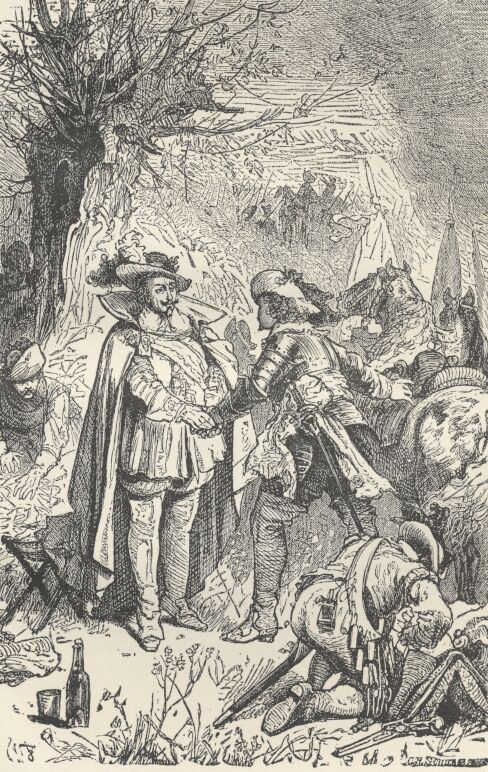
Project Gutenberg's The Death of Wallenstein, by Friedrich Schiller

This eBook is for the use of anyone anywhere at no cost and with
almost no restrictions whatsoever.  You may copy it, give it away or
re-use it under the terms of the Project Gutenberg License included
with this eBook or online at www.gutenberg.org


Title: The Death of Wallenstein
       A Play

Author: Friedrich Schiller

Release Date: October 26, 2006 [EBook #6787]

Language: English

Character set encoding: ASCII

*** START OF THIS PROJECT GUTENBERG EBOOK THE DEATH OF WALLENSTEIN ***


Produced by Tapio Riikonen and David Widger
  WALLENSTEIN, Duke of Friedland, Generalissimo of the Imperial Forces in
     the Thirty Years' War.
  DUCHESS OF FREIDLAND, Wife of Wallenstein.
  THEKLA, her Daughter, Princess of Friedland.
  THE COUNTESS TERZKY, Sister of the Duchess.
  LADY NEUBRUNN.
  OCTAVIO PICCOLOMINI, Lieutenant-General.
  MAX. PICCOLOMINI, his Son, Colonel of a Regiment of Cuirassiers.
  COUNT TERZKY, the Commander of several Regiments, and
     Brother-in-law of Wallenstein.
  ILLO, Field-Marshal, Wallenstein's Confidant.
  ISOLANI, General of the Croats.
  BUTLER, an Irishman, Commander of a Regiment of Dragoons.
  GORDON, Governor of Egra.
  MAJOR GERALDIN.
  CAPTAIN DEVEREUX.
  CAPTAIN MACDONALD.
  AN ADJUTANT.
  NEUMANN, Captain of Cavalry, Aide-de-Camp to TERZKY.
  COLONEL WRANGEL, Envoy from the Swedes.
  ROSENBURG, Master of Horse.
  SWEDISH CAPTAIN.
  SENI.
  BURGOMASTER of Egra.
  ANSPESSADE of the Cuirassiers.
  GROOM OF THE CHAMBER. | Belonging
  A PAGE.        | to the Duke.
  Cuirassiers, Dragoons, and Servants.
     A room fitted up for astrological labors, and provided with
     celestial charts, with globes, telescopes, quadrants, and other
     mathematical instruments. Seven colossal figures, representing the
     planets, each with a transparent star of different color on its
     head, stand in a semicircle in the background, so that Mars and
     Saturn are nearest the eye. The remainder of the scene and its
     disposition is given in the fourth scene of the second act. There
     must be a curtain over the figures, which may be dropped and conceal
     them on occasions.

     [In the fifth scene of this act it must be dropped; but in the
     seventh scene it must be again drawn up wholly or in part.]

     WALLENSTEIN at a black table, on which, a speculum astrologicum is
     described with chalk. SENI is taking observations through a window.

  WALLENSTEIN.
  All well—and now let it be ended, Seni. Come,
  The dawn commences, and Mars rules the hour;
  We must give o'er the operation. Come,
  We know enough.

  SENI.
           Your highness must permit me
  Just to contemplate Venus. She is now rising
  Like as a sun so shines she in the east.

  WALLENSTEIN.
  She is at present in her perigee,
  And now shoots down her strongest influences.
       [Contemplating the figure on the table.
  Auspicious aspect! fateful in conjunction,
  At length the mighty three corradiate;
  And the two stars of blessing, Jupiter
  And Venus, take between them the malignant
  Slyly-malicious Mars, and thus compel
  Into my service that old mischief-founder:
  For long he viewed me hostilely, and ever
  With beam oblique, or perpendicular,
  Now in the Quartile, now in the Secundan,
  Shot his red lightnings at my stars, disturbing
  Their blessed influences and sweet aspects:
  Now they have conquered the old enemy,
  And bring him in the heavens a prisoner to me.

  SENI (who has come down from the window).
  And in a corner-house, your highness—think of that!
  That makes each influence of double strength.

  WALLENSTEIN.
  And sun and moon, too, in the Sextile aspect,
  The soft light with the vehement—so I love it.
  Sol is the heart, Luna the head of heaven,
  Bold be the plan, fiery the execution.

  SENI.
  And both the mighty Lumina by no
  Maleficus affronted. Lo! Saturnus,
  Innocuous, powerless, in cadente Domo.

  WALLENSTEIN.
  The empire of Saturnus is gone by;
  Lord of the secret birth of things is he;
  Within the lap of earth, and in the depths
  Of the imagination dominates;
  And his are all things that eschew the light.
  The time is o'er of brooding and contrivance,
  For Jupiter, the lustrous, lordeth now,
  And the dark work, complete of preparation,
  He draws by force into the realm of light.
  Now must we hasten on to action, ere
  The scheme, and most auspicious positure
  Parts o'er my head, and takes once more its flight,
  For the heaven's journey still, and adjourn not.
       [There are knocks at the door.
  There's some one knocking there. See who it is.

  TERZKY (from without).
  Open, and let me in.

  WALLENSTEIN.
             Ay—'tis Terzky.
  What is there of such urgence? We are busy.

  TERZKY (from without).
  Lay all aside at present, I entreat you;
  It suffers no delaying.

  WALLENSTEIN.
               Open, Seni!

     [While SENI opens the door for TERZKY, WALLENSTEIN draws the curtain
     over the figures.
     WALLENSTEIN, COUNT TERZKY.

  TERZKY (enters).
  Hast thou already heard it? He is taken.
  Gallas has given him up to the emperor.

     [SENI draws off the black table, and exit.

  WALLENSTEIN (to TERZKY).
  Who has been taken? Who is given up?

  TERZKY.
  The man who knows our secrets, who knows every
  Negotiation with the Swede and Saxon,
  Through whose hands all and everything has passed——

  WALLENSTEIN (drawing back).
  Nay, not Sesina? Say, no! I entreat thee.

  TERZKY.
  All on his road for Regensburg to the Swede
  He was plunged down upon by Gallas' agent,
  Who had been long in ambush, lurking for him.
  There must have been found on him my whole packet
  To Thur, to Kinsky, to Oxenstiern, to Arnheim:
  All this is in their hands; they have now an insight
  Into the whole—our measures and our motives.
     To them enters ILLO.

  ILLO (to TERZKY).
  Has he heard it?

  TERZKY.
  He has heard it.

  ILLO (to WALLENSTEIN).
           Thinkest thou still
  To make thy peace with the emperor, to regain
  His confidence? E'en were it now thy wish
  To abandon all thy plans, yet still they know
  What thou hast wished: then forwards thou must press;
  Retreat is now no longer in thy power.

  TERZKY.
  They have documents against us, and in hands,
  Which show beyond all power of contradiction——

  WALLENSTEIN.
  Of my handwriting—no iota. Thee
  I punish or thy lies.

  ILLO.
              And thou believest,
  That what this man, and what thy sister's husband,
  Did in thy name, will not stand on thy reckoning?
  His word must pass for thy word with the Swede,
  And not with those that hate thee at Vienna?

  TERZKY.
  In writing thou gavest nothing; but bethink thee,
  How far thou venturedst by word of mouth
  With this Sesina! And will he be silent?
  If he can save himself by yielding up
  Thy secret purposes, will he retain them?

  ILLO.
  Thyself dost not conceive it possible;
  And since they now have evidence authentic
  How far thou hast already gone, speak! tell us,
  What art thou waiting for? Thou canst no longer
  Keep thy command; and beyond hope of rescue
  Thou'rt lost if thou resign'st it.

  WALLENSTEIN.
                    In the army
  Lies my security. The army will not
  Abandon me. Whatever they may know,
  The power is mine, and they must gulp it down
  And if I give them caution for my fealty,
  They must be satisfied, at least appear so.

  ILLO.
  The army, duke, is thine now; for this moment
  'Tis thine: but think with terror on the slow,
  The quiet power of time. From open violence
  The attachment of thy soldiery secures thee
  To-day, to-morrow: but grant'st thou them a respite,
  Unheard, unseen, they'll undermine that love
  On which thou now dost feel so firm a footing,
  With wily theft will draw away from thee
  One after the other——

  WALLENSTEIN.
              'Tis a cursed accident!
  Oh! I will call it a most blessed one,
  If it work on thee as it ought to do,
  Hurry thee on to action—to decision.
  The Swedish general?

  WALLENSTEIN.
             He's arrived! Know'st
  What his commission is——

  ILLO.
               To thee alone
  Will he intrust the purpose of his coming.

  WALLENSTEIN.
  A cursed, cursed accident! Yes, yes,
  Sesina knows too much, and won't be silent.

  TERZKY.
  He's a Bohemian fugitive and rebel,
  His neck is forfeit. Can he save himself
  At thy cost, think you he will scruple it?
  And if they put him to the torture, will he,
  Will he, that dastardling, have strength enough——

  WALLENSTEIN (lost in thought).
  Their confidence is lost, irreparably!
  And I may act which way I will, I shall
  Be and remain forever in their thought
  A traitor to my country. How sincerely
  Soever I return back to my duty,
  It will no longer help me——

  ILLO.
                 Ruin thee,
  That it will do! Not thy fidelity,
  Thy weakness will be deemed the sole occasion——

  WALLENSTEIN (pacing up and down in extreme agitation).
  What! I must realize it now in earnest,
  Because I toyed too freely with the thought!
  Accursed he who dallies with a devil!
  And must I—I must realize it now—
  Now, while I have the power, it must take place!

  ILLO.
  Now—now—ere they can ward and parry it!

  WALLENSTEIN (looking at the paper of Signatures).
  I have the generals' word—a written promise!
  Max. Piccolomini stands not here—how's that?

  TERZRY.
  It was—he fancied——

  ILLO.
             Mere self-willedness.
  There needed no such thing 'twixt him and you.

  WALLENSTEIN.
  He is quite right; there needed no such thing.
  The regiments, too, deny to march for Flanders
  Have sent me in a paper of remonstrance,
  And openly resist the imperial orders.
  The first step to revolt's already taken.

  ILLO.
  Believe me, thou wilt find it far more easy
  To lead them over to the enemy
  Than to the Spaniard.

  WALLENSTEIN.
              I will hear, however,
  What the Swede has to say to me.

  ILLO (eagerly to TERZKY).
                   Go, call him,
  He stands without the door in waiting.

  WALLENSTEIN.
                      Stay!
  Stay but a little. It hath taken me
  All by surprise; it came too quick upon me;
  'Tis wholly novel that an accident,
  With its dark lordship, and blind agency,
  Should force me on with it.

  ILLO.
                 First hear him only,
  And then weigh it.

            [Exeunt TERZKY and ILLO.
  WALLENSTEIN (in soliloquy).
              Is it possible?
  Is't so? I can no longer what I would?
  No longer draw back at my liking? I
  Must do the deed, because I thought of it?
  And fed this heart here with a dream?
  Because I did not scowl temptation from my presence,
  Dallied with thoughts of possible fulfilment,
  Commenced no movement, left all time uncertain,
  And only kept the road, the access open?
  By the great God of Heaven! it was not
  My serious meaning, it was ne'er resolved.
  I but amused myself with thinking of it.
  The free-will tempted me, the power to do
  Or not to do it. Was it criminal
  To make the fancy minister to hope,
  To fill the air with pretty toys of air,
  And clutch fantastic sceptres moving toward me?
  Was not the will kept free? Beheld I not
  The road of duty close beside me—but
  One little step, and once more I was in it!
  Where am I? Whither have I been transported?
  No road, no track behind me, but a wall,
  Impenetrable, insurmountable,
  Rises obedient to the spells I muttered
  And meant not—my own doings tower behind me.
       [Pauses and remains in deep thought.
  A punishable man I seem, the guilt,
  Try what I will, I cannot roll off from me;
  The equivocal demeanor of my life
  Bears witness on my prosecutor's party.
  And even my purest acts from purest motives
  Suspicion poisons with malicious gloss.
  Were I that thing for which I pass, that traitor,
  A goodly outside I had sure reserved,
  Had drawn the coverings thick and double round me,
  Been calm and chary of my utterance;
  But being conscious of the innocence
  Of my intent, my uncorrupted will,
  I gave way to my humors, to my passion:
  Bold were my words, because my deeds were not.
  Now every planless measure, chance event,
  The threat of rage, the vaunt of joy and triumph,
  And all the May-games of a heart overflowing,
  Will they connect, and weave them all together
  Into one web of treason; all will be plan,
  My eye ne'er absent from the far-off mark,
  Step tracing step, each step a politic progress;
  And out of all they'll fabricate a charge
  So specious, that I must myself stand dumb.
  I am caught in my own net, and only force,
  Naught but a sudden rent can liberate me.

                 [Pauses again.

  How else! since that the heart's unbiased instinct
  Impelled me to the daring deed, which now
  Necessity, self-preservation, orders.
  Stern is the on-look of necessity,
  Not without shudder may a human hand
  Grasp the mysterious urn of destiny.
  My deed was mine, remaining in my bosom;
  Once suffered to escape from its safe corner
  Within the heart, its nursery and birthplace,
  Sent forth into the foreign, it belongs
  Forever to those sly malicious powers
  Whom never art of man conciliated.

     [Paces in agitation through the chamber, then pauses, and, after
     the pause, breaks out again into audible soliloquy.

  What is thy enterprise? thy aim? thy object?
  Hast honestly confessed it to thyself?
  Power seated on a quiet throne thou'dst shake,
  Power on an ancient, consecrated throne,
  Strong in possession, founded in all custom;
  Power by a thousand tough and stringy roots
  Fixed to the people's pious nursery faith.
  This, this will be no strife of strength with strength.
  That feared I not. I brave each combatant,
  Whom I can look on, fixing eye to eye,
  Who, full himself of courage, kindles courage
  In me too. 'Tis a foe invisible
  The which I fear—a fearful enemy,
  Which in the human heart opposes me,
  By its coward fear alone made fearful to me.
  Not that, which full of life, instinct with power,
  Makes known its present being; that is not
  The true, the perilously formidable.
  O no! it is the common, the quite common,
  The thing of an eternal yesterday.
  Whatever was, and evermore returns,
  Sterling to-morrow, for to-day 'twas sterling!
  For of the wholly common is man made,
  And custom is his nurse! Woe then to them
  Who lay irreverent hands upon his old
  House furniture, the dear inheritance
  From his forefathers! For time consecrates;
  And what is gray with age becomes religion.
  Be in possession, and thou hast the right,
  And sacred will the many guard it for thee!

     [To the PAGE,—who here enters.

  The Swedish officer? Well, let him enter.

     [The PAGE exit, WALLENSTEIN fixes his eye in deep thought
     on the door.

  Yet, it is pure—as yet!—the crime has come
  Not o'er this threshold yet—so slender is
  The boundary that divideth life's two paths.
     WALLENSTEIN and WRANGEL.

  WALLENSTEIN (after having fixed a searching look on him).
  Your name is Wrangel?

  WRANGEL.
              Gustave Wrangel, General
  Of the Sudermanian Blues.

  WALLENSTEIN.
                It was a Wrangel
  Who injured me materially at Stralsund,
  And by his brave resistance was the cause
  Of the opposition which that seaport made.

  WRANGEL.
  It was the doing of the element
  With which you fought, my lord! and not my merit,
  The Baltic Neptune did assert his freedom:
  The sea and land, it seemed were not to serve
  One and the same.

  WALLENSTEIN
  You plucked the admiral's hat from off my head.

  WRANGEL.
  I come to place a diadem thereon.

  WALLENSTEIN (makes the motion for him to take a seat, and seats himself).
           And where are your credentials
  Come you provided with full powers, sir general?

  WRANGEL.
  There are so many scruples yet to solve——

  WALLENSTEIN (having read the credentials).
  An able letter! Ay—he is a prudent,
  Intelligent master whom you serve, sir general!
  The chancellor writes me that he but fulfils
  His late departed sovereign's own idea
  In helping me to the Bohemian crown.

  WRANGEL.
  He says the truth. Our great king, now in heaven,
  Did ever deem most highly of your grace's
  Pre-eminent sense and military genius;
  And always the commanding intellect,
  He said, should have command, and be the king.

  WALLENSTEIN.
  Yes, he might say it safely. General Wrangel,
        [Taking his hand affectionately.
  Come, fair and open. Trust me, I was always
  A Swede at heart. Eh! that did you experience
  Both in Silesia and at Nuremberg;
  I had you often in my power, and let you
  Always slip out by some back door or other.
  'Tis this for which the court can ne'er forgive me,
  Which drives me to this present step: and since
  Our interests so run in one direction,
  E'en let us have a thorough confidence
  Each in the other.

  WRANGEL.
            Confidence will come
  Has each but only first security.

  WALLENSTEIN.
  The chancellor still, I see, does not quite trust me;
  And, I confess—the game does not lie wholly
  To my advantage. Without doubt he thinks,
  If I can play false with the emperor,
  Who is my sovereign, I can do the like
  With the enemy, and that the one, too, were
  Sooner to be forgiven me than the other.
  Is not this your opinion, too, sir general?

  WRANGEL.
  I have here a duty merely, no opinion.

  WALLENSTEIN.
  The emperor hath urged me to the uttermost
  I can no longer honorably serve him.
  For my security, in self-defence,
  I take this hard step, which my conscience blames.

  WRANGEL.
  That I believe. So far would no one go
  Who was not forced to it.
             [After a pause.
                What may have impelled
  Your princely highness in this wise to act
  Toward your sovereign lord and emperor,
  Beseems not us to expound or criticise.
  The Swede is fighting for his good old cause,
  With his good sword and conscience. This concurrence,
  This opportunity is in our favor,
  And all advantages in war are lawful.
  We take what offers without questioning;
  And if all have its due and just proportions——

  WALLENSTEIN.
  Of what then are ye doubting? Of my will?
  Or of my power? I pledged me to the chancellor,
  Would he trust me with sixteen thousand men,
  That I would instantly go over to them
  With eighteen thousand of the emperor's troops.

  WRANGEL.
  Your grace is known to be a mighty war-chief,
  To be a second Attila and Pyrrhus.
  'Tis talked of still with fresh astonishment,
  How some years past, beyond all human faith,
  You called an army forth like a creation:
  But yet——

  WALLENSTEIN.
        But yet?

  WRANGEL.
             But still the chancellor thinks
  It might yet be an easier thing from nothing
  To call forth sixty thousand men of battle,
  Than to persuade one-sixtieth part of them——

  WALLENSTEIN.
  What now? Out with it, friend?

  WRANGEL.
                   To break their oaths.

  WALLENSTEIN.
  And he thinks so? He judges like a Swede,
  And like a Protestant. You Lutherans
  Fight for your Bible. You are interested
  About the cause; and with your hearts you follow
  Your banners. Among you whoe'er deserts
  To the enemy hath broken covenant
  With two lords at one time. We've no such fancies.

  WRANGEL.
  Great God in heaven! Have then the people here
  No house and home, no fireside, no altar?

  WALLENSTEIN.
  I will explain that to you, how it stands:
  The Austrian has a country, ay, and loves it,
  And has good cause to love it—but this army
  That calls itself the imperial, this that houses
  Here in Bohemia, this has none—no country;
  This is an outcast of all foreign lands,
  Unclaimed by town or tribe, to whom belongs
  Nothing except the universal sun.
  And this Bohemian land for which we fight
  Loves not the master whom the chance of war,
  Not its own choice or will, hath given to it.
  Men murmur at the oppression of their conscience,
  And power hath only awed but not appeased them.
  A glowing and avenging memory lives
  Of cruel deeds committed on these plains;
  How can the son forget that here his father
  Was hunted by the bloodhound to the mass?
  A people thus oppressed must still be feared,
  Whether they suffer or avenge their wrongs.

  WRANGEL.
  But then the nobles and the officers?
  Such a desertion, such a felony,
  It is without example, my lord duke,
  In the world's history.

  WALLENSTEIN.
               They are all mine—
  Mine unconditionally—mine on all terms.
  Not me, your own eyes you must trust.

     [He gives him the paper containing the written oath. WRANGEL reads
     it through, and, having read it, lays it on the table,—remaining
     silent.

                      So then;
  Now comprehend you?

  WRANGEL.
             Comprehend who can!
  My lord duke, I will let the mask drop—yes!
  I've full powers for a final settlement.
  The Rhinegrave stands but four days' march from here
  With fifteen thousand men, and only waits
  For orders to proceed and join your army.
  These orders I give out immediately
  We're compromised.

  WALLENSTEIN.
            What asks the chancellor?

  WRANGEL (considerately).
  Twelve regiments, every man a Swede—my head
  The warranty—and all might prove at last
  Only false play——

  WALLENSTEIN (starting).
            Sir Swede!

  WRANGEL (calmly proceeding).
                  Am therefore forced
  To insist thereon, that he do formally,
  Irrevocably break with the emperor,
  Else not a Swede is trusted to Duke Friedland.

  WALLENSTEIN.
  Come, brief and open! What is the demand?

  WRANGEL.
  That he forthwith disarm the Spanish regiments
  Attached to the emperor, that he seize on Prague,
  And to the Swedes give up that city, with
  The strong pass Egra.

  WALLENSTEIN.
              That is much indeed!
  Prague!—Egra's granted—but—but Prague! 'Twon't do.
  I give you every security
  Which you may ask of me in common reason—
  But Prague—Bohemia—these, sir general,
  I can myself protect.

  WRANGEL.
              We doubt it not.
  But 'tis not the protection that is now
  Our sole concern. We want security,
  That we shall not expend our men and money
  All to no purpose.

  WALLENSTEIN.
            'Tis but reasonable.

  WRANGEL.
  And till we are indemnified, so long
  Stays Prague in pledge.

  WALLENSTEIN.
               Then trust you us so little?

  WRANGEL (rising).
  The Swede, if he would treat well with the German,
  Must keep a sharp lookout. We have been called
  Over the Baltic, we have saved the empire
  From ruin—with our best blood have we sealed
  The liberty of faith and gospel truth.
  But now already is the benefaction
  No longer felt, the load alone is felt.
  Ye look askance with evil eye upon us,
  As foreigners, intruders in the empire,
  And would fain send us with some paltry sum
  Of money, home again to our old forests.
  No, no! my lord duke! it never was
  For Judas' pay, for chinking gold and silver,
  That we did leave our king by the Great Stone. 1
  No, not for gold and silver have there bled
  So many of our Swedish nobles—neither
  Will we, with empty laurels for our payment,
  Hoist sail for our own country. Citizens
  Will we remain upon the soil, the which
  Our monarch conquered for himself and died.

  WALLENSTEIN.
  Help to keep down the common enemy,
  And the fair border land must needs be yours.

  WRANGEL.
  But when the common enemy lies vanquished,
  Who knits together our new friendship then?
  We know, Duke Friedland! though perhaps the Swede
  Ought not to have known it, that you carry on
  Secret negotiations with the Saxons.
  Who is our warranty that we are not
  The sacrifices in those articles
  Which 'tis thought needful to conceal from us?

  WALLENSTEIN (rises).
  Think you of something better, Gustave Wrangel!
  Of Prague no more.

  WRANGEL.
            Here my commission ends.

  WALLENSTEIN.
  Surrender up to you my capital!
  Far liever would I force about, and step
  Back to my emperor.

  WRANGEL.
             If time yet permits——

  WALLENSTEIN.
  That lies with me, even now, at any hour.

  WRANGEL.
  Some days ago, perhaps. To-day, no longer;
  No longer since Sesina's been a prisoner.
     [WALLENSTEIN is struck, and silenced.
  My lord duke, hear me—we believe that you
  At present do mean honorably by us.
  Since yesterday we're sure of that—and now
  This paper warrants for the troops, there's nothing
  Stands in the way of our full confidence.
  Prague shall not part us. Hear! The chancellor
  Contents himself with Alstadt; to your grace
  He gives up Ratschin and the narrow side.
  But Egra above all must open to us,
  Ere we can think of any junction.

  WALLENSTEIN.
                    You,
  You therefore must I trust, and not you me?
  I will consider of your proposition.

  WRANGEL.
  I must entreat that your consideration
  Occupy not too long a time. Already
  Has this negotiation, my lord duke!
  Crept on into the second year. If nothing
  Is settled this time, will the chancellor
  Consider it as broken off forever?

  WALLENSTEIN.
  Ye press me hard. A measure such as this
  Ought to be thought of.

  WRANGEL.
               Ay! but think of this too,
  That sudden action only can procure it.
  Success—think first of this, your highness.

                 [Exit WRANGEL.
     WALLENSTEIN, TERZKY, and ILLO (re-enter).

  ILLO.
  Is't all right?

  TERZKY.
           Are you compromised?

  ILLO.
                      This Swede
  Went smiling from you. Yes! you're compromised.

  WALLENSTEIN.
  As yet is nothing settled; and (well weighed)
  I feel myself inclined to leave it so.

  TERZKY.
  How? What is that?

  WALLENSTEIN.
             Come on me what will come,
  The doing evil to avoid an evil
  Cannot be good!

  TERZKY.
           Nay, but bethink you, duke.

  WALLENSTEIN.
  To live upon the mercy of these Swedes!
  Of these proud-hearted Swedes!—I could not bear it.

  ILLO.
  Goest thou as fugitive, as mendicant?
  Bringest thou not more to them than thou receivest?

  WALLENSTEIN.
  How fared it with the brave and royal Bourbon
  Who sold himself unto his country's foes,
  And pierced the bosom of his father-land?
  Curses were his reward, and men's abhorrence
  Avenged the unnatural and revolting deed.

  ILLO.
  Is that thy case?

  WALLENSTEIN.
            True faith, I tell thee,
  Must ever be the dearest friend of man
  His nature prompts him to assert its rights.
  The enmity of sects, the rage of parties,
  Long-cherished envy, jealousy, unite;'
  And all the struggling elements of evil
  Suspend their conflict, and together league
  In one alliance 'gainst their common foe—
  The savage beast that breaks into the fold,
  Where men repose in confidence and peace.
  For vain were man's own prudence to protect him.
  'Tis only in the forehead nature plants
  The watchful eye; the back, without defence,
  Must find its shield in man's fidelity.

  TERZKY.
  Think not more meanly off thyself than do
  Thy foes, who stretch their hands with joy to greet thee.
  Less scrupulous far was the imperial Charles,
  The powerful head of this illustrious house;
  With open arms he gave the Bourbon welcome;
  For still by policy the world is ruled.
     To these enter the COUNTESS TERZKY.

  WALLENSTEIN.
  Who sent for you? There is no business here
  For women.

  COUNTESS
        I am come to bid you joy.

  WALLENSTEIN.
  Use thy authority, Terzky; bid her go.

  COUNTESS.
  Come I perhaps too early? I hope not.

  WALLENSTEIN.
  Set not this tongue upon me, I entreat you:
  You know it is the weapon that destroys me.
  I am routed, if a woman but attack me:
  I cannot traffic in the trade of words
  With that unreasoning sex.

  COUNTESS.
                I had already
  Given the Bohemians a king.

  WALLENSTEIN (sarcastically).
                 They have one,
  In consequence, no doubt.

  COUNTESS (to the others).
                Ha! what new scruple?

  TERZKY.
  The duke will not.

  COUNTESS.
            He will not what he must!

  ILLO.
  It lies with you now. Try. For I am silenced
  When folks begin to talk to me of conscience
  And of fidelity.

  COUNTESS.
           How? then, when all
  Lay in the far-off distance, when the road
  Stretched out before thine eyes interminably,
  Then hadst thou courage and resolve; and now,
  Now that the dream is being realized,
  The purpose ripe, the issue ascertained,
  Dost thou begin to play the dastard now?
  Planned merely, 'tis a common felony;
  Accomplished, an immortal undertaking:
  And with success comes pardon hand in hand,
  For all event is God's arbitrament.

  SERVANT (enters).
  The Colonel Piccolomini.

  COUNTESS (hastily).
              —Must wait.

  WALLENSTEIN.
  I cannot see him now. Another time.

  SERVANT.
  But for two minutes he entreats an audience
  Of the most urgent nature is his business.

  WALLENSTEIN.
  Who knows what he may bring us! I will hear him.

  COUNTESS (laughs).
  Urgent for him, no doubt? but thou may'st wait.

  WALLENSTEIN.
  What is it?

  COUNTESS.
         Thou shalt be informed hereafter.
  First let the Swede and thee be compromised.

                   [Exit SERVANT.

  WALLENSTEIN.
  If there were yet a choice! if yet some milder
  Way of escape were possible—I still
  Will choose it, and avoid the last extreme.

  COUNTESS.
  Desirest thou nothing further? Such a way
  Lies still before thee. Send this Wrangel off.
  Forget thou thy old hopes, cast far away
  All thy past life; determine to commence
  A new one. Virtue hath her heroes too,
  As well as fame and fortune. To Vienna
  Hence—to the emperor—kneel before the throne;
  Take a full coffer with thee—say aloud,
  Thou didst but wish to prove thy fealty;
  Thy whole intention but to dupe the Swede.

  ILLO.
  For that too 'tis too late. They know too much;
  He would but bear his own head to the block.

  COUNTESS.
  I fear not that. They have not evidence
  To attaint him legally, and they avoid
  The avowal of an arbitrary power.
  They'll let the duke resign without disturbance.
  I see how all will end. The King of Hungary
  Makes his appearance, and 'twill of itself
  Be understood, and then the duke retires.
  There will not want a formal declaration.
  The young king will administer the oath
  To the whole army; and so all returns
  To the old position. On some morrow morning
  The duke departs; and now 'tis stir and bustle
  Within his castles. He will hunt and build;
  Superintend his horses' pedigrees,
  Creates himself a court, gives golden keys,
  And introduceth strictest ceremony
  In fine proportions, and nice etiquette;
  Keeps open table with high cheer: in brief,
  Commenceth mighty king—in miniature.
  And while he prudently demeans himself,
  And gives himself no actual importance,
  He will be let appear whate'er he likes:
  And who dares doubt, that Friedland will appear
  A mighty prince to his last dying hour?
  Well now, what then? Duke Friedland is as others,
  A fire-new noble, whom the war hath raised
  To price and currency, a Jonah's gourd,
  An over-night creation of court-favor,
  Which, with an undistinguishable ease,
  Makes baron or makes prince.

  WALLENSTEIN (in extreme agitation).
                 Take her away.
  Let in the young Count Piccolomini.

  COUNTESS.
  Art thou in earnest? I entreat thee!
  Canst thou consent to bear thyself to thy own grave,
  So ignominiously to be dried up?
  Thy life, that arrogated such an height
  To end in such a nothing! To be nothing,
  When one was always nothing, is an evil
  That asks no stretch of patience, a light evil;
  But to become a nothing, having been——

  WALLENSTEIN (starts up in violent agitation).
  Show me a way out of this stifling crowd,
  Ye powers of aidance! Show me such a way
  As I am capable of going. I
  Am no tongue-hero, no fine virtue-prattler;
  I cannot warm by thinking; cannot say
  To the good luck that turns her back upon me
  Magnanimously: "Go; I need thee not."
  Cease I to work, I am annihilated.
  Dangers nor sacrifices will I shun,
  If so I may avoid the last extreme;
  But ere I sink down into nothingness,
  Leave off so little, who began so great,
  Ere that the world confuses me with those
  Poor wretches, whom a day creates and crumbles,
  This age and after ages 2 speak my name
  With hate and dread; and Friedland be redemption
  For each accursed deed.

  COUNTESS.
               What is there here, then,
  So against nature? Help me to perceive it!
  Oh, let not superstition's nightly goblins
  Subdue thy clear, bright spirit! Art thou bid
  To murder? with abhorred, accursed poniard,
  To violate the breasts that nourished thee?
  That were against our nature, that might aptly
  Make thy flesh shudder, and thy whole heart sicken. 3
  Yet not a few, and for a meaner object,
  Have ventured even this, ay, and performed it.
  What is there in thy case so black and monstrous?
  Thou art accused of treason—whether with
  Or without justice is not now the question—
  Thou art lost if thou dost not avail thee quickly
  Of the power which thou possessest—Friedland! Duke!
  Tell me where lives that thing so meek and tame,
  That doth not all his living faculties
  Put forth in preservation of his life?
  What deed so daring, which necessity
  And desperation will not sanctify?

  WALLENSTEIN.
  Once was this Ferdinand so gracious to me;
  He loved me; he esteemed me; I was placed
  The nearest to his heart. Full many a time
  We like familiar friends, both at one table,
  Have banqueted together—he and I;
  And the young kings themselves held me the basin
  Wherewith to wash me—and is't come to this?

  COUNTESS.
  So faithfully preservest thou each small favor,
  And hast no memory for contumelies?
  Must I remind thee, how at Regensburg
  This man repaid thy faithful services?
  All ranks and all conditions in the empire
  Thou hadst wronged to make him great,—hadst loaded on thee,
  On thee, the hate, the curse of the whole world.
  No friend existed for thee in all Germany,
  And why? because thou hadst existed only
  For the emperor. To the emperor alone
  Clung Friedland in that storm which gathered round him
  At Regensburg in the Diet—and he dropped thee!
  He let thee fall! he let thee fall a victim
  To the Bavarian, to that insolent!
  Deposed, stripped bare of all thy dignity
  And power, amid the taunting of thy foe
  Thou wert let drop into obscurity.
  Say not, the restoration of thy honor
  Has made atonement for that first injustice.
  No honest good-will was it that replaced thee;
  The law of hard necessity replaced thee,
  Which they had fain opposed, but that they could not.

  WALLENSTEIN.
  Not to their good wishes, that is certain,
  Nor yet to his affection I'm indebted
  For this high office; and if I abuse it,
  I shall therein abuse no confidence.

  COUNTESS.
  Affection! confidence!—they needed thee.
  Necessity, impetuous remonstrant!
  Who not with empty names, or shows of proxy,
  Is served, who'll have the thing and not the symbol,
  Ever seeks out the greatest and the best,
  And at the rudder places him, e'en though
  She had been forced to take him from the rabble—
  She, this necessity, it was that placed thee
  In this high office; it was she that gave thee
  Thy letters-patent of inauguration.
  For, to the uttermost moment that they can,
  This race still help themselves at cheapest rate
  With slavish souls, with puppets! At the approach
  Of extreme peril, when a hollow image
  Is found a hollow image and no more,
  Then falls the power into the mighty hands
  Of nature, of the spirit-giant born,
  Who listens only to himself, knows nothing
  Of stipulations, duties, reverences,
  And, like the emancipated force of fire,
  Unmastered scorches, ere it reaches them,
  Their fine-spun webs, their artificial policy.

  WALLENSTEIN.
  'Tis true! they saw me always as I am—
  Always! I did not cheat them in the bargain.
  I never held it worth my pains to hide
  The bold all-grasping habit of my soul.

  COUNTESS.
  Nay rather—thou hast ever shown thyself
  A formidable man, without restraint;
  Hast exercised the full prerogatives
  Of thy impetuous nature, which had been
  Once granted to thee. Therefore, duke, not thou,
  Who hast still remained consistent with thyself,
  But they are in the wrong, who, fearing thee,
  Intrusted such a power in hands they feared.
  For, by the laws of spirit, in the right
  Is every individual character
  That acts in strict consistence with itself:
  Self-contradiction is the only wrong.
  Wert thou another being, then, when thou
  Eight years ago pursuedst thy march with fire,
  And sword, and desolation, through the circles
  Of Germany, the universal scourge,
  Didst mock all ordinances of the empire,
  The fearful rights of strength alone exertedst,
  Trampledst to earth each rank, each magistracy,
  All to extend thy Sultan's domination?
  Then was the time to break thee in, to curb
  Thy haughty will, to teach thee ordinance.
  But no, the emperor felt no touch of conscience;
  What served him pleased him, and without a murmur
  He stamped his broad seal on these lawless deeds.
  What at that time was right, because thou didst it
  For him, to-day is all at once become
  Opprobrious, foul, because it is directed
  Against him. O most flimsy superstition!

  WALLENSTEIN (rising).
  I never saw it in this light before,
  'Tis even so. The emperor perpetrated
  Deeds through my arm, deeds most unorderly.
  And even this prince's mantle, which I wear,
  I owe to what were services to him,
  But most high misdemeanors 'gainst the empire.

  COUNTESS.
  Then betwixt thee and him (confess it, Friedland!)
  The point can be no more of right and duty,
  Only of power and the opportunity.
  That opportunity, lo! it comes yonder
  Approaching with swift steeds; then with a swing
  Throw thyself up into the chariot-seat,
  Seize with firm hand the reins ere thy opponent
  Anticipate thee, and himself make conquest
  Of the now empty seat. The moment comes;
  It is already here, when thou must write
  The absolute total of thy life's vast sum.
  The constellations stand victorious o'er thee,
  The planets shoot good fortune in fair junctions,
  And tell thee, "Now's the time!" The starry courses
  Hast thou thy life-long measured to no purpose?
  The quadrant and the circle, were they playthings?

     [Pointing to the different objects in the room.

  The zodiacs, the rolling orbs of heaven,
  Hast pictured on these walls and all around thee.
  In dumb, foreboding symbols hast thou placed
  These seven presiding lords of destiny—
  For toys? Is all this preparation nothing?
  Is there no marrow in this hollow art,
  That even to thyself it doth avail
  Nothing, and has no influence over thee
  In the great moment of decision?

  WALLENSTEIN (during this last speech walks up and down with inward
     struggles, laboring with passion; stops suddenly, stands still, then
     interrupting the COUNTESS).
  Send Wrangel to me—I will instantly
  Despatch three couriers——

  ILLO (hurrying out).
                God in heaven be praised!

  WALLENSTEIN.
  It is his evil genius and mine.
  Our evil genius! It chastises him
  Through me, the instrument of his ambition;
  And I expect no less, than that revenge
  E'en now is whetting for my breast the poinard.
  Who sows the serpent's teeth let him not hope
  To reap a joyous harvest. Every crime
  Has, in the moment of its perpetration,
  Its own avenging angel—dark misgiving,
  An ominous sinking at the inmost heart.
  He can no longer trust me. Then no longer
  Can I retreat—so come that which must come.
  Still destiny preserves its due relations,
  The heart within us is its absolute
  Vicegerent.         [To TERZKY.
         Go, conduct you Gustave Wrangel
  To my state cabinet. Myself will speak to
  The couriers. And despatch immediately
  A servant for Octavio Piccolomini.

     [To the COUNTESS, who cannot conceal her triumph.

  No exultation! woman, triumph not!
  For jealous are the powers of destiny,
  Joy premature, and shouts ere victory,
  Encroach upon their rights and privileges.
  We sow the seed, and they the growth determine.

     [While he is making his exit the curtain drops.
SCENE as in the preceding Act.
     WALLENSTEIN, OCTAVIO PICCOLOMINI.

  WALLENSTEIN (coming forward in conversation).
  He sends me word from Linz that he lies sick;
  But I have sure intelligence that he
  Secretes himself at Frauenberg with Gallas.
  Secure them both, and send them to me hither.
  Remember, thou takest on thee the command
  Of those same Spanish regiments,—constantly
  Make preparation, and be never ready;
  And if they urge thee to draw out against me,
  Still answer yes, and stand as thou went fettered.
  I know, that it is doing thee a service
  To keep thee out of action in this business.
  Thou lovest to linger on in fair appearances;
  Steps of extremity are not thy province,
  Therefore have I sought out this part for thee.
  Thou wilt this time be of most service to me
  By thy inertness. The meantime, if fortune
  Declare itself on my side, thou wilt know
  What is to do.

       [Enter MAX. PICCOLOMINI.

          Now go, Octavio.
  This night must thou be off, take my own horses
  Him here I keep with me—make short farewell—
  Trust me, I think we all shall meet again
  In joy and thriving fortunes.

  OCTAVIO (to his son).
                  I shall see you
  Yet ere I go.
     WALLENSTEIN, MAX. PICCOLOMINI.

  MAX. (advances to him).
  My general!

  WALLENSTEIN.
         That I am no longer, if
  Thou stylest thyself the emperor's officer.

  MAX.
  Then thou wilt leave the army, general?

  WALLENSTEIN.
  I have renounced the service of the emperor.

  MAX.
  And thou wilt leave the army?

  WALLENSTEIN.
                  Rather hope I
  To bind it nearer still and faster to me.
       [He seats himself.
  Yes, Max., I have delayed to open it to thee,
  Even till the hour of acting 'gins to strike.
  Youth's fortunate feeling doth seize easily
  The absolute right, yea, and a joy it is
  To exercise the single apprehension
  Where the sums square in proof;
  But where it happens, that of two sure evils
  One must be taken, where the heart not wholly
  Brings itself back from out the strife of duties,
  There 'tis a blessing to have no election,
  And blank necessity is grace and favor.
  This is now present: do not look behind thee,—
  It can no more avail thee. Look thou forwards!
  Think not! judge not! prepare thyself to act!
  The court—it hath determined on my ruin,
  Therefore I will be beforehand with them.
  We'll join the Swedes—right gallant fellows are they,
  And our good friends.
     [He stops himself, expecting PICCOLOMINI's answer.
  I have taken thee by surprise. Answer me not:
  I grant thee time to recollect thyself.

     [He rises, retires to the back of the stage. MAX. remains
     for a long time motionless, in a trance of excessive anguish.
     At his first motion WALLENSTEIN returns, and places himself
     before him.

  MAX.
  My general, this day thou makest me
  Of age to speak in my own right and person,
  For till this day I have been spared the trouble
  To find out my own road. Thee have I followed
  With most implicit, unconditional faith,
  Sure of the right path if I followed thee.
  To-day, for the first time, dost thou refer
  Me to myself, and forcest me to make
  Election between thee and my own heart.

  WALLENSTEIN.
  Soft cradled thee thy fortune till to-day;
  Thy duties thou couldst exercise in sport,
  Indulge all lovely instincts, act forever
  With undivided heart. It can remain
  No longer thus. Like enemies, the roads
  Start from each other. Duties strive with duties,
  Thou must needs choose thy party in the war
  Which is now kindling 'twixt thy friend and him
  Who is thy emperor.

  MAX.
             War! is that the name?
  War is as frightful as heaven's pestilence,
  Yet it is good, is it heaven's will as that is.
  Is that a good war, which against the emperor
  Thou wagest with the emperor's own army?
  O God of heaven! what a change is this.
  Beseems it me to offer such persuasion
  To thee, who like the fixed star of the pole
  Wert all I gazed at on life's trackless ocean?
  O! what a rent thou makest in my heart!
  The ingrained instinct of old reverence,
  The holy habit of obediency,
  Must I pluck life asunder from thy name?
  Nay, do not turn thy countenance upon me—
  It always was as a god looking upon me!
  Duke Wallenstein, its power has not departed;
  The senses still are in thy bonds, although
  Bleeding, the soul hath freed itself.

  WALLENSTEIN.
                      Max., hear me.

  MAX.
  Oh, do it not, I pray thee, do it not!
  There is a pure and noble soul within thee,
  Knows not of this unblest unlucky doing.
  Thy will is chaste, it is thy fancy only
  Which hath polluted thee—and innocence,
  It will not let itself be driven away
  From that world-awing aspect. Thou wilt not,
  Thou canst not end in this. It would reduce
  All human creatures to disloyalty
  Against the nobleness of their own nature.
  'Twill justify the vulgar misbelief,
  Which holdeth nothing noble in free will,
  And trusts itself to impotence alone,
  Made powerful only in an unknown power.

  WALLENSTEIN.
  The world will judge me harshly, I expect it.
  Already have I said to my own self
  All thou canst say to me. Who but avoids
  The extreme, can he by going round avoid it?
  But here there is no choice. Yes, I must use
  Or suffer violence—so stands the case,
  There remains nothing possible but that.

  MAX.
  Oh, that is never possible for thee!
  'Tis the last desperate resource of those
  Cheap souls, to whom their honor, their good name,
  Is their poor saving, their last worthless keep,
  Which, having staked and lost, they staked themselves
  In the mad rage of gaming. Thou art rich
  And glorious; with an unpolluted heart
  Thou canst make conquest of whate'er seems highest!
  But he who once hath acted infamy
  Does nothing more in this world.

  WALLENSTEIN (grasps his hand).
                   Calmly, Max.!
  Much that is great and excellent will we
  Perform together yet. And if we only
  Stand on the height with dignity, 'tis soon
  Forgotten, Max., by what road we ascended.
  Believe me, many a crown shines spotless now,
  That yet was deeply sullied in the winning.
  To the evil spirit doth the earth belong,
  Not to the good. All that the powers divine
  Send from above are universal blessings
  Their light rejoices us, their air refreshes,
  But never yet was man enriched by them:
  In their eternal realm no property
  Is to be struggled for—all there is general.
  The jewel, the all-valued gold we win
  From the deceiving powers, depraved in nature,
  That dwell beneath the day and blessed sunlight.
  Not without sacrifices are they rendered
  Propitious, and there lives no soul on earth
  That e'er retired unsullied from their service.

  MAX.
  Whate'er is human to the human being
  Do I allow—and to the vehement
  And striving spirit readily I pardon
  The excess of action; but to thee, my general!
  Above all others make I large concession.
  For thou must move a world and be the master—
  He kills thee who condemns thee to inaction.
  So be it then! maintain thee in thy post
  By violence. Resist the emperor,
  And if it must be force with force repel;
  I will not praise it, yet I can forgive it.
  But not—not to the traitor—yes! the word
  Is spoken out—
  Not to the traitor can I yield a pardon.
  That is no mere excess! that is no error
  Of human nature—that is wholly different,
  Oh, that is black, black as the pit of hell!
     [WALLENSTEIN betrays a sudden agitation.
  Thou canst not hear it named, and wilt thou do it?
  O turn back to thy duty. That thou canst,
  I hold it certain. Send me to Vienna;
  I'll make thy peace for thee with the emperor.
  He knows thee not. But I do know thee. He
  Shall see thee, duke! with my unclouded eye,
  And I bring back his confidence to thee.

  WALLENSTEIN.
  It is too late! Thou knowest not what has happened.

  MAX.
  Were it too late, and were things gone so far,
  That a crime only could prevent thy fall,
  Then—fall! fall honorably, even as thou stoodest,
  Lose the command. Go from the stage of war!
  Thou canst with splendor do it—do it too
  With innocence. Thou hast lived much for others,
  At length live thou for thy own self. I follow thee.
  My destiny I never part from thine.

  WALLENSTEIN.
  It is too late! Even now, while thou art losing
  Thy words, one after another, are the mile-stones
  Left fast behind by my post couriers,
  Who bear the order on to Prague and Egra.

     [MAX. stands as convulsed, with a gesture and countenance
     expressing the most intense anguish.

  Yield thyself to it. We act as we are forced.
  I cannot give assent to my own shame
  And ruin. Thou—no—thou canst not forsake me!
  So let us do, what must be done, with dignity,
  With a firm step. What am I doing worse
  Than did famed Caesar at the Rubicon,
  When he the legions led against his country,
  The which his country had delivered to him?
  Had he thrown down the sword, he had been lost.
  As I were, if I but disarmed myself.
  I trace out something in me of this spirit.
  Give me his luck, that other thing I'll bear.

     [MAX. quits him abruptly. WALLENSTEIN startled and overpowered,
     continues looking after him, and is still in this posture when
     TERZKY enters.
     WALLENSTEIN, TERZKY.

  TERZKY.
  Max. Piccolomini just left you?

  WALLENSTEIN.
                   Where is Wrangel?

  TERZKY.
  He is already gone.

  WALLENSTEIN.
             In such a hurry?

  TERZKY.
  It is as if the earth had swallowed him.
  He had scarce left thee, when I went to seek him.
  I wished some words with him—but he was gone.
  How, when, and where, could no one tell me.
  Nay, I half believe it was the devil himself;
  A human creature could not so at once
  Have vanished.

  ILLO (enters).
          Is it true that thou wilt send
  Octavio?

  TERZKY.
       How, Octavio! Whither send him?

  WALLENSTEIN.
  He goes to Frauenberg, and will lead hither
  The Spanish and Italian regiments.

  ILLO.
                    No!
  Nay, heaven forbid!

  WALLENSTEIN.
             And why should heaven forbid?

  ILLO.
  Him!—that deceiver! Wouldst thou trust to him
  The soldiery? Him wilt thou let slip from thee,
  Now in the very instant that decides us——

  TERZKY.
  Thou wilt not do this! No! I pray thee, no!

  WALLENSTEIN.
  Ye are whimsical.

  ILLO.
            O but for this time, duke,
  Yield to our warning! Let him not depart.

  WALLENSTEIN.
  And why should I not trust him only this time,
  Who have always trusted him? What, then, has happened
  That I should lose my good opinion of him?
  In complaisance to your whims, not my own,
  I must, forsooth, give up a rooted judgment.
  Think not I am a woman. Having trusted him
  E'en till to-day, to-day too will I trust him.

  TERZKY.
  Must it be he—he only? Send another.

  WALLENSTEIN.
  It must be he, whom I myself have chosen;
  He is well fitted for the business.
  Therefore I gave it him.

  ILLO.
               Because he's an Italian—
  Therefore is he well fitted for the business!

  WALLENSTEIN.
  I know you love them not, nor sire nor son,
  Because that I esteem them, love them, visibly
  Esteem them, love them more than you and others,
  E'en as they merit. Therefore are they eye-blights,
  Thorns in your footpath. But your jealousies,
  In what affect they me or my concerns?
  Are they the worse to me because you hate them?
  Love or hate one another as you will,
  I leave to each man his own moods and likings;
  Yet know the worth of each of you to me.

  ILLO.
  Von Questenberg, while he was here, was always
  Lurking about with this Octavio.

  WALLENSTEIN.
  It happened with my knowledge and permission.

  ILLO.
  I know that secret messengers came to him
  From Gallas——

  WALLENSTEIN.
          That's not true.

  ILLO.
                   O thou art blind,
  With thy deep-seeing eyes!

  WALLENSTEIN.
                Thou wilt not shake
  My faith for me; my faith, which founds itself
  On the profoundest science. If 'tis false,
  Then the whole science of the stars is false;
  For know, I have a pledge from Fate itself,
  That he is the most faithful of my friends.

  ILLO.
  Hast thou a pledge that this pledge is not false?
  WALLENSTEIN.
  There exist moments in the life of man,
  When he is nearer the great Soul of the world
  Than is man's custom, and possesses freely
  The power of questioning his destiny:
  And such a moment 'twas, when in the night
  Before the action in the plains of Luetzen,
  Leaning against a tree, thoughts crowding thoughts,
  I looked out far upon the ominous plain.
  My whole life, past and future, in this moment
  Before my mind's eye glided in procession,
  And to the destiny of the next morning
  The spirit, filled with anxious presentiment,
  Did knit the most removed futurity.
  Then said I also to myself, "So many
  Dost thou command. They follow all thy stars,
  And as on some great number set their all
  Upon thy single head, and only man
  The vessel of thy fortune. Yet a day
  Will come, when destiny shall once more scatter
  All these in many a several direction:
  Few be they who will stand out faithful to thee."
  I yearned to know which one was faithfulest
  Of all, my camp included. Great destiny,
  Give me a sign! And he shall be the man,
  Who, on the approaching morning, comes the first
  To meet me with a token of his love:
  And thinking this, I fell into a slumber,
  Then midmost in the battle was I led
  In spirit. Great the pressure and the tumult!
  Then was my horse killed under me: I sank;
  And over me away, all unconcernedly,
  Drove horse and rider—and thus trod to pieces
  I lay, and panted like a dying man;
  Then seized me suddenly a savior arm;
  It was Octavio's—I woke at once,
  'Twas broad day, and Octavio stood before me.
  "My brother," said he, "do not ride to-day
  The dapple, as you're wont; but mount the horse
  Which I have chosen for thee. Do it, brother!
  In love to me. A strong dream warned me so."
  It was the swiftness of this horse that snatched me
  From the hot pursuit of Bannier's dragoons.
  My cousin rode the dapple on that day,
  And never more saw I or horse or rider.

  ILLO.
  That was a chance.

  WALLENSTEIN (significantly).
            There's no such thing as chance
  And what to us seems merest accident
  Springs from the deepest source of destiny.
  In brief, 'tis signed and sealed that this Octavio
  Is my good angel—and now no word more.

                [He is retiring.

  TERZKY.
  This is my comfort—Max. remains our hostage.

  ILLO.
  And he shall never stir from here alive.

  WALLENSTEIN (stops and turns himself round).
  Are ye not like the women, who forever
  Only recur to their first word, although
  One had been talking reason by the hour!
  Know, that the human being's thoughts and deeds
  Are not like ocean billows, blindly moved.
  The inner world, his microcosmus, is
  The deep shaft, out of which they spring eternally.
  They grow by certain laws, like the tree's fruit—
  No juggling chance can metamorphose them.
  Have I the human kernel first examined?
  Then I know, too, the future will and action.

                       [Exeunt.
     Chamber in the residence of Piccolomini: OCTAVIO PICCOLOMINI
     (attired for travelling), an ADJUTANT.

  OCTAVIO.
  Is the detachment here?

  ADJUTANT.
               It waits below.

  OCTAVIO.
  And are the soldiers trusty, adjutant?
  Say, from what regiment hast thou chosen them?

  ADJUTANT.
  From Tiefenbach's.

  OCTAVIO.
  That regiment is loyal,
  Keep them in silence in the inner court,
  Unseen by all, and when the signal peals
  Then close the doors, keep watch upon the house.
  And all ye meet be instantly arrested.
                    [Exit ADJUTANT.
  I hope indeed I shall not need their service,
  So certain feel I of my well-laid plans;
  But when an empire's safety is at stake
  'Twere better too much caution than too little.
     A chamber in PICCOLOMINI's dwelling-house: OCTAVIO,
     PICCOLOMINI, ISOLANI, entering.

  ISOLANI.
  Here am I—well! who comes yet of the others?

  OCTAVIO (with an air of mystery).
  But, first, a word with you, Count Isolani.

  ISOLANI (assuming the same air of mystery).
  Will it explode, ha? Is the duke about
  To make the attempt? In me, friend, you may place
  Full confidence—nay, put me to the proof.

  OCTAVIO.
  That may happen.

  ISOLANI.
           Noble brother, I am
  Not one of those men who in words are valiant,
  And when it comes to action skulk away.
  The duke has acted towards me as a friend:
  God knows it is so; and I owe him all;
  He may rely on my fidelity.

  OCTAVIO.
  That will be seen hereafter.

  ISOLANI.
                 Be on your guard,
  All think not as I think; and there are many
  Who still hold with the court—yes, and they say
  That these stolen signatures bind them to nothing.

  OCTAVIO.
  Indeed! Pray name to me the chiefs that think so;

  ISOLANI.
  Plague upon them! all the Germans think so
  Esterhazy, Kaunitz, Deodati, too,
  Insist upon obedience to the court.

  OCTAVIO.
  I am rejoiced to hear it.

  ISOLANI.
                You rejoice?

  OCTAVIO.
  That the emperor has yet such gallant servants,
  And loving friends.

  ISOLANI.
             Nay, jeer not, I entreat you.
  They are no such worthless fellows, I assure you.

  OCTAVIO.
  I am assured already. God forbid
  That I should jest! In very serious earnest,
  I am rejoiced to see an honest cause
  So strong.

  ISOLANI.
        The devil!—what!—why, what means this?
  Are you not, then——For what, then, am I here?

  OCTAVIO.
  That you may make full declaration, whether
  You will be called the friend or enemy
  Of the emperor.

  ISOLANI (with an air of defiance).
           That declaration, friend,
  I'll make to him in whom a right is placed
  To put that question to me.

  OCTAVIO.
                 Whether, count,
  That right is mine, this paper may instruct you.

  ISOLANI (stammering).
  Why,—why—what! this is the emperor's hand and seal
                 [Reads.
  "Whereas the officers collectively
  Throughout our army will obey the orders
  Of the Lieutenant-General Piccolomini,
  As from ourselves."—Hem!—Yes! so!—Yes! yes!
  I—I give you joy, lieutenant-general!

  OCTAVIO.
  And you submit to the order?

  ISOLANI.
                 I—
  But you have taken me so by surprise
  Time for reflection one must have——

  OCTAVIO.
                     Two minutes.

  ISOLANI.
  My God! But then the case is——

  OCTAVIO.
                   Plain and simple.
  You must declare you, whether you determine
  To act a treason 'gainst your lord and sovereign,
  Or whether you will serve him faithfully.

  ISOLANI.
  Treason! My God! But who talks then of treason?

  OCTAVIO.
  That is the case. The prince-duke is a traitor—
  Means to lead over to the enemy
  The emperor's army. Now, count! brief and full—
  Say, will you break your oath to the emperor?
  Sell yourself to the enemy? Say, will you?

  ISOLANI.
  What mean you? I—I break my oath, d'ye say,
  To his imperial majesty?
  Did I say so! When, when have I said that?

  OCTAVIO.
  You have not said it yet—not yet. This instant
  I wait to hear, count, whether you will say it.

  ISOLANI.
  Ay! that delights me now, that you yourself
  Bear witness for me that I never said so.

  OCTAVIO.
  And you renounce the duke then?

  ISOLANI.
                   If he's planning
  Treason—why, treason breaks all bonds asunder.

  OCTAVIO.
  And are determined, too, to fight against him?

  ISOLANI.
  He has done me service—but if he's a villain,
  Perdition seize him! All scores are rubbed off.

  OCTAVIO.
  I am rejoiced that you are so well disposed.
  This night break off in the utmost secrecy
  With all the light-armed troops—it must appear
  As came the order from the duke himself.
  At Frauenberg's the place of rendezvous;
  There will Count Gallas give you further orders.

  ISOLANI.
  It shall be done. But you'll remember me
  With the emperor—how well disposed you found me.

  OCTAVIO.
  I will not fail to mention it honorably.

     [Exit ISOLANI. A SERVANT enters.

  What, Colonel Butler! Show him up.

  ISOLANI (returning).
  Forgive me too my bearish ways, old father!
  Lord God! how should I know, then, what a great
  Person I had before me.

  OCTAVIO.
               No excuses!

  ISOLANI.
  I am a merry lad, and if at time
  A rash word might escape me 'gainst the court
  Amidst my wine,—you know no harm was meant.

  OCTAVIO.
  You need not be uneasy on that score.
  That has succeeded. Fortune favor us
  With all the others only but as much.

                    [Exit.
     OCTAVIO PICCOLOMINI, BUTLER.

  BUTLER.
  At your command, lieutenant-general.

  OCTAVIO.
  Welcome, as honored friend and visitor.

  BUTLER.
  You do me too much honor.

  OCTAVIO (after both have seated themselves)
                You have not
  Returned the advances which I made you yesterday—
  Misunderstood them as mere empty forms.
  That wish proceeded from my heart—I was
  In earnest with you—for 'tis now a time
  In which the honest should unite most closely.

  BUTLER.
  'Tis only the like-minded can unite.

  OCTAVIO.
  True! and I name all honest men like-minded.
  I never charge a man but with those acts
  To which his character deliberately
  Impels him; for alas! the violence
  Of blind misunderstandings often thrusts
  The very best of us from the right track.
  You came through Frauenberg. Did the Count Gallas
  Say nothing to you? Tell me. He's my friend.

  BUTLER.
  His words were lost on me.

  OCTAVIO.
                It grieves me sorely
  To hear it: for his counsel was most wise.
  I had myself the like to offer.

  BUTLER.
                   Spare
  Yourself the trouble—me the embarrassment.
  To have deserved so ill your good opinion.

  OCTAVIO.
  The time is precious—let us talk openly.
  You know how matters stand here. Wallenstein
  Meditates treason—I can tell you further,
  He has committed treason; but few hours
  Have past since he a covenant concluded
  With the enemy. The messengers are now
  Full on their way to Egra and to Prague.
  To-morrow he intends to lead us over
  To the enemy. But he deceives himself;
  For prudence wakes—the emperor has still
  Many and faithful friends here, and they stand
  In closest union, mighty though unseen.
  This manifesto sentences the duke—
  Recalls the obedience of the army from him,
  And summons all the loyal, all the honest,
  To join and recognize in me their leader.
  Choose—will you share with us an honest cause?
  Or with the evil share an evil lot?

  BUTLER (rises).
  His lot is mine.

  OCTAVIO.
           Is that your last resolve?

  BUTLER.
  It is.

  OCTAVIO.
      Nay, but bethink you, Colonel Butler.
  As yet you have time. Within my faithful breast
  That rashly uttered word remains interred.
  Recall it, Butler! choose a better party;
  You have not chosen the right one.

  BUTLER (going).
                    Any other
  Commands for me, lieutenant-general?

  OCTAVIO.
  See your white hairs; recall that word!

  BUTLER.
                       Farewell!

  OCTAVIO.
  What! Would you draw this good and gallant sword
  In such a cause? Into a curse would you
  Transform the gratitude which you have earned
  By forty years' fidelity from Austria?

  BUTLER (laughing with bitterness).
  Gratitude from the House of Austria!

               [He is going.

  OCTAVIO (permits him to go as far as the door, then calls after him).
  Butler!

  BUTLER.
       What wish you?

  OCTAVIO.
               How was't with the count?

  BUTLER.
  Count? what?

  OCTAVIO (coldly).
         The title that you wished, I mean.

  BUTLER (starts in sudden passion).
  Hell and damnation!

  OCTAVIO (coldly).
             You petitioned for it—
  And your petition was repelled—was it so?

  BUTLER.
  Your insolent scoff shall not go by unpunished.
  Draw!

  OCTAVIO.
  Nay! your sword to its sheath! and tell me calmly
  How all that happened. I will not refuse you
  Your satisfaction afterwards. Calmly, Butler!

  BUTLER.
  Be the whole world acquainted with the weakness
  For which I never can forgive myself,
  Lieutenant-general! Yes; I have ambition.
  Ne'er was I able to endure contempt.
  It stung me to the quick that birth and title
  Should have more weight than merit has in the army.
  I would fain not be meaner than my equal,
  So in an evil hour I let myself
  Be tempted to that measure. It was folly!
  But yet so hard a penance it deserved not.
  It might have been refused; but wherefore barb
  And venom the refusal with contempt?
  Why dash to earth and crush with heaviest scorn
  The gray-haired man, the faithful veteran?
  Why to the baseness of his parentage
  Refer him with such cruel roughness, only
  Because he had a weak hour and forgot himself?
  But nature gives a sting e'en to the worm
  Which wanton power treads on in sport and insult.

  OCTAVIO.
  You must have been calumniated. Guess you
  The enemy who did you this ill service?

  BUTLER.
  Be't who it will—a most low-hearted scoundrel!
  Some vile court-minion must it be, some Spaniard;
  Some young squire of some ancient family,
  In whose light I may stand; some envious knave,
  Stung to his soul by my fair self-earned honors!

  OCTAVIO.
  But tell me, did the duke approve that measure?

  BUTLER.
  Himself impelled me to it, used his interest
  In my behalf with all the warmth of friendship.

  OCTAVIO.
  Ay! are you sure of that?

  BUTLER.
                I read the letter.

  OCTAVIO.
  And so did I—but the contents were different.
     [BUTLER is suddenly struck.
  By chance I'm in possession of that letter—
  Can leave it to your own eyes to convince you.

     [He gives him the letter.

  BUTLER.
  Ha! what is this?

  OCTAVIO.
            I fear me, Colonel Butler,
  An infamous game have they been playing with you.
  The duke, you say, impelled you to this measure?
  Now, in this letter, talks he in contempt
  Concerning you; counsels the minister
  To give sound chastisement to your conceit,
  For so he calls it.

     [BUTLER reads through the letter; his knees tremble, he seizes a
     chair, and sinks clown in it.

  You have no enemy, no persecutor;
  There's no one wishes ill to you. Ascribe
  The insult you received to the duke only.
  His aim is clear and palpable. He wished
  To tear you from your emperor: he hoped
  To gain from your revenge what he well knew
  (What your long tried fidelity convinced him)
  He ne'er could dare expect from your calm reason.
  A blind tool would he make you, in contempt
  Use you, as means of most abandoned ends.
  He has gained his point. Too well has he succeeded
  In luring you away from that good path
  On which you had been journeying forty years!

  BUTLER (his voice trembling).
  Can e'er the emperor's majesty forgive me?

  OCTAVIO.
  More than forgive you. He would fain compensate
  For that affront, and most unmerited grievance
  Sustained by a deserving gallant veteran.
  From his free impulse he confirms the present,
  Which the duke made you for a wicked purpose.
  The regiment, which you now command, is yours.

     [BUTLER attempts to rise, sinks down again. He labors inwardly
     with violent emotions; tries to speak and cannot. At length
     he takes his sword from the belt, and offers it to PICCOLOMINI.

  OCTAVIO.
  What wish you? Recollect yourself, friend.

  BUTLER.
                         Take it.

  OCTAVIO.
  But to what purpose? Calm yourself.

  BUTLER.
                      O take it!
  I am no longer worthy of this sword.

  OCTAVIO.
  Receive it then anew, from my hands—and
  Wear it with honor for the right cause ever.

  BUTLER.
  Perjure myself to such a gracious sovereign?

  OCTAVIO.
  You'll make amends. Quick! break off from the duke!

  BUTLER.
  Break off from him.

  OCTAVIO.
             What now? Bethink thyself.

  BUTLER (no longer governing his emotion).
  Only break off from him? He dies! he dies!

  OCTAVIO.
  Come after me to Frauenberg, where now
  All who are loyal are assembling under
  Counts Altringer and Gallas. Many others
  I've brought to a remembrance of their duty
  This night be sure that you escape from Pilsen.

  BUTLER (strides up and down in excessive agitation, then steps up to
     OCTAVIO with resolved countenance).
  Count Piccolomini! dare that man speak
  Of honor to you, who once broke his troth.

  OCTAVIO.
  He who repents so deeply of it dares.

  BUTLER.
  Then leave me here upon my word of honor!

  OCTAVIO.
  What's your design?

  BUTLER.
             Leave me and my regiment.

  OCTAVIO.
  I have full confidence in you. But tell me
  What are you brooding?

  BUTLER.
              That the deed will tell you.
  Ask me no more at present. Trust me.
  Ye may trust safely. By the living God,
  Ye give him over, not to his good angel!
  Farewell.
             [Exit BUTLER.

  SERVANT (enters with a billet).
        A stranger left it, and is gone.
  The prince-duke's horses wait for you below.

             [Exit SERVANT.

  OCTAVIO (reads).
  "Be sure, make haste! Your faithful Isolani."
  —O that I had but left this town behind me.
  To split upon a rock so near the haven!
  Away! This is no longer a safe place
  For me! Where can my son be tarrying!
     OCTAVIO and MAX. PICCOLOMINI.

     MAX. enters almost in a state of derangement, from extreme
     agitation; his eyes roll wildly, his walk is unsteady, and he
     appears not to observe his father, who stands at a distance,
     and gazes at him with a countenance expressive of compassion.
     He paces with long strides through the chamber, then stands still
     again, and at last throws himself into a chair, staring vacantly
     at the object directly before him.

  OCTAVIO (advances to him).
  I am going off, my son.
     [Receiving no answer, he takes his hands
               My son, farewell.

  MAX.
                         Farewell.

  OCTAVIO.
  Thou wilt soon follow me?

  MAX.
                I follow thee?
  Thy way is crooked—it is not my way.
     [OCTAVIO drops his hand and starts back.
  Oh, hadst thou been but simple and sincere,
  Ne'er had it come to this—all had stood otherwise.
  He had not done that foul and horrible deed,
  The virtuous had retained their influence over him
  He had not fallen into the snares of villains.
  Wherefore so like a thief, and thief's accomplice
  Didst creep behind him lurking for thy prey!
  Oh, unblest falsehood! Mother of all evil!
  Thou misery-making demon, it is thou
  That sinkest us in perdition. Simple truth,
  Sustainer of the world, had saved us all!
  Father, I will not, I cannot excuse thee!
  Wallenstein has deceived me—oh, most foully!
  But thou has acted not much better.

  OCTAVIO.
                     Son
  My son, ah! I forgive thy agony!

  MAX. (rises and contemplates his father with looks of suspicion).
  Was't possible? hadst thou the heart, my father,
  Hadst thou the heart to drive it to such lengths,
  With cold premeditated purpose? Thou—
  Hadst thou the heart to wish to see him guilty
  Rather than saved? Thou risest by his fall.
  Octavio, 'twill not please me.

  OCTAVIO.
                  God in heaven!

  MAX.
  Oh, woe is me! sure I have changed my nature.
  How comes suspicion here—in the free soul?
  Hope, confidence, belief, are gone; for all
  Lied to me, all that I e'er loved or honored.
  No, no! not all! She—she yet lives for me,
  And she is true, and open as the heavens
  Deceit is everywhere, hypocrisy,
  Murder, and poisoning, treason, perjury:
  The single holy spot is our love,
  The only unprofaned in human nature.

  OCTAVIO.
  Max.!—we will go together. 'Twill be better.

  MAX.
  What? ere I've taken a last parting leave,
  The very last—no, never!

  OCTAVIO.
                Spare thyself
  The pang of necessary separation.
  Come with me! Come, my son!

     [Attempts to take him with him.

  MAX.
  No! as sure as God lives, no!

  OCTAVIO (more urgently).
  Come with me, I command thee! I, thy father.

  MAX.
  Command me what is human. I stay here.

  OCTAVIO.
  Max.! in the emperor's name I bid thee come.

  MAX.
  No emperor has power to prescribe
  Laws to the heart; and wouldst thou wish to rob me
  Of the sole blessing which my fate has left me,
  Her sympathy? Must then a cruel deed
  Be done with cruelty? The unalterable
  Shall I perform ignobly—steal away,
  With stealthy coward flight forsake her? No!
  She shall behold my suffering, my sore anguish,
  Hear the complaints of the disparted soul,
  And weep tears o'er me. Oh! the human race
  Have steely souls—but she is as an angel.
  From the black deadly madness of despair
  Will she redeem my soul, and in soft words
  Of comfort, plaining, loose this pang of death!

  OCTAVIO.
  Thou wilt not tear thyself away; thou canst not.
  Oh, come, my son! I bid thee save thy virtue.

  MAX.
  Squander not thou thy words in vain.
  The heart I follow, for I dare trust to it.

  OCTAVIO (trembling, and losing all self-command).
  Max.! Max.! if that most damned thing could be,
  If thou—my son—my own blood—(dare I think it?)
  Do sell thyself to him, the infamous,
  Do stamp this brand upon our noble house,
  Then shall the world behold the horrible deed,
  And in unnatural combat shall the steel
  Of the son trickle with the father's blood.

  MAX.
  Oh, hadst thou always better thought of men,
  Thou hadst then acted better. Curst suspicion,
  Unholy, miserable doubt! To him
  Nothing on earth remains unwrenched and firm
  Who has no faith.

  OCTAVIO.
            And if I trust thy heart,
  Will it be always in thy power to follow it?

  MAX.
  The heart's voice thou hast not o'erpowered—as little
  Will Wallenstein be able to o'erpower it.

  OCTAVIO.
  O, Max.! I see thee never more again!

  MAX.
  Unworthy of thee wilt thou never see me.

  OCTAVIO.
  I go to Frauenberg—the Pappenheimers
  I leave thee here, the Lothrings too; Tsokana
  And Tiefenbach remain here to protect thee.
  They love thee, and are faithful to their oath,
  And will far rather fall in gallant contest
  Than leave their rightful leader and their honor.

  MAX.
  Rely on this, I either leave my life
  In the struggle, or conduct them out of Pilsen.

  OCTAVIO.
  Farewell, my son!

  MAX.
            Farewell!

  OCTAVIO.
                 How! not one look
  Of filial love? No grasp of the hand at parting?
  It is a bloody war to which we are going,
  And the event uncertain and in darkness.
  So used we not to part—it was not so!
  Is it then true? I have a son no longer?

     [MAX. falls into his arms, they hold each other for a long time
     in a speechless embrace, then go away at different sides.

                (The curtain drops.)
     A chamber in the house of the Duchess of Friedland.

     COUNTESS TERZKY, THEKLA, LADY NEUBRUNN (the two latter sit
     at the same table at work).

  COUNTESS (watching them from the opposite side).
  So you have nothing to ask me—nothing?
  I have been waiting for a word from you.
  And could you then endure in all this time
  Not once to speak his name?

     [THEKLA remaining silent, the COUNTESS rises and advances to her.

                 Why, how comes this?
  Perhaps I am already grown superfluous,
  And other ways exist, besides through me
  Confess it to me, Thekla: have you seen him?

  THEKLA.
  To-day and yesterday I have not seen him.

  COUNTESS.
  And not heard from him, either? Come, be open.

  THEKLA.
  No Syllable.

  COUNTESS.
         And still you are so calm?

  THEKLA.
  I am.

  COUNTESS.
      May it please you, leave us, Lady Neubrunn.

                 [Exit LADY NEUBRUNN.
     The COUNTESS, THEKLA.

  COUNTESS.
  It does not please me, princess, that he holds
  Himself so still, exactly at this time.

  THEKLA.
  Exactly at this time?

  COUNTESS.
              He now knows all
  'Twere now the moment to declare himself.

  THEKLA.
  If I'm to understand you, speak less darkly.

  COUNTESS.
  'Twas for that purpose that I bade her leave us.
  Thekla, you are no more a child. Your heart
  Is no more in nonage: for you love,
  And boldness dwells with love—that you have proved
  Your nature moulds itself upon your father's
  More than your mother's spirit. Therefore may you
  Hear what were too much for her fortitude.

  THEKLA.
  Enough: no further preface, I entreat you.
  At once, out with it! Be it what it may,
  It is not possible that it should torture me
  More than this introduction. What have you
  To say to me? Tell me the whole, and briefly!

  COUNTESS.
  You'll not be frightened——

  THEKLA.
                Name it, I entreat you.

  COUNTESS.
  Lies within my power to do your father
  A weighty service——

  THEKLA.
             Lies within my power.

  COUNTESS.
  Max. Piccolomini loves you. You can link him
  Indissolubly to your father.

  THEKLA.
                  I?
  What need of me for that? And is he not
  Already linked to him?

  COUNTESS.
              He was.

  THEKLA.
                   And wherefore
  Should he not be so now—not be so always?

  COUNTESS.
  He cleaves to the emperor too.

  THEKLA.
                  Not more than duty
  And honor may demand of him.

  COUNTESS.
                  We ask
  Proofs of his love, and not proofs of his honor.
  Duty and honor!
  Those are ambiguous words with many meanings.
  You should interpret them for him: his love
  Should be the sole definer of his honor.

  THEKLA.
  How?

  COUNTESS.
  The emperor or you must he renounce.

  THEKLA.
  He will accompany my father gladly
  In his retirement. From himself you heard,
  How much he wished to lay aside the sword.

  COUNTESS.
  He must not lay the sword aside, we mean;
  He must unsheath it in your father's cause.

  THEKLA.
  He'll spend with gladness and alacrity
  His life, his heart's blood in my father's cause,
  If shame or injury be intended him.

  COUNTESS.
  You will not understand me. Well, hear then:
  Your father has fallen off from the emperor,
  And is about to join the enemy
  With the whole soldiery——

  THEKLA.
                Alas, my mother!

  COUNTESS.
  There needs a great example to draw on
  The army after him. The Piccolomini
  Possess the love and reverence of the troops;
  They govern all opinions, and wherever
  They lead the way, none hesitate to follow.
  The son secures the father to our interests—
  You've much in your hands at this moment.

  THEKLA.
                        Ah,
  My miserable mother! what a death-stroke
  Awaits thee! No! she never will survive it.

  COUNTESS.
  She will accommodate her soul to that
  Which is and must be. I do know your mother:
  The far-off future weighs upon her heart
  With torture of anxiety; but is it
  Unalterably, actually present,
  She soon resigns herself, and bears it calmly.

  THEKLA.
  O my foreboding bosom! Even now,
  E'en now 'tis here, that icy hand of horror!
  And my young hope lies shuddering in its grasp;
  I knew it well—no sooner had I entered,
  An heavy ominous presentiment
  Revealed to me that spirits of death were hovering
  Over my happy fortune. But why, think I
  First of myself? My mother! O my mother!

  COUNTESS.

  Calm yourself! Break not out in vain lamenting!
  Preserve you for your father the firm friend,
  And for yourself the lover, all will yet
  Prove good and fortunate.

  THEKLA.
                Prove good! What good?
  Must we not part; part ne'er to meet again?

  COUNTESS.
  He parts not from you! He cannot part from you.

  THEKLA.
  Alas, for his sore anguish! It will rend
  His heart asunder.

  COUNTESS.
            If indeed he loves you.
  His resolution will be speedily taken.

  THEKLA.
  His resolution will be speedily taken—
  Oh, do not doubt of that! A resolution!
  Does there remain one to be taken?

  COUNTESS.
                     Hush!
  Collect yourself! I hear your mother coming.

  THERLA.
  How shall I bear to see her?

  COUNTESS.
                 Collect yourself.
     To them enter the DUCHESS.

  DUCHESS (to the COUNTESS).
  Who was here, sister? I heard some one talking,
  And passionately, too.

  COUNTESS.
              Nay! there was no one.

  DUCHESS.
  I am growing so timorous, every trifling noise
  Scatters my spirits, and announces to me
  The footstep of some messenger of evil.
  And you can tell me, sister, what the event is?
  Will he agree to do the emperor's pleasure,
  And send the horse regiments to the cardinal?
  Tell me, has he dismissed von Questenberg
  With a favorable answer?

  COUNTESS.
               No, he has not.

  DUCHESS.
  Alas! then all is lost! I see it coming,
  The worst that can come! Yes, they will depose him;
  The accursed business of the Regensburg diet
  Will all be acted o'er again!

  COUNTESS.
                  No! never!
  Make your heart easy, sister, as to that.

     [THEKLA, in extreme agitation, throws herself upon her mother,
     and enfolds her in her arms, weeping.

  DUCHESS.
               Yes, my poor child!
  Thou too hast lost a most affectionate godmother
  In the empress. Oh, that stern, unbending man!
  In this unhappy marriage what have I
  Not suffered, not endured? For even as if
  I had been linked on to some wheel of fire
  That restless, ceaseless, whirls impetuous onward,
  I have passed a life of frights and horrors with him,
  And ever to the brink of some abyss
  With dizzy headlong violence he bears me.
  Nay, do not weep, my child. Let not my sufferings
  Presignify unhappiness to thee,
  Nor blacken with their shade the fate that waits thee.
  There lives no second Friedland; thou, my child,
  Hast not to fear thy mother's destiny.

  THEELA.
  Oh, let us supplicate him, dearest mother!
  Quick! quick! here's no abiding-place for us.
  Here every coming hour broods into life
  Some new affrightful monster.

  DUCHESS.
                  Thou wilt share
  An easier, calmer lot, my child! We, too,
  I and thy father, witnessed happy days.
  Still think I with delight of those first years,
  When he was making progress with glad effort,
  When his ambition was a genial fire,
  Not that consuming flame which now it is.
  The emperor loved him, trusted him; and all
  He undertook could not but be successful.
  But since that ill-starred day at Regensburg,
  Which plunged him headlong from his dignity,
  A gloomy, uncompanionable spirit,
  Unsteady and suspicious, has possessed him.
  His quiet mind forsook him, and no longer
  Did he yield up himself in joy and faith
  To his old luck and individual power;
  But thenceforth turned his heart and best affections
  All to those cloudy sciences which never
  Have yet made happy him who followed them.

  COUNTESS.
  You see it, sister! as your eyes permit you,
  But surely this is not the conversation
  To pass the time in which we are waiting for him.
  You know he will be soon here. Would you have him
  Find her in this condition?

  DUCHESS.
                 Come, my child!
  Come, wipe away thy tears, and show thy father
  A cheerful countenance. See, the tie-knot here
  Is off; this hair must not hang so dishevelled.
  Come, dearest! dry thy tears up. They deform
  Thy gentle eye. Well, now—what was I saying?
  Yes, in good truth, this Piccolomini
  Is a most noble and deserving gentleman.

  COUNTESS.
  That is he, sister!

  THEKLA (to the COUNTESS, with marks of great oppression of spirits).
             Aunt, you will excuse me?

                (Is going).

  COUNTESS.
  But, whither? See, your father comes!

  THEKLA.
  I cannot see him now.

  COUNTESS.
              Nay, but bethink you.

  THEKLA.
  Believe me, I cannot sustain his presence.

  COUNTESS.
  But he will miss you, will ask after you.

  DUCHESS.
  What, now? Why is she going?

  COUNTESS.
                  She's not well.

  DUCHESS (anxiously).
  What ails, then, my beloved child?

     [Both follow the PRINCESS, and endeavor to detain her. During
     this WALLENSTEIN appears, engaged in conversation with ILLO.
     WALLENSTEIN, ILLO, COUNTESS, DUCHESS, THEKLA.

  WALLENSTEIN.
  All quiet in the camp?

  ILLO.
              It is all quiet.

  WALLENSTEIN.
  In a few hours may couriers come from Prague
  With tidings that this capital is ours.
  Then we may drop the mask, and to the troops
  Assembled in this town make known the measure
  And its result together. In such cases
  Example does the whole. Whoever is foremost
  Still leads the herd. An imitative creature
  Is man. The troops at Prague conceive no other,
  Than that the Pilsen army has gone through
  The forms of homage to us; and in Pilsen
  They shall swear fealty to us, because
  The example has been given them by Prague.
  Butler, you tell me, has declared himself?

  ILLO.
  At his own bidding, unsolicited,
  He came to offer you himself and regiment.

  WALLENSTEIN,
  I find we must not give implicit credence
  To every warning voice that makes itself
  Be listened to in the heart. To hold us back,
  Oft does the lying spirit counterfeit
  The voice of truth and inward revelation,
  Scattering false oracles. And thus have I
  To entreat forgiveness for that secretly.
  I've wronged this honorable gallant man,
  This Butler: for a feeling of the which
  I am not master (fear I would not call it),
  Creeps o'er me instantly, with sense of shuddering,
  At his approach, and stops love's joyous motion.
  And this same man, against whom I am warned,
  This honest man is he who reaches to me
  The first pledge of my fortune.

  ILLO.
                   And doubt not
  That his example will win over to you
  The best men in the army.

  WALLENSTEIN.
                Go and send
  Isolani hither. Send him immediately.
  He is under recent obligations to me:
  With him will I commence the trial. Go.

                [Exit ILLO.

  WALLENSTEIN (turns himself round to the females).
  Lo, there's the mother with the darling daughter.
  For once we'll have an interval of rest—
  Come! my heart yearns to live a cloudless hour
  In the beloved circle of my family.

  COUNTESS.
  'Tis long since we've been thus together, brother.

  WALLENSTEIN (to the COUNTESS, aside).
  Can she sustain the news? Is she prepared?

  COUNTESS.
  Not yet.

  WALLENSTEIN.
       Come here, my sweet girl! Seat thee by me,
  For there is a good spirit on thy lips.
  Thy mother praised to me thy ready skill;
  She says a voice of melody dwells in thee,
  Which doth enchant the soul. Now such a voice
  Will drive away from me the evil demon
  That beats his black wings close above my head.

  DUCHESS.
  Where is thy lute, my daughter? Let thy father
  Hear some small trial of thy skill.

  THEKLA.
                     My mother
  I——

  DUCHESS.
  Trembling? Come, collect thyself. Go, cheer
  Thy father.

  THEKLA.
         O my mother! I—I cannot.

  COUNTESS.
  How, what is that, niece?

  THEKLA (to the COUNTESS).
  O spare me—sing—now—in this sore anxiety,
  Of the overburdened soul—to sing to him
  Who is thrusting, even now, my mother headlong
  Into her grave.

  DUCHESS.
           How, Thekla! Humorsome!
  What! shall thy father have expressed a wish
  In vain?

  COUNTESS.
       Here is the lute.

  THEKLA.
                 My God! how can I——

     [The orchestra plays. During the ritornello THEKLA expresses in her
     gestures and countenance the struggle of her feelings; and at the
     moment that she should begin to sing, contracts herself together, as
     one shuddering, throws the instrument down, and retires abruptly.

  DUCHESS.
  My child! Oh, she is ill——

  WALLENSTEIN.
                 What ails the maiden?
  Say, is she often so?

  COUNTESS.
              Since then herself
  Has now betrayed it, I too must no longer
  Conceal it.

  WALLENSTEIN.
         What?

  COUNTESS.
            She loves him!

  WALLENSTEIN.
                    Loves him? Whom?

  COUNTESS.
  Max. does she love! Max. Piccolomini!
  Hast thou never noticed it? Nor yet my sister?

  DUCHESS.
  Was it this that lay so heavy on her heart?
  God's blessing on thee,—my sweet child! Thou needest
  Never take shame upon thee for thy choice.

  COUNTESS.
  This journey, if 'twere not thy aim, ascribe it
  To thine own self. Thou shouldst have chosen another
  To have attended her.

  WALLENSTEIN.
              And does he know it?

  COUNTESS.
  Yes, and he hopes to win her.

  WALLENSTEIN.
                  Hopes to win her!
  Is the boy mad?

  COUNTESS.
           Well—hear it from themselves.

  WALLENSTEIN.
  He thinks to carry off Duke Friedland's daughter!
  Ay? The thought pleases me.
  The young man has no groveling spirit.

  COUNTESS.
                       Since
  Such and such constant favor you have shown him——

  WALLENSTEIN.
  He chooses finally to be my heir.
  And true it is, I love the youth; yea, honor him.
  But must he therefore be my daughter's husband?
  Is it daughters only? Is it only children
  That we must show our favor by?

  DUCHESS.
  His noble disposition and his manners——

  WALLENSTEIN.
  Win him my heart, but not my daughter.

  DUCHESS.
                      Then
  His rank, his ancestors——

  WALLENSTEIN.
                Ancestors! What?
  He is a subject, and my son-in-law
  I will seek out upon the thrones of Europe.

  DUCHESS
  O dearest Albrecht! Climb we not too high
  Lest we should fall too low.

  WALLENSTEIN.
                 What! have I paid
  A price so heavy to ascend this eminence,
  And jut out high above the common herd,
  Only to close the mighty part I play
  In life's great drama with a common kinsman?
  Have I for this——
          [Stops suddenly, repressing himself.
            She is the only thing
  That will remain behind of me on earth;
  And I will see a crown around her head,
  Or die in the attempt to place it there.
  I hazard all—all! and for this alone,
  To lift her into greatness.
  Yea, in this moment, in the which we are speaking
     [He recollects himself.
  And I must now, like a soft-hearted father,
  Couple together in good peasant fashion
  The pair that chance to suit each other's liking—
  And I must do it now, even now, when I
  Am stretching out the wreath that is to twine
  My full accomplished work—no! she is the jewel,
  Which I have treasured long, my last, my noblest,
  And 'tis my purpose not to let her from me
  For less than a king's sceptre.

  DUCHESS.
                   O my husband!
  You're ever building, building to the clouds,
  Still building higher, and still higher building,
  And ne'er reflect, that the poor narrow basis
  Cannot sustain the giddy tottering column.

  WALLENSTEIN (to the COUNTESS).
  Have you announced the place of residence
  Which I have destined for her?

  COUNTESS.
                  No! not yet,
  'Twere better you yourself disclosed it to her.

  DUCHESS.
  How? Do we not return to Carinthia then?

  WALLENSTEIN.
                        No.

  DUCHESS.
  And to no other of your lands or seats?

  WALLENSTEIN.
  You would not be secure there.

  DUCHESS.
                  Not secure.
  In the emperor's realms, beneath the emperor's
  Protection?

  WALLENSTEIN.
         Friedland's wife may be permitted
  No longer to hope that.

  DUCHESS.
               O God in heaven!
  And have you brought it even to this!

  WALLENSTEIN.
                      In Holland
  You'll find protection.

  DUCHESS
               In a Lutheran country?
  What? And you send us into Lutheran countries?

  WALLENSTEIN.
  Duke Franz of Lauenburg conducts you thither.

  DUCHESS.
  Duke Franz of Lauenburg?
  The ally of Sweden, the emperor's enemy.

  WALLENSTEIN.
  The emperor's enemies are mine no longer.

  DUCHESS (casting a look of terror on the DUKE and the COUNTESS).
  Is it then true? It is. You are degraded
  Deposed from the command? O God in heaven!

  COUNTESS (aside to the DUKE).
  Leave her in this belief. Thou seest she cannot
  Support the real truth.
     To them enter COUNT TERZKY.

  COUNTESS.
                  Terzky!
  What ails him? What an image of affright!
  He looks as he had seen a ghost.

  TERZKY (leading WALLENSTEIN aside).
  Is it thy command that all the Croats——

  WALLENSTEIN.
                       Mine!

  TERZKY.
  We are betrayed.

  WALLENSTEIN.
           What?

  TERZKY.
               They are off! This night
  The Jaegers likewise—all the villages
  In the whole round are empty.

  WALLENSTEIN.
                  Isolani!

  TERZKY.
  Him thou hast sent away. Yes, surely.

  WALLENSTEIN.
                       I?

  TERZKY.
  No? Hast thou not sent him off? Nor Deodati?
  They are vanished, both of them.
     To them enter ILLO.

  ILLO.
  Has Terzky told thee?

  TERZKY.
              He knows all.

  ILLO.
                     And likewise
  That Esterhatzy, Goetz, Maradas, Kaunitz,
  Kolatto, Palfi, have forsaken thee.

  TERZKY.
  Damnation!

  WALLENSTEIN (winks at them).
  Hush!

  COUNTESS (who has been watching them anxiously from the distance and
     now advances to them).
  Terzky! Heaven! What is it? What has happened?

  WALLENSTEIN (scarcely suppressing his emotions).
  Nothing! let us be gone!

  TERZKY (following him).
               Theresa, it is nothing.

  COUNTESS (holding him back).
  Nothing? Do I not see that all the life-blood
  Has left your cheeks—look you not like a ghost?
  That even my brother but affects a calmness?

  PAGE (enters).
  An aide-de-camp inquires for the Count Terzky.

     [TERZKY follows the PAGE.

  WALLENSTEIN.
  Go, hear his business.
             [To ILLO.
              This could not have happened
  So unsuspected without mutiny.
  Who was on guard at the gates?

  ILLO.
                  'Twas Tiefenbach.

  WALLENSTEIN.
  Let Tiefenbach leave guard without delay,
  And Terzky's grenadiers relieve him.
               [ILLO is going.
                     Stop!
  Hast thou heard aught of Butler?

  ILLO.
                   Him I met
  He will be here himself immediately.
  Butler remains unshaken,

     [ILLO exit. WALLENSTEIN is following him.

  COUNTESS.
  Let him not leave thee, sister! go, detain him!
  There's some misfortune.

  DUCHESS (clinging to him).
               Gracious Heaven! What is it?

  WALLENSTEIN.
  Be tranquil! leave me, sister! dearest wife!
  We are in camp, and this is naught unusual;
  Here storm and sunshine follow one another
  With rapid interchanges. These fierce spirits
  Champ the curb angrily, and never yet
  Did quiet bless the temples of the leader;
  If I am to stay go you. The plaints of women
  Ill suit the scene where men must act.

     [He is going: TERZKY returns.

  TERZKY.
  Remain here. From this window must we see it.

  WALLENSTEIN (to the COUNTESS).
  Sister, retire!

  COUNTESS.
           No—never!

  WALLENSTEIN.
                 'Tis my will.

  TERZKY (leads the COUNTESS aside, and drawing her attention
     to the DUCHESS).
  Theresa!

  DUCHESS.
       Sister, come! since he commands it.
     WALLENSTEIN, TERZKY.

  WALLENSTEIN (stepping to the window).
  What now, then?

  TERZKY.
  There are strange movements among all the troops,
  And no one knows the cause. Mysteriously,
  With gloomy silentness, the several corps
  Marshal themselves, each under its own banners;
  Tiefenbach's corps make threatening movements; only
  The Pappenheimers still remain aloof
  In their own quarters and let no one enter.

  WALLENSTEIN.
  Does Piccolomini appear among them?

  TERZKY.
  We are seeking him: he is nowhere to be met with.

  WALLENSTEIN.
  What did the aide-de-camp deliver to you?

  TERZKY.
  My regiments had despatched him; yet once more
  They swear fidelity to thee, and wait
  The shout for onset, all prepared, and eager.

  WALLENSTEIN.
  But whence arose this larum in the camp?
  It should have been kept secret from the army
  Till fortune had decided for us at Prague.

  TERZKY.
  Oh, that thou hadst believed me! Yester-evening
  Did we conjure thee not to let that skulker,
  That fox, Octavio, pass the gates of Pilsen.
  Thou gavest him thy own horses to flee from thee.

  WALLENSTEIN.
  The old tune still! Now, once for all, no more
  Of this suspicion—it is doting folly.

  TERZKY.
  Thou didst confide in Isolani too;
  And lo! he was the first that did desert thee.

  WALLENSTEIN.
  It was but yesterday I rescued him
  From abject wretchedness. Let that go by;
  I never reckoned yet on gratitude.
  And wherein doth he wrong in going from me?
  He follows still the god whom all his life
  He has worshipped at the gaming-table. With
  My fortune and my seeming destiny
  He made the bond and broke it, not with me.
  I am but the ship in which his hopes were stowed,
  And with the which, well-pleased and confident,
  He traversed the open sea; now he beholds it
  In eminent jeopardy among the coast-rocks,
  And hurries to preserve his wares. As light
  As the free bird from the hospitable twig
  Where it had nested he flies off from me:
  No human tie is snapped betwixt us two.
  Yea, he deserves to find himself deceived
  Who seeks a heart in the unthinking man.
  Like shadows on a stream, the forms of life
  Impress their characters on the smooth forehead,
  Naught sinks into the bosom's silent depth:
  Quick sensibility of pain and pleasure
  Moves the light fluids lightly; but no soul
  Warmeth the inner frame.

  TERZKY.
               Yet, would I rather
  Trust the smooth brow than that deep furrowed one.
     WALLENSTEIN, TERZKY, ILLO.

  ILLO (who enters agitated with rage).
  Treason and mutiny!

  TERZKY.
             And what further now?

  ILLO.
  Tiefenbach's soldiers, when I gave the orders.
  To go off guard—mutinous villains!

  TERZKY.
  Well!

  WALLENSTEIN.
      What followed?

  ILLO.
  They refused obedience to them.

  TERZKY.
  Fire on them instantly! Give out the order.

  WALLENSTEIN.
  Gently! what cause did they assign?

  ILLO.
                     No other,
  They said, had right to issue orders but
  Lieutenant-General Piccolomini.

  WALLENSTEIN (in a convulsion of agony).
  What? How is that?

  ILLO.
  He takes that office on him by commission,
  Under sign-manual from the emperor.

  TERZKY.
  From the emperor—hearest thou, duke?

  ILLO.
                      At his incitement
  The generals made that stealthy flight——

  TERZKY.
                       Duke, hearest thou?

  ILLO.
  Caraffa too, and Montecuculi,
  Are missing, with six other generals,
  All whom he had induced to follow him.
  This plot he has long had in writing by him
  From the emperor; but 'twas finally concluded,
  With all the detail of the operation,
  Some days ago with the Envoy Questenberg.

     [WALLENSTEIN sinks down into a chair and covers his face.

  TERZKY.
  Oh, hadst thou but believed me!
     To them enter the COUNTESS.

  COUNTESS.
                This suspense,
  This horrid fear—I can no longer bear it.
  For heaven's sake tell me what has taken place?

  ILLO.
  The regiments are falling off from us.

  TERZKY.
  Octavio Piccolomini is a traitor.

  COUNTESS.
  O my foreboding!

     [Rushes out of the room.

  TERZKY.
           Hadst thou but believed me!
  Now seest thou how the stars have lied to thee.

  WALLENSTEIN.
  The stars lie not; but we have here a work
  Wrought counter to the stars and destiny.
  The science is still honest: this false heart
  Forces a lie on the truth-telling heaven,
  On a divine law divination rests;
  Where nature deviates from that law, and stumbles
  Out of her limits, there all science errs.
  True I did not suspect! Were it superstition
  Never by such suspicion to have affronted
  The human form, oh, may the time ne'er come
  In which I shame me of the infirmity.
  The wildest savage drinks not with the victim,
  Into whose breast he means to plunge the sword.
  This, this, Octavio, was no hero's deed
  'Twas not thy prudence that did conquer mine;
  A bad heart triumphed o'er an honest one.
  No shield received the assassin stroke; thou plungest
  Thy weapon on an unprotected breast—
  Against such weapons I am but a child.
     To these enter BUTLER.

  TERZKY (meeting him).
  Oh, look there, Butler! Here we've still a friend!

  WALLENSTEIN (meets him with outspread arms and embraces him with warmth).
  Come to my heart, old comrade! Not the sun
  Looks out upon us more revivingly,
  In the earliest month of spring,
  Than a friend's countenance in such an hour.

  BUTLER.
  My general; I come——

  WALLENSTEIN (leaning on BUTLER'S shoulder).
             Knowest thou already
  That old man has betrayed me to the emperor.
  What sayest thou? Thirty years have we together
  Lived out, and held out, sharing joy and hardship.
  We have slept in one camp-bed, drank from one glass,
  One morsel shared! I leaned myself on him,
  As now I lean me on thy faithful shoulder,
  And now in the very moment when, all love,
  All confidence, my bosom beat to his
  He sees and takes the advantage, stabs the knife
  Slowly into my heart.

     [He hides his face on BUTLER's breast.

  BUTLER.
              Forget the false one.
  What is your present purpose?

  WALLENSTEIN.
                  Well remembered!
  Courage, my soul! I am still rich in friends,
  Still loved by destiny; for in the moment
  That it unmasks the plotting hypocrite
  It sends and proves to me one faithful heart.
  Of the hypocrite no more! Think not his loss
  Was that which struck the pang: Oh, no! his treason
  Is that which strikes the pang! No more of him!
  Dear to my heart, and honored were they both,
  And the young man—yes—he did truly love me,
  He—he—has not deceived me. But enough,
  Enough of this—swift counsel now beseems us.
  The courier, whom Count Kinsky sent from Prague,
  I expect him every moment: and whatever
  He may bring with him we must take good care
  To keep it from the mutineers. Quick then!
  Despatch some messenger you can rely on
  To meet him, and conduct him to me.

            [ILLO is going.

  BUTLER (detaining him).
  My general, whom expect you then?

  WALLENSTEIN.
                    The courier
  Who brings me word of the event at Prague.

  BUTLER (hesitating).
  Hem!

  WALLENSTEIN.
     And what now?

  BUTLER.
             You do not know it?

  WALLENSTEIN.
  Well?

  BUTLER.
  From what that larum in the camp arose?

  WALLENSTEIN.
  From what?

  BUTLER.
        That courier——

  WALLENSTEIN (with eager expectation).
                 Well?

  BUTLER.
                     Is already here.

  TERZKY and ILLO (at the same time).
  Already here?

  WALLENSTEIEN.
          My courier?

  BUTLER.
                 For some hours.

  WALLENSTEIN.
  And I not know it?

  BUTLER.
            The sentinels detain him
  In custody.

  ILLO (stamping with his foot).
         Damnation!

  BUTLER.
               And his letter
  Was broken open, and is circulated
  Through the whole camp.

  WALLENSTEIN.
               You know what it contains?

  BUTLER.
  Question me not.

  TERZKY.
           Illo! Alas for us.

  WALLENSTEIN.
  Hide nothing from me—I can bear the worst.
  Prague then is lost. It is. Confess it freely.

  BUTLER.
  Yes! Prague is lost. And all the several regiments
  At Budweiss, Tabor, Braunau, Koenigingratz,
  At Brunn, and Znaym, have forsaken you,
  And taken the oaths of fealty anew
  To the emperor. Yourself, with Kinsky, Terzky,
  And Illo have been sentenced.

     [TERZKY and ILLO express alarm and fury. WALLENSTEIN remains
     firm and collected.

  WALLENSTEIN.
  'Tis decided! 'Tis well! I have received a sudden cure
  From all the pangs of doubt: with steady stream
  Once more my life-blood flows! My soul's secure!
  In the night only Friedland stars can beam.
  Lingering irresolute, with fitful fears
  I drew the sword—'twas with an inward strife,
  While yet the choice was mine. The murderous knife
  Is lifted for my heart! Doubt disappears!
  I fight now for my head and for my life.

     [Exit WALLENSTEIN; the others follow him.
  COUNTESS TERZKY (enters from a side room).
  I can endure no longer. No!
                [Looks around her.
                 Where are they!
  No one is here. They leave me all alone,
  Alone in this sore anguish of suspense.
  And I must wear the outward show of calmness
  Before my sister, and shut in within me
  The pangs and agonies of my crowded bosom.
  It is not to be borne. If all should fail;
  If—if he must go over to the Swedes,
  An empty-handed fugitive, and not
  As an ally, a covenanted equal,
  A proud commander with his army following,
  If we must wander on from land to land,
  Like the Count Palatine, of fallen greatness
  An ignominious monument. But no!
  That day I will not see! And could himself
  Endure to sink so low, I would not bear
  To see him so low sunken.
     COUNTESS, DUCHESS, THEKLA.

  THEKLA (endeavoring to hold back the DUCHESS)
  Dear mother, do stay here!

  DUCHESS.
                No! Here is yet
  Some frightful mystery that is hidden from me.
  Why does my sister shun me? Don't I see her
  Full of suspense and anguish roam about
  From room to room? Art thou not full of terror?
  And what import these silent nods and gestures
  Which stealthwise thou exchangest with her?

  THEKLA.
                         Nothing
  Nothing, dear mother!

  DUCHESS (to the COUNTESS).
              Sister, I will know.

  COUNTESS.
  What boots it now to hide it from her? Sooner
  Or later she must learn to hear and bear it.
  'Tis not the time now to indulge infirmity;
  Courage beseems us now, a heart collect,
  And exercise and previous discipline
  Of fortitude. One word, and over with it!
  Sister, you are deluded. You believe
  The duke has been deposed—the duke is not
  Deposed—he is——

  THEKLA (going to the COUNTESS),
           What? do you wish to kill her?

  COUNTESS.
  The duke is——

  THEKLA (throwing her arms round her mother).
          Oh, stand firm! stand firm, my mother!

  COUNTESS.
  Revolted is the duke; he is preparing
  To join the enemy; the army leave him,
  And all has failed.
     A spacious room in the Duke of Friedland's palace.

  WALLENSTEIN (in armor).
  Thou hast gained thy point, Octavio! Once more am I
  Almost as friendless as at Regensburg.
  There I had nothing left me but myself;
  But what one man can do you have now experience.
  The twigs have you hewed off, and here I stand
  A leafless trunk. But in the sap within
  Lives the creating power, and a new world
  May sprout forth from it. Once already have I
  Proved myself worth an army to you—I alone!
  Before the Swedish strength your troops had melted;
  Beside the Lech sank Tilly, your last hope;
  Into Bavaria, like a winter torrent,
  Did that Gustavus pour, and at Vienna
  In his own palace did the emperor tremble.
  Soldiers were scarce, for still the multitude
  Follow the luck: all eyes were turned on me,
  Their helper in distress; the emperor's pride
  Bowed itself down before the man he had injured.
  'Twas I must rise, and with creative word
  Assemble forces in the desolate camps.
  I did it. Like a god of war my name
  Went through the world. The drum was beat; and, to
  The plough, the workshop is forsaken, all
  Swarm to the old familiar long loved banners;
  And as the wood-choir rich in melody
  Assemble quick around the bird of wonder,
  When first his throat swells with his magic song,
  So did the warlike youth of Germany
  Crowd in around the image of my eagle.
  I feel myself the being that I was.
  It is the soul that builds itself a body,
  And Friedland's camp will not remain unfilled.
  Lead then your thousands out to meet me—true!
  They are accustomed under me to conquer,
  But not against me. If the head and limbs
  Separate from each other, 'twill be soon
  Made manifest in which the soul abode.

     (ILLO and TERZKY enter.)

  Courage, friends! courage! we are still unvanquished;
  I feel my footing firm; five regiments, Terzky,
  Are still our own, and Butler's gallant troops;
  And an host of sixteen thousand Swedes to-morrow.
  I was not stronger when, nine years ago,
  I marched forth, with glad heart and high of hope,
  To conquer Germany for the emperor.
     WALLENSTEIN, ILLO, TERZKY.

     (To them enter NEUMANN, who leads TERZKY aside,
     and talks with him.)

  TERZKY.
  What do they want?

  WALLENSTEIN.
            What now?

  TERZKY.
                  Ten cuirassiers
  From Pappenheim request leave to address you
  In the name of the regiment.

  WALLENSTEIN (hastily to NEUMANN).
                 Let them enter.
                      [Exit NEUMANN.
                          This
  May end in something. Mark you. They are still
  Doubtful, and may be won.
     WALLENSTEIN, TERZKY, ILLO, ten CUIRASSIERS (led by an ANSPESSADE
     4, march up and arrange themselves, after the word of command,
     in one front before the DUKE, and make their obeisance. He takes
     his hat off, and immediately covers himself again).

  ANSPESSADE.
  Halt! Front! Present!

  WALLENSTEIN (after he has run through them with his eye, to the
     ANSPESSADE).
  I know thee well. Thou art out of Brueggen in Flanders:
  Thy name is Mercy.

  ANSPESSADE.
            Henry Mercy.

  WALLENSTEIN. Thou were cut off on the march, surrounded by the Hessians,
  and didst fight thy way with an hundred and eighty men through their
  thousand.

  ANSPESSADE. 'Twas even so, general!

  WALLENSTEIN. What reward hadst thou for this gallant exploit?

  ANSPESSADE. That which I asked for: the honor to serve in this corps.

  WALLENSTEIN (turning to a second). Thou wert among the volunteers that
  seized and made booty of the Swedish battery at Altenburg.

  SECOND CUIRASSIER. Yes, general!

  WALLENSTEIN. I forget no one with whom I have exchanged words.
  (A pause.) Who sends you?

  ANSPESSADE. Your noble regiment, the cuirassiers of Piccolomini.

  WALLENSTEIN. Why does not your colonel deliver in your request according
  to the custom of service?

  ANSPESSADE. Because we would first know whom we serve.

  WALLENSTEIN. Begin your address.

  ANSPESSADE (giving the word of command). Shoulder your arms!

  WALLENSTEIN (turning to a third). Thy name is Risbeck; Cologne is thy
  birthplace.

  THIRD CUIRASSIER. Risbeck of Cologne.

  WALLENSTEIN. It was thou that broughtest in the Swedish colonel Duebald,
  prisoner, in the camp at Nuremberg.

  THIRD CUIRASSIER. It was not I, general.

  WALLENSTRIN. Perfectly right! It was thy elder brother: thou hadst a
  younger brother, too: where did he stay?

  THIRD CUIRASSIER. He is stationed at Olmutz, with the imperial army.

  WALLENSTEIN (to the ANSPESSADE). Now then—begin.

  ANSPESSADE.
  There came to hand a letter from the emperor
  Commanding us——

  WALLENSTEIN (interrupting him).
           Who chose you?

  ANSPESSADE.
                   Every company
  Drew its own man by lot.

  WALLENSTEIN.
               Now! to the business.

  ANSPESSADE.
  There came to hand a letter from the emperor
  Commanding us, collectively, from thee
  All duties of obedience to withdraw,
  Because thou wert an enemy and traitor.

  WALLENSTEIN.
  And what did you determine?

  ANSPESSADE.
                 All our comrades
  At Braunau, Budweiss, Prague, and Olmutz, have
  Obeyed already; and the regiments here,
  Tiefenbach and Toscano, instantly
  Did follow their example. But—but we
  Do not believe that thou art an enemy
  And traitor to thy country, hold it merely
  For lie and trick, and a trumped-up Spanish story!
     [With warmth.
  Thyself shall tell us what thy purpose is,
  For we have found thee still sincere and true
  No mouth shall interpose itself betwixt
  The gallant general and the gallant troops.

  WALLENSTEIN.
  Therein I recognize my Pappenheimers.

  ANSPESSADE.
  And this proposal makes thy regiment to thee:
  Is it thy purpose merely to preserve
  In thine own hands this military sceptre,
  Which so becomes thee, which the emperor
  Made over to thee by a covenant!
  Is it thy purpose merely to remain
  Supreme commander of the Austrian armies?
  We will stand by thee, general! and guarantee
  Thy honest rights against all opposition.
  And should it chance, that all the other regiments
  Turn from thee, by ourselves we will stand forth
  Thy faithful soldiers, and, as is our duty,
  Far rather let ourselves be cut to pieces
  Than suffer thee to fall. But if it be
  As the emperor's letter says, if it be true,
  That thou in traitorous wise wilt lead us over
  To the enemy, which God in heaven forbid!
  Then we too will forsake thee, and obey
  That letter——

  WALLENSTEIN.
          Hear me, children!

  ANSPESSADE.
                    Yes, or no,
  There needs no other answer.

  WALLENSTEIN.
                 Yield attention.
  You're men of sense, examine for yourselves;
  Ye think, and do not follow with the herd:
  And therefore have I always shown you honor
  Above all others, suffered you to reason;
  Have treated you as free men, and my orders
  Were but the echoes of your prior suffrage.

  ANSPESSADE.
  Most fair and noble has thy conduct been
  To us, my general! With thy confidence
  Thou has honored us, and shown us grace and favor
  Beyond all other regiments; and thou seest
  We follow not the common herd. We will
  Stand by thee faithfully. Speak but one word—
  Thy word shall satisfy us that it is not
  A treason which thou meditatest—that
  Thou meanest not to lead the army over
  To the enemy; nor e'er betray thy country.

  WALLENSTEIN.
  Me, me are they betraying. The emperor
  Hath sacrificed me to my enemies,
  And I must fall, unless my gallant troops
  Will rescue me. See! I confide in you.
  And be your hearts my stronghold! At this breast
  The aim is taken, at this hoary head.
  This is your Spanish gratitude, this is our
  Requital for that murderous fight at Luetzen!
  For this we threw the naked breast against
  The halbert, made for this the frozen earth
  Our bed, and the hard stone our pillow! never stream
  Too rapid for us, nor wood too impervious;
  With cheerful spirit we pursued that Mansfeldt
  Through all the turns and windings of his flight:
  Yea, our whole life was but one restless march:
  And homeless, as the stirring wind, we travelled
  O'er the war-wasted earth. And now, even now,
  That we have well-nigh finished the hard toil,
  The unthankful, the curse-laden toil of weapons,
  With faithful indefatigable arm
  Have rolled the heavy war-load up the hill,
  Behold! this boy of the emperor's bears away
  The honors of the peace, an easy prize!
  He'll weave, forsooth, into his flaxen locks
  The olive branch, the hard-earned ornament
  Of this gray head, grown gray beneath the helmet.

  ANSPESSADE.
  That shall he not, while we can hinder it!
  No one, but thou, who has conducted it
  With fame, shall end this war, this frightful war.
  Thou leadest us out to the bloody field
  Of death; thou and no other shalt conduct us home,
  Rejoicing, to the lovely plains of peace—
  Shalt share with us the fruits of the long toil.

  WALLENSTEIN.
  What! Think you then at length in late old age
  To enjoy the fruits of toil? Believe it not.
  Never, no never, will you see the end
  Of the contest! you and me, and all of us,
  This war will swallow up! War, war, not peace,
  Is Austria's wish; and therefore, because I
  Endeavored after peace, therefore I fall.
  For what cares Austria how long the war
  Wears out the armies and lays waste the world!
  She will but wax and grow amid the ruin
  And still win new domains.
     [The CUIRASSIERS express agitation by their gestures.
                Ye're moved—I see
  A noble rage flash from your eyes, ye warriors!
  Oh, that my spirit might possess you now
  Daring as once it led you to the battle
  Ye would stand by me with your veteran arms,
  Protect me in my rights; and this is noble!
  But think not that you can accomplish it,
  Your scanty number! to no purpose will you
  Have sacrificed you for your general.
     [Confidentially.
  No! let us tread securely, seek for friends;
  The Swedes have proffered us assistance, let us
  Wear for a while the appearance of good-will,
  And use them for your profit, till we both
  Carry the fate of Europe in our hands,
  And from our camp to the glad jubilant world
  Lead peace forth with the garland on her head!

  ANSPESSADE.
  'Tis then but mere appearances which thou
  Dost put on with the Swede! Thou'lt not betray
  The emperor? Wilt not turn us into Swedes?
  This is the only thing which we desire
  To learn from thee.

  WALLENSTEIN.
             What care I for the Swedes?
  I hate them as I hate the pit of hell,
  And under Providence I trust right soon
  To chase them to their homes across their Baltic.
  My cares are only for the whole: I have
  A heart—it bleeds within me for the miseries
  And piteous groanings of my fellow-Germans.
  Ye are but common men, but yet ye think
  With minds not common; ye appear to me
  Worthy before all others, that I whisper thee
  A little word or two in confidence!
  See now! already for full fifteen years,
  The war-torch has continued burning, yet
  No rest, no pause of conflict. Swede and German,
  Papist and Lutheran! neither will give way
  To the other; every hand's against the other.
  Each one is party and no one a judge.
  Where shall this end? Where's he that will unravel
  This tangle, ever tangling more and more
  It must be cut asunder.
  I feel that I am the man of destiny,
  And trust, with your assistance, to accomplish it.
     To these enter BUTLER.

  BUTLER (passionately).
  General! this is not right!

  WALLENSTEIN.
                 What is not right?

  BUTLER.
  It must needs injure us with all honest men.

  WALLENSTEIN.
  But what?

  BUTLER.
        It is an open proclamation
  Of insurrection.

  WALLENSTEIN.
           Well, well—but what is it?

  BUTLER.
  Count Terzky's regiments tear the imperial eagle
  From off his banners, and instead of it
  Have reared aloft their arms.

  ANSPESSADE (abruptly to the CUIRASSIERS).
                  Right about! March!

  WALLENSTEIN.
  Cursed be this counsel, and accursed who gave it!
     [To the CUIRASSIERS, who are retiring.
  Halt, children, halt! There's some mistake in this;
  Hark! I will punish it severely. Stop
  They do not hear. (To ILLO). Go after them, assure them,
  And bring them back to me, cost what it may.

     [ILLO hurries out.

  This hurls us headlong. Butler! Butler!
  You are my evil genius, wherefore must you
  Announce it in their presence? It was all
  In a fair way. They were half won! those madmen
  With their improvident over-readiness—
  A cruel game is Fortune playing with me.
  The zeal of friends it is that razes me,
  And not the hate of enemies.
     To these enter the DUCHESS, who rushes into the chamber;
     THEKLA and the COUNTESS follow her.

  DUCHESS.
                O Albrecht!
  What hast thou done?

  WALLENSTEIN.
             And now comes this beside.

  COUNTESS.
  Forgive me, brother! It was not in my power—
  They know all.

  DUCHESS.
          What hast thou done?

  COUNTESS (to TERZKY).
  Is there no hope? Is all lost utterly?

  TERZKY.
  All lost. No hope. Prague in the emperor's hands,
  The soldiery have taken their oaths anew.

  COUNTESS.
  That lurking hypocrite, Octavio!
  Count Max. is off too.

  TERZKY.
              Where can he be? He's
  Gone over to the emperor with his father.

     [THEKLA rushes out into the arms of her mother, hiding her face
     in her bosom.

  DUCHESS (enfolding her in her arms).
  Unhappy child! and more unhappy mother!

  WALLENSTEIN (aside to TERZKY).
  Quick! Let a carriage stand in readiness
  In the court behind the palace. Scherfenberg,
  Be their attendant; he is faithful to us.
  To Egra he'll conduct them, and we follow.
     [To ILLO, who returns.
  Thou hast not brought them back?

  ILLO.
                 Hear'st thou the uproar?
  The whole corps of the Pappenheimers is
  Drawn out: the younger Piccolomini,
  Their colonel, they require: for they affirm,
  That he is in the palace here, a prisoner;
  And if thou dost not instantly deliver him,
  They will find means to free him with the sword.

     [All stand amazed.

  TERZKY.
  What shall we make of this?

  WALLENSTEIN.
                 Said I not so?
  O my prophetic heart! he is still here.
  He has not betrayed me—he could not betray me.
  I never doubted of it.

  COUNTESS.
              If he be
  Still here, then all goes well; for I know what
     [Embracing THEKLA.
  Will keep him here forever.

  TERZKY.
                 It can't be.
  His father has betrayed us, is gone over
  To the emperor—the son could not have ventured
  To stay behind.

  THEKLA (her eye fixed on the door).
           There he is!
     To these enter MAX. PICCOLOMINI.

  MAX.
  Yes, here he is! I can endure no longer
  To creep on tiptoe round this house, and lurk
  In ambush for a favorable moment:
  This loitering, this suspense exceeds my powers.

     [Advancing to THEKLA, who has thrown herself into her mother's arms.

  Turn not thine eyes away. O look upon me!
  Confess it freely before all. Fear no one.
  Let who will hear that we both love each other.
  Wherefore continue to conceal it? Secrecy
  Is for the happy—misery, hopeless misery,
  Needeth no veil! Beneath a thousand suns
  It dares act openly.

     [He observes the COUNTESS looking on THEKLA with expressions
     of triumph.

             No, lady! No!
  Expect not, hope it not. I am not come
  To stay: to bid farewell, farewell forever.
  For this I come! 'Tis over! I must leave thee!
  Thekla, I must—must leave thee! Yet thy hatred
  Let me not take with me. I pray thee, grant me
  One look of sympathy, only one look.
  Say that thou dost not hate me. Say it to me, Thekla!

                 [Grasps her hand.

  O God! I cannot leave this spot—I cannot!
  Cannot let go this hand. O tell me, Thekla!
  That thou dost suffer with me, art convinced
  That I cannot act otherwise.

     [THEKLA, avoiding his look, points with her hand to her father.
     MAX. turns round to the DUKE, whom he had not till then perceived.

  Thou here? It was not thou whom here I sought.
  I trusted never more to have beheld thee,
  My business is with her alone. Here will I
  Receive a full acquittal from this heart;
  For any other I am no more concerned.

  WALLENSTEIN.
  Think'st thou that, fool-like, I shall let thee go,
  And act the mock-magnanimous with thee?
  Thy father is become a villain to me;
  I hold thee for his son, and nothing more
  Nor to no purpose shalt thou have been given
  Into my power. Think not, that I will honor
  That ancient love, which so remorselessly
  He mangled. They are now passed by, those hours
  Of friendship and forgiveness. Hate and vengeance
  Succeed—'tis now their turn—I too can throw
  All feelings of the man aside—can prove
  Myself as much a monster as thy father!

  MAX (calmly).
  Thou wilt proceed with me as thou hast power.
  Thou knowest I neither brave nor fear thy rage.
  What has detained me here, that too thou knowest.
     [Taking THEKLA by the hand.
  See, duke! All—all would I have owed to thee,
  Would have received from thy paternal hand
  The lot of blessed spirits. That hast thou
  Laid waste forever—that concerns not thee.
  Indifferent thou tramplest in the dust
  Their happiness who most are thine. The god
  Whom thou dost serve is no benignant deity,
  Like as the blind, irreconcilable,
  Fierce element, incapable of compact.
  Thy heart's wild impulse only dost thou follow. 5

  WALLENSTEIN.
  Thou art describing thy own father's heart.
  The adder! Oh, the charms of hell o'erpowered me
  He dwelt within me, to my inmost soul
  Still to and fro he passed, suspected never.
  On the wide ocean, in the starry heaven
  Did mine eyes seek the enemy, whom I
  In my heart's heart had folded! Had I been
  To Ferdinand what Octavio was to me,
  War had I ne'er denounced against him.
  No, I never could have done it. The emperor was
  My austere master only, not my friend.
  There was already war 'twixt him and me
  When he delivered the commander's staff
  Into my hands; for there's a natural
  Unceasing war twixt cunning and suspicion;
  Peace exists only betwixt confidence
  And faith. Who poisons confidence, he murders
  The future generations.

  MAX.
               I will not
  Defend my father. Woe is me, I cannot!
  Hard deeds and luckless have taken place; one crime
  Drags after it the other in close link.
  But we are innocent: how have we fallen
  Into this circle of mishap and guilt?
  To whom have we been faithless? Wherefore must
  The evil deeds and guilt reciprocal
  Of our two fathers twine like serpents round us?
                Why must our fathers'
  Unconquerable hate rend us asunder,
  Who love each other?

  WALLENSTEIN.
             Max., remain with me.
  Go you not from me, Max.! Hark! I will tell thee——
  How when at Prague, our winter quarters, thou
  Wert brought into my tent a tender boy,
  Not yet accustomed to the German winters;
  Thy hand was frozen to the heavy colors;
  Thou wouldst not let them go.
  At that time did I take thee in my arms,
  And with my mantle did I cover thee;
  I was thy nurse, no woman could have been
  A kinder to thee; I was not ashamed
  To do for thee all little offices,
  However strange to me; I tended thee
  Till life returned; and when thine eyes first opened,
  I had thee in my arms. Since then, when have
  Altered my feelings toward thee? Many thousands
  Have I made rich, presented them with lands;
  Rewarded them with dignities and honors;
  Thee have I loved: my heart, my self, I gave
  To thee; They all were aliens: thou wert
  Our child and inmate. 6 Max.! Thou canst not leave me;
  It cannot be; I may not, will not think
  That Max. can leave me.

  MAX.
               Oh, my God!

  WALLENSTEIN
                     I have
  Held and sustained thee from thy tottering childhood.
  What holy bond is there of natural love,
  What human tie that does not knit thee to me?
  I love thee, Max.! What did thy father for thee,
  Which I too have not done, to the height of duty?
  Go hence, forsake me, serve thy emperor;
  He will reward thee with a pretty chain
  Of gold; with his ram's fleece will he reward thee;
  For that the friend, the father of thy youth,
  For that the holiest feeling of humanity,
  Was nothing worth to thee.

  MAX.
                O God! how can I
  Do otherwise. Am I not forced to do it,
  My oath—my duty—my honor——

  WALLENSTEIN.
                 How? Thy duty?
  Duty to whom? Who art thou? Max.! bethink thee
  What duties may'st thou have? If I am acting
  A criminal part toward the emperor,
  It is my crime, not thine. Dost thou belong
  To thine own self? Art thou thine own commander?
  Stand'st thou, like me, a freeman in the world,
  That in thy actions thou shouldst plead free agency?
  On me thou art planted, I am thy emperor;
  To obey me, to belong to me, this is
  Thy honor, this a law of nature to thee!
  And if the planet on the which thou livest
  And hast thy dwelling, from its orbit starts.
  It is not in thy choice, whether or no
  Thou'lt follow it. Unfelt it whirls thee onward
  Together with his ring, and all his moons.
  With little guilt steppest thou into this contest;
  Thee will the world not censure, it will praise thee,
  For that thou held'st thy friend more worth to thee
  Than names and influences more removed
  For justice is the virtue of the ruler,
  Affection and fidelity the subject's.
  Not every one doth it beseem to question
  The far-off high Arcturus. Most securely
  Wilt thou pursue the nearest duty: let
  The pilot fix his eye upon the pole-star.
     To these enter NEUMANN.

  WALLENSTEIN.
  What now?

  NEUMANN.
        The Pappenheimers are dismounted,
  And are advancing now on foot, determined
  With sword in hand to storm the house, and free
  The count, their colonel.

  WALLENSTEIN (to TERZKY).
                Have the cannon planted.
  I will receive them with chain-shot.
                  [Exit TERZKY.
  Prescribe to me with sword in hand! Go, Neumann!
  'Tis my command that they retreat this moment,
  And in their ranks in silence wait my pleasure.

     [NEUMANN exit. ILLO steps to the window.

  COUNTESS.
  Let him go, I entreat thee, let him go.

  ILLO (at the window).
  Hell and perdition!

  WALLENSTEIN.
             What is it?

  ILLO.
  They scale the council-house, the roof's uncovered,
  They level at this house the cannon——

  MAX.
                      Madmen

  ILLO.
  They are making preparations now to fire on us.

  DUCHESS and COUNTESS.
  Merciful heaven!

  MAX. (to WALLENSTEIN).
           Let me go to them!

  WALLENSTEIN.
                     Not a step!

  MAX. (pointing to THEKLA and the DUCHESS).
  But their life! Thine!

  WALLENSTEIN.
              What tidings bringest thou, Terzky?
     To these TERZKY returning.

  TERZKY.
  Message and greeting from our faithful regiments.
  Their ardor may no longer be curbed in.
  They entreat permission to commence the attack;
  And if thou wouldst but give the word of onset
  They could now charge the enemy in rear,
  Into the city wedge them, and with ease
  O'erpower them in the narrow streets.

  ILLO.
                      Oh come
  Let not their ardor cool. The soldiery
  Of Butler's corps stand by us faithfully;
  We are the greater number. Let us charge them
  And finish here in Pilsen the revolt.

  WALLENSTEIN.
  What? shall this town become a field of slaughter,
  And brother-killing discord, fire-eyed,
  Be let loose through its streets to roam and rage?
  Shall the decision be delivered over
  To deaf remorseless rage, that hears no leader?
  Here is not room for battle, only for butchery.
  Well, let it be! I have long thought of it,
  So let it burst then!
             [Turns to MAX.
              Well, how is it with thee?
  Wilt thou attempt a heat with me. Away!
  Thou art free to go. Oppose thyself to me,
  Front against front, and lead them to the battle;
  Thou'rt skilled in war, thou hast learned somewhat under me,
  I need not be ashamed of my opponent,
  And never hadst thou fairer opportunity
  To pay me for thy schooling.

  COUNTESS.
                 Is it then,
  Can it have come to this? What! Cousin, cousin!
  Have you the heart?

  MAX.
  The regiments that are trusted to my care
  I have pledged my troth to bring away from Pilsen
  True to the emperor; and this promise will I
  Make good, or perish. More than this no duty
  Requires of me. I will not fight against thee,
  Unless compelled; for though an enemy,
  Thy head is holy to me still,

     [Two reports of cannon. ILLO and TERZKY hurry to the window.

  WALLENSTEIN.
  What's that?

  TERZBY.
         He falls.

  WALLENSTEIN.
               Falls! Who?

  ILLO.
                      Tiefenbach's corps
  Discharged the ordnance.

  WALLENSTEIN.
               Upon whom?

  ILLO.
                     On—Neumann,
  Your messenger.

  WALLENSTEIN (starting up).
           Ha! Death and hell! I will——

  TERZKY.
  Expose thyself to their blind frenzy?

  DUCHESS and COUNTESS.
                      No!
  For God's sake, no!

  ILLO.
             Not yet, my general!
  Oh, hold him! hold him!

  WALLENSTEIN.
               Leave me——

  MAX.
                     Do it not;
  Not yet! This rash and bloody deed has thrown them
  Into a frenzy-fit—allow them time——

  WALLENSTEIN.
  Away! too long already have I loitered.
  They are emboldened to these outrages,
  Beholding not my face. They shall behold
  My countenance, shall hear my voice—
  Are they not my troops? Am I not their general,
  And their long-feared commander! Let me see,
  Whether indeed they do no longer know
  That countenance which was their sun in battle!
  From the balcony (mark!) I show myself
  To these rebellious forces, and at once
  Revolt is mounded, and the high-swollen current
  Shrinks back into the old bed of obedience.

     [Exit WALLENSTEIN; ILLO, TERZKY, and BUTLER follow.
     COUNTESS, DUCHESS, MAX., and THEKLA.

  COUNTESS (to the DUCHESS).
  Let them but see him—there is hope still, sister.

  DUCHESS.
  Hope! I have none!

  MAX. (who during the last scene has been standing at a distance, in a
  visible struggle of feelings advances).
             This can I not endure.
  With most determined soul did I come hither;
  My purposed action seemed unblamable
  To my own conscience—and I must stand here
  Like one abhorred, a hard, inhuman being:
  Yea, loaded with the curse of all I love!
  Must see all whom I love in this sore anguish,
  Whom I with one word can make happy—O!
  My heart revolts within me, and two voices
  Make themselves audible within my bosom.
  My soul's benighted; I no longer can
  Distinguish the right track. Oh, well and truly
  Didst thou say, father, I relied too much
  On my own heart. My mind moves to and fro—
  I know not what to do.

  COUNTESS.
              What! you know not?
  Does not your own heart tell you? Oh! then I
  Will tell it you. Your father is a traitor,
  A frightful traitor to us—he has plotted
  Against our general's life, has plunged us all
  In misery—and you're his son! 'Tis yours
  To make the amends. Make you the son's fidelity
  Outweigh the father's treason, that the name
  Of Piccolomini be not a proverb
  Of infamy, a common form of cursing
  To the posterity of Wallenstein.

  MAX.
  Where is that voice of truth which I dare follow!
  It speaks no longer in my heart. We all
  But utter what our passionate wishes dictate:
  Oh that an angel would descend from heaven,
  And scoop for me the right, the uncorrupted,
  With a pure hand from the pure Fount of light.
     [His eyes glance on THEKLA.
  What other angel seek I? To this heart,
  To this unerring heart, will I submit it;
  Will ask thy love, which has the power to bless
  The happy man alone, averted ever
  From the disquieted and guilty—canst thou
  Still love me, if I stay? Say that thou canst,
  And I am the duke's——

  COUNTESS.
           Think, niece——

  MAX.
                   Think nothing, Thekla!
  Speak what thou feelest.

  COUNTESS.
               Think upon your father.

  MAX.
  I did not question thee, as Friedland's daughter.
  Thee, the beloved and the unerring God
  Within thy heart, I question. What's at stake?
  Not whether diadem of royalty
  Be to be won or not—that mightest thou think on.
  Thy friend, and his soul's quiet are at stake:
  The fortune of a thousand gallant men,
  Who will all follow me; shall I forswear
  My oath and duty to the emperor?
  Say, shall I send into Octavio's camp
  The parricidal ball? For when the ball
  Has left its cannon, and is on its flight,
  It is no longer a dead instrument!
  It lives, a spirit passes into it;
  The avenging furies seize possession of it,
  And with sure malice, guide it the worst way.

  THEKLA.
  Oh! Max.——

  MAX. (interrupting her).
        Nay, not precipitately either, Thekla.
  I understand thee. To thy noble heart
  The hardest duty might appear the highest.
  The human, not the great part, would I act.
  Even from my childhood to this present hour,
  Think what the duke has done for me, how loved me
  And think, too, how my father has repaid him.
  Oh likewise the free lovely impulses
  Of hospitality, the pious friend's
  Faithful attachment, these, too, are a holy
  Religion to the heart; and heavily
  The shudderings of nature do avenge
  Themselves on the barbarian that insults them.
  Lay all upon the balance, all—then speak,
  And let thy heart decide it.

  THEKLA.
                 Oh, thy own
  Hath long ago decided. Follow thou
  Thy heart's first feeling——

  COUNTESS.
                 Oh! ill-fated woman!

  THEKLA.
  Is it possible, that that can be the right,
  The which thy tender heart did not at first
  Detect and seize with instant impulse? Go,
  Fulfil thy duty! I should ever love thee.
  Whate'er thou hast chosen, thou wouldst still have acted
  Nobly and worthy of thee—but repentance
  Shall ne'er disturb thy soul's fair peace.

  MAX.
                        Then I
  Must leave thee, must part from thee!

  THEKLA.
                      Being faithful
  To thine own self, thou art faithful, too, to me:
  If our fates part, our hearts remain united.
  A bloody hatred will divide forever
  The houses Piccolomini and Friedland;
  But we belong not to our houses. Go!
  Quick! quick! and separate thy righteous cause
  From our unholy and unblessed one!
  The curse of heaven lies upon our head:
  'Tis dedicate to ruin. Even me
  My father's guilt drags with it to perdition.
  Mourn not for me:
  My destiny will quickly be decided.

     [MAX. clasps her in his arms in extreme emotion. There is heard
     from behind the scene a loud, wild, long-continued cry, Vivat
     Ferdinandus! accompanied by warlike instruments. MAX. and THEKLA
     remain without motion in each other's embraces.
     To the above enter TERZKY.

  COUNTESS (meeting him).
  What meant that cry? What was it?

  TERZKY.
                    All is lost!

  COUNTESS.
  What! they regarded not his countenance?

  TERZKY.
  'Twas all in vain.

  DUCHESS.
            They shouted Vivat!

  TERZKY.
                       To the emperor.

  COUNTESS.
  The traitors?

  TERZKY.
          Nay! he was not permitted
  Even to address them. Soon as he began,
  With deafening noise of warlike instruments
  They drowned his words. But here he comes.
     To these enter WALLENSTEIN, accompanied by ILLO and BUTLER.

  WALLENSTEIN (as he enters).
  Terzky!

  TERZKY.
       My general!

  WALLENSTEIN.
             Let our regiments hold themselves
  In readiness to march; for we shall leave
  Pilsen ere evening.
                 [Exit TERZKY.
             Butler!

  BUTLER.
                 Yes, my general.

  WALLENSTEIN.
  The Governor of Egra is your friend
  And countryman. Write him instantly
  By a post courier. He must be advised,
  That we are with him early on the morrow.
  You follow us yourself, your regiment with you.

  BUTLER.
  It shall be done, my general!

  WALLENSTEIN (steps between MAX. and THEKLA, who have remained during this
  time in each other's arms).
                  Part!

  MAX.
                     O God!

     [CUIRASSIERS enter with drawn swords, and assemble in the
     background. At the same time there are heard from below some
     spirited passages out of the Pappenheim March, which seem to
     address MAX.

  WALLENSTEIN (to the CUIRASSIERS).
  Here he is, he is at liberty: I keep him
  No longer.

     [He turns away, and stands so that MAX. cannot pass by him
     nor approach the PRINCESS.

  MAX.
  Thou know'st that I have not yet learnt to live
  Without thee! I go forth into a desert,
  Leaving my all behind me. Oh, do not turn
  Thine eyes away from me! Oh, once more show me
  Thy ever dear and honored countenance.

     [MAX. attempts to take his hand, but is repelled: he
     turns to the COUNTESS.

  Is there no eye that has a look of pity for me?

     [The COUNTESS turns away from him; he turns to the DUCHESS.

  My mother!

  DUCHESS.

        Go where duty calls you. Haply
  The time may come when you may prove to us
  A true friend, a good angel at the throne
  Of the emperor.

  MAX.
           You give me hope; you would not
  Suffer me wholly to despair. No! no!
  Mine is a certain misery. Thanks to heaven!
  That offers me a means of ending it.

     [The military music begins again. The stage fills more and more
     with armed men. MAX. sees BUTLER and addresses him.

  And you here, Colonel Butler—and will you
  Not follow me? Well, then, remain more faithful
  To your new lord, than you have proved yourself
  To the emperor. Come, Butler! promise me.
  Give me your hand upon it, that you'll be
  The guardian of his life, its shield, its watchman.
  He is attainted, and his princely head
  Fair booty for each slave that trades in murder.
  Now he doth need the faithful eye of friendship,
  And those whom here I see——

     [Casting suspicious looks on ILLO and BUTLER.

  ILLO.
                 Go—seek for traitors
  In Gallas', in your father's quarters. Here
  Is only one. Away! away! and free us
  From his detested sight! Away!

     [MAX. attempts once more to approach THERLA. WALLENSTEIN prevents
     him. MAX. stands irresolute, and in apparent anguish, In the
     meantime the stage fills more and more; and the horns sound from
     below louder and louder, and each time after a shorter interval.

  MAX.
  Blow, blow! Oh, were it but the Swedish trumpets,
  And all the naked swords, which I see here,
  Were plunged into my breast! What purpose you?
  You come to tear me from this place! Beware,
  Ye drive me not to desperation. Do it not!
  Ye may repent it!

     [The stage is entirely filled with armed men.

  Yet more! weight upon weight to drag me down
  Think what ye're doing. It is not well done
  To choose a man despairing for your leader;
  You tear me from my happiness. Well, then,
  I dedicate your souls to vengeance. Mark!
  For your own ruin you have chosen me
  Who goes with me must be prepared to perish.

     [He turns to the background; there ensues a sudden and violent
     movement among the CUIRASSIERS; they surround him, and carry him
     off in wild tumult. WALLENSTEIN remains immovable. THERLA sinks
     into her mother's arms. The curtain falls. The music becomes
     loud and overpowering, and passes into a complete war-march—the
     orchestra joins it—and continues during the interval between the
     third and fourth acts.
     The BURGOMASTER's house at Egra.

  BUTLER (just arrived).
  Here then he is by his destiny conducted.
  Here, Friedland! and no further! From Bohemia
  Thy meteor rose, traversed the sky awhile,
  And here upon the borders of Bohemia
  Must sink.
        Thou hast forsworn the ancient colors,
  Blind man! yet trustest to thy ancient fortunes.
  Profaner of the altar and the hearth,
  Against thy emperor and fellow-citizens
  Thou meanest to wage the war. Friedland, beware—
  The evil spirit of revenge impels thee—
  Beware thou, that revenge destroy thee not!
     BUTLER and GORDON.

  GORDON.
                    Is it you?
  How my heart sinks! The duke a fugitive traitor!
  His princely head attainted! Oh, my God!
  Tell me, general, I implore thee, tell me
  In full, of all these sad events at Pilsen.

  BUTLER.
  You have received the letter which I sent you
  By a post-courier?

  GORDON.
            Yes: and in obedience to it
  Opened the stronghold to him without scruple,
  For an imperial letter orders me
  To follow your commands implicitly.
  But yet forgive me! when even now I saw
  The duke himself, my scruples recommenced.
  For truly, not like an attainted man,
  Into this town did Friedland make his entrance;
  His wonted majesty beamed from his brow,
  And calm, as in the days when all was right,
  Did he receive from me the accounts of office.
  'Tis said, that fallen pride learns condescension.
  But sparing and with dignity the duke
  Weighed every syllable of approbation,
  As masters praise a servant who has done
  His duty and no more.

  BUTLER.
              'Tis all precisely
  As I related in my letter. Friedland
  Has sold the army to the enemy,
  And pledged himself to give up Prague and Egra.
  On this report the regiments all forsook him,
  The five excepted that belong to Terzky,
  And which have followed him, as thou hast seen.
  The sentence of attainder is passed on him,
  And every loyal subject is required
  To give him in to justice, dead or living.

  GORDON.
  A traitor to the emperor. Such a noble!
  Of such high talents! What is human greatness?
  I often said, this can't end happily.
  His might, his greatness, and this obscure power
  Are but a covered pitfall. The human being
  May not be trusted to self-government.
  The clear and written law, the deep-trod footmarks
  Of ancient custom, are all necessary
  To keep him in the road of faith and duty.
  The authority intrusted to this man
  Was unexampled and unnatural,
  It placed him on a level with his emperor,
  Till the proud soul unlearned submission. Woe is me!
  I mourn for him! for where he fell, I deem
  Might none stand firm. Alas! dear general,
  We in our lucky mediocrity
  Have ne'er experienced, cannot calculate,
  What dangerous wishes such a height may breed
  In the heart of such a man.

  BUTLER.
                 Spare your laments
  Till he need sympathy; for at this present
  He is still mighty, and still formidable.
  The Swedes advance to Egra by forced marches,
  And quickly will the junction be accomplished.
  This must not be! The duke must never leave
  This stronghold on free footing; for I have
  Pledged life and honor here to hold him prisoner,
  And your assistance 'tis on which I calculate.

  GORDON.
  O that I had not lived to see this day!
  From his hand I received this dignity,
  He did himself intrust this stronghold to me,
  Which I am now required to make his dungeon.
  We subalterns have no will of our own:
  The free, the mighty man alone may listen
  To the fair impulse of his human nature.
  Ah! we are but the poor tools of the law,
  Obedience the sole virtue we dare aim at!

  BUTLER.
  Nay! let it not afflict you, that your power
  Is circumscribed. Much liberty, much error!
  The narrow path of duty is securest.
  And all then have deserted him you say?
  He has built up the luck of many thousands
  For kingly was his spirit: his full hand
  Was ever open! Many a one from dust
     [With a sly glance on BUTLER.
  Hath he selected, from the very dust
  Hath raised him into dignity and honor.
  And yet no friend, not one friend hath he purchased,
  Whose heart beats true to him in the evil hour.

  BUTLER.
  Here's one, I see.

  GORDON.
            I have enjoyed from him
  No grace or favor. I could almost doubt,
  If ever in his greatness he once thought on
  An old friend of his youth. For still my office
  Kept me at distance from him; and when first
  He to this citadel appointed me,
  He was sincere and serious in his duty.
  I do not then abuse his confidence,
  If I preserve my fealty in that
  Which to my fealty was first delivered.

  BUTLER.
  Say, then, will you fulfil the attainder on him,
  And lend your aid to take him in arrest?

  GORDON (pauses, reflecting—then as in deep dejection).
  If it be so—if all be as you say—
  If he've betrayed the emperor, his master,
  Have sold the troops, have purposed to deliver
  The strongholds of the country to the enemy—
  Yea, truly!—there is no redemption for him!
  Yet it is hard, that me the lot should destine
  To be the instrument of his perdition;
  For we were pages at the court of Bergau
  At the same period; but I was the senior.

  BUTLER.
  I have heard so——

  GORDON.
            'Tis full thirty years since then,
  A youth who scarce had seen his twentieth year
  Was Wallenstein, when he and I were friends
  Yet even then he had a daring soul:
  His frame of mind was serious and severe
  Beyond his years: his dreams were of great objects
  He walked amidst us of a silent spirit,
  Communing with himself; yet I have known him
  Transported on a sudden into utterance
  Of strange conceptions; kindling into splendor
  His soul revealed itself, and he spake so
  That we looked round perplexed upon each other,
  Not knowing whether it were craziness,
  Or whether it were a god that spoke in him.

  BUTLER.
  But was it where he fell two story high
  From a window-ledge, on which he had fallen asleep
  And rose up free from injury? From this day
  (It is reported) he betrayed clear marks
  Of a distempered fancy.

  GORDON.
               He became
  Doubtless more self-enwrapped and melancholy;
  He made himself a Catholic. 7 Marvellously
  His marvellous preservation had transformed him.
  Thenceforth he held himself for an exempted
  And privileged being, and, as if he were
  Incapable of dizziness or fall,
  He ran along the unsteady rope of life.
  But now our destinies drove us asunder;
  He paced with rapid step the way of greatness,
  Was count, and prince, duke-regent, and dictator,
  And now is all, all this too little for him;
  He stretches forth his hands for a king's crown,
  And plunges in unfathomable ruin.

  BUTLER.
  No more, he comes.
     To these enter WALLENSTEIN, in conversation with the
     BURGOMASTER of Egra.

  WALLENSTEIN.
  You were at one time a free town. I see
  Ye bear the half eagle in your city arms.
  Why the half eagle only?

  BURGOMASTER.
               We were free,
  But for these last two hundred years has Egra
  Remained in pledge to the Bohemian crown;
  Therefore we bear the half eagle, the other half
  Being cancelled till the empire ransom us,
  If ever that should be.

  WALLENSTEIN.
               Ye merit freedom.
  Only be firm and dauntless. Lend your ears
  To no designing whispering court-minions.
  What may your imposts be?

  BURGOMASTER.
                So heavy that
  We totter under them. The garrison
  Lives at our costs.

  WALLENSTEIN.
             I will relieve you. Tell me,
  There are some Protestants among you still?
     [The BURGOMASTER hesitates.
  Yes, yes; I know it. Many lie concealed
  Within these walls. Confess now, you yourself——
     [Fixes, his eye on him. The BURGOMASTER alarmed.
  Be not alarmed. I hate the Jesuits.
  Could my will have determined it they had
  Been long ago expelled the empire. Trust me—
  Mass-book or Bible, 'tis all one to me.
  Of that the world has had sufficient proof.
  I built a church for the Reformed in Glogau
  At my own instance. Hark ye, burgomaster!
  What is your name?

  BURGOMASTER.
            Pachhalbel, may it please you.

  WALLENSTEIN.
  Hark ye! But let it go no further, what I now
  Disclose to you in confidence.
     [Laying his hand on the BURGOMASTER'S shoulder with a certain
     solemnity.
                  The times
  Draw near to their fulfilment, burgomaster!
  The high will fall, the low will be exalted.
  Hark ye! But keep it to yourself! The end
  Approaches of the Spanish double monarchy—
  A new arrangement is at hand. You saw
  The three moons that appeared at once in the heaven?

  BURGOMASTER.
  With wonder and affright!

  WALLENSTEIN.
                Whereof did two
  Strangely transform themselves to bloody daggers,
  And only one, the middle moon, remained
  Steady and clear.

  BURGOMASTER.
            We applied it to the Turks.

  WALLENSTEIN.
  The Turks! That all? I tell you that two empires
  Will set in blood, in the East and in the West,
  And Lutherism alone remain.
     [Observing GORDON and BUTLER.
                 I'faith,
  'Twas a smart cannonading that we heard
  This evening, as we journeyed hitherward:
  'Twas on our left hand. Did ye hear it here?

  GORDON.
  Distinctly. The wind brought it from the south.

  BUTLER.
  It seemed to come from Weiden or from Neustadt.

  WALLENSTEIN.
  'Tis likely. That's the route the Swedes are taking.
  How strong is the garrison?

  GORDON.
                 Not quite two hundred
  Competent men, the rest are invalids.

  WALLENSTEIN.
  Good! And how many in the vale of Jochim?

  GORDON.
  Two hundred arquebusiers have I sent thither
  To fortify the posts against the Swedes.

  WALLENSTEIN.
  Good! I commend your foresight. At the works too
  You have done somewhat?

  GORDON.
               Two additional batteries
  I caused to be run up. They were needless;
  The Rhinegrave presses hard upon us, general!

  WALLENSTEIN.
  You have been watchful in your emperor's service.
  I am content with you, lieutenant-colonel.
     [To BUTLER.
  Release the outposts in the vale of Jochim,
  With all the stations in the enemy's route.
     [To GORDON.
  Governor, in your faithful hands I leave
  My wife, my daughter, and my sister. I
  Shall make no stay here, and wait but the arrival
  Of letters to take leave of you, together
  With all the regiments.
     To these enter COUNT TERZKY.

  TERZKY.
  Joy, general, joy! I bring you welcome tidings.

  WALLENSTEIN.
  And what may they be?

  TERZKY.
              There has been an engagement
  At Neustadt; the Swedes gained the victory.

  WALLENSTEIN.
  From whence did you receive the intelligence?

  TERZKY.
  A countryman from Tirschenreut conveyed it.
  Soon after sunrise did the fight begin
  A troop of the imperialists from Tachau
  Had forced their way into the Swedish camp;
  The cannonade continued full two hours;
  There were left dead upon the field a thousand
  Imperialists, together with their colonel;
  Further than this he did not know.

  WALLENSTEIN.
                    How came
  Imperial troops at Neustadt? Altringer,
  But yesterday, stood sixty miles from there.
  Count Gallas' force collects at Frauenberg,
  And have not the full complement. Is it possible
  That Suys perchance had ventured so far onward?
  It cannot be.

  TERZKY.
          We shall soon know the whole,
  For here comes Illo, full of haste, and joyous.
     To these enter ILLO.

  ILLO (to WALLENSTEIN).
  A courier, duke! he wishes to speak with thee.

  TERZKY (eagerly).
  Does he bring confirmation of the victory?

  WALLENSTEIN (at the same time).
  What does he bring? Whence comes he?

  ILLO.
                      From the Rhinegrave,
  And what he brings I can announce to you
  Beforehand. Seven leagues distant are the Swedes;
  At Neustadt did Max. Piccolomini
  Throw himself on them with the cavalry;
  A murderous fight took place! o'erpowered by numbers
  The Pappenheimers all, with Max. their leader,
     [WALLENSTEIN shudders and turns pale.
  Were left dead on the field.

  WALLENSTEIN (after a pause, in a low voice).
  Where is the messenger? Conduct me to him.

     [WALLENSTEIN is going, when LADY NEUBRUNN rushes into the room.
     Some servants follow her and run across the stage.

  NEUBRUNN.
  Help! Help!

  ILLO and TERZKY (at the same time).
         What now?

  NEUBRUNN.
               The princess!

  WALLENSTEIN and TERZKY.
                      Does she know it?

  NEUBRUNN (at the same time with them).
  She is dying!

     [Hurries off the stage, when WALLENSTEIN and TERZKY follow her.
     BUTLER and GORDON.

  GORDON.
  What's this?

  BUTLER.
  She has lost the man she loved—
  Young Piccolomini, who fell in the battle.

  GORDON.
  Unfortunate lady!

  BUTLER.
            You have heard what Illo
  Reporteth, that the Swedes are conquerers,
  And marching hitherward.

  GORDON.
               Too well I heard it.

  BUTLER.
  They are twelve regiments strong, and there are five
  Close by us to protect the duke. We have
  Only my single regiment; and the garrison
  Is not two hundred strong.

  GORDON.
                'Tis even so.

  BUTLER.
  It is not possible with such small force
  To hold in custody a man like him.

  GORDON.
  I grant it.

  BUTLER.
         Soon the numbers would disarm us,
  And liberate him.

  GORDON.
            It were to be feared.

  BUTLER (after a pause).
  Know, I am warranty for the event;
  With my head have I pledged myself for his,
  Must make my word good, cost it what it will,
  And if alive we cannot hold him prisoner,
  Why—death makes all things certain!

  GORDON.
                     Sutler! What?
  Do I understand you? Gracious God! You could——

  BUTLER.
  He must not live.

  GORDON.
            And you can do the deed?

  BUTLER.
  Either you or I. This morning was his last.

  GORDON.
  You would assassinate him?

  BUTLER.
                'Tis my purpose.

  GORDON.
  Who leans with his whole confidence upon you!

  BUTLER.
  Such is his evil destiny!

  GORDON.
                Your general!
  The sacred person of your general!

  BUTLER.
  My general he has been.

  GORDON.
               That 'tis only
  An "has been" washes out no villany,
  And without judgment passed.

  BUTLER.
                 The execution
  Is here instead of judgment.

  GORDON.
                 This were murder,
  Not justice. The most guilty should be heard.

  BUTLER.
  His guilt is clear, the emperor has passed judgment,
  And we but execute his will.

  GORDON.
                 We should not
  Hurry to realize a bloody sentence.
  A word may be recalled, a life never can be.

  BUTLER.
  Despatch in service pleases sovereigns.

  GORDON.
  No honest man's ambitious to press forward
  To the hangman's service.

  BUTLER.
                And no brave man loses
  His color at a daring enterprise.

  GORDON.
  A brave man hazards life, but not his conscience.

  BUTLER.
  What then? Shall he go forth anew to kindle
  The unextinguishable flame of war?

  GORDON.
  Seize him, and hold him prisoner—do not kill him.

  BUTLER.
  Had not the emperor's army been defeated
  I might have done so. But 'tis now passed by.

  GORDON.
  Oh, wherefore opened I the stronghold to him?

  BUTLER.
  His destiny, and not the place destroys him.

  GORDON.
  Upon these ramparts, as beseemed a soldier—
  I had fallen, defending the emperor's citadel!

  BUTLER.
  Yes! and a thousand gallant men have perished!

  GORDON.
  Doing their duty—that adorns the man!
  But murder's a black deed, and nature curses it.

  BUTLER (brings out a paper).
  Here is the manifesto which commands us
  To gain possession of his person. See—
  It is addressed to you as well as me.
  Are you content to take the consequences,
  If through our fault he escape to the enemy?

  GORDON.
  I? Gracious God!

  BUTLER.
            Take it on yourself.
  Come of it what may, on you I lay it.

  GORDON.
  Oh, God in heaven!

  BUTLER.
            Can you advise aught else
  Wherewith to execute the emperor's purpose?
  Say if you can. For I desire his fall,
  Not his destruction.

  GORDON.
             Merciful heaven! what must be
  I see as clear as you. Yet still the heart
  Within my bosom beats with other feelings!

  BUTLER.
  Mine is of harder stuff! Necessity
  In her rough school hath steeled me. And this Illo,
  And Terzky likewise, they must not survive him.

  GORDON.
  I feel no pang for these. Their own bad hearts
  Impelled them, not the influence of the stars.
  'Twas they who strewed the seeds of evil passions
  In his calm breast, and with officious villany
  Watered and nursed the poisonous plants. May they
  Receive their earnests to the uttermost mite!

  BUTLER.
  And their death shall precede his!
  We meant to have taken them alive this evening
  Amid the merrymaking of a feast,
  And keep them prisoners in the citadel,
  But this makes shorter work. I go this instant
  To give the necessary orders.
     To these enter ILLO and TERZKY.

  TERZKY.
  Our luck is on the turn. To-morrow come
  The Swedes—twelve thousand gallant warriors, Illo!
  Then straightwise for Vienna. Cheerily, friend!
  What! meet such news with such a moody face?

  ILLO.
  It lies with us at present to prescribe
  Laws, and take vengeance on those worthless traitors
  Those skulking cowards that deserted us;
  One has already done his bitter penance,
  The Piccolomini: be his the fate
  Of all who wish us evil! This flies sure
  To the old man's heart; he has his whole life long
  Fretted and toiled to raise his ancient house
  From a count's title to the name of prince;
  And now must seek a grave for his only son.

  BUTLER.
  'Twas pity, though! A youth of such heroic
  And gentle temperament! The duke himself,
  'Twas easily seen, how near it went to his heart.

  ILLO.
  Hark ye, old friend! That is the very point
  That never pleased me in our general—
  He ever gave the preference to the Italians.
  Yea, at this very moment, by my soul!
  He'd gladly see us all dead ten times over,
  Could he thereby recall his friend to life.

  TERZKY.
  Hush, hush! Let the dead rest! This evening's business
  Is, who can fairly drink the other down—
  Your regiment, Illo! gives the entertainment.
  Come! we will keep a merry carnival
  The night for once be day, and 'mid full glasses
  Will we expect the Swedish avant-garde.

  ILLO.
  Yes, let us be of good cheer for to-day,
  For there's hot work before us, friends! This sword
  Shall have no rest till it is bathed to the hilt
  In Austrian blood.

  GORDON.
  Shame, shame! what talk is this,
  My lord field-marshal? Wherefore foam you so
  Against your emperor?

  BUTLER.
              Hope not too much
  From this first victory. Bethink you, sirs!
  How rapidly the wheel of fortune turns;
  The emperor still is formidably strong.

  ILLO.
  The emperor has soldiers, no commander,
  For this King Ferdinand of Hungary
  Is but a tyro. Gallas? He's no luck,
  And was of old the ruiner of armies.
  And then this viper, this Octavio,
  Is excellent at stabbing in the back,
  But ne'er meets Friedland in the open field.

  TERZKY.
  Trust me, my friends, it cannot but succeed;
  Fortune, we know, can ne'er forsake the duke!—
  And only under Wallenstein can Austria
  Be conqueror.

  ILLO.
  The duke will soon assemble
  A mighty army: all come crowding, streaming
  To banners, dedicate by destiny
  To fame, and prosperous fortune. I behold
  Old times come back again! he will become
  Once more the mighty lord which he has been.
  How will the fools, who've how deserted him,
  Look then? I can't but laugh to think of them,
  For lands will he present to all his friends,
  And like a king and emperor reward
  True services; but we've the nearest claims.
     [To GORDON.
  You will not be forgotten, governor!
  He'll take from you this nest, and bid you shine
  In higher station: your fidelity
  Well merits it.

  GORDON.
           I am content already,
  And wish to climb no higher; where great height is,
  The fall must needy be great. "Great height, great depth."

  ILLO.
  Here you have no more business, for to-morrow
  The Swedes will take possession of the citadel.
  Come, Terzky, it is supper-time. What think you?
  Nay, shall we have the town illuminated
  In honor of the Swede? And who refuses
  To do it is a Spaniard and a traitor.

  TERZKY.
  Nay! nay! not that, it will not please the duke——

  ILLO.
  What; we are masters here; no soul shall dare
  Avow himself imperial where we've the rule.
  Gordon! good-night, and for the last time take
  A fair leave of the place. Send out patrols
  To make secure, the watchword may be altered.
  At the stroke of ten deliver in the keys
  To the duke himself, and then you've quit forever
  Your wardship of the gates, for on to-morrow
  The Swedes will take possession of the citadel.

  TERZKY (as he is going, to BUTLER).
  You come, though, to the castle?

  BUTLER.
                   At the right time.

               [Exeunt TERZKY and ILLO.
     GORDON and BUTLER.

  GORDON (looking after them).
  Unhappy men! How free from all foreboding
  They rush into the outspread net of murder
  In the blind drunkenness of victory;
  I have no pity for their fate. This Illo,
  This overflowing and foolhardy villain,
  That would fain bathe himself in his emperor's blood.

  BUTLER.
  Do as he ordered you. Send round patrols,
  Take measures for the citadel's security;
  When they are within I close the castle-gate
  That nothing may transpire.

  GORDON (with earnest anxiety).
                 Oh! haste not so!
  Nay, stop; first tell me——

  BUTLER.
                You have heard already,
  To-morrow to the Swedes belongs. This night
  Alone is ours. They make good expedition.
  But we will make still greater. Fare you well.

  GORDON.
  Ah! your looks tell me nothing good. Nay, Butler,
  I pray you promise me!

  BUTLER.
              The sun has set;
  A fateful evening doth descend upon us,
  And brings on their long night! Their evil stars
  Deliver them unarmed into our hands,
  And from their drunken dream of golden fortunes
  The dagger at their hearts shall rouse them. Well,
  The duke was ever a great calculator;
  His fellow-men were figures on his chess-board
  To move and station, as his game required.
  Other men's honor, dignity, good name,
  Did he shift like pawns, and made no conscience of
  Still calculating, calculating still;
  And yet at last his calculation proves
  Erroneous; the whole game is lost; and low!
  His own life will be found among the forfeits.

  GORDON.
  Oh, think not of his errors now! remember
  His greatness, his munificence; think on all
  The lovely features of his character,
  On all the noble exploits of his life,
  And let them, like an angel's arm, unseen,
  Arrest the lifted sword.

  BUTLER.
               It is too late.
  I suffer not myself to feel compassion,
  Dark thoughts and bloody are my duty now.
     [Grasping GORDON's hand.
  Gordon! 'tis not my hatred (I pretend not
  To love the duke, and have no cause to love him).
  Yet 'tis not now my hatred that impels me
  To be his murderer. 'Tis his evil fate.
  Hostile occurrences of many events
  Control and subjugate me to the office.
  In vain the human being meditates
  Free action. He is but the wire-worked 8 puppet
  Of the blind Power, which, out of its own choice,
  Creates for him a dread necessity.
  What too would it avail him if there were
  A something pleading for him in my heart—
  Still I must kill him.

  GORDON.
              If your heart speak to you
  Follow its impulse. 'Tis the voice of God.
  Think you your fortunes will grow prosperous
  Bedewed with blood—his blood? Believe it not!

  BUTLER.
  You know not. Ask not! Wherefore should it happen
  That the Swedes gained the victory, and hasten
  With such forced marches hitherwards? Fain would I
  Have given him to the emperor's mercy. Gordon!
  I do not wish his blood,—but I must ransom
  The honor of my word,—it lies in pledge—
  And he must die, or——
     [Passionately grasping GORDON's hand.
              Listen, then, and know
  I am dishonored if the duke escape us.

  GORDON.
  Oh! to save such a man——

  BUTLER.
               What!

  GORDON.
                   It is worth
  A sacrifice. Come, friend! Be noble-minded!
  Our own heart, and not other men's opinions,
  Forms our true honor.

  BUTLER (with a cold and haughty air).
              He is a great lord,
  This duke, and I am of but mean importance.
  This is what you would say! Wherein concerns it
  The world at large, you mean to hint to me,
  Whether the man of low extraction keeps
  Or blemishes his honor—
  So that the man of princely rank be saved?
  We all do stamp our value on ourselves:
  The price we challenge for ourselves is given us.
  There does not live on earth the man so stationed
  That I despise myself compared with him.
  Man is made great or little by his own will;
  Because I am true to mine therefore he dies!

  GORDON.
  I am endeavoring to move a rock.
  Thou hadst a mother, yet no human feelings.
  I cannot hinder you, but may some God
  Rescue him from you!

              [Exit GORDON.
  BUTLER 9 (alone).
  I treasured my good name all my life long;
  The duke has cheated me of life's best jewel,
  So that I blush before this poor weak Gordon!
  He prizes above all his fealty;
  His conscious soul accuses him of nothing;
  In opposition to his own soft heart
  He subjugates himself to an iron duty.
  Me in a weaker moment passion warped;
  I stand beside him, and must feel myself
  The worst man of the two. What though the world
  Is ignorant of my purposed treason, yet
  One man does know it, and can prove it, too—
  High-minded Piccolomini!
  There lives the man who can dishonor me!
  This ignominy blood alone can cleanse!
  Duke Friedland, thou or I. Into my own hands
  Fortune delivers me. The dearest thing a man has is himself.
     [A gothic and gloomy apartment at the DUCHESS FRIEDLAND's.
     THEKLA on a seat, pale, her eyes closed. The DUCHESS and LADY
     NEUBRUNN busied about her. WALLENSTEIN and the COUNTESS in
     conversation.

  WALLENSTEIN.
  How knew she it so soon?

  COUNTESS.
               She seems to have
  Foreboded some misfortune. The report
  Of an engagement, in which had fallen
  A colonel of the imperial army, frightened her.
  I saw it instantly. She flew to meet
  The Swedish courier, and with sudden questioning,
  Soon wrested from him the disastrous secret.
  Too late we missed her, hastened after her,
  We found her lying in his arms, all pale,
  And in a swoon.

  WALLENSTEIN.
           A heavy, heavy blow!
  And she so unprepared! Poor child! how is it?
     [Turning to the DUCHESS.
  Is she coming to herself?

  DUCHESS.
                Her eyes are opening——

  COUNTESS.
  She lives!

  THEKLA (looking around her).
        Where am I?

  WALLENSTEIN (steps to her, raising her up in his arms).
  Come, cheerly, Thekla! be my own brave girl!
  See, there's thy loving mother. Thou art in
  Thy father's arms.

  THEKLA (standing up).
            Where is he? Is he gone?

  DUCHESS.
  Who gone, my daughter?

  THEKLA.
              He—the man who uttered
  That word of misery.

  DUCHESS.
             Oh, think not of it!
  My Thekla!

  WALLENSTEIN.
        Give her sorrow leave to talk!
  Let her complain—mingle your tears with hers,
  For she hath suffered a deep anguish; but
  She'll rise superior to it, for my Thekla
  Hath all her father's unsubdued heart.

  THEKLA.
  I am not ill. See, I have power to stand.
  Why does my mother weep? Have I alarmed her?
  It is gone by—I recollect myself.
     [She casts her eyes round the room, as seeking some one.
  Where is he? Please you, do not hide him from me.
  You see I have strength enough: now I will hear him.

  DUCHESS.
  No; never shall this messenger of evil
  Enter again into thy presence, Thekla!

  THEKLA.
  My father——

  WALLENSTEIN.
         Dearest daughter!

  THEKLA.
                  I'm not weak.
  Shortly I shall be quite myself again.
  You'll grant me one request?

  WALLENSTEIN.
                 Name it, my daughter.

  THEKLA.
  Permit the stranger to be called to me,
  And grant me leave, that by myself I may
  Hear his report and question him.

  DUCHESS.
                    No, never!

  COUNTESS.
  'Tis not advisable—assent not to it.

  WALLENSTEIN.
  Hush! Wherefore wouldst thou speak with him, my daughter?

  THEKLA.
  Knowing the whole, I shall be more collected;
  I will not be deceived. My mother wishes
  Only to spare me. I will not be spared—
  The worst is said already: I can hear
  Nothing of deeper anguish!

  COUNTESS and DUCHESS.
                Do it not.

  THEKLA.
  The horror overpowered me by surprise,
  My heart betrayed me in the stranger's presence:
  He was a witness of my weakness, yea,
  I sank into his arms; and that has shamed me.
  I must replace myself in his esteem,
  And I must speak with him, perforce, that he,
  The stranger, may not think ungently of me.

  WALLENSTEIN.
  I see she is in the right, and am inclined
  To grant her this request of hers. Go, call him.

     [LADY NEUBRUNN goes to call him.

  DUCHESS.
  But I, thy mother, will be present——

  THEKLA.
                     'Twere
  More pleasing to me if alone I saw him;
  Trust me, I shall behave myself the more
  Collectedly.

  WALLENSTEIN.
         Permit her her own will.
  Leave her alone with him: for there are sorrows,
  Where of necessity the soul must be
  Its own support. A strong heart will rely
  On its own strength alone. In her own bosom,
  Not in her mother's arms, must she collect
  The strength to rise superior to this blow.
  It is mine own brave girl. I'll have her treated
  Not as the woman, but the heroine.

                 [Going.

  COUNTESS (detaining him).
  Where art thou going? I heard Terzky say
  That 'tis thy purpose to depart from hence
  To-morrow early, but to leave us here.

  WALLENSTEIN.
  Yes, ye stay here, placed under the protection
  Of gallant men.

  COUNTESS.
           Oh, take us with you, brother.
  Leave us not in this gloomy solitude.
  To brood o'er anxious thoughts. The mists of doubt
  Magnify evils to a shape of horror.

  WALLENSTEIN.
  Who speaks of evil? I entreat you, sister,
  Use words of better omen.

  COUNTESS.
                Then take us with you.
  Oh leave us not behind you in a place
  That forces us to such sad omens. Heavy
  And sick within me is my heart—
  These walls breathe on me like a churchyard vault.
  I cannot tell you, brother, how this place
  Doth go against my nature. Take us with you.
  Come, sister, join you your entreaty! Niece,
  Yours too. We all entreat you, take us with you!

  WALLENSTEIN.
  The place's evil omens will I change,
  Making it that which shields and shelters for me
  My best beloved.

  LADY NEUBRUNN (returning).
           The Swedish officer.

  WALLENSTEIN.
  Leave her alone with me.

  DUCHESS (to THEKLA, who starts and shivers).
  There—pale as death! Child, 'tis impossible
  That thou shouldst speak with him. Follow thy mother.

  THEKLA.
  The Lady Neubrunn then may stay with me.

     [Exeunt DUCHESS and COUNTESS.
     THEKLA, THE SWEDISH CAPTAIN, LADY NEUBRUNN.

  CAPTAIN (respectfully approaching her).
  Princess—I must entreat your gentle pardon—
  My inconsiderate rash speech. How could!——

  THEKLA (with dignity).
  You have beheld me in my agony.
  A most distressful accident occasioned
  You from a stranger to become at once
  My confidant.

  CAPTAIN.
          I fear you hate my presence,
  For my tongue spake a melancholy word.

  THEKLA.
  The fault is mine. Myself did wrest it from you.
  The horror which came o'er me interrupted
  Your tale at its commencement. May it please you,
  Continue it to the end.

  CAPTAIN.
               Princess, 'twill
  Renew your anguish.

  THEKLA.
             I am firm,—
  I will be firm. Well—how began the engagement?

  CAPTAIN.
  We lay, expecting no attack, at Neustadt,
  Intrenched but insecurely in our camp,
  When towards evening rose a cloud of dust
  From the wood thitherward; our vanguard fled
  Into the camp, and sounded the alarm.
  Scarce had we mounted ere the Pappenheimers,
  Their horses at full speed, broke through the lines,
  And leaped the trenches; but their heedless courage
  Had borne them onward far before the others—
  The infantry were still at distance, only
  The Pappenheimers followed daringly
  Their daring leader——

     [THEKLA betrays agitation in her gestures. The officer pauses
     till she makes a sign to him to proceed.
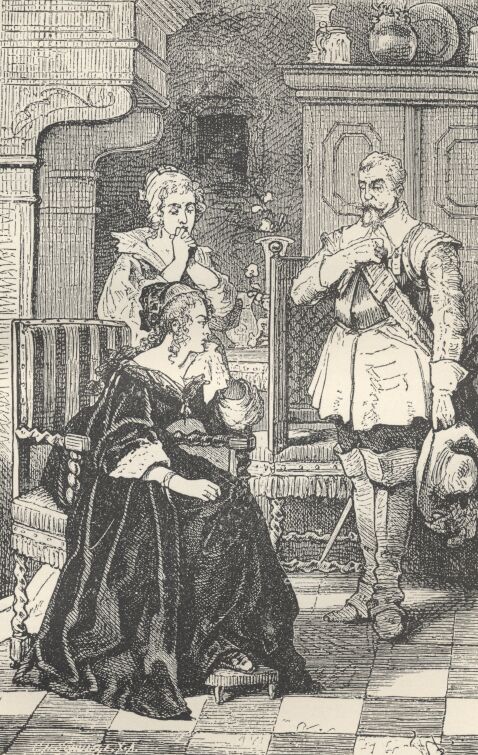
  CAPTAIN.
              Both in van and flanks
  With our whole cavalry we now received them;
  Back to the trenches drove them, where the foot
  Stretched out a solid ridge of pikes to meet them.
  They neither could advance, nor yet retreat;
  And as they stood on every side wedged in,
  The Rhinegrave to their leader called aloud,
  Inviting a surrender; but their leader,
  Young Piccolomini——
     [THEKLA, as giddy, grasps a chair.
             Known by his plume,
  And his long hair, gave signal for the trenches;
  Himself leaped first: the regiment all plunged after.
  His charger, by a halbert gored, reared up,
  Flung him with violence off, and over him
  The horses, now no longer to be curbed,——

     [THEKLA, who has accompanied the last speech with all
     the marks of increasing agony, trembles through her whole
     frame and is falling. The LADY NEUBRUNN runs to her, and
     receives her in her arms.

  NEUBRUNN.
  My dearest lady!

  CAPTAIN.
           I retire.

  THERLA.
                 'Tis over.
  Proceed to the conclusion.

  CAPTAIN.
                Wild despair
  Inspired the troops with frenzy when they saw
  Their leader perish; every thought of rescue
  Was spurned; they fought like wounded tigers; their
  Frantic resistance roused our soldiery;
  A murderous fight took place, nor was the contest
  Finished before their last man fell.

  THEKLA (faltering).
                     And where—
  Where is—you have not told me all.

  CAPTAIN (after a pause).
                     This morning
  We buried him. Twelve youths of noblest birth
  Did bear him to interment; the whole army
  Followed the bier. A laurel decked his coffin;
  The sword of the deceased was placed upon it,
  In mark of honor by the Rhinegrave's self,
  Nor tears were wanting; for there are among us
  Many, who had themselves experienced
  The greatness of his mind and gentle manners;
  All were affected at his fate. The Rhinegrave
  Would willingly have saved him; but himself
  Made vain the attempt—'tis said he wished to die.

  NEUBRUNN (to THEKLA, who has hidden her countenance).
  Look up, my dearest lady——

  THEKLA.
                Where is his grave?

  CAPTAIN.
  At Neustadt, lady; in a cloister church
  Are his remains deposited, until
  We can receive directions from his father.

  THEKLA.
  What is the cloister's name?

  CAPTAIN.
                 Saint Catherine's.

  THEKLA.
  And how far is it thither?

  CAPTAIN.
                Near twelve leagues.

  THEKLA.
  And which the way?

  CAPTAIN.
            You go by Tirschenreut
  And Falkenberg, through our advanced posts.

  THEKLA
                         Who
  Is their commander?

  CAPTAIN.
             Colonel Seckendorf.

     [THEKLA steps to the table, and takes a ring from a casket.

  THEKLA.
  You have beheld me in my agony,
  And shown a feeling heart. Please you, accept
     [Giving him the ring.
  A small memorial of this hour. Now go!

  CAPTAIN (confusedly).
  Princess——

     [THEKLA silently makes signs to him to go, and turns from him.
     The captain lingers, and is about to speak. LADY NEUBRUNN repeats
     the signal, and he retires.
     THEKLA, LADY NEUBRUNN.

  THEKLA (falls on LADY NEUBRUNN's neck).
  Now gentle Neubrunn, show me the affection
  Which thou hast ever promised—prove thyself
  My own true friend and faithful fellow-pilgrim.
  This night we must away!

  NEUBRUNN.
               Away! and whither?

  THEKLA.
  Whither! There is but one place in the world.
  Thither, where he lies buried! To his coffin!

  NEUBRUNN.
  What would you do there?

  THEKLA.
               What do there?
  That wouldst thou not have asked, hadst thou e'er loved.
  There, that is all that still remains of him!
  That single spot is the whole earth to me.

  NEUBRUNN.
  That place of death——

  THEKLA.
              Is now the only place
  Where life yet dwells for me: detain me not!
  Come and make preparations; let us think
  Of means to fly from hence.

  NEUBRUNN.
                 Your father's rage

  THEKLA.
  That time is past—
  And now I fear no human being's rage.

  NEUBRUNN.
  The sentence of the world! The tongue of calumny!

  THEKLA.
  Whom am I seeking? Him who is no more.
  Am I then hastening to the arms—O God!
  I haste—but to the grave of the beloved.

  NEUBRUNN.
  And we alone, two helpless, feeble women?

  THEKLA.
  We will take weapons: my arm shall protect thee.

  NEUBRUNN.
  In the dark night-time?

  THEKLA.
               Darkness will conceal us.

  NEUBRUNN.
  This rough tempestuous night——

  THEKLA.
                  Had he a soft bed
  Under the hoofs of his war-horses?

  NEUBRUNN.
                    Heaven!
  And then the many posts of the enemy!

  THEKLA.
  They are human beings. Misery travels free
  Through the whole earth.

  NEUBRUNN.
               The journey's weary length——

  THEKLA.
  The pilgrim, travelling to a distant shrine
  Of hope and healing doth not count the leagues.

  NEUBRUNN.
  How can we pass the gates?

  THEKLA.
                Gold opens them.
  Go, do but go.

  NEUBRUNN.
          Should we be recognized——

  THEKLA.
  In a despairing woman, a poor fugitive,
  Will no one seek the daughter of Duke Friedland.

  NEUBRUNN.
  And where procure we horses for our flight?

  THEKLA.
  My equerry procures them. Go and fetch him.

  NEUBRUNN.
  Dares he, without the knowledge of his lord?

  THEKLA.
  He will. Go, only go. Delay no longer.

  NEUBRUNN.
  Dear lady! and your mother?

  THEKLA.
                 Oh! my mother!

  NEUBRUNN.
  So much as she has suffered too already;
  Your tender mother. Ah! how ill prepared
  For this last anguish!

  THEKLA.
              Woe is me! My mother!
                   [Pauses.
  Go instantly.

  NEUBRUNN.
          But think what you are doing!

  THEKLA.
  What can be thought, already has been thought.

  NEUBRUNN.
  And being there, what purpose you to do?

  THEKLA.
  There a divinity will prompt my soul.

  NEUBRUNN.
  Your heart, dear lady, is disquieted!
  And this is not the way that leads to quiet.

  THEKLA.
  To a deep quiet, such as he has found,
  It draws me on, I know not what to name it,
  Resistless does it draw me to his grave.
  There will my heart be eased, my tears will flow.
  Oh hasten, make no further questioning!
  There is no rest for me till I have left
  These walls—they fall in on me—a dim power
  Drives me from hence—oh mercy! What a feeling!
  What pale and hollow forms are those! They fill,
  They crowd the place! I have no longer room here!
  Mercy! Still more! More still! The hideous swarm,
  They press on me; they chase me from these walls—
  Those hollow, bodiless forms of living men!

  NEUBRUNN.
  You frighten me so, lady, that no longer
  I dare stay here myself. I go and call
  Rosenberg instantly.

             [Exit LADY NEUBRUNN.
  THEKLA.
  His spirit 'tis that calls me: 'tis the troop
  Of his true followers, who offered up
  Themselves to avenge his death: and they accuse me
  Of an ignoble loitering—they would not
  Forsake their leader even in his death; they died for him,
  And shall I live?
  For me too was that laurel garland twined
  That decks his bier. Life is an empty casket:
  I throw it from me. Oh, my only hope;
  To die beneath the hoofs of trampling steeds—
  That is a lot of heroes upon earth!

               [Exit THEKLA. [10]

            (The Curtain drops.)
     THEKLA, LADY NEUBRUNN, and ROSENBERG.

  NEUBRUNN.
  He is here, lady, and he will procure them.

  THEKLA.
  Wilt thou provide us horses, Rosenberg?

  ROSENBERG.
  I will, my lady.

  THEKLA.
           And go with us as well?

  ROSENBERG.
  To the world's end, my lady.

  THEKLA.
                 But consider,
  Thou never canst return unto the duke.

  ROSENBERG.
  I will remain with thee.

  THEKLA.
               I will reward thee.
  And will commend thee to another master.
  Canst thou unseen conduct us from the castle?

  ROSENBERG.
  I can.

  THEKLA.
      When can I go?

  ROSENBERG.
              This very hour.
  But whither would you, lady?

  THEKLA.
                 To—Tell him, Neubrunn.

  NEUBRUNN.
  To Neustadt.

  ROSENBERG.
         So; I leave you to get ready.

                    [Exit.

  NEUBRUNN.
  Oh, see, your mother comes.

  THEKLA.
                 Indeed! O Heaven!
     THEKLA, LADY NEUBRUNN, the DUCHESS.

  DUCHESS.
  He's gone! I find thee more composed, my child.

  THEKLA.
  I am so, mother; let me only now
  Retire to rest, and Neubrunn here be with me.
  I want repose.

  DUCHESS.
          My Thekla, thou shalt have it.
  I leave thee now consoled, since I can calm
  Thy father's heart.

  THEKLA.
             Good night, beloved mother!

     (Falling on her neck and embracing her with deep emotion).

  DUCHESS.
  Thou scarcely art composed e'en now, my daughter.
  Thou tremblest strongly, and I feel thy heart
  Beat audibly on mine.

  THEKLA.
              Sleep will appease
  Its beating: now good-night, good-night, dear mother.

     (As she withdraws from her mother's arms the curtain falls).
     Butler's Chamber.

     BUTLER, and MAJOR GERALDIN.

  BUTLER.
  Find me twelve strong dragoons, arm them with pikes
  For there must be no firing—
  Conceal them somewhere near the banquet-room,
  And soon as the dessert is served up, rush all in
  And cry—"Who is loyal to the emperor?"
  I will overturn the table—while you attack
  Illo and Terzky, and despatch them both.
  The castle-palace is well barred and guarded,
  That no intelligence of this proceeding
  May make its way to the duke. Go instantly;
  Have you yet sent for Captain Devereux
  And the Macdonald?

  GERALDIN.
            They'll be here anon.

               [Exit GERALDIN.

  BUTLER.
  Here's no room for delay. The citizens
  Declare for him—a dizzy drunken spirit
  Possesses the whole town. They see in the duke
  A prince of peace, a founder of new ages
  And golden times. Arms, too, have been given out
  By the town-council, and a hundred citizens
  Have volunteered themselves to stand on guard.
  Despatch! then, be the word; for enemies
  Threaten us from without and from within.
     BUTLER, CAPTAIN DEVEREUX, and MACDONALD.

  MACDONALD.
  Here we are, general.

  DEVEREUX.
              What's to be the watchword?

  BUTLER.
  Long live the emperor!

  BOTH (recoiling).
              How?

  BUTLER.
                 Live the house of Austria.

  DEVEREUX.
  Have we not sworn fidelity to Friedland?

  MACDONALD.
  Have we not marched to this place to protect him?

  BUTLER.
  Protect a traitor and his country's enemy?

  DEVEREUX.
  Why, yes! in his name you administered
  Our oath.

  MACDONALD.
        And followed him yourself to Egra.

  BUTLER.
  I did it the more surely to destroy him.

  DEVEREUX.
  So then!

  MACDONALD.
       An altered case!

  BUTLER (to DEVEREUX).
                Thou wretched man
  So easily leavest thou thy oath and colors?

  DEVEREUX.
  The devil! I but followed your example;
  If you could prove a villain, why not we?

  MACDONALD.
  We've naught to do with thinking—that's your business.
  You are our general, and give out the orders;
  We follow you, though the track lead to hell.

  BUTLER (appeased).
  Good, then! we know each other.

  MACDONALD.
                   I should hope so.

  DEVEREUX.
  Soldiers of fortune are we—who bids most
  He has us.

  MACDONALD.
        'Tis e'en so!

  BUTLER.
                Well, for the present
  You must remain honest and faithful soldiers.

  DEVEREUX.
  We wish no other.

  BUTLER.
            Ay, and make your fortunes.

  MACDONALD.
  That is still better.

  BUTLER.
              Listen!

  BOTH.
                  We attend.

  BUTLER.
  It is the emperor's will and ordinance
  To seize the person of the Prince-Duke Friedland
  Alive or dead.

  DEVEREUX.
          It runs so in the letter.

  MACDONALD.
  Alive or dead—these were the very words.

  BUTLER.
  And he shall be rewarded from the state
  In land and gold who proffers aid thereto.

  DEVEREUX.
  Ay! that sounds well. The words sound always well
  That travel hither from the court. Yes! yes!
  We know already what court-words import.
  A golden chain perhaps in sign of favor,
  Or an old charger, or a parchment-patent,
  And such like. The prince-duke pays better.

  MACDONALD.
                         Yes,
  The duke's a splendid paymaster.

  BUTLER.
                   All over
  With that, my friends. His lucky stars are set.

  MACDONALD.
  And is that certain?

  BUTLER.
             You have my word for it.

  DEVEREUX.
  His lucky fortune's all passed by?

  BUTLER.
                    Forever.
  He is as poor as we.

  MACDONALD.
             As poor as we?

  DEVEREUX.
  Macdonald, we'll desert him.

  BUTLER.
                 We'll desert him?
  Full twenty thousand have done that already;
  We must do more, my countrymen! In short—
  We—we must kill him.

  BOTH (starting back)
              Kill him!

  BUTLER.
                   Yes, must kill him;
  And for that purpose have I chosen you.

  BOTH.
                       Us!

  BUTLER.
  You, Captain Devereux, and thee, Macdonald.

  DEVEREUX (after a pause).
  Choose you some other.

  BUTLER.
              What! art dastardly?
  Thou, with full thirty lives to answer for—
  Thou conscientious of a sudden?

  DEVEREUX.
                   Nay
  To assassinate our lord and general——

  MACDONALD.
  To whom we swore a soldier's oath——

  BUTLER.
                     The oath
  Is null, for Friedland is a traitor.

  DEVEREUX.
  No, no! it is too bad!

  MACDONALD.
              Yes, by my soul!
  It is too bad. One has a conscience too——

  DEVEREUX.
  If it were not our chieftain, who so long
  Has issued the commands, and claimed our duty——

  BUTLER.
  Is that the objection?

  DEVEREUX.
              Were it my own father,
  And the emperor's service should demand it of me,
  It might be done perhaps—but we are soldiers,
  And to assassinate our chief commander,
  That is a sin, a foul abomination,
  From which no monk or confessor absolves us.

  BUTLER.
  I am your pope, and give you absolution.
  Determine quickly!

  DEVEREUX.
            'Twill not do.

  MACDONALD.
                    'Twont do!

  BUTLER.
  Well, off then! and—send Pestalutz to me.

  DEVEREUX (hesitates).
  The Pestalutz——

  MACDONALD.
           What may you want with him?

  BUTLER.
  If you reject it, we can find enough——

  DEVEREUX.
  Nay, if he must fall, we may earn the bounty
  As well as any other. What think you,
  Brother Macdonald?

  MACDONALD.
            Why, if he must fall,
  And will fall, and it can't be otherwise,
  One would not give place to this Pestalutz.

  DEVEREUX (after some reflection).
  When do you purpose he should fall?

  BUTLER.
                     This night.
  To-morrow will the Swedes be at our gates.

  DEVEREUX.
  You take upon you all the consequences?

  BUTLER.
  I take the whole upon me.

  DEVEREUX.
                And it is
  The emperor's will, his express absolute will?
  For we have instances that folks may like
  The murder, and yet hang the murderer.

  BUTLER.
  The manifesto says—"alive or dead."
  Alive—'tis not possible—you see it is not.

  DEVEREUX.
  Well, dead then! dead! But how can we come at him.
  The town is filled with Terzky's soldiery.

  MACDONALD.
  Ay! and then Terzky still remains, and Illo——

  BUTLER.
  With these you shall begin—you understand me?

  DEVEREUX.
  How! And must they too perish?

  BUTLER.
                   They the first.

  MACDONALD.
  Hear, Devereux! A bloody evening this.

  DEVEREUX.
  Have you a man for that? Commission me——

  BUTLER.
  'Tis given in trust to Major Geraldin;
  This is a carnival night, and there's a feast
  Given at the castle—there we shall surprise them,
  And hew them down. The Pestalutz and Lesley
  Have that commission. Soon as that is finished——

  DEVEREUX.
  Hear, general! It will be all one to you—
  Hark ye, let me exchange with Geraldin.

  BUTLER.
  'Twill be the lesser danger with the duke.

  DEVEREUX.
  Danger! The devil! What do you think me, general,
  'Tis the duke's eye, and not his sword, I fear.

  BUTLER.
  What can his eye do to thee?

  DEVEREUX.
                 Death and hell!
  Thou knowest that I'm no milksop, general!
  But 'tis not eight days since the duke did send me
  Twenty gold pieces for this good warm coat
  Which I have on! and then for him to see me
  Standing before him with the pike, his murderer.
  That eye of his looking upon this coat—
  Why—why—the devil fetch me! I'm no milksop!

  BUTLER.
  The duke presented thee this good warm coat,
  And thou, a needy wight, hast pangs of conscience
  To run him through the body in return,
  A coat that is far better and far warmer
  Did the emperor give to him, the prince's mantle.
  How doth he thank the emperor? With revolt
  And treason.

  DEVEREUX.
         That is true. The devil take
  Such thankers! I'll despatch him.

  BUTLER.
                    And would'st quiet
  Thy conscience, thou hast naught to do but simply
  Pull off the coat; so canst thou do the deed
  With light heart and good spirits.

  DEVEREUX.
                    You are right,
  That did not strike me. I'll pull off the coat—
  So there's an end of it.

  MACDONALD.
               Yes, but there's another
  Point to be thought of.

  BUTLER.
               And what's that, Macdonald?

  MACDONALD.
  What avails sword or dagger against him?
  He is not to be wounded—he is——

  BUTLER (starting up).
                   What!

  MACDONALD.
  Safe against shot, and stab, and flash! Hard frozen.
  Secured and warranted by the black art
  His body is impenetrable, I tell you.

  DEVEREUX.
  In Ingolstadt there was just such another:
  His whole skin was the same as steel; at last
  We were obliged to beat him down with gunstocks.

  MACDONALD.
  Hear what I'll do.

  DEVEREUX.
            Well.

  MACDONALD.
                In the cloister here
  There's a Dominican, my countryman.
  I'll make him dip my sword and pike for me
  In holy water, and say over them
  One of his strongest blessings. That's probatum!
  Nothing can stand 'gainst that.

  BUTLER.
                   So do, Macdonald!
  But now go and select from out the regiment
  Twenty or thirty able-bodied fellows,
  And let them take the oaths to the emperor.
  Then when it strikes eleven, when the first rounds
  Are passed, conduct them silently as may be
  To the house. I will myself be not far off.

  DEVEREUX.
  But how do we get through Hartschier and Gordon,
  That stand on guard there in the inner chamber?

  BUTLER.
  I have made myself acquainted with the place,
  I lead you through a back door that's defended
  By one man only. Me my rank and office
  Give access to the duke at every hour.
  I'll go before you—with one poinard-stroke
  Cut Hartschier's windpipe, and make way for you.

  DEVEREUX.
  And when we are there, by what means shall we gain
  The duke's bed-chamber, without his alarming
  The servants of the court? for he has here
  A numerous company of followers.

  BUTLER.
  The attendants fill the right wing: he hates bustle,
  And lodges in the left wing quite alone.

  DEVEREUX.
  Were it well over—hey, Macdonald! I
  Feel queerly on the occasion, devil knows.

  MACDONALD.
  And I, too. 'Tis too great a personage.
  People will hold us for a brace of villains.

  BUTLER.
  In plenty, honor, splendor—you may safely
  Laugh at the people's babble.

  DEVEREUX.
                  If the business
  Squares with one's honor—if that be quite certain.

  BUTLER.
  Set your hearts quite at ease. Ye save for Ferdinand
  His crown and empire. The reward can be
  No small one.

  DEVEREUX.
  And 'tis his purpose to dethrone the emperor?

  BUTLER.
  Yes! Yes! to rob him of his crown and life.

  DEVEREUX.
  And must he fall by the executioner's hands,
  Should we deliver him up to the emperor
  Alive?

  BUTLER.
      It were his certain destiny.

  DEVEREUX.
  Well! Well! Come then, Macdonald, he shall not
  Lie long in pain.

     [Exeunt BUTLER through one door, MACDONALD and DEVEREUX
     through the other.
     A saloon, terminated by a gallery, which extends far
     into the background.

     WALLENSTIN sitting at a table. The SWEDISH CAPTAIN
     standing before him.

  WALLENSTEIN.
  Commend me to your lord. I sympathize
  In his good fortune; and if you have seen me
  Deficient in the expressions of that joy,
  Which such a victory might well demand,
  Attribute it to no lack of good-will,
  For henceforth are our fortunes one. Farewell,
  And for your trouble take my thanks. To-morrow
  The citadel shall be surrendered to you
  On your arrival.

     [The SWEDISH CAPTAIN retires. WALLENSTEIN sits lost in thought,
     his eyes fixed vacantly, and his head sustained by his hand. The
     COUNTESS TERZKY enters, stands before him for awhile, unobserved
     by him; at length he starts, sees her and recollects himself.

  WALLENSTEIN.
  Comest thou from her? Is she restored? How is she?

  COUNTESS.
  My sister tells me she was more collected
  After her conversation with the Swede.
  She has now retired to rest.

  WALLENSTEIN.
                 The pang will soften
  She will shed tears.

  COUNTESS.
             I find thee altered, too,
  My brother! After such a victory
  I had expected to have found in thee
  A cheerful spirit. Oh, remain thou firm!
  Sustain, uphold us! For our light thou art,
  Our sun.

  WALLENSTEIN.
       Be quiet. I ail nothing. Where's
  Thy husband?

  COUNTESS.
         At a banquet—he and Illo.

  WALLENSTEIN (rises and strides across the saloon).
  The night's far spent. Betake thee to thy chamber.

  COUNTESS.
  Bid me not go, oh, let me stay with thee!

  WALLENSTEIN (moves to the window).
  There is a busy motion in the heaven,
  The wind doth chase the flag upon the tower,
  Fast sweep the clouds, the sickle 11 of the moon,
  Struggling, darts snatches of uncertain light.
  No form of star is visible! That one
  White stain of light, that single glimmering yonder,
  Is from Cassiopeia, and therein
  Is Jupiter. (A pause.) But now
  The blackness of the troubled element hides him!

     [He sinks into profound melancholy, and looks vacantly
     into the distance.

  COUNTESS (looks on him mournfully, then grasps his hand).
  What art thou brooding on?

  WALLENSTEIN.
                Methinks
  If I but saw him, 'twould be well with me.
  He is the star of my nativity,
  And often marvellously hath his aspect
  Shot strength into my heart.

  COUNTESS.
  Thou'lt see him again.

  WALLENSTEIN (remains for awhile with absent mind, then assumes a livelier
  manner, and turning suddenly to the COUNTESS).
  See him again? Oh, never, never again!

  COUNTESS.
  How?

  WALLENSTEIN.
     He is gone—is dust.

  COUNTESS.
                Whom meanest thou, then?

  WALLENSTEIN.
  He, the more fortunate! yea, he hath finished!
  For him there is no longer any future,
  His life is bright—bright without spot it was,
  And cannot cease to be. No ominous hour
  Knocks at his door with tidings of mishap,
  Far off is he, above desire and fear;
  No more submitted to the change and chance
  Of the unsteady planets. Oh, 'tis well
  With him! but who knows what the coming hour
  Veiled in thick darkness brings us?

  COUNTESS.
  Thou speakest of Piccolomini. What was his death?
  The courier had just left thee as I came.

     [WALLENSTEIN by a motion of his hand makes signs to her
     to be silent.

  Turn not thine eyes upon the backward view,
  Let us look forward into sunny days,
  Welcome with joyous heart the victory,
  Forget what it has cost thee. Not to-day,
  For the first time, thy friend was to thee dead;
  To thee he died when first he parted from thee.

  WALLENSTEIN.
  This anguish will be wearied down 12, I know;
  What pang is permanent with man? From the highest,
  As from the vilest thing of every day,
  He learns to wean himself: for the strong hours
  Conquer him. Yet I feel what I have lost
  In him. The bloom is vanished from my life,
  For oh, he stood beside me, like my youth,
  Transformed for me the real to a dream,
  Clothing the palpable and the familiar
  With golden exhalations of the dawn,
  Whatever fortunes wait my future toils,
  The beautiful is vanished—and returns not.

  COUNTESS.
  Oh, be not treacherous to thy own power.
  Thy heart is rich enough to vivify
  Itself. Thou lovest and prizest virtues in him,
  The which thyself didst plant, thyself unfold.

  WALLENSTEIN (stepping to the door).
  Who interrupts us now at this late hour?
  It is the governor. He brings the keys
  Of the citadel. 'Tis midnight. Leave me, sister!

  COUNTESS.
  Oh, 'tis so hard to me this night to leave thee;
  A boding fear possesses me!

  WALLENSTEIN.
                 Fear! Wherefore?

  COUNTESS.
  Shouldst thou depart this night, and we at waking
  Never more find thee!

  WALLENSTEIN.
              Fancies!

  COUNTESS.
                   Oh, my soul
  Has long been weighed down by these dark forebodings,
  And if I combat and repel them waking,
  They still crush down upon my heart in dreams,
  I saw thee, yesternight with thy first wife
  Sit at a banquet, gorgeously attired.

  WALLENSTHIN.
  This was a dream of favorable omen,
  That marriage being the founder of my fortunes.

  COUNTESS.
  To-day I dreamed that I was seeking thee
  In thy own chamber. As I entered, lo!
  It was no more a chamber: the Chartreuse
  At Gitschin 'twas, which thou thyself hast founded,
  And where it is thy will that thou shouldst be
  Interred.

  WALLENSTEIN.
        Thy soul is busy with these thoughts.

  COUNTESS.
  What! dost thou not believe that oft in dreams
  A voice of warning speaks prophetic to us?

  WALLENSTEIN.
  There is no doubt that there exist such voices,
  Yet I would not call them
  Voices of warning that announce to us
  Only the inevitable. As the sun,
  Ere it is risen, sometimes paints its image
  In the atmosphere, so often do the spirits
  Of great events stride on before the events,
  And in to-day already walks to-morrow.
  That which we read of the fourth Henry's death
  Did ever vex and haunt me like a tale
  Of my own future destiny. The king
  Felt in his breast the phantom of the knife
  Long ere Ravaillac armed himself therewith.
  His quiet mind forsook him; the phantasma
  Started him in his Louvre, chased him forth
  Into the open air; like funeral knells
  Sounded that coronation festival;
  And still with boding sense he heard the tread
  Of those feet that even then were seeking him
  Throughout the streets of Paris.

  COUNTESS.
                   And to thee
  The voice within thy soul bodes nothing?

  WALLENSTEIN.
                       Nothing.
  Be wholly tranquil.

  COUNTESS.
             And another time
  I hastened after thee, and thou rann'st from me
  Through a long suite, through many a spacious hall.
  There seemed no end of it; doors creaked and clapped;
  I followed panting, but could not overtake thee;
  When on a sudden did I feel myself
  Grasped from behind,—the hand was cold that grasped me;
  'Twas thou, and thou didst kiss me, and there seemed
  A crimson covering to envelop us.

  WALLENSTEIN.
  That is the crimson tapestry of my chamber.

  COUNTESS (gazing on him).
  If it should come to that—if I should see thee,
  Who standest now before me in the fulness
  Of life——

     [She falls on his breast and weeps.

  WALLENSTEIN.
  The emperor's proclamation weighs upon thee—
  Alphabets wound not—and he finds no hands.

  COUNTESS.
  If he should find them, my resolve is taken—
  I bear about me my support and refuge.

               [Exit COUNTESS.
     WALLENSTEIN, GORDON.

  WALLENSTEIN.
  All quiet in the town?

  GORDON.
              The town is quiet.

  WALLENSTEIN.
  I hear a boisterous music! and the castle
  Is lighted up. Who are the revellers?

  GORDON.
  There is a banquet given at the castle
  To the Count Terzky and Field-Marshal Illo.

  WALLENSTEIN.
  In honor of the victory—this tribe
  Can show their joy in nothing else but feasting.
     [Rings. The GROOM OF THE CHAMBER enters.
  Unrobe me. I will lay me down to sleep.
     [WALLENSTEIN takes the keys from GORDON.
  So we are guarded from all enemies,
  And shut in with sure friends.
  For all must cheat me, or a face like this
     [Fixing his eyes on GORDON.
  Was ne'er a hypocrite's mask.

     [The GROOM OF THE CHAMBER takes off his mantle, collar, and scarf.

  WALLENSTEIN.
  Take care—what is that?

  GROOM OF THE CHAMBER.
               The golden chain is snapped in two.

  WALLENSTEIN.
  Well, it has lasted long enough. Here—give it.
     [He takes and looks at the chain.
  'Twas the first present of the emperor.
  He hung it round me in the war of Friule,
  He being then archduke; and I have worn it
  Till now from habit—
  From superstition, if you will. Belike,
  It was to be a talisman to me;
  And while I wore it on my neck in faith,
  It was to chain to me all my life-long
  The volatile fortune, whose first pledge it was.
  Well, be it so! Henceforward a new fortune
  Must spring up for me; for the potency
  Of this charm is dissolved.

     [GROOM OF THE CHAMBER retires with the vestments. WALLENSTEIN
     rises, takes a stride across the room, and stands at last before
     GORDON in a posture of meditation.

  How the old time returns upon me! I
  Behold myself once more at Burgau, where
  We two were pages of the court together.
  We oftentimes disputed: thy intention
  Was ever good; but thou were wont to play
  The moralist and preacher, and wouldst rail at me—
  That I strove after things too high for me,
  Giving my faith to bold, unlawful dreams,
  And still extol to me the golden mean.
  Thy wisdom hath been proved a thriftless friend
  To thy own self. See, it has made thee early
  A superannuated man, and (but
  That my munificent stars will intervene)
  Would let thee in some miserable corner
  Go out like an untended lamp.

  GORDON.
                  My prince
  With light heart the poor fisher moors his boat,
  And watches from the shore the lofty ship
  Stranded amid the storm.

  WALLENSTEIN.
               Art thou already
  In harbor, then, old man? Well! I am not.
  The unconquered spirit drives me o'er life's billows;
  My planks still firm, my canvas swelling proudly.
  Hope is my goddess still, and youth my inmate;
  And while we stand thus front to front almost,
  I might presume to say, that the swift years
  Have passed by powerless o'er my unblanched hair.

     [He moves with long strides across the saloon, and remains
     on the opposite side over against GORDON.

  Who now persists in calling fortune false?
  To me she has proved faithful; with fond love
  Took me from out the common ranks of men,
  And like a mother goddess, with strong arm
  Carried me swiftly up the steps of life.
  Nothing is common in my destiny,
  Nor in the furrows of my hand. Who dares
  Interpret then my life for me as 'twere
  One of the undistinguishable many?
  True, in this present moment I appear
  Fallen low indeed; but I shall rise again.
  The high flood will soon follow on this ebb;
  The fountain of my fortune, which now stops,
  Repressed and bound by some malicious star,
  Will soon in joy play forth from all its pipes.

  GORDON.
  And yet remember I the good old proverb,
  "Let the night come before we praise the day."
  I would be slow from long-continued fortune
  To gather hope: for hope is the companion
  Given to the unfortunate by pitying heaven.
  Fear hovers round the head of prosperous men,
  For still unsteady are the scales of fate.

  WALLENSTEIN (smiling).
  I hear the very Gordon that of old
  Was wont to preach, now once more preaching;
  I know well, that all sublunary things
  Are still the vassals of vicissitude.
  The unpropitious gods demand their tribute.
  This long ago the ancient pagans knew
  And therefore of their own accord they offered
  To themselves injuries, so to atone
  The jealousy of their divinities
  And human sacrifices bled to Typhon.
     [After a pause, serious, and in a more subdued manner.
  I too have sacrificed to him—for me
  There fell the dearest friend, and through my fault
  He fell! No joy from favorable fortune
  Can overweigh the anguish of this stroke.
  The envy of my destiny is glutted:
  Life pays for life. On his pure head the lightning
  Was drawn off which would else have shattered me.
     To these enter SENI.

  WALLENSTEIN.
  Is not that Seni! and beside himself,
  If one can trust his looks? What brings thee hither
  At this late hour, Baptista?

  SENI.
                 Terror, duke!
  On thy account.

  WALLENSTEIN.
           What now?

  SENI.
                Flee ere the day break!
  Trust not thy person to the Swedes!

  WALLENSTEIN.
                     What now
  Is in thy thoughts?

  SENI (with louder voice).
  Trust not thy person to the Swedes.

  WALLENSTEIN.
                     What is it, then?

  SENI (still more urgently).
  Oh, wait not the arrival of these Swedes!
  An evil near at hand is threatening thee
  From false friends. All the signs stand full of horror!
  Near, near at hand the net-work of perdition—
  Yea, even now 'tis being cast around thee!

  WALLENSTEIN.
  Baptista, thou art dreaming!—fear befools thee.

  SENI.
  Believe not that an empty fear deludes me.
  Come, read it in the planetary aspects;
  Read it thyself, that ruin threatens thee
  From false friends.

  WALLENSTEIN.
             From the falseness of my friends
  Has risen the whole of my unprosperous fortunes.
  The warning should have come before! At present
  I need no revelation from the stars
  To know that.

  SENI.
          Come and see! trust thine own eyes.
  A fearful sign stands in the house of life—
  An enemy; a fiend lurks close behind
  The radiance of thy planet. Oh, be warned!
  Deliver not up thyself to these heathens,
  To wage a war against our holy church.

  WALLENSTEIN (laughing gently).
  The oracle rails that way! Yes, yes! Now
  I recollect. This junction with the Swedes
  Did never please thee—lay thyself to sleep,
  Baptista! Signs like these I do not fear.

  GORDON (who during the whole of this dialogue has shown marks
      of extreme agitation, and now turns to WALLENSTEIN).
  My duke and general! May I dare presume?

  WALLENSTEIN.
  Speak freely.

  GORDON.
          What if 'twere no mere creation
  Of fear, if God's high providence vouchsafed
  To interpose its aid for your deliverance,
  And made that mouth its organ?

  WALLENSTEIN.
                  Ye're both feverish!
  How can mishap come to me from the Swedes?
  They sought this junction with me—'tis their interest.

  GORDON (with difficulty suppressing his emotion).
  But what if the arrival of these Swedes—
  What if this were the very thing that winged
  The ruin that is flying to your temples?

     [Flings himself at his feet.

  There is yet time, my prince.

  SENI.
                  Oh hear him! hear him!

  GORDON (rises).
  The Rhinegrave's still far off. Give but the orders,
  This citadel shall close its gates upon him.
  If then he will besiege us, let him try it.
  But this I say; he'll find his own destruction,
  With his whole force before these ramparts, sooner
  Than weary down the valor of our spirit.
  He shall experience what a band of heroes,
  Inspirited by an heroic leader,
  Is able to perform. And if indeed
  It be thy serious wish to make amend
  For that which thou hast done amiss,—this, this
  Will touch and reconcile the emperor,
  Who gladly turns his heart to thoughts of mercy;
  And Friedland, who returns repentant to him,
  Will stand yet higher in his emperor's favor
  Then e'er he stood when he had never fallen.

  WALLENSTEIN (contemplates him with surprise, remains silent a while,
         betraying strong emotion).
  Gordon—your zeal and fervor lead you far.
  Well, well—an old friend has a privilege.
  Blood, Gordon, has been flowing. Never, never
  Can the emperor pardon me: and if he could,
  Yet I—I ne'er could let myself be pardoned.
  Had I foreknown what now has taken place,
  That he, my dearest friend, would fall for me,
  My first death offering; and had the heart
  Spoken to me, as now it has done—Gordon,
  It may be, I might have bethought myself.
  It may be too, I might not. Might or might not
  Is now an idle question. All too seriously
  Has it begun to end in nothing, Gordon!
  Let it then have its course.
     [Stepping to the window.
  All dark and silent—at the castle too
  All is now hushed. Light me, chamberlain?

     [The GROOM OF THE CHAMBER, who had entered during the last dialogue,
     and had been standing at a distance and listening to it with visible
     expressions of the deepest interest, advances in extreme agitation
     and throws himself at the DUKE's feet.

  And thou too! But I know why thou dost wish
  My reconcilement with the emperor.
  Poor man! he hath a small estate in Carinthia,
  And fears it will be forfeited because
  He's in my service. Am I then so poor
  That I no longer can indemnify
  My servants? Well! to no one I employ
  Means of compulsion. If 'tis thy belief
  That fortune has fled from me, go! forsake me.
  This night for the last time mayst thou unrobe me,
  And then go over to the emperor.
  Gordon, good-night! I think to make a long
  Sleep of it: for the struggle and the turmoil
  Of this last day or two was great. May't please you
  Take care that they awake me not too early.

     [Exit WALLENSTEIN, the GROOM OF THE CHAMBER lighting him. SENI
     follows, GORDON remains on the darkened stage, following the DUKE
     with his eye, till he disappears at the further end of the gallery:
     then by his gestures the old man expresses the depth of his anguish,
     and stands leaning against a pillar.
     GORDON, BUTLER (at first behind the scenes).

  BUTLER (not yet come into view of the stage).
  Here stand in silence till I give the signal.

  GORDON (starts up).
  'Tis he! he has already brought the murderers.

  BUTLER.
  The lights are out. All lies in profound sleep.

  GORDON.
  What shall I do, shall I attempt to save him?
  Shall I call up the house? alarm the guards?

  BUTLER (appears, but scarcely on the stage).
  A light gleams hither from the corridor.
  It leads directly to the duke's bed-chamber.

  GORDON.
  But then I break my oath to the emperor;
  If he escape and strengthen the enemy,
  Do I not hereby call down on my head
  All the dread consequences.

  BUTLER (stepping forward).
                 Hark! Who speaks there?

  GORDON.
  'Tis better, I resign it to the hands
  Of Providence. For what am I, that I
  Should take upon myself so great a deed?
  I have not murdered him, if he be murdered;
  But all his rescue were my act and deed;
  Mine—and whatever be the consequences
  I must sustain them.

  BUTLER (advances).
             I should know that voice.

  GORDON.
  Butler!

  BUTLER.
       'Tis Gordon. What do you want here?
  Was it so late, then, when the duke dismissed you?

  GORDON.
  Your hand bound up and in a scarf?

  BUTLER.
                    'Tis wounded.
  That Illo fought as he were frantic, till
  At last we threw him on the ground.

  GORDON (shuddering).
                     Both dead?

  BUTLER.
  Is he in bed?

  GORDON.
          Ah, Butler!

  BUTLER.
                Is he? speak.

  GORDON.
  He shall not perish! Not through you! The heaven
  Refuses your arm. See—'tis wounded!

  BUTLER.
  There is no need of my arm.

  GORDON.
                 The most guilty
  Have perished, and enough is given to justice.

     [The GROOM OF THE CHAMBER advances from the gallery with his finger
     on his mouth commanding silence.

  GORDON.
  He sleeps! Oh, murder not the holy sleep!

  BUTLER.
  No! he shall die awake.
                [Is going.

  GORDON.
  His heart still cleaves
  To earthly things: he's not prepared to step
  Into the presence of his God!

  BUTLER (going).
                  God's merciful!

  GORDON (holds him).
  Grant him but this night's respite.

  BUTLER (hurrying of).
                     The next moment
  May ruin all.

  GORDON (holds him still).
          One hour!

  BUTLER.
               Unhold me! What
  Can that short respite profit him?

  GORDON.
                    Oh, time
  Works miracles. In one hour many thousands
  Of grains of sand run out; and quick as they
  Thought follows thought within the human soul.
  Only one hour! Your heart may change its purpose,
  His heart may change its purpose—some new tidings
  May come; some fortunate event, decisive,
  May fall from heaven and rescue him. Oh, what
  May not one hour achieve!

  BUTLER.
                You but remind me
  How precious every minute is!

              [He stamps on the floor.
     To these enter MACDONALD and DEVEREUX, with the HALBERDIERS.

  GORDON (throwing himself between him and them).
                No, monster!
  First over my dead body thou shalt tread. I will
  Not live to see the accursed deed!

  BUTLER (forcing him out of the way).
  Weak-hearted dotard!

     [Trumpets are heard in the distance.

  DEVEREUX and MACDONALD.
             Hark! The Swedish trumpets!
  The Swedes before the ramparts! Let us hasten!

  GORDON (rushes out).
  Oh, God of mercy!

  BUTLER (calling after him).
            Governor, to your post!

  GROOM OF THE CHAMBER (hurries in).
  Who dares make larum here? Hush! The duke sleeps.

  DEVEREUX (with loud, harsh voice).
  Friend, it is time now to make larum.

  GROOM OF THE CHAMBER.
                      Help!
  Murder!

  BUTLER.
       Down with him!

  GROOM OF THE CHAMBER (run through the body by DEVEREUX, falls at
     the entrance of the gallery).
               Jesus Maria!

  BUTLER.
  Burst the doors open.

     [They rush over the body into the gallery—two doors are heard to
     crash one after the other. Voices, deadened by the distance—clash
     of arms—then all at once a profound silence:
  COUNTESS TERZKY (with a light).
  Her bedchamber is empty; she herself
  Is nowhere to be found! The Neubrunn too,
  Who watched by her, is missing. If she should
  Be flown—but whither flown? We must call up
  Every soul in the house. How will the duke
  Bear up against these worst bad tidings? Oh,
  If that my husband now were but returned
  Home from the banquet! Hark! I wonder whether
  The duke is still awake! I thought I heard
  Voices and tread of feet here! I will go
  And listen at the door. Hark! what is that?
  'Tis hastening up the steps!
     COUNTESS, GORDON.

  GORDON (rushes in out of breath)
                  'Tis a mistake!
  'Tis not the Swedes; ye must proceed no further—
  Butler! Oh, God! where is he?
                [Observing the COUNTESS.
                  Countess! Say——

  COUNTESS.
  You're come then from the castle? Where's my husband?

  GORDON (in an agony of affright).
  Your husband! Ask not! To the duke——

  COUNTESS.
                       Not till
  You have discovered to me——

  GORDON.
                 On this moment
  Does the world hang. For God's sake! to the duke.
  While we are speaking——
              [Calling loudly.
               Butler! Butler! God!

  COUNTESS.
  Why, he is at the castle with my husband.

     [BUTLER comes from the gallery.

  GORDON.
  'Twas a mistake. 'Tis not the Swedes—it is
  The imperialists' lieutenant-general
  Has sent me hither—will be here himself
  Instantly. You must not proceed.

  BUTLER.
                    He comes
  Too late.

     [GORDON dashes himself against the wall.

  GORDON.
        Oh, God of mercy!

  COUNTESS.
                 What, too late?
  Who will be here himself? Octavio
  In Egra? Treason! Treason! Where's the duke?

     [She rushes to the gallery.
     Servants run across the stage full of terror. The whole scene
     must be spoken entirely without pauses.

  SENI (from the gallery).
  Oh, bloody, frightful deed!

  COUNTESS.
                 What is it, Seni?

  PAGE (from the gallery).
  Oh, piteous sight!

     [Other servants hasten in with torches.

  COUNTESS.
  What is it? For God's sake!

  SENI.
                 And do you ask?
  Within the duke lies murdered—and your husband
  Assassinated at the castle.

     [The COUNTESS stands motionless.

  FEMALE SERVANT (rushing across the stage).
  Help! help! the duchess!

  BURGOMASTER (enters).
               What mean these confused
  Loud cries that wake the sleepers of this house?

  GORDON.
  Your house is cursed to all eternity.
  In your house doth the duke lie murdered!

  BURGOMASTER (rushing out)
                        Heaven forbid!

  FIRST SERVANT.
  Fly! fly! they murder us all!

  SECOND SERVANT (carrying silver-plate).
                  That way! the lower
  Passages are blocked up.

  VOICE (from behind the scene).
  Make room for the lieutenant-general!

     [At these words the COUNTESS starts from her stupor, collects
     herself, and retires suddenly.

  VOICE (from behind the scene).
  Keep back the people! Guard the door!
     To these enter OCTAVIO PICCOLOMINI with all his train. At the same
     time DEVEREUX and MACDONALD enter from out the corridor with the
     Halberdiers. WALLENSTEIN's dead body is carried over the back part
     of the stage, wrapped in a piece of crimson tapestry.

  OCTAVIO (entering abruptly).
  It must not be! It is not possible!
  Butler! Gordon!
  I'll not believe it. Say no!

     [GORDON, without answering, points with his hand to the body of
     WALLENSTEIN as it is carried over the back of the stage. OCTAVIO
     looks that way, and stands overpowered with horror.

  DEVEREUX (to BUTLER).
  Here is the golden fleece—the duke's sword——

  MACDONALD.
  Is it your order——

  BUTLER (pointing to OCTAVIO).
            Here stands he who now
  Hath the sole power to issue orders.

     [DEVEREUX and MACDONALD retire with marks of obeisance. One drops
     away after the other, till only BUTLER, OCTAVIO, and GORDON remain
     on the stage.

  OCTAVIO (turning to BUTLER).
  Was that my purpose, Butler, when we parted?
  Oh, God of Justice!
  To thee I lift my hand! I am not guilty
  Of this foul deed.

  BUTLER.
            Your hand is pure. You have
  Availed yourself of mine.

  OCTAVIO.
                Merciless man!
  Thus to abuse the orders of thy lord—
  And stain thy emperor's holy name with murder,
  With bloody, most accursed assassination!

  BUTLER (calmly).
  I've but fulfilled the emperor's own sentence.

  OCTAVIO.
  Oh, curse of kings,
  Infusing a dread life into their words,
  And linking to the sudden, transient thought
  The unchanging, irrevocable deed.
  Was there necessity for such an eager
  Despatch? Couldst thou not grant the merciful
  A time for mercy? Time is man's good angel.
  To leave no interval between the sentence,
  And the fulfilment of it, doth beseem
  God only, the immutable!

  BUTLER.
               For what
  Rail you against me? What is my offence?
  The empire from a fearful enemy
  Have I delivered, and expect reward.
  The single difference betwixt you and me
  Is this: you placed the arrow in the bow;
  I pulled the string. You sowed blood, and yet stand
  Astonished that blood is come up. I always
  Knew what I did, and therefore no result
  Hath power to frighten or surprise my spirit.
  Have you aught else to order; for this instant
  I make my best speed to Vienna; place
  My bleeding sword before my emperor's throne,
  And hope to gain the applause which undelaying
  And punctual obedience may demand
  From a just judge.

                [Exit BUTLER.
     To these enter the COUNTESS TERZKY, pale and disordered.
     Her utterance is slow and feeble, and unimpassioned.

  OCTAVIO (meeting her).
  Oh, Countess Terzky! These are the results
  Of luckless, unblest deeds.

  COUNTESS.
                 They are the fruits
  Of your contrivances. The duke is dead,
  My husband too is dead, the duchess struggles
  In the pangs of death, my niece has disappeared;
  This house of splendor, and of princely glory,
  Doth now stand desolated: the affrighted servants
  Rush forth through all its doors. I am the last
  Therein; I shut it up, and here deliver
  The keys.

  OCTAVIO (with a deep anguish).
        Oh, countess! my house, too, is desolate.

  COUNTESS.
  Who next is to be murdered? Who is next
  To be maltreated? Lo! the duke is dead.
  The emperor's vengeance may be pacified!
  Spare the old servants; let not their fidelity
  Be imputed to the faithful as a crime—
  The evil destiny surprised my brother
  Too suddenly: he could not think on them.

  OCTAVIO.
  Speak not of vengeance! Speak not of maltreatment!
  The emperor is appeased; the heavy fault
  Hath heavily been expiated—nothing
  Descended from the father to the daughter,
  Except his glory and his services.
  The empress honors your adversity,
  Takes part in your afflictions, opens to you
  Her motherly arms. Therefore no further fears.
  Yield yourself up in hope and confidence
  To the imperial grace!

  COUNTESS (with her eye raised to heaven)
  To the grace and mercy of a greater master
  Do I yield up myself. Where shall the body
  Of the duke have its place of final rest?
  In the Chartreuse, which he himself did found
  At Gitschin, rests the Countess Wallenstein;
  And by her side, to whom he was indebted
  For his first fortunes, gratefully he wished
  He might sometime repose in death! Oh, let him
  Be buried there. And likewise, for my husband's
  Remains I ask the like grace. The emperor
  Is now the proprietor of all our castles;
  This sure may well be granted us—one sepulchre
  Beside the sepulchres of our forefathers!

  OCTAVIO.
  Countess, you tremble, you turn pale!

  COUNTESS (reassembles all her powers, and speaks with energy and
       dignity).
                      You think
  More worthily of me than to believe
  I would survive the downfall of my house.
  We did not hold ourselves too mean to grasp
  After a monarch's crown—the crown did fate
  Deny, but not the feeling and the spirit
  That to the crown belong! We deem a
  Courageous death more worthy of our free station
  Than a dishonored life. I have taken poison.

  OCTAVIO.
  Help! Help! Support her!

  COUNTESS.
                Nay, it is too late.
  In a few moments is my fate accomplished.

                  [Exit COUNTESS.

  GORDON.
  Oh, house of death and horrors!

     [An OFFICER enters, and brings a letter with the great seal.
     GORDON steps forward and meets him.

                   What is this
  It is the imperial seal.

     [He reads the address, and delivers the letter to OCTAVIO with
     a look of reproach, and with an emphasis on the word.

  To the Prince Piccolomini.

     [OCTAVIO, with his whole frame expressive of sudden anguish,
     raises his eyes to heaven.

           The Curtain drops.
  1 A great stone near Luetzen, since called the Swede's Stone, the body
     of their great king having been found at the foot of it, after the
     battle in which he lost his life.

  2 Could I have hazarded such a Germanism as the use of the word
     afterworld for posterity,—"Es spreche Welt und Nachwelt meinen
     Namen"—might have been rendered with more literal fidelity: Let
     world and afterworld speak out my name, etc.

  3 I have not ventured to affront the fastidious delicacy of our age
     with a literal translation of this line,

                        werth
          Die Eingeweide schaudernd aufzuregen.

  4 Anspessade, in German, Gefreiter, a soldier inferior to a corporal,
     but above the sentinels. The German name implies that he is exempt
     from mounting guard.

  5 I have here ventured to omit a considerable number of lines. I fear
     that I should not have done amiss had I taken this liberty more
     frequently. It is, however, incumbent on me to give the original,
     with a literal translation.

       "Weh denen, die auf Dich vertraun, an Dich
        Die sichre Huette ihres Glueckes lehnen,
        Gelockt von deiner geistlichen Gestalt.
        Schnell unverhofft, bei naechtlich stiller Weile,
        Gaehrts in dem tueckschen Feuerschlunde, ladet,
        Sich aus mit tobender Gewalt, und weg
        Treibt ueber alle Pflanzungen der Menschen
        Der wilde Strom in grausender Zerstoerung."

        WALLENSTEIN.
       "Du schilderst deines Vaters Herz. Wie Du's
        Beschreibst, so ist's in seinem Eingeweide,
        In dieser schwarzen Heuchlers Brust gestaltet.
        Oh, mich hat Hoellenkunst getaeuscht! Mir sandte
        Der Abgrund den verflecktesten der Geister,
        Den Luegenkundigsten herauf, und stellt' ihn
        Als Freund an meiner Seite. Wer vermag
        Der Hoelle Macht zu widersthn! Ich zog
        Den Basilisken auf an meinem Busen,
        Mit meinem Herzblut naehrt' ich ihn, er sog
        Sich schwelgend voll an meiner Liebe Bruesten,
        Ich hatte nimmer Arges gegen ihn,
        Weit offen liess ich des Gedankens Thore,
        Und warf die Schluessel weiser Vorsicht weg,
        Am Sternenhimmel," etc.

     LITERAL TRANSLATION.

     "Alas! for those who place their confidence on thee, against thee
     lean their secure hut of their fortune, allured by thy hospitable
     form. Suddenly, unexpectedly, in a moment still as night, there is
     a fermentation in the treacherous gulf of fire; it discharges
     itself with raging force, and away over all the plantations of men
     drives the wild stream in frightful devastation."

     WALLENSTEIN.—"Thou art portraying thy father's heart; as thou
     describest, even so is it shaped in its entrails, in this black
     hypocrite's breast. Oh, the art of hell has deceived me! The abyss
     sent up to me the most the most spotted of the spirits, the most
     skilful in lies, and placed him as a friend by my side. Who may
     withstand the power of hell? I took the basilisk to my bosom, with
     my heart's blood I nourished him; he sucked himself glutfull at the
     breasts of my love. I never harbored evil towards him; wide open
     did I leave the door of my thoughts; I threw away the key of wise
     foresight. In the starry heaven, etc." We find a difficulty in
     believing this to have been written by Schiller.

  6 This is a poor and inadequate translation of the affectionate
     simplicity of the original—

       Sie alle waren Fremdlinge, Du warst
       Das Kind des Hauses.

     Indeed the whole speech is in the best style of Massinger.
     O si sic omnia!

  7 It appears that the account of his conversion being caused by
     such a fall, and other stories of his juvenile character, are not
     well authenticated.

  8 We doubt the propriety of putting so blasphemous a statement in the
     mouth of any character.—T.

  9 [This soliloquy, which, according to the former arrangement,
     constituted the whole of scene ix., and concluded the fourth act,
     is omitted in all the printed German editions. It seems probable
     that it existed in the original manuscript from which Mr. Coleridge
     translated.—ED.]

  10  The soliloquy of Thekla consists in the original of six-and-twenty
     lines twenty of which are in rhymes of irregular recurrence. I
     thought it prudent to abridge it. Indeed the whole scene between
     Thekla and Lady Neubrunn might, perhaps, have been omitted without
     injury to the play.—C.

  11 These four lines are expressed in the original with exquisite
     felicity:—

       Am Himmel ist geschaeftige Bewegung.
       Des Thurmes Fahne jagt der Wind, schnell geht
       Der Wolken Zug, die Mondessichel wankt
       Und durch die Nacht zuckt ungewisse Helle.

     The word "moon-sickle" reminds me of a passage in Harris, as quoted
     by Johnson, under the word "falcated." "The enlightened part of the
     moon appears in the form of a sickle or reaping-hook, which is while
     she is moving from the conjunction to the opposition, or from the
     new moon to the full: but from full to a new again the enlightened
     part appears gibbous, and the dark falcated."

     The words "wanken" and "schweben" are not easily translated. The
     English words, by which we attempt to render them, are either vulgar
     or antic, or not of sufficiently general application. So "der
     Wolken Zug"—The Draft, the Procession of Clouds. The Masses of the
     Clouds sweep onward in swift stream.

  12 A very inadequate translation of the original:—

       Verschmerzen werd' ich diesen Schlag, das weiss ich,
       Denn was verschmerzte nicht der Mensch!

     LITERALLY.

       I shall grieve down this blow, of that I'm conscious:
       What does not man grieve down?
End of Project Gutenberg's The Death of Wallenstein, by Friedrich Schiller

*** END OF THIS PROJECT GUTENBERG EBOOK THE DEATH OF WALLENSTEIN ***

***** This file should be named 6787-h.htm or 6787-h.zip *****
This and all associated files of various formats will be found in:
        https://www.gutenberg.org/6/7/8/6787/

Produced by Tapio Riikonen and David Widger

Updated editions will replace the previous one--the old editions
will be renamed.

Creating the works from public domain print editions means that no
one owns a United States copyright in these works, so the Foundation
(and you!) can copy and distribute it in the United States without
permission and without paying copyright royalties.  Special rules,
set forth in the General Terms of Use part of this license, apply to
copying and distributing Project Gutenberg-tm electronic works to
protect the PROJECT GUTENBERG-tm concept and trademark.  Project
Gutenberg is a registered trademark, and may not be used if you
charge for the eBooks, unless you receive specific permission.  If you
do not charge anything for copies of this eBook, complying with the
rules is very easy.  You may use this eBook for nearly any purpose
such as creation of derivative works, reports, performances and
research.  They may be modified and printed and given away--you may do
practically ANYTHING with public domain eBooks.  Redistribution is
subject to the trademark license, especially commercial
redistribution.


*** START: FULL LICENSE ***

THE FULL PROJECT GUTENBERG LICENSE
PLEASE READ THIS BEFORE YOU DISTRIBUTE OR USE THIS WORK

To protect the Project Gutenberg-tm mission of promoting the free
distribution of electronic works, by using or distributing this work
(or any other work associated in any way with the phrase "Project
Gutenberg"), you agree to comply with all the terms of the Full Project
Gutenberg-tm License (available with this file or online at
https://gutenberg.org/license).


Section 1.  General Terms of Use and Redistributing Project Gutenberg-tm
electronic works

1.A.  By reading or using any part of this Project Gutenberg-tm
electronic work, you indicate that you have read, understand, agree to
and accept all the terms of this license and intellectual property
(trademark/copyright) agreement.  If you do not agree to abide by all
the terms of this agreement, you must cease using and return or destroy
all copies of Project Gutenberg-tm electronic works in your possession.
If you paid a fee for obtaining a copy of or access to a Project
Gutenberg-tm electronic work and you do not agree to be bound by the
terms of this agreement, you may obtain a refund from the person or
entity to whom you paid the fee as set forth in paragraph 1.E.8.

1.B.  "Project Gutenberg" is a registered trademark.  It may only be
used on or associated in any way with an electronic work by people who
agree to be bound by the terms of this agreement.  There are a few
things that you can do with most Project Gutenberg-tm electronic works
even without complying with the full terms of this agreement.  See
paragraph 1.C below.  There are a lot of things you can do with Project
Gutenberg-tm electronic works if you follow the terms of this agreement
and help preserve free future access to Project Gutenberg-tm electronic
works.  See paragraph 1.E below.

1.C.  The Project Gutenberg Literary Archive Foundation ("the Foundation"
or PGLAF), owns a compilation copyright in the collection of Project
Gutenberg-tm electronic works.  Nearly all the individual works in the
collection are in the public domain in the United States.  If an
individual work is in the public domain in the United States and you are
located in the United States, we do not claim a right to prevent you from
copying, distributing, performing, displaying or creating derivative
works based on the work as long as all references to Project Gutenberg
are removed.  Of course, we hope that you will support the Project
Gutenberg-tm mission of promoting free access to electronic works by
freely sharing Project Gutenberg-tm works in compliance with the terms of
this agreement for keeping the Project Gutenberg-tm name associated with
the work.  You can easily comply with the terms of this agreement by
keeping this work in the same format with its attached full Project
Gutenberg-tm License when you share it without charge with others.

1.D.  The copyright laws of the place where you are located also govern
what you can do with this work.  Copyright laws in most countries are in
a constant state of change.  If you are outside the United States, check
the laws of your country in addition to the terms of this agreement
before downloading, copying, displaying, performing, distributing or
creating derivative works based on this work or any other Project
Gutenberg-tm work.  The Foundation makes no representations concerning
the copyright status of any work in any country outside the United
States.

1.E.  Unless you have removed all references to Project Gutenberg:

1.E.1.  The following sentence, with active links to, or other immediate
access to, the full Project Gutenberg-tm License must appear prominently
whenever any copy of a Project Gutenberg-tm work (any work on which the
phrase "Project Gutenberg" appears, or with which the phrase "Project
Gutenberg" is associated) is accessed, displayed, performed, viewed,
copied or distributed:

This eBook is for the use of anyone anywhere at no cost and with
almost no restrictions whatsoever.  You may copy it, give it away or
re-use it under the terms of the Project Gutenberg License included
with this eBook or online at www.gutenberg.org

1.E.2.  If an individual Project Gutenberg-tm electronic work is derived
from the public domain (does not contain a notice indicating that it is
posted with permission of the copyright holder), the work can be copied
and distributed to anyone in the United States without paying any fees
or charges.  If you are redistributing or providing access to a work
with the phrase "Project Gutenberg" associated with or appearing on the
work, you must comply either with the requirements of paragraphs 1.E.1
through 1.E.7 or obtain permission for the use of the work and the
Project Gutenberg-tm trademark as set forth in paragraphs 1.E.8 or
1.E.9.

1.E.3.  If an individual Project Gutenberg-tm electronic work is posted
with the permission of the copyright holder, your use and distribution
must comply with both paragraphs 1.E.1 through 1.E.7 and any additional
terms imposed by the copyright holder.  Additional terms will be linked
to the Project Gutenberg-tm License for all works posted with the
permission of the copyright holder found at the beginning of this work.

1.E.4.  Do not unlink or detach or remove the full Project Gutenberg-tm
License terms from this work, or any files containing a part of this
work or any other work associated with Project Gutenberg-tm.

1.E.5.  Do not copy, display, perform, distribute or redistribute this
electronic work, or any part of this electronic work, without
prominently displaying the sentence set forth in paragraph 1.E.1 with
active links or immediate access to the full terms of the Project
Gutenberg-tm License.

1.E.6.  You may convert to and distribute this work in any binary,
compressed, marked up, nonproprietary or proprietary form, including any
word processing or hypertext form.  However, if you provide access to or
distribute copies of a Project Gutenberg-tm work in a format other than
"Plain Vanilla ASCII" or other format used in the official version
posted on the official Project Gutenberg-tm web site (www.gutenberg.org),
you must, at no additional cost, fee or expense to the user, provide a
copy, a means of exporting a copy, or a means of obtaining a copy upon
request, of the work in its original "Plain Vanilla ASCII" or other
form.  Any alternate format must include the full Project Gutenberg-tm
License as specified in paragraph 1.E.1.

1.E.7.  Do not charge a fee for access to, viewing, displaying,
performing, copying or distributing any Project Gutenberg-tm works
unless you comply with paragraph 1.E.8 or 1.E.9.

1.E.8.  You may charge a reasonable fee for copies of or providing
access to or distributing Project Gutenberg-tm electronic works provided
that

- You pay a royalty fee of 20% of the gross profits you derive from
     the use of Project Gutenberg-tm works calculated using the method
     you already use to calculate your applicable taxes.  The fee is
     owed to the owner of the Project Gutenberg-tm trademark, but he
     has agreed to donate royalties under this paragraph to the
     Project Gutenberg Literary Archive Foundation.  Royalty payments
     must be paid within 60 days following each date on which you
     prepare (or are legally required to prepare) your periodic tax
     returns.  Royalty payments should be clearly marked as such and
     sent to the Project Gutenberg Literary Archive Foundation at the
     address specified in Section 4, "Information about donations to
     the Project Gutenberg Literary Archive Foundation."

- You provide a full refund of any money paid by a user who notifies
     you in writing (or by e-mail) within 30 days of receipt that s/he
     does not agree to the terms of the full Project Gutenberg-tm
     License.  You must require such a user to return or
     destroy all copies of the works possessed in a physical medium
     and discontinue all use of and all access to other copies of
     Project Gutenberg-tm works.

- You provide, in accordance with paragraph 1.F.3, a full refund of any
     money paid for a work or a replacement copy, if a defect in the
     electronic work is discovered and reported to you within 90 days
     of receipt of the work.

- You comply with all other terms of this agreement for free
     distribution of Project Gutenberg-tm works.

1.E.9.  If you wish to charge a fee or distribute a Project Gutenberg-tm
electronic work or group of works on different terms than are set
forth in this agreement, you must obtain permission in writing from
both the Project Gutenberg Literary Archive Foundation and Michael
Hart, the owner of the Project Gutenberg-tm trademark.  Contact the
Foundation as set forth in Section 3 below.

1.F.

1.F.1.  Project Gutenberg volunteers and employees expend considerable
effort to identify, do copyright research on, transcribe and proofread
public domain works in creating the Project Gutenberg-tm
collection.  Despite these efforts, Project Gutenberg-tm electronic
works, and the medium on which they may be stored, may contain
"Defects," such as, but not limited to, incomplete, inaccurate or
corrupt data, transcription errors, a copyright or other intellectual
property infringement, a defective or damaged disk or other medium, a
computer virus, or computer codes that damage or cannot be read by
your equipment.

1.F.2.  LIMITED WARRANTY, DISCLAIMER OF DAMAGES - Except for the "Right
of Replacement or Refund" described in paragraph 1.F.3, the Project
Gutenberg Literary Archive Foundation, the owner of the Project
Gutenberg-tm trademark, and any other party distributing a Project
Gutenberg-tm electronic work under this agreement, disclaim all
liability to you for damages, costs and expenses, including legal
fees.  YOU AGREE THAT YOU HAVE NO REMEDIES FOR NEGLIGENCE, STRICT
LIABILITY, BREACH OF WARRANTY OR BREACH OF CONTRACT EXCEPT THOSE
PROVIDED IN PARAGRAPH F3.  YOU AGREE THAT THE FOUNDATION, THE
TRADEMARK OWNER, AND ANY DISTRIBUTOR UNDER THIS AGREEMENT WILL NOT BE
LIABLE TO YOU FOR ACTUAL, DIRECT, INDIRECT, CONSEQUENTIAL, PUNITIVE OR
INCIDENTAL DAMAGES EVEN IF YOU GIVE NOTICE OF THE POSSIBILITY OF SUCH
DAMAGE.

1.F.3.  LIMITED RIGHT OF REPLACEMENT OR REFUND - If you discover a
defect in this electronic work within 90 days of receiving it, you can
receive a refund of the money (if any) you paid for it by sending a
written explanation to the person you received the work from.  If you
received the work on a physical medium, you must return the medium with
your written explanation.  The person or entity that provided you with
the defective work may elect to provide a replacement copy in lieu of a
refund.  If you received the work electronically, the person or entity
providing it to you may choose to give you a second opportunity to
receive the work electronically in lieu of a refund.  If the second copy
is also defective, you may demand a refund in writing without further
opportunities to fix the problem.

1.F.4.  Except for the limited right of replacement or refund set forth
in paragraph 1.F.3, this work is provided to you 'AS-IS' WITH NO OTHER
WARRANTIES OF ANY KIND, EXPRESS OR IMPLIED, INCLUDING BUT NOT LIMITED TO
WARRANTIES OF MERCHANTIBILITY OR FITNESS FOR ANY PURPOSE.

1.F.5.  Some states do not allow disclaimers of certain implied
warranties or the exclusion or limitation of certain types of damages.
If any disclaimer or limitation set forth in this agreement violates the
law of the state applicable to this agreement, the agreement shall be
interpreted to make the maximum disclaimer or limitation permitted by
the applicable state law.  The invalidity or unenforceability of any
provision of this agreement shall not void the remaining provisions.

1.F.6.  INDEMNITY - You agree to indemnify and hold the Foundation, the
trademark owner, any agent or employee of the Foundation, anyone
providing copies of Project Gutenberg-tm electronic works in accordance
with this agreement, and any volunteers associated with the production,
promotion and distribution of Project Gutenberg-tm electronic works,
harmless from all liability, costs and expenses, including legal fees,
that arise directly or indirectly from any of the following which you do
or cause to occur: (a) distribution of this or any Project Gutenberg-tm
work, (b) alteration, modification, or additions or deletions to any
Project Gutenberg-tm work, and (c) any Defect you cause.


Section  2.  Information about the Mission of Project Gutenberg-tm

Project Gutenberg-tm is synonymous with the free distribution of
electronic works in formats readable by the widest variety of computers
including obsolete, old, middle-aged and new computers.  It exists
because of the efforts of hundreds of volunteers and donations from
people in all walks of life.

Volunteers and financial support to provide volunteers with the
assistance they need, is critical to reaching Project Gutenberg-tm's
goals and ensuring that the Project Gutenberg-tm collection will
remain freely available for generations to come.  In 2001, the Project
Gutenberg Literary Archive Foundation was created to provide a secure
and permanent future for Project Gutenberg-tm and future generations.
To learn more about the Project Gutenberg Literary Archive Foundation
and how your efforts and donations can help, see Sections 3 and 4
and the Foundation web page at https://www.pglaf.org.


Section 3.  Information about the Project Gutenberg Literary Archive
Foundation

The Project Gutenberg Literary Archive Foundation is a non profit
501(c)(3) educational corporation organized under the laws of the
state of Mississippi and granted tax exempt status by the Internal
Revenue Service.  The Foundation's EIN or federal tax identification
number is 64-6221541.  Its 501(c)(3) letter is posted at
https://pglaf.org/fundraising.  Contributions to the Project Gutenberg
Literary Archive Foundation are tax deductible to the full extent
permitted by U.S. federal laws and your state's laws.

The Foundation's principal office is located at 4557 Melan Dr. S.
Fairbanks, AK, 99712., but its volunteers and employees are scattered
throughout numerous locations.  Its business office is located at
809 North 1500 West, Salt Lake City, UT 84116, (801) 596-1887, email
business@pglaf.org.  Email contact links and up to date contact
information can be found at the Foundation's web site and official
page at https://pglaf.org

For additional contact information:
     Dr. Gregory B. Newby
     Chief Executive and Director
     gbnewby@pglaf.org


Section 4.  Information about Donations to the Project Gutenberg
Literary Archive Foundation

Project Gutenberg-tm depends upon and cannot survive without wide
spread public support and donations to carry out its mission of
increasing the number of public domain and licensed works that can be
freely distributed in machine readable form accessible by the widest
array of equipment including outdated equipment.  Many small donations
($1 to $5,000) are particularly important to maintaining tax exempt
status with the IRS.

The Foundation is committed to complying with the laws regulating
charities and charitable donations in all 50 states of the United
States.  Compliance requirements are not uniform and it takes a
considerable effort, much paperwork and many fees to meet and keep up
with these requirements.  We do not solicit donations in locations
where we have not received written confirmation of compliance.  To
SEND DONATIONS or determine the status of compliance for any
particular state visit https://pglaf.org

While we cannot and do not solicit contributions from states where we
have not met the solicitation requirements, we know of no prohibition
against accepting unsolicited donations from donors in such states who
approach us with offers to donate.

International donations are gratefully accepted, but we cannot make
any statements concerning tax treatment of donations received from
outside the United States.  U.S. laws alone swamp our small staff.

Please check the Project Gutenberg Web pages for current donation
methods and addresses.  Donations are accepted in a number of other
ways including including checks, online payments and credit card
donations.  To donate, please visit: https://pglaf.org/donate


Section 5.  General Information About Project Gutenberg-tm electronic
works.

Professor Michael S. Hart was the originator of the Project Gutenberg-tm
concept of a library of electronic works that could be freely shared
with anyone.  For thirty years, he produced and distributed Project
Gutenberg-tm eBooks with only a loose network of volunteer support.


Project Gutenberg-tm eBooks are often created from several printed
editions, all of which are confirmed as Public Domain in the U.S.
unless a copyright notice is included.  Thus, we do not necessarily
keep eBooks in compliance with any particular paper edition.


Most people start at our Web site which has the main PG search facility:

     https://www.gutenberg.org

This Web site includes information about Project Gutenberg-tm,
including how to make donations to the Project Gutenberg Literary
Archive Foundation, how to help produce our new eBooks, and how to
subscribe to our email newsletter to hear about new eBooks.