The Project Gutenberg EBook of The Forbidden Gospels and Epistles, Complete
by Archbishop Wake

This eBook is for the use of anyone anywhere at no cost and with
almost no restrictions whatsoever.  You may copy it, give it away or
re-use it under the terms of the Project Gutenberg License included
with this eBook or online at www.gutenberg.org


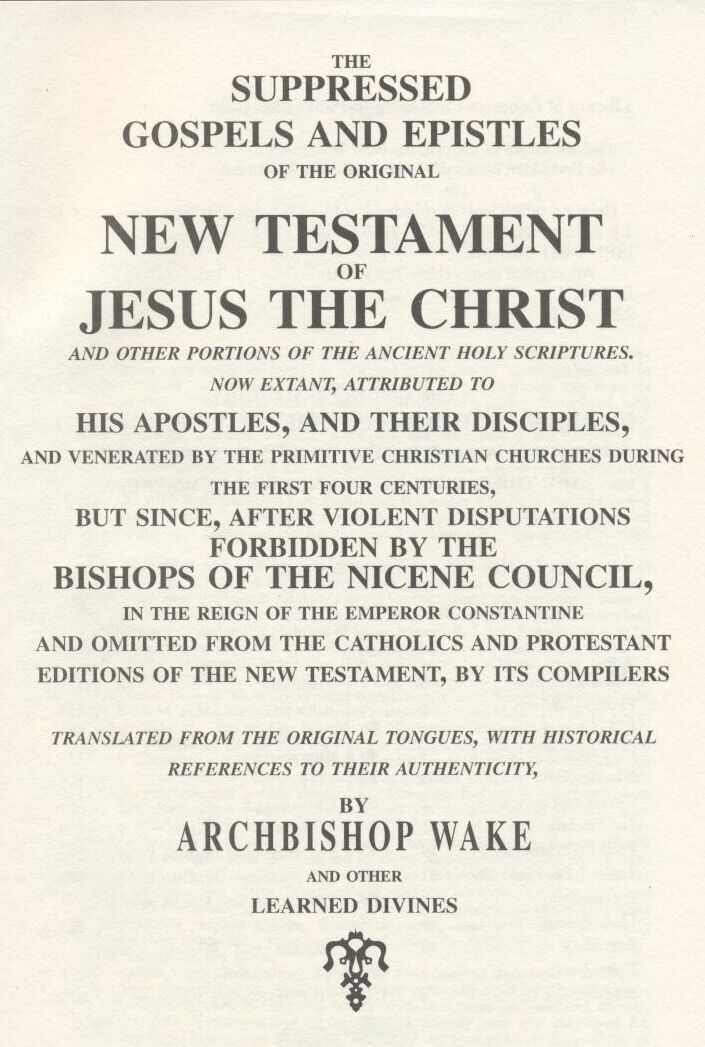
Title: The Forbidden Gospels and Epistles, Complete

Author: Archbishop Wake

Release Date: December 18, 2004 [EBook #6516]
Last Updated: December 10, 2017

Language: English

Character set encoding: ASCII

*** START OF THIS PROJECT GUTENBERG EBOOK THE FORBIDDEN GOSPELS ***


Produced by David Widger with additional proofing by Curtis A. Weyant
>
>
CONTENTS
Mary
Protevangelion
I. Infancy
II. Infancy (Young Childhood)
Nicodemus
Christ and Abgarus
Laodiceans
Paul and Seneca
Acts of Paul and Thecla
I. Clement
II. Clement
Barnabas
Ephesians
Magnesians
Trallians
Romans
Philadelphians
Smyrnaeans
Polycarp
Philippians
I. Hermas—Visions
II. Hermas—Commands
III. Hermas—Similitudes
|
Pages 33-37 — The Infancy of Jesus Christ Pages 40-41 — The Childhood of Jesus Christ Pages 223-225 — The Apostles' Creed |
To uphold the "right of private judgment," and our "Christian liberty wherewith Christ hath made us free;" to add fuel to the fire of investigation, and in the crucible of deep inquiry, melt from the gold of pure religion, the dross of man's invention; to appeal from the erring tribunals of a fallible Priesthood, and restore to its original state the mutilated Testament of the Saviour; also to induce all earnest thinkers to search not a part, but the whole of the Scriptures, if therein they think they will find eternal life; I, as an advocate of free thought and untrammelled opinion, dispute the authority of those uncharitable, bickering, and ignorant Ecclesiastics who first suppressed these gospels and epistles; and I join issue with their Catholic and Protestant successors who have since excluded them from the New Testament, of which they formed a part; and were venerated by the Primitive Churches, during the first four hundred years of the Christian Era.
My opposition is based on two grounds; first, the right of every rational being to become a "Priest unto himself," and by the test of enlightened reason, to form his own unbiased judgment of all things natural and spiritual: second, that the reputation of the Bishops who extracted these books from the original New Testament, under the pretence of being Apocryphal, and forbade them to be read by the people, is proved by authentic impartial history too odious to entitle them to any deference. Since the Nicene Council, by a pious fraud, which I shall further allude to, suppressed these books, several of them have been reissued from time to time by various translators, who differed considerably in their versions, as the historical references attached to them in the following pages will demonstrate. But to the late Mr. William Hone we are indebted for their complete publication for the first time in one volume, about the year 1820; which edition, diligently revised, and purified of many errors both in the text and the notes attached thereto, I have re-published in numbers to enable all classes of the nation to purchase and peruse them. As, however, instead of being called by their own designation "Apocryphal," (which yet remains to be proved), they were re-entitled THE FORBIDDEN BOOKS, and, from communications received, appear to have agitated a portion of the great mass of ignorant bigotry which mars the fair form of Religion in these sect-ridden dominions, I have modified the title to its present shape with the hope that in spite of illiberal clerical influence, my fellow Christians will read and inwardly digest the sublime precepts they inculcate;—as pure, as holy, and as charitable as those principles of Christianity taught in the Scriptures they; now read by permission; although their minds may, after mature reflection, doubt the truth of the miraculous records therein given.
To ensure these Gospels and Epistles an unprejudiced and serious attention, which they are entitled to, equally with those now patronised by Church authority, I will briefly refer to that disgraceful epoch in Roman Ecclesiastical Annals, when the New Testament was mutilated, and priestly craft was employed for excluding these books from its pages. HONE, in the preface to his first edition of the Apocryphal New Testament, so called, without satisfactory grounds, by the Council of Nice, in the reign of the Emperor Constantine, thus opens the subject:—
"After the writings contained in the New Testament were selected from the numerous Gospels and Epistles then in existence, what became of the Books that were rejected by the compilers?"
This question naturally occurs on every investigation as to the period when and the persons by whom the New Testament was formed. It has been supposed by many that the volume was compiled by the first Council of Nice, which, according to Jortin (Rem. on Eccl. vol. ii. p. 177), originated thus: Alexander, Bishop of Alexandria, and Arius, who was a presbyter in his diocese, disputed together about the nature of Christ; and the bishop being displeased at the notions of Arius, and finding that they were adopted by other persons, "was very angry." He commanded Arius to come over to his sentiments, and to quit his own; as if a man could change his opinions as easily as he can change his coat! He then called a Council of War, consisting of nearly, a hundred bishops, and deposed, excommunicated, and anathematized Arius, and with him several ecclesiastics, two of whom were bishops. Constantine sent a letter, in which he reprimanded the bishops for disturbing the church with their insignificant disputes. But the affair was gone too far to be thus composed. To settle this and other points, the Nicene Council was summoned, consisting of about 318 bishops. The first thing they did was to quarrel, and to express their resentments, and to present accusations to the Emperor against one another. "The Emperor burnt all their libels, and exhorted them to peace and unity." (See Mosheim's Eccle. Hist.) These were the kind of spiritual shepherds of whom Sabinus, the Bishop Heraclea affirms, that excepting Constantine himself, and Eusebius Pamphilus, they "were a set of illiterate creatures, that understood nothing." And now intelligent Catholics, especially Protestants who are content to read only the books of the Testament authorized by the Council of Nice, and agreed to ever since by your own bishops, although they and you profess to dissent from the Papacy, hear what Pappus in his Synodican to that Council says of their crafty contrivance when they separated the books of the original New Testament:—He tells us, that having "promiscuously put all the books that were referred to the Council for deliberation under the communion-table in a church, they besought the Lord that the inspired writings might get on the table, while the spurious ones remained underneath; and that it happened accordingly!" (See Com. Mace's N. T. p. 875.) Therefore, good reader, every Christian sect from the fourth century to the present period, have been blessed with the books that climbed upon the communion-table, and in consequence were deemed inspired and canonical; at the same time have been forbidden to read the Gospels and Epistles herein published, because they could not perform the same feat, but remained under the table, and were condemned accordingly, as uninspired and apocryphal writings. If you believe this popish legend, you will not read the good books I lay before you, but still continue to possess only HALF THE TESTAMENT, instead of the PERFECT ONE, which will enable you to burst the trammels of priestcraft, and by the light of God's whole truth become free. In conclusion, I implore you to examine for yourselves, and observe the testimony of Archbishop Wake and other learned divines and historians appended thereto; and subscribe myself,
Your well-wisher,
EDWARD HANCOCK.
CHAPTER I.
1 The Parentage of Mary.
7 Joachim her father, and Anna her mother,
go to Jerusalem to the feast of the dedication.
9 Issachar, the high
priest, reproaches Joachim
for being childless.
THE blessed and ever glorious
Virgin Mary, sprung from
the royal
race and family of David,
was born in the city of Nazareth,
and
educated at Jerusalem, in the
temple of the Lord.
2 Her father's name was Joachim,
and her mother's Anna.
The
family of her father was of
Galilee and the city of Nazareth.
The family of her mother was of
Bethlehem.
3 Their lives were plain and
right in the sight of the Lord,
pious and faultless before men;
for they divided all their substance
into three parts;
4 One of which they devoted to
the temple and officers of the
temple; another they distributed
among strangers, and persons in
poor circumstances; and the third
they reserved for themselves and
the uses of their own family.
5 In this manner they lived for
about twenty years chastely, in the
favour of God, and the esteem of
men, without any children.
6 But they vowed, if God should
favour them with any issue, they
would devote it to the service of
the Lord; on which account they
went at every feast in the year to
the temple of the Lord.
7 And it came to pass, that
when the feast of the dedication
drew near, Joachim, with some
others of his tribe, went up to
Jerusalem, and at that time,
Isachar was high-priest;
8 Who, when he saw Joachim
along with the rest of his
neighbours, bringing his offerings,
despised both him and his
offerings,
and asked him,
9 Why he, who had no children,
would presume to appear among
those who had? Adding, that his
offerings could never be acceptable
to God, who was judged by him
unworthy to have children; the
Scripture having said, Cursed is
every one who shall not beget a
male in Israel.
10 He further said, that he ought
first to be free from that curse by
begetting some issue, and then
come with his offerings into the
presence of God.
11 But Joachim being much
confounded with the shame of such
reproach, retired to the shepherds
who were with the cattle in their
pastures;
12 For he was not inclined to
return home, lest his neighbours,
who were present and heard all
this from the high-priest, should
publicly reproach him in the same
manner.
CHAPTER II.
1 An angel appears to Joachim,
9 and informs him that Anna shall
conceive and
bring forth a daughter, who shall be called Mary,
11 be brought up in the temple,
12 and while yet a virgin, in a way
unparalleled,
bring forth the Son of God:
13 Gives him a sign,
14 and departs.
BUT when he had been there for
some time, on a certain day
when
he was alone, the angel
of the Lord stood by him with
a
prodigious light.
2 To whom, being troubled at
the appearance, the angel who had
appeared to him, endeavouring to
compose him, said:
3 Be not afraid, Joachim, nor
troubled at the sight of me, for
I
am an angel of the Lord sent by
him to you, that I might inform
you that your prayers are heard,
and your alms ascended in the
sight of God.
4 For he hath surely seen your
shame, and heard you unjustly
reproached for not having children:
for God is the avenger of sin,
and not of nature;
5 And so when he shuts the
womb of any person, he does it for
this reason, that he may in a more
wonderful manner again open it,
and that which is born appear to
be not the product of lust, but the
gift of God.
6 For the first mother of your
nation, Sarah, was she not barren
even till her eightieth year: and
yet even in the end of her old age
brought forth Isaac, in whom the
promise was made of a blessing to
all nations.
7 Rachel, also, so much in
favour with God, and beloved so
much
by holy Jacob, continued
barren for a long time, yet
afterwards
was the mother of Joseph,
who was not only governor of
Egypt,
but delivered many nations
from perishing with hunger.
8 Who among the judges was
more valiant than Sampson, or more
holy than Samuel? And yet both
their mothers were barren.
9 But if reason will not convince
you of the truth of my words, that
there are frequent conceptions in
advanced years, and that those
who were barren have brought forth
to their great surprise; therefore
Anna your wife shall bring you a
daughter, and you shall call her
name Mary;
10 She shall, according to your
vow, be devoted to the Lord from
her infancy, and be filled with the
Holy Ghost from her mother's
womb;
11 She shall neither eat nor
drink any thing which is unclean,
nor shall her conversation be
without among the common people,
but in the temple of the Lord;
that so she may not fall under any
slander or suspicion of what is bad.
12 So in the process of her
years, as she shall be in a
miraculous manner born of one that
was barren, so she shall, while
yet
a virgin, in a way unparalleled,
bring forth the Son of the
most
High God, who shall, be called
Jesus, and, according to the
signification of his name, be the
Saviour of all nations.
13 And this shall be a sign to
you of the things which I declare,
namely, when you come to the
golden gate of Jerusalem, you
shall
there meet your wife Anna,
who being very much troubled
that you
returned no sooner, shall
then rejoice to see you.
14 When the angel had said this,
he departed from him.
CHAPTER III.
1 The angel appears to Anna;
2 tells her a daughter shall be born
unto her,
3 devoted to the service of the Lord in the temple,
5,
who, being a virgin, and not knowing man,
shall bring forth the Lord,
6 and gives her a sign therefore.
8 Joachim and Anna meet, and
rejoice,
10 and praise the Lord.
11 Anna conceives, and brings
forth a daughter called Mary.
AFTERWARDS the angel appeared
to Anna his wife, saying;
Fear
not, neither think that
which you see is a spirit;
2 For I am that angel who hath
offered up your prayers and alms
before God, and am now sent to
you, that I may inform you, that
a daughter will be born unto you,
who shall be called Mary, and
shall be blessed above all women.
3 She shall be, immediately
upon her birth, full of the grace of
the Lord, and shall continue during
the three years of her weaning
in her father's house, and afterwards,
being devoted to the service
of the Lord,
shall not depart from the temple,
till she arrive
to years of discretion.
4 In a word, she shall there
serve the Lord night and day in
fasting and prayer, shall abstain
from every unclean thing, and
never know any man;
5 But, being an unparalleled instance
without any pollution or
defilement,
and a virgin not knowing any man,
shall ring forth a
son, and a maid
shall bring forth the Lord, who
both by his
grace and name and works,
shall be the Saviour of the world.
6 Arise therefore, and go up to
Jerusalem, and when you shall
come to that which is called the
golden gate (because it is gilt with
gold), as a sign of what I have told
you, you shall meet your
husband,
for whose safety you have been so
much concerned.
7 When therefore you find these
things thus accomplished, believe
that all the rest which I have told
you, shall also undoubtedly be
accomplished.
8 According therefore to the
command of the angel, both of
them
left the places where they
were, and when they came to the
place
specified in the angels
prediction, they met each other.
9 Then, rejoicing at each other's
vision, and being fully satisfied
in
the promise of a child, they gave
due thanks to the Lord, who
exalts
the humble.
10 After having praised the
Lord, they returned home, and
lived
in a cheerful and assured
expectation of the promise of God.
11 So Anna conceived, and
brought forth a daughter, and,
according to the angel's command,
the parents did call her name Mary.
CHAPTER IV.
1 Mary brought to the temple at three years old.
6 Ascends the stairs
of the temple by miracle.
8 Her parents sacrifice and return home.
AND when three years were
expired, and the time of her
weaning
complete, they brought
the Virgin to the temple of the
Lord with
offerings.
2 And there were about the
temple, according to the fifteen
Psalms of degrees, fifteen stairs
to ascend.
3 For the temple being built in
a mountain, the altar of burnt-
offering, which was without, could
not be come near but by stairs;
4 The parents of the blessed
Virgin and infant Mary put her
upon
one of these stairs;
5 But while they were putting
off their clothes, in which they had
travelled, and according to custom
putting on some that were more
neat and clean,
6 In the mean time the Virgin
of the Lord in such a manner went
up all the stairs one after another,
without the help of any to lead
her
or lift her, that any one would have
judged from hence, that
she was of
perfect age.
7 Thus the Lord did, in the
infancy of his Virgin, work this
extraordinary work, and evidence by
this miracle how great she was
like
to be hereafter.
8 But the parents having offered
up their sacrifice, according to the
custom of the law, and perfected
their vow, left the Virgin with
other virgins in the apartments of
the temple, who were to be brought
up there, and they returned home.
CHAPTER V.
2 Mary ministered unto by angels.
4 The high priest orders all
virgins of fourteen
years old to quit the temple and endeavour to be
married.
5 Mary refuses,
6 having vowed her virginity to the
Lord.
7 The high-priest commands a meeting of the chief persons
of Jerusalem,
11 who seek the Lord for counsel in the matter.
13
A voice from the mercy-seat.
15 The high-priest obeys it by ordering
all the unmarried
men of the house of David to bring their rods to
the altar,
17 that his rod which should flower, and on which the
Spirit of God should sit, should betroth the Virgin.
BUT the Virgin of the Lord, as
she advanced in years, increased
also in perfections, and according
to the saying of the Psalmist,
her father and mother forsook her,
but the Lord took care of her.
2 For she every day had the
conversation of angels, and every
day received visitors from God,
which preserved her from all sorts
of evil, and caused her to abound
with all good things;
3 So that when at length she
arrived to her fourteenth year, as
the wicked could not lay any thing
to her charge worthy of reproof,
so all good persons, who were
acquainted with her, admired her
life and conversation.
4 At that time the high-priest
made a public order, That all the
virgins who had public settlements
in the temple, and were come to
this age, should return home, and,
as they were now of a proper
maturity, should, according to the
custom of their country, endeavour
to be married.
5 To which command, though
all the other virgins readily yielded
obedience, Mary the Virgin of the
Lord alone answered, that she
could not comply with it,
6 Assigning these reasons, that
both she and her parents had
devoted her to the service of the
Lord; and besides, that she had
vowed virginity to the Lord,
which vow she was resolved never
to
break through by lying with a
man.
7 The high-priest being hereby
brought into a difficulty,
8 Seeing he durst neither on the
one hand dissolve the vow, and
disobey the Scripture, which says,
Vow and pay,
9 Nor on the other hand
introduce a custom, to which
the people
were strangers, commanded,
10 That at the approaching feast
all the principal persons both of
Jerusalem and the neighbouring
places should meet together, that
he might have their advice, how
he had best proceed in so difficult
a case.
11 When they were accordingly
met, they unanimously agreed to
seek the Lord, and ask counsel
from him on this matter.
12 And when they were all
engaged in prayer, the high-priest
according to the usual way, went
to consult God.
13 And immediately there was
a voice from the ark, and the mercy
seat, which all present heard, that
it must be enquired or sought out
by a prophecy of Isaiah, to whom
the Virgin should be given and be
betrothed;
14 For Isaiah saith, there shall
come forth a rod out of the stem of
Jesse, and a flower shall spring
out of its root,
15 And the Spirit of the Lord
shall rest upon him, the Spirit of
Wisdom and Understanding, the
Spirit of Counsel and Might, the
Spirit of Knowledge and Piety,
and the Spirit of the fear of the
Lord shall fill him.
16 Then, according to this
prophecy, he appointed, that all
the
men of the house and family
of David, who were marriageable,
and
not married, should bring their
several rods to the altar,
17 And out of whatsoever
person's rod after it was brought,
a
flower should bud forth, and on
the top of it the Spirit of the Lord
should sit in the appearance of a
dove, he should be the man to
whom the Virgin should be given
and be betrothed.
CHAPTER VI.
1 Joseph draws back his rod.
5 The dove pitches on it. He betroths
Mary and
returns to Bethlehem.
7 Mary returns to her parents'
house at Galilee.
AMONG the rest there was a
man named Joseph of the
house and
family of David, and a
person very far advanced in years,
who
kept back his rod, when every
one besides presented his.
2 So that when nothing appeared
agreeable to the heavenly voice,
the high-priest judged it proper to
consult God again.
3 Who answered that he to
whom the Virgin was to be
betrothed
was the only person of
those who were brought together,
who had
not brought his rod.
4 Joseph therefore was betrayed.
5 For, when he did bring his
rod, and a dove coming from
Heaven
pitched upon the top of
it, every one plainly saw, that the
Virgin was to be betrothed to him.
6 Accordingly, the usual
ceremonies of betrothing being over,
he
returned to his own city of
Bethlehem, to set his house in
order, and make the needful
provisions for the marriage.
7 But the Virgin of the Lord,
Mary, with seven other virgins of
the same age, who had been weaned
at the same time, and who had
been appointed to attend her by
the priest, returned to her parents'
house in Galilee.
CHAPTER VII.
7 The salutation of the Virgin by Gabriel, who explains to her
that
she shall conceive, without lying with a man, while a Virgin,
19 by
the Holy Ghost coming upon her without the heats of lust.
21 She
submits.
NOW at this time of her first
coming into Galilee, the
angel
Gabriel was sent to her
from God, to declare to her the
conception of our Saviour, and
the manner and way of her
conceiving him.
2 Accordingly going into her,
he filled the chamber where she
was with a prodigious light, and
in a most courteous manner saluting
her, he said,
3 Hail, Mary! Virgin of the
Lord most acceptable! O Virgin
full
of grace! The Lord is with
you. You are blessed above all
women,
and you are blessed above
all men, that have been hitherto
born.
4 But the Virgin, who had
before been well acquainted with
the
countenances of angels, and
to whom such light from heaven
was
no uncommon thing,
5 Was neither terrified with the
vision of the angel, nor astonished
at the greatness of the light, but
only troubled about the angel's
words,
6 And began to consider what
so extraordinary a salutation should
mean, what it did portend, or what
sort of end it would have.
7 To this thought the angel,
divinely inspired, replies;
8 Fear not, Mary, as though
I intended anything inconsistent
with your chastity in this salutation:
9 For you have found favour
with the Lord, because you made
virginity your choice.
10 Therefore while you are a
Virgin, you shall conceive without
sin, and bring forth a son.
11 He shall be great, because
he shall reign from sea to sea, and
from the rivers even to the ends of
the earth?
12 And he shall be called the
Son of the Highest; for he who is
born in a mean state on earth,
reigns in an exalted one in heaven.
13 And the Lord shall give him
the throne of his father David, and
he shall reign over the house of
Jacob for ever, and of his kingdom
there shall be no end.
14 For he is the King of Kings,
and Lord of Lords, and his throne
is forever and ever.
15 To this discourse of the
angel the Virgin replied, not, as
though she were unbelieving, but
willing to know the manner of it.
16 She said, How can that be?
For seeing, according to my vow,
I
have never known any man, how
can I bear a child without the
addition of a man's seed.
17 To this the angel replied
and said, Think not, Mary, that
you
shall conceive in the ordinary
way.
18 For, without lying with a
man, while a Virgin, you shall
conceive; while a Virgin, you
shall bring forth; and while a
Virgin shall give suck.
19 For the Holy Ghost shall
come upon you, and the power of
the
Most High shall overshadow
you, without any of the heats of
lust.
20 So that which shall be born
of you shall be only holy, because
it only is conceived without sin,
and being born, shall be called the
Son of God.
21 Then Mary stretching forth
her hands, and lifting her eyes to
heaven, said, Behold the handmaid
of the Lord! Let it be unto me
according to thy word.
CHAPTER VIII.
1 Joseph returns to Galilee, to marry the Virgin
he had betrothed;
4 perceives she is with child,
5 is uneasy,
7 purposes to put
her away privily,
8 is told by the angel of the Lord it is not the
work of man but the Holy Ghost;
12 Marries her, but keeps chaste,
13 removes with her to Bethlehem,
15 where she brings forth Christ.
JOSEPH therefore went from
Judaea to Galilee, with intention
to
marry the Virgin who was
betrothed to him:
2 For it was now near three
months since she was betrothed
to
him.
3 At length it plainly appeared
she was with child, and it could
not be hid from Joseph:
4 For going to the Virgin in a
free manner, as one espoused, and
talking familiarly with her, he
perceived her to be with child,
5 And thereupon began to be
uneasy and doubtful, not knowing
what course it would be best to take;
6 For being a just man, he was
not willing to expose her, nor
defame her by the suspicion of
being a harlot, since he was a
pious man:
7 He purposed therefore privately
to put an end to their agreement,
and as privately to send her away.
8 But while he was meditating
these things, behold the angel of
the Lord appeared to him in his
sleep, and said, Joseph, son of
David, fear not;
9 Be not willing to entertain
any suspicion of the Virgin's
being guilty of fornication, or to
think any thing amiss of her,
neither be afraid to take her to wife:
10 For that which is begotten
in her and now distresses your
mind, is not the work of man, but
the Holy Ghost.
11 For she of all women is that
only Virgin who shall bring forth
the Son of God, and you shall call
his name Jesus, that is, Saviour:
for he will save his people from
their sins.
12 Joseph thereupon, according
to the command of the angel,
married the Virgin, and did not
know her, but kept her in chastity.
13 And now the ninth month
from her conception drew near,
when
Joseph took his wife and
what other things were necessary
to
Bethlehem, the city from whence
he came.
14 And it came to pass, while
they were there, the days were
fulfilled for her bringing forth.
15 And she brought forth her
first-born son, as the holy
Evangelists have taught, even our
Lord Jesus Christ, who with the
Father, Son, and Holy Ghost,
lives and reigns to everlasting ages.
REFERENCES TO MARY'S GOSPEL
[In the primitive ages there was a Gospel extant bearing this name,
attributed to St. Matthew, and received as genuine and authentic by
several of the ancient Christian sects. It is to be found in the works
of Jerome, a Father of the Church, who flourished in the fourth century,
from whence the present translation is made. His contemporaries,
Epiphanius, Bishop of Salamis, and Austin also mention a gospel under
this title. The ancient copies differed from Jerome's, for from one of
them the learned Faustus, a native of Britain, who became Bishop of Riez,
in Provence, endeavoured to prove that Christ was not the Son of God till
after his baptism; and that he was not of the house of David and tribe of
Judah, because, according to the Gospel he cited, the Virgin herself was
not of this tribe, but of the tribe of Levi; her father being a priest of
the name of Joachim. It was likewise from this Gospel that the sect of
the Collyridians established the worship and offering of manchet bread
and cracknels, or fine wafers, as sacrificed to Mary, whom they imagined
to have been born of a Virgin, as Christ is related in the Canonical
Gospels to have been born of her. Epiphanius likewise cites a passage
concerning the death of Zacharias, which is not in Jerome's copy, viz.:
"That it was the occasion of the death of Zacharias in the temple, that
when he had seen a vision, he, through surprise, was willing to disclose
it, and his mouth was stopped. That which he saw was at the time of his
offering incense, and it was a man standing in the form of an ass.
When he was gone out, and had a mind to speak thus to the people, Woe
unto you, whom do you worship? he who had appeared to him in the temple
took away the use of his speech. Afterwards when he recovered it, and was
able to speak, he declared this to the Jews; and they slew him. They add
(viz. the Gnostics in this book), that on this very account the
high-priest was appointed by their lawgiver (by God to Moses) to carry
little bells, that whensoever he went into the temple to sacrifice he,
whom they worshipped, hearing the noise of the bells, might have time
enough to hide himself, and not be caught in that ugly shape and figure."
The principal part of this Gospel is contained in the Protevangelion of
James which follows next in order.]
Or, an Historical Account of the BIRTH of CHRIST, and the perpetual
VIRGIN MARY, his Mother, by JAMES THE LESSER, Cousin and Brother
of
the Lord Jesus, chief Apostle and first Bishop of the Christians in
Jerusalem.
CHAPTER I.
1 Joachim, a rich man,
2 offers to the Lord,
3 is opposed by
Reuben the high priest,
because he has not begotten issue in Israel,
6 retires into the wilderness and fasts
forty days and forty nights.
IN the history of the twelve
tribes of Israel we read there
was
a certain person called
Joachim, who being very rich, made
double offerings to the Lord God,
having made this resolution:
My substance shall be for the
benefit of the whole people, that
I may find mercy from the Lord
God for the forgiveness of my sins.
2 But at a certain great feast
of the Lord, when the children of
Israel offered their gifts, and
Joachim also offered his, Reuben the
high-priest opposed him, saying,
it is not lawful for thee to offer
thy gifts, seeing thou hast not
begot any issue in Israel.
3 At this, Joachim being
concerned very much, went away to
consult the registries of the twelve
tribes, to see whether he was
the
only person who had begot no
issue.
4 But upon inquiry he found
that all the righteous had raised
up
seed in Israel;
5 Then he called to mind the
patriarch Abraham, How that God
in
the end of his life had given him
his son Isaac; upon which he was
exceedingly distressed, and would
not be seen by his wife:
6 But retired into the wilderness,
and fixed his tent there, and
fasted forty days and forty nights,
saying to himself,
7 I will not go down either to
eat or drink, till the Lord my
God shall look down upon me, but
prayer shall be my meat and drink.
CHAPTER. II.
1 Anna, the wife of Joachim mourns her Barrenness,
6 is reproached
with it by Judith her maid,
9 sits under a laurel tree and prays to
the Lord.
IN the mean time his wife Anna
was distressed and perplexed
on a
double account, and said,
I will mourn both for my widowhood
and
my barrenness.
2 Then drew near a great feast
of the Lord, and Judith her maid,
said, How long will you thus
afflict your soul? The feast of
the
Lord is now come, when it is
unlawful for any one to mourn.
3 Take therefore this hood
which was given by one who
makes such
things, for it is not
fit that I, who am a servant should
wear
it, but it well suits a person
of your greater character.
4 But Anna replied, Depart
from me, I am not used to such
things; besides, the Lord hath
greatly humbled me.
5 I fear some ill-designing person
hath given thee this, and thou
art come to reproach me with my sin.
6 Then Judith her maid answered,
what evil shall I wish you,
when you will not hearken to me?
7 I cannot wish you a greater
curse than you are under, in that
God hath shut up your womb, that
you should not be a mother in
Israel.
8 At this Anna was exceedingly
troubled, and having on her wedding
garment, went about three o'clock
in the afternoon to walk in her
garden.
9 And she saw a laurel-tree and
sat under it, and prayed unto the
Lord, saying,
10 O God of my fathers, bless
me and regard my prayer, as thou
didst bless the womb of Sarah;
and gavest her a son Isaac.
CHAPTER III.
1 Anna perceiving a sparrow's nest in the
laurels bemoans her
barrenness.
AND as she was looking towards
heaven she perceive a sparrow's
nest in the laurel,
2 And mourning within herself,
she said, Wo is me, who begat
me?
and what womb did bear
me, that I should be thus
accursed before
the children of
Israel, and that they should
reproach and deride
me in the
temple of my God: Wo is me,
to what can I be compared?
3 I am not comparable to the
very beasts of the earth, for even
the beasts of the earth are fruitful
before thee, O Lord! Wo is me,
to what can I be compared?
4 I am not compared to the
brute animal, for even the brute
animals are fruitful before thee,
O Lord! Wo is me, to what am I
comparable?
5 I cannot be comparable to
these waters, for even the waters
are fruitful before thee, O Lord!
Wo is me, to what can I be
compared?
6 I am not comparable to the
waves of the sea; for these,
whether they are calm, or in motion,
with the fishes which are in
them,
praise thee, O Lord! Wo is me to
what can I be compared?
7 I am not comparable to the
very earth, for the earth produces
its fruits, and praises thee, O Lord!
CHAPTER IV.
1 An Angel appears to Anna and tells her she shall conceive;
two
angels appear on the same errand.
5 Joachim sacrifices.
8 Anna
goes to meet him,
9 rejoicing that she shall conceive.
THEN an angel of the Lord
stood by her and said, Anna,
Anna, the
Lord hath heard thy
prayer; thou shalt conceive and
bring forth,
and thy progeny shall
be spoken of in all the world.
2 And Anna answered, As the
Lord my God liveth, whatever I
bring
forth, whether it be male or
female, I will devote it to the Lord
my God and it shall minister to
him in holy things, during its
whole life.
3 And behold there appeared
two angels, saying unto her,
Behold
Joachim thy husband is
coming with his shepherds.
4 For an angel of the Lord
hath also come down to him, and
said,
The Lord God hath heard
thy prayer, make haste and go
hence, for
behold Anna thy wife
shall conceive.
5 And Joachim went down and
called his shepherds, saying, Bring
me hither ten she-lambs without
spot or blemish, and they shall
be for the Lord my God.
6 And bring me twelve calves
without blemish, and the twelve
calves shall be for the priests and
the elders.
7 Bring me also a hundred
goats, and the hundred goats shall
be
for the whole people.
8 And Joachim went down with
the shepherds, and Anna stood
by
the gate and saw Joachim
coming with the shepherds.
9 And she ran, and hanging
about his neck, said, Now I know
that
the Lord hath greatly blessed
me:
10 For behold, I who was as a
widow am no longer as a widow, and
I who was barren shall conceive.
CHAPTER V.
1 Joachim abides the first day in his house but
sacrifices on the
morrow.
2 Consults the plate on the priests forehead,
3 and is
without sin.
6 Anna brings forth a daughter,
9 whom she calls
Mary.
AND Joachim abode the first
day in his house, but on the
morrow
he brought his offerings,
and said,
2 If the Lord be propitious to
me let the plate which is on the
priests forehead make it manifest.
3 And he consulted the plate
which the priest wore, and saw it,
and behold sin was not found in
him.
4 And Joachim said, Now I know
that the Lord is propitious
to
me, and hath taken away all
my sins.
5 And he went down from the
temple of the Lord justified,
and he
went to his own house.
6 And when nine months were
fulfilled to Anna, she brought
forth, and said to the midwife,
What have I brought forth?
7 And she told her, A girl.
8 Then Anna said, The Lord
hath this day magnified my soul;
and
she laid her in bed.
9 And when the days of her
purification were accomplished,
she
gave suck to the child; and
called her name Mary.
CHAPTER VI.
1 Mary at nine months old, walks nine steps.
3 Anna keeps her holy.
4 When she is a year old, Joachim makes a great feast.
7 Anna gives
her the breast, and sings a song to the Lord.
AND the child increased in
strength every day, so that
when she
was nine months old, her
mother put her upon the ground,
to try
if she could stand; and
when she had walked nine steps,
she came
again to her mother's
lap.
2 Then her mother caught her
up, and said, As the Lord my God
liveth, thou shalt not walk again
on this earth, till I bring thee
into the temple of the Lord.
3 Accordingly she made her
chamber a holy place, and suffered
nothing uncommon or unclean to
come near her, but invited certain
undefiled daughters of Israel, and
they drew her aside.
4 But when the child was a year
old, Joachim made a great feast,
and invited the priests, scribes,
elders, and all the people of
Israel;
5 And Joachim then made an
offering of the girl to the chief-
priests, and they blessed her,
saying, The God of our fathers bless
this girl, and give her a name
famous and lasting through all
generations. And all the people
replied, So be it, Amen:
6 Then Joachim a second time
offered her to the priests, and they
blessed her, saying, O most high
God, regard this girl, and bless
her with an everlasting blessing.
7 Upon this her mother took
her up, and gave her the breast,
and
sung the following song to the
Lord.
8 I will sing a song unto the
Lord my God, for he hath visited
me, and taken away from me the
reproach of mine enemies, and
hath given me the fruit of his
righteousness, that it may now be
told the sons of Reuben, that Anna
gives suck.
9 Then she put the child to rest
in the room which she had
consecrated,
and she went out and ministered unto
them.
10 And when the feast was
ended, they went away rejoicing,
and
praising the God of Israel.
CHAPTER VII.
3 Mary being three years old, Joachim causes certain virgins to
light
each a lamp, and goes with her to the temple.
5 The high-priest
places her on the third step of the altar, and
sits dances with her
feet.
BUT the girl grew, and when
she was two years old, Joachim
said
to Anna, Let us lead her
to the temple of the Lord,
that we may
perform our vow,
which we have vowed unto the
Lord God, lest he
should be angry
with us, and our offering be
unacceptable.
2 But Anna said, Let us wait
the third year, lest she should
be
at a loss to know her father.
And Joachim said, Let us then
wait.
3 And when the child was
three years old, Joachim said,
Let us
invite the daughters of the
Hebrews, who are undefiled, and let
them take each a lamp, and let
them be lighted, that the child
may not turn back again, and her
mind be set against the temple of
the Lord,
4 And they did thus till they
ascended into the temple of the Lord.
And the high-priest received her,
and blessed her, and said, Mary,
the Lord God hath magnified thy
name to all generations, and to the
very end of time by thee will the
Lord shew his redemption to the
children of Israel.
5 And he placed her upon the
third step of the altar, and the
Lord gave unto her grace, and she
dance with her feet, and all the
house of Israel loved her.
CHAPTER VIII.
2 Mary fed in the temple by angels.
3 When twelve years old the
priests consult what to do with her.
6 The angel of the Lord warns
Zacharias to call together all the
widowers, each bringing a rod.
7 The people meet by sound of trumpet.
8 Joseph throws away his
hatchet, and goes to the meeting.
11 A dove comes forth from his rod,
and alights on his head.
12 He is chosen to betroth the Virgin,
13 refuses because he is an old man,
14 is compelled,
16 takes
her home, and goes to mind his trade of building.
AND her parents went away
filled with wonder, and praising God,
because the girl did not return back
to them.
2 But Mary continued in the
temple as a dove educated there,
and
received her food from the
hand of an angel.
3 And when she was twelve
years of age, the priests met in a
council, and said, Behold, Mary is
twelve years of age, what shall we
do with her, for fear lest the holy
place of the Lord our God should
be defiled?
4 Then replied the priests to
Zacharias the high-priest, Do you
stand at the altar of the Lord, and
enter into the holy place, and
make
petitions concerning her, and
whatsoever the Lord shall
manifest
unto you, that do.
5 Then the high-priest entered
into the Holy of Holies, and taking
away with him the breast-plate of
judgment made prayers concerning
her;
6 And behold the angel of the
Lord came to him, and said,
Zacharias, Zacharias, Go forth and
call together all the widowers
among the people, and let every
one of them bring his rod, and
he by whom the Lord shall shew
a sign shall be the husband of
Mary.
7 And the criers went out
through all Judaea, and the trumpet
of
the Lord sounded, and all
the people ran and met together.
8 Joseph also throwing away
his hatchet, went out to meet
them;
and when they were met,
they went to the high-priest;
taking
every man his rod.
9 After the high-priest had
received their rods, he went
into
the temple to pray;
10 And when he had finished
his prayer, he took the rods, and
went forth and distributed them,
and there was no miracle attended
them.
11 The last rod was taken by
Joseph, said behold a dove
proceeded out of the rod, and
flew upon the head of Joseph.
12 And the high-priest said,
Joseph, Thou art the person
chosen
to take the Virgin of the
Lord, to keep her for him:
13 But Joseph refused, saying,
I am an old man, and have children,
but she is young, and I fear
lest I should appear ridiculous
in
Israel.
14 Then the high-priest replied,
Joseph, Fear the Lord thy God,
and remember how God dealt with
Dathan, Korah, and Abiram, how
the earth opened and swallowed
them up, because of their
contradiction.
15 Now therefore, Joseph, fear
God lest the like things should
happen in your family.
16 Joseph then being afraid,
took her unto his house, and
Joseph
said unto Mary, Behold, I
have taken thee from the temple
of the
Lord, and now I will leave
thee in my house; I must go to
mind
my trade of building. The
Lord be with thee.
CHAPTER IX.
1 The priests desire a new veil for the temple,
3 seven virgins cast
lots for making different parts of it,
4 the lot to spin the true
purple falls to Mary.
5 Zacharias, the high priest, becomes dumb.
7 Mary takes a pot to draw water, and hears a voice,
8 trembles and
begins to work,
9 an angel Appears and salutes her, and tells her she
shall conceive by the Holy Ghost,
17 she submits.
19 Visits her
cousin Elizabeth, whose child in her womb leaps.
AND it came to pass, in a council
of the priests, it was said,
Let us make a new veil for the
temple of the Lord.
2 And the high-priest said,
Call together to me seven undefiled
virgins of the tribe of David.
3 And the servants went and
brought them into the temple of
the
Lord, and the high-priest said
unto them, Cast lots before me
now, who of you shall spin the
golden thread, who the blue, who
the scarlet, who the fine linen, and
who the true purple.
4 Then the high-priest knew
Mary; that she was of the tribe of
David; and he called her, and the
true purple fell to her lot to
spin,
and she went away to her own
house.
5 But from that time Zacharias
the high-priest became dumb, and
Samuel was placed in his room till
Zacharias spoke again.
6 But Mary took the true purple;
and did spin it.
7 And she took a pot, and
went out to draw water, and heard
a
voice saying unto her, Hail thou
who art full of grace, the Lord
is with thee; thou art blessed
among women.
8 And she looked round to the
right and to the left (to see) whence
that voice came, and then trembling
went into her house, and laying
down the water-pot, she took
the purple, and sat down in her
seat to work it.
9 And behold the angel of the
Lord stood by her, and said, Fear
not, Mary, for thou hast found
favour in the sight of God.
10 Which when she heard, she
reasoned with herself what that
sort of salutation meant.
11 And the angel said unto her,
The Lord is with thee, and thou
shalt conceive:
12 To which she replied, What!
shall I conceive by the living God
and bring forth as all other
women do?
13 But the angel returned
answer, Not so, O Mary, but the
Holy
Ghost shall come upon thee,
and the power of the Most High
shall
overshadow thee;
14 Wherefore that which shall
be born of thee shall be holy,
and
shall be called the Son of the
Living God, and thou shalt call his
name Jesus; for he shall save his
people from their sins.
15 And behold thy cousin Elizabeth,
she also hath conceived a son in
her
old age.
16 And this now is the sixth
month with her, who was called
barren: for nothing is impossible
with God.
17 And Mary said, Behold the
handmaid of the Lord; let it be
unto me according to thy word.
18 And when she had wrought
her purple, she carried it to the
high-priest, and the high-priest
blessed her, saying, Mary, the
Lord God hath magnified thy name,
and thou shalt be blessed in all
the
ages of the world.
19 Then Mary, filled with joy,
went away to her cousin Elizabeth,
and knocked at the door.
20 Which when Elizabeth heard,
she ran and opened to her, and
blessed her, and said, Whence is
this to me, that the mother of my
Lord should come unto me?
21 For lo! as soon as the voice
of thy salutation reached my ears,
that which is in me leaped and
blessed thee.
22 But Mary, being ignorant of
all those mysterious things which
the archangel Gabriel had spoken
to her, lifted up her eyes to
heaven,
and said, Lord! What am I, that
all the generations of
the earth
should call me blessed?
23 But perceiving herself daily
to grow big, and being afraid, she
went home, and hid herself from
the children of Israel; and was
fourteen years old when all these
things happened.
CHAPTER X.
1 Joseph returns from building houses, finds the Virgin
grown big,
being six months gone with child,
2 is jealous and troubled,
8
reproaches her,
10 she affirms her innocence,
13 he leaves her,
16 determines to dismiss her privately,
17 is warned in a dream that
Mary is with child by the Holy Ghost,
20 and glorifies God who had
shewn him such favour.
AND when her sixth month was
come, Joseph returned from
his
building houses abroad, which
was his trade, and entering into the
house, found the Virgin grown big:
2 Then smiting upon his face,
he said, With what face can I look
up to the Lord my God? or, what
shall I say concerning this young
woman?
3 For I received her a Virgin
out of the temple of the Lord my
God, and have not preserved her
such!
4 Who has thus deceived me?
Who has committed this evil in
my
house, and seducing the Virgin
from me, hath defiled her?
5 Is not the history of Adam exactly
accomplished in me?
6 For in the very instant of his
glory, the serpent came and found
Eve alone, and seduced her.
7 Just after the same manner it
has happened to me.
8 Then Joseph arising from the
ground, called her, and said, O
thou who hast been so much
favoured by God, why hast thou
done
this?
9 Why hast thou thus debased
thy soul, who wast educated in the
Holy of Holies, and received thy
food from the hand of angels?
10 But she, with a flood of tears,
replied, I am innocent, and have
known no man.
11 Then said Joseph, How
comes it to pass you are with
child?
12 Mary answered, As the Lord
my God liveth, I know not by what
means.
13 Then Joseph was exceedingly afraid,
and went ay from her,
considering
what he should do with her;
and he thus reasoned
with himself:
14 If I conceal her crime, I shall
be found guilty by the law of the
Lord;
15 And if I discover her to the
children of Israel, I fear, lest
she being with child by an angel,
I shall be found to betray the life
of an innocent person.
16 What therefore shall I do?
I will privately dismiss her.
17 Then the night was come
upon him, when behold an angel
of the
Lord appeared to him in a
dream, and said,
18 Be not afraid to take that
young woman, for that which is
within her is of the Holy Ghost,
19 And she shall bring forth
a son, and thou shalt call his name
Jesus, for he shall save his people
from their sins.
20 Then Joseph arose from his
sleep, and glorified the God of
Israel, who had shewn him such
favour, and preserved the Virgin.
CHAPTER XI.
3 Annas visits Joseph, perceives the Virgin big with child,
4 informs
the high priest that Joseph had privately married her.
8 Joseph and
Mary brought to trial on the charge.
17 Joseph drinks the water of
the Lord as an ordeal,
and receiving no harm, returns home.
THEN came Annas the scribe,
and said to Joseph, Wherefore
have
we not seen you since
your return?
2 And Joseph replied, Because
I was weary after my journey, and
rested the first day.
3 But Annas turning about
perceived the Virgin big with child.
4 And went away to the priest,
and told him, Joseph in whom you
placed so much confidence, is
guilty of a notorious crime, in
that he hath defiled the Virgin
whom he received out of the temple
of the Lord, and hath privately
married her, not discovering it to
the children of Israel.
5 Then said the priest, Hath
Joseph done this?
6 Annas replied, If you send
any of your servants you will find
that she is with child.
7 And the servants went, and
found it as he said.
8 Upon this both she and Joseph
were brought to their trial, and
the priest said unto her, Mary,
what hast thou done?
9 Why hast thou debased thy
soul, and forgot thy God, seeing
thou wast brought up in the Holy
of Holies, and didst receive thy
food from the hands of angels, and
heardest their songs?
10 Why hast thou done this?
11 To which with a flood of
tears she answered, As the Lord
my
God liveth, I am innocent in
his sight, seeing I know no man.
12 Then the priest said to Joseph,
Why hast thou done this?
13 And Joseph answered, As
the Lord my God liveth, I have
not
been concerned with her.
14 But the priest said, Lie not,
but declare the truth; thou hast
privately married her, and not
discovered it to the children of
Israel, and humbled thyself under
the mighty hand (of God), that thy
seed might be blessed:
15 And Joseph was silent.
16 Then said the priest
(to Joseph), You must restore to
the
temple of the Lord the Virgin
which you took thence.
17 But he wept bitterly, and the
priest added, I will cause you both
to drink the water of the Lord,
which is for trial, and so your
iniquity shall be laid open before
you.—[bitter water that
causeth the curse]
18 Then the priest took the water,
and made Joseph drink, and sent
him
to a mountainous place,
19 And he returned perfectly
well, and all the people wondered
that his guilt was not discovered.
20 So the priest said, Since the
Lord hath not made your sins
evident, neither do I condemn
you.
21 So he sent them away.
22 Then Joseph took Mary, and
went to his house, rejoicing and
praising the God of Israel.
CHAP. XII.
1 A decree from Augustus for taxing the Jews.
5 Joseph puts Mary on
an ass, to return to Bethlehem,
6 she looks sorrowful,
7 she
laughs,
8 Joseph inquires the cause of each,
9 she tells him she
sees two persons,
one mourning and the other rejoicing.
10 The
delivery being near, he takes her
from the ass, and places her in a
cave.
AND it came to pass, that there
went forth a decree from
the
Emperor Augustus, that all
the Jews should be taxed, who
were of
Bethlehem in Judaea.
2 And Joseph said, I will take
care that my children be taxed;
but what shall I do with this young
woman?
3 To have her taxed as my wife
I am ashamed; and if I tax her as
my daughter, all Israel knows she
is not my daughter.
4 When the time of the Lord's
appointment shall come, let him do
as seems good to him.
5 And he saddled the ass, and
put her upon it, and Joseph and
Simon followed after her, and
arrived at Bethlehem within three
miles.
6 Then Joseph turning about
saw Mary sorrowful, and said
within
himself, Perhaps she is in
pain through that which is within
her.
7 But when he turned about
again, he saw her laughing, and
said
to her,
8 Mary, how happens it, that I
sometimes see sorrow, and sometimes
laughter and joy in thy countenance?
9 And Mary replied to him,
I see two people with mine eyes,
the
one weeping and mourning,
the other laughing and rejoicing.
10 And he went again across
the way, and Mary said to Joseph,
Take me down from the ass, for
that which is in me presses to come
forth.
11 But Joseph replied, Whither
shall I take thee? for the place is
a desert.
12 Then said Mary again to Joseph,
take me down, for that which is
within me mightily presses me.
13 And Joseph took her down.
14 And he found there a cave,
and let her into it.
CHAPTER XIII.
1 Joseph seeks a Hebrew midwife,
2 perceives the owls stopping in
their flight,
3 the working people at their food not moving,
8
the sheep standing still,
9 the shepherd fixed and immoveable,
10 and kids with their mouths touching
the water but not drinking.
AND leaving her and his sons
in the cave, Joseph went
forth to
seek a Hebrew midwife in
the village of Bethlehem.
2 But as I was going (said Joseph),
I looked up into the air,
and I saw the clouds astonished,
and the fowls of the air stopping in
the midst of their flight.
3 And I looked down towards
the earth, and saw a table spread,
and working people sitting around
it, but their hands were upon the
table and they did not move to
eat.
4 They who had meat in their
mouths did not eat.
5 They who lifted their hands
up to their heads did not draw
them back,
6 And they who lifted them up
to their mouths did not put any
thing in;
7 But all their faces were fixed
upwards.
8 And I beheld the sheep dispersed,
and yet the sheep stood still.
9 And the shepherd lifted up
his hand to smite them, and his
hand continued up.
10 And I looked unto a river,
and saw the kids with their mouths
close to the water, and touching it,
but they did not drink.
CHAPTER XIV.
1 Joseph finds a midwife.
10 A bright cloud overshadows the cave.
11 A great light in the cave, gradually
increases until the infant is
born.
13 The mid-wife goes out, and tells Salome
that she has
seen a virgin bring forth.
17 Salome doubts it.
20 her hand
withers,
22 she supplicates the Lord,
28 is cured,
30 but
warned not to declare what she had seen.
THEN I beheld a woman coming
down from the mountains,
and she
said to me, Where art thou
going, O man?
2 And I said to her, I go to
enquire for a Hebrew midwife.
3 She replied to me, Where is
the woman that is to be delivered?
4 And I answered, In the cave,
and she is betrothed to me.
5 Then said the midwife, Is she
not thy wife?
6 Joseph answered, It is Mary,
who was educated in the Holy of
Holies, in the house of the Lord,
and she fell to me by lot, and is
not my wife, but has conceived by
the Holy Ghost.
7 The midwife said, Is this true?
8 He answered, Come and see.
9 And the midwife went along
with him, and stood in the cave.
10 Then a bright cloud over-
shadowed the cave, and the mid-
wife said, This day my soul is
magnified, for mine eyes have seen
surprising things, and salvation is
brought forth to Israel.
11 But on a sudden the cloud
became a great light in the cave,
so that their eyes could not bear it.
12 But the light gradually
decreased, until the infant appeared,
and sucked the breast of his mother,
Mary.
13 Then the midwife cried out,
and said, How glorious a day is
this, wherein mine eyes have seen
this extraordinary sight!
14 And the midwife went out
from the cave, and Salome met
her.
15 And the midwife said to her,
Salome, Salome, I will tell you a
most surprising thing which I saw,
16 A virgin hath brought forth,
which is a thing contrary to
nature.
17 To which Salome replied, As
the Lord my God liveth unless I
receive particular proof of this
matter, I will not believe that a
virgin hath brought forth.
18 If Then Salome went in, and
the midwife said, Mary, shew thyself,
for a controversy is risen
concerning thee.
19 And Salome received satisfaction.
20 But her hand was withered,
and she groaned bitterly;
21 And said, Woe to me, because
of mine iniquity; for I have
tempted the living God, and my
hand is ready to drop off.
22 Then Salome made her
supplication to the Lord, and said,
O
God of my Fathers, remember me,
for I am of the seed of Abraham,
and Isaac, and Jacob.
23 Make me not a reproach
among the children of Israel, but
restore me sound to my parents.
24 For thou well knowest,
O Lord, that I have performed many
offices of charity in thy name,
and have received my reward from
thee.
25 Upon this an angel of the
Lord stood by Salome, and said,
The
Lord God hath heard thy
prayer, reach forth thy hand to
the
child, and carry him, and by
that means thou shalt be restored.
26 Salome filled with exceeding
joy, went to the child, and said,
I will touch him.
27 And she purposed to worship
him, for she said, This is a great
king, which is born in Israel.
28 And straightway Salome was
cured.
29 Then the midwife went out
of the cave, being approved by God.
30 And lo! a voice came to Salome.
Declare not the strange things
which thou hast seen, till
the child shall come to Jerusalem.
31 So Salome also departed,
approved by God.
CHAPTER XV.
1 Wise men come from the east.
3 Herod alarmed;
8 desires them
if they find the child to bring him word.
10 They visit the cave and
offer the child their treasure,
11 and being warned in a dream, do
not return to Herod,
but go home another way.
THEN Joseph was preparing to
go away, because there arose
a
great disorder in Bethlehem by
the coming of some wise men
from
the east,
2 Who said, Where is the King
of the Jews born? For we have
seen
his star in the east, and are
come to worship him.
3 When Herod heard this, he
was exceedingly troubled, and sent
messengers to the wise men, and
to the priests, and enquired of
them in the town-hall,
4 And said unto them, Where
have you it written concerning
Christ the king, or where should
he be born?
5 Then they say unto him, In
Bethlehem of Judaea; for thus it
is
written: And thou Bethlehem in
the land of Judah, art not the least
among the princes of Judah, for
out of thee shall come a ruler,
who shall rule my people Israel.
6 And having sent away the
chief priests, he enquired of the
wise men in the town-hall, and
said unto them, What sign was it
ye saw concerning the king that is
born?
7 They answered him, We saw
an extraordinary large star shining
among the stars of heaven, and so
out-shined all the other stars, as
that they became not visible, and
we knew thereby that a great king
was born in Israel, and therefore
we are come to worship him.
8 Then said Herod to them, Go
and make diligent inquiry; and if
ye find the child, bring me word
again, that I may come and worship
him also.
9 So the wise men went forth,
and behold, the star which they
saw in the east went before them,
till it came and stood over the
cave
where the young child was with
Mary his mother.
10 Then they brought forth out
of their treasures, and offered unto
him gold and frankincense, and
myrrh.
11 And being warned in a dream
by an angel, that they should not
return to Herod through Judaea,
they departed into their own country
by another way.
CHAPTER XVI.
1 Herod enraged, orders the infants in Bethlehem to be slain.
2 Mary
puts her infant in an ox-manger.
3 Elizabeth flees with her son John
to the mountains.
6 A mountain miraculously divides and receives
them.
9 Herod incensed at the escape of John, causes Zacharias
to be murdered at the altar.
23 The roofs of the temple rent, the
body miraculously
conveyed, and the blood petrified.
25 Israel
mourns for him.
27 Simeon chosen his successor by lot.
THEN Herod perceiving that
he was mocked by the wise
men, and
being very angry,
commanded certain men to go and
to kill all
the children that were
in Bethlehem, from two years old
and
under.
2 But Mary hearing that the
children were to be killed, being
under much fear, took the child,
and wrapped him up in swaddling
clothes, and laid him in an ox-
manger, because there was no
room for them in the inn.
3 Elizabeth also, hearing that
her son John was about to be
searched for, took him and went
up unto the mountains, and looked
around for a place to hide him;
4 And there was no secret place
to be found.
5 Then she groaned within herself,
and said, O mountain of the Lord,
receive the mother with the child.
6 For Elizabeth could not climb up,
7 And instantly the mountain
was divided and received them.
8 And there appeared to them
an angel of the Lord to preserve
them.
9 But Herod made search after
John, and sent servants to Zacharias,
when he was (ministering) at the altar,
and said unto him, Where hast
thou hid
thy son?
10 He replied, to them, I am a
minister of God, and a servant at
the altar: how should I know
where my son is?
11 So the servants went back,
and told Herod the whole; at
which
he was incensed, and said,
Is not this son of his like to be
king of Israel?
12 He sent therefore again his
servants to Zacharias, saying, Tell
us the truth, where is thy son, for
you know that your life is in my
hand.
13 So the servants went and told
him all this:
14 But Zacharias replied to
them, I am a martyr for God, and
if
ye shed my blood, the Lord will
receive my soul.
15 Besides know that ye shed
innocent blood.
16 However Zacharias was murdered
in the entrance of the temple
said altar, and about the partition;
17 But the children of Israel
knew not when he want killed.
18 Then at the hour of salutation
the priests went into the temple
but Zacharias did not according
to custom, meet them and bless them.
19 Yet they still continued
waiting for him to salute them;
20 And when they found he did
not in a long time come, one of
them ventured into the holy place
where the altar was, and he saw
blood lying upon the ground
congealed:
21 When, behold, a voice from
heaven said, Zacharias is murdered,
and his blood shall not be
wiped away, until the revenger
of his
blood come.
22 But when he heard this, he
was afraid; and went forth and told
the priests what he had seen and
heard; and they all went in, and
saw the fact.
23 Then the roofs of the temple
howled, and were rent from the
top to the bottom:
24 And they could not find the
body, but only blood made hard
like stone.
25 And they went away, and
told the people, that Zacharias
was
murdered, and all the tribes
of Israel heard thereof, and mourned
for him, and lamented three days:
26 Then the priests took
council together concerning
a person to
succeed him.
27 And Simeon and the other
priests cast lots, and the lot fell
upon Simeon.
28 For he had been assured by
the Holy Spirit, that he should not
die, till he had seen Christ come in
the flesh.
(I James wrote this History in Jerusalem: and when the disturbance
was I retired into a desert place, until the death of Herod, and the
disturbances ceased at Jerusalem. That which remains is, that I
glorify God that he hath given me such wisdom to write unto you who
are spiritual, and who love God: to whom (be ascribed) glory and
dominion for ever and ever. Amen.)
THE PROTEVANGELION.
Note on the death of Zacharias in Chap. 16.
There is a story both in the Jerusalem and Babylonish Talmud very similar
to this. It is cited by Dr. Lightfoot, Talmud, Hierosol, in Taanith, fol.
69; and Talmud. Babyl. in Sanhedr., fol. 96. "O Rabbi Jochanan said,
Eighty thousand priests were slain for the blood of Zacharias. Rabbi
Judas asked Rabbi Achan, Where did they kill Zacharias? Was it in the
woman's court, or in the court of Israel? He answered, Neither in the
court of Israel, nor in the court of women, but in the court of the
priests; and they did not treat his blood in the same manner as they were
wont to treat the blood of a ram or young goat. For of these it is
written, He shall pour out his blood, and cover it with dust. But it is
written here, The blood is in the midst of her: she set it upon the top
of a rock; she poured it not upon the ground. (Ezek. xxiv. 7.) But why
was this? That it might cause fury to come up to take vengeance: I have
set his blood upon the top of a rock, that it should not be covered.
They committed seven evils that day: they murdered a priest, a prophet,
and a king; they shed the blood of the innocent; they polluted the court:
that day was the Sabbath: and the day of expiation. When therefore
Nebuzaradan came there (viz. to Jerusalem,) he saw his blood bubbling,
and said to them, What meaneth this? They answered, It is the blood of
calves, lambs, and rams, which we have offered upon the altar. He
commanded then, that they should bring calves, and lambs, and rams, and
said I will try whether this be their blood: accordingly they brought
and slew them, but the blood of Zacharias still bubbled, but the blood of
these did not bubble. Then he said, Declare to me the truth of this
matter, or else I will comb your flesh with iron combs. Then said they to
him, He was a priest, prophet, and judge, who prophesied to Israel all
these calamities which we have suffered from you; but we arose against
him, and slew him. Then, said he, I will appease him; then he took the
rabbis and slew them upon his (viz. Zacharias's) blood, and he was not
yet appeased. Next he took the young boys from the schools, and slew them
upon his blood; and yet it bubbled. Then he brought the young priests and
slew them in the same place, and yet it still bubbled. So he slew at
length ninety-four thousand persons upon his blood, and it did not as yet
cease bubbling; then he drew near to it, and said, O Zacharias,
Zacharias, thou halt occasioned the death of the chief of thy
countrymen, shall I slay them all? then the blood ceased, and did bubble
no more."
REFERENCES TO THE PROTEVANGELION.
[This Gospel is ascribed to James. The allusions to it in the ancient
Fathers are frequent, and their expressions indicate that it had
obtained a very general credit in the Christian world. The controversies
founded upon it chiefly relate to the age of Joseph at the birth of
Christ, and to his being a widower with children, before his marriage
with the Virgin. It seems material to remark, that the legends of the
latter ages affirm the virginity of Joseph, notwithstanding Epiphanius,
Hilary, Chrysostom, Cyril, Euthymius, Thephylaet, Occumenius, and indeed
all the Latin Fathers till Ambrose, and the Greek Fathers afterwards,
maintain the opinions of Joseph's age and family, founded upon their
belief in the authenticity of this book. It is supposed to have been
originally composed in Hebrew. Postellus brought the MS. of this Gospel
from the Levant, translated it into Latin, and sent it to Oporimus,
a
printer at Basil, where Bibliander, a Protestant Divine, and the
Professor of Divinity at Zurich, caused it to be printed in 1552.
Postellus asserts that it was publicly read as canonical in the eastern
churches they making no doubt that James was the author, of it. It is,
nevertheless considered apocryphal by some of the most learned divines in
the Protestant and Catholic churches.]
CHAPTER I.
1 Caiphas relates that Jesus, when in his cradle,
informed his mother
that he was the Son of God.
5 Joseph and Mary going to Bethlehem to
be taxed, Mary's
time of bringing forth arrives, and she goes into a
cave.
8 Joseph fetches in a Hebrew woman. The cave filled with
great lights.
11 The infant born,
17 and cures the woman.
19 Arrival of the shepherds.
THE following accounts we found
in the book of Joseph the
high-priest, called by some
Caiphas:
2 He relates, that Jesus spake
even when he was in the cradle,
and said to his mother:
3 Mary, I am Jesus the Son of
God, that word, which thou didst
bring forth according to the
declaration of the angel Gabriel to
thee, and my father hath sent me
for the salvation of the world.
4 In the three hundred and
ninth year of the era of Alexander,
Augustus published a decree that
all persons should go to be taxed
in their own country.
5 Joseph therefore arose, and
with Mary his spouse he went to
Jerusalem, and then came to Bethlehem,
that he and his family might
be taxed
in the city of his fathers.
6 And when they came by the cave,
Mary confessed to Joseph that her
time of bringing forth was come,
and she could not go on to the city,
and said, Let us go into this cave.
7 At that time the sun was very
near going down.
8 But Joseph hastened away,
that he might fetch her a midwife;
and when he saw an old Hebrew
woman who was of Jerusalem, he
said to her, Pray come hither,
good woman, and go into that cave,
and you will there see a woman
just ready to bring forth.
9 It was after sunset, when the
old woman and Joseph with her
reached the cave, and they both
went into it.
10 And behold, it was all filled
with lights, greater than the light
of lamps and candles, and greater
than the light of the sun itself.
11 The infant was then wrapped
up in swaddling clothes, and sucking
the breasts of his mother St.
Mary.
12 When they both saw this
light, they were surprised; the
old
woman asked St. Mary, Art
thou the mother of this child?
13 St. Mary replied, She was.
14 On which the old woman
said, Thou art very different from
all
other women.
15 St. Mary answered, As there
is not any child like to my son,
so neither is there any woman like
to his mother.
16 The old woman answered,
and said, O my Lady, I am come
hither
that I may obtain an
everlasting reward.
17 Then our Lady St. Mary
said to her, Lay thine hands upon
the
infant, which, when she had
done, she became whole.
18 And as she was going forth,
she said, From henceforth, all the
days of my life, I will attend upon
and be a servant of this infant.
19 After this, when the shepherds
came, and had made a fire, and they
were exceedingly rejoicing, the
heavenly host appeared to them,
praising and adoring the supreme God.
20 And as the shepherds were
engaged in the same employment,
the
cave at that time seemed like
a glorious temple, because both
the tongues of angels and men
united to adore and magnify God,
on account of the birth of the Lord
Christ.
21 But when the old Hebrew
woman saw all these evident miracles,
she gave praises to God, and
said, I thank thee, O God, thou
God
of Israel, for that mine eyes
have seen the birth of the Saviour
of the world.
CHAP. II.
1 The child circumcised in the cave,
2 and the old woman preserving
his foreskin or navel-string in a
box of spikenard, Mary afterwards
anoints Christ with it.
5 Christ brought to the temple;
6 He
shines,
7 and angels stand around him adoring.
8 Simeon praises
Christ.
AND when the time of his
circumcision was come: namely,
the
eighth day, on which the
law commanded the child to be
circumcised; they circumcised
him in the cave.
2 And the old Hebrew woman
took the foreskin (others say she
took the navel-string), and preserved
it in an alabaster-box of old
oil
of spikenard.
3 And she had a son who was a
druggist, to whom she said, Take
heed thou sell not this alabaster-
box of spikenard-ointment,
although
thou shouldst be offered three
hundred pence for it.
4 Now this is that alabaster-
box which Mary the sinner procured,
and poured forth the ointment out
of it upon the head and the feet
of our Lord Jesus Christ, and wiped
them off with the hairs of her
head.
5 Then after ten days they
brought him to Jerusalem, and on
the
fortieth day from his birth
they presented him in the temple
before the Lord, making the proper
offerings for him, according
to the requirement of the law of
Moses: namely, that every male
which opens the womb shall be
called holy unto God.
6 At that time old Simeon saw
him shining as a pillar of light,
when St. Mary the Virgin, his
mother, carried him in her arms,
and was filled with the greatest
pleasure at the sight.
7 And the angels stood around
him, adoring him, as a king's
guards stand around him.
8 Then Simeon going near to
St. Mary, and stretching forth his
hands towards her, said to the
Lord Christ, Now, O My Lord,
thy
servant shall depart in peace,
according to thy word;
9 For mine eyes have seen thy
mercy, which thou hast prepared
for the salvation of all nations;
a light to all people, and the
glory
of thy people Israel.
10 Hannah the prophetess was
also present, and drawing near,
she
gave praises to God, and
celebrated the happiness of Mary.
CHAPTER III.
1 The wise men visit Christ. Mary gives them
one of his swaddling
clothes.
3 An angel appears to them in the form of a star.
4
They return and make a fire, and worship the
swaddling cloth, and put
it in the fire where it
remains unconsumed.
AND it came to pass, when the
Lord Jesus was born at Bethlehem,
a city of Judaea, in the time of Herod
the King;—the wise men
came from the
East to Jerusalem, according to the
prophecy of
Zoradascht, [Zoroaster]
and brought with them offerings:
namely,
gold, frankincense, and myrrh,
and worshipped him, and offered to him
their gifts.
2 Then the Lady Mary took one
of his swaddling clothes in which
the infant was wrapped, and gave
it to them instead of a blessing,
which they received from her as a
most noble present.
3 And at the same time there
appeared to them an angel in the
form of that star which had before
been their guide in their journey;
the light of which they followed
till they returned into their own
country.
4 On their return their kings
and princes came to them inquiring,
whom they had seen and done?
What sort of journey and return
they had? What Company
they had on the road?
5 But they produced the swaddling
cloth which St. Mary had given
them, on account whereof they kept
a feast.
6 And having, according to the
custom of their country, made
a
fire, they worshipped it.
7 And casting the swaddling
cloth into it, the fire took it
and
kept it.
8 And when the fire was put out,
they took forth the swaddling cloth
unhurt, as much as if the fire had
not touched it.
9 Then they began to kiss it,
and put it upon their heads and
their eyes saying, This is certainly
an undoubted truth, and it is
really
surprising that the fire could not
burn it, and consume
it.
10 Then they took it, and with
the greatest respect laid it up
among their treasures.
CHAPTER IV.
1 Herod intends to put Christ to death.
3 An angel warns Joseph to
take the child
and his mother into Egypt.
6 Consternation on
their arrival.
13 The idols fall down.
15 Mary washes Christ's
swaddling clothes, hangs them to
dry on a post, and the son of a
priest puts one on his head;
16 And being possessed of devils they
leave him.
NOW Herod perceiving that the
wise men did delay and not return
to him, called together the priest
and wise men, and said, Tell me in
what place the Christ should be born.
2 And when they replied, in
Bethlehem,—a city of Judaea, he
began to contrive in his own mind
the death of the Lord Jesus Christ.
3 But an angel of the Lord
appeared to Joseph in his sleep,
and
said, Arise, take the child and
his mother, and go into Egypt as soon
as the cock crows. So he arose,
and went.
4 And as he was considering
with himself about his journey,
the
morning came upon him.
5 In the length of the journey
the girts of the saddle broke.
6 And now he drew near to a great
city, in which there was an idol,
to which the priests of the other
idols and gods of Egypt brought
their offerings and vows.
7 And there was by this idol a
priest ministering to it, who, as
often as Satan spoke out of that
idol, related the things he said to
the inhabitants of Egypt, and those
countries.
8 This priest had a son three
years old, who was possessed with
a great multitude of devils, who
uttered many strange things and
when the devils seized him, walked
about naked with his clothes torn,
throwing stones at those whom
he saw.
9 Near to that idol was the inn
of the city, into which when Joseph
and St. Mary were come, and had
turned into that inn, all the
inhabitants of the city were
astonished.
10 And all the magistrates and
priests of the idols assembled
before that idol, and made inquiry
there, saying, What means all this
consternation, and dread, which
has fallen upon all our country?
11 The idol answered them,
The unknown God is come thither,
who
is truly God; nor is there any
one besides him, who is worthy of
divine worship for he is truly the
Son of God.
12 At the fame of him this
country trembled, and at his
coming
it is under the present
commotion and consternation, and
we
ourselves are afrighted by the
greatness of his power.
13 And at the same instant this
idol fell down, and at his fall all
the inhabitants of Egypt, besides
others ran together.
14 But the son of the priest,
when his usual disorder came upon
him going into the inn, found
there Joseph and St. Mary, whom
all the rest had left behind and
forsook.
15 And when the Lady St. Mary
had washed the swaddling clothes
of the Lord Christ, and hanged
them out to dry upon a post, the
boy possessed with the devil took
down one of them, and put it upon
his head.
16 And presently the devils
began to come out of his mouth,
and
fly away in the shape of crows
and serpents.
17 From that time the boy was
healed by the power of the Lord
Christ and he began to sing
praises, and give thanks to the
Lord
who had healed him.
18 When his father saw him
restored to his former state of
health, he said, My son, what has
happened to thee, and by what
means wert thou cured?
19 The son answered, When the
devils seized me, I went into the
inn, and there found a very
handsome woman with a boy, whose
swaddling clothes she had just
before washed, and hanged out upon
a post.
20 One of these I took, and put
it upon my head, and immediately
the devils left me, and fled away.
21 At this the father exceedingly
rejoiced, and said, My son,
perhaps this boy is the son of the
living God, who made the heavens
and the earth.
22 For as soon as he came
amongst us, the idol was broken,
and
all the gods fell down, and
were destroyed by a greater power.
23 Then was fulfilled the prophecy
which saith, Out of Egypt I have
called my son.
CHAPTER V.
1 Joseph and Mary leave Egypt.
3 Go to the Haunts of robbers,
4
Who hearing a mighty noise,
as of a great army flee away.
NOW Joseph and Mary when
they heard that the idol was
fallen
down and destroyed, were
seized with fear and, trembling,
and
said, When we Were in the
land of Israel, Herod, intending
to
kill Jesus, slew for that purpose
all the infants at Bethlehem, and
that neighbourhood.
2 And there is no doubt but
the Egyptians if they come to
hear
that this idol is broken and
fallen down, will burn us with fire.
3 They went therefore hence to
the secret places of robbers, who
robbed travellers as they pass by,
of their carriages and their
clothes
and carried them away bound.
4 These thieves upon their
coming heard a great noise such
as
the noise of a king with a great
army, and many horse and the
trumpets sounding at his departure
from his own city, at which they
were so affrighted, as to leave
all their booty behind them and
fly away in haste.
5 Upon this the prisoners arose,
and loosed each other's bonds,
and taking each man his bags,
they went way, and saw Joseph
and
Mary coming towards them,
and inquired, Where is that king,
the
noise of whose approach the
robbers heard, and left us,
so that
we are now come off safe?
6 Joseph answered, He will come
after us.
CHAPTER VI.
1 Mary looks on a woman in whom Satan had taken
up his abode, and she
becomes dispossessed.
5 Christ kissed by a bride made dumb by
sorcerers,
cures her.
11 Miraculously cures a gentlewoman in
whom Satan
had taken up his abode.
16 A leprous girl cured by
the water in which he was
washed, and becomes the servant of Joseph
and Mary.
20 The leprous son of a prince's wife cured in like manner.
37 Has mother offers large gifts to Mary, and dismisses her.
THEN they went into another
city where there was a woman
possessed with a devil, and in
whom Satan, that cursed rebel,
had taken up his abode.
2 One night, when she went to
fetch water, she could neither
endure her clothes on, nor to be
in any house; but as often as they
tied her with chains or cords, she
brake them, and went out into
desert
places, and sometimes standing
where roads crossed, and
in
church yards, would throw stones
at men.
3 When St. Mary saw this
woman, she pitied her; where
upon Satan
presently left her, and
fled away in the form of a young
man,
saying, Wo to me, because
of thee, Mary, and thy son.
4 So the woman was delivered
from her torment; but considering
herself naked, she blushed,
and avoided seeing any man and
having put on her clothes, went
home, and gave an account of her
case to her father and relations
who, as they were the best of the
city, entertained St. Mary and
Joseph with the greatest respect.
5 The next morning having
received a sufficient supply of
provisions for the road, they went
from them, and about the evening
of
the day arrived at another town,
where a marriage was then
about
to be solemnized; but by the arts
of Satan and the
practices of a
sorcerers, the bride was become
so dumb, that she
could not so
much as open her mouth.
6 But when this dumb bride
saw the Lady St. Mary entering
into
the town, and carrying
Lord Christ in her arms, she
stretched
out her hands to the
Lord Christ, and-took him in her
arms, and
closely hugging him,
very often kissed him, continually
moving
him and, pressing him to
her body.
7 Straightway the string of her
tongue was loosed, and her ears
were opened, and she began to
sing praises unto God, who had
restored her.
8 So there was great joy among
the inhabitants of the town that
night, who thought that God and
his angels were come down among
them.
9 In this place they abode
three days, meeting with the greatest
respect and most splendid entertainment.
10 And being then furnished by
the people with provisions for the
road, they departed and went to
another city, in which they were
inclined to lodge, because it was a
famous place.
11 There was in this city a
gentlewoman, who, as she went down
one day to the river to bathe, behold
cursed Satan leaped upon her in
the
form of a serpent.
12 And folded himself about her
belly, and every night lay upon
her.
13 This woman seeing the Lady
St. Mary, and the Lord Christ the
infant in her bosom, asked the
Lady St. Mary, that she would
give her the child to kiss, and
carry in her arms.
14 When she had consented,
and as soon as the woman had
moved
the child, Satan left her,
and fled away, nor did the woman
ever
afterwards see him.
15 Hereupon all the neighbors
praised the Supreme God, and the
woman reward them with ample,
beneficence.
16 On the morrow, the same
woman brought perfumed water to
wash
the Lord Jesus; and when
she had washed him, she preserved
the
water.
17 And there was a girl there,
whose body was white with a
leprosy, who being sprinkled with
this water, and washed, was
instantly cleansed from her leprosy.
18 The people therefore said
Without doubt Joseph and Mary,
and
that boy are Gods, for they do
not look like mortals.
19 And when they were making
ready to go away, the girl, who
had
been troubled with the leprosy,
came and desired they would
permit her to go along with them;
so they consented and the girl went
with them till they came to a city
in which was the palace of a great
king, and whose house was not far
from the inn.
20 Here they staid, and when
the girl went one day to the
prince's wife, and found her in a
sorrowful and mournful condition,
she asked her the reason of her
tears.
21 She replied, wonder not at
my groans, for I am under a great
misfortune, of which I dare not
tell any one.
22 But, says the, girl, if you
will entrust me with your private
grievance, perhaps I may find you
a remedy for it.
23 Thou, therefore, says the
prince's wife, shall keep the
secret, and not discover it to
any one alive.
24 I have been married to this
prince, who rules as king over
large dominions, and lived long
with him before he had any child
by me.
25 At length I conceived by
him, but alas! I brought forth a
leprous son; which, when he saw
him would not own to be his, but
said to me,
26 Either do thou kill him, or
send him to some nurse in such a
place, that he may be never heard
of; and now take care of yourself;
I will never see you more.
27 So here I pine, lamenting
my wretched and miserable
circumstances. Alas, my son! alas,
my husband; Have I disclosed it
to you?
28 The girl replied I have found
a remedy for your disease, which
I promise you, for I also was
leprous, but God hath cleansed
me,
even he who is called Jesus
the son of the Lady Mary.
29 The woman inquiring where
that God was, whom she spake
of;
the girl answered, He lodges
with you here, in the same house.
30 But how can this be? says
she; where is he? Behold, replied
the girl, Joseph and Mary; and
the infant who is, with them is
called Jesus; and it is he who
delivered me from my disease and
torment.
31 But by what means, says she,
were you cleansed from your leprosy?
Will not you tell me that?
32 Why not? says the girl; I
took the water with which his
body
had been washed, and poured
it upon me, and my leprosy
vanished.
33 The prince's wife then arose
and entertained them, providing a
great feast for Joseph among a
large company of men.
34 And the next day took
perfumed water to wash the Lord
Jesus,
and afterwards poured the
same water upon her son, whom
she had
brought with her, and her
son was instantly cleansed from
his
leprosy,
35 Then she sang thanks and
unto God, and said, Blessed
is the
mother that bare thee,
O Jesus!
36 Dost thou thus cure men of
the same nature with thyself, with
the water with which thy body is
washed?
37 She then offered very large
gifts to the Lady Mary, and sent
her away with all imaginable
respect.
CHAPTER VII.
1 A man who could not enjoy his wife, freed from his disorder.
5 A
young man who had been bewitched, and turned into a
mule miraculously
cured by Christ being put on his back,
28 and is married to the girl
who had been cured of leprosy.
THEY came afterwards to another
city, and had a mind to lodge there.
2 Accordingly they went to a man's
house, who was newly married
but by the influence of sorcerers
could not enjoy his wife.
3 But they lodging at his house
that night, the man was freed of
his disorder.
4 And when they were preparing
early in the morning to go forward
on their journey, the new-married
person hindered them, and
provided a noble entertainment
for them.
5 But going forward on the
morrow, they came to another
city,
and saw three women going
from a certain grave with great
weeping.
6 When St. Mary saw them, she
spake to the girl who was their
companion, saying, Go and inquire
of them, what is the matter with
them, and what misfortune has
befallen them?
7 When the girl asked them,
they made her no answer, but
asked
her again, Who are ye? and
where are you going? For the day
is
far spent, and night is at hand.
8 We are travellers, saith the
girl, and we are seeking for an inn
to lodge at.
9 They replied, Go along with
us, and lodge with us.
10 They then followed them,
and were introduced into a new
house, well furnished with all
sorts of furniture.
11 Now it was winter-time, and
the girl went into the parlour
where these women were, and
found them weeping and lamenting
as
before.
12 By them stood a mule, covered
over with silk, and an ebony collar
hanging down from his neck, whom
they kissed and were feeding.
13 But when the girl said, How
handsome, ladies, that mule is!
they replied with tears, and said,
This mule, which you see, was our
brother, born of this same mother
as we;
14 For when our father died,
and left us a very large estate, and
we had only this brother, and we
endeavoured to procure him a
suitable
match, and thought he should
be married as other men,
some
giddy and jealous women bewitched
him without our
knowledge.
15 And we one night, a little before
day, while the doors of the
house
were all shut fast, saw this our
brother was changed into
a mule,
such as you now see him to be:
16 And we in the melancholy
condition in which you see us,
having no father to comfort us,
have applied to all the wise men,
magicians, and diviners in the
world, but they have been of no
service to us.
17 As often therefore as we find
ourselves oppressed with grief, we
rise and go with this our mother
to our father's tomb, where, when
we have cried sufficiently, we
return home.
18 When the girl had heard this
she said, Take courage, and cease
your fears, for you have a remedy
for your afflictions near at hand
even amoung you and in the midst
of your house.
19 For I was also leprous; but
when I saw this woman, and this
little infant with her, whose name
is Jesus, I sprinkled my body with
the water with which his mother
had washed him and I was
presently made well.
20 And I am certain that he is
also capable of relieving you under
your distress. Wherefore arise,
go to my mistress Mary, and when
you have brought her into your
own parlour, disclose to her the
secret, at the same time earnestly
beseeching her to compassionate
your case.
21 As soon as the women had
heard the girl's discourse, they
hastened away to the Lady St.
Mary, introduced themselves to
her, and sitting down before her,
they wept.
22 And said, O our Lady St.
Mary, pity your handmaids, for
we
have no head of our family, no
one elder than us; no father or
brother to go in or out before us.
23 But this mule, which you
see, was our brother, which some
women by witchcraft have brought
into this condition which you see:
we therefore entreat you to
compassionate us.
24 Hereupon St. Mary was
grieved at their case, and taking
the
Lord Jesus, put him upon the
back of the mule.
25 And said to her son, O Jesus
Christ, restore (or heal) according
to thy extraordinary power this
mule, and grant him to have again
the shape of a man and a rational
creature, as he had formerly.
26 This was scarce said by the
Lady St. Mary, but the mule
immediately passed into a human
form, and became a young man
without any deformity.
27 Then he and his mother and
the sisters worshipped the Lady
St. Mary, and lifting the child
upon their heads, they kissed him,
and said, Blessed is thy mother,
O Jesus, O Saviour of the world!
Blessed are the eyes which are
so happy to see thee.
28 Then both the sisters told
their mother, saying, Of a truth,
our brother is restored to his former
shape by the help of the Lord
Jesus Christ, and the kindness
of that girl who told us of Mary
and her son.
29 And inasmuch as our brother
is unmarried, it is fit that we
marry him to this girl their
servant.
30 When they had consulted
Mary in this matter, and she had
given her consent, they made a
splendid wedding for this girl.
31 And so their sorrow being
turned into gladness, and their
mourning into mirth, they began
to rejoice, and to make merry,
and sing, being dressed in their
richest attire, with bracelets.
32 Afterwards they glorified and
praised God, saying, O Jesus, son
of David, who changest sorrow
into gladness, and mourning into
mirth!
33 After this Joseph and Mary
tarried there ten days, then went
away, having received great
respect from these people.
34 Who, when they took their
leave of them, and returned home,
cried,
35 But especially the girl.
CHAPTER VIII.
1 Joseph and Mary pass through a country infested by robbers.
3 Titus
a humane thief, offers Dumachus, his comrade,
forty groats to let
Joseph and Mary pass unmolested.
6 Jesus prophecies that the thieves
Dumachus and Titus shall be
crucified with him and that Titus shall
go before him into paradise.
10 Christ causes a well to spring from a
sycamore tree, and Mary
washes his coat in it.
11 A balsam grows
there from his sweat. They go to Memphis, where
Christ works more
miracles. Return to Judea.
15 Being warned, depart for Nazareth.
IN their journey from hence they
came into a desert country and
were told it was infested with
robbers; so Joseph and St. Mary
prepared to pass through it in the
night.
2 And as they were going along,
behold they saw two robbers asleep
in the road, and with them a great
number of robbers, who were their
confederates, also asleep.
3 The names of these two were
Titus and Dumachus; and Titus
said
to Dumachus, I beseech thee
let these persons go along quietly,
that our company may not perceive
anything of them.
4 But Damachus refusing, Titus
again said, I will give thee forty
groats, and as a pledge take my
girdle, which he gave him before
he had done speaking, that he
might not open his mouth or make
a
noise.
5 When the Lady St. Mary saw
the kindness which this robber did
shew them, she said to him, The
Lord God will receive thee to his
right hand and grant thee pardon
of thy sins.
6 Then the Lord Jesus answered,
and said to his mother, When
thirty years are expired, O mother,
the Jews will crucify me at
Jerusalem;
7 And these two thieves shall
be with me at the same time upon
the cross, Titus on my right hand,
and Dumachus on my left, and
from that time Titus shall go before
me into paradise;
8 And when she had said, God
forbid this should be thy lot, O
my
son, they went on to a city in
which were several idols; which,
as soon as they came near to it,
was turned into hills of sand.
9 Hence they went to that
sycamore tree, which is now called
Matarea.
10 And in Materea the Lord
Jesus caused a well to spring
forth,
in which St. Mary washed
his coat;
11 And a balsam is produced,
or grows, in that country, from
the
sweat which ran down there
from the Lord Jesus.
12 Thence they proceeded to
Memphis, and saw Pharoah, and
abode
three years in Egypt.
13 And the Lord Jesus did very
many miracles, in Egypt, which
are neither to be found in
Gospel of the Infancy nor in the
Gospel of Perfection.
14 At the end of three years
he returned out of Egypt, and
when
he came near to Judea,
Joseph was afraid to enter;
15 For hearing that Herod was
dead, and that Archelaus his son
reigned in his stead, he was afraid.
16 And when he went to Judea,
an, angel of God appeared to
him,
and said, O Joseph go
into the city of Nazareth, and
abide
there.
17 It is strange indeed, that he,
who is the Lord of all countries,
should be thus carried backward and
forward, through so many
countries.
CHAPTER IX.
2 Two sick children cured by water
wherein Christ was washed.
WHEN they came afterwards
into the city of Bethlehem,
they found
there several very
desperate distempers, which became
so
troublesome to children by seeing
them, that most of them died.
2 There was there a woman who
had a sick son, whom she brought,
when he was at the point of death,
to the Lady St. Mary, who saw
her when she was washing Jesus
Christ.
3 Then said the woman, O my
Lady Mary, look down upon this
my
son, who is afflicted with most
dreadful pains.
4 St. Mary hearing her, said,
Take a little of that water with
which I have washed my son, and
sprinkle it upon him.
5 Then she took a little of that
water, as St. Mary had commanded,
and sprinkled it upon her son,
who being wearied with his violent
pains, was fallen asleep; and after
he had slept a little, awaked
perfectly well and recovered.
6 The mother being abundantly
glad of this success, went again to
St. Mary, and St. Mary said to
her, Give praise to God, who hath
cured this thy son.
7 There was in the same place
another woman, a neighbour of
her,
whose son was now cured.
8 This woman's son was afflicted
with the same disease, and his eyes
were now almost quite shut, and
she was lamenting for him day
and night.
9 The mother of the child which
was cured, said to her, Why do
you not bring your son to St. Mary,
as I brought my son to her, when
he was in the agonies of death;
and he was cure by that water,
with which the body of her son
Jesus was washed?
10 When the woman heard her
say this, she also went, and having
procured the same water, washed
her son with it, whereupon his
body and his eyes were instantly
restored to their former state.
11 And when she brought her
son to St. Mary, and opened his
case
to her, she commanded her to
give thanks to God for the recovery
of her son's health, and tell
no one what had happened.
CHAPTER X.
1 Two wives of one man, each have a son sick.
2 One of them named
Mary, and whose son's name was Caleb,
presents the Virgin with a
handsome carpet, and Caleb is cured;
but the son of the other wife
dies,
4 which occasions a difference between the women.
5 The
other wife puts Caleb into a hot oven, and he is
miraculously
preserved,
9 she afterwards throws him into a well,
and he is
again preserved;
11 his mother appeals to the Virgin against the
other wife,
12 whose downfall the Virgin prophecies,
13 and who
accordingly falls into the well,
14 therein fulfilling a saying of
old.
THERE were in the same city
two wives of one man, who
had each a
son sick. One of them
was called Mary, and her son's
name was
Caleb.
2 She arose, and taking her son,
went to the Lady St. Mary, the
mother of Jesus, and offered her a
very handsome carpet, saying, O
my Lady Mary accept this carpet
of me, and instead of it give me a
small swaddling cloth.
3 To this Mary agreed, and
when the mother of Caleb was
gone,
she made a coat for her son
of the swaddling cloth, put it on
him, and his disease was cured;
but the son of the other wife died.
4 Hereupon there arose between
them a difference in doing
the
business of the family by turns,
each her week;
5 And when the turn of Mary
the mother of Caleb came, and she
was heating the oven to bake
bread, and went away to fetch the
meal, she left her son Caleb by the
oven;
6 Whom the other wife, her
rival, seeing to be by himself,
took
and cast him into the oven,
which was very hot, and then went
away.
7 Mary on her return saw her
son Caleb lying in the middle of
the oven laughing, and the oven
quite as cold as though it had not
been before heated, and knew that
her rival the other wife had thrown
him into the fire.
8 When she took him out, she
brought him to the Lady St. Mary,
and told her the story, to whom
she replied, Be quiet, I am
concerned lest thou shouldest make
this matter known.
9 After this her rival, the other
wife, as she was drawing water at
the well, and saw Caleb playing
by the well, and that no one was
near, took him, and threw him
into the well.
10 And when some men came to
fetch water from the well, they
saw
the boy sitting on the
superficies of the water, and
drew him
out with ropes, and were
exceedingly surprised at the child,
and
praised God.
11 Then came the mother and
took him and carried him to the
Lady
St. Mary, lamenting and
saying, O my Lady, see what my
rival
hath done to my son, and
how she hath cast him into the
well,
and I do not question but
one time or other she will be the
occasion of his death.
12 St. Mary replied to her, God
will vindicate your injured cause.
13 Accordingly a few days after,
when the other wife came to the
well to draw water, her foot was
entangled in the rope, so that she
fell headlong into the well, and
they who ran to her assistance
found her skull broken, and bones
bruised.
14 So she came to a bad end,
and in her was fulfilled that saying
of the author, They digged a well,
and made it deep, but fell
themselves
into the pit which they prepared.
CHAPTER XI.
1 Bartholomew, when a child and sick, miraculously
restored by being
laid on Christ's bed.
ANOTHER woman in that city
had likewise two sons sick.
2 And when one was dead, the
other, who lay at the point of
death, she took in her arms to the
Lady St. Mary, and in a flood of
tears addressed herself to her,
saying,
3 O my Lady, help and relieve
me; for I had two sons, the one I
have just now buried, the other I
see is fast at the point of death
behold how I (earnestly) seek for
your from God, and pray to him.
4 Then she said, O Lord, thou
art gracious, and merciful, and
kind; thou, hast given me two
sons; one of them thou halt taken
to thyself, O spare me this other.
5 St. Mary then perceiving the
greatness of her sorrow, pitied her
and said, Do thou place thy son in
my son's bed, and cover him with
his clothes.
6 And when she had placed him
in the bed wherein Christ lay,
at
the moment when his eyes were
just closed by death; as soon as
ever the small of the garments of
the Lord Jesus Christ reached the
boy, his eyes were opened, and
calling with a loud voice to his
mother, he asked for bread, and
when he had received it, he sucked
it.
7 Than his mother said, O Lady
Mary, now I am assured that the
powers of God do dwell in you, so
that thy son can cure children who
are of the same sort as himself, as
soon as they touch his garments.
8 This boy, who was thus cured,
is the same who in the Gospel is
called Bartholomew.
CHAPTER XII.
A leprous woman healed by Christ's washing water.
7 A princess healed
by it and restored to her husband.
AGAIN, there was a leprous
woman who went to the Lady
St. Mary,
the mother of Jesus,
and said, O my Lady, help me.
2 St. Mary replied, What help
does thou desire? Is it gold or
silver, or that thy body be cured
of its leprosy?
3 Who, says the woman, can
grant me this?
4 St. Mary replied to her, Wait
a little till I have washed my son
Jesus, and put him to bed.
5 The woman waited, as she
was commanded; and Mary when
she had
put Jesus in bed, giving
her the water with which she had
washed
his body, said, Take some
of the water, and pour it upon thy
body;
6 Which when she had done,
she instantly became clean, and
praised God, and gave thanks to
him.
7 Then she went away, after
she had abode with her three
days;
8 And going into the city, she
saw a certain prince, who had
married another prince's daughter;
9 But when he came to see her,
he perceived between her eyes the
signs of leprosy like a star, and
thereupon declared the marriage
dissolved and void.
10 When the woman saw these
persons in this condition, exceeding
sorrowful, and shedding abundance
of tears, she inquired of them
the reason of their crying;
11 They replied, inquire not
into our circumstances; for we
are
not able to declare our
misfortunes to any, person,
whatsoever.
12 But she still pressed and
desired them to communicate their
case to her; intimating, that she
might be able to direct them
to a remedy.
13 So when they showed the young
woman to her, and the signs
of
the leprosy, which appeared
between her eyes;
14 She said, I also whom ye
see in this place, was afflicted
with the same distemper, and going
on some business to Bethlehem, I
went into a certain cave, and saw
a woman named Mary, who had a
son called Jesus.
15 She seeing me to be leprous,
was concerned for me, and gave
me some water with which she
had washed her son's body, with
that I sprinkled my body, and
became clean.
16 Then said these women, Will
you Mistress, go along with us,
and show the Lady St. Mary to
us?
17 To which she consenting,
they arose and went to the Lady
St.
Mary, taking with them very
noble presents.
18 And when they came in and
offered their presents to her,
they
showed the leprous young woman
whom they brought with them to
her.
19 Then said St. Mary, The
mercy of the Lord Jesus Christ
rest
upon you;
20 And giving them a little of
that water, with which she had
washed the body of Jesus Christ,
she bade them wash the diseased
person with it, which when they
had done, she was presently
cured;
21 So they, and all who were
present, praised God; and being
filled with joy, they went back to
their own city, and gave praises
to
God on that account.
22 Then the prince hearing that
his wife was cured, took her home
and made a second marriage, giving
thanks unto God for the recovery
of his wife's health.
CHAPTER XIII.
1 A girl, whose blood Satan sucked receives one
of Christ's swaddling
clothes from the Virgin,
14 Satan comes like a dragon, and she shews
it to him;
flames and burning coals proceed from it and fall upon
him;
19 he is miraculously discomfited, and leaves the girl.
THERE was also a girl, who
was afflicted by Satan,
2 For that cursed spirit did
frequently appear to her in the shape
of a dragon, and was inclined to
swallow her up, and had so sucked
out all her blood, that she looked
like a dead carcass.
3 As often as she came to herself,
with her hands wringed about
her head she would cry out, and
say, Wo, Wo is me, that there is
no one to be found, who can deliver
me from that impious dragon!
4 Her father and mother, and
all who were about her and saw
her,
mourned and wept over her;
5 And all who were present
would especially be under sorrow
and
in tears, when they heard her
bewailing and saying, My brethren
and friends, is here no one who can
deliver me from this murderer?
6 Then the prince's daughter,
who had been cured of her leprosy,
hearing the complaint of that girl,
went upon the top of her castle,
and saw her with her hands twisted
about her head, pouring out a
flood
of tears, and all the people that
were about her in tears.
7 Then she asked the husband
of the possessed person, Whether
his wife's mother was alive? He
told her, That her father and
mother were both alive,
8 Then she ordered her mother
to be sent to her; to whom, when
she saw her coming, she said,
Is this possessed girl thy daughter?
She moaning and bewailing said,
Yes madam I bore her.
9 The prince's daughter answered,
Disclose the secret of her case to
me,
for I confess to you that I was leprous,
but the Lady Mary,
the mother of
Jesus Christ, healed me.
10 And if you desire your
daughter to be restored to her
former
state, take her to Bethlehem,
and inquire for Mary the mother
of
Jesus, and doubt not but your
daughter will be cured; for I do
not question but you will come
home with great joy at your
daughter's recovery.
11 As soon as ever she had done
speaking, she arose and went with
her daughter to the place appointed,
and to Mary, and told her the
case
of her daughter.
12 When St. Mary had heard
her story, she gave her a little
of
the water with which she had
washed the body of her son Jesus,
and bade her pour it upon the
body of her daughter.
13 Likewise she gave her one of
the swaddling cloths of the Lord
Jesus, and said, Take this swaddling
cloth, and shew it to thine
enemy as often as thou seest him
and she sent them away in
peace.
14 After they had left that
city and returned home, and the
time
was come in which Satan was
wont to seize her, in the same
moment this cursed spirit appeared
to her in the shape of a huge
dragon, and the girl seeing him
was afraid,
15 The mother said to her, Be
not afraid, daughter; let him alone
till he come nearer to thee! then
shew him the swaddling cloth,
which the Lady Mary gave us, and
we shall see the event.
16 Satan then coming like a
dreadful dragon, the body of the
girl trembled for fear.
17 But as soon as she had put
the swaddling cloth upon her
head,
and about her eyes, and
chewed it to him, presently there
issued
forth from the swaddling
cloth flames and burning coals,
and
fell upon the dragon.
18 Oh! how great a miracle was
this, which was done: as soon as
the dragon saw the swaddling
cloth of the Lord Jesus, fire went
forth and was scattered upon his
head and eyes; so that he cried
out with a loud voice, What have
I to do with thee, Jesus, thou son
of Mary? Whither shall I flee
from thee?
19 So he drew back much
affrighted, and left the girl.
20 And she was delivered from
this trouble, and sang praises and
thanks to God, and with her all
who were present at the working
of the miracle.
CHAPTER XIV.
1 Judas when a boy possessed by Satan, and brought up
by his parents
to Jesus to be cured, whom he tries to bite,
7 but failing, strikes
Jesus and makes him cry out.
Whereupon Satan goes from Jesus in the
shape of a dog.
ANOTHER woman likewise
lived there, whose son was
possessed by
Satan,
2 This boy, named Judas, as
often as Satan seized him, was
inclined to bite all that were
present; and if he found no one else
near him, he would bite his own
hands and other parts.
3 But the mother of this miserable
boy, hearing of St. Mary and her
son
Jesus, arose presently and taking
her son in her arms,
brought him
to the Lady Mary.
4 In the meantime, James and
Joses had taken away the infant,
the Lord Jesus, to play at a proper
season with other children;
and when they went forth, they
sat down and the Lord Jesus with
them.
5 Then Judas, who was possessed,
came and sat down at the right hand
of Jesus.
6 When Satan was acting upon him
as usual, he went about to bite
the Lord Jesus.
7 And because he could not do
it, he struck Jesus on the right
side, so that he cried out.
8 And in the same moment Satan
went out of the boy, and ran
away
like a mad dog.
9 This same boy who struck
Jesus, and out of whom Satan went
in
the form of a dog, was Judas
Iscariot, who betrayed him to the
Jews.
10 And that same side, on which
Judas: struck him, the Jews
pierced with a spear.
CHAPTER XV.
1 Jesus and other boys play together,
and make clay figures of
animals.
4 Jesus causes them to walk,
6 also makes clay birds,
which he causes to fly,
and eat and drink.
7 The children's
parents alarmed,
and take Jesus for a sorcerer.
8 He goes to a
dyer's shop, and throws all the
cloths into the furnace, and works a
miracle therewith.
15 Whereupon the Jews praise God.
AND when the Lord Jesus was
seven years of age, he was
on a
certain day with other boys
his companions about the same
age;
2 Who, when they were at play,
made clay into several shapes,
namely--asses, oxen, birds, and
other figures;
3 Each boasting of his work,
and endeavouring to exceed the
rest.
4 Then the Lord Jesus said to
the boys, I will command these
figures which I have made to
walk.
5 And immediately they moved,
and when he commanded them to
return, they returned.
6 He had also made the figures
of birds and sparrows, which,
when he commanded to fly, did
fly, and when he commanded to
stand still, did stand still; and if
he gave them meat and drink,
they
did eat and drink.
7 When at length the boys went
away, and related these things to
their parents, their fathers said to
them, Take heed, children, for
the
future of his company, for he is a
sorcerer; shun and avoid
him, and
from henceforth never play with
him.
8 On a certain day also, when
the Lord Jesus was playing with
the boys, and running about, he
passed by a dyer's shop, whose
name was Salem.
9 And there were in his shop
many pieces of cloth belonging to
the people of that city, which they
designed to dye of several
colours.
10 Then the Lord Jesus going
into the dyer's shop, took all the
cloths, and threw them into the
furnace.
11 When Salem came home, and
saw the cloths spoiled, he began to
make a great noise, and to chide
the Lord Jesus, saying,
12 What hast thou done to me,
O thou son of Mary? Thou hast
injured both me and my neighbours;
they all desired their cloths
of a proper colour; but thou hast
come and spoiled them all.
13 The Lord Jesus replied, I
will change the colour of every
cloth to what colour thou desirest.
14 And then he presently began
to take the cloths out of the furnace,
and they were all dyed of those same
colours which the dyer desired.
15 And when the Jews saw this
surprising miracle, they praised
God.
CHAP. XVI.
1 Christ miraculously widens or contracts the gates,
milk pails,
sieves, or boxes, not properly made by Joseph,
4 he not being skilful
at his carpenter's trade.
5 The King of Jerusalem gives Joseph an
order for a throne.
6 Joseph works on it for two years in the king's
palace,
and makes it two spans too short. The king being angry with
him,
10 Jesus comforts him,
13 commands him to pull one side of
the throne, while he
pulls the other, and brings it to its proper
dimensions.
14 Whereupon the bystanders praise God.
AND Joseph, wheresoever he
went in the city, took the
Lord Jesus
with him, where he
was sent for to work to make
gates, or
milk-pails, or sieves, or
boxes; the Lord Jesus was with
him,
wheresoever he went.
2 And as often as Joseph had
anything in his work, to make
longer, or shorter, or wider, or
narrower, the Lord Jesus would
stretch his hand towards it.
3 And presently it became as
Joseph would have it:
4 So that he had no need to
finish anything with his own hands,
for he was not very skilful at his
carpenter's trade.
5 On a certain time the King
of Jerusalem sent for him, and
said, I would have thee make me
a throne of the same dimensions
with that place in which I
commonly sit.
6 Joseph obeyed, and forthwith
began the work, and continued two
years in the king's palace before
he finished it.
7 And when he came to fix it
in its place, he found it wanted
two spans on each side of the
appointed measure.
8 Which when the king saw,
he was very angry with Joseph;
9 And Joseph afraid of the
king's anger, went to bed without
his
supper, taking not any thing
to eat.
10 Then the Lord Jesus asked
him, What he was afraid of?
11 Joseph replied, Because I
have lost my labour in the work
which I have been about these two
years.
12 Jesus said to him, Fear not,
neither be cast down;
13 Do thou lay hold on one side
of the throne, and I will the other,
and we will bring it to its just
dimensions.
14 And when Joseph had done
as the Lord Jesus said, and each
of
them had with strength drawn
his side, the throne obeyed, and
was brought to the proper
dimensions of the place:
15 Which miracle when they
who stood by saw, they were
astonished, and praised God.
16 The throne was made of the
same wood which was in being
in
Solomon's time, namely, wood
adorned with various shapes, and
figures.
CHAP. XVII.
1 Jesus plays with boys at hide and seek.
3 Some women put his
playfellows in a furnace,
7 where they are transformed by Jesus into
kids.
10 Jesus calls them to go and play, and they
are restored
to their former shape.
ON another day the Lord Jesus
going out into the street,
and
seeing some boys who were
met to play, joined himself to their
company.
2 But when they saw him, they
hid themselves, and left him to
seek for them;
3 The Lord Jesus came to the
gate of a certain house, and asked
some women who were standing
there, Where the boys were gone?
4 And when they answered,
That there was no one there; the
Lord
Jesus said, Who are those
whom ye see in the furnace?
5 They answered, They were
kids of three years old.
6 Then Jesus cried out aloud,
and said, Come out hither, O ye
kids, to your shepherd;
7 And presently the boys came
forth like kids, and leaped about
him; which when the women saw,
they were exceedingly amazed, and
trembled,
8 Then they immediately worshipped,
the Lord Jesus, and beseeched
him,
saying, O our Lord Jesus, son of
Mary, thou art truly that
good
shepherd of Israel! have mercy
on thy handmaids, who stand
before
thee, who do not doubt, but that
thou, O Lord, art come
to save,
and not to destroy.
9 After that, when the Lord
Jesus said, the children of Israel
are like Ethiopians among the
people; the women said, Thou,
Lord, knowest all things, nor is
any thing concealed from thee:
but now we entreat thee, and
beseech of thy mercy, that thou
wouldest restore those boys to
their former state.
10 Then Jesus said, Come hither,
O boys, that we may go and
play; and immediately, in the
presence of these women, the kids
were changed, and returned into
the shape of boys.
CHAPTER XVIII.
1 Jesus becomes the king of his playfellows,
and they crown him with
flowers;
4 miraculously causes a serpent who had
bitten Simon
the Canaanite, then a boy,
to suck out all the poison again;
16
the serpent bursts, and Christ restores the boy to health.
IN the month Adar Jesus
gathered together the boys, and
ranked
them as though he had
been a king.
2 For they spread their garments
on the ground for him to sit
on; and having made a crown of
flowers, put it upon his head, and
stood on his right and left as the
guards of a king.
3 And if any one happened to
pass by, they took him by force,
and said, Come hither, and worship
the king, that you may have a
prosperous journey.
4 In the mean time, while
these things were doing, there
came
certain men, carrying a boy
upon a couch;
5 For this boy having gone with
his companions to the mountain to
gather wood, and having found
there a partridge's nest, and put
his hand in to take out the eggs,
was stung by a poisonous serpent,
which leaped out of the nest; so
that he was forced to cry out for
the help of his companions; who,
when they came, found him lying
upon the earth like a dead person.
6 After which his neighbours
came and carried him back into
the
city.
7 But when they came to the
place where the Lord Jesus, was
sitting like a king, and the other
boys stood around him like his
ministers, the boys made haste to
meet him, who was bitten by the
serpent, and said to his neighbours,
Come and pay your respects to
the
king;
8 But when, by reason of their
sorrow, they refused to come, the
boys drew them, and forced them
against their wills to come.
9 And when they came to the
Lord Jesus, he inquired, On what
account they carried that boy?
10 And when they answered that
a serpent had bitten him, the Lord
Jesus said to the boys, Let us go
and kill that serpent.
11 But when the parents of the
boy desired to be excused, because
their son lay at the point of death;
the boys made answer, and said,
Did not ye hear what the king
said? Let us go and kill the serpent;
and will not ye obey him?
12 So they brought the couch
back again, whether they would
or
not.
13 And when they were come to
the nest, the Lord Jesus said to
the boys, Is this the serpent's
lurking place? They said, It was.
14 Then the Lord Jesus calling
the serpent, it presently came forth
and submitted to him; to whom he
said, Go and suck out all the poison
which thou hast infused into that
boy:
15 So the serpent crept to the
boy, and took away all its poison
again.
16 Then the Lord Jesus cursed
the serpent, so that it immediately
burst asunder, and died;
17 And he touched the boy with
his hand to restore him to his
former health;
18 And when he began to cry,
the Lord Jesus said, Cease crying
for hereafter thou shall be my
disciple;
19 And this is that Simon the
Canaanite, who is mentioned in
the
Gospel.
CHAPTER XIX.
1 James being bitten by a viper,
Jesus blows on the wound and cures
him.
4 Jesus charged with throwing a boy from
the roof of a
house,
10 miraculously raises the dead boy to acquit him;
12
fetches water for his mother, breaks the pitcher
and miraculously
gathers the water in his mantle
and brings it home;
16 makes
fish pools on the Sabbath,
20 causes a boy to die who broke them
down,
22 another boy runs against him,
whom he also causes to
die.
ON another day Joseph sent his
son James to gather wood,
and the
Lord Jesus went with
him;
2 And when they came to the
place where the wood was, and
James
began to gather it, behold,
a venomous viper bit him, so that
he
began to cry, and make a
noise.
3 The Lord Jesus seeing him in
this condition, came to him, and
blowed upon the place where the
viper had bit him, and it was
instantly well.
4 On a certain day the Lord
Jesus was with some boys, who
were
playing on the house-top,
and one of the boys fell down, and
presently died.
5 Upon which the other boys all
running away, the Lord Jesus was
left alone on the house-top.
6 And the boy's relations came
to him and said to the Lord Jesus,
Thou didst throw our son down
from the house-top.
7 But he denying it, they cried
out, Our son is dead, and this is
he who killed him.
8 The Lord Jesus replied to
them, Do not charge me with a
crime
of which you are not able to
convict me, but let us go and ask
the boy himself, who will bring
the truth to light.
9 Then the Lord Jesus going
down stood over the head of the
dead
boy, and said with a loud
voice, Zeinunus, Zeinunus, who
threw
thee down from the housetop?
10 Then the dead boy answered,
thou didst not throw me down,
but
such a one did.
11 And when the Lord Jesus
bade those who stood by to take
present praised God on account
of that miracle.
12 On a certain time the
Lady St. Mary had commanded
the Lord
Jesus to fetch her some
water out of the well;
13 And when he had gone to
fetch the water, the pitcher, when
it
was brought up full, brake;
14 But Jesus spreading his mantle
gathered up the water again,
and brought it in that to his
mother;
15 Who, being astonished at
this wonderful thing, laid up this,
and all the other things which she
had seen, in her memory.
16 Again on another day the
Lord Jesus was with some boys
by a
river, and they drew water
out of the river by little channels,
and made little fish-pools.
17 But the Lord Jesus had
made twelve sparrows, and placed
them
about his pool on each side,
three on a side.
18 But it was the Sabbath day,
and the son of Hanani a Jew came
by, and saw them making these
things, and said, Do ye thus make
figures of clay on the Sabbath?
And he ran to them, and broke
down their fish-pools.
19 But when the Lord Jesus
clapped his hands over the sparrows
which he had made, they fled away
chirping.
20 At length the son of Hanani
coming to the fish-pool of Jesus
to destroy it, the water vanished
away, and the Lord Jesus said to
him,
21 In like manner as this water
had vanished, so shall thy life
vanish; and presently the boy
died.
22 Another time, when the
Lord Jesus was coming home in
the
evening with Joseph, he met
a boy, who ran so hard against
him,
that he threw him down;
23 To whom the Lord Jesus
said, As thou hast thrown me
down, so
shalt thou fall, nor ever
rise.
24 And that moment the boy
fell down and died.
CHAPTER XX.
4 Christ sent to school to Zaccheus to learn
his letters, and teaches
Zaccheus.
13 Sent to another schoolmaster,
14 refuses to tell
his letters, and the schoolmaster
going to whip him, his hand withers
and he dies.
THERE was also at Jerusalem
one named Zaccheus, who
was a
schoolmaster:
2 And he said to Joseph, Joseph,
why dost thou not send Jesus to me,
that he may learn his letters?
3 Joseph agreed, and told St. Mary;
4 So they brought him to that
master; who, as soon as he saw
him, wrote out an alphabet for him,
5 And he bade him say Aleph;
and when he had said Aleph, the
master bade him pronounce Beth.
6 Then the Lord Jesus said to
him, Tell me first the meaning of
the letter Aleph, and then I will
pronounce Beth.
7 And when the master threatened
to whip him, the Lord Jesus
explained to him the meaning of
the letters Aleph and Beth;
8 Also which were the straight
figures of the letters, which the
oblique, and what letters had
double figures; which had points,
and which had none; why one
letter went before another; and
many
other things he began to tell
him, and explain, of which the
master himself had never heard,
nor read in any book.
9 The Lord Jesus farther said
to the master, Take notice how I
say to thee; then he began clearly
and distinctly to say Aleph, Beth,
Gimel, Daleth, and so on to the
end of the alphabet.
10 At this the master was so
surprised, that he said, I believe
this boy was born before Noah;
11 And turning to Joseph, he
said, Thou hast brought a boy to
me
to be taught, who is more
learned than any master.
12 He said also to St. Mary,
This your son has no need of any
learning.
13 They brought him then
to a more learned master, who,
when he
saw him, said, say Aleph;
14 And when he had said Aleph,
the master bade him pronounce
Beth; to which the Lord Jesus
replied, Tell me first the meaning
of the letter Aleph, and then I
will pronounce Beth.
15 But this master, when he did
lift up his hand to whip him, had
his hand presently withered, and
he died.
16 Then said Joseph to St. Mary,
Henceforth we will not allow him
to go out of the house; for every
one who displeases him is killed.
CHAPTER XXI.
[Compare Luke ii. 42, whose meagre account is deficient
of the
sublime details here given of the subjects disputed upon.]
1 Disputes learnedly with the doctors in the temple,
7 on law,
9
on astronomy,
12 on physics and metaphysics.
21 Is worshipped by
a philosopher,
28 and fetched home by his mother.
AND when he was twelve years
old, they brought him to
Jerusalem
to the feast; and when
the feast was over, they returned.
2 But the Lord Jesus continued
behind in the temple among the
doctors and elders, and learned
men of Israel; to whom he proposed
several questions of learning,
and also gave them answers:
3 For he said to them, Whose
son is the Messiah? They answered,
the son of David.
4 Why then, said he, does he in
the spirit call him Lord? When he
saith, The Lord said to my Lord,
sit thou at my right hand, till I
have made thine enemies thy foot-
stool.
5 Then a certain principal Rabbi
asked him, Hast thou read books?
6 Jesus answered, he had read
both books, and the things which
were contained in books.
7 And he explained to them the
books of the law, and precepts,
and statutes: and the mysteries
which are contained in the books
of the prophets; things which
the mind of no creature could
reach.
8 Then said that Rabbi, I never
yet have seen or heard of such
knowledge! What do you think
that boy will be?
9 When a certain astronomer,
who was present, asked the Lord
Jesus, Whether he had studied
astronomy?
10 The Lord Jesus replied, and
told him the number of the spheres
and heavenly bodies, as also their
triangular, square, and sextile
aspect; their progressive and
retrograde motion; their size and
several prognostications; and other
things which the reason of man
had never discovered.
11 There was also among them
a philosopher well skilled in
physic and natural philosophy,
who asked the Lord Jesus, Whether
he had studied physic?
12 He replied, and explained to
him physics and metaphysics.
13 Also those things which were
above and below the power of nature;
14 The powers also of the body,
its humours, and their effects.
15 Also the number of its members,
and bones, veins, arteries,
and nerves;
16 The several constitutions of
body, hot and dry, cold and moist,
and the tendencies of them;
17 How the soul operated upon
the body;
18 What its various sensations
and faculties, were;
19 The faculty of speaking, anger,
desire;
20 And lastly the manner of its
composition and dissolution; and
other things, which the
understanding of no creature
had ever
reached.
21 Then that philosopher arose,
and worshipped the Lord Jesus,
and said, O Lord Jesus, from
henceforth I will be thy disciple
and servant.
22 While they were discoursing
on these and such like things,
the Lady St. Mary came in, having
been three days walking about
with Joseph, seeking for him.
23 And when she saw him sitting
among the doctors, and in his turn
proposing questions to them, and
giving answers, she said to him,
My son, why hast thou done thus
by us? Behold I and thy father
have been at much pains in
seeking thee.
24 He replied, Why did ye seek
me? Did ye not know that I ought
to be employed in my father's
house?
25 But they understood not the
words which he said to them.
26 Then the doctors asked Mary,
Whether this were her son? And
when she said, He was, they said,
O happy Mary, who hast borne
such a son.
27 Then he returned with them
to Nazareth, and obeyed them in
all things.
28 And his mother kept all these
things in her mind;
29 And the Lord Jesus grew in
stature and wisdom, and favour
with God and man.
CHAPTER XXII.
1 Jesus conceals his miracles,
2 studies the law,
3 and is
baptized.
NOW from this time Jesus began
to conceal his miracles and
secret works,
2 And gave himself to the study
of the law, till he arrived to the
end of his thirtieth year;
3 At which time the Father publicly
owned him at Jordan, sending
down this voice from heaven, This
is my beloved son, in whom I am
well pleased;
4 The Holy Ghost being also
present in the form of a dove.
5 This is he whom we worship
with all reverence, because he gave
us our life and being, and brought
us from our mother's womb,
Glory to God,
6 Who, for our sakes, took a
human body, and hath redeemed
us,
that so he might embrace
us with everlasting mercy, and
shew his
free, large, bountiful
grace and goodness to us.
7 To him be glory and praise,
and power, and dominion, from
henceforth said for evermore.
Amen.
(The end of the whole Gospel of
the Infancy, by the assistance of
the Supreme God, according to
what we found in the original.)
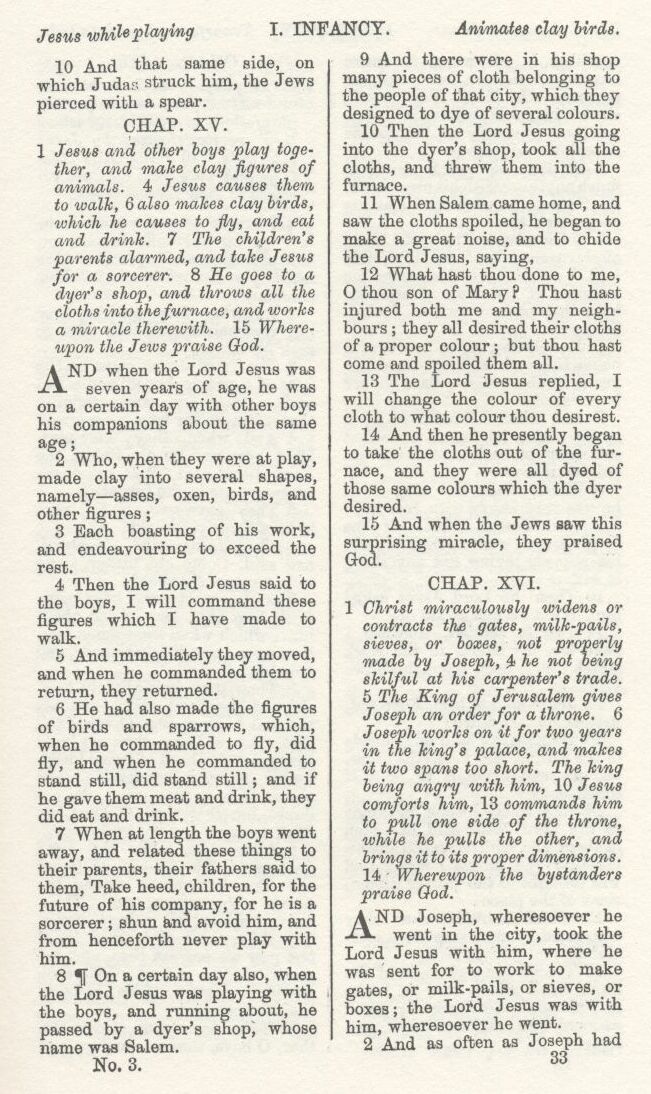
>
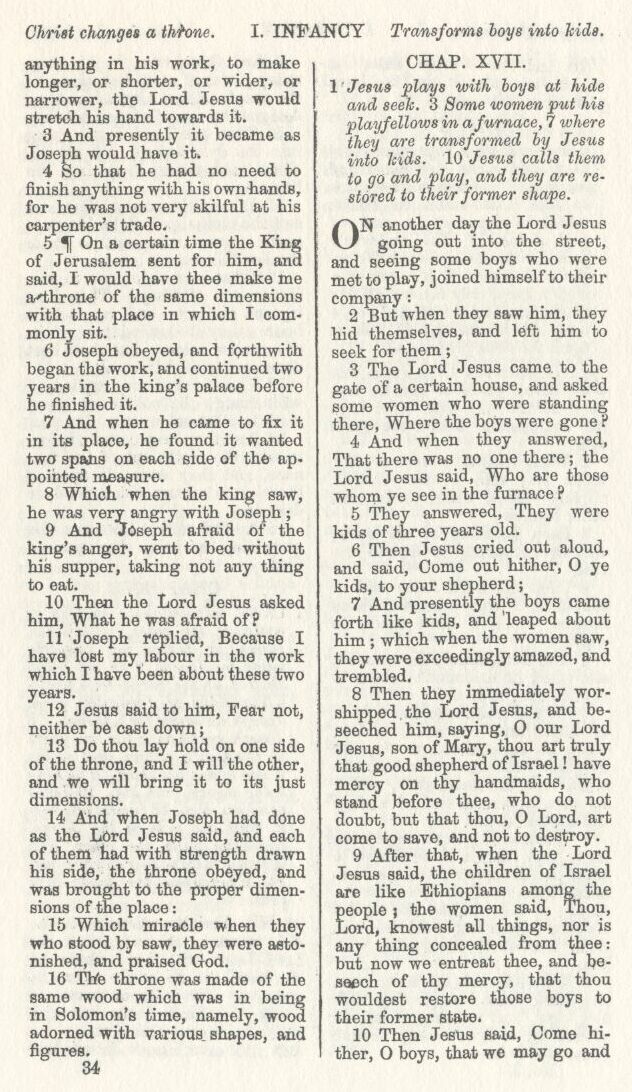
>
>
>
>
REFERENCES TO THE FIRST GOSPEL OF
THE INFANCY OF JESUS CHRIST
[Mr. Henry Sike, Professor of Oriental Languages at Cambridge, first
translated and published this Gospel in 1697. It was received by the
Gnostics, a sect of Christians in the second century; and several of its
relations were credited in the following ages by other Christians, viz.,
Eusebius, Athanasius, Epiphanius; Chrysostom. &c. Sozomen says, he was
told by many, and he credits the relations, of the idols in Egypt falling
down on Joseph, and Mary's flight thither with Christ; and of Christ
making a well to wash his clothes in a sycamore-tree, from whence balsam
afterwards proceeded; which stories are from this Gospel. Chemnitius, out
of Stipulensis, who had it from Peter Martyr, Bishop of Alexandria, in
the third century, says, that the place in Egypt where Christ was
banished is now called Matarea, about ten miles beyond Cairo; that the
inhabitants constantly burn a lamp in remembrance of it; and that there
is a garden of trees yielding a balsam, which were planted by Christ when
a boy. M. La Crosse cites a synod at Angamala, in the Mountain of
Malabar, A. D. 1599, which shows this Gospel was commonly read by the
Nestorians in the country. Ahmed Ibu Idris, a Mahometan divine, says, it
was used by some Christians in common with the other four Gospels; and
Ocobius de Castro mentions a Gospel of Thomas, which he says, he saw and
had translated to him by an Armenian Archbishop at Amsterdam, that was
read in very many churches of Asia and Africa, as the only rule of their
faith. Fabricius takes it to be this Gospel. It has been supposed, that
Mahomet and his coadjutors used it in compiling the Koran. There are
several stories believed of Christ, proceeding from this Gospel; as that
which Mr. Sike relates out of La Brosse's Persic Lexicon, that Christ
practised the trade of a dyer, and his working a miracle with the
colours; from whence the Persian dyers honour him as their patron, and
call a dye-house the shop of Christ. Sir John Chardin mentions Persian
legends concerning Christ's dispute with his schoolmaster about his ABC;
and his lengthening the cedar-board which Joseph sawed too short.]
Note on the Miracles of Christ in the preceding Gospels.
A great void in the early life of the Saviour is filled up by these
Gospels. In none of the Canonical Evangelists is any mention made of the
childhood of Jesus. The Gospels of Matthew, Mark, Luke, and John, more
rapidly than satisfactorily, pass over the period intervening between His
birth and ministry. It is natural to suppose that the Infant Redeemer's
earliest days were spent in the society of other young children, and it
is quite consistent with every sincere Christians faith to believe that
He had the power to perform the miracles here ascribed to him otherwise,
a limit will be set to His divine attributes, doubts raised against His
performance of the miracles related by the four Evangelists, in the
authorised version of the Testament, and a denial given of the
declaration therein, "With GOD nothing is impossible!"
CHAPTER I.
2 Jesus miraculously clears the water after rain.
4 Plays with clay
sparrows, which he animates
on the Sabbath day.
I THOMAS, an Israelite, judged
it necessary to make known to
our
brethren among the Gentiles,
the actions and miracles of Christ
in his childhood, which our Lord
and God Jesus Christ wrought
after his birth in Bethlehem in our
country, at which I myself, was
astonished; the beginning of which
was as followeth.
2 When the child Jesus was
five years of age, and there had
been
a shower of rain, which was
now over, Jesus was playing with
other Hebrew boys by a running
stream; and the water running
over the banks, stood in little
lakes;
3 But the water instantly became
clear and useful again; he
having smote them only by his
word, they readily obeyed him.
4 Then he took from the bank
of the stream some soft clay, and
formed out of it twelve sparrows;
and there were other boys playing
with him.
5 But a certain Jew seeing the
things which he was doing, namely,
his forming clay into the figures
of sparrows on the Sabbath day,
went presently away, and told
his father Joseph, and said,
6 Behold, thy boy is playing by
the river side, and has taken clay,
and formed it into twelve sparrows,
and profaneth the Sabbath.
7 Then Joseph came to the
place where he was, and when he
saw
him, called to him, and said,
Why doest thou that which it is
not lawful to do on the Sabbath
day?
8 Then Jesus clapping together
the palms of his hands, called to
the sparrows, and said to them
Go, fly away; and while ye live
remember me.
9 So the sparrows fled away
making a noise.
10 The Jews seeing this, were
astonished, and went away, and
told their chief persons what a
strange miracle they had seen
wrought by Jesus.
CHAPTER II.
2 Causes a boy to wither who broke down his fish-pools;
6 Partly
restores him.
7 Kills another boy.
16 causes blindness to fall
on his accusers,
18 for which, Joseph pulls him by the ear.
BESIDES this, the son of Annas
the scribe, was standing there
with Joseph, and took a bough
of a willow tree, and scattered
the waters which Jesus had
gathered into lakes.
2 But the boy Jesus seeing what
he had done, became angry, and
said to him, Thou fool, what harm
did the lake do thee, that thou
shouldest scatter the water?
3 Behold, now thou shalt wither
as a tree, and shalt not bring forth
either leaves, or branches, or fruit.
4 And immediately he became
withered all over.
5 Then Jesus went away home.
But the parents of the boy who
was
withered, lamenting the
misfortune of his youth, took and
carried him to Joseph, accusing him,
and said, Why dost thou keep a
son who is guilty of such actions?
6 Then Jesus at the request of
all who were present did heal him,
leaving only some small member
to continue withered, that they
might take warning.
7 Another time Jesus went
forth into the street, and a boy
running by, rushed upon his
shoulder;
8 At which Jesus being angry,
said to him, Thou shalt go no
farther;
9 And he instantly fell down
dead:
10 Which when some persons
saw, they said, Where was this
boy
born, that every thing which
he says presently cometh to pass?
11 Then the parents of the dead
boy going to Joseph, complained,
saying, You are not fit to live with
us, in our city, having such a
boy
as that:
12 Either teach him that he
bless and not curse, or else depart
hence with him, for he kills our
children.
13 Then Joseph calling the
boy Jesus by himself, instructed
him,
saying, Why doest thou such
things to injure the people so, that
they hate us and prosecute us?
14 But Jesus replied, I know
that what thou sayest is not of
thyself, but for thy sake I will
say nothing;
15 But they who have said these
things to thee, shall suffer
everlasting punishment.
16 And immediately they who
had accused him became blind,
17 And all they who saw it were
exceedingly afraid and confounded,
and said concerning him, Whatsoever
he saith, whether good or bad,
immediately cometh to pass and
they were amazed.
18 And when they saw this action
of Christ, Joseph arose, and
plucked him by the ear, at which
the boy was angry, and said to
him, Be easy;
19 For if they seek for us, they
shall not find us: thou hast done
very imprudently.
20 Dost thou not know that I
am thine? Trouble me no more.
CHAPTER III.
1 Astonishes his schoolmaster by his learning.
A CERTAIN schoolmaster
named Zaccheaus, standing
in a certain
place, heard Jesus
speaking these things to his father.
2 And he was much surprised,
that being a child he should speak
such things; and after a few days
he came to Joseph, and said,
3 Thou hast a wise and sensible
child, send him to me, that he may
learn to read.
4 When he sat down to teach
the letters to Jesus, he began with
the first letter Aleph;
5 But Jesus pronounced the
second letter Mpeth (Beth) Cghimel
(Gimel), and said over all the
letters to him to the end.
6 Then opening a book, he
taught his master the prophets
but he
was ashamed, and was at a
loss to conceive how he came to
know
the letters.
7 And he arose and went home,
wonderfully surprised at so strange
a thing.
CHAPTER IV.
1 Fragment of an adventure at a dyer's.
AS Jesus was passing by a certain
shop, he saw a young man dipping
(or dyeing) some cloths and stockings
in a furnace, of a sad colour,
doing
them according to every person's
particular order;
2 The boy Jesus going to the
young man who was doing this,
took
also some of the cloths ......
(Here endeth the fragment of
Thomas's Gospel of the Infancy
of
Jesus Christ.)
REFERENCE TO ST. THOMAS'S GOSPEL OF THE
INFANCY OF JESUS CHRIST.
[The original in Greek, from which this translation is made, will be
found printed by Cotelerius, in his notes on the constitutions of the
Apostles, from a MS. in the French King's Library, No. 2279.—It is
attributed to St. Thomas, and conjectured to have been originally
connected with the, Gospel of Mary. Unfortunately this ancient MS. was
found torn at the second verse of the fourth chapter.]
>
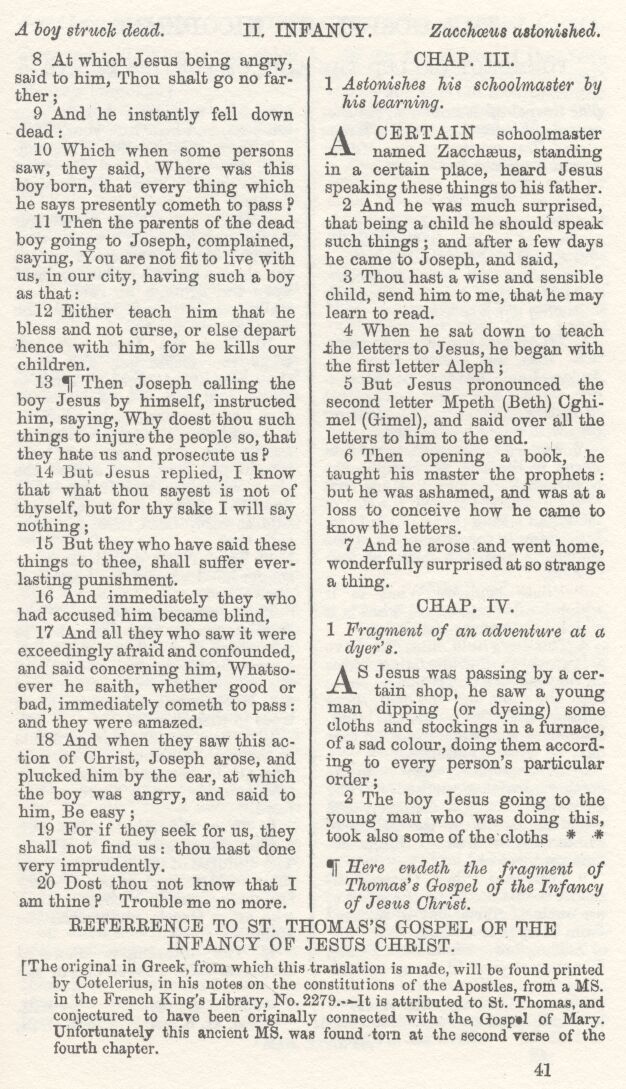
The Gospel of NICODEMUS, the disciple,
concerning the Sufferings and
Resurrection
of our Master and Saviour, JESUS CHRIST.
CHAPTER I.
1 Christ accused to Pilate by the Jews
of healing on the Sabbath.
9 Summoned before Pilate by a messenger
who does him honour.
20
Worshipped by the standards bowing down to him.
ANNAS and Caiphas, and
Summas, and Datam, Gamaliel,
Judas, Levi,
Nepthalim, Alexander,
Cyrus, and other Jews, went
to Pilate
about Jesus, accusing
him with many bad crimes.
2 And said, We are assured that
Jesus is the son of Joseph, the
carpenter, and born of Mary, and
that he declares himself the Son of
God, and a king; and not only so,
but attempts the dissolution of the
Sabbath, and the laws of our
fathers.
3 Pilate replied, What is it
which he declares? and what is it
which he attempts dissolving?
4 The Jews told him, We have
a law which forbids doing cures
on
the Sabbath day; but he cures
both the lame and the deaf, those
afflicted with the palsy, the blind,
the lepers, and demoniacs, on
that
day, by wicked methods.
5 Pilate replied, How can he
do this by wicked methods? They
answered He is a conjurer, and
casts out devils by the prince of
the devils; and so all things,
become subject to him.
6 Then said Pilate, Casting out
devils seems not to be the work of
an unclean spirit, but to proceed
from the power of God.
7 The Jews replied to Pilate,
We entreat your highness to summon
him to appear before your tribunal,
and hear him yourself.
8 Then Pilate called a messenger,
and said to him, By what means
will Christ be brought hither?
9 Then went the messenger
forth, and knowing Christ,
worshipped
him; and having spread
the cloak which he had in his hand
upon
the ground, he said, Lord,
walk upon this, and go in, for the
governor calls thee.
10 When the Jews perceived
what the messenger had done,
they
exclaimed (against him) to
Pilate, and said, Why did you not
give him his summons by a beadle,
and not by a messenger?—For
the
messenger, when he saw him,
worshipped him, and spread the
cloak which he had in his hand
upon the ground before him, and
said to him, Lord, the governor
calls thee.
11 Then Pilate called the
messenger, and said, Why hast thou
done thus?
12 The messenger replied, When
thou sentest me from Jerusalem to
Alexander, I saw Jesus sitting in
a mean figure upon a she-ass, and
the children of the Hebrews cried
out, Hosannah, holding boughs of
trees in their hands.
13 Others spread their garments
in the way, and said, Save us, thou
who art in heaven; blessed is he
who cometh in the name of the
Lord.
14 Then the Jews cried out,
against the messenger, and said,
The
children of the Hebrews made
their acclamations in the Hebrew
language; and how couldst thou,
who art a Greek, understand the
Hebrew?
15 The messenger answered
them and said, I asked one of the
Jews
and said, What is this which
the children do cry out in the
Hebrew language?
16 And he explained it to me,
saying, they cry out, Hosannah,
which being interpreted, is, O
Lord, save me; or, O Lord, save.
17 Pilate then said to them,
Why do you yourselves testify to
the words spoken by the children,
namely, by your silence? In what
has the messenger done amiss?
And they were silent.
18 Then the governor said unto
the messenger, Go forth and
endeavour by any means to bring
him in.
19 But the messenger went forth
and did as before; and said, Lord
come in, for the governor calleth
thee.
20 And as Jesus was going in
by the ensigns, who carried the
standards, the tops of them bowed
down and worshipped Jesus.
21 Whereupon the Jews exclaimed
more vehemently against the ensigns.
22 But Pilate said to the Jews,
I know it is not pleasing to you
that the tops of the standards did
of themselves bow and worship
Jesus; but why do ye exclaim
against the ensigns, as if they had
bowed and worshipped?
23 They replied to Pilate,
We saw the ensigns themselves
bowing
and worshipping Jesus.
24 Then the governor called the
ensigns, and said unto them, Why
did you do thus?
25 The ensigns said to Pilate,
We are all Pagans and worship
the
gods in temples; and how
should we think anything about
worshipping him? We only held
the standards in our hands,
and
they bowed themselves and
worshipped him.
26 Then said Pilate to the rulers
of the synagogue, Do ye yourselves
choose some strong men, and let
them hold the standards, and we
shall see whether they will then
bend of themselves.
27 So the elders of the Jews
sought out twelve of the most
strong and able old men, and made
them hold the standards, and they
stood in the presence of the governor.
28 Then Pilate said to the
messenger, Take Jesus out, and by
some means bring him in again.
And Jesus and the messenger went
out of the hall.
29 And Pilate called the ensigns
who before had borne the standards,
and swore to them, that if they
had not borne the standards in
that manner when Jesus before
entered in, he would cut off
their
heads.
30 Then the governor commanded
Jesus to come in again.
31 And the messenger did as he
had done before, and very much
entreated Jesus that he would go
upon his cloak, and walk on it;
and he did walk upon it, and went
in.
32 And when Jesus went in,
the standards bowed themselves as
before, and worshipped him.
CHAPTER II.
2 Is compassionated by Pilate's wife,
7 charged with being born in
fornication.
12 Testimony to the betrothing of his parents.
15
Hatred of the Jews to him.
NOW when Pilate saw this, he
was afraid, and was about to
rise
from his seat.
2 But while he thought to rise,
his own wife who stood at a
distance, sent to him, saying, Have
thou nothing to do with that just
man; for I have suffered much
concerning him in a vision this
night.
3 When the Jews heard this
they said to Pilate, Did we not say
unto thee, He is a conjuror? Behold,
he hath caused thy wife to
dream.
4 Pilate then calling Jesus, said,
thou hast heard what they testify
against thee, and makest no answer?
5 Jesus replied, If they had not
a power of speaking, they could
not have spoke; but because every
one has the command of his own
tongue, to speak both good and
bad, let him look to it.
6 But the elders of the Jews
answered, and said to Jesus, What
shall we look to?
7 In the first place, we know
this concerning thee, that thou
wast born through fornication;
secondly, that upon the account of
thy birth the infants were slain in
Bethlehem; thirdly, that thy
father
and mother Mary fled into Egypt,
because they could not
trust their
own people.
8 Some of the Jews who stood
by spake more favourably, We
cannot
say that he was born
through fornication; but we know
that his
mother Mary was betrothed
to Joseph, and so he was not born
through fornication.
9 Then said Pilate to the Jews
who affirmed him to be born
through fornication, This your
account is not true, seeing there was
a betrothment, as they testify who
are of your own nation.
10 Annas and Caiphas spake to
Pilate, All this multitude of people
is to be regarded, who cry out,
that he was born through fornication,
and is a conjurer; but they who deny
him to be born through
fornication,
are his proselytes and disciples.
11 Pilate answered Annas and
Caiphas, Who are the proselytes?
They answered, They are those
who are the children of Pagans,
and are not become Jews, but
followers of him.
12 Then replied Eleazer, and
Asterius, and Antonius, and James,
Caras and Samuel, Isaac and Phinees,
Crispus and Agrippa, Annas and
Judas,
We are not proselytes, but children
of Jews, and speak
the truth,
and were present when Mary was
betrothed.
13 Then Pilate addressing
himself to the twelve men who
spake
this, said to them, I conjure
you by the life of Caesar, that ye
faithfully declare whether he was
born through fornication, and those
things be true which ye have related.
14 They answered Pilate, We
have a law whereby we are forbid
to
swear, it being a sin: Let them
swear by the life of Caesar that it
is not as we have said, and we will
be contented to be put to death.
15 Then said Annas and Caiphas
to Pilate, Those twelve men will
not believe that we know him to be
basely born, and to be a conjurer,
although he pretends that he is
the Son of God, and a king: which
we are so far from believing, that
we tremble to hear.
16 Then Pilate commanded
every one to go out except the
twelve
men who said he was not
born through fornication, and
Jesus to
withdraw to a distance,
and said to them, Why have the Jews
a
mind to kill Jesus?
17 They answered him, They
are angry because he wrought
cures on
the sabbath day. Pilate
said, Will they kill him for a
good
work? They say unto him,
Yes, Sir.
CHAPTER III.
1 Is exonerated by Pilate.
11 Disputes with Pilate concerning truth.
THEN Pilate, filled with anger,
went out of the hall, and said
to the Jews, I call the whole
world to witness that I find no
fault in that man.
2 The Jews replied to Pilate,
If he had not been a wicked person,
we had not brought him before thee.
3 Pilate said to them, Do ye take
him and try him by your law.
4 Then the Jews said, It is not
lawful for us to put any one to
death.
5 Pilate said to the Jews, The
command, therefore, thou shalt
not kill, belongs to you, but
not to me.
6 And he went again into the
hall, and called Jesus by himself,
and said to him, Art thou the king
of the Jews?
7 And Jesus answering, said
to Pilate, Dost thou speak this
of
thyself, or did the Jews tell
it thee concerning me?
8 Pilate answering, said to
Jesus, Am I a Jew? The whole
nation
and rulers of the Jews have
delivered thee up to me. What
hast
thou done?
9 Jesus answering, said, My
kingdom is not of this world:
if my
kingdom were of this world,
then would my servants fight,
and I
should not have been
delivered to the Jews: but now
my kingdom
is not from hence.
10 Pilate said, Art thou a king
then? Jesus answered, Thou sayest
that I am a king: to this end
was I born, and for this end came
I into the world; and for this
purpose I came, that I should bear
witness to the truth; and every
one who is of the truth, heareth
my voice.
11 Pilate saith to him, What is
truth?
12 Jesus said, Truth is from
heaven.
13 Pilate said, Therefore truth
is not on earth.
14 Jesus saith to Pilate,
Believe that truth is on earth
among
those, who when they have
the power of judgment, are governed
by
truth, and form right judgment.
CHAPTER IV.
1 Pilate finds no fault in Jesus.
16 The Jews demand his crucifixion.
THEN Pilate left Jesus in the hall,
and went out to the Jews, and
said,
I find not any one fault in Jesus.
2 The Jews say unto him, But
he said, I can destroy the temple
of God, and in three days build it
up again.
3 Pilate saith to them, What
sort of temple is that of which he
speaketh?
4 The Jews say unto him,
That which Solomon was forty-six
years
in building, he said he
would destroy, and in three days
build
up.
5 Pilate said to them again, I
am innocent from the blood of that
man! do ye look to it.
6 The Jews say to him, His
blood be upon us and our children.
Then Pilate calling together the
elders and scribes, priests and
Levites, saith to them privately,
Do not act thus; I have found
nothing in your charge (against
him) concerning his curing sick
persons, and breaking the sabbath,
worthy of death.
7 The priests and Levites replied
to Pilate, By the life of Caesar,
if any one be a blasphemer, he is
worthy of death; but this man hath
blasphemed against the Lord.
8 Then the governor again
commanded the Jews to depart out
of
the hall; and calling Jesus,
said to him, What shall I do with
thee?
9 Jesus answered him, Do according
as it is written.
10 Pilate said to him, How is it
written?
11 Jesus saith to him, Moses
and the prophets have prophesied
concerning my suffering and
resurrection.
12 The Jews hearing this, were
provoked, and said to Pilate,
Why
wilt thou any longer hear the
blasphemy of that man?
13 Pilate saith to them, If these
words seem to you blasphemy, do
ye take him, bring him to your
court, and try him according to
your law.
14 The Jews reply to Pilate,
Our law saith, he shall be obliged
to receive nine and thirty stripes,
but if after this manner he shall
blaspheme against the Lord, he
shall be stoned.
15 Pilate saith unto them, If
that speech of his was blasphemy,
do ye try him according to your
law.
16 The Jews say to Pilate, Our
law command us not to put any one
to death. We desire that he may be
crucified, because he deserves the
death of the cross.
17 Pilate saith to them, It is not
fit he should be crucified: let
him
be only whipped and sent away.
18 But when the governor looked
upon the people that were present
and the Jews, he saw many of the
Jews in tears, and said to the
chief priests of the Jews, All
the people do not desire his death.
19 The elders of the Jews answered
to Pilate, We and all the people
came hither for this very purpose,
that he should die.
20 Pilate saith to them, Why should
he die?
21 They said to him, Because
he declares himself to be the Son
of God and a King.
CHAP. V.
1 Nicodemus speaks in defence of Christ,
and relates his miracles.
12 Another Jew,
26 with Veronica,
34 Centurio, and others,
testify of other miracles.
BUT Nicodemus, a certain Jew,
stood before the governor,
and
said, I entreat thee,
O righteous judge, that thou
wouldst
favour me with the
liberty of speaking a few words.
2 Pilate said to him, Speak on.
3 Nicodemus said, I spake to
the elders of the Jews, and the
scribes, and priests and Levites,
and all the multitude of the Jews,
in their assembly; What is it ye
would do with this man?
4 He is a man who hath wrought
many useful and glorious miracles,
such as no man on earth ever
wrought before, nor will ever
work.
Let him go, and do him
no harm; if he cometh from God,
his
miracles, (his miraculous
cures) will continue; but if from
men,
they will come to nought.
5 Thus Moses, when he was
sent by God into Egypt, wrought
the
miracles which God commanded
him, before Pharaoh king of Egypt;
and though the magicians of that
country, Jannes and Jambres,
wrought by their magic the same
miracles which Moses did, yet they
could not work all which he did;
6 And the miracles which the
magicians wrought, were not of
God,
as ye know, O Scribes and
Pharisees; but they who wrought
them
perished, and all who
believed them.
7 And now let this man go;
because the very miracles for
which
ye accuse him, are from
God; and he is not worthy of
death.
8 The Jews then said to Nicodemus,
Art thou become his disciple,
and making speeches in his favour?
9 Nicodemus said to them, Is
the governor become his disciple
also, and does he make speeches
for him? Did not Caesar place
him in that high post?
10 When the Jews heard this
they trembled, and gnashed their
teeth at Nicodemus, and said to
him, Mayest thou receive his
doctrine for truth, and have
thy lot with Christ!
11 Nicodemus replied, Amen;
I will receive his doctrine, and
my
lot with him, as ye have said.
12 Then another certain Jew
rose up, and desired leave of the
governor to hear him a few words.
13 And the governor said,
Speak, what thou hast a mind.
14 And he said, I lay for thirty-
eight years by the sheep-pool at
Jerusalem, labouring under a great
infirmity, and waiting for a cure
which should be wrought by the
coming of an angel, who at a
certain time troubled the water: and
whosoever first after the
troubling
of the water stepped in, was made
whole of whatsoever
disease he had.
15 And when Jesus saw me languishing
there, he said to me, Wilt thou
be
made whole? And I answered, Sir,
I have no man, when the
water is
troubled, to put me into the pool.
16 And he said unto me, Rise,
take up thy bed and walk. And
I
was immediately made whole,
and took up my bed and walked.
17 The Jews then said to Pilate,
Our Lord Governor, pray ask
him
what day it was on which he
was cured of his infirmity.
18 The infirm person replied,
It was on the sabbath.
19 The Jews said to Pilate, Did
we not say that he wrought his
cures on the sabbath, and cast out
devils by the prince of devils?
20 Then another certain Jew
came forth, and said, I was blind,
could hear sounds, but could not
see any one; and as Jesus was
going along, I heard the multitude
passing by, and I asked what
was there?
21 They told me that Jesus was
passing by: then I cried out,
saying, Jesus, Son of David, have
mercy on me. And he stood still,
and commanded that I should be
brought to him, and said to me,
What wilt thou?
22 I said, Lord, that I may
receive my sight.
23 He said to me, Receive thy
sight: and presently I saw, and
followed him, rejoicing and giving
thanks,
24 Another Jew also came forth,
and said, I was a leper, and he
cured me by his word only, saying,
I will, be thou clean; and
presently
I was cleansed from my leprosy.
25 And another Jew came
forth, and said I was crooked,
and he
made me straight by his
word.
26 And a certain woman
named Veronica, said, I was
afflicted
with an issue of blood
twelve years, and I touched the
hem of
his garment, and presently
the issue of blood stopped.
27 The Jews then said, We
have a law, that a woman shall
not be
allowed as an evidence.
28 And, after other things,
another Jew said, I saw Jesus
invited to a wedding with his
disciples, and there was a want
of
wine in Cana of Galilee;
29 And when the wine was all
drank, he commanded the servants
that they should fill six pots which
were there with water, and they
filled them up to the brim, and he
blessed them and turned the water
into wine, and all the people drank,
being surprised at this miracle,
30 And another Jew stood forth,
and said, I saw Jesus teaching
in the synagogue at Capernaum;
and there was in the synagogue
a
certain man who had a devil;
and he cried out, saying,
let me
alone; what have we to
do with thee, Jesus of Nazareth?
Art thou
come to destroy us?
I know that thou art the Holy One
of God.
31 And Jesus rebuked him, saying,
Hold thy peace, unclean spirit,
and come out of the man; and
presently he came out of him, and
did not at all hurt him.
32 The following things were
also said by a Pharisee: I saw
that
a great company came to
Jesus from Galilee and Judea, and
the
sea-cost, and many countries
about Jordan; and many infirm
persons came to him, and he healed
them all.
33 And I heard the unclean
spirits crying out, and saying,
Thou
art the Son of God. And
Jesus strictly charged them, that
they
should not make him known.
34 After this another person,
whose name was Centurio, said,
I
saw Jesus in Capernaum, and I
entreated him, saying, Lord, my
servant lieth at home sick of the
palsy.
35 And Jesus said to me, I
will come and cure him.
36 But I said, Lord, I am not
worthy that thou shouldst come
under my roof; but only speak
the word, and my servant shall be
healed.
37 And Jesus said unto me, Go
thy way; and as thou hast believed
so be it done unto thee. And my
servant was healed from that same
hour.
38 Then a certain nobleman
said, I had a son in Capernaum,
who
lay at the point of death; and
when I heard that Jesus was come
into Galilee, I went and besought
him that he would come down to
my house, and heal my son, for he
was at the point of death.
39 He said to me, Go thy way,
thy son liveth.
40 And my son was cured from
that hour.
41 Besides these, also many
others of the Jews, both men and
Women, cried out and said, He is
truly the Son of God, who cures
all diseases only by his word, and
to whom the devils are altogether
subject.
42 Some of them farther said,
This power can proceed from none
but God.
43 Pilate said to the Jews, Why
are not the devils subject to your
doctors?
44 Some of them said, The
power of subjecting devils cannot
proceed but from God.
45 But others said to Pilate,
That he had raised Lazarus from
the dead, after he had been four
days in his grave.
46 The governor hearing this,
trembling, said to the multitude of
the Jews, What will it profit you
to shed innocent blood?
CHAPTER VI.
1 Pilate dismayed by the turbulence of the Jews,
5 who demand
Barabbas to be released, and Christ
to be crucified.
9 Pilate
warmly expostulates with them,
20 washes his hands of Christ's blood,
23 and sentences him to be whipped and crucified.
THEN Pilate having called
together Nicodemus, and the
fifteen
men who said that Jesus
was not born through fornication,
said
to them, What shall I do,
seeing there is like to be a tumult
among the people.
2 They say unto him, We know
not; let them look to it who raise
the tumult.
3 Pilate then called the
multitude again, and said to them,
Ye
know that ye have a custom, that
I should release to you one prisoner
at the feast of the passover:
4 I have a noted prisoner, a
murderer, who is called Barabbas,
and Jesus who is called Christ, in
whom I find nothing that deserves
death; which of them, therefore,
have you a mind that I should
release to you?
5 They all cry out, and say,
Release to us Barabbas.
6 Pilate saith to them, What
then shall I do with Jesus who is
called Christ?
7 They all answer, Let him be
crucified.
8 Again they cry out and say to
Pilate, You are not the friend of
Caesar, if you release this man;
for he hath declared that he is the
Son of God, and a king. But are
you inclined that he should be
king, and not Caesar?
9 Then Pilate filled with anger
said to them, Your nation hath
always been seditious, and you are
always against those who have
been serviceable to you.
10 The Jews replied, Who are those
who have been serviceable to us?
11 Pilate answered them, Your
God who delivered you from the
hard bondage of the Egyptians,
and brought you over the Red Sea
as though it had been dry land,
and fed you in the wilderness with
manna and the flesh of quails, and
brought water out of the rock, and
gave you a law from heaven.
12 Ye provoked him all ways,
and desired for yourselves a
molten
calf, and worshipped it,
and sacrificed to it, and said,
These
are thy Gods, O Israel,
which brought thee out of the
land of
Egypt:
13 On account of which your
God was inclined to destroy you;
but
Moses interceded for you, and
your God heard him, and forgave
your iniquity.
14 Afterwards ye were enraged
against, and would have killed
your prophets, Moses and Aaron,
when they fled to the tabernacle,
and ye were always murmuring
against God and his prophets.
15 And arising from his
judgment seat, he would have gone
out;
but the Jews all cried out,
We acknowledge Caesar to be king,
and not Jesus;
16 Whereas this person, as
soon as he was born, the wise
men
came and offered gifts unto
him; which when Herod heard,
he was
exceedingly troubled,
and would have killed him:
17 When his father knew this,
he fled with him and his mother
Mary into Egypt. Herod, when
he heard he was born, would have
slain him; and accordingly sent
and slew all the children which
were in Bethlehem, and in all the
coasts thereof, from two years old
and under.
18 When Pilate heard this
account, he was afraid; and
commanding
silence among the
people, who made a noise, he said
to Jesus,
Art thou therefore a king?
19 All the Jews replied to
Pilate, he is the very person
whom
Herod sought to have slain.
20 Then Pilate taking water,
washed his hands before the people
and said, I am innocent of the
blood of this just person; look ye
to it.
21 The Jews answered and said,
His blood be upon us and our
children.
22 Then Pilate commanded Jesus
to be brought before him, and
spake to him in the following
words;
23 Thy own nation hath charged
thee as making thyself a king;
wherefore I, Pilate, sentence thee
to be whipped according to the
laws of former governors; and
that thou be first bound, then
hanged upon a cross in that place
where thou art now a prisoner;
and also two criminals with thee,
whose names are Dimas and Gestas.
CHAP. VII.
1 Manner of Christ's crucifixion
with the two thieves.
THEN Jesus went out of the
hall, and the two thieves
with him.
2 And when they came to the
place which is called Golgotha,
they
stript him of his raiment, and
girt him about with a linen cloth,
and put a crown of thorns upon his
head, and put a reed in his hand.
3 And in like manner did they
to the two thieves who were
crucified with him, Dimas on his
right hand and Gestas on his left.
4 But Jesus said, My Father,
forgive them, For they know not
what they do.
5 And they divided his garments,
and upon his vesture they cast lots.
6 The people in the mean time
stood by, and the chief priests
and elders of the Jews mocked him,
saying, He saved others, let him
now save himself if he can; if he
be the son of God, let him now
come down from the cross.
7 The soldiers also mocked him,
and taking vinegar and gall, offered
it to him to drink, and said to him,
If thou art king of the Jews,
deliver thyself.
8 Then Longinus, a certain soldier,
taking a spear, pierced his side,
and presently there came forth blood
and water.
9 And Pilate wrote the title
upon the cross in Hebrew, Latin,
and Greek letters, viz., THIS IS
THE KING OF THE JEWS.
10 But one of the two thieves
who were crucified with Jesus,
whose name was Gestas, said to
Jesus, If thou art the Christ,
deliver thyself and us.
11 But the thief who was
crucified on his right hand,
whose name
was Dimas, answering,
rebuked him, and said, Dost not
thou fear
God, who art condemned
to this punishment? We indeed
receive
rightly and justly the
demerit of our actions; but this
Jesus,
what evil hath he done.
12 After this, groaning, he said
to Jesus, Lord, remember me
when thou comest into thy kingdom.
13 Jesus answering, said to
him, Verily I say unto thee, that
this day thou shalt be with me in
Paradise.
CHAPTER VIII.
1 Miraculous appearance at his death.
10 The Jews say the eclipse was
natural.
12 Joseph of Arimathaea embalms Christ's
body and
buries it.
AND it was about the sixth
hour, and darkness was upon
the face
of the whole earth until
the ninth hour.
2 And while the sun was eclipsed,
behold the veil of the temple was
rent from the top, to the bottom;
and the rocks also were rent, and
the graves opened, and many
bodies of saints, which slept,
arose.
3 And about the ninth hour
Jesus cried out with a loud voice,
Eli, Eli, lama sabacthani? which
being interpreted is, My God, My
God, why hast thou forsaken me?
4 And after these things, Jesus
said, Father, into thy hands I
commend my spirit; and having
said this, he gave up the ghost.
5 But when the centurion saw
that Jesus thus crying out gave up
the ghost, he glorified God, and
said, Of a truth this was a just
man.
6 And all the people who stood
by, were exceedingly troubled at
the sight; and reflecting upon
what had passed, smote upon their
breasts, and then returned to the
city of Jerusalem.
7 The centurion went to the
governor, and related to him all
that had passed:
8 And when he had heard all
these things, he was exceedingly
sorrowful;
9 And calling the Jews together,
said to them, Have ye seen the
miracle of the sun's eclipse, and
the other things which came to
pass, while Jesus was dying?
10 Which when the Jews heard,
they answered to the governor,
The
eclipse of the sun happened
according to its usual custom.
11 But all those who were the
acquaintance of Christ, stood at
a
distance, as did the women who
had followed Jesus from Galilee,
observing all these things.
12 And behold a certain man
of Arimathaea, named Joseph, who
was
also a disciple of Jesus, but
not openly so, for fear of the Jews,
came to the governor, and entreated
the governor that he would give
him
leave to take away the body of Jesus
from the cross.
13 And the governor gave him leave.
14 And Nicodemus came, bringing
with him a mixture of myrrh and
aloes about a hundred pounds
weight; and they took down Jesus
from the cross with tears, and
bound him in linen cloths with
spices, according to the custom of
burying among the Jews;
15 And placed him in a new
tomb, which Joseph had built,
and
caused to be cut out of a rock,
in which never any man had been
put; and they rolled a great stone
to the door of the sepulchre.
CHAPTER IX.
1 The Jews angry with Nicodemus:
5 and with, Joseph of Arimathaea,
7 whom they imprison.
WHEN the unjust Jews heard
that Joseph had begged and buried
the
body of Jesus, they sought
after Nicodemus, and those fifteen
men who had testified before the
governor, that Jesus was not born
through fornication, and other
good persons who had shown any
good actions towards him.
2 But when they all concealed
themselves through fear of the
Jews, Nicodemus alone showed
himself to them, and said, How
can
such persons as these enter
into the synagogue?
3 The Jews answered him, But
how durst thou enter into the
synagogue, who wast a confederate
with Christ? Let thy lot be along
with him in the other world.
4 Nicodemus answered, Amen;
so may it be, that I may have
my lot
with him in his kingdom.
5 In like manner Joseph, when
he came to the Jews, said to them,
Why are ye angry with me for
desiring the body of Jesus of
Pilate? Behold, I have put him in
my tomb, and wrapped him up in
clean linen, and put a stone at the
door of the sepulchre:
6 I have acted rightly towards
him; but ye have acted unjustly
against that just person, in
crucifying him, giving him vinegar
to drink, crowning him with thorns,
tearing his body with whips, and
praying down the guilt of his blood
upon you.
7 The Jews at the hearing of
this were disquieted and troubled;
and they seized Joseph, and
commanded him to be put in custody
before the Sabbath, and kept there
till the Sabbath was over.
8 And they said to him, Make
confession; for at this time it is
not lawful to do thee any harm,
till the first day of the week come.
But we know that thou wilt not be
thought worthy of a burial; but
we will give thy flesh to the birds
of the air, and the beasts of the
earth.
9 Joseph answered, That speech
is like the speech of proud Goliath,
who reproached the living God in
speaking against David. But ye
scribes and doctors know that God
saith by the prophet, Vengeance is
mine, and I will repay to you evil
equal to that which ye have
threatened to me.
10 The God whom you have
hanged upon the cross, is able to
deliver me out of your hands. All
your wickedness will return upon
you.
11 For the governor, when he
washed his hands, said, I am clear
from the blood of this just person.
But ye answered and cried out,
His blood be upon us and our
children. According as ye have
said, may ye perish for ever.
12 The elders of the Jews hearing
these words, were exceedingly
enraged; and seizing Joseph, they
put him into a chamber where
there was no window; they fastened
the door, and put a seal upon
the lock;
13 And Annas and Caiaphas placed
a guard upon it, and took counsel
with the priests and Levites,
that they should all meet after
the Sabbath, and they contrived
to what death they should put Joseph.
14 When they had done this, the
rulers, Annas and Caiaphas,
ordered Joseph to be brought
forth.
(In this place there is a portion
of the Gospel lost or omitted.
which cannot be supplied. It
may, nevertheless, be surmised
from
the occurrence related in
the next chapter, that the order
of
Annas and Caiaphas were rendered
unnecessary by Joseph's miraculous
escape, and which was announced
to an assembly of people.)
CHAPTER X.
1 Joseph's escape.
2 The soldiers relate Christ's resurrection.
18 Christ is seen preaching in Galilee.
21 The Jews repent of their
cruelty to him.
WHEN all the assembly heard
this (about Joseph's escape),
they
admired and were astonished,
because they found the same seal
upon the lock of the chamber, and
could not find Joseph.
2 Then Annas and Caiaphas went
forth, and while they were all
admiring at Joseph's being gone,
behold one of the soldiers, who
kept the sepulchre of Jesus, spake
in the assembly,
3 That while they were guarding
the sepulchre of Jesus, there was
an earthquake; and we saw an angel
of God roll away the stone of the
sepulchre and sit upon it;
4 And his countenance was like
lightning and his garment like
snow; and we became through fear
like persons dead.
5 And we heard an angel saying
to the women at the sepulchre of
Jesus, Do not fear; I know that
you seek Jesus who was crucified;
he is risen as he foretold;
6 Come and see the place where
he was laid; and go presently, and
tell his disciples that he is risen
from the dead; and he will go
before
you into Galilee; there ye shall
see him as he told you.
7 Then the Jews called together
all the soldiers who kept the
sepulchre
of Jesus, and said to them, Who are
those women, to
whom the angel spoke?
Why did ye not seize them.
8 The soldiers answered and said,
We know not who the women were;
besides we became as dead persons
through fear, and how could we
seize those women?
9 The Jews said to them, As the
Lord liveth, we do not believe you;
10 The soldiers answering said to
the Jews, when ye saw and heard
Jesus working so many miracles,
and did not believe him, how should
ye believe us? Ye well said,
As the Lord liveth, for the Lord
truly does live.
11 We have heard that ye shut
up Joseph, who buried the body of
Jesus, in a chamber, under a lock
which was sealed; and when ye
opened it, found him not there.
12 Do ye then produce Joseph
whom ye put under guard in the
chamber, and we will produce
Jesus whom we guarded in the
sepulchre.
13 The Jews answered and said,
We will produce Joseph, do ye
produce Jesus. But Joseph is in
his own city of Arimathaea.
14 The soldiers replied,
If Joseph be in Arimathaea,
and Jesus
in Galilee, we heard
the angel inform the women.
15 The Jews hearing this, were
afraid, and said among themselves,
If by any means these things
should become public, then
everybody will believe in Jesus.
16 Then they gathered a large
sum of money, and gave it to the
soldiers, saying, Do ye tell the
people that the disciples of Jesus
came in the night when ye were
asleep, and stole away the body of
Jesus; and if Pilate the governor
should hear of this, we will
satisfy
him and secure you.
17 The soldiers accordingly took
the money, and said as they were
instructed by the Jews; and their
report was spread abroad among
all the people.
18 But a certain priest Phinees,
Ada a schoolmaster, and a Levite,
named Ageus, they three came from
Galilee to Jerusalem, and told
the chief priests and all who
were in the synagogues, saying,
19 We have seen Jesus, whom
ye crucified, talking with his
eleven disciples, and sitting in the
midst of them in Mount Olivet,
and saying to them,
20 Go forth into the whole world,
preach the Gospel to all nations,
baptizing them in the name of the
Father, and the Son, and the Holy
Ghost; and whosoever shall believe
and be baptized, shall be saved.
21 And when he had said these
things to his disciples, we saw him
ascending up to heaven.
22 When the chief priests and
elders, and Levites heard these
things, they said to these three
men, Give glory to the God of
Israel, and make confession to
him, whether those things are true,
which ye say ye have seen and heard.
23 They answering said, As the
Lord of our fathers liveth, the
God of Abraham, and the God of
Isaac, and the God of Jacob,
according as we heard Jesus talking
with his disciples, and according
as we saw him ascending up to
heaven, so we have related the
truth to you.
24 And the three men farther
answered, and said, adding these
words, If we should not own the
words which we heard Jesus speak,
and that we saw him ascending
into heaven, we should be guilty
of sin.
25 Then the chief priests
immediately rose up, and holding
the
book of the law in their hands,
conjured these men, saying, Ye
shall no more hereafter declare
those things which ye have spoken
concerning Jesus.
26 And they gave them a large
sum of money, and sent other
persons along with them, who
should conduct them to their own
country, that they might not by any
means make any stay at Jerusalem.
27 Then the Jews did assemble
all together, and having expressed
the most lamentable concern said,
What is this extraordinary thing
which is come to pass in Jerusalem?
28 But Annas and Caiaphas comforted
them, saying, Why should we
believe
the soldiers who guarded the sepulchre
of Jesus, in
telling us, that an angel
rolled away the stone from the door
of
the sepulchre?
29 Perhaps his own disciples told
them this, and gave them money
that they should say so, and they
themselves took away the body of
Jesus.
30 Besides, consider this, that
there is no credit to be given to
foreigners, because they also took
a large sum of us, and they have
declared to us according to the
instructions which we gave them.
They must either be faithful to us
or to the disciples of Jesus.
CHAPTER XI.
1 Nicodemus counsels the Jews.
6 Joseph found.
11 Invited by the
Jews to return.
19 Relates the manner of his miraculous escape.
THEN Nicodemus arose, and
said, Ye say right, O sons of
Israel;
ye have heard what those
three men have sworn by the Law
of God,
who said, We have seen
Jesus speaking with his disciples
upon
mount Olivet, and we saw
him ascending up to heaven.
2 And the scripture teacheth
us that the blessed prophet Elijah
was taken up to heaven, and Elisha
being asked by the sons of the
prophets, Where is our father Elijah?
He said to them, that he is
taken up
to heaven.
3 And the sons of the prophets
said to him, Perhaps the spirit
hath carried him into one of the
mountains of Israel, there perhaps
we shall find him. And they besought
Elisha, and he walked about with
them three days, and they could
not find him.
4 And now hear me, O sons of
Israel, and let us send men into
the mountains of Israel, lest
perhaps the spirit hath carried
away Jesus, and there perhaps we
shall find him, and be satisfied.
5 And the counsel of Nicodemus
pleased all the people; and they
sent forth men who sought for Jesus,
but could not find him; and they
returning, said, We went all about,
but could not find Jesus, but we
have found Joseph in his city of
Arimathaea.
6 The rulers hearing this, and
all the people, were glad, and
praised the God of Israel, because
Joseph was found, whom they had
shut up in a chamber, and could
not find.
7 And when they had formed a
large assembly, the chief priests
said, By what means shall we bring
Joseph to us to speak with him?
8 And taking a piece of paper,
they wrote to him, and said, Peace
be with thee, and all thy family,
We know that we have offended
against God and thee. Be pleased
to give a visit to us, your fathers,
for we were perfectly surprised at
your escape from prison.
9 We know that it was malicious
counsel which we took against
thee, and that the Lord took care
of thee, and the Lord himself
delivered thee from our designs.
Peace be unto thee, Joseph, who
art honourable among all the
people.
10 And they chose seven of
Joseph's friends, and said to them,
When ye come to Joseph, salute
him in peace, and give him this
letter.
11 Accordingly, when the men
came to Joseph, they did salute
him
in peace, and gave him the
letter.
12 And when Joseph had read it,
he said, Blessed be the Lord God,
who didst deliver me from the
Israelites, that they could not
shed my blood. Blessed be God,
who hast protected me under thy
wings.
13 And Joseph kissed them, and
took them into his house. And on
the morrow, Joseph mounted his
ass, and went along with them to
Jerusalem.
14 And when all the Jews heard
these things, they went out to
meet him, and cried out, saying,
Peace attend thy coming hither,
father Joseph.
15 To which he answered,
Prosperity from the Lord attend
all the
people.
13 And they all kissed him; and
Nicodemus took him to his house,
having prepared a large
entertainment.
17 But on the morrow, being
a preparation-day, Annas, and
Caiaphas, and Nicodemus, said to
Joseph, Make confession to the
God of Israel, and answer to us
all those questions which we shall
ask thee;
18 For we have been very much
troubled, that thou didst bury the
body of Jesus; and that when we
had locked thee in a chamber, we
could not find thee; and we have
been afraid ever since, till this
time of thy appearing among us.
Tell us therefore before God, all
that came to pass.
19 Then Joseph answering,
said Ye did indeed put me under
confinement, on the day of
preparation, till the morning.
20 But while I was standing at
prayer in the middle of the night,
the house was surrounded with
four angels; and I saw Jesus as
the brightness of the sun, and fell
down upon the earth for fear.
21 But Jesus laying hold on my
hand, lifted me from the ground,
and the dew was then sprinkled
upon me; but he, wiping my face,
kissed me, and said unto me, Fear
not, Joseph; look upon me for
it is I.
22 Then I looked upon him, and
said, Rabboni Elias! He answered
me, I am not Elias, but Jesus of
Nazareth, whose body thou didst
bury.
23 I said to him, show me the
tomb in which I laid thee.
24 Then Jesus, taking me by the
hand, led me unto the place where
I laid him, and showed me the
linen clothes, and napkin which I
put round his head. Then I knew
that it was Jesus, and worshipped
him, and said; Blessed be he who
cometh in the name of the Lord.
25 Jesus again taking me by the
hand, led me to Arimathaea, to my
own house, and said to me, Peace
be to thee; but go not out of thy
house till the fortieth day; but
I must go to my disciples.
CHAPTER XII.
1 The Jews astonished and confounded.
16 Simeon's two sons, Charinus
and Lenthius,
rise from the dead at Christ's crucifixion.
19
Joseph proposes to get them to relate the
mysteries of their
resurrection.
21 They are sought and found,
22 brought to the
synagogue,
23 privately sworn to secrecy,
25 and undertake to
write what they had seen.
WHEN the chief priests and
Levites heard all these
things, they
were astonished, and
fell down with their faces on the
ground as
dead men, and crying
out to one another, said, What is
this
extraordinary sign which is
come to pass in Jerusalem? We
know
the father and mother of
Jesus.
2 And a certain Levite said,
I know many of his relations,
religions persons, who are wont to
offer sacrifices and
burnt-offerings
to the God of Israel, in the temple,
with
prayers.
3 And when the high-priest
Simeon took him up in his arms,
he
said to him, Lord, now lettest
thou thy servant depart in peace,
according to thy word; for mine
eyes have seen thy salvation,
which then halt prepared before
the face of all people; a light to
enlighten the Gentiles, and the
glory of thy people Israel.
4 Simeon in like manner blessed
Mary the Mother of Jesus, and
said to her, I declare to thee
concerning that child; He is
appointed for the fall and rising
again of many, and for a sign
which shall be spoken against;
5 Yea, a sword shall pierce
through thine own soul also, and
the
thoughts of many hearts shall
be revealed.
6 Then said all the Jews, Let
us send to those three men, who
said they saw him talking with
his disciples in mount Olivet.
7 After this, they asked them
what they had seen; who answered
with one accord, In the presence
of the God of Israel we affirm,
that we plainly saw Jesus talking
with his disciples in Mount Olivet,
and ascending up to heaven.
8 Then Annas and Caiaphas took
them into separate places, and
examined them separately; who
unanimously confessed the truth,
and said, they had seen Jesus.
9 Then Annas and Caiaphas said
"Our law saith, By the mouth of
two or three witnesses every word
shall be established."
10 But what have we said?
The blessed Enoch pleased God,
and was
translated by the word of
God; and the burying-place of the
blessed Moses is known.
11 But Jesus was delivered to
Pilate, whipped, crowned with
thorns, spit upon, pierced with a
spear, crucified, died upon the
cross, and was buried, and his
body the honourable Joseph buried
in a new sepulchre, and he testifies
that he saw him alive.
12 And besides, these men have
declared, that they saw him talking
with his disciples in Mount Olivet,
and ascending up to heaven.
13 Then Joseph rising up, said
to Annas and Caiaphas, Ye may be
justly under a great surprise,
that you have been told, that
Jesus is alive, and gone up to
heaven.
14 It is indeed a thing really
surprising, that he should not
only himself arise from the dead,
but also raise others from their
graves, who have been seen by
many in Jerusalem.
15 And now hear me a little
We all knew the blessed Simeon,
the
high-priest, who took Jesus
when an infant into his arms in
the
temple.
16 This same Simeon had two sons
of his own, and we were all present
at their death and funeral.
17 Go therefore and see their
tombs, for these are open, and
they are risen: and behold, they
are in the city of Arimathaea,
spending their time together in
offices of devotion.
18 Some, indeed, have heard
the sound of their voices in prayer,
but they will not discourse with
anyone, but they continue as mute
as dead men.
19 But come, let us go to them,
and behave ourselves towards them
with all due respect and caution.
And if we can bring them to swear,
perhaps they will tell us some of
the mysteries of their
resurrection.
20 When the Jews heard this
they were exceedingly rejoiced.
21 Then Annas and Caiaphas,
Nicodemus, Joseph, and Gamaliel,
went to Arimathaea, but did not
find them in their graves; but
walking about the city, they found
them on their bended knees at
their devotions:
22 Then saluting them with all
respect and deference to God, they
brought them to the synagogue at
Jerusalem; and having shut the
gates, they took the book of the
law of the Lord,
23 And putting it in their hands,
swore them by God Adonai, and
the God of Israel, who spake to
our fathers by the law and the
prophets, saying, If ye believe
him who raised you from the dead,
to be Jesus, tell us what ye have
seen, and how ye were raised from
the dead.
24 Charinus and Lenthius, the
two sons of Simeon, trembled
when
they heard these things, and
were disturbed, and groaned; and
at
the same time looking up to
heaven, they made the sign of the
cross with their fingers on their
tongues,
25 And immediately they spake,
and said, Give each of us some
paper, and we will write down for
you all those things which we have
seen. And they each sat down
and wrote, saying:—
CHAPTER XIII.
1 The narrative of Charinus and Lenthius commences.
3 A great light
in hell.
7 Simeon arrives, and announces the coming of Christ.
O LORD Jesus and Father, who
art God, also the resurrection
and
life of the dead, give us
leave to declare thy mysteries,
which
we saw after death, belonging
to thy cross; for we are sworn by
thy name.
2 For thou hast forbidden thy
servants to declare the secret
things, which were wrought by
thy divine power in hell.
3 When we were Placed with
our fathers in the depth of hell,
in
the blackness of darkness,
on a sudden there appeared the
colour
of the sun like gold,
and a substantial purple-coloured
light
enlightening the place.
4 Presently upon this, Adam,
the father of all mankind, with
all
the patriarchs and prophets,
rejoiced and said, That light is the
author of everlasting light, who
hath promised to translate us to
everlasting light.
5 Then Isaiah the prophet cried
out and said, This is the light
of the Father, and the Son of God,
according to my prophecy, when I
was alive upon earth.
6 The land of Zabulon, and the
land of Nephthalim, beyond Jordan,
a people who walked in darkness,
saw a great light; and to them
who dwelled in the region of the
shadow of death, light is arisen.
And now he is come, and hath
enlightened us who sat in death.
7 And while we were all rejoicing
in the light which shone upon us,
our father Simeon came among us,
and congratulating all the company,
said, Glorify the Lord Jesus Christ
the Son of God.
8 Whom I took up in my arms when
an infant in the temple, and
being moved by the Holy Ghost,
said to him, and acknowledged,
That now mine eyes have seen thy
salvation, which thou hast prepared
before the face of all people; a
light to enlighten the Gentiles,
and the glory of thy people Israel.
9 All the saints who were in
the depth of hell, hearing this,
rejoiced the more.
10 Afterwards there came forth
one like a little hermit, and was
asked by every one, Who art thou?
11 To which he replied, I am
the voice of one crying in the
wilderness, John the Baptist, and
the prophet of the Most High, who
went before his coming to prepare
his way, to give the knowledge of
salvation to his people for the
forgiveness of sins.
12 And I, John, when I saw
Jesus coming to me, being moved
by
the Holy Ghost, I said, Behold
the Lamb of God, behold him who
takes away the sins of the world.
13 And I baptized him in the
river Jordan, and saw the Holy
Ghost descending upon him in the
form of a dove, and heard a voice
from heaven saying, This is my
beloved Son, in whom I am well
pleased.
14 And now while I was going
before him, I came down hither to
acquaint you, that the Son of God
will next visit us, and, as the
day-spring from on high, will come to
us, who are in darkness and the
shadow of death.
CHAPTER XIV.
1 Adam causes Seth to relate what he heard
from Michael the
archangel, when he sent him
to Paradise to entreat God to anoint his
head in his sickness.
BUT when the first man our father
Adam heard these things, that
Jesus was baptized in Jordan,
he called out to his son Seth,
and
said,
2 Declare to your sons, the
patriarchs and prophets, all those
things, which thou didst hear from
Michael, the archangel, when I
sent thee to the gates of Paradise,
to entreat God that he would
anoint my head when I was sick.
3 Then Seth, coming near to the
patriarchs and prophets, said, I,
Seth, when I was praying to God
at the gates of Paradise, beheld
the angel of the Lord, Michael,
appear unto me, saying, I am sent
unto thee from the Lord; I am
appointed to preside over human
bodies.
4 I tell thee, Seth, do not pray
to God in tears, and entreat him
for the oil of the tree of mercy
wherewith to anoint thy father
Adam for his head-ache;
5 Because thou canst not by any
means obtain it till the last day
and times, namely, till five thousand
and five hundred years be past.
6 Then will Christ, the most
merciful Son of God, come on
earth
to raise again the human
body of Adam, and at the same
time to
raise the bodies of the
dead, and when he cometh he will
be
baptized in Jordan;
7 Then with the oil of his
mercy he will anoint all those
who
believe in him; and the oil
of his mercy will continue to
future
generations, for those
who shall be born of the water
and the
Holy Ghost unto eternal
life.
8 And when at that time the
most merciful Son of God, Christ
Jesus, shall come down on earth,
he will introduce our father Adam
into Paradise, to the tree of mercy.
9 When all the patriarchs and
prophets heard all these things
from Seth, they rejoiced more.
CHAPTER XV.
1 Quarrel between Satan and the prince of hell,
concerning the
expected arrival of Christ in hell.
WHILE all the saints were
rejoicing, behold Satan, the
prince
and captain of death, said
to the prince of hell,
2 Prepare to receive Jesus of
Nazareth himself, who boasted
that
he was the Son of God, and
yet was a man afraid of death, and
said, My soul is sorrowful even to
death.
3 Besides he did many injuries
to me and to many others; for
those whom I made blind and lame
and those also whom I tormented
with several devils, he cured by
his word; yea, and those whom I
brought dead to thee, he by force
takes away from thee.
4 To this the prince of hell
replied to Satan, Who is that so
powerful prince, and yet a man who
is afraid of death?
5 For all the potentates of the
earth are subject to my power,
whom thou broughtest to subjection
by thy power.
6 But if he be so powerful in his
human nature, I affirm to thee for
truth, that he is almighty in his
divine nature, and no man can
resist his power:
7 When therefore he said he was
afraid of death, he designed to
ensnare thee, and unhappy it will be
to thee for everlasting ages,
8 Then Satan replying, said to
the prince of hell, Why didst thou
express a doubt, and wast afraid to
receive that Jesus of Nazareth,
both thy adversary and mine?
9 As for me, I tempted him and
stirred up my old people the Jews
with zeal and anger against him;
10 I sharpened the spear for his
suffering; I mixed the gall and
vinegar, and commanded that he
should drink it; I prepared the
cross to crucify him, and the nails
to pierce through his hands and
feet; and now his death is near
at hand, I will bring him hither,
subject both to thee and me.
11 Then the prince of hell
answering, said, Thou saidst to me
just now, that he took away the
dead from me by force.
12 They who have been kept here
till they should live again upon
earth, were taken away hence,
not by their own power, but by
prayers made to God, and their
almighty God took them from me.
13 Who then is that Jesus of
Nazareth that by his word hath
taken away the dead from me
without prayer to God?
14 Perhaps it is the same who
took away from me Lazarus, after
he had been four days dead, and
did both stink and was rotten, and
of whom I had possession as a dead
person, yet he brought him to life
again by his power.
15 Satan answering, replied to
the prince of hell, It is the very
same person, Jesus of Nazareth.
16 Which when the prince of hell
heard, he said to him, I adjure
thee by the powers which belong
to thee and me, that thou bring
him not to me.
17 For when I heard of the power
of his word, I trembled for fear,
and all my impious company were
at the same disturbed;
18 And we were not able to detain
Lazarus, but he gave himself a
shake, and with all the signs of
malice he immediately went away
from us; and the very earth, in
which the dead body of Lazarus
was lodged, presently turned him
out alive.
19 And I know now that he is
Almighty God who could perform
such
things, who is mighty in his
dominion, and mighty in his human
nature, who is the Saviour of
mankind.
20 Bring not therefore this person
hither, for he will set at liberty
all those whom I hold in prison
under unbelief, and bound with
the fetters of their sins, and will
conduct them to everlasting life.
CHAPTER XVI.
1 Christ's arrival at hell-gates;
the confusion thereupon.
19 He
descends into hell.
AND while Satan and the Prince
of hell were discoursing thus
to
each other, on a sudden there
was a voice as of thunder, and the
rushing of winds, saying, Lift up
your gates, O ye princes; and be
ye lift up, O everlasting gates,
and the King of Glory shall come in.
2 When the prince of hell heard
this, he said to Satan, Depart from
me, and begone out of my habitations;
if thou art a powerful warrior,
fight with the King of Glory.
But what hast thou to do with
him?
3 And he cast him forth from his
habitations.
4 And the prince said to his
impious officers, Shut the brass gates
of cruelty, and make them fast with
iron bars, and fight
courageously,
lest we be taken captives.
5 But when all the company of
the saints heard this they spake
with a loud voice of anger to the
prince of hell,
6 Open thy gates, that the King
of Glory may come in.
7 And the divine prophet David
cried out, saying, Did not I, when
on earth, truly prophesy and say,
O that men would praise the Lord
for his goodness, and for his
wonderful works to the children
of
men!
8 For he hath broken the gates
of brass, and cut the bars of iron
in sunder. He hath taken them
because of their iniquity, and
because of their unrighteousness
they are afflicted.
9 After this, another prophet,
namely, holy Isaiah, spake in like
manner to all the saints, Did not
I rightly prophesy to you when I
was alive on earth?
10 The dead men shall live, and
they shall rise again who are in
their graves, and they shall rejoice
who are in the earth; for the
dew
which is from the Lord, shall
bring deliverance to them.
11 And I said in another place,
O grave, where is thy victory?
O
death, where is thy sting?
12 When all the saints heard
these things spoken by Isaiah,
they
said to the prince of hell,
Open now thy gates, and take
away
thine iron bars; for thou
wilt now be bound, and have no
power.
13 Then was there a great voice,
as of the sound of thunder, saying,
Lift up your gates, O princes; and
be ye lifted up, ye gates of hell,
and the King of Glory will enter
in.
14 The prince of hell perceiving
the same voice repeated, cried out,
as though he had been ignorant,
Who is that King of Glory?
15 David replied to the prince
of hell, and said, I understand the
words of that voice, because I
spake them in his spirit. And now,
as I have before said, I say unto
thee, the Lord strong and powerful,
the Lord mighty in battle: he is
the King of Glory, and he is the
Lord in heaven and in earth.
16 He hath looked down to hear
the groans of the prisoners, and to
set loose those that are appointed
to death.
17 And now, thou filthy and
stinking prince of hell, open thy
gates, that the King of Glory may
enter in; for he is the Lord of
heaven and earth.
18 While David was saying this,
the mighty Lord appeared in the
form of a man, and enlightened
those places which had ever before
been in darkness.
19 And broke asunder the fetters
which before could not be broken;
and with his invincible power
visited those who sate in the deep
darkness by iniquity, and the shadow
of death by sin.
CHAPTER XVII.
1 Death and the devils in great horror
at Christ's coming.
13 He
tramples on death, seizes the prince
of hell, and takes Adam with him
to Heaven.
IMPIOUS death and her cruel
officers hearing these things,
were
seized with fear in their
several kingdoms, when they saw
the
clearness of the light,
2 And Christ himself on a sudden
appearing in their habitations,
they cried out therefore, and said,
We are bound by thee; thou
seemest
to intend our confusion before
the Lord.
3 Who art thou, who has no signs
of corruption, but that bright
appearance which is a full proof of
thy greatness, of which yet thou
seemest to take no notice?
4 Who art thou, so powerful,
and so weak, so great and so little;
mean, and yet a soldier of the first
rank, who can command in the
form
of a servant and a common soldier?
5 The king of Glory, dead and
alive, though once slain upon the
cross?
6 Who layest dead in the grave,
and art come down alive to us,
and in thy death all the creatures
trembled, and all the stars were
moved; and now hast thy liberty
among the dead, and givest
disturbance to our legions?
7 Who art thou, who dost release
the captives that were held
in
chains by original sin, and
bringest them into their former
liberty?
8 Who art thou, who dost spread
so glorious and divine a light over
those who were made blind by the
darkness of sin?
9 In like manner all the legions
of devils were seized with the like
horror, and with the most submissive
fear cried out, and said,
10 Whence comes it, O thou
Jesus Christ, that thou art a man
so
powerful and glorious in majesty
so bright as to have no spot, and
so pure as to have no crime? For
that lower world of earth, which
was ever till now subject to us,
and from whence we received
tribute, never sent us such a
dead man before, never sent such
presents as these to the princes of
hell.
11 Who therefore art thou, who
with such courage enterest among
our abodes, and art not only not
afraid to threaten us with the
greatest punishments, but also
endeavourest to rescue all others
from the chains in which we hold
them?
12 Perhaps thou art that Jesus,
of whom Satan just now spoke to
our prince, that by the death of
the cross thou wert about to
receive the power of death.
13 Then the King of Glory
trampling upon death, seized the
prince of hell, deprived him of all
his power, and took our earthly
father Adam with him to his glory.
CHAPTER XVIII.
1 Beelzebub, prince of hell, vehemently upbraids Satan for
persecuting Christ and bringing him to hell.
14 Christ gives
Beelzebub dominion over Satan forever,
as a recompence for taking
away Adam and his sons.
THEN the prince of hell took
Satan, and with great indignation
said to him, O thou prince of
destruction, author of Beelzebub's
defeat and banishment, the scorn
of God's angels and loathed by all
righteous persons! What inclined
thee to act thus?
2 Thou wouldst crucify the King
of Glory, and by his destruction,
hast made us promises of very
large advantages, but as a fool
wert ignorant of what thou wast
about.
3 For behold now that Jesus of
Nazareth, with the brightness of
his glorious divinity, puts to flight
all the horrid powers of
darkness
and death;
4 He has broke down our prisons
from top to bottom, dismissed
all the captives, released all
who were bound, and all who were
wont formerly to groan under the
weight of their torments, have
now insulted us, and we are like
to be defeated by their prayers.
5 Our impious dominions are
subdued, and no part of mankind
is
now left in our subjection, but
on the other hand, they all boldly
defy us;
6 Though, before, the dead never
durst behave themselves insolently
towards us, nor being prisoners,
could ever on any occasion be
merry.
7 O Satan, thou prince of all
the wicked, father of the impious
and abandoned, why wouldest thou
attempt this exploit, seeing our
prisoners were hitherto always
without the least hope of
salvation and life?
8 But now there is not one of
them does ever groan, nor is there
the least appearance of a tear in
any of their faces.
9 O prince Satan, thou great
keeper of the infernal regions,
all
thy advantages which thou didst
acquire by the forbidden tree, and
the loss of Paradise, thou hast
now lost by the wood of the
cross;
10 And thy happiness all then
expired, when thou didst crucify
Jesus Christ the King of Glory.
11 Thou hast acted against thine
own interest and mine, as thou
wilt presently perceive by those
large torments and infinite
punishments which thou art
about to suffer.
12 O Satan, prince of all evil,
author of death, and source of all
pride, thou shouldest first have
inquired into the evil crimes of
Jesus of Nazareth, and then thou
wouldest have found that he was
guilty of no fault worthy of death.
13 Why didst thou venture,
without either reason or justice,
to
crucify him, and hast brought
down to our regions a person
innocent and righteous, and thereby
hast lost all the sinners,
impious
and unrighteous persons in the
whole world?
14 While the prince of hell was
thus speaking to Satan, the King
of Glory said to Beelzebub the
prince of hell, Satan the prince
shall be subject to thy dominions
for ever, in the room of Adam and
his righteous sons, who are mine,
CHAPTER XIX.
1 Christ takes Adam by the hand,
the rest of the saints join hands,
and they all ascend with him to Paradise.
THEN Jesus stretched forth his
hand, and said, Come to me,
all
ye my saints, who were created
in my image, who were condemned
by the tree of the forbidden fruit,
and by the devil and death;
2 Live now by the wood of my
cross; the devil, the prince of this
world, is overcome, and death is
conquered,
3 Then presently all the saints
were joined together under the
hand of the most high God; and
the Lord Jesus laid hold on Adam's
hand, and said to him, Peace be
to thee, and all thy righteous
posterity, which is mine.
4 Then Adam, casting himself
at the feet of Jesus, addressed
himself to him with tears, in
humble language, and a loud voice,
saying,
5 "I will extol thee, O Lord, for
thou halt lifted me up, and hast
not made my foes to rejoice over
me. O Lord my God, I cried
unto
thee, and thou hast healed
me."
6 "O Lord thou hast brought up
my soul from the grave; thou
hast
kept me alive, that I should
not go down to the pit."
7 "Sing unto the Lord, all ye
saints of his, and give thanks at
the remembrance of his holiness,
for his anger endureth but for a
moment; in his favour is life."
8 In like manner all the saints,
prostrate at the feet of Jesus,
said with one voice, Thou art come,
O Redeemer of the world, and hast
actually accomplished all things,
which thou didst foretell by the
law and thy holy prophets.
9 Thou hast redeemed the living
by thy cross, and art come down
to us, that by the death of the
cross thou mightest deliver us
from hell, and by thy power from
death.
10 O Lord, as thou hast put the
ensigns of thy glory in heaven,
and hast set up the sign of thy
redemption, even thy cross on earth;
so, Lord, set the sign of the victory
of thy cross in hell, that
death
may have dominion no longer.
11 Then the Lord stretching
forth his hand, made the sign of
the
cross upon Adam, and upon
all his saints.
12 And taking hold of Adam by
his right hand, he ascended from
hell, and all the saints of God
followed him.
13 Then the royal prophet, David,
boldly cried, and said, O sing
unto the Lord a new song, for he
hath done marvellous things; his
right hand and his holy arm have
gotten him the victory.
14 The Lord hath made known
his salvation, his righteousness
hath he openly shewn in the sight
of the heathen.
15 And the whole multitude of
saints answered, saying, This
honour have all his saints, Amen,
Praise ye the Lord.
16 Afterwards, the prophet
Habbakuk cried out, and said,
Thou
wentest forth for the salvation
of thy people, even for salvation
with thine anointed.
17 And all the saints said,
Blessed is he who cometh in the
name
of the Lord; for the Lord
hath enlightened us. This is our
God
for ever and ever; he shall
reign over us to everlasting ages.
Amen.
18 In like manner all the prophets
spake the sacred things of his
praise, and followed the Lord.
CHAPTER XX.
1 Christ delivers Adam to Michael the archangel.
3 They meet Enoch
and Elijah in heaven,
5 and also the blessed thief, who relates
how he came to Paradise.
THEN the Lord, holding Adam
by the hand, delivered him
to
Michael the archangel; and he
led them into Paradise, filled with
mercy and glory;
2 And two very ancient men
met them, and were asked by the
saints, Who are ye, who have not
yet been with us in hell, and have
had your bodies placed in Paradise?
3 One of them answering, said,
I am Enoch, who was translated
by
the word of God: and this man
who is with me, is Elijah the
Tishbite, who was translated in a
fiery chariot.
4 Here we have hitherto been,
and have not tasted death, but are
now about to return at the coming
of Antichrist, being armed with
divine signs and miracles, to
engage with him in battle, and to be
slain by him at Jerusalem, and to
be taken up alive again into the
clouds, after three days and a
half.
5 And while the holy Enoch
and Elias were relating this,
behold
there came another man in a
miserable figure, carrying the sign
of the cross upon his shoulders.
6 And when all the saints saw
him, they said to him, Who art
thou? For thy countenance is like
a thief's; and why dost thou carry
a cross upon thy shoulders?
7 To which he answering, said,
Ye say right, for I was a thief,
who committed all sorts of wicked.
ness upon earth.
8 And the Jews crucified me
with Jesus; and I observed the
surprising things which happened
in the creation at the crucifixion
of the Lord Jesus.
9 And I believed him to be the
Creator of all things, and the
Almighty King; and I prayed to
him, saying, Lord remember me,
when thou comest into thy kingdom.
10 He presently regarded my
supplication, and said to me,
Verily
I say unto thee, this day
thou shalt be with me in Paradise.
11 And he gave me this sign of
the cross, saying, Carry this, and
go to Paradise; and if the angel
who is the guard of Paradise will
not admit thee, show him the sign
of the cross, and say unto him
Jesus Christ who is now crucified,
hath sent me hither to thee.
12 When I did this and told the
angel who is the guard of Paradise
all these things, and he heard
them, he presently opened the
gates, introduced me, and placed
me on the right hand in Paradise,
13 Saying, Stay here a little
time, till Adam, the father of all
mankind, shall enter in, with all
his sons, who are the holy and
righteous servants of Jesus Christ,
who was crucified.
14 When they heard all this
account from the thief, all the
patriarchs said with one voice,
Blessed be thou, O Almighty God,
the Father of everlasting goodness,
and the Father of mercies, who
hast
shown such favour to those who were
sinners against him,
and hast
brought them to the mercy of
Paradise, and hast placed
them
amidst thy large and spiritual
provisions, in a spiritual
and
holy life. Amen.
CHAPTER XXI.
1 Charinus and Lenthius being only allowed
three days to remain on
earth,
7 deliver in their narratives, which miraculously
correspond; they vanish,
13 and Pilate records these transactions.
THESE are the divine and
sacred mysteries which we saw
and
heard. We, Charinus and
Lenthius are not allowed to declare
the
other mysteries of God, as the
archangel Michael ordered us,
2 Saying, ye shall go with my
brethren to Jerusalem, and shall
continue in prayers, declaring and
glorifying the resurrection of
Jesus Christ, seeing he hath raised
you from the dead at the same
time with himself.
3 And ye shall not talk with
any man, but sit as dumb persons
till the time come when the Lord
will allow you to relate the
mysteries of his divinity.
4 The archangel Michael farther
commanded us to go beyond Jordan,
to an excellent and fat country,
where there are many who rose
from the dead along with us
for the proof of the resurrection
of
Christ.
5 For we have only three days
allowed us from the dead, who
arose to celebrate the passover of
our Lord with our parents, and to
bear our testimony for Christ the
Lord, and we have been baptized
in the holy river of Jordan. And
now they are not seen by any one.
6 This is as much as God allowed
us to relate to you; give ye
therefore praise and honour to
him, and repent, and he will have
mercy upon you. Peace be to you
from the Lord God Jesus Christ,
and the Saviour of us all. Amen,
Amen, Amen.
7 And after they had made an
end of writing, and had written
on
two distinct pieces of paper,
Charinus gave what he wrote into the
hands of Annas, and Caiaphas, and
Gamaliel.
8 Lenthius likewise gave what
he wrote into the hands of Nicodemus
and Joseph; and immediately they
were changed into exceeding white
forms and were seen no more.
9 But what they had written
was found perfectly to agree, the
one not containing one letter more
or less than the other.
10 When all the assembly of the
Jews heard all these surprising
relations of Charinus and Lenthius,
they said to each other, Truly
all
these things were wrought by
God, and blessed be the Lord
Jesus
for ever and ever, Amen.
11 And they went all out with
great concern, and fear, and
trembling, and smote upon their
breasts and went away every one
to his home.
12 But immediately all these
things which were related by the
Jews in their synagogues concerning
Jesus, were presently told by
Joseph
and Nicodemus to the governor.
13 And Pilate wrote down all
these transactions, and placed all
these accounts in the public records
of his hall.
CHAPTER XXII.
1 Pilate goes to the temple; calls together
the rulers, and scribes,
and doctors.
2 Commands the gates to be shut;
orders the book of
the Scriptures; and
causes the Jews to relate what they really
knew concerning Christ.
14 They declare that they crucified Christ
in ignorance, and that they now know him
to be the Son of God,
according to the
testimony of the Scriptures; which,
after they
put him to death, were examined.
AFTER these things Pilate went
to the temple of the Jews,
and
called together all the rulers
and scribes, and doctors of the
law, and went with them into a
chapel of the temple.
2 And commanding that all the
gates should be shut, said to them,
I have heard that ye have a certain
large book in this temple; I
desire
you, therefore, that it may be
brought before me.
3 And when the great book,
carried by four ministers of the
temple, and adorned with gold and
precious stones, was brought,
Pilate said to them all, I adjure
you by the God of your Fathers,
who made and commanded this temple
to be built, that ye conceal not
the
truth from me.
4 Ye know all the things which
are written in that book; tell me
therefore now, if ye in the
Scriptures have found any thing of
that Jesus whom ye crucified, and at
what time of the world he, ought
to have come: show it me.
5 Then having sworn Annas and
Caiaphas, they commanded all the
rest who were with them to go out
of the chapel.
6 And they shut the gates of the
temple and of the chapel, and said
to Pilate, Thou hast made us to
swear, O judge, by the building of
this temple, to declare to thee that
which is true and right.
7 After we had crucified Jesus,
not knowing that he was the Son
of God, but supposing he wrought
his miracles by some magical arts,
we summoned a large assembly in
this temple.
8 And when we were deliberating
among one another about the
miracles which Jesus had wrought,
we found many witnesses of our
own country, who declared that
they had seen him alive after his
death, and that they heard him
discoursing with his disciples, and
saw him ascending into the height
of the heavens, and entering into
them;
9 And we saw two witnesses,
whose bodies Jesus raised from the
dead, who told us of many strange
things which Jesus did among the
dead, of which we have a written
account in our hands.
10 And it is our custom annually
to open this holy book before an
assembly, and to search there for
the counsel of God.
11 And we found in the first of
the seventy books, where Michael
the archangel is speaking to the
third son of Adam the first man,
an account that after five thousand
five hundred years, Christ the
most beloved son of God was to
come on earth,
12 And we further considered,
that perhaps he was the very God
of Israel who spoke to Moses,
Thou shalt make the ark of the
testimony; two cubits and a half
shall be the length thereof, and a
cubit and a half the breadth thereof,
and a cubit and a half the
height
thereof.
13 By these five cubits and a
half for the building of the ark
of the Old Testament, we perceived
and knew that in five thousand
years and half (one thousand) years,
Jesus Christ was to come in the
ark or tabernacle of a body;
14 And so our Scriptures testify
that he is the Son of God, and the
Lord and King of Israel.
15 And because after his suffering,
our chief priests were surprised
at the signs which were wrought
by his means, we opened that book
to search all the generations down
to the generation of Joseph and
Mary the mother of Jesus,
supposing him to be of the
seed of
David;
16 And we found the account of
the creation, and at what time he
made the heaven and the earth,
and the first man Adam, and that
from thence to the flood, were two
thousand seven hundred and forty-
eight years.
17 And from the flood to Abraham,
nine hundred and twelve.
And
from Abraham to Moses, four
hundred and thirty. And from
Moses
to David the King, five
hundred and ten.
18 And from David to the Babylonish
captivity five hundred years.
And from the Babylonish captivity
to the incarnation of Christ, four
hundred years.
19 The sum of all which amounts
to five thousand and half (a
thousand.)
20 And so it appears, that Jesus
whom we crucified, is Jesus Christ
the Son of God, and true Almighty
God. Amen.
(In the name of the Holy Trinity,
thus end the acts of our Saviour
Jesus Christ, which the Emperor
Theodosius the Great found at
Jerusalem, in the hall of Pontius
Pilate, among the public records;
the things were acted in the
nineteenth year of Tiberius Caesar,
Emperor of the Romans, and in
the seventeenth year of the
government of Herod, the son of
Herod and of Galilee, on the
eighth of the calends of April,
which is the twenty-third day of
the month of March, in the CCIId
Olympiad, when Joseph and Caiaphas
were rulers of the Jews; being a
History written in Hebrew by
Nicodemus, of what happened after
our Saviour's crucifixion.)
REFERENCES TO THE GOSPEL OF NICODEMUS, FORMERLY
CALLED THE ACTS OF
PONTIUS PILATE.
[Although this Gospel is, by some among the learned, supposed to have
been really written by Nicodemus, who became a disciple of Jesus Christ,
and conversed with him; others conjecture that it was a forgery towards
the close of the third century by some zealous believer, who, observing
that there had been appeals made by the Christians of the former age,
to the acts of Pilate, but that such acts could not be produced,
imagined it would be of service to Christianity to fabricate and publish
this Gospel; as it would both confirm the Christians under persecution,
and convince the Heathens of the truth of the Christian religion. The
Rev. Jeremiah Jones says, that such pious frauds were very common among
Christians even in the first three centuries; and that a forgery of this
nature, with the view above-mentioned, seems natural and probable. The
same author, in noticing that Eusebius in his Ecclesiastical History,
charges the Pagans with having forged and published a book, called "The
Acts of Pilate," takes occasion to observe that the internal evidence of
this Gospel shows it was not the work of any Heathen, but that if in the
latter end of the third century we find it in use among Christians (as
it was then certainly in some churches), and about the same time find a
forgery of the Heathens under the same title, it seems exceedingly
probable that some Christians, at that time, should publish such a piece
as this, in order partly to confront the spurious one of the Pagans, and
partly to support those appeals which had been made by former Christians
to the Acts of Pilate; and Mr. Jones says, he thinks so more particularly
as we have innumerable instances of forgeries by the faithful in the
primitive ages, grounded on less plausible reasons. Whether it be
canonical or not, it is of very great antiquity, and is appealed to by
several of the ancient Christians. The present translation is made from
the Gospel, published by Grynaeus in the Orthodoxographa, vol. i, tom,
ii, p. 613.]
Notwithstanding the diversity of opinions here alluded to, the majority
of the learned believe that the internal evidence of the authenticity of
this Gospel is manifested in the correct details of that period of
Christ's life on which it treats, while it far excels the canonical
Evangelists narrative of the trial of our Saviour before Pilate, with
more minute particulars of persons, evidence, circumstance, &c.
CHAPTER I.
A copy of a letter written by King Abgarus to Jesus;
and sent to him
by Ananius, his footman, to Jerusalem,
5 inviting him to Edessa.
ABGARUS, king of Edessa, to
Jesus the good Saviour, who
appears
at Jerusalem, greeting.
2 I have been informed concerning
you and your cures, which are
performed without the use of
medicines and herbs.
3 For it is reported, that you
cause the blind to see, the lame to
walk, do both cleanse lepers, and
cast out unclean spirits and
devils,
and restore them to health who have
been long diseased;
and raiseth up
the dead;
4 All which when I heard, I was
persuaded of one of these two,
namely, either that you are God
himself descended from heaven;
who do these things, or the Son
of God.
5 On this account therefore I
have written to you, earnestly to
desire you would take the trouble
of a journey hither, and cure a
disease which I am under.
6 For I hear the Jews ridicule
you and, intend you mischief.
7 My city is indeed small, but
neat, and large enough for us
both.
CHAPTER II.
The answer of Jesus by Ananias the footman
to Abgarus the king,
3 declining to visit Edessa.
ABGARUS, you are happy,
forasmuch as you have
believed on me,
whom you
have not seen.
2 For it is written concerning
me, that those who have seen me
should not believe on me, that
they who have not seen might
believe and live.
3 As to that part of your letter,
which relates to my giving you a
visit, I must inform you, that I
must fulfil all the ends of my
mission in this country, and after
that be received up again to him
who sent me.
4 But after my ascension I will
send one of my disciples, who will
cure your disease, and give life to
you, and all that are with you.
REFERENCES TO THE EPISTLES OF JESUS CHRIST AND
ABGARUS KING OF
EDESSA.
[The first writer who makes any mention of the Epistles that passed
between Jesus Christ and Abgarus, is Eusebius, Bishop of Caesarea, in
Palestine, who flourished in the early part of the fourth century. For
their genuineness, he appeals to the public registers and records of the
City of Edessa in Mesopotamia, where Abgarus reigned, and where he
affirms that he found them written in the Syriac language. He published a
Greek translation of them, in his Ecclesiastical History. The learned
world has been much divided on this subject; but, notwithstanding the
erudite Grabe, with Archbishop Cave, Dr, Parker, and other divines, have
strenuously contended for their admission into the canon of Scripture,
they are deemed apocryphal. The Rev. Jeremiah Jones observes, that the
common people in England have this Epistle in their houses in many
places, fixed in a frame, with the picture of Christ before it; and that
they generally, with much honesty and devotion, regard it as the word of
God, and the genuine Epistle of Christ.]
1 He salutes the brethren;
3 exhorts them to persevere in good works,
4 and not to be moved by vain speaking.
6 Rejoices in his bonds,
10 desires them to live in the fear of the Lord.
PAUL an Apostle, not of men,
neither by man, but by Jesus
Christ, to the brethren which are
at Laodicea.
2 Grace be to you, and peace
from God the Father and our Lord
Jesus Christ.
3 I thank Christ in every prayer
of mine, that ye may continue and
persevere in good works, looking
for that which is promised in the
day of judgment.
4 Let not the vain speeches of
any trouble you, who pervert the
truth, that they may draw you
aside from the truth of the Gospel
which I have preached.
5 And now may God grant, that
my converts may attain to a
perfect knowledge of the truth
of the Gospel, be beneficent,
and
doing good works which
accompany salvation.
6 And now my bonds, which I
suffer in Christ, are manifest,
in
which I rejoice and am glad.
For I know that this shall
turn to
my salvation for ever,
which shall be through your
prayer, and
the supply of the
Holy Spirit.
8 Whether I live or die, to live
shall be a life to Christ, to die
will be joy.
9 And our Lord will grant us
his mercy, that ye may have the
same love, and be like-minded.
10 Wherefore, my beloved, as
ye have heard of the coming of
the
Lord, so think and act in fear,
and it shall be to you life eternal;
11 For it is God, who worketh
in you:
12 And do all things without
sin.
13 And what is best, my beloved
rejoice in the Lord Jesus Christ
and avoid all filthy lucre.
14 Let all your requests be made
known to God, and be steady in
the doctrine of Christ.
15 And whatsoever things are
sound and true, and of good report,
and chaste, and just, and lovely,
these things do.
16 Those things which ye have
heard, and received, think on these
things, and peace shall be with
you.
17 All the saints salute you.
18 The grace of our Lord Jesus
Christ be with your spirit. Amen.
19 Cause this Epistle to be read
to the Colossians, and the Epistle
of the Colossians to be read among
you.
REFERENCES TO THE EPISTLE OF ST. PAUL THE APOSTLE
TO THE LAODICEANS.
[This Epistle has been highly esteemed by several learned men of the
church of Rome and others. The Quakers have printed a translation, and
plead for it, as the reader may see, by consulting Poole's Annotation on
Col. vi. 16. Sixtus Senensis mentions two MSS., the one in the Sorbonne
Library at Paris, which is a very ancient copy, and the other in the
Library of Joannes a Viridario, at Padua, which he transcribed and
published; and which is the authority for the following translation.
There is a very old translation of this Epistle in the British Museum,
among the Harleian MSS., Cod. 1212.]
CHAPTER I.
ANNAEUS SENECA to PAUL Greeting.
I SUPPOSE, Paul, you have been
informed of that conversation,
which passed yesterday between
me and my Lucilius, concerning
hypocrisy and other subjects; for
there were some of your disciples
in company with us;
2 For when we were retired into
the Sallustian gardens, through
which they were also passing, and
would have gone another way, by
our persuasion they joined
company with us.
3 I desire you to believe, that
we much wish for your conversation;
4 We were much delighted with
your book of many Epistles, which
you have written to some cities
and chief towns of provinces, and
contain wonderful instructions for
moral conduct:
5 Such sentiments, as I suppose
you were not the author of, but
only the instrument of conveying,
though sometimes both the author
and the instrument,
6 For such is the sublimity of
those, doctrines, and their grandeur,
that I suppose the age of a man
is scarce sufficient to be instructed
and perfected in the knowledge of
them. I wish your welfare, my
brother.
Farewell.
CHAPTER II.
PAUL to SENECA Greeting.
I RECEIVED your letter yesterday
with pleasure, to which I could
immediately have written an answer,
had the young man been at home,
whom I intended to have sent to you:
2 For you know when, and by whom,
at what seasons, and to whom I must
deliver everything which I send.
3 I desire therefore you would
not charge me with negligence, if
I wait for a proper person.
4 I reckon myself very happy in
having the judgment of so valuable
a person, that you are delighted
with my Epistles:
5 For you would not be esteemed
a censor, a philosopher, or be the
tutor of so great a prince, and a
master of everything, if you were
not sincere. I wish you a lasting
prosperity.
CHAPTER III.
ANNAEUS SENECA to PAUL Greeting.
I HAVE completed some volumes
and divided them into their
proper
parts.
2 I am determined to read them
to Caesar, and if any favourable
opportunity happens, you also
shall be present, when they are
read;
3 But if that cannot be, I will
appoint and give you notice of a
day, when we will together read
over the performance.
4 I had determined, if I could
with safety, first to have your
opinion of it, before I published
it to Caesar, that you might be
convinced of my affection to you.
Farewell, dearest Paul.
CHAP. IV.
PAUL to SENECA Greeting.
AS often as I read your letters,
I imagine you present with
me;
nor indeed do I think any
other, than that you are always
with
us.
2 As soon therefore as you begin
to come, we shall presently see
each other. I wish you all
prosperity.
CHAPTER V.
ANNAEUS SENECA to PAUL Greeting.
WE are very much concerned
at your too long absence
from us.
2 What is it, or what affairs are
they, which obstructs your coming?
3 If you fear the anger of
Caesar because you have abandoned
your former religion, and made
proselytes also of others, you
have this to plead, that your
acting thus proceeded not from
inconstancy, but judgment.
Farewell.
CHAPTER VI.
PAUL to SENECA and LUCILIUS
Greeting.
CONCERNING those things,
about which ye wrote to me,
it is not
proper for me to mention
anything in writing with pen and
ink:
the one of which leaves
marks, and the other evidently
declares
things.
2 Especially since I know that
there are near you, as well as me,
those who will understand my
meaning.
3 Deference is to be paid to
all men, and so much the more,
as
they are more likely to take
occasions of quarrelling.
4 And if we show a submissive
temper, we shall overcome
effectually in all points, if so
be they are, who are capable of
seeing and acknowledging themselves
to have been in the wrong.
Farewell.
CHAPTER VII.
ANNAEUS SENECA to PAUL Greeting.
I PROFESS myself extremely
pleased with the reading your
letters
to the Galatians,
Corinthians, and people of Achaia.
2 For the Holy Ghost has in
them by you delivered those
sentiments which are very lofty,
sublime, deserving of all respect,
and beyond your own invention.
3 I could wish therefore, that
when you are writing things so
extraordinary, there might not
be wanting an elegancy of speech
agreeable to their majesty.
4 And I must own, my brother,
that I may not at once dishonestly
conceal anything from you, and be
unfaithful to my own conscience,
that the emperor is extremely
pleased with the sentiments of
your Epistles;
5 For when he heard the beginning
of them read, he declared, that he
was surprised to find such notions
in a person, who had not had a
regular education.
6 To which I replied, That the
Gods sometimes made use of mean
(innocent) persons to speak by, and
gave him an instance of this in a
mean countryman named Vatienus,
who, when he was in the country
of Reate, had two men appeared
to him, called Castor and Pollux,
and received a revelation from the
gods. Farewell.
CHAPTER VIII.
PAUL to SENECA Greeting.
ALTHOUGH I know the emperor is
both an admirer and favourer of
our religion, yet give me leave
to advise you against your suffering
any injury (by showing favour to us).
2 I think indeed you ventured
upon a very dangerous attempt,
when you would declare (to the
emperor) that which is so very
contrary to his religion, and way
of worship; seeing he is a
worshipper of the heathen gods.
3 I know not what you particularly
had in view, when you told him of
this; but I suppose you did it out
of too great respect for me.
4 But I desire that for the future
you would not do so; for you had
need be careful, lest by showing
your affection for me, you should
offend your master:
5 His anger indeed will do us no
harm, if he continue a heathen;
nor will his not being angry be
of any service to us:
6 And if the empress act worthy
of her character, she will not be
angry; but if she act as a woman,
she will be affronted. Farewell.
CHAPTER IX.
ANNEUS SENECA to PAUL Greeting.
KNOW that my letter, wherein
I acquainted you, that I had
read
to the Emperor your Epistles,
does not so much affect you as the
nature of the things (contained
in them.)
2 Which do so powerfully divert
men's minds from their former
manners and practices, that I have
always been surprised, and have
been fully convinced of it by many
arguments heretofore.
3 Let us therefore begin afresh;
and if any thing heretofore has
been imprudently acted, do you
forgive.
4 I have sent you a book decopia
verborum. Farewell, dearest Paul.
CHAPTER X.
PAUL to SENECA Greeting.
AS often as I write to you,
and place my name before yours,
I do
a thing both disagreeable
to myself, and contrary to our
religion:
2 For I ought, as I have often
declared, to become all things to
all men, and to have that regard
to your quality, which the Roman
law has honoured all senators with;
namely, to put my name last in
the
(inscription of the) Epistle, that
I may not at length with
uneasiness
and shame be obliged to do that
which it was always
my inclination
to do. Farewell, most respected
master. Dated the
fifth of the
calends of July, in the fourth
Consulship of Nero,
and Messala.
CHAPTER XI.
ANNAEUS SENECA to PAUL Greeting.
ALL happiness to you,
my dearest Paul.
2 If a person so great, and
every way agreeable as you are,
become not only a common, but
a most intimate friend to me,
how
happy will be the case of
Seneca!
3 You therefore, who are so
eminent, and so far exalted above
all, even the greatest, do not think
yourself unfit to be first named
in
the inscription of an Epistle;
4 Lest I should suspect you intend
not so much to try me, as to
banter
me; for you know yourself to be a
Roman citizen.
5 And I could wish to be in that
circumstance or station which you
are, and that you were in the same
that I am. Farewell, dearest Paul.
Dated the tenth of the calends of
April, in the Consulship of
Aprianus
and Capito.
CHAPTER XII.
ANNAEUS SENECA to PAUL Greeting.
ALL happiness to you, my dearest
Paul. Do you not suppose I am
extremely concerned and grieved
that your innocence should bring
you into sufferings?
2 And that all the people should
suppose you (Christians) so
criminal,
and imagine all the misfortunes
that happen to the
city, to be
caused by you?
3 But let us bear the charge
with a patient temper, appealing
for our innocence to the court
above, which is the only one our
hard fortune will allow us to address
to, till at length our
misfortunes
shall end in unalterable happiness.
4 Former ages have produced
(tyrants) Alexander the son of
Philip, and Dionysius; ours also
has produced Caius Caesar; whose
inclinations were their only laws.
5 As to the frequent burnings
of the city of Rome, the cause is
manifest; and if a person in my
mean circumstances might be allowed
to speak, and one might declare
these dark things without danger,
every one should see the whole of
the matter.
6 The Christians and Jews are
indeed commonly punished for the
crime of burning the city; but that
impious miscreant, who delights
in murders and butcheries, and
disguises his villainies with lies,
is appointed to, or reserved till,
his proper time.
7 And as the life of every
excellent person is now sacrificed
instead of that one person (who is
the author of the mischief), so
this
one shall be sacrificed for many,
and he shall be devoted
to be burnt
with fire instead of all.
8 One hundred and thirty-two houses,
and four whole squares (or
islands)
were burnt down in six days: the
seventh put an end to
the burning.
I wish you all happiness.
9 Dated the fifth of the calends
of April, in the Consulship of
Frigius and Bassus.
CHAPTER XIII.
ANNAEUS SENECA to PAUL Greeting.
ALL happiness to you, my dearest
Paul.
2 You have written many volumes in
an allegorical and mystical style,
and therefore such mighty matters
and business being committed to
you,
require not to be set off with any
rhetorical flourishes of
speech,
but only with some proper elegance.
3 I remember you often said,
that many by affecting such a style
do injury to their subjects, and
lose the force of the matters they
treat of.
4 But in this I desire you to
regard me, namely, to have respect
to true Latin, and to choose just
words, that so you may the better
manage the noble trust which is
reposed in you.
5 Farewell. Dated the fifth of
the nones of July, Leo and Savinus
Consuls.
CHAPTER XIV.
PAUL to SENECA Greeting.
YOUR serious consideration is
requited with those discoveries,
which the Divine Being has
granted but to few;
2 I am thereby assured that
I sow the most strong seed in a
fertile soil, not anything material,
which is subject to corruption,
but
the durable word of God, which
shall increase and bring
forth fruit
to eternity.
3 That which by your wisdom you
have attained to, shall abide
without decay for ever.
4 Believe that you ought to
avoid the superstitions of Jews
and
Gentiles.
5 The things which you have in
some measure arrived to, prudently
make known to the emperor, his
family, and to faithful friends;
6 And though your sentiments
will seem disagreeable, and not
be
comprehended by them, seeing
most of them will not regard your
discourses, yet the Word of God
once infused into them, will at
length make them become new men,
aspiring towards God.
7 Farewell Seneca, who art
most dear to us. Dated on the
calends
of August, in the
Consulship of Leo and Savinus.
REFERENCES TO THE EPISTLES OF ST. PAUL THE APOSTLE
TO SENECA, WITH
SENECA'S TO PAUL.
[Several very learned writers have entertained a favourable opinion of
these Epistles. They are undoubtedly of high antiquity. Salmeron cites
them to prove that Seneca was one of Caesar's household, referred to by
Paul, Philip iv. 22, as saluting the brethren at Philippi. In Jerome's
enumeration of illustrious men, he places Seneca, on account of these
Epistles, amongst the ecclesiastical and holy writers of the Christian
Church. Sixtus Senensis has published them in his Bibliotheque, p 89, 90;
and it is from thence that the present translation is made. Baronius,
Bellarmine, Dr. Cave, Spanheim, and others, contend that they are not
genuine.]
The martyrdom of the holy and glorious
first Martyr and Apostle
Thecla.
CHAPTER I.
1 Demas and Hermogenes become Paul's companions.
4 Paul visits
Onesiphorus.
8 Invited by Demos and Hermogenes.
11 Preaches to
the household of Onesiphorus.
12 His sermon.
WHEN Paul went up to Iconium,
after his flight from Antioch,
Demas and Hermogenes became
his companions, who were then
full
of hypocrisy.
2 But Paul looking only at the
goodness of God, did them no
harm, but loved them greatly.
3 Accordingly he endeavoured
to make agreeable to them all the
oracles and doctrines of Christ,
and the design of the Gospel of
God's well-beloved son; instructing
them in the knowledge of Christ,
as it was revealed to him.
4 And a certain man named
Onesiphorus, hearing that Paul
was
come to Iconium, went out
speedily to meet him, together
with
his wife Lectra, and his sons
Simmia and Zeno, to invite him to
their house.
5 For Titus had given them a
description of Paul's personage,
they as yet not knowing him in
person, but only being acquainted
with his character.
6 They went in the king's highway
to Lystra, and stood there waiting
for him, comparing all who passed
by with that description which
Titus had given them.
7 At length they saw a man coming
(namely Paul), of a low stature,
bald on the head; with crooked thighs,
handsome legs, hollow-eyes;
and a
crooked nose; full of grace, for
sometimes he appeared as
a man,
sometimes he had the countenance
of an angel. And Paul
saw Onesiphorus,
and was glad.
8 And Onesiphorus said:
Hail, thou servant of the blessed
God.
Paul replied, The grace of
God be with thee and thy family.
9 But Denies and Hermogenes
were moved with envy, and, under
a
show of great religion, Demas
said, And are not we also servants
of the blessed God? Why didst
thou not salute us?
10 Onesiphorus replied, Because
I have not perceived in you the
fruits of righteousness; nevertheless,
if ye are of that sort, ye
shall be
welcome to my house also.
11 Then Paul went into the house
of Onesiphorus, and there was great
joy among the family on that account:
and they employed themselves in
prayer,
breaking of bread, and hearing Paul
preach the word of
God concerning
temperance and the resurrection,
in the following
manner:
12 Blessed are the pure in
heart; for they shall see God.
13 Blessed are they who keep
their flesh undefiled (or pure);
for they shall be the temple of God.
14 Blessed are the temperate
(or chaste); for God will reveal
himself to them.
15 Blessed are they who abandon
their worldly enjoyments; for they
shall be accepted of God.
16 Blessed are they who have
wives, as though they had them
not;
for they shall be made angels
of God.
17 Blessed are they who tremble
at the word of God; for they
shall be comforted.
18 Blessed are they who keep
their baptism pure; for they shall
find peace with the Father, Son,
and Holy Ghost.
19 Blessed are they who pursue
the wisdom or doctrine of Jesus
Christ; for they shall be called
the sons of the Most High.
20 Blessed are they who observe
the instructions of Jesus Christ;
for they shall dwell in eternal
light.
21 Blessed are they, who for the
love of Christ abandon the glories
of the world, for they shall judge
angels, and be placed at the right
hand of Christ, and shall not suffer
the bitterness of the last
judgment.
22 Blessed are the bodies and souls
of virgins; for they are
acceptable
to God, and shall not lose the reward
of their
virginity; for the word of
their (heavenly) Father shall prove
effectual to their salvation in the
day of his Son, and they shall
enjoy
rest for evermore.
CHAPTER II.
1 Thecla listens anxiously to Paul's preaching.
5 Thamyris, her
admirer, concerts with Theoclia
her mother to dissuade her,
12
in vain.
14 Demas and Hermogenes vilify Paul to Thamyris.
WHILE Paul was preaching
this sermon in the church
which was in
the house of
Onesiphorus, a certain virgin
named Thecla (whose
mother's
name was Theoclia, and who was
betrothed to a man named
Thamyris)
sat at a certain window in her house.
2 From whence, by the advantage
of a window in the house where
Paul was, she both night and day
heard Paul's sermons concerning
God, concerning charity, concerning
faith in Christ, and concerning
prayer;
3 Nor would she depart from
the window, till with exceeding
joy
she was subdued to the
doctrines of faith.
4 At length, when she saw many
women and virgins going into
Paul, she earnestly desired that
she might be thought worthy to
appear in his presence, and hear
the word of Christ; for she had
not yet seen Paul's person, but only
heard his sermons, and that
alone.
5 But when she would not be
prevailed upon to depart from the
window, her mother sent to Thamyris,
who came with the greatest
pleasure,
as hoping now, to marry her.
Accordingly he said to
Theoclia,
Where is my Thecla?
6 Theoclia replied, Thamyris,
I have something very strange to
tell you; for Thecla, for the space
of three days, will not move from
the window, not so much as to eat
or drink, but is so intent in
hearing the artful and delusive
discourses of a certain foreigner,
that I perfectly wonder Thamyris,
that a young woman of her known
modesty, will suffer herself to be
so prevailed upon.
7 For that man has disturbed
the whole city of Iconium, and
even
your Thecla, among others.
All the women and young men
flock to
him to receive his
doctrine; who, besides all the
rest, tells
them that there is
but one God, who alone is to be
worshipped,
and that we ought
to live in chastity.
8 Notwithstanding this, my
daughter Thecla, like a spider's
web
fastened to the window, is
captivated, by the discourses of
Paul, and attends' upon them with
prodigious eagerness, and vast
delight; and thus, by attending
on what he says, the young woman
is seduced. Now then do you go,
and speak to her, for she is
betrothed to you.
9 Accordingly Thamyris went,
and having saluted her, and taking
care not to surprise her, he said,
Thecla, my spouse, why sittest
thou in this melancholy posture?
What strange impressions are
made upon thee? Turn to Thamyris,
and blush.
10 Her mother also spake to her
after the same manner, and said,
Child, why dost thou sit so
melancholy, and, like one
astonished, makest no reply?
11 Then they wept exceedingly,
Thamyris, that he had lost his
spouse; Theoclia, that she had
lost her daughter; and the maids,
that they had lost their mistress;
and there was an universal
mourning in the family.
12 But all these things made no
impression upon Thecla, so as to
incline her so much as to turn to
them, and take notice of them;
for she still regarded the
discourses of Paul.
13 Then Thamyris ran forth into
the street to observe who they
were that went in to Paul, and
came out from him; and he saw
two
men engaged in a very warm
dispute, and said to them;
14 Sirs, what business have
you here? and who is that man
within, belonging to you, who
deludes the minds of men, both
young men and virgins, persuading
them, that they ought not to marry,
but continue as they are?
15 I promise to give you a
considerable sum, if ye will give
me
a just account of him; for I am
the chief person of this city.
16 Demas and Hermogenes replied,
We cannot so exactly tell who he
is; but this we know, that he
deprives young men of their
(intended) wives, and virgins of
their (intended) husbands, by
teaching, There can be no future
resurrection, unless ye continue
in chastity, and do not defile your
flesh.
CHAPTER III.
1 They betray Paul.
7 Thamyris arrests him with officers.
THEN said Thamyris, Come along
with me to my house, and refresh
yourselves. So they went to a very
splendid entertainment, where
there was wine in abundance,
and very rich provision.
2 They were brought to a table
richly spread, and made to drink
plentifully by Thamyris, on account
of the love he had for Thecla
and his desire to marry her.
3 Then Thamyris said, I desire
ye would inform me what the
doctrines of this Paul are, that
I may understand them; for I am
under no small concern about Thecla,
seeing she so delights in that
stranger's discourses, that I am in
danger of losing my intended
wife.
4 Then Demas and Hermogenes
answered both together, and said,
Let him be brought before the
governor Castellius, as one who
endeavours to persuade the people
into the new religion of the
Christians, and he, according to
the order of Caesar, will put him
to death, by which means you will
obtain your wife;
5 While we at the same time will
teach her, that the resurrection
which he speaks of is already come,
and consists in our having
children;
and that we then arose again,
when we came to the
knowledge of God.
6 Thamyris having this account
from them, was filled with hot
resentment:
7 And rising early in the morning
he went to the house of
Onesiphorus,
attended by the magistrates, the
Jailor, and a
great multitude of
people with staves, and said to Paul;
8 Thou hast perverted the city
of Iconium, and among the rest,
Thecla, who is betrothed to me,
so that now she will not marry
me. Thou shalt therefore go with
us to the governor Castellius.
9 And all the multitude cried
out, Away with this imposter, for
he has perverted the minds of our
wives, and all the people hearken
to him.
CHAPTER IV.
1 Paul accused before the governor by Thamyris.
5 Defends himself.
9 Is committed to prison,
10 and visited by Thecla.
THEN Thamyris standing before
the governor's judgment-seat,
spake with a loud voice in the
following manner.
2 O governor, I know not whence
this man cometh; but he is one
who teaches that matrimony is
unlawful. Command him therefore
to
declare before you for what
reason he publishes such doctrines.
3 While he was saying thus,
Demas and Hermogenes (whispered to
Thamyris, and) said; Say that he
is a Christian, and he will
presently be put to death.
4 But the governor was more
deliberate, and calling to Paul,
he
said, Who art thou? What dost
thou teach? They seem to lay
gross
crimes to thy charge.
5 Paul then spake with a loud
voice, saying, As I am now called
to give an account, O governor,
of my doctrines, I desire your
audience.
6 That God, who is a God of
vengeance, and who strands in need
of nothing but the salvation of his
creatures, has sent me to reclaim
them from their wickedness, and
corruptions; from all (sinful)
pleasures, and from death; and to
persuade them to sin no more.
7 On this account, God sent his
Son Jesus Christ, whom I preach,
and in whom I instruct men to
place their hopes, as that person
who only had such compassion on
the deluded world, that it might
not, O governor, be condemned,
but have faith, the fear of God,
the knowledge of religion, and the
love of truth.
8 So that if I only teach those
things which I have received by
revelation from God, where is my
crime?
9 When the governor heard this,
he ordered Paul to be bound,
and
to be put in prison, till he
should be more at leisure to hear
him more fully.
10 But in the night, Thecla
taking off her ear-rings, gave them
to the turnkey of the prison, who
then opened the door to her, and
let her in;
11 And when she made a present
of a silver looking-glass to the
jailor, was allowed to go into the
room where Paul was; then she set
down at his feet, and heard from
him the great things of God.
12 And as she perceived Paul
not to be afraid of suffering,
but
that by divine assistance
he behaved himself with courage,
her
faith so far increased that
she kissed his chains.
CHAPTER V.
1 Thecla sought and found by her relations.
4 Brought with Paul
before the governor.
9 Ordered to be burnt, and Paul to be whipt.
15 Thecla miraculously saved.
AT length Thecla was missed
and sought for by the family
and by
Thamyris in every street,
as though she had been lost; till
one
of the porter's fellow-servants
told them, that she had gone out
in the night-time.
2 Then they examined the porter,
and he told them, that she was
gone to the prison to the strange
man.
3 They went therefore according
to his direction, and there found
her; and when they came out, they
got a mob together, and went and
told the governor all that had
happened.
4 Upon which he ordered Paul
to be brought before his judgment
seat.
5 Thecla in the mean time lay
wallowing on the ground in the
prison, in that same place where
Paul had sat to teach her; upon
which the governor also ordered
her to be brought before his
judgment-seat; which summons she
received with joy, and went.
6 When Paul was brought thither,
the mob with more vehemence cried
out, He is a magician, let him die.
7 Nevertheless the governor
attended with pleasure upon Paul's
discourses of the holy works of
Christ; and, after a council called,
he summoned Thecla, and said to
her, Why do you not, according
to the law of the Iconians, marry
Thamyris?
8 She stood still, with her eyes
fixed upon Paul; and finding she
made no reply, Theoclia, her
mother cried out saying, Let the
unjust creature be burnt; let her
be burnt in the midst of the
theatre,
for refusing Thamyris, that all
women may learn from
her to avoid
such practices.
9 Then the governor was exceedingly
concerned, and ordered Paul to be
whipt out of the city, and Thecla
to be burnt.
10 So the governor arose, and went
immediately into the theatre; and
all the people went forth to see
the dismal sight.
11 But Thecla, just as a lamb in
the wilderness looks every way to
see his shepherd, looked around
for Paul;
12 And as she was looking upon
the multitude, she saw the Lord
Jesus in the likeness of Paul, and
said to herself, Paul is come to
see
me in my distressed circumstances.
And she fixed her eyes
upon him;
but he instantly ascended up to
heaven, while she
looked on him.
13 Then the young men and women
brought wood and straw for the
burning of Thecla; who being brought
naked to the stake, extorted
tears
from the governor, with surprise
beholding the greatness
of her beauty.
14 And when they had placed
the wood in order, the people
commanded her to go upon it; which
she did, first making the sign of
the cross.
15 Then the people set fire to
the pile; though the flame was
exceeding large, it did not touch
her; for God took compassion on
her, and caused a great eruption
from the earth beneath, and a
cloud from above to pour down
great quantities of rain and hail;
16 Insomuch that by the rupture
of the earth, very many were
in
great danger, and some were
killed, the fire was extinguished,
and Thecla preserved.
CHAPTER VI.
1 Paul with Onesiphorus in a cave.
7 Thecla discovers Paul;
12
proffers to follow him:
13 he exhorts her not for fear of
fornication.
IN the mean time Paul, together
with Onesiphorus, his wife and
children, was keeping a fast in a
certain cave, which was in the
road from Iconium to Daphne.
2 And when they had fasted for
several days, the children said to
Paul, Father, we are hungry, and
have not wherewithal to buy bread;
for Onesiphorus had left all his
substance to follow Paul with his
family.
3 Then Paul, taking off his coat,
said to the boy, Go, child, and buy
bread, and bring it hither.
4 But while the boy was buying
the bread, he saw his neighbour
Thecla, and was surprised, and
said to her, Thecla, where are you
going?
5 She replied, I am in pursuit
of Paul, having been delivered
from the flames.
6 The boy then said, I will bring
you to him, for he is under great
concern on your account, and has
been in prayer and fasting these
six days.
7 When Thecla came to the cave,
she found Paul upon his knees
praying and saying, O holy Father,
O Lord Jesus Christ, grant that
the fire may not touch Thecla;
but be her helper, for she is
thy
servant.
8 Thecla then standing behind
him, cried out in the following
words: O sovereign Lord Creator
of heaven and earth, the Father of
thy beloved and holy Son, I praise
thee that thou hast preserved me
from the fire, to see Paul again.
9 Paul then arose, and when he
saw her, said, O God, who searchest
the heart, Father of my Lord Jesus
Christ, I praise thee that thou
hast
answered my prayer.
10 And there prevailed among them
in the cave an entire affection to
each other; Paul, Onesiphorus,
and all that were with them being
filled with joy.
11 They had five loaves, some
herbs and water, and they solaced
each other in reflections upon the
holy works of Christ.
12 Then said Thecla to Paul,
If you be pleased with it, I will
follow you whithersoever you go.
13 He replied to her, Persons
are now much given to fornication,
and you being handsome, I am
afraid lest you should meet with
greater temptation than the former,
and should Not withstand, but be
overcome by it.
14 Thecla replied, Grant me
only the seal of Christ, and no
temptation shall affect me.
15 Paul answered, Thecla, wait
with patience, and you shall
receive the gift of Christ.
CHAPTER VII.
1 Paul and Thecla go to Antioch.
2 Alexander, a magistrate, falls in
love with Thecla:
4 kisses her by force:
5 she resists him:
6 is carried before the governor, and condemned
to be thrown to wild
beasts.
THEN Paul sent back Onesiphorus
and his family to their own home,
and taking Thecla along with him,
went for Antioch;
2 And as soon as they came in.
to the city, a certain Syrian,
named Alexander, a magistrate in
the city, who had done many
considerable services for the city
during his magistracy, saw Thecla,
and fell in love with her, and
endeavoured by many rich presents
to engage Paul in his interest.
3 But Paul told him, I know not
the woman of whom you speak, nor
does she belong to me.
4 But he being a person of great
power in, Antioch, seized her in
the street and kissed her: which
Thecla would not bear, but looking
about for Paul, cried out in a
distressed loud tone, Force me not,
who am a stranger; force me not,
who am a servant of God; I am
one of the principal persons of
Iconium, and was obliged to leave
that city because I would not be
married to Thamyris.
5 Then she laid hold on Alexander,
tore his coat, and took his crown
off his head, and made him appear
ridiculous before all the people.
6 But Alexander, partly as he
loved her, and partly being ashamed
of what had been done, led her to
the governor, and upon her
confession
of what she had done, he condemned
her to be thrown
among the beasts.
CHAPTER VIII.
2 Thecla entertained by Trifina;
3 brought out to the wild beasts;
a she-lion licks her feet.
5 Trifina upon a vision of her deceased
daughter, adopts Thecla,
11 who is taken to the amphitheatre again.
WHICH when the people saw, they
said: The judgments passed in this
city are unjust. But Thecla desired
the favour of the governor, that
her chastity might not be attacked,
but preserved till she should be
cast to the beasts.
2 The governor then inquired,
Who would entertain her; upon
which a certain very rich widow,
named Trifina, whose daughter
was lately dead, desired that she
might have the keeping of her;
and she began to treat her in her
house as her own daughter.
3 At length a day came, when
the beasts were to be brought forth
to be seen; and Thecla was brought
to the amphitheatre, and put into
a den in which was an exceeding
fierce she-lion, in the presence of
a multitude of spectators.
4 Trifina; without any surprise,
accompanied Thecla, and the
she-lion licked the feet of Thecla.
The title written which denoted
her crime, was Sacrilege. Then
the women cried out, O God, the
judgments of this city are
unrighteous.
5 After the beasts had been
shown, Trifina took Thecla home
with
her, and they went to bed;
and behold, the daughter of Trifina,
who was dead, appeared to her
mother, and said; Mother, let the
young woman, Thecla, be reputed
by you as your daughter in my
stead; and desire her that she
should pray for me, that I may be
translated to a state of happiness.
6 Upon which Trifina, with a
mournful air, said, My daughter
Falconilla has appeared to me, and
ordered me to receive you in her
room; wherefore I desire, Thecla,
that you would pray for my
daughter,
that she may be translated into
a state of happiness,
and to life
eternal.
7 When Thecla heard this, she
immediately prayed to the Lord,
and said: O Lord God of heaven and
earth, Jesus Christ, thou Son of
the Most High, grant that her
daughter Falconilla may live forever.
Trifina hearing this, groaned again,
and said: O unrighteous
judgments!
O unreasonable wickedness! that
such a creature
should (again)
be cast to the beasts!
8 On the morrow, at break of day,
Alexander came to Trifina's house,
and said: The governor and the
people are waiting; bring the
criminal forth.
9 But Trifina ran in so violently
upon him, that he was affrighted,
and ran away. Trifina was one of
the royal family; and she thus
expressed her sorrow, and said;
Alas! I have trouble in my house
on two accounts, and there is no
one who will relieve me, either
under the loss of my daughter, or
my being unable to save Thecla.
But now, O Lord God, be thou the
helper of Thecla thy servant.
10 While she was thus engaged.
the governor sent one of his own
officers to bring Thecla. Trifina
took her by the hand, and, going
with her, said: I went with
Falconilla to her grave, and now
must go with Thecla to the beasts.
11 When Thecla heard this, she
weeping prayed, and said: O Lord
God, whom I have made my confidence
and refuge, reward Trifina for
her
compassion to me, and preserving
my chastity.
12 Upon this there was a great
noise in the amphitheatre; the
beasts roared, and the people
cried out, Bring in the criminal.
13 But the women cried out,
and said: Let the whole city
suffer
for such crimes; and
order all of us, O governor,
to the same
punishment. O unjust
judgment! O cruel sight!
14 Others said, Let the whole
city be destroyed for this vile
action. Kill us all, O governor.
O cruel sight! O unrighteous
judgment.
CHAPTER IX.
1 Thecla thrown naked to the wild beasts;
2 but they all refuse to
attack her.
8 She baptizes herself in a pit of water.
10 Other
wild beasts refuse to injure her.
11 Tied to wild bulls.
13
Miraculously saved.
21. Released.
24 Entertained by Trifina,
THEN Thecla was taken out of
the hand of Trifina, stripped
naked, had a girdle put on, and
thrown into the place appointed
for fighting with the beasts: and
the lions and the bears were let
loose upon her.
2 But a she-lion, which was of
all the most fierce, ran to Thecla,
and fell down at her feet. Upon
which the multitude of women
shouted aloud.
3 Then a she-bear ran fiercely
towards her, but the she lion met
the bear, and tore it in pieces.
4 Again a he-lion, who had been
wont to devour men, and which
belonged to Alexander, ran towards
her; but the she-lion encountered
the he-lion, and they killed each
other.
5 Then the women were under
a greater concern, because the
she-lion, which had helped Thecla,
was dead.
6 Afterwards they brought out
many other wild beasts; but Thecla
stood with her hands stretched
towards heaven, and prayed; and
when she had done praying, she
turned about, and saw a pit of
water, and said, Now it is a proper
time for me to be baptized.
7 Accordingly she threw herself
into the water, and said, In thy
name, O my Lord Jesus Christ, I
am this last day baptized. The
women and the people seeing this,
cried out and said, Do not throw
yourself into the water. And the
governor himself cried out, to
think that the fish (sea-calves)
were like to devour so much
beauty.
8 Notwithstanding all this,
Thecla threw herself into the water,
in the name of our Lord Jesus Christ.
9 But the fish (sea-calves) when
they saw the lightning and fire,
were killed, and swam dead upon
the surface of the water, and a
cloud of fire surrounded Thecla;
so that as the beasts could not
come near her, so the people could
not see her nakedness.
10 Yet they turned other wild
beasts upon her; upon which they
made a very mournful outcry; and
some of them scattered spikenard,
others cassia, others amomus (a
sort of spikenard, or the herb of
Jerusalem, or ladies rose), others
ointment; so that the quantity of
ointment was large, in proportion
to the number of people; and upon
this all the beasts lay as though
they had been fast asleep, and did
not touch Thecla.
11 Whereupon Alexander said
to the governor, I have some very
terrible bulls; let us bind her to
them. To which the governor, with
concern, replied, You may do what
you think fit.
12 Then they put a cord round
Thecla's waist, which bound also
her feet, and with it tied her to
the bulls, to whose privy-parts
they
applied red-hot irons, that so they
being the more
tormented, might
more violently drag Thecla about,
till they had
killed her.
13 The bulls accordingly tore
about, making a most hideous noise;
but the flame which was about Thecla,
burnt off the cords which were
fastened to the members of the
bulls, and she stood in the middle
of the stage, as unconcerned as
if she had not been bound.
14 But in the mean time Trifina,
who sat upon one of the benches,
fainted away and died; upon which
the whole city was under a very
great concern.
15 And Alexander himself was
afraid, and desired the governor,
saying: I entreat you, take
compassion on me and the city,
and
release this woman, who has
fought with the beasts; lest both
you and I, and the whole city,
be destroyed;
16 For if Caesar should have any
account of what has passed now,
he will certainly immediately
destroy the city, because Trifina,
a person of royal extract, and a
relation of his, is dead upon her
seat.
17 Upon this the governor called
Thecla from among the beasts to him,
and said to her, Who art thou? and
what are thy circumstances, that
not
one of the beasts will touch thee?
18 Thecla replied to him; I am
a servant of the living God; and
as to my state, I am a believer on
Jesus Christ his Son, in whom
God is well pleased; and for that
reason none of the beasts could
touch me.
19 He alone is the way to eternal
salvation, and the foundation of
eternal life. He is a refuge to
those who are in distress; a support
to the afflicted, hope and defence
to those who are hopeless; and in
a word, all those who do not
believe on him, shall not live,
but
suffer eternal death.
20 When the governor heard these
things, he ordered her clothes
to be brought, and said to her,
Put on your clothes.
21 Thecla replied: May that God
who clothed me when I was naked
among the beasts, in the day of
judgment clothe your soul with
the robe of salvation. Then she
took her clothes, and put them
on; and the governor immediately
published an order in these words:
I release to you Thecla the servant
of God.
22 Upon which the women cried
out together with a loud voice,
and with one accord gave praise
unto God, and said; There is but
one God, who is the God of Thecla;
the one God who hath delivered
Thecla.
23 So loud were their voices,
that the whole city seemed to be
shaken; and Trifina herself heard
the glad tidings, and arose again,
and ran with the multitude to
meet Thecla; and embracing her,
said: Now I believe there shall
be a resurrection of the dead;
now I am persuaded that my daughter
is alive. Come therefore home
with me, my daughter Thecla, and
I will make all over that I have
to you.
24 So Thecla went with Trifina,
and was entertained there a few
days, teaching her the word of the
Lord, whereby many young women
were converted; and there was
great joy in the family of Trifina.
25 But Thecla longed to see Paul,
and inquired and sent every where
to find him; and when at length
she was informed that he was at
Myra, in Lycia, she took with her
many young men and women; and
putting on a girdle, and dressing
herself in the habit of a man,
she went to him to Myra in Lycia,
and there found Paul preaching
the word of God; and she stood
by him among the throng.
CHAPTER X.
1 Thecla visits Paul;
6 visits Onesiphorus;
8 and visits her
Mother
9 who repulses her.
14 Is tempted by the devil.
16
Works miracles.
BUT it was no small surprise
to Paul when he saw her and the
people with her; for he imagined
some fresh trial was coming upon
them;
2 Which when Thecla perceived,
she said to him: I have been baptized,
O Paul; for he who assists you in
preaching, has assisted me to
baptize.
3 Then Paul took her, and led her
to the house of Hermes; and Thecla
related to Paul all that had
befallen her in Antioch, insomuch
that Paul exceedingly wondered,
and all who heard were confirmed
in the faith, and prayed for
Trifina's happiness.
4 Then Thecla arose, and said
to Paul, I am going to Iconium.
Paul replied to her: Go and teach
the word of the Lord.
5 But Trifina had sent large sums
of money to Paul, and also clothing
by the hands of Thecla, for the
relief of the poor.
6 So Thecla went to Iconium.
And when she came to the house
of
Onesiphorus, she fell down upon
the floor where Paul had sat and
preached, and, mixing tears with
her prayers, she praised and
glorified God in the following
words:
7 O Lord the God of this house,
in which I was first enlightened by
thee; O Jesus, son of the living
God, who wast my helper before
the governor, my helper in the
fire, and my helper among the
beasts; thou alone art God for
ever and ever, Amen.
8 Thecla now (on her return)
found Thamyris dead, but her
mother
living. So calling her
mother, she said to her: Theoclia,
my
mother, is it possible for you
to be brought to a belief, that
there is but one Lord God, who
dwells in the heavens? If you
desire great riches, God will
give them to you by me; if you
want your daughter again, here
I am.
9 These and many other things
she represented to her mother,
(endeavouring) to persuade her
(to her own opinion). But her
mother Theoclia gave no credit to
the things which were said by the
martyr Thecla.
10 So that Thecla perceiving,
she discoursed to no purpose,
signing her whole body with the
sign (of the cross), left the house
and went to Daphne; and when
she came there, she went to the
cave, where she had found Paul
with Onesiphorus, and fell down
upon the ground; and wept before
God.
11 When she departed thence,
she went to Seleucia, and
enlightened many in the knowledge
of Christ.
12 And a bright cloud conducted
her in her journey.
13 And after she had arrived at
Seleucia she went-to a place out
of the city, about the distance
of a furlong, being afraid of the
inhabitants, because they were
worshippers of idols.
14 And she was lead (by the
cloud) into a mountain called
Calamon, or Rodeon. There she
abode many years, and underwent
a
great many grievous temptations
of the devil, which she bore in a
becoming manner, by the assistance
which she had from Christ.
15 At length certain gentle-women
hearing of the virgin Thecla, went
to her, and were instructed by her
in the oracles of God, and many of
them abandoned this world, and led
a monastic life with her.
16 Hereby a good report was
spread everywhere of Thecla, and
she
wrought several (miraculous)
cures, so that all the city and
adjacent countries brought their
sick to that mountain, and before
they came as far as the door of
the cave, they were instantly cured
of whatsoever distemper they had.
17 The unclean spirits were cast
out, making a noise; all received
their sick made whole, and glorified
God, who had bestowed such power
on the virgin Thecla;
18 Insomuch that the physicians
of Seleucia were now of no more
account, and lost all the profit
of their trade, because no one
regarded them; upon which they
were filled with envy, and began
to contrive what methods to take
with this servant of Christ.
CHAPTER XI.
1 Thecla is attempted to be ravished,
12 escapes by a rock opening,
17 and closing miraculously.
THE devil then suggested bad
advice to their minds; and
being on
a certain day met together
to consult, they reasoned among
each
other thus: The virgin is a
priestess of the great goddess
Diana, and whatsoever she requests
from her, is granted, because she
is a virgin, and so is beloved
by all the gods.
2 Now then let us procure some
rakish fellows, and after we have
made them sufficiently drunk, and
given them a good sum of money,
let us order them to go and debauch
this virgin, promising them, if
they do it, a larger reward.
3 (For they thus concluded among
themselves, that if they be able
to debauch her, the gods will no
more regard her nor Diana cure
the sick for her).
4 They proceeded according to
this resolution, and the fellows
went to the mountain, and as fierce
as lions to the cave, knocking at
the door.
5 The holy martyr Thecla relying
upon the God in whom she believed,
opened the door, although she was
before apprised of their design,
and said to them, Young men,
what is your business?
6 They replied, Is there any
one within, whose name is Thecla?
She answered, What would you
have with her? They said, We
have a
mind to lie with her.
7 The blessed Thecla answered,
Though I am a mean old woman,
I
am the servant of my Lord Jesus
Christ; and though you have a
vile design against me, ye shall
not be able to accomplish it. They
replied, Is it impossible? but we
must be able to do with you what
we have a mind,
8 And while they were saying
this, they laid hold on her by main
force, and would have ravished her.
Then she with the (greatest)
mildness said to them: Young men
have patience, and see the glory
of the Lord.
9 And while they held her, she
looked up to heaven and said: O
God most reverend, to whom none
can be likened; who makest thyself
glorious over thine enemies; who
didst deliver me from the fire,
didst not give me up to Thamyris,
and didst not give me up to
Alexander: who deliveredst me
from the wild beasts; who didst
preserve me in the deep waters;
who hast everywhere been my
helper, and hast glorified thy
name in me;
10 Now also deliver me from
the hands of these wicked and
unreasonable men nor suffer them
to debauch my chastity which I
have hitherto preserved for thy
honour; for I love thee, and long
for thee, and worship thee,
O Father, Son, and Holy Ghost,
for
evermore. Amen.
11 Then came a voice from
heaven, saying, Fear not Thecla,
my
faithful servant, for I am with
thee. Look and see the place
which is opened for thee; there thy
eternal abode shall be; there
thou
shalt receive the (beatific) vision.
12 The blessed Thecla observing,
saw the rock opened to as large
a degree as that a man might enter
in; she did as she was commanded,
bravely fled from the vile crew,
and went into the rock, which
instantly so closed, that there
was not any crack visible where
it had opened.
13 The men stood perfectly
astonished at so prodigious a
miracle, and had no power to detain
the servant of God; but only
catching hold of her veil (or hood),
they tore off a piece of it;
14 And even that was by the
permission of God, for the
confirmation of their faith,
who should come to see this
venerable place; and to convey
blessings to those in succeeding
ages, who should believe on our
Lord Jesus Christ from a pure heart.
15 Thus suffered that first
martyr and apostle of God, and
virgin, Thecla, who came from
Iconium at eighteen years of age;
afterwards, partly in journeys and
travels, and partly in a monastic
life in the cave, she lived seventy-
two years; so that she was
ninety
years old when the Lord translated
her.
16 Thus ends her life.
17 The day which is kept sacred
to her memory, is the twenty-fourth
of September, to the glory of the
Father, and the Son, and the Holy
Ghost, now and for evermore. Amen.
REFERENCES TO THE ACTS OF ST. PAUL AND THECLA.
[Tertullian says that this piece was forged by a Presbyter of Asia, who
being convicted, "confessed that he did it out of respect to Paul," and
Pope Gelasius, in his Decree against apocryphal books, inserted it among
them. Notwithstanding this, a large part of the history was credited and
looked upon as genuine among the primitive Christians. Cyprian,
Eusebius, Epiphanius, Austin, Gregory, Nagianzen. Chrysostom, and Severus
Sulpitius, who all lived within the fourth century mention Thecla or
refer to her history. Basil of Seleucia wrote her acts, sufferings and
victories, in verse; and Euagrius Scholasticus an ecclesiastical
historian, about 590, relates that "after the Emperor Zeno, had
abdicated his empire, and Basilik had taken possession of it, he had a
vision of the holy and excellent martyr Thecla, who promised him the
restoration of his empire; for which, when it was brought about, he
erected and dedicated a most noble and sumptuous temple to this famous
martyr, Thecla, at Seleucia, a city of Isauria, and bestowed upon it very
noble endowments, which (says the author) are preserved even till this
day." Hist. Ecel. lib. 3 cap. 8.—Cardinal Barenius, Locrinus,
Archbishop
Wake, and others; and also the learned Grabe, who edited
the Septuagint,
and revived the Acts of Paul and Thecla, consider
them as having been
written in the Apostolic age; as containing
nothing superstitious, or
disagreeing from the opinions and belief of
those times; and, in short,
as a genuine and authentic history.
Again, it is said, that this is not
the original book of the early
Christians; but however that may be, it
is published from the Greek
MS. in the Bodleian Library at Oxford, which
Dr. Mills copied and
transmitted to Dr. Grabe.]
CHAPTER I.
Clement commends them for their excellent order
and piety in Christ,
before their schism broke out.
THE Church of God which is
at Rome, to the Church of God
which
is at Corinth, elect,
sanctified by the will of God,
through
Jesus Christ our Lord:
grace and peace from the Almighty
God, by
Jesus Christ, be multiplied
unto you.
2 Brethren, the sudden and
unexpected dangers and calamities
that have fallen upon us, have, we
fear, made us the more slow in our
consideration of those things which
you inquired of us:
3 As also of that wicked and
detestable sedition, so unbecoming
the elect of God, which a few
headstrong and self-willed men
have fomented to such a degree of
madness, that your venerable and
renowned name, so worthy of all
men to be beloved, is greatly
blasphemed thereby.
4 For who that has ever been
among you has not experienced
the
firmness of your faith, and
its fruitfulness in all good works;
and admired the temper and
moderation of your religion in
Christ; and published abroad the
magnificence of your hospitality;
and thought you happy in your
perfect and certain knowledge of
the Gospel?
5 For ye did all things without
respect of persons, and walked
according to the laws of God;
being subject to those who had
the
rule over you, and giving the
honour that was fitting to the aged
among you.
6 Ye commanded the young men
to think those things that were
modest and grave.
7 The women ye exhorted to do
all things with an unblameable,
and seemly, and pure conscience;
loving their own husbands, as was
fitting: and that keeping themselves
within the bounds of a due
obedience,
they should order their houses
gravely, with all
discretion.
8 Ye were all of you humble-
minded, not boasting of anything
desiring rather to be subject than
to govern; to give than to
receive;
being a content with the portion
God hath dispensed to
you:
9 And hearkening diligently to
his word, ye were enlarged in
your bowels, having his sufferings
always before your eyes.
10 Thus a firm, and blessed,
and profitable peace was given
unto
you: and an unsatiable desire
of doing good; and a plentiful
effusion of the Holy Ghost was
upon all of you.
11 And being full of good
designs, ye did with, great
readiness
of mind, and with
a religious confidence stretch
forth your
hands to God Almighty;
beseeching him to be merciful
unto you,
if in anything ye had
unwillingly sinned against him.
12 Ye contended day and night
for the whole brotherhood; that
with compassion and a good
conscience, the number of his
elect
might be saved.
13 Ye were sincere, and without
offence towards each other; not
mindful of injuries; all sedition
and schism was an abomination
unto you.
14 Ye bewailed every one his
neighbours' sins, esteeming their
defects your own.
15 Ye were kind one to another
without grudging; being ready to
every good work. And being
adorned with a conversation
altogether virtuous and religious,
ye did all things in the fear of
God; whose I commandments were
written upon the tables of your
heart.
CHAPTER II.
How their divisions began.
ALL honour and enlargement
was given unto you; and so
was
fulfilled that which is written,
my beloved did eat and drink, he
was enlarged and waxed fat, and
he kicked.
2 From hence came emulation,
and envy, and strife, and sedition;
persecution and disorder, war and
captivity.
3 So they who were of no renown,
lifted up themselves against
the honourable; those of no
reputation against those who were
in
respect; the foolish against the
wise; the young men against the
aged.
4 Therefore righteousness and
peace are departed from you,
because every one hath forsaken
the fear of God; and is grown blind
in his faith; nor walketh by the
rule of God's commandments nor
liveth as is fitting in Christ:
5 But every one follows his
own wicked lusts: having taken
up an
unjust and wicked envy, by
which death first entered into the
world.
CHAPTER III.
Envy and emulation the original of all
strife and disorder. Examples
of the
mischiefs they have occasioned.
FOR thus it is written,
And in process of time it came to
pass,
that Cain brought of the fruit
of the ground an offering unto the
Lord. And Abel, he also brought
of the firstlings of his flock,
and of the fat thereof:
2 And the Lord had respect unto
Abel, and to his offering. But
unto Cain and unto his offering he
had not respect. And Cain was
very sorrowful, and his countenance
fell.
3 And the Lord said unto Cain,
Why art thou sorrowful? And
why
is thy countenance fallen?
If thou shalt offer aright, but not
divide aright, hast thou not sinned?
Hold thy peace: unto thee shall
be his desire, and thou shalt rule
over him.
4 And Cain said unto Abel his
brother, Let us go down into the
field. And it came to pass, as
they were in the field, that Cain
rose up against Abel his brother,
and slew him.
5 Ye see, brethren, how envy
and emulation wrought the death
of
a brother. For this, our father
Jacob fled from the face of his
brother Esau.
6 It was this that caused Joseph
to be persecuted even unto death,
and to come into bondage. Envy
forced Moses to flee from the
face of Pharoah king of Egypt,
when he heard his own countryman
ask him, "Who made thee a Judge,
and a ruler over us? Wilt thou
kill me as thou didst the
Egyptian yesterday?"
7 Through envy Aaron and Miriam
were shut out of the camp, from
the rest of the congregation
seven days.
8 Emulation's sent Dathan and
Abiram quick into the grave because
they raised up a sedition against
Moses the servant of God.
9 For this, David was not
only hated of strangers, but was
persecuted even by Saul the king
of Israel.
10 But not to insist upon ancient
examples, let us come to those
worthies that have been nearest
to us; and take the brave
examples of our own age.
11 Through zeal and envy, the
most faithful and righteous pillars
of the church have been persecuted
even to the most grievous deaths.
12 Let us set before our eyes,
the holy Apostles; Peter by unjust
envy underwent not one or two,
but many sufferings; till at last
being martyred, he went to the
place of glory that was due unto
him.
13 For the same cause did
Paul in like manner receive the
reward
of his patience. Seven
times he was in bonds; he was
whipped,
was stoned; he preached
both in the East and in the West;
leaving behind him the glorious
report of his faith:
14 And so having taught the
whole world righteousness, and
for
that end travelled even to
the utmost bounds of the West;
he at
last suffered martyrdom
by the command of the governors,
15 And departed out of the
world, and went unto his holy
place;
having become a most
eminent pattern of patience
unto all ages.
16 To these Holy Apostles
were joined a very great number
of
others, who having through
envy undergone in like manner
many
pains and torments, have
left a glorious example to us.
17 For this, not only men but
women have been persecuted;
and
having suffered very grievous
and cruel punishments, have
finished the course of their faith
with firmness; and though weak
in body, yet received a glorious
reward.
18 This has alienated the
minds even of women from their
husbands; and changed what was
once said by our father Adam;
This is now bone of my bones,
and flesh of my flesh.
19 In a word, envy and strife,
have overturned whole cities, and
rooted out great nations from off
the earth.
CHAPTER IV.
4 He exhorts them to live by holy rules, and repent
of their
divisions, and they shall be forgiven.
THESE things, beloved, we
write unto you, not only for
your
instruction, but also for our
own remembrance.
2 For we are all in the same
lists, and the same combat is
prepared for us all.
3 Wherefore let us lay aside all
vain and empty cares; and let us
come up to the glorious and
venerable rule of our holy calling.
4 Let us consider what is good,
and acceptable and well-pleasing
in the sight of him that made us.
5 Let us look steadfastly to the
blood of Christ, and see how
precious his blood is in the sight
of God: which being shed for our
salvation, has obtained the grace
of repentance for all the world.
6 Let us search into all the
ages that have gone before us;
and
learn that our Lord has in
every one of them still given place
for repentance to all such as would
turn to him.
7 Noah preached repentance;
and as many as hearkened to him
were
saved. Jonah denounced
destruction against the Ninevites.
8 Howbeit they repenting of
their sins, appeased God by their
prayers: and were saved, though
they were strangers to the covenant
of God.
9 Hence we find how all the
ministers of the grace of God
have
spoken by the Holy Spirit of
repentance. And even the Lord of
all, has himself declared with an
oath concerning it;
10 As I live, saith the Lord,
I desire not the death of a sinner,
but that he should repent. Adding
farther this good sentence, saying
Turn from your iniquity, O house
of Israel.
11 Say unto the children of
my people, though your sins should
reach from earth to heaven; and
though they shall be redder than
scarlet, and blacker than sackcloth
yet if ye shall turn to me with
all
your heart, and shall call me
father, I will hearken to you,
as
to a holy people.
12 And in another place he saith
on this wise: wash ye, make you
clean; put away the evil of your
doings from before mine eyes;
cease to do evil, learn to do well;
seek judgment, relieve the
oppressed, judge the fatherless,
plead for the widow.
13 Come now and let us reason
together, saith the Lord: though
your sins be as scarlet, they shall
be as white as snow; though they
be as red as crimson, they shall
be as wool.
14 If ye be willing and obedient
ye shall eat the good of the land
but, if ye refuse and rebel, ye
shall be devoured with the sword;
for the mouth of the Lord hath
spoken it.
15 These things has God
established by his Almighty will,
desiring that all his beloved
should come to repentance.
CHAPTER V.
1 He sets before them the examples of holy men,
whose piety is
recorded in the Scripture.
WHEREFORE let us obey his
excellent and glorious will;
and
imploring his mercy and
goodness, let us fall down upon
our
faces before him, and cast
ourselves upon his mercy; laying
aside all vanity, and contention,
and envy which leads unto death.
2 Let us look up to those who
have the most perfectly ministered
to his excellent glory. Let us
take Enoch for our example;
who
being found righteous in
obedience, was translated, and
his
death was not known.
3 Noah being proved to be
faithful, did by his ministry,
preach
regeneration to the world;
and the Lord saved by him all the
living creatures, that went with
one accord into the ark.
4 Abraham, who was called
God's friend, was in like manner
found
faithful; inasmuch as he
obeyed the commands of God.
5 By obedience he went out of
his own country, and from his
own
kindred, and from his father's
house; that so forsaking a small
country, and a weak affinity, and
a little house, he might inherit
the promises of God.
6 For thus God said unto him;
"get thee out of thy country, and
from thy kindred, and from thy
father's house, unto a land that
I will show thee."
7 "And, I will make thee a great
nation, and will bless thee, and
make thy name great, and thou
shalt be blessed. And I will
bless
them that bless thee, and
curse them that curse thee; and
in
thee shall all families of the
earth be blessed,"
8 And again when he separated
himself from Lot, God said unto
him; I Lift up now thine eyes, and
look from the place where thou
art northward, and southward, and
eastward, and westward, for all
the land which thou seest, to thee
will I give it, and to thy seed
for
ever.
9 And I will make thy seed as
the dust of the earth, so that if a
man can number the dust of the
earth, then shall thy seed also be
numbered.
10 And again he saith: and
God brought forth Abraham, and
said
unto him; look now toward
heaven, and tell the stars, if thou
be
able to number them: so shall
thy seed be.
11 And Abraham believed God,
and it was counted to him for
righteousness.
12 Through faith and hospitality
he had a son given him in his
old age; and through obedience
he offered him up in sacrifice to
God, upon one of the mountains
which God showed into him.
CHAPTER VI.
1 Redemption for such as have been eminent for their
faith, kindness,
and charity to their neighbours.
BY hospitality and goodliness
was Lot saved out of Sodom,
when
all the country round about
was destroyed by fire and brimstone.
2 The Lord thereby making it
manifest, that he will not forsake
those that trust in him; but will
bring the disobedient to punishment
and correction.
3 For his wife who went out
with him, being of a different
mind,
and not continuing in the
same obedience, was for that reason
set forth for an example, being
turned into a pillar of salt
unto this day.
4 That so all men may know,
that those who are double minded,
and distrustful of the power of
God, are prepared for condemnation,
and to be a sign to all succeeding
ages.
5 By faith and hospitality was
Rahab the harlot saved. For when
the spies were sent by Joshua the
son of Nun to search out Jericho,
and the king of Jericho knew that
they were come to spy out his
country, he sent men to take them,
so that they might be put to
death.
6 Rahab therefore, being hospitable,
received them, and hid them
under
the stalks of flax, on the top of
her house.
7 And when the messengers that
were sent by the king came unto
her, and asked her, saying,
There came men unto thee to spy
out
the land, bring them forth, for
so hath the king commanded: She
answered, The two men whom ye
seek came unto me, but presently
they departed, and are gone: Not
discovering them unto them.
8 Then she said to the spies,
I know that the Lord your God has
given this city into your hands;
for the fear of you is fallen upon
all that dwell therein. When,
therefore, ye shall have taken it,
ye shall save me and my father's
house.
9 And they answered her, saying,
It shall be as thou hast spoken
unto us, Therefore, when thou
shalt know that we are near, thou
shalt gather all thy family together,
upon the house-top and they
shall
be saved: but all that shall be
found without thy house
shall
be destroyed.
10 And they gave her moreover
a sign, that she should hang
out
of her house a scarlet rope,
showing thereby, that by the
blood
of our Lord, there should be
redemption to all that believe and
hope in God. Ye see, beloved,
how there was not only faith, but
prophesy too in this woman.
CHAPTER VII.
1 What rules are given for leading a holy life.
LET us, therefore, humble ourselves,
brethren, laying aside all
pride,
and boasting, and foolishness,
and anger: And let us do
as it
is written.
2 For thus saith the Holy Spirit;
Let not the wise man glory in his
wisdom, nor the strong man in
his strength, nor the rich man
in
his riches; but let him that
glorieth, glory in the Lord, to seek
him, and to do judgment and justice.
3 Above all, remembering the
words of the Lord Jesus, which he
spake concerning equity and long
suffering, saying,
4 Be ye merciful, and ye shall
obtain mercy; forgive, and ye
shall be forgiven; as ye do, so
shall it be done unto you; as ye
give, so shall it be given unto
you; as ye judge, so shall ye be
judged; as ye are kind to others,
so shall God be kind to you; with
what measure ye mete, with the
same shall it be measured to you
again.
5 By this command, and by
these rules, let us establish
ourselves, that so we may always
walk obediently to his holy words;
being humble minded:
6 For so says the Holy Scripture;
upon whom shall I look, even upon
him that is poor and of a contrite
spirit, and that trembles at my
word.
7 It is, therefore, just and
righteous, men and brethren, that
we should become obedient unto God,
rather than follow such as
through
pride and sedition, have made
themselves the
ring-leaders of
a detestable emulation.
8 For it is not an ordinary harm
that we shall do ourselves, but
rather a very great danger that we
shall run, if we shall rashly give
up ourselves to the wills of men,
who promote strife and seditions,
to turn us aside from that which is
fitting.
9 But let us be kind to one
another, according to the compassion
and sweetness of him that made us.
10 For it is written, The merciful
shall inherit the earth; and they
that are without evil shall be left
upon it: but the transgressors
shall
perish from off the face of it.
11 And again he saith, I have
seen the wicked in great power
and
spreading himself like the
cedar of Libanus. I passed by,
and
lo! he was not; I sought his
place, but it could not be found.
12 Keep innocently, and do the
thing that is right, for there shall
be a remnant to the peaceable
man.
13 Let us, therefore, hold fast
to those who religiously follow
peace; and not to such as only
pretend to desire.
14 For he saith in a certain
place, This people honoureth me
with their lips, but their heart
is far from me.
15 And again, They bless with
their mouths, but curse in their
hearts.
16 And again he saith, They
loved him with their mouths, and
with their tongues they lied to
him. For their heart was not right
with him, neither were they
faithful in his covenant.
17 Let all deceitful lips become
dumb, and the tongue that speaketh
proud things. Who have said, with
our tongue will we prevail; our
lips
are our own, who is Lord over us?
18 For the oppression of the
poor, for the sighing of the needy,
now will I arise saith the Lord;
I will set him in safety, I will
deal confidently with him.
CHAPTER VIII.
He advises then, to be humble, and, follow the
examples of Jesus, and
of holy men in all ages.
FOR Christ is theirs who are
humble, and not who exalt
themselves over his flock. The
sceptre of the majesty of God, our
Lord Jesus Christ, came not in
the show of pride and arrogance,
though he could have done so;
but with humility as the Holy
Ghost had before spoken
concerning him.
2 For thus he saith, Lord, who
hath believed our report, and to
whom is the arm of the Lord
revealed; For he shall grow up
before him as a tender plant, and
as a root out of a dry ground;
3 He hath no form or comeliness,
and when we shall see him, there
is no beauty that we should desire
him.
4 He is despised and rejected of
men; a man of sorrows and acquainted
with grief.
5 And we hid, as it were, our
faces from him; he was despised,
and we esteemed him not.
6 Surely he hath borne our
griefs, and carried our sorrows
yet
we did esteem him stricken,
smitten of God, and afflicted.
7 But he was wounded for our
transgressions; he was bruised for
our iniquities; the chastisement
of our peace was upon him; and
with his stripes we are healed.
8 All we like sheep have gone
astray; we have turned every one
to his own way; and the Lord hath
laid on him the iniquity of us all.
9 He was oppressed, and he was
afflicted, yet he opened not his
mouth: he is brought as a lamb to
the slaughter; and as a sheep
before her shearers is dumb,
so he openeth not his mouth.
10 He was taken from prison
and from judgment; and who shall
declare this generation? For he
was cut off out of the land of the
living: for the transgression of my
people was he stricken.
11 And he made his grave with
the wicked, and with the rich in
his death; because he had done no
violence, neither was any deceit
in his mouth.
12 Yet it pleased the Lord to
bruise him; he hath put him to
grief: when thou shalt make his
soul an offering for sin, he shall
see his seed, he shall prolong his
days, and the pleasure of the Lord
shall prosper in his hand.
13 He shall see of the travail
of his soul, and shall be satisfied:
by his knowledge shall my righteous
servant justify many; for he
shall
bear their iniquities.
14 Therefore will I divide him
a portion with the great, and he
shall divide the spoil with the
strong; because he hath poured
out his soul unto death; and he
was numbered with the transgressors,
and he bare the sin of many, and
made intercession for the
transgressors.
15 And again he himself saith,
I am a worm and no man, a reproach
of men, and despised of the people.
All they that see me laugh me to
scorn; they shoot out their lips,
they shake their heads, saying;
He trusted in the Lord that he
would deliver him, let him
deliver him seeing he delighted
in him.
16 Ye see, beloved, what the
pattern is that has been given to
us. For if the Lord thus humbled
himself, what should we do who
are brought by him under the
yoke of his grace?
17 Let us be followers of those
who went about in goat-skins, and
sheep-skins; preaching the coming
of Christ.
18 Such were Elias, and Eliaxus,
and Ezekiel, the prophets,
And
let us add to these, such
others as have received the like
testimony.
19 Abraham has been greatly
witnessed of; having been called
the
friend of God. And yet he
steadfastly beholding the glory of
God, says with all humility, I am
dust and ashes.
20 Again of Job, it is thus
written, That he was just, and
without blame, true; one that served
God, and abstained from all
evil.
Yet he accusing himself, said, No
man is free from
pollution, no,
not though he should live but one
day.
21 Moses was called faithful in
all God's House; and by his conduct
the Lord punished Israel by stripes
and plagues.
22 And even this man, though
thus greatly honoured, spake not
greatly of himself; but when the
oracle of God was delivered to him
out of the bush, he said, Who
am I, that thou dost send me? I
am
of a slender voice, and a slow
tongue.
23 And again he saith, I am as
the smoke of the pot.
24 And what shall we say of
David, so highly testified of in the
Holy Scriptures? To whom God said,
I have found a man after my own
heart, David the son of Jesse,
with my holy oil have I anointed
him.
25 But yet he himself saith unto
God, Have mercy upon me, O God,
according to thy loving kindness;
according unto the multitude of
thy tender mercies, blot out my
transgressions.
26 Wash me thoroughly from
mine iniquity, and cleanse me
from my
sin. For I acknowledge
my transgressions, and my sin is
ever
before me.
27 Against Thee only have I
sinned, and done this evil in
thy
sight; that thou mightest
be justified when thou speakest;
and
be clear when thou judgest.
28 Behold I was shapen in
iniquity, and in sin did my mother
conceive me.
29 Behold, thou desirest truth
in the inward parts; and in the
hidden part thou shalt make me to
know wisdom.
30 Purge me with hyssop, and
I shall be clean: wash me, and I
shall be whiter than snow.
31 Make me to hear joy and
gladness, that the bones which
thou
hast broken may rejoice.
32 Hide thy face from my sins,
and blot out all mine iniquities.
Create in me a clean heart O God;
and renew a right spirit
within me.
34 Cast me not away from thy
presence, and take not thy holy
spirit from me.
35 Restore unto me the joy of
thy salvation, and uphold me with
thy free spirit.
36 Then will I teach transgressors
thy ways, and sinners shall be
converted unto thee.
37 Deliver me from blood-guiltiness,
O God, thou God of my salvation;
and my tongue shall sing aloud
of thy righteousness.
38 O Lord open thou my lips,
and my mouth shall show forth
thy
praise.
39 For thou desirest not sacrifice,
else would I give it; thou
delightest not in burnt-offerings.
40 The sacrifices of God are
a broken spirit; a broken and a
contrite heart, O God, thou wilt
not despise.
CHAPTER IX.
He again persuades them to compose their divisions.
THUS has the humility and
godly fear of these great
and
excellent men recorded in
the Scriptures, through obedience,
made not only us, but also the
generations before us better;
even as many as have received his
holy oracles with fear and truth.
2 Having therefore so many,
and such great and glorious
examples, let us return to that
peace which was the mark that
from the beginning was set before
us;
3 Let us look up to the Father
and Creator of the whole world;
and let us hold fast to his glorious
and exceeding gifts and benefits
of peace.
4 Let us consider and behold
with the eyes of our understanding
his long suffering will; and think
how gentle and patient he is
towards his whole creation.
5 The heavens moving by his
appointment, are subject to him
in
peace.
6 Day and night accomplish the
courses that he has allotted unto
them, not disturbing one another.
7 The sun and moon, and all the
several companies and constellations
of the stars, run the courses that
he has appointed to them in
concord,
without departing in the least from
them.
8 The fruitful earth yields its
food plentifully in due season both
to man and beast, and to all animals
that are upon it, according to
his
will; not disputing, nor altering
any thing of what was
ordered by him.
9 So also the unfathomable and
unsearchable floods of the deep,
are kept in by his command;
10 And the conflux of the vast
sea, being brought together by his
order into its several collections,
passes not the bounds that he has
set to it;
11 But as he appointed it, so it
remains. For he said, Hitherto
shalt then come, and thy floods
shall be broken within thee.
12 The ocean impassable to
mankind, and the worlds that are
beyond it are governed by the
same commands of their great
master.
13 Spring and summer, autumn
and winter, give place peaceably
to
each other.
14 The several quarters of the
winds fulfil their work in their
seasons, without offending one
another.
15 The ever-flowing fountains,
made both for pleasure and health,
never fail to reach out their breasts
to support the life of men.
16 Even the smallest creatures
live together in peace and concord
with each other.
17 All these has the Great Creator
and Lord of all, commanded to
observe peace and concord; being
good to all.
18 But especially to us who flee
to his mercy through our Lord
Jesus Christ; to whom be glory
and majesty for ever and ever.
Amen.
CHAPTER X.
He exhorts them to obedience, from the consideration
of the goodness
of God, and of his presence in every place.
TAKE heed, beloved, that his
many blessings be not to our
condemnation; except we shall
walk worthy of him, doing with
one
consent what is good and
pleasing in his sight.
2 The spirit of the Lord is a
candle, searching out the inward
parts of the belly.
3 Let us therefore consider how
near he is to us; and how that
none of our thoughts, or reasonings
which we frame within ourselves,
are hid from him,
4 It is therefore just that we
should not forsake our rank, by
doing contrary to his will.
5 Let us choose to offend a few
foolish and inconsiderate men,
lifted up and glorying in their
own pride, rather than God.
6 Let us reverence our Lord
Jesus Christ whose blood was
given
for us.
7 Let us honour those who are
set over us; let us respect the
aged that are amongst us; and let
us instruct the younger men, in
the discipline and fear of the
LORD.
8 Our wives let us direct, to do
that which is good.
9 Let them show forth a lovely
habit of purity, in all their
conversation; with a sincere
affection of meekness.
10 Let the government of their
tongues be made manifest by their
silence.
11 Let their charity be without
respect of persons, alike towards
all such as religiously fear
God.
12 Let your children be bred
up in the instruction of Christ:
13 And especially let them learn
how great a power humility has
with God; how much a pure and
holy charity avails with him; how
excellent and great his fear is;
and how it will save all such as
turn to him with holiness in a pure
mind.
14 For he is the searcher of the
thoughts and counsels of the heart;
whose breath is in us, and when
he pleases he can take it from
us.
CHAP. XI.
Of faith: and particularly what we are
to believe as to the
Resurrection.
BUT all these things must be
confirmed by the faith which
is in
Christ; for so He himself
bespeaks us by the Holy Ghost;
2 Come ye children and hearken
unto me, and I will teach you the
fear of the Lord. What man is
there that desireth life, and loveth
to see good days?
3 Keep thy tongue from evil,
and thy lips that they speak no
guile.
4 Depart from evil and do good;
seek peace and pursue it.
5 The eyes of the Lord are upon
the righteous, and his ears are
open unto their prayers.
6 But the face of the Lord is
against them that do evil, to cut
off the remembrance of them from
the earth.
7 The righteous cried, and the
Lord heard him, and delivered
him
out of all his troubles.
8 Many are the troubles of the
wicked; but they that trust in the
Lord mercy shall encompass them
about.
9 Our all-merciful and beneficent
Father hath bowels of compassion
towards them that fear him: and
kindly and lovingly bestows his
graces upon all such as come to
him with a simple mind.
10 Wherefore let us not waver,
neither let us have any doubt in
our hearts, of his excellent and
glorious gifts.
11 Let that be far from us
which is written, Miserable are
the
double-minded, and those who
are doubtful in their hearts;
12 Who say these things have
we heard, and our fathers have
told
us these things. But behold
we are grown old, and none of
them
has happened unto us.
13 O ye fools consider the trees:
take the vine for an example.
First it sheds its leaves; then it
buds; after that it spreads its
leaves; then it flowers; then come
the sour grapes; and after them
follows the ripe fruit. See how in
a little time the fruit of the
trees
comes to maturity.
14 Of a truth yet a little while
and his will shall suddenly be
accomplished.
15 The Holy Scripture itself
bearing witness, that He shall
quickly come and not tardy, and
that the Lord shall suddenly come
to his temple, even the 3 holy ones
whom ye look for.
16 Let us consider, beloved,
how the Lord does continually
show
us, that there shall be a
future resurrection; of which he
has
made our Lord Jesus Christ
the first fruits, raising him from
the dead.
17 Let us contemplate, beloved,
the resurrection that is continually
made before our eyes.
18 Day and night manifest a
resurrection to us. The night lies
down, and the day arises: again
the day departs and the night
comes on.
19 Let us behold the fruits of
the earth. Every one sees how the
seed is sown. The sower goes
forth, and casts it upon the earth;
and the seed which when it was
sown fell upon the earth dry and
naked, in time dissolves.
20 And from the dissolution,
the great power of the providence
of the Lord rises it again; and of
one seed many arise, and bring
forth fruit.
CHAPTER XII.
The Resurrection further proved.
LET us consider that wonderful
type of the resurrection which
is
seen in the Eastern countries:
that is to say, in Arabia.
2 There is a certain bird called
a Phoenix; of this there is never
but one at a time: and that lives
five hundred years. And when
the time of its dissolution draws
near, that it must die, it makes
itself a nest of frankincense, and
myrrh, and other spices into which
when its time is fulfilled it enters
and dies.
3 But its flesh putrefying, breeds
a certain worm, which being
nourished
with the juice of the dead bird
brings forth feathers;
and when
it is grown to a perfect state,
it takes up the nest in
which
the bones of its parent lie, and
carries it from Arabia
into Egypt,
to a city called Heliopolis:
4 And flying in open day in the
sight of all men, lays it upon the
altar of the sun, and so returns
from whence it came.
5 The priests then search into
the records of the time: and find
that it returned precisely at the
end of five hundred years.
6 And shall we then think it to
be any very great and strange
thing for the Lord of all to raise
up those that religiously serve
him
in the assurance of a good faith,
when even by a bird he
shows us
the greatness of his power to fulfil
his promise?
7 For he says in a certain place,
Thou shalt raise me up and I shall
confess unto thee.
8 And again, I laid me down
and slept, and awaked, because
thou
art with me.
9 And again, Job says, Thou
shalt raise up this flesh of mine,
that has suffered all these
things.
10 Having therefore this hope,
let us hold fast to him who is
faithful in all his promises, and
righteous in all his judgments;
who has commanded us not to lie,
how much more will he not
himself lie?
11 For nothing is impossible
with God but to lie.
12 Let his faith then be stirred
up again in us; and let us consider
that all things are nigh unto him.
13 By the word of his power he
made all things: and by the same
word he is able, (whenever he
will,) to destroy them.
14 Who shall say unto him,
what dost thou? or who shall
resist
the power of his strength?
15 When, and as he pleased,
he will do all things; and nothing
shall pass away of all that has been
determined by him.
16 All things are open before
him; nor can anything be hid
from
his counsel.
17 The heavens declare the
glory of God, and the firmament
showeth his handy work. Day
unto day uttereth speech, and
night
unto night showeth
knowledge. There is no speech nor
language
where their voice is not
heard.
CHAPTER XIII.
It is impossible to escape the vengeance of God,
if we continue in
sin.
SEEING then all things are seen
and heard by God, let us fear
him, and let us lay aside our
wicked works which proceed from
ill desires; that through his mercy
we may be delivered from the
condemnation to come.
2 For whither can any of us flee
from his mighty hand? Or what
world shall receive any of those
who run away from him?
3 For thus saith the Scripture
in a certain place. Whither shall
I flee from thy spirit, or where
shall I hide myself from thy
presence?
4 If I ascend up into heaven,
thou art there; if I shall go to the
uttermost parts of the earth, there
is thy right hand: if I shall
make
my bed in the deep, thy Spirit is
there.
5 Whither then shall any one
go; or whither shall he run from
him that comprehends all things?
6 Let us therefore come to him
with holiness of heart, lifting up
chaste and undefiled hands unto
him; loving our gracious and
merciful Father, who has made us
to partake of his election.
7 For so it is written, When
the Most High divided the nations;
when he separated the sons of
Adam, he set the bounds of the
nations, according to the number
of his angels; his people Jacob
became the portion of the Lord,
and Israel the lot of his
inheritance.
8 And in another place he saith,
Behold the Lord taketh unto himself
a nation, out of the midst of the
nations, as a man taketh the first-
fruits of his flour; and the Most
Holy shall come out of that nation.
CHAPTER XIV.
How we must live that we may please God.
WHEREFORE we being apart
of the Holy One: let us do
all those
things that pertain unto
holiness:
2 Fleeing all evil-speaking
against one another; all filthy
and
impure embraces, together with
all drunkenness, youthful lusts,
abominable concupiscences,
detestable adultery, and
execrable
pride.
3 For God saith, he resisteth
the proud, but giveth grace to the
humble.
4 Let us therefore hold fast to
those to whom God has given his
grace.
5 And let us put on concord,
being humble, temperate; free
from
all whispering and detraction;
and justified by our actions,
not
our words.
6 For he saith, Doth he that
speaketh and heareth many things,
and is of a ready tongue, suppose
that he is righteous? Blessed is
he that is born of a woman, that
liveth but a few days: use not
therefore much speech.
7 Let our praise be of God, not
of ourselves; for God hateth those
that commend themselves.
8 Let the witness of our good
actions be given to us by others,
as it was given to the holy men
that went before us.
9 Rashness, and arrogance, and
confidence, belong to them who
are accursed of God: but equity,
and humility, and mildness, to
such as are blessed by him.
10 Let us then lay hold of his
blessing, and let as consider what
are the ways by which we may
attain unto it.
11 Let us look back upon those
things that have happened from
the beginning.
12 For what was our Father
Abraham blessed? Was it not
because
that through faith he
wrought righteousness and truth?
13 Isaac being fully persuaded
of what he knew was to come,
cheerfully yielded himself up for
a sacrifice. Jacob with humility
departed out of his own country,
fleeing from his brother, and went
unto Laban and served him; and
so the sceptre of the twelve tribes
of Israel was given unto him.
14 Now what the greatness of
this gift was, will plainly appear,
if we shall take the pains distinctly
to consider all the parts of
it.
15 For, from him came the
priests and Levites; who all
ministered at the altar of God.
16 From him came our Lord
Jesus Christ, according to the
flesh.
17 From him came the kings,
and princes, and rulers in Judah.
18 Nor were the rest of his
tribes in any little glory: God
having promised that their seed
shall be as the stars of heaven.
19 They were all therefore
greatly glorified, not for their own
sake, or for their own works, or
for the righteousness that they
themselves wrought, but through
his will.
20 And we also being called by
the same will in Christ Jesus, are
not justified by ourselves, neither
by our own wisdom, or knowledge,
or piety, or the works which we
have done in the holiness of our
hearts.
21 But by that faith, by which
God Almighty has justified all
men from the beginning; to whom
be glory for ever and ever, Amen.
CHAPTER XV.
We are justified by faith; yet this must not
lessen our care to live
a virtuous life,
nor our pleasure in it.
WHAT shall we do therefore,
brethren? Shall we be slothful
in
well-doing, and lay aside
our charity? God forbid that any
such
thing should be done by us.
2 But rather let us hasten with
all earnestness and readiness of
mind, to perfect every good work.
For even the Creator and Lord of
all things himself rejoices in his
own works.
3 By his Almighty power he
fixed the heavens, and by his
incomprehensible wisdom he
adorned them.
4 He also divided the earth
from the water, with which it is
encompassed: and fixed it as a
secure tower, upon the foundation
of his own will.
5 He also by his appointment,
commanded all the living creatures
that are upon it, to exist.
6 So likewise the sea, and all
the creatures that are in it;
having first created them, he
enclosed them therein by his power.
7 And above all, he with his
holy and pure hands, formed man,
the most excellent; and, as to his
understanding, truly the greatest
of all other creatures; the character
of his own image.
8 For thus God says; Let us
make man in our image, after our
own
likeness; so God created man,
male and female created he them.
9 And having thus finished all
these things, he commended all
that he had made, and blessed
them, and said, increase and
multiply.
10 We see how all righteous men
have been adorned with good works
Wherefore even the Lord himself,
having adorned himself with his
works, rejoiced.
11 Having therefore such an
example, let us without delay,
fulfil his will; and with all
our strength, work the work of
righteousness.
CHAPTER XVI.
A virtuous life enforced from the examples
of the holy angels, and
from the exceeding
greatness of that reward which God has prepared
for us.
THE good workman with
confidence receives the bread of
his
labour; but the sluggish and
lazy cannot look him in the face
that set him on work.
2 We must therefore be ready
and forward in well-doing: for
from
him are all things.
3 And thus he foretells us,
behold the Lord cometh, and his
reward is with him, even before his
face, to render to everyone
according
to his work.
4 He warns us therefore beforehand,
with all his heart to this end,
that we should not be slothful and
negligent in well-doing.
5 Let our boasting, therefore,
and our confidence be in God
let
us submit ourselves to his will,
Let us consider the whole multitude
of his angels, how ready they
stand to minister unto his will.
6 As saith the Scripture,
thousands of thousands stood
before
him and ten thousand
times ten thousand ministered
unto him. And
they cried, saying,
Holy, holy, holy is the Lord of
hosts; The
whole earth is full
of his glory.
7 Wherefore let us also, being
conscientiously gathered together
in concord with one another; as
it were with one mouth, cry,
earnestly unto him, that he would
make us partakers of his great and
glorious promises.
8 For he saith, a Eye hath not
seen, nor ear heard, neither have
entered into the heart of man, the
things which God has prepared for
them that wait for him,
CHAPTER XVII.
1 We must attain the gifts of God by faith and obedience,
which we
must carry on in an orderly pursuing of the
duties of our several
stations, without envy or contention.
24 The necessity of different
orders among men.
33 We have none of us anything but what we received
of God:
whom therefore we ought in every condition thankfully to
obey.
HOW blessed and wonderful,
beloved, are the gifts of God.
2 Life in immortality! brightness
in righteousness! truth in full
assurance! faith in confidence!
temperance in holiness!
3 And all this has God subjected
to our understandings:
4 What therefore shall those
things be which he has prepared
for
them that wait for him?
5 The Creator and Father of
spirits, the Most Holy; he only
knows both the greatness and
beauty of them,
6 Let us therefore strive with
all earnestness, that we may be
found in the number of those that
wait for him, that so we may
receive the reward which he has
promised.
7 But how, beloved, shall we do
this? We must fix our minds by
faith towards God, and seek those
things that are pleasing and
acceptable unto him.
8 We must act conformably to
his holy will; and follow the way
of truth, casting off from us all
unrighteousness and iniquity,
together with all covetousness,
strife, evil manners, deceit,
whispering, detractions; all
hatred of God, pride and boasting;
vain-glory and ambition;
9 For they that do these things
are odious to God; and not only
they that do them, but also all
such as approve of those that do
them.
10 For thus saith the Scripture,
But unto the wicked, God said,
What hast thou to do to declare
my statute, or that thou shouldst
take my covenant in thy mouth?
Seeing that thou hatest instruction,
and castest my words behind thee.
11 When thou sawest a thief,
then thou consentedst with him;
thou hast been partaker with
adulterers, Thou givest thy mouth
to evil, and thy tongue frameth
deceit. Thou sittest and speakest
against thy brother; thou slanderest
thine own mother's son.
12 These things hast thou done
and I kept silence; thou thoughtest
that I was altogether such a one
as thyself: but I will reprove thee,
and set them in order before thine
eyes.
13 Now consider this ye that
forget God, lest I tear you in pieces,
and there be none to deliver.
14 Whose offereth praise,
glorifieth me; And to him that
disposeth his way aright, will
I show the salvation of God.
15 This is the way, beloved, in
which we may find our Saviour,
even Jesus Christ, the high-priest
of all our offerings, the defender
and helper of our weakness.
16 By him we look up to the
highest heavens; and behold, as
in a
glass, his spotless and most
excellent visage.
17 By him are the eyes of our
hearts opened; by him our foolish
and darkened understanding
rejoiceth to behold his wonderful
light.
18 By him would God have us
to taste the knowledge of
immortality: who being the
brightness of his glory, is by
so
much greater than the angels,
as he has by inheritance obtained
a more excellent name than they.
19 For so it is written, who
maketh his angels spirits, and his
ministers a flame of fire:
20 But to his son, thus saith the
Lord, Thou art my Son, to-day
have I begotten thee.
21 Ask of me and I will give
thee the heathen for thy inheritance,
and the utmost parts of the earth
for thy possession.
22 And again he saith unto him,
Sit thou on my right hand until
I make thine enemies thy
foot-stool.
23 But who are his enemies?
even the wicked, and such who
oppose
their own wills to the
will of God.
24 Let us therefore march-on,
men and brethren, with all
earnestness in his holy laws.
25 Let us consider those who
fight under our, earthly governors
How orderly, how readily, and
with what exact obedience they
perform those things that are
commanded them.
26 All are not generals, nor
colonels, nor captains, nor
inferior officers:
27 But everyone in his respective
rank does what is commanded him by
the king, and those who have the
authority over him.
28 They who are great, cannot
subsist without those that are little;
nor the little without the great;
29 But there must be a mixture
in all things, and then there will
be use and profit too.
30 Let us, for example, take
our body: the head without the
feet
is nothing, neither the feet
without the head.
31 And even the smallest members
of our body are yet both necessary
and useful to the whole body.
32 But all conspire together,
and are subject to one common
use,
namely, the preservation of
the whole body.
33 Let therefore our whole body
by saved in Christ Jesus; and let
everyone be subject to his neighbour,
according to the order in which
he is placed by the gift of God.
34 Let not the strong man despise
the weak; and let the weak see that
he reverence the strong.
35 Let the rich man distribute
to the necessity of the poor; and
let the poor bless God, that he has
given one unto him, by whom his
want may be supplied.
36 Let the wise man show forth
his wisdom, not in words, but in
good works.
37 Let him that is humble, not
bear witness to himself, but let
him leave it to another to bear
witness of him.
38 Let him that is pure in the
flesh, not grow proud of it, knowing
that it was from another that he
received the gift of continence.
39 Let us consider therefore,
brethren, whereof we are made;
who, and what kind of men we
came into the world, as it were
out
of a sepulchre, and from outer
darkness.
40 He hath made us, and formed
us, brought us into his own world;
having presented us with his
benefits, even before we were born.
41 Wherefore, having received
all these things from him, we
ought in everything to give thanks
unto him, to whom be glory for
ever and ever. Amen.
CHAPTER XVIII.
Clement therefore exhorts them to do everything
orderly in the
Church, as the only way to please God.
FOOLISH and unwise men, who
have neither prudence, nor
learning,
may mock and deride
us; being willing to set up
themselves in
their own conceits.
2 But what can a mortal man
do? Or what strength is there in
him
that is made out of the dust?
3 For it is written, there was no
shape before mine eyes; only I
heard a sound and a voice.
4 For what? Shall man be pure
before the Lord? Shall he be
blameless in his works?
5 Behold, he trusteth not in
his servants; and his angels he
chargeth with folly.
6 Yes, the heaven is not clean
in his sight, how much less they
that dwell in houses of clay; of
which also we ourselves were
made?
7 He smote them as a moth:
and from morning even unto the
evening they endure not. Because
they were not able to help
themselves, they perished;
he breathed upon them and they
died,
because they had no wisdom.
8 Call now if there be any that
will answer thee; and to which of
the angels wilt thou look?
9 For wrath killeth the foolish
man, and envy slayeth him that is
in error.
10 I have seen the foolish taking
root, but lo, their habitation was
presently consumed.
11 Their children were far from
safety, they perished at the gates
of those who were lesser than
themselves: and there was no man
to help them.
12 For what was prepared for
them, the righteous did eat; and
they shall not be delivered from
evil.
13 Seeing then these things are
manifest unto us, it will behove
us to take care that looking into
the depths of the divine knowledge,
we do all things in order,
whatsoever our Lord has commanded
us
to do.
14 And particularly that we
perform our offerings and service to
God, at their appointed seasons
for these he has commanded to be
done, not rashly and disorderly,
but at certain determinate times
and hours.
15 And therefore he has ordained
by his supreme will and authority,
both where, and by what persons,
they are to be performed; that
so all things being piously done
unto all well-pleasing, they
may be acceptable unto him.
16 They therefore who make
their offerings at the appointed
seasons, are happy and accepted;
because through obeying the
commandments of the Lord,
they are free from sin.
17 And the same care must be
had of the persons that minister
unto him.
18 For the chief-priest has his
proper services; and to the priest
their proper place is appointed;
and to the Levites appertain their
proper ministries; and the layman
is confined within the bounds of
what is commanded to laymen.
19 Let every one of you therefore,
brethren, bless God in his proper
station, with a good conscience,
and with all gravity, not exceeding
the rule of his service that is
appointed to him.
20 The daily sacrifices are not
offered everywhere; nor the peace-
offerings, nor the sacrifices
appointed for sins and transgressions;
but only at Jerusalem: nor in any
place there, but only at the altar
before the temple; that which is
offered being first diligently
examined by the high-priest and
the other minister we before
mentioned.
21 They therefore who do any
thing which is not agreeable to his
will, are punished with death.
22 Consider, brethren, that by
how much the better knowledge
God
has vouchsafed unto us, by so
much the greater danger are we
exposed to.
CHAPTER XIX.
The orders of Ministers in Christ's Church established
by the
Apostles, according to Christ's command,
7 after the example of
Moses.
16 Therefore they who have been duly placed in the
ministry according to their order, cannot without
great sin be put
out of it.
THE Apostles have preached to
us from the Lord Jesus Christ
Jesus Christ from God.
2 Christ therefore was sent by
God, the Apostles by Christ; so
both were orderly sent, according
to the will of God.
3 For having received their
command, and being thoroughly
assured by the resurrection of our
Lord Jesus Christ, and convinced
by the word of God, with the
fulness of the Holy Spirit, they
went abroad, publishing, That the
kingdom of God was at hand.
4 And thus preaching through
countries and cities, they appointed
the first fruits of their conversion
to be bishops and ministers over
such as should afterwards believe,
having first proved them by the
Spirit.
5 Nor was this any new thing;
seeing that long before it was
written concerning bishops and
deacons.
6 For thus saith the Scripture,
in a certain place; I will appoint
their overseers in righteousness,
and their ministers in faith.
7 And what wonder if they, to
whom such a work was committed
by
God in Christ, established such
officers as we before mentioned;
when even that blessed and faithful
servant in all his house, Moses,
set down in the Holy Scriptures
all things that were commanded
him.
8 Whom also all the rest of the
prophets followed, bearing witness
with one consent to those things
that were appointed by him.
9 For he, perceiving an emulation
to arise among the tribes
concerning
the priesthood, and that there was
a strife about it,
which of them
should be adorned with that glorious
name;
commanded their twelve captains
to bring to him twelve rods; every
tribe being written upon its rod,
according to its name,
10 And he took them and bound
them together, and sealed them
with the seals of the twelve princes
of the tribes: and laid them up
in
the tabernacle of witness, upon
the table of God.
11 And when he had shut the
door of the tabernacle, he sealed
up
the keys of it, in like manner
as he had done the rods; and said
unto them, Men and brethren,
whichsoever tribe shall have its
rod blossom, that tribe has God
chosen to perform the office of a
priest, and to minister unto him
in holy things.
12 And when the morning was
come, he called together all Israel,
six hundred thousand men; and
showed to the princes their seals
and opened the tabernacle of
witness; and brought forth the
rods.
13 And the rod of Aaron was
found not only to have blossomed,
but also to have fruit upon it.
14 What think you, beloved?
Did not Moses before know what
should happen?
15 Yes verily: but to the end
there might be no division, nor
tumult in Israel, he did in this
manner, that the name of the true
and only God might be glorified;
to whom be honour for ever and
ever, Amen.
16 So likewise our Apostles
knew by our Lord Jesus Christ,
that
there should contentions arise,
upon account of the ministry.
17 And therefore having a perfect
fore-knowledge of this, they
appointed persons, as we have
before said, and then a gave
direction, how, when they should
die, other chosen and approved men
should succeed in their ministry.
18 Wherefore we cannot think
that those may justly be thrown
out
of their ministry, who were
either appointed by them, or
afterwards chosen by other eminent
men, with the consent of the whole
church; and who have with all
lowliness and innocency ministered
to the flock of Church, in peace,
and without self-interest, and
were for a long time commended
by all.
19 For it would be no small sin
in us, should we cast off those
from their ministry, who holily
and without blame fulfil the
duties of it.
20 Blessed are those priests,
who having finished their course
before these times, have obtained
a fruitful and perfect dissolution
for they have no fear, lest any one
should turn them out of the place
which is now appointed for them.
21 But we see how you have
put out some, who lived reputably
among you, from the ministry,
which by their innocence they had
adorned.
CHAPTER XX.
He exerts them to peace from examples out of
the Holy Scriptures,
20 particularly from St. Paul's exhortation to them.
YE are contentious, brethren,
and zealous for things that
pertain not unto salvation.
2 Look into the Holy Scriptures,
which are the true words of the
Holy Ghost. Ye know that there
is nothing unjust or counterfeit
written in them.
3 There you shall not find that
righteous men were ever cast off
by such as were good themselves.
4 They were persecuted, but it
was by the wicked and unjust.
5 They were cast into prison,
but they were cast in by those that
were unholy.
6 They were stoned, but it was
by transgressors.
7 They were killed, but by accursed
men, and such as had taken up an
unjust envy against them.
8 And all these things they
underwent gloriously.
9 For what shall we say,
brethren? Was Daniel cast into the
den
of lions, by men fearing
God? Shadrach, Meshach, and
Abednego,
were they cast into the
fiery furnace by men, professing
the
excellent and glorious worship
of the Most High? God forbid.
10 What kind of persons then
were they that did these things?
They were men abominable, full
of all wickedness; who were
incensed; to so great a degree,
as to bring those into sufferings,
who with a holy and unblameable
purpose of mind worshipped God:
not knowing that the Most High is
the protector and defender of all
such as with a pure conscience
serve his holy name: to whom be
glory for ever and ever, Amen.
11 But they who with a full
persuasion have endured these
things, are made partakers of glory
and honour: and are exalted and
lifted up by God for a memorial
throughout all ages, Amen.
12 Wherefore it will behove
us also, brethren, to follow such
examples as these; for it is
written, Hold fast to such as are
holy; for they that do so shall be
sanctified.
13 And again in another place
he saith, With the pure, thou shalt
be pure (and with the elect thou
shalt be elect,) but with, the
perverse man thou shalt be perverse.
14 Let us therefore join ourselves
to the innocent and righteous; for
such are the elect of God.
15 Wherefore are there strifes,
and anger, and divisions, and
schisms, and wars, among us?
16 Have we not all one God,
and one Christ? Is not one spirit
of
grace poured out upon us all?
Have we not one calling in Christ.
17 Why then do we rent and
tear in pieces the members of
Christ;
and raise seditious against
our own body? And are come to such
a
height of madness, as to forget
that we were members one of another?
18 Remember the words of our
Lord Jesus, (how he said, Woe to
that man by whom offences come).
It, were better for him that he
had never been born, than that he
should have offended one of my
elect. It were better for him,
that a mill-stone should be tied
about his neck, and he should be
cast into the sea, than that he
should offend one of my
little ones.
19 Your schism has perverted
many, has discouraged many: it
has
caused diffidence in many, and
grief in us all. And yet your
sedition continues still.
20 Take the Epistle of the
blessed Paul the Apostle into your
hands; What was It that he wrote
to you at his first preaching the
Gospel among you?
21 Verily he did by the spirit
admonish you concerning himself,
and Cephas, and Apollos, because
that even then ye had begun to
fall into parties and factions
among yourselves.
22 Nevertheless your partiality
then led you into a much less sin
forasmuch as ye placed your
affections upon Apostles, men
of
eminent reputation in the
church; and upon another, who
was
greatly tried and approved
of by them.
23 But consider, we pray you,
who are they that have now led
you
astray; and lessened the
reputation of that brotherly love
that
was so eminent among you;
24 It is a shame, my beloved,
yea, a very great shame, and
unworthy of your Christian
profession, to hear that the
most
firm and ancient church
of the Corinthians should,
by one or two
persons, be led
into a sedition against its
priests.
25 And this report is come not
only to us, but to those also that
differ from us.
26 Insomuch that the name of
the Lord is blasphemed through
your
folly; and even ye yourselves
are brought into danger by it.
27 Let us therefore with all
haste put an end to this sedition;
and let us fall down before the
Lord, and beseech him with tears
that he would be favourably
reconciled to us, and restore us
again to a seemly and holy course
of brotherly love.
28 For this is the gate of
righteousness, opening unto life:
As
it is written, I Open unto me
the gates of righteousness; I will
go into them and will praise the
Lord. This is the gate of the Lord,
the righteous shall enter into it.
29 Although therefore many
gates are opened, yet this gate of
righteousness is that gate in Christ
at which blessed are they that
enter in, and direct their way in
holiness and righteousness; doing
all things without disorder.
30 Let a man be faithful, let
him be powerful in the utterance
of knowledge; let him be wise in
making an exact judgment of
words; let him be pure in all
his actions.
31 But still by how much the
more he seems to be above others,
by reason of these things, by so
much the more will it behove him
to be humble-minded; and to seek
what is profitable to all men, and
not his own advantage.
CHAPTER XXI.
1 The value which God, puts upon love and
unity: the effects of a
true charity,
8 which is the gift of God, and must be obtained by
prayer.
HE that has the love that is in
Christ, let him keep the
commandments of Christ.
2 For who is able to express the
obligation of the love of God?
What man is sufficient to declare,
and is fitting, the excellency of
its
beauty?
3 The height to which charity
leads, is inexpressible.
4 Charity unites us to God;
charity covers the multitude of
sins: charity endures all things;
is long-suffering in all things.
5 There is nothing base and
sordid in charity: charity lifts not
itself up above others; admits of
no divisions; is not seditious; but
does all things in peace and concord.
6 By charity were all the elect of
God made perfect: Without it
nothing
is pleasing and acceptable in the
sight of God.
7 Through charity did the Lord
join us into himself; whilst for
the love that he bore towards us,
our Lord Jesus Christ gave his
own blood for us, by the will of
God; his flesh for our flesh; his
soul for our souls.
8 Ye see, beloved, how great
and wonderful a thing charity is;
and how that no expressions are
sufficient to declare its perfection.
9 But who is fit to be found in
it? Even such only as God shall
vouchsafe to make so.
10 Let us therefore pray to him,
and beseech him, that we may be
worthy of it; that so we may live
in charity; being unblameable,
without human propensities,
without respect of persons.
11 All the ages of the world,
from Adam, even unto this day,
are
passed away; but they who
have been made perfect in love,
have
by the grace of God obtained
a place among the righteous; and
shall be made manifest in the
judgment of the kingdom of Christ.
12 For it is written, Enter into
thy chambers for a little space,
till
my anger and indignation shall
pass away: And I will
remember
the good day, and, will raise you
up out of your
graves.
13 Happy then shall we be,
beloved, if we shall have fulfilled
the commandments of God, in the
unity of love; that so, through
love, our sins may be forgiven us.
14 For so it is written, Blessed
are they whose iniquities are
forgiven, and whose sins are covered.
Blessed is the man to whom the
Lord imputeth no sin, and in whose
mouth there is no guile.
15 Now this blessing is fulfilled
in those who are chosen by God
through Jesus Christ our Lord, to
whom be glory for ever and ever,
Amen.
CHAPTER XXII.
1 He exhorts such as have been concerned in these divisions to
repent, and return to their unity, confessing their sin to God,
7
which he enforces from the example of Moses,
10 and of many among the
heathen,
23 and of Judith and Esther among the Jews.
LET us therefore, as many as
have transgressed by any of
the
suggestions of the adversary,
beg God's forgiveness.
2 And as for those who have
been the heads of the sedition and
faction among you, let them look
to the common end of our hope.
3 For as many as are endued
with fear and charity, would rather
they themselves should fall into
trials than their neighbours: And
choose to be themselves condemned,
rather than that the good and just
charity delivered to us, should
suffer.
4 For it is seemly for a man
to confess wherein he has
transgressed.
5 And not to harden his heart,
as the hearts of those were
hardened, who raised up sedition
against Moses the servant of God
whose punishment was manifest
unto all men, for they went down
alive into the grave; death
swallowed them up.
6 Pharaoh and his host, and
all the rulers of Egypt, their
chariots also and their horsemen,
were for no other cause drowned
in the bottom of the Red Sea,
and perished; but because they
hardened their foolish hearts,
after so many signs done in the
land of Egypt, by Moses the
servant of God.
7 Beloved, God is not indigent
of anything; nor does he demand
anything of us, but that we
should confess our sins unto him.
8 For so says the Holy David,
I will confess unto the Lord, and
it shall please him better than a
young bullock that hath horns and
hoof. Let the poor see it and be
glad.
9 And again he saith, Offer
unto God the sacrifice of praise,
and pay thy vows unto the Most
Highest. And call upon me in the
day of trouble, and I will deliver
thee, and thou shalt glorify me.
The sacrifice of God is a broken
spirit.
10 Ye know, beloved, ye know
full well, the Holy Scriptures;
and
have thoroughly searched into
the oracles of God: call them
therefore to your remembrance.
11 For when Moses went up into
the mount, and tarried there forty
days and forty nights in fasting
and humiliation; God said unto
him, Arise, Moses, and get thee
down quickly from hence, for thy
people whom thou broughtest out
of the land of Egypt, have
committed wickedness: they have
soon transgressed the way that
I
commanded them, and have made
to themselves graven images.
12 And the Lord said unto him,
I have spoken unto thee several
times, saying, I have seen this
people, and behold it is a stiff-
necked people: let me therefore
destroy them, and put out their
name from under heaven. And I
will make unto thee a great and a
wonderful nation, that shall be
much larger than this.
13 But Moses said, Not so,
Lord: Forgive now this people
their
sin; or if thou wilt not,
blot me also out of the book of
the
living. O admirable charity!
O insuperable perfection! The servant
speaks freely to his Lord: He beseeches
him either to forgive the
people,
or to destroy him together with them.
14 Who is there among you
that is generous? Who that is
compassionate? Who that has
any charity? Let him say, if this
sedition, this contention, and these
schisms, be upon my account,
I am ready to depart; to go away
whithersoever you please; and do
whatsoever ye shall command me:
Only let the flock of Christ be in
peace, with the elders that are set
over it.
15 He that shall do this, shall
get to himself a very great honour
in the Lord; and there is no place
but what will be ready to receive
him: For the earth is the Lord's,
and the fulness thereof.
16 These things, they who have
their conversation towards God
not to be repented of, both have
done, and will always be ready to
do.
17 Nay and even the Gentiles
themselves have given us examples
of this kind.
18 For we read, How many
kings and princes, in times of
pestilence, being warned by their
oracles, have given up themselves
unto death; that by their own
blood, they might deliver their
country from destruction.
19 Others have forsaken their
cities, so that they might put an
end to the seditions of them.
20 We know how many among
ourselves, have given up
themselves
unto bonds, that
thereby they might free others
from them.
21 Others have sold themselves
into bondage, that they might feed
their brethren with the price of
themselves.
22 And even many women,
being strengthened by the grace
of God,
have done many glorious
and manly things on such occasions.
23 The blessed Judith, when
her city was besieged, desired the
elders, that they would suffer her
to go into the camp of their
enemies;
and she went out exposing herself
to danger, for the
love she bare
to her country and her people
that were besieged:
and the
Lord delivered Holofernes into
the hands of a woman.
24 Nor did Esther, being perfect
in faith, expose herself to any
less hazard, for the delivery of the
twelve tribes of Israel, in
danger
of being destroyed. For by fasting
and humbling herself,
she entreated
the Great Maker of all things, the
God of spirits;
so that beholding
the humility of her soul, he
delivered the
people, for whose
sake she was in peril.
CHAPTER XXIII.
The benefit of mutual advice and correction.
He entreats them to
follow that which is here given to them.
WHEREFORE let us also pray
for such as are fallen into
sin. That
being endued with
humility and moderation, they
may submit not
unto us, but to
the wish of God.
2 For by this means they shall
obtain a fruitful and perfect
remembrance, with mercy, both in
our prayers to God, and in our
mention of them before his saints.
3 Let us receive correction, at
which no man ought to repine.
4 Beloved, the reproof and the
correction which we exercise
towards one another, is good, and
exceeding profitable: for it unites
us the more closely to the will of
God.
5 For, so says the Holy Scripture,
The Lord corrected me, but he did
not deliver me over unto death. For
whom the Lord loveth he
chasteneth,
and scourgeth every son whom he
receiveth.
6 The righteous, saith he, shall
instruct me in mercy and reprove
me; but let not oil of sinners
make fat my head.
7 And again he saith, Happy
is the man whom God correcteth;
therefore despise not thou the
chastening of the Almighty.
8 For he maketh gore and bindeth
up; he woundeth and his hands
make whole.
9 He shall deliver thee in six
troubles; yea in seven there shall
no evil touch thee. In famine he
shall redeem thee from death; and
in war from the power of the sword.
10 Thou shalt be hid from the
scourge of the tongue; neither
shalt thou be afraid of destruction
when it cometh.
11 Thou shalt laugh at the
wicked and sinners; neither shalt
thou be afraid of the beasts of the
earth. The wild beast shall be at
peace with thee.
12 Then shalt thou know that
thy house shall be in peace; and
the habitation of thy tabernacle
shall not err. Then shalt know
also that thy seed shall be great
and thy offspring as the grass of
the earth.
13 Thou shalt come to thy
grave as the ripe corn, that is
taken
in due time: like as a shock
of corn cometh in, in its season.
14 Ye see, beloved, how there
shall be a defence to those that are
corrected of the Lord. For being
a good instructor, he is willing to
admonish us by his holy discipline.
15 Do ye therefore who laid the
first foundation of this sedition,
submit yourselves unto your
priests; and be instructed unto
repentance, bending the knees of
your hearts.
16 Learn to be subject, laying
aside all proud and arrogant
boasting of your tongues.
17 For it is better for you to be
found little, and approved, in the
sheepfold of Christ, than to seem
to yourselves better than others,
and be cast out of his fold.
18 For thus speaks the
excellent and all-virtuous wisdom,
Behold
I will pour out the word
of my spirit upon you, I will make
known my speech unto you.
19 Because I called and ye
would not hear, I stretched out
my
hand and ye regarded not.
20 But ye have set at nought all
my counsel, and would none of
my reproof. I will also laugh at
your calamity, and mock when
your fear cometh.
21 When your fear cometh as
desolation, and your destruction
as
a whirlwind, when distress and
anguish cometh upon you.
22 Then shall ye call upon me
but I will not hear you: the
wicked shall seek me but they
shall not find me. For that they
hated knowledge, and did not seek
the fear of the Lord.
23 They would not hearken
unto my counsel: they despised
all my
reproof. Therefore shall
they eat of the fruit of their own
ways; and be filled with their
own wickedness.
CHAPTER XXIV.
1 Recommends them to God. Desires speedily to hear
that this Epistle
has had a good effect upon them.
4 Conclusion.
NOW God, the inspector of all
things, the Father of Spirits,
and
the Lord of all flesh, who
hath chosen our Lord Jesus Christ,
and us by him, to be his peculiar
people;
2 Grant to every soul of man
that calleth upon his glorious and
holy name, faith, fear, peace,
long-suffering, patience, temperance,
holiness and sobriety, unto all
well-pleasing in his sight;
through our High-Priest and
Protector Jesus Christ, by whom
be
glory and majesty, and power,
and honour unto him now and for
ever more, Amen.
3 The messengers whom we
have sent unto you, Claudius,
Ephebus,
and Valerios Bito, with
Fortunatus, send back to us again
with
all speed, in peace and with
joy, that they may the sooner
acquaint us with your peace and
concord, so much prayed for and
desired by us: and that we may
rejoice in your good order.
4 The grace of our Lord Jesus
Christ be with you, and with all
that are any where called by God
through him: To whom be honour
and glory, and might and majesty,
and eternal dominion, by Christ
Jesus, from everlasting to
everlasting, Amen.
REFERENCES TO CLEMENT'S FIRST EPISTLE TO THE CORINTHIANS.
[Clement was a disciple of Peter, and afterwards Bishop of Rome. Clemens
Alexandrinus calls him an apostle. Jerome says he was an apostolic man,
and Rafinus that he was almost an apostle. Eusebius calls this the
wonderful Epistle of St. Clement, and says that it was publicly read in
the assemblies of the primitive church. It is included in one of the
ancient collections of the Canon Scripture. Its genuineness has been
much questioned, particularly by Photius, patriarch of Constantinople in
the ninth century, who objects that Clement speaks of worlds beyond the
ocean: that he has not written worthily of the divinity of Christ; and
that to prove the possibility of a future resurrection, he introduces the
fabulous story of the phoenix's revival from its own ashes. To the latter
objection, Archbishop Wake replies that the generality of the ancient
Fathers have made use of the same instance in proof of the same point;
and asks, if St. Clement really believed that there was such a bird, and
that it did revive out of the cinders of the body after burning, where
was the, great harm either in giving credit to such a wonder, or,
believing it, to make rich a use as he here does of it?—The present
is
the Archbishop's translation from the ancient Greek copy of the
Epistle,
which is at the end of the celebrated Alexandrine MS. of the
Septuagint
and New Testament, presented by Cyril, patriarch of
Alexandria, to King
Charles the First, now in the British Museum. The
Archbishop, in
prefacing his translation, esteems it a great blessing
that this
"Epistle" was at last so happily found out, for the
increase and
confirmation both of our faith and our charity.]
CHAPTER I.
That we ought to value our salvation;
and to show that we do by a
sincere obedience.
BRETHREN, we ought so to
think of Jesus Christ as of
God: as of
the judge of the living,
and the dead; nor should we think
any
less of our salvation.
2 For if we think meanly of
him, we shall hope only to receive
some small things from him.
3 And if we do so, we shall
sin; not considering from whence
we
have been called, and by whom,
and to what place; and how much
Jesus Christ vouchsafed to suffer
for our sakes.
4 What recompense then shall
we render unto him? Or what
fruit
that may be worthy of what
he has given to us?
5 For indeed how great are
those advantages which we owe to
him
in relation to our holiness?
He has illuminated us; as a father,
he has called us his children;
he has saved us who were lost and
undone.
6 What praise shall we give to
him? Or what reward that may
be
answerable to those things
which we have received.
7 We were defective in our
understandings; worshipping stones,
and wood; gold, and silver, and
brass, the work of men's hands;
and our whole life was nothing
else but death.
8 Wherefore being encompassed
with darkness, and having such a
mist before our eyes, we have
looked up, and through his will
have laid aside the cloud wherewith
we were surrounded.
9 For he had compassion upon
us, and being moved in his bowels
towards us, he saved us; having
beheld in us much error, and
destruction; and seeing that we had
no hope of salvation, but only
through him.
10 For he called us, who were
not; and was pleased from nothing
to give us being.
CHAPTER II.
1 That God had before prophesied by Isaiah,
that the Gentiles should
be saved;
8 And that this ought to engage, such especially
to
live well; without which they will still miscarry.
REJOICE, thou barren, that
bearest not, break forth and
cry thou
that travailest not; for
she that is desolate hath many
more
children than she that hath
a husband.
2 In that saying, Rejoice thou
barren that bearest not, he spake
of us: for our church was barren
before children were given unto it.
3 And again; when he said,
Cry thou that travailest not:
he
implied thus much: That after
the manner of a woman in travail,
we should not cease to put up our
prayers unto God abundantly.
4 And for what follows, because
she that is desolate hath more
children than she that hath a husband;
it was therefore added,
because
our people which seemed to have
been forsaken by God,
now believing
in him, are become more than they
who seemed to
have God.
5 And another Scripture saith,
I came not to call the righteous
but sinners (to repentance). The
meaning of which is this; that
those who were lost must be saved:
6 For that is, indeed, truly great
and wonderful, not to confirm
those
things that are yet standing, but
those which are falling,
7 Even so did it seem good to
Christ to save what was lost; and
when he came into the world, he
saved many, and called us who
were already lost.
8 Seeing then he has showed
so great mercy towards us; and
chiefly for that we who are alive,
do now no longer sacrifice to dead
Gods, nor pay any worship to
them, but have by him been
brought
to the knowledge of
the Father of truth.
9 Whereby shall we show that
we do indeed know him, and by
not
denying him by whom we
have come to the knowledge of
him.
10 For even he himself saith,
Whosoever shall confess me before
men, him will I confess before
my Father. This therefore is our
reward, if we shall confess him by
whom we have been saved.
11 But, wherein must we confess
him?—Namely, in doing those
things which he saith, and not
disobeying his commandments
by
worshipping him not with
our lips only, but with all our
heart,
and with all our mind. For
he saith in Isaiah; This people
honoureth me with their lips, but
their heart is far from me.
12 Let us then not only call
him Lord; for that will not save
us. For he saith: Not everyone
that saith unto me Lord, Lord,
shall be saved, but he that doth
righteousness.
13 Wherefore, brethren,
let us confess him by our works;
by
loving one another; in not
committing adultery, not speaking
evil against each other, not envying
one another; but by being
temperate,
merciful, good.
14 Let us also have a mutual
sense of one another's sufferings;
and not be covetous of money; but
let us, by our good works, confess
God, and not by those that are
otherwise.
15 Also let us not fear men: but
rather God. Wherefore, if we
should do such wicked things, the
Lord hath said; Though ye should
be joined unto me, even in my very
bosom, and not keep my
commandments,
I would cast you off, and say unto
you; Depart
from me; I know not
whence you are, ye workers of iniquity.
CHAPTER III.
1 That, whilst we secure the other world,
we need not fear what can
befall its in this.
5 That, if we follow the interests of this
present world,
we cannot escape the punishment of the other.
10
Which ought to bring us to repentance and holiness,
14 and that
presently: because in this world
is the only time for repentance.
THEREFORE brethren, leaving
willingly for conscience sake
our
sojourning in this world,
let us do the will of him who has
called us, and not fear to depart
out of this world.
2 For the Lord saith, Ye shall
be as sheep in the midst of wolves.
Peter answered and said, What if
the wolves shall tear in pieces the
sheep? Jesus said unto Peter,
Let not the sheep fear the wolves
after death: And ye also fear not
those that kill you, and after that
have no more than they can do unto
you; but fear him who after you
are dead, has power to cast both
soul and body into hell-fire.
3 For consider, brethren, that
the sojourning of this flesh in the
present world, is but little, and of
a short continuance, but the
promise
of Christ is great and wonderful,
even the rest of the
kingdom
that is to come, and of eternal life.
4 What then must we do that
we may attain unto it?—We must
order our conversation, holy and
righteously, and look upon all the
things of this world as none of
ours, and not desire them. For,
if we desire to possess them we
fall from the way of righteousness.
5 For thus saith the Lord, No
servant can serve two masters. If
therefore we shall desire to serve
God and Mammon, it will be without
profit to us. For what will it profit,
if one gain the whole world,
and lose
his own soul?
6 Now this world and that
to come are two enemies. This
speaketh
of adultery and corruption,
of covetousness and deceit; but that
renounces these things.
7 We cannot, therefore, be the
friends of both; but we must
resolve by forsaking the one,
to enjoy the other. And we think
it is better to hate the present
things, as little, short-lived,
and corruptible; and to love
those which are to come, which
are
truly good and incorruptible.
8 For, if we do the will of
Christ, we shall find rest:
but if
not, nothing shall deliver
us from eternal punishment if we
shall disobey his commands. For
even thus saith the Scripture in
the prophet Ezekiel, If Noah, Job,
and Daniel should rise up, they
shall not deliver their children in
captivity.
9 Wherefore, if such righteous
men are not able by their
righteousness to deliver their
children; how can we hope to
enter into the kingdom of God,
except we keep our baptism holy
and undefiled? Or who shall be
our advocate, unless we shall
be
found to have done what is holy
and just?
10 Let us, therefore, my brethren,
contend with all earnestness,
knowing that our combat is at
hand; and that many go long
voyages to encounter for a
corruptible reward.
11 And yet all are not crowned,
but they only that labour much,
and strive gloriously. Let us,
therefore, so contend, that we may
all be crowned. Let us run in the
straight road, the race that is
incorruptible: and let us in great
numbers pass unto it, and strive
that we may receive the crown.
But if we cannot all be crowned,
let us come as near to it as we are
able.
12 Moreover, we must consider,
that he who contends in a corruptible
combat; if he be found doing anything
that is not fair, is taken away
and
scourged, and cast out of the lists.
What think ye then that
he shall
suffer, who does anything that is
not fitting in the
combat of
immortality?
13 Thus speaks the prophet
concerning those who keep not
their
seal; Their worm shall not
die, and their, fire shall not be
quenched; and they shall be for a
spectacle unto all flesh.
14 Let us therefore repent, whilst
we are yet upon the earth: for we
are as clay in the hand of the
artificer. For the potter if he
make a vessel, and it be turned
amiss in his hands, or broken,
again forms it anew; but if he has
gone so far as to throw it into
the
furnace of fire, he can no more
bring any remedy to it.
15 So we, whilst we are in this
world should repent with our whole
heart for whatsoever evil we have
done in the flesh; while we have
yet the time of repentance, that
we may be saved by the Lord.
16 For after we shall have
departed out of this world, we
shall
no longer be able either
to confess our sins or repent
in the
other.
17 Wherefore, brethren, let us,
doing the will of the Father,
and keeping our flesh pure,
and observing the commandments
of
the Lord, lay hold on eternal
life: for the Lord saith in the
Gospel, If ye have not kept that
which was little, who will give
you that which is great?—
For I say unto you, he that is
faithful in that which is
least, is faithful also in much.
18 This, therefore, is what he
saith; keep your bodies pure, and
your seal without spot, that ye
may receive eternal life.
CHAPTER IV.
We shall rise, and be judged, in our bodies;
therefore we must live
well in them;
6 that we ought, for our own interest,
to live
well; though few seem to
mind what, really is for their advantage;
10 and we should not deceive ourselves:
seeing God will certainly
judge us,
and render to all of us according to our works.
AND let not any one among you
say, that this very flesh is
not
judged, neither raised up.
Consider, in what were you saved
in
what did you look up, if not
whilst you were in the flesh?
2 We must, therefore, keep our
flesh as the temple of God. For
in like manner as ye were called
in the flesh, ye shall also come
to judgment in the flesh. Our one
Lord Jesus Christ, who has saved
us, being first a spirit, was made
flesh, and so called us; even so
we
also shall in this flesh receive the
reward.
3 Let us, therefore, love one
another, that we may attain unto
the kingdom of God. Whilst we
have time to be healed, let us
deliver up ourselves to God our
physician, giving our reward unto
him.
4 And what reward shall we
give?—Repentance out of a pure
heart. For he knows all things
beforehand, and searches out our
very hearts.
5 Let us, therefore, give praise
unto him: not only with our
mouths, but with all our souls;
that he may receive us as children.
For so the Lord hath said; They
are my brethren, who do the will
of my father.
6 Wherefore, my brethren,
let us do the will of the Father,
who
hath called us, that we may
live. Let us pursue virtue, and
forsake wickedness, which leadeth
us into sins; and let us flee all
ungodliness, that evils overtake
us not.
7 For, if we shall do our diligence
to live well, peace shall follow
us.
And yet how hard is it to find a man
that does this? For
almost all are
led by human fears, choosing rather
the present
enjoyments, than the
future promise.
8 For they know not how great
a torment the present enjoyments
bring with them; nor what delights
the future promise.
9 And if they themselves only
did this, it might the more easily
be endured; but now they go on
to infect innocent souls with their
evil doctrines; not knowing that
both themselves, and those that
hear them, shall receive a double
condemnation.
10 Let us, therefore, serve
God with a pure heart, and we
shall
be righteous: but if we shall
not serve him, because we do not
believe the promise of God, we
shall be miserable.
11 For thus saith the prophet;
Miserable are the double-minded,
who doubt in their heart, and say,
these things we have heard, even.
in the time of our fathers, but we
have seen none of them, though
we have expected them from day
to day.
12 O ye fools! compare yourselves
to a tree; take the vine for an
example. First it sheds its leaves,
then it buds, then come the sour
grapes, then the ripe fruit;
even so my people has borne its
disorders and afflictions, but shall
hereafter receive good things.
13 Wherefore my brethren, let
us not doubt in our minds, but let
us expect with hope, that we may
receive our reward; for he is
faithful, who has promised that
he will render to everyone a
reward according to his works.
14 If, therefore, we shall do
what is just in the sight of God
we shall enter into his kingdom,
and shall receive the promises;
Which neither eye has seen, nor
ear heard, nor have entered into
the heart of man.
15 Wherefore let us every
hour expect the kingdom of God
in love
and righteousness; because
we know not the day of God's
appearing.
CHAPTER V.
A FRAGMENT.
Man's immortal nature a type of the Lord's kingdom.
1 * * * For the Lord
himself, being asked by a certain
person,
When his kingdom should
come? answered, When two shall
be one,
and that which is without
as that which is within; and the
male
with the female, neither male
nor female.
2 Now two are one, when we
speak the truth to each other, and
there is (without hypocrisy) one
seal in two bodies:
3 And that which is without as
that which, is within;—He means
this; he calls the soul that which
is within, and the body that which
is without. As therefore thy body
appears, so let thy soul be seen by
its good works.
4 And the male with, the female,
neither Male nor female;—He
means this; he calls our anger
the male, our concupiscence the
female.
5 When therefore a man is come
to such a pass that he is subject
neither to the one nor the other of
these (both of which, through the
prevalence of custom, and an evil
education, cloud and darken the
reason,)
6 But rather, having dispelled
the mist arising from them, and
being full of shame, shall by
repentance have united both his
soul and spirit in the obedience
of reason; then, as Paul says, there
is
in us neither male nor female.
REFERENCE TO THE SECOND EPISTLE THE CORINTHIANS.
[Archbishop Wake is the translator of this Second Epistle, which he says
was not of so great reputation among the primitive Fathers as the first.
He defends it notwithstanding; and in answer to those who objected to
Clement's First Epistle, that it did not duly honour the Trinity; the
Archbishop refers to this as containing proof of the writer's fulness of
belief on that point.]
CHAPTER I.
Preface to the Epistle.
ALL happiness to you my sons
and daughters, in the name
of our
Lord Jesus Christ, who
loved us, in peace.
2 Having perceived abundance
of knowledge of the great and
excellent laws of God to be in you,
I exceedingly rejoice in your
blessed
and admirable souls, because ye
have so worthily
received the
grace which was grafted in you.
3 For which cause I am full of
joy, hoping the rather to be saved;
inasmuch as I truly see a spirit
infused into you, from the pure
fountain of God:
4 Having this persuasion, and
being fully convinced thereof,
because that since I have begun to
speak unto you, I have had a more
than ordinary good success in the
way of the law of the Lord, which
is in Christ,
5 For which cause brethren, I
also think verily that I love you
above my own soul; because that
therein dwelleth the greatness of
faith and charity, as also the hope
of that life which is to come.
6 Wherefore considering this,
that if I shall take care to
communicate to you a part of what
I have received, it shall turn to
my reward, that I have served such
good souls. I gave diligence to
write in a few words unto you;
that together with your faith, your
knowledge also may be perfect.
7 There are therefore three
things ordained by the Lord; the
hope of life, the beginning, and
the completion of it.
8 For the Lord hath both
declared unto us, by the prophets,
those things that are past; and
opened to us the beginnings of
those that are to come.
9 Wherefore, it will behove us,
as he has spoken, to come more
holily, and nearer to his altar.
10 I therefore, not as a teacher
but as one of you, will endeavour
to lay before you a few things by
which you may, on many accounts,
become the more joyful.
CHAPTER II.
That God has abolished the legal sacrifices,
to introduce the
spiritual righteousness of the Gospel.
SEEING then the days are
exceedingly evil, and the
adversary has
got the power of this
present world we ought to give the
more
diligence to inquire into the
righteous judgments of the Lord.
2 Now the assistants of our
faith are fear and patience; our
fellow-combatants, long suffering
and continence.
3 Whilst these remain pure
in what relates unto the Lord,
wisdom, and understanding, and
science, and knowledge, rejoice
together with them.
4 For God has manifested to us
by all the prophets, that he has no
occasion for our sacrifices, or
burnt-offerings, or oblations:
saying thus; To what purpose is
the multitude of your sacrifices
unto me, saith the Lord.
5 I am full of the burnt-offerings
of rams, and the fat of fed
beasts;
and I delight not in the blood of
bullocks, or of
he-goats.
6 When ye come to appear
before me, who hath required
this at
your hands? Ye shall no
more tread my courts.
7 Bring no more vain oblations,
incense is an abomination unto me
your new moons and sabbaths,
and the calling of assemblies
I
cannot bear with, it is iniquity,
even the solemn meeting; your
new moons and your appointed
feasts my soul hateth.
8 These things therefore hath
God abolished, that the new law
of
our Lord Jesus Christ, which
is without the yoke of any such
necessity, might have the spiritual
offering of, men themselves.
9 For so the Lord saith again
to those heretofore; Did I at all
command your fathers when they
came out of the land of Egypt
concerning burnt-offerings of
sacrifices?
10 But this I commanded them,
saying, Let none of you imagine
evil in your hearts against his
neighbour, and love no false oath.
11 Forasmuch then as we are
not without understanding, we
ought
to apprehend the design of
our merciful Father. For he
speaks to
us, being willing that
we who have been in the same
error about
the sacrifices, should
seek and find how to approach
unto him.
12 And therefore he thus
bespeaks us, The sacrifice of God
(is a
broken spirit,) a broken and
contrite heart—God will not
despise.
13 Wherefore brethren, we ought
the more diligently to inquire
after those things that belong
to our salvation, that the
adversary may not have any
entrance into us, and deprive
us of
our spiritual life.
14 Wherefore he again speaketh
to them, concerning these things;
Ye shall not fast as ye do this day,
to make your voice to be heard
on high.
15 Is it such a fast that I have
chosen? A day for a man to afflict
his soul? Is it to bow down his
head like a bulrush, and to spread
sackcloth and ashes under him?
Wilt thou call this a fast, and an
acceptable day to the Lord?
16 But to us he saith on this
wise: Is not this the fast that I
have chosen, to loose the bands of
wickedness, to undo the heavy
burdens,
and to let the oppressed go free:
and that ye break
every yoke?
17 Is it not to deal thy bread
to the hungry, and that thou bring
the poor that are cast out to thy
house? When thou seest the naked
that thou cover him, and that thou
hide not thyself from thy own
flesh.
18 Then shall thy light break
forth as the morning, and thy
health shall spring forth speedily;
and thy righteousness shall go
before thee; the glory of the Lord
shall be thy reward.
19 Then shalt thou call and
the Lord shall answer; thou shalt
cry and he shall say, Here I am;
if thou put away from the midst of
thee the yoke; the putting forth
of the finger, and speaking vanity;
and if thou draw out thy soul to
the hungry; and satisfy the
afflicted soul.
20 In this, therefore, brethren,
God has manifested his foreknowledge
and love for us; because the
people which he has purchased to
his beloved Son were to believe
in sincerity; and therefore he has
shown these things to all of us,
that we should not run as
proselytes to the Jewish Law.
CHAPTER III.
The prophecies of Daniel concerning the ten kings,
and the coming of
Christ.
WHEREFORE it is necessary
that searching diligently into
those
things which are soon to
come to pass, we should write to
you
what may serve to keep you
whole.
2 To which end, let us flee from
every evil work and hate the errors
of the present time, that we may
be happy in that which is to come.
3 Let us not give ourselves the
liberty of disputing with the wicked
and sinners; lest we should chance
in time to become like unto them.
4 For the consummation of sin
is come, as it is written, as the
prophet Daniel says. And for this
end the Lord hath shortened the
times and the days, that his
beloved might hasten his coming
to
his inheritance.
5 For so the prophet speaks;
There shall ten kings reign in
the
heart, and there shall rise last
of all another little one, and he
shall humble three kings.
6 And again Daniel speaks in
like manner concerning the kingdoms;
and I saw the fourth beast dreadful
and terrible, and strong
exceedingly;
and it had ten horns. I considered
the horns, and
behold there came up
among them another little horn,
before
which were three of the first
horns plucked up by the roots.
7 We ought therefore to understand
this also: And I beseech you, as
one
of your own brethren, loving you all
beyond my own life,
that you look
well to yourselves, and be not like
to those who
add sin to sin, and say;
That their covenant is ours also.
Nay,
but it is ours only: for they
have forever lost that which Moses
received.
8 For thus saith the Scripture
And Moses continued fasting forty
days and forty nights in the Mount;
and he received the covenant from
the Lord, even the two tables of
stone, written by the hand of God.
9 But having turned themselves
to idols they lost it; as the Lord
also said to Moses; Moses, go
down quickly, for thy people which
thou hast brought forth out of
Egypt, have corrupted themselves,
and turned aside from the way
which I commanded them. And
Moses
cast the two tables out of
his hands; and their covenant was
broken; that the love of Jesus
might be sealed in your hearts,
unto the hope of his faith.
10 Wherefore let us give heed
unto the last times. For all the
time past of our life and our faith,
will profit us nothing; unless
we
continue to hate what is evil, and
to withstand the future
temptations.
So the Son of God tells us; Let us
resist all
iniquity and hate it.
11 Wherefore consider the works
of the evil way. Do not withdraw
yourselves from others as if you
were already justified; but coming
altogether into one place, inquire
what is agreeable to and
profitable
for the beloved of God. For the
Scripture saith; Woe
unto them
that are wise in their own eyes;
and prudent in their
sight.
12 Let us become spiritually a
perfect temple to God. As much
as
in us lies let us meditate upon
the fear of God; and strive to the
utmost of our power to keep his
commandments; that we may rejoice
in his righteous judgments.
13 For God will judge the world
without respect of persons and
everyone shall receive according
to his works.
14 If a man shall be good, his
righteousness shall go before him
if wicked, the reward of his
wickedness shall follow him.
15 Take heed therefore lest
sitting still now, that when we are
called, we fall asleep in our sins;
and the wicked one getting the
dominion over us, stir us up, and
shut us out of the kingdom of the
Lord.
16 Consider this also: although
you have seen so great signs and
wonders done among the people
of the Jews, yet this notwithstanding
the Lord hath forsaken them.
17 Beware, therefore, lest it
happen to us; as it is written
There may be many called, but
few chosen.
CHAPTER IV.
That Christ was to suffer is proved
from the prophecies concerning
him.
For this cause did our Lord
vouchsafe to give up his body
to
destruction, that through the
forgiveness of our sins we might
be sanctified; that is, by the
sprinkling of his blood.
2 Now for what concerns the
things that are written about him,
some belong to the people of the
Jews, and some to us.
3 For thus saith the Scripture;
He was wounded for our
transgressions,
he was bruised for our iniquities,
and by his
blood we are healed.
He was led as a lamb to the
slaughter, and
as a sheep before
his shearers is dumb, so he
opened not his
mouth.
4 Wherefore we ought the more
to give thanks unto God, for that
he hath both declared unto us
what is passed, and not suffered
us to be without understanding of
those things that are to come.
5 But to them he saith; The
nets are not unjustly spread for
the
birds.
6 This he spake, because a man
will justly perish, if having the
knowledge of the way of truth, he
shall nevertheless not refrain
himself from the way of darkness.
7 And for this cause the Lord
was content to suffer for our souls,
although he be the Lord of the
whole earth; to whom God said
before the beginning of the world,
Let us make man after our own
image and likeness.
8 Now how he suffered for us,
seeing it was by men that he
underwent it, I will shew you.
9 The prophets having received
from him the gifts of prophecy,
spake before concerning him:
10 But he, that he might
abolish death, and make known the
resurrection from the dead, was
content, as it was necessary, to
appear in the flesh, that he might
make good the promise before given
to our fathers, and preparing
himself a new people, might
demonstrate to them whilst he was
upon earth, that after the
resurrection he would judge
the world.
11 And finally, teaching the
people of Israel, and doing many
wonders and signs among them,
he preached to them, and shewed
the exceeding great love which
he bare towards them.
12 And when he chose his apostles,
which were afterwards to publish
his Gospel, he took men who had
been very great sinners; that
thereby he might plainly shew
That he came not to call the
righteous but sinners to
repentance.
13 Then he clearly manifested
himself to be the Son of God.
For
had he not come in the flesh,
how should men have been able to
look upon him, that they might be
saved?
14 Seeing that if they beheld
only the sun, which was the work
of his hands, and shall hereafter
cease to be, they are not able to
endure steadfastly to look against
the rays of it;
15 Wherefore the Son of God
came in the flesh for this cause,
that he might fill up the measure
of their iniquity, who have
persecuted his prophets unto
death. And for the same reason
also
he suffered.
16 For God hath said of the
stripes of his flesh, that they were
from them. And, I will smite the
shepherd, and the sheep of the
flock shall be scattered.
17 Thus he would suffer, because
it behoved him to suffer upon the
cross.
18 For thus one saith,
prophesying concerning him;
Spare my soul
from the sword.
And again, My flesh trembleth
for fear.
19 And again, the congregation
of wicked doers rose up against
me, (They have pierced my
hands and my feet).
20 And again he saith, I gave
my back to the smiters, and my
face I set as a hard rock.
CHAPTER V.
The subject continued.
And when he had fulfilled the
commandment of God, What
says he?
Who will contend with
me? Let him stand against me
or who is he
that will implead
me? Let him draw near to the
servant of the
Lord. Woe be to
you! Because ye shall all wax
old as a garment,
the moth
shall eat you up.
2 And again adds the prophet,
He is put for a stone of
stumbling. Behold I lay in Zion
for a foundation, a precious
stone a choice corner-stone;
an honourable stone. And what
follows? And he that hopeth
in him shall live for ever.
3 What then? Is our hope built
upon a stone? God forbid. But
because the Lord hath hardened
his flesh against sufferings, he
saith, I have put me as a firm
rock.
4 And again the prophet adds;
The stone which the builders
refused has become the head of
the corner. And again he saith
This is the great and wonderful
day which the Lord hath made.
I write these things the more
plainly to you that ye may
understand: I For indeed I
could be content even to die
for your
sakes.
5 But what saith the prophet
again; The counsel of the wicked
encompassed me about. They
came about me, as bees about the
honey-comb: and, Upon my vesture
they cast lots.
6 Forasmuch then as our Saviour
was to appear in the flesh and
suffer, his passion was hereby
foretold.
7 For thus saith the prophet
against Israel: "Woe be to their
soul because they have taken
wicked counsel against themselves,
saying; let us lay snares for the
righteous, because he is
unprofitable to us."
8 Moses also in like manner
speaketh to them; Behold thus
saith
the Lord God; Enter ye
into the good land of which the
Lord hath
sworn to Abraham, and
Isaac, and Jacob, that he would
give it
you, and possess it; a land
flowing with milk and honey.
9 Now what the spiritual meaning
of this is, learn; It is as if it
had been said, Put your trust in
Jesus, who shall be manifested to
you in the flesh. For man is the
earth which suffers: forasmuch
as out of the substance of the
earth Adam was formed.
10 What therefore does he mean
when he says, Into a good land
flowing with milk and honey?
Blessed be our Lord, who has
given
us wisdom, and a heart to
understand his secrets. For so
says
the prophet, "Who shall
understand the hard sayings of the
Lord?
But he that is wise, and
intelligent, and that loves his
Lord."
11 Seeing therefore he has
renewed us by the remission of our
sins, he has put us into another
frame, that we should have souls
like those of children, forming
us again himself by the spirit.
12 For thus the Scripture saith
concerning us, where it introduceth
the Father speaking to the Son;
Let us make man after our likeness
and similitude; and let them have
dominion over the beasts of the
earth, and over the fowls of the
air, and the fish of the sea.
13 And when the Lord saw the
man which he had formed, that
behold he was very good; he said,
Increase and multiply, and
replenish the earth. And this
he spake to his son.
14 I will now show you, how he
made us a new creature, in the
latter days.
15 The Lord saith; Behold I
will make the last as the first.
Wherefore the prophet thus spake,
Enter into the land flowing with
milk and honey, and have dominion
over it.
16 Wherefore ye see how we
are again formed anew; as also
he
speaks by another prophet;
Behold saith the Lord, I will take
from them; that is, from those
whom the spirit I of the Lord
foresaw, their hearts of stone,
and I will put into them hearts
of flesh.
17 Because he was about to be
made manifest in the flesh and to
dwell in us.
18 For, my brethren, the
habitation of our heart is a 'holy
temple unto the Lord. For the prophet
saith again, In what place
shall I
appear before the Lord my God,
and be glorified?
19 He answers I will confess
unto thee in the congregation in
the midst of my brethren; and will
sing unto thee in the church of
the saints:
20 Wherefore we are they whom
he has brought into that good land.
21 But what signifies the milk
and honey? Because as the child
is nourished first with milk, and
then with honey; so we being
kept alive by the belief of his
promises and his word, shall live
and have dominion over the land.
22 For he foretold before, saying,
increase and multiply, and have
dominion over the beasts, fishes,
and birds.
23 But who is there that is now
able to have this dominion over
the wild beasts, or fishes, or fowls
of the air? For you know that to
rule, is to have power; that a man
should be set over what he rules.
24 But forasmuch as this we
have not now, he tells us when we
shall have it; namely, when we
shall become perfect, that we may
be made the inheritors of the
covenant of the Lord.
CHAPTER VI.
The sacrifice of Jesus, and of a goat,
an evident type of Christ
crucified.
UNDERSTAND then my beloved
children, that the good God hath
before manifested all things unto
us, that we might know to whom
we ought always to give thanks
and praise.
2 If therefore the Son of God
who is the Lord of all, and shall
come to judge both the quick and
dead, hath suffered, that by his
stripes we might live; let us
believe that the Son of God could
not have suffered but for us. But
being crucified, they gave him
vinegar and gall to drink.
3 Hear therefore how the priests
of the temple did foreshow this
also: the Lord by his command
which was written, declared that
whosoever did not fast the
appointed fast he should die the
death: because he also was himself
one day to offer up his body for
our sins; that so the type of
what was done in Isaac might be
fulfilled, who was offered upon the
altar.
4 What therefore is it that he
says by the prophet? And let
them
eat of the goat which is
offered in the day of the fast for
all
their sins. Hearken diligently,
(my brethren,) and all the priests,
and they only shall eat the inwards
not washed with vinegar.
5 Why so? because I know
that when I shall hereafter offer
my
flesh for the sins of a new
people, ye will give me vinegar to
drink mixed with gall; therefore
do ye only eat, the people fasting
the while, and lamenting in
sackcloth and ashes.
6 And that he might foreshow
that he was to suffer for them,
hear then how he appointed it.
7 Take, says he, two goats, fair
and alike, and offer them; and let
the high priest take one of them
for a burnt offering. And what
shalt be done with the other? Let
it, says he, be accursed.
8 Consider how exactly this
appears to have been a type of
Jesus. And let all the congregation
spit upon it, and prick it; and
put the scarlet wool about its
head; and thus let it be carried
forth into the wilderness.
9 And this being done, he that
was appointed to convey the goat,
led it into the wilderness, and
took away the scarlet wool, and
put it upon a thorn bush, whose
young sprouts, when we find
them
in the field, we are wont to
eat: so the fruit of that thorn
only is sweet.
10 And to what end was this
ceremony? Consider; one was
offered
upon the altar, the
other was accursed.
11 And why was that which was
accursed crowned? Because they
shall see Christ on that day having
a scarlet garment about his body;
and shall say: Is not this he whom
we crucified; having despised him,
pierced him, mocked him? Certainly,
this is he, who then said,
that he was the Son of God.
12 As therefore he shall be
then like to what he was on
earth,
so were the Jews heretofore
commanded, to take two goats fair
and equal; that when they shall
see (our Saviour) hereafter coming
(in the clouds of heaven), they may
be amazed at the likeness of the
goats.
13 Wherefore ye here again
see a type of Jesus who was to
suffer
for us.
14 But what then signifies this,
That the wool was to be put into
the midst of the thorns?
15 This also is a figure of Jesus,
set out to the church. For as he
who
would take away the scarlet wool
must undergo many
difficulties,
because that thorn was very sharp,
and with
difficulty get it: So,
says Christ, they that will see me,
and
come to my kingdom, must
through many afflictions and
troubles
attain unto me.
CHAPTER VII.
The red heifer, another type of Christ.
BUT what type do ye suppose
it to have been, where it is
commanded to the people of Israel,
that grown persons in whom sins
are come to perfection, should
offer an heifer, and after they had
killed it should burn the same;
2 But then young men should
take up the ashes and put them in
vessels; and tie a piece of scarlet
wool and hyssop upon a stick, and
so the young men should sprinkle
every one of the people, and they
should be clear from their sins?
3 Consider how all these are
delivered in a figure to us.
4 This heifer is Jesus Christ;
the wicked men that were to offer
it are those sinners who brought
him to death; who afterwards have
no more to do with it: for the
sinners have no more the honour
of handling it:
5 But the young men that performed
the sprinkling, signified those
who
preach to us the forgiveness of
sins, and the purification
of the
heart, to whom the Lord gave
authority to preach his
Gospel:
being at the beginning twelve,
to signify the tribes,
because
there were twelve tribes of Israel.
6 But why were there three
young men appointed to sprinkle?
To
denote Abraham, and Isaac,
and Jacob, because they were
great
before God.
7 And why was the wool put
upon a stick? Because the kingdom
of
Jesus was founded upon the cross;
and therefore they that put their
trust in him, shall live for ever.
8 But why was the wool and
hyssop put together? To signify
that
in the kingdom of Christ there
shall be evil and filthy days, in
which however, we shall be saved;
and because he that has any disease
in the flesh by some filthy humours,
is cured by hyssop.
9 Wherefore these things being
thus done, are to us indeed evident,
but to the Jews they are obscure;
because they hearkened not unto
the voice of the Lord.
CHAPTER VIII.
Of the circumcision of the ears and how in the
first institution of
circumcision Abraham
mystically foretold Christ by name.
AND therefore the Scripture
again speaks concerning our
ears,
that God has circumcised
them, together with our hearts.
For
thus saith the Lord by the
holy prophet: By the hearing of
the
ear they obeyed me.
2 And again, They who are afar
off, shall hear and understand
what things I have done. And
again, Circumcise your hearts,
saith the Lord.
3 And again he saith, Hear O
Israel! For thus saith the Lord
thy
God. And again the Spirit of
God prophesieth, saying: Who is
there that would live for ever, let
him hear the voice of my Son.
4 And again, Hear, O Heavens,
and give ear O Earth! Because
the
Lord has spoken these things
for a witness.
5 And again, he saith, Hear
the word of the Lord, ye princes
of
the people. And again, Hear
O children! The voice of one
crying
in the wilderness.
6 Wherefore he has circumcised
our ears, that we should hear his
word, and believe. But as for
that circumcision, in which the
Jews trust, it is abolished: for the
circumcision of which God spake,
was not of the flesh.
7 But they have transgressed
his commands, because the evil
one
hath deceived them. For
thus God bespeaks them; Thus
saith the
Lord your God, (Here I
find the new law) Sow not among
thorns;
but circumcise yourselves
to the Lord your God. And what
doth he
mean by this saying?
Hearken unto your Lord.
8 And again he saith, Circumcise
the hardness of your heart, and
harden not your neck. And again,
Behold, saith the Lord, all the
nations are uncircumcised, (they
have not lost their fore-skin): but
this people is uncircumcised in
heart.
9 But you will say the Jews
were circumcised for a sign. And
so
are all the Syrians and Arabians,
and all the idolatrous priests: but
are they therefore of the covenant
of Israel? And even the Egyptians
themselves are circumcised.
10 Understand therefore, children,
these things more fully, that
Abraham was the first, that
brought in circumcision, looking
forward in the Spirit, to Jesus;
circumcised, having received the
mystery of three letters.
11 For the Scripture says that
Abraham circumcised three hundred
and eighteen men of his house.
But what therefore was the mystery
that was made known unto him!
12 Mark, first the eighteen, and
next the three hundred. For the
numeral letters of ten and eight
are T H. And these denote Jesus.
13 And because the cross was
that by which we were to find
grace, therefore he adds, three
hundred; the note of which is T
(the figure of his cross).
Wherefore by two letters he
signified
Jesus, and by the
third his cross.
14 He who has put the engrafted
gift of his doctrine within us,
knows that I never taught to
anyone a more certain truth: but I
trust that ye are worthy of it.
CHAPTER IX.
That the commands of Moses concerning clean and unclean
beasts, were
all designed for a spiritual signification.
BUT why did Moses say Ye
shall not eat of the swine,
neither the
eagle nor the hawk;
nor the crow; nor any fish that
has not a
scale upon him?—I
answer that, in the spiritual sense,
he
comprehended three doctrines,
that were to be gathered from
thence.
2 Besides which he says to them
in the book of Deuteronomy, And
I will give my statutes unto this
people. Wherefore it is not the
command of God that they should
not eat these things; but Moses in
the spirit spake unto them.
3 Now the sow he forbad them
to eat; meaning thus much: Thou
shalt not join thyself to such
persons as are like unto swine,
who, whilst they live in pleasure,
forget their God; but when any
want
pinches them, then they know the
Lord: as the sow when she
is full
knows not her master, but when
she is hungry she makes a
noise;
and being again fed, is silent.
4 Neither, says he, shalt thou
eat the eagle, nor the hawk, nor
the kite, nor the crow; that is,
thou shalt not keep company with
such kind of men as know not how
by their labour and sweat to get
themselves food; but injuriously
ravish away the things of others,
and watch how to lay snares for
them; when at the same time they
appear to live in perfect innocence.
3 So these birds alone (seek not
food for themselves,) but sitting
idle, seek how they may eat of the
flesh others have provided being
destructive through their
wickedness.
6 Neither, says he, shalt thou
eat the lamprey, nor the polypus,
nor the cuttle-fish; that is thou
shalt not be like such men, by
seeking to converse with them
who are altogether wicked and
adjudged to death. For so those
fishes are alone accursed, that
wallow in the mire, nor swim as other
fishes, but tumble in the dirt
at
the bottom of the deep.
7 But, he adds, neither shalt
thou eat of the hare. To what
end?—To
signify this to us;
Thou shalt not be an adulterer,
nor liken
thyself to such persons.
For the hare every year multiplies
the
places of its conception; and
as many years as it lives, so many
it has.
8 Neither shalt thou eat of the
hyena: that is, again, be not an
adulterer, nor a corrupter of
others; neither be like to such.
And wherefore so?—Because that
creature every year changes its
kind, which is sometimes male
and sometimes female.
9 For which cause also he justly
hated the weazel; to the end that
they should not be like such
persons who with their mouths
commit wickedness by reason of
their uncleanness; nor join
themselves with those impure women,
who with their mouths commit
wickedness. Because that animal
conceives with its mouth.
10 Moses, therefore, speaking
as concerning meats, delivered
indeed three great precepts to
them in the spiritual signification
of those commands. But they
according to the desires of the
flesh, understood him as if he
had only meant it of meats.
11 And therefore David took
aright the knowledge of his
three-fold command, saying in
like manner:
12 Blessed is the man that hath
not walked in the counsel of the
ungodly; as the fishes before
mentioned in the bottom of the
deep, in darkness.
13 Nor stood in the way of
sinners, as they who seem to fear
the
Lord, but yet sin, as the sow.
14 And hath not sat in the seat
of the scorners; as those birds
who sit and watch that they may
devour.
15 Here you have the law
concerning meat perfectly set
forth and
according to the
true knowledge of it.
16 But, says Moses, ye shall
eat all that divideth the hoof, and
cheweth the cud. Signifying
thereby such an one as having
taken
his food, knows him that
nourisheth him; and resting upon
him,
rejoiceth in him.
17 And in this he spake well,
having respect to the commandment.
What, therefore, is it that
he says?—That we should hold
fast to them that fear the Lord;
with those who meditate on the
command of the word which they
have received, in their heart;
with those that declare the
righteous judgments of the Lord,
and
keep his commandments;
18 In short, with those who
know that to meditate is a work
of
pleasure, and therefore exercise
themselves in the word of the
Lord.
19 But why might they eat
those that clave the hoof?
Because the
righteous liveth in this
present world; but his expectation
is
fixed upon the other. See,
brethren, how admirably Moses
commanded these things.
20 But how should we thus
know all this, and understand it?
We,
therefore, understanding
aright the commandments, speak
as the
Lord would have us.
Wherefore he has circumcised our
ears and
our hearts, that we might
know these things.
CHAPTER X.
Baptism and the cross of Christ
foretold in figures under the law.
LET us now inquire whether
the Lord took care to manifest
anything beforehand concerning water
and the cross.
2 Now for the former of these,
it is written to the people of
Israel how they shall not receive
that baptism which brings to
forgiveness of sins; but shall
institute another to themselves
that cannot.
3 For thus saith the prophet:
Be astonished, O Heaven! and
let
the earth tremble at it, because
this people have done two great
and wicked things: they have left
me, the fountain of living water,
and have digged for themselves
broken cisterns, that can hold no
water.
4 Is my holy mountain of Zion,
a desolate wilderness? For ye
shall be as a young bird when its
nest is taken away.
5 And again the prophet saith,
I will go before thee, and will
make plain the mountains, and
will break the gates of brass, and
will snap in sunder the bars of
iron; and will give thee dark,
and hidden, and invisible
treasures, that they may know
that I
am the Lord God.
6 And again: he shall dwell
in the high den of the strong
rock.
And then, what follows in
the same prophet? His water is
faithful; ye shall see the king
with glory, and your soul shall
learn the fear of the Lord.
7 And again he saith in another
prophet: He that does these
things; I shall be like a tree
planted by the currents of water,
which shall give its fruit in its
season. Its leaf also shall not
wither, and whatsoever he doth
it shall prosper.
8 As for the wicked it is not
so with them; but they are as the
dust which the wind scattereth
away from the face of the earth.
9 Therefore the ungodly shall
not stand in the judgment, neither
the sinners in the council of the
righteous. For the Lord knoweth
the way of the righteous, and the
way of the ungodly shall perish.
10 Consider how he has joined
both the cross and the water
together.
11 For this he saith: Blessed
are they who put their trust in the
cross, and descend into the water;
for they shall have their reward
in
due time: then, saith he, will I
give it them.
12 But as concerning the present
time, he saith, their leaves shall
not fall: meaning thereby, that
every word that shall go out of
your mouth, shall through faith
and charity be to the conversion
and hope of many.
13 In like manner doth another
prophet speak. And the land of
Jacob was the praise of all the
earth; magnifying thereby the
vessel of his spirit.
14 And what follows?—And
there was a river running on the
right hand, and beautiful trees
grew up by it; and he that shall
eat of them shall live for ever.
The signification of which is this
that we go down into the water
full of sins and pollutions, but
come up again, bringing forth
fruit; having in our hearts the
fear and hope which is in Jesus,
by the spirit. And whosoever
shall eat of them shall live for
ever.
15 That is, whosoever shall
hearken to those who call them, and
shall believe, shall live for ever.
CHAPTER XI.
The subject continued.
IN like manner he determines
concerning the cross in another
prophet, saying: And when shall
these things be fulfilled?
2 The Lord answers: When the
tree that is fallen shall rise, and
when blood shall drop down from
the tree. Here you have again
mention made, both of the cross,
and of him that was to be crucified
upon it.
3 And yet farther he saith by
Moses; (when Israel was fighting
with, and beaten by, a strange
people; to the end that God might
put them in mind how that for
their sins they were delivered unto
death) yea, the holy spirit put it
into the heart of Moses, to
represent
both the sign of the cross, and of
him that was to
suffer: that so
they might know that if they did
not believe in
him, they should be
overcome for ever.
4 Moses therefore I piled up
armour upon armour in the middle
of
a rising ground, and standing
up high above all of them, stretched
forth his arms, and so Israel again
conquered.
5 But no sooner did he let down
his hands, but they were again
slain. And why so?—To the end
they might know, that except they
trust in him they cannot be saved.
6 And in another prophet, he
saith, I have stretched out my
hands all the day long to a people
disobedient, and speaking against
my righteous way.
7 And again Moses makes a
type of Jesus, to show that he was
to
die, and then that he, whom
they thought to be dead, was to
give
life to others; in the type
of those that fell in Israel.
8 For God caused all sorts of
serpents to bite them, and they
died: forasmuch as by a serpent
transgression began in Eve; that
so he might convince them that
for their transgressions they shall
be delivered into the pain of death.
9 Moses then himself, who had
commanded them, saying, Ye shall
not make to yourselves any graven
or molten image, to be your God
yet now did so himself, that he
might represent to them the figure
of the Lord Jesus.
10 For he made a brazen
serpent, and set it up on high,
and
called the people together
by a proclamation: where being come,
they entreated Moses that he would
make an atonement for them, and
pray that they might be healed.
11 Then Moses spake unto them,
saying: when any one among you
shall be bitten, let him come unto
the serpent that is set upon the
pole; and let him assuredly trust
in him, that though he be dead,
yet he is able to give life, and
presently he shall be saved; and so
they did. See therefore how here
also you have in this the glory of
Jesus; and that in him and to
him are all things.
12 Again; What says Moses to
Joshua, the Son of Nun, when he
gave that name unto him, as being
a prophet, that all the people
might
hear him alone? Because the
father did manifest all things
concerning his son Jesus, in Joshua,
the Son of Nun; and gave him
that name when he sent him to spy
out the land of Canaan, saying;
Take a book in thine hands,
and write what the Lord saith.
Forasmuch as Jesus the Son of God
shall in the last days cut off by
the
roots all the house of Amalek, see
here again Jesus, not the
son of
man, but the Son of God, made
manifest in a type, and in
the flesh.
13 But because it might hereafter
be said that Christ was the
Son of David; therefore David
fearing and well knowing the errors
of the wicked, saith; the Lord
said unto my Lord, sit thou on my
right hand until I make thine
enemies thy footstool.
14 And again Isaiah speaketh
on this wise, The Lord said unto
Christ my Lord, I have laid hold
on his right hand, that the nations
should obey before him, and I will
break the strength of kings.
15 Behold, how doth David and
Isaiah call him Lord, and the Son
of God.
CHAPTER XII.
The Promise of God not made to the Jews only,
but to the Gentiles
also, and fulfilled to us by Jesus Christ.
BUT let us go yet further, and
inquire whether this people be
the heir, or the former; and
whether the covenant be with us
or
with them.
2 And first, as concerning
the people, hear now what the
Scripture saith:
3 Isaac prayed for his wife
Rebekah, because she was barren;
and
she conceived. Afterwards
Rebekah went forth to inquire
of the
Lord.
4 And the Lord said unto her;
There are two nations in thy womb,
and two people shall come from
thy body; and the one shall have
power over the other, and the
greater shall serve the lesser.
Understand here who was Isaac;
who Rebekah; and of whom it was
foretold, this people shall be
greater than that.
5 And in another prophecy Jacob
speaketh more clearly to his
son
Joseph, saying; Behold the
Lord hath not derived me of seeing
thy face, bring me thy sons that
I may bless them. And he brought
unto his father Manasseh and
Ephraim, desiring that he should
bless Manasseh, because he was
the elder.
6 Therefore Joseph brought him
to the right hand of his father
Jacob. But Jacob by the spirit
foresaw the figure of the people
that was to come.
7 And what saith the Scripture?
And Jacob crossed his hands, and
put his right hand upon Ephraim,
his second, and the younger son,
and blessed him. And Joseph said
unto Jacob; Put thy right hand
upon the head of Manasseh, for he
is my first-born son. And Jacob
said unto Joseph; I know it, my
son, I know it; but the greater
shall serve the lesser; though he
also shall be blessed.
8 Ye see of whom he appointed
it, that they should be the first
people, and heirs of the covenant.
9 If therefore God shall have
yet farther taken notice of this,
by Abraham too; our understanding
of it will then be perfectly
established.
10 What then saith the Scripture
of Abraham, when I be believed,
and it was imputed unto him for
righteousness? Behold I have made
thee a father of the nations,
which without circumcision believe
in the Lord.
11 Let us therefore now inquire
whether God has fulfilled the
covenant, which he sware to our
fathers, that he would give this
people? Yes, verily, he gave it;
but they were not worthy to receive
it by reason of their sins.
12 For thus saith the prophet
And Moses continued fasting in
mount Sinai, to receive the covenant
of the Lord with the people,
forty
days and forty nights.
13 And he received of the Lord
two tables written with the finger
of the Lord's hand, in the Spirit.
And Moses, when he had received
them, brought them down that he
might deliver them to the people.
14 And the Lord said unto
Moses; Moses, Moses, get thee
down
quickly, for the people which
thou broughtest out of the land of
Egypt have done wickedly.
15 And Moses understood that
they had again set up a molten
image: and he cast the two tables
out of his hands; and the tables
of the covenant of the Lord were
broken. Moses therefore received
them, but they were not worthy.
16 Now then learn how we have
received them. Moses, being a
servant, took them; but the Lord
himself has given them unto us,
that we might be the people of his
inheritance; having suffered for
us.
17 He was therefore made
manifest; that they should fill
up the
measure of their sins,
and that we being made heirs by
him,
should receive the covenant
of the Lord Jesus.
18 And again the prophet saith
Behold, I have set thee for a light
unto the Gentiles; to be the saviour
of all the ends of the earth,
saith
the Lord; the God who hath redeemed
thee.
19 Who for that very end
was prepared, that by his own
appearing
he might redeem our
hearts, already devoured by
death, and
delivered over to
the irregularity of error,
from darkness; and
establish
a covenant with us by his word.
20 For so it is written that the
father commanded him by delivering
us from darkness, to prepare unto
himself a holy people.
21 Wherefore the prophet saith
I the Lord thy God have called
thee in righteousness, and I will
take thee by thy hand, and will
strengthen thee, and give thee
for a covenant of the people; for a
light to the Gentiles. To open the
eyes of the blind, to bring out
the
prisoners from the prison, and them
that sit in darkness out
of the
prison house.
22 Consider, therefore, from
whence we have been redeemed.
And
again the prophet saith
The spirit of the Lord is upon me,
because he hath anointed me: he
hath sent me to preach glad tidings
to the lowly; to heal the broken in
heart; to preach remission to the
captives, and give sight unto the
blind; to proclaim the acceptable
year of the Lord, and the day of
restitution; to comfort all that
mourn.
CHAPTER XIII.
That the sabbath of the Jews was but a figure
of a more glorious
sabbath to come, and their
temple, of the spiritual temples of God.
FURTHERMORE it is written
concerning the sabbath, in the
Ten
Commandments, which God
spake in the mount Sinai to Moses,
face
to face: Sanctify the sabbath
of the Lord with pure hands, and
with a clean heart.
2 And elsewhere he saith;
If thy children shall keep my
Sabbaths, then will I put my
mercy upon them.
3 And even in the beginning of
the creation he makes mention of
the sabbath. And God made in
six days the works of his hands,
and he finished them on the seventh
day; and he rested the seventh
day, and sanctified it.
4 Consider, my children, what
that signifies, he finished them
in six days. The meaning of it is
this: that in six thousand years
the Lord God will bring all things
to an end.
5 For with him one day is
a thousand years; as himself
testifieth, saying, Behold this
day shall be as a thousand years.
Therefore, children, in six days,
that is, in six thousand years,
shall a all things be accomplished.
6 And what is that he saith,
And he rested the seventh day
he
meaneth this: that when
his Son shall come, and abolish
the
season of the Wicked One,
and judge the ungodly; and shall
change the sun and the moon, and
the stars; then he shall gloriously
rest on that seventh day,
7 He adds, lastly: Thou shalt
sanctify it with clean hands and
a
pure heart. Wherefore we are
greatly deceived if we imagine
that
anyone can now sanctify that
day which God has made holy,
without having a heart pure in
all things.
8 Behold, therefore, he will then
truly sanctify it with blessed
rest,
when we (having received the
righteous promise, when
iniquity
shall be no more, all things being
renewed by the Lord)
shall be able
to sanctify it, being ourselves first
made holy;
9 Lastly, he saith unto them
Your new moons and your Sabbaths
I
cannot bear them. Consider
what he means by it; the
Sabbaths,
says he, which ye now
keep are not acceptable unto me,
but those
which I have made;
when resting from all things I
shall begin
the eight day, that is,
the beginning of the other world.
10 For which cause we observe
the eight day with gladness, in
which Jesus rose from the dead;
and having manifested himself to
his disciples, ascended into heaven.
11 It remains yet that I
speak to you concerning the temple:
how
those miserable men being
deceived have put their trust
in the
house, and not in God
himself who made them, as if
it were the
habitation of God.
12 For much after the same
manner as the Gentiles, they
consecrated him in the temple.
13 But learn therefore how
the Lord speaketh, rendering the
temple vain: Who has measured the
heaven with a span, and the earth
with his hand? Is it not I? Thus
with the Lord, Heaven is my
throne, and the earth is my
footstool. What is the house
that ye
will build me? Or what
is the place of my rest? Know
therefore
that all their hope
is vain.
14 And again he speaketh after
this manner: Behold they that
destroy this temple, even they
shall again build it up. And so
it came to pass; for through their
wars it is now destroyed by their
enemies; and the servants of their
enemies build it up.
15 Furthermore it has been
made manifest, how both the city
and
the temple, and the people of
Israel should be given up. For
the
scripture saith; And it shall
come to pass in the last days, that
the Lord will deliver up the sheep
of his pasture, and their fold,
and
their tower unto destruction. And
it is come to pass, as the
Lord hath
spoken.
16 Let us inquire therefore,
whether there be any temple of
God?
Yes there is: and there
where himself declares that he
would
both make and perfect it.
For it is written: And it shall
be
that as soon as the week shall
be completed, the temple of the
Lord shall be gloriously built in
the name of the Lord.
17 I find therefore that there
is a temple. But how shall it be
built in the name of the Lord? I
will shew you.
18 Before that we believed in
God, the habitation of our heart
was corruptible, and feeble, as a
temple truly built with hands.
19 For it was a house full
of idolatry, a house of devils;
inasmuch as there was done in it
whatsoever was contrary unto God.
But it shall be built in the name
of the Lord.
20 Consider, how that the
temple of the Lord shall be very
gloriously built; and by what
means that shall be, learn.
21 Having received remission
of our sins, and trusting in the
name of the Lord, we are become
renewed, being again created as it
were from the beginning. Wherefore
God truly dwells in our house,
that is, in us.
22 But how does he dwell in us?
By the word of his faith, the calling
of his promise, the wisdom of his
righteous judgments and the
commands
of his doctrine. He himself prophesies
within us, he
himself dwelleth in us,
and openeth to us who were in bondage
of
death the gate of our temple,
that is, the mouth of wisdom, having
given repentance unto us; and by this
means has brought us to be an
incorruptible temple.
23 He therefore that desires to
be saved looketh not unto the
man, but unto him that dwelleth
in him, and speaketh by him;
being struck with wonder,
forasmuch as he never either
heard him
speaking such words
out of his mouth, nor ever
desired to hear
them.
24 This is that spiritual temple
that is built unto the Lord.
CHAPTER XIV.
Of the way of light; being a summary of what
a Christian is to do,
that he maybe happy for ever.
AND thus I trust, I have
declared to you as much, and
with as
great simplicity as I
could, those, things which provide
for
your salvation, so as not to
have omitted any thing that might
be requisite thereunto.
2 For should I speak farther of
the things that now are, and of
those that are to come, you would
not yet understand them, seeing
they lie in parables. This therefore
shall suffice as to these
things.
3 Let us now go on to the other
kind of knowledge and doctrine.
There are two ways of doctrine
and power; the one of light, the
other of darkness.
4 But there is a great deal of
difference between these two ways
for over one are appointed the
angels of God, the leaders of
the
way of light; over the other,
the angels of Satan. And the one
is the Lord from everlasting to
everlasting; the other is the
prince of the time of
unrighteousness.
5 Now the way of light is this:
If any one desires to attain to the
place that is appointed for him,
and will hasten thither by his
works. And the knowledge that
has been given to us for walking
in it, to this effect: Thou shalt
love him that made thee: thou
shalt glorify him that hath
redeemed thee from death.
6 Thou shalt be simple in heart,
and rich in the spirit. Thou shalt
not cleave to those that walk in
the way of death. Thou shalt hate
to do anything that is not pleasing
unto God. Thou shalt abhor all
dissimulation. Thou shalt not
neglect any of the commands of
the
Lord.
7 Thou shalt not exalt thyself,
but shalt be humble. Then shalt
not take honour to thyself. Thou
shalt not enter into any wicked
counsel against thy neighbour.
Thou shalt not be over confident
in thy heart.
8 Thou shaft not commit
fornication, nor adultery.
Neither shalt
thou corrupt
thyself with mankind. Thou
shalt not make use of
the
word of God, to any impurity,
9 Thou shalt not except any
man's person, when thou reprovest
any one's faults. Thou shalt be
gentle. Thou shalt be quiet.
Thou shalt tremble at the words
which thou hast heard. Thou
shalt not keep any hatred in thy
heart against thy brother. Thou
shalt not entertain any doubt
whether it shall be or not.
10 Thou shalt not take the name
of the Lord in vain. Thou shalt
love thy neighbour above thy own
soul,
11 Thou shalt not destroy thy
conceptions, before they are
brought forth; nor kill them
after they are born.
12 Thou shalt not withdraw thy
hand from thy son, or from thy
daughter; but shall teach them
from their youth the fear of the
Lord.
13 Thou shalt not covet thy
neighbour's goods; neither shalt
thou be an extortioner. Neither
shall thy heart be joined to proud
men; but thou shalt be numbered
among the righteous and the
lowly. Whatever events shall
happen unto thee, thou shalt
receive them as good.
14 Thou shalt not be double-
minded or double-tongued; for a
double tongue is the snare of death.
Thou shalt be subject unto the
Lord and to inferior masters as to
the representatives of God, in
fear
and reverence.
15 Thou shalt not be bitter in
thy commands towards any of thy
servants that trust in God; lest
thou chance not to fear him who
is over both; because he came not
to call any with respect of
persons,
but whomsoever the spirit had
prepared.
16 Thou shalt communicate to
thy neighbour of all thou hast;
thou shalt not call anything
thine own: for if ye partake of
such things as are incorruptible,
how much more should you do it
in those that are corruptible?
17 Thou shalt not be forward to
speak; for the mouth is the snare
of death. Strive for thy soul with
all thy might. Reach not out
thine hand to receive, and
withhold it not when thou
shouldest
give.
18 Thou shalt love, as the apple
of thine eye, everyone that speaketh
unto thee the Word of the Lord.
Call to thy remembrance, day and
night, the future judgment.
19 Thou shalt seek out every
day, the persons of the righteous;
and both consider and go about to
exhort others by the word, and
meditate how thou mayest save a
soul.
20 Thou shaft also labour with
thy hands to give to the poor,
that thy sins may be forgiven thee,
Thou shalt not deliberate whether
thou shouldst give; nor having
given, murmur at it.
21 Give to everyone that asks
so shalt thou know who is the good
rewarder of thy gifts.
22 Keep what thou hast received;
thou shalt neither add to it nor
take from it.
23 Let the wicked be always
thy aversion. Thou shalt judge
with
righteous judgment. Thou
shalt never cause divisions; but
shalt
make peace between those
that are at variance, and bring
them
together.
24 Thou shalt confess thy sins;
and not come to thy prayer with
an evil conscience.
25 This is the way of light.
CHAPTER XV.
Of the way of darkness; that is, what kind of persons
shall be for
ever cast out of the kingdom of God.
BUT the way of darkness is
crooked, and full of cursing.
For it
is the way of eternal death,
with punishment; in which they
that
walk meet those things that
destroy their own souls.
2 Such are; idolatry, confidence,
pride of power, hypocrisy, double-
mindedness, adultery, murder, rapine,
pride, transgression, deceit,
malice,
arrogance, witchcraft, covetousness,
and the want of the
fear of God.
3 In this, walk those, who are
the persecutors of them that are
good; haters of truth; lovers of
lies; who know not the reward of
righteousness, nor cleave to any
thing that is good.
4 Who administer not righteous
judgment to the widow and orphan;
who watch for wickedness, and not
for the fear of the Lord;
5 From whom gentleness and
patience are far off: who love
vanity, and follow after rewards;
having no compassion upon the
poor; nor take any pains for such
as are heavy laden and oppressed.
6 Ready to evil speaking,
not knowing him that made them;
murderers of children; corrupters
of the creature of God; that turn
away from the needy; oppress the
afflicted; are the advocates of the
rich, but unjust judges of the poor;
being altogether sinners.
7 It is therefore fitting
that learning the just commands
of the
Lord, which we have before
mentioned, we should walk in them.
For he who does such things shall
be glorified in the kingdom of Hod.
8 But he that chooses the other
part, shall be destroyed, together
with his works. For this cause
there shall be both a resurrection,
and a retribution.
9 I beseech those that are in
high estate among you, (if so be
you will take the counsel which
with a good intention I offer to
you,) you have those with you
towards whom you may do good;
do
not forsake them.
10 For the day is at hand in
which all things shall be destroyed,
together with the wicked one.
The Lord is near, and his reward
is with him.
11 I beseech you, therefore,
again, and again, Be as good
lawgiver's to one Another; continue
faithful counsellors do each
other
remove from among you all hypocrisy.
12 And may God, the Lord
of all the world, give you
wisdom,
knowledge, counsel,
and understanding of his
judgments in
patience:
13 Be ye taught of God;
seeking what it is the Lord
requires of
you, and doing it;
that ye may be saved in the
day of judgment.
14 And if there be among you
any remembrance of what is good,
think of me; meditating on these
things, that both my desire and
my watching for you may turn to
a good account.
15 I beseech you; I ask it as a
favour of you; whilst you are in
this beautiful tabernacle of the
body, be wanting in none of these
things; but without ceasing seek
them, and fulfil every command,
For these things are fitting and
worthy to be done.
16 Wherefore I have given the
more diligence to write unto you
according to my ability, that you
might rejoice. Farewell, children
of love and peace.
17 The Lord of glory and of
all grace, be with your spirit,
Amen.
[The end of the Epistle of Barnabas
the Apostle, and fellow-traveller
of St. Paul the Apostle.]
REFERENCES TO THE GENERAL EPISTLE OF BARNABAS.
[Barnabas was a companion and fellow-preacher with Paul. This Epistle
lays a greater claim to canonical authority than most others. It has been
cited by Clemens, Alexandrinus, Origen, Eusebius, and Jerome, and many
ancient Fathers. Cotelerius affirms that Origen and Jerome esteemed it
genuine and canonical; but Cotelerius himself did not believe it to be
either one or the other; on the contrary, he supposes it was written for
the benefit of the Ebionites, (the christianized Jews,) who were
tenacious of rites and ceremonies. Bishop Fell feared to own expressly
what he seemed to be persuaded of, that it ought to be treated with the
same respect as several of the books of the present canon. Dr. Bernard,
Savilian professor at Oxford, not only believed it to be genuine, but
that it was read throughout in the churches of Alexandria, as the
canonical Scriptures were. Dodwell supposed it to have been published
before the Epistle of Jude, and the writings of both the Johns. Vossius,
Dupuis, Dr. Cane, Dr. Mill, Dr, S. Clark, Whitson, and Archbishop Wake
also esteemed it genuine: Menardus, Archbishop Land, Spanheim, and others
deemed it apocryphal.]
CHAPTER I.
1 Ignatius commends the brethren for sending
Onesimus and other
members of the church to him.
8 Exhorts them to unity;
13 by a
due subjection to their bishop;
IGNATIUS, who is also called
Theophorus, to the church which
is
at Ephesus in Asia; most
deservedly happy: being blessed
through
the greatness and fullness
of God the Father, and predestinated
before the world began; that it
should be always unto an enduring
and unchangeable glory; united and
chosen through his true passion,
according to the will of the Father,
and Jesus Christ our God; all
happiness, by Jesus Christ,
and his undefiled grace.
2 I have heard of your name
much beloved in God; which ye
have
very justly attained by a
habit of righteousness, according
to
the faith and love which is in
Jesus Christ our Saviour.
3 How that being followers of
God, and stirring up yourselves
by
the blood of Christ ye have
perfectly accomplished the work
that
was con-natural unto you.
4 For hearing that I came bound
from Syria, for the common name
and hope, trusting through your
prayers to fight with beasts at
home; so that by suffering I may
become indeed the disciple of him
who gave himself to God, an offering
and sacrifice for us; ye
hastened
to see me. I received, therefore,
in the name of God,
your whole
multitude in Onesimus;
5 Who by: inexpressible love is
ours, but according to the flesh
is our bishop; whom I beseech you,
pray Jesus Christ, to love: and
that
you would all strive to be like unto
him. And blessed be
God, who
has granted unto you, who are so
worthy of him, to
enjoy such an
excellent bishop.
6 For what concerns my fellow
servant Burrhus, and your most
blessed deacon in things pertaining
to God; I entreat you that he may
tarry longer, both for yours, and
your bishop's honour.
7 And Crocus also worthy of
both our God and you, whom I
have
received as the pattern
of your love, has in all things
refreshed me, as the Father of
our Lord Jesus Christ shall also
refresh him; together with Onesimus,
and Burrhus, and Euplus, and
Fronto,
in whom I have, as to your charity,
seen all of you, And
may always,
have joy of you, if I shall be
worthy of it.
8 It is therefore fitting that you
should by all means glorify Jesus
Christ, who hath glorified you
that by a uniform obedience ye
may be perfectly joined together
in the same mind, and in the same
judgment; and may all speak the
same things concerning everything:
9 And that being, subject to
your bishop, and the presbytery,
ye
may be wholly and thoroughly
sanctified.
10 These things I prescribe to
you, not as if I were somebody
extraordinary: for though I am
bound for his name, I am not yet
perfect in Christ Jesus. But now
I begin to learn, and I speak to
you as fellow disciples together
with me.
11 For I ought to have been
stirred up by you, in faith: in
admonition; in patience; in long-
suffering; but forasmuch as
charity suffers me not to be
silent towards you, I have first
taken upon me to exhort you, that
ye would all run together,
according to the will of God.
12 For even Jesus Christ, our
inseparable life, is sent by the
will of the Father; as the bishops,
appointed unto the utmost bounds
of
the earth, are by the will of Jesus
Christ.
13 Wherefore it will become you
to run together according to the
will of your bishop, as also ye do,
14 For your famous presbytery,
worthy of God, is fitted as exactly
to the bishop, as the strings are
to the harp.
15 Therefore in your concord
and agreeing charity, Jesus Christ
is sung; and every single person
among you makes up the chorus:
16 That so being all consonant
in love, and taking up the song
of God, ye may in a perfect unity
with one voice, sing to the Father
by Jesus Christ; to the end that
he may both hear you, and perceive
by your works, that ye are indeed
the members of his son.
17 Wherefore it is profitable for
you to live in an unblameable
unity, that so ye may always have
a fellowship with God.
CHAPTER II.
1 The benefit of subjection.
4 The bishop not to be respected the
less
because he is not forward in exacting it:
8 warns brethren
against heretics; bidding
them cleave to Jesus, whose divine and
human
mature is declared: commends them for their care
to keep
themselves from false teachers:
and shews them the way to God.
FOR if I in this little time have
had such a familiarity with
your bishop, I mean not a carnal,
but spiritual acquaintance with
him; how much more must I think
you happy who are so joined to him,
as the church is to Jesus Christ,
and Jesus Christ to the Father;
so that all things may agree in
the same unity.
2 Let no man deceive himself;
if a man be not within the altar,
he is deprived of the bread of God.
For if the prayer of one or two
be of such force, as we are told;
how much more powerful shall
that of the bishop and the whole
church be?
3 He therefore that does not
come together in the same place
with it, is proud, and has already
condemned himself; for it is
written,
God resisteth the proud. Let us take
heed therefore,
that we do not set
ourselves against the bishop,
that we may be
subject to God.
4 The more any one sees his
bishop silent, the more let him
revere him. For whomsoever the
master of the house sends to be
over his own household, we ought
in like manner to receive him, as
we do him that sent him. It is
therefore evident that we ought
to look upon the bishop, even as
we do upon the Lord himself.
5 And indeed Onesimus himself
does greatly commend your good
order in God: that you all live
according to the truth, and that
no heresy dwells among you. For
neither do ye hearken to anyone
more than to Jesus Christ
speaking to you in truth.
6 For some there are who
carry about the name of Christ
in
deceitfulness, but do things
unworthy of God; whom ye must
flee,
as ye would do so many
wild beasts. For they are raving
dogs,
who bite secretly; against
whom ye must guard yourselves,
as men
hardly to be cured.
7 There is one Physician, both
fleshy and spiritual; made and
not made; God incarnate; true
life in death; both of Mary and
of
God: first passible, then
impassible; even Jesus Christ our
Lord.
8 Wherefore let no man deceive
you; as indeed neither are ye
deceived, being wholly the
servants of God. For inasmuch as
there is no contention nor strife
among you, to trouble you, ye
must needs live according to God's
will. My soul be for yours;
and I myself, the expiatory
offering for your church of Ephesus;
so famous throughout the world.
9 They that are of the flesh
cannot do the works of the spirit;
neither they that are of the spirit
the works of the flesh; as he
that has faith cannot be an infidel;
nor he that is an infidel have
faith. But even those things
which ye do according to the flesh
are spiritual; forasmuch as ye do
all things in Jesus Christ.
10 Nevertheless I have heard
of some who have passed by you,
having perverse doctrine; whom
ye did not suffer to sow among
you; but stopped your ears, that
ye might not receive those things
that were sown by them: because
being the stones of the temple of
the Father, prepared for his
building; and drawn up on high
by
the Cross of Christ,
as by an engine;
11. Using the Holy Ghost as the
rope: your faith being your support;
and your charity the way that leads
unto God.
12 Ye are therefore, with all
your companions in the same
journey full of God; his spiritual
temples, full of Christ, and of
holiness: adorned in all things
with the commands of Christ.
13 In whom also I rejoice that
I have been thought worthy by
this present epistle to converse,
and joy together with you; that
with respect to the other life, ye
love nothing but God only.
CHAPTER III.
1 Exhorts them to prayer; to be unblamable.
5 To be careful of
salvation;
11 frequent in public devotion;
13 and to live in
charity.
PRAY also without ceasing for
other men; for there is hope
of
repentance in them, that they
may attain unto God. Let them
therefore at least be instructed by
your works, if they will be no
other way.
2 Be ye mild at their anger;
humble at their boasting; to their
blasphemies return your prayers
to their error, your firmness in
the faith; when they are cruel,
be ye gentle; not endeavouring
to imitate their ways.
(3 Let us be their brethren in
all kindness and moderation, but
let us be followers of the Lord;
for who was ever more unjustly
used? More destitute? More
despised?).
4 That so no herb of the devil
may be found in you: but ye may
remain in all holiness and sobriety
both of body and spirit, in
Christ
Jesus.
5 The last times are come upon
us: let us therefore be very
reverent, and fear the long-
suffering of God, that it be
not to
us unto condemnation.
6 For let us either fear the
wrath that is to come, or let us
love the grace that we at present
enjoy; that by the one or other of
these, we may be found in Christ
Jesus, unto true life.
7 Besides him, let nothing be
worthy of you; for whom also I
bear about these bonds; those
spiritual jewels, in which I would
to God that I might arise through
your prayers.
8 Of which I entreat you to
make me always partaker, that I
may
be found in the lot of the
Christians of Ephesus, who have
always agreed with the Apostles,
through the power of Jesus Christ.
9 I know both who I am, and
to whom I write: I, a person
condemned; ye, such as have
obtained mercy; I, exposed
to
danger; ye confirmed
against danger.
10 Ye are the passage of
those that are killed for God;
the
companions of Paul in the
mysteries of the Gospel; the
holy, the
martyr, the deservedly
most happy Paul: at whose feet
may I be
found, when I shall have
attained unto God; who throughout
all
his epistles, makes mention
of you in Christ Jesus.
11 Let it be your care therefore
to come more fully together, to
the praise and glory of God;
for when ye meet fully together
in
the same place, the powers of
the devil are destroyed, and his
mischief is dissolved by the unity
of your faith.
12 And indeed, nothing is better
than peace, by which all war both
spiritual and earthly is abolished.
13 Of all which, nothing is hid
from you, if ye have perfect faith
and charity in Christ Jesus, which
are the beginning and end of life.
14 For the beginning is faith;
the end is charity. And these two
joined together, are of God; but
all other things which concern a
holy life, are the consequences of
these.
15 No man professing a true
faith, sinneth; neither does he
who
has charity hate any.
16 The tree is made manifest
by its fruit; so they who profess
themselves to be Christians are
known by what they do.
17 For Christianity is not the
work of an outward profession;
but shows itself in the power of
faith, if a man be found faithful
unto the end.
18 It is better for a man to hold
his peace, and be; than to say, he
is a Christian, and not to be.
19 It is good to teach; if what
he says he does likewise.
20 There is therefore one master
who spake, and it was done; and
even those things which he did
without speaking, are worthy
of
the Father.
21 He that possesses the word
of Jesus, is truly able to bear his
very silence. That he may be perfect,
he will do according to what he
speaks, and be known by those
things of which he is silent.
22 There is nothing hid from
God, but even our secrets are nigh
unto him.
23 Let us therefore do all
things, as becomes those who
have God
dwelling in them;
that we maybe his temples;
and he may be our
God as also
he is, and will manifest himself
before our faces,
by those things
for which we justly love him.
CHAPTER IV.
1 To have a care for the Gospel.
9 The virginity of Mary, the
incarnation,
and the death of Christ, were hid from the Devil.
11 How the birth of Christ was revealed.
16 Exhorts to unity.
BE not deceived, my brethren:
those that corrupt families
by
adultery, shall not inherit
the kingdom of God.
2 If therefore they who do this
according to the flesh, have
suffered death; how much more shall
he die, who by his wicked
doctrine
corrupts the faith of God, for which
Christ was
crucified?
3 He that is thus defiled, shall
depart into unquenchable fire, and
so also shall he that hearkens to
him.
4 For this cause did the Lord
suffer the ointment to be poured
on his head; that he might breathe
the breath of immortality unto his
church.
5 Be not ye therefore anointed
with the evil savour of the doctrine
of the prince of this world: let him
not take you captive from the
life
that is set before you.
6 And why are we not all
wise, seeing we have received
the
knowledge of God, which is
Jesus Christ? Why do we suffer
ourselves foolishly to perish;
not considering the gift which
the Lord has truly sent to us?
7 Let my life be sacrificed
for the doctrine of the cross;
which
is indeed a scandal to the
unbelievers, but to us is salvation
and life eternal.
8 Where is the wise man?
Where is the disputer? Where
is the
boasting of those who
are called wise?
9 For our Lord Jesus Christ was
according to the dispensation of
God, conceived in the womb of
Mary, of the seed of David,
by the
Holy Ghost. He was born
and baptized, that through his
passion
he might purify water,
to the washing away of sin.
10 Now the Virginity of Mary,
and he who was born of her, was
kept in secret from the prince of
this world; as was also the death
of our Lord: three of the mysteries
the most spoken of throughout the
world, yet done in secret by God.
11 How then was our Saviour
manifested to the world? A star
shone in heaven beyond all the
other stars, and its light was
inexpressible, and its novelty
struck terror into men's minds.
All the rest of the stars,
together with the sun and moon,
were
the chorus to this star;
but that sent out its light
exceedingly
above them all.
12 And men began to be troubled
to think whence this new star
came so unlike to all the others.
13 Hence all the power of magic
became dissolved; and every bond
of wickedness was destroyed: men's
ignorance was taken away; and
the old kingdom abolished; God
himself appearing in the form
of
a man, for the renewal of
eternal life.
14 From thence began what
God had prepared: from thence.
forth
things were disturbed;
forasmuch as he designed to
abolish
death.
15 But if Jesus Christ shall
give me grace through your prayers,
and if it be his will, I purpose
in a second epistle which I will
suddenly write unto you, to manifest
to you more fully the
dispensation
of which I have now begun to speak,
about the new
man, which is Jesus
Christ; both in his faith, and
charity; in
his suffering, and
in his resurrection.
16 Especially if the Lord shall
make known unto me, that ye all
by name come together united in
one faith, and in Jesus Christ;
who was of the race of David
according to the flesh; the Son
of
man, and son of God; obeying
your bishop and the presbytery
with
an entire affection; breaking
one and the same bread, which is
the medicine of immortality;
our antidote that we should not
die, but live for ever in Christ
Jesus.
17 My soul be for yours, and
theirs whom ye have sent, to the
glory of God; even unto Smyrna,
from whence also I write to you;
giving thanks unto the Lord and
loving Polycarp even as I do you.
Remember me, as Jesus Christ does
remember you.
18 Pray for the church which is
in Syria from whence I am carried
bound to Rome; being the least
of all the faithful which are there,
as I have been thought worthy to
be found, to the glory of God.
19 Fare ye well in God the
Father, and in Jesus Christ, our
common hope. Amen.
CHAPTER I.
4 Ignatius mentions the arrival of Damas,
their bishop, and others,
6 whom he exhorts them to reverence
notwithstanding he was a young
man.
IGNATIUS, who is also called
Theophorus, to the blessed
church,
by the grace of God the
Father, in Jesus Christ our Saviour;
through whom I salute the church
which is at Magnesia, near the
Maeander: and wish it all joy in
God the Father, and in Jesus
Christ.
2 When I heard of your well-
ordered love and charity in God,
being full of joy, I desired much
to speak unto you in the faith of
Jesus Christ.
3 For having been thought
worthy to obtain a most excellent
name, in the bonds which I carry
about, I salute the churches;
wishing in them a union both of
the body and spirit of Jesus Christ,
our eternal life: as also of faith
and charity, to which nothing is
preferred: but especially of Jesus
and the Father; in whom if we
undergo all the injuries of the
prince of this present world, and
escape, we shall enjoy God,
4 Seeing, then, I have been
judged worthy to see you, by
Damas
your most excellent bishop;
and by your worthy presbyters,
Bassus and Apollonius; and by my
fellow-servant Sotio, the deacon;
5 In whom I rejoice, forasmuch
as he is subject unto his bishop as
to the grace of God; and to the
presbytery as to the law of Jesus
Christ; I determined to write
unto you.
6 Wherefore it will become you
also not to use your bishop too
familiarly upon the account of his
youth; but to yield all reverence
to him according to the power of
God the Father; as also I perceive
that your holy presbyters do: not
considering his age, which indeed
to appearance is young; but as
becomes those who are prudent in
God, submitting to him, or rather
not to him but to the Father of our
Lord Jesus Christ, the bishop of
us all.
7 It will therefore behove you
with all sincerity, to obey your
bishop; in honour of him whose
pleasure it is that ye should do so.
8 Because he that does not do
so, deceives not the bishop whom
he sees, but affronts him that is
invisible. For whatsoever of this
kind is done, it reflects not upon
man, but upon God, who knows
the secrets of our hearts.
9 It is therefore fitting,
that we should not only be called
christians, but be so.
10 As some call indeed their
governor, bishop; but yet do all
things without him.
11 But I can never think
that such as these have a good
conscience, seeing that they are
not gathered together thoroughly
according to God's commandment.
CHAPTER II.
1 That as all must die,
4 he exhorts them to live orderly and in
unity.
SEEING then all things have
an end, there are these two
indifferently set before us,
death and life: and everyone
shall
depart unto his proper place.
2 For as there are two sorts of
coins, the one of God, the other of
the world, and each of these has
its proper inscription engraven
upon it; so also is it here.
3 The unbelievers are of this
world; but the faithful, through
charity have the character of God
the Father by Jesus Christ:
by
whom if we are not readily
disposed to die after the likeness
of
his passion, his life is not in us.
4 Forasmuch, therefore, as I
have in the persons before mentioned,
seen all of you in faith and charity;
I exhort you that ye study to
do all
things in a divine concord:
5 Your bishop presiding in the
place of God; your presbyters in
the place of the council of the
Apostles; and your deacons most
dear to me, being entrusted with
the ministry of Jesus Christ; who
was the Father before all ages,
and appeared in the end to us.
6 Wherefore taking the same
holy course, see that ye all
reverence one another, and let no
one look upon his neighbour after
the flesh; but do ye all mutually
love each other in Jesus Christ.
7 Let there be nothing that may
be able to make a division among
you; but be ye united to your
bishop, and those who preside
over
you, to be your pattern and
direction in the way to immortality.
8 As therefore the Lord did
nothing without the Father, being
united to him; neither by himself
nor yet by his Apostles, so neither
do ye do anything without your
bishop and presbyters:
9 Neither endeavour to let
anything appear rational to
yourselves apart;
10 But being come together into
the same place, have one common
prayer; one supplication;
one mind; one hope; one in charity,
and in joy undefiled.
11 There is one Lord Jesus
Christ, than whom nothing is better.
Wherefore come ye all together, as
unto one temple of God; as to one
altar; as to one: Jesus Christ,
who proceeded from one Father,
and exists in one; and is
returned to one.
CHAPTER III.
1 He cautions them against false opinions.
3 Especially those of
Ebion and the Judaising Christians.
BE not deceived with strange
doctrines; nor with old fables
which are unprofitable. For if
we still continue to live according
to the Jewish law, we do confess
ourselves not to have received
grace.
For even the most holy prophets
lived according to Christ
Jesus.
2 And for this cause were they
persecuted, being inspired by his
grace to convince the unbelievers
and disobedient that there is one
God who has manifested himself
by Jesus Christ his Son; who is
his eternal word, not coming forth
from silence; who in all things
pleased him that sent him.
3 Wherefore if they who were
brought up in these ancient laws,
came nevertheless to the newness
of hope; no longer observing
sabbaths, but keeping the Lord's
day in which also our life is
sprung up by him, and through
his death, whom yet some deny:
4 (By which mystery we have
been brought to believe and
therefore wait that we maybe
found the disciples of Jesus
Christ, our only master:)
5 How shall we be able to live
different from him; whose disciples
the very prophets themselves
being, did by the spirit expect him
as their master;
6 And therefore he whom they
justly waited for, being come,
raised, them up from the dead.
7 Let us not then be insensible
of his goodness; for should he
have dealt with us according to
our works, we had not now had a
being.
8 Wherefore being become his
disciples, let us learn to live
according to the rules of
Christianity; for whosoever is
called
by any other name besides
this, he is not of God.
9 Lay aside therefore the old and
sour, and evil leaven; and be ye
changed into the new leaven, which
is Jesus Christ.
10 Be ye salted in him, lest any
one among you should be corrupted;
for by your Savior ye shall
be judged.
11 It is absurd to name Jesus
Christ, and to Judaize. For the
christian religion did not embrace
the Jewish, but the Jewish the
christian; that so every tongue
that believed might be gathered
together unto God.
12 These things, my beloved, I
write unto you; not that I know
of any among you that lie under
this error: but as one of the least
among you, I am desirous to forewarn
you, that ye fall not into the
snares of false doctrine.
13 But that ye be fully instructed
in the birth, and suffering, and
resurrection of Jesus Christ,
our hope; which was accomplished
in the time of the government of
Pontius Pilate, and that most truly
and certainly: and from which God
forbid that any among you should
be turned aside.
CHAPTER IV.
1 Commends their faith and piety; exhorts them
to persevere;
10
desires their prayers for himself and the
church at Antioch.
MAY I therefore have joy of
you in all things, if I shall
be
worthy of it. For though I am
bound, yet am I not worthy to be
compared to one of you that are at
liberty.
2 I know that ye are not puffed
up; for ye have Jesus Christ in
your hearts.
3 And especially when I commend
you, I know that ye are ashamed,
as it is written, The just man
condemneth himself.
4 Study therefore to be confirmed
in the doctrine of our Lord, and
of his Apostles; that so whatever
ye do, ye may prosper both in body
and spirit, in faith and charity,
in the Son, and in the Father,
and in the Holy Spirit; in the
beginning, and in the end:
5 Together with your most worthy
bishop, and the well-wrought
spiritual crown of your presbytery,
and your deacons, which are
according to God.
6 Be subject to your bishop, and
to one another, as Jesus Christ
was to the Father, according to the
flesh; and the Apostles, both to
Christ, and to the Father; and to
the Holy Ghost: that so ye may
be united both in body and spirit.
7 Knowing you to be full of
God, I have the more briefly
exhorted you.
8 Be mindful of me in your
prayers, that I may attain unto
God,
and of the church that is in
Syria, from which I am not worthy
to be called.
9 For I stand in need of your
joint prayers in God, and of your
charity, that the church which is
in Syria may be thought worthy
to be nourished by your church.
10 The Ephesians from Smyrna
salute you, from which place I
write unto you; (being present
here to the glory of God, in like
manner as you are,) who have in
all things refreshed me, together
with Polycarp, the bishop of the
Smyrneans.
11 The rest of the churches in
the honour of Jesus Christ salute
you.
12 Farewell, and be ye strengthened
in the concord of God; enjoying
his inseparable spirit, which
is Christ Jesus.
CHAPTER 1.
1 Acknowledges the coming of their bishop.
5 Commends them for their
subjection to their bishop,
priests, and deacons; and exhorts them to
continue in it:
15 is afraid even of his over-great desire to suffer,
lest it should be prejudicial to him.
IGNATTUS, who is also called
Theophorus, to the holy church
which is at Tralles in Asia:
beloved of God, the Father of Jesus
Christ; elect and worthy of God,
having peace through the flesh and
blood, and passion of Jesus Christ
our hope; in the resurrection
which
is by him: which also I salute in
its fullness, continuing
in the
apostolical character, wishing all
joy and happiness unto
it.
2 I have heard of your blameless
and constant disposition through
patience, which not only appears
in your outward conversation, but
is naturally rooted and grounded
in you.
3 In like manner as Polybius
your bishop has declared unto me,
who came to me to Smyrna, by the
will of God and Jesus Christ, and
so rejoiced together with me in my
bonds for Jesus Christ, that in
effect I saw your whole church in
him.
4 Having therefore received
testimony of your good will towards
me for God's sake, by him; I seemed
to find you, as also I knew that
ye
were the followers of God.
5 For whereas ye are subject to
your bishop as to Jesus Christ, ye
appear to one to live not after the
manner of men, but according to
Jesus Christ who died for us,
that so believing in his death,
ye
might escape death.
6 It is therefore necessary, that
as ye do, so without your bishop
you should do nothing: also be
ye subject to your presbyters, as
to the Apostles of Jesus Christ our
hope; in whom if we walk, we
shall be found in him.
7 The deacons also, as being
the ministers of the mysteries of
Jesus Christ, must by all means
please ye. For they are not the
ministers of meat and drink,
but of the church of God. Wherefore
they must avoid all offences,
as they would do fire.
8 In like manner let us reverence
the deacons as Jesus Christ;
and the bishop as the Father; and
the presbyters as the Sanctuary of
God, and college of the Apostles.
9 Without these there is no
church; concerning all which, I
am
persuaded that ye think after
the very same manner; for I have
received, and even now have with
me, the pattern of your love, in
your bishop.
10 Whose very look is instructive;
and whose mildness powerful: whom
I am persuaded, the very Atheists
themselves cannot but reverence.
11 But because I have a love
towards you, I will not write any
more sharply unto you about this
matter, though I very well might
but now I have done so, lest being
a condemned man, I should seem
to prescribe to you as an Apostle.
12 I have great knowledge in
God; but I refrain myself, lest
I
should perish in my boasting.
13 For now I ought the more
to fear, and not to hearken to
those
that would puff me up.
14 For they that speak to me,
in my praise, chasten me.
15 For I indeed desire to suffer,
but I cannot tell whether I am
worthy so to do.
16 And this desire, though to
others it does not appear, yet to
myself it is for that very reason
the more violent. I have,
therefore,
need of moderation; by which the
prince of this world
is destroyed.
17 Am I not able to write to
you of heavenly things?—But I
fear lest I should harm you, who
are yet but babes in Christ;
(excuse me this care;) and lest
perchance being not able to
receive them, ye should be
choken with them.
18 For even I myself, although
I am in bonds, yet am not therefore
able to understand heavenly things;
19 As the assembly of angels,
and the several companies of them,
under their respective princes;
things visible and invisible: but
in these I am yet a learner.
20 For many things are wanting to
us, that we come not short of God.
CHAP. II.
1 Warns them against heretics,
4 exhorts them to humility and unity,
10 and briefly sets before them the true
doctrine concerning Christ.
EXHORT you therefore, or
rather not I, but the love of
Jesus
Christ; that ye use none but
christian nourishment; abstaining
from pasture which is of another
kind, I mean heresy.
2 For they that are heretics,
confound together the doctrine of
Jesus Christ, with their own poison:
whilst they seem worthy of
belief:
3 As men give a deadly potion
mixed with sweet wine; which he
who drinks of, does with the
treacherous pleasure sweetly
drink
in his own death.
4 Wherefore guard yourself
against such persons; and that
you
will do, if you are not puffed
up; but continue inseparable from
Jesus Christ our God, and from
your bishop, and from the
commands of the Apostles.
5 He that is within the altar,
is pure; but he that is without,
namely, does anything without the
bishop, the presbyters, and
deacons,
is not pure in his conscience.
6 Not that I know there is any
thing of this nature among you;
but I fore-arm you, as being
greatly beloved by me, foreseeing
the snares of the devil.
7 Wherefore putting on meekness,
renew yourselves in faith,
which is the flesh of the Lord;
and in charity, which is the blood
of Jesus Christ.
8 Let no man have any grudge
against his neighbour. Give no
occasion to the Gentiles; lest by
means of a few foolish men, the
whole congregation of God be
evil spoken of.
9 For woe to that man through
whose vanity my name is
blasphemed
by any.
10 Stop your ears therefore,
as often as any one shall speak
contrary to Jesus Christ, who was
of the race of David; by the Virgin
Mary.
11 Who was truly born, and
did eat and drink; was truly
persecuted under Pontius Pilate;
was truly crucified and dead; both
those in heaven and on earth, and
under the earth, being spectators
of it:
12 Who, was also truly raised
from the dead by his Father, after
the same manner as HE will also
raise up us who believe in him by
Christ Jesus; without whom we
have no true life.
13 But if, as some who are
Atheists, that is to say infidels,
pretend, that he seemed to suffer,
(they themselves only seeming to
exist) why then am I bound?—
Why do I desire to fight with
beasts?—Therefore do I die in
vain: therefore I will not speak
falsely against the Lord.
14 Flee therefore these evil
sprouts which bring forth deadly
fruit; of which if any one taste,
he shall presently die.
15 For these are not the plants
of the Father; seeing if they were,
they would appear to be the
branches of the cross, and their
fruit would be incorruptible; by
which he invites you through his
passion, who are members of him.
16 For the head cannot be without
its members, God having promised
a union with himself.
CHAP. III.
He again exhorts to unity, and desires their
prayers for himself, and
for his church at Antioch.
I SALUTE you from Smyrna,
together with the churches of
God that
are present with me;
who have refreshed me in all
things, both
in the flesh and
in the spirit.
2 My bonds, which I carry about
me for the sake of Christ,
(beseeching him that I may
attain unto God) exhort you that
you
continue in concord among
yourselves, and in prayer with
one
another.
3 For it becomes everyone of
you, especially the presbyters, to
refresh the bishop, to the honour
of the Father of Jesus Christ, and
of the Apostles.
4 I beseech you, that you hearken
to me in love; that I may not by
those things which I write, rise up
in witness against you.
5 Pray also for me; who,
through the mercy of God, stand
in need
of your prayers, that I
may be worthy of the portion which
I am
about to obtain, and that I
be not found a reprobate.
6 The love of those who are at
Smyrna and Ephesus salute you.
Remember in your prayers the
church of Syria, from which I am
not worthy to be called, being one
of the least of it.
7 Fare ye well in Jesus Christ;
being subject to your bishop as to
the command of God; and so like.
wise to the presbytery.
8 Love every one his brother
with an unfeigned heart. My soul
be
your expiation, not only now,
but when I shall have attained
unto God; for I am yet under
danger.
9 But the Father is faithful in
Jesus Christ, to fulfil both mine
and your petition; in whom may
ye be found unblameable.
CHAPTER I.
Ignatius testifies his desire to see, and his
hopes of suffering for
Christ
5 which he earnestly entreats them not to prevent,
10 but
to pray for him, that God would strengthen
him to the combat.
IGNATIUS, who is also called
Theophorus, to the church
which has
obtained mercy from
the majesty of the Most High
Father, and his
only begotten
Son Jesus Christ; beloved, and
illuminated through
the will of him
who willeth all things which are
according to
the love of Jesus
Christ our God; which also presides
in the
place of the region
of the Romans; and which I salute
in the
name of Jesus Christ, as
being united both in flesh and
spirit
to all his commands, and
filed with the grace of God; with
all
joy in Jesus Christ our God.
2 Forasmuch as I have at last
obtained through my prayers to
God, permission to see your faces,
which I much desired to do; being
bound in Jesus Christ, I hope ere
long to salute you, if it shall be
the will of God to grant me to
attain unto the end I long for.
3 For the beginning is well
disposed, if I shall but have grace,
without hindrance, to receive what
is appointed for me.
4 But I fear your love, lest it
do me an injury; for it is easy for
you to do what you please; but it
will be hard for me to attain unto
God, if you spare me.
5 But I would not that ye
should please men, but God; whom
also
ye do, please. For neither
shall I hereafter have such an
opportunity of going unto God; nor
will you, if ye shall now be
silent,
ever be entitled to a better work.
For if you, shall be
silent in my
behalf, I shall be made partaker of
God.
6 But if you shall love my body,
I shall have my course again to
run. Wherefore ye cannot do me
a greater kindness, than to suffer
me to be sacrificed unto God, now
that the altar is already prepared:
7 That when ye shall be gathered
together in love, ye nay give
thanks to the Father through
Christ Jesus, that he has
vouchsafed to bring a bishop
of Syria unto you, being called
from the east unto the west.
8 For it is good for me to turn
from the world, unto God; that I
may rise again unto him.
9 Ye have never envied any one;
ye have taught others. I would
therefore that ye should now do
those things yourselves, which
in your instructions you have
prescribed to others.
10 Only pray for me, that God
would give me both inward and
outward strength, that I may not
only say, but will; nor be only
called a christian, but be found
one.
11 For if I shall be found a
christian, I may then deservedly
be
called one; and be thought
faithful, when I shall no longer
appear to the world.
12 Nothing is good, that is
seen.
13 For even our God, Jesus
Christ, now that he is in the
Father,
does so much the more
appear.
14 A christian is not a work of
opinion; but of greatness of mind,
especially when he is hated by the
world.
CHAPTER. II.
Expresses his great desire and determination
to suffer martyrdom.
I WRITE to the churches, and
signify to them all, that I am
willing to die for God, unless you
hinder me.
2 I beseech you that you show
not an unseasonable good will
towards me. Suffer me to be food
to the wild beasts, by whom I shall
attain unto God.
3 For I am the wheat of God,
and I shall be ground by the teeth
of the wild-beasts, that I may be
found the pure bread of Christ.
Rather encourage the beasts,
that they may became my sepulchre,
and may let live nothing of my
body; that being dead I may not
be troublesome to any.
5 Then shall I be truly the
disciple of Jesus Christ, when the
world shall not see so much as my
body. Pray therefore unto Christ
for me, that by these instruments
I may be made the sacrifice of
God.
6 I do not, as Peter and Paul,
command you. They were Apostles,
I a condemned man; they were free,
but I am even to this day a
servant:
7 But if I shall suffer, I shall
then become the freeman of Jesus
Christ, and shall rise free. And
now, being in bonds, I learn not
to desire any thing.
8 From Syria even unto Rome,
I fight with beasts both by sea and
land; both night and day: being
bound to ten leopards, that is to
say, to such a band of soldiers,
who, though treated with all manner
of kindness, are the worse for
it.
9 But I am the more instructed
by their injuries; yet am I not
therefore justified.
10 May I enjoy the wild beasts
that are prepared for me; which
also I wish may exercise all their
fierceness upon me.
11 And whom for that end I will
encourage, that they may be sure
to devour me, and not serve me as
they have done some, whom out of
fear they have not touched. But
if they will not do it willingly,
I will provoke them to it.
12 Pardon me in this matter; I
know what is profitable for me,
now I begin to be a disciple.
Not shall any thing move me
whether visible or invisible,
that I may attain to Jesus Christ.
13 Let fire and the cross; let
the companies of wild beasts;
let
breakings of bones, and tearing
of members; let the shattering in
pieces of the whole body, and all
the wicked torments of the devil
come upon me; only let me enjoy
Jesus Christ.
14 All the ends of the world,
and the kingdoms of it, will profit
me nothing: I would rather die
for Jesus Christ, than rule to the
utmost ends of the earth. Him
I seek who died for us; him I
desire who rose again for us.
This is the gain that is laid up
for me.
15 Pardon me, my brethren, ye
shall not hinder me from living;
nor seeing I desire to go to God,
may you separate me from him,
for the sake of this world;—nor
induce me by any of the desires
of
it. Suffer me to enter into pure
light, where being come, I
shall
be indeed the servant of God.
16 Permit me to imitate the
passion of my God. If any one has
God within himself, let him consider
what I desire; and let him have
compassion on me, as knowing how
I am straightened.
CHAPTER III.
Further expresses his desire to suffer.
THE prince of this world would
fain carry me away, and corrupt
my resolution towards my God.
Let none of you therefore help
him; rather do ye join with me,
that is, with God.
2 Do not speak with Jesus
Christ, and yet covet the world.
Let
not any envy dwell with you;
no, not though I myself, when I
shall be come unto you, should
exhort you to it, yet do not ye
hearken to me; but rather believe
what I now write to you.
3 For though I am alive at the
writing of this, yet my desire is
to die. My love is crucified; and
the fire that is within me does
not desire any water; but being
alive and springing within me,
says, Come to the Father.
4 I take no pleasure in the food
of corruption, nor in the pleasures
of this life.
5 I desire the bread of God
which is the flesh of Jesus Christ,
of the seed of David; and the
drink that I long for is his blood,
which is incorruptible love.
6 I have no desire to live any
longer after the manner of men;
neither shall I, if you consent.
Be ye therefore willing, that ye
yourselves also maybe pleasing to
God. I exhort you in a few words;
I pray you believe me.
7 Jesus Christ will shew you
that I speak truly. My mouth is
without deceit, and the Father
hath truly spoken by it. Pray
therefore for me, that I may
accomplish what I desire.
8 I have not written to you after
the flesh, but according to the
will
of God. If I shall suffer, ye have
loved me: but if I shall
be rejected,
ye have hated me.
9 Remember in your prayers
the church of Syria, which now
enjoys
God for its shepherd instead
of me. Let Jesus Christ only oversee
it, and your charity.
10 But I am even ashamed to
be reckoned as one of them; for
neither am I worthy, being the
least among them, and as one
born
out of due season. But
through mercy I have risen to
be
somebody, if I shall get unto
God.
11 My spirit salutes you; and
the charity of the churches that
have received me in the name of
Jesus Christ; not as a passenger,
for even they that were not near
to me in the way, have gone before
me to the next city to meet me.
12 These things I write to you
from Smyrna, by the most worthy
of the church of Ephesus.
13 There is now with me, together
with many others, Crocus, most
beloved of me. As for those which
are come from Syria, and are gone
before me to Rome, to the glory
of God, I suppose you are not
ignorant of them.
14 Ye shall therefore signify to
them that I draw near, for they,
are all worthy both of God and of
you: Whom it is fit that you
refresh in all things.
15 This have I written to you,
the day before the ninth of the,
calends of September. Be strong
unto the end, in the patience of
Jesus Christ.
CHAPTER I.
Commends their bishop, whom they had sent unto him,
warns them
against division and schism.
IGNATIUS, who is also called
Theophorus, to the church of
God
the Father, and our Lord
Jesus Christ, which is at Philadelphia
in Asia; which has obtained mercy,
being fixed in the concord of God,
and rejoicing evermore in the passion
of our Lord, and being
fulfilled in
all mercy through his resurrection:
Which also I
salute in the blood of
Jesus Christ, which is our eternal
and
undefiled joy; especially if
they are at unity with the bishop,
and presbyters who are with him,
and the deacons appointed according
to the mind of Jesus Christ; whom
he has settled according to his own
will in all firmness by his Holy
Spirit:
2 Which bishop I know obtained
that great ministry among you,
not of himself, neither by men,
nor out of vain glory; but by the
love of God the Father, and our
Lord Jesus Christ.
3 Whose moderation I admire;
who by his silence is able to do
more than others with all their
vain talk. For he is fitted to the
commands, as the harp to its strings.
4 Wherefore my soul esteems
his mind towards God most happy,
knowing it to be fruitful in all
virtue, and perfect; full of
constancy, free from passion,
and according to all the
moderation of the living God.
5 Wherefore as becomes the
children both of the light and of
truth; flee divisions and false
doctrines; but where your shepherd
is, there do ye, as sheep, follow
after.
6 For there are many wolves
who seem worthy of belief, that
with
a false pleasure lead captive
those that run in the course of
God; but in the concord they shall
find no place.
7 Abstain therefore from those
evil herbs which Jesus Christ does
not dress: because such are not
the plantation of the Father. Not
that I have found any division
among you, but rather all manner
of purity.
8 For as many as are of God,
and of Jesus Christ, are also with
their bishop. And as many as
shall with repentance return into
the unity of the church, even these
shall also be the servants of
God,
that they may live according to
Jesus Christ.
9 Be not deceived brethren;
if any one follows him that makes
a
schism in the church, he shall
not inherit the kingdom of God.
If any one walks after any other
opinion, he agrees not with the
passion of Christ.
10 Wherefore let it be your
endeavour to partake all of the
same
holy eucharist.
11 For there is but one flesh of
our Lord Jesus Christ; one cup
in the unity of his blood; and one
altar;
12 As also there is one bishop,
together with his presbytery, and
the deacons my fellow servants
that so whatsoever ye do, ye may
do it according to the will of God.
CHAPTER II.
Desires their prayers, and to be
united, but not to Judaize.
MY brethren, the love I have
towards you makes me the
more
large; and having a great
joy in you, I endeavour to secure
you
against danger; or rather not
I, but Jesus Christ; in whom
being
bound, I the more fear,
as being yet only on the way
to
suffering.
2 But your prayer to God shall
make me perfect, that I may attain
to that portion, which by God's
mercy is allotted to me Fleeing
to the Gospel as to the flesh of
Christ; and to the Apostles as
to the presbytery of the church.
3 Let us also love the prophets,
forasmuch as they have led us
to the Gospel, and to hope in
Christ, and to expect him.
4 In whom also believing they
were saved in the unity of Jesus
Christ; being holy men, worthy
to be loved, and had in wonder;
5 Who have received testimony
from Jesus Christ, and are
numbered in the Gospel of our
common hope.
6 But if any one shall preach
the Jewish law unto you, hearken
not unto him; for it is better to
receive the doctrine of Christ from
one that has been circumcised, than
Judaism from one that has not.
7 But if either the one, or other,
do not speak concerning Christ
Jesus; they seem to me to be but
as monuments and sepulchres of
the dead, upon which are written
only the names of men.
8 Flee therefore the wicked arts
and snares of the prince of this
world; lest at any time being
oppressed by his cunning, ye grow
cold in your charity. But come
altogether into the same place,
with an undivided heart.
9 And I bless my God that I
have a good conscience towards
you,
and that no one among you
has whereof to boast either openly
or
privately, that I have been
burthensome to him in much or
little.
10 And I wish to all, among
whom I have conversed, that
may not
turn to a witness again
them.
11 For although some would
have deceived me according to
the
flesh, yet the spirit, being
from God, is not deceived: for it
knows, both whence it comes and
whither it goes, and reproves the
secrets of the heart.
12 I cried whilst I was among
you; I spake with a loud voice:
attend to the bishop, and to the
presbytery, and to the deacons.
13 Now some supposed that I spake
this as foreseeing the division
that should come among you.
14 But he is my witness for
whose sake I am in bonds that
I know
nothing from any man.
But the spirit spake, saying
on this wise:
Do nothing without
the bishop:
15 Keep your bodies as the
temples of God: Love unity;
Flee
divisions; Be the followers
of Christ, as he was of his Father.
16 I therefore did as became
me, as a man composed to unity
for
where there is division,
and wrath, God dwelleth not.
17 But the Lord forgives all
that repent, if they return to the
unity of God, and to the council
of the bishop.
18 For I trust in the grace
Jesus Christ that he will free
you
from every bond.
19 Nevertheless I exhort you
that you do nothing out of strife
but according to the instruction
of Christ.
20 Because I have heard
some who say; unless I find
written in
the originals, I will
not believe it to be written in
the
Gospel. And when I said,
It is written; they answered
from what
lay before them in the
corrupted copies.
21 But to me Jesus Christ
instead of all the uncorrupted
monuments in the world; together
with those undefiled monuments,
his cross, and death, and
resurrection, and the faith
which is
by him; by which I
desire, through your prayers,
to be
justified.
22 The priests indeed are
good; but much better is the High
Priest to whom the Holy of Holies
has been committed; and who
alone has been intrusted with the
secrets of God.
23 He is the door of the Father;
by which Abraham, and Isaac,
and Jacob, and all the prophets,
enter in; as well as the Apostles,
and the church.
24 And all these things tend to
the unity which is of God. Howbeit
the Gospel has somewhat in it far
above all other dispensations;
namely, the appearance of our
Saviour, the Lord Jesus Christ,
his passion and resurrection.
25 For the beloved prophets
referred to him; but the Gospel
is
the perfection of incorruption.
All therefore together are good,
if ye believe with charity.
CHAPTER III.
Informs them he had heard that the persecution
was stopped at
Antioch: and directs them to send
a messenger thither to congratulate
with the church.
NOW as concerning the church
of Antioch which is in Syria,
seeing I am told that through
your prayers and the bowels which
ye have towards it in Jesus Christ,
it is in peace; it will become
you,
as the church of God, to ordain
some I deacon to go to them
thither
as the ambassador of God; that
he may rejoice with them
when
they meet together, and glorify
God's name.
2 Blessed be that man in Jesus,
Christ, who shall be found worthy
of such a ministry; and ye yourselves
also shall be glorified.
3 Now if you be willing, it is
not impossible for you to do this
for the grace of God; as also the
other neighbouring churches have
sent them some bishops, some
priests and some deacons.
4 As concerning Philo the deacon
of Cilicia, a most worthy man,
he still ministers unto me in the
word of God: together with Rheus
of Agathopolis a singular good
person, who has followed me even
from Syria, not regarding his life:
These also bear witness unto you.
5 And I myself give thanks to
God for you, that you receive them
as the Lord shall receive you.
But for those that dishonoured
them, may they be forgiven
through the grace of Jesus Christ.
6 The charity of the brethren
that are at Troas salutes you:
from whence also I now write
by Burrhurs, who was sent together
with me by those of Ephesus and
Smyrna, for respect sake.
7 May our Lord Jesus Christ
honour them; in whom they hope,
both
in flesh, and soul, and spirit;
in faith, in love, in unity.
Fare-well in Christ Jesus our
common hope.
CHAPTER I.
1 Declares his joy for their firmness in the Gospel.
4 Enlarges on
the person of Christ, against such
as pretend that Christ did not
suffer.
IGNATIUS, who is also called
Theohorus, to the church of
God the
Father, and of the beloved
Jesus Christ, which God hath
mercifully blessed with every
good gift; being filled with faith
and charity, so that it is wanting
in no gift; most worthy of God,
and fruitful in saints; the church
which is at Smyrna in Asia; all
through his immaculate spirit,
through word of God.
2 I glorify God, even Jesus
Christ, who has given you such
wisdom.
3 For I have observed that you
are settled in an immoveable faith,
as if you were nailed to the cross
of our Lord Jesus Christ, both in
the flesh and in the spirit; and
are confirmed in love through the
blood of Christ; being fully
persuaded of those things which
relate unto our Lord.
4 Who truly was of the race
of David according to the flesh,
but
the Son of God according to
the will and power of God;
truly
born of the Virgin, and
baptised of John; that so all
righteousness might be fulfilled
by him.
5 He was also truly crucified
by Pontius Pilate, and Herod the
Tetrarch, being nailed for us in
the flesh; by the fruits of which
we are, even by his most blessed
Passion;
6 That he might set up a token
for all ages through his resurrection,
to all his holy and faithful servants,
whether they be Jews or
Gentiles,
in one body of his church.
7 Now all these things he suffered
for us that we might be saved; and
he suffered truly, as he also truly
raised up himself; and not, as
some
unbelievers say, that he only seemed
to suffer; they
themselves 'only
seeming to be.'
8 And as they believe so shall it
happen unto them, when being
divested
of the body they shall become mere
spirits.
9 But I know that even after his
resurrection he was in the flesh;
and I believe that he is still so.
10 And when he came to those
who were with Peter, he said
unto
them, Take, handle me, and
see that I am not an incorporeal
daemon. And straightway they
felt and believed; being convinced
both by his flesh and spirit.
11 For this cause they despised
death, and were bound to be above
it.
12 But after his resurrection he
did eat and drink with them, as he
was flesh; although as to his
Spirit he was united to the Father.
CHAPTER II.
1 Exhorts them against heretics.
8 The danger of their doctrine.
NOW these things, beloved, I put
you in mind of, not questioning
but that you yourselves also
believe that they are so.
2 But I arm you before-hand
against certain beasts in the shape
of men, whom you must not only
not receive, but if it be possible
must not meet with.
3 Only you must pray for them,
that if it be the will of God they
may repent; which yet will be
very hard. But of this our Lord
Jesus Christ has the power, who
is our true life.
4 For if all these things were
done only in show by our Lord,
then do I also seem only to be
bound:
5 And why have I given up myself
to death, to the fire, to the
sword, to wild beasts?
6 But now the nearer I am to
the sword, the nearer I am to
God:
when I shall come among
the wild beasts, I shall come to
God.
7 Only in the name of Jesus
Christ, I undergo all, to suffer
together with him; he who was
made a perfect man strengthening,
me.
8 Whom some not knowing, do
deny; or rather have been denied
by
him, being the advocates of
death, rather than of the truth.
Whom neither the prophecies, nor
the law of Moses have persuaded;
nor the Gospel itself, even to this
day; nor the sufferings of every
one of us.
9 For they think also the same
things of us. For what does a
man
profit me, if he shall praise
me, and blaspheme my Lord; not
confessing that he was truly made
man?
10 Now he that doth not say
this, does in effect deny him,
and
is in death. But for the names
of such as do this, they being
unbelievers, I thought it not
fitting to write them unto you.
11 Yea, God forbid that I should
make any mention of them, till
they shall repent to a true belief
of Christ's passion, which is our
resurrection.
12 Let no man deceive himself;
both the things which are in heaven,
and the glorious angels, and princes,
whether visible or invisible,
if they
believe not in the blood of Christ,
it shall be to them,
unto condemnation.
13 He that is able to receive
this, let him receive it. Let no
man's place or state in the world
puff him up: that which is worth
all his faith and charity, to it
nothing is to be preferred.
14 But consider those who are
of a different opinion from us,
as
to what concerns the grace of
Jesus Christ which is come unto us,
how contrary they are to the
design of God.
15 They have no regard to charity,
no care of the widow, the
fatherless,
and the oppressed; of the bond or
free, of the
hungry or thirsty.
16 They abstain from the eucharist,
and from the public offices;
because they confess not the eucharist
to be the flesh of our Saviour
Jesus
Christ which suffered for our sins,
and which the Father
of his goodness
raised again from the dead.
17 And for this cause contradicting
the gift of God, they die in
their
disputes; but much better would it
be for them to receive
it, that they
might one day rise through it.
18 It will therefore become you.
to abstain from such persons, and
not to speak with them, neither in
public nor in private.
19 But to hearken to the prophets,
and especially to the Gospel, in
which both Christ's passion is
manifested unto us, and his
resurrection perfectly declared.
20 But flee all divisions, as the
beginning of evils.
CHAPTER III.
1 Exhorts them to follow their bishop and pastors;
but especially
their bishop.
6 Thanks them for their kindness,
11 and acquaints
them with the ceasing of the
persecution at Antioch.
SEE that ye all follow your
bishop, as Jesus Christ, the
Father;
and the presbytery, as
the Apostles; and reverence the
deacons,
as the command of God.
2 Let no man do any thing
of what belongs to the church
separately from the bishop.
3 Let that eucharist be looked
upon as well established, which is
either offered by the bishop, or by
him to whom the bishop has given.
his consent.
4 Wheresoever the bishop shall
appear, there let the people also
be: as where Jesus Christ is, there
is the Catholic church.
5 It is not lawful without the
bishop; neither to baptize, nor to
celebrate the Holy Communion
but whatsoever he shall approve
of,
that is also pleasing unto God;
that so whatever is done, may be
sure and well done.
6 For what remains, it is very
reasonable that we should repent
whilst there is yet time to return
unto God.
7 It is a good thin to have a
due regard both to God, and to
the
bishop: he that honours the
bishop, shall be honoured of God;
but he that does any thing without
his knowledge, ministers unto the
devil.
8 Let all things therefore abound
to you in charity; seeing that ye
are worthy.
9 Ye have refreshed me in all
things; so shall Jesus Christ you.
Ye have loved me both when I was
present with you, and now being
absent, ye cease not to do so.
10 May God be your reward,
for whom whilst ye undergo all
things, ye shall attain unto
him.
11 Ye have done well in that ye
have received Philo, and Rheus
Agathopus, who followed me for
the word of God, as the deacons
of Christ our God.
12 Who also gave thanks unto
the Lord for you, forasmuch as ye
have refreshed them in all things.
Nor shall any thing that you have
done be lost to you.
13 My soul be for yours, and
my bonds which ye have not despised,
nor been ashamed of. Wherefore
neither shall. Jesus Christ,
our
perfect faith, be ashamed
of you.
14 Your prayer is come to the
church of Antioch, which is in
Syria. From whence being sent
bound with chains becoming God.
I
salute the churches; being not
worthy to be called from thence,
as being the least among them.
15 Nevertheless by the will of
God I have been thought worthy
of
this honour; not for that I
think I have deserved it, but by
the
grace of God;
16 Which I wish may be perfectly
given unto me, that through your
prayers I may attain unto God.
17 And therefore, that your
work may be fully accomplished,
both
upon earth and in heaven;
it will be fitting, and for the
honour
of God, that your church
appoint some worthy delegate,
who being
come as far as Syria,
may rejoice together with them
that they
are in peace; and that
they are again restored to their
former
state, and have again
received their proper body.
18 Wherefore I should think it
a worthy action, to send some
one
from you with an epistle,
to congratulate with them their
peace
in God; and that through
your prayers, they have now
gotten to
their harbour.
19 For inasmuch as ye are perfect
yourselves, you ought to think
those things that are perfect. For
when you are desirous to do well,
God is ready to enable you there.
unto.
20 The love of the brethren that
are at Troas salute you; from whence
I write to you by Burrhus whom ye
sent with me, together with the
Ephesians, your brethren; and who
has in all Things refreshed me.
21 And I would to God that all
would imitate him, as being a pattern
of the ministry of God. May his grace
fully reward him.
22 I salute your very worthy
bishop, and your venerable presbytery;
and your deacons, my fellow-servants;
and all of you in general, and
every
one in particular, in the name of
Jesus Christ, and in his
flesh and
blood; in his passion and resurrection
both fleshly
and spiritually; and in
the unity of God with you.
23 Grace be with you, and mercy,
and peace, and patience, for
evermore.
24 I salute the families of my
brethren, with their wives and
children; and the virgins that are
called widows. Be strong in the
power of the Holy Ghost. Philo,
who is present with me salutes
you.
25 I salute the house of Tavias,
and pray that it may be strengthened
in faith and charity, both of flesh
and spirit.
26 I salute Alce my well-beloved,
together with the incomparable
Daphnus, and Eutechnus, and all
by name.
27 Farewell in the grace of God.
CHAPTER I.
Ignatius blesses God for the firm,
establishment of Polycarp in the
faith, and gives him particular
directions for improving it.
IGNATIUS, who is also called
Theophorus, to Polycarp, bishop
of
the church which is at Smyrna;
their overseer, but rather himself
overlooked by God the Father,
and the Lord Jesus Christ;
all
happiness.
2 Having known that thy mind
towards God, is fixed as it were
upon an immoveable rock;
I exceedingly give thanks, that
I have
been thought worthy to
behold thy blessed face, in
which may I
always rejoice in God.
3 Wherefore I beseech thee by
the grace of God with which thou
art clothed, to press forward in
thy course, and to exhort all
others that they may be saved.
4 Maintain thy place with all
care both of flesh and spirit: Make
it thy endeavour to preserve unity,
than which nothing is better.
Bear with all men even as the
Lord with thee.
5 Support all in love, as also
thou dost. Pray without ceasing
ask more understanding than what
thou already hast. Be watchful,
having thy spirit always awake.
6 Speak to every one according
as God shall enable thee. Bear
the infirmities of all, as a
perfect combatant; where the
labour
is great, the gain is
the more.
7 If thou shalt love the good
disciples, what thank is it? But
rather do thou subject to thee
those that are mischievous, in
meekness.
8 Every wound is not healed
with the same plaister: if the
accessions of the disease be
vehement, modify them with soft
remedies: be in all things wise
as a serpent, but harmless as a
dove.
9 For this cause thou art
composed of flesh and spirit;
that
thou mayest modify those
things that appear before thy face.
10 And as for those that are not
seen, pray to God that he would
reveal them into thee, that so
thou mayest be wanting in nothing,
but mayest abound in every gift.
11 The times demand thee, as
the pilots the winds; and he that
is tossed in a tempest, the haven
where he would be.
12 That thou mayest attain unto
God, be sober as the combatant
of God. The crown proposed to
thee is immortality, and eternal
life: concerning which thou art
also fully persuaded. I will be
thy surety in all things, by my
bonds, which thou halt loved.
13 Let not those that seem
worthy of credit, but teach other
doctrines, disturb thee. Stand
firm and immoveable, as an anvil
when it is beaten upon.
14 It is the part of a brave
combatant to be wounded, and yet
overcome. But especially we ought
to endure all things for God's
sake, that he may bear with us.
15 Be every day better than
others; consider the times, and
expect him, who is above all time,
eternal; invisible, though for our
sakes made visible: impalpable,
and impassible, yet for us
subjected to sufferings; enduring
all manner of ways for our
salvation.
CHAPTER II.
1 Continues his advice,
6 and teaches him how to advise others.
12 Enforces unity and subjection to the bishop.
LET not the widows be neglected:
be thou after God, their Guardian.
2 Let nothing be done without thy
knowledge and consent; neither do
thou anything but according to the
will of God; as also thou dost,
with all constancy.
3 Let your assemblies be more
full: inquire into all by name.
4 Overlook not the men and
maid servants; neither let them
be
puffed up: but rather let them
be the more subject to the glory
of God, that they may obtain from
him a better liberty.
5 Let them not desire to be
set free at the public cost, that
they be not slaves to their own
lusts.
6 Flee evil arts; or rather make
not any mention of them.
7 Say to my sisters, that they
love the Lord; and be satisfied
with their own husbands, both in
the flesh and spirit.
8 In like manner, exhort my
brethren in the name of Jesus
Christ, that they love their wives,
even as the Lord the church.
9 If any man can remain in a
virgin state, to the honour of the
flesh of Christ, let him remain
without boasting; but if he boast,
he is undone. And if he desire to
be more taken notice of than the
bishop he is corrupted.
10 But it becomes all such as
are married, whether men or women,
to come together with the consent
of the bishop, that so their
marriage may be according to
godliness, and not in lust.
11 Let all things be done to the
honour of God.
12 Hearken unto the bishop,
that God also may hearken unto
you.
My soul be security for
them that submit to their bishop,
with
their presbyters and deacons.
And may my portion be together
with theirs in God.
13 Labour with one another;
contend together, run together,
suffer together; sleep together,
and rise together; as the stewards,
and assessors, and ministers of
God.
14 Please him under whom ye
war; and from whom ye receive
your
wages. Let none of you be
found a deserter; but let your
baptism
remain, as your arms;
your faith, as your helmet; your
charity,
as your spear; your
patience, as your whole armour.
15 Let your works be your
charge, that so you may receive
a
suitable reward. Be long
suffering therefore towards each
other
in meekness; as God is
towards you.
16 Let me have joy of you in
all things.
CHAPTER III.
1 Greets Polycarp on the peace of the church at Antioch:
2 and
desires him to write to that and other churches.
NOW forasmuch as the church
of Antioch in Lyria is, as
I am
told, in peace through your
prayers; I also have been the more
comforted, and without care in
God; if so be that by suffering, I
shall attain unto God; and through
your prayers I may be found a
disciple of Christ.
2 It will be very fit, O most
worthy Polycarp, to call a select
council, and choose some one
whom ye particularly love, and
who
is patient of labour: that he
may be the messenger of God;
and
that going unto Syria, he may
glorify your incessant love, to the
praise of Christ.
3 A Christian has not the power
of himself; but must be always
at leisure for God's service.
Now this work is both God's and
our's; when ye shall have
perfected it.
4 For I trust through the grace
of God that ye are ready to every
good work that is fitting for you
in the Lord.
5 Knowing therefore your
earnest affection for the truth,
I have
exhorted you by these short
letters.
6 But forasmuch as I have not
been able to write to all the
churches, because I must suddenly
sail from Troas to Neapolis;
(for so is the command of those
to whose pleasure I am subject;)
do you write to the churches that
are near you, as being instructed
in the will of God, that they also
may do in like manner.
7 Let those that are able send
messengers; and let the rest send
their letters by those who shall be
sent by you: that you may be
glorified to all eternity,
of which you are worthy.
8 I salute all by name; particularly
the wife of Epitropus with all
her
house and children. I salute Attalus
my well-beloved.
9 I salute him who shall be
thought worthy to be sent by you
into Syria. Let grace be ever
with him, and with Polycarp who
sends him.
10 I wish you all happiness in
our God, Jesus Christ; in whom
continue, in the unity and
protection of God.
11 I salute Alce my well-
beloved. Farewell in the Lord.
REFERENCES TO THE SEVEN EPISTLES OF IGNATIUS.
[The Epistles of Ignatius are translated by Archbishop Wake from the text
of Vossius. He says that there were considerable difference in the
editions; the best for a long time extant containing fabrications, and
the genuine being altered and corrupted. Archbishop Usher printed old
Latin translations of them at Oxford, in 1644. At Amsterdam, two years
afterwards, Vossius printed six of them in their ancient and pure Greek;
and the seventh, greatly amended from the ancient Latin version, was
Printed at Paris, by Ruinart, in 1689, in the Acts and Martyrdom of
Ignatius, from a Greek uninterpolated copy. These are supposed to form
the collection that Polycarp made of the Epistles of Ignatius, mentioned
by Irenaes, Origen, Eusebius, Jerome, Athanasius, Theodoret, and other
ancients: but many learned men have imagined all of them to be
apocryphal. This supposition, the piety of Archbishop Wake, and his
persuasion of their utility to the faith of the church, will not permit
him to entertain: hence he has taken great pains to render the present
translation acceptable, by adding numerous readings and references to the
Canonical Books.]
[The genuineness of this Epistle is controverted, but implicitly
believed by Archbishop Wake, whose translation is below. There is
also a translation by Dr. Cave attached to his life of Polycarp.]
CHAPTER I.
Polycarp commends the Philippians for their respect to
those who
suffered for the Gospel; and for their own faith.
POLYCARP, and the presbyters
that are with him, to the
church of
God which is at Philippi;
mercy unto you, and peace from
God
Almighty, and the Lord Jesus
Christ our Saviour, be multiplied.
2 I rejoiced greatly with you
in our Lord Jesus Christ, that ye
received the images of a true love,
and accompanied, as it behoved
you,
those who were in bonds, becoming
saints; which are the
crowns of
such as are truly chosen by God
and our Lord:
3 As also that the root of the
faith which was preached from
ancient times, remains firm in you
to this day; and brings forth
fruit
to our Lord Jesus Christ, who
suffered himself to be
brought
even to the death for our sins:
4 Whom God hath raised up, having
loosed the pains of death. Whom
having not seen, ye love; in whom
though now ye see him not, yet
believing, ye rejoice with joy
unspeakable and full of glory.
5 Into which many desire to
enter; I knowing that by grace ye
are saved; not by works, but by
the will of God through Jesus
Christ.
6 Wherefore girding up the
loins of your minds; I serve
the Lord
with fear, and in truth;
laying aside all empty and vain
speech,
and the errors of many;
believing in him that raised up
our Lord
Jesus Christ from the
dead, and hath given him glory
and a
throne at his right hand.
7 To whom all things are made
subject, both that are in heaven,
and that are in earth; whom every
living creature shall worship;
who shall come to be the judge of
the quick and dead: whose blood
God shall require of them that
believe not in him.
8 But he that raised up Christ
from the dead, shall also raise up
us in like manner, if we do his
will, and walk according to his
commandments; and love those
things which he loved:
9 Abstaining from all
unrighteousness; inordinate affection,
and
love of money; from evil.
speaking; false witness; not
rendering
evil for evil, or
railing for railing, or striking
for striking,
or cursing
for cursing:
10 But remembering what the
Lord has taught us saying, Judge
not, and ye shall not be judged;
forgive and ye shall be forgiven;
be ye merciful, and ye shall obtain
mercy; for with the same measure
that ye meet withal, it shall be
measured to you again.
11 And again; Blessed are the
poor, and they that are persecuted
for righteousness sake; for theirs
is the kingdom of God.
CHAPTER II.
2 Exhorts to Faith, Hope, and Charity.
5 Against covetousness, and as
to the
duties of husbands, wives, widows,
9 deacons, young men,
virgins, and presbyters.
THESE things, my brethren,
I took not the liberty of myself
to
write unto you concerning
righteousness, but you yourselves
before encouraged me to it.
2 For neither can i, nor any
other such as I am, come up to
the
wisdom of the blessed and
renowned Paul; who being himself
in
person with those who then
lived, did with all exactness and
soundness teach the word of truth;
and being gone from you wrote an
epistle to you.
3 Into which if you look, you
will be able to edify yourselves in
the faith that has been delivered
unto you, which is the mother of
us all; being followed with hope,
and led on by a general love, both
towards God and towards Christ,
and towards our neighbour.
4 For if any man has these
things, he has fulfilled the law
of
righteousness: for he that has
charity is far from all sin.
5 But the love of money is the
root of all evil. Knowing therefore
that as we brought nothing into this
world, so neither may we carry
any
thing out; let us arm ourselves
with the armour of
righteousness.
6 And teach ourselves first to
walk according to the commandments
of the Lord; and then your wives
to walk likewise according to the
faith that is given to them; in
charity, and in purity; loving
their own husbands, with all
sincerity, and all others alike,
with all temperance; and to bring up
their children in the
instruction
and fear of the Lord.
7 The widows likewise teach
that they be sober as to what
concerns the faith of the Lord:
praying always for all men; being far
from all detraction, evil speaking,
false witness; from covetousness,
and from all evil.
8 Knowing that they are the
altars of God, who sees all blemishes,
and from whom nothing is hid; who
searches out the very reasonings,
and thoughts, and secrets of our
hearts.
9 Knowing therefore that God
is not mocked, we ought to walk
worthy both of his command and
of his glory.
10 Also the deacons must be
blameless before him, as the
ministers of God in Christ, and
not of men. Not false mousers, not
double tongued, not lovers of money;
but moderate in all things;
compassionate, careful; walking
according to the truth of the Lord,
who was the servant of all.
11 Whom if we please in this
present world, we shall also be
made partakers of that which is
to come, according as he has
promised to us, that he will raise
us from the dead; and that if we
shall walk worthy of him, we shall
also reign together with him, if
we believe.
12 In like manner the younger
men must be unblameable in all
things; above all, taking care of
their purity, and to restrain
themselves from all evil. For it is
good to be cut off from the lusts
that
are in the world; because every
such lust warreth against
the
spirit: and neither fornicators,
nor effeminate, nor abusers
of
themselves with mankind, shall
inherit the kingdom of God;
nor
they who do such things as are
foolish and unreasonable.
13 Wherefore ye must needs
abstain from all these things,
being
subject to the priests and
deacons, as unto God and Christ.
14 The virgins admonish to
walk in a spotless and pure
conscience.
15 And let the elders be
compassionate and merciful towards
all;
turning them from their errors;
seeking out those that are weak;
not forgetting the widows, the
fatherless, and the poor; but
always providing what is good
both in the sight of God and man.
16 Abstaining from all wrath,
respect of persons, and unrighteous
judgment; and especially being
free from all covetousness.
17 Not easy to believe anything
against any; not severe in judgment;
knowing that we are all debtors
in point of sin.
18 If therefore we pray to the
Lord that he would forgive us, we
ought also to forgive others; for
we are all in the sight of our Lord
and God; a and must all stand before
the judgment-seat of Christ;
and shall every one give an
account of himself.
19 Let us therefore serve him in
fear, and with all reverence as
both himself hath commanded;
and as the Apostles who have
preached the Gospel unto us, and
the prophets who have foretold
the coming of our Lord have
taught us:
20 Being zealous of what is
good; abstaining from all offence,
and from false brethren; and
from those who bear the name of
Christ in hypocrisy; who deceive
vain men.
CHAPTER III.
1 As to faith in our Saviour Christ;
his nature and sufferings, the
resurrection and judgment.
3 Exhorts to prayer
5 and
steadfastness in the faith, from the examples of Christ,
7 and
Apostles and saints, and exhorts to carefulness
in all well-doing.
FOR whosoever does not confess
that Jesus Christ is come in
the
flesh, he is Antichrist: and
whoever does not confess his
suffering upon the cross, is
from the devil.
2 And whosoever perverts the
oracles of the Lord to his own
lusts, and says that there shall.
neither be any resurrection, nor
judgment, he is the first-born of
Satan.
3 Wherefore leaving the vanity
of many, and their false doctrines;
let us return to the word that was
delivered to us from the
beginning:
Watching unto prayer; and
persevering in fasting;
4 With supplication beseeching
the all seeing God not to lead us
into temptation; as the Lord hath
said, The spirit is truly willing,
but the flesh is weak.
5 Let us therefore without ceasing
hold steadfastly to him who is our
hope, and the earnest of our
righteousness, even Jesus Christ;
Who, his own self, bare our sins
in his own body on the tree: who
did no sin, neither was guile found
in his mouth; but suffered all
for
us that we might live through
him.
6 Let us therefore imitate his
patience; and if we suffer for his
name, let us glorify him; for this
example he has given us by
himself,
and so have we believed.
7 Wherefore I exhort all
of you that ye obey the word of
righteousness, and exercise all
patience; which ye have seen set
forth before your eyes, not only
in the blessed Ignatius, and
Zozimus,
and Rufus; but in others among
yourselves; and in Paul
himself,
and the rest of the Apostles:
8 Being confident of this, that
all these have not run in vain, but
in faith and righteousness; and
are gone to the place that was due
to them from the Lord; with
whom also they suffered.
9 For they loved not this
present world; but him who died,
and
was raised again by God for
us.
10 Stand therefore in these
things, and follow the example of
the Lord; being firm and immutable
in the faith, lovers of the
brotherhood, lovers of one
another: companions together
in the
truth, being kind and
gentle towards each other,
despising none.
11 When it is in your power to
do good defer it not, for charity
delivered from death.
12 Be all of you subject one to
another, having your conversation
honest among the Gentiles; that
by your good works, both ye
yourselves may receive praise, and
the Lord may not be blasphemed
through you. But woe be to him
by whom the name of the Lord is
blasphemed.
13 Therefore teach all men
sobriety; in which do ye also
exercise yourselves.
CHAPTER IV.
Valens, a presbyter, having fallen into the sin
of covetousness, he
exhorts them against it.
I am greatly afflicted for Valens,
who was once a presbyter among
you;
that he should so little understand
the place that was
given to him in
the church, Wherefore I admonish you
that ye
abstain from covetousness;
and that ye be chaste, and true of
speech.
2 Keep yourselves from all evil.
For he that in these things cannot
govern himself, how shall he be
able to prescribe them to another?
3 If a man does not keep himself
from covetousness, he shall be
polluted with idolatry, and be
judged as if he were a Gentile.
4 But who of you are ignorant
of the judgment of God? Do we
not
know that the saints shall
judge the world, as Paul teaches?
5 But I have neither perceived
nor heard anything of this kind
in you, among whom the blessed
Paul laboured; and who are
named
in the beginning of his
Epistle.
6 For he glories of you in all
the churches who then only knew
God; for we did not then know
him. Wherefore, my brethren, I
am
exceedingly sorry both for him
and for his wife; to whom God
grant a true repentance.
7 And be ye also moderate upon
this occasion; and look not upon
such as enemies, but call them
back as suffering and erring
members, that ye may save your
whole body: for by so doing,
ye
shall edify your own selves.
8 For I trust that ye are well
exercised in the Holy Scriptures,
and that nothing is hid from you
but at present it is not granted
unto me to practise that which is
written, Be angry and sin not;
and again, Let not the sun go
down upon your wrath.
9 Blessed be he that believeth
and remembereth these things;
which also I trust you do.
10 Now the God and Father of
our Lord Jesus Christ, and he
himself who is our everlasting
high-priest, the Son of God, even
Jesus Christ, build you up in faith
and in truth, and in all meekness
and lenity; in patience and long-
suffering, in forbearance and
chastity:
11 And grant unto you a lot and
portion among his saints, and us
with you; and to all that are under
the heavens, who shall believe in
our Lord Jesus Christ, and in his
Father who raised him from the
dead.
12 Pray for all the saints:
pray also for kings, and all that
are in authority; and for those who
persecute you, and hate you, and
for
the enemies of the cross; that your
fruit may be manifest in
all; and
that ye may be perfect in Christ.
13 Ye wrote to me, both ye, and
also Ignatius, that if any one
went from hence into Syria, he
should bring your letters with
him; which also I will take care
of, as soon as I shall have a
convenient opportunity; either
by myself, or him whom I shall
send upon your account.
14 The Epistle of Ignatius,
which he wrote unto us, together
with what others of his have come
to our hands, we have sent to you,
according to your order; which
are subjoined to this Epistle:
15 By which we may be greatly
profited; for they treat of faith
and patience, and of all things that
pertain to edification in the
Lord
Jesus.
16 What you know certainly of
Ignatius, and those that are
with
him, signify to us.
17 These things have I written
unto you by Crescens, whom by
this present Epistle I have
recommended to you, and do now
again
commend.
18 For he has had his conversation
without blame among us; and I
suppose
also with you.
19 Ye will also have regard unto
his sister when she shall come
unto you.
20 Be ye safe in the Lord Jesus
Christ; and in favour with all
yours. Amen.
VISION I.
1 Against filthy and proud thoughts;
20 also the neglect of Hermas in
chastising his children.
HE who had bred me up sold a
certain young maid at Rome;
whom
when I saw many years
after, I remembered her, and
began to love
her as a sister.
It happened some time afterwards,
that I saw
her washing in the river
Tyber; and I reached out my hand
unto
her, and brought her out of
the river,
2 And when I saw her I thought
with myself, saying, How happy
should I be if I had such a wife,
both for beauty and manners.
This I thought with myself; nor
did I think any thing more. But
not long after, as I was walking,
and musing on these thoughts, I
began to honour this creature of
God, thinking with myself; how
noble and beautiful she was.
3 And when I had walked a little,
I fell asleep; and the spirit
caught me away, and carried me
through a certain place towards
the right hand, through which no
man could pass. It was a place
among rocks, very steep, and
unpassable for water.
4 When I was past this place,
I came into a plain; and there
falling down upon my knees, I
began to pray unto the Lord, and
to confess my sins.
5 And as I was praying, the
heaven was opened, and I saw the
woman which I had coveted,
saluting me from heaven, and
saying,
Hermas, hail! and I looking
upon her, answered, Lady, what
dost
thou do here? She answered
me, I am taken up hither to accuse
thee of sin before the Lord.
6 Lady, said I, wilt thou
convince me? No, said she: but
hear
the words which I am about
to speak unto thee. God who
dwelleth
in heaven, and hath made
all things out of nothing, and
hath
multiplied them for his holy
church's sake, is angry with thee
because thou hast sinned against
me.
7 And I answering said unto
her, Lady, if I have sinned against
thee, tell me where, or in what
place, or when did I ever speak
an unseemly or dishonest word
unto thee?
8 Have I not always esteemed
thee as a lady? Have I not always
reverenced thee as a sister? Why
then dost thou imagine these
wicked things against me?
9 Then she, smiling upon me,
said: the desire of naughtiness
has
risen up in thy heart. Does
it not seem to thee to be an ill
thing for a righteous man to have
an evil desire rise up in his
heart.
10 It is indeed a sin, and that a
very great sin, to such a one; for
a righteous man thinketh that
which is righteous. And whilst
he
does so, and walketh uprightly,
he shall have the Lord in heaven
favourable unto him in all his
business.
11 But as for those who think
wickedly in their hearts, they take
to themselves death and captivity;
and especially those who love this
present world, and glory in their
riches, and regard not the good
things that are to come; their
souls wander up and down and
know
not where to fix.
12 Now this is the case of such
as are double-minded, who trust
not in the Lord, and despise and
neglect their own life.
13 But do thou pray unto the
Lord, and he will heal thy sins,
and the sins of thy whole house,
and of all his saints.
14 As soon as she had spoken
these words the heaven were shut,
and I remained utterly swallowed
up with sadness and fear: and
said within myself, if this be laid
against me for sin, how can I be
saved.
15 Or how should I ever be able
to entreat the Lord for my many
and great sins? With what words
shall I beseech him to be merciful
unto me?
16 As I was thinking over these
things, and meditating in myself
upon them, behold a chair was
set over against me of the whitest
wool, as bright as snow.
17 And there came an old woman
in a bright garment, having
a
book in her hand, and sat alone,
and saluted me, saying, Hermas,
hail! and I being full of sorrow
and weeping, answered, Hail Lady!
18 And she said unto me, Why
art thou sad, Hermas, who wert
wont
to be patient, and modest,
and always cheerful? I answered,
and
said to her, Lady, a reproach
has been laid to my charge by an
excellent woman, who tells me
that I have sinned against her.
19 She replied, Far be any such
thing from the servant of God.
But it may be the desire of her
has risen up in thy heart? For
indeed such a thought maketh the
servants of God guilty of sin.
20 Nor ought such a detestable
thought to be in the servant of
God: nor should he who is approved
by the Spirit desire that which
is evil; but especially Hermas,
who contains himself from all
wicked lusts, and is full of all
simplicity, and of great innocence.
21 Nevertheless the Lord is
not so much angry with thee for
thine own sake, as upon the
account of thy house, which has
committed wickedness against the
Lord, and against their parents.
22 And for that out of thy
fondness towards thy sons, thou
hast
not admonished thy house,
but hast permitted them to live
wickedly; for this cause the Lord
is angry with thee: but he will
heal
all the evils that are done in thy
house. For through their
sins
and iniquities, thou art wholly
consumed in secular
affairs.
23 But now the mercy of God
hath taken compassion upon thee,
and
upon thine house, and hath
greatly comforted thee. Only
as for
thee, do not wander, but be
of an even mind, and comfort thy
house.
24 As the workman bringing
forth his work, offers it to
whomsoever he pleaseth; so shalt
thou by teaching every day what
is just, cut off a great sin.
Wherefore cease not to admonish thy
sons, for the Lord knows that they
will repent with all their heart,
and they shall be written in the
book of life.
25 And when she had said this,
she added unto me; Wilt thou
hear
me read? I answered her,
Lady, I will.
26 Hear then, said she;
and opening the book she read,
gloriously, greatly and wonderfully,
such things as I could not keep
in
my memory. For they were terrible
words, such as no man could
bear.
27 How it be I committed her
last words to my remembrance;
for
they were but few, and of great
use to us:—
28 Behold the mighty Lord, who
by his invisible power, and with
his excellent wisdom made the
world, and by his glorious counsel
beautified his creature, and with
the word of his strength fixed the
heaven, and founded the earth
upon the waters; and by his
powerful virtue established the
Holy Church, which he hath
blessed.
29 Behold he will remove the
heavens, and the mountains, the
hills, and the seas; and all things
shall be made plain for his
elect;
that he may render unto them the
promise which he has
promised,
with much honour and joy; if so
be that they shall
keep the
commandments of God, which they
have received with
great faith.
30 And when she had made an end
of reading, she rose out of the
chair; and behold four young men
came, and carried the chair to
the east.
31 And she called me unto her,
and touched my breast, and said
unto me, Did my reading please
thee? I answered, Lady, these
last things please me; but what
went before was severe and hard.
32 She said unto me, these last
things are for the righteous, but
the foregoing for the revolters and
heathen.
33 And as she was talking with
me, two men appeared, and took
her upon their shoulders, and
went to the east where the chair
was.
34 And she went cheerfully
away; and as she was going, said
unto
me, Hermas, be of good
cheer.
VISION II.
Again, of his neglect in correcting his talkative wife;
and of his
lewd sons.
AS I was on the way to Cuma,
about the same time that I
went the
year before, I began to
call to mind the vision I formerly
had.
And again the spirit carried
me away, and brought me into the
same place, in which I had been
the year before.
2 And when I was come into the
place, I fell down upon my knees,
and began to pray unto the Lord,
and to glorify his name, that he
had esteemed me worthy, and had
manifested unto me my former
sins.
3 And when I arose from prayer,
behold I saw over against me the
old woman whom I had seen the
last year, walking and reading
in
a certain book.
4 And she said unto me, Canst
thou tell these things to the
elect of God? I answered and said
unto her, Lady, I cannot retain
so many things in my memory, but
give me the book, and I will write
them down.
5 Take it, says she, and see that
thou restore it again to me.
6 As soon as I had received it,
I went aside into a certain place
of the field, and transcribe every
letter, for I found no syllables.
7 And as soon as I had finished
what was written in the book, the
book was suddenly caught out of
my hand, but by whom I saw not.
8 After fifteen days, when I
had fasted, and entreated the Lord
with all earnestness, the knowledge
of the writing was revealed unto
me.
Now the writing was this:—
9 Thy seed, O Hermas! hath
sinned against the Lord, and have
betrayed their parents, through
their great wickedness. And they
have been called the betrayers of
their parents, and have gone on in
their treachery.
10 And now have they added
lewdness to their other sins, and
the
pollutions of their naughtiness:
thus have they filled up the measure
of their iniquities. But do thou
upbraid thy sons with all these
words; and thy wife, who shall be
as thy sister; and let her learn
to refrain her tongue, with which
she calumniates.
11 And when she shall hear these
things, she will refrain herself,
and shall obtain mercy.
12 And they also shall be
instructed, when thou shalt have
reproached them with these words,
which the Lord has commanded to
be revealed unto them.
13 Then shall their sins be
forgiven, which they have heretofore
committed, and the sins of all the
saints who have sinned even unto
this day; if they shall repent with
all their hearts, and remove all
doubts out of their hearts.
14 For the Lord hath sworn by
his glory concerning his elect,
having determined this very time,
that if any one shall even now
sin, he shall not be saved.
15 For the repentance of the
righteous has its end; the days of
repentance are fulfilled to all the
saints; but to the heathen, there
is repentance even unto the last
day.
16 Thou shalt therefore say to
those who are over the church,
that they order their ways in
righteousness; so that they may
fully receive the promise with
much glory.
17 Stand fast therefore ye that
work righteousness and continue
to do it, that your departure may
be with the holy angels.
18 Happy are ye, as many as
shall endure the great trial that is
at hand, and whosoever shall not
deny his life.
19 For the Lord hath sworn by
his Son, that whoso, denieth his
Son and HIM, being afraid of his
life, he will also deny him in the
world that is to come.
20 But those who shall never
deny him, he will of his exceeding
great mercy be favourable unto
them.
21 But thou, O Hermas! remember
not the evils which thy sons have
done, neither neglect thy sister,
but take care that they amend of
their former sins.
22 For they will be instructed
by this doctrine, if thou shalt not
be mindful of what they have done
wickedly.
23 For the remembrance of evils
worketh death, but the forgetting
of them eternal life.
24 But thou, O Hermas! hast
undergone a great many worldly
troubles for the offences of thy
house, because thou hast neglected
them, as things that did not belong
unto thee; and thou art wholly
taken up with thy great business.
25 Nevertheless, for this cause
shalt thou be saved, that thou hast
not departed from the living God,
and thy simplicity and singular
continency shall preserve thee, if
thou shalt continue in them.
26 Yes, they shall save all such
as do such things, and walk in
innocence and simplicity.
27 They who are of this kind
shall prevail against all impiety,
and continue until life eternal.
28 Happy are all they that do
righteousness, they shall not be
consumed for ever.
29 But thou wilt say, Behold
there is a great trial coming. If
it seem good to thee, deny him
again.
30 The Lord is nigh to them that
turn to him, as it is written in
the book of Heldam and Modal,
who prophesied to the people of
Israel in the wilderness.
31 Moreover, brethren, it was
revealed to me, as I was sleeping,
by a very goodly young man, saying
unto me, What thinkest thou of
that
old woman from whom thou receivedst
the book; who is she? I
answered,
a Sybil.
32 Thou art mistaken said he,
she is not. I replied, Who is she
then, sir? He answered me, It is
the church of God.
33 And I said unto him, Why
then does she appear old? She is
therefore, said he, an old woman,
because she was the first of all
the creation, and the world was
made for her.
34 After this I saw a vision at
home in my own house, and the
old woman, whom I had seen before,
came to me and asked me whether
I had yet delivered her book to
the elders of the church? And
I
answered, that I had not yet.
35 She replied, Thou hast well
done, for I have certain words
more to tell thee. But when I
shall have finished all the words,
they shall be clearly understood
by the elect.
36 And thou shalt write two
books, and send one to Clement
and
one to Grapte. For Clement
shall send it to the foreign cities,
because it is permitted to him so
to do: but Grapte shall admonish
the widows and orphans.
37 But thou shalt read in this
city with the elders of the church.
VISION III.
Of the building of the church triumphant,
and of the several sorts of
reprobates.
THE vision which I saw, brethren,
was this.
2 When I had often fasted and
prayed unto the Lord, that he
would manifest unto me the
revelation, which he had promised
by
the old woman to show unto me;
the same night she appeared unto
me, and said unto me,
3 Because thou dost thus afflict
thyself, and art so desirous to know
all things, come into the field,
where thou wilt, and about the
sixth hour, I will appear unto thee,
and show thee what thou must
see.
4 I asked her, saying; Lady,
into what part of the field? She
answered, wherever thou wilt, only
choose a good and a private place.
And before I began to speak and
tell her the place, she said unto
me; I will come where thou wilt.
5 I was therefore, brethren in
the field and I observed the hours,
and came into the place where I
had appointed her to come.
6 And I beheld a bench placed;
it was a linen pillow, and over it
spread a covering of fine linen.
7 When I saw these things ordered
in this manner, and that there was
nobody in the place, I began to be
astonished, and my hair stood on
end,
and a kind of horror seized me;
for I was alone.
8 But being come to myself,
and calling to mind the glory of
God, and taking courage, I fell
down upon my knees and began
again to confess my sins as before.
9 And whilst I was doing this,
the old woman came thither with
the six young men whom I had
seen before, and stood behind me
as
I was praying, and heard me
praying and confessing my sins
unto
the Lord.
10 And touching me, she said;
Leave off praying now only for thy
sins; pray also for righteousness,
that thou mayest receive a part of
it in thy house.
11 And she lifted me up from
the place, and took me by the
hand,
and brought me to the seat;
and said to the young men, go,
and
build.
12 As soon as they were departed,
and we were alone, she said unto
me;
sit here. I answered her; Lady,
let those who are elder sit
first.
She replied, Sit down as I bid you.
13 And when I would have sat
on the right side, she suffered me
not, but made a sign to me with
her hand, that I should sit on the
left.
14 As I was therefore musing,
and full of sorrow, that she would
not suffer me to sit on the right
side, she said unto me, Hermas,
why art thou sad?
15 The place which is on the
right hand is theirs who have
already attained unto God, and have
suffered for his name-sake. But
there is yet a great deal remaining
unto thee, before thou canst sit
with them.
16 But continue as thou doest,
in thy sincerity, and thou shalt sit
with them; as all others shall,
who do their works, and shall bear
what they have borne.
17 I said to her; Lady, I would
know what it is that they have
suffered? Hear then, said she:
wild beasts, scourgings,
imprisonments, and crosses
for his name-sake.
18 For this cause the right hand
of holiness belongs to them, and
to all others as many as shall
suffer for the name of God; but
the left belongs to the rest.
19 Howbeit the gifts and the
promises belong to both, to them
on
the right, and to those on the
left hand; only that sitting on the
right hand they have some glory
above the others.
20 But thou art desirous to sit
on the right hand with them, and
yet thy defects are many. But
thou shalt be purged from thy
defects, as also all who doubt not
shall be cleansed from all the
sins
which they have committed unto
this day.
21 And when she had said this
she would have departed.
22 Wherefore, falling down before
her feet, I began to entreat her,
for the Lord's sake, that she
would show me the vision which
she
had promised.
23 Then she again took me by
the hand, and lifted me up, and
made me sit upon the seat at the
left side; and holding up a certain
bright wand, said unto me, Seest
thou that great thing? I replied,
Lady, I see nothing.
24 She answered, Dost thou not
see over against thee a great tower,
which is built upon the water with
bright square stones?
25 For the tower was built upon
a square by these six young men
that came with her.
26 But many thousand of other
men brought stones; some drew
them
out of the deep, others
carried them from the ground,
and gave
them to the six young men;
and they took them and built.
27 As for those stones which
were drawn out of the deep, they
put them all into the building;
for they were polished, and their
squares exactly answered one another,
and so one was joined in such
wise
to the other, that there was no
space to be seen where they
joined, insomuch that the whole
tower appeared to be built as it
were of one stone.
28 But as for the other stones
that were taken off from the
ground, some of them they rejected,
others they fitted into the
building.
29 As for those which were rejected,
some they cut out, and cast them
at a distance from the tower;
but many others of them lay round
about the tower, which they made
no use of in the building.
30 For some of these were
rough, others had clefts in them,
others were white and round, not
proper for the building of the
tower.
31 But I saw the other stones
cast afar off from the tower, and
falling into the high-way, and yet
not continuing in the way, but
were rolled from the way into a
desert place.
32 Others I saw falling into the
fire and burning; others fell near
the water, yet could not roll
themselves into it, though very
desirous to fall into the water.
33 And when she had showed
me these things she would have
departed; but I said to her, Lady,
what doth it profit me to see
these
things, and not understand what
they mean?
34 She answered and said unto
me; You are very cunning, in
that
you are desirous to know
those things which relate to the
tower.
Yea, said I, lady, that I
may declare them unto the brethren,
and they may rejoice, and hearing
these things may glorify God
with great glory.
35 Then she said, Many indeed
shall hear them, and when they
shall have heard them, some shall
rejoice, and others weep. And
yet even these, if they shall
repent, shall rejoice too.
36 Hear therefore what I shall
say concerning the parable of the
tower, and after this be no longer
importunate with me about the
revelation.
37 For these revelations have
an end, seeing they are fulfilled.
But thou dost not leave off to
desire revelations, for thou art
very urgent.
38 As for the tower which thou
seest built, it is myself, namely,
the church, which have appeared
to thee both now and heretofore.
Wherefore ask what thou wilt
concerning the tower, and I will
reveal it unto thee, that thou
mayest rejoice with the saints.
39 I said unto her, Lady,
because thou hast thought me once
worthy to receive from thee the
revelation of all these things,
declare them unto me.
40 She answered me, Whatsoever
is fit to be revealed unto thee
shall be revealed: only yet thy
heart be with the Lord, and doubt
not, whatsoever thou shalt see.
41 I asked her, Lady, why is the
tower built upon the water? She
replied, I said before to thee that
thou wert very wise to inquire
diligently concerning the building,
therefore thou shalt find the
truth.
42 Hear therefore why the tower
is built upon the water: because
your life is and shall be saved by
water. For it is founded by the
word of the almighty and honourable
name, and is supported by the
invisible power and virtue of God.
43 And I answering, said
unto her, These things are very
admirable; but, lady, who are
those six young men that build?
44 They are, said she, the angels
of God, who were first appointed,
and to whom the Lord has delivered
all his creatures, to frame and
build them up, and to rule over
them. For by these the building
of the tower shall be finished.
45 And who are the rest who
bring them stones?
46 They also are the holy angels
of the Lord; but the others are
more excellent than these. Wherefore
when the whole building of the
tower shall be finished, they
shall all feast together beside
the tower, and shall glorify God,
because the structure of the
tower is finished.
47 I asked her, saying, I would
know the condition of the stones,
and what the meaning of them
is?
48 She answering, said unto
me, Art thou better than all others
that this should be revealed unto
thee? For others are both before
thee and better than thou art,
to whom these visions should be
made manifest.
49 Nevertheless, that the name
of God may be glorified, it has been
shown and shall be revealed unto
thee, for the sake of those who are
doubtful, and think in their hearts
whether these things are so or
not.
50 Tell them that all these
things are true, and that there is
nothing in them that is not true
but all are firm and truly
established.
51 Hear now then concerning
the stones that are in the building.
52 The square and white stones
which agree exactly in their joints,
are the apostles, and bishops, and
doctors, and ministers, who
through the mercy of God have
come in, and governed, and taught
and ministered holily and modestly
to the elect of God, both they
that have fallen asleep, and which
yet remain; and have always
agreed with them, and have had
peace within themselves, and have
heard each other.
53 For which cause their joints
exactly meet together in the building
of the tower.
54 They which are drawn out
of the deep and put into the
building, and whose joints agree
with the other stones which are
already built, are those which are
already fallen asleep, and have
suffered for the sake of the Lord's
name.
55 And what are the other
stones, lady, that are brought
from
the earth? I would know
what are they.
56 She answered, They which
lie upon the ground and are not
polished, are those which God has
approved, because they have
walked in I the law of the Lord,
and directed their ways in his
commandments.
57 They which are brought and
put in the building of the tower,
are the young in faith and the
faithful. And these are admonished
by the angels to do well because
iniquity is not found in them.
58 But who are those whom they
rejected, and laid beside the tower?
59 They are such as have sinned
and are willing to repent; for
which cause they are not cast far
from the tower, because they will
be useful for the building, if they
shall repent.
60 They therefore that are yet
to repent, if they repent they shall
become strong in the faith; that
is, if they repent now, whilst the
tower is building. For if the
building shall be finished there
will then be no place for them to
be put in, but they shall be
rejected;
for he only has this privilege who
shall now be put
into the tower.
61 But would you know who
they are that were cut out, and
cast
afar off from the tower?
Lady said I, I desire it.
62 They are the children of iniquity,
who believed only in hypocrisy,
and departed not from their evil
ways; for this cause they shall not
be saved, because they are not of
any use in the building by reason
of their sins.
63 Wherefore they are cut out,
and cast afar off, because of the
anger of the Lord, and because
they have provoked him to anger
against them.
64 As for the great number of
other stones which thou hast seen
placed about the tower, but now
put into the building; those which
are rugged, are they who have
known the truth, but have not
continued in it, nor been joined
to the saints, and therefore are
unprofitable.
65 Those that have clefts in
them, are they that keep up discord
in their hearts against each other,
and live not in peace; that are
friendly when present with their
brethren, but as soon as they are
departed from one another, their
wickedness still continues in
their hearts: these are the clefts
which are seen in those stones.
66 Those that are maimed and
short, are they who have believed
indeed, but still are in great
measure full of wickedness; for
this cause they are maimed and
not whole.
67 But what are the white and
round stones, lady, and which are
not proper for the building of the
tower?
68 She answering said unto
me: How long wilt thou continue
foolish and without understanding,
asking everything and discerning
nothing?
69 They are such as have faith
indeed, but have withal the riches
of this present world. When
therefore any troubles arise, for
the sake of their riches and traffic,
they deny the Lord.
70 I answering, said unto her,
When therefore will they be
profitable to the Lord? When their
riches shall be cut away, says
she,
in which they take delight, then
they will be profitable
unto the
Lord for his building.
71 For as a round stone, unless
it be cut away and is cast somewhat
of its bulk, cannot be made square,
so they who are rich in this
world;
unless their riches be pared off;
cannot be made
profitable unto the
Lord.
72 Learn this from thy own
experience: when thou wert rich,
thou
wast unprofitable; but now
thou art profitable, and fit for the
life which thou hast undertaken;
for thou also once was one of
those stones.
73 As for the rest of the stones
which thou sawest cast afar
off
from the tower, and running in
the way, and tumbled out of the
way into desert places; they are
such as have believed indeed,
but through their doubting have
forsaken the true way, thinking that
they could find a better. But they
wander and are miserable, going
into desolate ways.
74 Then for those stones which
fell into the fire and were burnt,
they are those who have for ever
departed from the living God;
nor doth it ever come into their
hearts to repent, by reason of the
affection which they bear to their
lusts and wickedness which they
commit.
75 And what are the rest which
fell by the water, and could not
roll into the water?
76 They are such as have heard
the word, and were willing to be
baptised in the name of the Lord;
but considering the great holiness
which the truth requires, have
withdrawn themselves, an walked
again after wicked lusts.
77 Thus she finished the
explanation of the tower.
78 But I being still urgent,
asked her, Is there repentance
allowed to all those stones which
are thus cast away, and were not
suitable to the building of the
tower; and shall they find place
in this tower?
79 They may repent, said she,
yet they cannot come into this
tower; but, they shall be placed
in a much lower rank, and then
only after they shall have been
afflicted and fulfilled the days of
their sins.
80 And for this cause they shall
be removed, because they have
received the word of righteousness:
and then they shall be translated
from their afflictions, if they
shall have a true sense in their
hearts of what they have done amiss.
81 But if they shall not have
this sense in their hearts, they
shall not be saved by reason of
the hardness of their hearts.
82 When therefore I had done
asking her concerning all these
things, she said unto me, Wilt
thou see something else? And
being desirous of seeing it,
I became very cheerful of
countenances.
83 She therefore looking back
upon me, and smiling a little, said
unto me, Seest thou seven women
about the tower? Lady, said I,
I
see them.
84 This tower, replied she, is
supported by them, according to
the command of the Lord: hear
therefore the effects of them.
85 The first of them, which
holds fast with her hand, is called
Faith; The next, which is girt
up, and looks manly, is named
Abstinence: she is the daughter
of Faith.
86 Whosoever therefore shall
follow her shall be happy in all
his life, because he shall abstain
from all evil works, believing
that
if he shall contain himself from
all concupiscence, he
shall be
the heir of eternal life. And
what, lady, said I, are
the other
five?
87 They are, replied she, the
daughters of one another. The
first of them is called Simplicity;
the next Innocence; the third
Modesty; then Discipline; and
the last of all is Charity. When
therefore thou shalt have fulfilled
the works of their mother, thou
shalt be able to do all things.
88 Lady, said I, I would know
what particular virtue every one
of these has.
89 Hear then, replied she;
they have equal virtues, and their
virtues are knit together, and
follow one another as they were
born.
90 From Faith proceeds Abstinence;
from Abstinence, Simplicity; from
Simplicity, Innocence; from Innocence,
Modesty; from Modesty,
Discipline
and Charity. Therefore the works
of these are holy,
and chaste, and
right.
91 Whoever therefore shall
serve these, and hold fast to their
works, he shall have his dwelling
in the tower with the saints of
God.
92 Then I asked her concerning
the times, whether the end were
now at hand?
93 But she cried out with a loud
voice, saying, O foolish man!
Dost thou not see the tower yet a
building? When therefore the
tower shall be finished, and built,
it shall have an end; and indeed
it shall soon be accomplished.
94 But do not ask me any more
questions. What has been said
may
suffice thee and all the saints
for the refreshment of your spirits.
For these things have not been
revealed to thee only, but that
thou mayest make them manifest
unto all.
95 For therefore, O Hermas,
after three days thou must understand
these words which I begin
to speak unto thee, that thou
mayest
speak them in the ears of
the saints; that when thou shall
have
heard and done them, they
may be cleansed from their
iniquities,
and thou together
with them.
96 Hear me therefore, O my
sons! I have bred you up in much
simplicity, and innocency, and
modesty, for the love of God,
which has dropped down upon
you in righteousness, that you
should be sanctified and justified
from all sin and wickedness; but
ye will not cease from your evil
doings.
97 Now therefore hearken unto
me, and have peace one with another,
and visit one another, and receive
one another, and do not enjoy
the creatures of God alone.
98 Give freely to them that are
in need. For some by too free
feeding contract an infirmity in
their flesh, and do injury to their
bodies; whilst the flesh of others,
who have not food, withers away,
because they want sufficient
nourishment, and the bodies are
consumed.
99 Wherefore this intemperance
is hurtful to you, who have, and
do not contribute to them that
want. Prepare for the judgment
that is about to come upon you.
100 Ye that are the more eminent,
search out them that are hungry,
whilst the tower is yet unfinished.
For when the tower shall be
finished,
ye shall be willing to do good,
and shall not find any
place in it.
101 Beware, therefore, ye that
glory in your riches, lest perhaps
they groan who are in want, and
their sighing come up unto God,
and ye be shut out with your goods
without the gate of the tower.
102 Behold I now warn you who
are set over the church, and love
the highest seats, be not ye like
unto those that work mischief.
103 And they indeed carry about
their poison in boxes, but ye
contain your poison and infection
in your hearts, and will not purge
them, and mix your sense with a
pure heart, that ye might find
mercy with the Great King.
104 Take heed, my children,
that your dissensions deprive you
not of your lives. How will ye
instruct the elect of God, when
ye yourselves want correction?
Wherefore admonish one another,
and be at peace among yourselves,
that I, standing before your
Father, may give an account
of you unto the Lord.
105 And when she had made
an end of talking with me, the six
young men that built, came and
carried her to the tower; and four
others took up the seat on which
she sat, and they also went away
again to the tower. I saw not the
faces of these, for their backs
were towards me.
106 As she was going away, I
asked her, that she would reveal
to
me what concerned the three
forms, in which she had appeared
unto me.
107 But she answering said unto
me, concerning these things
thou
must ask some other, that
they may be revealed unto thee.
108 Now, brethren, in the first
vision the last year, she appeared
unto me exceedingly old, and
sitting in a chair.
109 In another vision, she had
indeed a youthful face, but her
flesh and hair were old; but she
talked with me standing, and was
more cheerful than the first time.
110 In the third vision, she was
in all respects much younger, and
comely to the eye; only she had
the hair of an aged person: yet
she looked cheerful, and sat upon
a seat.
111 I was therefore very sad
concerning these things, until I
might understand the vision.
112 Wherefore I saw the same
old woman in a vision of the night
saying unto me, All prayer needeth
humiliation. Fast, therefore, and
thou shalt learn from the Lord
that which thou dost ask. I fasted
therefore one day.
113 The same night a young
man appeared to me and said,
Why dost
thou thus often desire
Revelations in thy prayers? Take
heed
that by asking many things,
thou hurt not the body. Let these
Revelations suffice thee.
114 Canst thou see more notable
Revelations than those which
thou hast already received?
115 I answered and said unto
him, Sir, I only ask this one
thing
upon the account of the
three figures of the old woman
that
appeared to me, that the
Revelation may be complete.
116 He answered me, You are
not without understanding, but
your
doubts make you so; for as
much as you have not your heart
with
the Lord.
117 I replied and said, But we
shall learn these things more
carefully from you.
118 Hear then, says he, concerning
the figures about which you
inquire.
119 To begin; in the first vision
she appeared to thee in the shape
of an old woman sitting in, a chair,
because your old spirit was
decayed,
and without strength, by reason
of your infirmities,
and the
doubtfulness of your heart.
120 For as they who are old
have no hope of renewing
themselves,
nor expect any thing
but their departure; so you being
weakened
through your worldly
affairs gave yourself up to sloth,
and cast
not away your solicitude
from yourself upon the Lord: and
your
sense was confused, and you
grew old in your sadness.
121 But, sir, I would know why
she sat upon a chair?
122 He answered, because every
one that is weak sitteth upon a
chair by reason of his infirmity,
that his weakness may be upheld.
Behold therefore the figure of the
first vision.
123 In the second vision you
saw her standing, and having a
youthful face, and more cheerful
than her former; but her flesh
and her hair were ancient. Hear,
said he, this parable also.
124 When any one grows old,
he despairs of himself by reason
of
his infirmity and poverty, and
expects nothing but the last day of
his life.
125 But on a sudden an inheritance
is left to him, and he hears of
it,
and rises: and being become
cheerful, he puts on new
strength.
And now he no longer sits down,
but stands, and is
delivered from
his former sorrow; and sits not,
but acts
manfully.
126 So you, having heard the
Revelation which God revealed
unto
you, because God had
compassion upon you, and renewed
your
spirit, both laid aside your
infirmities, and strength came to
you, and you grew strong in the
faith; and God, seeing your
strength, rejoiced.
127 For this cause he showed
you the building of the tower,
and
will show other things unto you,
if you shall have peace with all
your heart among each other.
128 But in the third vision you
saw her yet younger, fair and
cheerful, and of a serene
countenance.
129 For, as if some good news
comes to him that is sad, he
straightway forgets his sadness,
and regards nothing else but the
good news which he has heard;
and for the rest he is comforted,
and his spirit is renewed through
the joy which he has received
even so you have been refreshed
in your spirit by seeing these good
things.
130 And for that you saw her
sitting upon a bench, it denotes a
strong position; because a bench
has four feet, and stands strongly.
And even the world itself is upheld
by the four elements.
131 They therefore that repent
perfectly, shall be young; and
they that turn from their sins
with their whole heart, shall
be
established.
132 And now you have the
Revelation fully, ask no more
to have
any thing farther
revealed unto you.
133 But if any thing is to be
revealed, it shall be made manifest
unto you.
VISION IV.
Of the trial, and tribulation that is about
to come upon men.
I SAW a vision brethren, twenty
days after the former vision;
a
representation of the tribulation
that is at hand. I was walking in
the field way.
2 Now from the public way to
the place whither I went is about
ten furlongs; it is a way very
little frequented:
3 And as I was walking alone, I
entreated the Lord that he would
confirm the Revelations which he
had shown unto me by his Holy
Church.
4 And would grant repentance
to all his servants who had been
offended, that his great and
honourable name might be glorified,
and because he thought me worthy
to whom he might show his wonders,
and, that I might honour him,
and give thanks unto him.
5 And behold somewhat like a
voice answered me; Doubt not,
Hermas. Wherefore I began to
think, and say within myself, why
should I doubt, seeing I am thus
settled by the Lord, and have seen
such glorious things?
6 I had gone but a little farther,
brethren, when behold I saw a
dust rise up to heaven. I began
to say within myself, is there a
drove of cattle coming, that rises
such a dust?
7 It was about a furlong off from
me. And behold I saw the dust
rise more and more, insomuch that
I began to suspect that there was
somewhat extraordinary in it.
8 And the sun shone a little;
and behold I saw a great beast, as
it were a whale; and fiery locusts
came out of his mouth. The height
of the beast was about a hundred
feet, and he had a head like a
large earthen vessel.
9 I began to weep, and to pray
unto the Lord that he would deliver
me from it. Then I called to mind
the word which I had heard;
Doubt not, Hermas.
10 Wherefore, brethren, putting
on a divine faith, and remembering
who it was that had taught me great
things, I delivered myself bodily
unto the beast.
11 Now the beast came on in
such a manner, as if it could at
once have devoured a city.
12 I came near unto it, and the
beast extended its whole bulk upon
the ground, and put forth nothing
but its tongue, nor once moved
itself
till I had quite passed by it.
13 Now the beast had upon its
head four colours; first black,
then a red and bloody colour, then
a golden, and then a white.
14 After that I had passed by
it, and was gone forward about
thirty feet, behold there met me a
certain virgin, well adorned as if
she had been just come out of her
bride-chamber; all in white, having
on white shoes, and a veil down her
face, and covered with shining
hair.
15 Now I knew by my former
visions that it was the church,
and
thereupon grew the more cheerful.
She saluted me, saying, Hail, O
Man!
I returned the salutation, saying,
Lady, Hail!
16 She answering said unto me,
Did nothing meet you, O man!
I
replied, Lady, there met me such
a beast, as seemed able to devour
a whole people; but by the power
of God, and through his singular
mercy, I escaped it.
17 Thou didst escape it well,
said she, because thou didst cast
thy whole care upon God, and
opened thy heart unto him,
believing that thou couldst be safe
by no other than by his great and
honourable name.
18 For this cause the Lord sent
his angel, who is over the beast,
whose name is Hegrin, and stopped
his mouth, that he should not
devour thee, Thou hast escaped
a great trial through thy faith, and
because thou didst not doubt for
such a terrible beast.
19 Go, therefore, and relate to
the elect of God the great things
that he hath done for thee. And
thou shalt say unto them, that this
beast is the figure of the trial that
is about to come.
20 If, therefore, ye shall have
prepared yourselves, ye may escape
it, if your hearts be pure and
without spot; and if ye shall serve
God all the rest of your days
without complaint.
21 Cast all your care upon the
Lord, and he will direct them.
Believe in God, ye doubtful,
because he can do all things;
he
can both turn away his wrath
from you, and send you help and
security.
22 Woe to the doubtful, to those
who shall hear these words, and
shall despise them: it had been
better for them that they had not
been born.
23 Then I asked her concerning
the four colours which the beast
had upon its head. But she
answered me saying; Again thou
art
curious in that thou asketh
concerning these things. But I
said
to her, Lady, chew me what
they are?
24 Hear, said she; The black
which thou sawest denotes the
world
in which you dwell. The
fiery and bloody colour signifies
that
this age must be destroyed
by fire and blood.
25 The golden part are ye, who
have escaped out of it; for as gold
is tried by the fire, and is made
profitable, so are ye also in like
manner tried who dwell among the
men of this world.
26 They therefore, that shall
endure to the end, and be proved
by them, shall be purged. And as
gold, by this trial, is cleansed
and loses its dross, so shall ye
also cast away all sorrow and
trouble, and be made pure for
the building of the tower.
27 But the white colour denotes
the time of the world which is to
come, in which the elect of God
shall dwell: because the elect of
God shall be pure and without
spot until life eternal.
28 Wherefore do not thou cease
to speak these thing in the ears of
the saints. Here ye have the figure
of the great tribulation that is
about to come; which, if you
please, shall be nothing to you.
29 When she had spoken thus
much, she departed; but I saw
not
whither she went. But suddenly
I heard a noise, and I turned
back, being afraid, for I thought
that the beast was coming toward
me.
Introduction.
WHEN I had prayed at home,
and was sat down upon the
bed, a
certain man came in to me
with a reverend look, in the habit
of
a Shepherd, clothed with a white
cloak, having his bag upon his
back, and his staff in his hand, and
saluted me.
2 I returned his salutation, and
immediately he sat down by me,
and said unto me, I am sent by
that venerable messenger, that
I
should dwell with thee all the
remaining days of thy life.
3 But I thought that he was
come to try me, and said unto him,
Who are you? For I know to
whom I am committed. He said
unto me,
Do you not know me?
I answered no. I am, said he,
that shepherd
to whose care you
are delivered.
4 Whilst he was yet speaking,
his shape was changed; and when
I
knew that it was he to whom I
was committed, I was ashamed,
and
a sudden fear came upon me,
and I was utterly overcome with
sadness, because I had spoken so
foolishly unto him.
5 But he said unto me, Be not
ashamed, but receive strength in
thy mind, through the commands
which I am about to deliver unto
thee. For, said he, I am sent to
show unto thee all those things
again, which thou hast seen before,
but especially such of them as
may
be of most use unto thee.
6 And first of all write my
Commands and Similitudes, the rest
thou shall so write as I shall show
unto thee. But I therefore bid
thee first of all write my Commands
and Similitudes, that by often
reading of them thou mayest
the more easily keep them in
memory.
7 Whereupon I wrote his Commands
and Similitudes, as he bade me.
8 Which things if when you
have heard, ye shall observe to do
them, and shall walk according to
them, and exercise yourselves in
them with a pure mind, ye shall
receive from the Lord those things
which he has promised unto you.
9 But if having heard them ye
shall not repent, but shall still go
on to add to your sins, ye shall
be punished by him.
10 All these things that Shepherd,
the angel of repentance, commanded
me to write.
COMMAND I.
Of believing in one God.
FIRST of all believe that
there is one God who created and
brought all things out of nothing
into existence.
2 He comprehends all things,
and is only INFINITE, not to be
comprehended by any.
3 Who can neither be defined
by any words, nor conceived by
the
mind.
4 Therefore believe in him, and
fear him; and fearing him abstain
from all evil.
5 Keep these things, and cast
all lust and iniquity far from
thee, and put on righteousness,
and thou shalt live to God, if thou
shalt keep his commandment.
COMMAND II.
That we must avoid detraction, and do our
alms-deeds with simplicity.
HE said unto me, Be innocent
and without disguise; so shalt
thou
be like an infant who knows
no malice which destroys the
life of
man.
2 Especially see that thou speak
evil of none, nor willingly hear
any one speak evil of others.
3 For if thou observest not this,
thou also who hearest shall be
partaker of the sin of him that
speaketh evil, by believing the
slander, and thou also shalt have
sin, because thou believedst him
that spoke evil of thy brother.
4 Detraction is a pernicious
thing; an inconstant, evil spirit;
that never continues in peace, but
is always in discord. Wherefore
refrain thyself from it, and keep
peace ever more with thy brother.
5 Put on an holy constancy,
in which there are no sins, but
all
is full of joy; and do good
of thy labours.
6 Give without distinction to
all that are in want, not doubting
to whom thou givest.
7 But give to all, for God will
have us give to all, of all his own
gifts. They therefore that receive
shall give an account to God, both
wherefore they received and for
what end.
8 And they that receive without
real need, shall give an account
for it; but he that gives shall be
innocent.
9 For he has fulfilled his duty
as he received it from God; not
making any choice to whom he
should give, and to whom not.
And
this service he did with
simplicity and to the glory
of God.
10 Keep therefore this command
according as I have delivered it
into thee: that thy repentance
nay be found to be sincere, and
that good may come to thy house;
and have a pure heart.
COMMAND III.
Of avoiding lying, and the repentance of Hermas
for his
dissimulation.
MOREOVER he said unto me
love truth; and let all the
speech be
true which proceeds out
of thy mouth.
2 That the spirit which the Lord
hath given to dwell in thy flesh
may be found true towards all
men; and the Lord be glorified,
who hath given such a spirit unto
thee: because God is true in all
his words, and in him there is no
lie.
3 They therefore that lie, deny
the Lord, and become robbers of
the Lord, not rendering to God
what they received from him.
4 For they received the spirit
free from lying: If therefore they
make that a liar, they defile what
was committed to them by the
Lord, and become deceivers.
5 When I heard this, I wept
bitterly; and when he saw me
weeping, he said unto me, Why
weepest thou? And I said, Because,
sir, I doubt whether I can be saved.
6 He asked me, Wherefore?
I replied, Because, sir, I never
spake
a true word in my life; but
always lived in dissimulation, and
affirmed a lie for truth to all men;
and no man contradicted me, but
all gave credit to my words. How
then can I live, seeing I have done
in this manner?
7 And he said unto me, Thou
thinkest well and truly; for thou
oughtest, as the servant of God,
to have walked in the truth, and
not have joined an evil conscience
with the spirit of truth, nor have
grieved the holy and true Spirit
of God.
8 And I replied unto him,
Sir, I never before hearkened
so
diligently to these things.
He answered, Now thou hearest them
Take care from henceforth, that
even those things which thou hast
formerly spoken falsely for the
sake of thy business, may, by
thy present truth receive pardon.
9 For even those things may
be forgiven, if for the time to come
thou shalt speak the truth; and
by so doing thou mayest attain
unto life.
10 And whosoever shall hearken
unto this command, and do it,
and
shall depart from all lying,
he shall live unto God.
COMMAND IV.
Of putting away one's wife for adultery.
FURTHERMORE, said he, I
command thee, that thou keep
thyself
chaste; and that thou
suffer not any thought of any
other
marriage, or of fornication,
to enter into thy heart; for such
a
thought produces great sin.
2 But be thou at all times mindful
of the Lord, and thou shalt never
sin. For if such an evil thought
should arise in thy heart, then
thou shall be guilty of a great
sin; and they who do such things,
follow the way of death.
3 Look therefore to thyself, and
keep thyself from such a thought;
for where chastity remains in the
heart of a righteous man, there an
evil thought ought never to arise.
4 And I said unto him, Sir,
suffer me to speak a little to you.
He bade me say on. And I answered,
Sir, if a man that is faithful
in the Lord shall have a wife,
and shall catch her in adultery;
doth a man sin that continues to
live still with her?
5 And he said unto me, As long
as he is ignorant of her sin, he
commits no fault in living with
her; but if a man shall know his
wife to, have offended, and she
shall not repent of her sin, but go
on still in her fornication, and a
man shall continue nevertheless
to live with her, he shall become
guilty of her sin, and partake with
her in her adultery.
6 And I said unto him, What
therefore is to be done, if the
woman continues on in her sin?
He answered, Let her husband put
her away, and let him continue
by himself; but if he shall put
away his wife and marry another,
he also doth commit adultery.
7 And I said, What, if the
woman that is so put away, should
repent, and be willing to return
to her husband, shall she not be
received by him? He said unto me,
Yes; and if her husband shall
not receive her, he will sin, and
commit a great offence against
himself; for he ought to receive
the offender, if she repents: only
not often.
8 For, to the servants of God,
there is but one repentance; and
for this cause a man that putteth
away his wife ought not to take
another, because she may repent.
9 This act is alike both in the
man and in the woman. Now they
commit adultery, not only who
pollute their flesh, but who
also
make an image. If therefore
a woman perseveres in any thing
of
this kind, and repents not,
depart from her; and live not with
her, otherwise thou also shalt be
partaker of her sin.
10 But it is therefore commanded
that both the man and the woman
should remain unmarried, because
such persons may repent.
11 Nor do I in this administer
any occasion for the doing of these
things; but rather that whoso has
offended, should not offend any
more.
12 But for their former sins,
God who has the power of healing
will give a remedy; for he has
the power of all things.
13 I asked him again, and
said, Seeing the Lord hath thought
me
worthy that thou shouldest
dwell with me continually, speak
a
few words unto me, because I
understand nothing, and my heart
is
hardened through my former
conversation; and open my
understanding because I am very
dull, and apprehend nothing at all.
14 And he answering said
unto me, I am the minister of
repentance, and give understanding
to all that repent. Does it not
seem to thee to be a very wise
thing to repent? Because he that
does so gets great understanding.
15 For he is sensible that he
hath sinned and done wickedly in
the sight of the Lord, and he
remembers within himself that he
has offended, and repents and does
no more wickedly, but does that
which is good, and humbles his
soul and afflicts it, because he has
offended. You see therefore that
repentance is great wisdom.
16 And I said unto him, For this
cause, sir, I inquire diligently
into all things, because I am a
sinner, that I may know what I
must do that I may live; because
my sins are many.
17 And he said unto me, Thou
shalt live if thou shalt keep these
my commandments. And whosoever
shall hear and do these commands
shall live unto God.
18 And I said unto him, I have
even now heard from certain
teachers, that there is no other
repentance beside that of baptism,
when we go down into the water,
and receive the forgiveness of our
sins; and that after that, we must
sin no more, but live in purity.
19 And he said unto me, Thou
hast been rightly informed. Never-
the-less seeing now thou inquirest
diligently into all things, I will
manifest this also unto thee; yet
not so as to give any occasion of
sinning, either to those who shall
hereafter believe, or to those
who have already believed in the
Lord.
20 For neither they who have
newly believed, or shall hereafter
believe, have any repentance of sins,
but forgiveness of them.
21 But as to those who have
been called to the faith, and since
that are fallen into any gross sin,
the Lord hath appointed
repentance,
because God knoweth the thoughts
of all men's
hearts, and their
infirmities, and the manifold
wickedness of
the devil, who is
always contriving something
against the
servants of God, and
maliciously lays snares for them.
22 Therefore our merciful Lord
had compassion towards his creature,
and appointed that repentance, and
gave unto me the power of it. And
therefore I say unto thee, if any
one after that great and holy
calling shall be tempted by the
devil and sin, he has one repentance.
But if he shall often sin and repent,
it shall not profit such a one;
for he shall hardly live unto God.
23 And I said, Sir, I am restored
again to life since I have thus
diligently hearkened to these
commands. For I perceive that if I
shall not hereafter add any more
of my sins, I shall be saved.
24 And he said, Thou shalt be
saved: and so shall all others, as
many as shall observe these
commandments.
25 And again I said unto him,
Sir, seeing thou hearest me
patiently, show me yet one thing
more. Tell me, saith he, what it
is.
26 And I said, If a husband or
a wife die, and the party which
survives marry again, does he sin
in so doing? He that marries
says he, sins not: howbeit, if
he shall remain single, he shall
thereby gain to himself great
honour before the Lord.
27 Keep therefore thy chastity
and modesty, and thou shalt live
unto God. Observe from henceforth
those things which I speak
with thee, and command thee to
observe, from the time that I
have been delivered unto thee, and
dwell in thy house.
28 So shall thy former sins be
forgiven, if thou shalt keep these
my commandments. And in like
manner shall all others be forgiven,
who shall observe these my commandments.
COMMAND V.
Of the sadness of the heart, and of patience.
Be patient, says he, and long-
suffering; so shalt thou have
dominion over all wicked works,
and shall fulfil all righteousness.
2 For if thou shalt be patient,
the Holy Spirit which dwelleth in
thee shall be pure, and not be
darkened by any evil spirit; but
being full of joy shall be enlarged,
and feast in the body in which
it
dwells, and serve the Lord with
joy, and in great peace.
3 But if any anger shall overtake
thee, presently the Holy Spirit
which is in thee will be straightened
and seek to depart from thee.
4 For he is choked by the evil
spirit, and has not the liberty of
serving the Lord as he would; for
he is grieved by anger. When,
therefore, both these spirits dwell
together, it is destructive to a
man.
5 As if one should take a little
wormwood, and put it into a vessel
of honey, the whole honey would
be spoiled; and a great quantity
of honey is corrupted by a very
little wormwood, and loses the
sweetness of honey, and is no
longer acceptable to its Lord
because the whole honey is made
bitter, and loses its use.
6 But if no wormwood be put
into the honey, it is sweet and
profitable to its Lord. Thus is
forbearance sweeter than honey,
and profitable to the Lord who
dwelleth in it.
7 But anger is unprofitable.
If therefore anger shall be mixed
with forbearance, the soul is
distressed, and its prayer is
not
profitable with God.
8 And I said unto him, Sir,
I would know the sinfulness of
anger, that I may keep myself from
it. And he said unto me, Thou
shall know it; and if thou shalt
not keep thyself from it, thou shalt
lose thy hope with all thy house.
Wherefore depart from it.
9 For I the messenger of
righteousness am with thee, and
all
that depart from it: as many
as shall repent with all their hearts,
shall live unto God; and I will be with
them, and will keep them all.
10 For all such as have repented
have been justified by the most
holy messenger, who is a minister
of salvation.
11 And now, says he, hear
the wickedness of anger; how
evil and
hurtful is is, and how it
overthrows the servants of God;
for it
cannot hurt those that are
full of faith because the power
of
God is with them; but it
overthrows the doubtful, and those
that
are destitute of faith.
12 For as often as it sees such
men, it casts itself into their
hearts; and so a man or woman
is in bitterness for nothing: for
the things of life, or for sustenance,
or for a vain word, if any
should
chance to fall in; or by reason
of any friend, or for a
debt,
or for any other superfluous
things of the like nature.
13 For these things are foolish,
and superfluous, and vain to the
servants of God. But equanimity
is strong, and forcible; and of
great power, and sitteth in great
enlargement; is cheerful, rejoicing
in peace; and glorifying God at
all times I with meekness.
14 And this long-suffering
dwells with those that are full of
faith. But anger is foolish, and
light, and empty. Now bitterness
is bred through folly; by
bitterness, anger; by anger, fury;
and
this fury arising from so
many evil principles, worketh a
great
and incurable sin.
15 For when all these things,
are in the same man in which the
Holy Spirit dwells, the vessel
cannot contain them, but runs
over: and because the Spirit being
tender cannot tarry with the evil
one; it departs and dwells with
him that is meek.
16 When, therefore, it is
departed from the man in whom it
dwelt, that man becomes destitute
of the Holy Spirit, and is
afterwards
filled with wicked spirits, and
is blinded with evil
thoughts.
Thus doth it happen to all angry
men.
17 Wherefore depart then from
anger, and put on equanimity, and
resist: wrath; so then shalt be
found with modesty and chastity
by God. Take good heed, therefore,
that thou neglect not this
commandment.
18. For if thou shalt obey this
command, then thou shalt also be
able to observe the other commandments
which I shall command thee.
19 Wherefore strengthen thyself
now in these commands, that then
mayest live unto God. And whosoever
shall observe these commandments
shall live unto God.
COMMAND VI.
That every man has two angels and of the
suggestions of both.
I COMMANDED thee, said he,
in my first commandments,
that thou
shouldst keep faith and
fear, and repentance. Yes, sir,
said I.
2 He continued. But now I
will shew thee the virtues of these
commands, that then mayest know
their effects; how they are
prescribed alike to the just
and unjust.
3 Do thou therefore believe the
righteous, but give no credit to
the unrighteous. For righteousness
keepeth the right way, but
unrighteousness the wicked way.
4 Do thou therefore keep the
right way, and leave that which is
evil. For the evil way has not a
good end, but hath many stumbling-
blocks; it is rugged and full
of thorns, and leads to destruction;
and it is hurtful to all such
as walk in it.
5 But they who go in the right
way walk with evenness, and without
offence; because it is not rough
nor thorny.
6 Thou seest therefore how it is
best to walk in this way. Thou
shalt therefore go, says he, and all
others, as many as believe in
God
with all their heart, shall go
through it.
7 And now, says he, I understand
first of all what belongs to faith.
There are two angels with man;
one of righteousness, the other
of iniquity.
8 And I said unto him, Sir,
how shall I know that there are
two
such angels with man? Hear,
says he, and understand.
9 The angel of righteousness,
is mild and modest, and gentle,
and quiet. When, therefore, he
gets into thy heart, immediately
he talks with thee of righteousness,
of modesty, of chastity, of
bountifulness, of forgiveness,
of charity, and piety.
10 When all these things come
into thy heart, know then that the
angel of righteousness is with thee.
Wherefore hearken to this angel
and to his works.
11 Learn also the works of the
angel of iniquity. He is first of
all bitter, and angry, and foolish;
and his works are pernicious, and
overthrow the servants of God.
When therefore these things come
into thine heart; thou shalt know
by his works, that this is the
angel
of iniquity.
12 And I said unto him, Sir,
how shall I understand these
things? Hear, says he, and
understand; When anger overtakes
thee, or bitterness, know that he is
in thee:
13 As also, when the desire of
many things, and of the best meats,
and of drunkenness; when the
love of what belongs to others,
pride, and much speaking, and
ambition; and the like things,
come upon thee.
14 When therefore these things
arise in thine heart, know that the
angel of iniquity is with thee.
Seeing therefore thou knowest his
works, depart from them all, and
give no credit to him: because his
works are evil, and become not the
servants of God.
15 Here therefore thou hast
the works of both these angels.
Understand now and believe the
angel of righteousness, because
his instruction is good.
16 For let a man be never so
happy; yet if the thoughts of the
other angel arise in his heart, that
man or woman must needs sin.
17 But let man or woman be
never so wicked, if the works of
the
angel of righteousness come
into their hearts, that man or
woman
must needs do some good.
18 Thou seest therefore how
it is good to follow the angel of
righteousness. If therefore thou
shall follow him, and submit to
his works, thou shalt live unto God.
And as many as shall submit to
his work shall live also unto God.
COMMAND VII.
That we must fear God but not the Devil.
FEAR God, says he, and keep
his commandments. For if
thou
keepest his commandments
thou shalt be powerful in every
work,
and all thy works shall be
excellent. For by fearing God,
thou
shalt do everything well.
2 This is that tear with which
thou must be affected that thou
mayest be saved. But fear not
the Devil: for if thou fearest the
Lord, thou shalt have dominion
over him; because there is no
power in him.
3 Now if there be no power in
him, then neither is he to be
feared: for every one that has
power, is to be feared. But he
that has no power is despised by
every one.
4 Fear the works of the Devil,
because they are evil. For by
fearing the Lord, thou wilt fear
and do not the works of the Devil,
but keep thyself from them.
5 There is therefore a twofold
fear; if thou wilt not do evil, fear
the Lord and thou shalt not do it.
But if thou wilt do good, the fear
of the Lord is strong, and great
and glorious.
6 Wherefore, fear God and thou
shalt live: and whosoever shall
fear him, and keep his commandments,
their life is with the Lord.
But they who keep them not,
neither is there life in them.
COMMAND VIII.
That we must flee from evil, and do good works.
I HAVE told thee, said he,
that there are two kinds of
creatures
of the Lord, and that
there is a two-fold abstinence.
From some
things therefore thou
must abstain, and from others not.
2 I answered, Declare to me,
sir, from what I must abstain, and
from what not. Hearken, said he,
Keep thyself from evil, and do it
not; yet abstain not from good,
but do it. For if thou shalt abstain
from what is good, and not do it,
thou shalt sin. Abstain therefore
from all evil, and thou shalt know
all righteousness.
3 I said, What evil things are
they from which I must abstain?
Hearken, said he; from adultery,
from drunkenness, from riots, from
excess of eating, from daintiness
and dishonesty, from pride, from
fraud, from lying, from detraction,
from hypocrisy, from remembrance
of injuries, and from all evil
speaking.
4 For these are the works of
iniquity, from which the servant
of
God must abstain. For he that
cannot keep himself from these
things, cannot live unto God.
5 But hear, said he, what
follows of these kind of things:
for
indeed many more there are
from which the servant of God must
abstain. From theft, and cheating;
from false witness, from
covetousness,
from boasting, and all other things
of the like
nature.
6 Do these things seem to thee
to be evil or not? Indeed they
are very evil to the servants of
God, Wherefore the servant of
God must abstain from all these
works.
7 Keep thyself therefore from
them, that thou mayest live unto
God, and be written among those
that abstain from them. And thus
have I shown thee what things
thou must avoid: now learn from
what thou must not abstain.
8 Abstain not from any good
works, but do them. Hear, said
he,
what the virtue of those good
works is which thou must do, that
thou mayest be saved. The first
of all is faith; the fear of the
Lord; charity; concord; equity;
truth; patience; chastity.
9 There is nothing better than
these things in the life of men;
who shall keep and do these
things in their life. Hear next
what
follow these.
10 To minister to the widows;
not to despise the fatherless and
poor; to redeem the servants of
God from necessity; to be hospitable
(for in hospitality there is
sometimes great fruit); not to be
contentious, but be quiet.
11 To be humble above all men;
to reverence the aged; to labour
to be righteous; to respect the
brotherhood; to bear affronts; to
be long-suffering; not to cast
away those that have fallen from
the faith, but to convert them, and
make them be of good cheer: to
admonish sinners; not to oppress
those that are our debtors; and all
other things of a like kind.
12 Do these things seem to thee
to be good or not? And I said,
What can be better than these
words? Live then, said he, in
these commandments, and do not
depart from them. For if thou
shalt keep all these commandments,
thou shalt live unto God. And all
they that shall keep these
commandments shall live unto God.
COMMAND IX.
That we must ask of God daily;
and without doubting.
AGAIN he said unto me; remove from
thee all doubting; and question
nothing at all when thou askest
any thing of the Lord; saying
within thyself, how shall I
be able to ask any thing of the
Lord
and receive it, seeing I have
so greatly sinned against him?
2 Do not think thus, but turn
unto the Lord with all thy heart,
and ask of him without doubting,
and thou shalt know the mercy of
the Lord; bow that he will not
forsake thee, but will fulfil the
request of thy soul.
3 For God is not as men, mindful
of the injuries he has received;
but he forgets injuries, and has
compassion upon his creature.
4 Wherefore purify thy heart
from all the vices of this present
world; and observe the commands
I have before delivered unto thee
from God; and thou shall receive
whatsoever good things thou shalt
ask, and nothing shall be wanting
unto thee of all thy petitions; if
thou shalt ask of the Lord without
doubting.
5 But they that are not such,
shall obtain none of those things
which they ask. For they that are
full of faith, ask all things with
confidence, and receive from the
Lord, because they ask without
doubting. But he that doubts,
shall hardly live unto God, except
he repent.
6 Wherefore purify thy heart
from doubting, and put on faith,
and trust in God, and thou shall
receive all that thou shalt ask.
But if thou shouldest chance to
ask something, and not immediately
receive it, yet do not therefore
doubt, because thou hast not
presently received the petition
of thy soul.
7 For it may be thou shalt not
presently receive it for thy trial,
or else for some sin which thou
knowest not. But do not thou
leave off to ask, and then thou
shalt receive. Else if thou shalt
cease to ask, thou must complain
of thyself, and not of God, that he
has not given unto thee what thou
didst desire.
8 Consider therefore this doubting
how cruel and pernicious it is;
and how it utterly roots out many
from the faith, who were very
faithful and firm. For this doubting
is the daughter of the Devil,
and
deals very wickedly with the
servants of God.
9 Despise it therefore, and thou
shalt rule over it on every
occasion.
Put on a firm and powerful faith:
for faith promises
all things
and perfects all things. But
doubting will not
believe that it
shall obtain any thing by all that
it can do.
10. Thou seest therefore, says
he, how faith cometh from above
from God; and hath great power.
But doubting is an earthly spirit,
and proceedeth from the Devil,
and has no strength.
11 Do thou therefore keep the
virtue of faith, and depart from
doubting, in which is no virtue,
and thou shalt live unto God. And
all shall live unto God, as many
as do these things.
COMMAND X.
Of the sadness of the heart; and that
we must take, heed not to
grieve the
spirit of God that is in us.
PUT all sadness far from thee;
for it is the sister of doubting
and of anger. How, sir, said I
is it the sister of these? For
sadness, and anger, and doubting,
seem to me to be very different
from one another.
2 And he answered: Art thou
without sense that thou dost not
understand it? For sadness is the
most mischievous of all spirits,
and the worst to the servants of
God: It destroys the spirits of all
men, and torments the Holy Spirit,
and it saves again.
3 Sir, said I, I am very foolish,
and understand not these things.
I cannot apprehend how it can
torment, and yet save. Hear, said
he, and understand. They who
never sought out the truth, nor
inquired concerning the majesty
of God, but only believed, are
involved in the affairs of the
heathen.
4 And there is another lying
prophet that destroys the minds
of
the servants of God; that is
of those that are doubtful, not of
those that fully trust in the Lord.
Now those doubtful persons come
to him, as to a divine spirit, and
inquire of him what shall befall
them.
5 And this lying prophet, having
no power in him of the Divine
Spirit, answers them according to
their demands, and fills their
souls
with promises according as they
desire. Howbeit that
prophet is
vain, and answers vain things to
those who are
themselves vain.
6 And whatsoever is asked of
him by vain men, he answers them
vainly; nevertheless he speaketh
some things truly. For the Devil
fills him with his spirit, that he
may overthrow some of the
righteous.
7 Whosoever therefore are
strong in the faith of the Lord,
and
have put on the truth; they
are not joined to such spirits, but
depart from them. But they that
are doubtful, and often repenting,
like the heathens, consult them,
and heap up to themselves great
sin, serving idols.
8 As many therefore as are
such, inquire of them upon every
occasion; worship idols, and are
foolish; and void of the truth.
For every spirit that is given
from God needs not to be asked:
but having the power of divinity
speaks all things of itself,
because he comes from above;
from the power of God.
10 But he, that being asked
speaks according to men's desires
and concerning many other affairs
of this present world, understands
not the tidings which relate unto
God. For these spirits are darkened
through such affairs, and corrupted,
and broken.
11 As good vines if they are
neglected, are oppressed with weeds
and thorns, and at last killed by
them; so are the men who believe
such spirits.
12 They fall into many actions
and businesses, and are void of
sense, and when they think of
things pertaining unto God, they
understand nothing at all; but
at any time they chance to hear
any thing concerning the Lord,
their thoughts are upon their
business.
13 But they that have the fear
of the Lord, and search out the
truth concerning God, having all
their thoughts towards the Lord;
apprehend whatsoever is said to
them, and forthwith understand
it, because they have the fear
of the Lord in them.
14 For where the spirit of the
Lord dwells, there is also much
understanding added. Wherefore
join thyself to the Lord, and thou
shalt understand all things.
15 Learn now, O unwise man!
how sadness troubleth the Holy
Spirit, and how it saves. When
a man that is doubtful is engaged
in any affair, and does not
accomplish it by reason of his
doubting; this sadness enters
into him, and grieves the Holy
Spirit, and makes him sad.
16 Again anger, when it over.
takes any man for any business he
is greatly moved; and then again
sadness entereth into the heart of
him, who was moved with anger,
and he is troubled for what he hath
done, and repenteth, because he
hath done amiss.
17 This sadness therefore seemeth
to bring salvation, because he
repenteth of his evil deed. But
both the other things, namely,
doubting and sadness, such as
before was mentioned, vex the
spirit: doubting, because his
work did not succeed; and sadness,
because he angered the Holy Spirit.
18 Remove therefore sadness
from thyself, and afflict not the
Holy Spirit which dwelleth in
thee, lest he entreat God, and
depart from thee. For the spirit
of the Lord which is given to
dwell in the flesh, endureth no
such sadness.
19 Wherefore clothe thyself
with cheerfulness, which has always
favour with the Lord, and thou shalt
rejoice in it. For every
cheerful
man does well; and relishes those
things that are good,
and despises
sadness.
20 But the sad man does always
wickedly. First, he doth wickedly,
because he grieveth the Holy Spirit,
which is given to man being of a
cheerful nature. And again he does
ill, because be prays with sadness
unto the Lord, and maketh not first
a thankful acknowledgment unto
him
of former mercies, and obtains not
of God what he asks.
21 For the prayer of a sad man
has not always efficacy to come up
to the altar of God. And I said
unto him, Sir, why has not the
prayer of a sad man virtue to come
up to the altar of God? Because,
said he, that sadness remaineth in
his heart.
22 When therefore a man's
prayer shall be accompanied with
sadness, it will not suffer his
requests to ascend pure to the altar
of God. For as wine when it is
mingled with vinegar, has not the
sweetness it had before; so sadness
being mixed with the Holy Spirit,
suffers not a man's prayer to be
the same as it would be otherwise.
23 Wherefore cleanse thyself
from sadness, which is evil, and
thou shalt live unto God. And all
others shall live unto God, as many
as shall lay aside sadness, and put
on cheerfulness.
COMMAND XI.
That the spirits and prophets are to be
tried by their works; and of
a twofold, spirit.
HE showed me certain men
sitting upon benches, and
one sitting
in a chair: and he said
unto me; Seest thou those who sit
upon
the benches? Sir, said I,
I see them. He answered, They
are the
faithful; and he who sits
in the chair is an earthly spirit.
2 For he cometh not into the
assembly of the faithful, but avoids
it. But he joins himself to the
doubtful and empty; and prophesies
to them in corners and hidden places;
and pleases them by speaking
according
to all the desires of their hearts.
3 For he placing himself among
empty vessels, is not broken, but
the one fitteth the other. But
when he cometh into the company
of just men, who are full of the
spirit of God, and they pray unto
the Lord; that man is emptied,
because that earthly spirit flies
from him, and he is dumb, and
cannot speak anything.
4 As if in a store-house you
shall stop up wine or oil, and
among those vessels place an
empty jar; and when afterwards
you
come to open it, you shall
find it empty as you stopped it up;
so those empty prophets when
they come among the spirits of
the
just, are found to be such as
they came.
5 I said, How then shall a
man be able to discern them?
Consider
what I am going to say
concerning both kinds of men;
and as I
speak unto thee so shalt
thou prove the prophet of God,
and the
false prophet.
6 And first try the man who
hath the spirit of God, because
the
spirit which is from above is
humble, and quiet, and departs
from all wickedness; and from the
vain desires of the present world;
and makes himself more humble
than all men; and answers to none
when he is asked; nor to every
one singly: for the Spirit of God
doth not speak to a man when he
will, but when God pleases.
7 When therefore a man who hath
the Spirit of God hath come into
the church of the righteous, who
have the faith of God, and they
pray unto the Lord; then the holy
angel of God fills that man with
the blessed Spirit, and he speaks
in the congregation as he is moved
of God.
8 Thus therefore is the spirit,
of God known, because whosoever
speaketh by the Spirit of God,
speaketh as the Lord will.
9 Hear now concerning the
earthly spirit, which is empty and
foolish, and without virtue. And
first of all the man who is supposed
to have the Spirit, (whereas he hath
it not in reality), exalteth
himself,
and desires to have the first seat,
and is wicked, and
full of words.
10 And spends his time in pleasure,
and in all manner of
voluptuousness,
and receives the reward of his
divination; which
if he receives
not, he does not divine.
11 Should the Spirit of God
receive reward, and divine? It doth
not become a prophet of God so to
do.
12 Thus you seethe life of each
of these kind of prophets. Wherefore
prove that man by his life and works,
who says that he hath the Holy
Spirit.
And believe the Spirit which comes
from God, and has
power as such.
But believe not the earthly and
empty spirit,
which is from the
devil, in whom there is no faith
nor virtue.
13 Hear now the similitude
which I am about to speak unto
thee.
Take a stone, and throw it
up towards heaven; or take a
spout of
water, and mount it up
thitherward; and see if thou
canst reach
unto heaven.
14 Sir; said I, how can this be
done? For neither of those things
which you have mentioned, are
possible to be done. And he
answered, Therefore as these things
cannot be done, so is the earthy
spirit without virtue, and without
effect.
15 Understand yet farther the
power which cometh from above,
in
this similitude. The grains of
hail that drop down are exceedingly
small; and yet when they fall upon
the head of a man, how do they
cause pain to it.
16 And again, consider, the
droppings of a house; how the
little
drops falling upon the earth,
work a hollow in the stones.
17 So in like manner the least
things which come from above,
and
fall upon the earth, have great
force. Wherefore join thyself
to
this spirit, which has the
power; and depart from the other
which is empty.
COMMAND XII.
Of a two fold desire: that the commands of God,
are not impossible:
and that the devil is not
to be feared by them that believe.
AGAIN he said unto me;
remove from thee all evil
desires, and
put on good and
holy desires. For having put on a
good desire,
thou shalt hate that
which is evil, and bridle it as thou
wilt.
But an evil desire is dreadful,
and hard to be tamed.
2 It is very horrible and wild;
and by its wildness consumes men.
And especially if a servant of God
shall chance to fall into it,
except
he be very wise, he is ruined by
it. For it destroys
those who have
not the garment of a good desire
and are engaged
in the affairs of
this present world; and delivers
them unto
death.
3 Sir, said I, what are the works
of an evil desire, which bring men
unto death? Shew them to me that
I may depart from them. Hear, said
he,
by what works an evil desire bringeth
the servants of God
unto death.
4 First of all, it is an evil desire
to covet another man's wife, or
for a woman to covet another's
husband; as also to desire the
dainties of riches; and multitude
of superfluous meats; and
drunkenness;
and many delights.
5 For in much delicacy there is
folly; and many pleasures are
needless to the servants of God.
Such lusting therefore is evil and
pernicious, which brings to death
the servants of God. For all such
lusting is from the devil.
6 Whosoever therefore shall
depart from all evil desires,
shall
live unto God; but they
that are subject unto them shall
die
forever. For this evil lusting
is deadly. Do thou therefore put
on the desire of righteousness,
and being armed with the fear of
the Lord resist all wicked lusting.
7 For this fear dwelleth in good
desires; and, when evil coveting
shall see thee armed with the fear
of the Lord, and resisting it; it
will fly far from thee, and not
appear before thee, but be afraid
of thy armour.
8 And thou shall have the victory,
and be crowned for it; and shall
attain to that desire which is
good; and shall give the victory
which thou hast obtained unto
God, and shall serve him in doing
what thou thyself wouldest do.
9 For if thou shalt serve good
desires, and be subject to them;
then thou shalt be able to get the
dominion over thy wicked lustings;
and they will be subject to thee,
as thou wilt.
10 And I said, Sir, I would
know how to serve that desire
which
is good? Hearken, said he,
Fear God, and put thy trust in
him,
and love truth, and
righteousness, and do that
which is good.
10 If thou shalt do these things,
thou shall be an approved servant
of God, and serve him; and all
others who shall in like manner
serve a good desire, shall live unto
God.
12 And when he had fulfilled
these twelve commands, he said
unto
me, Thou hast now these
commands, walk in them; and exhort
those
that hear them, to repent,
and that they keep their
repentance
pure all the
remaining days of their life.
13 And fulfil diligently this
ministry which I commit to thee,
and thou shalt receive great
advantage by it, and find favour
with all such as shall repent
and believe thy words. For I am
with thee, and will force them
to believe.
14 And I said unto him, Sir,
these commands are great and
excellent, and able to cheer the
heart of that man that shall be
able to keep them. But, Sir,
I cannot tell, whether they can
be
observed by any man?
15 He answered, Thou shalt
easily keep these commands, and
they
shall not be hard: howbeit,
if thou shalt suffer it once to
enter into thine heart that they
cannot be kept by any one, thou
shalt not fulfil them.
16 But now I say unto thee,
if thou shalt not observe these
commands, and shall neglect them,
thou shalt not be saved, nor thy
children, nor thy house: because
thou hast judged that these
commands cannot be kept by man.
17 These things he spake
very angrily unto me, insomuch
that he
greatly affrighted me,
for he changed his countenance
so that a
man could not bear his
anger.
18 And when he saw me altogether
troubled and confounded, he began
to speak more moderately and
cheerfully, saying, O foolish,
and
without understanding!
19 Unconstant, not knowing
the majesty of God how great and
wonderful he is; who created the
world for man, and hath made
every creature subject unto him;
and given him all power, that he
should be able to fulfil all these
commands.
20 He is able, said he, to fulfil
all these commands, who has the
Lord in his heart; but they who
have the Lord only in their mouths,
their hearts are hardened, and
they are far from the Lord: to
such persons these commands are
hard and difficult.
21 Therefore, ye that are empty
and light in the faith, put the
Lord your God in your hearts;
and ye shall perceive how that
nothing is more easy than these
commands, nor more pleasant, nor
more gentle and holy.
22 And turn yourselves to the
Lord your God, and forsake the
devil and his pleasures, because
they are evil, and bitter, and
impure. And fear not the devil,
because he has no power over you.
23 For I am with you, the
messenger of repentance, who have
the
dominion over him. The devil
doth indeed affright men but his
terror is vain. Wherefore fear
him not, and he will flee from you.
24 And I said unto him; Sir,
hear me speak a few words unto
you.
He answered, Say on: A
man indeed desires to keep the
commandments of God, and there
is no one but what prays unto God,
that he may be able to keep his
commandments;
25 But the devil is hard, and
by his power rules over the servants
of God. And he said; He cannot
rule over the servants of God,
who trust in him with all their
hearts.
26 The devil may strive, but he
cannot overcome them.
27 For if ye resist him, he will
flee away with confusion from you.
But they that are not full in the
faith, fear the devil, as if he had
some great power. For the devil
tries the servants of God and if he
finds them empty, he destroys
them.
28 For as man, when he fills up
vessels with good wine, and among
them puts a few vessels half full,
and comes to try and taste of the
vessels, doth not try those that are
full, because he knows that they
are good, but tastes those that are
half full, lest they should grow
sour; (for vessels half full soon
grow sour, and lose the taste of
wine:) so the devil comes to the
servants of God to try them.
29 They that are full of faith
resist him stoutly, and he departs
from them, because he finds no
place where to enter into them
then he goes to those that are not
full of faith, and because he has
a
place of entrance he goes into
them, and does what he will
with
them, and they become his servants.
30 But I, the messenger of
repentance, say unto you, fear not
the devil, for I am sent unto you,
that I may be with you, as many
as shall repent with your whole
heart, and that I may confirm you
in the faith.
31 Believe therefore, ye who
by reason of your transgressions
have forgot God and your own
salvation; and adding to your
sins
have made your life very
heavy.
32 That if ye shall turn to the
Lord with your whole hearts, and
shall serve him according to his
will; he will heal you of your
former sins, and ye shall have
dominion over all the works of the
devil.
33 Be not then afraid in the
least of his threatenings, for they
are without force, as the nerves of
a dead man. But hearken unto
me, and fear the Lord Almighty,
who is able to save and to destroy
you; and keep his commands, that
ye may live unto God.
34 And I said unto him; Sir,
I am now confirmed in all the
commands of the Lord whilst you
are with me, and I know that you
will break all the powers of the
devil.
35 And we also shall overcome
him, if we shall be able, through
the help of the Lord, to keep these
commands which you have
delivered.
36 Thou shalt keep them, said
he, if thou shalt purify thy heart
towards the Lord. And all they
also shall keep them who shall
cleanse their hearts from the vain
desires of the present world, and
shall live unto God.
SIMILITUDE I.
That seeing we have no abiding city in this world,
we ought to look
after that which is to come.
AND he said onto me; Ye know
that ye who are the servants
of the
Lord, live here as in
a pilgrimage; for your city
is far off
from this city.
2 If, therefore, ye know your
city in which ye are to dwell,
why
do ye here buy estates, and
provide yourselves with delicacies,
and stately buildings, and
superfluous houses? For he that
provides himself these things
in this city, does not think
of
returning into his own city.
3 O foolish, and doubtful, and
wretched man; who understandest
not that all these things belong
to other men, and are under the
power of another. For the Lord
of this city saith unto thee;
Either obey my laws, or depart
out of my city.
4 What therefore shalt thou do
who art subject to a law in thine
own city? Canst thou for thy
estate, or for any of those things
which thou hast provided, deny
thy law? But if thou shalt deny
it, and wilt afterwards return into
thy own city, thou shalt not be
received, but shall be excluded
thence.
5 See therefore, that like a man
in another country, thou procure
no more to thyself than what is
necessary, and sufficient for thee;
and be ready, that when the God
or Lord of this city shall drive
thee out of it thou mayest oppose
his law, and go into thine own
city; where thou mayest with all
cheerfulness live according to
thine own law with no wrong.
6 Take heed therefore ye that
serve God, and have him in your
hearts: work ye the works of
God, being mindful both of his
commands and of his promises,
which he has promised; and be
assured that he will make them
good unto you; if ye shall keep
his commandments.
7 Instead therefore of the
possessions that ye would otherwise
purchase, redeem those that are
in want from their necessities,
as every one is able; justify the
widows; judge the cause of the
fatherless; and spend your riches
and your wealth in such works as
these.
8 For this end has God enriched
you, that ye might fulfil these
kind of services. It is much
better to do this, than to buy lands
or houses; because all such things
shall perish with this present
time.
9 But what ye shall do for the
name of the Lord, ye shall find
in your city, and shall have joy
without sadness or fear. Wherefore
covet not the riches of the heathen;
for they are destructive to the
servants of God.
10 But trade with your own riches
which you possess, by which ye may
attain unto everlasting joy.
11 And do not commit adultery,
nor touch any other man's wife,
nor desire her; but covet that
which is thy own business, and
thou shalt be saved.
SIMILITUDE II.
As the vine is supported by the elm,
so is the rich man helped by the
prayers of the poor.
AS I was walking into the field,
and considered the elm and
the
vine, and thought with myself
of their fruits, an angel appeared
unto me, and said unto me; What
is it that thou thinkest upon thus
long within thyself?
2 And I said unto him, Sir, I
think of this vine and this elm
because their fruits are fair.
And he said unto me; These two
trees are set for a pattern to
the servants of God.
3 And I said unto him, Sir, I
would know in what the pattern
of
these trees which thou mentionest,
does consist. Hearken, saith he;
seest thou this vine and this
elm? Sir, said I, I see them.
4 This vine, saith he, is fruitful,
but the elm is a tree without
fruit.
Nevertheless this vine unless it
were set by this elm,
and supported
by it, would not bear much
fruit; but lying along
upon the
ground, would bear but ill fruit,
because it did not
hang upon the
elm; whereas, being supported
upon the elm, it
bears fruit both
for itself and for that.
5 See, therefore, how the elm
gives no less, but rather more
fruit, than the vine. How, Sir,
said I, does it bear more fruit
than the vine? Because, said he,
the vine being supported upon
the elm gives both much and good
fruit; whereas, if it lay along
upon the ground, it would bear
but little, and that very ill too.
6 This similitude, therefore,
is set forth to the servants of God;
and it represents the rich and poor
man. I answered, Sir, make this
manifest unto me. Hear, said he;
the rich man has wealth: howbeit
towards the Lord he is poor; for
he is taken up about his riches,
and prays but little to the Lord;
and the prayers which he makes
are lazy and without force.
7 When therefore, the rich man
reaches out to the poor those
things which he wants, the poor
man prays unto the Lord for the
rich; and God grants unto the
rich man all good things, because
the poor man is rich in prayer;
and his requests have great power
with the Lord.
8 Then the rich man ministers
all thing to the poor, because he
perceives that he is heard by the
Lord; and he the more willingly
and without doubting, affords him
what he wants, and takes care that
nothing be lacking to him.
9 And the poor man gives
thanks unto the Lord for the rich;
because they both do their work
from the Lord.
10 With men, therefore, the
elm is not thought to give any
fruit; and they know not, neither
understand that its company being
added to the vine, the vine bears a
double increase, both for itself
and
for the elm.
11 Even so the poor praying
unto the Lord for the rich, are
heard by him; and their riches
are increased, because they minister
to the poor of their wealth.
They are, therefore, both made
partakers of each other's good
works.
12 Whosoever, therefore, shall
do these things, he shall not be
forsaken by the Lord, but shall be
written in the book of life.
13 Happy are they who are rich,
and perceive themselves to be
increased: for he that is sensible
of this, will be able to minister
somewhat to others.
SIMILITUDE III.
As the great trees in the winter cannot be
distinguished from the
dry; so neither can the
righteous from the wicked in this present
world.
AGAIN he showed me many
trees whose leaves were shed,
and which
seemed to me to be
withered, for they were all alike.
And he
said unto me, Seest thou
these trees? I said, Sir, I see that
they look like dry trees.
2 He answering, said unto me;
These trees are like unto the men
who live in the present world. I
replied: Sir, why are they like
unto dried trees? Because, said
he, neither the righteous, nor
unrighteous, are known from one
another; but all are alike in this
present world.
3 For this world is as the winter
to the righteous men, because
they are not known, but dwell
among sinners.
4 As in the winter all the trees
having lost their leaves, are like
dry trees; nor can it be discerned
which are dry and which are green:
so in this present world neither
the righteous, nor wicked are
discerned from each other; but they
are all alike.
SIMILITUDE IV.
As in the summer the living trees are distinguished
from the dry by
their fruit and green leaves;
so in the world to come the righteous
shall be
distinguished from the unrighteous by their happiness.
AGAIN he showed me many
other trees, of which some
had leaves,
and others appeared
dry and withered. And he said
unto me, Seest
thou these trees
I answered, Sir, I see them; some
are dry, and
others full of leaves.
2 These trees, saith be, which
are green, are the righteous, who
shall possess the world to come.
For the world to come, is the summer
to the righteous; but to sinners
it is the winter.
3 When, therefore, the mercy
of the Lord shall shine forth, then
they who serve God shall be made
manifest, and plain unto all. For
as in the summer the fruit of every
tree is shown and made manifest.
so also the works of the righteous
shall be declared and made
manifest,
and they shall all be restored
in that world merry and
joyful.
4 For the other kind of men,
namely the wicked, like the trees
which thou rawest dry, shall, as
such, be found dry and without
fruit in that other world; and like
dry wood shall be burnt; and it
shall be made manifest that they
have done evil all the time of their
life;
5 And they shall be burnt because
they have sinned and have not
repented of their sins. And
also all the other nations shall
be
burnt, because they have not
acknowledged God their Creator.
6 Do then, therefore, bring forth
good fruit, that in the summer thy
fruit may be known; and keep
thyself from much business, and
thou shalt not offend. For they
who are involved in much business,
sin much; because they are taken
up with their affairs, and
serve not God.
7 And how can a man that does
not serve God, ask anything of
God, and receive it? But they
who serve him, ask and receive
what they desire.
8 But if a man has only one
thing to follow, he may serve God,
because his mind is not taken off
from God, but he serves him with
a pure mind.
9 If, therefore, thou shalt do
this, thou mayest have fruit in
the world to come; and as many as
shall do in like manner, shall
bring forth fruit.
SIMILITUDE V.
Of a true fast, and the rewards of it:
also of the
cleanliness of the body.
AS I was fasting, and sitting
down in a certain mountain,
and
giving thanks unto God for all
the things that he had done unto
me; behold, I saw the Shepherd,
who was wont to converse with
me, sitting by me, and saying
unto me: What has brought thee
hither thus early in the morning?
I answered, Sir, to-day I keep a
station.
2 He answered, What is a station;
I replied, it is a fast. He said,
What is that fast? I answered,
I fast as I have been wont to
do.
Ye know not, said he, what
it is to fast unto God; nor is this
a
fast which ye keep, profiting
nothing with God.
3 Sir, said I, what makes you
speak thus? He replied, I speak
it, because it is not the true fast
which you think that you keep;
but I will show you what that is
which is a complete fast, and
acceptable unto God.
4 Hearken, said he, The Lord
does not desire such a needless
fast; for by fasting in this manner,
thou advancest nothing in
righteousness.
5 But the true fast is this: Do
nothing wickedly in thy life, but
serve God with a pure mind; and
keep his commandments, and walk
according to his precepts, nor
suffer any wicked desire to enter
into the mind.
6 But trust in the Lord, that if
thou dost these things, any fearest
him, and abstaineth from every
evil work, thou shall live unto
God.
7 If thou shalt do this, thou
shall perfect a great fast, and an
acceptable one unto the Lord.
8 Hearken unto the similitude
which I am about to propose
unto
thee, as to this matter.
9 A certain man having a farm,
and many servants, planted a vineyard
in a certain part of his estate for
his posterity:
10 And taking a journey into
a far country, chose one of his
servants which he thought the most
faithful and approved, and
delivered
the vineyard into his care;
commanding him that he
should
stake up the vines. Which if he
did, and fulfilled his
command, he
promised to give him his liberty.
Nor did he command
him to do
any thing more; and so went into
a far country.
11 And after that servant had
taken that charge upon him, he
did
whatsoever his lord commanded
him. And when he had staked the
vineyard, and found it to be full
of weeds, he began to think within
himself, saying:
12 I have done what my lord
commanded me, I will now dig
this
vineyard, and when it is digged,
it will be more beautiful; and the
weeds being pulled up, it will
bring forth more fruit and not be
choked by the weeds.
13 So setting about this work
he digged it, and plucked up all
the weeds that were in it; and so
the vineyard became very beautiful
and prosperous, not being choked
with weeds.
14 After some time the lord of
the vineyard comes and goes into
the vineyard, and when he saw
that it was handsomely staked and
digged, and the weeds plucked up
that were in it, and the vines
flourishing, he rejoiced greatly at
the care of his servant.
15 And calling his son whom
he loved, and who was to be his
heir, and his friends with whom
he was wont to consult; he tells
them what he had commanded his
servant to do, and what his
servant had done more; and they
immediately congratulated that
servant, that he had received so
full a testimony from his lord.
16 Then he said to them, I
indeed promised this servant his
liberty, if he observed the command
which I gave him; and he observed
it,
and besides has done a good work
to my vineyard, which has
exceedingly
pleased me.
17 Wherefore, for this work
which he hath done, I will make
him
my heir together with my
son; because that when he saw
what was
good, he neglected it
not, but did it.
18 This design of the lord both
his son and his friends approved,
namely, that his servant should be
heir together with his son.
19 Not long after this the master
of the family calling together, his
friends, sent from his supper several
kinds of food to that servant.
20 Which when he had received,
he took so much of them as was
sufficient for himself, and divided
the rest among his
fellow-servants.
21 Which when they had received,
they rejoiced; and wished that
he might find yet greater favour
with his lord, for what he had
done to them.
22 When his lord heard all these
things, he was again filled with
great joy: and calling again his
friends and his son together, he
related to them what his servant
had done with the meats which he
had sent unto him.
23 They therefore so much the
more assented to the master of the
household; and he ought to make
that servant his heir together with
his son.
24 I said unto him, sir, I know
not these similitudes, neither can
I understand them, unless you
expound them unto me. I will,
says
he, expound, all things unto
thee whatsoever I have talked with
thee, or shown unto thee.
25 Keep the commandments of
the Lord and thou shalt be approved,
and shall be written in the number
of those that keep his
commandments.
But if besides those things which
the Lord hath
commanded, thou shalt
add some good thing; thou shall
purchase
to thyself a greater dignity,
and be in more favour with the Lord
than thou shouldst otherwise have been.
26 If therefore thou shalt keep
the commandments of the Lord,
and shalt add to them these stations,
thou shall rejoice; but
especially
if thou shalt keep them according
to my commands.
27 I said unto him, sir, whatsoever
thou shall command me, I will
observe;
for I know that thou wilt be with me.
I will, said he,
be with thee who hast
taken up such a resolution; and I will
be
with all those who purpose in like
manner.
28 This fast, saith he, whilst
thou dost also observe the
commandments of the Lord, is
exceeding good; therefore thus
shalt thou keep it.
29 First of all, take heed to
thyself, and keep thyself from every
wicked act, and from every filthy
word, and from every hurtful
desire;
and purify thy mind from all the
vanity of this present
world. If
thou shalt observe these things,
this fast shall be
right.
30 Thus therefore do. Having
performed what is before written,
that day on which thou fastest
thou shalt taste nothing at all but
bread and water; and computing
the quantity of food which thou
art want to eat upon other days,
thou shalt lay aside the expense
which thou shouldest have made
that day, and give it unto the
widow, the fatherless, and the
poor.
31 And thus thou shalt perfect
the humiliation of thy soul; that
he who receives of it may satisfy
his soul, and his prayer come up
to the Lord God for thee.
32 If therefore thou shalt thus
accomplish thy fast, as I command
thee, thy sacrifice shall be
acceptable unto the Lord, and thy
fast shall be written in his book.
33 This station, thus performed,
is good and pleasing and acceptable
unto the Lord. These things if thou
shalt observe with thy children
and
with all thy house, thou shalt
be happy.
34 And whosoever, when they
hear these things, shall do them,
they also shall be happy; and
whatsoever they shall ask of the
Lord they shall receive it.
35 And I prayed him that he
would expound unto me the similitude
of the farm, and the Lord, and of
the vineyard, and of the servant
that had staked the vineyard;
and of the weeds that were
plucked
out of the vineyard; and
of his son and his friends which
he
took into counsel with him;
for I understand that that was
a
similitude.
36 He said unto me, Thou art
very bold in asking; for thou
oughtest not to ask any thing;
because if it be fitting to show it
unto thee, it shall be showed unto
thee.
37 I answered him; Sir, whatsoever
thou shalt show me, without
explaining
it unto me, I shall in vain see it,
if I do not
understand what it is.
And if thou shalt propose any
similitudes, and not expound them,
I shall in vain hear them.
38 He answered me again, saying:
Whosoever is the servant of God,
and has the Lord in his heart,
he desires understanding of him,
and receives it; and he explains
every similitude, and understands
the words of the Lord which need
an inquiry.
39 But they that are lazy and
slow to pray, doubt to seek from
the Lord: although the Lord be of
such an extraordinary goodness,
that without ceasing he giveth all
things to them that ask of him.
40 Thou therefore who art
strengthened by that venerable
messenger, and hast received such
a powerful gift of prayer; seeing
thou art not slothful, why dost
thou not now ask understanding of
the Lord, and receive it?
41 I said unto him; seeing I
have thee present, it is necessary
that I should seek it of thee, and
ask thee; for thou shewest all
things unto me, and speakest to
me when thou art present.
42 But if I should see or hear
these things when thou wert not
present, I would then ask the Lord
that he would chew them unto me.
43 And he replied, I said a
little before that thou wert subtle
and bold, in that thou asketh the
meaning of these similitudes.
44 But because thou still persistest,
I will unfold to thee this
parable
which then desirest, that thou mayest
make it known unto
all men.
45 Hear, therefore, said he,
and understand. The farm before
mentioned denotes the whole earth.
The Lord of the farm is he, who
created and finished all things;
and gave virtue unto them.
46 His son is the Holy Spirit;
the servant is the Son of God: the
vineyard is the people whom he
saves. The stakes are the messengers
which are set oven them by the Lord,
to support his people. The weeds
that are plucked up out of the
vineyard, are the sins which
the
servants of God had
committed.
47 The food which he sent him
from his supper, are the commands
which he gave to his people by his
Son. The friends whom he called
to counsel with him, are the holy
angels whom he first created. The
absence of the master of the household,
is the time that remains unto
his coming.
48 I said unto him, Sir, all
these things are very excellent,
and wonderful, and good. But,
continued I, could I or any other
man besides, though never so wise,
have understood these things?
49 Wherefore now, sir, tell me,
what I ask. He replied, ask me
what thou wilt. Why, said I, is
the Son of God in this parable,
put in the place of a servant.
50 Hearken, he said: the Son
of God is not put in the condition
of a servant, but in great power
and authority. I said unto him,
how, sir? I understand it not.
51 Because, said he, the Son set
his messengers over those whom
the Father delivered unto him, to
keep every one of them; but he
himself laboured very much, and
suffered much, that he might blot
out their offences.
52 For no vineyard can be digged
without much labour and pains.
Wherefore having blotted out the
sins of his people, he showed to
them the paths of life, giving
them the law which he had
received of the Father.
53 You see, said he, that he is
the Lord of his people, having
received all power from his Father.
But why the lord did take his
son into counsel, about dividing
the inheritance, and the good
angels, hear now.
54 That Holy Spirit, which was
created first of all, he placed in the
body in which God should dwell;
namely, in a chosen body, as it
seemed good to him. This body
therefore into which the Holy
Spirit was brought, served that
Spirit, walking rightly and purely
in modesty; nor ever defiled that
Spirit.
55 Seeing therefore the body at
all times obeyed the Holy Spirit,
and laboured rightly and chastely
with him, nor faltered at anytime;
that body being wearied conversed
indeed servilely, but being
mightily approved to God with
the Holy Spirit, was accepted by
him.
56 For such a stout course
pleased God, because he was not
defiled in the earth, keeping the
Holy Spirit. He called therefore
to counsel his Son, and the good
angels, that there might be some
place of standing given to this
body which had served the Holy
Spirit without blame; lest it
should seem to have lost the
reward of its service.
57 For every pure body shall
receive its reward; that is found
without spot, in which the Holy
Spirit has been appointed to dwell.
And thus you have now the exposition
of this parable also.
58 Sir, said I, I now understand
your meaning, since I have heard
this exposition. Hearken farther,
said he: keep this thy body clean
and pure, that the Spirit which
shall dwell in it may bear witness
unto it, and be judged to have
been with thee.
59 Also take heed that it be not
instilled into thy mind that this
body perishes, and thou abuse it
to any lust. For if thou shalt
defile thy body, thou shalt also at
the same time defile the Holy
Spirit; and if thou shalt defile
the Holy Spirit, thou shall not
live.
60 And I said, What if through
ignorance this should have been
already committed, before a man
heard these words; How can he
attain into salvation, who has thus
defiled his body?
61 He replied, As for men's former
actions which through ignorance
they have committed, God only can
afford a remedy unto them; for all
the power belongeth unto him.
62 But now guard thyself; and
seeing God is almighty and merciful,
he will grant a remedy to what thou
hast formerly done amiss, if for
the
time, to come thou shalt not defile
thy body and spirit:
63 For they are companions together,
and the one cannot be defiled
but the
other will be so too. Keep therefore
both of them pure,
and thou shalt
live unto God.
SIMILITUDE VI.
Of two sorts of voluptuous men, and of
their death and defection; and
of the
continuance of their pains.
AS I was sitting at home, and
praising God for all the things
which I had seen; and was thinking
concerning the commands, that they
were exceedingly good, and great,
and honest, and pleasant, and
such as were able to bring a man
to salvation; I said thus within
myself, I shall be happy if I walk
according to these commands; and
whosoever shall walk in them shall
live unto God.
2 Whilst I was speaking on this
wise within myself, I saw him
whom I had before been wont to
see, sitting by me; and he spake
thus unto me:
3 What doubtest thou concerning
my commands which I have delivered
unto thee? They are good, doubt not,
but trust in the Lord, and thou
shalt
walk in them; for I will give thee
strength to fulfil
them.
4 These commands are profitable
to those who shall repent of the
sins which they have formerly
committed; if for the time to come
they shall not continue in them.
5 Whosoever therefore ye be
that repent, cast away from you
the
naughtiness of the present
world; and put on all virtue, and
righteousness, and so shall ye be
able to keep these commands;
and not sin from henceforth any
more.
6 For if ye shall keep yourselves
from sin for the time to come,
ye shall cut off a great deal
of your former sins. Walk in my
commands, and ye shall live unto
God: These things have I spoken
unto you.
7 And when he, had said this,
he added; let us go into the field,
and I will show thee shepherds of
sheep. I replied, sir, let us go.
8 And we came into a certain
field, and there he showed me a
young shepherd, finely arrayed,
with his garments of a purple
colour. And he fed large flocks;
and his sheep were full of pleasure,
and in much delight and cheerfulness;
and they skipping, ran here and
there.
9 And the shepherd took very
great satisfaction in his flock; and
the countenance of that shepherd
was cheerful, running up and down
among his flock.
10 Then the angel said unto
me, Seest then this shepherd?
I
answered, sir, I see him.
He said unto me, this is the
messenger
of delight and pleasure.
He therefore corrupts the minds
of the
servants of God, and turns
them from the truth, delighting them
with many pleasures, and they perish.
11 For they forget the commands
of the living God, and live in
luxury and in vain pleasures,
and are corrupted by the evil
angel, some of them even unto
death; and others to a falling
away.
12 I replied; I understand not
what you mean, by saying unto
death, and to a falling away.
Hear, says he; all those sheep
which thou sawest exceeding
joyful, are such as have for ever
departed from God, and given
selves up to the lusts of this
present time.
13 To these therefore there is
no return, by repentance, unto
life; because, to their other sins
they have added this, that they
have blasphemed the name of the
lord: These kind of men are
ordained unto death.
14 But those sheep which thou
sawest not leaping, but feeding in
one place; are such as have indeed
given themselves up to pleasure
and delights; but have not spoken
anything wickedly against the Lord.
15 These therefore are only
fallen off from the truth, and so
have yet hope laid up for them in
repentance. For such a falling off
hath some hope still left of a
renewal; but they that are dead,
are utterly gone for ever.
16 Again we went a little farther
forward, and he showed me a great
shepherd, who had as it were a rustic
figure; clad with a white
goat's skin,
having his bag upon his shoulder,
and in his hand a
stick full of knots,
and very hard, and a whip in his other
hand; and his countenance was stern and
sour, enough to affright a
man;
such was his look.
17 He took from that young
shepherd such sheep as lived in
pleasures, but did not skip up and
down; and drove them into a
certain steep craggy place fall of
thorns and briars, insomuch that
they could not get themselves free
from them:
18 But being entangled in them,
fed upon thorns and briars, and
were grievously tormented with
his whipping. For he still drove
them on, and afforded them not
any place, or time, to stand still.
19 When therefore I saw them so
cruelly whipped and afflicted,
I
was grieved for them; because
they were greatly tormented, nor
had they any rest afforded them.
20 And I said unto the shepherd
that was with me: Sir, who is this
cruel and implacable shepherd, who
is moved with no compassion
towards
these sheep? He answered, This
shepherd is indeed one of
the holy
angels, but is appointed for the
punishment of sinners.
21 To him therefore are delivered
those who have erred from God,
and served the lusts and pleasures
of this world. For this cause he
punishes them every one according
to their deserts, with cruel and
various kinds of pains.
22 Sir, said I, I would know
what kind of pains they are which
every one undergoes? Hearken,
said he; The several pains and
torments are those which men
every day undergo in their present
lives. For some suffer losses;
others poverty; others divers
sicknesses. Some are unsettled; others
suffer injuries from those
that are
unworthy; others fall under many
other trials and
inconveniences.
23 For many with an unsettled
design at many things, and it
profiteth them not; and they say
that they have not success in their
undertakings.
24 They do not call to their
mind what they have done amiss,
and
they complain of the Lord.
When therefore they shall have
undergone all kind of vexation
and inconvenience; then they are
delivered over to me for good
instruction, and are confirmed
in
the Faith of the Lord, and
serve the Lord all the rest of
their
days with a pure mind.
25 And when they begin to repent
of their sins, then they call to
mind their works which they have
done amiss, and give honour to
God, saying, that he is a just
Judge, and they have deservedly
suffered all things according to
their deeds.
26 Then for what remains of
their lives, they serve God with a
pure mind; and have success in
all their undertakings, and receive
from the Lord whatever they desire.
27 And then they give thanks
unto the Lord that they were
delivered unto me; nor do they
suffer any more cruelty.
28 I said unto him; Sir, I entreat
you still to show me now one
thing.
What, said he, dost thou ask?
I said unto him; Are they
who
depart from the fear of God,
tormented for the same time
that
they enjoyed their false delight
and pleasures? He answered
me;
they are tormented for the same
time.
29 And I said unto him; They
are then tormented but little;
whereas they who enjoy their
pleasures so as to forget God,
ought to endure seven times as
much punishment.
30 He answered me; Thou art
foolish, neither understandest thou
the efficacy of this punishment.
I said unto him; Sir, if I
understood
it, I would not desire you to tell me.
31 Hearken, said he, and learn
what the force of both is, both of
the pleasure and of the punishment.
An hour of pleasure is terminated
within its own space: but one hour
of punishment has the efficacy of
thirty days. Whosoever therefore
enjoys his false pleasure for one
day,
and is one day, tormented; that one
day of punishment is
equivalent to
a whole year's space.
32 Thus look how many days
any one pursues his pleasures, so
many years is he punished for it.
You see therefore how that the
time of worldly enjoyments is but
short; but that of pain and
torments,
a great deal more.
33 I replied; Sir, forasmuch as
I do not understand at all these
times of pleasure and pain; I
entreat you that you would explain
yourself more clearly concerning
them. He answered me, saying;
Thy foolishness still sticks unto
thee.
34. Shouldst thou not rather
purify thy mind, and serve God?
Take heed, lest when thy time is
fulfilled, thou be found still
unwise. Hear then, as thou desirest,
that thou mayest the more easily
understand.
35 He that gives himself up one
day to his pleasures and delights,
and does whatsoever his soul desires,
is full of great folly, nor
understands
what he does, but the day following
forgets what he
did the day before.
36 For delight and worldly
pleasure are not kept in memory,
by
reason of the folly that is rooted
in them. But when pain and torment
befall a man a day, he is in effect
troubled the whole year after;
because his punishment continues
firm in his memory.
37 Wherefore he remembers it
with sorrow the whole year; and
then calls to mind his vain pleasure
and delight, and perceives that
for
the sake of that he was punished.
38 Whosoever therefore have
delivered themselves over to such
pleasures, are thus punished; because
that when they had life, they
rendered
themselves liable to death.
39 I said unto him; Sir, what
pleasures are hurtful? He answered;
That is pleasure to every man
which he doth willingly.
40 For the angry man, gratifying
his passion, perceives pleasure
in it; and so the adulterer, and
drunkard; the slanderer and liar;
the covetous man and the defrauder;
and whosoever commits anything
like
unto these, he followeth his evil
disposition, because he
receives
a satisfaction in the doing of it.
41 All these pleasures and delights
are hurtful to the servants of
God.
For these therefore they are tormented
and suffer
punishment.
42 There are also pleasures that
bring salvation unto men. For many,
when they do what is good, find
pleasure in it, and are attracted
by the delights of it.
43 Now this pleasure is profitable
to the servants of God, and brings
life to such men; but those hurtful
pleasures, which were before
mentioned,
bring torments and punishment.
44 And whosoever shall continue
in them, and shall not repent of
what they have done, shall bring
death upon themselves.
SIMILITUDE VII.
That they who repent, must bring forth,
fruits worthy of repent once.
AFTER a few days I saw the
same person that before talked
with
me, in the same field, in
which I had seen those shepherds,
And
he said unto me; What seekest
thou? Sir, said I, I came to entreat
you that You would command the
shepherd, who is the minister of
punishment, to depart out of my
house, because he greatly afflicts
me.
3 And he answered, It is necessary
for thee to endure inconveniencies
and vexations; for so that good angel
hath commanded concerning thee,
because he would try thee.
4 Sir, said I; What so great
offence have I committed, that I
should be delivered to this messenger?
Hearken, said he: Thou art
indeed
guilty of many sins, yet not so
many that thou shouldest
be
delivered to this messenger.
5 But thy house hath committed
many sins and offences, and therefore
that good messenger being grieved
at their doings commanded that for
some time thou shouldst suffer
affliction; that they may both
repent of what they have done, and
may wash themselves from all the
lusts of this present world.
6 When therefore they shall have
repented, and be purified, then that
messenger which is appointed over
thy punishment, shall depart from
thee.
7 I said unto him; Sir, if they
have behaved themselves so as to
anger that good angel, yet what
have I done? He answered: They
cannot otherwise be afflicted,
unless thou, who art the head
of
the family, suffer.
8 For whatsoever thou shalt
suffer, they must needs feel it
but
as long as thou shalt stand
well established, they cannot
experience any vexation.
9 I replied; But, sir, behold
they also now repent with all their
hearts. I know, says he, that they
repent with all their hearts; but
dost thou therefore think that their
offences who repent, are
immediately
blotted out.
10 No, they are not presently;
but he that repents must afflict his
soul and show himself humble in
all his affairs, and undergo many
and divers vexations.
11 And when he shall have suffered
all things that were appointed for
him;
then perhaps HE that made him, and
formed all things
besides, will be
moved with compassion towards him,
and afford
him some remedy; and
especially if HE shall perceive
his heart
who repents, to be free
from every evil work.
12 But at present it is expedient
for thee, and for thy house, to be
grieved; and it is needful that
thou shouldst endure much vexation,
as the angel of the Lord who committed
thee unto me, has commanded.
13 Rather give thanks unto the
Lord, that knowing what was to
come he thought thee worthy, to
whom he should foretell that trouble
was coming upon thee, who art able
to bear it.
14 I said unto him; Sir, but be
thou also with me, and I shall
easily undergo any trouble. I will,
said he, be with thee; and I will
entreat the messenger who is set
over thy punishment, that he
would moderate his afflictions
towards thee.
15 And moreover thou shalt
suffer adversity but for a little
time; and then thou shalt again
be restored to thy former state;
only continue on in the humility
of thy mind.
16 Obey the Lord with a pure
heart; thou, and thy house, and
thy
children; and walk in the
commands which I have delivered
unto
thee; and then thy repentance
may be firm and pure.
17 And if thou shalt keep
these things with thy house, thy
inconveniencies shall depart from thee.
18 And all vexation shall in like
manner depart from those, whosoever
shall walk according to these commands.
SIMILITUDE VIII.
That there are many kinds of elect, and of
repenting sinners: and how
all of these shall
receive a reward proportionable to the measure
of their repentance and good works.
AGAIN he showed me a willow
which covered the fields and
the
mountains, under whose shadow
came all such as were called by
the name of the Lord.
2 And by that willow stood an.
angel of the Lord very excellent
and lofty, and did cut down bows
from the willow with a great
hook; and reached out to the people
that were under the shadow of the
willow, little rods, as it were
about a foot long.
3 And when all of them had
taken them, he laid aside his hook,
and the tree continued entire, as I
had before seen it; at which I
wondered, and mused within myself.
4 Then that shepherd said unto
me; Forbear to wonder that the
tree continues whole,
not-with-standing so many boughs have
been
cut off from it: but stay a
little, for now it shall be shown
thee, what that angel means, who
gave those rods to the people.
5 So he again demanded the
rods of them; and in the same
order
that every one had received
them, was he called to him, and
restored his rod; which when he
had received, he examined them.
6 From some he received them
dry and rotten, and as it were
touched with the moth; those he
commanded to be separated from
the rest, and placed by themselves.
Others gave in their rods dry
indeed, but not touched with the
moth: these also he ordered to be
set by themselves.
7 Others gave in their rods half
dry; these also were set apart,
Others gave in their rods half dry
and cleft; these too were set by
themselves. Others brought in
their rods half dry and half green,
and these were in like manner
placed by themselves.
8 Others delivered up their rods
two parts green, and the third
dry; and they too were set apart.
Others brought their rods two
parts dry, and the third green;
and were also placed by themselves.
9 Others delivered up their rods
less dry (for there was but a very
little, to wit, their tops dry), but
they had clefts, and these were
set
in like manner by themselves. In
the rods of others there
was but a
little green, and the rest dry; and
these were set
aside by themselves.
10 Others came, and brought
their rods green as they had
received them, and the greatest
part of the people brought their
rods thus; and the messenger
greatly rejoiced at these, and they
also were put apart by themselves.
11 Others brought in their rods
not only green, but full of branches;
and these were set aside, being
also received by the angel
with
great joy. Others brought
their rods green with branches,
and
those also some fruit upon
them.
12 They who had such rods,
were very cheerful; and the angel
himself took great joy at them;
nor was the shepherd that stood
with me, less pleased with them.
13 Then the angel of the Lord
commanded crowns to be brought,
and the crowns were brought made
of palms; and the angel crowned
those men in whose rods he found
the young branches with fruit, and
commanded them to go into the
tower.
14 He also sent those into the
tower, in whose hands he found
branches without fruit, giving a
seal unto them. For they had the
same garment, that is, one white
as snow; with which he bade them
go into the tower And so he did
to those who returned their rods
green as they had received them;
giving them a white garment, and
so sent them away to go into the
tower.
15 Having done this, he said to
the shepherd that was with me,
I
go my way; but do thou send
these within the walls, every one
into the place in which he has
deserved to dwell; examining first
their rods, but examine them
diligently that no one deceive thee;
and if any one shall escape thee,
I will try them upon the altar.
Having said this to the shepherd,
he departed.
16 After he was gone, the shepherd
said unto me; Let us take the rods
from them, and plant them; if
perchance they may grow green again.
I said unto him; Sir, how can those
dry rods ever grow green again?
17 He answered me; That tree.
is a willow, and always loves to
live. If therefore these rods shall
be planted, and receive a little
moisture, many of them will
recover themselves.
18 Wherefore I will try, and
will pour water upon them, and if
any of them can live, I will rejoice
with them; but if not, at least
by
this means I shall be found not
to have neglected my part.
19 Then he commanded me to
call them; and they all came
unto
him, every one in the rank
in which he stood, and gave him
their
rods; which having received
he planted every one of them in
their several orders.
20 And after he had planted
them all, he poured much water
upon
them, insomuch that they
were covered with water, and did
not
appear above it. Then when
he had watered them, he said unto
me;
Let us depart, and after a
little time we will return and visit
them.
21 For he who created this tree,
would have all those live that
received rods from it. And I hope
now that these rods are thus
watered, many of them receiving
in the moisture, will recover:
22 I said unto him, Sir, tell
me what this tree denotes? For I
am greatly astonished, that after
so many branches have been cut
off, it seems still to be whole:
nor does there any thing the less
of it appear to remain, which
greatly amazes me.
23 He answered, Hearken. This
great tree which covers the plains
and the mountains, and all the
earth, is the law of God, published
throughout the whole world.
24 Now this law is the Son of
God, who is preached to all the
ends of the earth. The people
that stand under its shadow, are
those which have heard his preaching,
and believed.
25 The great and venerable
angel which you saw, was Michael
who
had the power over his people,
and governs them. For he has
planted the law in the hearts
of those who have believed: and
therefore he visits them to whom
lie has given the law, to see if
they have kept it.
26 And he examines every
one's rod; and of those, many that
are
weakened: for those rods are
the law of the Lord. Then he discerns
all those who have not kept the law,
knowing the place of every one
of them.
27 I said unto him, Sir, why
did he send away some to the
tower,
and left others here to you?
He replied, those who have
transgressed the law, which they
received from him, are left in my
power, that they may repent of
their sins: but they who fulfilled
this law and kept it, are under his
power.
28 But who then, said I, are
those, who went into the tower
crowned? He replied, all such as
having striven with the devil, have
overcome him, are crowned: and
they are those, who have suffered
hard things, that they might keep
the law.
29 But they who gave up their
rods green, and with young
branches, but without fruit, have
indeed endured trouble for the
same law, but have not suffered
death; neither have they denied
their holy law.
30 They who delivered up their
rods green as they received them,
are those who were modest and
just, and have lived with a
very
pure mind, and kept the
commandments of God.
31 The rest thou shalt know,
when I shall have considered those
rods which I have planted and
watered.
32 After a few days we returned,
and in the same place stood that
glorious angel, and I stood by him.
Then he said unto me; Gird
thyself
with a towel, and serve me.
33 And I girded myself with
a clean towel, which was made of
coarse cloth. And when he saw
me girded, and ready to minister
unto him, he said, Call those men
whose rods have been planted,
every one in his order as he
gave them.
34 And he brought me into the
field, and I called them all,
and
they all stood ready in their
several ranks. Then he said unto
them; let every one pluck up his
rod, and bring it unto me. And
first they delivered theirs, whose
rods had been dry and rotten.
35 And those whose rods still
continued so, he commanded to
stand apart. Then they came
whose rods had been dry but not
rotten. Some of these delivered.
in their rods green; others dry
and rotten, as if they had been
touched by the moth.
36 Those who gave them up
green, he commanded to stand
apart:
but those whose rods were
dry and rotten, he caused to stand
with the first sort. Then came
they whose rods had been half
dry, and cleft: many of these
gave up their rods green, and
uncleft.
37 Others delivered them up
green with branches, like unto
theirs who went crowned into the
tower. Others delivered them
up
dry, but not rotten; and some
gave them up as they were before,
all dry, and cleft.
38 Every one of these he ordered
to stand apart; some by themselves,
others in their respective ranks.
32 Then came they whose rods
had been green, but cleft. These
delivered their rods altogether
green, and stood in their own
order. And the shepherd rejoiced
at these, because they were all
changed, and free from their
clefts.
40 Then they gave in their rods,
who had them half green and
half dry. Of these some were
found wholly green, others half
dry: others green, with young
shoots. And all these were sent
away, every one to his proper
rank.
41 Then they gave up their
rods, who had them before two
parts
green, and the third dry.
Many of those gave in their rods
green; many half dry; the rest
dry but not rotten. So these were
sent away, each to his proper
place.
42 Then came they who before
had their rods two parts dry and
the third green; many of these
delivered up their rods half dry,
others dry and rotten; others half
dry and cleft: but few green. And
all these were set every one in his
own rank.
43 Then they reached in their
rods, in which there was before
but a little green, and the rest
dry. Their rods were for the
most part found green, having
little boughs, with fruit upon
them; and the rest altogether
green.
44 And the shepherd upon sight
of these rejoiced exceedingly,
because he had found them thus;
and they also went to their
proper orders.
45 Now after he had examined
all their rods, he said unto me,
I
told thee that this tree loved
life thou seest how many have
repented, and attained unto
salvation. Sir, said I, I see it.
46 That thou mightest know
saith he, that the goodness and
mercy
of the Lord is great, and
to be had in honour; who gave
his
spirit to them that were found
worthy of repentance.
47 I answered, Sir, why then
did not all of them repent? He
replied, Those whose minds the
Lords foresaw would be pure, and
that they would serve him with
all their hearts, to them he gave
repentance.
48 But for those whose deceit
and wickedness he beheld, and
perceived that they would not
truly return unto him; to them
he
denied any return unto
repentance, lest they should again
blaspheme his law with wicked
words.
49 I said unto him; Now, Sir,
make known unto me, what is the
place of every one of those, who
have given up their rods, and
what their portion; that when
they may have not kept their seal
entire, but have wasted the seal
which they received, shall hear
and believe these thins, and may
acknowledge their evil deeds and
repent;
50 And receiving again their
seal from you, may give glory to
God, that he was moved with
compassion towards them, and sent
you to renew their spirits.
51 Hearken, said he; they
whose rods have been found
and rotten,
and as it were touched
with the moth; are the deserters
and the
betrayers of the church;
52 Who with the rest of their
crimes, have also blasphemed the
Lord, and denied his name when
he had called upon them. Therefore
all these are dead unto God
and thou seest that none of them
have repented, although they
have heard my commands which
thou
hast delivered unto them.
From these men therefore life is
far
distant.
53 They also who have delivered
up their rods dry, but not rotten,
have not been far from them. For
they have been counterfeits,
and brought in evil doctrines,
and have perverted the servants
of God, especially those
who had sinned; not suffering
them to
return unto repentance,
but keeping them back by their
false
doctrines.
54 These therefore have hope;
and thou seest that many of them
have repented, since the time
that thou hast laid my commands
before them; and many more
will yet repent. But they, that
shall
not repent; shall lose both
repentance and life.
55 But they that have repented,
their place is begun to be within
the first walls, and some of them
are even gone into the tower.
Thou seest therefore, said he, that
in the repentance of sinners
there
is life; but for those who repent
not, death is prepared.
56 Hear now concerning
those who gave in their rods half
dry and
full of clefts. Those whose
rods were only half dry, are the
doubtful; for they are neither
living nor dead.
57 But they who delivered in
their rods, not only half dry but
also full of clefts, are both doubtful
and evil speakers; who detract
from
those that are absent, and have
never peace among
themselves,
and who envy one another.
58 Howbeit, to those also
repentance is offered; for thou
seest
that some of these have
repented.
59 Now all those of this kind
who have quickly repented, shall
have a place in the tower; and
they who have been more slow in
their repentance, shall dwell within
the walls: but they that shall
not repent, and shall continue on
in their wicked doings, shall die
the death.
60 As for those who had their
rods green, but yet cleft; they
are such as were always faithful
and good, but they had some envy
and strife among themselves
concerning dignity and pre-eminence.
61 Now all such as are vain, and
without understanding, contend
with one another about these
things.
62 Nevertheless, seeing they
are otherwise good, if when they
shall hear these commands they
shall amend themselves, and shall
at my persuasion suddenly repent;
they shall at last dwell in the
tower, like those who have truly
and worthily repented.
63 But if any one shall again
return to his dissension; he shall
be shut out from the tower, and
shall lose his life. For the life
of those who keep the commandments
of the Lord, consists in doing
what they are commanded; not in
principality, or in any other
dignity.
64 For by forbearance and humility
of mind, men shall attain unto
life;
but by seditions and contempt of the
law, they shall
purchase death unto
themselves.
65 They who in their rods
had half dry and half green, are
those
who are engaged in many
affairs of the world, and are not
joined
to the saints. For which
cause half of them liveth, and
half is
dead.
66 Wherefore many of these
since the time that they have
heard
my commands, have repented,
and begun to dwell in the tower.
But
some of them have
wholly fallen away; to these there
is no more
place for repentance.
67 For by reason of their present
interests, they have blasphemed
and denied God: and for this
wickedness they have lost life.
And
of these many are still in
doubt, yet these may return; and
if
they shall quickly repent, they
shall have a place in the tower;
but if they shall be more slow,
they shall dwell within the walls;
but if they shall not repent, they
shall die.
68 As for those who had two
parts of their rods green, and the
third dry; they have by manifold
ways denied the Lord. Of these
many have repented, and found
a place in the tower: and many
have altogether departed from
God. These have utterly lost life.
69 And some being in a doubtful
state, have raise up dissensions:
these may yet return, if they
shall suddenly repent and not
continue in their lusts; but if
they shall continue in their
evil-doing they shall die.
70 They who gave in their
rods two parts dry, and the other
been, are those who have indeed
been faithful, but withal rich and
full of good things; and thereupon
upon have desired to be famous
among the heathen which are
without, and have thereby fallen
into great pride, and begun to
aim at high matters, and to
forsake the truth.
71 Nor were they joined to the
saints, but lived with the heathen;
and this life seemed the more pleasant
to them. Howbeit they have not
departed from God, but continued
in the faith; only they have
not wrought the works of faith.
72 Many therefore of these have
repented; and begun to dwell in
the tower. Yet others still living
among the heathen people, and
being lifted up with their vanities,
have utterly fallen away from
God, and followed the works and
wickedness of the heathen.
These
kind of men therefore are
reckoned among strangers to the
Gospel.
73 Others of these began to be
doubtful in their minds; despairing
by reason of their wicked doings
ever to attain unto salvation
Others being thus made doubtful,
did moreover stir up dissensions.
74 To these therefore, and to
those who by reason of their doings
are become doubtful, there is still
hope of return; but they must
repent
quickly, that their place may be in
the tower. But they
that repent not,
and continue still in their pleasures,
are nigh
unto death.
75 As for those who gave in
their rods green, excepting their
tops, which only were dry, and
had clefts; these were always
good, and faithful, and upright
before God: nevertheless they
sinned a little, by reason of their
empty pleasures and trifling
thoughts which they had within
themselves.
76 Wherefore many of them
when they heard my words,
repented
forthwith, and began to
dwell in the tower. Nevertheless
some
grew doubtful, and others
to their doubtful minds added
dissensions. To these therefore
there is still hope of return,
because they were always good;
but they shall not hardly be moved.
77 As for those, lastly, who
gave in their rods dry, their tops
only excepted, which alone were
green; they are such as have
believed indeed in God, but have
lived in wickedness; yet without
departing from God: having always
willingly borne the name of the
Lord, and readily received into
their houses the servants of God.
78 Wherefore hearing these
things they returned, and without
delay repented, and lived in all
righteousness. And some of them
suffered death: others readily
underwent many trials, being
mindful of their evil doings.
79 If And when he had ended
his explications of all the rods,
he
said unto me, Go, and say unto
all men that they repent, and they
shall live unto God; because the
Lord being moved with great
clemency hath sent me to preach
repentance unto all:
80 Even unto those who by
reason of their evil doings, deserve
not to attain unto salvation. But
the Lord will by patient, and keep
the invitation that was made by
his Son.
81 I said unto him, sir, I hope
that all when they shall hear these
things, will repent. For I trust
that everyone acknowledging his
crimes, and taking up the fear
of the Lord, will return unto
repentance.
82 He said unto me, Whosoever
shall repent with all their
hearts, and cleanse themselves
from all the evils that I have
before mentioned, and not add
anything more to their sins,
shall
receive from the Lord cure
of their former iniquities, if they do
not make any doubt of these commands,
and shall live unto God.
83 But they that shall continue
to add to their transgressions, and
still converse with the lusts of
the present world, shall condemn
themselves unto death. But do
thou walk in these commands, and
whosoever shall Walk in these, and
exercise them rightly, shall live
unto God.
84 And having showed me all
these things, he said; I will show
thee the rest in a few days.
SIMILITUDE IX.
The greatest mysteries of the militant and
triumphant Church which is
to be built.
AFTER I had Written the Commands
and similitudes of the Shepherd,
the Angel of Repentance came unto
me, and said to me, I will show
thee all those things which the
Spirit spake with thee under
the
figure of the church. For
that Spirit is the Son of God.
2 And because thou wert weak
in body, it was not declared unto
thee by the angel, until thou wert
strengthened by the Spirit, and
increased in force, that thou
mightest also see the angel:
3 For then indeed the building
of the tower was very well and
gloriously shown unto thee by the
church; nevertheless thou sawest
all things shown unto thee as it
were by a virgin.
4 But now thou art enlightened
by the angel, and yet by the same
Spirit. But thou must consider
all things diligently; for therefore
am I sent into thy house by that
venerable messenger, that when
thou shalt have seen all things
powerfully, thou mayest not be
afraid as before.
5 And he led me to the height
of a mountain in Arcadia, and we
sat upon its top. And he showed
me a great plain, and about it
twelve mountains in different
figures.
6 The first was black as soot.
The second was smooth, without
herbs. The third was full of
thorns and thistles. The fourth
had
herbs half dried; of which
the upper part was green, but that
next the root was dry; and some
of the herbs, when the sun grew
hot, were dry.
7 The fifth mountain was very
rugged; but yet had green herbs.
The sixth mountain was full of
clefts, some lesser, and some
greater; and in these clefts grew
grass, not flourishing, but which
seemed to be withering.
8 The seventh mountain had
delightful pasture, and was wholly
fruitful; and all kinds of cattle,
and of the birds of heaven; fed
upon it; and the more they fed
on it, the more and better did the
grass grow.
9 The eighth mountain was full
of fountains, and from those
fountains were watered all kinds of
the creatures of Cod. The ninth
mountain had no water at all, but
was wholly destitute of it; and
nourished deadly serpents, very
destructive to men.
10 The tenth mountain was full
of tall trees, and altogether shady;
and under the shade of them lay
cattle resting and chewing the cud.
11 The eleventh mountain was
full of the thickest trees, and
those trees seemed to be loaded
with several sorts of fruits; that
whosoever saw them could not choose
but desire to eat of their fruit.
12 The twelfth mountain was
altogether white, and of a most
pleasant aspect, and itself gave a
most excellent beauty to itself.
13 In the middle of the plain
he showed me a huge white rock,
which rose out of the plain, and
the rock was higher than those
mountains, and was square; so
that it seemed capable of supporting
the whole world.
14 It looked to me to be old,
yet it had in it a new gate, which
seemed to have been newly hewn
out of it. Now that gate was
bright beyond the sun itself;
insomuch, that I greatly wondered
at its light.
15 About the gate stood twelve
virgins; of which four that stood
at the corners of the gate, seemed
to me to be the chiefest, although
the rest were also of worth: and
they stood in the four parts of the
gate.
16 It added also to the grace of
those virgins, that they stood in
pairs, clothed with linen garments,
and decently girded, their right
arms being at liberty, as if they
were about to lift up some burthen;
for so they were adorned, and were
exceeding cheerful and ready.
17 When I saw this, I wondered
with myself to see such great
and
noble things. And again I
admired upon the account of those
virgins, that they were so handsome
and delicate; and stood with such
firmness and constancy, as if they
would carry the whole heaven.
18 And as I was thinking thus
within myself, the shepherd said
unto me; What thickest thou within
thyself? Why art thou disquieted,
and fillest thyself with care?
19 Do not seem to consider, as
if thou wert wise, what thou doest
not understand, but pray unto the
Lord, that thou mayest have ability
to understand it. What is to come
thou canst not understand, but
thou seest that which is before
thee.
20 Be not therefore disquieted
at those things which thou canst
not see; but get the understanding
of those which thou seest.
21 Forbear to be curious; and
I will show thee all things that I
ought to declare unto thee: but
first consider what yet remains.
22 And when he had said this unto
me I looked up, and behold I saw
six tall and venerable men coming;
their countenances were all alike,
and they called a certain multitude
of men; and they who came at
their
call were also tall and stout.
23 And those six commanded
them to build a certain tower over
that gate. And immediately there
began to be a great noise of those
men running here and there about
the gate, who were come together
to build the tower.
24 But those virgins which stood
about the gate perceived that the
building of the tower was to be
hastened by them. And they
stretched out their hands, as if
they were to receive somewhat
from them to do.
25 Then those six men commanded,
that they should lift up stones
out of a certain deep place,
and prepare them for the building
of the tower. And there were
lifted up ten white stones, square,
and not cut round.
26 Then those six men called
the ten virgins to them, and
commanded them to carry all the
stones that were to be put into
the building, and having carried
them through the gate to deliver
them to those that were about to
build the tower.
27 Immediately the virgins began
all of them together to lift up
those stones, that were before
taken out of the deep.
28 And they who also stood about
the gate did carry stones in such
a manner, that those stones which
seemed to be the strongest were
laid at the corners, and the rest
were put into the sides;
29 And thus they carried all the
stones, and bringing them through
the gate delivered them to the
builders, as they had been
commanded: who receiving them
at their hands, built with them.
30 But this building was made
upon that great rock, and over the
gate; and by these the whole tower
was supported. But the building
of the ten stones filled the whole
gate, which began to be made for
the foundation of that tower.
31 After those ten stones did
five and twenty others rise up
out
of the deep; and these were
placed in the building of the same
tower; being lifted up by those
virgins, as the others had been
before.
32 After these did fire and thirty
others rise up; and these were
also
in like manner fitted into the same
work. Then forty other
stones were
brought up, and all these were added
unto the
building of that tower.
33 So there began to be four
ranks in the foundation of that
tower; and the stones ceased to
rise out of the deep; and they
also which built rested a little.
34 Again, those six men commanded
the multitude, that they should
bring stones out of those twelve
mountains to the building of the
same tower.
35 So they cut out of all the
mountains stones of divers colours,
and brought them and gave them to
the virgins; which when they had
received they carried them, and
delivered them into the building
of the tower.
36 In which when they were built
they became white, and different
from what they were before; for
they were all alike, and did
change their former colours.
And some were reached up by the
men
themselves, which when they
came into the building, continued
such is they were put in.
37 These neither became white,
nor different from what they were
before; because they were not
carried by the virgins through
the
gate. Wherefore these stones
were disagreeable in the building;
which, when these six men perceived
they commanded them to be
removed,
and put again in the place from
which they were
brought.
38 And they said to those who
brought these stones; Do not ye
reach up to us any stones for this
building, but lay them down by
the tower, that these virgins may
carry them and reach them to us.
39 For unless they shall be
carried by these virgins through
this gate, they cannot change their
colours: therefore do not labour
in vain.
40 So the building that day
was done; howbeit the tower was
not
finished, for it was afterwards
to be built; therefore now also
there was some delay made of it.
41 And these six men commanded
those that built to depart, and
as it were to rest for some time;
but they ordered those virgins
that they should not depart from
the tower; so now they seemed
to me to be left for the guarding
of it.
42 When all were departed,
I said unto the shepherd; Sir,
why is
not the building of the
tower finished? Because it cannot,
said
he, be finished until its Lord
comes, and approves of the building;
that if he shall find any stones
in it that are not good they may
be changed; for this tower is built
according to his will.
43 Sir, said I, I would know
what the building of this tower
signifies; as also I would be
informed concerning this rock,
and
this gate;
44 And concerning the mountains,
and the virgins, and the stones
that did rise out of the deep,
and were not cut, but put into
the building just as they came
forth; and why the ten stones
were first laid in the foundation;
then the twenty-five, then thirty-
five; then forty?
45 Also concerning those stones
that were put into the building,
and again taken out, and carried
back into their places? Fulfil, I
pray, the desire of my soul as to
all these things, and manifest all
unto me.
46 And he said unto me; If thou
shalt not be dull, thou shall
know all, and shall see all the
other things that are about to
happen in this, tower: and shall
understand diligently all these
similitudes.
47 And after a few days we
came into the same place where
we had
sat before; and he said
unto me, Let us go unto the
tower; for
the Lord of it will
come and examine it.
48 So we came thither, and
found none but those virgins there.
And he asked them whether the
Lord of that tower was come
thither? And they replied, that
he would be there presently to
examine the building.
49 After a very little while I
saw a great multitude of men
coming, and in the middle of them
a man so tall, that he surpassed
the tower in height.
50 About him were those six,
who before commanded in the
building, and all the rest of
those who had built that tower,
and many others of great dignity:
and the virgins that kept the tower
ran to meet him, and kissed him,
and began to walk near unto him.
51 But he examined the building
with so much care, that he handled
every stone; and struck every one
with a rod which he held in his
hand:
52 Of which some being so struck
turned black as soot; others were
rough; some looked as if they had
cracks in them; others seemed
maimed;
some neither black nor white; some
looked sharp, and
agreed not with the
other stones, and others were full
of spots.
53 These were the several kinds
of those stones which were not
found proper in the building; all
which the Lord commanded to be
taken out of the tower, and laid
near it, and other stones to be
brought and put in their places.
54 And they that built, asked
him from which of the mountains
he
would have stones brought to
put in the place of those that were
laid aside. But he forbad them
to bring any from the mountains,
and commanded that they should
take them out of a certain field
that was near.
55 So they digged in the field,
and found many bright square
stones, and some also that were
round. Howbeit, all that were
found in that field were taken
away, and carried through the
gate by those virgins; and those
of them that were square were
fitted and put into the places of
those that were pulled out.
56 But the round ones were not
put into the building, because they
were hard, and it would have
required too much time to cut them
but they were placed about the
tower, as if they should hereafter
be cut square, and put into the
building; for they were very
white.
57 When he who was chief in
dignity, and lord of the whole
tower
saw this, he called to him
the shepherd that was with me,
and
gave him the stones that were
rejected and laid about the tower,
and said unto him; cleanse these
stones with all care, and fit them
into the building of the tower, that
they may agree with the rest;
but
those that will not suit with the
rest, cast away afar off
from the
tower.
58 When he had thus commanded him,
he departed, with all those that
came with him to the tower but
those virgins still stood about
the tower to keep it.
59 And I said unto that shepherd;
How can these stones, seeing they
have been rejected, return into
the building of this tower?
He
replied; I will cut off the
greatest part from these stones,
and
will add them to the building,
and they will agree with the rest.
60 And I said, Sir, how will
they be able to fill the same place,
when they shall be so much cut
away? He answered; They that
shall be found too little shall be
put into the middle of the
building,
and the greater shall be placed
without, and keep them
in.
61 When he had said thus unto
me, he added; Let us go, and after
three days we will return, and
I will put these stones, being
cleansed, into the tower.
62 For all these that are about
the tower must be cleansed, lest
the master of the house chance to
come upon the sudden, and find
those which are about the tower
unclean; and be so exasperated
that these stones should never be
put into the building of this
tower,
and I shall be looked upon to have
been unmindful of my
master's
commands.
63 When therefore we came
after three days to the tower,
he said
unto me; Let us examine
all these stones, and let us see
which
of them may go into the
building. I answered, Sir,
let us see.
64 And first of all we began
to consider those which had been
black; for they were found just
such as they were when they were
pulled out of the tower: wherefore
he commanded them to be removed
from the tower and put by themselves.
65 Then he examined those
which had been rough; and commanded
many of those to be cut round, and
to be fitted by the virgins into
the building of the tower; so they
took them, and fitted them into
the middle of the building and
he commanded the rest to be laid
by with the black ones, for they
also were become black.
66 Next he considered those
which were full of cracks, and
many
of those also he ordered to
be pared away, and so to be added
to
the rest of the building, by the
came virgins.
67 These were placed without
because they were found entire;
but
the residue through the
multitude of their cracks could
not be
reformed, and therefore
were cast away from the building
of the
tower.
68 Then he considered those
that had been maimed; many of
these
had cracks, and were become
black; others had large clefts;
these he commanded to be placed
with those that were rejected;
69 But the rest being cleansed
and reformed, he commanded to
be
put into the building. These
therefore those virgins took up,
and fitted into the middle of the
building, because they were but
weak.
70 After these he examined those
which were found half white and
half black, and many of those
which were now black; these also
he ordered to be laid among
those that were cast away.
71 The rest were found altogether
white; those were taken up by the
virgins, and fitted into the same
tower: and they were put in the
outside, because they were found
entire; that so they might keep
in those that were placed in the
middle, for nothing was cut off
from them.
72 Next he looked upon those
which had been hard and sharp;
but
few of these were made use of,
because they could not be cut, for
they were found very hard: but
the rest were formed, and fitted by
the virgins into the middle of the
building, because they were more
weak.
73 Then he considered those
which had spots; of these a few
were
found black, and they were
carried to their fellows. The rest
were white and entire; and they
were fitted by the virgins into the
building, and placed in the outside,
by reason of their strength.
74 After this he came to
consider those stones which were
white
and round: and he said unto
me, What shall we do with these
stones? I answered, Sir, I cannot
tell.
75 He replied, Canst thou
think of nothing then for these?
I
answered, Sir, I understand not
this art; neither am I a
stone-cutter,
nor can I tell anything.
76 And he said, seest thou not
that they are very round? Now
to
make them square, I must cut
off a great deal from them; howbeit,
it is necessary that some of these
should go into the building of the
tower.
77 I answered; If it be necessary,
why do you perplex yourself, and
not rather choose, if you have
any choice among them, and fit
them into the building.
78 Upon this he chose out the
largest and brightest, and squared
them; which, when he had done
the virgins took them up, and
fitted them into the building.
79 And the rest that remained
were carried back into the same
field from which they were taken;
howbeit, they were not cast away;
because, said he, there is yet a
little wanting to this tower, which
is to be built; and perhaps the
Lord will have these stones fitted
into this building, because they
are exceeding white.
80 Then there were called twelve
very stately women, clothed with
a black garment, girded, and their
shoulders free, and their hair
loose. These seemed to me to be
country women.
81 And the shepherd commanded
them to take up those stones
which
were cast out of the building,
and carry them back to the mountains
out of which they were taken.
82 And they took them all up
joyfully, and carried them back to
their places from whence they had
been taken.
83 When not one stone remained
about the tower, he said unto
me,
Let us go about this tower,
and see whether anything be
wanting
to it.
84 We began therefore to go
round about it; and when he saw
that
it was handsomely built, he
began to be very glad; for it was
so
beautifully framed, that any one
that had seen it must have been in
love with the building.
85 For it seemed to be all but
one stone, nor did a joint any
where appear; but it looked as if
it had all been cut out of one
rock.
86 And when I diligently
considered what a tower it was,
I was
extremely pleased: and he
said unto me, Bring hither some
lime
and little shells, that I may
fill up the spaces of those stones
that were taken out of the building,
and put in again; for all things
about the tower must be made even.
87 And I did as he commanded
me, and brought them unto him
and
he said unto me, Be ready to
help me, and this work will quickly
be finished.
88 He therefore filled up
the spaces of those stones, and
commanded the place about the tower
to be cleansed.
89 Then those virgins took besoms,
and cleansed all the place around,
and took away all the rubbish,
and threw water on; which being
done, the palace became delightful,
and the tower beauteous.
90 Then he said unto me, All
is now clean if the Lord should
come to finish the tower, he will
find nothing whereby to complain
of us.
91 When he had said this he
would have departed. But I laid
hold
on his bag, and began to
entreat him for the Lord's sake, that
he would explain to me all things
that he had shown me.
92 He said unto me, I have at
present a little business; but I
will suddenly explain all things
unto thee. Tarry here for me till
I come.
93 I said unto him, Sir, what
shall I do here alone? He answered,
Thou art not alone, seeing all
these virgins are with thee.
94 I said, Sir, deliver me then
unto them. Then he called them
and said unto them, I commend
this man unto you until I shall
come;
95 So I remained with those
virgins: now they were cheerful
and
courteous unto me; especially
the four, which seemed to be
the
chiefest among them.
96 Then those virgins said
unto me, that shepherd will not
return hither to-day. I said unto
them, What then shall I do? They
answered, Tarry for him till the
evening, if perhaps he may come
and speak with thee; but if not,
yet thou shalt continue with us
till he does come.
97 I said unto them, I will
tarry for him till evening; but if
he comes not by that time, I will
go home, and return hither again
the next morning.
98 They answered me, As thou
art delivered unto us, thou mayest
not depart from us. I said, Where
shall I tarry?
99 They replied, Thou shalt
sleep with us as a brother, not
as a
husband; for thou art our
brother, and we are ready from
henceforth to dwell with thee;
for thou art very dear to us.
100 Howbeit I was ashamed to
continue with them. But she that
seemed to be the chiefest amongst
them, embraced me, and began
to kiss me. And the rest when
they saw that I was kissed by her,
began also to kiss me as a brother;
and led me about the tower, and
played with me.
101 Some of them also sung
psalms, others made up the chorus
with them. But I walked about
the tower with them, rejoicing
silently, and seeming to myself
to be grown young again.
102 When the evening came on,
I would forthwith have gone
home,
but they withheld me,
and suffered me not to depart.
Wherefore I
continued with them
that night near the same tower.
103 So they spread their linen
garments upon the ground; and
placed me in the middle, nor did
they anything else, only they
prayed.
104 I also prayed with them
without ceasing, nor less than
they.
Who, when they saw me pray
in that manner, rejoiced greatly:
and
I continued there with their
till the next day.
105 And when we had worshipped God,
then the shepherd came and said
unto
them: You have done no injury to
this man? They answered,
Ask him.
I said unto him, Sir, I have received
a great deal of
satisfaction in that
I have remained with them.
106 And he said unto me, How didst
thou sup? I answered, Sir, I
feasted
the whole night upon the words of
the Lord. They
received thee well
then, said he? I said, Sir, very well.
107 He answered, Wilt thou
now learn what thou didst desire?
I
replied, Sir, I will: and first I
pray thee that thou shouldest show
me all things in the order that I
asked them.
108 He answered, I will do all
as thou wouldst have me, nor
will
I hide any thing from thee.
109 First of all, Sir, said I,
tell me, what this rock and this
gate denote? Hearken, said he;
this rock, and this gate, are the
Son of God. I replied, Sir, how
can that be; seeing the rock is
old, but the gate new?
110 Hear, said he, O foolish
man! and understand. The Son
of God
is indeed more ancient
than any creature; insomuch
that he was
in council with his
Father at the creation of all
things.
111 But the gate is therefore
new, because he appeared in the
last days in the fullness of time;
that they who shall attain unto
salvation, may by it enter into the
kingdom of God.
112 You have seen, said he,
those stones which were carried
through the gate, how they were
placed in the building of the
tower; but that those which were
not carried through the gate,
were sent away into their own
places?
113 I answered, sir, I saw
it.
Thus, said he, no man shall enter
into the kingdom of God,
but he
who shall take upon him the name
of the Son of God.
114 For if you would enter
into any city, and that city should
he encompassed with a wall, and
had only one gate, could you
enter into that city except by that
gate?
115 I answered, Sir, how could
I do otherwise? As therefore, said
he, there would be no other way
of entering into that city but by
its gate, so neither can any one
enter into the kingdom of God,
but only by the name of his Son,
who is most dear unto him.
116 And he said unto me,
Didst thou see the multitude of
those
that built that tower? Sir,
said I, I saw it. He answered,
All
those are the angels, venerable
in their dignity,
117 With those is the Lord
encompassed as with a wall: but
the
gate is the Son of God, who is
the only way of coming unto God.
For no man shall go to God, but
by his Son.
118 Thou sawest also, said he,
the six men, and in the middle of
them that venerable great man,
who walked about the tower, and
rejected the stones out of the tower?
119 Sir, said I, I saw them.
He answered, that tall man was
the
Son of God; and those six
were his angels of most eminent
dignity, which stand about him
on the right hand and on the left.
120 Of these excellent angels
none comes in unto God without
him. He added, Whosoever there.
fore shall not take upon him his
name, he shall nor enter into the
kingdom of God.
121 Then I said, What is this
tower? This, said he, is the church.
And what, Sir, are these virgins?
He said unto me, These are the
holy spirits, for no man can enter
into the kingdom of God, except
these clothe him with their garment,
122 For it will avail thee nothing
to take up the name of the Son of
God, unless thou shalt also
receive their garment from them.
For
these virgins are the powers
of the Son of God. So shall a
man
in vain bear his name, unless
he shall be also endued with his
powers.
123 And he said unto me, sawest
thou those stones that were cast
away? They bore indeed the name,
but put not on their garment.
I
said, Sir, what is their
garment? Their very names,
said he, are
their garment.
124 Therefore whosoever beareth
the name of the Son of God,
ought to bear their names also;
for the Son of God also himself
beareth their names.
125 As for those stones,
continued he, which being delivered
by
their hands, thou sawest remain
in the building, they were clothed
with their power; for which cause
thou seest the whole tower of the
same colour with the rock, and made
as it were of one stone.
126 So also those who have
believed in God by his Son, have
put
on his spirit. Behold there
shall be one spirit, and one body,
and one colour of their garments;
and all they shall attain this, who
shall bear the names of these virgins.
127 And I said, Sir, why then
were those stones cast away which
were rejected, seeing they also
were carried through the gate,
and delivered by the hands of
these virgins into the building
of
this tower?
128 Seeing, said he thou takest
care to inquire diligently into all
things, hear also concerning those
stones which were rejected. All
these received the name of the
Son of God, and with that the
power of these virgins.
129 Having therefore received
these spirits, they were perfected,
and brought into the number of
the servants of God; and they
began to be one body, and to have
one garment, for they were endued
with the same righteousness,
which they alike exercised.
130 But after that they beheld
those women which thou sawest
clothed with a black garment,
with their shoulders at liberty and
their hair loose; they fixed their
desires upon them, being tempted
with their beauty; and were
clothed with their power,
and cast
off the clothing
of the virgins:
131 Therefore were they cast
off from the house of God, and
delivered to those women. But
they that were not corrupted with
their beauty, remained in the
house of God. This, said he, is
the signification of those stones
which were rejected.
132 And I said, sir, what if
any of these men shall repent, and
cast away their desire of those
women, and be converted, and
return to these virgins, and put
on again their virtue; shall they
not enter into the house of God?
133 They shall enter, said he,
if they shall lay aside all the
works of those women, and shall
resume the power of these virgins,
and shall walk in their works.
134 And for this cause there is
a stop in the building, that if they
shall repent, they may be added
to the building of this tower; but
if they shall not repent, that others
may be built in their places,
and
so they may be utterly cast away.
135 For all these things I gave
thanks unto the Lord, that being
moved with mercy towards all
those upon whom his name is
carried, he sent to us the angel of
repentance to preside over us who
have sinned against him; and that
he has refreshed our spirits which
were almost gone, and who had
no hope of salvation, but are now
refreshed to the renewal of life.
136 Then I said, Show me now
sir, why this tower is not built
upon the ground, but upon a rock,
and upon the gate? He replied,
Thou art foolish, and without
understanding, therefore thou
asketh this.
137 And I said, sir, I must
needs ask all things of you
because
I understand nothing at all.
For all your answers are great and
excellent; and which a man can
hardly understand.
138 Hear, said he: The name
of the Son of God is great and
without bounds, and the whole
world is supported by it. If
therefore, said I, every creature
of God be sustained by his Son,
why should he not support those
also who have been invited by him,
and who carry his name, and walk
in his commandments?
139 Seest thou not, said he, that
he doth support them, who with
all their heart, bear his name?
He therefore is their foundation,
and gladly supports those who do
not deny his name, but willingly
bear it.
140 And I said: Sir, tell me
the names of these virgins; and of
those women that were clothed
with the black garment.
141 Hear, said he, the names of
those virgins which are the more
powerful, and stand at the corners
of the gate. These are their
names:
142 The first is called Faith;
the second Continence; the third
Power; the fourth Patience; the
rest which stand beneath these
are, Simplicity, Innocence,
Chastity, Cheerfulness, Truth,
Understanding, Concord, Charity.
143 Whosoever therefore bear
these names, and the name of the
Son of God, shall enter into the
kingdom of God.
144 Hear now, said he, the
names of those women, which
were
clothed with the black garment.
Of these, four are the principal:
the first is Perfidiousness;
the second, Incontinence; the
third, Infidelity; the fourth,
Pleasure.
145 And the rest which follow
are called thus, Sadness, Malice,
Lust, Anger, Lying, Foolishness,
Pride, and Hatred. The servant
of God, which carries these spirits,
shall see indeed the kingdom of
God, but he shall not enter into it.
146 But, sir, what are those
stones which were taken out of the
deep and fitted into the building?
The ten, said he, which were
placed at the foundation, are the
first age; the following five-and-
twenty, are the second, of righteous
men.
147 The next thirty-five, are the
prophets and ministers of the Lord.
And the forty, are the Apostles and
doctors of the preaching of the
Son of God.
148 And I said, sir, why did the
virgins put even those stones into
the building after they were carried
through the gate? And he said,
Because these first carried those
spirits, and they departed not one
from the other, neither the men
from the spirits, nor the spirits
from the men:
149 But the spirits were joined
to those men even to the day of
their death; who if they had not
had these spirits with them, they
could not have been useful to the
building of this tower.
150 And I said, sir, show me
this farther. He answered, What
dost then ask? Why did these
stones come out of the deep, and
were placed into the building of
this tower, seeing that they long
ago carried those holy spirits?
151 It was necessary, said he,
for them to ascend by water, that
they might be at rest. For they
could not otherwise enter into the
kingdom of God, but by laying
aside the mortality of their former
life.
152 They therefore being dead,
were nevertheless sealed with the
seal of the Son of God, and so
entered into the kingdom of God.
153 For before a man receives
the name of the Son of God, he is
ordained unto death; but when he
receives that seal, he is freed from
death, and assigned unto life.
154 Now that seal is the water
of baptism, into which men go
down under the obligation unto
death, but come up appointed unto
life.
155 Wherefore to those also was
this seal preached, and they made
use of it, that they might enter
into the kingdom of God.
156 And I said, Why then, sir,
did these forty stones also ascend
with them out of the deep, having
already received that seal?
157 He answered, Because
these Apostles and teachers, who
preached the name of the Son of
God, dying after they had received
his faith and power, preached to
them who were dead before: and
they gave this seal to them.
158 They went down therefore
into the water with them, and again
came up. But these went down
whilst they were alive, and came
up
again alive: whereas those who
were before dead, went down dead,
but came up alive;
159 Through these therefore
they received life, and knew the
Son
of God: for which cause they
came up with them, and were fit
to
come into the building of the
tower; and were not cut, but put
in entire; because they died in
righteousness, and in great purity;
only this seal was wanting to
them.
160 Thus you have the explication
of these things.
161 I answered: Sir, tell me
now what concerns those mountains;
why are they so different, some
of one form, and some of another?
162 Hear, said he; These twelve
mountains which thou seest, are
twelve nations, which make up the
whole world. Wherefore the Son
of God is preached to them, by
those whom he sent unto them.
163 But why, said I, are they
different, and every one of a figure?
He replied, Hearken. Those twelve
nations which possess the whole
world, are twelve people.
164 And as thou hast beheld
these mountains different, so are
they. I will therefore open to
thee the meaning and actions of
every mountain.
165 But first, sir, said I, show
me this; Seeing these mountains
are so different, how have they
agreed in the building of this
tower; and been brought to one
colour; and are no less bright
than those that came out of the
deep?
166 Because, replied he, all the
nations which are under heaven,
have heard and believed in the
same one name of the Son of God
by whom they are called.
167 Wherefore having received
his seal, they have all been made
partakers of the same understanding
and knowledge; and their faith
and charity have been the same;
and they have carried the spirits
of these virgins together with his
name.
168 And therefore the building
of this tower appeared to be of the
same colour, and did shine like
the brightness of the sun.
169 But after that they had thus
agreed in one mind, there began to
be one body of them all; howbeit
some of them polluted themselves,
and were cast off from those of the
righteous, and again returned to
their former state, and became
even worse than they were before.
170 How, air, said I, were
they worse who knew the Lord?
He
answered: If he who knows
not the Lord liveth wickedly,
the
punishment of his wickedness
attends him;
171 But he who has known the
Lord, ought to abstain altogether
from all wickedness, and more and
more to be the servant of
righteousness.
172 And does not he then seem
to thee to sin more who ought to
follow goodness, if he shall prefer
the part of sin; than he who
offends without knowing the
power of God?
173 Wherefore these are indeed
ordained unto death; but they who
have known the Lord, and have
seen his wonderful works, if they
shall live wickedly, they shall be
doubly punished, and shall die for
ever.
174 As therefore thou hast seen
that after the stones were cast out
of the tower, which had been rejected,
they were delivered to wicked
and
cruel spirits; and thou beheldest
the tower so cleansed, as
if it had
all been made of one stone:
175 So the church of God, when
it shall be purified: (the wicked
and counterfeits, the mischievous
and doubtful, and all that have
behaved themselves wickedly in it,
and committed divers kinds of sin,
being cast out) shall become one
body, and there shall be one
understanding, one opinion,
one faith, and the same charity.
176 And then shall the Son of
God rejoice among them, and shall
receive his people with a pure will.
177 And I said; Sir, all these
things are great and honourable;
but now show unto me the effect
and force of every mountain: that
every soul which trusteth in the
Lord, when it shall hear these
things may honour his great, and
wonderful, and holy name.
178 Hear, said he, the variety
of these mountains, that is, of the
twelve nations.
179 They who have believed
of the first mountain, which is
black, are those who have revolted
from the faith, and spoken wicked
things against the Lord; and
betrayed the servants of God.
180 These are condemned to
death; there is no repentance for
them: and therefore they are
black, because their kind is
wicked.
181 Of the second mountain
which was smooth, are the
hypocrites,
who have believed,
and the teachers of naughtiness:
and these
are next to the foregoing,
which have not in them the fruit of
righteousness.
182 For as their mountain is
barren and without fruit so also
such kind of men have indeed the
name of Christians, but are empty
of faith; nor is there any fruit of
the truth in them.
183 Nevertheless there is room
left to them of repentance, if they
shall speedily pursue it; but if
they shall delay, they also shall
be partakers of death with the
foregoing kind.
184 I said, air, why is there
room left to those for repentance,
and not to the foregoing kind,
seeing their sins are well nigh the
same?
185 There is therefore, said he,
to these a return unto life by
repentance, because they have not
blasphemed against their Lord,
nor betrayed the servants of God:
but by their desire of gain have
deceived men, leading them according
to the lusts of sinners;
wherefore
they shall suffer for this thing.
186 Howbeit there is still left
them room for repentance, because
they have not spoken any thing
wickedly against the Lord.
187 They who are of the
third mountain which had thorns
and
brambles, are those who
believed, but were some of them
rich;
others taken up with many
affairs: the brambles are their
riches; the thorns, those affairs in
which they were engaged.
188 Now they who are entangled
in much business, and in diversity
of affairs, join not themselves to
the servants of God, but wander,
being called away by those affairs
with which they are choked.
189 And so they which are rich,
with difficulty yield themselves to
the conversation of the servants
of God; fearing lest any thing
should be asked of them. These
therefore shall hardly enter the
kingdom of God.
190 For as men walk with difficulty
bare-foot over thorns, even so
these kind of men shall scarcely
enter into the kingdom of God.
191 Nevertheless there is afforded
to all these a return unto
repentance,
if they shall quickly return to it;
because in their
former days they
having neglected to work, in the time
that is
to come they may do some good.
192 If therefore having
repented they shall do the works
of
righteousness, they shall live;
but if they shall continue in their
evil courses, they shall be delivered
to those women who will take
away
their lives.
193 As for the fourth mountain,
which had many herbs, the upper
part of which is green, but
the roots dry, and some of which
being touched with the heat of the
sun, are withered;
194 It denotes the doubtful, who
have believed, and some others
who carry the Lord on their tongues,
but have him not in their
hearts:
therefore their grass is dry,
and without root; because
they
live only in words, but their
works are dead.
195 These therefore are neither
dead nor living, and withal are
doubtful. For the doubtful are
neither green nor dry; that is
neither dead nor alive.
196 For as the herbs dry away
at the sight of the sun, so the
doubtful, as soon as they hear of
persecution, and fear
inconveniencies,
return to their idols, and again
serve them,
and are ashamed
to bear the name of their Lord.
197 This kind of men then is
neither dead nor alive; nevertheless
these also may live, if they shall
presently repent; but if not,
they shall be delivered to those
women, who shall take away their
lives.
198 As concerning the fifth
mountain that is craggy, and yet
has
green grass; they are of this
kind who have believed, and are
faithful indeed, but believe with
difficulty, and are bold and self-
conceited; and would be thought
to know all things, but really
know nothing.
199 Wherefore, by reason of
this confidence, knowledge is
departed from them; and a rash
presumption is entered into them.
200 But they carry themselves
high, and as prudent men; and
though they are fools, yet would
seem to be teachers.
201 Now by reason of this folly
many of them whilst they magnify
themselves, are become vain and
empty. For boldness and vain
confidence is a very evil spirit.
202 Wherefore many of these
are cast away; but others
acknowledging their error, have
repented, and submitted themselves
to those who are knowing.
203 And to all the rest of this
kind, there is repentance allowed;
forasmuch as they were not so
much wicked as foolish, and void
of understanding.
204 If these therefore shall
repent, they shall live unto God;
but if not, they shall dwell with
those women, who shall exercise
their wickedness upon them.
205 For what concerns the
sixth mountain having greater and
lesser clefts, they are such as have
believed; but those in which
were
lesser clefts are they who have had
controversies among
themselves;
and by reason of their quarrels
languish in the
faith:
206 Nevertheless many of these
have repented, and so will the rest
when they shall hear my commands;
for their controversies are but
small, and they will easily
return unto repentance.
207 But those who have the
greater clefts, will be as stiff
stones, mindful of grudges and
offences, and full of anger among
themselves. These therefore are
cast from the tower, and refused
to be put into its building; for
this kind of men shall hardly
live.
208 Our God and Lord, who
ruleth over all things, and has
power
over all his creatures, will
not remember our offences, but is
easily appeased by those who
confess their sins: but man being
languid, mortal, infirm, and full
of sins, perseveres in his anger
against man; as if it were in his
power to save or destroy him.
209 But I, as the angel who am
set over your repentance, admonish
you, that whosoever among you has
any such purpose he should lay it
aside, and return unto repentance;
and the Lord will heal your former
sins, if you shall purge yourself
from this evil spirit; but if you
shall not do it, ye shall be
delivered to him unto death.
210 As for the seventh mountain
in which the grass was green
and
flourishing, and the whole
mountain faithful; and all kind of
cattle fed upon the grass of it, and
the more the grass was eaten, so
much the more it flourished;
211 They are such as believed,
and were always good and upright;
and without any differences among
themselves, but still rejoiced
in the servants of God, having
put on the spirit of these virgins;
and been always forward to show
mercy to all men, readily giving
to all men of their labours
without upbraiding, and without
deliberation.
212 Wherefore the Lord seeing
their simplicity and innocence,
has increased them in the works of
their hands, and given them grace
in all their works.
213 But I, who am the angel
appointed over your repentance,
exhort you, that as many as are of
this kind would continue in the
same purpose, that your seed may
not be rooted out for ever.
214 For the Lord hath tried
you, and written you into our
number; and all your seed shall
dwell with the Son of God; for ye
are all of his spirit.
215 As concerning the eighth
mountain in which were a great
many
springs, by which every
kind of all the creatures of God
was
watered; they are such as
have believed the Apostles which
the
Lord sent into all the world to
preach;
216 And some of them being
teachers have preached and taught
purely and sincerely, and have
not in the least yielded to any evil,
desires, but have constantly walked
in righteousness and truth.
217 These therefore have their
conversations among the angels.
218 Again; as for what concerns
the ninth mountain which is
a
desert, and full of serpents; they
are such as have believed, but had
many stains:
219 These are such ministers as
discharge their ministry amiss;
ravishing away the goods of the
widows and fatherless; and serve
themselves, not others, out of
those things which they have
received.
220 These, if they continue in
this covetousness, have delivered
themselves unto death, nor shall
there be any hope of life for them.
But if they shall be converted,
and shall discharge their ministry
sincerely, they may live.
221 As for those which were
found rough, they are such as
have
denied the name of the Lord,
and not returned again to the
Lord,
but have become savage
and wild; not applying themselves
to the
servants of God; but being
separated from them, have for a
little carelessness lost their lives.
222 For as a vine that is forsaken
in a hedge, and never dressed,
perishes and is choked by the
weeds, and in time becomes wild,
and ceases to be useful to its lord;
so this kind of men despairing
of
themselves, and being soured,
have begun to be unprofitable
to
their Lord.
223 Howbeit, to these there is,
after all, repentance allowed, if
they shall not be found from their
hearts to have denied Christ; but
if any of these shall be found to
have denied him from his heart,
I cannot tell whether such a one
can attain unto life.
224 I say therefore that if any
one hath denied, he should in
these days return unto repentance;
for it cannot be that anyone
who now denies the Lord, can
afterwards attain unto salvation
nevertheless repentance is promised
unto them who have formerly
denied.
225 But he who will repent
must hasten on his repentance,
before
the building of this tower
is finished; otherwise, he shall be
delivered by those women unto
death.
226 But they that are maimed,
are the deceitful; and those who
mix with one another, are the
serpents that you saw mingled in
that mountain.
227 For as the poison of serpents
is deadly unto men, so the words
of such persons infect and
destroy men. They are therefore
maimed in their faith, by reason
of that kind of life which they
lead.
228 Howbeit some of them,
having repented, have been saved;
and
so shall others of the same
kind be also saved, if they shall
repent; but if not, they shall die
by those women who power and
force posses,
229 For what concerns the
tenth mountain, in which were the
trees covering the cattle, they are
such as have believed; and some
of them have been bishops, that is,
governors of the churches.
230 Others, are such stones as
have not feignedly, but with a
cheerful mind entertained the
servants of God.
231 Then, such as have been set
over inferior ministries, and have
protected the poor and the widows;
and have always kept a chaste
conversation: therefore they
also are protected by the Lord.
232 Whosoever shall do on this
wise, are honoured with the Lord;
and their place is among the
angels, if they shall continue
to
obey the Lord even unto the end.
233 As to the eleventh mountain
in which were trees loaded
with
several sorts of fruit; they
are such as have believed, and
suffered death, for the name of the
Lord; and have endured with a
heavy mind, and have given up
their lives with all their hearts.
234 And I said, Why then, sir,
have all these fruit indeed, but yet
some fairer than others?
235 Hearken, said he: Whosoever
have suffered for the name of
the Lord are esteemed honourable
by the Lord; and all their offences
are blotted out, because they have
suffered death for the name of the
Son of God.
236 Hear now, why their fruits
are different, and some of them
excel others. They who were
brought before magistrates, and
being asked, denied not the Lord,
but suffered with a ready mind;
these are more honourable with
the Lord. The fruits therefore
that are the most fair are these.
237 But they who were fearful
and doubtful, and have deliberated
with themselves whether they
should confess or deny Christ, and
yet have suffered; their fruits are
smaller, because that this
thought
came into their hearts.
238 For it is a wicked and evil
thought for a servant to deliberate
whether he should deny his master:
Take heed therefore ye who
have such thoughts, that this mind
Pontinrie not in you, and ye die
unto God.
239 But ye who suffer death for
his name sake, ought to honour
the Lord, that he has esteemed
you worthy to bear his name; and
that you should be delivered from
all your sins.
240 And why therefore do you
not rather esteem yourselves happy?
Ye think verily that if any
one among you suffer, he performs
a
great work! Yet the Lord
giveth you life, and ye understand
it
not. For your offences did
oppress you; and if you had not
suffered for his name sake, ye would
now be dead unto the Lord.
241 Wherefore I speak this unto
you who deliberate whether ye
should confess or deny him. Confess
that ye have the Lord for your
God, lest at any time denying him,
ye be delivered up into bonds.
242 For if all nations punish
their servants which deny their
masters; what think you that the
Lord will do unto you, who has
the power of all things?
243 Remove therefore out of
your hearts these doubts, that ye
may live for ever unto God.
244 As for the twelfth mountain,
which was white, they are
such
as have believed like sincere
children, into whose thoughts
there never came any malice, nor
have they ever known what sin
was, but have always continued in
their integrity.
245 Wherefore this kind of men
shall without all doubt inherit the
kingdom of God; because they
have never in any thing defiled
the
commandments of God, but
have continued with sincerity in
the
same condition all the days of
their lives.
246 Whosoever therefore, said
he, shall continue as children
without malice; shall be more
honourable than all those of whom
I have yet spoken: for all such
children are honoured by the
Lord, and esteemed the first of
all.
247 Happy therefore are ye
who shall remove all malice from
you,
and put on innocence; be.
cause ye shall first see the Lord.
248
And after he had thus
ended his explication of all the
mountains, I said unto him, Sir,
show me now also what concerns
the stones that were brought out
of the plain, and put into the
tower in the room of those that
were rejected.
249 As also concerning those
round stones which were added
into
the building of the tower;
and also of those who still
continued
round.
250 Hear now, says he,
concerning those stones which were
brought out of the plain into the
building of the tower, and placed
in the room of those that were
rejected: they are the roots of
that white mountain.
251 Wherefore because those
who have believed of that mountain,
were very innocent; the lord of
this tower commanded that they
which were of the roots of this
mountain should be placed into
the building.
252 For he knew that if they
were put into, this building they
would continue bright; nor would
any of them any more be made
black.
253 But if he had added after
this manner, from the rest of the
mountains, he would almost have
needed again to visit the tower,
and to cleanse it.
254 Now all these white stones
are the young men who have believed,
or shall believe; for they are all
of the same kind. Happy is this
kind, because it is innocent.
255 Hear now also concerning
those round and bright stones; all
these are of this white mountain.
But they are therefore found
round, because their riches have
a little darkened them from the
truth, and dazzled their eyes.
256 Howbeit they have never
departed from the Lord, nor has
any
wicked word proceeded out
of their mouths; but all
righteousness, and virtue,
and truth.
257 When therefore the Lord
saw their minds, and that they
might
adorn the truth; he
commanded that they should continue
good,
and that their riches should
be pared away:
258 For he would not have
them taken wholly away, to the
end
they might do some good
with that which was left, and live
unto
God; because they also are
of a good kind.
259 Therefore was there little
cut off from them, and so they
were put into the building of this
tower.
260 As for the rest which
continued still round, and were
not
found fit for the building of
this tower, because they have not
yet received the seal; they were
carried back to their place, be.
cause they were found very
round.
261 But this present world must
be cut away from them, and the
vanities of their riches; and then
they will be fit for the kingdom
of
God. For they must enter into
the kingdom of God, because God
has blessed this innocent kind.
262 Of this kind therefore none
shall fall away: for though any of
them being tempted by the devil
should offend, he shall soon return
to his Lord God.
263 I the angel of repentance
esteem you happy, whosoever are
innocent as little children, because
your portion is good and
honourable
with the Lord.
264 And I say unto all you
who have received this seal; keep
simplicity, and remember not the
offences which are committed
against you, nor continue in
malice, or in bitterness, through
the memory of offences.
265 But become one spirit,
and provide remedies for these
evil
rents, and remove them from
you; that the lord of the sheep
may
rejoice at it; for he will
rejoice, if he shall find all whole.
266 But if any of these sheep
shall be found scattered away, Woe
shall be to the shepherds; and
if the shepherds themselves shall
be scattered; what will they answer
to the lord of the sheep-fold?
Will they say that they were
troubled by the sheep? But
they
shall not be believed.
267 For it is an incredible thing
that the shepherd should suffer by
his flock; and he shall be the more
punished for his life.
268 Now I am the shepherd;
and especially must give an
account
of you.
269 Wherefore take care of
yourselves whilst the tower is,
yet
building. The Lord dwells
in those that love peace, for peace
is
beloved; but he is far off from
the contentious, and those who are
full of malice.
270 Wherefore restore unto him
the Spirit entire, as ye received it.
For if thou shalt give unto a
fuller a garment new and whole,
thou wilt expect to receive it whole
again; if therefore the fuller
shall
restore it unto thee torn, wouldst
thou receive it?
271 Wouldst thou not presently
be angry, and reproach him,
saying: I gave my garment to thee
whole, why halt thou rent it, and
made it useless to me? Now it is
of no use to me, by reason of the
rent which thou hast made in it.
Wouldst thou not say all this to a
fuller, for the rent which he made
in thy garment?
272 If therefore thou wouldst
be concerned for thy garment,
and
complain that thou hadst not
received it whole; what thinkest
thou that the Lord will do, who
gave his Spirit to thee entire, and
thou hast rendered him altogether
unprofitable, so that he can be of
no use unto his Lord? For being
corrupted by thee, he is no longer
profitable to him.
273 Will not therefore the Lord
do the same concerning his Spirit,
by reason of thy deed? Undoubtedly,
said I, he will do the same
to all those whom he shall find to
continue in the remembrance of
injuries.
274 Tread not then under foot
he said, his mercy; but rather
honour him, because he is so
patient with respect to your offences,
and not like one of you; but repent,
for it will be profitable for
you.
275 All these things which
are above written, I the shepherd
and
angel of repentance, have
shown and spoken to the servants
of
God.
276 If therefore ye shall believe
and hearken to these words, and
shall walk in them and correct
your ways, ye shall live. But if
ye shall, continue in malice, and
in the remembrance of injuries,
no such sinners shall live unto
God.
277 All these things which were
to be spoken by me, I have thus
delivered unto you. Then the
shepherd said unto me, Hast thou
asked all things of me?
I answered, sir, I have.
278 Why then, said he, hast
thou not asked concerning the
spaces
of these stones that were
put in the building, that I may
explain that also unto thee?
I answered, sir, I forgot it.
Hear,
then, said he, concerning
these also.
279 They are those who have
now heard these commands, and
have
repented with all their
hearts;
280 And when the Lord saw
that their repentance was good
and
pure, and that they could
continue in it, he commanded
their
former sins to be blotted
out. For these spaces were their
sins,
and they are therefore made
even that they might not appear.
SIMILITUDE X.
Of Repentance and alms-deeds.
AFTER I had written this
book, the angel which had
delivered me
to that shepherd,
came into the house where I was
and sat upon
the bed, and that
shepherd stood at his right hand.
2 Then he called me and said
unto me; I delivered thee and
thy
house to this shepherd, that
thou mightest be protected by
him.
I said, Yes, Lord.
3 If therefore, said he, thou
wilt be protected from all
vexations and from all cruelty, and
have success in every good word
and work, and have all virtue and
righteousness; walk in those
commands which he has given thee,
and thou shalt have dominion
over all sin.
4 For if thou keepest those
commands, all the lust and pleasure
of this present world shall be
subject to thee; and success shall
follow thee in every good undertaking.
5 Take therefore his gravity
and modesty towards thee, and
say
unto all, that he is in great
honour and renown with God, and
is
a prince of great authority, and
powerful in his office.
6 To him only is the power of
repentance committed throughout
the whole world. Does he not
seem to thee to be of great
authority?
7 But ye despise his goodness,
and the modesty which he shows
towards you.
8 I said unto him; Sir, ask
him since the time that he came
into
my house whether I have
done any thing disorderly, or
have
offended him in any thing?
9 I know, said he, that thou
hast done nothing disorderly,
neither wilt thou hereafter do
any such thing, and therefore I
speak these things with thee that
then mayest persevere; for he
has given me a good account
concerning thee.
10 But thou shalt speak these
things to others, that they who
either have repented, or shall
repent, may be like-minded with
thee, and he may give me as
good an account of them also;
and
that I may do the same unto
the Lord.
11 I answered; Sir, I declare
to all men the wonderful works of
God; and I hope that all who
love them, and have before sinned,
when they shall hear these things,
will repent, and recover life.
12 Continue therefore, said he,
in this ministry, and fulfil it.
And whosoever shall do according
to the commands of this shepherd,
he shall live; and shall have great
honour both here and with the
Lord.
13 But they that shall not keep
his commands, flee from their life,
and are adversaries to it. And
they that follow not his commands,
shall deliver themselves
unto death; and shall be every
one
guilty of his own blood.
14 But I say unto thee, keep
these commandments, and thou
shalt
find a cure for all thy sins.
15 Moreover, I have sent
these virgins to dwell with thee;
for I
have seen that they are very
kind to thee. Thou shalt therefore
have them for thy helpers,
that thou mayest the better keep
the
commands which he hath given
thee; for these commands cannot
be
kept without these virgins.
16 And as I see how they are
willing to be with thee, I will
also command them that they shall
not all depart from thy house.
17 Only do thou purify thy
house; for they will readily dwell
in
a clean house. For they are
clean and chaste, and industrious;
and all of them have grace with
the Lord.
18 If therefore thou shalt have
thy house pure, they will abide
with thee. But, if it shall be
never so little polluted, they will
immediately depart from thy house;
for these virgins cannot endure
any
manner of pollution.
19 I said unto him; Sir, I hope
that I shall so please them, that
they shall always delight to dwell
in my house. And as he to whom
you have committed me, makes
no complaint of me; so neither
shall they complain.
20 Then he said to that shepherd:
I see that the servant of God will
live and keep these commandments,
and place these virgins in a pure
habitation.
21 When he had said this,
he delivered me again to that
shepherd, and called the virgins,
and said unto them; Forasmuch as I
see that ye will readily dwell in
this man's house, I commend him
and his family to you, that ye may
not at all depart from his house.
And they willingly heard these
words.
22 Then he said unto me,
Go on manfully in thy ministry;
declare
to all men the great things
of God, and thou shalt find grace
in
this ministry.
23 And whosoever shall walk
in these commands, shall live,
and
be happy in his life. But he
that shall neglect them, shall not
live, and shall be unhappy in his
life.
24 Say unto all that whosoever
can do well, cease not to exercise
themselves in good works, for it
is profitable unto them. For I
would that all men should be
delivered from the inconveniences
they lie under.
25 For he that wants, and
suffers inconveniences in his
daily
life, is in great torment
and necessity. Whosoever therefore
delivers such a soul from necessity,
gets great joy unto himself.
26 For he that is grieved with
such inconveniencies is equally
tormented, as if he were in chains.
And many upon the account of
such calamities, being not able to
bear them, have chosen even to
destroy themselves.
27 He therefore that knows the
calamity of such a man, and does
not free him from it, commits a
great sin, and is guilty of his
blood.
28 Wherefore exercise yourselves
in good works, as many as
have
received ability from the
Lord; lest whilst ye delay to do
them,
the building of the tower be
finished; because for your sakes
the building is stopped.
29 Except therefore ye shall
make haste to do well, the tower
shall be finished, and ye shall be
shut out of it.
30 And after he had thus spoken
with me, he rose up from the bed
and departed, taking the shepherd
and virgins with him.
31 Howbeit he said unto me,
that he would send back the
shepherd
and virgins unto
my house. Amen.
REFERENCES TO THE BOOK OF
HERMAS, THE SHEPHERD.
[This book, divided into three parts, called his VISIONS, COMMANDS,
and SIMILITUDES, is thus entitled, because it was composed by
Hermas,
brother to Pius, bishop of Rome; and because the Angel, who
bears the
principal part in it, is represented in the form and habit
of a
shepherd. Ireneus quotes it under the very name of Scripture.
Origen
thought it a most useful writing, and that it was divinely
inspired;
Eusebius says that, though it was not esteemed canonical,
it was read
publicly in the churches, which is corroborated by
Jerome; and
Athanasius cites it, calls it a most useful work, and
observes, that
though it was not strictly canonical, the Fathers
appointed it to be
read for direction and confirmation in faith and
piety. Jerome,
notwithstanding this, and that he applauded it in his
catalogue of
writers, in his comments upon it afterwards, terms it
apocryphal and
foolish. Tertullian praised it when a Catholic, and
abused it when a
Montanist. Although Gelasius ranks it among the
apocryphal books, it
is found attached to some of the most ancient
MSS. of the New
Testament; and Archbishop Wake, believing it the
genuine work of an
apostolical Father, preserves it to the English
reader by the
foregoing translation, in which he has rendered the
three parts of it
not only more exact, but in greater purity than
they had before
appeared. The archbishop procured Dr. Grabe to
entirely collate the
old Latin version with an ancient MS. in the
Lambeth library; and the
learned prelate himself still further
improved the whole from a
multitude of fragments of the original
Greek never before used for
that purpose.]
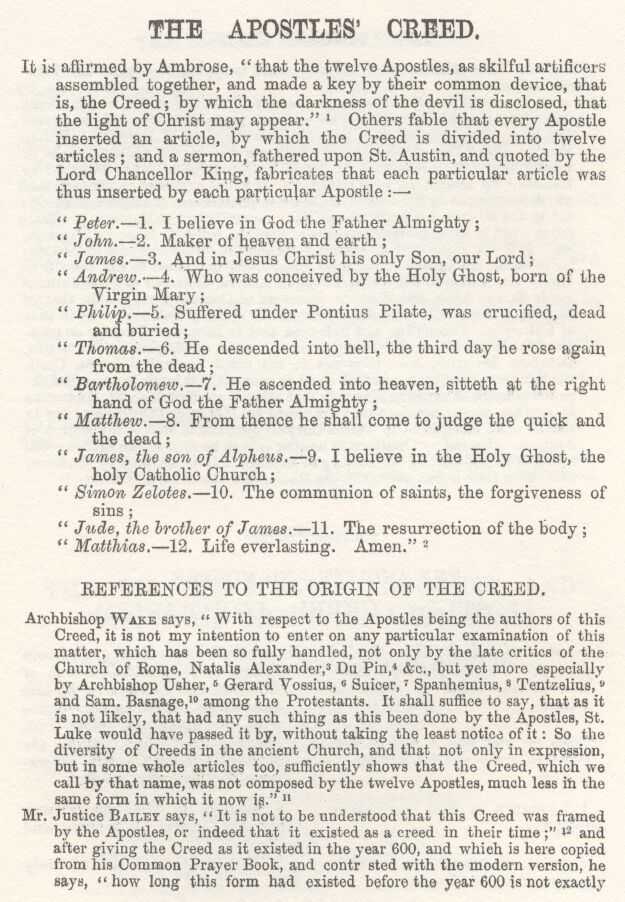
>
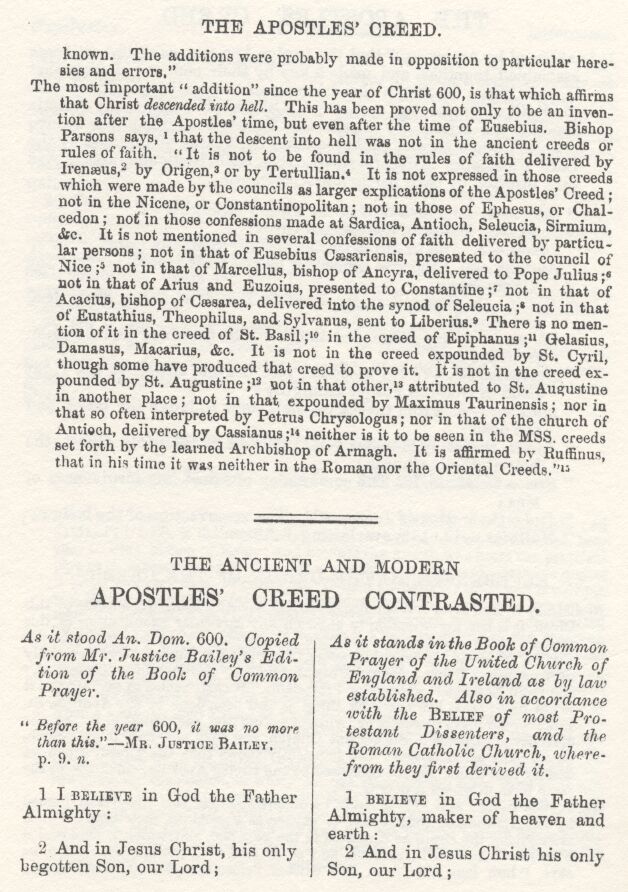
>
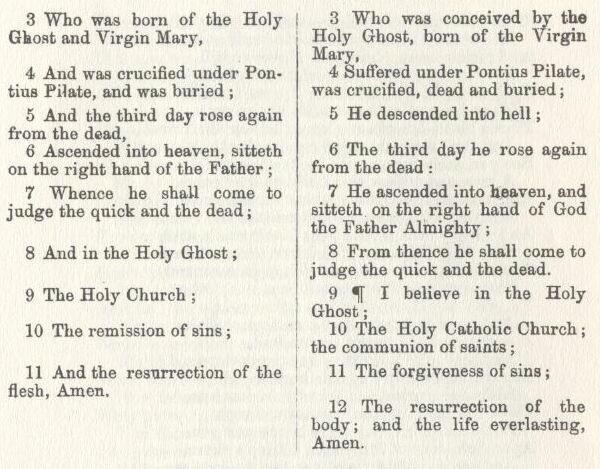
>
End of the Project Gutenberg EBook of The Forbidden Gospels and Epistles,
Complete, by Archbishop Wake

*** END OF THIS PROJECT GUTENBERG EBOOK THE FORBIDDEN GOSPELS ***

***** This file should be named 6516-h.htm or 6516-h.zip *****
This and all associated files of various formats will be found in:
        https://www.gutenberg.org/6/5/1/6516/

Produced by David Widger with additional proofing by Curtis A. Weyant

Updated editions will replace the previous one--the old editions
will be renamed.

Creating the works from public domain print editions means that no
one owns a United States copyright in these works, so the Foundation
(and you!) can copy and distribute it in the United States without
permission and without paying copyright royalties.  Special rules,
set forth in the General Terms of Use part of this license, apply to
copying and distributing Project Gutenberg-tm electronic works to
protect the PROJECT GUTENBERG-tm concept and trademark.  Project
Gutenberg is a registered trademark, and may not be used if you
charge for the eBooks, unless you receive specific permission.  If you
do not charge anything for copies of this eBook, complying with the
rules is very easy.  You may use this eBook for nearly any purpose
such as creation of derivative works, reports, performances and
research.  They may be modified and printed and given away--you may do
practically ANYTHING with public domain eBooks.  Redistribution is
subject to the trademark license, especially commercial
redistribution.


*** START: FULL LICENSE ***

THE FULL PROJECT GUTENBERG LICENSE
PLEASE READ THIS BEFORE YOU DISTRIBUTE OR USE THIS WORK

To protect the Project Gutenberg-tm mission of promoting the free
distribution of electronic works, by using or distributing this work
(or any other work associated in any way with the phrase "Project
Gutenberg"), you agree to comply with all the terms of the Full Project
Gutenberg-tm License (available with this file or online at
https://gutenberg.org/license).


Section 1.  General Terms of Use and Redistributing Project Gutenberg-tm
electronic works

1.A.  By reading or using any part of this Project Gutenberg-tm
electronic work, you indicate that you have read, understand, agree to
and accept all the terms of this license and intellectual property
(trademark/copyright) agreement.  If you do not agree to abide by all
the terms of this agreement, you must cease using and return or destroy
all copies of Project Gutenberg-tm electronic works in your possession.
If you paid a fee for obtaining a copy of or access to a Project
Gutenberg-tm electronic work and you do not agree to be bound by the
terms of this agreement, you may obtain a refund from the person or
entity to whom you paid the fee as set forth in paragraph 1.E.8.

1.B.  "Project Gutenberg" is a registered trademark.  It may only be
used on or associated in any way with an electronic work by people who
agree to be bound by the terms of this agreement.  There are a few
things that you can do with most Project Gutenberg-tm electronic works
even without complying with the full terms of this agreement.  See
paragraph 1.C below.  There are a lot of things you can do with Project
Gutenberg-tm electronic works if you follow the terms of this agreement
and help preserve free future access to Project Gutenberg-tm electronic
works.  See paragraph 1.E below.

1.C.  The Project Gutenberg Literary Archive Foundation ("the Foundation"
or PGLAF), owns a compilation copyright in the collection of Project
Gutenberg-tm electronic works.  Nearly all the individual works in the
collection are in the public domain in the United States.  If an
individual work is in the public domain in the United States and you are
located in the United States, we do not claim a right to prevent you from
copying, distributing, performing, displaying or creating derivative
works based on the work as long as all references to Project Gutenberg
are removed.  Of course, we hope that you will support the Project
Gutenberg-tm mission of promoting free access to electronic works by
freely sharing Project Gutenberg-tm works in compliance with the terms of
this agreement for keeping the Project Gutenberg-tm name associated with
the work.  You can easily comply with the terms of this agreement by
keeping this work in the same format with its attached full Project
Gutenberg-tm License when you share it without charge with others.

1.D.  The copyright laws of the place where you are located also govern
what you can do with this work.  Copyright laws in most countries are in
a constant state of change.  If you are outside the United States, check
the laws of your country in addition to the terms of this agreement
before downloading, copying, displaying, performing, distributing or
creating derivative works based on this work or any other Project
Gutenberg-tm work.  The Foundation makes no representations concerning
the copyright status of any work in any country outside the United
States.

1.E.  Unless you have removed all references to Project Gutenberg:

1.E.1.  The following sentence, with active links to, or other immediate
access to, the full Project Gutenberg-tm License must appear prominently
whenever any copy of a Project Gutenberg-tm work (any work on which the
phrase "Project Gutenberg" appears, or with which the phrase "Project
Gutenberg" is associated) is accessed, displayed, performed, viewed,
copied or distributed:

This eBook is for the use of anyone anywhere at no cost and with
almost no restrictions whatsoever.  You may copy it, give it away or
re-use it under the terms of the Project Gutenberg License included
with this eBook or online at www.gutenberg.org

1.E.2.  If an individual Project Gutenberg-tm electronic work is derived
from the public domain (does not contain a notice indicating that it is
posted with permission of the copyright holder), the work can be copied
and distributed to anyone in the United States without paying any fees
or charges.  If you are redistributing or providing access to a work
with the phrase "Project Gutenberg" associated with or appearing on the
work, you must comply either with the requirements of paragraphs 1.E.1
through 1.E.7 or obtain permission for the use of the work and the
Project Gutenberg-tm trademark as set forth in paragraphs 1.E.8 or
1.E.9.

1.E.3.  If an individual Project Gutenberg-tm electronic work is posted
with the permission of the copyright holder, your use and distribution
must comply with both paragraphs 1.E.1 through 1.E.7 and any additional
terms imposed by the copyright holder.  Additional terms will be linked
to the Project Gutenberg-tm License for all works posted with the
permission of the copyright holder found at the beginning of this work.

1.E.4.  Do not unlink or detach or remove the full Project Gutenberg-tm
License terms from this work, or any files containing a part of this
work or any other work associated with Project Gutenberg-tm.

1.E.5.  Do not copy, display, perform, distribute or redistribute this
electronic work, or any part of this electronic work, without
prominently displaying the sentence set forth in paragraph 1.E.1 with
active links or immediate access to the full terms of the Project
Gutenberg-tm License.

1.E.6.  You may convert to and distribute this work in any binary,
compressed, marked up, non-proprietary or proprietary form, including any
word processing or hypertext form.  However, if you provide access to or
distribute copies of a Project Gutenberg-tm work in a format other than
"Plain Vanilla ASCII" or other format used in the official version
posted on the official Project Gutenberg-tm web site (www.gutenberg.org),
you must, at no additional cost, fee or expense to the user, provide a
copy, a means of exporting a copy, or a means of obtaining a copy upon
request, of the work in its original "Plain Vanilla ASCII" or other
form.  Any alternate format must include the full Project Gutenberg-tm
License as specified in paragraph 1.E.1.

1.E.7.  Do not charge a fee for access to, viewing, displaying,
performing, copying or distributing any Project Gutenberg-tm works
unless you comply with paragraph 1.E.8 or 1.E.9.

1.E.8.  You may charge a reasonable fee for copies of or providing
access to or distributing Project Gutenberg-tm electronic works provided
that

- You pay a royalty fee of 20% of the gross profits you derive from
     the use of Project Gutenberg-tm works calculated using the method
     you already use to calculate your applicable taxes.  The fee is
     owed to the owner of the Project Gutenberg-tm trademark, but he
     has agreed to donate royalties under this paragraph to the
     Project Gutenberg Literary Archive Foundation.  Royalty payments
     must be paid within 60 days following each date on which you
     prepare (or are legally required to prepare) your periodic tax
     returns.  Royalty payments should be clearly marked as such and
     sent to the Project Gutenberg Literary Archive Foundation at the
     address specified in Section 4, "Information about donations to
     the Project Gutenberg Literary Archive Foundation."

- You provide a full refund of any money paid by a user who notifies
     you in writing (or by e-mail) within 30 days of receipt that s/he
     does not agree to the terms of the full Project Gutenberg-tm
     License.  You must require such a user to return or
     destroy all copies of the works possessed in a physical medium
     and discontinue all use of and all access to other copies of
     Project Gutenberg-tm works.

- You provide, in accordance with paragraph 1.F.3, a full refund of any
     money paid for a work or a replacement copy, if a defect in the
     electronic work is discovered and reported to you within 90 days
     of receipt of the work.

- You comply with all other terms of this agreement for free
     distribution of Project Gutenberg-tm works.

1.E.9.  If you wish to charge a fee or distribute a Project Gutenberg-tm
electronic work or group of works on different terms than are set
forth in this agreement, you must obtain permission in writing from
both the Project Gutenberg Literary Archive Foundation and Michael
Hart, the owner of the Project Gutenberg-tm trademark.  Contact the
Foundation as set forth in Section 3 below.

1.F.

1.F.1.  Project Gutenberg volunteers and employees expend considerable
effort to identify, do copyright research on, transcribe and proofread
public domain works in creating the Project Gutenberg-tm
collection.  Despite these efforts, Project Gutenberg-tm electronic
works, and the medium on which they may be stored, may contain
"Defects," such as, but not limited to, incomplete, inaccurate or
corrupt data, transcription errors, a copyright or other intellectual
property infringement, a defective or damaged disk or other medium, a
computer virus, or computer codes that damage or cannot be read by
your equipment.

1.F.2.  LIMITED WARRANTY, DISCLAIMER OF DAMAGES - Except for the "Right
of Replacement or Refund" described in paragraph 1.F.3, the Project
Gutenberg Literary Archive Foundation, the owner of the Project
Gutenberg-tm trademark, and any other party distributing a Project
Gutenberg-tm electronic work under this agreement, disclaim all
liability to you for damages, costs and expenses, including legal
fees.  YOU AGREE THAT YOU HAVE NO REMEDIES FOR NEGLIGENCE, STRICT
LIABILITY, BREACH OF WARRANTY OR BREACH OF CONTRACT EXCEPT THOSE
PROVIDED IN PARAGRAPH F3.  YOU AGREE THAT THE FOUNDATION, THE
TRADEMARK OWNER, AND ANY DISTRIBUTOR UNDER THIS AGREEMENT WILL NOT BE
LIABLE TO YOU FOR ACTUAL, DIRECT, INDIRECT, CONSEQUENTIAL, PUNITIVE OR
INCIDENTAL DAMAGES EVEN IF YOU GIVE NOTICE OF THE POSSIBILITY OF SUCH
DAMAGE.

1.F.3.  LIMITED RIGHT OF REPLACEMENT OR REFUND - If you discover a
defect in this electronic work within 90 days of receiving it, you can
receive a refund of the money (if any) you paid for it by sending a
written explanation to the person you received the work from.  If you
received the work on a physical medium, you must return the medium with
your written explanation.  The person or entity that provided you with
the defective work may elect to provide a replacement copy in lieu of a
refund.  If you received the work electronically, the person or entity
providing it to you may choose to give you a second opportunity to
receive the work electronically in lieu of a refund.  If the second copy
is also defective, you may demand a refund in writing without further
opportunities to fix the problem.

1.F.4.  Except for the limited right of replacement or refund set forth
in paragraph 1.F.3, this work is provided to you 'AS-IS' WITH NO OTHER
WARRANTIES OF ANY KIND, EXPRESS OR IMPLIED, INCLUDING BUT NOT LIMITED TO
WARRANTIES OF MERCHANTIBILITY OR FITNESS FOR ANY PURPOSE.

1.F.5.  Some states do not allow disclaimers of certain implied
warranties or the exclusion or limitation of certain types of damages.
If any disclaimer or limitation set forth in this agreement violates the
law of the state applicable to this agreement, the agreement shall be
interpreted to make the maximum disclaimer or limitation permitted by
the applicable state law.  The invalidity or unenforceability of any
provision of this agreement shall not void the remaining provisions.

1.F.6.  INDEMNITY - You agree to indemnify and hold the Foundation, the
trademark owner, any agent or employee of the Foundation, anyone
providing copies of Project Gutenberg-tm electronic works in accordance
with this agreement, and any volunteers associated with the production,
promotion and distribution of Project Gutenberg-tm electronic works,
harmless from all liability, costs and expenses, including legal fees,
that arise directly or indirectly from any of the following which you do
or cause to occur: (a) distribution of this or any Project Gutenberg-tm
work, (b) alteration, modification, or additions or deletions to any
Project Gutenberg-tm work, and (c) any Defect you cause.


Section  2.  Information about the Mission of Project Gutenberg-tm

Project Gutenberg-tm is synonymous with the free distribution of
electronic works in formats readable by the widest variety of computers
including obsolete, old, middle-aged and new computers.  It exists
because of the efforts of hundreds of volunteers and donations from
people in all walks of life.

Volunteers and financial support to provide volunteers with the
assistance they need, is critical to reaching Project Gutenberg-tm's
goals and ensuring that the Project Gutenberg-tm collection will
remain freely available for generations to come.  In 2001, the Project
Gutenberg Literary Archive Foundation was created to provide a secure
and permanent future for Project Gutenberg-tm and future generations.
To learn more about the Project Gutenberg Literary Archive Foundation
and how your efforts and donations can help, see Sections 3 and 4
and the Foundation web page at https://www.pglaf.org.


Section 3.  Information about the Project Gutenberg Literary Archive
Foundation

The Project Gutenberg Literary Archive Foundation is a non profit
501(c)(3) educational corporation organized under the laws of the
state of Mississippi and granted tax exempt status by the Internal
Revenue Service.  The Foundation's EIN or federal tax identification
number is 64-6221541.  Its 501(c)(3) letter is posted at
https://pglaf.org/fundraising.  Contributions to the Project Gutenberg
Literary Archive Foundation are tax deductible to the full extent
permitted by U.S. federal laws and your state's laws.

The Foundation's principal office is located at 4557 Melan Dr. S.
Fairbanks, AK, 99712., but its volunteers and employees are scattered
throughout numerous locations.  Its business office is located at
809 North 1500 West, Salt Lake City, UT 84116, (801) 596-1887, email
business@pglaf.org.  Email contact links and up to date contact
information can be found at the Foundation's web site and official
page at https://pglaf.org

For additional contact information:
     Dr. Gregory B. Newby
     Chief Executive and Director
     gbnewby@pglaf.org


Section 4.  Information about Donations to the Project Gutenberg
Literary Archive Foundation

Project Gutenberg-tm depends upon and cannot survive without wide
spread public support and donations to carry out its mission of
increasing the number of public domain and licensed works that can be
freely distributed in machine readable form accessible by the widest
array of equipment including outdated equipment.  Many small donations
($1 to $5,000) are particularly important to maintaining tax exempt
status with the IRS.

The Foundation is committed to complying with the laws regulating
charities and charitable donations in all 50 states of the United
States.  Compliance requirements are not uniform and it takes a
considerable effort, much paperwork and many fees to meet and keep up
with these requirements.  We do not solicit donations in locations
where we have not received written confirmation of compliance.  To
SEND DONATIONS or determine the status of compliance for any
particular state visit https://pglaf.org

While we cannot and do not solicit contributions from states where we
have not met the solicitation requirements, we know of no prohibition
against accepting unsolicited donations from donors in such states who
approach us with offers to donate.

International donations are gratefully accepted, but we cannot make
any statements concerning tax treatment of donations received from
outside the United States.  U.S. laws alone swamp our small staff.

Please check the Project Gutenberg Web pages for current donation
methods and addresses.  Donations are accepted in a number of other
ways including including checks, online payments and credit card
donations.  To donate, please visit: https://pglaf.org/donate


Section 5.  General Information About Project Gutenberg-tm electronic
works.

Professor Michael S. Hart was the originator of the Project Gutenberg-tm
concept of a library of electronic works that could be freely shared
with anyone.  For thirty years, he produced and distributed Project
Gutenberg-tm eBooks with only a loose network of volunteer support.


Project Gutenberg-tm eBooks are often created from several printed
editions, all of which are confirmed as Public Domain in the U.S.
unless a copyright notice is included.  Thus, we do not necessarily
keep eBooks in compliance with any particular paper edition.


Most people start at our Web site which has the main PG search facility:

     https://www.gutenberg.org

This Web site includes information about Project Gutenberg-tm,
including how to make donations to the Project Gutenberg Literary
Archive Foundation, how to help produce our new eBooks, and how to
subscribe to our email newsletter to hear about new eBooks.