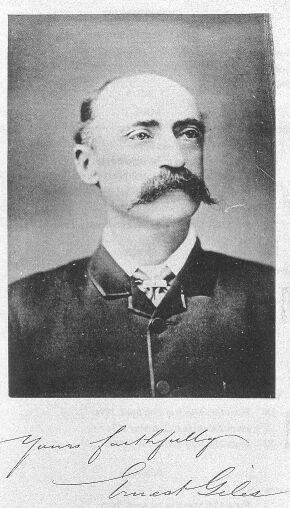
The Project Gutenberg EBook of Australia Twice Traversed, The Romance of
Exploration, by Ernest Giles

This eBook is for the use of anyone anywhere at no cost and with
almost no restrictions whatsoever.  You may copy it, give it away or
re-use it under the terms of the Project Gutenberg License included
with this eBook or online at www.gutenberg.org


Title: Australia Twice Traversed, The Romance of Exploration
       Australia Twice Traversed. The Romance Of Exploration, Being A
       Narrative Compiled From The Journals Of Five Exploring
       Expeditions         Into And Through Central South Australia, And
       Western Australia,         From 1872 To 1876.


Author: Ernest Giles

Release Date: August 26, 2004 [EBook #4974]

Language: English

Character set encoding: ISO-8859-1

*** START OF THIS PROJECT GUTENBERG EBOOK AUSTRALIA TWICE TRAVERSED, ***


Produced by Sue Asscher and Colin Beck
The original journals of the field notes, from which the present narrative is compiled, were published, as each expedition ended, as parliamentary papers by the Government of the Colony of South Australia.
The journals of the first two expeditions, formed a small book, which was distributed mostly to the patrons who had subscribed to the fund for my second expedition. The account of the third, found its way into the South Australian Observer, while the records of the fourth and fifth journeys remained as parliamentary documents, the whole never having appeared together. Thus only fragments of the accounts of my wanderings became known; and though my name as an explorer has been heard of, both in Australia and England, yet very few people even in the Colonies are aware of what I have really done. Therefore it was thought that a work embodying the whole of my explorations might be acceptable to both English and Colonial readers.
Some years have been allowed to elapse since these journeys were commenced; but the facts are the same, and to those not mixed up in the adventures, the incidents as fresh as when they occurred.
Unavoidably, I have had to encounter a large area of desert country in the interior of the colonies of South Australia, and Western Australia, in my various wanderings; but I also discovered considerable tracts of lands watered and suitable for occupation.
It is not in accordance with my own feelings in regard to Australia that I am the chronicler of her poorer regions; and although an Englishman, Australia has no sincerer well-wisher; had it been otherwise, I could not have performed the work these volumes record. It has indeed been often a cause of regret that my lines of march should have led me away from the beautiful and fertile places upon Australia's shores, where our countrymen have made their homes.
On the subject of the wonderful resources of Australia I am not called upon to enlarge, and surely all who have heard her name must have heard also of her gold, copper, wool, wine, beef, mutton, wheat, timber, and other products; and if any other evidence were wanting to show what Australia really is, a visit to her cities, and an experience of her civilisation, not forgetting the great revenues of her different provinces, would dispel at once all previous inaccurate impressions of those who, never having seen, perhaps cannot believe in the existence of them.
In the course of this work my reader will easily discover to whom it is dedicated, without a more formal statement under such a heading. The preface, which may seem out of its place, is merely such to my own journeys. I thought it due to my readers and my predecessors in the Australian field of discovery, that I should give a rapid epitome (which may contain some minor errors) of what they had done, and which is here put forward by way of introduction.
Most of the illustrations, except one or two photographs, were originally from very rough sketches, or I might rather say scratches, of mine, improved upon by Mr. Val Prinsep, of Perth, Western Australia, who drew most of the plates referring to the camel expeditions, while those relating to the horse journeys were sketched by Mr. Woodhouse, Junr., of Melbourne; the whole, however, have undergone a process of reproduction at the hands of London artists.
To Mrs. Cashel Hoey, the well-known authoress and Australian correspondent, who revised and cleared my original manuscripts, I have to accord my most sincere thanks. To Mr. Henniker-Heaton, M.P., who appears to be the Imperial Member in the British Parliament for all Australia, I am under great obligations, he having introduced me to Mr. Marston, of the publishing firm who have produced these volumes. I also have to thank Messrs. Clowes and Sons for the masterly way in which they have printed this work. Also Messrs. Creed, Robinson, Fricker, and Symons, of the publishing staff. The maps have been reproduced by Weller, the well-known geographer.
Before narrating my own labours in opening out portions of the unknown interior of Australia, it will be well that I should give a succinct account of what others engaged in the same arduous enterprise around the shores and on the face of the great Southern Continent, have accomplished.
After the wondrous discoveries of Columbus had set the Old World into a state of excitement, the finding of new lands appears to have become the romance of that day, as the exploration by land of unknown regions has been that of our time; and in less than fifty years after the discovery of America navigators were searching every sea in hopes of emulating the deeds of that great explorer; but nearly a hundred years elapsed before it became known in Europe that a vast and misty land existed in the south, whose northern and western shores had been met in certain latitudes and longitudes, but whose general outline had not been traced, nor was it even then visited with anything like a systematic geographical object. The fact of the existence of such a land at the European antipodes no doubt set many ardent and adventurous spirits upon the search, but of their exploits and labours we know nothing.
The Dutch were the most eager in their attempts, although Torres, a Spaniard, was, so far as we know, the first to pass in a voyage from the West Coast of America to India, between the Indian or Malay Islands, and the great continent to the south, hence we have Torres Straits. The first authentic voyager, however, to our actual shores was Theodoric Hertoge, subsequently known as Dirk Hartog—bound from Holland to India. He arrived at the western coast between the years 1610 and 1616. An island on the west coast bears his name: there he left a tin plate nailed to a tree with the date of his visit and the name of his ship, the Endragt, marked upon it. Not very long after Theodoric Hertoge, and still to the western and north-western coasts, came Zeachern, Edels, Nuitz, De Witt, and Pelsart, who was wrecked upon Houtman's Albrolhos, or rocks named by Edels, in his ship the Leewin or Lion. Cape Leewin is called after this vessel. Pelsart left two convicts on the Australian coast in 1629. Carpenter was the next navigator, and all these adventurers have indelibly affixed their names to portions of the coast of the land they discovered. The next, and a greater than these, at least greater in his navigating successes, was Abel Janz Tasman, in 1642. Tasman was instructed to inquire from the native inhabitants for Pelsart's two convicts, and to bring them away with him, if they entreated him; but they were never heard of again. Tasman sailed round a great portion of the Australian coast, discovered what he named Van Diemen's land, now Tasmania, and New Zealand. He it was who called the whole, believing it to be one, New Holland, after the land of his birth. Next we have Dampier, an English buccaneer—though the name sounds very like Dutch; it was probably by chance only that he and his roving crew visited these shores. Then came Wilhelm Vlaming with three ships. God save the mark to call such things ships. How the men performed the feats they did, wandering over vast and unknown oceans, visiting unknown coasts with iron-bound shores, beset with sunken reefs, subsisting on food not fit for human beings, suffering from scurvy caused by salted diet and rotten biscuit, with a short allowance of water, in torrid zones, and liable to be attacked and killed by hostile natives, it is difficult for us to conceive. They suffered all the hardships it is possible to imagine upon the sea, and for what? for fame, for glory? That their names and achievements might be handed down to us; and this seems to have been their only reward; for there was no Geographical Society's medal in those days with its motto to spur them on.
Vlaming was the discoverer of the Swan River, upon which the seaport town of Fremantle and the picturesque city of Perth, in Western Australia, now stand. This river he discovered in 1697, and he was the first who saw Dirk Hartog's tin plate.
Dampier's report of the regions he had visited caused him to be sent out again in 1710 by the British Government, and upon his return, all previous doubts, if any existed, as to the reality of the existence of this continent, were dispelled, and the position of its western shores was well established. Dampier discovered a beautiful flower of the pea family known as the Clianthus Dampierii. In 1845 Captain Sturt found the same flower on his Central Australian expedition, and it is now generally known as Sturt's Desert Pea, but it is properly named in its botanical classification, after its original discoverer.
After Dampier's discoveries, something like sixty years elapsed before Cook appeared upon the scene, and it was not until his return to England that practical results seemed likely to accrue to any nation from the far-off land. I shall not recapitulate Cook's voyages; the first fitted out by the British Government was made in 1768, but Cook did not touch upon Australia's coast until two years later, when, voyaging northwards along the eastern coast, he anchored at a spot he called Botany Bay, from the brightness and abundance of the beautiful wild flowers he found growing there. Here two natives attempted to prevent his landing, although the boats were manned with forty men. The natives threw stones and spears at the invaders, but nobody was killed. At this remote and previously unvisited spot one of the crew named Forby Sutherland, who had died on board the Endeavour, was buried, his being the first white man's grave ever dug upon Australia's shore; at least the first authenticated one—for might not the remaining one of the two unfortunate convicts left by Pelsart have dug a grave for his companion who was the first to die, no man remaining to bury the survivor? Cook's route on this voyage was along the eastern coast from Cape Howe in south latitude 37° 30´ to Cape York in Torres Straits in latitude 10° 40´. He called the country New South Wales, from its fancied resemblance to that older land, and he took possession of the whole in the name of George III as England's territory.
Cook reported so favourably of the regions he had discovered that the British Government decided to establish a colony there; the spot finally selected was at Port Jackson, and the settlement was called Sydney in 1788. After Cook came the Frenchman Du Fresne and his unfortunate countryman, La Pérouse. Then Vancouver, Blyth, and the French General and Admiral, D'Entre-Casteaux, who went in search of the missing La Pérouse. In 1826, Captain Dillon, an English navigator, found the stranded remains of La Pérouse's ships at two of the Charlotte Islands group. We now come to another great English navigator, Matthew Flinders, who was the first to circumnavigate Australia; to him belongs the honour of having given to this great island continent the name it now bears. In 1798, Flinders and Bass, sailing in an open boat from Sydney, discovered that Australia and Van Diemen's Land were separate; the dividing straits between were then named after Bass. In 1802, during his second voyage in the Investigator, a vessel about the size of a modern ship's launch, Flinders had with him as a midshipman John Franklin, afterwards the celebrated Arctic navigator. On his return to England, Flinders, touching at the Isle of France, was made prisoner by the French governor and detained for nearly seven years, during which time a French navigator Nicolas Baudin, with whom came Pérron and Lacepède the naturalists, and whom Flinders had met at a part of the southern coast which he called Encounter Bay in reference to that meeting, claimed and reaped the honour and reward of a great portion of the unfortunate prisoner's work. Alas for human hopes and aspirations, this gallant sailor died before his merits could be acknowledged or rewarded, and I believe one or two of his sisters were, until very lately, living in the very poorest circumstances.
The name of Flinders is, however, held in greater veneration than any of his predecessors or successors, for no part of the Australian coast was unvisited by him. Rivers, mountain ranges, parks, districts, counties, and electoral divisions, have all been named after him; and, indeed, I may say the same of Cook; but, his work being mostly confined to the eastern coast, the more western colonies are not so intimately connected with his name, although an Australian poet has called him the Columbus of our shore.
After Flinders and Baudin came another Frenchman, De Fréycinet, bound on a tour of discovery all over the world.
Australia's next navigator was Captain, subsequently Admiral, Philip Parker King, who carried out four separate voyages of discovery, mostly upon the northern coasts. At three places upon which King favourably reported, namely Camden Harbour on the north-west coast, Port Essington in Arnhem's Land, and Port Cockburn in Apsley Straits, between Melville and Bathurst Islands on the north coast, military and penal settlements were established, but from want of further emigration these were abandoned. King completed a great amount of marine surveying on these voyages, which occurred between the years 1813 and 1822.
Captain Wickham in the Beagle comes next; he discovered the Fitzroy River, which he found emptied itself into a gulf named King's Sound. In consequence of ill-health Captain Wickham, after but a short sojourn on these shores, resigned his command, and Lieutenant Lort Stokes, who had sailed with him in the Beagle round the rocky shores of Magellan's Straits and Tierra del Fuego, received the command from the Lords of the Admiralty. Captain Lort Stokes may be considered the last, but by no means the least, of the Australian navigators. On one occasion he was speared by natives of what he justly called Treachery Bay, near the mouth of the Victoria River in Northern Australia, discovered by him. His voyages occurred between the years 1839 and 1843. He discovered the mouths of most of the rivers that fall into the Gulf of Carpentaria, besides many harbours, bays, estuaries, and other geographical features upon the North Australian coasts.
The early navigators had to encounter much difficulty and many dangers in their task of making surveys from the rough achievements of the Dutch, down to the more finished work of Flinders, King and Stokes. It is to be remembered that they came neither for pleasure nor for rest, but to discover the gulfs, bays, peninsulas, mountains, rivers and harbours, as well as to make acquaintance with the native races, the soils, and animal and vegetable products of the great new land, so as to diffuse the knowledge so gained for the benefit of others who might come after them. In cockle-shells of little ships what dangers did they not encounter from shipwreck on the sunken edges of coral ledges of the new and shallow seas, how many were those who were never heard of again; how many a little exploring bark with its adventurous crew have been sunk in Australia's seas, while those poor wretches who might, in times gone by, have landed upon the inhospitable shore would certainly have been killed by the wild and savage hordes of hostile aborigines, from whom there could be no escape! With Stokes the list of those who have visited and benefited Australia by their labours from the sea must close; my only regret being that so poor a chronicler is giving an outline of their achievements. I now turn to another kind of exploration—and have to narrate deeds of even greater danger, though of a different kind, done upon Australia's face.
In giving a short account of those gallant men who have left everlasting names as explorers upon the terra firma and terra incognita of our Australian possession, I must begin with the earliest, and go back a hundred years to the arrival of Governor Phillip at Botany Bay, in 1788, with eleven ships, which have ever since been known as The First Fleet.; I am not called upon to narrate the history of the settlement, but will only say that the Governor showed sound judgment when he removed his fleet and all his men from Botany Bay to Port Jackson, and founded the village of Sydney, which has now become the huge capital city of New South Wales. A new region was thus opened out for British labour, trade, capital, and enterprise. From the earliest days of the settlement adventurous and enterprising men, among whom was the Governor himself, who was on one occasion speared by the natives, were found willing to venture their lives in the exploration of the country upon whose shores they had so lately landed. Wentworth, Blaxland, and Evans appear on the list as the very first explorers by land. The chief object they had in view was to surmount the difficulties which opposed their attempting to cross the Blue Mountains, and Evans was the first who accomplished this. The first efficient exploring expedition into the interior of New South Wales was conducted by John Oxley, the Surveyor-General of the colony, in 1817. His principal discovery was that some of the Australian streams ran inland, towards the interior, and he traced both the Macquarie and the Lachlan, named by him after Governor Lachlan Macquarie, until he supposed they ended in vast swamps or marshes, and thereby founded the theory that in the centre of Australia there existed a great inland sea. After Oxley came two explorers named respectively Hovell and Hume, who penetrated, in 1824, from the New South Wales settlements into what is now the colony of Victoria. They discovered the upper portions of the River Murray, which they crossed somewhere in the neighbourhood of the present town of Albury. The river was then called the Hume, but it was subsequently called the Murray by Captain Charles Sturt, who heads the list of Australia's heroes with the title of The Father of Australian Exploration.
In 1827 Sturt made one of the greatest discoveries of this century—or at least one of the most useful for his countrymen—that of the River Darling, the great western artery of the river system of New South Wales, and what is now South-western Queensland. In another expedition, in 1832, Sturt traced the Murrumbidgee River, discovered by Oxley, in boats into what he called the Murray. This river is the same found by Hovell and Hume, Sturt's name for it having been adopted. He entered the new stream, which was lined on either bank by troops of hostile natives, from whom he had many narrow escapes, and found it trended for several hundreds of miles in a west-north-west direction, confirming him in his idea of an inland sea; but at a certain point, which he called the great north-west bend, it suddenly turned south and forced its way to the sea at Encounter Bay, where Flinders met Baudin in 1803. Neither of these explorers appear to have discovered the river's mouth. On this occasion Sturt discovered the province or colony of South Australia, which in 1837 was proclaimed by the British Government, and in that colony Sturt afterwards made his home.
Sturt's third and final expedition was from the colony of South Australia into Central Australia, in 1843-1845. This was the first truly Central Australian expedition that had yet been despatched, although in 1841 Edward Eyre had attempted the same arduous enterprise. Of this I shall write anon. On his third expedition Sturt discovered the Barrier, the Grey, and the Stokes ranges, and among numerous smaller watercourses he found and named Strezletki's, Cooper's, and Eyre's Creeks. The latter remained the furthest known inland water of Australia for many years after Sturt's return. Sturt was accompanied, as surveyor and draftsman, by John McDouall Stuart, whom I shall mention in his turn. So far as my opinion, formed in my wanderings over the greater portions of the country explored by Sturt, goes, his estimate of the regions he visited has scarcely been borne out according to the views of the present day.
Like Oxley, he was fully impressed with the notion that an inland sea did exist, and although he never met such a feature in his travels, he seems to have thought it must be only a little more remote than the parts he had reached. He was fully prepared to come upon an inland sea, for he carried a boat on a bullock waggon for hundreds of miles, and when he finally abandoned it he writes: “Here we left the boat which I had vainly hoped would have ploughed the waters of an inland sea.” Several years afterwards I discovered pieces of this boat, built of New Zealand pine, in the debris of a flood about twenty miles down the watercourse where it had been left. A great portion, if not all the country, explored by that expedition is now highly-prized pastoral land, and a gold field was discovered almost in sight of a depot formed by Sturt, at a spot where he was imprisoned at a water hole for six months without moving his camp. He described the whole region as a desert, and he seems to have been haunted by the notion that he had got into and was surrounded by a wilderness the like of which no human being had ever seen or heard of before. His whole narrative is a tale of suffering and woe, and he says on his map, being at the furthest point he attained in the interior, about forty-five miles from where he had encamped on the watercourse he called Eyre's Creek, now a watering place for stock on a Queensland cattle run: “Halted at sunset in a country such as I verily believe has no parallel upon the earth's surface, and one which was terrible in its aspect.” Sturt's views are only to be accounted for by the fact that what we now call excellent sheep and cattle country appeared to him like a desert, because his comparisons were made with the best alluvial lands he had left near the coast. Explorers as a rule, great ones more particularly, are not without rivals in so honourable a field as that of discovery, although not every one who undertakes the task is fitted either by nature or art to adorn the chosen part. Sturt was rivalled by no less celebrated an individual than Major, afterwards Sir Thomas, Mitchell, a soldier of the Peninsula War, and some professional jealousy appears to have existed between them.
Major Mitchell was then the Surveyor-General of the Colony, and he entirely traversed and made known the region he appropriately named Australia Felix, now the colony of Victoria. Mitchell, like Sturt, conducted three expeditions: the first in 1831-1832, when he traced the River Darling previously discovered by Sturt, for several hundred miles, until he found it trend directly to the locality at which Sturt, in his journey down the Murray, had seen and laid down its mouth or junction with the larger river. Far up the Darling, in latitude 30° 5´, Mitchell built a stockade and formed a depot, which he called Fort Bourke; near this spot the present town of Bourke is situated and now connected by rail with Sydney, the distance being about 560 miles. Mitchell's second journey, when he visited Australia Felix, was made in 1835, and his last expedition into tropical Australia was in 1845. On this expedition he discovered a large river running in a north-westerly direction, and as its channel was so large, and its general appearance so grand, he conjectured that it would prove to be the Victoria River of Captain Lort Stokes, and that it would run on in probably increasing size, or at least in undiminished magnificence, through the 1100 or 1200 miles of country that intervened between his own and Captain Stokes's position. He therefore called it the Victoria River. Gregory subsequently discovered that Mitchell's Victoria turned south, and was one and the same watercourse called Cooper's Creek by Sturt. The upper portion of this watercourse is now known by its native name of the Barcoo, the name Victoria being ignored. Mitchell always had surveyors with him, who chained as he went every yard of the thousands of miles he explored. He was knighted for his explorations, and lived to enjoy the honour; so indeed was Sturt, but in his case it was only a mockery, for he was totally blind and almost on his deathbed when the recognition of his numerous and valuable services was so tardily conferred upon him. (Dr. W.H. Browne, who accompanied Sturt to Central Australia in 1843-5 as surgeon and naturalist, is living in London; and another earlier companion of the Father of Australian Exploration, George McCleay, still survives.)
These two great travellers were followed by, or worked simultaneously, although in a totally different part of the continent, namely the north-west coast, with Sir George Grey in 1837-1839. His labours and escapes from death by spear-wounds, shipwreck, starvation, thirst, and fatigue, fill his volumes with incidents of the deepest interest. Edward Eyre, subsequently known as Governor Eyre, made an attempt to reach, in 1840-1841, Central Australia by a route north from the city of Adelaide; and as Sturt imagined himself surrounded by a desert, so Eyre thought he was hemmed in by a circular or horse-shoe-shaped salt depression, which he called Lake Torrens; because, wherever he tried to push northwards, north-westwards, eastwards, or north-eastwards, he invariably came upon the shores of one of these objectionable and impassable features. As we now know, there are several of them with spaces of traversable ground between, instead of the obstacle being one continuous circle by which he supposed he was surrounded. In consequence of his inability to overcome this obstruction, Eyre gave up the attempt to penetrate into Central Australia, but pushing westerly, round the head of Flinders' Spencer's Gulf, where now the inland seaport town of Port Augusta stands, he forced his way along the coast line from Port Lincoln to Fowler's Bay (Flinders), and thence along the perpendicular cliffs of the Great Australian Bight to Albany, at King George's Sound.
This journey of Eyre's was very remarkable in more ways than one; its most extraordinary incident being the statement that his horses travelled for seven days and nights without water. I have travelled with horses in almost every part of Australia, but I know that after three days and three nights without water horses would certainly knock up, die, or become utterly useless, and it would be impossible to make them continue travelling. Another remarkable incident of his march is strange enough. One night whilst Eyre was watching the horses, there being no water at the encampment, Baxter, his only white companion, was murdered by two little black boys belonging to South Australia, who had been with Eyre for some time previously. These little boys shot Baxter and robbed the camp of nearly all the food and ammunition it contained, and then, while Eyre was running up from the horses to where Baxter lay, decamped into the bush and were only seen the following morning, but never afterwards. One other and older boy, a native of Albany, whither Eyre was bound, now alone remained. Eyre and this boy (Wylie) now pushed on in a starving condition, living upon dead fish or anything they could find for several weeks, and never could have reached the Sound had they not, by almost a miracle, fallen in with a French whaling schooner when nearly 300 miles had yet to be traversed. The captain, who was an Englishman named Rossiter, treated them most handsomely; he took them on board for a month while their horses recruited on shore—for this was a watering place of Flinders—he then completely refitted them with every necessary before he would allow them to depart. Eyre in gratitude called the place Rossiter Bay, but it seems to have been prophetically christened previously by the ubiquitous Flinders, under the name of Lucky Bay. Nearly all the watering places visited by Eyre consisted of the drainage from great accumulations of pure white sand or hummocks, which were previously discovered by the Investigator; as Flinders himself might well have been called. The most peculiar of these features is the patch at what Flinders called the head of the Great Australian Bight; these sandhills rise to an elevation of several hundred feet, the prevailing southerly winds causing them to slope gradually from the south, while the northern face is precipitous. In moonlight I have seen these sandhills, a few miles away, shining like snowy mountains, being refracted to an unnatural altitude by the bright moonlight. Fortunate indeed it was for Eyre that such relief was afforded him; he was unable to penetrate at all into the interior, and he brought back no information of the character and nature of the country inland. I am the only traveller who has explored that part of the interior, but of this more hereafter.
About this time Strezletki and McMillan, both from New South Wales, explored the region now the easternmost part of the colony of Victoria, which Strezletki called Gipp's Land. These two explorers were rivals, and both, it seems, claimed to have been first in that field.
Next on the list of explorers comes Ludwig Leichhardt, a surgeon, a botanist, and an eager seeker after fame in the Australian field of discovery, and whose memory all must revere. He successfully conducted an expedition from Moreton Bay to the Port Essington of King—on the northern coast—by which he made known the geographical features of a great part of what is now Queensland, the capital being Brisbane at Moreton Bay. A settlement had been established at Port Essington by the Government of New South Wales, to which colony the whole territory then belonged. At this settlement, as being the only point of relief after eighteen months of travel, Leichhardt and his exhausted party arrived. The settlement was a military and penal one, but was ultimately abandoned. It is now a cattle station in the northern territory division of South Australia, and belongs to some gentlemen in Adelaide.
Of Leichhardt's sad fate in the interior of Australia no tidings have ever been heard. On this fatal journey, which occurred in 1848, he undertook the too gigantic task of crossing Australia from east to west, that is to say, from Moreton Bay to Swan River. Even at that period, however, the eastern interior was not all entirely unknown, as Mitchell's Victoria River or Barcoo, and the Cooper's and Eyre's Creeks of Sturt had already been discovered. The last-named watercourse lay nearly 1000 miles from the eastern coast, in latitude 25° south, and it is reasonable to suppose that to such a point Leichhardt would naturally direct his course—indeed in what was probably his last letter, addressed to a friend, he mentions this watercourse as a desirable point to make for upon his new attempt. But where his wanderings ended, and where the catastrophe that closed his own and his companions' lives occurred, no tongue can tell. After he finally left the furthest outlying settlements at the Mount Abundance station, he, like the lost Pleiad, was seen on earth no more. How could he have died and where? ah, where indeed? I who have wandered into and returned alive from the curious regions he attempted and died to explore, have unfortunately never come across a single record or any remains or traces of those long lost but unforgotten braves. Leichhardt originally started on his last sad venture with a party of eight, including one if not two native black boys. Owing, however, to some disagreement, the whole party returned to the starting point, but being reorganised it started again with the same number of members. There were about twenty head of bullocks broken in to carry pack-loads; this was an ordinary custom in those early days of Australian settlement. Leichhardt also had two horses and five or six mules: this outfit was mostly contributed by the settlers who gave, some flour, some bullocks, some money, firearms, gear, etc., and some gave sheep and goats; he had about a hundred of the latter. The packed bullocks were taken to supply the party with beef, in the meantime carrying the expedition stores. The bullocks' pack-saddles were huge, ungainly frames of wood fastened with iron-work, rings, etc.
Shortly after the expedition made a second start, two or three of the members again seceded, and returned to the settlements, while Leichhardt and his remaining band pushed farther and farther to the west.
Although the eastern half of the continent is now inhabited, though thinly, no traces of any kind, except two or three branded trees in the valley of the Cooper, have ever been found. My belief is that the only cause to be assigned for their destruction is summed up in the dread word “flood.” They were so far traced into the valley of the Cooper; this creek, which has a very lengthy course, ends in Lake Eyre, one of the salt depressions which baffled that explorer. A point on the southern shore is now known as Eyre's Lookout.
The Cooper is known in times of flood to reach a width of between forty and fifty miles, the whole valley being inundated. Floods may surround a traveller while not a drop of local rain may fall, and had the members of this expedition perished in any other way, some remains of iron pack-saddle frames, horns, bones, skulls, firearms, and other articles must have been found by the native inhabitants who occupied the region, and would long ago have been pointed out by the aborigines to the next comers who invaded their territories. The length of time that animals' bones might remain intact in the open air in Australia is exemplified by the fact that in 1870, John Forrest found the skull of a horse in one of Eyre's camps on the cliffs of the south coast thirty years after it was left there by Eyre. Forrest carried the skull to Adelaide. I argue, therefore, that if Leichhardt's animals and equipment had not been buried by a flood, some remains must have been since found, for it is impossible, if such things were above ground that they could escape the lynx-like glances of Australian aboriginals, whose wonderful visual powers are unsurpassed among mankind. Everybody and everything must have been swallowed in a cataclysm and buried deep and sure in the mud and slime of a flood.
The New South Wales Government made praiseworthy efforts to rescue the missing traveller. About a year after Leichhardt visited Port Essington, the Government abandoned the settlement, and the prevailing opinion in the colony of New South Wales at that time was, that Leichhardt had not been able to reach Eyre's Creek, but had been forced up north, from his intended route, the inland-sea theory still prevailing, and that he had probably returned to the old settlement for relief. Therefore, when he had been absent two years, the Government despatched a schooner to the abandoned place. The master of the vessel saw several of the half-civilised natives, who well remembered Leichhardt's arrival there, but he had not returned. The natives promised the master to take the greatest care of him should he again appear, but it is needless to say he was seen no more. The Government were very solicitous about him, and when he had been absent four years, Mr. Hovendon Heley was sent away with an outfit of pack-horses and six or seven men, to endeavour to trace him. This expedition seems to have wandered about for several months, and discovered, as Mr. Heley states, two marked trees branded exactly alike, namely L over XVA, and each spot where these existed is minutely described. There was at each, a water-hole, upon the bank of which the camp was situated; at each camp a marked tree was found branded alike; at each, the frame of a tent was left standing; at each, some logs had been laid down to place the stores and keep them from damp. The two places as described appear so identical that it seems impossible to think otherwise than that Heley and his party arrived twice at the same place without knowing it. The tree or trees were found on a watercourse, or courses, near the head of the Warrego River, in Queensland. The above was all the information gained by this expedition. A subsequent search expedition was sent out in 1858, under Augustus Gregory; this I shall place in its chronological order. Kennedy, a companion of Sir Thomas Mitchell into Tropical Australia in 1845, next enters the field. He went to trace Mitchell's Victoria River or Barcoo, but finding it turned southwards and broke into many channels, he abandoned it, and on his return journey discovered the Warrego River, which may be termed the Murrumbidgee of Queensland. On a second expedition, in 1848, Kennedy started from Moreton Bay to penetrate and explore the country of the long peninsula, which runs up northward between the Gulf of Carpentaria and the Pacific Ocean, and ends at Cape York, the northernmost point of Australia in Torres Straits. From this disastrous expedition he never returned. He was starved, ill, fatigued, hunted by remorseless aborigines for days, and finally speared to death by the natives of Cape York, when almost within sight of his goal, where a vessel was waiting to succour him and all his party. Only a black boy named Jacky Jacky was with him. After Kennedy's death Jacky buried all his papers in a hollow tree, and for a couple of days he eluded his pursuers, until, reaching the spot where his master had told him the vessel would be, he ran yelling down to the beach, followed by a crowd of murderous savages. By the luckiest chance a boat happened to be at the beach, and the officers and crew rescued the boy. The following day a party led by Jacky returned to where poor Kennedy lay, and they buried him. They obtained his books and maps from the tree where Jacky had hidden them. The narrative of this expedition is heart-rending. Of the whole number of the whites, namely seven, two only were rescued by the vessel at a place where Kennedy had formed a depot on the coast, and left four men.
With Captain Roe, a companion of King's, with whom he was speared and nearly killed by the natives of Goulburn Island, in 1820, and who afterwards became Surveyor-General of the colony of Western Australia, the list of Australia's early explorers may be said to close, although I should remark that Augustus Gregory was a West Australian explorer as early as the year 1846. Captain Roe conducted the most extensive inland exploration of Western Australia at that day, in 1848. No works of fiction can excel, or indeed equal, in romantic and heart-stirring interest the volumes, worthy to be written in letters of gold, which record the deeds and the sufferings of these noble toilers in the dim and distant field of discovery afforded by the Australasian continent and its vast islands. It would be well if those works were read by the present generation as eagerly as the imaginary tales of adventure which, while they appeal to no real sentiment, and convey no solid information, cannot compete for a moment with those sublime records of what has been dared, done, and suffered, at the call of duty, and for the sake of human interests by men who have really lived and died. I do not say that all works of fiction are entirely without interest to the human imagination, or that writers of some of these works are not clever, for in one sense they certainly are, and that is, in only writing of horrors that never occurred, without going through the preliminary agony of a practical realisation of the dangers they so graphically describe, and from which, perhaps, they might be the very first to flee, though their heroes are made to appear nothing less than demigods. Strange as it may appear, it seems because the tales of Australian travel and self-devotion are true, that they attract but little notice, for were the narratives of the explorers not true we might become the most renowned novelists the world has ever known. Again, Australian geography, as explained in the works of Australian exploration, might be called an unlearned study. Let me ask how many boys out of a hundred in Australia, or England either, have ever read Sturt or Mitchell, Eyre, Leichhardt, Grey, or Stuart. It is possible a few may have read Cook's voyages, because they appear more national, but who has read Flinders, King, or Stokes? Is it because these narratives are Australian and true that they are not worthy of attention?
Having well-nigh exhausted the list of the early explorers in Australia, it is necessary now to turn to a more modern school. I must admit that in the works of this second section, with a few exceptions, such stirring narratives as those of the older travellers cannot be found. Nevertheless, considerable interest must still attach to them, as they in reality carry on the burning torch which will not be consumed until by its light the whole of Australia stands revealed.
The modern explorers are of a different class, and perhaps of one not so high as their predecessors. By this remark I do not mean anything invidious, and if any of the moderns are correctly to be classed with the ancients, the Brothers Gregory must be spoken of next, as being the fittest to head a secondary list. Augustus Gregory was in the West Australian field of discovery in 1846. He was a great mechanical, as well as a geographical, discoverer, for to him we are indebted for our modern horses' pack-saddles in lieu of the dreadful old English sumpter horse furniture that went by that name; he also invented a new kind of compass known as Gregory's Patent, unequalled for steering on horseback, and through dense scrubs where an ordinary compass would be almost useless, while steering on camels in dense scrubs, on a given bearing, without a Gregory would be next to impossible; it would be far easier indeed, if not absolutely necessary, to walk and lead them, which has to be done in almost all camel countries.
In 1854 Austin made a lengthened journey to the east and northwards, from the old settled places of Western Australia, and in 1856 Augustus Gregory conducted the North Australian Expedition, fitted out under the auspices of the Royal Geographical Society of London. Landing at Stokes's Treachery Bay, Gregory and his brother Frank explored Stokes's Victoria River to its sources, and found another watercourse, whose waters, running inland, somewhat revived the old theory of the inland sea. Upon tracing this river, which he named Sturt's Creek, after the father of Australian exploration, it was found to exhaust itself in a circular basin, which was named Termination Lake. Retracing the creek to where the depot was situated, the party travelled across a stretch of unknown country for some two hundred miles, and striking Leichhardt's Port Essington track on Leichhardt's Roper River, his route was followed too closely for hundreds of miles until civilisation was reached. My friend Baron von Mueller accompanied this expedition as botanist, naturalist, surgeon and physician.
Soon after his return from his northern expedition, Gregory was despatched in 1858 by the Government of New South Wales to search again for the lost explorer Leichhardt, who had then been missing ten years. This expedition resulted in little or nothing, as far as its main object was concerned, one or two trees, marked L, on the Barcoo and lower end of the Thompson, was all it discovered; but, geographically, it settled the question of the course of the Barcoo, or Mitchell's Victoria, which Gregory followed past Kennedy's farthest point, and traced until he found it identical with Sturt's Cooper's Creek. He described it as being of enormous width in times of flood, and two of Sturt's horses, abandoned since 1845, were seen but left uncaptured. Sturt's Strezletki Creek in South Australian territory was then followed. This peculiar watercourse branches out from the Cooper and runs in a south-south-west direction. It brought Gregory safely to the northern settlements of South Australia. The fruitless search for it, however, was one of the main causes of the death of Burke and Wills in 1861. This was Gregory's final attempt; he accepted the position of Surveyor-General of Queensland, and his labours as an explorer terminated. His journals are characterised by a brevity that is not the soul of wit, he appearing to grudge to others the information he had obtained at the expense of great endurance, hardihood, knowledge, and judgment. Gregory was probably the closest observer of all the explorers, except Mitchell, and an advanced geologist.
In 1858 a new aspirant for geographical honours appeared on the field in the person of John McDouall Stuart, of South Australia, who, as before mentioned, had formerly been a member of Captain Sturt's Central Australian expedition in 1843-5 as draftsman and surveyor. Stuart's object was to cross the continent, almost in its greatest width, from south to north; and this he eventually accomplished. After three attempts he finally reached the north coast in 1862, his rival Burke having been the first to do so. Stuart might have been first, but he seems to have under-valued his rival, and wasted time in returning and refitting when he might have performed the feat in two if not one journey; for he discovered a well-watered country the whole way, and his route is now mainly the South Australian Transcontinental Telegraph Line, though it must be remembered that Stuart had something like fifteen hundred miles of unknown country in front of him to explore, while Burke and Wills had scarcely six. Stuart also conducted some minor explorations before he undertook his greater one. He and McKinlay were South Australia's heroes, and are still venerated there accordingly. He died in England not long after the completion of his last expedition.
We now come to probably the most melancholy episode in the long history of Australian exploration, relating to the fate of Burke and Wills. The people and Government of the colony of Victoria determined to despatch an expedition to explore Central Australia, from Sturt's Eyre's Creek to the shores of the Gulf of Carpentaria at the mouth of the Albert River of Stokes's, a distance in a straight line of not more than six hundred miles; and as everything that Victoria undertakes must always be on the grandest scale, so was this. One colonist gave £1000; £4000 more was subscribed, and then the Government took the matter in hand to fit out the Victorian Exploring Expedition. Camels were specially imported from India, and everything was done to ensure success; when I say everything, I mean all but the principal thing—the leader was the wrong man. He knew nothing of bush life or bushmanship, navigation, or any art of travel. Robert O'Hara Burke was brave, no doubt, but so hopelessly ignorant of what he was undertaking, that it would have been the greatest wonder if he had returned alive to civilisation. He was accompanied by a young man named Wills as surveyor and observer; he alone kept a diary, and from his own statements therein he was frequently more than a hundred miles out of his reckoning. That, however, did not cause his or Burke's death; what really did so was bad management. The money this expedition cost, variously estimated at from £40,000 to £60,000, was almost thrown away, for the map of the route of the expedition was incorrect and unreliable, and Wills's journal of no geographical value, except that it showed they had no difficulty with regard to water. The expedition was, however, successful in so far that Burke crossed Australia from south to north before Stuart, and was the first traveller who had done so. Burke and Wills both died upon Cooper's Creek after their return from Carpentaria upon the field of their renown. Charles Gray, one of the party, died, or was killed, a day or two before returning thither, and John King, the sole survivor, was rescued by Alfred Howitt. Burke's and Stuart's lines of travel, though both pushing from south to north, were separated by a distance of over 400 miles in longitude. These travellers, or heroes I suppose I ought to call them, were neither explorers nor bushmen, but they were brave and undaunted, and they died in the cause they had undertaken.
When it became certain in Melbourne that some mishap must have occurred to these adventurers, Victoria, South Australia, and Queensland each sent out relief parties. South Australia sent John McKinlay, who found Gray's grave, and afterwards made a long exploration to Carpentaria, where, not finding any vessel as he expected, he had an arduous struggle to reach a Queensland cattle station near Port Dennison on the eastern coast. Queensland sent Landsborough by sea to Carpentaria, where he was landed and left to live or die as he might, though of course he had a proper equipment of horses, men, and gear. He followed up the Flinders River of Stokes, had a fine country to traverse; got on to the head of the Warrego, and finally on to the Darling River in New South Wales. He came across no traces whatever of Burke. Victoria sent a relief expedition under Walker, with several Queensland black troopers. Walker, crossing the lower Barcoo, found a tree of Leichhardt's marked L, being the most westerly known. Walker arrived at Carpentaria without seeing any traces of the missing Burke and Wills; but at the mouth of the Albert River met the master of the vessel that had conveyed Landsborough; the master had seen or heard nothing of Burke. Another expedition fitted out by Victoria, and called the Victorian Contingent Relief Expedition, was placed under the command of Alfred Howitt in 1861. At this time a friend of mine, named Conn, and I were out exploring for pastoral runs, and were in retreat upon the Darling, when we met Howitt going out. When farther north I repeatedly urged my companion to visit the Cooper, from which we were then only eighty or ninety miles away, in vain. I urged how we might succour some, if not all, of the wanderers. Had we done so we should have found and rescued King, and we might have been in time to save Burke and Wills also; but Conn would not agree to go. It is true we were nearly starved as it was, and might have been entirely starved had we gone there, but by good fortune we met and shot a stray bullock that had wandered from the Darling, and this happy chance saved our lives. I may here remark that poor Conn and two other exploring comrades of those days, named Curlewis and McCulloch, were all subsequently, not only killed but partly eaten by the wild natives of Australia—Conn in a place near Cooktown on the Queensland coast, and Curlewis and McCulloch on the Paroo River in New South Wales in 1862. When we were together we had many very narrow escapes from death, and I have had several similar experiences since those days. Howitt on his arrival at Cooper's Creek was informed by the natives that a white man was alive with them, and thus John King, the sole survivor, was rescued.
Between 1860-65 several short expeditions were carried on in Western Australia by Frank Gregory, Lefroy, Robinson, and Hunt; while upon the eastern side of Australia, the Brothers Jardine successfully explored and took a mob of cattle through the region that proved so fatal to Kennedy and his companions in 1848. The Jardines traversed a route more westerly than Kennedy's along the eastern shores of the Gulf of Carpentaria to Cape York.
In 1865, Duncan McIntyre, while on the Flinders River of Stokes and near the Gulf of Carpentaria, into which it flows, was shown by a white shepherd at an out sheep station, a tree on which the letter L was cut. This no doubt was one of Landsborough's marks, or if it was really carved by Leichhardt, it was done upon his journey to Port Essington in 1844, when he crossed and encamped upon the Flinders. Mcintyre reported by telegraph to Melbourne that he had found traces of Leichhardt, whereupon Baron von Mueller and a committee of ladies in Melbourne raised a fund of nearly £4000, and an expedition called “The Ladies' Leichhardt Search Expedition,” whose noble object was to trace and find some records or mementoes, if not the persons, and discover the last resting-place of the unfortunate traveller and his companions, was placed under McIntyre's command. About sixty horses and sixteen camels were obtained for this attempt. The less said about this splendid but ill-starred effort the better. Indignation is a mild term to apply to our feelings towards the man who caused the ruin of so generous an undertaking. Everything that its promoters could do to ensure its success they did, and it deserved a better fate, for a brilliant issue might have been obtained, if not by the discovery of the lost explorers, at least by a geographical result, as the whole of the western half of Australia lay unexplored before it. The work, trouble, anxiety, and expense that Baron von Mueller went through to start this expedition none but the initiated can ever know. It was ruined before it even entered the field of its labours, for, like Burke's and Wills's expedition, it was unfortunately placed under the command of the wrong man. The collapse of the expedition occurred in this wise. A certain doctor was appointed surgeon and second in command, the party consisting of about ten men, including two Afghans with the camels, and one young black boy. Their encampment was now at a water-hole in the Paroo, where Curlewis and McCulloch had been killed, in New South Wales. The previous year McIntyre had visited a water-hole in the Cooper some seventy-four or seventy-five miles from his camp on the Paroo, and now ordered the whole of his heavily-laden beasts and all the men to start for the distant spot. The few appliances they had for carrying water soon became emptied. About the middle of the third day, upon arrival at the wished-for relief, to their horror and surprise they found the water-hole was dry—by no means an unusual thing in Australian travel. The horses were already nearly dead; McIntyre, without attempting to search either up or down the channel of the watercourse, immediately ordered a retreat to the last water in the Paroo. After proceeding a few miles he left the horses and white men, seven in number, and went on ahead with the camels, the Afghans and the black boy, saying he would return with water for the others as soon as he could. His brother was one of the party left behind. Almost as soon as McIntyre's back was turned, the doctor said to the men something to the effect that they were abandoned to die of thirst, there not being a drop of water remaining, and that he knew in which packs the medical brandy was stowed, certain bags being marked to indicate them. He then added, “Boys, we must help ourselves! the Leichhardt Search Expedition is a failure; follow me, and I'll get you something to drink.” Taking a knife, he ripped open the marked bags while still on the choking horses' backs, and extracted the only six bottles there were. One white man named Barnes, to whom all honour, refused to touch the brandy, the others poured the boiling alcohol down their parched and burning throats, and a wild scene of frenzy, as described by Barnes, ensued. In the meanwhile the unfortunate packhorses wandered away, loaded as they were, and died in thirst and agony, weighed down by their unremoved packs, none of which were ever recovered. Thus all the food supply and nearly all the carrying power of the expedition was lost; the only wonder was that none of these wretches actually died at the spot, although I heard some of them died soon after. The return of McIntyre and the camels loaded with water saved their lives at the time; but what was his chagrin and surprise to find the party just where he had left them, nearly dead, most of them delirious, with all the horses gone, when he had expected to meet them so much nearer the Paroo. In consequence of the state these men or animals were in, they had to be carried on the camels, and it was impossible to go in search of the horses; thus all was lost. This event crushed the expedition. Mcintyre obtained a few more horses, pushed across to the Flinders again, became attacked with fever, and died. Thus the “Ladies' Leichhardt Search Expedition” entirely fell through. The camels were subsequently claimed by McIntyre's brother for the cost of grazing them, he having been carried by them to Carpentaria, where he selected an excellent pastoral property, became rich, and died. It was the same doctor that got into trouble with the Queensland Government concerning the kidnapping of some islanders in the South Seas, and narrowly escaped severe, if not capital punishment.
In 1866, Mr. Cowle conducted an expedition from Roebourne, near Nicol Bay, on the West Coast, for four or five hundred miles to the Fitzroy River, discovered by Wickham, at the bottom of King's Sound.
In 1869, a report having spread in Western Australia of the massacre of some white people by the natives somewhere to the eastwards of Champion Bay, on the west coast, the rumour was supposed to relate to Leichhardt and his party; and upon the representations of Baron von Mueller to the West Australian Government, a young surveyor named John Forrest was despatched to investigate the truth of the story. This expedition penetrated some distance to the eastwards, but could discover no traces of the lost, or indeed anything appertaining to any travellers whatever.
In 1869-70, John Forrest, accompanied by his brother Alexander, was again equipped by the West Australian Government for an exploration eastwards, with the object of endeavouring to reach the South Australian settlements by a new route inland. Forrest, however, followed Eyre's track of 1840-1, along the shores of the Great Australian Bight, and may be said to have made no exploration at all, as he did not on any occasion penetrate inland more than about thirty miles from the coast. At an old encampment Forrest found the skull of one of Eyre's horses, which had been lying there for thirty years. This trophy he brought with him to Adelaide.
The following year, Alexander Forrest conducted an expedition to the eastwards, from the West Australian settlements; but only succeeded in pushing a few miles beyond Hunt and Lefroy's furthest point in 1864.
What I have written above is an outline of the history of discovery and exploration in Australia when I first took the field in the year 1872; and though it may not perhaps be called, as Tennyson says, one of the fairy tales of science, still it is certainly one of the long results of time. I have conducted five public expeditions and several private ones. The latter will not be recorded in these volumes, not because there were no incidents of interest, but because they were conducted, in connection with other persons, for entirely pastoral objects. Experiences of hunger, thirst, and attacks by hostile natives during those undertakings relieved them of any monotony they might otherwise display. It is, however, to my public expeditions that I shall now confine my narrative.
The wild charm and exciting desire that induce an individual to undertake the arduous tasks that lie before an explorer, and the pleasure and delight of visiting new and totally unknown places, are only whetted by his first attempt, especially when he is constrained to admit that his first attempt had not resulted in his carrying out its objects.
My first and second expeditions were conducted entirely with horses; in all my after journeys I had the services of camels, those wonderful ships of the desert, without whose aid the travels and adventures which are subsequently recorded could not possibly have been achieved, nor should I now be alive, as Byron says, to write so poor a tale, this lowly lay of mine. In my first and second expeditions, the object I had in view was to push across the continent, from different starting points, upon the South Australian Transcontinental Telegraph Line, to the settled districts of Western Australia. My first expedition was fitted out entirely by Baron von Mueller, my brother-in-law, Mr. G.D. Gill, and myself. I was joined in this enterprise by a young gentleman, named Samuel Carmichael, whom I met in Melbourne, and who also contributed his share towards the undertaking. The furthest point reached on this journey was about 300 miles from my starting point. On my return, upon reaching the Charlotte Waters Telegraph Station, in latitude 25° 55´ and longitude 135° I met Colonel Warburton and his son, whom I had known before. These gentlemen informed me, to my great astonishment, they were about to undertake an exploring expedition to Western Australia, for two well-known capitalists of South Australia, namely the Honourable Sir Thomas Elder and Captain Hughes. I was also informed that a South Australian Government expedition, for the same purpose, was just in advance of them, under the command of Mr. William C. Gosse. This information took me greatly by surprise, though perhaps an explorer should not admit such a feeling. I had just returned from an attempt of the same kind, beaten and disappointed. I felt if ever I took the field again, against two such formidable rivals as were now about to attempt what I had failed in, both being supplied with camels by Sir Thomas Elder, my chances of competing with them would be small indeed, as I could only command horses, and was not then known to Sir Thomas Elder, the only gentleman in Australia who possessed camels.
The fact of two expeditions starting away simultaneously, almost as soon as I had turned my back upon civilisation, showed me at once that my attempt, I being regarded as a Victorian, had roused the people and Government of South Australia to the importance of the question which I was the first to endeavour to solve—namely, the exploration of the unknown interior, and the possibility of discovering an overland route for stock through Central Australia, to the settlements upon the western coast. This, I may remark, had been the dream of all Australian explorers from the time of Eyre and Leichhardt down to my own time. It also showed that South Australia had no desire to be beaten again (Burke and Stuart.), and in her own territories, by “worthless Melbourne's pulling child;” (hence the two new expeditions arose. Immediately upon my return being made known by telegram to my friend Baron von Mueller, he set to work, and with unwearied exertion soon obtained a new fund from several wealthy gentlemen in the rival colony of Victoria. In consideration of the information I had afforded by my late effort, the Government of South Australia supplemented this fund by the munificent subsidy of £250, provided I expended the money in fresh explorations, and supplied to the Government, at the termination of my journey, a copy of the map and journal of my expedition. My poverty, and not my will, consented to accept so mean a gift. As a new, though limited fund was now placed at my disposal, I had no inclination to decline a fresh attempt, and thus my second expedition was undertaken; and such despatch was used by Baron Mueller and myself, that I was again in the field, with horses only, not many weeks later than my rivals.
On this journey I was accompanied and seconded by Mr. William Henry Tietkens. We had both been scholars at Christ's Hospital in London, though many years apart. Of the toils and adventures of my second expedition the readers of my book must form their own opinion; and although I was again unsuccessful in carrying out my object, and the expedition ended in the death of one member, and in misfortune and starvation to the others, still I have been told by a few partial friends that it was really a splendid failure. On that expedition I explored a line of nearly 700 miles of previously unknown country, in a straight line from my starting point.
During my first and second expeditions I had been fortunate in the discovery of large areas of mountain country, permanently watered and beautifully grassed, and, as spaces of enormous extent still remained to be explored, I decided to continue in the field, provided I could secure the use of camels. These volumes will contain the narratives of my public explorations. In the preface to this work I have given an outline of the physical and colonial divisions of Australia, so that my reader may eventually follow me, albeit in imagination only, to the starting points of my journeys, and into the field of my labours also.
The Island Continent of Australia contains an area of about three millions of square miles, it being, so to say, an elliptically-shaped mass about 2500 miles in length from east to west, and 2000 from north to south. The degrees of latitude and longitude it occupies will be shown by the map accompanying these volumes.
The continent is divided into five separate colonies, whose respective capitals are situated several hundreds of miles apart. The oldest colony is New South Wales. The largest in area is Western Australia, next comes South Australia; then Queensland, New South Wales, and lastly Victoria, which, though the smallest in area, is now the first in importance among the group. It was no wonder that Mitchell, the Surveyor-General of New South Wales, designated that region “Australia Felix.”
It may be strange, but it is no less true, that there is almost as great a difference between the fiscal laws and governments of the various Australian Colonies as between those of foreign States in Europe—the only thing in common being the language and the money of the British Empire. Although however, they agree to differ amongst themselves, there can be no doubt of the loyalty of the group, as a whole, to their parent nation. I shall go no further into this matter, as, although English enough, it is foreign to my subject. I shall treat more especially of the colony or colonies within whose boundaries my travels led me, and shall begin with South Australia, where my first expedition was conducted.
South Australia includes a vast extent of country called the Northern Territory, which must become in time a separate colony, as it extends from the 26th parallel of latitude, embracing the whole country northwards to the Indian Ocean at the 11th parallel. South Australia possesses one advantage over the other colonies, from the geographical fact of her oblong territory extending, so to speak, exactly in the middle right across the continent from the Southern to the Indian Ocean. The dimensions of the colony are in extreme length over 1800 miles, by a breadth of nearly 700, and almost through the centre of this vast region the South Australian Transcontinental Telegraph line runs from Adelaide, via Port Augusta, to Port Darwin.
At the time I undertook my first expedition in 1872, this extensive work had just been completed, and it may be said to divide the continent into halves, which, for the purpose I then had in view, might be termed the explored and the unexplored halves. For several years previous to my taking the field, I had desired to be the first to penetrate into this unknown region, where, for a thousand miles in a straight line, no white man's foot had ever wandered, or, if it had, its owner had never brought it back, nor told the tale. I had ever been a delighted student of the narratives of voyages and discoveries, from Robinson Crusoe to Anson and Cook, and the exploits on land in the brilliant accounts given by Sturt, Mitchell, Eyre, Grey, Leichhardt, and Kennedy, constantly excited my imagination, as my own travels may do that of future rovers, and continually spurred me on to emulate them in the pursuit they had so eminently graced.
My object, as indeed had been Leichhardt's, was to force my way across the thousand miles that lay untrodden and unknown, between the South Australian telegraph line and the settlements upon the Swan River. What hopes I formed, what aspirations came of what might be my fortune, for I trust it will be believed that an explorer may be an imaginative as well as a practical creature, to discover in that unknown space. Here let me remark that the exploration of 1000 miles in Australia is equal to 10,000 in any other part of the earth's surface, always excepting Arctic and Antarctic travels.
There was room for snowy mountains, an inland sea, ancient river, and palmy plain, for races of new kinds of men inhabiting a new and odorous land, for fields of gold and golcondas of gems, for a new flora and a new fauna, and, above all the rest combined, there was room for me! Many well-meaning friends tried to dissuade me altogether, and endeavoured to instil into my mind that what I so ardently wished to attempt was simply deliberate suicide, and to persuade me of the truth of the poetic line, that the sad eye of experience sees beneath youth's radiant glow, so that, like Falstaff, I was only partly consoled by the remark that they hate us youth. But in spite of their experience, and probably on account of youth's radiant glow, I was not to be deterred, however, and at last I met with Baron von Mueller, who, himself an explorer with the two Gregorys, has always had the cause of Australian exploration at heart, and he assisting, I was at length enabled to take the field. Baron Mueller and I had consulted, and it was deemed advisable that I should make a peculiar feature near the Finke river, called Chambers' Pillar, my point of departure for the west. This Pillar is situated in latitude 24° 55´ and longitude 133° 50´, being 1200 miles from Melbourne in a straight line, over which distance Mr. Carmichael, a black boy, and I travelled. In the course of our travels from Melbourne to the starting point, we reached Port Augusta, a seaport though an inland town, at the head of Spencer's Gulf in South Australia, first visited by the Investigator in 1803, and where, a few miles to the eastwards, a fine bold range of mountains runs along for scores of miles and bears the gallant navigator's name. A railway line of 250 miles now connects Port Augusta with Adelaide. To this town was the first section of the Transcontinental telegraph line carried; and it was in those days the last place where I could get stores for my expedition. Various telegraph stations are erected along the line, the average distance between each being from 150 to 200 miles. There were eleven stations between Port Augusta and Port Darwin. A railway is now completed as far as the Peake Telegraph Station, about 450 miles north-westwards from Port Augusta along the telegraph line towards Port Darwin, to which it will no doubt be carried before many years elapse.
From Port Augusta the Flinders range runs almost northerly for nearly 200 miles, throwing out numerous creeks (I must here remark that throughout this work the word creek will often occur. This is not to be considered in its English acceptation of an inlet from the sea, but, no matter how far inland, it means, in Australia a watercourse.), through rocky pine-clad glens and gorges, these all emptying, in times of flood, into the salt lake Torrens, that peculiar depression which baffled Eyre in 1840-1. Captain Frome, the Surveyor-General of the Colony, dispelled the old horse-shoe-shaped illusion of this feature, and discovered that there were several similar features instead of one. As far as the Flinders range extends northwards, the water supply of the traveller in that region is obtained from its watercourses. The country beyond, where this long range falls off, continues an extensive open stony plateau or plain, occasionally intersected with watercourses, the course of the line of road being west of north. Most of these watercourses on the plains fall into Lake Eyre, another and more northerly salt depression. A curious limestone formation now occurs, and for some hundreds of miles the whole country is open and studded with what are called mound-springs. These are usually about fifty feet high, and ornamented on the summit with clumps of tall reeds or bulrushes. These mounds are natural artesian wells, through which the water, forced up from below, gushes out over the tops to the level ground, where it forms little water-channels at which sheep and cattle can water. Some of these mounds have miniature lakes on their summits, where people might bathe. The most perfect mound is called the Blanche Cup, in latitude about 29° 20´, and longitude 136° 40´.
The water of some of these springs is fresh and good, the Blanche Cup is drinkable, but the generality of them have either a mineral salt- or soda-ish taste; at first their effect is aperient, but afterwards just the opposite. The water is good enough for animals.
The Honourable Sir Thomas Elder's sheep, cattle, horse, and camel station, Beltana, is the first telegraph station from Port Augusta, the distance being 150 miles. The next is at the Strangways Springs, about 200 miles distant. This station occupies a nearly central position in this region of mound-springs; it is situated on a low rise out of the surrounding plain; all around are dozens of these peculiar mounds. The Messrs. Hogarth and Warren, who own the sheep and cattle station, have springs with a sufficiently strong flow of water to spout their wool at shearing time. The next telegraph station beyond the Strangways is the Peake, distant 100 miles. About twenty miles northward, or rather north-westward, from the Peake the mound-springs cease, and the country is watered by large pools in stony watercourses and creek beds. These pools are generally no more than twelve to fifteen miles apart. The waters in times of flood run into Lake Eyre, which receives the Cooper and all the flood waters of West and South-western Queensland, and all the drainage from the hundred watercourses of Central South Australia. The chief among the latter is the huge artery, the Finke, from the north-west.
The Charlotte Waters Station, named after Lady Charlotte Bacon, the Ianthe of Byron, which was to be my last outpost of civilisation, is a quadrangular stone building, plastered or painted white, having a corrugated iron roof, and a courtyard enclosed by the two wings of the building, having loop-holes in the walls for rifles and musketry, a cemented water-tank dug under the yard, and tall heavy iron gates to secure the place from attack by the natives.
I may here relate an occurrence at a station farther up the line, built upon the same principle. One evening, while the telegraph master and staff were sitting outside the gates after the heat of the day, the natives, knowing that the stand of arms was inside the courtyard, sent some of their warriors to creep unseen inside and slam the gates, so as to prevent retreat. Then from the outside an attempt to massacre was made; several whites were speared, some were killed on the spot, others died soon afterwards, but the greatest wonder was that any at all escaped.
The establishment at the Charlotte Waters stands on a large grassy and pebbly plain, bounded on the north by a watercourse half a mile away. The natives here have always been peaceful, and never displayed any hostility to the whites. From this last station I made my way to Chambers' Pillar, which was to be my actual starting-point for the west.
The party. Port Augusta. The road. The Peake. Stony plateau. Telegraph station. Natives formerly hostile. A new member. Leave the Peake. Black boy deserts. Reach the Charlotte Waters Station. Natives' account of other natives. Leave last outpost. Reach the Finke. A Government party. A ride westward. End of the stony plateau. A sandhill region. Chambers' Pillar. The Moloch horridus. Thermometer 18°. The Finke. Johnstone's range. A night alarm. Beautiful trees. Wild ducks. A tributary. High dark hill. Country rises in altitude. Very high sandhills. Quicksands. New ranges. A brush ford. New pigeon. Pointed hill. A clay pan. Christopher's Pinnacle. Chandler's Range. Another new range. Sounds of running water. First natives seen. Name of the river. A Central Australian warrior. Natives burning the country. Name a new creek. Ascend a mountain. Vivid green. Discover a glen and more mountains. Hot winds, smoke and ashes.
The personnel of my first expedition into the interior consisted in the first instance of myself, Mr. Carmichael, and a young black boy. I intended to engage the services of another white man at the furthest outpost that I could secure one. From Port Augusta I despatched the bulk of my stores by a team to the Peake, and made a leisurely progress up the overland road via Beltana, the Finniss and Strangways Springs stations. Our stores reached the Peake station before us. This station was originally called Mount Margaret, but subsequently removed to the mound-springs near the south bank of the Peake Creek; it was a cattle station formed by Mr. Phillip Levi of Adelaide. The character of the country is an open stony plateau, upon which lines of hills or ranges rise; it is intersected by numerous watercourses, all trending to Lake Eyre, and was an excellent cattle run. The South Australian Government erected the telegraph station in the immediate vicinity of the cattle station. When the cattle station was first formed in 1862 the natives were very numerous and very hostile, but at the time of my visit, ten years later, they were comparatively civilised. At the Peake we were enabled to re-shoe all our horses, for the stony road up from Port Augusta had worn out all that were put on there. I also had an extra set fitted for each horse, rolled up in calico, and marked with its name. At the Peake I engaged a young man named Alec Robinson, who, according to his account, could do everything, and had been everywhere, who knew the country I was about to explore perfectly well, and who had frequently met and camped with blacks from the west coast, and declared we could easily go over there in a few weeks. He died at one of the telegraph stations a year or two after he left me. I must say he was very good at cooking, and shoeing horses. I am able to do these useful works myself, but I do not relish either. I had brought a light little spring cart with me all the way from Melbourne to the Peake, which I sold here, and my means of transit from thence was with pack-horses. After a rather prolonged sojourn at the Peake, where I received great hospitality from Mr. Blood, of the Telegraph Department, and from Messrs. Bagot, the owners, and Mr. Conway, the manager, we departed for the Charlotte.
My little black boy Dick, or, as he used generally to write, and call himself, Richard Giles Kew, 1872, had been at school at Kew, near Melbourne. He came to me from Queensland; he had visited Adelaide, Melbourne, and Sydney, and had been with me for nearly three years, but his fears of wild natives were terribly excited by what nearly everybody we met said to him about them. This was not surprising, as it was usually something to this effect, in bush parlance: “By G—, young feller, just you look out when you get outside! the wild blacks will [adjective] soon cook you. They'll kill you first, you know—they will like to cut out your kidney fat! They'll sneak on yer when yer goes out after the horses, they'll have yer and eat yer.” This being the burden of the strain continually dinned into the boy's ears, made him so terrified and nervous the farther we got away from civilisation, that soon after leaving the Peake, as we were camping one night with some bullock teams returning south, the same stories having been told him over again, he at last made up his mind, and told me he wanted to go back with one of the teamsters; he had hinted about this before, and both Carmichael and Robinson seemed to be aware of his intention. Force was useless to detain him; argument was lost on him, and entreaty I did not attempt, so in the morning we parted. I shall mention him again by-and-bye. He was a small, very handsome, light-complexioned, very intelligent, but childish boy, and was frequently mistaken for a half-caste; he was a splendid rider and tracker, and knew almost everything. He was a great wit, as one remark of his will show. In travelling up the country after he had been at school, we once saw some old deserted native gunyahs, and he said to me as we rode by, pointing to them, “Gentleman's 'ouse, villa residence, I s'pose, he's gone to his watering place for the season p'r'aps.” At another time, being at a place called Crowlands, he asked me why it was called so. I replied pointing to a crow on a tree, “Why, there's the crow,” and stamping with my foot on the ground, “there's the land;” he immediately said, “Oh, now I know why my country is called Queensland, because it's land belonging to our Queen.” I said, “Certainly it is;” then he said, “Well, ain't it funny? I never knew that before.” In Melbourne, one day, we were leaning out of a window overlooking the people continually passing by. Dick said, “What for,—white fellow always walk about—walk about in town—when he always rides in the bush?” I said, “Oh, to do their business.” “Business,” he asked, “what's that?” I said, “Why, to get money, to be sure.” “Money,” he said; “white fellow can't pick up money in the street.”
From the Peake we had only pack-horses and one little Scotch terrier dog. Dick left us at Hann's Creek, thirty miles from the Peake. On our road up, about halfway between the Peake and the Charlotte, we crossed and camped at a large creek which runs into the Finke, called the Alberga. Here we met a few natives, who were friendly enough, but who were known to be great thieves, having stolen things from several bullock drays, and committed other robberies; so we had to keep a sharp look out upon them and their actions. One of their number, a young man, could speak English pretty well, and could actually sing some songs. His most successful effort in that line was the song of “Jim Crow,” and he performed the “turn about and wheel about and do just so” part of it until he got giddy, or pretended to be; and to get rid of him and his brethren, we gave them some flour and a smoke of tobacco, and they departed.
We arrived at the Charlotte Waters station on the 4th of August, 1872; this was actually my last outpost of civilisation. My companion, Mr. Carmichael, and I were most kindly welcomed by Mr. Johnstone, the officer in charge of this depot, and by Mr. Chandler, a gentleman belonging to a telegraph station farther up the line. In consequence of their kindness, our stay was lengthened to a week. My horses were all the better for the short respite, for they were by no means in good fettle; but the country having been visited by rains, grass was abundant, and the animals improving. The party consisted only of myself, Carmichael, and Robinson; I could not now obtain another man to make up our original number of four. We still had the little dog. during our stay at the Charlotte I inquired of a number of the natives for information concerning the region beyond, to the west and north-west. They often used the words “Larapinta and plenty black fellow.” Of the country to the west they seemed to know more, but it was very difficult to get positive statements. The gist of their information was that there were large waters, high mountains, and plenty, plenty, wild black fellow; they said the wild blacks were very big and fat, and had hair growing, as some said, all down their backs; while others asserted that the hair grew all over their bodies, and that they eat pickaninnies, and sometimes came eastward and killed any of the members of the Charlotte tribe that they could find, and carried off all the women they could catch. On the 12th we departed, and my intended starting point being Chambers' Pillar, upon the Finke River, I proceeded up the telegraph road as far as the crossing place of the above-named watercourse, which was sixty miles by the road.
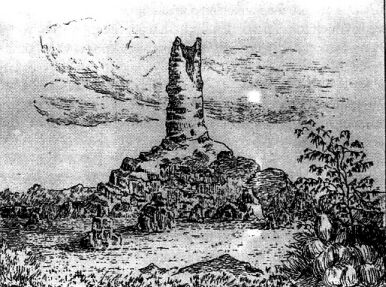
In the evening of the day we encamped there, a Government party, under the charge of Mr. McMinn, surveyor, and accompanied by Mr. Harley Bacon, a son of Lady Charlotte Bacon, arrived from the north, and we had their company at the camp. Close to this crossing-place a large tributary joins the Finke near the foot of Mount Humphries. On the following day Mr. McMinn, Mr. Bacon, and I rode up its channel, and at about twelve miles we found a water-hole and returned. The country consisted chiefly of open sandhills well grassed. I mentioned previously that from Port Augusta, northwards and north-westwards, the whole region consists of an open stony plateau, upon which mountain ranges stand at various distances; through and from these, a number of watercourses run, and, on a section of this plateau, nearly 200 miles in extent, the curious mound-springs exist. This formation, mostly of limestone, ceases at, or immediately before reaching, the Finke, and then a formation of heavy red sandhills begins. Next day our friends departed for the Charlotte, after making me several presents. From Mr. McMinn I obtained the course and distance of the pillar from our camp, and travelling on the course given, we crossed the Finke three times, as it wound about so snake-like across the country. On the 22nd we encamped upon it, having the pillar in full view.

The appearance of this feature I should imagine to be unique. For a detailed account of it my reader must consult Stuart's report. Approaching the pillar from the south, the traveller must pass over a series of red sandhills, covered with some scrubs, and clothed near the ground with that abominable vegetable production, the so-called spinifex or porcupine grass—botanically, the Triodia, or Festuca irritans. The timber on the sandhills near the pillar is nearly all mulga, a very hard acacia, though a few tall and well-grown casuarinas—of a kind that is new to me, namely the C. Decaisneana—are occasionally met. (These trees have almost a palm-like appearance, and look like huge mops; but they grow in the driest regions.) On our route Mr. Carmichael brought to me a most peculiar little lizard, a true native of the soil; its colour was a yellowish-green; it was armed, or ornamented, at points and joints, with spines, in a row along its back, sides, and legs; these were curved, and almost sharp; on the back of its neck was a thick knotty lump, with a spine at each side, by which I lifted it; its tail was armed with spines to the point, and was of proportional length to its body. The lizard was about eight inches in length. Naturalists have christened this harmless little chameleon the Moloch horridus. I put the little creature in a pouch, and intended to preserve it, but it managed to crawl out of its receptacle, and dropped again to its native sand. I had one of these lizards, as a pet, for months in Melbourne. It was finally trodden on and died. It used to eat sugar.
By this time we were close to the pillar: its outline was most imposing. Upon reaching it, I found it to be a columnar structure, standing upon a pedestal, which is perhaps eighty feet high, and composed of loose white sandstone, having vast numbers of large blocks lying about in all directions. From the centre of the pedestal rises the pillar, composed also of the same kind of rock; at its top, and for twenty to thirty feet from its summit, the colour of the stone is red. The column itself must be seventy or eighty feet above the pedestal. It is split at the top into two points. There it stands, a vast monument of the geological periods that must have elapsed since the mountain ridge, of which it was formerly a part, was washed by the action of old Ocean's waves into mere sandhills at its feet. The stone is so friable that names can be cut in it to almost any depth with a pocket-knife: so loose, indeed, is it, that one almost feels alarmed lest it should fall while he is scratching at its base. In a small orifice or chamber of the pillar I discovered an opossum asleep, the first I had seen in this part of the country. We turned our backs upon this peculiar monument, and left it in its loneliness and its grandeur—“clothed in white sandstone, mystic, wonderful!”
From hence we travelled nearly west, and in seventeen miles came to some very high sandhills, at whose feet the river swept. We followed round them to a convenient spot, and one where our horses could water without bogging. The bed of the Finke is the most boggy creek-channel I have ever met. As we had travelled several miles in the morning to the pillar, and camped eighteen beyond it, it was late in the afternoon when we encamped. The country we passed over was mostly scrubby sandhills, covered with porcupine grass. Where we struck the channel there was a long hole of brine. There was plenty of good grass on the river flat; and we got some tolerably good water where we fixed our camp. When we had finished our evening meal, the shades of night descended upon us, in this our first bivouac in the unknown interior. By observations of the bright stars Vega and Altair, I found my latitude was 24° 52´ 15´´; the night was excessively cold, and by daylight next morning the thermometer had fallen to 18°. Our blankets and packs were covered with a thick coating of ice; and tea left in our pannikins overnight had become solid cakes.
The country here being soft and sandy, we unshod all the horses and carried the shoes. So far as I could discern with the glasses, the river channel came from the west, but I decided to go north-west, as I was sure it would turn more northerly in time; and I dreaded being caught in a long bend, and having to turn back many miles, or chance the loss of some or all the horses in a boggy crossing. To the south a line of hills appeared, where the natives were burning the spinifex in all directions. These hills had the appearance of red sandstone; and they had a series of ancient ocean watermarks along their northern face, traceable for miles. This I called Johnstone's Range. As another night approached, we could see, to the north, the brilliant flames of large grass fires, which had only recently been started by some prowling sons of the soil, upon their becoming aware of our presence in their domain. The nights now were usually very cold. One night some wild man or beast must have been prowling around our camp, for my little dog Monkey exhibited signs of great perturbation for several hours. We kept awake, listening for some sounds that might give us an idea of the intruders; and being sure that we heard the tones of human voices, we got our rifles in readiness. The little dog barked still more furiously, but the sounds departed: we heard them no more: and the rest of the night passed in silence—in silence and beautiful rest.
We had not yet even sighted the Finke, upon my north-west course; but I determined to continue, and was rewarded by coming suddenly upon it under the foot of high sandhills. Its course now was a good deal to the north. The horses being heavily packed, and the spinifex distressing them so much, we found a convenient spot where the animals could water without bogging, and camped. Hard by, were some clumps of the fine-looking casuarinas; they grow to a height of twenty to twenty-five feet of barrel without a branch, and then spread out to a fine umbrella top; they flourish out of pure red sand. The large sheet of water at the camp had wild ducks on it: some of these we shot. The day was very agreeable, with cool breezes from the north-west. A tributary joins the Finke here from the west, and a high dark hill forms its southern embankment: the western horizon is bounded by broken lines of hills, of no great elevation. As we ascend the river, the country gradually rises, and we are here about 250 feet above the level of the Charlotte Waters Station.
Finding the river now trended not only northerly, but even east of north, we had to go in that direction, passing over some very high sandhills, where we met the Finke at almost right angles. Although the country was quite open, it was impossible to see the river channel, even though fringed with rows of splendid gum-trees, for any distance, as it became hidden by the high sandhills. I was very reluctant to cross, on account of the frightfully boggy bed of the creek, but, rather than travel several miles roundabout, I decided to try it. We got over, certainly, but to see one's horses and loads sinking bodily in a mass of quaking quicksand is by no means an agreeable sight, and it was only by urging the animals on with stock-whips, to prevent them delaying, that we accomplished the crossing without loss. Our riding horses got the worst of it, as the bed was so fearfully ploughed up by the pack-horses ahead of them. The whole bed of this peculiar creek appears to be a quicksand, and when I say it was nearly a quarter of a mile wide, its formidable nature will be understood. Here a stream of slightly brackish water was trickling down the bed in a much narrower channel, however, than its whole width; and where the water appears upon the surface, there the bog is most to be apprehended. Sometimes it runs under one bank, sometimes under the opposite, and again, at other places the water occupies the mid-channel. A horse may walk upon apparently firm sand towards the stream, when, without a second's warning, horse and rider may be engulfed in quicksand; but in other places, where it is firmer, it will quake for yards all round, and thus give some slight warning.
Crossing safely, and now having the river on my right hand, we continued our journey, sighting a continuous range of hills to the north, which ran east and west, and with the glasses I could see the river trending towards them. I changed my course for a conspicuous hill in this new line, which brought me to the river again at right angles; and, having so successfully crossed in the morning, I decided to try it again. We descended to the bank, and after great trouble found a spot firm enough and large enough to allow all the horses to stand upon it at one time, but we could not find a place where they could climb the opposite bank, for under it was a long reach of water, and a quagmire extending for more than a mile on either side. Two of our riding-horses were badly bogged in trying to find a get-away: finally, we had to cut boughs and sticks, and bridge the place over with them. Thus we eventually got the horses over one by one without accident or loss. In four miles we touched on a bend of the river again, but had no occasion to recross, as it was not in our road. This day, having wasted so much time in the crossings, we travelled only fifteen miles. The horizon from this camp was bounded from south-west, and west, round by north, to north-west, by ranges; which I was not sorry to perceive. Those to the west, and south-west, were the highest and most pointed. It appears that the Finke must come under or through some of those to the north-west. To-day I observed a most beautiful pigeon, quite new to me; it was of a dark-brown colour, mottled under the throat and on the breast; it had also a high top-knot. It is considerably smaller than the Sturt pigeon of his Central Australian expedition.
It was now the 28th of August, and the temperature of the atmosphere was getting warmer. Journeying now again about north-west, we reached a peculiar pointed hill with the Finke at its foot. We passed over the usual red sandhill country covered with the porcupine grass, characteristic of the Finke country, and saw a shallow sheet of yellow rain water in a large clay pan, which is quite an unusual feature in this part of the world, clay being so conspicuous by its absence. The hill, when we reached it, assumed the appearance of a high pinnacle; broken fragments of rock upon its sides and summit showed it too rough and precipitous to climb with any degree of pleasure. I named it Christopher's Pinnacle, after a namesake of mine. The range behind it I named Chandler's Range. For some miles we had seen very little porcupine grass, but here we came into it again, to the manifest disgust of our horses. We had now a line of hills on our right, with the river on our left hand, and in six or seven miles came to the west end of Chandler's Range, and could see to the north and north-west another, and much higher the line running parallel to Chandler's Range, but extending to the west as far as I could see. The country hereabouts has been nearly all burnt by the natives, and the horses endeavour to pick roads where the dreaded triodia has been destroyed.
We passed a few clumps of casuarinas and a few stunted trees with broad, poplar-like leaves. Travelling for twelve miles on this bearing, we struck the Finke again, running nearly north and south. Here the river had a stony bed with a fine reach of water in it; so to-night at least our anxiety as regards the horses bogging is at an end. The stream purling over its stony floor produces a most agreeable sound, such as I have not heard for many a day. Here I might say, “Brightly the brook through the green leaflets, giddy with joyousness, dances along.”
Soon after we had unpacked and let go our horses, we were accosted by a native on the opposite side of the creek. Our little dog became furious; then two natives appeared. We made an attempt at a long conversation, but signally failed, for neither of us knew many of the words the other was saying. The only bit of information I obtained from them was their name for the river—as they kept continually pointing to it and repeating the word Larapinta. This word, among the Peake and Charlotte natives, means a snake, and from the continual serpentine windings of this peculiar and only Central Australian river, no doubt the name is derived. I shot a hawk for them, and they departed. The weather to-day was fine, with agreeable cool breezes; the sky has become rather overcast; the flies are very numerous and troublesome; and it seems probable we may have a slight fall of rain before long.
A few drops of rain fell during the night, which made me regret that I had not our tarpaulins erected, though no more fell. In the morning there was sultriness in the air though the sky was clear; the thermometer stood at 52°, and at sunrise a smoky haze pervaded the whole sky. Whilst we were packing up the horses this morning, the same two natives whom we saw last night, again made their appearance, bringing with them a third, who was painted, feathered, greased, and red-ochred, in, as they doubtless thought, the most alarming manner. I had just mounted my horse, and rode towards them, thinking to get some more information from the warrior as to the course of the creek, etc., but when they saw the horse approaching they scampered off, and the bedizened warrior projected himself into the friendly branches of the nearest tree with the most astonishing velocity. Perceiving that it was useless to try to approach them, without actually running them to earth, we left them; and crossing the river easily over its stony bed, we continued north-west towards a mountain in the ranges that traversed the horizon in that direction. The river appeared to come from the same spot. A breeze from the north-west caused the dust raised by the pack-horses, which we drove in a mob before us, travelling upon the loose soil where the spinifex had all been lately burnt, to blow directly in our faces. At five miles we struck on a bend of a river, and we saw great volumes of smoke from burning grass and triodia rising in all directions. The natives find it easier to catch game when the ground is bare, or covered only with a short vegetation, than when it is clothed with thick coarse grasses or pungent shrubs. A tributary from the north, or east of north, joined the Finke on this course, but it was destitute of water at the junction. Soon now the river swept round to the westward, along the foot of the hills we were approaching. Here a tributary from the west joined, having a slender stream of water running along its bed. It was exceedingly boggy, and we had to pass up along it for over two miles before we could find a place to cross to enable us to reach the main stream, now to the north of us. I called this McMinn's Creek.
On reaching the Finke we encamped. In the evening I ascended a mountain to the north-westward of us. It was very rough, stony, and precipitous, and composed of red sandstone; its summit was some 800 feet above our camp. It had little other vegetation upon it than huge plots of triodia, of the most beautiful and vivid green, and set with the most formidable spines. Whenever one moves, these spines enter the clothes in all directions, making it quite a torture to walk about among them. From here I could see that the Finke turned up towards these hills through a glen, in a north-westerly direction. Other mountains appeared to the north and north-west; indeed this seemed to be a range of mountains of great length and breadth. To the eastwards it may stretch to the telegraph line, and to the west as far as the eye could see. The sun had gone down before I had finished taking bearings. Our road to-morrow will be up through the glen from which the river issues. All day a most objectionable hot wind has been blowing, and clouds of smoke and ashes from the fires, and masses of dust from the loose soil ploughed up by the horses in front of us, and blowing in our faces, made it one of the most disagreeable days I ever passed. At night, however, a contrast obtained—the wind dropped, and a calm, clear, and beautiful night succeeded to the hot, smoky, and dusty day. Vega alone gave me my latitude here, close to the mouth of the glen, as 24° 25´ 12´´; and, though the day had been so hot and disagreeable, the night proved cold and chilly, the thermometer falling to 24° by daylight, but there was no frost, or even any dew to freeze.
Milk thistle. In the glen. A serpentine and rocky road. Name a new creek. Grotesque hills. Caves and caverns. Cypress pines. More natives. Astonish them. Agreeable scenery. Sentinel stars. Pelicans. Wild and picturesque scenery. More natives. Palm-trees. A junction in the glen. High ranges to the north. Palms and flowers. The Glen of Palms. Slight rain. Rain at night. Plant various seeds. End of the glen. Its length. Krichauff Range. The northern range. Level country between. A gorge. A flooded channel. Cross a western tributary. Wild ducks. Ramble among the mountains. Their altitude. A splendid panorama. Progress stopped by a torrent and impassable gorge.
Our start this morning was late, some of our horses having wandered in the night, the feed at the camp not being very good; indeed the only green herb met by us, for some considerable distance, has been the sow or milk thistle (Sonchus oleraceus), which grows to a considerable height. Of this the horses are extremely fond: it is also very fattening. Entering the mouth of the glen, in two miles we found ourselves fairly enclosed by the hills, which shut in the river on both sides. We had to follow the windings of the serpentine channel; the mountains occasionally forming steep precipices overhanging the stream, first upon one side, then upon the other. We often had to lead the horses separately over huge ledges of rock, and frequently had to cut saplings and lever them out of the way, continually crossing and recrossing the river. On camping in the glen we had only made good eleven miles, though to accomplish this we had travelled more than double the distance. At the camp a branch creek came out of the mountains to the westwards, which I named Phillip's Creek. The whole of this line of ranges is composed of red sandstone in large or small fragments, piled up into the most grotesque shapes. Here and there caves and caverns exist in the sides of the hills.
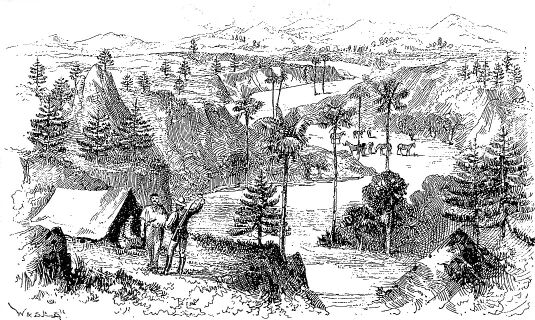
A few trees of the cypress pine (Callitris) were seen upon the summits of the higher mounts. The hills and country generally seen in this glen are more fertile than those outside, having real grass instead of triodia upon their sides. I saw two or three natives just before camping; they kept upon the opposite side of the water, according to a slight weakness of theirs. Just at the time I saw them, I had my eye on some ducks upon the water in the river bed, I therefore determined to kill two birds with one stone; that is to say, to shoot the ducks and astonish the natives at the same time. I got behind a tree, the natives I could see were watching me most intently the while, and fired. Two ducks only were shot, the remainder of the birds and the natives, apparently, flying away together. Our travels to-day were very agreeable; the day was fine, the breezes cool, and the scenery continually changing, the river taking the most sinuous windings imaginable; the bed of it, as might be expected in such a glen, is rough and stony, and the old fear of the horses bogging has departed from us. By bearings back upon hills at the mouth of the glen I found our course was nearly north 23° west. The night was clear and cold; the stars, those sentinels of the sky, appeared intensely bright. To the explorer they must ever be objects of admiration and love, as to them he is indebted for his guidance through the untrodden wilderness he is traversing. “And sweet it is to watch them in the evening skies weeping dew from their gentle eyes.” Several hundred pelicans, those antediluvian birds, made their appearance upon the water early this morning, but seeing us they flew away before a shot could be fired. These birds came from the north-west; indeed, all the aquatic birds that I have seen upon the wing, come and go in that direction. I am in hopes of getting through this glen to-day, for however wild and picturesque the scenery, it is very difficult and bad travelling for the unshod horses; consequently it is difficult to get them along. There was no other road to follow than the windings of the river bed through this mountain-bound glen, in the same manner as yesterday. Soon after starting, I observed several natives ahead of us; immediately upon their discovering us they raised a great outcry, which to our ears did not exactly resemble the agreeable vibration of the melodious sound, it being quite the opposite. Then of course signal fires were made which raised great volumes of smoke, the natives thinking perhaps to intimidate and prevent us from farther advance. Neither of these effects was produced, so their next idea was to depart themselves, and they ran ahead of us up the glen. I also saw another lot of some twenty or thirty scudding away over the rocks and stony hills—these were probably the women and children. Passing their last night's encampment, we saw that they had left all their valuables behind them—these we left untouched. One old gentleman sought the security of a shield of rock, where this villain upon earth and fiend in upper air most vehemently apostrophised us, and probably ordered us away out of his territory. To the command in itself we paid little heed, but as it fell in with our own ideas, we endeavoured to carry it out as fast as possible. This, I trust, was satisfactory, as I always like to do what pleases others, especially when it coincides with my own views.
“It's a very fine thing, and delightful to see
Inclination and duty both join and agree.”
Some of the natives near him threatened us with their spears, and waved knobbed sticks at us, but we departed without any harm being done on either side.
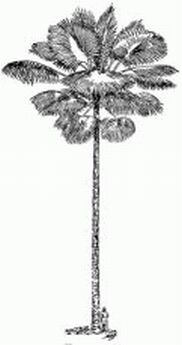
Soon after leaving the natives, we had the gratification of discovering a magnificent specimen of the Fan palm, a species of Livistona, allied to one in the south of Arnhem's Land, and now distinguished as the Maria Palm (Baron von Mueller), growing in the channel of the watercourse with flood drifts against its stem. Its dark-hued, dome-shaped frondage contrasted strangely with the paler green foliage of the eucalyptus trees that surrounded it. It was a perfectly new botanical feature to me, nor did I expect to meet it in this latitude. “But there's a wonderful power in latitude, it alters a man's moral relations and attitude.” I had noticed some strange vegetation in the dry flood drifts lower down, and was on the qui vive for something new, but I did not know that. This fine tree was sixty feet long, or high, in the barrel. Passing the palms, we continued amongst the defiles of this mountain glen, which appears to have no termination, for no signs of a break or anything but a continuation of the range could be observed from any of the hills I ascended.
It was late in the afternoon when we left the palm-groves, and though we travelled over twenty miles in distance could only make twelve good from last camp. Although this glen was rough and rocky, yet the purling of the water over its stony bed was always a delightful sound to me; and when the winds of evening fanned us to repose, it seemed as though some kindly spirit whispered that it would guard us while we slept and when the sun declined the swift stream echoed on.
The following day being Sunday, the 1st September, I made it a day of rest, for the horses at least, whose feet were getting sore from continued travel over rocks and boulders of stone. I made an excursion into the hills, to endeavour to discover when and where this apparently interminable glen ceased, for with all its grandeur, picturesqueness, and variety, it was such a difficult road for the horses, that I was getting heartily tired of it; besides this, I feared this range might be its actual source, and that I should find myself eventually blocked and stopped by impassable water-choked gorges, and that I should finally have to retreat to where I first entered it. I walked and climbed over several hills, cliffs, and precipices, of red sandstone, to the west of the camp, and at length reached the summit of a pine-clad mountain considerably higher than any other near it. Its elevation was over 1000 feet above the level of the surrounding country. From it I obtained a view to all points of the compass except the west, and could descry mountains, from the north-east round by north to the north-north west, at which point a very high and pointed mount showed its top above the others in its neighbourhood, over fifty miles away. To the north and east of north a massive chain, with many dome-shaped summits, was visible. Below, towards the camp, I could see the channel of the river where it forced its way under the perpendicular sides of the hills, and at a spot not far above the camp it seemed split in two, or rather was joined by another watercourse from the northwards. From the junction the course of the main stream was more directly from the west. Along the course of the tributary at about ten miles I could see an apparently open piece of country, and with the glasses there appeared a sheet of water upon it. I was glad to find a break in the chain, though it was not on the line I should travel. Returning to my companions, I imparted to them the result of my observations.
On Monday, the 2nd, there was a heaviness in the atmosphere that felt like approaching rain. The thermometer during the night had not fallen below 60°; over 4° higher than at our first night's camp from the pillar. To-day, again following the mazy windings of the glen, we passed the northern tributary noticed yesterday, and continued on over rocks, under precipices, crossing and re-crossing the channel, and turning to all points of the compass, so that nearly three miles had to be travelled to make good one. Clumps of the beautiful palms were occasionally passed, growing mostly in the river bed, and where they appear, they considerably enliven the scenery. During my sojourn in this glen, and indeed from first starting, I collected a great number of most beautiful flowers, which grow in profusion in this otherwise desolate glen. I was literally surrounded by fair flowers of every changing hue. Why Nature should scatter such floral gems upon such a stony sterile region it is difficult to understand, but such a variety of lovely flowers of every kind and colour I had never met with previously. Nature at times, indeed, delights in contrasts, for here exists a land “where bright flowers are all scentless, and songless bright birds.” The flowers alone would have induced me to name this Glen Flora; but having found in it also so many of the stately palm trees, I have called it the Glen of Palms. Peculiar indeed, and romantic too, is this new-found watery glen, enclosed by rocky walls, “Where dial-like, to portion time, the palm-tree's shadow falls.”
While we were travelling to-day, a few slight showers fell, giving us warning in their way that heavier falls might come. We were most anxious to reach the northern mouth of the glen if possible before night, so heartily tired were we of so continuously serpentine a track; we therefore kept pushing on. We saw several natives to-day, but they invariably fled to the fastnesses of their mountain homes, they raised great volumes of smoke, and their strident vociferations caused a dull and buzzing sound even when out of ear-shot. The pattering of the rain-drops became heavier, yet we kept on, hoping at every turn to see an opening which would free us from our prison-house; but night and heavier rain together came, and we were compelled to remain another night in the palmy glen. I found a small sloping, sandy, firm piece of ground, probably the only one in the glen, a little off from the creek, having some blood-wood or red gum-trees growing upon it, and above the reach of any flood-mark—for it is necessary to be careful in selecting a site on a watercourse, as, otherwise, in a single instant everything might be swept to destruction. We were fortunate indeed to find such a refuge, as it was large enough for the horses to graze on, and there was some good feed upon it. By the time we had our tarpaulins fixed, and everything under cover, the rain fell in earnest. The tributary passed this morning was named Ellery's Creek. The actual distance we travelled to-day was eighteen miles; to accomplish this we travelled from morn till night. Although the rain continued at intervals all night, no great quantity fell. In the morning the heavens were clear towards the south, but to the north dense nimbus clouds covered the hills and darkened the sky. Not removing the camp, I took another ramble into the hills to the east of the camp, and from the first rise I saw what I was most anxious to see, that is to say, the end, or rather the beginning of the glen, which occurred at about two miles beyond our camp. Beyond that the Finke came winding from the north-west, but clouds obscured a distant view. It appeared that rain must still be falling north of us, and we had to seek the shelter of our canvas home. At midday the whole sky became overclouded, rain came slowly down, and when the night again descended heavier still was then the fall. At an hour after daylight on the morrow the greatest volume fell, and continued for several hours. At midday it held up sufficiently to enable me to plant some seeds of various trees, plants, vegetables, etc., given me specially by Baron von Mueller. Among these were blue gum (tree), cucumbers, melons, culinary vegetables, white maize, prairie grass, sorghum, rye, and wattle-tree seeds, which I soaked before planting. Although the rain lasted thirty-six hours in all, only about an inch fell. It was with great pleasure that at last, on the 5th, we left the glen behind us, and in a couple of miles debouched upon a plain, which ran up to the foot of this line of ranges. The horses seemed to be especially pleased to be on soft ground again. The length of this glen is considerable, as it occupies 31 minutes of latitude. The main bearing of it is nearly north 25° west; it is the longest feature of the kind I ever traversed, being over forty miles straight, and over a hundred miles of actual travelling, and it appeared the only pass through the range, which I named the Krichauff. To the north a higher and more imposing chain existed, apparently about twenty miles away. This northern chain must be the western portion of the McDonnell Range. The river now is broader than in the glen; its bed, however, is stony, and not boggy, the country level, sandy, and thinly timbered, mostly all the vegetation being burnt by grass fires set alight by the natives.
Travelling now upon the right bank of this stream, we cut off most of the bends, which, however, were by no means so extensive or so serpentine as in the glen or on the south side of it. Keeping near the river bank, we met but little porcupine grass for the most part of the day's stage, but there was abundance of it further off. The river took us to the foot of the big mountains, and we camped about a mile below a gorge through which it issues. As we neared the new hills, we became aware that the late rains were raising the waters of the river. At six miles before camping we crossed a tributary joining the Finke at right angles from the west, where there are some ranges in that direction; a slight stream was running down the bed. My next anxiety is to discover where this river comes from, or whether its sources are to be found in this chain. The day was delightfully fine and cool, the breezes seemed to vibrate the echo of an air which Music, sleeping at her instrument, had ceased to play. The ground is soft after the late rains. I said we camped a mile below a gorge; at night I found my position to be in latitude 23° 40´, and longitude 132° 31´, the variation 3° east. We shot a few ducks, which were very fat and good. This morning I took a walk into the hills to discover the best route to take next. The high ranges north seem to be formed of three separate lines, all running east and west; the most northerly being the highest, rising over 2000 feet above the level of the surrounding country, and, according to my barometrical and boiling-point measurements, I found that at the Charlotte Waters I was 900 feet above the sea. From that point up to the foot of these mountains the country had steadily risen, as we traced the Finke, over 1000 feet, so that the highest points of that range are over 4000 feet above sea level; the most southerly of the three lines is composed of sandstone, the middle and highest tiers I think change to granite. I climbed for several hours over masses of hills, but always found one just a little farther on to shut out the view. At length I reached the summit of a high round mountain in the middle tier, and a most varied and splendid panorama was spread before me, or I was spread before it.
To the north was the main chain, composed for the most part of individual high mounts, there being a valley between them and the hill I was on, and meandering along through this valley from the west I could trace the course of the Finke by its timber for some miles. To the east a mass of high and jumbled hills appeared, and one bluff-faced mount was more conspicuous than the rest. Nearer to me, and almost under my feet, was the gorge through which the river passes, and it appears to be the only pass through this chain. I approached the precipice overlooking the gorge, and found the channel so flooded by the late rains, that it was impossible to get the horses up through it. The hills which enclosed it were equally impracticable, and it was utterly useless to try to get horses over them. The view to the west was gratifying, for the ranges appeared to run on in undiminished height in that direction, or a little north of it. From the face of several of the hills climbed to-day, I saw streams of pure water running, probably caused by the late rains. One hill I passed over I found to be composed of puddingstone, that is to say, a conglomeration of many kinds of stone mostly rounded and mixed up in a mass, and formed by the smothered bubblings of some ancient and ocean-quenched volcano. The surface of the place now more particularly mentioned had been worn smooth by the action of the passage of water, so that it presented the appearance of an enormous tessellated pavement, before which the celebrated Roman one at Bognor, in Sussex, which I remember, when I was a boy, on a visit to Goodwood, though more artistically but not more fantastically arranged, would be compelled to hide its diminished head. In the course of my rambles I noticed a great quantity of beautiful flowers upon the hills, of similar kinds to those collected in the Glen of Palms, and these interested me so greatly, that the day passed before I was aware, and I was made to remember the line, “How noiseless falls the foot of Time that only treads on flowers.” I saw two kangaroos and one rock wallaby, but they were too wild to allow me to approach near enough to get a shot at them. When I said I walked to-day, I really started on an old favourite horse called Cocky, that had carried me for years, and many a day have I had to thank him for getting me out of difficulties through his splendid powers of endurance. I soon found the hills too rough for a horse, so fixing up his bridle, I said, “Now you stop there till I come back.” I believe he knew everything I said, for I used frequently to talk to him. When I came back at night, not thinking he would stay, as the other horses were all feeding within half a mile of him, there he was just as I had left him. I was quite inclined to rest after my scrambles in the hills. During the night nothing occurred to disturb our slumbers, which indeed were aided by the sounds of the rippling stream, which sang to us a soothing song.
Progress stopped. Fall back on a tributary. River flooded. A new range. Rudall's Creek. Reach the range. Grass-trees. Wild beauty of scene. Scarcity of water. A pea-like vetch. Name the range. A barren spot. Water seen from it. Follow a creek channel. Other creeks join it. A confined glen. Scrubby and stony hills. Strike a gum creek. Slimy water. A pretty tree. Flies troublesome. Emus. An orange tree. Tropic of Capricorn. Melodious sounds. Carmichael's Creek. Mountains to the north. Ponds of water. A green plain. Clay-pan water. Fine herbage. Kangaroos and emus numerous. A new tree. Agreeable encampment. Peculiar mountains. High peak. Start to ascend it. Game plentiful. Racecourse plain. Surrounded by scrubs. A bare slope. A yawning chasm. Appearance of the peak. Gleaming pools. Cypress pines. The tropic clime of youth. Proceed westwards. Thick scrubs. Native method of procuring water. A pine-clad hill. A watercourse to the south. A poor supply of water. Skywards the only view. Horses all gone. Increasing temperature. Attempt ascending high bluff. Timberless mountains. Beautiful flowers. Sultry night. Wretched encampment. Depart from it.
I had come to the decision, as it was impossible to follow the Finke through the gorge in consequence of the flood, and as the hills were equally impracticable, to fall back upon the tributary I had noticed the day before yesterday as joining the river from the west, thinking I might in twenty or thirty miles find a gap in the northern range that would enable me to reach the Finke again. The night was very cold, the thermometer at daylight stood at 28°. The river had risen still higher in the night, and it was impossible to pass through the gorge. We now turned west-south-west, in order to strike the tributary. Passing first over rough stony ridges, covered with porcupine grass, we entered a sandy, thickly-bushed country, and struck the creek in ten miles. A new range lying west I expected to be the source of it, but it now seemed to turn too much to the south. There was very poor grass, it being old and dry, but as the new range to the west was too distant, we encamped, as there was water. This watercourse was called Rudall's Creek. A cold and very dewy night made all our packs, blankets, etc., wet and clammy; the mercury fell below freezing point, but instantly upon the sun's appearance it went up enormously. The horses rambled, and it was late when we reached the western range, as our road was beset by some miles of dense scrubs. The range was isolated, and of some elevation. As we passed along the creek, the slight flood became slighter still; it had now nearly ceased running. The day was one of the warmest we had yet experienced. The creek now seemed not to come from the range, but, thinking water might be got there so soon after rains, we travelled up to its foot. The country was sandy, and bedecked with triodia, but near the range I saw for the first time on this expedition a quantity of the Australian grass-tree (Xanthorrhoea) dotting the landscape. They were of all heights, from two to twenty feet. The country round the base of this range is not devoid of a certain kind of wild beauty. A few blood-wood or red gum-trees, with their brilliant green foliage, enlivened the scene.
A small creek, lined with gum-trees, issued from an opening or glen, up which I rode in search of water, but was perfectly unsuccessful, as not a drop of the life-sustaining fluid was to be found. Upon returning to impart this discouraging intelligence to my companions, I stumbled upon a small quantity in a depression, on a broad, almost square boulder of rock that lay in the bed of the creek. There was not more than two quarts. As the horses had watered in the afternoon, and as there was a quantity of a herb, much like a green vetch or small pea, we encamped. I ascended a small eminence to the north, and with the glasses could distinguish the creek last left, now running east and west. I saw water gleaming in its channel, and at the junction of the little creek we were now on; there was also water nearly east. As the horses were feeding down the creek that way, I felt sure they would go there and drink in the night. It is, however, very strange whenever one wants horses to do a certain thing or feed a certain way, they are almost sure to do just the opposite, and so it was in the present case. On returning to camp by a circuitous route, I found in a small rocky crevice an additional supply of water, sufficient for our own requirements—there was nearly a bucketful—and felicity reigned in the camp. A few cypress pines are rooted in the rocky shelving sides of the range, which is not of such elevation as it appeared from a distance. The highest points are not more than from 700 to 800 feet. I collected some specimens of plants, which, however, are not peculiar to this range. I named it Gosse's range, after Mr. Harry Gosse. The late rains had not visited this isolated mass. It is barren and covered with spinifex from turret to basement, wherever sufficient soil can be found among the stones to admit of its growth.
The night of the 9th of September, like the preceding, was cold and dewy. The horses wandered quite in the wrong direction, and it was eleven o'clock before we got away from the camp and went north to the sheet of water seen yesterday, where we watered the horses and followed up the creek, as its course here appeared to be from the west. The country was level, open, and sandy, but covered with the widely pervading triodia (irritans). Some more Xanthorrhoea were seen, and several small creeks joined this from the ranges to the north. Small sheets of water were seen in the creek as we passed along, but whether they existed before the late rains is very problematical. The weather is evidently getting warmer. We had been following this creek for two days; it now turned up into a confined glen in a more northerly direction. At last its northern course was so pronounced we had to leave it, as it evidently took its rise amongst the low hills in that direction, which shut out any view of the higher ranges behind them. Our road was now about west-north-west, over wretched, stony, barren, mallee (Eucalyptus) covered low hills or stony rises; the mallee scrub being so thick, it was difficult to drive the horses through it. Farther on we crested the highest ground the horses had yet passed over. From here with the glasses I fancied I saw the timber of a creek in a valley to the north-west, in which direction we now went, and struck the channel of a small dry watercourse, whose banks were lined with gum-trees. When there is any water in its channel, its flow is to the west. The creek joined another, in which, after following it for a mile or two, I found a small pool of water, which had evidently lain there for many months, as it was half slime, and drying up fast. It was evident the late rains had not fallen here.
In consequence of the windings of the creeks, we travelled upon all points of the compass, but our main course was a little west of north-west. The day was warm enough, and when we camped we felt the benefit of what shade the creek timber could afford. Some of the small vetch, or pea-like plant, of which the horses are so fond, existed here. To-day we saw a single quandong tree (Fusanus; one of the sandal woods, but not of commerce) in full bearing, but the fruit not yet ripe. I also saw a pretty drooping acacia, whose leaves hung in small bunches together, giving it an elegant and pendulous appearance. This tree grows to a height of fifty feet; and some were over a foot through in the barrel.
The flies to-day were exceedingly troublesome: a sure sign of increasing temperature. We saw some emus, but being continually hunted by the natives, they were too shy to allow us to get within shot of them. Some emu steaks would come in very handy now. Near our pool of slime a so-called native orange tree (Capparis), of a very poor and stunted habit, grew; and we allowed it to keep on growing.
The stars informed me, in the night, that I was almost under the tropic line, my latitude being 23° 29´. The horses fed well on the purple vetch, their bells melodiously tinkling in the air the whole night long. The sound of the animals' bells, in the night, is really musical to the explorer's ear. I called the creek after Mr. Carmichael; and hoping it would contain good water lower down, decided to follow it, as it trended to the west. We found, however, in a few miles, it went considerably to the south of west, when it eventually turned up again to the north-west.
We still had the main line of mountains on our right, or north of us: and now, to the south, another line of low hills trended up towards them; and there is evidently a kind of gap between the two lines of ranges, about twenty-five miles off. The country along the banks of Carmichael's Creek was open and sandy, with plenty of old dry grass, and not much triodia; but to the south, the latter and mallee scrub approached somewhat near. We saw several small ponds of water as we passed along, but none of any size. In seven or eight miles it split into several channels, and eventually exhausted itself upon an open grassy swamp or plain. The little plain looked bright and green. I found some rain water, in clay pans, upon it. A clay pan is a small area of ground, whose top soil has been washed or blown away, leaving the hard clay exposed; and upon this surface, one, two, three, or (scarcely) more inches of rain water may remain for some days after rain: the longer it remains the thicker it gets, until at last it dries in cakes which shine like tiles; these at length crumble away, and the clay pan is swept by winds clean and ready for the next shower. In the course of time it becomes enlarged and deepened. They are very seldom deep enough for ducks.
The grass and herbage here were excellent. There were numerous kangaroos and emus on the plain, but they preferred to leave us in undisturbed possession of it. There were many evidences of native camping places about here; and no doubt the natives look upon this little circle as one of their happy hunting grounds. To-day I noticed a tree in the mallee very like a Currajong tree. This being the most agreeable and fertile little spot I had seen, we did not shift the camp, as the horses were in clover. Our little plain is bounded on the north by peculiar mountains; it is also fringed with scrub nearly all round. The appearance of the northern mountains is singular, grotesque, and very difficult to describe. There appear to be still three distinct lines. One ends in a bluff, to the east-north-east of the camp; another line ends in a bluff to the north-north-east; while the third continues along the northern horizon. One point, higher than the rest in that line, bears north 26° west from camp. The middle tier of hills is the most strange-looking; it recedes in the distance eastwards, in almost regular steps or notches, each of them being itself a bluff, and all overlooking a valley. The bluffs have a circular curve, are of a red colour, and in perspective appear like a gigantic flat stairway, only that they have an oblique tendency to the southward, caused, I presume, by the wash of ocean currents that, at perhaps no greatly distant geological period, must have swept over them from the north. My eyes, however, were mostly bent upon the high peak in the northern line; and Mr. Carmichael and I decided to walk over to, and ascend it. It was apparently no more than seven or eight miles away.
As my reader is aware, I left the Finke issuing through an impracticable gorge in these same ranges, now some seventy-five miles behind us, and in that distance not a break had occurred in the line whereby I could either get over or through it, to meet the Finke again; indeed, at this distance it was doubtful whether it were worth while to endeavour to do so, as one can never tell what change may take place, in even the largest of Australian streams, in such a distance. When last seen, it was trending along a valley under the foot of the highest of three tiers of hills, and coming from the west; but whether its sources are in those hills, or that it still runs on somewhere to the north of us, is the question which I now hope to solve. I am the more anxious to rediscover the Finke, if it still exists, because water has been by no means plentiful on the route along which I have lately been travelling; and I believe a better country exists upon the other side of the mountains.
At starting, Carmichael and I at first walked across the plain, we being encamped upon its southern end. It was beautifully grassed, and had good soil, and it would make an excellent racecourse, or ground for a kangaroo hunt. We saw numbers of kangaroos, and emus too, but could get no shots at them. In three miles the plain ended in thick, indeed very dense, scrub, which continued to the foot of the hills; in it the grass was long, dry, and tangled with dead and dry burnt sticks and timber, making it exceedingly difficult to walk through. Reaching the foot of the hills, I found the natives had recently burnt all the vegetation from their sides, leaving the stones, of which it was composed, perfectly bare. It was a long distance to the top of the first ridge, but the incline was easy, and I was in great hopes, if it continued so, to be able to get the horses over the mountains at this spot. Upon arriving at the top of the slope, I was, however, undeceived upon that score, for we found the high mount, for which we were steering, completely separated from us by a yawning chasm, which lay, under an almost sheer precipice, at our feet. The high mountain beyond, near the crown, was girt around by a solid wall of rock, fifty or sixty feet in height, from the edge of which the summit rose. It was quite unapproachable, except, perhaps, in one place, round to the northward.
The solid rock of which it had formerly been composed had, by some mighty force of nature, been split into innumerable fissures and fragments, both perpendicularly and horizontally, and was almost mathematically divided into pieces or squares, or unequal cubes, simply placed upon one another, like masons' work without mortar. The lower strata of these divisions were large, the upper tapered to pieces not much larger than a brick, at least they seemed so from a distance. The whole appearance of this singular mount was grand and awful, and I could not but reflect upon the time when these colossal ridges were all at once rocking in the convulsive tremblings of some mighty volcanic shock, which shivered them into the fragments I then beheld. I said the hill we had ascended ended abruptly in a precipice; by going farther round we found a spot, which, though practicable, was difficult enough to descend. At the bottom of some of the ravines below I could see several small pools of water gleaming in little stony gullies.
The afternoon had been warm, if not actually hot, and our walking and climbing had made us thirsty; the sight of water made us all the more so. It was now nearly sundown, and it would be useless to attempt the ascent of the mountain, as by the time we could reach its summit, the sun would be far below the horizon, and we should obtain no view at all.
It was, however, evident that no gap or pass existed by which I could get my horses up, even if the country beyond were ever so promising. A few of the cypress or Australian pines (Callitris) dotted the summits of the hills, they also grew on the sides of some of the ravines below us. We had, at least I had, considerable difficulty in descending the almost perpendicular face to the water below. Carmichael got there before I did, and had time to sit, laving his feet and legs in a fine little rock hole full of pure water, filled, I suppose, by the late rains. The water, indeed, had not yet ceased to run, for it was trickling from hole to hole. Upon Mr. Carmichael inquiring what delayed me so long, I replied: “Ah, it is all very easy for you; you have two circumstances in your favour. You are young, and therefore able to climb, and besides, you are in the tropic.” To which he very naturally replies, “If I am in the tropic you must be also.” I benignly answer, “No, you are in the tropic clime of youth.” While on the high ground no view of any kind, except along the mountains for a mile or two east and west, could be obtained. I was greatly disappointed at having such a toilsome walk for so little purpose. We returned by a more circuitous route, eventually reaching the camp very late at night, thoroughly tired out with our walk. I named this mountain Mount Musgrave. It is nearly 1700 feet above the level of the surrounding country, and over 3000 feet above the sea. The next day Mr. Carmichael went out to shoot game; there were kangaroos, and in the way of birds there were emus, crows, hawks, quail, and bronze-winged pigeons; but all we got from his expedition was nil. The horses now being somewhat refreshed by our stay here, we proceeded across the little plain towards another high bluff hill, which loomed over the surrounding country to the west-north-west. Flies were troublesome, and very busy at our eyes; soon after daylight, and immediately after sunrise, it became quite hot.
Traversing first the racecourse plain, we then entered some mulga scrub; the mulga is an acacia, the wood extremely hard. It grows to a height of twenty to thirty feet, but is by no means a shady or even a pretty tree; it ranges over an enormous extent of Australia. The scrub we now entered had been recently burnt near the edge of the plain; but the further we got into it, the worse it became. At seven miles we came to stones, triodia, and mallee, a low eucalyptus of the gumtree family, growing generally in thick clumps from one root: its being rooted close together makes it difficult travelling to force one's way through. It grows about twenty feet high. The higher grade of eucalypts or gum-trees delight in water and a good soil, and nearly always line the banks of watercourses. The eucalypts of the mallee species thrive in deserts and droughts, but contain water in their roots which only the native inhabitants of the country can discover. A white man would die of thirst while digging and fooling around trying to get the water he might know was preserved by the tree, but not for him; while an aboriginal, upon the other hand, coming to a mallee-tree, after perhaps travelling miles through them without noticing one, will suddenly make an exclamation, look at a tree, go perhaps ten or twelve feet away, and begin to dig. In a foot or so he comes upon a root, which he shakes upwards, gradually getting more and more of it out of the ground, till he comes to the foot of the tree; he then breaks it off, and has a root perhaps fifteen feet long—this, by the way, is an extreme length. He breaks the root into sections about a foot long, ties them into bundles, and stands them up on end in a receptacle, when they drain out a quantity of beautifully sweet, pure water. A very long root such as I have mentioned might give nearly a bucketful of water; but woe to the white man who fancies he can get water out of mallee. There are a few other trees of different kinds that water is also got from, as I have known it obtained from the mulga, acacia trees, and from some casuarina trees; it depends upon the region they are in, as to what trees give the most if any water, but it is an aboriginal art at any time or place to find it.
The mallee we found so dense that not a third of the horses could be seen together, and with great difficulty we managed to reach the foot of a small pine-clad hill lying under the foot of the high bluff before mentioned—there a small creek lined with eucalypts ran under its foot. Though our journey to-day was only twelve miles, that distance through such horrible scrubs took us many hours. From the top of the piny hill I could see a watercourse to the south two or three miles away; it is probably Carmichael's Creek, reformed, after splitting on the plain behind; Carmichael found a little water-hole up this channel, with barely sufficient water for our use. The day had been disagreeably warm. I rode over to the creek to the south, and found two small puddles in its bed; but there was evidently plenty of water to be got by digging, as by scratching with my hands I soon obtained some. The camp which Carmichael and Robinson had selected, while I rode over to the other creek, was a most wretched place, in the midst of dense mallee and amidst thick plots of triodia, which we had to cut away before we could sit down.
The only direction in which we could see a yard ahead of us was up towards the sky; and as we were not going that way, it gave us no idea of our next line of route. The big bluff we had been steering for all day was, I may say, included in our skyward view, for it towered above us almost overhead. Being away when the camp was selected, I was sorry to hear that the horses had all been let go without hobbles; as they had been in such fine quarters for three nights at the last camp on the plain, it was more than probable they would work back through the scrub to it in the night. The following morning not a horse was to be found! Robinson and I went in search of them, and found they had split into several mobs. I only got three, and at night Robinson returned with only six, the remainder had been missed in the dense scrubs. The thermometer stood at 95° in the shade, and there was a warm wind blowing. Robinson had a fine day's work, as he had to walk back to the camp on the plain for the horses he got. In the afternoon I attempted the high bluff immediately overlooking the camp. I had a bit of cliff-climbing, and reached the summit of one hill of some elevation, 1300 feet, and then found that a vast chasm, or ravine, separated me from the main mountain chain. It would be dark before I could—if I could—reach the summit, and then I should get no view, so I returned to the camp. The height was considerable, as mountains in this part of the world go, as it towered above the hill I was upon, and was 500 or 600 feet higher. These mountains appear to be composed of a kind of conglomerate granite; very little timber existed upon them, but they were splendidly supplied with high, strong, coarse spinifex. I slipped down a gully, fell into a hideous bunch of this horrid stuff, and got pricked from head to foot; the spiny points breaking off in my clothes and flesh caused me great annoyance and pain for many days after. Many beautiful flowers grew on the hillsides, in gullies and ravines; of these I collected several. We secured what horses we had, for the night, which was warm and sultry. In the morning Robinson and I rode after the still missing ones; at the plain camp we found all except one, and by the time we returned it was night.
Not hobbling the horses in general, we had some difficulty in finding a pair of hobbles for each, and not being able to do so, I left one in the mob without. This base reptile surreptitiously crawled away in the night by himself. As our camp was the most wretched dog-hole it was possible for a man to get into, in the midst of dense mallee, triodia, and large stones, I determined to escape from it, before looking for the now two missing animals. The water was completely exhausted. We moved away south-westerly for about three miles, to the creek I had scratched in some days ago; now we had to dig a big hole with a shovel, and with a good deal of labour we obtained a sufficient supply for a few days.
Search for the missing horses. Find one. Hot wind and flying sand. Last horse recovered. Annoyed by flies. Mountains to the west. Fine timber. Gardiner's Range. Mount Solitary. Follow the creek. Dig a tank. Character of the country. Thunderstorms. Mount Peculiar. A desolate region. Sandhills. Useless rain. A bare granite hill. No water. Equinoctial gales. Search for water. Find a rock reservoir. Native fig-trees. Gloomy and desolate view. The old chain. Hills surrounded by scrubs. More hills to the west. Difficult watering-place. Immortelles. Cold weather. View from a hill. Renewed search for water. Find a small supply. Almost unapproachable. Effects of the spinifex on the horses. Pack-horses in scrubs. The Mus conditor. Glistening micaceous hills. Unsuccessful search. Waterless hill nine hundred feet high. Oceans of scrub. Retreat to last reservoir. Natives' smokes. Night without water. Unlucky day. Two horses lost. Recover them. Take a wrong turn. Difficulty in watering the horses. An uncomfortable camp. Unsuccessful searches. Mount Udor. Mark a tree. Tender-footed horses. Poor feed. Sprinkling rain. Flies again troublesome. Start for the western ranges. No water. Difficult scrubs. Lonely camp. Horses away. Reach the range. No water. Retreat to Mount Udor. Slight rain. Determine to abandon this region. Corkwood trees. Ants' nests. Glow-worms. Native poplar trees. Peculiar climate. Red gum-trees. A mare foals. Depart for the south. Remarks on the country.
Having fixed our camp at a new place, in the afternoon of the 17th September, Robinson and I again went to look after the horses. At three miles above the camp we found some water; soon after we got the tracks of one horse and saw that he had been about there for a day or two, as the tracks were that age. We made a sweep out round some hills, found the tracks again, much fresher, and came upon the horse about seven miles from the camp. The other horse was left for to-morrow. Thermometer 96°, sky overcast, rain imminent.
During the night of the 18th of September a few heat-drops of rain fell. I sent Robinson away to the plain camp, feeling sure he would find the rover there. A hot wind blew all day, the sand was flying about in all directions. Robinson got the horse at last at the plain, and I took special care to find a pair of hobbles for him for this night at all events. The flies were an intolerable nuisance, not that they were extraordinarily numerous, but so insufferably pertinacious. I think the tropic fly of Australia the most abominable insect of its kind. From the summit of the hill I ascended on Sunday, I found the line of mountains still ran on to the west, the furthest hills appeared fifty miles away. As they extend so far, and are the principal features in sight, I shall follow them, in hopes of meeting some creek, or river, that may carry me on to the west. It is a remarkable fact that such high hills as I have been following should send out no creek whose course extends farther than ten or twelve miles. I could trace the creek I am now on by its timber for only a few miles, its course appearing south of west. The country in its immediate neighbourhood is open, and timbered with fine casuarina trees; the grass is dry and long, and the triodia approaches to within a quarter of a mile of it. The line of hills I previously mentioned as running along to the south of us, we had now run out. I named them Gardiner's Range, after a friend of Mr. Carmichael's. There is, however, one small isolated hill, the furthest outpost of that line, some three miles away to the south-west; the creek may probably take a bend down towards it. I called it Mount Solitary. This creek is rather well timbered, the gum-trees look fresh and young, and there is some green herbage in places, though the surface water has all disappeared.
There was so little water at the camp tank, we had to send the horses up the creek three miles to water, and on their return I was not sorry to be moving again, for our stay at these two last camps had been compulsory, and the anxiety, trouble, and annoyance we had, left no very agreeable reminiscences of the locality in our minds.
We travelled along the creek all day, cutting off the bends, but without seeing any signs of water: towards evening we set to work to try if we could get any by digging. In about four feet, water began to drain in, but, the sand being so loose, we had to remove an enormous quantity to enable a horse to drink. Some of the horses would not go into it, and had to be watered with a canvas bucket. The supply seemed good, but it only drained in from the sides. Every time a horse drank we had to clear out the sand for the next; it therefore took until late before all were satisfied. The country was still open, and timbered with fine black oak, or what is so called in Australia. It is a species of casuarina, of the same family but distinct from the beautiful desert oak. Triodia reigned supreme within half a mile. At this camp the old grass had been burnt, and fresh young green shoots appeared in its place; this was very good for the horses. A few drops of rain fell; distant rumblings of thunder and flashes of lightning now cooled the air. While we were at breakfast the next morning, a thunderstorm came up to us from the west, then suddenly turned away, only just sprinkling us, though we could see the rain falling heavily a few yards to the south. We packed up and went off, hoping to find a better watered region at the hills westwards. There was an extraordinary mount a little to the west of north from us; it looked something like a church; it was over twenty miles away: I called it Mount Peculiar. Leaving the creek on our left, to run itself out into some lonely flat or dismal swamp, known only to the wretched inhabitants of this desolate region—over which there seems to brood an unutterable stillness and a dread repose—we struck into sandhill country, rather open, covered with the triodia or spinifex, and timbered with the casuarina or black oak trees. We had scarcely gone two miles when our old thunderstorm came upon us—it had evidently missed us at first, and had now come to look for us—and it rained heavily. The country was so sandy and porous that no water remained on the surface. We travelled on and the storm travelled with us—the ground sucking up every drop that fell. Continuing our course, which was north 67° west, we travelled twenty-five miles. At this distance we came in sight of the mountains I was steering for, but they were too distant to reach before night, so, turning a little northward to the foot of a low, bare, white granite hill, I hoped to find a creek, or at least some ledges in the rocks, where we might get some water. Not a drop was to be found. Though we had been travelling in the rain all day and accomplished thirty miles, we were obliged to camp without water at last. There was good feed for the horses, and, as it was still raining, they could not be very greatly in want of water. We fixed up our tent and retired for the night, the wind blowing furiously, as might reasonably be expected, for it was the eve of the vernal equinox, and this I supposed was our share of the equinoctial gales. We were compelled in the morning to remove the camp, as we had not a drop of water, and unless it descended in sheets the country could not hold it, being all pure red sand. The hill near us had no rocky ledges to catch water, so we made off for the higher mountains for which we were steering yesterday. Their nearest or most eastern point was not more than four miles away, and we went first to it. I walked on ahead of the horses with the shovel, to a small gully I saw with the glasses, having some few eucalypts growing in it. I walked up it, to and over rocky ledges, down which at times, no doubt, small leaping torrents roar. Very little of yesterday's rain had fallen here; but most fortunately I found one small rock reservoir, with just sufficient water for all the horses. There was none either above or below in any other basin, and there were many better-looking places, but all were dry. The water in this one must have stood for some time, yesterday's rain not having affected it in the least. The place at which I found the water was the most difficult for horses to reach; it was almost impracticable. After finding this opportune though awkwardly situated supply, I climbed to the summit of the mount. On the top was a native fig-tree in full bearing; the fruit was ripe and delicious. It is the size of an ordinary marble, yellow when unripe, and gradually becoming red, then black: it is full of small seeds. I was disturbed from my repast by seeing the horses, several hundred feet below me, going away in the wrong direction. And I had to descend before I had time to look around; but the casual glance I obtained gave me the most gloomy and desolate view imaginable; one, almost enough to daunt the explorer from penetrating any farther into such a dreadful region. To the eastward, I found I had now long outrun the old main chain of mountains, which had turned up to the north, or rather north-north-westward; between me and it a mass of jumbled and broken mounts appeared; each separate one, however, was almost surrounded by scrubs, which ran up to the foot of the hill I was upon. Northward the view was similar. To the west the picture was the same, except that a more defined range loomed above the intervening scrubs—the hills furthest away in that direction being probably fifty miles distant. The whole horizon looked dark and gloomy—I could see no creeks of any kind, the most extensive water channels were mere gullies, and not existing at all at a mile from the hills they issued from.
Watering our horses proved a difficult and tedious task; as many of them would not approach the rocky basin, the water had to be carried up to them in canvas buckets. By the time they were all watered, and we had descended from the rocky gully, the day had passed with most miraculous celerity. The horses did not finish the water, there being nearly sufficient to give them another drink. The grass was good here, as a little flat, on which grew some yellow immortelles, had recently been burnt. I allowed the horses to remain and drink up the balance of the water, while I went away to inspect some other gorges or gullies in the hills to the west of us, and see whether any more water could be found. The day was cool and fine.
I climbed to the summit of a hill about 800 feet from its base. The view was similar to yesterday's, except that I could now see these hills ran on west for twelve or fifteen miles, where the country was entirely covered with scrubs. Little gullies, with an odd, and stunted, gum-tree here and there, were seen. Few of these gullies were more than six feet wide, and the trumpery little streams that descend, in even their most flooded state, would be of but little service to anybody. I had wandered up and down hills, in and out of gullies, all the morning, but had met no single drop of water, and was returning disappointed to the camp when, on trying one more small scrubby, dreadfully-rocky little gully which I had missed, or rather passed by, in going out, I was fortunate enough to discover a few small rocky holes full of the purest fluid. This treasure was small indeed, but my gratitude was great; for what pleased me most was the rather strange fact that the water was trickling from one basin to another, but with the weakest possible flow. Above and below where I found this water the gully and the rocks were as dry as the desert around. Had the supply not been kept up by the trickling, half my horses would have emptied all the holes at a draught.
The approach to this water was worse, rougher, rockier, and more impracticable than at the camp; I was, however, most delighted to have found it, otherwise I should have had to retreat to the last creek. I determined, however, not to touch it now, but to keep it as a reserve fund, should I be unable to find more out west. Returning to camp, we gave the horses all the water remaining, and left the spot perfectly dry.
We now had the line of hills on our right, and travelled nearly west-north-west. Close to the foot of the hills the country is open, but covered with large stones, between the interstices of which grow huge bunches of the hideous spinifex, which both we and the horses dread like a pestilence. We have encountered this scourge for over 200 miles. All around the coronets of most of the horses, in consequence of their being so continually punctured with the spines of this terrible grass, it has caused a swelling, or tough enlargement of the flesh and skin, giving them the appearance of having ring-bones. Many of them have the flesh quite raw and bleeding; they are also very tender-footed from traversing so much stony ground, as we have lately had to pass over. Bordering upon the open stony triodia ground above-mentioned is a bed of scrubs, composed chiefly of mulga, though there are various other trees, shrubs, and plants amongst it. It is so dense and thick that in it we cannot see a third of the horses at once; they, of course, continually endeavour to make into it to avoid the stones and triodia; for, generally speaking, the pungent triodia and the mulga acacia appear to be antagonistic members of the vegetable kingdom. The ground in the scrubs is generally soft, and on that account also the horses seek it. Out of kindness, I have occasionally allowed them to travel in the scrubs, when our direct course should have been on the open, until some dire mishap forces us out again; for, the scrubs being so dense, the horses are compelled to crash through them, tearing the coverings of their loads, and frequently forcing sticks in between their backs or sides and their saddles, sometimes staking themselves severely. Then we hear a frantic crashing through the scrubs, and the sounds of the pounding of horse-hoofs are the first notice we receive that some calamity has occurred. So soon as we ourselves can force our way through, and collect the horses the best way we can, yelling and howling to one another to say how many each may have got, we discover one or two missing. Then they have to be tracked; portions of loads are picked up here and there, and, in the course of an hour or more, the horse or horses are found, repacked, and on we push again, mostly for the open, though rough and stony spinifex ground, where at least we can see what is going on. These scrubs are really dreadful, and one's skin and clothes get torn and ripped in all directions. One of these mishaps occurred to-day.
In these scrubs are met nests of the building rat (Mus conditor). They form their nests with twigs and sticks to the height of four feet, the circumference being fifteen to twenty. The sticks are all lengths up to three feet, and up to an inch in diameter. Inside are chambers and galleries, while in the ground underneath are tunnels, which are carried to some distance from their citadel. They occur in many parts of Australia, and are occasionally met with on plains where few trees can be found. As a general rule, they frequent the country inhabited by the black oak (casuarina). They can live without water, but, at times, build so near a watercourse as to have their structures swept away by floods. Their flesh is very good eating.
In ten miles we had passed several little gullies, and reached the foot of other hills, where a few Australian pines were scattered here and there. These hills have a glistening, sheening, laminated appearance, caused by the vast quantities of mica which abounds in them. Their sides are furrowed and corrugated, and their upper portions almost bare rock. Time was lost here in unsuccessful searches for water, and we departed to another range, four or five miles farther on, and apparently higher; therefore perhaps more likely to supply us with water. Mr. Carmichael and I ascended the range, and found it to be 900 feet from its base; but in all its gullies water there was none. The view from the summit was just such as I have described before—an ocean of scrubs, with isolated hills or ranges appearing like islands in most directions. Our horses had been already twenty-four hours without water. I wanted to reach the far range to the west, but it was useless to push all the pack-horses farther into such an ocean of scrubs, as our rate of progress in them was so terribly slow. I decided to return to the small supply I had left as a reserve, and go myself to the far range, which was yet some thirty miles away. The country southward seemed to have been more recently visited by the natives than upon our line of march, which perhaps was not to be wondered at, as what could they get to live on out of such a region as we had got into? Probably forty or fifty miles to the south, over the tops of some low ridges, we saw the ascending smoke of spinifex fires, still attended to by the natives; and in the neighbourhood, no doubt, they had some watering places. On our retreat we travelled round the northern face of the hills, upon whose south side we had arrived, in hopes of finding some place having water, where I might form a depot for a few days. By night we could find none, and had to encamp without, either for ourselves or our horses.
The following day seemed foredoomed to be unlucky; it really appeared as though everything must go wrong by a natural law. In the first place, while making a hobble peg, while Carmichael and Robinson were away after the horses, the little piece of wood slipped out of my hand, and the sharp blade of the knife went through the top and nail of my third finger and stuck in the end of my thumb. The cut bled profusely, and it took me till the horses came to sew my mutilated digits up. It was late when we left this waterless spot. As there was a hill with a prepossessing gorge, I left Carmichael and Robinson to bring the horses on, and rode off to see if I could find water there. Though I rode and walked in gullies and gorges, no water was to be found. I then made down to where the horses should have passed along, and found some of them standing with their packs on, in a small bit of open ground, surrounded by dense scrubs, which by chance I came to, and nobody near. I called and waited, and at last Mr. Carmichael came and told me that when he and Robinson debouched with the horses on this little open space, they found that two of the animals were missing, and that Robinson had gone to pick up their tracks. The horse carrying my papers and instruments was one of the truants. Robinson soon returned, not having found the track. Neither of them could tell when they saw the horses last. I sent Mr. Carmichael to another hill two or three miles away, that we had passed, but not inspected yesterday, to search for water, while Robinson and I looked for the missing horses. And lest any more should retreat during our absence, we tied them up in two mobs. Robinson tied his lot up near a small rock. We then separately made sweeps round, returning to the horses on the opposite side, without success. We then went again in company, and again on opposite sides singly, but neither tracks nor horses could be found. Five hours had now elapsed since I first heard of their absence. I determined to make one more circuit beyond any we had already taken, so as to include the spot we had camped at; this occupied a couple of hours. When I returned I was surprised to hear that Robinson had found the horses in a small but extra dense bunch of scrub not twenty yards from the spot where he had tied his horses up. While I was away he had gone on top of the little stony eminence close by, and from its summit had obtained a bird's-eye view of the ground below, and thus perceived the two animals, which had never been absent at all. It seemed strange to me that I could not find their tracks, but the reason was there were no tracks to find. I took it for granted when Carmichael told me of their absence that they were absent, but he and Robinson were both mistaken.
It was now nearly evening, and I had been riding my horse at a fast pace the whole day; I was afraid we could not reach the reserve water by night. But we pushed on, Mr. Carmichael joining us, not having found any water. At dusk we reached the small creek or gully, up in whose rocks I had found the water on Sunday. At a certain point the creek split in two, or rather two channels joined, and formed one, and I suppose the same ill fate that had pursued me all day made me mistake the proper channel, and we drove the unfortunate and limping horses up a wretched, rocky, vile, scrubby, almost impenetrable gully, where there was not a sup of water.
On discovering my error, we had to turn them back over the same horrible places, all rocks, dense scrubs, and triodia, until we got them into the proper channel. When near the first little hole I had formerly seen, I dismounted, and walked up to see how it had stood during my absence, and was grieved to discover that the lowest and largest hole was nearly dry. I bounded up the rocks to the next, and there, by the blessing of Providence, was still a sufficient quantity, as the slow trickling of the water from basin to basin had not yet entirely ceased, though its current had sadly diminished since my last visit only some seventy hours since.
By this time it was dark, and totally impossible to get the horses up the gully. We had to get them over a horrible ridge of broken and jumbled rocks, having to get levers and roll away huge boulders, to make something like a track to enable the animals to reach the water.
Time (and labour) accomplishes all things, and in time the last animal's thirst was quenched, and the last drop of water sucked up from every basin. I was afraid it would not be replenished by morning. We had to encamp in the midst of a thicket of a kind of willow acacia with pink bark all in little curls, with a small and pretty mimosa-like leaf. This bush is of the most tenacious nature—you may bend it, but break it won't. We had to cut away sufficient to make an open square, large enough for our packs, and to enable us to lie down, also to remove the huge bunches of spinifex that occupied the space; then, when the stones were cleared away, we had something like a place for a camp. By this time it was midnight, and we slept, all heartily tired of our day's work, and the night being cool we could sleep in comfort. Our first thought in the morning was to see how the basins looked. Mr. Carmichael went up with a keg to discover, and on his return reported that they had all been refilled in the night, and that the trickling continued, but less in volume. This was a great relief to my mind; I trust the water will remain until I return from those dismal-looking mountains to the west. I made another search during the morning for more water, but without success, and I can only conclude that this water was permitted by Providence to remain here in this lonely spot for my especial benefit, for no more rain had fallen here than at any of the other hills in the neighbourhood, nor is this one any higher or different from the others which I visited, except that this one had a little water and all the rest none. In gratitude therefore to this hill I have called it Mount Udor. Mount Udor was the only spot where water was to be found in this abominable region, and when I left it the udor had departed also. I got two of my riding-horses shod to-day, as the country I intended to travel over is about half stones and half scrub. I have marked a eucalyptus or gum-tree in this gully close to the foot of the rock where I found the water [EG/21], as this is my twenty-first camp from Chambers' Pillar. My position here is in latitude 23° 14´, longitude 130° 55´, and variation 3° east nearly. I could not start to-day as the newly shod horses are so tender-footed that they seem to go worse in their shoes; they may be better to-morrow. The water still holds out. The camp is in a confined gully, and warm, though it is comparatively a cool day. The grass here is very poor, and the horses wander a great deal to look for feed. Four of them could not be found in the morning. A slight thunderstorm passed over in the night, with a sprinkling of rain for nearly an hour, but not sufficient fell to damp a pocket-handkerchief. It was, however, quite sufficient to damp my hopes of a good fall. The flies are very numerous here and troublesome. After watering my two horses I started away by myself for the ranges out west. I went on our old tracks as far as they went, then I visited some other hills on my line of march. As usual, the country alternated between open stones at the foot of the hills and dense scrubs beyond. I thought one of the beds of scrubs I got into the densest I had ever seen, it was actually impenetrable without cutting one's way, and I had to turn around and about in all directions. I had the greatest difficulty to get the horse I was leading to come on at all; I had no power over him whatever. I could not use either a whip or a stick, and he dragged so much that he nearly pulled me out of my saddle, so that I could hardly tell which way I was going, and it was extremely difficult to keep anything like a straight course. Night overtook me, and I had to encamp in the scrubs, having travelled nearly forty miles. A few drops of rain fell; it may have benefited the horses, but to me it was a nuisance. I was up, off my sandy couch early enough, but had to wait for daylight before I could get the horses; they had wandered away for miles back towards the camp, and I had the same difficulties over again when getting them back to where the saddles were. In seven or eight miles after starting I got out of the scrubs. At the foot of the mountain for which I was steering there was a little creek or gully, with some eucalypts where I struck it. It was, as all the others had been, scrubby, rocky, and dry. I left the horses and ascended to the top, about 900 feet above the scrubs which surrounded it. The horizon was broken by low ranges nearly all round, but scrubs as usual intervened between them. I descended and walked into dozens of gullies and rocky places, and I found some small holes and basins, but all were dry. At this spot I was eighty miles from a sufficient supply of water; that at the camp, forty-five miles away, may be gone by the time I return. Under these circumstances I could not go any farther west. It was now evening again. I left these desolate hills, the Ehrenberg Ranges of my map, and travelled upon a different line, hoping to find a better or less thick route through the scrubs, but it was just the same, and altogether abominable. Night again overtook me in the direful scrubs, not very far from the place at which I had slept the previous night; the most of the day was wasted in an ineffectual search for water.
On Sunday morning, the 29th September, having hobbled my horses so short, although the scrubs were so thick, they were actually in sight at dawn; I might as well have tied them up. Starting at once, I travelled to one or two hills we had passed by, but had not inspected before. I could find no water anywhere. It was late when I reached the camp, and I was gladdened to find the party still there, and that the water supply had held out so long. On the following morning, Monday, the 30th of September, it was at a very low ebb; the trickling had ceased in the upper holes, though it was still oozing into the lower ones, so that it was absolutely necessary to pack up and be off from this wretched place. It was an expedition in itself to get water for the camp, from the rock basins above. The horses dreaded to approach it on account of their tender feet. It required a lot of labour to get sufficient firewood to boil a quart pot, for, although we were camped in a dense thicket, the small wood of which it was composed was all green, and useless for firewood.
I intended to retreat from here to-day, but just as Robinson was starting to find the horses a shower of rain came on, and hoping it might end in a heavier fall, I decided to remain until to-morrow, to give the rain a chance,—especially as, aided by the slight rain, the horses could do without a drink, there now being only one drink remaining, as the trickling had entirely ceased, though we yet had the little holes full. The rain fell in a slight and gentle shower two or three hours, but it left no trace of its fall, even upon the rocks, so that our water supply was not increased by one pint.
To-morrow I am off; it is useless to remain in a region such as this. But where shall I go next? The creek I had last got water in, might even now be dry. I determined to try and reach it farther down its channel. If it existed beyond where I left it, I expected, in twenty-five to thirty miles, in a southerly direction, to strike it again: therefore, I decided to travel in that direction. A few quandongs, or native peach trees, exist amongst these gullies; also a tree that I only know by the name of the corkwood tree. (“Sesbania grandiflora,” Baron Mueller says, “North-Western Australia; to the verge of the tropics; Indian Archipelago; called in Australia the corkwood tree; valuable for various utilitarian purposes. The red-flowered variety is grandly ornamented. Dr. Roxburgh recommends the leaves and young pods as an exquisite spinach; the plant is shy of frost.”) The wood is soft, and light in weight and colour. It is by no means a handsome tree. It grows about twenty feet high. Generally two or three are huddled together, as though growing from one stem. Those I saw were nearly all dead. They grow in the little water channels. The ants here, as in nearly the whole of Tropical Australia, build nests from four to six feet high—in some other parts I have known them twenty—to escape, I suppose, from the torrents of rain that at times fall in these regions: the height also protects their eggs and stores from the fires the natives continually keep burning. This burning, perhaps, accounts for the conspicuous absence of insects and reptiles. One night, however, I certainly saw glowworms. These I have only seen in one other region in Australia—near Geelong, in Victoria. A tree called the native poplar (Codonocarpus cotinifolius) is also found growing in the scrubs and water-channels of this part of the country. The climate of this region appears very peculiar. Scarcely a week passes without thunderstorms and rain; but the latter falls in such small quantities that it is almost useless. It is evidently on this account that there are no waters or watercourses deserving of the name. I should like to know how much rain would have to fall here before any could be discovered lying on the ground. All waters found in this part of the country must be got out of pure sand, in a water channel or pure rock. The native orange-tree grows here, but the specimens I have met are very poor and stunted. The blood-wood-trees, or red gum-trees, which always enliven any landscape where they are found, also occur. They are not, however, the magnificent vegetable structures which are known in Queensland and Western Australia, but are mostly gnarled and stunted. They also grow near the watercourses.
The 1st October broke bright and clear, and I was only too thankful to get out of this horrible region and this frightful encampment, into which the fates had drawn me, alive. When the horses arrived, there was only just enough water for all to drink; but one mare was away, and Robinson said she had foaled. The foal was too young to walk or move; the dam was extremely poor, and had been losing condition for some time previously; so Robinson went back, killed the foal, and brought up the mare. Now there was not sufficient water to satisfy her when she did come. Mr. Carmichael and I packed up the horses, while Robinson was away upon his unpleasant mission. When he brought her up, the mare looked the picture of misery. At last I turned my back upon this wretched camp and region; and we went away to the south. It was half-past two o'clock when we got clear from our prison.
It is almost a work of supererogation to make many further remarks on the character of this region—I mean, of course, since we left the Finke. I might, at a word, condemn it as a useless desert. I will, however, scarcely use so sweeping a term. I can truly say it is dry, stony, scrubby, and barren, and this in my former remarks any one who runs can read. I saw very few living creatures, but it is occasionally visited by its native owners, to whom I do not grudge the possession of it. Occasionally the howls of the native dog (Canis familiaris)—or dingo as he is usually called—were heard, and their footprints in sandy places seen. A small species of kangaroo, known as the scrub wallaby, were sometimes seen, and startled from their pursuit of nibbling at the roots of plants, upon which they exist; but the scrubs being so dense, and their movements so rapid, it was utterly impossible to get a shot at them. Their greatest enemy—besides the wild black man and the dingo—is the large eagle-hawk, which, though flying at an enormous height, is always on the watch; but it is only when the wallaby lets itself out, on to the stony open, that the enemy can swoop down upon it. The eagle trusses it with his talons, smashes its head with its beak to quiet it, and, finally, if a female, flies away with the victim to its nest for food for its young, or if a male bird, to some lonely rock or secluded tarn, to gorge its fill alone. I have frequently seen these eagles swoop on to one, and, while struggling with its prey, have galloped up and secured it myself, before the dazed wallaby could collect its senses. Other birds of prey, such as sparrow-hawks, owls, and mopokes (a kind of owl), inhabit this region, but they are not numerous. Dull-coloured, small birds, that exist entirely without water, are found in the scrubs; and in the mornings they are sometimes noisy, but not melodious, when there is a likelihood of rain; and the smallest of Australian ornithology, the diamond bird (Amadina) of Gould, is met with at almost every watering place. Reptiles and insects, as I have said, are scarce, on account of the continual fires the natives use in their perpetual hunt for food.
A bluff hill. Quandong trees. The mulga tree. Travel South-south-east. Mare left behind. Native peaches. Short of water. Large tree. Timbered ridges. Horses suffer from thirst. Pine-trees. Native encampments. Native paintings in caves. Peculiar crevice. A rock tarn. A liquid prize. Caverns and caves. A pretty oasis. Ripe figs. Recover the mare. Thunder and lightning. Ornamented caves. Hands of glory. A snake in a hole. Heavy dew. Natives burning the country. A rocky eminence. Waterless region. Cheerless view. A race of Salamanders. Circles of fire. Wallaby and pigeons. Wallaby traps. Return to depot. Water diminishing. Glen Edith. Mark trees. The tarn of Auber. Landmarks to it. Seeds sown. Everything in miniature. Journey south. Desert oaks. A better region. Kangaroos and emus. Desert again. A creek channel. Water by scratching. Find more. Splendid grass. Native signs. Farther south. Beautiful green. Abundance of water. Follow the channel. Laurie's Creek. Vale of Tempe. A gap or pass. Without water. Well-grassed plain. Native well. Dry rock holes. Natives' fires. New ranges. High mountain. Return to creek. And Glen Edith. Description of it.
On starting from Mount Udor, on the 1st October, our road lay at first over rocks and stones, then for two or three miles through thick scrubs. The country afterwards became a trifle less scrubby, and consisted of sandhills, timbered with casuarina, and covered, as usual, with triodia. In ten miles we passed a low bluff hill, and camped near it, without any water. On the road we saw several quandong trees, and got some of the ripe fruit. The day was warm and sultry; but the night set in cool, if not cold. Mr. Carmichael went to the top of the low bluff, and informed me of the existence of low ridges, bounding the horizon in every direction except to the south-south-east, and that the intervening country appeared to be composed of sandhills, with casuarinas, or mulga scrubs.
In Baron von Mueller's extraordinary work on Select Extra-tropical Plants, with indications of their native countries, and some of their uses, these remarks occur:— “Acacia aneura, Ferd. v. Mueller. Arid desert—interior of extra tropic Australia. A tree never more than twenty-five feet high. The principal ‘mulga’ tree. Mr. S. Dixon praises it particularly as valuable for fodder of pasture animals; hence it might locally serve for ensilage. Mr. W. Johnson found in the foliage a considerable quantity of starch and gum, rendering it nutritious. Cattle and sheep browse on the twigs of this, and some allied species, even in the presence of plentiful grass; and are much sustained by such acacias in seasons of protracted drought. Dromedaries in Australia crave for the mulga as food. Wood excessively hard, dark-brown; used, preferentially, by the natives for boomerangs, sticks with which to lift edible roots, and shafts of phragmites, spears, wommerahs, nulla-nullas, and jagged spear ends. Mr. J.H. Maiden determined the percentage of mimosa tannic acid in the perfectly dry bark as 8.62.” The mulga bears a small woody fruit called the mulga apple. It somewhat resembles the taste of apples, and is sweet. If crab apples, as is said, were the originals of all the present kinds, I imagine an excellent fruit might be obtained from the mulga by cultivation. As this tree is necessarily so often mentioned in my travels, the remarks of so eminent a botanist upon it cannot be otherwise than welcome.
In the direction of south-south-east Mr. Carmichael said the country appeared most open. A yellow flower, of the immortelle species, which I picked at this little bluff, was an old Darling acquaintance; the vegetation, in many respects, resembles that of the River Darling. There was no water at this bluff, and the horses wandered all over the country during the night, in mobs of twos and threes. It was midday before we got away. For several hours we kept on south-south-east, over sandhills and through casuarina timber, in unvarying monotony. At about five o'clock the little mare that had foaled yesterday gave in, and would travel no farther. We were obliged to leave her amongst the sandhills.
We continued until we had travelled forty miles from Mount Udor, but no signs of a creek or any place likely to produce or hold water had been found. The only difference in the country was that it was now more open, though the spinifex was as lively as ever.
We passed several quandong trees in full fruit, of which we ate a great quantity; they were the most palatable, and sweetest I have ever eaten. We also passed a few Currajong-trees (Brachychiton). At this point we turned nearly east. It was, however, now past sundown, too dark to go on any farther, and we had again to encamp without water, our own small supply being so limited that we could have only a third of a pint each, and we could not eat anything in consequence. The horses had to be very short-hobbled to prevent their straying, and we passed the night under the umbrage of a colossal Currajong-tree. The unfortunate horses had now been two days and nights without water, and could not feed; being so short-hobbled, they were almost in sight of the camp in the morning. From the top of a sandhill I saw that the eastern horizon was bounded by timbered ridges, and it was not very probable that the creek I was searching for could lie between us and them. Indeed, I concluded that the creek had exhausted itself, not far from where we had left it. The western horizon was now bounded by low ridges, continuous for many miles. I decided to make for our last camp on the creek, distant some five-and-twenty miles north-east. At five miles after starting, we came upon a mass of eucalypts which were not exactly gum-trees, though of that family, and I thought this might be the end of the exhausted creek channel, only the timber grew promiscuously on the tops of the sandhills, as in the lower ground between them. There was no appearance of any flow of water ever having passed by these trees, and indeed they looked more like gigantic mallee-trees than gums, only that they grew separately. They covered a space of about half a mile wide. From here I saw that some ridges were right before me, at a short distance, but where our line of march would intersect them they seemed so scrubby and stony I wished to avoid them. At one point I discerned a notch or gap. The horses were now very troublesome to drive, the poor creatures being very bad with thirst. I turned on the bearing that would take me back to the old creek, which seemed the only spot in this desolate region where water could be found, and there we had to dig to get it. At one place on the ridges before us appeared a few pine-trees (Callitris) which enliven any region they inhabit, and there is usually water in their neighbourhood. The rocks from which the pines grew were much broken; they were yet, however, five or six miles away. We travelled directly towards them, and upon approaching, I found the rocks upheaved in a most singular manner, and a few gum-trees were visible at the foot of the ridge. I directed Carmichael and Robinson to avoid the stones as much as possible, while I rode over to see whether there was a creek or any other place where water might be procured. On approaching the rocks at the foot of the ridge, I found several enormous overhanging ledges of sandstone, under which the natives had evidently been encamped long and frequently; and there was the channel of a small watercourse scarcely more than six feet wide. I rode over to another overhanging ledge and found it formed a verandah wide enough to make a large cave; upon the walls of this, the natives had painted strange devices of snakes, principally in white; the children had scratched imperfect shapes of hands with bits of charcoal. The whole length of this cave had frequently been a large encampment. Looking about with some hopes of finding the place where these children of the wilderness obtained water, I espied about a hundred yards away, and on the opposite side of the little glen or valley, a very peculiar looking crevice between two huge blocks of sandstone, and apparently not more than a yard wide. I rode over to this spot, and to my great delight found a most excellent little rock tarn, of nearly an oblong shape, containing a most welcome and opportune supply of the fluid I was so anxious to discover. Some green slime rested on a portion of the surface, but the rest was all clear and pure water. My horse must have thought me mad, and any one who had seen me might have thought I had suddenly espied some basilisk, or cockatrice, or mailed saurian; for just as the horse was preparing to dip his nose in the water he so greatly wanted, I turned him away and made him gallop off after his and my companions, who were slowly passing away from this liquid prize. When I hailed, and overtook them, they could scarcely believe that our wants were to be so soon and so agreeably relieved. There was abundance of water for all our requirements here, but the approach was so narrow that only two horses could drink at one time, and we had great difficulty in preventing some of the horses from precipitating themselves, loads and all, into the inviting fluid. No one who has not experienced it, can imagine the pleasure which the finding of such a treasure confers on the thirsty, hungry, and weary traveller; all his troubles for the time are at an end. Thirst, that dire affliction that besets the wanderer in the Australian wilds, at last is quenched; his horses, unloaded, are allowed to roam and graze and drink at will, free from the encumbrance of hobbles, and the traveller's other appetite of hunger is also at length appeased, for no matter what food one may carry, it is impossible to eat it without water. This was truly a mental and bodily relief. After our hunger had been satisfied I took a more extended survey of our surroundings, and found that we had dropped into a really very pretty little spot.
Low sandstone hills, broken and split into most extraordinary shapes, forming huge caves and caverns, that once no doubt had been some of the cavernous depths of the ocean, were to be seen in every direction; little runnels, with a few gum-trees upon them, constituted the creeks. Callitris or cypress pines, ornamented the landscape, and a few blood-wood or red gum-trees also enlivened the scene. No porcupine, but real green grass made up a really pretty picture, to the explorer at least. This little spot is indeed an oasis. I had climbed high hills, traversed untold miles of scrub, and gone in all directions to try and pick up the channel of a wretched dry creek, when all of a sudden I stumbled upon a perfect little paradise. I found the dimensions of this little tarn are not very large, nor is the quantity of water in it very great, but untouched and in its native state it is certainly a permanent water for its native owners. It has probably not been filled since last January or February, and it now contains amply sufficient water to enable it to last until those months return, provided that no such enormous drinkers as horses draw upon it; in that case it might not last a month. I found the actual water was fifty feet long, by eight feet wide, and four feet deep; the rocks in which the water lies are more than twenty feet high. The main ridges at the back are between 200 and 300 feet high. The native fig-tree (Ficus orbicularis) grows here most luxuriantly; there are several of them in full fruit, which is delicious when thoroughly ripe. I had no thought of deserting this welcome little spot for a few days. On the following morning Mr. Carmichael and I loaded a pack-horse with water and started back into the scrub to where we left the little mare the day before yesterday. With protractor and paper I found the spot we left her at bore from this place south 70° west, and that she was now no more than thirteen or fourteen miles away, though we had travelled double the distance since we left her. We therefore travelled upon that bearing, and at thirteen and a half miles we cut our former track at about a quarter of a mile from where we left the mare. We soon picked up her track and found she had wandered about a mile, although hobbled, from where we left her. We saw her standing, with her head down, under an oak tree truly distressed. The poor little creature was the picture of misery, her milk was entirely gone—she was alive, and that was all that could be said of her. She swallowed up the water we brought with the greatest avidity; and I believe could have drank as much as a couple of camels could have carried to her. We let her try to feed for a bit with the other three horses, and then started back for the tarn. On this line we did not intersect any of the eucalyptus timber we had passed through yesterday. The mare held up very well until we were close to the camp, when she gave in again; but we had to somewhat severely persuade her to keep moving, and at last she had her reward by being left standing upon the brink of the water, where she was [like Cyrus when Queen Thomeris had his head cut off into a receptacle filled with blood] enabled to drink her fill.
In the night heavy storm-clouds gathered o'er us, and vivid lightnings played around the rocks near the camp: a storm came up and seemed to part in two, one half going north and the other south; but just before daybreak we were awakened by a crash of thunder that seemed to split the hills; and we heard the wrack as though the earth and sky would mingle; but only a few drops of rain fell, too little to leave any water, even on the surface of the flat rocks close to the camp. This is certainly an extraordinary climate. I do not believe a week ever passes without a shower of rain, but none falls to do any good: one good fallen in three or even six months, beginning now, would be infinitely more gratifying, to me at least; but I suppose I must take it as I find it. The rain that does fall certainly cools the atmosphere a little, which is a partial benefit.
I found several more caves to-day up in the rocks, and noticed that the natives here have precisely the same method of ornamenting them as the natives of the Barrier Range and mountains east of the Darling. You see the representation of the human hand here, as there, upon the walls of the caves: it is generally coloured either red or black. The drawing is done by filling the mouth with charcoal powder if the device is to be black, if red with red ochre powder, damping the wall where the mark is to be left, and placing the palm of the hand against it, with the fingers stretched out; the charcoal or ochre powder is then blown against the back of the hand; when it is withdrawn, it leaves the space occupied by the hand and fingers clean, while the surrounding portions of the wall are all black or red, as the case may be. One device represents a snake going into a hole: the hole is actually in the rock, while the snake is painted on the wall, and the spectator is to suppose that its head is just inside the hole; the body of the reptile is curled round and round the hole, though its breadth is out of all proportion to its length, being seven or eight inches thick, and only two or three feet long. It is painted with charcoal ashes which had been mixed up with some animal's or reptile's fat. Mr. Carmichael left upon the walls a few choice specimens of the white man's art, which will help, no doubt, to teach the young native idea, how to shoot either in one direction or another.
To-day it rained in light and fitful shallows, which, as usual, were of no use, except indeed to cause a heavy dew which wet all our blankets and things, for we always camp without tent or tarpaulin whenever it does not actually rain. The solar beams of morning soon evaporated the dew. To the west-south-west the natives were hunting, and as usual burning the spinifex before them. They do not seem to care much for our company; for ever since we left the Glen of Palms, the cave-dwelling, reptile-eating Troglodytes have left us severely alone. As there was a continuous ridge for miles to the westward, I determined to visit it; for though this little tarn, that I had so opportunely found, was a most valuable discovery, yet the number of horses I had were somewhat rapidly reducing the water supply, and I could plainly perceive that, with such a strain upon it, it could not last much more than a month, if that; I must therefore endeavour to find some other watered place, where next I may remove.
On the morning of the 7th October it was evident a warm day was approaching. Mr. Carmichael and I started away to a small rocky eminence, which bore a great resemblance to the rocks immediately behind this camp, and in consequence we hoped to find more water there. The rocks bore south 62° west from camp; we travelled over sandhills, through scrub, triodia, and some casuarina country, until we reached the hill in twenty miles. It was composed of broken red sandstone rock, being isolated from the main ridge; other similar heaps were in the vicinity.
We soon discovered that there was neither water nor any place to hold it. Having searched all about, we went away to some other ridges, with exactly the same result; and at dark we had to encamp in the scrubs, having travelled forty miles on fifty courses. The thermometer had stood at 91° in the shade, where we rested the horses in the middle of the day. Natives' smokes were seen mostly round the base of some other ridges to the south-east, which I determined to visit to-morrow; as the fires were there, natives must or should be also; and as they require water to exist, we might find their hidden springs. It seemed evident that only in the hills or rocky reservoirs water could be found.
We slept under the shadow of a hill, and mounted to its top in the morning. The view was anything but cheering; ridges, like islands in a sea of scrub, appeared in connection with this one; some distance away another rose to the south-east. We first searched those near us, and left them in disgust, for those farther away. At eight or nine miles we reached the latter, and another fruitless search was gone through. We then went to another and another, walking over the stones and riding through the scrubs. We found some large rocky places, where water might remain for many weeks, after being filled; but when such an occurrence ever had taken place, or ever would take place again, it was impossible to tell. We had wandered into and over such frightful rocky and ungodly places, that it appeared useless to search farther in such a region, as it seemed utterly impossible for water to exist in it all. Nevertheless, the natives were about, burning, burning, ever burning; one would think they were of the fabled salamander race, and lived on fire instead of water. The fires were starting up here and there around us in fresh and narrowing circles; it seems as though the natives can only get water from the hollow spouts of some trees and from the roots of others, for on the surface of the earth there is none. We saw a few rock wallaby, a different variety to the scrub or open sandhill kinds. Bronze-winged pigeons also were occasionally startled as we wandered about the rocks; these birds must have water, but they never drink except at sundown, and occasionally just before sunrise, then they fly so swiftly, with unerring precision, on their filmy wings, to the place they know so well will supply them; and thirty, forty, or fifty miles of wretched scrub, that would take a poor human being and his horse a whole day to accomplish, are passed over with the quickness of thought. The birds we flushed up would probably dart across the scrubs to the oasis we had so recently found. Our horses were getting bad and thirsty; the day was warm; 92° in the shade, in thirst and wretchedness, is hot enough, for any poor animal or man either. But man enters these desolate regions to please himself or satisfy his desire for ambition to win for himself—what? a medal, a record, a name? Well, yes, dear reader, these may enter into his thoughts as parts of a tangible recognition of his labours; but a nobler idea also actuates him—either to find, for the benefit of those who come after him, some beauteous spots where they may dwell; or if these regions can't supply them, of deserts only can he tell; but the unfortunate lower is forced into such frightful privations to please the higher animals. We now turned up towards the north-west, amongst scrubs, sandhills, and more stony ridges, where another fruitless search ended as before. Now to the east of us rose a more continuous ridge, which we followed under its (base) foot, hoping against hope to meet some creek or gully with water. Gullies we saw, but neither creeks or water. We continued on this line till we struck our outgoing track, and as it was again night, we encamped without water. We had travelled in a triangle. To-day's march was forty-three miles, and we were yet twenty-nine from the tarn—apparently the only water existing in this extraordinary and terrible region.
In one or two places to-day, passing through some of the burning scrubs and spinifex, we had noticed the fresh footprints of several natives. Of course they saw us, but they most perseveringly shunned us, considering us probably far too low a type of animal for their society. We also saw to-day dilapidated old yards, where they had formerly yarded emu or wallaby, though we saw none of their wurleys, or mymys, or gunyahs, or whatever name suits best. The above are all names of the same thing, of tribes of natives, of different parts of the Continent—as Lubra, Gin, Nungo, etc., are for woman. No doubt these natives carry water in wallaby or other animals' skins during their burning hunts, for they travel great distances in a day, walking and burning, and picking up everything alive or roasted as they go, and bring the game into the general camp at night. We passed through three different lines of conflagrations to-day. I only wish I could catch a native, or a dozen, or a thousand; it would be better to die or conquer in a pitched battle for water, than be for ever fighting these direful scrubs and getting none. The following morning the poor horses looked wretched in the extreme; to remain long in such a region without water is very severe upon them; it is a wonder they are able to carry us so well. From this desert camp our depot bore north 40° east. The horses were so exhausted that, though we started early enough, it was late in the afternoon when we had accomplished the twenty-nine or thirty miles that brought us at last to the tarn. Altogether they had travelled 120 miles without a drink. The water in the tarn had evidently shrunk. The day was warm—thermometer 92° in shadiest place at the depot. A rest after the fatigue of the last few days was absolutely necessary before we made a fresh attempt in some new locality.
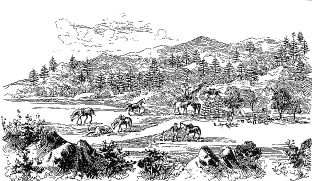
It is only partly a day's rest—for I, at least, have plenty to do; but it is a respite, and we can drink our fill of water. And oh! what a pleasure, what a luxury that is! How few in civilisation will drink water when they can get anything else. Let them try going without, in the explorer's sense of the expression, and then see how they will long for it! The figs on the largest tree, near the cave opposite, are quite ripe and falling; neither Carmichael nor Robinson care for them, but I eat a good many, though I fancy they are not quite wholesome for a white man's digestive organs; at first, they act as an aperient, but subsequently have an opposite effect. I called this charming little oasis Glen Edith, after one of my nieces. I marked two gum-trees at this camp, one “Giles 24”, and another “Glen Edith 24 Oct 9, 72”. Mr. Carmichael and Robinson also marked one with their names. The receptacle in which I found the water I have called the Tarn of Auber, after Allan Poe's beautiful lines, in which that name appears, as I thought them appropriate to the spot. He says:—
“It was in the drear month of October,
The leaves were all crisped and sere,
Adown by the Tarn of Auber,
In the misty mid regions of Weir.”
If these are not the misty mid regions of Weir, I don't know where they are. There are two heaps of broken sandstone rocks, with cypress pines growing about them, which will always be a landmark for any future traveller who may seek the wild seclusion of these sequestered caves. The bearing of the water from them is south 51° west, and it is about a mile on that bearing from the northern heap; that with a glance at my map would enable any ordinary bushman to find it. I sowed a quantity of vegetable seeds here, also seeds of the Tasmanian blue gum-tree, some wattles and clover, rye and prairie-grass. In the bright gleams of the morning, in this Austral land of dawning, it was beautiful to survey this little spot; everything seemed in miniature here—little hills, little glen, little trees, little tarn, and little water. Though the early mornings were cool and pleasant, the days usually turned out just the opposite. On the 11th Mr. Carmichael and I got fresh horses, and I determined to try the country more to the south, and leaving Alec Robinson and the little dog Monkey again in charge of glen, and camp, and tarn, away we went in that direction. At first we travelled over sandhills, timbered with the fine Casuarina decaisneana, or desert oak; we then met some eucalyptus-trees growing promiscuously on the tops of the sandhills, as well as in the hollows. At twelve miles we rode over a low ridge; the country in advance appeared no more inviting than that already travelled. Descending to the lower ground, however, we entered upon a bit of better country, covered with green grass, there was also some thick mulga scrub upon it. Here we saw a few kangaroos and emus, but could not get a shot at them. Beyond this we entered timbered country again, the desert oak being quite a desert sign. In a few miles farther another ridge fronted us, and a trifle on our left lay a hollow, or valley, which seemed to offer the best road, but we had to ride through some very scrubby gullies, stony, and covered with spinifex. It eventually formed the valley of a small creek, which soon had a few gum-trees on it. After following this about four miles, we saw a place where the sand was damp, and got some water by scratching with our hands. The supply was insufficient, and we went farther down and found a small hole with just enough for our three horses, and now, having found a little, we immediately wanted to find a great deal more. At twenty-six miles from the tarn we found a place where the natives had dug, and there seemed a good supply, so we camped there for the night. The grass along this creek was magnificent, being about eight inches high and beautifully green, the old grass having been burnt some time ago. It was a most refreshing sight to our triodia-accustomed eyes; at twelve o'clock the thermometer stood at 94° in the shade. The trend of this little creek, and the valley in which it exists, is to the south-east. Having found water here, we were prepared to find numerous traces of natives, and soon saw old camps and wurleys, and some recent footmarks. I was exceedingly gratified to find this water, as I hoped it would eventually enable me to get out of the wretched bed of sand and scrub into which we had been forced since leaving the Finke, and which evidently occupies such an enormous extent of territory. Our horses fed all night close at hand, and we were in our saddles early enough. I wanted to go west, and the further west the better; but we decided to follow the creek and see what became of it, and if any more waters existed in it. We found that it meandered through a piece of open plain, splendidly grassed, and delightful to gaze upon. How beautiful is the colour of green! What other colour could even Nature have chosen with which to embellish the face of the earth? How, indeed, would red, or blue, or yellow pall upon the eye! But green, emerald green, is the loveliest of all Nature's hues. The soil of this plain was good and firm. The creek had now worn a deep channel, and in three miles from where we camped we came upon the top of a high red bank, with a very nice little water-hole underneath. There was abundance of water for 100 or 200 horses for a month or two, and plenty more in the sand below. Three other ponds were met lower down, and I believe water can always be got by digging. We followed the creek for a mile or two farther, and found that it soon became exhausted, as casuarina and triodia sandhills environed the little plain, and after the short course of scarcely ten miles, the little creek became swallowed up by those water-devouring monsters. This was named Laurie's Creek.
There was from 6000 to 10,000 acres of fine grass land in this little plain, and it was such a change from the sterile, triodia, and sandy country outside it, I could not resist calling it the Vale of Tempe. We left the exhausted creek, and in ten miles from our camp we entered on and descended into another valley, which was open, but had no signs of any water. From a hill I saw some ridges stretching away to the south and south-west, and to the west also appeared broken ridges. I decided to travel about south-west, as it appeared the least stony. In eight miles we had met the usual country. At eighteen we turned the horses out for an hour on a burnt patch, during which the thermometer stood at 94° in the shade; we then left for some ridges through a small gap or pass between two hills, which formed into a small creek-channel. As it was now dark, we camped near the pass, without water, having travelled thirty-five miles. In the morning we found the country in front of us to consist of a small well grassed plain, which was as green, as at the last camp. The horses rambled in search of water up into a small gully, which joins this one; it had a few gum-trees on it. We saw a place where the natives had dug for water, but not very recently. We scratched out a lot of sand with our hands, and some water percolated through, but the hole was too deep to get any out for the horses, as we had no means of removing the sand, having no shovel. Upon searching farther up the gully we found some good-sized rock-holes, but unfortunately they were all dry. We next ascended a hill to view the surrounding country, and endeavour to discover if there was any feature in any direction to induce us to visit, and where we might find a fresh supply of water. There were several fires raging in various directions upon the southern horizon, and the whole atmosphere was thick with a smoky haze. After a long and anxious scrutiny through the smoke far, very far away, a little to the west of south, I descried the outline of a range of hills, and right in the smoke of one fire an exceedingly high and abruptly-ending mountain loomed. To the south east-wards other ranges appeared; they seemed to lie nearly north and south.
The high mountain was very remote; it must be at least seventy or seventy-five miles away, with nothing apparently between but a country similar to that immediately before and behind us; that is to say, sandhills and scrub. I was, however, delighted to perceive any feature for which to make as a medium point, and which might help to change the character and monotony of the country over which I have been wandering so long. I thought it not improbable that some extensive watercourses may proceed from these new ranges which might lead me at last away to the west. For the present, not being able to get water at this little glen, although I believe a supply can be obtained with a shovel, I decided to return to the tarn at Glen Edith, which was now fifty-five miles away, remove the camp to the newly-found creek at the Vale of Tempe, and then return here, open out this watering place with a shovel, and make a straight line for the newly-discovered high mountain to the south. By the time these conclusions had been arrived at, and our wanderings about the rocks completed, it was nearly midday; and as we had thirty-five miles to travel to get back to the creek, it took us all the remainder of the day to do so; and it was late when we again encamped upon its friendly banks. The thermometer to-day had stood at 96°. We now had our former tracks to return upon to the tarn. The morning was cool and pleasant, and we arrived at the depot early. Alec Robinson informed me that he believed some natives had been prowling about the camp in our absence, as the little dog had been greatly perturbed during two of the nights we were away. It was very possible that some natives had come to the tarn for water, as well as to spy out who and what and how many vile and wicked intruders had found their way into this secluded spot; but as they must have walked about on the rocks they left no traces of their visit.
OCTOBER 15TH.
This morning's meal was to be the last we should make at our friendly little tarn, whose opportune waters, ripe figs, miniature mountains, and imitation fortresses, will long linger in my recollection. Opposite the rocks in which the water lies, and opposite the camp also, is a series of small fort-like stony eminences, standing apart; these form one side of the glen; the other is formed by the rocks at the base of the main ridge, where the camp and water are situated. This really was a most delightful little spot, though it certainly had one great nuisance, which is almost inseparable from pine-trees, namely ants. These horrid pests used to crawl into and over everything and everybody, by night as well as by day. The horses took their last drink at the little sweet-watered tarn, and we moved away for our new home to the south.
Move the camp to new creek. Revisit the pass. Hornets and diamond birds. More ornamented caves. Map study. Start for the mountain. A salt lake. A barrier. Brine ponds. Horses nearly lost. Exhausted horses. Follow the lake. A prospect wild and weird. Mount Olga. Sleepless animals. A day's rest. A National Gallery. Signal for natives. The lake again. High hill westward. Mount Unapproachable. McNicol's range. Heat increasing. Sufferings and dejection of the horses. Worrill's Pass. Glen Thirsty. Food all gone. Review of our situation. Horse staked. Pleasure of a bath. A journey eastward. Better regions. A fine creek. Fine open country. King's Creek. Carmichael's Crag. Penny's Creek. Stokes's Creek. A swim. Bagot's Creek. Termination of the range. Trickett's Creek. George Gill's range. Petermann's Creek. Return. Two natives. A host of aborigines. Break up the depot. Improvement in the horses. Carmichael's resolve. Levi's Range. Follow the Petermann. Enter a glen. Up a tree. Rapid retreat. Escape glen. A new creek. Fall over a bank. Middleton's Pass. Good country. Friendly natives. Rogers's Pass. Seymour's Range. A fenced-in water-hole. Briscoe's Pass. The Finke. Resight the pillar. Remarks on the Finke. Reach the telegraph line. Native boys. I buy one. The Charlotte Waters. Colonel Warburton. Arrive at the Peake. News of Dick. Reach Adelaide.
It was late in the day when we left Glen Edith, and consequently very much later by the time we had unpacked all the horses at the end of our twenty-nine mile stage; it was then too dark to reach the lower or best water-holes. To-day there was an uncommon reversal of the usual order in the weather—the early part of the day being hot and sultry, but towards evening the sky became overcast and cloudy, and the evening set in cold and windy. Next morning we found that one horse had staked himself in the coronet very severely, and that he was quite lame. I got some mulga wood out of the wound, but am afraid there is much still remaining. This wood, used by the natives for spear-heads, contains a virulent poisonous property, and a spear or stake wound with it is very dangerous. The little mare that foaled at Mount Udor, and was such an object of commiseration, has picked up wonderfully, and is now in good working condition. I have another mare, Marzetti, soon to foal; but as she is fat, I do not anticipate having to destroy her progeny. We did not move the camp to-day. Numbers of bronze-winged pigeons came to drink, and we shot several of them. The following day Mr. Carmichael and I again mounted our horses, taking with us a week's supply of rations, and started off intending to visit the high mountain seen at our last farthest point. We left Alec Robinson again in charge of the camp, as he had now got quite used to it, and said he liked it. He always had my little dog Monkey for a companion. When travelling through the spinifex we carried the little animal. He is an excellent watchdog, and not a bird can come near the camp without his giving warning. Alec had plenty of firearms and ammunition to defend himself with, in case of an attack from the natives. This, however, I did not anticipate; indeed, I wished they would come (in a friendly way), and had instructed Alec to endeavour to detain one or two of them until my return if they should chance to approach. Alec was a very strange, indeed disagreeable and sometimes uncivil, sort of man; he had found our travels so different from his preconceived ideas, as he thought he was going on a picnic, and he often grumbled and declared he would like to go back again. However, to remain at the camp, with nothing whatever to do and plenty to eat, admirably suited him, and I felt no compunction in leaving him by himself. I would not have asked him to remain if I were in any way alarmed at his position.
We travelled now by a slightly different route, more easterly, as there were other ridges in that direction, and we might find another and better watering place than that at the pass. It is only at or near ridges in this strange region that the traveller can expect to find water, as in the sandy beds of scrub intervening between them, water would simply sink away. We passed through some very thick mulga, which, being mostly dead, ripped our pack-bags, clothes, and skin, as we had continually to push the persistent boughs and branches aside to penetrate it. We reached a hill in twenty miles, and saw at a glance that no favourable signs of obtaining water existed, for it was merely a pile of loose stones or rocks standing up above the scrubs around. The view was desolate in the extreme; we had now come thirty miles, but we pushed on ten miles for another hill, to the south-east, and after penetrating the usual scrub, we reached its base in the dark, and camped. In the morning I climbed the hill, but no water could be seen or procured. This hill was rugged with broken granite boulders, scrubby with mulga and bushes, and covered with triodia to its summit. To the south a vague and strange horizon was visible; it appeared flat, as though a plain of great extent existed there, but as the mirage played upon it, I could not make anything of it. My old friend the high mountain loomed large and abrupt at a great distance off, and it bore 8° 30´ west from here, too great a distance for us to proceed to it at once, without first getting water for our horses, as it was possible that no water might exist even in the neighbourhood of such a considerable mountain. The horses rambled in the night; when they were found we started away for the little pass and glen where we knew water was to be got, and which was now some thirty miles away to the west-north-west. We reached it somewhat late. The day was hot, thermometer 98° in shade, and the horses very thirsty, but they could get no water until we had dug a place for them. Although we had reached our camping ground our day's work was only about to commence. We were not long in obtaining enough water for ourselves, such as it was—thick and dirty with a nauseous flavour—but first we had to tie the horses up, to prevent them jumping in on us. We found to our grief that but a poor supply was to be expected, and though we had not to dig very deep, yet we had to remove an enormous quantity of sand, so as to create a sufficient surface to get water to run in, and had to dig a tank twenty feet long by six feet deep, and six feet wide at the bottom, though at the top it was much wider. I may remark—and what I now say applies to almost every other water I ever got by digging in all my wanderings—that whenever we commenced to dig, a swarm of large and small red hornets immediately came around us, and, generally speaking, diamond birds (Amadina) would also come and twitter near, and when water was got, would drink in great numbers. With regard to the hornets, though they swarmed round our heads and faces in clouds, no one was ever stung by them, nature and instinct informing them that we were their friends. We worked and waited for two hours before one of our three horses could obtain a drink. The water came so slowly in that it took nearly all the night before the last animal's thirst was assuaged, as by the time the third got a drink, the first was ready to begin again, and they kept returning all through the night. We rested our horses here to-day to allow them to fill themselves with food, as no doubt they will require all the support they can get to sustain them in their work before we reach the distant mountain. We passed the day in enlarging the tank, and were glad to find that, though no increase in the supply of water was observable, still there seemed no diminution, as now a horse could fill himself at one spell. We took a stroll up into the rocks and gullies of the ridges, and found a Troglodytes' cave ornamented with the choicest specimens of aboriginal art. The rude figures of snakes were the principal objects, but hands, and devices for shields were also conspicuous. One hieroglyph was most striking; it consisted of two Roman numerals—a V and an I, placed together and representing the figure VI; they were both daubed over with spots, and were painted with red ochre. Several large rock-holes were seen, but they had all long lain dry. A few cypress pines grew upon the rocks in several places. The day was decidedly hot; the thermometer stood at 100° in the shade at three o'clock, and we had to fix up a cloth for an awning to get sufficient shade to sit under. Our only intellectual occupation was the study of a small map of Australia, showing the routes of the Australian explorers. How often we noted the facility with which other and more fortunate travellers dropped upon fine creeks and large rivers. We could only envy them their good fortune, and hope the future had some prizes in store for us also. The next morning, after taking three hours to water our horses, we started on the bearing of the high mount, which could not be seen from the low ground, the bearing being south 18° west. We got clear of the low hills of the glen, and almost immediately entered thick scrubs, varied by high sandhills, with casuarina and triodia on them. At twelve miles I noticed the sandhills became denuded of timber, and on our right a small and apparently grassy plain was visible; I took these signs as a favourable indication of a change of country. At three miles farther we had a white salt channel right in front of us, with some sheets of water in it; upon approaching I found it a perfect bog, and the water brine itself. We went round this channel to the left, and at length found a place firm enough to cross. We continued upon our course, and on ascending a high sandhill I found we had upon our right hand, and stretching away to the west, an enormous salt expanse, and it appeared as if we had hit exactly upon the eastern edge of it, at which we rejoiced greatly for a time. Continuing on our course over treeless sandhills for a mile or two, we found we had not escaped this feature quite so easily, for it was now right in our road; it appeared, however, to be bounded by sandhills a little more to the left, eastwards; so we went in that direction, but at each succeeding mile we saw more and more of this objectionable feature; it continually pushed us farther and farther to the east, until, having travelled about fifteen miles, and had it constantly on our right, it swept round under some more sandhills which hid it from us, till it lay east and west right athwart our path. It was most perplexing to me to be thus confronted by such an obstacle. We walked a distance on its surface, and to our weight it seemed firm enough, but the instant we tried our horses they almost disappeared. The surface was dry and encrusted with salt, but brine spurted out at every step the horses took. We dug a well under a sandhill, but only obtained brine.
This obstruction was apparently six or seven miles across, but whether what we took for its opposite shores were islands or the main, I could not determine. We saw several sandhill islands, some very high and deeply red, to which the mirage gave the effect of their floating in an ocean of water. Farther along the shore eastwards were several high red sandhills; to these we went and dug another well and got more brine. We could see the lake stretching away east or east-south-east as far as the glasses could carry the vision. Here we made another attempt to cross, but the horses were all floundering about in the bottomless bed of this infernal lake before we could look round. I made sure they would be swallowed up before our eyes. We were powerless to help them, for we could not get near owing to the bog, and we sank up over our knees, where the crust was broken, in hot salt mud. All I could do was to crack my whip to prevent the horses from ceasing to exert themselves, and although it was but a few moments that they were in this danger, to me it seemed an eternity. They staggered at last out of the quagmire, heads, backs, saddles, everything covered with blue mud, their mouths were filled with salt mud also, and they were completely exhausted when they reached firm ground. We let them rest in the shade of some quandong trees, which grew in great numbers round about here. From Mount Udor to the shores of this lake the country had been continually falling. The northern base of each ridge, as we travelled, seemed higher by many feet than the southern, and I had hoped to come upon something better than this. I thought such a continued fall of country might lead to a considerable watercourse or freshwater basin; but this salt bog was dreadful, the more especially as it prevented me reaching the mountain which appeared so inviting beyond.
Not seeing any possibility of pushing south, and thinking after all it might not be so far round the lake to the west, I turned to where we had struck the first salt channel, and resolved to try what a more westerly line would produce. The channel in question was now some fifteen miles away to the north-westward, and by the time we got back there the day was done and “the darkness had fallen from the wings of night.” We had travelled nearly fifty miles, the horses were almost dead; the thermometer stood at 100° in the shade when we rested under the quandongs. In the night blankets were unendurable. Had there been any food for them the horses could not eat for thirst, and were too much fatigued by yesterday's toil to go out of sight of our camping place. We followed along the course of the lake north of west for seven miles, when we were checked by a salt arm running north-eastwards; this we could not cross until we had gone up it a distance of three miles. Then we made for some low ridges lying west-south-west and reached them in twelve miles. There was neither watercourse, channel, nor rock-holes; we wandered for several miles round the ridges, looking for water, but without success, and got back on our morning's tracks when we had travelled thirty miles. From the top of these ridges the lake could be seen stretching away to the west or west-south-west in vast proportions, having several salt arms running back from it at various distances. Very far to the west was another ridge, but it was too distant for me to reach now, as to-night the horses would have been two nights without water, and the probability was they would get none there if they reached it. I determined to visit it, however, but I felt I must first return to the tank in the little glen to refresh the exhausted horses. From where we are, the prospect is wild and weird, with the white bed of the great lake sweeping nearly the whole southern horizon. The country near the lake consists of open sandhills, thickly bushed and covered with triodia; farther back grew casuarinas and mulga scrubs.
It was long past the middle of the day when I descended from the hill. We had no alternative but to return to the only spot where we knew water was to be had; this was now distant twenty-one miles to the north-east, so we departed in a straight line for it. I was heartily annoyed at being baffled in my attempt to reach the mountain, which I now thought more than ever would offer a route out of this terrible region; but it seemed impossible to escape from it. I named this eminence Mount Olga, and the great salt feature which obstructed me Lake Amadeus, in honour of two enlightened royal patrons of science. The horses were now exceedingly weak; the bogging of yesterday had taken a great deal of strength out of them, and the heat of the last two days had contributed to weaken them (the thermometer to-day went up to 101° in shade). They could now only travel slowly, so that it was late at night when we reached the little tank. Fifty miles over such disheartening country to-day has been almost too much for the poor animals. In the tank there was only sufficient water for one horse; the others had to be tied up and wait their turns to drink, and the water percolated so slowly through the sand it was nearly midnight before they were all satisfied and begun to feed. What wonderful creatures horses are! They can work for two and three days and go three nights without water, but they can go for ever without sleep; it is true they do sleep, but equally true that they can go without sleeping. If I took my choice of all creation for a beast to guard and give me warning while I slept, I would select the horse, for he is the most sleepless creature Nature has made. Horses seem to know this; for if you should by chance catch one asleep he seems very indignant either with you or himself.
It was absolutely necessary to give our horses a day's rest, as they looked so much out of sorts this morning. A quarter of the day was spent in watering them, and by that time it was quite hot, and we had to erect an awning for shade. We were overrun by ants, and pestered by flies, so in self-defence we took another walk into the gullies, revisited the aboriginal National Gallery of paintings and hieroglyphics, and then returned to our shade and our ants. Again we pored over the little German map, and again envied more prosperous explorers. The thermometer had stood at 101° in the shade, and the greatest pleasure we experienced that day was to see the orb of day descend. The atmosphere had been surcharged all day with smoke, and haze hung over all the land, for the Autochthones were ever busy at their hunting fires, especially upon the opposite side of the great lake; but at night the blaze of nearer ones kept up a perpetual light, and though the fires may have been miles away they appeared to be quite close. I also had fallen into the custom of the country, and had set fire to several extensive beds of triodia, which had burned with unabated fury; so brilliant, indeed, was the illumination that I could see to read by the light. I kindled these fires in hopes some of the natives might come and interview us, but no doubt in such a poorly watered region the native population cannot be great, and the few who do inhabit it had evidently abandoned this particular portion of it until rains should fall and enable them to hunt while water remained in it.
Last night, the 23rd October, was sultry, and blankets utterly useless. The flies and ants were wide awake, and the only thing we could congratulate ourselves upon, was the absence of mosquitoes. At dawn the thermometer stood at 70° and a warm breeze blew gently from the north. The horses were found early, but as it took nearly three hours to water them we did not leave the glen till past eight o'clock. This time I intended to return to the ridges we had last left, and which now bore a little to the west of south-west, twenty-one miles away. We made a detour so as to inspect some other ridges near where we had been last. Stony and low ridgy ground was first met, but the scrubs were all around. At fifteen miles we came upon a little firm clayey plain with some salt bushes, and it also had upon it some clay pans, but they had long been dry. We found the northern face of the ridges just as waterless as the southern, which we had previously searched. The far hills or ridges to the west, which I now intended to visit, bore nearly west. Another salt bush plain was next crossed; this was nearly three miles long. We now gave the horses an hour's spell, the thermometer showing 102° in the shade; then, re-saddling, we went on, and it was nine o'clock at night when we found ourselves under the shadows of the hills we had steered for, having them on the north of us.
I searched in the dark, but could find no feature likely to supply us with water; we had to encamp in a nest of triodia without any water, having travelled forty-eight miles through the usual kind of country that occupies this region's space. At daylight the thermometer registered 70°, that being the lowest during the night. On ascending the hill above us, there was but one feature to gaze upon—the lake still stretching away, not only in undiminished, but evidently increasing size, towards the west and north-west. Several lateral channels were thrown out from the parent bed at various distances, some broad and some narrow. A line of ridges, with one hill much more prominent than any I had seen about this country, appeared close down upon the shores of the lake; it bore from the hill I stood upon south 68° west, and was about twenty miles off. A long broad salt arm, however, ran up at the back of it between it and me, but just opposite there appeared a narrow place that I thought we might cross to reach it.
The ridge I was on was red granite, but there was neither creek nor rock-hole about it. We now departed for the high hill westward, crossing a very boggy salt channel with great difficulty, at five miles; in five more we came to the arm. It appeared firm, but unfortunately one of the horses got frightfully bogged, and it was only by the most frantic exertions that we at length got him out. The bottom of this dreadful feature, if it has a bottom, seems composed entirely of hot, blue, briny mud. Our exertions in extricating the horse made us extremely thirsty; the hill looked more inviting the nearer we got to it, so, still hoping to reach it, I followed up the arm for about seven miles in a north west direction. It proved, however, quite impassable, and it seemed utterly useless to attempt to reach the range, as we could not tell how far we might have to travel before we could get round the arm. I believe it continues in a semicircle and joins the lake again, thus isolating the hill I wished to visit. This now seemed an island it was impossible to reach. We were sixty-five miles away from the only water we knew of, with no likelihood of any nearer; there might certainly be water at the mount I wished to reach, but it was unapproachable, and I called it by that name; no doubt, had I been able to reach it, my progress would still have been impeded to the west by the huge lake itself. I could get no water except brine upon its shores, and I had no appliances to distil that; could I have done so, I would have followed this feature, hideous as it is, as no doubt sooner or later some watercourses must fall into it either from the south or the west. We were, however, a hundred miles from the camp, with only one man left there, and sixty-five from the nearest water. I had no choice but to retreat, baffled, like Eyre with his Lake Torrens in 1840, at all points. On the southern shore of the lake, and apparently a very long way off, a range of hills bore south 30° west; this range had a pinkish appearance and seemed of some length. Mr. Carmichael wished me to call it McNicol's Range, after a friend of his, and this I did. We turned our wretched horses' heads once more in the direction of our little tank, and had good reason perhaps to thank our stars that we got away alive from the lone unhallowed shore of this pernicious sea. We kept on twenty-eight miles before we camped, and looked at two or three places, on the way ineffectually, for some signs of water, having gone forty-seven miles; thermometer in shade 103°, the heat increasing one degree a day for several days. When we camped we were hungry, thirsty, tired, covered all over with dry salt mud; so that it is not to be wondered at if our spirits were not at a very high point, especially as we were making a forced retreat. The night was hot, cloudy, and sultry, and rain clouds gathered in the sky. At about 1 a.m. the distant rumblings of thunder were heard to the west-north-west, and I was in hopes some rain might fall, as it was apparently approaching; the thunder was not loud, but the lightning was most extraordinarily vivid; only a few drops of rain fell, and the rest of the night was even closer and more sultry than before.
Ere the stars had left the sky we were in our saddles again; the horses looked most pitiable objects, their flanks drawn in, the natural vent was distended to an open and extraordinary cavity; their eyes hollow and sunken, which is always the case with horses when greatly in want of water. Two days of such stages will thoroughly test the finest horse that ever stepped. We had thirty-six miles yet to travel to reach the water. The horses being so jaded, it was late in the afternoon when they at last crawled into the little glen; the last few miles being over stones made the pace more slow. Not even their knowledge of the near presence of water availed to inspirit them in the least; probably they knew they would have to wait for hours at the tank, when they arrived, before their cravings for water could be appeased. The thermometer to-day was 104° in the shade. When we arrived the horses had walked 131 miles without a drink, and it was no wonder that the poor creatures were exhausted. When one horse had drank what little water there was, we had to re-dig the tank, for the wind or some other cause had knocked a vast amount of the sand into it again. Some natives also had visited the place while we were away, their fresh tracks were visible in the sand around, and on the top of the tank. They must have stared to see such a piece of excavation in their territory. When the horses did get water, two of them rolled, and groaned, and kicked, so that I thought they were going to die; one was a mare, she seemed the worst, another was a strong young horse which had carried me well, the third was my old favourite riding-horse; this time he had only carried the pack, and was badly bogged; he was the only one that did not appear distressed when filled with water, the other two lay about in evident pain until morning. About the middle of the night thunder was again heard, and flash after flash of even more vivid lightnings than that of the previous night enlightened the glen; so bright were the flashes, being alternately fork and sheet lightning, that for nearly an hour the glare never ceased. The thunder was much louder than last night's, and a slight mizzling rain for about an hour fell. The barometer had fallen considerably for the last two days, so I anticipated a change. The rain was too slight to be of any use; the temperature of the atmosphere, however, was quite changed, for by the morning the thermometer was down to 48°.
The horses were not fit to travel, so we had to remain, with nothing to do, but consult the little map again, and lay off my position on it. My farthest point I found to be in latitude 24° 38´ and longitude 130°. For the second time I had reached nearly the same meridian. I had been repulsed at both points, which were about a hundred miles apart, in the first instance by dry stony ranges in the midst of dense scrubs, and in the second by a huge salt lake equally destitute of fresh water. It appears to me plain enough that a much more northerly or else more southerly course must be pursued to reach the western coast, at all events in such a country, it will be only by time and perseverance that any explorer can penetrate it. I think I remarked before that we entered this little glen through a pass about half-a-mile long, between two hills of red sandstone. I named this Worrill's Pass, after another friend of Mr. Carmichael. The little glen in which we dug out the tank I could only call Glen Thirsty, for we never returned to it but ourselves and our horses, were choking for water. Our supply of rations, although we had eked it out with the greatest possible economy, was consumed, for we brought only a week's supply, and we had now been absent ten days from home, and we should have to fast all to-morrow, until we reached the depot; but as the horses were unable to carry us, we were forced to remain.
During the day I had a long conversation with Mr. Carmichael upon our affairs in general, and our stock of provisions in particular; the conclusion we arrived at was, that having been nearly three months out, we had not progressed so far in the time as we had expected. We had found the country so dry that until rains fell, it seemed scarcely probable that we should be able to penetrate farther to the west, and if we had to remain in depot for a month or two, it was necessary by some means to economise our stores, and the only way to do so was to dispense with the services of Alec Robinson. It would be necessary, of course, in the first place, to find a creek to the eastward, which would take him to the Finke, and by the means of the same watercourse we might eventually get round to the southern shores of Lake Amadeus, and reach Mount Olga at last.
In our journey up the Finke two or three creeks had joined from the west, and as we were now beyond the sources of any of these, it would be necessary to discover some road to one or the other before Robinson could be parted with. By dispensing with his services, as he was willing to go, we should have sufficient provisions left to enable us to hold out for some months longer: even if we had to wait so long as the usual rainy season in this part of the country, which is about January and February, we should still have several months' provisions to start again with. In all these considerations Mr. Carmichael fully agreed, and it was decided that I should inform Alec of our resolution so soon as we returned to the camp. After the usual nearly three hours' work to water our horses, we turned our backs for the last time upon Glen Thirsty, where we had so often returned with exhausted and choking horses.
I must admit that I was getting anxious about Robinson and the state of things at the camp. In going through Worrill's Pass, we noticed that scarcely a tree had escaped from being struck by the lightning; branches and boughs lay scattered about, and several pines from the summits of the ridges had been blasted from their eminence. I was not very much surprised, for I expected to be lightning-struck myself, as I scarcely ever saw such lightning before. We got back to Robinson and the camp at 5 p.m. My old horse that carried the pack had gone quite lame, and this caused us to travel very slowly. Robinson was alive and quite well, and the little dog was overjoyed to greet us. Robinson reported that natives had been frequently in the neighbourhood, and had lit fires close to the camp, but would not show themselves. Marzetti's mare had foaled, the progeny being a daughter; the horse that was staked was worse, and I found my old horse had also ran a mulga stake into his coronet. I probed the wounds of both, but could not get any wood out. Carmichael and I both thought we would like a day's rest; and if I did not do much work, at least I thought a good deal.
The lame horses are worse: the poisonous mulga must be in the wounds, but I can't get it out. What a pleasure it is, not only to have plenty of water to drink, but actually to have sufficient for a bath! I told Robinson of my views regarding him, but said he must yet remain until some eastern waters could be found. On the 30th October, Mr. Carmichael and I, with three fresh horses, started again. In my travels southerly I had noticed a conspicuous range of some elevation quite distinct from the ridges at which our camp was fixed, and lying nearly east, where an almost overhanging crag formed its north-western face. This range I now decided to visit. To get out of the ridges in which our creek exists, we had to follow the trend of a valley formed by what are sometimes called reaphook hills; these ran about east-south-east. In a few miles we crossed an insignificant little creek with a few gum-trees; it had a small pool of water in its bed: the valley was well grassed and open, and the triodia was also absent. A small pass ushered us into a new valley, in which were several peculiar conical hills. Passing over a saddle-like pass, between two of them, we came to a flat, open valley running all the way to the foot of the new range, with a creek channel between. The range appeared very red and rocky, being composed of enormous masses of red sandstone; the upper portion of it was bare, with the exception of a few cypress pines, moored in the rifled rock, and, I suppose, proof to the tempest's shock. A fine-looking creek, lined with gum-trees, issued from a gorge. We followed up the channel, and Mr. Carmichael found a fine little sheet of water in a stony hole, about 400 yards long and forty yards wide. This had about four feet of water in it; the grass was green, and all round the foot of the range the country was open, beautifully grassed, green, and delightful to look at. Having found so eligible a spot, we encamped: how different from our former line of march! We strolled up through the rocky gorge, and found several rock reservoirs with plenty of water; some palm-like Zamias were seen along the rocks. Down the channel, about south-west, the creek passed through a kind of low gorge about three miles away. Smoke was seen there, and no doubt it was an encampment of the natives. Since the heavy though dry thunderstorm at Glen Thirsty, the temperature has been much cooler. I called this King's Creek. Another on the western flat beyond joins it. I called the north-west point of this range Carmichael's Crag. The range trended a little south of east, and we decided to follow along its southern face, which was open, grassy, and beautifully green; it was by far the most agreeable and pleasant country we had met.
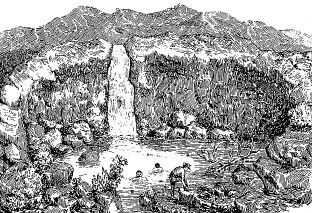
At about five miles we crossed another creek coming immediately out of the range, where it issued from under a high and precipitous wall of rock, underneath which was a splendid deep and pellucid basin of the purest water, which came rushing into and out of it through fissures in the mountain: it then formed a small swamp thickly set with reeds, which covered an area of several acres, having plenty of water among them. I called this Penny's Creek. Half a mile beyond it was a similar one and reed bed, but no such splendid rock reservoir. Farther along the range other channels issued too, with fine rock water-holes. At eighteen miles we reached a much larger one than we had yet seen: I hoped this might reach the Finke. We followed it into the range, where it came down through a glen: here we found three fine rock-holes with good supplies of water in them. The glen and rock is all red sandstone: the place reminded me somewhat of Captain Sturt's Depot Glen in the Grey ranges of his Central Australian Expedition, only the rock formation is different, though a cliff overhangs both places, and there are other points of resemblance. I named this Stokes's Creek.
We rested here an hour and had a swim in one of the rocky basins. How different to regions westward, where we could not get enough water to drink, let alone to swim in! The water ran down through the glen as far as the rock-holes, where it sank into the ground. Thermometer 102° to-day. We continued along the range, having a fine stretch of open grassy country to travel upon, and in five miles reached another creek, whose reed beds and water filled the whole glen. This I named Bagot's Creek. For some miles no other creek issued, till, approaching the eastern end of the range, we had a piece of broken stony ground and some mulga for a few miles, when we came to a sudden fall into a lower valley, which was again open, grassy, and green. We could then see that the range ended, but sent out one more creek, which meandered down the valley towards some other hills beyond; this valley was of a clayey soil, and the creek had some clay holes with water in them. Following it three miles farther, we found that it emptied itself into a much larger stony mountain stream; I named this Trickett's Creek, after a friend of Mr. Carmichael's. The range which had thrown out so many creeks, and contained so much water, and which is over forty miles in length, I named George Gill's Range, after my brother-in-law. The country round its foot is by far the best I have seen in this region; and could it be transported to any civilised land, its springs, glens, gorges, ferns, Zamias, and flowers, would charm the eyes and hearts of toil-worn men who are condemned to live and die in crowded towns.
The new creek now just discovered had a large stony water-hole immediately above and below the junction of Trickett's Creek, and as we approached the lower one, I noticed several native wurleys just deserted; their owners having seen us while we only thought of them, had fled at our approach, and left all their valuables behind. These consisted of clubs, spears, shields, drinking vessels, yam sticks, with other and all the usual appliances of well-furnished aboriginal gentlemen's establishments. Three young native dog-puppies came out, however, to welcome us, but when we dismounted and they smelt us, not being used to such refined odours as our garments probably exhaled, they fled howling. The natives had left some food cooking, and when I cooeyed they answered, but would not come near. This creek was of some size; it seemed to pass through a valley in a new range further eastwards. It came from the north-west, apparently draining the northern side of Gill's Range. I called it Petermann's Creek. We were now sixty-five miles from our depot, and had been most successful in our efforts to find a route to allow of the departure of Robinson, as it appeared that this creek would surely reach the Finke, though we afterwards found it did not. I intended upon returning here to endeavour to discover a line of country round the south-eastern extremity of Lake Amadeus, so as to reach Mount Olga at last. We now turned our horses' heads again for our home camp, and continued travelling until we reached Stokes's Creek, where we encamped after a good long day's march.
This morning, as we were approaching Penny's Creek, we saw two natives looking most intently at our outgoing horse tracks, along which they were slowly walking, with their backs towards us. They neither saw nor heard us until we were close upon their heels. Each carried two enormously long spears, two-thirds mulga wood and one-third reed at the throwing end, of course having the instrument with which they project these spears, called by some tribes of natives only, but indiscriminately all over the country by whites, a wommerah. It is in the form of a flat ellipse, elongated to a sort of tail at the holding end, and short-pointed at the projecting end; a kangaroo's claw or wild dog's tooth is firmly fixed by gum and gut-strings. The projectile force of this implement is enormous, and these spears can be thrown with the greatest precision for more than a hundred yards. They also had narrow shields, three to four feet long, to protect themselves from hostile spears, with a handle cut out in the centre. These two natives had their hair tied up in a kind of chignon at the back of the head, the hair being dragged back off the forehead from infancy. This mode gave them a wild though somewhat effeminate appearance; others, again, wear their hair in long thick curls reaching down the shoulders, beautifully elaborated with iguanas' or emus' fat and red ochre. This applies only to the men; the women's hair is worn either cut with flints or bitten off short. So soon as the two natives heard, and then looking round saw us, they scampered off like emus, running along as close to the ground as it is possible for any two-legged creature to do. One was quite a young fellow, the other full grown. They ran up the side of the hills, and kept travelling along parallel to us; but though we stopped and called, and signalled with boughs, they would not come close, and the oftener I tried to come near them on foot, the faster they ran. They continued alongside us until King's Creek was reached, where we rested the horses for an hour. We soon became aware that a number of natives were in our vicinity, our original two yelling and shouting to inform the others of our advent, and presently we saw a whole nation of them coming from the glen or gorge to the south-west, where I had noticed camp-fires on my first arrival here. The new people were also shouting and yelling in the most furious and demoniacal manner; and our former two, as though deputed by the others, now approached us much nearer than before, and came within twenty yards of us, but holding their spears fixed in their wommerahs, in such a position that they could use them instantly if they desired. The slightest incident might have induced them to spear us, but we appeared to be at our ease, and endeavoured to parley with them. The men were not handsome or fat, but were very well made, and, as is the case with most of the natives of these parts, were rather tall, namely five feet eight and nine inches. When they had come close enough, the elder began to harangue us, and evidently desired us to know that we were trespassers, and were to be off forthwith, as he waved us away in the direction we had come from. The whole host then took up the signal, howled, yelled, and waved their hands and weapons at us. Fortunately, however, they did not actually attack us; we were not very well prepared for attack, as we had only a revolver each, our guns and rifles being left with Robinson. As our horses were frightened and would not feed, we hurried our departure, when we were saluted with rounds of cheers and blessings, i.e. yells and curses in their charming dialect, until we were fairly out of sight and hearing. On reaching the camp, Alec reported that no natives had been seen during our absence. On inspecting the two lame horses, it appeared they were worse than ever.
We had a very sudden dry thunderstorm, which cooled the air. Next day I sent Alec and Carmichael over to the first little five-mile creek eastwards with the two lame horses, so that we can pick them up en route to-morrow. They reported that the horses could scarcely travel at all; I thought if I could get them to Penny's Creek I would leave them there. This little depot camp was at length broken up, after it had existed here from 15th October to 5th November. I never expected, after being nearly three months out, that I should be pushing to the eastwards, when every hope and wish I had was to go in exactly the opposite direction, and I could only console myself with the thought that I was going to the east to get to the west at last. I have great hopes that if I can once set my foot upon Mount Olga, my route to the west may be unimpeded. I had not seen all the horses together for some time, and when they were mustered this morning, I found they had all greatly improved in condition, and almost the fattest among them was the little mare that had foaled at Mount Udor. Marzetti's mare looked very well also.
It was past midday when we turned our backs upon Tempe's Vale. At the five-mile creek we got the two lame horses, and reached King's Creek somewhat late in the afternoon. As we neared it, we saw several natives' smokes, and immediately the whole region seemed alive with aborigines, men, women, and children running down from the highest points of the mountain to join the tribe below, where they all congregated. The yelling, howling, shrieking, and gesticulating they kept up was, to say the least, annoying. When we began to unpack the horses, they crowded closer round us, carrying their knotted sticks, long spears, and other fighting implements. I did not notice any boomerangs among them, and I did not request them to send for any. They were growing very troublesome, and evidently meant mischief. I rode towards a mob of them and cracked my whip, which had no effect in dispersing them. They made a sudden pause, and then gave a sudden shout or howl. It seemed as if they knew, or had heard something, of white men's ways, for when I unstrapped my rifle, and holding it up, warning them away, to my great astonishment they departed; they probably wanted to find out if we possessed such things, and I trust they were satisfied, for they gave us up apparently as a bad lot.
It appeared the exertion of travelling had improved the go of the lame horses, so I took them along with the others in the morning; I did not like the idea of leaving them anywhere on this range, as the natives would certainly spear, and probably eat them. We got them along to Stokes's Creek, and encamped at the swimming rock-hole.
After our frugal supper a circumstance occurred which completely put an end to my expedition. Mr. Carmichael informed me that he had made up his mind not to continue in the field any longer, for as Alec Robinson was going away, he should do so too. Of course I could not control him; he was a volunteer, and had contributed towards the expenses of the expedition. We had never fallen out, and I thought he was as ardent in the cause of exploration as I was, so that when he informed me of his resolve it came upon me as a complete surprise. My arguments were all in vain; in vain I showed how, with the stock of provisions we had, we might keep the field for months. I even offered to retreat to the Finke, so that we should not have such arduous work for want of water, but it was all useless.
It was with distress that I lay down on my blankets that night, after what he had said. I scarcely knew what to do. I had yet a lot of horses heavily loaded with provisions; but to take them out into a waterless, desert country by myself, was impossible. We only went a short distance—to Bagot's Creek, where I renewed my arguments. Mr. Carmichael's reply was, that he had made up his mind and nothing should alter it; the consequence was that with one companion I had, so to speak, discharged, and another who discharged himself, any further exploration was out of the question. I had no other object now in view but to hasten my return to civilisation, in hopes of reorganising my expedition. We were now in full retreat for the telegraph line; but as I still traversed a region previously unexplored, I may as well continue my narrative to the close. Marzetti's foal couldn't travel, and had to be killed at Bagot's Creek.
On Friday, the 8th November, the party, now silent, still moved under my directions. We travelled over the same ground that Mr. Carmichael and I had formerly done, until we reached the Petermann in the Levi Range. The natives and their pups had departed. The hills approached this creek so close as to form a valley; there were several water-holes in the creek; we followed its course as far as the valley existed. When the country opened, the creek spread out, and the water ceased to appear in its bed. We kept moving all day; towards evening I saw some gum-trees under some hills two or three miles southwards, and as some smoke appeared above the hills, I knew that natives must have been there lately, and that water might be got there. Accordingly, leaving Carmichael and Robinson to go on with the horses, I rode over, and found there was the channel of a small creek, which narrowed into a kind of glen the farther I penetrated. The grass was burning on all the hillsides, and as I went still farther up, I could hear the voices of the natives, and I felt pretty sure of finding water. I was, however, slightly anxious as to what reception I should get. I soon saw a single native leisurely walking along in front of me with an iguana in his hand, taking it home for supper. He carried several spears, a wommerah, and a shield, and had long curled locks hanging down his shoulders. My horse's nose nearly touched his back before he was aware of my presence, when, looking behind him, he gave a sudden start, held up his two hands, dropped his iguana and his spears, uttered a tremendous yell as a warning to his tribe, and bounded up the rocks in front of us like a wallaby. I then passed under a eucalyptus-tree, in whose foliage two ancient warriors had hastily secreted themselves. I stopped a second and looked up at them, they also looked at me; they presented a most ludicrous appearance. A little farther on there were several rows of wurleys, and I could perceive the men urging the women and children away, as they doubtless supposed many more white men were in company with me, never supposing I could possibly be alone. While the women and children were departing up the rocks, the men snatched up spears and other weapons, and followed the women slowly towards the rocks. The glen had here narrowed to a gorge, the rocks on either side being not more than eighty to a hundred feet high. It is no exaggeration to say that the summits of the rocks on either side of the glen were lined with natives; they could almost touch me with their spears. I did not feel quite at home in this charming retreat, although I was the cynosure of a myriad eyes. The natives stood upon the edge of the rocks like statues, some pointing their spears menacingly towards me, and I certainly expected that some dozens would be thrown at me. Both parties seemed paralysed by the appearance of the other. I scarcely knew what to do; I knew if I turned to retreat that every spear would be launched at me. I was, metaphorically, transfixed to the spot. I thought the only thing to do was to brave the situation out, as
“Cowards, 'tis said, in certain situations
Derive a sort of courage from despair;
And then perform, from downright desperation,
Much bolder deeds than many a braver man would dare.”
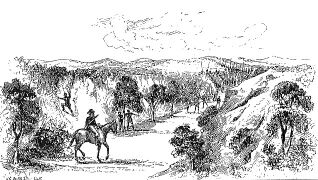
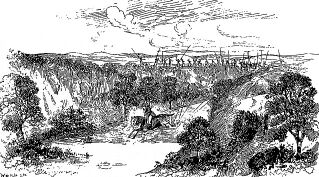
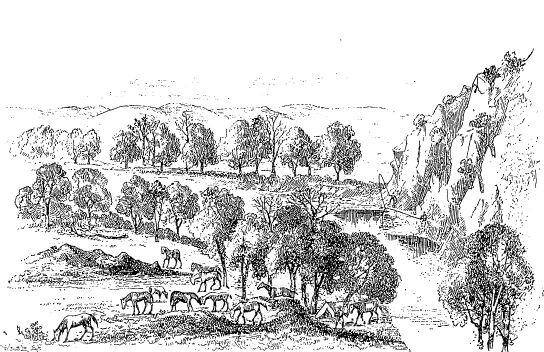
I was choking with thirst, though in vain I looked for a sheet of water; but seeing where they had dug out some sand, I advanced to one or two wells in which I could see water, but without a shovel only a native could get any out of such a funnel-shaped hole. In sheer desperation I dismounted and picked up a small wooden utensil from one of the wurleys, thinking if I could only get a drink I should summon up pluck for the last desperate plunge. I could only manage to get up a few mouthfuls of dirty water, and my horse was trying to get in on top of me. So far as I could see, there were only two or three of these places where all those natives got water. I remounted my horse, one of the best and fastest I have. He knew exactly what I wanted because he wished it also, and that was to be gone. I mounted slowly with my face to the enemy, but the instant I was on he sprang round and was away with a bound that almost left me behind; then such demoniacal yells greeted my ears as I had never heard before and do not wish to hear again; the echoes of the voices of these now indignant and infuriated creatures reverberating through the defiles of the hills, and the uncouth sounds of the voices themselves smote so discordantly on my own and my horse's ears that we went out of that glen faster, oh! ever so much faster, than we went in. I heard a horrid sound of spears, sticks, and other weapons, striking violently upon the ground behind me, but I did not stop to pick up any of them, or even to look round to see what caused it. Upon rejoining my companions, as we now seldom spoke to one another, I merely told them I had seen water and natives, but that it was hardly worth while to go back to the place, but that they could go if they liked. Robinson asked me why I had ridden my horse West Australian—shortened to W.A., but usually called Guts, from his persistent attention to his “inwards”—so hard when there seemed no likelihood's of our getting any water for the night? I said, “Ride him back and see.” I called this place Escape Glen. In two or three miles after I overtook them, the Petermann became exhausted on the plains. We pushed on nearly east, as now we must strike the Finke in forty-five to fifty miles; but we had to camp that night without water. The lame horses went better the farther they were driven. I hoped to travel the lameness out of them, as instances of that kind have occurred with me more than once. We were away from our dry camp early, and had scarcely proceeded two miles when we struck the bank of a broad sandy-bedded creek, which was almost as broad as the Finke itself: just where we struck it was on top of a red bank twenty or thirty feet high. The horses naturally looking down into the bed below, one steady old file of a horse, that carried my boxes with the instruments, papers, quicksilver, etc., went too close, the bank crumbled under him, and down he fell, raising a cloud of red dust. I rode up immediately, expecting to see a fine smash, but no, there he was, walking along on the sandy bed below, as comfortable as he had been on top, not a strap strained or a box shifted in the least. The bed here was dry. Robinson rode on ahead and shortly found two fine large ponds under a hill which ended abruptly over them. On our side a few low ridges ran to meet it, thus forming a kind of pass. Here we outspanned; it was a splendid place. Carmichael and Robinson caught a great quantity of fish with hook and line. I called these Middleton's Pass and Fish Ponds. The country all round was open, grassy, and fit for stock. The next day we got plenty more fish; they were a species of perch, the largest one caught weighed, I dare say, three pounds; they had a great resemblance to Murray cod, which is a species of perch. I saw from the hill overhanging the water that the creek trended south-east. Going in that direction we did not, however, meet it; so turning more easterly, we sighted some pointed hills, and found the creek went between them, forming another pass, where there was another water-hole under the rocks. This, no doubt, had been of large dimensions, but was now gradually getting filled with sand; there was, however, a considerable quantity of water, and it was literally alive with fish, insomuch that the water had a disagreeable and fishy taste. Great numbers of the dead fish were floating upon the water. Here we met a considerable number of natives, and although the women would not come close, several of the men did, and made themselves useful by holding some of the horses' bridles and getting firewood. Most of them had names given them by their godfathers at their baptism, that is to say, either by the officers or men of the Overland Telegraph Construction parties. This was my thirty-second camp; I called it Rogers's Pass; twenty-two miles was our day's stage. From here two conspicuous semi-conical hills, or as I should say, truncated cones, of almost identical appearance, caught my attention; they bore nearly south 60° east.
Bidding adieu to our sable friends, who had had breakfast with us and again made themselves useful, we started for the twins. To the south of them was a range of some length; of this the twins formed a part. I called it Seymour's Range, and a conic hill at its western end Mount Ormerod. We passed the twins in eleven miles, and found some water in the creek near a peculiar red sandstone hill, Mount Quin; the general course of the creek was south 70° east. Seymour's Range, together with Mounts Quin and Ormerod, had a series of watermarks in horizontal lines along their face, similar to Johnston's Range, seen when first starting, the two ranges lying east and west of one another; the latter-named range we were again rapidly approaching. Not far from Mount Quin I found some clay water-holes in a lateral channel. The creek now ran nearly east, and having taken my latitude this morning by Aldeberan, I was sure of what I anticipated, namely, that I was running down the creek I had called Number 2. It was one that joined the Finke at my outgoing Number 2 camp. We found a water-hole to-day, fenced in by the natives. There was a low range to the south-west, and a tent-shaped hill more easterly. We rested the horses at the fenced-in water-hole. I walked to the top of the tent hill, and saw the creek went through another pass to the north-east. In the afternoon I rode over to this pass and found some ponds of water on this side of it. A bullock whose tracks I had seen further up the creek had got bogged here. We next travelled through the pass, which I called Briscoe's Pass, the creek now turning up nearly north-east; in six miles further it ran under a hill, which I well remembered in going out; at thirteen miles from the camp it ended in the broader bosom of the Finke, where there was a fine water-hole at the junction, in the bed of the smaller creek, which was called the Palmer. The Finke now appeared very different to when we passed up. It then had a stream of water running along its channel, but was now almost dry, except that water appeared at intervals upon the surface of the white and sandy bed, which, however, was generally either salty or bitter; others, again, were drinkable enough. Upon reaching the river we camped.
My expedition was over. I had failed certainly in my object, which was to penetrate to the sources of the Murchison River, but not through any fault of mine, as I think any impartial reader will admit. Our outgoing tracks were very indistinct, but yet recognisable; we camped again at Number 1. Our next line was nearly east, along the course of the Finke, passing a few miles south of Chambers's Pillar. I had left it but twelve weeks and four days; during that interval I had traversed and laid down over a thousand miles of previously totally unknown country. Had I been fortunate enough to have fallen upon a good or even a fair line of country, the distance I actually travelled would have taken me across the continent.
I may here make a few remarks upon the Finke. It is usually called a river, although its water does not always show upon the surface. Overlanders, i.e. parties travelling up or down the road along the South Australian Trans-Continental Telegraph line, where the water does show on the surface, call them springs. The water is always running underneath the sand, but in certain places it becomes impregnated with mineral and salty formations, which gives the water a disagreeable taste. This peculiar drain no doubt rises in the western portions of the McDonnell Range, not far from where I traced it to, and runs for over 500 miles straight in a general south-westerly direction, finally entering the northern end of Lake Eyre. It drains an enormous area of Central South Australia, and on the parallels of 24, 25, 26° of south latitude, no other stream exists between it and the Murchison or the Ashburton, a distance in either case of nearly 1,100 miles, and thus it will be seen it is the only Central Australian river.
On the 21st of November we reached the telegraph line at the junction of the Finke and the Hugh. The weather during this month, and almost to its close, was much cooler than the preceding one. The horses were divided between us—Robinson getting six, Carmichael four, and I five. Carmichael and Robinson went down the country, in company, in advance of me, as fast as they could. I travelled more slowly by myself. One night, when near what is called the Horse-shoe bend of the Finke, I had turned out my horses, and as it seemed inclined to rain, was erecting a small tent, and on looking round for the tomahawk to drive a stake into the ground, was surprised to notice a very handsome little black boy, about nine or ten years old, quite close to me. I patted him on the head, whereupon he smiled very sweetly, and began to talk most fluently in his own language. I found he interspersed his remarks frequently with the words Larapinta, white fellow, and yarraman (horses). He told me two white men, Carmichael and Robinson, and ten horses, had gone down, and that white fellows, with horses and camel drays (Gosse's expedition), had just gone up the line. While we were talking, two smaller boys came up and were patted, and patted me in return.
The water on the surface here was bitter, and I had not been able to find any good, but these little imps of iniquity took my tin billy, scratched a hole in the sand, and immediately procured delicious water; so I got them to help to water the horses. I asked the elder boy, whom I christened Tommy, if he would come along with me and the yarramans; of these they seemed very fond, as they began kissing while helping to water them. Tommy then found a word or two of English, and said, “You master?” The natives always like to know who they are dealing with, whether a person is a master or a servant. I replied, “Yes, mine master.” He then said, “Mine (him) ridem yarraman.” “Oh, yes.” “Which one?” “That one,” said I, pointing to old Cocky, and said, “That's Cocky.” Then the boy went up to the horse, and said, “Cocky, you ridem me?” Turning to me, he said, “All right, master, you and me Burr-r-r-r-r.” I was very well pleased to think I should get such a nice little fellow so easily. It was now near evening, and knowing that these youngsters couldn't possibly be very far from their fathers or mothers, I asked, “Where black fellow?” Tommy said, quite nonchalantly, “Black fellow come up!” and presently I heard voices, and saw a whole host of men, women, and children. Then these three boys set up a long squeaky harangue to the others, and three or four men and five or six boys came running up to me. One was a middle-aged, good-looking man; with him were two boys, and Tommy gave me to understand that these were his father and brothers. The father drew Tommy towards him, and ranged his three boys in a row, and when I looked at them, it was impossible to doubt their relationship—they were all three so wonderfully alike. Dozens more men, boys, and women came round—some of the girls being exceedingly pretty. To feed so large a host, would have required all my horses as well as my stock of rations, so I singled out Tommy, his two brothers, and the other original little two, at the same time, giving Tommy's father about half a damper I had already cooked, and told him that Tommy was my boy. He shook his head slowly, and would not accept the damper, walking somewhat sorrowfully away. However, I sent it to him by Tommy, and told him to tell his father he was going with me and the horses. The damper was taken that time. It did not rain, and the five youngsters all slept near me, while the tribe encamped a hundred yards away. I was not quite sure whether to expect an attack from such a number of natives. I did not feel quite at ease; though these were, so to say, civilised people, they were known to be great thieves; and I never went out of sight of my belongings, as in many cases the more civilised they are, the more villainous they may be. In the morning Tommy's father seemed to have thought better of my proposal, thinking probably it was a good thing for one of his boys to have a white master. I may say nearly all the civilised youngsters, and a good many old ones too, like to get work, regular rations, and tobacco, from the cattle or telegraph stations, which of course do employ a good many. When one of these is tired of his work, he has to bring up a substitute and inform his employer, and thus a continual change goes on. The boys brought up the horses, and breakfast being eaten, the father led Tommy up to me and put his little hand in mine; at the same time giving me a small piece of stick, and pretending to thrash him; represented to me that, if he didn't behave himself, I was to thrash him. I gave the old fellow some old clothes (Tommy I had already dressed up), also some flour, tea, and sugar, and lifted the child on to old Cocky's saddle, which had a valise in front, with two straps for the monkey to cling on by. A dozen or two youngsters now also wanted to come on foot. I pretended to be very angry, and Tommy must have said something that induced them to remain. I led the horse the boy was riding, and had to drive the other three in front of me. When we departed, the natives gave us some howls or cheers, and finally we got out of their reach. The boy seemed quite delighted with his new situation, and talked away at a great rate. As soon as we reached the road, by some extraordinary chance, all my stock of wax matches, carried by Badger, caught alight; a perfect volcano ensued, and the novel sight of a pack-horse on fire occurred. This sent him mad, and away he and the two other pack-horses flew down the road, over the sandhills, and were out of sight in no time. I told the boy to cling on as I started to gallop after them. He did so for a bit, but slipping on one side, Cocky gave a buck, and sent Tommy flying into some stumps of timber cut down for the passage of the telegraph line, and the boy fell on a stump and broke his arm near the shoulder. I tied my horse up and went to help the child, who screamed and bit at me, and said something about his people killing me. Every time I tried to touch or pacify him it was the same. I did not know what to do, the horses were miles away. I decided to leave the boy where he was, go after the horses, and then return with them to my last night's camp, and give the boy back to his father. When he saw me mount, he howled and yelled, but I gave him to understand what I was going to do and he lay down and cried. I was full of pity for the poor little creature, and I only left him to return. I started away, and not until I had been at full gallop for an hour did I sight the runaway horses. Cocky got away when the accident occurred, and galloped after and found the others, and his advent evidently set them off a second time. Returning to the boy, I saw some smoke, and on approaching close, found a young black fellow also there. He had bound up the child's arm with leaves, and wrapped it up with bits of bark; and when I came he damped it with water from my bag. I then suggested to these two to return; but oh no, the new chap was evidently bound to seek his fortune in London—that is to say, at the Charlotte Waters Station—and he merely remarked, “You, mine, boy, Burr-r-r-r-r, white fellow wurley;” he also said, “Mine, boy, walk, you, yarraman—mine, boy, sleep you wurley, you Burr-r-r-r-r yarraman.” All this meant that they would walk and I might ride, and that they would camp with me at night. Off I went and left them, as I had a good way to go. I rode and they walked to the Charlotte. I got the little boy regular meals at the station; but his arm was still bad, and I don't know if it ever got right. I never saw him again.
At the Charlotte Waters I met Colonel Warburton and his son; they were going into the regions I had just returned from. I gave them all the information they asked, and showed them my map; but they and Gosse's expedition went further up the line to the Alice springs, in the McDonnell Ranges, for a starting-point. I was very kindly received here again, and remained a few days. My old horse Cocky had got bad again, in consequence of his galloping with the packhorses, and I left him behind me at the Charlotte, in charge of Mr. Johnston. On arrival at the Peake, I found that Mr. Bagot had broken his collar-bone by a fall from a horse. I drove him to the Blinman Mine, where we took the coach for Adelaide. At Beltana, before we reached the Blinman Mine, I heard that my former black boy Dick was in that neighbourhood, and Mr. Chandler, whom I had met at the Charlotte Waters, and who was now stationed here, promised to get and keep him for me until I either came or sent for him: this he did. And thus ends the first book of my explorations.
In a former part of my narrative I mentioned, that so soon as I had informed my kind friend Baron von Mueller by wire from the Charlotte Waters Telegraph Station, of the failure and break up of my expedition, he set to work and obtained a new fund for me to continue my labours. Although the greatest despatch was used, and the money quickly obtained, yet it required some months before I could again depart. I reached Adelaide late in January, 1873, and as soon as funds were available I set to work at the organisation of a new expedition. I obtained the services of a young friend named William Henry Tietkins—who came over from Melbourne to join me—and we got a young fellow named James Andrews, or Jimmy as we always called him. I bought a light four-wheeled trap and several horses, and we left Adelaide early in March, 1873. We drove up the country by way of the Burra mines to Port Augusta at the head of Spencer's Gulf, buying horses as we went; and having some pack saddles on the wagon, these we put on our new purchases as we got them.
Before I left Adelaide I had instructed Messrs. Tassie & Co., of Port Augusta, to forward certain stores required for our journey, which loading had already been despatched by teams to the Peake. We made a leisurely journey up the country, as it was of no use to overtake our stores. At Beltana Mr. Chandler had got and kept my black boy Dick, who pretended to be overjoyed to see me, and perhaps he really was; but he was extra effusive in his affection, and now declared he had been a silly young fool, that he didn't care for wild blacks now a bit, and would go with me anywhere. When Mr. Chandler got him he was half starved, living in a blacks' camp, and had scarcely any clothes. Leaving Beltana, in a few days we passed the Finniss Springs Station, and one of the people there made all sorts of overtures to Dick, who was now dressed in good clothes, and having had some good living lately, had got into pretty good condition; some promises must have been made him, as when we reached the Gregory, he bolted away, and I never saw him afterwards.
The Gregory was now running, and by simply dipping out a bucketful of water, several dozens of minnows could be caught. In this way we got plenty of them, and frying them in butter, just as they were, they proved the most delicious food it was possible to eat, equal, if not superior, to whitebait. Nothing of a very interesting nature occurred during our journey up to the Peake, where we were welcomed by the Messrs. Bagot at the Cattle Station, and Mr. Blood of the Telegraph Department. Here we fixed up all our packs, sold Mr. Bagot the wagon, and bought horses and other things; we had now twenty packhorses and four riding ditto. Here a short young man accosted me, and asked me if I did not remember him, saying at the same time that he was “Alf.” I fancied I knew his face, but thought it was at the Peake that I had seen him, but he said, “Oh no, don't you remember Alf with Bagot's sheep at the north-west bend of the Murray? my name's Alf Gibson, and I want to go out with you.” I said, “Well, can you shoe? can you ride? can you starve? can you go without water? and how would you like to be speared by the blacks outside?” He said he could do everything I had mentioned, and he wasn't afraid of the blacks. He was not a man I would have picked out of a mob, but men were scarce, and as he seemed so anxious to come, and as I wanted somebody, I agreed to take him. We got all our horses shod, and two extra sets of shoes fitted for each, marked, and packed away. I had a little black-and-tan terrier dog called Cocky, and Gibson had a little pup of the same breed, which he was so anxious to take that at last I permitted him to do so.
Our horses' loads were very heavy at starting, the greater number of the horses carrying 200 pounds. The animals were not in very good condition; I got the horse I had formerly left here, Badger, the one whose pack had been on fire at the end of my last trip. I had decided to make a start upon this expedition from a place known as Ross's Water-hole in the Alberga Creek, at its junction with the Stevenson, the Alberga being one of the principal tributaries of the Finke. The position of Ross's Water-hole is in latitude 27° 8´ and longitude 135° 45´, it lying 120 to 130 miles in latitude more to the south than the Mount Olga of my first journey, which was a point I was most desirous to reach. Having tried without success to reach it from the north, I now intended to try from a more southerly line. Ross's Water-hole is called ninety miles from the Peake, and we arrived there without any difficulty. The nights now were exceedingly cold, as it was near the end of July. When we arrived I left the others in camp and rode myself to the Charlotte Waters, expecting to get my old horse Cocky, and load him with 200 pounds of flour; but when I arrived there, the creek water-hole was dry, and all the horses running loose on the Finke. I got two black boys to go out and try to get the horse, but on foot in the first place they could never have done it, and in the second place, when they returned, they said they could not find him at all. I sent others, but to no purpose, and eventually had to leave the place without getting him, and returned empty-handed to the depot, having had my journey and lost my time for nothing.
There was but poor feed at the water-hole, every teamster and traveller always camping there. Some few natives appeared at the camp, and brought some boys and girls. An old man said he could get me a flour-bag full of salt up the creek, so I despatched him for it; he brought back a little bit of dirty salty gravel in one hand, and expected a lot of flour, tea, sugar, meat, tobacco, and clothes for it; but I considered my future probable requirements, and refrained from too much generosity. A nice little boy called Albert agreed to come with us, but the old man would not allow him—I suppose on account of the poor reward he got for his salt. A young black fellow here said he had found a white man's musket a long way up the creek, and that he had got it in his wurley, and would give it to me for flour, tea, sugar, tobacco, matches, and clothes. I only promised flour, and away he went to get the weapon. Next day he returned, and before reaching the camp began to yell, “White fellow mukkety, white fellow mukkety.” I could see he had no such thing in his hands, but when he arrived he unfolded a piece of dirty old pocket handkerchief, from which he produced—what? an old discharged copper revolver cartridge. His reward was commensurate with his prize.
The expedition consisted of four members—namely, myself, Mr. William Henry Tietkins, Alfred Gibson, and James Andrews, with twenty-four horses and two little dogs. On Friday, the 1st of August, 1873, we were prepared to start, but rain stopped us; again on Sunday some more fell. We finally left the encampment on the morning of Monday, the 4th.
Leave for the west. Ascend the Alberga. An old building. Rain, thunder, and lightning. Leave Alberga for the north-west. Drenched in the night. Two lords of the soil. Get their congé. Water-holes. Pretty amphitheatre. Scrubs on either side. Watering the horses. A row of saplings. Spinifex and poplars. Dig a tank. Hot wind. A broken limb. Higher hills. Flat-topped hills. Singular cones. Better country. A horse staked. Bluff-faced hills. The Anthony Range. Cool nights. Tent-shaped hills. Fantastic mounds. Romantic valley. Picturesque scene. A gum creek. Beautiful country. Gusts of fragrance. New and independent hills. Large creek. Native well. Jimmy's report. The Krichauff. Cold nights. Shooting blacks. Labor omnia vincit. Thermometer 28°. Dense scrubs. Small creek. Native pheasant's nest. Beautiful open ground. Charming view. Rocks piled on rocks.
On Monday, the 4th August, 1873, my new expedition, under very favourable circumstances, started from Ross's Water-hole in the Alberga. The country through which the Alberga here runs is mostly open and stony, but good country for stock of all kinds. The road and the telegraph line are here thirteen miles apart. At that distance up the creek, nearly west, we reached it. The frame of an old building was convenient for turning into a house, with a tarpaulin for a roof, as there appeared a likelihood of more rain. Some water was got in a clay-pan in the neighbourhood.
A misty and cloudy morning warned us to keep under canvas: rain fell at intervals during the day, and at sundown heavy thunder and bright lightning came from the north-west, with a closing good smart shower. The next morning was fine and clear, though the night had been extremely cold. The bed of this creek proved broad but ill-defined, and cut up into numerous channels. Farther along the creek a more scrubby region was found; the soil was soft after the rain, but no water was seen lying about. The creek seemed to be getting smaller; I did not like its appearance very much, so struck away north-west. The country now was all thick mulga scrub and grassy sandhills; amongst these we found a clay-pan with some water in it. At night we were still in the scrub, without water, but we were not destined to leave it without any, for at ten o'clock a thunderstorm from the north-west came up, and before we could get half our things under canvas, we were thoroughly drenched. Off our tarpaulins we obtained plenty of water for breakfast; but the ground would not retain any. Sixteen miles farther along we came down out of the sandhills on to a creek where we found water, and camped, but the grass was very poor, dry, and innutritious. More rain threatened, but the night was dry, and the morning clear and beautiful. This creek was the Hamilton. Two of its native lords visited the camp this morning, and did not appear at all inclined to leave it. The creek is here broad and sandy: the timber is small and stunted. Towards evening the two Hamiltonians put on airs of great impudence, and became very objectionable; two or three times I had to resist their encroachments into the camp, and at last they greatly annoyed me. I couldn't quite make out what they said to one another; but I gathered they expected more of their tribe, and were anxiously looking out for them in all directions. Finally, as our guns wanted discharging and cleaning after the late showers, we fired them off, and so soon as the natives saw us first handle and then discharge them, off they went, and returned to Balclutha no more.
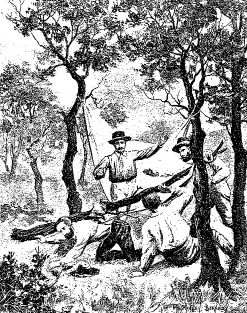
Going farther up the creek, we met some small tributaries with fine little water-holes. Some ridges now approached the creek; from the top of one many sheets of water glittered in stony clay-pans. More westerly the creek ran under a hill. Crossing another tributary where there was plenty of water, we next saw a large clay-hole in the main creek—it was, however, dry. When there was some water in it, the natives had fenced it round to catch any large game that might come to drink; at present they were saved the trouble, for game and water had both alike departed. Mr. Tietkens, my lieutenant and second in command, found a very pretty amphitheatre formed by the hills; we encamped there, at some clay-pans; the grass, however, was very poor; scrubs appeared on the other side of the creek. A junction with another creek occurred near here, beyond which the channel was broad, flat, sandy, and covered indiscriminately with timber; scrubs existed on either bank. We had to cross and recross the bed as the best road. We found a place in it where the natives had dug, and where we got water, but the supply was very unsatisfactory, an enormous quantity of sand having to be shifted before the most willing horse could get down to it. We succeeded at length with the aid of canvas buckets, and by the time the whole twenty four were satisfied, we were also. The grass was dry as usual, but the horses ate it, probably because there is no other for them. Our course to-day was 8° south of west. Close to where we encamped were three or four saplings placed in a row in the bed of the creek, and a diminutive tent-frame, as though some one, if not done by native children, had been playing at erecting a miniature telegraph line. I did not like this creek much more than the Alberga, and decided to try the country still farther north-west. This we did, passing through somewhat thick scrubs for eighteen miles, when we came full upon the creek again, and here for the first time since we started we noticed some bunches of spinifex, the Festuca irritans, and some native poplar trees. These have a straight stem, and are in outline somewhat like a pine-tree, but the foliage is of a fainter green, and different-shaped leaf. They are very pretty to the eye, but generally inhabit the very poorest regions; the botanical name of this tree is Codonocarpus cotinifolius. At five miles farther we dug in the bed of the creek, but only our riding-horses could be watered by night. White pipeclay existed on the bed. The weather was oppressive to-day. Here my latitude was 26° 27´, longitude 134°. It took all next day to water the horses. Thermometer 92° in shade, hot wind blowing. The dead limb of a tree, to which we fixed our tarpaulin as an awning for shade, slipped down while we were at dinner; it first fell on the head of Jimmy Andrews, which broke it in half; it also fell across my back, tearing my waistcoat, shirt, and skin; but as it only fell on Jimmy's head of course it couldn't hurt him. The country still scrubby on both sides: we now travelled about north-north-west, and reached a low stony rise in the scrubs, and from it saw the creek stretching away towards some other ridges nearly on the line we were travelling. We skirted the creek, and in eleven miles we saw other hills of greater elevation than any we had yet seen.
Reaching the first ridge, we got water by digging a few inches into the pipeclay bed of the creek; a more extended view was here obtained, and ranges appeared from west, round by north-west, to north; there were many flat-topped hills and several singular cones, and the country appeared more open. I was much pleased to think I had distanced the scrubs. One cone in the new range bore north 52° west, and for some distance the creek trended that way. On reaching the foot of the new hills, I found the creek had greatly altered its appearance, if indeed it was the same. It is possible the main creek may have turned more to the west, and that this is only a tributary, but as we found some surface water in a clay-hole, we liked it better than having to dig in a larger channel. Here for the first time for many weeks we came upon some green grass, which the horses greedily devoured. The country here is much better and more open. On mustering the horses this morning, one was found to be dead lame, with a mulga stake in his coronet, and as he could not travel we were forced to remain at the camp; at least the camp was not shifted. This horse was called Trew; he was one of the best in the mob, though then I had not found out all his good qualities—he now simply carried a pack. Mr. Tietkens and I mounted our horses and rode farther up the creek. The channel had partly recovered its appearance, and it may be our old one after all. Above the camp its course was nearly north, and a line of low bluff-faced hills formed its eastern bank. The country towards the new ranges looked open and inviting, and we rode to a prominent cone in it, to the west-north-west. The country was excellent, being open and grassy, and having fine cotton and salt bush flats all over it: there was surface water in clay-pans lying about. I called this the Anthony Range. We returned much pleased with our day's ride.
The nights were now agreeably cool, sometimes very dewy. The lame horse was still very bad, but we lightened his load, and after the first mile he travelled pretty well. We steered for the singular cone in advance. Most of the hills, however, of the Anthony Range were flat-topped, though many tent-shaped ones exist also. I ascended the cone in ten miles, west of north-west from camp. The view displayed hills for miles in all directions, amongst which were many bare rocks of red colour heaped into the most fantastically tossed mounds imaginable, with here and there an odd shrub growing from the interstices of the rocks; some small miniature creeks, with only myal and mulga growing in them, ran through the valleys—all of these had recently been running. We camped a mile or two beyond the cone in an extremely pretty and romantic valley; the grass was green, and Nature appeared in one of her smiling moods, throwing a gleam of sunshine on the minds of the adventurers who had sought her in one of her wilderness recesses. The only miserable creature in our party was the lame horse, but now indeed he had a mate in misfortune, for we found that another horse, Giant Despair, had staked himself during our day's march, though he did not appear lame until we stopped, and his hobbles were about to be put on. Mr. Tietkens extracted a long mulga stick from his fetlock: neither of the two staked horses ever became sound again, although they worked well enough. In the night, or rather by morning (daylight), the thermometer had fallen to 30°, and though there was a heavy dew there was neither frost nor ice.
We now passed up to the head of the picturesque valley, and from there wound round some of the mounds of bare rocks previously mentioned. They are composed of a kind of a red conglomerate granite. We turned in and out amongst the hills till we arrived at the banks of a small creek lined with eucalyptus or gum-trees, and finding some water we encamped on a piece of beautiful-looking country, splendidly grassed and ornamented with the fantastic mounds, and the creek timber as back and fore grounds for the picture. Small birds twittered on each bough, sang their little songs of love or hate, and gleefully fled or pursued each other from tree to tree. The atmosphere seemed cleared of all grossness or impurities, a few sunlit clouds floated in space, and a perfume from Nature's own laboratory was exhaled from the flowers and vegetation around. It might well be said that here were
“Gusts of fragrance on the grasses,
In the skies a softened splendour;
Through the copse and woodland passes
Songs of birds in cadence tender.”
The country was so agreeable here we had no desire to traverse it at railway speed; it was delightful to loll and lie upon the land, in abandoned languishment beneath the solar ray. Thirty or forty miles farther away, west-north-westward, other and independent hills or ranges stood, though I was grieved to remark that the intermediate region seemed entirely filled with scrub. How soon the scenery changes! Travelling now for the new hills, we soon entered scrubs, where some plots of the dreaded triodia were avoided. In the scrubs, at ten miles we came upon the banks of a large gum-timbered creek, whose trees were fine and vigorous. In the bed we found a native well, with water at no great depth; the course of this creek where we struck it, was south-south-east, and we travelled along its banks in an opposite, that is to say, north-north-west direction. That line, however, took us immediately into the thick scrubs, so at four miles on this bearing I climbed a tree, and saw that I must turn north to cut it again; this I did, and in three miles we came at right angles upon a creek which I felt sure was not the one we had left, the scrub being so thick one could hardly see a yard ahead. Here I sent Jimmy Andrews up a tree; having been a sailor boy, he is well skilled in that kind of performance, but I am not. I told him to discover the whereabouts of the main creek, and say how far off it appeared. That brilliant genius informed me that it lay across the course we were steering, north, and it was only a mile away; so we went on to it, as we supposed, but having gone more than two miles and not reaching it, I asked Jimmy whether he had not made some mistake. I said, “We have already come two miles, and you said it was scarcely one.” He then kindly informed me that I was going all wrong, and ought not to go that way at all; but upon my questioning him as to which way I should go he replied, “Oh, I don't know now.” My only plan was to turn east, when we soon struck the creek. Then Jimmy declared if we had kept north long enough, we would have come to it agin.
Though Jimmy was certainly a bit of a fool, he was not perhaps quite a fool of the greatest size. Little fools and young fools somehow seem to pass muster in this peculiar world, but to be old and a fool is a mistake which is difficult, if not impossible, to remedy. It was too late to go any farther; we couldn't get any water, but we had to camp. I intended to return in the morning to where we first struck this creek, and where we saw water in the native well. I called this the Krichauff. The mercury went down to 28° by daylight the next morning, but neither ice nor frost appeared. This morning Mr. Tietkens, when out after the horses, found a rather deep native well some distance up the creek, and we shifted the camp to it. On the way there I was behind the party, and before I overtook them I heard the report of firearms. On reaching the horses, Jimmy Andrews had his revolver in his hand, Mr. Tietkens and Gibson being away. On inquiring of Jimmy the cause of the reports and the reason of his having his revolver in his hand, he replied that he thought Mr. Tietkens was shooting the blacks, and he had determined to slaughter his share if they attacked him. Mr. Tietkens had fired at some wallabies, which, however, did not appear at dinner. On arrival at the new well, we had a vast amount of work to perform, and only three or four horses got water by night.
I told Mr. Tietkens not to work himself to death, as I would retreat in the morning to where there was water, but he persisted in working away by himself in the night, and was actually able to water all the horses in the morning. Labor omnia vincit. Last night there was a heavy fall of dew, thermometer 28°, but no frost or ice. I was delighted to turn my back upon this wretched place.
The object of our present line was to reach the new hills seen from the Anthony Range. Three of them appeared higher than, and isolated from, the others. They now bore west of us—at least they should have done so, and I hoped they did, for in such thick scrubs it was quite impossible to see them. No matter for that, we steered west for them and traversed a region of dense scrubs. I was compelled to ride in advance with a bell on my stirrup to enable the others to hear which way to come. In seventeen miles we struck a small gum creek without water, but there was good herbage. In the scrubs to-day we saw a native pheasant's nest, the Leipoa ocellata of Gould, but there were no eggs in it. This bird is known by different names in different parts of Australia. On the eastern half of the continent it is usually called the Lowan, while in Western Australia it is known as the Gnow; both I believe are native names. Another cold night, thermometer 26°, with a slight hoar frost. Moving on still west through scrubs, but not so thick as yesterday, some beautiful and open ground was met till we reached the foot of some low ridges.
From the top of one of these, we had before us a most charming view, red ridges of extraordinary shapes and appearance being tossed up in all directions, with the slopes of the soil, from whence they seemed to spring, rising gently, and with verdure clad in a garment of grass whose skirts were fringed with flowers to their feet. These slopes were beautifully bedecked with flowers of the most varied hues, throwing a magic charm over the entire scene. Vast bare red
“Rocks piled on rocks stupendous hurled,
Like fragments of an earlier world,”
appeared everywhere, but the main tier of ranges for which I had been steering was still several miles farther away to the west. Thinking that water, the scarcest here of Nature's gifts, must surely exist in such a lovely region as this, it was more with the keen and critical eye of the explorer in search of that element, than of the admirer of Nature in her wildest grace, that I surveyed the scene. A small gum creek lay to the south, to which Mr. Tietkens went. I sent Gibson to a spot about two miles off to the west, as straight before us in that direction lay a huge mass of rocks and bare slabs of stone, which might have rock reservoirs amongst them. To the north lay a longer jumble of hills, with overhanging ledges and bare precipices, which I undertook to search, leaving Jimmy to mind the horses until some of us returned. Neither Mr. Tietkens nor Gibson could find any water, and I was returning quite disappointed, after wandering over hills and rocks, through gullies and under ledges, when at length I espied a small and very fertile little glen whose brighter green attracted my notice. Here a small gully came down between two hills, and in the bed of the little channel I saw a patch of blacker soil, and on reaching it I found a small but deep native well with a little water at the bottom. It was an extraordinary little spot, and being funnel shaped, I doubted whether any animal but a bird or a black man could get down to it, and I also expected it would prove a hideous bog; but my little friend (W.A.) seemed so determined to test its nature, and though it was nearly four feet to the water, he quietly let his forefeet slip down into it, and though his hindquarters were high and dry above his head he got a good drink, which he told me in his language he was very thankful for. I brought the whole party to the spot, and we had immediately to set to work to enlarge the well. We found the water supply by no means abundant, as, though we all worked hard at it in turns with the shovel, it did not drain in as fast as one horse could drink; but by making a large hole, we expected sufficient would drain in during the night for the remainder of the horses. We did not cease from our work until it was quite dark, when we retired to our encampment, quite sufficiently tired to make us sleep without the aid of any lullaby.
A poor water supply. Seeds planted. Beautiful country. Ride westward. A chopped log. Magnetic hill. Singular scenery. Snail-shells. Cheering prospect westward. A new chain of hills. A nearer mountain. Vistas of green. Gibson finds water. Turtle backs. Ornamented Troglodytes' caves. Water and emus. Beef-wood-trees. Grassy lawns. Gum creek. Purple vetch. Cold dewy night. Jumbled turtle backs. Tietkens returns. I proceed. Two-storied native huts. Chinese doctrine. A wonderful mountain. Elegant trees. Extraordinary ridge. A garden. Nature imitates her imitator. Wild and strange view. Pool of water. A lonely camp. Between sleeping and waking. Extract from Byron for breakfast. Return for the party. Emus and water. Arrival of Tietkens. A good camp. Tietkens's birthday creek. Ascend the mountain. No signs of water. Gill's range. Flat-topped hill. The Everard range. High mounts westward. Snail shells. Altitude of the mountain. Pretty scenes. Parrot soup. The sentinel. Thermometer 26°. Frost. Lunar rainbow. A charming spot. A pool of water. Cones of the main range. A new pass. Dreams realised. A long glen. Glen Ferdinand. Mount Ferdinand. The Reid. Large creek. Disturb a native nation. Spears hurled. A regular attack. Repulse and return of the enemy. Their appearance. Encounter Creek. Mount Officer. The Currie. The Levinger. Excellent country. Horse-play. Mount Davenport. Small gap. A fairy space. The Fairies' Glen. Day dreams. Thermometer 24°. Ice. Mount Oberon. Titania's spring. Horses bewitched. Glen Watson. Mount Olga in view. The Musgrave range.
Upon inspection this morning we found but a poor supply of water had drained into our tank in the night, and that there was by no means sufficient for the remaining horses; these had no water yesterday. We passed the forenoon in still enlarging the tank, and as soon as a bucketful drained in, it was given to one of the horses. We planted the seeds of a lot of vegetables and trees here, such as Tasmanian blue gum, wattle, melons, pumpkins, cucumbers, maize, etc.; and then Mr. Tietkens and I got our horses and rode to the main hills to the west, in hopes of discovering more water. We started late, and it was dark when we reached the range. The country passed over between it and our encampment, was exceedingly beautiful; hills being thrown up in red ridges of bare rock, with the native fig-tree growing among the rocks, festooning them into infinite groups of beauty, while the ground upon which we rode was a perfect carpet of verdure. We were therefore in high anticipation of finding some waters equivalent to the scene; but as night was advancing, our search had to be delayed until the morrow. The dew was falling fast, the night air was cool, and deliciously laden with the scented exhalations from trees and shrubs and flowers. The odour of almonds was intense, reminding me of the perfumes of the wattle blooms of the southern, eastern, and more fertile portions of this continent. So exquisite was the aroma, that I recalled to my mind Gordon's beautiful lines:—
“In the spring when the wattle gold trembles,
Twixt shadow and shine,
When each dew-laden air draught resembles;
A long draught of wine.”
So delightful indeed was the evening that it was late when we gave ourselves up to the oblivion of slumber, beneath the cool and starry sky. We made a fire against a log about eighteen inches thick; this was a limb from an adjacent blood-wood or red gum-tree, and this morning we discovered that it had been chopped off its parent stem either with an axe or tomahawk, and carried some forty or fifty yards from where it had originally fallen. This seemed very strange; in the first place for natives, so far out from civilisation as this, to have axes or tomahawks; and in the second place, to chop logs or boughs off a tree was totally against their practice. By sunrise we were upon the summit of the mountain; it consisted of enormous blocks and boulders of red granite, so riven and fissured that no water could possibly lodge upon it for an instant. I found it also to be highly magnetic, there being a great deal of ironstone about the rocks. It turned the compass needle from its true north point to 10° south of west, but the attraction ceased when the compass was removed four feet from contact with the rocks. The view from this mount was of singular and almost awful beauty. The mount, and all the others connected with it, rose simply like islands out of a vast ocean of scrub. The beauty of the locality lay entirely within itself. Innumerable red ridges ornamented with fig-trees, rising out of green and grassy slopes, met the eye everywhere to the east, north, and northeast, and the country between each was just sufficiently timbered to add a charm to the view. But the appearance of water still was wanting; no signs of it, or of any basin or hollow that could hold it, met the gaze in any direction, This alone was wanting to turn a wilderness into a garden.
There were four large mounts in this chain, higher than any of the rest, including the one I was on. Here we saw a quantity of what I at first thought were white sea-shells, but we found they were the bleached shells of land snails. Far away to the north some ranges appeared above the dense ocean of intervening scrubs. To the south, scrubs reigned supreme; but to the west, the region for which I was bound, the prospect looked far more cheering. The far horizon, there, was bounded by a very long and apparently connected chain of considerable elevation, seventy to eighty miles away. One conspicuous mountain, evidently nearer than the longer chain, bore 15° to the south of west, while an apparent gap or notch in the more distant line bore 23° south of west. The intervening country appeared all flat, and very much more open than in any other direction; I could discern long vistas of green grass, dotted with yellow immortelles, but as the perspective declined, these all became lost in lightly timbered country. These grassy glades were fair to see, reminding one somewhat of Merrie England's glades and Sherwood forests green, where errant knight in olden days rode forth in mailed sheen; and memory oft, the golden rover, recalls the tales of old romance, how ladie bright unto her lover, some young knight, smitten with her glance, would point out some heroic labour, some unheard-of deed of fame; he must carve out with his sabre, and ennoble thus his name. He, a giant must defeat sure, he must free the land from tain, he must kill some monstrous creature, or return not till 'twas slain. Then she'd smile on him victorious, call him the bravest in the land, fame and her, to win, how glorious—win and keep her heart and hand!
Although no water was found here, what it pleases me to call my mind was immediately made up. I would return at once to the camp, where water was so scarce, and trust all to the newly discovered chain to the west. Water must surely exist there, we had but to reach it. I named these mounts Ayers Range. Upon returning to our camp, six or seven miles off, I saw that a mere dribble of water remained in the tank. Gibson was away after the horses, and when he brought them, he informed me he had found another place, with some water lying on the rocks, and two native wells close by with water in them, much shallower than our present one, and that they were about three miles away. I rode off with him to inspect his new discovery, and saw there was sufficient surface water for our horses for a day or two.
These rocks are most singular, being mostly huge red, rounded solid blocks of stone, shaped like the backs of enormous turtles. I was much pleased with Gibson's discovery, and we moved the camp down to this spot, which we always after called the Turtle Back. The grass and herbage were excellent, but the horses had not had sufficient water since we arrived here. It is wonderful how in such a rocky region so little water appears to exist. The surface water was rather difficult for the horses to reach, as it lay upon the extreme summit of the rock, the sides of which were very steep and slippery. There were plenty of small birds; hawks and crows, a species of cockatoo, some pigeons, and eagles soaring high above. More seeds were planted here, the soil being very good. Upon the opposite or eastern side of this rock was a large ledge or cave, under which the Troglodytes of these realms had frequently encamped. It was ornamented with many of their rude representations of creeping things, amongst which the serpent class predominated; there were also other hideous shapes, of things such as can exist only in their imaginations, and they are but the weak endeavours of these benighted beings to give form and semblance to the symbolisms of the dread superstitions, that, haunting the vacant chambers of their darkened minds, pass amongst them in the place of either philosophy or religion.
Next morning, watering all our horses, and having a fine open-air bath on the top of the Turtle Back, Mr. Tietkens and I got three of them and again started for Ayers Range, nearly west. Reaching it, we travelled upon the bearing of the gap which we had seen in the most distant range. The country as we proceeded we found splendidly open, beautifully grassed, and it rose occasionally into some low ridges. At fifteen miles from the Turtle Back we found some clay-pans with water, where we turned out our horses for an hour. A mob of emus came to inspect us, and Mr. Tietkens shot one in a fleshy part of the neck, which rather helped it to run away at full speed instead of detaining, so that we might capture it. Next some parallel ridges lying north and south were crossed, where some beefwood, or Grevillea trees, ornamented the scene, the country again opening into beautiful grassy lawns. One or two creek channels were crossed, and a larger one farther on, whose timber indeed would scarcely reach our course; as it would not come to us, we went to it. The gum-timber upon it was thick and vigorous—it came from the north-westward. A quantity of the so called tea-tree [Melaleuca] grew here. In two miles up the channel we found where a low ridge crossed and formed a kind of low pass. An old native well existed here, which, upon cleaning out with a quart pot, disclosed the element of our search to our view at a depth of nearly five feet. The natives always make these wells of such an abominable shape, that of a funnel, never thinking how awkward they must be to white men with horses—some people are so unfeeling! It took us a long time to water our three horses. There was a quantity of the little purple vetch here, of which all animals are so fond, and which is so fattening. There was plenty of this herb at the Turtle Back, and wherever it grows it gives the country a lovely carnation tinge; this, blending with the bright green of the grass, and the yellow and other tinted hues of several kinds of flowers, impresses on the whole region the appearance of a garden.
In the morning, in consequence of a cold and dewy night, the horses declined to drink. Regaining our yesterday's course, we continued for ten miles, when we noticed that the nearest mountain seen from Ayers Range was now not more than thirty miles away. It appeared red, bald, and of some altitude; to our left was another mass of jumbled turtle backs, and we turned to search for water among them. A small gum creek to the south-south-east was first visited and left in disgust, and all the rocks and hills we searched, were equally destitute of water. We wasted the rest of the day in fruitless search; Nature seemed to have made no effort whatever to form any such thing as a rockhole, and we saw no place where the natives had ever even dug. We had been riding from morning until night, and we had neither found water nor reached the mountain. We returned to our last night's camp, where the sand had all fallen into the well, and we had our last night's performance with the quart pot to do over again.
In the morning I decided to send Mr. Tietkens back to the camp to bring the party here, while I went to the mountain to search for water. We now discovered we had brought but a poor supply of food, and that a hearty supper would demolish the lot, so we had to be sadly economical. When we got our horses the next morning we departed, each on his separate errand—Mr. Tietkens for the camp, I for the mountain. I made a straight course for it, and in three or four miles found the country exceedingly scrubby. At ten miles I came upon a number of native huts, which were of large dimensions and two-storied; by this I mean they had an upper attic, or cupboard recess. When the natives return to these, I suppose they know of some water, or else get it out of the roots of trees. The scrubs became thicker and thicker, and only at intervals could the mountain be seen. At a spot where the natives had burnt the old grass, and where some new rich vegetation grew, I gave my horse the benefit of an hour's rest, for he had come twenty-two miles. The day was delightful; the thermometer registered only 76° in the shade. I had had a very poor breakfast, and now had an excellent appetite for all the dinner I could command, and I could not help thinking that there is a great deal of sound philosophy in the Chinese doctrine, That the seat of the mind and the intellect is situate in the stomach.
Starting again and gaining a rise in the dense ocean of scrub, I got a sight of the mountain, whose appearance was most wonderful; it seemed so rifted and riven, and had acres of bare red rock without a shrub or tree upon it. I next found myself under the shadow of a huge rock towering above me amidst the scrubs, but too hidden to perceive until I reached it. On ascending it I was much pleased to discover, at a mile and a half off, the gum timber of a creek which meandered through this wilderness. On gaining its banks I was disappointed to find that its channel was very flat and poorly defined, though the timber upon it was splendid. Elegant upright creamy stems supported their umbrageous tops, whose roots must surely extend downwards to a moistened soil. On each bank of the creek was a strip of green and open ground, so richly grassed and so beautifully bedecked with flowers that it seemed like suddenly escaping from purgatory into paradise when emerging from the recesses of the scrubs on to the banks of this beautiful, I wish I might call it, stream.
Opposite to where I struck it stood an extraordinary hill or ridge, consisting of a huge red turtle back having a number of enormous red stones almost egg-shaped, traversing, or rather standing in a row upon, its whole length like a line of elliptical Tors. I could compare it to nothing else than an enormous oolitic monster of the turtle kind carrying its eggs upon its back. A few cypress pine-trees grew in the interstices of the rocks, giving it a most elegant appearance. Hoping to find some rock or other reservoir of water, I rode over to this creature, or feature. Before reaching its foot, I came upon a small piece of open, firm, grassy ground, most beautifully variegated with many-coloured vegetation, with a small bare piece of ground in the centre, with rain water lying on it. The place was so exquisitely lovely it seemed as if only rustic garden seats were wanting, to prove that it had been laid out by the hand of man. But it was only an instance of one of Nature's freaks, in which she had so successfully imitated her imitator, Art. I watered my horse and left him to graze on this delectable spot, while I climbed the oolitic's back. There was not sufficient water in the garden for all my horses, and it was actually necessary for me to find more, or else the region would be untenable.
The view from this hill was wild and strange; the high, bald forehead of the mountain was still four or five miles away, the country between being all scrub. The creek came from the south-westward, and was lost in the scrubs to the east of north. A thick and vigorous clump of eucalypts down the creek induced me first to visit them, but the channel was hopelessly dry. Returning, I next went up the creek, and came to a place where great boulders of stone crossed the bed, and where several large-sized holes existed, but were now dry. Hard by, however, I found a damp spot, and near it in the sand a native well, not more than two feet deep, and having water in it. Still farther up I found an overhanging rock, with a good pool of water at its foot, and I was now satisfied with my day's work. Here I camped. I made a fire at a large log lying in the creek bed; my horse was up to his eyes in most magnificent herbage, and I could not help envying him as I watched him devouring his food. I felt somewhat lonely, and cogitated that what has been written or said by cynics, solitaries, or Byrons, of the delights of loneliness, has no real home in the human heart. Nothing could appal the mind so much as the contemplation of eternal solitude. Well may another kind of poet exclaim, Oh, solitude! where are the charms that sages have seen in thy face? for human sympathy is one of the passions of human nature. Natives had been here very recently, and the scrubs were burning, not far off to the northwards, in the neighbourhood of the creek channel. As night descended, I lay me down by my bright camp fire in peace to sleep, though doubtless there are very many of my readers who would scarcely like to do the same. Such a situation might naturally lead one to consider how many people have lain similarly down at night, in fancied security, to be awakened only by the enemies' tomahawk crashing through their skulls. Such thoughts, if they intruded themselves upon my mind, were expelled by others that wandered away to different scenes and distant friends, for this Childe Harold also had a mother not forgot, and sisters whom he loved, but saw them not, ere yet his weary pilgrimage begun.
Dreams also, between sleeping and waking, passed swiftly through my brain, and in my lonely sleep I had real dreams, sweet, fanciful, and bright, mostly connected with the enterprise upon which I had embarked—dreams that I had wandered into, and was passing through, tracts of fabulously lovely glades, with groves and grottos green, watered by never-failing streams of crystal, dotted with clusters of magnificent palm-trees, and having groves, charming groves, of the fairest of pines, of groves “whose rich trees wept odorous gums and balm.”
“And all throughout the night there reigned the sense
Of waking dream, with luscious thoughts o'erladen;
Of joy too conscious made, and too intense,
By the swift advent of this longed-for aidenn.”
On awaking, however, I was forced to reflect, how “mysterious are these laws! The vision's finer than the view: her landscape Nature never draws so fair as fancy drew.” The morning was cold, the thermometer stood at 28°, and now—
“The morn was up again, the dewy morn;
With breath all incense, and with cheek all bloom,
Laughing the clouds away with playful scorn,
And smiling, as if earth contained no tomb:
And glowing into day.”
With this charming extract from Byron for breakfast I saddled my horse, having nothing more to detain me here, intending to bring up the whole party as soon as possible.
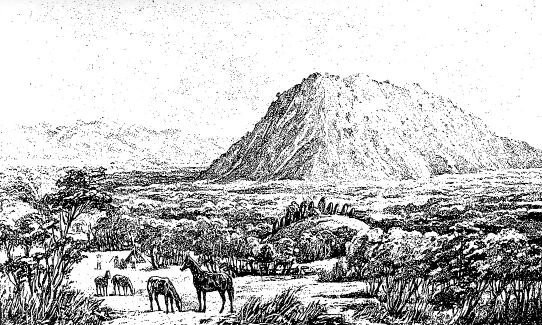

I now, however, returned by a more southerly route, and found the scrubs less thick, and came to some low red rises in them. Having travelled east, I now turned on the bearing for the tea-tree creek, where the party ought now to be. At six miles on this line I came upon some open ground, and saw several emus. This induced me to look around for water, and I found some clay-pans with enough water to last a week. I was very well pleased, as this would save time and trouble in digging at the tea-tree. The water here was certainly rather thick, and scarcely fit for human organisms, at least for white ones, though it might suit black ones well enough, and it was good enough for our horses, which was the greatest consideration. I rested my horse here for an hour, and then rode to the tea-tree. The party, however, were not there, and I waited in expectation of their arrival. In about an hour Mr. Tietkens came and informed me that on his return to the camp the other day he had found a nice little water, six miles from here, and where the party was, and to which we now rode together. At this agreeable little spot were the three essentials for an explorer's camp—that is to say, wood, water, and grass. From there we went to my clay pans, and the next day to my lonely camp of dreams. This, the 30th August, was an auspicious day in our travels, it being no less than Mr. Tietkens's nine-and-twentieth birthday. We celebrated it with what honours the expedition stores would afford, obtaining a flat bottle of spirits from the medical department, with which we drank to his health and many happier returns of the day. In honour of the occasion I called this Tietkens's Birthday Creek, and hereby proclaim it unto the nations that such should be its name for ever. The camp was not moved, but Mr. Tietkens and I rode over to the high mountain to-day, taking with us all the apparatus necessary for so great an ascent—that is to say, thermometer, barometer, compass, field glasses, quart pot, waterbag, and matches. In about four miles we reached its foot, and found its sides so bare and steep that I took off my boots for the ascent. It was formed for the most part like a stupendous turtle back, of a conglomerate granite, with no signs of water, or any places that would retain it for a moment, round or near its base. Upon reaching its summit, the view was most extensive in every direction except the west, and though the horizon was bounded in all directions by ranges, yet scrubs filled the entire spaces between. To the north lay a long and very distant range, which I thought might be the Gill's Range of my last expedition, though it would certainly be a stretch either of imagination or vision, for that range was nearly 140 miles away.
To the north-westward was a flat-topped hill, rising like a table from an ocean of scrub; it was very much higher than such hills usually are. This was Mount Conner. To the south, and at a considerable distance away, lay another range of some length, apparently also of considerable altitude. I called this the Everard Range. The horizon westward was bounded by a continuous mass of hills or mountains, from the centre of which Birthday Creek seemed to issue. Many of the mounts westward appeared of considerable elevation. The natives were burning the scrubs west and north-west. On the bare rocks of this mountain we saw several white, bleached snail-shells. I was grieved to find that my barometer had met with an accident in our climb; however, by testing the boiling point of water I obtained the altitude.
Water boiled at 206°, giving an elevation of 3085 feet above the level of the sea, it being about 1200 feet above the surrounding country. The view of Birthday Creek winding along in little bends through the scrubs from its parent mountains, was most pleasing. Down below us were some very pretty little scenes. One was a small sandy channel, like a plough furrow, with a few eucalyptus trees upon it, running from a ravine near the foot of this mount, which passed at about a mile through two red mounds of rock, only just wide enough apart to admit of its passage. A few cypress pines were growing close to the little gorge. On any other part of the earth's surface, if, indeed, such another place could be found, water must certainly exist also, but here there was none. We had a perfect bird's-eye view of the spot. We could only hope, for beauty and natural harmony's sake, that water must exist, at least below the surface, if not above. Having completed our survey, we descended barefooted as before.
On reaching the camp, Gibson and Jimmy had shot some parrots and other birds, which must have flown down the barrels of their guns, otherwise they never could have hit them, and we had an excellent supper of parrot soup. Just here we have only seen parrots, magpies and a few pigeons, though plenty of kangaroo, wallaby, and emu; but have not succeeded in bagging any of the latter game, as they are exceedingly shy and difficult to approach, from being so continually hunted by the natives. I named this very singular feature Mount Carnarvon, or The Sentinel, as soon I found
“The mountain there did stand
T sentinel enchanted land.”
The night was cold; mercury down to 26°. What little dew fell became frosted; there was not sufficient to call it frozen. I found my position here to be in latitude 26° 3´, longitude 132° 29´.
In the night of the 1st September, heavy clouds were flying fastly over us, and a few drops of rain fell at intervals. About ten o'clock p.m. I observed a lunar rainbow in the northern horizon; its diameter was only about fifteen degrees. There were no prismatic colours visible about it. To-day was clear, fine, but rather windy. We travelled up the creek, skirting its banks, but cutting off the bends. We had low ridges on our right. The creek came for some distance from the south-west, then more southerly, then at ten miles, more directly from the hills to the west. The country along its banks was excellent, and the scenery most beautiful—pine-clad, red, and rocky hills being scattered about in various directions, while further to the west and south-west the high, bold, and very rugged chain rose into peaks and points. We only travelled sixteen miles, and encamped close to a pretty little pine-clad hill, on the north bank of the creek, where some rocks traversed the bed, and we easily obtained a good supply of water. The grass and herbage being magnificent, the horses were in a fine way to enjoy themselves.
This spot is one of the most charming that even imagination could paint. In the background were the high and pointed peaks of the main chain, from which sloped a delightful green valley; through this the creek meandered, here and there winding round the foot of little pine-clad hills of unvarying red colour, whilst the earth from which they sprung was covered with a carpet of verdure and vegetation of almost every imaginable hue. It was happiness to lie at ease upon such a carpet and gaze upon such a scene, and it was happiness the more ecstatic to know that I was the first of a civilised race of men who had ever beheld it. My visions of a former night really seemed to be prophetic. The trend of the creek, and the valley down which it came, was about 25° south of west. We soon found it became contracted by impinging hills. At ten miles from camp we found a pool of water in the bed. In about a couple of miles farther, to my surprise I found we had reached its head and its source, which was the drainage of a big hill. There was no more water and no rock-holes, neither was there any gorge. Some triodia grew on the hills, but none on the lower ground. The valley now changed into a charming amphitheatre. We had thus traced our Birthday Creek, to its own birthplace. It has a short course, but a merry one, and had ended for us at its proper beginning. As there appeared to be no water in the amphitheatre, we returned to the pool we had seen in the creek. Several small branch creeks running through pretty little valleys joined our creek to-day. We were now near some of the higher cones of the main chain, and could see that they were all entirely timberless, and that triodia grew upon their sides. The spot we were now encamped upon was another scene of exquisite sylvan beauty. We had now been a month in the field, as to-morrow was the 4th of September, and I could certainly congratulate myself upon the result of my first month's labour.
The night was cold and windy, dense nimbus clouds hovered just above the mountain peaks, and threatened a heavy downpour of rain, but the driving gale scattered them into the gelid regions of space, and after sunrise we had a perfectly clear sky. I intended this morning to push through what seemed now, as it had always seemed from the first moment I saw this range, a main gap through the chain. Going north round a pointed hill, we were soon in the trend of the pass; in five miles we reached the banks of a new creek, running westerly into another, or else into a large eucalyptus flat or swamp, which had no apparent outlet. This heavy timber could be seen for two or three miles. Advancing still further, I soon discovered that we were upon the reedy banks of a fast flowing stream, whose murmuring waters, ever rushing idly and unheeded on, were now for the first time disclosed to the delighted eyes of their discoverer.
Here I had found a spot where Nature truly had
“Shed o'er the scene her purest of crystal, her brightest of green.”
This was really a delightful discovery. Everything was of the best kind here—timber, water, grass, and mountains. In all my wanderings, over thousands of miles in Australia, I never saw a more delightful and fanciful region than this, and one indeed where a white man might live and be happy. My dreams of a former night were of a verity realised.
Geographically speaking, we had suddenly come almost upon the extreme head of a large water course. Its trend here was nearly south, and I found it now ran through a long glen in that direction.
We saw several fine pools and ponds, where the reeds opened in the channel, and we flushed up and shot several lots of ducks. This creek and glen I have named respectively the Ferdinand and Glen Ferdinand, after the Christian name of Baron von Mueller. (The names having a star * against them in this book denote contributors to the fund raised by Baron Mueller* for this expedition.—E.G.) The glen extended nearly five miles, and where it ended, the water ceased to show upon the surface. At the end of the glen we encamped, and I do not remember any day's work during my life which gave me more pleasure than this, for I trust it will be believed that:—
“The proud desire of sowing broad the germs of lasting worth
Shall challenge give to scornful laugh of careless sons of earth;
Though mirth deride, the pilgrim feet that tread the desert plain,
The thought that cheers me onward is, I have not lived in vain.”
After our dinner Mr. Tietkens and I ascended the highest mountain in the neighbourhood—several others not far away were higher, but this was the most convenient. Water boiled at its summit at 204°, which gives an altitude above sea level of 4131 feet, it being about 1500 feet above the surrounding country. I called this Mount Ferdinand, and another higher point nearly west of it I called Mount James-Winter*. The view all round from west to north was shut out. To the south and south-east other ranges existed. The timber of the Ferdinand could be traced for many miles in a southerly direction; it finally became lost in the distance in a timbered if not a scrubby country. This mountain was highly magnetic. I am surprised at seeing so few signs of natives in this region. We returned to the camp and sowed seeds of many cereals, fodder plants, and vegetables. A great quantity of tea-tree grew in this glen. The water was pure and fresh.
Two or three miles farther down, the creek passed between two hills; the configuration of the mountains now compelled me to take a south-westerly valley for my road. In a few miles another fine creek-channel came out of the range to the north of us, near the foot of Mount James-Winter; it soon joined a larger one, up which was plenty of running water; this I called the Reid*. We were now traversing another very pretty valley running nearly west, with fine cotton and salt-bush flats, while picturesque cypress pines covered the hills on both sides of us. Under some hills which obstructed our course was another creek, where we encamped, the grass and herbage being most excellent; and this also was a very pretty place. Our latitude here was 26° 24´.
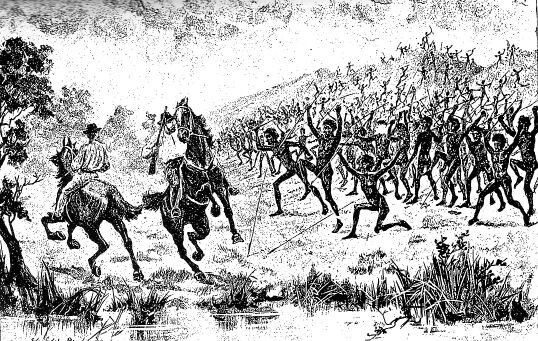
Gibson went away on horseback this morning to find the others, but came back on foot to say he had lost the one he started with. We eventually got them all, and proceeded down the creek south, then through a little gap west, on to the banks of a fine large creek with excellent timber on it. The natives were burning the grass up the channel north-westerly. Mr. Tietkens and I rode up in advance to reconnoitre; we went nearly three miles, when we came to running water. At the same time we evidently disturbed a considerable number of natives, who raised a most frightful outcry at our sudden and unexpected advent amongst them. Those nearest to us walked slowly into the reeds, rushes, tea-trees, and high salt bushes, but deliberately watching our every movement. While watering our horses a great many from the outskirts ran at us, poising and quivering their spears, some of which were over ten feet long; of these, every individual had an extraordinary number. When they saw us sitting quietly, but not comfortably, on our horses, which became very frightened and impatient, they renewed their horrible yells and gesticulations, some waving us away, others climbing trees, and directing their spears at us from the branches. Another lot on the opposite side of the creek now came rushing up with spears advanced and ensigns spread, and with their yells and cries encouraged those near to spear us. They seemed, however, to have some doubts of the nature or vulnerability of our horses. At the head of our new assailants was one sophisticated enough to be able to call out, “Walk, white fellow, walk;” but as we still remained immobile, he induced some others to join in making a rush at us, and they hurled their jagged spears at us before we could get out of the way. It was fortunate indeed that we were at the extreme distance that these weapons can be projected, for they struck the ground right amongst our horses' hoofs, making them more restive than ever.
I now let our assailants see we were not quite so helpless as they might have supposed. I unslipped my rifle, and the bullet, going so suddenly between two of these worthies and smashing some boughs just behind them, produced silence amongst the whole congregation, at least for a moment. All this time we were anxiously awaiting the arrival of Gibson and Jimmy, as my instructions were that if we did not return in a given time, they were to follow after us. But these valiant retainers, who admitted they heard the firing, preferred to remain out of harm's way, leaving us to kill or be killed, as the fortunes of war might determine; and we at length had to retreat from our sable enemies, and go and find our white friends. We got the mob of horses up, but the yelling of these fiends in human form, the clouds of smoke from the burning grass and bushes, and the many disagreeable odours incident to a large native village, and the yapping and howling of a lot of starving dogs, all combined to make us and our horses exceedingly restless. They seemed somewhat overawed by the number of the horses, and though they crowded round from all directions, for there were more than 200 of them, the women and children being sent away over the hills at our first approach, they did not then throw any more spears. I selected as open a piece of ground as I could get for the camp, which, however, was very small, back from the water, and nearly under the foot of a hill. When they saw us dismount, for I believe they had previously believed ourselves and our horses to form one animal, and begin to unload the horses, they proceeded properly to work themselves up for a regular onslaught. So long as the horses remained close, they seemed disinclined to attack, but when they were hobbled and went away, the enemy made a grand sortie, rushing down the hill at the back of the camp where they had congregated, towards us in a body with spears fitted in pose and yelling their war cries.
Our lives were in imminent danger; we had out all the firearms we could muster; these amounted to two rifles, two shot guns, and five revolvers. I watched with great keenness the motion of their arms that gives the propulsion to their spears, and the instant I observed that, I ordered a discharge of the two rifles and one gun, as it was no use waiting to be speared first. I delayed almost a second too long, for at the instant I gave the word several spears had left the enemy's hands, and it was with great good fortune we avoided them. Our shots, as I had ordered, cut up the ground at their feet, and sent the sand and gravel into their eyes and faces; this and the noise of the discharge made the great body of them pause. Availing ourselves of this interval, we ran to attack them, firing our revolvers in quick succession as we ran. This, with the noise and the to them extraordinary phenomenon of a projectile approaching them which they could not see, drove them up into the hills from which they had approached us, and they were quiet for nearly an hour, except for their unceasing howls and yells, during which time we made an attempt at getting some dinner. That meal, however, was not completed when we saw them stealing down on us again. Again they came more than a hundred strong, with heads held back, and arms at fullest tension to give their spears the greatest projective force, when, just as they came within spear shot, for we knew the exact distance now, we gave them another volley, striking the sand up just before their feet; again they halted, consulting one another by looks and signs, when the discharge of Gibson's gun, with two long-distance cartridges, decided them, and they ran back, but only to come again. In consequence of our not shooting any of them, they began to jeer and laugh at us, slapping their backsides at and jumping about in front of us, and indecently daring and deriding us. These were evidently some of those lewd fellows of the baser sort (Acts 17 5). We were at length compelled to send some rifle bullets into such close proximity to some of their limbs that at last they really did believe we were dangerous folk after all. Towards night their attentions ceased, and though they camped just on the opposite side of the creek, they did not trouble us any more. Of course we kept a pretty sharp watch during the night. The men of this nation were tall, big, and exceedingly hirsute, and in excellent bodily condition. They reminded me of, as no doubt they are, the prototypes of the account given by the natives of the Charlotte Waters telegraph station, on my first expedition, who declared that out to the west were tribes of wild blacks who were cannibals, who were covered with hair, and had long manes hanging down their backs.
None of these men, who perhaps were only the warriors of the tribe, were either old or grey-haired, and although their features in general were not handsome, some of the younger ones' faces were prepossessing. Some of them wore the chignon, and others long curls; the youngest ones who wore curls looked at a distance like women. A number were painted with red ochre, and some were in full war costume, with feathered crowns and head dresses, armlets and anklets of feathers, and having alternate stripes of red and white upon the upper portions of their bodies; the majority of course were in undress uniform. I knew as soon as I arrived in this region that it must be well if not densely populated, for it is next to impossible in Australia for an explorer to discover excellent and well-watered regions without coming into deadly conflict with the aboriginal inhabitants. The aborigines are always the aggressors, but then the white man is a trespasser in the first instance, which is a cause sufficient for any atrocity to be committed upon him. I named this Encounter Creek The Officer.* There was a high mount to the north-east from here, which lay nearly west from Mount James-Winter, which I called Mount Officer.*
Though there was a sound of revelry or devilry by night in the enemy's camp, ours was not passed in music, and we could not therefore listen to the low harmonics that undertone sweet music's roll. Gibson got one of the horses which was in sight, to go and find the others, while Mr. Tietkens took Jimmy with him to the top of a hill in order to take some bearings for me, while I remained at the camp. No sooner did the natives see me alone than they recommenced their malpractices. I had my arsenal in pretty good fighting order, and determined, if they persisted in attacking me, to let some of them know the consequences. I was afraid that some might spear me from behind while others engaged me in front. I therefore had to be doubly on the alert. A mob of them came, and I fired in the air, then on the ground, at one side of them and then at the other. At last they fell back, and when the others and the horses appeared, though they kept close round us, watching every movement, yelling perpetually, they desisted from further attack. I was very gratified to think afterwards that no blood had been shed, and that we had got rid of our enemies with only the loss of a little ammunition. Although this was Sunday, I did not feel quite so safe as if I were in a church or chapel, and I determined not to remain. The horses were frightened at the incessant and discordant yells and shrieks of these fiends, and our ears also were perfectly deafened with their outcries.
We departed, leaving the aboriginal owners of this splendid piece of land in the peaceful possession of their beautiful hunting grounds, and travelled west through a small gap into a fine valley. The main range continued stretching away north of us in high and heavy masses of hills, and with a fine open country to the south. At ten miles we came to another fine creek, where I found water running; this I called the Currie*. It was late when, in six miles further, we reached another creek, where we got water and a delightful camp. I called this the Levinger*. The country to-day was excellent, being fine open, grassy valleys all the way; all along our route in this range we saw great quantities of white snail-shells, in heaps, at old native encampments, and generally close to their fireplaces. In crevices and under rocks we found plenty of the living snails, large and brown; it was evident the natives cook and eat them, the shells turning white in the fire, also by exposure to the sun. On starting again we travelled about west-north-west, and we passed through a piece of timbered country; at twelve miles we arrived at another fine watercourse. The horses were almost unmanageable with flashness, running about with their mouths full of the rich herbage, kicking up their heels and biting at one another, in a perfect state of horse-play. It was almost laughable to see them, with such heavy packs on their backs, attempting such elephantine gambols; so I kept them going, to steady them a bit. The creek here I called Winter* Water. At five miles farther we passed a very high mountain in the range, which appeared the highest I had seen; I named it Mount Davenport. We next passed through a small gap, over a low hill, and immediately on our appearance we heard the yells and outcries of natives down on a small flat below. All we saw, however, was a small, and I hope happy, family, consisting of two men, one woman, and another youthful individual, but whether male or female I was not sufficiently near to determine. When they saw us descend from the little hill, they very quickly walked away, like respectable people. Continuing our course in nearly the same direction, west-north-west, and passing two little creeks, I climbed a small hill and saw a most beautiful valley about a mile away, stretching north-west, with eucalyptus or gum timber up at the head of it. The valley appeared entirely enclosed by hills, and was a most enticing sight. Travelling on through 200 or 300 yards of mulga, we came out on the open ground, which was really a sight that would delight the eyes of a traveller, even in the Province of Cashmere or any other region of the earth. The ground was covered with a rich carpet of grass and herbage; conspicuous amongst the latter was an abundance of the little purple vetch, which, spreading over thousands of acres of ground, gave a lovely pink or magenta tinge to the whole scene. I also saw that there was another valley running nearly north, with another creek meandering through it, apparently joining the one first seen.

Passing across this fairy space, I noticed the whitish appearances that usually accompany springs and flood-marks in this region. We soon reached a most splendid kind of stone trough, under a little stony bank, which formed an excellent spring, running into and filling the little trough, running out at the lower end, disappearing below the surface, evidently perfectly satisfied with the duties it had to perform.
This was really the most delightful spot I ever saw; a region like a garden, with springs of the purest water spouting out of the ground, ever flowing into a charming little basin a hundred yards long by twenty feet wide and four feet deep. There was a quantity of the tea-tree bush growing along the various channels, which all contained running water.
The valley is surrounded by picturesque hills, and I am certain it is the most charming and romantic spot I ever shall behold. I immediately christened it the Fairies' Glen, for it had all the characteristics to my mind of fairyland. Here we encamped. I would not have missed finding such a spot, upon—I will not say what consideration. Here also of course we saw numbers of both ancient and modern native huts, and this is no doubt an old-established and favourite camping ground. And how could it be otherwise? No creatures of the human race could view these scenes with apathy or dislike, nor would any sentient beings part with such a patrimony at any price but that of their blood. But the great Designer of the universe, in the long past periods of creation, permitted a fiat to be recorded, that the beings whom it was His pleasure in the first instance to place amidst these lovely scenes, must eventually be swept from the face of the earth by others more intellectual, more dearly beloved and gifted than they. Progressive improvement is undoubtedly the order of creation, and we perhaps in our turn may be as ruthlessly driven from the earth by another race of yet unknown beings, of an order infinitely higher, infinitely more beloved, than we. On me, perchance, the eternal obloquy of the execution of God's doom may rest, for being the first to lead the way, with prying eye and trespassing foot, into regions so fair and so remote; but being guiltless alike in act or intention to shed the blood of any human creature, I must accept it without a sigh.
The night here was cold, the mercury at daylight being down to 24°, and there was ice on the water or tea left in the pannikins or billies overnight.
This place was so charming that I could not tear myself away. Mr. Tietkens and I walked to and climbed up a high mount, about three miles north-easterly from camp; it was of some elevation. We ascended by a gorge having eucalyptus and callitris pines halfway up. We found water running from one little basin to another, and high up, near the summit, was a bare rock over which water was gushing. To us, as we climbed towards it, it appeared like a monstrous diamond hung in mid-air, flashing back the rays of the morning sun. I called this Mount Oberon, after Shakespeare's King of the Fairies. The view from its summit was limited. To the west the hills of this chain still run on; to the east I could see Mount Ferdinand. The valley in which the camp and water was situate lay in all its loveliness at our feet, and the little natural trough in its centre, now reduced in size by distance, looked like a silver thread, or, indeed, it appeared more as though Titania, the Queen of the Fairies, had for a moment laid her magic silver wand upon the grass, and was reposing in the sunlight among the herbage and the flowers. The day was lovely, the sky serene and clear, and a gentle zephyr-like breeze merely agitated the atmosphere. As we sat gazing over this delightful scene, and having found also so many lovely spots in this chain of mountains, I was tempted to believe I had discovered regions which might eventually support, not only flocks and herds, but which would become the centres of population also, each individual amongst whom would envy me us being the first discoverer of the scenes it so delighted them to view. For here were:—
“Long dreamy lawns, and birds on happy wings
Keeping their homes in never-rifled bowers;
Cool fountains filling with their murmuring
The sunny silence 'twixt the charming hours.”
In the afternoon we returned to the camp, and again and again wondered at the singular manner in which the water existed here. Five hundred yards above or below there is no sign of water, but in that intermediate space a stream gushes out of the ground, fills a splendid little trough, and gushes into the ground again: emblematic indeed of the ephemeral existence of humanity—we rise out of the dust, flash for a brief moment in the light of life, and in another we are gone. We planted seeds here; I called it Titania's Spring, the watercourse in which it exists I called Moffatt's* Creek.
The night was totally different from the former, the mercury not falling below 66°. The horses upon being brought up to the camp this morning on foot, displayed such abominable liveliness and flashness, that there was no catching them. One colt, Blackie, who was the leader of the riot, I just managed at length to catch, and then we had to drive the others several times round the camp at a gallop, before their exuberance had in a measure subsided. It seemed, indeed, as if the fairies had been bewitching them during the night. It was late when we left the lovely spot. A pretty valley running north-west, with a creek in it, was our next road; our track wound about through the most splendidly grassed valleys, mostly having a trend westerly. At twelve miles we saw the gum timber of a watercourse, apparently debouching through a glen. Of course there was water, and a channel filled with reeds, down which the current ran in never-failing streams. This spot was another of those charming gems which exist in such numbers in this chain. This was another of those “secret nooks in a pleasant land, by the frolic fairies planned.” I called the place Glen Watson*. From a hill near I discovered that this chain had now become broken, and though it continues to run on still farther west, it seemed as though it would shortly end. The Mount Olga of my former expedition was now in view, and bore north 17° west, a considerable distance away. I was most anxious to visit it. On my former journey I had made many endeavours to reach it, but was prevented; now, however, I hoped no obstacle would occur, and I shall travel towards it to-morrow. There was more than a mile of running water here, the horses were up to their eyes in the most luxuriant vegetation, and our encampment was again in a most romantic spot. Ah! why should regions so lovely be traversed so soon? This chain of mountains is called the Musgrave Range. A heavy dew fell last night, produced, I imagine, by the moisture in the glen, and not by extraneous atmospheric causes, as we have had none for some nights previously.
Leave for Mount Olga. Change of scene. Desert oak-trees. The Mann range. Fraser's Wells. Mount Olga's foot. Gosse's expedition. Marvellous mountain. Running water. Black and gold butterflies. Rocky bath. Ayers' Rock. Appearance of Mount Olga. Irritans camp. Sugar-loaf Hill. Collect plants. Peaches. A patch of better country. A new creek and glen. Heat and cold. A pellucid pond. Zoe's Glen. Christy Bagot's Creek. Stewed ducks. A lake. Hector's Springs and Pass. Lake Wilson. Stevenson's Creek. Milk thistles. Beautiful amphitheatre. A carpet of verdure. Green swamp. Smell of camels. How I found Livingstone. Gabriel Daniel Fahrenheit. Cotton and salt bush flats. The Champ de Mars. Sheets of water. Peculiar tree. Pleasing scene. Harriet's Springs. Water in grass. Ants and burrs. Mount Aloysius. Across the border. The Bell Rock.
We left this pretty glen with its purling stream and reedy bed, and entered very shortly upon an entirely different country, covered with porcupine grass. We went north-west to some ridges at seventeen miles, where there was excellent vegetation, but no water. I noticed to-day for the first time upon this expedition some of the desert oak trees (Casuarina Decaisneana). Nine miles farther we reached a round hill, from which Mount Olga bore north. We were still a considerable distance away, and as I did not know of any water existing at Mount Olga, I was anxious to find some, for the horses had none where we encamped last night. From this hill I could also see that the Musgrave chain still ran on to the west; though broken and parted in masses, it rose again into high mounts and points. This continuation is called the Mann Range. Near the foot of the round hill I saw a small flat piece of rock, barely perceptible among the grass; on it was an old native fireplace and a few dead sticks. On inspection there proved to be two fine little holes or basins in the solid rock, with ample water for all my horses. Scrub and triodia existed in the neighbourhood, and the feed was very poor. These were called Fraser's Wells. Mount Olga was still fifty miles away. We now pushed on for it over some stony and some scrubby country, and had to camp without water and with wretched feed for the horses. Casuarina trees were often passed. We generally managed to get away early from a bad camp, and by the middle of the next day we arrived at the foot of Mount Olga. Here I perceived the marks of a wagon and horses, and camel tracks; these I knew at once to be those of Gosse's expedition. Gosse had come down south through the regions, and to the watering places which I discovered in my former journey. He had evidently gone south to the Mann range, and I expected soon to overtake him. I had now travelled four hundred miles to reach this mount, which, when I first saw it, was only seventy-five or eighty miles distant.
The appearance of this mountain is marvellous in the extreme, and baffles an accurate description. I shall refer to it again, and may remark here that it is formed of several vast and solid, huge, and rounded blocks of bare red conglomerate stones, being composed of untold masses of rounded stones of all kinds and sizes, mixed like plums in a pudding, and set in vast and rounded shapes upon the ground. Water was running from the base, down a stony channel, filling several rocky basins. The water disappeared in the sandy bed of the creek, where the solid rock ended. We saw several quandongs, or native peach-trees, and some native poplars on our march to-day. I made an attempt to climb a portion of this singular mound, but the sides were too perpendicular; I could only get up about 800 or 900 feet, on the front or lesser mound; but without kites and ropes, or projectiles, or wings, or balloons, the main summit is unscaleable. The quandong fruit here was splendid—we dried a quantity in the sun. Some very beautiful black and gold, butterflies, with very large wings, were seen here and collected. The thermometer to-day was 95° in the shade. We enjoyed a most luxurious bath in the rocky basins. We moved the camp to softer ground, where there was a well-grassed flat a mile and a half away. To the east was a high and solitary mound, mentioned in my first journal as ranges to the east of Mount Olga, and apparently lying north and south; this is called Ayers' Rock; I shall have to speak of it farther on. To the west-south-west were some pointed ridges, with the long extent of the Mann Ranges lying east and west, far beyond them to the south.
The appearance of Mount Olga from this camp is truly wonderful; it displayed to our astonished eyes rounded minarets, giant cupolas, and monstrous domes. There they have stood as huge memorials of the ancient times of earth, for ages, countless eons of ages, since its creation first had birth. The rocks are smoothed with the attrition of the alchemy of years. Time, the old, the dim magician, has ineffectually laboured here, although with all the powers of ocean at his command; Mount Olga has remained as it was born; doubtless by the agency of submarine commotion of former days, beyond even the epoch of far-back history's phantom dream. From this encampment I can only liken Mount Olga to several enormous rotund or rather elliptical shapes of rouge mange, which had been placed beside one another by some extraordinary freak or convulsion of Nature. I found two other running brooks, one on the west and one on the north side. My first encampment was on the south. The position of this extraordinary feature is in latitude 25° 20´ and longitude 130° 57´.
Leaving the mountain, we next traversed a region of sandy soil, rising into sandhills, with patches of level ground between. There were casuarinas and triodia in profusion—two different kinds of vegetation which appear to thoroughly enjoy one another's company. We went to the hills south south-westerly, and had a waterless camp in the porcupine, triodia, spinifex, Festuca irritans, and everything-else-abominable, grass; 95° in shade. At about thirty-two miles from Mount Olga we came to the foot of the hills, and I found a small supply of water by digging; but at daylight next morning there was not sufficient for half the horses, so I rode away to look for more; this I found in a channel coming from a sugar-loaf or high-peaked hill. It was a terribly rough and rocky place, and it was too late to get the animals up to the ledges where the water was, and they had to wait till next day.
From here I decided to steer for a notch in the Mann Range, nearly south-west. The country consisted chiefly of sandhills, with casuarina and flats with triodia. We could get no water by night. I collected a great quantity of various plants and flowers along all the way I had come in fact, but just about Mount Olga I fancied I had discovered several new species. To-day we passed through some mallee, and gathered quandongs or native peach, which, with sugar, makes excellent jam; we also saw currajongs and native poplars. We now turned to some ridges a few miles nearer than the main range, and dug a tank, for the horses badly wanted water. A very small quantity drained in, and the animals had to go a second night unwatered. It was now the 22nd of September, and I had hoped to have some rain at the equinox, but none had yet fallen. The last two days have been very warm and oppressive. The country round these ridges was very good, and plenty of the little purple vetch grew here. The tank in the morning was quite full; it however watered only seventeen horses, but by twelve o'clock all were satisfied, and we left the tank for the benefit of those whom it might concern.

We were steering for an enticing-looking glen between two high hills about south-south-west. We passed over sandhills, through scrubs, and eventually on to open ground. At two or three miles from the new range we crossed a kind of dry swamp or water flat, being the end of a gum creek. A creek was seen to issue from the glen as we approached, and at twelve miles from our last camp we came upon running water in the three channels which existed. The day was warm, 94°. The water was slightly brackish. Heat and cold are evidently relative perceptions, for this morning, although the thermometer stood at 58°, I felt the atmosphere exceedingly cold. We took a walk up the glen whence the creek flows, and on to some hills which environ it. The water was rushing rapidly down the glen; we found several fine rock-basins—one in particular was nine or ten feet deep, the pellucid element descending into it from a small cascade of the rocks above; this was the largest sheet of water per se I had yet discovered upon this expedition. It formed a most picturesque and delightful bath, and as we plunged into its transparent depths we revelled, as it were, in an almost newly discovered element. I called this charming spot Zoe's Glen. In our wanderings up the glen we had found books in the running brooks, and sermons in stones. The latitude of this pretty little retreat was 25° 59´. I rode a mile or two to the east to inspect another creek; its bed was larger than ours, and water was running down its channel. I called it Christy Bagot's Creek. I flushed up a lot of ducks, but had no gun. On my return Gibson and Jimmy took the guns, and walked over on a shooting excursion; only three ducks were shot; of these we made an excellent stew. A strong gale of warm wind blew from the south all night. Leaving Zoe's Glen, we travelled along the foot of the range to the south of us; at six or seven miles I observed a kind of valley dividing this range running south, and turned down into it. It was at first scrubby, then opened out. At four miles Mr. Tietkens and I mounted a rocky rise, and he, being ahead, first saw and informed me that there was a lake below us, two or three miles away. I was very much gratified to see it, and we immediately proceeded towards it. The valley or pass had now become somewhat choked with low pine-clad stony hills, and we next came upon a running creek with some fine little sheets of water; it meandered round the piny hills and exhausted itself upon the bosom of the lake. I called these the Hector Springs and Hector Pass after Hector Wilson*. On arrival at the lake I found its waters were slightly brackish; there was no timber on its shores; it lay close under the foot of the mountains, having their rocky slopes for its northern bank. The opposite shore was sandy; numerous ducks and other water-fowl were floating on its breast. Several springs from the ranges ran into its northern shore, and on its eastern side a large creek ran in, though its timber did not grow all the way. The water was now eight or nine miles round; it was of an oblong form, whose greatest length is east and west. When quite full this basin must be at least twenty miles in circumference; I named this fine sheet of water Lake Wilson*. The position of this lake I made out to be in longitude 129° 52´. A disagreeable warm wind blew all day.
The morning was oppressive, the warm south wind still blowing. We left Lake Wilson, named after Sir Samuel, who was the largest contributor to this expedition fund, in its wildness, its loneliness, and its beauty, at the foot of its native mountains, and went away to some low hills south-south-west, where in nine miles we got some water in a channel I called Stevenson's* Creek. In a few miles further we found ourselves in a kind of glen where water bubbled up from the ground below. The channel had become filled with reeds, and great quantities of enormous milk or sow thistle (Sonchus oleraceous). Some of the horses got bogged in this ravine, which caused considerable delay. Eventually it brought us out into a most beautiful amphitheatre, into which several creeks descended. This open space was covered with the richest carpet of verdure, and was a most enchanting spot. It was nearly three miles across; we went over to its southern side, and camped under the hills which fenced it there, and among them we obtained a supply of water. The grass and herbage here were magnificent. The only opening to this beautiful oval was some distance to the east; we therefore climbed over the hills to the south to get away, and came upon another fine valley running westward, with a continuous line of hills running parallel to it on the north. We made a meandering course, in a south-westerly direction, for about fifteen miles, when the hills became low and isolated, and gave but a poor look out for water. Other hills in a more continuous line bore to the north of west, to which we went. In three miles after this we came to a valley with a green swamp in the middle; it was too boggy to allow horses to approach. A round hill in another valley was reached late, and here our pack-horses, being driven in a mob in front of us, put their noses to the ground and seemed to have smelt something unusual, which proved to be Mr. Gosse's dray track. Our horses were smelling the scent of his camels from afar. The dray track was now comparatively fresh, and I had motives for following it. It was so late we had to encamp without finding the water, which I was quite sure was not far from us, and we turned out our horses hoping they might discover it in the night.
I went to sleep that night dreaming how I had met Mr. Gosse in this wilderness, and produced a parody upon ‘How I found Livingstone.’ We travelled nearly thirty miles to-day upon all courses, the country passed over being principally very fine valleys, richly clothed with grass and almost every other kind of valuable herbage. Yesterday, the 28th of September, was rather a warm day; I speak by the card, for at ten o'clock at night Herr Gabriel Daniel Fahrenheit had not condescended to fall below 82°. The horses found water in the night, and in the morning looked sleek and full. I intended now, as I said before, to follow Gosse's dray track, for I knew he could not be very far in advance.
We followed the track a mile, when it turned suddenly to the south-west, down a valley with a creek in it that lay in that direction. But as a more leading one ran also in a more westerly direction, I left the dray track almost at right angles, and proceeded along the more westerly line. The valley I now traversed became somewhat scrubby with mallee and triodia. In seven or eight miles we got into much better country, lightly timbered with mulga and splendidly grassed. Here also were some cotton and salt bush flats. To my English reader I may say that these shrubs, or plants, or bushes are the most valuable fodder plants for stock known in Australia; they are varieties of the Atriplex family of plants, and whenever I can record meeting them, I do it with the greatest satisfaction. At twelve miles the hills to our north receded, and there lay stretched out before us a most beautiful plain, level as a billiard table and green as an emerald. Viewing it from the top of a hill, I could not help thinking what a glorious spot this would make for the display of cavalry manoeuvres. In my mental eye I could see
“The rush of squadrons sweeping,
Like whirlwinds o'er the plain;”
and mentally hear
“The shouting of the slayers,
The screeching of the slain.”
I called this splendid circle the Champ de Mars; it is, I dare say, fifteen or sixteen miles round. The hills on the northern side were much higher than those near us, and appeared more inviting for water; so we rode across the circle to them. In a kind of gully between the hills, at four and a half miles, I found a rock-hole full of water in a triodia creek; it was seven or eight feet deep, and almost hidden amongst rocks and scrubs. The water drained into the hole from above. By the time my horses were all satisfied they had lowered it very considerably, and I did not think there would be a drink for them all in the morning; but when we took them up next day I found the rocky basin had been replenished during the night.
A valley led away from here, along the foot of the northern hills, almost west. At five miles we crossed the channel of a fine little creek, coming from thence; it had several sheets of water with rocky banks, and there were numerous ducks on the waters. The timber upon this creek was mostly blood-wood or red gum; the blood-wood has now almost entirely supplanted the other eucalypts. There was another tree of a very peculiar leaf which I have often met before, but only as a bush; here it had assumed the proportions of a tree. This was one of the desert acacias, but which of them I could not tell. Farther on were several bare red hills, festooned with cypress pines, which always give a most pleasing tone to any Australian view. These I called Harriet's Springs. The creek meandered away down the valley amongst pine-clad hills to the south-westward, and appeared to increase in size below where we crossed it.
I ascended a hill and saw that the two lines of hills encircling the Champ de Mars had now entirely separated, the space between becoming gradually broader.
A pointed hill at the far end of the southern line bore west, and we started away for it. We continued on this west course for fifteen or sixteen miles, having the southern hills very close to our line of march. Having travelled some twenty miles, I turned up a blind gully or water-channel in a small triodia valley, and found some water lying about amongst the grass. The herbage here was splendid. Ants and burrs were very annoying, however; we have been afflicted with both of these animal and vegetable annoyances upon many occasions all through these regions. There was a high, black-looking mountain with a conical summit, in the northern line of ranges, which bore north-westward from here. I named it Mount Aloysius, after the Christian name of Sir A.F. Weld, Governor of Western Australia. We had entered the territory of the Colony of Western Australia on the last day of September; the boundary between it and South Australia being the 129th meridian of east longitude. The latitude by stars of this camp was 26° 9´. Leaving it early, we continued upon the same line as yesterday, and towards the same hill, which we reached in five miles, and ascended. It was nearly the most westerly point of the line of hills we had been following. The summit of this hill I found to consist of great masses of rifted stone, which were either solid iron or stone coated thickly with it. The blocks rang with the sound of my iron-shod boots, while moving over them, with such a musical intonation and bell-like clang, that I called this the Bell Rock. Mount Aloysius bore north 9° west, distant about ten miles; here I saw it was quite an isolated range, as, at its eastern and western extremities, open spaces could be seen between it and any other hills.
Native encampment. Fires alight. Hogarth's Wells. Mount Marie and Mount Jeanie. Pointed ranges to the west. Chop a passage. Traces of volcanic action. Highly magnetic hills. The Leipoa ocellata. Tapping pits. Glen Osborne. Cotton-bush flats. Frowning bastion walls. Fort Mueller. A strong running stream. Natives' smokes. Gosse returning. Limestone formation. Native pheasants' nests. Egg-carrying. Mount Squires. The Mus conditor's nest. Difficulty with the horses. A small creek and native well. Steer for the west. Night work. Very desolate places. A circular storm. The Shoeing Camp. A bare hill. The Cups. Fresh looking creek. Brine and bitter water. The desert pea. Jimmy and the natives. Natives prowling at night. Searching for water. Horses suffering from thirst. Horseflesh. The Cob. The camp on fire. Men and horses choking for water. Abandon the place. Displeasing view. Native signs. Another cup. Thermometer 106°. Return to the Cob. Old dry well. A junction from the east. Green rushes. Another waterless camp. Return to the Shoeing Camp. Intense cold. Biting dogs' noses. A nasal organ. Boiling an egg. Tietkens and Gibson return unsuccessful. Another attempt west. Country burnt by natives.
We had now been travelling along the northern foot of the more southerly of the two lines of hills which separated, at the west end of the Champ de Mars; and on reaching the Bell Rock, this southern line ceased, while the northern one still ran on, though at diminished elevation, and we now travelled towards two hills standing together about west-north-west. On reaching them, in thirteen miles, I found a native encampment; there were several old and new bough gunyahs, and the fires were alight at the doors? of many of them. We could not see the people because they hid themselves, but I knew quite well they were watching us close by. There was a large bare slab of rock, in which existed two fine cisterns several feet in depth, one much longer than the other, the small one containing quite a sufficient supply for all my horses. I called these Hogarth's Wells, and the two hills Mount Marie and Mount Jeanie. I was compelled to leave one of these receptacles empty, which for ages the simple inhabitants of these regions had probably never seen dry before. Some hills lay south-westerly, and we reached them in nine miles; they were waterless. Southward the country appeared all scrub. The western horizon was broken by ranges with some high points amongst them; they were a long way off. To the west-north-west some bald ranges also ran on. I made across to them, steering for a fall or broken gap to the north-north-west. This was a kind of glen, and I found a watercourse in it, with a great quantity of tea-tree, which completely choked up the passage with good-sized trees, whose limbs and branches were so interwoven that they prevented any animal larger than a man from approaching the water, bubbling along at their feet. We had to chop a passage to it for our horses. The hills were quite destitute of timber, and were composed of huge masses of rifted granite, which could only have been so riven by seismatic action, which at one time must have been exceedingly frequent in this region.
I may mention that, from the western half of the Musgrave Range, all the Mann, the Tomkinson, and other ranges westward have been shivered into fragments by volcanic force. Most of the higher points of all the former and latter consist of frowning masses of black-looking or intensely red ironstone, or granite thickly coated with iron. Triodia grows as far up the sides of the hills as it is possible to obtain any soil; but even this infernal grass cannot exist on solid rock; therefore all the summits of these hills are bare. These shivered masses of stone have large interstices amongst them, which are the homes, dens, or resorts of swarms of a peculiar marsupial known as the rock wallaby, which come down on to the lower grounds at night to feed. If they expose themselves in the day, they are the prey of aborigines and eagles, if at night, they fall victims to wild dogs or dingoes. The rocks frequently change their contours from earthquake shocks, and great numbers of these creatures are crushed and smashed by the trembling rocks, so that these unfortunate creatures, beset by so many dangers, exist always in a chronic state of fear and anxiety, and almost perpetual motion. These hills also have the metallic clang of the Bell Rock, and are highly magnetic. In the scrubs to-day Gibson found a Lowan's or scrub pheasant's nest. These birds inhabit the most waterless regions and the densest scrubs, and live entirely without water.
This bird is figured in Gould's work on Australian ornithology; it is called the Leipoa ocellata. Two specimens of these birds are preserved in the Natural History Department of the British Museum at Kensington. We obtained six fresh eggs from it. I found another, and got five more. We saw several native huts in the scrubs, some of them of large dimensions, having limbs of the largest trees they could get to build them with. When living here, the natives probably obtain water from roots of the mulga. This must be the case, for we often see small circular pits dug at the foot of some of these trees, which, however, generally die after the operation of tapping. I called the spot Glen Osborne*; we rested here a day. We always have a great deal of sewing and repairing of the canvas pack-bags to do, and a day of rest usually means a good day's work; it rests the horses, however, and that is the main thing. Saturday night, the 4th October, was a delightfully cool one, and on Sunday we started for some hills in a south-westerly direction, passing some low ridges. We reached the higher ones in twenty-two miles. Nearing them, we passed over some fine cotton-bush flats, so-called from bearing a small cotton-like pod, and immediately at the hills we camped on a piece of plain, very beautifully grassed, and at times liable to inundation. It was late when we arrived; no water could be found; but the day was cool, and the night promised to be so too; and as I felt sure I should get water in these hills in the morning, I was not very anxious on account of the horses. These hills are similar to those lately described, being greatly impregnated with iron and having vast upheavals of iron-coated granite, broken and lying in masses of black and pointed rock, upon all their summits. Their sides sloped somewhat abruptly, they were all highly magnetic, and had the appearance of frowning, rough-faced, bastion walls. Very early I climbed up the hills, and from the top I saw the place that was afterwards to be our refuge, though it was a dangerous one. This is called the Cavanagh Range, but as, in speaking of it as my depot, it was called Fort Mueller*, I shall always refer to it by that name. What I saw was a strong running stream in a confined rocky, scrubby glen, and smokes from natives' fires. When bringing the horses, we had to go over less difficult ground than I had climbed, and on the road we found another stream in another valley, watered the horses, and did not then go to my first find. There was fine open, grassy country all round this range; we followed the creek down from the hills to it. On reaching the lower grassy ground, we saw Mr. Gosse's dray-track again, and I was not surprised to see that the wagon had returned upon its outgoing track, and the party were now returning eastwards to South Australia. I had for some days anticipated meeting him; but now he was going east, and I west, I did not follow back after him. Shortly afterwards, rounding the spurs of these hills, we came to the channel of the Fort Mueller creek, which I had found this morning, and though there was no surface-water, we easily obtained some by digging in the sandy creek-bed. A peculiarity of the whole of this region is, that water cannot exist far from the rocky foundations of the hills; the instant the valleys open and any soil appears, down sinks the water, though a fine stream may be running only a few yards above. Blankets were again required for the last two nights. I found my position here to be in latitude 26° 12´, longitude 127° 59´ 0´´.
Leaving this encampment, we struck away for a new line of ranges. The country was very peculiar, and different from any we had yet met; it was open, covered with tall triodia, and consisted almost entirely of limestone. At intervals, eucalyptus-trees of the mallee kind, and a few of the pretty-looking bloodwood-trees and some native poplars were seen; there was no grass for several miles, and we only found some poor dry stuff for the horses in a patch of scrub, the ground all round being stony and triodia-set. To-day we came upon three Lowans' or native pheasants' nests. These birds, which somewhat resemble guinea-fowl in appearance, build extraordinarily large nests of sand, in which they deposit small sticks and leaves; here the female lays about a dozen eggs, the decomposition of the vegetable matter providing the warmth necessary to hatch them. These nests are found only in thick scrubs. I have known them five to six feet high, of a circular conical shape, and a hundred feet round the base. The first, though of enormous size, produced only two eggs; the second, four, and the third, six. We thanked Providence for supplying us with such luxuries in such a wilderness. There are much easier feats to perform than the carrying of Lowans' eggs, and for the benefit of any readers who don't know what those eggs are like, I may mention that they are larger than a goose egg, and of a more delicious flavour than any other egg in the world. Their shell is beautifully pink tinted, and so terribly fragile that, if a person is not careful in lifting them, the fingers will crunch through the tinted shell in an instant. Therefore, carrying a dozen of such eggs is no easy matter. I took upon myself the responsibility of bringing our prize safe into camp, and I accomplished the task by packing them in grass, tied up in a handkerchief, and slung round my neck; a fine fardel hanging on my chest, immediately under my chin. A photograph of a person with such an appendage would scarcely lead to recognition. We used some of the eggs in our tea as a substitute for milk. A few of the eggs proved to possess some slight germs of vitality, the preliminary process being the formation of eyes. But explorers in the field are not such particular mortals as to stand upon such trifles; indeed, parboiled, youthful, Lowans' eyes are considered quite a delicacy in the camp.
At early dawn there was brilliant lightning to the west, and the horizon in that direction became cloudy. Thunder also was heard, but whatever storm there might have been, passed away to the south of us. In the course of a few miles we left the limestone behind, and sandhills again came on. We went over two low ridges, and five or six miles of scrub brought us to the hills we were steering for. Some pine-clad bare rocks induced us to visit them to see if there were rock-holes anywhere. Mr. Tietkens found a native well under one of the rocks, but no water was seen in it, so we went to the higher hills, and in a gully found but a poor supply. There was every appearance of approaching rain, and we got everything under canvas, but in the night of the 9th October a heavy gale of wind sprang up and blew away any rain that might have fallen. As, however, it was still cloudy, we remained in camp.
From the highest hill here, called Mount Squires, the appearance of the country surrounding was most strange. To the west, and round by north-west to north, was a mass of broken timbered hills with scrubby belts between. The atmosphere was too hazy to allow of distinct vision, but I could distinguish lines of hills, if not ranges, to the westward for a long distance. The view was by no means encouraging, but as hills run on, though entirely different now from those behind us, our only hope is that water may yet be discovered in them. The whole region round about was enveloped in scrubs, and the hills were not much more than visible above them.
The sky had remained cloudy all yesterday, and I hoped, if the wind would only cease, rain would surely fall; so we waited and hoped against hope. We had powerful reverberations of thunder, and forked and vivid lightnings played around, but no rain fell, although the atmosphere was surcharged with electricity and moisture. The wished-for rain departed to some far more favoured places, some happier shores from these remote; and as if to mock our wishes, on the following morning we had nearly three minutes' sprinkling of rain, and then the sky became clear and bright.
By this time we had used up all the water we could find, and had to go somewhere else to get more. A terrible piece of next-to-impassable scrub, four or five miles through, lay right in our path; it also rose and fell into ridges and gullies in it. We saw one of the Mus conditor, or building rats' nests, which is not the first we have seen by many on this expedition. The scrub being so dense, it was impossible to see more than two or three of the horses at a time, and three different times some of them got away and tried to give us the slip; this caused a great deal of anxiety and trouble, besides loss of time. Shortly after emerging from the scrubs, we struck a small creek with one or two gumtrees on it; a native well was in the bed, and we managed to get water enough for the horses, we having only travelled six miles straight all day. This was a very good, if not actually a pretty, encampment; there was a narrow strip of open ground along the banks, and good vegetation for the horses. We slept upon the sandy bed of the creek to escape the terrible quantities of burrs which grew all over these wilds.
We steered away nearly west for the highest hills we had seen yesterday; there appeared a fall or gap between two; the scrubs were very thick to-day, as was seen by the state of our pack-bags, an infallible test, when we stopped for the night, during the greater part of which we had to repair the bags. We could not find any water, and we seemed to be getting into very desolate places. A densely scrubby and stony gully was before us, which we had to get through or up, and on reaching the top I was disappointed to find that, though there was an open valley below, the hills all round seemed too much disconnected to form any good watering places. Descending, and leaving Gibson and Jimmy with the horses, Mr. Tietkens and I rode in different directions in search of water. In about two hours we met, in the only likely spot either of us had seen; this was a little watercourse, and following it up to the foot of the hills found a most welcome and unexpectedly large pond for such a place. Above it in the rocks were a line of little basins which contained water, with a rather pronounced odour of stagnation about it; above them again the water was running, but there was a space between upon which no water was seen. We returned for the horses and camped as near as we could find a convenient spot; this, however, was nearly a mile from the water. The valley ran north-east and south-west; it was very narrow, not too open, and there was but poor grass and herbage, the greater portion of the vegetation being spinifex. At eight o'clock at night a thunderstorm came over us from the west, and sprinkled us with a few drops of rain; from west the storm travelled north-west, thence north to east and south, performing a perfect circle around; reaching its original starting point in about an hour, it disappeared, going northerly again. The rest of the night was beautifully calm and clear. Some of our horses required shoeing for the first time since we had left the telegraph line, now over 600 miles behind us. From the top of a hill here the western horizon was bounded by low scrubby ridges, with an odd one standing higher than the rest; to one of these I decided to go next. Some other hills lay a little more to the south, but there was nothing to choose between them; hills also ran along eastward and north-eastwards. At eight o'clock again to-night a thunderstorm came up from the westward; it sprinkled us with a few drops of rain, and then became dispersed to the south and south-east.
The following day we passed in shoeing horses, mending pack-bags, restuffing pack-saddles, and general repairs. While out after the horses Mr. Tietkens found another place with some water, about two miles southerly on the opposite or west side of the valley. Finishing what work we had in hand, we remained here another day. I found that water boiled in this valley at 209°, making the approximate altitude of this country 1534 above sea level. This we always called the Shoeing Camp. We had remained there longer than at any other encampment since we started; we arrived on the 14th and left on the 18th October.
Getting over a low fall in the hills opposite the camp, I turned on my proper course for another hill and travelled fifteen miles; the first three being through very fine country, well grassed, having a good deal of salt bush, being lightly timbered, and free from spinifex. The scrub and triodia very soon made their appearance together, and we were forced to camp in a miserable place, there being neither grass nor water for the unfortunate horses.
The next morning we deviated from our course on seeing a bare-looking rocky hill to the right of our line of march; we reached it in ten miles. Searching about, I found several small holes or cups worn into the solid rock; and as they mostly contained water, the horses were unpacked, while a farther search was made. This hill was always after called the Cups. I rode away to other hills westward, and found a fresh-looking creek, which emptied into a larger one; but I could find nothing but brine and bitter water. For the first time on this journey I found at this creek great quantities of that lovely flower, the desert pea, Clianthus Dampierii. The creek ran south-westward. I searched for hours for water without success, and returned to the party at dusk. Mr. Tietkens had found some more water at another hill; and he and Gibson took some of the horses over to it, leaving Jimmy alone.
Jimmy walked over to one cup we had reserved for our own use, to fill the tin-billy for tea. Walking along with his eyes on the ground, and probably thinking of nothing at all, he reached the cup, and, to his horror and amazement, discovered some thirty or forty aboriginals seated or standing round the spot. As he came close up to, but without seeing them, they all yelled at him in chorus, eliciting from him a yell in return; then, letting fall the tin things he was carrying, he fairly ran back to the camp, when he proceeded to get all the guns and rifles in readiness to shoot the whole lot. But Mr. Tietkens and Gibson returning with the horses, having heard the yells, caused the natives to decamp, and relieved poor Jimmy's mind of its load of care and fear. No doubt these Autocthones were dreadfully annoyed to find their little reservoirs discovered by such water-swallowing wretches as they doubtless thought white men and horses to be; I could only console myself with the reflection, that in such a region as this we must be prepared to lay down our lives at any moment in our attempts to procure water, and we must take it when we find it at any price, as life and water are synonymous terms. I dare say they know where to get more, but I don't. Some natives were prowling about our encampment all the first half of the night, and my little dog kept up an incessant barking; but the rest was silence.
We used every drop of water from every cup, and moved away for the bitter water I found yesterday. I thought to sweeten it by opening the place with a shovel, and baling a lot of the stagnant water out; but it was irreclaimable, and the horses could not drink it.
Mr. Tietkens returned after dark and reported he had found only one poor place, that might yield sufficient for one drink for all the horses; and we moved down three miles. It was then a mile up in a little gully that ran into our creek. Here we had to dig out a large tank, but the water drained in so slowly that only eight horses could be watered by midday; at about three o'clock eight more were taken, and it was night before they were satisfied; and now the first eight came up again for more, and all the poor wretches were standing in and around the tank in the morning. The next day was spent in doling out a few quarts of water to each horse, while I spent the day in a fruitless search for the fluid which evidently did not exist. Six weeks or two months ago there must have been plenty of water here, but now it was gone; and had I been here at that time, I have no doubt I might have passed across to the Murchison; but now I must retreat to the Shoeing Camp. When I got back at night, I found that not half the horses had received even their miserable allowance of three quarts each, and the horse I had ridden far and fast all day could get none: this was poor little W.A. of my first expedition. One little wretched cob horse was upon the last verge of existence; he was evidently not well, and had been falling away to a shadow for some time; he was for ever hiding himself in the scrubs, and caused as much trouble to look after him as all the others put together. He was nearly dead; water was of no use to him, and his hide might be useful in repairing some packbags, and we might save our stores for a time by eating him; so he was despatched from this scene of woe, but not without woeful cruelty; for Jimmy volunteered to shoot him, and walked down the creek a few yards to where the poor little creature stood. The possibility of any one not putting a bullet into the creature's forehead at once, never occurred to me; but immediately after we heard the shot, Jimmy came sauntering up and said, “Oh! he wants another dose.” I jumped up and said, “Oh, you young—” No, I won't say what I told Jimmy. Then Gibson offered to do it, and with a very similar result. With suaviter in modo, sed fortiter in re, I informed him that I did not consider him a sufficiently crack shot to enable him to win a Wimbledon shield; and what the deuce did he—but there, I had to shoot the poor miserable creature, who already had two rifle bullets in his carcass, and I am sure with his last breath he thanked me for that quick relief. There was not sufficient flesh on his bones to cure; but we got a quantity of what there was, and because we fried it we called it steak, and because we called it steak we said we enjoyed it, though it was utterly tasteless. The hide was quite rotten and useless, being as thin and flimsy as brown paper. It was impossible now to push farther out west, and a retreat to the Shoeing Camp had to be made, though we could not reach it in a day. Thermometer while on this creek 99, and 100° in shade. This place was always called the Cob.
We had great difficulty in driving the horses past the Cups, as the poor creatures having got water there once, supposed it always existed there. Some of these little indents held only a few pints of water, others a few quarts, and the largest only a few gallons. Early the second day we got back, but we had left so little water behind us, that we found it nearly all gone. Six days having elapsed makes a wonderful difference in water that is already inclined to depart with such evaporation as is always going on in this region. We now went to where Mr. Tietkens had found another place, and he and Gibson took the shovel to open it out, while Jimmy and I unpacked the horses. Here Jimmy Andrews set fire to the spinifex close to all our packs and saddles, and a strong hot wind blowing, soon placed all our belongings in the most terrible jeopardy. The grass was dry and thick, and the fire raged around us in a terrific manner; guns and rifles, riding- and pack-saddles were surrounded by flames in a moment. We ran and halloed and turned back, and frantically threw anything we could catch hold of on to the ground already burnt. Upsetting a couple of packs, we got the bags to dash out the flames, and it was only by the most desperate exertions we saved nearly everything. The instant a thing was lifted, the grass under it seemed to catch fire spontaneously; I was on fire, Jimmy was on fire, my brains were in a fiery, whirling blaze; and what with the heat, dust, smoke, ashes, and wind, I thought I must be suddenly translated to Pandemonium. Our appearance also was most satanic, for we were both as black as demons.
There was no shade; we hadn't a drop of water; and without speaking a word, off we went up the gully to try and get a drink; there was only just enough thick fluid for us, the horses standing disconsolately round. The day was hot, the thermometer marked 105°. There was not sufficient water here for the horses, and I decided, as we had not actually dug at our old camp, to return there and do so. This we did, and obtained a sufficiency at last. We were enabled to keep the camp here for a few days, while Mr. Tietkens and I tried to find a more northerly route to the west. Leaving Gibson and Jimmy behind, we took three horses and steered away for the north. Our route on this trip led us into the most miserable country, dry ridges and spinifex, sandhills and scrubs, which rolled along in undulations of several miles apart. We could get no water, and camped after a day's journey of forty miles.
Though the day had been very hot, the night became suddenly cool. In the morning of the 28th of October, at five miles we arrived at a scrubby sand ridge, and obtained a most displeasing view of the country further north. The surface seemed more depressed, but entirely filled up with dense scrubs, with another ridge similar to the one we were on bounding the view; we reached it in about eight miles. The view we then got was precisely similar to that behind us, except that the next undulation that bounded the horizon was fifteen to eighteen miles away. We had now come fifty-one miles from the Shoeing Camp; there was no probability of getting water in such a region. To the west the horizon was bounded by what appeared a perfectly flat and level line running northwards. This flat line to the west seemed not more than twenty-five to thirty miles away; between us and it were a few low stony hills. Not liking the northern, I now decided to push over to the western horizon, which looked so flat. I have said there were some stony hills in that direction; we reached the first in twenty miles. The next was formed of nearly bare rock, where there were some old native gunyahs. Searching about we found another of those extraordinary basins, holes, or cups washed out of the solid rock by ancient ocean's force, ages before an all-seeing Providence placed His dusky children upon this scene, or even before the waters had sufficiently subsided to permit either animal or man to exist here. From this singular cup we obtained a sufficient supply of that fluid so terribly scarce in this region. We had to fill a canvas bucket with a pint pot to water our horses, and we outspanned for the remainder of the day at this exceedingly welcome spot. There were a few hundred acres of excellent grass land, and the horses did remarkably well during the night. The day had been very hot; the thermometer in the shade at this rock stood at 106°.
This proved a most abominable camp; it swarmed with ants, and they kept biting us so continually, that we were in a state of perpetual motion nearly all the time we were there. A few heat-drops of rain fell. I was not sorry to leave the wretched place, which we left as dry as the surrounding void. We continued our west course over sandhills and through scrub and spinifex. The low ridges of which the western horizon was formed, and which had formerly looked perfectly flat, was reached in five miles; no other view could be got. A mile off was a slightly higher point, to which we went; then the horizon, both north and west of the same nature, ran on as far as could be seen, without any other object upon which to rest the eye. There were a few little gullies about, which we wasted an hour amongst in a fruitless search for water. The Bitter Water Creek now lay south of us; I was not at all satisfied at our retreat from it. I was anxious to find out where it went, for though we had spent several days in its neighbourhood, we had not travelled more than eight or ten miles down it; we might still get a bucket or two of water for our three horses where I had killed the little cob. We therefore turned south in hopes that we might get some satisfaction out of that region at last. We were now, however, thirty-nine or forty miles from the water-place, and two more from the Cob. I was most anxious on account of the water at the Shoeing Camp; it might have become quite exhausted by this time, and where on earth would Gibson and Jimmy go? The thermometer again to-day stood at 106° in the shade.
It was late at night when we reached the Cob tank, and all the water that had accumulated since we left was scarcely a bucketful.
Though the sky was quite overcast, and rain threatened to fall nearly all night, yet none whatever came. The three horses were huddled up round the perfectly empty tank, having probably stood there all night. I determined to try down the creek. One or two small branches enlarged the channel; and in six or seven miles we saw an old native well, which we scratched out with our hands; but it was perfectly dry. At twelve miles another creek joined from some hills easterly, and immediately below the junction the bed was filled with green rushes. The shovel was at the Shoeing Camp, the bed was too stony to be dug into with our hands. Below this again another and larger creek joined from the east, or rather our creek ran into it. There were some large holes in the new bed, but all were dry. We now followed up this new channel eastwards, as our horses were very bad, and this was in the direction of the home camp. We searched everywhere, up in hills and gullies, and down into the creek again, but all without success, and we had a waterless camp once more. The horses were now terribly bad, they have had only the third of a bucket of water since Wednesday, it being now Friday morning. We had still thirty miles to go to reach the camp, and it was late when the poor unfortunate creatures dragged themselves into it. Fortunately the day had been remarkably cool, almost cold, the thermometer only rose to 80° in the shade. The water had held out well, and it still drained into the tank.
On the following morning, the 1st November, the thermometer actually descended to 32°, though of course there was neither frost nor ice, because there was nothing fluid or moist to freeze. I do not remember ever feeling such a sensation of intense cold. The day was delightfully cool; I was most anxious to find out if any water could be got at the junction of the two creeks just left. Mr. Tietkens and Gibson took three fresh horses, and the shovel, on Monday, the 3rd of November, and started out there again.
Remaining at the camp was simple agony, the ants were so numerous and annoying; a strong wind was blowing from the eastwards, and the camp was in a continual cloud of sand and dust.
The next day was again windy and dusty, but not quite so hot as yesterday. Jimmy and I and the two dogs were at the camp. He had a habit of biting the dogs' noses, and it was only when they squealed that I saw what he was doing; to-day Cocky was the victim. I said, “What the deuce do you want to be biting the dog's nose for, you might seriously injure his nasal organ?” “Horgin,” said Jimmy, “do you call his nose a horgin?” I said, “Yes, any part of the body of man or animal is called an organ.” “Well,” he said, “I never knew that dogs carried horgins about with them before.” I said, “Well, they do, and don't you go biting any of them again.” Jimmy of course, my reader can see, was a queer young fellow. On one occasion further back, a good many crows were about, and they became the subject of discussion. I remarked, “I've travelled about in the bush as much as most people, and I never yet saw a little crow that couldn't fly;” then Jimmy said, “Why, when we was at the Birthday, didn't I bring a little crow hin a hague hin?” I said, “What's hin a hague hin?” To which he replied, “I didn't say hin a hague hin, I says Hand her hague hin.” After this, whenever we went hunting for water, and found it, if there was a sufficient quantity for us we always said, “Oh, there's enough to boil a hague in anyhow.” Late in the evening of the next day, Jimmy and I were watching at the tank for pigeons, when the three horses Mr. Tietkens took away came up to drink; this of course informed me they had returned. The horses looked fearfully hollow, and I could see at a glance that they could not possibly have had any water since they left. Mr. Tietkens reported that no water was to be got anywhere, and the country to the west appeared entirely waterless.
I was, however, determined to make one more attempt. Packing two horses with water, I intended to carry it out to the creek, which is forty miles from here. At that point I would water one horse, hang the remainder of the water in a tree, and follow the creek channel to see what became of it. I took Gibson and Jimmy, Mr. Tietkens remaining at the camp. On arriving at the junction of the larger creek, we followed down the channel and in five miles, to my great surprise, though the traveller in these regions should be surprised at nothing, we completely ran the creek out, as it simply ended among triodia, sandhills, and scrubby mulga flats. I was greatly disappointed at this turn of affairs, as I had thought from its size it would at least have led me to some water, and to the discovery of some new geographical features. Except where we struck it, the country had all been burnt, and we had to return to that spot to get grass to camp at. Water existed only in the bags which we carried with us. I gave the horse I intend riding to-morrow a couple of buckets of water. I suppose he would have drank a dozen—the others got none. The three of us encamped together here.
Alone. Native signs. A stinking pit. Ninety miles from water. Elder's Creek. Hughes's Creek. The Colonel's range. Rampart-like range. Hills to the north-east. Jamieson's range. Return to Fort Mueller. Rain. Start for the Shoeing Camp once more. Lightning Rock. Nothing like leather. Pharaoh's inflictions. Photophobists. Hot weather. Fever and philosophy. Tietkens's tank. Gibson taken ill. Mysterious disappearance of water. Earthquake shock. Concussions and falling rocks. The glen. Cut an approach to the water. Another earthquake shock. A bough-house. Gardens. A journey northwards. Pine-clad hills. New line of ranges. Return to depot.
The following day was Sunday, the 9th of November, but was not a day of rest to any of us. Gibson and Jimmy started back with the packhorses for the Shoeing Camp, while I intended going westward, westward, and alone! I gave my horse another drink, and fixed a water-bag, containing about eight gallons, in a leather envelope up in a tree; and started away like errant knight on sad adventure bound, though unattended by any esquire or shield-bearer. I rode away west, over open triodia sandhills, with occasional dots of scrub between, for twenty miles. The horizon to the west was bounded by open, undulating rises of no elevation, but whether of sand or stone I could not determine. At this distance from the creek the sandhills mainly fell off, and the country was composed of ground thickly clothed with spinifex and covered all over with brown gravel. I gave my horse an hour's rest here, with the thermometer at 102° in the shade. There was no grass, and not being possessed of organs that could digest triodia he simply rested. On starting again, the hills I had left now almost entirely disappeared, and looked flattened out to a long low line. I travelled over many miles of burnt, stony, brown, gravelly undulations; at every four or five miles I obtained a view of similar country beyond; at thirty-five miles from the creek the country all round me was exactly alike, but here, on passing a rise that seemed a little more solid than the others, I noticed in a kind of little valley some signs of recent native encampments; and the feathers of birds strewn about—there were hawks', pigeons', and cockatoos' feathers. I rode towards them, and right under my horse's feet I saw a most singular hole in the ground. Dismounting, I found it was another of those extraordinary cups from whence the natives obtain water. This one was entirely filled up with boughs, and I had great difficulty in dragging them out, when I perceived that this orifice was of some depth and contained some water; but on reaching up a drop, with the greatest difficulty, in my hand, I found it was quite putrid; indeed, while taking out the boughs my nasal horgin, as Jimmy would call it, gave me the same information.

I found the hole was choked up with rotten leaves, dead animals, birds, and all imaginable sorts of filth. On poking a stick down into it, seething bubbles aerated through the putrid mass, and yet the natives had evidently been living upon this fluid for some time; some of the fires in their camp were yet alight. I had very great difficulty in reaching down to bale any of this fluid into my canvas bucket. My horse seemed anxious to drink, but one bucketful was all he could manage. There was not more than five or six buckets of water in this hole; it made me quite sick to get the bucketful for the horse. There were a few hundred acres of silver grass in the little valley near, and as my horse began to feed with an apparent relish, I remained here, though I anticipated at any moment seeing a number of natives make their appearance. I said to myself, “Come one, come all, this rock shall fly from its firm base as soon as I.” No enemies came, and I passed the night with my horse feeding quietly close to where I lay. To this I attributed my safety.
Long before sunrise I was away from this dismal place, not giving my horse any more of the disgusting water. In a mile or two I came to the top of one of those undulations which at various distances bound the horizon. They are but swells a little higher than the rest of the country. How far this formation would extend was the question, and what other feature that lay beyond, at which water could be obtained, was a difficult problem to solve. From its appearance I was compelled to suppose that it would remain unaltered for a very considerable distance. From this rise all I could see was another; this I reached in nine miles. Nearly all the country hereabout had been burnt, but not very recently. The ground was still covered with gravel, with here and there small patches of scrub, the country in general being very good for travelling. I felt sure it would be necessary to travel 150 miles at least before a watered spot could be found. How ardently I wished for a camel; for what is a horse where waters do not exist except at great distances apart? I pushed on to the next rising ground, ten miles, being nearly twenty from where I had camped. The view from here was precisely similar to the former ones. My horse had not travelled well this morning, he seemed to possess but little pluck. Although he was fat yesterday, he is literally poor now. This horse's name was Pratt; he was a poor weak creature, and died subsequently from thirst. I am afraid the putrid water has made him ill, for I have had great difficulty in getting him to go. I turned him out here for an hour at eleven o'clock, when the thermometer indicated 102° in the shade. The horse simply stood in the shade of a small belt of mulga, but he would not try to eat. To the south about a mile there was apparently a more solid rise, and I walked over to it, but there was no cup either to cheer or inebriate. I was now over fifty miles from my water-bag, which was hanging in a tree at the mercy of the winds and waves, not to mention its removal by natives, and if I lost that I should probably lose my life as well. I was now ninety miles from the Shoeing Camp, and unless I was prepared to go on for another hundred miles; ten, fifteen, twenty, or fifty would be of little or no use. It was as much as my horse would do to get back alive. From this point I returned. The animal went so slowly that it was dusk when I got back to the Cup, where I observed, by the removal of several boughs, that natives had been here in my absence. They had put a lot of boughs back into the hole again. I had no doubt they were close to me now, and felt sure they were watching me and my movements with lynx-like glances from their dark metallic eyes. I looked upon my miserable wretch of a horse as a safeguard from them. He would not eat, but immediately hobbled off to the pit, and I was afraid he would jump in before I could stop him, he was so eager for drink. It was an exceedingly difficult operation to get water out of this abominable hole, as the bucket could not be dipped into it, nor could I reach the frightful fluid at all without hanging my head down, with my legs stretched across the mouth of it, while I baled the foetid mixture into the bucket with one of my boots, as I had no other utensil. What with the position I was in and the horrible odour which rose from the seething fluid, I was seized with violent retching. The horse gulped down the first half of the bucket with avidity, but after that he would only sip at it, and I was glad enough to find that the one bucketful I had baled out of the pit was sufficient. I don't think any consideration would have induced me to bale out another.
Having had but little sleep, I rode away at three o'clock next morning. The horse looked wretched and went worse. It was past midday when I had gone twenty miles, when, entering sandhill country, I was afraid he would knock up altogether. After an hour and a half's rest he seemed better; he walked away almost briskly, and we reached the water-bag much earlier than I expected. Here we both had a good drink, although he would have emptied the bag three times over if he could have got it. The day had been hot.
When I left this singular watercourse, where plenty of water existed in its upper portions, but was either too bitter or too salt for use, I named it Elder's Creek. The other that joins it I called Hughes's Creek, and the range in which they exist the Colonel's Range.
There was not much water left for the horse. He was standing close to the bag for some hours before daylight. He drank it up and away we went, having forty miles to go. I arrived very late. Everything was well except the water supply, and that was gradually ceasing. In a week there will be none. The day had been pleasant and cool.
Several more days were spent here, re-digging and enlarging the old tank and trying to find a new. Gibson and I went to some hills to the south, with a rampart-like face. The place swarmed with pigeons, but we could find no water. We could hear the birds crooning and cooing in all directions as we rode, “like the moan of doves in immemorial elms, and the murmurings of innumerable bees.” This rampart-like ridge was festooned with cypress pines, and had there been water there, I should have thought it a very pretty place. Every day was telling upon the water at the camp. We had to return unsuccessful, having found none. The horses were loose, and rambled about in several mobs and all directions, and at night we could not get them all together. The water was now so low that, growl as we may, go we must. It was five p.m. on the 17th of November when we left. The nearest water now to us that I knew of was at Fort Mueller, but I decided to return to it by a different route from that we had arrived on, and as some hills lay north-easterly, and some were pretty high, we went away in that direction.
We travelled through the usual poor country, and crossed several dry water-channels. In one I thought to get a drink for the horses. The party having gone on, I overtook them and sent Gibson back with the shovel. We brought the horses back to the place, but he gave a very gloomy opinion of it. The supply was so poor that, after working and watching the horses all night, they could only get a bucketful each by morning, and I was much vexed at having wasted time and energy in such a wretched spot, which we left in huge disgust, and continued on our course. Very poor regions were traversed, every likely-looking spot was searched for water. I had been steering for a big hill from the Shoeing Camp; a dry creek issued from its slopes. Here the hills ceased in this northerly direction, only to the east and south-east could ranges be seen, and it is only in them that water can be expected in this region. Fort Mueller was nearly fifty miles away, on a bearing of 30° south of east. We now turned towards it. A detached, jagged, and inviting-looking range lay a little to the east of north-east; it appeared similar to the Fort Mueller hills. I called it Jamieson's* Range, but did not visit it. Half the day was lost in useless searching for water, and we encamped without any; thermometer 104° at ten a.m. At night we camped on an open piece of spinifex country. We had thunder and lightning, and about six heat-drops of rain fell.
The next day we proceeded on our course for Fort Mueller; at twelve miles we had a shower of rain, with thunder and lightning, that lasted a few seconds only. We were at a bare rock, and had the rain lasted with the same force for only a minute, we could have given our horses a drink upon the spot, but as it was we got none. The horses ran all about licking the rock with their parched tongues.
Late at night we reached our old encampment, where we had got water in the sandy bed of the creek. It was now no longer here, and we had to go further up. I went on ahead to look for a spot, and returning, met the horses in hobbles going up the creek, some right in the bed. I intended to have dug a tank for them, but the others let them go too soon. I consoled myself by thinking that they had only to go far enough, and they would get water on the surface. With the exception of the one bucket each, this was their fourth night without water. The sky was now as black as pitch; it thundered and lightened, and there was every appearance of a fall of rain, but only a light mist or heavy dew fell for an hour or two; it was so light and the temperature so hot that we all lay without a rag on till morning.
At earliest dawn Mr. Tietkens and I took the shovel and walked to where we heard the horsebells. Twelve of the poor animals were lying in the bed of the creek, with limbs stretched out as if dead, but we were truly glad to find they were still alive, though some of them could not get up. Some that were standing up were working away with their hobbled feet the best way they could, stamping out the sand trying to dig out little tanks, and one old stager had actually reached the water in his tank, so we drove him away and dug out a proper place. We got all the horses watered by nine o'clock. It was four a.m. when we began to dig, and our exercise gave us an excellent appetite for our breakfast. Gibson built a small bough gunyah, under which we sat, with the thermometer at 102°.
In the afternoon the sky became overcast, and at six p.m. rain actually began to fall heavily, but only for a quarter of an hour, though it continued to drip for two or three hours. During and after that we had heavy thunder and most vivid lightnings. The thermometer at nine fell to 48°; in the sun to-day it had been 176°, the difference being 128° in a few hours, and we thought we should be frozen stiff where we stood. A slight trickle of surface water came down the creek channel. The rain seemed to have come from the west, and I resolved to push out there again and see. This was Friday; a day's rest was actually required by the horses, and the following day being Sunday, we yet remained.
MONDAY, 24TH NOVEMBER.
We had thunder, lightnings, and sprinklings of rain again during last night. We made another departure for the Shoeing Camp and Elder's Creek. At the bare rock previously mentioned, which was sixteen miles en route 30° north of west, we found the rain had left sufficient water for us, and we camped. The native well was full, and water also lay upon the rock. The place now seemed exceedingly pretty, totally different from its original appearance, when we could get no water at it. How wonderful is the difference the all-important element creates! While we were here another thunderstorm came up from the west and refilled all the basins, which the horses had considerably reduced. I called this the Lightning Rock, as on both our visits the lightning played so vividly around us. Just as we were starting, more thunder and lightnings and five minutes' rain came.
From here I steered to the one-bucket tank, and at one place actually saw water lying upon the ground, which was a most extraordinary circumstance. I was in great hopes the country to the west had been well visited by the rains. The country to-day was all dense scrubs, in which we saw a Mus conditor's nest. When in these scrubs I always ride in advance with a horse's bell fixed on my stirrup, so that those behind, although they cannot see, may yet hear which way to come. Continually working this bell has almost deprived me of the faculty of hearing; the constant passage of the horses through these direful scrubs has worn out more canvas bags than ever entered into my calculations. Every night after travelling, some, if not all the bags, are sure to be ripped, causing the frequent loss of flour and various small articles that get jerked out. This has gone on to such an extent that every ounce of twine has been used up; the only supply we can now get is by unravelling some canvas. Ourselves and our clothes, as well as our pack-bags, get continually torn also. Any one in future traversing these regions must be equipped entirely in leather; there must be leather shirts and leather trousers, leather hats, leather heads, and leather hearts, for nothing else can stand in a region such as this.
We continued on our course for the one-bucket place; but searching some others of better appearance, I was surprised to find that not a drop of rain had fallen, and I began to feel alarmed that the Shoeing Camp should also have been unvisited. One of the horses was unwell, and concealed himself in the scrubs; some time was lost in recovering him. As it was dark and too late to go on farther, we had to encamp without water, nor was there any grass.
The following day we arrived at the old camp, at which there had been some little rain. The horses were choking, and rushed up the gully like mad; we had to drive them into a little yard we had made when here previously, as a whole lot of them treading into the tank at once might ruin it for ever. The horse that hid himself yesterday knocked up to-day, and Gibson remained to bring him on; he came four hours after us, though we only left him three miles away. There was not sufficient water in the tank for all the horses; I was greatly grieved to find that so little could be got.
The camp ground had now become simply a moving mass of ants; they were bad enough when we left, but now they were frightful; they swarmed over everything, and bit us to the verge of madness. It is eleven days since we left this place, and now having returned, it seems highly probable that I shall soon be compelled to retreat again. Last night the ants were unbearable to Mr. Tietkens and myself, but Gibson and Jimmy do not appear to lose any sleep on their account. With the aid of a quart pot and a tin dish I managed to get some sort of a bath; but this is a luxury the traveller in these regions must in a great measure learn to do without. My garments and person were so perfumed with smashed ants, that I could almost believe I had been bathing in a vinegar cask. It was useless to start away from here with all the horses, without knowing how, or if any, rains had fallen out west. I therefore despatched Mr. Tietkens and Jimmy to take a tour round to all our former places. At twenty-five miles was the almost bare rocky hill which I called par excellence the Cups, from the number of those little stone indentures upon its surface, which I first saw on the 19th of October, this being the 29th of November. If no water was there, I directed Mr. Tietkens then only to visit Elder's Creek and return; for if there was none at the Cups, there would be but little likelihood of any in other places.
Gibson and I had a most miserable day at the camp. The ants were dreadful; the hot winds blew clouds of sandy dust all through and over the place; the thermometer was at 102°. We repaired several pack-bags. A few mosquitoes for variety paid us persistent attentions during the early part of the night; but their stings and bites were delightful pleasures compared to the agonies inflicted on us by the myriads of small black ants. Another hot wind and sand-dust day; still sewing and repairing pack-bags to get them into something like order and usefulness.
At one p.m. Mr. Tietkens returned from the west, and reported that the whole country in that direction had been entirely unvisited by rains, with the exception of the Cups, and there, out of several dozen rocky indents, barely sufficient water for their three horses could be got. Elder's Creek, the Cob tank, the Colonel's Range, Hughes's Creek, and all the ranges lying between here and there, the way they returned, were perfectly dry, not a drop of moisture having fallen in all that region. Will it evermore be thus? Jupiter impluvius? Thermometer to-day 106° in shade. The water supply is so rapidly decreasing that in two days it will be gone. This is certainly not a delightful position to hold, indeed it is one of the most horrible of imaginable encampments. The small water supply is distant about a mile from the camp, and we have to carry it down in kegs on a horse, and often when we go for it, we find the horses have just emptied and dirtied the tank. We are eaten alive by flies, ants, and mosquitoes, and our existence here cannot be deemed a happy one. Whatever could have obfuscated the brains of Moses, when he omitted to inflict Pharaoh with such exquisite torturers as ants, I cannot imagine. In a fiery region like to this I am photophobist enough to think I could wallow at ease, in blissful repose, in darkness, amongst cool and watery frogs; but ants, oh ants, are frightful! Like Othello, I am perplexed in the extreme—rain threatens every day, I don't like to go and I can't stay. Over some hills Mr. Tietkens and I found an old rocky native well, and worked for hours with shovel and levers, to shift great boulders of rock, and on the 4th of December we finally left the deceitful Shoeing Camp—never, I hope, to return. The new place was no better; it was two and a half miles away, in a wretched, scrubby, rocky, dry hole, and by moving some monstrous rocks, which left holes where they formerly rested, some water drained in, so that by night the horses were all satisfied. There was a hot, tropical, sultry feeling in the atmosphere all day, though it was not actually so hot as most days lately; some terrific lightnings occurred here on the night of the 5th of December, but we heard no thunder. On the 6th and 7th Mr. Tietkens and I tried several places to the eastwards for water, but without success. At three p.m. of the 7th, we had thunder and lightning, but no rain; thermometer 106°. On returning to camp, we were told that the water was rapidly failing, it becoming fine by degrees and beautifully less. At night the heavens were illuminated for hours by the most wonderful lightnings; it was, I suppose, too distant to permit the sound of thunder to be heard. On the 8th we made sure that rain would fall, the night and morning were very hot. We had clouds, thunder, lightning, thermometer 112° and every mortal disagreeable thing we wanted; so how could we expect rain? but here, thanks to Moses, or Pharaoh, or Providence, or the rocks, we were not troubled with ants. The next day we cleared out; the water was gone, so we went also. The thermometer was 110° in the shade when we finally left these miserable hills. We steered away again for Fort Mueller, via the Lightning Rock, which was forty-five miles away. We traversed a country nearly all scrub, passing some hills and searching channels and gullies as we went. We only got over twenty-one miles by night; I had been very unwell for the last three or four days, and to-day I was almost too ill to sit on my horse; I had fever, pains all over, and a splitting headache. The country being all scrub, I was compelled as usual to ride with a bell on my stirrup. Jingle jangle all day long; what with heat, fever, and the pain I was in, and the din of that infernal bell, I really thought it no sin to wish myself out of this world, and into a better, cooler, and less noisy one, where not even:—
“To heavenly harps the angelic choir,
Circling the throne of the eternal King; “
should:—
“With hallowed lips and holy fire,
Rejoice their hymns of praise to sing;”
which revived in my mind vague opinions with regard to our notions of heaven. If only to sit for ever singing hymns before Jehovah's throne is to be the future occupation of our souls, it is doubtful if the thought should be so pleasing, as the opinions of Plato and other philosophers, and which Addison has rendered to us thus:—
“Eternity, thou pleasing, dreadful thought,
Through what variety of untried being,
Through what new scenes and changes must we pass
The wide, the unbounded prospect lies before me,” etc.
But I am trenching upon debatable ground, and have no desire to enter an argument upon the subject. It is doubtless better to believe the tenets taught us in our childhood, than to seek at mature age to unravel a mystery which it is self-evident the Great Creator never intended that man in this state of existence should become acquainted with. However, I'll say no more on such a subject, it is quite foreign to the matter of my travels, and does not ease my fever in any way—in fact it rather augments it.
The next morning, the 10th, I was worse, and it was agony to have to rise, let alone to ride. We reached the Lightning Rock at three p.m., when the thermometer indicated 110°. The water was all but gone from the native well, but a small quantity was obtained by digging. I was too ill to do anything. A number of native fig-trees were growing on this rock, and while Gibson was using the shovel, Mr. Tietkens went to get some for me, as he thought they might do me good. It was most fortunate that he went, for though he did not get any figs, he found a fine rock water-hole which we had not seen before, and where all the horses could drink their fill. I was never more delighted in my life. The thought of moving again to-morrow was killing—indeed I had intended to remain, but this enabled us all to do so. It was as much as I could do to move even the mile, to where we shifted our camp; thermometer 108°. By the next day, 12th, the horses had considerably reduced the water, and by to-morrow it will be gone. This basin would be of some size were it cleaned out; we could not tell what depth it was, as it is now almost entirely filled with the debris of ages. Its shape is elliptical, and is thirty feet long by fifteen broad, its sides being even more abrupt than perpendicular—that is to say, shelving inwards—and the horses could only water by jumping down at one place. There was about three feet of water, the rest being all soil. To-day was much cooler. I called this Tietkens's Tank. On the 14th, the water was gone, the tank dry, and all the horses away to the east, and it was past three when they were brought back. Unfortunately, Gibson's little dog Toby followed him out to-day and never returned. After we started I sent Gibson back to await the poor pup's return, but at night Gibson came without Toby; I told him he could have any horses he liked to go back for him to-morrow, and I would have gone myself only I was still too ill. During the night Gibson was taken ill just as I had been; therefore poor Toby was never recovered. We have still one little dog of mine which I bought in Adelaide, of the same kind as Toby, that is to say, the small black-and-tan English terrier, though I regret to say he is decidedly not, of the breed of that Billy indeed, who used to kill rats for a bet; I forget how many one morning he ate, but you'll find it in sporting books yet. It was very late when we reached our old bough gunyah camp; there was no water. I intended going up farther, but, being behind, Mr. Tietkens and Jimmy had began to unload, and some of the horses were hobbled out when I arrived; Gibson was still behind. For the second time I have been compelled to retreat to this range; shall I ever get away from it? When we left the rock, the thermometer indicated 110° in the shade.
Next morning I was a little better, but Gibson was very ill—indeed I thought he was going to die, and would he had died quietly there. Mr. Tietkens and I walked up the creek to look for the horses. We found and took about half of them to the surface water up in the narrow glen. When we arrived, there was plenty of water running merrily along the creek channel, and there were several nice ponds full, but when we brought the second lot to the place an hour and a half afterwards, the stream had ceased to flow, and the nice ponds just mentioned were all but empty and dry. This completely staggered me to find the drainage cease so suddenly. The day was very hot, 110°, when we returned to camp.
I was in a state of bewilderment at the thought of the water having so quickly disappeared, and I was wondering where I should have to retreat to next, as it appeared that in a day or two there would literally be no water at all. I felt ill again from my morning's walk, and lay down in the 110° of shade, afforded by the bough gunyah which Gibson had formerly made.
I had scarcely settled myself on my rug when a most pronounced shock of earthquake occurred, the volcanic wave, which caused a sound like thunder, passing along from west to east right under us, shook the ground and the gunyah so violently as to make me jump up as though nothing was the matter with me. As the wave passed on, we heard up in the glen to the east of us great concussions, and the sounds of smashing and falling rocks hurled from their native eminences rumbling and crashing into the glen below. The atmosphere was very still to-day, and the sky clear except to the deceitful west.
Gibson is still so ill that we did not move the camp. I was in a great state of anxiety about the water supply, and Tietkens and I walked first after the horses, and then took them up to the glen, where I was enchanted to behold the stream again in full flow, and the sheets of surface water as large, and as fine as when we first saw them yesterday. I was puzzled at this singular circumstance, and concluded that the earthquake had shaken the foundations of the hills, and thus forced the water up; but from whatsoever cause it proceeded, I was exceedingly glad to see it. To-day was much cooler than yesterday. At three p.m. the same time of day, we had another shock of earthquake similar to that of yesterday, only that the volcanic wave passed along a little northerly of the camp, and the sounds of breaking and falling rocks came from over the hills to the north-east of us.
Gibson was better on the 17th, and we moved the camp up into the glen where the surface water existed. We pitched our encampment upon a small piece of rising ground, where there was a fine little pool of water in the creek bed, partly formed of rocks, over which the purling streamlet fell, forming a most agreeable little basin for a bath.
The day was comparatively cool, 100°. The glen here is almost entirely choked up with tea-trees, and we had to cut great quantities of wood away so as to approach the water easily. The tea-tree is the only timber here for firewood; many trees are of some size, being seven or eight inches through, but mostly very crooked and gnarled. The green wood appears to burn almost as well as the dead, and forms good ash for baking dampers. Again to-day we had our usual shock of earthquake and at the usual time. Next day at three p.m., earthquake, quivering hills, broken and toppling rocks, with scared and agitated rock wallabies. This seemed a very ticklish, if not extremely dangerous place for a depot. Rocks overhung and frowned down upon us in every direction; a very few of these let loose by an earthquake would soon put a period to any further explorations on our part. We passed a great portion of to-day (18th) in erecting a fine large bough-house; they are so much cooler than tents. We also cleared several patches of rich brown soil, and made little Gardens (de Plantes), putting in all sorts of garden and other seeds. I have now discovered that towards afternoon, when the heat is greatest the flow of water ceases in the creek daily; but at night, during the morning hours and up to about midday, the little stream flows murmuring on over the stones and through the sand as merrily as one can wish. Fort Mueller cannot be said to be a pretty spot, for it is so confined by the frowning, battlemented, fortress-like walls of black and broken hills, that there is scarcely room to turn round in it, and attacks by the natives are much to be dreaded here.
We have had to clear the ground round our fort of the stones and huge bunches of triodia which we found there. The slopes of the hills are also thickly clothed with this dreadful grass. The horses feed some three or four miles away on the fine open grassy country which, as I mentioned before, surrounds this range. The herbage being so excellent here, the horses got so fresh, we had to build a yard with the tea-tree timber to run them in when we wanted to catch any. I still hope rain will fall, and lodge at Elder's Creek, a hundred miles to the west, so as to enable me to push out westward again. Nearly every day the sky is overcast, and rain threatens to fall, especially towards the north, where a number of unconnected ridges or low ranges lie. Mr. Tietkens and I prepared to start northerly to-morrow, the 20th, to inspect them.
We got out in that direction about twenty miles, passed near a hill I named Mount Scott*, and found a small creek, but no water. The country appeared to have been totally unvisited by rains.
We carried some water in a keg for ourselves, but the horses got none. The country passed over to-day was mostly red sandhills, recently burnt, and on that account free from spinifex. We travelled about north, 40° east. We next steered away for a dark-looking, bluff-ending hill, nearly north-north-east. Before arriving at it we searched among a lot of pine-clad hills for water without effect, reaching the hill in twenty-two miles. Resting our horses, we ascended the hill; from it I discovered, with glasses, that to the north and round easterly and westerly a number of ranges lay at a very considerable distance. The nearest, which lay north, was evidently sixty or seventy miles off. These ranges appeared to be of some length, but were not sufficiently raised above the ocean of scrubs, which occupied the intervening spaces, and rose into high and higher undulations, to allow me to form an opinion with regard to their altitude. Those east of north appeared higher and farther away, and were bolder and more pointed in outline. None of them were seen with the naked eye at first, but, when once seen with the field-glasses, the mind's eye would always represent them to us, floating and faintly waving apparently skywards in their vague and distant mirage. This discovery instantly created a burning desire in both of us to be off and reach them; but there were one or two preliminary determinations to be considered before starting. We are now nearly fifty miles from Fort Mueller, and the horses have been all one day, all one night, and half to-day without water. There might certainly be water at the new ranges, but then again there might not, and although they were at least sixty miles off, our horses might easily reach them. If, however, no water were found, they and perhaps we could never return. My reader must not confound a hundred miles' walk in this region with the same distance in any other. The greatest walker that ever stepped would find more than his match here. In the first place the feet sink in the loose and sandy soil, in the second it is densely covered with the hideous porcupine; to avoid the constant prickings from this the walker is compelled to raise his feet to an unnatural height; and another hideous vegetation, which I call sage-bush, obstructs even more, although it does not pain so much as the irritans. Again, the ground being hot enough to burn the soles off one's boots, with the thermometer at something like 180° in the sun, and the choking from thirst at every movement of the body, is enough to make any one pause before he foolishly gets himself into such a predicament. Discretion in such a case is by far the better part of valour—for valour wasted upon burning sands to no purpose is like love's labour lost.
Close about in all directions, except north, were broken masses of hills, and we decided to search among them for a new point of departure. We re-saddled our horses, and searched those nearest, that is to say easterly; but no water was found, nor any place that could hold it for an hour after it fell from the sky. Then we went north-west, to a bare-looking hill, and others with pines ornamenting their tops; but after travelling and searching all day, and the horses doing forty-six miles, we had to camp again without water.
In the night the thermometer went down to 62°. I was so cold that I had to light a fire to lie down by. All this day was uselessly lost in various traverses and searchings without reward; and after travelling forty-two miles, the unfortunate horses had to go again for the third night without water. We were, however, nearing the depot again, and reached it, in sixteen miles, early the next morning. Thankful enough we were to have plenty of water to drink, a bath, and change of clothes.
Primitive laundry. Natives troublesome in our absence. The ives. Gibson's estimate of a straight heel. Christmas day, 1873. Attacked by natives. A wild caroo. Wild grapes from a sandal-wood tree. More earthquakes. The moon on the waters. Another journey northwards. Retreat to the depot. More rain at the depot. Jimmy's escape. A “canis familiaris”. An innocent lamb. Sage-bush scrubs. Groves of oak-trees. Beautiful green flat. Crab-hole water. Bold and abrupt range. A glittering cascade. Invisibly bright water. The murmur in the shell. A shower bath. The Alice Falls. Ascend to the summit. A strange view. Gratified at our discoveries. Return to Fort Mueller. Digging with a tomahawk. Storing water. Wallaby for supper. Another attack. Gibson's gardens. Opossums destructive. Birds. Thoughts. Physical peculiarities of the region. Haunted. Depart.
The way we wash our clothes is primitive—it can only be done at a depot. When we have sufficient water, we simply put them into it, and leave them until we want to change again, and then do the same with those we take off; sometimes they sweeten for several days, oftener much less. It is an inexpensive method, which, however, I suppose I must not claim as an invention. On the 23rd, when we arrived, Gibson informed us that the natives had been exceedingly troublesome, and had thrown several spears and stones down from the rocks above, so that he and Jimmy had had to defend themselves with firearms. Our bough-house was a great protection to them, and it appeared also that these wretches had hunted all the horses away from their feeding ground, and they had not been seen for three days, and not having come up to water all the time we were away. At four p.m. we had our afternoon earthquake, and Gibson said the shock had occurred twice during our absence. The hostility of the natives was very annoying in more senses than one, as it would delay me in carrying out my desire to visit the new and distant ranges north. Christmas had been slightly anticipated by Gibson, who said he had made and cooked a Christmas pudding, and that it was now ready for the table. We therefore had it for dinner, and did ample justice to Gibson's cookery. They had also shot several rock-wallabies, which abound here. They are capital eating, especially when fried; then they have a great resemblance to mutton.
Gibson and Jimmy did not agree very well; Jimmy always had some tale of woe to pour into my ear whenever I returned from an outside trip. He was a very clean young fellow, but Gibson would never wash himself; and once when Jimmy made some remark about it, Gibson said to me, “I can't think what you and Tietkens and Jimmy are always washing yourselves for.” “Why,” I said, “for health and cleanliness, to be sure.” “Oh,” said he, “if I was to bathe like you do, it would give me the ‘ives».” I often showed the others how to mend their boots. One day, sitting in the shade of our bough-house, we were engaged in cobbling. Gibson used to tread so unevenly on his boots that the heels were turned nearly upwards, and he walked more on the uppers than on the soles, therefore his required all the more repairing. Picking up one of my boots that I had just mended, Gibson looked very hard at it, and at last said, “How do you manage to wear your boots so straight?” “Oh,” I said, “perhaps my legs are straight.” He rejoined, “Well, ain't mine straight too?” I said, “I don't know; I don't see them often enough to tell,” alluding to his not bathing. “Well,” he said at last, with a deep sigh, “By G—”—gum, I suppose he meant—“I'd give a pound to be able to wear my boots as straight as you. No, I'm damned if I wouldn't give five-and-twenty bob!” We laughed. We had some rolls of smoked beef, which caused the ants to come about the camp, and we had to erect a little table with legs in the water, to lay these on. One roll had a slightly musty smell, and Gibson said to me, “This roll's rotten; shall I chuck it away?” “Chuck it away,” I said; “why, man, you must be cranky to talk such rubbish as throwing away food in such a region as this!” “Why,” said he, “nobody won't eat it.” “No,” said I, “but somebody will eat it; I for one, and enjoy it too.” Whereupon he looked up at me, and said, “Oh, are you one of them as likes yer meat 'igh?” I was annoyed at his stupendous stupidity, and said, “One of them! Who are you talking about? Who are they I'd like to know? When we boil this meat, if we put a piece of charcoal in the pot, it will come out as sweet as a nut.” He merely replied, with a dubious expression of face, “Oh!” but he ate his share of it as readily as anybody else. The next day, Christmas eve, I sent Mr. Tietkens and Gibson on two of the horses we had lately brought back, to find the mob, which they brought home late, and said the tracks of the natives showed that they had driven the horses away for several miles, and they had found them near a small creek, along the south face of the range, where there was water. While they were away some ducks visited the camp, but the tea-tree was too thick to allow us to shoot any of them. The day was cool, although there is a great oppression in the atmosphere, and it is impossible to tell by one's feelings what might be the range of the thermometer, as I have often felt it hotter on some days with the thermometer at 96 or 98° than when it ranged up to 108 or 110°. The afternoons are excessively relaxing, for although the mercury falls a little after three o'clock, still the morning's heat appears to remain until the sun has actually set. It is more than probable that the horses having been hunted by the natives, and having found more water, will not come back here of their own accord to water any more; so I shall keep one tied up at the camp, to fetch the others up with every morning.
And now comes Thursday, 25th December, Christmas Day, 1873. Ah, how the time flies! Years following years, steal something every day; at last they steal us from ourselves away. What Horace says is, Eheu fugaces, anni labuntur postume, postume:—Years glide away, and are lost to me, lost to me.
While Jimmy Andrews was away after the others, upon the horse that was tied up all night, we were startled out of our propriety by the howls and yells of a pack of fiends in human form and aboriginal appearance, who had clambered up the rocks just above our camp. I could only see some ten or a dozen in the front, but scores more were dodging in and out among the rocks. The more prominent throng were led by an ancient individual, who, having fitted a spear, was just in the act of throwing it down amongst us, when Gibson seized a rifle, and presented him with a conical Christmas box, which smote the rocks with such force, and in such near proximity to his hinder parts, that in a great measure it checked his fiery ardour, and induced most of his more timorous following to climb with most perturbed activity over the rocks. The ancient more slowly followed, and then from behind the fastness of his rocky shield, he spoke spears and boomerangs to us, though he used none. He, however, poured out the vials of his wrath upon us, as he probably thought to some purpose. I was not linguist enough to be able to translate all he said; but I am sure my free interpretation of the gist of his remarks is correct, for he undoubtedly stigmatised us as a vile and useless set of lazy, crawling, white-faced wretches, who came sitting on hideous brutes of hippogryphs, being too lazy to walk like black men, and took upon ourselves the right to occupy any country or waters we might chance to find; that we killed and ate any wallabies and other game we happened to see, thereby depriving him and his friends of their natural, lawful food, and that our conduct had so incensed himself and his noble friends, who were now in the shelter of the rocks near him, that he begged us to take warning that it was the unanimous determination of himself and his noble friends to destroy such vermin as he considered us, and our horses to be, and drive us from the face of the earth.
It appeared to me, however, that his harangue required punctuation, so I showed him the rifle again, whereupon he incontinently indulged in a full stop. The natives then retired from those rocks, and commenced their attack by throwing spears through the tea-tree from the opposite side of the creek. Here we had the back of our gunyah for a shield, and could poke the muzzles of our guns and rifles through the interstices of the boughs. We were compelled to discharge our pieces at them to ensure our peace and safety.
Our last discharge drove away the enemy, and soon after, Jimmy came with all the horses. Gibson shot a wallaby, and we had fried chops for our Christmas dinner. We drew from the medical department a bottle of rum to celebrate Christmas and victory. We had an excellent dinner (for explorers), although we had eaten our Christmas pudding two days before. We perhaps had no occasion to envy any one their Christmas dinner, although perhaps we did. Thermometer 106° in the shade. On this occasion Mr. Tietkens, who was almost a professional, sang us some songs in a fine, deep, clear voice, and Gibson sang two or three love songs, not altogether badly; then it was Jimmy's turn. He said he didn't know no love songs, but he would give us Tommy or Paddy Brennan. This gentleman appears to have started in business as a highwayman in the romantic mountains of Limerick. One verse that Jimmy gave, and which pleased us most, because we couldn't quite understand it, was
“It was in sweet Limerick (er) citty
That he left his mother dear;
And in the Limerick (er) mountains,
He commenced his wild caroo-oo.”
Upon our inquiring what a caroo was, Jimmy said he didn't know. No doubt it was something very desperate, and we considered we were perhaps upon a bit of a wild caroo ourselves.
The flies had now become a most terrible plague, especially to the horses, but most of all to the unfortunate that happens to be tied up. One horse, when he found he could not break away, threw himself down so often and so violently, and hurt himself so much, that I was compelled to let him go, unless I had allowed him to kill himself, which he would certainly have done.
A small grape-like fruit on a light green bush of the sandal-wood kind, having one soft stone, was got here. This fruit is black when ripe, and very good eating raw. We tried them cooked with sugar as jam, and though the others liked them very much, I could not touch them. The afternoons were most oppressive, and we had our usual earthquakes; one on the 28th causing a more than usual falling of rocks and smashing of tea-trees.
For a few days I was taking a rest. I was grieved to find that the water gradually ceased running earlier than formerly—that is to say, between eleven and twelve—the usual time had been between two and three p.m.; but by the morning every little basin was refilled. The phases of the moon have evidently something to do with the water supply. As the moon waxes, the power of the current wanes, and vice versa. On the 1st January, 1874, the moon was approaching its full, a quarter's change of the moon being the only time rain is likely to fall in this country; rain is threatening now every day. After a hot and sultry night, on the 2nd, at about two o'clock, a fine thunder-shower from the east came over the range, and though it did not last very long, it quite replenished the water supply in the creek, and set it running again after it had left off work for the day. This shower has quite reanimated my hopes, and Mr. Tietkens and I at once got three horses, and started off to reach the distant range, hoping now to find some water which would enable us to reach it. For ten miles from the camp the shower had extended; but beyond that distance no signs of it were visible anywhere. On the 4th we found a clay-pan, having a clay-hole at one end with some mud in it, and which the natives had but just left, but no water; then another, where, as thunderstorms were flying about in all directions, we dug out a clay tank. While at work our clothes were damped with a sprinkling, but not enough rain fell to leave any on the ground. It seemed evident I must pack out water from Fort Mueller, if ever I reached the new feature, as Nature evidently did not intend to assist, though it seemed monstrous to have to do so, while the sky was so densely overcast and black, and threatening thunderstorms coming up from all directions, and carrying away, right over our heads, thousands of cubic acres of water which must fall somewhere. I determined to wait a few days and see the upshot of all these threatenings. To the east it was undoubtedly raining, though to the west the sky was beautifully clear. We returned to the native clay-pan, hoping rain might have fallen, but it was drier than when we left it. The next morning the clear sky showed that all the rains had departed. We deepened the native clay-hole, and then left for the depot, and found some water in a little hole about ten miles from it. We rested the horses while we dug a tank, and drained all the water into it; not having a pickaxe, we could not get down deep enough.
From here I intended to pack some water out north. While we were digging, another thunderstorm came up, sprinkling us with a few drops to show its contempt; it then split in halves, going respectively north and south, apparently each dropping rain on the country they passed over.
On reaching the camp, we were told that two nice showers had fallen, the stream now showing no signs of languishing all the day long. With his usual intelligence, Jimmy Andrews had pulled a double-barrelled gun out from under a heap of packbags and other things by the barrel; of course, the hammer got caught and snapped down on the cartridge, firing the contents, but most fortunately missing his body by half an inch. Had it been otherwise, we should have found him buried, and Gibson a lunatic and alone. No natives had appeared while we were away; as I remembered what the old gentleman told me about keeping away, so I hoped he would do the same, on account of my parting remarks to him, which it seems he must have understood.
In the middle of the night my little dog Cocky rushed furiously out of the tent, and began to bark at, and chase some animal round the camp; he eventually drove it right into the tent. In the obscured moonlight I supposed it was a native dog, but it was white, and looked exactly like a large fat lamb. It was, at all events, an innocent lamb to come near us, for as it sauntered away, I sent a revolver bullet after it, and it departed at much greater speed, squealing and howling until out of earshot.
On the 7th Mr. Tietkens and I again departed for the north. That night we got wet through; there was plenty of water, but none that would remain. Being sure that the native clay-hole would now be full, we passed it on our left, and at our outmost tank at nineteen miles were delighted to find that both it and the clay-pan near it were full. We called this the Emu Tank. We now went to the bare red hill with pines, previously mentioned, and found a trickling flow of water in a small gully. I hope it will trickle till I return. We are now fifty miles from Fort Mueller, and the distant ranges seemed even farther away than that.
Moving north, we went over a mass of open-rolling sandhills with triodia, and that other abominable plant I call the sage-bush. In appearance it is something like low tea-tree, but it differs entirely from that family, inasmuch as it utterly abhors water. Although it is not spiny like the triodia, it is almost as annoying, both to horse and man, as it grows too high for either to step over without stretching, and it is too strong to be easily moved aside; hence, horse-tracks in this region go zigzag.
At thirty-five miles the open sandhills ceased, and scrubs came on. It was a cool and cloudy day. We passed through a few groves of the pretty desert oak-trees, which I have not seen for some time; a few native poplars and currajongs were also seen to-day. The horses wandered a long way back in the night.
After travelling fifteen miles, we were now rapidly approaching the range, and we debouched upon a eucalyptus flat, which was covered with a beautiful carpet of verdure, and not having met with gumtrees for some time, those we saw here, looked exceedingly fine, and the bark dazzling white. Here we found a clay crab-hole. These holes are so-called in parts of Australia, usually near the coasts, where freshwater crabs and crayfish bury themselves in the bottoms of places where rain water often lodges; the holes these creatures make are tubes of two, three, or four feet deep, whose sides and bottom are cemented, and which hold water like a glass bottle; in these tubes they remain till rain again lodges above, when for a time they are released. The crab-hole we found contained a little water, which our horses drank with great avidity. The range was now only six or seven miles off, and it stood up bold and abrupt, having steep and deep gorges here and there, in its southern front. It was timberless and whitish-looking, and I had no doubt of finding water at it. I was extremely annoyed to discover that my field glasses, an excellent pair, had been ripped off my saddle in the scrubs, and I should now be disappointed in obtaining any distant view from the summit.
“They were lost to the view like the sweet morning's dew;
They had been, and were not, was all that I knew.”
From the crab-hole, in seven miles we reached a gorge in the mountain side, travelling through scrub, over quartz, pebbly hills, and occasional gum flats, all trending west, probably forming a creek in that direction.
In the gorge facing us we could discover a glittering little thread of water pouring down in a cascade from the top of the mountain into the gorge below, and upon reaching it we found, to our great delight, that we were upon the stony bank of a beautiful and pellucid little stream, whose almost invisibly bright water was so clear that not till our horses splashed it up with their feet could we quite realise this treasure trove. It was but a poor place for the horses to graze, on account of the glen being so stony and confined, but there was no occasion for them to ramble far to get plenty of grass, or a shady place either. We had some dinner and a most agreeable rest,—
“'Neath the gum-trees' shade reclining,
Where the dark green foliage twining,
Screened us from the fervid shining
Of the noontide sun.”
This spot was distant about ninety miles from Fort Mueller, in a straight line. The day was cool and breezy. After our dinner we walked up to the foot of the cascade, along the margin of the transparent stream, which meandered amongst great boulders of rock; at the foot we found the rocks rose almost perpendicularly from a charming little basin, into which the stream from above and the spray from below mingled with a most melodious sound, so pleasant to the ear at any time, but how much more to our drought-accustomed senses; continually sounding like the murmur in the sea-shell, which, as the poets say, remembering its ancient and august abode, still murmurs as it murmured then. The water fell from a height of 150 feet; the descent was not quite unbroken. A delightful shower of spray fell for many yards outside the basin, inviting to a bath, which we exquisitely enjoyed; the basin was not more than six feet deep. I am quite delighted with this new feature. There were gorges to the right of us, gorges to the left of us, and there was a gorge all round us. I shall not stay now to explore them, but will enter upon the task con amore when I bring the whole party here. I called these the Alice Falls, after one of my sisters. It was impossible to ascend the mountain via the cascade, so we had to flank it to reach the top. The view from thence, though inspiriting, was still most strange. Ranges upon ranges, some far and some near, bounded the horizon at all points. There was a high, bold-looking, mount or range to the north-west forty or fifty miles off. Up to a certain time we always called this the North-West Mountain, as it bore in that direction when first seen, until we discovered its proper name, when I christened it Mount Destruction. Other ranges intervened much nearer. The particular portion of the range we were now on, was 1000 feet above the surrounding level. I found the boiling-point of water on this summit was 206°, being the same as upon the summit of the Sentinel—that is to say, 3085 feet above the sea. The country intervening between this and the other ranges in view, appeared open and good travelling ground. The ranges beyond this have a brownish tinge, and are all entirely different from those at Fort Mueller. The rock formation here is a white and pinkish conglomerate granite. All the ranges visible are entirely timberless, and are all more or less rounded and corrugated, some having conical summits, and some looking like enormous eggs standing up on end; this for the first view. We descended, caught our horses, and departed for Fort Mueller, much gratified at the discoveries already made at this new geographical feature. On the road back I recovered my glasses. The day was most deliciously cool, there was a sweet perfume in the air, the morning was like one of those, so enjoyable in the spring, in the far-off agricultural districts of the fertile portions of the southern and eastern Colonies. When we reached the red bare hill, fifty miles from home, we found the water had ceased to flow.
At our Emu Tank all the outside surface water was gone, the tank only holding some. Our three horses greatly reduced its volume, and, fearing it would all evaporate before we could return, we cut a quantity of bushes and sticks to protect it from the sun. Remounting, we now made for the native clay-hole that we had avoided in going out. The outside water was now all but gone, but the hole still contained some, though not sufficient for all the horses; we set to work and chopped out another hole with a tomahawk, and drained all the thick water off the clay-pan into it. Then we cut boughs, bushes, and sticks to cover them, and proceeded homewards. On reaching the ten-mile or kangaroo tank, we found to our disgust that the water was nearly all gone, and our original tank not large enough, so we chopped out another and drained all the surplus water into it. Then the boughs and bushes and sticks for a roof must be got, and by the time this was finished we were pretty well sick of tank making. Our hands were blistered, our arms were stiff, and our whole bodies bathed in streams of perspiration, though it was a comparatively cool day. We reached home very late on the 13th, having left the range on the 10th. I was glad to hear that the natives had not troubled the camp in my absence. Another circumstance gratified us also, and that was, Gibson had shot a large wallaby; we had not tasted meat since we left on the 7th.

To-day, 14th, we were getting all our packs and things ready for a start into the new and northern regions, when at eleven a.m. Mr. Tietkens gave the alarm that all the rocks overhead were lined with natives, who began to utter the most direful yells so soon as they found themselves discovered. Their numbers were much larger than before, and they were in communication with others in the tea-tree on the opposite side of the creek, whose loud and inharmonious cries made even the heavens to echo with their sounds. They began operations by poising their spears and waving us away. We waited for some little time, watching their movements, with our rifles in our hands. A flight of spears came crashing through the flimsy sides of our house, the roof and west gable being the only parts thickly covered, and they could see us jumping about inside to avoid their spears. Then a flight of spears came from the concealed enemy in the tea-tree. Mr. Tietkens and I rushed out, and fired right into the middle of the crowd. From the rocks behind which they hid, they sent another flight of spears; how we escaped them I can't imagine. In the meantime Gibson and Jimmy were firing through the boughs, and I decided that it was for us to take the aggressive. We rushed up the rocks after the enemy, when they seemed to drop like caterpillars, as instantaneously, they were all down underneath us right at the camp. I was afraid they would set fire to it; we however finally drove them from our stronghold, inducing them to decamp more or less the worse, and leave behind them a considerable quantity of military stores, in the shape of spears, wommerahs, waddies, wallabies' skins, owls, fly-flappers, red ochre, and numerous other minor valuables. These we brought in triumph to the camp. It always distressed me to have to fire at these savages, and it was only when our lives were in most imminent danger that we did so, for, as Iago says, though in the trade of war I have slain men, yet do I hold it very stuff o' the conscience to do no contrived murder. I lack iniquity, sometimes, to do me service. We then went on with our work, though expecting our foes to return, but we were not again molested, as they now probably thought we were vipers that would not stand too much crowding.
Three horses were missing, therefore we could not leave that day, and when they were found on the next, it was too late to start. I tied one of these wretches up all night, so as to get the mob early to-morrow. I was very uneasy about the water in our tanks, as every hour's delay was of the greatest consequence. I had no very great regret at leaving this depot, except that I had not been able to push out more than 150 miles to the west from it. I now thought by going to the new northern range, that my progress thence might be easier. We may perhaps have paid the passing tribute of a sigh at leaving our little gardens, for the seeds planted in most of them had grown remarkably well. The plants that throve best here were Indian gram, maize, peas, spinach, pumpkins, beans, and cucumbers; melons also grew pretty well, with turnips and mustard. Only two wattles out of many dozens sown here came up, and no eucalypts have appeared, although the seeds of many different kinds were set. Gibson had been most indefatigable in keeping the little gardens in order, and I believe was really grieved to leave them, but the inexorable mandates of circumstance and duty forced us from our pleasant places, to wander into ampler realms and spaces, where no foot has left its traces. Departing, still we left behind us some lasting memorials of our visit to this peculiar place, which, though a city of refuge to us, was yet a dangerous and a dreadful home. The water supply was now better than when we arrived.
“Our fount disappearing,
From the rain-drop did borrow,
To me comes great cheering,
I leave it to-morrow.”
There were a number of opossums here which often damaged the garden produce in the night. There were various dull-plumaged small birds, with hawks, crows, and occasionally ducks, and one abominable croaking creature at night used to annoy me exceedingly, and though I often walked up the glen I could never discover what sort of bird it was. It might have been a raven; yes, a raven never flitting may be sitting, may be sitting, on those shattered rocks of wretchedness—on that Troglodytes' shore, where in spirit I may wander, o'er those arid regions yonder; but where I wish to squander, time and energies no more. Though a most romantic region, its toils and dangers legion, my memory oft besieging, what time cannot restore; again I hear the shocks of the shattering of the rocks, see the wallabies in flocks, all trembling at the roar, of the volcanic reverberations, or seismatic detonations, which peculiar sensations I wish to know no more. The horses were mustered at last, and at length we were about to depart, not certainly in the direction I should have wished to go, but still to something new.
Fort Mueller, of course, was named after my kind friend the Baron*, who was a personal contributor to the fund for this expedition. It was really the most astonishing place it has ever been my fortune to visit. Occasionally one would hear the metallic sounding clang, of some falling rock, smashing into the glen below, toppled from its eminence by some subterranean tremour or earthquake shock, and the vibrations of the seismatic waves would precipitate the rocks into different groups and shapes than they formerly possessed. I had many strange, almost superstitious feelings with regard to this singular spot, for there was always a strange depression upon my spirits whilst here, arising partly perhaps from the constant dread of attacks from the hostile natives, and partly from the physical peculiarities of the region itself.
“On all there hung a shadow and a fear,
A sense of mystery, the spirit daunted,
And said, as plain as whisper in the ear,
This region's haunted.”
On the 16th we departed, leaving to the native owners of the soil, this singular glen, where the water flowed only in the night, where the earthquake and the dry thunderstorm occurred every day, and turned our backs for the last time upon
“Their home by horror haunted,
Their desert land enchanted,”
and plunged again into the northern wilderness.
The Kangaroo Tanks. Horses stampede. Water by digging. Staggering horses. Deep rock-reservoir. Glen Cumming. Mount Russell. Glen Gerald. Glen Fielder. The Alice Falls. Separated hills. Splendid-looking creek. Excellent country. The Pass of the Abencerrages. Sladen Water. An alarm. Jimmy's anxiety for a date. Mount Barlee. Mount Buttfield. “Stagning” water. Ranges continue to the west. A notch. Dry rocky basins. Horses impounded. Desolation Glen. Wretched night. Terrible Billy. A thick clump of gums. A strong and rapid stream. The Stemodia viscosa. Head-first in a bog. Leuhman's Spring. Groener's and Tyndall's Springs. The Great Gorge. Fort McKellar. The Gorge of Tarns. Ants again. Swim in the tarn. View from summit of range. Altitude. Tatterdemalions. An explorer's accomplishments. Cool and shady caves. Large rocky tarn. The Circus. High red sandhills to the west. Ancient lake bed. Burrowing wallabies. The North-west Mountain. Jimmy and the grog bottle. The Rawlinson Range. Moth- and fly-catching plant. An inviting mountain. Inviting valley. Fruitless search for water. Ascend the mountain. Mount Robert. Dead and dying horses. Description of the mob. Mount Destruction. Reflections. Life for water. Hot winds. Retreat to Sladen Water. Wild ducks. An ornithological lecture. Shift the camp. Cockatoo parrots. Clouds of pigeons. Dragged by Diaway. Attacked by the natives.
It was late on the 16th of January when we left Fort Mueller. We reached our first or Kangaroo Tanks in eleven miles, so called as we saw several kangaroos there on our first visit; but only having revolvers, we could not get near enough to shoot any of them. The water had remained in them quite as well as I could expect, but we did not use it that night. The horses were evidently inclined to ramble back, so we short-hobbled them; but as soon as it became dusk, they all went off at a gallop. Mr. Tietkens and I went after them, but the wretches would not allow us to get up with them. The moment they heard us breaking any sticks in the scrubs behind them, off they started again; we had to go five or six miles before we could get hold of any of them, and it being cloudy and dark, we hardly knew which way to drive them back; at length we saw the reflection of a fire, and it proved we were taking them right; it was midnight when we got back. We tied one up and waited for morning, when we found they were all gone again, but having one to ride we thought to get them pretty soon. It now appeared that in the scrubs and darkness last night we had missed three. Now we had to use our tank water, the three missing horses not being found by night. The missing horses were found the next day, the 18th, and we continued our journey from these now empty tanks at twelve o'clock, and reached the native clay-pan tanks by night. The second one we had dug, though well shaded, was quite dry, and the native hole contained only sufficient for about half the horses. Some drank it all up, the rest going without, but we consoled them with the assurance that they should have some when we reached the top or Emu Tank. We wanted to fill up our own water-bags, as our supply was exhausted. On reaching it, however, to our disgust we found it perfectly dry, and as we couldn't get any water, the only thing to do was to keep pushing on, as far and as fast as we could, towards the Alice Falls. We got some water by digging in a small Grevillea (beef-wood-tree), water-channel, about three miles this side of it. The horses were exceedingly thirsty, and some of them when they got water were afflicted with staggers. The grass was beautifully green. The last few days have been comparatively cool. As the horses had two heavy days' stages, I did not move the camp, but Mr. Tietkens and I rode off to the main range to explore the gorges we had formerly seen to the east. The country at the foot of the range was very stony, rough, and scrubby. We reached the mouth of the most easterly gorge, tied up our horses, and walked up. We very soon came upon a fine deep long rock-reservoir with water running into and out of it. I could not touch the bottom with over twenty feet of string. The rocky sides of this gorge rose almost perpendicularly above us, and the farther we went up, the more water we saw, until our passage was completely stopped by the abruptness of the walls and the depth of the water at their feet; I called this Glen Cumming*. The particular part or hill of the range on which this reservoir exists I named Mount Russell*; this was the most eastern mount of the range. We then turned westerly towards the Alice Falls, and in a mile and a half we came to another gorge, where there was a cascade falling into a very clear round basin over twenty feet deep, washed out of solid white stone. There were numerous other basins, above and below the large one. I called this place Glen Gerald. Proceeding on our way, we came to another cascade and basin; the fall of water was from a lesser height. I called this Glen Fielder. From here we went to the Alice Falls, rested the horses, and had a swim and delicious shower bath. A warm wind from the south-east prevailed all day.
I wished to find a road through or over this range, but will evidently have to go farther to the west, where at seven or eight miles there are apparently two separate hummocks. We returned to camp quite charmed with our day's ramble, although the country was very rough and stony. The vegetation about here is in no way different from any which exists between this range and Mount Olga. Making a move now in the direction of the two apparently separated hills, we passed through some scrub of course, and then came to grassy gum-tree or eucalyptus flats, with water-channels. At twelve miles we came fairly on to the banks of a splendid-looking creek, with several sheets of water; its bed was broad, with many channels, the intermediate spaces being thickly set with long coarse green rushes. The flow of the water was to the north, and the creek evidently went through a glen or pass; the timber grew thick and vigorous; the water had a slightly brackish taste. All through the pass we saw several small sheets of water. One fine hole had great quantities of ducks on it, but Gibson, who started to shoot some of them, couldn't get his gun to go off, but the ducks' firearms acted much better, for they went off extremely well.
We encamped at a place near a recent native camp, where the grass was very good. This was evidently a permanently watered pass, with some excellent country round it to the south.
The range appeared to continue to the west, and this seemed the only pass through it. I called this the Pass of the Abencerrages—that is to say, the Children of the Saddle. The creek and its waters I named Sladen Water, after the late Sir Charles Sladen*. This evening, having had a comfortable bath, I was getting my blankets ready for bed when Jimmy Andrews came rushing over to me. I immediately grabbed a rifle, as I thought it was an attack by the natives. He merely begged to know what day of the month it was, and requested me to mention the fact, with day and date in my journal, that—yes, Gibson was actually seen in the act of bathing. I thought Jimmy was joking, as this I could not believe without the sensible and true avouch of mine own eyes, but there was the naked form, the splashing water, and the swimming dog. It was a circumstance well worth recording, for I am sure it is the first full bodied ablution he has indulged in since leaving Mount Olga, eighteen weeks to a day, and I am not at all sure that he bathed there. It was therefore with great pleasure that I recorded the unusual circumstance. When Jimmy left me grinning, and I had time to get over my surprise, and give mature consideration to this unusual matter, it did seem to me better, having the welfare of the whole of the members of my expedition at heart—I say, it did appear better, on the principle of the greatest good for the greatest number, that Gibson should endure the agony of an all-over wash, than that we should be attacked and perhaps killed by the natives.
The flies on this range are evidently very numerous, for their attention to our eyes is not only persistent but very annoying.
This morning I made the latitude of this pass to be 24° 58´, and longitude 127° 55´. We followed this creek; travelling along its banks, we found native huts very numerous, and for a few miles some sheets of water were seen; the bed then became too sandy; its course was about north-west. In eight or nine miles we found that sandhill and casuarina country existed, and swallowed up the unfortunate creek. The main line of ranges continued westerly, and, together with another range in front of us to the north, formed a kind of crescent. No pass appeared to exist between them. I now went to the eastern end of a range that lay to the north of us, and passing over a low ridge had a good view of the surrounding country. Ranges appeared in almost all directions; the principal ones lay to the west and north-west. One conspicuous abrupt-faced mount bore north 17° east; this I named Mount Barlee. There were others to the east-north-east, and the long sweep of the range from which we had come to the south. One hill near us looked inviting, and we found a deep rocky gorge with water in its neighbourhood. In fact there were several fine rocky basins ten and twelve feet deep, though they were very rough places to get horses to. I called the high hill Mount Buttfield. It appeared as if no rain had fallen here lately; the water in all these holes was greenish and stagnant, or stagning as Gibson and Jimmy called it. The grass, such as there was, was old, white, and dry. The country down below, north-wards, consisted of open, sandy, level, triodia ground, dotted with a few clumps of the desert oak, giving a most pleasing appearance to the eye, but its reality is startlingly different, keeping, as it were, the word of promise to the eye, but breaking it to the hope. While the horses were being collected this morning I ascended Mount Buttfield, and found that ranges continued to the west for a considerable distance. I now decided to make for a notch or fall in the main range we had left, which now bore nearly west, as there appeared to be a creek issuing from the hills there. Travelling over casuarina sandhills and some level triodia ground, we found there was a creek with eucalypts on it, but it was quite evident that none of the late showers had fallen there. Hardly any grass was to be found, the ground being open and stony, with thorny vegetation.
In the main channel we could only find deep, rocky, dry basins, but up a small branch gorge I found three small basins with a very limited supply of water, not sufficient for my horses both now and in the morning, so we thought it better that they should do without it to-night. Above the camp there was a kind of pound, so we put all the horses up there, as it was useless to let them ramble all over the country in the night. The ants were excessively troublesome here. I could not find sufficient shade for the thermometer to-day, but kept it as cool as I could for fear of its bursting.
This glen, or rather the vegetation which had existed in it, had been recently burned by the natives, and it had in consequence a still more gloomy and dreary appearance. I called it by its proper name, that is to say, Desolation Glen.
I could get no rest last night on account of the ants, the wretches almost ate me alive, and the horses tried so often to pass by the camp that I was delighted at the reappearance of the morn. Mr. Tietkens also had to shift his camp, and drove the horses back, but ants as big as elephants, or an earthquake that would destroy the world, would never wake Gibson and Jimmy. It was difficult to get the horses to the place where the water was, and we could only manage three at a time. There was fortunately just enough water, though none to spare. One old fool of a horse must needs jump into an empty rock basin; it was deep and funnel shaped, so that he could not stand when he got there, so he fell, and had knocked himself about terribly before we could get him out. Indeed, I never thought he could come out whole, and I was preparing to get him out in pieces when he made one last super-equine exertion, and fell up and out at the same time.
The delay in watering the horses, and extracting Terrible Billy from the basin, made it twelve o'clock before we could turn our backs upon this hideous place, hoping to find no more like it. We travelled along the stony slope of the range nearly west, and in less than two miles we crossed a small creek-channel with a thick clump of gum-trees right under the range. The tops of a second clump were also visible about half a mile off. Mr. Tietkens went to search down Desolation Creek. I directed Gibson to go on with the horses to the foot of a hill which I pointed out to him, and to remain there until I overtook him. Up the creek close to the clump of timber the whole glen was choked with a rank vegetation, beneath which the water ran in a strong and rapid stream that issued to the upper air from the bottom of the range. In trying to cross this channel, my horse became entangled in the dense vegetation, whose roots, planted in rich and oozy soil, induced the tops of this remarkable plant to grow ten, twelve, and fifteen feet high. It had a nasty gummy, sticky feel when touched, and emitted a strong, coarse odour of peppermint. The botanical name of this plant is Stemodia viscosa. This vegetation was not substantial enough to sustain my horse, and he plunged so violently that he precipitated me head-first into the oozy, black, boggy mass, and it appeared as though he must be swallowed up alive. I had in such a place great difficulty in getting my saddle, rifle, revolver, and other gear off the animal's back. I gave up all hopes of recovering the horse, for he had ceased struggling, and was settling down bodily in the morass.
I left him and ran shouting after Gibson and Jimmy, but they were too far away; Mr. Tietkens, however, on his way after them, heard me and rode up. His astonishment was great indeed when I showed him the horse, now deeply imbedded in the bog. The vegetation could hold us up above the running stream, and at last, but how I never could make out, by dint of flogging, helping to lift, and yelling at him, the creature, when he found we were trying to help him, interested himself once more in the matter, and at length we got him out of this bottomless pit. He was white when he went in, but coal black when he came out. There were no rock-holes at the head of this spring; the water drains from underneath the mountains, and is permanent beyond a doubt. I called this Luehman's Springs. The water appears on the surface for a little over a mile. Having re-saddled my dirty black beast, we went to the next gorge, where the clump of eucalyptus was very thick and fine-looking; the water here springing from the hills as at the last, we were mighty skeery how we approached this. A fine stream of water ran here.
After this we found five other glens with running springs, in about as many miles; they were named respectively, but afterwards, Groener's and Tyndall's Springs, the Great Gorge, Fort McKellar*, where I subsequently had a depot, and the Gorge of Tarns. Fort McKellar is the most western water suitable for a depot, and is the most agreeable encampment. Many of these glens had fine rock-holes as well as running springs; most of the channels were full of bulrushes and the peculiar Stemodia. This plant is of a dark-green colour, of a pulpy nature, with a thick leaf, and bears a minute violet-coloured flower. It seemed very singular that all these waters should exist close to the place I called Desolation Glen; it appeared as if it must be the only spot on the range that was destitute of water. After some time spent in exploring these charming places, it was time to look about for the horses, and though Gibson had crossed all these channels within sight of their waters, he never stopped for a moment to see if the horses would drink. We expected to overtake him in a mile or two, as the hill pointed out to him was now close at hand. The country was so solid and stony that we could not follow the tracks of the horses for any distance, they could only be picked up here and there, but the country being open, though rising and falling into gullies and ridges, we thought to see them at any moment, so that, as we had found so many waters and the day was Sunday, I wanted to camp early and rest. Gibson, however, kept driving on, driving on, going in no particular direction—north, north-north-west, north-west, south-west, north again; and having got such a start of us, it was just night when we overtook him, still driving on up a dry creek, going due south, slap into the range amongst rocks and stones, etc. I was greatly annoyed, for, having found six splendid permanent waters, we had to camp without a drop of water either for ourselves or our horses, the animals being driven about the whole day when they might have had a fine day's rest, with green grass and splendid water. It is impossible to drill sense into some people's heads; but there—perhaps I had no sense in coming into such a region myself.
A fierce, warm south wind blew all night; the ants were dreadful, and would not allow me to sleep for a minute, though the others did not seem to feel them. The range still continued to the west, and other creeks were visible in that direction, but I decided to return to the last water I had seen—that is to say, at the Gorge of Tarns. Not being able to sleep, I went after the horses long before daylight, and found they had wandered a terrible distance, although short-hobbled. I soon found out the cause, for one horse had been loose all night with his pack on, and had consequently led the others a fine jaunt. When all were found and packed, we returned to the gorge which, in consequence of its having so many splendid basins of deep water, I named as before said. On arriving, we fixed our camp close up to the large basins, but the horses could water a mile below, where some tea-tree grew, and where the water reappeared upon the surface after sinking beneath it. There was some good feed here for the horses, but it was over a very limited area.
We had a swim in the fine rocky tarn, and we were delighted to be joined by Gibson in our ablutions. Could the bottom of this pool be cleared of the loose blocks of stone, gravel, and sand, it would doubtless be found of very great depth; but the rains and floods of ages have nearly filled it with stones, loosened from the upper rocks, and it is only in the crevices between the rocks at the bottom that one can discover the depth to be greater than seven feet. Shade here is very scarce when the sun is overhead, except up around the large basin, where there are caves and overhanging rocky ledges, under which we sit, and over which the splashing waters from their sources above fall into the tarn below.
The view from the top of the range was very similar to that from Mount Buttfield, only that now to the south we could see an horizon of scrub. To the north, the natives were burning the spinifex, and this produced such a haze that no definite view could be obtained. Other portions of the range quite prevented a western view. The altitude of this summit was a little over 3000 feet above sea level.
Not being able to glean any farther information about the surrounding country, we (con)descended to work in the shady caves, swimming and working alternately during the day, for we had plenty of the ever-recurring tasks to do, namely, the repairing of pack-bags and clothes, and the unravelling of canvas for twine.
The first night we passed here was close and hot. We had so much of sewing to do that we set to work with a will; our clothes also require as much attention as the pack-bags and pack-saddles. No one could conceive the amount of tearing and patching that is for ever going on; could either a friend or stranger see us in our present garb, our appearance would scarcely be thought even picturesque; for a more patched and ragged set of tatterdemalions it would be difficult to find upon the face of the earth. We are not, indeed, actually destitute of clothes, but, saving our best for future emergencies, we keep continually patching our worst garments, hence our peculiar appearance, as our hats, shirts, and trousers, are here and there, so quilted with bits of old cloth, canvas, calico, basil, greenhide, and old blanket, that the original garment is scarcely anywhere visible. In the matter of boots the traveller must be able to shoe himself as well as his horses in these wild regions of the west. The explorer indeed should be possessed of a good few accomplishments—amongst these I may enumerate that he should be able to make a pie, shoe himself or his horse, jerk a doggerel verse or two, not for himself, but simply for the benefit or annoyance of others, and not necessarily for publication, nor as a guarantee of good faith; he must be able to take, and make, an observation now and again, mend a watch, kill or cure a horse as the times may require, make a pack-saddle, and understand something of astronomy, surveying, geography, geology, and mineralogy, et hoc, simile huic.
With regard to shoeing oneself, I will give my reader some idea of what strength is required for boots in this country. I repaired mine at Fort Mueller with a double sole of thick leather, with sixty horseshoe nails to each boot, all beautifully clenched within, giving them a soft and Turkish carpet-like feeling to the feet inside; then, with an elegant corona of nail-heads round the heel and plates at the toes, they are perfect dreadnoughts, and with such understandings I can tread upon a mountain with something like firmness, but they were nearly the death of me afterwards for all that.
In the shade of our caves here the thermometer does not rise very high, but in the external glen, where we sleep in the open air, it is no cooler.
On the 29th we left this cool and shady spot—cool and shady, however, only amongst the caves—and continued our march still westward, along the slopes of the range.
In eight miles we crossed ten creeks issuing from glens or gorges in the range; all that I inspected had rocky basins, with more or less water in them. Other creeks were seen ahead, but no view could be got of any horizon to the west; only the northern and eastern ones being open to our view. The country surrounding the range to the north appeared to consist of open red sandhills, with casuarina in the hollows between. At sixteen miles I found a large rocky tarn in a creek-gorge; but little or no grass for the horses—indeed, the whole country at the foot of this range is very bare of that commodity, except at Sladen Water, where it is excellent.
Since we left Sladen Water the horses have not done well, and the slopes of this range being so rough and stony, many of them display signs of sorefootedness. I cannot expect the range to continue farther than another day's stage; and though I cannot see its end, yet I feel 'tis near.
Many delays by visiting places caused it to be very late when we sat down amongst stones and triodia to devour our frugal supper. A solitary eagle was the monarch of this scene; it was perched upon the highest peak of a bare ridge, and formed a feathery sky-line when looking up the gorge—always there sat the solemn, solitary, and silent bird, like the Lorelei on her rock— above—beautifully, there, as though he had a mission to watch the course of passing events, and to record them in the books of time and fate. There was a larger and semicircular basin still farther up the gorge; this I called the Circus, but this creek and our rock-hole ever after went by the name of the Circus. In a few miles the next day I could see the termination of the range. In nine miles we crossed three creeks, then ascended a hill north of us, and obtained at last a western view. It consisted entirely of high, red sandhills with casuarinas and low mallee, which formed the horizon at about ten miles. The long range that had brought us so far to the west was at an end; it had fallen off slightly in altitude towards its western extremity, and a deep bed of rolling sandhill country, covered with desert vegetation, surrounded it on all sides. Nearer to us, north-westerly, and stretching nearly to west, lay the dry, irregular, and broken expanse of an ancient lake bed. On riding over to it we found it very undefined, as patches of sandhills occurred amongst low ridges of limestone, with bushes and a few low trees all over the expanse. There were patches of dry, soda-like particles, and the soil generally was a loose dust coloured earth. Samphire bushes also grew in patches upon it, and some patches of our arch-enemy, triodia. Great numbers of wallaby, a different kind from the rock, were seen amongst the limestone rises; they had completely honeycombed all we inspected. Water there was none, and if Noah's deluge visited this place it could be conveniently stowed away, and put out of sight in a quarter of an hour.
Returning to the horses, we turned southerly to the most westerly creek that issues from the range. I found some water up at the head of it in rock-holes; but it was so far up easterly, that we could not have been more than five or six miles across the hills from our last night's encampment at the Circus. There was only a poor supply of water in two small holes, which could not last longer than three days at the most. The thermometer ranged up to 104° to-day. Some of the horses are now terribly footsore. I would shoe them, only that we are likely to be in the sandhills again immediately. I did not exactly know which way to go. Mr. Tietkens and I ascended the highest hill in this part of the range. I had yesterday seen something like the top of a ridge south-westerly; I now found it was part of a low distant range, and not of a very promising nature. There was a conspicuous mountain, which now bore north-east about fifty miles away, and I fancied I saw the refracted tops of other ranges floating in the mirage. I thought, from the mountain just mentioned, I might discover others, which might lead me away to the west. Up to the present time we had always called this, in consequence of its bearing when first seen, the North-west Mountain. I thought a change of country might be met with sooner in a north or north-westerly direction than in a west or south-westerly one, as the sources of the Murchison River must be met somewhere in the former direction. I tried the boiling-point of water here, and found that the ebullition occurred at two degrees higher than at the Alice Falls, which indicated a fall of nearly 1000 feet, the western end of the range being much lower than the middle or eastern. We had still a couple of bottles of spirit left in the medical department, and as nobody seemed inclined to get ill, we opened one here. Jimmy Andrews having been a sailor boy, I am afraid had learnt bad habits, as he was very fond of grog. When we opened the last bottle at Christmas, and Jimmy had had a taste, he said, “What's the use of only a nobbler or two? I wouldn't give a d—,” dump, I suppose he meant, “for grog unless I could get drunk.” I said, “Well, now, my impression is that it would require very little grog to do that.” He said, “Why, I'd drink six bottles off and never know it.” I said, “Well, the next bottle we open you shall have as much out of it as you can take in one drink, even if you drink the whole bottle.” He replied, “Oh, all right, I'll leave a nobbler for you, you know, Mr. Giles; and I'd like to give Tietkens a taste; but that [adjective] Gibson, I'll swear he won't git none.” So we opened the bottle, and I said, “Now then, Jimmy, here's your grog, let's see how much you can drink.” “Oh!” said he, “I ain't going to drink it all at once.” “All right,” I said, “if you don't, we shall—so now is your chance.” Jimmy poured out a good stiff glass and persisted in swallowing it raw. In five minutes he was fast asleep, and that was all he got out of the bottle; he never woke till morning, and then—well, the bottle was empty then.
My readers will form a better idea of this peculiar and distant mountain range when I tell them that it is more than sixty miles long, averaging five or six miles through. It is of a bold and rounded form; there is nothing pointed or jagged in its appearance anywhere, except where the eagle sat upon the rock at the Circus; its formation is mostly a white conglomerate, something between granite, marble, and quartz, though some portions are red. It is surrounded, except to the east, by deserts, and may be called the monarch of those regions where the unvisited mountains stand. It possesses countless rocky glens and gorges, creeks and valleys, nearly all containing reservoirs of the purest water. When the Australian summer sunset smooths the roughness of the corrugated range, like a vast and crumpled garment, spread by the great Creator's hand, east and west before me stretching, these eternal mountains stand. It is a singular feature in a strange land, and God knows by what beady drops of toilsome sweat Tietkens and I rescued it from its former and ancient oblivion. Its position in latitude is between the 24th and 25th parallels, and its longitude between 127° 30´ and 128° 30´. I named it the Rawlinson Range, after Sir Henry Rawlinson, President of the Royal Geographical Society of London. I found a singular moth- and fly-catching, plant in this range; it exudes a gummy substance, by which insects become attached to the leaves. The appearance of this range from a distance is white, flat, corrugated, rounded, and treeless. It rises between 1100 and 1200 feet in its highest portions, about the centre, in the neighbourhood of Fort McKellar, above the surrounding country, though its greatest elevation above the sea is over 3000 feet.
On the 1st of February, after a very hot night, we made a late start for the North-west Mountain, which now bore nearly north-east. It took some miles to get clear of the stones of the range, the appearance of the new feature we were steering for being most inviting. Its corrugated front proclaimed the existence of ravines and gorges, while a more open valley ran between it and some lower hills immediately to the west of it.
The horses were so delighted to get off the stones, that they travelled uncommonly fast, and we got over twenty-eight miles by night, though the country was exceedingly heavy travelling, being all high, red sandhills, and until near the end of our day's stage we could scarcely ever see the mountain at all. We encamped without water, but I expected to get some early next day at the mountain. Two of the horses lay down at the camp all night, being thirsty, tired, and footsore; there was no grass for them. The thermometer to-day indicated 108° in the shade. A great number of the horses, from being footsore, were lying down this morning, and when mustered they all looked excessively hollow and thirsty. If no water be found at this mountain, how many of them will be alive in a couple of days? Yesterday we made twenty-eight, and to-day at twenty-three, miles we reached the foot of the mount. There was an inviting valley, up which we took the horses a mile. Then, leaving Gibson and Jimmy to await our return, Mr. Tietkens and I rode away in search of water. It was evident that only a trifling shower, if any, had visited this range, for not a drop of water could be found, nor any rock reservoirs where it might lodge. We parted company, and searched separately, but when we met again we could only report to each other our non-success. It was now past two o'clock, our horses had been ridden somewhat fast over the most horrible and desolate stony places, where no water is, and they were now in a very exhausted state, especially Mr. Tietkens's.
There were yet one or two ravines in the southern face of the range, and while I ascended the mountain, Mr. Tietkens and the others took the horses round that way and searched. From the summit of this sterile mount I had expected at least a favourable view, but to my intense disappointment nothing of the kind was to be seen. Two little hills only, bearing 20 and 14° west of north, were the sole objects higher than the general horizon; the latter was formed entirely of high, red sandhills, with casuarina between. To the east only was a peaked and jagged range, which I called Mount Robert, after my brother; all the rest was a bed of undulating red sand. What was to be hoped from a region such as this? Could water exist in it? It was scarcely possible. For an independent watercourse I could not hope, because in the many hundreds of miles westward from the telegraph line which we had travelled, no creek had been met, except in the immediate vicinity of ranges, and not a drop of water, so to speak, had I obtained away from these. I was upon the point of naming this Mount Disappointment, it looked so inviting from a distance, and yet I could find no water; and if none here, what possibility could there be of getting any in the midst of the dense bed of sandhills beyond? I did not test the boiling-point of water, for I had none to boil, but the elevation was about 1100 feet above the surrounding country. From a distance this mount has a very cheering and imposing appearance, and I would have gone to it from almost any distance, with a full belief in its having water about it. But if, indeed, the inland mountain has really voice and sound, what I could gather from the sighings of the light zephyrs that fanned my heated brow, as I stood gazing hopelessly from this summit, was anything but a friendly greeting, it was rather a warning that called me away; and I fancied I could hear a voice repeating, Let the rash wand'rer here beware; Heaven makes not travellers its peculiar care.
Descending now, I joined the others at the foot of the hill, when Mr. Tietkens and Gibson informed me they had searched everywhere, but in vain. The horses were huddled together in the shade of a thicket, three or four of them lying down with their packs on, and all looking the pictures of wretchedness and woe. It was now past four o'clock, and there was no alternative but to retreat.
The Gorge of Tarns, thirty miles away, about south-south-west, was the nearest water, but between us and it was another low range with a kind of saddle or break in the middle. I wished, if possible, to get over this before night, so we turned the horses' heads in that direction. One fine horse called Diamond seemed suffering more than the rest. Mr. Tietkens's riding-horse, a small blue roan, a very game little animal that had always carried him well, albeit not too well treated, was also very bad, and two others were very troublesome to drive along. The saddle in the low range was a most difficult and stony pass; so dreadfully rough and scrubby was it, I was afraid that night would descend upon us before we could reach the southern side. Mr. Tietkens's Bluey gave in here, and fell heavily down a stony slope into a dense thicket of scrub; we had the greatest difficulty in getting him out, and it was only by rolling him over the stones and down the remainder of the slope, for he could not stand, that we got him to the bottom. He was severely cut and bruised in the descent. We just managed to get clear of the stones by dark, and unpacked the exhausted animals, which had been travelling almost ever since daylight. We had no water except a mouthful for the little dog. The thermometer stood at 108°, ourselves and our horses were choking for water.
In the morning several of the horses were lying dying about the camp; Bluey, Diamond, a little cob—mate or brother of the one killed on Elder's Creek—and one or two more, while those that were able had wandered away. Though we were up and after them at three in the morning, it was ten before I could despatch Mr. Tietkens and Jimmy with the main mob. Poor little Bluey died soon after sunrise. Gibson was after the absent horses, which he brought at length, and we packed up and went after the others. Gibson's usual riding-horse, Trew, was very bad, and quite unable to carry him. Mr. Tietkens was now riding an old horse which I had purchased in Victoria, and had owned for some time; he was called Widge. I had him out on my former expedition. He was a cool, calculating villain, that no ordinary work could kill, and he was as lively as a cricket when Mr. Tietkens rode him away; he usually carried a pack. Jimmy carried the little dog Cocky, now nearly dead from thirst and heat, though we had given him the last drop of water we possessed. Dogs, birds, and large beasts in Australia often die of heat, within sight of water. Jimmy was mounted on a gray-hipped horse, which was also out on my former trip; he carried his rider well to the end. Gibson I had mounted on a young bay mare, a creature as good as they make them; she was as merry and gay, as it is possible for any of her sex, even of the human kind, to be. Her proper name was the Fair Maid of Perth; but somehow, from her lively, troublesome, and wanton vagaries, they called her the Sow-Cow. My own riding-horse, a small, sleek, cunning little bay, a fine hack with excellent paces, called W.A., I also had out previously. He would pull on his bridle all day long to eat, he would even pretend to eat spinifex; he was now very bad and footsore. Gibson and I overtook Mr. Tietkens and Jimmy, and we pushed on as fast as we could, the distance we had now to go, not being more than ten or eleven miles. The sandhills were exceedingly high and severe, but all the horses got over the last one.
We were now in full view of the range, with the Gorge of Tarns not more than five miles away. But here Diamond and another, Pratt, that I had out by myself at the stinking pit in November, fell, never to rise. We took off their packs and left them on the ground. The thermometer then stood at 106° in the shade. We pushed on, intending to return immediately with water to the relief of these unfortunates. The pack-horses now presented a demoralised and disorganised rout, travelling in a long single file, for it was quite impossible to keep the tail up with the leaders. I shall try to give my reader some slight idea of them, if description is sufficiently palpable to do so. The real leader was an old black mare, blear-eyed from fly-wounds, for ever dropping tears of salt rheum, fat, large, strong, having carried her 180 pounds at starting, and now desperately thirsty and determined, knowing to an inch where the water was; on she went, reaching the stony slopes about two miles from the water. Next came a rather herring-gutted, lanky bay horse, which having been bought at the Peake, I called Peveril; he was generally poor, but always able, if not willing, for his work. Then came a big bay cob, and an old flea-bitten gray called Buggs, that got bogged in the Stemodia viscosa Creek, and a nuggetty-black harness-horse called Darkie, always very fat. These last three carried 200 pounds each at starting. Then Banks, the best saddle-horse I have, and which I had worked too much in dry trips before reaching this range; he was very much out of sorts and footsore. Then an iron-grey colt, called Diaway, having been very poor and miserable when first purchased, but he was a splendid horse. Then came the sideways-going old crab, Terrible Billy. He was always getting into the most absurd predicaments—poor old creature; got down our throats at last!—falling into holes, and up and down slopes, going at them sideways, without the slightest confidence in himself, or apparent fear of consequences; but the old thing always did his work well enough. Blackie next, a handsome young colt with a white stripe down his face, and very fast; and Formby, a bay that had done excellent harness-work with Diamond on the road to the Peake; he was a great weight-carrier. The next was Hollow Back, who had once been a fine-paced and good jumping horse, but now only fit for packing; he was very well bred and very game. The next was Giant Despair, a perfect marvel. He was a chestnut, old, large-framed, gaunt, and bony, with screwed and lately staked feet. Life for him seemed but one unceasing round of toil, but he was made of iron; no distance and no weight was too much for him. He sauntered along after the leaders, looking not a whit the worse than when he left the last water, going neither faster nor slower than his wont. He was dreadfully destructive with his pack-bags, for he would never get out of the road for anything less than a gum-tree. Tommy and Badger, two of my former expedition horses; Tommy and Hippy I bought a second time from Carmichael, when coming up to the Peake. Tommy was poor, old, and footsore, the most wonderful horse for his size in harness I ever saw. Badger, his mate, was a big ambling cob, able to carry a ton, but the greatest slug of a horse, I ever came across; he seems absolutely to require flogging as a tonic; he must be flogged out of camp, and flogged into it again, mile after mile, day after day, from water and to it. He was now, as usual, at the tail of the straggling mob, except Gibson's former riding-horse called Trew. He was an excellent little horse, but now so terribly footsore he could scarcely drag himself along; he was one of six best of the lot. If I put them in their order I should say, Banks, the Fair Maid of Perth, Trew, Guts (W.A.), Diaway, Blackie and Darkie, Widge, the big cob Buggs—the flea-bitten grey—Bluey, Badger, who was a fine ambling saddle-horse, and Tommy; the rest might range anyhow. The last horse of all was the poor little shadow of a cob, the harness-mate of the one killed at Elder's Creek. On reaching the stones this poor little ghost fell, never again to rise. We could give him no relief, we had to push on. Guts gave in on the stones; I let him go and walked to the water. I need scarcely say how thirsty we all were. On reaching the water, and wasting no time, Mr. Tietkens and I returned to the three fallen horses, taking with us a supply of water, and using the Fair Maid, Widge, Formby, and Darkie; we went as fast as the horses could go. On reaching the little cob we found him stark and stiff, his hide all shrivelled and wrinkled, mouth wide open, and lips drawn back to an extraordinary extent. Pushing on we arrived where Diamond and Pratt had fallen. They also were quite dead, and must have died immediately after they fell; they presented the same appearance as the little cob. Thus my visit to the North-west Mountain had cost the lives of four horses, Bluey, Diamond, Pratt, and the cob. The distance they had to travel was not great—less than ninety miles—and they were only two nights without water; but the heat was intense, the country frightful, and to get over the distance as soon as possible, we may have travelled rather fast. The horses had not been well off for either grass or water at starting, and they were mostly footsore; but in the best of cases, and under the most favourable start from a water, the ephemeral thread of a horse's life may be snapped in a moment, in the height of an Australian summer, in such a region as this, where that detestable vegetation, the triodia, and high and rolling sandhills exist for such enormous distances. The very sight of the country, in all its hideous terrors clad, is sufficient to daunt a man and kill a horse. I called the vile mountain which had caused me this disaster, Mount Destruction, for a visit to it had destroyed alike my horses and my hopes. I named the range of which it is the highest point, Carnarvon Range.
We returned again to the Gorge of Tarns, as Mr. Tietkens very tritely remarked, sadder but wiser men. Our position here is by no means enviable, for although there is plenty of permanent water in this range, it appears to be surrounded by such extensive deserts that advance or retreat is equally difficult, as now I had no water in tanks or otherwise between this and Fort Mueller, and not a horse might ever reach that goal. I am again seated under the splashing fountain that falls from the rocks above, sheltered by the sunless caverns of this Gorge of Tarns, with a limpid liquid basin of the purest water at my feet, sheltered from the heated atmosphere which almost melts the rocks and sand of the country surrounding us—sitting as I may well declare in the shadow of a great rock in a weary land, but we cannot shut out from the mind the perils we have endured, the perils we may yet have to endure. For the present our wants and those of our gallant horses are supplied, but to the traveller in such a wilderness, when he once turns his back upon a water, the ever-recurring question presents itself, of when and where shall I obtain more? The explorer is necessarily insatiable for water; no quantity can satisfy him, for he requires it always and in every place. Life for water he will at any moment give, for water cannot be done without. Thermometer in outer shade 106°; in the caverns 98°.
We shall have to remain here for a few days. The bare rocks in this glen and the walls of stone that form it become so heated during the day that the nights passed in it are most oppressive. The rocks have not time to cool before the sun is upon them again, and at evening, when descending from the caves, we find the thermometer actually rises in the night air. In the caves during to-day it was 98°, and at eight o'clock at night outside it was 101°. We are pestered here terribly by flies, but not plagued by either ants or mosquitoes. This evening Gibson and Jimmy shot three wallabies. This range swarms also with pigeons in every gorge and glen, and they come in clouds at night and morning for water. Unfortunately nearly all our sporting ammunition is gone, though I have a good supply of defensive. To-day the thermometer in the caves was only 88° while in the outside shade 104°, the cause being hot winds from the south-east. While here we shod the most tender-footed of our horses. There was a good deal of thunder and lightning. The daytime in this gorge is less oppressive than the night. The sun does not appear over the eastern hills until nearly nine o'clock, and it passes behind the western ones at about 4.15 p.m. The horses cannot recover well here, the ground being too stony, and the grass and herbage too poor; therefore I shall retreat to the Pass of the Abencerrages and the pleasant encampment of Sladen Water. One horse, Tommy, was still very bad, and had to be left on the road, not from want of water, but old age and exhaustion. I sent for him the next day, and he rejoined the mob. We got back on the 12th of February; there was a fine lot of ducks when we arrived, but those sportsmen Gibson and Jimmy went blazing away as usual without getting one, wasting the powder and shot, which has now become such a scarcity, and losing and making the ducks wild into the bargain. The birds were so frightened that they split into several mobs, and only one mob of eight remained at the pass. I wanted to get these, and went to some trouble to do so. I first walked away and got a horse, and riding him bare-backed I drove the ducks quietly down to the camp water-hole, but the moment they arrived, I being behind with the horse, Gibson and Jimmy must needs go blazing away at them again, although they knew they could never hit any of them; and just as I arrived I heard the report and saw all the ducks come flying overhead up the pass. They went up therefore through the regions of the air singing sweetly as they went, but I did not sing so sweetly on the occasion. Then ensued quite a scientific little ornithological lecture on my part, referring mostly to the order of ducks, and the species known as wild ones more particularly, and I explained the subject to them in such a plain and forcible manner that both of them admitted they quite understood what I was talking about, which is a great matter for lecturers to consider, because if, after a forcible harangue, a speaker's audience is in any way mystified, or not in touch with him as to the meaning of his remarks, why, then, his time and labour are both lost; therefore I purposely refrained from any ambiguity, and delivered my figures of speech and rounded periods in words suitable for the most ordinary comprehension, and I really think it had a good effect on both of them. Of course I addressed them more in sorrow than in anger, although the loss of eight ducks was a frightfully heavy one to all of us; but I was partially consoled with the thought that they would have to bear their share of the loss. A few hours afterwards I went after the ducks again, and by good fortune bagged six in one shot; one got away in the bushes, and the other flew away; and he seemed to me to have a very crooked flew at that. These were the fattest birds I ever ate. We had a fine supper of ducks, their flavour being sup(p)er-excellent.

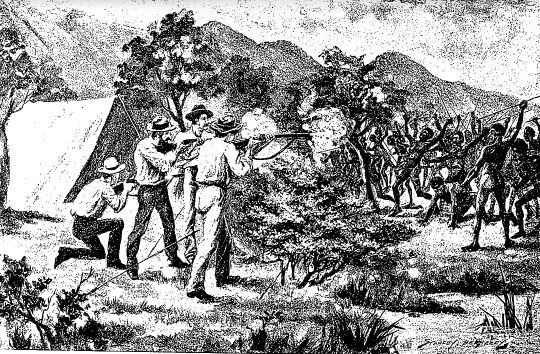
The ants were terribly troublesome at this waterhole, although we slept on the damp sand; so we shifted the camp up to the sweet water-hole, and selected as open a piece of ground as possible, as I intended the camp to remain here for a week or two. More thunder and lightning, with great heat and a few drops of rain. Thermometer, 106°. There were countless numbers of the little cockatoo parrots here; they are very shy, and even when Gibson or Jimmy lets off a gun at them, a dozen or two are sure to fall; it takes some time, however, before another shot can be had at them. I fancy they are migrating. The pigeons swarm at night to water. I intend to visit the ridges which I mentioned as lying to the south-west, from the west end of this range. We shod the old black mare, Diaway, and old Buggs, to take with us. The 18th of February, 1874, was like to have proved a most eventful day in my life, for it was very nearly the termination of it. I was riding Diaway, the colt just shod; he is seldom ridden, though a very fine hack, as he is such a splendid weight-carrier as a packhorse; he is rather skittish, and if anything goes wrong with his pack, he'll put it right (on the ground) almost instantaneously. I was driving all the horses up to the camp, when one broke from the mob, and galloped across the creek. There was a bank of stones about three feet high, which was hidden by a growth of rushes; Diaway went bounding over the great bushes and inequalities of the channel, and reached the bank without seeing it, until too late, when he made a bound at, but fell on the top of, it, rolling over upon me at the same time. He scrambled up, but left me on the broad of my back. On my feet were those wonderful boots before described, with the sixty horseshoe nails in each, and it was no wonder that one of my feet got caught in the stirrup on the off side of the horse. It is one of the most horrible positions that the mind can well imagine, to contemplate being dragged by a horse. I have been dragged before now, and only escaped by miracles on each occasion. In this case, Diaway, finding me attached to him, commenced to lash out his newly shod heels at me, bounding away at the same time into a dense thicket of scrub close by. Mr. Tietkens and the others seeing the accident came running up behind, as Diaway and I were departing. Fortunately I was not dragged far, but was literally kicked free from and by, the frightened and uncontrolled animal. The continual kickings I received—some on my legs and body, but mostly upon that portion of the frame which it is considered equally indecorous to present either to a friend or an enemy—at length bent one or two of the nail-heads which held me, and, tearing the upper leather off my boot, which fortunately was old, ripped it off, leaving me at length free. As I lay on my excoriated back, I saw Diaway depart without me into the scrub, with feelings of the most profound delight, although my transports were considerably lessened by the agonising sensations I experienced. Mr. Tietkens helped me to hobble over to the camp in a most disorganised state, though thanking Providence for so fortunate an escape. Had Diaway but entered the scrub not two yards from where I was released, I could not have existed more than a minute. The following day Mr. Tietkens was getting everything ready to go with me to the south-west ridges, though I had great doubts of my ability to ride, when we became aware of the presence of a whole host of natives immediately below the camp. All the morning the little dog had been strangely perturbed, and we knew by the natives' fires that they were in our immediate neighbourhood. There was so much long grass and tall rushes in the creek bed, that they could approach very close before we could possibly see them. So soon as they found themselves detected, as usual they set up the most horrible yells, and, running up on the open ground, sent a flight of spears at us before a rifle or a gun could be seized, and we had to jump behind a large bush, that I left standing on purpose, to escape. Our stand of arms was there, and we immediately seized them, sending the bullets flying just above their heads and at their feet. The report of the weapons and the whirring sound of the swiftly passing shots made them pause, and they began an harangue, ordering us out of their territories, to the south. Seeing us, however, motionless and silent, their courage returned, and again they advanced, uttering their war cries with renewed energy. Again the spears would have been amongst us; but I, not relishing even the idea of barbed spears being stuck through my body, determined not to permit either my own or any of my party's lives to be lost for the sake of not discharging my firearms. Consequently we at length succeeded in causing a rout, and driving the enemy away. There were a great number of natives in the bushes, besides those who attacked us. There were not many oldish men among them, only one with grey hair. I am reminded here to mention that in none of my travels in these western wilds have I found any places of sepulture of any kind. The graves are not consumed by the continual fires that the natives keep up in their huntings, for that would likewise be the fate of their old and deserted gunyahs, which we meet with frequently, and which are neither all nor half destroyed. Even if the natives put no boughs or sticks upon their graves, we must see some mounds or signs of burial-places, if not of bones or skulls. My opinion is, that these people eat their aged ones, and most probably those who die from natural causes also.
It was a cool, breezy day, and, in consequence of the hostile action of the natives, I did not depart on the south-west excursion. I was not sorry to delay my departure, for I was in great pain all over. I now decided to leave Mr. Tietkens and take Jimmy with me. I cannot say I anticipate making any valuable discovery on this trip; for had there been ranges of any elevation to the westward, or beyond the ridges in question, I should in all probability have seen them from the end of this range, and should have visited them in preference to Mount Destruction. I felt it incumbent on me to visit them, however, as from them I might obtain a view of some encouraging features beyond.
Journey south-west. Glens and springs. Rough watering-place. A marble bath. Glassy rocks. Swarms of ants. Solitary tree. An oven. Terrible night. And day. Wretched appearance of the horses. Mountains of sand. Hopeless view. Speculations. In great pain. Horses in agony. Difficulty in watering them. Another night of misery. Dante's Inferno. The waters of oblivion. Return to the pass. Dinner of carrion. A smoke-house. Tour to the east. Singular pinnacle. Eastern ranges. A gum creek. Basins of water. Natives all around. Teocallis. Horrid rites. A chip off the old block. A wayside inn. Gordon's Springs.
Taking Jimmy and three horses, we travelled, after clearing the pass, on the south slopes of the range westward, crossing several small creek-channels, which might or might not have waters in them. At twelve miles we came to a green-looking channel and found water, running so far down as a rocky hole, near where we crossed. We outspanned here for an hour, as I found riding very severe toil after my late kicking. I named this secluded but pretty little spot, Glen Helen. It was very rough travelling ground—worse than on the northern side of the range. Three miles farther, we crossed another running water, and called it Edith Hull's Springs. At ten miles farther, after crossing several channels, we turned up one, and got some water in a very rough and stony gorge off the main channel, which was dry. There was very poor feed, but we were compelled to remain, as there was no other creek in sight for some miles, and the horses, although shod, could only travel slowly over the terribly rough ground. When we turned them out, they preferred to stand still, rather than roam about among the rocks and boulders for food. The day was cool; the southern horizon, the only one we could see, was bounded entirely by red sandhills and casuarina timber. The horses ate nothing all night, and stood almost where they were hobbled.
In this region, and in the heat of summer, the moment horses, no matter how fat and fresh they may be, are taken away from their companions to face the fearful country that they know is before them, they begin to fret and fall away visibly. They will scarcely eat, and get all the weaker in consequence, and then they require twice as much water as they otherwise would if their insides were partly filled with grass. When I released our three from the hobbles this morning, they immediately pretended to feed; but this old ruse has been experienced before, and time was now up, to move on again. They were very thirsty, and nearly emptied the rock basin, where we had a kind of bath before starting. Along the foot-hills over which we were obliged to travel, the country was much rougher than yesterday; so much so, that I kept away as much as possible. At twenty miles we turned up a creek-channel, which proved to be a dreadful gorge, being choked up with huge boulders of red and white granite. Among these I found a fine rock tarn; indeed, I might call it a marble bath, for the rock was almost pure white, and perfectly bare all round. The water was considerably over our heads, and felt as cold as ice. It was a dreadful place to get horses up to, and two of them fell two or three times on the glassy, shelving, and slippery rocks. The old grey, Buggs, hurt himself a good deal.
Time seems to fly in these places, except when you want it to do so, and by the time the horses got down from the water the day was nearly gone. The feed for them was very little better than at our last night's camp, nor was the glen any less stony or rough. The day was 12° hotter than yesterday; the thermometer indicated 104°. The ants in this glen were frightful; they would not allow me a moment's rest anywhere. There was but one solitary eucalyptus or gum-tree, and in its scanty shade they swarmed in countless myriads. The sun poured his fiery beams full down upon us, and it was not until he departed over the cliffs to the west that we had a moment's respite; the place was a perfect oven.
I passed the time mostly in the marble bath, and then took a walk up to the top of the range and could see the hills I desired to visit; they now bore nearly south-west. So long as the sun's rays were pouring down upon their unsheltered hides, the horses would not attempt to eat, but when he departed they fed a little on the coarse vegetation. This glen, like all the others in this range, swarmed with pigeons, and we got enough for breakfast at one shot. During the hot months, I believe whites could live entirely on pigeons in this range. At the camp at Sladen Water they came to the water in clouds, their very numbers sometimes preventing us getting a good shot, and we had been living entirely on them, for now we had no other meat. Unfortunately, our ammunition is almost exhausted, but so long as it lasts we shall have birds. When it is gone we must eat horseflesh, and should have been driven to do so before now, only for these birds. I have an old horse now fattening for the knife, and I am sorry, i.e. happy, to say, whenever I inspect him he looks better. The one I mean is the old sideways-going Terrible Billy. Poor old creature! To work so many years as he has done for man, and then to be eaten at last, seems a hard fate; but who or what can escape that inexorable shadow, death?
It may be the destiny of some of ourselves to be eaten; for I fully believe the natives of these regions look upon all living organisms as grist for their insatiable mills. As night came on, I was compelled to lie down at last, but was so bitten and annoyed by the ants, that I had to keep moving about from place to place the whole night long, while the [in]sensible Jimmy lay sleeping and snoring, though swarmed over and almost carried away by the ants, as peacefully as though he had gone to rest under the canopy of costly state, and lulled with sounds of sweetest melody. I could not help moralising, as I often stood near him, wondering at his peace and placidity, upon the differences of our mental and physical conditions: here was one human being, young and strong, certainly, sleeping away the, to me, dreary hours of night, regaining that necessary vigour for the toils of the coming day, totally oblivious of swarms of creeping insects, that not only crawled all over him, but constantly bit into his flesh; while another, who prided himself perhaps too much upon the mental powers bestowed by God upon him, was compelled by the same insects to wander through the whole night, from rock to rock and place to place, unable to remain for more than a moment or two anywhere; and to whom sleep, under such circumstances, was an utter impossibility. Not, indeed, that the loss of sleep troubles me, for if any one could claim to be called the sleepless one, it would be I—that is to say, when engaged in these arduous explorations, and curtained by night and the stars; but, although I can do without sleep, I require a certain amount of horizontal repose, and this I could not obtain in this fearful glen. It was, therefore, with extreme pleasure that I beheld the dawn, and:—
“To the eastward where, cluster by cluster,
Dim stars and dull planets that muster,
Waxing wan in a world of white lustre,
That spread far and high.”
No human being could have been more pleased than I at the appearance of another day, although I was yet doomed to several hours more misery in this dreadful gorge. The pigeons shot last night were covered within and without by ants, although they had been put in a bag. The horses looked wretched, even after watering, and I saw that it was actually necessary to give them a day's rest before I ventured with them into the frightful sandhills which I could see intervened between us and the distant ridges. Truly the hours I spent in this hideous gorge were hours of torture; the sun roasted us, for there was no shade whatever to creep into; the rocks and stones were so heated that we could neither touch, nor sit upon them, and the ants were more tormenting than ever. I almost cried aloud for the mountains to fall upon me, and the rocks to cover me. I passed several hours in the marble bath, the only place the ants could not encroach upon, though they swarmed round the edge of the water. But in the water itself were numerous little fiendish water-beetles, and these creatures bit one almost as badly as the ants. In the bath I remained until I was almost benumbed by the cold. Then the sunshine and the heat in the gorge would seem delightful for a few minutes, till I became baked with heat again. The thermometer stood at 106° in the shade of the only tree. At three p.m. the horses came up to water. I was so horrified with the place I could no longer remain, though Jimmy sat, and probably slept, in the scanty one tree's shade, and seemed to pass the time as comfortably as though he were in a fine house. In going up to the water two of the horses again fell and hurt themselves, but the old blear-eyed mare never slipped or fell. At four p.m. we mounted, and rode down the glen until we got clear of the rough hills, when we turned upon our proper course for the ridges, which, however, we could not see. In two or three miles we entered the sandhill regions once more, when it soon rose into hills. The triodia was as thick and strong as it could grow. The country was not, so to say, scrubby, there being only low bushes and scrubs on the sandhills, and casuarina trees of beautiful outline and appearance in the hollows. When the horses got clear of the stones they began to eat everything they could snatch and bite at.
At fifteen miles from the gorge we encamped on a patch of dry grass. The horses fed pretty well for a time, until the old mare began to think it time to be off, and she soon would have led the others back to the range. She dreaded this country, and knew well by experience and instinct what agony was in store for her. Jimmy got them back and short-hobbled them. There were plenty of ants here, but nothing to be compared to the number in the gorge, and having to remove my blankets only three or four times, I had a most delightful night's rest, although, of course, I did not sleep. The horses were sulky and would not eat; therefore they looked as hollow as drums, and totally unfit to traverse the ground that was before them. However, this had to be done, or at least attempted, and we got away early. We were in the midst of the sandhills, and here they rose almost into mountains of sand. It was most fatiguing to the horses, the thermometer 104° in the shade when we rested at twenty-two miles. Nor was this the hottest time of the day. We had been plunging through the sand mountains, and had not sighted the ridges, for thirty-seven miles, till at length we found the nearest were pretty close to us. They seemed very low, and quite unlikely to produce water. Reaching the first, we ascended it, and I could see at a glance that any prospect of finding water was utterly hopeless, as these low ridges, which ran north and south, were merely a few oblique-lying layers of upheaved granite, not much higher than the sandhills which surrounded them, and there was no place where water could lodge even during rains. Not a rise could be seen in any direction, except, of course, from where we had come. We went on west five or six miles farther to the end of these, just about sundown: and long, indeed, will that peculiar sunset rest in my recollection. The sun as usual was a huge and glaring ball of fire that with his last beams shot hot and angry glances of hate at us, in rage at our defiance of his might. It was so strange and so singular that only at this particular sunset, out of the millions which have elapsed since this terrestrial ball first floated in ether, that I, or indeed any White man, should stand upon this wretched hill, so remote from the busy haunts of my fellow men. My speculations upon the summit, if, indeed, so insignificant a mound can be said to have a summit, were as wild and as incongruous as the regions which stretched out before me. In the first place I could only conclude that no water could exist in this region, at least as far as the sand beds extend. I was now, though of course some distance to the south also, about thirty miles to the west of the most western portion of the Rawlinson Range.
From that range no object had been visible above the sandhills in any westerly direction, except these ridges I am now upon, and from these, if any other ranges or hills anywhere within a hundred miles of the Rawlinson existed, I must have sighted them. The inference to be drawn in such a case was, that in all probability this kind of country would remain unaltered for an enormous distance, possibly to the very banks of the Murchison River itself. The question very naturally arose, Could the country be penetrated by man, with only horses at his command, particularly at such a heated time of year? Oh, would that I had camels! What are horses in such a region and such a heated temperature as this? The animals are not physically capable of enduring the terrors of this country. I was now scarcely a hundred miles from the camp, and the horses had plenty of water up to nearly halfway, but now they looked utterly unable to return. What a strange maze of imagination the mind can wander in when recalling the names of those separated features, the only ones at present known to supply water in this latitude—that is to say, the Murchison River, and this new-found Rawlinson Range, named after two Presidents of the Royal Geographical Society of London. The late and the present, the living and the dead, physically and metaphysically also, are not these features, as the men, separated alike by the great gulf of the unknown, by a vast stretch of that undiscovered country from whose bourne no traveller returns?
The sun went down, and I returned to my youthful companion with the horses below. We were fifty-one miles from the water we had left. The horses were pictures of misery, old Buggs's legs had swelled greatly from the contusions he had received in falling on the slippery rocks. The old black mare which I rode, though a sorry hack, looked worse than I had ever seen her before, and even the youthful and light-heeled and -hearted Diaway hung his head, and one could almost span him round the flanks. The miserable appearance of the animals was caused as much by want of food as want of water, for they have scarcely eaten a mouthful since we left the pass; indeed, all they had seen to eat was not inviting.
We slowly left these desolate ridges behind, and at fifteen miles we camped, Jimmy and I being both hungry and thirsty. Our small supply of water only tantalised, without satisfying us whenever we took a mouthful. We now found we had nothing to eat, at least nothing cooked, and we had to sacrifice a drop of our stock of water to make a Johnny-cake. It was late by the time we had eaten our supper, and I told Jimmy he had better go to sleep if he felt inclined; I then caught and tied up the horses, which had already rambled some distance away. When I got back I found Jimmy had literally taken me at my word; for there he was fast asleep among the coals and ashes of the fire, in which we had cooked our cake. I rolled him over once or twice to prevent him catching fire, but he did not awake. The night was very warm; I tried to lay down on my rug, but I was in such pain all over from my recent accident, that I could not remain still. I only waited to allow Jimmy a little sleep, or else he would have fallen off his horse, and caused more delay. I walked to, and tried to console, the horses. Sleepless and restless, I could no longer remain.
Fast asleep is Armor lying—do not touch him, do not wake him; but Armor had to be awakened. But first I saddled and put up everything on the horses. Jimmy's lips were cracked and parched, and his tongue dry and half out of his mouth; I thought the kindest way to wake him was to pour a little water into his mouth. Up he jumped in a moment, and away we went at three o'clock in the morning, steering by the stars until daylight; slowly moving over sandhill after sandhill. Soon after sunrise we fell in with our outgoing track, and continued on, though we had great trouble to keep the horses going at all, until we reached our old encampment of the night before last, being now only fifteen miles from the water. For the last few miles the horses had gone so dreadfully slow, I thought they would give in altogether. So soon as they were unsaddled they all lay down, shivering and groaning fearfully.
To see a horse in a state of great thirst is terrible, the natural cavity opens to an extraordinary size, and the creature strains and makes the most lamentable noises. Mares are generally worse in these cases than horses. Old Buggs and the mare were nearly dead. Diaway suffered less than the others. We had yet a small quantity of water in our bag, and it was absolutely necessary to sacrifice it to the horses if we wished them ever to return. We had but three pints, which we gave to Buggs and the mare, Diaway getting none. What the others got was only just enough to moisten their tongues. Leaving this place at eleven a.m., we reached the gorge at sundown, travelling at the rate of only two miles an hour. The day was hot, 104° at eleven a.m. When we took the saddles off the horses, they fell, as they could only stand when in motion—old Buggs fell again in going up the gorge; they all fell, they were so weak, and it took nearly an hour to get them up to the bath. They were too weak to prevent themselves from slipping in, swimming and drinking at the same time; at last old Buggs touched the bottom with his heels, and stood upon his hind-legs with his forefeet against the rock wall, and his head bent down between, and drank thus. I never saw a horse drink in that fashion before.
It was very late when we got them back to the camp-tree, where we let them go without hobbles. The ants were as rampant as ever, and I passed another night in walking up and down the glen. Towards midnight the horses came again for water, but would not return, preferring to remain till morning rather than risk a passage down in the dark.
I went right up to the top of the mountain, and got an hour's peace before the sun rose. In the morning all the horses' legs were puffed and swelled, and they were frightened to move from the water. I had great trouble in getting them down at all. It was impossible to ride them away, and here we had to remain for another day, in this Inferno. Not Dante's, gelid lowest circle of Hell, or city of Dis, could cause more anguish, to a forced resident within its bounds, than did this frightful place to me. Even though Moses did omit to inflict ants on Pharaoh, it is a wonder Dante never thought to have a region of them full of wicked wretches, eternally tortured with their bites, and stings, and smells. Dante certainly was good at imagining horrors. But imagination can't conceive the horror of a region swarming with ants and then Dante never lived in an ant country, and had no conception what torture such creatures can inflict. The smaller they are the more terrible. My only consolation here was my marble bath, which the horses had polluted; within its cool and shady depths I could alone find respite from my tormentors. Oh, how earnestly did I wish that its waters were the waters of oblivion, or that I could quaff some kind nepenthe, which would make me oblivious of my woes, for the persistent attacks of the ants unceasingly continued
“From night till morn, from morn till dewy eve.”
Here of course we had no dewy eve. Only one slight source of pleasure at length occurred to me, and that was, that Jimmy began to shift about a bit at last. On the 26th, with what delight I departed from this odious gorge after another night of restlessness, agony, and misery, may perhaps be imagined, though of course I was indebted to the glen for water, and unless we actually give up our lives, we cannot give up that. There was a good deal of water in this bath, as may be supposed when horses could swim about in it. I called it Edith's Marble Bath, after my niece, having named Glen Edith also after her on my former expedition. The stone here is not actually marble, though very like it. I saw no limestone in this range; the only approach to it is in the limestone formation in the bed of the ancient Lake Christopher, mentioned as lying to the west of the Rawlinson Range. The stone here was a kind of milky quartz. We kept away as much as possible off the rough slopes of the range, and got to Glen Helen at night, but old Buggs knocked up, and we had to lead, beat, and drive him on foot, so that it was very late before we got to the glen. We got all three horses back to the pass early the next day. No natives had appeared, but the horses had never been seen since I left. Oh, didn't I sleep that night! no ants. Oh, happiness! I hadn't slept for a week.
The next day, the 28th of February, Gibson and Jimmy went to look for the mob of horses. There was a watering-place about two miles and a half south from here, where emus used to water, and where the horses did likewise; there they found all the horses. There was a very marked improvement in their appearance, they had thriven splendidly. There is fine green feed here, and it is a capital place for an explorer's depot, it being such an agreeable and pretty spot. Gibson and Jimmy went to hunt for emus, but we had none for supper. We got a supply of pigeons for breakfast. Each day we more deeply lament that the end of our ammunition is at hand. For dinner we got some hawks, crows, and parrots. I don't know which of these in particular disagreed with me, but I suppose the natural antipathy of these creatures to one another, when finding themselves somewhat crowded in my interior, was casus belli enough to set them quarrelling even after death and burial; all I knew was the belli was going on in such a peculiar manner that I had to abandon my dinner almost as soon as I had eaten it. It is now absolutely necessary to kill a horse for food, as our ammunition is all but gone. Mr. Tietkens and I went to find a spot to erect a smoke-house, which required a soft bank for a flue; we got a place half a mile away. Thermometer 104°. Mr. Tietkens and I commenced operations at the smoke-house, and the first thing we did was to break the axe handle. Gibson, who thought he was a carpenter, blacksmith, and jack-of-all-trades by nature, without art, volunteered to make a new one, to which no one objected. The new handle lasted until the first sapling required was almost cut in two, when the new handle came in two also; so we had to return to the camp, while Gibson made another handle on a new principle. With this we worked while Gibson and Jimmy shod a couple of horses. A pair of poking brutes of horses are always away by themselves, and Mr. Tietkens and I went to look for, but could not find them. We took the shovel and filled up the emu water-hole with sand, so that the horses had to show themselves with the others at the pass at night. For two or three days we shod horses, shot pigeons, and worked at the smoke-house. I did not like the notion of killing any of the horses, and determined to make a trip eastwards, to see what the country in that direction was like. We chopped up some rifle bullets for shot, to enable Gibson and Jimmy to remain while we were away, as a retreat to Fort Mueller from here was a bitter idea to me. Before I can attempt to penetrate to the west, I must wait a change in the weather. The sky was again becoming cloudy, and I had hopes of rain at the approaching equinox.
The three horses we required for the trip we put down through the north side of the pass. On March 10th, getting our horses pretty easily, we started early. As soon as we got clear of the pass on the north side, almost immediately in front of us was another pass, lying nearly east, which we reached in five miles. I called this the Weld Pass. From hence we had a good view of the country farther east. A curved line of abrupt-faced hills traversed the northern horizon; they had a peculiar and wall-like appearance, and seemed to end at a singular-looking pinnacle thirty-four or five miles away, and lying nearly east. This abrupt-faced range swept round in a half circle, northwards, and thence to the pinnacle. We travelled along the slopes of the Rawlinson Range, thinking we might find some more good gorges before it ended, we being now nearly opposite the Alice Falls. One or two rough and stony gullies, in which there was no water, existed; the country was very rough. I found the Rawlinson Range ended in fifteen or sixteen miles, at the Mount Russell* mentioned before. Other ranges rose up to the east; the intervening country seemed pretty well filled with scrub. We pushed on for the pinnacle in the northern line, but could not reach it by night as we were delayed en route by searching in several places for water. The day was hot, close, cloudy, and sultry. In front of us now the country became very scrubby as we approached the pinnacle, and for about three miles it was almost impenetrable. We had to stop several times and chop away limbs and boughs to get through, when we emerged on the bank of a small gum creek, and, turning up its channel, soon saw some green rushes in the bed. A little further up we saw more, brighter and greener, and amongst them a fine little pond of water. Farther up, the rocks rose in walls, and underneath them we found a splendid basin of overflowing water, which filled several smaller ones below. We could hear the sound of splashing and rushing waters, but could not see from whence those sounds proceeded. This was such an excellent place that we decided to remain for the rest of the day. The natives were all round us, burning the country, and we could hear their cries. This morning we had ridden through two fresh fires, which they lit, probably, to prevent our progress; they followed us up to this water. I suppose they were annoyed at our finding such a remarkably well-hidden place. It is a very singular little glen. There are several small mounds of stones placed at even distances apart, and, though the ground was originally all stones, places like paths have been cleared between them. There was also a large, bare, flat rock in the centre of these strange heaps, which were not more than two and a half feet high. I concluded—it may be said uncharitably, but then I know some of the ways and customs of these people—that these are small kinds of teocallis, and that on the bare rock already mentioned the natives have performed, and will again perform, their horrid rites of human butchery, and that the drippings of the pellucid fountains from the rocky basins above have been echoed and re-echoed by the dripping fountains of human gore from the veins and arteries of their bound and helpless victims. Though the day was hot, the shade and the water were cool, and we could indulge in a most luxurious bath. The largest basin was not deep, but the water was running in and out of it, over the rocks, with considerable force. We searched about to discover by its sound from whence it came, and found on the left-hand side a crevice of white quartz-like stone, where the water came down from the upper rocks, and ran away partly into the basins and partly into rushes, under our feet. On the sloping face of the white rock, and where the water ran down, was a small indent or smooth chip exactly the size of a person's mouth, so that we instinctively put our lips to it, and drank of the pure and gushing element. I firmly believe this chip out of the rock has been formed by successive generations of the native population, for ages placing their mouths to and drinking at this spot; but whether in connection with any sacrificial ceremonies or no, deponent knoweth, and sayeth not. The poet Spenser, more than three hundred years ago, must have visited this spot—at least, in imagination, for see how he describes it:—
“And fast beside there trickled softly down,
A gentle stream, whose murmuring waves did play
Amongst the broken stones, and made a sowne,
To lull him fast asleep, who by it lay:
The weary traveller wandering that way
Therein might often quench his thirsty heat,
And then by it, his weary limbs display;
(Whiles creeping slumber made him to forget
His former pain), and wash away his toilsome sweet.”
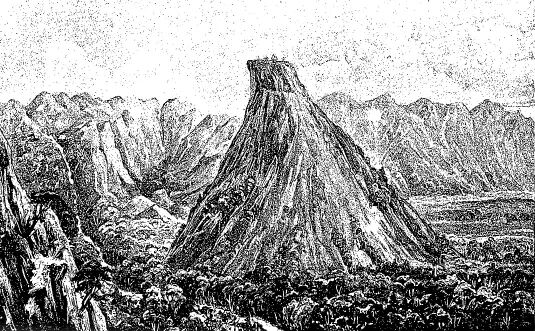
There is very poor grazing ground round this water. It is only valuable as a wayside inn, or out. I called the singular feature which points out this water to the wanderer in these western wilds, Gill's Pinnacle, after my brother-in-law, and the water, Gordon's Springs, after his son. In the middle of the night, rumblings of thunder were heard, and lightnings illuminated the glen. When we were starting on the following morning, some aborigines made their appearance, and vented their delight at our appearance here by the emission of several howls, yells, gesticulations, and indecent actions, and, to hem us in with a circle of fire, to frighten us out, or roast us to death, they set fire to the triodia all round. We rode through the flames, and away.
The Rebecca. The Petermann range. Extraordinary place. The Docker. Livingstone's Pass. A park. Wall-like hills. The Ruined Rampart. Pink, green, and blue water. Park-like scenery. The Hull. A high cone. Sugar-loaf Peak. Pretty hills and grassy valleys. Name several features. A wild Parthenius. Surprise a tribe of natives. An attack. Mount Olga in view. Overtaken by the enemy. Appearance of Mount Olga. Breakfast interrupted. Escape by flight. The depot. Small circles of stone. Springs. Mark a tree. Slaughter Terrible Billy. A smoke signal. Trouble in collecting the horses. A friendly conference. Leave Sladen Water. Fort McKellar. Revisit the Circus. The west end of the range. Name two springs.
The country towards the other ranges eastwards appeared poor and scrubby. We went first to a hill a good deal south of east, and crossed the dry bed of a broad, sandy, and stony creek running north. I called it the Rebecca. From it we went to a low saddle between two hills, all the while having a continuous range to the north; this was the extension beyond the pinnacle of the wall-like crescent. A conspicuous mount in this northern line I called Mount Sargood*. From this saddle we saw a range of hills which ran up from the south-west, and, extending now eastwards, formed a valley nearly in front of us. I called this new feature the Petermann Range. In it, a peculiar notch existed, to which we went. This new range was exceedingly wall-like and very steep, having a serrated ridge all along; I found the notch to be only a rough gully, and not a pass. We continued along the range, and at four miles farther we came to a pass where two high hills stood apart, and allowed an extremely large creek—that is to say, an extremely wide one—whose trend was northerly, to come through. Climbing one of the hills, I saw that the creek came from the south-west, and was here joined by another from the south-east. There was an exceedingly fine and pretty piece of park-like scenery, enclosed almost entirely by hills, the Petermann Range forming a kind of huge outside wall, which enclosed a mass of lower hills to the south, from which these two creeks find their sources. This was a very extraordinary place; I searched in vain in the pass for water, and could not help wondering where such a watercourse could go to. The creek I called the Docker*. The pass and park just within it I called Livingstone Pass and Learmonth* Park. Just outside the pass, northerly, was a high hill I called Mount Skene*.
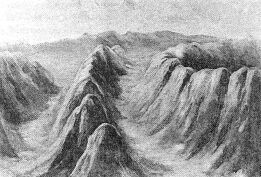
Finding no water in the pass, we went to the more easterly of the two creeks; it was very small compared with the Docker. It was now dusk, and we had to camp without water. The day was hot. This range is most singular in construction; it rises on either side almost perpendicularly, and does not appear to have very much water about it; the hills indeed seem to be mere walls, like the photographs of some of the circular ranges of mountains in the moon. There was very fine grass, and our horses stayed well. We had thunder and lightning, and the air became a little cooled. The creek we were on appeared to rise in some low hills to the south; though it meandered about so much, it was only by travelling, we found that it came from a peculiar ridge, upon whose top was a fanciful-looking, broken wall or rampart, with a little pinnacle on one side. When nearly abreast, south, of this pinnacle, we found some water in the creek-bed, which was now very stony. The water was impregnated with ammonia from the excreta of emus, dogs, birds, beasts, and fishes, but the horses drank it with avidity. Above this we got some sweet water in rocks and sand. I called the queer-looking wall the Ruined Rampart. There was a quantity of different kinds of water, some tasting of ammonia, some saltish, and some putrid. A few ducks flew up from these strange ponds. There was an overhanging ledge and cave, which gave us a good shade while we remained here, the morning being very hot. I called these MacBain's* Springs.
Following the creek, we found in a few miles that it took its rise in a mass of broken table-lands to the south. We still had the high walls of the Petermann to the north, and very close to us. In five miles we left this water-shed, and descended the rough bed of another creek running eastwards; it also had some very queer water in it—there were pink, green, and blue holes. Ducks were also here; but as we had no gun, we could not get any. Some sweet water was procured by scratching in the sand. This creek traversed a fine piece of open grassy country—a very park-like piece of scenery; the creek joined another, which we reached in two or three miles. The new creek was of enormous width; it came from the low hills to the south and ran north, where the Petermann parted to admit of its passage. The natives were burning the country through the pass. Where on earth can it go? No doubt water exists in plenty at its head, and very likely where the natives are also; but there was none where we struck it. I called this the Hull*.
The main range now ran on in more disconnected portions than formerly; their general direction was 25° south of east. We still had a mass of low hills to the south. We continued to travel under the lea of the main walls, and had to encamp without water, having travelled twenty-five miles from the Ruined Rampart. A high cone in the range I called Mount Curdie*. The next morning I ascended the eastern end of Mount Curdie. A long way off, over the tops of other hills, I could see a peak bearing 27° south of east; this I supposed was, as it ought to be, the Sugar-loaf Hill, south westward from Mount Olga, and mentioned previously. To the north there was a long wall-like line stretching across the horizon, ending about north-east; this appeared to be a disconnected range, apparently of the same kind as this, and having gaps or passes to allow watercourses to run through; I called it Blood's Range. I could trace the Hull for many miles, winding away a trifle west of north. It is evident that there must exist some gigantic basin into which the Rebecca, the Docker, and the Hull, and very likely several more further east, must flow. I feel morally sure that the Lake Amadeus of my former journey must be the receptacle into which these creeks descend, and if there are creeks running into the lake from the south, may there not also be others running in, from the north and west? The line of the southern hills, connected with the Petermann wall, runs across the bearing of the Sugar-loaf, so that I shall have to pass over or through them to reach it. The outer walls still run on in disconnected groups, in nearly the same direction as the southern hills, forming a kind of back wall all the way.
Starting away from our dry encampment, in seven miles we came to where the first hills of the southern mass approached our line of march. They were mostly disconnected, having small grassy valleys lying between them, and they were festooned with cypress pines, and some pretty shrubs, presenting also many huge bare rocks, and being very similar country to that described at Ayers Range, through which I passed in August. Here, however, the rocks were not so rounded and did not present so great a resemblance to turtles. At two miles we reached a small creek with gum timber, and obtained water by digging. The fluid was rather brackish, but our horses were very glad of it, and we gave them a couple of hours' rest. I called this Louisa's Creek. A hill nearly east of Mount Curdie I called Mount Fagan; another still eastward of that I called Mount Miller. At five miles from Louisa's Creek we struck another and much larger one, running to the north; and upon our right hand, close to the spot at which we struck it, was a rocky gorge, through and over which the waters must tumble with a deafening roar in times of flood. Just now the water was not running, but a quantity was lodged among the sand under the huge boulders that fill up the channel. I called this the Chirnside*. A hill in the main range eastward of Mount Miller I called Mount Bowley. At ten miles from Louisa's Creek we camped at another and larger watercourse than the Chirnside, which I called the Shaw*. All these watercourses ran up north, the small joining the larger ones—some independently, but all going to the north. Crossing two more creeks, we were now in the midst of a broken, pine-clad, hilly country, very well grassed and very pretty; the hills just named were on the north, and low hills on the south. Ever since we entered the Livingstone Pass, we have traversed country which is remarkably free from the odious triodia. Travelling along in the cool of the next morning through this “wild Parthenius, tossing in waves of pine,” we came at six miles along our course towards the Sugar-loaf, to a place where we surprised some natives hunting. Their wonderfully acute perceptions of sight, sound, and scent almost instantly apprised them of our presence, and as is usual with these persons, the most frantic yells rent the air. Signal fires were immediately lighted in all directions, in order to collect the scattered tribe, and before we had gone a mile we were pursued by a multitude of howling demons. A great number came running after us, making the most unearthly noises, screeching, rattling their spears and other weapons, with the evident intention of not letting us depart out of their coasts. They drew around so closely and so thick, that they prevented our horses from going on, and we were compelled to get out our revolvers for immediate use; we had no rifles with us. A number from behind threw a lot of spears; we were obliged to let the pack-horse go—one spear struck him and made him rush and jump about. This drew their attention from us for a moment; then, just as another flight of spears was let fly at us, we plunged forward on our horses, and fired our revolvers. I was horrified to find that mine would not go off, something was wrong with the cartridges, and, though I snapped it four times, not a single discharge took place. Fortunately Mr. Tietkens's went off all right, and what with that, and the pack-horse rushing wildly about, trying to get up to us, we drove the wretches off, for a time at least. They seemed far more alarmed at the horses than at us, of whom they did not seem to have any fear whatever. We induced them to retire for a bit, and we went on, after catching the packhorse and breaking about forty of their spears. I believe a wild Australian native would almost as soon be killed as have his spears destroyed. The country was now much rougher, the little grassy valleys having ceased, and we had to take to the hills.
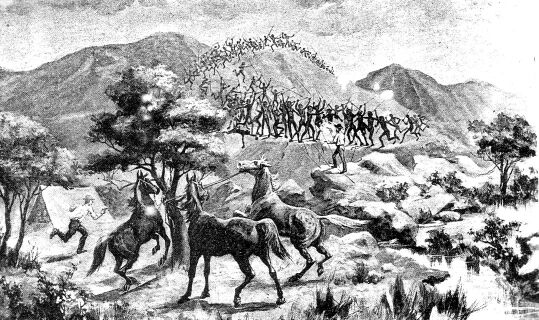
While travelling along here we saw, having previously heard its rustle, one of those very large iguanas which exist in this part of the country. We had heard tales of their size and ferocity from the natives near the Peake (Telegraph Station); I believe they call them Parenties. The specimen we saw to-day was nearly black, and from head to tail over five feet long. I should very much have liked to catch him; he would make two or three good meals for both of us. Occasionally we got a glimpse of the Sugar-loaf. At nine miles from where we had encountered the enemy, we came to a bold, bare, rounded hill, and on ascending it, we saw immediately below us, that this hilly country ceased immediately to the east, but that it ran on south-easterly. Two or three small creeks were visible below, then a thick scrubby region set in, bounded exactly to the east by Mount Olga itself, which was sixty miles away. There was a large area of bare rock all about this hill, and in a crevice we got a little water and turned our horses out. While we were eating our dinner, Mr. Tietkens gave the alarm that the enemy was upon us again, and instantly we heard their discordant cries. The horses began to gallop off in hobbles. These wretches now seemed determined to destroy us, for, having considerably augmented their numbers, they swarmed around us on all sides. Two of our new assailants were of commanding stature, each being nearly tall enough to make two of Tietkens if not of me. These giants were not, however, the most forward in the onslaught. The horses galloped off a good way, with Tietkens running after them: in some trepidation lest my revolver should again play me false, though of course I had cleaned and re-loaded it, I prepared to defend the camp. The assailants immediately swarmed round me, those behind running up, howling, until the whole body were within thirty yards of me; then they came on more slowly. I could now see that aggression on my part was the only thing for it; I must try to carry the situation with a coup. I walked up to them very fast and pointed my revolver at them. Some, thinking I was only pointing my finger, pointed their fingers at me. They all had their spears ready and quivering in their wommerahs, and I am sure I should in another instant have been transfixed with a score or two of spears, had not Mr. Tietkens, having tied up the horses, come running up, which caused a moment's diversion, and both our revolvers going off properly this time, we made our foes retreat at a better pace than they had advanced. Some of their spears were smashed in their hands; most of them dropped everything they carried, and went scudding away over the rocks as fast as fear and astonishment would permit. We broke all the spears we could lay our hands on, nearly a hundred, and then finished our dinner.
I would here remark that the natives of Australia have two kinds of spears—namely, the game- and the war-spear. The game-spear is a thick, heavy implement, barbed with two or three teeth, entirely made of wood, and thrown by the hand. These are used in stalking large game, such as emus, kangaroos, etc., when the hunter sneaks on the quarry, and, at a distance of forty to fifty yards, transfixes it, though he may not just at the moment kill the animal, it completely retards its progress, and the hunter can then run it to earth. The war-spears are different and lighter, the hinder third of them being reed, the other two-thirds mulga wood; they are barbed, and thrown with a wommerah, to a distance up to 150 yards, and are sometimes ten feet long.
After our meal we found a better supply of water in a creek about two miles southward, where there was both a rock reservoir and sand water. We had now come about 130 miles from Sladen Water, and had found waters all the way; Mount Olga was again in sight. The question was, is the water there permanent? Digging would be of no avail there, it is all solid rock; either the water is procured on the surface or there is none. I made this trip to the east, not with any present intention of retreat, but to discover whether there was a line of waters to retreat upon, and to become acquainted with as much country as possible.
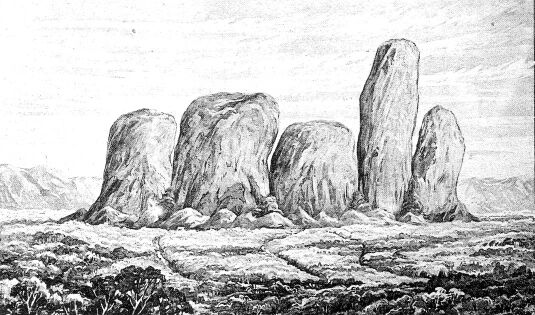
The sight of Mount Olga, and the thoughts of retreating to the east, acted like a spur to drive me farther to the west; we therefore turned our backs upon Mount Olga and the distant east. I named this gorge, where we found a good supply of water, Glen Robertson*, and the creek that comes from it, Casterton Creek. Mount Olga, as I said, bore nearly due east; its appearance from here, which we always called the farthest east, was most wonderful and grotesque. It seemed like five or six enormous pink hay-stacks, leaning for support against one another, with open cracks or fissures between, which came only about half-way down its face. I am sure this is one of the most extraordinary geographical features on the face of the earth, for, as I have said, it is composed of several enormous rounded stone shapes, like the backs of several monstrous kneeling pink elephants. At sixty miles to the west its outline is astonishing. The highest point of all, which is 1500 feet above the surrounding country, looked at from here, presents the appearance of a gigantic pink damper, or Chinese gong viewed edgeways, and slightly out of the perpendicular. We did not return to the scene of our fight and our dinner, but went about two miles northerly beyond it, when we had to take to the rough hills again; we had to wind in and out amongst these, and in four miles struck our outgoing tracks. We found the natives had followed us up step by step, and had tried to stamp the marks of the horses' hoofs out of the ground with their own. They had walked four or five abreast, and consequently made a path more easy for us to remark. We saw them raising puffs of smoke behind us, but did not anticipate any more annoyance from them. We pushed on till dark, to the spot where we had met them in the morning; here we encamped without water.
Before daylight I went for the horses, while Mr. Tietkens got the swag and things ready to start away. I returned, tied up the horses, and we had just begun to eat the little bit of damper we had for breakfast, when Mr. Tietkens, whose nervous system seems particularly alive to any native approach, gave the alarm, that our pursuers were again upon us, and we were again saluted with their hideous outcries. Breakfast was now a matter of minor import; instantly we slung everything on to the horses, and by the time that was done we were again surrounded. I almost wished we had only one of our rifles which we had left at home. We could do nothing with such an insensate, insatiable mob of wretches as these; as a novelist would say, we flung ourselves into our saddles as fast as we could, and fairly gave our enemies the slip, through the speed of our horses, they running after us like a pack of yelping curs, in maddening bray. The natives ran well for a long distance, nearly three miles, but the pace told on them at last and we completely distanced them. Had we been unsuccessful in finding water in this region and then met these demons, it is more than probable we should never have escaped. I don't sigh to meet them again; the great wonder was that they did not sneak upon and spear us in the night, but the fact of our having a waterless encampment probably deterred them. We kept at a good pace till we reached the Chirnside, and gave our horses a drink, but went on twenty miles to Louisa's Creek before we rested. We only remained here an hour. We saw no more of our enemies, but pushed on another twenty-two miles, till we reached the Hull, where we could find no water.
On the subject of the natives, I may inform my reader that we often see places at native camps where the ground has been raised for many yards, like a series of babies' graves; these are the sleeping-places of the young and unmarried men, they scoop the soil out of a place and raise it up on each side: these are the bachelors' beds—twenty, thirty, and forty are sometimes seen in a row; on top of each raised portion of soil two small fires are kept burning in lieu of blankets. Some tribes have their noses pierced, others not. Some have front teeth knocked out, and others not. In some tribes only women have teeth knocked out.
Our supply of food now consisted of just sufficient flour to make two small Johnny-cakes, and as we still had over eighty miles to go, we simply had to do without any food all day, and shall have precisely the same quantity to-morrow—that is to say, none. In eleven or twelve miles next morning we reached the caves near the Ruined Rampart, where we rested and allowed the horses to feed. At night we camped again without food or water. The morning after, we reached Gill's Pinnacle early, and famished enough to eat each other. We mixed up, cooked, and ate our small remnant of flour. The last two days have been reasonably cool; anything under 100° is cool in this region. We found that during our absence the natives had placed a quantity of gum-leaves and small boughs into the interstices of the small mounds of stone, or as I call them, teocallis, which I mentioned previously; this had evidently been done so soon as we departed, for they were now dead and dry. After bathing, remounting, we made good another twenty miles, and camped in triodia and casuarina sandhills. We reached the camp at the pass by nine a.m. on the 19th, having been absent ten days. Gibson and Jimmy were there certainly, and nothing had gone wrong, but these two poor fellows looked as pale as ghosts. Gibson imagined we had gone to the west, and was much perturbed by our protracted absence.
The water in the open holes did not agree with either Gibson or Jimmy, and, when starting, I had shown them where to dig for a spring of fresh water, and where I had nearly got a horse bogged one day when I rode there, to see what it was like. They had not, however, made the slightest effort to look for or dig it out. I gave them the last of our medical spirits, only half a bottle of rum, at starting. They had shot plenty of parrots and pigeons, and one or two ducks; but, now that the ammunition is all but gone, a single shot is of the greatest consideration. We have only a few pounds of flour, and a horse we must kill, in order to live ourselves. A few finishing touches to the smoke-house required doing; this Mr. Tietkens and Jimmy went to do, while Gibson and I cut up a tarpaulin to make large water-bags, and with a small lot of new canvas made four pairs of water-bags that would hold seven to eight gallons each. These, when greased with horse fat or oil, ought to enable me to get out some distance from the western extremity of this range. Poor old Terrible Billy came to water early, and I was much pleased with his appearance, but his little house not being quite ready and the bags not completed, he has a day or so longer of grace. I had looked forward eagerly to the time of the autumnal equinox, in hopes of rain. But all we got, however, was three dry thunderstorms and a few drops of rain, which fell upon us en route to some more favoured land. The next day being Sunday, we had a day of rest.
Near the place to which I had been dragged, there were several little heaps of stones, or rather, as a general rule, small circles of piled-up stones removed from where they had formerly lain, with the exception of a solitary one left in the centre. For what purpose the natives could have made or cleared these places I cannot tell; they were reserved for some ceremonies, no doubt, like those at Gill's Pinnacle. The last few days have been very cool, the thermometer indicating one day only 78° in the shade. On the 25th Gibson took the shovel to open out the springs formerly mentioned; they lie in the midst of several little clumps of young eucalyptus suckers, the ground all round being a morass, in which a man might almost sink, were it not for the thick growth of rushes. The water appears to flow over several acres of ground, appearing and disappearing in places. The moment a small space was cleared of the rushes, it became evident that the water was perpetually flowing, and we stood on rushes over our ankles in black soil. Gibson dug a small tank, and the water soon cleared for itself a beautiful little crystal basin of the purest liquid, much more delicious and wholesome than the half brackish water in the bed of the creek. These springs have their origin at the foot of the hill on the eastern side of this pass, and percolate into the creek-bed, where the water becomes impregnated with salt or soda. The water in the open holes in the creek-bed is always running; I thought the supply came from up the creek—now, however, I find it comes from these fresh-water springs. I branded a tree in this pass E. Giles with date.
On the 25th March the plump but old and doomed Terrible Billy confidingly came to water at eleven o'clock at night. He took his last drink, and was led a captive to the camp, where he was tied up all night. The old creature looked remarkably well, and when tied up close to the smoke-house—innocent, unsuspecting creature of what the craft and subtilty of the devil or man might work against him—he had begun to eat a bunch or two of grass, when a rifle bullet crashing through his forehead terminated his existence. There was some little fat about him; it took some time to cut up the meat into strips, which were hung on sticks and placed in tiers in the pyramidal smoke-house.
We had a fine supper of horse-steaks, which we relished amazingly. Terrible Billy tasted much better than the cob we had killed at Elder's Creek. What fat there was on the inside was very yellow, and so soft it would not harden at all. With a very fat horse a salvage of fat might be got on portions of the meat, but nearly every particle of the fat drips into oil. The smoke-house is now the object of our solicitude; a column of smoke ascends from the immolated Billy night and day. Our continual smoke induced some natives to make their appearance, but they kept at a very respectful distance, coming no nearer than the summit of the hills, on either side of the pass, from whence they had a good bird's-eye view of our proceedings. They saluted us with a few cheers, i.e. groans, as they watched us from their observatory.
The weather is now beautifully cool, fine, and clear. We had now finished smoking Terrible Billy who still maintained his name, for he was terribly tough. I intended to make an attempt to push westward from the end of this range, and all we required was the horses to carry us away; but getting them was not the easiest thing in the world, for they were all running loose. Although they have to come to the pass to get water, there is water for more than a mile, and some come sneaking quietly down without making the slightest noise, get a drink, and then, giving a snort of derision to let us know, off they go at a gallop. They run in mobs of twos and threes; so now we have systematically to watch for, catch, and hobble them. I set a watch during the night, and as they came, they were hobbled and put down through the north side of the pass. They could not get back past the camp without the watchman both hearing and seeing them; for it was now fine moonlight the greater part of the night. We had ten or twelve horses, but only two came to-night for water, and these got away before we could catch them, as two of the party let them drink before catching them. None came in the day, and only two the next night; these we caught, hobbled, and put with the others, which were always trying to get back past the camp, so to-night I had a horse saddled to be sure of catching any that came, and keeping those we had. During my watch, the second, several horses tried to pass the camp. I drove them back twice, and had no more trouble with them; but in the morning, when we came to muster them, every hoof was gone. Of course nobody had let them go! Every other member of the party informed me that they were ready to take their dying oaths that the horses never got away in their watches, and that neither of them had any trouble whatever in driving them back, etc.; so I could only conclude that I must have let them all go myself, because, as they were gone, and nobody else let them go, why, of course, I suppose I must. After breakfast Mr. Tietkens went to try to recover them, but soon returned, informing me he had met a number of natives at the smoke-house, who appeared very peaceably inclined, and who were on their road down through the pass. This was rather unusual; previous to our conflict they had never come near us, and since that, they had mostly given us a wide berth, and seemed to prefer being out of the reach of our rifles than otherwise. They soon appeared, although they kept away on the east side of the creek. They then shouted, and when I cooeyed and beckoned them to approach, they sat down in a row. I may here remark that the word cooey, as representing the cry of all Australian aborigines, belonged originally to only one tribe or region, but it has been carried about by whites from tribe to tribe, and is used by the civilised and semi-civilised races; but wild natives who have never seen whites use no such cry. There were thirteen of these men. Mr. Tietkens and I went over to them, and we had quite a friendly conference. Their leader was an individual of a very uncertain age—he might have been forty, or he might have been eighty (in the shade). (This was written some time before the “Mikado” appeared.—E.G.) His head was nearly bald on the crown, but some long grizzly locks depended below the bald patch.
The others were generally much younger, but some of them, though not clean past their youth, yet had about them some smacks of the saltness of age. The old man was the most self-possessed; the others displayed a nervous tremor at our approach; those nearest us sidled closer to their more remote and, as they no doubt thought, fortunate fellows; they were all extremely ill-favoured in face, but their figures were not so outres, except that they appeared emaciated and starved, otherwise they would have been men of good bulk. Their legs were straight, and their height would average five feet nine inches, all being much taller than Mr. Tietkens or I. Two remained at a distance; these had a great charge to superintend, it being no less than that of the trained wild dogs belonging to the tribe. There were three large dogs, two of a light sandy, and one of a kind of German colley colour. These natives were armed with an enormous number of light barbed spears, each having about a dozen. They do not appear to use the boomerang very generally in this part of the continent, although we have occasionally picked up portions of old ones in our travels. Mr. Tietkens gave each of these natives a small piece of sugar, with which they seemed perfectly charmed, and in consequence patted the seat of their intellectual—that is to say, digestive—organs with great gusto, as the saccharine morsels liquefied in their mouths. They seemed highly pleased with the appearance and antics of my little dog, who both sat and stood up at command in the midst of them.
They kept their own dogs away, I presume, for fear we might want to seize them for food—wild dog standing in about the same relation to a wild Australian native, as a sheep would to a white man. They eat all the grown dogs they can catch, but keep a few pups to train for hunting, and wonderful hunting dogs they are. Hence their fear of our taking their pets. The old gentleman was much delighted with my watch. I then showed them some matches, and the instantaneous ignition of some grass in the midst of them was rather too startling a phenomenon for their weak minds; some of them rose to depart. The old man, however, reassured them. I presented him with several matches, and showed him how to use them; he was very much pleased, and having no pockets in his coat—for I might have previously remarked they were arrayed in Nature's simple garb—he stuck them in his hair. Mr. Tietkens, during this time, was smoking, and the sight of smoke issuing from his mouth seemed to disturb even the old man's assumed imperturbability, and he kept much closer to me in consequence. I next showed them a revolver, and tried to explain the manner of using it. Most of them repeated the word bang when I said it; but when I fired it off they were too agitated to take much notice of its effect on the bark of a tree, which might otherwise have served to point a moral or adorn a tale in the oral traditions of their race for ever. At the report of the revolver all rose and seemed in haste to go, but I would not allow my dear old friend to depart without a few last friendly expressions. One of these natives was pitted with small-pox. They seemed to wish to know where we were going, and when I pointed west, and by shaking my fingers intimated a long way, many of them pulled their beards and pointed to us, and the old man gave my beard a slight pull and pointed west; this I took to signify that they were aware that other white people like us lived in that direction. The conference ended, and they departed over the hills on the east side of the pass, but it was two hours before they disappeared.
All the horses which had escaped in hobbles the other night now came to water, and were put through the pass again. During the day we secured the remainder, and had them altogether at last. It was noon of the 7th April when we left this delectable pass, again en route for the west, hoping to see Sladen Water and the Pass of the Abencerrages no more. At fourteen miles we were delayed by Banks, carrying my boxes, as a strap broke, and he set to work to free himself of everything. Fortunately, one box with the instruments, quicksilver, etc., remained firm; everything got bucked and kicked out of the other; buckskin gloves, matches, mineral collection, rifle cartridges, bottles of medicine, eye-water, socks, specimens of plants, etc., all sent flying about in the thick triodia, for the brute went full gallop all round the mob of horses, trying to get rid of the other box and his saddle. In spite of all his efforts they remained, and it was wonderful how many things we recovered, though some were lost. By this time it was dusk, and the evening set in very cool. I now intended to encamp at the fine spring I named Fort McKellar, four miles east of the Gorge of Tarns. There was a fine and heavy clump of eucalyptus timber there, and a very convenient and open sheet of water for the use of the camp. I had always looked upon this as an excellent and desirable spot for an encampment, though we had never used it yet. The grass, however, is neither good nor abundant; the country around being stony and sterile, except down the immediate valley of the channel, which was not wide enough to graze a mob of horses for long. We reached it again on the 9th of April.
My reader will remember that in January I had found a creek with a large, rocky tarn of water, which I called the Circus; it was the last westerly water on the range, and I was anxious to know how it was holding out, as it must be our point of departure for any farther efforts to the west. It was twenty miles from here, and Gibson and I rode up the range to inspect it. On our road we revisited the Gorge of Tarns; the water there had shrunk very much. Here we had left some useless articles, such as three pack-saddle frames, a broken thermometer, and sundry old gear; all these things the natives had carried away. I had a good swim in the old tarn, and proceeded, reaching the Circus early in the afternoon. There was the solitary eagle still perched upon its rock. The water had become greatly reduced; ten weeks and two days had elapsed since I was here; and in another fortnight it would all be gone. If I intend doing anything towards the west it must be done at once or it will be too late. The day was warm—102°. A large flock of galars, a slate-coloured kind of cockatoo, and a good talking bird, and hundreds of pigeons came to water at night; but having no ammunition, we did not bring a gun. The water was so low in the hole that the horses could not reach it, and had to be watered with a canvas bucket. I have said previously, that at the extremity of this range there lay an ancient lake bed, but I had only been a mile or two upon it. Further on there were indications of salt, and as we were quite out of that commodity, we rode over to try and procure some, but none existed, and we had to be satisfied with a quantity of samphire bushes and salt-bush leaves, which we took home with us, returning to Fort McKellar the following day. I called the salt feature Lake Christopher. We remained at the depot for a day or two, preparing for a start to the west, and cut rails, and fixed up some palisading for the fort. I delayed entering that evidently frightful bed of sand which lay to the west, in hopes of a change, for I must admit I dreaded to attempt the western country while the weather was still so hot and oppressive. Though the thermometer may not appear to rise extraordinarily high in this region, yet the weight and pressure of the atmosphere is sometimes almost overpowering. Existence here is in a permanent state of languor, and I am sure the others in the party feel it more than I do, being consumed with the fire or frenzy of renown for opening unknown lands, all others have to pale their ineffectual fires before it. No doubt, not being well fed is some cause for our feelings of lassitude. The horses are also affected with extreme languor, as well as the men. The thermometer to-day registered only 99°. The horses are always trying to roam away back to Sladen Water, and Mr. Tietkens and I had a walk of many miles after them to-day. I was getting really anxious about the water at the Circus. I scarcely dare to grapple with that western desert in such weather, yet, if I do not, I shall lose the Circus water.
Although we were near the change of the moon, I despaired of a change of weather. I did not ask for rain, for it would be useless on the desert sands; I only wanted the atmosphere to become a little less oppressive. I had not been round the extreme western end of the range, though we had been to it, and I thought perhaps some creek might be found to contain a good rock-hole, perhaps as far to the west, if not farther, than the Circus; on the opposite side of the range, Mr. Tietkens and Gibson, who volunteered, went to see what they could discover, also to visit the Circus so as to report upon it. Jimmy and I remained and erected some more woodwork—that is to say, rails and uprights—for the fort. We walked over to re-inspect—Jimmy had not seen them—two glens and springs lying within a couple of miles to the east of us, the first being about three-quarters of a mile off. I now named it Tyndall's Springs. Here a fine stream of running water descends much further down the channel than at any other spring in the range, though it spreads into no open sheets of water as at the depot; there was over a mile of running water. The channel is thickly set with fine tall bulrushes. There is a very fine shady clump of gum-trees here, close to the base of the range. The next spring, about a mile farther east, I called Groener's Springs; it had not such a strong flow of water, but the trees in the clump at the head of it were much larger and more numerous than at the last. Some of the trees, as was the case at Fort McKellar, were of very considerable size. Late at night Mr. Tietkens and Gibson returned, and reported that, although they had discovered a new rock-hole with seven or eight feet of water in it, it was utterly useless; for no horses could get within three-quarters of a mile of it, and they had been unable to water their horses, having had to do so at the Circus. They said the water there was holding out well; but Gibson said it had diminished a good deal since he and I were there a week ago. On the 19th April I told the party it was useless to delay longer, and that I had made up my mind to try what impression a hundred miles would make on the country to the west. I had waited and waited for a change, not to say rain, and it seemed as far off as though the month were November, instead of April. I might still keep on waiting, until every ounce of our now very limited supply of rations was gone. We were now, and had been since Billy was killed, living entirely on smoked horse; we only had a few pounds of flour left, which I kept in case of sickness; the sugar was gone; only a few sticks of tobacco for Mr. Tietkens and Gibson—Jimmy and I not smoking—remained. I had been disappointed at the Charlotte Waters at starting, by not being able to get my old horse, and had started from the Alberga, lacking him and the 200 pounds of flour he would have carried—a deficiency which considerably shortened my intended supply. A comparatively enormous quantity of flour had been lost by the continual rippings of bags in the scrubs farther south, and also a general loss in weight of nearly ten per cent., from continual handling of the bags, and evaporation. We had supplemented our supplies in a measure at Fort Mueller and the Pass, with pigeons and wallabies, as long as our ammunition lasted, and now it was done. When I made known my intention, Gibson immediately volunteered to accompany me, and complained of having previously been left so often and so long in the camp. I much preferred Mr. Tietkens, as I felt sure the task we were about to undertake was no ordinary one, and I knew Mr. Tietkens was to be depended upon to the last under any circumstances, but, to please Gibson, he waived his right, and, though I said nothing, I was not at all pleased.
Gibson and I depart for the west. His brother with Franklin. Desert oaks. Smoked horse. Ants innumerable. Turn two horses back. Kegs in a tree. No views. Instinct of horses. Sight a distant range. Gibson's horse dies. Give him the remaining one. The last ever seen of him. Alone in the desert. Carry a keg. Unconscious. Where is the relief party. A dying wallaby. Footfalls of a galloping horse. Reach the depot. Exhausted. Search for the lost. Gibson's Desert. Another smoke-house. Jimmy attacked at Fort McKellar. Another equine victim. Final retreat decided upon. Marks of floods. Peculiarity of the climate. Remarks on the region. Three natives visit us.
APRIL 20TH, 1874.
Gibson and I having got all the gear we required, took a week's supply of smoked horse, and four excellent horses, two to ride, and two to carry water, all in fine condition. I rode the Fair Maid of Perth, an excellent walker; I gave Gibson the big ambling horse, Badger, and we packed the big cob, a splendid bay horse and fine weight-carrier, with a pair of waterbags that contained twenty gallons at starting. The other horse was Darkie, a fine, strong, nuggetty-black horse, who carried two five-gallon kegs of water and our stock of smoked horse, rugs, etc. We reached the Circus, at twenty miles, early, and the horses had time to feed and fill themselves after being watered, though the grass was very poor.
21ST APRIL.
While I went for the horses Gibson topped up the water-bags and kegs, and poured a quantity of water out of the hole on to a shallow place, so that if we turned any horses back, they could drink without precipitating themselves into the deep and slippery hole when they returned here. As we rode away, I remarked to Gibson that the day, was the anniversary of Burke and Wills's return to their depot at Cooper's Creek, and then recited to him, as he did not appear to know anything whatever about it, the hardships they endured, their desperate struggles for existence, and death there, and I casually remarked that Wills had a brother who also lost his life in the field of discovery. He had gone out with Sir John Franklin in 1845. Gibson then said, “Oh! I had a brother who died with Franklin at the North Pole, and my father had a deal of trouble to get his pay from government.” He seemed in a very jocular vein this morning, which was not often the case, for he was usually rather sulky, sometimes for days together, and he said, “How is it, that in all these exploring expeditions a lot of people go and die?” I said, “I don't know, Gibson, how it is, but there are many dangers in exploring, besides accidents and attacks from the natives, that may at any time cause the death of some of the people engaged in it; but I believe want of judgment, or knowledge, or courage in individuals, often brought about their deaths. Death, however, is a thing that must occur to every one sooner or later.” To this he replied, “Well, I shouldn't like to die in this part of the country, anyhow.” In this sentiment I quite agreed with him, and the subject dropped. At eleven miles we were not only clear of the range, but had crossed to the western side of Lake Christopher, and were fairly enclosed in the sandhills, which were of course covered with triodia. Numerous fine casuarinas grew in the hollows between them, and some stunted blood-wood-trees, (red gum,) ornamented the tops of some of the sandhills. At twenty-two miles, on a west course, we turned the horses out for an hour. It was very warm, there was no grass. The horses rested in the shade of a desert oak-tree, while we remained under another. These trees are very handsome, with round umbrageous tops, the leaves are round and fringe-like. We had a meal of smoked horse; and here I discovered that the bag with our supply of horseflesh in it held but a most inadequate supply for two of us for a week, there being scarcely sufficient for one. Gibson had packed it at starting, and I had not previously seen it. The afternoon was oppressively hot—at least it always seems so when one is away from water. We got over an additional eighteen miles, making a day's stage of forty.
The country was all sandhills. The Rawlinson Range completely disappeared from view, even from the tops of the highest sandhills, at thirty-five miles. The travelling, though heavy enough, had not been so frightful as I had anticipated, for the lines of sandhills mostly ran east and west, and by turning about a bit we got several hollows between them to travel in. Had we been going north or south, north-easterly or south-westerly, it would have been dreadfully severe. The triodia here reigns supreme, growing in enormous bunches and plots, and standing three and four feet high, while many of the long dry tops are as high as a man. This gives the country the appearance of dry grassy downs; and as it is dotted here and there with casuarina and blood-wood-trees, and small patches of desert shrubs, its general appearance is by no means displeasing to the eye, though frightful to the touch. No sign of the recent presence of natives was anywhere visible, nor had the triodia been burnt for probably many years. At night we got what we in this region may be excused for calling a grass flat, there being some bunches of a thin and wiry kind of grass, though white and dry as a chip. I never saw the horses eat more than a mouthful or two of it anywhere, but there was nothing else, and no water.
22ND.
The ants were so troublesome last night, I had to shift my bed several times. Gibson was not at all affected by them, and slept well. We were in our saddles immediately after daylight. I was in hopes that a few miles might bring about a change of country, and so it did, but not an advantageous one to us. At ten miles from camp the horizon became flatter, the sandhills fell off, and the undulations became covered with brown gravel, at first very fine. At fifty-five miles it became coarser, and at sixty miles it was evident the country was becoming firmer, if not actually stony. Here we turned the horses out, having come twenty miles. I found one of our large waterbags leaked more than I expected, and our supply of water was diminishing with distance. Here Gibson preferred to keep the big cob to ride, against my advice, instead of Badger, so, after giving Badger and Darkie a few pints of water each, Gibson drove them back on the tracks about a mile and let them go, to take their own time and find their own way back to the Circus. They both looked terribly hollow and fatigued, and went away very slowly. Sixty miles through such a country as this tells fearfully upon a horse. The poor brutes were very unwilling to leave us, as they knew we had some water, and they also knew what a fearful region they had before them to reach the Circus again.
We gave the two remaining horses all the water contained in the two large water-bags, except a quart or two for ourselves. This allowed them a pretty fair drink, though not a circumstance to what they would have swallowed. They fed a little, while we remained here. The day was warm enough. The two five-gallon kegs with water we hung in the branches of a tree, with the packsaddles, empty water-bags, etc. of the other two horses. Leaving the Kegs—I always called this place by that name—we travelled another twenty miles by night, the country being still covered with small stones and thickly clothed with the tall triodia. There were thin patches of mulga and mallee scrub occasionally. No view could be obtained to the west; all round us, north, south, east, and west, were alike, the undulations forming the horizons were not generally more than seven or eight miles distant from one another, and when we reached the rim or top of one, we obtained exactly the same view for the next seven or eight miles. The country still retained all the appearance of fine, open, dry, grassy downs, and the triodia tops waving in the heated breeze had all the semblance of good grass. The afternoon had been very oppressive, and the horses were greatly disinclined to exert themselves, though my mare went very well. It was late by the time we encamped, and the horses were much in want of water, especially the big cob, who kept coming up to the camp all night, and tried to get at our water-bags, pannikins, etc. The instinct of a horse when in the first stage of thirst in getting hold of any utensil that ever had water in it, is surprising and most annoying, but teaching us by most persuasive reasons how akin they are to human things. We had one small water-bag hung in a tree. I did not think of this just at the moment, when my mare came straight up to it and took it in her teeth, forcing out the cork and sending the water up, which we were both dying to drink, in a beautiful jet, which, descending to earth, was irrevocably lost. We now had only a pint or two left. Gibson was now very sorry he had exchanged Badger for the cob, as he found the cob very dull and heavy to get on; this was not usual, for he was generally a most willing animal, but he would only go at a jog while my mare was a fine walker. There had been a hot wind from the north all day. The following morning (23rd) there was a most strange dampness in the air, and I had a vague feeling, such as must have been felt by augurs, and seers of old, who trembled as they told, events to come; for this was the last day on which I ever saw Gibson. It was a lamentable day in the history of this expedition. The horizon to the west was hid in clouds. We left the camp even before daylight, and as we had camped on the top of a rim, we knew we had seven or eight miles to go before another view could be obtained. The next rim was at least ten miles from the camp, and there was some slight indications of a change.

We were now ninety miles from the Circus water, and 110 from Fort McKellar. The horizon to the west was still obstructed by another rise three or four miles away; but to the west-north-west I could see a line of low stony ridges, ten miles off. To the south was an isolated little hill, six or seven miles away. I determined to go to the ridges, when Gibson complained that his horse could never reach them, and suggested that the next rise to the west might reveal something better in front. The ridges were five miles away, and there were others still farther preventing a view. When we reached them we had come ninety-eight miles from the Circus. Here Gibson, who was always behind, called out and said his horse was going to die, or knock up, which are synonymous terms in this region. Now we had reached a point where at last a different view was presented to us, and I believed a change of country was at hand, for the whole western, down to the south-western, horizon was broken by lines of ranges, being most elevated at the south-western end. They were all notched and irregular, and I believed formed the eastern extreme of a more elevated and probably mountainous region to the west. The ground we now stood upon, and for a mile or two past, was almost a stony hill itself, and for the first time in all the distance we had come, we had reached a spot where water might run during rain, though we had not seen any place where it could lodge. Between us and the hilly horizon to the west the country seemed to fall into a kind of long valley, and it looked dark, and seemed to have timber in it, and here also the natives had formerly burnt the spinifex, but not recently. The hills to the west were twenty-five to thirty miles away, and it was with extreme regret I was compelled to relinquish a farther attempt to reach them. Oh, how ardently I longed for a camel! how ardently I gazed upon this scene! At this moment I would even my jewel eternal, have sold for power to span the gulf that lay between! But it could not be, situated as I was; compelled to retreat—of course with the intention of coming again with a larger supply of water—now the sooner I retreated the better. These far-off hills were named the Alfred and Marie Range, in honour of their Royal Highnesses the Duke and Duchess of Edinburgh. Gibson's horse having got so bad had placed us both in a great dilemma; indeed, ours was a most critical position. We turned back upon our tracks, when the cob refused to carry his rider any farther, and tried to lie down. We drove him another mile on foot, and down he fell to die. My mare, the Fair Maid of Perth, was only too willing to return; she had now to carry Gibson's saddle and things, and we went away walking and riding by turns of half an hour. The cob, no doubt, died where he fell; not a second thought could be bestowed on him.
When we got back to about thirty miles from the Kegs I was walking, and having concluded in my mind what course to pursue, I called to Gibson to halt till I walked up to him. We were both excessively thirsty, for walking had made us so, and we had scarcely a pint of water left between us. However, of what we had we each took a mouthful, which finished the supply, and I then said—for I couldn't speak before—“Look here, Gibson, you see we are in a most terrible fix with only one horse, therefore only one can ride, and one must remain behind. I shall remain: and now listen to me. If the mare does not get water soon she will die; therefore ride right on; get to the Kegs, if possible, to-night, and give her water. Now the cob is dead there'll be all the more for her; let her rest for an hour or two, and then get over a few more miles by morning, so that early to-morrow you will sight the Rawlinson, at twenty-five miles from the Kegs. Stick to the tracks, and never leave them. Leave as much water in one keg for me as you can afford after watering the mare and filling up your own bags, and, remember, I depend upon you to bring me relief. Rouse Mr. Tietkens, get fresh horses and more water-bags, and return as soon as you possibly can. I shall of course endeavour to get down the tracks also.”
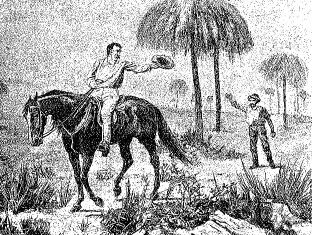
He then said if he had a compass he thought he could go better at night. I knew he didn't understand anything about compasses, as I had often tried to explain them to him. The one I had was a Gregory's Patent, of a totally different construction from ordinary instruments of the kind, and I was very loth to part with it, as it was the only one I had. However, he was so anxious for it that I gave it him, and he departed. I sent one final shout after him to stick to the tracks, to which he replied, “All right,” and the mare carried him out of sight almost immediately. That was the last ever seen of Gibson.
I walked slowly on, and the further I walked the more thirsty I became. I had thirty miles to go to reach the Kegs, which I could not reach until late to-morrow at the rate I was travelling, and I did not feel sure that I could keep on at that. The afternoon was very hot. I continued following the tracks until the moon went down, and then had to stop. The night was reasonably cool, but I was parched and choking for water. How I longed again for morning! I hoped Gibson had reached the Kegs, and that he and the mare were all right. I could not sleep for thirst, although towards morning it became almost cold. How I wished this planet would for once accelerate its movements and turn upon its axis in twelve instead of twenty-four hours, or rather that it would complete its revolution in six hours.
APRIL 24TH TO 1ST MAY.
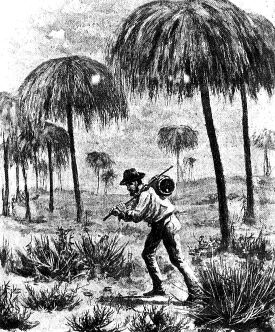
So soon as it was light I was again upon the horse tracks, and reached the Kegs about the middle of the day. Gibson had been here, and watered the mare, and gone on. He had left me a little over two gallons of water in one keg, and it may be imagined how glad I was to get a drink. I could have drunk my whole supply in half an hour, but was compelled to economy, for I could not tell how many days would elapse before assistance could come: it could not be less than five, it might be many more. After quenching my thirst a little I felt ravenously hungry, and on searching among the bags, all the food I could find was eleven sticks of dirty, sandy, smoked horse, averaging about an ounce and a half each, at the bottom of a pack-bag. I was rather staggered to find that I had little more than a pound weight of meat to last me until assistance came. However, I was compelled to eat some at once, and devoured two sticks raw, as I had no water to spare to boil them in.
After this I sat in what shade the trees afforded, and reflected on the precariousness of my position. I was sixty miles from water, and eighty from food, my messenger could hardly return before six days, and I began to think it highly probable that I should be dead of hunger and thirst long before anybody could possibly arrive. I looked at the keg; it was an awkward thing to carry empty. There was nothing else to carry water in, as Gibson had taken all the smaller water-bags, and the large ones would require several gallons of water to soak the canvas before they began to tighten enough to hold water. The keg when empty, with its rings and straps, weighed fifteen pounds, and now it had twenty pounds of water in it. I could not carry it without a blanket for a pad for my shoulder, so that with my revolver and cartridge-pouch, knife, and one or two other small things on my belt, I staggered under a weight of about fifty pounds when I put the keg on my back. I only had fourteen matches.
After I had thoroughly digested all points of my situation, I concluded that if I did not help myself Providence wouldn't help me. I started, bent double by the keg, and could only travel so slowly that I thought it scarcely worth while to travel at all. I became so thirsty at each step I took, that I longed to drink up every drop of water I had in the keg, but it was the elixir of death I was burdened with, and to drink it was to die, so I restrained myself. By next morning I had only got about three miles away from the Kegs, and to do that I travelled mostly in the moonlight. The next few days I can only pass over as they seemed to pass with me, for I was quite unconscious half the time, and I only got over about five miles a day.
To people who cannot comprehend such a region it may seem absurd that a man could not travel faster than that. All I can say is, there may be men who could do so, but most men in the position I was in would simply have died of hunger and thirst, for by the third or fourth day—I couldn't tell which—my horse meat was all gone. I had to remain in what scanty shade I could find during the day, and I could only travel by night.
When I lay down in the shade in the morning I lost all consciousness, and when I recovered my senses I could not tell whether one day or two or three had passed. At one place I am sure I must have remained over forty-eight hours. At a certain place on the road—that is to say, on the horse tracks—at about fifteen miles from the Kegs—at twenty-five miles the Rawlinson could again be sighted—I saw that the tracks of the two loose horses we had turned back from there had left the main line of tracks, which ran east and west, and had turned about east-south-east, and the tracks of the Fair Maid of Perth, I was grieved to see, had gone on them also. I felt sure Gibson would soon find his error, and return to the main line. I was unable to investigate this any farther in my present position. I followed them about a mile, and then returned to the proper line, anxiously looking at every step to see if Gibson's horse tracks returned into them.
They never did, nor did the loose horse tracks either. Generally speaking, whenever I saw a shady desert oak-tree there was an enormous bulldog ants' nest under it, and I was prevented from sitting in its shade. On what I thought was the 27th I almost gave up the thought of walking any farther, for the exertion in this dreadful region, where the triodia was almost as high as myself, and as thick as it could grow, was quite overpowering, and being starved, I felt quite light-headed. After sitting down, on every occasion when I tried to get up again, my head would swim round, and I would fall down oblivious for some time. Being in a chronic state of burning thirst, my general plight was dreadful in the extreme. A bare and level sandy waste would have been Paradise to walk over compared to this. My arms, legs, thighs, both before and behind, were so punctured with spines, it was agony only to exist; the slightest movement and in went more spines, where they broke off in the clothes and flesh, causing the whole of the body that was punctured to gather into minute pustules, which were continually growing and bursting. My clothes, especially inside my trousers, were a perfect mass of prickly points.
My great hope and consolation now was that I might soon meet the relief party. But where was the relief party? Echo could only answer—where? About the 29th I had emptied the keg, and was still over twenty miles from the Circus. Ah! who can imagine what twenty miles means in such a case? But in this April's ivory moonlight I plodded on, desolate indeed, but all undaunted, on this lone, unhallowed shore. At last I reached the Circus, just at the dawn of day. Oh, how I drank! how I reeled! how hungry I was! how thankful I was that I had so far at least escaped from the jaws of that howling wilderness, for I was once more upon the range, though still twenty miles from home.
There was no sign of the tracks, of any one having been here since I left it. The water was all but gone. The solitary eagle still was there. I wondered what could have become of Gibson; he certainly had never come here, and how could he reach the fort without doing so?
I was in such a miserable state of mind and body, that I refrained from more vexatious speculations as to what had delayed him: I stayed here, drinking and drinking, until about ten a.m., when I crawled away over the stones down from the water. I was very footsore, and could only go at a snail's pace. Just as I got clear of the bank of the creek, I heard a faint squeak, and looking about I saw, and immediately caught, a small dying wallaby, whose marsupial mother had evidently thrown it from her pouch. It only weighed about two ounces, and was scarcely furnished yet with fur. The instant I saw it, like an eagle I pounced upon it and ate it, living, raw, dying—fur, skin, bones, skull, and all. The delicious taste of that creature I shall never forget. I only wished I had its mother and father to serve in the same way. I had become so weak that by late at night, I had only accomplished eleven miles, and I lay down about five miles from the Gorge of Tarns, again choking for water. While lying down here, I thought I heard the sound of the foot-falls of a galloping horse going campwards, and vague ideas of Gibson on the Fair Maid—or she without him—entered my head. I stood up, and listened, but the sound had died away upon the midnight air. On the 1st of May, as I afterwards found, at one o'clock in the morning, I was walking again, and reached the Gorge of Tarns long before daylight, and could again indulge in as much water as I desired; but it was exhaustion I suffered from, and I could hardly move.
My reader may imagine with what intense feelings of relief I stepped over the little bridge across the water, staggered into the camp at daylight, and woke Mr. Tietkens, who stared at me as though I had been one, new risen from the dead. I asked him had he seen Gibson, and to give me some food. I was of course prepared to hear that Gibson had never reached the camp; indeed I could see but two people in their blankets the moment I entered the fort, and by that I knew he could not be there. None of the horses had come back, and it appeared that I was the only one of six living creatures—two men and four horses—that had returned, or were now ever likely to return, from that desert, for it was now, as I found, nine days since I last saw Gibson.
Mr. Tietkens told me he had been in a great state of anxiety during my absence, and had only returned an hour or two before from the Circus. This accounted for the sounds I heard. He said he had planted some smoked horsesticks, and marked a tree. This was a few hours after I had left it in the morning. He said he saw my foot-marks, but could not conclude that I could be on foot alone, and he thought the tracks must be older than they looked. Any how, we had missed meeting one another somewhere on the range. We were both equally horrified at Gibson's mischance. When we woke Jimmy up he was delighted to see me, but when told about Gibson, he said something about he knowed he worn't no good in the bush, but as long as I had returned, etc., etc. I told them both just what had occurred out there; how Gibson and I had parted company, and we could only conclude that he must be dead, or he would long before have returned. The mare certainly would have carried him to the Circus, and then he must have reached the depot; but it was evident that he had gone wrong, had lost himself, and must now be dead. I was too much exhausted and too prostrate to move from the camp to search for him to-day, but determined to start to-morrow. Mr. Tietkens got everything ready, while I remained in a state of semi-stupor. I was cramped with pains in all my joints, pains in the stomach, and violent headaches, the natural result of having a long-empty stomach suddenly filled. Gibson's loss and my struggles formed the topic of conversation for most of the day, and it naturally shed a gloom over our spirits. Here we were, isolated from civilisation, out of humanity's reach, hundreds of miles away from our fellow creatures, and one of our small party had gone from us. It was impossible for him to be still in existence in that fearful desert, as no man would or could stay there alive: he must be dead, or he would have returned as I did, only much sooner, for the mare he had, would carry him as far in a day as I could walk in a week in this country.
The days had not lately been excessively hot, Mr. Tietkens said 96 to 98° had been the average, but to-day it was only 90°. This afternoon it was very cloudy, and threatened to rain. I was now, however, in hopes that none would fall. That evil spirit of this scene—Mount Destruction—frowned upon us, and now that Gibson was dead, exploration was ended; we had but to try to find his remains, and any little trifling shower that fell would make it all the more difficult to trace him, while a thorough downpour would obliterate the tracks of our lost companion, entirely from the surface of the sandy waste into which he had so unfortunately strayed. Before daylight on the 2nd we were awoke by the sprinkling of a light shower of rain, which was of not the slightest use; but it continued so long, making everything wet and clammy, that I felt sure we should have some trouble in following Gibson's tracks. The rain ceased about seven o'clock. Mr. Tietkens and Jimmy got all the things we required, and the horses. I was so weak I could do nothing. We took three pack-horses to carry water, and two riding-horses, Blackie and Diaway, to ride, with Widge, Fromby, and Hippy. Though Mr. Tietkens and Jimmy had not been attacked during my absence, the natives were always prowling about, and I did not like the idea of leaving Jimmy alone; but as he said he was willing to remain, we left him. I had to be literally put on to my horse Blackie, and we rode away. Not to worry my reader more than I can help, I may say we had to return to the Kegs, to get the bags left there, and some indispensable things; also Gibson's saddle, which he left nine or ten miles beyond the Kegs in a tree. Going all that distance to get these things, and returning to where Gibson's tracks branched off, we had to travel 115 miles, which made it the third night the horses had been out. We gave them some of the water we carried each night, and our supply was now nearly all gone. It was on the 6th May when we got back to where Gibson had left the right line. We fortunately had fine, cool weather. As long as Gibson remained upon the other horse-tracks, following them, though not very easy, was practicable enough; but the unfortunate man had left them, and gone away in a far more southerly direction, having the most difficult sandhills now to cross at right angles. He had burnt a patch of spinifex, where he left the other horse-tracks, and must have been under the delusion that they were running north, and that the main line of tracks must be on his right, instead of his left hand, and whether he made any mistake or not in steering by the compass, it is impossible to say, but instead of going east as he should, he actually went south, or very near it. In consequence of small reptiles, such as lizards, always scratching over all horse tracks in this region during the night, and also the slight rain we had the other morning, combined with wind, the shifting nature of the sandy soil, and the thick and bushy spinifex, we could make but poor headway in following the single track, and it was only by one of us walking while the other brought on the horses, that we could keep the track at all. Although we did not halt during the whole day, we had not been able to track him by night more than thirteen miles. Up to this point there was evidently no diminution of the powers of the animal he bestrode. We camped upon the tracks the fourth night without water, it being impossible to follow in the moonlight. We gave our horses all our remaining stock of water.
We began to see that our chance of finding the remains of our lost companion was very slight. I was sorry to think that the unfortunate man's last sensible moments must have been embittered by the thought that, as he had lost himself in the capacity of a messenger for my relief, I too must necessarily fall a victim to his mishap.
I called this terrible region that lies between the Rawlinson Range and the next permanent water that may eventually be found to the west, Gibson's Desert, after this first white victim to its horrors.
Gibson, having had my horse, rode away in my saddle with my field glasses attached; but everything was gone—man and horse alike swallowed in this remorseless desert. The weather was cool at night, even cold, for which I was most thankful, or we could not have remained so long away from water. We consulted together, and could only agree that unless we came across Gibson's remains by mid-day, we must of necessity retreat, otherwise it would be at the loss of fresh lives, human and equine, for as he was mounted on so excellent an animal as the Fair Maid, on account of whose excellence I had chosen her to ride, it seemed quite evident that this noble creature had carried him only too well, and had been literally ridden to death, having carried her rider too far from water ever to return, even if he had known where it lay. What actual distance she had carried him, of course it was impossible to say; going so persistently in the wrong direction, he was simply hastening on to perish. I felt more at ease walking along the track than riding. We could only go slowly, mile after mile, rising sand-ridge after sand-ridge, until twelve o'clock, not having been able to trace him more than seven or eight miles since morning. We could not reach the Circus by night, for we were nearly fifty miles from it, and in all probability we should get no water there when we returned. We had to abandon any further attempt. The mare had carried him God knows where, and we had to desist from our melancholy and unsuccessful search. Ah! who can tell his place of rest, far in the mulga's shade? or where his drooping courser, bending low, all feebly foaming fell? I may here remark, that when we relinquished the search, Gibson's tracks were going in the direction of, though not straight to, the dry ridges that Jimmy and I visited in February. These were now in sight, and no doubt Gibson imagined they were the Rawlinson Range, and he probably ended his life amongst them. It was impossible for us to go there now; I had difficulty enough to get away from them when I purposely visited them. We now made a straight line for the western end of the Rawlinson, and continued travelling until nearly morning, and did not stop till the edge of Lake Christopher was reached. This was the fifth night from water, and the horses were only just able to crawl, and we camped about ten miles from the Circus, we hoped to get water for them there. During our night march, before reaching the lake—that is, owing to the horses we were driving running along them, away from our line—we crossed and saw the tracks of the two loose horses, Badger and Darkie; they were making too southerly ever to reach the Rawlinson. Where these two unfortunate brutes wandered to and died can never be known, for it would cost the lives of men simply to ascertain.
On reaching the Circus next morning, the 8th, there was only mud and slime, and we had to go so slowly on, until we reached the Gorge of Tarns very late, reaching the depot still later. I was almost more exhausted now than when I walked into it last. Jimmy was all right with the little dog, and heartily glad at our return, as he thought it was the end of our troubles. Jimmy was but young, and to be left alone in such a lonely spot, with the constant dread of hostile attacks from the natives, would not be pleasant for any one. Our stock of poor old Terrible Billy was all but gone, and it was necessary to kill another horse. Mr. Tietkens and Jimmy had partially erected another smoke-house, and to-morrow we must work at it again. The affairs of the dead must give place to those of the living. I could not endure the thought of leaving Gibson's last resting-place unknown, although Bunyan says, “Wail not for the dead, for they have now become the companions of the immortals.” As I have said, my mind could not rest easy without making another attempt to discover Gibson; but now that the Circus water was gone, it would be useless to go from here without some other water between, for where we left his tracks was seventy miles away, and by the time we could get back to them it would be time to return. In the early part of the day we got sticks and logs, and erected a portion of the smoke-house, while Jimmy got the horses. I then determined to go with Mr. Tietkens to where he and Gibson had found a rock-hole, which they said was unapproachable. I was determined to see whether it could be used, so we delayed killing another horse until our return, and in consequence we had to draw upon our small stock of flour. In the afternoon we took five more horses, intending to load them with water at the hole if possible; but I found it utterly useless. I called the most western hill of this range Mount Forrest, and the most western watercourse Forrest's Creek.

When we arrived again at the fort, on Monday, I knew something had happened, for Jimmy was most profuse in his delight at seeing us again. It appeared that while we were preparing to start on Saturday, a whole army of natives were hidden behind the rocks, immediately above the camp, waiting and watching until we departed, and no sooner were we well out of sight and sound, than they began an attack upon poor Jim. According to him, it was only by the continued use of rifle bullets, of which, fortunately, I had a good supply—and, goodness knows, the ground in and around the fort was strewn with enough discharged cartridges—that he could keep them at bay at all. If he had killed ten per cent, for all the cartridges he fired away, I should think he would have destroyed the whole tribe; but he appeared to have been too flurried to have hit many of them. They threw several spears and great quantities of stones down from the rocks; it was fortunate he had a palisade to get inside of. Towards night he seems to have driven them off, and he and the little dog watched all night. It must indeed have been something terrible that would keep Jimmy awake all night. Before daylight on Sunday the natives came to attack him again; he had probably improved in his aim by his previous day's practice, for at length he was able to drive them away screeching and yelling, the wounded being carried in the arms of the others. One fellow, Jimmy said, came rushing up to give him his quietus, and began dancing about the camp and pulling over all the things, when Jimmy suddenly caught up a shot gun loaded with heavy long-shot cartridges, of which I had about a dozen left for defence, and before the fellow could get away, he received the full charge in his body. Jimmy said he bounded up in the air, held up his arms, shrieked, and screamed, but finally ran off with all the others, and they had not troubled him since. I gave the lad great praise for his action. He had had a most fortunate escape from most probably a cruel death, if indeed these animals would not have actually eaten him.
We finished the smoke-house this afternoon, and, having secured the new victim we were going to slay, tied him up all night. This time it was Tommy. I had brought him originally from Victoria, and he had been out on my first expedition. He was now very old and very poor, two coincidences that can only be thoroughly comprehended by the antiquated of the human race; and for my part I would rather be killed and eaten by savages, than experience such calamities at an advanced period of life. Tommy did not promise much oil. I shot him early, and we got him into the smoke-house with the exception of such portions as we kept fresh, by the afternoon. We had to boil every bone in his body to get sufficient oil to fry steaks with, and the only way to get one's teeth through the latter was to pound them well before cooking. I wish I had a sausage machine. The thermometer to-day only 78°. Had Gibson not been lost I should certainly have pushed out west again and again. To say I was sorry to abandon such a work in such a region, though true, may seem absurd, but it must be remembered I was pitted, or had pitted myself, against Nature, and a second time I was conquered. The expedition had failed in its attempt to reach the west, but still it had done something. It would at all events leave a record. Our stores and clothes were gone, we had nothing but horseflesh to eat, and it is scarcely to be wondered at if neither Mr. Tietkens nor Jimmy could receive my intimation of my intention to retreat otherwise than with pleasure, though both were anxious, as I was, that our efforts should be successful. In our present circumstances, however, nothing more could be done. In vain the strong will and the endeavour, which for ever wrestled with the tides of fate.
We set to work to shoe some of the horses. When Tommy is smoked we shall depart. He proved to have more flesh on his bones than I anticipated, and he may last us for a month. The next few days got hot and sultry, and rain again threatened. If we could only get a good fall, out to the west we would go again without a further thought; for if heavy rain fell we would surely find some receptacle at the Alfred and Marie Range to help us on? But no, the rain would not come. Every drop in this singular region seems meted and counted out, yet there are the marks of heavy floods on all the watercourses. The question of when did the floods occur, which caused these marks, and when, oh when, will such phenomena occur again, is always recurring to me. The climate of this region too seems most extraordinary; for both last night and the night before we could all lie on our blankets without requiring a rag to cover us, while a month ago it was so cold at night that we actually wanted fires. I never knew the nights so warm in May in any other parts I have visited, and I cannot determine whether this is a peculiarity of the region, or whether the present is an unusual season throughout this half of the continent. With the exception of a few showers which fell in January, not a drop of rain to leave water has fallen since I left the telegraph line.
I cannot leave this singular spot without a few remarks on its peculiarities and appearance, for its waters are undoubtedly permanent, and may be useful to future travellers. In the first place Fort McKellar bears 12° east of south from the highest ridge of Mount Destruction, in the Carnarvon Range; that mountain, however, is partially hidden by the intervening low hills where Mr. Tietkens's riding-horse Bluey died. In consequence I called it Bluey's Range. This depot is amongst a heavy clump of fine eucalypts, which are only thick for about a quarter of a mile. From beneath this clump a fine strong spring of the purest water flows, and just opposite our fort is a little basin with a stony bottom, which we had to bridge over to reach the western bank. The grazing capabilities of the country are very poor, and the horses only existed here since leaving the pass. On the 20th it was a month since Gibson and I departed for the west. This morning three natives came up near the camp, but as they or their tribe had so lately attacked it, I had no very loving feelings for them, although we had a peaceable interview. The only information I could glean from them was that their word for travelling, or going, or coming, was “Peterman”. They pointed to Mount Destruction, and intimated that they were aware that we had “Petermaned” there, that we had “Petermaned” both from the east and to the west. Everything with them was “Peterman”. It is singular how identical the word is in sound with the name of the late Dr. Petermann, the geographer. In looking over Gibson's few effects, Mr. Tietkens and I found, in an old pocketbook, a drinking song and a certificate of his marriage: he had never told us anything about this.
Depart for civilisation. The springs at the pass. Farewell to Sladen Water. The Schwerin Mural Crescent. The return route. Recross the boundary line. Natives and their smokes. A canine telegram. New features. The Sugar-loaf. Mount Olga once more. Ayers' Rock. Cold weather. A flat-topped hill. Abandon a horse. A desert region. A strange feature. Lake Amadeus again. A new smoke-house. Another smoked horse. The glue-pot. An invention. Friendly natives. A fair and fertile tract. The Finke. A white man. A sumptuous repast. Sale of horses and gear. The Charlotte. The Peake. In the mail. Hear of Dick's death. In Adelaide. Concluding remarks.
On the afternoon of Thursday, 21st May, we began our retreat, and finally left Fort McKellar, where my hopes had been as high as my defeat was signal. On arriving at the pass we camped close to the beautiful fresh-water springs, where both Mr. Tietkens and Gibson, had planted a patch of splendid soil, Gibson having done the same at Fort McKellar with all kinds of seeds; but the only thing that came up well here was maize. That looked splendid, and had grown nearly three feet high. The weather was now delightful, and although in full retreat, had there been no gloom upon our feelings, had we had any good food to eat, with such fine horses as Banks, and Diaway, W.A., Trew, Blackie, etc. to ride, and a line of well-watered country before us for hundreds of miles, we might have considered our return a pleasure trip; but gloom covered our retreat, and we travelled along almost in silence. The pass was a place I greatly liked, and it was free from ants. There was a long line of fine eucalyptus timber and an extensive piece of ground covered with rushes, which made it look very pretty; altogether it was a most desirable spot for an explorer's camp, and an excellent place for the horses, as they soon got fat here. It is impossible that I should ever forget Sladen Water or the Pass of the Abencerrages: “Methinks I am as well in this valley as I have been anywhere else in all our journey; the place methinks suits with my spirit. I love to be in such places, where there is no rattling with coaches, nor rumbling with wheels. Methinks here one may, without much molestation, be thinking what he is, and whence he came; what he has done, and to what the king has called him” (Bunyan). On the Queen's birthday we bade it a last farewell, and departed for the east and civilisation, once more. We now had the route that Mr. Tietkens and I had explored in March—that is to say, passing and getting water at all the following places:—Gill's Pinnacle, the Ruined Rampart, Louisa's Creek, and the Chirnside. The country, as I have said before, was excellent and good for travelling over. The crescent-shaped and wall-like range running from the Weld Pass to Gill's Pinnacle, and beyond it, I named the Schwerin Mural Crescent; and a pass through it I named Vladimar Pass, in honour of Prince Vladimar, son of the Emperor of Russia, married to the Princess of Schwerin. When we reached the place where we first surprised the natives hunting, in March, we made a more northerly detour, as our former line had been through and over very rough hills, and in so doing we found on the 1st of June another splendid watering-place, where several creeks joined and ran down through a rocky defile, or glen, to the north. There was plenty of both rock and sand water here, and it was a very pretty and excellent little place. I called it Winter's* Glen, and the main creek of the three in which it lies, Irving Creek. This water may easily be found by a future traveller, from its bearing from a high, long-pointed hill abruptly ending to the west, which I named Mount Phillips. This is a very conspicuous mount in this region, being, like many of the others named on this line, detached to allow watercourses to pass northwards, and yet forming a part of the long northern wall, of which the Petermann Range is formed. This mount can be distinctly seen from Mount Olga, although it is seventy miles away, and from whence it bears 4° north of west. The water gorge at Winter's Glen bears west from the highest point of Mount Phillips, and four miles away. We were now again in the territories of South Australia, having bid farewell to her sister state, and turned our backs upon that peculiar province of the sun, the last of austral lands he shines upon. We next paid a visit to Glen Robertson, of 15th March, as it was a convenient place from which to make a straight line to the Sugar-loaf. To reach it we had to make a circuitous line, under the foot of the farthest east hill, where, it will be remembered, we had been attacked during dinner-time. We reached the glen early. There was yet another detached hill in the northern line, which is the most eastern of the Petermann Range. I named it Mount McCulloch. It can also easily be distinguished from Mount Olga. From Glen Robertson Mount McCulloch bore 3° east of north. We rested here a day, during which several natives made their appearance and lit signal fires for others. There is a great difference between signal and hunting fires; we were perfectly acquainted with both, as my reader may imagine. One aboriginal fiend, of the Homo sapiens genus, while we were sitting down sewing bags as usual, sneaked so close upon us, down the rocks behind the camp, that he could easily have touched or tomahawked—if he had one—either of us, before he was discovered. My little dog was sometimes too lazy to obey, when a little distance off, the command to sit, or stand up; in that case I used to send him a telegram, as I called it—that is to say, throw a little stone at him, and up he would sit immediately. This sneak of a native was having a fine game with us. Cocky was lying down near Mr. Tietkens, when a stone came quietly and roused him, causing him to sit up. Mr. Tietkens patted him, and he lay down again. Immediately after another stone came, and up sat Cocky. This aroused Mr. Tietkens's curiosity, as he didn't hear me speak to the dog, and he said, “Did you send Cocky a telegram?” I said, “No.” “Well then,” said he, “somebody did twice: did you, Jimmy?” “No.” “Oh!” I exclaimed, “it's those blacks!” We jumped up and looked at the low rocks behind us, where we saw about half-a-dozen sidling slowly away behind them. Jimmy ran on top, but they had all mysteriously disappeared. We kept a sharp look out after this, and fired a rifle off two or three times, when we heard some groans and yells in front of us up the creek gorge.
Having got some rock water at the Sugar-loaf or Stevenson's Peak in coming out, we went there again. On the road, at nine miles, we crossed another large wide creek running north. I called it the Armstrong*; there was no water where we crossed it. At twenty miles I found another fine little glen, with a large rock-hole, and water in the sand of the creek-bed. I called this Wyselaski's* Glen, and the creek the Hopkins. It was a very fine and pretty spot, and the grass excellent. On reaching the Peak or Sugar-loaf, without troubling the old rocky shelf, so difficult for horses to approach, and where there was very little water, we found another spot, a kind of native well, half a mile west of the gorge, and over a rise. We pushed on now for Mount Olga, and camped in casuarina and triodia sandhills without water. The night of the 5th June was very cold and windy; my only remaining thermometer is not graduated below 36°. The mercury was down in the bulb this morning. Two horses straying delayed us, and it was quite late at night when Mount Olga was reached. I was very much pleased to see the little purling brook gurgling along its rocky bed, and all the little basins full. The water, as when I last saw it, ended where the solid rock fell off. The country all around was excessively dry, and the grass withered, except in the channel of the creek, where there was some a trifle green. From here I had a desire to penetrate straight east to the Finke, as a considerable distance upon that line was yet quite unknown. One of our horses, Formby, was unwell, and very troublesome to drive. We are nearly at the end of our stock of Tommy, and Formby is a candidate for the smoke-house that will evidently be elected, though we have yet enough Tommy for another week. While here, I rode round northward to inspect that side of this singular and utterly unclimbable mountain. Our camp was at the south face, under a mound which lay up against the highest mound of the whole. On the west side I found another running spring, with some much larger rock-basins than at our camp. Of course the water ceased running where the rock ended. Round on the north side I found a still stronger spring, in a larger channel. I rode completely round the mass of this wonderful feature; its extraordinary appearance will never be out of my remembrance. It is no doubt of volcanic origin, belched out of the bowels, and on to the surface, of the earth, by the sulphurous upheavings of subterraneous and subaqueous fires, and cooled and solidified into monstrous masses by the gelid currents of the deepmost waves of the most ancient of former oceans. As I before remarked, it is composed of mixed and rounded stones, formed into rounded shapes, but some upon the eastern side are turreted, and some almost pillars, except that their thickness is rather out of proportion to their height. The highest point of the whole, as given before, is 1500 feet above the ground, while it is 2800 feet above the sea-level. Could I be buried at Mount Olga, I should certainly borrow Sir Christopher Wren's epitaph, Circumspice si monumentum requiris. To the eastward from here, as mentioned in my first expedition, and not very far off, lay another strange and singular-looking mound, similar perhaps to this. Beyond that, and still further to the east, and a very long way off, was another mount or hill or range, but very indistinct from distance.
On the 9th we went away to the near bare-looking mountain to the east; it was twenty miles. We found a very fine deep pool of water lying in sand under the abrupt and rocky face of the mount upon its southern side. There was also a fine, deep, shady, and roomy cave here, ornamented in the usual aboriginal fashion. There were two marks upon the walls, three or four feet long, in parallel lines with spots between them.
Mr. Gosse had been here from the Gill's Range of my former expedition, and must have crossed the extremity of Lake Amadeus. He named this Ayers' Rock. Its appearance and outline is most imposing, for it is simply a mammoth monolith that rises out of the sandy desert soil around, and stands with a perpendicular and totally inaccessible face at all points, except one slope near the north-west end, and that at least is but a precarious climbing ground to a height of more than 1100 feet. Down its furrowed and corrugated sides the trickling of water for untold ages has descended in times of rain, and for long periods after, until the drainage ceased, into sandy basins at its feet. The dimensions of this vast slab are over two miles long, over one mile through, and nearly a quarter of a mile high. The great difference between it and Mount Olga is in the rock formation, for this is one solid granite stone, and is part and parcel of the original rock, which, having been formed after its state of fusion in the beginning, has there remained, while the aged Mount Olga has been thrown up subsequently from below. Mount Olga is the more wonderful and grotesque; Mount Ayers the more ancient and sublime. There is permanent water here, but, unlike the Mount Olga springs, it lies all in standing pools. There is excellent grazing ground around this rock, though now the grass is very dry. It might almost be said of this, as of the Pyramids or the Sphinx, round the decay of that colossal rock, boundless and bare, the lone and level sands stretch far away. This certainly was a fine place for a camp. The water was icy cold; a plunge into its sunless deeps was a frigid tonic that, further west in the summer heats, would have been almost paradisiacal, while now it was almost a penalty. The hill or range further east seems farther away now than it did from Mount Olga. It is flat on the summit, and no doubt is the same high and flat-topped mount I saw from the Sentinel in August last. We are encamped in the roomy cave, for we find it much warmer than in the outer atmosphere, warmth being as great a consideration now, as shade had formerly been.
We started for the flat-topped hill on the 11th of June. The country was all extremely heavy sandhills, with casuarina and triodia; we had to encamp among them at twenty-three miles, without water. The next morning Formby knocked up, and lay down, and we had to leave him in the scrub. To-day we got over thirty miles, the hill being yet seven or eight miles off. It looks most repulsive, so far as any likelihoods of obtaining water is concerned. The region was a perfect desert, worse for travelling, indeed, than Gibson's Desert itself. Leaving Jimmy with the horses, Mr. Tietkens and I rode over to the mount, and reached it in seven miles. At a mile and a half from it we came to an outer escarpment of rocks; but between that and the mount more sandhills and thick scrub exist. We rode all round this strange feature; it was many hundreds of feet high, and for half its height its sides sloped; the crown rested upon a perpendicular wall. It was almost circular, and perfectly flat upon the top, apparently having the same kind of vegetation and timber upon its summit as that upon the ground below. I don't know that it is accessible; it seemed not; I saw no place, and did not attempt to ascend it.
To the north, and about fifteen miles away, the not yet ended Amadeus Lake was visible. To the east timbered ridges bounded the view. There were a few dry clay-pans here, but no water. We were sixty miles from the rock, and to all appearance we might have to go sixty, or a hundred, or more miles before we should reach water. The only water I knew on this line of latitude was at the Finke itself, nearly 200 miles away.
We must return to our Rock of Ages, for we must smoke another horse, and we have no water to push any farther here. We returned to Jimmy and the horses, and pushed back for the rock as fast as we could. When we reached the spot where we had left Formby he had wandered away. We went some distance on his tracks, but could not delay for a further search. No doubt he had lain down and died not far off. I was sorry now I had not smoked him before we started, though he was scarcely fit even for explorers' food. We got back to the rock on the 15th, very late at night, hungry and thirsty. The next day we worked at a new smoke-house, and had to shift the camp to it, so as to be near, to keep a perpetual cloud rising, till the meat is safe. The smoke-house is formed of four main stakes stuck into the ground and coming nearly together at the top, with cross sticks all the way down, and covered over with tarpaulins, so that no smoke can escape except through the top. The meat is cut into thin strips, and becomes perfectly permeated with smoke. So soon as all was ready, down went poor Hollow Back. He was in what is called good working condition, but he had not a vestige of fat about him. The only adipose matter we could obtain from him was by boiling his bones, and the small quantity of oil thus obtained would only fry a few meals of steaks. When that was done we had to fry or parboil them in water. Our favourite method of cooking the horseflesh after the fresh meat was eaten, was by first boiling and then pounding with the axe, tomahawk head, and shoeing hammer, then cutting it into small pieces, wetting the mass, and binding it with a pannikin of flour, putting it into the coals in the frying-pan, and covering the whole with hot ashes. But the flour would not last, and those delicious horse-dampers, though now but things of the past, were by no means relegated to the limbo of forgotten things. The boiled-up bones, hoofs, shanks, skull, etc., of each horse, though they failed to produce a sufficient quantity of oil to please us, yet in the cool of the night resolved themselves into a consistent jelly that stank like rotten glue, and at breakfast at least, when this disgusting stuff was in a measure coagulated, we would request one another with the greatest politeness to pass the glue-pot. Had it not been that I was an inventor of transcendent genius, even this last luxury would have been debarred us. We had been absent from civilisation, so long, that our tin billies, the only boiling utensils we had, got completely worn or burnt out at the bottoms, and as the boilings for glue and oil must still go on, what were we to do with billies with no bottoms? Although as an inventor I can allow no one to depreciate my genius, I will admit there was but one thing that could be done, and those muffs Tietkens and Jimmy actually advised me to do what I had invented, which was simply—all great inventions are simple—to cover the bottoms with canvas, and embed the billies half-way up their sides in cold ashes, and boil from the top instead of the bottom, which of course we did, and these were our glue- and flesh-pots. The tongue, brains, kidneys, and other titbits of course were eaten first.
On the 19th some natives began to yell near the camp, but three only made their appearance. They were not only the least offensive and most civil we had met on any of our travels, but they were almost endearing in their welcome to us. We gave them some of the bones and odd pieces of horse-meat, which seemed to give them great satisfaction, and they ate some pieces raw. They were in undress uniform, and “free as Nature first made man, ere the vile laws of servitude began, when, wild in the woods, the noble savage ran.” They were rather good, though extremely wild-looking young men. One of them had splendid long black curls waving in the wind, hanging down nearly to his middle; the other two had chignons. They remained with us only about three hours. The day was windy, sand-dusty, and disagreeable. One blast of wind blew my last thermometer, which was hanging on a sapling, so violently to the ground that it broke.
Mr. Tietkens had been using a small pair of bright steel plyers. When the endearing natives were gone it was discovered that the plyers had departed also; it was only Christian charity to hope that they had not gone together. It was evident that Mr. Gosse must have crossed an eastern part of Lake Amadeus to get here from Gill's Range, and as he had a wagon, I thought I would be so far beholden to him as to make use of his crossing-place.
We left the Rock on the 23rd, but only going four miles for a start, we let the horses go back without hobbles to feed for the night. Where the lake was crossed Mr. Gosse had laid down a broad streak of bushes and boughs, and we crossed without much difficulty, the crossing-place being very narrow. Leaving the dray track at the lower end of King's Creek of my former journey, we struck across for Penny's Creek, four miles east of it, where the splendid rocky reservoir is, and where there was delicious herbage for the horses. We had now a fair and fertile tract to the River Finke, discovered by me previously, getting water and grass at Stokes's, Bagot's, Trickett's, and Petermann's Creeks; fish and water at Middleton's and Rogers's Pass and Ponds. Thence down the Palmer by Briscoe's Pass, and on to the junction of the Finke, where there is a fine large water-hole at the junction.
On the 10th of July travelling down the Finke near a place called Crown Point on the telegraph line, we saw a white man riding towards us. He proved to be a Mr. Alfred Frost, the owner of several fine horse-teams and a contractor to supply loading for the Government to several telegraph stations farther up the line. I had known him before; he was most kind. He was going ahead to select a camp for his large party, but upon our telling him of our having nothing but horse-flesh, he immediately returned with us, and we met the advancing teams. He called a halt, ordered the horses to be unyoked, and we were soon laughing and shaking hands with new-found friends. Food was the first order Mr. Frost gave, and while some were unyoking the horses, some were boiling the tea-billies, while old Frost was extracting a quart of rum for us from a hogshead. But we did not indulge in more than a sip or two, as bread and meat was what we cared for most. In ten minutes the tea was ready; some splendid fat corned beef, and mustard, and well-cooked damper were put before us, and oh, didn't we eat! Then pots of jams and tins of butter were put on our plates whole, and were scooped up with spoons, till human organisms could do no more. We were actually full—full to repletion. Then we had some grog. Next we had a sleep, and then at sundown another exquisite meal. It made our new friends shudder to look at our remaining stock of Hollow Back, when we emptied it out on a tarpaulin and told them that was what we had been living on. However, I made them a present of it for their dogs. Most of the teamsters knew Gibson, and expressed their sorrow at his mishap; some of them also knew he was married.
The natives up the line had been very aggressive at the telegraph stations, while we were absent, and all our firearms, etc., were eagerly purchased, also several horses and gear. Mr. Frost fell in love with Banks at a glance, and, though I tried not to part with the horse, he was so anxious to buy him that I could not well refuse, although I had intended to keep him and West Australian. Trew, one of the best horses, had been staked early in the journey and his foot was blemished, otherwise he was a splendid horse. All the best horses were wanted—Diaway, Blackie, etc., but I kept W.A., Widge, and one or two more of the best, as we still had several hundreds of miles to go.
When we parted from our friends we only had a few horses left. We reached the Charlotte Waters about twelve o'clock on July 13th, having been nearly a year absent from civilisation. Our welcome here by my friend and namesake, Mr. Christopher Giles, was of the warmest, and he clothed and fed us like a young father. He had also recovered and kept my old horse Cocky. The whole of the establishment there, testified their pleasure at our return. On our arrival at the Peake our reception by Mr. and Mrs. Blood at the telegraph station was most gratifying. Mr. John Bagot also supplied us with many necessaries at his cattle-station. The mail contractor had a light buggy here, and I obtained a seat and was driven by him as far as the Blinman Copper Mine, via Beltana, where I heard that my black boy Dick had died of influenza at a camp of the semi-civilised natives near a hill called by Eyre, Mount Northwest. From the Blinman I took the regular mail coach and train nearly 300 miles to Adelaide. Mr. Tietkens and Jimmy came behind and sold the remaining horses at the Blinman, where they also took the coach and joined me in Adelaide a week later.
I have now but a few concluding remarks to make; for my second expedition is at an end, and those of my readers who have followed my wanderings are perhaps as glad to arrive at the end as I was. I may truly say that for nearly twelve months I had been the well-wrought slave not only of the sextant, the compass, and the pen, but of the shovel, the axe, and the needle also. There had been a continual strain on brain and muscle. The leader of such an expedition as this could not stand by and simply give orders for certain work to be performed; he must join in it, and with the good example of heart and hand assist and cheer those with whom he was associated. To my friend and second, Mr. Tietkens, I was under great obligations, for I found him, as my readers will have seen, always ready and ever willing for the most arduous and disagreeable of our many undertakings. My expedition had been unsuccessful in its main object, and my most sanguine hopes had been destroyed. I knew at starting a great deal was expected from me, and if I had not fulfilled the hopes of my friends, I could only console them by the fact that I could not even fulfil my own. But if it is conceded that I had done my devoir as an Australian explorer, then I am satisfied. Nothing succeeds like success, but it is not in the power of man—however he may deserve—to command it. Many trials and many bitter hours must the explorer of such a region experience. The life of a man is to be held at no more than a moment's purchase. The slightest accident or want of judgment may instantly become the cause of death while engaged in such an enterprise, and it may be truly said we passed through a baptism worse indeed than that of fire—the baptism of no water. That I should ever again take the field is more than I would undertake to say:—
“Yet the charmed spell
Which summons man to high discovery,
Is ever vocal in the outward world;
But those alone may hear it who have hearts,
Responsive to its tone.”
I may add that I had discovered a line of waters to Sladen Water and Fort McKellar, and that at a distance of 150 miles from there lies the Alfred and Marie Range. At what price that range was sighted I need not now repeat. It is highly probable that water exists there also.
It was, however, evident to me that it is only with camels there is much likelihood of a successful and permanently valuable issue in case of any future attempt. There was only one gentleman in the whole of Australia who could supply the means of its accomplishment; and to him the country at large must in future be, as it is at present, indebted for ultimate discoveries. Of course that gentleman was the Honourable Sir Thomas Elder. To my kind friend Baron Mueller I am greatly indebted, and I trust, though unsuccessful, I bring no discredit upon him for his exertions on my behalf.
The map and journal of my expedition, as per agreement, was handed over to the South Australian Government, and printed as Parliamentary Papers; some few anecdotes of things that occurred have since been added. It was not to be supposed that in a civilised community, and amongst educated people, that such a record should pass unnoticed. I received many compliments from men of standing. The truest, perhaps, was from a gentleman who patted me on the back and said, “Ah, Ernest, my boy, you should never have come back; you should have sent your journal home by Tietkens and died out there yourself.” His Excellency Sir George Bowen, the Governor of Victoria, was very kind, and not only expressed approval of my exertions, but wrote favourable despatches on my behalf to the Colonial Office. (This was also the case subsequently with Sir William Robinson, K.C.M.G., the Governor of Western Australia, after my arrival at Perth.) Sir Graham Berry, the present Agent-General for the Colony of Victoria, when Premier, showed his good opinion by doing me the good turn of a temporary appointment, for which I shall ever feel grateful.
What was generally thought of my work was the cause of subsequent explorations, as Sir Thomas Elder, the only camel-owner in Australia, to whom, through Baron von Mueller, I was now introduced, desired me to take the field again; and it was soon arranged that he would equip me with camels, and send me in command of a thoroughly efficient exploring expedition. Upon this occasion I was to traverse, as near as possible, the country lying under the 29th parallel of latitude, and I was to force my way through the southern interior to the City of Perth in Western Australia, by a new and unknown route. But, previous to beginning the new expedition, Sir Thomas desired me to execute a commission for a gentleman in England, of a squatting nature, in the neighbourhood of Fowler's Bay, of Flinders, on the western coast of South Australia, and near the head of the Great Australian Bight. This work was done entirely with horses, though I had two camels, or rather dromedaries—a bull and a cow, which had a young calf. There was no pack-saddle for the bull, and the cow being very poor, I had not yet made use of them. After I had completed my surveys near Fowler's Bay, and visited the remote locality of Eucla Harbour, discovered by Flinders and mentioned by Eyre in his travels in 1841, at the boundary of the two colonies of South, and Western Australia, I had to proceed to Sir Thomas Elder's cattle and sheep station, and camel depot, at Beltana, to fit out for the new expedition for Perth. Beltana station lies about 300 miles nearly north from the city of Adelaide, while Fowler's Bay lies 450 miles about west-north-west from that city; and though Beltana is only 370 or 380 miles in a straight line across the country from Fowler's Bay, yet the intervening country being mostly unknown, and the great salt depression of Lake Torrens lying in the way, I had to travel 700 miles to reach it. As this was my first attempt with camels, I shall now give an account of my journey there with them and three horses. This undertaking was my third expedition, and will be detailed in the following book.
Leave Fowlers Bay. Camels and horses. A great plain. A black romance. An oasis. Youldeh. Old Jimmy. Cockata blacks. In concealment. Flies, ants, and heat. A line of waters to the east. Leave depot. The camels. Slow progress. Lose a horse loaded with water. Tinkle of a bell. Chimpering. Heavy sand-dunes. Astray in the wilds. Pylebung. A native dam. Inhuman mutilations. Mowling and Whitegin. The scrubs. Wynbring. A conspicuous mountain. A native family. March flies.
While at Fowler's Bay I had heard of a native watering-place called Youldeh, that was known to one or two white people, and I found that it lay about 130 miles inland, in a north-north-westerly direction; my object now being to push across to Beltana to the eastwards and endeavour to find a good travelling route by which I could bring my projected large camel expedition back to the water at Youldeh, as a starting depot for the west.
Leaving the bay on Saturday, the 13th of March, 1875, I had a strong party with me as far as Youldeh. My second in command, Mr. Roberts, Mr. Thomas Richards, police trooper—who, having previously visited Youldeh, was going to show me its whereabouts—and Mr. George Murray; I had with me also another white man, Peter Nicholls, who was my cook, one old black fellow and two young ones. The old man and one young fellow went on, one day in advance and led the two camels, the calf running loose. We all rode horses, and had several pack-horses to carry our provisions and camp necessaries. The weather was exceedingly hot, although the previous summer months had been reasonably cool, the heat having been tempered by southerly sea breezes. Nature now seemed to intend to concentrate all the usual heat of an Australian summer into the two remaining months that were left to her. The thermometer usually stood for several hours of each day at 104, 105, and 106° in the shade.
After leaving Colona, an out sheep station belonging to Fowler's Bay, lying some thirty-five miles north-west from it, and where Mr. Murray resided, we traversed a country alternating between belts of scrub and grassy flats or small plains, until at twenty miles from Colona we reached the edge of a plain that stretched away to the north, and was evidently of a very great extent. The soil was loose and yielding, and of a very poor quality. Although this plain was covered with vegetation, there was no grass whatever upon it; but a growth of a kind of broom, two to three feet high, waving in the heated breezes as far as the eye could reach, which gave it a billowy and extraordinary appearance. The botanical name of this plant is Eremophila scoparia.
At fifty miles from Colona and eighty-five from the bay, we reached a salt lagoon, which, though several miles long, and perhaps a mile wide, Mr. Murray's black boy informed us was the footmark or track of a monstrous animal or snake, that used to haunt the neighbourhood of this big plain, and that it had been driven by the Cockata blacks out of the mountains to the north, the Musgrave Ranges of my last expedition, and which are over 400 miles from the bay. He added that the creature had crawled down to the coast, and now lived in the sea. So here was reliable authority for the existence of a sea serpent. We had often heard tales from the blacks, when sitting round our camp fires at night, about this wonderful animal, and whenever any native spoke about it, it was always in a mysterious undertone. What the name of this monster was, I cannot now remember; but there were syllables enough in it to make a word as long as the lagoon itself. The tales that were told of it, the number of natives it had devoured, how such and such a black fellow's father had encountered and speared it, and how it had occasionally created floods all over the country when it was angry, would have made an excellent novel, which might be produced under the title of a “Black Romance.” When we laughed at, or joked this young black fellow who now accompanied us, on the absurdity of his notions, he became very serious, for to him and his co-religionists it was no laughing matter. Another thing was rather strange, and that was, how these coast natives should know there were any mountains to the north of them. I knew it, because I had been there and found them; but that they should know it was curious, for they have no intercourse with the tribes of natives in the country to the north of them; indeed it required a good deal of persuasion to induce the young blacks who accompanied us to go out to Youldeh; and if it had not been that an old man called Jimmy had been induced by Mr. Richards to go with the camels in advance, I am quite sure the young ones would not have gone at all.
After crossing the salt lagoon or animals' track, and going five miles farther, about north-north-east, we arrived at some granite rocks amongst some low hills, which rose up out of the plain, where some rock water-holes existed, and here we found the two blacks that had preceded us, encamped with the camels. This pretty little place was called Pidinga; the eye was charmed with flowering shrubs about the rocks, and green grass. As the day was very hot, we erected tarpaulins with sticks, this being the only shade to sit under. There were a few hundred acres of good country round the rocks; the supply of water was limited to perhaps a couple of thousand gallons. From Pidinga our route to Youldeh lay about north-north-west, distant thirty-three miles. For about twenty-five miles we traversed an entirely open plain, similar to that just described, and mostly covered with the waving broom bushes; but now upon our right hand, to the north, and stretching also to the west, was a dark line of higher ground formed of sandhills and fringed with low scrub, and timber of various kinds, such as cypress pines (callitris), black oak (casuarinas) stunted mallee (eucalyptus), and a kind of acacia called myal. This new feature, of higher ground, formed the edge of the plain, and is the southern bank of a vast bed of sandhill country that lies between us and the Musgrave Ranges nearly 300 miles to the north.
Having reached the northern edge of the plain we had been traversing, we now entered the bed of sandhills and scrub which lay before us, and, following the tracks of the two black fellows with the camels, as there was no road to Youldeh, we came in five miles to a spot where, without the slightest indication to point out such a thing, except that we descended into lower ground, there existed a shallow native well in the sandy ground of a small hollow between the red sandhills, and this spot the blacks said was Youldeh. The whole region was glowing with intense heat, and the sand was so hot, that neither the camels nor the horses could endure to remain standing in the sun, but so soon as they were unpacked and unsaddled, sought the shade of the large and numerous leguminous bushes which grew all round the place. As there were five whites and four blacks, we had plenty of hands to set about the different tasks which had to be performed. In the first place we had to dig out the old well; this some volunteered to do, while others erected an awning with tarpaulins, got firewood, and otherwise turned the wild and bushy spot into a locality suitable for a white man's encampment. Water was easily procurable at a depth of between three and four feet, and all the animals drank as much as they desired, being watered with canvas buckets; the camels appeared as though they never would be satisfied.
It was only their parching thirst that induced the horses to remain anywhere near the camels, and immediately they got sufficient water, they de-camped, though short-hobbled, at a gallop over the high red sandhills from whence we had come; my riding-horse, Chester, the worst of the mob, went nearly mad at the approach of the camels. There was not a sign of a blade of grass, or anything else that horses could eat, except a few yellow immortelles of a large coarse description, and these they did not care very much for. The camels, on the contrary, could take large and evidently agreeable mouthfuls of the leaves of the great bushes of the Leguminosae, which abounded. The conduct of the two kinds of animals was so distinctly different as to arouse the curiosity of all of us; the camels fed in peaceful content in the shade of the bushes from which they ate, and never went out of sight, seeming to take great interest in all we did, and evidently thoroughly enjoying themselves, while the horses were plunging about in hobbles over the sandhills, snorting and fretting with fright and exertion, and neither having or apparently desiring to get anything to eat. Their sole desire was to get away as far as possible from the camels. The supply of water here seemed to be unlimited, but the sandy sides of the well kept falling in; therefore we got some stakes of mallee, and saplings of the native poplar (Codonocarpus cotinifolius, of the order of Phytolaccaceae), and thoroughly slabbed it, at least sufficiently for our time. This place, as I said before, was exceedingly hot, lying at the bottom of a hollow amongst the sandhills, and all we could see from the tops of any of those near us was a mass of higher, darker, and more forbidding undulations of a similar kind. These undulations existed to the east, north, and west, while to the south we could but dimly see the mirage upon the plain we had recently traversed. The water here was fresh and sweet, and if the temperature had not been quite so hot, we might have enjoyed our encampment here; but there was no air, and we seemed to be at the bottom of a funnel. The old black fellow, Jimmy, whom Mr. Richards had obtained as a guide to show me some waters in the country to the eastwards, informed us, through the interpretation of Mr. Murray, that he knew of only one water in any direction towards the west, and this he said was a small rock water-hole called Paring.
The following day Mr. Murray and I rode there with old Jimmy, and found it to be a wretched little hole, lying nearly west-north-west about fourteen miles away; it contained only a few gallons of water, which was almost putrid from the number of dead and decaying birds, rats, lizards, rotten leaves, and sticks that were in it; had it been full it would have been of no earthly use to me. Old Jimmy was not accustomed to riding, and got out of his latitude once or twice before we reached the place. He was, however, proud of finding himself in the novel position, albeit rather late in life, of riding upon horseback, and if I remember rightly did not tumble off more than three or four times during the whole day. Jimmy was a very agreeable old gentleman; I could not keep up a conversation with him, as I knew so few words of his language, and he knew only about twenty of mine. It was evident he was a man of superior abilities to most of his race, and he looked like a thoroughbred, and had always been known to Mr. Richards as a proud and honourable old fellow. He was, moreover, the father of a large family, namely five, which is probably an unprecedented number amongst the aboriginal tribes of this part of Australia, all of whom he had left behind, as well as his wife, to oblige me; and many a time he regretted this before he saw them again, and after; not from any unkindness on my part, for my readers will see we were the best of friends the whole time we were together. On this little excursion it was very amusing to watch old Jimmy on horseback, and to notice the look of blank amazement on his face when he found himself at fault amongst the sandhills; the way he excused himself for not going straight to this little spot was also very ingenuous. In the first place he said, “Not mine young fellow now; not mine like em pony”—the name for all horses at Fowler's Bay—“not mine see 'em Paring long time, only when I am boy.” Whereby he intended to imply that some allowance must be made for his not going perfectly straight to the place. However, we got there all right, although I found it to be useless. When asked concerning the country to the north, he declared it was Cockata; the country to the west was also Cockata, the dreaded name of Cockata appearing to carry a nameless undefined horror with it. The term of Cockata blacks is applied by the Fowler's Bay natives to all other tribes of aboriginals in the country inland from the coast, and it seems, although when Fowler's Bay country was first settled by the whites these natives attacked and killed several of the invaders, they always lived in terror of their enemies to the north, and any atrocity that was committed by themselves, either cannibalism, theft, or murder, was always put down to the account of the Cockatas. Occasionally a mob of these wilder aboriginals would make a descent upon the quieter coast-blacks, and after a fight would carry off women and other spoils, such as opossum rugs, spears, shields, coolamins—vessels of wood or bark, like small canoes, for carrying water—and they usually killed several of the men of the conquered race. After remaining at this Paring for about an hour, we remounted our horses and returned to the camp at Youldeh. The party remained there for a few days, hoping for a change in the weather, as the heat was now very great and the country in the neighbourhood of the most forbidding and formidable nature to penetrate. It consisted of very high and scrubby red sandhills, and it was altogether so unpleasing a locality that I abandoned the idea of pushing to the north, to discover whether any other waters could be found in that direction, for the present, and postponed the attempt until I should return to this depot en route for Perth, with the whole of my new expedition—deciding to make my way now to the eastwards in order to reach Beltana by a route previously untravelled.
Upon the morning after my return from Paring, all the horses were away—indeed, as I have said before, there was nothing for them to eat at this place, and they always rambled as far as they could possibly go from the camp to get away from the camels, although those more sensible animals were, so to say, in clover. We had three young black fellows and old Jimmy, and it was the young ones' duty to look after and get the horses, while old Jimmy had the easier employment of taking care of the camels. This morning, two of the young blacks were sent out very early for the horses, whilst the other and old Jimmy remained to do anything that might be required at the camp. The morning was hot and oppressive, we sat as comfortably as we could in the shade of our awning; by twelve o'clock no signs of black boys or horses had made their appearance. At one o'clock we had dinner, and gave old Jimmy and his mate theirs. I noticed that the younger black left the camp with a bit of a bundle under his shirt and a canvas water-bag; I and some of the others watched whither he went, and to our surprise we found that he was taking food and water to the other two boys, who should have been away after the horses, but were quietly encamped under a big bush within a quarter of a mile of us and had never been after the horses at all. Of course we were very indignant, and were going to punish them with a good thrashing, when one of them informed us that it was no use our hammering them, for they could not go for the horses because they were too much afraid of the Cockata blacks, and unless we sent old Jimmy or a white man they would not go out of sight of the camp. This showed the state of superstition and fear in which these people live. Indeed, I believe if the whole Fowler's Bay tribes were all encamped together in one mob round their own fires, in their own country, and any one ran into the camp and shouted “Cockata,” it would cause a stampede among them immediately. It was very annoying to think that the horses had got so many hours' start away from the camp, and the only thing I could do was to send a white man, and Jimmy, with these boys to find the absent animals. Mr. Roberts volunteered, and had to camp away from water, not returning until late the following day, with only about a third of the mob. The next day all were found but three—one was a police horse of Mr. Richards's, which was never seen after, and two colts of mine which found their way back to, and were eventually recovered at, Fowler's Bay by Mr. Roberts. While encamped here we found Youldeh to be a fearful place, the ants, flies, and heat being each intolerable. We were at the bottom of a sandy funnel, into which the fiery beams of the sun were poured in burning rays, and the radiation of heat from the sandy country around made it all the hotter. Not a breath of air could be had as we lay or sat panting in the shade we had erected with our tarpaulins. There was no view for more than a hundred yards anywhere, unless one climbed to the top of a sandhill, and then other sandhills all round only were to be seen. The position of this place I found to be in latitude 30° 24´ 10´´ and approximate longitude 131° 46´. On the 23rd of March Mr. Murray, Jimmy, and I, went to the top of a sandhill overlooking the camp and had a long confabulation with Jimmy—at least Mr. Murray had, and he interpreted the old fellow's remarks to me. It appeared that he knew the country, and some watering-places in it, for some distance to the eastward, and on making a kind of map on the sand, he put down several marks, which he called by the following names, namely, Chimpering, Pylebung, Mowling, Whitegin, and Wynbring; of these he said Pylebung and Wynbring were the best waters. By his account they all lay due east from hence, and they appeared to be the most wonderful places in the world. He said he had not visited any of these places since he was a little boy with his mother, and it appeared his mother was a widow and that these places belonged to her country, but that she had subsequently become the wife of a Fowler's Bay native, who had taken her and her little Jimmy away out of that part of the country, therefore he had not been there since. He said that Pylebung was a water that stood up high, and that Cockata black fellows had made it with wooden shovels. This account certainly excited my curiosity, as I had never seen anything which could approximate to Jimmy's description; he also said it was mucka pickaninny, only big one, which meant that it was by no means a small water. Chimpering and Whitegin, he said, were rock-holes, but Wynbring, the farthest water he knew, according to his account was something astounding. He said it was a mountain, a waterhole, a lake, a spring, and a well, all in one, and that it was distant about six sleeps from Youldeh; this, according to our rendering, as Jimmy declared also that it was mucka close up, only long way, we considered to be about 120 miles. Beyond Wynbring Jimmy knew nothing whatever of the country, and I think he had a latent idea in his mind that there really was nothing beyond it. The result of our interview was, that I determined to send all the party back to Fowler's Bay, except one white man and old Jimmy, also all the horses except three, and to start with this small party and the camels to the eastward on the following day. I selected Peter Nicholls to accompany me. I found the boiling-point of water at the camp was 211° making its altitude above the sea 509 feet. The sandhills were about 100 feet high on the average.
The two camels and the calf, were sent to me by Sir Thomas Elder, from Adelaide, while I was at Fowler's Bay, by an Afghan named Saleh Mahomet, who returned to, and met me at, Beltana, by the ordinary way of travellers. There was only a riding-saddle for the cow, the bull having come bare-backed; I therefore had to invent a pack- or baggage-saddle for him, and I venture to assert that 999,999 people out of every million would rather be excused the task. In this work I was ably seconded by Mr. Richards, who did most of the sewing and pad-making, but Mr. Armstrong, one of the owners and manager of the Fowler's Bay Station, though he supplied me in profusion with every other requisite, would not let me have the size of iron I wished, and I had to take what I could get, he thinking it the right size; and unfortunately that which I got for the saddle-trees was not stout enough, and, although in other respects the saddle was a brilliant success, though made upon a totally different principle from that of an Afghan's saddle, when the animal was loaded, the weakness of the iron made it continually widen, and in consequence the iron pressed down on the much-enduring creature's body and hurt him severely.
We frequently had to stop, take his load and saddle off and bend the iron closer together again, so as to preserve some semblance of an arch or rather two arches over his back, one before and one behind his hump. Every time Nicholls and I went through this operation we were afraid the iron would give, and snap in half with our pressure, and so it would have done but that the fiery rays of the sun kept it almost at a glowing heat. This and the nose ropes and buttons getting so often broken, together with making new buttons from pieces of stick, caused us many harassing delays.
On the 24th of March, 1875, we bade good-bye to the friends that had accompanied us to this place, and who all started to return to the bay the same day. With Peter Nicholls, old Jimmy as guide, the two camels and calf, and three horses, I turned my back upon the Youldeh camp, somewhat late in the day. Nicholls rode the old cow, Jimmy and I riding a horse each, the third horse carrying a load of water. Two of these horses were the pick of the whole mob I had; they were still terribly frightened at the camels, and it was almost impossible to sit my horse Chester when the camels came near him behind; the horse carrying the water followed the two riding-horses, but towards dusk he got frightened and bolted away into the scrubs, load of water and all. We had only come seven miles that afternoon, and it was our first practical acquaintance with camels; Jimmy and I had continually to wait till Nicholls and the camels, made their appearance, and whenever Nicholls came up he was in a fearful rage with them. The old cow that he was riding would scarcely budge for him at all. If he beat her she would lie down, yell, squall, spit, and roll over on her saddle, and behave in such a manner that, neither of us knowing anything about camels, we thought she was going to die. The sandhills were oppressively steep, and the old wretch perspired to such a degree, and altogether became such an unmanageable nuisance, that I began to think camels could not be half the wonderful animals I had fondly imagined.
The bull, Mustara, behaved much better. He was a most affectionate creature, and would kiss people all day long; but the Lord help any one who would try to kiss the old cow, for she would cover them all over with—well, we will call it spittle, but it is worse than that. The calf would kiss also when caught, but did not care to be caught too often. Mustara had a good heavy load—he followed the cow without being fastened; the calf, with great cunning, not relishing the idea of leaving Youldeh, would persistently stay behind and try and induce his mother not to go on; in this he partially succeeded, for by dusk, just as I found I had lost the pack-horse with the water, and was waiting till Nicholls, who was following our horse tracks, came up to us, we had travelled at no better speed than a mile an hour since we left the camp. The two remaining horses were so restless that I was compelled to stand and hold them while waiting, old Jimmy being away in the darkness to endeavour to find the missing one. By the time Nicholls arrived with the camels, guided now by the glare of a large fire of a Mus conditor's nest which old Jimmy ignited, the horse had been gone about two hours; thus our first night's bivouac was not a pleasant one. There was nothing that the horses would eat, and if they had been let go, even in hobbles, in all probability we should never have seen them again. Old Jimmy returned after a fruitless search for the absent horse. The camels would not feed, but lay down in a sulky fit, the two horses continually snorting and endeavouring to break away; and thus the night was passing away, when we heard the tinkle of a bell—the horse we had lost having a bell on his neck—and Jimmy and Nicholls went away through the darkness and scrubs in the direction it proceeded from. I kept up a large fire to guide them, not that old Jimmy required such artificial aid, but to save time; in about an hour they returned with the missing horse. When this animal took it into his head to bolt off he was out of earshot in no time, but it seems he must have thought better of his proceedings, and returned of his own accord to where he had left his mates. We were glad enough to secure him again, and the water he carried.
The next morning we were under weigh very early, and, following the old guide Jimmy, we went in a south-east direction towards the first watering place that he knew, and which he said was called Chimpering. Many times before we reached this place the old fellow seemed very uncertain of his whereabouts, but by dodging about amongst the sandhills—the country being all rolling hummocks of red sand covered with dense scrubs and the universal spinifex—he managed to drop down upon it, after we had travelled about thirty miles from Youldeh. Chimpering consisted of a small acacia, or as we say a mulga, hollow, the mulga being the Acacia aneura; here a few bare red granite rocks were exposed to view. In a crevice between two of these Jimmy showed us a small orifice, which we found, upon baling out, to contain only three buckets of a filthy black fluid that old Jimmy declared was water. We annoyed him fearfully by pretending we did not know what it was. Poor old chap, he couldn't explain how angry he was, but he managed to stammer out, “White fellow—fool; pony drink 'em.” The day was excessively hot, the thermometer stood at 106° in the shade. The horses or ponies, as universally called at Fowler's Bay, drank the dirty water with avidity. It was early in the day when we arrived, and so soon as the water was taken, we pushed on towards the next place, Pylebung. At Youldeh our guide had so excited my curiosity about this place, that I was most anxious to reach it. Jimmy said it was not very far off.
On the night of the 26th March, just as it was getting dark and having left Chimpering twenty-five miles behind us, we entered a piece of bushy mulga country, the bushes being so thick that we had great difficulty in forcing our way through it in the dark. Our guide seemed very much in the dark also; his movements were exceedingly uncertain, and I could see by the stars that we were winding about to all points of the compass. At last old Jimmy stopped and said we had reached the place where Pylebung ought to be, but it was not; and here, he said, pointing to the ground, was to be our wurley, or camp, for the night. When I questioned him, and asked where the water was, he only replied, which way? This question I was altogether unable to answer, and I was not in a very amiable frame of mind, for we had been traversing frightful country of dense scrubs all day in parching thirst and broiling heat. So I told Nicholls to unpack the camels while I unsaddled the horses. All the animals seemed over-powered with lassitude and exhaustion; the camels immediately lay down, and the horses stood disconsolately close to them, now no longer terrified at their proximity.
Nicholls and I extended our rugs upon the ground and lay down, and then we discovered that old Jimmy had left the camp, and thought he had given us the slip in the dark. We had been lying down some time when the old fellow returned, and in the most voluble and excited language told us he had found the water; it was, he said, “big one, watta, mucka, pickaninny;” and in his delight at his success he began to describe it, or try to do so, in the firelight, on the ground; he kept saying, “big one, watta—big one, watta—watta go that way, watta go this way, and watta go that way, and watta go this way,” turning himself round and round, so that I thought it must be a lake or swamp he was trying to describe. However, we got the camels and horses resaddled and packed, and took them where old Jimmy led us. The moon had now risen above the high sandhills that surrounded us, and we soon emerged upon a piece of open ground where there was a large white clay-pan, or bare patch of white clay soil, glistening in the moon's rays, and upon this there appeared an astonishing object—something like the wall of an old house or a ruined chimney. On arriving, we saw that it was a circular wall or dam of clay, nearly five feet high, with a segment open to the south to admit and retain the rain-water that occasionally flows over the flat into this artificial receptacle.
In spite of old Jimmy's asseverations, there was only sufficient water to last one or two days, and what there was, was very thick and whitish-coloured. The six animals being excessively thirsty, the volume of the fluid gradually diminished in the moonlight before our eyes; the camels and horses' legs and noses were all pushing against one another while they drank.
This wall, or dam, constructed by the aboriginals, is the first piece of work of art or usefulness that I had ever seen in all my travels in Australia; and if I had only heard of it, I should seriously have reflected upon the credibility of my informant, because no attempts of skill, or ingenuity, on the part of Australian natives, applied to building, or the storage of water, have previously been met with, and I was very much astonished at beholding one now. This piece of work was two feet thick on the top of the wall, twenty yards in the length of its sweep, and at the bottom, where the water lodged, the embankment was nearly five feet thick. The clay of which this dam was composed had been dug out of the hole in which the water lay, with small native wooden shovels, and piled up to its present dimensions.
Immediately around this singular monument of native industry, there are a few hundred acres of very pretty country, beautifully grassed and ornamented with a few mulga (acacia) trees, standing picturesquely apart. The spot lies in a basin or hollow, and is surrounded in all directions by scrubs and rolling sandhills. How we got to it I can scarcely tell, as our guide kept constantly changing his course, so that the compass was of little or no use, and it was only by the sextant I could discover our whereabouts; by it I found we had come fifty-eight miles from Youldeh on a bearing of south 68° east, we being now in latitude 30° 43´ and longitude 132° 44´. There was so little water here that I was unable to remain more than one day, during which the thermometer indicated 104° in the shade.
To the eastward of this dam there was a sandhill with a few black oaks (casuarinas) growing upon it, about a quarter of a mile away. A number of stones of a calcareous nature were scattered about on it; on going up this hill the day we rested the animals here, I was surprised to find a broad path had been cleared amongst the stones for some dozens of yards, an oak-tree at each end being the terminal points. At the foot of each tree at the end of the path the largest stones were heaped; the path was indented with the tramplings of many natives' feet, and I felt sure that it was one of those places where the men of this region perform inhuman mutilations upon the youths and maidens of their tribe. I questioned old Jimmy about these matters, but he was like all others of his race, who, while admitting the facts, protest that they, individually, have never officiated at such doings.
Upon leaving Pylebung Jimmy informed me that Mowling was the next watering-place, and said it lay nearly east from here; but I found we went nearly north-east to reach it; this we did in seventeen miles, the country through which we passed being, as usual, all sandhills and scrub. Mowling consisted of a small acacia hollow, where there were a few boulders of granite; in these were two small holes, both as dry as the surface of the rocks in their vicinity. On our route from Pylebung, we had seen the tracks of a single bullock; he also had found his way to Mowling, and probably left it howling; but it must have been some time since his visit.
From hence old Jimmy led us a good deal south of east, and we arrived at another exposure of granite rocks in the dense scrubs. This place Jimmy called Whitegin. It was ten or eleven miles from Mowling. There was a small crevice between the rounded boulders of rock, which held barely sufficient water for the three horses, the camels getting none, though they persisted in bothering us all the afternoon, and appeared very thirsty. They kept coming up to the camp perpetually, pulling our canvas bucket and tin utensils about with their lips, and I found the cunning of a camel in endeavouring to get water at the camp far exceeded that of any horse.
There were a few dozen acres of pretty ground here with good grass and herbage on it. We had a great deal of trouble to-day in getting the camels along; the foal or calf belonging to the old riding-cow got itself entangled in its mother's nose-rope, and as we did not then understand the management of camels, and how their nose-ropes should be adjusted, we could not prevent the little brute from tearing the button clean through the cartilage of the poor old cow's nose; this not only caused the animal frightful pain, but made her more obstinate and stubborn and harder to get along than before. The agony the poor creature suffered from flies must have been excruciating, as after this accident they entered her nostrils in such numbers that she often hung back, and would cough and snort until she had ejected a great quantity of blood and flies from her nose.
For the last few miles we had not been annoyed by quite so much spinifex as usual, but the vast amount of dead wood and underbrush was very detrimental to the progress of the camels, who are not usually in the habit of lifting their feet very high, though having the power, they learn it in time, but not before their toes got constantly entangled with the dead sticks, which made them very sore.
The scrub here and all the way we had come consisted mostly of mallee (Eucalyptus dumosa) mulga, prickly bushes (hakea), some grevillea-trees, and a few oaks (casuarinas). This place, Whitegin, was eighty-five miles straight from Youldeh; we had, however, travelled about 100 miles to reach it, as Jimmy kept turning and twisting about in the scrubs in all directions. On leaving Whitegin we travelled several degrees to north of east, the thermometer in the shade while we rested there going up to 103°. Jimmy said the next place we should get water at was Wynbring, and from what we could make out of his jargon, he seemed to imply that Wynbring was a large watercourse descending from a mountain and having a stony bed; he also said we were now close up, and that it was only a pickaninny way. However, the shades of night descended upon us once more in the scrubs of this desert, and we were again compelled to encamp in a place lonely, and without water, amidst the desolations of this scrub-enthroned tract. Choking with thirst and sleepless with anxiety, we pass the hours of night; no dews descend upon this heated place, and though towards dawn a slightly cooler temperature is felt, the reappearance of the sun is now so near, that there has been no time for either earth or man to be benefited by it. Long before the sun himself appears, those avant-couriers of his fiery might, heated glow, and feverish breeze, came rustling through the foliage of the mallee-trees, which give out the semblance of a mournful sigh, as though they too suffered from the heat and thirst of this desolate region, in which they are doomed by fate to dwell, and as though they desired to let the wanderers passing amongst them know, that they also felt, and were sorry for, our woes.
The morning of March 31st was exceedingly hot, the thermometer at dawn standing at 86°. We were up and after the camels and horses long before daylight, tracking them by the light of burning torches of great bunches and boughs of the mallee trees—these burn almost as well green as dry, from the quantity of aromatic eucalyptic oil contained in them—and enormous plots of spinifex which we lighted as we passed.
Having secured all the animals, we started early, and were moving onwards before sunrise. From Whitegin I found we had come on a nearly north-east course, and at twenty-eight miles from thence the scrubs fell off a trifle in height and density. This morning our guide travelled much straighter than was usual with him, and it was evident he had now no doubt that he was going in the right direction. About ten o'clock, after we had travelled thirteen or fourteen miles, Jimmy uttered an exclamation, pointed out something to us, and declared that it was Wynbring. Then I could at once perceive how excessively inaccurate, the old gentleman's account of Wynbring had been, for instead of its being a mountain, it was simply a round bare mass of stone, standing in the centre of an open piece of country, surrounded as usual by the scrubs. When we arrived at the rock, we found the large creek channel, promised us had microscopicated itself down to a mere rock-hole, whose dimensions were not very great. The rock itself was a bare expanse of granite, an acre or two in extent, and was perhaps fifty feet high, while the only receptacle for water about it was a crevice forty feet long, by four feet wide, with a depth of six feet in its deepest part. The hole was not full, but it held an ample supply for all our present requirements.
There were a few low sandhills near, ornamented with occasional mulga-trees, and they made the place very pretty and picturesque. There were several old and new native gunyahs, or houses, if such a term can be applied to these insignificant structures. Australian aborigines are a race who do not live in houses at all, but still the common instincts of humanity induce all men to try and secure some spot of earth which, for a time at least, they may call home; and though the nomadic inhabitants or owners of these Australian wilds, do not remain for long in any one particular place, in consequence of the game becoming too wild or destroyed, or water being used up or evaporated, yet, wherever they are located, every man or head of a family has his home and his house, to which he returns in after seasons. The natives in this, as in most other parts of Australia, seldom hunt without making perpetual grass or spinifex fires, and the traveller in these wilds may be always sure that the natives are in the neighbourhood when he can see the smokes, but it by no means follows that because there are smokes there must be water. An inversion of the terms would be far more correct, and you might safely declare that because there is water there are sure to be smokes, and because there are smokes there are sure to be fires and because there are fires there are sure to be natives, the present case being no exception to the rule, as several columns of smoke appeared in various directions. Old Jimmy's native name was Nanthona; in consequence he was generally called Anthony, but he liked neither; he preferred Jimmy, and asked me always to call him so. When at Youldeh the old fellow had mentioned this spot, Wynbring, as the farthest water he knew to the eastwards, and now that we had arrived at it, he declared that beyond it there was nothing; it was the ultima thule of all his geographical ideas; he had never seen, heard, or thought of anything beyond it. It was certainly a most agreeable little oasis, and an excellent spot for an explorer to come to in such a frightful region. Here were the three requisites that constitute an explorer's happiness—that is to say, wood, water, and grass, there being splendid green feed and herbage on the few thousand acres of open ground around the rock. The old black guide had certainly brought us to this romantic and secluded little spot, with, I suppose I may say, unerring precision, albeit he wound about so much on the road, and made the distance far greater than it should have been. I was, however, struck with admiration at his having done so at all, and how he or any other human being, not having the advantages of science at his command to teach him, by the use of the heavenly bodies, how to find the position of any locality, could possibly return to the places we had visited in such a wilderness, especially as it was done by the recollection of spots which, to a white man, have no special features and no guiding points, was really marvellous. We had travelled at least 120 miles eastward from Youldeh, and when there, this old fellow had told us that he had not visited any of the places he was going to take me to since his boyhood; this at the very least must have been forty years ago, for he was certainly fifty, if not seventy, years old. The knowledge possessed by these children of the desert is preserved owing to the fact that their imaginations are untrammelled, the denizens of the wilderness, having their mental faculties put to but few uses, and all are concentrated on the object of obtaining food for themselves and their offspring. Whatever ideas they possess, and they are by no means dull or backward in learning new ones, are ever keen and young, and Nature has endowed them with an undying mental youth, until their career on earth is ended. As says a poet, speaking of savages or men in a state of nature:—
“There the passions may revel unfettered,
And the heart never speak but in truth;
And the intellect, wholly unlettered,
Be bright with the freedom of youth.”
Assuredly man in a savage state, is by no means the unhappiest of mortals. Old Jimmy's faculties of memory were put to the test several times during the eight days we were travelling from Youldeh to this rock. Sometimes when leading us through the scrubs, and having travelled for some miles nearly east, he would notice a tree or a sandhill, or something that he remembered, and would turn suddenly from that point in an entirely different direction, towards some high and severe sandhill; here he would climb a tree. After a few minutes' gazing about, he would descend, mount his horse, and go off on some new line, and in the course of a mile or so he would stop at a tree, and tell us that when a little boy he got a 'possum out of a hole which existed in it. At another place he said his mother was bitten by a wild dog, which she was digging out of a hole in the ground; and thus we came to Wynbring at last.
A conspicuous mountain—indeed the only object upon which the eye could rest above the dense scrubs that surrounded us—bore south 52° east from this rock, and I supposed it was Mount Finke. Our advent disturbed a number of natives; their fresh footprints were everywhere about the place, and our guide not being at ease in his mind as to what sort of reception he might get from the owners of this demesne, told me if I would let him have a gun, he would go and hunt them up, and try to induce some of them to come to the camp. The old chap had but limited experience of firearms, so I gave him an unloaded gun, as he might have shot himself, or any other of the natives, without intending to do any harm. Away he went, and returned with five captives, an antiquated one-eyed old gentleman, with his three wives, and one baby belonging to the second wife, who had been a woman of considerable beauty. She was now rather past her prime. What the oldest wife could ever have been like, it was impossible to guess, as now she seemed more like an old she-monkey than anything else. The youngest was in the first flush of youth and grace. The new old man was very tall, and had been very big and powerful, but he was now shrunken and grey with age. He ordered his wives to sit down in the shade of a bush near our camp; this they did. I walked towards the old man, when he immediately threw his aged arms round me, and clasped me rapturously to his ebony breast. Then his most ancient wife followed his example, clasping me in the same manner. The second wife was rather incommoded in her embrace by the baby in her arms, and it squalled horridly the nearer its mother put it to me. The third and youngest wife, who was really very pretty, appeared enchantingly bashful, but what was her bashfulness compared to mine, when compelled for mere form's sake to enfold in my arms a beautiful and naked young woman? It was really a distressing ordeal. She showed her appreciation of our company by the glances of her black and flashing eyes, and the exposure of two rows of beautifully even and pearly teeth.
However charming woman may look in a nude or native state, with all her youthful graces about her, still the poetic line, that beauty unadorned, adorned the most, is not entirely true. Woman never appears so thoroughly charming as when her graces are enveloped in a becoming dress. These natives all seemed anxious that I should give them names, and I took upon myself the responsibility of christening them. The young beauty I called Polly, the mother Mary, the baby Kitty, the oldest woman Judy, and to the old man I gave the name of Wynbring Tommy, as an easy one for him to remember and pronounce. There exists amongst the natives of this part of the continent, an ancient and Oriental custom which either compels or induces the wife or wives of a man who is in any way disfigured in form or feature to show their love, esteem, or obedience, by becoming similarly disfigured, on the same principle that Sindbad the Sailor was buried with his wife. In this case the two elder wives of this old man had each relinquished an eye, and no doubt the time was soon approaching when the youngest would also show her conjugal fidelity and love by similar mutilation, unless the old heathen should happen to die shortly and she become espoused to some other, rejoicing in the possession of a full complement of eyes—a consummation devoutly to be wished.
The position of this rock and watering-place I found to be in latitude 30° 32´ and longitude 133° 30´. The heat still continued very great, the thermometer at its highest reading never indicating less than 104° in the shade while we were here. The flies at this place, and indeed for weeks before we reached it, were terribly numerous, and we were troubled also with myriads of the large March flies, those horrid pests about twice the size of the blowfly, and which bite men, horses, and camels, and all other animals indiscriminately. These wretches would not allow either us or the animals a moment's respite, from dawn to dusk; they almost ate the poor creatures alive, and kept them in a state of perpetual motion in their hobbles during daylight all the while we were here. In the daytime it was only by continued use of our hands, in waving a handkerchief or bough, that we kept them partially off ourselves, for with all our efforts to drive them away, we were continually bitten and stung almost to madness. I have often been troubled by these flies in other parts of Australia, but I never experienced so much pain and annoyance as at this place. The hideous droning noise which a multitude of these insects make is quite enough to destroy one's peace, but when their incessant bites are added, existence becomes a burden.
Since we left Youldeh, and there also, the days had been frightfully hot, and the nights close, cloudy, and sultry. The only currents of air that ever stirred the foliage of the trees in the daytime were like the breath from a furnace, while at night there was hardly any at all. The 1st of April, the last day we remained here, was the hottest day we had felt. Life was almost insupportable, and I determined to leave the place upon the morrow. There had evidently been some rain at this rock lately, as the grass and herbage were green and luxuriant, and the flies so numerous. It was most fortunate for us, as my subsequent narrative will show, that we had some one to guide us to this spot, which I found by observation lay almost east of Youldeh, and was distant from that depot 110 miles in a straight line. Old Jimmy knew nothing whatever of the region which lay beyond, and though I endeavoured to get him to ask the old man and his wives where any other waters existed, all the information I could gather from these persons was, that there was a big mountain and no water at it. The old man at last found enough English to say, “Big fellow Poonta (stones, hills, or mountains) and mucka carpee,” which means no water. I gave these poor people a little damper and some tea each, and Polly some sugar, when they departed. Old Jimmy seemed very unwilling to go any farther eastwards, giving me to understand that it was a far better plan to return to Fowler's Bay, and that he would show me some new watering-places if I would only follow him. To this, of course, I turned a deaf ear.
The nearest water on the route I desired to travel, was at Sir Thomas Elder's cattle station, at the Finniss Springs, under the Hermit Hill, distant from this rock about 250 miles in a straight line; but as the mountain to the south-east looked so conspicuous and inviting, I determined to visit it, in spite of what the old black fellow had said about there being no water, though it lay considerably out of the straight road to where I wanted to go. It looked high and rugged, and I thought to find water in some rock-hole or crevice about it.
Leave Wynbring. The horses. Mountains of sand. Mount Finke. One horse succumbs. Torchlight tracking. Trouble with the camels. A low mount. Dry salt lagoons. 200 miles yet from water. Hope. Death of Chester. The last horse. A steede, a steede. Ships of the desert. Reflections at night. Death or Water. The Hermit Hill. Black shepherds and shepherdesses. The Finniss Springs. Victims to the bush. Footprints on the sands of time. Alec Ross. Reach Beltana.
On the 2nd April we departed from this friendly depot at Wynbring Rock, taking our three horses, the two camels and the calf. The morning was as hot as fire; at midday we watered all our animals, and having saddled and packed them, we left the place behind us. On the two camels we carried as much water as we had vessels to hold it, the quantity being nearly fifty gallons. The horses were now on more friendly terms with them, so that they could be led by a person on horseback. Old Jimmy, now no longer a guide, was not permitted to take the lead, but rode behind, to see that nothing fell off the camels' saddles. I rode in advance, on my best horse Chester, a fine, well-set chestnut cob, a horse I was very fond of, as he had proved himself so good. Nicholls rode a strong young grey horse called Formby; he also had proved himself to my satisfaction to be a good one. Jimmy was mounted on an old black horse, that was a fine ambler, the one that bolted away with the load of water the first night we started from Youldeh. He had not stood the journey from Youldeh at all well; the other two were quite fresh and hearty when we left Wynbring.
By the evening of the 2nd we had made only twenty-two miles. We found the country terrific; the ground rose into sandhills so steep and high, that all our animals were in a perfect lather of sweat. The camels could hardly be got along at all. At night, where we were compelled by darkness to encamp, there was nothing for the horses to eat, so the poor brutes had to be tied up, lest they should ramble back to Wynbring. There was plenty of food for the camels, as they could eat the leaves of some of the bushes, but they were too sulky to eat because they were tied up. The bull continually bit his nose-rope through, and made several attempts to get away, the calf always going with him, leaving his mother: this made her frantic to get away too. The horses got frightened, and were snorting and jumping about, trying to break loose all night. The spot we were in was a hollow, between two high sandhills, and not a breath of air relieved us from the oppression of the atmosphere. Peter Nicholls and I were in a state of thirst and perspiration the whole night, running about after the camels and keeping the horses from breaking away. If the cow had got loose, we could not have prevented the camels clearing off. I was never more gratified than at the appearance of the next morning's dawn, as it enabled us to move away from this dreadful place. It was impossible to travel through this region at night, even by moonlight; we should have lost our eyes upon the sticks and branches of the direful scrubs if we had attempted it, besides tearing our skin and clothes to pieces also. Starting at earliest dawn, and traversing formidably steep and rolling waves of sand, we at length reached the foot of the mountain we had been striving for, in twenty-three miles, forty-five from Wynbring. I could not help thinking it was the most desolate heap on the face of the earth, having no water or places that could hold it. The elevation of this eminence was over 1000 feet above the surrounding country, and over 2000 feet above the sea. The country visible from its summit was still enveloped in dense scrubs in every direction, except on a bearing a few degrees north of east, where some low ridges appeared. I rode my horse Chester many miles over the wretched stony slopes at the foot of this mountain, and tied him up to trees while I walked to its summit, and into gullies and crevices innumerable, but no water rewarded my efforts, and it was very evident that what the old black fellow Wynbring Tommy, had said, about its being waterless was only too true. After wasting several hours in a fruitless search for water, we left the wretched mount, and steered away for the ridges I had seen from its summit. They appeared to be about forty-five miles away. As it was so late in the day when we left the mountain, we got only seven miles from it when darkness again overtook us, and we had to encamp.
On the following day, the old horse Jimmy was riding completely gave in from the heat and thirst and fearful nature of the country we were traversing, having come only sixty-five miles from Wynbring. We could neither lead, ride, nor drive him any farther. We had given each horse some water from the supply the camels carried, when we reached the mountain, and likewise some on the previous night, as the heavy sandhills had so exhausted them, this horse having received more than the others. Now he lay down and stretched out his limbs in the agony of thirst and exhaustion. I was loth to shoot the poor old creature, and I also did not like the idea of leaving him to die slowly of thirst; but I thought perhaps if I left him, he might recover sufficiently to travel at night at his own pace, and thus return to Wynbring, although I also knew from former sad experience in Gibson's Desert, that, like Badger and Darkie, it was more than probable he could never escape. His saddle was hung in the fork of a sandal-wood-tree, not the sandal-wood of commerce, and leaving him stretched upon the burning sand, we moved away. Of course he was never seen or heard of after.
That night we encamped only a few miles from the ridges, at a place where there was a little dry grass, and where both camels and horses were let go in hobbles. Long before daylight on the following morning, old Jimmy and I were tracking the camels by torchlight, the horse-bells indicating that those animals were not far off; the camel-bells had gone out of hearing early in the night. Old Jimmy was a splendid tracker; indeed, no human being in the world but an Australian aboriginal, and that a half or wholly wild one, could track a camel on some surfaces, for where there is any clayey soil, the creature leaves no more mark on the ground than an ant—black children often amuse themselves by tracking ants—and to follow such marks as they do leave, by firelight, was marvellous. Occasionally they would leave some marks that no one could mistake, where they passed over sandy ground; but for many hundreds beyond, it would appear as though they must have flown over the ground and had never put their feet to the earth at all. By the time daylight appeared, old Jimmy had tracked them about three miles; then he went off, apparently quite regardless of any tracks at all, walking at such a pace, that I could only keep up with him by occasionally running. We came upon the camels at length at about six miles from the camp, amongst some dry clay-pans, and they were evidently looking for water. The old cow, which was the only riding camel, was so poor and bony, it was too excruciating to ride her without a saddle or a pad of some sort, which now we had not got, so we took it in turns to ride the bull, and he made many attempts to shake us off; but as he had so much hair on his hump, we could cling on by that as we sat behind it. It was necessary for whoever was walking to lead him by his nose-rope, or he would have bolted away and rubbed his encumbrance off against a tree, or else rolled on it. In consequence of the camels having strayed so far, it was late in the day when we again started, the two horses looking fearfully hollow and bad. The morning as usual was very hot. There not being now a horse a piece to ride, and the water which one camel had carried having been drank by the animals, Peter Nicholls rode the old cow again, both she and the bull being much more easy to manage and get along than when we started from Youldeh. Our great difficulty was with the nose-ropes; the calf persisted in getting in front of its mother and twisting her nose-rope round his neck, also in placing itself right in between the fore-legs of the bull. This would make him stop, pull back and break his rope, or else the button would tear through the nose; this caused detention a dozen times a day, and I was so annoyed with the young animal, I could scarcely keep from shooting it many times. The young creature was most endearing now, when caught, and evidently suffered greatly from thirst.
We reached the ridges in seven miles from where we had camped, and had now come ninety miles from Wynbring. We could find no water at these ridges, as there were no places that could hold it. Here we may be said to have entered on a piece of open country, and as it was apparently a change for the better from the scrubs, I was very glad to see it, especially as we hoped to obtain water on it. Our horses were now in a terrible state of thirst, for the heat was great, and the region we had traversed was dreadfully severe, and though they had each been given some of the water we brought with us, yet we could not afford anything like enough to satisfy them. From the top of the ridge a low mount or hill bore 20° north of east; Mount Finke, behind us, bore 20° south of west. I pushed on now for the hill in advance, as it was nearly on the route I desired to travel. The country being open, we made good progress, and though we could not reach it that night, we were upon its summit early the next morning, it being about thirty miles from the ridges we had left, a number of dry, salt, white lagoons intervening. This hill was as dry and waterless as the mount and ridges, we had left behind us in the scrubs. Dry salt lagoons lay scattered about in nearly all directions, glittering with their saline encrustations, as the sun's rays flashed upon them. To the southward two somewhat inviting isolated hills were seen; in all other directions the horizon appeared gloomy in the extreme. We had now come 120 miles from water, and the supply we had started with was almost exhausted; the country we were in could give us none, and we had but one, of two courses to pursue, either to advance still further into this terrible region, or endeavour to retreat to Wynbring. No doubt the camels could get back alive, but ourselves and the horses could never have recrossed the frightful bed of rolling sand-mounds, that intervened between us and the water we had left. My poor old black companion was aghast at such a region, and also at what he considered my utter folly in penetrating into it at all. Peter Nicholls, I was glad to find, was in good spirits, and gradually changing his opinions with regard to the powers and value of the camels. They had received no water themselves, though they had laboured over the hideous sandhills, laden with the priceless fluid for the benefit of the horses, and it was quite evident the latter could not much longer live, in such a desert, whilst the former were now far more docile and obedient to us than when we started. Whenever the horses were given any water, we had to tie the camels up at some distance. The expression in these animals' eyes when they saw the horses drinking was extraordinary; they seemed as though they were going to speak, and had they done so, I know well they would have said, “You give those useless little pigmies the water that cannot save them, and you deny it to us, who have carried it, and will yet be your only saviours in the end.” After we had fruitlessly searched here for water, having wasted several hours, we left this wretched hill, and I continued steering upon the same course we had come, namely, north 75° east, as that bearing would bring me to the north-western extremity of Lake Torrens, still distant over 120 miles. It was very probable we should get no water, as none is known to exist where we should touch upon its shores. Thus we were, after coming 120 miles from Wynbring, still nearly 200 miles from the Finniss Springs, the nearest water that I knew. It was now a matter of life and death; could we reach the Finniss at all? We could neither remain here, nor should we survive if we attempted to retreat; to advance was our only chance of escape from the howling waste in which we were almost entombed; we therefore moved onwards, as fast and as far as we could. On the following morning, before dawn, I had been lying wakefully listening for the different sounds of the bells on the animals' necks, and got up to brighten up the camp fire with fresh wood, when the strange sound of the quacking of a wild duck smote upon my ear. The blaze of firelight had evidently attracted the creature, which probably thought it was the flashing of water, as it flew down close to my face, and almost precipitated itself into the flames; but discovering its error, it wheeled away upon its unimpeded wings, and left me wondering why this denizen of the air and water, should be sojourning around the waterless encampment of such hapless travellers as we. The appearance of such a bird raised my hopes, and forced me to believe that we must be in the neighbourhood of some water, and that the coming daylight would reveal to us the element which alone could save us and our unfortunate animals from death. But, alas! how many human hopes and aspirations are continually doomed to perish unfulfilled; and were it not that “Hope springs eternal in the human breast,” all faith, all energy, all life, and all success would be at an end, as then we should know that most of our efforts are futile, whereas now we hope they may attain complete fruition. Yet, on the other hand, we learn that the fruit of dreamy hoping is waking blank despair. We were again in a region of scrubs as bad and as dense as those I hoped and thought, I had left behind me.
Leaving our waterless encampment, we continued our journey, a melancholy, thirsty, silent trio. At 150 miles from Wynbring my poor horse Chester gave in, and could go no farther; for some miles I had walked, and we had the greatest difficulty in forcing him along, but now he was completely exhausted and rolled upon the ground in the death agony of thirst. It was useless to waste time over the unfortunate creature; it was quite impossible for him ever to rise again, so in mercy I fired a revolver-bullet at his forehead, as he gasped spasmodically upon the desert sand: a shiver passed through his frame, and we left him dead in the lonely spot.
We had now no object but to keep pushing on; our supply of water was all but gone, and we were in the last stage of thirst and wretchedness. By the night of that day we had reached a place 168 miles from Wynbring, and in all that distance not a drop of water had been found. We had one unfortunate horse left, the grey called Formby, and that poor creature held out as long and on as little water as I am sure is possible in such a heated and horrid region. On the following morning the poor beast came up to Nicholls and I, old Jimmy being after the camels which were close by, and began to smell us, then stood gazing vacantly at the fire; a thought seemed to strike him that it was water, and he put his mouth down into the flames. This idea seems to actuate all animals when in the last stage of thirst. We were choking with thirst ourselves, but we agreed to sacrifice a small billyful of our remaining stock of water for this unfortunate last victim to our enterprise. We gave him about two quarts, and bitterly we regretted it later, hoping he might still be able to stagger on to where water might be found; but vain was the hope and vain the gift, for the creature that had held up so long and so well, swallowed up the last little draught we gave, fell down and rolled and shivered in agony, as Chester had done, and he died and was at rest. A singular thing about this horse was that his eyes had sunk into his head until they were all but hidden. For my own part, in such a region and in such a predicament as we were placed, I would not unwillingly have followed him into the future.
The celebrated Sir Thomas Mitchell, one of Australia's early explorers, in one of his journeys, after finding a magnificent country watered by large rivers, and now the long-settled abodes of civilisation, mounted on a splendid horse, bursts into an old cavalier song, a verse of which says:
“A steede, a steede of matchless speede,
A sworde of metal keane;
All else to noble mindes is drosse;
All else on earthe is meane.”
I don't know what he would have thought had he been in my case, with his matchless “steede” dead, and in the pangs of thirst himself, his “sworde of metal keane” a useless encumbrance, 168 miles from the last water, and not knowing where the next might be; he would have to admit that the wonderful beasts which now alone remained to us were by no means to be accounted “meane,” for these patient and enduring creatures, which were still alive, had tasted no water since leaving Wynbring, and, though the horses were dead and gone, stood up with undiminished powers—appearing to be as well able now to continue on and traverse this wide-spread desert as when they left the last oasis behind. We had nothing now to depend upon but our two “ships of the desert,” which we were only just beginning to understand. I had been a firm believer in them from the first, and had many an argument with Nicholls about them; his opinion had now entirely altered. At Youldeh he had called them ugly, useless, lazy brutes, that were not to be compared to horses for a moment; but now that the horses were dead they seemed more agreeable and companionable than ever the horses had been.
When Jimmy brought them to the camp they looked knowingly at the prostrate form of the dead horse; they kneeled down close beside it and received their loads, now indeed light enough, and we went off again into the scrubs, riding and walking by turns, our lives entirely depending on the camels; Jimmy had told us they were calmly feeding upon some of the trees and bushes in the neighbourhood when he got them. That they felt the pangs of thirst there can be no doubt—and what animal can suffer thirst like a camel?—as whenever they were brought to the camp they endeavoured to fumble about the empty water-bags, tin pannikins, and any other vessel that ever had contained water.
The days of toil, the nights of agony and feverish unrest, that I spent upon this journey I can never forget. After struggling through the dense scrubs all day we were compelled perforce to remain in them all night. It was seldom now we spoke to one another, we were too thirsty and worn with lassitude to converse, and my reflections the night after the last horse died, when we had come nearly 200 miles without water, of a necessity assumed a gloomy tinge, although I am the least gloomy-minded of the human race, for we know that the tone of the mind is in a great measure sympathetic with the physical condition of the body. If the body is weak from exhaustion and fatigue, the brain and mind become dull and sad, and the thoughts of a wanderer in such a desolate region as this, weary with a march in heat and thirst from daylight until dark, who at last sinks upon the heated ground to watch and wait until the blazing sunlight of another day, perhaps, may bring him to some place of rest, cannot be otherwise than of a mournful kind. The mind is forced back upon itself, and becomes filled with an endless chain of thoughts which wander through the vastness of the star-bespangled spheres; for here, the only things to see, the only things to love, and upon which the eye may gaze, and from which the beating heart may gather some feelings of repose, are the glittering bands of brilliant stars shining in the azure vault of heaven. From my heated couch of sandy earth I gazed helplessly but rapturously upon them, wondering at the enormity of occupied and unoccupied space, revolving thoughts of past, present, and future existencies, and of how all that is earthly fadeth away. But can that be the case with our world itself, with the sun from which it obtains its light and life, or with the starry splendours of the worlds beyond the sun? Will they, can they, ever fade? They are not spiritual; celestial still we call them, but they are material all, in form and nature. We are both; yet we must fade and they remain. How is the understanding to decide which of the two holds the main spring and thread of life? Certainly we know that the body decays, and even the paths of glory lead but to the grave; but we also know that the mind becomes enfeebled with the body, that the aged become almost idiotic in their second childhood; and if the body is to rise again, how is poor humanity to distinguish the germ of immortality? Philosophies and speculations upon the future have been subjects of the deepest thought for the highest minds of every generation of mankind; and although creeds have risen and sunk, and old religions and philosophies have passed away, the dubious minds of mortal men still hang and harp upon the theme of what can be the Great Beyond. The various creeds, of the many different nations of the earth induce them to believe in as many differing notions of heaven, but all and each appear agreed upon the point that up into the stars alone their hoped-for heaven is to be found; and if all do not, in this agree, still there are some aspiring minds high soaring above sublunary things, above the petty disputes of differing creeds, and the vague promises they hold out to their votaries, who behold, in the firmament above, mighty and mysterious objects for veneration and love.
These are the gorgeous constellations set thick with starry gems, the revolving orbs of densely crowded spheres, the systems beyond systems, clusters beyond clusters, and universes beyond universes, all brilliantly glittering with various coloured light, all wheeling and swaying, floating and circling round some distant, unknown, motive, centre-point, in the pauseless measures of a perpetual dance of joy, keeping time and tune with most ecstatic harmony, and producing upon the enthralled mind the not imaginary music of the spheres.
Then comes the burning wish to know how come these mighty mysterious and material things about. We are led to suppose as our own minds and bodies progressively improve from a state of infancy to a certain-point, so it is with all things we see in nature; but the method of the original production of life and matter is beyond the powers of man to discover. Therefore, we look forward with anxiety and suspense, hope, love, and fear to a future time, having passed through the portals of the valley of death, from this existence, we shall enjoy life after life, in new body, after new body, passing through new sphere, after new sphere, arriving nearer and nearer to the fountain-head of all perfection, the divinely great Almighty source of light and life, of hope and love.
These were some of my reflections throughout that weary night; the stars that in their constellations had occupied the zenith, now have passed the horizon's verge; other and fresh glittering bands now occupy their former places—at last the dawn begins to glimmer in the east, and just as I could have fallen into the trance of sleep, it was time for the race for life, again to wander on, so soon as our animals could be found.
This was the eighth day of continued travel from Wynbring; our water was now all gone, and we were yet more than 100 miles from the Finniss Springs. I had been compelled to enforce a most rigid and inadequate economy with our water during our whole march; when we left the camp where the last horse died very little over three pints remained; we were all very bad, old Jimmy was nearly dead. At about four o'clock in the afternoon we came to a place where there was a considerable fall into a hollow, here was some bare clay—in fact it was an enormous clay-pan, or miniature lake-bed; the surface was perfectly dry, but in a small drain or channel, down which water could descend in times of rain, by the blessing of Providence I found a supply of yellow water. Nicholls had previously got strangely excited—in fact the poor fellow was light-headed from thirst, and at one place where there was no water he threw up his hat and yelled out “Water, water!” he walking a little in advance; we had really passed the spot where the water was, but when Nicholls gave the false information I jumped down off my camel and ran up to him, only to be grievously disappointed; but as I went along I caught sight of a whitish light through the mulga trees partially behind me, and without saying a word for fear of fresh disappointment, I walked towards what I had seen; Nicholls and Jimmy, who both seemed dazed, went on with the camels.
What I had seen, was a small sheet of very white water, and I could not resist the temptation to drink before I went after them. By the time I had drank they had gone on several hundred yards; when I called to them and flung up my hat, they were so stupid with thirst, and disappointment, that they never moved towards me, but stood staring until I took the camels' nose-rope in my hand, and, pointing to my knees, which were covered with yellow mud, simply said “water”; then, when I led the camels to the place, down these poor fellows went on their knees, in the mud and water, and drank, and drank, and I again knelt down and drank, and drank. Oh, dear reader, if you have never suffered thirst you can form no conception what agony it is. But talk about drinking, I couldn't have believed that even thirsty camels could have swallowed such enormous quantities of fluid.
It was delightful to watch the poor creatures visibly swelling before our eyes. I am sure the big bull Mustara must have taken down fifty gallons of water, for even after the first drink, when we took their saddles off at the camp, they all three went back to the water and kept drinking for nearly an hour.
We had made an average travelling of twenty-eight miles a day from Wynbring, until this eighth day, when we came to the water in twenty-four miles, thus making it 220 miles in all. I could not sufficiently admire and praise the wonderful powers of these extraordinary, and to me entirely new animals. During the time we had been travelling the weather had been very hot and oppressive, the thermometer usually rising to 104° in the shade when we rested for an hour in the middle of the day, but that was not the hottest time, from 2.40 to 3 p.m. being the culminating period. The country we had traversed was a most frightful desert, yet day after day our noble camels kept moving slowly but surely on, with undiminished powers, having carried water for their unfortunate companions the horses, and seeing them drop one by one exhausted and dying of thirst; still they marched contentedly on, carrying us by turns, and all the remaining gear of the dead horses, and finally brought us to water at last. We had yet over eighty miles to travel to reach the Finniss, and had we not found water I am sure the three human beings of the party could never have got there. The walking in turns over this dreadful region made us suffer all the more, and it was dangerous at any time to allow old Jimmy to put his baking lips to a water-bag, for he could have drank a couple of gallons at any time with the greatest ease. For some miles before we found the water the country had become of much better quality, the sandhills being lower and well grassed, with clay flats between. We also passed a number with pine-trees growing on them. Rains had evidently visited this region, as before I found the water I noticed that many of the deeper clay channels were only recently dry; when I say deeper, I mean from one to two feet, the usual depth of a clay-pan channel being about as many inches. The grass and herbage round the channel where I found the water were beautifully green.
Our course from the last hill had been about north 75° east; the weather, which had been exceedingly oppressive for so many weeks, now culminated in a thunderstorm of dust, or rather sand and wind, while dark nimbus clouds completely eclipsed the sun, and reduced the temperature to an agreeable and bearable state. No rain fell, but from this change the heats of summer departed, though the change did not occur until after we had found the water; now all our good things came together, namely, an escape from death by thirst, a watered and better travelling country, and cooler weather. Here we very naturally took a day to recruit. Old Jimmy was always very anxious to know how the compass was working, as I had always told him the compass would bring us to water, that it knew every country and every water, and as it did bring us to water, he thought what I said about it must be true. I also told him it would find some more water for us to-morrow. We were always great friends, but now I was so advanced in his favour that he promised to give me his daughter Mary for a wife when I took him back to Fowler's Bay. Mary was a very pretty little girl. But “I to wed with Coromantees? Thoughts like these would drive me mad. And yet I hold some (young) barbarians higher than the Christian cad.” After our day's rest we again proceeded on our journey, with all our water vessels replenished, and of course now found several other places on our route where rain-water was lying, and it seemed like being translated to a brighter sphere, to be able to indulge in as much water-drinking as we pleased.
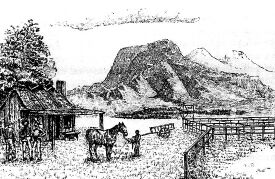
At one place where we encamped there was a cane grass flat, over a mile long, fifty to a hundred yards wide, and having about four feet of water in it, which was covered with water-fowl; amongst these a number of black swans were gracefully disporting themselves. Peter Nicholls made frantic efforts to shoot a swan and some ducks, but he only brought one wretchedly small teal into the camp. We continued on our former course until we touched upon and rounded the north-western extremity of Lake Torrens. I then changed my course for the Hermit Hill, at the foot of which the Finniss Springs and Sir Thomas Elder's cattle station lies. Our course was now nearly north. On the evening of the third day after leaving the water that had saved us, we fell in with two black fellows and their lubras or wives, shepherding two flocks of Mr. Angas's sheep belonging to his Stuart's Creek station. As they were at a water, we encamped with them. Their lubras were young and pretty; the men were very hospitable to us, and gave us some mutton, for which we gave them tobacco and matches; for their kindness I gave the pretty lubras some tea and sugar. Our old Jimmy went up to them and shook hands, and they became great friends. These blacks could not comprehend where we could possibly have come from, Fowler's Bay being an unknown quantity to them. We had still a good day's stage before us to reach the Finniss, but at dusk we arrived, and were very kindly received and entertained by Mr. Coulthard, who was in charge. His father had been an unfortunate explorer, who lost his life by thirst, upon the western shores of the Lake Torrens I have mentioned, his tin pannikin or pint pot was afterwards found with his name and the date of the last day he lived, scratched upon it. Many an unrecorded grave, many a high and noble mind, many a gallant victim to temerity and thirst, to murder by relentless native tribes, or sad mischance, is hidden in the wilds of Australia, and not only in the wilds, but in places also less remote, where the whistle of the shepherd and the bark of his dog, the crack of the stockman's whip, or the gay or grumbling voice of the teamster may now be heard, some unfortunate wanderer may have died. As the poet says:—
“Perhaps in this neglected spot is laid,
Some heart once pregnant with celestial fire;
Hands that the rod of empire might have swayed,
Or waked to ecstacy the living lyre.”
If it is with a thought of pity, if it is with a sigh of lament, that we ponder over the fate of the lost, over the deaths in the long catalogue of the victims to the Australian bush, from Cunningham (lost with Mitchell) and Leichhardt, Kennedy and Gilbert, Burke, Wiils, Gray, Poole, Curlewis and Conn, down to Coulthard, Panter, and Gibson, it must be remembered that they died in a noble cause, and they sleep in honourable graves. Nor must it be forgotten that they who return from confronting the dangers by which these others fell, have suffered enough to make them often wish that they, too, could escape through the grave from the horrors surrounding them. I have often been in such predicaments that I have longed for death, but having as yet returned alive, from deserts and their thirst, from hostile native tribes and deadly spears, and feeling still “the wild pulsation which in manhood's dawn I knew, when my days were all before me, and my years were twenty-two,”—as long as there are new regions to explore, the burning charm of seeking something new, will still possess me; and I am also actuated to aspire and endeavour if I cannot make my life sublime, at least to leave behind me some “everlasting footprints on the sands of time.”
At the Finniss Springs I met young Alec Ross, the son of another explorer, who was going to join my party for the new expedition to Perth. My destination was now Beltana, 140 miles from hence. I got a couple of horses for Nicholls and myself from Mr. Coulthard, Jimmy being stuck up on the top of the old riding cow camel, who could travel splendidly on a road. When I arrived at Beltana I had travelled 700 miles from Fowler's Bay.
Fourth expedition. The members. Departure. Squabbles. Port Augusta. Coogee Mahomet. Mr. Roberts and Tommy. Westward ho!. The equipment. Dinner and a sheep. The country. A cattle ranch. Stony plateau. The Elizabeth. Mr. Moseley. Salt lakes. Coondambo. Curdling tea. An indented hill. A black boy's argument. Pale-green-foliaged tree. A lost officer. Camels poisoned. Mount Finke in the winter. Wynbring. A new route. A good Mussulman. Depart from Wynbring. New places. Antediluvian cisterns. Still westwards. Lake Bring. Rain and a bath. A line cut in the scrubs. High sandhills. Return to Youldeh. Waking dreams. In depot. Fowler's Bay once more. The officers explore to the north. Jimmy and Tommy. Jimmy's bereavement. At the bay. Richard Dorey. Return to Youldeh. Tommy's father. The officer's report Northwards. Remarks.
Sir Thomas Elder was desirous that the new expedition for Perth, for which camels were to be the only animals taken, should start from Beltana by the 1st of May. I was detained a few days beyond that time, but was enabled to leave on Thursday, May the 6th. The members of the party were six in number, namely myself, Mr. William Henry Tietkens, who had been with me as second on my last expedition with horses—he had been secured from Melbourne by Sir Thomas Elder, and was again going as second; Mr. Jess Young, a young friend of Sir Thomas's lately arrived from England; Alexander Ross, mentioned previously; Peter Nicholls, who had just come with me from Fowler's Bay, and who now came as cook; and Saleh, the Afghan camel-driver as they like to be called. I also took for a short distance, until Alec Ross overtook me, another Afghan called Coogee Mahomet, and the old guide Jimmy, who was to return to the bosom of his family so soon as we arrived anywhere sufficiently near the neighbourhood of his country. Poor old Jimmy had been ill at Beltana, and suffered greatly from colds and influenza. The Beltana blacks did not treat him so well as he expected, and some of them threatened to kill him for poking his nose into their country, consequently he did not like the place at all, and was mighty glad to be taken away. Thus, as I have said, on the 6th of May, 1875, the caravan departed from Beltana, but we did not immediately leave civilisation or the settled districts, as I had to travel 150 miles down the country nearly south, to Port Augusta at the head of Spencer's Gulf, where I intended to take in my stores, and loading for the inland voyage, as most of my equipment was forwarded by Sir Thomas from Adelaide to that port.
Nothing very particular occurred on the road down, except some continual squabbles between myself, and Saleh and Coogee, on account of the extraordinary and absurd manner in which these two men wanted to load and work the camels. In the first place, we had several young camels or colts in the mob, some of these were bulls and others bullocks. The Afghans have a way when travelling of bringing the camels up to the camp and making them lie down by their loads all night, whether they have had time to fill themselves or not. This system was so revolting to my notions of fair play that I determined to alter it at once.
Another thing that annoyed me was their absurd and stupid custom of hobbling, and unhobbling, while the camels were lying down. This may be necessary for the first few days after the creatures are handled, but if they are never accustomed to have their legs and feet touched while they are standing up, of course they may paw, or strike and kick like a young horse; and if a camel is a striker, he is rather an awkward kind of a brute, but that is only the case with one in a thousand. The Afghans not only persist in hobbling and unhobbling while the camels are lying down, but never think of taking the hobbles entirely off at all, as they unfasten the hobble from one leg and put both on the other, so that the poor brutes always have to carry them on one leg when they are travelling. I quickly put a stop to this, but Coogee Mahomet exclaimed, “Oh, master! you mustn't take off a hobble, camel he keek, he keek, you mustn't.” To which I replied, “Let him kick, and I hope he will kick you to death first, so that there will be one Afghan less in the world, but every hobble shall come off every camel every day.” This Coogee was a most amusing though lazy, indolent beggar. He never ceased to brag of what he could make camels do; he wished to ingratiate himself with me in the hope I would take him with me, but I had already determined to have only one of his countrymen. He said if he came with me he could make the camels go 200, 300, 400 or 500 miles with heavy loads without water, by just talking to them in his language. He used to say, “You know, master, camel he know me, and my countrymen; camel he un'stand my language, he no like Englishman, Englishman, he no un'stand riding camel, he no un'stand loading camel, only my countryman he un'stand camel,” etc., etc.; but with all his bragging about the camels going so long without water, when we had been only four days gone from Beltana, Saleh and Coogee had held a council and decided that I must be remonstrated with, in consequence of my utter ignorance, stupidity, and reckless treatment of the camels. Accordingly on the fourth morning, the weather having been delightfully cool and the camels not requiring any water, Coogee came to me and said, “Master, when you water camel?” “What?” I said with unfeigned astonishment, “Water the camels? I never heard of such a thing, they will get no water until they reach Port Augusta.” This completely upset Mr. Coogee, and he replied, “What! no water till Port Gusta? camel he can't go, camel he always get water three, four time from Beltana to Port Gusta.” “Well,” I said, “Coogee, they will get none now with me till they walk to Port Augusta for it.” Then Coogee said, “Ah! Mr. Gile, you very smart master, you very clever man, only you don't know camel, you'll see you'll kill all Sir Thomas Elder camel; you'll no get Perth, you and all you party, and all you camel die; you'll see, you'll see; you no give poor camel water, camel he die, then where you be?” I was rather annoyed and said, “You stupid ass, it was only yesterday you said you could take camels, 300, 400, 500 miles without water, with heavy loads, and now they have no loads and we have only come about seventy miles, you say they will die if I don't give them water. How is it that all your countrymen continually brag of what camels can do, and yet, when they have been only three days without water, you begin to cry out that they want it?”
To this he only condescended to reply, “Ah! ah! you very clever, you'll see.” Of course the camels went to the port just as well without water as with it. Alec Ross overtook us on the road, and brought a special little riding-camel (Reechy) for me. I got rid of Mr. Coogee before we arrived at the port. We remained a little over a week, as all the loads had to be arranged and all the camels' pack-saddles required re-arranging. Saleh and another of his countryman who happened to be there, worked hard at this, while the rest of the party arranged the loads.
While at Port Augusta, Mr. Charles Roberts, who had been with me, and with whom I left all the horses at Youldeh, arrived, by the usual road and brought me a young black boy, Master Tommy Oldham, with whom I had travelled to Eucla from Fowler's Bay with the three horses that had died on my journey to Beltana. He was very sorry to hear of the loss of Chester and Formby, the latter having been his riding-horse. Old Jimmy was immensely delighted to meet one of his own people in a strange place. Tommy was a great acquisition to the party, he was a very nice little chap, and soon became a general favourite.
Everything being at length ready, the equipment of the expedition was most excellent and capable. Sir Thomas had sent me from Adelaide several large pairs of leather bags, one to be slung on each side of a camel; all our minor, breakable, and perishable articles were thus secure from wet or damp. In several of these large bags I had wooden boxes at the bottom, so that all books, papers, instruments, glass, etc., were safe. At starting the loads were rather heavy, the lightest-weighted camels carrying two bags of flour, cased in raw-hide covers, the two bags weighing about 450 pounds, and a large tarpaulin about 60 pounds on top, or a couple of empty casks or other gear, which did not require to be placed inside the leather bags. The way the camels' loads are placed by the Afghan camel-men is different from, and at first surprising to persons accustomed to, pack-horse loads. For instance, the two bags of flour are carried as perpendicularly as possible. As a general rule, it struck me the way they arranged the loads was absurd, as the whole weight comes down on the unfortunate animal's loins; they use neither bags nor trunks, but tie up almost every article with pieces of rope.
My Afghan, Saleh, was horrified at the fearful innovations I made upon his method. I furnished the leather bags with broad straps to sustain them, having large rings and buckles to pass them through and fasten in the ordinary way of buckle and strap; this had the effect of making the loads in the bags and trunks lie as horizontally as possible along the sides of the pads of the pack-saddles. Saleh still wanted to encumber them with ropes, so that they could not be opened without untying about a thousand knots. I would not permit such a violation of my ideas, and told him the loads should be carried as they stood upon the ground; his argument always was, a la Coogee Mahomet, “Camel he can't carry them that way,” to which I invariably replied, “Camel he must and camel he shall,” and the consequence was that camel he did.
When we left Port Augusta, I had fifteen pack- or baggage-camels and seven riding ones. The two blacks, Jimmy and Tommy, rode on one animal, while the others had a riding-camel each. The weight of the loads of the baggage-camels on leaving, averaged 550 pounds all round. All the equipment and loads being in a proper state, and all the men and camels belonging to the new expedition for Perth being ready, we left Port Augusta on the 23rd of May, 1875, but only travelled about six miles, nearly west-north-west, to a place called Bowman's or the Chinaman's Dam, where there was plenty of surface water, and good bushes for the camels; here we encamped for the night. A few ducks which incautiously floated too near fell victims to our sportsmen. The following day we passed Mr. Bowman's station, had some dinner with him, and got a fat sheep from one of his paddocks. On the 25th we encamped close to a station in the neighbourhood of Euro Bluff, a hill that exists near the south-western extremity of Lake Torrens; we now travelled about north-north-west up Lake Torrens, upon the opposite or western side to that on which we had lately travelled down, to Port Augusta, as I wished to reach a watercourse (the Elizabeth), where I heard there was water. On the 28th of May we encamped on the banks of Pernatty Creek, where we obtained a few wild ducks; the country here was very good, being open salt-bush country. The next morning we met and passed a Government Survey party, under the command of Mr. Brooks, who was engaged in a very extensive trigonometrical survey. In an hour or two after, we passed Mr. Bowman's Pernatty cattle-station; there was no one at home but a dog, and the appearance of the camels seemed to strike him dumb. There were some nice little sheets of water in the creek-bed, but scarcely large enough to be permanent. The country was now a sort of stony plateau, having low, flat-topped, tent-shaped table-lands occurring at intervals all over it; it was quite open, and no timber existed except upon the banks of the watercourses.
On the 30th of May we reached the Elizabeth; there was an old hut or two, but no people were now living there. The water was at a very low ebb. We got a few ducks the first day we arrived. As some work had to be done to the water-casks to enable us to carry them better, we remained here until the 2nd of June. The Elizabeth comes from the table-lands near the shores of Lake Torrens to the north-eastward and falls into the northern end of Pernatty Lagoon. Here we were almost as far north as when at Beltana, our latitude being 31° 10´ 30´´. The weather was now, and had been for several weeks—indeed ever since the thunderstorm which occurred the day we came upon the clay-channel water—very agreeable; the nights cold but dewless. When at Port Augusta, I heard that a Mr. Moseley was out somewhere to the west of the Elizabeth, well-sinking, on a piece of country he had lately taken up, and that he was camped at or near some rain-water. I was anxious to find out where he was; on the 31st of May I sent Alec Ross on the only track that went west, to find if any water existed at a place I had heard of about twenty-five miles to the west, and towards which the only road from here led. Alec had not been gone long, when he returned with Mr. Moseley, who happened to be coming to the Elizabeth en route for Port Augusta. He camped with us that night. He informed me his men obtained water at some clay-pans, called Coondambo, near the edge of Lake Gairdner, another large salt depression similar to Lake Torrens, and that by following his horses' tracks they would lead, first to a well where he had just succeeded in obtaining water at a depth of eighty-five feet, and thence, in seven miles farther, to the Coondambo clay-pans. I was very glad to get this information, as even from Coondambo the only water to the west beyond it, that I knew of, was Wynbring, at a distance of 160 or 170 miles.
Leaving the Elizabeth on June the 2nd, we went sixteen miles nearly west, to a small clay water-hole, where we encamped. On the 3rd we travelled twenty-five miles nearly west, passing a deserted sheep-station belonging to Mr. Litchfield about the middle of the day; the country was very poor, being open, bare, stony ground, with occasional low, flat-topped table-lands, covered very sparsely with salsolaceous vegetation. We next arrived at the north-east corner of Lake Hart, and proceeded nearly west along its northern shore; thence by the southern shores of Lakes Hanson and Younghusband, all salt lakes, where one of the party must have been taken ill, for he suddenly broke out into a doggerel rhyme, remarking that:—
“We went by Lake Hart, which is laid on the chart,
And by the Lake Younghusband too;
We next got a glance on, the little Lake Hanson,
And wished...”
Goodness only knows what he wished, but the others conveyed to him their wish that he should discontinue such an infliction on them.
On June the 6th we arrived at the place where Mr. Moseley had just finished his well; but his men had deserted the spot and gone somewhere else, to put down another shaft to the north-eastwards. The well was between eighty and ninety feet deep, the water whitish but good; here we encamped on a bushy sort of flat. The next morning, following some horse tracks about south-west, they took us to the Coondambo clay-pans; the water was yellow and very thick, but there was plenty of it for all our purposes, though I imagined it would not last Mr. Moseley and his men very long. Two or three of his horses were running at this water; here were several large shallow, cane-grass clay flats which are also occasionally filled with rain-water, they and Coondambo being situated close to the northern shore of Lake Gairdner.
We left Coondambo on the 8th; on the 9th rain pretended to fall, and we were kept in camp during the day, as a slight spitting fell, but was totally useless. On the 11th we encamped again near Lake Gairdner's shore; this was the last we should see of it. Our latitude here was 31° 5´, and longitude 135° 30´ 10´´. We had seen no water since leaving Coondambo, from whence we carried a quantity of the thick yellow fluid, which curdled disagreeably when made into tea, the sugar having the chemical property of precipitating the sediment. We were again in a scrubby region, and had been since leaving Coondambo. Our course was now nearly north-north-west for sixteen or seventeen miles, where we again camped in scrubs. The following day we got to a low rocky hill, or rather several hills, enveloped in the scrub; there were numerous small indentations upon the face of the rocks, and we got some water for the camels, though they had to climb all over the rocks to get it, as there was seldom more than three or four gallons in any indent. We got some pure water for ourselves, and were enabled to dispense with the yellow clayey fluid we had carried. From these hills we travelled nearly west-north-west until, on the 15th, we fell in with my former tracks in April, when travelling from Wynbring. Old Jimmy was quite pleased to find himself again in country which he knew something about. We could again see the summit of Mount Finke. The only water I knew of in this wretched country being at Wynbring, I determined to follow my old route. On the 16th we passed a place where we had formerly seen a small portion of bare rock, and now, in consequence of the late sprinkling showers on the 9th and 10th, there were a few thimblefuls of water on it. This set Jimmy into a state of excitement; he gesticulated and talked to Tommy in their language at a great rate, and Tommy said, “Ah, if you found water here, when you come before, Chester and Formby wouldn't die.” “Well,” I said, “Tommy, I don't see much water here to keep anything alive, even if it had been here then.” He only sapiently shook his head and said, “But if you got plenty water then that's all right.” I found Tommy's arguments were exactly similar to those of all other black boys I have known, exceedingly comical, but all to their own way of thinking.
Soon after this, I was riding in advance along the old track, when old Jimmy came running up behind my camel in a most excited state, and said, “Hi, master, me find 'im, big one watta, plenty watta, mucka (not) pickaninny (little); this way, watta go this way,” pointing to a place on our left. I waited until the caravan appeared through the scrub, then old Jimmy led us to the spot he had found. There was a small area of bare rock, but it was too flat to hold any quantity of water, though some of the fluid was shining on it; there was only enough for two or three camels, but I decided to camp there nevertheless. What water there was, some of the camels licked up in no time, and went off to feed. They seemed particularly partial to a low pale-green-foliaged tree with fringelike leaves, something like fennel or asparagus. I have often gathered specimens of this in former journeys, generally in the most desert places. The botanical name of this tree is Gyrostemon ramulosus. After hobbling out the camels, and sitting down to dinner, we became aware of the absence of Mr. Jess Young, and I was rather anxious as to what had become of him, as a new arrival from England adrift in these scrubs would be very liable to lose himself. However, I had not much fear for Mr. Young, as, having been a sailor, and carrying a compass, he might be able to recover us. Immediately after our meal I was going after him, but before it was finished he came, without his camel, and said he could not get her on, so had tied her up to a tree and walked back, he having gone a long way on my old tracks. I sent Tommy and another riding-camel with him, and in a couple of hours they returned with Mr. Young's animal.
The following morning, the 17th, much to my distress, one of our young bull camels was found to be poisoned, and could not move. We made him sick with hot butter and gave him a strong clyster. Both operations produced the same substance, namely, a quantity of the chewed and digested Gyrostemon; indeed, the animal apparently had nothing else in his inside. He was a trifle better by night, but the following morning, my best bull, Mustara, that had brought me through this region before, was poisoned, and couldn't move. I was now very sorry I had camped at this horrid place. We dosed Mustara with butter as an emetic, and he also threw up nothing but the chewed Gyrostemon; the clyster produced the same. It was evident that this plant has a very poisonous effect on the camels, and I was afraid some of them would die. I was compelled to remain here another day. The first camel poisoned had got a little better, and I hoped the others would escape; but as they all seemed to relish the poisonous plant so much until they felt the effects, and as there were great quantities of it growing on the sandhills, I was in great anxiety during the whole day. On the 19th I was glad to find no fresh cases, though the two camels that had suffered were very weak and afflicted with spasmodic staggerings. We got them away, though they were scarcely able to carry their loads, which we lightened as much as possible; anything was better than remaining here, as others might get affected.
On this day's march we passed the spot where I had put the horse's packsaddle in the sandal-wood-tree, and where my first horse had given in. The saddle was now of no use, except that the two pads, being stuffed with horsehair, made cushions for seats of camels' riding-saddles; these we took, but left the frame in the tree again. That night we camped about five miles from Mount Finke, and I was glad to find that the two poisoned bulls had greatly recovered.
The following day, Mr. Young and I ascended Mount Finke, and put up a small pile of stones upon its highest point. The weather, now cool and agreeable, was so different from that which I had previously experienced upon this dreadful mount. Upon that visit the whole region was in an intense glow of heat, but now the summer heats were past; the desolate region around was enjoying for a few weeks only, a slight respite from the usual fiery temperature of the climate of this part of the world; but even now the nature of the country was so terrible and severe, the sandhills so high, and the scrub so thick, that all the new members of the party expressed their astonishment at our ever having got out of it alive. This mountain, as before stated, is forty-five miles from Wynbring. On the 22nd of June, just as we got in sight of the rock, some heavy showers of rain descended; it came down so fast that the camels could drink the water right at their feet, and they all got huddled up together in a mob, breaking their nose-ropes, some laying down to enable them to drink easier, as loaded camels, having a breast-rope from the saddles, cannot put their heads to the ground without hurting, and perhaps cutting, themselves. The rain ceased for a bit, and we made off to my old camp, and got everything under canvas just as another heavy shower came down. Of course the rock-hole was full to overflowing, and water was lying about in all directions. During the 23rd several smart showers fell, and we were confined to our canvas habitations for nearly the whole day.
As this spot was so excellent for all kinds of animals, I gave my friends a couple of days' rest, in the first place because they had had such poor feeding places for several nights before our arrival here, and I also wished, if possible, to meet again with the Wynbring natives, and endeavour to find out from them whether any other waters existed in this country. Old Jimmy, when he discovered, through Tommy Oldham, what I wanted the natives for, seemed surprised and annoyed that I should attempt to get information from them while he was with me in his own territories. He said he would take me to several waters between here and Youldeh, by a more northerly route than he had previously shown; he said that water existed at several places which he enumerated on his fingers; their names were Taloreh, Edoldeh, Cudyeh, Yanderby, Mobing, Bring, Poothraba, Pondoothy, and Youldeh. I was very glad to hear of all these places, and hoped we should find they were situated in a more hospitable country than that through which we had formerly come. On the 25th Mr. Young shot an emu, and we had fried steaks, which we all relished. Saleh being a good Mussulman, was only just (if) in time to run up and cut the bird's throat before it died, otherwise his religious scruples would have prevented him from eating any of it. All the meat he did eat, which was smoked beef, had been killed in the orthodox Mohammedan style, either by himself or one of his co-religionists at Beltana. It was cured and carried on purpose. None of the natives I had formerly seen, or any others, made their appearance, and the party were disappointed by not seeing the charming young Polly, my description of whom had greatly raised their curiosity.
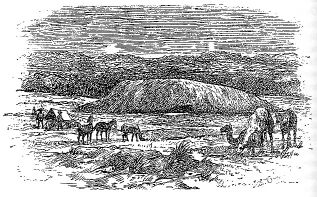
On the 26th of June we departed from the pretty little oasis of Wynbring, leaving its isolated and water-giving rock, in the silence and solitude of its enveloping scrubs, abandoning it once again, to the occupation of primeval man, a fertile little gem in a desolate waste, where the footsteps of the white man had never been seen until I came, where the wild emu, and the wilder black man, continually return to its life-sustaining rock, where the aboriginal inhabitants will again and again indulge in the wild revelries of the midnight corroborree dance, and where, in an existence totally distinct from ours of civilisation, men and women live and love, and eat and drink, and sleep and die. But the passions are the same in all phases of the life of the human family, the two great master motives, of love and hunger, being the mainspring of all the actions of mankind.
Wynbring was now behind us, and Jimmy once more our guide, philosopher, and friend. He seemed much gratified at again becoming an important member of the expedition, and he and Tommy, both upon the same riding-camel, led the way for us, through the scrubs, in the direction of about west-north-west. In seven or eight miles we came to a little opening in the scrub, where Jimmy showed us some bare flat rocks, wherein was a nearly circular hole brimful of water. It was, however, nearly full also of the debris of ages, as a stick could be poked into mud or dirt for several feet below the water, and it was impossible to say what depth it really was; but at the best it could not contain more than 200 or 300 gallons. This was Taloreh. Proceeding towards the next watering-place, which old Jimmy said was close up, in a rather more northerly direction, we found it was getting late, as we had not left Wynbring until after midday; we therefore had to encamp in the scrubs, having come about fifteen miles. It is next to impossible to make an old fool of a black fellow understand the value of the economy of time. I wanted to come on to Edoldeh, and so did old Jimmy; but he made out that Edoldeh was close to Taloreh, and every mile we went it was still close up, until it got so late I ordered the party to camp, where there was little or nothing that the camels could eat. Of course it was useless to try and make Jimmy understand that, having thousands of miles to travel with the camels, it was a great object to me to endeavour to get them bushes or other food that they could eat, so as to keep them in condition to stand the long journey that was before them. Camels, although exceedingly ravenous animals, will only eat what they like, and if they can't get that, will lie down all night and starve, if they are too short-hobbled to allow them to wander, otherwise they will ramble for miles. It was therefore annoying the next morning to find plenty of good bushes at Edoldeh, two miles and a half from our wretched camp, and whither we might have come so easily the night before. To-day, however, I determined to keep on until we actually did reach the next oasis; this Jimmy said was Cudyeh, and was of course still close up. We travelled two and a half miles to Edoldeh, continued eighteen miles beyond it, and reached Cudyeh early in the afternoon. This place was like most of the little oases in the desert; it was a very good place for a camp, one singular feature about it being that it consisted of a flat bare rock of some area, upon which were several circular and elliptical holes in various places. The rock lay in the lowest part of the open hollow, and whenever rain fell in the neighbourhood, the water all ran down to it. In consequence of the recent rains, the whole area of rock was two feet under water, and the extraordinary holes or wells that existed there looked like antediluvian cisterns. Getting a long stick, and wading through the water to the mouths of these cisterns, we found that, like most other reservoirs in a neglected native state, they were almost full of soil and debris, and the deepest had only about three feet of water below the surface of the rock. Some of these holes might be very deep, or they might be found to be permanent wells if cleaned out.
Next day we passed another little spot called Yanderby, with rock water, at ten miles; thence in three more we came to Mobing, a much better place than any of the others: indeed I thought it superior to Wynbring. It lies about north 62° west from Wynbring and is fifty miles from it; the latitude of Mobing is 30° 10´ 30´´. At this place there was a large, bare, rounded rock, very similar to Wynbring, except that no rock-holes to hold any surface water existed; what was obtainable being in large native wells sunk at the foot of the rock, and brimful of water. I believe a good supply might be obtained here. There were plenty of good bushes in the neighbourhood for the camels, and we had an excellent camp at Mobing. As usual, this oasis consisted merely of an open space, lightly timbered with the mulga acacia amongst the sandhills and the scrubs.
The day after, we were led by old Jimmy to a small salt lake-bed called Bring, which was dry; it lay about south-west from Mobing. Round at the southern shore of this lake Jimmy showed us a small rock-hole, with a few dozen gallons of water in it. In consequence of Mr. Young not being well, we encamped, the distance from Mobing being nine miles. This also was a rather pretty camp, and excellent for the camels. Towards evening some light showers of rain fell, and we had to erect our tarpaulins and tents, which we only do in times of rain. More showers fell the next day, and we did not shift our quarters. A very shallow sheet of water now appeared upon the surface of the lake bed, but it was quite salt. We made some little dams with clay, where the water ran into the lake, and saved enough water to indulge in a sort of bath with the aid of buckets and waterproof sheeting. This was the last day of June. Unfortunately, though Chairman of the Company, I was unable to declare a dividend for the half-year.
The 1st of July broke with a fine and beautiful morning, and we left Lake Bring none the worse for our compulsory delay. I was anxious to reach Youldeh so soon as possible, as I had a great deal of work to do when I arrived there. To-day we travelled nearly west seventeen or eighteen miles, and encamped without an oasis. On the 2nd we passed two rocky hills, named respectively Pondoothy and Poothraba, Pondoothy was an indented rock-crowned hill in the scrubs. Standing on its summit I descried an extraordinary line cut through the scrubs, which ran east by north, and was probably intended by the natives for a true east line. The scrub timber was all cut away, and it looked like a survey line. Upon asking old Jimmy what it was done for, and what it meant, he gave the usual reply, that Cockata black fellow make 'em. It was somewhat similar to the path I had seen cleared at Pylebung in March last, and no doubt it is used for a similar purpose. Leaving this hill and passing Poothraba, which is in sight of it, we continued our nearly west course, and camped once more in the scrubs. The country was very difficult for the loaded camels, it rose into such high ridges or hills of sand that we could only traverse it at a snail's pace. It was of course still covered with scrubs, which consisted here, as all over this region, mostly of the Eucalyptus dumosa, or mallee-trees, of a very stunted habit; occasionally some patches of black oaks as we call them, properly casuarinas, with clumps of mulga in the hollows, here and there a stunted cypress pine, callitris, some prickly hakea bushes, and an occasional so called native poplar, Codonocarpus cotinifolius, a brother or sister tree to the poisonous Gyrostemon. The native poplar is a favourite and harmless food for camels, and as it is of the same family as the Gyrostemon, my friend Baron von Mueller argues that I must be mistaken in the poison plant which affected the camels. He thinks it must be a plant of the poisonous family of the Euphorbiaceae, and which certainly grows in these regions, and which I have collected specimens of, but I cannot detect it.
We were now nearly in the latitude of Youldeh, and had only to push west to reach it; but the cow camel that Jimmy and Tommy rode, being very near calving, had not travelled well for some days, and gave a good deal of trouble to find her of a morning. I wished to get her to Youldeh before she calved, as I intended to form a depot there for a few weeks, during which time I hoped the calf would become strong enough to travel. On the morning of the 5th, only about half the mob were brought up to the camp, and, as Mr. Tietkens' and my riding camels were amongst them, we rode off to Youldeh, seven or eight miles away, telling the others to come on as soon as they could. Mr. Young, Saleh, and Tommy were away after the absent animals. On arriving I found Youldeh much the same as when I left it, only now the weather was cool, and the red sandhills, that had formerly almost burnt the feet of men and animals, were slightly encrusted with a light glittering mantle of hoar-frost in the shaded places, under the big leguminous bushes, for that morning Herr Gabriel Daniel Fahrenheit had fallen to 28°. My old slabbed well had got filled up with sand, and it was evident that many natives had visited the place since I left on the 24th of March, 103 days ago. We managed to water our camels, as they lay down on the top of the well, and stretched their long necks down into it. We then quietly waited till long past midday for the caravan to come up. We had nothing to do, and nothing to eat; we could not dig out the well, for we had no shovel. At last Mr. Tietkens got alarmed at the non-arrival of the party, and he went back to the camp, taking my riding-camel with him, as she would not remain quiet by herself. I remained there mighty hungry, and made some black smoke to endeavour to attract any natives that might be in the neighbourhood. I have before remarked that the natives can make different coloured smokes, of different form, and make them ascend in different ways, each having a separate meaning: hurried alarm, and signal fires are made to throw up black and white smokes. No signals were returned, and I sat upon a sandhill, like Patience on a monument, and thought of the line, “That sitting alone with my conscience, is judgment sufficient for me.” I could not perceive any dust or sand of the approaching caravan; darkness began to creep over this solitary place and its more solitary occupant. I thought I had better sleep, though I had no bedding, to pass the time away till morning. I coiled myself up under a bush and fell into one of those extraordinary waking dreams which occasionally descend upon imaginative mortals, when we know that we are alive, and yet we think we are dead; when a confused jumble of ideas sets the mind “peering back into the vistas of the memories of yore,” and yet also foreshadowing the images of future things upon the quivering curtains of the mental eye. At such a time the imagination can revel only in the marvellous, the mysterious, and the mythical. The forms of those we love are idealised and spiritualised into angelic shapes. The faces of those we have forgotten long, or else perchance have lost, once more return, seraphic from the realms of light. The lovely forms and winning graces of children gone, the witching eyes and alluring smiles of women we have loved, the beautiful countenances of beloved and admired youth, once more we seem to see; the youthful hands we have clasped so often in love and friendship in our own, once more we seem to press, unchanged by time, unchanged by fate, beckoning to us lovingly to follow them, still trying with loving caress and youthful smiles to lead us to their shadowy world beyond. O youth, beautiful and undying, the sage's dream, the poet's song, all that is loving and lovely, is centred still in thee! O lovely youth, with thine arrowy form, and slender hands, thy pearly teeth, and saintly smile, thy pleading eyes and radiant hair; all, all must worship thee. And if in waking hours and daily toil we cannot always greet thee, yet in our dreams you are our own. As the poet says:—
“In dreams you come as things of light and lightness!
We hear your voice in still small accents tell,
Of realms of bliss and never-fading brightness,
Where those who loved on earth together dwell.”
Then, while lying asleep, engrossed by these mysterious influences and impressions, I thought I heard celestial sounds upon mine ear; vibrating music's rapturous strain, as though an heavenly choir were near, dispensing melody and pain. As though some angels swept the strings, of harps ethereal o'er me hung, and fann'd me, as with seraph's wings, while thus the voices sweetly sung: “Be bold of heart, be strong of will, for unto thee by God is given, to roam the desert paths of earth, and thence explore the fields of heaven. Be bold of heart, be strong of will, and naught on earth shall lay thee low.” When suddenly I awoke, and found that the party with all the camels had arrived, my fire was relit, and the whole place lately so silent was now in a bustle. I got up, and looked about me in astonishment, as I could not at first remember where I was. But I soon discovered that the musical sounds I had heard were the tintinabulations of my camel-bells, tinkling in the evening air, as they came closer and closer over the sandhills to the place where I lay dreaming, and my senses returned at length to their ordinary groove.
We were safely landed at the Youldeh depot once more; and upon the whole I may say we had had an agreeable journey from Port Augusta. Jimmy and Tommy's cow calved soon after arrival. I was glad to find she had delayed; now the calf will be allowed to live, as she will be here for some little time. On the following morning I christened the calf Youldeh, after her birthplace; she was not much bigger than a cat. On the 6th, 7th, and 8th, we all remained in depot, doing various kinds of work, re-digging and re-slabbing the well, making two large canvas troughs for the camels to drink out of, making some covers and alterations to some water-beds I had for carrying water, and many other things. I had some camels to deliver at Fowler's Bay, and some private business, necessary to be done before a magistrate, which compelled me personally to return thither; otherwise I should have gone away to the north to endeavour to discover another depot in that direction. But now I committed this piece of work to my two officers, Messrs. Tietkens and Young, while Alec Ross and I went south to the Bay. Both parties started from Youldeh on the 9th. I took old Jimmy with me to return him, with thanks, to his family. Tietkens and Young took Tommy with them, as that young gentleman had no desire whatever to return or to leave me. Between ourselves, when I first got him in February, I had caused him to commit some very serious breaches of aboriginal law, for he was then on probation and not allowed to come near women or the blacks' camp. He was also compelled to wear a great chignon, which made him look more like a girl than a boy. This I cut off and threw away, much to the horror of the elders of his tribe, who, if they could catch, would inflict condign punishment upon him. When he and old Jimmy met at Port Augusta, and Jimmy saw him without his chignon and other emblems of novice-hood, that old gentleman talked to him like a father; but Tommy, knowing he had me to throw the blame on, quietly told the old man in plain English to go to blazes. The expression on old Jimmy's face at thus being flouted by a black boy, was indescribable; he thought it his duty to persecute Tommy still farther, but now Tommy only laughed at him and said I made him do it, so old Jimmy gave him up at last as a bad job. Poor old fellow, he was always talking about his wife and children; I was to have Mary, and Peter Nicholls Jinny. Alec, Jimmy, and I reached the bay on the 14th, but at Colona, on the 12th, we heard there had been a sad epidemic amongst the natives since I left, and poor old Jimmy had lost two of his children, both Mary and Jinny. When he heard this, the poor old fellow cried, and looked at me, as much as to say if I had not taken him away he might have saved them. It was but poor consolation to tell him, what he could not understand, that those whom the gods love die young. I suffered another loss, as a bright little black boy called Fry, a great favourite of mine, with splendid eyes and teeth, whom I had intended to bring with me as a companion for Tommy, was also dead. I parted from old Jimmy the best of friends, but he was like Rachael weeping for her children, and would not be comforted. I gave him money and presents, and dresses for his wife, and anything he asked for, but this was not very much.
Our stay at Fowler's Bay was not extended longer than I could help. Mr. Armstrong, the manager, made me a present of a case of brandy, and as I wanted to take some stores to Youldeh, he allowed me to take back the camels I had brought him, and sent a man of his—Richard Dorey—to accompany me to Youldeh, and there take delivery of them.
On the 17th we left the bay, and the spindrift and the spray of the Southern Ocean, with the glorious main expanding to the skies. We stayed at Colona with Mr. Murray a couple of days, and finally left it on the 21st, arriving with Dorey and his black boy at Youldeh on the 25th.
Tommy Oldham's father had also died of the epidemic at the bay. Richard Dorey's black boy broke the news to him very gently, when Tommy came up to me and said, “Oh, Mr. Giles, my”—adjective [not] blooming—“old father is dead too.” I said, “Is that how you talk of your poor old father, Tommy, now that he is dead?” To this he replied, much in the same way as some civilised sons may often have done, “Well, I couldn't help it!”
I have stated that when I went south with Alec Ross to Fowler's Bay I despatched my two officers, Mr. Tietkens and Mr. Young, with my black boy Tommy, to endeavour to discover a new depot to the north, at or as near to the 29th parallel of latitude as possible. When I returned from the bay they had returned a day or two before, having discovered at different places two native wells, a small native dam, and some clay-pans, each containing water. This was exceedingly good news, and I wasted no time before I departed from Youldeh. I gave my letters to Richard Dorey, who had accompanied me back from Fowler's Bay. I will give my readers a condensation of Mr. Tietkens's report of his journey with Mr. Young and Tommy.
On leaving Youldeh, in latitude 30° 24´ 10´´ and longitude 131° 46´—they took four camels, three to ride and one to carry water, rations, blankets, etc.—they went first to the small rock-hole I had visited with Mr. Murray and old Jimmy, when here in the summer. This lay about north 74° west, was about fourteen miles distant, and called Paring. Tommy followed our old horse-tracks, but on arrival found it dry. The following day they travelled north, and passed through a country of heavy sandhills and thick scrubs, having occasional open patches with limestone cropping out, and camped at twenty-four miles. Continuing their journey the next morning, they went over better and more open country, and made twenty-four or -five miles of northing. Some more good country was seen the following day, but no water, although they saw native tracks and native huts. The next day they sighted two small flat-topped hills and found a native well in their neighbourhood; this, however, did not promise a very good supply of water. The views obtainable from the little hills were not very inviting, as scrubs appeared to exist in nearly every direction. This spot was eighty-two miles from Youldeh, and lay nearly north 10° west. They continued north for another twenty-five miles, to latitude 28° 52´ and longitude about 131° 31´, when they turned to the south-west for eighteen miles, finding a small native dam with some water in it; then, turning slightly to the north of west, they found some clay-pans with a little more water. They now went forty-four miles nearly west from the little dam, and, although the country seemed improving, they could discover no more water. From their farthest westerly point in latitude 28° 59´ they turned upon a bearing of south 55° east direct for the native well found near the little flat-topped hills before mentioned. In their progress upon this line they entered, at forty-five miles and straight before them, upon a small open flat space very well grassed, and very pretty, and upon it they found another native well, and saw some natives, with whom they held a sort of running conversation. There were several wells, all containing water. Tommy managed to elicit from the natives the name of the place, which they said was Ooldabinna. This seemed a very fortunate discovery, as the first well found near the flat tops was by no means a good one. Here they encamped, being highly pleased with their successful journey. They had now found a new depot, ninety-two miles, lying north 20° west from Youldeh. From hence they made a straight line back to the camp, where they awaited my return from the bay.
I was much pleased with their discovery, and on Tuesday, the 27th July, having nineteen camels and provisions for eight months, and a perfect equipment for carrying water, we left Youldeh. Richard Dorey, with his camels and black boy, went away to the south. My caravan departed in a long single string to the north, and Youldeh and the place thereof knew us no more.
Ooldabinna depot. Tietkens and Young go north. I go west. A salt expanse. Dense scrubs. Deposit two casks of water. Silence and solitude. Native footmarks. A hollow. Fine vegetation. A native dam. Anxiety. A great plain. A dry march. Return to the depot. Rain. My officers' report. Depart for the west. Method of travelling. Kill a camel. Reach the dam. Death or victory. Leave the dam. The hazard of the die. Five days of scrubs. Enter a plain. A terrible journey. Saleh prays for a rock-hole. A dry basin at 242 miles. Watering camels in the desert. Seventeen days without water. Saved. Tommy finds a supply. The Great Victoria Desert. The Queen's Spring. Farther still west.
On leaving Youldeh I had the choice of first visiting the native well my two officers had found at the flat tops, eighty-two miles, or the further one at Ooldabinna, which was ninety-two. I decided to go straight for the latter. The weather was cool, and the camels could easily go that distance without water. Their loads were heavy, averaging now 550 pounds all round. The country all the way consisted first, of very high and heavy sandhills, with mallee scrubs and thick spinifex, with occasional grassy flats between, but at one place we actually crossed a space of nearly ten miles of open, good grassy limestone country. We travelled very slowly over this region. There was a little plant, something like mignonette, which the camels were extremely fond of; we met it first on the grassy ground just mentioned, and when we had travelled from fifteen to eighteen miles and found some of it we camped. It took us five days and a half to reach Ooldabinna, and by the time we arrived there I had travelled 1010 miles from Beltana on all courses. I found Ooldabinna to consist of a small, pretty, open space amongst the scrubs; it was just dotted over with mulga-trees, and was no doubt a very favourite resort of the native owners.
On the flat there was a place where for untold ages the natives have obtained their water supplies. There were several wells, but my experience immediately informed me that they were simply rockholes filled with soil from the periodical rain-waters over the little flat, the holes lying in the lowest ground, and I perceived that the water supply was very limited; fortunately, however, there was sufficient for our immediate requirements. The camels were not apparently thirsty when we arrived, but drank more the following day; this completely emptied all the wells, and our supply then depended upon the soakage, which was of such a small volume that I became greatly disenchanted with my new home. There was plenty of the mignonette plant, and the camels did very well; I wanted water here only for a month, but it seemed probable it would not last a week. We deepened all the wells, and were most anxious watchers of the fluid as it slowly percolated through the soil into the bottom of each. After I had been here two days, and the water supply was getting gradually but surely less, I naturally became most anxious to discover more, either in a west or northerly direction; and I again sent my two officers, Messrs. Tietkens and Young, to the north, to endeavour to discover a supply in that direction, while I determined to go myself to the west on a similar errand. I was desirous, as were they, that my two officers should share the honour of completing a line of discovery from Youldeh, northwards to the Everard and Musgrave Ranges, and thus connect those considerable geographical features with the coast-line at Fowler's Bay; and I promised them if they were fortunate and discovered more water for a depot to the north, that they should finish their line, whether I was successful to the west or not. This, ending at the Musgrave Ranges would form in itself a very interesting expedition. Those ranges lay nearly 200 miles to the north. As the Musgrave Range is probably the highest in South Australia and a continuous chain with the Everard Range, seventy or eighty miles this side of it, I had every reason to expect that my officers would be successful in discovering a fresh depot up in a northerly direction. Their present journey, however, was only to find a new place to which we might remove, as the water supply might cease at any moment, as at each succeeding day it became so considerably less. Otherwise this was a most pleasant little oasis, with such herbage for the camels that it enabled them to do with very little water, after their first good skinful.
We arrived here on Sunday, the 1st of August, and both parties left again on the 4th. Mr. Tietkens and Mr. Young took only their own riding and one baggage camel to carry water and other things; they had thirty gallons of water and ten days' provisions, as I expected they would easily discover water within less than 100 miles, when they would immediately return, as it might be necessary for them to remove the whole camp from this place. I trusted all this to them, requesting them, however, to hold out here as long as possible, as, if I returned unsuccessful from the west, my camels might be unable to go any farther.
I was sure that the region to the west was not likely to prove a Garden of Eden, and I thought it was not improbable that I might have to go 200 miles before I found any water. If unsuccessful in that way I should have precisely the same distance to come back again; therefore, with the probabilities of such a journey before me, I determined to carry out two casks of water to ninety or a hundred miles, send some of the camels back from that point and push on with the remainder. I took six excellent camels, three for riding and three for carrying loads—two carrying thirty gallons of water each, and the third provisions, rugs, gear, etc. I took Saleh, my only Afghan camel-man—usually they are called camel-drivers, but that is a misnomer, as all camels except riding ones must be led—and young Alec Ross; Saleh was to return with the camels from the place at which I should plant the casks, and Alec and I were to go on. The northern party left on the same day, leaving Peter Nicholls, my cook, and Tommy the black boy, to look after the camels and camp.
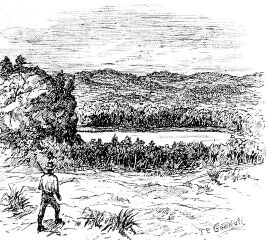
I will first give an outline of my journey to the west. The country, except in the immediate neighbourhood of the wells, was, as usual in this region, all sandhills and scrub, although at eighteen miles, steering west, I came upon the shores of a large salt depression, or lake-bed, which had numerous sandhill islands scattered about it. It appeared to extend to a considerable distance southerly. By digging we easily obtained a quantity of water, but it was all pure brine and utterly useless. After this we met lake-bed after lake-bed, all in a region of dense scrubs and sandhills for sixty miles, some were small, some large, though none of the size of the first one. At seventy-eight miles from Ooldabinna, having come as near west as it is possible to steer in such a country on a camel—of course I had a Gregory's compass—we had met no signs of water fit for man or animal to drink, though brine and bog existed in most of the lake-beds. The scrubs were very thick, and were chiefly mallee, the Eucalyptus dumosa, of course attended by its satellite spinifex. So dense indeed was the growth of the scrubs, that Alec Ross declared, figuratively speaking, “you could not see your hand before you.” We could seldom get a view a hundred yards in extent, and we wandered on farther and farther from the only place where we knew that water existed. At this distance, on the shores of a salt-lake, there was really a very pretty scene, though in such a frightful desert. A high, red earthy bank fringed with feathery mulga and bushes to the brink, overlooking the milk-white expanse of the lake, and all surrounded by a strip of open ground with the scrubs standing sullenly back. The open ground looked green, but not with fertility, for it was mostly composed of bushes of the dull green, salty samphire. It was the weird, hideous, and demoniacal beauty of absolute sterility that reigned here. From this place I decided to send Saleh back with two camels, as this was the middle of the fourth day. Saleh would have to camp by himself for at least two nights before he could reach the depot, and the thought of such a thing almost drove him distracted; I do not suppose he had ever camped out by himself in his life previously. He devoutly desired to continue on with us, but go he must, and go he did. We, however, carried the two casks that one of his camels had brought until we encamped for the fourth night, being now ninety miles from Ooldabinna.
After Saleh left us we passed only one more salt lake, and then the country became entirely be-decked with unbroken scrub, while spinifex covered the whole ground. The scrubs consisted mostly of mallee, with patches of thick mulga, casuarinas, sandal-wood, not the sweet-scented sandal-wood of commerce, which inhabits the coast country of Western Australia, and quandong trees, another species of the sandal-wood family. Although this was in a cool time of the year—namely, near the end of the winter—the heat in the day-time was considerable, as the thermometer usually stood as high as 96° in the shade, it was necessary to completely shelter the casks from the sun; we therefore cut and fixed over them a thick covering of boughs and leaves, which was quite impervious to the solar ray, and if nothing disturbed them while we were absent, I had no fear of injury to the casks or of much loss from evaporation. No traces of any human inhabitants were seen, nor were the usually ever-present, tracks of native game, or their canine enemy the wild dingo, distinguishable upon the sands of this previously untrodden wilderness. The silence and the solitude of this mighty waste were appalling to the mind, and I almost regretted that I had sworn to conquer it. The only sound the ear could catch, as hour after hour we slowly glided on, was the passage of our noiseless treading and spongy-footed “ships” as they forced their way through the live and dead timber of the hideous scrubs. Thus we wandered on, farther from our camp, farther from our casks, and farther from everything we wished or required. A day and a half after Saleh left us, at our sixth night's encampment, we had left Ooldabinna 140 miles behind. I did not urge the camels to perform quick or extraordinary daily journeys, for upon the continuance of their powers and strength our own lives depended. When the camels got good bushes at night, they would fill themselves well, then lie down for a sleep, and towards morning chew their cud. When we found them contentedly doing so we knew they had had good food. I asked Alec one morning, when he brought them to the camp, if he had found them feeding; he replied, “Oh, no, they were all lying down chewing their kid.” Whenever the camels looked well after this we said, “Oh, they are all right, they've been chewing their ‘kid.’”
No water had yet been discovered, nor had any place where it could lodge been seen, even if the latter rain itself descended upon us, except indeed in the beds of the salt-lakes, where it would immediately have been converted into brine. On the seventh day of our march we had accomplished fifteen miles, when our attention was drawn to a plot of burnt spinifex, surrounded by the recent foot-prints of natives. This set us to scan the country in every direction where any view could be obtained. Alec Ross climbed a tree, and by the aid of field-glasses discovered the existence of a fall of country into a kind of hollow, with an apparently broken piece of open grassy ground some distance to the south-west. I determined to go to this spot, whatever might be the result, and proceeded towards it; after travelling five miles, and closely approaching it, I was disgusted to find that it was simply the bed of a salt-lake, but as we saw numerous native foot-prints and the tracks of emus, wild dogs, and other creatures, both going to and coming from it, we went on until we reached its lonely shore. There was an open space all round it, with here and there a few trees belonging to the surrounding scrubs that had either advanced on to, or had not receded from the open ground. The bed of the lake was white, salty-looking, and dry; There was, however, very fine herbage round the shores and on the open ground. There was plenty of the little purple pea-vetch, the mignonette plant, and Clianthus Dampierii, or Sturt's desert-pea, and we turned our four fine camels out to graze, or rather browse, upon whatever they chose to select, while we looked about in search of the water we felt sure must exist here.
The day was warm for this time of year, the thermometer standing at 95° in the shade. But before we went exploring for water we thought it well to have some dinner. The most inviting looking spot was at the opposite or southern end of the lake, which was oval-shaped; we had first touched upon it at its northern end. Alec Ross walked over to inspect that, and any other likely places, while I dug wells in the bed of the lake. The soil was reasonably good and moist, and on tasting it I could discover no taint of salt, nor had the surface the same sparkling incrustation of saline particles that I had noticed upon all the other lake-beds. At ten or eleven inches I reached the bedrock, and found the soil rested upon a rotten kind of bluish-green slate, but no water in the numerous holes I dug rewarded me, so I gave it up in despair and returned to the camp to await Alec's report of his wanderings. On the way I passed by some black oak-trees near the margin, and saw where the natives had tapped the roots of most of them for water. This I took to be a very poor sign of any other water existing here. I could see all round the lake, and if Alec was unsuccessful there was no other place to search. Alec was a long time away, and it was already late when he returned, but on his arrival he rejoiced me with the intelligence that, having fallen in with a lot of fresh native tracks, all trending round to the spot that looked so well from this side, he had followed them, and they led him to a small native clay-dam on a clay-pan containing a supply of yellow water. This information was, however, qualified by the remark that there was not enough water there for the whole of our mob of camels, although there was plenty for our present number. We immediately packed up and went over to our new-found treasure.
This spot is 156 miles straight from our last watering-place at Ooldabinna. I was very much pleased with our discovery, though the quantity of water was very small, but having found some, we thought we might find more in the neighbourhood. At that moment I believe if we had had all our camels here they could all have had a good drink, but the evaporation being so terribly rapid in this country, by the time I could return to Ooldabinna and then get back here, the water would be gone and the dam dry. “Sufficient unto the day is the evil thereof” is, however, a maxim that explorers must very often be contented to abide by. Our camels got as much water as they chose to drink; they were not very big animals, but I am sure 150 gallons was consumed amongst the four. They were hobbled out in the excellent herbage, which was better here than where we first outspanned them. There was splendid grass as well as herbage, but camels seldom, if ever, touch it. The clianthus pea and the vetch pea they ate ravenously, and when they can get those they require very little water.
No natives appeared to be now in the immediate neighbourhood. This was a very pretty and charming little oasis-camp. We got a few bronze-winged pigeons that came by mistake to water that night. The following morning we found the camels had decamped, in consequence of their having had long hobbles allowed them, as we did not suppose they would ramble away from such splendid herbage and water. Alec went after them very early, but had not returned by midday. During his absence I was extremely anxious, for, if he should be unable to track, and should return without them, our case would be almost hopeless. If camels are determined to stampede and can get a good start, there is frequently no overtaking them on foot. They are not like horses, which will return of their own accord to water. Camels know their own powers and their own independence of man, and I believe that a camel, if not in subjection, might live for months without water, provided it could get succulent food. How anxiously I listened as hour after hour I maundered about this spot for the tinkling sound of the camels' bells! How often fancy will deceive even the strongest minds! Twenty times during that morning I could have sworn I heard the bells, and yet they were miles out of earshot. When Alec and I and the camels were all here together I thought this a very pretty place, but oh, how hideous did it appear while I was here alone, with the harrowing thought of the camels being lost and Alec returning without them. Death itself in any terrors clad would have been a more welcome sight to me then and there, than Alec Ross without the camels. But Alec Ross was a right smart chance of a young bushman, and I knew that nothing would prevent him from getting the animals so long as their hobbles held. If, however, they succeeded in breaking them, it would be good-bye for ever. As they can go in their hobbles, unless short, if they have a mind to stampede, as fast as a man can walk in this region, and with a whole night's start with loose legs, pursuit would be hopeless. But surely at last I hear the bells! Yes; but, strange to say, I did not hear them until Alec and the camels actually appeared through the edge of scrub. Alec said they had gone miles, and were still pushing on in single file when he got up to them.
Now that I had found this water I was undecided what to do. It would be gone before I could return to it, and where I should find any more to the west it was impossible to say; it might be 100, it might be 200, it might even be 300 miles. God only knows where the waters are in such a region as this. I hesitated for the rest of the day—whether to go still farther west in search of water, or to return at once and risk the bringing of the whole party here. Tietkens and Young, I reflected, have found a new depot, and perhaps removed the whole party to it. Then, again, they might not, but have had to retreat to Youldeh. Eventually I decided to go on a few miles more to the west, in order to see whether the character of the country was in any way altered before I returned to the depot.
We went about forty miles beyond the dam; the only alteration in the country consisted of a return to the salt-lake system that had ceased for so many miles prior to our reaching our little dam. At the furthest point we reached, 195 miles from the depot; it was upon the shore of another salt lake, no water of any kind was to be procured. The only horizon to be seen was about fifteen miles away, and was simply the rim of an undulation in the dreary scrubs covered with the usual timber—that is to say, a mixture of the Eucalyptus dumosa or mallee, casuarinas or black oaks, a few Grevilleas, hakea bushes, with leguminous trees and shrubs, such as mulga, and a kind of harsh-, silver wattle, looking bush. On the latter order of these trees and plants the camels find their sustenance. Two stunted specimens of the native orange-tree or capparis were seen where I had left the two casks. From my furthest point west, in latitude 29° 15´ and longitude 128° 3´ 30´´, I returned to the dam and found that even during my short absence of only three and a half days the diminution of the volume of water in it was amazing, and I was perfectly staggered at the decrease, which was at the rate of more than an inch per day. The dimensions of this singular little dam were very small: the depth was its most satisfactory feature. It was, as all native watering places are, funnel-shaped, and to the bottom of the funnel I could poke a stick about three feet, but a good deal of that depth was mud; the surface was not more than eight feet long, by three feet wide, its shape was elliptical; it was not full when we first saw it, having shrunk at least three feet from its highest water-mark. I now decided to return by a new and more southerly route to the depot, hoping to find some other waters on the way. At this dam we were 160 miles from Eucla Harbour, which I visited last February with my black boy Tommy and the three horses lost in pushing from Wynbring to the Finniss. North from Eucla, running inland, is a great plain. I now wished to determine how far north this plain actually extended. I was here in scrubs to the north of it. The last night we camped at the dam was exceedingly cold, the thermometer falling to 26° on the morning of the 16th of August, the day we left. I steered south-east, and we came out of the scrubs, which had been thinning, on to the great plain, in forty-nine or fifty miles. Changing my course here to east, we skirted along the edge of the plain for twenty-five miles. It was beautifully grassed, and had cotton and salt-bush on it: also some little clover hollows, in which rainwater lodges after a fall, but I saw none of any great capacity, and none that held any water. It was splendid country for the camels to travel over; no spinifex, no impediments for their feet, and no timber. A bicycle could be ridden, I believe, over the whole extent of this plain, which must be 500 or 600 miles long by nearly 200 miles broad, it being known as the Hampton plains in Western Australia, and ending, so to say, near Youldeh. Having determined where the plain extends at this part of it, I now changed my course to east north-east for 106 miles, through the usual sandhill scrubs and spinifex region, until we reached the track of the caravan from Youldeh, having been turned out of our straight course by a large salt lake, which most probably is the southern end of the one we met first, at eighteen miles west from Ooldabinna. By the tracks I could see that the party had not retreated to Youldeh, which was so far re-assuring. On the 22nd of August we camped on the main line of tracks, fifteen miles from home, when, soon after we started, it became very cloudy, and threatened to rain. The weather for the last six days has been very oppressive, the thermometer standing at 92 to 94°, every day when we outspanned, usually from eleven to half-past twelve, the hottest time of the day not having then been reached. As we approached the depot, some slight sprinklings of rain fell, and as we drew nearer and nearer, our anxiety to ascertain whether our comrades were yet there increased; also whether our camels, which had now come 196 miles from the dam, could get any water, for we had found none whatever on our return route. On mounting the last sandhill which shut out the view, we were pleased to see the flutterings of the canvas habitations in the hollow below, and soon after we were welcomed by our friends. Saleh had returned by himself all right, and I think much to his surprise had not been either killed, eaten, or lost in the bush. I was indeed glad to find the party still there, as I had great doubts whether they could hold out until my return. They were there, and that was about all, for the water in all the wells was barely sufficient to give our four camels a drink; there remained only a bucket or two of slush rather than water in the whole camp. It appeared, however, as though fortune were about to favour us, for the light droppings of rain continued, and before night we were compelled to seek the shelter of our tents. I was indeed thankful to Heaven for paying even a part of so longstanding a debt, although it owes me a good many showers yet; but being a patient creditor, I will wait. We were so anxious about the water that we were continually stirring out of the tents to see how the wells looked, and whether any water had yet ran into them, a slight trickling at length began to run into the best-catching of our wells, and although the rain did not continue long or fall heavily, yet a sufficiency drained into the receptacle to enable us to fill up all our water-holding vessels the next morning, and give a thorough good drink to all our camels. I will now give an account of how my two officers fared on their journey in search of a depot to the north.
Their first point was to the little native dam they had seen prior to the discovery of this place, and there they encamped the first night, ten miles from hence on a bearing of north 9° east. Leaving the dam, they went north for twenty-five miles over high sandhills and through scrubs, when they saw some fresh native tracks, and found a small and poor native well, in which there was only a bucketful or two of water. They continued their northern course for twenty-five miles farther, when they reached a hollow with natives' foot-marks all over it, and some diamond sparrows, Amadina of Gould. Again they were unsuccessful in all their searches for water. Going farther north for fifteen miles, they observed some smoke to the north-east, and reached the place in six or seven miles. Here they found and surprised a large family of natives, who had apparently only recently arrived. A wide and deep hollow or valley existed among high sandhill country, timbered mostly with a eucalyptus, which is simply a gigantic species of mallee, but as it grows singly, it resembles gum-trees. Having descended into this hollow, a mile and a half wide, they saw the natives, and were in hopes of obtaining some information from them, but unfortunately the whole mob decamped, uttering loud and prolonged cries. Following this valley still northwards they reached its head in about six miles, but could discover no place where the natives obtained their supplies of water. At this point they were travelling over burnt scrubby sandhill country still north, when the natives who had appeared so shy came running after them in a threatening manner, howling at them, and annoying them in every possible way. These people, who had now arrayed themselves in their war-paint, and had all their fighting weapons in hand, evidently meant mischief; but my officers managed to get away from them without coming to a hostile encounter. They endeavoured to parley with the natives and stopped for that purpose, but could gain no information whatever as to the waters in their territories. Four miles north were then travelled, over burnt country, and having failed in discovering any places or even signs, otherwise than the presence of black men, of places where water could be obtained, and being anxious about the state of the water supply at the depot, as I had advised them not to remain too long away from this point, whose position is in latitude 27° 48´ and longitude 131° 19´, they returned. The Musgrave Range, they said, was not more than 100 miles to the north of them, but they had not sighted it. They were greatly disappointed at their want of success, and returned by a slightly different route, searching in every likely-looking place for water, but finding none, though they are both of opinion that the country is watered by native wells, and had they had sufficient time to have more thoroughly investigated it, they would doubtless have been more successful. The Everard Range being about sixty miles south from the Musgrave chain, and they not having sighted it, I can scarcely think they could have been within 100 miles of the Musgrave, as from high sandhills that high feature should be visible at that distance.
When Alec Ross and I returned from the west the others had been back some days, and were most anxious to hear how we had got on out west.
The usual anxiety at the camp was the question of water supply; I had found so little where I had been, and the water here was failing rapidly every day. Had it not been for last night's rain, we should be in a great difficulty this morning. Now, however, we had got our supply replenished by the light rain, and for the moment all was well; but it did not follow that because it rained here it must also rain at the little dam 160 miles away. Yet I decided to take the whole party to it, and as, by the blessing of Providence, we now had sufficient water for the purpose, to carry as much as we possibly could, so that if no rain had fallen at the dam when we arrived there, we should give the camels what water they carried and keep pushing on west, and trust to fate, or fortune, or chance, or Providence, or whatever it might be, that would bring us to water beyond. On the 24th August, having filled up everything that could hold a drop of water, we departed from this little isolated spot, having certainly 160 miles of desert without water to traverse, and perhaps none to be found at the end. Now, having everything ready, and watered our camels, we folded our tents like the Arabs, and as silently stole away. In consequence of having to carry so much water, our loads upon leaving Ooldabinna were enormously heavy, and the weather became annoyingly hot just as we began our journey. The four camels which Alec Ross and I had out with us looked wretched objects beside their more fortunate companions that had been resting at Ooldabinna, and were now in excellent condition; our unfortunates, on the contrary, had been travelling for seventeen days at the rate of twenty-three miles per day, with only one drink of water in the interval. These four were certainly excellent animals. Alec rode my little riding cow Reechy. I had a splendid gelding, which I named the Pearl Beyond all Price, though he was only called the Pearl. He was a beautiful white camel. Another cow I called the Wild Gazelle, and we had a young bull that afterwards became Mr. Tietkens's riding camel. It is unnecessary to record each day's proceedings through these wretched scrubs, as the record of “each dreary to-morrow but repeats the dull tale of to-day.” But I may here remark that camels have a great advantage over horses in these dense wildernesses, for the former are so tall that their loads are mostly raised into the less resisting upper branches of the low trees of which these scrubs are usually composed, whereas the horses' loads being so much nearer the ground have to be dragged through the stouter and stronger lower limbs of the trees. Again, camels travel in one long single file, and where the leading camel forces his way the others all follow. It is of great importance to have some good leading camels. My arrangement for traversing these scrubs was as follows:—Saleh on his riding gelding, the most lion-hearted creature in the whole mob, although Saleh was always beating or swearing at him in Hindostanee, led the whole caravan, which was divided into three separate lots; at every sixth there was a break, and one of the party rode ahead of the next six, and so on. The method of leading was, when the scrubs permitted, the steersman would ride; if they were too thick for correct steering, he would walk; then a man riding or leading a riding camel to guide Saleh, who led the baggage mob. Four of us used to steer. I had taught Alec Ross, and we took an hour about, at a time. Immediately behind Saleh came three bull camels loaded with casks of water, each cask holding twenty gallons. These used to crash and smash down and through the branches, so that the passage was much clearer after them. All the rest of the equipment, including water-beds, boxes, etc., was encased in huge leather bags, except one cow's load; this, with the bags of flour on two other camels, was enveloped in green hide. The fortunate rider at the extreme end had a somewhat open groove to ride in. This last place was the privilege of the steersman when his hour of agony was up. After the caravan had forced its way through this forest primeval, there was generally left an open serpentine line about six feet above the ground, through the trees, and when a person was on this line they could see that something unusual must have passed through. On the ground was a narrower line about two feet wide, and sometimes as much as a foot deep, where one animal after another had stepped. In my former journals I mentioned that the spinifex wounded the horses' feet, and disfigured their coronets, it also used to take a good deal of hair off some of the horses' legs; but in the case of the camels, although it did not seem to excoriate them, it took every hair off their legs up to three feet from the ground, and their limbs turned black, and were as bright and shiny as a newly polished boot. The camels' hair was much finer than that of the horses', but their skin was much thicker, and while the horses' legs were punctured and suppurating, the camels' were all as hard as steel and bright as bayonets.
What breakfast we had was always taken very early, before it was light enough to track the camels; then, while some of the party went after them, the others' duty was to have all the saddles and packs ready for instant loading. Our shortest record of leaving a camp (On a piece of open ground.) was half an hour from the instant the first camel was caught, but it usually took the best part of an hour before a clearance could be effected. Upon leaving Ooldabinna we had our westerly tracks to follow; this made the road easier. At the ninety-mile place, where I left the two water casks, we were glad to find them all safe, and in consequence of the shade we had put over them, there had been no loss of water from evaporation. On the sixth night from Ooldabinna we were well on our way towards the little dam, having come 120 miles. The heat had been very oppressive. At dusk of that day some clouds obscured the sky, and light rain fell, continuing nearly all night. On the seventh day, the 30th of August, there was every appearance of wet setting in. I was very thankful, for now I felt sure we should find more water in the little dam than when I left it. We quietly ensconced ourselves under our tents in the midst of the scrubs, and might be said to have enjoyed a holiday as a respite and repose, in contrast to our usual perpetual motion. The ground was far too porous to hold any surface water, and had our camels wanted it never so much, it could only be caught upon some outspread tarpaulins; but what with the descending moisture, the water we carried and the rain we caught, we could now give them as much as they liked to drink, and I now felt sure of getting more when we arrived at the little dam. During the night of the 29th one of our best cow-camels calved. Unfortunately the animal strained herself so severely in one of her hips, or other part of her hind legs, that she could not rise from the ground. She seemed also paralysed with cold. Her little mite of a calf had to be killed. We milked the mother as well as we could while she was lying down, and we fed and watered her—at least we offered her food and water, but she was in too great pain to eat. Camel calves are, in proportion to their mothers, the most diminutive but pretty little objects imaginable. I delayed here an additional day on the poor creature's account, but all our efforts to raise her proved unsuccessful. I could not leave the poor dumb brute on the ground to die by inches slowly, by famine, and alone, so I in mercy shot her just before we left the place, and left her dead alongside the progeny that she had brought to life in such a wilderness, only at the expense of her own. She had been Mr. Tietkens's hack, and one of our best riding camels. We had now little over forty miles to go to reach the dam, and as all our water had been consumed, and the vessels were empty, the loads now were light enough. On the 3rd of September we arrived, and were delighted to find that not only had the dam been replenished, but it was full to overflowing. A little water was actually visible in the lake-bed alongside of it, at the southern end, but it was unfit for drinking.
The little reservoir had now six feet of water in it; there was sufficient for all my expected requirements. The camels could drink at their ease and pleasure. The herbage and grass was more green and luxuriant than ever, and to my eyes it now appeared a far more pretty scene. There were the magenta-coloured vetch, the scarlet desert-pea, and numerous other leguminous plants, bushes, and trees, of which the camels are so fond. Mr. Young informed me that he had seen two or three natives from the spot at which we pitched our tents, but I saw none, and they never returned while we were in occupation of their property. This would be considered a pretty spot anywhere, but coming suddenly on it from the dull and sombre scrubs, the contrast makes it additionally striking. In the background to the south were some high red sandhills, on which grew some scattered casuarina of the black oak kind, which is a different variety from, and not so elegant or shady a tree as, the finer desert oak, which usually grows in more open regions. I have not as yet seen any of them on this expedition. All round the lake is a green and open space with scrubs standing back, and the white lake-bed in the centre. The little dam was situated on a piece of clay ground where rain-water from the foot of some of the sandhills could run into the lake; and here the natives had made a clumsy and (ab)original attempt at storing the water, having dug out the tank in the wrong place, at least not in the best position for catching the rain-water. I felt sure there was to be a waterless track beyond, so I stayed at this agreeable place for a week, in order to recruit the camels, and more particularly to enable another cow to calve. During this interval of repose we had continued oppressive weather, the thermometer standing from 92 and 94 to 96° every afternoon, but the nights were agreeably cool, if not cold. We had generally very cloudy mornings; the flies were particularly numerous and troublesome, and I became convinced that any further travel to the west would have to be carried on under very unfavourable circumstances. This little dam was situated in latitude 29° 19´ 4´´, and longitude 128° 38´ 16´´, showing that we had crossed the boundary line between the two colonies of South and Western Australia, the 129th meridian. I therefore called this the Boundary Dam. It must be recollected that we are and have been for 7 1/2° of longitude—that is to say, for 450 miles of westing, and 130 miles of northing—occupying the intervening period between the 9th of June, to the 3rd of September, entirely enveloped in dense scrubs, and I may say that very few if any explorers have ever before had such a region to traverse. I had managed to penetrate this country up to the present point, and it was not to be wondered at if we all ardently longed for a change. Even a bare, boundless expanse of desert sand would be welcomed as an alternative to the dark and dreary scrubs that surrounded us. However, it appeared evident to me, as I had traversed nothing but scrubs for hundreds of miles from the east, and had found no water of any size whatever in all the distance I had yet come, that no waters really existed in this country, except an occasional native well or native dam, and those only at considerable distances apart. Concluding this to be the case, and my object being that the expedition should reach the city of Perth, I decided there was only one way to accomplish this—namely, to go thither, at any risk, and trust to Providence for an occasional supply of water here and there in the intermediate distance. I desired to make for a hill or mountain called Mount Churchman by Augustus Churchman Gregory in 1846. I had no written record of water existing there, but my chart showed that Mount Churchman had been visited by two or three other travellers since that date, and it was presumable that water did permanently exist there. The hill was, however, distant from this dam considerably over 600 miles in a straight line, and too far away for it to be possible we could reach it unless we should discover some new watering places between. I was able to carry a good supply of water in casks, water-beds and bags; and to enable me to carry this I had done away with various articles, and made the loads as light as possible; but it was merely lightening them of one commodity to load them with a corresponding weight of water. At the end of a week I was tired of the listless life at the camp. The cow camel had not calved, and showed no greater disposition to do so now than when we arrived, so I determined to delay no longer on her account. The animals had done remarkably well here, as the feed was so excellent. The water that had been lying in the bed of the lake when we arrived had now dried up, and the quantity taken by ourselves and the camels from the little dam was telling very considerably upon its store—a plain intimation to us that it would soon become exhausted, and that for the sustenance of life more must be procured. Where the next favoured spot would be found, who could tell? The last water we had met was over 150 miles away; the next might be double that distance. Having considered all these matters, I informed my officers and men that I had determined to push westward, without a thought of retreat, no matter what the result might be; that it was a matter of life or death for us; we must push through or die in the scrubs. I added that if any more than one of the party desired to retreat, I would provide them with rations and camels, when they could either return to Fowler's Bay by the way we had come, or descend to Eucla Station on the coast, which lay south nearly 170 miles distant.
I represented that we were probably in the worst desert upon the face of the earth, but that fact should give us all the more pleasure in conquering it. We were surrounded on all sides by dense scrubs, and the sooner we forced our way out of them the better. It was of course a desperate thing to do, and I believe very few people would or could rush madly into a totally unknown wilderness, where the nearest known water was 650 miles away. But I had sworn to go to Perth or die in the attempt, and I inspired the whole of my party with my own enthusiasm. One and all declared that they would live or die with me. The natives belonging to this place had never come near us, therefore we could get no information concerning any other waters in this region. Owing to the difficulty of holding conversation with wild tribes, it is highly probable that if we had met them we should have got no information of value from them. When wild natives can be induced to approach and speak to the first travellers who trespass on their domains, they simply repeat, as well as they can, every word and action of the whites; this becomes so annoying that it is better to be without them. When they get to be more intimate and less nervous they also generally become more familiar, and want to see if white people are white all over, and to satisfy their curiosity in many ways. This region evidently does not support a very numerous tribe, and there is not much game in it. I have never visited any part of Australia so devoid of animal life.
On the 10th of September everything was ready, and I departed, declaring that:—
“Though the scrubs may range around me,
My camel shall bear me on;
Though the desert may surround me,
It hath springs that shall be won.”
Mounting my little fairy camel Reechy, I “whispered to her westward, westward, and with speed she darted onward.” The morning was cloudy and cool, and I anticipated a change from the quite sufficiently hot weather we had lately had, although I did not expect rain. We had no notion of how far we might have to go, or how many days might elapse before we came to any other water, but we left our friendly little dam in high hopes and excellent spirits, hoping to discover not only water, but some more agreeable geographical features than we had as yet encountered. I had set my own and all my companions' lives upon a cast, and will stand the hazard of the die, and I may add that each one displayed at starting into the new unknown, the greatest desire and eagerness for our attempt. On leaving the depot I had determined to travel on a course that would enable me to reach the 30th parallel of latitude at about its intersection with the 125th meridian of longitude; for I thought it probable the scrubs might terminate sooner in that direction than in one more northerly. Our course was therefore on a bearing of south 76° west; this left the line of salt lakes Alec Ross and I had formerly visited, and which lay west, on our right or northwards of us. Immediately after the start we entered thick scrubs as usual; they were mostly composed of the black oak, casuarina, with mulga and sandal-wood, not of commerce. We passed by the edge of two small salt depressions at six and nine miles; at ten miles we were overtaken by a shower of rain, and at eleven miles, as it was still raining slightly, we encamped on the edge of another lake. During the evening we saved sufficient water by means of our tarpaulins for all our own requirements. During the night it also rained at intervals, and we collected a lot of water and put it into a large canvas trough used for watering the camels when they cannot reach the water themselves. I carried two of these troughs, which held sufficient water for them all when at a watered camp, but not immediately after a dry stage; then they required to be filled three or four times. On the following morning, however, as we had but just left the depot, the camels would not drink, and as all our vessels were full, the water in the trough had to be poured out upon the ground as a libation to the Fates. In consequence of having to dry a number of things, we did not get away until past midday, and at eleven miles upon our course, after passing two small salt lagoons, we came upon a much larger one, where there was good herbage. This we took advantage of, and encamped there. Camels will not eat anything from which they cannot extract moisture, by which process they are enabled to go so long without water. The recent rain had left some sheets of water in the lake-bed at various places, but they were all as salt as brine—in fact brine itself.
The country we passed through to-day was entirely scrubs, except where the salt basins intervened, and nothing but scrubs could be seen ahead, or indeed in any other direction. The latitude of the camp on this lake was 29° 24´ 8´´, and it was twenty-two miles from the dam. We continued our march and proceeded still upon the same course, still under our usual routine of steering. By the fifth night of our travels we had met no water or any places that could hold it, and apparently we had left all the salt basins behind. Up to this point we had been continually in dense scrubs, but here the country became a little more open; myal timber, acacia, generally took the places of the mallee and the casuarinas; the spinifex disappeared, and real grass grew in its place. I was in hopes of finding water if we should debouch upon a plain, or perhaps discover some ranges or hills which the scrubs might have hidden from us. On the sixth day of our march we entered fairly on a plain, the country being very well grassed. It also had several kinds of salsolaceous bushes upon it; these furnish excellent fodder plants for all herbivorous animals. Although the soil was not very good, being sand mixed with clay, it was a very hard and good travelling country; the camels' feet left scarcely any impression on it, and only by the flattened grass and crushed plants trodden to earth by our heavy-weighing ships, could our trail now be followed. The plain appeared to extend a great distance all around us. A solemn stillness pervaded the atmosphere; nobody spoke much above a whisper. Once we saw some wild turkey bustards, and Mr. Young managed to wing one of them on the seventh day from the dam. On the seventh night the cow, for which we had delayed there, calved, but her bull-calf had to be destroyed, as we could not delay for it on the march. The old cow was in very good condition, went off her milk in a day or two, and continued on the journey as though nothing had occurred. On the eighth we had cold fowl for breakfast, with a modicum of water. On the ninth and tenth days of our march the plains continued, and I began to think we were more liable to die for want of water on them than in the dense and hideous scrubs we had been so anxious to leave behind. Although the region now was all a plain, no views of any extent could be obtained, as the country still rolled on in endless undulations at various distances apart, just as in the scrubs. It was evident that the regions we were traversing were utterly waterless, and in all the distance we had come in ten days, no spot had been found where water could lodge. It was totally uninhabited by either man or animal, not a track of a single marsupial, emu, or wild dog was to be seen, and we seemed to have penetrated into a region utterly unknown to man, and as utterly forsaken by God. We had now come 190 miles from water, and our prospects of obtaining any appeared more and more hopeless. Vainly indeed it seemed that I might say—with the mariner on the ocean—“Full many a green spot needs must be in this wide waste of misery, Or the traveller worn and wan never thus could voyage on.” But where was the oasis for us? Where the bright region of rest? And now, when days had many of them passed away, and no places had been met where water was, the party presented a sad and solemn procession, as though each and all of us was stalking slowly onward to his tomb. Some murmurs of regret reached my ears; but I was prepared for more than that. Whenever we camped, Saleh would stand before me, gaze fixedly into my face and generally say: “Mister Gile, when you get water?” I pretended to laugh at the idea, and say. “Water? pooh! There's no water in this country, Saleh. I didn't come here to find water, I came here to die, and you said you'd come and die too.” Then he would ponder awhile, and say: “I think some camel he die to-morrow, Mr. Gile” I would say: “No, Saleh, they can't possibly live till to-morrow, I think they will all die to-night.” Then he: “Oh, Mr. Gile, I think we all die soon now.” Then I: “Oh yes, Saleh, we'll all be dead in a day or two.” When he found he couldn't get any satisfaction out of me he would begin to pray, and ask me which was the east. I would point south: down he would go on his knees, and abase himself in the sand, keeping his head in it for some time. Afterwards he would have a smoke, and I would ask: “What's the matter, Saleh? what have you been doing?” “Ah, Mr. Gile,” was his answer, “I been pray to my God to give you a rock-hole to-morrow.” I said, “Why, Saleh, if the rock-hole isn't there already there won't be time for your God to make it; besides, if you can get what you want by praying for it, let me have a fresh-water lake, or a running river, that will take us right away to Perth. What's the use of a paltry rock-hole?” Then he said solemnly, “Ah, Mr. Gile, you not religious.”
On the eleventh day the plains died off, and we re-entered a new bed of scrubs—again consisting of mallee, casuarinas, desert sandal-wood, and quandong-trees of the same family; the ground was overgrown with spinifex. By the night of the twelfth day from the dam, having daily increased our rate of progress, we had traversed scrubs more undulating than previously, consisting of the usual kinds of trees. At sundown we descended into a hollow; I thought this would prove the bed of another salt lake, but I found it to be a rain-water basin or very large clay-pan, and although there were signs of the former presence of natives, the whole basin, grass, and herbage about it, were as dry as the desert around. Having found a place where water could lodge, I was certainly disappointed at finding none in it, as this showed that no rain whatever had fallen here, where it might have remained, when we had good but useless showers immediately upon leaving the dam. From the appearance of the vegetation no rains could possibly have visited this spot for many months, if not years. The grass was white and dry, and ready to blow away with any wind.
We had now travelled 242 miles from the little dam, and I thought it advisable here to give our lion-hearted camels a day's respite, and to apportion out to them the water that some of them had carried for that purpose. By the time we reached this distance from the last water, although no one had openly uttered the word retreat, all knowing it would be useless, still I was not unassailed by croakings of some of the ravens of the party, who advised me, for the sake of saving our own and some of the camels' lives, to sacrifice a certain number of the worst, and not give these unfortunates any water at all. But I represented that it would be cruel, wrong, and unjust to pursue such a course, and yet expect these neglected ones still to travel on with us; for even in their dejected state some, or even all, might actually go as far without water as the others would go with; and as for turning them adrift, or shooting them in a mob—which was also mooted—so long as they could travel, that was out of the question. So I declined all counsel, and declared it should be a case of all sink or all swim. In the middle of the thirteenth day, during which we rested for the purpose, the water was fairly divided among the camels; the quantity given to each was only a little over four gallons—about equivalent to four thimblesful to a man. There were eighteen grown camels and one calf, Youldeh, the quantity given was about eighty gallons. To give away this quantity of water in such a region was like parting with our blood; but it was the creatures' right, and carried expressly for them; and with the renewed vigour which even that small quantity imparted to them, our own lives seemed to obtain a new lease. Unfortunately, the old cow which calved at Youldeh, and whose she-calf is the prettiest and nicest little pet in the world, has begun to fail in her milk, and I am afraid the young animal will be unable to hold out to the end of this desert, if indeed it has an end this side of Perth. The position of this dry basin is in latitude 30° 7´ 3´´, and longitude 124° 41´ 2´´. Since reaching the 125th meridian, my course had been 5° more southerly, and on departing from this wretched basin on the 22nd of September, with animals greatly refreshed and carrying much lighter loads, we immediately entered dense scrubs, composed as usual of mallee, with its friend the spinifex, black oaks, and numerous gigantic mallee-like gum-trees. It seemed that distance, which lends enchantment to the view, was the only chance for our lives; distance, distance, unknown distance seemed to be our only goal. The country rose immediately from this depression into high and rolling hills of sand, and here I was surprised to find that a number of the melancholy cypress pines ornamented both the sandy hills and the spinifex depressions through and over which we went. Here, indeed, some few occasional signs and traces of the former presence of natives existed. The only water they can possibly get in this region must be from the roots of the trees. A great number of the so-called native poplar-trees, of two varieties, Codonocarpus, were now met, and the camels took huge bites at them as they passed by. The smaller vegetation assumed the familiar similitude to that around the Mount Olga of my two first horse expeditions. Two wild dog puppies were seen and caught by my black boy Tommy and Nicholls, in the scrubs to-day, the fourteenth from the dam. Tommy and others had also found a few Lowans', Leipoa ocellata, nests, and we secured a few of the pink-tinted eggs; this was the laying season. These, with the turkey Mr. Young had shot on the plain, were the only adjuncts to our supplies that we had obtained from this region. After to-day's stage there was nothing but the native poplar for the camels to eat, and they devoured the leaves with great apparent relish, though to my human taste it is about the most disgusting of vegetables. The following day, fifteenth from water, we accomplished twenty-six miles of scrubs. Our latitude here was 30° 17´. The country continued to rise into sandhills, from which the only views obtainable presented spaces precisely similar to those already traversed and left behind to the eastwards, and if it were only from our experience of what we had passed, that we were to gather intelligence of what was before us in the future, then would our future be gloomy indeed.
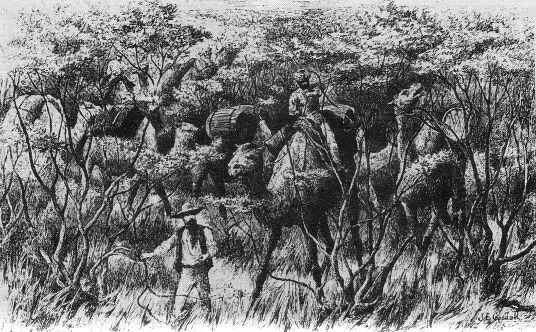
At twelve o'clock on the sixteenth day some natives' smoke was seen straight on our course, and also some of their foot-marks. The days throughout this march had been warm; the thermometer at twelve o'clock, when we let the camels lie down, with their loads on, for an hour, usually stood at 94, 95, or 96°, while in the afternoon it was some degrees hotter. On Saturday, the 25th of September, being the sixteenth day from the water at the Boundary Dam, we travelled twenty-seven miles, still on our course, through mallee and spinifex, pines, casuarinas, and quandong-trees, and noticed for the first time upon this expedition some very fine specimens of the Australian grass-tree, Xanthorrhoea; the giant mallee were also numerous. The latter give a most extraordinary appearance to the scenes they adorn, for they cheat the eye of the traveller into the belief that he is passing through tracts of alluvial soil, and gazing, upon the water-indicating gum-trees. This night we reached a most abominable encampment; there was nothing that the camels could eat, and the ground was entirely covered with great bunches of spinifex. Before us, and all along the western horizon, we had a black-looking and scrubby rise of very high sandhills; each of us noticed its resemblance to those sandhills which had confronted us to the north and east when at Youldeh. By observation we found that we were upon the same latitude, but had reached a point in longitude 500 miles to the west of it. It is highly probable that no water exists in a straight line between the two places. Shortly before evening, Mr. Young was in advance steering, but he kept so close under the sun—it being now so near the equinox, the sun set nearly west, and our course being 21° south of west—I had to go forward and tell him that he was not steering rightly. Of course he became indignant, and saying, “Perhaps you'll steer, then, if you don't think I can!” he handed me the compass. I took it in silence and steered more southerly, in the proper direction of our course; this led us over a long white ridge of sand, and brought us to the hollow where, as I said before, we had such a wretched encampment. I mention this as a circumstance attaches to it. The fate of empires at times has hung upon a thread, and our fate now hung upon my action. We had come 323 miles without having seen a drop of water. There was silence and melancholy in the camp; and was it to be wondered at if, in such a region and under such circumstances, there was:—
“A load on each spirit, a cloud o'er each soul,
With eyes that could scan not, our destiny's scroll.”
Every man seemed to turn his eyes on me. I was the great centre of attraction; every action of mine was held to have some peculiar meaning. I was continually asked night after night if we should get water the following day? The reply, “How can I tell?” was insufficient; I was supposed to know to an inch where water was and exactly when we could reach it. I believe all except the officers thought I was making for a known water, for although I had explained the situation before leaving the dam, it was only now that they were beginning to comprehend its full meaning. Towards the line of dark sandhills, which formed the western horizon, was a great fall of country into a kind of hollow, and on the following morning, the seventeenth day from the dam, Mr. Tietkens appeared greatly impressed with the belief that we were in the neighbourhood of water. I said nothing of my own impressions, for I thought something of the kind also, although I said I would not believe it. It was Mr. Tietkens's turn to steer, and he started on foot ahead of the string of camels for that purpose. He gave Tommy his little riding-bull, the best leading camel we have, and told him to go on top of a white sandhill to our left, a little south of us, and try if he could find any fresh blacks' tracks, or other indications of water. I did not know that Tommy had gone, nor could I see that Tietkens was walking—it was an extraordinary event when the whole string of camels could be seen at once in a line in this country—and we had been travelling some two miles and a half when Alec Ross and Peter Nicholls declared that they heard Tommy calling out “water!” I never will believe these things until they are proved, so I kept the party still going on. However, even I, soon ceased to doubt, for Tommy came rushing through the scrubs full gallop, and, between a scream and a howl, yelled out quite loud enough now even for me to hear, “Water! water! plenty water here! come on! come on! this way! this way! come on, Mr. Giles! mine been find 'em plenty water!” I checked his excitement a moment and asked whether it was a native well he had found, and should we have to work at it with the shovel? Tommy said, “No fear shovel, that fellow water sit down meself (i.e. itself) along a ground, camel he drink 'em meself.” Of course we turned the long string after him. Soon after he left us he had ascended the white sandhill whither Mr. Tietkens had sent him, and what sight was presented to his view! A little open oval space of grass land, half a mile away, surrounded entirely by pine-trees, and falling into a small funnel-shaped hollow, looked at from above. He said that before he ascended the sandhill he had seen the tracks of an emu, and on descending he found the bird's track went for the little open circle. He then followed it to the spot, and saw a miniature lake lying in the sand, with plenty of that inestimable fluid which he had not beheld for more than 300 miles. He watered his camel, and then rushed after us, as we were slowly passing on ignorantly by this life-sustaining prize, to death and doom. Had Mr. Young steered rightly the day before—whenever it was his turn during that day I had had to tell him to make farther south—we should have had this treasure right upon our course; and had I not checked his incorrect steering in the evening, we should have passed under the northern face of a long, white sandhill more than two miles north of this water. Neither Tommy nor anybody else would have seen the place on which it lies, as it is completely hidden in the scrubs; as it was, we should have passed within a mile of it if Mr. Tietkens had not sent Tommy to look out, though I had made up my mind not to enter the high sandhills beyond without a search in this hollow, for my experience told me if there was no water in it, none could exist in this terrible region at all, and we must have found the tracks of natives, or wild dogs or emus leading to the water. Such characters in the book of Nature the explorer cannot fail to read, as we afterwards saw numerous native foot-marks all about. When we arrived with the camels at this newly-discovered liquid gem, I found it answered to Tommy's description. It is the most singularly-placed water I have ever seen, lying in a small hollow in the centre of a little grassy flat, and surrounded by clumps of the funereal pines, “in a desert inaccessible, under the shade of melancholy boughs.” While watering my little camel at its welcome waters, I might well exclaim, “In the desert a fountain is springing”—though in this wide waste there's too many a tree. The water is no doubt permanent, for it is supplied by the drainage of the sandhills that surround it, and it rests on a substratum of impervious clay. It lies exposed to view in a small open basin, the water being only about 150 yards in circumference and from two to three feet deep. Farther up the slopes, at much higher levels, native wells had been sunk in all directions—in each and all of these there was water. One large well, apparently a natural one, lay twelve or thirteen feet higher up than the largest basin, and contained a plentiful supply of pure water. Beyond the immediate precincts of this open space the scrubs abound.
It may be imagined how thankful we were for the discovery of this only and lonely watered spot, after traversing such a desert. How much longer and farther the expedition could have gone on without water we were now saved the necessity of guessing, but this I may truly say, that Sir Thomas Elder's South Australian camels are second to none in the world for strength and endurance. From both a human and humane point of view, it was most fortunate to have found this spring, and with it a respite, not only from our unceasing march, but from the terrible pressure on our minds of our perilous situation; for the painful fact was ever before us, that even after struggling bravely through hundreds of miles of frightful scrubs, we might die like dogs in the desert at last, unheard of and unknown. On me the most severe was the strain; for myself I cared not, I had so often died in spirit in my direful journeys that actual death was nothing to me. But for vanity, or fame, or honour, or greed, and to seek the bubble reputation, I had brought six other human beings into a dreadful strait, and the hollow eyes and gaunt, appealing glances that were always fixed on me were terrible to bear; but I gathered some support from a proverb of Solomon: “If thou faint in the day of adversity, thy strength is small.” Mount Churchman, the place I was endeavouring to reach, was yet some 350 miles distant; this discovery, it was therefore evident, was the entire salvation of the whole party.
During our march for these sixteen or seventeen days from the little dam, I had not put the members of my party upon an actual short allowance of water. Before we watered the camels we had over 100 gallons of water, yet the implied restraint was so great that we were all in a continual state of thirst during the whole time, and the small quantity of water consumed—of course we never had any tea or coffee—showed how all had restrained themselves.
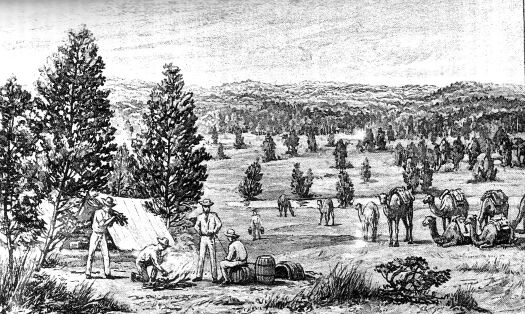
Geographical features have been terribly scarce upon this expedition, and this peculiar spring is the first permanent water I have found. I have ventured to dedicate it to our most gracious Queen. The great desert in which I found it, and which will most probably extend to the west as far as it does to the east, I have also honoured with Her Majesty's mighty name, calling it the Great Victoria Desert, and the spring, Queen Victoria's Spring. In future times these may be celebrated localities in the British Monarch's dominions. I have no Victoria or Albert Nyanzas, no Tanganyikas, Lualabas, or Zambezes, like the great African travellers, to honour with Her Majesty's name, but the humble offering of a little spring in a hideous desert, which, had it surrounded the great geographical features I have enumerated, might well have kept them concealed for ever, will not, I trust, be deemed unacceptable in Her Majesty's eyes, when offered by a loyal and most faithful subject.
On our arrival here our camels drank as only thirsty camels can, and great was our own delight to find ourselves again enabled to drink at will and indulge in the luxury of a bath. Added to both these pleasures was a more generous diet, so that we became quite enamoured of our new home. At this spring the thorny vegetation of the desert grew alongside the more agreeable water-plants at the water's edge, so that fertility and sterility stood side by side. Mr. Young planted some seeds of numerous vegetables, plants, and trees, and among others some of the giant bamboo, Dendrocalamus striatus, also Tasmanian blue gum and wattles. I am afraid these products of Nature will never reach maturity, for the natives are continually burning the rough grass and spinifex, and on a favourably windy occasion these will consume everything green or dry, down to the water's edge. There seems to be very little native game here, though a number of bronze-winged pigeons came to water at night and morning. There are, however, so many small native wells besides the larger sheet, for them to drink at, and also such a quantity of a thorny vegetation to screen them, that we have not been very successful in getting any. Our best shot, Mr. Young, succeeded in bagging only four or five. It was necessary, now that we had found this spring, to give our noble camels a fair respite, the more so as the food they will eat is very scarce about here, as we have yet over 300 miles to travel to reach Mount Churchman, with every probability of getting no water between. There are many curious flying and creeping insects here, but we have not been fortunate in catching many. Last night, however, I managed to secure and methylate a good-sized scorpion. After resting under the umbrageous foliage of the cypress-pines, among which our encampment was fixed for a week, the party and camels had all recovered from the thirst and fatigue of our late march, and it really seemed impossible to believe that such a stretch of country as 325 miles could actually have been traversed between this and the last water. The weather during our halt had been very warm, the thermometer had tried to go over 100° in the shade, but fell short by one degree. Yesterday was an abominable day; a heated tornado blew from the west from morning until night and continued until this morning, when, without apparent change otherwise, and no clouds, the temperature of the wind entirely altered and we had an exceedingly cool and delightful day. We found the position of this spring to be in latitude 30° 25´ 30´´ and longitude 123° 21´ 13´´. On leaving a depot and making a start early in the morning, camels, like horses, may not be particularly inclined to fill themselves with water, while they might do so in the middle of the day, and thus may leave a depot on a long dry march not half filled. The Arabs in Egypt and other camel countries, when starting for a desert march, force the animals, as I have seen—that is, read of—to fill themselves up by using bullocks' horns for funnels and pouring the water down their throats till the creatures are ready to burst. The camels, knowing by experience, so soon as the horns are stuck into their mouths, that they are bound for a desert march, fill up accordingly.
Strange to say, though I had brought from Port Augusta almost every article that could be mentioned for the journey, yet I did not bring any bullocks' horns, and it was too late now to send Tommy back to procure some; we consequently could not fill up our camels at starting, after the Arab fashion. In order to obviate any disadvantage on this account, to-day I sent, with Mr. Tietkens and Alec Ross, three camels, loaded with water, to be deposited about twenty-five miles on our next line of route, so that the camels could top up en passant. The water was to be poured into two canvas troughs and covered over with a tarpaulin. This took two days going and coming, but we remained yet another two, at the Queen's Spring.
Before I leave that spot I had perhaps better remark that it might prove a very difficult, perhaps dangerous place, to any other traveller to attempt to find, because, although there are many white sandhills in the neighbourhood, the open space on which the water lies is so small in area and so closely surrounded by scrubs, that it cannot be seen from any conspicuous one, nor can any conspicuous sandhill, distinguishable at any distance, be seen from it. It lies at or near the south-west end of a mass of white-faced sandhills; there are none to the south or west of it. While we remained here a few aboriginals prowled about the camp, but they never showed themselves. On the top of the bank, above all the wells, was a beaten corroborree path, where these denizens of the desert have often held their feasts and dances. Tommy found a number of long, flat, sword-like weapons close by, and brought four or five of them into the camp. They were ornamented after the usual Australian aboriginal fashion, some with slanting cuts or grooves along the blade, others with square, elliptical, or rounded figures; several of these two-handed swords were seven feet long, and four or five inches wide; wielded with good force, they were formidable enough to cut a man in half at a blow.
This spring could not be the only water in this region; I believe there was plenty more in the immediate neighbourhood, as the natives never came to water here. It was singular how we should have dropped upon such a scene, and penetrated thus the desert's vastness, to the scrub-secluded fastness of these Austral-Indians' home. Mr. Young and I collected a great many specimens of plants, flowers, insects, and reptiles. Among the flowers was the marvellous red, white, blue, and yellow wax-like flower of a hideous little gnarled and stunted mallee-tree; it is impossible to keep these flowers unless they could be hermetically preserved in glass; all I collected and most carefully put away in separate tin boxes fell to pieces, and lost their colours. The collection of specimens of all kinds got mislaid in Adelaide. Some grass-trees grew in the vicinity of this spring to a height of over twenty feet. On the evening of the 5th of October a small snake and several very large scorpions came crawling about us as we sat round the fire; we managed to bottle the scorpions, but though we wounded the snake it escaped; I was very anxious to methylate him also, but it appeared he had other ideas, and I should not be at all surprised if a pressing interview with his undertaker was one of them.
One evening a discussion arose about the moon, and Saleh was trying to teach Tommy something, God knows what, about it. Amongst other assertions he informed Tommy that the moon travelled from east to west, “because, you see, Tommy,” he said, “he like the sun—sun travel west too.” Tommy shook his head very sapiently, and said, “No, I don't think that, I think moon go the other way.” “No fear,” said Saleh, “how could it?” Then Peter Nicholls was asked, and he couldn't tell; he thought Saleh was right, because the moon did set in the west. So Tommy said, “Oh, well, I'll ask Mr. Giles,” and they came to where Mr. T, Mr. Y., and I were seated, and told us the argument. I said, “No, Saleh, the moon travels just the other way.” Then Tommy said, “I tole you so, I know,” but of course he couldn't explain himself. Saleh was scandalised, and all his religious ideas seemed upset. So I said, “Well, now, Saleh, you say the moon travels to the west; now do you see where she is to-night, between those two stars?” “Oh, yes,” he said, “I see.” I said, “If to-morrow night she is on the east side of that one,” pointing to one, “she must have travelled east to get there, mustn't she?” “Oh, no,” said Saleh, “she can't go there, she must come down west like the sun,” etc. In vain we showed him the next night how she had moved still farther east among the stars; that was nothing to him. It would have been far easier to have converted him to Christianity than to make him alter his original opinion. With regard to Tommy's ideas, I may say that nearly all Australian natives are familiar with the motions of the heavenly bodies, knowing the difference between a star and a planet, and all tribes that I have been acquainted with have proper names for each, the moon also being a very particular object of their attention.
While at this water we occasionally saw hawks, crows, corellas, a pink-feathered kind of cockatoo, and black magpies, which in some parts of the country are also called mutton birds, and pigeons. One day Peter Nicholls shot a queer kind of carrion bird, not so large as a crow, although its wings were as long. It had the peculiar dancing hop of the crow, its plumage was of a dark slate colour, with whitish tips to the wings, its beak was similar to a crow's.
We had now been at this depot for nine days, and on the 6th of October we left it behind to the eastward, as we had done all the other resting places we had found. I desired to go as straight as possible for Mount Churchman. Its position by the chart is in latitude 29° 58´, and longitude 118°. Straight lines on a map and straight lines through dense scrubs are, however, totally different, and, go as straight as we could, we must make it many miles farther than its distance showed by the chart.
Depart for Mount Churchman. Yellow-barked trees. Wallaby traps. Sight a low hill. Several salt lakes. Another hill. Camels bogged. Natives' smoke. Bare rocks. Grass-trees. Clayey and grassy ground. Dryness of the region. Another mass of bare rocks. A pretty place. Crows and native foot-tracks. Tommy finds a well. Then another. Alone on the rocks. Voices of the angels. Women coming for water. First natives seen. Arrival of the party. Camels very thirsty but soon watered. Two hundred miles of desert. Natives come to the camp. Splendid herbage. A romantic spot. More natives arrive. Native ornaments. A mouthpiece. Cold night. Thermometer 32°. Animals' tracks. Natives arrive for breakfast. Inspection of native encampment. Old implements of white men in the camp. A lame camel. Ularring. A little girl. Dislikes a looking-glass. A quiet and peaceful camp. A delightful oasis. Death and danger lurking near. Scouts and spies. A furious attack. Personal foe. Dispersion of the enemy. A child's warning. Keep a watch. Silence at night. Howls and screams in the morning. The Temple of Nature. Reflections. Natives seen no more.
On the 6th October, as I have said, we departed, and at once entered into the second division of Her Majesty Queen Victoria's great Australian desert. That night we camped at the place where Mr. Tietkens and Alec Ross, albeit a short measure for twenty-five miles, had left the two troughs full of water. I had instructed them to travel west-north-west. The country of course was all scrubs and sandhills. We saw a few currajong-trees during our day's stage, and where we camped there were a number of well-grown eucalyptus-trees with yellow bark. These seemed to me very like the yellow jacket timber that grows on watercourses in parts of New South Wales and Queensland. The water I had sent out to this place was just sufficient to fill up the camels. The following day, at three miles from the camp, we came to some large granite boulders in the scrubs; but there were no receptacles for holding water at any time. At sixteen miles we reached a dry salt lake on our left hand; this continued near our line for four miles. Both yesterday and to-day we saw some native wallaby traps in the dense scrubs; these are simply long lines of sticks, boughs, bushes, etc., which, when first laid down, may be over a foot high; they are sometimes over a quarter of a mile long. These lines meet each other at nearly right angles, and form a corner. For a few yards on each side of the corner the fence is raised to between four and five feet, made somewhat substantial and laid with boughs. Over this is thrown either a large net or a roofing of boughs. I saw no signs of nets in this region. The wallaby are hunted until they get alongside the fences; if they are not flurried they will hop along it until they get to a part which is too high, or they think it is; then they go up into the trap, where there is a small opening, and get knocked on the head for their pains by a black man inside. At twenty miles we actually sighted a low hill. Here was a change. At four miles farther we reached its foot; there were salt lake depressions nearly all round us. Here we found a small quantity of the little pea-vetch, which is such excellent food for the camels.
From the summit of this little hill, the first I had met for nearly 800 miles—Mount Finke was the last—another low scrubby ridge lay to the westward, and nearly across our course, with salt lakes intervening, and others lying nearly all round the horizon. At the foot of the little hill we encamped. A few hundred acres of ground were open, and there were clay-pans upon it, but no rain could have fallen here for ages I should imagine. The hill was only 200 feet high, and it was composed of granite stones. I was glad, however, to see some granite crop out, as we were now approaching the western coast-line formation; this I have always understood to be all granite, and it was about time that something like a change of country should occur. The following day, in making for the low range, we found ourselves caught in the ramifications of some of the saline depressions, and had to go a long way round to avoid them. Just before we reached the low range we passed the shore of another salt lake, which had a hard, firm, and quartz-pebbly bed, and we were enabled to travel across it to the hills; these we reached in sixteen miles from our last camp. The view from the summit was as discouraging as ever. To the west appeared densely scrubby rises, and to the south many salt channels existed, while in every other direction scrubs and scrubby rises bounded the view. This low range was about 300 feet high; the ridges beyond continued on our course, a little north of west for two or three miles, when we again entered the sandy scrubs, and camped, after travelling twenty-eight miles. Our position here was in latitude 30° 10´ 5´´, and longitude 122° 7´ 6´´. The next day we had scrubs undulating as usual, and made a day's stage of twenty-four miles, sighting at twelve miles three low ranges, northerly, north-easterly, and east-north-easterly, the most easterly appearing to be the highest. They were from twenty to thirty miles away from our line.
On the 9th and 10th October we had all scrubs; on the 11th, towards evening, we had some scrubby ridges in front of us, and were again hemmed in by salt lakes. To save several miles of roundabout travelling, we attempted to cross one of these, which, though not very broad, was exceedingly long to the north and south, and lay right across our track. Unfortunately a number of the leading camels became apparently hopelessly embedded in a fearful bog, and we had great difficulty in getting them safely out. It was only by the strenuous exertions of all hands, and by pulling up the camels' legs with ropes, and poking tarpaulins into the vacated holes, that we finally rescued them without loss. We then had to carry out all their loads ourselves, and also the huge and weighty pack-saddles. We found it no easy matter to carry 200 pounds, half a load—some of the water-casks weighed more—on our backs, when nearly up to our necks in the briny mud, on to the firm ground. However, we were most fortunate in having no loss with the camels, for a camel in a bog is the most helpless creature imaginable. Leaving the bog, we started up the shore of the lake, northerly, where we found some more of the little pea-vetch, and encamped, making only twenty-four miles straight from last camp. The camels have had nothing to eat for three nights previously. We saw some natives' smoke three or four miles away from where we camped, and as there were ridges near it, I intend to send some one there in the morning to look for water.
We had still some miles to go, to get round the northern end of the boggy lake. Alec Ross and Tommy walked across, to hunt up any traces of natives, etc., and to look for water. On clearing this boggy feature, we ascended into some densely scrubby granite rises; these had some bare rocks exposed here and there, but no indentations for holding water could be seen. At fifteen or sixteen miles, having passed all the ridges, and entered scrubs and mallee again, Alec and Tommy overtook us, Mr. Young having remained behind with their camels, and reported that they had found one small rock-hole. Alec said it had twenty or thirty gallons of water in it, but Tommy said there was only a little drop, so I did not think it worth while to delay by sending any camels back so far for so little reward. We saw two or three dozen grass-trees to-day, also some quandong and currajong trees, and camped again in scrubs where there was only a few leguminous bushes for the camels to eat. We had travelled twenty-eight miles, which only made twenty-four straight. The last three days had been warm, the thermometer going up to 98° in the shade each day at about twelve o'clock; the camels were very thirsty, and would not feed as the provender was so very poor.
During the last few days we had met with occasional patches of grassy and clayey ground, generally where the yellow-barked eucalypts grew, and we passed numerous small clay-channels and pans, in which rain-water might lodge for some time after a shower, but it was evident from the appearance of the grass and vegetation that no rains could have visited the region for a year, or it might be for a hundred years; every vegetable thing seemed dry, sere, or dead. On the 13th of October, at twelve miles from camp, we passed over some more scrubby granite ridges, where some extent of bare rock lay exposed. I searched about it, but the indents were so small and shallow that water could not remain in them for more than a week after rains had filled them. While I was searching on foot, Mr. Young and Tommy, from their camels' backs, saw another mass of bare rocks further away to the north-west. I took Tommy with me, on Reechy, and we went over to the spot, while the party continued marching on; on arriving we found a very pretty piece of scenery. Several hundred acres of bare rocks, with grassy flats sloping down from them to the west, and forming little watercourses or flat water-channels; there were great numbers of crows, many fresh natives' tracks, and the smoke of several fires in the surrounding scrub. Tommy took the lower ground, while I searched the rocks. He soon found a small native well in a grassy water-channel, and called out to me. On joining him I found that there was very little water in sight, but I thought a supply might be got with a shovel, and I decided to send him on my camel to bring the party back, for we had come over 200 miles from Queen Victoria's Spring, and this was the first water I had seen since leaving there. We gave little Reechy, or as I usually called her Screechy, all the water we could get out of the well, with one of Tommy's boots; she drank it out of his hat, and they started away. I fully believed there was more water about somewhere, and I intended having a good hunt until either I found it or the party came. I watched Tommy start, of course at full speed, for when he got a chance of riding Screechy he was in his glory, and as she was behind the mob, and anxious to overtake them, she would go at the rate of twenty miles an hour, if allowed to gallop; but much to my surprise, when they had gone about 200 yards along the grassy water-channel, apparently in an instant, down went Reechy on her knees, and Tommy, still in the saddle, yelled out to me, “Plenty water here! plenty water here!” Reechy, who had not had half enough at the first place, would not go past this one.
I walked down and saw a large well with a good body of water in it, evidently permanently supplied by the drainage of the mass of bare rocks in its vicinity. I was greatly pleased at Tommy's discovery, and after giving Reechy a thorough good drink, off he went like a rocket after the party. I wandered about, but found no other water-place; and then, thinking of the days that were long enough ago, I sat in the shade of an umbrageous acacia bush. Soon I heard the voices of the angels, native black and fallen angels, and their smokes came gradually nearer. I thought they must have seen me on the top of the rocks, and desired to make my further acquaintance. The advancing party, however, turned out to be only two women coming for water to the well. They had vessels, usually called coolamins—these are small wooden troughs, though sometimes made of bark, and are shaped like miniature canoes—for carrying water to their encampment. When they came near enough to see what I was, they ran away a short distance, then stopped, turned round, and looked at me. Of course I gave a gentle bow, as to something quite uncommon; a man may bend his lowest in a desert to a woman. I also made signs for them to come to the well, but they dropped their bark coolamins and walked smartly off. I picked up these things, and found them to be of a most original, or rather aboriginal, construction. They were made of small sheets of the yellow-tree bark, tied up at the ends with bark-string, thus forming small troughs. When filled, some grass or leaves are put on top of the water to prevent it slopping over. The women carry these troughs on their heads. I was not near enough to distinguish whether the women were beautiful or not; all I could make out was that one was young and fatter than the other. Amongst aborigines of every clime fatness goes a great way towards beauty. The youngest and fattest was the last to decamp.
These were the first natives I had seen upon this expedition; no others appeared while I was by myself. In about four hours the party arrived; they had travelled six miles past the place when Tommy overtook them. We soon watered all the camels; they were extremely thirsty, for they had travelled 202 miles from Queen Victoria's Spring, although, in a straight line, we were only 180 miles from it. Almost immediately upon the arrival of the caravan, a number of native men and one young boy made their appearance. They were apparently quiet and inoffensive, and some of them may have seen white people before, for one or two spoke a few English words, such as “white fellow,” “what name,” “boy,” etc. They seemed pleased, but astonished to see the camels drink such an enormous quantity of water; they completely emptied the well, and the natives have probably never seen it empty before. The water drained in pretty fast: in an hour the well was as full as ever, and with much purer water than formerly. There was plenty of splendid herbage and leguminous bushes here for the camels. It is altogether a most romantic and pretty place; the little grassy channels were green and fresh-looking, and the whole space for a mile around open, and dotted with shady acacia trees and bushes. Between two fine acacias, nearly under the edge of a huge, bare expanse of rounded rock, our camp was fixed. The slope of the whole area is to the west.
It reminded me of Wynbring more than any other place I have seen. At first only eight natives made their appearance, and Mr. Young cut up a red handkerchief into as many strips. These we tied around their regal brows, and they seemed exceedingly proud of themselves. Towards evening three or four more came to the camp; one had a large piece of pearl oyster-shell depending from a string round his neck, another had a queer ornament made of short feathers also depending from the neck; it looked like the mouth of a porte-monnaie. When I wished to examine it, the wearer popped it over his mouth, and opened that extensive feature to its fullest dimensions, laughing most heartily. He had a very theatrical air, and the extraordinary mouthpiece made him look like a demon in, or out of, a pantomime. In taking this ornament off his neck he broke the string, and I supplied him with a piece of elastic band, so that he could put it on and off without undoing it, whenever he pleased; but the extraordinary phenomenon to him of the extension of a solid was more than he was prepared for, and he scarcely liked to allow it to touch his person again. I put it over my head first, and this reassured him, so that he wore it again as usual. They seemed a very good-natured lot of fellows, and we gave them a trifle of damper and sugar each. During the morning, before we arrived here, Tommy had been most successful in obtaining Lowans' eggs, and we had eleven or twelve with us. When the natives saw these, which no doubt they looked upon as their own peculiar and lawful property, they eyed them with great anxiety, and, pointing to them, they spoke to one another, probably expecting that we should hand the eggs over to them; but we didn't do it. At night they went away; their camp could not be far off, as we continually heard the sounds of voices and could see their camp fires. Before sunrise the following morning the mercury fell to 32°; although there was no dew to freeze, to us it appeared to be 100° below zero. The only animals' tracks seen round our well were emus, wild dogs, and Homo sapiens. Lowans and other desert birds and marsupials appear never to approach the watering-places.
Our sable friends came very early to breakfast, and brought a few more whom we had not previously seen; also two somewhat old and faded frail, if not fair, ones; soon after a little boy came by himself. This young imp of Satan was just like a toad—all mouth and stomach. It appeared these natives practise the same rites of incision, excision, and semi-circumcision as the Fowler's Bay tribes; and Tommy, who comes from thence, said he could understand a few words these people spoke, but not all; he was too shy to attempt a conversation with them, but he listened to all they said, and occasionally interpreted a few of their remarks to us. These principally referred to where he could have come from and what for. To-day Alec Ross and Peter Nicholls walked over to the natives' encampment, and reported that most of the men who had been to our camp were sitting there with nothing to eat in the camp; the women being probably out on a hunting excursion, whilst they, as lords of creation, waited quietly at their club till dinner should be announced. They got very little from me, as I had no surplus food to spare. Nicholls told me they had some tin billies and shear-blades in the camp, and I noticed that one of the first batch we saw had a small piece of coarse cloth on; another had a piece of horse's girth webbing. On questioning the most civilised, and inquiring about some places, whose native names were given on my chart, I found they knew two or three of these, and generally pointed in the proper directions. It was evident they had often seen white people before, if, they had never eaten any.
One of our cow camels had been very lame for two or three days, and now we found she had a long mulga stake stuck up through the thick sole of her spongy foot. I got a long piece out with knife and plyers, but its removal did not appear to improve her case, for the whole lower part of her leg was more swollen after than before the extraction of the wood, but I hoped a day or two would put her right. Yesterday, the 15th of October, Mr. Young managed to get the name of this place from the natives. They call it Ularring, with the accent on the second syllable. It is a great relief to my mind to get it, as it saves me the invidious task of selecting only one name by which to call the place from the list of my numerous friends. This morning, 16th, our usual visitors arrived; two are most desirous to go westward with us when we start. A little later a very pretty little girl came by herself. She was about nine or ten years old, and immediately became the pet of the camp. All the people of this tribe are excessively thin, and so was this little creature. She had splendid eyes and beautiful teeth, and we soon dressed her up, and gave her a good breakfast. In an hour after her arrival she was as much at home in my camp as though I were her father. She is a merry little thing, but we can't understand a word she says. She evidently takes a great interest in everything she sees at the camp, but she didn't seem to care to look at herself in a glass, though the men always did.
While we were at dinner to-day a sudden whirl-wind sprang up and sent a lot of my loose papers, from where I had been writing, careering so wildly into the air, that I was in great consternation lest I should lose several sheets of my journal, and find my imagination put to the test of inventing a new one. We all ran about after the papers, and so did some of the blacks, and finally they were all recovered. Mr. Young cut my initials and date thus: E. over G. over 75., upon a Grevillea or beef-wood-tree, which grew close to the well. While here we have enjoyed delightful weather; gentle breezes and shady tree(es), quiet and inoffensive aboriginals, with pretty children in the midst of a peaceful and happy camp, situated in charming scenery amidst fantastic rocks, with beautiful herbage and pure water for our almighty beasts. What a delightful oasis in the desert to the weary traveller! The elder aboriginals, though the words of their mouths were smoother than butter, yet war was in their hearts. They appeared to enjoy our company very well. “Each in his place allotted, had silent sat or squatted, while round their children trotted, in pretty youthful play. One can't but smile who traces the lines on their dark faces, to the pretty prattling graces of these small heathens gay.”
The 16th October, 1875, was drawing to a close, as all its predecessors from time's remotest infancy have done; the cheery voice of the expedition cook had called us to our evening meal; as usual we sat down in peaceful contentment, not dreaming that death or danger was lurking near, but nevertheless, outside this peaceful scene a mighty preparation for our destruction was being made by an army of unseen and unsuspected foes.
“The hunting tribes of air and earth
Respect the brethren of their birth;
Man only mars kind Nature's plan,
And turns the fierce pursuit on man.”
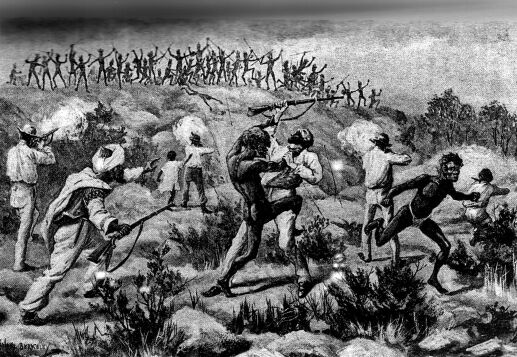
Our supper was spread, by chance or Providential interference, a little earlier than usual. Mr. Young, having finished his meal first, had risen from his seat. I happened to be the last at the festive board. In walking towards the place where his bedding was spread upon the rocks, he saw close to him, but above on the main rock, and at about the level of his eyes, two unarmed natives making signs to the two quiet and inoffensive ones that were in the camp, and instantaneously after he saw the front rank of a grand and imposing army approaching, guided by the two scouts in advance. I had not much time to notice them in detail, but I could see that these warriors were painted, feathered, and armed to the teeth with spears, clubs, and other weapons, and that they were ready for instant action. Mr. Young gave the alarm, and we had only just time to seize our firearms when the whole army was upon us. At a first glance this force was most imposing; the coup d'oeil was really magnificent; they looked like what I should imagine a body of Comanche Indians would appear when ranged in battle line. The men were closely packed in serried ranks, and it was evident they formed a drilled and perfectly organised force. Immediate action became imminent, and as most fortunately they had thought to find us seated at supper, and to spear us as we sat in a body together, we had just time, before fifty, sixty, or a hundred spears could be thrown at us, as I immediately gave the command to fire, to have the first discharge at them. Had it been otherwise not one of us could possibly have escaped their spears—all would certainly have been killed, for there were over a hundred of the enemy, and they approached us in a solid phalanx of five or six rows, each row consisting of eighteen or twenty warriors. Their project no doubt was, that so soon as any of us was speared by the warriors, the inoffensive spies in the camp were to tomahawk us at their leisure, as we rolled about in agony from our wounds; but, taken by surprise, their otherwise exceedingly well-organised attack, owing to a slight change in our supper-hour, was a little too late, and our fire caused a great commotion and wavering in their legion's ordered line. One of the quiet and inoffensive spies in the camp, as soon as he saw me jump up and prepare for action, ran and jumped on me, put his arms round my neck to prevent my firing, and though we could not get a word of English out of him previously, when he did this, he called out, clinging on to me, with his hand on my throat, “Don't, don't!” I don't know if I swore, but I suppose I must, as I was turned away from the thick array with most extreme disgust. I couldn't disengage myself; I couldn't attend to the main army, for I had to turn my attention entirely to this infernal encumbrance; all I could do was to yell out “Fire! fire for your lives.” I intended to give the spy a taste of my rifle first, but in consequence of his being in such close quarters to me, and my holding my rifle with one hand, while I endeavoured to free myself with the other, I could not point the muzzle at my assailant, and my only way of clearing myself from his hold was by battering his head with the butt end of the weapon with my right hand, while he still clung round my left side. At last I disengaged myself, and he let go suddenly, and slipped instantly behind one of the thick acacia bushes, and got away, just as the army in front was wavering. All this did not occupy many seconds of time, and I believe my final shot decided the battle. The routed army, carrying their wounded, disappeared behind the trees and bushes beyond the bare rock where the battle was fought, and from whence not many minutes before they had so gallantly emerged. This was the best organised and most disciplined aboriginal force I ever saw. They must have thoroughly digested their plan of attack, and sent not only quiet and inoffensive spies into the camp, but a pretty little girl also, to lull any suspicions of their evil intentions we might have entertained. Once during the day the little girl sat down by me and began a most serious discourse in her own language, and as she warmed with her subject she got up, gesticulated and imitated the action of natives throwing spears, pointed towards the natives' camp, stamped her foot on the ground close to me, and was no doubt informing me of the intended onslaught of the tribe. As, however, I did not understand a word she said, I did not catch her meaning either; besides, I was writing, and she nearly covered me with dust, so that I thought her a bit of a juvenile bore.
After the engagement we picked up a great number of spears and other weapons, where the hostile army had stood. The spears were long, light, and barbed, and I could not help thinking how much more I liked them on my outside than my in. I destroyed all the weapons I could lay hold of, much to the disgust of the remaining spy, who had kept quiet all through the fray. He seems to be some relative of the little girl, for they always go about together; she may probably be his intended wife. During the conflict, this little creature became almost frantic with excitement, and ran off to each man who was about to fire, especially Nicholls, the cook, with whom she seemed quite in love, patting him on the back, clapping her small hands, squeaking out her delight, and jumping about like a crow with a shirt on. While the fight was in progress, in the forgetfulness of his excitation, my black boy Tommy began to speak apparently quite fluently in their language to the two spies, keeping up a running conversation with them nearly all the time. It seemed that the celebrated saying of Talleyrand, “Language was only given to man to conceal his thought,” was thoroughly understood by my seemingly innocent and youthful Fowler's Bay native. When I taxed him with his extraordinary conduct, he told me the natives had tried to induce him to go with them to their camp, but his natural timidity had deterred him and saved his life; for they would certainly have killed him if he had gone. After the attack, Tommy said, “I tole you black fellow coming,” though we did not recollect that he had done so. The spy who had fastened on to me got away in an opposite direction to that taken by the defeated army. The other spy and the girl remained some little time after the action, and no one saw them depart, although we became at last aware of their absence. We kept watch during the night, as a precaution after such an attack, although I had not instituted watching previously. There was a dead silence in the direction of the enemy's encampment, and no sounds but those of our camel-bells disturbed the stillness of the luminous and lunar night.
On the following morning, at earliest dawn, the screams and howls of a number of the aborigines grated harshly upon our ears, and we expected and prepared for a fresh attack. The cries continued for some time, but did not approach any nearer. After breakfast, the little girl and her protector, the quietest of the two spies, made their appearance at the camp as composedly as though nothing disagreeable had occurred to mar our friendship, but my personal antagonist did not reappear—he probably had a headache which kept him indoors. I had given the girl a shirt when she first came to the camp, and Peter Nicholls had given her protector an old coat, which was rather an elongated affair; on their arrival this morning, these graceful garments had been exchanged, and the girl appeared in the coat, trailing two feet on the ground, and the man wore the shirt, which scarcely adorned him enough. I gave them some breakfast and they went away, but returned very punctually to dinner. Then I determined not to allow them to remain any longer near us, so ordered them off, and they departed, apparently very reluctantly. I felt very much inclined to keep the little girl. Although no doubt they still continued watching us, we saw them no more.
I got Mr. Young to plant various seeds round this well. No doubt there must be other waters in this neighbourhood, as none of the natives have used our well since we came, but we could not find any other.
The following day was Sunday. What a scene our camp would have presented to-day had these reptiles murdered us! It does not strike the traveller in the wilderness, amongst desert scenes and hostile Indians, as necessary that he should desire the neighbourhood of a temple, or even be in a continual state of prayer, yet we worship Nature, or the God of Nature, in our own way; and although we have no chapel or church to go to, yet we are always in a temple, which a Scottish poet has so beautifully described as “The Temple of Nature.” He says:—
“Talk not of temples; there is one,
Built without hands, to mankind given;
Its lamps are the meridian sun,
And the bright stars of heaven.
Its walls are the cerulean sky,
Its floor the earth so green and fair;
Its dome is vast immensity:
All nature worships there.”
We, of a surety, have none of the grander features of Nature to admire; but the same Almighty Power which smote out the vast Andean Ranges yet untrod, has left traces of its handywork here. Even the great desert in which we have so long been buried must suggest to the reflecting mind either God's perfectly effected purpose, or His purposely effected neglect; and, though I have here and there found places where scanty supplies of the element of water were to be found, yet they are at such enormous distances apart, and the regions in which they exist are of so utterly worthless a kind, that it seems to be intended by the great Creator that civilised beings should never re-enter here. And then our thoughts must naturally wander to the formation and creation of those mighty ships of the desert, that alone could have brought us here, and by whose strength and incomprehensible powers of endurance, only are we enabled to leave this desert behind. In our admiration of the creature, our thoughts are uplifted in reverence and worship to the Designer and Creator of such things, adapted, no doubt, by a wise selection from an infinite variety of living forms, for myriads of creative periods, and with a foreknowledge that such instruments would be requisite for the intelligent beings of a future time, to traverse those areas of the desert earth that it had pleased Him in wisdom to permit to remain secluded from the more lovely places of the world and the familiar haunts of civilised man. Here, too, we find in this fearful waste, this howling wilderness, this country vast and desert idle, places scooped out of the solid rock, and the mighty foundations of the round world laid bare, that the lower organism of God's human family may find their proper sustenance; but truly the curse must have gone forth more fearfully against them, and with a vengeance must it have been proclaimed, by the sweat of their brows must they obtain their bread. No doubt it was with the intention of obtaining ours, thus reaping the harvest of unfurrowed fields, that these natives were induced to make so murderous an attack upon us. We neither saw nor heard anything more of our sable enemies, and on the 18th we departed out of their coasts. This watering place, Ularring, is situated in latitude 29° 35´, and longitude 120° 31´ 4´´.
Depart from Ularring. Re-enter scrubs. Scrubs more dense. A known point. Magnetic rocks. Lowans' eggs. Numbers of the birds. Crows, hawks. Natives and water. Induce natives to decamp. Unusually vigorous growth of scrubs. Alec sights Mount Churchman. Bronze-winged pigeons. Pigeon Rocks. Depart. Edge of a cliff. Mount Churchman in view. Some natives arrive. A wandering pet. Lake Moore. Rock-holes. Strike old dray tracks. An outlying sheep-station. The first white man seen. Dinner of mutton. Exploring at an end. Civilisation once more. Tootra. All sorts and conditions come to interview us. A monastery. A feu-de-joie. The first telegraph station. Congratulatory messages. Intimations of receptions. A triumphal march. Messrs. Clunes Brothers. An address. Culham. White ladies. Newcastle. A triumphal arch. A fine tonic. Tommy's speech. Unscientific profanity. Guildford on the Swan. Arrival at Perth. Reception by the Mayor. The city decorated. Arrival at the Town Hall. A shower of garlands. A beautiful address. A public reception at Fremantle. Return to Perth. And festivities. Remarks.
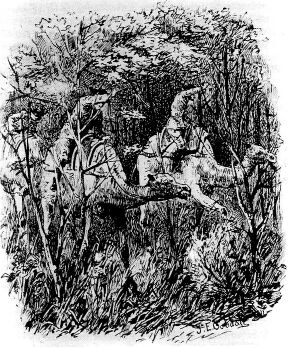
On the 18th we departed. Mount Churchman was now not much more than 150 miles away. I felt sure we should reach it at last. It was late in the day when we left the camp, and immediately re-entered the dense and odious scrubs, which were more than usually thick. We passed a small salt-lake bed on our right, and made good twenty miles by night, which fell with cold and wind and threatened rain. At three or four miles the next morning, we saw some bare granite rocks to the south, and noticed the tops of some low ranges to the north, but these were partially hidden by some nearer ridges. The summit of one of these was a mass of exposed rock, similar in appearance to Ularring and remarkably high, but as it was five or six miles away from our line, which was now nearly west, we did not visit it. At fifteen miles from camp we sighted from the top of an undulation in the scrub, a pointed hill a little south of west, also another higher and longer, and lying more southerly. We could not reach the pointed hill by night. The country is now more densely scrubby than ever, and although we toiled the whole day, we only made good twenty-four miles. Upon nearing the hill the following morning we saw some grass-trees and passed between two salt-lakes. At ten miles Mr. Young and I were upon the top of the hill; the scrubs surrounding it were so terribly thick that I thought we should have to chop our way through them, and we had the greatest difficulty in getting the caravan to move along at all. I was much surprised at the view I obtained here; in the first place as we were now gradually approaching Mount Churchman, the hill to the south was, or should have been, Mount Jackson, but according to my chart there were no hills visible in any easterly or northeasterly direction from Mount Jackson, whereas from the range to the south, not only the hill I was upon, but all the others in various directions, must also have been seen from it. This was rather puzzling, and the only way I could account for the anomaly was that either Gregory had never ascended Mount Jackson at all, though according to his map he calls the whole eastern country beyond it sand plains, or these hills have been thrown up since 1846. The latter I cannot believe. The composition of this hill was almost iron itself, and there were some fused stones like volcanic slag upon it. It was too magnetic for working angles with a compass; it was between 500 and 600 feet above the surrounding regions. The horizon from east, north-east, round by north, thence to the west and south, was bounded by low ranges, detached into seven groups; the white beds of small lakes were visible running up to the northern, or north eastern group, the intervening country being, as usual, all scrubs, which grew even to the summits of the hills. The view from this hill was enough to terrify the spectator; my only consolation in gazing at so desolate a scene, was that my task was nearly accomplished, and nothing should stop me now. A second pointed hill lay nearly west, and we pushed on to this, but could not reach it by night.
To-day we managed to get thirty-four Lowans' eggs, yesterday we had secured twenty-seven. These birds swarm in these scrubs, and their eggs form a principal item in the daily fare of the natives during the laying season. We seldom see the birds, but so long as we get the eggs I suppose we have no great cause of complaint. In the morning we reached and ascended the second hill. Some other hills a few miles away ended nearly west, and bare granite rocks appeared a few miles beyond them, which I determined to visit. This hill was of similar formation to the last-described. The far horizon to the west being all scrub, Mount Churchman should have been visible, but it was not. The sight of the country from any of these hills is truly frightful; it seemed as though the scrubs were to end only with our journey. On descending, we pushed on for the rocks, and reached them in twelve miles from the last camp. As we neared them, we could distinguish a large extent of bare rock, and it seemed likely that we should find water, as we saw a number of crows and hawks, and we soon became aware of the presence of natives also, for they began to yell so soon as they perceived our approach. A well was soon found, and our camp fixed beside it. The natives were numerous here, but whether they were our old enemies or not I could not say; yet I fancied I recognised one or two among them, and to let them see that our ammunition was not yet exhausted, I fired my rifle in the air. This had the effect of inducing them, whether friends or foes, to decamp, and we were not troubled with them while we were here. I did not wish for a repetition of the Ularring affair. The well was shallow, with a good supply of water, and there were a few scores of acres of open ground around the rocks, though the scrubs came as close as possible. This spot was seventy-seven miles from Ularring; our well was situated at what may be called the north-east corner of these rocks; at the south-west end there is another and larger valley, where I saw two wells. On Sunday, the 22nd of October, we rested here. The old lame cow is still very bad, I am afraid she cannot travel much farther. Yesterday and to-day were rather warm, the thermometer indicating 94 and 96° in the shade. The upheaval of the few hills we have lately passed seems to have induced an unusually vigorous growth of scrubs, for they are now denser and more hideous than ever.
Alec Ross stated that he had seen, from the last hill, another, far away, due west, but nobody else saw it. If such a hill exists it is over eighty miles away from where seen, and it must be Mount Churchman. No views to any distance could be had from these rocks, as the undulations of the scrubs occur continuously throughout the desert, at almost regular intervals of a few miles, from seven to twenty.
After dinner on the 23rd I had intended to leave this place, but upon mustering the camels I found that not only was the lame cow worse, but another of the cows had calved, and our family was increased by the advent of a little cow-calf about the size of a rabbit. This prevented our departure. The calf was killed, and the mother remained with her dead offspring, whereby she comprehended her loss, and this will prevent her endeavouring to return to it after we leave. We obtained a good many bronze-winged pigeons here, and I called the place the Pigeon Rocks. Their position is in latitude 29° 58´ 4´´ and longitude 119° 15´ 3´´. To-day the thermometer rose to 100° in the shade, and at night a very squally thunderstorm, coming from the west, agreeably cooled the atmosphere, although no rain fell. On the 24th we left the Pigeon Rocks, still steering west, and travelled twenty-five miles through the dense scrubs, with an occasional break, on which a few of the yellow-bark gum-trees grew. They are generally of a vigorous and well grown habit. The poor old lame cow followed as usual, but arrived at the camp a long while after us. The next day we progressed twenty-five miles to the westward, and at evening we tore through a piece of horrible scrub, or thickets, and arrived at the edge of a cliff which stood, perpendicularly, 200 feet over the surrounding country. This we had to circumnavigate in order to descend.
Right on our course, being in the proper latitude, and twenty-seven or twenty-eight miles away, was a small hill, the object I had traversed so many hundreds of miles of desert to reach, and which I was delighted to know, was Mount Churchman. The country between the cliff and Mount Churchman was filled to overflowing with the densest of scrubs; Nature seemed to have tried how much of it she could possibly jam into this region. We encamped at the foot of the cliff. We got several Lowans'—or, as the West Australians call them, Gnows'—eggs, thirty yesterday, and forty-five to-day. At night the old lame cow did not arrive at the camp, nor was she with the mob the next morning; I wished her to remain at the Pigeon Rocks, but of course she persisted in following her kindred so long as she could, but now she has remained behind of her own accord, she will no doubt return there, and if she recovers will most probably go back to Beltana by herself, perhaps exploring a new line of country on the way.
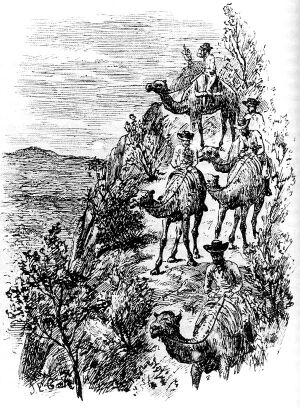
The following day we hoped to reach Mount Churchman, but the scrubs were so frightful we could not get there by night, though we travelled without stopping for twelve hours. To-day we got only twenty eggs. To-night and last night a slight dew fell, the first for a long time. Early on the morning of the 27th of October I stood upon the summit of Mount Churchman; and, though no mention whatever is made upon the chart of the existence of water there, we found a native well which supplied all our wants. In the afternoon some natives made their appearance; they were partly clothed. The party consisted of an oldish man, a very smart and good-looking young fellow, and a handsome little boy. The young fellow said his own name was Charlie, the boy's Albert, and the older one's Billy. It is said a good face is the best letter of introduction, but Charlie had a better one, as I had lost a little ivory-handled penknife on the road yesterday, and they had come across, and followed our tracks, and picked it up. Charlie, without a moment's questioning, brought it to me; he was too polite, too agreeable altogether, and evidently knew too much; he knew the country all the way to Perth, and also to Champion Bay. It occurred to me that he had been somebody's pet black boy, that had done something, and had bolted away. He told me the nearest station to us was called Nyngham, Mount Singleton on the chart, in a north-west direction. The station belonged, he said, to a Mr. Cook, and that we could reach it in four days, but as I wished to make south-westerly for Perth, I did not go that way. The day was very warm, thermometer 99° in shade.

This mount is called Geelabing on the chart, but Charlie did not know it by that name. He and the other two came on and camped with us that night. Our course was nearly south-west; we only travelled eleven miles. The following day our three friends departed, as they said, to visit Nyngham, while we pursued our own course, and reached the shores of the dry salt-lake Moore. In about thirty miles we found some rock water-holes, and encamped on the edge of the lake, where we saw old horse and cattle tracks. We next crossed the lake-bed, which was seven miles wide. No doubt there is brine in some parts of it, but where I crossed it was firm and dry. We left it on the 30th of October, and travelling upon a course nearly west-south-west, we struck some old dray tracks, at a dried-up spring, on the 3rd of November, which I did not follow, as they ran eastwards. From there I turned south, and early on the 4th we came upon an outlying sheep station; its buildings consisting simply of a few bark-gunyahs. There was not even a single, rude hut in the dingle; blacks' and whites' gunyahs being all alike. Had I not seen some clothes, cooking utensils, etc., at one of them, I should have thought that only black shepherds lived there. A shallow well, and whip for raising the water into a trough, was enclosed by a fence, and we watered our camels there. The sheep and shepherd were away, and although we were desperately hungry for meat, not having had any for a month, we prepared to wait until the shepherd should come home in the evening. While we were thinking over these matters, a white man came riding up. He apparently did not see us, nor did his horse either, until they were quite close; then his horse suddenly stopped and snorted, and he shouted out, “Holy sailor, what's that?” He was so extraordinarily surprised at the appearance of the caravan that he turned to gallop away. However, I walked to, and reassured him, and told him who I was and where I had come from. Of course he was an Irishman, and he said, “Is it South Austhralia yez come from? Shure I came from there meself. Did yez crass any say? I don't know, sure I came by Albany; I never came the way you've come at all. Shure, I wilcome yez, in the name of the whole colony. I saw something about yez in the paper not long ago. Can I do anything for yez? This is not my place, but the shepherd is not far; will I go and find him?” “Faith, you may,” I said, “and get him to bring the flock back, so that we can get a sheep for dinner.” And away he went, and soon returned with the shepherd, sheep, black assistants and their wives; and we very soon had a capital meal of excellent mutton. While it was in process of cooking the shepherd despatched a black boy to the nearest farm, or settlement, for coffee, butter, sugar, eggs, etc. The messenger returned at night with everything. Exploring had now come to an end; roads led to, and from, all the other settled districts of the colony, and we were in the neighbourhood of civilisation once more. This out-station was the farthest attempt at settlement towards the east, in this part of the colony. It was called Tootra, and belonged to the Messrs. Clunes Brothers, who live lower down the country.
On the 6th of November we passed by the farm where the black boy had got the coffee, sugar, etc.; it belonged to a Mr. Joyce. We did not stay there very long, the people did not seem to know what to make of, and never said anything to, us. That evening we reached Mr. Clarke's homestead, called Inderu, where we were treated with the greatest kindness by every member of the family. They gave us eggs, butter, jam, and spirits, and despatched a messenger with a letter to Sir Thomas Elder's agent at Fremantle. Here we were also met by young Mr. Lefroy, son of the Hon. O'Grady Lefroy, Treasurer and acting Colonial Secretary for the Colony, who took us off to his station, Walebing, where we remained some days, thoroughly enjoying a recruiting at so agreeable a place. We had to depart at last, and were next entertained by Mr. and Mrs. McPherson, as we passed by their station called Glentromie. So soon as the news spread amongst the settlers that a caravan of camels had arrived, bushmen and girls, boys and children, came galloping from all parts, while their elders drove whatever vehicles they could lay their hands on, to come and see the new arrivals. The camels were quite frightened at the people galloping about them. Our next reception was at a Spanish Benedictine Monastery and Home for natives, called New Norcia. This Monastery was presided over by the Right Reverend Lord Bishop Salvado, the kindest and most urbane of holy fathers. We were saluted on our arrival, by a regular feu-de-joie, fired off by the natives and half-castes belonging to the mission. The land and property of this establishment is some of the best in the Colony. Here was the first telegraph station we had reached, and I received a number of congratulatory telegrams from most of the leading gentlemen in Perth; from His Excellency the Governor's private secretary, the Press, and my brother-explorer Mr. John Forrest.
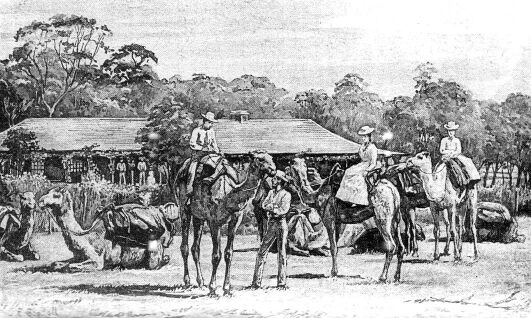
Intimations of intended receptions, by corporations, and addresses to be presented, with invitations to banquets and balls, poured in, in overwhelming numbers; so that on leaving the Monastery I knew the series of ordeals that were in store for me. His Excellency the Governor, Sir William Robinson, K.C.M.G., most kindly despatched Mr. John Forrest with a carriage to meet us. From the Monastery our triumphal march began. The appearance of a camel caravan in any English community, away from camel countries, is likely to awaken the curiosity of every one; but it is quite a matter of doubt whether we, or the camels caused the greater sensation as we advanced. A few miles from the monastery we passed the station of Messrs. Clunes Brothers, at whose farthest out-station we had first come upon a settlement. These gentlemen were most kind and hospitable, and would not accept any payment for two fine wether sheep which we had eaten. A short distance from their residence we passed a district country school-house, presided over by Mr. J.M. Butler, and that gentleman, on behalf of Messrs. Clunes, the residents of the locality, his scholars, and himself, presented us with a congratulatory address. Pushing onwards towards the metropolis we arrived, on Saturday, November 13th, at Mr. Samuel Phillips's station, Culham, where that gentleman invited us to remain during Sunday. Here, for the first time, we had the pleasure of enjoying the society of ladies, being introduced to Mrs. Phillips, her sister-in-law Mrs. Fane, and their several daughters. The whole family combined to make us welcome, and as much at home as possible. Here also Mr. Forrest joined us, and welcomed us to his own native land. The camels were put into an excellent paddock, and enjoyed themselves almost as much as their masters. Culham is nine or ten miles from Newcastle, the first town site we should reach. We were invited thither by the Mayor and Council, or rather the Chairman and Council of the Municipality.
At Newcastle we were received under a triumphal arch, and the Chairman presented us with an address. We were then conducted to a sumptuous banquet. Near the conclusion, the Chairman rose to propose our healths, etc.; he then gratified us by speaking disparagingly of us and our journey; he said he didn't see what we wanted to come over here for, that they had plenty of explorers of their own, etc. This was something like getting a hostile native's spear stuck into one's body, and certainly a fine tonic after the champagne. Several gentlemen in the hall protested against these remarks. I made a short reply; Mr. Tietkens put a little humour into his, and all coolness wore away, especially when Tommy made a speech. He was a great favourite with the “General,” and was well looked after during the repast. When we had all said our say, Tommy was urged to speak; he was very bashful, and said, “I don't know what to say;” the people near him said, “Never mind, Tommy, say anything;” so he rose in his seat and simply said “Anything,” whereupon everybody laughed, and joviality was restored. In the evening a ball took place in our honour; the old Chairman went to bed, and we all danced till morning. Never after did we hear anything but compliments and commendations, as what was then said was against the sense of the whole Colony. The next town we arrived at was Guildford; on the road the caravan passed by a splitters' camp, the men there came round the camels, and as usual stared wide-eyed with amazement. One of them begged Alec Ross, who was conducting the camels, to wait till a mate of theirs who was away returned, so that he might see them; but as we were bound to time and had our stages arranged so that we should reach Perth by a certain time, this could not be done, and the camels went on. By-and-by a man came galloping up as near as his horse would come to the camels, and called out: “Hi there, hold on, you *** wretches; do you think I'd a galloped after yer ter see such little *** things as them? why, they ain't no bigger nor a *** horse [there were camels seven feet high in the mob]; why, I thought they was as big as *** clouds, or else I'd never a come all this *** way to see them,” etc. He interspersed this address with many adjectives, but as nobody took the slightest notice of him, he started away, banning and blaspheming as he went, and for an uneducated, unscientific West Australian, his, was not a bad effort at profanity.
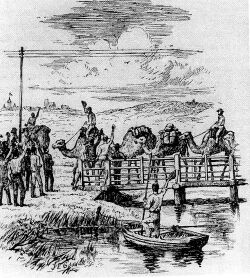

At Guildford, a town-site on the Swan, we were publicly received by the Mayor, Mr. Spurling, the Town Council, various bodies and lodges, and a detachment of volunteers. We were presented with addresses from the Town Council, and Mr. Spurling made a most handsome speech, which removed any remains of the taste of the Newcastle tonic. The Lodges of Oddfellows and Good Templars also presented us with addresses. The Chairman of the latter made a little Good Templar capital out of the fact of our having achieved such a great feat entirely on water. To this I replied, that it was true we had accomplished our journey on water, and very little of it, but that if we had had anything stronger we should certainly have drunk it, if only to make our water supply last the longer. Then a banquet was spread, which was attended also by ladies, and was a most agreeable entertainment, and the evening wound up with a ball. Guildford being only ten or eleven miles from Perth, at about three p.m. of the next day we approached the city, riding our camels, and having the whole of the caravan in regular desert-marching order. A great number of people came out, both riding and driving, to meet us, and escorted us into the city; Mr. Forrest was now on horseback and riding alongside of me.
After traversing the long wooden causeway that bridges the Swan, we soon reached the city bounds, and were met by the Mayor, Mr. George Shenton, and the other members of the City Council, companies of volunteers lined the streets on either side, and the various bodies of Freemasons, Oddfellows, and Good Templars, accompanied by the brass band of the latter, took a part in the procession. A great crowd of citizens assembled, and the balconies of the houses on both sides were thronged with the fair sex, and garlands of flowers were showered down upon us. The streets of the city were decorated with flags and streamers, and scrolls of welcome were stretched across. The procession moved along to the Town Hall amidst general cheering. We were ushered into the spacious hall, and placed on a raised platform, then we were introduced to most of the gentlemen present. The Mayor then addressed me in most eulogistic terms, and presented me with an address on vellum, beautifully illuminated and engrossed, on behalf of the corporation and citizens of Perth, congratulating myself, and party on our successful exploration across the unknown interior from South Australia, and warmly expressing the good feelings of welcome entertained by the citizens towards us.
After this a round of festivities set in; among these were a public banquet and ball in our honour by the Mayor and Corporation of the city of Perth and a dinner and ball at Government House. A public reception also awaited us at Fremantle, on the coast. On our arrival at the long, high, wooden structure that spans the broad mouth of the river at Fremantle, we were again met by eager crowds. Mr. Forrest rode near me on this occasion also. When entering Perth, I had a great deal of trouble to induce my riding-camel, Reechy, to lead, but when entering Fremantle she fairly jibbed, and I had to walk and lead her, so that I was hidden in the crowd, and Mr. Tietkens, coming next to me, appeared to be the leader, as his camel went all right. The balconies and verandahs here were also thronged with ladies, who showered down heaps of garlands while they cheered. I was completely hidden, and they threw all the flowers down on Tietkens, so that he got all the honour from the ladies. Here another beautiful address was presented to me by Mr. John Thomas, the Chairman of the Town Council, and a public banquet was given us. On returning to Perth, we had invitations from private individuals to balls, dinners, pic-nics, boating and riding parties, and the wife of the Honourable O'Grady Lefroy started the ball giving immediately after that at Government House. Mr. Forrest gave us a dinner at the Weld Club.
Since our arrival in the settled parts of Western Australia, we have had every reason to believe that our welcome was a genuine one, everybody having treated us with the greatest kindness and courtesy. His Excellency the Governor ordered that all our expenses down the country, from where Mr. Forrest met us, should be defrayed by the Government; and having been so welcomed by the settlers on our arrival at each place, I had no occasion to expend a penny on our march through the settled districts of the Colony.
In concluding the tale of a long exploration, a few remarks are necessary. In the first place I travelled during the expedition, in covering the ground, 2500 miles; but unfortunately found no areas of country suitable for settlement. This was a great disappointment to me, as I had expected far otherwise; but the explorer does not make the country, he must take it as he finds it. His duty is to penetrate it, and although the greatest honour is awarded and the greatest recompense given to the discoverer of the finest regions, yet it must be borne in mind, that the difficulties of traversing those regions cannot be nearly so great as those encountered by the less fortunate traveller who finds himself surrounded by heartless deserts. The successful penetration of such a region must, nevertheless, have its value, both in a commercial and a geographical sense, as it points out to the future emigrant or settler, those portions of our continent which he should rigorously avoid. It never could have entered into any one's calculations that I should have to force my way through a region that rolls its scrub-enthroned, and fearful distance out, for hundreds of leagues in billowy undulations, like the waves of a timbered sea, and that the expedition would have to bore its way, like moles in the earth, for so long, through these interminable scrubs, with nothing to view, and less to cheer. Our success has traced a long and a dreary road through this unpeopled waste, like that to a lion's abode, from whence no steps are retraced. The caravan for months was slowly but surely plodding on, under those trees with which it has pleased Providence to bedeck this desolate waste. But this expedition, as organised, equipped, and intended by Sir Thomas Elder, was a thing of such excellence and precision, it moved along apparently by mechanical action; and it seemed to me, as we conquered these frightful deserts by its power, like playing upon some new fine instrument, as we wandered, like rumour, “from the Orient to the Drooping West,”—
“From where the Torrens wanders,
'Midst corn and vines and flowers,
To where fair Perth still lifts to heaven
Her diadem of towers.”
The labours of the expedition ended only at the sea at Fremantle, the seaport of the west; and after travelling under those trees for months, from eastern lands through a region accurst, we were greeted at last by old Ocean's roar; Ocean, the strongest of creation's sons, “that rolls the wild, profound, eternal bass in Nature's anthem.” The officers, Mr. Tietkens and Mr. Young, except for occasional outbursts of temper, and all the other members of the expedition, acted in every way so as to give me satisfaction; and when I say that the personnel of the expedition behaved as well as the camels, I cannot formulate greater praise.
It will readily be believed that I did not undertake a fourth expedition in Australia without a motive. Sir Thomas Elder had ever been kind to me since I had known him, and my best thanks were due to him for enabling me to accomplish so difficult an undertaking; but there were others also I wished to please; and I have done my best endeavours upon this arduous expedition, with the hope that I might “win the wise, who frowned before to smile at last.”
Remarks on the last expedition. Departure of my two officers. Expedition leaves Perth. Invited to York. Curiosity to see the caravan. Saleh and Tommy's yarns. Tipperary. Northam. Newcastle again. A pair of watch(ful) guards. St. Joseph's. Messrs. Clunes. The Benedictine monastery. Amusing incident. A new road. Berkshire Valley. Triumphal arch. Sandal-wood. Sheep poison. Cornamah. A survey party. Irwin House. Dongarra. An address presented. A French gentleman. Greenough Flats. Another address. Tommy's tricks. Champion Bay. Palmer's camp. A bull-camel poisoned. The Bowes. Yuin. A native desperado captured. His escape. Cheangwa. Native girls and boys. Depart for the interior. Natives follow us. Cooerminga. The Sandford. Moodilah. Barloweerie Peak. Pia Spring. Mount Murchison. Good pastoral country. Farewell to the last white man.
After having crossed the unknown central interior, and having traversed such a terrible region to accomplish that feat, it might be reasonably supposed that my labours as an explorer would cease, and that I might disband the expedition and send the members, camels, and equipment back to Adelaide by ship, especially as in my closing remarks on my last journey I said that I had accomplished the task I had undertaken, and effected the object of my expedition. This was certainly the case, but I regarded what had been done as only the half of my mission; and I was as anxious now to complete my work as I had been to commence it, when Sir Thomas Elder started me out. The remaining portion was no less than the completion of the line I had been compelled to leave unfinished by the untimely loss of Gibson, during my horse expedition of 1874. My readers will remember that, having pushed out west from my depot at Fort McKellar, in the Rawlinson Range, I had sighted another line of hills, which I had called the Alfred and Marie Range, and which I had been unable to reach. It was therefore my present wish and intention to traverse that particular region, and to connect my present explorations with my former ones with horses. By travelling northwards until I reached the proper latitude, I might make an eastern line to the Rawlinson Range. That Gibson's Desert existed, well I knew; but how far west from the Rawlinson it actually extended, was the problem I now wished to solve. As Sir Thomas Elder allowed me carte blanche, I began a fresh journey with this object. The incidents of that journey this last book will record.
My readers may imagine us enjoying all the gaieties and pleasures such a city as Perth, in Western Australia, could supply. Myself and two officers were quartered at the Weld Club; Alec Ross and the others had quarters at the United Service Club Hotel nearly opposite; and taking it altogether, we had very good times indeed. The fountains of champagne seemed loosened throughout the city during my stay; and the wine merchants became nervous lest the supply of what then became known as “Elder wine” should get exhausted. I paid a visit down the country southwards, to Bunbury, The Vasse, and other places of interest in that quarter. Our residence at Perth was extended to two months. Saleh was in his glory. The camels were out in a paddock, where they did not do very well, as there was only one kind of acacia tree upon which they could browse. Occasionally Saleh had to take two or three riding camels to Government House, as it became quite the thing, for a number of young ladies to go there and have a ride on them; and on those days Saleh was resplendent. On every finger, he wore a ring, he had new, white and coloured, silk and satin, clothes, covered with gilt braid; two silver watches, one in each side-pocket of his tunic; and two jockey whips, one in each hand. He used to tell people that he brought the expedition over, and when he went back he was sure Sir Thomas Elder would fit him out with an expedition of his own. Tommy was quite a young coloured swell, too; he would go about the town, fraternise with people, treat them to drinks at any hotel, and tell the landlord, when asked for payment, that the liquor was for the expedition. Every now and again I had little bills presented to me for refreshments supplied to Mr. Oldham. Alec Ross expended a good deal of his money in making presents to young ladies; and Peter Nicholls was quite a victim to the fair sex of his class. I managed to escape these terrible dangers, though I can't tell how.
Both my officers left for South Australia by the mail steamer. Mr. Tietkens was the more regretted. I did not wish him to leave, but he said he had private business to attend to. I did not request Mr. Young to accompany me on my return journey, so they went to Adelaide together. The remainder of the party stayed until the 13th of January, 1876, when the caravan departed from Perth on its homeward route to South Australia, having a new line of unexplored country to traverse before we could reach our goal. My projected route was to lie nearly 400 miles to the north of the one by which I arrived; and upon leaving Perth we travelled up the country, through the settled districts, to Champion Bay, and thence to Mount Gould, close to the River Murchison.
Before leaving the city I was invited by the Mayor and Municipality of the town of York, to visit that locality; this invitation I, of course, accepted, as I was supposed to be out on show. My party now consisted of only four other members besides myself, namely, young Alec Ross, now promoted to the post of second in command, Peter Nicholls, still cook, Saleh, and Tommy Oldham. At York we were entertained, upon our arrival, at a dinner. York was a very agreeable little agricultural town, the next in size to Fremantle. Bushmen, farmers, and country people generally, flocked in crowds to see both us and the camels. It was amusing to watch them, and to hear the remarks they made. Saleh and Tommy used to tell the most outrageous yarns about them; how they could travel ten miles an hour with their loads, how they carried water in their humps, that the cows ate their calves, that the riding bulls would tear their riders' legs off with their teeth if they couldn't get rid of them in any other way. These yarns were not restricted to York, they were always going on.
The day after leaving York we passed Mr. Samuel Burgess's establishment, called Tipperary, where we were splendidly entertained at a dinner, with his brothers and family. The Messrs. Burgess are among the oldest and wealthiest residents in the Colony. From hence we travelled towards a town-site called Northam, and from thence to Newcastle, where we were entertained upon our first arrival. A lady in Newcastle, Mrs. Dr. Mayhew, presented me with a pair of little spotted puppies, male and female, to act for us, as she thought, as watch(ful) guards against the attacks of hostile natives in the interior. And although they never distinguished themselves very much in that particular line, the little creatures were often a source of amusement in the camp; and I shall always cherish a feeling of gratitude to the donor for them.
At ten miles from Newcastle is Culham, the hospitable residence of the well-known and universally respected Squire Phillips, of an old Oxford family in England, and a very old settler in the Colony of Western Australia. On our arrival at Culham we were, as we had formerly been, most generously received; and the kindness and hospitality we met, induced us to remain for some days. When leaving I took young Johnny Phillips with me to give him an insight into the mysteries of camel travelling, so far as Champion Bay. On our road up the country we met with the greatest hospitality from every settler, whose establishment the caravan passed. At every station they vied with each other as to who should show us the greatest kindness. It seems invidious to mention names, and yet it might appear as though I were ungrateful if I seemed to forget my old friends; for I am a true believer in the dictum, of all black crimes, accurst ingratitude's the worst. Leaving Culham, we first went a few miles to Mr. Beare's station and residence, whither Squire Phillips accompanied us. Our next friend was Mr. Butler, at the St. Joseph's schoolhouse, where he had formerly presented me with an address. Next we came to the Messrs. Clunes, where we remained half an hour to refresh, en route for New Norcia, the Spanish Catholic Benedictine Monastery presided over by the good Bishop Salvado, and where we remained for the night; the Bishop welcoming us as cordially as before. Our next halt was at the McPhersons', Glentromie, only four or five miles from the Mission. Our host here was a fine, hospitable old Scotchman, who has a most valuable and excellent property. From Glentromie we went to the Hon. O'Grady Lefroy's station, Walebing, where his son, Mr. Henry Lefroy, welcomed us again as he had done so cordially on our first visit. At every place where we halted, country people continually came riding and driving in to see the camels, and an amusing incident occurred here. Young Lefroy had a tidy old housekeeper, who was quite the grande dame amongst the young wives and daughters of the surrounding farmers. I remained on Sunday, and, as usual, a crowd of people came. The camp was situated 200 yards from the buildings, and covered a good space of ground, the camels always being curled round into a circle whenever we camped; the huge bags and leather-covered boxes and pack-saddles filling up most of the space. On this Sunday afternoon a number of women, and girls, were escorted over by the housekeeper. Alec and I had come to the camp just before them, and we watched as they came up very slowly and cautiously to the camp. I was on the point of going over to them, and saying that I was sorry the camels were away feeding, but something Alec Ross said, restrained me, and we waited—the old housekeeper doing the show. To let the others see how clever she was, she came right up to the loads, the others following, and said, “Ah, the poor things!” One of the new arrivals said, “Oh, the poor things, how still and quiet they are,” the girls stretching their necks, and nearly staring their eyes out. Alec and I were choking with laughter, and I went up and said, “My dear creature, these are not the camels, these are the loads; the camels are away in the bush, feeding.” The old lady seemed greatly annoyed, while the others, in chorus, said, “Oh, oh! what, ain't those the camels there?” etc. By that time the old lady had vanished.
Up to this point we had returned upon the road we had formerly travelled to Perth; now we left our old line, and continued up the telegraph line, and main overland road, from Perth to Champion Bay. Here we shortly entered what in this Colony is called the Victoria Plains district. I found the whole region covered with thick timber, if not actual scrubs; here and there was a slight opening covered with a thorny vegetation three or four feet high. It struck me as being such a queer name, but I subsequently found that in Western Australia a plain means level country, no matter how densely covered with scrubs; undulating scrubs are thickets, and so on. Several times I was mystified by people telling me they knew there were plains to the east, which I had found to be all scrubs, with timber twenty to thirty feet high densely packed on it. The next place we visited, was Mr. James Clinche's establishment at Berkshire Valley, and our reception there was most enthusiastic. A triumphal arch was erected over the bridge that spanned the creek upon which the place was located, the arch having scrolls with mottoes waving and flags flying in our honour. Here was feasting and flaring with a vengeance. Mr. Clinche's hospitality was unbounded. We were pressed to remain a week, or month, or a year; but we only rested one day, the weather being exceedingly hot. Mr. Clinche had a magnificent flower and fruit garden, with fruit-trees of many kinds en espalier; these, he said, throve remarkably well. Mr. Clinche persisted in making me take away several bottles of fluid, whose contents need not be specifically particularised. Formerly the sandal-wood-tree of commerce abounded all over the settled districts of Western Australia. Merchants and others in Perth, Fremantle, York, and other places, were buyers for any quantity. At his place Mr. Clinche had a huge stack of I know not how many hundred tons. He informed me he usually paid about eight pounds sterling per measurement ton. The markets were London, Hong Kong, and Calcutta. A very profitable trade for many years was carried on in this article; the supply is now very limited.
There was a great deal of the poison-plant all over this country, not the Gyrostemon, but a sheep-poisoning plant of the Gastrolobium family; and I was always in a state of anxiety for fear the camels should eat any of it. The shepherds in this Colony, whose flocks are generally not larger than 500, are supposed to know every individual poison-plant on their beat, and to keep their sheep off it; but with us, it was all chance work, for we couldn't tie the camels up every night, and we could not control them in what they should eat. Our next friends were a brother of the McPherson at Glentromie and his wife. The name of this property was Cornamah; there was a telegraph station at this place. Both here and at Berkshire Valley Mrs. McPherson and Miss Clinche are the operators. Next to this, we reached Mr. Cook's station, called Arrino, where Mrs. Cook is telegraph mistress. Mr. Cook we had met at New Norcia, on his way down to Perth. We had lunch at Arrino, and Mrs. Cook gave me a sheep. I had, however, taken it out of one of their flocks the night before, as we camped with some black shepherds and shepherdesses, who were very pleased to see the camels, and called them emus, a name that nearly all the West Australian natives gave them.
After leaving Arrino we met Mr. Brooklyn and Mr. King, two Government surveyors, at whose camp we rested a day. The heat was excessive, the thermometer during that day going up 115° in the shade. The following day we reached a farm belonging to Mr. Goodwin, where we had a drink of beer all round. That evening we reached an establishment called Irwin House, on the Irwin River, formerly the residence of Mr. Lock Burgess, who was in partnership there with Squire Phillips. Mr. Burgess having gone to England, the property was leased to Mr. Fane, where we again met Mrs. Fane and her daughters, whom we had first met at Culham. This is a fine cattle run and farming property. From thence we went to Dongarra, a town-site also on the Irwin. On reaching this river, we found ourselves in one of the principal agricultural districts of Western Australia, and at Dongarra we were met by a number of the gentlemen of the district, and an address was presented to me by Mr. Laurence, the Resident Magistrate. After leaving Dongarra, we were entertained at his house by Mr. Bell; and here we met a French gentleman of a strong Irish descent, with fine white eyes and a thick shock head, of red hair; he gazed intently both at us and the camels. I don't know which he thought the more uncouth of the two kinds of beasts. At last he found sufficient English to say, “Do dem tings goo faar in a deayah, ehah?” When he sat down to dinner with us, he put his mutton chop on his hand, which he rested on his plate. The latter seemed to be quite an unknown article of furniture to him, and yet I was told his father was very well to do.
The next town-site we reached was the Greenough—pronounced Greenuff—Flats, being in another very excellent agricultural district; here another address was presented to me, and we were entertained at an excellent lunch. As usual, great numbers of people came to inspect us, and the camels, the latter laying down with their loads on previous to being let go. Often, when strangers would come too near, some of the more timid camels would jump up instantly, and the people not being on their guard, would often have torn faces and bleeding noses before they could get out of the way. On this occasion a tall, gaunt man and his wife, I supposed, were gazing at Tommy's riding camel as she carried the two little dogs in bags, one on each side. Tommy was standing near, trying to make her jump up, but she was too quiet, and preferred lying down. Any how, Tommy would have his joke—so, as the man who was gazing most intently at the pups said, “What's them things, young man?” he replied, “Oh, that's hee's pickaninnies”—sex having no more existence in a black boy's vocabulary than in a highlander's. Then the tall man said to the wife, “Oh, lord, look yer, see how they carries their young.” Only the pup's heads appeared, a string round the neck keeping them in; “but they looks like dogs too, don't they?” With that he put his huge face down, so as to gaze more intently at them, when the little dog, who had been teased a good deal and had got snappish, gave a growl and snapped at his nose. The secret was out; with a withering glance at Tommy and the camels, he silently walked away—the lady following.
All the riding camels and most of the pet baggage camels were passionately fond of bread. I always put a piece under the flap of my saddle, and so soon as Reechy came to the camp of a morning, she would come and lie down by it, and root about till she found it. Lots of the people, especially boys and children, mostly brought their lunch, as coming to see the camels was quite a holiday affair, and whenever they incautiously began to eat in the camp, half a dozen camels would try to take the food from them. One cunning old camel called Cocky, a huge beast, whose hump was over seven feet from the ground, with his head high up in the air, and pretending not to notice anything of the kind, would sidle slowly up towards any people who were eating, and swooping his long neck down, with his soft tumid lips would take the food out of their mouths or hands—to their utter astonishment and dismay. Another source of amusement with us was, when any man wanted to have a ride, we always put him on Peter Nicholls's camel, then he was led for a certain distance from the camp, when the rider was asked whether he was all right? He was sure to say, “Yes.” “Well, then, take the reins,” we would say; and so soon as the camel found himself free, he would set to work and buck and gallop back to the camp; in nine cases out of ten the rider fell off, and those who didn't never wished to get on any more. With the young ladies we met on our journeys through the settled districts, I took care that no accidents should happen, and always gave them Reechy or Alec's cow Buzoe. At the Greenough, a ball was given in the evening. (I should surely be forgetting myself were I to omit to mention our kind friend, Mr. Maley, the miller at Greenough, who took us to his house, gave us a lunch, and literally flooded us with champagne.) We were now only a short distance from Champion Bay, the town-site being called Geraldton; it was the 16th February when we reached it. Outside the town we were met by a number of gentlemen on horseback, and were escorted into it by them.
On arrival we were invited to a lunch. Champion Bay, or rather Geraldton, is the thriving centre of what is, for Western Australia, a large agricultural and pastoral district. It is the most busy and bustling place I have seen on this side of the continent. It is situated upon the western coast of Australia, in latitude 28° 40´ and longitude 114° 42´ 30´´, lying about north-north-west from Perth, and distant 250 miles in a straight line, although to reach it by land more than 300 miles have to be traversed. I delayed in the neighbourhood of Geraldton for the arrival of the English and Colonial mails, at the hospitable encampment of Mr. James Palmer, a gentleman from Melbourne, who was contractor for the first line of railway, from Champion Bay to Northampton, ever undertaken in Western Australia.
While we delayed here, Mr. Tietkens's fine young riding bull got poisoned, and though we did everything we possibly could for him, he first went cranky, and subsequently died. I was very much grieved; he was such a splendid hack, and so quiet and kind; I greatly deplored his loss. The only substance I could find that he had eaten was Gyrostemon, there being plenty of it here. Upon leaving Mr. Palmer's camp we next visited a station called the Bowes—being on the Bowes Creek, and belonging to Mr. Thomas Burgess, whose father entertained us so well at Tipperary, near York. Mr. Burgess and his wife most cordially welcomed us. This was a most delightful place, and so homelike; it was with regret that I left it behind, Mrs. Burgess being the last white lady I might ever see.
Mr. Burgess had another station called Yuin, about 115 miles easterly from here, and where his nephews, the two Messrs. Wittenoom, resided. They also have a station lying north-east by north called Cheangwa. On the fifth day from the Bowes we reached Yuin. The country was in a very dry state. All the stock had been removed to Cheangwa, where rains had fallen, and grass existed in abundance. At Yuin Mr. Burgess had just completed the erection of, I should say, the largest wool-shed in the Colony. The waters on the station consist of shallow wells and springs all over it. It is situated up the Greenough River. Before reaching Cheangwa I met the elder of the two Wittenooms, whom I had previously known in Melbourne; his younger brother was expected back from a trip to the north and east, where he had gone to look for new pastoral runs. When he returned, he told us he had not only been very successful in that way, but had succeeded in capturing a native desperado, against whom a warrant was out, and who had robbed some shepherds' huts, and speared, if not killed, a shepherd in their employ. Mr. Frank Wittenoom was leading this individual alongside of his horse, intending to take him to Geraldton to be dealt with by the police magistrate there. But O, tempora mutantur! One fine night, when apparently chained fast to a verandah post, the fellow managed to slip out of his shackles, quietly walked away, and left his fetters behind him, to the unbounded mortification of his captor, who looked unutterable things, and though he did not say much, he probably thought the more. This escape occurred at Yuin, to which place I had returned with Mr. E. Wittenoom, to await the arrival of Mr. Burgess. When we were all conversing in the house, and discussing some excellent sauterne, the opportunity for his successful attempt was seized by the prisoner. He effected his escape through the good offices of a confederate friend, a civilised young black fellow, who pretended he wanted his hair cut, and got a pair of sheep shears from Mr. Wittenoom during the day for that apparent purpose, saying that the captive would cut it for him. Of course the shears were not returned, and at night the captive or his friend used them to prise open a split link of the chain which secured him, and away he went as free as a bird in the air.
I had Mr. Burgess's and Mr. Wittenoom's company to Cheangwa, and on arrival there my party had everything ready for a start. We arranged for a final meeting with our kind friends at a spring called Pia, at the far northern end of Mr. Wittenoom's run. A great number of natives were assembled round Cheangwa: this is always the case at all frontier stations, in the Australian squatting bush. Some of the girls and young women were exceedingly pretty; the men were not so attractive, but the boys were good-looking youngsters. The young ladies were exceedingly talkative; they called the camels emus, or, as they pronounced it, immu. Several of these girls declared their intention of coming with us. There were Annies, and Lizzies, Lauras, and Kittys, and Judys, by the dozen. One interesting young person in undress uniform came up to me and said, “This is Judy, I am Judy; you Melbourne walk? me Melbourne walk too!” I said, “Oh, all right, my dear;” to this she replied, “Then you'll have to gib me dress.” I gave her a shirt.
When we left Cheangwa a number of the natives persisted in following us, and though we outpaced them in travelling, they stopping to hunt on the way, they found their way to the camp after us. By some of the men and boys we were led to a water-hole of some length, called Cooerminga, about eleven miles nearly north from Cheangwa. As the day was very warm, we and the natives all indulged promiscuously in the luxury of swimming, diving, and splashing about in all directions. It might be said that:—
“By yon mossy boulder, see an ebony shoulder,
Dazzling the beholder, rises o'er the blue;
But a moment's thinking, sends the Naiad sinking,
With a modest shrinking, from the gazer's view.”
The day after we crossed the dry channel of what is called the River Sandford, and at two or three miles beyond it, we were shown another water called Moodilah, six miles from our last night's encampment. We were so hampered with the girls that we did not travel very rapidly over this part of the continent. Moodilah lay a little to the east of north from Cooerminga; Barloweerie Peak bore north 37° west from camp, the latitude of which was 27° 11´ 8´´. On Saturday, the 8th of April, we went nearly north to Pia Spring, where the following day we met for the last time, Messrs. Burgess and Wittenoom. We had some bottles of champagne cooling in canvas water-buckets, and we had an excellent lunch. The girls still remained with us, and if we liked we might have stayed to “sit with these dark Orianas in groves by the murmuring sea.”
On Sunday, the 9th of April, we all remained in peace, if not happiness, at Pia Spring; its position is in latitude 27° 7´ and longitude 116° 30´. The days were still very hot, and as the country produced no umbrageous trees, we had to erect awnings with tarpaulins to enable us to rest in comfort, the thermometer in the shade indicating 100°. Pia is a small granite rock-hole or basin, which contains no great supply of water, but seems to be permanently supplied by springs from below. From here Mount Murchison, near the eastern bank of the River Murchison, bore north 73° east, twenty-three or twenty-four miles away, and Barloweerie, behind us, bore south 48° west, eight miles.
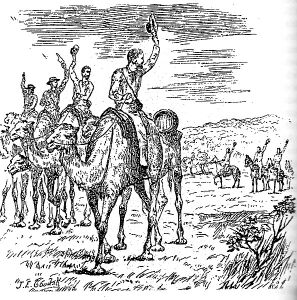
The country belonging to Mr. Burgess and the Messrs. Wittenoom Brothers appeared to me the best and most extensive pastoral property I had seen in Western Australia. Water is obtained in wells and springs all over the country, at a depth of four or five feet; there are, besides, many long standing pools of rain-water on the runs. Mr. Burgess told me of a water-hole in a creek, called Natta, nine or ten miles off, where I intend to go next. On Monday, the 10th of April, we bade farewell to our two kind friends, the last white men we should see. We finished the champagne, and parted.
The natives continue with us. Natta water-hole. Myriads of flies. Alec returns to Cheangwa. Bashful Tommy. Cowra man. Native customs and rites. Red granite mounds. Loads carried by women. Laura and Tommy. “Cowra” remains. Pretty amphitheatre. Mount Hale range. Flooded grassy flat. Clianthus or desert pea. Natives show us water. New acquaintances. Tell-tale fat. Timber of the Murchison. A waterhole. Fine vegetation. Mount Gould and Mount Hale. A new tribe of natives. Melbourne. Pretty girls brought to the camp. A picturesque place. Plague of flies. Angels' faces. Peterman. Ascend Mount Gould. A high peak. Country beautifully green. Natives less friendly. Leave Mount Gould. Saleh's ponds. Mount Labouchere. Sandal-wood-trees. Native well in a thicket. An Australian scene. The Valley of the Gascoyne. Beautiful trees. A fire-brand. Stony pass. Native orange. A second anniversary. Ascent of the peak. Severe country for camels' feet. Grassy plain. The Lyon's river. Native fires. Another anniversary. A new watercourse. A turkey bustard. An extraordinary scene. Remarks upon the country.
The harem elected to continue with us. Natta was reached in about nine miles, north-east by north from Pia. On the way we passed some excellent and occasionally flooded country, and saw some sheets of rain-water on which were numerous ducks, but our sportsmen were not so fortunate as to bag any, the birds being so exceedingly shy. I got a few afterwards, when we reached Natta. The thermometer to-day, 96°. The country was beautifully green, and the camels beginning to show great signs of improvement. The only drawbacks to our enjoyments were the myriads of flies by day and mosquitoes at night. It now turned out that Alec Ross had forgotten something, that he wanted at Cheangwa, and we waited here until he returned. During his absence we actually got enough ducks to give us all a most excellent dinner, and some to spare for the girls, who left all the hunting to the men and boys, and remained very comfortably in the camp. Peter Nicholls was quite in his glory among them. Tommy, being a very good-looking boy, was an object of great admiration to a good many of them; but he was so bashful he wouldn't even talk to them, though they tried very hard to make love to him. Alec having returned, we left Natta on the 14th, and went about north-east by east, to a small brackish water in a little creek channel, which we reached in about fifteen miles. Here our native escort was increased by the arrival of a young black gentleman, most beautifully dressed in fat and red ochre, with many extraordinary white marks or figures all over his back; we were informed that he was a “cowra man.” I had heard this expression before, and it seems it is a custom with the natives of this part of the country, like those of Fowler's and Streaky Bays on the south coast, to subject the youths of the tribe to a mutilating operation. After this they are eligible for marriage, but for a certain time, until the wounds heal, they are compelled to absent themselves from the society of women. They go about the country solitary and wretched, and continually utter a short, sharp “cowra cry” to warn all other men to keep their women away, until the time of their probation is over. Married men occasionally go on “cowra” also, but for what reason, I do not know. The time of our new arrival, it appeared, was just up, and he seemed very glad indeed of it, for he was evidently quite a society young man, and probably belonged to one of the first families. He talked as though he knew the country in advance for hundreds of miles, and told us he intended to come with us.
The country we were now passing through was all covered with low timber, if indeed the West Australian term of thicket was not more applicable. There was plenty of grass, but as a rule the region was poor; no views could be had for any distance. I was desirous of making my way to, or near to, Mount Hale, on the Murchison River. None of our natives knew any feature beyond, by its European name. A low line of hills ran along westerly, and a few isolated patches of granite hills occurred occasionally to the east of our line of march. We reached a chain of little creeks or watercourses, and on the 15th camped at a small water-hole in latitude 26° 46´, and longitude about 116° 57´. From hence we entered thickets, and arrived at the foot of some red granite mounds, where our cowra man said there was plenty of water in a rock-hole. It turned out, however, as is usually the case with these persons, that the information was not in strict accordance with the truth, for the receptacle he showed us was exceedingly small, and the supply of water which it contained was exceedingly smaller.
Mount Murchison bore south 14° west; the latitude of the camp at these rocks was 26° 36´ 8´´. A lot of stony hills lay in front of us to the north. Our Cheangwa natives, like the poor, were always with us, although I was anxious to get rid of them; they were too much of a good thing; like a Portuguese devil, when he's good he's too good. Here I thought it advisable to try to induce them to return. A good many of the girls really cried; however, by the promise of some presents of flour, tea, sugar, shirts, tobacco, red handkerchiefs, looking glasses, etc., we managed to dry their tears. It seemed that our little friends had now nearly reached the boundary of their territories, and some of the men wanted to go back, perhaps for fear of meeting some members of hostile tribes beyond; and though the men do occasionally go beyond their own districts, they never let the women go if they can help it; but the women being under our protection, didn't care where they went. Many of them told me they would have gone, perhaps not in such poetic phrase as is found in Lallah Rookh, east, west—alas! I care not whither, so thou art safe and I with thee. It was, however, now agreed that they should return. The weight of the loads some of these slim-figured girls and young wives carried, mostly on their heads, was astonishing, especially when a good-sized child was perched astride on their shoulders as well. The men, of course, carried nothing but a few spears and sticks; they would generally stay behind to hunt or dig out game, and when obtained, leave it for the lubras or women to bring on, some of the women following their footsteps for that purpose.
The prettiest of these girls, or at least the one I thought the prettiest, was named Laura; she was a married young lady with one child. They were to depart on the morrow. At about eleven or twelve o'clock that night, Laura came to where my bed was fixed, and asked me to take her to see Tommy, this being her last opportunity. “You little viper,” I was going to say, but I jumped up and led her quietly across the camp to where Tommy was fast asleep. I woke him up and said, “Here, Tommy, here's Laura come to say ‘good-bye’ to you, and she wants to give you a kiss.” To this the uncultivated young cub replied, rubbing his eyes, “I don't want to kiss him, let him kiss himself!” What was gender, to a fiend like this? and how was poor Laura to be consoled?
Our cowra and a friend of his, evidently did not intend to leave us just yet; indeed, Mr. C. gave me to understand, that whithersoever I went, he would go; where I lodged, he would lodge; that my people should be his people; I suppose my God would be good enough for him; and that he would walk with me to Melbourne. Melbourne was the only word they seemed to have, to indicate a locality remote. Our course from these rocks was nearly north, and we got into three very pretty circular spaces or amphitheatres; round these several many-coloured and plant-festooned granite hills were placed. Round the foot of the right-hand hills, between the first and second amphitheatre, going northerly, Mr. C. showed us three or four rock water-holes, some of which, though not very large in circumference, were pretty deep, and held more than sufficient for double my number of camels. Here we outspanned for an hour and had some dinner, much to the satisfaction of our now, only two attendants; we had come about six miles. From a hill just above where we dined, I sighted a range to the north, and took it to be part of the Mount Hale Range; Mount Hale itself lying more easterly, was hidden by some other hills just in front. After dinner we proceeded through, or across, the third amphitheatre, the range in front appearing thirty to forty miles away. That night we encamped in a thicket, having travelled only sixteen or seventeen miles. In a few miles, on the following day, we came on to a line of white or flood gum-trees, and thought there was a river or creek ahead of us; but it proved only a grassy flat, with the gum-trees growing promiscuously upon it. A profusion of the beautiful Sturt, or desert-pea, or Clianthus Dampierii, grew upon this flat. A few low, red granite hills to the north seemed to form the bank or edge of a kind of valley, and before reaching them, we struck a salt watercourse, in which our two satellites discovered, or probably knew of before, a fresh waterhole in rock and sand in the channel of the creek, with plenty of water in, where we encamped. The day was exceedingly hot, and though near the end of the hot months, our continued northerly progress made us painfully aware that we were still in the region of “sere woodlands and sad wildernesses, where, with fire, and fierce drought, on her tresses, insatiable summer oppresses.” Our latitude here was 26° 14´ 50´´.
Immediately upon arrival, our cowra man and his friend seemed aware of the presence of other natives in the neighbourhood, and began to make signal smokes to induce their countrymen to approach. This they very soon did, heralding their advent with loud calls and cries, which our two answered. Although I could not actually translate what the jabber was all about, I am sure it was a continual question as to our respectability, and whether we were fit and presentable enough to be introduced into their ladies' society. The preliminaries and doubts, however, seemed at last to be overcome, and the natives then made their appearance. With them came also several of their young women, who were remarkably good-looking, and as plump as partridges; but they were a bit skeery, and evidently almost as wild as wild dogs. Our two semi-civilised barbarians induced them to come nearer, however, and apparently spoke very favourably about us, so that they soon became sociable and talkative. They were not very much dressed, their garments being composed of a very supple, dark kind of skin and hair, which was so thickly smeared over with fat and red ochre, that if any one attempted to hold them, it left a tell-tale mark of red fat all over their unthinking admirers. The following day they wanted to accompany us, but I would not permit this, and they departed; at least, we departed, and with us came two men, who would take no denial, or notice of my injunction, but kept creeping up after us every now and then. Our cowra led us by evening to a small—very small, indeed—rock-hole, in which there was scarcely sufficient water for our four followers. It took me considerably out of my road to reach it, and I was greatly disgusted when I did so. It lay nearly north-west by west from the last camp, and was in latitude 26° 7´ 9´´. Mount Hale now bore a little to the north of east from us, and the timber of the Murchison could be seen for the first time from some hills near the camp.
I now steered nearly north-east, for about fifteen miles, until we struck the river. The country here consisted of extensive grassy flats, having several lines of gum-timber traversing it, and occasionally forming into small water-channels; the entire width of the river-bed here was between five and six miles. We went about three miles into it, and had to encamp without water, none of the channels we had passed having any in. I sent Alec Ross still further northwards, and he found a small rain water-hole two miles farther north-north-easterly; we went there on the following morning. The grass and vegetation here, were very rich, high, and green. One of the little dogs, Queenie, in running after some small game, was lost, and at night had not returned to the camp, nor was she there by the morning; but when Saleh and Tommy went for the camels, they found her with them. I did not intend to ascend Mount Hale, but pushed for Mount Gould, which bore north 55° east. After crossing the Murchison channel and flats—fine, grassy, and green—we entered thickets of mulga, which continued for fifteen miles, until we arrived on the banks of a watercourse coming from the north, towards the Murchison near Mount Hale, and traversing the country on the west side of Mount Gould. Mount Gould and Mount Hale are about twenty-two miles apart, lying nearly north-north-east and south-south-west from one another, and having the Murchison River running nearly east and west between, but almost under the northern foot of Mount Hale. These two mounts were discovered by H.C. Gregory in 1858.
We reached the Mount Gould creek on the 22nd of April, and almost so soon as we appeared upon its banks, we flushed up a whole host of natives who were living and hunting there. There were men, women, and children in scores. There was little or no water in the many channels of the new creek; and as there appeared yet another channel near Mount Gould, we went towards it; the natives surrounding us, yelling and gesticulating in the most excited state, but they were, so to say, civil, and showed us some recent rain water in the channel at Mount Gould's foot, at which I fixed the camp. As these were the same natives or members of the same tribes, that had murdered one if not both the young Clarksons, I determined to be very guarded in my dealings with them. The men endeavoured to force their way into the camp several times. I somewhat more forcibly repelled them with a stick, which made them very angry. As a rule, very few people like being beaten with a stick, and these were no exception. They did not appear in the least degree afraid, or astonished, at the sight of the camels. When they were hobbled out several of the men not only went to look at them, but began to pull them about also, and laughed heartily and in chorus when a camel lay down for them. One or two could say a few words of English, and said, “Which way walk? You Melbourne walk?” the magic name of Melbourne being even in these people's mouths. This is to be accounted for by the fact that Mr. E. Wittenoom had returned from thence not long before, and having taken a Cheangwa black boy with him, the latter had spread the news of the wonders he had seen in the great metropolis, to the uttermost ends of the earth.
There was not very much water where we camped, but still ample for my time. The grass and herbage here were splendid and green. When the men found I would not allow them to skulk about the camp, and apparently desired no intercourse with them, some of them brought up first one, then another, and another, and another, very pretty young girls; the men leading them by the hand and leaving them alone in the camp, and as it seemed to them that they were required to do or say something, they began to giggle. The men then brought up some very nice-looking little boys. But I informed them they might as well go; girls and boys went away together, and we saw nothing more of them that evening. This was a very pretty and picturesque place. Mount Gould rose with rough and timbered sides to a pointed ridge about two miles from the camp. The banks of the creek were shaded with pretty trees, and numerous acacia and other leguminous bushes dotted the grassy flooded lands on either side of the creek. The beauty of the place could scarcely be enjoyed, as the weather was so hot and the flies such awful plagues, that life was almost a misery, and it was impossible to obtain a moment's enjoyment of the scene. The thermometer had stood at 103° in the shade in the afternoon, and at night the mosquitoes were as numerous and almost more annoying than the flies in the day. The following day being Sunday, we rested, and at a very early hour crowds of black men, women, boys, and children, came swarming up to the camp. But the men were not allowed to enter. There was no resisting the encroachments of the girls; they seemed out of their wits with delight at everything they saw; they danced and pirouetted about among the camels' loads with the greatest glee. Everything with them was, “What name?” They wanted to know the name of everything and everybody, and they were no wiser when they heard it. Some of these girls and boys had faces, in olive hue, like the ideal representation of angels; how such beauty could exist amongst so poor a grade of the human race it is difficult to understand, but there it was. Some of the men were good-looking, but although they had probably been beautiful as children, their beauty had mostly departed. There were several old women at the camp. They were not beautiful, but they were very quiet and retiring, and seemed to feel gratification at the pleasures the young ones enjoyed. Sometimes they would point out some pretty girl or boy and say it was hers, or hers; they were really very like human beings, though of course no one can possibly be a real human being who does not speak English. A custom among the natives here is to cicatrise in parallel horizontal lines the abdomens of the female portion of the community. The scars of the old being long healed left only faint raised lines, intended to hide any natural corrugations; this in a great measure it did, but the younger, especially those lately operated on, had a very unsightly appearance. Surely these people cannot deem these the lines of beauty. These young ladies were much pleased at beholding their pretty faces in a looking-glass for the first time. They made continual use of the word “Peterman.” This was a word I had first heard from the natives of the Rawlinson Range, upon my last horse expedition of 1874. It seems to signify, where are you going? or where have you come from? or something to that effect; and from the fact of their using it, it appears that they must speak the same language as the natives of the Rawlinson, which is over 600 miles away to the eastward, and is separated from their territory by a vast and dreary desert. The day was again distressingly hot; the thermometer in the afternoon rising to 104° in the shade, which so late in April is something extraordinary. The girls seemed greatly to enjoy sitting in the fine shade made by our awnings. The common house-fly swarmed about us in thousands of decillions, and though we were attended by houris, I at least did not consider myself in Paradise. The latitude of this camp was 25° 46´ 37´´, and longitude 117° 25´. Next day Alec Ross and I climbed to the top of Mount Gould; this was rather rough work, the height being between 1100 and 1200 feet above the surrounding country, and 2600 feet above the sea level. The country immediately to the eastward was flat and grassy, but with the exception of a few miles from the foot of the mount, which was open and clear, the whole region, though flat, is thickly covered with mulga or thickets; this, in Western Australian parlance, is called a plain. Mount Hale appeared much higher than this hill.
The only other conspicuous object in view was a high peak to the north-north-east. The timber of the River Murchison could be traced for some miles as coming from the eastwards, and sweeping under the northern foot of Mount Hale. The creek the camp is situated on came from the north-east. The creek we first saw the natives on, comes from the north, and the two join before reaching the Murchison. Mount Gould is almost entirely composed of huge blocks of almost pure iron, which rendered the compass useless. The creek the camp is on appears to come from some low hills to the north east-wards, and on leaving this place I shall follow it up. Some recent rains must have fallen in this neighbourhood, for the whole country is beautifully green. The flies at the camp to-day were, if possible, even more numerous than before. They infest the whole air; they seem to be circumambient; we can't help eating, drinking, and breathing flies; they go down our throats in spite of our teeth, and we wear them all over our bodies; they creep up one's clothes and die, and others go after them to see what they died of. The instant I inhale a fly it acts as an emetic. And if Nature abhors a vacuum, she, or at least my nature, abhors these wretches more, for the moment I swallow one a vacuum is instantly produced. Their bodies are full of poisonous matter, and they have a most disgusting flavour, though they taste sweet. They also cause great pains and discomfort to our eyes, which are always full of them. Probably, if the flies were not here, we might think we were overrun with ants; but the flies preponderate; the ants merely come as undertakers and scavengers; they eat up or take away all we smash, and being attracted by the smell of the dead victims, they crawl over everything after their prey. The natives appear far less friendly to-day, and no young houris have visited us. Many of the men have climbed into trees in the immediate neighbourhood of the camp, not being allowed in, and are continually peering down at us and our doings, and reporting all our movements to their associates. At our meal-times they seem especially watchful, and anxious to discover what it is we eat, and where it comes from. Some come occasionally creeping nearer to our shady home for a more extensive view. Wistfully gazing they come—
“And they linger a minute,
Like those lost souls who wait,
Viewing, through heaven's gate,
Angels within it.”
By the morning of the following day I was very glad to find that the natives had all departed. Saleh and Tommy were away after the camels, and had been absent so many hours that I was afraid these people might have unhobbled the camels and driven them off, or else attacked the two who were after them. We waited, therefore, for their return in great anxiety, hour after hour. As they only took one gun besides their revolvers, I was afraid they might not be able to sustain an attack, if the natives set upon them. After the middle of the day they turned up, camels and all, which put an end to our fears.
We departed from Mount Gould late in the day, and travelled up the creek our camp was on, and saw several small ponds of clear rain-water, but at the spot where we camped, after travelling fifteen miles, there was none. Mount Gould bore south 56° west from camp. The travelling for about twenty miles up the creek was pretty good. At twenty-seven miles we came to the junction with another creek, where a fine permanent rocky pool of fresh water, with some good-sized fish in it, exists. I named this fine watering-place Saleh's Fish-ponds, after my Afghan camel-driver, who was really a first-rate fellow, without a lazy bone in his body. The greatest requirement of a camel caravan, is some one to keep the saddles in repair, and so avert sore backs. Saleh used to do this admirably, and many times in the deserts and elsewhere I have known him to pass half the night at this sort of work. The management of the camels, after one learns the art, is simple enough; they are much easier to work than a mob of pack-horses; but keeping the saddles right is a task of the hardest nature. In consequence of Saleh's looking after ours so well, we never had any trouble with sore-backed camels, thus escaping a misfortune which in itself might wreck a whole caravan. We kept on farther up our creek, and at a place we selected for a camp we got some water by digging in the channel at a depth of only a few inches in the sandy bed. The country now on both sides of the creek was both stony and scrubby. Following it up, at ten miles farther, we reached its head amongst the mass of hills which, by contributing lesser channels, combine to form its source. Here we re-sighted the high-peaked mount first seen from Mount Gould, and I decided to visit it. It is most probably the mountain seen from a distance by H.C. Gregory, and named by him Mount Labouchere. We were now among a mass of dreadfully rough and broken hills, which proved very severe to the camels' feet, as they had continually to descend into and rise again out of, sharp gullies, the stones being nearly up-edged. The going up and down these short, sharp, and sometimes very deep, stony undulations, is a performance that these excellent animals are not specially adapted for. Heavily-loaded camels have only a rope crupper under their tails to keep the saddles and loads on, and in descending these places, when the animals feel the crupper cutting them, some of them would skip and buck, and get some of their loading off, and we had a great deal of trouble in consequence.
Both yesterday and to-day, the 27th of April, we saw several stunted specimens of the sandal-wood-tree of commerce, santalum. In the afternoon, getting over the highest part of the hills, the country fell slightly towards the north, and we reached a small creek with gum-trees on it, running to the north-north-west; it was quite dry; no rain appeared to have visited it or the country surrounding it for centuries. As the sharp stones had not agreed with the camels, we encamped upon it, although we could get no water. The latitude of our camp on this dry creek was 25° 19´. The flies and heat were still terrible. Leaving the creek and steering still for the high peak of Mount Labouchere, we came, at thirteen miles, upon a native well in the midst of a grassy flat among thickets. The peak bore 6° 30´ east of north from it. This well appeared to have been dug out of calcareous soil. We did not use it, but continued our journey over and through, both stony and occasionally sandy thickets, to some low hills which rose before us to the north. On ascending these, a delightful and truly Australian scene was presented to our view, for before us lay the valley of the Gascoyne River. This valley is three or four miles wide, and beautifully green. It is bounded on the north, north-easterly, and north-westerly, by abrupt-faced ranges of hills, while down through the centre of the grassy plain stretch serpentine lines of vigorous eucalyptus-trees, pointing out the channels of the numerous watercourses into which the river splits. The umbrageous and evergreen foliage of the tops, the upright, creamy white stems of these elegant gum-trees, contrasted remarkably and agreeably with the dull and sombre hues of the treeless hills that formed the background, and the enamelled and emerald earth that formed the groundwork of the scene. We lost no time in descending from the hills to the beautiful flat below, and discovered a fine long reach of water in the largest channel, where there were numbers of wild ducks. The water was slightly brackish in taste. It appeared to continue for a considerable distance upon either hand, both east and west. The herbage was exceedingly fine and green, and it was a most excellent place for an encampment. The trees formed the greatest charm of the scene; they were so beautifully white and straight. It could not be said of this place that:
“The gnarled, knotted trunks Eucalyptian,
Seemed carved like weird columns Egyptian;
With curious device, quaint inscription,
And hieroglyph strange.”
The high Mount Labouchere bore 8° 20´ east of north, the latitude was 25° 3´, longitude 117° 59´, and the variation 4° 28´ west. The wind blew fiercely from the east, and seemed to betoken a change in the weather. From a hill to the north of us we could see that small watercourses descended from low hills to the north and joined the river at various points, one of which, from a north-easterly direction, I shall follow. The country in that direction seemed very rough and stony. We shot a number of ducks and pigeons here. No natives came near us, although Saleh picked up a burning fire-stick close to the camp, dropped by some wandering savage, who had probably taken a very keen scrutiny and mental photograph of us all, so as to enable him to give his fellow-barbarians a full, true, and particular account of the wild and hideous beings who had invaded their territory. The water-hole was nearly three miles long; no other water was to be found in any of the other channels in the neighbourhood. We have seen no other native game here than ducks and pigeons. We noticed large areas of ground on the river flats, which had not only been dug, but re-dug, by the natives, and it seems probable that a great portion of their food consists of roots and vegetables. I remained here two days, and then struck over to the creek before mentioned as coming from the north-east. At eight miles it ran through a rough stony pass between the hills. A few specimens of the native orange-tree, capparis, were seen. We encamped in a very rough glen without water. The country is now a mass of jumbled stones. Still pushing for the peak, we moved slowly over hills, down valleys, and through many rocky passes; generally speaking, the caravan could proceed only along the beds of the trumpery watercourses. By the middle of the 1st of May, the second anniversary of the day I crawled into Fort McKellar, after the loss of Gibson, we crawled up to the foot of Mount Labouchere; it seemed very high, and was evidently very rough and steep. Alec Ross and Saleh ascended the mount in the afternoon, and all the satisfaction they got, was their trouble, for it was so much higher than any of its surroundings that everything beyond it seemed flattened, and nothing in particular could be seen. It is composed of a pink and whitish-coloured granite, with quantities of calcareous stone near its base, and it appears to have been formed by the action of submarine volcanic force. No particular hills and no watercourses could be seen in any northerly direction. The Gascoyne River could be traced by its valley trend for twenty-five or thirty miles eastwards, and it is most probable that it does not exist at all at fifty miles from where we crossed it. The elevation of this mountain was found to be 3400 feet above sea level, and 1800 feet above the surrounding country. The latitude of this feature is 24° 44´, and its longitude 118° 2´, it lying nearly north of Mount Churchman, and distant 330 miles from it. There were no signs of water anywhere, nor could any places to hold it be seen. It was very difficult to get a camel caravan over such a country. The night we encamped here was the coolest of the season; the thermometer on the morning of the 2nd indicated 48°. On the stony hills we occasionally saw stunted specimens of the scented commercial sandal-wood and native orange-trees. Leaving the foot of this mountain with pleasure, we went away as north-easterly as we could, towards a line of hills with a gap or pass in that direction. We found a small watercourse trending easterly, and in it I discovered a pool of clear rain-water, all among stones. We encamped, although it was a terribly rough place. Arriving at, and departing from, Mount Labouchere has made some of the camels not only very tender-footed, but in consequence of the stony layers lying so up-edged, has cut some of them so badly that the caravan might be tracked by a streak of blood on the stones over which we have passed. This was not so much from the mere stones, but from the camels getting their feet wedged into clefts and dragging them forcibly out. Some were so fortunate as to escape without a scratch. We made very little distance to-day, as our camp is not more than five miles from the summit of the mountain, which bore south 61° west from us. We rested at this little pond for a day, leaving it again upon the 4th.
Following the watercourse we were encamped upon, it took us through a pass, among the rough hills lying north-easterly. So soon as we cleared the pass, the creek turned northerly, and ran away over a fine piece of grassy plain, which was a kind of valley, between two lines of hills running east and west, the valley being of some width. The timber of the creek fell off here, and the watercourse seemed to exhaust itself upon the valley in a westerly direction, but split into two or three channels before ending, if, indeed, it does end here, which I doubt, as I believe this valley and creek, form the head of the Lyons River, as no doubt the channel forms again and continues its course to the west. To-day on our journey I noticed some native poplar-trees. We left all the water-channels on our left hand, and proceeded north across the plain, towards a low part or fall, between two ranges that run along the northern horizon. The valley consists of grassy flats, though somewhat thickly timbered with mulga. Some natives' fires were observed in the hills on our line of march. That night we encamped without water, in a low part of the hills, after travelling nineteen or twenty miles. The night became very cloudy, and so was the next morning. We had more rough, stony, and scrubby hills to traverse. At six miles we got over these and down into another valley, but even in this, the country was all scrub and stones. We encamped at a dry gum-creek, where there was good herbage and bushes for the camels; but the whole region being so rough, it does not please either us or the camels at all. They can't get soft places to stand on while they are feeding, nor are their sleeping places like feather-beds either. At night a very slight sprinkling of rain fell for a minute or two.
May the 6th was the anniversary of the departure of the caravan from Beltana in South Australia, whither we were now again endeavouring to force our way by a new line. More hills, rough and wretched, were travelled over to-day. In five miles we got to a new watercourse, amongst the hills, which seemed inclined to go north-easterly, so we followed it. It meandered about among the hills and through a pass, but no water was seen, though we were anxiously looking for it at every turn. Alec shot a wild turkey or bustard to-day. After going thirteen or fourteen miles, and finding no water, I camped, and as we had none for ourselves, I sent Alec Ross, Saleh, and Tommy into the hills with the camels to a place about ten miles back, where I had seen a small native well. They returned the following day, having found a good-sized water-hole, and brought a supply to the camp. The last two nights were cloudy, and I could get no observations for latitude. While the camels were away I ascended a hill close by the camp; the scene was indeed most extraordinary, bald and abrupt hills, mounts, and ranges being thrown up in all directions; they resemble the billows of a tempestuous ocean suddenly solidified into stone, or as though a hundred thousand million Pelions had been upon as many million Ossas hurled, and as though the falling masses, with superincumbent weight, falling, flattened out the summits of the mountains low but great.
Our creek, as well as I could determine, seemed to be joined by others in its course north-easterly. I was surprised to find a creek running in that direction, expecting rather to find the fall of the whole region to the opposite point, as we are now in the midst of the hill-country that forms the watershed, that sends so many rivers into the sea on the west coast. The hills forming these watersheds are almost uniformly composed of granite, and generally lie in almost parallel lines, nearly east and west. They are mostly flat-topped, and at various points present straight, rounded, precipitous, and corrugated fronts, to the astonished eyes that first behold them. A few small water-channels rise among them, and these, joining others of a similar kind, gather strength and volume sufficient to form the channels of larger watercourses, which eventually fall into some other, dignified by the name of a river, and eventually discharge themselves into the sea. Between the almost parallel lines of hills are hollows or narrow valleys, which are usually as rough and stony as the tops of the hills themselves; and being mostly filled with scrubs and thickets, it is as dreadful a region for the traveller to gaze upon as can well be imagined; it is impossible to describe it. There is little or no permanent water in the whole region; a shower occasionally falls here and there, and makes a small flood in one or other of the numerous channels; but this seems to be all that the natives of this part of the country have to depend upon. If there were any large waters, we must come upon them by signs, or instinct, if not by chance. The element of chance is not so great here as in hidden and shrouded scrubs, for here we can ascend the highest ground, and any leading feature must instantly be discovered. The leading features here are not the high, but the low grounds, not the hills, but the valleys, as in the lowest ground the largest watercourses must be found. Hence we follow our present creek, as it must run into a larger one. I know the Ashburton is before us, and not far off now; and as it is the largest river? in Western Australia, it must occupy the largest and lowest valley. The number of inhabitants of this region seems very limited; we have met none, an occasional smoke in the distance being the only indication of their existence. In the hot months of the year this region must be vile in the extreme, and I consider myself most fortunate in having the cool season before me to traverse it in. It is stony, sterile, and hideous, and totally unsuited for the occupation or habitation of the white man.
Depart for higher ground. Rainfalls. Ophthalmia. Romantic glen. Glen Ross. Camels on the down grade. Larger creek. The Ashburton. No natives. Excellent bushes for camels. A strange spot. Junction of several creeks. Large snake. Grand Junction Depot. A northerly journey. Milk thistle. Confined glen. Pool of water. Blind with ophthalmia. Leading the blind. Dome-like masses. Mount Robinson and The Governor. Ophthalmia range. Rocky spring. Native fig-trees. A glen full of water. Camels nearly drowned. Scarcity of living things. And of water. Continued plague of flies. A pretty view. Tributaries join. Nicholls's Fish ponds. Characteristics of watering places. Red hill. Another spring. Unvarying scene. Frost, thermometer 28°. A bluff hill. Gibson's Desert again. Remarks upon the Ashburton. The desert's edge. Barren and wretched region. Low ridges and spinifex. Deep native well. Thermometer 18°. Salt bush and Acacia flats. A rocky cleft. Sandhills in sight. Enter the desert. The solitary caravan. Severe ridges of sand. Camels poisoned in the night. In doubt, and resolved. Water by digging. More camels attacked. A horrible and poisonous region. Variable weather. Thick ice. A deadly Upas-tree.
Though the camels returned early from where the water was found, some of them required a rest on the soft ground on the banks of the creek, and as there were good bushes here also, we remained for the rest of the day. The night set in very close and oppressive, and a slight rain fell. On the morning of May the 8th there was some appearance of more rain, and as we were camped upon ground liable to be flooded, I decided to be off at once to some higher ground, which we reached in about two miles down the creek. While we were packing up, and during the time we were travelling, the rain came down sufficiently heavily to wet us all thoroughly. We got to the side of a stony hill, put up our tents and tarpaulins, and then enjoyed the rain exceedingly, except that our senses of enjoyment were somewhat blunted, for all of us had been attacked with ophthalmia for several days previously. Livingstone remarks in one of his works that, in Africa, attacks of ophthalmia generally precede rain. The rain fell occasionally throughout the remainder of the day and during the night. “All night long, in fitful pauses, falling far, but faint and fine.” By the next morning it had flooded the small lateral channels; this, however, caused a very slight trickling down the channel of the larger creek. The following day was windy and cloudy, but no more rain fell; about an inch and a half had fallen altogether. We remained in camp to-day, and dried all our things. The position of the camp was in latitude 24° 12´ 8´´ and longitude about 118° 20´.
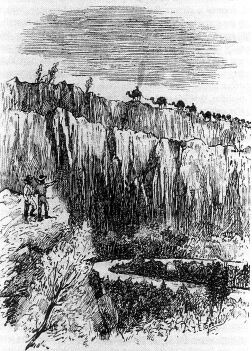
On the 10th of May we left, still following our creek about east-north-east. We have had, a line of hills to the north of us for some distance, but now at five miles this fell off, and some other hills on the south, running up close to the creek, turned its course up to the north, and in two or three miles it ran into a most picturesque and romantic glen, which had now a rushing torrent roaring through its centre. Here no doubt some permanent water exists, as we not only saw great quantities of mussel shells at deserted native camps, but Alec Ross saw a large rocky water reservoir in the glen, in which were quantities of good-sized fish. The camels could not pass through this glen, it was too rocky; they therefore had to travel along the top of a precipice of red and white granite. That overlooked it on the eastern side. The noise of waters rushing over the rocky bottom of this stone-bound glen, was music sweet, and sound melodious, to ears like ours, so unaccustomed to the beautiful cadences of Nature's pure and soothing voice. The atmosphere was pure and clear, the breeze fresh, the temperature such as man may enjoy; and this was one of those few and seldom-met-with, places where the wanderer's eye may rest for a moment with pleasure as it scans the scene around. The verdure of the glen, the bright foliage of the trees that lined the banks of the stream below, the sparkling water as it danced and glittered in the sunlight, the slow and majestic motion of the passing caravan, as it wound so snake-like along the top of the precipitous wall, combined with the red and white colouring of the rifted granite of which it is composed, formed a picture framed in the retina of his eye, which is ever pleasing to the traveller to remember, and a pleasure also to describe. I have named this pretty place Glen Ross, after my young friend Alec. We got the caravan easily enough up on top of the wall, the difficulty was to get it down again. A very steep place had to be negotiated, and we were more than an hour in descending to ground not a hundred yards below us. Camels are not designed for going down places of this kind, with loads on; but they have so many other splendid qualities, that I cannot censure them for not possessing the faculty of climbing like cats or monkeys.
From a hill near the mouth of this glen it could be seen that this creek ran into a much larger one, in the course of three or four miles. There also appeared a kind of valley in which the new creek lay; it and its valley seemed to run east and west. On arrival at this new feature the following morning, I found the channel very broad and sandy-bedded, with fine vigorous eucalyptus timber growing upon either bank. I was at once certain that this new feature was the upper portion of the Ashburton River, which enters the sea upon the west coast. It has always been supposed to be the largest river in Western Australia. No traveller had ever reached so high a point up it previously; of course its flow was to the west. Only a small stream of water was running down its bed, caused no doubt by the late rains. The valley down which it runs is so confined and stony, that no sufficient areas of country suitable for occupation can be had on it, in this neighbourhood. Its course was nearly from the east, and we followed along its banks. In the immediate neighbourhood there was very fine grass and herbage. I struck it in latitude 24° 5´, and longitude 118° 30´. A branch creek joins it from the north-east at nine miles. I encamped upon it for the first time on the 11th of May. In our progress up this river—I use the term in its Australian sense, for at this portion the Ashburton might be termed a dry river only—we found a slight stream of water trickling along its bed. The banks are low, the bed is broad. We had to travel mainly in the sandy bed, as this proved the best travelling ground in general, the valley being both narrow and stony. On the second day it appeared that the only water that ran down the bed came from another creek, which joined from the south; above that spot the Ashburton channel was quite dry, although we occasionally found small ponds of water in the sand here and there. At night, on the 12th, there was none where we camped; the river still ran nearly east and west. That hideous and objectionable vegetation, the Triodia irritans, or spinifex, was prevalent even in places where the waters sometimes flowed. We have had plenty of this enemy ever since we left Mount Gould. No natives were seen, or appear to exist here. A few strips of good country occur occasionally on the banks of the river, but not in areas of sufficient extent to be of any use for occupation. Neither man, beast, bird, nor fish was to be seen, only an odd and apparently starving crow was occasionally heard. As we travelled farther up the river, there was even less appearance of rain having fallen; but the grass and herbage is green and fresh, and it may be it was visited by rains previously. There are excellent acacia and other leguminous bushes for the camels.
On the 13th of May we came to a very strange spot, where a number of whitish, flat-topped hills hemmed in the river, and where the conjunction of three or four other creeks occurred with the Ashburton, which now appeared to come from the south, its tributaries coming from the east and north-east. On the most northerly channel, Peter Nicholls shot a very large snake; it was nearly nine feet long, was a foot round the girth, and weighed nearly fifty pounds. It was a perfect monster for Australia. Had we been without food, what a godsend it would have been to us! It would have made two or three good meals for the whole party. I called this place the Grand Junction Depot, as the camp was not moved from there for thirteen days. The position of the camp at this Grand Junction was in latitude 24° 6´ 8´´, and longitude 119°. At this time I had a second attack of ophthalmia; but on the 15th, thinking I was recovering, I went away in company with Alec Ross to penetrate as far north as the 23rd parallel of latitude, as I was in hopes of finding some new hills or ranges in that locality that might extend for a distance eastwards. We took four camels with us, three being the same animals which Alec and I took when we found the Boundary Dam.
Leaving the depot, we went up the most easterly of the creeks that came in at the Grand Junction. In its channel I saw some of the milk or sow-thistle plant growing—the Sonchus oleraceus. I have met this plant in only four places during my explorations. The trend of the creek was nearly from the east-north-east. At six miles the gum-timber disappeared from the creek, and the channel being confined by hills, we were in a kind of glen, with plenty of running water to splash through. A great quantity of tea-tree—Melaleuca—grew in the creek bed. There we saw another large snake, but not of such dimensions as Nicholls's victim. At ten miles up from the depot the glen ceased, and the creek ran through a country more open on the north bank. We camped at about twenty miles. During the day we saw some native poplars, quandong, or native peach, capparis, or native orange, and a few scented sandal-wood-trees; nearly all of these different kinds of trees were very stunted in their growth. At night my eyes were so much inflamed and so painful with ophthalmia, that I could scarcely see. The next day we steered north-north-east, the ground being very stony and bad for travelling. We passed some low hills at seven or eight miles, and at twenty-one we encamped in a dry, stony creek channel. The following day the country was almost identical in its nature, only that we found a small pool of water at night in a creek, our course being still the same. My eyes had been so bad all day, I was in agony; I had no lotion to apply to them. At length I couldn't see at all, and Alec Ross had to lead the camels, with mine tied behind them. I not only couldn't see, I couldn't open my eyes, and had no idea where I was going. That day Alec sighted a range of somewhat high hills to our left; he next saw another range having rounded, dome-like masses about it, and this lay across our path. Alec ascended one of the hills, and informed me that he saw an extensive mass of hills and ranges in every direction but the east. To the north they extended a great distance, but they rose into the highest points at two remarkable peaks to the north-west, and these, although I cannot be certain exactly where they are situated, I have named respectively Mount Robinson and The Governor, in the hope that these designations will remain as lasting memorials of the intelligent and generous interest displayed by Governor Robinson in the exploration of the province under his sway. The country to the east is all level; no ranges whatever appear in that direction. From what Alec saw and described to me, it was evident that we were upon the edge of the desert, as if the ranges ceased to the east, it was not likely that any watercourses could exist without them. No watercourses could be seen in any direction, except that from which we had come. It was a great disappointment to me to get such information, as I had hoped to discover some creeks or rivers that might carry me some distance farther eastward; but now it was evident they did not exist. I called this range, whose almost western end Alec ascended, Ophthalmia Range, in consequence of my suffering so much from that frightful malady. I could not take any observations, and I cannot be very certain where this range lies. I wanted to reach the 23rd parallel, but as the country looked so gloomy and forbidding farther north, it was useless plunging for only a few miles more into such a smashed and broken region. By careful estimate it was quite fair to assume that we had passed the Tropic of Capricorn by some miles, as my estimated latitude here was 23° 15´, and longitude about 119° 37´. I was in such pain that I ordered an instant retreat, my only desire being to get back to the depot and repose in the shade.
This was the 18th of May, and though the winter season ought to have set in, and cool weather should have been experienced, yet we had nothing of the kind, but still had to swelter under the enervating rays of the burning sun of this shadeless land; and at night, a sleeping-place could only be obtained by removing stones, spinifex, and thorny vegetation from the ground. The latter remark, it may be understood, does not apply to only this one place or line of travel; it was always the case. After returning for a few miles on our outcoming tracks, Alec found a watercourse that ran south-westerly, and as it must eventually fall into the Ashburton, we followed it. In travelling down its course on the 22nd the creek became enclosed by hills on either side, and we found an extraordinary rocky spring. The channel of the creek dropped suddenly down to a lower level, which, when in flood, must no doubt form a splendid cascade. Now a person could stand on a vast boulder of granite and look down at the waters, as they fell in little sprays from the springs that supplied the spot; the small streams rushing out from among the fissures of the broken rocks, and all descending into a fine basin below. To Alec's eyes was this romantic scene displayed. The rocks above, below, and around, were fringed and decked with various vegetations; shrubs and small trees ornamented nearly the whole of the surrounding rocks, amongst which the native fig-tree, Ficus platypoda, was conspicuous. It must have been a very pretty place. I could hear the water rushing and splashing, but could not see anything. It appeared also that the water ran out of the basin below into the creek channel, which goes on its course apparently through or into a glen. I describe this peculiar freak of nature from what Alec told me; I hope my description will not mislead others. Soon after we found that this was the case, as we now entered an exceedingly rough and rocky glen full of water—at least so it appeared to Alec, who could see nothing but water as far down as he could look. At first the water was between three and four feet deep; the farther we went the deeper the water became. Could any one have seen us we must have presented a very novel sight, as the camels got nearly up to their humps in water, and would occasionally refuse to go on; they would hang back, break their nose-ropes, and then lie quietly down until they were nearly drowned. We had to beat and pull them up the best way we could. It was rather disagreeable for a blind man to slip off a camel up to his neck in cold water, and, lifting up his eyelids with both hands, try to see what was going on. Having, however, gone so far, we thought it best to continue, as we expected the glen to end at any turn; but the water became so deep that Alec's riding cow Buzoe, being in water deep enough for her to swim in, if she could swim, refused to go any farther, and thought she would like to lie down. This she tried, but the water was too deep for her to keep her head above it, and after being nearly smothered she got up again:—
“And now to issue from the glen,
No pathway meets the wand'rers' ken,
Unless they climb, with footing nice,
A far-projecting precipice.”
It would be out of all propriety to expect a camel to climb a precipice; fortunately at a few yards further a turn of the glen showed Alec a place on the southern bank where a lot of rocks had fallen down. It was with the greatest difficulty we got to it, and with still greater that at last we reached the top of the cliff, and said good-bye to this watery glen. Our clothes, saddles, blankets, and food were soaked to a pulp. We could not reach the depot that night, but did so early on the following day. I called this singular glen in which the camels were nearly drowned, Glen Camel.
No natives had visited the camp, nor had any living thing, other than flies, been seen, while we were away, except a few pigeons. The camp at this depot was fixed on the soft, sandy bed of the Ashburton, close to the junction of the east creek, which Alec and I had followed up. It had been slightly flooded by the late rains, and two open ponds of clear water remained in the bed of the Ashburton. It seems probable that water might always be procured here by digging, but it is certainly not always visible on the surface. Once or twice before reaching the depot, we saw one or two places with dried-up bulrushes growing in the bed, and water may have existed there in the sand. In consequence of my eyes being so bad, we remained here for the next two days. The heat and the flies were dreadful; and the thermometer indicated 93° one day and 95° the next, in the shade. It was impossible to get a moment's peace or rest from the attacks of the flies; the pests kept eating into our eyes, which were already bad enough. This seemed to be the only object for which these wretches were invented and lived, and they also seemed to be quite ready and willing to die, rather than desist a moment from their occupation. Everybody had an attack of the blight, as ophthalmia is called in Australia, which with the flies were enough to set any one deranged. Every little sore or wound on the hands or face was covered by them in swarms; they scorned to use their wings, they preferred walking to flying; one might kill them in millions, yet other, and hungrier millions would still come on, rejoicing in the death of their predecessors, as they now had not only men's eyes and wounds to eat, but could batten upon the bodies of their slaughtered friends also. Strange to say, we were not troubled here with ants; had we been, we should only have required a few spears stuck into us to complete our happiness. A very pretty view was to be obtained from the summit of any of the flat-topped hills in this neighbourhood, and an area of nearly 100 square miles of excellent country might be had here.
On Friday, the 26th of May, we left the depot at this Grand Junction. The river comes to this place from the south for some few miles. In ten miles we found that it came through a low pass, which hems it in for some distance. Two or three tributaries joined, and above them its bed had become considerably smaller than formerly. At about eighteen miles from the depot we came upon a permanent water, fed by springs, which fell into a fine rock reservoir, and in this, we saw many fish disporting themselves in their pure and pellucid pond. Several of the fishes were over a foot long. The water was ten or more feet deep. A great quantity of tea-tree, Melaleuca, grew in the river-bed here; indeed, our progress was completely stopped by it, and we had to cut down timber for some distance to make a passage for the camels before we could get past the place, the river being confined in a glen. Peter Nicholls was the first white man who ever saw this extraordinary place, and I have called it Nicholls's Fish Ponds after him. It will be noticed that the characteristics of the only permanent waters in this region are rocky springs and reservoirs, such as Saleh's Fish Ponds, Glen Ross, Glen Camel, and Nicholls's Fish Ponds will show. More junctions occurred in this neighbourhood, and it was quite evident that the main river could not exist much farther, as immediately above every tributary its size became manifestly reduced.
On the 27th of May we camped close to a red hill on the south bank of the river; just below it, was another spring, at which a few reeds and some bulrushes were growing. The only views from any of the hills near the river displayed an almost unvarying scene; low hills near the banks of the river, and some a trifle higher in the background. The river had always been in a confined valley from the time we first struck it, and it was now more confined than ever. On the morning of the 28th of May we had a frost for the first time this year, the thermometer indicating 28°. To-day we crossed several more tributaries, mostly from the north side; but towards evening the river split in two, at least here occurred the junction of two creeks of almost equal size, and it was difficult to determine which was the main branch. I did not wish to go any farther south, therefore I took the more northerly one; its trend, as our course for some days past had been, was a good deal south of east; indeed, we have travelled about east-south-east since leaving the depot. In the upper portions of the river we found more water in the channel than we had done lower down; perhaps more rain had fallen in these hills.
By the 29th, the river or creek-channel had become a mere thread; the hills were lowering, and the country in the glen and outside was all stones and scrub. We camped at a small rain-water hole about a mile and a half from a bluff hill, from whose top, a few stunted gum-trees could be seen a little farther up the channel. Having now run the Ashburton up to its head, I could scarcely expect to find any more water before entering Gibson's Desert, which I felt sure commences here. So far as I knew, the next water was in the Rawlinson Range of my former horse expedition, a distance of over 450 miles. And what the nature of the country between was, no human being knew, at least no civilised human being. I was greatly disappointed to find that the Ashburton River did not exist for a greater distance eastwards than this, as when I first struck it, it seemed as though it would carry me to the eastwards for hundreds of miles. I had followed it only eighty or a trifle more, and now it was a thing of the past. It may be said to rise from nowhere, being like a vast number of Australian rivers, merely formed in its lower portions by the number of tributaries that join it. There are very few pretty or romantic places to be seen near it. The country and views at the Grand Junction Depot form nearly the only exceptions met. From that point the river decreased in size with every branch creek that joined it, and now it had decreased to nothing. No high ranges form its head. The hills forming its water-shed become gradually lower as we approach its termination, or rather beginning, at the desert's edge. The desert's edge is a raised plateau of over 2000 feet above the sea-level—the boiling point of water being 208° = 2049 feet—and being about 350 miles in a straight line from where the Ashburton debouches into the sea. My camp upon the evening of the 29th of May, a little westward of the bluff-faced hill before mentioned, was in latitude 24° 25´ and longitude 119° 58´. We remained here during the 30th. The horizon to the east was formed by a mass of low ranges; from them we saw that several diminutive watercourses ran into our exhausted channel. I could not expect that any hills would extend much farther to the east, or that I should now obtain any water much farther in that direction. A line of low ridges ran all round the eastern horizon, and another bluff-faced hill lay at the south-west end of them. The whole region had a most barren and wretched appearance, and there was little or no vegetation of any kind that the camels cared to eat. Feeling certain that I should now almost immediately enter the desert, as the explorer can scent it from afar, I had all our water-vessels filled, as fortunately there was sufficient water for the purpose, so that when we leave this camp we shall not be entirely unprepared.
The morning of the 31st of May was again cold, the thermometer falling to 27°, and we had a sharp frost. I was truly delighted to welcome this long-expected change, and hoped the winter or cool season had set in at last. This day we travelled east, and went over low, rough ridges and stony spinifex hills for several miles. At about eleven miles, finding a dry water-channel, which, however, had some good camel shrubs upon its banks, we encamped in latitude 24° 28´, being still among low ridges, where no definite view could be obtained. On June the 1st we travelled nearly east-north-east towards another low ridge. The ground became entirely covered with spinifex, and I thought we had entered the desert in good earnest; but at about six miles we came upon a piece of better country with real grass, being much more agreeable to look at. Going on a short distance we came upon a dry water-channel, at which we found a deep native well with bitter water in it. We encamped in latitude 24° 24´. The night and following morning were exceedingly cold—the thermometer fell to 18°.
We had not yet reached the low ridge, but arrived at it in two miles on the morning of the 2nd. From it another low ridge bore 23° north of east, and I decided to travel thither.
To-day we had a good deal of country covered with ironstone gravel; we passed a few grassy patches with, here and there, some salt bush and acacia flats; there were also many desert shrubs and narrow thickets. The camp was fixed nearly under the brow of the ridge we had steered for, and it was quite evident, though a few ridges yet appeared for a short distance farther east, that we had at length reached the desert's edge and the commencement of the watershed of the western coast. It will be observed that in my journey through the scrubs to Perth, I had met with no creeks or water-sheds at all, until after I reached the first outlying settlement.
The question which now arose was, what kind of country existed between us and my farthest watered point in 1874 at the Rawlinson Range? In a perfectly straight line it would be 450 miles. The latitude of this camp was 24° 16´ 6´´. I called it the Red Ridge camp. Since my last attack of ophthalmia, I suffer great pain and confusion when using the sextant. The attack I have mentioned in this journey was by no means the only one I have had on my numerous journeys; I have indeed had more or less virulent attacks for the last twenty years, and I believe the disease is now chronic, though suppressed. From the Red Ridge camp we went about eight miles east-north-east, and I found under a mass of low scrubby hills or rises tipped with red sandstone, a rocky cleft in the ground, round about which were numerous old native encampments; I could see water under a rock; the cleft was narrow, and slanted obliquely downwards; it was not wide enough to admit a bucket. There was amply sufficient water for all my camels, but it was very tedious work to get enough out with a quart pot; the rock was sandstone. There was now no doubt in my mind, that all beyond this point was pure and unrelieved desert, for we were surrounded by spinifex, and the first waves of the dreaded sandhills were in view. The country was entirely open, and only a sandy undulation to the eastward bounded the horizon. The desert had to be crossed, or at least attempted, even if it had been 1000 miles in extent; I therefore wasted no time in plunging into it, not delaying to encamp at this last rocky reservoir. After watering our camels we made our way for about four miles amongst the sandhills. As we passed by, I noticed a solitary desert oak-tree, Casuarina decaisneana, and a number of the Australian grass-trees, Xanthorrhoea. The country was almost destitute of timber, except that upon the tops of the parallel lines of red sandhills, which mostly ran in a north-east and south-west direction, a few stunted specimens of the eucalypt, known as blood-wood or red gum existed. This tree grows to magnificent proportions in Queensland, and down the west coast from Fremantle, always in a watered region. Heaven only knows how it ever got here, or how it could grow on the tops of red sandhills. Having stopped to water our camels at the rocky cleft, our first day's march into the desert was only eleven miles. Our camp at night was in latitude 24° 12´ 22´´.
The next day all signs of rises, ridges, hills, or ranges, had disappeared behind the sandhills of the western horizon, and the solitary caravan was now launched into the desert, like a ship upon the ocean, with nothing but Providence and our latitude to depend upon, to enable us to reach the other side.
The following morning, Sunday, the 4th June, was remarkably warm, the thermometer not having descended during the night to less than 60°, though only two mornings ago it was down to 18°. I now travelled so as gradually to reach the 24th parallel, in hopes some lines of hills or ranges might be discovered near it. Our course was east by north. We had many severe ridges of sand to cross, and this made our rate of travelling very slow. We saw one desert oak-tree and a few currajong-trees of the order of Sterculias, some grass-trees, quandong, or native peach, Fusanus, a kind of sandal-wood, and the red gum or blood-wood-trees; the latter always grows upon ground as high as it can get, and therefore ornaments the tops of the sandhills, while all the first-named trees frequent the lower ground between them. To-day we only made good twenty miles, though we travelled until dark, hoping to find some food, or proper bushes for the camels; but, failing in this, had to turn them out at last to find what sustenance they could for themselves. On the following morning, when they were brought up to the camp—at least when some of them were—I was informed that several had got poisoned in the night, and were quite unable to move, while one or two of them were supposed to be dying. This, upon the outskirt of the desert, was terrible news to hear, and the question of what's to be done immediately arose; but it was answered almost as soon, by the evident fact that nothing could be done, because half the camels could not move, and it would be worse than useless to pack up the other half and leave them. So we quietly remained and tended our sick and dying ones so well, that by night one of the worst was got on his legs again. We made them sick with hot water, butter, and mustard, and gave them injections with the clyster pipe as well; the only substance we could get out of them was the chewed-up Gyrostemon ramulosus, which, it being nearly dark, we had not observed when we camped. We drove the mob some distance to another sandhill, where there was very little of this terrible scourge, and the next morning I was delighted to find that the worst ones and the others were evidently better, although they were afflicted with staggers and tremblings of the hind limbs. I was rather undecided what to do, whether to push farther at once into the desert or retreat to the last rocky cleft water, now over five-and-twenty miles behind us. But, as Othello says, once to be in doubt is once to be resolved, and I decided that, as long as they could stagger, the camels should stagger on. In about twelve miles Alec Ross and Tommy found a place where the natives had formerly obtained water by digging. Here we set to work and dug a well, but only got it down twelve feet by night, no water making its appearance. The next morning we were at it again, and at fifteen feet we saw the fluid we were delving for. The water was yellowish, but pure, and there was apparently a good supply. We had, unfortunately, hit on the top of a rock that covered nearly the whole bottom, and what water we got came in only at one corner. Two other camels were poisoned in the night, but those that were first attacked were a trifle better.
On the 8th of June more camels were attacked, and it was impossible to get out of this horrible and poisonous region. The wretched country seems smothered with the poisonous plant. I dread the reappearance of every morning, for fear of fresh and fatal cases. This plant, the Gyrostemon, does not seem a certain deadly poison, but as I lost one camel by death from it, at Mr. Palmer's camp, near Geraldton, and so many are continually becoming prostrated by its virulence, it may be well understood how we dread the sight of it, for none can tell how soon or how many of our animals might be killed. As it grows here, all over the country, the unpoisoned camels persist in eating it; after they have had a shock, however, they generally leave it entirely alone; but there is, unfortunately, nothing else for them to eat here.
The weather now is very variable. The thermometer indicated only 18° this morning, and we had thick ice in all the vessels that contained any water overnight; but in the middle of the day it was impossible to sit with comfort, except in the shade. The flies still swarmed in undiminished millions; there are also great numbers of the small and most annoying sand-flies, which, though almost too minute to be seen, have a marvellous power of making themselves felt. The well we put down was sunk in a rather large flat between the sandhills. The whole country is covered with spinifex in every direction, and this, together with the poisonous bushes and a few blood-wood-trees, forms the only vegetation. The pendulous fringe instead of leaves on the poison bush gives it a strange and weird appearance, and to us it always presents the hideous, and terrible form of a deadly Upas-tree.
Farther into the desert. Sandhills crowned with stones. Natives' smokes and footprints seen. Weakened camels. Native well. Ten days' waterless march. Buzoe's grave. A region of desolation. Eagles. Birds round the well. Natives hovering near. Their different smokes. Wallaby. Sad Solitude's triumphant reign. The Alfred and Marie range once more. The Rawlinson range and Mount Destruction. Australia twice traversed. Fort McKellar. Tyndall's Springs. A last search after Gibson. Tommy's Flat. The Circus. The Eagle. Return to Sladen Water. The Petermann tribes. Marvellous Mount Olga. Glen Watson. Natives of the Musgrave range. A robbery. Cattle camps. The missing link. South for the Everard range. Everard natives. Show us a watering-place. Alec and Tommy find water. More natives. Compelled to give up their plunder. Natives assist at dinner. Like banyan-trees. A bad camping-place. Natives accompany us. Find the native well. The Everard revisited. Gruel thick and slab. Well in the Ferdinand. Rock-hole water. Natives numerous and objectionable. Mischief brewing. A hunt for spears. Attack frustrated. Taking an observation. A midnight foe. The next morning. Funeral march. A new well. Change of country. Approaching the telegraph line. The Alberga. Decrepit native women. The Neales. Mount O'Halloran. The telegraph line. Dry state of the country. Hann's Creek. Arrival at the Peake.
On the 11th of June I was delighted to be able to be again upon the move, and leave this detestable poisonous place and our fifteen-foot shaft behind. Our only regret was that we had been compelled to remain so long. The camels had nearly all been poisoned, some very much worse than others; but all looked gaunt and hollow-eyed, and were exceedingly weak and wretched, one remarkable exception being noticed in Alec Ross's riding-cow, old Buzoe, who had either not eaten the poison plant, or had escaped untouched by it. Our course was now east by north, and as we got farther into the desert, I noticed that occasionally some of the undulations of sand were crowned with stones, wherever they came from. Where these stones crop up a growth of timber, generally mulga, occurs with them. It is sandstone that tips these rises. Some smokes of native fires were seen from our line of march, in northerly and southerly directions, and occasionally the footprints upon the sands, of some wandering child of the desert. These were the only indications we could discover of the existence of primordial man upon the scene. We passed a few grass-trees, which are usually called “black boys” in almost every part of the continent where they exist, and they seem to range over nearly the whole of Australia, from Sydney to Perth, south of the Tropic. The camels were so weak that to-day we could only accomplish about eighteen miles. At five miles, on the following morning, we passed a hollow with some mulga acacia in it. Near them Alec and I found a place where the number of deserted huts, or gunyahs of the natives induced us to look about for a well or some other kind of watering-place. An old well was soon found, which was very shallow; the water was slightly brackish and not more than three feet below the surface. How I wished I had known of its existence before, it being not twenty-five miles from our poison camp, and that some good acacia bushes grew here also; as it was, I made no use of it. The weather being cool, and the camels having filled themselves with water at the deep well, they would not drink. That afternoon we got into a hollow where there was a low ridge of flat-topped cliffs, and a good deal of mulga timber in it. Very likely in times of rain a flow of water might be found here, if there ever are times of rain in such a region. We just cleared the valley by night, having travelled nearly twenty miles. My latitude here was 23° 56´ 20´´ and not desiring to go any farther north, I inclined my course a little southerly—that is to say, in an east by south direction.
We had left the deep well on the 9th June, and not until ten days of continuous travelling had been accomplished—it being now the 18th—did we see any more water. That evening we reached a little trifling water-channel, with a few small scattered white gum-trees, coming from a low stony mulga-crowned ridge, and by digging in it we found a slight soakage of water. Here we dug a good-sized tank, which the water partly filled, and this enabled us to water all the camels. They had travelled 230 miles from our deep well. For the last two or three days poor old Buzoe, Alec Ross's riding cow, has been very ill, and almost unable to travel; she is old and worn out, poor old creature, having been one of Sir Thomas Elder's original importations from India. She had always been a quiet, easy-paced old pet, and I was very much grieved to see her ailing. I did not like to abandon her, and we had to drag her with a bull camel and beat her along, until she crossed this instalment of Gibson's Desert: but she never left this spot, which I have named Buzoe's Grave. I don't think this old cow had been poisoned—at least she never showed any signs of it; I believe it was sheer old age and decay that assailed her at last. The position of this welcome watered spot was in latitude 24° 33´, and longitude 123° 57´. It was by wondrous good fortune that we came upon it, and it was the merest chance that any water was there. In another day or two there would have been none; as it was, only a little rainwater, that had not quite ceased to drain down the half-stony, half-sandy bed of the little gully, was all we got. The weather had been very disagreeable for some days past, the thermometer in the early dawn generally indicating 18° while in the middle of the day the heat was oppressive.
The flies were still about us, in persecuting myriads. The nature of the country during this march was similar to that previously described, being quite open, it rolled along in ceaseless undulations of sand. The only vegetation besides the ever-abounding spinifex was a few blood-wood-trees on the tops of some of the red heaps of sand, with an occasional desert oak, an odd patch or clump of mallee-trees, standing desolately alone, and perhaps having a stunted specimen or two of the quandong or native peach-tree, and the dreaded Gyrostemon growing among them. The region is so desolate that it is horrifying even to describe. The eye of God looking down on the solitary caravan, as with its slow, and snake-like motion, it presents the only living object around, must have contemplated its appearance on such a scene with pitying admiration, as it forced its way continually on; onwards without pausing, over this vast sandy region, avoiding death only by motion and distance, until some oasis can be found. Slow as eternity it seems to move, but certain we trust as death; and truly the wanderer in its wilds may snatch a fearful joy at having once beheld the scenes, that human eyes ought never again to see. On the 15th of June we found a hollow in which were two or three small salt-lake beds, but these were perfectly dry; on the 16th also another solitary one was seen, and here a few low rises lay across a part of the eastern horizon. On the 17th a little water left in the bottom of a bucket overnight was frozen into a thick cake in the morning, the thermometer indicating 18°. The nights I pass in these fearful regions are more dreadful than the days, for “night is the time for care, brooding o'er days misspent, when the pale spectre of despair comes to our lonely tent;” and often when I lay me down I fall into a dim and death-like trance, wakeful, yet “dreaming dreams no mortals had ever dared to dream before.”
The few native inhabitants of these regions occasionally burn every portion of their territories, and on a favourably windy day a spinifex fire might run on for scores of miles. We occasionally cross such desolated spaces, where every species of vegetation has been by flames devoured. Devoured they are, but not demolished, as out of the roots and ashes of their former natures, phoenix-like, they rise again. A few Australian eagles are occasionally seen far up in the azure sky, hovering with astonished gaze, over the unwonted forms below; and as the leading camels of the caravan frighten some wretched little wallaby from its lair under a spinifex bunch, instantly the eagle swoops from its height, and before the astonished creature has had time to find another refuge he is caught in the talons of his foe. We also are on the watch, and during the momentary struggle, before the eagle can so quiet his victim as to be able to fly away with it, up gallops Reechy, Alec and Tommy, and very often we secure the prize. Round this spot at Buzoe's Grave, just while the water lasts I suppose, there were crows, small hawks, a few birds like cockatoos, and many bronze-winged pigeons. Some natives also were hovering near, attracted probably by the sight of strange smoke. The natives of these regions signal with different kinds of smoke by burning different woods or bark, and know a strange smoke in an instant. Some smokes which they make, go up like a thin white column, others are dark and tower-like, while others again are broad and scattered. These natives would not come to visit us. The small marsupial wallaby, which I mentioned just now, exists throughout the whole of these deserts; they live entirely without water, as do many small birds we occasionally see where there is a patch of timber. The wallabies hide during the day amongst the spinifex bushes, and feed, like other rodents, on their roots at night. Another way of getting some of these wallabies was by knocking them over, blackfellow fashion, with a short stick, when startled from their hiding-places. Tommy used to work very hard at this game, and we usually got one a day for food for our little dogs. They are exceedingly good eating, being very like rabbits in size and taste. We remained at this little oasis, I suppose I may call it—at least it was so to us, though I should not like to return to it with any expectation of getting water again, for when we left, the water had ceased to drain in, and there were only a few pints of thick muddy fluid left in the tank at the end of our three days' rest. The place might well be termed the centre of silence and solitude; despair and desolation are the only intruders here upon sad solitude's triumphant reign. Well may the traveller here desire for more inhabited lands; rather to contend with fierce and warlike men; to live amongst far noisier deaths, or die amid far louder dangers! I often declare that:—
“I'll to Afric lion haunted,
Baboons blood I'll daily quaff;
And I'll go a tiger-hunting
On a thorough-bred giraffe.”
Whenever we had east winds in this region, the weather was cool and agreeable; but when they blow from any other quarter, it becomes much hotter, and the flies return in myriads to annoy us. Where they get to when an east wind blows, the east wind only knows.
Leaving Buzoe's Grave, which had proved a godsend to us, with a swarm of eagles, crows, hawks, vultures, and at night wild dogs, eating up her carcase, in four days' farther travel we neared the spot from the west, where the Alfred and Marie Ranges lie. The first sight of these ranges from the east, had cost my former horse expedition into this region so dear. I could not help believing that the guiding hand of a gracious Providence had upon that occasion prevented me from obtaining my heart's desire to reach them; for had I then done so, I know now, having proved what kind of country lay beyond that, neither I nor any of my former party would ever have returned. Assuredly there is a Providence that shapes our ends, rough hew them how we will. These hills were in reality much lower than they appeared to be, when looked at from the east; in fact, they were so low and uninteresting, that I did not investigate them otherwise than with field-glasses. We passed by the northern end, and though the southern end was a little higher, I could see that there were no watering-places possible other than chance rock receptacles, and of these there were no signs. At the northern end we came upon a small shallow kind of stony pan, where a little rain-water was yet lying, proving that the rains we had experienced in May, before leaving the western watershed, must have extended into the desert. We reached this drop of water on the 25th of June, and the camels drank it all up while we rested on the 26th. After five days' more travelling over the same kind of desert as formerly described, except that the sand-mounds rose higher yet in front of us, still progressing eastwards, the well-remembered features of the Rawlinson Range and the terrible Mount Destruction rose at last upon my view.
On reaching the range, I suppose I may say that the exploring part of my expedition was at an end, for I had twice traversed Australia; and although many hundreds of miles had yet to be travelled before we should reach the abodes of civilisation, the intervening country had all been previously explored by myself. For a full account of my former explorations into this region, I must refer my reader to the chapters on my second expedition. The first water we reached in the Rawlinson Range was at a rock-hole about ten miles eastwards from the Circus water, the place from whence Gibson and I started to explore to the west. His death, the loss of all the horses, and my struggles to regain my depot on foot, are they not written in the chronicles of that expedition?
On reaching my former depot at Fort McKellar, I found the whole place so choked up with shrubs and bushes, that it was quite impossible to camp there, without wasting a week in cutting the vegetation away, although it had formerly been sufficiently open for an explorer's camp. The spring was running as strong as ever. The bridge had been washed away. However, at less than a mile from it, there was Tyndall's Spring, with an open shady space, among the clump of fine gum-trees, which gave us an excellent camping-place. Here the camp remained for some days. A line of green bulrushes fringed this spring. While the main party camped here, I once more tried to find some remains or traces of my lost companion Gibson, taking with me only Tommy Oldham. It was quite a forlorn hope, as Gibson had gone away with only one horse; and since we reached the range, we had passed over places where I knew that all the horses I then had with me had gone over the ground, but no signs of former horse-tracks could be seen, therefore the chance of finding any traces of a single animal was infinitesimal. Tommy and I expended three days in trying to discover traces, but it was utterly useless, and we returned unsuccessful to the depot.
Singular to say, on this attempt I found a place west from the end, the Rawlinson Range, where there were some rock-holes on a grassy mulga flat, but we did not require the water, as the camels would not drink. Had I come upon this spot when I was in this region before, it might have saved Gibson and all the horses that were lost with him. I called this little watered spot, Tommy's Flat; the latitude of it is 24° 52´ 3´´. It bears 9° south of west from a peculiar red sandhill that is visible from any of the hills at the western extremity of the Rawlinson Range; and lies in a flat or hollow between the said red sandhill, and the nearest of a few low stony hills, about four miles farther away to the west. On visiting the Circus, I found the water-hole was full and deep. This was very different from its state when I had seen it last. The recording eagle still was sitting immovable on his crag, Prometheus-like, apparently chained to the rock.
On the 11th of July, the main party having been encamped at Tyndall's Springs for seven days, we departed for Sladen Water, at the Pass of the Abencerrages. All the other places previously mentioned on the range, had plenty of water running on for ever, though at the Pass the supply was rather lower than I had seen it previously. There was, however, quite enough for all our requirements. The little sweet-water spring was bubbling up, and running over as of yore. Both at Fort McKellar and here I found that the bones of the horses we had smoked and eaten had been removed by the natives, or wild dogs. At Fort McKellar the smoke-house frame had either fallen or been knocked down; while here, at the Pass, the natives had removed the timber, and placed portions of it in different places and positions. We saw none of the natives belonging to the range, although their smokes were a very short distance away. Sladen Water was always a favourite spot with me, and we rested a day at it for old association's sake.
On the 14th of July we left the place, and travelled along my former route, via Gill's Pinnacle, and all the other watering-places mentioned in my preceding narrative. The Petermann Range looked green and beautiful. It had evidently been visited by rains. A portion of the Rawlinson and the Petermann Ranges were the only spots for hundreds of miles of which this could be said. The Hull here runs near the boundary of the two colonies of South, and Western Australia, and crossing it, we entered the former province once more. When nearly at the eastern end of the Petermann—that is to say, close to Mount Phillips—we camped in Winter's Glen, where the whole tribes of the Petermann were located. They instantly armed themselves, and endeavoured to prevent our progress. Several of them recognised me, and I them; for in my first visit to this range, with Tietkens, we had three encounters with them. They evidently intended mischief again; but they kept off until morning, and we then, being in full marching order, with our firearms in our hands, and all walking alongside of the camels and ready for attack, managed to pass away from them without a collision. Leaving their country behind us, we went via the Sugar-loaf, and thence to the Musgrave Ranges, not now revisiting the marvellous Mount Olga; we entered the range near Glen Watson. There was plenty of water in the glen, but the country, in general, about the range, was in a very dry state. As, however, it has permanent springs, we had no difficulty from want of water. When nearly at the eastern end of the Musgrave Range, a number of natives came to interview the caravan, and actually pulled some coats and blankets off Nicholls's and Tommy's riding camels, and ran away with them. They had previously begged Nicholls to shoot kangaroos for them, thereby showing that they remembered the use of firearms, which formerly I had been compelled to teach them.

I was away from the party when this robbery was committed. Near the eastern end of this range it will be remembered I had formerly discovered a large watercourse, with a fine spring running along its bed, which I called the Ferdinand; here we encamped again. From hence I determined to reach the South Australian Telegraph Line upon a new route, and to follow the Ferdinand, which runs to the south. A mass of hills that I had formerly seen and named the Everard Ranges, lay in that direction, and I desired to visit them also. At and around the water at Glen Ferdinand, as well as at other places on this range, considerable quantities of dung, old tracks, and sleeping camps of cattle were found, but no live animals were seen.
After resting a day at Glen Ferdinand we departed, following the banks of the creek. Just at leaving, an old black man and two lads made their appearance. This old party was remarkably shy; the elder boy seemed a little frightened, and didn't relish being touched by a white man, but the youngest was quite at his ease, and came up to me with the audacity and insouciance of early youth, and pulled me about. When I patted him, he grinned like any other monkey. None of them were handsome; the old man was so monkey-like—he would have charmed the heart of Professor Darwin. I thought I had found the missing link, and I had thoughts of preserving him in methylated spirits, only I had not a bottle large enough.
Following the channel of the Ferdinand nearly south, we came to some limestone rises with one or two native wells, but no water was seen in them. The country was good, grassy, nearly level, with low, sandy, mulga rises, fit for stock of any kind. There were a few detached granite hills, peeping here and there amongst the tree-tops. The creek-channel appeared to run through, or close to, some of the hills of the Everard Ranges; and I left it to visit them. At one of the outcropping granite mounds, at about forty-eight miles from Glen Ferdinand, Alec Ross found a large native well, which bore 12° east of south from Mount Ferdinand, a conspicuous point overlooking the glen. We did not require to use this well, but there was plenty of water in it. Arriving at the first hills of the Everard, I found they were all very peculiar, bare, red, granite mounds, being the most extraordinary ranges one could possibly imagine, if indeed any one could imagine such a scene. They have thousands of acres of bare rock, piled up into mountainous shapes and lay in isolated masses, forming something like a broken circle, all round a central and higher mass. They have valleys filled with scrubs between each section. Numerous rocky glens and gorges were seen, having various kinds of shrubs and low trees growing in the interstices of the rocks. Every thing and every place was parched, bare, and dry. We searched in many places for water without success.
At length some natives made their appearance, and showed us where water could be had by digging. This was a most disagreeable and awkward spot to get the camels to, but after a great deal of labour in making a tank, and rolling boulders of rock out of the way, we were enabled to give them a drink. There was but a very poor supply.
The water we got here was in a small gum-creek under the highest hill in the centre of the group upon its northern face. The summit of the hill above it bore 21° east of south, from Mount Ferdinand, in the Musgrave Ranges, and it is sixty-four miles from my camp at Glen Ferdinand water. Alec and Tommy searched for, and found, some other water in rock-holes at the back or south side of this central hill, nearly three miles round. Several more natives came to the camp, and some of them worked a little at watering the camels, but were greatly scandalised at seeing them drink such enormous quantities, and no doubt, in their heart of hearts, they were grieved that they had shown us the place. And in order to recoup themselves in some measure for their romantic generosity, they quietly walked away with several unconsidered trifles out of the camp, such as ration bags, towels, socks, etc. These thefts always occur when I am away. I made one old gentleman who took some things disgorge his loot, and he and his friend who had dined with us went away, in the last stage of displeasure. There are apparently but few natives about here just now; had there been more of them we might have had some trouble, as indeed I subsequently had at the rock-holes at the back of this hill.
The following day we went round to Alec's rock-holes, intending to have dinner, water the camels if they would drink, and fill our casks before plunging again into the scrubs that extended everywhere to the south. To the east a flat-topped, bluff-faced hill was visible. While we were at dinner several natives came and assisted us, and pointed in a direction a little west of south, where they said water existed. The whole space round the foot of the rocks here is choked up with a thick and vigorous growth of the native fig-trees, which grow somewhat like banyan-trees, except that suckers do not descend from the upper branches and take root in the ground alongside the parent stem; but the roots of this tree run along the rocks to find crevices with soil, and then a fresh growth springs up; in general it does not grow very high, twenty feet is about the limit. There was a small creek channel, and mulga scrubs to the west of it, that grew right up to the bank, and any party camping here would be completely hemmed in. I am particular in describing the place, as on a subsequent occasion, myself and the party then with me, escaped death there. I will relate the circumstances further on. Now we left the place after dinner, and the natives accompanied us; we camped in mulga scrubs at about ten miles from the rocks. These young darkies seemed very good, and friendly fellows; in all wild tribes of Australian natives, the boys and very young men, as well as the girls and women, seem to take immediately to white men. The young children, however, are generally very much frightened; but it is the vile and wicked old men that are the arch-villains of the piece, and who excite the passions of the juniors of the tribe to commit all sorts of atrocities.
These fellows were the best of friends with my men and myself; we were laughing and joking and generally having a good time. I amused them greatly by passing a stick through my nose; I had formerly gone through an excruciating operation for that purpose, and telling them I once had been a black fellow. They spoke but little English, and it was mostly through a few words that Alec Ross knew, of the Peake, Macumba, or Alberga tribes that we could talk to each other at all. After this we got them map-making on the sand. They demonstrated that the Ferdinand, which we had left, and had still on our right or west of us, running south, swept round suddenly to the eastwards and now lay across the country in front of us; that in its further progress it ran into, and formed a lake, then continuing, it at last reached a big salt lake, probably Lake Eyre; they also said we should get water by digging in the sand in the morning, when we struck the Ferdinand channel again. Soon after we started and were proceeding on our course, south 26° west, from the rock-water, the natives all fell back and we saw no more of them. In twenty miles we came to the creek, and turning down its channel eastwards we found the well of which they had told us. There was plenty of water in it, no doubt, but we did not require it. The well seemed rather deep. We followed the creek for some distance, at length it became very undefined, and the gum timber disappeared. Only a few acacia bushes now indicated the flow of the water over the grassy mulga flats, which wound about so much around sandhills in the scrub, that I left the creek, and pushed on now for the South Australian Telegraph Line.
I will now give a rapid account of what I said was a narrow escape from death at those rock-holes we had just left. I may say in passing, that what I have recorded as my travels and explorations in Australia in these volumes, are probably not half of what I have really performed, only I divide them under the two headings of public and private explorations.
In the month of December, 1882, I was in this part of the world again. During the six years that had elapsed since my last visit in 1876, a survey party had reached these ranges on a trigonometrical survey, and upon its return, the officer in charge reported having had some trouble and a collision with the natives of the Everard Range. I suppose my second visit occurred two years after that event. I was accompanied on that journey by a very young friend, named Vernon Edwards, from Adelaide, and two young men named Perkins and Fitz, the latter being cook, and a very good fellow he proved to be, but Perkins was nothing of the sort. I had a black boy named Billy, and we had twelve camels. I approached the Everard Range from the south-westward, having found a good watering-place, which I called Verney's Wells, in that direction. There, we met a lot of natives who did not belong to the Everard Range tribes. At Verney's Wells we had a grand corrobboree in the warm moonlight; my young men and black boy stripped themselves, and young and old, black and white, danced and yelled, and generally made the night hideous with their noise till early morning. After the ball a grand supper was laid for our exhausted blackmen and brothers. The material of this feast was hot water, flour, and sugar mixed into a consistent skilly. I had told the cook to make the gruel thick and slab, and then pour it out on sheets of bark. Our guests supplied themselves with spoons, or rather we cut them out of bark for them, and they helped themselves ad lib. A dozen pounds of flour sufficed to feed a whole multitude. We left Verney's Wells and made up to the well in the Ferdinand that I have just mentioned. This we opened out with shovels, and found a very good supply of water. From thence we proceeded to my old dinner-camp at the range, where, as I said before, the whole space about, was filled up with fig-trees. Almost immediately upon our appearance, we heard the calls and cries and saw the signal smokes, of the natives. We had to clear a space for the camp and put up an awning. The water in the two lower holes was so low that the camels could not reach it, nor could we get enough out with a bucket. There was plenty of water in the holes above, and as it was all bare rock we set to work, some of the natives assisting, to bale the water out of some of the upper holes and splash it over the rocks into the lower. The weather was very hot, and some of the old men sat or lay down quite at their ease in our shade. The odours that exude from the persons of elderly black gentlemen, especially those not addicted to the operation of bathing, would scarcely remind one of the perfumes of Araby the Blest, or Australia Felix either, therefore I ordered these intruders out. Thereupon they became very saucy and disagreeable, and gave me to understand that this was their country and their water—carpee—and after they had spoken in low guttural tones to some of the younger men, the latter departed. Of course I knew what this meant; they were to signal for and collect, all the tribe for an attack. I could read this purpose in their glances. I have had so much to do with these Australian peoples that, although I cannot speak all their languages—for nearly every ten miles a totally different one may be used—yet a good deal of the language of several tribes is familiar to me, and all their gestures speak to me in English. I could at any rate now see that mischief was brewing. Near sundown we spread a large tarpaulin on the ground to lay our blankets, rugs, etc., to sleep on. When I had arranged my bed, several old men standing close by, the master-fiend, deliberately threw himself down on my rugs. I am rather particular about my rugs and bedding, and this highly though disagreeably perfumed old reptile, all greasy with rotten fat, lying down on and soiling them, slightly annoyed me; and not pretending to be a personification of sweetness and light, I think I annoyed him a great deal more, for I gave him as good a thrashing with a stick as he ever received, and he went away spitting at us, bubbling over with wrath and profanity, and called all the tribe after him, threatening us with the direst retribution. They all went to the west, howling, yelling, and calling to one another.
Young Verney Edwards was always most anxious to get a lot of natives' spears and other weapons, and I said, “Now, Verney, here's a chance for you. You see the blacks have cleared out to the west, now if you go up the foot of the hill to the east, the first big bushy tree you see, you will find it stuck thick with spears. You can have them all if you like. But,” I added, “it's just suppertime now, you had better have supper first.” “Oh no,” he said, “I'll go and get them at once if you think they are there,” and away he went. I was expecting the enemy to return, and we had all our firearms in readiness alongside of us on the tarpaulin where we sat down to supper. I had a cartridge-pouch full of cartridges close to my tin plate, and my rifle lay alongside also. Jimmy Fitz, Perkins, Billy the black boy, and I, had just begun to eat when we heard a shot from Verney's revolver. I did not take very much notice, as he was always firing at wallaby, or birds, or anything; but on another shot following we all jumped up, and ran towards him. As we did so we heard Verney calling and firing again; Perkins seized my cartridge pouch in his excitement, and I had to get more cartridges from my saddle. In the meantime shots were going off, howls and yells rent the air, and when I got up the enemy had just formed in line. Another discharge decided the conflict, and drove them off.
When Verney left the camp he found a bushy tree, as I had told him, stuck full of spears, and while he was deliberating as to which of those weapons he should choose, being on the west side of the bush, he suddenly found himself surrounded by a host of stealthy wretches, most of whom were already armed, all running down towards the camp. Some ran to this bush for their weapons, and were in the act of rushing down on to the camp, and would have speared us as we sat at supper, at their ease, from behind the thick fig-trees' shelter. Verney was so astounded at seeing them, and they were so astounded at seeing him, that it completely upset their tactics; for they naturally thought we were all there, and when Verney fired, it so far checked the advance column, that they paused for a second, while the rear guard ran up. Then some from behind threw spears through the bush at Verney. He fired again, and called to us, and we arrived in time to send the enemy off, as fast as, if not faster, than they had come. It was a very singular circumstance that turned these wretches away; if Verney hadn't gone for the spears, they could have sneaked upon, and killed us, without any chance of our escape. We must have risen a good deal in their estimation as strategists, for they were fairly out-generalled by chance, while they must have thought it was design. After the dispersion, they reappeared on the top of the rocks some distance away, and threw spears down; but they were too far off; and when we let them see how far our rifle bullets could be sent, they gave several parting howls and disappeared.
I decided to keep watch to-night; there was a star passing the meridian soon after eleven, and I wished to take an observation by it. I told the others to turn in, as I would watch till then. Nearly at the time just mentioned, I was seated cross-legged on my rugs facing the north, taking my observation with the sextant and artificial horizon, when I thought I saw something faintly quivering at the corner of my left eye. I kept the sextant still elevated, and turned my head very slowly half way round, and there I saw the enemy, creeping out of the mulga timber on the west side of the little creek channel, and ranging themselves in lines. It was a very dusky, cloudy, but moonlight night. I dared not make any quick movement, but slowly withdrawing my right hand from the sextant, I took hold of my rifle which lay close alongside. A second of time was of the greatest importance, for the enemy were all ranged, and just ready balancing their spears, and in another instant there would have been a hundred spears thrown into the camp. I suddenly put down the sextant, and having the rifle almost in position, I grabbed it suddenly with my left hand and fired into the thickest mob, whereupon a horrible howling filled the midnight air. Seizing Verney's rifle that was close by, I fired it and dispersed the foe. All the party were lying fast asleep on the tarpaulin, but my two shots quickly awoke them. I made them watch in turns till morning, with orders to fire two rifle cartridges every half hour, and the agony of suspense in waiting to hear these go off, kept me awake the whole night, like Carlyle and his neighbours' fowls.
Our foes did not again appear. At the first dawn of light, over at some rocky hills south-westward, where, during the night, we saw their camp fires, a direful moaning chant arose. It was wafted on the hot morning air across the valley, echoed again by the rocks and hills above us, and was the most dreadful sound I think I ever heard; it was no doubt a death-wail. From their camp up in the rocks, the chanters descended to the lower ground, and seemed to be performing a funereal march all round the central mass, as the last tones we heard were from behind the hills, where it first arose.
To resume: we left the almost exhausted channel of the Ferdinand, and pushed on for the Telegraph Line. In the sandhills and scrub we came upon an open bit of country, in latitude 27° 35´ 34´´, and found a shallow well, at which we encamped on the evening of August 11th. In sixty miles farther, going nearly east by north, the nature of the country entirely altered; the scrubs fell off, and an open stony country, having low, flat-topped ridges or table-lands, succeeded. This was a sure indication of our near approach to the Telegraph Line, as it is through a region of that kind, that the line runs in this latitude. I turned more northerly for a waterhole in the Alberga, called Appatinna, but we found it quite dry. There were two decrepit old native women, probably left there to starve and die by their tribe. I gave them some food and water, but they were almost too far gone to eat. From thence, travelling south-easterly, we came upon the Neale's River, in forty miles. At twenty miles farther down the Neale's, which was quite dry as far as we travelled on it, going easterly, we arrived at Mount O'Halloran, a low hill round whose base the Trans-Continental Telegraph Line and road sweeps, at what is called the Angle Pole, sixty miles from the Peake Telegraph Station. We were very short of water, and could not find any, the country being in a very dry state. We pushed on, and crossed the stony channel of a watercourse called the St. Cecilia, which was also dry. The next water that I knew of, between us and the Peake, was a spring near Hann's Creek, about thirty miles from the Peake. However, on reaching Hann's Creek, we found sufficient water for our requirements, although it was rather brackish. Moving on again we reached the Peake Telegraph Station on the 23rd of August, and were most cordially received and welcomed by my old friend Mr. Chandler, Mr. Flynn, the police trooper, and every one else at that place.
Depart for the south. Arrive at Beltana. Camels returned to their depot. The Blinman Mine. A dinner. Coach journey to the Burra-Burra Mines. A banquet and address. Rail to Adelaide. Reception at the Town Hall. A last address. Party disbanded. Remarks. The end.
Being among such good friends at the Peake, we naturally remained a few days before we left for Adelaide; nothing remarkable occurred on the road down. At Beltana the camels were returned to their depot. The Blinman Copper Mine is about thirty miles from there, and was then, the terminus of the mail coach line from Adelaide. The residents of the Blinman invited Alec Ross and myself to a dinner, presided over by my very good friend Mr. J.B. Buttfield, the Resident Police Magistrate. Then we all took the mail coach, and reached the Burra-Burra Copper Mines, on the evening of the next day. Here a banquet was held in our honour, at which a number of ladies attended, and I was presented with a very handsome address. The Burra Mines are a hundred miles from Adelaide.
Next day we took the train for the city. At the town of Gawler, or, as it used to be called, Gawlertown, twenty-five miles from the metropolis, a number of gentlemen were assembled to welcome us on the platform. Our healths were drank in champagne, and an address presented to me. Pursuing our journey, Adelaide was reached by midday. A number of people were waiting the arrival of the train, and when we alighted we were welcomed with cheers. Carriages were in attendance to take us to the Town Hall, where we were welcomed by Caleb Peacock, Esquire, the Mayor,—who first invited us to refreshments, and then presented us to the citizens, who were crowded in the large hall. Mr. Peacock made a very eloquent and eulogistic speech, and presented me with a very handsome address on behalf of himself, the Corporation, and the citizens of Adelaide. The next day the party was disbanded, and the expedition was at an end.
A few closing remarks, I suppose I may make. We again joined the great family of civilised mankind; and if I have any readers who have followed my story throughout its five separate phases, I may account myself fortunate indeed. A long array of tautological detail is inseparable from the records of Australian, as well as any other exploration, because it must be remembered that others, who come after, must be guided by the experiences and led to places, and waters, that the first traveller discovers; and am I to be blamed if I have occasionally mixed up my narrative with an odd remark, anecdote, or imaginative idea? These, I trust, will not in my reader's opinion detract from any merits it may possess. I have collected many thousands of plants and hundreds of entomological and geological specimens; a great portion of the list of the former and all of the latter have unfortunately been lost, only a list of plants collected during my first and second expeditions now remains, which appears at the end of these volumes.
It is with regret I have had to record the existence of such large areas of desert land encountered in my travels in Australia. The emigrant, however, need have no fear on that account. The scenes of his avocations will be far removed from them. They are no more a check to emigration now than fifty years ago. As a final remark, I may say my former companion in the field, Mr. W.H. Tietkens, has just returned from a fresh exploration of the country in the vicinity of Lake Amadeus, and the report of his travels should be looked forward to with pleasure by all who take any interest in our Colonial dependencies.
If my narrative has no other recommendation, it may at least serve to while away a vacant hour, and remind my readers of something better, they have read before. It was not for what I had written, that I hoped to reap the good opinion of the world, but for what I have done, and that I have recorded. Any one who is sufficiently interested to read these pages, may well understand the trials and dangers that have beset my path. The number of miles of previously unknown country that I have explored reaches to the sum of many thousands. The time I expended was five of the best years of my life. As a recognition of my labours, I have received the Patron's Gold Medal of the Royal Geographical Society of London; and the late King Victor Emanuel sent me a decoration and diploma of Knighthood, of the Order of the Crown of Italy.
To a man accustomed to camels for exploration, the beautiful horse sinks into the insignificance of a pigmy when compared to his majestic rival, the mighty ship of the desert, and assuredly had it not been for these creatures and their marvellous powers, I never could have performed the three last journeys which complete my public explorations in Australia.
I have called my book The Romance of Exploration; the romance is in the chivalry of the achievement of difficult and dangerous, if not almost impossible, tasks. Should I again be called on to enter the Field of Discovery, although to scenes remote from my former Australian sphere, I should not be the explorer I have represented myself in these pages, if, even remembering the perils of my former adventures, I should shrink from facing new. An explorer is an explorer from love, and it is nature, not art, that makes him so.
The history of Australian exploration, though not yet quite complete, is now so far advanced towards its end, that only minor details now are wanting, to fill the volume up; and though I shall not attempt to rank myself amongst the first or greatest, yet I think I have reason to call myself, the last of the Australian explorers.
As a last remark, I may say the following lines may convey some of my real feelings towards:—
AUSTRALIA.
What though no hist'ries old,
Rest o'er that land of gold;
And though no bard has told
Tales, of her clime:
What though no tow'r display,
Man's work of other days;
And, though her sun's bright rays
In the old time;
Gleam'd on no mighty fanes,
Built by the toiling pains
Of slaves, in galling chains,
In the earth's prime.
Hers is a new bright land;
By God's divine command,
Where each industr'us hand,
Willing to toil;
What though no song records,
Deeds of her martial hordes,
Who made, with conquering swords,
Heroes sublime.
Gathers the fruits of peace,
Gathers the golden fleece,
And the fair earth's increase,
From the rich soil.
Hers is a flow'ry crown;
Science and Hope look down
On each new glitt'ring town,
Whose structures rise;
And to Time's latest age,
Hers shall, the brightest page,
Written by bard or sage,
Be, 'neath the skies.
Numerous other species of Acacia were gathered, but not found in flower or fruit, hence are not with certainty referable to the respective species of this great genus.
Mr. Giles's collection contains also species of the genera Vigna, Tephrosia, Melaleuca, Callistemon, Haloragis, Pterigeron, Brachycome, Dampiera, Ipomoea, Morgania, Enchylaena, and Atriplex; as also additional species of Rulingia, Abutilon, Sida, Dodonaea, Euphorbia, Spyridium, Acacia (many), Eucalyptus, Scaevola, Goodenia, Eremophila, Heliotropium, Rhagodia, Ptilotus, Hakea, and Panicum, but none in a state sufficiently advanced to admit of ascertaining their precise specific position.
Bagot's Creek.
Bark Coolamins.
Barlee, Mount.
Barloweerie Peak.
Bell Rock.
Berkshire Valley.
Bitter Water Creek.
Black family, a.
—oak.
Blood's Range.
Bluey's Range.
Boundary Dam.
Bowes Creek.
Bowley, Mount.
Bowman's Dam.
Brachychiton.
Bring Lake.
Briscoe's Pass.
Butterflies.
Buttfield, Mount.
Buzoe's Grave.
Callitris.
Camel Glen.
Camels decamped.
—poisoned.
Canis familiaris.
Capparis.
Carnarvon, Mount.
—Range.
Carmichael Creek.
Carmichael's Crag.
Casterton Creek.
Casuarina Decaisneana.
Casuarinas.
Chamber's Pillar.
Champ de Mars.
Champion Bay.
Chandler's Range.
Charlotte Waters Station.
Cheangwa.
Chimpering.
Chinaman's Dam.
Chirnside Creek.
Christening natives.
Christmas Day.
Christopher Lake.
Christopher's Pinnacle.
Christy Bagot's Creek.
Churchman, Mount.
Circus, the.
Clay crabhole, a.
—pans.
Clianthus Dampierii.
Cob, the.
Cockata blacks.
Codonocarpus cotinifolius.
Colona.
Colonel's Range.
Conner, Mount.
Cooerminga.
Coondambo clay-pans.
Corkwood-tree.
Corrobboree, a grand.
Cowra man, a.
Cudyeh.
Culham.
Cumming, Glen.
Cups, the.
Curdie, Mount.
Curious mound-springs.
Currajong-tree.
Currie, the.
Cypress pines.
Davenport, Mount.
Desert oak.
Desolation Creek.
—Glen.
Destruction, Mount.
Diamond bird (Amadina).
Docker, The.
Dog-puppies.
Dongarra.
Dry salt lagoons.
Eagle-hawk.
Earthquake, a shock.
Edith, Glen.
—Hull's Springs.
Edith's Marble Bath.
Edoldeh.
Ehrenberg Ranges.
Elder's Creek.
Elizabeth Watercourse.
Ellery's Creek.
Emus.
Emu Tank.
Encounter Creek.
Eremophila scoparia.
Escape Glen.
Eucalyptus.
—dumosa.
Euphorbiaceae.
Euro Bluff.
Everard Ranges.
Fagan, Mount.
Fairies' Glen.
Ferdinand Creek.
—Glen.
—, Mount.
Festuca irritans.
Fielder, Glen.
Fig-tree.
Finke, Mount.
—River.
Finniss Springs.
Fish plentiful.
—ponds.
Flies, myriads of.
Forrest's Creek.
Forrest, Mount.
Fort McKellar.
—Mueller.
Fowler's Bay.
Fraser's Wells.
Fremantle, reception at.
Friendly natives.
Fusanus.
Gardiner's Range.
Gascoyne River Valley.
Geelabing, Mount.
George Gill's Range.
Gerald, Glen.
Geraldton.
Gibson, Last seen of.
Gibson's Desert.
—Christmas pudding.
Gill's Pinnacle.
Glen Camel.
—Cumming.
—Edith.
—Ferdinand.
—Fielder.
—Gerald.
—Helen.
—Osborne.
—of Palms.
—Robertson.
—Ross.
—Thirsty.
—Watson.
—Wyselaski.
Glentromie.
Glowworms.
Gordon's Springs.
Gorge of Tarns.
Gosse's Range.
Gould, Mount.
Governor, the.
Grand Junction Depot.
Great Gorge.
—Victoria Desert.
Greenough Flats.
Grevillea-trees.
Groener's Springs.
Guildford, reception at.
Gum-trees.
Gyrostemon.
—ramulosus.
Hakea.
Hale, Mount.
Hamilton Creek.
Hampton Plain.
Hann's Creek.
Harriet's Springs.
Hector Pass.
—Springs.
Helen, Glen.
Hermit Hill, the.
Hogarth's Wells.
Hopkin's Creek.
Horses badly bogged.
—fall lame.
Hostility of the natives.
Hughes's Creek.
Hull Creek, the.
Humphries, Mount.
Inderu.
Interview with natives.
Irving Creek.
Irwin House.
—River.
Jamieson's Range.
James Winter, Mount.
Jeanie, Mount.
Johnstone's Range.
Kangaroos and emus plentiful.
Kangaroo tanks.
King's Creek.
Krichauff Creek.
—Range.
Labouchere, Mount.
Lake Bring.
—Amadeus.
—Christopher.
—Eyre.
—Gairdner.
—Hanson.
—Hart.
—Moore.
—of salt.
—Torrens.
—Wilson.
—Younghusband.
Laurie's Creek.
Learmonth Park.
Leguminosae, the.
Leipoa ocellata.
Levinger, The.
Lightning Rock.
Livingstone Pass.
Louisa's Creek.
Lowan or native pheasants.
Lowans' nests.
Luehman's Springs.
Lunar rainbow, a.
Lyons River.
MacBain's Springs.
Mann Range.
Margaret, Mount.
Maria, palm.
Marie, Mount.
McCulloch, Mount.
McDonnell Range.
McMinn's Creek.
McNicol's Range.
Melaleuca.
—tree.
Middleton's Pass.
Miller, Mount.
Mobing.
Moffat's Creek.
Moloch horridus.
Moodilah.
Mosquitoes.
Mount Aloysius.
—Ayers.
—Barlee.
—Bowley.
—Buttfield.
—Camnarvon.
—Churchman.
—Conner.
—Curdie.
—Davenport.
—Destruction.
—Fagan.
—Ferdinand.
—Finke.
—Forrest.
—Geelabing.
—Gould.
—Gould Creek.
—Hale.
—Humphries.
—James Winter.
—Jeanie.
—Labouchere.
—Margaret.
—Marie.
—McCulloch.
—Miller.
—Murchison.
—Musgrave.
—Oberon.
—Officer.
—O'Halloran.
—Olga.
—Ormerod.
—Peculiar.
—Phillips.
—Quin.
—Robert.
—Robinson.
—Russell.
—Sargood.
—Scott.
—Skene.
—Solitary.
—Squires.
—Udor.
Mowling.
Mulga apple.
—tree, its habits and value.
—wood as a poison.
Murchison, Mount.
—River.
Musgrave, Mount.
—Range.
Mus conditor.
Myal.
Native art.
Native attack at Farthest East.
——at Fort McKellar.
——at Fort Mueller.
——and rout at Sladen Water.
——at Ularring.
—beauty.
—caves.
—dam, a.
—figs.
—fires.
—gunyahs.
—huts; ancient and modern.
—interview.
—mode of wearing the hair.
—orange-tree.
—peach.
—pheasant's nest.
—poplar-trees.
—sleeping places.
—swords.
—thieves.
—well.
—wurleys.
Natives troublesome.
Natta.
Neale's River.
Newcastle, reception at.
New Norcia.
Nicholls's Fish Ponds.
Oberon, Mount.
Officer, the.
—, Mount.
Olga, Mount.
Ooldabinna.
Ophthalmia Range.
Opossums.
Ormerod, Mount.
Osborne, Glen.
Palmer Creek.
Palms, Glen of.
Paring.
Pass of the Abencerrages.
Peake Creek.
—Station.
Peculiar, Mount.
Penny's Creek.
Perth, reception at.
Pernatty Creek.
Petermann's Creek.
—Range.
Phillips Creek.
—, Mount.
Pia Spring.
Pidinga.
Pigeon Rocks.
Poisoned camels.
Poison plant.
Pondoothy Hill.
Poothraba Hill.
Port Augusta.
Purple vetch.
Pylebung.
Quandong-trees.
Queen Victoria's Spring.
Quin, Mount.
Range, Petermann's.
Rawlinson Range.
Rebecca, The.
Red gum, the.
—hornets.
—Ridge Camp.
Reid Creek.
Ross, Glen.
River Irwin.
—Finke, general remarks.
—Murchison.
—Sandford.
Robert, Mount.
Robertson, Glen.
Robinson, Mount.
Rock wallaby.
Roger's Pass.
Roman numerals.
Ross's Water-hole.
Rudall's Creek.
Ruined Rampart, the.
Russell, Mount.
St. Cecilia, watercourse.
Saleh's Fish Ponds.
Salt bog.
—bushes.
—lagoons.
—lake, a.
Sandal-wood.
Sandflies.
Sandford River.
Sargood, Mount.
Schwerin Mural Crescent.
Scorpion, a.
Scott, Mount.
Scrub pheasant.
—wallaby.
Sentinel, the.
Seymour's Range.
Shaw Creek.
Shoeing Camp.
Skene, Mount.
Sladen Water.
Snakes.
Sonchus oleraceus.
Solitary, Mount.
Sow thistle.
Spear-heads of mulga wood.
Squires, Mount.
Stemodia viscosa, the.
Stevenson's Creek.
Stinking pit, the.
Stokes's Creek.
Storm, effect of.
Surprise the natives.
Taloreh.
Tarn of Auber.
The Circus.
—Cob.
—Cups Hill.
—Officer.
—Sentinel.
Thirsty, Glen.
Thunderstorm.
Tietkens's Birthday Creek.
—Tank.
Tipperary.
Titania's Spring.
Tommy's Flat.
Tootra.
Trickett's Creek.
Triodia or Festuca irritans.
Troglodytes' Cave.
Turtle Back Rocks.
Tyndall's Springs.
Udor, Mount.
Ularring.
Vale of Tempe.
Verney's Wells.
Victoria plains.
Vladimar Pass.
Walebing.
Wallaby traps.
Warlike Natives.
Water scarce.
Watson, Glen.
Weld Pass.
Whitegin.
Wild ducks.
—turkey bustards.
Winter Water.
Winter's Glen.
Wommerah, the.
Worrill's Pass.
Wynbring.
—Rock.
Wyselaski's Glen.
Xanthorrhoea.
Yanderby.
York, entertained at.
Youldeh.
Yuin.
Zoe's Glen.
End of the Project Gutenberg EBook of Australia Twice Traversed, The Romance
of Exploration, by Ernest Giles

*** END OF THIS PROJECT GUTENBERG EBOOK AUSTRALIA TWICE TRAVERSED, ***

***** This file should be named 4974-h.htm or 4974-h.zip *****
This and all associated files of various formats will be found in:
        https://www.gutenberg.org/4/9/7/4974/

Produced by Sue Asscher and Colin Beck

Updated editions will replace the previous one--the old editions
will be renamed.

Creating the works from public domain print editions means that no
one owns a United States copyright in these works, so the Foundation
(and you!) can copy and distribute it in the United States without
permission and without paying copyright royalties.  Special rules,
set forth in the General Terms of Use part of this license, apply to
copying and distributing Project Gutenberg-tm electronic works to
protect the PROJECT GUTENBERG-tm concept and trademark.  Project
Gutenberg is a registered trademark, and may not be used if you
charge for the eBooks, unless you receive specific permission.  If you
do not charge anything for copies of this eBook, complying with the
rules is very easy.  You may use this eBook for nearly any purpose
such as creation of derivative works, reports, performances and
research.  They may be modified and printed and given away--you may do
practically ANYTHING with public domain eBooks.  Redistribution is
subject to the trademark license, especially commercial
redistribution.


*** START: FULL LICENSE ***

THE FULL PROJECT GUTENBERG LICENSE
PLEASE READ THIS BEFORE YOU DISTRIBUTE OR USE THIS WORK

To protect the Project Gutenberg-tm mission of promoting the free
distribution of electronic works, by using or distributing this work
(or any other work associated in any way with the phrase "Project
Gutenberg"), you agree to comply with all the terms of the Full Project
Gutenberg-tm License (available with this file or online at
https://gutenberg.org/license).


Section 1.  General Terms of Use and Redistributing Project Gutenberg-tm
electronic works

1.A.  By reading or using any part of this Project Gutenberg-tm
electronic work, you indicate that you have read, understand, agree to
and accept all the terms of this license and intellectual property
(trademark/copyright) agreement.  If you do not agree to abide by all
the terms of this agreement, you must cease using and return or destroy
all copies of Project Gutenberg-tm electronic works in your possession.
If you paid a fee for obtaining a copy of or access to a Project
Gutenberg-tm electronic work and you do not agree to be bound by the
terms of this agreement, you may obtain a refund from the person or
entity to whom you paid the fee as set forth in paragraph 1.E.8.

1.B.  "Project Gutenberg" is a registered trademark.  It may only be
used on or associated in any way with an electronic work by people who
agree to be bound by the terms of this agreement.  There are a few
things that you can do with most Project Gutenberg-tm electronic works
even without complying with the full terms of this agreement.  See
paragraph 1.C below.  There are a lot of things you can do with Project
Gutenberg-tm electronic works if you follow the terms of this agreement
and help preserve free future access to Project Gutenberg-tm electronic
works.  See paragraph 1.E below.

1.C.  The Project Gutenberg Literary Archive Foundation ("the Foundation"
or PGLAF), owns a compilation copyright in the collection of Project
Gutenberg-tm electronic works.  Nearly all the individual works in the
collection are in the public domain in the United States.  If an
individual work is in the public domain in the United States and you are
located in the United States, we do not claim a right to prevent you from
copying, distributing, performing, displaying or creating derivative
works based on the work as long as all references to Project Gutenberg
are removed.  Of course, we hope that you will support the Project
Gutenberg-tm mission of promoting free access to electronic works by
freely sharing Project Gutenberg-tm works in compliance with the terms of
this agreement for keeping the Project Gutenberg-tm name associated with
the work.  You can easily comply with the terms of this agreement by
keeping this work in the same format with its attached full Project
Gutenberg-tm License when you share it without charge with others.

1.D.  The copyright laws of the place where you are located also govern
what you can do with this work.  Copyright laws in most countries are in
a constant state of change.  If you are outside the United States, check
the laws of your country in addition to the terms of this agreement
before downloading, copying, displaying, performing, distributing or
creating derivative works based on this work or any other Project
Gutenberg-tm work.  The Foundation makes no representations concerning
the copyright status of any work in any country outside the United
States.

1.E.  Unless you have removed all references to Project Gutenberg:

1.E.1.  The following sentence, with active links to, or other immediate
access to, the full Project Gutenberg-tm License must appear prominently
whenever any copy of a Project Gutenberg-tm work (any work on which the
phrase "Project Gutenberg" appears, or with which the phrase "Project
Gutenberg" is associated) is accessed, displayed, performed, viewed,
copied or distributed:

This eBook is for the use of anyone anywhere at no cost and with
almost no restrictions whatsoever.  You may copy it, give it away or
re-use it under the terms of the Project Gutenberg License included
with this eBook or online at www.gutenberg.org

1.E.2.  If an individual Project Gutenberg-tm electronic work is derived
from the public domain (does not contain a notice indicating that it is
posted with permission of the copyright holder), the work can be copied
and distributed to anyone in the United States without paying any fees
or charges.  If you are redistributing or providing access to a work
with the phrase "Project Gutenberg" associated with or appearing on the
work, you must comply either with the requirements of paragraphs 1.E.1
through 1.E.7 or obtain permission for the use of the work and the
Project Gutenberg-tm trademark as set forth in paragraphs 1.E.8 or
1.E.9.

1.E.3.  If an individual Project Gutenberg-tm electronic work is posted
with the permission of the copyright holder, your use and distribution
must comply with both paragraphs 1.E.1 through 1.E.7 and any additional
terms imposed by the copyright holder.  Additional terms will be linked
to the Project Gutenberg-tm License for all works posted with the
permission of the copyright holder found at the beginning of this work.

1.E.4.  Do not unlink or detach or remove the full Project Gutenberg-tm
License terms from this work, or any files containing a part of this
work or any other work associated with Project Gutenberg-tm.

1.E.5.  Do not copy, display, perform, distribute or redistribute this
electronic work, or any part of this electronic work, without
prominently displaying the sentence set forth in paragraph 1.E.1 with
active links or immediate access to the full terms of the Project
Gutenberg-tm License.

1.E.6.  You may convert to and distribute this work in any binary,
compressed, marked up, nonproprietary or proprietary form, including any
word processing or hypertext form.  However, if you provide access to or
distribute copies of a Project Gutenberg-tm work in a format other than
"Plain Vanilla ASCII" or other format used in the official version
posted on the official Project Gutenberg-tm web site (www.gutenberg.org),
you must, at no additional cost, fee or expense to the user, provide a
copy, a means of exporting a copy, or a means of obtaining a copy upon
request, of the work in its original "Plain Vanilla ASCII" or other
form.  Any alternate format must include the full Project Gutenberg-tm
License as specified in paragraph 1.E.1.

1.E.7.  Do not charge a fee for access to, viewing, displaying,
performing, copying or distributing any Project Gutenberg-tm works
unless you comply with paragraph 1.E.8 or 1.E.9.

1.E.8.  You may charge a reasonable fee for copies of or providing
access to or distributing Project Gutenberg-tm electronic works provided
that

- You pay a royalty fee of 20% of the gross profits you derive from
     the use of Project Gutenberg-tm works calculated using the method
     you already use to calculate your applicable taxes.  The fee is
     owed to the owner of the Project Gutenberg-tm trademark, but he
     has agreed to donate royalties under this paragraph to the
     Project Gutenberg Literary Archive Foundation.  Royalty payments
     must be paid within 60 days following each date on which you
     prepare (or are legally required to prepare) your periodic tax
     returns.  Royalty payments should be clearly marked as such and
     sent to the Project Gutenberg Literary Archive Foundation at the
     address specified in Section 4, "Information about donations to
     the Project Gutenberg Literary Archive Foundation."

- You provide a full refund of any money paid by a user who notifies
     you in writing (or by e-mail) within 30 days of receipt that s/he
     does not agree to the terms of the full Project Gutenberg-tm
     License.  You must require such a user to return or
     destroy all copies of the works possessed in a physical medium
     and discontinue all use of and all access to other copies of
     Project Gutenberg-tm works.

- You provide, in accordance with paragraph 1.F.3, a full refund of any
     money paid for a work or a replacement copy, if a defect in the
     electronic work is discovered and reported to you within 90 days
     of receipt of the work.

- You comply with all other terms of this agreement for free
     distribution of Project Gutenberg-tm works.

1.E.9.  If you wish to charge a fee or distribute a Project Gutenberg-tm
electronic work or group of works on different terms than are set
forth in this agreement, you must obtain permission in writing from
both the Project Gutenberg Literary Archive Foundation and Michael
Hart, the owner of the Project Gutenberg-tm trademark.  Contact the
Foundation as set forth in Section 3 below.

1.F.

1.F.1.  Project Gutenberg volunteers and employees expend considerable
effort to identify, do copyright research on, transcribe and proofread
public domain works in creating the Project Gutenberg-tm
collection.  Despite these efforts, Project Gutenberg-tm electronic
works, and the medium on which they may be stored, may contain
"Defects," such as, but not limited to, incomplete, inaccurate or
corrupt data, transcription errors, a copyright or other intellectual
property infringement, a defective or damaged disk or other medium, a
computer virus, or computer codes that damage or cannot be read by
your equipment.

1.F.2.  LIMITED WARRANTY, DISCLAIMER OF DAMAGES - Except for the "Right
of Replacement or Refund" described in paragraph 1.F.3, the Project
Gutenberg Literary Archive Foundation, the owner of the Project
Gutenberg-tm trademark, and any other party distributing a Project
Gutenberg-tm electronic work under this agreement, disclaim all
liability to you for damages, costs and expenses, including legal
fees.  YOU AGREE THAT YOU HAVE NO REMEDIES FOR NEGLIGENCE, STRICT
LIABILITY, BREACH OF WARRANTY OR BREACH OF CONTRACT EXCEPT THOSE
PROVIDED IN PARAGRAPH F3.  YOU AGREE THAT THE FOUNDATION, THE
TRADEMARK OWNER, AND ANY DISTRIBUTOR UNDER THIS AGREEMENT WILL NOT BE
LIABLE TO YOU FOR ACTUAL, DIRECT, INDIRECT, CONSEQUENTIAL, PUNITIVE OR
INCIDENTAL DAMAGES EVEN IF YOU GIVE NOTICE OF THE POSSIBILITY OF SUCH
DAMAGE.

1.F.3.  LIMITED RIGHT OF REPLACEMENT OR REFUND - If you discover a
defect in this electronic work within 90 days of receiving it, you can
receive a refund of the money (if any) you paid for it by sending a
written explanation to the person you received the work from.  If you
received the work on a physical medium, you must return the medium with
your written explanation.  The person or entity that provided you with
the defective work may elect to provide a replacement copy in lieu of a
refund.  If you received the work electronically, the person or entity
providing it to you may choose to give you a second opportunity to
receive the work electronically in lieu of a refund.  If the second copy
is also defective, you may demand a refund in writing without further
opportunities to fix the problem.

1.F.4.  Except for the limited right of replacement or refund set forth
in paragraph 1.F.3, this work is provided to you 'AS-IS' WITH NO OTHER
WARRANTIES OF ANY KIND, EXPRESS OR IMPLIED, INCLUDING BUT NOT LIMITED TO
WARRANTIES OF MERCHANTIBILITY OR FITNESS FOR ANY PURPOSE.

1.F.5.  Some states do not allow disclaimers of certain implied
warranties or the exclusion or limitation of certain types of damages.
If any disclaimer or limitation set forth in this agreement violates the
law of the state applicable to this agreement, the agreement shall be
interpreted to make the maximum disclaimer or limitation permitted by
the applicable state law.  The invalidity or unenforceability of any
provision of this agreement shall not void the remaining provisions.

1.F.6.  INDEMNITY - You agree to indemnify and hold the Foundation, the
trademark owner, any agent or employee of the Foundation, anyone
providing copies of Project Gutenberg-tm electronic works in accordance
with this agreement, and any volunteers associated with the production,
promotion and distribution of Project Gutenberg-tm electronic works,
harmless from all liability, costs and expenses, including legal fees,
that arise directly or indirectly from any of the following which you do
or cause to occur: (a) distribution of this or any Project Gutenberg-tm
work, (b) alteration, modification, or additions or deletions to any
Project Gutenberg-tm work, and (c) any Defect you cause.


Section  2.  Information about the Mission of Project Gutenberg-tm

Project Gutenberg-tm is synonymous with the free distribution of
electronic works in formats readable by the widest variety of computers
including obsolete, old, middle-aged and new computers.  It exists
because of the efforts of hundreds of volunteers and donations from
people in all walks of life.

Volunteers and financial support to provide volunteers with the
assistance they need, is critical to reaching Project Gutenberg-tm's
goals and ensuring that the Project Gutenberg-tm collection will
remain freely available for generations to come.  In 2001, the Project
Gutenberg Literary Archive Foundation was created to provide a secure
and permanent future for Project Gutenberg-tm and future generations.
To learn more about the Project Gutenberg Literary Archive Foundation
and how your efforts and donations can help, see Sections 3 and 4
and the Foundation web page at https://www.pglaf.org.


Section 3.  Information about the Project Gutenberg Literary Archive
Foundation

The Project Gutenberg Literary Archive Foundation is a non profit
501(c)(3) educational corporation organized under the laws of the
state of Mississippi and granted tax exempt status by the Internal
Revenue Service.  The Foundation's EIN or federal tax identification
number is 64-6221541.  Its 501(c)(3) letter is posted at
https://pglaf.org/fundraising.  Contributions to the Project Gutenberg
Literary Archive Foundation are tax deductible to the full extent
permitted by U.S. federal laws and your state's laws.

The Foundation's principal office is located at 4557 Melan Dr. S.
Fairbanks, AK, 99712., but its volunteers and employees are scattered
throughout numerous locations.  Its business office is located at
809 North 1500 West, Salt Lake City, UT 84116, (801) 596-1887, email
business@pglaf.org.  Email contact links and up to date contact
information can be found at the Foundation's web site and official
page at https://pglaf.org

For additional contact information:
     Dr. Gregory B. Newby
     Chief Executive and Director
     gbnewby@pglaf.org


Section 4.  Information about Donations to the Project Gutenberg
Literary Archive Foundation

Project Gutenberg-tm depends upon and cannot survive without wide
spread public support and donations to carry out its mission of
increasing the number of public domain and licensed works that can be
freely distributed in machine readable form accessible by the widest
array of equipment including outdated equipment.  Many small donations
($1 to $5,000) are particularly important to maintaining tax exempt
status with the IRS.

The Foundation is committed to complying with the laws regulating
charities and charitable donations in all 50 states of the United
States.  Compliance requirements are not uniform and it takes a
considerable effort, much paperwork and many fees to meet and keep up
with these requirements.  We do not solicit donations in locations
where we have not received written confirmation of compliance.  To
SEND DONATIONS or determine the status of compliance for any
particular state visit https://pglaf.org

While we cannot and do not solicit contributions from states where we
have not met the solicitation requirements, we know of no prohibition
against accepting unsolicited donations from donors in such states who
approach us with offers to donate.

International donations are gratefully accepted, but we cannot make
any statements concerning tax treatment of donations received from
outside the United States.  U.S. laws alone swamp our small staff.

Please check the Project Gutenberg Web pages for current donation
methods and addresses.  Donations are accepted in a number of other
ways including including checks, online payments and credit card
donations.  To donate, please visit: https://pglaf.org/donate


Section 5.  General Information About Project Gutenberg-tm electronic
works.

Professor Michael S. Hart was the originator of the Project Gutenberg-tm
concept of a library of electronic works that could be freely shared
with anyone.  For thirty years, he produced and distributed Project
Gutenberg-tm eBooks with only a loose network of volunteer support.


Project Gutenberg-tm eBooks are often created from several printed
editions, all of which are confirmed as Public Domain in the U.S.
unless a copyright notice is included.  Thus, we do not necessarily
keep eBooks in compliance with any particular paper edition.


Most people start at our Web site which has the main PG search facility:

     https://www.gutenberg.org

This Web site includes information about Project Gutenberg-tm,
including how to make donations to the Project Gutenberg Literary
Archive Foundation, how to help produce our new eBooks, and how to
subscribe to our email newsletter to hear about new eBooks.