
Project Gutenberg's Eastern Tales by Many Story Tellers, by Various

This eBook is for the use of anyone anywhere at no cost and with
almost no restrictions whatsoever.  You may copy it, give it away or
re-use it under the terms of the Project Gutenberg License included
with this eBook or online at www.gutenberg.org


Title: Eastern Tales by Many Story Tellers

Author: Various

Release Date: August 19, 2008 [EBook #26358]

Language: English

Character set encoding: ISO-8859-1

*** START OF THIS PROJECT GUTENBERG EBOOK EASTERN TALES ***


Produced by Sankar Viswanathan, Delphine Lettau, and the
Online Distributed Proofreading Team at http://www.pgdp.net


n compiling this volume of Eastern Tales, the Editor has been careful to select only those best suited to youthful readers. They have been gathered from both ancient and modern, French, Italian, and English sources, and therefore offer great variety of style and subject.
In the stories taken from the Tales of the Genii, an omission of a few words has been made, to fit them for their place in this volume.



nce upon a time there lived in the city of Bagdad a young man called Jalaladdeen. It was not his native place; but, in his early days, his father had taken up his abode there. He was, however, little acquainted with the town, in which he had grown up a sturdy youth; for his father inhabited a small house in one of the suburbs, and lived a very retired and frugal life. They managed[2] their household affairs, and cultivated their small garden, without the aid of any domestics.
One day the father, feeling his end approaching, called for his son once more to his bed-side before his death, and said to him, "Jalaladdeen, my dearest son, thou seest that I have arrived at the bourne of my earthly career: now I should joyously quit this life, were it not for the thought that I must leave thee here alone. After my death, thou wilt find that thou are not so poor as thou mayest have conceived, and that too with good reason, from our hitherto contracted habits of life. Nevertheless, guard against the impression that thou art in possession of inexhaustible riches. Reflect that a year has three hundred and sixty-five days, and that the smallest expenditure, when it occurs daily, will in the end amount to no inconsiderable sum. Pay careful heed, therefore, to these my instructions, and be contented with the necessaries of life. Provide that which is indispensable to thy subsistence; but beware of purchasing superfluities. Man's wants increase daily, if he do not accustom himself in his early days to practise self-denial. But shouldest thou ever be so unhappy as to neglect these my sincere cautions, and consequently fall into poverty, I have only this piece of advice left for thee:—Take this rope, fasten it to the nail in yonder wall, and pull stoutly three times."
After these words, with his latest strength he drew a new rope from under the head of his bed, and presented it to Jalaladdeen: the next moment he expired.
So remarkable was the last lesson of the dying father to Jalaladdeen, that he carefully preserved the rope. The care of the funeral of the deceased, and the grief for the loss of his parent, and his own abandonment in the world, occupied Jalaladdeen's mind for the first week; but soon the household matters demanded his attention, and he speedily found his father's words verified. One day he discovered in a chamber which his father had always kept locked, and which he himself had never before entered, a great quantity of gold and jewels. He still, however, persevered in his accustomed solitary and frugal life in the same manner as before the death of his father. He fetched his daily provisions for himself,[3] worked in his garden, and dressed his own food. One day it happened that as he went to fetch a piece of meat from his butcher, he passed a house adjacent to his own, from an inner room of which there sounded joyous voices, jokes, songs, and laughter. He felt a desire to open the door a little and to peep in; and a tastefully furnished chamber, hung with light blue silk draperies ornamented with golden lace, presented itself to his view. Beneath a canopy reclined five richly dressed young men at a table covered with a costly cloth, on which stood dishes and plates. On a side-board stood drinking-vessels and jugs; and five slaves were busily employed in serving the company with viands and liquors. At sight of this cheerful and joyous assemblage, Jalaladdeen felt discontented with his lot.
"How happy are they!" said he to himself: "here they repose together, and take their refreshments in common, savoured by sprightly conversation and jokes. Alas! I, poor Jalaladdeen, must sit at home alone, and take my solitary meal!"
While he was indulging in these reflections, one of the young men observed him; and, as Jalaladdeen was withdrawing, he stepped forward hastily and invited him in a most friendly manner to remain with them during the day, and to pass it in a cheerful and convivial spirit. Jalaladdeen endeavoured to excuse himself by pointing to his mean garb, intimating his inability to mix in such society; but his objections were of no avail. He was conducted to the table in a most courteous manner, and seated with them. The slaves waited on him, and placed before him viands with which he was at once pleased and astonished.
As one of the slaves handed him a full goblet, he held it doubtfully in his hand for some time, without tasting it. Upon this, one of the young men, who appeared to be the host, said, "Why do you not drink?"
"I do not know," replied he, "what the liquor is: I am fearful it may be wine, which our great Prophet has forbidden us."
Hereupon all the company raised a hearty laugh at him.
"Do you know," said one, "why the Prophet forbade his disciples to drink wine?"[4]
As Jalaladdeen replied in the negative, the other proceeded thus: "The Prophet observed many of his disciples, when they had partaken freely of the vine, brawling and quarrelsome; and therefore he forbade it. The beverage, however, was very different in its effects: some of them it rendered lazy and inactive; others, too, would defy the whole world, when heated by its influence. But why should he order us to shun it? He in fact allows us to use it, so long as we do not abuse it; and as we are all good companions, and avoid brawls in every possible way, there is no danger of neglecting the Prophet's command."
In consequence of this explanation, Jalaladdeen lifted the flagon to his mouth, and emptied it with the greatest pleasure. "Sorry company spoils good liquor." This maxim was readily adopted. In consequence of his father's precepts, Jalaladdeen had always been in the habit of treating all religious tenets with the greatest respect. But fearful that, by remaining long with his new acquaintance, he should neglect his father's words, he contrived at first to drink very sparingly. The beverage, which he had hitherto never tasted, proved very agreeable to his palate; and when the host called upon him to drain his cup, "Ah," thought he, "I have made one false step; I have erred from the right path! Whether I drink little, or empty the goblet, is of no great consequence; for I have broken the commandment of the Prophet."
He quaffed again and again, and had his cup filled so frequently, that he gradually forgot all his good intentions, and felt a degree of excitement which seemed to run through his veins in a manner he had never before experienced. He had by this time lost all self-command; and as he could neither call sense nor recollection to his aid, by degrees he fashioned himself to the habits of his friends, and pleased them more and more.
"Here, friend," said one of them at last, "your company is very pleasant. I wish to have you always with us, that we may revel and enjoy ourselves together."
The others also approved of the plan, and pressed him to become one of them.
"I would willingly do so," said Jalaladdeen; "but I must first[5] know what your society is, and whether it would be proper for me to conform to its customs. Some associations are dangerous."
"Have no fear on that account," said one: "our brotherhood is perfectly harmless, and its aim innocent. See, we are five unencumbered young men, each having some independent property. We have linked ourselves together, and formed a confederacy to meet at one another's residences, and to enjoy ourselves day after day in comfort and pleasure. He to whose lot it has fallen to become host to-day provides meat and drink, and if it should cost him something more than usual, he makes up the loss by becoming on the next occasions the guest of others. In this manner we pass a life devoid of care, and feast, joke, and laugh with one another the livelong day."
The condition into which the wine and the luxuries of the table had brought Jalaladdeen disposed him to be well pleased with the offer, and he was easily induced to identify his lot with theirs. When evening drew on, and he rose to take his departure, they showed him the house of meeting for the morrow, and he returned to his own home delighted with the events of the day, and, retiring to rest, was soon locked in profound sleep, and lulled by happy dreams.
When he awoke the next morning, he reflected on the transactions of the previous day, lamenting that he had so entirely disregarded his father's last words, and had totally neglected the observance of the Prophet's command. These thoughts, coupled with the admonition of his dying father, occasioned great anguish to his heart; and the recollection of the vast expense incurred by the feasting of the former day, and the calculation of the sum he should require to entertain his friends with similar hospitality, made him feel an inclination to withdraw from the connection; but, as he had pledged his word, he was reluctant to quit them at so early a stage.
He then calculated what he should require, and proceeded to the chamber where his riches lay. But the sight of the treasures banished all cares from his breast; "for," thought he to himself, "if I should expend a sum similar to that of yesterday, I shall want[6] but very little of this gold." He then took a bag of gold with him, and went out to purchase the necessaries for the banquet.
On arriving at the city he took a porter with him, and bought various articles for the feast: a table for six, with a costly cover and carpet. From thence he proceeded to a silversmith, and purchased jugs, and flagons, and drinking-vessels, and other utensils for the table, superior to those of his friends. Then he visited a china-shop, and selected some of the handsomest porcelain china and Japan ware that was to be found, and provided himself with elegant services of plates and dishes. He continued in this manner furnishing himself with every useful and ornamental article for one of his largest rooms.
While he was thus employed in collecting and dispatching to his house these various utensils, the time for assembling at his friend's house drew near. He accordingly bent his steps thither, and was most gladly welcomed. They sat down to table, and when the first course was served, "You should have brought a slave with you," said the host, "as we do: that is one of our customs."
Jalaladdeen explained that he had not yet purchased a slave, but undertook to procure one by the following morning.
The day passed, like the former one, in great glee and festivity. The second supply of wine was ordered, and Jalaladdeen took his first goblet with great hesitation; but this was soon dissipated by his friends, and his cup was filled again and again, till he became exactly in the same condition as on the previous occasion.
After three or four days, he was altogether accustomed to his new mode of living; and he was at a loss to comprehend how he could have remained so long in his old quiet habits, blaming his father in his mind for keeping him in retirement so many years, and for depriving him of the happiness of a convivial life.
He looked back with joy to the day upon which he had formed an acquaintance with his new friends, and congratulated himself on the prospect of a closer intimacy with them. He soon provided himself with two slaves: to one he confided the duties of the kitchen; the office of the other was to wait upon him and his friends.[7]
When the young men met for the first time at his house, they were astonished at its meanness and the want of accommodation, owing to the small size of the rooms. Jalaladdeen apologized to them, saying it had been his father's house, and that in consequence he did not wish to part with it. Though his companions approved of this motive, still they considered that he ought to provide a spacious dining-room for their comfort, or to build an open pavilion in the garden, where they might assemble more conveniently.
"In this small chamber," said one, "it is impossible to enjoy oneself at ease: the room is so contracted and inconvenient."
"Yes, brother," said another; "you must do something: a pavilion must be erected in the garden; and while you are about it, let it be both handsome and commodious."
Then they suggested all kinds of plans for the building, each one pointing out some novel feature or other which he particularly begged might not be forgotten in its construction.
Jalaladdeen was soon thoroughly convinced of the necessity of providing a large room for their comfort; and pledging himself now, as he knew what was required, to follow the suggestion of his friends, he promised to use his best endeavours to render the building conformable to their several tastes.
He accordingly the next day sent for an architect, who well knew how to enlarge upon what was necessary for the solidity of the pavilion, what was requisite for its proper appearance, and what the cost of the building would be, and desired him to erect it. Jalaladdeen yielded to his opinion on every point, hoping to gain the praise and approbation of his friends; and in order to carry this out more fully, he would not suffer any one to enter the garden during the progress of the work.
At length the pavilion was completed, and the friends were assembled together there for the banquet. Everything was deemed praiseworthy, and highly approved.
At last, however, one exclaimed, "It is much to be regretted, friend Jalaladdeen, that your garden is so small. What a miserable prospect you have! On this side nothing but poor vegetable-[8]gardens; on the other side that ugly old building obstructs the view. If I were in your place, I would buy up the land around, pull down the barracks and the little buildings adjacent, and thus make one vast pleasure-garden, befitting such a splendid pavilion."
As the rest of the guests concurred, Jalaladdeen began to think himself that to erect a large handsome pavilion on such small grounds was indeed a mistake. He immediately, therefore, bought up all the small gardens, for which he was obliged to pay a very heavy price—firstly, because the owners did not wish to part with them; and secondly, as the produce of the ground was necessary for their subsistence.
As he had now got the requisite space on all sides, he employed a skilful gardener to lay out the grounds tastefully; and in order to cultivate this new garden, and keep it constantly in proper order, he was compelled to enlarge his establishment by a head gardener and several assistants. His house was too small to accommodate them. He therefore built a dwelling-house for them on a suitable spot of the garden. Thus one foolish expenditure always renders another outlay necessary.
Soon, by degrees, their manner of living became more and more expensive, as each endeavoured to excel the others in the splendour of his hospitality, and to procure for the next meeting at his house scarcer viands and more costly wines. In this manner they vied with each other, increasing their expenses with savoury spices and the most delicious perfumes.
This daily intercourse, however, was soon discontinued; and they assembled every day at Jalaladdeen's pavilion. He took a delight in being continual host, on account of the praise they lavished upon him, and the assurance they gave him that his table produced the best fare, and that the taste of his saloon was of the most superior order. By this means, in a short time his treasures of gold were expended; still he comforted himself with his precious stones, of which he possessed an immense quantity. At last these gems were squandered away; and he offered one costly article after another to a jeweller for sale, who on each occasion named a less price than before. Soon his only remaining valuable ring was sold[9] for a small sum; and Jalaladdeen entertained his friends for the last time.
In the course of the banquet, he took the opportunity of explaining the state of his affairs, and begged some one of them to undertake the office of host, as they had been in the habit of doing. But his friends on this occasion received his announcement with great surprise.
"Is it thus with you?" said one, in astonishment.
"Are you obliged to have recourse to such means?" said another. "You have invited us here, and furnished your table most sumptuously; and are matters thus with you? If it be so, you are rightly served. Your profligate habits have led us into great expenses. 'T is good; you have given us a proof of what such things lead to."
"What!" said a third, "do you wish us to take up the office of host in order to come to the same end at which you have arrived?"
"I will give you some sound advice," said a fourth: "whenever you meet with a fool who is inclined to lay out his money in the purchase of such a poor tasteless garden as you have made, dispose of it to him, and with the proceeds take a little shop, and support yourself by trade."
"Look to yourself," said the fifth: "I am very sorry for you; but I cannot help you."
They then left him, some upbraiding him, others shrugging their Shoulders with pity.
"These are friends indeed!" said Jalaladdeen, bitterly, as they deserted him. "Oh, why did I neglect my father's injunctions? Even on the first day of our acquaintance, I should have taken warning by their carelessness in disregarding the Prophet's commandment concerning the abuse of wine. Ah me! I am justly punished."
He immediately began to retrench his household expenditure, and shortly his handsome tapestries and costly goods were all sold off, and he was reduced to the necessity of economizing most rigidly. But deeply as he felt the loss of those comforts which he had so lately enjoyed, his reflections bore still heavier upon him.
In his contemplations one day on his unhappy lot, he laid himself[10] down in the same chamber in which he had received his dying father's commands. Here he experienced the most bitter anguish for the past—looked forward with sorrow and amazement to the future, as he had no one to advise and counsel him. Here his eye lighted upon the nail in the wall; and the last words of his father rung again in his ears—"Take this rope; you will see a nail in the wall; fasten it, and pull three times."
Jalaladdeen immediately opened a drawer where the rope lay, fetched a stool to the spot, made fast the end of the rope to the nail, and pulled with all his might. At the third pull he found he had torn the nail out of the wall, which had brought with it a square piece of board, thus leaving a large opening: he observed, too, that this was not the effect of chance, but of design. How great, then, was his astonishment when, on fetching a ladder, and looking into the opening, he discovered a much larger bag of gold, pearls, and other precious stones, than that one he found on a previous occasion, and which he had so thoughtlessly squandered. He now perceived that his father had prevented his touching this treasure until he should have learnt by misfortune how easily vast riches are dissipated, and should have been convinced by experience of the truth of his fatherly instructions and warning.
In order to avoid falling again into the hands of his profligate friends, should they hear of his improved circumstances, and to rid himself of their company for ever, he sold his house, and bought another, moderately large, pleasantly situated in an open plain in the neighbourhood of a mosque. He fitted it up conveniently; for his wealth, though not limited, was still not superfluously large.
When he took possession of his new house, the person who had sold it to him said, "I must leave something of my own here with you, as I have not been able to remove it, though with the best intention." He then conducted him into one of the apartments in which was standing a large copper vessel of elaborate workmanship. The cover of the vessel was sealed, and on the seal Jalaladdeen perceived the letters of a strange language.
"Sir," said the former owner, "this chest has stood in this room from time immemorial. My father forbade me to break the seal,[11] and declared that he who should lay his hand on it for such a purpose would suffer severely for his foolhardiness. I have, I confess, in former times felt a strong inclination to loosen the seal, but fear has hitherto deterred me; but to-day as I had all my furniture removed from this house, I had this chest also conveyed to my new dwelling; but scarcely had the porter placed it down, when it disappeared. However, I found it shortly afterwards in this room again, and ordered its removal a second time; but it was soon standing here again in its old place. Perhaps a tutelary genius, invisible to us, inhabits the house. However, as it will not suffer itself to be removed, you may keep it here in the name of the Prophet. But forget not my warning—leave the seal unbroken."
Jalaladdeen felt half inclined to doubt these words; but nodding his head, he said to the man, "Well, well, leave the chest here; and if at any time I find it inconvenient, you will not, of course, object to remove it."
Scarcely had the man quitted the house, when Jalaladdeen called a slave, and desired him to place the vessel in a corner of the house.
"'T is an old chest," said he: "remove it; its old appearance does not correspond with the decorations of this room, which I intend to use as my sleeping-chamber. Now," said he to himself, "I shall see if the man has told the truth."
The slave removed the chest without ceremony, and Jalaladdeen contemplated, for some time, with great earnestness, the spot where it had lately stood; and as it did not appear again, he fancied that he had rid himself of it for ever. All at once, however, it was standing on the same spot once more, without his having observed by what agency it had been done. He had it then removed again and again, and on each occasion it returned to the same chamber. Seeing at last all his efforts fruitless, he permitted it to remain. The adventure, however, was too remarkable to make no impression on his mind. He threw himself down in his clothes on his couch; but sleep was denied to him. A train of thought on the subject of the wondrous chest, and his fear on account of the warning he had received, disturbed his mind, and prevented him from taking any rest. There he lay awake till midnight, and saw[12] the chest glittering in the light of the moon, which fell upon it as it streamed through the window.
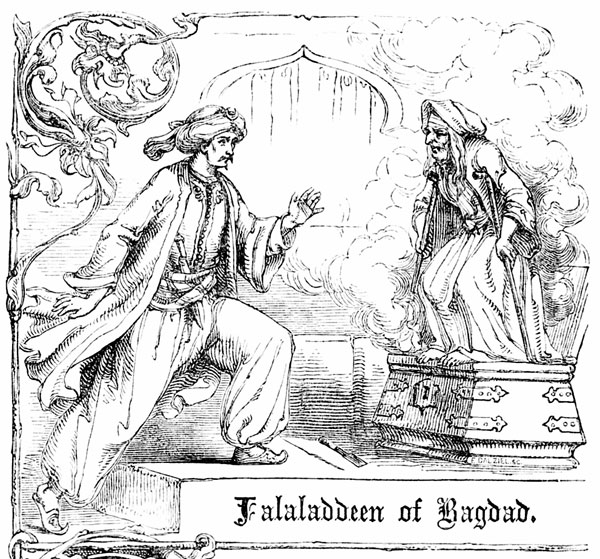
Curiosity at once overcame his fear: he started up and procured an iron tool with which he could break the seal of the cover, and took a hammer and chisel with him. With the aid of these instruments he broke through the leaden seal; but scarcely had it given way, when the lid opened, and a blue curling smoke arose from it, and from the midst of it issued a hideous old woman in a strange dress. She carried a crutch under her left arm, and held another in her right hand. She limped over the side of the vessel, and hobbling towards the astonished Jalaladdeen, said,
"Fool, fool that thou art! is it befitting for thee, so young as thou art, to stand there like an old idler? Go forth into the world, and fetch the wonder-stone from Mount Massis, otherwise thou canst never be my husband."
After these words she hobbled back on her crutch to the copper vessel, gathered herself together, as it were, into a ball, tumbled hastily in, and closed the cover on herself.
Overcome with fear and astonishment, Jalaladdeen threw himself upon his couch; but the dawn of morning found him still awake. He endeavoured to beguile the day in the arrangement of his house; but, nevertheless, he could not chase from his memory the wonderful spectacle which he had witnessed, and the portentous words that attended it. He felt an uneasiness which he endeavoured in vain to subdue, nor could he rest satisfied until he had investigated the cause of his anxiety.
At length he was so exhausted by the business of the day, fatigue, and want of rest, that he laid himself down early in the evenings and fell asleep; but at the hour of midnight he awoke again. He saw the vessel open, and the blue smoke arising from it, and from the midst of it the ugly old woman hobbled towards him, and cried out, as she swung her crutch to and fro in the air,
"Fool, fool, young idle fool! think of the stone of Mount Massis, otherwise thou canst not be my husband."
After these words she limped back again, gathered herself up as before, and the lid of the urn closed once more of itself.[13]
This occurred every night; but after that Jalaladdeen had recovered from the agitation caused by her first appearance, he slept as soundly as ever: still the old woman woke him night after night by thrusts in the ribs with her crutch, and on every occasion repeated the same or similar words.
But she generally awoke him in the midst of a dream, in which he always saw a very beautiful young lady, who rose from a kingly throne near him, and touched him with her golden sceptre. To this succeeded the reality of the hideous old woman; and instead of the sceptre, the crutch was wielded against him.
He often endeavoured by day to get the vessel removed; and sometimes even it was thrown into the river which flows by Bagdad; but still it always found its way back to his chamber at night. He then caused his couch to be removed to another room, but this was to no purpose, as the vessel always followed it. Thus matters went on, till the nightly disturbances, and still more the disturbed state of his mind, affected him to such a degree, that his health was very much impaired. He sought the advice of physicians, who prescribed all kinds of stimulants and restoratives; but their combined skill could not restore him to his lost rest. At length one of the physicians said to him,
"My skill has done all it can, my medicines avail nothing: if your illness were really that of the body, you would have been restored to health long since; but if your indisposition has its source in the mind, my prescriptions cannot aid you. Seek a magician—that is my advice: he by his occult science may be enabled to discover the cause of your bad health, and to effect a cure."
Jalaladdeen felt the truth of these words.
"It cannot be denied," said he, "that the cause of my illness is seated in my mind, and till that be removed, my health cannot be restored."
He then sought out one of the most skilful magicians of the day, and disclosed to him the circumstances of his nightly disturbance, assuring him, that before the first night on which the old woman had made her odious appearance out of the vessel, his rest had never been impaired. He ended by begging and entreating of him[14] that he would use all his skill to make the vision cease, and to rid his house of the fatal urn.
The magician consulted for some time with himself, and then addressed him thus:
"You tell me that this vessel was fastened down by a leaden seal; if it be loose, let me see it."
Jalaladdeen immediately conducted the magician to his house, and showed him the vessel, to which the seal was still attached. The magician studied with great attention the inscription on the seal, and then turning to Jalaladdeen, spoke thus:
"All my skill put together could not accomplish your wishes: know that this is the seal of the great Solomon; and it is inevitable, that he who breaks it must become an inmate of the vessel. To counteract this fate is not in the power of the most mighty magician. You are in the hands of this old woman, and no human power or wisdom can extricate you from it."
This speech involved Jalaladdeen in the greatest perplexity; he threw himself upon the ground, beat his breast, and sobbed and wept violently.
"Whence," exclaimed he, "is the power of this hideous old woman? Shall I, to the end of my days, remain in her trammels? Shall she, even when I have recovered from my illness, and lie wrapped in sweet dreams, approach my couch, and rouse me with her crutch to listen to her croaking voice? Whither can I fly for comfort? I would rather die than drag on a miserable existence in such trouble and anxiety. Take this dagger, I pray you, and stab me, and thus put an end to my illness."
With this he handed a dagger to the magician, and prayed him with many tears, as he bared his breast, to plunge it in, and rid him of his sufferings.
"Heaven forbid that I should commit such an act," replied the magician. "You are, without doubt, destined for great deeds, which will be worthy of you, one of which is, that you should break the seal of the great Solomon. You tell me that the old woman has desired you to fetch the wonder-stone from Mount Massis; follow her advice, journey to the mountain, and work out your[15] good fortune. Perhaps your fate may take another and a more prosperous turn."
He lengthened out his speech in the same tone and spirit, and spoke seriously for some time, till at length he succeeded in quieting Jalaladdeen; so that he embraced the hope of being restored one day to perfect health.
"But," said he to the magician, "whither shall I bend my course? where is Mount Massis? and even if I succeed in reaching it, how shall I discover the wonder-stone?"
Hereupon the magician promised to consider all these points, and to give him the necessary instructions on the morrow.
On the following night the ugly old woman appeared again out of the vessel; but did not, as on former occasions, rouse him with her crutch; but it seemed as though he woke of his own accord, and found her standing by his bed-side.
"Now," said she to him, "will you at last be wise, and give up this idleness? it will prove advantageous both to you and me."
She then addressed him in the most friendly terms, and left him in her usual manner.
The next morning the magician made his appearance again, and gave him the necessary information as to the course to be pursued. He told him that the wonder-stone lay concealed in a stone castle about midway up Mount Massis; but that the enterprise required great patience, perseverance, and skill. With such words as these he brought his speech to a close, and left Jalaladdeen to his own reflections.
"The mountain is difficult of ascent, and is guarded by vigilant genii: he who cannot comply with their singular demands must certainly sink under the dangers to be encountered, or at least withdraw from the attempt without bringing it to completion."
Jalaladdeen assured the magician that he had sufficient patience to carry him through any trial, and that he was ready and willing to submit to any labour, if by that means he could rid himself of the illness from which he was at that time suffering.
"Then," said he, "where is Mount Massis? which I have never before heard of."[16]
"You will know it, perhaps, by another name; it is also called Mount Ararat. There was, at some time or other, a great flood upon the earth, which destroyed every creature, man and beast, save one, who, with his wife and family, was warned by Allah; and placed in a large vessel, which floated upon the waters; then, as soon as the flood subsided, the ship remained fixed on one of the two ridges of the mountain; from this time the mount has been considered holy, and the spot most devoutly worshipped."
"I have heard of it," replied Jalaladdeen; "but in which direction am I to journey, in order to discover this wonder-stone?"
"You must follow the course of the Tigris," said he, "and then you will be at no great distance from the place."
Jalaladdeen immediately set his house in order, hired some armed attendants, took from his chest some gold and valuable jewels, and set off on his journey, following the windings of the river. The road appeared pleasant to him, and no danger or misfortune occurred to annoy him; the weather was fine, and he feasted his eyes upon the various features of the country, which were most beautiful and enchanting, travelling cheerfully onward. He began to forget his old sorrows and grievances, and to enjoy an unusual degree of happiness, as he left behind him the vision of the ugly old woman; for she never visited him again from the time he quitted his home.
At length he arrived with his suite on a high eminence, from which he beheld a most beautiful expanse of country, and in the distance the most charming scenery, from morning till night. In a corner of the valley a single hill towered up to the sky; farther on rose a chain of mountains; but the little hill was formed at the summit into two peaks. A cloud floated over their tops, one of which shot up more lofty than the other, and the sun cast a brilliant light upon them. But it was remarkable, that the nearer one approached the hill, the higher it appeared, and more majestic. At its base lay a very fruitful plain, and on the other side stood at little city.
Jalaladdeen inquired the name of the city, and was told that it was Semænum.[17]
"What!" said he, "Semænum? How did it acquire this extraordinary name?"
The people laughed at his simplicity, and inquired whether or not he had heard of the great flood from which only one man and his wife, and three sons with their wives also, escaped.
"These eight persons," added they, "on their descent from the mountain, took up their abode here, and laid the foundation of the city."
After this Jalaladdeen heard that the castle in which the wonder-stone was concealed lay on the other side of the hill; but still no one knew anything of the stone, nor had the inhabitants a satisfactory idea of the castle. But he was informed that so many extraordinary and gigantic masses of stone were standing in the various clefts of the mount, that their appearance was certainly that of a castle, and that the lofty crowning point in the distance resembled a tower.
"However," added the relaters, "yonder spot is not accessible, nor has it ever been heard of, within the memory of man, that any one ever dreamt of attempting its ascent. Everybody dreads the road on that side of the hill, as it has been said that mighty genii carry on their orgies there; and there is also a tradition, that a traveller once undertook to attain the summit, but that he had never been known to return."
As soon as Jalaladdeen had clearly ascertained from the inhabitants on which side of the hill the so-called castle was situated, he felt a strong inclination to journey on towards it at that minute, regardless of the warnings of the neighbouring people and the entreaties of his guide. He accordingly took some of his gold and jewels with him, and set off on his journey, ordering his guide to remain behind. He gave these last instructions to his servants:
"If I return not in three months, you may regard my property here as your own; then go back each one to his home, or wherever his inclination may lead him."
He soon lost his road, and arrived at unknown and intricate paths, with which the foot of the mountain was surrounded. Gradually the trees and all traces of vegetation disappeared, save here[18] and there a tuft of close underwood, which sprang up in the clefts of the rocks. Round about him were piled blocks of stone of monstrous size, and his farther progress was soon altogether stopped. There rose before him a massive stone wall like a tower, which was so steep and smooth, that it was impossible to pass it. He therefore made a wide circuit round, and at last found himself in a broad chasm of the rock, which seemed to extend far into the mountain.
Wild and unfrequented as this appeared, nevertheless he ventured to descend. The way was very laborious; he was often obliged to mount sharp-pointed masses of rock, often to wind along between crags and briars, often again to descend into deep abysses, down which rapid streams rushed violently, and then again to clamber up on the other side. At times he hung suspended from one side, searching out in vain a resting-place for his foot, to furnish him a support in his progress.
At length, after long and incessant labour through a dangerous pathway, he arrived at the steep summit, from which he discovered massive walls and lofty towers, that appeared to be constructed of rough unhewn stone. With the last exertion of his exhausted strength, he ascended these heights, and found himself before an opening. He knew not whether this was merely a cleft in the rock resembling a doorway, or a doorway hewn in the rough rock like a natural chasm. It was formed of upright blocks of stone, on which was cast another of wonderful size; but there was no door. He laboured now more assiduously than ever through the thorns and pointed stones, which lay here and there over the little level space that extended in front of the opening, till he stood before the dark entrance. The gloom concealed the nature of the interior of the cavity from his view, and he stood for a short time on the threshold, thinking on his past trials and collecting his scattered senses. As he was about to enter, a man stepped up to him, armed with a bow and bearing on his back a quiver of arrows.
"Take the bow," said he to Jalaladdeen, "choose yourself an arrow, and go do your duty."
So surprised and astonished was he, that he seized the bow, drew an arrow from the quiver, and asked,[19]
"What is my duty? What shall I do?"
"There," answered the man, pointing in the distance, "far beyond you must go; there is a great sea, which you must compass to its southern side, and then proceed through a wide expanse of plain until you arrive at a large inland lake, called the Eagles' Lake. There, every morning immediately after sunrise, you will see a swarm of black eagles on the shore, and among them a single white one. This kill, and, in proof of what you have done, bring back here the left wing."
This announcement came like a thunderbolt upon the miserable Jalaladdeen, who had fancied that he had arrived very near the end of his journey. But now he was ordered to proceed still farther through an unknown tract of land. On looking back he saw that the sun had already sunk in the heavens, and that dusky and humid clouds were gathering over the sky; so, turning to the man, he said,
"The night is fast drawing on, and I am very weary; and if I were to be exposed for so many hours in the abyss of this rocky ravine, I should certainly perish. May I not be permitted to pass the night here?"
The man nodded assent, and ordered Jalaladdeen to follow him. They passed into a dark hall from the entrance, with a vaulted roof formed of rough blocks of stone, from which hung a single iron lamp, that spread a feeble and dim light around. His conductor left him here alone, and two domestics soon appeared. They brought him an ottoman, and made him understand by signs that he was to sit down. They then placed a table before him with meat and drink, and stationed themselves at a respectful distance from him, waiting to serve him. He ate and drank and refreshed himself after the labours of the day, while the attendants handed everything to him with the greatest attention.
As soon as he had satisfied the craving of his appetite, they removed the table with its appendages, and beckoned to him to follow them. They conducted him through a side passage to a door, and when they had drawn back the curtain which hung before it, Jalaladdeen stood mute with astonishment.
The chamber was precisely like his sleeping-room at Bagdad:[20] every article of furniture was of the same size and colour as his, and occupied exactly the same position.
"You are surprised at this chamber," said one of the attendants: "our master wished to make it as comfortable for you as possible after your long journey, and he thinks that a man never experiences more comforts than in his own house."
With this they saluted him, and retired; but Jalaladdeen was too much astonished to sink to rest immediately; he accordingly walked round the room and inspected everything. It was his own chamber, with his own cushions, tapestries, and carpet; the curtains which he had purchased on entering his new house were there, and even the most minute article of furniture was the same; and that nothing might be wanting, there stood, on the precise spot, the fatal vessel which he had not been able to remove from his room by any means. Disagreeable as this last was, still he was so taken with surprise at the strange resemblance to his own chamber, that it made no impression on his mind; and at last he laid himself down on the couch, and Nature soon asserting her rights, he slumbered. He slept soundly throughout the night, and experienced the same happy dream which had so often visited him when at home. He saw a beautiful young maiden in princely garb, adorned with the most costly jewels, and at the moment that she raised herself from her queenly throne, and bent towards him her golden sceptre, he awoke, and the hideous old woman hobbled up to him.
"Commit no rash act of folly," said she, in a hoarse croaking voice; "do not go without a dog: they must give you one."
She then turned herself about, shook her crutch at him in a menacing manner, and disappeared all at once into the vessel, as on every former occasion.
"A dog!" said Jalaladdeen to himself: "what shall I do with such an unclean animal? However, she seems to know of the journey in store for me."
And revolving the matter in his mind, it appeared to him better to follow her advice. In the midst of his thoughts he again fell fast asleep; and when he awoke, he found, to his no small surprise,[21] that he had been slumbering in a chasm of the rock upon a bed of dried mountain grass.
The sun shone in upon him, and before him stood the man who had given him the bow and arrow, and who immediately reminded him of his journey, and urged him to prepare speedily to do his duty. He arose at once, and declared himself ready.
"But," said he, calling to mind the old woman's words, "could I not have a dog to accompany me on the way?"
"Certainly," replied the man; and at his call a large dog with broad paws made its appearance, and began to run round him in a friendly manner, barking for joy. He then tore off a small piece of the hem of his garment, and having shewn it to the dog, gave it to Jalaladdeen, and said,
"So long as you bear this with you, the dog will follow you wherever you go; be therefore careful of it. Now proceed, turn not back to the town, but go straight on to the east."
The dog immediately bounded forward, and, on issuing from the hollow of the rock, turned toward the east. Jalaladdeen followed, and found, to his astonishment, a winding path, not altogether level, but still not very inconvenient. Whenever a dangerous spot showed itself at times, the dog discovered another path by which the danger might be avoided. Jalaladdeen therefore allowed him to run on before, and followed his steps.
They soon reached the plain, and arrived at a hilly district, where the mountains rose higher and higher behind them in the distance. The land on the other side declined gently; and, afar off, they beheld the sea. Many days, however, passed before he was able to make the wide circuit which led to the southern side. He then found himself in a flat country, and, after a journey of fourteen days, arrived at the shores of the Eagle Lake. Jalaladdeen threw himself down, in the evening, upon a dry spot of the shore; for in the course of his long journey he had habituated himself to rest on the earth under the broad canopy of heaven.
In the morning, his dog awoke him by a low barking and lively indications of restlessness. He had hardly risen from the ground, when the dog sprang joyously up to him, looking to one side, as[22] though to direct his attention. On turning his eyes towards the spot, he discovered a great multitude of black birds hovering over the trees, and felt satisfied that they were the eagles. He then looked anxiously for the white one, which he was to kill; but in vain. Whilst he was engaged in the search, the dog made a circuit, and crept close to them beneath some bushes; then, by a sudden loud bark, he dislodged them from the spot, and they flew in the direction of Jalaladdeen, across the lake. He, on a sudden, discovered the snow-white eagle among the others, and bent his bow, and, although the bird was now at so great a distance that no ordinary shot could have reached it, still the arrow flew straight to its mark, and he saw the object of his aim fall far from the shore into the blue waters of the lake.
"What avails my fortunate shot?" said he, looking with vexation on the waves which bore it farther from the shore.
Immediately the dog plunged hastily into the water, and swimming with extraordinary rapidity, seized the eagle in his mouth, and brought it safely to his master. Jalaladdeen quickly drew out the arrow, which had pierced it through the middle of the body, and cutting off the left wing, secured it to his person. During this operation, he had smeared his fingers with blood; and, as he was wiping it off on the inside of his girdle, the little piece of the man's garment, which he had hitherto kept safely, fell to the ground without his noticing it. Hereupon the dog caught up the body of the eagle, which Jalaladdeen had thrown away, and ran off with it at full speed.
Jalaladdeen called repeatedly to the dog, and coaxed him to return, but in vain; so he proceeded home on his way alone. He certainly met with nothing of material import to molest him in his journey; nevertheless he had to encounter a thousand little obstacles, which very much impeded his progress. He could not discover the path by which he had originally come, but frequently arrived at places where there was no road, or at thick forests, through which he was obliged to hew a path with his sabre, and to pass the night upon the naked earth beneath the open sky.
After a much longer journey than before, and many different[23] detours, he arrived at a spot from which he could see the two-pointed head of Mount Massis. When, after some days, he came to the foot of the mount, he was in hopes of finding the path by which he had descended in company with the dog; but he looked for it in vain, and was obliged to climb up by one of the dreadful rocky ravines, at the risk of his life, as on a former occasion.
At length, weary and exhausted, he arrived at the opening, and was about to enter, with the eagle's wing in his hand, when the man who had given him the bow and arrow presented himself before him, and said,
"Hast thou done thy duty?"
Jalaladdeen immediately placed the wing in his hands.
"Good," replied the other; "I will see if it be the right one."
He then called the dog by name, who immediately appeared from the castle, carrying the eagle's body in his mouth.
As soon as the man had applied the wing to the place from which it had been cut, and compared it with the other, he said to him, nodding approvingly, "'T is well: I have that which I wanted. But stay here a moment; my brother will come to you, and inform you what you must do for him, if you wish to have your desire fulfilled." With these words, he entered the hollow again, and the dog accompanied him.
Jalaladdeen followed him with his eyes; and then, sighing deeply, said, "Another labour still! I fancied I had already discovered the wonder-stone of Mount Massis, and now I must journey out into the world again on anew adventure. God knows whither the brother will send me."
His soliloquy was interrupted by the appearance of a man, who stepped forward from the opening, and presented to him a lance with a glittering steel head.
"Take it," said he, "and with it do thy duty."
Jalaladdeen took it, and intimated his readiness to undertake the mission, at the same time asking, "What is my duty?"
The man answered, "On the way hence to Mount Lebanon, on the other side of the Tigris and Euphrates, the traveller comes, after a journey of some days, to a vast desert. There, in the middle[24] of a large barren and sandy plain, lies a fruitful oasis, watered by a little stream, on whose brink grow tall palms, refreshing the wanderer with their shade and fruit. But the neighbourhood of the palms is frequented by a monstrous lion of a dark colour,—the only one that has wandered into the district,—and his ferocity renders it dangerous to rest beneath their shade. This you must kill—not only for the safety of future travellers, but in order to accomplish your own wishes. Then bring here to me the lion's tail; you will hereafter need it."
Again it was evening; and Jalaladdeen begged permission to recruit his strength and refresh himself by a night's rest. The man assented, and made a sign that he should follow him. In the hall he was again provided with meat and drink by the two attendants; and after his repast, they conducted him to the same door, drew back the curtain from before it, and he again, to his utter amazement, found himself in his own sleeping-chamber at Bagdad. Once more he recognized every article of furniture as his own, or exactly similar to his own, and the copper vessel standing precisely on the same spot. He then threw himself on his couch, and was soon locked in deep slumber. But at the hour of midnight he was again roused from his dream by the hideous old woman, who stood by his bed-side, flourishing her crutch in a threatening attitude, and calling upon him in a hoarse, croaking voice,
"See thou commit no rash act of folly," she cried. "Go not on foot to the desert, otherwise the floating clouds of sand will bury thee for ever before thou arrivest at the palms; or if thou shouldest attain the spot, the lion will tear thee in pieces if he find no other booty. They must give thee a camel: see that thou demand it." At these words she shook her crutch at him, and disappeared into the vessel.
"A camel!" said Jalaladdeen to himself: "can they possibly have camels in this unfrequented place? And even if they had, how could I descend to the plain with such a beast, through the clefts in the rocks, from this height?"
His weariness was so great that, amid a chain of thoughts that[25] attended the vision, he fell fast asleep again. The next morning he was awoke by the man who gave him the lance, and he discovered himself at the opening of the rock, as on a former occasion. The sun again shone through the hollow, and the man said to him,
"'T is time that you should make ready to do your duty: take the bow and arrow, together with my lance, and journey on to the desert."
At the moment he called to mind the injunction of the old woman, and answered, "For my passage through the desert I shall require a camel."
"Then thou shalt have one," replied the man; and, on emerging a second time from the opening, there stood a camel, ready furnished with many necessaries for his comfort and convenience during the journey.
To his astonishment, after he had mounted the animal, it proceeded by an easy pathway down the side of the mountain; and, although he could see nothing but impassable spots, huge blocks of stone, and deep abysses both before and behind, still the camel travelled on by a level and gently declining track.
On this occasion, too, his journey was more prosperous and far more speedy than at the first. He arrived at the desert without any mishap, and in the evening reached the fruitful strip of land where the palms stood. The camel immediately refreshed itself with water, while Jalaladdeen's repast consisted of dates from the neighbouring trees. He then allowed the camel to browse upon the brink of the stream, while he resigned himself, without care, to rest beneath the shade. He was soon, however, terrified by the roar of a lion, which sounded close to him; accordingly he sprang up hastily, seized his arms, and took up a position behind some large palms, which concealed him from the sight of his approaching enemy. Soon the lion drew on with rapid strides, and was about to rush upon the browsing camel, when Jalaladdeen shot an arrow, which took effect in his right eye. Scarcely had the dart reached the lion, when he sprang vengefully forward on his foe, whom he had but that moment discovered. Jalaladdeen, nothing daunted, stepped boldly forwards, and thrust at him with the point of his[26] lance; but the lion bounded on with such force, that he could not withstand the attack: he fell, and the whole bulk of the lion rolled over him. Jalaladdeen gave himself up for lost: he lay senseless some time, and when he had recovered sufficiently to comprehend his dreadful situation, the moon was high in the heavens. He was very weak, and bruised all over the body, and he felt some great weight upon him. By means of considerable exertion, he released himself, and remarked for the first time that his clothes were saturated with blood. He immediately fancied that he had been wounded by the teeth or claws of the lion, and accordingly rolled over to the water and washed himself; but, after a very careful examination of his person, he could not discover a wound. The coolness of the water refreshed his limbs, and eased the pain of the bruises in the various parts of his body. After this he was soon enabled to stand up, and he found that the weight which had been pressing upon him was the lion, dead and stiff, and soaked in his blood. In its bound forward it had pierced itself with the lance, and had fallen to the ground, in consequence of the furious attack it was designing. The body of the dead lion proved a soft pillow, and its bulk was so immense that Jalaladdeen could recline at full length upon its back with great ease. In this manner he slept on, and did not rise till broad daylight, when he felt himself fully refreshed and well. He then cut off the lion's tail, and remounted the camel, which had strayed to a short distance from the spot.
The return to the castle on the mount was prosperous, and not marked by any particular adventure. He soon left the desert behind, and found himself at the foot of Mount Massis. But as evening was approaching, he considered whether it would be better to rest till morning, and then ascend the acclivity; the camel, however, perseveringly trotted on with that zeal which animals generally show when approaching their accustomed dwelling.
The last gleam of day had not disappeared in the western sky when he found himself in the little chamber before the well-known entrance of the castle. Although the distance from the foot of the hill thus far up to the castle, notwithstanding the rapid steps of the beast, had occupied the greater part of a whole day, yet it appeared[27] that it could now be accomplished in the short space of a single hour. Jalaladdeen could not comprehend how he had reached it so rapidly; but it occurred to him for the first time that he had never seen so extraordinary a pathway, or one accompanied with so much difficulty and danger. He contemplated with surprise the rapidity with which he had completed this journey, and made a sign to the camel to kneel, to give his rider an opportunity of descending and unloading him. He took his arms and the lion's tail, and entered the gate of the castle.
On his entry he was met by a man, who took his lance from him and said, "Hast thou done thy duty?"
And as Jalaladdeen presented to him the lion's tail, he said that he had failed in nothing.
"Good," said he; "but still I will put it to the test, to prove whether you are right."
He then called out aloud four names, upon which immediately appeared four large dogs out of the chasm in the rock, dragging after them the dead body of the dark lion. The man now applied the tail to the lion's body, and on finding that it corresponded, "Good," said he; "I have now what I desire. Wait, however, a short time, and my brother will come and tell you what he requires you to do for him, if you are inclined to see your wishes fulfilled." With these words he retired into the castle, and the four dogs dragged in the lion after him.
"Alas!" said Jalaladdeen, "I have not yet accomplished my labours! Who knows how many brothers may be dwelling here together? And if I receive only a slight demand from each of them, a year may elapse ere I obtain the wonder-stone."
He had scarcely uttered these words when the third brother advanced, and handing to him a basket made of rushes, accompanied it with the words, "Go and do thy duty."
He inquired what was his duty, and received this answer: "Go and fetch water."
"What!" said he; "fetch water in a basket! It will run out between the rushes!"
The man shrugged up his shoulders, and said, "That is for[28] you to look to: water you must bring in this basket, and without the aid of any other vessel; for you will stand in need of the water."
"That is impossible," replied Jalaladdeen. "Set me to any other kind of work—send me into a distant country on the other side of the Caucasus, let me herd with wild beasts, and I will, without making any objection, obey your injunctions, even at the risk of my life; but do not require impossibilities of me."
"'T is not impossible," answered the man. "Reflect: I dare not say anything more to you. You have till morning to consider what you will do. Come in here and refresh yourself with food and rest."
Jalaladdeen followed him, and was conducted into a chamber, where he was abundantly supplied with viands and liquors. The bed-room appropriated to him was that in which he had formerly rested and known as his own; and he laid himself down, exhausted and overcome with grief on account of the new demand made upon him. He awoke again at midnight, and the little old woman stood once more before him with her uplifted crutch.
"Commit no rash act of folly," said she. "Seek not water out of the deep: carry that not in thy basket; the water which thou must bring in it will not escape through it. Step out; above thou wilt find the water I speak of; thence thou must fetch it. Dost thou hear? Be not foolish: hast thou lost thine understanding?"
After she had disappeared, as on previous occasions, Jalaladdeen rolled about for some time on his couch, sleepless and perplexed with care. It appeared to him like an unsolvable riddle.
"What! shall I not fetch water from the depth, whence commonly springs and streams flow? and yet shall I go upwards? and am I to carry it in a simple wicker basket?"
At last, however, he fell asleep again, and was awoke in the morning, with positive orders to make ready to do his duty. As he was preparing, he said, "The way up the rock and the oft-frequented path is dangerous; could I not get a travelling-staff to help me?"
"Here is one ready," answered the man, handing him a long[29] pole, made of a light tough wood, with a strong iron spike fixed to it. He then shook him heartily by the hand, and let him out of the opening.
When he gained the exterior, he looked all around him. He hoped to discover some track which would indicate in what direction he should set out; but stones and ruins, the effects of a great convulsion of nature, surrounded, in a wild and unnatural confusion, the small and even spot before the entrance of the castle. But what most astonished him was, that the road which had appeared formerly to be impassable for his camel should now present an even and unencumbered path. At last, after various attempts, by great good fortune, he found a part where, by help of his travelling-staff, he was able to climb up the projecting mass of rock. On the other side he found a spot by which he could, without much danger, descend into a large plain. It seemed to him like the same piece of rock on which he, in the first instance, had got in proceeding from the castle. He was nearly, from this circumstance, led to descend there; but he thought of the warning given to him by the old woman in good time, who had advised him not to fetch water from the bottom, but from the summit, and he accordingly bent his steps upwards. But here the road lay through enormous fragments of rock, choked up at intervals with briars and thorns. At length, after frequently-repeated efforts, he succeeded in journeying on a short distance by the help of his travelling-staff, when a spot presented itself where there was a chasm in the rock, which it was impossible for him to surmount. He was accordingly obliged to turn sideways till he had passed it, in order to follow up his prescribed route. He toiled on with intense exertion, endeavouring to reach the summit of the rock, for more than an hour; but, from various obstacles, had not made any great progress. At last, worn out with fatigue, he sat himself down beneath the shade of an overhanging crag, to recruit his strength, in order to renew the attempt with increased vigour.
Up to this time, through all his wanderings, he had not found a stream from whose source he was able to draw water. He had certainly seen in deep hollows small rivulets issuing from the rock,[30] which by their fall covered the neighbouring plain with white flakes of foam. Still, although he persevered assiduously, he could not discover one spot which he could approach sufficiently near.
He was by this time suffering intensely from thirst; for, notwithstanding the height at which he had arrived, where the cold was more severe than in the hollows beneath, still his anxiety, and his journey upwards beneath the midday sun, had parched his lips, and he had not yet been able to reach a stream at which to moisten them.
"Fool, fool that I am!" exclaimed Jalaladdeen, bitterly; "why should I thus exhaust my strength? If I attain the summit of the hill, I shall meet with no water; or even if I were to find a spring at the top of it, still I should not be able to carry its waters in a rush basket."
He then reasoned with himself whether or not it were better to return; but then the thought flashed across his mind that the words of the old woman had on two previous occasions been fully verified. He therefore determined to follow her advice once more.
"Did she not assure me," said he, "that I should find water enough above me? 'T is passing strange: the streams certainly flow thence, or remain still in their channels."
With this he set forward again on his ascent, and it now appeared that he had advanced much farther than he had been aware of, and in a shorter space of time. He had not proceeded far when he arrived at a spot hollowed out, and sheltered from behind by a large mass of rock. In this cavity was a quantity of snow and ice, which the air at that height could not melt, and to which the rays of the sun could not penetrate through the surrounding masses.
Jalaladdeen laid himself down to rest at the edge of the snow, and refreshed himself with its grateful coolness by taking a small quantity in his hands, and by applying it to his lips. He first of all moistened the exterior of his mouth, and then swallowed a little with great pleasure. This at once solved the mystery of the problem.
"Here," said he, "is a large expanse of snow: the tops of the mountains are covered with it. What is snow but water? and such[31] water I can easily carry in my rush basket; and even if some should melt in the journey, it cannot all dissolve and escape."
He then began immediately to fill the basket with clean snow from the middle of a heap, and to render it more firm, he pressed it together with his hands. As soon as he had filled his basket, he set off joyously on his return; but it seemed as though he must again have taken a different route, as he did not meet in the course of his way one of the thousand obstacles that had impeded his progress on his journey in search of this water.
The last traces of sunlight were fast disappearing in the west when he found himself at the entrance of the castle. Immediately the three brothers advanced to meet him.
"See," said the third, who had imposed this last mission on him, "see, thou hast brought us water in a rush basket."
With these words they ushered him into the interior, and gave him the joyful intelligence that he had now accomplished everything that was necessary to put him in possession of the wonder-stone.
"You must know," said they, "that the wonder-stone is concealed in an iron chest; but the bolt, by lapse of time, is so thoroughly rusted that no power has yet been discovered sufficient to force it back and to disclose the contents. There is, however, a tradition that he who shall be deemed worthy to possess this treasure, and who shall have successfully performed all our commands, shall be endued with power to draw back the bolt—a feat which has been deemed impossible for many hundred years. But, as destiny often depends on circumstances which mortals consider trivial and insignificant, so in this case a combination of materials is requisite, by whose agency alone a sure and happy success can crown our hitherto prosperous attempts. It would, doubtless, be imagined that a rusty bolt might be moved by the application of a little oil or grease, of whatever nature it might be; but in this case nothing save that portion of marrow which is contained in the lion's tail will be efficient, and this, too, must be boiled in water fetched in a rush basket. Nor is this all: the marrow must be applied with three feathers plucked from the left wing of a white eagle, the king of eagles in Eagle Land."[32]
After these words they conducted him into a chamber; in the middle of it stood a large iron chest, whose cover was fastened down by seven strong iron bolts.
"Behold the chest in which the wonder-stone is hid," said they. "Let us proceed to work immediately."
Hereupon they brought in a cauldron, and filled it with snow from the rush basket, and placed it on a fire in the kitchen. The lion's tail was then cut into pieces and thrown into the water; the fat was soon extracted, and floated at the top. Then the first of the three brothers brought in the eagle's wing, and Jalaladdeen was ordered to pluck out the three outside feathers, and with them to anoint the bolts. While he was thus occupied, a drop of the fat fell upon his hands, which he rubbed over them.
"Right, right!" said another brother, who had observed it with great satisfaction; "it is very strengthening to the limbs."
And he accordingly rubbed both his hands and feet, and immediately experienced a pleasurable sensation of new vigour.
Jalaladdeen had been exceedingly fatigued by the toils of the day; nevertheless by this application he felt as recruited as he had on other occasions in consequence of a prolonged and peaceful slumber.
"The marrow has done its work," said the second brother; "it has already unclosed the bolt. Approach, then, and open the chest."
Jalaladdeen bowed, and with great apparent ease withdrew the bolts. As soon as he had lifted up the lid he beheld a beautiful gem, which appeared to be a rare specimen of the onyx. In the middle of it was a golden hook, to which a chain was attached, by which it might be suspended from the neck. Upon the stone was an engraving of an altar, upon which a sacrificial fire was burning, and before it a suppliant family bowed the knee; over this was thrown a white vestment archwise in the form of a rainbow.
"Is this really the wonder-stone?" said Jalaladdeen, gazing on it with rapture.
"It is," replied the brothers; and continuing, "Hail, thou happy youth!" they exclaimed; "hail, prince! thou wilt shortly be seated on the throne of thy fathers."[33]
"A Prince!" cried Jalaladdeen, in astonishment; "a Prince! My father died at Bagdad, a quiet, retired man, and never in the whole course of my life did I hear him say that he had ever been a King."
"He was a King," exclaimed one of the brothers; "but his subjects made war against him, and drove him into exile; they then elected another Sultan, who sat upon the throne there many years. He is since dead, and the people are not unanimous in raising his daughter to the queenly station. They are divided into two factions, opposed to one another with the most dreadful hatred and animosity. Go thither, and give thy people peace."
"Whither shall I go?" asked Jalaladdeen, anxiously. "How shall I procure myself to be recognized as their lawful monarch?"
"That will be easily accomplished," answered one of the brothers, "by the agency of this wonder-stone. Place the chain round thy neck, and support the gem on thy breast. Now come," said they, as soon as he had complied with this direction; "thou hast no time to spare: refresh thyself, as though for a long journey, with meat and drink, and then set out."
They then conducted him into an adjoining room, and waited upon him themselves; after his repast they handed to him a crystal goblet filled with a liquor most agreeable to his palate, superior to any drink he had formerly tasted.
"Now proceed onward," said they: "this is the first step towards your happiness."
One of them then traced a small cross with his forefinger upon the wall, and immediately there opened a small vaulted chamber.
"What!" said Jalaladdeen, "am I to enter that gloomy hole?" shuddering and involuntarily drawing back, in consequence of the cold damp vapour that issued from it.
"Hand him another goblet to refresh himself," said one of the brothers, and at the same time filling one for him.
Then the third brother presented to him the eagle's wing and the tip of the lion's tail, which had been reserved from the cauldron, and the arrow and lance, too, with which he had killed them.[34]
"Forward! On, in the name of the Prophet!" was the next command.
"I obey," answered Jalaladdeen; "but suffer me before my departure to ask, Who are ye?"
"We are three genii," said they, "sent here by the King of Spirits, as keepers of the mysteries of the holy Mount Massis. But proceed, in order that thou mayest arrive in due time at thy destination." They led him to the opening, and as he was stooping down to enter it, "See," said they, "if thou shouldst return by this way, throw upon the ground this wing of the eagle and the tail of the lion, and call out in a loud voice our names, Arjeh, Neschar, and Mana-Guma. We shall then know what thou requirest."
With these words the passage closed upon him, and he found himself in such dense darkness that there was not a single glimmer of light through the whole space. The ground as he advanced was even, and for the first few steps he could walk upright, so that it did not seem inconvenient. Suddenly, however, he came to a gradual declivity, and after a few steps he felt the bottom sinking beneath his feet. He could no longer remain upright, but sank upon his knees, and eventually sat himself down; for it gave way more and more, and the more he struggled the lower he sank. At last he bent forward with his head laid upon his knee, as he was completely exhausted, in consequence of the rapid though gradual fall of earth. How long he might have been descending he could not tell, as his self-possession had entirely deserted him; and when he recovered himself, he seemed to be just awakening out of a sound sleep. This commotion was suspended for a moment, and he felt the spot on which he was seated rising up again; but it soon descended, and continued to ascend and descend with unceasing force and rapidity. But at times he lost all consciousness, and recovered his recollection again as the motion changed and proceeded downwards. In this manner was he driven from sleeping to waking, overcome with exhaustion and perplexed with the darksomeness of his journey. How long he was in this gloomy passage he knew not: at one time he thought that the journey had been one of several days; but then this could not be so, as he had[35] not even once experienced the cravings of hunger or thirst: as he had not suffered in this particular, he felt convinced that the time that had elapsed was much less, and that it must have appeared so from his total abstinence.
At length he perceived a small gleam of light at the farther end of this way, and by it he observed that he was in a narrow part of a subterranean chamber, which seemed scarcely large enough to admit his body. His movements, however, were so quick that he brought himself nearer and nearer to the light at every step, till at last he succeeded in extricating himself. He found himself standing upon a mount on a spot hitherto unknown to him, which was illumined by the sun from the opposite horizon. Here he remained, gazing joyously around, and breathing now for the first time the pure fresh air.
On a sudden he heard a loud warlike sound at the foot of the hill; and, on a closer inspection, he discovered several companies, ranged in battle order half-way up the hill, and preparing for the attack. Without allowing himself time for reflection, he threw the lion's tail and eagle's wing to the ground, exclaiming at the same time in a loud voice the names of the three genii of Mount Massis, "Arjeh, Neschar, Mana-Guma!"
Scarcely had he uttered the last word, when he found himself mounted upon a noble white steed with a black tail, the arrow in his left hand, and the spear in his right; and without his taking hold of the reins, which were ornamented with gold and precious stones, the tractable steed flew along the hill rapidly, and bore him safely between the two contending factions.
"What are you doing?" exclaimed Jalaladdeen in a tone of anger to both parties, who immediately ceased their hostile contentions, through their amazement at the sudden appearance of the stranger horseman. "What is the cause of this deadly feud?"
At these words a joyous train of voices proceeded from the band upon his right hand; and the combatants immediately threw down their weapons, exclaiming,
"This, this is he who shall bring peace to our people! This is[36] the appointed Sultan! Lo! it was prophesied that he should appear upon a white horse with a black tail, upon the longest day of the year. Hail, Sultan! all hail!"
Upon this the commander of the company approached Jalaladdeen with submission, bending before him with his arms crossed upon his breast; and the troops threw themselves upon the earth, each one bowing low with his forehead to the dust.
Hereupon the leader of the opposite faction sprang forward, crying out, "Down with them! down with them!"
But Jalaladdeen's horse turned towards him instinctively, and bore him to the band.
"Why would you prolong the strife and contest?" cried he. "What is your complaint?"
"They carry arms for Gulnaschare," was the answer. "Dost thou not know that a young maiden dares to rule over a people of warlike customs—that she arrogates to herself a right to the throne, alleging that thus it hath been decreed she should reign until the son of the late banished Sultan shall appear, who is the appointed one to share the sovereignty? Canst thou be such a stranger in the country as to be ignorant of the prediction of the prophet and the astrologers? and how she has led her subjects into grievous error, to the effect that the Prince Jalaladdeen would appear in a wonderful manner in the country on the longest day of the year, and fall upon his enemies with the strength of a lion and the swiftness of an eagle?"
Upon this Jalaladdeen cried out aloud, "The people have not been led into error, nor have they been deceived; they have heard the truth. Behold, I am Jalaladdeen; and if ye do not all, to a man, cease from your hostilities, ye shall be made to feel the strength of the lion and the swiftness of the eagle."
But the leader of the party said, "What! hast thou suffered thyself to be deceived, and to be made an advocate of the imposition? Now our arms must decide it."
At these words they pressed upon him and drew near, when Jalaladdeen wielded his lance with the swiftness of lightning, and with extraordinary strength and courage beat them off, one after[37] the other. His steed gave a joyous neigh, and bounded forward among the crowd; while the troops of Gulnaschare followed after him, seeing his perilous position.
When the enemy saw their leader weltering in his blood, and the courageous youth heading their antagonists, they fled in disorder; some even threw their arms from them, and surrendered at discretion.
Jalaladdeen and his troops pursued the fugitives; but so fleet was his steed, that he found himself alone in the midst of the flying, while his band had not yet come up. As soon as the enemy perceived this, they surrounded him and enclosed him in a large circle. In this emergency the swiftness of the eagle and the strength of the lion proved necessary to him; and his steed, as though endued with reason, turned itself about continually, shooting quick glances like lightning from its eyeballs, so that Jalaladdeen could perceive every man in the circle who stood near him. In this manner he struck them to the ground, or shot them through before they had determined upon their method of attack, or could see through his manœuvres. But, to his astonishment, he found that he had a fresh arrow in his hand after every shot from his bow. In a short time there was a large circle of killed and wounded round him. At length his own army arrived; and the enemy again took to flight. Jalaladdeen pursued after them again, to a narrow pass, whence there was no escape. Here they threw themselves upon their faces, and humbly sought for mercy. Jalaladdeen then proceeded to the capital of the country, followed by his warriors, and accompanied by a train of many thousand prisoners and captured foes.
The news of his appearance upon the hill, and the account of the victory which he had subsequently gained, had already reached the city; and the elders poured out to the gate to meet him. The prophets and astrologers also flocked together to welcome him as the appointed Sultan, and to escort him to the royal palace. The streets through which they passed were magnificently decorated; and the joy of the populace was such as greets an ancient and once loved lord on his entry into his capital.[38]
In the palace yard the upper officers of the household, the servants of the Court, and the slaves, were drawn up to welcome him with becoming respect. Here he dismounted from his horse, passed up the steps, and proceeded through the colonnades and antechambers which led to the throne-room, where Gulnaschare was seated, surrounded by a splendid retinue.
The royal maiden rose from her throne at his entrance; but how amazed and confused was Jalaladdeen! She was not altogether unknown to him; for he now saw before him in reality the young maid who had been so often present to him in his dreams, out of which he had been so repeatedly roused by the old woman belabouring him with her crutch. She gazed upon him with an affectionate smile; and as he drew near, she descended the steps of her throne, extended to him the golden sceptre, and touched him with the point of it.
"Hast thou the wonder-stone from Mount Massis?" said she.
Jalaladdeen was too confused to reply to her; but the gem suspended from his neck assured her as to his identity.
"That is it," said she, in continuation. "The possession of that stone proves thee destined to become my husband, and to reign over the vast empire of the Moguls, from which thou, with thy father, wast banished in thine early days."
She then took him by the hand, led him up the steps, and seated him upon the throne, bent before him, and delivered the sceptre into his hand.
"Behold," said she to the surrounding multitude, "behold your rightful sovereign! It was written in the book of fate that Janghiz his father should, in consequence of his covetousness, be driven into exile by my father Khamar; then that the innocent son, after many severe proofs and labours imposed by the King of Spirits, if deemed worthy, should share the throne with me."
"He has been tried, and is found worthy!" exclaimed all the prophets and astrologers.
"Hail to him! hail, Sultan!" immediately burst from the lips of all present in the palace; and the multitudes in the streets and approaches reiterated the shout.[39]
Then Jalaladdeen, advancing from the throne, addressed the throng:
"Heartily do I thank Allah and the Prophet that my fate has taken so wondrous and happy a turn; but, above all, I prize my good fortune in becoming the husband of this amiable Princess."
Jalaladdeen thus concluded his address; and Gulnaschare said to him,
"Didst thou so often wish for me when I, in the guise of an old woman, roused thee night after night from thy peaceful slumbers and happy dreams with my crutch?"
"How!" exclaimed Jalaladdeen; "wast thou that hideous old woman? impossible!"
"Passing strange, perchance, it may seem; but nevertheless it is so: all things are possible to the King of Spirits, which mortal mind can barely comprehend."
The marriage ceremony was now ordered to take place; and one festivity followed another; happiness, and joy, and peace, reigned together.
Jalaladdeen ruled for many years over the kingdom of the Moguls, and enlarged it by many prosperous conquests; he brought it to a state of peace and tranquillity which it had never experienced in former years, and which, after his death, it did not long enjoy.

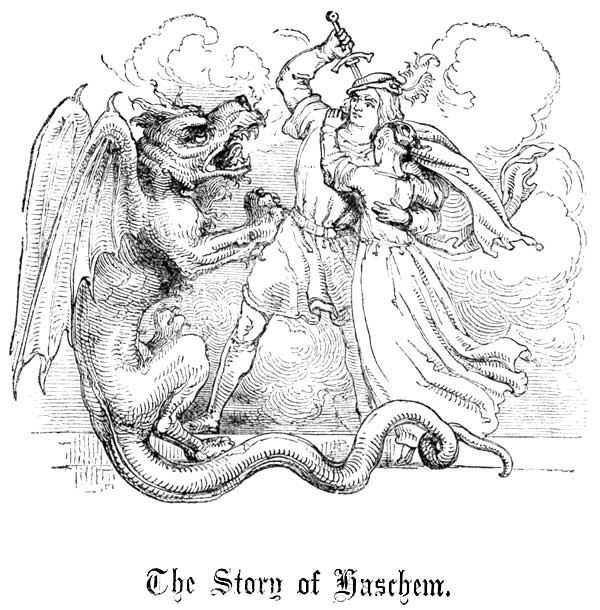

ore than a thousand years ago, there lived in the famous city of Bagdad a man called Naima, who, although he was now grey with age, had still the lusty strength of earlier days. The opening of his life was devoted to trade; and in pursuit of it he made many journeys, by which he not only gained great intellectual treasures and experiences, but also acquired property, which afforded him, not certainly the means for extravagant expenditure, but still sufficient to live in comfort. He had the good sense and wisdom to be satisfied with such moderate possessions, and to enjoy them in peaceful quiet—labouring meanwhile for the improvement[41] of his only son. Many of his acquaintance, however, sought to amass greater wealth, forgetting, as it would seem, that by such constant efforts, life itself, after its meridian, would be but lost without some new and higher enjoyment. The city of Mossul was his home in early days; but he quitted it, and took up his abode in Bagdad, partly owing to the suggestions of a friend with whom he had been on the most intimate and confidential terms from his youth—partly, too, for the sake of the education of his son, as he expected that a residence in that city would produce worthy and lasting impressions on the mind of the young man.
Bagdad was, at this time, under the rule of the famed Caliph Haroun al Raschid, and was the resort of strangers from all parts of the globe, where artists and sages of that country mingled among those of the neighbouring lands. Nor had Naima conceived a vain expectation. His son Haschem was a young man gifted with good natural abilities, and endowed with a pure unsullied heart. He used every opportunity which chance threw in his way to extend his knowledge, cultivate his mind, or to improve his disposition; nor was he deficient in bodily exercises and warlike accomplishments; so that through good discipline he became powerful in body and strong in mind. He was, therefore, as was natural enough, not only the joy and pride of his father, but was loved and esteemed by all who knew him, and was often pointed out by the elders, to others of his own age, as an example worthy of imitation. As the father saw his greatest treasure in the person of his only son, so he, with all the fervour of a well-directed mind, clung to his father.
Some years passed over them in this mutual love, heightened still more by the companionship of their friend Saad, and their happiness was full and uninterrupted. It chanced one day that Naima and Saad were taking their accustomed walk in the princely gardens adjoining the city in front of the gate. The heat of the summer's day had been diminished by a gentle rain, and the two strolled on in happy conversation, and extended their walk beyond its ordinary length. The last gardens were already left behind them, and they wandered on over green meadow-land; behind a little wood, at the entrance of which stood high palms, whose[42] shadows invited to repose. A fresh spring gushed from a neighbouring rock, and meandered sparkling among the verdant herbage and variegated flowers.
The two friends lay down in the shade, and conversed on the dangers to which the most virtuous men are subject, and how easily one may, through passion, be led into a false step, if he allow himself to confide in his own firmness of purpose.
"I have known men," continued Saad, "who, although among the best and noblest whom I have ever known in the course of my life, were led unawares, by too great self-confidence, to an action which they might easily have avoided by a little caution, but which has been the beginning of a long chain of transgressions and vices, ending in their complete ruin."
Naima maintained that a heart accustomed from early youth to virtue would, on the contrary, not be easily led to commit a serious fault; and even if it should happen so, that it would readily find its way back from a slight error to the right road.
They talked still longer on these subjects, each endeavouring to confirm his assertions by examples. Haschem, stretched beside them, listened with attention to their instructive conversation; but suddenly he sprang to his feet, and ran quickly up the woody hill, at the foot of which they were reposing. Saad and his father looked after him with astonishment, as they could not comprehend what had occasioned his sudden departure. Then they saw that a little bird, as white as snow, was flying before him, which he was trying to catch. He was soon lost to their view among the bushes; they cried to him, and begged him to come back—but in vain. They waited for a quarter of an hour, and still Haschem did not return. Uneasy as to what had become of him, they advanced in the direction in which he had disappeared; but they could discover nothing. They called his name: the wood echoed it. At last the sun set; then said Saad,
"Let us return home: your son is a robust and strong young man; he will easily find his way back into the city. Perhaps he has gone home some other way."
After long opposition, the father was at last persuaded to return[43] without his son; but he was still full of anxiety, which no arguments could overcome. When they arrived at the city, his friend accompanied him to his house. They entered hastily, and inquired for Haschem; but he had not returned. Saad's hopes were of no more avail; Naima would no longer listen to him, but weeping, threw himself on his couch. Saad rebuked him for this weakness, and represented to him that it might easily have happened that the young man had lost his way in the pursuit of the bird, and could not recover the track.
"He has certainly found a shelter where he will remain till morning," continued he; "he will return here early to-morrow, and will laugh heartily at your unmanly spirit and desponding grief."
When Saad was gone Naima gave free scope to his feelings. He wept aloud, tore his beard, and threw himself upon the ground, like a madman. The servants and slaves of the house stood around in motionless astonishment, as they were not accustomed to see their master exhibiting such passionate emotion; others sought to console him, but fruitlessly; so they cried and bewailed with him for his dear son, who was beloved by them all. After a sleepless night, the afflicted father was not at all quieted. He wished early in the morning to send messengers in all directions; but Saad, who had come to hear if the lost one had returned home, explained to him how foolish this step would be.
"Remember," said he, "that your Haschem has most probably found a night's lodging, and slept better than you. If he had set out on his way at daybreak, he could not be here now; and if you send these messengers after him, he may perhaps come home by a shorter path, while they will be searching for him in vain. Wait, at least, till noon."
Naima yielded: he appointed the messengers to be ready at noon, and in the meanwhile walked through the gardens and in the country round about the city, where they had been on the preceding day. His friend accompanied him, although he pointed out that Haschem might, in the interval, have reached home while they were walking, and that he was thus perhaps giving himself more grief than was necessary.[44]
"I have given up to you in the rest," replied Naima; "let me at least in this instance have my own will, that I may walk here."
They went together to the fountain in the rock near the palms; they climbed the neighbouring heights; they called the name of the lost one in all directions; but no sound was heard in reply. At noon they went home, and asked all they met if they had not seen a young man, whom they accurately described. Nobody could give them any information about him. Naima now sent out his messengers in all directions; to each he promised a rich reward, but tenfold to that one who should lead the lost one back to his arms. They set out joyfully, each one hoping to gain the tenfold sum, and they all intended to return home in the evening; but these hopes were disappointed. Naima with earnest desire expected them in the evening; none came. At last a few returned on the third day. They had gone a day's journey in the appointed direction, had sought everywhere, had described the wanderer to all they had met, but none had seen him. The rest of the messengers also returned, one by one, and none had discovered the least trace of him. The hopes of the sorrowing father had almost disappeared: only one of the dispatched messengers was not yet come back. Although it was probable that this one might remain away without success, he still clung to the hope that he at least might discover a trace of his son, who had disappeared in so unaccountable a manner. But when this last messenger returned on the tenth day, and reported that all his researches had been without success, the parent's grief knew no bounds. His friend Saad stood by him comforting him, and inquired, together with all his friends, whether no tidings could be learned of Haschem. He could not have been killed, for then his corpse would have been found; he had no cause to conceal himself; he could not have been attacked by enemies, as he had none: might he, in the pursuit of the bird, have been led to the brink of the stream, and have thrown himself in, and been carried away by the waves? Scarcely did the possibility of this idea arise, when two messengers were dispatched to each side of the river to make fresh search, from its junction with the Euphrates above Balsora to the spot where it flows into the[45] Arabian Sea, to ascertain if the corpse of Haschem had been washed ashore. But these messengers also returned to the anxious father, and had not found what they sought. Now the father and his friend gave up Haschem for lost; Naima's manly spirit was broken; grief for his lost son shortened his life; he soon became old: all joy had by this time fled from his mind; and his sorrow was only a little alleviated when his faithful friend Saad sat by him in the evening, talked with him of his son, relating the virtues by which he had been distinguished, and told him how it had been his darling wish that this excellent young man should marry his daughter Zoraine.
In a few days the Caliph Haroun al Raschid went, as he was accustomed, in disguise, with his Grand Vizier Giafar, and Mesrour his Chamberlain, through the streets of Bagdad, to see with his own eyes and to hear with his own ears how justice and order were maintained by his servants, and whether his people were happy and prosperous. He had, as usual, chosen the last hour of the evening for this walk, because he thought that at this time he could look deeper into men's joys and pleasures, as they had then ended their daily toils, and were seeking comfort and repose in the bosom of their family. In his progress he came to a street distinguished by peculiar silence and quiet. As he approached a house, before the door of which two men were standing whispering, Haroun al Raschid addressed them with these words:
"Why do you whisper, as if you were concerting a crime? is not this street lonely enough, that you cannot hold your discourse aloud? Can you tell me why this street is so quiet, as though every inhabitant were dead?"
"I can easily tell you, my lord," answered one of the whisperers: "here, in the next house, lives the unfortunate Naima, and, as usual at this hour, his friend Saad sits with him to console him.[46] Now, all the inhabitants of this street respect this man, and wish not to remind him, by any outburst of joy, that happier men than himself live in his neighbourhood."
Before the Caliph could answer him, he turned away and went into the house, and the other followed him.
"Have you ever heard of this unfortunate Naima before?" asked Haroun al Raschid of his Grand Vizier; and as he answered in the negative, he said, "Let us rap at the door of the next house, where this Naima dwells; perhaps we may discover the cause of his sorrow."
They drew near, and saw the light from the inner court shining through a crevice. The Caliph placed his eye at this crevice, and after he had watched for some time, he beckoned his followers to him, and said, "Two grey-headed men are sitting in this court by a lamp, and one seems to be comforting the other; but this latter continues to weep more bitterly. Both seem of the same rank; and I am desirous to know what sorrow oppresses the unfortunate Naima. Order him to appear at my palace early to-morrow morning; perhaps it may be in my power to lighten his calamity."
The next day the Grand Vizier executed his commission. Naima was frightened when his presence was required at the palace. He was led into the great hall where the divan usually assembled; but he was quite alone there when the servants had left him. He reviewed the whole of his past life, to see if he had sinned in any way so as to bring on him the displeasure of the righteous Caliph; for he knew that Haroun al Raschid often, in a mysterious manner, discovered the faults of his subjects, and punished them accordingly. But he could not call to mind any deed of which he, felt ashamed, nor any that deserved punishment. Whilst he was thus meditating, a curtain was drawn back, and the Caliph entered, followed by his Vizier and his Chamberlain. Naima rose from the ground, and bowed with his head even to the carpet on which the Caliph stood.
"Naima," said the Caliph, "a heavy weight of grief oppress you; and by the anxiety which your neighbours manifest to show respect for the sorrows of your soul, I must consider you as a man of great[47] worth. I wish to know the cause of your despondency: will you confess it before these two witnesses, or would you rather confide to me alone the reason of your tears?"
"Ruler of the Faithful," answered Naima, "sorrow is great and deep in my soul; but still the cause of it is unworthy to distract for a moment the attention of the Caliph from the cares of his kingdom."
But Haroun al Raschid answered, "That which fills the heart of the meanest of my subjects with such grief that it consumes his life is not unworthy of my care. When I am careful for my whole kingdom, this care extends to each individual; if, then, I am careful for one, this one is a member of the whole, and thus my care is not lost. But speak, what is the cause of your sorrow and your tears?"
Then Naima recounted the mysterious disappearance of his son; how he had sought for him everywhere, and how all trouble had been useless, so that all his messengers had returned home without the least trace of him. "I must therefore weep for him as one that is dead"—thus he ended his relation; "and tears, perhaps, might appease my sorrow, if at the same time a ray of hope did not dart through my heart that possibly he is still alive; but where does he live, if indeed he be still alive? This ray of hope keeps the wound in the father's heart always open."
"You have real cause for grief," answered the Caliph, "and I comprehend that the uncertainty of your son's fate must be as terrible to bear as would be the mournful certainty of his death. You did wrong in not applying to me before: my power extends not only over believers, but also in foreign lands. Other kings and rulers I have as my servants, whose eyes see for me, whose ears hear for me, and whose hands perform what is necessary for my pleasure. That which was not possible to yourself, your friends, and your servants to accomplish, might perhaps have been easy to me. Now go home, and believe that you shall obtain news of your son, if he lives on the earth, in any land where my power can reach."
With these words he dismissed him, after he had first inquired the marks by which his lost son might be recognized.[48]
When Naima again sat with his friend Saad in the evening, he related to him the gracious and comforting words of the Caliph. Saad perceived that hope was again revived in his friend's heart, and that he confidently trusted to find his son. He thought it therefore his duty to damp this hope, and said,
"Beloved friend, I have once heard a speech, which by its truth sank deeply in my memory: it is, 'Trust not in princes; they are but men.' The moral of which is, that the mightiest on earth are subject to fate. If the Caliph have influence in distant lands, it must be in a confined and narrow limit. That which is but a span distant is under the control of all-governing fate, even from the meanest slave to the Ruler of the Faithful."
But if the power of Haroun al Raschid were bounded by the immensity of fate, yet he did all he could to fulfil the hope he had raised in Naima's heart. He gave a commission to all his servants in his kingdom, high and low, and to his ambassadors in the neighbouring kingdoms, and even sent into distant lands, with the princes of which he was friendly, and on the same day dispatched messengers with the charge to search for Haschem with all diligence, and gave them a description how they might recognize him if they found him. But week after week passed away, month after month, and even a whole year elapsed, without intelligence being received either of the life or death of the lost one. So all hope of finding him now deserted the father for ever.
Haschem was not dead; he still lived, but in such retirement that it was impossible to discover his abode. He followed the snow-white bird till evening, without clearly knowing why: he was induced to think he could catch the curious creature, particularly as it flew at such a moderate height from the ground, and so slowly that he hoped quickly to reach it. The tardiness of[49] its flight made him conjecture that it must have a defect in its wing: he often stretched out his hand to it, and drew near it, but the bird again raised its wings, and flew a little in advance. Haschem now felt himself tired, and would have given up the pursuit, but the bird also seemed fatigued; he approached it, but again the bird flew a little farther off. In this chase he reached a hill, which he climbed; he was now in a narrow meadow-valley, which he ran along; twilight came, but the snow-white colour of the bird still lighted him on. At last the pursued bird perched in a thicket; he hastened to it, but when he closed his hand to take his prisoner, it flew away, leaving only one feather of its tail behind, which he had tightly grasped; still he saw it through the twilight flying before him, and he hastened after it. The bird seemed now to quicken its pace; and as he followed and had once nearly caught it, he continued the pursuit with more eagerness: he ran through the high grass, and with his strained sight fixed on this glimmering white object, he saw nothing else. Thus he came unexpectedly to a little dam which lay across his path; he jumped in and tried to climb the other side, but it was so steep that he fell in with some of the crumbling earth: while the water rushed over his head he lost all consciousness. When he came to himself, he lay on the turf, and a tall, grey-headed man, of strange appearance, stood before him, clothed in a long black robe, which reached to his ankles, and was fastened by a glittering girdle of a fiery colour. Instead of a turban, he wore a high pointed cap on his head, at the end of which was a tassel of the same hue as the girdle.
"Has your life returned to you?" he asked: "you deserved to be suffocated in the mud. Come, we must go farther before daylight quite leaves us."
With these words he raised him from the ground, passed his left arm round his body, and flew with him through the air as quickly as an arrow. Haschem again momentarily lost recollection: it is not known how long he remained in this condition. He awoke at last as from a deep sleep; and as he looked around, the first thing he recognized was a cage of gold wire, which hung from the ceiling by a long golden chain, and within was the snow-white bird he[50] had so long followed. He found himself alone with this bird in a hall, the roof of which was supported on pillars of white marble, and the walls were built of smooth pale-green stones. The openings to the windows were skilfully contrived with so many windings and narrow gratings, that even the white bird could have found no space to pass through, even if it had escaped from the cage. Beside one wall stood a crystal urn; and from this fell a stream of clear water, which, passing over the curved brim of the urn, dripped into a white basin beneath, from which it disappeared unseen.
Whilst he observed this, and wondered what had happened to him, and how he came there, he suddenly heard the old man in the black robe enter from behind a curtain. He carried a small golden box in his hand, and approached him with these words:
"You have now caught the white bird; you now have it in a cage: in this box is food for it, and there is water; take diligent care of it, and mind that it does not escape."
As he said this he disappeared. Haschem now arose and walked round the hall: he looked through the windows, and ascertained that he must be in a foreign land, as the forms of the mountains and trees were quite different to any he had before seen. The hall seemed high, as if it were the upper storey of a lofty tower. No other edifice was to be seen, and from the windows he could not distinguish the trees and plants which bloomed beneath. He drew the curtain aside, and discovered an outlet; but there was a thick metal door which he could not open. He was now very much embarrassed, for he began to feel hungry, and could find nothing that would serve him for food. He examined the walls, to see if he could discover any concealed outlet. He tried to open the windows, that he might put his head out to see if there was anybody in the building beneath, to whom he might cry out. There was no door: he could not open the windows; and as far as he could stretch his sight in every direction, he could see nobody. He threw himself in despair on the pillow on which he recovered his consciousness, and wrung his hands, and wept, and cried,
"I am, then, imprisoned—imprisoned in a dungeon where splendour[51] and riches are lavished around! Of what avail is it that these walls are built of precious stones? that this lattice is of fine gold? that this cage is of gold, and hangs on a golden chain? I am as much a prisoner behind golden lattices as I should be behind iron."
As hunger pinched him still more, he cried out, "How much rather would I be in the vilest prison, with the coarsest food, than be confined in this splendid hall, where I must die of hunger!"
Then he again called out of the lattices, in hopes that his voice might be heard, and aid brought; but nobody appeared, and no one answered him. When he again threw himself, weeping, on his couch, after such useless attempts, he observed that the white bird fluttered restlessly in its prison, and pecked on the golden dish, where food was placed, without finding any.
"Poor brother in misfortune!" said Haschem, "you shall not suffer want; I will take care of you: come, I will bring you assistance."
He took the pans from the cage, and filled one with water from the urn, the other with grain from the gold box which the old man had given him. Scarcely had he hung the last on the cage, when, on turning round, he saw a table behind him covered with costly viands. He was astonished, and could not understand how all this had happened; but still it was not long before he attacked the meats with the zest of a young man who has fasted for several days. Although these viands were altogether different from those he had been accustomed to taste in his father's house, still they all appeared excellent. He ate till he was fully satisfied, and then took a golden cup from the table, with which he quenched his thirst with pure water from the urn. Afterwards he threw himself on a couch and fell asleep.
When he awoke, he felt strong and well. He arose and walked round the hall, and he then observed that the table with the meats had disappeared. This did not please him, as he had thought to make a good supper of the remainder. He did not allow this, however, to trouble him much, as he was now sure that he was not to die of hunger. He had now leisure enough to examine his[52] prison more closely. He searched all anew pillars, walls, and floor; but he could nowhere find a crevice or a fissure: all was fast and whole. His view from the windows did not allow him to make any discovery: he only saw that he was very far from the earth, and in a spacious valley. Mountains were to be seen in the distance, with curiously pointed summits: the nearest offered no change of prospect, and the farthest was too distant to raise his spirits by its contemplation: it was a high, wearisome abode. As soon as he had completed this examination, and found there was nothing to occupy him, he turned his attention to the white bird in the cage. Here was still life; and if the cage was narrow, yet the prisoner could hop about on the different perches. Soon it remained still, and looked at him with its bright eyes; and it seemed as if sense and speech lay in these eyes, only the interpretation was wanting. Night put an end to these reflections.
On the next morning he observed that the bird again wanted food. He filled its seed-box with grain from the golden box, and gave it fresh water from the urn. Scarcely had he done this, when the table, covered with meats, again stood in the same place as the day before. This day passed like the former, and the following in the same manner. Haschem wept and mourned, took care of the little bird, fed it, and was every time rewarded in the same manner with the table covered with dishes, as soon as he had filled the bird's seed-box. He could not perceive who brought the table, nor how it disappeared. It always came when he stood beside the cage with his back turned, and without any noise.
On the ninth day the old man suddenly appeared to him, and said, "To-day is a day of repose for you: you have performed your duty during the preceding days in giving the bird its food; now you may amuse yourself in the garden till evening."
He led him through a door into a narrow passage, at the end of which they descended twenty steps. Then he opened a small metal trap-door, and Haschem again descended twenty steps more. They came to a similar door; and after descending twenty more steps to another, and so on, till after passing the ninth door, they found themselves in the open air.[53]
"Remain here till you are called," said the old man, who went back into the building through the same doors, which he shut after him.
Haschem was very curious to examine more closely the building in which he had been imprisoned: he therefore went round it, and narrowly observed it. It was a tower of nine storeys, each about fifteen feet in height. The tower had nine angles and nine flat walls; in each storey were three windows, so contrived that for every two walls without a window, the third had one. These windows were not directly over one another in the storeys, but alternate; so that only three appeared in each wall. This distribution of regularity and order reigned throughout the whole building. The walls were made of large pieces of gold, quite as smooth as glass, like large stones; and these were so skilfully put together that, even when closely looked at, the joints could not be discovered. The lattices of the windows were all of gold, like those in the upper hall, and the lower doors through which he had passed were of a yellow metal, inclining to green.
All these considerations were not calculated to lessen his conviction that no man could possibly find him out in such a prison. Suddenly a new hope awoke in him.
"I am no longer shut up in the tower," said he to himself; "here I am in the open air, in a garden: I can clamber and jump like a monkey. I may possibly find some outlet from this garden, by which I can escape."
He immediately turned from the tower, and hastened through the gardens, seeking freedom; but he soon discovered that this hope was vain. With a few steps he reached the end of the garden, and stood before a gate of lattice-work of strong smooth iron bars, so close together that he could scarcely pass his arm through. He tried to climb it by holding by the upper bars with his hands; but his feet slipped on the smooth iron, and he hurt his knee so much that, in consequence of not being able to bear the pain, he fell backwards on the earth. He now examined the lattice closely to see if there were no means of escape; but all was in vain—everywhere the bars were high, thick, and like polished glass. Mournfully[54] he wandered round the garden: the sun's rays darting down scorched up the grass, and he sought some shade where he might screen himself from their influence. He lay down on a neighbouring mossy bank, and meditated anew on his fate. Besides his own grief at his imprisonment, the thought of his father's sorrow at his loss pained him. The exhaustion consequent on his tears and loud lamentations, joined with the noontide heat, at last caused him to fall into a deep sleep. When he awoke, the table covered with meats was again before him: he ate, and wandered anew mournfully through the garden, meditating whether he could not make a ladder from the trees around him, to aid him in his escape over the lattice. But there was something wanting for this work: he had not even a dagger or a pocket-knife. During these thoughts the old man appeared, and said,
"Evening is drawing on. Follow me in."
He led him again to the upper room of the tower, and locked the metal door upon him.
There was no change observable in his prison—only the bird seemed harassed and mournful: it sat quiet and still on the lowest perch; its plumage was rough, and its eyes dull.
"Poor creature," said Haschem, "what is the matter? Are you ill?"
It seemed as if the bird was affected by these sympathizing questions; but it soon sank again into its former dejection. He mused long upon this.
The next day and the following ones passed like the former; but on the ninth the old man again appeared, led him into the garden, and at night conducted him back into the hall. He took care of the bird; and as soon as he had given it food and water, he always found the table covered with meats behind him. In the intervals he stood at the lattice of one of the three windows looking on the plain below, earnestly hoping to catch sight of some person to free him from his captivity.
In such monotonous employment many months passed away. Every ninth day the old man appeared, and gave him leave to walk in the garden; but he did not derive much amusement from[55] his strolls in this narrow enclosure. In the meantime he asked the old man many times the reason of his imprisonment, and how long it was to last. No answer was vouchsafed but these words: "Every man has his own fate. This is thine."
One day the old man appeared and led him into the garden; but he had not been there more than a quarter of an hour, when he returned, called him in, and then quickly retired with marks of disquietude. Haschem also remarked that the white bird, which he loved more every day, sat at the bottom of its cage, more mournful than usual after his visit. He drew near, and observed a little door, which he had never before seen. He examined it closely, and found a fine bolt which passed into a ring of gold wire. These were made so skilfully, like concealed ornaments, that nobody could have discovered them if his attention had not been drawn to them by accident. Haschem pushed back the bolt and opened the door; the bird moved as if some sudden joy had seized it, hopped out, and as soon as it touched the floor, it was transformed, and in its stead a young maiden stood before Haschem, clothed in a white silk robe; beautiful dark locks streamed over her neck and shoulders, and a thin fragrant veil fell over them, fastened to a forehead-band set with precious stones; her finely-formed countenance was as white as ivory, relieved by the softest shade of a rose.
Surprised and astonished, Haschem started back and said, "By the beard of the Prophet, I conjure you to tell me whether you are of human race, or whether you belong to the genii?"
"I am a weak maiden," said she, "and implore you to deliver me from the hands of this cruel magician. I will reward you handsomely for it. Know, I am the only daughter of Kadga Singa, King of Selandia; and this wicked enchanter has cunningly carried[56] me off from my father's palace, and shut me up in this cage. He has one son, as ugly as night, whom he wishes me to take for my husband. Every ninth day he comes, brings him with him, and praises his excellent qualities—presses me for my consent, and threatens me with cruel tortures if I give it not at the next new moon. On that day he will have kept me a year in imprisonment, and longer than a year he says he will not wait, and still give good words: then will the time of my punishment begin. I conjure you, therefore, to help me!"
At these words she burst into a flood of tears.
"Noble royal maiden," answered Haschem, "how willingly would I help you! but, alas, I am only a weak man, and cannot free myself. But tell me—how is it possible? You say the enchanter brings his hateful son with him: why, then, have I never seen him?"
"He always sends you away when he comes," answered the Princess.
"Well," pursued Haschem, "the son could not conceal himself from me on the steps, or in the narrow passage."
"Well, well," she answered, "he carries him in his pocket."
Then Haschem cried out in his astonishment, "In his pocket! How can that be?"
The Princess related to him that the young man was every time a white bird, like herself; that the enchanter put him into the cage with her, and that she felt such a dislike to him that she always fluttered about the cage to avoid getting near him; but that he, with his contrary friendly feeling, would follow her and settle confidingly near her.
"Oh," she continued, "you must have remarked how tired and mournful I always was when you returned on the ninth day."
Haschem, astonished at this explanation, assured her of his willingness to help her, but bewailed his helplessness. But the Princess would not give up hopes of their safety.
"It seems to me," said she, "a good omen that the enchanter has to-day received a message which caused him to leave so early and in such haste that he did not securely close the cage, and that[57] you returned so early to-day from the garden. This day is my birthday, the only day that I can be delivered from the magician's power. On any other day I should still have remained a dumb bird if you had freed me from my cage; only on this day has my touching the floor restored me to my natural form: the enchantment lies in the cage."
Haschem then seized the cage, and said, "If it be so, we will break the enchantment." He threw the cage to the ground, stamped on it with his feet till it was quite flat and its shape no longer distinguishable, then he rolled it together, and threw it into a corner of the hall.
At this moment a frightful noise resounded through the air like violent thunder, a gale of wind seemed to shake the hall, and suddenly the doors opened, the curtains were drawn aside, and the magician stood before them with a countenance full of anger.
"Ah!" cried he, "weak worms, what have you presumed to do? How did you learn to break my charm in this manner? Who bid you destroy the cage?"
Haschem, terrified, could answer nothing. Then the enchanter turned to the Maiden, and cried,
"And you, you thought this miserable worm could defend you against my power: I will show you how useless it is to oppose me."
He felt in the pocket of his black robe, and pulled out a thin box. This he opened, and a white bird flew out and perched on the table. Then he took a small box from his girdle and opened it: it was filled with grains of millet. From these he took one, laid it before the bird, who had scarcely eaten it before such a distorted man stood in its place, that both Haschem and the Princess screamed aloud. His head was large and thick, his eyes red and dark, his nose small and pressed quite flat, his lips thick and bluish-red, his chin broad and projecting, and on his head grew a few stiff white hairs; a hump grew out of his breast, and a similar one from his back, and his shoulders were quite drawn up: his head was so jammed between them that his ears could not be seen. His head and upper part of his body were so unshapely, and his legs so weak and thin, that it was wonderful how they supported him: he[58] tottered about incessantly, balancing himself first on one leg, then on the other.
"Go in, my son," said the enchanter to this misformed creature: "behold! there is your bride. She does not wish to wait till the new moon, which I fixed upon for your betrothal: to-day she has effected her change by the help of this friend. Go, my son, give your bride a kiss, and then thank this young man."
The deformed creature approached the Princess with a horrible fiendish laugh. She averted her face with disgust, and stretched out her arms, motioning him away. And now courage returned to Haschem. Resolved to venture all, he stepped before the Princess, and gave the deformity such a blow that he reeled. He instantly assumed the form of a terrible dragon; but Haschem, drawing a scimitar which he still wore, cut him down. He fell with such violence on the corner of the pedestal of one of the marble pillars that it was broken to pieces: a stream of blood flowed from the wound, and, resuming his former shape, the monster gave a hollow groan. Now Haschem thought of the father's rage and revenge, and gave up his life for lost. But the enchanter stood quite confounded as he observed his son's mortal wound; then, threw himself down beside him, and examined it, and wrung his hands, forgetting his revenge in his sorrow. Haschem quickly seized the hand of the Princess, and led her through the door and down the steps. All the doors were open, and they fortunately came into the garden. Soon they stood before the lattice of the iron wicket, which was closed to them.
"Of what use is our flight?" said Haschem; "we are still in the power of the enchanter; and even if we were on the other side of the wicket, and concealed ourselves in the deepest cavern, he would discover us by his knowledge, and wreak his vengeance on us."
"I am of a different opinion," said the Princess. "I know there are things of which men think little, but on which the superior power of the magician depends. It appears to me that if we could get out of this place, we should be safe."
They went farther, and came to a spot where many trees had been uprooted by a hurricane. One of these lay overturned, with[59] its crown resting on the lattice, and its boughs and branches hanging far over the other side. At this sight the young man rejoiced: he climbed quickly up the trunk, pulled the Princess after him, and led her with great care and tenderness into the crown of the tree. They then clambered over the spiked top of the wicket, and let themselves down on the other side by the overhanging branches. They did not quite reach to the ground, but near enough for them to leap down: when they let go their hands, they fell softly to the earth. They quickly jumped up, and proceeded as rapidly as the strength of the Princess and the unknown way would allow them through the thickets, underwood, and plains studded with prickly plants, towards the distant mountains.
After the two fugitives had continued their flight for several successive hours without looking back on the scene of their imprisonment, the Princess felt her strength exhausted, and could go no farther; she begged her companion to repose for a short time. Haschem sought a place free from bushes, and clad with moss and long grass. They seated themselves there, and Haschem entreated her to relate her history. She was soon ready, and commenced thus:
"My early history is very simple and unimportant. I am called Handa, the only daughter of the Sultan of the island Selandia. My mother was brought from beyond Arabia and Mount Caucasus over the wide-stretching sea, and was sold to him as a slave. Soon attracted by her excessive beauty and pleasing manners, he raised her to the dignity of his principal wife. My earliest youth was spent in pleasing sports under my mother's eyes. She died before I had passed the age of childhood, as the change from the mild climate of her land to the heat of my father's shortened her days. After the loss of my mother, which did not much affect me, as I was too young to feel it, I enjoyed many happy days. My father loved me as his greatest treasure, and was wise enough to confide me to a careful nurse. Every evening I passed several hours with him, as soon as he was released from the cares of government, and one whole day in each week he devoted to conversation with me. We then went together in a light bark to a neighbouring promontory,[60] where he had a beautiful palace and gardens. The air there blew cooler and more refreshing, the trees and shrubs were clothed with fresher green than in the shut-up garden in the capital, and we passed the whole day in the open air. In the meantime I had outgrown childhood, and was beloved by a Prince, the son of a neighbouring King, to whom I was betrothed, and who was to succeed my father in his kingdom. This Prince, whose name was Mundian Oppu, also often took part in these visits to the castle on the promontory.
"It happened one day, as we were sitting on a terrace by the sea, a foreign ship anchored just below us. A foreigner caused himself to be landed in a little boat, and asked us permission to appear before us, as he had many costly wares to offer for sale. I was desirous to see the stranger's wares, and begged my father to grant the desired petition. The man laid many costly trinkets of gold and precious stones before us, and my father bought some, with which I was much pleased. I remarked that the merchant watched me closely, but he did this with such evident pleasure that my vanity ascribed it to his opinion of my pleasing expression, and found no harm in it. Whilst he shewed his wares, he let fall some words which intimated that he had left his most precious articles behind in the ship. He had there many curious birds, particularly a snow-white bird, which was the most beautiful of all creatures of this kind. He managed thus to raise my desires so much that I begged my father to allow me to go with the stranger to his ship to see these silken stuffs: my father was weak enough to comply with this unreasonable wish. A suitable train should have accompanied me, but the stranger prevented this. He said his boat had only room in it for three people, and that he should not like to show his wares if many people came into his ship. 'They are only things for the royal Princess,' he said, 'and I dare not expose her to danger. I can never forget that a powerful King has entrusted his only daughter to my care; therefore your betrothed Prince Mundian Oppu may accompany you as a watchful protector.' We went with the merchant to the ship. There we found an immense number of extraordinary things and unknown[61] animals. In the place where in other ships the rowers sat were great apes; on high on the mast sat an eagle; in the inner rooms were many large and small cages of smooth ebony with thick gold bars, behind which moved a confused multitude of animals.
"My desire was now directed to the snow-white bird, about which I made inquiry. He showed it me high up in a box, and as I could not see it distinctly, he took it out and put it on my hand. 'It is quite singular,' said he, 'when the bird is here, it can only remain a few days alive, but I have found the corn of life, which I give it each week, and it is then refreshed for nine days.' We asked for the corn of life, of which we had never heard, and he opened a little box and took out three grains. He gave me one to give the bird, the other I was to try, and the third Prince Mundian Oppu. When I offered the grain to the bird, it refused to peck it; and when I pressed my hand closer, the bird drew back, lost its balance, and fell down with outspread wings. I hastened to it, picked it up perhaps somewhat roughly, and as it tried to escape, I held some of its tail-feathers fast, so that it lay fluttering in my hand. I was very much frightened, and the merchant seemed so also. He soon laughed with malicious joy, and said that I should swallow the corn, because it would prevent the flight of the frightened prisoner. He said the same to the Prince, and we swallowed the grains in the same moment. I felt a wonderful transformation pass over me, and found that I was changed into a snow-white bird; and when I looked towards the Prince, in his stead I saw a black bird. Now the stranger, who was no other than the enchanter, seized me, and shut me up in the golden cage which you have trodden to pieces. The apes began to ply the oars, and the ship moved with unusual swiftness over the sea. I still saw my father sitting on the terrace, and the wonder of the servants as they saw the ship depart: I believed that I heard their voices calling us back. But what could I do in my cage? The black bird flew to the promontory; and from that moment I have neither heard nor seen anything of Prince Mundian Oppu.
"When my home was far in the distance, and even the summit of the mountain could no longer be distinguished, the enchanter[62] rose with my cage high in the air, leaving his ship behind, and bore me into the hall of the tower. How he brought the other white bird, I don't know: I only know that he took it out of his pocket and put it into the cage. 'Now you have a companion,' said he. As I took him for a real bird, I considered myself, though unfortunate, superior to him, and drew myself back into a corner. But the bird came nearer, and followed me. At last I lost patience, and pecked his eyes. When the enchanter saw this, he took out a little box, and took from it a grain, which he laid before the bird, who picked it immediately. It was then changed into a man, as ugly as you saw him in the tower. He desired me, as I have already told you, to take that deformity for my husband, and promised me that, on my consent, I should be immediately restored to my proper form, and assured me that otherwise I should always remain as a bird, except on my birthday. I have now no other wish than to return to my father in Selandia, because I know he is living in great affliction, if, indeed, sorrow at my loss have not already brought him to the grave."
At the conclusion of this relation, Haschem thought with compassion of his father, and had his mournful countenance and bowed-down form before his mind. He knew, from the great love he had always shown him, that he must have pined for his loss.
"Princess," said he, "your desire cannot be greater than mine. Still, I swear to you that I will not return to my father till I have safely conducted you to your native land, or have given you over to safe guides to bring you to your father; if I do not, may Heaven not grant my father life to receive this joy!"
They journeyed on with renewed vigour. But evening was drawing near, and they must find a resting-place for the night. Fortune was favourable: they soon found a spot, shadowed, by a high bush.[63]
Haschem broke away the boughs so as to form a hedge, which quite concealed the Princess, and to which he only left a narrow entrance, before which he lay down to watch. Night passed without danger. However anxiously Haschem strove against sleep, to watch over his companion, it at last weighed down his eyelids, and they both awoke with the first rays of the sun. Their good star soon led them to a spot where they found refreshing wood-berries, the names of which were unknown to them, and they were anxious to discover if they were poisonous; but hunger made them venture. They wandered the whole day, resting alternately. At every step the journey became more hazardous. The thickets became thicker and higher; they were often obliged to creep between the boughs, and their clothes hung in rags. On the fourth day they reached the foot of the mountain. There they found cultivated land and human habitations. Haschem inquired where they were, and asked for the sea. The people told them the name of the country, which was unknown to Haschem and the Princess Handa. On the other side of the high mountain lay a large flat land, whose coast was washed by the sea. They received this information with great joy. They descended the mountain, came to the flat land, and at last, after a wearisome journey, during which they had seen the sun rise and set seven times, they arrived at the sea-coast. A ship lay ready at anchor, and when they inquired its destination, the steersman answered, "We are going to Selandia to fetch a cargo of cinnamon." To Haschem's question where they came from, and what this land where they were was called, he received for answer, "that the ship belonged to a merchant of Balsora, and that it had been cast on these unknown shores by a violent storm."
When the Princess perceived that the ship was going towards her native land, she was very much rejoiced. She took one of the precious stones out of her forehead-band, and gave it as a reward for her and her companion. The following morning they weighed anchor, and, after a prosperous voyage, they reached the same place where the enchanter's ship had formerly lain at anchor when he carried off the Princess.
They were landed in a small boat, and Handa led her deliverer[64] into the beautiful leafy walks of the imperial gardens. In this way they came to a terrace, from which they could see the ship. Instead of pressing quickly forwards, they concealed themselves behind a bush. A very melancholy old man sat on this terrace, looking over the sea; and while a flood of tears ran down his face,
"Ah!" cried he, "it was just so on the day that my sorrows began! There lay the ship of the robber, there landed the boat which carried away my beloved daughter and her betrothed. It was even at the same hour of the day. I have sent messengers into all the neighbouring lands; I have caused the opposite sea-coasts to be searched; but all has been in vain! I must die, and never see my child again."
He pronounced these words aloud, and covered his face as he bowed himself forward on his hands.
Princess Handa wished to hasten to him, but Haschem held her back, and said, "Let me first prepare him for your arrival, else joy may kill him." And he sprang forward, and bowed before the sorrowing old man, making his forehead touch the ground.
The King then said, "Who are you? Are you a beggar, and do you need any gift? It shall be given you: go to my palace."
Haschem stood up and answered, "In such circumstances you might well take me for a beggar, O great King Kadga Singa. But know that under these ragged clothes is concealed a magician, who is come to change your tears into smiles, your sobs into transports of joy."
"Can any man on earth do this?" asked Kadga Singa.
"I have only to speak three words," he answered, "and it will happen. Are you strong enough to support the highest joy that your heart can conceive and feel?"
At these questions a ray of hope in the soul of the mourning father beamed through his tearful eyes. "What is it? Who are you who can promise this?" asked he.
And Haschem repeated his question, "Do you feel strong enough?"
"I think so," answered the King, regarding him with hopeful looks.[65]
"Draw near, Princess Handa, your father is prepared," cried the youth; and she sprang forwards into her father's open arms.
Then was Haschem's word fulfilled: his tears were changed into smiles, his sobs into transports of joy. Their embrace continued long. At last Kadga Singa raised himself, beckoned Haschem to approach, and said, "You are a magician; such an one I have never before seen. By your magic words you have changed the mournful course of my life into the brightest sunshine. I will not now ask you who you are, and what I have to thank you for; I will not now inquire what chance brought you to my daughter; I shall only give myself up to joy at her return."
They went back to the capital in a kingly boat, and soon the joyful news of the unexpected reappearance of the Princess spread everywhere. Numbers assembled at the palace to ascertain if the news were true; and Princess Handa went out to the gate and down the steps. Then arose a shout of joy of a thousand voices, and loud wishes for her health and happiness.
The next day, after the King had heard the history of her imprisonment related by his daughter, and with what devotion Haschem had watched over her, and when Haschem had narrated his history, Kadga Singa was very thoughtful, and caused his council to assemble to deliberate how they should reward him.
"If he were not so young," said some of them, "he might be made Grand Vizier, the next in dignity to the King, or be appointed Governor of a province. But his youth prevents his being raised over the people next to the King."
After longer consultation, the eldest of the councillors rose, and said, "Kadga Singa, my King and lord. The youth has certainly performed a great service to you and the Princess Handa; therefore it seems to me that his reward ought to come from you. It[66] seems to me that the King, having received from him good in his family, must reward him from his family. Were I in such a case, I would appoint him as Mundiana, and give him for a wife the daughter whom he has restored."
The whole assembly were of the same opinion, and the King gave them to understand that this was also his wish.
"I am old," he said, "and can easily perceive that the cares of this land will soon need other hands to support them. I shall be much pleased to see my daughter with a noble husband. Prince Mundian Oppu has disappeared, whom I had before chosen; and this youth, although of meaner origin, is of noble soul, and will soon, under my guidance, acquire the necessary circumspection to promote justice and order in my kingdom."
He did not delay, but immediately caused Haschem to be called. A costly band of gold and silver was fastened round his forehead, and the King then said, "I herewith appoint you Mundiana."
And the assembled councillors cried out, "We congratulate you, hail, Mundiana!"
But Haschem laughed, and said, "Forgive my ignorance: what is Mundiana?"
The eldest councillor stepped forward, and said, "This name points out the highest step of honour which the King can bestow. You are found worthy of this honour; and no other lives who bears this title, because Prince Mundian Oppu has disappeared."
An elephant covered with costly trappings was now brought in by its keeper, and upon it was a richly ornamented seat. On this the new Mundiana was placed, and led through the streets. Heralds went before him, and cried aloud, "Listen to what Kadga Singa makes known to all people. This youth has restored to him his dearest jewel which he had lost. In gratitude, the King has nominated him Mundiana, and has appointed his daughter Handa for his wife. To-morrow will the betrothal be celebrated; and everybody is requested to come into the court of the palace to partake of the joy of the festival."
Haschem knew not how all this had come about. He received clothes and rich arms as a present from the King; and the King[67] so highly favoured him that he was not only to be husband of the Princess Handa, but was to succeed Kadga Singa on the throne, and to reign over that beautiful and rich land. In this happiness he forgot his early life, his father's sorrow, and even Zoraine his playfellow in youth, his father's faithful friend Saad, and thought no more of his home or his fatherland. The next day his betrothal with the Princess was celebrated with great pomp.
The Princess had willingly yielded to her father's wish, without manifesting any particular joy, or showing any affection for her future husband; although she felt very friendly towards him, and treated him with great respect and attention, as her grateful heart did not forget in prosperity how much she had owed to him in misfortune.
The first days and weeks passed in the delights of joy: then he was introduced by the King into the council, and taught the business of the State. The King and councillors had often reason to wonder at his acuteness in judgment in difficult cases, and, above all, at his perception of right and wrong. Soon no sentence was pronounced without his opinion being first consulted; and it often happened that it was contrary to that of the rest of the council; but the reasons for his decision always prevailed. In all lands the justice and wisdom of the King's future son-in-law were praised, and it was hoped that fortune would permit him to rule over the land.
A whole year had now elapsed, and the day was fast approaching when he was to marry the Princess and ascend the throne. One day, as usual, he sought his betrothed, the Princess Handa, in her apartments. As he was announced by a servant, he went in quickly, and saw the Princess hastily wiping her eyes; and as he drew nearer, he found the traces of her tears. Sympathizing with her, he asked the cause of her grief, and she tried to avoid answering him; but as he continued to urge her, she at last said, "I dare tell you why these tears flow, because you are good and compassionate, and will not consider it a crime that I have a feeling and sympathizing heart. You know that I was formerly beloved by Prince Mundian Oppu, the son of the neighbouring[68] King. I related to you that this Prince was changed into a blackbird by the enchanter, and flew from the ship to the promontory of the island where our country seat was situated. Now, I must tell you that I grieve so much the more about this Prince's fate, as from my own change I can compassionate his mournful condition. I could not repress this desire, and I have obtained certain news of his life and present condition by the secret knowledge of a clever Tirinaxian. And in this manner I have learned that he still lives in his new form, and that he has flown, from fear of the snares of the hunter, whom we call Dodda Waddas, out of the land into distant regions; and that it is ordained by fate that he shall never regain his human form if I give my hand to another husband. Sorrow at this mournful destiny has drawn these tears from my eyes, the traces of which you observed."
This narrative made a deep impression on Haschem: he discovered also that Handa had acceded to her father's wish only from gratitude and filial obedience, whilst her affection was fixed on the absent Prince. He saw that he must purchase the good fortune to be husband of the noble Princess, and son-in-law of the great King Kadga Singa, and after him to be King of Selandia, only by the misfortunes of Prince Mundian Oppu. He asked himself if this were right, and was obliged to confess that his reason and knowledge of justice and honour were opposed to it. He saw that the intoxication of good fortune had hitherto blinded him. Then the remembrance of his father came before him, and he imagined him pining away at the uncertainty of his son's fate. He bitterly reproached himself for his long forgetfulness, and for not having sent an embassy to announce his safe arrival in Selandia.
Scarcely had these thoughts and feelings arisen in his breast, than he made up his mind. He took Handa's hand, and promised her that he would do all he could to find her former lover, and restore him to her. Then he went to the King, told him all, and begged him to let him go to fulfil a son's duty to a father whom he had too long neglected. Kadga Singa sighed deeply at these disclosures of his future son-in-law: he proposed to send a ship to bring his father, so that he might end his life in sharing his son's[69] good fortune and companionship. But Haschem declared to him, with determination, that he could never be his son-in-law or successor to the throne.
"I cannot purchase such good fortune at another's expense," said he. "It was otherwise before I knew the decision of fate; but now that I know the Prince Mundian Oppu must, through my happiness, always remain in his present condition, if I thus take away the possibility of his ever returning to human form, I should be in the highest degree culpable. Therefore I voluntarily give up my good fortune."
All the persuasions and urgings of Kadga Singa were useless. The councillors also, and the Grand Vizier and the Governors of the provinces, begged him to continue in the land, and to take still more share in the government. He remained firm in his resolution. He promised the Princess, who was astonished at his honourable spirit, that as soon as he had seen and comforted his father, he would demand information of Prince Mundian Oppu from all the sages and magicians of his native land, and that he would try all means to restore him to his former condition. As he was determined to set out, the King gave him costly presents, besides many precious stones from his treasury, and provided him with a ship, and all necessaries for the voyage. He took leave, and the good wishes of all who knew him accompanied him.
The heavens seemed to favour the resolution of the returning son: the warmest weather and most favourable winds seconded his journey, and the ship anchored in the harbour without accident. He took some servants; bought some camels, which he loaded with the King's presents, and so went through Balsora along the river to Bagdad.
One beautiful evening he came near the city to the place where[70] he had lain at the feet of his father and Saad, and listened to their discourses: their last discourse there returned to his memory.
"Well," said he to himself, "it is true that it is easy for a man to be seduced from virtue into one false step, if he is not watchful, but relies on his own power: so it happened to me. I thought that my heart was always right, and neglected to try if what I did was just. In this manner have I so much forgotten my love for my father, and had nearly committed a great wrong; whilst I, in the intoxication of good fortune, was about to sacrifice to my vanity the happiness of the Princess and her betrothed. And you, my dearest father, were also right when you maintained that a heart accustomed to virtue from early years would only for a short time wander from the right road. I have myself experienced the truth of these words, and I therefore thank you with tears that you always accustomed me to what was good."
Whilst he spoke, he lifted up his eyes, and saw a single hut where the palm-trees used to stand. A venerable old man, much marked by sorrow, appeared at the door: he stood still before the threshold, and watched the youth with astonishment. The young man gazed earnestly at him. He suddenly recognized the features of the old man, and threw himself on his knees before him, seized his hand, and bowing his head on it, bedewed it with his tears, and covered it with kisses.
"My father!" cried he: "is it so indeed? Have you so much altered in the course of so few years?—that is my fault. Father, forgive your easily offending son, who forgot you in the height of prosperity."
Naima stretched his other hand to him, blessed him, and said, "Rise up, my son, rise: he who feels repentance is forgiven."
He rose and threw himself into his father's arms.
When he looked up, he saw a man approach, leading a maiden whose features he recognized. It was Saad and his daughter Zoraine, Haschem's playfellow. After welcoming him, they sat down, and Haschem related to them all that had happened to him since that evening. He related, truly and candidly, how he had forgotten his father, and nearly fallen into greater crimes, because[71] he had been blinded by fortune, by empty greatness, and honour. Whilst they were sitting, they observed three birds, who came from a distance, and seemed to pursue one another. They soon perceived a black bird, which flew anxiously, and seemed followed by a bird of prey. He would soon have reached his prey, had he not been pursued by a larger bird; and to avoid this, he was often compelled to go from side to side: at last they came to close conflict. The pursued black bird flew into Haschem's lap; the bird of prey, struck by his pursuer, fell to the ground at their feet, and was, by his strong hooked bill and sharp claws, soon killed and torn to pieces. Scarcely had the last occurrence taken place, when the conqueror changed into a venerable-looking sage. He turned to Haschem, who was quite astonished, and said,
"Dip quickly your forefinger in the blood of this slain one, and anoint with it the beak of the black bird."
Haschem obeyed immediately; and scarcely had he touched the black bird's beak with the blood, than it changed, and a handsome youth in kingly dress stood before them.
"Guess who this is," said the genius.
"Mundian Oppu?" asked Haschem.
And the genius answered, "It is he!" And as he stood looking at the young man with astonishment, he said, "You do not perceive how and why all this has happened. I could explain to you all these mysteries; but to what purpose? It is not necessary for weak men to know the threads by which their fates are linked together: suffice it to know that it was necessary that you should perform all this, that you might be tried. You are found worthy, and Heaven rewards you with Zoraine, the early companion of your youth, now to be your wife."
Then Haschem turned towards Zoraine, and looked inquiringly at Saad, her father. This latter said,
"With joy I listen to the will of fate: the highest wish of my heart will now be fulfilled."
"Know," continued the genius, "that the slain bird was the enchanter who had changed the Princess Handa and the Prince Mundian Oppu. They were also to pass through trials: thus it[72] was decreed by fate. Because the enchanter only fulfilled the will of fate from selfish motives, and carried his revenge beyond it, and contrary to it, the King of the Genii commanded me to slay him."
With these words he disappeared from their sight. They returned now in happy union to the city; and Naima, who had built his hut at the edge of the wood, to be always near the place of his sorrow, dwelt again with his children. Prince Mundian Oppu went back to Selandia in the same ship that had brought Haschem. He was received there with immeasurable joy, and was soon married to his early love. But Haschem's name lived long in their memory, and in that of all the inhabitants of that island.
When the Caliph Haroun al Raschid heard of Haschem's return, he had him called before him, and made him relate his history. The Caliph was so pleased with him, that he took him into his palace, and gave him an important post in his Court. His history he caused to be inscribed in the records of his kingdom. As Giafar, his old Vizier, wished to end his life in quietness, the Caliph raised Haschem to be Grand Vizier; and he continued long in this office, to the pleasure of his relatives and the happiness of the people, by whom he was greatly beloved.

n Bagdad lived an old merchant, of the name of Abon Casem, who was famous for his riches, but still more for his avarice. His coffers were small to look at—if you could get a sight of them—and very dirty; but they were crammed with jewels. His clothes were as scanty as need be; but then, even in his clothes, there was multum in parvo: to wit, much dirt, in little space. All the embroidery he wore was of that kind which is of necessity attendant upon a ragged state of drapery. It meandered[74] over his bony form in all the beauty of ill-sewn patches. His turban was of the finest kind of linen for lasting: a kind of canvas, and so mixed with elementary substances that its original colour, if it still existed, was invisible. But, of all his habiliments, his slippers were most deserving the study of the curious. They were the extreme cases, both of his body and his dirt. The soles consisted chiefly of huge nails, and the upper leathers of almost everything. The ship of the Argonauts was not a greater miscellany. During the ten years of their performance in the character of shoes, the most skilful cobblers had exercised their science and ingenuity in keeping them together. The accumulation of materials had been so great, and their weight was so heavy in proportion, that they were promoted to honours of proverbialism; and Abon Casem's slippers became a favourite comparison when a superfluity of weight was the subject of discourse.
It happened one day, as this precious merchant was walking in the market, that he had a great quantity of fine glass bottles offered him for sale; and, as the proposed bargain was greatly on his side, and he made it still more so, he bought them. The vendor informed him, furthermore, that a perfumer having lately become bankrupt, had no resource left but to sell, at a very low price, a large quantity of rose-water; and Casem, greatly rejoicing at this news, and, hastening to the poor man's shop, bought up all the rose-water at half its value. He then carried it home, and comfortably put it in his bottles. Delighted with these good bargains, and buoyant in his spirits, our hero, instead of making a feast, according to the custom of his fellows, thought it more advisable to go to the bath, where he had not been for some time.
While employed in the intricate business of undressing, one of his friends, or one whom he believed such—for your misers seldom have any—observed that his pantofles had made him quite the bye-word of the city, and that it was high time to buy a new pair.
"To say the truth," said Casem, "I have long thought of doing so; but they are not yet so worn as to be unable to serve me a little longer." And, having undressed himself, he went into the stove.[75]
During the luxury he was there enjoying, the Cadi of Bagdad came in, and, having undressed himself, he went into the stove likewise. Casem soon after came out, and, having dressed himself, looked about for his pantofles; but nowhere could he find them. In the place of his own, he found a pair sufficiently different to be not only new, but splendid. And, feeling convinced that they were a gift from his friend—not the less so, perhaps, because he wished it—he triumphantly thrust his toes in them, and issued forth into the air, radiant with joy and a skin nearly clean.
On the other hand, when the Cadi had performed the necessary purifications, and was dressed, his slaves looked for his lordship's slippers in vain. Nowhere could they be found. Instead of the embroidered pantofles of the Judge, they detected, in a corner, only the phenomena left by Casem, which were too well known to leave a doubt how their master's had disappeared. The slaves went immediately for Casem, and brought him back to the indignant magistrate, who, deaf to his attempts at defence, sent him to prison. Now, in the East, the claws of justice open just as wide, and no wider than the purse of the culprit; and it may be supposed that Abon Casem, who was known to be as rich as he was miserly, did not get his freedom at the same rate as his rose-water.
The miserable Casem returned home, tearing his beard—for beard is not a dear stuff—and, being mightily enraged with the pantofles, he seized upon them, and threw them out of his window into the Tigris.
It happened a few days after that some fishermen drew their nets under the window, and the weight being greater than usual, they were exulting in their success, when out came the pantofles. Furious against Casem (for who did not know Casem's pantofles?), they threw them in at the window, at the same time reviling him for the accident. Unhappy Casem! The pantofles flew into his room, fell among his bottles, which were ranged with great care along the shelf, and, overthrowing them, covered the room with glass and rose-water. Imagine, if you can, the miser's agony! With a loud voice, and tearing his beard, according to custom,[76] he roared out, "Accursed pantofles, will you never cease persecuting the wretched Casem?"
So saying, he took a spade, and went into his garden to bury them.
It so happened that one of his neighbours was looking out of window at the time, and seeing Casem poking about the earth in his garden, he ran to the Cadi, and told him that his old friend had discovered a treasure. Nothing more was requisite to excite the cupidity of the Judge. He allowed the miser to aver, as loudly as he pleased, that he was burying his slippers, and had found no treasure, but at the same time demanded the treasure he had found. Casem talked to no purpose. Wearied out at last with his own asseverations, he paid the money, and departed, cursing the very souls of the pantofles.
Determined to get rid of these unhappy moveables, our hero walked to some distance from the city, and threw them into a reservoir, hoping he had now fairly seen the last of them; but the evil genii, not yet tired of tormenting him, guided the pantofles precisely to the mouth of the conduit. From this point they were carried along into the city, and, sticking at the mouth of the aqueduct, they stopped it up, and prevented the water from flowing into the basin. The overseers of the city fountains, seeing that the water had stopped, immediately set about repairing the damage, and at length dragged into the face of day the old reprobate slippers, which they immediately took to the Cadi, complaining loudly of the damage they had caused.
The unfortunate proprietor was now condemned to pay a fine still heavier than before; but far was he from having the luck of seeing his chattels detained. The Cadi, having delivered the sentence, said, like a conscientious magistrate, that he had no power of retaining other peoples' property, upon which the slippers, with much solemnity, were faithfully returned to their distracted master. He carried them home with him, meditating as he went—and as well as he was able to meditate—how he should destroy them; at length he determined upon committing them to the flames. He accordingly tried to do so, but they[77] were too wet; so he put them on a terrace to dry. But the evil genii, as aforesaid, had reserved a still more cruel accident than any before; for a dog, whose master lived hard by, seeing these strange wild fowl of a pair of shoes, jumped from one terrace to the other, till he came to the miser's, and began to play with one of them: in his sport he dropped it over the balustrade, and it fell, heavy with hobnails and the accumulated dirt of years, on the tender head of an infant, and killed him on the spot. The parents went straight to the Cadi, and complained that they had found their child dead, and Casem's pantofle lying by it, upon which the Judge condemned him to pay a very heavy fine.
Casem returned home, and taking the pantofles, went back to the Cadi, crying out with an enthusiasm that convulsed everybody, "Behold! behold! See here the fatal cause of all the sufferings of Casem! these pantofles, which have at length brought ruin upon his head. My Lord Cadi, be so merciful, I pray you, as to give an edict that may free me from all imputation of accident which these slippers henceforth may occasion, as they certainly will to anybody who ventures into their accursed leather!"
The Cadi could not refuse this request, and the miser learned to his cost the ill effects of not buying a new pair of shoes.
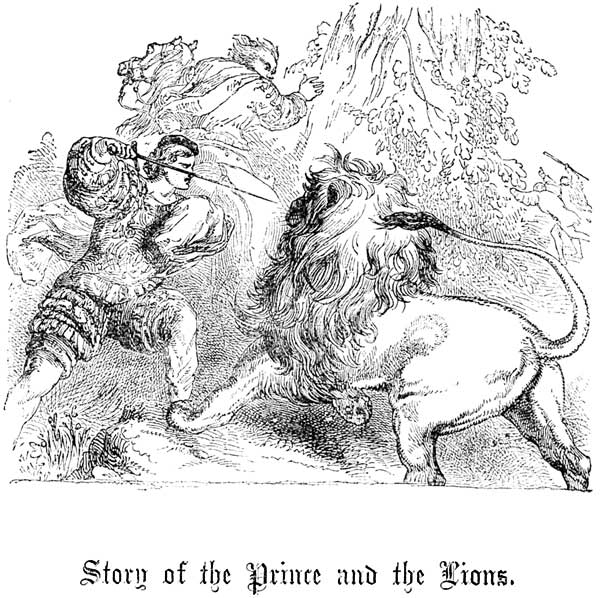
n a great city of the East lived Prince Azgid, who grew up to manhood beloved by every one, for he was virtuous, intelligent, and accomplished, though somewhat of a timorous disposition, and this was indeed his chief fault. His father had died, and he had reached now the proper age to mount the throne, a time having been already fixed for the ceremony, to which the young man was looking forward with great interest.
A few days previous to the event the old Vizier called upon the Prince, and telling him he wished to take a walk with him, led him out of the town to a mountain, on one side of which was a wide staircase of white marble, with a handsome balustrade on each side. It had three broad landings, and on these the Vizier and Prince[79] rested as they ascended the stairs, for it was of great height, and they were both sorely tired before they reached the top. There was a small house on the summit, out of which came a black slave, who made a profound obeisance to the visitors, and, leading the way, took them a short distance to a kind of arena dug in the ground, and faced also with white marble. He then took out a key and opened a brazen door, whereupon the Prince drew near, and, looking down, saw a red lion of fierce aspect and tremendous size. He wondered what it all meant, and gazed with a look of inquiry into the face of the Vizier, who, having ordered the servant to retire, thus spoke:
"My son," said he, "the day is now very near on which you are to ascend the throne; but before you can do so you must fulfil a custom which has been established for many ages, and which your father and all your ancestors submitted to; in short, you must descend into this den with a dagger, and fight yonder lion. This will test your courage and fortitude, and show whether you are really worthy of governing a kingdom."
When the young man heard this, he turned pale, and almost fell to the ground.
"This is a severe task," said he; "is there no alternative, nor any method by which I may evade it?"
"None, whatever," answered the Vizier.
"Can I not have a few days granted me to think over the matter, and prepare for the sore trial?" asked the youth.
"Oh, yes!" returned the other, "that you can have, of course." Whereupon he beckoned to the slave to lock the door, and the visitors descended the stairs and returned to the palace.
The joy of Azgid's life seemed now to have fled, and he was suddenly immersed in deep despair. The horrid combat he was to engage in was continually before him. He could neither eat nor drink, but wandered about the palace like one distracted, or sat moping for hours, with his head buried in his hands, speaking to no one. He was glad when night came, that he might hide himself from observation, and retired to his chamber in tears. But he found no comfort there. Sleep fled from him, and he lay tossing[80] upon his bed, anxiously awaiting the return of day. During the tedious hours of darkness he had meditated what course he had best pursue, and at length came to the resolution that he would extricate himself from the dilemma he was in by bidding farewell to his home, and seeking peace and safety in some far-distant land.
Accordingly, as soon as it was daylight, he hastily dressed himself, and going to the stables, mounted a fleet horse and rode off. Glad was he when he got outside the town, and turning round to take a last look, he thus exclaimed:
"Oh, cursed city! cursed home! what misery lies within you! May each hour carry me farther from you! and may these eyes never behold you again!"
With these words he put spurs to his horse, and was soon out of sight of the detested spot. He journeyed forward with a light heart, and on the third day came to a pleasant country overgrown with forest trees, intermingled with lawns and romantic vales.
Proceeding a little farther on, he heard the sound of delicious music, and soon overtook a handsome youth of ruddy countenance, somewhat younger than himself, playing on a flute, and leading a few sheep.
The shepherd, on seeing the stranger, stopped playing, and saluted him very courteously; but Azgid begged him to go on, telling him what an admirer of music he was, and that he had never in his life heard such enchanting strains.
The young man smiled at this compliment, and commenced playing some fresh tunes; and, when he had finished, he informed the Prince that he was slave to a rich shepherd named Oaxus, who lived near, and who would be rejoiced to see him, and show him some hospitality.
In a few moments they reached the abode of Oaxus.
It was a low stone building of considerable size, with a porch surrounding it, overgrown with vines and flowers. Around it was a large yard, encircled with a high wall, in which were some flocks of sheep, with a number of men tending them.
On entering, the old shepherd came forward and gave the stranger[81] a hearty welcome, leading him into a neat apartment, and setting before him a handsome repast. After Azgid had finished eating, he thought it his duty to give his kind host some information as to who he was, and thus spoke:
"My friend," said he, "you no doubt wonder at seeing a stranger of my appearance thus suddenly visiting you, and will naturally wish to inquire who I am. This wish I can only in part gratify. Suffice it to say that I am a Prince whom troubles at home have driven abroad; but my name I cannot tell. That is a secret lodged in my own breast, to be imparted to no one. If no inconvenience to you, it would please me much to remain in this delightful spot. I have ample means at my disposal, and will remunerate you for whatever trouble I may put you to."
Oaxus replied to this speech in the kindest manner, begging the young man to say nothing about remuneration, for that the company of one so exalted and accomplished would more than repay him for any trouble he might be put to in entertaining him, and that nothing would give him more happiness than to have him remain there to the end of his days.
"But come, Asdril," said he, addressing the musician, "take the Prince and show him what is most worthy to be seen in this neighbourhood. Lead him to the waterfalls, the fountains, the rocks and vales, for I perceive our guest is one able to appreciate nature's beauties."
The young shepherd did as requested, and, taking up his flute, led the youth to all the pleasantest and most interesting spots.
They wandered about the sloping hills and deep valleys, and over beautiful lawns, sprinkled with trees of immense size. At one time they stood by the side of some gently murmuring stream, and now they were startled with a romantic cascade, whose flashing waters tumbled from mossy cliffs and echoed far and wide. They now entered a shady vale, and, seating themselves on a rock, the shepherd commenced playing his flute. The Prince listened with delight, for, as we said before, he was passionately fond of music, and had never in his life heard any one who pleased him so much. Indeed, he made up his mind that, if ever he left the place, he[82] would endeavour to purchase from Oaxus the accomplished slave, and have him as his constant companion as long as he lived.
Thus did Azgid enjoy himself amid these delicious scenes, congratulating himself that he had escaped from all his troubles, and had at last reached a spot where he might live in peace and tranquillity for ever.
But his joy was not to last long; for young Asdril on a sudden rose up, and, taking his companion by the hand, told him it was time for them to be gone.
"Why so?" asked the Prince. "Why should we so soon leave these enchanting scenes?"
"Alas!" answered the shepherd, "this place is infested with lions. They come out at a certain hour every day, and we all have to retire within the walls of our abode and close the gates. See here," continued he, rolling up his sleeve, and showing a great scar on his arm, "this is what I received in an encounter with these fierce beasts. I once lagged behind, and was with great difficulty saved from destruction. So, let us lose no time, but make the best of our way home."
On hearing these words, the Prince turned pale; but he said nothing, and they silently returned to the house.
On reaching the gate, Azgid called for his horse, and, having mounted, told his host that he was about to leave, and thanked him for his kindness. "Farewell, Oaxus!" said he. "Farewell, young Asdril! I thought I should have remained here forever; but fate decrees otherwise. I must seek another abode, another home." And, so saying, he put spurs to his horse and galloped away.
He journeyed on and on, and soon left the groves and green valleys. The country became more barren, trees began to disappear, and, not long after, scarcely any verdure was visible. He was soon in the midst of the desert. Far as the eye could reach, the vast plain spread before him. Not a shrub or blade of grass could be seen, and nothing met the view but, now and then, some low sand-hills, piled up by the wind like drifts of snow, among which, with much fatigue to his horse, he pursued his way. The[83] sun blazed on him with great power; and it was with much satisfaction, on the third day, that he perceived in the distance a number of black tents, which he knew to be an encampment of Arabs.
As he drew near, a band of warriors, mounted on fine horses and brandishing their spears, came forth to meet him. This was their usual mode of welcoming a stranger.
They seemed struck with the appearance of Azgid, and showed him much respect, forming a sort of guard around him, and leading him to the tent of their chief.
The latter was a person of dignified aspect, somewhat past the prime of life. His name was Sheik Hajaar. He sat smoking in front of his tent; and, when the youth approached, he rose up and cordially saluted him. He then took him inside the tent, and set before him a repast, of which, when the young man had eaten, he thought it his duty to inform his kind host who he was.
"My friend," said he, "you are no doubt surprised at seeing a stranger of my appearance thus suddenly visiting you, and will naturally wish to inquire who I am. This wish I can only in part gratify: suffice it, then, to say that I am a Prince whom troubles at home have driven abroad, but my name I cannot tell; that is a secret lodged within my own breast, to be imparted to no one. If no inconvenience to you, it would please me much to remain here. I have ample means at my command, and will remunerate you for whatever trouble I may put you to."
The Sheik replied that the company of one so exalted and accomplished was remuneration enough, and that he would be rejoiced to have him as his guest for ever. He then introduced him to a number of his friends, and leading him out, presented him with a beautiful horse of great value. Azgid thought he had never in his life seen so fine an animal; and when he mounted him he found him so gentle and docile as scarcely to require any management, for the intelligent creature seemed to anticipate all his wishes.
"But, come," said the Sheik, "it is time for us to be off: to-day we hunt the antelope; you, Prince, will of course accompany us."
Azgid, with a smile, replied in the affirmative, and they started[84] off in pursuit of the game. They soon overtook a herd, and commenced chasing them—spears flew, and the air resounded with cries. The Prince was exhilarated with the sport, and enjoyed himself exceedingly. "Ah!" thought he, "this is a happy life, and these children of the desert are happy people: I am resolved never to quit them." The hunt lasted nearly the whole day, and about sunset the company returned with the spoil, which consisted of more than a dozen antelopes. These sports were kept up nearly every day, and Azgid's time passed most agreeably.
A week had now elapsed, and the youth had one night retired to rest, congratulating himself on the happy life he led, when the Sheik Hajaar quietly approached his couch, and thus spake:
"My son," said he, "I have come to tell you how much my people are pleased with you, and especially with the spirit you evince in the sports of the chase. But these sports do not comprise all our life: we have frequent wars with hostile tribes, where great valour is necessary. My men are all approved warriors, and, before they can have perfect confidence in you as a trusty comrade, desire to see some specimen of your prowess. Two leagues south of this is a range of hills infested with lions; rise, then, early on the morrow, mount your horse, take your sword and spear, and slay and bring us the skin of one of these savage beasts: then will we be assured of your courage, and have confidence in you in the day of battle."
Having thus spoke, the Sheik bid him good night, and retired. His words disturbed Azgid extremely. "Ah!" thought he, "here are the lions again! wherever I go I meet them. I thought I had found at last a quiet home, but I am mistaken; this is not the place for me." He then got out of bed, and, lifting up the covering of the tent, slipped out, and went first to see the horse the Sheik had given him. He found him tethered among the others, and, going up to him, threw his arms around him and kissed him. "Farewell, kind creature," said he, "I grieve to leave you!" The animal leaned his head on his shoulders, and seemed to return his good feelings. The youth then sought his own steed, and, having mounted him, started off.[85]
He rode over the trackless sands, with the bright stars glittering above him, a homeless wanderer, not knowing whither he was going. At length morning began to appear, and soon the sun rose and beat upon his head with its fierce rays; by the middle of the day he was rejoiced to perceive that he was leaving the desert; and late in the afternoon he reached a charming region of hill and dale, streams and meadows.
He soon after came to one of the most beautiful palaces he had ever seen. It was built of porphyry, and stood in the midst of an immense garden, where every plant and flower grew that could delight the sight or regale the senses. Trees loaded with all kinds of delicious fruits, some trimmed and cut into the most curious shapes, were seen on all sides. Statues of exquisite forms stood among them. From many of these fountains spouted upwards to a vast height, whose waters fell murmuring into large basins, where gold-fish, swans and other water-fowl were seen swimming about. Peacocks and other gorgeous birds strutted and flew around in every direction; and so many objects met the young man's eye, as he slowly rode up the broad avenue, that he stopped almost every moment to gaze and admire. At last lie reached the portico, which was raised twenty steps, and adorned with twelve columns of clear jasper.
The owner of the palace, who was an Emir of great wealth, was seated on the portico, in company with his daughter, the golden-haired Perizide.
On seeing a stranger of such dignified mien approaching, he rose up and went to welcome him. He led him up the steps, and introduced him to the young lady, who became at once interested with the looks and demeanour of the handsome youth. The Emir then took his guest inside the palace.
Azgid looked round with wonder. If the exterior of the building delighted him, how much more was he pleased with its interior? The hall was of vast size, with a noble staircase in the middle; the apartments were spacious, and shone with gold; the walls and ceilings were covered with the most exquisite paintings in fresco; and vases of precious stones, statues, and all kinds of rare curiosities[86] were ranged around; the windows were of something that resembled pearl, and were stained with different colours, so that, as the sun shone through them, the tesselated floor received the rays, and glittered with all the tints of the rainbow. Azgid gazed with astonishment. The Emir now set before him a collation composed of the most delicate viands, delicious fruits, and wines.
After he had finished eating, the Prince thought it his duty to inform his kind host who he was.
"Sir," said he, "you no doubt wonder at one of my appearance thus suddenly visiting you, and will naturally wish to inquire who I am. This wish I can only in part gratify. Suffice it, then, to say that I am a Prince whom troubles at home have driven abroad, but my name I cannot tell: that is a secret lodged in my own breast, to be imparted to no one. If no inconvenience to you, it would delight me much to remain with you; and at some future day, if fortune should again smile upon me, I will be happy to return the favour, and reciprocate your hospitality."
The Emir replied to this speech in the kindest manner, telling the youth that he did him a great honour in making him a visit, and that he hoped he would remain to the end of his days. He further informed him that he expected that night a number of his friends to favour him with their company, and, wishing to look after the preparations for the banquet, he begged his guest to excuse him for a short time.
When the Emir retired, Azgid was left alone with the fair Perizide, and was struck more than ever with her ravishing beauty. In fact, he fell deeply in love with her. She, on her part, seemed not insensible to his merits, and exerted herself to amuse and entertain him. She led him into the garden, showing him all the rare sights, and bidding him observe the consummate art with which the shrubbery and trees were arranged, and the charming green alleys and vistas which opened before them as they walked along.
They explored the beauties of this fairy scene, seating themselves by the side of the glittering fountains, and sometimes beneath the dark shadows of the flowery arbours, through which the rays of a bright full moon began now to penetrate.[87]
They then returned to the palace, and, approaching, heard the strains of festive music, and perceived the building illuminated from top to bottom. They passed through the throngs on the portico, and entered the house, which was lit up with hundreds of dazzling lustres, and crowded with guests, all habited in splendid dresses. Perizide led the youth into the grand saloon, and seated him on one of the purple divans.
The attendants now served up a splendid supper, brought in on gold and silver trays, and which consisted of every delicacy that could be procured. It was made up of many courses, and lasted a considerable time, and at its conclusion the room was partially cleared, and a number of dancing girls, of elegant form and richly clad, entered the apartment, and amused the guests with their graceful movements. Azgid, observing a lute lying near him, took it up, and, telling the lady how fond he was of music, begged her to favour him with an air. Perizide complied with his request very graciously, and commenced playing. The Prince listened with delight, and was drinking in the soft strains with rapt attention, when he suddenly heard a loud and very unusual sound.
"What noise is that?" asked the youth.
"I heard nothing," replied his companion; "nor do I think there was any. It is your imagination only that fancies it."
Whereupon she went on playing; but she had only proceeded a few minutes, when the Prince started a second time.
"There it is again!" said he. "Did you not hear it?"
"I heard nothing," answered Perizide, "but the sound of music and the merry voices of hundreds of happy guests. It must be your imagination, Prince, as I said before, and nothing else."
"Perhaps it is," returned the youth, striking his forehead. "You must pardon me, fair lady: I have lately passed through many trying scenes, and I fear my nerves are none of the strongest."
Perizide thereupon resumed her lute, but she had not proceeded very long, when her guest again cried out,
"Oh!" said he, "tell me not that this is imagination! I heard it most distinctly. Explain to me I pray, what it means."
"Oh," replied the young lady, laughing, "that is Boulak, our[88] black porter. He is a great pet and a privileged character; he gets drowsy sometimes, and often yawns, and that was the sound you just heard."
"Good Heavens!" said Azgid, "what lungs he must have, to make such a yawn as that!"
Perizide made no reply except a smile, but went on playing the lute, when, having finished, the Prince complimented her highly for her performance. It was by this time pretty late, and the guests gradually retired; Perizide also went to her chamber, and the Prince and the Emir were left alone.
They passed nearly an hour smoking and conversing very pleasantly, till at length the host rose up, and telling his guest it was bed-time, took him by the hand to lead him to his chamber. They proceeded to the hall, and soon reached the great staircase, which was of white marble, with a handsome balustrade on each side. When they came to the foot of it, Azgid gazed for a moment admiring its beauty; but what was his horror, when, on looking up, he spied a black lion of immense size lying stretched on the topmost landing. He trembled and turned pale.
"What is that?" said he, pointing with his finger.
"Oh," returned the Emir, "that is Boulak, our black porter. He is tame, and will not hurt you if you are not afraid of him; but he can tell when any one fears him, and then he becomes ferocious."
"I fear him," whispered the Prince, "and fear him greatly."
"You must cast aside your fear, my son," replied the other, "and then there is not the slightest danger."
"That is easier said than done," answered the youth. "I try to cast it aside, but do not succeed. No, I believe I will not go to my chamber, but will sleep somewhere else, where there is no need of approaching this terrible beast."
"Just as you like," replied the Emir. "You can return to the saloon, and repose on one of those divans."
The Prince accordingly took up his lodgings in the saloon, and having bid his friend "Good night," he carefully locked the door and windows, making everything as secure as possible. He then[89] lay down on the cushions, listening eagerly if he might perchance hear any sound. But all was silent; for every soul had retired, and the vast mansion presented a striking contrast to the noisy merriment which a little while before had reigned everywhere.
The young man now composed himself to rest, thinking that the lion was most probably fast asleep and would not disturb him—but he was mistaken; for in the course of an hour he heard most evidently a soft, heavy tread coming down the stairs. The beast, on reaching the hall, seemed for a moment to pause; then his steps were heard moving along the vast corridor, till it could be no longer distinguished.
Azgid now breathed more freely, and was in hopes that his tormentor had retired to some secluded part of the building, and had gone to sleep; but he was doomed to be disappointed, for in a short time he heard the faint steps approaching nearer and nearer, and perceived that the beast stopped every now and then, snuffing with his nose, as if in search of some one. At last he came to the door, putting his nose at the lower part, and snuffing louder than ever; then he sprang with his fore feet against it, giving it such a push as almost to burst it open, and at the same time uttering a tremendous roar, which echoed through the palace.
Azgid jumped from his couch in dismay, and retreated to the farthest corner of the room; his hair stood on end, and the cold perspiration rolled from his body. He believed for a certainty that the door would fly open, and then the lion would rush in and devour him; but nothing of the kind occurred, for in a few moments the beast again went upstairs, and nothing more was heard of him.
The Prince then lay down on his couch—but not to sleep: he revolved in his mind all that had happened to him since his departure from his own city, and thinking that Providence would not afflict him in such a manner for nought, but that there must be some design in it, he came to the determination that he would instantly return home, and fulfil the law and custom of his country by fighting the lion.
Early on the morrow, the Emir came to wake his guest, and bid[90] him "Good morning." He found the young man in tears, and putting his arm round him, thus spoke:
"My son," said he, "your behaviour last night, when about to retire, surprised me greatly, and my amazement is increased now at seeing you in this unhappy state. What ails you, my son? Tell me all, and hide nothing from me; and first let me know frankly who you are?"
"I am one," replied the youth, "who has fled from duty. I am Azgid, son of the renowned King Almamoun. I fled from a work Providence assigned to me to perform—but my sin followed me. I searched far and wide for comfort, but in vain—trouble and disaster pursued me wherever I went. But I have repented, and am now going back to retrieve my error, and meet the trial from which I once endeavoured to escape."
"I am rejoiced to hear you thus speak," said the Emir. "I was well acquainted with your father, and think I know now from what duty it was you tried to escape. Go back, then, to your home, my son, and may Heaven grant you strength to perform your excellent resolution."
He then ordered his guest's horse to be brought, which when the youth hath mounted, he asked his host to remember him to the beautiful Perizide, and beg her to excuse him for leaving her in so strange and abrupt a manner.
"I will do as you desire," replied the other, "and when my daughter learns the cause of your departure, she will think more of you than ever."
Thus with mutual good wishes the two friends separated, and Azgid rode away. He pursued the same route he had travelled before, and on the second day reached the desert and the encampment of the Arabs. He found the Sheik Hajaar, sitting in his tent door, calmly smoking his pipe: the Sheik was surprised at seeing him, and begged him to dismount and refresh himself; but this the Prince refused to do, saying that he had only come to explain his past strange behaviour in leaving his hospitable abode so abruptly.
"I am Azgid," continued he, "son of the renowned King[91] Almamoun. I was sorely troubled in mind when I visited you, for I had fled from duty; but I am now going back to retrieve my error and begin a new life. But tell me, I pray, how is that beautiful animal I used to ride with so much pleasure?"
"He is well," answered the other, "and it would please me much if you could remain and ride him again; but I feel that it would be wrong to interrupt you in such a pious journey as you now undertake. Go on, then, my son: may Heaven prosper you in your good resolutions, and peace be with you."
So saying, he bade the Prince farewell, and the latter, having returned his salutation, rode off.
He pursued his course rapidly, and in a day or two arrived at the abode of Oaxus, whom he found in the courtyard, busily engaged in tending his sheep and goats. The old man was delighted to see him, and begged him to dismount; but the Prince declined doing so, and went on to explain who he was in the same words he had used to the Sheik Hajaar. Oaxus was much astonished when he heard the account, and congratulated the young man on the happy change that had come over him.
"Go on, my friend," continued he: "may Heaven prosper you, and give you strength to carry out your wise designs."
"Farewell," replied Azgid, "and tell young Asdril that if fortune favours me, I hope one day to be back, and listen to his sweet music again in spite of the lions."
With these words he rode away, and travelling on, in due time reached his own city. He proceeded at once to the palace, and sought out the old Vizier, to whom he related all that had happened to him, and all that he intended to do, without concealing anything.
"And now," said he, "lead me at once to the lion, and let me fight him and fulfil the law, as all my ancestors have done before me."
The old man heard this speech with great pleasure, and almost wept for joy: he tenderly embraced his young friend, and, smiling, told him not to run into extremes nor to be in too great a hurry; for that his trial with the lion had better be put off for a week at least, and that in the meantime he needed rest and refreshment.[92] To this suggestion Azgid acceded, and waited till the day his friend had fixed upon.
It at length arrived, and very early in the morning the Prince arose and prepared for the combat. He clad himself in a light garment, tying a sash around it, in which he stuck a sharp dagger, took a spear in his hand, and, accompanied by the Vizier, left the palace and proceeded to the mountain. They climbed up the high steps and reached the top, whereupon the slave met them, and, going before, unlocked the gate. The young man looked down and saw the lion, sitting on his haunches, at one end of the arena; he then shook hands with his companions, and committing himself to the care of Heaven, sprang in. The beast gave a loud roar when he saw him, and crouching down, drew himself slowly toward his opponent, glaring fiercely on him all the while. The Prince quailed not, but gazed steadily on the animal, and advanced on him spear in hand; the lion now gave another loud roar, and bounding forward, sprang over the youth's head. He then returned, and commenced licking his hands and rubbing himself against his body.
The Vizier now called out joyfully to his young friend, telling him he had conquered, and begging him to approach; and, with the assistance of the slave, he lifted him out of the den, the lion following like a dog.
"Yes, Azgid," continued the old man, embracing the Prince, "the beast is tame and will injure no one; but, ignorant of this, you encountered him, and the proof of your valour is complete. Come, then, and ascend your throne, for you are worthy of it."
They then began to descend the stairs, and Azgid, observing a couple of figures on the landing, asked the Vizier who they were.
"I know not," replied he; "I can see them, but the height is too great for me to distinguish who they are."
In a little while they reached the platform, when the new-comers proved to be Oaxus and Asdril.
"Azgid," said the old shepherd, "I have come to congratulate you on your good fortune and happy deliverance; and here, too, is young Asdril, whose music you so much admired, and whom I now present to you as your own."[93]
"Oaxus," replied the Prince, "I heartily thank you; and as for you, Asdril, you are no longer a slave: from this moment you are free. You shall be the companion of my leisure hours, and entertain me with your delightful strains."
They now began to descend again; and Azgid, observing a group on the second landing, asked the Vizier who they were.
"I know not," replied he; "I can see them, but the height is too great for me to distinguish who they are."
In a little while they reached the platform, when the new-comers proved to be the Sheik Hajaar, with a group of Arabs, leading the beautiful horse with which the Prince had been so much pleased.
"Azgid," said the Sheik, "I have come to congratulate you on your good fortune and happy deliverance. I have brought you as a present the horse you used to ride when you honoured me with a visit: will your Highness deign to accept of it as a slight testimonial of my loyal regard?"
"Valiant Sheik," answered the young man, "I am rejoiced to see you again, and receive with gratitude your noble gift; you could not have given me anything more acceptable."
He then embraced the Sheik, and kissed the beautiful animal, who seemed to recognize him.
They then began to descend; and the Prince, observing at the bottom of the stairs quite a concourse of people, inquired of the Vizier who they were.
"I know not," replied he; "I can see them, but the height is too great for me to distinguish who they are."
In a little while they reached the end of the staircase, when the new-comers proved to be the Emir, with a large retinue of his guards, with music and banners.
"Azgid," said the Emir, "I am come to congratulate you on your good fortune and happy deliverance. I have brought no present; that I considered needless, since myself and all that I have are yours."
"Noble Emir," cried the youth, "I am rejoiced to see you—tell me, how is Perizide? as soon as I have been crowned I intend to visit her with the speed of lightning."[94]
"There is no need of that," returned the other: "come with me;" and, so saying, he led the young man to a splendid white steed, on which sat a lady, covered with a long veil. The Emir lifted the veil, and Azgid beheld the beautiful face of his beloved mistress.
Their meeting, as may be imagined, was most tender and affectionate; and the Vizier, having ordered the music to strike up, the whole procession moved toward the palace.
"How strange it seems!" said the Prince: "when I fled from my duty everything went wrong with me; but now, after fulfilling it, good luck meets me at every step."
Azgid was crowned the same day, and in the evening his nuptials with the fair Perizide were celebrated; they lived long and happily; and the Prince ordered the story of his life to be written in the annals of the kingdom, and an inscription in gold letters to be placed over the door of the palace, with these words: "Never run from the lion."


n days of yore there lived in the flourishing city of Cairo a Hebrew Rabbi, by name Jochonan, who was the most learned of his nation. His fame went over the East, and the most distant people sent their young men to imbibe wisdom from his lips. He was deeply skilled in the traditions of the fathers, and his word on a disputed point was decisive. He was pious, just, temperate, and strict; but he had one vice: a love of gold had seized upon his heart, and he opened not his hand to the poor. Yet he was wealthy above most: his wisdom being to him the source of riches. The Hebrews of the city were grieved[96] at this blemish on the wisest of their people; but, though the elders of the tribes continued to reverence him for his fame, the women and children of Cairo called him by no other name than that of Rabbi Jochonan the Miser.
None knew so well as he the ceremonies necessary for initiation into the religion of Moses, and, consequently, the exercise of those solemn offices was to him another source of gain. One day, as he walked in the fields about Cairo, conversing with a youth on the interpretation of the law, it so happened that the Angel of Death smote the young man suddenly, and he fell dead before the feet of the Rabbi, even while he was yet speaking. When the Rabbi found that the youth was dead, he rent his garments, and glorified the Lord. But his heart was touched, and the thoughts of death troubled him in the visions of the night. He felt uneasy when he reflected on his hardness to the poor; and he said,
"Blessed be the name of the Lord! The first good thing that I am asked to do in that holy name will I perform." But he sighed, for he feared that some one might ask of him a portion of his gold.
While yet he thought upon these things, there came a loud cry at his gate.
"Awake, thou sleeper!" said the voice, "awake! A child is in danger of death, and the mother hath sent me for thee, that thou mayest do thine office."
"The night is dark and gloomy," said the Rabbi, coming to his casement, "and mine age is great: are there not younger men than I in Cairo?"
"For thee only, Rabbi Jochonan, whom some call the Wise, but whom others call Rabbi Jochonan the Miser, was I sent. Here is gold," said he, taking out a purse of sequins; "I want not thy labour for nothing. I adjure thee to come, in the name of the living God."
So the Rabbi thought upon the vow he had just made, and he groaned in spirit, for the purse sounded heavy.
"As thou hast adjured me by that name, I go with thee," said he to the man; "but I hope the distance is not far. Put up thy gold."[97]
"The place is at hand," said the stranger, who was a gallant youth, in magnificent attire. "Be speedy, for time presses."
Jochonan arose, dressed himself, and accompanied the stranger, after having carefully locked up all the doors of his house, and deposited his keys in a secret place—at which the stranger smiled.
"I never remember," said the Rabbi, "so dark a night. Be thou to me as a guide, for I can hardly see the way."
"I know it well," replied the stranger with a sigh. "It is a way much frequented, and travelled hourly by many. Lean upon mine arm, and fear not."
They journeyed on, and, though the darkness was great, yet the Rabbi could see, when it occasionally brightened, that he was in a place strange to him.
"I thought," said he, "I knew all the country for leagues about Cairo, yet I know not where I am. I hope, young man," said he to his companion, "that thou hast not missed the way." And his heart misgave him.
"Fear not," returned the stranger; "your journey is even now done." And, as he spoke, the feet of the Rabbi slipped from under him, and he rolled down a great height. When he recovered, he found that his companion had fallen also, and stood by his side.
"Nay, young man," said the Rabbi, "if thus thou sportest with the grey hairs of age, thy days are numbered. Woe unto him who insults the hoary head!"
The stranger made an excuse, and they journeyed on some little farther in silence. The darkness grew less, and the astonished Rabbi, lifting up his eyes, found that they had come to the gates of a city which he had never before seen. Yet he knew all the cities of the land of Egypt, and he had walked but half an hour from his dwelling in Cairo. So he knew not what to think, but followed the man with trembling.
They soon entered the gates of the city, which was lighted up as if there were a festival in every house. The streets were full of revellers, and nothing but a sound of joy could be heard. But when Jochonan looked upon their faces, they were the faces of men pained within; and he saw, by the marks they bore, that they were[98] Mazikin.[1] He was terrified in his soul, and, by the light of the torches, he looked also upon the face of his companion, and, behold! he saw upon him too the mark that showed him to be a Demon. The Rabbi feared excessively—almost to fainting; but he thought it better to be silent, and sadly he followed his guide, who brought him to a splendid house in the most magnificent quarter of the city.
[1] Demons
"Enter here," said the Demon to Jochonan, "for this house is mine. The lady and the child are in the upper chamber." And accordingly the sorrowful Rabbi ascended the stairs to find them.
The lady, whose dazzling beauty was shrouded by melancholy beyond hope, lay in bed; the child, in rich raiment, slumbered on the lap of the nurse, by her side.
"I have brought to thee, light of my eyes!" said the Demon, "Rebecca, beloved of my soul! I have brought unto thee Rabbi Jochonan the Wise, for whom thou didst desire. Let him, then, speedily begin his office; I shall fetch all things necessary, for he is in haste to depart." He smiled bitterly as he said these words, looking at the Rabbi, and left the room, followed by the nurse.
When Jochonan and the lady were alone, she turned in the bed towards him, and said,
"Unhappy man that thou art! knowest thou where thou hast been brought?"
"I do," said he, with a heavy groan. "I know that I am in a city of the Mazikin."
"Know then, further," said she, and the tears gushed from eyes brighter than the diamond, "know then, further, that up one is ever brought here unless he hath sinned before the Lord. What my sin hath been imports not to thee—and I seek not to know thine. But here thou remainest for ever—lost, even as I am lost." And she wept again.
The Rabbi dashed his turban on the ground, and, tearing his hair, exclaimed, "Woe is me! Who art thou, woman, that speakest to me thus?"
"I am a Hebrew woman," said she, "the daughter of a Doctor of the Laws, in the city of Bagdad; and being brought hither—it matters not how—I am married to a Prince among the Mazikin, even him who was sent for thee. And that child whom thou sawest is our first-born, and I could not bear the thought that the soul of our innocent babe should perish. I therefore besought my husband to try and bring hither a priest, that the law of Moses (blessed be his memory!) should be done; and thy fame, which has spread to Bagdad, and lands farther towards the rising of the sun, made me think of thee. Now, my husband, though great among the Mazikin, is more just than the other Demons; and he loves me, whom he hath ruined, with a love of despair. So he said that the name of Jochonan the Wise was familiar unto him, and that he knew thou wouldst not be able to refuse. What thou hast done to give him power over thee is known to thyself."
"I swear, before Heaven," said the Rabbi, "that I have ever diligently kept the law, and walked steadfastly according to the traditions of our fathers from the days of my youth upward. I have wronged no man in word or deed, and I have daily worshipped the Lord, minutely performing all the ceremonies thereto needful."
"Nay," said the lady, "all this thou mightest have done, and more, and yet be in the power of the Demons. But time passes, for I hear the foot of my husband mounting the stair. There is one chance of thine escape."
"What is that, O lady of beauty?" said the agonized Rabbi.
"Eat not, drink not, nor take fee or reward while here, and as long as thou canst do thus, the Mazikin have no power over thee, dead or alive. Have courage and persevere."
As she ceased from speaking, her husband entered the room, followed by the nurse, who bore all things requisite for the ministration of the Rabbi. With a heavy heart he performed his duty, and the child was numbered among the Faithful. But when, as usual, at the conclusion of the ceremony, the wine was handed round to be tasted by the child, the mother, and the Rabbi, he refused it when it came to him, saying,[100]
"Spare me, my lord, for I have made a vow that I fast this day, and I will eat not, neither will I drink."
"Be it as thou pleasest," said the Demon; "I will not that thou shouldst break thy vow." And he laughed aloud.
So the poor Rabbi was taken into a chamber looking into a garden, where he passed the remainder of the night and the day, weeping and praying to the Lord that He would deliver him from the city of Demons. But when the twelfth hour came, and the sun was set, the Prince of the Mazikin came again unto him, and said,
"Eat now, I pray thee, for the day of thy vow is past." And he set meat before him.
"Pardon again thy servant, my lord," said Jochonan, "in this thing. I have another vow for this day also. I pray thee be not angry with thy servant."
"I am not angry," said the Demon; "be it as thou pleasest: I respect thy vow." And he laughed louder than before.
So the Rabbi sat another day in his chamber by the garden, weeping and praying; and when the sun had gone behind the hills, the Prince of the Mazikin again stood before him, and said,
"Eat now, for thou must be an hungered. It was a sore vow of thine." And he offered him daintier meats.
And Jochonan felt a strong desire to eat, but he prayed inwardly to the Lord, and the temptation passed, and he answered, "Excuse thy servant yet a third time, my lord, that I eat not. I have renewed my vow."
"Be it so, then," said the other: "arise, and follow me."
The Demon took a torch in his hand, and led the Rabbi, through winding passages of his palace, to the door of a lofty chamber, which he opened with a key that he took from a niche in the wall. On entering the room, Jochonan saw that it was of solid silver—floor, ceiling, walls, even to the threshold and the door-posts; and the curiously carved roof and borders of the ceiling shone in the torchlight as if they were the fanciful work of frost. In the midst were heaps of silver money, piled up in immense urns of the same metal, even over the brim.[101]
"Thou hast done me a serviceable act, Rabbi," said the Demon: "take of these what thou pleasest; ay, were it the whole."
"I cannot, my lord," said Jochonan. "I was adjured by thee to come hither in the name of God, and in that name I came, not for fee or for reward."
"Follow me," said the Prince of the Mazikin; and Jochonan did so into an inner chamber.
It was of gold, as the other was of silver. Its golden roof was supported by pillars and pilasters of gold, resting upon a golden floor. The treasures of the kings of the earth would not purchase one of the four and twenty vessels of golden coins, which were disposed in six rows along the room. No wonder! for they were filled by the constant labours of the Demons of the Mine. The heart of Jochonan was moved by avarice when he saw them shining in yellow light, like the autumnal sun, as they reflected the beams of the torch. But God enabled him to persevere.
"These are thine," said the Demon: "one of the vessels which thou beholdest would make thee richest of the sons of men, and I give thee them all."
But Jochonan refused again, and the Prince of the Mazikin opened the door of a third chamber, which was called the Hall of Diamonds. When the Rabbi entered, he screamed aloud, and put his hands over his eyes, for the lustre of the jewels dazzled him, as if he had looked upon the noonday sun. In vases of agate were heaped diamonds beyond numeration, the smallest of which was larger than a pigeon's egg. On alabaster tables lay amethysts, topazes, rubies, beryls, and all other precious stones, wrought by the hands of skilful artists, beyond power of computation. The room was lighted by a carbuncle, which, from the end of the hall, poured its ever-living light, brighter than the rays of noontide, but cooler than the gentle radiance of the dewy moon. This was a sore trial to the Rabbi; but he was strengthened from above, and he refused again.
"Thou knowest me, then, I perceive, O Jochonan, son of Ben-David," said the Prince of the Mazikin. "I am a Demon who would tempt thee to destruction. As thou hast withstood so far,[102] I tempt thee no more. Thou hast done a service which, though I value it not, is acceptable in the sight of her whose love is dearer to me than the light of life. Sad has been that love to thee, my Rebecca! Why should I do that which would make thy cureless grief more grievous?—You have yet another chamber to see," said he to Jochonan, who had closed his eyes, and was praying fervently to the Lord, beating his breast.
Far different from the other chambers, the one into which the Rabbi was next introduced was a mean and paltry apartment without furniture. On its filthy walls hung innumerable bunches of rusty keys of all sizes, disposed without order. Among them, to the astonishment of Jochonan, hung the keys of his own house—those which he had put to hide when he came on this miserable journey—and he gazed upon them intently.
"What dost thou see," said the Demon, "that makes thee look so eagerly? Can he who has refused silver and gold and diamonds be moved by a paltry bunch of rusty iron?"
"They are mine own, my lord," said the Rabbi. "Them will I take, if they be offered me."
"Take them, then," said the Demon, putting them into his hand: "thou mayst depart. But, Rabbi, open not thy house only when thou returnest to Cairo, but thy heart also. That thou didst not open it before was that which gave me power over thee. It was well that thou didst one act of charity in coming with me without reward, for it has been thy salvation. Be no more Rabbi Jochonan the Miser."
The Rabbi bowed to the ground, and blessed the Lord for his escape. "But how," said he, "am I to return, for I know not the way?"
"Close thine eyes," said the Demon.
He did so, and, in the space of a moment, heard the voice of the Prince of the Mazikin ordering him to open them again. And behold, when he opened them, he stood in the centre of his own chamber, in his house at Cairo, with the keys in his hand.
When he recovered from his surprise, and had offered thanksgivings to God, he opened his house, and his heart also. He gave[103] alms to the poor, he cheered the heart of the widow, and lightened the destitution of the orphan. His hospitable board was open to the stranger, and his purse was at the service of all who needed to share it. His life was a perpetual act of benevolence, and the blessings showered upon him by all were returned bountifully upon him by the hand of God.
But people wondered, and said, "Is not this the man who was called Rabbi Jochonan the Miser? What hath made the change?"
And it became a saying in Cairo. When it came to the ears of the Rabbi, he called his friends together, and he avowed his former love of gold, and the danger to which it had exposed him, relating all which has been above told, in the hall of the new palace that he built by the side of the river, on the left hand, as thou goest down the course of the great stream. And wise men, who were scribes, wrote it down from his mouth for the benefit of mankind, that they might profit thereby. And a venerable man, with a beard of snow, who had read it in these books, and at whose feet I sat that I might learn the wisdom of the old time, told it to me. And I write it in the tongue of England, the merry and the free, on the tenth day of the month Nisan, in the year, according to the lesser computation, five hundred ninety and seven, that thou mayest learn good thereof. If not, the fault be upon thee.

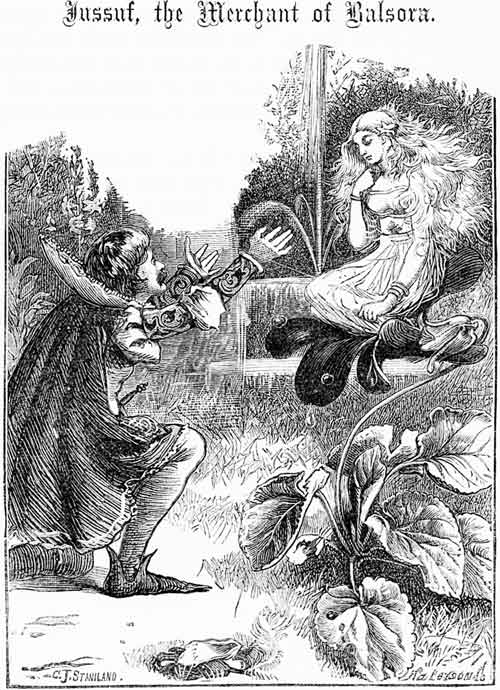
any hundred years ago, when the renowned Caliph Haroun al Raschid ruled in Bagdad, there lived in the town of Balsora a merchant of good repute, who was called Jussuf. He had received a considerable property by inheritance from[105] his father; and his paternal house, which was esteemed as the most splendid palace of the town, was situated on one of the finest spots. He was obliged to keep a great number both of male and female slaves, as well for the management of his household affairs, as also to assist him in his commercial pursuits, for his business was very extensive. The largest warehouse in the bazaar of the city belonged to him, and it was always filled with the most precious goods, which he caused to be collected from the remotest parts of the globe—either in ships or on the backs of his camels. There you might see all the rarest and choicest gifts of nature, together with the finest and richest productions of art; the most costly tissues and stuffs, the most valuable vessels and implements of silver and gold; elegant jewellery and trinkets, adorned skilfully with sparkling stones of considerable value, heaped up one on another. But the agreeable manner and contrast in which all these were exposed for sale gratified the eye more than even the costly articles themselves. It was not, therefore, to be wondered at that the crowd in his warehouse, in so great and rich a city, was very numerous.
It had already become a custom for people to apply to Jussuf if they wished to buy anything which had come in fashion with the wealthy citizen, either on account of its intrinsic value or of its skilful workmanship. Could they find the required goods as fine or as beautiful at another magazine, still they always preferred to go to Jussuf, even if they paid him more dearly for them. They felt confident that they should find everything more genuine, more handsome, and more tasteful there than at any other merchant's. This, however, may have been only a favourable prepossession; but it is nevertheless certain, that in no other warehouse were so many objects, alike useful and ornamental, collected together, as in that of Jussuf.
And as his business flourished more and more, so his riches increased from day to day. At the same time his cares and exertions in watching after the number of men whom he employed, his zeal in the equipment of his ships, and in the forwarding and dispatching of his caravans, increased in equal measure.
He had continued his business in this way for several years, and[106] had altogether neglected his health through his perseverance and unflinching attention, when he felt at once that his usual strength was declining, and that he should soon become exhausted unless he permitted himself at times to take some recreation. He therefore very willingly took the opportunity which offered itself accidentally about this time of buying a fine estate. It was situated only a few miles from the town, by the side of a stream, in a country as pleasant as it was fruitful, combining means for hunting and for fishing; and the price was so moderate that he resolved on the purchase without much consideration. He purposed to detach himself for a few weeks from his business, and to devote himself to pleasure and repose in the quiet and calm of his country residence. He caused a new and elegant country house to be built by a skilful architect on an eminence, instead of the old one, surrounded by a large pleasant artificial garden. As all was settled and prepared, he shut up his warehouse at the end of every week early enough for him to ride over. There he would repose from the troubles of the preceding days, and recreate himself with hunting and fishing, and collect new strength in the peaceful serenity of his country estate.
But custom is often stronger than our inclinations: he had become so accustomed to an active life, that his thoughts always returned to his wares in his warehouse, or to his ships that were transporting his goods over distant seas. Hence it happened that he soon entertained a hope of drawing large profits, as well as the restoration of his health, from this country residence. He employed himself very successfully in the chase and in fishing, or in raising choice flowers in the beds before his house, or else with the care of rare foreign birds, which he fed and kept in a large aviary. But these only charmed him for a time: the chase of wild beasts appeared to him too soon to be but a cruel sport; fishing was tedious; the cultivation of his flowers, too, was monotonous; and, if he contemplated the imprisoned foreign birds, he heartily pitied them because they were deprived of freedom. One day he had tried everything to divert himself, but without success; at last he seated himself, half discontented, in the open colonnade which[107] extended along the side of his country house, and his eye glanced over the flower-beds before him into the extreme distance: there his gaze could follow over a small tract the course of the river Schat al Arab, which, rising at the mouths of the Euphrates and Tigris, flows between shores clothed with verdure. Some large merchant ships were sailing by; several fishing-boats were visible.
"Ah, thou magnificent stream!" exclaimed Jussuf, who had given himself to reflection after he had viewed it for some time; "what a pity that thou must fall into the sea so soon below the kingly town of Balsora! There thou art, wasted and forgotten; the navigator on the great sea never thinks that the streams of his native country flow mingled with the waves through which the keel of his ship cuts. Now, then," continued he, after a short reflection, "it is all the better for me: now I am still active in business; my ships set out at morning, noon, and evening; my camels march to India through the deserts of Arabia, and the plains of Tartary and Persia; thousands and thousands of men call me still the rich and great merchant Jussuf, and praise me as the most lucky of mortals; yet a little while, and my existence will be lost as thine, in the sea of eternity."
Among such earnest considerations and soliloquies, he had hardly observed that a large variegated butterfly, hovering over the neighbouring flower-bed, moved slowly to and fro, just as if it were undecided in choosing on which flower it would alight. He was very attentive to its broad wings, which glittered with the most splendid colours, while the insect, brilliantly variegated, settled on a scarlet poppy, as though it wished to eclipse the magnificence of the flower with the variety of its different hues.
"What splendid colours! What beautifully delineated wings!" exclaimed Jussuf. "Oh that I might possess the rare insect! The dyers who stain my silk stuffs, and the weavers, might take the liveliness of the colours, the design, and the well-wrought combination of colours, for a pattern."
When the butterfly settled itself quietly on the poppy, Jussuf approached it carefully to catch it; but, as he had no other convenient thing at his hand, he took off his turban, and covered the[108] butterfly and the flower. The butterfly had not flown away, therefore it must be under the turban. Already he rejoiced at his lucky capture, and was proceeding to raise the turban slowly a little on one side, in order to seize the imprisoned insect securely, when he remarked that the turban was raising itself, and that under it a human form was growing up higher and higher out of the flower. Full of astonishment, he drew back a step. As he kept his eyes fixed on the object, a maiden of astonishing beauty appeared before him, such as he had never before seen. Her face was veiled, and his turban was on her head: smilingly she removed it, and extended it to him, saying, with a mischievous look,
"There, friend Jussuf, take it again: this turban is accustomed to ornament a brain in which rule very earnest and high thoughts; it would, perhaps, feel very badly honoured were it to serve as a covering for my frivolous caprices."
"Thou jestest, high daughter of a genius," exclaimed Jussuf, sinking on his knees: "thy incomparable beauty testifies that thou art no ordinary mortal, if even the wonderful manner in which thou hast appeared had not fixed it beyond all doubt."
"It may be," replied the maiden, "that thou hast rightly guessed. But that is no matter; I am come here to-day to help to banish your idle thoughts: come, run a race with me."
Immediately she threw the poppy which he had covered with his turban roughly in his face, and ran away. Jussuf remained irresolute, and looked after her; then she stopped her pace, and called back to him,
"Art thou transformed into a statue? canst thou not run? run, and catch me, if you can."
Her mischievous manner gave her an irresistible grace, which urged him to begin the race, even although he did not wish to join in it. She flew on, allowing him sometimes to approach her, and then turned suddenly aside out of the way, and ran over the turf to avoid him: she did not even spare the flower-beds; and when she wanted to escape from him, she passed over them without caring for the finest plants. The more she provoked him in different ways, the more he exerted all his strength to catch her.[109] At last she appeared exhausted, and threw herself, breathing heavily, on a bank of turf. "Here is an asylum," exclaimed she.
Tired and breathless with the unusual exertion of running, he followed her example, and sat down near her on the bank. While they were resting, she plucked some flowers and branches of a flourishing shrub, which had spread itself from the bank into a green roof over their heads, and skilfully wove a garland.
"Come," said she to Jussuf, when the wreath was ready, "come, let us throw up the garland."
She arose at these words and led him to the nearest open space; she leaped around, dancing in a circle and holding the garland on high in her right hand, and then threw it up high into the air. The garland of flowers rose while she sang these words:
High above the shoots of the surrounding trees it seemed to remain hovering in the sunshine which lighted the colours of the flowers, inducing a very peculiar splendour. Then it sank down gradually in soft vibrations, and settled on her head, as if she had placed it there herself as a crown. She took it from her locks and handed it to Jussuf.
"Now it is thy turn," said she; "throw it up, and see whether it will fall on thy head."
Jussuf took it and threw it as high as he could; but it did not from his hand attain the sunny height, and the garland fell quickly, and at a great distance, to the ground before him. By the time he had altogether recollected himself, she was at the spot, and had already raised the garland, and was laughing heartily at his awkwardness. She threw it up, dancing in the former manner, and sang the spell. This time also the garland ascended high above the tops of the trees into the sunshine, and sank down on her head as at first. Jussuf must needs try again, but he succeeded no better than before. Thereupon she again threw it up, and caught[110] it once more. After she had thus shown him several times, she cried out, laughing mischievously,
"Well, hast thou not yet observed why thou failest? Why dost thou not sing my little song when thou throwest up the garland? Try once more, and sing the spell; then it will succeed better."
Jussuf did so. He threw the garland and sang the verse; and, behold, the garland hovered in the sunshine, and descended in soft vibrations on his head, crowning his turban.
"Dost thou see?" said the maiden, laughingly: "the spell is of very great avail." She threw up the wreath again several times, and then she took it, and exclaimed, "Now it is enough; but the game will be tedious." She threw it up high, and sang:
The garland floated far out over the open space towards the edge of the park; there it melted suddenly in the air, and the blossoms rained down as it were on a dark cypress, and clung to it, so that it was adorned at once with a number of splendid flowers. Jussuf saw this with astonishment.
"Well," exclaimed he, "thou conjurest. How is it possible that a cypress-tree should bear such beautiful blossoms?"
But she answered, "What is there to be wondered at? Who would make such a commotion about a merry game? Come," continued she, "let us play at ball." And jumping up, she picked a ripe pomegranate from a neighbouring tree, placed herself at a tolerable distance from him at a shrub, and threw him the apple for a ball. Jussuf had been very fond of playing at ball in his younger days, and still possessed some skill, so that he caught it.
"Well, indeed, well done," exclaimed she, as she caught it from Jussuf, who had not thrown it quite straight, with the same ease as if it had fallen from the hand of the ablest thrower.
They threw it in this way several times to each other, till at last Jussuf let it fall.
"Oh!" cried she, "well done! whoever lets it fall, to him the[111] punishment is due." And when she had caught the pomegranate again, she winked at him, and exclaimed, "Now come back, I will give you a blow on the face." But Jussuf remained where he was, watching for the throw, that he might avoid it. "Come back," she said still; but he remained stationary.
Then she breathed low some words over the pomegranate, and threw it suddenly at Jussuf. He wished to avoid the blow, by bending down quickly; but before he could succeed, he felt it on his forehead. The pomegranate was so violently thrown that it burst in pieces. The numerous grains lay scattered on the ground; but hardly had they touched the earth than they changed into so many wasps, which flew into the air and swarmed round his head. In the anguish of their stings, he held his hands before his eyes and ran on; but the swarm of wasps followed him, buzzing around him.
"Throw now thy turban on the ground," called the maiden at last to him, who was standing in the distance, loudly laughing at his anguish.
He listened, and obeyed her call without thinking of it, and quickly all the wasps crept under the turban. He stood in astonishment, and looked at the turban. Then the maiden approached him with ceaseless laughter, and said,
"What has happened to thee, friend Jussuf? Why dost thou gaze upon thy turban with such anxious attention? It is a pity they are not bees, the honey might be collected there. Take it up and put it on thy head."
He stooped down and raised it with cautious slowness; but, to his astonishment, all the wasps had disappeared; only a green lizard ran to and fro, and was lost among the grass and the leaves near the pathway.
"Where did that go?" asked Jussuf, reflectingly. "That was a pomegranate and became wasps, and where are they now gone?"
"What!" rejoined the maiden; "where did it go? Who would ask such a thing? How are wasps and pomegranates generally produced in this world? Or can you tell me how it is that grass comes up and grows out of a grain of seed? or how is it that a[112] fig-tree can spring up from each little seed of the fig? The case is just so; and if people would ask questions about everything, there would be no end to such inquiries. But man must not inquire too closely. Come," continued she, quickly changing to a quieter and more mischievous manner, "Dost thou see those figs hanging on the branch over the way? let us see if you can jump high enough to reach and pick them."
He saw the figs, and sprang, but did not nearly reach the height at which they hung. She encouraged him to jump again and again, and at every awkward spring she laughed at his fruitless exertions. She then took a short run with little steps, and, floating as easily in the air as if she were borne on wings, plucked the figs, and then was wafted down as softly on the other side.
"See," said she to him, holding out the figs, "here they are; now we will eat them together. We have earned them with one spring."
Jussuf declined them. "They all belong to thee," said he; "for thou alone didst pick them. I could not reach."
"Do you wish to make me angry?" said she. "Hast thou not tired thyself more than I?—there, take and eat." She forced him, by her friendly manner, to eat half the figs; while she pressed the other to her lips, sucked a little of its juice, and then threw it away. "I did that," said she, clapping her hands, "that thou mightest not soon forget me: now thou must think of me for some time."
Immediately she began a new game with him, and after a short time another, and so on, continually changing the sport. The serious Jussuf jumped, and hopped, and danced just as she wished, and tried to perform all the tricks she invented, as if he were a boy. At last they came to a fish-pond which was in the garden. She jumped into the boat, which was standing all ready, and rowed with ease into the middle of the little lake. Then she stopped and called to him,
"Come here, my true playfellow, come to me."
Jussuf stood on the bank, and would have willingly walked to her through the water; but he knew that it was too deep, and he could not swim.[113]
"Art thou not coming?" said she; "art thou afraid of the water?"
"I cannot swim," answered he.
"Well, that is no consequence," she called out; "do as I do." And at these words she sprang lightly out of the boat, and walked over the surface of the waves as if on dry land; the water did not even moisten the sole of her sandal.
"Oh that I could!" exclaimed Jussuf. "But I am too heavy; I should sink at once."
The maiden had in the meantime sprung back into the boat, and called out, "If thou wilt not come to me, I will never come again to thee; nor will I now stay any longer with thee. Evening is drawing near. For the future, then, thou mayest sit alone and grow ill tempered; and if thou ever wishest to see thy playmate again, thou mayest seek her in the native country of the variegated butterfly, which thou believedst thou hadst caught to-day, but which has flown away. Recollect, and come before I have counted three. One—two—three." As she said the last number she disappeared.
Jussuf now saw the variegated butterfly flutter over the lake, and lose itself among the flowers of the garden; the boat moved back towards the bank where it had before been placed. The abandoned Jussuf stood for some time, as if in a dream; but when the evening twilight veiled the distant hills, he awoke to consciousness. Then the occurrences of the day appeared like a wonderful vision to his soul. In the silence of his chamber he soon threw himself on his bed, and here everything recurred to his memory; and he now wondered less at the wonderful appearance of the maiden than at himself—that he, a serious man, who till now had lived in the activity and cares of business, should have amused himself for several hours with childish games, at which he had not before played since his earliest boyish days. Gradually his thoughts passed into dreams.
He awoke late the next morning. The sun was already high in the heavens, and his slaves had long been waiting at the threshold of the door which led to his room, to receive his commands. He remembered that he wished to return early in the morning to the[114] town, because it was his custom regularly to keep open his warehouse on this day of the week. It proved, therefore, very agreeable to him, when he went out, to find his horse was standing ready saddled before the house.
After he had dressed quickly, and taken his breakfast, he mounted his splendid Arab steed, and rode towards Balsora, followed by several slaves. When he arrived at the bazaar to open his warehouse, a number of customers were already assembled, and the crowd increased at every moment, so that he could hardly satisfy all—he had not hands enough. When all was produced that was wished for, time was wanting to give the inquirers the needful information about the worth and quality of the goods; and if a purchaser wished to pay for his articles, he had no time to count over the money, but he placed it uncounted in his money-box, trusting to the honour of his customers. This press of business so fully occupied his attention, that he soon forgot his last night's adventure, though at first the form of his fair playmate was present to his soul. So many days passed away in the bustle of his vast employment.
One day, about the end of the week, when he was busy in his warehouse, the public crier went by, offering for sale some small foreign insects and butterflies; and holding the case in which they were in the air, "Who will buy," he exclaimed—"who will buy fine bright silken creatures, very cheap, very cheap?" Jussuf raised his eyes by chance, while conversing with a customer about a necklace of jewels, and perceived in the case the beautiful butterfly which he wanted to catch himself a few days before, and out of which his comical playmate had raised herself from the poppy.
Then his words died on his lips. He looked at the crier, dumb for a minute, and then called him back quickly. "Let me see," said he; and when he had convinced himself that he was not mistaken, he offered the man at once a thousand sequins, without allowing him to ask anything.
The crier gave him the case quickly, as if he feared that Jussuf would repent of his purchase, and smilingly received the purse of gold.[115]
"I thank thee," said he. "It is well that I know thee to be an amateur in such things. If I get any more, I will certainly bring them to thee first. People say, indeed, that thou dost not sell cheaply. I have convinced myself thou also payest well for what thou purchasest." Overjoyed, and praising his good fortune, he went away.
Jussuf had scarcely received the case of insects, when he carefully examined it in a division of his warehouse, whilst a red blush mantled over his face, and his looks betokened the greatest pleasure. The bystanders could not believe that he was such a lover of insects, and such a connoisseur; and they conjectured that his eyes must have discovered some extraordinary value in the purchased case. But from this moment Jussuf paid little more attention to his business. This absence of mind increased every moment, and often caused him to ask quite a trifling sum for very precious goods, and an unconscionably high one for those equally insignificant. He could scarcely conceal his chagrin whenever new customers made their appearance; and all saw with wonder, how—contrary to his usual custom—he hailed with joy the time for closing his warehouse, and how joyously he departed with his case of insects!
Immediately he wrapped the case in a cloth, and had it carried by some slaves who accompanied him to his house. Till now he did not know why he had so much value for the butterfly; he was only led to purchase it by some impulse, and had not as yet given himself any reasons for it. For the first time, as he lay quietly in bed, he asked himself this question: "What shall I do with thee?" Then—"The other butterfly flew away over the flowers of my garden some days ago; this is dry and pierced, as if it had been dead for many years. What connection can it have with my bright and waggish playmate, who is only fit to be a daughter of the genii?"
He recalled to himself everything in the remarkable occurrence—even the most trifling events that happened in their different games, from the appearance of the maiden to her disappearance out of the boat, returned to his mind. Then he thought over her[116] last words. "What did she say?" said he to himself. "Did she not say, 'If thou shouldst wish to see me, thou must seek me in the fatherland of the variegated butterflies?'"
Now a thought shot through his mind which made all perfectly clear to him. He confessed to himself that he had been more happy with her fun and play than he had been before since his boyhood, and that he had then quite forgotten all the cares and troubles of business. He earnestly longed to have always about him so merry a playfellow, to afford him diversion with her childish mirth.
"This playmate of thine," continued he, speaking to himself, "if she has entirely disappeared, and no track leads to her, has not a chance fallen into thy hands by this butterfly? Still thou canst seek for her in her native land. But what naturalist could name it from this imperfect description, without having seen the butterfly?"
He then recalled to his memory many tales which he had heard in his childhood, in which were instances of daughters of genii, who, becoming the wives of mortals, blessed them in a wonderful manner, and, after the death of their husbands, returned to the kingdom of the genii.
Amid such thoughts as these he sank into slumber, and awoke the next morning with the firm resolution of seeking the daughter of the genii, and of choosing her for his wife. The first thing, then, was for him to discover the native country of the butterflies; for it was there that he was to find her. He took, therefore, the butterfly out of the case from among the other insects, and set out for one of the suburbs of Balsora.
There lived in one of the last houses a man who he was aware knew not only the name of every beast, stone, and plant, but also the hidden strength of nature and her mysterious operations. This man had once been his master, and to his instruction Jussuf owed his intimate knowledge of the manifold productions of nature out of which the various goods were manufactured in different lands, and which afforded him the means of always purchasing the best and most superior articles, whereby he obtained such a crowd of customers. In order to show his gratitude to his master for this[117] instruction, he had given him, out of the inheritance of his father, this large house, with the surrounding vast garden, that he might live undisturbed in his secret studies.
With this man he now took refuge, hoping certainly to receive from him some information about the native land of his silken butterfly. Upon his knocking at the door, an old servant, the only one in the house, opened it, and led him into a chamber in which his old master was sitting upon a cushion, before a large table covered with a black cloth. Rolls of parchment with unknown characters, compasses, a sextant, a triangle, and other instruments, lay scattered round in disorder. He received Jussuf with friendly nods, without rising from his cushion, motioning him to sit down opposite, and then said,
"Ah, ah! my Jussuf; this is a rare visit. Hast thou at last been able to spare an hour from thy business to pay a visit to the old Modibjah? I hear that thou art become the most popular merchant in all Balsora, and that thou hast immense connections. I am glad of it; then all is right and prosperous. What one has once chosen for his calling, for that one must entirely live. What we do must be done well; and may that one live who devotes his life to a useful activity!"
Jussuf was prevented by a certain shyness from mentioning his wish at once to his grave master. He said how he had longed to see him once more, to hear how he was; and reproached him tenderly for not coming to see him. He added that he had certainly a great many curious things in his warehouses, and that he had promised himself the pleasure of showing them all to his wise master. Perhaps he might find among them something that might be useful to him, and it would be a pleasure to him to give it to him.
At these words Modibjah laughed, and answered, "I want none of thy goods. What I wanted thou hast given me: while thou continuest to me this house and garden as my property, I am contented, so that I remain undisturbed. Here I can devote myself to my reflections and my pursuits undistracted and unobserved by the curiosity of mankind. Then I should have erred in visiting thee; for thy time is equally taken up with the cares and[118] business of thy profession; and I should but have disturbed thee with my visits. But now speak," said he, ending his discourse: "I see from thy looks that a particular request brings thee to me."
Jussuf blushed that his master should have so seen through him, and then related to him how the numerous cares and exertions of his business had produced a prejudicial effect on his health, and how he had been obliged to seek diversion; that he had then renewed a partiality which he had in his boyish years, and had again begun to collect butterflies and other insects. "But," continued he, "the necessary knowledge is wanting to me. Some days ago I bought by chance a collection of butterflies, of whose names and native country I know nothing." He drew out the box at these words, and held it open before the old man.
But hardly had he glanced at it when he shook his head silently; and, considering, at last he said, "Poor Jussuf! Still thou wishest to inquire about it as of secondary import, as if I did not know that thou only comest to me for this reason. Art thou gone so far as to play the hypocrite with thy old master?"
"Well, then, I am curious to learn the name and the country of this butterfly," answered Jussuf, with a trembling voice.
Then the grey haired old man raised himself from his cushion, and looked at Jussuf with such a searching and piercing glance, that he was constrained through his shame to cast down his eyes.
"Still, I should do thee injustice were I to blame thee," continued he: "I know that thou art still innocent. I can only lament that thou shouldst have fallen into the snares of my implacable enemy. In order to obtain the victory over me, she will seek to ruin thee." He laid his hand on his forehead, and sank into profound reflection.
At last Jussuf broke silence, and said, "I do not understand thee. What enemy dost thou mean? See, it is my fault for not having told thee the whole openly. Now shalt thou know all." He then related to him, without any reserve, the transactions of the previous days.
When he had finished, the old man answered, "Now thou hast been candid with me, and hast a claim to equal sincerity on my[119] side. But I know that thou art not now capable of hearing the truth—that it is a useless trouble to attempt to cure thee of thy delusion. If I were to conceal the native land of the butterflies from thee, I know that thou wouldst find ways and means of learning what thou now desirest to discover. Thou wouldst fain find her who is thy enemy, although thou deemest her to be thine innocent friend. I will show thee the way to her. But I will think of ways and means to guard thee against her wickedness. For that purpose I must know thy exact age. If thou hast not quite forgotten thy former love for thy true master, tell me now the day and hour of thy birth."
Jussuf willingly told him the day and the hour, for he was very glad that Modibjah promised to tell him the native country of the butterfly. What he said about the wickedness of an enemy he took for the whims of an old man, and therefore it did not weigh at all with him. In the meanwhile, Modibjah had gone into a side-chamber, and now brought out a large, deep box, whilst he cleared away the parchments and instruments spread about on the table. On the cover a great number of cross lines were drawn through one another, and among them were worked innumerable gold and silver stars. After he had carefully traced all these, he produced a small box of ebony, skilfully inlaid with streaks of mother-of-pearl.
"I have reckoned thine age," said he: "thou art now just thirty years, nine months, and seven days, and eight hours old. All these years, months, days, and hours form the figure of fifty-four. God be praised and His great Prophet, it is not yet of the worst."
During this speech he sat down, and at a nod from him Jussuf seated himself opposite. Then he pressed a hidden spring in the little black box, the lid sprang up, and he shook the contents before Jussuf on the table. They were a number of half-moons, little stars, triangles, and other figures of ivory.
"Count out fifty-four of them," said he. And Jussuf did it.
After the old man had quickly collected the remainder together, and placed them again in the box, he called to him to throw the figures that he had counted out in the air in such a manner that[120] they should fall down on the table-cloth. Jussuf did as he was desired, and the figures spread themselves in their fall over the whole table. The old man considered them attentively for some time, and began to murmur, half-singing, a form of words in a foreign language, and touched with his finger quickly, as if he were counting one or other of them, now and then taking away one and placing it with the others in the box. He repeated his words twice, and counted and pointed with his finger, taking away from the figures as at first, till at last there only remained nine. Now he began another speech, which appeared to Jussuf to be in a different language, and sang it three times, while he took away more of the ivory figures, and pointed to some of the gold and silver worked stars. At last he had collected all the three nearest constellations.
"It is good," said the old man, with a joyful and tranquil countenance. "I now know what I wanted; now I can tell you what you so earnestly wish to know. If thou wishest to find thy vain, trifling playmate, go towards the rising of the sun till thou comest to a town of Persia, in the neighbourhood of which are situated the ruins of an old royal city, now destroyed. There stay till the third day after the new moon. Then go to the ruins in the evening. On the eastern edge, at some distance from the heap of relics, thou wilt find a large well-formed stone, which once served as the head; seat thyself on this stone, and at the moment when the narrow illumined streak of the moon, like a fiery ship, seems to swim over the mountains on the horizon, call out the word 'Haschanascha,' and a sign-post will soon appear. But then thou art still distant from the object of thy journey. But may the exertions and vicissitudes of thy long travel so lessen thy foolishly-ardent desire that thou mayest listen to the voice of a prudent friend, who will certainly be near thee when thou hast need of him."
Hardly had Jussuf heard where he was to go when he sprang out of his seat, in order to take leave at once of Modibjah, and to commence his journey. The wish which Modibjah had expressed was hardly heard by him.
"Wait, wait," said the former; "who knows whether we shall ever see each other again? This journey leads thee far away, and[121] I am old. Thou art also a mortal, who mayest be overwhelmed by the dangers thou hast to encounter. Here, take this as a token of remembrance." At these words he reached him a small leathern pouch.
"What is this?" asked Jussuf, after he had opened it, and saw in it a rather opaque milk-white stone, at the bottom of which a red spark seemed to shine. "That is certainly a talisman."
"It is a talisman," answered Modibjah: "esteem it for my sake. Use it when thy strength and intellect are not sufficient for thee. As long as thou perceivest the spark, thou wilt proceed in the right way, and wilt not encounter any danger; but the contrary will happen when the spark appears to be quite extinguished. Then breathe over it the name 'Haschanascha.' Do not allow it to be taken away from thee, either by force or by stratagem; nor give it willingly as a present to any stranger's hand. If thou shouldst wish to make an experiment, throw it behind thee over thy head."
Jussuf thanked his master for the present, and hid the talisman in his bosom; he then took leave of his master in an absent spirit and hastened home. He immediately gave his slaves the necessary charges, committed the care of his house to an old faithful servant, locked up his warehouse in the bazaar, and proceeded in the evening of the same day, with a train of twenty armed and well-mounted followers, and with forty camels loaded with gold and precious things of all kinds, and with all necessaries, out at the eastern gate of the city of Balsora. Whoever perceived or heard, that Jussuf had set out on a distant journey believed that he had gone to fetch some rare goods which he could not entrust to his servants; and people were generally in curious expectation to see what could be the interest in any jewels that should induce the so greatly-altered merchant, who till now let everything be managed by his servants, to go himself on the journey, and with so small an escort.
Jussuf kept exactly to the rule of his old master, and proceeded straight towards the rising of the sun. He reached, with his little caravan, without any particular adventures, the plains which extend between the mountains and the Persian Sea. But here the summer heat was so oppressive that he turned more to the left towards the[122] north, that he might find in the neighbourhood of the mountains some shade from the trees and, above all, springs of water, which, murmuring down from the mountains, might serve for coolness and refreshment to them, after they had wandered far in the plains through dry sand. He proceeded for some days towards his destination without the occurrence of anything unusual or remarkable. After some days, he reached a spot where a small rivulet flowed between two mountains.
The opposite side of this mountain extended out a long way towards the sea-coast, so that there was only a very narrow slip of the plain. Uncertain whether he should go straight towards the sea, or turn off to the left along the valley through which the rivulet wound, he ordered his slaves to stop. He looked round to see if he could not perceive in the surrounding country some track to indicate the proximity of men, of whose advice he might avail himself; but there was not a hut, nor a tent, nor a flock to be seen far or near. Although fertile, the country appeared quite desolate. Some of his slaves advised the direction along the sea-shore, because there were imprinted the footsteps of camels and horses of earlier travellers; others suggested, on the contrary, to advance along the river. But Jussuf shook his head at these counsels.
"Why should we," said he, "enter in uncertainty on either of those roads? If we proceed to the right by the sea-coast, it will lead us too far south; if we follow the valley of the river, it will conduct us straight to its entrance towards the north; but farther up it may take another direction, whereby we might be enabled to continue our route, even if it be a very winding way; or we may ascend the mountains, which will probably be higher and steeper near the source of the river. Our camels already throw a long shadow on the earth, and in two hours we must select a place for repose. It is therefore more prudent to stay here. Two roads evidently unite at this point, and therefore it cannot be long before some one arrives from one side or the other, who can give us the desired information. So make preparations to pass the night here."
As he commanded, so they did. The slaves unpacked from the camels what was necessary, and quickly erected a tent for their[123] master of variegated painted poles and thick silk stuffs. Then they kindled a fire on a neighbouring spot, and made preparations for the meals of all.
In the meantime, Jussuf wandered to the foremost height of the mountains, towards the valley of the river, and rejoiced at the richly blossoming flowers which seemed heaped on all the shrubs, and at the magnificent country, and the refreshing air which floated up to him out of the valley. As he walked carelessly along, his foot struck against a ripe melon, which still hung fast to a withered branch. "Well," thought he to himself, "a juicy melon is a refreshing fruit in the heat of the day." He picked it and took it home to the encampment. There he delivered it to a slave, and charged him to take care that it was freed of its seeds, and brought up to his meal with the other dishes. He then entered his tent, which had meanwhile been erected, and stretched himself on his soft cushion, covered with costly cloths, that he might rest awhile. He soon sank into slumber, exhausted with the fatigue of the day; but he was shortly roused from his dream. Two of his slaves stood at his couch, and exclaimed,
"Master! master! come out and see the wonder!"
"What is the matter?" said he, raising himself up.
"O master, the melon!" they called out at once.
"Well, what of the melon? Perhaps it is beginning to decay, or is it not good for anything? if so, throw it away. Was it worth while to wake me up about that?"
"Oh, no, master, do not be angry; but that is not it," said the slaves.
"Perhaps one of you has eaten it, not knowing that I picked it for myself?"
"No, master! no, master!" cried the slaves, as it were with one mouth. "Who would do that? Come and see yourself."
"I see I must come myself if I wish to learn what has happened," said Jussuf, half unwillingly; and rising from his couch, he followed them out of the tent. They led him to the place where they had made preparations for the meal. There he saw a melon, in form like the one which he had found, but of such a gigantic size, that[124] he had never before seen one like it. "Whence, then, comes this monster of a melon?" said he to the slaves, who were standing at a distance with signs of astonishment and fear.
"Yes, master, that is the same melon that you brought here yourself," answered several voices at once.
"But that was so small, that I could conveniently span it with my fingers, and carry it in my hand," returned he; "but three men could scarcely surround this with their arms." They assured him that it was the same melon which he had bought. "Then," continued he, "things cannot go right if a ripe and gathered melon can grow to such a monstrous size."
At these words, the slave to whom he had given the melon came to him and said, "It may well be that things do not go right." He then related to him that he had laid the melon down where the large one now lay; that when he had come near it, at a later period, a great wasp had settled on the melon and pierced it with its sting. Hardly had it flown away, when a bee came buzzing, and lodged on it: after stinging it, this one also flew away. From this moment the melon grew larger and larger; and they should have called him to see the wonder long ago, had not they all been fixed with curiosity and astonishment to see what would happen.
Since the rising of the moon, which was how beaming above the horizon in full splendour, had the melon ceased increasing. They asked Jussuf what should now happen, and imagined that he would not ask them to cut up and pare the melon.
"That we cannot do," said they, finishing their speech, "for it is evident that magic is at play here. An ordinary melon cannot grow any more after it is ripe and picked off the tree; and even if that were possible, it could not in any case grow to such an immense size as never has been seen before in the world. Who knows what is hidden in it?"
"Oh, you silly cowards!" exclaimed Jussuf, provoked at the terror of his servants,—"shame on you! You are in a foreign land, and do not consider that everything here is not exactly as it is at home. What can be concealed in it? Outside is the peel; under the peel is the pulp; and in the middle is the texture of cells, with[125] the seeds. Look here," said he to those who stood next to him, as he took off his short broad scimitar: "I will cut off a piece, that you may see that it is as I say."
While he spoke, he made two vigorous cuts—one along and the other across the melon, so as to loosen a four-angled piece of the peel. Now he commanded one of his slaves to lift up the piece.
As the slave anxiously approached the melon, in order to obey the command of his master, the piece sprang out of it with wonderful strength over his head, so that he tumbled backwards on the ground from terror.
"Mahomet, great Prophet, stand by us!" exclaimed the slaves, when they saw this. But soon their astonishment changed to terror, and they all ran away, when suddenly a human figure rose out of the aperture in the melon, and, with one spring, stood before Jussuf. The latter drew back, startled as much at the sudden and unexpected appearance of the man as at his unusual figure. The top of his perfectly flat face was disfigured by two monstrous eyes, and by long black eyebrows, which extended over the greatest part of his face. On his short upper lip he had a narrow but long, hairy, stiff substance, the ends of which reached to the crown of his head, and there intermixed with his hair in two tufts, which stood sideways in the air like antennæ. His dress was marked with bright shining stripes of a black and brimstone colour; and behind him a transparent head-covering hung in two gauze-like wings nearly down to the ground. His clothes fitted tight everywhere. He also wore a girdle round his body, which rendered his leanness still more striking. Besides this, the nail of his middle finger was very long, and bent over like a hoe. His whole figure had the appearance of an immense wasp.
The man had hardly observed that Jussuf shrank before him, when he seized the wings of his head-dress with both his hard hands, and gave a leap, as if he were trying to fly.
Jussuf was too frightened to ask him who he was, and what he wanted. But the man immediately uttered a guttural, grumbling sound, which was probably intended for a song; and Jussuf heard these words:[126]
When his song was nearly ended, another voice hummed on the side where the melon lay. On looking there, Jussuf saw a second human form, as wonderful as the first, rise out of the aperture. This one had a dark dress, inclining to olive-green, and his form was rather less slim than that of the former; but he had the appearance of a bee in human form. Leaping also nearer to Jussuf, it sang in a higher but equally buzzing tone:
But the first one grumbled again, so that Jussuf could not understand any more.
However terrified Jussuf might have been at this appearance, he yet collected himself, and said, "Her dear servants seem to mean very well, but——"
Before he had finished his speech, both of them were grumbling and buzzing at him.
He understood still so much, that each of them wished to lessen the reputation of his fellow, and to make him suspected in his eyes. Both turned against each other again, and hummed and buzzed at one another with unheard-of obstinacy. Their struggle became constantly more vehement, and at last they seized each other in mad rage, and whirled round, struggling and burring in a circle. Jussuf saw a kind of lance and a long dagger shine, and both of[127] them fell down pierced through at his feet. In their dying moments they begged him to bury them in their cradle. He nodded assuringly, and they lay dead in the moment. Immediately Jussuf called his slaves to him, who were standing in the distance in earnest expectation, and ordered them to carry the dead bodies to the melon. But they refused, certainly with humble excuses, but still with steadfast decision.
"In the name of all natural things," said they, "we will prove to thee our certain obedience; but do not ask us to make ourselves unclean, or to meddle with such unnatural appearances."
He represented to them quietly that he could not place both the dead bodies in the hollow melon, and that one of them must help him—that what he ventured they might also venture; but they denied perseveringly, and no one appeared ready to lend a helping hand. Angry at their obstinacy, Jussuf was on the point of chastising them with the flat part of his sabre-blade, when one of the slaves called out,
"Hold, hold, dear master! the dead bodies are no longer there!"
They had certainly vanished; and when he looked on the ground where they had lain, he discovered in the dust a dead wasp and a dead bee.
"See, see!" said he, in perfect astonishment; "would not any one believe that all those things were only a delusion of the mind? If the great melon did not lie there now, I should be inclined to think that I had, in a mad fancy, taken the bees and wasps for large figures of men."
At these words, he turned to the side where the melon had been, and, lo! that had also disappeared. Approaching nearer, he found in its place the little melon again, just as he had picked it during his walk. In its side he discovered a small four-angled opening. Then he went quickly back, fetched the two dead insects, and put them through the aperture into the melon.
"It may now be as it may," said he to himself. "I promised them to bury their dead bodies in the melon, and I fulfil this promise."[128]
"Now, you will not wish to eat any of this enchanted melon?" inquired one of the slaves; and as Jussuf shook his head in the negative, and at once entered his tent, the slave gave the melon a kick with his foot, so that it rolled all the way down the hill, and fell below into the river that flowed there. The waves swept over it.
The night passed tranquilly. At first, Jussuf could not get any sleep, for the events of wonder had so stirred up his soul. At last fatigue conquered, and he slumbered till near morning.
In the commencement of his journey he had made an arrangement that four of his slaves should watch every night alternately. In the morning he asked with uncommon curiosity whether nothing had happened in the night, or whether no traveller had passed by from whom they might learn the direction. But no one had gone by.
Low-spirited at not having any sure direction for his journey, he struck his bosom, and said, "So are we borne away and removed from good fortune." He had with the blow hit the pouch containing the talisman which he had received from his master Modibjah, and which till now he had quite forgotten. He pulled it out, opened the pouch, and said, "Thou hast disclosed thyself in a good hour. Come, tell me whether I shall do well if I proceed through the valley along the river-side."
After he had considered it, he exclaimed joyfully, "Yes, yes; the resolution is good; the fiery spark still shines living in the stone." He immediately gave orders for departure, and the procession, rode out into the valley. His slaves wondered that he who had been so uncertain about the direction should now be so secure, and take so confident a resolution. The journey was much more pleasant in the valley than it had before been. The air from the stream was cooled, for a mild breeze was always breathing through the valley; and they soon reached an inhabited place, and learned that they were in the direct road to a small town, in whose neighbourhood were situated the ruins of the old royal city. Pleased as Jussuf was at this news, still it was rather disagreeable, to him: he remembered that on the evening of his adventure with the melon the[129] moon was in full splendour, and he could now calculate that he would arrive several days too early for the first object of his journey. And what should he set about in that small town till, on the third day after the new moon, he should find his sign-post? However, he continued on his way by small day journeys. At last he came to the little town in whose neighbourhood the ruins were situated, and stopped at a caravanserai. Whilst his people unloaded the camels and settled everything, he wandered idly through the town to see something of it. In the course of his walk a young man presented himself to him, who was willing to show him in passing the few curiosities of the place. While they were conversing together they made themselves known to each other; and Jussuf learned that the young man's name was Hassan Assad, a man of whom his people had often spoken to him in terms of commendation, and who had been very useful to him several times in commissions for goods in Persia. He heartily thanked him, therefore, and assured him of his pleasure at being able to form his personal acquaintance. Hassan also seemed very much pleased to have seen the far-famed merchant from Balsora face to face, and offered to be his guide and companion as long as he remained in those parts.
"To-morrow," said he, "I have some necessary business to do in Shiraz, which I cannot put off. But without doubt thou also art going there, for thou wilt certainly have to give large orders to the ablest silver and gold workers, and to the most skilful silk-weavers; and because personal acquaintance with our correspondents is very useful, I will join thee in thy journey. In this way it will not be necessary for us to separate again on the first day of our acquaintance; nor can it be disagreeable to thee to go with me, who am already known there, and can lead thee to the dwellings of all those with whom I am connected in commerce."
Jussuf's mind had been but little turned on trade, and now he could not recollect the names of all the people with whom he transacted business in Shiraz: besides, he had a certain aversion to disclose the true reasons for his journey; so he let his friendly companion entertain the idea that he had come to Persia for the[130] purpose of purchasing and giving commissions. And, because he must still wait several days for the new moon, he willingly accepted Hassan's proposal, and promised to accompany him the next morning to the great and celebrated town of Shiraz, and to spend some days with him there. The distance to Shiraz was not far, and Jussuf reached it with his new friend the next day before the noonday heat. Hassan conducted him in the afternoon to the house of a rich merchant, with whom he had long had considerable dealings.
"Here," said he, "I bring you the far-famed merchant Jussuf from Balsora, whose name cannot be strange to you, since you have long done business with him. He has taken this journey to make new purchases, and also to become personally acquainted with those who have hitherto served him so satisfactorily."
The dealer was very glad to become acquainted with the renowned Jussuf, and, as what Hassan had said appeared very natural to him, he continued, "If I do not mistake, I furnished thee lately with a considerable quantity of oil of roses. Thou wert, then, pleased with it?"
Jussuf assured him of his perfect satisfaction with the supply.
"Ah," continued the dealer, "thou must now again give me a commission; for I have at present a much better supply, and I can let thee have it at a very moderate price, although it is of a superior quality."
Jussuf was ashamed to confess that he had entirely neglected his magazine and warehouse, and could not think of his business. He therefore left him in his error, and gave him a considerable order for oil of roses. But, as he thought of travelling farther, and the time of his return was not decided, he ordered him to wait for further instructions for sending the oil. Still, he paid the amount beforehand. In this manner he went to all his friends in trade in Shiraz. Hassan conducted him, announcing that his appearance in Persia was to give orders; and so he was seduced into fresh commissions and fresh purchases. At the silk-weavers' he ordered many hundred pieces of silk stuffs; at others, a quantity of gold and silver stuffs; at the jewellers' costly trinkets, and gold and silver vessels, and implements. His companion not only led him[131] to such dealers and workers as he was already acquainted with in business, but introduced him to many others. They induced him, partly by the beauty of their goods, partly by their moderate prices, to make extensive purchases, and to take himself large orders for goods which he promised to send them from Balsora. It could not fail that a merchant of such fame as Jussuf, who gave so many orders in the same town, should attract attention. They sought after him with a friendly spirit in every place; they asked him to all the feasts which were given in those days in the families where he was known. Now he was to appear at a banquet in the town; then at a rural feast in one of the largest and most splendid gardens in the suburbs. People exerted themselves on all sides to show him honour and to give him pleasure.
The new moon had arrived in the meantime, and Jussuf had still so many invitations that he would have been obliged to remain till after the full moon to fulfil them all. But the third evening after the new moon had been named to him as the decisive moment, and he would not neglect it. Hassan persuaded him strongly to stay a few more days, and those who had invited him pressed him very much; but he continued steadfast against longer delay, and he set out early on the third day after the new moon for the little town where he had left his slaves and camels.
On arriving there, he found everything in order. He rested till evening, and then went out, without any companions, to the ruins of the destroyed town. Before sunset he was on the eastern side of them, and had soon also found, at some distance, the marked-out stone. He seated himself on it; and the sun had hardly gone down when he observed the moon riding like a golden ship through the blue of the obscure sky. He waited with palpitating heart and anxious impatience for the moment when it should seem to stand on the mountain-ridges on the western horizon. Then he called out quickly and loudly, "Haschanascha!" He expected that at this call a guide would immediately appear to him; but nothing appeared. The moon was, in the meantime, sunk behind the mountains; but the bright and sparkling stars still lighted the dark blue sky. He stood by the stone on which he had hitherto sat, and was[132] going to return to his people in the town, discouraged at his deluded expectations, when he heard his name called by a well-known voice. He turned towards the place from whence it came, and soon recognized, in the light of the stars, his friend Hassan, whom he thought he had left that morning in Shiraz.
"Well, well," said he, as he drew nearer to Jussuf, "it seemed to me that thou stopped behind the mountains. Whenever I wished to speak with thee of thy journey, thou always soughtest to evade me, and turned the conversation some other way. Now all is clear to me: with me thou needest not have made any mystery of it; since I find thee here to-day, the third day after the new moon, I already know everything. I regret very much that I must serve thee in this case, for I have already conducted many on this road, and none of them have ever come back."
"How, Hassan Assad, thou the guide that I was to find here?" exclaimed Jussuf. "Thou wilt lead me to the object of my desires?"
"No," answered Hassan, "I cannot myself conduct thee: I can only bring thee on the right road; but come, now, and follow me."
He led him back near the extensive ruins of the destroyed city: they soon found tolerably passable roads, the few unobstructed tracks of the former principal streets of the large royal city; but they were often obliged to scramble over the rubbish of overthrown buildings, across pillars, and the remains of mighty columns. His guide turned now right, now left, to seek the easiest road; then backwards, then forwards. They might, perhaps, have spent an hour scrambling about in this manner, when at last Hassan arrived at a passage, closed with a small iron door, which was not covered with ruins: here he took a little silver hammer, and knocked nine times on the head of a great nail which was in the door: at each knock he stopped for some seconds, and Jussuf heard the sound in singular tones inside the door, as if it reached to a great distance. At the last stroke the door flew open, and showed a row of steps leading down to a cellar-like vault.
"Here we must descend," said Hassan; "here thou wilt see many wonderful things, and thou wilt have rich presents; but take care not to refuse any presents, or to speak a word: only when thou[133] art asked if thou hast enough, always answer no, till they abuse thee as an unreasonable person, and ask thee what thou still desirest, then say the word 'Ketlafgat,'—it is the name of a talisman, without which thou canst never attain the end of thy wishes."
Jussuf observed the word, and promised to obey his instructor. They now descended the steps together; and the door closed behind them with a great noise. As they proceeded in profound darkness, Jussuf thought of the talisman which he had received from Modibjah: he wished to see if he were walking in the right road, and drew it out of the pouch: although it was very dark, he still discerned the bright red spark in the stone. He now descended after his guide with more courage. They might have left about fifty steps behind when they arrived at a large room: over this was raised a vast round vault from the ground, in the form of a regular hemisphere. From the middle of the vault hung a great lamp, on which, out of twelve branches, burned twelve long dazzling white flames. The whole vault played with thousands of lights of this flame, as if it were faced with an innumerable number of small mirrors. As Jussuf moved to one side, curious to see the cause of this reflection, he perceived that the vault was covered with eight large oriental pearls of the greatest clearness, and that the space between four of them was filled up with a smaller. He tried to detach one of the large pearls from the wall; but it was so fast cemented that it was impossible to remove it. In the meantime his guide had reached a concealed door, and had knocked three times with his little hammer on one spot. The door sprang open, and they entered a spacious four-cornered room, on the walls of which were very large friezes, supported too by pillars of solid gold. But each of the panels of the flat part of the wall stood on a transparent gay green smooth-polished stone, which Jussuf could only consider to be most valuable emeralds—however improbable it seemed. Hassan allowed him no time to look about him: he had already opened a third room with the strokes of his silver hammer. The form of this was octagonal: the pillars and sockets were of silver; but the panels rested on a precious stone of a bright blue colour.[134]
In the same manner they reached a more splendid and larger room. They had already passed through twelve without having found any living creature. Thus, with all this splendour, there was an unpleasant air of desertion, which oppressed Jussuf so much that he would willingly have imparted his feeling to his companion; but he strode on with such seriousness and caution, in his passage through the opened doors and rooms, that he had not courage to say a word aloud. After they had passed through the twelfth chamber, Hassan knocked three times with his hammer on the ground, which consisted of clear large and small quadrangles of the most magnificent polished stripes of jasper. Immediately one of these quadrangles opened and fell back, as if it were a trap-door: here were disclosed many steps of beautiful crystal, which led down still deeper. They descended, and the trap-door shut down behind them. Jussuf saw no lamp by which the long descent of steps was lighted, nor any window through which the light of day could enter; but still it was not dark around them, for at each footstep shone a clear blue light. He observed that this proceeded from a small ball which rolled down before him from step to step, and, every time that it alighted on a step, a clear blue ray of light streamed out, which spread out its rays till the ball had rolled to another. At last the steps ceased, and before him extended a long passage, the opposite end of which was lighted by a clear point: they approached it, and soon discovered a folding-door with glass windows, through which shone the bright daylight. They passed through it, and found themselves in a splendid garden, full of rare flowers and shrubs, such as Jussuf had never before seen. At the entrance, two slaves approached him, who bowed to him respectfully, but silently, and beckoned to him to follow them. They led him into a large summer-house: there sat some men whom Jussuf took for dervishes; they stood up and greeted him.
"Thou comest to fetch the treasure of the poor," said one of them: "thy desires shall be fulfilled." He immediately made a sign to the others, and they all moved off through another door. "Men," continued he, "certainly are complete fools; they fix their hearts on such useless things; and the more they have the more insatiable they are."[135]
He shook his head contemptuously. Before he had said anything more, the remaining dervishes came back, one bringing a number of purses filled with sequins; two others bringing precious boxes filled with pearls; the third, two boxes with great diamonds of the finest fire; a fourth, two boxes full of the finest emeralds; and so each one another precious thing.
Jussuf took all the things, and hid the boxes and the purses about his person.
"Are you satisfied?" asked the dervish who had first spoken.
And Jussuf answered, "No."
"I said so," grumbled the dervish. And, at a sign from him, the others again went and brought, as at the first time, purses of gold and boxes of jewels.
"Hast thou enough now?" asked the dervish.
And Jussuf, who could hardly dispose of all about him, answered, "No."
With still greater signs of displeasure, the dervish caused a fresh burden of similar presents to be brought. And, as Jussuf could not carry any more, he asked again, "Now hast thou not enough, at last?"
Remembering Hassan's instructions, he again answered, "No."
Then the dervish got up, and turned round on one foot angrily, and exclaimed, "Thou shameful man, art thou insatiable? Thou canst not take all with thee that thou hast already received, and thou must load thy companion also with the trifles in order to convey them hence, and yet thou hast not enough, thou glutton!"
Immediately the other dervishes surrounded him, and screamed out, as from a cave, "Glutton! impudent creature! avaricious man!"
"And what dost thou want now?" asked the dervish.
Then Jussuf said the word that Hassan had taught him for this occasion, "Ketlafgat."
He had hardly spoken it, when the other dervishes sat down, and he who had asked the question went out of the summer-house. He soon came back with a small box, which he gave to Jussuf: it was made of mean wood, and without any ornament.[136]
"Here is what thou desirest," said he. And, while he reached to him a small golden key, he added, "Henceforward thou no longer needest a guide. Go where thy inclination leads thee: thou wilt always be in the right road if thou do not open this box with the key; but, if thou art once in despair, and all hope has vanished of reaching the end of thy journey, thou mayest then open it."
He made a sign with his hand, and immediately the two slaves were ready to conduct him away. Hassan took the boxes and the purses, which Jussuf could not carry, in his pockets, and bowed to go away.
Then the dervish called after him, "Many persons have already fetched the Ketlafgat from us, and it has always come back to us: it will return from thee also."
The slaves led them another way out of the garden into the entrance of a cave in the rock, shut the door behind them, and left them in a dark passage. They groped about with their hands, and soon felt a door. Hassan knocked again nine times with his hammer, and, behold, the door opened at the last blow, and they issued out at another end of the ruins of the destroyed town into the open air.
"Now we dare speak again," said Hassan. "What dost thou think of doing? morning is not very distant. Wilt thou not return to the town, and unload thyself of thy treasures?"
But Jussuf shook his head thoughtfully, and said, "What shall I do? What shall I say? I have lately witnessed such wonders that I am almost unable to think. I am no longer the man that I was, who had a decided will of his own. I appear to myself like a play-ball to beings of a superhuman nature. Every man, however, plays this part to a certain extent."
"Well, bethink thee. See, I have packed up the treasures for thee, and would willingly be released soon from thee, for I must return to Shiraz in good time to-day, as thou probably knowest. Let us hasten, then, back to the little town: there thou canst consider with thy people what thou shalt do."
Jussuf followed him in deep thought, and, soon arriving at the town, they entered the caravanserai. The slaves received their[137] master with joy, for they had become suspicious at his going out without attendants, and, not coming back at night, they feared lest some misfortune should have happened to him.
After he had laid down the purses and the boxes with the jewels, he turned to Hassan, and said, "Thou hast already performed so many services for me, that I must trespass and require still further from thee. I see that this train will be more troublesome than serviceable to me in my long journey; but I cannot leave it behind. Do me the pleasure of taking these slaves, camels, and all the treasures which are contained in each bale of goods, and travel with them as if they were thine own property. If I return happily, and thou art willing, should I be in need, to let me have part back again, I will accept it from thee as a free-will present; should I not return, I shall have no more need of them."
After a short conversation, Hassan consented, and immediately ordered his camels to be laden to return to Shiraz. Jussuf took some of the boxes of precious stones, a good number of purses with sequins, and, above all, the box with the talisman Ketlafgat, loaded his horse with them, took leave of Hassan with heartfelt thankfulness, commanded his slaves to obey their new master, mounted his horse, and rode at the dawn of morning towards the rising of the sun.
Jussuf had proceeded ten days in this direction without anything remarkable happening to him. On the evening of the eleventh day he arrived at a high hill, which appeared fruitless, not a tree or a bush to be seen. There was not a village, a hut, or a tent within his sight all round. He was obliged to resolve to pass the night under the open sky, and looked about to see to what he could fasten his horse; for, although it was a tame, trusty animal, yet he was afraid that it might run away in the night. At last, finding nothing, he unbuckled the pack-saddle, and let his steed pasture on the half-withered grass, which was the only thing there. Then he lay down on the ground, and soon fell asleep; but he suddenly awoke again, and, looking for his horse, found it had vanished; he looked towards the place where the saddle was laid—that was not there either. It was clear to him that a robber had taken his[138] horse. He peered round in the deceptive moonlight, but could perceive nothing. He was much grieved, and said to himself, "It is quite just: I had a company of true servants, and have sent them away in a frivolous manner; I had immense riches, and have given them into the hands of a stranger without surety, who may live happily in their possession whilst I must starve." But he soon continued, with collected courage, "Yet of what use are all the goods of the earth to me? What help would a whole army of the most faithful and the boldest companions be to me? I seek a gift with which I shall ever be on the right road, as the dervish said, and I always carry the box and the golden key with me. Everything may go if the talisman Ketlafgat remains to me, which will preserve me if despair should seize me in the attainment of my wishes."
As he spoke thus to himself, he saw a number of riders appear in the distance, and he soon perceived that they were riding straight to him. He looked round for some place of shelter; but there was no place on the level high plains where he could hide himself. The riders approached nearer: he saw them divide and form a cross, and so they advanced till they came quite near. Some of them alighted and went with drawn sabres to him. He found that all defence was vain, and, throwing away his sabre, he knelt down, bowing himself to the ground like a humble slave.
"Seize him!" called out the leader of the horsemen, "and seat him on a spare horse, and bring him with us; but, by your lives, stand by me, and see that he does not escape."
Both the horsemen to whom he had spoken these words inclined full of reverence to him, then seized Jussuf, bound his hands, and seated him on a horse, and, taking him between them, rode, alternately seizing the bridle of his horse, at a fast trot over the high plains. The remaining riders followed at a little distance. With short interruptions, which were necessary for the forage of the horses and the rest of the men and animals, they continued riding for several days. About the tenth day they reached a wide valley through which flowed a great river. Jussuf saw cultivated fields, gardens, and men's dwellings. They made him alight from his[139] horse, and led him into the little room of a house. There they gave him everything necessary to make himself clean after so long a journey. For a man who had before lived in the greatest affluence, he had felt very heavily in these last days of his imprisonment his want of cleanliness: it seemed to him, therefore, a most wonderful favour of fate that they now brought him water with which to bathe himself, a comb, and some ointment for his beard, and signified to him that he was to take a bath and anoint himself. After he had bathed, combed his beard, and anointed himself, he was conducted to the garden of the house; and here the owner of it advanced towards him. After he had observed him with searching looks, he said to his companions,
"Good! the man is quite right; keep him carefully and examine him for nine days, then we will take him to his place, and sacrifice him to the fire." He winked with his eye, and his servants took him back to his chamber, which they carefully watched.
In his solitude Jussuf thought over his fate. He lamented again his thoughtlessness in exposing himself alone to the dangers of a journey in an unknown country; he bewailed his fate in falling into the hands of fire-worshippers, and tried several times to open the box with the golden key. Then said he to himself, "What hope can I now have of attaining the end of my wishes? I am a captive, and well watched; and if I am delivered from captivity, it will be to sacrifice me to the flames." Often hope woke again. He still possessed the treasures that he carried about his body, and they were not inconsiderable: he concealed them carefully, for he hoped that they might be a means of bribery to his companions on the road to sacrifice, and that he might thus purchase his freedom. He received daily clean and good food, and would have had nothing of which to complain, if he had not wanted freedom, and had not the fear of death before his eyes.
On the morning of the ninth day he had a farther and faster passage from the house where he was imprisoned. Eighty black slaves rode forward on white horses. Then came as many white slaves on black horses. After these came a number of riders, whom Jussuf could easily discern to be those who had taken him prisoner.[140] Behind these, and surrounded by them, rode the master of the country, who had destined him to be sacrificed. Then came twenty venerable grey-headed men, in red and gold striped garments, each of whom bore a broad glittering blade, and a bundle of dry bamboo-sticks. Behind them followed ten youths, with coal-dishes full of glowing coals. And now Jussuf was brought forth, and, with his hands fastened, and his feet chained to the horse, he rode between his former companions. Behind him followed a number of armed men, and then a crowd of people. In this order the procession wound along the valley. Towards evening they chose a place for encampment, and struck some tents. Jussuf was watched in a distinct tent. As he observed that stillness reigned in the camp, he approached the entrance of his tent, and called out, half aloud,
"I am very thirsty. Is no one here who could bring me a refreshing drink?"
The watchman who guarded his tent answered him, "When my hour is up, I will fetch you some water from the river. Till then remain quiet."
"Alas!" sighed Jussuf, "my lips thirst not for water; my soul thirsts after liberty. I will prove myself very grateful if you will let me escape."
The watchman answered, "I dare not; for my life is at stake."
This conversation continued for some time. Jussuf offered him six purses of sequins, and a large diamond, which was worth ten times their value. He had still a box of the finest and most costly diamonds, which he had taken from Hassan. But the guard always urged other objections. He did not deny that he would willingly win the prize; but he dreaded the consequences. Jussuf proposed that he should flee with him, and seek another home; but he would not listen to it.
"I cannot separate from my wife and children; I must return home. What good would all the possessions of earth be to me if I were obliged to live a fugitive in a strange country, and consume my life longing after my kindred?"
Then a thought flashed through Jussuf's mind. "Let me stop your mouth—let me bind and tie you, that they may perceive that[141] you were overcome. When they find you so, you can exculpate yourself, saying that I was too strong for you—that I stopped your mouth, so that you could not cry for help. I will give you what I have said, and you can bury it in the sand, and dig it up at some fit season."
The bargain was soon struck. Jussuf gave him what he had promised. The guard buried the purses in the sand, hid the diamond in a fold of his garment, and then allowed Jussuf to tie his hands and feet, and to stop his mouth. Then Jussuf passed as quietly through the camp as he could, mounted one of the horses which stood ready saddled, and set off at a full gallop.
Thus he escaped fortunately. He rode the whole night, and thereby won a lengthened start. But still he feared that they might perceive the track of the horse's hoofs, and follow him, and fetch him back; so he killed his horse (whose strength was relaxing) with his dagger, and fled into a neighbouring wood, where he hoped, by its thickness, to be screened from the pursuit of riders. Here he refreshed himself by drinking at a spring of water, and with fruits and berries, which grew there in abundance. He then went on farther and farther. He observed, in his flight, the traces of wild beasts, and was therefore afraid to lie down on the ground. In the evening he climbed a high tree, bound himself fast to a branch, and composed himself for the night. His seat was very uncomfortable, and he always feared danger. Still his resolution overcame his fear, and he slept quietly for some hours, and, strengthened with new courage, he descended, and continued his wanderings through the wood. He lived also this day on berries and wild fruits, and again ascended a high tree in the evening, in which he spent the night.
Thus he passed several days. At last he remarked that here the land rose considerably. The wood soon became broken in parts with rocks; the growth of the trees was not so considerable; the shrubs gradually disappeared altogether; great masses of rock covered the ground. Between them grew luxuriantly small bushes. At last only grass and moss were to be seen. He went farther, and soon saw a bare high rock, from which extended, far and wide,[142] only great wooded mountains. In the distance arose still higher cliffs over the woods, whose summits shone white in the sunlight; and from some of them there arose a thick smoke, as though there were a huge furnace underneath, the chimney being the top of the mountain. The air blew here cold and cutting. Jussuf thought he could not spend the night among the bare rocks, so he wandered on with activity. Before night came on he had reached a place where high trees were growing, and where he again found a safe, but uncomfortable, sleeping-place. He wandered about for many days on the wooded mountains, and again reached a high ridge, over which he passed, until he arrived at a valley through which a brook ran, in a serpentine direction, among verdant meadows. He traced the brook through the valley, and reached a spot where it flowed into a river. He now followed the course of the river, and as night came on before he perceived any human habitations, he lay down on the bank among the high grass, and resolved to sleep there, since he had not seen any track of wild beasts in his passage through the valley. The hope of at last reaching some inhabited spot, after so long and lonely a wandering among deserted woods, had urged him on this day to a longer journey, and he was thereby much exhausted. He had also only slept for many days in a sitting and tiresome posture; he therefore found the high grass very agreeable, and slept till dawn of morning. He would probably have not even then awoke had he not been forced to do so.
When he came to himself, he saw some men on the ground, who were busy fastening his hands and feet with fine but very strong string. He wrestled with them, and threw them down. But all was in vain: he was bound, and they laid him on a litter of bamboo-sticks, and carried him off with rapid strides. They soon reached a place where the river became deeper, and broader, so that it was navigable for boats. Here lay a vessel on the bank, into which they carried him, and conveyed him up the stream. After a journey of several hours, they reached a great city. They passed by several gardens and country houses, and at last arrived at the middle of the city, which was divided by the river, but connected by several[143] high bridges. They lay off the shore, and carried Jussuf out of the ship into the court of a great palace, where everybody collected at once from the neighbourhood, even the casual passers-by. They observed him with curious looks, handled his clothes, which were all cut and torn about by his wanderings in the thicknesses of the woods, and laughed at him. At last the owner of the palace appeared at the principal gate with a large retinue of distinguished servants. From the respect of those around him, and the awe with which all present withdrew to a distance, Jussuf concluded that he must be the Sultan, or the Prince of the country. He looked at the poor captive, and spoke to his servants in a language which Jussuf did not understand. They immediately brought a large cage of strong bamboo-poles. Jussuf was unbound, pushed in, and locked up. They then brought out a tame elephant, put the cage on it, and so led him through the streets of the town, whilst the crier called out some taunting thing in every street, and pointed at him with his stick. The boys threw stones at him, and even persons of more mature age derided him in every possible manner. If he showed himself in pain from any of the stones hitting him, and crouched up, or if he evaded any of the stones by the bars of his prison, every one burst out into an immoderate fit of laughter. Tired of their ill treatment, he cowered on the ground, turning his face downwards, and putting his hands over his head, to guard it against the blows of the stones. As soon as the crier remarked this, he pushed him with his long stick, and gave him such pokes in the ribs, that he was obliged to sit up. Jussuf was enraged and in despair. He turned round as quickly as possible in his narrow cage, seized a bar of the lattice-work, and, shaking it, screamed out,
"Is there any man among you who understands my language? Do you take me, then, for a strange outlandish animal, that you lead me about in a cage as a sight?"
And, as no one answered him, he despaired anew, and upbraided his tormentors. New laughter followed this. At last they accomplished the circuit of the town. At the palace the cage was again taken down from the elephant's back and placed on four posts, of[144] the height of a man's stature, which stood in the court before the entrance of the garden of the palace. They brought him some food, consisting of parboiled rice, which, in his displeasure, he allowed to remain untouched. At first, several curious people had collected from among the servants around him; but they soon dispersed, and left him alone to despair and bitter reflection.
He thought on his situation, and how he was in a distant land where nobody understood his language, nor could aid in delivering him from his mournful imprisonment. At this moment death would have been welcome. He seized his dagger, which he had carefully concealed in a fold of his robe, intending to put an end to his life by its means. As he drew it from the sheath, a ray of the sun fell on the blade, and reflected back the fiery glance so as to dazzle his eyes like a glow of fire. A spark lighted his talisman, and immediately he remembered the words of his old preceptor Modibjah. He put the dagger back, and took from his bosom the pouch containing the talisman; but, as he looked at the stone, the spark disappeared. It was a milk-white stone, like an ordinary fragment of white porcelain: then he breathed on it with a deep sigh, and with his lips said, "Haschanascha!"
Scarcely had he pronounced this name, than a slave appeared, passed before the cage, and said, "Oh, you poor knave, how I pity you!"
As Jussuf heard these words, he cried out joyfully, "That is my native language! Oh, pity an unfortunate, and tell me why I am so maltreated!"
"I dare not now," answered the slave: "wait till midnight, then I will come and speak to you. I pity you exceedingly: at the first glance I recognized you as a countryman, and wished extremely to lighten your fate." With these words he disappeared through another door in the palace.
The thought that he had found a man with whom he could converse on his misfortune, and who felt a sympathy for him, consoled Jussuf: all idea of killing himself was quite forgotten; on the contrary, he saw himself again free to pursue his journey. In this disposition he felt with renewed vigour the necessity of supporting[145] life, and partook of the meal spread before him. The strengthening of his body refreshed his spirits. In gaining tranquillity of mind and body, his sorrows passed away, and he fell asleep in his cage. He awoke at midnight: the slave had come to speak to him.
"If you will promise with a holy oath," said he to Jussuf, "that you will not place me in danger by your conduct, but will talk with me quietly, for the time of our conversation, I will let you out of the cage."
"By the beard of the Prophet!" swore Jussuf, "I will be very quiet, and will not put you in any danger."
At this oath, the slave climbed up a small ladder and opened the cage, which was fastened very cunningly without a lock, but so that nobody could open it unless he knew the secret. He helped Jussuf down, and went with him into the garden, the door of which stood open. There they seated themselves, and Jussuf asked,
"Why am I imprisoned? What is the reason that I am held up in this scandalous manner as a show, and shut up in a cage like a wild beast?"
To these questions the slave replied, "The King and the inhabitants of this city are worshippers of a snake; their idol is a great serpent, to whom they have erected a large and magnificent temple, where he is attended by a great number of priests: the priests mislead the people, and what they wish takes place. Now, the King has one Princess—the daughter of his wife by a former marriage—she is black like a negress; but she has learned from her mother to know and to venerate the Prophet. The King loves this black Princess dearly as an only daughter; but the priests have misled him, and persuaded him to send her away from the Court and city, and to keep her confined in a palace built under a stream; for they have a prophecy, according to which, at the time when the white summit of that mountain, which lies to the north-east from the tower of the palace and from the cupola of the temple, can be seen to smoke, a man shall come to the kingdom who shall marry the King's daughter, and put all the worshippers of the serpent to fire and sword. Now," he continued, "the mountain has begun to smoke: the King has therefore, by the advice of his priests, given[146] commandment to his servants to seize all the foreigners they meet, that they may be sacrificed to their idol. So you were found, and are now destined to be a victim. The priests know of your imprisonment, and are making preparations for a very grand sacrifice, which is to last seven days."
"What!" cried Jussuf, "shall I be offered to a snake—to a stupid, superstitious fancy?" He wept, and begged and prayed the slave to let him escape.
"How will you escape?" asked the slave. "It is not possible through the palace—guards are at every entrance; and you would also fall into the hands of the watchmen in the city. You cannot fly over the garden wall, for on the other side is a deep ditch, full of mud and water. If you jumped over, you would be embedded in the mud."
Jussuf exhausted himself in prayers and entreaties to persuade the slave to help him in his flight.
"Only one means is possible," he replied. "To-morrow is the day on which a messenger is usually sent to the Princess's palace, to inquire, in the King's name, after her health and wishes. I have many times had this commission, and will offer again. If I go, I am sure she will have me brought before her, as she knows I belong to the Faithful, and speak many languages which she learned from her mother. I will relate to her your imprisonment, and ask her assistance or counsel. She is as clever as good and innocent, and can give excellent advice."
Although Jussuf placed little reliance on this plan, still there was some hope of success, and the only hope that he could find. He therefore agreed to it, and returned to his cage, in which the slave fastened him, having told him that if he did not return at noon, he was to take it as a sign that he was sent on the embassy to the Princess.
On the morrow a slave brought him some food, and curious people came with the King's servants to see him; but the day passed without Jussuf being able to observe his countryman among the remaining slaves in the court below. Full of hope, he watched[147] the approach of night, when he hoped to receive counsel and help. The slave came at midnight and called him by his name.
"Now," said Jussuf, "what news do you bring?"
"Alas! my lord," answered the slave, "I know not what to think. Although the Princess is a faithful follower of the Prophet, she was very quiet when I related your history: I expected she would have concerned herself about your being offered to a snake; but she heard me tranquilly."
Jussuf asked if she had not sent him any counsel.
"No; she said no other word," answered the slave, "than, 'Tell your countryman that everybody must be obedient, and resigned to the will of Heaven. Heathenish prophecies are often the consequence of godly truth and wisdom.'"
"What can I conclude from that?" said Jussuf. "In Allah's name, I must give myself up as a sacrifice to a snake, because it is the will of Heaven!"
He then broke out in desperate tears and cries.
"Listen," said the slave: "do not abandon all hope; I will give you good counsel. She has charged me to tell the King that to-morrow she wishes once more to visit her father in his palace. This is the first time since she has dwelt in her own palace. The King has sent her permission, as he thinks the prophecy cannot be now fulfilled, seeing that he has you in his power. She will certainly go into the garden, and pass through that farther door. When she passes, call her, and relate your case, and beg her to deliver you. She understands your language, and will certainly feel pity when she hears and sees you." He now turned away as a glimmer of light fell on him from one of the palace windows. "Farewell, I must away," whispered he; "it must not be betrayed that I have given you advice. Do not forget to call to her: only from her can you hope for anything. Call her Haschanascha: that is her name." With these words he left the palace quickly.
"Haschanascha is her name! How? Is not that the name of her whom I was to call in the ruins of the destroyed capital? Shall I not call her if the spark in Modibjah's talisman no longer shines? Is not Haschanascha the magic word which has led me[148] here alone, away from all men who understand my language and share my anxieties?"
So he spoke to himself, and determined to follow the counsel given him by the slave.
After he had passed the night, partly in unquiet wakefulness, partly in dozing, he observed in the early part of the morning a great disturbance and unusual business in the courtyard. It was quiet in the inner court, when the Princess at last came. At this moment all pressed into the square before the palace. When Jussuf saw this, he pulled the talisman out of his pocket, and thought, "I must see if the stone preserves its spark. It seems a good sign of deliverance." And, behold, as he drew it forth, the red spot shone more fiery than ever. At noon he suddenly heard a trampling, as if the procession of slaves of the Princess were going into the garden. He attentively watched the appointed door, and he soon saw her pass, and her father, followed by a long train.
At this moment Jussuf cried out, "Haschanascha! Haschanascha! pity an unfortunate!"
On hearing the cry she looked up at Jussuf, and the King also gazed at him full of astonishment. Meantime the Princess drew near, and he followed her close. When he had said some words to her, she asked Jussuf,
"My King and foster-father asks who taught you the name Haschanascha?"
Jussuf knew that he ought not to betray the faithful slave, and yet he wished to confess the truth. He said, therefore,
"Before I knew that it was the name of a human being, my old teacher, Modibjah, taught me, whatever difficulties and dangers befell me, to pronounce the word Haschanascha. It has always been a defence to me whenever I have pronounced it. May it this time also procure me assistance!"
"You have named to me a very dear name," answered the Princess; "and it is a sign that you are he whom I must release from being sacrificed. But there is only one way—you must be my husband. This is the command of a higher being whom you[149] must obey. Examine, if you will not thus purchase life and liberty at too dear a price. Without the fulfilling of this condition, I cannot deliver you. I give you time for consideration. When I return from the garden, let me know your determination."
She pronounced these words in a loud, earnest tone, and then turned with her father into the garden. The train of slaves accompanied them. Jussuf gave himself up to deep thought.
"I had selected a different one for my future bride; I would not take many wives, according to our customs, but only one companion for life, who was my playfellow, whom I have sought for, and for whose sake I have encountered these dangers. If I take this black Princess for my wife, it will only be from love of life, that I may be freed from prison. Then I must leave my old playfellow."
He thus meditated for some time, and at last resolved of the two evils to choose the lesser. When the Princess returned from the garden, he called her by name, and she approached with her father, and asked him, with an earnest mien and firm tone, what resolution he had adopted.
"How could I remain a moment in doubt?" answered he. "You, dearest Princess, will condescend to a poor unknown, and become my wife. You are the sun of my life. Without you life is worth nothing."
At these words she broke out into a hearty laugh. When she had finished laughing, she said, "Ah! I see you are like all men—a hypocrite and a jester. Much truth is in your jesting words. I am the sun of your life! Without me life would be worth nothing! Indeed, without me, you would be sacrificed to a snake!" She seated herself, and said, "Be not afraid: swear to me by the Prophet that you will take me for your wife, and you shall to-day be delivered from your prison."
Jussuf swore; and now she turned to her father, and spoke earnestly with him in his language. But the faithful slave approached the cage, and interpreted all that was said.
"It is not prudent to keep this man imprisoned without knowing whether he is the right one to offer to the snake. You have[150] seized the best, and in the meanwhile justice is forgotten. Have the priests to the snake called, that they may see him, and that I may speak with them."
The King answered that this would be easy, as two priests had arrived from the snake's temple, before they had gone into the garden, to demand an audience.
They were called, and there soon appeared the priests in long white garments, with particoloured girdles.
"Is this the man pointed out by your god?" asked she, as they approached Jussuf's cage.
"It is, it is!" they cried in the same voice, and bowed humbly before the Princess.
"What have you for a sign?" she again asked.
"We have no sign," they answered; "but he it is."
"You have no sign! How, then, do you know he is the right one?" asked she.
To which they answered, "The divine snake has discovered it."
Then she replied, with contempt, "Be silent to me about your snake!" And she turned to the King, and said, "My King and father, will you suffer yourself any longer to be deceived by these stupid and obstinate men? They give out that they have divine knowledge, and yet they are as ignorant as a maiden of sixteen! I beg you, have their god, the snake, brought here, and I will prove that I speak truth; but they, only deceit and falsehood."
At these words, the priests doubled their fists, and struck their foreheads and breasts, and bowed themselves to the ground, and jumped about as if seized by convulsions.
Then the King looked at the Princess with a frightened countenance, and said, "Child, take heed what you do; revile not the gods."
All the servants who stood around were astonished, not rightly comprehending what was passing. But the Princess earnestly coaxed the King to cause the priests to bring the divine serpent there, that they might test the truth of what she had spoken. The King gave the command, and the priests left; at the Princess's request the King remained. All stood around in anxious expectation.[151]
They had not to wait long before a numerous train of priests appeared, eight of whom bore, on four golden staves, a costly chest adorned with gold, ebony, and precious stones, and placed it in the middle of the court. Then they bowed before the King, and the high priest stepped forward and said,
"The King has given us an unusual command, and we fear that a great misfortune is about to happen. What is the reason that we are summoned from the recesses of the temple, and must even bring the divine snake in its chest with us?"
Then the Princess said, "I will explain all. It is doubted that you really take charge of a divine snake; therefore let the chest be opened, and show it to the people."
Then the priests answered, "Do the people doubt of our god? Let the doubters approach and be convinced."
He opened the lid, and every one saw a great snake in the chest It lay stupefied, as snakes usually do after a heavy repast.
The Princess approached the chest, and cried, "Behold, doubters! is not this a snake?" Then she turned to the high priest, and asked, "Has your god shown you no sign by which you may know the man that ought to be sacrificed?" The high priest mused, but did not reply. Then she said, "Now I will show you the truth. Man does not properly understand heavenly things. I honour your prudence; but answer me another question. Would your god know its enemies if there were any such here? And would he revenge himself on them if they attempted his life?"
"Certainly, certainly!" vociferated the priest. "Fire would fall from heaven and destroy them."
"Very well," she said; "I am the enemy, and your god dies by my hand." And quickly, even before she had quite uttered these words, she drew her poniard and with it pierced the head of the snake, so that the weapon ran into its chest and transfixed it.
The priests gave a common cry, and the King seized the Princess by both arms, and pulled her back.
"My child, my child!" he cried, "what have you done?"
"What you, my father, ought long since to have done," she replied. "Will you all believe," she called aloud to the spectators,[152] "that I have done right in killing this snake, if I tell you what you will find within it?"
After a short pause, the King answered, "Yes, certainly." And the people cried, "Then is the snake rightly slain—it was no god."
The priests said to the King, "She shall tell us; but we will accuse her of its death if she does not speak truth."
The Princess cried with a firm voice, "Let it be so; I promise them."
The King bowed consent.
Then she said, "There is a man among us whose wife sits at home weeping and bewailing, for she had a beautiful little boy, eighteen months old, who often ran about the streets. This child did not return home yesterday: it was taken to the snake's temple, and the priests know where it is. Let the man step forward and seek his child in the snake's belly."
While she was speaking, a deep silence reigned around; but now a man broke forth from the crowd, and said, "It is true; I am the man. My beautiful boy, my Hamed, has not returned, and my wife sits at home and weeps. I left her, for I could not bear to hear her lament."
Then arose a common shout of astonishment and compassion from all, and he waited long for silence.
Then the Princess said to the man, "Draw your sword, cut open the snake, and you will find your child. I do not know if life still remain in him—the snake has only swallowed it an hour."
The man approached the chest, drew his sword with a trembling hand, and opened the snake with an anxious face. When, behold, he pulled out his child! He immediately ran with him from the palace, as he thought he discovered some slight traces of life in him. Then the priests fell on their knees before the King, and begged for pardon.
But the people, who were assembled in great crowds, cried, "Down with them! down with them!" and laid hands on them, as the King commanded them to be imprisoned.
The Princess now turned to the King, and said, "Let us release this unfortunate man: he has come as a stranger into our land, to[153] whom you ought to have shown hospitality; instead of which you have imprisoned him as a criminal; you have mocked and jeered him, whilst, by your oath, you should have allowed him to quit your city free. Let what you have said in mockery of him be now reversed to his honour; for a King's word must not be blown away by the wind. This and no other shall be my husband."
The King commanded, and the prisoner was immediately freed. He bowed thankfully to the King and Princess. The King raised him, embraced him, called him his son, and led him to the Princess, saying,
"Let him be your husband: the solemnities of marriage shall be immediately prepared."
He caused his servants to proclaim through the city that the marriage of Princess Haschanascha was to be celebrated the next day, and all people were invited to assemble before the palace and to feast there. In his palace he pointed out to Jussuf a wing, in the apartments of which he for the future should dwell with his wife.
But the Princess said, "I will inhabit the apartments which I formerly dwelt in in this palace; for I only consider myself as his betrothed, till an imam of the religion which we both profess has pronounced over us the marriage blessing."
The King did not oppose her, but said, "You may command all as it pleases you. Since yesterday, I have discovered that you possess more knowledge and wisdom than the rest of mankind."
The betrothal was celebrated with great splendour. The King, according to his former oath, showed Jussuf all honour, carried him to his different country seats, pointed out to him his gardens and lands, prepared many feasts, and did all to make his residence in his Court agreeable. The Princess accompanied them everywhere, and helped not a little to render these short journeys pleasing and satisfactory. She watched with great care for the convenience of her future husband, and sought to fulfil even his smallest wish before he had spoken it; so that Jussuf was often astonished, and said to himself, "She must read my thoughts before they arise." He felt that he was happy in everything except in her having a black complexion. One day they all went together[154] to a beautiful neighbouring hunting-seat, in the environs of which a grand hunt was held. The Princess Haschanascha took part in it. She rode on a tame elephant, over whose back was thrown a cloth embroidered with gold. On the middle of its back a couch was skilfully fastened, and over this a canopy was raised on four slender pillars of gold. Jussuf remained generally near her during the hunt. He rode on a beautiful horse of the most noble race, which the King had sent him from his stable. Whenever he saw a curious bird or a wild beast, he aimed so well that the animal always fell pierced by his arrow. In the evening when they returned to the palace from the wood, Jussuf wished to remain there some days away from the bustle of the Court, and the King granted this wish. He left behind some servants to wait on him, and returned with his daughter to the capital.
At parting, Haschanascha appeared very sad, and Jussuf perceived tears in her eyes.
"I know," said she, "this stay will be unfortunate for me; you will forget me: even the talisman of your teacher Modibjah will fall into other hands, and on it depends my life. Might it be that this body—this hateful black veil of Haschanascha—should fall to pieces if it might conduce to your happiness. You will soon awake from a bright dream to longer and more bitter sorrows."
Jussuf consoled her, and represented that she troubled herself with useless fears. He took an affectionate farewell of her, and saw the procession depart not without emotion: he would willingly have accompanied her, but an irresistible feeling held him back. He went, as he was now quite alone, into the garden, which was adorned with curious flowers.
"Why was it," said he anxiously to himself, "that Haschanascha was to-day so mournful at parting? She is so prudent, and with her clear eyes foresees the events of life. Why can she fear that I should ever allow Modibjah's talisman to get into a stranger's hands when I always wear it?" With these words he pulled the little bag out, and said, "No, I will never separate from you unless you are taken by force. But can robbers be sheltered in this land?"
Whilst he asked himself these questions, he thought that it[155] would be better not to carry it in his bosom, where it might easily be found if he were searched. He therefore wrapped it up carefully in the folds of his turban, and believed it to be quite safe.
Night had spread its veil over the garden, and he returned to the palace. Wonderful dreams disturbed his sleep, and their impressions accompanied him when he went into the garden the next morning. He had dreamt a great deal about red poppy-flowers, and now he saw them before him in the garden-beds. He found some alone in a bed, and while he watched them he again saw in fancy the same butterfly that he had before seen in his own garden upon similar flowers, and the memory of the circumstances Of the last time were deeply graven in his soul. Then he again dwelt upon the maiden to seek whom he had made this journey. Thus, amid these reflections, he took hold of the wooden box which he had received from the dervish in the subterraneous chambers in the ruined city near Shiraz.
"Without thee," said he, "could I never have obtained the object of my desires? And of what use have you been to me till to-day? You ought to lead me straight to my mark, and I should always be in the right way as long as I did not open the box with the golden key. You indeed have led me through dangers and misery, and at the end to a betrothal with a maiden as different from the one I sought as day from night. And shall I open you only when I have lost all hope to attain my desire? Well, let us see what it contains."
With these words he pulled out the golden key and unlocked the box; but he let it fall to the earth with a joyous cry, for scarcely had he opened it when the curious butterfly flew out, hovered in the sunshine over the flowers, and soon settled on one of the poppies. He quickly snatched off his turban, and covered with it the butterfly and the flowers. When he raised it, a figure was underneath, and before him stood his pleasant playfellow.
"Are you truly she? Do I really see you at last?" he cried, astonished.
"I am truly she," she answered. "Have you quite forgotten me, that you have allowed so long a time to elapse without asking[156] after me? But what have you done with your turban? Let us see."
She took it from his head, sought in the folds, and pulled out the little bag with the talisman.
"Oh, oh!" cried she, returning his turban, "do you carry such things about with you? You will not want it any more: I will keep it." And she sprang forward.
He ran after her and caught her, begging her to return his pouch, explaining that it contained a talisman which had hitherto preserved him from every danger.
"Well," said she, when he paused, "and the only error is, that you have met with me again to-day."
She assured him that she would never return the talisman, and began many games with him as they had done in the garden at Balsora. At dinner-time he asked her to go into the palace to take some refreshment. She looked at him with a scornful laugh, and said, "I? Go under a roof—sit to table with you to partake of meats prepared from the flesh of animals and the flour of wheat? What can you mean? Do you not recollect the fig that we ate together? It still nourishes me; but I know that you need more."
She went to a neighbouring bush, plucked a white blossom, and offered it to him. "There, drink honey," said she.
When he took the flower, it changed into a silver-gilt goblet filled with delicious drink. He drank, and felt himself quite refreshed, strengthened, and satisfied. They again played many childish games together, and the maiden always invented new pastimes. The day passed by, and Jussuf did not perceive how the hours flew away: the sun was just sinking; then his playfellow sprang over a neighbouring bush, and cried, "Good night."
As she passed over the flowers of the bush, she disappeared from Jussuf's eyes, and he saw only the butterfly flying. When he returned to the palace, his servants were much rejoiced. They had waited for him since noon, and had searched for him in the gardens, as an embassy had been sent from the capital to bring him news that the Princess had suddenly fallen ill. He caused the messengers to be brought before him, to learn from them all the[157] attendant circumstances. He discovered from them that she had retired to rest early the preceding evening, and had risen quite well in the morning after a peaceful slumber; but hardly had the sun shone half an hour, when she fell, and was obliged to be carried to her apartments. She soon came to herself, but felt very weak, and informed her sorrowing father that she must die. Jussuf was very thoughtful, for he remembered her warning about the talisman, and also recollected that it was exactly the same hour in which the maiden had taken it from the folds of his turban. He resolved early the next morning to desire the talisman from her earnestly, and then to hasten to the city; and commanded the embassy to return at sunrise the next day, to announce his arrival in the evening. In the loneliness of night he felt angry with himself. But the loss of the talisman, which exceedingly disquieted him, was not the only reason: it was a mortifying feeling to him that he had passed the whole day in childish sports, according to the caprice of his playfellow. He thought over all the words they had spoken, and found nothing in them but excessive frivolity.
He arose the next morning by daybreak, and at sunrise he again stood in the garden. Scarcely had the sun's rays dried the dew, when the beautiful butterfly hovered over the beds. Once more it settled on a poppy. Jussuf covered it with his turban—the change was again completed—the maiden once more stood before him. He immediately demanded of her the little bag with the talisman.
She mocked him with a mischievous laugh, and said, "You shall not have it to-day: perhaps to-morrow, if you are polite."
Then they again began their sports, and Jussuf soon forgot in their amusements everything else, and played and sported with her. She gave him, in the same manner as yesterday, honey to drink from a flower, after she had sipped a little herself, and knew how to draw him round the gardens in her sports, so that nobody met them. On this day also his servants sought him in the garden, and could not find him; another messenger had arrived from the city, wishing to speak to him in great haste.
He did not return to the palace till she had flown away as a butterfly. The messenger informed him that the Princess still remained[158] very unwell, and that her weakness had materially increased when he did not arrive as he had promised. She had not said anything about this delay; but the King was very unhappy, and requested that he would come to the city the next day. He promised it, ordered the messenger to return at daybreak, and went into his sleeping-apartment. There he again reproached himself as on the previous day, and resolved to set out on the morrow, as soon as his playmate should return the talisman. When he met her the next day in the garden, he immediately asked for it.
"How now, Jussuf?" said she. "What a tone! Is this the way to greet your frolicking playmate? Is it worth while to make such a fuss about a miserable fragment of stone?" She bowed to him, laughing, and ran off.
Jussuf followed, and when he got near her, cried, "It concerns the life of the Princess."
Then she stopped, and asked, "Is this the reason of your earnestness? The Princess? The black negress? What binds you to her? Do you consider her as a creature like yourself? And, even if it were so, what can such a tiresome serious person be to you? Have you ever played with her an hour so merrily as we have played the whole day? And, believe me, my stock is not yet nearly exhausted. I have novelties every day."
She again began a game, and, before Jussuf could recollect himself, he had deeply entered into it; and he had soon forgotten the messenger, his intentions, and his resolutions. He played with her till evening, and returned to the palace when she had disappeared as usual. He had been sought for as on the former days, but in vain. A fresh messenger had brought still worse tidings of Haschanascha's health, and he made the bitterest reproaches to himself for his neglect. He ordered his horse to be saddled, and, as it was a moonlight night, he returned to the city with the messenger. At his arrival, he saw the windows of the apartment inhabited by his betrothed still illuminated. He immediately went in and inquired after her health: people shrugged their shoulders, and he hastened to go in to her. She lay, breathing faintly, on her pillow, and beckoned to him to draw near: she then motioned to the servants,[159] who left the apartment. He threw himself on his knees by the couch and wept, mourned her affliction, and regretted that he had not paid more attention to her warnings.
"I know how it has happened," she said; "still, the worst has not happened. You have been forced to leave the talisman in her hands: take care that she does not keep it with your consent. I am now weak and ill: I shall become still weaker; but so long as you possess the earnest wish to recover the talisman, my life will be preserved. Return, now, whence you came, and let not the King see you. He is angry with you because he is sure you are the cause of my illness."
He obeyed her will, and returned to the hunting-seat by daybreak. He would not lose the vivid recollection of Haschanascha's mournful condition by going to sleep; but went immediately into the garden, and when the sun had sufficient influence to dry the dew on the flowers, he again saw the butterfly settle on a poppy. This time he kept his turban on his head, and tried to catch the butterfly with his hand; but it eluded him, and a wasp within the same flower stung his hand, so that it swelled very much. The butterfly flew away, and did not return to the garden. The hours passed very slowly, and would have seemed longer if his mind had not been agitated by various plans to recover the talisman. To do this, he must find its present possessor, and he reproached himself with having allowed the butterfly to escape by his awkwardness. At noon he returned to the palace, to the great astonishment of his servants, who were now accustomed not to see him all day. When he had eaten, he reposed a few hours on his couch, and, on his awaking, a messenger had come from the city with the news that the Princess was better since the morning. Thus the day concluded with more inward peace than heretofore: only one fear made him sad, that perhaps the butterfly had disappeared for ever from the garden, and then he could never recover his talisman.
But the next morning, when he went into the garden, he found the butterfly perched on a poppy in the sunshine. He threw his turban over it, and again the maiden stood before him. He asked her why she had not come the previous day, and she answered,[160]
"Oh, there was a clumsy peasant in the garden who tried to catch me in his hand, like an ugly fly! He would have rubbed the beautiful dust off my wings; and then, what would have become of my beauty? I could not allow it, for my clothing is beautiful." She laughed so maliciously, that he well knew who she meant by the clumsy peasant.
Before he could reply, she had engaged him in a new game, and then in another, and so on, that he could find no opportunity to demand the talisman. Even so passed the next and some following days. Messengers arrived daily from the city to bring news of the Princess's health. But these news were not comforting: the invalid grew worse from day to day, and the whole company of physicians knew no name for the disease, nor could they apply a remedy. If the priests were to be believed, this long and extraordinary sickness was a consequence of killing the sacred snake, and a punishment from heaven. Scarcely had this conclusion reached the King's ear, than it found credence in his weak mind. He caused the still imprisoned high priest to be called before him, and he advised that the priests should be immediately set at liberty, and reinstated in their former rank. It was proclaimed through the city that sacrifices and gifts should be offered, and that all the people were to return to the worship of the snake. The priests gave it out that they had found a similar snake, and Jussuf was again destined for the principal sacrifice, as the Princess lay so near death that she scarcely breathed or gave any sign of life. Jussuf had, in the meanwhile, passed many days in play; and, although he daily received tidings of the Princess, he was ignorant of everything else that passed in the capital. On one of the last days, he proposed to his playfellow that she should be his wife, and go home with him.
But she laughed, and said, "Are you not already betrothed to Haschanascha? Did you think I did not know it? I also know that you have dared this with many women. You have turned your house into a seraglio, as birds are kept in a cage. How hateful must such a life be! Shall I allow myself to be bound for life by the speaking of a hoary imam? Heaven forbid it!"[161] She began to jump and dance before Jussuf, while she sang:
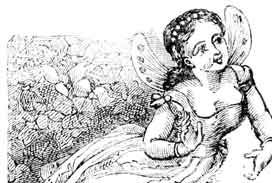
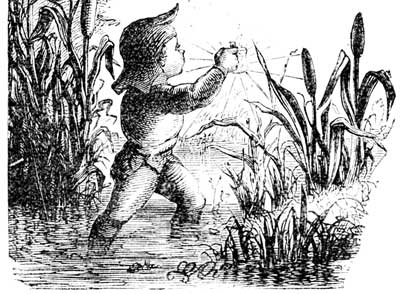
When she had finished her song, she bowed before Jussuf in a mocking mood, and said,
"How does that please you, Jussuf? Why, you are making a face as if you had drunk poison. What thoughts are now passing through your head?"
"I am thinking of the talisman," answered Jussuf. "Give it me to-day. Haschanascha lies at the point of death."
"What of that?" asked she, jestingly: "if there be one such black creature more or less in the world, what consequence is it to you? Come, will you give me your talisman? It has served you well. Be polite for once, and say that you give it me."
She approached him, patted his cheek with her left hand, and holding out the talisman with her right, said smiling,[162]
"Does it belong to me? Is it not true that you have given it me?"
Jussuf's first impulse was to say Yes; but when he looked into her eyes, and, instead of human eyes, saw a great number of butterflies' eyes, horror came over him. He snatched away the talisman, and threw it quickly over his head, calling on Haschanascha's name.
At this moment Haschanascha's elephant appeared exactly as he had seen it at the hunt. A brown slave, with a head-dress of beautiful feathers and variegated jewels, acted as leader, with a short staff in his hand. A maiden holding a drawn bow knelt on the elephant, and before Jussuf perceived it, the arrow flew from the bow, and his playfellow lay in his arms, pierced through with the arrow. Fright and astonishment took possession of him. Before he recovered himself, the elephant, with its guide, had disappeared, and also the deadly-struck maiden lay no longer in his arms. He looked on the ground to find traces of her blood, which he had seen gush out. There lay the beautiful butterfly, transfixed with a needle shaped like an arrow, as men keep such insects in a collection. He took it from the ground, and perceived again the wooden box and golden key which he had formerly opened and dropped. In doubt whether he were awake or asleep, he shut the butterfly fast up in the box, and was going thoughtfully away. Then the faithful slave came running to him, quite breathless, and cried,
"Flee quickly through the garden! The servants of the priests have already arrived in the palace-yard, and ask for you: you are again destined for a sacrifice."
He asked after the Princess.
"She must be dead," answered the slave, and pressed him, half with prayers and entreaties, and half with force, to take flight.
Jussuf hastened through the garden into the wood which joined it, and ran like a startled roe urged forward by terror and dread of its pursuers. The wood covered his flight. He came to the river below the capital, and found a ship about to go down the stream. The man who guided it yielded to his earnest request, took him in, and immediately set sail. At the approach of night, Jussuf thought they would have landed; but the man informed him, to his great[163] joy, that the moon would shine clearly, and favour their voyage. They let the ship float down, and only guided it with a rudder now and then, when they saw a rock or a dangerous place stand out of the water.
At midnight Jussuf made the man understand that he would guide the rudder. He gave it up readily, and lay down to sleep. He sat alone in the stillness of night at the helm, and thought over the events of the last few days. All passed distinctly before his mind. He remembered Haschanascha's sorrow at his resolution to remain alone at the hunting-seat; her warning about the talisman; her illness when he no longer possessed it; her life withering away, and her death. Then he thought of the sorrow of her foster-father the King, and how he had again fallen under the dominion of the crafty and deceitful snake-priests. Also the image of his playful companion rose before him, and the merry childish sports in which they had both joined, and in which he had always forgotten all the care and sorrow of Haschanascha.
He saw her, again, pierced by the arrow, sinking in his arms. He also remembered Haschanascha's appearance as she knelt on the elephant, and shot the deadly arrow at his companion. Could this only have been a shade of the dead one? or was it she herself? No; she herself was dead: the faithful slave had assured him so. All these reflections brought no peace to his soul. Involuntarily Haschanascha's superiority to his playfellow rose before him, and he felt with surprise that at these thoughts his cheeks were wet with tears.
On the morrow they came near a city: he wished to recompense the seaman, who had now reached his destination. Whilst he sought for a piece of gold out of his purse, he remembered that he had left the box of diamonds with the rest of his goods in the palace in his hasty flight. The seaman would take nothing, but assured him that by having taken charge of the vessel during the night he had quite earned his passage-money.
Jussuf parted from him with many thanks. In the city he sold his costly clothes, which he had bought new in the city of the snake-worshippers, clothed himself in the mean dress of a dervish,[164] had his eyebrows scraped off, and set off on foot along the course of the river. After a tedious wandering of some weeks, he happily reached the place where, in his former journey, he had observed the river flow by a city into the sea. He met there many who spoke his language, and from them he learned that a ship lay in the harbour, which was to sail the next day to Balsora. He immediately resolved to embark in it, and return home.
The captain was very ready to take him, and when he asked about the passage-money, he answered, "What! you want to pay passage-money? What would my master say if I took anything from a poor devil like you? No, no, the rich merchant Jussuf of Balsora, who has twenty such ships on the sea, takes no passage-money from a poor dervish."
"How!" asked Jussuf, "does the merchant Jussuf still live?"
Then the captain laughed heartily, and said, "Indeed he lives. He is now, certainly, on a distant journey, but his business still prospers. Look at this proof. This box of diamonds is a treasure than which no Sultan has any more precious in his treasury, and this has been given me to-day by one of his servants to convey to Balsora."
Jussuf saw with astonishment the box which he had left behind in his flight from the hunting-seat. He did not wish to be recognized in his poor condition, and feared to be taken for an impostor if he claimed the treasure. But he could not understand how the box could come into the captain's hands. He therefore turned to him, and said,
"Forgive me, sir, my curiosity, and tell me if you knew Jussuf's servant who brought the box?"
But the captain answered angrily, "Listen. I have certainly mistaken you, as I thought you were a dervish; therefore I am displeased that you speak so disrespectfully of the mighty merchant Jussuf, talking of him as if he were your equal. When you next pronounce his name, give him the honour due to him, and forget not the 'lord.' But as you asked if I knew the servant, know that I had never seen him before; but I did not doubt, when he gave it me in my lord's name. If he had given me only the[165] ten thousandth part in worth in his lord's name, there would have been cause to doubt."
The next day a favourable south wind blew; they weighed anchor, and the ship, under press of sail, left the harbour for the open sea.
The voyage was prosperous. No cloud overcast the heavens, the wind continued favourable, and, in the shortest possible time, they landed in the Port of Balsora. There lay many new ships at anchor, ready prepared, and laden with various wares.
"See," said the active captain to Jussuf, in saying farewell; "these new ships belong also to the same Lord Jussuf. Do not forget when you go into the city to see his palace, and also his warehouse in the bazaar."
Jussuf promised not to forget it; and, on his entrance into the city, went straight to the bazaar. He passed through the row where his warehouse used to stand, and was astonished to see a much larger one in its place, adorned on the outside with precious metals and costly stones; but in the interior was contained riches and a great heap of jewels, such as he had seen in the subterranean chambers of the ruins near Shiraz.
He pushed through the crowd, and saw that six young men were unceasingly occupied in selling. He pressed forward, and stood immediately before one of the traders.
"To whom does this warehouse belong?" asked he, when no buyer seemed ready to occupy him.
"You must only have arrived here to-day, if you do not know that there is only one merchant in Balsora who can display such riches. You must have heard the name of the merchant Jussuf, the king of merchants!"
"Oh, yes! I have certainly heard that name," answered Jussuf; "but I thought that he had shut up his warehouse, and gone on a far journey."
"That is very true," replied the young man; "but a few weeks ago he sent his brother, Hassan Assad, who carries on the commerce, and has taken account of the treasures which he sends here from his journeys. This business is much increased; it is well seen[166] that my Lord Jussuf does not leave his affairs in strange hands without good reason."
"You named his brother, and I have heard that your lord had no brother. What do you, then, mean?" asked Jussuf.
"Hassan Assad is not his brother, but his wife's brother," was the answer.
"His wife?" asked Jussuf, with unfeigned astonishment.
"I know not how it seems to you," said the young man. "What is there so much to be wondered at, and to stand with open mouth? Why should not my Lord Jussuf have a wife? for he might have them by the dozen. If all this interests you so much, go to his palace: there are idle people enough there that can satisfy your curiosity. I have no time: some buyers are waiting whom I have neglected by my conversation with you."
He turned to the customers, apologized for his inattention, and demanded their wishes.
Jussuf resolved to follow his advice and go to the palace. He no longer recognized it: two small palaces which stood on each side had been thrown down, and, in their places, two wings had been added to his own. The principal door of the middle palace stood open, and many male and female servants went in and out. He asked one of the porters to whom the palace belonged, and received the same answer as at the bazaar.
"But will your lord ever come again?" he asked. "He has been gone a long while; no man knows where he is, and he has sent no messengers back."
"What! sent no messenger?" cried both porters in a breath; "he has sent his wife here a long time since, and has himself arrived to-day. His brother Hassan Assad has always had sure news of him, and so he knew of his arrival to-day, and has prepared everything for his reception. His old teacher, who had not before been seen for years, has come forth to-day from his solitude, and arrived here."
"What! Modibjah also here?" he asked.
"See, see!" answered both, "you know his name better than we. Yes, yes, his name is Modibjah: I could not recollect."[167]
"Let me go in, good people," said he, "that I may speak to him."
"No, no," said one of them, obstructing the way; "what business have you in? The marriage ceremony is about to be performed in the hall, after the manner of our religion; the imam is just now gone in; therefore no strangers can be admitted."
"What!" cried Jussuf, "your lord already arrived? Where is the impostor? Let me in, that I may confront him."
Both porters opposed him, because he tried to force his way in.
"Do you not know your lord," asked Jussuf, full of indignation, "that you thus oppose him?"
They assured him that they had not been long in Assad's service, and did not know Jussuf; but they had been told that he was arrived.
"Yes," cried Jussuf, "he is arrived, but not yet in his palace; he will soon be in."
With these words he pushed the nearest on one side, threw him to the ground, and then the other also. He pressed forward quickly into the splendid hall, unopposed by the numerous servants, to whom he seemed to come from the passage into the hall. He placed himself in the midst, and cried with great earnestness,
"Who dares here to usurp Jussuf's place? Who dares here to pass for Jussuf's wife? I am Jussuf, who was thought lost! Where is the impostor? Let him come here, that he may receive the just reward of his treachery."
Whilst he spoke a richly-dressed man, but unknown to him, approached, and said,
"You speak of deceit! Nobody here passes for Jussuf but yourself. We expected him, because we have sure knowledge that he has landed to-day. You may be the expected one. Now for the proof: what word will your lips breathe on this talisman?" He held to him Modibjah's talisman. Jussuf looked astonished and surprised, for the spark had disappeared.
"Haschanascha!" he cried, with a sigh. The spark shone out clear, and a veiled lady walked forth from the circle of numerous assembled guests, and asked, as she threw her veil back, "Do you[168] remember Haschanascha, your betrothed?" But he looked at her with marks of astonished joy. There were indeed the beautiful features of her face, the mild look of her soft eyes, the happy seriousness that reigned in Haschanascha's forehead; but her dark complexion had disappeared, and in its place played a soft blush, like the first breath of dawn, on her cheeks.
"Haschanascha!" cried he, at last awaking from his astonishment, "are you indeed she? I can no longer trust my senses, since I have been lost in so many adventures and dreams, that I cannot distinguish between reality and dreaming. Is it possible that you live? You were dead through my guilt."
"Ask not after what is past," said Modibjah's voice. "The King of the Genii has selected you to be his favourite on earth. Two daughters of genii were destined to try to lead you different ways; human nature nearly conquered, but you came out at last victorious from the fight. You have chosen the nobler. May she adorn your life with greater joy, as she helped you to conquer your selfishness, which bound you in weakness to the form you carried in the box! This is Haschanascha, the sister of your friend Hassan Assad, who has carried on your business since you separated from him near Shiraz. I am uncle to both; and that your wife may not enter your house as a beggar, here are the presents destined for the wedding present, which you saw under the ruins of the destroyed capital."
With these words he embraced Jussuf, who was again lost in astonishment. The young man who had offered him the talisman stepped forward, and Jussuf recognized in him his friend Hassan, and saluting him with heartfelt joy, called him his dear brother. In the same hour the imam pronounced over Jussuf and Haschanascha the blessing, and performed the usual prayers and ceremonies. Then were splendid feasts prepared that lasted many days, and such as never at any other time were celebrated in Balsora; so that in after years people spoke of the splendour with which the rich merchant Jussuf's wedding had been consummated. He attained with Haschanascha a great and very happy old age, and his latest descendants revere his memory.
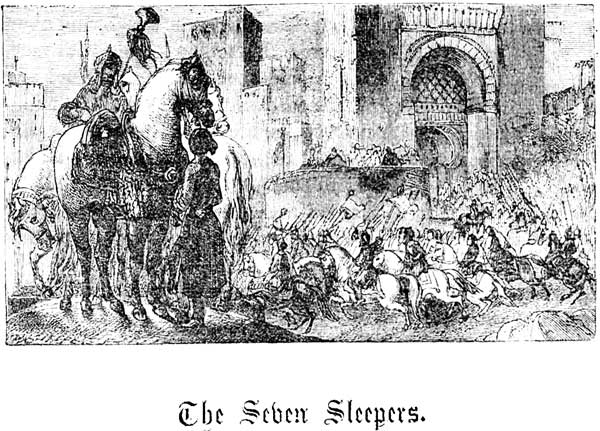
[The "Seven Sleepers" is a Mahommedan as well as Christian legend. It is alluded to in the Koran: and many of the circumstances of the following Tale are related in the notes to Sale's translation of it.]

istorians relate that there was in ancient Persia a shepherd named Dakianos, who for thirty years had attended his sheep without having ever neglected the holy custom of making his daily prayers. All those who knew him did justice to his probity; and nature had endowed him with an eloquence capable of raising him to the highest employments, had he lived in the great world.
One day, as he was at his usual prayers, his flock took fright and were dispersed. Dakianos ran every way to reassemble them, and perceiving that one of his sheep had got half of its body into the hole of a rock, where it could not get out, he ran to it and delivered it; but he was struck with a dazzling light which immediately shone out of the opening. He examined what it was that produced it, and soon found that it proceeded from a tablet or plate of gold, of no very large extent: he opened the hole still farther, and found[170] himself in a vault, which was not above seven feet high, and about four or five broad. He considered this tablet of gold with much attention, but could not read it, neither could he comprehend what the four lines signified which he saw written thereon. To inform himself, therefore, of this mystery, he took it away with him, and, as soon as it was night, he put it under his vest and repaired to the city. His first care was to show it to those who, as he was informed, were the most learned men; but, however versed they might be in the sciences, there was not one of them who could explain this inscription.
However, one of the doctors said to him, "No person here can translate these characters. Go into Egypt: you will find there a venerable man, of three hundred years of age, who can read the most ancient writings, and who knows all the sciences; he alone can satisfy your curiosity."
Dakianos delivered his flock to the person to whom it belonged, and departed immediately for Egypt.
As soon as he arrived there, he inquired after the old man, who was so celebrated that everybody was ready to show him his house. He went to him there, told him the occasion of his journey, and presented to him the tablet of gold. The old man received it with affability, and was struck with astonishment at the sight of this wonder. He read the characters with the greatest ease; but, after having reflected some time, he cast his eyes upon Dakianos, and said to him,
"How did this tablet fall into your hands?"
Dakianos gave him an account of his adventure.
"These characters," resumed the old man, "promise to the person who shall find them, events which it is not likely can happen to you. You have," continued he, "a happy countenance, and this inscription speaks of an infidel, whose end must be fatal and tragical. But since fortune has given you this tablet, that which is written upon it doubtless regards you."
Dakianos, surprised with this discourse, answered, "How can it be as you say? I have said my prayers every day these thirty years. I have never been an infidel; how can I then be a reprobate?"[171]
"If it had been three hundred years," replied the old man, "you will be no less the victim of darkness."
These last words pierced the heart of Dakianos. He groaned, he sighed, he even wept, and he cried out, "Would that I had never found this golden tablet! That I had never shown it you and that I had never heard so terrible a sentence!"
"What use would it have been to you not to have brought it to me?" said this learned man. "The predestination of Allah is from all eternity; what is written in the Book of Life cannot be effaced. But I may be mistaken: the knowledge of men is often doubtful, Allah alone is infallible. I can, however, inform you that this golden tablet indicates a most considerable treasure, and that an those riches belong to him who shall be the possessor of the tablet."
This word riches consoled Dakianos, and in the transport of his soul he said to the old man, "Delay not a moment; let us go to seek the treasure. We will share it like two brothers."
But the old man said to him, sighing, "You will no sooner be the master of all these riches than you will abuse them. It is not an easy talent to know how to be rich; and I shall perhaps be the first to repent having done you this service."
"What a discourse you hold to me!" cried Dakianos. "What shall I owe the obligation to you of procuring me such treasures, shall you make my fortune, and do you think I shall be failing in my return? An infidel would not be guilty of such ingratitude, and I cannot so much as harbour a thought of it. I swear, then, to look upon you as my father, and to share equally all the riches with you; or, rather, you shall give me what share you please, and I shall always be content."
These protestations would not much have reassured the old man, but avarice—the only passion which is felt at a certain age—overcame his reflections, and he consented to their departure. They arrived at the place where Dakianos had found the tablet of gold. The old man commanded him to dig the ground about twenty feet round. They soon discovered a gate of steel, and the old man told Dakianos to open it. Dakianos obeyed with such eager haste that he broke the door open with his foot, though the key was in the[172] lock. They both of them entered into a vault, without being discouraged by the great obscurity which reigned there. After having gone some steps, a faint light enabled them to distinguish objects. The farther they advanced, the more the light increased. They found themselves at last before a large and magnificent palace, the seven gates of which were closed, but the keys were fastened by them. Dakianos took that of the first gate, and opened it.
The first apartment enclosed ornaments and habits of the greatest magnificence, and above all, girdles of solid gold, adorned with jewels. They opened the second, which they found filled with sabres, the hilts and sheaths of which were covered with the most precious stones. The third was adorned with an infinite number of cuirasses, coats of mail, and helmets of gold of different fashions, and all the arms were enriched with the most magnificent jewels. The fourth enclosed the most superb horse furniture, answerable to the magnificence of the arms. The fifth offered to their sight piles of gold and silver ingots. The sixth was full of gold coin; and it was scarcely possible to enter into the seventh, it was so heaped with sapphires, with amethysts, and diamonds.
These immense treasures dazzled Dakianos. From that moment he was sorry that he had a witness of his good fortune.
"Do you consider," said he to the old man, "of what consequence secrecy will be upon this occasion?"
"Doubtless," replied he.
"But," resumed Dakianos, "if the King has the least knowledge of this treasure, his first act will be to confiscate it. Are you sure of yourself? Do you fear nothing from your own indiscretion?"
"The desire of possessing the half of those riches," replied the old man, "ought to be a pledge that will satisfy you."
"The half of these riches!" interrupted Dakianos, with an alteration visible in his countenance, "but that half surpasses the treasures of the greatest kings."
The old man perceived this alteration, and said to him, "If you think the half too much for me, you may give me only a quarter of it."
"Most willingly," returned Dakianos. "But what precaution[173] will you take to remove them with safety? You will cause us to be discovered, and be the occasion of our ruin."
"Well, then," replied the old man, "though you have promised me much more, give me only one of the apartments—I shall be fully satisfied. You do not answer my question."
"We will examine at leisure what you have proposed to me," returned Dakianos. "I am glad, however, that you are more reasonable, and that you begin to understand yourself."
Dakianos again examined these riches with more avidity, and his eyes were still further dazzled by them. After having thoroughly considered the magnificent apartment of the diamonds, in which they then were, "You are sensible," said he to the old man, "that this is, without contradiction, the most valuable, and that it is not natural I should yield up to you the lawful right I have over it?"
"You have reason for what you say," returned the old man, "and I do not demand it of you."
They passed afterwards into the apartment which was filled with gold coin.
"This treasure," said Dakianos, after having looked upon it for some time, "is certainly what would cause the least trouble, and be the most easily disposed of; it may be useful also towards preserving all the rest, either by establishing a guard or raising walls; therefore I believe you too reasonable," continued he, "not to agree to the necessity that obliges me to keep it."
"I agree to it," replied the old man; "let us pass on to another. These piles of ingots of silver and gold are not all necessary to you," said he, as he viewed the fifth apartment.
"No," returned Dakianos, "I might possibly do without some of these; but I have too great obligations to you, to expose you, by giving them to you: how could you convey them away? What a trouble it would be to you to dispose of them!"
"That will be my business," replied the old man.
"No, no," added Dakianos, "I love you too well to consent to it; besides, it would be the means to have me discovered; you would be arrested, and you could not prevent yourself from accusing me. Let us see the others."[174]
They opened the fourth apartment. "This horse-furniture is absolutely unsuitable to you; your age is an obstacle to the use of it."
He made use of the same difficulty to refuse him the cuirasses and the armour which filled the third. When he had locked that up with the same care as the rest, they found themselves in that which contained the sabres; and the old man said to him, "These arms are easy to carry, I will go and offer them to the Kings of the Indies; I will sell them separately, and you will run no risk."
"You are right," returned Dakianos, "I may give you some of these."
As he said these words he examined them, both the weight of the gold and the value of the diamonds. At length he drew one of them out of the scabbard; then he compared all the riches of which he might be the sole possessor, with the head of one man; and, unable to conceive how he could have hesitated so long, "I distrust thee!" said he, springing upon the old man.
The old man embraced his knees. "Be moved," said he to him, "with my old age! The treasures no longer make any impression upon me, and I pretend not to them."
"Truly I believe not," resumed Dakianos: "they are mine, the tablet of gold gives them to me."
The old man recalled his promises to his memory. "But I will cancel them," pursued he: "in return for the obligation you have to me I only demand my life."
"I have offended thee too far," replied Dakianos: "thy life would be my death, it would give me too much inquietude."
Then at one blow striking off the head of the old man, "Now," cried he, "my secret is my own!"
The first care of Dakianos was immediately to make a grave and to inter this unfortunate victim of his avarice. He feared not remorse, though he dreaded a witness; his heart was wholly occupied with the treasure that he possessed, and his mind with the methods of preserving it. But after devouring it with his eyes, and enjoying that cruel satisfaction, in what trouble did he not find himself when he was obliged to leave it in order to seek for provision?[175] How often did he reproach himself with not having carried it with him? And if he ever remembered the old man, it was only to accuse his memory, and to persuade himself that he must have had some bad design, since he had not advertised him of a thing which he might have foreseen without being so learned as he really was. Not to die with hunger in this subterranean vault, he was obliged to quit it. What succours could he find in so barren a desert as that with which it was surrounded? He was obliged, therefore, to go to a place at some distance; but how could he resolve upon that, especially at a time when the ground lately removed might attract the curiosity of a traveller? Dakianos almost determined to let himself die rather than lose sight of his treasure. All that he could do to calm his inquietudes was not to depart till night, when he took some handfuls of the gold coin and repaired to the city, where he bought a horse, which he loaded with biscuit and with a small barrel of water, and returned before daybreak to seek his treasure, which he found in the same condition he had left it, with as much pleasure as he had felt chagrin at leaving it.
His first care was, with incredible fatigue, to make a very deep ditch round the cavern. He contrived a passage to it underground, the opening of which he covered with his clothes, that in a few days he laid upon them, and afterwards raised a hut of earth to preserve himself from the weather. All that he suffered during these immense labours is not to be conceived, and no one could have imagined, who had seen him thus wasted with labour and fatigue, that he was the richest inhabitant of the earth.
When he had conducted his work so far as to be able to leave it without fear, he repaired again to the city, but with the same precaution—that is to say, he went only in the night. He employed it wholly in purchasing some slaves, with whose assistance by degrees he brought thither everything that was necessary for his safety and convenience. Soon after, he gathered workmen, with whose aid he built more solidly the works which he had begun. He surrounded the place with three walls of stone, and lay always between the first and the second. He took great care to spread abroad a report after this that he carried on a large foreign commerce,[176] and spoke much of the fortune he had made in Egypt. Upon this pretext—for there must be one for becoming so suddenly rich—he built a magnificent palace: that of the thousand columns erected by Melik Jouna, the ancient King of the Indies, was nothing in comparison to it. Such great magnificence soon made him considered and respected by the world, and the pains he had given himself to preserve his riches not only flattered his self-love, but easily persuaded him that he had acquired them, and might enjoy them without remorse, the old man being totally forgotten.
It was easy for him to bring out the treasures from his vault, the secret of which was not trusted to any person. He sent caravans to all parts of the Indies to authorize the expenses he bestowed in slaves, in building, in women, and in horses, and fortune also favoured a commerce which was of little consequence to him. His heart, fully satisfied as to riches, was not long insensible to ambition. The Court has strong attractions for the rich; they are received so graciously, they are praised in so delicate and so insinuating a manner, that they are generally seduced by it. And Dakianos, who now joined to his opulence an immeasurable ambition, neglected nothing to introduce himself at the Court of the King of Persia; but made presents to the viziers to obtain their protection, and, by gaining it, rendered himself their slave. His magnificence and his generosity, as he foresaw and wished, soon reached the ears of the King, who desired to see him.
Dakianos had an audience as soon as he appeared at Court, and to give a favourable impression of himself, and to deserve the favour of the King, he brought him presents which the greatest Kings upon earth could not, perhaps, have collected together. It is generally by nines that Eastern presents are given, when their magnificence is extended to the last degree. He therefore caused himself to be preceded by nine superb camels. The first was loaded with nine suits and ornaments of gold, adorned with the most beautiful jewels, of which the girdles were of the greatest lustre. The second bore nine sabres, the hilts and scabbards of which were of gold adorned with diamonds. Upon the third were seen nine suits of armour of equal magnificence. The fourth had for its load nine[177] suits of horse furniture, suitable to the other presents. Nine cases full of sapphires were upon the fifth. Nine other cases heaped with rubies loaded the sixth. The same weight of emeralds was upon the seventh. The amethysts, in an equal number of cases, was the load of the eighth. At last, there appeared upon the ninth camel nine cases of diamonds. Nine young women of the greatest beauty, and magnificently adorned, followed this caravan; and eight young slaves immediately preceded Dakianos.
In the midst of the surprise which these presents gave to the King and the whole Court, some of those who composed it, and who, according to the customs of that place, endeavoured to criticise upon it, and who wished to contradict those who applauded it, or to show the justness of their own remarks, demanded where was the ninth slave. Dakianos, who expected the question, pointed to himself. The King, pleased with the turn of delicacy, which he joined to such magnificent presents, received him with extreme distinction; and, his natural eloquence increasing his favour, it was impossible for the Prince to be without him. He seated Dakianos by himself, gave him the pleasure of his music, sent him every day dishes from the royal table, and very often the most exquisite wines; during which, on the other side, Dakianos returned all this bounty by presents, the quantity of which was as surprising as their magnificence. At length his continued liberality and his eloquence procured him so great a power over the heart of the King, that he created him his Vizier, that they might never part; yet the confidence and the friendship he testified to him gave him still more power than the charge with which he was provided.
Dakianos governed Persia with an absolute sway: he ought to have enjoyed a happiness which might satisfy his vanity. But can ambition ever be satisfied? The mountain of Kaf may set bounds to the world, but never to the ideas and wishes of the ambitious. The King being informed of the arrival of an ambassador from Greece, gave him audience immediately. The ambassador, after having kissed the foot of the throne, delivered him a letter, which he caused his secretary to read aloud, it was conceived in these terms:[178]
"I, Emperor and Sultan of seven climates, to you, King of Persia. As soon as my royal letter shall be delivered to you, fail not to send to me the tribute of seven years. If you make any difficulty to satisfy me, know that I have an army in readiness to march against you."
This letter caused so much astonishment in the King, that he knew not what answer to make to it. Dakianos, to deliver the King from the perplexity he was in, rose from his place, touched the ground with his head, and endeavoured to restore his spirits.
"The letter of the Emperor of Greece," said he, "ought not to afflict you: it is easy to answer it, and to make him repent his menaces and his insolence. Order your most faithful subjects to join with me, who am the humblest of your slaves; I shall inform them what they have to do."
These words consoled the King: he gave his orders in pursuance of them, and Dakianos raised above a hundred thousand men for the King, whilst on his side he assembled ten thousand more, whom he equipped at his own expense. The King joined to this chosen troop two thousand of the most valiant soldiers, whom he had always had near his own person, and of whom he formed the guard of Dakianos, and declared him general of this army of one hundred and twelve thousand men. The new general took leave of the King, and put himself at the head of his troops, which served as an escort to all his riches, which he took care to convey along with him, and which ten thousand camels could scarce carry. The King of Persia, who parted from his Vizier with regret, accompanied him for three days, and quitted him with tears in his eyes, giving him a thousand benedictions, and repeating to him a thousand times that he was his strength, his support, and, what was much more, the only friend of his heart. Dakianos chose out the most warlike men in all the cities through which he passed, equipped them at his own expense, and gave them whatever pay they demanded. The report which was spread abroad of this magnificence drew together men from all parts of the world, and his army was in a short time increased to three hundred thousand soldiers.[179]
The Emperor of Greece, upon the news he had of the Persian army, immediately assembled his troops, and advanced to meet Dakianos with seven hundred thousand men. As soon as he perceived the enemy, he divided his army into two bodies, and gave the signal for battle. The troops of Dakianos acted with so much valour, and their first onset was so terrible, that the army of the Grecians had not time to recover themselves, and they were almost as soon defeated as attacked. Dakianos ordered the Grecian Emperor, whom he had taken prisoner, to be beheaded, and without the least difficulty made himself master of all his dominions, of which he caused himself to be acknowledged sovereign. The first business of this new monarch was to write the following letter to the King of Persia:
"I have defeated and overcome Cæsar,[2] I have conquered his dominions, I have mounted his throne, and have been acknowledged the sovereign of his whole empire. As soon as this letter is delivered to you, defer not a moment to send me the tribute due for seven years: if you make the least difficulty to pay it me, you must submit to the same fate as Cæsar."
[2] In the East they always give that name to the Emperors of Greece.
This letter, with great reason, provoked the King of Persia beyond all the bounds of moderation. Without loss of time he assembled his troops; but before he put himself at their head to march towards the confines of Greece, he returned this answer to Dakianos:
"Can a man so despicable as thou art have possibly conquered Greece? Thou hast betrayed me—I, who am thy King, and who am seated upon the golden throne of my ancestors. Thou hast attacked me, notwithstanding the gratitude and fidelity thou owest to me. I am upon my departure to cause even the very memory of thee to perish, to restore Greece to her former situation, and to deliver her to her lawful sovereign!"
This daring answer of the King of Persia threw Dakianos into the most dreadful rage: he immediately formed a detachment of two hundred thousand men from his army to advance and give [180]battle to the King of Persia. Those troops were not long without meeting him. The combat was bloody and obstinate; but at length the King of Persia was defeated, taken prisoner, and conducted to Dakianos.
When that Prince was in his presence, "Wretch!" said he to him, "how canst thou bear my sight, thou most ungrateful of mankind?"
"I ungrateful?" replied Dakianos. "I have levied troops at my own expense; I have spent the greater part of my immense treasures; I have, therefore, bought this conquest. I have done more: I have fought; I have revenged thy quarrel. What canst thou reproach me with?"
"I have loved thee," returned the King.
It is hard for those in power to bear a well-founded reproach. The only answer of Dakianos was to command his head to be struck off, and immediately to send troops to seize on his dominions. He chose Ephesus to fix his residence in; but, not thinking that city magnificent enough, he caused it to be rebuilt with the utmost elegance, and gave all his care to the erecting of a palace, which was unparalleled for its solidity, its extent, and its magnificence. He erected in the centre of it a kiosk, the walls of which were six hundred feet long, and the cement and all the jointings of it were of silver. This kiosk contained a thousand chambers, each of which enclosed a throne of gold: he caused three hundred and sixty-five gates of crystal to be made, which he placed in such a manner that every day throughout the year the rising sun shone upon one of them. His palace had seven hundred porters; sixty viziers were occupied in his affairs. There were always in the hall of audience sixty thrones, on which were seated those who had signalized themselves in war. He had seven thousand astrologers, who assembled every day, and continually declared to him the different influences of the stars. He was always surrounded by ten thousand ichoglans, who wore girdles and crowns of solid gold, and were most magnificently clad: they had no other employment but that of being always ready to receive his orders. He appointed sixty pashas, each of whom had under his command two thousand well-made and[181] valiant young men, who each in particular commanded two thousand soldiers.
One day, when Dakianos was in the height of his splendour, an old man arose from beneath the throne upon which he was seated. The King, amazed, asked him who he was. He was an unbelieving genie, but, far from confessing it,
"I am," he answered, "a prophet of God: I obey His orders by coming to you. Know, therefore, that He has made me the god of the heavens, and that He ordains that you should be the god of the earth."
Dakianos answered him, "Who will believe that I am so?"
And the genie immediately disappeared.
Some time after, Dakianos had again the same apparition, and the genie repeated to him the same things; but he answered him,
"You deceive me. How can I be the god of the earth?"
"Your power, your great actions, and the care that Allah has taken of you, ought to persuade you; but if you will not believe me," pursued the old man, "do what I shall tell you, and you will soon be convinced."
Dakianos, whose pride this flattered, and who had nothing more to desire of human greatness, promised him to consent to everything.
"Let your throne be placed upon the shore of the sea," pursued the old man.
What he desired was executed. And when Dakianos was placed there, "Prince," said the genie to him, "there is at the bottom of the sea a fish, the bigness of which is known only to Allah, and which every day comes to land. It remains there till noon to adore the Almighty. No person interrupts its prayers: when they are finished, it plunges again to the bottom of the sea."
The fish appeared as usual, and the genie said to Dakianos, "Though the fish will not believe your power, it has, however, declared to all the fishes of the sea that you are the god of the earth. It fears nothing, and comes now to inform itself. You will know the truth of what I have declared to you," continued he, "if you will only condescend to say to him, 'I am the god of the[182] earth.' Your voice will freeze him with terror—he cannot hear it without surprise, and will certainly take flight."
This proposition pleased Dakianos, and he called the fish, and said to it, "'I am the god of the earth.'"
These words of infidelity made the fish immediately plunge to the bottom of the sea, in the fear he was under lest the Almighty Power should dart His thunder to punish that impostor. Dakianos easily persuaded himself that the fish was an infidel, and that his presence had made him take flight. From that moment he believed all the deluding words of the genie, and soon had no doubt left of his divinity. Not only his subjects adored him, but people came from all corners of the world to give him those marks of adoration which he exacted; for he caused all those to be thrown into a burning furnace who refused to adore him.
In the number of the ten thousand slaves who stood always before him with their hands crossed upon their breasts, there were six Greeks who possessed his confidence, and who approached the nearest to his person. They were named Jemlikha, Mekchilinia, Mechlima, Merlima, Debermouch, and Charnouch. They were generally placed in an equal number upon his right and left hand. Jemlikha was one whom he most favoured, nature having endowed him with all her charms: his words were sweeter than the honey of Arabia, and his wit sparkling and agreeable; in a word, this young man united in himself all perfections. Their employments engaged both him and his companions to pay that homage to Dakianos which was due to God alone.
One day, as Dakianos was at table, Jemlikha held a fan to drive away the flies that might incommode him: there came one which settled itself with so much obstinacy upon the dish he was eating that he was obliged to give it up. Jemlikha, struck with this slight event, thought it ridiculous that a man who could not drive away even a fly that troubled him, should pretend to divinity. "Surely," continued he, "I ought to have no regard for such a god."
Some time after, Dakianos entered into one of his apartments to repose himself for some hours; and Jemlikha still waited by[183] him with the fan. Allah once more sent the same fly, and at this time it placed itself upon the face of the monarch. Jemlikha would have driven it away lest it should interrupt his lord's sleep; but his pains were in vain: it awakened Dakianos, and threw him into the greatest impatience. Jemlikha, already touched by his first reflections, said within himself, "This man certainly is no more a god than I am: there can be but one God, and it is He who has created the sun that gives us light."
From that time Jemlikha used the custom of saying every night when he lay down, "The true God is He who created the heavens, and fixed them in the air without a pillar."
It is difficult to make a serious reflection and not to communicate it to a friend. Jemlikha declared all his doubts to his companions. "A man," says he, "who cannot disengage himself from a fly, can he have power over the works of nature?" Then he related the adventure of the fly.
"But if our King is not a god," said they to him, "whom then are we to adore?"
Jemlikha told them what he thought, and they were so far persuaded of it, that from that day they joined with him every night in prayer. Their assembling themselves together in private places soon became the subject of conversation. Dakianos being informed of it, sent for them into his presence, and said to them,
"Do you adore another God beside me?"
They contented themselves with answering him, "We adore the Sovereign Master of the world."
The King, who took that answer to mean himself, loaded them with caresses, and bestowed upon each of them a robe of honour. They retired, covered with the favours of their master, and their first care was to adore and thank the High God for His bounty to them. Jemlikha afterwards said to them,
"If there should be again such an information given to the King as has now put us into such imminent danger, we can hope for no further mercy from him. I imagine, therefore, the only resolution we can take is to quit our country, and to seek another, where we may adore God without constraint."[184]
"But how can we take our flight?" replied his companions. "We know no other country but this."
"Let us put our trust in God," resumed Jemlikha, "and make use of any favourable circumstance. We are not to follow Dakianos when he goes on his magnificent chase for six days at the head of his army: what hinders us taking that time for our departure? We will demand permission of the officers of the palace that guard us to play at feheukian;[3] we will go out of the square, throw the ball to a great distance, and take our flight upon those swift horses which are usually given us for that exercise."
[3] An exercise performed on horseback.
They approved this project, and waited with impatience for the time of its execution. At length Dakianos departed with his numerous army.
The day after the King's departure they put in execution what they had projected. The eunuchs pursued them, and would have forced them to return back to the palace; but they answered them,
"We are tired of our King: he endeavours to pass for the God of the earth, and we adore Him alone who has created all that we behold."
The young men had already drawn their sabres, and in a moment they put the eunuchs out of a condition of following them. Then Jemlikha said to them, "My friends, we are ruined if we do not use all possible expedition."
They immediately put their horses at full speed, which so much fatigued them that their strength was soon exhausted. They were then obliged to continue their journey on foot, but being tired, and faint with thirst and hunger, they stopped on the side of the road, and, with entire confidence in God, prayed to Him to relieve them. Some faithful genii heard them, and, touched with their situation, they inspired into Jemlikha the thought of ascending a mountain, at the foot of which they were. It was not without pain that he arrived at the summit; but at length he perceived a spring, the pure and clear water of which was to him the water of life, and a shepherd sitting by it, who sang whilst his flock was feeding.
Jemlikha called to his companions: the few words he could make them hear augmented their strength, and gave them courage sufficient to ascend the mountain.
The shepherd, whose name was Keschetiouch, gave them some provisions, and they drank of the water of this delightful fountain. This refreshment re-established their strength, and their first care was to return their thanks to Heaven for it. Then Keschetiouch said to them,
"How have you found the way to a place where I never yet saw any mortal? If I am not mistaken, you are fugitives. Trust me with your misfortunes: I may perhaps be of some service to you."
Jemlikha related to him all that had happened to them, and his discourse struck the light of faith into the heart of this shepherd, God so enlightening his mind, that he soon learned and repeated with them their prayers. Afterwards he told them he would never quit them.
"Ephesus," says he, "is so near to this place, that you will still be in some danger. Doubt not but Dakianos will use his utmost efforts to have you seized. I know a cavern not far from hence, which perhaps in a forty years' search could not be found: I will conduct you there."
Immediately without delay they arose and followed him.
The shepherd had a little dog, which he called Catnier, that followed them. They did not care to take him with them; and using all their skill to drive him away, they at last threw a stone at him, which broke his leg; but he still followed them limping. They threw a second at him, which did not turn him back, though it broke his other fore leg, so that he walked only upon his two hind feet, continuing his march. The third stone having broke one more, he was no longer in a condition to stand. But Allah gave the gift of speech to this little dog, who said to them,
"Alas! you go to seek after Allah, and you have prevented me from all hope of going with you! Am not I also the creature of Allah? Are you alone obliged to acknowledge Him?"
They were so astonished at this wonderful miracle, and moved with the condition to which they had reduced the dog, that they[186] carried him in turn, and went on begging the protection of Heaven. They were not long before they arrived at the cavern to which the shepherd conducted them, and finding themselves fatigued with their journey, they lay down to sleep; but by the particular mission of Heaven, they slept with their eyes open, in such a manner that no one could suspect they tasted any real repose. The cavern was so gloomy, the heat of the sun could not incommode them; a gentle, pleasing wind incessantly refreshed them, and a long narrow opening gave an entrance to the rays of the sun at his rising.
In the meantime those eunuchs who had escaped from the sabres of the young slaves came directly to give an account of what had passed to Dakianos. He was in despair at their flight, and as he was recollecting in his mind the favours he had shown them, and accusing them of the highest ingratitude, the same unfaithful genie who had so often appeared to him presented himself before him, and said to him,
"Your slaves have quitted you only that they might worship another God, in whom they place all their trust."
This discourse so heightened the anger of Dakianos that he conjured the genie to let him know the place of their retreat.
"I alone can bring you to it," returned the genie. "All mankind would search for it in vain, but I will conduct you to it at the head of your army."
They immediately departed, and were not long before they arrived at the mouth of the cavern. The genie then said to Dakianos,
"It is here they are retired."
Dakianos, who was wholly possessed with the spirit of revenge, immediately would have entered it; but that moment there burst out from the cave a dreadful vapour, which was followed by a furious wind, and a darkness that spread over all that part of the world. The army gave back with horror; but anger redoubling the courage of Dakianos, he advanced to the entrance of the cavern, but it was with incredible difficulty, and, in spite of all his efforts, it was absolutely impossible for him to enter it, the air being so impenetrable. He perceived Catnier, who slept with his head resting upon his paw, and distinguished plainly the six young Greeks[187] and the shepherd, who were all in a profound sleep, though he was far from suspecting it, as their eyes were open. Dakianos was not rash enough to renew his efforts—a secret horror restrained him. The sight of this cavern and all the prodigies of Heaven spread so great a terror in his mind that he returned to his army, and said that he had discovered his slaves, who had prostrated themselves before him without having the courage to speak to him, and that he had left them prisoners in the cavern till he fixed his resolution respecting their punishment. In effect, he consulted his sixty viziers, and demanded of them what remarkable vengeance he could exercise upon these young slaves; but no advice of theirs could give him satisfaction. He had recourse, therefore, to his genie, who advised him to command the architects, who always marched along with him, to raise a very thick wall, which should entirely close up the entrance of the cavern, and take away all hope of succour from those who were enclosed in it.
"You must take care for your own glory to cause to be engraved upon this wall the time, the year, and the reasons that obliged you to erect it; that will be the means," said he, "of informing posterity that you revenged yourself with a greatness of spirit."
Dakianos approved this counsel, and caused a wall to be erected as thick and solid as those of Alexandria; but he had the precaution to reserve one passage, of which he alone knew the entrance, in hopes of being one day able to seize upon his slaves, and with a view of examining the events at the cavern, which, in spite of himself, continually took up his thoughts. He added to all these precautions that of placing a guard of twenty thousand men, who encamped before the wall. All his armies had orders to relieve this body of troops every month, who were commanded to put to death all those who endeavoured to approach a place which enclosed those whose revolt and flight were the first misfortunes of his life; for till that moment everything had succeeded happily to him. A desire of revenge joined itself to the insult he had received from them, which appeared greater to him, as nothing had ever before dared to resist him. To a man intoxicated with his power, of which he had been himself the sole cause, so positive an opposition[188] to his will was a cruel situation. Nothing could prevent him from repairing every day to the cavern in order to make new efforts to enter it, or at least to feed his eyes with the objects of his vengeance.
The calm which was enjoyed by those whom he still looked upon as his slaves redoubled his fury. Their eyes, which were, as he imagined, fixed upon him—their silence to all the reproaches and invectives with which he loaded them—even their attitude—all were marks of the greatest contempt of him. One day, when he had joined to his usual speeches the blackest imprecations against Heaven, Allah permitted Catnier, without any motion, to answer him:
"Wretch! darest thou blaspheme a God who has let thee live, notwithstanding the crimes that thou hast been guilty of? Believest thou that He has forgot to punish the fate of the learned Egyptian, whom thy avarice put to death, contrary to the most sacred oaths?"
Dakianos, whose wrath was impotent there, went out, distracted and provoked with the insulting reproaches that he received from the dog of his slaves. What a subject of humility! But far from having recourse to prayer, and imploring Allah's clemency, his pride revolted, and by a sentiment natural to the wicked, who generally render those who are subject to them answerable for everything that wounds their vanity, at his return he caused to be executed, in the public square, above two thousand men, who had refused to adore him. These examples of severity spread abroad the fire of a rebellion, which was lighted in all parts of his dominions; and, notwithstanding the anxiety that these troubles gave him to stop the progress of them, an inward emotion, which he could not resist, led him continually towards the cavern.
"What is it I go there to seek?" said he within himself. "The reproaches and contempt of one of the vilest animals, whilst I am everywhere adored—whilst every word that comes from my sacred mouth is revered. Yet, notwithstanding this, what am I in the eyes of an animal whom God protects? A shadow of power—an object of impotence! Ah! Dakianos, what shame! what confusion But, however, I have concealed it, notwithstanding this[189] God, who will torment me, and His efforts will be in vain against my regulations. How happy I am to have concealed from my subjects the knowledge of such a misfortune! How prudent was I in erecting a wall which forbids all entrance to the cavern, and in hindering all mankind from approaching it by the troops which I have disposed before it! But in what manner can my slaves have subsisted whilst I have kept them enclosed there? Doubtless they have some communication into the country, and that communication is unknown to me. To remedy this inconvenience, I must surround the mountain with my troops." Accordingly he gave orders to six hundred thousand men to form an encampment round it, and to let no person approach a place that was so odious to him.
When he had taken these new precautions, he returned to the entrance of the cavern, and said, with a fierce and haughty voice,
"Now you will be obliged to deliver yourselves up to my power!"
Catnier answered him again, "We fear thee not: God is our protector. But believe me, and return to Ephesus: thy presence is become necessary there."
Dakianos perceiving that he would give no further answer, returned to the city, and found that several of the chief of the eunuchs of his seraglio were murdered. Dakianos, distracted at this affront, could not forbear returning to the cavern, and saying to Catnier (because he was the only creature that answered him),
"If thy God could restore me the honour that has been taken from me, I would endeavour——"
Catnier answered him, "Go, return to Ephesus; other misfortunes attend thee there."
These words threw Dakianos into the utmost confusion. He returned immediately, and found that the demon of hatred had seized upon his three sons, that they had drawn their sabres against each other, and that the angel of death was come to fetch them hence, which he did before his eyes. What an affliction to a father! What a disappointment to an ambitious mind, who depended upon giving each of them an empire in different parts of the world![190]
In the midst of the sorrow with which he was surrounded, he could not prevent himself from returning once more to the cavern. "Wretches!" said he to them, "what torments ought I not to make you suffer when you shall fall into my hands? However, restore me my children, and I will forgive all that you have done against me."
Catnier, who always spoke, answered him thus:
"God will restore no children whom He has banished from the world to punish the crimes of their father. Go, return to Ephesus. Thou deservest to find new misfortunes there."
"It is too much," cried Dakianos, retiring; and immediately, with rage and despair in his heart, he commanded all his troops, and all the inhabitants of Ephesus, to bring each of them a faggot, and see his orders executed. Then he caused this enormous quantity of wood to be piled before the cavern, in hopes of stifling those whom it enclosed; but the wind beat back the flames of this amazing fire against the army (who took to flight), and against the city. No private house, notwithstanding, was in the least incommoded by it; but the fire seized upon the palace of Dakianos, which was wholly reduced to ashes, and all the treasure which he had amassed with so much care vanished in a moment, whilst the cavern did not undergo the least alteration. This last prodigy engaged him to have recourse to the seven sleepers, and to Catnier himself, begging them to intercede for him. The little dog answered him thus:
"It is fear, and not piety, that seems to soften the hardness of thy heart. Begone: thou canst not deceive Allah."
Dakianos retired, confounded with this last reproach, but still more distracted at having humbled himself so far.
In the midst of all these misfortunes which succeeded each other to oppress this enemy of God, the revolt, which was considerably augmented, demanded an example to be made, and the heart of Dakianos engaged him to render it of the greatest severity. To that effect he caused to be erected in the public square, upon the ashes of his palace, a throne of iron; he commanded all his[191] Court and all his troops to be clothed in red,[4] and to be covered with black turbans. He took care to put on the same habit, with a design of murdering in one moment five or six hundred thousand souls, whom he resolved to sacrifice to the safety of his throne, to the manes of his children, to his lost honour, and to what affected him still more, the incessant remorse and horror that gnawed his heart. But before he performed this cruel execution, he resolved once more to visit the cavern, in hopes that his weapons, the usual confidence of the wicked, might intimidate those whom by prayers or by menaces he could obtain nothing from. When he arrived there, he redoubled his usual blasphemies.
[4] This colour in the East is a mark of the vengeance of princes.
"Tremble, thou wretch!" said Catnier then to him, without any emotion or so much as raising his head, which lay upon his paws.
"Shall I tremble?" returned Dakianos: "Allah Himself cannot make me tremble."
"But He can punish thee," pursued Catnier; "thou drawest near thy last moment."
Dakianos, at that word, listening only to his resentment, took his arrows and his bow.
"We shall see," said he, "whether I am not redoubtable—to thee at least."
He then shot an arrow at him with the utmost strength of his arm; but a supernatural power made it fall at the feet of him who shot it, and at the same instant there sprang out of the cavern a serpent, which was above twenty feet in length, and whose dreadful and inflamed look made him tremble. Dakianos would have taken his flight; but the serpent soon overtook him, grasped him round the body, and dragged him through the whole city, that all his subjects might be witnesses of his terror and of his punishment. He then conveyed him to the iron throne which he had prepared for the scene of his vengeance. It was there that, being devoured by degrees, Dakianos by his dreadful sufferings gave a terrible example of the punishment due to ingratitude and impiety. The serpent afterwards returned to his cavern without having done the [192]least hurt to any person, and all the inhabitants of Ephesus loaded it with benedictions at its departure.
Several Kings succeeded Dakianos, and filled his throne during the time of one hundred and forty years; after which it fell into the power of the ancient Greeks, who enjoyed it for the space of one hundred and sixty-nine years longer. When the time of the repose of the Seven Sleepers was accomplished, that which was written happened unto them. One of the seven awakened at that instant; and the dawn beginning to appear, he raised himself up, and said within himself, "I seem to have slept at least twenty-four hours;" and by degrees the others awakened, struck with the same idea.
Jemlikha, always more lively than the rest, leapt up immediately, and was extremely surprised to find, at the opening of the cavern, a wall erected of large square stones, which entirely enclosed it. He returned to his companions and told them the occasion of his astonishment. Notwithstanding this inconvenience, they agreed that they must absolutely send one of their number to the city to buy provisions; and casting their eyes upon the shepherd, Jemlikha gave him money, telling him that he ran no hazard by going. The shepherd rising to do them that service, at that moment Catnier[5] awakened, perfectly cured of his broken legs, and ran to caress them. The shepherd strove in vain to get out of the cavern, for the passage that Dakianos had reserved to himself was fallen down; and examining the wall carefully, he remarked the enormous bigness of the stones that composed it; and through the chinks that time had made between them, he saw with astonishment that part of the trees were dead, others were fallen, and that the water of the springs was differently placed; in one word, he was so confounded at the uncommon change that he perceived, that he returned into the cavern to inform his companions of this surprising event. They [193]immediately arose and went to the entrance to judge of it themselves; but every fresh object redoubled their amazement.
[5] There are ten animals which, according to Mahommedans, must enter into Paradise: the whale that swallowed Jonas; the ant of Solomon; the ram of Ismael; the cuckoo of Belkis; the camel of the Prophet of God; the ass of Aazis, Queen of Saba; the calf of Abraham; the camel of the Prophet Saleb; the ox of Moses; and the dog that accompanied the Seven Sleepers.
Jemlikha then said to the shepherd, "Give me thy habit; I will go myself to the city and fetch what is necessary for us, and endeavour to find out what we cannot now comprehend."
The shepherd gave him his habit, and took his in return. Jemlikha, with much labour, made himself a passage through the ruins of this thick wall, followed the road to the city, and remarked over the gate a standard, upon which was written, "There is no other god but the true God."
He was astonished to find that one night had produced so great a change. "Is not this a vision?" said he. "Do I awake, or do I feel the illusions of a dream?"
Whilst he made these embarrassing reflections, he saw a man come out of the castle, whom he approached, and asked him if this city was not called Ephesus. He told him that was its name.
"What is the name of him who governs it?" resumed Jemlikha immediately.
"It belongs to Encouch: he is the King of it, and has his residence in it," replied the man.
Jemlikha, still more astonished, pursued his questions.
"What do these words signify," cried he, "which are upon the standard?"
He satisfied his curiosity by telling him that they represented the holy name of God.
"But I apprehend," interrupted Jemlikha, with eagerness, "that Dakianos is the King of this city, and that he makes himself be worshipped here as a god."
"I have never heard of any King so named," returned the inhabitant of the city.
"What an uncommon sleep I am in!" cried Jemlikha. "Awaken me, I conjure you," said he to him.
The man, surprised in his turn, could not forbear saying to him, "What! you have asked me reasonable and sensible questions, you have understood my answers, and can you imagine that you are asleep?"[194]
Jemlikha, ashamed of speaking to him so inadvertently, quitted him, saying within himself, "Most high Allah, have you deprived me of reason?"
With this confusion of ideas, he entered into the city, which he could not in the least recollect: the houses, the temples, the seraglios, appeared under a new form to him. At length he stopped before the door of a baker, where he chose out several loaves, and presented his money for them: the baker examined it, and looking upon Jemlikha with much attention, he was alarmed at it, and said to him,
"Why dost thou look upon me? Give me thy bread, take my money, and concern thyself no further."
The baker answered him with the most eager curiosity, "Where hast thou found this money?"
"What is that to thee?" resumed Jemlikha.
"I don't know this money," replied the baker, "it is not the coin of the King that now reigns. Let me share the treasure which thou hast doubtless been so happy as to find, and I promise thee to be secret."
Jemlikha, almost out of patience, said to him, "This money is struck with the image of Dakianos, the absolute lord of this country. What can I tell thee more?"
But the baker, still prepossessed with the same idea, pursued thus: "Thou comest from the country: believe me, thy occupation of a shepherd has not rendered thee cunning enough to deceive me, nor to impose upon me. God has favoured thee with the discovery of a treasure: if thou dost not consent to share it with me, I will go this moment and declare it to the King; he will soon have thee arrested, thy riches will be seized upon, and perhaps thou mayest be put to death for not having declared them."
Jemlikha, impatient at this discourse of the baker's, would have taken his bread and left him; but the baker detained him, and, their dispute growing hot, a mob gathered round them to listen to it. Jemlikha said to the baker,
"I went out of the city but yesterday, I return to it this day. What can make thee imagine that I have found a treasure?"[195]
"Nothing is more true," returned the baker, "and I am resolved to have a share of it."
A man belonging to the King running in at the noise, and in the incertitude he was in of the event, went and fetched the guards, who seized upon Jemlikha, and conducted him before the King, whom they informed of the occasion of this dispute.
And the Prince said to him, "Where hast thou found those ancient coins they speak of?"
"Sire," replied Jemlikha, "I carried them yesterday from this city; but in one night Ephesus has taken so different a form that I no longer know it: all whom I have met, all whom I see, are unknown to me, and yet I was born in this city, and I cannot express the confusion of my mind."
The King said to him, "Thou seemest to have sense; thy countenance is agreeable, and thy manner composed: how can thy speech be so unreasonable? Is it to abuse me that thou feignest this distraction? I will absolutely know where thou hast concealed the treasure which thy good fortune has made thee possessor of. The fifth part by law belongs to me, and I consent to leave thee the remainder."
"Sire," replied Jemlikha, "I have not found a treasure, but certainly I have lost my senses."
Jemlikha durst not speak too plainly, he still fearing lest this King, who was unknown to him, should be one of the viziers of Dakianos, who might order him to be conveyed to that Prince, who perhaps was absent.
Happily for him, Encouch had a Vizier of a penetrating genius, and who had an extensive knowledge of the precepts of the law, and of ancient history: that of Dakianos was not unknown to him, and by consequence he had some knowledge of the Seven Sleepers, who were imagined to be in a neighbouring cavern. The discourse of Jemlikha gave him suspicions; and to enlighten them, he said in a whisper to the King, "I am much deceived, or this young man attended upon Dakianos. God enlightened his mind, he quitted him, and retired into a cavern with five of his companions, a shepherd, and a little dog. Those seven persons were to appear out[196] of this cavern after having slept three hundred and nine years: their awakening was to confirm the people in their duty, and everything induces me to believe that this young man is the former slave of Dakianos."
Encouch, with reason, reposed much confidence in his Vizier; therefore, addressing himself to Jemlikha, "Relate thy adventure to us without disguise," said he, "or I will have thee seized this moment."
Jemlikha, who knew the necessity his friends were under of his return, obeyed him, notwithstanding the fear he was under of seeing Dakianos, and finished his recital, which proved conformable to all that the Vizier had read in history; but what still further convinced the King was, that he added, "Your Majesty may be pleased to know that I have a house, a son, and several relations in this city, that can bear witness to the truth of what I have said."
"Consider," said the prudent Vizier to him, "that all thou hast related to the King happened three hundred and nine years since."
"Thou must, then, give us some other proof," resumed the King.
"I make no answer out of respect," returned Jemlikha, "to all the difficulties that are made; but to persuade you of what I have advanced, there is a considerable treasure, concealed by me in the house that belongs to me, which none but myself has the knowledge of."
The King and all his Court immediately rose to repair to this house. But Jemlikha, who went first, in order to conduct them, looked all round, and knew neither the street nor his own house.
He was in this confusion, when God permitted an Angel, under the form of a young man, to come to his assistance, who said to him, "Servant of the true God, you seem to be much astonished."
"How can I but be surprised?" replied Jemlikha; "this city is so changed in one night, that I cannot find my house, nor even the street in which it is situated."
"Follow me," said the Angel of God; "I will conduct you thither."
Jemlikha, still accompanied by the King, the Beys, and the[197] Viziers, followed the Angel of God, who after some time stopped before a door and disappeared, saying to him, "Behold your house."
Jemlikha, through his confidence in God, entered into it, and saw an old man, unknown to him, and who was surrounded by several young people. He saluted them all very politely, and said very affably to the old man, "This house, I believe, belongs to me; why do I find you here? and what business have you to do in it?"
"I believe you are mistaken," replied the old man, with the same affability. "This house has long been in our family. My grandfather left it to my father, who is not yet dead, but who indeed has but one breath of life left."
The young men would have answered, and were enraged at Jemlikha; but the old man said to them, "Be not angry, my children; passion is never necessary. He has perhaps some good reason to give us: let us hearken to him."
He afterwards turned himself towards Jemlikha, and said to him, "How can this house belong to you? By what right do you pretend to it? Who are you?"
"Ah! venerable old man," returned Jemlikha, "how can I tell you of my adventure? None of those to whom I have related it will give credit to it; I cannot myself comprehend it: judge of the situation I am in!"
The old man, touched with his affliction, said to him, "Take courage, my child: I interest myself in your fate; my heart was moved at the sight of you."
Jemlikha, reassured by this discourse, related to the old man all that had happened to him; and he had no sooner heard his story than he went and brought out a picture to compare it with Jemlikha. When he had examined him for some time, he sighed, and his trouble and concern increased. He kissed the picture several times, and threw himself at the feet of Jemlikha, prostrating his wrinkled countenance, and his beard, whitened by age, upon the ground. At length he cried out,
"Oh, my dearest ancestor!"
The torrent of tears which ran from his eyes prevented him from[198] saying more. The King and his Viziers, whom this scene had rendered very attentive to the conversation, said then to the old man,
"What! do you acknowledge him for your ancestor?"
"Yes, sire," replied he: "he is the great-great-father of my father."
He could not finish these words without bursting again into tears. He afterwards took him by the hand, and conducted him through the house. Jemlikha, perceiving a beam of cypress, said,
"It was I who caused that beam to be placed. Under the end of it will be found a large stone of granite; it covers ten vases, equal to those that are in the King's treasury. They are filled with gold pieces of the coin of Dakianos, and each of those pieces weighs a hundred drachmas."
Whilst they laboured to raise up the cypress beam, the old man approached Jemlikha with the greatest respect, and said to him, "My father is still alive, but he has very little strength left. It is he who has formerly related to me some of the things that you have told me. Come," continued he, "come and see my father, and your descendant."
Jemlikha followed him into another apartment, and saw a very old man. They made him swallow a drop of milk; he opened his eyes, and could not forbear shedding a torrent of tears when he heard who Jemlikha was, and Jemlikha could not restrain his. What an astonishment to all those who saw a young man whose grandson's son was in that excess of decrepitude—an old man oppressed with years, and the children of that old man resembling by their tone and countenance their great-grandfather! The people at the sight of this miracle could not forbear admiring the greatness of the power of God. They examined the annals, and found that the three hundred and nine years were accomplished that day.
When the beam of cypress was taken up, they found all that Jemlikha had declared. He made a present of one part of the treasure to the King, and gave the other to the children of his great-grandson.
The King after this said to Jemlikha, "We are now convinced[199] of the truth of thy history: let us go to thy companions in the cavern, and give them assistance."
"It is the only wish I have to form," replied Jemlikha.
The Prince then, caused a great quantity of provisions to be carried with him, and departed, accompanied with his army and all the people, to repair to the cavern. It appeared so dreadful that no one had courage to enter it. It is said, however, that the King resolved to do it—that he saw the companions of Jemlikha—but that it was at the very moment of his entering it that Jemlikha gave up the ghost, with the six others and the little dog. He even heard them repeat their acts of adoration to the Sovereign Master of the universe, and die as they pronounced them. Encouch caused everything to be brought that was necessary to pay them the last duty, and had them interred in the same cavern where they had slept so long. When all the people were gone out of it, by a particular permission of God, the entrance of the cavern was closed, and since that time it has been impossible for any man to enter it. The King commanded a column to be erected some paces from it, upon which he caused to be engraved the history of the Seven Sleepers, to make known the power of God, to inspire a horror for ingratitude, and to show by this example the efficacy of prayer.
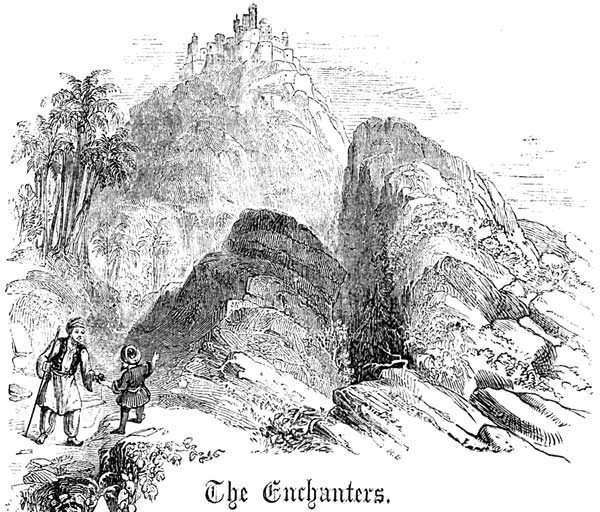
t the death of the mighty Dabulcombar, the Lord of the East, Misnar, the first-born of the Sultan, ascended the throne of India; but, though he had scarcely arrived at the age of manhood, yet neither the splendour of his Court nor the flatteries of the East could steal from the youthful Sultan the knowledge of himself.
His first royal command was to assemble together the wise men throughout his extensive dominions, from Cabul and Attok in the west to Kehoa and Thoanoa in the east. The learned and devout accordingly came from every part of his dominions. On an appointed day the Sultan ordered the illustrious assembly to meet in the divan, where, being placed on the throne of his forefathers, he thus opened unto them the desires of his heart:
"O ye sources of light and fountains of knowledge!" said[201] Misnar, "more precious are your counsels to me than the mines of Raalconda: wisdom is the true support of honour, and the Sultan is established by the counsel of his sages. Say, then, what course shall Misnar pursue that may secure him on the throne of the mighty Dabulcombar?"
The sages in the divan were struck with astonishment at the condescension of their young Sultan, and one and all fell prostrate before his throne. "May wisdom," said they, "guide the footsteps of the illustrious Misnar! may the mind of our Sultan be as the eye of day!"
Then arose the prophet Zeuramaund, and said, "I perceive, O mighty Sultan, the dark clouds of evil are gathering to disturb the hours of futurity; the spirits of the wicked are preparing the storm and the tempest against thee!"
The venerable sages looked aghast as Zeuramaund uttered these ominous predictions; the whole council were dismayed at his words, and all fell again prostrate on the earth.
Misnar alone appeared to be unconcerned at his predicted fate. "O my friends," said the youthful Sultan, "the rose cannot blossom without the thorn, nor life be unchequered by the frowns of fate. Grieve not, then, that trials await me, since the spirit of prudence and virtue blossoms fairest in a rugged soil."
The sages arose as their royal master spake, and beheld with wonder the youthful countenance of their prudent Sultan.
Silence and amazement for a time prevailed, till one of the sages, advancing before the rest, thus counselled the intrepid Prince:
"O light of the earth!" said the trembling sage, "whose virtue and innocence have not been vexed by frauds, and deceit, whose pure mind seeth not the foul devices of man's heart, trust not to the fickle interpositions of chance, where thine own arm can work security, and establish a permanent foundation to thy father's throne. Thou hast a brother, O my Sultan, whose veins are filled with royal blood, and whose heart is by descent above control. Ahubal, therefore, ere his youth unfolds in the fulness of manhood, should be cut off."
"What!" said the young Sultan Misnar, "what do thy base suspicious[202] fears advise? Is there no way to build up the seat of justice and mercy but in murder and fratricide? Never let him who was born to execute judgment secure his honours by cruelty and oppression. The righteous Allah planted me not here to spread a poisonous shade over the offspring of His Prophet Mahomet: though fear and submission be a subject's tribute, yet is mercy the attribute of Allah, and the most pleasing endowment of the vicegerents of earth. But as thou, weak man, hast dared to advise the extirpation of one of the race of the mighty Dabulcombar, the vengeance of my injured brother's blood fasten upon thy life!"
The guards of the divan, hearing the sentence of the Sultan, approached with their drawn sabres towards the decrepit sage; but Misnar, rising, cried out,
"Who of my subjects shall dare to violate with blood the sanctity of this refuge for the oppressed? Let the divan of justice be sacred: nevertheless, lead that author of malice from my sight, and let his own blood make satisfaction for the cruelty of his desires."
As he spake thus, the guards attempted to seize the sage; but when they advanced towards him, flames of fire burst from his mouth, and his whole form appeared as that of a fiery dragon. The rest of the sages fled from the dreadful monster; but Misnar, with an intrepid countenance, stood before his throne, with his drawn sabre pointing towards the dragon, when through the flames he perceived a hoary magician on the back of the monster.
"Vain, O silly child of Mahomet!" said the enchanter, "were thy sabre against the power of my art, did not a superior force uphold thee; but tremble at thy doom: twice four of my race are determined against thee, and the throne of Dabulcombar noddeth over thy head; fear hath now preserved thee, and the weakness of thy heart, which the credulous believers of Mahomet will call prudence and moderation; but the fiend of darkness is let loose, and the powers of enchantment shall prevail." As the old magician spake thus, his fiery dragon, with tremendous hissings, arose, and, cleaving the dome of the divan, disappeared from their sight.
"Thus," said the illustrious Misnar, "let the enemies of Mahomet be dismayed! But inform me, O ye sages, under the semblance of[203] which of your brethren did that foul enchanter gain admittance here?"
"As I travelled on the mountains from Queda," answered Bahilu, the hermit of the Faithful from Queda, "and saw neither the footsteps of beasts nor the flights of birds, behold, I chanced to pass through a cavern, in whose hollow sides I found this accursed sage, to whom I unfolded the invitation of the Sultan of India, and we journeyed together towards the divan; but ere we entered he said unto me, 'Put thy hand forth, and pull me toward thee into the divan, calling on the name of Mahomet; for the evil spirits are on me and vex me.'"
After the hermit Bahilu had spoken, Mangelo arose.
"May the power of the Sultan of the East be multiplied!" said he; "but know, O Sultan, that neither evil genius nor enchanter can enter this seat of justice unless he be invited in the name of Mahomet."
"If it be so," answered the Sultan Misnar, "then neither can they be masked against the voice of justice; for Thou, O righteous Allah, wilt uphold the tribunal which Thou has founded upon earth, and make the visions of fraud to depart from him who seeketh truth. Therefore," continued the Sultan, "lest this assembly be still tainted with malice and infidelity, I command the evil spirits to stand confessed before me."
At his word, sulphurous smokes arose, and from the thronged assembly seven hideous forms broke forth.
First, on a vulture's pinions, the fell enchanter Tasnar soared aloft, whose skin was as the parched Indian's when he writhes impaled upon the bloody stake.
Next, on the back of an enormous scorpion, whose tail dropped deadly poison, Ahaback appeared, and with his eyes darted malignant flashes on the youthful Sultan.
Happuck, a subtle magician, followed him, seated on the shoulders of a tiger, whose mane was shagged with snakes, and whose tail was covered with twining adders.
Hapacuson also, that decrepit hag, who personated the righteous Sallasalsor, from Nechal, now stripped of the garments of hypocrisy,[204] filled the eyes of the sages with terror and amazement. Her lean bones, wrapped round with yellow skin, appeared like the superstitious mummies of western Egypt. She was mounted on a dreadful monster. Its form was like the deadly spider, but in bulk like the elephant of the woods; hairs, like cobwebs, covered its long bony legs, and from behind, a bag of venom, of a whitish hue, spurted forth its malignant influence.
She was followed by her malicious sister Ulin, squatting on the back of a hideous toad.
Then, with a loud hiss, started forth, in many a fold, a black serpent, in length and bulk like the cedars of the forest, bearing the powerful enchantress Desra, whose wide-extended ears covered a head of iniquity.
Last, with majestic horrors, the giant Kifri swelled into his full proportion: the long alligator that bore him groaned with his load, and opening all his mouths (for every scale appeared a mouth), vomited forth streams of blood. In his hand the giant brandished a tall pine, and, shaking it at the dauntless Misnar, said,
"Tremble, vile reptile, at a giant's wrath! tremble at the magic powers of all my brethren, for thy doom is fixed!"
At these words, the infernal crew joined with Kifri, and all at once pronounced in harsh discordant sounds, "Tremble, vile reptile, for thy doom is fixed!"
The enchanters were then involved in a thick cloud of smoke, from which issued flashes of lightning, which, ascending to the roof of the divan, disappeared in a moment.
"There is neither wisdom nor prudence," said Misnar, as he prostrated himself on the ground, after the enchantments were at an end, "but what is derived from Allah. If Thou dost vouchsafe to direct my steps, O Protector of Mussulmen, the fear of evil shall not come upon me."
"Happy," said Candusa, the imam of Lahor, "happy is the Prince whose trust is in Allah, and whose wisdom cometh from the Heavens."
"Happy," said all the sages, humbling themselves before the Sultan Misnar, "happy is our Sultan, the favourite of Allah!"[205]
"That, O sages," replied Misnar, "is too much for even the Sultan of the East to hear. But, may the all-righteous Allah approve of my thoughts and actions; so shall the infernal powers destroy the wretches that employ them, and the dark poisoned arrow recoil upon him that blew it forth. But, O sages, though your numbers are reduced, your integrity is more tried and approved; therefore let your Sultan partake of the sweetness of your counsels, and learn from aged experience the wisdom of the sons of earth. Say, then, what doth the peace and security of my throne require from me concerning my brother Ahubal, the issue of the mighty Dabulcombar?"
"Far be it from me," said the sage Carnakan, "to presume to utter my words as oracles before the Prince; but may not the security of the East require that the Prince thy brother be not enlarged, as my Sultan is, to do whatsoever seemeth good in his heart? Should not the younger be as servant to the first-born of his father, and are not all the Princes the vassals of the Sultans of the East? Let, therefore, the Prince Ahubal enjoy the pleasure of life; but let him be removed from giving pain and uneasiness to my royal Sultan Misnar. At the sources of the springs of Ava, on the craggy rocks of Aboulfaken, is a royal castle built by the sage Illfakircki, to which there is no passage but through a narrow vale, which may be ever guarded by the slaves of Misnar. Hither let the Prince be sent; and let him live there, and enjoy life, without having any power to molest the glories of thy reign."
The counsel of Carnakan was agreeable to the Sultan and his sages; and Misnar gave immediate orders, that the mutes of his seraglio should attend the Prince to the royal castle at Aboulfaken; and then dismissing, for the present, the assembled sages, he commanded them to attend the divan every week.
In a few days, the mutes and guards who were sent with the Prince Ahubal being admitted into the presence of their Sultan, fell on their faces, and cried out,
"Oh, let not the displeasure of the Sultan visit his slaves, who, in obedience to thy royal word, journeyed toward the castle of Aboulfaken, and, as they passed along through the deserts, a party[206] of five thousand horse appeared, who, setting upon us, ordered us either to deliver up the Prince Ahubal, or defend him with our lives. Thy slaves would willingly have chosen the latter fate. Yet, alas! what were four hundred guards and twenty mutes to the army that opposed us? But our consultation was vain; for while we debated how to defend ourselves, the Prince drew his sabre, and, killing three of our number, cut his way through the guards to his friends. The horsemen then would have set upon us and hewed us in pieces; but their chief forbade them, saying, 'No, let them live, and be the messengers of the Prince's escape. Go,' continued he, 'dastard slaves! and let your Sultan know, that Ahubal has friends who will shortly punish him for his designs on the Prince.'"
At these words of the guards Misnar gave a deep sigh, and said, "Human prudence alone is far too weak to fight against the wiles of the deceitful; but Allah is more powerful than man. I will therefore send for the prophets, and inquire of them where I may seek for the assistance of Mahomet."
The Sultan then commanded Zeuramaund and his tribe, and Mangelo the prophet, from the hollow rocks of Caxol, to be brought before him; and when they were come into his presence, he demanded of them, where he might seek for the assistance of Mahomet, and the countenance of Allah.
Then Zeuramaund answered the Sultan in these words:
"In the tomb of the Prophet of Mecca is the signet of Mahomet, which no human power may remove; but if the Prophet will hear the prayer of the Sultan, it may easily be taken thence."
"Yes," replied Mangelo, "the seal of Mahomet will indeed preserve the Prince from enchantment; but it is also necessary that he put on the girdle of Opakka, which is worn by the giant Kifri, the sworn enemy of the Eastern throne. For although the signet of Mahomet will preserve the Sultan from evil, yet will the girdle of Opakka only save him from deceit."
The Sultan Misnar was moved at the discourse of his prophets, and spent the night in thought and perplexity. He had little hope that the signet of Mahomet, which had for ages remained immovable,[207] should yield to him; or that, with all his numerous armies, he should be able to force the girdle of Opakka from the loins of an enchanter, who could in a moment overwhelm his troops by the power of his art. However, he determined the next morning to go with his Court on a public pilgrimage to Mecca, and to offer up the most solemn petitions to the Prophet of his faith.
Early in the morning the Sultan arose from his seraglio, and commanded his courtiers to prepare the procession, as he intended immediately to make a public pilgrimage to Mecca.
But as Misnar was making known his intentions, a messenger arrived in haste at the entrance of the seraglio, who brought advice that one of the southern kingdoms had revolted, and was led on by a skilful heroine, who declared her intentions of placing Ahubal, the brother of the Sultan, on the throne of India.
Misnar was conscious that this revolt was brought about through the contrivances of the enchanters, and therefore despaired of conquering them by means of his armies; but lest the other kingdoms, seeing no troops were sent to repel the rebels, should also join the adverse party, the Sultan commanded the signal of war to sound; and sending for his Grand Vizier Horam in private, he ordered him to lead out the armies of Delhi against the rebels, and to dispatch daily messengers to the capital, to bring advice of his success.
The Vizier Horam received the Sultan's commission with reverence, and said, "Let not my Sultan be angry at his slave. If my lord should require ten thousand messengers, his slave Horam would dispatch them. But if my lord will accept of this tablet, he shall know in a moment the success of his servant, though numberless leagues distant."
"What!" said Misnar, taking the tablet from his Vizier. "By what means is this tablet endued with these rare virtues?"
"My lord," answered Horam, "when my father, through the malice of his enemies, was banished from the presence of the mighty Dabulcombar—whom the houris of Paradise do serve—he called me to him, and said, 'O Horam, the evil-minded have prevailed, and thy father has fallen a sacrifice to the enemies of truth! No more, my son, shall I behold the children of my strength, nor[208] the splendour of my Sultan's Court. Whither I go, I know not. But take this tablet, my son; and whatever befalleth thy parent shall at times be made known to thee in the leaves of this book; and to whomsoever thou givest it, that friend shall, after my death, read therein whatever Horam my son shall wish to make known unto him.'"
"Faithful Horam," answered the Sultan, "your present is of such exquisite value, that I shall, in confidence, honour you with the first place in my esteem. Know, then, my faithful Vizier, that the powers of enchantment are let loose against my throne, and the prophets have said, 'Thou shalt not prevail but with the signet of Mahomet and the girdle of Opakka;' therefore it is expedient that I first go to Mecca to obtain this valuable gift of the Prophet. My purpose this morning was to go surrounded by the nobles of my Court; but while rebellion stalketh abroad, pageants are idle, and the parade of a Sultan's pilgrimage will give my enemies time to increase in their numbers and strength. No, Horam; I myself will in secret approach the tomb of my Prophet, for Allah requireth the service of the heart, and searcheth out the purity of his servants' intentions: I shall go with greater humility as a peasant than as a prince. In the meantime my royal tent shall be pitched, and Horam only shall be suffered to approach it. So shall my slaves imagine their Sultan goeth forth with them to the field, and their hearts shall be strengthened."
"Be the desires of the Sultan fulfilled," said Horam, with reverence; "but will not my lord take with him a guard in his pilgrimage?—for the dangers of the journey are great over the mountains and deserts, and the voyage by the seas is perilous."
"No," answered the Sultan; "those who are my slaves here, may at a distance become my masters, and sell me to my foes: where the trust is great, great is the danger also. Shall I set guards over my person in the heart of my kingdom amidst my faithful subjects, and trust my life in a slave's hand where I am neither known nor respected?"
The Vizier Horam was struck with the prudence of his youthful Sultan, and bowed in assent to his words.[209]
In a few days the armies of India assembled; the royal tent was pitched, and the Vizier was declared the leader of his Sultan's forces. Misnar entered his tent in great state, and Horam alone followed the Sultan into the retirements of the movable pavilion.
The Vizier had, according to the Sultan's instructions, prepared a disguise for his master; and at midnight led him, like a peasant, through the encampment into a wood, where, falling at his feet, he besought him to consider well the dangers he was about to encounter.
"Horam," answered the Sultan, "I well know the goodness of thy heart, and that thy fears arise from thy love. Sensible am I that the dangers of my pilgrimage are great; but what resource have I left? More than man is risen up against me, and more than man must assist me, or I perish. To whom, then, can I fly, but to the Prophet of the Faithful? For I am well assured that no enchantment shall prevail against me while I journey toward Mecca, for such is the faith of all true believers: though they may oppress and fatigue me, yet in the end shall I triumph. Besides, Horam, there remains no other course for me."
"True, my Sultan," answered the Vizier: "without Allah, vain is the counsel of man; but is not Allah everywhere present to aid and defend the sons of the Faithful?"
"Though Allah be all-powerful," answered Misnar, "yet is not the slave of His hand to direct the Lord of all things. If we would gain the help and assistance of Allah, we must obey His commands; and well are we assured in the law of our Prophet, that at Mecca shall the prayer of the Faithful be heard. Wherefore, O Horam, no longer my slave, but my friend, lead forth my armies with confidence and trust, and doubt not that He, who daily refresheth the sun with light, will shortly restore Misnar to the throne of his forefathers."
As he spake thus the Sultan broke from his Vizier, Horam, who had fallen at his feet weeping at his fixed resolves, and penetrated into the gloomy recesses of the forest.
All was silence and darkness, save where, through broken fragments of fleeting clouds, the moon sometimes threw a feeble light on the gloom of the forest.[210]
"This gloomy recess," said Misnar, as he passed on, "which hides me from the world, makes me better known to myself. In the Court of my forefathers I am called the 'light of the world,' the 'glory of the East,' and the 'eye of day;' but in the wild forest of Tarapajan I am a poor helpless creature. What, then, is the pride of man but deceit, and the glories of the earth but shadows? Surely more had I to fear from enchantment on the throne of Dabulcombar than in the bosom of this forest. Here the wild beast will not flatter me, nor will the lordly lion acknowledge me the Sultan of his wild domains."
With such thoughts Misnar passed on for many days; till one night, at a distance, he perceived the skies looked red with light from various fires, and, by the noise, found that some Indians were carousing in the woods before him.
The disguised Sultan endeavoured to avoid them, striking into a path which led round their fires; but some of the Indians observing him, called to their brother peasant, and desired him to partake of their mirth.
Misnar thought it would be vain to refuse the request, as they all seemed disposed to insist on their demands, and therefore hastened to the scene of their festivity.
Here he found ten or twelve fires, with a number of males and females, some sitting, and some dancing around them to the sound of rustic music.
Misnar inquired the cause of their mirth.
"What!" said an ancient female, "though you are a stranger in Tarapajan, and know not that the Feast of Tigers is celebrated by these nightly fires, yet must you now learn that no stranger comes but to partake of our joy, nor departs till, the fires are extinct."
"And how long," said Misnar, "doth this feast last?"
"This," answered the old woman, "is the third night, and these fires must blaze yet eleven nights and days more, during which time the axe is not seen in the hand of the forester, nor doth the bow twang in the woods of Tarapajan; neither may he which seeth these rites depart till they be fulfilled."[211]
Misnar was thunderstruck at this relation. And ere he could answer, the crowd gathered round him.
"Come," said he that appeared to be the chief, "let us initiate this stranger into our rites: bring hither the skin of the tiger, and the paw of the lion, and the lance, and the bow that twangs not in the woods of Tarapajan during these nightly festivals."
Then one brought the skin of a tiger, and threw it over the shoulders of Misnar; another came with the paw of a lion, and hung it before him; a third brought a lance, and put it in Misnar's right hand; and a fourth slung a bow on his breast. Then all the crowd made a loud howling, and danced round the astonished Sultan.
"Now," said the chief, when the dance was finished, "sound the hollow instruments of brass, which give notice to the moon and to the stars that this stranger is about to swear not to reveal our rites. Lay thine hand on thy head," said the chief to the disguised Sultan, "and put thy fingers on thy mouth, and say, 'As the starless night is dark, as the cave of death is dark, so shall my thoughts and words continue in darkness concerning the festival of tigers.'"
"And wherefore," said Misnar, "is this silence imposed? And what shall befall him that sweareth not unto you? Is not the mind of man free? And who shall offend him who seeketh not to offend others?"
"Whosoever," answered the chief, "travelleth, should become obedient to the customs of those people among whom he tarrieth."
"Right," continued Misnar; "and I am willing, on two conditions, to fulfil your will: first, you shall all swear that I be at liberty to pursue my journey on the eleventh day; and, next, that I shall not be bound to perform aught contrary to the law of Mahomet."
"Stranger," replied the chief, "when we are at liberty to depart, thou shalt depart likewise; but during this festival, which is held in honour of our noble ancestor, who remained fourteen days in this forest till he had subdued a ravenous race of tigers, no man that has entered here may stir hence till the fires be extinguished:[212] for by the fire did our ancestor drive away and destroy the tigers and beasts of the forest, and by fire do we commemorate his mighty deeds. Neither," continued the chief, "may we reveal these rites to any one but those who by accident espy them; for such as are present with us we are bound to receive into our society; wherefore we compel those who come among us to keep in silence the knowledge of our rites."
"If such is your custom," answered Misnar, "I shall willingly comply, and swear to you, that 'As the starless night is dark, as the cave of death is dark, so shall my words and thoughts continue in darkness concerning the festival of tigers.'"
As he uttered these words, the whole assembly again danced around him, till the hollow brazen instruments were ordered to sound, and all the inhabitants of the forest were commanded to receive the disguised Sultan as their brother.
Then the men, one by one, passed by Misnar, each as he passed laying the hand of the Sultan on his breast. After they were passed by, came the females also, who embraced their new brother. These Misnar suffered to pass on without much reflection, till, among the youngest, who last approached, he beheld a beautiful virgin, with downcast looks, drawing near him, and who seemed ashamed of that freedom the custom of the place obliged her to use.
At sight of this lovely figure, Misnar at once forgot his purpose and his crown, and was impatient till the ceremony brought her near to him. The other females perceived his emotion; and the chief of the festival approaching her, asked the lovely Noradin "whether she would at length fix her choice? for in this place," continued the chief, addressing himself to Misnar, "every sex hath freedom, and none are compelled to take the hand they do not love. Noradin hath for these three days been courted by all our tribe, but she has refused every advance: if she refuse not you, our joy will be complete, and then none of our company will be without his companion."
Misnar, forgetting the great designs of his heart, waited for the fair one's answer, and felt more fear at her silence than at this dreadful enchantments of his monstrous enemies. At length[213] Noradin answered, "May the joy of my comrades be complete!" Misnar, in raptures at the fair Noradin's preference, took her by the hand, and led up the dance, while the instruments of brass a third time sounded, to proclaim the choice of Noradin.
At the appearance of day, each repaired to the cottages around, and Misnar and Noradin were led by the chief to a spot, where shortly the whole assembly built them a cottage of bamboo and the leaves of the plantain.
As soon as they retired, Noradin, taking Misnar by the hand, asked him whether she deserved his constant love for the choice she had made. Misnar reflected upon the words of his fair companion, and his heart recoiled at them.
"What!" said the Sultan to himself, "shall I, for the gratification of my passion, give up the glories of my father's kingdom, and the viceregency of Mahomet? Or shall I basely betray that love which is proffered me, and embitter fair Noradin's future cup of life? No," said he aloud, turning to his amiable companion, "never let the man of integrity deceive the heart that means to make him happy. Forgive me, all-beauteous Noradin! but the volumes of my fate are open, and the Prophet of the Faithful will not permit me to indulge here my secret affections: though the soul of thy slave will be torn and divided, yet must he depart with the expiring fires of your festival."
"Base, cold, and senseless wretch!" said the false Noradin (as the beauteous vision vanished from the eyes of the Sultan, and he beheld the enchantress Ulin before him), "call not thy frozen purpose virtue, but the green fruits of unripened manhood. Though thou art escaped, puny animal as thou art! from the power of my enchantments, yet shall the southern kingdoms of India feel my scourge. Proceed, then, superstitious reptile! on thy tame pilgrimage to Mecca, while Horam feels the vengeance of my army in the sultry deserts of Ahajah."
As she spake thus, she stretched out her wand, and the fires and the foresters, and the enchantress Ulin, disappeared from the sight of the astonished Sultan.
The Sultan immediately prostrated himself on the ground, and[214] gave glory to God for his wonderful escape; and, pursuing his journey, continued his course for two moons through the wide-extended forest of Tarapajan.
During this time he daily examined the tablets which the Vizier Horam had given him; but was very uneasy at finding the leaves always fair. "Alas!" said he to himself, "I have trusted to a base man, who perhaps has taken this advantage of my credulity, and intends to set the crown of India on my brother's head! There needed not the powers of enchantment to overthrow me, since I have betrayed at once my folly and my cause."
Misnar, therefore, resolved to travel back to Delhi, and learn the cause of Horam's silence; but as he neglected not to look on the tablets every day, he at length found the following inscription therein:
"Horam, the faithful slave of the Sultan of the East, to Misnar, the lord of his heart.
"Some time after I left my royal Sultan in the forest, while my heart was sad within me, came a hasty messenger from the outskirts of the rebel army, and declared their approach, and that the southern provinces had revolted, and were added to the opposers of the Sultan of the East. When thy slave was certain of this intelligence from the mouths of many, who hastened to the camp with these bad tidings, I commanded the armies of India to be increased, and a more exact discipline to be observed in my master's camp; and, perceiving that the enemy hastened to meet the forces, I shortened the march of my slaves, that the fatigues of the deserts might not prevail more against them than the face and the sword of their enemies. Moreover, I led thy troops through the most cultivated countries, that the necessaries of life might with the greater ease be procured for the multitudes that followed thy tent. But, alas! the presence of my lord is not with his people, and the army murmur that they are led by a Sultan who cheers not their labours by the light of his person; so that the hearts of thy people are withdrawn from Horam thy slave, and the captains of thousands demand admittance to thy tent, and accuse thy Vizier of evil devices against thee, my lord the Sultan."[215]
As the Sultan read this intelligence in the tablet of Horam, his heart failed within him, and the sight of his eyes was as a mist before him.
"O Misnar! Misnar!" said he, falling to the ground, "the fiend of darkness is let loose upon thee! and the powers of enchantment still prevail!"
"Yes," said Ulin the enchantress, who immediately appeared, "the powers of enchantment shall prevail! Misnar, the faithful servant of Mahomet, hath at length yielded to my power, and Allah hath given to my vengeance the wretch that doubts His protection. Crawl, therefore," continued she, "vile reptile, on the earth, and become a toad."
At the powerful voice of her enchantment, the Sultan shrank from his natural form and became a reptile on the earth. His change of form did not take from Misnar his memory or recollection: he was sensible of his disgrace, and of the justness of his sentence; and though he could not fly from himself, yet he hastened into the thicket, that he might hide from the light of heaven. But the calls of nature soon drove him from his recess, to seek his proper food in the desert. He crawled forth, and was led on by a scent that pleased him: his spirits seemed enlivened by the sweet odour, and his cold feeble limbs were endued with brisker motion.
"Surely," said he, in his heart, "the bounteous Allah hath not left the meanest of His creatures without comfort and joy. The smell is as the smell of roses, and life and vigour are in these attractive paths."
With these thoughts he crawled forwards into the thickest covert; and though his body was drawn with a secret impulse, yet his mind was filled with horror when he came in sight of a mangled and corrupted body, which lay hid among the bushes. One of his own deformed kind sat squatting beside it, and, like himself, seemed to desire and yet detest the loathsome feast.
Misnar, at sight of one of his hideous kind, was filled with scorn and rage; and, forgetting his transformation, was about to drive him from the mangled body, when the reptile, opening his mouth, addressed him in the language of Delhi.[216]
"Whether thou art really what thy form bespeaks thee," said the reptile, "or, like me, the victim of enchantment, answer."
The Sultan, surprised at this address, and perceiving that misery was not his portion alone, desired to know by what means his fellow-creature suffered such a wretched change.
"Since I perceive by your speech," said the reptile, "that one event has happened to us both, I shall not be adverse to declare to you the cause of my transformation; but I shall expect that my confidence will not be misplaced, and that, after I have made you acquainted with my history, you will not refuse to reveal your own."
"A similitude in our fates," replied Misnar, "has already made us brethren, and I should be unreasonable to ask a favour I meant not to return."
"Well, then," said he, "we will depart from this wretched sight into a different thicket, where we may unmolested bewail our uncommon fates; for although the enchantress Ulin, to disgrace our former natures, and to make us the more sensible of our present deformity, obliges us to meet daily before this horrid spectacle, yet our food is of the fruits of the earth; for the wicked enchantress has not the power to make us, even in this deformed habit, do that which is contrary to our human nature."
While he was speaking another toad came up.
"Here," continued the first, "is another of our brethren, and another will soon be here: we were three before you came among us.—Where, O Princess, is the last victim of Ulin's rage?" said he to the second.
"He was basking," answered the second, "in the sand; but I aroused him, and he is now on his way."
In a few minutes the third arrived. As soon as he had beheld the mangled body, and, the attraction ceased, the first leading the way, they departed into another thicket.
"Here," said the first, "O stranger, we may rest securely, and the serpent cannot annoy us, for we are seated under the shade of the fragrant cinnamon."
"We are obliged to you for your care of us," said Misnar; "but I am eager to hear the cause of your transformation."[217]
I am (replied the toad) the son of a jeweller in Delhi, and my name is Mahoud. My father, after a life of industry and parsimony, finding himself declining, sent for me, and on his death-bed said, "O Mahoud, my days have been the days of care, but success hath attended them. I have toiled, that thou mayest reap; sown, that thou mayest gather; and laboured, that my son may enjoy the fruits of my industry. My peace and comfort have been sacrificed to thine; and now I die, assured that my beloved Mahoud will not be pinched by poverty or oppressed by penury and want."
Thus said my aged father, and expired, and my tears accompanied his departing spirit; but these soon gave place to that ardent curiosity which drove me to explore the riches he had left me.
I opened box after box with silent rapture, and was pleased to find wealth sufficient to satisfy even the appetite of youth. Many diamonds were among my father's wealth, besides large quantities of gold and silver; so that, in my youthful judgment, there appeared no end to my riches.
It was not wonderful that, being so suddenly put in possession of these riches, I should seek every pleasure and diversion which wealth could purchase. All who were the companions of my childhood, all who would court an inexperienced heart, were admitted to my table; and the strict laws of Mahomet were less regarded at my house than the rich wines which sparkled at my feasts. Nor were the charms of the fair forgotten; and while our goblets were filled with wine, we envied not the deceased their rivers of milk.
Thus passed I my life among those who jest with religion, and make their mock at the rules of prudence and sobriety. But the time soon came when my hours of revelry were to be changed for those of sorrow, and when I was first to learn that a father's prudence will not secure a wicked son from the shafts of bitterness and grief.
My possessions, though ample, were nearly exhausted by ignorance and extortion; my jewels were gone; unacquainted with their value, I had flung them away rather than sold them; my[218] silver and gold were become the property of my friends, who, when I applied to them in return, were much more assiduous, if possible, in keeping it from me than I had been in squandering it on them. So that, in a little while, even the merchants, who had been such gainers by me, came to demand some trifling sums that I had borrowed from them, which being unable to pay, they seized my furniture and stripped me of my clothes to satisfy their demands.
In this situation I was turned out of my own doors by those whom I had received a thousand times in my arms, and spurned at like a dog by those whom I had pressed to my bosom.
Stung by reflecting on my former follies, and ignorant where to fly for shelter, I covered myself with some few rags that had been cast to me, and sat down before the house of a rich young man, who, like myself, seemed to be squandering his wealth on the scum of the earth.
Bennaskar—for that was his name—soon came forth, with his minstrels and singers at his heels, and, seeing a miserable figure before his door, he asked what I wanted. I told him that once, like himself, I gave life to the dance and mirth to my friends; but that want of caution had been the cause of my ruin, and too much confidence in those who least deserved my favour.
Several of his friends, hearing this, would have driven me from his presence, saying it was unfit such a wretch should even enjoy the blessings of the air; but Bennaskar would not suffer it, and asked me, "Whether the insincerity of my friends had taught me to be sincere to others?"
I answered that I had ever been sincere, even to those who were undeserving, and that I would rather die than betray my friend.
"If what you say is true," said Bennaskar, "I will try you. Go in, and my servants shall clothe you, and you shall live with me. I only ask in return, that you never disclose to any one what you hear or see transacted in my house."
"Sir," answered I, "your offer is gracious, and bespeaks your generous intentions; but I do not choose to live on another's bounty unless I can make myself useful."[219]
"That," answered Bennaskar, "you may do if I find I can trust you. I have long been in search of one I could trust. I want such an one, but cannot find him."
The friends of Bennaskar then surrounded their lord, and each confusedly offered their services to him.
"No," said the young man, "though I appear unthoughtful in your eyes, O, servile race of flatterers! yet know, to your confusion, that I have tried you all, and find you trifling and insincere. This man alone refuses my proffered love unless he can return it, and this man alone is worthy of my esteem."
The friends of Bennaskar were thunderstruck at his words, and renewed their protestations; but he commanded his servants to drive them from his house, and, taking me by the hand, he led me into an inner but sumptuous apartment.
As soon as we entered, I prostrated myself at his feet, and said, "Let not my lord be angry with his servant, but thou hast not told me what service thou wilt expect from me."
"All that I require," answered Bennaskar, "is that you disclose not to any one what you hear or see transacted in my house."
"My lord," answered I, "of what service can I be to you by such a compliance? If I am silent thy slaves may speak, and I shall be blamed for their insincerity. I pray thee, let me return to my rags, and set me not in a place where thy vassals will be tempted to ruin me in thy favour."
"Your answer," said Bennaskar, "is the answer of a prudent man. But fear not: I cannot do without you, and I hope you will not refuse my proffered love. What you will see, none will see besides you; therefore none but yourself will be unfaithful to me."
On this assurance, I accepted the offer of Bennaskar. After which the slaves led me to the bath, where I washed, and was perfumed, and arrayed in a vestment of my lord's.
Bennaskar was impatient to see me; and, as I was led into his presence, the young man hastened to meet me, and, folding me in his arms, he said, "May I at length meet a friend I call trust?"
And I answered, "May Mahoud be the friend of thy bosom?"[220]
Bennaskar then led me into another apartment, and meats were set before us, and he ordered the females that danced to come and entertain us.
Thus I spent my time with the agreeable Bennaskar: every day we varied our enjoyments, and were mutually satisfied with each other.
I had now been with my friend eighteen days, and nothing had occurred to interrupt our friendship, when, on the nineteenth morning, Bennaskar appeared with a clouded visage.
"What," said I, "my lord, is the cause of your grief? Shall not Mahoud share alike with you the smiles and the frowns of Allah?"
"Is it not," asked Bennaskar, "O Mahoud, the full of the moon?"
"It is," replied I, with a smile; "but doth Bennaskar intend to change with that fluctuating planet?"
"O Mahoud," said Bennaskar, "the fate of thy friend is dependent on the caprice of the stars. To-night must I put thy utmost friendship to the trial. If Mahoud prove insincere, then is Bennaskar cursed among men. If thy heart is not firm, now, while there is time, depart. But why should I doubt thee? surely Mahoud is of the sons of the Faithful. What must I say? Leave me, Mahoud, leave me; nay, if thou departest, where shall I find thy fellow? and the presence of a friend is necessary to my quiet."
"Then," answered I, "fear not, Bennaskar: Mahoud may be unhappy, but he cannot be unjust. But what is this dreadful trial that obliges Bennaskar to suspect his friend?"
"True," said Bennaskar, "Mahoud is undeserving of suspicion. Let us wait till the sun sink from the skies, and the stars return with their glimmering light."
Bennaskar then proceeded to the bath, and arrayed himself in a costly robe, and desired me to do the same. I obeyed my friend, and we met in the saloon together.
"Alas!" said Bennaskar, as we met, "how can I request my friend to wear the image of deformity?"
"What image of deformity," said I, "must Mahoud wear? All[221] appearances are to Mahoud alike; and the severer the trial, the more shall I commend thy friendship."
"Then," said Bennaskar, pulling out a pot of black ointment, "thou must suffer me to disguise thy face with this ointment: to-night thou must personate a black slave."
"Is such a trifle," said I, "the test of friendship? Give me the ointment, and furnish me with the habit of a slave."
"The habit," answered Bennaskar, "is ready, and all is ready; but you must not as yet disguise yourself, lest my slaves observe us. Come, let us for the present enjoy ourselves, and, when night approaches, Bennaskar will rely on the friendship of Mahoud."
The slaves then brought us the costly viands of Delhi; but Bennaskar remained pensive, and seemed not to relish the dainties before him.
I endeavoured all I could to divert his melancholy; I smiled, I sang before him; the dancers were introduced with music to dissipate his gloom; but Bennaskar still remained mute. The music continued till night, when Bennaskar commanded the slaves to withdraw, and, taking a lamp in his hand, led me through several apartments.
"Mahoud," said he, as we went along, "has never yet seen the wonders of my palace."
"I am happy, my lord," answered I, "to see your wealth; but I am not inquisitive to explore, unbidden, the secrets of another."
We had now arrived at a small vaulted room, from the centre of which hung a lamp, which Bennaskar trimmed, putting out the one he held in his hand.
"Now," said he, "Mahoud, enter that closet which is opposite to us, and put on the slave's dress which you will find there, and anoint thy face and hands with this black ointment."
I immediately obeyed, and in a short time came forth arrayed as a slave.
"Kind Mahoud," said Bennaskar, "thou art excellently disguised; now obey with silence, and stand as a mute before his lord."
I folded my arms and nodded assent, at which he smiled.[222]
"Take hold, Mahoud," said he, "of that iron ring which is fastened to the middle of the floor, and pull."
I obeyed, and a little trap-door opened. On looking down, I perceived a woman in rich vestments, half buried in the earth. I shuddered at the sight, and was falling backward, when Bennaskar struck me with a chabouc,[6] which he drew from his bosom, and said, "Villain, if thou fail me, I shall use thee as my slave."
[6] A large whip.
Although enraged at the blow, yet I remembered my promise, and returned to the trap-door.
"Slave," said Bennaskar, "dig that female out of the ground: the spade and the mattock are hidden under the floor."
I immediately jumped down, found the tools, and began to work; but neither my fear nor my labour could prevent me from fixing my eyes on the lovely female, who seemed as one dead.
As soon as I had removed the earth from her, which I did with great care, Bennaskar commanded me to lift the body into the apartment, gave me a phial of clear blue liquor, and ordered me to pour it into her mouth, while he retired to the closet.
I willingly obeyed, and hastened to administer the liquid, while Bennaskar retired.
The liquor was no sooner swallowed than the lovely female began to move, and in a short time opening her eyes, she cast them upon me, and shrieked out, clapping her hands together and crying, "O Allah, defend me!"
Bennaskar at the same time spoke to her from the closet where he was concealed.
"Hemjunah," said he, "are you as yet disposed to yield yourself to the will of Bennaskar, or must we still experience the evils of opposite enchantment?"
"Wretch!" answered the fair stranger, "I fear not the powers of your accursed magic, for Macoma has assured me that you shall not be able to harm me except with my own consent; and Mahomet, though for a time he permits this enchantment, will at length assuredly deliver me."
"Then," answered Bennaskar, "must the lash be inflicted. Here," continued he, "slave Mahoud, inflict fifty lashes on that obdurate female."
I took the chabouc from Bennaskar, and began, with trembling, my cruel office, lamenting my own blind compliance in promising to obey a monster whom I had mistaken for a friend.
As the lash touched the beautiful Hemjunah, she made the vaulted roof re-echo with her cries; nor did my heart feel less sensibly the strokes which I gave than her own. The tears trickled down my cheeks, and I prayed inwardly to be delivered from the hateful task.
"What," said Bennaskar from the closet, "what doth Hemjunah now say to my desires?"
"The hard-hearted and the cruel," said Hemjunah, faintly, "are the last to win the soft affections of a female heart: rather let me die than be the property of the vile Bennaskar."
"If so," said he, coming from the closet, "die: for the present I resign my power. Let Macoma hide thee again in the dust of the earth."
Bennaskar no sooner appeared than the beautiful Hemjunah again seemed to die away, and immediately a hissing noise was heard, and an ugly dwarf arose from the trap-door, and took the body of Hemjunah and replaced it in the earth, and the trap-door was closed with a roaring noise.
Bennaskar then beckoned me to follow him, and leading me to the bath, bade me wash and return to the saloon in my proper vestments.
I was so surprised at these horrors that I hardly knew what I did. However, in the bath I had time to recollect myself; but recollection was of little service, for reflection rather increased than cleared my confusion. One moment I resolved to apply to the Cadi, and declare every circumstance of the terrible adventure. The next I was awed by the thoughts of my rash and imprudent vows of secrecy.
"Bennaskar," said I, "has for a month appeared as an angel before me; but one base action has deformed all his former purity.[224] How can I reconcile these inconsistencies? Can he, who is the tenderest, the best of friends, be also the vilest and most cruel of mankind? I have been accessory to the torture of a most beautiful female—one, too, who called on the perfect Allah to deliver her. I have been the instrument of a mean revenge on a helpless woman, and now I yet delay to inform the Cadi of the villanies of this house of enchantment."
I resolved immediately to repair to the Cadi, and give him full information of the sorceries of Bennaskar. I hastened out of the bath, threw my vestments over me, and advanced to the door.
"But," said I, as I went along, "what am I about to do? I shall forfeit my faith without serving the distressed. Bennaskar expects me in the saloon, and when he finds that I am gone forth, he will, by the power of his art, secrete the beautiful female from the eyes of the Cadi. I have been the guest of Bennaskar a month, and never, till this day, did I perceive the rooms through which I was led to that detestable act of cruelty: nay, Bennaskar himself was obliged to wait: he was impatient till the full of the moon, and oppressed with sorrow and care when it arose. I will, therefore, for the present, return to Bennaskar, and will put on the face of cheerfulness, and make my countenance to shine before him."
Bennaskar met me on my return. "Whence cometh Mahoud?" said he.
"I am," answered I, "just risen from the bath, and I come to meet my friend Bennaskar."
"Mahoud," answered Bennaskar, "art thou faithful, and wilt thou ever remain faithful to thy friend?"
These words embarrassed me, and, not daring to answer otherwise, I said, "Why doth my lord doubt the sincerity of my heart?"
"Mahoud, then," returned he, "is faithful?"
"He is," answered I, but with an unwilling heart.
"I doubt not," continued Bennaskar, "that my friend is amazed at the scene he lately beheld. But ask no explanations: let thy mouth be ever closed to seek or reveal."
"Then," answered I, "you doubt the faithfulness of Mahoud;[225] else why may not I know the meaning of the wonders I have seen?"
"The age of thy friendship," said Bennaskar, "is a month, and wouldst thou be admitted in so short a time to all the secrets of my heart? Forbear, rash youth. A well-tried friend is Bennaskar's joy; but woes and death are in the paths of his enemies."
As he said this, he frowned and left me, and I retired to my apartment, irresolute in mind. As I entered my chamber, I perceived a small book open on a desk before the burning lamps. I went up to it, and found it was the Koran of our holy law. Being little desirous of sleep, I sat down; and as I read, methought I saw the name of Mahoud in the book.
Startled at the vision, I looked again, and read distinctly these words:
"Mahoud! Mahoud! Mahoud! there is much good in the world, but there is more evil; the good is the gift of Allah, but the evil is the choice of His creatures. Because of man's sin, and because of the darkness of his heart, do the evil genii and the enchantments of wickedness prevail. Even now is Mahoud in the house of a magician, to whom he is imprudently bound by the ties of honour: to draw back is meanness; but to persist is sin. When men act wrong, they subject themselves to the power of a wicked race; and we who are the guardians of mortality cannot interpose but in proportion to their remorse. Taken by the crafty dissimulation of Bennaskar, thy easy soul gave in to his snares, and thy prudence was decoyed by the voice of his mouth. Thou hast promised, at all events, not to reveal the secrets of his house, and thou hast, unknowingly, joined thyself in the fellowship of the wicked. But can man, who is bound to the service of Allah by an unalterable law, dispose of himself against the will of his Maker? or can the worm of the earth, the property of Heaven, set up itself against the hand that formed it? Had Mahoud engaged to conceal everything but what the law of Mahomet obliged him to reveal, he had behaved wisely; but he who walketh in darkness will undoubtedly fall into the pit. Past errors cannot be recalled; and Mahoud must learn the wisdom of experience.[226] Under the resemblance of the Koran, behold, the genius Macoma instructs thine heart. I perceive evil will attend thee, if thou dost attempt the enlargement of the Princess of Cassimir; and yet, without it, thou must still continue the servant of cruelty and oppression. Choose, therefore, for yourself: if injured innocence can move thee, boldly suffer in the cause of truth, and take this book in thy bosom, which shall at all times admit thee to a sight of the Princess; if not, be still the slave of the enemy of thy Prophet."
After this, I looked again on the book, but found I could read no more; however, I hesitated not to engage in the service of the Princess; and therefore, taking the book in my bosom, and the lamp in my hand, I went toward the saloon, supposing that Bennaskar was asleep. I searched for the rooms through which I had passed before, and soon perceived the vaulted apartment at the end of them.
I hastened to take up the trap-door, and touching the Princess Hemjunah with the book, essayed to deliver her from her miserable confinement. The Princess awoke at the touch of the book; but, at the sight of me, shrieked aloud, and I feared her cries would awaken Bennaskar. I assured her that I was sent by the genius Macoma to effect her deliverance, and that I abhorred every kind of cruelty which I had practised upon her.
"Alas!" said she, still shrieking at intervals, "your story betrays your wickedness. I never before saw you, unless you are, as I suspect, the magician Bennaskar under some feigned appearance; but rest assured, vile man! that no deceit or cruelty shall ever make me the creature of Bennaskar. I will ever persist in my hatred of you; and I am assured that you cannot injure or destroy me."
"Most gracious Princess Hemjunah!" said I, prostrating myself before her, "let me beseech you to hear me: I am not Bennaskar, nor a creature of Bennaskar's, but the servant of the genius Macoma, who has instructed me, by means of this holy book (which I then pulled out), to attempt your rescue, and I am willing to lay down my life for your safety. You have not indeed seen[227] me in my present character, but this very night was I brought hither by Bennaskar, under the similitude of a slave, and forced, through a most accursed oath, to inflict the severest tortures on the most delicate of her sex."
"Wretch!" said the Princess, "I am now convinced of thy perfidy, allowing thine own account to be true; for what promise could bind thee to a cruel action? and why not rather be thyself a sufferer than make an innocent virgin the subject of thy cruelties? But if thou art truly the servant of Macoma, and ashamed of thy late inhuman deeds, quit the house of the vile Bennaskar, and inform the Cadi of his cruelties and sorceries."
"Rather," said I, "let me dig around you, and release you from this miserable confinement."
"That," said the Princess, "you cannot do, unless you are indeed, as I suspect, the wretch Bennaskar; for by his command alone can I be released. Oh, fool that I was," continued she, with tears, "to listen for a moment to the falsehood of man!"
"If my information," said I, "O lovely Hemjunah, will avail, this moment will I fly to the Cadi, and acquaint him with your distress."
I then hastened to go; but oh, imagine my terror and amazement when I saw Bennaskar moving through the apartments which led to the vaulted chamber!
As he advanced, Hemjunah shrieked, and I was ready to sink: though my intentions were just and good, yet was I terrified by his appearance, so much was I sunk by the rash promise which I had made; and I every moment expected the dreadful effects of his powerful malice.
As Bennaskar entered the vaulted chamber, I shrank back with fear, and dared not lift up my eyes; but my terror was soon quieted, when I saw him fall prostrate at my feet. I then no longer doubted that the genius Macoma supported me, and attributed his behaviour to her supernatural power.
"O Mahoud," said Bennaskar, "the friend of my bosom, the partner of my secrets; although the power of love has not the rule in thine heart, yet pity those who are the slaves of its dominion;[228] if the lovely Princess of Cassimir did but know the purity of my heart, the——"
"Hear not the villain," said Hemjunah, "O servant of Macoma, unless he release me from this detested place: me he hath already deceived; and you will be subjected likewise to his power, unless the prudent spirit of Macoma direct thee."
"Then," said Bennaskar, rising up, and laying bare his bosom, "here, Mahoud, strike, and end my miseries, and the miseries of Hemjunah; but never will Bennaskar consent to lose the treasure of his heart."
"I will not," answered I, "lift up my private arm against thy life, but I shall deliver thee to the power of the Cadi, who is the deputy of the great Allah's vicegerent."
"Give me, then," said the Princess of Cassimir, "the book of the genius Macoma, that I may be defended from the insults and contrivances of the base Bennaskar."
The request of the Princess appeared to be so reasonable, that I obeyed her, and put the book into her hands.
Bennaskar, when I was leaving the vaulted chamber, besought me not to destroy the friend who had supported me; but I told him that Allah was to be obeyed rather than man.
I hastened to the Cadi; but as it was night, his officers told me I could not be heard, till I informed them that I had in my power a wicked magician, who, by sorceries, had stolen the Princess of Cassimir. When they heard this, they acquainted the Cadi; and that vigilant magistrate arose, and followed me to the house of Bennaskar with his guard.
As I entered the house, I was amazed to see him standing in the entrance with a lamp in his hand; but my astonishment increased when I saw him fall down before the Cadi, and confess his guilt.
The Cadi commanded the guards to seize him, and then ordered him to lead us to the place where he had concealed the Princess of Cassimir. Bennaskar obeyed; but as he went through the apartments, he said to me, "Mahoud, you are sensible that the Princess Hemjunah's body is half buried in the earth, and uncovered;[229] therefore prevail upon the Cadi that he suffer us to go before and release her: for my part, my sins oppress me, and I wish to restore to her dignity a much-injured Princess."
"If," said I, "you will promise to release the Princess, I will endeavour to prevail on the Cadi to permit what you propose; but, otherwise, let the whole world be a witness of your wicked malice."
"O my friend," said Bennaskar, "accuse me not, my own heart persecutes me sufficiently. Yes, Mahoud," continued he, "I will, as you require me, release the Princess, and trust to the mercy of the Cadi; for the service of the evil genii will neither bring me profit nor peace."
I was pleased at this repentance of Bennaskar, and besought the Cadi that he would suffer us to enter the vaulted chamber first, and recover the Princess from her enchantment. The Cadi acquiesced in my proposal, but ordered the guards to surround the entrance, while Bennaskar and myself entered the chamber.
As soon as we entered, Bennaskar seized me suddenly by the throat, and, before I could speak or recollect myself, he dragged me into the closet and shut the door after us.
"Now," said he, "villain! receive the just rewards of a perjured heart." Saying this, he spat in my face, and threw me on the ground, and then flew out of the closet, shutting the door forcibly after him.
I remained for some moments stupefied by my fall; but after a time arose, and opening the closet, I was surprised to see neither the Princess of Cassimir nor the magician Bennaskar.
While I was in this confusion, the Cadi and his guards, being impatient at our stay, entered the chamber, and the Cadi commanded his guards to seize me, saying, "Villain! where is the Princess of Cassimir, and the man who revealed thy unrighteous actions?"
At this I began to answer, when I perceived that my voice was as the voice of Bennaskar. I immediately looked on my clothes, and found them changed. In short, I doubted not that my malicious foe had transformed me into his own appearance.[230]
I fell at the feet of the Cadi, and besought him for one moment to hear me. I acquainted him with every circumstance of my adventures, from my entrance into the house of Bennaskar to the present moment. But he and his guards laughed at my tale, and commanded me to deliver up my friend and the Princess of Cassimir. In vain did I call Allah to witness the truth of my story; the Cadi was enraged at my persisting in the tale, and ordered his guards to give me a hundred strokes with the chabouc.
To add to my misfortune, Bennaskar appeared at one end of the room; and when I cried out and pointed to him, the Cadi, who saw him not, thinking that I meant to mock him, ordered me another hundred lashes with the chabouc.
Vexed with myself, and subdued by the pain, I fell on the ground, and my guards were ordered to carry me to the prison, where I was loaded with chains, and thrown into a deep dungeon.
The next morning I was brought out again before the Cadi, and carried into the hall of justice. The Cadi there passed sentence upon me, that I should be burnt alive the next day unless I delivered up Mahoud and the Princess of Cassimir.
Finding it vain to repeat my declarations that I was the real Mahoud, and that I suffered through the vile enchantments of Bennaskar, I remained silent; but this was construed into surliness, and I was ordered five hundred bastinadoes to make me speak.
The Cadi then commanded me to be carried back to the dungeon, and ordered a large pile of wood to be raised in the market-place, whereon I was to be burnt the next morning, before all the people.
I spent the night in the utmost horror, and earnestly wished that the sun might never more behold my sorrows. But the darkness passed away as usual, and I beheld the dreadful morning dawn. A tumultuous crowd had collected before the door of the dungeon to see me pass to execution, and as I was dragged along, the common people nearly overwhelmed me with stones.
As I advanced to the pile, I perceived the Cadi and his officers were seated before it. He commanded me to be brought again before him ere I was bound to the pile.[231]
"Art thou," said he, "wretched magician, willing to bring forth the Princess, or thy friend, who are concealed by thy wicked arts, or must the sentence of our law be executed upon thee?"
"O judge," said I, "since my tale will not gain credit with thee, at least let me know by whose accusation it is that I am brought before thee, and who it is that accuses me of magic or sorcery. Am not I Bennaskar, the wealthy merchant of Delhi? and where are my accusers? Who dare say aught against my fame? You came into my house by night, you seized my person, you inflicted on me the punishment of a slave; you cast me into a dungeon, and condemned me to the flames; and all this without the appearance of a single witness against me: wherefore, O Cadi, I appeal unto the righteous Sultan of the East, and I hope my fellow-citizens will not suffer me to be executed while no proofs of guilt are brought against me."
"Young man," answered the Cadi, "your appeal is unnecessary, for I am not desirous of destroying my fellow-creatures without a cause. Your plea were just and proper, did not your own confession contradict your present assertion. Yesterday you declared that you were not Bennaskar, and to-day you say you are; wherefore out of your own lips I have convicted you of falsehood; whereas, had you really been Bennaskar the merchant, and not a magician, there had been no need of two different accounts of yourself."
The people, hearing this distinction of the Cadi, applauded their judge; and one and all cried out that I was a magician, and deserved the flames.
The guards were then ordered to bind me on the pile, and I was led up and fixed to a post by the chains which had been fastened on my body the day before; and now, amidst the acclamations of the mob, was the pile kindled, and the smoke and the flame surrounded the unfortunate Mahoud.
In a moment the crowd and the heavens disappeared from my sight, and I found myself in the body of a toad, at the bottom of the pile. I hopped forward out of the flames, and with difficulty hid myself beneath a stone in the street.[232]
The crowd, having waited till the pile was consumed, carried the ashes out of the city, and scattered them in the air. I remained till night beneath the stone.
It was my intention, as soon as it was dark, to creep out of the city into the woods; but sleep overtook me at the time when animals retire to their rest, and when I awoke in the morning I found myself in this forest, where I remained during the space of a moon alone, till I met with these two miserable companions of my solitude.
"Your adventures, O Mahoud," said the Sultan of India, "are wonderful, and an excellent lesson of caution and prudence to us who are joined in one common fate; and since I perceive both your misfortunes and my own have been brought about by our want of trust and prudence, I shall, with the utmost resignation, acknowledge that the all-perfect Allah is ever willing to assist those who are not wanting to themselves.
"But, O Mahoud, suffer me, ere I declare my own grief, to ask what has become of the lovely Hemjunah, the Princess of Cassimir? and wonder not at my solicitude, for the mention of her name brings to my memory ideas of the past. How was it possible that lovely being should be betrayed into the powers of those wicked enchanters? But why should I be surprised at her weakness, who am myself the object of their malice? Surely," continued the Sultan, "this our companion, whom you called Princess, cannot be the daughter of Zebenezer, the Sultan of Cassimir?"
"You are right, indeed, in your conjectures," answered Mahoud; "the Princess of Cassimir is a fellow-sufferer with us, and he who is on my right hand is Horam, the favourite of Misnar, the Lord of Delhi."
"What!" said Misnar, transported, and yet at the same time recoiling with surprise, "is my faithful Horam also the unfortunate partner of my griefs?"
Misnar then, turning to the Princess of Cassimir, said, "O Princess, whom a severe enchantment has deprived of the most exquisite[233] of forms, to load thee with the most wretched, permit me to request an account of your unfortunate labours since you left the Court of your father Zebenezer; that at least I may indulge my wishes for your recovery, though my arm is too weak to work either my own or your deliverance."
"Most illustrious Sultan," answered the Princess, "I shall obey your commands, although the remembrance of my misfortune is grievous, and the confession of my indiscretion must fill me with shame."
"It is enough, O Princess," said the Sultan, "to confess our faults to Heaven; and he is the weakest of the sons of earth who takes a pleasure in hearing of the failings of others."
"O Sultan," replied Hemjunah, "your politeness cannot extenuate, though it may gloss over, my imprudence; and by delaying to unfold my little history to you, my crime may seem more black while hidden than when it shall be revealed."
As the Princess uttered these words, a dervish, worn with age and bowed down by infirmity, appeared among the thickets of the forest.
Horam immediately recollected the features of the good old saint, and said, "My royal master, yonder is Shemshelnar, the most pious worshipper of Allah among all the sons of Asia."
"I do not remember his features," answered Misnar: "came he not to the council of our divan?"
"No, my royal lord," said Horam, "the infirmities of age were upon him."
By this time Shemshelnar had reached the place where the transformed company were seated; and, falling prostrate before Misnar, he said, "Wonder not, O Prince of India, that Shemshelnar, thy slave, doth thus acknowledge his Prince, though deformed by the enchantments of the wicked. I knew the evils that surrounded thee; and although I was unable to attend thy council, yet I prayed in secret to Him who bestoweth at the noonday, that He would avert from my royal master the misfortunes which threatened to overpower him. Allah heard my prayer as I lay prostrate in my cell; and the genius Bahoudi appearing, commanded me to seek[234] thee in the forest of Tarapajan, whither thy wayward fortune should lead thee. 'O genius,' replied I, 'how shall age and infirmity comply with thy commands?'
"'Go,' said Bahoudi, touching me with his finger, 'for strength is given thee from above. The enchantress Ulin hath transformed thy Prince into the most hideous reptile of the earth. But wonder not at the deformity of his appearance, nor at the malice of her who has overpowered him; for such is the fate of those who are most exalted in their virtues, that their enemies, whenever an opportunity is afforded to them, will strive to render them most odious. Thy Prince, before thou canst arrive in the forest, will be surrounded by three others in equal affliction: it is permitted thee to rescue the Sultan of India; but the rest must wear the chains of the enchantress till Ulin is no more.'
"But ere I restore thee, O Sultan of my heart," continued Shemshelnar, "such are the words which the genius hath commanded me to utter before thee:
"Religion, O Misnar, is the first and the greatest duty of life, and the service of Allah the sweetest offering of a grateful heart. But He who appointed the ceremonies and services of piety and devotion hath also given to all their respective stations in the warfare of life. How, then, shall we pay honour to Allah, if we neglect and desert the peculiar duties of that post wherein Allah hath placed us? The signet of Mahomet, O Prince, of which Mangelo the prophet did prophesy, is it not that seal which the Faithful bear on their frontlets, when they obey the voice of reason and religion? and the girdle of Opakka, with which Kifri, the enchanter, is endued, what is it but foresight and prudence, the best allies of the Sultans of the earth? To save his people my Prince has deserted them, and given away what he sought to keep. When Allah placed thee on the throne of India, He thence expected to hear thy petitions; but, as faults which proceed from goodness, though uninstructed, are beheld with Heaven's piteous eye, therefore arise, O Sultan," said Shemshelnar, and touched him, "rise from the filth of the earth, and again assume the glories with which Allah hath endued thee. And know, that such is His care over thee, that He[235] hath curbed the hands of thine enemies, and bids thee go forth against them, assured of this, that they shall not be able by their enchantments to foresee thy designs, nor to overpower thee by the help of their magical deceits, unless thou yield to their snares. Be prudent and vigilant, and fear them not. Only this is permitted against thee,—if thou canst not overpower and destroy them unawares, they may use their art to conceal their escape, and avoid thy arm; therefore be bold and quick, and yet cautious and discerning, lest, when force avails not, they employ fraud to destroy thee."
As Shemshelnar finished these words, Misnar arose in his natural form; but, ere he spake to the holy dervish who had released him, he fell prostrate, and adored the goodness of Allah, who had thus rescued him from the power of Ulin. Then, rising, he took Shemshelnar by the hand, and thanked him for his release and advice.
"Thou hast done right, O Misnar," said the dervish, "to give the greatest honour to Allah, for to Him alone belongs all honour."
"And may I not hope," continued the Sultan, "that it will please Him to release these my fellow-sufferers also?"
"Misnar alone can release them," answered the dervish. "Let Ulin perish, and these unfortunate persons shall be restored to thee and themselves; but in the meantime they must learn to bear their misfortunes with patience, and offer their prayers for thy safety. The road to Delhi is through this desert forest, and to the left is situated the palace of Ulin. She is already aware of thy re-transformation, and is studying to deceive thee a second time; but beware, O Misnar! for if she prevail, death and destruction await thee."
Misnar, having received the instructions of the dervish, took leave of his companions, assuring them he was desirous of meeting the crafty Ulin as soon as possible, that he might either give up all pretensions to his kingdom, or deliver his subjects and his friends from the hands of the enchantress.
The Sultan of the Indies, having left the dervish and his friends, advanced into the forest, chewing some leaves which Shemshelnar had given him to support him till he should arrive at his palace.[236] He had not advanced more than two days' journey in the forest before he heard the violent shrieks of a distressed woman, and at a distance saw four ruffians stripping a lady, and beating her inhumanly.
Misnar was enraged at what he saw, and, flying to the lady's assistance, he bade the ruffians defend themselves. They chose not to encounter the arm of Misnar, but, leaving the lady, fled; and the Prince, stepping up to her, desired to know by what accident she had fallen thus alone into the hands of the robbers.
"O noble sir!" said the lady in tears—"for I perceive by your mien I speak to no common friend—it was my fate to be beloved by the handsomest of the sons of the Faithful. I lived in Delhi, the daughter of an Emir; and Hazar, the captain of a thousand in the army of Misnar, the Sultan of the East, was my admirer; but, alas! his love has proved my destruction. The second son of the great Dabulcombar, assisted by Ulin the enchantress, aspired to his brother's throne; and the soldiers, who loved the hazardous chance of war, deserted frequently from Misnar our Sultan: among the rest Hazar, in spite of my utmost endeavours, revolted with his thousand men."
"'There is no preferment,' said he, 'in the peaceful reign of Misnar; I will follow the fortunes of his brother, whose throne must be gained and supported by arms.' In vain I remonstrated, and urged both love and duty. 'My love,' said Hazar, 'is still unalterable: thou wilt soon see me return the favourite of the new monarch, and it will then be in my power to raise thee to higher dignities than those which thy father now possesses.'
"Hazar then left me by night, and soon I heard that he had joined the rebel army; but, O generous stranger! what was my grief when I understood that Ulin, the detestable enchantress, was stricken with his appearance, and had deceived him! I set out without delay for the camp, and, studying to avoid the army of Misnar, travelled through this wood with four slaves.
"Being now arrived at the farther side, I struck into the thickest part of the forest, and, losing sight of my attendants, I wandered about for some time till morning, when on a sudden I heard several[237] voices among the trees. In an instant four ruffians surrounded me, and, had not your powerful arm interposed, I should have suffered the vilest of deaths."
Misnar endeavoured to comfort the afflicted stranger, and asked her whether she thought it possible for any man to enter the palace of Ulin undiscovered.
"O Sultan," said she, "let me prevail upon you to follow me, and I will ensure your success."
Misnar besought her to walk before, and show him the path which led to the palace.
"We will reach it by night," said the stranger, "when the darkness shall protect thee."
The beautiful stranger then went forward, and Misnar followed after. Ere they had proceeded twenty paces, Misnar said,
"It will be proper, O fair stranger, to draw my scimitar, lest we be set upon suddenly by the robbers."
"You are right," answered the fair stranger, "and your precaution is just."
The Sultan Misnar, having drawn his sabre, followed close behind the beautiful stranger, and suddenly with a blow smote her on the shoulders, and felled her to the ground.
She had no sooner fallen, than her countenance changed, and discovered to Misnar the features of the malicious enchantress Ulin, who, though nearly spent and exhausted by the blow, yet lived to utter the following imprecations:
"May the curse of our sex light upon thee, thou traitor to manhood! since neither the charms nor the afflictions of the fair have been able to soften thine heart. Thou hast, indeed, avoided my snares, by doing violence to the noblest of passions, and by trampling on the most sacred laws of humanity and hospitality. Idiot that I was to trust myself to thee, though guarded by the strongest appearances of innocence and distress! The injured and the helpless can find no protection in thy government, though thou boastest thyself the delegate of Allah and the friend of the oppressed; and I, trusting to thy specious virtues, have fallen a sacrifice to thy deceitful heart."[238]
Her iniquitous spirit then fled from the body of Ulin, and the Sultan left her mangled and deformed corpse a prey to the beasts of the forest.
He travelled for several days backward, hoping to find the former companions of his misery, and at last came to the place which he had left, but could see no signs of them; wherefore, concluding that their enchantment was broken by the death of Ulin, the Sultan returned towards Delhi, subsisting on the leaves which the dervish had given him, and on the fruits of the earth, and in twelve days' time arrived at a small town in his own dominions. Here he lodged at a poor cottage, where he found an old woman and her son, and inquired whether she could procure him any horses or mules to carry him the next morning to Delhi.
"Alas!" answered the old woman, "we have no cattle with us; the army has stripped us of all."
"What!" answered Misnar, "has the rebel army been foraging so near Delhi?"
"Alack!" said the old woman, "I think all armies are rebels, for my part. Indeed, the soldiers told us that they were the Sultan's army, and that they were sent to guard us from the rebels; but in the meantime they took our cattle and provision, and paid us nothing for them; and still, every time they came, they called themselves our guardians and friends. If this is all the friendship great men can show us, we poor people should be best pleased to live as far from them as we can."
Although Misnar smiled at the poor woman's speech, yet, lifting up his eyes and hands secretly to heaven, as she went out for sticks to kindle a fire to dress his provisions, he said, "O just and merciful Allah, preserve me from the avarice of ambition! that, while the rich and the proud advise me to delight in blood, I may ever remember the severities which the poor must suffer; and that I may rather rejoice to relieve one oppressed slave, than to enrich ten thousand flattering Emirs of my Court!"
As soon as the old woman entered again into her house, the disguised Sultan advised her and her neighbours to join in a petition, and present it to the Sultan in his divan.[239]
"A petition!" answered the old woman, "and for what?"
"To relieve your distresses," said Misnar.
"Alas! who is to relieve our distresses but Allah?" said the woman.
"Your Sultan, the servant of Allah, will relieve them," replied Misnar.
"What!" answered the old woman; "can he restore to these arms my dutiful first-born, who has been so long the joy of my aged heart, but was lately torn from me to fill up the armies of the Sultan? Can he call back the brave men he has caused to be destroyed, and give life and spirits and joy again to the widows and orphans of India? If he can, oh! let him hasten to relieve the afflicted hearts of his subjects, and become as a god upon earth!"
The Sultan was astonished at the words and the gestures of the poor old woman, and deeply stricken by her observations.
"How seldom," said he to himself, "do the rich feel the distresses of the poor! and in the midst of conquest and acclamation, who regardeth the tears and afflictions of those who have lost their friends in the public service?"
The Sultan Misnar rested that night in the cottage of the old woman; and the next morning he arose, and was conducted by her younger son to a town half a day's journey farther. Here he supplied himself with mules, and in one day more reached the city of Delhi.
The Sultan entered a caravanserai, where he found several merchants. He asked them how they dared venture to trade, when the armies of the rebels were spread over the face of India.
"As to that," answered the first merchant, "we have lived here some time, in expectation that one party or the other would prevail. It little matters to us which, provided trade be encouraged. As to the Sultan's party, there was not, till within these few days, any hope of their success. The young man himself had retired from his throne, being fearful of encountering his enemies; and the captains of the army had destroyed the Prime Vizier Horam."
"And what," interrupted Misnar, "is the cause of this change in favour of the Sultan?"[240]
"Ten days since," answered the merchant, "contrary to every one's belief, as we all thought him dead, the Vizier Horam appeared at the head of the army, and assured the officers that his lord Misnar was living, and had destroyed the enchantress Ulin, who espoused the cause of his brother Ahubal; that, in consequence of Ulin's death, Ahubal had fled, and his army had been dispersed; and that he expected his royal master would shortly appear among them."
The Sultan rejoiced at this news, and without delay hastened to the palace of his Vizier.
The slaves of Horam, seeing the disguised Sultan, asked him his business.
"I come," replied Misnar, "to communicate to thy lord tidings of our Sultan."
At this word, the slaves of Horam conducted Misnar to their master's presence; and Horam no sooner saw his master in the disguise with which he had furnished him, than he fell at the Sultan's feet, and congratulated him on his safe return.
"My faithful Horam," said Misnar, "arise. The day is not yet so far spent but that my Court may be assembled. Give orders, Horam, that the army be drawn up, and let thy slaves proceed to the palace, and bring the imperial robes. My people require my presence, and Misnar yearns to see the supporters of his throne."
Horam arose, and the Sultan, embracing him, said, "Horam, I am desirous of hearing the particulars of thy fate; but public advantage must not yield to private friendship."
The faithful Horam then hastened to call together the Princes and the Viziers of the Court of Delhi, and gave orders that the army should be drawn up in the royal square before the divan.
The Sultan Misnar, being arrayed in his imperial robes, delayed not to show himself to his people; and no sooner did he appear, than his subjects cried out, "Long live the Sultan of our hearts, who alone was able to conquer the powers of enchantment!"
The Sultan was overjoyed to find that his people received him with gladness, and commanded money to be thrown among the populace, and double subsistence to be dealt out to his army.[241] The viziers and officers of justice being assembled in the divan, waited the arrival of their Sultan; and Misnar, having ascended the throne, commanded Horam to deliver to him a faithful account of his enemies.
Horam the Vizier then arose from his seat, and assured his Sultan that the rebel army was dispersed, and that Ahubal had fled with a few friends to the shores of the Indian Ocean.
The Sultan, on this report, commanded his army to be stationed at suitable intervals, about a day's journey round the city of Delhi, that their numbers should be reduced, and that peace should be proclaimed the next day in the city.
No sooner were the Viziers dismissed from the divan, than Misnar, retiring into his palace, sent for his faithful Vizier Horam, and desired him to give him a true relation of what had happened to him since his departure from the army.
"Royal sir," answered Horam, "you were no sooner departed than I began to inspect the order and discipline of your troops; to look into the methods of providing for the army; and to appoint proper officers, who should take care that the soldiers had sufficient and wholesome provision—that their tents were good—that the situations of the different battalions were in healthy places, near springs and rivers, but on dry soils, and as far as possible removed from swampy fens or the stagnated air of the forests.
"During this time little occurred of which I could inform my lord, as I meant not to trouble you with my own concerns, lest it should seem that I was proud of the trifling dispositions which I had made in favour of the army.
"The rebels in the meantime were quiet, and their distance only prevented me from destroying them; but, on a sudden, a messenger arrived with tidings that all the southern provinces had revolted; that the enchantress Ulin was with them, and conducted their forces; that Ahubal was declared Sultan of India by her; and that she was determined to support his cause. Upon this I took such precautions as, doubtless, my Sultan must have read in the tablets; but my precautions seemed vain, for the next night we were on a sudden terrified with a second alarm, that the rebels[242] were within half a day's march of our camp, which I thought, considering their former distance, must be the effect of enchantment.
"This threw our officers into the greatest consternation, who, collecting themselves in a body, came rushing towards the royal tent, and demanded a sight of the Sultan, and declared their resolution of revolting to the enemy unless you headed the troops.
"I was writing despatches in the royal tent when I heard their tumult, and my heart fled as they approached; but as they stopped for some time to fix upon one for their speaker, I had just time to slip on a slave's habit, and cut my way through the hinder part of the tent.
"I ran as swiftly as my feet could carry me out of the encampment; and being stopped by several sentinels, I told them I was dispatched by the Vizier, and showed them my own signet.
"But I was no sooner clear of the army than I repented of my folly. 'What have I done?' said I to myself. 'I have deserted my post, and ruined the interests of my lord: better had I died at the head of my Sultan's troops, or fallen a sacrifice to their rage, than thus ingloriously to perish! Besides, I may have been terrified without just cause: the rebel army may not be so near. I ought to have stayed in the tent, and endeavoured to pacify the officers of the army.'
"And now I was in doubt whether to return, or, as I had penetrated thus far, whether it would not be most prudent to take a near survey of the rebel army. I resolved upon the last, and cautiously travelled towards the place where the spies said they were encamped.
"I arrived at the spot described, but saw neither sentinels nor encampment. Amazed at this, I proceeded onwards during that and the next day, but no army was to be seen, nor anything indicating their approach.
"'Alas!' said I to myself, 'how little worthy wert thou of the confidence of thy lord! And yet, better is this mistake than the certainty of the rebels' approach, which could not have been effected without the power of enchantment.'
"Ere it was too late, I resolved to return, hoping that I should[243] pacify the troops by assuring them that I had in person been a witness to the untruth of the last alarm.
"But, alas! when I essayed to return, I found my feet fixed to the ground: in a moment the earth trembled, and Ulin the enchantress arose on the back of an enormous reptile.
"'Wise and gracious Vizier,' said she, in an insulting tone, 'I admire your prudence and discretion! and although Mahomet and his faithful crew of genii may not permit us to overpower you or your prudent master while you resist our temptation, yet there is little to be feared from their interposition while you become such easy dupes to our artifices. The army which I led against thy wretched Sultan is not less than forty days' march hence, and is embarrassed by the mountains and the forests; and yet the credulous Vizier abandoned his charge on the most improbable alarm, and fled into the arms of one who well knows how to reward his prudence and address. Become, therefore, O silly Vizier, a loathsome toad; and I shall in a moment transport thee into the forest of Tarapajan, whither several of thy wise brethren are gone before thee.'
"As she spake thus, the enchantress breathed on me with her pestiferous breath, and, falling to the ground, I crawled like a toad before her. Ulin then waved her hand, and sleep overpowered me. When I awoke I found myself between the merchant of Delhi and the Princess of Cassimir, who, like me, had felt the vengeance of Ulin the enchantress.
"It was some consolation to us that our speech was not taken from us, but that we were able to communicate to each other our misfortunes.
"Mahoud first inquired of me the adventures of my life, and I had just finished them the day before you, O Sultan! appeared among us. While Mahoud was relating his history, your voice struck my ears, and I feared to ask whether my lord was in equal affliction with his slave."
"Did you not, then," said Misnar, "hear the adventures of Hemjunah, the Princess of Cassimir?"
"I did not, my Sultan," answered Horam. "Hemjunah was[244] about to relate her adventures when you appeared; and after Shemshelnar, the dervish, had released you, she desired to reserve them till such time as we should meet hereafter in our natural forms.
"Two days after you left us with Shemshelnar, who endeavoured to alleviate our afflictions, on a sudden we perceived a vivid flash of lightning, which was succeeded by a violent clap of thunder, and while we were all looking at each other, the wood instantly vanished, and I found myself in my palace at Delhi. What became of Mahoud, or the Princess of Cassimir, I know not; but I was sensible that my Prince had conquered the enchantress, who had laid such hateful chains upon us.
"I hastened to the divan of Viziers and Emirs, who were astonished at my presence. They were met in order to appoint a Sultan, having just heard from the army that both their Sultan and his Vizier had fled from the encampments. A friend of Ahubal's had proposed that Prince to succeed my royal master, and orders were given to proclaim him when I arrived in the divan.
"Being acquainted with the resolutions of the Viziers and Emirs, I proclaimed aloud that my royal master Misnar was alive, and that he had destroyed the enchantress Ulin, who had espoused the cause of Ahubal.
"At this declaration, the Viziers and Emirs prostrated themselves, and gave thanks to Allah; and the trumpets and the cornets went through the streets of Delhi, and proclaimed my arrival and the victory of Misnar their Sultan over the enchantress Ulin.
"I dispatched orders, before the divan broke up, to the army, with advice of your success, and commanded a part to march for the city of Delhi, leaving only a sufficient number of troops to observe the motions of the enemy if they should again unite; for I knew that Ulin's destruction would cause a dispersion of their army.
"Having settled the affairs of my master, to complete my joy, tidings were brought me of his approach, and Horam is again blessed with the sight of his Sultan."
The Vizier Horam, having finished his relation, bowed himself before the Sultan, and said, "Shall thy slave give orders that an[245] ambassador be sent to the Sultan of Cassimir to inquire after the fate of the Princess Hemjunah?"
"Horam," answered the Sultan, "while war stalks thus boldly through our dominions, it were vain to assume a state that we may in a moment be deprived of. No, Horam, let us wait for more prosperous times."
Early in the morning several messengers arrived with the news of the death of Ulin and the revolt of ten provinces from Ahubal, and soon after the provinces sent deputies to excuse their rebellion, and to beseech the Sultan to pardon their offences. Misnar yielded to their prayers, but ordered some of the most faithful of his troops to march into their borders and encamp among them.
The Sultan then redressed the grievances which his soldiers had committed as far as he was able, and, by a just and equal law, obliged every division to furnish such a number of troops; for, although no clouds were then seen to interrupt his reign, yet Misnar was assured that, through the wiles of his enemies the enchanters, he should shortly be called upon to exercise his prudence.
Nor were his fears unjust. Ahubal, though deserted by the provinces, was yet espoused by the magician Happuck, who, hearing of the defeat of his sister Ulin, was resolved to revenge the cause of that detested race.
It was not long before the Sultan heard that the magician Happuck was encouraging the provinces who had followed Ulin to revolt again from their Sultan; but the fear of Misnar's troops overawed them; so that whatever might be their real inclinations, they refused the offers and entreaties of Happuck.
The Sultan, more effectually to secure their obedience, increased the number of his forces in the provinces, and preserved the chain of communication from them quite through his extensive dominions.
The magician, finding the Sultan's forces so well disposed, and that no encouragement could prevail on the southern provinces to revolt, abandoned his design of succeeding by the force of arms, and flew to the weapons of craft and dissimulation.
Though Happuck had now been employed nearly a year in[246] raising commotions among the subjects of India, two provinces only owned the government of Ahubal: the rest continued firm in their loyalty to the Sultan Misnar.
These provinces had raised a light army of about forty thousand men, who, by forced marches, harassed the neighbouring provinces around them.
Of these, three thousand horsemen parted suddenly from the rest, and, by following unfrequented tracks over the mountains and through the forests, arrived at length within two days' march of Delhi.
Here, pitching their tents, they sent several of their chief officers to Delhi, to assure the Sultan that they were greatly afflicted at their crimes, and were desirous of laying down their rebellious arms at his feet.
Horam the Vizier received these suppliants, and representing their contrition to the Sultan, he commanded them to join the main army; at the same time sending dispatches to his general to dismount them from their horses, and to encamp them in such a situation that they might not be able either to escape or to annoy his army if they should be disposed to revolt again.
The magician Happuck, who was among the officers that appeared at Delhi, and who had contrived the revolt in order to get into the presence of the Sultan, was greatly chagrined to find that the Vizier Horam received him, and that he was not to be admitted into Misnar's presence; but, concealing his disappointment, he, with the rest, joined the three thousand horsemen, and marched to the grand army of Misnar.
Once a year the whole army was reviewed by the Sultan in person, and it happened that the disguised magician and his troops of horsemen arrived at the army three days before this general review. The magician rejoiced at this fortunate event.
"Ibrac," said he to the officer who commanded his troop, "fortune has now given me an opportunity of revenging the death of my sister Ulin. This disguise of an officer is not sufficient: I will descend to the lowest station, where I shall be less suspected, and as the Sultan Misnar passes between the ranks where I am situated,[247] I will draw my bow, and pierce him to the heart. Having done this, I shall render myself invisible, and do you, in the general consternation, proclaim Ahubal the Sultan of India."
"Most powerful magician," answered Ibrac, "what need is there of this deceit? Since you are able to render yourself invisible, why cannot you enter the Sultan's palace unseen, and stab him to the heart?"
"Faithful Ibrac," answered the magician, "you know not the powers which support this boy-like urchin. The genius Bahoudi, at whose name our race trembles, is his guardian, and prevents my approach; and it is written in the volumes of fate that no enchantment shall prevail against Misnar unless he first allow our crafty race to deceive him. Otherwise, Ibrac, dost thou suppose that so many of my brethren, before whom the mountains tremble and the ocean boils, should need to league against a boy? No, Ibrac; Misnar were beneath our vengeance or our art, did not Mahomet espouse him, and his mean vassals, the good genii of mankind! The conquest of this boy, while thus supported, would add strength to our cause."
Ibrac then furnished the magician with the clothing of one of the common soldiers; and he was mustered with the rest of the troops.
Early in the morning on which Misnar was to review his men, the Sultan arose, and bade his slaves, who waited in the pavilion, call his Vizier Horam to him.
"Horam," said the Sultan, "I suspect the crafty magician Happuck: he is doubtless here disguised in our camp, and if I expose myself to-day, it may be in his power to destroy me, and set the crown of India on my brother's head."
"Let my Sultan, then," said Horam, "proclaim a reward to him who discovers the magician, even to the holding of the second place in your empire."
"That contrivance would have little effect," said the Sultan. "Happuck would elude our search, and, transforming himself into some reptile, escape our vengeance, and then meditate some new[248] device to deceive us. No, Horam," continued Misnar, "if he be really with us, it were folly to let him escape."
"But how will my lord discover him amidst three hundred thousand troops?" answered the Vizier. "There is no officer in your army who knows the fiftieth part of your soldiers; and where recruits are daily coming in, to search for a particular person, without giving the alarm so that Happuck might escape, would be impossible."
"In how many ranks," said the Sultan, "is the army to be disposed?"
"The plain," answered the Vizier, "on which they are to be reviewed will contain three thousand in a row."
"Bring me, then, two hundred of the most expert archers in my army," said the Sultan, "and take them from those troops who are the farthest from the deserters who lately joined the army."
The Vizier did as the Sultan commanded, and brought the archers before the royal pavilion.
"Go now, Horam," said the Sultan, "and order all the troops to be drawn out on the plain."
"They are almost assembled already," said Horam.
"Then," replied the Sultan, "take these archers, and place one at each extremity of the ranks, an archer on the right of each rank; but, before you station them thus, give them the following orders: 'Be ready with your bows drawn, and your arrows fixed to the bow-string, and, whenever the word of command is given for all the army to fall prostrate, let your arrows fly at the man who is last to obey the word of command.'"
The troops being all drawn forth in their ranks, and the archers disposed according to the Sultan's orders, Misnar came forth, attended by his eunuchs, Viziers, Emirs, and guards. The loud clarion sounded, the notes of the trumpets were heard, and the brazen cymbals shook the air.
The magician, who was impatient to perpetrate the malicious purposes of his heart, was elated at the warlike sound, and beheld the Sultan's retinue at a distance with such joy as the eagle views the flocks of sheep on the plains of Homah.[249]
The Sultan, having arrived at the front of his army, which he knew was composed of his most faithful troops, commanded silence throughout the plain.
"My brave soldiers," said he, "although neither care nor resolution has been wanting on your parts to extirpate the rebellion of my provinces, yet to Allah only belong the glory and the honour of your arms; wherefore let immediate orders be issued forth among my troops, that all do together fall prostrate on the ground before the all-seeing Allah, the Governor of the world and the Disposer of kingdoms and crowns."
As this order went forth through the ranks, the soldiers at once fell prostrate before Allah, all but the magician Happuck, who was surprised and astonished at the order, and irresolute what to do. But little time was given him to think; for no sooner were his fellow-soldiers fallen prostrate on each side of him, than the arrows of the archers pierced his heart.
The magician, finding himself overpowered, and that the messengers of death had seized him, raised his voice aloud, and, with what little strength was left, cursed both Allah and His Prophet; but the stream of life flowed swiftly from him, and his curses grew fainter and fainter, till they were lost in death.
Those who were acquainted with the designs of Happuck, perceiving that the magician was dead and their plot discovered, began to fly; and first Ibrac essayed to head his discarded troops; but they, not being used to march on foot, soon fell into confusion, and, the forces of the Sultan surrounding them, they were quickly destroyed.
The Sultan Misnar saw, by the confusion of his army in the centre, that the discovery was made, and sent Horam, with some chosen troops, to inquire into the cause of their disorder.
The Vizier had no sooner arrived than he perceived several soldiers bringing along the body of the magician Happuck, which appeared undisguised after death.
"Bid the two archers," said the Vizier, "who destroyed the monster come forward."
When the archers came, Horam applauded their skill and their[250] obedience, and advised them to take the body between them, and carry it before the Sultan.
The archers obeyed, and, the ranks opening as they passed, they soon arrived at the feet of Misnar.
The Sultan, seeing his enemy thus destroyed, ordered the two archers ten purses, containing each one hundred pieces of gold; and to every other archer one purse containing one hundred pieces of gold. To him who brought the head of Ibrac also he gave five purses of like value; and then again issued his commands that the whole army should fall prostrate and adore the mercy of Allah, who had so soon delivered into their hands the chief of their enemies.
In the meantime, two only of the troops of Ibrac and Happuck escaped; and, returning to Ahubal, they acquainted him with their defeat.
Ahubal fled at the news, and hid himself in the mountains; for he feared lest his soldiers should betray him, and deliver him up to his brother.
But Ollomand, the enchanter, who first counselled the Sultan of India to secure his throne by spilling the innocent blood of his brother, now resolved to revenge the common cause. He therefore directed the steps of Ahubal toward a cave in the mountains, where, fatigued with flight and fearful of pursuit, the royal rebel arrived in the heat of the day.
The cave was, for the most part, surrounded by steep mountains, at a great distance from any track or path, and was situated at the entrance of a long valley which led among the mountains.
Ahubal, having slept and refreshed himself in the cave, pursued his journey through the valley, till he found his path stopped by inaccessible rocks, on the top of which he perceived a magnificent castle, whose walls reflected the rays of the sun like burnished gold.
The brother of Misnar fixed his eye for some time on that part of the castle which was shaded by the rest, for the front was too dazzling to behold, and, in a few moments, he perceived a small wicket open, and a dwarf come forth.
Ahubal soon lost sight of the dwarf behind the rocks; but he[251] resolved to wait there to see whether he could find any passage into the valley.
The dwarf, after being hid for some time, appeared again about the middle of the rocks, and by his course appeared to descend in a spiral path around the mountain.
When the dwarf had reached the bottom he advanced to Ahubal, and, presenting him with a clue, he told him that, if he threw it before him, and followed it, the clue would unravel itself, and discover to him the path which led up the rocks to the castle of Ollomand, his master.
Ahubal, having heard from Ulin and Happuck that Ollomand was his friend, took the clue out of the hand of the dwarf, and threw it before him.
As the clue rolled onward until it touched the rocks, Ahubal discovered a regular ascent, which, winding round, brought him by degrees to the castle on the summit of the mountain.
The enchanter Ollomand received Ahubal at the entrance of the castle, which was guarded by four dragons, and led him through a large court into a spacious hall, the walls of which were lined with human bones that had been whitened in the sun.
"Favourite of the race of the powerful," said Ollomand, "see here the bones of those who have lifted up their arms against thee; and I will add to their number till this castle be filled."
"Alas," answered Ahubal, "Ulin is no more, and the vultures are preying on the vitals of Happuck! Ten provinces have deserted my cause, and the coffers of my army are exhausted!"
"Happuck," answered Ollomand, "despised the assistance of riches and trusted to deceit, and therefore failed. The provinces dared not revolt while the armies of Misnar overawed them; but I will replenish thy coffers, and Ollomand will tempt the leaders of the Sultan's troops to join the cause of Ahubal. In this castle are riches and arms sufficient to equip all the inhabitants of Asia; and when these are exhausted, we will apply to Pharesanen, Hapacuson, and all the chieftains of our race: and fear not, Ahubal; for, by my art, I read that Misnar the Sultan shall fly before the face of his enemies."[252]
Ahubal was encouraged by the words of Ollomand; and the enchanter, having opened his design to the Prince, invited him to behold the riches of his castle.
Passing through the hall of bones, they descended into a square court, much more spacious than the former, in the middle of which appeared a deep and dark pit. This court contained four hundred massive gates of brass, and each gate was supported by nine enormous hinges of the same metal.
As Ollomand the enchanter entered this court, with the Prince Ahubal in his hand, he lifted up his voice, which echoed like thunder amidst the lofty turrets of the castle, and commanded his slaves to expose to the sight of Ahubal the treasures of their master.
The Prince Ahubal, who had seen no creature but the dwarf and the enchanter in the castle, wondered whence the slaves would come; but his wonder was shortly turned into fear when he beheld a gigantic black, with a club of ebony forty feet in length, arise out of the pit which was in the centre of the court.
But his horrors were increased when he perceived a succession of the same gigantic monsters following one another out of the pit, and advancing to the four hundred brazen gates, till every gate had a slave standing before it.
When Ollomand saw his slaves were all prepared before the gates, he bade them strike with their clubs of ebony against them.
The black slaves, in obedience to the enchanter's orders, lifted up their ponderous clubs of ebony, and struck against the four hundred gates, which jarred so much with the blows of the slaves that Ahubal was forced to stop his ears, and was ready to sink into the earth with astonishment and dread.
As soon as the black slaves of Ollomand had struck the four hundred gates of brass, the gates began to move, and the harsh creaking of the hinges sent forth a noise which alone had chilled the hearts of all the armies of Misnar, could they have heard them.
Ahubal then, lifting up his head, looked around the court, and saw the four hundred gates were opened. In those to the right were millions of wedges of gold and silver, piled beneath craggy arches of huge unchiselled stone. Opposite to these he beheld a[253] hundred vaulted roofs, under which were sacks and bags of the gold and silver coin of many nations.
Before him another hundred gates exposed to his view the arms and warlike accoutrements of ten thousand nations, and all the instruments of death which the inventive malice of man had ever devised.
Ahubal, who understood but little of these instruments, was amazed at their construction, and asked for what purposes they were formed.
"These," said Ollomand, "are the arms of Europe, a part of the earth filled with industrious robbers, whose minds are hourly on the stretch to invent new plagues to torment each other. Of these mortals many are settled on the sea-coasts of our southern provinces, whom I shall persuade through the instigation of that god whom they worship, to join the forces of Ahubal."
"Hast thou, then, mighty enchanter," answered the Prince Ahubal, "the gods of Europe in thy power?"
"The Europeans," said Ollomand, "acknowledge one God, who, they pretend, doth inhabit the heavens, but whom we find buried in the entrails of the earth: gold, O Prince, is their god, for whose sake they will undertake the most daring enterprises, and forsake the best of friends. To these shalt thou send presents, and future promises of wealth; and, by their machinations, fear not but Misnar shall yield to thy superior address."
"What need of the arms or the persons of Europeans," answered the Prince Ahubal, "while my friend has an army of such gigantic slaves, ten of whom are more than sufficient to destroy the puny armies of my brother the Sultan?"
"Alas!" said Ollomand, "the slaves of enchantment cannot fight against the sons of the Faithful. Though we deny Mahomet, and will not adore him, yet we cannot control a power that must overrule us. As Misnar's troops are in possession of the country, we will transport ourselves to Orixa in the disguise of merchants, and there endeavour to forward the destruction of Misnar, the tame Sultan of the East."
As Ollomand spake these words he stamped with his feet, and[254] a chariot, drawn by four dragons, arose from the pit in the centre of the court, which Ahubal and the enchanter ascended, and were conveyed in a dark cloud to the woods behind the city of Orixa.
When Ollomand's chariot alighted on the ground, he touched the dragons with his wand, and they became four camels laden with merchandise, and the chariot was converted into an elephant. Ahubal became like a merchant, and the enchanter appeared as a black slave.
They entered the town in the evening, and the next morning exposed their goods in the market-place.
The bales of Ahubal, the sham merchant, being opened, were found to contain chiefly materials for clothing the officers of the army.
The troops of Misnar, hearing this, were his chief customers; and as Ahubal sold his wares very cheap, he soon got acquainted with all the officers at Orixa.
In all his conversations with them, the enchanter had directed Ahubal to lament the small salaries which the army were allowed: this was a subject all agreed in, and soon led to more lucrative offers, if they would embrace the cause of Ahubal. The officers, who were, for the most part, soldiers for the sake of pay and plunder, rather than duty and honour, soon came into the sham merchant's proposal; and in ten days Ahubal found himself in a condition to recover the province of Orixa.
The young Prince, fired with his success, was about to discover himself; but the enchanter checked his ardour, and besought him to consider how many more provinces must be gained before he could make head against his brother. The advice of Ollomand prevailed with the Prince; and they sent some of those officers who were strongest in their interest into the different provinces of the south to corrupt the minds of the commanders.
As there was no want of money and bribery, so an easier conquest was made over the loyalty of the troops than could have been made over their prowess by the sword.
In a few moons all the southern provinces were ripe for a revolt, and the troops who were sent to overawe them were most desirous[255] of opening the campaign against their Sultan. Two hundred French engineers were also invited, by large rewards, to join the armies of Ahubal; and the troops were supplied by the vigilance of the enchanter Ollomand.
On a fixed day all the armies of the provinces were in motion, and all unfurled the standard of Ahubal; the provinces were invited to rebel, and thousands were daily added to the troops of the Prince. Tidings of these alterations were sent to Delhi by the few friends of the Sultan who remained in those parts, and Horam the Vizier laid before his master the dreadful news of a general revolt both of his troops and provinces in the south.
"The enemies of Misnar," said the Sultan, as the Vizier Horam ended his report, "are many, and one only is his friend!"
Horam bowed low at his master's words.
"Faithful Horam," said the Sultan, "I honour and esteem thee; but think not I prefer my Vizier to my God: no, Horam, Allah alone is the friend of Misnar; a friend more mighty than the armies of Ahubal, or the sorceries of the enchanters."
Misnar then assembled his troops; and putting himself at their head, he marched by easy stages towards the southern frontiers of his dominions.
The armies of Ahubal continued to increase, and Cambaya acknowledged him for its Sultan. In a short time he arrived with his forces at Narvar, and encamped within seven leagues of the army of Misnar the Sultan.
Ollomand the enchanter, notwithstanding Ahubal had thrown off the disguise of a merchant, still attended him as a black slave, being always about his person, till the freedom which the Prince allowed him was resented by the officers of his army. This the enchanter perceived; and therefore he desired Ahubal would grant him five thousand of his troops, and the European engineers, that he might advance before the main army, and signalize himself by a blow which he meditated to give the enemy.
The counsel of Ollomand was never opposed by Ahubal; the Prince commanded the troops to attend Ollomand, and be subject unto him.[256]
The enchanter then marched with his selected troops into a thick wood, which the army of Misnar must pass through ere they could oppose their enemies; and in this wood the engines of European war were placed, to command every avenue which had been hewn out by the troops of the Sultan.
Ollomand, marching by night, surprised all the advanced guards of the Sultan, and possessed himself of the wood, where he placed the European engineers, before the sun could penetrate through the branches of the forest of Narvar.
This enterprise would have ruined all the hopes of the Sultan, who proposed to march his army through the next day, if the Europeans had continued faithful to Ahubal and his party; but one, favoured by the darkness of the night, escaped, and betrayed the whole design to the Sultan.
Misnar was no sooner apprised of the enchanter's contrivance than he ordered certain of his troops to climb over the mountains to the right of the wood, and if possible gain the opposite side, and there, in several parts, set the wood on fire. This was so successfully executed by the soldiers, that, as soon as Ollomand was possessed of the wood, he perceived it was on fire, and had made a separation between him and the army of Ahubal.
In this distress, the enchanter resolved to dispose of his troops and engineers in the most advantageous manner, proposing in his mind to secure his own retreat by the power of enchantment. But while the subtle enchanter was directing his engineers in the rear to bring up the fell engines of war, one of the cannon which was left in the wood (the flames having obliged those who belonged to it to retreat), being made hot by the raging fires among the trees, discharged its contents, and a ball striking the enchanter, carried with it the head of Ollomand toward the camp of the Sultan.
This occurrence threw the troops in the wood into the utmost confusion, and many fled to the Sultan's camp, declaring the loss of their leader, and the rest resolved rather to submit than perish by fire or sword.
The flames of the wood, which rose between the armies of Misnar and Ahubal, soon disturbed the peace of the rebel Prince. At first,[257] indeed, he hoped Ollomand had enclosed his brother's troops, and was consuming them by his fires. But no dispatch arriving from his friend, Ahubal was filled with just fears, which were greatly increased, as, in a few days, the fire decreasing, and having opened a passage through the wood, he was informed by his spies that the armies of Misnar were approaching.
The Prince Ahubal, having lost his friend the enchanter, was fearful of the event, and wished to fly; but his generals, being rebels, and fearing their fate if they should be taken, resolved to conquer or die; so that Ahubal was constrained against his will to put his army in a state of defence.
The Sultan, supposing his brother's army would be disheartened at the loss of the enchanter, was desirous of giving them battle before they had recovered from their consternation, and therefore led on his troops with great impetuosity toward the front of the rebel army, while the Vizier Horam, covered by the main body of Misnar's forces, used his utmost endeavours to gain the right flank of the enemy.
And now the adverse elephants made the sandy plains shake as they advanced, and from the turrets on their backs ten thousand hostile arrows were discharged. The loud hollow cymbals sounded the alarm. The troops of the Sultan advanced with confidence, and the rebellious supporters of Ahubal rushed forward with resolute despair. Innumerable scimitars blazed fearfully over the heads of the warlike. The feet of the elephants were stained with the blood of the slain. But the troops of Misnar were flushed with hope, and fear and dismay were in the paths of Ahubal. The Prince himself, in confusion, sounded the retreat; and the backs of his troops were already exposed to the darts of the Sultan, when the swarthy enchanter Tasnar appeared aloft, seated on a rapacious vulture.
"Base cowards!" exclaimed he, as he hovered in the air, "turn again, and fear not while Tasnar is your friend. The troops of the Sultan are exhausted and fatigued, and you are flying from those who are destined for your prey. Are, then, the riches of Delhi to be so easily resigned, and your tedious marches over the deserts[258] to be foiled by a moment's fear? Even now is India offered as the reward of your toils, and you prefer shame and ignominy to glory and honour!"
The troops of Ahubal hearing these words, and being encouraged by a sight so wonderful, for a time stood still, irresolute what to do; till Tasnar, alighting on the ground, and seizing a javelin, bade the brave support and defend the avenger of their wrongs.
The Sultan's army, finding their enemies retreat, had followed them in a tumultuous manner, and were therefore less able to resist the enchanter Tasnar and those who supported him. And they would have experienced the truth of the enchanter's assertion, had not the Vizier Horam, perceiving their resistance, hastened with a few chosen troops to the rescue of his friends.
The battle, though not so general as before, was yet much fiercer; and Tasnar and Horam met face to face. The Vizier aimed in vain his scimitar at the head of the enchanter, and Tasnar found a superior arm withhold him when he attempted to demolish the faithful Vizier. But this prevented not the general slaughter that ensued; till night, which recruits the wasted strength of man, divided the armies of Misnar and Ahubal.
After the retreat of the two contending armies, the Vizier Horam attended the Sultan in the royal pavilion, and informed him of the descent of the enchanter Tasnar, and his prowess in the field.
"Alas!" answered Misnar, "it is in vain, O Horam, that the sword is uplifted against the power of enchantment, so long as these magicians are prepared against our attacks: we must surprise them, or we cannot prevail. Tasnar is joined to my faithless brother Ahubal; but there is in my camp, doubtless, some trusty slave, who will penetrate into the camp of Ahubal, and destroy this enchanter while he sleeps in security; and Horam my Vizier must find that slave."
Horam bowed, and went out from the presence of the Sultan in great distress of heart. "Where," said he to himself, "can the mighty find a trusty friend? or what slave will be faithful to that master who has robbed him of his liberty? Better had I perished by the hand of Tasnar, than be betrayed through the wickedness of my servants!"[259]
The Vizier, doubtful where to apply or whom to trust, returned to his tent; where he found an old female slave, who waited to deliver a message from his seraglio, which was kept in a tent adjoining to his own.
Horam, not regarding her presence, threw himself on his sofa, and there bemoaned his fate in being commanded to find a trusty slave.
The female slave, who saw her master's tears, cast herself at his feet, and called Allah to witness that she had always served him faithfully, and was ready to sacrifice her life for his pleasure.
Horam was rather more distressed than alleviated by her protestations. "What art thou?" said he to her, sternly—"a poor decrepit woman! and canst thou go forth and combat the enchantments of Tasnar, the enemy of thy master's peace?"
"The locust and the worm," said the female slave, "are the instruments of Allah's vengeance on the mighty ones of the earth; and Mahomet can make even my weakness subservient to the cause of my lord."
"And how wilt thou prevail against Ahubal the Prince and Tasnar the magician?" said Horam, careless of what he spoke.
"I will go," answered she, "into the camp of Ahubal, and engage to poison my master the Vizier, and Misnar the lord of our lives, as I stand before them to minister unto them the pleasing draught. And while Tasnar is intently hearing my proposals, the steel of death shall suddenly search out the vile enchanter's heart."
"But knowest thou not," said Horam, "that death will be the consequence of this rash deed?"
"My lord," answered the slave, "I was, when young, bred up in the caves of Denraddin, and was taught by a sage to know what should happen to me in future times; and the sage read in the stars of heaven, that by my means should the Sultan of India be delivered from the enemy that oppressed him."
The Vizier rejoiced at the assurances of his female slave, and bade her immediately prepare herself to appear before the Sultan.
The slave, having put on her veil, followed the Vizier Horam, and was introduced to the tent of Misnar.[260]
"What!" said the Sultan, as he saw his Vizier enter with the female slave, "what new kind of warrior has Horam brought me?"
"Light of mine eyes!" answered the Vizier, "behold a woman who is desirous of executing thy commands. This slave assures me that the sages of the caves of Denraddin have read in the stars of heaven that by her means the Sultan of India should be delivered from the enemy that oppressed him."
"Then," said the Sultan, "let her go; and may the Prophet of the Faithful guide her footsteps in safety and security! I am assured that Horam would not consent to an enterprise that was foolish and weak; and to his direction I leave the fate of this trusty female."
The slave then fell prostrate, and besought the Sultan to give her some of his writings and mandates, that she might pretend she had stolen them from his tent, with a design to carry and lay them at the feet of Tasnar and Ahubal.
The Sultan approved of her scheme, and ordered several mandates to be written and signed relative to the motions of his army the next day, which were quite contrary to the real disposition he intended to give out.
The female slave being furnished with these, and being conducted by the Vizier to the outskirts of the Sultan's army, walked forward till she was challenged by the sentinels of Ahubal, who seized upon and carried her to their commander.
The commander, fearful of deceit, first satisfied himself that she was really a female slave, and then asked her what brought her alone out of the camp of the Sultan.
"Bring me," said she, "before your Prince; for I have things to deliver up to him that will be of service to his army."
The commander then sent her with the guard to the pavilion of Ahubal, where that Prince and the enchanter Tasnar were consulting in private together.
As soon as the female slave had gained admittance, she fell prostrate at the feet of Ahubal, which Tasnar observing, commanded the guards to seize her.[261]
"Let us see," said the enchanter, "what service this slave can do us, before she is trusted so near our persons."
The female slave, being secured by the guards, was doubtful how to behave.
"Have you, base slave," said the enchanter, "aught to reveal to us? or are you sent as a spy to betray the counsels of the brave?"
"I have," said the female slave (somewhat recovered from her surprise), "papers and mandates of great consequence, which I have stolen from the tent of the Sultan; and I bring them to the Prince Ahubal, the lord of all the hearts of the Indian empire."
She then produced her mandates, and the guards laid them at the feet of Ahubal.
The Prince Ahubal, having read the papers, gave them to Tasnar, saying, "These are indeed valuable acquisitions, and the female slave that brought them is worthy of high honour and reward."
The slave, hearing this encomium, bowed down her head; for the guards who held her prevented her falling prostrate.
"Mighty son of Dabulcombar," said the enchanter, "let the guards carry her forth, till we consult what reward she shall receive."
As soon as the female slave was carried out, "My Prince," said Tasnar, "it is indeed politic to give rewards to those who serve us; and therefore it is sometimes necessary to do it, that the silly birds may be the more surely entangled in the snares of State; but when we can better serve our ends by their destruction than by their safety, it is but just that we should do so. This slave has already risked her life for our service, and therefore she will no doubt be ready to lay it down if we require it."
As the enchanter said this, he called one of the guards, and commanded him to bring in the female slave and the bow-string.
The slave approached, still held by the guards.
"Kind slave," said the enchanter, "you have already served us much; there is one thing more that we require: let the slaves fit the bow-string to thy neck, and let thy last breath be sent forth in praise of thy lord Ahubal."[262]
The slaves of Ahubal then put upon the wretched female the deadly bow-string, and strangled her instantly; after which they retired, leaving her dead body on the floor of the tent.
"What hast thou done, O Tasnar?" said Ahubal, astonished at the deed.
"I suspect," said the enchanter, "that this female was sent on a vile errand; and see, here," continued he, searching her garments, "is the weapon of death!"
So saying, he drew a dagger from her bosom, which she had concealed with a design of stabbing the enchanter.
"Prudent Tasnar," said the Prince, "I admire thy foresight; but of what use is this murdered slave now to us?"
"The disguise of this slave," answered the enchanter, "will introduce me into the camp of the Sultan, and, I hope, will give me an opportunity of reaching his heart with that steel which he designed for mine. But no time must be lost: the morning will, ere long, disclose its grey light in the east."
Thus it is that deceit often leads into danger, and recoils upon itself.
The enchanter then put on the garments of the murdered female slave, and stroking his face, it became like hers, so that Ahubal could scarcely believe but the slave was revived. He also cut off the head of the female slave, and, anointing it with a white ointment, it resembled his own. Thus equipped, the commander of the advanced guard conducted him to the foremost sentinels of the rebel army. The disguised enchanter soon reached the camp of the Sultan; and the sentinels, imagining it was the same female slave whom Horam had led through their ranks in the former part of the night, suffered him to pass unexamined.
In a short time he reached the royal pavilion, and demanded admittance. The Vizier Horam, who was there in waiting, heard, as he supposed, the voice of his female slave, and went out to bring her before the Sultan.
"My slave," said Horam, as he saw the disguised enchanter, "hast thou succeeded? and is Tasnar, the foe of the Faithful, dead?"[263]
"Bring me before the Sultan," said the pretended slave, "that my lord may first behold the head of his foe."
The Vizier then led the disguised enchanter into the pavilion, where the Sultan Misnar, being warned of her coming, was seated on his throne.
As the enchanter approached, he held a dagger in one hand, which was covered by a long sleeve, and in the other he bore the fictitious head. And now the pretended female was about to ascend the steps of the throne, when the Vizier commanded her first to fall prostrate before the Sultan.
The sham slave did as she was ordered; and the Vizier, seeing her prostrate, fell upon her, and slew her with his sabre.
"What hast thou done, wretched Vizier?" said the Sultan. "Has envy thus rashly stirred thee up against my faithful slave, that——"
The Sultan would probably have continued his invective against his Vizier much longer, had he not beheld the corpse of the dead enchanter change its appearance, and found that Horam, by the sudden destruction of Tasnar, had but just preserved his own life.
At the sight of this transformation, Misnar descended from his throne, and closely embraced his Vizier Horam.
"O Horam, forgive my impetuous temper!" said the Sultan: "how have I blamed my friend for doing that which alone could have saved my life! But by what means did my faithful Vizier become acquainted with the disguise of this wicked enchanter, or how did he discover himself to thy watchful eye?"
"Lord of my heart," answered Horam, "when I carried my poor female slave through the camp (whose death we have unhappily caused by our fraud), I bade her, when she returned and saw me, first repeat these words in my ear: 'Allah is Lord of heaven, Mahomet is His Prophet, and Misnar is His vicegerent upon earth.' And this precaution I took, fearful less Tasnar, discovering our design, should invent this method of revenge. Wherefore, when the pretended slave was brought before me, and she repeated not the words that I had taught her, I was assured that it was the enchanter in disguise, and waited till, by prostrating himself before my lord,[264] he gave me an opportunity of destroying the life of the chief of thine enemies."
The Sultan of India again embraced his faithful Vizier; and as soon as the eye of morn was opened in the east, the armies of Ahubal beheld the enchanter Tasnar's head fixed on a pole in the front of the Sultan's army.
The Prince Ahubal, rising with the earliest dawn of the morning, went forward to the front of his troops, and there, at a small distance, saw the hideous features of the enchanter Tasnar already blackening in the sun. Fear immediately took possession of his soul; and he ran, with tears in his eyes, and hid himself, till the sun went down, in his pavilion.
The Vizier Horam, perceiving the approach of the sun, would have led on the Sultan's troops to a second attack; but Misnar commanded him to forbear, that his army might rest one day after their fatigues.
The great distress of the enchanters, and their unexpected deaths, alarmed the rest of that wicked race; and Ahaback and Desra, seeing that no one enchanter had succeeded against the Sultan, resolved to join their forces; and while one led a powerful army to Ahubal's assistance from the east, the other raised the storms of war and rebellion on the western confines of the Sultan's empire.
In the meantime, the two armies of the Sultan and Ahubal continued inactive, till an express arrived that Ahaback was leading the strength of nine thousand squadrons against their Sultan, and that Desra was travelling over the plains of Embracan, with three thousand elephants and a hundred thousand troops from the western provinces.
The Sultan instantly resolved to attack Ahubal before these succours could arrive; but the Vizier Horam fell at his feet, and besought him not to hazard his army, but rather to recruit and strengthen it.
This advice, though quite contrary to the opinion of Misnar, was yet so strongly urged by the Vizier, that the Sultan gave up his better judgment to the opinion of Horam; and, when every one expected to be called forth to action, the Vizier gave orders in the[265] camp for recruits to be sought after, and went himself to the north of Delhi to raise a second army for his master's service.
The troops of Ahubal, finding themselves free from the attacks of the Sultan's army, endeavoured to comfort their Prince, who was grieved and dejected at the loss of his friends; and the provinces of the south, to dissipate his gloom, besought him to permit them to raise a pavilion worthy of his dignity, as heretofore he contented himself with such as his generals made use of.
The Prince Ahubal, who by nature was not formed for war or contest, but only stirred up by the enchanters to be their tool against the Sultan his brother, was easily persuaded to accept of the offers of his troops, and a hundred curious artisans were set to work to contrive and erect a sumptuous pavilion for the use of the Prince.
To these workmen, all the provinces who acknowledged the authority of Ahubal sent diamonds and jewels, and rich silks, and all the costly materials of the world, to finish the splendid pavilion which they purposed to raise for their Prince.
While the sumptuous tent was raising, the squadrons of Ahaback drew nearer and nearer, and the elephants of Desra were within thirty days of the camp of Ahubal.
The Vizier Horam, having returned with his reinforcements, waited on the Sultan, and besought him to trust the management of his army to him for forty days.
"Horam," said the Sultan, "I have such confidence in thy sense and loyalty, that I grant thy request."
The Vizier, having obtained his end, sent a messenger to Ahubal, and desired a forty-days' truce between the armies, to which the Prince readily agreed. In a few hours the truce was proclaimed in the Sultan's camp; and when Misnar hoped that his Vizier would have attacked the rebel army with a force more than double their number, he heard the trumpets sound a truce in the tents.
Such a behaviour, so contrary to reason, alarmed the Sultan, and he sent for the Vizier Horam, and demanded his reasons for making a truce with his enemies.
"My lord," answered Horam, "I have heard that the southern[266] provinces are erecting a pavilion for your rebel brother Ahubal, which in splendour and magnificence is to surpass all the glories of thy palace at Delhi; and being convinced that thy subjects are led more by show and appearance than by duty and honour, I feared that Ahubal's glorious pavilion might draw the neighbouring cities into his encampment, and thereby strengthen his army, and weaken the resources of my Prince. For this reason I besought my lord to give me the command of his army for forty days, in which time I propose to build thee such a pavilion as shall far outshine in splendour every glory upon earth."
"Horam," answered the Sultan, "I have put all things into thine hands; but let me beseech thee to be careful of thy master."
The Vizier Horam, leaving the Sultan, sent to Delhi for workmen and artificers; and, ordering a large spot to be enclosed, that none might behold his pavilion till it was completed, he proceeded with the work with great care and assiduity.
While these works of peace, rather than of war, were carrying on in the two armies of Misnar and Ahubal, the reinforcements of Ahaback and Desra arrived; and the captains in the Sultan's army, hearing of the great addition which was made to the rebel army, while the Vizier was spending his time with his curious workmen, petitioned the Sultan that one might be put over them who loved war rather than the amusements of females and children.
The Sultan, who thought, with his captains, that Horam was rather betraying than forwarding his cause, commanded the Vizier to be brought before him, and, in the presence of the captains, asked him why he delayed to lead his troops against the rebel army.
The Vizier Horam made no answer to the Sultan's question, but desired his lord to bring the captains towards the pavilion which he had erected.
As soon as the Sultan appeared before the enclosure, several slaves behind were employed to remove it, so that in an instant Misnar and his captains beheld the most magnificent spectacle that art could achieve.
The sight of the pavilion was highly acceptable to the army of[267] the Sultan; but the captains justly condemned a performance which had, without cause, wasted the greatest part of the coffers of India.
The pavilion was situated at one extremity of the Sultan's army, at a small distance from a rocky mountain, and surrounded by a grove of palm-trees, part of which had been cut down by the Vizier's order, to admit the air and light among the rest. It was composed of crimson velvet, embroidered round with flowers and festoons of silver and gold; and in the body was worked, in golden tissue, the deaths of the enchanters Ulin, Happuck, Ollomand, and Tasnar.
The pavilion stood upon a carpet or cloth of gold, and within was supported by four massive pillars of burnished gold; the ceiling of the canopy within was studded with jewels and diamonds, and under it were placed two sofas of the richest workmanship.
The Sultan, though much averse to such pageantry, was yet persuaded by his Vizier to sleep in his new pavilion; and the glorious appearance which it made brought thousands to view the magnificent abode of their Sultan.
The account of this splendid tent soon reached Ahubal's army, and every one extolled the glorious pavilion: so that Ahubal's tent seemed as nothing in comparison with the Sultan's.
Ahaback and Desra, who were in the Prince's pavilion, hearing the account, resolved to go invisibly and examine it; and leaving the Prince, and putting each a ring on his fingers, they passed the sentinels and watches of both armies.
But if the sight of the pavilion filled them with malice and envy, the histories of their brethren's deaths increased that malice, and urged them to revenge. They returned hastily to Ahubal's pavilion, and related to him what they had seen.
Ahubal's heart rankled at their account, and his visage fell, to hear how much his brother had outdone him in magnificence.
"Get me a tent more splendid than the Sultan's," said he to the enchanters, "or disband your armies, and leave me to my fate."
"My Prince," answered Ahaback, "let not such a trifle discompose you. It is true, we could in a moment erect a pavilion more magnificent than the Sultan's; but it will be more glorious to dispossess him of that which he has built, and to set my Prince upon[268] the throne of his father: for which purpose let the trumpet sound on the morrow,—the truce is at an end, and if it were not, we mean not to keep faith with an usurper,—and ere the Sultan be prepared, let us fall upon him. Who knows but we may sleep to-morrow night in this pavilion which now causes uneasiness?"
The counsel of Ahaback pleased both Desra and Ahubal; and they gave orders for the troops to march in the morning, and attack the army of the Sultan.
The forces of Misnar were sleeping in their tents when the alarm was spread that the enemy was upon them. The Vizier Horam arose in haste, and put himself at the head of the army; but, instead of leading them towards their enemies, he fled off to the right with the choicest of the troops, and taking possession of a pass in the mountains behind the pavilion, sent a messenger to inform the Sultan that he had secured him a retreat, in case the armies of Ahubal should conquer.
The Sultan, being at the extremity of his army, knew not of the confused attack till it was too late to redeem his lost opportunity. He collected his scattered troops, and led them towards the enemy, at the same time sending a message to Horam to leave the mountains and support him.
The captains and officers that followed Misnar behaved with great resolution and intrepidity, and the Sultan exposed himself frequently to the darts and missile weapons of his enemies, till, overpowered by numbers, and his own troops on all sides giving way, through the confusion which prevailed, he was forced to make to the mountains, where his Vizier still continued, though he had received the Sultan's commands to the contrary.
The troops of Ahubal pursued the Sultan's scattered forces to the mountains, where the Vizier's troops opened to receive their friends, and then opposed the rebels, who were faint with the fatigues of the day.
After a great slaughter, the rebels were forced to give over, and, returning to the encampment of the Sultan, they loaded themselves with the spoils of their enemies.
Ahaback and Desra were greatly elated at their success, and[269] Ahubal in one day found himself master of India, his brother defeated, and his gaudy pavilion wrested from him.
Ahubal beheld with surprise the magnificence of the pavilion, and seeing the invidious workmanship on the outside, where the deaths of his former friends were displayed, "Ahaback and Desra," said the Prince, "it is but just that you should revenge yourselves on my proud brother. For my part, I never can inhabit a pavilion which was meant as a triumph over my friends; but you may justly take up your abode here, that the nations may at once learn, when they see you in this pavilion, the former misfortunes of your brethren, and your present well-deserved success: wherefore, to-night, my friends, take up your residence here, as this place is most worthy to hold you, and to-morrow I will order my workmen to remove the pavilion next my own."
The enchanters were pleased at the speech of Ahubal, and the banquet was prepared for the conquerors in the gay pavilion of the unfortunate Sultan, while he remained among the mountains, wanting even the necessaries of life for himself and his army.
But the Sultan's misfortunes did not make him forget the cause of them. He called a council of his captains, and commanded the Vizier Horam to be brought before them. The Vizier was condemned by every voice, and Misnar, with tears in his eyes, pronounced the sentence of death against him.
"To-morrow," said the Sultan, "must the ill-fated Horam be numbered with the dead."
Horam heard the sentence without emotion. "My life," said he, "is in the hand of my lord, and he is welcome to the blood of his slave."
The Vizier was then ordered into the custody of a hundred men, and a captain was appointed to guard him until morning.
The unfortunate Sultan then retired to rest in an obscure tent, or rather not to rest, but to an irksome contemplation.
"My kingdom," said he, "is passed from me, and, worse than my kingdom, my friend, my dearly beloved Horam, has proved a traitor to his master."
As the Sultan was filled with these meditations, his guards gave[270] him notice that the captain who was set over the Vizier had brought Horam to communicate an affair of moment to him.
"Is there deceit in Horam," said the Sultan, "that he cometh like a thief in the night? If Horam is false, farewell my life. Let him that destroyed my kingdom complete his ingratitude by finishing my fate."
The captain then entered the tent of his Sultan with Horam in chains.
"Life of my life, and master of my thoughts," said the Vizier, "ere I die, I am constrained to show thee among these mountains far greater riches than are in thy palace at Delhi, or in the tents of thine enemies—riches that will restore thy affairs, and turn thy tears into showers of joy."
"Are you not satisfied," said Misnar, "O ill-fated Horam, that you come to deceive me with new illusions? Where is my kingdom? where my royalty? where my army? By thy fatal counsels destroyed, overwhelmed, confounded! Now, then, lead the way, and let me see these curious treasures which are to recompense the loss of all my hopes."
The captain then led Horam out of the tent, and the Sultan followed.
The Vizier, being in chains, moved but slowly, and the captain of the guard, dismissing his men, drew his sabre, and held it naked over the head of the Vizier. The darkness of the night prevented the Sultan from seeing whither he was carried by his Vizier.
They passed over various rocks, and were obliged to wade through some small brooks or rivulets which fell from the tops of the mountains, till at length they arrived at a spacious cavern, which was formed by two pendent rocks.
Here the Vizier entered, and, lifting up his chains, knocked against a small door at the extremity of the cavern. In a moment it opened, and four slaves came forward with flambeaux in their hands.
The slaves, seeing their master and the Sultan, fell prostrate: and Horam inquired whether all was safe.
"Yes, my lord," answered the slaves. "We have not been disturbed since my lord first brought us to this gloomy cavern."[271]
"Where is Camul?" said the Vizier.
"He watches," replied the slaves, "with the axe in his hand."
"What hour of the night is it?" said Horam to his slaves.
"The third watch of the night is past," answered the slaves.
"Then enter, my Sultan," said Horam, "and see thine enemies perish from before thee."
"What enemies? and what mysterious place is this?" said the Sultan. "Who is Camul? and what axe doth he bear in his hand? Lead me, Horam, not into danger, and remember that the sabre of my captain hangeth over thy head."
The Sultan then entered in at the little door, and followed the Vizier and his guard, and the four slaves with flambeaux in their hands.
In this manner Misnar passed through a long passage hewn out of the solid rock, till he beheld, at a distance, a man seated on a stone with an axe in his hand, and nine lamps burning before him.
As they drew near, the man fell prostrate before them; and the Vizier, also falling prostrate, desired Misnar to take the axe out of the hand of Camul his slave.
"What wonderful axe is this," said the Sultan, "that is thus preserved in the bowels of the earth?"
The Sultan took the axe, and Camul the slave removing the stone on which he sat, there appeared a strong rope underneath, one end of which passed through the rocks, and the other was fastened to an enormous ring of iron.
"Strike, royal master," said Horam, "and sever that rope from the ring of iron."
The Sultan did as Horam desired, and struck the rope with his axe, and divided it from the ring.
The rope, being released, flew with great swiftness through the hole in the rock, and Misnar waited some time to see what might be the consequence of cutting it asunder; but nothing appearing, he said to his Vizier,
"Where are the riches, Horam, which I left my bed to view? Is this like the rest of your promises? and am I brought here to be again deceived?"[272]
"Royal master," answered Horam, "let me die the death of a rebel. I have nothing more to discover: pardon my follies, and avenge thine own losses by the sword of justice."
"What!" said the Sultan, enraged, "hast thou brought me through the dangerous passes of the mountains by night only to cut a rope asunder? And was I called forth to see only a passage made in the rocks, and the slaves of Horam as ill employed as their master lately has been? Lead me, villain!" continued he, "back to my tent, and expect with the rising of the sun the fate you have so amply merited."
Thus saying, the Sultan returned, and the captain of the guard led Horam back in chains to his place of confinement.
In the morning, the army of the Sultan Misnar, which had escaped to the mountains, were all drawn out, the cymbals sounded, and a gibbet forty feet high was erected in their front, to which the captain of the guard led the unfortunate Vizier Horam.
At the sound of the cymbals the Sultan came from his tent, and gave orders that Horam should be conducted to his fate.
The Vizier, unmoved at his doom, surrendered himself to the officer who was to execute the Sultan's sentence; and the ignominious rope was put about his neck, when a messenger, attended by several sentinels, came running into the camp.
The messenger hastened to the Sultan, and thus delivered his message: "Ahaback and Desra, the wicked enchanters who have upholden thy rebellious brother, are dead; the army of Ahubal is in the utmost consternation; and the friends of the Sultan wish to see thee hunting thine enemies, as the lion hunts the wild asses in the forest."
This messenger was succeeded by several of the Sultan's spies, who confirmed the account.
Misnar then put himself at the head of his troops, ordered Horam back to his former confinement, and hastened to fall upon the forces of the rebels.
Early the same morning, Ahubal was awakened by his guards, who, with countenances of woe, declared to him the death of his friends Ahaback and Desra.[273]
"Are my friends dead?" said Ahubal, trembling: "by what misfortune am I bereaved of them? What new device has Misnar practised against them? Are not these wise and sage magicians, then, a match for a boy's prudence? Alas! what can I effect against them, when these fall away before his victorious arm?"
"Prince," answered the guards, "we have too late discovered the wiles of our enemies. Over the magnificent pavilion of the Sultan, which Horam built for his master, the artful Vizier had concealed a ponderous stone, which covered the whole pavilion. This, by some secret means, he contrived in the night to release from its confinement, while Ahaback and Desra were sleeping on the sofas beneath it; and ere day began to rise, their guards were surprised by the fall, and ran to release their masters from the stone; but, alas! their bodies were crushed to atoms, and still remain buried under the pavilion, as fifty of the strongest of thy troops were unable to remove the stone from the ground."
At these words the countenance and the heart of Ahubal sank; and ere he could recover, word was brought him that the Sultan's troops were in the midst of his army, and that none dared stand against them unless he approached to encourage them.
Ahubal was so overwhelmed with fear and grief, that, instead of leading his troops, he prepared himself for flight; and Misnar, pursuing his good fortune, was in a few hours in possession, not only of his own tents, but also of those of the enemy.
Having gained a complete victory, and sent part of his troops after those that were fled, the Sultan commanded his Vizier to be brought before him, and, in the sight of his army, asked him what merit he could challenge in the success of that day.
"The contrivances of thy slave had been useless," Horam replied, "if a less than my Sultan had afterwards led his troops to the battle. Therefore thine only be the glory and the honour of the day; but my lord must know, that some time since we were informed that the enchanters Ahaback and Desra were preparing to uphold thy rebellious brother; and well I knew that prudence, and not force, must prevail against them. I therefore besought my lord to grant me the chief command for forty days, and neglected to take such[274] advantages over Ahubal's troops as the captains of thy armies advised.
"This I did, knowing that any victory would be vain and fruitless, if the enchanters were not involved in the ruin; and that, while they were safe, a second army would spring up as soon as the first was destroyed. For these reasons, I endeavoured to strengthen my Sultan's army, that when the reinforcements of Ahaback and Desra should arrive, their numbers might not prevail against us.
"In the meantime, the sumptuous pavilion which was built for Ahubal inspired me with a device, which I hoped would put the enchanters in my power.
"Studious that no one might interrupt or betray my designs, I enclosed a place near the mountains, surrounded with trees, where I began to build a pavilion, which I gave out was erected in honour of my lord the Sultan: within this pavilion I concealed a massy stone, which was sawn out of the solid rock, and which, by the help of several engines, was hung upon four pillars of gold, and covered the whole pavilion. The rope which upheld this massy stone passed through one of the golden pillars into the earth beneath, and, by a secret channel cut in the rock, was carried onward through the side of the mountain, and was fastened to a ring of iron in a cave hollowed out of the rock on the opposite side.
"By the time the enchanters were arrived in the camp of Ahubal, the pavilion was finished; and although I had secret advice that my Sultan's troops were to be attacked on the morrow, yet I chose to conceal that knowledge, and so to dispose of the army that the chief part might fly with me behind the mountains which hung over the pavilion, and that the rest, having no conductor, might be put to flight with as little slaughter as possible. This I did, expecting that Ahaback and Desra, puffed up with their good fortune, would take possession of my Sultan's pavilion."
"Rise, faithful Horam," said the Sultan Misnar; "your plot is sufficiently unravelled; but why did you hide your intentions from your lord?"
"Lord of my life," answered the Vizier, "because I was resolved,[275] in case my plot did not succeed, to bear the burden myself, that my Sultan's honour might not be lessened in the eyes of his troops."
This noble confession of the Vizier pleased the whole army, and they waited with the utmost impatience to hear his pardon pronounced.
The Sultan then embraced his Vizier, and the shouts of the army were,—"Long live Misnar the lord of our hearts, and Horam the first and the most faithful of his slaves!"
The army of Ahubal still continued to fly after their Prince, whose fear did not suffer him to direct those who came up to him.
And now, in a few days, the army would have been totally dispersed, had not the giant Kifri, enraged at the death of his brethren, and travelling in his fury, appeared before the eyes of the terrified Prince and his troops, in a narrow pass among the rocks.
The presence of Kifri was not less terrifying than the noise of the pursuers; and Ahubal, at the sight of the monster, fell with his face to the ground.
"Who art thou," said Kifri, with the voice of thunder, "that fliest like the roebuck, and tremblest like the heart-stricken antelope?"
"Prince of earth," said Ahubal, "I am the friend of Ulin, of Happuck, of Ollomand, of Tasnar, of Ahaback, and of Desra. I am he who, through the power of the enchanters, have contended for the throne of India."
"Wretched, then, are they that league with thee," answered the giant Kifri, "thou son of fear, thou wretch unworthy of such support! Was it for thee, base coward, that Ollomand poured forth his unnumbered stores? that the plains of India were dyed with the blood of Desra, the mistress of our race?"
As Kifri spake thus, his broad eyeballs glowed like the red orb of day when covered with dark fleeting clouds, and from his nostrils issued forth the tempest and the flame.
In an instant he seized on the fear-shaken Ahubal, as the eagle shuts within her bloody talons the body of the affrighted trembling hare; and, lifting him high in the air, he dashed the wretched Prince against the rugged face of the mountains. The blood of[276] Ahubal ran down from the mountain's side, and his mangled limbs, crushed by the fall, hung quivering on the pointed rocks.
The death of Ahubal lessened not the fury of Kifri; but all that followed the unhappy Prince experienced his rage, till, glutted with blood, and tired of his revenge, the monstrous giant sank to rest, and stretched out his limbs upon the tops of the mountains.
But the sleep of Kifri was cumbrous as his body. In the visions of the night came Ulin before him, and the ghost of the murdered Happuck was in the eye of his fancy.
"Enemy of our race," said they, "where is he who was to redeem our glory and to revenge our blood? Where is Ahubal, of whom the dark saying went forth, that none but our race could overpower him? The dark saying is now interpreted by thy shameful deed, and the powers of enchantment are at an end!"
The giant, disturbed at his visions, started up: the moon rode high above the mountains, and the trees of the forest looked broad with the shades of night. He cast his black eyes to the south, and saw the storm rolling forth in clouds: the tempest gathered around him, and poured its fury against him.
The giant bent his body towards a huge rock, whereon he had slept, and straining his tough sinews, tore up the mighty fragment from the ground. The earth felt the shock, and its dark entrails trembled; but Kifri, undismayed, threw the wild ruin to the clouds. The labouring mountain returned quickly on the rebellious head of the giant, crushing him beneath its ponderous mass, and finished, by its descent, the life and the presumption of Kifri.
The intelligence of Kifri's death was brought to the Sultan by one of the followers of Ahubal, who, at the first approach of the giant, had run from his presence, and hid himself in a cave in the rocks.
"Horam," said the Sultan, "our enemies are no more; seven are destroyed, and one weak woman alone remains. But since Kifri, the terror of Asia, has fallen a sacrifice to the cause of Ahubal, and since the rebel is himself destroyed, what has Misnar more to fear? However, let our army be yet increased: let trusty nabobs be sent into every province, and nothing omitted which[277] may preserve the peace of my empire: it is the part of prudence to watch most where there is the least appearance of danger."
The Vizier Horam obeyed his master's command; and Misnar, having regulated his army, returned in triumph to Delhi.
The Sultan, having restored peace to his kingdoms, began to administer impartial justice to his subjects: and, although the faith of Horam had often been tried, yet Misnar chose not to rely altogether on any but himself.
"Vizier," said the Sultan, as Horam was standing before him, "are my people happy?—it is for them I rule, and not for myself; and though I delay not to punish the licentious and rebellious, yet shall I ever study to gain the hearts of my obedient subjects. A father's frown may restrain his children, but his smile can only bless them. Dost not thou remember, Horam, the story of Mahoud, the son of the jeweller? And how am I sure but even now private malice may be wreaking as great cruelty upon some innocent person, as the Princess Hemjunah suffered from the enchanter Bennaskar?"
"My Prince," answered the Vizier, "the toils and the dangers of the war have never for a moment driven from my mind the memory of that Princess, who, with Mahoud, underwent the most odious transformation through the power of Ulin."
"Nor have I," answered the Sultan, "forgot their distress; but the cares of my empire have hitherto prevented my search after them. As to the Princess, she is possibly with her father in Cassimir; but Mahoud is doubtless an inhabitant of Delhi, where he lived before his transformation; therefore, O Vizier, give immediate orders that the respective Cadis of each division of the city, who have the numbers and the names of every inhabitant within their district, be questioned concerning this jeweller's son; and let him to-morrow be brought before me."
The Vizier Horam did as he was commanded, and sent for all the Cadis of the city, and examined them concerning Mahoud; but no one could give any account of him.
The next morning Horam attended the divan, and acquainted the Sultan with his fruitless search.[278]
The Sultan was much dissatisfied at the Vizier's report; and after he had answered the petitioners and dismissed them, he sent again for his favourite Vizier.
"Horam," said the Sultan, "my Cadis are remiss in their duty: Mahoud is certainly hid in my city: all is not right, Horam; the poor son of the jeweller would be proud to own that he was formerly the companion of the Sultan of the Indies, though in his distress; he had long ere this been at the foot of my throne, did not somewhat prevent him."
"Prince of my life," answered the Vizier, "if Mahoud is in this city, he is doubtless disguised, and has reasons for concealing himself; and how shall thy officers of justice discover, among many millions, one obscure person, who is studious to hide himself?"
"In a well-regulated city," answered the Sultan, "every one is known, and sound policy has always invented such distinctions as may prevent the disguise of designing and wicked men. But, till my capital is better regulated, I mean to take advantage myself of the confusion of my city, and examine, in disguise, those private outrages which are screened from the public eye of justice. Wherefore, Horam, procure two disguises for yourself and me; and let the Emir Matserak be sent ambassador to the Sultan of Cassimir, to inquire after the welfare of the Princess Hemjunah."
The Vizier, in obedience to the Sultan's orders, sent the habits of two fakeers into the palace; and at evening the Sultan, accompanied by his Vizier, went forth in his disguise.
As they passed through the second street from the royal palace, one habited like a fakeer, with his horn, saluted them, and asked them to partake of the alms he had received.
The Sultan readily accepted his offer, lest the brother of his order should be offended.
They immediately retired into a remote place, and, the strange fakeer pulling out the provision he had received, they began their repast.
"Brother," said the fakeer to the disguised Sultan, "you are, I perceive, but a novice in your profession; you have seen but little of life, and you would be puzzled were you to encounter such[279] wonders as I experienced but last night in my approach to this city."
"What," answered the Sultan hastily, "were they? Perhaps, brother, you mistake me: possibly, though not so communicative as yourself, I may nevertheless be as brave and resolute."
"Alas!" answered the fakeer, "I begin to suspect that you are no true brother: you know we are communicative among ourselves, but secret to the world about us. By the faith which I profess, I will no longer converse with you unless you give me some convincing proofs of the genuineness of your profession!"
Here the Vizier, perceiving that the Sultan was hard pressed, interrupted the fakeer, and said, "O holy fakeer, but stranger to our tribe, whence comest thou that thou knowest not Elezren, the prince of devotees in the city of Delhi, to whom the Emirs bow, and before whom the populace lie prostrate as he passes? thou art indeed but newly come to Delhi, since the fame of Elezren hath not been sounded in thine ears."
"Brother," answered the fakeer, "the fame of Elezren is not confined to Delhi alone, since all Asia receives him; but where are the silver marks of wisdom on his cheeks, and the furrows of affliction, which are deep-wrought in the aged front of Elezren?"
At these words the fakeer sprang from the ground, and, running into the streets, he made the air echo with his complaints.
The mob, hearing that two young men had personated the appearance of the caste, crowded to the place where the Sultan and his Vizier sat trembling at their own temerity, and were just about to tear them to pieces when the Vizier, stepping forward to meet them, cried aloud,
"Slaves, presume not to approach your Sultan! for know that Misnar, the idol of his people, sits here disguised as a fakeer."
Luckily for the Prince, several of the foremost were well acquainted with his features, or it is probable the mob would have looked upon the Vizier's speech as only a device to prevent their fury. But when the fakeer saw the foremost of the crowd acknowledge Misnar as their Sultan, and fall down before him, he tried to escape.[280]
"My friends," said the Sultan, "secure that wretch, and suffer him not to escape. And, Horam," said he, turning to his Vizier, "let him be confined in a dungeon this night, and to-morrow brought before me in the divan of justice."
"The words of my lord," answered Horam, "are a law which cannot be changed. But let me beseech my Prince to retire from the crowd."
Misnar willingly did as Horam advised; and the people made way for him to the palace, crying out, "Long live Misnar, the pride of his slaves!"
The Sultan being returned to his palace with his Vizier, "Horam," said he, "each man has his part in life allotted to him; and the folly of those who, leaving the right and regular path, strike into the mazes of their own fancy, is sufficiently seen from our adventure this day: wherefore I would have every man endeavour to fill his real character and to shine in that, and not attempt what belongs to another, in which he can gain no credit, and runs a great hazard of disgrace."
The Vizier went forth, and brought the fakeer bound in chains before the Sultan.
The fakeer advanced to the presence of the Sultan, full of shame and fear; and falling at his footstool, cried out, "I call Mahomet to witness, I slew not the man in my wrath, but in mine own defence."
"What man?" said the Sultan, astonished at his words; "whom hast thou slain, O wicked fakeer, that thine own fears should turn evidence against thee?"
"Alas!" answered the fakeer, "hear me, most injured lord, for the blood of my brother presseth me sore.
"As I journeyed yesterday, and was arrived within a league of the city of Delhi, I turned me towards a place walled round, which I supposed was a repository for the dead; and finding the gate open, I entered into it, intending to shelter myself for a few minutes against the scorching sun.
"As I entered I perceived at one end a stone sepulchre, whose mouth was opened, and the stone rolled from it. Surprised at the[281] sight, I walked forward to the vault, and heard within the voices of several persons. At this I was in doubt whether to proceed or retire, supposing that some robbers had taken up their residence there.
"In the midst of my confusion, a young man with a turban hanging over his face came out, and seeing me, drew his sabre and made toward me to kill me. Whereupon I took up a large fragment of the wall which lay at my feet, and as he came forward I threw it and felled him to the ground; then running up, I snatched the sabre from his hand, and would have destroyed him, but he cried out, saying, 'Take care what thou doest, rash man; for it is not one but two lives that thou takest away when thou destroyest me!'
"Amazed and wondering how it was possible for me to destroy two lives by avenging myself on one wretch, who, without offence, had meditated my death, I stayed my hand; which the young man seeing, he aimed to pull the sabre out of my hand, whereupon I lifted up the sabre above his head, and at one blow severed it from his body. Immediately, seeing the blood start from his veins, I ran out of the enclosure, fearing lest any one of his company should overtake me, and flew till I reached the city of Delhi, where I subsisted that night and this day on the alms of the Faithful, till I met my Sultan and his Vizier in the habit of two fakeers."
"And what," said the Sultan, "has made thee thine own accuser, since the life you took was in your own defence? If thy tale is true, his blood rests on his own head, who was the aggressor; but the story is so singular, that I shall detain thee till my Vizier and a party of soldiers be sent to search the enclosure you have mentioned."
The Vizier then gave orders for the guard to mount their horses, and the Sultan resolved to accompany the Vizier, the fakeer being carried between two of the guards to point out the scene of the encounter.
The party having arrived at the iron gate of the enclosure, Horam, with ten of the guards, went in on foot, and marched with the fakeer to the tomb where he heard the voices, and whence the young man had issued forth.[282]
As they approached the tomb they beheld the body of the young man on the ground, and his head at a distance.
The guards, entering the tomb, found no one within, but at the upper end they saw a stone case supported by two blocks of black marble. The stone case was covered with a flat marble, which the guards could not remove from its place.
The Vizier, being acquainted with these particulars, returned to the Sultan, and related to him what the guards had discovered. But Misnar, recollecting the many devices which the enchanters had prepared to ensnare him, was very doubtful what course to take.
On a sudden the moon, which shone exceeding bright, was overcast, and the clouds appeared of a glowing red, like the fiery heat of a burning furnace; hollow murmurs were heard at a distance, and a putrid and suffocating smell arose; when, in the midst of the fiery clouds, the black form of a haggard and hideously distorted female became visible, furiously riding on an unwieldy monster with many legs.
In an instant the clouds to the east disappeared, and the heavens from that quarter shone like the meridian sun, and discovered a lovely graceful nymph, the brightness of whose features expressed the liveliest marks of meekness, grace, and love.
"Hapacuson," said the fair one, addressing herself to the hag, "why wilt thou vainly brandish thy rebellious arms against the powers of Heaven? If the Sultan, though he be the favourite of Allah, do wrong, the Mighty One, who delighteth in justice, will make thee the instrument of His vengeance on the offending Prince. But know the extent of thy power, vain woman! and presume not to war against the will of Heaven, lest the battle of the faithful genii be set in array against thee, and thou be joined to the number of those who are already fallen."
"Proud vassal of light," answered the enchantress Hapacuson, "I fear not thy threats, nor the bright pageants that surround thee: war, tumult, chaos, and darkness, fear and dismay, are to me more welcome than the idle splendours of thy Master."
"Abandoned wretch!" answered the bright being, "defile not[283] thy Maker's creations by thy blasphemous tongue; but learn at least to fear that Mighty One thou art not worthy to honour."
Thus saying, she blew from her mouth a vivid flame, like a sharp two edged-sword, which, entering into the clouds that surrounded Hapacuson, the hag gave a horrible shriek, and the thick clouds rolling around her, she flew away into the darkness.
The fair one then descending towards the Sultan, the brightness disappeared, and Misnar, the Vizier, and the guards, fell prostrate before her.
"Arise, Misnar," said she, "Heaven's favourite! and fear not to enter the tomb, where the enchantments of Hapacuson are now at an end."
The Sultan was about to answer, but the fair one led the way to the tomb, and commanded him to enter with her, and uncover the stone case which stood at the upper end.
As the lid was removing, a sigh issued from its case, and a lovely female arose as from a deep sleep.
"Inform me," said the Sultan, "whom it is my happy fate to release from this wretched confinement?"
"Alas!" answered the beautiful maiden, "art thou the vile Bennaskar, or the still more vile Mahoud? Oh, let me sleep till death, and never more behold the wretchedness of life!"
"What!" said the Sultan, starting from his knees, "do I behold the unfortunate Princess of Cassimir?"
"Illustrious Hemjunah," said the Vizier Horam, as the Princess stared wildly about her, "Misnar, the Sultan of India, is before thee."
"Yes," interrupted the fair spirit, "doubt not, Hemjunah, the truth of the Vizier Horam; for behold! Macoma, thy guardian genius, assures thee of the reality of what thou beholdest."
"Helper of the afflicted," answered the Princess of Cassimir, "doubt vanishes when you are present; but wonder not at my incredulity, since my whole life has been a false illusion. O Allah, wherefore hast Thou made the weakest the most subject to deceit?"
"To call in question the wisdom of Allah," answered the genius Macoma, "is to act like the child of folly: go, then, thou mirror[284] of justice and understanding, and span with thy mighty arms the numberless heavens of the Faithful; weigh in thy just balance the wisdom of thy Maker, and the fitness of His creation; and, joined with the evil race from whom I have preserved thee, rail at that goodness thou canst not comprehend."
"Spare me, just genius," answered the Princess of Cassimir; "spare the weakness of my disordered head. I confess my folly; but weak is the offspring of weakness."
"True," replied the genius; "but although you are weak, ought you therefore to be presumptuous? Knowest thou not that the Sultan Misnar suffered with you because he despaired? And now would Hapacuson return thee to thy former slumbers, did not Allah, who has beheld thy former sufferings, in pity forgive the vain thoughts of mortality."
"Blessed is His goodness," answered the Princess, "and blessed are His servants, who delight in succouring and instructing the weak and distressed."
"To be sorry for our errors," said the genius, "is to bring down the pardon of Heaven; and Hemjunah, though so long overpowered by the malicious, is nevertheless one of the loveliest of her sex.
"Sultan of India," continued Macoma, turning to Misnar, "I leave the Princess of Cassimir to your care, in full assurance that the delicacy of her sentiments will not be offended by your royal and noble treatment of her. But let an ambassador be immediately dispatched from your Court to inform her aged and pious father of the safety of his daughter."
"The dictates of Macoma," answered the Sultan, bowing before her, "are the dictates of virtue and humanity, and her will shall be religiously obeyed."
At these words the genius vanished, and the Sultan bade part of his guards return to Delhi to the chief of his eunuchs, and order him to prepare a palanquin and proper attendants to convey the Princess of Cassimir to the royal palace.
While these preparations were making, the Sultan and his Vizier endeavoured to soothe and entertain the Princess of Cassimir;[285] and though Horam was desirous of hearing her adventures, yet the Sultan would not suffer him to request Hemjunah's relation, till she was carried to the palace, and refreshed after her fatigues.
The chief of the eunuchs arrived in a short time, and the Princess was conveyed, ere morning, to the palace of Misnar, where the female apartments were prepared for her reception, and a number of the first ladies of Delhi appointed to attend her.
The Sultan, in the meantime, having ordered the fakeer to be released and sent out of the city, entered the divan with his Vizier, and, having dispatched the complainants, retired to rest.
In the evening of the same day, the Princess, being recovered from her fatigue, sent the chief of the eunuchs to the Sultan, and desired leave to throw herself at his feet in gratitude for her escape.
The Sultan received the message with joy, and ordering Horam his Vizier to be called, they both went into the apartments of the females, where the Princess of Cassimir was seated on a throne of ivory, and surrounded by the slaves of the seraglio.
The Princess descended from her throne at the approach of the Sultan, and fell at his feet; but Misnar, taking her by the hand, said, "Rise, Princess, and injure not your honour by thus abasing yourself before your slave. The lovely Hemjunah has promised to relate her wonderful adventures; and Horam, the faithful friend of my bosom, and our former fellow-sufferer, is come to participate with me in the charming relation."
"Prince," said Hemjunah, "I shall not conceal what you are so desirous of knowing."
The Sultan then waved his hand, and the slaves withdrew.
Before I had attained my thirteenth year, my father proposed to marry me to the Prince of Georgia. It was in vain that, when my mother disclosed the fatal news to me, I urged my youth, and my entire ignorance of the Prince or his qualities.
"My child," said Chederazade, "to make ourselves happy, we must be useful to the world. The Prince of Georgia has done your father great service in the wars, and you are destined to reward his[286] toils: all the subjects of Cassimir will look upon your choice as a compliment to them, and they will rejoice to see their benefactor blessed with the hand of their Princess."
"But, madam," answered I, "does the happiness of my father's subjects require such a sacrifice in me? Must I live in a country to whose language and manners I am a stranger? must I be for ever banished?"
"I have given sufficient reasons," replied my mother, "to engage your compliance with your father's desire, and these will influence you, if prudence and wisdom are the motives of your choice; and if you want prudence, it is fit that those who are able to instruct you should also guide and direct your actions."
At these words, Chederazade left me bathed in tears and trembling at my fate.
My nurse Eloubrou was witness to the hard command my mother had imposed upon me, and endeavoured to comfort me in my affliction; but her words were as the wind on the surface of the rock; and to add to my griefs, in a few minutes after, the chief of the eunuchs entered, and bade me prepare to receive the Sultan my father.
The Sultan of Cassimir entering my apartment, I fell at his feet.
"Hemjunah," said he, "the Prince of Georgia is my friend, and I intend to give my daughter to his arms."
Shocked at these successive declarations of my fate, which I had no reason to suspect the day before, I fainted away, and when I recovered, found myself on a sofa, with Eloubrou at my feet.
"My lovely Princess," said Eloubrou, "how little am I able to see you thus! and yet I fear the news I have to impart to you may reduce you to your former condition."
"Alas," said I, "nurse, what new evil has befallen me? What worse can happen than my marriage with a stranger?"
"Princess," replied Eloubrou, "the Prince is to see you this night: nay, the ceremonies are preparing, the changes of vestment, the dessert, and the choral bands."
"Ah," said I, "cruel Eloubrou! what hast thou said? Am I to be sacrificed this night to my father's policy? Am I to be given[287] as a fee to the plunderer of cities?—for such they are whose profession is arms."
"No, Princess," said a young female slave who attended on Eloubrou; "trust but to me, and the Prince of Georgia shall in vain seek the honour of your alliance."
The faithful Eloubrou shrieked at the words of the female slave, and endeavoured to clap her hands and bring the chief of the eunuchs to her assistance; but the female slave waved her left hand, and Eloubrou and the rest of the slaves stood motionless before her.
"Most lovely Princess," said she, "I am the friend of the distressed, and love to prevent the severe and ill-natured authority of parents: give me your hand, and I will deliver you from that monster, the Prince of Georgia."
"What!" answered I, "shall I trust to a stranger, whom I know not, and fly from my father's Court? No!"
"Well, then," said she, "I hear the cymbals playing before the Prince, and the trumpets, and the kettledrums. Farewell, sweet mistress of the fierce and unconquerable Prince of Georgia."
As she spoke, the warlike music sounded in my ears; and, not doubting but that the Prince and my father were coming, I held out my hand to the female slave, and said,
"Save me, oh, save me from my father's frown!"
The slave eagerly snatched my hand, and, blowing forth a small vapour from her mouth, it filled the room, and we arose in a cloud.
The manner of my flight from my father's palace I know not, as I immediately fainted; but when I recovered, I found myself in a magnificent apartment, and a youth standing before me.
"Charming Hemjunah," said he, falling at my feet, "may I hope that the service I have performed, in delivering you from the Prince of Georgia, will merit your love?"
"Alas!" said I, "what service hast thou performed? Who art thou, bold man, that durst stand before the Princess of Cassimir? Eloubrou," shouted I, "faithful Eloubrou! where art thou? Where is Picksag, the chief of my eunuchs? Where are my slaves? Where are the guards of the seraglio?"[288]
"Princess," answered the young man, "fatigue not yourself with calling after them, since they are in the kingdom of Cassimir, and you are in the house of Bennaskar, the merchant of Delhi; but, not to keep you in suspense, O Princess! know that I have for several years traded from Cassimir to Delhi, and, although I never saw you till lately, yet the fame of your opening beauties was so great that it fired the hearts of all the young men in your father's kingdom. Every time I arrived at Cassimir, the subject of all conversation was the adorable Princess Hemjunah. Impelled by these encomiums, I resolved to see you or die."
He then recounted how he had obtained access to me through the art of Ulin.
The wicked Bennaskar would have made me the victim of his passions, when, in a gentle cloud, a venerable and majestic personage descended into the apartment.
"Unhappy Princess of Cassimir!" said she, "how has thy imprudence weakened my power, and destroyed thine own safety! If thou hadst not yielded to the false female slave, the sorceress Ulin had not triumphed over thee and me; but now she has given thee into the power and possession of Bennaskar, and I am not permitted to rescue thee from the clutches of this detested merchant."
"Then," said Bennaskar, who before was awed by the presence of the genius Macoma, "Hemjunah is my own, and my faithful Ulin has not deceived me."
At these words, exerting all his strength, the villain seized me; but his triumph was short, for the genius, advancing, immediately touched him with her wand, and said,
"Wretched slave of iniquity! though I am not permitted to rescue the Princess, yet I have power over thee, base tool of sin! therefore I ordain, that whenever you look upon the Princess, you shall deprive her of sensation."
"Then," said Bennaskar, rising and turning from me, "I will at present disappoint thy power till I receive my commands from the mouth of Ulin, the mistress of my fate."
"Ah!" cried the enchantress Ulin, who that moment entered[289] the vaulted chamber from the closet, which, my Prince, you have heard described by Mahoud, "what hast thou done, thou enemy of our race? Accursed and fatal neglect, that I had not at first secured Bennaskar from thy power! But since the inexorable word is gone forth, I will add to thy sentence. Here," continued she, stamping with her foot, and an ugly dwarf arose through a trap-door in the chamber, "Nego, be it thy business to attend my servant Bennaskar, and whenever thou seest that female deprived of sensation, do you bury her in the earth beneath this chamber. And, Bennaskar," continued the enchantress, "do you take this phial, and whenever you want to converse with this stubborn female, let one of your slaves, whom you can trust, pour part of the liquor into her mouth, and she shall recover: only retire yourself into the closet, that you be not seen of her, at least till she consent to your will, for then the enchantments of Macoma shall no longer prevail against you."
"The enchantments," said Macoma, "O wretched Ulin, are not yet complete! there is yet a moment left, and both our power over Hemjunah and Bennaskar will be at an end. Therefore thus shall it be: although Bennaskar is possessed of the Princess, yet shall these apartments be hidden from the sight of all men, except on that day when thy evil race prevails. On the full of the moon only shall Bennaskar be able to explore these rooms. And fear not, amiable Hemjunah," said the genius, addressing herself to me, "for neither force nor enchantment shall work your ruin without your own consent; and although Mahomet, displeased at your late imprudence, for a time permits this enchantment, yet at length, if you continue faithful and virtuous, he will assuredly deliver you."
At these words, Bennaskar turned towards me, with anger and disappointment in his eye, and immediately I was seized with a deep sleep, and what passed afterwards I know not.
One day I found myself awakened by the pouring of some liquor into my mouth, and saw a black slave standing before me. At the same time the voice of Bennaskar issued from the closet.
"Ill-fated Princess! thy tyrant genius hath now hidden thee a month from my sight, while thy friends, Ulin and Bennaskar, seek[290] to restore thee to light and to life: say but, therefore, thou wilt be mine, and the enchantments of Macoma will be destroyed."
"Wretched Bennaskar!" answered I, "I knew not that my sleep had continued a month; but, if it be so long since I saw the genius Macoma in this chamber, I thank Mahomet that he hath so long hidden me from the persecutions of Bennaskar."
"Haughty Princess!" answered the vile Bennaskar from the closet, "my slave shall inspire you with humbler words." Whereupon he ordered the black slave to give me fifty lashes with the chabouc.
But it is needless, O Prince, to repeat the various designs of that wretch. For three months was I thus confined, and Bennaskar having exercised, through the hands of his slave, the cruelties of his heart, used at length, when he found me persist in my resolution, to come forth, and by his presence deprive me of sensation. The adventures of the third month you have heard from the mouth of Mahoud; I shall therefore only continue my narrative from the time that he left me with the book in my hand.
Bennaskar, seeing his friend Mahoud had left him, went out, and soon returned again with him, and taking him into the closet, in a moment came forth, and, touching me, he said, "Come, fair Princess, the enchantments of Macoma are now at an end, and thou art given up entirely to Bennaskar."
I shrieked at his words, hoping the Cadi would hear me, but in vain. Bennaskar ran with me through the vaulted passage, and found myself with him in an extended plain.
"Wretch!" said the genius Macoma, who that moment appeared, "hast thou dared to disobey my commands, and remove the Princess from the vaulted chamber, where even thy mistress yielded to my power? But I thank thee: what the imprudent Mahoud could not accomplish against thee thou hast effected thyself."
As she spake, the form of Bennaskar perished from the face of the plain, and his body crumbled to atoms and mixed with the dust of the earth; but from his ashes the enchantress Ulin arose, and with an enraged visage turned towards me and said, "Thou art still the victim of my power; and since Bennaskar is no more,[291] go, sweet Princess, and join thy delicate form to the form of thy preserver Mahoud, whom I designed for the flames; but, my will being opposed, he is rescued thence, and now defiles the air of Tarapajan with his pestiferous breath."
Such, Sultan of India, were the consequences of my imprudence; and thus are our sex, by the smallest deviations, often led through perpetual scenes of misery and distress.
"Lovely Princess of Cassimir," said the Sultan Misnar, "I have felt more anxiety during this short interval in which you have related your adventures than in all the campaigns I have made. But suffer us, O Princess, to add a further trouble to you by a second request; for I am as anxious to hear by what misfortune you were enclosed in the tomb of death as I was to know in what manner you were subjected to the villanous cruelties of the wretched Bennaskar."
"The tale, O Prince," said the fair Hemjunah, "is wonderful; but, alas! new indiscretions drew upon me the severities I have experienced."
As soon as, by our restoration to our pristine forms, we were apprised of your victory over the enchantress Ulin, I found myself in the seraglio of my father's palace. In the apartment from which I was taken by the wicked enchantress, I beheld my nurse Eloubrou: she was prostrate on the ground, and the palace was filled with her cries.
"Faithful Eloubrou," said I, "arise and look upon thy beloved Hemjunah. Where is my royal father Zebenezer, and the fond Chederazade, the mother of my heart?"
Eloubrou, at my voice, started up like one awakened from a trance. "What is it?" said she in emotion, "what is it I behold? Art thou the departed shade of my once-loved Hemjunah?"
"No shade, beloved Eloubrou," said I, running to her, "but the true Princess of Cassimir, whom Misnar the Sultan of India hath rescued from the enchantments of the wicked Ulin."[292]
"Oh that thy royal mother," said Eloubrou, "were, like me, blessed with the sight of thy return!"
"What," said I "Eloubrou, what dost thou say? Where, then, is the much-honoured Chederazade? where the dear parent of my life?"
"Alas!" said Eloubrou, "who shall tell the dismal tale to thy tender heart?"
"Ah!" said I, "is my beloved mother no more? Is she gone to seek her disobedient daughter over the burning lake?"
At these words my spirit failed, and I sank motionless to the ground. But my lord must forgive me if I hasten over the dreadful scene that followed. The report of Eloubrou was too true: Chederazade, the dearest Chederazade, had been ten days dead when I was restored to my father's palace; and Zebenezer, distracted at the double loss of his consort and his child, had shut himself up in the tomb of my mother.
Eloubrou hastened to the tomb wherein my father poured forth his tears, and acquainted the guards who watched without that I was returned.
The sorrowful Zebenezer, although he was rejoiced at the news, resolved not to come forth out of his consort's tomb till the month was expired, according to his oath; and gave orders, that during that interval I should be obeyed by his subjects.
My mourning was not less poignant than my royal father's. I shut myself up in my apartments, and would suffer none but Eloubrou to see me.
Nine days passed in silence; our loss affected both, and Eloubrou was as little disposed as myself to forget the cause of her griefs. On the tenth morning, Eloubrou was called out by the Grand Vizier, who then had the command of my father's kingdom.
She returned in haste. "Princess of Cassimir," said she, "one who calleth himself Mahoud inquires for thee; and the Grand Vizier, understanding that he was instrumental in your release, waits without to know your will."
At the name of Mahoud I started from my reverie. "Mahoud," said I, "O Eloubrou! deserves my notice; and the son of the[293] jeweller of Delhi shall be rewarded for his services to your mistress."
"Alas!" answered Eloubrou, "my lovely mistress is distracted with sorrows, and supposes the Prince Mahoud to be the offspring of a slave!"
"If he be a Prince," answered I, "he has hitherto concealed his circumstances and birth from me, or he is not that Mahoud whom I remember in the deserts of Tarapajan."
"That," answered Eloubrou, "you will soon discover when you see him. But," continued she, "he desires a private audience."
"Well, then," replied I, "introduce him, Eloubrou; but let my slaves be ready to enter at my call."
Eloubrou obeyed, and brought the merchant Mahoud into my presence, and then retired.
Mahoud fell at my feet, and said, "Forgive my presumption in approaching the throne of Cassimir, and that I have added hypocrisy to my boldness, by assuming the title of a Prince."
"What, then," answered I, sternly, "has induced you to deceive my Court?"
"Let death," said Mahoud, falling again before me, "let death atone for my crime; but first permit me to explain the motives of my presumption."
"Proceed," said I.
He then informed me that, after assuming his natural form, he visited Delhi, where he was spurned by Misnar and Horam, and had been compelled to beg his way to my dominions. A merchant of the city had furnished him with the robes in which he appeared. Then clapping my hands, Eloubrou appeared, and I said, "Eloubrou, let the Prince Mahoud be lodged in my father's palace, and let a proper number of slaves attend him; and do you acquaint the Vizier with his quality."
Eloubrou did as I commanded; and Mahoud, full of joy, fell down at my feet, and kissed the hem of my garment.
"Prince," said I, "arise; and Eloubrou shall conduct you to my father's palace."
A few days' experience made me repent my folly in giving credit[294] to the falsehoods of Mahoud, for the insolent merchant got proud of his newly-assumed honours. He came daily, and was introduced to me, and every time assumed greater state; till at last he dared to declare his passion for me, and talked of asking my father's consent as soon as the days of his sorrow should be accomplished. Astonished at his insolence, I bade him depart from my presence, which he did reluctantly, muttering revenge as he went.
As soon as he was gone, I acquainted Eloubrou with Mahoud's story, his ridiculous and insolent behaviour, and that he had even dared to threaten me with revenge.
"The threats of Mahoud," said Eloubrou, "are of little consequence, though prudence should never esteem the least enemy unworthy of its notice; care shall, therefore, be taken of this insolent merchant."
While Eloubrou was giving the necessary instructions, one of the slaves entered the apartment, and gave me notice that Zebenezer, my father, expected me in the tomb immediately. I put on the solemn veil, and followed the guard to the tomb of Chederazade. I entered the lonely mansions of the dead with fear and trembling, and, at the upper end of the vaulted tomb, saw my father kneeling before the embalmed corpse of my mother.
"Unhappy Hemjunah," said the aged man, "come hither, and behold the sad remains of my dearest Chederazade."
Although my heart sank with grief, and my limbs tottered, yet I went to reach the place where Chederazade lay embalmed, and fell at the feet of my father Zebenezer.
"Rise," said he, "O daughter!" and caught me suddenly in his arms; when, oh fearful sight! I perceived his visage alter, and that the villanous Mahoud held me in his embrace.
Struck with horror and despair, I endeavoured to cry out, but in vain—my voice was gone, and the power of speech was taken from me.
"No," said he, with a fierce air, "your struggles and resistance, O prudent Princess, are all vain; for she who would join to deceive others must expect to be deceived when there is none to help her; therefore speech, if you resist, is taken from you."[295]
"What," said I, "cruel Mahoud! is this the return my friendship deserves, when, to save you from infamy and slavery, I gave way to your entreaties, and represented you otherwise than you really were?"
"Friendship, O Princess," said he, "is built on virtue, which Mahoud has disclaimed since he entered into the service of the sage Hapacuson; and by her advice it was that he told you a false tale to deceive you to your own destruction. Had you not yielded to that tale, I could have had no power over you or your father; but it is our triumph to circumvent the prudence of Mahomet's children; wherefore, seeing you would not yield openly to my wishes, I had no sooner left you with Eloubrou, than, by Hapacuson's assistance, I entered this tomb invisibly, and, by my enchantments, overpowered your father Zebenezer, and then, assuming his person, I sent for my Princess, and she came obedient to my call. But, now," continued the false Mahoud, "your cries will profit you but little; for Hapacuson, who is ever hovering over Delhi, to watch the motions of the Sultan Misnar, has by this time placed us in a repository of the dead, where we shall have none to overhear or disturb us."
"Mahoud then showed me my father Zebenezer, whom, by his enchantment, he had deprived of all sensation: he lay in a coffin of black marble, in an inner apartment, and after that he vowed that he would desist from force; but, till I consented to love him, I must be content to live in the tomb.
"He, by his enchantments, obliged me to sleep in the place whence you delivered me, and what time has elapsed during my confinement I know not."
"Princess," said the Sultan, "we rejoice at your escape; but as it is probable, by your account, that your royal sire Zebenezer still sleeps in the tomb, we will pray for his deliverance from the chains of enchantment."
The Sultan then sent officers to search in the tomb for the body of Zebenezer, and also called together those who were skilled in magic, and desired them to use incantations to invoke the genius[296] Macoma to their assistance. But the arts of the magicians were vain, and Macoma remained deaf to the entreaties of the Sultan and his sages.
In the meantime, while the Sultan and his Vizier Horam endeavoured to comfort the afflicted Hemjunah, the ambassadors returned from Cassimir, bringing advice that the grand Vizier Hobaddan had assumed the title of Sultan, and that the whole kingdom of Cassimir acknowledged his authority.
At this report, Hemjunah sank on the earth, and the Sultan Misnar ran to comfort her, declaring that he would march his whole army to recover her dominions from the rebel Hobaddan.
"Horam," said the Sultan, "let us be prudent as well as just: therefore, while you march to the assistance of the injured subjects of Cassimir, and to restore that kingdom to its lawful Prince, I will keep strict discipline and order in the provinces of my empire; and I trust, in a short time, I shall see you return with the head of the rebel Hobaddan."
The Vizier Horam set out in a few days from Delhi with three hundred thousand troops of the flower of the Sultan's army, and by forced marches reached the confines of Cassimir ere the pretended Sultan Hobaddan had notice of his arrival.
The Vizier Horam's intention to restore the Princess Hemjunah to the throne of her ancestors being proclaimed, numbers of the subjects of Cassimir flocked to the standard of Horam; and the army, now increased to five hundred thousand troops, marched forthwith toward the capital of Cassimir.
Hobaddan, having notice of the increase and progress of his enemies, and finding that to engage them upon equal terms was vain, sent an embassy to the Vizier Horam, assuring him that he and his whole army would surrender themselves up to the mercy and clemency of his master's troops. Horam rejoiced at the success of his march; and desirous of regaining the kingdom of Cassimir without bloodshed, sent an assurance to Hobaddan in answer, that, if he fulfilled his promise, his own life should be saved.
The next morning Hobaddan appeared in front of his troops,[297] with their heads dejected and their arms inverted toward the ground; and in this manner they came forward to the Vizier Horam's army.
Horam, to encourage the submission of Hobaddan, had placed the forces, which he had raised in the kingdom of Cassimir, in the van of his army; and also to secure them from retreating, by the support which his own troops were to give them in the rear.
When Hobaddan was within hearing, instead of throwing his arms on the ground, he unsheathed his scimitar, and thus spake to the troops before him:
"Brethren and countrymen, suffer me to speak what my affection to you all, and my love for my country, requires me to say. Against whom, O my brethren, is this array of battle? and whose blood seek ye to spill on the plains which our forefathers have cultivated? Is it our own blood that must be poured forth over these lands to enrich them for a stranger's benefit? Is it not under pretence of fighting for the Princess of Cassimir, who has been long since dead, that the Sultan of India's troops are now ravaging, not on our borders only, but penetrating even into the heart of our nation? But suppose ye that the conquerors will give up the treasures they hope to earn by their blood? Will they not rather, invited by the fruitfulness of our vales, and by the rich produce of our mountains, fix here the standard of their arms, and make slaves of us, who are become thus easily the dupes of their ambitious pretences? Then, farewell content! farewell pleasure! farewell the well-earned fruits of industry and frugality! Our lands shall be the property of others, and we still tied down by slavish chains to cultivate and improve them. Our houses, our substance, shall be the reward of foreign robbers; our wives and our virgins shall bow down before conquerors; and we, like the beasts of the field, shall be drawn in the scorching midday to the furrow or the mine."
As Hobaddan began to utter these words, Horam, astonished at his malice and presumption, ordered the archers who attended him to draw forth their arrows, and pierce him to the heart; but the weapons of war were as straws on the armour of Hobaddan, and he stood dauntless and unhurt amidst ten thousand arrows.[298]
"Friends and brethren!" continued Hobaddan, "you see the powers above are on our side; the arrows of Horam are as chaff on the plain, and as the dust which penetrates not the garments of the traveller. Halt not, therefore, but join your arms to the defender and supporter of your liberties and your possessions."
At these words the recruits of Horam filed off in a body and joined the party of Hobaddan; while the pretended Sultan, elated at his success, pushed forward to the Vizier Horam's troops, and charged them with the utmost impetuosity.
The weapons of the brave were foiled by the armour of Hobaddan; for the enchantress Hapacuson, studious of diverting the attention of the Sultan Misnar, had assisted Hobaddan with her counsel and with invulnerable arms; wherefore, seeing their labour vain and fruitless against the pretended and unconquerable Sultan, the hearts of Horam's warriors melted within them, and they fell away from the field of battle; and Hobaddan, sensible of his advantage, hastened after the troops of Horam all the day and night; and the Vizier himself barely escaped with his life, having none left behind him to send to Delhi with the unhappy report of his defeat.
But malicious Fame, ever indefatigable in representing the horrors of affliction and distress, soon spread her voice throughout the regions of Delhi; and Misnar heard from every quarter, that his faithful Horam and all his chosen troops were defeated or cut off by the victorious arm of Hobaddan. The Princess Hemjunah gave up herself to sighs and tears, and refused the consolation of the Court of Delhi; and the Sultan Misnar, enraged at his loss, resolved to assemble the greatest part of his troops, and march to the assistance of Horam.
But first he gave orders that recruits should be raised, and that the number of his troops should be increased; and then, mixing his young raised soldiers with the veterans of his army, he left one half of his troops to guard his own provinces, and with the other he marched towards the confines of Cassimir.
The Vizier Horam had concealed himself in the hut of a faithful peasant, and hearing that his master had arrived with a numerous[299] army in the kingdom of Cassimir, he went forward to meet him, and, falling down at his feet, besought his forgiveness.
"Horam," said the Sultan, "arise. I forgive thee, although thou hast lost so many of my troops; but I little suspected Hobaddan had been too artful for the experience and sagacity of my Vizier. However, Horam, he must not expect to deceive us again: we are more in number, and we are aware of his deceit. You, Horam, forced your marches and weakened your troops, but I will bring them on slowly and surely. Have we prevailed against Ulin, and Happuck, and Ollomand, and Tasnar—have we crushed Ahaback and Desra by our prudent arts—and shall we fear the contrivance of a poor Vizier, who leads a few rebels among the rocks of the province of Cassimir? Let us but use prudence with resolution, and these enemies must soon fade away like the shadow that flieth from the noontide sun."
The two armies of the Sultan of India and the pretended Sultan of Cassimir approached each other; and the troops of Misnar were pleased to hear that their number was treble the number of their enemies. But, however great their superiority might be, the Sultan Misnar and his Vizier kept the strictest discipline among them, and acted as if they were about to engage a superior force.
For some time the armies continued within sight of each other, neither choosing to engage without some superiority of circumstances, and both watchful to prevent that superiority. At length the Sultan observing a weakness in the left wing of Hobaddan's army, caused by sickness, as they were encamped near a morass, gave orders for a furious attack upon the front, but directed the main effort to be made against that wing.
But the Sultan's intentions were defeated; for Hobaddan, commanding not in the centre, as was expected, but in the left wing (with a chosen troop he had conveyed there the very morning of the engagement), totally defeated those who were sent to oppose him. The troops to the right of the Sultan's army, giving way, put all in confusion; and the unwieldy number of Misnar's forces, instead of regularly supporting them, poured toward the right in such tumult as destroyed the whole disposition of the army.[300]
During this confusion, Hobaddan hewed down on all sides those who dared oppose his arms; and his chosen troop followed him over heaps of the slain, every one flying through fear at his presence.
The Sultan and his Vizier Horam, finding it in vain to rally their troops or oppose the conquerors, sounded a retreat, and, amidst the general confusion, fled toward the sandy deserts which divide the realms of Cassimir from the province of Delhi.
But the prudent Sultan, in his flight, endeavoured to restore to his troops their rank and order; and while Horam reduced the foot under their proper banners, Misnar regulated the confusion of the horse, and placed them as a covering to the rest of his forces.
In this manner they marched before the face of their enemies into the desert, without any provision or forage but what they carried with their accoutrements; and although the Sultan and his Vizier used every argument to persuade their troops (who still exceeded the number of their enemies) to turn and pursue the army of Hobaddan, yet so great was their dread of the victorious rebel and his forces, that they threatened to throw down their arms rather than return to the battle.
Seeing all his endeavours to inspire his men with courage ineffectual, the Sultan travelled onward with them into the desert, as one given up to certain destruction.
After two days' march, they halted beside several small pools; and such was the excessive drought of Misnar's army, that many perished before they could be prevailed upon to quit the refreshing waters of the desert. These, indeed, thought of little more than present relief; but Misnar, their lord, was overwhelmed with the severest pangs of distress.
To increase their grief, scouts brought word that the troops of Hobaddan, being refreshed after their fatigues, were marching towards them, intending to destroy them while they were faint from want of provision. The army of the Sultan, terrified by the report, and seeing no hope of escape, fell upon the wretched Sultan and his faithful Vizier, and bringing them into the centre of the troops, demanded their blood as an atonement for the losses they were about to suffer in their cause.[301]
The ringleader of this general mutiny was Ourodi, the ancient enemy of the faithful Horam, who, standing foremost in the ranks, commanded the archers to bind their Sultan and Vizier to a stake.
The Sultan, seeing all his hopes defeated, and the rage of the multitude, knelt down and commended his cause to the all-powerful Allah.
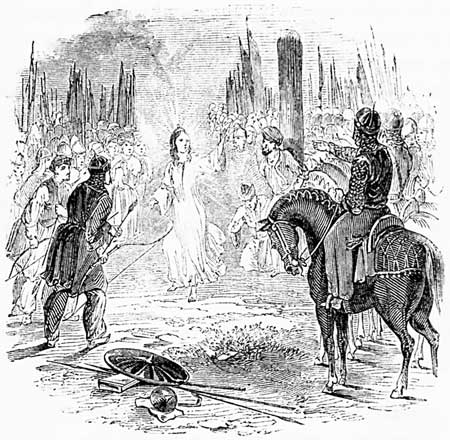
And now the archers were about to bend their bows and fit the deadly shafts to their bow-strings, when a luminous appearance was discovered to the eastward, and the outskirts of the army saw a female in robes of light travelling over the sands of the desert. In a moment she passed through the ranks of the army, and stood in the circle who were gathered around to see the execution of the Sultan and his Vizier.
"Misnar," said she, "arise, and fear not those sons of clay, nor the malice of enchantment: I am the genius Macoma, sent by Mahomet to save and deliver thee when human assistance was vain and impossible. Therefore assume thy just command over[302] these thy subjects, and let them all fall prostrate on the ground to Allah, and wait to see the fate of those who fight against the Prophet of the Faithful. But first learn, from thine own experience, the folly of trusting even to the greatest human power or prudence, without an affiance in the Lord of Heaven. The world, O Misnar, is Allah's, and the kingdom of heaven is the work of His hands; let not, therefore, the proudest boast, nor the most humble despair; for, although the towering mountains appear most glorious to the sight, the lowly valleys enjoy the fatness of the skies. But Allah is able to clothe the summit of the rocks with verdure, and dry up even the rivers of the vale. Wherefore, although thou wert suffered to destroy the greatest part of thine enemies, yet one was left to overpower thee, that thou mightest know that thou wert but a weak instrument in the hands of strength."
"I know," answered the Sultan Misnar, "that Allah is able to dissolve this frame of earth, and every vision of the eye; and therefore not the proudest nor the most powerful can stand against Him."
As the Sultan spake thus; the army of Hobaddan appeared on the face of the sandy desert.
"Although His power be infinite," said the genius, "yet can He effect these changes by the most unexpected means. But I will not waste that time in words which I am commanded to employ in action, to convince both you and your army of the sovereignty of Allah. Therefore suffer no man to rise from the earth or to quit his place; but lift up your heads only, and behold those enemies destroyed before whom you fled."
So saying, the genius Macoma waved her wand, and instantly the air was darkened, and a confused noise was heard above the armies of Misnar and Hobaddan.
For some hours the Sultan's troops knew not the cause of the darkness that overshadowed them; but in a little time the light returned by degrees, and they looked toward the army of Hobaddan, and saw them overwhelmed with innumerable locusts.
"Thine enemies," said Macoma, "O Sultan, are no more, save the enchantress Hapacuson, who personates the rebel Ourodi."[303]
"The glory of extirpating her infernal race," said the Vizier Horam, bowing before the genius Macoma, "belongs to my Sultan; otherwise Horam would esteem himself the happiest of mankind in her destruction."
"The glory you speak of," answered the genius Macoma, "is given to another: a fly has gone forth, the winged messenger of Allah's wrath, and at this moment bereaves the vile Hapacuson of her breath and of her life."
The Vizier Horam held down his head at the just reproof of the genius; but the words of her reproof were the words of truth; for an account was brought that the rebel Ourodi was suddenly dead, being strangled by some impediment in his throat, and that, at his death, his figure was changed into the appearance of a deformed enchantress.
"Although your enemies, O Misnar, are no more," said the genius, "yet the assistance of Allah is as necessary for your support as for their defeat; wherefore He hath given life to the springs of the pools of the desert, and your troops will find such refreshment from them, that you may safely march over the sandy plains; and, to add to your happiness, the old Sultan Zebenezer, being released from the enchantments of Hapacuson, waits, with his daughter Hemjunah, your safe arrival, and knows not as yet those wonders which I leave your prudence to reveal to him."
The Sultan Misnar well understood the mysterious speech of the genius Macoma; but before he or his troops tasted of the pools or pursued their march, he commanded them to fall down before Allah, the only Lord of the world.
The soldiers, having done reverence to Allah, were desirous of repeating it before Misnar, to ask his forgiveness; but the Sultan would not permit them. "Let us make," said he, "Allah and His Prophet our guide and defence, and then neither presumption nor rebellion shall lead us into error."
The unexpected change reached not the Court of Delhi till the troops were within a few day's march of the city; and Zebenezer and Hemjunah were but just prepared to meet the Sultan Misnar when he entered the gates of the palace.[304]
As Misnar advanced toward the aged Zebenezer, the good old man started with surprise, and cried out, "Oh! is it possible that the Sultan of India and the Prince of Georgia should be one and the same?"
The Princess Hemjunah was confounded at her father's speech, and she fell on his bosom and hid her face.
"What you suspect, my royal friend," said Misnar, "is true: I am indeed the man who once passed in Cassimir for the Prince of Georgia. I beseech thee, O Zebenezer, forgive my deception."
"You have no forgiveness," said the aged Zebenezer, "O Sultan, to ask from me."
"Indeed," answered the Sultan, "my title was just: my royal father, Dabulcombar, being treacherously advised by those who wished to place his younger son Ahubal on the throne, commanded me to travel, and gain renown and experience in arms; and, to conceal my importance, gave me the title of Prince of Georgia. In this disguise I came to the royal Court of Cassimir, and engaged in your service, O venerable Sultan, and Allah sent His blessing on us: your enemies were put to flight, and your subjects, who favoured me, gave the credit of the defeat to my arms.
"Hearing that you intended me the honour of an alliance with your illustrious family, I resolved first to see the Princess Hemjunah, whom I heard you had confined, being warned, from an ancient prophecy, that a stranger should deprive you of her. I saw the Princess by means of one of her slaves, and Hemjunah from that moment took possession of my heart. I was earnest, therefore, with you to propose the nuptials, and was to have been introduced to the Princess, when I received advice that my father was drawing near his end. In expectation of demanding your daughter as the Sultan of India, and not as an obscure Prince, I journeyed to Delhi, and arrived time enough to see my royal sire ere he departed.
"'Son,' said he, 'evil threatens your reign: extricate, therefore, yourself from danger, and do not involve others in your ruin.'
"Mindful of my father's words, I resolved to quell the commotions of the empire before I made myself known to the Sultan of[305] Cassimir; but Allah has so wound the string of our fates together, that it is needless to repeat the rest of my adventures. Only the Princess must forgive me this, that, hearing she had been taken away from her father's Court, I was resolved to conceal my interest in her affairs till I was sensible that the Prince of Georgia, though not blessed with her smiles, had yet no rival in her affections."
"Most noble Sultan," said the Princess Hemjunah, "it is vain to dissemble: suffer me, therefore, freely to declare that the Sultan of India has totally extirpated the Prince of Georgia from my heart; but, whatever my own sentiments may be, assure yourself that I shall not, at my father's commands, refuse the Prince of Georgia my hand."
The Sultan of India and Zebenezer were both delighted with the Princess Hemjunah's answer; and the faithful Vizier Horam rejoiced to find that his master and the Princess Hemjunah were to be united. The whole Court expected the nuptials with impatience; and the good old Sultan Zebenezer stayed to see his daughter the Sultaness of India, and Misnar the happiest and the most thankful of the children of Allah.
"The children of Allah," said the sage Horam, "have indeed a freedom of action; but that freedom is best exercised when it leads them to trust and depend on the Lord of all things: not that He who seeth even beyond the confines of light is pleased with idleness, or giveth encouragement to the sons of sloth; the spirit which He has infused into mankind He expects to find active and industrious; and, when prudence is joined with religion, Allah either gives success to its dictates, or, by counteracting its motions, draws forth the brighter virtues of patience and resignation. Learn, therefore, ye pupils of the race of immortals, not to forget your dependence on Allah while ye follow the prudent maxims of wisdom and experience; for he only is truly prudent who adds faith to his practice, and he truly religious whose actions are the result of his faith."


adik Beg was of good family, handsome in person, and possessed of both sense and courage; but he was poor, having no property but his sword and his horse, with which he served as a gentleman retainer of a Pasha. The latter, satisfied with the purity of Sadik's descent, and entertaining a respect for his character, determined to make him the husband of his daughter Hooseinee, who, though beautiful as her name implied, was remarkable for her haughty manner and ungovernable temper.
Giving a husband of the condition of Sadik Beg to a lady of Hooseinee's rank was, according to usage in such unequal matches, like giving her a slave; and as she heard a good report of his personal qualities, she offered no objections to the marriage, which was celebrated soon after it was proposed, and apartments were assigned to the happy couple in the Pasha's palace.
Some of Sadik Beg's friends rejoiced in his good fortune, as they saw, in the connection he had formed, a sure prospect of his advancement. Others mourned the fate of so fine and promising a young man, now condemned to bear through life all the humours of a proud and capricious woman; but one of his friends, a little man called Merdek, who was completely henpecked, was particularly rejoiced, and quite chuckled at the thought of seeing another in the same condition with himself.
About a month after the nuptials, Merdek met his friend, and, with malicious pleasure, wished him joy of his marriage.
"Most sincerely do I congratulate you, Sadik," said he, "on this happy event."
"Thank you, my good fellow, I am very happy indeed, and rendered more so by the joy I perceive it gives my friends."
"Do you really mean to say you are happy?" said Merdek, with a smile.[307]
"I really am so," replied Sadik.
"Nonsense!" said his friend; "do we not all know to what a termagant you are united? and her temper and high rank combined must no doubt make her a sweet companion." Here he burst into a loud laugh, and the little man actually strutted with a feeling of superiority over the bridegroom.
Sadik, who knew his situation and feelings, was amused instead of being angry. "My friend," said he, "I quite understand the grounds of your apprehension for my happiness. Before I was married, I had heard the same reports as you have done of my beloved bride's disposition; but I am happy to say, I have found it quite otherwise: she is a most docile and obedient wife."
"But how has this miraculous change been wrought?"
"Why," said Sadik, "I believe I have some merit in effecting it; but you shall hear. After the ceremonies of our nuptials were over, I went in my military dress, and with my sword by my side, to the apartment of Hooseinee. She was sitting in a most dignified posture to receive me, and her looks were anything but inviting. As I entered the room, a beautiful cat, evidently a great favourite, came purring up to me. I deliberately drew my sword, struck its head off, and taking that in one hand and the body in the other, threw them out of the window. I then very unconcernedly turned to the lady, who appeared in some alarm; she, however, made no observations, but was in every way kind and submissive, and has continued so ever since."
"Thank you, my dear fellow," said little Merdek, with a significant shake of the head: "a word to the wise." And away he capered, obviously quite rejoiced.
It was near evening when this conversation took place; soon after, when the dark cloak of night had enveloped the bright radiance of day, Merdek entered the chamber of his spouse, with something of a martial swagger, armed with a scimitar. The unsuspecting cat came forward as usual, to welcome the husband of her mistress, but in an instant her head was divided from her body by a blow from the hand which had so often caressed her. Merdek, having proceeded so far courageously, stooped to take up the dissevered[308] members of the cat, but before he could effect this, a blow upon the side of the head, from his incensed lady, laid him sprawling on the floor.
The tattle and scandal of the day spreads from zenaneh to zenaneh with surprising rapidity, and the wife of Merdek saw in a moment whose example it was that he had imitated.
"Take that!" said she, as she gave him another cuff, "take that, you paltry wretch! You should," she added, laughing him to scorn, "have killed the cat on the wedding day."

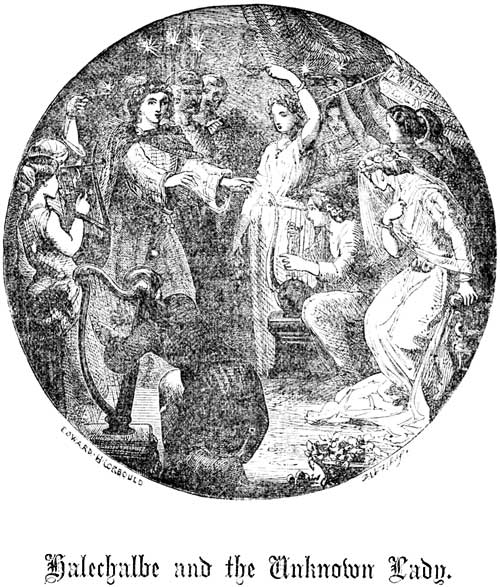

he Caliph Haroun al Raschid sent for Giafar, his Grand Vizier, and Mesrour, his Chief Eunuch.
"I intend," said he, "to go down to Bagdad in disguise, that I may visit my hospitals, and examine whether the administration of them is wise and regular, and whether the patients there receive the assistance and relief of which they stand in need. I will assume the disguise of a dervish: do you, who are to accompany me, choose a dress by which you will be completely concealed."
The orders of the Caliph were obeyed, and he set out with his[310] attendants on his expedition. He was in the centre of the establishments which he had proposed to visit, and everything appeared in the order which he wished for, until he arrived at the gate of a very large court, where he heard a noise.
"Whence comes this noise?" said he to Giafar.
"This," answered the Vizier, "is the place where mad people are confined. Those whose madness is not dangerous are allowed to walk in the great court, and they have their cells or small apartments all around."
"Let us go in," said the Caliph: "this object is also interesting. Let us first ascertain if they are all confined for proper reasons. There are many people left at liberty who deserve to be confined; perhaps there are some here whom it would be for the interest, both of society and themselves, to restore to freedom. Let each of us examine apart one of the inhabitants of this place; let us determine by lot which of the three shall begin the examination, and we will immediately set to work."
The lot decided that Mesrour should begin.
All three having entered the court, the Chief Eunuch went straight to the first cell. He found there a man of about forty years of age, smoking a pipe with a serious air, and leaning his elbow on a table, upon which there were some papers. He saluted the smoker, who made him a due return.
"I suppose," said Mesrour to him, "that you are entrusted with overseeing those who make a noise in the court?"
"Overseeing," answered the smoker, "is a trouble from which I am free; I am entrusted with watching over myself, and that is quite enough."
"But surely," said Mesrour, "you are not kept here in confinement among the number of mad people?"
"And why should I not be kept in that character? Do you think me wiser than others? They have done me that justice, which they ought to do to all the inhabitants of Bagdad. I cannot complain: I was condemned by my equals, and they are so attentive as to come here every day to visit me."
"I understand you," said Mesrour: "we have all a small grain[311] of madness. However, when it does not pass certain bounds, we are very properly allowed to enjoy our liberty. It is only extraordinary madness——"
"Ah, you are right," interrupted the smoker: "men excuse all their ordinary follies, however ridiculous; but when any one raises himself, by his ideas, knowledge, and observation, above others, he is a kind of reproach to them for the debasement into which they allow themselves to fall, and they endeavour to remove him from their sight. This is my history: I knew more than the vulgar, and therefore was separated from them."
"In what branch did you excel?" inquired Mesrour.
"In that science which is the chief of all others—astrology."
"And were you in possession of that science?"
"I endeavoured after it, but my progress was interrupted."
"You were in correspondence with the stars, then?"
"Yes, indeed."
"And by whom were you chiefly favoured?"
"By the moon."
"Are you no longer in favour with her?"
"Since I have lost my liberty, she uses me as she pleases. She formerly owed me great obligations, but now she has forgotten them. She had an enormous wart upon her nose, of which I cured her. Thus it is to me she owes that beautiful appearance which you sometimes see her assume. Besides, by causing her to go on her side, I saved her from an eclipse which was expected by all the astronomers. At first she showed me some gratitude; but since I have been confined, if I address her in her increase, she is yet too weak to act in my favour; if I address her when she is full, she is surrounded with clouds and mist; but if in her wane, all her malignant influences are at my service. Defluxions, rheumatisms, catarrhs are showered down upon me. I endeavour actually to deliver myself from this last mark of her beneficence. Ah! if I could get hold of her some day, she would find that she has not obliged an ungrateful person."
"And what will you do to get hold of her?" inquired Mesrour.
"Nothing can be more easy," said the smoker: "if a man like[312] you would assist me; she will come this evening at nine o'clock to admire herself, and to bathe in that well which you see in the middle of the court. I will give you my table, and you will lie in wait. She will not suspect you; and while she is amusing herself with making her beams play upon the water, you will suddenly shut the well: then we shall get hold of her. It will make both our fortunes, and we will see how she will be put to it to justify her conduct."
"She will speak, then?" said Mesrour. "Shall we hear her?"
"I don't say that you will hear it very distinctly," answered the smoker; "but I, whose ear is by practice become so perfect as to be able to mark the cadence of the celestial harmony, shall not lose a single word. With respect to you, we must know how your ear is formed."
So saying, the smoker laid down his pipe, examined narrowly Mesrour's ear, and, taking hold of it very roughly, suddenly pulled it with all his force, crying out, "Your ear is too short!"
Mesrour uttered a dreadful cry. One of the keepers ran up, and caused the astrologer to quit his hold. The eunuch, holding his ear with both his hands, rejoined the Caliph, and related to him his lamentable adventure.
"I have long been persuaded," said Haroun, smiling, "that those madmen who have an air of wisdom are most to be distrusted. Come, Giafar," said he to his Grand Vizier, "you are warned beforehand not to allow your ear to be pulled. Proceed to your examination: Mesrour and I will not go far from the cell which you enter, that we may be at hand to assist you if there is occasion."
The Grand Vizier had already cast his eye upon a door, by the side of which sat an old man, with a venerable beard and an engaging air. He began with giving him alms, and then saluted him. He appeared more attentive to the civility of the salutation than to the alms he had received. He returned the salute, and made a sign to Giafar to sit down on a seat a few paces distant from him.
"You are undoubtedly come here to be instructed, young man,"[313] said he to him. "You ought to thank Heaven for having been so well directed. Of what chapter in my book do you wish to understand the text or the explanation?"
The book, of which this man seemed to speak, was a small square plank of cedar, on which there were no characters. Giafar asked what book it was.
"What! do you not distinguish in these characters the finger of God, and the inspiration of the angel Gabriel? A Mussulman not know the divine Koran, nor discover in him who presents it, according as he was inspired, the great prophet Mahomet!"
Upon this exclamation, the Vizier rose up and withdrew.
Having joined the Caliph, "Commander of the Faithful," said he, "I have been forced to abandon my project. The man whom I have left makes me tremble at his blasphemy: he says he is the Great Prophet."
"It is not certain that he blasphemes," replied the Caliph: "every man may call himself a prophet, provided he proves his mission by miracles. Go and ask him concerning this point."
Giafar obeyed, and returned to his place.
"If you are Mahomet," said he to the old madman, "who has put you in a place like this?"
"My ungrateful people," replied the pretended prophet. "They would not believe in me, and this has vexed rather than surprised me, for they scarcely believe in Allah."
"But a prophet proves his mission by miracles. Why have you wrought none?"
"My people should first have demanded them from me; but they were afraid of being convinced: they seek to believe nothing."
"You could work miracles, then?"
"Do you doubt the power of Mahomet?"
"Work them immediately."
"Your request shall not be refused. Ascend to the top of this spire by this outer stair, and throw yourself down from it without hesitation. When you are at the earth, though you were in a thousand pieces, with one word I will set you upon your feet, straighter and with a better carriage than you now have."[314]
"I would rather," said Giafar as he was going away, "believe you a prophet than oblige you to prove yourself one."
He came and gave the Caliph an account of the proposal which had been made to him.
"You can learn very little," said Haroun to him, "for you will make no trial."
"If any one wishes to be instructed in this matter," replied Giafar, "the man and the tower are there, he may try the adventure—I will not be jealous of his success."
The conversation of the Prince and his ministers was a little interrupted by some persons who accosted them. One of them was Caliph, and came to propose Haroun's quitting his habit of dervish, and accepting the place of Vizier. He intended to clothe him in a magnificent robe: it was an old piece of stuff, full of holes, dirty, and devoured by vermin. Another, with a basket full of nut-shells, came to sell him confections.
These short and public scenes did not answer the design of Haroun, nor the purpose of the agreement into which he had entered with his ministers. It was his turn to go into a cell, where, like his two companions in adventure, he might have a private conversation. He passed near one, which appeared larger and better furnished than the rest. A young man, of a soft and engaging figure, was sitting upon a sofa, and appeared to be in deep melancholy: he held in his hand the Koran. The Caliph accosted and saluted him, addressing him in that kind and familiar tone which the robe of a dervish authorized him to assume.
"Young man," said he, "why is a man so rational as you appear to be, to be found among mad people?"
At this question, the young man shut his book, modestly opened his eyes, looked at the dervish, and answered him: "All the actions of my life have not been rational; I have given reason for the abuse which is now made of power in keeping me here."
"And could not I," said the dervish, "learn from you your history, when you appear to be so well qualified for giving it?"
"Pious dervish," answered the young man, "were you the Caliph, I would persuade you to sit down by me, and I would[315] open to you my heart. Every day do I beseech God to send me this equitable Prince; but it would serve no purpose to have any other confidant. You see here a victim of his Grand Vizier Giafar, by whose orders I was brought hither, for a reason which appeared well founded; but I can declare that there is no reason why I should be still detained; and without the support of religion, I should sink under the weight of my misfortune and the horror of my situation."
The Caliph was greatly astonished to hear so reasonable and connected a discourse. He called Giafar and Mesrour, and repeated what he had heard. The Grand Vizier attentively considered the young man, and assured the Caliph that the prisoner and his history were totally unknown to him. Haroun's curiosity grew stronger, and made him anxious to hear his history. He entered the cell with that freedom which dervishes generally use, and sat down beside the supposed victim of Giafar's orders.
"Unfortunate young man," said he to him, "you know that people of my character have many privileges, and especially that of approaching the great, and of speaking to them the truth. The Commander of the Faithful is to us of all men the easiest of access: depend upon my zeal; it may be possible for me to serve you; you will entrust your misfortunes to a prudent ear, and to a soul truly charitable."
The young man again sighed, mused a short time, shed some tears, and thus began his history:
"My name is Halechalbe, and my father is syndic of the trade of Bagdad. One evening he invited to supper the principal merchants in the city, each of whom brought with him his eldest son. After the repast, which was plentiful and gay, the guests began to converse concerning the disposal of their children.
"One had sent his son to a foreign counting-house; another had entrusted to his a vessel full of merchandise; a third had given up a certain branch of his trade; in short, it appeared from what I heard, that all my contemporaries were either advantageously placed or settled in life. After fully discoursing of these different arrangements, the company retired.[316]
"Remaining behind with my father, I observed to him, that though the son of the first in our profession, I alone was unemployed. He allowed the force of the observation, and proposed that I should open a warehouse of whatever goods I chose, in one of the quarters of Bagdad.
"This proposal was agreeable to my inclination for trade and independence. I accepted it; and next day was put into possession of a large assortment of the most beautiful Persian and Indian stuffs. I had slaves who were skilled in trade, and who relieved me of the troublesome part of the business.
"Being surrounded during the day with all the nobility of Bagdad, with whom I had an opportunity of getting acquainted, I returned in the evening to my father's house. In the management of my business I led a very active and busy life—a life, in short, agreeable to my own taste. My father often visited me in my shop, and was pleased to see the concourse of virtuosi and customers of both sexes. He never received anything uncommon from abroad but he was happy to send it to me; the manager of his own trade had orders to that purpose.
"I was one day surrounded with a great many people in my counting-house, when two women of a fine external appearance came in. Civility made the other customers give place; and one of the two women put aside her veil sufficiently to discover charms which dazzled the sight.
"They sat down upon a sofa, asked for the richest stuffs, bargained with me, and bought them for three thousand crowns. By this bargain, from calculation, I was a gainer of five hundred crowns. The goods were folded up, and, by the orders of one of the women who appeared mistress, were carried away by slaves. I was preparing to hold out my hand for payment, when the young lady began to speak.
"'Halechalbe,' said she to me, 'I have brought no money with me; but be not uneasy about what is owing to you: I will return in a few days and bring it with me, at which time I intend to make very considerable purchases from you.'[317]
"'The other woman then spoke.
"'Madam,' said she, 'do you speak to a son of the chief of trade, a man of acknowledged opulence, and whose worth is known to the Caliph himself, as if you supposed that he would not reckon it an honour to give so trifling a credit to a lady like you?'
"The discourse of this woman, the impression made upon me by the beautiful eyes of her mistress, in consequence of the derangement of her veil, and my natural timidity, prevented me not only from venturing to ask payment, but even from insisting to know the name of the lady to whom I gave credit. She left me, after saluting me in a very graceful manner; and I remained at my door, fixed like a post, without taking the precaution to cause a slave to follow her, and observe the place of her abode.
"When I was alone, the imprudence of which I had been guilty presented itself to my mind in the strongest colours. To whom had I given my goods? Could I forget, after the lessons I had received from my father, that Bagdad swarmed with adventurers, who could appear in any form and assume any tone? Everything, even the beautiful eyes which she had allowed me to see, then became suspicious. I believed myself cheated out of my goods, and returned to my father's house, trembling for the reproaches which I thought I had brought upon myself.
"My mother soon perceived my distress. She well knew how to draw from me a confession of the cause, and endeavoured, as much as she could, to calm my apprehensions.
"'The merchant who knows not how to lose,' said she, 'deserves not to gain. If you are embarrassed in your accounts with your father, my purse will supply the defect.'
"I returned next day to my shop, hurt at being duped and at the loss which I had sustained. I had some hopes, however, that the lady would return; but the evening came, and she had not made her appearance. This unhappy day was followed by two others of the same kind, and my mother saw my distress increase, without being able to give it any relief.
"In vain did she tell me that she would supply this loss out of her own purse, and that I should consider what had happened to[318] me as a useful misfortune, for it was only by experience that man could learn wisdom.
"All her discourses were in vain: nothing could console me for having allowed myself to be cheated by a pair of fine eyes, by mere compliment and show; my vanity, which was hurt, tormented my soul.
"On the fourth day the unknown lady at last came to my shop, and threw a large purse upon my counter.
"'Fair young man,' said she, 'I bring you your money; see if the account is right.'
"At this desirable and unexpected sight my fears and anxieties vanished, and I felt myself suddenly recover new life.
"The unknown lady caused other stuffs to be brought to her. She chose some of them, and carried from my shop goods to the value of three hundred pieces of gold. In my enthusiasm I would have given her credit for two thousand. As soon as she was gone I returned to my mother, and now showed as much joy as formerly I had shown sorrow and dejection. I related to her the lucky adventure of the day, and perceived the full force of the reasoning which till that time she had made use of in vain, to persuade me that in trade he who never ventures can never gain.
"In short, respectable dervish, I continued to deal in the same manner with the unknown lady, who always carried from my shop stuffs worth more money than she left in it, till she was owing me about ten thousand crowns, equal to all the profit which I had been able to make in my different bargains with her.
"One day, after opening my shop, I was scarcely seated on my sofa when an aged woman came and accosted me. I thought she wanted some robes or stuffs, and proposed to show them to her.
"'No, my son,' answered she, 'I am entrusted with a commission of much greater importance: I come from the young lady who owes you ten thousand crowns. I do not bring you payment, but I am charged by her to tell you that you became her merchant in preference to every other of the same profession at Bagdad, only because her heart granted you a preference of another kind. In short, she is beautiful, young, and rich, and offers you her hand in[319] marriage. If you find it agreeable to enter into this engagement after you have seen and conversed with her, no other dowry is required than the ten thousand crowns in which she stands indebted to you; if you do not agree to it, the money shall instantly be paid down. But you must resolve to follow me, that you may have it in your power to know whether the affair is agreeable to your wishes.'
"During this discourse of the old woman, a flame, to which I was till then quite a stranger, penetrated through my veins, and the hope which was now suggested having increased its violence, I soon felt the fire of love burning in my heart. The beautiful eyes of the lady, from the first moment I beheld them, had so dazzled and blinded me concerning my real interest, that I allowed her to carry off my goods without knowing how I should receive payment for them. Though, in the visits which she afterwards made me, her veil had wholly concealed the features of her countenance, yet the fulness of her dress could not conceal the elegance of her stature, the gracefulness of her motions, the exquisite form of her foot, and the extraordinary beauty of her hands. Besides, she disputed with me about the price with so much courtesy, and with such an angelic voice, that she never left my shop without carrying away something more than my goods; but I did not well know what it was. Scarcely had she left my shop, when I felt myself extremely uneasy; said to myself, This is a charming lady! and then fell into a long state of profound thoughtfulness.
"When the old woman had informed me that the unknown lady was in love with me, my passion increased to a desperate height. I ordered my slaves to shut up my shop; and, having desired them to tell my father and mother that I was going to enjoy myself with some of my friends, in a garden at some distance from the city, before I returned home, I put myself under the direction of the old woman.
"'You will never repent,' said she, as we went along, 'of having put confidence in me; but you must still give me another proof of it. If the lady is not agreeable to you, if you do not accept the proposals which she is to make, and consequently a separation takes place, it is proper that she should remain always unknown.[320] Her delicacy requires this; and I was ordered to put a covering over your eyes, that you may not be able to discover the house to which you are going.'
"I readily agreed to this condition; and we withdrew under a portico, where, being concealed by two advanced pillars, she covered my eyes with a very thick silk handkerchief. She made me turn three or four times round on my heel; then took me by the hand, and caused me to walk by her side for a full quarter of an hour. We suddenly stopped. I heard her knock at a door, which opened, and, as soon as we had entered, immediately shut.
"I was in a short time restored to the use of my eyes, and committed to the care of two female slaves of remarkable beauty and richness of dress. They conducted me through seven doors, at the end of which I was received by fourteen other slaves, whose figures were so striking, and whose dress so magnificent, that I was dazzled with beholding them. I was now in a superb apartment, where everything was marble, jasper, or rich gilding. My adventure had so much the appearance of a dream, that, though my eyes were open, I could scarcely be convinced that I was really awake. The old woman, who had still followed me, went out for an instant, and soon returned, accompanied by a slave, who brought breakfast upon a large golden plate. I sat down to refresh myself.
"While I was satisfying my hunger, the old woman counted down upon a table the ten thousand crowns which were owing to me. 'There is your whole sum,' said she. 'Be not uneasy that my mistress does not yet appear. The law commands, and decency requires, that you should not see one another before the contract is made.'
"Before she had done speaking, a Cadi appeared, with ten persons in his train. I arose to salute him, when the old woman, addressing the lawyer, said to him,
"'The young lady who is to be married to this merchant has chosen you for her guardian: do you agree to accept the office?'
"The Cadi replied, 'that he reckoned himself highly honoured by the choice which had been made of him.'[321]
"He immediately drew up the contract, and got it signed by the witnesses whom he had brought with him. After partaking of an ample collation, which was served up to him and his attendants, and having been presented with a magnificent dress and three hundred sequins, he retired, charging the old woman to beg her mistress to accept his thanks.
"I was so astonished at what I saw, that when the Cadi went away, I made a motion to follow him, without perceiving that I left my money behind. I was prevented by the old woman, who made me sit down again.
"'Are you mad?' said she. 'Need I inform you that the marriage follows the contract? Come, be wiser, and remain quiet till night, when everything will be ready for the completion of the ceremony.'
"I continued in the hall, where a great number of slaves were attentive to every motion and ready to anticipate every wish. I was in a very extraordinary state of mind. The power of that feeling which had made me run so fast with my eyes blindfolded was no longer felt, and love remained fixed at the bottom of my heart, astonished at the luxury with which I was surrounded, and the ceremony of this extraordinary marriage.
"Towards the evening, a magnificent repast was served up, accompanied with all kinds of confections, and exquisite wines, which I used very sparingly. As soon as I made a signal for them to remove the dishes, the old woman took me by the hand, and conducted me to the bath. I was there received by eight slaves, dressed in silk, who wrapped me in stuffs of the same material, entered into the water with me, and served me with all that respect and attention which could have been paid to the Caliph himself.
"Imagine, O respectable dervish, my astonishment: it almost deprived me of my senses! I was soon drawn from it, however, by the appearance of twenty female slaves, beautiful and well dressed. Some held flambeaux, and other pots full of exquisite perfumes, the sweet odour of which, mingled with that of the wood of aloes, which served to warm the bath, embalmed the air, and raised an agreeable vapour to the very roof of the apartment.[322]
"From these delights I was carried to the enjoyment of others. Twenty slaves went before me, and conducted me into a magnificent apartment; I sat down on a sofa covered with cloth of gold. I was there attended by the most melodious music, which was at the same time so cheerful and lively, and so fitted to inspire delight, that I could not help feeling a little reanimated. The slaves at length proposed to conduct me into the apartment destined for the celebration of the nuptials.
"I arose. A great door opened; and I beheld the person approach who had marked me out for her husband, preceded by twenty other slaves, whom she alone could surpass in beauty. At the sight of her I remained almost senseless; but this first impression instantly gave place to love; and my passion at length assumed over me that power, which even at this day makes me, every moment of my life, endure torments worse than death.
"The beautiful stranger, preceded by her twenty slaves, and I attended by the same number, went into the grand apartment prepared for our nuptials, and there sat down together on the same sofa. The old woman then appeared at the head of four slaves, and brought us, on golden plates, different refreshments, exquisite confections, and fruit of all kinds, which we mutually presented to one another. After this, the service disappeared, and we remained alone.
"I was almost trembling, when the lovely unknown lady took me by the hand to encourage me.
"'Halechalbe,' said she, 'since the day when curiosity first led me into your shop I have loved you; and the same sentiment has frequently carried me back, under pretence of cheapening and purchasing goods. The little intercourse we have had together has given me an opportunity of knowing you; and my liking for you has so much increased as to make me ambitious of being united to you for life. Can you think of sacrificing your liberty?'
"'Madam,' answered I, 'from the first moment you appeared in my sight, your charms failed not to produce their effect. I never saw you without feeling an unaccountable disorder, mixed, however, with the sweetest pleasure. You never left me without occasioning[323] the most lively regret: I expected you every day, and my thoughts were incessantly occupied about your image. I dared not avow my passion to myself; but since you have confessed your regard for me, I swear to you, that nothing can equal the strength of my love, and that the sacrifice of liberty is nothing to one who would give his life for your sake.'
"'Halechalbe,' said she, 'truth seems to flow from your lips: spare your life; it is essential to my happiness; but if we are to be united for life, attend to the conditions upon which I will yield my heart. My name and rank must remain unknown to you until the steps I am now taking shall have enabled me publicly to acknowledge you for my husband. You shall make no inquiry within this place for the purpose of getting information, and the door of the house shall be opened only once a year.'
"'O madam,' said I, 'I will keep silence; I will remain ignorant; I will never leave the house——
"'Stop,' said she, 'I have a still more severe condition to impose upon you: as I give myself wholly to you, it is reasonable that you should be wholly mine. My slaves are become yours, and will obey you in everything; but you must not speak to them, except to require their services. If you condescend to use the smallest familiarity with any one of them, further than mere expressions of kindness, if——I must discover to you a part of my character. I am inclined to be jealous; and if you make me the subject of this fatal passion, I know not how far my resentment may carry me against you.'
"'Take courage,' said I, 'my adorable spouse: the strength of my passion secures you from every indiscretion on my part. I should die with vexation were I capable of displeasing you; but I am not afraid that I will ever be so unlucky as to give you offence.'
"The unknown lady burst into tears when she saw the frankness and air of sincerity with which my protestations were accompanied. 'Halechalbe,' said she, 'we will now be united; but had you hesitated about accepting them, I would have sacrificed my happiness to my delicacy, and we would have separated for ever.'
"I tenderly embraced her, and she fainted away in my arms.[324] A slave was called, and she, the idol of my heart, after a time opened her beautiful eyes, and with rapture I beheld them turned towards me.
"I pass over the remaining events of my marriage, because they cannot be interesting to you, and the remembrance of them is still the torment of my life.
"I was so enchanted by my passion, that I spent a fortnight in total forgetfulness of the whole world besides; and I will confess, to my shame, that I even omitted the most essential of all duties, for I never once thought of the uneasiness of my father and mother on my account. At last, by little and little, nature resumed her rights, and I began to think seriously of the grief which I must have occasioned to my affectionate parents. I uttered some sighs, which proceeded from the bottom of my heart; and the distress of my mind appeared in my countenance. My wife, who possessed great discernment, soon perceived the change which I underwent, got from me the secret, took an interest in my pain, and pointed out the method of being delivered from its attacks.
"'Dear Halechalbe,' said she, 'I commend you for your attachment to your father and mother: they are dear to me on your account. We have given ourselves laws; but, as we are the judges, we must not allow them to do injury to nature. You will go to see your parents, spend a week with them, and also resume your business. There are many reasons for so doing. First of all, it will serve as a cloak to hide our marriage, and will furnish you with an opportunity of being present or absent at pleasure, without occasioning any suspicion of our marriage. It will likewise enable you to acquire, by your civil, frank, and generous dealings, the public esteem, which will one day be of great advantage to us; for we live under the government of a Caliph who has ears everywhere, and who likewise makes very good use of his own. Go, then, and my heart will accompany you wherever you are: if it could be rendered visible, you would see it continually fluttering around you. Besides, you will be under my hand: we have our trusty old woman, by whose means you will have the satisfaction of hearing me spoken of, and I shall have that of being informed[325] of your welfare, and communicating to you my wishes. Above all,' added she, 'as our marriage cannot be concealed from your parents, charge them to keep it a profound secret.'
"Night was beginning to come on when this discourse was ended; and my wife ordered the old woman to blindfold me, and conduct me out of the gates of the palace till I was under the portico where I had first submitted to this operation. As soon as my guide had restored to me the use of my eyes, I flew with all speed to my father's house. A neighbouring lady was just entering it. She discovered me by the light of a shop before which I passed.
"'Halechalbe!' exclaimed she, 'what! is it you? Do not show yourself so unexpectedly to your mother. Retire for a few minutes into my house, and in the meantime my husband will go and inform her of your return. She is in the utmost distress and despair at your loss; and the joy occasioned by your sudden and unexpected return might be productive of fatal consequences.
"'Whence come you, wicked young man?' said she, as soon as she had sat down. 'How could you let your worthy parents continue ignorant of what had become of you?'
"Not having a story ready made for the first inquisitive person I should meet, and it being necessary to conceal my marriage from everybody, I was very much at a loss what answer to give. But I made it up by presence of mind, and was obliged to have recourse to a lie.
"'I am astonished, madam,' answered I, 'to hear you talk of the vexation which I have occasioned to my parents. Having met with an opportunity of going to Balsora, where I had a very urgent and important examination to take against one of my most considerable debtors, and, not having a moment to lose, I set out without being able to inform my father of my departure. I dispatched an express as soon as it was in my power; but some accident must have befallen him, as no news have been received of me.'
"The lady was satisfied with the excuse.
"'All Bagdad, however,' said she, 'supposed you dead, and,[326] moreover, magnificently buried; for a superb funeral was given you yesterday. I will relate the whole affair to you, when once my husband has prepared our neighbours for again seeing in good health the son whom they believed dead.'
"The husband having with great pleasure undertaken the commission, the woman returned to her recital.
"'Your slave informed your father and mother that you were to spend the remainder of the day and the night in a garden with your friends. This prevented them from being uneasy during that evening and next day; but on the following days all the merchants of Bagdad were in search of you. Messengers were sent to all the gardens in the neighbourhood of the city, to the woods, and to a great distance in the country. As you were nowhere to be found, and nobody had observed you, it was conjectured that you had fallen into one of those snares which are too common at Bagdad, where young people without knowledge and experience find death in the very cup of pleasure.
"'Your father and mother tore their hair through grief; your family and friends went into mourning. Some kind of consolation was supposed to be derived from the pretended funeral, which all the mourners in Bagdad were hired to attend, but where many real tears were shed. Every person was affected with the distress of your parents.'
"This recital, O virtuous dervish! made me very uneasy. I perceived the dreadful consequences of forgetting myself and my duty; and I always considered my misfortunes, and the distraction of mind which was the consequence thereof, as a punishment from Heaven, because, in the arms of love, I was unmindful of the sacred obligations of nature.
"After our neighbour had related that part of my history which it was necessary I should know, she rose up.
"'It is now time,' said she, 'to appear: my husband must already have announced you; go, and confirm the account which he has given of your return.'
"I then entered my father's house, and it is impossible to describe his joy, much less that of my mother, who fainted away in my arms.[327]
"'What!' said my father, 'you are returned from Balsora? Poor child! the loss you might have sustained was not nearly equal in my estimation to the danger which you have run and the fatigues you have undergone.'
"'Father,' said I, still keeping up before the neighbours the story which I had thought it convenient to adopt, 'I know not whether our correspondent is to fail, but I will deliver to you securities sufficient to remove every fear. There is a diamond to put in your turban; here is one for the hilt of your poniard; another for the handle of your scimitar, and a bracelet for my mother. I believe that this is a full equivalent for the sum which we may lose by him.'
"They again embraced me, without asking any further explanation; the weeds of mourning soon disappeared, and every one was dressed in his festival robes. The house was filled with music; a thousand tapers shed their light, and the friends of my father and mother assembled to enjoy a splendid entertainment. The evening and night were spent by the company in amusement and joy.
"Next morning I thought it my duty to eradicate from the mind of my parents those opinions which, in order to deceive the public, prudence had made me establish the evening before. I related to them the circumstances of my marriage, and besought them to keep it secret, as my happiness depended on its being concealed. Everything increased their astonishment, and the rich jewels which I had brought them from my wife were speaking proofs.
"'He must have married the daughter of a genie,' said my mother.
"'Such nuptials,' said my father, 'are celebrated without a Cadi.'
"They knew not what to think; but they saw me happy, and they were satisfied.
"I proposed to my parents to resume my trade. They were delighted to find that fortune had not deprived me of economy and diligence, and next day I again appeared in my shop. The quarter in which I lived expressed their happiness at seeing me again. As I was no longer directed by the hope of gain, I was perfectly easy and disinterested in my dealings, and brought to my[328] shop all the people of Bagdad. In the evening I returned as usual to my father's house.
"On the evening preceding the seventh day, I informed my father that I was again to disappear. He endeavoured to get my place filled up by an intelligent clerk, who was bound to conduct himself according to my principles. It was easy to account for my being a second time absent, by pretending that I had some business abroad.
"On the seventh day, towards evening, the old woman came and informed me that my wife was waiting impatiently for my arrival. As I was equally impatient to rejoin her, I needed no entreaties to persuade me to follow my guide. The same mystery as before was still observed in conducting me to the palace, where my presence was expected, and I was received at the first door by my charming wife, who loosened the bandage with her own hands.
"I passed another fortnight, still happier than the former, in those enjoyments which mutual love bestows, and amid those delights, pleasures, and amusements which the eager wishes and riches of my spouse could bring together. At the conclusion of this period, which seemed very short, I returned to my father's house, and afterwards to my business. My parents received me with the greatest affection; but scarcely did I enjoy it before I sighed for the return of the seventh day, when the old woman would come to blindfold me, and conduct me to an abode which I now considered as a celestial Paradise.
"My wife appeared to feel with equal force the pangs of separation. During my absence from the palace, the only method which she pursued to divert her attention was to play upon a musical instrument, or to sing in concert with her slaves.
"One day, during my absence, while my mistress and her slaves were singing my praises and our loves, Zaliza, one of the slaves, hearing a couplet in praise of my fidelity, affected to drop her lute, as if through impatience, and did not take it up again.
"'Why,' said my spouse, 'do you leave your lute lying upon the ground?'
"'I cannot sing the fidelity of men,' answered Zaliza, 'for I do[329] not believe it. Halechalbe,' continued she, 'is very amiable; he undoubtedly loves you, and who would not? But I do not believe that his affection is equal to yours, or that he is more faithful than another: of this I can give proofs whenever they are required.'
"These base and perfidious words infused the most fatal jealousy into the heart of my spouse: she gave me no opportunity, however, of perceiving that she entertained any suspicions. At the time fixed between us, I returned to my father's house and my ordinary business, and when I went back to the lady I was received as kindly and affectionately as before.
"One day I was in my shop, when, about two hours before the usual time of the old woman's arrival to conduct me to my spouse, the public crier proclaimed in the street a golden censer set with diamonds, to be sold for two thousand sequins. I ordered a slave to call the crier.
"'Who is the proprietor of that censer?' said I to him.
"'It belongs,' answered he, 'to a young lady, whom you behold there;' at the same time he pointed out a handsome and well-dressed woman, and I desired him to bid her speak with me.
"The woman took the censer from the crier, gave him a reward, and advanced towards me.
"'Madam,' said I, 'since this censer belongs to you, I know where to place it; will you allow me to have it?'
"'Since it pleases you, Halechalbe,' said the lady, 'it is yours, and I demand nothing in return.'
"'I am not accustomed,' answered I, 'to make such bargains.'
"'Nor I,' said the lady, 'to enjoy the happiness of making a present to the most amiable and best-beloved of his sex. I have,' continued she, 'for a long time past frequented your shop, unobserved, alas! by you; but your figure and your manners enchanted me, and still enchant me more and more. Since the censer pleases you, I reckon myself very fortunate in having it in my power to present you with it.'
"'I will receive your present, madam,' said I, 'if you will accept from me its value.'
"'Silver and gold,' said she, 'are of no account in my estimation.[330] The love which I bear you has deprived me of repose: do not treat me with cruel disdain. A liking for me would do you no dishonour, for, thank God! I may be proud of my descent. But if, despised by you, I cannot aspire to the highest marks of your affection, let me have a single kiss, and the censer shall be yours.'
"'I cannot agree,' replied I, 'that you should make so bad a bargain. Take your money, or keep your censer. A kiss is no trading price.'
"'It is beyond price,' answered the lady, 'to one who dies of love. I brought not this censer here to sell, but to give it to you; accept it at the price mentioned, and you will save my life.'
"Venerable dervish, I will confess my weakness, and declare that I was gained over by these flattering praises and this language of love. I had no suspicions, and was unable to discover the features of the lady through her veil. Overcome by self-love more than by her entreaties, I retired into a dark part of the shop, and presented my cheek; but instead of kissing it, she bit it with such force as made me cry out; and I was left alone with the censer in my hand, my cheek bathed in blood, and my countenance totally disfigured. The blood was at length stopped, but I was unable to allay the swelling or remove the marks of her cruel teeth.
"At this moment the old woman came for me, and appeared surprised at the situation in which she beheld me. I intended to tell her that I had fallen upon a piece of broken glass, and I was ready to give the same account to my spouse. But the treacherous Zaliza had previously informed her of the whole matter. It was she who had played me that base trick, and she had no doubt reported it to my spouse in such a manner as to make me appear much more guilty than I really was. When I arrived at the palace, instead of being received as formerly by an eager and affectionate wife, I fell into the power of an enraged and implacable judge.
"'What has hurt your cheek?' was the first question proposed by my wife as soon as I was before her. I was about to tell her of the pieces of glass, but she interrupted me with asking, 'whence I got the censer which I held in my hand?'[331]
"'It cost me two thousand sequins,' said I, stammering.
"'Liar!' replied my spouse, her eyes inflamed with rage, 'it cost you much more: the account of it is on your cheek. Vile and base man! you have made a trade of your love, but you shall pay dear for your infamous conduct. Morigen,' said she, addressing her first eunuch, 'let him be beheaded.'
"Morigen had already seized me, when the old woman, our confidante, threw herself at the feet of her mistress.
"'Oh, madam!' said she, 'do not commit such a crime; do not expose yourself to remorse which you will be unable to support.'
"The behaviour of the old slave brought my wife to reflection. She appeared to meditate a little; and then, changing her opinion, ordered me to receive the bastinado. While Morigen was executing her rigorous orders, which I endeavoured to bear without complaining, she seized a musical instrument, and made the chords resound with an air which expressed a mixture of jealous rage and malignant satisfaction.
"The pain I suffered totally deprived me of feeling; and I did not recover till I was in my father's house, placed upon a bed, surrounded by the whole family, and attended by physicians, who were employed in procuring me relief. I had been carried away after the fatal execution of my wife's orders, and left on the threshold of my father's door.
"It was six weeks before I recovered from the consequences of the severe treatment I had undergone. At the end of this time, when I was again able to be out of bed, my father tried to gain my confidence, and I concealed not the smallest circumstance of my last adventure.
"'O Heaven!' said he, 'you are united, my son, to a monster of cruelty and injustice.'
"'Do not say so, father!' exclaimed I: 'my wife, I must confess, was cruel, but she thought she had reason to complain, and I was wanting in my duty to her, even when she loaded me with kindness and affection. I find that I still adore her, and that my love is increased by the consciousness of my fault, and by the fear[332] of a final separation. Ah! would that I were admitted to be the lowest of her slaves!'
"'You have not the feelings of a man,' said my father: 'know the dignity of your sex. I cannot determine to what kind of a being you have been united by the ceremony of a contract. I should suppose it entirely whimsical, if so strong proofs, and particularly the last, had not been given us of its reality. Be ashamed, that a man like you, who are well descended, and who might have aspired to a connection with the best families in Bagdad, has been hurried away by a foolish passion to so extraordinary and unequal a connection as that which you have now formed. Forget your disgraceful passion.'
"Every word which my father uttered, by way of invective against my marriage and my wife, was a dagger to my heart.
"'I shall one day discover this abominable creature,' added he. 'I will bring an information against her before the Caliph, who will put it out of her power to make further victims.'
"Instead of seconding my father's resentment, my heart revolted against his plans of revenge, and placed itself betwixt him and my cruel but charming spouse.
"This disposition of mind, in spite of the assistance of medicine, soon injured my health, and deranged my understanding. I became thoughtful and melancholy, refused every means of consolation, grieved my too affectionate parents, and was a torment to all the domestics. Nothing could be prepared to my taste, and I constantly blamed the unskilfulness of the cooks.
"One of them came one day to justify his conduct.
"'See,' said I, overturning the table, and treading the dishes under my feet, 'there is the estimation in which I hold your skill and diligence!'
"As he wanted to make a reply, I threw myself upon him to give him a hearty beating. His cries and screams soon brought my mother, who wished to tear from me the person at whom I was offended. She even ventured to add blows to her reproofs; and, in the blindness of my fury, I unfortunately struck her. When my father arrived, he was not more prudent, and I was at length put in[333] chains. I recollect that, having put my hand across my mouth, it was covered with foam. In short, I lost my recollection, and only recovered it to behold myself an inhabitant of this mournful abode. I then learned that I was kept here by order of Giafar, the Grand Vizier.
"Many months have now elapsed since I groaned a miserable captive in this place. I have now recovered soundness of mind, in consequence of the solitude, but more especially the opportunity of indulging my unfortunate passion, which I here enjoy without hearing the person whom I will ever love loaded with imprecations.
"Here, O respectable dervish! I am swayed by sadness, and not by passion, and can discover in myself nothing for which I ought to be detained in this hospital. My friends, it would appear, have forgotten me; but it is the duty of the Grand Vizier, whose orders are here followed, to inspect this place, and endeavour to bring back to me my parents, since I only offended by one fit of madness, and have now sufficiently recovered my reason to regulate my conduct. This, venerable dervish, is the whole of my history. All my consolation is the Koran, and the hope that some time or other the Commander of the Faithful, who wishes to see everything himself, will direct his steps towards this mournful abode. I ask this from Allah a hundred times a day; but, alas! my supplications have never reached his throne."
"Cease not to pray, my dear son," replied the Caliph: "you will soon know the efficacy thereof, and your request will be heard."
After these words of consolation, Haroun returned with Giafar and Mesrour to the palace.
"What think you," said the Prince to the companions of his adventures, "of the story which has now been related? You were at hand, and must have heard everything which was spoken."
"I think," said Giafar, "that this young man, of whom I never heard before, though he accuses me of being the cause of his misfortunes, has been employing his invention to relate to you a collection of dreams or falsehoods."[334]
"It is impossible that everything can be false in his relation," replied the Caliph; "and I command you to think on the means of ascertaining the truth. To-morrow I expect to hear from you."
Next day the Grand Vizier gave an account of the plan which he had devised for discovering what trust was to be placed in the history and complaints of Halechalbe.
"Those people," said the minister, "who are deranged in their mind, are never consistent in their accounts. Let your Highness therefore order the young man to be brought before you; and if he repeats his long story in the same connection he did yesterday, and without varying its circumstances, it will then be proper to make the necessary inquiries for ascertaining the truth of the facts."
The Vizier's opinion was highly approved of, and orders were instantly given to go for Halechalbe.
When the young man was at the foot of the throne, the Caliph thus addressed him: "Halechalbe, I have been informed that you have been confined in a madhouse, by a series of the most extraordinary adventures: recover your spirits, and be assured that I am anxious to do justice to all my subjects. But in the relation I demand from you, omit no circumstance, and consider the respect which is due to truth and to my presence."
Halechalbe, seeing the prediction of the dervish fulfilled, being inspired with confidence and affected with his subject, again began his history, and made not the smallest variations, even in the expressions.
Giafar was obliged to own that the recital which he had twice heard bore very striking marks of veracity. His sole object now was to discover Halechalbe's beloved but cruel enemy, in order to procure justice from her towards her injured husband; and his sagacity soon suggested the steps which were proper to be taken.
By calling together all the Cadis in Bagdad, in order to learn by whom the contract had been drawn up, the affair would be in danger of being divulged, without resolving the difficulty. For, if any of them had, contrary to law, drawn up a contract of so extraordinary a nature, he would not readily confess it; and besides, a man might have been suborned to act the part.[335]
If Halechalbe's father was reconciled to him, and persuaded again to entrust his son with the management of his trade, it was probable that the old woman would be going about him, were it only from curiosity; and spies, properly placed, might apprehend her, and force her to disclose the name of her mistress.
The Caliph approved the scheme, and the syndic was immediately sent for. This unfortunate father, still supposing that his son was totally deranged in his mind, was greatly astonished to find himself in his company at the foot of the Caliph's throne, and still more to see Halechalbe treated by Haroun with the kindest attention.
Upon the first proposal of a reconciliation made by the Grand Vizier, the father stretched out his arms to receive his son. Measures were then agreed upon for unravelling the adventure, and Halechalbe's father promised to execute with fidelity the orders which he received. The father and son returned to their house, after having received two rich robes from the munificent Caliph; and next day Halechalbe was re-established in his shop, which was as richly furnished as before.
The young man endeavoured, by submission, kindness, and attention, to make his parents forget the cause of complaint which he had given them. Though still inflamed by love, he strove to conceal from them its effects, and to get the better of his melancholy. He yielded to it only when free from every other business, and when left to himself in solitude and retirement.
Halechalbe's wife did not long enjoy the satisfaction of her revenge. Having come to serious reflection on her conduct, she blamed herself for the excess of her cruelty, and at length became uneasy about the fate of the husband whom she had treated with too much severity, though she still supposed him criminal and ungrateful. Love soon regained the empire of her heart; and though she struggled for some days against a feeling which she durst not avow, silence at length became burdensome to her, and she ordered the old woman, as if solely through compassion, to make inquiry about the situation of her unfortunate husband.
"Alas, madam!" answered she, "my pity for him led me to his[336] father's house, and I there learned from the inhabitants of that quarter, that the poor young man's life was in danger."
"His life in danger!" replied the lady. "Ah! unfortunate that I am! I have killed the only man in the world I ever loved, or can love! Can I not inform him that my life depends upon his? but everything prevents me from doing so. Go, however, and speedily get information concerning him, as far as you can, consistently with the safety of my honour."
The old woman received the order with great pleasure, and for some time was able to give her mistress good hopes of the recovery of her husband's health. But her inquiries soon became fruitless, for the neighbours were altogether silent concerning Halechalbe, from the moment when he was privately taken to a madhouse in a state of insanity.
Her mistress now yielded to despair, and shut herself up with her confidante, that she might indulge her sorrow and shed her tears without restraint. The musical instrument, which had formerly been employed to insult over the misfortune of Halechalbe, now served to express her own complaints. The lady, quite inconsolable, could no longer make verses, as she was wont to do when inspired by love or revenge, but only uttered a few broken words, intermingled with sighs and tears.
The good old woman was one day traversing the city, little thinking that she would have any agreeable news to carry to her mistress, when, as she passed through the quarter where Halechalbe's shop was, she observed it open. Stopping to look at it, she discovered the master himself, seated on a sofa and lost in deep thought, and she determined to enter. As soon as she saw him she wished to throw herself into his arms, and Halechalbe was running to meet her when he perceived her approaching; but the Grand Vizier's spies, who had not lost sight of the slave, interposed, carried off the woman, and conducted her to Giafar.
Great was the astonishment of Giafar to find that the woman now brought before him was Nemana, the old governess of his beloved daughter Zeraïde.
"Is it possible," said he, "that you whom my daughter loads[337] with her kindness should be engaged in the intrigue of Halechalbe's marriage? Who is the woman you have given him for a wife?"
"O my Prince and master," answered Nemana, in great astonishment, "whom could I serve but your daughter, the Princess Zeraïde?"
Giafar was thunderstruck when he learned that his daughter had married without his knowledge and consent; but knowing that the Caliph was very anxious to get this affair unravelled, instead of returning to his own palace to get an explanation from Zeraïde, he instantly repaired to the Commander of the Faithful, followed by Nemana and the spies whom he had sent in pursuit of her.
"Wise Prince," said he "the old woman who was concerned in Halechalbe's marriage has been found: she is at the door, and I have put some questions to her. Halechalbe's wife," continued the Vizier, "has only availed herself of the law delivered in the Koran, by chastising her husband, who was surprised in a fault worthy of punishment. The duties of husband and wife are reciprocal, and Halechalbe had received the caresses of a strange woman."
"I think," said Haroun, "you strain the expressions of the law: you make it too sanguinary, and you would expose a great many in Bagdad to danger if the right of doing themselves justice was granted to all who really are, or think themselves, injured in this respect."
"Marriages of every kind," replied the Vizier, "will not admit of the rigorous application of the law; but when the lady who is married, while she subjects herself to the law in all its rigour, has it likewise in her power to demand the same subjection from the man whom she is to marry, and this condition is freely accepted, the injured person in avenging herself only makes use of her legal right."
"Notwithstanding all your fine arguments," said Haroun, "I am still inclined to favour the unfortunate Halechalbe: it yet remains that I be informed of the name of the woman in whose cause you are so eloquent."
"She is my daughter," answered the Vizier in great confusion.[338]
"You have now," replied the Caliph, "let me into the secret. I see that the multiplicity of my affairs makes you neglect your own, and renders you perfectly ignorant of what passes in your own house. Marriages are contracted, and men's lives disposed of, without your knowing anything of the matter. Imagine the consequences which would result from allowing an arm directed by passion to execute a rigorous law. I know the rights which are assumed by women in cases of unequal marriages. If conveniency and prudence, those powerful directors of human conduct, sometimes oblige them to give their hand to one of an inferior station, then they may avail themselves of these rights to a certain extent: they are a sort of compensation for the sacrifice which they make. But this is not the case with your daughter, who has made no sacrifice but to her own taste, and the son of the chief of trade is in every respect become her equal. He loves and adores her, notwithstanding all the cruelty which she has exercised against him, and she would certainly be too happy in having him again for her husband. You well know that with one word I can make my meanest subject a Prince. I will raise Halechalbe's father to that dignity, from a principle of justice, and I will take care of the son, from regard to himself and to you. Find out the name of the Cadi who drew up the contract, and why he ventured to do so without your consent, since without that the deed would be void; take care that nothing be wanting in the form." After this discourse with his Vizier, the Caliph ordered Halechalbe to approach.
"Young man," said he, "your wife shall be restored to you, and you shall have it in your power either to pardon or punish her. She is my Grand Vizier's daughter; but nothing ought to have any influence in preventing you from following the inclinations of your heart and the dictates of your mind."
"O Commander of the Faithful!" exclaimed the young Halechalbe, "can I retain any resentment against the person who is dearer to me than life? I aspire after nothing but the happiness of seeing her again, and if I can once more gain her heart, and the consent of her father, I vow to an affection which will terminate only with my existence."[339]
"Giafar," replied the Caliph, "I recommend the interests of your daughter and son-in-law to your care. Henceforth consider him as a man connected with my service, and for whom I mean to provide."
The Grand Vizier returned to his palace, holding Halechalbe by the hand, and followed by the old woman, who perceiving herself at liberty, soon made her escape to go and inform her mistress of the visit which she might expect to receive. The Vizier, whom she had outrun, at length arrived at his house. Zeraïde arose to meet him, and to give the usual marks of her attachment and respect; but a signal with his hand, and a look of severity, forced her to desist.
"Suppress these demonstrations of attachment," said Giafar: "there can be no love without confidence, and no respect without obedience. You first married without my consent, and then, in a fit of delirium, abusing the authority which I gave you over my servants, you went to the most criminal excess against your husband, and committed a crime which exposed us to the wrath of the Caliph. When you gave your hand to the son of the chief of trade at Bagdad—a man esteemed and respected by everybody, and valued even by the Caliph himself—did you think that you were entering into a connection with the meanest slave? And if the life even of these is to be spared, how could you imagine that you might dispose of your husband's according to your pleasure and caprice? I have brought him to you; he is your master, and in his turn has your life in his power. Fall at his feet, and be assured that you can never regain my esteem unless you obliterate from his mind, by submission and obedience, the undeserved and cruel treatment which he has received."
While the Vizier was speaking, the trembling Zeraïde would have fallen dead at his feet if she had not perceived in the eyes of Halechalbe something more than compassion for the confusion to which she was reduced. With pleasure did she throw herself at his feet, and kissed them with transport. The young husband, happy beyond expression, having raised Zeraïde, embraced her, and for some moments their tears were mingled together. This affecting[340] scene made an impression on Giafar, who was passionately fond of his daughter: the father and the minister were at once disarmed. But the Cadi must be called to correct the irregularity in the contract of marriage. He learned that his name was Yaleddin, and ordered him to be instantly sent for.
Yaleddin arrived, and did not allow Giafar time to ask why he agreed to marry Zeraïde in private, and without the concurrence of any one but the young lady.
"Your daughter," said the judge, "sent for me, and discovered the excess of her passion. I thought it my duty to fulfil her wishes, that I might prevent, though by an irregular proceeding on my part, a conduct still more irregular in her. She proposed that I should be her guardian; and having undertaken this character, and not condemning her choice, I believed I was doing an important service to this fond couple, and I plainly foresaw that one day it would not meet your disapprobation."
Giafar, instead of showing dissatisfaction, generously expressed his gratitude to the Cadi; but ordered the slave Zaliza to be delivered to him, that she might be punished, after a confession should be extorted from her of the odious stratagem which she had employed for separating her mistress and her husband.
The happy pair were then left to themselves, after the Vizier had assured Halechalbe that he would be as dear to him as his own son. Magnificent feasts were afterwards given, that all possible splendour might accompany an union authorized and approved by the Caliph, and which diffused joy among all the inhabitants of Bagdad.
Thus did Halechalbe pass almost unexpectedly from a madhouse to that honourable elevation to which he was raised by the Caliph Haroun, and from the most mournful of all situations to the highest degree of happiness.

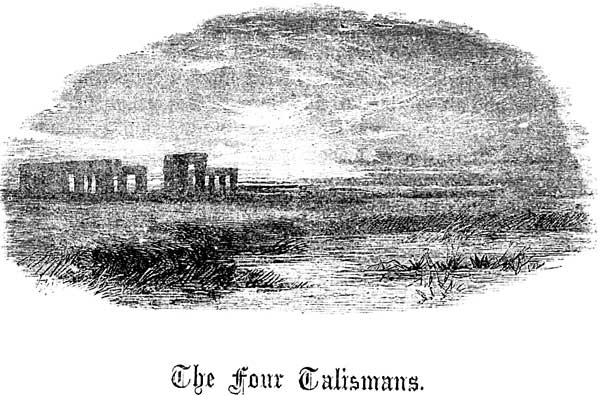

bouali Nabul,[7] Emperor of the Moguls, reflecting upon his great age, felt convinced that he could not long enjoy the light of the sun; he therefore sent for his well-beloved and only son Nourgehan, and spoke to him thus:
[7] Great father.
"Nourgehan, I leave my throne to thee. You will soon fill my place: forget not to do justice equally to the poor as to the rich. Be satisfied with possessing a flourishing kingdom. Envy not the dominions of any other Prince: leave every one in possession of that which they have inherited from their fathers. In one word, always remember that clemency and justice are the noblest titles of a Sovereign."
After having said these words, the Emperor descended from his throne, made his son ascend it, and retired into a delightful apartment (where he had passed his happiest days), where he remained till he died, which was shortly afterwards.
Nourgehan, after having paid all the honours that nature and gratitude required for so good a father, was wholly occupied in [342]fulfilling the last counsels that he had received from him. His heart was naturally good, and his judgment just; but if every man stands in need of experience to form his mind, much more is it necessary for those who are destined to fill a throne. Nourgehan, persuaded of this important truth, was far from the presumption too common to Princes. One day, as he conversed with his courtiers upon the subject of government, he applauded those Kings who had shown the greatest love of justice. Solomon was quoted as having been the most just.
"This example is not a just one," replied Nourgehan. "Solomon was a prophet, and could easily prevent the evils which he foresaw; but a common mortal can only use his best endeavours to repair the faults of his weakness: therefore I command you all, not only to inform me of all my duties without flattery, but also to prevent or repair my faults by your counsels. When a King testifies a love for virtue, all his subjects become virtuous."
As soon as Nourgehan had ceased speaking, Abourazier rose up and said, "Great Prince, if you wish to have justice truly exercised in your dominions, you must make choice of a disinterested Vizier, who has only your glory and the good of the State in view. The satisfaction of having done right must be the only recompense he desires."
"You say well, Abourazier," returned Nourgehan; "but the difficulty is to find such a man."
"You have, my lord," replied the courtier, "one of your subjects whose moderation and wisdom made him renounce all public employments under the reign of your illustrious father: your Majesty, perhaps, is ignorant of what happened to him in the city of Shiras."
The King having commanded him to inform him of it, Abourazier pursued his discourse thus:
"Imadil Deule,[8] in the last war which we sustained against Persia, led our victorious army as far as Shiras, which he took, and, by a sentiment of humanity, preserved from being plundered. [343]His soldiers, however, demanded a recompense that might make them amends for the booty they expected to have obtained, and spoke to him so strongly, that he was obliged to promise one to them, though he knew not where he could procure it."
[8] The support and assistance of felicity.
"One day as he was in his palace, thinking of this demand, he perceived a serpent creep out of a hole in the wall and return into it again. He called the officers of his harem, and said to them, 'Break open that hole, and take out the serpent that I saw enter it this moment.'
"The courtiers obeyed him, and found a vault full of presses ranged along the walls, with chests piled upon each other. They were opened, and found to be filled with sequins, while the presses were heaped up with the most magnificent stuffs. Imadil Deule returned thanks to God for this discovery, and distributed the treasure to his soldiers. He afterwards commanded a tailor to be sent for to make habits of these stuffs, with which he designed to recompense the merits of those officers who had served under his command. The most experienced tailor of the city was presented to him, who had always wrought for the late Governor. Imadil Deule said to him, 'Not only thou shalt be well paid if these habits are carefully made, but I will procure thee a further recompense, and some bowls of cassonnade.'"[9]
[9] A kind of sherbet mixed with honey.
"The tailor, who was deaf of one ear, understood that he was to have the bastinado, and fell a-weeping. Imagining that it was intended to exact an account of the late Governor's clothes which he had in his possession, he declared he had only twelve chests full, and those who accused him of having more had not said the truth.
"Imadil Deule could not forbear smiling at the effect which fear had produced in the poor tailor: he caused the habits to be brought, which were found to be magnificent and entirely new. The only use he made of them, as well as of the rich stuffs he found in the presses, was to clothe and adorn the officers of his army. I believe, therefore, that so disinterested a man deserves the confidence of your Majesty."
Abourazier having ceased speaking, Nourgehan said to him, "Imadil Deule shall not be my Vizier. I believe him an honest man, but he wants prudence, and I do not think him capable of supporting my authority. He had the seals of the empire, and yet knew not how to order everything necessary for his expedition; in a word, his treasure failed him, and his soldiers presumed to give him laws. Without the accident of the serpent, of which any other man would have made the same use, what would have become of him? The story of the tailor is of no consequence."
Nourgehan was continually occupied with the love of justice and the desire of reigning well. He left his palace at all hours to inform himself of the truth by his own knowledge. There was an old potter of earthen vessels who dwelt near his palace. Nourgehan, moved by seeing him every day pray to God with the most ardent and zealous fervour, stopped one day before the little hut in which he dwelt, and said to him, "Ask of me whatever thou desirest, and I promise to grant it thee."
"Command all your officers," said the potter, "to take each of them one of my pots, and pay for it that which I ask. I will not abuse this permission."
Nourgehan granted him his request, and gave orders to his guard to watch over the sale of the pots, and, above all, to do whatever the potter ordered him. He made a very modest use of the favour that he had obtained, and, satisfied with the sale of his work, he exacted no more than the value of it, thinking himself happy in being able to live by his industry, and wishing that he might give a proof of his gratitude to his Sovereign. The Vizier of Nourgehan was avaricious; but for fear of displeasing his master, he concealed that vice with the utmost care. He went one morning to the Emperor's audience, when the potter demanded a sequin for a pot which he presented to him. The Vizier refused it, and said it was a jest to ask such a sum for a thing that the least coin would sufficiently pay for.
The potter, seeing that he added menaces to his refusal, answered him, "that since he took it in that strain, he demanded a thousand sequins for his pot," and added, "that he should not[345] enter into the Emperor's presence until he had hung the pot round his neck, and carried him upon his back to have an audience of the Emperor, that he might make his complaints of the refusal and menaces he had given him."
The Vizier made many difficulties and great entreaties to avoid these vexatious and mortifying conditions; but the hour approaching which the Emperor had appointed for an audience, and the guards refusing to let him enter till he had satisfied the desires of the potter, he was obliged to submit to them; to promise the thousand sequins, to hang the pot about his neck, and to carry the potter on his back, a condition from which he would not recede. The Emperor, surprised at seeing his Vizier arrive in a manner so ridiculous and so unsuitable to his dignity, commanded him to explain what it all meant. When he was told, he obliged the Vizier to pay the thousand sequins immediately; and comprehending of how great an injury it might be to a Prince to have an avaricious minister, he deposed him, and was pleased with the potter for having made known to him a fact that he never would have suspected otherwise.
Nourgehan formed a counsel of the most worthy men of the empire, ordained wise and prudent laws, and departed to visit his provinces, with a resolution of releasing his people from any possible abuse of an authority which is always dangerous, when those who exercise it are at too great a distance from the Sovereign. This Prince, endowed with every virtue, had no other wish than that of deserving after his death the noble epitaph of that Persian monarch who has graved upon his tomb, "Weep! for Shah Chuja is dead!"
Nourgehan, visiting all the provinces of his kingdom, had already gone through the greatest part of them, and remedied numberless disorders, when his curiosity engaged him in a journey into Tartary, his neighbouring kingdom. Finding himself so near their country, he had a desire also to see and know the manners of these Tartars, who were more civilized than others, for they had cities and fixed habitations: their women also are not shut up like those of the other Asiatics. The Tartars came to meet the Emperor of[346] the Moguls. Some of them performed courses on their swiftest horses to do him honour, others, accompanied with their women, formed a kind of dance which, though a little savage, was not destitute of grace. In the number of the Tartar women who presented themselves before him, Nourgehan was struck with the beauty of a young person of eighteen, named Damake.[10] She possessed great beauty; an inexpressible sense and modesty was visible in her countenance. Nourgehan did homage to so many charms, and caused a place in his harem to be proposed to her, but she refused it. Love but too often causes the greatest change in the worthiest characters. The Prince, so wise, and till then so moderate, led away by his passion, joined menaces to his entreaties; he even went so far as to threaten that he would bring a formidable army thither to obtain a beauty whose refusals did not permit him to hope to win her otherwise. He made this rash speech to Damake alone; for if the Tartars, who are a people most jealous of their liberty, had had the least knowledge of it, war would have been that moment declared. But Damake answered him with the utmost sweetness, without showing the least fear, and without losing that respect which she owed to a Sovereign; and it was with the gentle and yet resolved tone that courage and truth always inspire, that she related this little history to him:
[10] Joy of the heart.
"One of the great Lamas," said she, "of whose supreme authority in this country you are not ignorant, fell in love, in this very place, with a maiden of my tribe. She not only refused all that he offered to her, but she would not accept the proposal he made to marry her. The love she felt for a musician was the sole cause of her refusal, which she confessed to the Lama, with a hope of appearing unworthy of his attachment. But that Prince—for they are looked upon as such—distracted with anger and sorrow, caused his unworthy rival to be put to death, and under the pretext of her being agreeable to the Grand Lama, it was not difficult to have her carried off. For you are sensible, my lord, that in this country every one trembles at the very name of him, whom we look upon [347]as a god. But the Lama enjoyed not much satisfaction from his cruelty and injustice; for after she had promised to marry him, in order to obtain a greater liberty, she precipitated herself from the top of a rock, which can be perceived from hence, and which is always shown in the country as a proof of the constancy and resolution of which the Tartar virgins are capable. It is not," continued Damake, "love for another that makes me refuse the offers of your Majesty. My heart to this hour is free; but, my lord, learn to know it thoroughly. It is noble, and perhaps worthy of the favour you condescend to honour me with. My weak charms have seduced you; but a woman who has no other merit than beauty, in my opinion, is of little value."
"Perhaps," returned Nourgehan, "the difference of our religions is an obstacle to my happiness?"
"No, my lord, I am a Mussulman," resumed Damake. "Can you imagine I could submit to the ideas that are given us of the Grand Lama? Can we believe that a man is immortal? The artifice that is made use of to persuade us of it is too gross. In one word, my eyes are too much enlightened for me to hesitate between the ideas inculcated by these priests, and those by which the divinity of God is preached by his most sacred Prophet. No, my lord," continued she, "I am sensible of the risk I shall run by your goodness to me. Time causes the nightingale to perish and the rose to fade. The moon shines during the night; but its lustre fades when the day approaches. Can I expect, therefore, that time should spare me? Yet, notwithstanding these reflections, I confess, my lord, I should be flattered with the thought of pleasing a man whose virtues I esteem above his greatness. But I should wish to please him by other qualities: I should wish to have rendered myself worthy of him by services so considerable, that even a marriage thus unsuitable, far from exposing him to reproaches, should only serve to make his choice more applauded."
Nourgehan, charmed at finding such uncommon sense and such delicate sentiments in an object whose figure alone would have rendered her amiable, admired her virtue, gave her his royal promise never to constrain her inclinations, and resolved never to depart[348] from her. He sent a numerous train of slaves and camels to the beauteous Damake, who followed him with all her family. She would never have consented to this step if she had been obliged to abandon her family, to whom she was fondly attached. The King saw her every day, and could not exist a moment without wishing to see her, or without admiring her when he did see her. In the meantime the discourses of the Court and of the populace reached the ears of Damake. She knew the evil opinion they had of her. To repair this wrong she conjured Nourgehan to assemble all the learned men of his kingdom, that she might answer their questions, and afterwards propose some to them. Nourgehan, who dreaded lest a person so young as Damake should expose herself too hastily, and return with confusion from such a dispute, used his utmost efforts to dissuade her from her request; for the fear and concern that is felt for those whom we love is most certainly far stronger than that which interests us for ourselves. His remonstrances were in vain.
Learned men were assembled to the number of twelve; and in the audience that was given them, the King was placed upon an elevated throne, in his habits of ceremony. Damake was seated lower, opposite to him, leaning upon a sofa, dressed with the greatest plainness, but shining with every charm of youth and every gift of nature, surrounded by the twelve sages, venerable by their extreme age and their flowing beards, leaning upon a large table, round which they and she were seated. The sages, who knew not with what design Nourgehan had assembled them, were extremely astonished when he made known to them the project of Damake. They looked upon the adversary who was presented to them, and kept silence, not doubting that the King did it with the design of showing them contempt. Nourgehan said to them,
"I perceive your thoughts, but I have given my royal promise, and it is your duty to acquit me of it. Propose boldly the hardest questions to this lady, who has engaged to resolve all the difficulties that your great learning gives you the opportunity of proposing to her."
The first sage demanded, "What is that which takes the colour[349] of those who look upon it, which men cannot do without, and which of itself has neither form nor colour?"
"It is the water," replied Damake.
The second said to her, "Can you, O miracle of sense and beauty, tell me what is the thing which has neither door nor foundation, and which is within filled with yellow and white?"
"It is an egg," said the beauteous maiden.
The third sage, after having considered a little, in hopes of surpassing his brethren (for the learned men in the Mogul have a share of self-love), said to her, "There is in a certain garden a tree; this tree bears twelve branches, upon each branch there are thirty leaves, and upon each leaf there are five fruits, of which three are in the shade and two in the sun. What is this tree? and where is it to be found?"
"This tree," returned Damake, "represents the year: the twelve branches are the months, the thirty leaves the days, the five fruits the five prayers, of which two are made by day and three by night."
The sage was amazed, and the courtiers, whose minds vary like the air, and whose sentiments are changed by that which is less than nothing, began to be inwardly persuaded of the value of that which they had at first only pretended to admire.
The other sages, who had not yet spoken, would have excused themselves, and had their silence passed over in favour of the applauses they gave to the uncommon sense of her who had confounded those who preceded them. But Nourgehan, at the entreaty of Damake, having commanded them to continue the conference, one of them demanded, "What is heavier than a mountain?" the other, "What is more cutting than a sabre?" and the third, "What is swifter than an arrow?" Damake answered that the first "was the tongue of a man that complains of oppression;" the second, "Calumny," and the third, "A glance."
There were four sages remaining who had not yet proposed their difficulties. Nourgehan trembled, lest at length the mind of Damake should be exhausted, and she should lose the honour of so great a number of judicious answers. Yet this beautiful maiden appeared neither fatigued nor exalted with that which would have raised the[350] vanity of the greatest part of mankind. But the very property of love being to submit to the will of that which it loves, Nourgehan, whom the preceding examples had not yet reassured, full of alarms and inquietudes, commanded them to speak by a sign of his head, which they durst not refuse. The first demanded of her, "What that animal was which avoided everybody, was composed of seven different animals, and inhabited desolate places." The second desired to know who that was whose habit was armed with darts, who wore a black vest, a yellow shirt, whose mother lived above a hundred years, and who was liked by the whole world. The third desired her to name that which had but one foot, which had a hole in its head, a leathern girdle, and which raised up its head when its hairs were torn off and its face was spit upon.
Damake answered to the first that it was a grasshopper, which is composed of seven animals; for it has the head of a horse, the neck of an ox, the wings of an eagle, the feet of a camel, the tail of a serpent, the horns of a stag, and the body of a scorpion.
The lady found it more difficult to answer the question of the second: for a moment the whole assembly thought her vanquished. This idea, which she perceived in the eyes of all who looked upon her, made her blush. She appeared only still more beautiful from her modesty; and Nourgehan was charmed when he saw the sage who had proposed the question agree that she had answered with her usual justness, when she said that it was a Chestnut. She answered the third without hesitation, that it was a Distaff.
So much knowledge, so much presence of mind, joined to such uncommon personal charms, threw all minds into so pleasing a confusion that, notwithstanding the awe that the presence of Nourgehan inspired, they all loudly expressed the joy, admiration, and pleasure they felt at being witnesses of so uncommon a scene. Damake then made a sign that she wished now to speak. Silence was commanded, and she desired the sages to inform her what was sweeter than honey.
Some of them answered that it was the satisfaction of having our wishes fulfilled, some that of gratitude, and others it was the pleasure of conferring obligations.[351]
When Damake had let them speak, she applauded all their reasonable and just thoughts, but finished her discourse by asking them with gentleness if she was mistaken when she imagined the sweetest thing upon earth to be the love of a mother for her child.
An answer so suitable to her sex, who ought always to be attached to their maternal duty, and proposed with so much modesty, entirely finished the conquest of their hearts. But Damake, who had no other design upon this occasion than to conciliate their esteem and authorize the favours with which Nourgehan honoured her, was resolved to finish a scene which she did not design to repeat, resolving for the future to be occupied with schemes and ideas of a higher kind. Damake then caused instruments to be brought, and sang and played in all the different modes of music, finishing by singing the famous strain of Zeaghioule.
Nourgehan, in those transports of joy which are given by the repeated successes of those one loves, dismissed the assembly, but not without making some large presents to the sages; and when they had all retired, he threw himself at the knees of Damake, saying, "Thou art the life of my soul: haste thee to make me happy!"
The beauty answered that she was not yet worthy of him.
"What can you require further?" cried the passionate Prince. "You have charmed my whole Court; you have confounded the learning of the men most celebrated for their wisdom; the justness of your answers, the moderation of your questions, and the modesty with which you bore the advantage of so great a triumph, have dazzled them. Not satisfied with having proved your sense, what talents did not you show when you touched the musical instruments! What taste did you not express in your song! Whoever, like Damake, joined such merit to so much beauty? But I perceive you love me not," added this passionate Prince, with the utmost tenderness, "since you refuse to attach your destiny to mine. Doubtless you have an aversion for my person."
"I am very far from deserving this reproach, my lord," said Damake; "you yourself shall be the judge. The greatest pleasure[352] and the highest satisfaction I have felt on this day, which your prejudice in my favour has made you think so glorious, was the being able to express before the whole Court, in a proper manner, the sentiments with which you have filled my heart."
"What can you wait for further to render me the happiest man upon earth?" cried Nourgehan with eagerness. "You love me, and I adore you. What wants there more? My wishes for you are become an ocean unbounded by any shore."
"I resolve to deserve you, my lord," replied she, "by talents of more value than those of music; by a justness of sense more valuable than that which your sages set such a price upon, and which is only a mere subtlety of mind. I wish to establish myself in your heart upon foundations more solid than beauty, or those superficial talents that you have had the goodness to applaud. In short, I wish that love may in you only be a passage to that esteem and friendship which I aspire to deserve. Submit your impatience to grant me this favour—it perhaps gives me more pain to ask it than your Majesty to grant: let me live some time under the shadow of your felicity."
"I am capable of nothing now," replied Nourgehan, "but of loving and adoring you; but at least permit me to give a full proof of the justice I do your merit. Assist in the divan, preside in all affairs, and give me your counsels: I can follow none that are more prudent or better judged."
"The diamond boasted," replied Damake, smiling, "that there was no stone which equalled it in strength and hardness. Allah, who loves not pride, changed its nature in favour of lead, the vilest of metals, to which He gave the power to cut it. Independently of the pride I must render myself guilty of if I accepted your offers,—Allah forbid that I should do that wrong to my Sovereign Lord!—to authorize by my behaviour the reproaches that would be thrown upon him. There would be a foundation to say that he was governed by a woman. I allow," added she, "that your Majesty ought to have a Vizier: you cannot see to everything with your own eyes, and I believe I am able to show you one worthy of Nourgehan."[353]
"Name him to me," replied he, "and I will give him the charge this moment."
"Your Majesty," replied the beauteous Damake, "must know him before you accept him. I hope you will find in him whom I propose those virtues and talents necessary in a man dignified with so great an employment. He lives in the city of Balk, and is named Diafer. The post of Vizier to one of the most powerful Kings of the Indies has been in his family above a thousand years. Judge then, my lord, what a collection of admirable precepts he must have upon all parts of government, and yet a Prince, blinded by the pernicious counsels of his favourites, has deposed him, and he passes his days at Balk—days which might be happy if he had not lived in the habit of labour and a hurry of great affairs, which seldom leave the mind at liberty to be satisfied with anything less tumultuous."
Nourgehan immediately replied, "Diafer is my Vizier: Damake can never be mistaken."
Upon the spot he wrote to the Governor of Balk, and sent him a note for a hundred thousand sequins, to be delivered to Diafer, to defray the expenses of his journey; and he charged the same courier with a letter for Diafer, in which he conjured him to accept the post that he had destined him for.
Diafer began his journey. He was received with magnificence in every city, and the Emperor sent all the noblemen of his Court to meet him, and conduct him to the palace which he had destined for him in the kingdom of Visiapour, where he then resided. He was treated there with incredible magnificence during three days, after which he was conducted to an audience of the Prince. He appeared at the height of joy for possessing a man whom Damake esteemed so highly; but that joy was of no long duration, for the Prince, who was so gracious and so prejudiced in his favour, flew into the most dreadful anger the moment Diafer appeared in his presence.
"Go," said he to him, "depart this moment, and never see me again!"
Diafer obeyed, and retired in all the confusion, the sorrow, and[354] the surprise that such a reception must needs give him. He returned to his apartment without being able to imagine the cause of the King's sudden anger, who, in the meantime, held a council, and examined the affairs of his kingdom, without taking any notice of what had passed with him whom he had destined to be his Vizier.
He afterwards repaired to the apartment of Damake, who, already informed of an event which employed the thoughts of the whole Court, doubted not that there was an alteration in the mind of him to whom she was so perfectly attached. The sorrow which this reflection had given her had plunged her into a state so languishing as scarce left her the use of speech. Yet making an effort to conquer herself, she said to him, after some moments' silence,
"How is it possible, my lord, that after all the expenses you have been at, and all the cares you took for the arrival of Diafer at your Court—after all the honours you have ordered to be paid him, and those that you have loaded him with, you should receive him so ill?"
"Ah! Damake," cried Nourgehan, "I should have had no regard to all that I have done for him, to his illustrious family, nor to the fatigues that he has suffered in coming so far, if any one but you had recommended him to me. I would have had his head struck off the moment he presented himself before me, and it was wholly in regard to you that I satisfied myself with banishing him from my presence for ever."
"But how did he incur your indignation?" pursued Damake.
"Know, then," resumed Nourgehan, "that when he came up to me he had the most subtle of poisons about him."
"May I ask you, my lord," returned Damake, "what certainty you have of such a fact, and if you may not doubt of the fidelity of him who made you the report?"
Nourgehan replied, "I knew it myself. I permit you to inquire into it, and you will find whether I was mistaken or not."
When Nourgehan had left Damake more reassured as to the heart of the Emperor, though alarmed at the impressions he was capable of taking so lightly, she sent for Diafer, who appeared sunk in the most violent chagrin. She conversed with him for[355] some time, and perceiving how deeply the ill-treatment he had received from the King had plunged the poniard of sorrow into his heart, she said to him that he ought not to afflict himself so much, that the wrath of Nourgehan would be of no long duration, and that he would soon repair the affront that he had publicly given him. She added that Princes had their hasty moments, that ought to be passed by and excused. When she had a little calmed his chagrin, she finished her discourse by saying to him,
"If I have deserved your confidence, if you believe that I shall endeavour to repair the affront you have suffered—since I, by doing justice to your talents, was the innocent cause of that which has happened to you—if I deserve any return from you, vouchsafe to inform me why you had poison about you when you were presented to Nourgehan?"
Diafer, surprised at this question, after having reflected some moments, replied, "True, I had poison with me; but my heart, though I bore it about me, was as pure as the dew of the morning. I even have it now that I speak to you." Saying this, he drew a ring from his finger and presented it to her. "The setting of this ring," said he, "encloses a most subtle poison. It is a treasure that has been preserved in our family from father to son these thousand years. My ancestors have always worn it, to preserve themselves from the anger of those Princes they served, in case they should have had the misfortune to displease them in the exercise of their post of Vizier. You may believe," continued he, "that when the King sent for me, who was wholly unknown to him, to exercise that charge, and conscious of the many enemies a stranger generally meets with, I would not forget to bring this treasure. The sorrow that the cruel behaviour of Nourgehan has given me, and the shame that he has covered me with, render it still more precious to me: it will not be long before I make use of it."
Damake obtained from him that he should delay, at least for some days, this fatal design, and conjured him to wait in his palace till he heard from her.
She immediately repaired to give an account to Nourgehan of[356] what she had learned. That Prince, perceiving by her relation that Diafer had no ill design, and that the cruelty of Princes in general authorized but too justly such a precaution, repented that he had received him so unworthily, and promised Damake the next day to make amends for the pain he had given him. She approved this design; but before she quitted him she conjured him to satisfy her curiosity by informing her how he could perceive the poison which Diafer had with him. Nourgehan replied,
"Never will I have anything concealed from the sovereign of my heart. I always wear a bracelet, which my father left me, and which has long been in our family, though I am ignorant of the name of the sage who composed it, or how it fell into the hands of my ancestors. It is of a substance that nearly resembles coral, and it has the property of discovering poison, even at a very great distance. It is moved and agitated whenever poison approaches; and when Diafer came near me, the bracelet was very nigh breaking, the poison which he bore had so much strength and violence. Had he not been recommended by you, his head should have been struck off that moment. I was the more certain that Diafer bore that dangerous poison, as my bracelet remained immovable immediately after his leaving the hall where I gave audience."
Nourgehan loosed it from his arm, and gave it to Damake. She examined it with great attention, and said to him, "This talisman, my lord, is doubtless very wonderful; yet this adventure ought to prove to you how much those who have the sovereign power are obliged to be upon their guard against appearances, and of what consequence it is for them not to give judgment rashly."
Damake retired, and Nourgehan commanded the greatest pomp and the most splendid train to conduct Diafer the next day to an audience. This order was executed. Nourgehan received him with the utmost affability, and testified the greatest regret for what had passed. Then there was presented to him, by the Sultan's command, a standish of gold, a pen and paper. Immediately he wrote in the most beautiful characters sublime sentences upon the manner in which a Vizier ought to fulfil the duties of his important post. Nourgehan admired his talents, made him clothe himself in the[357] robe of a Vizier, and, to crown his goodness, confided to him the secret of his bracelet. Diafer strenuously advised that Prince never to part with it; and in his admiration, and the pleasure he felt at possessing so great a treasure, he asked his new Vizier if he believed that through the whole world there could be found anything so curious.
"Great Prince," replied Diafer to him, "I have seen in the city of Dioul another miracle of nature, less useful, indeed, but which for the strength of art and learning with which a sage has composed it, may be compared to this."
"What is it?" returned Nourgehan. "I should be glad to be informed of it."
Then Diafer spoke thus:
"When I had received your Majesty's command to repair to your presence, I departed at once, but was obliged to make some stay at Dioul, through which I passed in my way to Visiapour, where I knew I might join your Majesty. Notwithstanding my impatience, I was obliged to collect several things which were necessary for my journey, and made use of that time to view the beauties of the city. The Governor, whose riches and opulence astonished me, came to meet me on the day of my arrival, and conducted me to his palace. He loaded me with honours, and, during my residence there, showed me the utmost respect and favour; yet it was accompanied with a constraint that rendered his fidelity suspected by me. Among the amusements that he procured for me, was a party upon the river: I consented to join it, and we embarked the next day in a small frigate which he had provided. The weather was fair, and the conversation most agreeable. The Governor of Dioul was seated on the upper deck, and I was placed close to him. A young boy, beautiful as the sun, lay at his feet; the most exquisite wines were served upon a table which stood before us: their coldness, and that of the ice with which all the fruits were surrounded, contributed to the most seducing voluptuousness. The slaves sang and played upon different instruments. Our pleasure was thus accompanied with everything that could render it delicious; and as I was thinking upon something[358] to say that might be agreeable to the Governor, I perceived upon his finger so magnificent a ruby, that I could not forbear giving it the praises it deserved. The Governor immediately drew it off, and presented it to me. I examined it with attention, and returned it to him again, but had great trouble to make him take it. Seeing that I absolutely refused to keep it, he was so concerned that he threw it into the river. I repented then that I had not accepted so perfect a work of nature, and testified my sorrow to the Governor, who answered, that it was my own fault.
"'Yet,' continued he, 'if you will promise me to accept it, it will not be difficult for me to find the ring again, which is really deserving of your acceptance.'
"I imagined that, having another not unlike it, he designed to offer me that; but, without saying any more to me, he immediately commanded they should steer the vessel to the land. When he was arrived there, he sent his slave to his treasurer to demand a small casket which he described to him, and cast anchor to wait the return of the slave, who was expeditious in executing the orders he had received. The Governor, having then taken out of his pocket a small gold key, opened the casket, out of which he took a small fish of the same metal and of admirable workmanship, and threw it into the river. Immediately it plunged to the bottom, and soon after appeared upon the surface of the water holding the ring in its mouth. The rowers who were in the boat took it in their hands and brought it to the Governor, to whom it delivered the ring with a motion of its head: no other person could have forced it from its teeth. The Governor again presenting the ring to me, I could not refuse it, especially as he redoubled his entreaties. The fish was replaced in the little casket and sent back to the treasury."
Diafer, after having related this history, drew the ring from his finger and presented it to Nourgehan, who, finding it to be extremely magnificent, said to him,
"Never part from this ring, which is still more precious from the virtue of the talisman which rendered you the possessor of it. But," continued he, "you ought to have informed yourself at what[359] time, how, and by whom that wonderful masterpiece of art was composed."
"I used my utmost efforts to be informed," replied Diafer, "but they were in vain. Struck with so singular an event, I thought no more of the pleasures of the day. The Governor, perceiving that I fell into a deep reverie, said to me, 'Life is short: make use of every moment and enjoy every pleasure. The soul is a bird imprisoned in the cage of the body, which it must soon quit: rejoice while it is in your power, you know not who shall exist to-morrow.' I confessed to him that curiosity had penetrated my heart. He replied, 'I am in despair that I cannot satisfy you,' and pronounced these words with a tone that expressed his design of not giving a more particular answer. 'Let us think only of amusing ourselves agreeably,' continued he. I followed his counsels as much as it was in my power, and departed from Dioul without being able to obtain any information upon the subject, but fully persuaded that this talisman was the source of all the treasures which he possesses."
Nourgehan terminated the audience of Diafer by assuring him of his favour if he used his utmost care in the administration of justice. He afterwards gave an account to Damake of the conversation he had held with his Vizier, and told her the history of the fish.
"I have a love for these talismans," said that Prince, "and this little fish rouses my curiosity. I wish at least I knew the maker of it."
Damake promised him to use her utmost efforts to inform him. In effect, the next day, she told him, that of all the talismans which the great Seidel-Beckir had made, there existed only four—his bracelet, the little fish of which Diafer had spoken to him, and which she presented to him from the Governor of Dioul, adding, that he had just sent it as a present to his Majesty in order to obtain a life which he had deserved to lose, his faithful subjects having taken him in arms against the Sultan. The third, a poniard, very meanly adorned, which she begged him to accept.
"The others," continued she, "are either worn out (for you know,[360] my lord they only last for a certain time), or have been destroyed by different accidents."
"Why did the Governor of Dioul," resumed Nourgehan, "conceal from Diafer that Seidel-Beckir was the maker of that which he possessed?"
"He was ignorant of it, my lord," interrupted Damake; "and perhaps, ashamed of not knowing it, he feigned it to be a secret. It is the habit of men to cover their ignorance by an affectation of mystery."
"But what is the virtue of this talisman that you offer me?" said Nourgehan, as he accepted the poniard.
"I will inform you of it, my lord," said Damake, "at the same time that I give you an account of what I have been able to learn concerning the fish. It may be about three thousand years since there appeared, in the part of Asia which we inhabit, a man named Houna, who was so great that he was surnamed Seidel-Beckir. He was a sage who possessed in perfection all those talents which acquire a general veneration. The science of talismans he possessed in so eminent a degree, that by their means he commanded the stars and the constellations. Unhappily, his writings are lost, and therefore no talismans like his can now be made. Antinmour, King of Hindostan, having found means to form a friendship with him, Seidel-Beckir, in return for his kindness and some small services that he had done him, made him a present of that little fish of which your Vizier gave you an account. It always remained in the treasury of Antinmour as long as his family existed. One of the ancestors of the Governor of Dioul finding himself the Vizier of the last of that race, when the family was extinct by those revolutions which the history of the Indies relates at length, and which are universally known, seized upon this curiosity, and his successors have kept it with the utmost care till this time. Not only does this talisman bring back whatever is fallen into a river, or the sea, to the person to whom it belongs, but if you indicate to it anything to be brought out of that element, it goes in search of it with the greatest readiness, and brings it wherever it is commanded."
"I am fully satisfied," replied Nourgehan, "as to the two talismans,[361] and never Prince was possessor of such treasures. I may now truly style myself the sovereign of the sea. What do I owe to thee, the ruler of my soul! But of what use is this one which the beauteous Damake has presented to me?"
"My lord," replied she, "when I tell you for what reason it was composed, you will know its virtue."
"We read in the revolutions of Hindostan, that Antinmour would have unjustly exacted a tribute from Keiramour, who was too weak to resist the forces of his enemy; and not knowing to whom to have recourse, he resolved to address himself to the sage Seidel-Beckir, and sent his Vizier to him with magnificent presents. The sage refused them; but he was so touched by the situation to which the King, his friend, had been reduced, that he declared Antinmour should not succeed in his designs. Immediately he composed this very poniard, which I have now presented to my Sovereign, and gave it to the Vizier. 'Tell your master from me,' said he, 'to choose out twenty of the bravest soldiers of his kingdom, and deliver the poniard into the hands of him who commands them; for this poniard has the virtue (when it is drawn) to render invisible not only the person who bears it, but all those whom he designs should participate in the virtue of the talisman. His will alone decides the effect of it. Keiramour shall send these twenty persons to Antinmour with a letter, in which he shall refuse to pay the tribute that is demanded of him. Antinmour, in the excess of his anger, will order the ambassadors to be seized. Then the law of nations being violated, he who bears the poniard shall render himself invisible by drawing it with one hand, and his sabre with the other; and his troop following his example, and doing the same, he shall obey, without hesitation, the dictates of his courage.'
"The Vizier returned to Keiramour, and all that Seidel-Beckir had commanded was executed. The son of the King was charged with the command and execution of this great enterprise. Antinmour was enraged on reading the letter that was presented to him.
"'Let this insolent ambassador be seized,' cried he, 'this moment.'[362]
"Then the Prince, hastily drawing out his poniard and sabre, struck off the head of Antinmour. His train did the same to all those who composed the divan; and running directly into the city, an infinity of heads were flying off without knowing who caused this disorder. After this great execution, the ambassador and his train made themselves visible, and declared to the people in the public square that there was no other method of avoiding certain death but to submit to the government of Keiramour, which they did without reluctance. This poniard," continued Damake, "has been long kept in the treasury of the Princes of that country. By little and little, however, its value was forgotten, and the remembrance of its uncommon property totally lost; and when your Majesty desired an explanation of the talismans, I found that this was at Balsora in the possession of a poor Jew, a broker, who sells upon the bridge of that city all the old iron and useless weapons that are cast away. It was not difficult to procure the possession of it, therefore it was no merit in me to give my Sovereign Lord a talisman which would be absolutely useless to me, whilst the destiny of monarchs may unfortunately render such precautions necessary to them."
Nourgehan made a thousand exclamations upon the boundless ocean of her liberality, and said to her,
"Sovereign of my heart, reflect upon what you have said to me: consider that if these talismans, valuable in themselves, but mean in comparison with you, have excited my wish to possess them, how much greater must my desire be to wed the giver! All the sages, Seidel-Beckir himself, never composed a talisman so wonderful as you are. Yesterday you knew not a single word of the history of the talisman, to-day you are perfectly instructed in it. This poniard was not four and twenty hours since at Balsora, yet notwithstanding the great distance we are from that city, you have presented it to me this moment. Are you the daughter of Seidel-Beckir, or are you an enchantress yourself?"
Damake blushed at this discourse, and Nourgehan again pressing her to speak, she replied,
"Nothing is impossible when one desires to please him whom[363] one loves. But I will explain at once all that puzzles my Sultan. Not long after my birth, my mother was seated at the foot of a palm-tree, enjoying with me the coolness of the morning, without any other thought than that of returning by her tender kisses my innocent caresses, when in a moment she perceived herself surrounded by a numerous Court who attended a Queen, beautiful, majestic, magnificently dressed, and who had herself also an infant in her arms. Notwithstanding the pomp of her train, and all the grandeur of royalty, she caressed me, young as I was, and after some moments' stay said to my mother,
"'This child whom you see in my arms, and who is mine, is by fate obliged to taste the milk of a mortal, it being a command laid upon us by Allah; and I cannot find one more modest, more wise, nor whose milk is purer than thine. Do me the pleasure, therefore, of nursing my infant for a few moments.'
"My mother consented with pleasure; and the Queen, in return for her complaisance, said to her,
"'Whenever you have any sorrow or any desire, come to the foot of a palm-tree, cut a leaf off it, burn it, and call for me—I am named the Peri Malikatada—and I will haste immediately to your assistance. I grant the same power to your little girl when she attains the age of reason.'
"My mother never importuned the Peri except for the care of my education; and I, my lord, before I knew you, had never addressed myself to her, for I knew no desire, nor had my heart formed any wish. From that time I fear I have fatigued her, so many troubles and inquietudes have seized upon my soul. It was she, as you will judge, who made Diafer known to me, who dictated to me the answers I gave the sages, who informed me of the talismans, and delivered this one to me. It was she, likewise, who caused the Governor of Dioul to be arrested, and who demands his life of you in return for the golden fish which I have given you from him; she also would have given me——" she paused.
"Go on, beauteous Damake," said Nourgehan, with tenderness; "if you love me, can you conceal anything from me?"
"She would have given me," resumed Damake, "a talisman of[364] her composition that should force you always to love me, but I have refused it. Can there be any happy talisman in love but the heart?"
Nourgehan, struck with so many virtues, and such proofs of her attachment to him, would no longer defer his happiness. He immediately caused his whole Court, and all the grandees of his kingdom, to be assembled.
"I may boast with reason," said he to them, "that I am the happiest Prince upon earth: I possess a bracelet which preserves me from all fear of poison; all the treasures of the sea are mine by the means of a fish, which at my command will fetch them from the bottom of the waves; Damake has given me this poniard, which renders whoever I please invisible. The proof that I can make before your eyes of this magnificent talisman will convince you of their virtues better than the golden fish, which it would be more tedious and difficult to exhibit."
He drew his poniard as he spoke, and disappeared from their sight. The astonishment of the spectators was not yet dissipated, when he disappeared with all his military officers, and said to his magistrates, "Do you see such a general, such an officer that has served so long in my army?" To every question they answered No. He ceased then to be visible to the eyes of his warriors, and disappeared with his Viziers and all the Doctors of the Law, designing by that means to convince them fully, and leave no room for jealousy and suspicion. "Return thanks, then, with me," added he, "to Allah and His holy Prophet, for having made me the most powerful Prince upon earth."
He performed his action of thanks with a fervour worthy of the bounty which Heaven had shown him, and all his courtiers followed his example. When he had fulfilled that important duty, he said to them,
"The greatest vice of the human heart is ingratitude: it is to Damake that I owe these powerful treasures; her beauty alone, her merit and her virtue, would deserve the gratitude I shall my whole life preserve for her; but gratitude ought to be accompanied with more than words: I will this day unite her to me for ever."[365]
All the Court and the grandees applauded his choice; and Nourgehan, having commanded Damake to be brought, she appeared with all those modest graces that nature had adorned her. When the Prince had given her his hand in presence of the Great Imam, Damake, who had prostrated herself before him, said with an audible voice,
"When I gave an account of the talismans of the great Seidel-Beckir, I informed you, my lord, that there were four still subsisting in the world: you have yet but three."
"Have I not riches enough in possessing thee?" returned Nourgehan. "Thou art reckoned, perhaps, for the fourth; but they are not all of half thy value."
"No, my lord," resumed Damake, casting her eyes upon the ground, and presenting him with a ring, "this was wanting. This ring of steel gives you a power of penetrating into the secrets of every heart. Others, in my place, might look upon this talisman as a danger, but I shall look upon it as a blessing if you still condescend to interest yourself in the sentiments that you have for ever graved in mine; and if I have the misfortune not to deserve that interesting curiosity, it will at least make known to you, without any doubts, the characters and the fidelity of your subjects."
At that instant the Peri Malikatada appeared with her whole Court, and desired the King to pass into a garden, which by her power, and that of the genii, she had adorned with exquisite taste and magnificence. Here she honoured the nuptials with her presence, and Nourgehan lived happily ever afterwards, more happy in the love and counsels of Damake than in all the talismans upon earth, if he could have joined them to those which he already possessed.

he kingdom of Dineroux comprehended all Syria and the isles of India lying at the mouth of the Persian Gulf. This powerful State was formerly subject to King Bohetzad, who resided in the city of Issessara. Nothing could equal the power of this monarch. His troops were without number, his treasures inexhaustible, and the population of his dominions was equal to their fertility. His whole kingdom, divided into ten great departments, was entrusted to the administration of ten Viziers, of whom his divan was composed. This Prince used often to repair to the chase as a recreation after the cares of government.
One day, while he entered with his usual keenness into this[367] exercise, he allowed himself to be carried so far in pursuit of a stag which had darted into the forest, and left his attendants at so great a distance, that, upon coming out of the wood, he could perceive none of his people; he had also lost sight of his prey. And while he endeavoured to find out the east of the place he was in, he perceived at a distance a pretty large troop of men. He approached them, and as he drew near he could distinguish a body of forty knights,[11] surrounding a splendid litter, the brightness of which was heightened by the rays of the sun. This carriage was made of rock crystal, the mouldings and hinges were of carved gold, and the roof, in form of a crown, was made of wood of aloes, having cornices of silver. This litter resembled in shape a small antique temple, but so brilliant that the eye was quite dazzled with it. A prodigy of this kind in the midst of a desert, astonished the King, and at the same time excited his curiosity. He came up and saluted the convoy, and, addressing his discourse to the knight who held the reins of the mules,
"Friends," said he, "be so kind as to tell me the meaning of all this equipage, and the name of the person to whom it belongs."
[11] Knights. The very ancient knighthood of India existed at this time. Those who devoted themselves to this manner of life came, armed from head to foot, to offer their services to the different Princes. See the "Memoirs of Hyder Ali Khan."
Notwithstanding the civil and polite manner in which the monarch spoke this, yet, as the hunting dress did not express the dignity of the wearer, they answered, "What matters it to you?"
Bohetzad was not discouraged with so dry an answer, but still insisted with politeness, and even earnestness, for a more satisfactory reply. He who appeared to be the leader of the troop then presented to him the point of his spear, and said,
"Go on your way, audacious fellow! otherwise, if your curiosity becomes more impertinent, be assured it will cost you your life."
This insolent behaviour excited the indignation of the King. He went up to the knight who thus threatened him, with that air of confidence and that commanding tone, the habit of which he had acquired in the exercise of absolute power.
"Slave of my throne!" said he to him, "dost thou not know Bohetzad? But, had I been only a common man, after speaking to you in so modest and friendly a manner, ought you to have threatened me with death?"
At the very name of Bohetzad, the knights alighted and prostrated themselves on the earth.
"Sire," said one of the oldest of them, "pardon an answer which we could not think addressed to the greatest monarch of the earth; for it was very possible not to recognize your Majesty in a hunting dress, and without attendants."
"Rise," said the King, "and gratify my curiosity. Who is the person in that litter, and whither are you conducting it?"
"Sire," answered the knight, "it is the daughter of Asphand, your Grand Vizier: we are conducting her to the Prince of Babylon, to whom she is going to be married."
During this, the daughter of the Vizier, uneasy on account of the delay, presented her head at the curtain of the litter, in order to get information, and was perceived by Bohetzad. Whatever pains she had taken to prevent herself from being seen, her extraordinary beauty struck the Sovereign. His heart received a fatal wound: his passion, arrived at its height, aspired after gratification from the very moment of its existence; and Bohetzad, determined to make sure of the object of it, made use of his absolute authority, and spoke thus to the conductor of the litter:
"I command you to take the road to Issessara, and to conduct the daughter of my Grand Vizier to my palace."
The commander of the troop thought it necessary to make some reply to his Majesty.
"Sire," said he, "your Vizier is your slave as well as we; and therefore, if we return his daughter to his own palace, she will continue there in equal subjection to your will."
"But my Vizier has disposed of his daughter without my consent, and I do not owe him the attention which you propose I should pay him."
"Sire," replied the knight, "your Grand Vizier Asphand has always been held in the highest estimation, and has had the honour[369] to enjoy the confidence of your Majesty. One instance of violence exercised against him may affect his reputation, and cause him to lose, in the opinion of the public, that credit which it is your interest that he should enjoy."
"All his credit depends on me, and I do not detract from it by doing him the honour to marry his daughter."
The oldest, and likewise the best informed of the knights, still ventured to speak.
"Sire," said he, "precipitation is dangerous; it often draws repentance after it: your slaves beseech your Majesty to reflect maturely on this."
"I have reflected already, audacious old man!" replied the Prince in anger; "what caution should I observe with my slave? Obey."
Being able to restrain his impatience no longer, he himself seized the bridle of the mules, and directed their steps towards that part of the forest where he presumed his people would be assembled at the appointed rendezvous. He soon found himself at the tent which they had set up, and he ordered all his suite to accompany the Princess in the litter to his palace. When the retinue was arrived, the King ordered the chief of his eunuchs to bring the Cadi, who instantly appeared, and drew up a contract of marriage between Bohetzad and the Princess Baherjoa, daughter of Asphand the Vizier.
While the King was taken up with the ceremonies of the marriage, the forty knights returned to the palace of the Grand Vizier, being forced to abandon the litter, and the Princess whom they were conducting to Babylon. The minister was confounded at so speedy a return. Having set out from the city of Issessara, how could they come back so soon from Babylon? He feared that some extraordinary accident had befallen them. One of the knights came and told what had happened: he exaggerated the violence and despotic manner of Bohetzad, and filled the mind of the minister with fear and resentment, although he assured him that the monarch was that very night to marry his daughter.
"Thus to oppose himself to my disposal of my own family! to[370] carry off my daughter! to marry her against my will!—in this manner to repay my services!" said the enraged minister.
Full of a desire of vengeance, he immediately ordered expresses to be sent to all his friends, the Princes and grandees of his family, to assemble them at his house. When they were come, he represented to them the outrage which the King had committed against his daughter, the Prince of Babylon, and himself. Shame and resentment entered into every breast. Asphand perceived, from the effect of the relation which he had made them, that it would be easy to associate them with him in his schemes of revenge.
"Princes and lords!" said he to them, "the King, occupied with his pleasures, is not delicate about the means of gratification; and, as a recompense for my labours, he hesitates not to expose me to the disgrace of an irreparable insult. I am nothing but a vile slave in his eyes. Thinks he that my daughter is obliged to share his unsteady attachment? You yourselves will not be safe from this dishonour; your wives and daughters will not be spared. His torrent of iniquity will discharge itself on you, if we endeavour not to stop its course."
The relations and friends of the Vizier entered into his interests, and a deliberation was held concerning the measures which were to be taken. One of them, deeply skilled in politics, thus gave his opinion:
"Vizier, write to the King, and express to him how sensible you are of the unexpected honour which he has done you, to which you could never have had the smallest pretensions. Along with this letter send another to your daughter, in which you must seem delighted with her good fortune. Supplicate Heaven with her, to pour down happiness upon a monarch so beloved by his people. Accompany these despatches with magnificent presents, and Bohetzad, blinded by his passion, will readily believe everything which can flatter it. You will take advantage of this security to leave him at the first opportunity, under pretence of attending to his business; and, having secured yourself against any sudden attack from him, transmit to all the Princes, the Governors, and people entrusted with the management of the finances, alarming[371] accounts of the situation of the kingdom. Represent to them the danger of the State, while the government, is in the hands of a young Prince, addicted to the gratification of his passions, and incapable of rewarding the services done him, which he only repays with violence and disgrace, being guided by no law but the dictates of a will as depraved as it is absolute."
The Grand Vizier and the rest of the assembly adopted this plan. They all agreed to embrace every opportunity which might present itself of preparing the minds of the people, without exposing themselves to danger, and to continue at Issessara when Asphand had left it, for the purpose of giving him information and directing his conduct. These resolutions being entered into, the assembly quickly broke up, that they might give no room for suspicion; and Asphand wrote to the King in the following terms:
"Mighty King, monarch of two seas! your slave, already elevated by you to the place of Grand Vizier, and honoured with the title of Prince, did not expect the distinguished honour of becoming your relation. Infinitely obliged by this new favour, I offer up to the God of heaven the most ardent wishes that He would continually heap on your Majesty new marks of His kindness; that He would prolong your days, and grant you all the blessings of a kingdom which shall not be shaken to the latest posterity. My duty hitherto has been to labour for maintaining both external and internal peace in your dominions, by the wise administration of justice, and by defending your frontiers from the enemy. I filled the station of your First Vizier; the duties thereof are now become more sacred to me; the honour of a connection with you gives me a personal interest in their success; and my daughter and I will only be slaves more faithfully attached to your person and interests."
The letter to Baherjoa contained congratulations on her good fortune, and was as artfully expressed as the one addressed to her spouse. Asphand caused the first officer of his household to deliver these letters, and accompanied them with a magnificent present. The young son of the Vizier joined the envoy; they went together to the King's palace, and prostrated themselves before him.[372]
Bohetzad, intoxicated with the good fortune which he enjoyed, did not in the least suspect the false declarations of the Vizier. He ordered his son to be clothed with the richest robe, and a thousand pieces of gold to be given to the officer who was entrusted with the message. Scarcely were they gone out, when the oldest of the Viziers came to pay his court to the King. The monarch received him with his usual goodness, made him sit down, and communicated to him the happiness which he expected to enjoy in the possession of his lovely spouse; for, though he had gained her by an act of violence, he imagined that his happiness could be obscured by no cloud.
"The attachment shown me by Asphand," said he, "removes my fears concerning the resentment which I might suppose him to possess: here are his letters; read them, and you will see how well he is pleased with this alliance. Besides, the magnificence of his presents exceeds even the force of his expressions."
The old minister, after reading the letters, continued thoughtful, and with downcast eyes.
"Are you not satisfied with what you have read?" said the King.
"A dangerous reptile," replied the minister, "when it means to introduce itself anywhere, does not try to frighten by its odious hissings: it creeps in artfully under the folds of its flexible and thin body; its scales are glittering and smooth; its looks are soft and fawning, and it takes care to conceal its treacherous and venomous sting. The letters of Asphand are studied: doubt not that you have offended; and the pretended softness of his expressions only conceals a scheme of revenge, the consequences of which you ought to guard against and prevent."
Bohetzad, entirely occupied with his love, and supposing that the minister who thus spoke to him was influenced by motives of jealousy, paid no regard to the advice, which proceeded from attachment, zeal, and prudence, but allowed himself to be blinded concerning the conduct of Asphand. The latter, in prosecution of his plan, and under pretence of appeasing some rumours in certain parts of the kingdom, left the capital, in a few months after, with his whole retinue. As soon as he saw himself out of the reach[373] of power, he communicated to the governors of the provinces the affront which he had received; he excited them to revolt, by inspiring them with a fear that they would all meet with a treatment similar to that which he had received; and to determine them, he calumniated, in every instance, the person and government of Bohetzad.
On receiving the messengers of the Grand Vizier, the grandees of the kingdom, enraged against a Prince whose administration was held forth in such odious colours, concerted together, from one province to another, and assured Asphand that, upon the first signal given by him, they would take the field with the troops under their command. The Vizier at the same time warned the Princes who remained at Issessara to hold themselves in readiness against the day on which he should come to complete his revenge, and to free the State from a tyrant who was sunk in effeminacy.
The plot was executed before Bohetzad had the smallest suspicion of it. The city of Issessara was completely invested by the army of Asphand. On receiving this news, the King armed in haste; he ordered the troops who were about his person to follow him; but they had been gained over, and were devoted to his enemy. He saw no safety for himself but in flight. He saddled, with his own hands, one of his finest coursers; and, taking Baherjoa behind him, endeavoured to gain the desert. He made a passage for himself through the midst of his mutinous subjects, whom he trod under his feet. The young hero, whose courage seemed only to be increased by love, burst like a torrent through a troop of those who wished to interrupt his passage; his invincible spear spared none of the rebels; and his horse, as vigorous as swift, soon carried him out of sight of his enemies.
He was now in the midst of the desert; and, night obliging him to allow some repose to his wife, fatigued with so violent an expedition, he stopped at the foot of a frightful mountain. On this spot the Queen, exhausted with weariness, gave birth to her first-born child, and the Prince received in his arms a young boy, no less beautiful than his mother.
The tender pair loaded him with caresses, and soon forgot, in[374] their new joy, the fatigue, uneasiness, and horror of their situation. The child was wrapped in a part of the Queen's robes; and, in this solitude, they enjoyed a profound sleep. The returning day invited them, however, to pursue their journey. The affectionate mother nursed her infant tenderly, but it pined away, and the mother herself was in danger. Bohetzad then saw himself under the cruel necessity of sacrificing nature to duty. He perceived a limpid fountain, on the borders of which there was a green bank, defended from the rays of the sun by the neighbouring willows. Here the unhappy parents abandoned to the care of Providence the object of their affection, having first watered it with their tears.
"Great Allah!" said the afflicted mother, "Thou who formerly watched over the young Ishmael, take care of this innocent creature. Send the preserving angel to him. We have no hope but in Thy succour."
Sighs prevented her from saying more. They both tore themselves away from this dreadful sacrifice, and committed this sacred deposit into the hands of its Creator.
The noise they had made in coming thither had frightened away from the brink a hind, who, along with her fawns, was refreshing herself at this exuberant fountain. As soon as they were gone, she returned, and approached the languishing creature, which seemed about to lose for ever the little strength which remained. A powerful instinct led this animal to give the child that nourishment which was reserved only for her young ones. She fed quietly around her nursling, and left the place no more. The wild beasts of the forest, it appeared, had abandoned to her the enjoyment of this happy spot, although so necessary to the supply of their wants, amid the burning sands and parched deserts with which they were surrounded. Nevertheless, men came to disturb their repose.
It was a band of robbers, whom thirst had brought into these places. They saw a child wrapped in rich swaddling-clothes, but still more remarkable for the beauty of its features. The leader of the banditti approached it, took it up, and sent it straightway to his wife, that she might pay it the necessary attentions, and educate it as if it had been their own son. When the wife saw it[375] she was moved with its innocent beauty, entered into the benevolent views of her husband, and immediately procured for their adopted son the best nurse in the horde.
Having seen the son of Bohetzad in safe hands, let us now follow the steps of those illustrious travellers.
Full of grief for the sacrifice which they had been forced to make, the King and Queen continued their journey in sadness till they reached the capital of Persia, where Kassera then reigned.
This powerful monarch received the fugitive Prince and his charming spouse with the respect which was due from a crowned head to a great Sovereign, his ally, whose rebellious subjects had revolted under the standard of a criminal usurper. To Bohetzad he allotted an apartment in his palace as magnificent as his own, and to Baherjoa one equal to that of his favourite Sultana. Such were the riches and magnificence of the palace in which the King of Dineroux and his wife now were, that, besides the magnificent apartments in which they were lodged themselves, there were twenty-four others occupied by as many ladies belonging to the Sultan, each of whom was served by fifty slaves of their own sex, in the bloom of youth and of the most exquisite beauty.
The treasures of the East seemed to have been exhausted in beautifying these stately dwellings. The gardens were full of the rarest and the most gaudy flowers; the waters, whose courses were distributed with great art, presented a magnificent scene to the eye; the trees gave at once, by the beauty of their fruit and the thickness of their foliage, the idea of plenty and the delight of repose; the birds, with the variety of their plumage and their song, enchanted the inhabitants of these happy regions. Everything, in short, concurred to display the riches of the great monarch of Persia, whose immense power was further displayed by an army of two hundred thousand men which constituted his life guard. A Prince so powerful and magnificent need spare nothing in treating, in a manner suitable to their rank, the illustrious guests whom he had received into his palace.
At the same time that he ordered a powerful army to be assembled on the frontiers, with the necessary stores and military[376] engines, he endeavoured to dispel the melancholy of the husband and wife by feasts, which displayed the greatest splendour and variety. But generosity and greatness of soul were not the only cause of his attentions; a less noble but more powerful feeling had taken possession of his heart. He was enamoured of Baherjoa, whose beauty was superior to that of all the wives in his seraglio. His passion for her was disguised under the veil of friendship; but, from the profusion which he displayed on every occasion, the delicacy of his attentions, and the care which he took to anticipate her wishes, it was easy to discover the love by which he was actuated. The sad Baherjoa, whose attention was occupied solely by the loss of her son and the misfortunes of her husband, was far from ascribing any of the attentions which she met with to this motive; her soul, weighed down with grief, was incapable of enjoying any of the pleasures which were presented to her; her heart, sincerely affected, was inaccessible to every impression but that with which it was already occupied. Her son abandoned in the desert to the care of Providence, and her husband reduced by her father to the necessity of asking succour from a foreign King, were the only objects which engrossed her thoughts.
In the meantime, the army which Bohetzad was to command was assembled. He took leave of Kassera to put himself at the head of this formidable body, and soon penetrated into the heart of Syria. Asphand, the usurper, being informed of the danger which threatened him, communicated it to his associates, assembled them as quickly as possible, and met his enemy at the head of two hundred thousand men.
The armies were now in sight of one another. The centre of Bohetzad's army was commanded by an experienced Vizier of the Persian King. Bohetzad himself, at the head of a chosen body of knights, was everywhere to give orders. He suddenly began the combat on the right by attacking the opposite wing of the enemy with such fury that they were obliged to fall back upon the centre, and were thrown into confusion and disorder. The King of Dineroux lost not a moment: he advanced his main body towards that of the enemy as if he meant to attack it; but, frugal of[377] the blood of his subjects, whose lives he wished to spare, he made them halt, and ordered his left wing to attack the right wing of the enemy: they gave way and fell back in disorder, so that three-fourths of Asphand's army remained surrounded. The usurper endeavoured in vain to rally his troops, whom an attack equally prudent and vigorous had thrown into disorder. Fear, and above all remorse, disarmed them. A pardon being offered, they accepted it; and, that they might appear less unworthy of it, they unanimously delivered up the ringleaders of the revolt. Asphand, his family, and his principal associates, were put to death on the field of battle.
This victory decided anew the fate of the kingdom of Dineroux, which again submitted to the laws of its rightful Sovereign. The monarch returned to his capital, re-established order throughout his empire, and contrived proper means for testifying his gratitude to the Sovereign who had given him such powerful assistance.
He determined that the most intelligent of his Viziers should go into Persia, at the head of twelve thousand men. Twenty elephants, loaded with magnificent presents, were to follow in his train. At the same time, he was charged with a more delicate commission. He was to pass through the desert in which the son of Baherjoa had been abandoned, and endeavour to find out the place near the fountain which had served him for a cradle. He was to make inquiry of every living soul he might meet on the road, in order to get information concerning the fate of this precious deposit; and having found him, to carry him to the arms of his tender mother, whom he was to bring with him also to Issessara. But many obstacles stood in the way of these things. The prudent envoy caused the whole desert to be searched, but to no purpose: he did not succeed so well in finding the child as in bringing back the mother.
Kassera, desperately in love with this Princess, could not think of parting with her. On the arrival of the ambassador, with presents from the King of Dineroux, and a commission to bring away the Queen, he felt some struggles in his heart; but love triumphed over them. This imperious passion magnified, in his[378] eyes, the good offices he had done, and made the giving up of a woman seem but a poor return for them. In a word, he renounced the glorious title of a generous protector for that of a base ravisher of the wife of his ally.
Nevertheless, he appeared to receive with gratitude the embassy of Bohetzad, and the presents with which it was accompanied. Meanwhile, he was informed that the auxiliary troops, which he had furnished this monarch, had returned into Persia. The officers who commanded them extolled to the skies the bravery, the abilities, and the magnificence of Bohetzad. They returned from his dominions, delighted with himself, loaded with kindness, and astonished at the power with which he was surrounded, and the resources of the country over which he reigned. These universal reports raised an unusual conflict in the soul of Kassera. He was not accustomed to victory over himself, for, till that moment, he had yielded to every inclination. But he must now either give up a violent passion, or the title of the benefactor of a Sovereign equal to himself in dignity and in power, and that, too, at the hazard of drawing upon Persia the scourge of a cruel war, and of seeing all Asia in dreadful confusion.
"Be ashamed, Kassera," said he to himself, "of the guilty designs you have formed. Return thanks to fortune for the favour it has done you, in opening your eyes to the folly of your conduct. May the King of Dineroux for ever remain ignorant that, forgetting what you owe both to yourself and him, you have dared to covet a blessing which he holds so dear. Remember the benefit you have derived from encountering difficulties which have recalled you to your duty. Oh! absolute power! how much art thou to be dreaded by the man who knows not how to command himself! Allowing myself to be carried away by my desires, I was about to become criminal, and to show myself unworthy to reign. But I know how to check my passions and change my projects."
The King of Persia, having taken this resolution, sent immediately for his principal treasurer, and gave orders that a litter, ornamented with precious stones, and more splendid than had ever been seen, should be prepared to carry Baherjoa into her husband'[379]s dominions. A considerable embassy was ordered to follow it, with magnificent presents. In this manner did Baherjoa begin her journey to Syria, after being well assured of respect and attachment by the Sovereign who had now determined to part with her. Bohetzad met his spouse before she entered Issessara. It is impossible to describe the transports of this interview. Yet the tender uneasiness of the mother, respecting the fate of her son, soon disturbed the happiness with which the pair were intoxicated. Baherjoa offered the greatest reward to obtain news of her son, and Bohetzad gave orders that the most minute inquiry should be made. It was by no means probable that he had been devoured by wild beasts, otherwise some remnants would have been found, at the first search, of the clothes wherein he was wrapped. A thousand knights were again dispatched to the desert, and ordered to spread themselves all around the fountain; but their search was in vain. Bohetzad concealed their want of success from his inconsolable spouse, and endeavoured to soften her pain and vexation.
"There is as yet no room for despair," said he to her: "the favour of Heaven, which did not abandon us amidst the dangers to which we have been exposed, and which has restored to us the throne whereon we are now seated, will have preserved the son so dear to our heart. It only withholds him in order to deliver him to us when we shall have merited this favour by our submission to its will. To be deprived of him is grievous, but we are still of an age to expect consolation. Dry up your tears, my dear Baherjoa; they are the torment of my life."
The Queen appeared somewhat more tranquil, but the wound which her heart had received could not be so easily closed.
In the meantime, the tender object of their uneasiness, snatched from the arms of death by the chief of the robbers, and educated by his wife with all the care of the most tender mother, grew in strength and beauty. The leisure of his early youth was filled up by reading and study. He was soon able to engage in those exercises which strengthen the body; he outstripped all the children of the horde by abilities, address, strength, and intrepidity, very[380] surprising at his years. He was also distinguished by an application to study, from which he derived the greatest advantages, and by punctuality in those duties which were required of him by a society little suited to him, but of which chance had made him a member. The chief of these vagabonds, seeing him so expert in the use of arms and in riding, soon associated him with himself in his expeditions against the travellers whom business led into the countries infested by their depredations; and the young Aladin (for this was his name) showed himself as brave as he was expert.
One day the troop attacked a caravan returning from India, and which, as it was loaded with goods of the most valuable kind, a formidable guard defended from danger. The desire of booty prevented the vagabonds from thinking of the danger to which they were exposing themselves. They attacked this convoy with an unusual degree of boldness, but were soon repulsed. Two-thirds of the troop remained on the field of battle, and the rest fled. Aladin, as yet young and inexperienced, drawn on by his valour, was soon surrounded and made prisoner.
When a robber is taken with arms in his hand he ought to be beheaded. But the engaging air, the elegance, and beauty of this young Prince, interested the whole caravan in his favour, and saved him from the common fate. They did not believe the ingenuous replies which he made. When questioned about his birth and profession, he declared himself the son of the chief of the robbers. They could not imagine how this youth should unite so many natural advantages with an air so remarkable. He was carried along with the caravan, which soon arrived at Issessara, where his father Bohetzad held his Court.
The arrival of the caravan afforded a new opportunity of diverting the attention of the Queen, as yet afflicted with the loss of a son, whom she could not banish from her memory. The Sovereign sent the chief of the eunuchs to make choice of such stuffs and valuable articles as might be most agreeable to Baherjoa. The merchants were eager to display them before him; but the figure of Aladin, who was there as a slave, appeared to him so ravishingly beautiful that he attracted his particular attention. He wished to[381] conduct him to the palace, hoping that his service might be agreeable to the monarch; so that, after having purchased what was proper, he returned, together with Aladin, to the palace, where the King appeared satisfied with his bargains.
"Sire," said the eunuch, "your Majesty seems pleased with what I have purchased; but the most beautiful article in the kan[12] was a young man of such complete beauty that I thought him the perfect image of him who is mentioned in the Alcoran, before whom the eleven stars prostrated themselves, as before the sun and the moon."
[12] The kan is a place allotted for the shops of foreign merchants, where they expose their merchandise for sale.
The King, curious to see this slave, ordered him to be brought with his master, and they both quickly appeared before the King.
The appearance of the young stranger did not belie the favourable character which the chief of the eunuchs had given of him. The King could not believe that so beautiful a slave could owe his birth to a class of men so vulgar as that which composed the caravan. He made inquiry concerning him of their chief, to whom he communicated his doubts on that point.
"Sire," replied the merchant, "this young man does not in reality belong to any of us, and we know neither his family nor origin. We were attacked in the desert by a band of robbers; we defended ourselves with bravery. Part of them remained on the field of battle, the rest fled, and left in our hands the young man who now engages your curiosity. Custom condemned him to death, but we could not think of inflicting it. We asked him concerning his station and family, and he told us that he was the son of the chief of these vagabonds. We know no more of him, and can say nothing more to your Majesty with any degree of certainty."
"Let him be left here," said the King; "I want him to enter into my service."
"Your Majesty," replied the chief, "may dispose as you please of all that belongs to the slaves of your throne."
At that instant Aladin fell at the feet of the monarch, with his [382]face on the ground, and kissed his robe. The King ordered the chief of the eunuchs to admit him into the class of slaves which were most frequently about his person.
Nature spoke in the monarch's heart in favour of his new page. He never saw him without feeling emotions which he could by no means account for. He always wished to have him with him; and that which at first appeared no more than a rising inclination, soon became a very warm attachment. An interest which he felt very strongly made him regard with pleasure the progress both of the young Aladin's mind and body. He admired his application, prudence, discretion, and fidelity, and already considered his rare virtues as the fruit of his cares.
After long experience of his abilities and activity, he went so far as to trust him with the superintendence of his finances, and deprived his Viziers of an administration in which he suspected them. In short, he decided every affair of importance, by submitting it to the sagacity of the young Aladin. The confidence of the Sovereign was not misplaced. The more he trusted the reason and wisdom of his favourite, the more the happiness of his people, the prosperity of the realm, and his revenues were increased. His confidence in a short time knew no bounds. Aladin became as dear to his father as if he had known himself to be so in reality, and the influence of the Viziers was lost in that of the young minister.
Jealous of a power which they had lost, the ten Viziers assembled in secret for the purpose of contriving the means of gratifying their ambition and their avarice. They determined, at any rate, to hasten the ruin of their hated rival; and, unfortunately, he himself seemed to furnish a favourable opportunity for this purpose.
A grand entertainment was given in the palace. Aladin was naturally sober; but, while he sought only to participate in the pleasure of the guests, he indulged himself in drink, with so much the greater security that he was not accustomed to it, and was ignorant of its effects. At the end of the repast he wanted to retire to his own apartment. He staggered, his eyes grew dim, and he lost the use of his senses. The first apartment which came in his way[383] seemed to be made ready for him. It was a very rich one, and lighted by a great number of wax candles set in lustres. But Aladin saw nothing; he only sought repose, and having found a sofa, he threw himself upon it and fell asleep.
There were no slaves there to inform him of his mistake. They were enjoying the feast, and only returned to the apartment, which they had left open, to fill the pots with perfumes, and prepare, according to the custom of the East, a collation of different sherbets and dried sweetmeats. The hangings concealed the sofa on which Aladin lay.
All these preparations being finished, the King and Queen retired to their apartment. Bohetzad approached the sofa, opened the curtains, and beheld his minister stretched upon it and asleep. He was instantly seized with frantic indignation.
"What dreadful behaviour is this of yours?" said he to Baherjoa. "This slave could not have got into your apartment and placed himself there without your knowledge."
"Sire," replied the Queen, in astonishment, but without confusion, "in the name of the great Prophet I swear that I have never spoken to this young man. This is the first time I ever saw him, and in nothing have I encouraged his audacity."
At the noise which was made around the sofa Aladin awoke, surprised and astonished at his situation. He hastily arose.
"Traitor!" said the frantic King to him, "ingrate! is this thy gratitude for my favour? Darest thou enter into my womens' apartment, wretch that thou art? Speedily shalt thou receive the chastisement of thy boldness."
Having said this, Bohetzad, inflamed with rage, ordered the chief of his eunuchs to shut up the minister in prison. The monarch, agitated with the most violent and opposite passions, spent the night without closing his eyes. At daybreak he called to him the first of his Viziers, who had not, for a long time, been admitted into his presence. He told him of the insult which he supposed he had received.
At this recital the Vizier concealed his secret joy. Envy, hatred, and revenge were about to triumph. It was no feeble victim which[384] was offered: it was a most powerful rival whom he had to crush. The old courtier recollected himself. He endeavoured still further to exasperate his Sovereign, and determine him to take distinguished vengeance; and with a humble air he spoke as follows:
"Sire, your faithful subjects were astonished when they saw your confidence bestowed upon an avowed son of a chief of the robbers. It would have been too great an instance of your Majesty's goodness to have admitted the branch of so corrupt a stock near your sacred person. You could expect nothing from him but treachery and crimes."
At this speech of the Vizier, the eyes of the monarch sparkled with rage. Immediately he ordered the young man to be brought before him, loaded with chains.
"Wretch!" said he, as soon as he saw him, "recollect the excess of my favours, and of your ingratitude! Let the recollection of these, and your remorse, be to you the preludes of the punishment that awaits you! Your head is soon to fall upon the scaffold."
The fury and threatening of the King could not change the countenance of the innocent and unfortunate Aladin. No trouble altered the beauty of his features: he preserved that sweet, modest, and firm air which had hitherto gained him the goodwill of the monarch. He began to speak, and ingenuous candour flowed from his lips.
"Sire, my fault was an involuntary one. If an indiscretion on my part reduced me to a situation in which, during some time, I was deprived of the use of reason, so that it was no longer my guide, and allowed me to fall into a very gross mistake, the rest was the work of the cruelty of fate. My heart, overcome by your favours, and entirely devoted to your Majesty, has hitherto felt no pleasure but in the happiness of serving you. But, alas! what avail the best intentions, and all the exertions of zeal, if a superior law, ruling our destiny, can put a different appearance on the purity of the motives by which we are influenced?—if a single action of our life, and that, too, done from the momentary disorder of our senses, can expose us to the apparent guilt of a crime, although all our inclinations are virtuous? Hurried from the summit of happiness[385] into the horrors of disgrace, I must submit to the decree which inflicts the blow, like the merchant, whose memorable story is known even in your Majesty's palace."
"What merchant do you mean?" said the King. "What connection has his story with thy crime? I allow you to relate it."
Sire, there lived at Bagdad a very wealthy merchant, whose manners and knowledge rendered him worthy of public confidence. His name was Kaskas. Fortune had hitherto seconded his labours so well, that he could boast of success in all his enterprises; but fate soon declared against him. He could now no longer send a commission, or receive a return, without being obliged to make considerable sacrifices. He determined at length to change the nature of his commerce. He sold his stock, and laid out one-half of the money in buying grain, in hopes that this article would rise in its price during the winter. Circumstances, however, were against his speculation, for grain fell in its value. To avoid this loss, he locked up his granaries, determined to wait for a more favourable opportunity. In the meantime, one of his friends having come on a visit to him, wished to persuade him to give up this new kind of commerce in which he was engaged; but he did not listen to this advice, and was obstinately determined to keep his grain a third year. Soon after there happened so violent a storm that the streets and houses of Bagdad suffered by an inundation. When the waters were abated, Kaskas went to see if his corn had received any damage; he found it all springing, and beginning to rot. In order to escape the penalty, it cost him five hundred pieces to get thrown into the river that which he had heaped up in his granaries at a great expense.
His friend returned to him.
"You have neglected," said he, "the advice which I gave you. Distrust fortune, she seems to have sworn against you, and engage in no enterprise without the advice of a skilful astrologer."
There was no scarcity of these in Bagdad; and Kaskas, taught[386] by his ill success, thought the advice of his friend deserved attention. The soothsayer drew out his horoscope, and assured him that his star was so malignant, that he must of necessity lose whatever stock he should hazard in commerce. Kaskas, shocked with a prophecy so contrary to his own inclination, attempted to prove the prediction false. He laid out all the money he had remaining in loading a vessel, and embarked in it with all his wealth.
At the end of four days, during which he had an agreeable voyage, a terrible tempest arose, which broke in pieces the masts and sails, carried away the rudder, and at last sunk the ship, with the whole crew. Kaskas alone, after seeing the remainder of his fortune perish, was saved from shipwreck by a fragment of the vessel, which carried him towards a sandy country, where he landed at length, after much difficulty and fatigue. Tired and naked, he landed in the neighbourhood of a village which was situated on the sea-shore. He hastened thither to implore relief, and return thanks to Heaven for having preserved him from death, while his unfortunate companions had perished.
As he entered this little colony, he met an old man whose features and dress inspired respect and confidence. This man, affected with the situation of Kaskas, covered him with his cloak, and led him to his house, where, after having given such relief as his exhausted strength required, he clothed him in a suitable dress.
It was natural for Kaskas to gratify his landlord's curiosity by the relation of his adventures, and he recounted them with such an air of candour as to leave no doubt of their truth. As this old man had just lost his steward, he judged Kaskas worthy to succeed him, and offered him this new office, with an appointment of two pieces of gold a day. It was a laborious office: he had to sow a considerable quantity of ground, to direct the work and workmen, to gather in immense harvests, to look after the flocks, and to give in accurate and faithful accounts of the whole at the end of the year. The poor Kaskas returned thanks to Providence for thus putting it in his power to earn a subsistence by his labour, since every other resource in the world had failed him; and he immediately entered on the duties of his new place.[387]
These he fulfilled with assiduity, zeal, and knowledge, till the very moment when he was to treasure up the different crops. As his master had never yet given him any part of his wages, he suspected that he would not fulfil his engagements, and, to make sure of his salary, he set apart as much of the grain as would amount to the sum, and shut up all the rest, giving an account of it to his master. The latter received this account, full of confidence in his steward, and paid him all the wages which he owed him, assuring him of the same punctuality in that respect every year. Kaskas was much ashamed of the precautions which he had taken, and of the suspicions which he had allowed himself to entertain.
He immediately returned to the little magazine he had made, in order to repair his injustice, if happily it were still in his power. But what was his surprise when he did not find in it the grain he had set apart! He thought he saw in this theft the punishment of Heaven, and determined to confess the fault of which he had been guilty. With a heart full of grief he returned to his master.
"You appear vexed," said the old man. "What can be the cause of it?"
Then Kaskas, flattering himself that he would obtain by his sincerity the pardon of his fault, made a humble confession of the motive, and all the circumstances of it, even to the carrying off the grain which he had set apart, and of which he had not been able to discover the thieves.
The old man, discovering the marked influence of his steward's malignant star, thought it would be imprudent to keep him any longer in his service, and determined to give him his dismissal immediately.
"We do not suit one another," said he to him; "let us part. But, as it is not just that I should bear the loss of that which you improperly set apart, restore me the money which I gave you, and seek the reward of your labour in the sale of the grain which you took from me. I abandon you."
The unfortunate Kaskas acknowledged the justice of this order: he submitted to it without murmuring, and left the house of his[388] benefactor somewhat less naked than he entered it, but without a single piece of money, and plunged into a deep melancholy.
This sorrowful sport of fortune was thoughtfully walking along the sea-shore, when he perceived a tent, which he approached. He found in it four persons, who, discovering in his countenance, which was otherwise engaging, the traces of deep sorrow, eagerly asked him the cause of it. He gratified their curiosity by the recital of his misfortunes. As he spoke he drew a very marked attention from one of the four, who seemed to have a kind of authority over the other three. This man soon recognized him as one of his correspondents at Bagdad, with whom he had formerly had important and lucrative concerns. The merchant was moved with compassion. At that time he was engaged in an adventure of pearl-fishing, and was the chief of the three divers who were with him.
"Throw yourselves into the sea," said he to them, "and the first take of pearls which you have shall be for this unfortunate traveller."
The three divers, affected as well as their master with the misfortune of Kaskas, threw themselves into the sea, and brought up, in shells which they carried with them, ten pearls of an inestimable value for their size and beauty. The merchant was delighted with the little fortune he had been able to procure for his former correspondent.
"Take these pearls," said he to him; "sell two of them when you arrive in the capital, and their price will be sufficient for any adventure in which you may be inclined to engage; but take particular care of the other eight, that they may serve you in the time of need, and sell them where you can do it to the greatest advantage."
Kaskas, after thanking his benefactor, departed, and took the road which he was directed to follow in his way to the capital. He had been three days on his journey, when he perceived at a distance some people on horseback. Afraid lest they should be robbers, he hid eight of the pearls betwixt the two cloths of his vest, and put into his mouth the two others which he proposed to sell.[389] He was not wrong in his conjecture concerning the persons he had seen—they were in reality robbers. They came up to him, surrounded him, and stripped him; and in this situation they left him on the road, with nothing but a single pair of drawers.
The unfortunate traveller recognized in this new feature of fortune the effect of the evil destiny which pursued him. Meanwhile, he congratulated himself on having been able to save from the hands of the rascals the two most beautiful pearls, which were sufficient to re-establish his affairs and assist him in some lucrative adventure. The capital was not far distant. He arrived there, and entrusted to the Dellal[13] the two pearls which remained, to expose them for sale. The Dellal proclaimed the jewels with a loud voice in the market, and invited the curious to bid for them. Unfortunately, some days before there had been some pearls stolen from one of the richest jewellers in the city. He thought he recognized some of his own in those which were set up to sell, and demanded that the pretended owner of the jewels should appear. When he saw him so ill dressed he was convinced he had found the thief.
[13] The Dellal is a public crier.
"There are two pearls," said he to him, "but you ought to have ten: what have you done with the other eight?"
Kaskas, thinking the jeweller had been informed of the present that the fisher had made him, ingenuously replied, "I had ten of them, it is true; but some robbers whom I met on the road have carried off the other eight in the lining of my waistcoat, where I had concealed them."
On this confession, which appeared to the jeweller an acknowledgment of guilt, he took Kaskas by the hand and carried him before the civil magistrate, accusing him of having stolen his pearls. This judge, led away by appearances, and on the declaration of the rich citizen, condemned the poor Kaskas to the bastinado, and to imprisonment as long as his accuser should be pleased to detain him in custody. This unhappy creature, the sport of fortune and of men's injustice, underwent the punishment, and was forced, [390]during a whole year, to groan under the rigour of a severe confinement, till at length chance brought a man of his acquaintance into the same prison. This was one of the three divers in the Persian Gulf, whose labour appeared to have been so profitable to him.
The diver, surprised to see him in this situation, asked the cause of it. Kaskas related to him all that had happened since they parted. This new confidant immediately addressed a petition to the King, in which he implored the favour of being admitted into his presence, that he might communicate to him a secret of the utmost importance. The King caused the diver to be brought before him. He prostrated himself; and the King, after having made him rise up, ordered him to communicate the secret which he was to reveal.
"Great King," said the diver, "the greatness of your Majesty's soul, and your love of justice, are known to all your subjects. I venture, this day, to call upon these sublime virtues, in favour of an unhappy innocent stranger, who has suffered an unjust punishment for a crime which he did not commit, and who is still confined in the same dungeon in which I have been shut up for a trifling fault. You love, sire, to punish the wicked; but it is with the spirit of equity, and for the maintenance of good order. Your Majesty would wish that the wolf and the lamb should walk together securely; and it is the duty of your slave to co-operate with your benevolent intentions, by putting it in your power to repair an injustice committed against a man, persecuted by his evil destiny, and worthy of your compassion."
He then entered into a minute detail of the adventure of Kaskas with regard to the pearls. He showed him the circumstance which had led the jeweller into a mistake, and occasioned the ignorance of the judge; in fine, he added, "If your Majesty still suspects the truth of my recital, you may cause the chief of the fishery, and my companions the divers, to be interrogated concerning it."
The diver, having no interest in a matter that concerned only an unfortunate and helpless man, spoke with that boldness and openness which truth inspires. In the end, the monarch was convinced of the innocence of the unfortunate Kaskas, and ordered[391] the chief of the eunuchs to set him at liberty, conduct him to the bath, and, after having clothed him decently, to bring him into his presence.
The eunuch obeyed. Kaskas was led to the feet of the Sovereign, where he confirmed the report of the diver. He told the fruitless efforts he had made to undeceive the jeweller and remove the prejudice of the judge. In a word, by the detail of all his adventures, he interested the King so much, that he obtained from him, that instant, a lodging in the palace, and a place of trust near his person, with great appointments.
As to the jeweller, after being obliged to restore the pearls, he was sentenced to receive two hundred strokes of the bastinado: the judge received double that number, and was deposed from his office. Kaskas, loaded with favours, thought fate reconciled to him for ever. He took pleasure in hardening himself against his bad fortune, and was already arranging the plans of that success which he promised himself in the new office which he filled, when his curiosity laid a new snare for him.
He discovered one day in the apartment which was allotted to him a door covered up with a thin coat of plaster, which, from age, fell to dust at the smallest touch. It required no effort to force this passage—the door opened of itself. He entered, without reflecting, into a rich apartment, to which he was an entire stranger, and found himself, without knowing it, in the middle of the palace.
Scarcely had he made one step when the chief of the eunuchs observed him, and without delay informed the King of it. The monarch instantly came. The fragments of the plaster, which were still upon the ground, appeared a proof that the door had been forced, and the astonishment of Kaskas carried a complete conviction of his guilt.
"Unhappy man!" said the King to him, "is it thus you acknowledge my favours and your obligations? My justice saved you when I believed you innocent: guilty now, it condemns you to lose your sight."
The imprudent man, without daring to attempt any justification,[392] was instantly delivered over to the executioner, asking no other favour than that they would put into his hands the eyes which were to be torn out.
He carried them in his hand as he walked groping through the streets of the capital.
"Behold," said he, "O ye who hear me, that which the unfortunate Kaskas hath gained by hardening himself against the decrees of his evil destiny, and despising the advice of his friends! Behold the lot of the obstinate!"
Aladin having thus finished the history of the merchant, addressed himself directly to Bohetzad.
"Sire, you have seen the effect of fortune's influence on the man whose adventures I have now related. So long as his star was propitious, he succeeded in everything; but whenever it changed, his efforts to correct its malignity were fruitless. The transient instances of success which seemed to arrest the current of his misfortunes soon plunged him into greater evils than those which he had escaped. Circumstances that were unforeseen, and steps that were innocent, gave him the appearance of ingratitude and guilt, even when everything assured him of the purity of his conduct. My lot, alas! is but too like that of his."
The young man had related the adventures of the unfortunate merchant of Bagdad so naturally and with so much grace, and had made so happy an application of them, that Bohetzad, still disposed to favour a criminal whom he had loved so well, and moved by the instance of rash judgment which he had just heard, put off the execution which he had ordered till the day following, under pretence of its being too late for it then.
"Return to thy prison," said he to him. "I grant thee thy life till to-morrow: I put off till that time the punishment that is justly due to thee."
In the meantime the First Vizier expected with impatience the account of Aladin's execution, and when he heard that it was delayed, he assembled his associates, and thus addressed the Second Vizier:[393]
"The favourite has found means to suspend the execution of his sentence. I have done my duty in determining the King to an act of justice. It now belongs to you to do yours by representing to him the wrong which he does in forgetting the duties of the throne, and in withholding so long the punishment of a crime that has been proved. Make your remonstrances to his Majesty, and give them that force which both his personal safety and ours requires."
The next morning, as soon as access could be had to Bohetzad, Baharon (for that was the name of the Second Vizier) was introduced to the King.
"Sire," said this minister to him, "I heard in the retirement of my closet, and amid the important business with which I am entrusted, of the insult your Majesty has received. Excuse the zeal by which I am animated if I offer your Majesty all the service which can arise from my experience and attachment to you to stop the progress of this evil."
The King thought Baharon might really be ignorant of the event which had happened within the palace, and told him the crime of which Aladin was guilty.
The Vizier seemed to shake as he listened to this report.
"Sire," said he to the King, as soon as he had done speaking, "if the son of a chief of villains, brought up and nourished amidst guilt, could have been capable of virtuous sentiments, this phenomenon would have contradicted experience, and even proved it deceitful. I will here venture to recall to your Majesty a fable of our ancestors which tradition has preserved to us:
"In ancient times a young wolf was put to school, to endeavour, by instruction, to correct his natural propensity to voracity. His master, in order to teach him to read, transcribed, in large characters, some letters of the alphabet, and attempted to make him understand these signs. But instead of reading K L S, as it was written, the savage animal read fluently Kid, Lamb, Sheep. He was governed by instinct, and his nature was incorrigible. The son of a robber is in the very same situation: vice is coeval with his existence. From the beginning he is an infected mass, which[394] it is impossible to purify. But what astonishes me most, sire, is that such a criminal should have survived one moment the insult he has offered to the Crown."
These remonstrances of the Second Vizier having enraged the mind of the monarch still more, he ordered the prisoner to be brought in chains into his presence. He was obeyed.
Aladin appeared. The King, doing violence to the sentiments which moved him in his favour, addressed him with the greatest severity.
"Traitor!" said he to him, "nothing can hereafter delay your punishment; and the world shall be informed of your crime and my vengeance!"
At the same time he gave the executioner the signal of death.
"Sire," interrupted Aladin, whose steady and modest countenance was the genuine proof of courage and innocence, "my life is in the hands of your Majesty; but I conjure you still not to hasten my death. He who thinks only of the present, without reference to the future, exposes himself to as bitter a repentance as that which the merchant felt, whose history I have heard. He, on the contrary, who looks into futurity, has a right one day to congratulate himself on his prudence, as it happened to the son of this merchant."
Bohetzad, in spite of himself, felt his curiosity excited anew, and was desirous to hear the story which Aladin wanted to relate to him.
"I will consent," said the monarch, "to hear the adventures of this merchant; but it is the last instance of complaisance I shall show you."
"May it please your beneficent Majesty," returned Aladin, "order this man, who holds the sabre above my head, to be gone. I think I see the angel of death."
The executioner, having withdrawn by the King's order, Aladin fulfilled the engagement he had come under in the following terms:
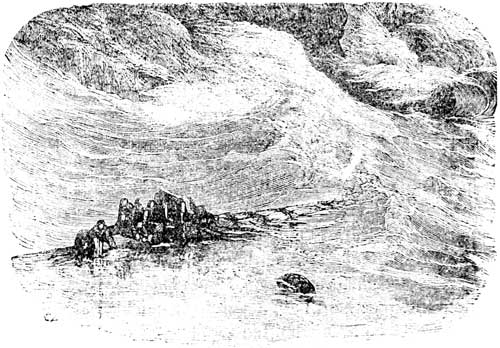
There was, in the city of Naka in Tartary, a merchant, whose name was Illage Mahomet, who, wishing to extend his commerce to the most remote boundaries of the world, constructed a vessel in such a manner as to be able to endure the longest voyage and carry a considerable burden. When this ship was ready to go to sea, he filled it with merchandise; and observing that the wind was favourable, he took leave of his wife, embraced his three children, went on board, and sailed with a fair wind for the Indies.
A fortunate voyage having, in a short time, brought him to the port of the capital of India, he took lodgings, and placed his merchandise in the kan. Quite at ease respecting the fate of his effects, he then visited the different quarters of the city, accompanied by four slaves, and soon entered into friendship with the most celebrated merchants of the place. As his attendants had orders to publish the nature of his merchandise, and to distribute patterns of them, a crowd of purchasers resorted to his magazines.[396]
The King of India was accustomed to come out of his palace in order to walk through the town, and inform himself of what was going on there, under a disguise which rendered it impossible he should be known. Chance having directed his steps to the neighbourhood of the kan, he was anxious to know what drew everybody there. He saw this foreign merchant, whom a happy and engaging physiognomy, with a gracious address, announced in a very favourable manner. He heard him answer, with good breeding and perspicuity, the questions that were put to him, and saw him conduct his affairs with an openness which gained the confidence of all. He was desirous of having some conversation with him; but the fear of being discovered made him renounce his design for the present. He returned to his palace as quickly as he could, resumed the dress which became his dignity, and sent for this honourable merchant. The merchant quickly obeyed the will of the monarch. He was admitted into his presence, and the King expressed his desire to be acquainted with him.
"Sire," replied the merchant, "I was born and established in Naka, near Mount Caucasus. Commerce is my profession. The favour and liberty which your Majesty grants it have directed my speculations to your dominions, and Heaven hath favoured my voyage."
The King, satisfied with the simple and noble reply of this stranger, wished to find out more particularly the amount of his knowledge, by showing, by turns, curiosity on some subjects and embarrassment on others; but he was equally pleased with all his answers. Convinced, by all that he had heard, that the stranger's abilities were far beyond those necessary for trade, he determined to attach him to his own service by raising him to the highest office. It was not the design of the Sovereign to try the stranger by the allurements of honour; but, knowing that distinguished merit may become useless in an inferior station, and is frequently only the object of envy, he gave him the office of Grand Vizier, in order that it might afford him an opportunity of displaying to greater advantage his knowledge and ability. Illage received this favour with expressions of respect and gratitude.[397]
"I should have considered myself as too much honoured, sire, in being admitted into the number of the slaves who surround your throne. The dignity of the honourable office to which you have called me far surpasses my merit and pretensions; but the high idea which I have conceived of your Majesty inspires me with an unbounded zeal for your service, and a confidence that I shall be wholly devoted to it."
The monarch, still more pleased with his new minister, ordered him a magnificent robe, assigned him for lodgings a palace in the neighbourhood of his own, and caused him to be installed in his new dignity. The Prince had no reason to repent of his choice, which might appear rash. The new minister sat in the divan on the right hand of his master. He was never embarrassed in the discussion of affairs, however intricate. He had great sagacity in understanding every report concerning them. Justice and equity were summed up in his decisions, so that the people and the monarch enjoyed, under the administration of this enlightened minister, all the blessings of a wise government.
Two years passed in labour and great employments; but at last nature resumed her rights. The Vizier, separated so long from a family which he tenderly loved, felt a desire to see them. The first request which he made on this subject alarmed the Sovereign. But he had a soul of sensibility; he could not long resist the voice of nature, and permitted his minister to undertake a voyage which he limited to a certain period, assuring him that if he brought his whole family along with him he should never be exposed to any uneasiness in his service. With this permission, the Vizier embarked for Naka in a vessel of war, of which he had the command.
The family of this merchant of Tartary, being entirely ignorant of his fate since the time of his departure, were abandoned to the most cruel uneasiness. Fortunately, a merchant of the country, returning from India, had given them news of him, and restored tranquillity to the family, who were raised to the summit of joy on hearing of the elevation and success of him on whose account they were alarmed. The wife of Illage determined that moment to repair to her husband, less to share his glory than his love. She set her[398] affairs in order, and, after having taken every necessary step, she embarked with the same merchant who had given her the consolatory news.
After some days' sailing, the vessel which carried them cast anchor near an island where they were to land and exchange merchandise. Contrary winds had obliged Illage to land at the same place. He had hired a lodging pretty near the harbour, and, being fatigued with the bad weather which he had met with, had thrown himself upon a bed in order to take repose. His spouse, who lived in an opposite quarter of the city, soon learned that a vessel had arrived on its way from India, and that it had sailed from the capital. She sent her children to ask the news concerning the Grand Vizier, thinking it impossible but that they should be able to receive some.
The young people went from the inn where their mother was, running, the one after the other, till they had come under the windows of the apartment where the Vizier was at rest. They took possession of a little eminence on which a number of bales of goods were collected to keep them dry. The thoughtless youths went to play on the bales, trying which of the two could push down his brother. These playful lads, disputing with address and roguery, announced their victory or their defeat by such piercing shouts that they awoke the Vizier.
He lost his patience: he went to the window to check the noise, and, leaning over it, three diamonds, which the King had given him, fell from his fingers. The agitation of the sea had already stirred up the minister's choler; the habit of command rendered him incapable of forbearance; and, the island on which he was being within the jurisdiction of his government, he ordered these troublesome children to be taken into custody. He came down himself to search for his diamonds; but, amidst such confusion, this search was fruitless. Driven by degrees to indignation and fury, he accused the children, not only of being the cause of the loss of his diamonds, but even of having stolen them. Their innocence could not defend them against prejudice. He punished them with the bastinado, and then caused each of them to be tied[399] to a board and cast into the sea. The innocent victims, expecting a cruel death, became the sport of the waves and billows.
Meanwhile night approached, and the spouse of Illage, not seeing her children return, uneasy, and bathed in tears, went out to seek them. The neighbours could tell her nothing of them. She ran from street to street, without meeting any person who could satisfy her well-founded impatience. This tender mother came at last to the harbour. There, from the description she gave of the three persons who were the object of her search and the cause of her uneasiness, a sailor replied to her,
"Madam, the young people whom you inquire after are the same whom a powerful man, lately arrived from India, hath punished by his slaves for a theft which he imputed to them. They gave them the bastinado, tied them to a plank, and, by his order, threw them into the sea."
At these words, the unhappy mother filled the air with her shrieks and groans: she rent her clothes and tore her hair. "O my children," said she, "where is the Vizier your father, to revenge me on the man who hath murdered my children?"
Her despair struck the ear of her husband, who was not far distant. He seemed to know the voice, and learned that it was that of the inconsolable mother whose children he had condemned to death. The cry of nature resounded in his heart, and he no longer doubted that the children he had punished were his own. He hastened to the unfortunate woman whose misery he had occasioned, and immediately knew her.
"Ah, barbarian that I am, I have been the murderer of our children! Fatal power with which I am invested! blinded by thee, I had not time allowed me to be just! I am the executioner of my own children!"
As he spoke these words, all the signs of the most violent despair were painted in his countenance, and manifested themselves by every sort of extravagance. His wife sank at his feet under the weight of her grief.
"Do not pardon me," added he: "I am a monster; and so much the more criminal as I am at this moment placed beyond the[400] reach of the law. I must for ever be torn by my own remorse and loaded with your reproaches. I thought myself injured, and I hastened to revenge myself, without taking time to reflect. I saw a crime where there was none, and let fall the stroke upon innocence without thinking it would rebound upon myself."
"You see, sire," continued Aladin, "what cause this Vizier had to repent his believing these children guilty upon a deceitful appearance, and his having hurried on a severe punishment without reflecting on whom it was to fall. He forgot that a regard to futurity ought to regulate the present."
The unfortunate minister, disgusted with glory and opulence, renounced the search for his diamonds, abandoned the vessel and its lading, and supporting the tottering steps of a weeping mother, they both walked along the shore of the sea mournfully demanding of it the treasures which the Vizier had cruelly committed to the inconstancy of its waves.
"Your Majesty," continued Aladin, "will pardon me, if, for a short time, I make you lose sight of this disconsolate pair, while I fix your attention on their unhappy children."
The billows, to whose caprice they had been abandoned, were so agitated that, although they were frequently thrown against one another, they were immediately separated again. One of them, after having struggled for two days against the billows, and after having escaped the danger of being dashed to pieces on the rocks against which he was continually driven, found himself, all at once, ashore on the coast of a neighbouring kingdom. The chains which fixed him to the plank were much worn by the sea, and notwithstanding his fatigue and hunger, he had still strength enough to disengage himself from them, and reach the land. He there found an officer who was going to refresh his horse at the stream of a neighbouring fountain. This man, affected with the sight of the unfortunate child, gave him part of his clothes, set him behind[401] him, and carried him to his own house. There nourishing food and repose completely recovered the shipwrecked youth.
After decently dressing him, his benefactor presented him to the King, already informed of the event.
The happy physiognomy of the young man made an impression on the King, and his answers soon completed the very favourable opinion he had of him. He became a distinguished officer in the palace, where his conduct gained the complete esteem and confidence of his Sovereign. This Prince, to whom Heaven had not granted children, thought he could not do his people a greater service than by adopting the youth, whom fortune had thrown into his arms. His choice was applauded by the whole Court, and confirmed by the divan. The people were happy, and the abilities of the young Prince soon placed him in the number of the most valiant Kings of Asia. Age and infirmities rendered the King unable to support the weight of the government, and he abdicated the sceptre in favour of his adopted son. He saw him married, and thus terminating his career of glory, calmly resigned his life into the hands of his Creator.
The young Sovereign, bewailing the loss of his benefactor, gave himself up to the justest sorrow. He wished to fulfil the duties of gratitude and piety, and summoned his divan, that he might honour the ashes of his predecessor by prayers and solemn ceremonies. The people repaired to the mosques. The Imam, the Nabib, the dervishes, and all those who serve at them, paid to his memory the homage which was due to it. He caused many alms to be distributed among the poor and through all the hospitals of the kingdom. These religious duties early announced the wisdom of his government, and they were not proved false by the event. He was always a just and active King, and governed his people with the affection of a father.
In this manner did fortune snatch from the fury of the waves one of the Vizier's children, to raise him to the summit of greatness. But this unhappy father continued to grieve for the loss of his two sons, until, in one of the islands where he had his residence, he heard the Dellal proclaim, with a loud voice, that there was a[402] young slave to be sold, and that the curious were invited to come and examine him. Illage stopped, looked at the young man, and, constrained by a feeling of which he knew not the cause, he determined to purchase him.
The figure of this stranger had attractions which he could not resist. His age corresponded to that of one of his own children; and if the beauty of his features was a true indication of the virtues of his mind, he hoped he would supply the place of one of those whom he had lost. He returned home with his new purchase.
His wife, who perceived them at a distance, recognized the youth, and was about to throw herself into his arms, but sank under this unexpected surprise. But although her joy deprived her of the use of her senses, she was still able to utter the name of her son. The attention of her husband, and that of the young man, who bathed her with his tears, recalled her to life. The father, affected with what he saw, recognized the cry of nature, and returning thanks to Heaven for the unexpected favour he had received, mingled together his tears and caresses at this moving picture, and partook of the happiness of an unlooked-for discovery. Nevertheless, he was tormented by a new uneasiness: the presence of his son recalled to him his brother—"What is become of him?"
"Alas!" replied the young man, "the waves soon separated the planks on which we were carried, and I can tell you nothing of his fate."
This answer redoubled the affliction of the husband and wife; but they seemed to be comforted with the hope of another blessing similar to that which they had just received; and in this pleasing expectation their tenderness centred on the beloved son whom Heaven had at length restored to their arms.
Several years had elapsed. Achib, the son of Illage, grew stronger every day. He acquired knowledge, and became capable of following commerce, in which his father had instructed him. Seeing him fit even to undertake a profitable voyage, his father purchased a ship, loaded it with merchandise, and destined it for the capital of the islands in which they were settled, entrusting him with the management of it. Upon his arrival in the capital, Achib hired a[403] storehouse in the kan, deposited his goods there, and passed some days in arranging them to advantage.
The Feast of the Ramezan came. The young man, a faithful Mussulman, possessed the art of singing so perfectly, that he was able to fulfil with dignity the functions of the Imam.[14] He dressed himself in his faragi, and went to the principal mosque. There the King, with all his Court and the grandees of the kingdom, were present at the noonday service. The young man took his place near the King, and when the Athib[15] mounted the pulpit and began to chaunt the Falhea,[16] Achib repeated three times, Alla Akbar.
[14] Imam is a priest who reads and explains the Koran.
[15] Athib is a reader who chaunts over the prayers in plain song.
[16] Falhea, the Mahommedan Confession of Faith.
The assembly, and the King himself, were astonished at this young stranger seating himself so near his Majesty; but the pleasure of his melodious and affecting voice excited so agreeable a surprise, that they soon forgot his assurance. All agreed that they had never heard anything so exquisite and perfect. The Athib was jealous of him: he had never supposed that there was a voice in the world superior to his own, and the despair which he felt deprived him of the use of it—he felt it die upon his lips. Achib did not give him time to recover it: he continued the prayer with a force and ease which the efforts of the Athib, supposing him to have had the courage to attempt it, could not have surpassed.
When the King had ended his prayer, as he came out of the mosque he ordered his officers to wait for the new singer, to have a horse ready for him, and to conduct him to the palace, where his Majesty desired to see him. Achib received this invitation with respect, and obeyed the orders of his Sovereign.
The monarch gave him a most gracious reception, bestowing the highest praise upon his talents, and soon felt himself prejudiced in favour of this stranger by a sympathy of which he could not discover the springs; but it seemed to be of the most interesting nature. Achib was only in his seventeenth year, and was endowed [404]with every personal grace. Everything seemed to unite in strengthening the liking which the King showed for this stranger. Thus, whether on this pretence or to do a beneficent action, he made him lodge in his palace, and gave him a distinguished preference over the pages and those who composed his household.
The officers soon conspired the destruction of their rival. In the meantime the virtuous Achib, after a long residence at Court, became desirous of seeing his parents and giving them an account of the goods with which he had been entrusted. Afraid lest he should not obtain the monarch's permission to return to them, he wrote to them and informed them of the favour he enjoyed. This motive, and the desire he expressed of seeing them again, determined the family to go to him immediately.
Illage and his wife bore in their hearts the letter which they had just received; and both being flattered with having a son who at so early an age had been able to gain the good graces of a King, they instantly determined to hasten their departure, and informed their son of this resolution. As soon as Achib received this information, he purchased a house and suitable furniture, and in a short time embraced in it the authors of his existence, to whom the King sent presents of such magnificence as showed that they were intended for the family of his favourite.
The fineness of the season having invited the King to one of his country houses, he removed thither, and gave entertainments for the amusement of his Court. One evening, contrary to his usual custom, he gave himself up to the pleasures of the table, and drank of a strange liquor of which he knew not the strength. In a short time after he was suddenly seized with such a stupidity that he was obliged to throw himself on a sofa, where he soon fell asleep. Pleasure had removed from him all his servants. Achib alone, following from affection every step of his master and benefactor, entered into the apartment and found him asleep. Then placing himself within the door, he drew his sabre, and stood there as a guard.
One of the pages having returned, was surprised to find him in this situation, and asked him the cause of it.[405]
"I am watching," said Achib, "for the safety of my King: my attachment and my duty fix me here."
The page ran and told his companions what he had seen. They thought they might easily avail themselves of this event to destroy him, and went in a body to the monarch. The witness swore that he had found Achib with a naked sabre in his hand in his Majesty's chamber while he was asleep. He ascribed the most criminal intentions to this faithful guard, and pretended that nothing but some sudden alarm had prevented the intended blow.
"If your Majesty, sire," added he, "suspects the truth of my report, you need only to-day feign giving yourself up to sleep without any precaution, and we do not doubt that this rash man, pursuing his detestable purpose, will come to renew his attempt."
Though moved by this accusation, the King was unwilling to trust entirely to the declaration of his pages, and thought it his duty to clear up his doubts himself.
In the meantime the pages had gone to find the young favourite.
"The King," said they to him, "is highly pleased with the zeal you have shown for the safety of his person. 'Achib,' hath he said, 'is to me as a shield; under his protection I can sleep without fear.'"
Night came, and the King, after a repast, during which he affected much gaiety and cheerfulness, suddenly retired, and threw himself upon a sofa, apparently in the same state in which he had been the night before. Achib, who never lost sight of him, supposing he was asleep, entered the apartment to place himself on guard, with his sabre uplifted and naked.
As soon as the King saw the gleam of the sabre he was seized with terror, and a cry which he uttered brought to him all the officers of his guard. Achib was arrested by his order, loaded with chains, and led away to prison.
The next morning, after the first prayer, the King assembled his divan, ascended his throne, and caused the man to be brought before him whom slanderous and false reports and deceitful appearances had exposed to the presumption of so much guilt.
"Ungrateful that you are!" said he to him. "Is it by putting[406] me to death that you would show your gratitude and repay my favours? I will not delay to take signal vengeance on your detestable baseness."
Achib, having made no reply to these reproaches, was sent back to prison.
Scarcely was he gone out, when two of the courtiers who were most eager for his destruction approached the King.
"Sire," said they to him, "everybody is surprised to see the execution of the criminal delayed. There is no crime equal to that which he intended to commit; and you ought to give such a speedy example of justice as your personal safety and the tranquillity of your people require."
"Let us not be rash," replied the King, "in a judgment of this nature. The criminal is in chains, and cannot make his escape. And as to public vengeance, it will never be too late to gratify it. It is easy to take away a man's life, but it is impossible to restore it. Life is a blessing of Heaven which we ought to respect, and it becomes not us to deprive our fellow-creatures of it without the most mature deliberation. The evil, once done, can never be repaired. I have it now in my power to reflect on what I ought to do, and wish not that the future should have to reproach me with the improper conduct of the present."
Having said this, the King dismissed the divan, ordered his hunting equipage to be got ready, and gave himself up for some days to the amusements of the chase.
On his return, he was again set upon by the enemies of Achib. The longer, according to them, that this criminal's punishment was delayed, the more the people were discontented. Clemency and moderation ceased to be virtues when they spared such crimes as his. These new remarks embarrassed the Sovereign, who had now nothing to oppose to them, since the delay which he had granted had brought nothing to light. He determined to inflict that severe punishment which justice seemed to require, and ordered the criminal to be brought before him, accompanied by the officers of justice and the executioner.
Achib stood blindfolded at the foot of the throne. The executioner,[407] with the sword in his hand, waited the King's command. At that instant a confused noise was heard; a stranger pierced through the crowd, and hastened to the feet of the King. It was the unfortunate Illage.
"Mercy, sire! mercy!" exclaimed he: "pardon the only child that Heaven has restored to me! My son could not intend an attack upon your life: he was incapable of designing so unnatural a murder; your life is dearer to him than his own. I have letters of his which made me fly to your Majesty, that I might admire more nearly those virtues which I adored. But, O monarch, whose illustrious virtues are renowned through the most distant corners of the world, justify the public admiration by a new display of wisdom, in overcoming a resentment with which false appearances have inspired you! Consider with horror the melancholy consequences of a too rash judgment! Behold in me a dreadful example of the consequence of being led away by passion, and of yielding, without reflection, to its imprudent follies. Heaven blessed me with children; but having been separated from them from their earliest infancy, the day at length came when we were to be reunited. Not knowing them, and being blinded by passion, I abused the power with which I was invested. I had them bound upon planks and thrown into the sea. The man whom you threaten with death alone escaped from perishing in the waves, and must I this day be the witness of his death? Behold the reward of my guilty rashness! My heart is filled with bitterness, and tears will flow from mine eyes till they are closed in death."
During this discourse, the King stood motionless through astonishment. It was his own history he had just heard. The man who spoke was his father, and the supposed criminal his brother!
Having happily acquired, in the exercise of power, the habit of self-command, he knew how to shun the dangers of too sudden a discovery. Nature, however, yielded at length to his eagerness, and he affectionately embraced the author of his life. He ordered his brother to be set free from those shameful chains with which envy had bound him. He made himself known to him; and after mutual consolation.[408]
"Behold," said he to his divan, "to what a dreadful evil I should have exposed myself, had I lightly credited the detractions of slander, and, upon your artful reports, had hastened the punishment which you so eagerly urged! Go, and be ashamed! Was there one among you all who supported innocence?"
After these few words, the King retired into his apartments with his father and brother. He admitted them to a share in all the joys of his Court, and sent twenty slaves, magnificently dressed, in quest of his mother. This family, so happily reunited, lived in the blessings of the most affectionate unity, grateful to the Almighty, and faithful to the law written by His great Prophet, till the moment when they were called, by the decree of fate, from this world to a better.
Aladin, having thus finished the history of "Illage Mahomet, or the Imprudent," added some reflections fitted to make an impression on the mind of the King, whose attention he had been so fortunate as to engage.
"Sire!" said he to him, "if the son, when he became a King, had conducted himself as rashly as the father when he was a minister, innocence would have been sacrificed to jealousy and ambition, and a whole family devoted for life to misery and remorse. There is always something gained by delay. Appearances are equally against me, and envy hath availed itself of them to make me appear guilty; but I have Heaven and your wisdom on my side."
When the young man had done speaking, Bohetzad turned towards his ministers.
"I do not mean," said he, "that crimes should remain unpunished. But truth, even when it comes from the mouth of an enemy, ought to be esteemed precious. This criminal hath well remarked, that there can be nothing lost by taking time to reflect. Let him be carried back to prison."
The Viziers were enraged. Delay might discover the truth, through the cloud under which they had concealed it. As they jointly endeavoured to conceal the stratagems they had devised[409] in secret, the third among them went early the next day to the palace.
The King inquired if the interval that had elapsed had produced no new light.
"Sire," replied this minister, "the police which, under your Majesty's orders, we exercise, maintains the peace of your capital, and all would be perfectly quiet if the throne were avenged of the outrage of this son of a villain, whose punishment your Majesty still delays. The people are murmuring at it, and I should have thought myself wanting in my duty had I concealed from you their uneasiness, the consequences of which may be dangerous. It is never too soon to prevent a rebellion, and that which is now forming would be extremely fatal."
Constrained by these observations, the King commanded the criminal to be brought before him.
"Unhappy man!" said he to him, "thou shalt never summon me to the tribunal of Heaven for having hastened thy punishment. I have listened to all the weak shifts by which thou hast defended thyself. I have weighed their value. But reserve and circumspection have an end. My people murmur. Their patience and mine is exhausted. Heaven and earth look to me for justice, and thou hast reached thy last moment."
"Sire," replied the modest Aladin, "do the people look for an example of your justice? Impatience is the fault of the people. But patience ought always to sit upon the throne, amidst the virtues which form its basis and safety. This virtue, necessary to all, and which calls upon us for that resignation which we owe to the eternal decrees, raised the patient Abosaber from the bottom of a well even to the throne."
"Who is this Abosaber?" asked the King. "Give me a short account of his history."[410]
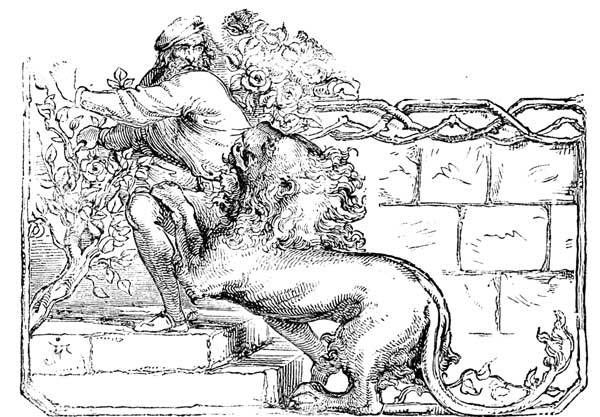
Sire (said Aladin), Abosaber, surnamed the Patient, was a wealthy and generous man, who lived in a village which he rendered happy by his charities. He was hospitable and beneficent to the poor, and every one that applied to him. His granaries were full, his ploughs were continually at work, his flocks covered the plains, and he maintained plenty in the country. He had a wife and two children, and the happiness of this way of life was disturbed by nothing but the devastations of a monstrous lion, which ravaged the stables and folds belonging to the peaceful cultivators of these happy regions, according to its necessities and those of its young.
The wife of Abosaber wanted her husband, at the head of his people, to hunt this animal, by whose devastation they, on account of their riches, were more particularly affected.[411]
"Wife," said Abosaber to her, "let us have patience! I have not any skill in lion hunting; leave it to others."
The King of the country heard of the ravages of this lion, and ordered a general chase. The people immediately took arms: the lion was sought for, and soon surrounded on every side. A shower of arrows was discharged upon him. He became furious: his bristles stood on end, his eyes flashed, he beat his sides with his terrible tail, and, setting up tremendous roarings, darted with fury upon the nearest of the hunters. This was a young man of nineteen years of age, mounted upon a vigorous horse.
At the cries of the lion the courser was seized with terror, and his strength instantly failed him. He fell, and died as if he had been struck with a thunderbolt. The valiant knight soon got upon his feet, and, invoking the name of the great Prophet, he plunged his spear into the enormous jaws which were opened to devour him. This exploit of courage and intrepidity gained him, together with the applauses of his Sovereign, the office of commander-in-chief of all his troops.
Abosaber, hearing of the lion's death, said to his wife, "See of what advantage patience hath been to us! Had I followed your advice, and exposed myself to the danger of attacking an animal against which it was necessary to draw out so much strength, I should have lost my life, with all my people, to no purpose."
The dangerous lion did not alone disturb the peaceful retreat of Abosaber; the inhabitants of the village did not all enjoy the same good character. One of them committed a considerable robbery in the capital, and made his escape, after having murdered the master of the house he had plundered. The King, informed of this double crime, sent in search of the relations and slaves of the man who had been so inhumanly murdered. No one could give him any information, but by throwing out suspicions against the inhabitants of the village where Abosaber dwelt. These had the character of being very bad people, and were known to have frequented the house in which the murder and theft had been committed, the perpetrators of which they were endeavouring to discover. Upon this declaration alone, and without having recourse[412] to any other proof, the enraged monarch commanded an officer at the head of a detachment to lay waste the village, and bring away its inhabitants loaded with chains.
Those who are employed in the execution of severe commands frequently go beyond the orders they have received. Troops very ill disciplined spread their devastation over all the neighbouring country. They spared only the dwelling of Abosaber and six persons of his household; but they pillaged his granaries and his standing corn, with those of all the inhabitants.
The wife of Abosaber bewailed this disaster.
"We are ruined," said she to her husband; "you see our flocks carried off with those of the guilty, notwithstanding the orders they have to spare whatever belongs to us. See with what injustice we are treated. Speak to the officers of the King."
"I have spoken," said Abosaber, "but they have not time to hear me. Let us have patience: the evil will recoil on those who commit it. Unhappy the man who gives orders at once rigorous and urgent! unhappy the man who acts without reflection! I fear that the evils which the King has brought upon us will soon return upon himself."
An enemy of Abosaber had heard this discourse, and reported it to the King.
"Thus," said he, "speaks the man whom the goodness of your Majesty had spared!"
The monarch instantly gave orders that Abosaber, his wife, and his two children, should be driven from the village and banished from his dominions.
The wife of the wise and resigned Mussulman made loud complaints: she reproached the authors of her calamity, and carried her resentment to excess.
"Have patience, wife," said he to her: "this virtue is the sovereign balm against adversity; it gives salutary counsel, and carries with it hope and consolation. Let us go to the desert, since they persecute us here."
The good Abosaber lifted up his eyes and blessed the Almighty as he pursued his journey with his family. But they had scarcely[413] entered the desert when they were attacked by a band of robbers. They were plundered, their children were carried off, and, deprived of every resource or human aid, they were left to the care of Providence.
The wife, having lost by this new stroke of fate what was most dear to her, gave free course to her grief, and set up mournful cries.
"Indolent man!" said she to her husband, "lay aside your listlessness. Let us pursue the robbers: if they have any feeling of humanity left, they will restore us our children."
"Let us have patience," replied Abosaber; "it is the only remedy for evils which appear desperate. These robbers are well mounted; naked and fatigued as we are, there is no probability of our overtaking them. And suppose we should succeed in that, perhaps these barbarous men, harassed with our lamentations, might put us to death."
The wife grew calm, for the decay of her strength made her unable to complain; and they both arrived on the bank of a river, from whence they discovered a village.
"Sit down here," said Abosaber to his wife; "I will go to seek a lodging and some clothes to cover us."
Saying this, he went away, taking the road to the village, from which they were not far distant.
Scarcely was Abosaber out of sight when a gentleman passing near her stopped in astonishment at seeing a most beautiful woman plundered and abandoned thus in a solitary road. He put several questions to her, which this singular adventure might seem to authorize, and she answered them with sufficient spirit. These replies increased the fancy of the young man.
"Madam," said he to her, "you seem formed to enjoy a happier lot, and if you will accept of that which I will prepare for you, follow me, and, together with my heart and hand, I offer you a situation that deserves to be envied."
"I have a husband," replied the lady, "to whom, unfortunate as he is, I am bound for life."
"I have no time," replied the gentleman, "to convince you of[414] the folly of a refusal in your situation. I love you. Mount my horse without reply, or with one stroke of my scimitar I will terminate both your misfortunes and your life."
The wife of Abosaber, forced to yield, before she departed wrote these words upon the sand: "Abosaber, your patience hath cost you your fortune, your children, and your wife, who is carried off from you. Heaven grant that it may not prove still more fatal to you!"
While she traced these words, the gentleman quitted his horse's bridle, and when everything was ready, he seized his prey and disappeared.
Abosaber, on his return, sought for his spouse, and called upon her in vain. He demanded her of all nature, but nature was silent. He cast his eyes upon the ground, and there learned his misfortune. He could not restrain the first accents of grief: he tore his hair, rent his breast, and bruised himself with strokes. But soon becoming quiet, after all this agitation,
"Have patience, Abosaber!" said he to himself; "thou lovest thy wife, and art beloved by her. Allah hath undoubtedly suffered her to fall into the situation in which she is in order to snatch her from more dreadful evils. Does it become thee to search into the secrets of Providence? It is thy part to submit, and also to cease from fatiguing and offending Heaven by thy cries and thy complaints."
These reflections completely restored his tranquillity, and abandoning the design he had of returning to the village from which he came, he took the road to a city whose distant spires had attracted his attention.
As he approached it, he perceived a number of workmen engaged in constructing a palace for the King. The overseer of this work took hold of him by the arm, and obliged him to labour with his workmen, under pain of being sent to prison. Abosaber was forced to have patience, while he exerted himself to the utmost, receiving no wages but a little bread and water.
He had been a month in this laborious and unprofitable situation, when a workman, falling from a ladder, broke his leg. This poor[415] unhappy man set up dreadful cries, interrupted by complaints and imprecations. Abosaber approached him.
"Companion," said he to him, "you increase your misfortunes instead of relieving them. Have patience! The fruits of this virtue are always salutary: it supports us under calamity, and such is its power that it can raise a man to the throne, even though he were cast into the bottom of a well."
The monarch of the country was at this moment at one of the windows of his palace, to which the cries of the unfortunate workman had drawn him. He had heard Abosaber's discourse, and was offended at it.
"Let this man be arrested," said he to one of his officers, "and brought before me."
The officer obeyed. Abosaber was in the presence of the tyrant whose pride he had unintentionally shocked.
"Insolent fellow!" said this barbarous King to him, "can patience then bring a man from the bottom of a well to a throne? Thou art going to put the truth of thy own maxim to the trial."
At the same time he ordered him to be let down to the bottom of a dry and deep well which was within the palace. There he visited him regularly every day, carrying him two morsels of bread.
"Abosaber," would he say to him, "you appear to me to be still at the bottom of the well: when is your patience to raise you to the throne?"
The more this unfeeling monarch insulted his prisoner, he became the more resigned.
"Let us have patience," would he say to himself; "let us not repel contempt with reproach; we are not suffered to avenge ourselves in any shape whatever. Let us allow the crime to come to its full height: Heaven sees, and is our judge. Let us have patience."
The King had a brother, whom he had always concealed from every eye in a secret part of the palace. But suspicion and uneasiness made him afraid lest he should one day be carried off and placed upon the throne. Some time ago he had secretly let him down into the bottom of this well we have spoken of. This unhappy[416] victim soon sank under so many difficulties. He died, but this event was not known, although the other parts of the secret had transpired.
The grandees of the realm and the whole nation, shocked at the capricious cruelty, which exposed them all to the same danger, rose with one accord against the tyrant, and assassinated him. The adventure of Abosaber had been long since forgotten. One of the officers of the palace reported that the King went every day to carry bread to a man who was in the well, and to converse with him. This idea led their thoughts to the brother who had been so cruelly used by the tyrant. They ran to the well, went down into it, and found there the patient Abosaber, whom they took for the presumptive heir to the crown. Without giving him time to speak, or to make himself known, they conducted him to a bath, and he was soon clothed in the royal purple and placed upon the throne.
The new King, always steady to his principles, left Heaven to operate in his favour, and was patient. His deportment, his reserve, and his coolness disposed men to prophecy well of his reign, and the wisdom of his conduct justified these happy presages. Not contented to weigh with indefatigable patience the decisions of his own judgment, he was present as often as possible at all the business of the State. "Viziers, Cadis, ministers of justice," said he to them, "before deciding hastily, take patience and inquire."
They admired his wisdom, and yielded themselves to its direction. Such was the disposition of their minds with respect to him, when a train of events produced a great change in it.
A neighbouring monarch, driven from his dominions by a powerful enemy, vanquished, and followed by a small retinue, took refuge with Abosaber, and implored on his knees the hospitality, assistance, and good offices of a King renowned for his virtues, and especially for his patience.
Abosaber dismissed his divan to converse with this exiled Prince, and, as soon as they were alone, he said to him, "Behold in me Abosaber, your former subject, unjustly spoiled by you of all his fortune, and banished from your kingdom. Observe the just difference[417] in the conduct of Heaven towards us. I departed from my village, reduced by you to the last point of wretchedness. I submitted, however, to my lot, was patient, and Providence hath conducted me to the throne, while your passionate, cruel, and rash conduct hath brought you down from one. It appears to me that, in seeing you thus at my discretion, I am commissioned to execute on you the decrees of Heaven, as a warning to the wicked."
After this reproof, and without waiting a reply, Abosaber commanded his officers to drive the exiled King and all his followers from the city. These orders were instantly put in execution, but they occasioned some murmurs. Should an unfortunate and suppliant King be treated with so much rigour? This seemed contrary to all the laws of equity, of humanity, and of policy.
Some time after this Abosaber, having been informed that a band of robbers infested a part of his dominions, sent troops in pursuit of them. They were surprised, surrounded, and brought before him. The King recognized them to be those who had carried off his children, and privately interrogated their chief.
"In such a situation," said he to him, "and in such a desert, you found a man, a woman, and two children. You plundered the father and mother, and carried away their children. What have you done with them? What is become of them?"
"Sire," replied the chief of the robbers, "these children are among us, and we will give them to your Majesty to dispose of them as you please. We are ready, moreover, to deliver into your hands all that we have heaped up in our profession. Grant us life and pardon; receive us into the number of your subjects; we will return from our evil courses, and no soldiers in your Majesty's service shall be more devoted to you than we."
The King sent for the children, seized the riches of the robbers, and caused their heads to be instantly struck off, without regarding their repentance or entreaties.
The subjects of Abosaber, seeing this hasty conduct, and recollecting the treatment of the exiled Monarch, in a short time did not know what might be their own. "What precipitation!" said they. "Is this the compassionate King, who, when the Cadi was[418] about to inflict any punishment, continually repeated to him, 'Wait, examine, do nothing rashly; have patience'?" They were extremely surprised, but a new event rendered them still more astonished.
A gentleman came with complaints against his wife. Abosaber, before hearing them, said to him, "Bring your wife with you: if it be just for me to listen to your arguments, it cannot be less so to hear hers."
The gentleman went out, and in a few moments after returned with his wife. The King had scarcely looked at her, when he ordered her to be conducted into the palace, and the man's head to be cut off, who had come to complain of her. The order was obeyed. The Viziers, the officers, and the whole divan murmured aloud, that Abosaber might hear them.
"Never was there seen such an act of violence," said they among themselves. "The King who was beheaded was never guilty of so shocking an action, and this brother, coming out of a well, and promising at first wisdom and prudence, is carried in cold blood to an excess which borders on madness."
Abosaber listened and remained patient, till at length a wave of his hand having imposed silence, he spoke as follows:
"Viziers, Cadis, ministers of justice, and all ye vassals of the Crown who hear me, I have always advised you against precipitation in your judgments; you owe me the same attention, and I pray you hear me.
"Arrived at a point of good fortune to which I had never even dared to aspire, the circumstances which were necessary for my success being so difficult to be united; indifferent as to the crown which I wear, and to which I had no right by my birth; it only remains for me to gain your esteem by justifying the motives of my conduct, and making myself known to you.
"I am not brother to the King whom you judged unworthy to reign; I am a man of mean birth. Persecuted, undone, and driven from my country, I took refuge in this kingdom, after having seen my two children and my wife torn from me in the way. I devoutly submitted to the strokes which fate had laid on me, when, at the entrance of this city, I was seized by force, and constrained to[419] labour at the building of the palace. Convinced in my mind that patience is the most necessary virtue to man, I exhorted one of my fellow-labourers to bear with resignation a dreadful evil he had met with in breaking his leg. Patience, said I to him, is so great a virtue, that it could raise a man to the throne, although he were cast into the bottom of a well.
"The King, my predecessor, heard me. This maxim shocked him, and that instant he caused me be let down into the well, from which you took me to set me on the throne.
"When a neighbouring monarch, driven by an usurper from his dominions, came to implore my assistance, I recognized in him my own Sovereign, who had unjustly stripped me of my possessions and sent me into banishment. I was not the only object of his capricious cruelties: I saw all his subjects groaning under them.
"The robbers, whom I punished, had carried off my children and reduced me to the last point of wretchedness.
"In fine, the gentleman whom I caused to be beheaded is he who violently took away my wife.
"In all these judgments, I have not had the revenge of my own particular offences in view. King of these dominions by your choice, the instrument of God upon earth, I did not think myself at liberty to yield to an arbitrary clemency, which would have weakened your power. It was my duty to execute the decrees of Providence upon such as were clearly convicted of guilt, and to cut off from society mortals too dangerous for it.
"A tyrannical King who respects not the laws, and is only directed by his passions and caprice, is the scourge of his people. If it is not lawful to make any attempt upon his life, it is still less so to grant him such assistance as would authorize him in the perpetual exercise of revenge, and in the indulgence of the injustice and atrocity of his disposition. It is even wise to deprive him of the means of it.
"Villains whose sole occupation is to attack caravans, plunder travellers, and who are accustomed to nothing but disorder, can never become useful and valuable citizens. They deserve still less to be admitted to the honour of defending their country. Banishment[420] to them is only a return to their former life. By increasing their number, the evils of the world are rendered perpetual.
"The ravisher of a wife is a monster in society from which it ought to be freed. The man who indulges himself in this crime is capable of every other.
"Such are the motives of my conduct: severity costs me more than any one else. But I should have been unworthy of the confidence of my people, and wanting in the duties of the throne, had I not exercised it in this situation.
"If I have exceeded the limits of my authority, I am ready to resign it into your hands. Reunited to my wife and my children, and thus loaded with the most precious blessings of the Almighty, I should have nothing left but to wish you happy days under a government wiser than mine."
When Abosaber had finished this justification of his conduct, admiration and respect held the whole assembly in silence. Soon, however, a shout followed by a thousand others resounded through the divan.
"Long live Abosaber! long live our King! long live the patient monarch! may he live for ever! and may his reign endure to eternity!"
The King having returned into his apartment, sent for his wife and his children, and after yielding to the sweet impulses of nature, "Behold," said he to his spouse, "the fruits of patience, and the consequences of rashness. Give up at last your prejudices, and engrave on the hearts of our children these important truths. Good and evil happen under the inspection of Providence, and divine wisdom infallibly bestows the punishment or the reward. The patient man who submits to his lot is sooner or later crowned with honour."
After having ended his story Aladin kept a respectful silence. Bohetzad seemed lost in thought.
"How is it possible," said he, "that the maxims of wisdom should flow from the lips of a man whose heart must be corrupted, and whose soul must be guilty? Young man!" added he, addressing[421] himself to the supposed criminal, "I will still defer your punishment till to-morrow. You are to be carried back to prison. The counsels which you have given me shall have their proper effect. A professed robber ought to be cut off from the class of citizens, from that of the defenders of the kingdom, and from the whole world. But as you have at the same time guarded me against precipitation in judgment, I consent that you may live during the remainder of this day and the following night."
At these words the King dismissed the assembly.
The Viziers took counsel together respecting the step they should take to secure the destruction of the favourite. Perceiving the punishment so often delayed, it was their business to alarm the King respecting the dangerous effects of his clemency, and his weakness in allowing himself to be led away by these discourses, prepared on purpose to suspend an act of justice which was absolutely necessary. He ought to banish from the people every suspicion of weakness on the part of the government, and show them that equity was its foundation.
The artful detail of this reasoning was entrusted to the Fourth Vizier; and this minister came next morning to Bohetzad to perform his part.
The poison of flattery was artfully mingled with remonstrances, which appeared to be dictated by a disinterested zeal, and made a deep impression on the King. He ordered the Superintendent to be brought before him, as formerly, with all the apparatus of punishment. "Unhappy man!" said he to him, "I have reflected enough to punish you for your crime. May your death, if it be possible, make me forget you for ever!"
"Sire," replied Aladin, with respect and firmness, "I receive with submission the sentence of my crime. It is dictated by circumstances; and were it not, I feel that the misery of having fallen under your disgrace would be worse to me. The sacrifice once made, I can repent of it no more. But the day will come, when your Majesty, regretting your unjust precipitation, will repent that you did not sufficiently consult the rules of prudence, as it happened to Bhazad, the son of Cyrus, founder of the Syrian empire."[422]
Bhazad was a Prince possessed of every external accomplishment. His beauty, celebrated by the poets, was become proverbial among all nations. He was the delight of every company, and scarcely anything was noticed in it but himself. One day, while he was unperceived, his beauty became the subject of conversation. After it had been much praised, one who was present, and had till then been silent, added,
"Prince Bhazad is doubtless one of the most beautiful men in the world; but I know a woman who in this respect is much more superior to her own sex than he is to his."
This discourse roused the curiosity of Bhazad more than his pride; and, addressing himself in private to the man who spoke thus:
"Might one know from you," said he to him, "the name of this beauty, in whose praise you have just now spoken?"
"Prince," replied this man, "she is the daughter of one of the most illustrious vassals of the Syrian throne; and if she enchants every eye by her external charms, the virtues of her heart and of her mind contribute still more to make her perfect."
Those few words made a lively impression upon the heart of Bhazad. He could think of nothing but of the object whose praises he had heard, and he endeavoured to make a conquest of her. The love which consumed him injured his health, rendered him thoughtful and solitary; and the King his father, being surprised at this change, upon inquiring of him, was informed of its cause.
Bhazad, after having made a confession of his passion to Cyrus, suffered from him some reproaches for his reserve.
"Why have you concealed from me the state of your heart?" said he to him. "Are you ignorant that I have all power over the Prince whose daughter you are desirous to marry? Are you afraid that he will not accept the honour of our alliance?"
Upon this Cyrus sent in quest of the father of the young beauty, and demanded her for his son. The dowry, which was[423] to be three hundred thousand pieces of gold, was agreed upon at once. But the future father-in-law required that the celebration of the nuptials should be delayed for nine months.
"Nine months without seeing her!" said the impatient Bhazad to himself. "Nine months without her! It is insupportable."
He quickly formed the design of going to her. He mounted the best courser in his stables, and immediately departed, having provided himself with some necessary articles, such as a bow, a lance, and a scimitar. He was not far from the capital of Syria when he was attacked by a band of robbers. His undaunted countenance and his martial air made an impression upon them; and far from endeavouring, according to their usual custom, to murder him after they had robbed him, they proposed to him a very different plan, and promised him his life on condition that he would associate with them. Bhazad thought it necessary to discover to these vagabonds his rank, his projects, and the fatal delay of nine months, which his impatience had been unable to endure. Upon this declaration, the chief of the robbers replied to him,
"We will shorten this delay. We know the castle in which the object of your love dwells, and the strength that defends it. March at our head; we will attack it, and no object shall be able to resist us. All we ask of you for this important service is a share in the dowry, your future protection, and a delay of some days to prepare ourselves for the enterprise."
Bhazad, in his impatience, thought himself already on the very point of happiness. Every method seemed just to him which could serve his passion, and he was by no means delicate in the choice of them. Thus he deliberated no more, but continued his journey at the head of the robbers.
They soon met a numerous caravan, and the robbers, constrained by their natural propensity, attacked it in disorder. They were repulsed, however, with the loss of several men and a considerable number of prisoners, among whom Bhazad was included. He was conducted to the capital of the country to which the caravan was travelling. The commander of it, after relating his adventure, presented Bhazad to the King.[424]
"Here, sire, is a young man who, in our opinion, deserves to be distinguished from the rest, and we beseech your Majesty to dispose of him according to your pleasure."
The countenance of the captive attracted the particular attention of the King.
"Who are you, young man?" inquired the Prince. "You seem not to have been born for the criminal profession you follow. How did you fall into the hands of the caravan?"
Bhazad, lest he should dishonour his respectable name, was unwilling to make himself known.
"Sire," replied he, "my appearance ought not to impose upon your Majesty: I am, and always have been, a professed robber."
"Your answer," said the King, "is your sentence of death. Yet," said he to himself, "I ought to be rash in nothing. Regard must be had to his youth and external qualities, which seem to distinguish him from people of his profession. If this young man is in reality a robber, he deserves punishment; but if he is an unfortunate sport of destiny, who hath sought for death as a deliverance from the sorrows of life, one may become an accomplice in his crime by not preventing his death."
The prudent Sovereign, having made this soliloquy, ordered Bhazad to be shut up in close confinement, expecting some great discovery respecting his rank.
In the meantime the King of Syria, having in quest of his son searched his dominions in vain, addressed circular letters to all the Sovereigns of Asia. One of them came to the King in whose dominion Bhazad was in custody. From the description which it gave of him, he had no doubt that the young adventurer whom he kept in prison was the well-beloved son of the powerful monarch of Syria. What reason had he to applaud himself for not having hurried his judgment!
He sent immediately for the handsome prisoner, and asked his name.
"My name is Bhazad," replied the young man.
"You are the son, then, of King Cyrus. But what motives determined you to conceal your birth? Had I not been slow in the[425] execution of punishment, it would have cost you your life, and me the remorse of having treated you as a vile assassin."
"Sire," replied Bhazad, after having revealed to him the secret of his escape, "finding myself seized among robbers, in whose crimes I had involuntarily shared, I preferred death to shame, and was unwilling to dishonour a name so illustrious."
"Son," replied the sage monarch, "there has been a great deal of imprudence in your behaviour. You were in love, and assured of wedding in a few months the object of your affection. See to what rashness and impatience have brought you. Instead of waiting patiently till you should become the son-in-law of one of your father's noble vassals, after having quitted the Court of Syria without permission, and after having incautiously exposed yourself to be murdered by the robbers who infest these deserts, you joined yourself to these vagabonds to carry off by force the woman who was voluntarily to be given you in marriage. See into what a train of crimes you have drawn yourself. Check this passion and calm your impatience. I will procure you the means of uniting yourself soon to the Princess whose hand you are anxious to obtain. But as everything ought to be done in a manner suitable to her condition and your rank, we will hurry nothing."
After this, the King, having caused Bhazad to be magnificently dressed, appointed him lodgings in his palace, and admitted him to his table. He wrote to Cyrus to set him at ease respecting the fate of his son, whose equipage was getting ready that he might appear with more splendour at the Court of the Prince whose daughter he was about to espouse.
The impatient Bhazad saw these preparations with uneasiness. The attention which was paid to them retarded his happiness. At length, however, the order for his departure was given, and he might begin his journey. A small army escorted him, but every halt which it made appeared an age to this impatient Prince.
Messengers had been dispatched to the father of the Princess, to inform him of the arrival of his son-in-law. He came, with his daughter covered with a veil, to receive him at the gate of his castle, and allotted him a magnificent apartment next to that of[426] his future spouse. All the arrangements had been previously fixed by the two fathers. The term of nine months would have elapsed in three days, and all the preparations suitable to this so much wished-for union were finished.
Bhazad was only separated from the object of his affection by the breadth of a thin wall. In three days he might see her. But this wall was like Mount Ararat to him, and these three days seemed an eternity. As he constantly inquired what she was doing, he learnt that she was at her toilet, assisted by her female slaves, and without her veil. This was the time for him to surprise her and behold her at his pleasure. He presently examined all the openings of his apartment, to find some way of gratifying his impatience and curiosity. He discovered, to his misfortune, a small grated window, to which he applied his eye. But an eunuch, placed there on guard, perceived the inquisitive man, and, without knowing him, struck him with the point of his scimitar, which at once ran through both his eyes, and drew from him a piercing cry, which soon collected around him all those engaged in his service.
They stood around the wounded, inquiring the cause which could have reduced him to the unhappy situation he was in. His misfortune discovered to him his crime.
"It was my impatience," replied he, with sorrow. "I have too soon forgotten the sage counsels of the King my benefactor. In three days I would have seen her who was to crown my happiness; but I was unable to bear this delay with patience. I wished to enjoy beforehand the pleasure of seeing her, and for this I am punished with the loss of my sight."
"In this manner," added Aladin, "did the impatient Bhazad, on the very point of becoming happy, lose that hope for ever, and was condemned to the most cruel loss in being deprived of the sense of sight. He ought to have recollected the dangers to which his former imprudence had exposed him; with what maturity of deliberation, with what wise delay, the monarch to whom he was indebted for his fortune and life had conducted himself with respect to him, and he ought to have yielded entirely to his advice. But[427] it is not from acting without reflection that experience is acquired, and the wise alone can profit by that of others."
The young Superintendent, having made an end of speaking, Bohetzad, drowned in thought, dismissed the assembly, and remanded the criminal to prison.
The ten Viziers, afraid lest their victim should escape, assembled again next day, and sent three of their number in a deputation to the King to strike the last blow against the young Aladin. They assured Bohetzad that the dangerous consequences of his clemency were already felt.
"Every day," said they, "ordinary justice is engaged in checking the audacious crimes of your subjects against the sanctity of the harem. Prevaricating criminals have the boldness to defend themselves by the example that is before their eyes; and the delays which arise from your Majesty in this affair are so many pretences which they allege in their justification. We conjure you, sire, to put an end to this disorder, which your ministers will soon be unable to restrain."
Bohetzad, ashamed of his too great indulgence, caused the Superintendent to be brought before him.
"Thou appearest at length," said he to him, "for the last time, on the scaffold, which thou art about to stain with thy blood. The crime which thou hast committed allows me no rest. The too long suspension of the sword of the law draws along with it an example fatal to my subjects. Every voice is united against thee, and not one justifies thee."
"Men pursue me," interrupted the undaunted Aladin. "I am the object of hatred and slander; but, if the Eternal and His Prophet are for me, I have nothing in this world to fear. Heaven protects my innocence, and the sword cannot deprive me of it. It will always shine upon my forehead, even when it shall be separated from my body. My confidence is in God. I expect everything from Him, as King Bazmant at length did after the reverses he experienced."[428]
This Sovereign, too much addicted to the pleasures of the table, was giving himself up one day to the immoderate enjoyment of a sumptuous feast, when his Vizier came to inform him that the enemy was coming to besiege his capital.
"Have not I," replied he, "excellent generals and good troops? Let them take care of everything, and beware of disturbing my pleasures."
"I will obey, sire," replied the Vizier; "but remember that the Almighty disposes of thrones, and that if you invoke not His aid, your riches and power will not support you or yours."
Disregarding this wise counsel, Bazmant fell asleep in the arms of sensuality; and when he awoke was obliged to take to flight: notwithstanding the bravery of his soldiers, the enemy had become masters of the city.
The fugitive King withdrew to one of his allies, his father-in-law and friend, who granted him a powerful army, with which he hoped in a short time to re-enter his dominions and take vengeance on his enemy. Full of confidence in this assistance, he marched at the head of his troops, and advanced towards the capital which he had lost. But victory again declared in favour of the usurper. His army was routed, and he himself owed his safety to the swiftness and vigour of his horse, which, pursued by the enemy, crossed an arm of the sea which lay in his way, and soon landed him on the opposite shore.
Not far from the shore was situated a fortified city called Kerassin, at that time under the dominion of King Abadid. Bazmant went to it, and demanded an asylum in the hospital destined for the reception of poor strangers. He learned that King Abadid resided in Medinet-Ilahid, the capital of the kingdom. He took the road to it, arrived there, and demanded an audience of the Sovereign, which was immediately granted. His external appearance prejudiced the monarch in his favour, and he asked him concerning his rank, his country, and the motives which had brought him to Medinet-Ilahid.[429]
"I was," replied he, "a distinguished officer in the Court of King Bazmant, to whom I was much attached. This unfortunate Prince has been driven from his kingdom, and as it became necessary for me to choose a master, I am come to make a voluntary offer of my person and services to your Majesty."
Abadid, full of prudence and penetration, conceived a favourable opinion of the stranger. He loaded him with presents, and assigned him a distinguished rank among his officers. Bazmant might have been proud of his new situation could he have banished from his memory the fortune he had once enjoyed, and had he not been still wholly occupied with the loss of his kingdom.
A neighbouring power at that time threatened Abadid with an invasion of his dominions. The Sovereign put himself in a posture of defence, and took every necessary precaution to repel his enemy. He himself took arms, and left his capital at the head of a formidable army. Bazmant had the chief command of the van.
The battle was soon begun, during which Abadid and Bazmant conducted themselves like experienced chiefs, and were distinguished by remarkable feats of courage and intrepidity. The enemy was entirely defeated and repulsed. Bazmant extolled to the skies the mighty deeds and wise plans of Abadid.
"Sire," said he to him, "with an army so well disciplined and so much good conduct you might easily humble the most formidable nations."
"You are mistaken," replied the wise monarch; "without the assistance of Allah I could not resist the most feeble atoms in the creation. It is by trusting in Him alone that we have the power of posting our troops to advantage, of directing our plans with wisdom, and of preserving that presence of mind which is the guide of all our operations. If I had not had recourse to Him, the greatest force would have vanished in my hands."
"I am convinced of it," replied Bazmant, "and the misfortunes which I have experienced are a proof of it. A false prudence induced me to conceal my name and my misfortunes. But your virtues forcibly draw the secret from me. You see before you the[430] unhappy Bazmant, whom too much confidence in his own troops could not preserve upon the throne."
Upon this confession, Abadid, seized with astonishment, wished to make an apology to Bazmant for the reception he had given him.
"How could you know me," replied the dethroned Prince, "since shame and confusion obliged me to be silent? Could you read upon my forehead a character which the justice of Heaven had effaced? Great King," added he, embracing him, "I owe to your generosity a full account of my faults: lend me your attention."
At these words Bazmant related his history.
"My dear brother," said Abadid to him, after having heard it, "cease to humble yourself before a man brought up in your very principles, and corrected at last by a series of misfortunes similar to yours. I have not been wiser than you. It appears that we must be instructed by misery! Formerly I put my confidence in my troops and my own abilities, and at the head of a numerous army I was conquered by an enemy who had nothing to oppose me but a handful of men. Forced to take to flight, I retired to the mountains, with fifty men who would not abandon me. Providence caused me to fall in with a dervish in his hermitage, where he was wholly devoted to the exercise and duties of religion. He showed me the cause of my misfortunes, and told me that the enemy had put his trust in Allah alone, and was thus enabled to strike me with unerring blows; while I, depending upon the effort of my spear and the thickness of my battalions, and full of audacious pride, neglected my duty, and gave no order which did not lead to an error. 'Put,' said he to me, 'your confidence in Him who directs everything here below, and if His arm is engaged in your behalf, fifty men will be sufficient to regain your kingdom.' These discourses of the sage made a strong impression upon me. I raised my eyes on high, and, full of a salutary confidence, I returned to my capital. Prosperity had blinded my enemy. He had forgotten in the lap of pleasure the wise maxims to which he was indebted for his victory. Everything seemed quiet in his dominions. He believed himself secure in the possession of them, and neglected the maintenance of an army. I arrived unawares at the beginning[431] of the night. I hastened to the palace with my small party, which curiosity, however, increased. It became a formidable army within the palace: dismay and terror marched in its train. The usurper had only just time to make his escape and avoid the danger which surrounded him. And the next day beheld me re-established on my throne, and in the undisturbed possession of my kingdom."
The recital of Abadid's adventures completely changed the opinions of Bazmant.
"You have," said the Prince to him, "inspired me with a confidence equal to that which animated you, and henceforward I will place it nowhere else. God alone and His great Prophet are able to restore me my crown; and in order to regain it, I will follow the same method that you did."
At these words he took leave of Abadid, and hastened into a desert, through which he was obliged to pass in order to reach his dominions. Guided by the confidence which he had placed in the Sovereign Ruler of men, and imploring His support by prayer, he gained the summit of a mountain. He was oppressed with fatigue, and, having fallen asleep, he saw a vision in a dream.
He thought he heard a voice say to him, "Bazmant, Allah has heard thy prayers: He accepts thy penitence, and thou mayest march without fear whither thou intendest."
The Prince believed he had heard his guardian angel, and hastened his journey towards the capital of his kingdom. Scarcely had he reached the frontiers, when he met a party of those who had been most faithful to him. They lived under a tent, ready to seek another asylum on the least instance of tyranny in the usurper. Without making himself known, he entered into conversation, and told them that he was travelling to the capital. They endeavoured to divert him from his design. They described the avenues to the city as extremely dangerous. They told him that suspicion and fear were upon the throne; that strangers who approached it were believed to be emissaries of Bazmant, and were, without distinction, beheaded by order of the tyrant.
"He causes the former King to be regretted, then?" inquired the Prince, certain that they could not know him.[432]
"Alas!" replied they, "would indeed that our worthy monarch were here! He would find a safe asylum in the hearts of all his subjects, and a hundred thousand arms to avenge him. The monster who has dethroned him, confiding in his forces, sacrifices everything to his unbridled desires, and frees himself by the sword of his slightest alarms."
"He is in the wrong," replied Bazmant, "to trust wholly in his army: the true support of Kings is the favour of Heaven. As for me, who have come here with no other intention than to acquire knowledge by travelling, knowing that no one can injure me while I have the divine protection, I will, without fear, approach the place which the vain precautions of your master have caused to be looked upon as so dangerous."
"We conjure you not to do this," replied these worthy people, in a feeling tone: "do not give us another misfortune to bewail. Since you are a good Mussulman, wait patiently till the divine justice shall have struck this tyrant: the time is not far distant, for the measure of his iniquity is full. And should the arm of man delay to strike, the pillars of his palace will fall upon him."
At these words, Bazmant felt his hopes revive. He laid aside all disguise, and declared that he was the monarch whom they wished to return. At that instant his faithful subjects, exiled on his account, fell at his feet. They kissed his hands and moistened them with their tears. A part of the knights who were there devoted themselves as his life-guard. The rest spread all around to announce his happy return, and appoint a place of rendezvous. A formidable army was soon in a condition to advance to the capital, the tyrant was overthrown, and Bazmant resumed the reins of government and power amidst the acclamations of all his people.
At the end of this history, Aladin ventured to add some reflections of his own.
"You see," said he to Bohetzad, "how Bazmant reascended his throne, without any other assistance than that of Heaven. My true throne, sire, is my innocence; and, as if inspired from above, I[433] have a fixed belief that I will yet be re-established on it, and triumph over mine enemies."
As the young minister mingled sage truths with the recital of his stories, the Sovereign, who had listened to him, felt his anger relent.
He again ordered the punishment to be deferred, and the criminal was carried back to prison.
The Viziers again resolved to diffuse in the mind of the King the poison of those perfidious insinuations which had hitherto been so unsuccessful.
One of them accordingly arrived well prepared. He brought with him seditious libels and a list of disorders which, he said, the violation of a law that was refused to be put in execution had occasioned, in leaving unpunished a crime which appeared in so obvious a manner.
These reports, which seemed to be dictated by disinterestedness and fidelity, again inflamed Bohetzad. He resumed his first resolutions, and sent for the criminal to his presence.
"I have hesitated too long," said he. "Thy death is essential to the safety of my kingdom, and thou canst no more hope either for delay or mercy."
"Sire," said Aladin, "every fault deserves pardon. I have committed one in indulging myself in a drink which I did not know, and which deprived me, for a moment, of reason. But I have a right to obtain your Majesty's pardon. I am incapable of the crime of which I am accused. Sovereigns, sire, have a noble right which they derive from Heaven: it is that of exercising mercy when it is proper. Let us suppose that, after a little delay and deliberate examination, you had snatched an innocent person from punishment, would not your Majesty have done an action something like that of raising him from the dead? An action may often appear agreeable to strict justice, while in reality it is only the effect of lawless tyranny. And what glory is there not, even in pardoning an offence? He who is capable of mercy will, like Baharkan, sooner or later receive his reward."[434]
Aladin, perceiving Bohetzad inclined to listen to him, proceeded thus in the explanation of what he had advanced:
Baharkan was an intemperate Prince. He sacrificed everything to his passions, and, in order to gratify them, he boldly plunged into the greatest excess of tyranny. He never pardoned even the appearance of a crime: so that involuntary faults were punished no less than avowed transgressions.
Being one day at the chase, one of his officers inadvertently discharged from his bow an arrow which he was holding prepared. It struck the ear of the King, and unfortunately carried it off. Baharkan, in his fury, ordered the offender to be brought before him, and his head to be struck off. As soon as the unhappy young man was in his presence, having heard the sentence of death pronounced by the monarch, he spoke to him thus:
"Sire, the fault I have committed was unpremeditated on my part; it was the effect of the fatality of the stars. I throw myself on your clemency. I implore your pardon. It will be meritorious in the sight of God and approved of by men. In the name of the heavenly Power which hath put the sceptre into your hands, I entreat for pardon, and your Majesty will one day receive your reward."
This prayer softened the unrelenting heart of the King, and, contrary to the general expectation, the young officer obtained his pardon.
His name was Tirkan. He was a Prince who had fled from his father's Court in order to escape the punishment of a fault which he had committed. After having wandered unknown from kingdom to kingdom, he at length settled at the Court of Baharkan, where he obtained employment. He remained there for some time after the accident which had befallen him; but his father, having discovered the place of his retreat, sent him his pardon, and advised[435] him to return to him. He did this in such affectionate and paternal terms that Tirkan, trusting in his father's goodness, immediately departed. His hopes were not deceived, and he was re-established in all his rights.
King Baharkan, desiring one day to amuse himself with pearl-fishing, embarked in a vessel with a design to coast along the shores of his kingdom in search of pearls. An unexpected storm drove the ship into the open sea. It became the sport of the winds and the waves, and, stripped of all its rigging, ran aground on an unknown shore, and was dashed to pieces against the rocks which surrounded it. The whole crew perished. Baharkan alone was saved from shipwreck by a plank which he had had the good fortune to seize. Fortunately, he landed on the dominions of the monarch whose son had shot away his ear, and whom he had pardoned.
Night began to descend when Baharkan landed. He wanted neither courage nor vigour, and therefore took the first road that presented itself, which led to a large fortified city. But, as the gates had just been shut, he was forced to wait without till next day, and to pass the night in a neighbouring churchyard.
Day began to appear, and the gates were opened. The first persons who came from the city found, at the gate of the churchyard, a man who had been murdered. Baharkan was coming out of it at the same time. The efforts he had made in the evening to reach the coast with his plank had given him some slight wounds, from which the blood was still trickling. This proof appeared sufficient in the eyes of the bystanders: he was taken for the murderer, and carried to prison.
There this unfortunate Prince, left to his own reflections, thus communed with himself: "Heaven chastises thee, Baharkan. Thou wast cruel, vindictive, and inexorable. With thee humanity had no value. Thou sacrificedst thy brethren on the slightest suspicion. Behold thyself now on a level with the vilest of mortals. Thou hast met with no more than thy desert."
As he rendered this terrible justice to himself, he perceived in the air a vulture, which hovered above the prison in the court of[436] which he was walking. He instinctively took a flint, and threw it with great force at the bird, which avoided the stroke; but, in falling, the stone accidentally struck the same Prince Tirkan who formerly had carried off his ear by the stroke of an arrow. It wounded him exactly on the ear, but not so severely as Baharkan had been. Pain forced a cry from the young Prince, which brought all his courtiers around him. Surgeons were sent for, who soon cured this slight wound.
The King ordered a search to be made, in order to discover the person who had thrown the stone. Baharkan was accused by his fellow-prisoners of picking up and throwing it. He was brought before the monarch, who condemned him to lose his head, since, besides this, he believed him to be the murderer of the man who had been assassinated near the churchyard. The executioner of justice had already taken off the turban which covered him, and was drawing the sword from its scabbard, when the King, examining attentively the head which had just been uncovered, perceived that it wanted an ear.
"It appears," said he to the criminal, "that this is not your first offence. For what crime have you been already condemned to lose an ear?"
Baharkan, having assumed a manly spirit since his misfortunes, replied, with boldness, "Sire, if I have committed crimes, I owe no account of them but to Heaven; and till it should have determined to punish me, human justice had no right to inflict it. I have been, in one word, your equal—I was a King. The ear which I want was unfortunately carried off by an arrow, which escaped from the bow of one of my officers, whose name was Tirkan. Impelled by the first emotion of anger, I condemned him to death. He besought my pardon, and obtained it. My name is Baharkan."
Tirkan, without giving him time to finish, had already thrown himself into his arms. He recognized at once his ancient master and his deliverer. Baharkan, far from being punished, was treated as a King, and an unfortunate one. He related the adventure which had landed him in the dominions of Tirkan's father. The[437] latter communicated to him his own, and especially the unfortunate accident which had wounded Baharkan.
"Recollect, sire," added he, "that in soliciting a pardon, I ventured to promise you, from Heaven, the same favour which I expected from you. Here you have received it, under the very same circumstances, through the instrumentality of my father."
After these discoveries, the two Sovereigns embraced each other, with marks of esteem and kindness. A short time after, Baharkan returned to his kingdom in a fleet well equipped, and at the head of an army of fifty thousand fighting men, commanded by Prince Tirkan.
"In this manner," added Aladin, "Baharkan was rewarded for suffering himself to be softened when he was personally offended. Heaven did not confine its blessings to his receiving the same treatment in a similar situation and restoring him to his subjects, it moreover granted to him every virtue requisite in a good King; and in governing his subjects, it enabled him always to govern himself."
Bohetzad, shaken in his resolution by this discourse, ordered the instruments of death to be again removed, and the minister to be conducted back to prison. He even pronounced these last words so hesitatingly, that the Viziers, who observed it, were alarmed.
The whole conspiracy formed against Aladin awoke with still greater force, and it was determined that the ten Viziers should go in a body to the King. Their danger would become so great, if Aladin should succeed in justifying himself, that every step should be taken to destroy him.
The next day they all repaired to the palace, and he who was possessed of the warmest eloquence spoke. If the monarch would believe it, the wicked story-teller, whose talents were so specious, was indebted for his success to the art of magic, in which he was well skilled. But he ought to distrust an illusion which exposes at once the laws, religion, morals, the honour of the throne, and the public welfare; and unless he punished this crime, it would be[438] impossible to check disorder. All the other Viziers supported this insidious harangue. Each of them alleged his own disinterestedness, his zeal, and his fidelity.
"Unbridled audacity is in him united with matchless cunning," they said. "Everything is in danger if this offence remains unpunished."
Bohetzad could not resist the unanimous voice of so many counsellors. His anger re-awoke, and he ordered the criminal to be brought forth.
Aladin appeared in chains, and the King, perceiving him, exclaimed,
"Let the head of this unhappy man be struck off."
The ten Viziers hastened to seize the sword of the executioner, in order to dispute with him the execution of his office. This motion gave Aladin time to speak.
"Behold, sire, the eagerness of your Viziers to bathe themselves in the blood of innocence. Justice pursues the crime, but does not rush upon the criminal. Zeal, like every other virtue, should be moderated. Stop, eager and wicked men! I am here under the justice of the King, not under yours. You have no power over my life. It is sacred with respect to you, who are neither judges nor executioners. Speak! Show yourselves openly as you really are. I have offended you by checking your rapine. You are my enemies and base slanderers."
"You recriminate upon my Viziers," interrupted the King; "truth which flows from their mouths confounds you."
"Nothing from them can confound me," replied Aladin; "not even the blackness of their calumny. It is coeval with their existence. But for these, who have reduced me to the necessity of this defence, I must question them in my turn. They are all here, and let them answer. Does not the law require that every accuser or deponent should have been a witness of the crime? Their evidence is therefore objectionable in this case; the law rejects it. It is only the effect of envy and jealous rage by which they are devoured. Look at them, sire, and at me. The sword is above my head, yet I dare raise it up, while their eyes shun both yours and[439] mine. Heaven supports me and condemns them; our sentence is written on our countenance. O great King! deserving of better ministers, beware of being drawn into the guilty plot they have contrived for you. One may, but without passion, bear testimony against the accused. If he is convicted, justice condemns him. But the judge, in describing the crime and pronouncing sentence, never forgets the duty due to the creature of God on whom the punishment is about to fall. Here I see nothing but fury and jealous rage. They are devoured by their thirst for blood, and equity is not the basis of their judgments. All the injurious imputations which have been levelled against me vanish. An invisible hand imprints on my forehead the serenity of innocence. An inward sentiment tells me that, having lived free from crimes, I shall not be confounded with the guilty. Unhappy is the man whose conscience gives a contrary testimony. He endeavours in vain to shun the stroke that threatens him. The history of the Sultan Hebraim and of his son is a proof of this."
Bohetzad, struck with astonishment at the intrepid firmness of Aladin and the united rage of his ministers, wished to hear the adventures of Hebraim; and the Superintendent, having obtained permission to relate them, thus began:[440]
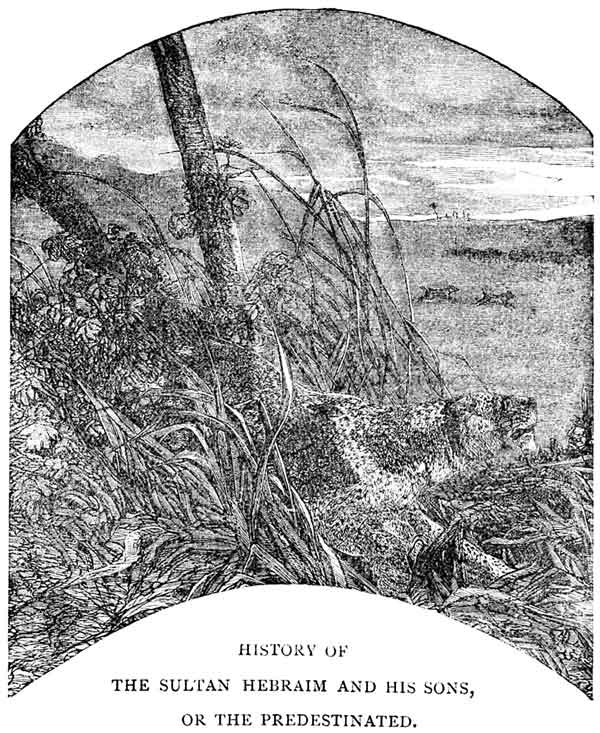
The Sultan Hebraim, called by his birth to the government of extensive dominions, had enlarged them considerably by the success of his arms. But the want of an heir disturbed the enjoyment of his glory. At length, however, a son was born, whose birth was celebrated by public rejoicings and feasts, which, during forty days, announced to the people the happiness of the Sovereign.
This time was employed in a very different manner by the astrologers who were employed to cast the infant's nativity. They[441] could not conceal from the Sultan that an evil star had presided at the birth of his son. The orbit of his planet, black and stained with blood, announced misfortunes, which it would be difficult to resist. They unanimously declared that before he was seven years old, the infant would be exposed to the devouring jaws of a tiger; and that if he could escape the fury of that animal during this determinate space of time, his hand would become fatal to the author of his existence; and that there was no other way by which he could escape the evils that threatened him but by becoming, from the effects of education, an enlightened, wise, and virtuous Prince.
The annunciation of so mournful a prediction dissipated the joy of Hebraim, and the days of public happiness were spent by him in tears and in grief. Nevertheless, as hope never forsakes the unfortunate, he flattered himself, and was happy to think, that it was possible to screen the heir of his power from the decrees of fate. It did not appear to him impossible to protect his son from the attacks of the tiger during the appointed term of seven years; and after having snatched him from the first decree of destiny, he might, by carefully watching over his education, beget in him sentiments of wisdom and the love of virtue, and thus disprove the prediction of the astrologers.
After these reflections, the Sultan prepared a retreat on the summit of a mountain, in which he hoped that his son would be safe from the attacks of the tiger for the seven years determined by fate. A number of workmen were employed in forming in the rock a cavity of a hundred feet in depth, about a hundred and fifty in length, and thirty in breadth. They let down into this every material necessary to make a commodious lodging; a spring of water was found there, and they contrived a passage for it, as well as for the rain-water which might be collected in this cavity. They carried earth to it, and put plants there, which were soon in a thriving condition.
After having furnished this little palace in a proper manner, they let down into it the Prince and his nurse by the help of a pulley, together with every necessary article for a month. At the end of every moon Hebraim came regularly to visit his son. The nurse[442] laid the child in a basket made of bulrushes, which was lifted up to the very brim of the entrance; and while the father yielded to the sweetest emotions of nature in caressing his son, a numerous guard, by the thundering sound of their instruments, kept the wild beasts at a distance. When the visit was over the provisions were renewed, and the cord, rolling upon the pulley, gently returned to the bottom of the cave the basket and the infant.
The young Prince grew and prospered in this solitary habitation, which a very strong vegetation had adorned with trees and shrubs of every kind. The fatal term marked out by the astrologers had almost elapsed. Only twenty days were wanting to fulfil the seven years, when a troop of unknown hunters, in vigorous pursuit of an enormous tiger which they had already wounded, came to the summit of the mountain in full view of their prey. The furious animal, terrified by their shouts, and struck by arrows which were shot at it from every quarter, found this cavity in its course, and either blinded by terror or being now in despair, immediately sprang down it. It fell upon a tree, which, bending under its weight, considerably broke the force of a fall which would have dashed it to pieces on the bottom of this pit.
The terrified nurse endeavoured to conceal herself, and the monster found the child, which it grievously wounded on the shoulder. On hearing the cries of the infant, however, the nurse, forgetting her own danger, flew to his assistance. The tiger darted at her, and having torn her in pieces, was about to devour her, when the huntsmen, coming suddenly up to the brink of the precipice, discharged at once a shower of arrows upon the voracious animal. His body was full of them, the blood gushed from every part of it, and an enormous stone thrown at his head killed him on the spot.
After this exploit the huntsmen, anxious to discover the child whose cries resounded in this frightful habitation, eagerly descended into it. But what was their astonishment when they found there at the side of a dead woman a beautiful infant, richly dressed, and swimming in the blood of the wounds it had received! Their first care was to assist the innocent creature, which still breathed. They[443] bathed its wounds, and wrapped them up with healing herbs. As soon as the infant appeared more calm, they buried the nurse and examined this strange retreat. The furniture of this small habitation appeared extremely rich, and a quantity of provisions was found there, which seemed to have come down from heaven. The huntsmen took possession of everything by the right of conquest, and sought how they might take out of this dungeon everything it concealed.
The basket of bulrushes was first employed in drawing up the young child out of this habitation, and next all the effects, the furniture, and the provisions, were raised by means of the pulley which was fixed at the top of the cave. When everything was out a division was made. The chief of the troop took possession of the infant, in whose preservation he felt himself strongly interested, and carried it with him to his own house.
The only son of the Sultan Hebraim had fallen into good hands. His benefactor was a man of distinction, wealthy, and without a fault but that of an unlimited passion for the chase. Struck with the beauty and the sweetness of his young charge, he paid the greatest attention to him. And when he found him capable of answering his questions, he endeavoured to learn from him who he was, and for what reason he had been made to dwell in so extraordinary a habitation.
"I know not," replied the child. "I lived with the woman whom you found dead; she gave me everything I wanted. From time to time a man, much bigger than you, came and stood at the top of the dwelling where you found me. I was put into a basket and drawn up to him. He caressed me very much, and called me his dear child. I called the woman Nurse, and she likewise said I was her dear child. I know nothing more."
The benefactor could not conclude, from this simple declaration, anything else than that this child owed its birth to parents of an illustrious rank, but he could not discover the very extraordinary reason which had forced them to conceal its existence by a method still more extraordinary. Expecting that time would unravel this mystery, he paid every attention to the boy's education, had him[444] instructed in the sciences, and trained up in exercises suitable to the most illustrious descent.
The young disciple early answered the hopes of his friend. He excelled particularly in the art of horsemanship, handled every sort of weapon with dexterity, and in general acquired all the knowledge necessary for the most resolute warrior or hunter.
One day, as they were both hotly engaged in the pursuit of some tigers, they were suddenly surrounded by a band of robbers. Abaquir (for that was the young man's name) displayed, as well as his master, prodigious feats of valour. But, overpowered by numbers, they were both plundered. The protector of Abaquir lost his life, and he himself received some slight wounds; but the faintness which succeeded was more the effect of fatigue than of blows. As soon as the robbers had disappeared he came to himself, and being naturally courageous, he attempted, though deprived of every aid, to cross the desert, in order to reach some inhabited place, having nothing for his defence but a hunter's javelin, which had been left on the field of battle.
He had travelled but a few hours when he perceived in the plain a man in the habit of a dervish. He made haste to join him, to address and salute him. The dervish prevented him by beginning the conversation himself.
"Beautiful young man," said he to him, "you are naked and wounded. Who hath reduced you to the distressed situation in which I see you?" Abaquir did not hesitate to relate his adventure to this man, whom he took for some holy person, and confidently asked from him some food and clothing.
"One ought," replied the dervish, "to know what it is to strip himself in order to clothe his brother, and to share with him his food in order to preserve him."
At the same time he covered the young man with his cloak, made him sit down, and drew from a sort of wallet some dates, bread baked with the milk of a camel, and a bottle of the skin of a goat, containing five or six pints of water.
"Hold," said he, "you shall have the repast of a penitent. I carry these with me to supply my own wants and those of others;[445] but we will go to my cave, and there you will find both repose and plenty."
Abaquir, before he began to eat, returned thanks to the holy Prophet for so seasonable a relief. When the first calls of hunger were satisfied, the dervish prevailed upon him to go with him to his cell, which was at no great distance.
Abaquir was received therewith every mark of benevolent charity. His wounds were washed and dressed, and the most nourishing food was set before him. In this wild habitation the tables and chairs were nothing but stones rudely thrown together, and the beds were made of heaps of moss; but it was very well for Abaquir, who had been reduced to the want of everything. Besides, the attention of his landlord supplied the want of conveniences in this retreat. The young man conceived the highest idea of the profession of a dervish, from its inspiring sentiments so humane.
"My dear child," said the disguised person to him, "I take pleasure in bestowing care on you; do not place all to the account of religion. You inspire me with a strong interest, and if you wish to go away from me, you must at least tarry till you are perfectly recovered of your wounds, for the passage from this desert is extremely difficult."
Although the young man could not but show himself grateful for so much attention, yet it did not appear uncommon to him. Accustomed to the tender caresses of his nurse, to those of his father, and of his generous benefactor who had since directed his education, the attentions of the pretended dervish seemed to him affectionate and natural. The latter, by degrees, came to know all the adventures of Abaquir, and appeared to take in him an interest always more marked.
"Either I am much deceived, child," said the recluse, "or I perceive that you are reserved for very high fates, and I devote myself to become your conductor in this fortunate career. I will restore to you this father who took so much pleasure in lavishing his caresses upon you."
"Ah! if you can," replied Abaquir, "conduct me to him immediately."[446]
"In your present condition? No, my child, you are unacquainted with mankind. Nature speaks not with the great in favour of a stranger covered with the old cloak of a dervish. Before you could obtain a hearing, you would experience the treatment reserved for an impostor, and there would be a number of interested people ready to forbid you all access. But at present you are with a man who loves you, and whose resources are inexhaustible. A disgust at the riches and vanities of the world made me form the resolution of retiring from it. But to-morrow, if I choose, I can have more of them in my possession than would satisfy the ambition of the most wealthy potentates on earth. I can show you part of them. The earth conceals treasures which I can force her to give up. Not far from this there is great abundance of them, and I will conduct you thither. You shall take what may be necessary to carry you to your father's Court, preceded by a hundred camels, loaded with the richest stuffs of the East, and each of them led by a slave. You shall be surrounded by a guard, which will secure you respect wherever you pass."
Abaquir was lost in admiration. He could not imagine that these magnificent promises were real when he looked upon the coarse cloak with which he was covered, the furniture, and the fantastic utensils of his landlord. The latter, after having been some moments lost in reflection, thus resumed his speech:
"O my child, never let appearances deceive you! The more you advance in years, the more you will learn to distrust its illusions. I am a dervish by inclination, but all the garments I wear are not mean. Here is one which becomes none but brave and powerful men." At the same time the pretended dervish opened his cassock, and discovered a girdle of red, yellow, and green silk.
"Take courage, young man," continued he: "to-morrow I will show you great things. Our attention shall be engaged about your fortune. I shall be able, without being obliged to go far, to find out this singular cave in which you were brought up. I shall know the architect; and in a month, after having finished all our preparations, we will depart for your father's Court, with a train of attendants that will force everybody to welcome us."[447]
The discovery of this girdle under rags had struck Abaquir with astonishment. He depended upon the promises of his new protector, and accepted his offers.
"But," continued this extraordinary man, "as soon as you shall be at your father's house, and, notwithstanding the pain which our separation will cost you, I shall require your permission to return to my solitary manner of life."
"Willingly," replied Abaquir; "but you will not prevent me from conducting you thither."
On the morning of the next day the dervish made the young man take a basket with provisions for breakfast, and a parcel of ropes, and they went together to the bottom of a steep mountain. When they had arrived there, the companion of Abaquir encouraged him to exert new strength.
"You may," said he, "suffer a little fatigue, but reflecting that you are to reap the fruit of it, you must redouble your courage. Be not astonished at what you are about to see. This mountain contains in its bosom a treasure which cannot be estimated. These riches are abandoned to magi, like me; but we despise using them for ourselves. Do not spend your time in gathering gold, which you will find here in great quantity: take nothing but precious stones. This is the best method of enriching yourself speedily."
After this advice, the dervish threw off his cloak, and appeared as a magician. He was covered only with his large particoloured girdle which adorned his breast. He took from a purse which hung from his girdle an instrument for striking fire, and, having lighted a taper, he burnt perfumes, and running over a book, he pronounced with a loud voice a magical charm. Scarcely had he finished when the earth shook under his feet, opened before him, and discovered a square stone of marble, upon the middle of which the magician immediately scattered perfumes. When he thought the air sufficiently purified and refreshed with them, he girded Abaquir with a rope under his arms, put a taper in his hand, and let him down into the opening.
As soon as Abaquir had got into it, his eyes were dazzled by the splendour of the riches with which he was surrounded. But,[448] faithful to the advice of the magician, he picked up only precious stones, with which he filled the basket which his guide had let down to him by a cord. When it was full and lifted out of the pit, the magician took it; and at that moment a dreadful noise was heard, the fatal trap was shut, and the young Abaquir found himself swallowed up in the bowels of the earth, without any hope of ever getting out.
He believed he was betrayed by the magician, and, without great vigour of mind, would have abandoned himself to despair. But, after having shed some tears, he retraced in his memory the events of his former life. Threatened in his early infancy with becoming the prey of a tiger, Providence had protected him from danger. Attacked afterwards by robbers, the same protection had saved him. "The arm which hath defended me," said he, "will not cease to do so still. I am innocent and betrayed." In this confidence he prostrated himself before Him who has the keys of the deep, and rested with confidence in His assistance.
By the light of the candle, which was still burning, he examined the immense cave which served him as a prison. He thought he perceived at the bottom a passage, the path of which could not be followed without stooping. He approached it with his light, but there came from it so strong a wind that it was instantly extinguished. Far from lessening his hopes, this accident increased them. So violent a wind announced to him a passage outward. He entered it with great difficulty, and almost creeping in the darkness. As he advanced he heard a hollow noise, the murmur of which presaged to him some singular event. He soon perceived that he dipped his hands and his knees in a spring of running water. He raised his head, and finding that he could take some rest, he sat down upon a stone which he had met with, amid the murmurs of many other streams which flowed from these deep caves. He filled the hollow of his hand with the water, which was fresh and delicious. He drank of it, and after having recruited his strength, he continued this fatiguing journey. But these little streams, which thus far had only run upon the ground, had here hollowed out a bed for themselves. He was obliged to[449] enter it, and the farther he advanced the more the danger increased, till at last he began to swim. The darkness around him at length began to be dissipated. The cavern grew wider and higher, and admitted a feeble ray of light, which seemed to announce that the outlet was near. The strength of the swimmer increased with his hopes; and he soon found himself under the vault of heaven, at the moment when the sun was ceasing to adorn it, and the goddess of the night was succeeding to her task.
Abaquir might now repose without fear, and his strength was exhausted. He laid himself upon the ground, and, overcome with fatigue, soon fell asleep. He had but few of the wet clothes which he had received from the magician to put off, for the rubbing of the flints had carried away part of them, and the remainder were but shreds.
The singing of birds announced the return of morning, and the first rays of the sun awakened Abaquir. The young Prince, on opening his eyes, recollected the dangers from which he had just escaped. He retraced the most trifling circumstances of them in his memory. He thought he remembered to have seen, in the frightful cavern he had traversed, the carcasses of many who had fallen victims to the avarice of the wicked magician. This remembrance filled his soul with terror and dismay; but, at the same time, he felt the value of the blessings of the Almighty hand, which had miraculously rescued him from this tomb. His eyes, raised to heaven and swimming in tears, expressed his gratitude, while his lips celebrated the praises of the Almighty and of His Prophet.
These first duties being fulfilled, it became necessary to appease the hunger which preyed upon him. In running round the borders of a small lake where he was, he perceived some reeds, of which he sucked the stalks, and chewed the roots with his teeth. He dug up the earth all around, which furnished him such supplies as his urgent need required. By the help of care and patience he at last regained strength, and with it, courage. He then took up some shreds of his clothes, already dried by the sun, and fixed them to a girdle made of the leaves of reeds; and by searching carefully he found a stick, which served him at once for support[450] and defence. He arrived, after much fatigue, upon a little plain, from whence he discovered a neighbouring city, to which he directed his steps by the first road that presented itself.
As soon as he was perceived by the inhabitants, one of them ran to meet him, and appeared eager to lavish upon him the assistance of which his external appearance showed he had need. He obliged him to take an asylum in his house, where he was received with kindness; the recital of his adventures was listened to with feeling, and he found friends in his misfortunes.
And now, without feeling a moment's uneasiness concerning the fate of this young Prince, let us return to the Sultan Hebraim, his father, much more afflicted than he by the accomplishment of the mournful prediction.
The second day after the defeat of the tiger was the term assigned by the astrologers. The Sultan, thinking to reap at length the fruit of his cares and prudence, appeared at the top of the opening, and announced his arrival as usual by the sound of a horn. But nobody having answered his first signal, Hebraim, uneasy at this silence, made some of his officers go down into the pit, who, after much diligent but fruitless search, found nothing in it but the dead body of a tiger. The unhappy father doubted no longer the death of his son: he returned in haste to his palace, and sent for the same astrologers whom he had formerly consulted respecting the fate of his heir.
"Unhappy that I am!" said he to them, "your fatal prediction is verified: my son has been devoured by a tiger before the expiration of the seven years; for in the retreat which I prepared for him I have found nothing but the body of an enormous tiger."
"Invincible Sultan!" replied the astrologers, "since the event forces from you an acknowledgment of the truth of our presage, we must congratulate you now on being beyond the reach of an inevitable death, which he whose loss you deplore would have brought upon you. Your son, falling under his destiny, has died in innocence and you are preserved."
This reflection brought some relief to the natural sorrow of the Sultan, and time completely effaced the remembrance of it.[451]
In the meantime, Abaquir, of whom we must not lose sight, grew weary of his idleness in this little village where he had been so well received. His landlord had a numerous family, and but very small resources for their maintenance. The young Prince being unwilling to be a burden on him, went frequently to hunt in the country. One day as he had killed a deer, and was preparing to lay it on his shoulders, he was suddenly surrounded by a troop of horsemen, and doubted not that he was in the middle of a band of robbers.
"Companion!" said the chief to him, "you hunt on foot, and carry nothing but a bow. There are, however, in these deserts many lions and tigers, and you may some day be worsted. Come and hunt along with us, and we will give you an excellent horse."
Abaquir, already eager for the chase, thought he had found an excellent opportunity of following his inclination, and of relieving his landlord of the burden of his entertainment. He briskly replied to this offer by saying that he accepted the favour they intended him of admitting him into their number. The chief of the band perceived by this reply that the young man, who was as yet a novice, had not understood his proposal in its true sense, and thus resumed his speech:
"Since you are willing to join us, we will breakfast together to confirm our acquaintance."
Upon this the rest of the band dismounted, opened their knapsacks, and began each to satisfy his appetite.
"Since you are one of us," said the chief, "I must inform you of the laws by which we are governed. We love and assist one another as brethren, we make an equal division of our booty, and we swear to be faithful in life or in death."
"I have already lived among hunters," replied Abaquir; "I love that way of life, and you must know that if I do not owe my birth to them, I am at least indebted to them for my life. Your laws appear to me extremely equitable."
"Since it is so," said the chief, "I have nothing more to do but instruct you in our rules. Although I am only your equal, every one here submits to me as their chief. And as it is necessary that[452] I should be feared and respected, I treat with extreme rigour all those who disobey my orders."
"The moment you associate in a band," said Abaquir, "subordination is essentially necessary."
"Swear, then, upon the Koran, and by the name of the holy Prophet," replied the chief, "to submit to all our laws without limitation."
As soon as Abaquir heard the divine book mentioned, he believed he had got among saints, and without hesitating took the Koran, put it thrice upon his heart, his head, and his lips, and promised more than was required of him. Thus was he enrolled without knowing it in the number of the greatest miscreants of the desert. All his new companions embraced him with joy. He mounted a fine horse, was covered with a cloak, and armed with a bow, a sabre, and a spear. Abaquir was delighted, and perceived not till next day the rashness of the engagements he had made.
In a short time these vagabonds spread themselves over the desert, and robbed and plundered travellers and caravans. Their number was every day increased by the success of their fatal expeditions. At length their ravages became so considerable that the Sovereign of these countries put himself at the head of some troops to pursue them. This was the Sultan Hebraim. The robbers were surrounded on every side; and Abaquir, being at the head of the band, was particularly aimed at by the Sultan. But the young man, warding off the danger which threatened him, wounded his adversary with an arrow; while, in another quarter, the subjects of the Prince had made themselves masters of the robbers. Every one that did not fall by the sword was taken prisoner, and the deserts were at last cleared of this wandering and destructive band.
The Sultan, however, was very grievously wounded. On his return to the capital, and after having received some medicines for his hurt, he sent for the astrologers.
"Impostors!" said he to them. "Did you foretell that I was to die by the hand of a robber?—you who threatened me only with dying by that of my son?"
"Sultan," replied they, "everything which we have foretold is[453] unhappily but too true. First let your Highness examine the criminal; inform yourself from what hand the fatal arrow came, and then form your opinion of us."
Hebraim ordered all the prisoners to be brought into his presence, and promised them their lives and their liberty if they would discover the person that wounded him.
"It was I," said Abaquir, with firmness; "I have been so unfortunate as to attack the life of my Sovereign, whom I did not know, and I deserve death."
"Take courage, young man," said the astonished Sultan. "Tell me only who you are, and who is your father."
Upon this demand, Abaquir gave a full detail of his history, so far as was consistent with his knowledge, up to that part of it where the tiger wounded him and devoured his nurse. The relation was interrupted by the visible change which was observed on the countenance of the Sultan. But somewhat recovered from this first emotion, Hebraim warmly solicited the account of his adventures. The young Prince continued his history, and ended by describing the dread he had felt when fighting against the Sultan.
"Stop!" said Hebraim, with tears in his eyes. "Approach, and show me the bite of the tiger."
Abaquir obeyed.
"I have found the truth," exclaimed the Sultan, as he examined the scar. "Hesitate no more, my dear son; come into my arms! Let me have at least the consolation, before going down to the grave, of having found my only son.—Astrologers!" said he, turning towards them, "you have told me truth as far as it was possible for you, but I was in the wrong to consult you about my destiny: we ought to submit in silence to the decree pronounced upon us; in seeking to shun it, we only increase its weight."
Then addressing the whole Court:
"Viziers, and grandees of the realm!" said he to them, "acknowledge as your rightful Sovereign Ben-Hebraim, my only son and assist him in fulfilling with dignity the difficult duties of the throne."
Abaquir having been immediately crowned, under the name of[454] Abaquir-Ben-Hebraim, his father died; for he caused the arrow which had entered his body to be pulled out, and his life escaped with the blood which issued from the large wound, while he reverenced the decree whose execution he had drawn upon himself, and blessed God for granting him an heir worthy of his crown.
Ben-Hebraim, early called to the government of a kingdom, but instructed by adversity, brought up amid labour, and virtuous from principle, showed himself worthy of the public confidence. The adventure of the magician and the robbers put him on his guard against appearances. He pardoned the latter, but ardently wished that Heaven would bring the former under his power, that he might make him an example of justice.
One day, as the young Sultan was passing through the market-places of the city in disguise, he perceived a stranger surrounded by a crowd, whom curiosity had attracted. They were admiring some diamonds and jewels of the most exquisite beauty.
Ben-Hebraim observed this stranger attentively, and, under the rich dress of an Armenian, he recollected his wicked dervish. The tone of his voice and his striking air marked him so strongly, that it was impossible to mistake him.
The Sultan speedily returned to his palace, and sent secretly for the youngest of the robbers, whom he had kept on account of the happy dispositions he had discovered in him, and of the aversion he had shown for a manner of life which he had formerly been compelled to embrace.
"Margam," said he to him, "I have need of your assistance in delivering the world from a most dangerous man."
And at the same time he pointed out to him the part he was to act in the plan which they concerted together.
Two days after, Ben-Hebraim sent his chief eunuch, attended by four officers of the palace and a train of slaves, to invite the Armenian jeweller Daboul to come to the palace. And for this purpose one of the finest horses in the stables was led to him.
The pretended Armenian was astonished at so much honour; and not supposing that this invitation had any other motive than curiosity, he collected his most precious effects, and intended to[455] dazzle every eye by the magnificence of the present he was to carry to the Sultan. He entrusted two of his own slaves with it, and allowed himself to be conducted by the eunuch.
As soon as he arrived at the gates of the palace, a deputation from the Sultan, with an officer at their head, came to present him with a richly-ornamented box filled with betel-nuts. All the halls of the palace which he crossed were perfumed with aloes and sandal-wood; he passed thus even to the most retired closet of the Sultan's apartments.
Margam, in the robes of a Sultan, seated upon an elevated sofa, well instructed in what he was to do and say, was waiting for the stranger. Ben-Hebraim had acquired some knowledge in the magical art, the effect of which will soon be perceived.
At the sight of Daboul, Margam descended from the sofa, and came to meet the pretended Armenian, without allowing him time to kneel, as was usual, and made him sit down on the sofa, giving him the right-hand place.
"Permit this homage," added he: "it is that of a young magician towards his master." The astonished Daboul was silent. "Here are my proofs," pursued Margam, and, uncovering his deliman, he showed him the red, yellow, and green-coloured girdle which adorned his breast. "I earnestly wished," continued the false Sultan, "again to bring near me the man for whom wonderful circumstances have inspired me with as much respect as curiosity. The moment is now come, and I congratulate myself upon it."
"Sultan," replied Daboul, "when science is united with power, everything must bend before them. And you see me in admiration at being within the reach of kissing the feet of another Solomon."
"Let us leave to ordinary men," said Margam, "the desire of external respect. I seek not for empty homage, but am desirous to obtain new knowledge. Besides, what is an earthly sovereignty, subjected to so much labour and exposed to so many dangers, compared to that which you enjoy? What a happiness to be able to acquire immense riches, and to diffuse the blessings thereof, without being burdensome to any!"[456]
"I cannot, O wise Sultan," replied Daboul, "but approve of this noble ambition and these virtuous sentiments. We can make ourselves masters of many things with great facility, and without delivering a whole people to misery and the horrors of war: we sacrifice but one man."
"That is precisely," interrupted Margam, "what I wanted to avoid. I would wish to be able to save a man, and it is on this very subject I was desirous to consult you."
"To save him?" said Daboul. "When he is predestined to it, one could not preserve him even by putting oneself in his place."
"In this case, he must be abandoned; but I would wish, at least, that he might only be a slave."
"Sultan, you would obtain nothing. He must be a victim of consequence, and of a distinguished rank."
"But it appears to me," said Margam, "that in a choice like this one is exposed to dangerous resentments."
"There is a method of consulting beforehand," replied the magician, "such as I made use of in my last search, and I received for answer, 'In order that you may run some danger, it would be necessary that you should meet with your victim on earth.' Now, having put him two hundred feet below ground, I could not fear the danger of his return."
After appearing to muse, Margam added, "It will be necessary, then, that I overcome my scruples. I have only one thing to desire of you. We can work together during your residence here. I am going to show you the book which I have upon my breast, and wish you to give me yours."
Daboul could not refuse; he was in a place where everything was subject to the power of the Sultan. Margam took the book, carelessly approached a burning pan, and threw it in. The magician wished to pull it out; but at that instant the real Sultan, coming from behind a curtain, stopped him.
"Wretch," said he, "thy hour is come! Thou art in presence of Abaquir, thy victim, and at the same time of Ben-Hebraim, Sovereign of these dominions."[457]
Then, addressing his page, "Margam," said he to him, "lay aside your royal dress, and make my eunuchs approach. Infamous magician!" continued he, speaking to Daboul, "see how the deceitful illusions of thy art have hurried thee under the sword which must strike thee. Whither shall guilt flee when Heaven pursues it?—when the Divine vengeance arises from the earth to strike?"
At these words the magician remained horror-stricken. But in a short time the terrible remorse which gnawed his conscience appeared to have the same effect upon him that the hot fire had upon his detestable book.
"I burn!" exclaimed he at short intervals, and setting up dismal shrieks.
"Let him be conducted from the palace," said the Sultan, "and let his head be cut off in presence of his slaves and of the people who are there assembled."
Aladin thus finished the history of the Sultan Hebraim and of his son; and, after a moment's silence, he again addressed himself to Bohetzad.
"Sire, I might here apply to my own adventures the reflections which naturally arise from the history you have just heard. But if the decree of Heaven hath not determined my deliverance, there is no means whatever which could save me from the danger in which I am involved. The characters imprinted upon my forehead decide concerning my safety, and the success or the shame of my enemies. But at all events I shall remain rich in my innocence, and sooner or later it will triumph."
Bohetzad, more irresolute than ever, gave notice by a signal that the minister was to be conducted back to prison.
The seventh day had just appeared since the condemnation of the young Aladin had been so often deferred. It was the time of a festival. The grandees, the courtiers, and the nobility of the kingdom were assembled around the throne, a duty they were obliged to fulfil. The ten Viziers had all their creatures there. Some of these, authorized by the duties of their station, undertook[458] to speak to the King against the Superintendent, by repeating all the strongest and most deceitful things that had been said, in order to bring the Sovereign to the resolution of exercising against this convicted criminal all the severity of justice. They finished by insinuating that, being descended from robbers, nothing was to be expected from him but crimes. Every one appeared to support these assertions by looks and gestures.
The unanimity of these advices, in appearance so disinterested, shook the monarch once more. He thought himself obliged to acknowledge these marks of zeal by thanks, and to justify the irresolution of his conduct. "I do not mean," he said, "that the wicked should remain unpunished, but I would wish that the criminal himself, convinced that he has merited death, should be forced to acknowledge the equity of the judgment by which he is condemned."
After this observation he ordered the criminal, who was still loaded with irons, to be brought before him.
"Audacious young man!" said he to him, "you see around me the representatives of my nation, to whom the continuance of your life is a grievance. It is only by your death that the murmurings of my people can be appeased."
"Sire," replied Aladin, with respect and dignity, "as to the crime with which so many voices seem to accuse me, and with whose vengeance I am pursued, I throw it always far from me, even to the shadow of suspicion. If the nation were here worthily represented, its voice would be the voice of God, and would be lifted up in favour of my innocence. This voice, to whose sound every one is deaf at this moment, yet resounds at the bottom of your Majesty's heart. The fowler has less power to smother with his hands the bird which he holds in them, than you have to take away my life. Your clemency alone would not have led you to have deliberated so long, if the finger of Allah did not weigh in your heart the atrocity of the imputations with which I am charged, and if the power of the star which rules my fortune were not opposed to my fall. I find, among the adventures of the family of Selimansha, innumerable circumstances that have a resemblance[459] to mine. Balavan, his son, found, in attempting the death of one of his nephews, that no human power can hasten the moment of death marked out by Providence."
"I should wish to know," said Bohetzad, "if you can show us in the history of this family an example of ingratitude like yours."
Sire (replied the young Superintendent immediately) history has preserved to us the memory of a King of Persia, named Selimansha, who possessed all the virtues of a great Sovereign. His family consisted of two sons, but was increased by an only daughter of Kalisla, his brother, whom the latter, when dying, had entrusted to his care. Sensible of his preference, Selimansha forgot nothing in order to return his confidence. His love for his brother, joined to the purest virtues, engaged him to bestow the greatest care on the education of this Princess, whom he looked upon as his own daughter. Favours so delicate met in this young disciple the happiest dispositions, and soon brought her to a great degree of perfection.
From the age of twelve the charms of her person and the graces of her mind caused her to be remarked by persons of her own sex as the star of morning in the bosom of the firmament. Her well-stored memory always enabled her to display the soundness of her judgment. She was so well acquainted with the Koran as to repeat chapters of it at pleasure, and she explained its meaning with a precision that delighted every hearer.
Selimansha, seeing his amiable niece fit for marriage, thought he could not dispose of her hand better than by bestowing it on one of his sons. He proposed this to the Princess, leaving her, however, absolute mistress of her choice.
"It is only your happiness that I seek, daughter; pronounce, and my will shall follow your decision."
"On whose judgment could I better rely than on yours?" replied Chamsada. "I commit myself entirely to the tenderness of which I have every day the most affecting proofs, and I submit[460] with pleasure to everything which your wisdom shall determine concerning me."
"Your confidence flatters me," replied the good monarch, "and would redouble my affection for you were it capable of being increased. Since you leave to me the disposal of your lot, I will join it to that of my second son. The happy similarity which I have observed in your dispositions seems to me to promise the most agreeable union. I discern in him virtues which, now unfolding themselves, will soon become the rivals of your own. You are born to govern kingdoms, and I think he possesses virtues worthy of a throne. In giving him your hand, and in allotting him my crown, I promote your happiness, his, and that of my people."
The amiable Princess cast down her eyes, while she thanked her uncle for his goodness. Selimansha immediately ordered the preparations necessary for the celebration of the nuptials.
Public rejoicings followed it, and manifested the general satisfaction. They lasted sixty days. At the end of this term Selimansha, desirous of repose, abdicated the crown in favour of the son to whose fortunes he had just united the lovely Chamsada.
Balavan, the eldest of Selimansha's sons, expected to ascend the throne at the death of his father. Smitten with the charms of his beautiful relation, he was reckoning upon offering her his hand, and associating her with his fortune. Indignation and jealousy took possession of his heart when he saw the rank and happiness to which he thought himself called by the right of age pass into the hands of his brother. Even if his merit had not been a reason for this preference, he knew that the Sovereigns of this part of the East have the power of choosing their successors in their family without regard to the prerogatives of age. But the impetuous Balavan thought they should have departed from this usage in his behalf, and followed that of other nations.
The birth of a son to his brother increased his rage, and was another obstacle to his pretensions. He found means to introduce himself secretly into the apartment of the King his brother, and with a furious hand plunged his poniard into his breast. He entered with the same precautions and the same design into that where the[461] infant was asleep; but lifting the veil which concealed this young Prince, more beautiful than the day, a supernatural feeling seemed to withhold his hand.
"Thou shouldst have been my son," said he, "if injustice had not torn from me the heart and the hand of Chamsada."
And recognizing at the same time in this innocent victim the features of her whose charms he adored, an involuntary emotion made him strike a feeble blow; the poniard wavered in his trembling hand, and the wound of the stroke was not mortal.
Balavan was only induced to spare his sister-in-law from the hopes he entertained of one day obtaining her hand. This hope, however, restrained his murdering arm. As for Selimansha, he escaped this monster by the vigilance of his guards. At the moment when he approached the apartment of his father, in the dreadful design of completing his crimes by embruing his hands in his parent's blood, he was perceived by a slave, who, assisted by the eunuchs of the guard, deprived the murderer of every hope of success in the crime he was about to commit. Convinced then that he could not escape suspicion, he fled and concealed himself on the frontiers of the kingdom, in a castle fortified both by nature and by art.
Day, which began to appear, was soon to discover the horrors of this bloody night. With the first rays of morning the nurse went to feed her tender care, whose blood deluged the cradle. Lost in astonishment, she ran to the apartment of the King and Queen to announce this fatal news. Her despair and shrieks went before her, and awakened Chamsada. The unhappy Queen opened her eyes, and found her husband breathing his last at her side. The cries of the nurse made her dread misfortunes still more terrible. A widowed spouse and a weeping mother, she ran to the cradle of her son and took him in her arms. He still breathed, and she conceived the hope of saving his life. The whole palace was in motion. Selimansha arrived with his eunuchs, and surgeons were called, whose skill and attention restored the life of this innocent creature. But they were employed to no purpose on the body of the young monarch, whose death the unfortunate Chamsada deplored.[462] Aromatic and medicinal herbs and the balms of the East produced their effect on the wound of the child, and rekindled the hopes of his mother. He was again placed in the bosom of his nurse, and the presumptive heir of Selimansha was at length out of danger.
In the meantime the aged monarch endeavoured to discover the murderer of his children. The hasty flight of Balavan, his poniard stained with blood, which was found in the apartment, soon confirmed the suspicions to which his vicious disposition had at first given rise. The unfortunate old man with difficulty restrained the excess of his grief.
"Heaven," exclaimed he, "keep far from me the angel of death, since it is your will that I should still be useful on earth."
After this he assembled the grandees and the Viziers, and announced to them his intention of resuming the reins of government.
His first care was to comfort the disconsolate Chamsada, and they agreed in directing their attention to the lovely infant whom Providence had preserved. While they strengthened his constitution, they also formed his understanding and his heart. The mother explained to him passages of the law which ought to guide his manners and his conduct, and the old man instructed him in the important knowledge of the world and of men.
At the age of eight, the young Prince was so robust that he was able to handle arms and endure the fatigue of riding; and in a few years more, his moral virtues were unfolded, and promised one day to eclipse those which had shone so conspicuous in the King his father.
Selimansha, now judging that his grandson, with the assistance of good counsel, was capable of wearing the crown, resigned the reins of empire into his hands amidst the assembled divan, and caused him to be proclaimed King, under the name of Shaseliman, amidst the acclamations of the kingdom. The people, not yet recovered from astonishment at the dreadful stroke which had deprived them of a Sovereign they adored, promised his heir the same attachment, and expected from him the same love.[463]
The new King, directed by wise counsels, did not belie the happy anticipation of his subjects in his favour. The Cadis and Viziers, fulfilling with propriety the duties of their office, made the laws beloved, the wise and speedy execution of which confirmed the happiness of all. Equally punctual in the duties of religion as in those of the throne, Shaseliman was regular in his ablutions, attended prayers in the mosques, held three divans in the week, was every day busied with his ministers, and was found in every place where his presence was necessary to restore tranquillity and good order. The people, happy under his government, enjoyed their felicity in peace, when new crimes came to disturb it, and tear from them the hope of a durable happiness.
The accursed Balavan, pursued by remorse at the crime which he had committed, and not thinking himself safe among a people by whom he was hated, left the fortified place where he had taken refuge, and attempted to retire into Egypt, in order to implore the protection of the Sovereign of that vast empire. There, concealing his crimes, he presented himself as an unfortunate Prince, the victim of a woman, and sacrificed by a father whom age had rendered weak. The King of Egypt received him with kindness, and was preparing to give him assistance, when an envoy of Selimansha arrived and demanded audience.
This old monarch, informed by his spies of the road which Balavan had taken, had sent deputies to all the Courts at which this wretch might beg a retreat or support. A very full description was given of the fugitive, and all his crimes were mentioned.
The Sultan, in communicating to the criminal the despatches he had received, gave immediate orders that he should be shut up in close confinement, waiting the sentence which an enraged father should pass against him. Such was the order intimated to Balavan, and such was the import of the answer which was given to the King Selimansha. But this father, too weak and affectionate, committed at once two capital blunders.
In order to excite against his son all the anger of the Egyptian King, he had concealed from him that the young Shaseliman had escaped the mortal blow which was aimed at him. He did not[464] correct this opinion in his second letter, and advised the King of Egypt to set the criminal at liberty.
"Already too unhappy," said he, "I do not wish to stain my hand by tracing the order for my son's death. Let him wander from place to place, destitute of resources and assistance, having no companion but remorse, and no society but the tigers of the desert, less inhuman than himself. Assailed by want, tormented by grief, and detested by others, may he himself become the instrument of my vengeance, which I leave to the King of Kings."
Upon this resolution, the Sultan set Balavan at liberty, and banished him for ever from his kingdom. Of this he gave an account to Selimansha, with whom he entered upon a much more agreeable negotiation.
The fame of the beauty and valuable qualities of Chamsada had reached even to Egypt. Bensirak, the Sultan just mentioned, perceiving that it was possible to obtain her hand, made the proposal to Selimansha in the most urgent and respectful terms, beseeching him to gain the consent of her whom both nature and blood had made subject to him as his niece and daughter-in-law.
The aged monarch of Persia, pleased with a demand which offered to his amiable niece so advantageous an establishment, instantly laid the proposal before her. The feeling Chamsada could not hear it without tears. Her heart still belonged wholly to the husband whom she had lost, and she must tear herself from the arms of her uncle and her child to be able to open her soul to the impressions of a new affection!
"Alas! dear uncle," said she, "what sentiments will ever replace those whose sweetness I here experience? Where could I find duties so pleasant to fulfil?"
"My dear daughter," replied Selimansha, "you are asked in marriage by one of the most powerful monarchs in the world. His virtues are highly praised, and his person favourably spoken of. Your son, whom I have placed upon my throne, stands in need of a protection more vigorous and lasting than mine. You will be able by your address to bring about a strict alliance betwixt the two monarchs. But forget not that, in order to procure the expulsion[465] of Balavan, I have charged him with the double crime of having assassinated his brother and his nephew. Shaseliman reigns in Persia as a descendant of my house, and his mother must be concealed from Bensirak. You will become dearer to him when he can hope for your undivided affections, and that they will only be extended to the children who shall be born of this marriage. My experience hath taught me the weakness of the human heart. A powerful man always distrusts discourses in which personal interest is concerned. You can render your son upon the Persian throne the most essential services as a distant relation without being suspected of sacrificing the interests of your husband and children; but were you to speak in behalf of a son, you would be looked on as a mother blinded by an excess of love. Besides, it is very fortunate for us that Bensirak expects from our favour that which he might force from us by his power. Let us not by a refusal draw the scourge of war upon our people, and let us sacrifice to their repose and our own interests the pleasure we should have in living together."
Chamsada made no opposition to these arguments, more specious than solid; and Selimansha in a short time returned, in answer to the Sultan, that his niece found herself extremely honoured by the choice of the powerful Sovereign of Egypt, and that she was ready to be united to him. On hearing this, the Sultan, intoxicated with joy, sent an ambassador with a superb retinue to bring his spouse. Selimansha, informed of the arrival of the Egyptian minister in his kingdom, went twenty leagues from his capital to meet him, received him in a magnificent camp, and after having feasted him for two days, delivered to him his niece. The ceremonies were shortened, as well to gratify the impatience of the Sultan as to conceal from the ambassador the secret of the existence of Chamsada's son. The aged monarch at that time assumed the dignity of envoy from the King of Persia, to fulfil the conditions of the treaty.
No sooner had Chamsada arrived in the capital of Egypt, than the Sultan sent for the Mufti and the Cadi for the contract and ceremony of marriage. Their obedience was immediately rewarded by a present of robes and five thousand pieces of gold. The Princess[466] entered the apartment allotted for the nuptials. A crowd of most beautiful slaves, and magnificently dressed, conducted her to the bath, carrying pots in which the most precious spices were burning. At her coming out of the bath she was dressed by her attendants with the greatest care. They fanned her with peacocks' feathers while her long and lovely hair was dressed, and spared no pains to attire her in the most costly garments, till her splendour outshone the lights of the apartment, and her beauty eclipsed that of everything around her. Thus attired, she was conducted to the Sultan.
The monarch received her with demonstrations of the most tender affection, and seated her by his side. A supper was served up to them, of which the delicacy exceeded the profusion of the dishes; and he presented his future spouse with several boxes stored with the rarest jewels.
In the meantime Chamsada, far from partaking of the public felicity and of the happiness of her husband, pined in secret. Separated from her son, she was occupied about him alone, to whom her heart was truly attached. Seconding the political and foolish views of her uncle, she would hazard nothing with the Sultan which might lessen the character of this respectable old man, and she durst not speak of her son. What evils, however, might she not have prevented by a proper confidence! And what might she not have expected from the love of Bensirak, which grew stronger every day!
The event was soon to justify the tender uneasiness of the Queen respecting her son. Balavan, informed of the marriage of his sister-in-law with the Sultan of Egypt, and having learned that Selimansha reigned in Persia, felt his projects of vengeance awaken in his heart. He beheld himself deprived of the fruit of his crimes, of the throne of Persia, the object of his ambition, and of the beauty he was anxious to conquer. The wretch, delivered over to his inclinations, infested by every sort of crime the kingdom, which he hoped to seize after the death of his father. He lived by rapine and robbery.
At length Selimansha, sinking under the weight of years, resigned his soul into the hands of his Creator. No sooner was Balavan[467] informed of this event than he placed himself at the head of the banditti of whom he was the chief, stirring them up to revolt, drawing together new forces—gaining some by magnificent promises, and seducing others by the allurement of the gold which his crimes had amassed. They concerted their measures together. He dethroned his nephew, threw him into a dungeon, and was proclaimed in his stead.
This cruel usurper, not content with his success, determined to put to death the innocent victim, who had formerly had such a miraculous escape from his murdering arm. But compassion, which could find no avenue to his soul, had entered the heart of his wretched accomplices.
"We cannot consent to the death of a young man that hath done no evil," said they to Balavan: "keep him in close confinement if you are afraid of his interest, but spare his life."
He was forced to comply with their demand, and shut up his nephew in a cave.
Chamsada, having heard this afflicting news, was unable to restrain her excessive grief. But she could not inform her husband of the misfortunes of her son without exposing the memory of her uncle Selimansha, without representing him as an impostor, since he had written that the young Shaseliman had been assassinated. In the meantime the detestable Balavan completed the conquest of Persia. All the grandees of the kingdom came to pay him homage. The young Shaseliman remained shut up four years, scarcely receiving as much food as was necessary for his subsistence. Loaded with misfortune, his beauty no longer recalled the image of his mother, of whom he was the perfect resemblance. At length it pleased Providence, that watched over him, to relieve him for a time from so many evils.
Balavan, seated in his divan and surrounded by a brilliant Court, seemed to enjoy in peace an authority which appeared immovable. In midst of grandees whose confidence he thought he possessed, and of courtiers whose flattery he received, a voice was heard. This voice, sacred to truth, and still devoted to the memory of Selimansha, spake as follows:[468]
"Sire, Heaven has crowned you with prosperity: in giving you, with this empire, the hearts of your people, your throne appears to rest upon an immovable foundation; show yourself more and more worthy of the favours of the Most High. Cast a look of compassion upon a feeble young man, whose innocence is his only support; who never opens his eyes to the light but to shed tears; every moment of whose existence has been marked by sufferings and misfortune. The unfortunate Shaseliman never could offend you: restore him his liberty."
"I would agree to your request," replied Balavan, "had I not some reasons to fear that he would form a party against me, and become the leader of the malcontents whom a King never fails to make in spite of his best intentions."
"Alas! sire," replied the Prince who had spoken, "who would follow a young man in whom nature is partly wasted by suffering, and whose soul has no longer any vigour? Your subjects are devoted to your interest, and where would he find any who would be foolish enough to cherish ambitious designs against you?"
Balavan yielded to these arguments, and affecting clemency in the presence of his Court, he set the young Shaseliman at liberty, dressed him in a rich robe, and gave him the command of a distant province. But this was not so much with a view to procure him prosperity as to get rid of him altogether, by sending him to the defence of a country which was continually exposed to the attacks of Infidels. He presumed, with some reason, that he would sacrifice his life there, since none of his predecessors had ever escaped the dangers with which that part of Persia was threatened.
The young Prince departed with a small party. Scarcely had they arrived at the place of their destination when the conjectures of his uncle Balavan were partly verified. The Infidels made an irruption. Shaseliman, having nothing to oppose to them but a handful of men, was forced to yield to numbers, and fell himself into the hands of the enemy. But they, on account of his age and beauty (departing from the cruel usage they practised on such occasions), instead of putting him to death, were satisfied with letting him down into a well, where several Mussulmans were already[469] shut up prisoners. This unhappy Prince, the victim of destiny, saw a whole year elapse in this dreadful captivity.
These Infidels had a custom every year, on a certain day, of carrying such as they had made prisoners to be thrown from the top of a very high tower.
Shaseliman was drawn up from the well, conducted to the top of the tower, and thrown down with others. But Providence, who watched over his life, made him fall upon the body of one of his companions in misfortune. This body partly bearing him up, and the air supporting his clothes, preserved him from a mortal fall. He was stunned by the rapidity of the motion, but he neither met with a fracture nor a contusion, and except a long swoon, he experienced no other accident.
He was at length recalled to life amidst the unfortunate people who had lost it. His first step was to raise his soul to God, and to testify his gratitude to Him, through the intercession of His great Prophet. He discovered that he was in the middle of an immense forest, and that the corpses which surrounded him must necessarily attract the wild beasts; he therefore removed from this dangerous spot. He walked all night, and as soon as he thought himself beyond the reach of men and animals, he ascended a tree, endeavouring to conceal himself in its foliage from the notice of travellers, and supporting himself by wild fruits. This way of life he constantly pursued till he reached the dominions of Balavan his uncle.
He was near entering the first city of Persia when he perceived five or six men conversing together. Perceiving them to be Mussulmans, he accosted them, and gave them an account of the treatment he had received from the Infidels, and of the miraculous way in which he had been saved. The simplicity of his relation leaving no room to suspect its truth, they were affected with compassion in his favour, and conducted him to their house, where he enjoyed all the rites of hospitality. After some days' rest he took leave of his benefactors, in order to continue his journey towards the capital where Balavan reigned. His hosts, after furnishing him with whatever he had need of, showed him the way, without[470] suspecting that the young man whom they had entertained in so obliging a manner was the nephew of their Sovereign.
The young Prince walked night and day. Fatigued, tired, his legs and feet torn by the brambles and flints, he at length arrived under the walls of Ispahan, and sat down near a basin which served as a reservoir to a neighbouring fountain. Scarcely had he time to recover his breath, when he saw several gentlemen on horseback approaching. They were officers of the King who were returning from the chase, and were going to give their horses drink. Looking about them, they perceived the young Shaseliman; and notwithstanding the disorder of his dress, and the change which sufferings and dejection had made upon the natural charms of his countenance, they easily distinguished its sweetness and beauty, and were not able to look at him without feeling an emotion of the most tender interest.
"What are you doing here, young man?" asked one of the officers.
"Brother!" replied the wise Shaseliman, "you know the proverb: 'Ask not a stranger who is naked where are his clothes.' Let that answer for me. I am hungry and thirsty, I am weak and deprived of every resource."
At this reply one of the officers ran to their beasts of burden, and taking some venison and bread, brought it to him. As soon as he had profited by this food, and seemed to have sufficient strength to continue the conversation,
"Brother!" said one of the officers of the company to him, "we are interested in your fortune. Would it be indiscreet in us, should we beg of you to give us some account of your history?"
"Before satisfying you," replied the unfortunate Prince, "answer, if you please, one question of the greatest consequence to me. Is King Balavan, your Sovereign, still alive?"
"Do you know the King?"
"Yes. You see before you Shaseliman, his nephew."
"How can you be Shaseliman," replied the officer, "since we know that his uncle, after delivering him from a dungeon in which he had been for four years shut up, gave him the command of a[471] province, where it was impossible but he must have died by the hands of the Infidels? Besides, we have heard that he was thrown down from the summit of a high tower by them with many other Mussulmans."
Then the young Prince, in order completely to convince them, entered into the detail of all his adventures, and of the wonderful manner in which Providence had preserved his life. At this relation the officers were struck with astonishment: they prostrated themselves at his feet and watered his hand with their tears.
"You are King, sire," said they to him, "the son of our rightful Sovereign, and in all respects worthy of a better fate. But, alas! what do you come to seek at a Court where you can find nothing but death? Recollect the cruelties of which you have been the victim—the treatment you have experienced, and the dangerous snare by which, under the shadow of power, you were devoted to certain death in the office to which you were appointed. Fly! Seek the country where the beautiful Chamsada reigns Queen over the heart of the Sultan of Egypt. It is there you will find happiness."
"Alas! how can I direct my steps to Egypt? Selimansha, my grandfather, deceived the Sovereign of that empire by assuring him that I was dead: my mother and I would be considered as impostors should I hazard an appearance there."
"You are right," replied he to him; "but should you be reduced to the necessity of living concealed in Egypt, you will at least be beyond the reach of your uncle's attempts, whose cruelties you will not escape if he learns that you are alive."
To these advices the oldest of the officers likewise added his entreaties.
"O my master and my King!" said he to the Prince, throwing himself on his knees, "the only and true descendant of Selimansha! Alas! must the slave who for thirty years was subject to his orders, who was the witness of his virtues and the object of his kindness, see you reduced to this depth of misfortune? Does fate, then, pursue this monarch even beyond the grave? Fly, dear Prince and wait not till you are attacked by greater misfortunes!"[472]
Each of them was eager to supply the most urgent necessities of Shaseliman. One stripped himself of part of his garments in order to clothe him; another divided with him his little provision; and all together made up a small sum of money, which might enable him to continue his journey. The unfortunate Prince, availing himself of their beneficence and counsel, took his leave. They did not separate from him without giving proofs of their attachment; and Shaseliman began his journey, recommending himself to God, and Mahomet His great Prophet.
After a long and fatiguing journey, he at length arrived in Egypt, where Chamsada, his mother, reigned. When he drew near to Grand Cairo, he was unwilling to enter that great city, lest he should expose himself to discovery. He therefore stopped at a village at a little distance from the road, with the intention of entering into the service of some of its inhabitants. He offered himself to a farmer of the place to tend his flocks. He did not demand high wages, and lived in this obscure and miserable situation, subsisting with difficulty on the crumbs which fell from his master's table.
But while the presumptive heir of the Persian throne was reduced to such a strange situation, how was Queen Chamsada employed? Every day this disconsolate mother felt her uneasiness increase. In the struggle betwixt her affection for her son and the secret which she must keep from the monarch, for the sake of her uncle's honour, her situation was as distressing as that of Shaseliman. There was at the Court of Bensirak an old slave of Selimansha, who had accompanied the Queen into Egypt, and who since that time had remained in her service. He had all her confidence, and was frequently the depository of the uneasiness of this tender mother. One day she perceived him alone, and made him a signal to approach her.
"Well," said she to him, "you know my attachment for my son; you know my fears on his account, and you have taken no step in order to know what has become of him."
"Queen!" replied the slave, "that which you wish to know is extremely difficult, and I know no means by which I could get information of it. You know that you have yourself confirmed the[473] report of his death, which was attested by Selimansha; and although by chance your son should appear here, how could you destroy the public opinion? How could you make him known?"
"Ah! would to God that my son were here, although I should even be deprived of the pleasure of seeing him. To know that he was still alive would be sufficient to confirm my repose and happiness."
"Queen," replied the slave, "I am willing to sacrifice my life for you: what do you require of me?"
"Take from my treasures," said the Queen, "the sum which you judge necessary for your journey: go to Persia and bring my son."
"Money alone is less necessary here than prudence. Some plausible reason must be given for the journey which your Majesty proposes to me. You know that the Sultan honours me with his bounty, and that, engaged in his service, I cannot remove from his Court without his express permission. You yourself must ask and obtain it under some specious pretence, which may prevent him from entertaining any suspicion, and at the same time secure the success of your application. Tell him that during the disturbances which preceded the death of your husband you concealed, in a place known only to me, a casket of precious jewels, which you were anxious to put beyond the reach of accident. Beseech his Majesty to grant you permission to send me into Persia in search of this treasure. The care of the rest belongs to me."
The Queen, convinced of her slave's attachment, and approving his counsels, flew instantly to put them in execution, and found no difficulty in obtaining her desire.
The faithful emissary speedily departed, disguised as a merchant, that he might not be recognized in Persia. After much fatigue, he arrived at Ispahan, and having privately made inquiry concerning the fate of Shaseliman, received at first the most distressing accounts of him.
Some days after, as he was walking in the environs of the palace, he found by chance one of the officers who had assisted the young Prince when he was sitting near the fountain which we have already mentioned. Having served together under the reign of[474] Selimansha, they recollected one another, and entered into conversation.
"You come from Egypt," said the officer: "did you meet Prince Shaseliman?"
"Shaseliman!" replied the slave. "Ah! can he be alive after the dreadful news that are spread here concerning him?"
"Yes, he is alive, and I will tell you, in confidence, how we learned this."
He then related everything which had befallen him, as well as the other officers, when they had met the Prince, and how, upon their advice, the latter had taken the road to Egypt.
The pretended merchant, transported with joy, wished, in his turn, to return the confidence of his former companion, and revealed to him the whole mystery of his mission into Persia; after this he took his leave of him to return into Egypt. In every place through which he passed he made diligent inquiry after the young Prince, describing his appearance as the officer had represented it to him. Being arrived at the village where he expected to meet him, he was very much surprised that no person could give any information concerning him. As he was preparing to continue his journey, he found, at his going out of the city, a young man asleep under a tree, near which some sheep were feeding quietly.
He cast a look of compassion upon this poor creature, whose tattered garments announced his misery.
"Alas!" said he, "it is impossible that this can be the man whom I seek. This is doubtless the child of some unhappy shepherd. My trouble will be lost; yet what do I risk by awaking this young man, and inquiring concerning the person of whom I am in search? Let me not neglect even this hopeless expedient."
Having soon awakened him, he put the same questions to him which he had been accustomed to propose to every one.
"I am a stranger in these places," replied Shaseliman, who was afraid to make himself known, being ignorant of the motives of this curiosity; "but, if I am not greatly mistaken, from the description which you have given, the person whom you are in search of is Shaseliman, the young King of Persia, and grandson to Selimansha.[475] His father was killed by his barbarous brother Balavan, who usurped his throne; the son was wounded in his cradle, yet Allah preserved the life of that unfortunate infant."
"O Heaven!" exclaimed the slave, "am I so happy as to hear Shaseliman mentioned? How, young man, have you guessed the cause which made me travel from Egypt into Persia? Who could inform you of it? Do you know, then, what has become of this unfortunate Prince? Shall I reap at length the fruit of my anxiety and labours? Where could I find him?"
When Shaseliman was convinced that he who thus spoke to him was a messenger from his mother, he thought he might make himself known.
"In vain would you run over the whole world," said he to him, "in order to find Shaseliman, since it is he who now speaks to you."
At these words, the slave fell at the feet of his Sovereign, and covered his hands with tears and kisses.
"Ah," exclaimed he, "how overjoyed will Chamsada be! What happy news shall I bring to her! Remain here, my Prince: I am going to find everything that is necessary for your going with me."
He ran quickly to the village, and brought from it a saddled horse and more suitable clothes for Shaseliman, and they both took the road to Grand Cairo.
An unforeseen event interrupted their journey. As they were crossing a desert, they were surrounded by robbers, seized, plundered, and let down into a well. Shut up in this frightful place, the slave abandoned himself to grief.
"How! are you disconsolate?" said the young Prince. "Is it the prospect of death which terrifies you?"
"Death hath nothing dreadful to me," replied he; "but can I remain insensible to the hardships of your lot? Can I think calmly upon the loss which the sorrowful Chamsada will suffer?"
"Take courage," said Shaseliman. "I must fulfill the decrees of the Almighty. All that has happened to me was written in the Book of Life; and, if I must end my days in this dreadful abode,[476] no human power can rescue me from it, and it becomes me to be submissive and resigned."
In these sentiments and in this dreadful situation did this virtuous Prince and his slave pass two days and two nights.
In the meantime, the eye of Providence continually watched over Shaseliman. It brought the King of Egypt, in pursuit of a roebuck, to the place where this Prince was shut up. The animal, struck by a deadly arrow, came to lie down and die on the brink of the well.
A hunter, outstripping the King's retinue, came first to seize the prey. As he approached it, he heard a plaintive voice from the bottom of the well. Having listened to ascertain whether it was so, he ran to report this to the King, who was speedily advancing with his train, and ordered some of them to descend into the well. Shaseliman and the slave were immediately drawn out of it. The cords which tied them were cut, cordials recalled them to life; and no sooner had they opened their eyes than the King recognized in one of them his own officer.
"Are not you," said he to him, "the confidant of Chamsada?"
"Yes, sire, I am."
"Well, what has brought you into this situation?"
"I was returning," said the slave, "loaded with the treasure the Queen had ordered me to search for in Persia; I was attacked by robbers, plundered, and thrown alive into this sepulchre."
"And who is this young man?"
"He is son to the nurse of your Majesty's august spouse. I was bringing him to your Court, with the view of procuring him a place."
After these two unfortunate men had received proper food, the King returned to his palace. He flew instantly to Chamsada, to give her an account of what he had seen, of the return of her slave with a young man, and of the loss of her treasure. When the Queen learned that they had been thrown into a well, grief took possession of her soul. She tried to hide her disorder, which was, however, betrayed by the visible alteration of her countenance under the mask of apparent tranquillity. The King, who was looking[477] at her, and perceived the efforts she employed to restrain herself, wished to penetrate into the cause of her trouble.
"What is the matter with you, Chamsada?" said he. "Are you afflicted at the loss of your treasure? Is not mine at your disposal?"
"I swear by your life, O glorious Sultan," replied she, "that I am less sorry for the loss of my treasures, than for the sufferings of the poor slave, of which I have been the cause. I have a feeling heart, and you know how much I am affected by the misfortunes of others."
However, as the King continued to relate the adventure of the well, and as she learned that the slave and the young man had been drawn up from it, she recovered her tranquillity, and at the end of her husband's relation her feelings were entirely calm.
"Be comforted, my dear Chamsada," said he to her. "If all that I possess is not sufficient to make up for the loss of your treasure, think that you have one that is inexhaustible in the affection of a heart which is yours for life."
Having said this, he retired.
As soon as Chamsada was alone she called for her slave. He gave her an account of the manner in which he had got information of the Prince's adventures; of the means which Providence had employed in saving him from the cruelties and snares of his uncle; of the barbarity of the Infidels; and even of his too great confidence, when, having escaped being dashed to pieces by the fall, from which no Mussulman before him was ever saved, he was about again to deliver himself into the power of the barbarous Balavan. He continued his recital even to the moment when, drawn up from the well, the young Prince had been seen by the Egyptian monarch, whose curiosity he had excited.
The Queen then interrupted him.
"Ah!" said she to him, "what answer did you make to the King when he asked you who this young man was?"
"Alas!" replied the slave, "I told a lie, and I beseech you to pardon it. I told him that he was the son of your nurse, and that he was intended for his Majesty's service."[478]
"Wise and faithful friend!" exclaimed Chamsada, her eyes bathed in tears, and still moved with what she had heard, "what gratitude will ever repay the service you have rendered to the most tender mother? Watch over my son. I trust him to your zeal and prudence. Never shall I forget the obligation I am under for what you have already done for him, and for what your attachment may still be able to do."
"Queen! the recommendation is unnecessary. I know what I owe to the posterity of my Sovereigns, and there is no sacrifice I am not ready to make for your Majesty."
These were not empty promises; the slave was no courtier. Considering what care and precaution would be necessary to repair the health and constitution of the young Prince, wasted by sufferings and fatigue, he made this his only study. A salutary and light diet, the use of the bath, and moderate exercise, gradually succeeded in renewing his strength. Nature resumed her empire; his body and mind regained their energy and every external charm, restored at length to the fairest of Queens the most beautiful Prince in the world.
A happy similarity of disposition gained him the monarch's heart, who distinguished this page above all the rest. He soon became so necessary to his service, that he alone was admitted into his private apartment. The monarch boasted continually of his virtues, and praised this new favourite to the grandees of his Court, endeavouring to render him as dear to them as he was to himself.
Amidst these flattering praises, which resounded in the ears of Chamsada, what conflicts of tenderness did not this feeling mother experience in the loss of her own son! She often perceived him, but durst not cast upon him one affectionate look. She was forced to restrain the affection of her heart, and give no visible tokens of her regard. Every day she observed his steps, and secretly longed for the moment when she might pour out her soul in his embraces. As he passed one day before the door of her apartment, and when she presumed no one would perceive her, she suddenly yielded to a mother's transports, threw herself on his neck, and in that happy moment forgot many years of sorrow.[479]
While this fond mother was indulging the sweetest feelings of nature, danger surrounded her. One of the King's ministers, coming accidentally out of the neighbouring apartment, was the unintentional witness of this scene. He was uncertain what to think of it. As Chamsada was veiled he might have mistaken her. But having asked of the eunuchs the name of the lady who inhabited the apartment before which he had passed, he came trembling to his Majesty, eager to discover the mystery of which chance had made him a witness. The charming page had already gone before him to the throne.
"August Majesty," said the minister, "you see me still in horror at the crime which has just now been committed, and of which I have been a witness. Pardon me, sire, if I am under the necessity of discovering to you the conduct of a spouse whom you have loved too dearly, but as I passed before her apartment, I saw her embracing the vile slave who is at your side."
He knows not the power of the passions who cannot figure to himself the sudden revolution which this report occasioned in the soul of the enamoured Sultan. The confusion of Shaseliman seemed still to increase it, and to remove every doubt concerning the truth of the fact. The Sultan instantly ordered the young man and the slave who had brought him from Persia to be thrown into a dungeon.
"What abominable treachery!" exclaimed he. "What! was this pretended treasure nothing but a slave?" And running hastily into Chamsada's apartment, "What has she become," said he, addressing himself to Chamsada, "whose prudence, wisdom, and love were the glory of my Court and the pattern of wives? How has this mirror of perfection been tarnished in a moment! How has she become my shame after having been my true honour, and a subject of reproach to the world after having been its admiration! How, alas! have appearances deceived me! Henceforward, every woman shall be dishonoured in my eyes, from past and present to all future generations."
Having said this, the King went out, his soul struggling betwixt love and jealousy, fury and grief.[480]
Chamsada was astonished at the reproaches she had just heard, and tormented by the false suspicions to which her husband, whom she loved, was abandoned. But how could she remove them? She had always confirmed to the Sultan the false report of her son's death intentionally spread by her father Selimansha, and she could not venture to discover him at present without exposing him to the utmost danger. Alas! when one has so long wandered from truth, is it possible to return? Could one regain confidence who has not known how to deserve it by a sincere and timely confession?
"No, no," would she say, "it was my inclination, and, without doubt, my duty, to spare the reputation of my uncle, and to-day I would in vain attempt to sully it. O Sovereign Wisdom! Divine Goodness! only resource of the innocent, to Thee I lift my hands and my heart. By invisible means you formerly snatched my unfortunate son from the snares of death with which he was on all sides surrounded. He falls into them still, notwithstanding his innocence. The fatality of his star draws along with him my faithful slave and myself, and even the Sultan my husband, who is weighed down by the too well-founded presumption of our crime. Deliver us, O Allah, from the horrors of suspicion! And thou, great Prophet! if thou bearest in thy heart thy faithful followers—if all thy prayers in their behalf are heard—make mine ascend before the God of Justice! And since all the wisdom of the world could not untie the fatal knot in which we are bound, be pleased to employ in this work thy omnipotent power."
After this invocation, she placed her confidence in Allah, and waited the event with resignation.
In the meantime the irresolute soul of the Sultan was abandoned to the greatest uncertainty. His passion for Chamsada seemed to acquire new strength in proportion as he attempted to destroy it. He knew not what step to take. How should he take vengeance on the guilty? How could he discern if they were both equally so? How could he know which of the two he ought to spare? How could he strike two objects who were so dear to him? Harassed by these painful and afflicting considerations, he lost his[481] repose and his health, and his nurse, who still remained in the seraglio, was alarmed at this change. This woman, whom age and experience had rendered prudent, having deserved the confidence of her masters, had acquired the right of approaching them whenever she thought proper, and accordingly she went to the Sultan.
"What is the matter with you, my son?" said she to him. "You are not as you used to be. You shun the amusements which, till now, appeared agreeable to your inclinations. Riding, walking, and hunting, please you no more. You do not now assemble your Court, nor give feasts and entertainments. I well know that you scarcely take food. What secret grief consumes you? Open to me your heart, my son. You know my tender attachment, and you ought to fear nothing from my indiscretion. We often allow ourselves to be prepossessed by phantoms, and perhaps I may be able to dissipate, in a moment, those which disturb your imagination. Trust me with your affliction, my son, and I hope to soothe it."
Whatever confidence this Prince had in his good nurse, and notwithstanding the great estimation in which he held her excellent qualities, he did not think it proper to disclose his grief to her. He must speak against Chamsada, and this remembrance would make the wound bleed afresh which she had made in his heart. The sage old woman was not discouraged by the ill success of her first attempt: she watched every opportunity of being seen by her master; and the tender looks which she cast upon him seemed to say, "O my dear son! speak to me, unfold your heart to your good nurse." But all her cares were fruitless.
Finding that she could not succeed by this method, and presuming that Chamsada must have been informed of the Sultan's grief, and conjecturing, moreover, that a woman would more easily reveal the secret which she wished to know, she flew to the Queen, whom she found plunged in sorrow apparently as deep as that which consumed the Sultan. She employed every method which address and experience could furnish her, in order to deserve the confidence of Chamsada.
"But why this cruel reserve with me?" said the good nurse.[482] "Look, my daughter, upon my grey hairs! If age and time have furrowed my brow with wrinkles, they have also given me experience. I am no more the sport of passion, and my counsels will be dictated by prudence."
Chamsada, shaken but not convinced by these arguments, replied to her,
"My secret is very weighty, my dear nurse; it weighs down my heart; but it is impossible it should ever come out of it. In trusting you with it, I must be well assured that it will remain for ever shut up in your breast."
"Your wishes shall be fulfilled," said the old woman. "I am discreet, and never shall my lips divulge your secret; but let it be no more one with her who takes so lively an interest in your happiness."
At length Chamsada could resist her no longer: she related to her all her adventures, and informed her that the young man of whom the Sultan was become jealous was her son Shaseliman, who had been supposed to have been dead.
"O great Prophet, I thank you!" exclaimed the nurse. "Praised be Mahomet! we have nothing to struggle with but chimeras! Be comforted, my daughter: every cloud will disappear: I behold the rising of a bright day."
"O my good mother, we shall never, never reach it. Never will this young man be believed to be my son. We shall be accused of falsehood, and I would prefer the loss of his life, and of my own, rather than be suspected of this infamy."
"I approve of your delicacy," said the nurse; "but my precautions shall prevent everything that might hurt it."
Upon this she went out, and immediately entered the Sultan's apartment, whom she found in the same state of dejection and sorrow in which she had left him; she embraced him and took him by the hand.
"My son," said she to him, "you are too much afflicted. If you are a true Mussulman, I conjure you by the name of the great Prophet to reveal to me the true cause of the grief which afflicts you."[483]
Unable any longer to withstand the force of this intercession, the Sultan was forced to reveal all his distress.
"I loved Chamsada with my whole heart," said the Sultan. "Her graces, her wisdom, her virtues, all the charms, in a word, with which she was adorned, appeared to me a delicious garden, where my thoughts wandered with delight. All is now changed into a frightful desert, where I see nothing but hideous monsters and dreadful precipices. Chamsada is faithless. The false Chamsada whom I adored, and whom I love still, has betrayed me. She has given her heart to a vile slave. I am fallen from the height of an imaginary happiness into a hell where every evil torments me. The two criminals must perish: nothing remains for me but to proportion the punishment to the crime, and endeavour to distinguish on which of the two my severest justice ought to fall. But, alas! what will it cost me to execute this fatal sentence! The same weapon which pierces the heart of my adorable Chamsada, will wound my own with a deadly stroke."
"My son! do nothing rashly," said the nurse. "You may expose yourself to eternal repentance. Those whom you think guilty are in your hands: you will always have time to punish them: allow yourself time to examine them. 'Time,' says the proverb, 'is the wisest of all counsellors: many things are brought to light by time and patience.'"
"Ah! my good nurse, what explanation can I expect? Is there any that could destroy an attested fact? Chamsada loves this young man; and pretending that she had a treasure in Persia, she abused my confidence and affection to obtain from me an order to go in search of him."
"My dear son, be calm," said the old woman. "I have a method of laying open to you the soul of Chamsada. Cause your hunters to bring me an egret.[17] I will tear out the heart of this bird, which I will give to you, and as soon as Chamsada shall be asleep, you must bring it near hers, and it will be impossible for her to conceal from you the smallest secret."
The King, delighted with having it in his power to discover so easily the mystery which kept him in such perplexity, instantly ordered his officers to go and catch an egret in his gardens. One was brought to him, which he immediately gave to the old nurse. She tore its breast, accompanying this action, extremely simple in itself, with a magical charm, and the Sultan was put in possession of its reeking heart.
While the Prince was reflecting on the surprising virtues of this method, the nurse had gone secretly to the apartment of Chamsada.
"Everything goes well," said she to her. "Let your heart be filled with hope, and let your mouth be prepared to disclose the truth, without any reserve. Expect this night to receive a mysterious visit. It will be from the Sultan himself, with the heart of an egret in his hand. As soon as you perceive that he brings it near yours, feign to be asleep, but answer with precision all the questions which he may put to you, and let truth flow from your mouth, unsullied by the slightest scruple."
Chamsada tenderly thanked the nurse, and prepared herself to second this innocent stratagem, beseeching the favour of the holy Prophet to carry conviction to his heart who was endeavouring to discover the truth.
As soon as night had spread her shades, Chamsada, contrary to her custom, signified that she had need of rest. She sent away her slaves, and threw herself upon a sofa. Scarcely had she been there two hours when the Sultan, impatient to prove the nurse's secret, presented himself at the apartment of his favourite: he found there the chief of the eunuchs.
"How is Chamsada employed?" demanded he.
"She had need of rest," replied the eunuch, "and I believe she is upon her sofa."
The Sultan entered without making the least noise, and found her asleep. He approached very near her, in order the better to judge of the soundness of her sleep, and, thinking it profound, he judged it proper to try his experiment, and gently applied the heart of the bird to that of Chamsada, saying to her, "Chamsada,[485] who is that young man whom you were caressing when one of my ministers surprised you?"
"He is Shaseliman," replied she, without awaking, "the only child of my first marriage with the son of Selimansha my uncle."
"This child was stabbed in his cradle; I am assured of this by letters from your uncle himself."
"He was indeed wounded, but the stroke was not mortal; skilful surgeons restored him to life; and this was kept a secret from the murderer of my husband."
"Why have you concealed it from me, who loved you so dearly?"
"Because my uncle, whose memory I cherished, and wished to be respected, had for a political reason imposed upon you respecting this fact. If what I have told you does not appear possible, interrogate the young man, and his mouth will confirm the truth of this declaration."
Having got this ray of light, the Sultan gave over his inquiries, withdrew from his spouse, whom he supposed still asleep, left her apartment, and gave orders that the young man and the slave should be brought out of the dungeons in which they were shut up. This order was immediately executed.
The unfortunate Shaseliman, who was languishing in his prison, suddenly hearing the vaults resound with the noise of the bolts and keys, believed that his last hour was come, and that the ignominy of punishment was about to terminate his existence.
"O Allah!" said he, raising his innocent hands to heaven, "my life is in Thy hands; to Thee I resign it; but watch over the life of my mother!"
Shaseliman and the slave were brought before the Sultan. The Prince did not leave to others the care of proving a fact so important to his honour and repose. He ran to the young man, and searched in his bosom for the scar of Balavan's poniard; he found it, and, transported with joy, he exclaimed, "O Allah! for ever be Thou blessed for having preserved me from the dreadful crime I was about to commit! and thou His great Prophet, a signal mark of whose protection the virtues of Chamsada have drawn down upon me, to so many favours still add that of enabling me to[486] efface, by my services, the dreadful sorrows I have occasioned, and the idea of the injustice I was about to commit!"
Then throwing himself into the arms of Shaseliman, "Come, dear and unfortunate Prince, come to my heart! Let your image be joined there with that of my beloved Chamsada, that my most tender affections may henceforth be centred on one object alone! But deign to satisfy my curiosity, and inform me by what chain of events you have been conducted hither, unknown to all the world. How have you existed? Speak, Prince. I am impatient to know more particularly the person who restores me to happiness."
Shaseliman, encouraged by the demonstration of such affecting kindness, then gave a faithful detail of his adventures, from the very moment in which he had been hurled from the throne into prison, even to that in which, reduced to the humble condition of a shepherd, he had been found by the messenger of his mother, surrounded by robbers, drawn up out of the well into which they had been let down, and conducted to the Court of the Sultan.
While this recital engaged the attention of Bensirak, Chamsada, his spouse, although less troubled than on the preceding days, was not altogether in a tranquil state. The events had become too important for her. She endeavoured to find out with what design the Sultan, after having questioned her, had departed so abruptly. She had not been able to learn what he had done, nor what was become of him, since the confession which she had made to him. She was indulging these reflections, and continued sunk in the sleep in which the Sultan seemed to surprise her. All at once twenty slaves, carrying flambeaux, came to illuminate her apartment; they walked before the Sultan, who conducted by the hand and looked with kindness on the beloved son of the most virtuous of mothers. He had caused Shaseliman to be dressed in the most magnificent garments; he was adorned with beautiful diamonds, in which Bensirak had delighted to be decked on the days of triumph.
"Soothe your sorrows, adorable Chamsada," cried he, throwing himself into her arms. "The favour of Heaven restores to you a husband and a son, whose feelings and affection secure your felicity for ever."[487]
Shaseliman, on his knees, kissed the hands of his mother; and tears of consolation expressed the sentiments of the son and of the delighted pair.
As soon as day had succeeded this happy night, the Sultan assembled the best of his troops, and put himself at their head, accompanied by Shaseliman. He took the road for Persia, causing heralds go before him, and announce to the people of that kingdom that he was about to re-establish on the throne their rightful King, assassinated, persecuted, and dethroned by the usurper Balavan. Scarcely had they reached the frontiers of Persia, when a party of the faithful subjects of the old King Selimansha, always attached to the blood of this august family, came to range themselves under the banners of the Sultan of Egypt and of Shaseliman. The perfidious Balavan heard this intelligence, and endeavoured to assemble his forces, in order to dispute the ground with a powerful enemy who came to overwhelm him; but no one would repair to his colours, and he was obliged to shut himself up in his capital with his usual guard and the few subjects on whose fidelity he thought he could depend.
But if virtue, pursued by a superior force, is so often deserted, where are the resources of guilt?
Ispahan is invested, and Balavan, betrayed by his ministers, is delivered up to the Sultan Bensirak, who, turning his eyes from a monster who had dishonoured the throne by the most dreadful crimes, and directing himself to Shaseliman,
"My son," said he, "to you I commit the scourge of your subjects and your father's murderer; dispose of his lot, and give orders for his punishment."
"O my benefactor! O my father! it belongs not to me to dispose of him," replied Shaseliman; "vengeance must come down from above. Let him go to the frontiers to guard that dangerous post with which I was entrusted. If he is innocent, he will be preserved as I have been; but if he is guilty, his decree is pronounced, and nothing can suspend its execution."
The Sultan approved of the decision of Shaseliman, and Balavan set out to make head against the infidels. But divine justice was[488] now prepared to inflict its stroke. He was taken, chained, and thrown into the fatal well, where gnawing remorse and dreadful despair continued to torment him till the moment of his death.
Meanwhile the presumptive heir of the Persian crown, the happy Shaseliman, seated on the throne of his ancestors, received the oaths of his people. He commenced a reign of which the wisdom and piety recalled to the Persians the sublime virtues of the Grand Caliph Moavie. The Sultan of Egypt, after having seen this young Sovereign shine in the splendour of the most distinguished virtues, and having tenderly embraced him, returned to his dominions, and by his presence completed the joy of Chamsada. Nothing afterwards disturbed the repose of this happy pair, and having reached at last the term allotted to human greatness, they fell asleep in that peace which is the portion of faithful Mussulmans.
"Sire," said Aladin to King Bohetzad, after having finished his recital, "see by what secret and wonderful ways Providence delivered Shaseliman from the hands of persecution! See how it led Balavan into the very gulf he had dug for another! No, Allah will never suffer guilt to triumph and innocence to be punished. His vigilance and justice nothing can escape, and sooner or later He will tear asunder the veil with which the wicked are covered. As for me, sire, encouraged by my conscience and convinced that man cannot alter the decrees of my destiny, I am always firm and hopeful. I only fear that your justice will light on your Viziers, my accusers."
At this discourse, equally firm, wise, and modest, the King was left still more irresolute than ever.
"Let the execution of the sentence be suspended," said he; "let this young man be conducted back to prison. The silence of the night, and the reflections which his recital will occasion, may enlighten my judgment, and to-morrow I shall more easily take my resolution."
As soon as Aladin had been led back to his dungeon, one of the Viziers began:
"Sire, your Majesty suffers yourself to be overcome by the[489] magic of this young impostor's discourses. The great Prophet preserve you from yielding to sentiments of mercy in his behalf! When guilt remains unpunished, the splendour of the throne is obscured. You are seated there for no other purpose but to administer justice: the crime of this villain is evident, and his punishment ought to be signal; the most awful should be fixed upon, that it may serve as an example to such."
"Let orders be immediately given," interrupted Bohetzad eagerly, "to erect a scaffold without the walls of the city, on the most elevated situation. Let the dread of death terrify those who might attempt to follow his footsteps. Such is my final resolution, and let it be announced to the people by the public criers."
The ten Viziers were well pleased to hear this resolution. They hoped at length, by their secret plots, to make the object of their envy fall beneath the sword of justice, and were eager to order the apparatus of punishment.
On the morning of the following day, which was the eleventh since the confinement of Aladin, the ten Viziers went to the King.
"Sire," said they, "your orders are obeyed; your pleasure is known, and the people assembled round the spot wait only for him who is to die there."
Bohetzad gave orders that the criminal should be brought to him. As soon as he appeared the ten Viziers lifted up their voices against him.
"Wretch! offspring of villains!" said they to him, "the scythe of death is raised over thy head; thy stratagems are exhausted, and thou art about to receive the reward of thy crimes and rashness."
"Audacious ministers," said Aladin, looking at them with a confident but modest air, "it belongs not to you to mark my forehead with the seal of death! If the decree which strikes me comes not from Heaven, what could all your attempts avail? Guilt alone can be afraid of them. But since I have nothing wherewith to reproach myself, had I even my head under the fatal sword, I should be preserved from the stroke, like the slave who was accused although innocent."[490]
"Sire," interrupted all the Viziers at once, "impose silence on this audacious fellow; he wishes still to deceive your Majesty by a new tale."
"I wish not to impose upon the King," said Aladin; "it is you who cherish falsehood and imposture."
"Stop!" said Bohetzad to him; "I will yet put my patience to a last effort, and agree to hear the history of your slave and of his deliverance."
"Oh, the clemency of my King!" replied Aladin. "May truth at length reach your heart, which is so difficult of access! I wish not by a false relation to deceive your Majesty; the story I am going to relate is well known throughout all Chaldea."
The King of Haram, uneasy at the manner in which his Viziers and Cadis administered justice in the provinces of his empire, went one night from his palace disguised, and only escorted by two eunuchs. By chance he passed near a dungeon, from whence he heard a plaintive and lamentable voice. He learned that this place served as a prison, in which criminals condemned to death were shut up; and approaching nearer it in order to hear distinctly the doleful accents, which appeared to come from the bowels of the earth, he heard these words:
"O powerful Allah! Thou who watchest constantly over the unfortunate, stooping under the burden of his misery, wilt Thou suffer innocence, falsely accused, to sink under presumptions which a fatal destiny hath heaped upon it? Infinite mercy! none of Thy creatures are insignificant in Thy eyes; Thou hearest the cries of a worm; listen to that of Thy slave; and if my death is not determined by Thy providence, arrest the stroke with which I am threatened."
A silence, interrupted only by sighs, succeeded this prayer. The King of Haram returned to his palace with a heart moved by these lamentations, and a spirit troubled with this adventure. In vain did he seek repose: the idea of the death of an innocent person[491] agitated him, and he only waited the return of day to clear up this mystery.
As soon as the sun had enlightened the earth, he called together his ministers, and described to them the place from which the cries came that had excited his pity. They informed him that the unfortunate person confined in this dungeon was destined to die that very day upon the scaffold. They gave him an account of his trial, from which the crime appeared clear, and two witnesses certified that the slave, whom his Majesty had heard, was the perpetrator of it. The King of Haram could not resist what human justice reckons evidence, and immediately confirmed the order for his execution.
The slave, convicted of the crime, was taken from the dungeon: he walked to punishment with a firm and modest countenance; his hands bound, and his eyes lifted up to Heaven, which was now his only hope. He was at the foot of the scaffold; the executioners were preparing to strip him of his clothes, when an unexpected noise entirely changed the aspect of this scene of death. A hostile party, having formed the design of making themselves masters of the city, waited until the people, attracted by curiosity to see the execution, should have gone out of it. They hastily quitted the ambuscade in which they were concealed, fell upon the guard, and dispersed it. All those who endeavoured to defend it either fell by the sword or were made prisoners; not one escaped except the unhappy slave who was about to suffer an ignominious death.
The enemy, dreading the approach of the King, then withdrew to a distance in order to increase their forces, carrying with them the booty they had got, and deferred to another time the consummation of their enterprise.
Meanwhile, the slave, delivered from his chains by the hands of the enemy, and still fearing lest people should be dispatched to pursue him, gained the country, and walked day and night without stopping. At length, overcome with fatigue, he stopped under the shade of a laurel, which, from its size and height, appeared coeval with the world, and sat down. Opposite to this tree, and very near it, was the entrance of a dark cave; two torches threw a dreadful[492] light around it, without altogether dispelling its darkness. His attention was fixed with astonishment on these objects, which inspired him with terror, when he thought he observed these two lights move and advance towards him. These bright fires were nothing but the glaring eyes of a monstrous lion, which came out of the cave and slowly approached the unhappy slave, who had nothing with which he could defend himself. The animal seized him, and, without hurting him, carried him into the cave. He instantly went out of it again, tore down the enormous laurel under which the man had been formerly seated, and, having placed it at the mouth of the cave in order to shut up its passage, ran into the desert in search of its mate, whom the need of food for their whelps had carried far from their common haunt.
The mouth of this cave, shut up by the trunk of the tree, was inaccessible to all human power. However, there was still sufficient light left for the slave to view the inside of this dreadful habitation, to distinguish its inhabitants, and to see there the fragments of bones and food with which the ground was covered. He saw likewise two young lions couching on a heap of moss, who were not frightened by his presence. In an opposite corner he perceived a heap of human bones, the sad remains of the unfortunate whom the same destiny that had brought him there had drawn toward this frightful abode. Nevertheless, amid these objects, fear did not damp his courage: he turned towards the south, and, like a faithful Mussulman, addressed his prayer to the great Prophet with as much zeal and fervour as if he had been in the most splendid mosque and in the most secure asylum.
Full of confidence in the Sovereign Arbiter of Destiny, he then cast his eyes into the dark cavities of this den. There were many clothes in it: he put his hand into the pockets of one garment, and found there a stone and a piece of steel for striking fire; the earth was covered with a dry moss, which served as litter to the savage inhabitants of this dwelling. The possibility of getting out revived his courage; and scarcely was the enterprise conceived when it was put in execution. He set fire to the moss which he had collected at the mouth of the cave; the flames penetrated the[493] moist bark of the laurel's roots, and the fire speedily increasing, the tree lost its support and fell upon its side with a crash, so as to leave the mouth of the cave quite open. In examining this cave he had seen a bow, sabres, and poniards, which might serve for his defence. He had also discovered, by the light, a pan with coined gold, and pieces of this metal, with precious jewels of different kinds. Provided in this manner, with everything which could assist his escape, he armed himself with what was necessary, cut away with his sabre the burning branches which opposed his passage, and, blessing Heaven, at length recovered his liberty.
Scarcely had the slave got out of this dangerous cave, when he perceived the lion at the distance of four bowshots, and the lioness somewhat farther off in the plain. He put upon his bow a deadly arrow; and the lion, thinking to dart upon his prey, ran with great rapidity against the arrow, which was discharged at him. The steel reached his heart, and he fell lifeless.
The slave, freed from this enemy, soon had the other also to contend with. He darted another arrow, but it made only a slight wound. The animal, rendered still more furious, rushed forwards to throw him on the ground. The slave opposed her with his poniard, and plunged it into her side. The lioness, roaring aloud, made a new effort; but with his scimitar he struck off one of her fore-paws, and disabled her for further combat. She rolled along the earth, making the echoes resound with her roaring: the young lions from the cave answered her with hideous cries, which would have filled the most warlike soul with terror. In the meantime the conqueror secured his victory by piercing the animal in the vital parts, till at length she sank under the vigour of his arm. He ran immediately to kill the whelps, and drew them out of the cave. After this feat of valour, he looked in the plain for a tree, the fruit of which might afford him nourishment, and a stream in which he might quench his thirst; and still aided by Providence, everything seemed subject to his desires and offered itself to his hand.
Having at length recruited his strength, exhausted by so much fatigue, he re-entered the cave whose inhabitants he had destroyed, made himself master of the treasures it contained, shut up its entrance[494] with the branches of a tree, and, armed to as much advantage as possible, and furnished with gold and silver to satisfy his wants, he took the road to his native country. He arrived there at the end of some days, and gave an account of his history to his relations. Camels and slaves were dispatched to bring away the precious effects which were left in the lions' den. Possessed of so much riches, the beneficent slave shared them with the indigent. Not far from his habitation he built an asylum for caravans, pilgrims, and travellers who might be obliged to take that road; and from the spoils of a lions' den he erected a temple of charity.
"Sire," added Aladin, after having finished his relation, "you see how this slave, condemned to perish upon the scaffold, on the false evidence of his enemies, and in danger of being devoured by lions, was miraculously delivered from these dangers; while his accusers and enemies, eager to feast their eyes with the sight of his tortures, were massacred and punished. The King of Haram, deprived of part of his subjects, suffered the punishment of his negligence in not examining the proceedings himself, and not listening sufficiently to complaints which, although they moved his pity, had not armed his justice."
Bohetzad felt an unusual struggle betwixt his own power, the relations and reflections of Aladin, and the solicitations of his ministers. A voice within him pleaded powerfully against the judgment he had pronounced; yet the orders which he had given publicly, the scaffold already prepared without the walls of the city, the crowd of people impatient to enjoy this execution, so long delayed, all seemed to increase the embarrassment of the King. His Viziers, seeing him hesitate again, were eager to fix his resolution by the strongest remonstrances; and going over all the arguments they had already alleged, they ended by alarming the King respecting the duration of his power.
"I feel in spite of you," said the King, "that my heart revolts at what I am doing; nevertheless, as the safety of my kingdom depends upon this decree, I yield to your reasons. Let the criminal be conducted to punishment."[495]
That very instant the guard seized Aladin. He was bound with cords, loaded with chains, and led without the city to the place where he was to terminate his existence. The King himself, mounted upon an elephant, and followed by his whole Court, repaired to the place of punishment: he was seated upon a throne from which he would behold the execution. The unfortunate Aladin was already on the scaffold, when suddenly a stranger, rushing through the crowd, and removing the guards and every obstacle that opposed his passage, threw himself into the arms of Aladin.
"Oh, my son! my dear son!" exclaimed he, the tears flowing in a torrent from his eyes. He could say no more, for grief stopped his utterance.
This unexpected event threw the people into commotion, and the King gave orders that the stranger should be brought before him.
"Sovereign monarch," said he to him, embracing his knees, "save the life of the unfortunate young man whom you have condemned to death. If a criminal must die, give orders for my punishment: I await it at your feet."
"Who are you?" said the King. "What interest have you in this criminal?"
"Sire, I am the chief of a band of robbers. Searching one day in the desert for a fountain to allay the thirst of my company, I found upon the grass, on the brink of a fountain, and at the feet of five palm-trees, which covered it with their shadow, a piece of cloth interwoven with gold, and some swaddling-clothes, on which an infant lay. Moved with compassion for this innocent creature, I carried him to my house, where my wife became his nurse. This child was not ours, sire; but he was to us a gift from Heaven, and became dearer to us than our own. He was endowed with such excellent qualities and so many virtues, that we regretted our having abandoned those which the exercise of our profession had made us forget; for in short—to my shame I avow it, sire—we were robbers. He followed us in our expeditions, and distinguished himself on every occasion by deeds of valour and humanity. We lost him in a conflict with your troops."[496]
No other circumstance was necessary to inform the King that he who was about to die by his command was his only son! He rushed from his throne, flew to Aladin, with his own poniard struck the cords off him, and clasped him in his arms, with marks of the most tender affection.
"Ah! my son," exclaimed he, "I have been on the point of plunging in my heart the dagger of endless repentance. My heart must have been torn at the sight of a cruel punishment, and it has been mercifully converted into a spectacle of triumph and joy, whose ravishing splendour my soul can with difficulty support!"
He again embraced Aladin, set him upon his elephant, and returned to the palace, amid the din of trumpets and the acclamations of the people.
Baherjoa had been already informed of his unexpected happiness in finding a son for whose fate she had been so often alarmed. In a short time the King himself presented to her this dear child, dressed in such splendid garments that it was not easy to discover the alteration which a tedious confinement had produced upon him. The joy of this event soon spread through all ranks in the kingdom. Courtiers, merchants, and artists partook of it; the mosques were opened, and the people crowded thither to render thanks to Allah and His Prophet; public rejoicings testified the general happiness; the city of Ispahan was on this day transformed into a scene of pleasure; and everything, even the birds of heaven, sang the glory of the monarch and the deliverance of Aladin.
The ten Viziers alone, far from participating in the public happiness, were thrown into a dark dungeon, where the remorse of their consciences anticipated the punishment which, at the end of the thirty days that had been appointed for feasting, they were doomed to suffer. At length, by the orders of the Sovereign, they were brought to the foot of the throne, which was now become so formidable to them. Aladin was seated at his father's right hand. They turned away their guilty eyes, and after a silence that imposed respect and terror, Bohetzad thus addressed them:
"Pretended supports of my throne!" said he to them, "ministers so jealous of my glory! behold this criminal whom, with so[497] much cruel obstinacy and such distinguished eagerness, you pursued. I ought to have sent him to punishment without hearing him! by listening to his stories, I exposed my glory, my safety, and the peace of my subjects! Justify yourselves if you can: you have liberty to speak."
In vain did the King endeavour to make these guilty ministers open their mouths. They were seized with a mortal coldness; their eyes, fixed on the ground, could not be drawn from it; their lips quivered; their feeble limbs bent under their knees and seemed ready to fail them.
"Speak," said Aladin to them in his turn: "where now is that attachment to the rules of justice which rendered you so eloquent against the son of a chief of the robbers, whose mere mistake was in your eyes a crime which ought to be expiated by the most infamous punishment? Are your courage and your zeal for the glory of the kingdom annihilated? Guilt weighs you down, remorse preys upon you, and you are confounded with shame."
"Your sentence, already written in heaven," resumed Bohetzad, "is about to be executed on earth. On the scaffold where my son was to suffer let these ten wretches finish their days, and let the public criers announce this decree to the people."
The order was instantly executed.
Bohetzad then leading back his son to the palace, continually renewed the tender proofs of his affection.
"Ah, dear son!" would he say, "how were you so little intimidated by the death which threatened you as to recollect all the circumstances you related? Whence have you drawn those numerous maxims and judicious reflections which can only be the fruit of experience and study?"
"Sire," replied Aladin, "it was not I who spoke, but Heaven which inspired me. In my infancy I had not been neglected; and since the happy moment in which I had the good fortune to be placed near your Majesty, I have been perfected in wisdom. The woman, whom I took for my mother, early directed my attention to the divine Koran, by whose sacred precepts, she told me, I ought to regulate my conduct. And that which will appear most[498] extraordinary to you, sire, is, that her husband, led away by the force of habit, brought up in guilt almost from his infancy, and not hesitating in the least to plunder caravans, should yet be afraid of breaking his word. He was a faithful husband, a kind master to his slaves, to me more than an affectionate father, and of all men the least greedy of plunder. He cherished me; and as at that time I was not so well informed as I am at present, I honoured him as a benefactor and loved him as a parent."
"Enough respecting him, my son," replied the King. "Returning from the awful scene they have just beheld, and warned by the signal which the Muezzins have sounded from the tops of the mosques, the people are about to fill them. Order my treasurer to follow you; let plentiful alms and charity everywhere accompany your steps, and announce, in a suitable manner, the heir, whom, for the prosperity of my empire, Heaven has restored to my arms."
As soon as the religious ceremonies were finished, the King ordered the chief of the robbers, who was known to have remained at Issessara, to be conducted to the bath, to be decently dressed, and brought to the palace, that he might enjoy the triumph of his adopted son. Far from reproaching him with his former manner of life, but presuming on the natural principles of this man, whom example had not corrupted, whom opportunities had not seduced, and whom want had not provoked, he appointed him to the command of a frontier province, where he must necessarily command respect by his activity and military talents.
Bohetzad, Baherjoa, and Aladin, reunited by the ties of blood, of love, and of friendship, passed many years in unalterable affection, continually finding means to draw closer the knots which bound them together. At length, the monarch, feeling from his age and strength that it was time to resign the sceptre into more steady hands, assembled his divan, his ministers, Viziers, Cadis, lawyers, princes, lords, and all the grandees of the realm.
"Nature," said he to them, "hath called my son to succeed me; but, in his miraculous preservation, Heaven has given a clear indication of its will. In putting the crown upon his head this day, I only obey its decrees, and give you a master more worthy than I to command."
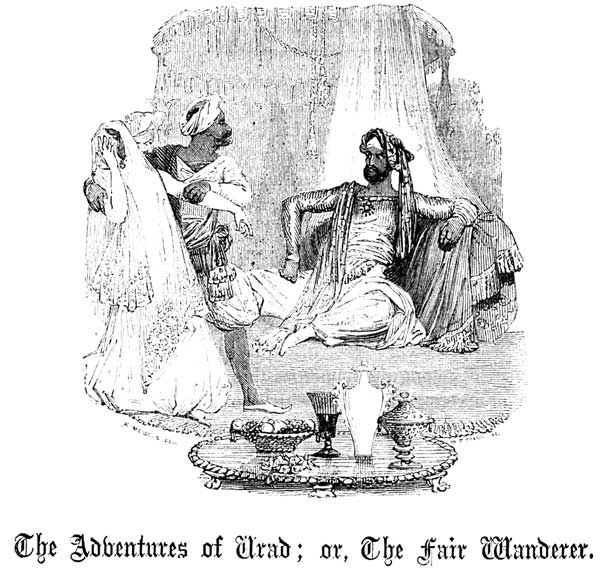

n the banks of the river Tigris, far above where it washes the lofty city of the Faithful, lived Nouri, in poverty and widowhood, whose employment it was to tend the worm who clothes the richest and the fairest with its beautiful web. Her husband, who was a guard to the caravans of the merchants, lost his life in an engagement with the wild Arabs, and left the poor woman no other means of supporting herself, or her infant daughter Urad, but by her labours among the silk-worms, which were little more than sufficient to support nature, although her labours began ere the sunbeams played on the waters of the Tigris, and ended not till the stars were reflected from its surface. Such was the business of the disconsolate Nouri, when the voluptuous Almurah was proclaimed Sultan throughout his extensive dominions; nor was it long before his subjects felt the power of their Sultan; for,[500] Almurah resolving to inclose a large tract of land for hunting and sporting, commanded the inhabitants of fourteen hundred villages to be expelled from the limits of his intended inclosure.
A piteous train of helpless and ruined families were in one day driven from their country and livelihood, and obliged to seek for shelter amidst the forests, the caves, and deserts, which surround the more uncultivated banks of the Tigris.
Many passed by the cottage of Nouri the widow, among whom she distributed what little remains of provision she had saved from the earnings of her labours the day before; and, her little stock being exhausted, she had nothing but wishes and prayers left for the rest.
It happened, among the numerous throngs that travelled by her cottage, that a young man came with wearied steps, bearing on his shoulders an old and feeble woman; setting her down on the ground before the door of Nouri, he besought her to give him a drop of water, to wash the sand and the dust from his parched mouth.
Nouri, having already distributed the contents of her pitcher, hastened to the river to fill it for the wearied young man; and, as she went, she begged a morsel of provisions from a neighbour, whose cottage stood on a rock which overlooked the flood.
With this, and her pitcher filled with water, the good Nouri returned, and found the feeble old woman on the ground, but the young man was not with her.
"Where," said Nouri, "O afflicted stranger, is the pious young man that dutifully bore the burden of age on his shoulders?"
"Alas!" answered the stranger, "my son has brought me hither from the tyranny of Almurah, and leaves me to perish in the deserts of Tigris. No sooner were you gone for the water, than a crowd of young damsels came this way, and led my cruel son from his perishing mother. But, courteous stranger," said she to Nouri, "give me of that water to drink, that my life fail not within me, for thirst, and hunger, and trouble are hastening to put an end to the unhappy Houadir."
The tender and benevolent Nouri invited Houadir into the[501] cottage, and there placed her on a straw bed, and gave her the provisions, and a cup of water to drink.
Houadir, being somewhat refreshed by the care of Nouri, acquainted her with the cruel decree of Almurah, who had turned her son out of his little patrimony, where, by the labour of his hands, he had for many years supported her, and that till that day she had ever found him a most dutiful and obedient son, and concluded with a wish that he would shortly return to his poor helpless parent.
Nouri did all she could to comfort the wretched Houadir, and, having persuaded her to rest awhile on the bed, returned to the labours of the day.
When her work was finished, Nouri, with the wages of the day, purchased some provisions, and brought them home to feed herself and the little Urad, whose portion of food, as well as her own, had been distributed to the unhappy wanderers.
As Nouri was giving a small morsel to Urad, Houadir awaked, and begged that Nouri would be so kind as to spare her a bit of her provisions.
Immediately, before Nouri could rise, the little Urad ran nimbly to the bed and offered her supper to the afflicted Houadir, who received it with great pleasure from her hands, being assured her mother would not let Urad be a loser by her benevolence.
Houadir continued several days with the widow Nouri, expecting the return of her son; till, giving over all hopes of seeing him, and observing that she was burdensome to the charitable widow, she one evening, after the labours of the day, thus addressed her hospitable friend:
"I perceive, benevolent Nouri, that my son has forsaken me, and that I do but rob you and your poor infant of the scanty provision which you, by your hourly toil, are earning: wherefore, listen to my proposal, and judge whether I offer you a suitable return. There are many parts of your business that, old as I am, I can help you in, as the winding your silk and feeding your worms. Employ me, therefore, in such business in the day as you think me capable of performing; and at night, while your necessary cares[502] busy you about the house, give me leave (as I see your labour allows you no spare time) to instruct the innocent Urad how to behave herself, when your death shall leave her unsheltered from the storms and deceits of a troublesome world."
Nouri listened with pleasure to the words of Houadir.
"Yes," said she, "benevolent stranger, you well advise me how to portion my poor infant, Urad, whom I could neither provide for by my industry nor instruct without losing the daily bread I earn for her. I perceive a little is sufficient for your support; nay, I know not how, I seem to have greater plenty since you have been with me than before; whether it be owing to the blessing of Heaven on you I know not."
"Far be it from me," said Houadir, "to see my generous benefactress deceived; but the thinness of inhabitants, occasioned by the tyranny of Almurah, is the cause that your provisions are more plentiful; but yet I insist upon bearing my part in the burden of the day, and Urad shall share my evening's labour."
From this time Houadir became a useful member of the family of Nouri, and Urad was daily instructed by the good old stranger in the pleasures and benefits of a virtuous, and the horrors and curses of an evil, life.
Little Urad was greatly rejoiced at the lessons of Houadir, and was never better pleased than when she was listening to the mild and pleasing instructions of her affable mistress.
It was the custom of Houadir, whenever she taught Urad any new rule or caution, to give her a peppercorn; requiring of her, as often as she looked at them, to remember the lessons which she learnt at the time she received them.
In this manner Urad continued to be instructed; greatly improving, as well in virtue and religion, as in comeliness and beauty, till she was near woman's estate; so that Nouri could scarcely believe she was the mother of a daughter so amiable and graceful in person and manners. Neither was Urad unskilled in the labours of the family, or the silk-worm; for, Nouri growing old and sickly, she almost constantly, by her industry, supported the whole cottage.[503]
One evening, as Houadir was lecturing her attentive pupil, Nouri, who lay sick on the straw bed, called Urad to her.
"My dear daughter," said Nouri, "I feel, alas! more for you than myself: while Houadir lives, you will have indeed a better instructor than your poor mother was capable of being unto you; but what will my innocent lamb, my lovely Urad do, when she is left alone, the helpless prey of craft or power? Consider, my dear child, that Allah would not send you into the world to be necessarily and unavoidably wicked; therefore always depend upon the assistance of our holy Prophet when you do right, and let no circumstance of life, nor any persuasion, ever bias you to live otherwise than according to the chaste and virtuous precepts of the religious Houadir. May Allah and the Prophet of the Faithful ever bless and preserve the innocence and chastity of my dutiful and affectionate Urad!"
The widow Nouri spoke not again; her breath for ever fled from its confinement, and her body was delivered to the waters of the Tigris.
The inconsolable Urad had now her most difficult lesson to learn from the patient Houadir; and scarcely did she think it dutiful to moderate the violence of her grief.
"Sorrows," said Houadir, "O duteous Urad, which arise from sin or evil actions, cannot be assuaged without contrition or amendment of life; there the soul is deservedly afflicted, and must feel before it can be cured: such sorrows may my amiable pupil never experience! But the afflictions of mortality are alike the portions of piety or iniquity: it is necessary that we should be taught to part with the desirable things of this life by degrees, and that by the frequency of such losses our affections should be loosened from their earthly attachments. While you continue good be not dejected, my obedient Urad; and remember, it is one part of virtue to bear with patience and resignation the unalterable decrees of Heaven; not but that I esteem your sorrow, which arises from gratitude, duty, and affection. I do not teach my pupil to part with her dearest friends without reluctance, or wish her to be unconcerned at the loss of those who, by a marvellous love, have[504] sheltered her from all those storms which must have overwhelmed helpless innocence. Only remember that your tears be the tears of resignation, and that your sighs confess a heart humbly yielding to His will who ordereth all things according to His infinite knowledge and goodness."
"O pious Houadir," replied Urad, "just are thy precepts: it was Allah that created my best of parents, and Allah is pleased to take her from me; far be it from me, though an infinite sufferer, to dispute His will; the loss indeed wounds me sorely, yet will I endeavour to bear the blow with patience and resignation."
Houadir still continued her kind lessons and instructions, and Urad, with a decent solemnity, attended both her labours and her teacher, who was so pleased with the fruits which she saw spring forth from the seeds of virtue that she had sown in the breast of her pupil, that she now began to leave her more to herself, and exhorted her to set apart some portion of each day to pray to her Prophet, and frequent meditation and recollection of the rules she had given her, that so her mind might never be suffered to grow forgetful of the truths she had treasured up. "For," said the provident Houadir, "when it shall please the Prophet to snatch me also from you, my dear Urad will then have only the peppercorns to assist her."
"And how, my kind governess," said Urad, "will those corns assist me?"
"They will," answered Houadir, "each of them (if you remember the precepts I gave you with them, but not otherwise), be serviceable in the times of your necessities."
Urad, with great reluctance, from that time was obliged to go without her evening lectures; which loss affected her much, for she knew no greater pleasure in life than hanging over Houadir's persuasive tongue, and hearing, with fixed attention, the sweet doctrines of prudence, chastity, and virtue.
As Urad, according to her usual custom (after having spent some few early hours at her employment), advanced toward the bed to call her kind instructress, whose infirmities would not admit her to rise betimes, she perceived that Houadir was risen from her bed.[505]
The young virgin was amazed at the novelty of her instructress's behaviour, especially as she seldom moved without assistance, and hastened into a little inclosure to look after her; but not finding Houadir there, she went to the neighbouring cottages, none of the inhabitants of which could give any account of the good old matron; nevertheless the anxious Urad continued her search, looking all around the woods and forest, and often peeping over the rocks of the Tigris, as fearful that some accident might have befallen her. In this fruitless labour the poor virgin fatigued herself, till the sun, as tired of her toils, refused any longer to assist her search; when, returning to her lonely cot, she spent the night in tears and lamentations.
The helpless Urad now gave herself up entirely to grief; and the remembrance of her affectionate mother added a double portion of sorrows to her heart: she neglected to open her lonely cottage, and went not forth to the labours of the silk-worm; but, day after day, with little or no nourishment, she continued weeping the loss of Houadir, her mild instructress, and Nouri, her affectionate mother.
The neighbouring cottagers, observing that Urad came no longer to the silk-worms, and that her dwelling was daily shut up, after some time knocked at her cottage, and demanded if Urad the daughter of Nouri was living. Urad, seeing the concourse of people, came weeping and trembling toward the door, and asked them the cause of their coming.
"O Urad," said her neighbours, "we saw you, not long ago, seeking your friend Houadir, and we feared you also were missing, as you have neither appeared among us, nor attended your daily labours among the worms, who feed and provide for us by their subtle spinning."
"O my friends," answered Urad, "suffer a wretched maid to deplore the loss of her dearest friends. Nouri, from whose breasts I sucked my natural life, is now a prey to the vulture on the banks of the Tigris; and Houadir, from whom I derive my better life, is passed away from me like a vision in the night."
Her rustic acquaintance laughed at these sorrows of the virgin Urad. "Alas!" said one, "Urad grieves that now she has to work[506] for one, instead of three." "Nay," cried another, "I wish my old folks were as well bestowed." "And I," said a third, "were our house rid of the old-fashioned lumber that fills it at present (my superannuated father and mother), would soon bring a healthy young swain to supply their places with love and affection." "Ay, true," answered two or three more, "we must look out a clever young fellow for Urad; whom shall she have?" "Oh, if that be all," said a crooked old maid, who was famous for match-making, "I will send Darandu to comfort her, before night; and, if I mistake not, he very well knows his business." "Well, pretty Urad," cried they all, "Darandu will soon be here: he is fishing on the Tigris; and it is but just that the river which has robbed you of one comfort, should give you a better." At this speech, the rest laughed very heartily, and they all ran away, crying out, "Oh, she will do very well when Darandu approaches."
Urad, though she could despise the trifling of her country neighbours, yet felt an oppression on her heart at the name of Darandu, who was a youth of incomparable beauty, and added to the charms of his person an engaging air, which was far above the reach of the rest of the country swains, who lived on those remote banks of the Tigris. "But, O Houadir, O Nouri!" said the afflicted virgin to herself, "never shall Urad seek, in the arms of a lover, to forget the bounties and precepts of so kind a mistress and so indulgent a parent."
These reflections hurried the wretched Urad into her usual sorrowful train of thoughts, and she spent the rest of the day in tears and weeping, calling for ever on Nouri and Houadir, and wishing that the Prophet would permit her to follow them out of a world where she foresaw neither comfort nor peace.
In the midst of these melancholy meditations, she was disturbed by a knocking at the door. Urad arose with trembling, and asked who was there.
"It is one," answered a voice in the softest tone, "who seeketh comfort and cannot find it; who desires peace, and it is far from him."
"Alas!" answered Urad, "few are the comforts of this cottage,[507] and peace is a stranger to this mournful roof: depart, O traveller, whosoever thou art, and suffer the disconsolate Urad to indulge in sorrows greater than those from which you wish to be relieved."
"Alas!" answered the voice without, "the griefs of the beautiful Urad are my griefs; and the sorrows which afflict her, rend the soul of the wretched Darandu!"
"Whatever may be the motive for this charitable visit, Darandu," answered Urad, "let me beseech you to depart; for ill does it become a forlorn virgin to admit the conversation of the youths that surround her: leave me, therefore, O swain, ere want of decency make you appear odious in the sight of the virgins who inhabit the rocky banks of the rapid Tigris."
"To convince the lovely Urad," answered Darandu, "that I came to soothe her cares and condole with her in her losses (which I heard but this evening), I now will quit this dear spot, which contains the treasure of my heart, as, however terrible the parting is to me, I rest satisfied that it pleases the fair conqueror of my heart, whose peace to Darandu is more precious than the pomegranate in the sultry noon, or the silver scales of ten thousand fishes enclosed in the nets of my skilful comrades."
Darandu then left the door of the cottage, and Urad reclined on the bed, till sleep finished her toils, and for a time released her from the severe afflictions of her unguarded situation.
Early in the morning the fair Urad arose, and directed her steps to the rocks of the Tigris, either invited thither by the melancholy reflections which her departed mother occasioned, or willing to take a nearer and more unobserved view of the gentle Darandu.
Darandu, who was just about to launch his vessel into the river, perceived the beauteous mourner on the rocks; but he was too well versed in love affairs to take any notice of her: he rather turned from Urad, and endeavoured by his behaviour to persuade her that he had not observed her, for it was enough for him to know that he was not indifferent to her.
Urad, though she hardly knew the cause of her morning walk, yet continued on the rocks till Darandu had taken in his nets, and, with his companions, was steering up the stream in quest of the[508] fishes of the Tigris. She then returned to her cottage, more irresolute in her thoughts, but less than ever inclined to the labours of her profession.
At the return of the evening she was anxious lest Darandu should renew his visit—an anxiety which, though it arose from fear, was yet near allied to hope; nor was she less solicitous about provisions, as all her little stock was entirely exhausted, and she had no other prospect before her than to return to her labours, which her sorrows had rendered irksome and disagreeable to her.
While she was meditating on these things, she heard a knocking at the door, which fluttered her little less than the fears of hunger or the sorrows of her lonely life.
For some time she had not courage to answer, till, the knocking being repeated, she faintly asked who was at the door.
"It is Lahnar," answered a female: "Lahnar, your neighbour, seeks to give Urad comfort, and to condole with the distressed mourner of a mother and a friend."
"Lahnar," answered Urad, "is then a friend to the afflicted, and kindly seeks to alleviate the sorrows of the wretched Urad."
She then opened the door, and Lahnar entered with a basket on her head.
"Kind Lahnar," said the fair mourner, "leave your burden at the door, and enter this cottage of affliction. Alas! alas! there once sat Nouri, my ever-affectionate mother, and there Houadir, my kind counsellor and director; but now are their seats vacant, and sorrow and grief are the only companions of the miserable Urad!"
"Your losses are certainly great," answered Lahnar; "but you must endeavour to bear them with patience, especially as they are the common changes and alterations of life. Your good mother Nouri lived to a great age, and Houadir, though a kind friend, may yet be succeeded by one as amiable; but what I am most alarmed at, O Urad! is your manner of life. We no longer see you busied among the leaves of the mulberries, or gathering the bags of silk, or preparing them for the wheels. You purchase no provision among us; you seek no comfort in society; you live like the mole buried under the earth, which neither sees nor is seen."[509]
"My sorrows indeed hitherto," replied Urad, "have prevented my labour; but to-morrow I shall again rise to my wonted employment."
"But even to-night," said Lahnar, "let my friend take some little nourishment, that she may rise refreshed; for fasting will deject you as well as grief; and suffer me to partake with you. And see, in this basket I have brought my provisions, some boiled rice, and a few fish, which my kind brother Darandu brought me this evening from the river Tigris."
"Excuse me, kind Lahnar," answered Urad, "but I must refuse your offer. Grief has driven away appetite to aught but itself far from me, and I am not solicitous to take provisions which I cannot use."
"At least," replied Lahnar, "permit me to sit beside you, and eat of what is here before us."
Upon which, without other excuses, Lahnar emptied her basket, and set a bowl of rice and fish before Urad, and began to feed heartily on that which she had brought for herself.
Urad was tempted by hunger and the example of Lahnar to begin, but she was doubtful about tasting the fish of Darandu; wherefore she first attempted the boiled rice, though her appetite was most inclined to the fish, of which she at last ate very heartily, when she recollected that as she had partaken with Lahnar, it was the same whatever part she accepted.
Lahnar having finished her meal, and advised Urad to think of some methods of social life, took her leave, and left the unsettled virgin to meditate on her strange visitor.
Urad, though confused, could not help expressing some pleasure at this visit; for such is the blessing of society, that it will always give comfort to those who have been disused to its sweet effects.
But Urad, though pleased with the friendship of Lahnar, yet was confounded when, some few minutes after, she perceived her again returning.
"What," said Urad, "brings back Lahnar to the sorrows of this cottage?"
"Urad," said Lahnar, "I will rest with my friend to-night, for[510] the shades of night cast horrors around, and I dare not disturb my father's cottage by my late approach."
But as soon as she had admitted Lahnar, she perceived that it was Darandu disguised in Lahnar's clothes. Urad, greatly terrified, recollecting her lost friend Houadir, felt for a peppercorn, and let it fall to the ground.
A violent rapping was in a moment heard at the cottage, at which Urad uttered a loud cry, and Darandu, with shame and confusion, looked trembling toward the door.
Urad ran forward and opened it, when the son of Houadir entered, and asked Urad the reason of her cries.
"O thou blessed angel!" said Urad; "this wicked wretch is disguised in his sister's clothes."
But Darandu was fled, as guilt is ever fearful, mean, and base.
"Now, Urad," said the son of Houadir, "before you close your doors upon another man, let me resume my former features."
Upon which Urad looked, and beheld her old friend Houadir. At the sight of Houadir, Urad was equally astonished and abashed.
"Why blushes, Urad?" said Houadir.
"How, O genius," said Urad, "for such I perceive thou art—how is Urad guilty? I invited not Darandu hither: I wished not for him."
"Take care," answered Houadir, "what you say. If you wished not for him, you hardly wished him away, and, but for your imprudence, he had not entered your home. Consider how have your days been employed since I left you? Have you continued to watch the labours of the silk-worm? Have you repeated the lessons I gave you? or has the time of Urad been consumed in idleness and disobedience? Has she shaken off her dependence on Mahomet, and indulged the unavailing sorrows of her heart?"
"Alas!" answered the fair Urad, "repeat no more, my ever-honoured Houadir: I have indeed been guilty, under the mask of love and affection; and I now plainly see the force of your first rule, that idleness is the beginning of all evil and vice. Yes, my dearest Houadir, had I attended to your instructions I had given no handle to Darandu's insolence; but yet methinks some sorrows were allowable for the loss of such a mother and such a friend."[511]
"Sorrows," answered Houadir, "proceed from the heart, and, totally indulged, soon require a change and vicissitude in our minds; wherefore, in the midst of your griefs, your feet involuntarily wandered after Darandu, and your soul, softened by idle sighs, was the more easily impressed by the deceits of his tongue.
"But this remember, O Urad—for I must, I find, repeat an old instruction to you—that of all things in the world, nothing should so much engage a woman's attention as the avenues which lead to her heart. Such are the wiles and deceits of men, that they are rarely to be trusted with the most advanced post; give them but footing, though that footing be innocent, and they will work night and day till their wishes are accomplished. Trust not, therefore, to yourself alone, nor suffer your heart to plead in their favour, lest it become as much your enemy as the tempter, man. Place your security in flight, and avoid every evil, lest it lead you into danger, for hard it is to turn the head and look backward when a beautiful or agreeable object is before you. Remember my instructions, O Urad! make a prudent use of your peppercorns, and leave this place, which holds a man sensible of your folly and resolute in his own dark and subtle intentions."
Urad was about to thank Houadir, but the genius was fled, and the eyelids of the morning were opening in the east.
Urad, in a little wallet, packed up her small stock of necessaries, and, full of terror and full of uncertainty, struck into the forest, and without reflection took the widest path that offered. And first, it was her care to repeat over deliberately the lessons of Houadir. She then travelled slowly forward, often looking, and fearing to behold the wicked Darandu at her heels.
After walking through the forest for the greater part of the day, she came to a steep descent, on each side overshadowed with lofty trees; this she walked down, and came to a small spot of ground surrounded by hills, woods, and rocks. Here she found a spring of water, and sat down on the grass to refresh herself after the travels of the day.
As Urad's meal was almost at an end she heard various voices issuing from the woods on the hills opposite to that which she[512] came down. Her little heart beat quick at this alarm; and recollecting the advice of Houadir, she began to repeat the lessons of her instructress, and ere long she perceived through the trees several men coming down the hill, who, at sight of her, gave a loud halloo, and ran forward, each being eager who should first seize the prize.
Urad, trembling and sighing at her danger, forgot not to drop one of her peppercorns, and immediately she found herself changed into a pismire, and with great pleasure she looked for a hole in the ground, and crept into it.
The robbers, coming down to the bottom of the vale, were surprised to find their prize eloped; but they divided into separate bodies, resolved to hunt till night, and then appointed that little vale as the place of rendezvous.
Urad, perceiving that they were gone, wished herself into her original form, but alas! her wish was not granted, and the once beautiful Urad still continued an ugly pismire.
Late at night the robbers returned, and the moon shining bright, reflected a gloomy horror upon their despairing faces. Urad shuddered at the sight of them, though so well concealed, and dared hardly peep out of her hole—so difficult is it to forget our former fears. The gang resolved to spend the rest of the night in that place, and therefore unloaded their wallets, and spread their wine and provisions on the banks of the spring, grumbling and cursing each other all the time for their unfortunate search.
Urad heard them lamenting their ill fortune with the utmost horror and indignation, and praised continually the gracious Allah who had rescued her from such inhuman wretches; while they with singing and drinking spent the greatest part of the night, and wishing that their comrades in the other part of the forest had been with them; at length falling into drunkenness and sleep, they left the world to silence and peace.
Urad, finding them fast asleep, crawled out of her hole, and going to the first, she stung him in each eye, and thus she went round to them all.
The poison of the little pismire working in their eyes, in a short[513] time occasioned them to awake in the utmost tortures; and perceiving they were blind, and feeling the pain, they each supposed his neighbour had blinded him in order to get away with the booty. This so enraged them that, feeling about, they fell upon one another, and in a short time almost the whole gang was demolished.
Urad beheld with astonishment the effect of her stings, and at a wish resumed her pristine form, saying at the same time to herself, "I now perceive that Providence is able by the most insignificant means to work the greatest purposes."
Continuing her journey through the forest, she was terribly afraid of meeting with the second band of robbers, and therefore she directed her steps with the greatest caution and circumspection.
As she walked forward, and cast her eyes all around, and stopped at every motion of the wind, she saw the son of Houadir coming to meet her in the path in which she was travelling.
At this sight Urad ran toward him, and with joy begged her old governess would unmask herself, and entertain her with instruction and persuasion.
"No, my dear child," answered the son of Houadir, "that I cannot do at present; the time is not as yet come. I will first, as you have been tried, lead you to the palace of the Genii of the Forest, and present your unspotted innocence before them; for, O my sweet Urad, my heavenly pupil!" said he, kissing and taking her in his arms, "your virtue is tried; I have found you worthy of the lessons which I gave you. I foresaw evils might befall you, and therefore I took pity on your innocence, and lived with Nouri your mother, that I might train up my beloved Urad in the paths of virtue; and now your trial is past, Urad shall enjoy the happiness of a genius."
Urad, though somewhat confounded at Houadir's embrace under the appearance of a man, yet with great humility thanked her benefactor; and the son of Houadir, turning to the left, led Urad into a little by-path, so concealed that few, if any, might ever find its beginning. After a long walk through various turnings and intricate windings, they came to a small mean cottage, where, the son of Houadir leading the way, Urad followed.[514]
The son of Houadir striking fire with his stick, a bright flame arose from the centre of the floor, into which he cast divers herbs, and repeating some enchantments, the back part of the cottage opened and presented to the view of Urad a beautiful dome, where she saw sitting round a table a numerous assembly of gay persons of both sexes.
The son of Houadir, leading in Urad, said, "This, my dear pupil, is the assembly of the Genii of the Forest." And, presenting her to the company, "Behold," said he, "the beautiful and well-tried Urad. But here you may cast off your reserve, fair maid, and indulge in the innocent pleasures of the Genii of the Forest."
The son of Houadir then led her to the table, and seated her on the same sofa with himself. The remainder of the day was spent in mirth and pleasure.
Urad, having never beheld anything splendid or magnificent, was greatly delighted at the gay company and beautiful saloon, nor did she receive the caresses of the son of Houadir reluctantly.
At night, Urad was shown a glorious apartment to rest in, and the son of Houadir attended her.
"My dear Houadir," said Urad, "when shall I behold your proper shape? When shall I see you as my tutelary genius?"
"That," answered the son of Houadir, "I shall be in every shape; but call neither one nor the other my proper shape; for to a genius all shapes are assumed: neither is this my proper shape, nor the wrinkles of an old woman. But, to confess the truth, O beautiful Urad, from the first moment of your birth I resolved to make you my bride, and therefore did I so patiently watch your growing years, and instruct you in the fear of vice and the love of virtue."
Urad, astonished at the words of the son of Houadir, knew not what answer to make; but the natural timidity of her sex, and the strangeness of the proposal, filled her with strange apprehensions. However, she begged at least that the genius would, for a time, leave her to herself.
"No, my lovely Urad," answered the son of Houadir, "never, never, will thy faithful genius leave thee!"[515]
"Why," said Urad, "didst thou bestow so many peppercorns upon me, as they now will become useless?"
"Not useless," said the son of Houadir: "they are indeed little preservatives against danger; but I have the seeds of some melons which will not only rescue you, but always preserve you from harm. Here, faithful Urad," continued he, "take these seeds, and, whenever you are fearful, swallow one of these, and no dangers shall surround you."
Urad thankfully received the seeds.
"And what," said she, "must I do with the peppercorns?"
"Give them," said the son of Houadir, "to me, and I will endue them with stronger virtues, and thou shalt by them have power also over others, as well as to defend thyself."
Urad pulled the peppercorns out of her bag, and presented them to the son of Houadir, whose eyes flashed with joy at the sight, and he immediately thrust them into the folds of his garments.
"O son of Houadir, what hast thou done?" said Urad.
"I have," answered the false son of Houadir, "gained the full possession of my lovely Urad, and now may address her in my proper shape." So saying, he resumed his natural figure, and became like a satyr of the wood.
"I am," said he, "O beautiful Urad, the enchanter Repah, who range in the solitude of the forest of the Tigris. You I saw surrounded by the influence of the genius Houadir, and therefore was obliged to use artifice to gain you as my wife."
The poor deluded victim, with tears in her eyes, implored his mercy and forbearance; but he laughed at her tears, and told her her eyes glittered the brighter for them.
Urad, in her despair, again put her hands into the bag whence she had fatally resigned the peppercorns, and felt about in agony for her lost treasure. And now finding none, and perceiving that the genius Houadir attended not to her cries, she was drawing out her hand when, in a corner of the bag, she felt one peppercorn, which had before escaped her search.
She instantly drew it out, and, throwing it on the ground, the[516] enchanter stood motionless before her; the apartments vanished, and she found herself with him in a dark hut, with various kinds of necromantic instruments about her.
Urad, though fearful, yet was so much overcome with fatigue and fright that she sank on the ground; and, happily for her, the enchanter was in no condition to persecute her.
"Curse on my folly," said he, as he stood fixed to the ground, "that I neglected to ask for the bag itself which held the gifts of the genius Houadir! her pretty pupil had then been my slave, in spite of the many fine lessons she had been taught by that pitiful and enthusiastic genius; but now by chance, and not by the merit of thy virtues, or thy education, art thou delivered from my seraglio. But this grieves me not so much to lose a sickly girl as that I find a superior power condemns me to declare to you the causes of your error.
"Know, then, Urad—I speak not from myself, but He speaks who, from casual evil, can work out certain good—He forces me to declare that no specious appearance, no false colours, should incline the virtuous heart to listen to the wiles of deceit; for evil then comes most terrible when it is cloaked under friendship. Why, then, had Urad so great an opinion of her own judgment as to confide in the false appearance of the son of Houadir when she might have consulted her faithful monitors? The falling of a peppercorn would have taught her to trust to no appearances, nor would she have parted with her peppercorns, which were to refresh in her memory the sentiments of virtue, chastity, and honour—no, not to Houadir herself. No adviser can be good who would destroy what he himself has first inculcated; and no appearance ought to bias us to receive as truths those things which are contrary to virtue and religion. How, then, did Urad keep to the instructions of Houadir?"
Thus spoke the enchanter, and no more; his mouth closed up, and he stood fixed and motionless. And Urad, finding her spirits somewhat recovered, hastened out of the hut, and perceived that it was morning.
She had now no more peppercorns to depend upon; wherefore[517] she cried to Houadir to succour her; but the genius was deaf to her entreaties.
"Poor miserable wretch!" said Urad to herself, "what will become of thee, inclosed in a forest through which thou knowest no path? But," continued she, "why should I not examine the enchanter, who perhaps is yet immovable in the cottage? I saw him fold them in the plaits of his garments, and they may yet become mine."
So saying, she returned to the hut, where entering, the very sight of the dumb enchanter affrighted her so much, that it was a long time before she could venture near him. At length she put out her hand, and pulled forth her beloved peppercorns, the enchanter still standing motionless.
Away flew Urad like lightning from the hut, and ran till she had again reached the road from which she had been decoyed.
She continued her journeying for seven days, feeding on the fruits of the forest, and sleeping in the densest thickets.
The eighth day, as she was endeavouring to pass a ford where a small rivulet had been swelled by the rains, she perceived a large body of horsemen riding through the woods, and doubted not that it was the remainder of the gang of robbers whom she had before met with.
Urad was now in some measure reconciled to danger; and therefore, without much fear, dropped a peppercorn, and expected relief.
The peppercorn had been dropped some time, the horsemen advanced, and no one appeared to her succour.
"Alas!" said Urad, "why has Houadir deceived me? Neither her advice, nor her magical peppercorns, can save me from these cruel robbers. O genius, genius! why hast thou forsaken me in my severest trials!"
By this time the robbers were come up, and were highly rejoiced to find such a beautiful prize.
Their captain leaped from his horse to seize her, and the trembling Urad gave a loud shriek, which was answered from the woods by the roaring of a hundred lions.[518]
"O Allah," said the chief, "the lions are upon us!"
"That may be," said he who was dismounted; "but were the whole world set against me, I would secure my prize." So saying, he took Urad in his arms to place her on his horse.
The roaring of the lions continued, and many of them came howling out of the woods: the robbers fled in dismay, all but the ruffian who had seized on the fair Urad, who was striving in vain to fix her on his horse. A lion furiously made at him, and tore him limb from limb, while Urad expected the same fate from several others who came roaring around.
"But," said she, "better is death than infamy, and the paw of the hungry lion, than slavery to a robber."
The noble beast, having devoured his prey, came fawning at the feet of Urad, who was surprised at his behaviour and gentleness; but much more was her astonishment increased when she heard him speak.
"O virgin (for none other can experience the assistance of our race, or stand unhurt before us), I am the King and Sovereign of these mighty forests, and am sent by the genius Houadir to thy protection. But why did the distrustful Urad despair, or why did she accuse Providence of deserting her? should not the relieved wait with patience on the hand that supports him, and not cry out with impatience, and charge its benefactor with neglect?"
"True, O royal lion," answered the fair Urad; "but fear is irresistible, and the children of men are but weakness and ingratitude. But blessed be Allah, who, though justly provoked at my discontent, yet sent to my assistance the guardian of the fair. Yet how cometh it to pass, O royal protector, that you, who are so bold and so fierce in your nature, should yet behave with such tenderness and kindness to a helpless virgin, whom you might with pleasure to yourself in a moment devour?"
"The truly great and noble spirit," answered the lion, "takes a pride in protecting innocence, neither can he wish to oppress it. Hence learn, fair virgin, that of all mankind he only is noble, generous, and truly virtuous, who is ready to defend helpless womanhood. What, then, must you think of those mean wretches[519] who cajole you under the appearance of affection, and yet tell you that it was only to try you? He that is suspicious is mean: he that is mean is unworthy of the chaste affections of the virtuous maid. Wherefore, O Urad, shun him, however honoured by mankind, or covered by the specious characters of virtue, whoever attempts the honour of your chastity, for he cannot be just: to deceive you he must himself swear falsely, and therefore cannot be good; or if he tell the truth, he must be weak and ungenerous, and unworthy of you."
In such conversation they passed along the forest, till, after a few days, they were alarmed at the noise of the hunters and the music of the chase.
"Alas!" said the beautiful Urad, "what is this that I hear?"
"It is," answered the royal beast, "the noise of the hunters; and thou shalt escape, but me will they in sport destroy. The lion you call cruel, who kills to devour. What, then, is he who wantons in the death of those who advantage him not? But man is lord of all: let him look to it how he governs!"
"Nay, but," answered Urad, "leave me, gentle protector, and provide for your safety; nor fear but Houadir will prevent the storms that hover over from breaking upon me."
"No," answered the royal beast, "she has commanded me to follow you till I see her presence; and where can I better sacrifice my life than in the service of chastity and virtue?"
The hunters were now in sight, but advanced not towards the lion; they turned their coursers aside, and only one of superior mien, with several attendants, rode towards Urad.
The lion erecting his mane, his eyes glowing with vivid lightnings, drew up the wide sinews of his broad back, and with wrathful front leaped towards him who seemed to have the command.
The horseman, perceiving his intention, poised his spear in his right hand, and spurred his courser to meet him.
Ere the royal beast had reached the horseman, the rider threw his spear, which, entering between the fore-paws of the lion, nailed him to the ground. The enraged animal tore his paw from the[520] ground; but the spear still remained in his foot, and the anguish of the wound made him shake the whole forest with his lordly roarings.
The stranger then rode up to the fair Urad, whom viewing, he cried out, "By Allah! thou art worthy of the seraglio of the Vizier Mussapulta: take her, my eunuchs, behind you, and bear her through the forest of Bagdad, to the home of my ancestors."
The eunuchs obeyed, and bore her away, though Urad dropped her corn upon the ground; but still she trusted in the help of Houadir.
The Vizier Mussapulta then ordered that one of his slaves should stay behind, and destroy and bury the lion; which he commanded to be done with the utmost caution, as Almurah had made a decree that if any subjects should wound, maim, or destroy any lion in his forests, the same should be put to death.
The eunuchs bore away Urad to the seraglio, taking her through by-ways to the palace of the Vizier, lest her shrieks should be heard. Mussapulta followed at a distance, and the slave was left with the tortured and faithful lion.
In a few hours they reached the palace, and Urad, being conducted to the seraglio, was ordered to be dressed, as the Vizier intended visiting her.
Urad was thunderstruck at the news, and now began to fear Houadir had forgotten her, and resolved, as soon as the eunuchs had left her, to drop a second peppercorn. But poor Urad had forgotten to take her bag from her old garments, which the women who dressed her had carried away. She dissolved in fresh tears at this piece of carelessness.
"Well," said she, "surely Houadir will neglect me, if I so easily neglect myself."
She waited that night with fear and trembling; but no Vizier appeared.
This eased her greatly, and the next day, when the eunuchs came, they informed her that Mussapulta had that evening been sent by the Sultan to quell an insurrection, and that they did not expect him home under twenty days.[521]
During this time no pains were spared with Urad to teach her the accomplishments of the country, all which, in spite of her unwillingness to learn in such a detestable place, she nevertheless acquired with the utmost ease and facility.
The insurrection being quelled, the Vizier returned, and, not unmindful of his fair captive, ordered that she might be prepared for his reception in the evening.
Accordingly Urad was sumptuously adorned with jewels and brocades, and looked more beautiful than the fairest Circassian; and the dignity of her virtue added such a grace to her charms, that even her keepers, the eunuchs, dared not look upon her. In the evening the chief eunuch led her into the presence of Mussapulta. She shrank from him with horror.
"What!" said he, "cannot a fortnight's pleasure in this palace efface the remembrance of your sorrows? But be gay and cheerful, for know that the Vizier Mussapulta esteems you beyond any of his wives."
"The esteem of a robber, the esteem of a lawless ranger," answered Urad, "charms not the ears of virtue."
"What," said Mussapulta, sternly, "dost thou refuse my proffered love? Then shalt thou die! Slay this proud maiden in my sight. Cut off her head at once."
The eunuch hesitated.
"Why," said the proud Vizier, "do you delay to obey me?"
As he said this an eunuch came running in haste, crying, "The Sultan, the Sultan Almurah, approaches!"
All was instant confusion. Mussapulta turned pale and trembled. He ordered the eunuch to release the fair Urad, and at that moment the faithful lion entered with the Sultan Almurah.
The lion instantly seized on the Vizier Mussapulta, and tore him limb from limb. Yet the generous animal would not defile himself with the carcass, but with great wrath tossed the bloody remains among the females of the seraglio.
Almurah commanded Urad to advance, and at the sight of her,
"O royal beast," said he to the lion, "I wonder not that thou[522] wert unable to describe the beauties of this lovely maid, since they are almost too dazzling to behold. O virtuous maid," continued Almurah, "whose excellencies I have heard from this faithful animal, if thou canst deign to accept of the heart of Almurah, thy Sultan will be the happiest of mankind; but I swear, by my unalterable will, that no power on earth shall force or distress you."
"Oh," sighed Urad, "royal Sultan, you honour your poor slave too much; yet happy should I be were Houadir here!"
As she spoke, the genius Houadir entered the room: the face of the sage instructress still remained, but a glowing splendour surrounded her, and her walk was majestic and commanding. Almurah bowed to the ground, Urad made obeisance, and the rest fell prostrate before her.
"My advice," said Houadir, "is necessary now, O Urad, nor ought young virgins to enter into such engagements without counsel and the approbation of those above them, how splendid and lucrative soever the union may appear. I, who know the heart of Almurah, the servant of Mahomet, know him to be virtuous: some excesses he has been guilty of, but they were chiefly owing to his villanous Vizier, Mussapulta." (Here the lion gave a dreadful roar.) "Against your command, Almurah, did he wound this animal, which I endowed with speech for the service of Urad, to teach her that strength and nobleness of soul would always support the innocent.
"Mussapulta having wounded him, commanded his slave to put the royal beast to death; but I gave the slave bowels of mercy, and he carried him home to his cottage till the wound was healed, when the lion, faithful to his trust, came towards you as you were hunting, and being endowed with speech, declared the iniquity of Mussapulta—but he is no more.
"Now, Urad, if thy mind incline to Almurah, receive his vows, but give not thine hand where thy heart is estranged, for no splendour can compensate the want of affection."
"If Almurah, my gracious lord," answered Urad, "will swear in three things to do my desire, his handmaid will be happy to serve him."[523]
"I swear," answered the fond Almurah. "Hadst thou three thousand desires, Almurah would satisfy them or die."
"What strange things," said Houadir, "has Urad to ask of the Sultan Almurah?"
"Whatever they are, gracious genius," said Almurah, "Urad, the lovely Urad, may command me."
"Then," said Urad, "first I require that the poor inhabitants of the forest be restored to their native lands, whence thou hast driven them."
"By the great Allah, and Mahomet the Prophet of the just," answered Almurah, "the deed was proposed and executed by the villain Mussapulta! Yes, my lovely Urad shall be obeyed. But now, Urad," continued the Sultan, "ere you proceed in your requests, let me make one sacrifice to chastity and justice, by vowing, in the presence of the good genius Houadir, to dismiss my seraglio, and take thee only for my wife."
"So noble a sacrifice," answered Urad, "demands my utmost returns; wherefore, beneficent Sultan, I release thee from any further compliance with my requests."
"Lovely Urad," said Almurah, "permit me, then, to dive into your thoughts:—yes, by your kind glances on that noble beast, I perceive you meditated to ask some bounty for your deliverer. He shall, fair virgin, be honoured as Urad's guardian, and the friend of Almurah; he shall live in my royal palace, with slaves to attend him; and, that his rest may not be inglorious or his life useless, once every year shall those who have injured the innocent be delivered up to his honest rage."
The lovely Urad fell at the feet of her Sultan, and blessed him for his favours; and the sage Houadir approved of Urad's request and the promises of Almurah. The lion came and licked the feet of his benefactors; and the genius Houadir, at parting, poured her blessings on the royal pair.
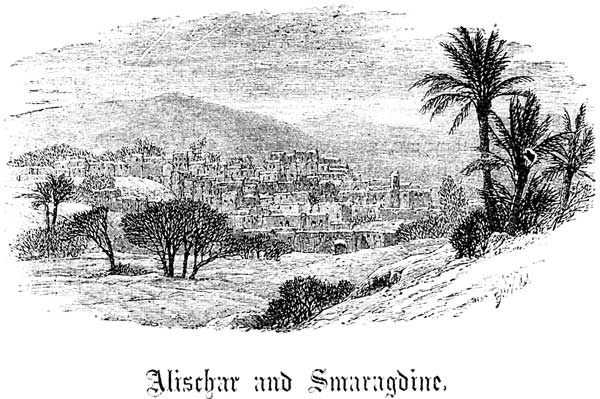
here lived once on a time, in the province of Khorassan, a rich merchant, to whom, in his sixtieth year, a son was born, and he called his name Alischar. Fifteen years afterwards the father died, but not without giving his son, in the hour of death, many excellent advices and moral instructions as to his conduct through life. Alischar buried his father, and not long afterwards his mother also, and began to exercise diligently the trade which his parents had bequeathed to him. In this way a whole year was spent, without the least departure from the wise course of behaviour which his father had prescribed for him in his last moments. But, unfortunately, ere many weeks more were gone, he fell into the company of certain vicious people, who seduced him into a life of such luxury and extravagance, that in a short time the money the old man had left him was entirely spent. Proceeding in the same follies, he by-and-bye was obliged to part with the shop itself,—the household furniture followed,—and, in a word, Alischar was left without anything he could call his own, except the bare roof over his head and the clothes upon his back.[525]
Having nothing wherewithal to still the cravings of hunger, the youth might now be seen daily roaming about the streets, idle and listless. One day in this sad condition he was loitering about in the great square of the city, when his attention was attracted by a crowd of people, who seemed to be gathered around one who sold some merchandise by auction. He drew near, and, mixing among the assemblage, saw that the business was the selling of a beautiful young slave, who stood in the midst with a form of the most fascinating elegance, cheeks that outshone the rose, and beauty more dazzling than the reflection of the full moon in a fountain of dissolved pearls. Scarcely had he looked upon her ere love seized him and mastered him; he knew not what to do or to say, but remained like a stone in the midst of the crowd, gazing. The bystanders, who were ignorant that Alischar had so soon dissipated his patrimony, never doubted that he had come in order to be a bidder for the beautiful slave. The crier moved his situation so as to stand right opposite to him, with the girl in his hand, and began to call out the usual words more loudly than before, "Ye rich merchants, ye honourable wholesale dealers, gentlemen all of worth and condition, what say ye for this brunette slave, who is the mistress of the moon of heaven, whose name is called Smaragdine, and whose fame is purer than the pearl in the depths of the Red Sea? Say your bidding, great and small."
At first five hundred and twenty-five ducats were offered; but immediately there came forward an old man, by name Beschadeddin, shapeless in his form and shuffling in his gait,—the aversion of every eye that rested on him. This old man came forward across the market-place, and offered without hesitation a thousand ducats.
The crier cast his eyes around, but the former bidders remained silent, and then asked the master of the slave if he was satisfied with this offer.
"I am," said the merchant, "but upon condition that the girl herself is so also; for I have sworn to her, that she shall be sold to no one for whose service she does not herself feel an inclination."
Upon this the crier turned to the girl, and asked her what she had to say to the matter. She cast her bright eyes upon the hateful[526] old man, and replied, "Know ye not the verse of the old poet, how he says:
"You are right," said the auctioneer, laughing (and the master of the slave re-echoed his laugh and his answer); "let us see whether we cannot light upon a younger bidder."
With that there drew near a man whose years were not few, but he had dyed his beard and moved trippingly. He also offered a thousand ducats; but at that moment Smaragdine began to recite as from the book of some poet, but the verses were in truth her own:
A third now came forward, but unfortunately he was one-eyed. The slave regarded him, and quoted, or seemed to quote, without hesitation,
"Look round you," said the crier; "is there none here that pleases you better?" And with this he pointed to a short stout man whose beard was of unusual dimensions.
"Fie!" said the slave, "this is he whom the poet had in his eye when he sang,
"Choose for yourself, girl," said the auctioneer, laughing more heartily than before; "I pray you look round upon all the circle of the bystanders."
The slave cast her eyes slowly around the company, and at last rested them upon Alischar, whose appearance had charmed her from the first moment.
"Mr. Crier," said she, "I will belong to no one but this handsome[527] young man. It is of him that the poet was thinking when he wrote those verses:
When she ceased from her recitation, her master drew near to Alischar, and said, "Friend, you see what a wonder of beauty, education, and eloquence this slave is; and, if you got such a treasure for a thousand ducats, be assured you were a most fortunate man. I swear to you that she can read the Koran in seven different methods—that she excels equally in seven different styles of penmanship—that she embroiders to admiration in silk, in silver, and in gold—and that you will soon get your money out of her, if it were but by the sale of her works in the market-place."
The crier also put in his word. "O sir," quoth he to Alischar, "it is obvious that Providence has an especial kindness for you: she is a pearl and a jewel. You are about to be the happiest of men."
Alischar could not help smiling when he heard all this.
"How!" said he to himself, "last night I went supperless to bed, and yet these people all fancy I am in a condition to pay a thousand ducats for a dark-eyed slave!"
He shook his head, for he would fain escape the pain of saying openly that he was too poor to think of such a purchase.
"Quick," said the beautiful slave, "let me speak to the young man myself: I must talk to him a little in private, for I am determined that he, and he only, shall buy me."
The crier took her by the hand, and, leading her to Alischar, retired a few paces to allow them opportunity of conversation.
"Amiable young man!" whispered she to the youth, "will you not buy me?"
Alischar shook his head sorrowfully.[528]
"Aha!" said she, "I have it. Perhaps you think I am too dear? Will you give nine hundred ducats for me?"
"No."
"Eight hundred?"
"No."
"Seven hundred?"
"No, no."
And in this way she came down to one hundred ducats, receiving always the same melancholy monosyllable in reply.
"I have not a hundred ducats in the world," said Alischar, and a deep sigh came from his breast.
"Perhaps you could give ninety—eighty—seventy?"
At last he could not help himself, and whispered in her ear,—"Angel of light!" said he, "I have neither gold nor silver, not to talk of ducats; I have not a penny in the world: you must find another purchaser."
"Do what I bid you," answers she. "Take hold of my hand, and kiss me on the side of the cheek, for that is the signal of the bargain being completed."
Alischar, scarcely conscious of his proceedings, obeyed the girl. The instant afterwards she drew a purse from her bosom, and said, "Take that, my love; you will find a thousand ducats in it: pay nine hundred to my master for me, and lead your new slave home with all speed."
When they came to the house there was neither bed, sofa, table, nor dish in it. The slave instantly sent Alischar to the market to get a few necessary moveables and provisions. He did what she bade him. Smaragdine forthwith put the house in the nicest order, and set about dressing a little supper with the most exquisite skill. In short, the next day Alischar married the beautiful slave. Then Smaragdine set herself busily to work in embroidering a carpet. She represented on it all sorts of quadrupeds so skilfully that one expected to see them move; and birds, so that it was a wonder one did not hear them singing. In the whole of this work she occupied only eight days, and when these were over she sent her man to the market to sell the carpet, cautioning him, however, with[529] great strictness, to avoid falling into any adventure that might terminate in their separation. Alischar followed scrupulously the instructions of his wife, and in this manner, supported by Smaragdine's needlework, they spent a whole year of undisturbed felicity.
One day, as Alischar was going to market with one of Smaragdine's coverlets, as usual, to sell, he happened to meet with a certain Infidel who at once offered him sixty ducats for it. He had a secret disinclination to have any dealings with a Giaour, and asked first sixty-five, and then seventy ducats, and so up at last to a hundred. The man, to his astonishment, said, "Well, there is your money;" and not having the face to play the extortioner further, Alischar pursed the gold, and returned homewards. He was close to the door of his house ere he observed that the Giaour had been following him, and was just behind him.
"I see you are now at home," said the Infidel, "and I beg you will have the kindness to give me a cup of water, for I have been broiling in the streets all day, and am ready to expire with thirst."
Alischar, who would never have forgiven himself for refusing so trivial a civility, went immediately into the house for a jug of water.
"Where have you been lingering so long to-day?" said Smaragdine. "I know not how or why, but a certain painful anticipation of some misfortune has been hanging over my mind ever since you went out. It rejoices my very heart to see you come home sound and well again; but what is it you want with the water-jug?"
"Only to refresh a person who seems about to die of thirst," answered Alischar; "but I shall be back again in a moment, my dear Smaragdine." With this he ran downstairs, and was surprised to find the Infidel, whom he had left without on the street, seated within the porch.
"Dog of a Giaour!" says he, "what do you here?"
"Pardon me, good sir," replies the Giaour; "I was so wearied that my legs refused to support me any longer, and it was a matter of mere necessity that I should sit down somewhere."
Alischar gave him a cup of water, and waited to see him arise and take his departure; but, behold, nothing was less in the man's mind.[530]
"Out with you," at last cries Alischar; "out this moment, I say."
"Blessed," says the Giaour, "be they that refuse not a drink of water to him who standeth athirst before the door, and who grudge not a bit of bread to him that is a-hungered. Now my thirst is quenched, but my hunger is even greater than that was. Give me a bit of bread and a couple of onions, and for more I will not trouble you."
"Pack off!" said Alischar; "there is nothing in the house."
"With your leave, sir," says the other, producing his purse, "here are one hundred ducats: have the kindness to seek some bread and onions here in your neighbourhood, and I shall feel myself eternally obliged by your condescension."
"The man is mad," thinks Alischar to himself; "but that is no reason why I should suffer a hundred ducats to go a-begging for quarters."
"Haste, sir, haste!" continued the Giaour. "I am near to death, so great is my hunger, and no one knows what sort of a misery that is until he has experienced it himself. If it be but a crust, a crumb—a morsel of dry meal even; but something I must have, else I want strength to move myself from this seat."
"Wait a moment, then," said Alischar. And with that he went out, taking care to lock the door behind him. He soon returned with roast meat, pastry, honey, a water-melon, and some bread, upon a tray.
"Oh!" cried the Giaour, when he saw him returning so, "this is too much. Ten men might dine on this, and here am I alone before it all, unless you would do me the honour to sit with me."
"Eat alone," said Alischar harshly.
But by-and-bye the guest takes the water-melon, and divides it very neatly into two parts, contriving by dexterous management of the knife to besmear the one of these with a strong tincture of nepenthe of Crete and opium, enough to have put an elephant to sleep.
"Pray," said the Infidel, holding the medicated half towards Alischar, "accept this beautiful slice of melon at the hands of your servant."[531]
Alischar could not be so rude as to refuse this: he ate the fruit, and in a moment the fatal effects of it were apparent, for he sank into utter oblivion, losing all his senses at once.
The Giaour rises softly the moment he perceives this, locks the door, and putting the key of the house in his pocket, runs with all speed to inform his brother of the success of his treachery. This was the old Beschadeddin, our acquaintance, who, though he pretended to be a Mussulman, had always remained an Infidel. It was he who had excited his brother to all this knavery, in order that he himself might if possible gain possession of Smaragdine. He now took his people with him, provided himself with gold, mounted his mule, and repaired directly to Alischar's habitation. His slaves seized Smaragdine by force, threatening her with instant death if she dared to utter a single cry, and so conveyed her in safety to the house of their master.
"Ah, wretch!" says the old reprobate, "have I got you at last into my hands? I swear to you, that if you do not consent to renounce Mahomet I will make minced meat of you forthwith."
"Hack me and hew me into a thousand shreds, if such be your pleasure," answers she; "but know, wretch of wretches! that a Moslem I am, and a Moslem I will die. Allah chastises those He best loves with difficulties and dangers, and upon Him alone I set all my trust."
Upon this the wretched ancient gave orders to his female slaves to prick Smaragdine's flesh with pins, and then to tie her up in the corner of the kitchen, but on no account to give her a morsel to eat. But even this last blow had no effect on Smaragdine, who merely exclaimed as she had been doing before,
"God is God, and Mahomet is His Prophet!"
When poor Alischar, on his part, awoke from his sleep, and found himself alone in his bed, fear unutterable came into his mind, and he began to cry out for his Smaragdine like one possessed. But his cries were as useless as his searches: he could find his love nowhere, and concluded that the vile Giaour had deceived him for the sake of abstracting her. At first he sat in a corner shedding hot tears, hour after hour, by himself; but perceiving[532] that his tears were of no avail, he tore his garments, took a stone in each hand, and walked through the town beating his breast alternately with these stones, and crying out all the time in a loud voice of distress, "O Smaragdine! Smaragdine!"
The children collected about him, and first one and then another of them entreated him to tell his story. He did so, and whoever heard him pitied him. After he had in this way gone through the whole town, he happened to see an old woman of his acquaintance sitting at her door, and saluted her respectfully. The old lady, being knowing in such matters, perceived at once the symptoms of a desolate lover, and asked him the reason of his distress. He told her all, and she said to him,
"I am very much grieved for your case, my son; but take courage. I certainly think my assistance will be of much advantage to you. Go hence immediately, buy one of the bread-baskets in which the hawkers carry their loaves about, and put a few articles of female attire in it. I undertake to go about with the wares, and I flatter myself you will ere long hear some tidings of Smaragdine."
Alischar was out of himself with joy even at this small glimpse of hope; he covered the hand of the old dame with tears and kisses, and forthwith fetched her what she had asked for. She made herself ready without delay to commence her operations, and in the course of her wanderings came, after no long space of time, to the very house of Beschadeddin.
She happened to enter at a moment when the female slaves of the house were misusing poor Smaragdine.
"And what," says she, "has the poor child done to you that you should treat her so roughly?"
"In truth," they answered, "we do what we do against our own inclination, but we must obey our master's orders."
"Not when he is from home, surely," says the old woman again; "do have a little pity. Oblige me so far as to unbind this unfortunate, and refresh her a little with some food."
The slave-girls, whose hearts were by no means destitute of sensibility, loosed her bands, and left her for a moment alone with the old woman. She made good use of the happy occasion, told her[533] in whose name she had come, and said that if she would take care to be at the window exactly at midnight, Alischar would be there at that moment, when she might easily drop upon his shoulders and regain her freedom. With this she hies away to Alischar to make him acquainted with her success. She assured him that Beschadeddin being from home, the slaves had promised to leave Smaragdine unbound for that one night, and he needed not many words to make him undertake the adventure.
He was at the appointed spot the moment darkness closed, determined to stand there and wait patiently for the time when his love should appear. But alas! his sorrow had cost him many slumberless nights, and now that he thought himself secure of his happiness again, long-absent sleep came, and overpowered him suddenly where he stood on the street.
It happened that just about this time a thief was passing down the same street. Perceiving that Alischar was fast asleep, this fellow eased him of his turban, and setting that on his head, was about to proceed on his way. Smaragdine, at this moment standing in the window, saw the gleam of her lover's turban, and never doubting that it was worn by Alischar himself, opened the lattice, and said to the thief in an audible whisper,
"Come, come, love, I am ready to come down."
"Here is a fine adventure," quoth the thief to himself; "let us make the best of it."
With this he placed himself below Smaragdine's window, received her on his shoulders, and darted off with her like lightning.
"Oh," says she to him, "you are so strong, you trot as nimbly as if you were a horse under me; and the good old woman had persuaded me that grief had weakened you so that you could scarcely drag your own limbs along."
The gentleman, on his part, made no answer to these observations, and Smaragdine at last began to feel his face, which being very rough and half covered with hair, her error was apparent, and she began to cry out with all her might,
"Who art thou? who art thou?"
"Silence!" answered the thief: "I am Hirvan the Kurd, and I[534] belong to the band of Ahmed-ed-deyf. We are forty of us, all jolly brothers of the trade, and a happy life shall you lead with us."
Smaragdine perceived into what horrors her error had plunged her: she committed her soul to God and her body to the Prophet, and allowed Hirvan to proceed with her in silence.
He conveyed her straight to a cavern without the city, which was the hiding-place of the band. At that moment there was no one in it but the mother of the captain, who had been left to arrange the plunder of the preceding night, and in particular the wardrobe of a young cavalier whom they had murdered, and whose horse and portmanteau were observed just within the entrance of the cavern. The young robber handed over Smaragdine to the old lady's protection, and went out again in quest of more adventures; and no sooner were they alone than the old one began to praise Smaragdine's beauty, and to felicitate her upon the prospect of being bride to her own son, the captain, whose manifold accomplishments she most vigorously extolled. Smaragdine, after a little while, began to dry her tears, and by degrees affected to be quite comforted. She even went so far as to say that she regretted one thing more than all the rest, and this was that she could not take a bath, and be ready to give the captain a reception more worthy of his rank and character.
"Ah, the bath! the bath!" cries the old woman, "you are quite in the right; there is no comfort in this world like the bath; but it is a luxury I never enjoy, for I have nobody about me to shampoo me."
"Here am I," says Smaragdine; "allow me to attend on you the first, and then you will do the like good office to me."
The bargain was soon struck. The bath was got into order, and the old woman, the first time for many years, entered it. Smaragdine kept the water very hot, and rubbed and scrubbed the old dame so, that she was quite in transports, and at length fell fast asleep under the pleasing influence. While she slept Smaragdine took possession of the clothes and arms of the murdered cavalier, mounted his horse, and galloped from the cavern, without having the least notion whither.[535]
When morning broke she found herself in an uncultivated country, destitute of any marks of human habitation. She ate some roots and fruits, allowed her horse to graze under the trees, and so proceeded all the day.
On the eleventh morning she descried, in the valley before her, a noble and beautifully situated town; and behold, as she drew nearer to the gates, there came from thence a multitude of horsemen, who surrounded her upon the highway, threw themselves on the ground before the hoofs of her horse, kissed her garment, and hailed her as the Sultan sent to them by the especial care of Heaven. Each man clapped his hands, and exclaimed, Allah jausur es Sultaun![18] that is to say, God give victory to the Sultan, King of the world—blessed be thy coming!
[18] This is a cry which still survives in Egypt—the very cry with which the inhabitants of that country welcomed successively, in 1800-1, the Generals of the French, the Turkish, and the English armies.
What may all this mean? thinks the bewildered girl to herself. She asked the question aloud, and the Lord High Chamberlain hastened to answer it. "Know, sire," said he, "that when the Sovereign of this city dies without children, all the inhabitants are, according to the constitution, assembled together in the great street, there ready to come out and salute as their Prince the first traveller who happens to emerge from the wilderness; and in this manner it is impossible for us not to acknowledge the finger of Providence, who gives the crown to the person He judges most fit to wear it. Heaven be praised for having sent us, on this occasion, a King such as you seem to be; for had it been never such a ragamuffin, or even scoundrel, it must have been equally our duty to welcome him as our lord."
"Believe not," answered Smaragdine, recollecting herself, "believe not that in me you hail any low-born Prince. No, my lords, I am the son of a noble house, who happened to take into my head the fancy of riding through the world in quest of adventures; and here, as you perceive, gentlemen, here is one that appears to be by no means of a despicable description to begin with."
Without delay Smaragdine held her triumphant entry into the city, opened the treasury chambers of the dead King, and distributed a large proportion of the gold that was found there to propitiate the goodwill of the inhabitants, above all of the army. In this way all hearts were won, and every class of the people remained full of affection and devotion to the sovereign authority. The Sultan alone was unhappy. Her thoughts rested afar off upon her Alischar. In the harem she constrained herself so far as to appear well pleased with the songs, dances, and banquets prepared for her; but when night approached, she retired to a solitary chamber, and spent the silent hours in fasting and praying and melancholy reflection.
After a full twelve months had been passed in this manner, without any tidings of the lost Alischar, she assembled on the feast of the New Year the Viziers and lords of the chamber, and gave command that a vast amphitheatre should be erected in the centre of the city. In the midst a lofty dome was placed, below which seats were arranged for the nobles of the realm. Here, when all was finished, Smaragdine entertained them with a stately feast; and her heralds made proclamation, that henceforth, on the first day of every new moon, a season naturally devoted to festivities, the Sultan would give a banquet to all his subjects in the amphitheatre: on that day, under pain of death, no shop should be opened, nor merchandise cared for. On the day of the first new moon, accordingly, the whole of the people were assembled in the presence of their Prince. Each ate, drank, and enjoyed himself as much as he could, well satisfied that in so doing he fulfilled the decree of his Sovereign.
Glad at heart was Smaragdine, for she flattered herself that this assembling of the people might one day or other furnish the means of getting some intelligence concerning her dear Alischar. Just while this thought passed through her mind, behold, a man rose up, and stretching out his hand, drew to himself from some distance a dish of milk, in which rice, sugar, and cinnamon were mingled, and there arose a cry of "Shame! shame! shame on the glutton, who is unsatisfied with that which the King's bounty had placed before his own seat."[537]
"The reason," said the man, "is only this, that they have placed a fricassee before me, and I eat no fricassees."
"I am convinced," cries another, "that this is some dog of an Infidel, and that this happens to be one of their fast-days."
Smaragdine, whom this disturbance had not escaped, gave orders forthwith that the man should be brought before her throne. The people ceased from eating and drinking, and every eye and ear were fixed upon the footstool of the Sultan.
"What is your name?" said Smaragdine, "and for what purpose have you come into my states?"
The wretch, who had clothed himself in a white turban, which of right belongs only to the Moslems, made answer, "My name is Ali; I am a weaver by trade, and I have come hither in the hope to gain my bread honestly by the labour of my hands."
"Well, well," says Smaragdine, "bring quickly hither my necromantic tablet Romla, and the steel pen that belongs to it, and soon shall the truth be made manifest."
With that she began, apparently, her calculation, cast her eyes upwards, and after a pause of some moments, said, "Dog, thou liest! Thou art a Giaour, and thou hast come hither with some wicked intention. Confess the truth, or thy head flies from thy shoulders upon the spot!"
"Pardon! pardon!" cried the stranger, altogether astonished; for he never doubted that the secret virtue of the Romla had detected him: "pardon, great King! It is true I am a Giaour."
Smaragdine gave orders that he should instantly be hung, his carcass thrown into the court of offal, and his head fixed before the gate of the palace. The people witnessed the execution, and applauded equally the astrological skill and the stern justice of their Sovereign.
On the first day of the second month the same festival was repeated. It was again proclaimed that every one should eat, drink, and rejoice, but that none should on any account touch anything but what happened to be set before himself. The nobles assembled; the troops stood in order of parade; the people had taken their places in the amphitheatre. The King was on his throne, and surveyed[538] the scene around with attentive eyes. At this moment a foreigner came, all hastily and dusty from his journey, to the door of the amphitheatre, and his loud inquiries as to the meaning of the splendid scene before him were heard distinctly even where the King sat. An old woman, near the entrance, explained to him the meaning of the feast, but forgot to inform him of the regulations as to meddling with dishes at a distance from one's own place. The man took his place, and shortly afterwards stretched out his hand to seize something a little way off. "Hold!" cried at once a thousand voices; "hold, or you will be hanged."
The man, who had no very pure conscience to sustain his nerves, took it for granted his fate was sealed; and, without a moment's delay, began leaping over the benches, in the hopes to make his escape. The King nodded; he was arrested and placed before the throne. "Who art thou?" said Smaragdine, "and wherefore hast thou come into our states?".
"My name," answered he, "is Osman. I am by profession a gardener, and have come hither to seek for certain rare trees and flowers."
"Holla, there!" cries the King, "bring hither quickly my tablet Romla and the steel pen, and speedily will the truth see daylight."
With this, Smaragdine began to study the tablet attentively: she kept her eyes for some moments fixed upon the sky, and then said, "Hateful churl, thou liest! Thy name is Hirvan the Kurd, and by profession thou art a thief. Confess the truth, wretch!"
The man's colour changed; his tongue refused its office; at length he confessed the truth. The King ordered him to be hung immediately, his carcass and head to be treated as had been done with those of the Giaour. The people returned with quickened appetites to their dinner, and admired more than ever the wisdom and rectitude of their Prince.
The first day of the third moon brought with it the usual proclamation, the usual feast, and the usual consequences. A stranger appears, who, not knowing the law of the festival, transgresses it grossly, is accused, and finally conducted into the immediate presence of Smaragdine, who puts to him the usual questions.[539]
"My name," replies the stranger, "is Resim, and I am a poor dervish."
"Bring my Romla tablet and my steel pen," cries the King.
They do as they are bid: Smaragdine casts her eyes upwards, preserves for a moment the usual silence, and exclaims, "Thou liest, dog! thy name is Beschadeddin; outwardly thou art a Moslem, but in heart an unbeliever: confess the verity, or thou diest."
It was no one but Beschadeddin. Like the robber, he had, after the loss of the beautiful slave, set out upon his travels in the hope of finding her again, and his ill fortune had conducted him to the same city. Full of dismay, he was constrained to confess the truth, and his head figured forthwith beside those of his brother adventurers. The feast proceeded with redoubled jollity, and louder than ever were the sagacity and justice of the Sultan extolled. Smaragdine alone took no part in the general merriment.
It was the first morning of the fourth moon, as the people were congregated together for the usual festival, when there appeared, at one of the doors of the amphitheatre, a young man, beautiful as the day, but having the lustre of his complexion dimmed by the cloud of long afflictions. It was Alischar, and Smaragdine had nigh swooned away with the joy of beholding him.
After he awoke in the street without his turban, and learnt from the old woman what had happened, and that his dear Smaragdine had indeed vanished, though not in his company, his spirit was yielded up as a prey to the bitterest anguish. A sore illness fell upon him, and for a whole year he had lain helpless, nursed carefully by the good old woman. But as soon as he began to recover a little strength, he set out a-wandering though the world, if perchance he might yet once again find his wife. It happened that he came on the morning of this feast-day to the city where she was King, and, being unacquainted with the regulations of the amphitheatre, he fell into a mistake similar to that which had already proved fatal to so many travellers. He was, like them, accused and summoned to the Prince's footstool. He knelt down reverently, and kissed the dust before her; and being asked what was his name and his business, made answer, without hesitation,[540]
"My name is Alischar, and I am come hither, wandering over the whole earth, in quest of the fountain of my life, my dear Smaragdine, whom I have lost."
The King sent for the tablet Romla and the steel pen. "You have said the truth," says the King; "and I perceive that Heaven designs ere long to restore to you your lost love."
With this she commanded them to lead Alischar to the bath, to clothe him in a robe of honour, and treat him in her palace with all respect and consideration.
Smaragdine could scarcely wait until night came, so great was her impatience. When it was dark, she commanded that Alischar should be brought before her, and invited him to partake of the royal supper. The young man, who was naturally modest, was confounded with this condescension, but constrained himself, and acquitted himself as well as he could. It appeared that his behaviour gave no displeasure to the King; for, supper being ended, the chief of the black eunuchs came into the apartment, and Alischar heard him receive his Sovereign's orders to place him in one of the palace sleeping-chambers.
Presently a whisper was heard close to his pillow, and ere he could make any answer, his visitant revealed herself.
It was Smaragdine: she was out of herself with joy; she burst out into loud laughter, such as could proceed from no lips but hers, and made herself known to the enraptured Alischar.
Next morning the King called together the nobles of the city, and requested them to choose some one to act as Viceroy for a season, announcing the necessity of undertaking a journey to his own country in company with the stranger.
They immediately complied with this request, and escorted the Prince from their gates with all the splendour of royal attendance. But Smaragdine had no intention ever to reclaim their homage: she had found her Alischar, and preferred a life of love and peace in her native place, to a disagreeable disguise and the troublesome magnificence of sovereign estate.
End of Project Gutenberg's Eastern Tales by Many Story Tellers, by Various

*** END OF THIS PROJECT GUTENBERG EBOOK EASTERN TALES ***

***** This file should be named 26358-h.htm or 26358-h.zip *****
This and all associated files of various formats will be found in:
        http://www.gutenberg.org/2/6/3/5/26358/

Produced by Sankar Viswanathan, Delphine Lettau, and the
Online Distributed Proofreading Team at http://www.pgdp.net


Updated editions will replace the previous one--the old editions
will be renamed.

Creating the works from public domain print editions means that no
one owns a United States copyright in these works, so the Foundation
(and you!) can copy and distribute it in the United States without
permission and without paying copyright royalties.  Special rules,
set forth in the General Terms of Use part of this license, apply to
copying and distributing Project Gutenberg-tm electronic works to
protect the PROJECT GUTENBERG-tm concept and trademark.  Project
Gutenberg is a registered trademark, and may not be used if you
charge for the eBooks, unless you receive specific permission.  If you
do not charge anything for copies of this eBook, complying with the
rules is very easy.  You may use this eBook for nearly any purpose
such as creation of derivative works, reports, performances and
research.  They may be modified and printed and given away--you may do
practically ANYTHING with public domain eBooks.  Redistribution is
subject to the trademark license, especially commercial
redistribution.


*** START: FULL LICENSE ***

THE FULL PROJECT GUTENBERG LICENSE
PLEASE READ THIS BEFORE YOU DISTRIBUTE OR USE THIS WORK

To protect the Project Gutenberg-tm mission of promoting the free
distribution of electronic works, by using or distributing this work
(or any other work associated in any way with the phrase "Project
Gutenberg"), you agree to comply with all the terms of the Full Project
Gutenberg-tm License (available with this file or online at
http://gutenberg.org/license).


Section 1.  General Terms of Use and Redistributing Project Gutenberg-tm
electronic works

1.A.  By reading or using any part of this Project Gutenberg-tm
electronic work, you indicate that you have read, understand, agree to
and accept all the terms of this license and intellectual property
(trademark/copyright) agreement.  If you do not agree to abide by all
the terms of this agreement, you must cease using and return or destroy
all copies of Project Gutenberg-tm electronic works in your possession.
If you paid a fee for obtaining a copy of or access to a Project
Gutenberg-tm electronic work and you do not agree to be bound by the
terms of this agreement, you may obtain a refund from the person or
entity to whom you paid the fee as set forth in paragraph 1.E.8.

1.B.  "Project Gutenberg" is a registered trademark.  It may only be
used on or associated in any way with an electronic work by people who
agree to be bound by the terms of this agreement.  There are a few
things that you can do with most Project Gutenberg-tm electronic works
even without complying with the full terms of this agreement.  See
paragraph 1.C below.  There are a lot of things you can do with Project
Gutenberg-tm electronic works if you follow the terms of this agreement
and help preserve free future access to Project Gutenberg-tm electronic
works.  See paragraph 1.E below.

1.C.  The Project Gutenberg Literary Archive Foundation ("the Foundation"
or PGLAF), owns a compilation copyright in the collection of Project
Gutenberg-tm electronic works.  Nearly all the individual works in the
collection are in the public domain in the United States.  If an
individual work is in the public domain in the United States and you are
located in the United States, we do not claim a right to prevent you from
copying, distributing, performing, displaying or creating derivative
works based on the work as long as all references to Project Gutenberg
are removed.  Of course, we hope that you will support the Project
Gutenberg-tm mission of promoting free access to electronic works by
freely sharing Project Gutenberg-tm works in compliance with the terms of
this agreement for keeping the Project Gutenberg-tm name associated with
the work.  You can easily comply with the terms of this agreement by
keeping this work in the same format with its attached full Project
Gutenberg-tm License when you share it without charge with others.

1.D.  The copyright laws of the place where you are located also govern
what you can do with this work.  Copyright laws in most countries are in
a constant state of change.  If you are outside the United States, check
the laws of your country in addition to the terms of this agreement
before downloading, copying, displaying, performing, distributing or
creating derivative works based on this work or any other Project
Gutenberg-tm work.  The Foundation makes no representations concerning
the copyright status of any work in any country outside the United
States.

1.E.  Unless you have removed all references to Project Gutenberg:

1.E.1.  The following sentence, with active links to, or other immediate
access to, the full Project Gutenberg-tm License must appear prominently
whenever any copy of a Project Gutenberg-tm work (any work on which the
phrase "Project Gutenberg" appears, or with which the phrase "Project
Gutenberg" is associated) is accessed, displayed, performed, viewed,
copied or distributed:

This eBook is for the use of anyone anywhere at no cost and with
almost no restrictions whatsoever.  You may copy it, give it away or
re-use it under the terms of the Project Gutenberg License included
with this eBook or online at www.gutenberg.org

1.E.2.  If an individual Project Gutenberg-tm electronic work is derived
from the public domain (does not contain a notice indicating that it is
posted with permission of the copyright holder), the work can be copied
and distributed to anyone in the United States without paying any fees
or charges.  If you are redistributing or providing access to a work
with the phrase "Project Gutenberg" associated with or appearing on the
work, you must comply either with the requirements of paragraphs 1.E.1
through 1.E.7 or obtain permission for the use of the work and the
Project Gutenberg-tm trademark as set forth in paragraphs 1.E.8 or
1.E.9.

1.E.3.  If an individual Project Gutenberg-tm electronic work is posted
with the permission of the copyright holder, your use and distribution
must comply with both paragraphs 1.E.1 through 1.E.7 and any additional
terms imposed by the copyright holder.  Additional terms will be linked
to the Project Gutenberg-tm License for all works posted with the
permission of the copyright holder found at the beginning of this work.

1.E.4.  Do not unlink or detach or remove the full Project Gutenberg-tm
License terms from this work, or any files containing a part of this
work or any other work associated with Project Gutenberg-tm.

1.E.5.  Do not copy, display, perform, distribute or redistribute this
electronic work, or any part of this electronic work, without
prominently displaying the sentence set forth in paragraph 1.E.1 with
active links or immediate access to the full terms of the Project
Gutenberg-tm License.

1.E.6.  You may convert to and distribute this work in any binary,
compressed, marked up, nonproprietary or proprietary form, including any
word processing or hypertext form.  However, if you provide access to or
distribute copies of a Project Gutenberg-tm work in a format other than
"Plain Vanilla ASCII" or other format used in the official version
posted on the official Project Gutenberg-tm web site (www.gutenberg.org),
you must, at no additional cost, fee or expense to the user, provide a
copy, a means of exporting a copy, or a means of obtaining a copy upon
request, of the work in its original "Plain Vanilla ASCII" or other
form.  Any alternate format must include the full Project Gutenberg-tm
License as specified in paragraph 1.E.1.

1.E.7.  Do not charge a fee for access to, viewing, displaying,
performing, copying or distributing any Project Gutenberg-tm works
unless you comply with paragraph 1.E.8 or 1.E.9.

1.E.8.  You may charge a reasonable fee for copies of or providing
access to or distributing Project Gutenberg-tm electronic works provided
that

- You pay a royalty fee of 20% of the gross profits you derive from
     the use of Project Gutenberg-tm works calculated using the method
     you already use to calculate your applicable taxes.  The fee is
     owed to the owner of the Project Gutenberg-tm trademark, but he
     has agreed to donate royalties under this paragraph to the
     Project Gutenberg Literary Archive Foundation.  Royalty payments
     must be paid within 60 days following each date on which you
     prepare (or are legally required to prepare) your periodic tax
     returns.  Royalty payments should be clearly marked as such and
     sent to the Project Gutenberg Literary Archive Foundation at the
     address specified in Section 4, "Information about donations to
     the Project Gutenberg Literary Archive Foundation."

- You provide a full refund of any money paid by a user who notifies
     you in writing (or by e-mail) within 30 days of receipt that s/he
     does not agree to the terms of the full Project Gutenberg-tm
     License.  You must require such a user to return or
     destroy all copies of the works possessed in a physical medium
     and discontinue all use of and all access to other copies of
     Project Gutenberg-tm works.

- You provide, in accordance with paragraph 1.F.3, a full refund of any
     money paid for a work or a replacement copy, if a defect in the
     electronic work is discovered and reported to you within 90 days
     of receipt of the work.

- You comply with all other terms of this agreement for free
     distribution of Project Gutenberg-tm works.

1.E.9.  If you wish to charge a fee or distribute a Project Gutenberg-tm
electronic work or group of works on different terms than are set
forth in this agreement, you must obtain permission in writing from
both the Project Gutenberg Literary Archive Foundation and Michael
Hart, the owner of the Project Gutenberg-tm trademark.  Contact the
Foundation as set forth in Section 3 below.

1.F.

1.F.1.  Project Gutenberg volunteers and employees expend considerable
effort to identify, do copyright research on, transcribe and proofread
public domain works in creating the Project Gutenberg-tm
collection.  Despite these efforts, Project Gutenberg-tm electronic
works, and the medium on which they may be stored, may contain
"Defects," such as, but not limited to, incomplete, inaccurate or
corrupt data, transcription errors, a copyright or other intellectual
property infringement, a defective or damaged disk or other medium, a
computer virus, or computer codes that damage or cannot be read by
your equipment.

1.F.2.  LIMITED WARRANTY, DISCLAIMER OF DAMAGES - Except for the "Right
of Replacement or Refund" described in paragraph 1.F.3, the Project
Gutenberg Literary Archive Foundation, the owner of the Project
Gutenberg-tm trademark, and any other party distributing a Project
Gutenberg-tm electronic work under this agreement, disclaim all
liability to you for damages, costs and expenses, including legal
fees.  YOU AGREE THAT YOU HAVE NO REMEDIES FOR NEGLIGENCE, STRICT
LIABILITY, BREACH OF WARRANTY OR BREACH OF CONTRACT EXCEPT THOSE
PROVIDED IN PARAGRAPH F3.  YOU AGREE THAT THE FOUNDATION, THE
TRADEMARK OWNER, AND ANY DISTRIBUTOR UNDER THIS AGREEMENT WILL NOT BE
LIABLE TO YOU FOR ACTUAL, DIRECT, INDIRECT, CONSEQUENTIAL, PUNITIVE OR
INCIDENTAL DAMAGES EVEN IF YOU GIVE NOTICE OF THE POSSIBILITY OF SUCH
DAMAGE.

1.F.3.  LIMITED RIGHT OF REPLACEMENT OR REFUND - If you discover a
defect in this electronic work within 90 days of receiving it, you can
receive a refund of the money (if any) you paid for it by sending a
written explanation to the person you received the work from.  If you
received the work on a physical medium, you must return the medium with
your written explanation.  The person or entity that provided you with
the defective work may elect to provide a replacement copy in lieu of a
refund.  If you received the work electronically, the person or entity
providing it to you may choose to give you a second opportunity to
receive the work electronically in lieu of a refund.  If the second copy
is also defective, you may demand a refund in writing without further
opportunities to fix the problem.

1.F.4.  Except for the limited right of replacement or refund set forth
in paragraph 1.F.3, this work is provided to you 'AS-IS' WITH NO OTHER
WARRANTIES OF ANY KIND, EXPRESS OR IMPLIED, INCLUDING BUT NOT LIMITED TO
WARRANTIES OF MERCHANTIBILITY OR FITNESS FOR ANY PURPOSE.

1.F.5.  Some states do not allow disclaimers of certain implied
warranties or the exclusion or limitation of certain types of damages.
If any disclaimer or limitation set forth in this agreement violates the
law of the state applicable to this agreement, the agreement shall be
interpreted to make the maximum disclaimer or limitation permitted by
the applicable state law.  The invalidity or unenforceability of any
provision of this agreement shall not void the remaining provisions.

1.F.6.  INDEMNITY - You agree to indemnify and hold the Foundation, the
trademark owner, any agent or employee of the Foundation, anyone
providing copies of Project Gutenberg-tm electronic works in accordance
with this agreement, and any volunteers associated with the production,
promotion and distribution of Project Gutenberg-tm electronic works,
harmless from all liability, costs and expenses, including legal fees,
that arise directly or indirectly from any of the following which you do
or cause to occur: (a) distribution of this or any Project Gutenberg-tm
work, (b) alteration, modification, or additions or deletions to any
Project Gutenberg-tm work, and (c) any Defect you cause.


Section  2.  Information about the Mission of Project Gutenberg-tm

Project Gutenberg-tm is synonymous with the free distribution of
electronic works in formats readable by the widest variety of computers
including obsolete, old, middle-aged and new computers.  It exists
because of the efforts of hundreds of volunteers and donations from
people in all walks of life.

Volunteers and financial support to provide volunteers with the
assistance they need, is critical to reaching Project Gutenberg-tm's
goals and ensuring that the Project Gutenberg-tm collection will
remain freely available for generations to come.  In 2001, the Project
Gutenberg Literary Archive Foundation was created to provide a secure
and permanent future for Project Gutenberg-tm and future generations.
To learn more about the Project Gutenberg Literary Archive Foundation
and how your efforts and donations can help, see Sections 3 and 4
and the Foundation web page at http://www.pglaf.org.


Section 3.  Information about the Project Gutenberg Literary Archive
Foundation

The Project Gutenberg Literary Archive Foundation is a non profit
501(c)(3) educational corporation organized under the laws of the
state of Mississippi and granted tax exempt status by the Internal
Revenue Service.  The Foundation's EIN or federal tax identification
number is 64-6221541.  Its 501(c)(3) letter is posted at
http://pglaf.org/fundraising.  Contributions to the Project Gutenberg
Literary Archive Foundation are tax deductible to the full extent
permitted by U.S. federal laws and your state's laws.

The Foundation's principal office is located at 4557 Melan Dr. S.
Fairbanks, AK, 99712., but its volunteers and employees are scattered
throughout numerous locations.  Its business office is located at
809 North 1500 West, Salt Lake City, UT 84116, (801) 596-1887, email
business@pglaf.org.  Email contact links and up to date contact
information can be found at the Foundation's web site and official
page at http://pglaf.org

For additional contact information:
     Dr. Gregory B. Newby
     Chief Executive and Director
     gbnewby@pglaf.org


Section 4.  Information about Donations to the Project Gutenberg
Literary Archive Foundation

Project Gutenberg-tm depends upon and cannot survive without wide
spread public support and donations to carry out its mission of
increasing the number of public domain and licensed works that can be
freely distributed in machine readable form accessible by the widest
array of equipment including outdated equipment.  Many small donations
($1 to $5,000) are particularly important to maintaining tax exempt
status with the IRS.

The Foundation is committed to complying with the laws regulating
charities and charitable donations in all 50 states of the United
States.  Compliance requirements are not uniform and it takes a
considerable effort, much paperwork and many fees to meet and keep up
with these requirements.  We do not solicit donations in locations
where we have not received written confirmation of compliance.  To
SEND DONATIONS or determine the status of compliance for any
particular state visit http://pglaf.org

While we cannot and do not solicit contributions from states where we
have not met the solicitation requirements, we know of no prohibition
against accepting unsolicited donations from donors in such states who
approach us with offers to donate.

International donations are gratefully accepted, but we cannot make
any statements concerning tax treatment of donations received from
outside the United States.  U.S. laws alone swamp our small staff.

Please check the Project Gutenberg Web pages for current donation
methods and addresses.  Donations are accepted in a number of other
ways including checks, online payments and credit card donations.
To donate, please visit: http://pglaf.org/donate


Section 5.  General Information About Project Gutenberg-tm electronic
works.

Professor Michael S. Hart is the originator of the Project Gutenberg-tm
concept of a library of electronic works that could be freely shared
with anyone.  For thirty years, he produced and distributed Project
Gutenberg-tm eBooks with only a loose network of volunteer support.


Project Gutenberg-tm eBooks are often created from several printed
editions, all of which are confirmed as Public Domain in the U.S.
unless a copyright notice is included.  Thus, we do not necessarily
keep eBooks in compliance with any particular paper edition.


Most people start at our Web site which has the main PG search facility:

     http://www.gutenberg.org

This Web site includes information about Project Gutenberg-tm,
including how to make donations to the Project Gutenberg Literary
Archive Foundation, how to help produce our new eBooks, and how to
subscribe to our email newsletter to hear about new eBooks.