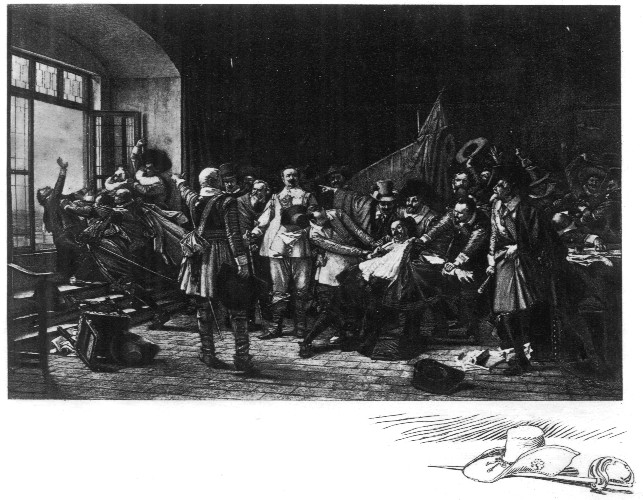
 The Imperial Austrian Councillors are thrown out of the
window of the castle of the Hradschin, at Prague, by the enraged
Bohemian Deputies, thus precipitating the Thirty Years' War
The Imperial Austrian Councillors are thrown out of the
window of the castle of the Hradschin, at Prague, by the enraged
Bohemian Deputies, thus precipitating the Thirty Years' WarPainting by Vacslav Brozik
The Project Gutenberg EBook of The Great Events by Famous Historians,
Volume 11, by Various

This eBook is for the use of anyone anywhere at no cost and with
almost no restrictions whatsoever.  You may copy it, give it away or
re-use it under the terms of the Project Gutenberg License included
with this eBook or online at www.gutenberg.org


Title: The Great Events by Famous Historians, Volume 11

Author: Various

Editor: Rossiter Johnson
        Charles Horne
        John Rudd

Release Date: June 19, 2008 [EBook #25821]

Language: English

Character set encoding: ISO-8859-1

*** START OF THIS PROJECT GUTENBERG EBOOK THE GREAT EVENTS, VOLUME 11 ***


Produced by The Online Distributed Proofreading Team at
https://www.pgdp.net.
The Imperial Austrian Councillors are thrown out of the
window of the castle of the Hradschin, at Prague, by the enraged
Bohemian Deputies, thus precipitating the Thirty Years' War
A COMPREHENSIVE AND READABLE ACCOUNT OF THE WORLD'S HISTORY, EMPHASIZING THE MORE IMPORTANT EVENTS, AND PRESENTING THESE AS COMPLETE NARRATIVES IN THE MASTER-WORDS OF THE MOST EMINENT HISTORIANS
ON THE PLAN EVOLVED FROM A CONSENSUS OF OPINIONS GATHERED FROM THE MOST DISTINGUISHED SCHOLARS OF AMERICA AND EUROPE, INCLUDING BRIEF INTRODUCTIONS BY SPECIALISTS TO CONNECT AND EXPLAIN THE CELEBRATED NARRATIVES, ARRANGED CHRONOLOGICALLY. WITH THOROUGH INDICES, BIBLIOGRAPHIES, CHRONOLOGIES, AND COURSES OF READING

COPYRIGHT, 1905,
By THE NATIONAL ALUMNI
PAGE
An Outline Narrative of the Great Events, xiii
CHARLES F. HORNE
Henry Hudson Explores the Hudson River (a.d. 1609), 1
HENRY R. CLEVELAND
Galileo Overthrows Ancient Philosophy
The Telescope and Its Discoveries (a.d. 1610), 14
SIR OLIVER LODGE
The Beginning of British Power in India (a.d. 1612), 30
BECKLES WILLSON
The Dutch Settlement of New York (a.d. 1614), 44
DAVID T. VALENTINE
Harvey Discovers the Circulation of the Blood (a.d. 1616), 50
THOMAS H. HUXLEY
The "Defenestration" at Prague (a.d. 1618)
The Thirty Years War, 62
SAMUEL R. GARDINER
CHARLES F. HORNE
The First American Legislature (a.d. 1619), 76
CHARLES CAMPBELL
Introduction of Negroes into Virginia (a.d. 1619)
Spread of Slavery and Cultivation of Tobacco, 81
CHARLES CAMPBELL
[Pg viii]JOHN M. LUDLOW
English Pilgrims Settle at Plymouth (a.d. 1620), 93
JOHN S. BARRY
The Birth of Modern Scientific Methods (a.d. 1620)
Bacon and Descartes, 116
GEORGE HENRY LEWES
Siege of La Rochelle (a.d. 1627)
Richelieu Rules France, 129
ANDREW D. WHITE
The Great Puritan Exodus to New England
The Founding of Boston (a.d. 1630), 153
JOHN G. PALFREY
Triumph and Death of Gustavus Adolphus at Luetzen (a.d. 1632), 174
BENJAMIN CHAPMAN
Recantation of Galileo (a.d. 1633), 184
SIR OLIVER LODGE
The Educational Reform of Comenius (a.d. 1638), 192
SIMON SOMERVILLE LAURIE
The First Written Free Constitution in the World (a.d. 1639)
Earliest Union among American Colonies (a.d. 1643), 205
GIDEON H. HOLLISTER
JOHN MARSHALL
Abolition of the Court of Star-chamber (a.d. 1641)
The Popular Revolt against Charles I, 215
HENRY HALLAM
LORD MACAULAY
The Founding of Montreal (a.d. 1642), 232
ALFRED SANDHAM
Presbyterianism Established
Meeting of the Westminster Assembly (a.d. 1643), 238
[Pg ix]DAVID MASSON
Masaniello's Revolt at Naples (a.d. 1647), 253
ALFRED VON REUMONT
The Peace of Westphalia (a.d. 1648)
The War of the Fronde, 285
ARTHUR HASSALL
Religious Toleration Proclaimed in Maryland (a.d. 1649), 303
G. L. DAVIS
The Great Civil War in England
The Execution of Charles I (a.d. 1649), 311
LORD MACAULAY
CHARLES KNIGHT
Cromwell's Campaign in Ireland (a.d. 1649), 335
FREDERIC HARRISON
Molière Creates Modern Comedy (a.d. 1659), 347
HENRI VAN LAUN
Cromwell's Rule in England
The Restoration (a.d. 1660), 357
THOMAS CARLYLE
JOHN RICHARD GREEN
SAMUEL PEPYS
Universal Chronology (a.d. 1609-1660), 387
JOHN RUDD
PAGE
The imperial Austrian Councillors are thrown out of the
window of the castle of Hradschin by the enraged Bohemian
Deputies, thus precipitating the Thirty Years' War (page
65), Frontispiece
Painting by Vacslaw Brezik.
Landing of the Pilgrim Fathers at Plymouth Rock, 106
Painting by A. Gisbert.
Gazing across the broader field of universal history, one comes more and more to overlook the merely temporary, constantly shifting border lines of states, and to see Western Europe as a whole, to watch its nations as a single people guided by similar developments of the mind, impelled by similar stirrings of the heart, taking part in but a single story, the marvellous tale of man's advance.
This sense of an all-enfolding unity, an ever-advancing common destiny, sinks weakest perhaps in the period we now approach. The nations seem sharply separated in their careers. In the preceding age the power of Spain and the fanaticism of its monarch, Philip II, had made the reëstablishment of Catholicism the dominant question throughout Europe. But in 1609 Philip III of Spain abandoned his father's attempt to conquer Holland and again enforce a universal religion. In 1610 Henry IV of France, who had brought peace and amity out of the savage religious wars within his own realm, fell under an assassin's knife. These two events may be accepted as marking a turn in the current of the world, a change in the thoughts of men. The next half-century saw wars indeed, bloody and bitter wars, but they were no longer primarily religious. The strife was more than half political, and men of opposite faiths found themselves at[Pg xiv] times allied upon the battle-field. The feeling of religious brotherhood grew weaker, that of political allegiance stronger.
The triumph of Holland had much to do with this. During almost a generation the Catholics of the Southern Netherlands had been united with the Protestants of the Northern Provinces in desperate war against the tyranny of Spain; and though only Holland finally achieved independence, her people could scarce forget their long brotherhood with the Catholic South. And now Holland was a republic, her people were self-governing! Looking with prophetic vision into the future, we may assert that this was only the first step toward a broader union of all the nations when every man shall be self-governing, and hence all shall be equal and united and progressive. But for its own time at least the freedom of Holland was a sharp influence toward division among the people of Europe, toward the establishment of differences, the growth of national as opposed to universal brotherhood.
There was, to be sure, an earlier republic in Europe, Switzerland. But the Swiss maintained themselves by their isolation, their remoteness from other nations and from one another in their bleak mountain valleys. The Dutch, on the contrary, inhabited a flat sea-coast; they were traders; their very existence depended on intercourse with other lands. Hence they had to be ever alert in defence of their hard-won freedom. The spirit of nationality, of patriotism grew strong within them. At one time they had been members of the German empire; at another, subjects of France, of Burgundy, of Spain. Now they were Hollanders, a distinct nation by themselves, and an example to all others of what a united land of men might do.
France also had learned a stronger sense of nationality from her hero-king, Henry IV. Always, through all his religious wars, he had insisted that he was king of all Frenchmen, both Catholic and Protestant, and would be a father to them all. He withdrew his Protestant army from besieging Paris when the surrender of the city seemed certain, abandoned his triumph "lest Frenchmen starve." Englishmen, too, in the age of Elizabeth, had learned to regard themselves not only as different from[Pg xv] but as far superior to men of other races. Spain both by her victories and by her sufferings had opened a gap between her people and others. Only Germany, through her very importance and vague imperial predominance over the surrounding lands, failed to find within herself that necessity for union which made other kingdoms strong.
By this internal division Germany was now plunged into the awful tragedy of the Thirty Years' War, a partly political, partly religious contest in which all the nations of Europe by degrees took some part. Thus the war forms to a certain extent a centre around which the movements of the age are grouped. England also had her great religious strife, her Puritan revolution, which collapsed in 1660. Yet on the whole the age is political even more than religious, and the ablest statesman of the day, Richelieu, the most successful guardian France has ever known, reaped for his own land all the benefits of the world-wide turmoil. France, which had so often seemed on the point of assuming the foremost place in Europe and had been so often checked, now advanced definitely to the front. The Bourbons, descendants of Henry IV, took the rank of the decaying Hapsburg family as the chief rulers of Europe. Historians often call this the age of Richelieu.
Spain and Austria, the two great Hapsburg states, both decayed in power. Italy, the Hapsburg dependent, lost the last vestiges of her ancient intellectual supremacy. Everywhere the South of Europe gave place to the North.
The blight of the Inquisition was upon Spain. The Moors were banished, the Jews were banished; and it had been the industry of these two races which had largely supported the pride and laziness of the hidalgos. In Italy, too, the Inquisition held sway. Galileo with his telescope revealed facts which proved the theories of Copernicus, and made impossible the ancient idea that our earth was the centre of the universe.[1] All Europe rang with his discoveries; but the Church refused to understand, forbade him to teach doctrines which it declared heretical. For a time the astronomer's mouth was closed,[Pg xvi] but not so the minds of those who had listened to him. In England, where thought was free, Harvey founded medical science by his proof of the circulation of the blood;[2] the Lord Chancellor Bacon wrote his celebrated Novum Organum, pointing out to modern investigators the methods they must follow. In Germany Comenius revitalized the dead world of education.[3] In France Descartes created within his own mind a revolution scarce less important than that of Luther. He freed philosophy from its thraldom to religion. He bade the mind of man to stand by itself, lone in the midst of an unmeasured universe, and discover of what one thing it could feel assured by its own unbiassed thought. His famous first conclusion, "I think, therefore I exist," stands as the corner-stone of modern philosophy.[4]
Meanwhile Galileo, roused by the encouragement of scientific friends, began a second time with infinite wit and sarcasm to expound and defend his doctrines. The Church took him more sternly in hand. He was imprisoned by the Inquisition and emerged from its dark chambers a broken and silent man. Philosophy, terrified, fled from Italy, not to return until over two centuries of the world's advance had prepared for her a less barbaric greeting.[5]
Southern Italy was ruled by viceroys from Spain, but so feeble had the Hapsburg grip become that Masaniello, a fisherman of Naples, was able to rouse his city against its tyrants, and for over a year Spain was unable to reëstablish her authority. When she did, it was only by the treachery of the peasant leaders who had succeeded the murdered Masaniello.[6]
The internal decay of Spain and the lassitude of her two feeble sovereigns, Philip III (1598-1621) and Philip IV (1621-1665), prevented her from rendering any material assistance to Austria, where the other branch of the Hapsburgs, descendants of Charles V's brother Ferdinand, were reduced to struggle for their very existence. Ferdinand and his immediate successor as[Pg xvii] Emperor of Germany had kept the religious peace carefully, and Germany had prospered. But then came new emperors who repudiated their methods—Ferdinand had been deemed by the Church little better than a Protestant. In 1608 the Protestant princes, becoming suspicious, formed a league for mutual defence. The Catholics under Maximilian of Bavaria formed an answering league in 1609. They almost came to open war that year over a disputed succession in one of the smaller duchies, the Protestants appealing to Holland for help and the Catholics to Spain. Fortunately the terrible example of the civil wars they had seen in France, held them back for a time. But always there were arising new grounds for quarrel.
In 1618 the actual war began. A new leader, Ferdinand II, young and intensely Catholic, had risen to guide the Hapsburg fortunes in Austria, had successfully forced that land to resume the old religion, and now aimed to do the same in Bohemia. The Bohemians, famed fanatics of the unforgotten Hussite wars, broke into open rebellion, threw Ferdinand's ministers through a window, and so roused the war that ruined Germany.[7]
Ferdinand became Emperor of Germany the next year (1619), and called the Catholic league to his aid in Bohemia. The rebels elected as king one of the German electors, a son-in-law of the King of England, and head of the Protestant league. Slowly, unwillingly, the various German states, and the surrounding countries also, found themselves dragged into the struggle. At first Emperor Ferdinand was successful, Bohemia was completely subdued and made Catholic, as Austria had been. A great general and shrewd contriver, Wallenstein, rose to the Emperor's aid and laid Germany prostrate at his feet. For a moment the Hapsburgs seemed as all-powerful as in the proudest days of Charles V. But his own coreligionists turned against Ferdinand. The princes of the Catholic league grew frightened; he was indeed crushing Protestantism, but he was trampling on their rights as well. They fell away from his alliance. Richelieu, also dreading the Hapsburg aggrandizement, brought[Pg xviii] France to take part in the war. Sweden's hero-king Gustavus Adolphus invaded Germany to defend the Protestant faith. He won splendid victories, but at last fell in his supreme battle at Luetzen, from which Wallenstein's troops fled defeated (1632).[8]
The war had now lasted fourteen years. The Emperor could raise no more armies. His one able general, Wallenstein, was slain as a traitor. Germany was exhausted. Yet because no one power would consent to the others' proposed terms of peace, the war dragged on and on, in such feeble fashion as it could. Its misery fell almost wholly upon the unhappy peasantry. The armies of both sides lived upon the country; what they could not devour they destroyed, lest it be of use to the enemy. Germany became a desert, and its people starved amid their desolated homes. The troops, brutalized by long familiarity with suffering, tortured their captives to extort money or sometimes, it would seem, for the mere pleasure of the sport.
The Emperor Ferdinand died in the midst of the hideous ruin he had wrought. The Swedes, who had long abandoned the high principles of Gustavus, demanded territory as the price of peace. So did France. At last in 1648 the Peace of Westphalia was arranged. By it France became the foremost state of Europe; Sweden became one of the great powers; England, engrossed in her own civil war, could pull no chestnuts from the fire; but the German empire fell practically to pieces. Switzerland and Holland were formally declared outside of it. Each little prince got what increase of power he wanted, and the authority of the empire disappeared. The Hapsburgs still retained their title as its heads, but their real authority was confined entirely to their personal domains, Austria, Bohemia, and such part of Hungary as they could hold against the Turks.[9]
Historians tell us that in those terrible thirty years the population of Germany had dwindled from thirty million to only twelve million; nearly two-thirds of its common people had perished, mostly of starvation. The stored-up wealth of ages had been destroyed. The very character of the race had changed,[Pg xix] broken from its old hardihood to temporary feebleness and fawning. The land had been set back an entire century, perhaps two, in its advance toward civilization. That is what war means. That is glory!
Meanwhile France, profiting by the feebleness of her neighbors, had made great strides. At first the death of Henry IV had threatened her with the old anarchy. Louis XIII, Henry's son, was but a child; the Queen-mother, who became regent, was an Italian, Marie de' Medici, and devoted to the Spanish interests. The Huguenots feared renewed persecution. The nobles of the court grasped after renewed power.
In such turmoil was the land that it seemed necessary to summon the "States-General," the assembly of all the notables of France, the last one to be called until that eventful year of 1789. The States-General talked and dissolved, having done nothing but reveal that there was one capable man among its members, a young bishop who was to be a cardinal, Richelieu. His plans for reform and pacification were not adopted, but he drew the attention of the Queen Regent and became her chief adviser, later the chief adviser of the King.
Richelieu did four things for France. He broke the power of the Huguenots, who had become a political party, and a very troublesome one, a state within a state, independent and defiant, with their impenetrable capital at La Rochelle. After one of the most remarkable sieges of history Richelieu captured La Rochelle, crushed the resistance of the Huguenots by repeated defeats elsewhere, and then—granted them complete religious freedom![10]
It is one of the epochs of the world, the beginning of toleration not through force, but through free-will. A Catholic and a cardinal, having complete power to force these Protestants to his will, bids them worship as they choose, asking only that they become patriotic Frenchmen.
Next Richelieu humbled the great nobles of France, hanging them when they disobeyed his laws. Next by his part in the Thirty Years' War he won territory from both Germany and[Pg xx] Spain. He was by no means the first Catholic ruler thus to seek Protestant allies; Francis I and Henry II had both done so in France; in Germany Charles V had sent a Lutheran army against the Pope. But it was Richelieu's successful adherence to this plan that positively and finally relegated religion to a minor place in statecraft, and made nationality, political supremacy, what some have called "vainglory," the foremost impulse.
Last, not least, in Richelieu's brilliant career, is to be noted that he revived literature in France. He created the "French Academy," the "forty immortals" in whose successors Paris still takes pride to-day. The French drama was born. Corneille wrote The Cid, and the Cardinal himself took his pen and attempted to produce a better tragedy. Comedy, too, arose. Molière began the marvellous career which a little later was to make him the undying idol of the stage in France.[11]
Nor did Richelieu's death (1642) turn his country from the triumphant course toward which he had led the way. His King died with him, and his power passed to another cardinal, Mazarin, ruling for another baby-king, who was to be Louis XIV. Mazarin found himself confronting an almost similar situation to that which had followed the death of Henry IV. There was a child upon the throne; an incapable queen-mother as regent, foreign, and friendly to the Spaniards; the nobles grasped after power; Paris grumbled under taxation. Mazarin had even to face a feeble, frivolous civil war against himself, the Fronde.[12] But he soon established his supremacy, secured for France in 1648 all she had earned out of the war with Germany, and then ruled with firm hand, bringing wealth and peace and prosperity to the state until his death in 1661. Richelieu and Mazarin made possible that most spectacular period of all French history which immediately followed under Louis XIV.
Turn now to England, to see why she had held so apart from the continental struggles of the period. James I, her Scotch king of 1603, had indeed interfered a bit in the Thirty Years'[Pg xxi] War, seeking to aid his unlucky son-in-law, the King of Bohemia. But James had soon found difficulties enough at home. The Elizabethan age had made Englishmen feel very highly their individual importance. Each man, through the entire social scale down even to the peasantry, had felt a personal interest, a personal pride in the repulse of the Spaniards and the upholding of the Queen. She tyrannized over them as a woman; they defended her as men. But when this foreigner, this Scotch king, came to rule them, they saw no need to yield him such exact obedience. Freedom of thought had brought with it new political ideas, and men talked much of the authority of Parliament and their right to tax themselves. James, on the contrary, had a large conception of the "divine right" of kings, not to be restricted by any law whatever, and a still larger opinion of his own personal ability and unfailing wisdom. Gradually there grew up a distinct opposition between King and Parliament, centring always on that one question—who should lay the taxes, that is, who provide the income of the King? The English revolution, like the American one to follow, gave to principles far more noble in themselves the air of a mere money dispute.
James, dying in 1625, left a very pretty quarrel to his son. Charles I, more able and kingly than his father, but equally obstinate, equally devoted to the Stuart doctrine of a king's divinity, finally endeavored to rule without summoning any of these arguing parliaments. To accomplish this he had to gather money by other methods, declared illegal by his people. Always appealing to the law, they grew more and more bitter as Charles turned it against them, putting in office judges who would do his will, reëstablishing the ancient Court of Star-Chamber, with its power to torture witnesses.
Moreover, there was growing up in England a type of more extreme Protestantism. The English Church had retained many of the forms of Rome, including its hierarchal system of priests and bishops. These were dear to the hearts of the Stuart kings, whose Protestantism had never been very radical. The Scotch Church, on the other hand, had swung far from Rome indeed, and many Protestants everywhere refused to have any priestly interpreter intervene between them and their own consciences, their own beliefs. In England these men came to be called Puritans.[Pg xxii] They were deeply earnest; religion was ever in their thoughts; they had protested even against the wickedness of the theatre in Shakespeare's time; and now as they watched the light frivolity of the court they became imbittered. They called Charles the "man of sin." Round these stern fanatics began to centre the general opposition to the King.
At length the Scotch Protestants broke into open revolt, and the King found he must have help, must summon a parliament at last. That was the beginning of the end. The Englishmen who gathered at his call were in no pleasant mood. They at once took steps to secure other parliaments to follow immediately on their own. All Charles' encroachments on the law were overturned; his courts, Star-Chamber and others, were abolished; his chief minister was declared a traitor and beheaded.[13] The King, helpless, infuriated, raised the standard of civil war (1642).
The strife was thus in its inception political; but it soon became religious as well. Since the King was the head of the English Church, most of its members rallied round him. The Puritans in Parliament secured the calling of a convention to settle the various religious questions before the nation. This "Westminster Assembly" established the Presbyterian Church.[14]
The less extreme members of the opposition to the King grew doubtful; they saw whither the Puritans would lead them. The war became one of stern religious fanaticism against gallant reckless Cavalier loyalty—of the middle classes against the aristocracy and their servitors. Cromwell rose as the type and model of the Puritans. Under his lead they defeated the Cavaliers and executed their King. Charles perished on the scaffold, and England, following Holland's lead, was declared a republic. This was in 1649, the year after the Peace of Westphalia.[15]
Cromwell remained practically the ruler of England. He defeated the Scotch, and compelled them to submit to England's sway. He went over to Ireland and stamped out revolt there,[Pg xxiii] terrorized the land as no Englishman had ever done before, establishing English colonists, Protestants, over a considerable portion of its soil.[16] Secure of power at home, the mighty leader began next to take a part in European affairs, raising England to higher consideration than she had held even in Elizabeth's time. Yet toward the end he must have realized that he had failed in his life's dream, that England was unfitted to be the united religious republic he had hoped to make her. Even before his death the land was broken into endless factions, the majority dissatisfied with the strictness of Puritan rule, a small minority eager to go much further with its severity. Cromwell found himself compelled to dissolve his parliaments as autocratically as ever Charles had done; and when he died, when his iron hand dropped from the helm, no man knew what was to follow. No one wanted war. Each little wrangling party looked a different way for peace and security. At length the majority agreed to call back their Stuart kings. Charles II, son of the Charles I they had beheaded, was voluntarily replaced upon the English throne. Religion had once more proved inefficient as the central principle of government.[17]
Equally important for the future, though not for their own day, were the movements toward colonization in this period. Even while their war with Spain was in progress the Dutch merchants had begun to look for trading-stations in the distant seas. Following the Portuguese, they sailed around Africa, and wrenched from their feeble predecessors most of the Indian trade. They took possession of the Eastern isles, Java and Sumatra. In the very year of the truce, 1609, they turned their attention westward and sent Henry Hudson to explore the American coast.[18] Claiming possession of the river he had found, they built settlements at Albany and New York.[19]
England was their chief rival on the seas. Her ships followed theirs to India and fought with them, refusing to be dispossessed[Pg xxiv] like the Portuguese.[20] The English colonists at Jamestown had preceded the Dutch in defiance of Spain and the denial of her claims upon America. England and Holland quarrelled for the carrying trade of the world. They became the two foremost naval powers, and in Cromwell's time fought a fierce and vigorous naval war. The two Protestant champions of Europe wasting their strength one against the other for commercial causes! Clearly indeed do we approach an age when religion becomes of little international prominence.
France also had the colonizing fever. Henry IV had sent an expedition to Quebec. Richelieu authorized one which settled Montreal, destined to be the chief metropolis of Canada.[21]
These early settlements had been movements authorized by their governments, encouraged by the parent state for its own purposes; but now there began a civilization very different in character. Some of the English Puritans finding the oppressive hand of King James I fall heavy upon them, extracted from his ministers a half-unwilling permission to settle on his American lands. So came the famous voyage of the Mayflower and the building of Plymouth on the Massachusetts coast.[22] King James had been a foster-father to the Virginia colony, he had drawn up a set of laws for it with his own hand, and when these failed he had granted it a local assembly of its own, the beginning of representative government in America.[23] Virginia was prospering. Slavery was introduced there in 1619 and, much to the royal patron's disgust, the cultivation of tobacco as well.[24] Soon the new colony was supplying the world with tobacco.
But the nest of Puritans farther north could expect no such favor from James. As the hand of oppression grew ever heavier at home, the Puritans, not yet dreaming of escape by rebellion, looked more and more thoughtfully to the land beyond the sea. They planned to expatriate themselves almost in a body. A[Pg xxv] great preliminary fleet carrying over a thousand souls left England in 1630 and settled Boston.[25]
During the next ten years twenty thousand Puritans came to Massachusetts. This was colonization on a scale hitherto unconceived. A new and powerful commonwealth burst suddenly into being where the primeval wilderness had so lately been. And it was a commonwealth rebellious from the start. When the civil war broke out in England against Charles, large numbers of the Massachusetts men hurried back to take grim part in it. In America the rule of England became little more than a name. Other colonies were formed both north and south, and they stood by themselves with no mother-country to uphold them. They grew strong through wrestling with the wilderness. Connecticut was settled from Massachusetts, and its pioneers, seeing no arm of authority long enough to reach them, drew up a code of laws of their own, the first written constitution prepared by a free people for their own government.[26] A few years later we find the New England colonies uniting in a union for defence against the Indians—and, if necessary, against King Charles' tyranny as well.[27] Maryland was settled by English Catholics who had found themselves as oppressed as the Puritans at home, and there the assembly of burghers proclaimed religious toleration to all who joined them.[28] Surely the New World had something to teach the Old! Only Europe's brightest and bravest and best had ventured to cross the seas for the freedom they desired. It was with good material indeed, and after sore experience of European blunders, that the land beyond the ocean began its remarkable career.
[FOR THE NEXT SECTION OF THIS GENERAL SURVEY SEE VOLUME XII]
Although Henry Hudson was not the first discoverer of the waters to which his name was given, he was a bold sailor whose achievements justly gave him rank with the foremost navigators and explorers of his time. He was well versed in scientific navigation. His first recorded voyage was made in the service of the Muscovy or Russia Company of England in 1607. His object was to find a passage across the north pole to the Spice Islands (Moluccas), in the Malay Archipelago. Though failing in this purpose, he reached a higher latitude than had before been attained by any navigator.
His next venture (1608), for the same company, was for "finding a passage to the East Indies by the northeast," but he failed to pass in that direction beyond Nova Zembla, and returned to England. These two failures discouraged the Muscovy Company, but did not daunt Henry Hudson. Again he determined to sail the northern seas, and the story of his third great voyage and its results is here given to the reader.
Hudson, whose mind was completely bent upon making the discovery which he had undertaken, now sought employment from the Dutch East India Company. The fame of his adventures had already reached Holland, and he had received from the Dutch the appellations of the bold Englishman, the expert pilot, the famous navigator. The company were generally in favor of accepting the offer of his services, though the scheme was strongly opposed by Balthazar Moucheron, one of their number, who had some acquaintance with the arctic seas. They accordingly gave him the command of a small vessel, named the Half Moon, with a crew of twenty men, Dutch and English, among whom was Robert Juet, who had accompanied him as mate on his second voyage. The journal of the present voyage, which is published in Purchas' Pilgrims, was written by Juet.
He sailed from Amsterdam March 25, 1609, and doubled the[Pg 2] North Cape in about a month. His object was to pass through the Vaygats, or perhaps to the north of Nova Zembla, and thus reach China by the northeast passage. But after contending for more than a fortnight with head winds, continual fogs, and ice, and finding it impossible to reach even the coast of Nova Zembla, he determined to abandon this plan, and endeavor to discover a passage by the northwest. He accordingly directed his course westerly, doubled the North Cape again, and in a few days saw a part of the western coast of Norway, in the latitude of 68°. From this point he sailed for the Faroe Islands, where he arrived about the end of May.
Having replenished his water-casks at one of these islands he again hoisted sail, and steered southwest, in the hope of making Buss Island, which had been discovered by Sir Martin Frobisher, in 1578, as he wished to ascertain if it was correctly laid down on the chart. As he did not succeed in finding it, he continued this course for nearly a month, having much severe weather and a succession of gales, in one of which the foremast was carried away. Having arrived at the 45th degree of latitude, he judged it best to shape his course westward, with the intention of making Newfoundland. While proceeding in this direction he one day saw a vessel standing to the eastward, and wishing to speak her he put the ship about and gave chase; but finding as night came on that he could not overtake her he resumed the westerly course again.
On July 2d he had soundings on the Grand Bank of Newfoundland, and saw a whole fleet of Frenchmen fishing there. Being on soundings for several days he determined to try his luck at fishing; and the weather falling calm he set the whole crew at work to so much purpose that, in the course of the morning, they took between one and two hundred very large cod. After two or three days of calm the wind sprang up again, and he continued his course westward till the 12th, when he first had sight of the coast of North America. The fog was so thick, however, that he did not venture nearer the coast for several days; but at length, the weather clearing up, he ran into a bay at the mouth of a large river, in the latitude of 44°. This was Penobscot Bay, on the coast of Maine.
He already had some notion of the kind of inhabitants he[Pg 3] was to find here, for a few days before he had been visited by six savages, who came on board in a very friendly manner and ate and drank with him. He found that from their intercourse with the French traders they had learned a few words of their language. Soon after coming to anchor he was visited by several of the natives, who appeared very harmless and inoffensive; and in the afternoon two boats full of them came to the ship, bringing beaver-skins and other fine furs, which they wished to exchange for articles of dress. They offered no violence whatever, though we find in Juet's journal constant expressions of distrust, apparently without foundation.
They remained in this bay long enough to cut and rig a new foremast, and being now ready for sea the men were sent on shore upon an expedition that disgraced the whole company. What Hudson's sentiments or motives with regard to this transaction were we can only conjecture from a general knowledge of his character, as we have no account of it from himself. But it seems highly probable that, if he did not project it, he at least gave his consent to its perpetration. The account is in the words of Juet, as follows: "In the morning we manned our scute with four muskets and six men, and took one of their shallops and brought it aboard. Then we manned our boat and scute with twelve men and muskets, and two stone pieces, or murderers, and drave the salvages from their houses, and took the spoil of them, as they would have done of us." After this exploit they returned to the ship and set sail immediately. It does not appear from the journal that the natives had ever offered them any harm or given any provocation for so wanton an act. The writer only asserts that they would have done it if they could. No plea is more commonly used to justify tyranny and cruelty than the supposed bad intentions of the oppressed.
He now continued southward along the coast of America. It appears that Hudson had been informed by his friend, Captain John Smith, that there was a passage to the western Pacific Ocean south of Virginia, and that, when he had proved the impossibility of going by the northeast, he had offered his crew the choice either to explore this passage spoken of by Captain John Smith or to seek the northwest passage by going through Davis Strait. Many of the men had been in the East[Pg 4] India service, and in the habit of sailing in tropical climates, and were consequently very unwilling to endure the severities of a high northern latitude. It was therefore voted that they should go in search of the passage to the south of Virginia.
In a few days they saw land extending north, and terminating in a remarkable headland, which he recognized to be Cape Cod. Wishing to double the headland, he sent some of the men in the boat to sound along the shore, before venturing nearer with the ship. The water was five fathoms deep within bow-shot of the shore, and, landing, they found, as the journal informs us, "goodly grapes and rose-trees," which they brought on board with them. He then weighed anchor and advanced as far as the northern extremity of the headland. Here he heard the voice of someone calling to them, and, thinking it possible some unfortunate European might have been left there, he immediately despatched some of the men to the shore. They found only a few savages; but, as these appeared very friendly, they brought one of them on board, where they gave him refreshments and also a present of three or four glass buttons, with which he seemed greatly delighted. The savages were observed to have green tobacco and pipes, the bowls of which were made of clay and the stems of red copper.
The wind not being favorable for passing west of this headland into the bay, Hudson determined to explore the coast farther south, and the next day he saw the southern point of Cape Cod, which had been discovered and named by Bartholomew Gosnold in the year 1602. He passed in sight of Nantucket and Martha's Vineyard, and continued a southerly course till the middle of August, when he arrived at the entrance of Chesapeake Bay. "This," says the writer of the journal, "is the entrance into the King's river, in Virginia, where our Englishmen are." The colony, under the command of Newport, consisting of one hundred five persons, among whom were Smith, Gosnold, Wingfield, and Ratcliffe, had arrived here a little more than two years before, and if Hudson could have landed he would have enjoyed the satisfaction of seeing and conversing with his own countrymen, and in his own language, in the midst of the forests of the New World. But the wind was blowing a gale from the northeast, and, probably dreading a[Pg 5] shore with which he was unacquainted, he made no attempt to find them.
He continued to ply to the south for several days, till he reached the latitude of 35° 41', when he again changed his course to the north. It is highly probable that if the journal of the voyage had been kept by Hudson himself we should have been informed of his reasons for changing the southerly course at this point. The cause, however, is not difficult to conjecture. He had gone far enough to ascertain that the information given him by Captain Smith with respect to a passage into the Pacific south of Virginia was incorrect, and he probably did not think it worth while to spend more time in so hopeless a search. He therefore retraced his steps, and on August 28th discovered Delaware Bay, where he examined the currents, soundings, and the appearance of the shores, without attempting to land. From this anchorage he coasted northward, the shore appearing low, like sunken ground, dotted with islands, till September 2d, when he saw the highlands of Navesink, which, the journalist remarks, "is a very good land to fall with and a pleasant land to see."
The entrance into the southern waters of New York is thus described in the journal: "At three of the clock in the afternoon we came to three great rivers. So we stood along to the northernmost, thinking to have gone into it, but we found it to have a very shoal bar before it, for we had but ten foot water. Then we cast about to the southward and found two fathoms, three fathoms, and three and a quarter, till we came to the southern side of them; then we had five and six fathoms, and anchored. So we sent in our boat to sound, and they found no less water than four, five, six, and seven fathoms, and returned in an hour and a half. So we weighed and went in and rode in five fathoms, oozy ground, and saw many salmons, and mullets, and rays very great." The next morning having ascertained by sending in the boat that there was a very good harbor before him, he ran in and anchored at two cables' length from the shore. This was within Sandy Hook Bay.
He was very soon visited by the natives, who came on board his vessel, and seemed to be greatly rejoiced at his arrival among them. They brought green tobacco, which they desired to exchange for knives and beads, and Hudson observed that they[Pg 6] had copper pipes and ornaments of copper. They also appeared to have plenty of maize, from which they made good bread. Their dress was of deerskins, well cured, and hanging loosely about them. There is a tradition that some of his men, being sent out to fish, landed on Coney Island. They found the soil sandy, but supporting a vast number of plum-trees loaded with fruit, and grapevines growing round them.
The next day, the men, being sent in the boat to explore the bay still farther, landed, probably on the Jersey shore, where they were very kindly received by the savages, who gave them plenty of tobacco. They found the land covered with large oaks. Several of the natives also came on board, dressed in mantles of feathers and fine furs. Among the presents they brought were dried currants, which were found extremely palatable.
Soon afterward five of the men were sent in the boat to examine the north side of the bay and sound the river, which was perceived at the distance of four leagues. They passed through the Narrows, sounding all along, and saw "a narrow river to the westward, between two islands," supposed to be Staten Island and Bergen Neck. They described the land as covered with trees, grass, and flowers, and filled with delightful fragrance. On their return to the ship they were assaulted by two canoes; one contained twelve and the other fourteen savages. It was nearly dark, and the rain which was falling had extinguished their match, so that they could only trust to their oars for escape. One of the men, John Colman, who had accompanied Hudson on his first voyage, was killed by an arrow shot into his throat, and two more were wounded. The darkness probably saved them from the savages, but at the same time it prevented their finding the vessel, so that they did not return till the next day, when they appeared, bringing the body of their comrade. Hudson ordered him to be carried on shore and buried, and named the place, in memory of the event, Colman's Point.
He now expected an attack from the natives, and accordingly hoisted in the boat and erected a sort of bulwark along the sides of the vessel, for the better defence. But these precautions were needless. Several of the natives came on board, but in a friendly manner, wishing to exchange tobacco and Indian corn for the[Pg 7] trifles which the sailors could spare them. They did not appear to know anything of the affray which had taken place. But the day after two large canoes came off to the vessel, the one filled with armed men, the other under the pretence of trading. Hudson, however, would only allow two of the savages to come on board, keeping the rest at a distance. The two who came on board were detained, and Hudson dressed them up in red coats; the remainder returned to the shore. Presently another canoe, with two men in it, came to the vessel. Hudson also detained one of these, probably wishing to keep him as a hostage, but he very soon jumped overboard and swam to the shore. On the 11th Hudson sailed through the Narrows and anchored in New York Bay.
He prepared to explore the magnificent river which came rolling its waters into the sea from unknown regions. Whither he would be conducted in tracing its course he could form no conjecture. A hope may be supposed to have entered his mind that the long-desired passage to the Indies was now at length discovered; that here was to be the end of his toils; that here, in this mild climate, and amid these pleasant scenes, was to be found that object which he had sought in vain through the snows and ice of the Arctic zone. With a glad heart, then, he weighed anchor on September 12th, and commenced his memorable voyage up that majestic stream which now bears his name.
The wind only allowed him to advance a few miles the first two days of the voyage, but the time which he was obliged to spend at anchor was fully occupied in trading with the natives, who came off from the shore in great numbers, bringing oysters and vegetables. He observed that they had copper pipes, and earthen vessels to cook their meat in. They seemed very harmless and well disposed, but the crew were unwilling to trust these appearances, and would not allow any of them to come on board. The next day, a fine breeze springing up from the southeast, he was able to make great progress, so that he anchored at night nearly forty miles from the place of starting in the morning. He observes that "here the land grew very high and mountainous," so that he had undoubtedly anchored in the midst of the fine scenery of the Highlands.
When he awoke in the morning he found heavy mist over-hanging[Pg 8] the river and its shores and concealing the summits of the mountains. But it was dispelled by the sun in a short time, and taking advantage of a fair wind he weighed anchor and continued the voyage. A little circumstance occurred this morning which was destined to be afterward painfully remembered. The two savages, whom he held as hostages, made their escape through the portholes of the vessel and swam to the shore, and as soon as the ship was under sail they took pains to express their indignation at the treatment they had received, by uttering loud and angry cries. Toward night he came to other mountains, which, he says, "lie from the river's side," and anchored, it is supposed, near the present site of Catskill Landing. "There," says the journal, "we found very loving people and very old men, where we were well used. Our boat went to fish and caught great store of very good fish."
The next morning, September 16th, the men were sent again to catch fish, but were not so successful as they had been the day before, in consequence of the savages having been there in their canoes all night. A large number of the natives came off to the ship, bringing Indian corn, pumpkins, and tobacco. The day was consumed in trading with the natives and in filling the casks with fresh water, so that they did not weigh anchor till toward night. After sailing about five miles, finding the water shoal, they came to anchor, probably near the spot where the city of Hudson now stands. The weather was hot, and Hudson determined to set his men at work in the cool of the morning. He accordingly, on the 17th, weighed anchor at dawn and ran up the river about fifteen miles, when, finding shoals and small islands, he thought it best to anchor again. Toward night the vessel, having drifted near the shore, grounded in shoal water, but was easily drawn off by carrying out the small anchor. She was aground again in a short time in the channel, but, the tide rising, she floated off.
The two days following he advanced only about five miles, being much occupied by his intercourse with the natives. Being in the neighborhood of the present town of Castleton, he went on shore, where he was very kindly received by an old savage, "the governor of the country," who took him to his house, and gave him the best cheer he could. At his anchorage also, five[Pg 9] miles above this place, the natives came flocking on board, bringing a great variety of articles, such as grapes, pumpkins, beaver and otter skins, which they exchanged for beads, knives, and hatchets or whatever trifles the sailors could spare them. The next day was occupied in exploring the river, four men being sent in the boat, under the command of the mate, for that purpose. They ascended several miles and found the channel narrow and in some places only two fathoms deep, but after that seven or eight fathoms. In the afternoon they returned to the ship. Hudson resolved to pursue the examination of the channel on the following morning, but was interrupted by the number of natives who came on board. Finding that he was not likely to gain any progress this day, he sent the carpenter ashore to prepare a new foreyard, and in the mean time prepared to make an extraordinary experiment on board.
From the whole tenor of the journal it is evident that great distrust was entertained by Hudson and his men toward the natives. He now determined to ascertain, by intoxicating some of the chiefs, and thus throwing them off their guard, whether they were plotting any treachery. He accordingly invited several of them into the cabin and gave them plenty of brandy to drink. One of these men had his wife with him, who, the journal informs us, "sate so modestly as any one of our countrywomen would do in a strange place"; but the men had less delicacy, and were soon quite merry with the brandy. One of them, who had been on board from the first arrival of the ship, was completely intoxicated, and fell sound asleep, to the great astonishment of his companions, who probably feared that he had been poisoned, for they all took to their canoes and made for the shore, leaving their unlucky comrade on board. Their anxiety for his welfare, however, soon induced them to return, and they brought a quantity of beads, which they gave him, perhaps to enable him to purchase his freedom from the spell that had been laid upon him.
The poor savage slept quietly all night, and when his friends came to visit him the next morning they found him quite well. This restored their confidence, so that they came to the ship again in crowds, in the afternoon, bringing various presents for Hudson. Their visit, which was one of unusual ceremony, is thus[Pg 10] described in the journal: "So, at three of the clock in the afternoon, they came aboard and brought tobacco and more beads and gave them to our master, and made an oration, and showed him all the country round about. Then they sent one of their company on land, who presently returned and brought a great platter full of venison, dressed by themselves, and they caused him to eat with them. Then they made him reverence, and departed, all save the old man that lay aboard."
At night the mate returned in the boat, having been sent again to explore the river. He reported that he had ascended eight or nine leagues, and found but seven feet of water and irregular soundings.
It was evidently useless to attempt to ascend the river any farther with the ship, and Hudson therefore determined to return. We may well imagine that he was satisfied already with the result of the voyage, even supposing him to have been disappointed in not finding here a passage to the Indies. He had explored a great and navigable river to the distance of nearly a hundred forty miles; he had found the country along the banks extremely fertile, the climate delightful, and the scenery displaying every variety of beauty and grandeur; and he knew that he had opened the way for his patrons to possessions which might prove of inestimable value.
It is supposed that the highest place which the Half Moon reached in the river was the neighborhood of the present site of Albany, and that the boats being sent out to explore ascended as high as Waterford, and probably some distance beyond. The voyage down the river was not more expeditious than it had been in ascending; the prevalent winds were southerly, and for several days the ship could advance but very slowly. The time, however, passed agreeably in making excursions on the shore, where they found "good ground for corn and other garden herbs, with a great store of goodly oaks and walnut-trees, and chestnut-trees, ewe-trees and trees of sweetwood in great abundance, and great store of slate for houses, and other good stones"; or in receiving visits from the natives, who came on the ship in numbers. While Hudson was at anchor near the spot where the city bearing his name now stands, two canoes came from the place where the scene of the intoxication had occurred, and in[Pg 11] one of them was the old man who had been the sufferer under the strange experiment. He brought another old man with him, who presented Hudson with a string of beads, and "showed all the country there about, as though it were at his command." Hudson entertained them at dinner, with four of their women, and in the afternoon dismissed them with presents.
He continued the voyage down the river, taking advantage of wind and tide as he could, and employing the time when at anchor in fishing or in trading with the natives, who came to the ship nearly every day, till on October 1st he anchored near Stony Point.
The vessel was no sooner perceived from the shore to be stationary than a party of the native mountaineers came off in their canoes to visit it, and were filled with wonder at everything it contained. While the attention of the crew was taken up with their visitors upon deck, one of the savages managed to run his canoe under the stern and, climbing up the rudder, found his way into the cabin by the window, where, having seized a pillow and a few articles of wearing-apparel, he made off with them in the canoe. The mate detected him as he fled, fired at and killed him. Upon this, all the other savages departed with the utmost precipitation, some taking to their canoes and others plunging into the water. The boat was manned, and sent after the stolen goods, which were easily recovered; but as the men were returning to the vessel, one of the savages, who were in the water, seized hold of the keel of the boat, with the intention, as was supposed, of upsetting it. The cook took a sword and lopped his hand off, and the poor wretch immediately sank. They then weighed anchor and advanced about five miles.
The next day Hudson descended about seven leagues and anchored. Here he was visited in a canoe by one of the two savages who had escaped from the ship as he was going up. But fearing treachery, he would not allow him or his companions to come on board. Two canoes filled with armed warriors then came under the stern and commenced an attack with arrows. The men fired at them with their muskets and killed three of them. More than a hundred savages now came down upon the nearest point of land to shoot at the vessel. One of the cannon was brought to bear upon these warriors, and at the[Pg 12] first discharge two of them were killed and the rest fled to the woods.
The savages were not yet discouraged. They had doubtless been instigated to make this attack by the two who escaped near West Point, and who had probably incited their countrymen by the story of their imprisonment, as well as by representing to them the value of the spoil, if they could capture the vessel, and the small number of men who guarded it. Nine or ten of the boldest warriors now threw themselves into a canoe and put off toward the ship, but a shot from the cannon made a hole in the canoe and killed one of the men. This was followed by a discharge of musketry, which destroyed three or four more. This put an end to the battle, and in the evening, having descended about five miles, Hudson anchored in a part of the river out of the reach of his enemies, probably near Hoboken.
Hudson had now explored the bay of New York and the noble stream which pours into it from the north. For his employers he had secured a possession which would beyond measure reward them for the expense they had incurred in fitting out the expedition. For himself he had gained a name that was destined to live in the gratitude of a great nation through unnumbered generations. Happy in the result of his labors and in the brilliant promise they afforded, he spread his sails again for the Old World on October 4th, and in a little more than a month arrived safely at Dartmouth, in England.
The journal kept by Juet ends abruptly at this place. The question therefore immediately arises whether Hudson pursued his voyage to Holland, or whether he remained in England and sent the vessel home. Several Dutch authors assert that Hudson was not allowed, after reaching England, to pursue his voyage to Amsterdam; and this seems highly probable when we remember the well-known jealousy with which the maritime enterprises of the Dutch were regarded by King James.
Whether Hudson went to Holland himself or not, it seems clear from various circumstances that he secured to the Dutch Company all the benefits of his discoveries, by sending to them his papers and charts. It is worthy of note that the earliest histories of this voyage, with the exception of Juet's journal, were published by Dutch authors. Moreover, Hudson's own journal,[Pg 13] or some portion of it at least, was in Holland, and was used by De Laet previously to the publication of Juet's journal in Purchas' Pilgrims. But the most substantial proof that the Dutch enjoyed the benefit of his discoveries earlier than any other nation, is the fact that the very next year they were trading in Hudson River, which it is not probable would have happened if they had not had possession of Hudson's charts and journal.
When the Copernican system of astronomy was published to the world (1543) it had to encounter, as all capital theories and discoveries in science have done, the criticism, and, for some time, the opposition, of men holding other views. After Copernicus, the next great name in modern science is that of Tycho Brahe (1546-1601), who rejected the theory of Copernicus in favor of a modified form of the Ptolemaic system. This was still taught in the schools when two mighty contemporaries, geniuses of science, rose to overthrow it forever.
These men were Galileo Galilei—commonly known as Galileo—and Kepler, both astronomers, though Galileo's scientific work covered also a much wider field. He is regarded to-day as marking a distinct epoch in the progress of the world, and the following account of his work by the eminent scientist, Sir Oliver Lodge, expresses no more than a just appreciation of his great services to mankind.
Galileo exercised a vast influence on the development of human thought. A man of great and wide culture, a so-called universal genius, it is as an experimental philosopher that he takes the first rank. In this capacity he must be placed alongside of Archimedes, and it is pretty certain that between the two there was no man of magnitude equal to either in experimental philosophy. It is perhaps too bold a speculation, but I venture to doubt whether in succeeding generations we find his equal in the domain of purely experimental science until we come to Faraday. Faraday was no doubt his superior, but I know of no other of whom the like can unhesitatingly be said. In mathematical and deductive science, of course, it is quite otherwise. Kepler, for instance, and many men before and since, have far excelled Galileo in mathematical skill and power, though at the same[Pg 15] time his achievements in this department are by no means to be despised.
Born at Pisa on the very day that Michelangelo lay dying in Rome, he inherited from his father a noble name, cultivated tastes, a keen love of truth, and an impoverished patrimony. Vincenzo de Galilei, a descendant of the important Bonajuti family, was himself a mathematician and a musician, and in a book of his still extant he declares himself in favor of free and open inquiry into scientific matters, unrestrained by the weight of authority and tradition. In all probability the son imbibed these precepts: certainly he acted on them.
Vincenzo, having himself experienced the unremunerative character of scientific work, had a horror of his son's taking to it, especially as in his boyhood he was always constructing ingenious mechanical toys and exhibiting other marks of precocity. So the son was destined for business—to be, in fact, a cloth-dealer. But he was to receive a good education first, and was sent to an excellent convent school.
Here he made rapid progress, and soon excelled in all branches of classics and literature. He delighted in poetry, and in later years wrote several essays on Dante, Tasso, and Ariosto, besides composing some tolerable poems himself. He played skilfully on several musical instruments, especially on the lute, of which indeed he became a master, and on which he solaced himself when quite an old man. Besides this, he seems to have had some skill as an artist, which was useful afterward in illustrating his discoveries, and to have had a fine sensibility as an art critic, for we find several eminent painters of that day acknowledging the value of the opinion of the young Galileo.
Perceiving all this display of ability, the father wisely came to the conclusion that the selling of woollen stuffs would hardly satisfy his aspirations for long, and that it was worth a sacrifice to send him to the university. So to the university of his native town he went, with the avowed object of studying medicine, that career seeming the most likely to be profitable. Old Vincenzo's horror of mathematics or science as a means of obtaining a livelihood is justified by the fact that while the university professor of medicine received two thousand scudi a year, the professor of mathematics had only sixty; that is thirteen pounds a year,[Pg 16] or seven and a half pence a day. So the son had been kept properly ignorant of such poverty-stricken subjects, and to study medicine he went.
But his natural bent showed itself even here. For praying one day in the cathedral, like a good Catholic as he was all his life, his attention was arrested by the great lamp which, after lighting it, the verger had left swinging to and fro. Galileo proceeded to time its swings by the only watch he possessed—viz., his own pulse. He noticed that the time of swing remained, as near as he could tell, the same, notwithstanding the fact that the swings were getting smaller and smaller.
By subsequent experiment he verified the law, and the isochronism of the pendulum was discovered. An immensely important practical discovery this, for upon it all modern clocks are based; and Huyghens soon applied it to the astronomical clock, which up to that time had been a crude and quite untrustworthy instrument.
The best clock which Tycho Brahe could get for his observatory was inferior to one that may now be purchased for a few shillings; and this change is owing to the discovery of the pendulum by Galileo. Not that he applied it to clocks; he was not thinking of astronomy, he was thinking of medicine, and wanted to count people's pulses. The pendulum served; and "pulsilogies," as they were called, were thus introduced to and used by medical practitioners.
The Tuscan court came to Pisa for the summer months—for it was then a seaside place—and among the suite was Ostillio Ricci, a distinguished mathematician and old friend of the Galileo family. The youth visited him, and one day, it is said, heard a lesson in Euclid being given by Ricci to the pages while he stood outside the door entranced. Anyhow, he implored Ricci to help him into some knowledge of mathematics, and the old man willingly consented. So he mastered Euclid, and passed on to Archimedes, for whom he acquired a great veneration.
His father soon heard of this obnoxious proclivity, and did what he could to divert him back to medicine again. But it was no use. Underneath his Galen and Hippocrates were secreted copies of Euclid and Archimedes, to be studied at every available opportunity. Old Vincenzo perceived the bent of genius to be[Pg 17] too strong for him, and at last gave way. With prodigious rapidity the released philosopher now assimilated the elements of mathematics and physics, and at twenty-six we find him appointed for three years to the university chair of mathematics, and enjoying the paternally dreaded stipend of seven and a half pence a day.
Now it was that he pondered over the laws of falling bodies. He verified, by experiment, the fact that the velocity acquired by falling down any slope of given height was independent of the angle of slope. Also, that the height fallen through was proportional to the square of the time.
Another thing he found experimentally was that all bodies, heavy and light, fell at the same rate, striking the ground at the same time. Now this was clean contrary to what he had been taught. The physics of those days were a simple reproduction of statements in old books. Aristotle had asserted certain things to be true, and these were universally believed. No one thought of trying the thing to see if it really were so. The idea of making an experiment would have savored of impiety, because it seemed to tend toward scepticism, and cast a doubt on a reverend authority.
Young Galileo, with all the energy and imprudence of youth—what a blessing that youth has a little imprudence and disregard of consequences in pursuing a high ideal!—as soon as he perceived that his instructors were wrong on the subject of falling bodies, instantly informed them of the fact. Whether he expected them to be pleased or not is a question. Anyhow, they were not pleased, but were much annoyed by his impertinent arrogance.
It is, perhaps, difficult for us now to appreciate precisely their position. These doctrines of antiquity, which had come down hoary with age, and the discovery of which had reawakened learning and quickened intellectual life, were accepted less as a science or a philosophy than as a religion. Had they regarded Aristotle as a verbally inspired writer, they could not have received his statements with more unhesitating conviction. In any dispute as to a question of fact, such as the one before us concerning the laws of falling bodies, their method was not to make an experiment, but to turn over the pages of Aristotle; and[Pg 18] he who could quote chapter and verse of this great writer was held to settle the question and raise it above the reach of controversy.
It is very necessary for us to realize this state of things clearly, because otherwise the attitude of the learned of those days toward every new discovery seems stupid and almost insane. They had a crystallized system of truth, perfect, symmetrical; it wanted no novelty, no additions; every addition or growth was an imperfection, an excrescence, a deformity. Progress was unnecessary and undesired. The Church had a rigid system of dogma which must be accepted in its entirety on pain of being treated as a heretic. Philosophers had a cast-iron system of truth to match—a system founded upon Aristotle—and so interwoven with the great theological dogmas that to question one was almost equivalent to casting doubt upon the other.
In such an atmosphere true science was impossible. The life-blood of science is growth, expansion, freedom, development. Before it could appear it must throw off these old shackles of centuries. It must burst its old skin, and emerge, worn with the struggle, weakly and unprotected, but free and able to grow and to expand. The conflict was inevitable, and it was severe. Is it over yet? I fear not quite, though so nearly as to disturb science hardly at all. Then it was different: it was terrible. Honor to the men who bore the first shock of the battle!
Now, Aristotle had said that bodies fell at rates depending on their weight. A five-pound weight would fall five times as quick as a one-pound weight; a fifty-pound weight fifty times as quick, and so on. Why he said so nobody knows. He cannot have tried. He was not above trying experiments, like his smaller disciples; but probably it never occurred to him to doubt the fact. It seems so natural that a heavy body should fall quicker than a light one; and perhaps he thought of a stone and a feather, and was satisfied.
Galileo, however, asserted that the weight did not matter a bit; that everything fell at the same rate—even a stone and a feather, but for the resistance of the air—and would reach the ground in the same time. And he was not content to be pooh-poohed and snubbed. He knew he was right, and he was determined[Pg 19] to make everyone see the facts as he saw them. So one morning, before the assembled university, he ascended the famous leaning tower, taking with him a one-hundred-pound shot and a one-pound shot. He balanced them on the edge of the tower, and let them drop together. Together they fell, and together they struck the ground. The simultaneous clang of those two weights sounded the death-knell of the old system of philosophy, and heralded the birth of the new.
But was the change sudden? Were his opponents convinced? Not a jot. Though they had seen with their eyes and heard with their ears, the full light of heaven shining upon them, they went back muttering and discontented to their musty old volumes and their garrets, there to invent occult reasons for denying the validity of the observation, and for referring it to some unknown disturbing cause.
They saw that if they gave way on this one point they would be letting go their anchorage, and henceforward would be liable to drift along with the tide, not knowing whither. They dared not do this. No; they must cling to the old traditions; they could not cast away their rotting ropes and sail out on to the free ocean of God's truth in a spirit of fearless faith.
Yet they had received a shock: as by a breath of fresh salt breeze and a dash of spray in their faces, they had been awakened out of their comfortable lethargy. They felt the approach of a new era. Yes, it was a shock, and they hated the young Galileo for giving it them—hated him with the sullen hatred of men who fight for a lost and dying cause.
We need scarcely blame these men; at least we need not blame them overmuch. To say that they acted as they did is to say that they were human, were narrow-minded, and were the apostles of a lost cause. But they could not know this; they had no experience of the past to guide them; the conditions under which they found themselves were novel, and had to be met for the first time. Conduct which was excusable then would be unpardonable now, in the light of all this experience to guide us. Are there any now who practically repeat their error, and resist new truth? who cling to any old anchorage of dogma, and refuse to rise with the tide of advancing knowledge? There may be some even now.[Pg 20]
Well, the unpopularity of Galileo smouldered for a time, until, by another noble imprudence, he managed to offend a semiroyal personage, Giovanni de' Medici, by giving his real opinion, when consulted, about a machine which De' Medici had invented for cleaning out the harbor of Leghorn. He said it was as useless as it in fact turned out to be. Through the influence of the mortified inventor he lost favor at court; and his enemies took advantage of the fact to render his chair untenable. He resigned before his three years were up, and retired to Florence.
His father at this time died, and the family were left in narrow circumstances. He had a brother and three sisters to provide for. He was offered a professorship at Padua for six years by the Senate of Venice, and willingly accepted it. Now began a very successful career. His introductory address was marked by brilliant eloquence, and his lectures soon acquired fame. He wrote for his pupils on the laws of motion, on fortifications, on sun-dials, on mechanics, and on the celestial globe: some of these papers are now lost, others have been printed during the present century.
Kepler sent him a copy of his new book, Mysterium Cosmographicum, and Galileo, in thanking him for it, writes him the following letter:
"I count myself happy, in the search after truth, to have so great an ally as yourself, and one who is so great a friend of the truth itself. It is really pitiful that there are so few who seek truth, and who do not pursue a perverse method of philosophizing. But this is not the place to mourn over the miseries of our times, but to congratulate you on your splendid discoveries in confirmation of truth. I shall read your book to the end, sure of finding much that is excellent in it. I shall do so with the more pleasure, because I have been for many years an adherent of the Copernican system, and it explains to me the causes of many of the appearances of nature which are quite unintelligible on the commonly accepted hypothesis. I have collected many arguments for the purpose of refuting the latter; but I do not venture to bring them to the light of publicity, for fear of sharing the fate of our master, Copernicus, who, although he has earned immortal fame with some, yet with very many (so great is the number of fools) has become an object of ridicule and scorn. I should[Pg 21] certainly venture to publish my speculations if there were more people like you. But this not being the case, I refrain from such an undertaking."
Kepler urged him to publish his arguments in favor of the Copernican theory, but he hesitated for the present, knowing that his declaration would be received with ridicule and opposition, and thinking it wiser to get rather more firmly seated in his chair before encountering the storm of controversy. The six years passed away, and the Venetian Senate, anxious not to lose so bright an ornament, renewed his appointment for another six years at a largely increased salary.
Soon after this appeared a new star—the stella nova of 1604—not the one Tycho had seen—that was in 1572—but the same that Kepler was so much interested in. Galileo gave a course of three lectures upon it to a great audience. At the first the theatre was overcrowded, so he had to adjourn to a hall holding one thousand persons. At the next he had to lecture in the open air. He took occasion to rebuke his hearers for thronging to hear about an ephemeral novelty, while for the much more wonderful and important truths about the permanent stars and facts of nature they had but deaf ears.
But the main point he brought out concerning the new star was that it upset the received Aristotelian doctrine of the immutability of the heavens. According to that doctrine the heavens were unchangeable, perfect, subject neither to growth nor to decay. Here was a body, not a meteor but a real distant star, which had not been visible and which would shortly fade away again, but which meanwhile was brighter than Jupiter.
The staff of petrified professorial wisdom were annoyed at the appearance of the star, still more at Galileo's calling public attention to it; and controversy began at Padua. However, he accepted it, and now boldly threw down the gauntlet in favor of the Copernican theory, utterly repudiating the old Ptolemaic system, which up to that time he had taught in the schools according to established custom.
The earth no longer the only world to which all else in the firmament were obsequious attendants, but a mere insignificant speck among the host of heaven! Man no longer the centre and cynosure of creation, but, as it were, an insect crawling on the[Pg 22] surface of this little speck! All this not set down in crabbed Latin in dry folios for a few learned monks, as in Copernicus' time, but promulgated and argued in rich Italian, illustrated by analogy, by experiment, and with cultured wit; taught not to a few scholars here and there in musty libraries, but proclaimed in the vernacular to the whole populace with all the energy and enthusiasm of a recent convert and a master of language! Had a bombshell been exploded among the fossilized professors it had been less disturbing.
But there was worse in store for them. A Dutch optician, Hans Lippershey by name, of Middleburg, had in his shop a curious toy, rigged up, it is said, by an apprentice, and made out of a couple of spectacle lenses, whereby, if one looked through it, the weather-cock of a neighboring church spire was seen nearer and upside down. The tale goes that the Marquis Spinola, happening to call at the shop, was struck with the toy and bought it. He showed it to Prince Maurice of Nassau, who thought of using it for military reconnoitring. All this is trivial. What is important is that some faint and inaccurate echo of this news found its way to Padua and into the ears of Galileo.
The seed fell on good soil. All that night he sat up and pondered. He knew about lenses and magnifying-glasses. He had read Kepler's theory of the eye, and had himself lectured on optics. Could he not hit on the device and make an instrument capable of bringing the heavenly bodies nearer? Who knew what marvels he might not so perceive! By morning he had some schemes ready to try, and one of them was successful. Singularly enough it was not the same plan as the Dutch optician's: it was another mode of achieving the same end. He took an old small organ-pipe, jammed a suitably chosen spectacle glass into either end, one convex, the other concave, and, behold! he had the half of a wretchedly bad opera-glass capable of magnifying three times. It was better than the Dutchman's, however: it did not invert.
Such a thing as Galileo made may now be bought at a toy-shop for I suppose half a crown, and yet what a potentiality lay in that "glazed optic tube," as Milton called it. Away he went with it to Venice and showed it to the Seigniory, to their great astonishment. "Many noblemen and senators," says Galileo,[Pg 23] "though of advanced age, mounted to the top of one of the highest towers to watch the ships, which were visible through my glass two hours before they were seen entering the harbor, for it makes a thing fifty miles off as near and clear as if it were only five." Among the people, too, the instrument excited the greatest astonishment and interest, so that he was nearly mobbed. The Senate hinted to him that a present of the instrument would not be unacceptable, so Galileo took the hint and made another for them. They immediately doubled his salary at Padua, making it one thousand florins, and confirmed him in the enjoyment of it for life.
He now eagerly began the construction of a larger and better instrument. Grinding the lenses with his own hands with consummate skill, he succeeded in making a telescope magnifying thirty times. Thus equipped he was ready to begin a survey of the heavens. The first object he carefully examined was naturally the moon. He found there everything at first sight very like the earth, mountains and valleys, craters and plains, rocks, and apparently seas. You may imagine the hostility excited among the Aristotelian philosophers, especially, no doubt, those he had left behind at Pisa, on the ground of his spoiling the pure, smooth, crystalline, celestial face of the moon as they had thought it, and making it harsh and rugged, and like so vile and ignoble a body as the earth.
He went further, however, into heterodoxy than this: he not only made the moon like the earth, but he made the earth shine like the moon. The visibility of "the old moon in the new moon's arms" he explained by earth-shine. Leonardo had given the same explanation a century before. Now, one of the many stock arguments against Copernican theory of the earth being a planet like the rest was that the earth was dull and dark and did not shine. Galileo argued that it shone just as much as the moon does, and in fact rather more—especially if it be covered with clouds. One reason of the peculiar brilliancy of Venus is that she is a very cloudy planet.[29] Seen from the moon the earth would look exactly as the moon does to us, only a little brighter and sixteen times as big—four times the diameter.
Wherever Galileo turned his telescope new stars appeared. The Milky Way, which had so puzzled the ancients, was found to be composed of stars. Stars that appeared single to the eye were some of them found to be double; and at intervals were found hazy nebulous wisps, some of which seemed to be star clusters, while others seemed only a fleecy cloud.
Now we come to his most brilliant, at least his most sensational, discovery. Examining Jupiter minutely on January 7, 1610, he noticed three little stars near it, which he noted down as fixing its then position. On the following night Jupiter had moved to the other side of the three stars. This was natural enough, but was it moving the right way? On examination it appeared not. Was it possible the tables were wrong? The next evening was cloudy, and he had to curb his feverish impatience. On the 10th there were only two, and those on the other side. On the 11th two again, but one bigger than the other. On the 12th the three reappeared, and on the 13th there were four. No more appeared. Jupiter, then, had moons like the earth—four of them in fact!—and they revolved round him in periods which were soon determined.
The news of the discovery soon spread and excited the greatest interest and astonishment. Many of course refused to believe it. Some there were who, having been shown them, refused to believe their eyes, and asserted that although the telescope acted well enough for terrestrial objects, it was altogether false and illusory when applied to the heavens. Others took the safer ground of refusing to look through the glass. One of these who would not look at the satellites happened to die soon afterward. "I hope," says Galileo, "that he saw them on his way to heaven."
The way in which Kepler received the news is characteristic, though by adding four to the supposed number of planets it might have seemed to upset his notions about the five regular solids.
He says: "I was sitting idle at home thinking of you, most excellent Galileo, and your letters, when the news was brought me of the discovery of four planets by the help of the double eye-glass. Wachenfels stopped his carriage at my door to tell me, when such a fit of wonder seized me at a report which seemed so very absurd, and I was thrown into such agitation at seeing an[Pg 25] old dispute between us decided in this way, that between his joy, my coloring, and the laughter of us both, confounded as we were by such a novelty, we were hardly capable, he of speaking, or I of listening.
"On our separating, I immediately fell to thinking how there could be any addition to the number of planets without overturning my Mysterium Cosmographicon, published thirteen years ago, according to which Euclid's five regular solids do not allow more than six planets round the sun. But I am so far from disbelieving the existence of the four circumjovial planets that I long for a telescope to anticipate you if possible in discovering two round Mars—as the proportion seems to me to require—six or eight round Saturn, and one each round Mercury and Venus."
As an illustration of the opposite school I will take the following extract from Francesco Sizzi, a Florentine astronomer, who argues against the discovery thus:
"There are seven windows in the head—two nostrils, two eyes, two ears, and a mouth; so in the heavens there are two favorable stars, two unpropitious, two luminaries, and Mercury alone undecided and indifferent. From which and many other similar phenomena of nature, such as the seven metals, etc., which it were tedious to enumerate, we gather that the number of planets is necessarily seven.
"Moreover, the satellites are invisible to the naked eye, and therefore can have no influence on the earth, and therefore would be useless, and therefore do not exist.
"Besides, the Jews and other ancient nations as well as modern Europeans have adopted the division of the week into seven days, and have named them from the seven planets: now if we increase the number of the planets this whole system falls to the ground."
To these arguments Galileo replied that whatever their force might be as a reason for believing beforehand that no more than seven planets would be discovered, they hardly seemed of sufficient weight to destroy the new ones when actually seen. Writing to Kepler at this time, Galileo ejaculates:
"Oh, my dear Kepler, how I wish that we could have one hearty laugh together! Here, at Padua, is the principal professor[Pg 26] of philosophy whom I have repeatedly and urgently requested to look at the moon and planets through my glass, which he pertinaciously refuses to do. Why are you not here? What shouts of laughter we should have at this glorious folly! And to hear the professor of philosophy at Pisa laboring before the Grand Duke with logical arguments, as if with magical incantations, to charm the new planets out of the sky."
A young German protégé of Kepler, Martin Horkey, was travelling in Italy, and meeting Galileo at Bologna was favored with a view through his telescope. But supposing that Kepler must necessarily be jealous of such great discoveries, and thinking to please him, he writes: "I cannot tell what to think about these observations. They are stupendous, they are wonderful, but whether they are true or false I cannot tell." He concludes, "I will never concede his four new planets to that Italian from Padua, though I die for it." So he published a pamphlet asserting that reflected rays and optical illusions were the sole cause of the appearance, and that the only use of the imaginary planets was to gratify Galileo's thirst for gold and notoriety.
When after this performance he paid a visit to his old instructor Kepler he got a reception which astonished him. However, he pleaded so hard to be forgiven that Kepler restored him to partial favor, on this condition, that he was to look again at the satellites, and this time to see them and own that they were there.
By degrees the enemies of Galileo were compelled to confess to the truth of the discovery, and the next step was to outdo him. Scheiner counted five, Rheiter nine, and others went as high as twelve. Some of these were imaginary, some were fixed stars, and four satellites only are known to this day.[30]
Here, close to the summit of his greatness, we must leave him for a time. A few steps more and he will be on the brow of the hill; a short piece of table-land, and then the descent begins.
In dealing with these historic events will you allow me to repudiate once for all the slightest sectarian bias or meaning? I have nothing to do with Catholic or Protestant as such. I have nothing to do with the Church of Rome as such. I am dealing [Pg 27]with the history of science. But historically at one period science and the Church came into conflict. It was not specially one church rather than another—it was the Church in general, the only one that then existed in those countries. Historically, I say, they came into conflict, and historically the Church was the conqueror. It got its way; and science, in the persons of Bruno, Galileo, and several others, was vanquished. Such being the facts, there is no help but to mention them in dealing with the history of science. Doubtless now the Church regards it as an unhappy victory, and gladly would ignore this painful struggle. This, however, is impossible. With their creed the churchmen of that day could act in no other way. They were bound to prosecute heresy, and they were bound to conquer in the struggle or be themselves shattered.
But let me insist on the fact that no one accuses the ecclesiastical courts of crime or evil motives. They attacked heresy after their manner, as the civil courts attacked witchcraft after their manner. Both erred grievously, but both acted with the best intentions.
We must remember, moreover, that his doctrines were scientifically heterodox, and the university professors of that day were probably quite as ready to condemn them as the Church was. To realize the position we must think of some subjects which to-day are scientifically heterodox, and of the customary attitude adopted toward them by persons of widely differing creeds.
If it be contended now, as it is, that the ecclesiastics treated Galileo well, I admit it freely: they treated him as well as they possibly could. They overcame him, and he recanted; but if he had not recanted, if he had persisted in his heresy, they would—well, they would still have treated his soul well, but they would have set fire to his body. Their mistake consisted not in cruelty, but in supposing themselves the arbiters of eternal truth; and by no amount of slurring and glossing over facts can they evade the responsibility assumed by them on account of this mistaken attitude.
We left Galileo standing at his telescope and beginning his survey of the heavens. We followed him indeed through a few of his first great discoveries—the discovery of the mountains[Pg 28] and other variety of surface in the moon, of the nebulæ and a multitude of faint stars, and lastly of the four satellites of Jupiter.
This latter discovery made an immense sensation, and contributed its share to his removal from Padua, which quickly followed it. Before the end of the year 1610 Galileo had made another discovery—this time on Saturn. But to guard against the host of plagiarists and impostors he published it in the form of an anagram, which, at the request of the Emperor Rudolph—a request probably inspired by Kepler—he interpreted; it ran thus: The farthest planet is triple.
Very soon after he found that Venus was changing from a full-moon to a half-moon appearance. He announced this also by an anagram, and waited till it should become a crescent, which it did. This was a dreadful blow to the anti-Copernicans, for it removed the last lingering difficulty to the reception of the Copernican doctrine. Copernicus had predicted, indeed, a hundred years before, that, if ever our powers of sight were sufficiently enhanced, Venus and Mercury would be seen to have phases like the moon. And now Galileo with his telescope verifies the prediction to the letter.
Here was a triumph for the grand old monk, and a bitter morsel for his opponents.
Castelli writes, "This must now convince the most obstinate." But Galileo, with more experience, replies: "You almost make me laugh by saying that these clear observations are sufficient to convince the most obstinate; it seems you have yet to learn that long ago the observations were enough to convince those who are capable of reasoning and those who wish to learn the truth; but that to convince the obstinate and those who care for nothing beyond the vain applause of the senseless vulgar, not even the testimony of the stars would suffice, were they to descend on earth to speak for themselves. Let us, then, endeavor to procure some knowledge for ourselves, and rest contented with this sole satisfaction; but of advancing in popular opinion, or of gaining the assent of the book-philosophers, let us abandon both the hope and the desire."
What a year's work it had been! In twelve months observational astronomy had made such a bound as it has never made[Pg 29] before or since.[31] Why did not others make any of these observations? Because no one could make telescopes like Galileo. He gathered pupils round him, however, and taught them how to work the lenses, so that gradually these instruments penetrated Europe, and astronomers everywhere verified his splendid discoveries.
[29] It is of course the "silver lining" of clouds that outside observers see.
[30] A fifth satellite of Jupiter has been recently discovered; and Kepler's guess at two moons for Mars has also been justified.
[31] The next year Galileo discovered also the spots upon the sun and estimated roughly its time of rotation.
By chartering the original English East India Company, Queen Elizabeth took the first step toward establishing that empire in the Orient which has since become such an important appanage of the British crown. This oldest English company in India is also called the "Mother Company" and the "John Company." It began English trade with India, and its operations prepared the way for British government in that vast country.
After the Portuguese discovery of the passage round Africa, toward the end of the fifteenth century, other European nations for some time appeared to recognize Portugal's exclusive claim to the navigation of that route. In 1510 the Portuguese made a permanent settlement in India at Goa. But during this century the Dutch obtained a foothold in the country, and in 1580 Portugal was conquered by Spain.
Dutch enterprise and the Spanish absorption of Portugal's Indian establishments aroused the commercial spirit of England. In 1599 an English association was formed, with a large fund, "for trade to the East Indies." In December, 1600, Queen Elizabeth granted this association a charter, incorporating the "Adventurers" under the title of "the Governor and Company of Merchants of London trading into the East Indies." The company was allowed unlimited rights of purchasing lands, and a fifteen years' monopoly of trade. In 1609 the charter was renewed and made perpetual by James I; but at first the company appears to have done no very extensive business. The beginning of its more active career, in the midst of grave difficulties and conflicts, is well described by Willson, whose history thus covers an important period in the development of India and in the expansion of British power.
When the East India Company had been in existence eleven years it possessed hardly more than the rudiments of factories in the Indies, while the Dutch boasted fully a dozen regularly established trading-settlements, from most of which they had ejected the Spaniards and Portuguese.
France, no longer restrained by Spain and the Pope, naturally looked jealously on these efforts of Englishmen and Dutchmen[Pg 31] to exploit the East to their own advantage. In 1609 we learn that the subjects of Henry IV, "who had long aspired to make themselves strong by sea," took the opportunity of a treaty made between James I and the French King to "set on foot this invention, a society to trade into the East Indies," with a capital of four million crowns. Becher, the English ambassador at Paris, wrote in 1609 to Lord Salisbury that Dutch seamen were being "engaged at great pay and many of their ships bought." The States-General strongly remonstrated against this proceeding, and threatened to "board the French ships wherever they found them, and hang all Flemings found in them." This threat appears to have been effectual, and the project was abandoned. A little later, in 1614, the French again projected taking part in the East India trade, and accounts were current in London concerning ships and patents from King Louis, but this, too, ended lamely and nothing practical was effected for full half a century.
The company always had before it the danger of attack by Spanish or Portuguese, and its captains and agents were put perpetually on their guard. But it never seems to have occurred to the court of committees that there was any danger to be apprehended from the Dutch, so that they were all the more astonished and chagrined at the failure to establish trade with the Moluccas, where the natives were so friendly to the English and offered them every facility, but, owing to Dutch oppression, in vain.
In the first voyage James Lancaster had established factories at Achin and Bantam. In the second voyage Sir Henry Middleton was instructed to endeavor to found a factory on the island of Banda. He carried on some trade, but neither he nor his successor in the third voyage, Captain Keeling, was able to override the opposition of the Dutch and secure a foothold. In the instructions issued to the last-named he was requested to establish, if possible, a factory at Aden, from whence he was to proceed to the Gulf of Cambay, seeking a good harbor there "for the maintenance of a trade in those parts hereafter in safety from the danger of the Portuguese, or other enemies, endeavoring also to learn whether the King of Cambay or Surat, or any of his havens, be in subjection to the Portuguese—and what havens of his are not?—together with the dangers and depths of the water,[Pg 32] there for passage, that by this certain notice and diligent inquiry—which we wish to be set down in writing for the company's better information—whereby we may hereafter attempt further trade there, or otherwise desist."
In no fighting mood, therefore, was the company—whatever their servants' views—but prudently inclined to keep out of the way of the once terrible and still dreaded Portuguese. In vain, as we have seen, did Captain Hawkins exert himself to obtain concessions from the Grand Mogul which would survive the displeasure of his European rivals, who had by their ships, arms, and intrigues completely terrified the governors and petty rajahs of the coast.
In 1611 Anthony Hippon, in the Globe, sailed for the Coromandel (or Madras) coast with the object of setting a factory, if possible, at Pulicat, and sharing in the port-to-port trade which the Dutch had lately built up there. The idea seems to have originated with a couple of Dutchmen, named Floris and Antheunis, formerly in the Dutch service, who were charged with the management of the business. So far as Pulicat was concerned, the scheme failed, but the captain of the Globe, resolved to land his factory somewhere, lit upon Pettapoli, farther up the coast, where he arrived on August 18, 1611. This was the company's first settlement in the Bay of Bengal. But although the reception from the local governor and the King of Golconda was friendly, yet the place proved to be a deadly swamp and the trade was small.
When the landing of certain factors and merchandise had thus taken place at Pettapoli, Captain Hippon set sail farther northward to the ancient port of Masulipatam, which, forming "a coveted roadstead on the open coast line of Madras," was destined to be the theatre of much truculent rivalry between the European traders on the Coromandel coast. Here, on the last day of August, Hippon and Floris landed, and a factory was set up. A cargo of calicoes was duly obtained, whereupon the Globe departed for Bantam and the Far East to seek spices and pepper in exchange. Such were the beginnings of English trade on the east of the Indian peninsula. Two years later the company's servants received from the Hindu King of Vitayanagar a firman to build a fort, written on a leaf of gold—a document[Pg 33] which was preserved at Madras until its capture by the French in the next century.
Following hard upon their summary dismissal from Surat, Middleton, Hawkins, and the rest, disinclined for their masters' sake to come to close quarters with the Dutch in the Spice Islands, directed their views to the establishment of a factory at Dabul. In this likewise they failed. In despair at not procuring a cargo, they went in for piracy and fierce retaliation upon the Turkish authorities for their treatment of them in the Red Sea. A couple of vessels hailing from Cochin were captured, and some cloves, cinnamon, wax, bales of china silk, and rice were taken out of them and removed to the ship Trade's Increase.
In the midst of a lively blockade of the Red Sea ports they were joined by Captain John Saris, with four ships, belonging to the company's eighth voyage, who agreed to lend his forces for whatever the combined fleets undertook, if granted a third of the profits for the benefit of his particular set of subscribers. All this anomalous confusion between the various interests within the same body corporate could have but one issue. The rival commanders took to quarrelling over the disposition of the hundred thousand pieces-of-eight which Middleton hoped to squeeze out of the Governor of Mocha for outrages upon the English fleet. Strife ran high between them, and in the end Saris in the Clove and Towerson in the Hector sailed away from the Red Sea, leaving Middleton and Downton to settle matters on their own account.
Powerless to obtain compensation from the Governor of Mocha, Middleton proceeded to make unceremonious levy on all the shipping he could lay his hands upon. On August 16th the Trade's Increase set sail, in company with the Peppercorn, for Tiku, where two others of the company's ships were anchored. Middleton very soon discovered that the Trade's Increase was in a leaky condition; he had hardly got her out of Tiku when she ran aground—for the second time in her brief history. She was floated and brought opposite Pulo Panzang, in Bantam Bay, where the cargo was taken out and stored on shore. The ship, which King James had christened and in which Sir Henry Middleton took such pride, was careened on the beach for repairs. During the process a renegade Spaniard formed a plot to burn[Pg 34] her to the water's edge, and one night carried it successfully into execution—a catastrophe which is said to have so affected the doughty old commander, Sir Henry Middleton, that he sickened and died at Bantam, May 24, 1613.
The many exploits of Middleton, the doyen of the company's servants in the East, well deserve to be read: the hardships he had suffered, the difficulties he had to contend with, the jealous cabals of which he had been the victim. Among the many insubordinates that prevailed, Captain Nicholas Downton, one of the ablest commanders in the service, was not to be persuaded, despite the plots and schemes occasionally undertaken for that purpose, to abandon the respect and loyalty he owed the old sea-dog. Once, when in the Red Sea, Middleton wrote sharply to Downton for an alleged fault; the latter was filled "with admiration and grief."
"Sir," he replied, "I can write nothing so plain, nor with that sincerity, but malicious men, when they list, may make injurious construction; but evil come to me if I meant ill to Sir Henry Middleton or any part of the business. God be judge between him and me, if ever I deserved the least evil thought from him. I desire that he were so much himself that he would neither be led nor carried by any injurious person to abuse an inseparable friend."
Wholly ignorant of the fate reserved for Middleton and the "mightie merchantman," the Trade's Increase, Downton resumed command of the Peppercorn and returned direct to England with a full cargo. Many times her timbers sprang aleak on the voyage—for she was but a jerry-built craft at best—but she finally got into the harbor of Waterford, September 13, 1613. Here the rudest of rude welcomes awaited Downton. He was visited by the sheriff and arrested on a warrant from the Earl of Ormond, charged with committing piracy. But, for the present, the plots of his and Middleton's enemies miscarried; their victim was released, and in a few weeks' time was back in the Thames. Downton's proved zeal and endurance won him the applause and favor of the merchant adventurers, and the command of the first voyage under the joint-stock system in the following year.
Meanwhile, each year the company had been sending out[Pg 35] a small fleet of ships to the East; it was now beginning also to receive communications from its agents and factors, who, as we have seen, were being slowly distributed at various points east of Aden. Irregular as the receipt of these advices was, and incomplete and belated in themselves, they yet were a useful guide to the company in equipping its new ventures.
"We are in great hope to get good and peaceful trade at Cambay and Surat," writes Anthony Marlowe to the company from Socotra, "where our ship, by God's grace, is to ride. Our cloth and lead, we hear, will sell well there; our iron not so well as at Aden; that indigo we shall have good store at reasonable rates; and also calicoes and musk, and at Dabul good pepper; so as I hope in God the Hector shall make her voyage at those places and establish a trade there, to the benefit of your worships and the good of our country."
For Captain Keeling, Marlowe has many words of praise. "His wisdom, language, and carriage are such as I fear we shall have great want of at Surat in the first settling of our trade." Of some of the other servants of the company Marlowe is not so enthusiastic, and he does not spare his opinion of their characters. In a subsequent letter we are brought right face to face with a very pretty quarrel between Hippon, the master of the Dragon, and his mate, William Tavernour, in which Hawkins tries to act as peacemaker, but is foiled by the bloodthirsty Matthew Mullinux, master of the Hector, who had himself a private grudge against the said Tavernour, or, as is written here, "a poniard in pickle for the space of six months."
"And not contented with this (he) afterward came up upon the deck and there before the boatswain and certain of us did most unchristianlike speak these words: that if he might but live to have the opportunity to kill the said Tavernour he would think it to be the happiest day that ever he saw in his life, an it were but with a knife."
There seems to have been a surfeit of these internecine brawls for some time to come, and, indeed, stories of dissensions among the servants of the company in the East are plentifully sprinkled throughout its history, both in this century and the next. Of hints for trade the company's agents are profuse in this growing correspondence.[Pg 36]
"There is an excellent linen," writes one of them, "made at Cape Comorin, and may be brought hither from Cochin in great abundance if the Portugals would be quiet men. It is about two yards broad or better and very strong cloth, and is called cachade Comoree. It would certainly sell well in England for sheeting." Here we see the genesis of the calico trade.
The company is informed that "if Moorish girdles, Turks, and cloaks will yield any profit, I pray give advice. They are here in abundance and the great chief merchandise. There is also a market for cloth of all kinds of light and pleasing colors, pleasing to the eye, as Venice reds, stamels, some few scarlets for presents, and also to sell to great men, popinjay greens of the brightest dye, cinnamon colors, light dove colors, peach colors, silver colors, light yellows with others like, but no dark or sad colors, for here they are not vendible. Those of the last voyage are yet upon our hands and will not be sold for the monies that they cost in England." Thenceforward, it is to be supposed, the company bought no more of the "suitings of the Puritans," then growing to be the vogue at home.
"Of new drinking-glasses, trenchers for sweetmeats, but especially looking-glasses of all sorts and different prices—but not small baubles—some reasonable quantity would be sold to good profit, and I verily suppose that some fair large looking-glass would be highly accepted of this King, for he affects not the value in anything, but rarity in everything, insomuch that some pretty new-fangled toys would give him high content, though their value were small, for he wants no worldly wealth or riches, possessing an inestimable treasury, and is, it is thought, herein far exceeding the Great Turk."
Throughout all their reports and epistles the captains and factors appear above all anxious to establish themselves on the mainland, and express much indignation at the conduct of Macarab Khan, the Mogul's vizier, at his juggling with their hopes.
"If it please God we attain Surat," sighs one of the factors, "how comfortable it will be to those there, beneficial to the trade, and commodious to your worship." Jostled aside, tormented by the Dutch in the eastern archipelago and by the Turks in the Red Sea, what wonder that the company and its servants now longed to displace the Portuguese in India itself?[Pg 37]
At home the company had despatched, in 1612, as its tenth expedition, three vessels. They comprised the stout old Dragon, commanded by Captain Thomas Best; the Solomon, alias the James, and the Hoseander. Was the new effort of Best and Kerridge, one of his supercargoes, to establish a factory at Surat to be more successful than that of Middleton in 1610?
While the Solomon was forthwith ordered elsewhere in search of trade, Best, with the other two vessels, reached Swally, near the mouth of the Surat River, early in the month of September, 1612. Here Kerridge, disembarking with several companions, was well received by the native merchants and inhabitants, although gaining the disapprobation of the Portuguese. He obtained permission to land some broadcloths, lead, iron, and quicksilver, procuring in exchange for these such Surat merchandise as the company had recommended him to acquire as suitable for the purchase of pepper and spices at Achin and Bantam.
In the midst of these agreeable transactions the Portuguese swept down upon the company's men, with four ships, mounting one hundred twenty-four guns, besides a large flotilla of small native galleys. As they advanced, thinking to cut him off and board him, Captain Best perceived, with the intuition of the trained mariner, the weakness of their formation. He called out to Captain Pettie, of the Hoseander, to follow him, and, singling out the two largest of the Portuguese vessels, prepared to dash straight for them, his gunners, half naked, standing ready and alert for the word of command which should begin the fray.
But to Best's confusion the Hoseander budged not a rod, being gripped fast by her anchors. In this predicament there was nothing for it. Best must close with the enemy single-handed. Placing his Red Dragon between the Portuguese admiral and vice-admiral, the company's commander gave orders to the gunners, and the battle commenced by the firing of a double broadside, which "well peppered" the enemy, who responded by splintering the Englishman's mainmast and sinking his long-boat.
"Having exchanged some forty great shot of each side," reports an eye-witness of the battle to the company, "the night being come they anchored in sight of each other, and the next[Pg 38] morning our ships weighed again and began their fight again, which continued some three hours, in which time they drove three of their galleons on the sands. And so our ships came to anchor, and in the afternoon weighed anchor, in which time the flood being come the galleons, with the help of the frigates, were afloat again."
Yet there was to be more and fiercer fighting against even greater odds before the Portuguese had had their fill of the English off Swally. After an attempt on their part to set fire to the Hoseander by means of a fire-ship, which utterly failed, and cost the Portuguese a hundred lives, the company's ships sailed away on December 1st, thinking to draw the enemy after them. But not succeeding in this, Best anchored at Moha to await their pleasure. It was not until December 22d that the enemy bore up, having been strengthened by ships and men from Diu. The shores were lined with spectators to see Best gallantly front them with his two ships' colors flying.
This time it seemed as if Best and his men were doomed, yet to the astonishment, not merely of the natives and Portuguese, but of the company's servants themselves, they were victorious in this engagement. On the following day, at the close of another battle, the enemy, dazed and staggering from so much fighting and bloodshed, abruptly turned and fled, trailing their wrecked flotilla behind them. Nothing can convey a better idea of the overwhelming superiority of the company gunners and ordnance, as well as of the matchless audacity of their onslaught, than the fact of their having lost but three slain, while the Portuguese list of killed was upward of three hundred. Not only this, but Best's two ships were still in good condition.
On December 27th the Dragon and the Hoseander returned triumphantly to Surat, where a number of the company's factors and supercargoes were, as may be imagined, anxiously awaiting them. It was felt by most, on hearing the good news, that the promised firman of the Great Mogul would not be long delayed; but Best, worn out with fighting, was by no means so sanguine, and ordered Aldworth and the other factors to repair on board the fleet at once, with such merchandise as they had. But Aldworth, even after most of the others had given in to the "General's" views, insisted that Best's victory over the Portuguese[Pg 39] had removed the opposition of the Mogul, who would surely despatch his firman. This was corroborated by Kerridge, who had gone to Agra to deliver a letter from King James to the Mogul. But Best had no relish for Aldworth's stubbornness, as he called it, and summoned a council "and so required the said Thomas Aldworth to come on board, which he again refused to do, for that he heard certainly the firman was coming."
Aldworth's confidence was rewarded, for just as Best was about to depart, Jehangir's decree, granting the company a factory at Surat and at three other places about the Gulf of Cambay, arrived bearing joy to the bosoms of the English traders.
At Agra, it appeared from Kerridge's account, he had been admitted to the monarch's chamber, where Jehangir "sat on his bed, newly risen from sleep." In his first letters Kerridge complains of a chilly reception and attributes it to his coming empty-handed. "No other treatment," he says, "is to be expected without continual gifts both to the King and others."
The character of Jehangir was described by Kerridge as "extremely proud and covetous," taking himself "to be the greatest monarch in the world," yet a "drunkard" and "given over to vice." The Mogul, however, was very fond of music, and revelled in Robert Trulley's cornet, though virginals were not esteemed, "perhaps because the player was not sufficiently expert," and "it is thought Lawes died with conceit at the King's indifference." Nevertheless, on the whole, Jehangir behaved civilly to the company's envoy, whose success in obtaining an audience was quickly followed up by Aldworth in sending William Edwards, who took with him from Surat "great presents," including portraits of King James and his Queen, and "one that will content the Mogul above all, the picture of Tamberlane, from whence he derives himself." At last, then, the coveted firman "for kind usage of the English, free trade, and so forth," was gained, Edwards remaining in Agra as "lieger" or ambassador, "which will be needful among this inconstant people."
By the terms of the firman a duty on imports of 3-1/2 per cent. was to be exacted; but on the other hand no damages were to be claimed for Sir Henry Middleton's piratical exploits, and the company's factories were to be protected by law in event of any calamity overtaking its servants.[Pg 40]
To Aldworth undoubtedly belongs the credit of having negotiated this concession, but it is doubtful if it would ever have received the imperial sanction had it not been for Best's victory. Even when he had the document in his hands the conqueror was diffident, and could hardly believe the good news. He was "doubtful whether it was the King's firman or not, and, being resolved, would not receive it until some of the chiefs of the city should bring it down unto him to Swally, which in fine they did. And the very day following the receipt of it, being the 4th, the galleons were again in sight, but came not near to proffer fight. Notwithstanding, the general resolved not to make any longer stay there, but took in such goods as were ready, and landed the rest of the cloth, quicksilver, and vermilion, all the elephants' teeth, and some twelve hundred bars of lead, carrying the rest along with him, as also all the pieces-of-eight and iron, and so, the 18th present, departed."
In such manner did the company gain at last a certain foothold in the Mogul empire. The factors stationed at the new post reported that Surat was the best situation in India to vend English goods, particularly broadcloths, kerseys, quicksilver, lead, and vermilion, to be exchanged for indigo, calicoes, cotton yarn, and drugs, and added a list of such goods as might annually be disposed of there. They requested the merchant adventurers in London to send them some four thousand pieces of broadcloth, sword-blades, knives, and looking-glasses. They hinted that toys and English bull-dogs should be sent as presents. But the new trade, they were careful to explain, could only be protected by stationing five or six ships in the river at Surat to defend the factory and its occupants against the Portuguese.
On his return home Best was summoned to Philport lane to give a detailed account of his exploits, and was considered by the court to have "deserved extraordinarily well." Yet his "great private trade," whereby he had enriched himself, caused some dissatisfaction, and the governor, Sir Thomas Smythe, while admitting that no one could be a fitter commander than Best, thought that "Captain Keeling was far before him for merchandise, and so should command at Surat." But this did not satisfy the victor of Swally. Unless he were allowed private trade he refused to make another voyage for the company, and[Pg 41] finally insisted on an investigation into his conduct. The upshot was that the company was "content to remit all that is past and let these things die, which should not have been ripped up had he not called them in question himself."
The various inconveniences to the company from the separate classes of adventurers being enabled to fit out equipments on their own particular portions of stock, finally evoked a change in the constitution of the company. In 1612 it was resolved that in future the trade should be carried on by means of a joint stock only, and on the basis of this resolution the then prodigious sum of four hundred twenty-nine thousand pounds was subscribed. Although portions of this capital were applied to the fitting out of four voyages, the general instructions to the commanders were given in the name and by the authority of the governor, deputy governor, and committees of the Company of Merchants of London trading to the East Indies.
The whole commerce of the company was now a joint concern, and the embarrassing principle of trading on separate ventures came to an end. Experience had amply demonstrated that detached equipments exposed the whole trade to danger in the East, in their efforts to establish trade. The first twelve voyages were, therefore, regarded in the light of an experiment to establish a solid commerce between England and India.
Upon such terms the period known as the first joint stock was entered upon, which comprised four voyages between the years 1613 and 1616. The purchase, repair, and equipment of vessels during these four years amounted to two hundred seventy-two thousand five hundred forty-four pounds, which, with the stock and cargoes, made up the total sum raised among the members at the beginning of the period, viz., four hundred twenty-nine thousand pounds.
Under this new system Captain Downton was given command of the fleet, in the company's merchantmen, the New Year's Gift, thus named because it had been launched on January 1st—an armed ship of five hundred fifty tons—and three other vessels. Downton went equipped with legal as well as military implements. King James made him master of the lives of the crews, and empowered him to use martial law in cases of insubordination.[Pg 42]
"We are not ignorant," said the monarch, in the royal commission which he vouchsafed to the company's commander, "of the emulation and envy which doth accompany the discovery of countries and trade, and of the quarrels and contentions which do many times fall out between the subjects of divers princes when they meet the one with the other in foreign and far remote countries in prosecuting the course of their discoveries." Consequently Captain Downton was warned not to stir up bad blood among the nations, but if he should be by the company's rivals unjustly provoked he was at liberty to retaliate, but not to keep to himself any spoils he might take, which were to be rendered account of, as by ancient usage, to the King.
Before Downton could reach his destination, the chief energies of the company's agents in India appear to have been bent upon forming a series of exchanges between the west coast and the factory at Bantam. The little band of servants at the new factory at Surat, headed by the redoubtable Aldworth, gave it as their opinion not only that sales of English goods could be effected at this port, but that they might be pushed to the inland markets and the adjoining seaports. Aldworth stated that in his journey to Ahmedabad he had passed through the cities of Baroche and Baroda, and had discovered that cotton, yarn and "baftees" could be bought cheaper from the manufacturers in that country than at Surat. At Ahmedabad he was able to buy indigo at a low rate, but in order to establish such a trade capital of from twelve to fifteen thousand pounds was required to be constantly in the hands of the factor. It was thought at Surat that it would be expedient to fix a resident at the Mogul's court at Agra to solicit the protection of that monarch and his ministers.
Downton arrived at Surat, October 15, 1614, to find the attitude of the Portuguese toward the English more than ever hostile. At the same time trouble impended between the Portuguese and the Nawab of Surat. In order to demolish all opposition at one blow, the former collected their total naval force at Goa for a descent upon both natives and new-comers at Surat. Their force consisted of six large galleons, several smaller vessels, and sixty native barges, or "frigates" as they were called, the whole carrying a hundred thirty-four guns and manned by twenty-six[Pg 43] hundred Europeans and six thousand natives. To meet this fleet, Downton had but his four ships, and three or four Indian-built vessels called "galivats," manned altogether with less than six hundred men. The appearance of the Portuguese was the signal for fright and submission on the part of the Nawab; but his suit was contemptuously spurned by the Viceroy of Goa, who, on January 20th, advanced upon the company's little fleet. He did not attempt to force the northern entrance of Swally Hole, where the English lay, which would have necessitated an approach singly, but sent on a squadron of the native "frigates" to cross the shoal, surround and attack the Hope, the smallest of the English ships, and board her. But in this they were foiled after a severe conflict. Numbers of the boarders were slain and drowned, and their frigates burned to the water's edge. Again and again during the ensuing three weeks did the Portuguese make efforts to dislodge the English; but the dangerous fire-ships they launched were evaded by night and their onslaught repulsed by day, and so at length, with a loss of five hundred men, the Portuguese viceroy, on February 13th, withdrew.
His withdrawal marked a triumph for the company's men. Downton was received in state by the overjoyed Nawab, who presented him with his own sword, "the hilt of massive gold, and in lieu thereof," says Downton, "I returned him my suit, being sword, dagger, girdle, and hangers, by me much esteemed of, and which made a great deal better show, though of less value."
A week later Downton set out with his great fleet for Bantam. Just off the coast the enemy's fleet was again sighted approaching from the west. For three days the English were in momentary apprehension of an attack, but the Viceroy thought better of it, and on the 6th "bore up with the shore and gave over the hopes of their fortunes by further following of us."
Greater fame ordinarily attaches to the discovery of some vast region of the earth than to the finding or exploring of a limited coast, district, or river-course. There are, however, some instances in which geographical conditions or historical developments magnify the seemingly lesser achievements. This has been the case with Henry Hudson's timely exploration of the river called after him.
The enterprising Dutch people, under whose auspices he accomplished this brilliant feat, had just emerged from their long contest with Spain. The return of peace to the Netherlands found many active spirits in readiness for fresh adventures, and Hudson's work opened for them a new and inviting field.
Increasing celebrity gathered about the name of Hudson from the very first settlements in the remarkable region which he made known to the world, and which was destined to become the seat of the world's second—perhaps of its greatest—metropolis, and the home of an imperial commonwealth. The simple beginnings of this mighty growth are as simply but quite adequately told in the following pages from the historian of New York city.
Having explored the river which bears his name, Hudson put to sea on October 4th, making directly for Europe, with news of his discovery of this fine river and its adjacent country, which he described as offering every inducement for settlers or traders that could be desired.
Besides the fertility of the soil, which was satisfactorily shown by the great abundance of grain and vegetables found in the possession of the Indians, a still more enticing prospect was held out to the view of the merchant, in the abundance of valuable furs observed in the country, which were to be had at a very little cost.
Hudson had, therefore, scarcely made publicly known the character of the country visited by him when several merchants of Amsterdam fitted out trading-vessels and despatched them to[Pg 45] this river. Their returns were highly satisfactory, and arrangements were immediately made to establish a settled agency here to superintend the collection of the furs and the trade with the Indians while the ships should be on their long journey between the two hemispheres. The agents thus employed pitched their cabins on the south point of Manhattan Island, the head man being Hendrick Corstiaensen, who was still the chief of the settlement in 1614, at which period an English ship sailing along the coast from Virginia entered the harbor on a visit of observation. Finding Corstiaensen here, with his company of traders, the English captain summoned him to acknowledge the jurisdiction of Virginia over the country or else to depart. The former alternative was chosen by the trader, and he agreed to pay a small tribute to the Governor of Virginia in token of his right of dominion. The Dutch were thereupon left to prosecute their trade without further molestation.
The government of Holland did not, however, recognize the claims of England to jurisdiction over the whole American coast, and took measures to encourage the discovery and appropriation of additional territory, by a decree giving to discoverers of new countries the exclusive privilege of trading thither for four successive voyages, to the exclusion of all other persons. This enactment induced several merchants to fit out five small ships for coasting along the American shores in this vicinity. One of these vessels, commanded by Captain Block, soon after its arrival on the coast, was accidentally destroyed by fire. Block immediately began the construction of another, of thirty-eight-feet keel, forty-four and a half feet on deck, and eleven and a half feet beam, which was the first vessel launched in the waters of New York. She was called the Unrest, or Restless, and ploughed her keel through the waters of Hell Gate and the Sound, the pioneer of all other vessels except the bark canoes of the aboriginal inhabitants.
The several ships despatched on this exploring expedition having returned to Holland, from their journals and surveys a map of a large extent of country was made, over which the Dutch claimed jurisdiction, and to which they gave the name of "New Netherlands." The owners of these vessels, as the reward of their enterprise, were granted the promised monopoly[Pg 46] of trade hither for four voyages, to be completed within three years, commencing on January 1, 1615.
These merchants seemed to have been composed in part of those who had established the first trading-post here, but having increased their number and capital, and enlarged their former designs of trade, formed themselves into a company under the name of the "United New Netherlands Company." Corstiaensen was continued the principal agent here, and they likewise established a post at the head of the river, on an island opposite the present site of Albany. Forts, of a rude description—being merely enclosures of high palisades—were erected at both places.
The privileges granted to the United New Netherlands Company being, however, limited in respect to time, their establishment on this island can hardly be considered as a permanent settlement; the cabins of the settlers were nearly of equal rudeness with those of their Indian neighbors; and but few of the luxuries of civilization found their way into their habitations. The great object of the settlement was, however, successfully carried on, and stores of furs were in readiness to freight the ships on their periodical visits from the fatherland. No interruption of the friendly intercourse carried on with the Indians took place, but, on the contrary, the whites were abundantly supplied by the natives with food and most other necessaries of life, without personal labor and at trifling cost.
The Indian tribes in the neighborhood of this trading-post were the Manhattans, occupying this island; the Pachamies, the Tankiteks, and the Wickqueskeeks, occupying the country on the east side of Hudson River south of the Highlands; the Hackingsacks and the Raritans on the west side of the river and the Jersey shore; the Canarsees, the Rockways, the Merrikokes, the Marsapeagues, the Mattinecocks, the Nissaquages, the Corchaugs, the Secataugs, and the Shinecocks on Long Island.
The trade of this colony of settlers was sufficiently profitable to render its permanency desirable to the United New Netherlands Company, as it is found that at the termination of their grant, in the year 1618, they endeavored to procure from the government in Holland an extension of their term, but did not[Pg 47] succeed in obtaining more than a special license, expiring yearly, which they held for two or three subsequent years.
In the mean time a more extensive association had been formed among the merchants and capitalists in Holland, which in the year 1621, having matured its plans and projects, received a charter under the title of the West India Company. Their charter gave them the exclusive privilege of trade on the whole American coast, both of the northern and southern continents, so far as the jurisdiction of Holland extended.
This great company was invested with most of the functions of a distinct and separate government. It was allowed to appoint governors and other officers; to settle the forms of administering justice; to make Indian treaties and to enact laws.
Having completed arrangements for the organization of its government in New Netherlands, the West India Company despatched its pioneer vessel hither in the year 1623. This was the ship New Netherlands, a stanch vessel, which continued her voyages to this port as a regular packet for more than thirty years subsequently. On board the New Netherlands were thirty families to begin the colony. This colony being designed for a settlement at the head of the river, the vessel landed her passengers and freight near the present site of Albany, where a settlement was established. The return cargo of the New Netherlands was five hundred otter-skins, one thousand five hundred beavers, and other freight valued at about twelve thousand dollars.
It having been determined that the head-quarters of the company's establishment in New Netherlands should be fixed on Manhattan Island, preparations for a more extensive colony to be planted here were made, and in 1625 two ships cleared from Holland for this place. On board of these vessels were shipped one hundred three head of cattle, together with stallions, mares, hogs, and sheep in a proportionate number. Accompanying these were a considerable number of settlers, with their families, supplied with agricultural implements and seed for planting, household furniture, and the other necessaries for establishing the colony. Other ships followed with similar freight, and the number of emigrants amounted to about two hundred souls.[Pg 48]
On the arrival of the ships in the harbor the cattle were landed in the first instance on the island now called Governor's Island, where they were left on pasturage until convenient arrangements could be made on the mainland to prevent their straying in the woods. The want of water, however, compelled their speedy transfer to Manhattan Island, where, being put on the fresh grass, they generally throve well, although about twenty died, in the course of the season, from eating some poisonous vegetable.
The settlers commenced their town by staking out a fort on the south point of the island, under the direction of one Kryn Frederick, an engineer sent along with them for that purpose; and a horse-mill having been erected, the second story of that building was so constructed as to afford accommodations for the congregation for religious purposes. The habitations of the settlers were of the simplest construction, little better, indeed, than those of their predecessors. A director-general had been sent to superintend the interests of the company in this country, in the person of Peter Minuit, who, in the year 1626, purchased Manhattan Island from the Indian proprietors for the sum of sixty guilders, or twenty-four dollars, by which the title to the whole island, containing about twenty-two thousand acres, became vested in the West India Company.
The success of the company proved itself, for a short period, by the rise in the value of its stock, which soon stood at a high premium in Holland. Various interests, however, were at work in the company to turn its advantages to individual account, and in 1628 an act was passed under the title of "Freedoms and Exemptions granted to all such as shall plant Colonies in New Netherlands." This edict gave, to such persons as should send over a colony of fifty souls above fifteen years old, the title of "patroons," and the privileges of selecting any land, except on the island of Manhattan, for a distance of eight miles on each side of any river, and so far inland as should be thought convenient; the company stipulating, however, that all the products of the plantations thus established should be first brought to the Manhattans, before being sent elsewhere, for trade. They also reserved to themselves the sole trade with the Indians for peltries in all places where they had an agency established.
With respect to such private persons as should emigrate at[Pg 49] their own expense, they were allowed as much land as they could properly improve, upon satisfying the Indians therefor.
These privileges gave an impetus to emigration, and assisted, in a great degree, in permanently establishing the settlement of the country. But from this era commenced the decay of the profits of the company, as with all its vigilance it could not restrain the inhabitants from surreptitiously engaging in the Indian trade, and drawing thence a profit which would otherwise have gone into the public treasury.
Contemporary with Galileo, and ranking but little below him in influence upon the modern world, was William Harvey. Harvey's discovery of the circulation of the blood, combined with the truly scientific methods by which he reached, and afterward proved, his great result, has placed his name high on the roll of science. Not only does his work stand at the foundation of modern anatomy and medicine, but it has given him place in the ranks of great philosophers as well. Huxley, himself so long and justly renowned in modern science, rises to enthusiasm in the following account of his mighty predecessor.
Harvey was born at Folkestone, England, in 1578, and lived till 1657. He was educated as a physician, studying at Padua in Italy, and was early appointed a lecturer in the London College of Physicians. In his lectures, somewhere about the year 1616 or a little later, he began to explain his new doctrine to his students; but it was not until the publication of his book Exercitatio Anatomica de Motu Cordis et Sanguinis, in 1628, that the theory spread beyond his immediate circle.
Huxley's account will perhaps give a clearer idea of Harvey's relation to his predecessors and contemporaries, and of the value of his services to mankind, than would a far longer biography of the great physician, physiologist, and anatomist.
Many opinions have been held respecting the exact nature and value of Harvey's contributions to the elucidation of the fundamental problem of the physiology of the higher animals; from those which deny him any merit at all—indeed, roundly charge him with the demerit of plagiarism—to those which enthrone him in a position of supreme honor among great discoverers in science. Nor has there been less controversy as to the method by which Harvey obtained the results which have made his name famous. I think it is desirable that no obscurity should hang around these questions; and I add my mite to the store of disquisitions on Harvey, in the hope that it may help to[Pg 51] throw light upon several points about which darkness has accumulated, partly by accident and partly by design.
About the year B.C. 300 a great discovery, that of the valves of the heart, was made by Erasistratus. This anatomist found, around the opening by which the vena cava communicates with the right ventricle, three triangular membranous folds, disposed in such a manner as to allow any fluid contained in the vein to pass into the ventricle, but not back again. The opening of the vena arteriosa into the right ventricle is quite distinct from that of the vena cava; and Erasistratus observed that it is provided with three pouch-like, half-moon-shaped valves; the arrangement of which is such that a fluid can pass out of the ventricle into the vena arteriosa, but not back again. Three similar valves were found at the opening of the aorta into the left ventricle. The arteria venosa had a distinct opening into the same ventricle, and this was provided with triangular membranous valves, like those on the right side, but only two in number. Thus the ventricles had four openings, two for each; and there were altogether eleven valves, disposed in such a manner as to permit fluids to enter the ventricles from the vena cava and the arteria venosa respectively, and to pass out of the ventricles by the vena arteriosa and the aorta respectively, but not to go the other way.
It followed from this capital discovery that, if the contents of the heart are fluid, and if they move at all, they can only move in one way; namely, from the vena cava, through the ventricle, and toward the lungs, by the vena arteriosa, on the right side; and, from the lungs, by way of the arteria venosa, through the ventricle, and out by the aorta for distribution in the body, on the left side.
Erasistratus thus, in a manner, laid the foundations of the theory of the motion of the blood. But it was not given to him to get any further. What the contents of the heart were, and whether they moved or not, was a point which could be determined only by experiment. And, for want of sufficiently careful experimentation, Erasistratus strayed into a hopelessly misleading path. Observing that the arteries are usually empty of blood after death, he adopted the unlucky hypothesis that this is their normal condition, and that during life they are filled with air. And it will be observed that it is not improbable that Erasistratus'[Pg 52] discovery of the valves of the heart and of their mechanical action strengthened him in this view. For, as the arteria venosa branches out in the lungs, what more likely than that its ultimate ramifications absorb the air which is inspired; and that this air, passing into the left ventricle, is then pumped all over the body through the aorta, in order to supply the vivifying principle which evidently resides in the air; or, it may be, of cooling the too great heat of the blood? How easy to explain the elastic bounding feel of a pulsating artery by the hypothesis that it is full of air! Had Erasistratus only been acquainted with the structure of insects, the analogy of their tracheal system would have been a tower of strength to him. There was no prima-facie absurdity in his hypothesis—and experiment was the sole means of demonstrating its truth or falsity.
More than four hundred years elapsed before the theory of the motion of the blood returned once more to the strait road which leads truthward; and it was brought back by the only possible method, that of experiment. A man of extraordinary genius, Claudius Galenus, of Pergamus, was trained to anatomical and physiological investigation in the great schools of Alexandria, and spent a long life in incessant research, teaching, and medical practice. More than one hundred fifty treatises from his pen, on philosophical, literary, scientific, and practical topics, are extant; and there is reason to believe that they constitute not more than a third of his works. No former anatomist had reached his excellence, while he may be regarded as the founder of experimental physiology. And it is precisely because he was a master of the experimental method that he was able to learn more about the motions of the heart and of the blood than any of his predecessors, and to leave to posterity a legacy of knowledge which was not substantially increased for more than thirteen hundred years.
The conceptions of the structures of the heart and vessels, of their actions, and of the motion of the blood in them, which Galen entertained, are not stated in a complete shape in any one of his numerous works. But a careful collation of the various passages in which these conceptions are expressed leaves no doubt upon my mind that Galen's views respecting the structure of the organs concerned were, for the most part, as accurate as the means[Pg 53] of anatomical analysis at his command permitted; and that he had exact and consistent, though by no means equally just, notions of the actions of these organs and of the movements of the blood.
Starting from the fundamental facts established by Erasistratus respecting the structure of the heart and the working of its valves, Galen's great service was the proof, by the only evidence which could possess demonstrative value; namely, by that derived from experiments upon living animals, that the arteries are as much full of blood during life as the veins are, and that the left cavity of the heart, like the right, is also filled with blood.
Galen, moreover, correctly asserted—though the means of investigation at his disposition did not allow him to prove the fact—that the ramifications of the vena arteriosa in the substance of the lungs communicate with those of the arteria venosa, by direct, though invisible, passages, which he terms anastomoses; and that, by means of these communications, a certain portion of the blood of the right ventricle of the heart passes through the lungs into the left ventricle. In fact, Galen is quite clear as to the existence of a current of blood through the lungs, though not of such a current as we now know traverses them. For, while he believed that a part of the blood of the right ventricle passes through the lungs, and even, as I shall show, described at length the mechanical arrangements by which he supposes this passage to be effected, he considered that the greater part of the blood in the right ventricle passes directly, through certain pores in the septum, into the left ventricle. And this was where Galen got upon his wrong track, without which divergence a man of his scientific insight must infallibly have discovered the true character of the pulmonary current, and not improbably have been led to anticipate Harvey.
The best evidence of the state of knowledge respecting the motions of the heart and blood in Harvey's time is afforded by those works of his contemporaries which immediately preceded the publication of the Exercitatio Anatomica, in 1628. And none can be more fitly cited for this purpose than the de Humani Corporis Fabrica, Book X, of Adrian van den Spieghel, who, like Harvey, was a pupil of Fabricius of Aquapendente, and was[Pg 54] of such distinguished ability and learning that he succeeded his master in the chair of anatomy of Padua.
Van den Spieghel, or Spigelius, as he called himself in accordance with the fashion of those days, died comparatively young, in 1625, and his work was edited by his friend Daniel Bucretius, whose preface is dated 1627. The accounts of the heart and vessels, and of the motion of the blood, which it contains, are full and clear; but, beyond matters of detail, they go beyond Galen in only two points; and with respect to one of these, Spigelius was in error.
The first point is the "pulmonary circulation," which is taught as Realdus Columbus taught it nearly eighty years before. The second point is, so far as I know, peculiar to Spigelius himself. He thinks that the pulsation of the arteries has an effect in promoting the motion of the blood contained in the veins which accompany them. Of the true course of the blood as a whole, Spigelius has no more suspicion than had any other physiologist of that age, except William Harvey; no rumor of whose lectures at the College of Physicians, commenced six years before Spieghel's death, was likely in those days of slow communication and in the absence of periodical publications to have reached Italy.
Now, let anyone familiar with the pages of Spigelius take up Harvey's treatise and mark the contrast.
The main object of the Exercitatio is to put forth and demonstrate by direct experimental and other accessory evidence a proposition which is far from being hinted at either by Spigelius or by any of his contemporaries or predecessors, and which is in diametrical contradiction to the views respecting the course of the blood in the veins which are expounded in their works.
From Galen to Spigelius, they one and all believed that the blood in the vena cava and its branches flows from the main trunk toward the smaller ramifications. There is a similar consensus in the doctrine that the greater part, if not the whole, of the blood thus distributed by the veins is derived from the liver; in which organ it is generated out of the materials brought from the alimentary canal by means of the vena portæ. And all Harvey's predecessors further agree in the belief that only a small fraction of the total mass of the venous blood is conveyed by the[Pg 55] vena arteriosa to the lungs and passes by the arteria venosa to the left ventricle, thence to be distributed over the body by the arteries. Whether some portion of the refined and "pneumatic" arterial blood traversed the anastomotic channels, the existence of which was assumed, and so reached the systemic veins, or whether, on the contrary, some portion of the venous blood made its entrance by the same passages into the arteries, depended upon circumstances. Sometimes the current might set one way, sometimes the other.
In direct opposition to these universally received views Harvey asserts that the natural course of the blood in the veins is from the peripheral ramifications toward the main trunk; that the mass of the blood to be found in the veins at any moment was a short time before contained in the arteries, and has simply flowed out of the latter into the veins; and, finally, that the stream of blood which runs from the arteries into the veins is constant, continuous, and rapid.
According to the view of Harvey's predecessors, the veins may be compared to larger and smaller canals, fed by a spring which trickles into the chief canals, whence the water flows to the rest. The heart and lungs represent an engine set up in the principal canal to aerate some of the water and scatter it all over the garden. Whether any of this identical water came back to the engine or not would be a matter of chance, and it would certainly have no sensible effect on the motion of the water in the canals. In Harvey's conception of the matter, on the other hand, the garden is watered by channels so arranged as to form a circle, two points of which are occupied by propulsive engines. The water is kept moving in a continual round within its channels, as much entering the engines on one side as leaves them on the other; and the motion of the water is entirely due to the engines.
It is in conceiving the motion of the blood, as a whole, to be circular, and in ascribing that circular motion simply and solely to the contractions of the walls of the heart, that Harvey is so completely original. Before him, no one, that I can discover, had ever so much as dreamed that a given portion of blood, contained, for example, in the right ventricle of the heart, may, by the mere mechanical operation of the working of that organ, be made to return to the very place from which it started, after a[Pg 56] long journey through the lungs and through the body generally. And it should be remembered that it is to this complete circuit of the blood alone that the term "circulation" can, in strictness, be applied. It is of the essence of a circular motion that that which moves returns to the place from whence it started. Hence the discovery of the course of the blood from the right ventricle, through the lungs, to the left ventricle was in no wise an anticipation of the discovery of the circulation of the blood. For the blood which traverses this part of its course no more describes a circle than the dweller in a street who goes out of his own house and enters his next-door neighbor's does so. Although there may be nothing but a party wall between him and the room he has just left, it constitutes an efficient défense de circuler. Thus, whatever they may have known of the so-called pulmonary circulation, to say that Servetus or Columbus or Cæsalpinus deserves any share of the credit which attaches to Harvey appears to me to be to mistake the question at issue.
It must further be borne in mind that the determination of the true course taken by the whole mass of the blood is only the most conspicuous of the discoveries of Harvey; and that his analysis of the mechanism by which the circulation is brought about is far in advance of anything which had previously been published. For the first time it is shown that the walls of the heart are active only during its systole or contraction, and that the dilatation of the heart, in the diastole, is purely passive. Whence it follows that the impulse by which the blood is propelled is a vis à tergo, and that the blood is not drawn into the heart by any such inhalent or suctorial action as not only the predecessors, but many of the successors, of Harvey imagined it to possess.
Harvey is no less original in his view of the cause of the arterial pulse. In contravention of Galen and of all other anatomists up to his own time, he affirms that the stretching of the arteries which gives rise to the pulse is not due to the active dilatation of their walls, but to their passive distention by the blood which is forced into them at each beat of the heart; reversing Galen's dictum, he says that they dilate as bags and not as bellows. This point of fundamental, practical as well as theoretical, importance is most admirably demonstrated, not only by experiment, but by pathological illustrations.[Pg 57]
One of the weightiest arguments in Harvey's demonstration of the circulation is based upon the comparison of the quantity of blood driven out of the heart, at each beat, with the total quantity of blood in the body. This, so far as I know, is the first time that quantitative considerations are taken into account in the discussion of a physiological problem. But one of the most striking differences between ancient and modern physiological science, and one of the chief reasons of the rapid progress of physiology in the last half-century, lies in the introduction of exact quantitative determinations into physiological experimentation and observation. The moderns use means of accurate measurement which their forefathers neither possessed nor could conceive, inasmuch as they are products of mechanical skill of the last hundred years, and of the advance of branches of science which hardly existed, even in germ, in the seventeenth century.
Having attained to a knowledge of the circulation of the blood, and of the conditions on which its motion depends, Harvey had a ready deductive solution for problems which had puzzled the older physiologists. Thus the true significance of the valves in the veins became at once apparent. Of no importance while the blood is flowing in its normal course toward the heart, they at once oppose any accidental reversal of its current which may arise from the pressure of adjacent muscles or the like. And in like manner the swelling of the veins on the farther side of the ligature, which so much troubled Cæsalpinus, became at once intelligible as the natural result of the damming up of the returning current.
In addition to the great positive results which are contained in the treatise which Harvey modestly calls an Exercise and which is, in truth, not so long as many a pamphlet about some wholly insignificant affair, its pages are characterized by such precision and simplicity of statement, such force of reasoning, and such a clear comprehension of the methods of inquiry and of the logic of physical science, that it holds a unique rank among physiological monographs. Under this aspect, I think I may fairly say that it has rarely been equalled and never surpassed.
Such being the state of knowledge among his contemporaries, and such the immense progress effected by Harvey, it is not wonderful[Pg 58] that the publication of the Exercitatio produced a profound sensation. And the best indirect evidence of the originality of its author, and of the revolutionary character of his views, is to be found in the multiplicity and the virulence of the attacks to which they were at once subjected.
Riolan, of Paris, had the greatest reputation of any anatomist of those days, and he followed the course which is usually adopted by the men of temporary notoriety toward those of enduring fame. According to Riolan, Harvey's theory of the circulation was not true; and besides that, it was not new; and, furthermore, he invented a mongrel doctrine of his own, composed of the old views with as much of Harvey's as it was safe to borrow, and tried therewith to fish credit for himself out of the business. In fact, in wading through these forgotten controversies, I felt myself quite at home. Substitute the name of Darwin for that of Harvey, and the truth that history repeats itself will come home to the dullest apprehension. It was said of the doctrine of the circulation of the blood that nobody over forty could be got to adopt it; and I think I remember a passage in the Origin of Species to the effect that its author expects to convert only young and flexible minds.
There is another curious point of resemblance in the fact that even those who gave Harvey their general approbation and support sometimes failed to apprehend the value of some of those parts of his doctrine which are, indeed, merely auxiliary to the theory of the circulation, but are only a little less important than it. Harvey's great friend and champion, Sir George Ent, is in this case; and I am sorry to be obliged to admit that Descartes falls under the same reprehension.
This great philosopher, mathematician, and physiologist, whose conception of the phenomena of life as the results of mechanism is now playing as great a part in physiological science as Harvey's own discovery, never fails to speak with admiration, as Harvey gratefully acknowledges, of the new theory of the circulation. And it is astonishing—I had almost said humiliating—to find that even he is unable to grasp Harvey's profoundly true view of the nature of the systole and the diastole, or to see the force of the quantitative argument. He adduces experimental evidence against the former position, and is even further from[Pg 59] the truth than Galen was, in his ideas of the physical cause of the circulation.
Yet one more parallel with Darwin. In spite of all opposition, the doctrine of the circulation propounded by Harvey was, in its essential features, universally adopted within thirty years of the time of its publication. Harvey's friend, Thomas Hobbes, remarked that he was the only man, in his experience, who had the good-fortune to live long enough to see a new doctrine accepted by the world at large.
It is, I believe, a cherished belief of Englishmen that Francis Bacon, Viscount St. Albans and sometime lord chancellor of England, invented that "inductive philosophy" of which they speak with almost as much respect as they do of church and state; and that, if it had not been for this "Baconian induction," science would never have extricated itself from the miserable condition in which it was left by a set of hair-splitting folk known as the ancient Greek philosophers. To be accused of departing from the canons of the Baconian philosophy is almost as bad as to be charged with forgetting your aspirates; it is understood as a polite way of saying that you are an entirely absurd speculator.
Now the Novum Organon was published in 1620, while Harvey began to teach the doctrine of the circulation, in his public lectures, in 1619. Acquaintance with the Baconian induction, therefore, could not have had much to do with Harvey's investigations. The Exercitatio, however, was not published till 1628. Do we find in it any trace of the influence of the Novum Organon? Absolutely none. So far from indulging in the short-sighted and profoundly unscientific depreciation of the ancients in which Bacon indulges, Harvey invariably speaks of them with that respect which the faithful and intelligent study of the fragments of their labors that remain to us must inspire in everyone who is practically acquainted with the difficulties with which they had to contend, and which they so often mastered. And, as to method, Harvey's method is the method of Galen, the method of Realdus Columbus, the method of Galileo, the method of every genuine worker in science either in the past or the present. On the other hand, judged strictly by the standard of his own time, Bacon's ignorance of the progress which science had up to that time[Pg 60] made is only to be equalled by his insolence toward men in comparison with whom he was the merest sciolist. Even when he had some hearsay knowledge of what has been done, his want of acquaintance with the facts and his abnormal deficiency in what I may call the scientific sense, prevent him from divining its importance. Bacon could see nothing remarkable in the chief contributions to science of Copernicus or of Kepler or of Galileo; Gilbert, his fellow-countryman, is the subject of a sneer; while Galen is bespattered with a shower of impertinences, which reach their climax in the epithets "puppy" and "plague."
I venture to think that if Francis Bacon, instead of spending his time in fabricating fine phrases about the advancement of learning, in order to play, with due pomp, the part which he assigned to himself of "trumpeter" of science, had put himself under Harvey's instructions, and had applied his quick wit to discover and methodize the logical process which underlaid the work of that consummate investigator, he would have employed his time to better purpose, and, at any rate, would not have deserved the just but sharp judgment which follows: "that his [Bacon's] method is impracticable cannot I think be denied, if we reflect, not only that it has never produced any result, but also that the process by which scientific truths have been established cannot be so presented as even to appear to be in accordance with it." I quote from one of Mr. Ellis' contributions to the great work of Bacon's most learned, competent, and impartial biographer, Mr. Spedding.
Few of Harvey's sayings are recorded, but Aubrey tells us that someone having enlarged upon the merits of the Baconian philosophy in his presence, "Yes," said Harvey, "he writes philosophy like a chancellor." On which pithy reply diverse persons will put diverse interpretations. The illumination of experience may possibly tempt a modern follower of Harvey to expound the dark saying thus: "So this servile courtier, this intriguing politician, this unscrupulous lawyer, this witty master of phrases proposes to teach me my business in the intervals of his. I have borne with Riolan; let me also be patient with him." At any rate, I have no better reading to offer.
In the latter half of the sixteenth and the beginning of the seventeenth centuries the future of physical science was safe enough[Pg 61] in the hands of Gilbert, Galileo, Harvey, Descartes, and the noble army of investigators who flocked to their standard and followed up the advance of their leaders. I do not believe that their wonderfully rapid progress would have been one whit retarded if the Novum Organon had never seen the light; while, if Harvey's little Exercise had been lost, physiology would have stood still until another Harvey was born into the world.
As the last great struggle between the contending sects of Europe for political as well as spiritual power the Thirty Years' War was one of the most important conflicts of the modern age. It was mainly carried on in the German states, but during its later stages all the great European powers were involved. The horrors of its battles and sieges have often been painted.
Among the direct causes of the war—the great general cause being the standing antagonism between Catholics and Protestants—was a clause in the Peace of Augsburg (1555) which remained a source of friction. It provided that any ecclesiastical prince who became Protestant must surrender the lands as well as the authority of his office. In many instances this clause was disregarded by the Protestants, who from the first felt it to be unjust. Until the accession of Rudolph II (1576) as Emperor of the Holy Roman Empire, there was no imperial intolerance, and Protestantism rapidly spread. But the harsh dealings of Rudolph with the Protestants provoked resentment. In 1607 Donauworth, a free Protestant city, was seized by the Catholic Duke of Bavaria. Next year the German Protestants formed the defensive Evangelical Union. Meanwhile Rudolph's policy only reacted in favor of the Protestant nobles. In 1611 his brother Matthias supplanted him as King of Bohemia, and in 1612 Rudolph died and Matthias succeeded to the imperial throne.
The outbreak of the Thirty Years' War followed upon a revolution in Bohemia, which was precipitated by Rudolph's attempt to evade the Royal Charter, extorted from him in 1609 by the estates. Its chief feature was a guarantee of freedom of conscience to Bohemians so long as they adhered to certain recognized creeds; but it also involved questions of authority over lands with respect to their use for religious purposes. The difficulties with the Royal Charter, which had led to Rudolph's downfall in Bohemia, were left to confront Matthias.
Whether it would have been possible in those days for a Catholic king to have kept a Protestant nation in working order we cannot say. At all events Matthias did not give the experiment a fair trial. He did not, indeed, attack the Royal Charter[Pg 63] directly on the lands of the aristocracy. But he did his best to undermine it on his own. The Protestants of Braunau, on the lands of the Abbot of Braunau, and the Protestants of Klostergrab, on the lands of the Archbishop of Prague, built churches for themselves, the use of which was prohibited by the abbot and the archbishop. A dispute immediately arose as to the rights of ecclesiastical land-owners, and it was argued on the Protestant side that their lands were technically crown lands, and that they had therefore no right to close the churches. Matthias took the opposite view.
On his own estates Matthias found means to evade the charter. He appointed Catholic priests to Protestant churches, and allowed measures to be taken to compel Protestants to attend the Catholic service. Yet for a long time the Protestant nobility kept quiet. Matthias was old and infirm, and when he died they would, as they supposed, have an opportunity of choosing their next king, and it was generally believed that the election would fall upon a Protestant. The only question was whether the Elector Palatine or the Elector of Saxony would be chosen.
Suddenly in 1617 the Bohemian Diet was summoned. When the Estates of the kingdom met they were told that it was a mistake to suppose that the crown of Bohemia was elective. Evidence was produced that for some time before the election of Matthias the Estates had acknowledged the throne to be hereditary, and the precedent of Matthias was to be set aside as occurring in revolutionary times. Intimidation was used to assist the argument, and men in the confidence of the court whispered in the ears of those who refused to be convinced that it was to be hoped that they had at least two heads on their shoulders.
If ever there was a moment for resistance, if resistance was to be made at all, it was this. The arguments of the court were undoubtedly strong, but a skilful lawyer could easily have found technicalities on the other side, and the real evasion of the Royal Charter might have been urged as a reason why the court had no right to press technical arguments too closely. The danger was all the greater, as it was known that by the renunciation of all intermediate heirs the hereditary right fell upon Ferdinand of Styria, who had already stamped Protestantism out in his own dominions. Yet, in spite of this, the Diet did as it was bidden,[Pg 64] and renounced the right of election by acknowledging Ferdinand as their hereditary king (1617).
The new King was more of a devotee and less of a statesman than Maximilian of Bavaria, his cousin on his mother's side. But their judgments of events were formed on the same lines. Neither of them was a mere ordinary bigot, keeping no faith with heretics. But they were both likely to be guided in their interpretation of the law by that which they conceived to be profitable to their church. Ferdinand was personally brave; but except when his course was very clear before him, he was apt to let difficulties settle themselves rather than come to a decision.
He had at once to consider whether he would swear to the Royal Charter. He consulted the Jesuits, and was told that, though it had been a sin to grant it, it was no sin to accept it now that it was the law of the land. As he walked in state to his coronation he turned to a nobleman who was by his side. "I am glad," he said, "that I have attained the Bohemian crown without any pangs of conscience." He took the oath without further difficulty.
The Bohemians were not long in feeling the effects of the change. Hitherto the hold of the house of Austria upon the country had been limited to the life of one old man. It had now, by the admission of the Diet itself, fixed itself forever upon Bohemia. The proceedings against the Protestants on the royal domains assumed a sharper character. The Braunau worshippers were rigorously excluded from their church. The walls of the new church at Klostergrab were actually levelled with the ground.
The Bohemians had thus to resist in 1618, under every disadvantage, the attack which they had done nothing to meet in 1617. Certain persons named "defensors" had, by law, the right of summoning an assembly of representatives of the Protestant Estates. Such an assembly met on March 5th, and, having prepared a petition to Matthias, who was absent from the kingdom, adjourned to May 21st.
Long before the time of meeting came, an answer was sent from Matthias justifying all that had been done, and declaring the assembly illegal. It was believed at the time, though incorrectly, that the answer was prepared by Slavata and Martinitz,[Pg 65] two members of the regency who had been notorious for the vigor of their opposition to Protestantism.
In the Protestant assembly there was a knot of men, headed by Count Henry of Thurn, which was bent on the dethronement of Ferdinand. They resolved to take advantage of the popular feeling to effect the murder of the two Regents, and so to place an impassable gulf between the nation and the King.
Accordingly, on the morning of May 23d, the "beginning and cause," as a contemporary calls it, "of all the coming evil," the first day, though men as yet knew it not, of thirty years of war, Thurn sallied forth at the head of a band of noblemen and their followers, all of them with arms in their hands. Trooping into the room where the Regents were seated, they charged the obnoxious two with being the authors of the King's reply. After a bitter altercation both Martinitz and Slavata were dragged to a window which overlooked the fosse below from a dizzy height of some seventy feet. Martinitz, struggling against his enemies, pleaded hard for a confessor. "Commend thy soul to God," was the stern answer. "Shall we allow the Jesuit scoundrels to come here?" In an instant he was hurled out, crying, "Jesus, Mary!" "Let us see," said someone mockingly, "whether his Mary will help him." A moment later he added, "By God, his Mary has helped him." Slavata followed, and then the secretary Fabricius. By a wonderful preservation, in which pious Catholics discerned the protecting hand of God, all three crawled away from the spot without serious hurt.
There are moments when the character of a nation or party stands revealed as by a lightning flash, and this was one of them. It is not in such a way as this that successful revolutions are begun.
The first steps to constitute a new government were easy. Thirty directors were appointed, and the Jesuits were expelled from Bohemia. The Diet met and ordered soldiers to be levied to form an army. But to support this army money would be needed, and the existing taxes were insufficient. A loan was accordingly thought of, and the nobles resolved to request the towns to make up the sum, they themselves contributing nothing. The project falling dead upon the resistance of the towns, new taxes were voted, but no steps were taken to collect[Pg 66] them, and the army was left to depend in a great measure upon chance.
Would the princes of Germany come to the help of the directors? John George of Saxony told them that he deeply sympathized with them, but that rebellion was a serious matter. To one who asked him what he meant to do he replied, "Help to put out the fire."
There was more help for them at Heidelberg than at Dresden. Frederick IV had died in 1610, and his son, the young Frederick V, looked up to Christian of Anhalt as the first statesman of his age. By his marriage with Elizabeth, the daughter of James I of England, he had contracted an alliance which gave him the appearance rather than the reality of strength. He offered every encouragement to the Bohemians, but for the time held back from giving them actual assistance.
Ferdinand had crushed Protestantism in every estate he owned. In 1615 he and Matthias began, or at least permitted, measures for its repression in Bohemia. There were tumults, uprisings, and on May 23, 1618, a party of angry citizens of Prague burst into the council hall, seized Slavata and Martinitz, the two most obnoxious of the Catholic leaders, and hurled them from the window. It was an ancient form of Bohemian punishment, which had been used by Ziska and by others. The window this time was over eighty feet from the ground, yet the fall did not prove fatal. The men landed on a soft rubbish heap below, and one was unhurt; the other, though much injured, survived. Their secretary was hurled after them, and is said to have apologized to his masters, even as he landed, for his unavoidable discourtesy in alighting upon them.
This semicomic tragedy opened the Thirty Years' War. At first the struggle was confined to Bohemia and Austria. The other states, secure in the fact that four-fifths of the populace of the empire was Protestant, looked on with seeming indifference. The Bohemians drove the scattered imperial troops from their country.[Pg 67]
Meanwhile Matthias died, and Ferdinand was elected to the imperial throne as Ferdinand II (1619-1637). The Bohemians besieged him in Vienna. The Protestant Austrian nobles turned against him, and a deputation forced its way into the presence of the helpless Emperor, and insisted on his signing for them a grant of political and religious liberty. Ferdinand resolutely refused; the deputation grew threatening. One fierce noble seized the Emperor roughly by the coat front, crying, with an offensive nickname for Ferdinand, "Sign it, Nandel!" A trumpet from the castle yard interrupted them. It signalled the arrival of a body of imperial troops, who had slipped through the lines of the besiegers, and come to the Emperor's rescue.
The Austrian nobles withdrew. Spanish and Cossack troops were called by Ferdinand into the country to crush all opposition. The Bohemians, wasted by famine and plague, retreated into their own land, and the war continued there. The people offered the Bohemian throne to Frederick, the elector of the Rhenish Palatinate, and a son-in-law of the English King, James I.
Frederick accepted, went to Bohemia in state, and tried to draw the other Protestant princes to his help. But he was a Calvinist, so the Lutherans refused to join him. His new subjects were mainly Lutherans also, and his impolitic effort to enforce his religious views upon Prague soon roused the citizens to a state of revolt against him.
The Catholic princes of the empire had long been united in a "League," with Bavaria at its head. Bavaria was, next to Austria, the most powerful state of the empire, and it had become the stronghold of the Roman faith in Germany. Now, the army of this League, under its chief, Maximilian of Bavaria, offered its services to the Emperor against the disunited and wavering Bohemians. A portion of the Bohemian army was defeated at the battle of White Mountain, just outside of Prague. Frederick, the newly elected Bohemian King, saw his troops come fleeing back to the town, and their panic seems to have seized him also. Abandoning the strong walled city, he swept such of his possessions together as he could and fled in haste from Bohemia. "The Winter King" his enemies called him in derision, because his kingship had lasted but one short winter.[Pg 68]
The citizens, disheartened by his flight, terrified by the overwhelming forces arrayed against them, surrendered to Ferdinand. Executions, proscriptions, banishments, followed without number. Every person of the land was compelled to accept Catholicism. Many burned their homes with their own hands, and fled to other countries. Seldom has liberty been so utterly trampled under foot; seldom has a land been so completely subjugated. The Bohemians, who had been one of the most intellectual, energetic peoples of Europe, here practically disappear from history as a separate nation.
We turn now to the second period of this deplorable war. Its scene shifts to the domain of the unhappy Frederick upon the Rhine. He himself fled to Holland, but his land was considered as forfeited, and was deliberately desolated by Spanish troops in the service of the Emperor. The Bohemians had employed a well-known leader of mercenary troops, Count Mansfeld. When their cause was lost, Mansfeld, with most of his army, amused the Catholic forces by negotiations, till he saw his opportunity, when he slipped away from them, and led his army to the Rhine. There he continued the war in Frederick's name, though really for his own sake. His troops supported themselves by pillaging the country, and the wretched inhabitants of Frederick's Palatinate were treated almost as mercilessly by their pretended friends as by their open foes.
The peasants of Upper Austria also rebelled against Ferdinand's efforts to force his religion upon them. For a time it seemed they would be as successful as the Swiss mountaineers had been. Under a peasant named Fadinger they gained several impressive victories; but he was killed, and their cause collapsed into ruin. In its last stages their struggle was taken up by an unknown leader, who was called simply "the Student." But it was too late. Remarkable and romantic as was the Student's career, his exploits and victories could not save the cause, and he perished at the head of his followers.
Meanwhile, the war along the Rhine assumed more and more the savage character that made it so destructive to the land. Mansfeld, driven from the Palatinate, supported his ferocious troops almost entirely by plundering. Tilly, the chief general of the Catholic League, followed similar tactics, and, wherever they[Pg 69] passed, the land lay ruined behind them. Some of the lesser Protestant princes joined Mansfeld, but Tilly proved a great military leader, and his opponents were slowly crowded back into Northern Germany. The Emperor forced his religion upon the Rhine districts, as he had upon Bohemia and Austria. The Protestant world at last began to take alarm. Both England and Holland lent Mansfeld support. The King of Denmark, drawing as many of the Protestant German princes as possible to his side, joined vigorously in the contest.
This Danish struggle may be considered the third period of the war. It lasted from about 1625 to 1629, and introduces one of the two most remarkable men of the period.
Albert of Waldstein, or Wallenstein, as he is generally called, was a native of Bohemia, who joined the Catholics, and won military fame and experience fighting on the imperial side in the Bohemian war. He acquired vast wealth through marriage and the purchase of the confiscated Protestant estates. Proving a remarkably capable financial manager, he was soon the richest subject in the empire, and was created Duke of Friedland, a district of Bohemia.
All of these successes were to Wallenstein mere preliminary steps to an even more boundless ambition. He studied the political outlook, and his keen eye saw the possibility of vastly expanding Mansfeld's barbaric system of supporting his soldiers by plunder. The Emperor Ferdinand had but few troops of his own, and they were needed for quelling rebellion within his personal domains. For carrying on the war along the Rhine, he was entirely dependent upon the princes of the Catholic League and their army under Tilly.
Wallenstein now came forward and offered to supply the Emperor with a powerful imperial army which should not cost him a penny. This offer, coming from a mere private gentleman, sounded absurd; and for a time Wallenstein was put aside with contemptuous laughter. At last the Emperor told him, if he thought he could raise as many as ten thousand men, to go ahead. "If I have only ten thousand," said Wallenstein, "we must accept what people choose to give us. If I have thirty thousand, we can take what we like."
The answer makes plain his whole system. His troops supported[Pg 70] and paid themselves at the expense of the neighborhood where they were quartered. If it was a district which upheld the Emperor they took "contributions to the necessity of the empire." If the land opposed him, no polite words were needed to justify its pillage. Within three months Wallenstein had nearly fifty thousand men under his standard, drawn to him by the tempting offers of plunder that his agents held out. If the war had been terrible before, imagine the awful phase it now assumed, and the blighting curse that fell upon unhappy Germany!
Modern justice can find little to choose thereafter between the methods of the opposing armies. We speak, therefore, only of the martial genius which Wallenstein displayed. He completely outmanœuvred Mansfeld, defeated him, and drove him to flight and death. Then Wallenstein and Tilly proceeded to destroy the high military reputation of the Danish King. He was overcome in battle after battle, and his land so completely devastated that he prayed for peace on any terms.
Peace seemed indeed at hand. The remaining Lutheran states of Saxony and Brandenburg, which had been neutral and were as yet almost unharmed, dared not interfere. The Emperor Ferdinand might have arranged everything as he chose had he used his power with moderation. But his hopes had grown with his fortunes, and he seems to have planned the establishment of such an absolute power over Germany as had been the aim of his ancestor, Charles V. Ferdinand passed laws and gave decrees, without any pretence of calling a council or seeking the approval of the princes. His general, Wallenstein, was given one of the conquered states as his dukedom; and Wallenstein declared openly that his master had no further need of councils; the time had come for Germany to be governed as were France and Spain.
The Catholic princes, with Maximilian of Bavaria at their head, became frightened by the giant they themselves had created, and began to take measures for their own preservation. They demanded that Wallenstein be removed from his command. The Emperor, perhaps himself afraid of his too powerful general, finally consented.
There still remained, however, the serious question whether[Pg 71] Wallenstein would accept his dismissal. His huge and ever-growing army was absolutely under his control. His influence over the troops was extraordinary. A firm believer in astrology, he asserted that the stars promised him certain success, and his followers believed him. Tall and thin, dark and solemn, silent and grim, wearing a scarlet cloak and a long, blood-red feather in his hat, he was declared by popular superstition to be in league with the devil, invulnerable and unconquerable. No evil act of his soldiery did he ever rebuke. Only two things he demanded of them—absolute obedience and unshaken daring. The man who flinched or disobeyed was executed on the instant. Otherwise the marauders might desecrate God's earth with whatsoever hideous crimes they would. His troops laughed at the idea of being Catholics or Protestants, Germans or Bohemians; they were "Wallensteiners" and nothing else.
Even Ferdinand would scarcely have dared oppose his overgrown servant had not Wallenstein failed in an attempt to capture Stralsund. This little Baltic seaport held out against the assaults of his entire army. Wallenstein vowed that he would capture it "though it were fastened by chains to heaven." But each mad attack of his wild troopers was beaten back from the walls by the desperate townsfolk; and at last, with twelve thousand of his men dead, he retreated from before the stubborn port. A superstitious load was lifted from the minds even of those who pretended to be his friends. Wallenstein was not unconquerable.
He accepted the Emperor's notice of removal with haughty disdain. He said he had already seen it in the stars that evil men had sowed dissension between him and his sovereign, but the end was not yet. He retired to his vast estates in Bohemia, and lived at Prague with a magnificence exceeding that of any court in Germany. His table was always set for a hundred guests. He had sixty pages of the noblest families to wait on him. For chamberlains and other household officials, he had men who came from similar places under the Emperor.
Meanwhile a new defender had sprung up for exhausted Protestantism. Gustavus Adolphus, King of Sweden, invaded Germany in 1630 and called on the Protestants to help him in the fight to save their faith. All Europe had grown afraid of the[Pg 72] tremendous and increasing power of the Hapsburg Emperor. Not only was Protestant England in league with the Swedes, but Catholic France, under its shrewd minister, Richelieu, also upheld them. Still the burden of actual fighting fell upon Gustavus Adolphus, who proved himself the greatest military leader of the age, and, in the eyes of Protestant Europe, the noblest and sublimest man since Luther.
It is not our province to analyze the motives of the Swedish King, the "Lion of the North," as he is called. How much he was actuated by ambition, how much by religion, perhaps he himself might have found it hard to say. His coming marks the turning-point of the contest; his brilliant achievements constitute the fourth period of the war.
Tilly opposed him with the army of the Catholic League—Tilly, the victor of thirty desperate battles. The Emperor and his court laughed, and, thinking of the Bohemian King and the Dane, said: "Another of these snow kings has come against us. He, too, will melt in our southern sun."
The Protestant princes hesitated, fearing to join Gustavus; he was hampered on every side. Tilly in his very face stormed the great Protestant city of Magdeburg, and sacked it with such merciless brutalities as raised a cry of horrified disgust, even in that age of atrocities. "Never was such a victory," wrote Tilly to the Emperor, "since the storming of Troy or of Jerusalem. I am sorry you and the ladies of the court were not there to enjoy the spectacle." A heap of blackened ruins, hiding a few hundred famished and broken outcasts, was all that remained of a splendid and prosperous city of forty thousand souls.
Tilly's object in this bloody deed seems to have been to terrify the rest of Protestant Germany into submission. If so, he failed of his purpose. Gustavus promptly abandoned gentle measures, and by a threat of force compelled the Saxon elector to join him. He then met Tilly in a fierce battle near Leipsic and utterly defeated him. Tilly fled, and his army was almost annihilated, the fugitives who escaped the Swedes falling victims to the vengeance of the enraged Protestant peasantry. Few men who had taken part in the sack of Magdeburg lived long to boast of their achievement.
Gustavus swept victoriously through all the Rhineland. One[Pg 73] Catholic prince or bishop after another was defeated. The advance soon became little more than a triumphal procession, city after city opening its gates to welcome him. The Saxon army conquered Bohemia; Gustavus reached Bavaria.
There on the southern bank of the River Lech the Bavarian army under Tilly and Prince Maximilian was drawn to oppose the passage of the Protestant troops. It seemed impossible to cross the broad and deep stream in the face of such a force and such a general. Gustavus kept up a tremendous cannonade for three days. He burned great fires along the shore, that the smoke might conceal his movements. Tilly was struck down by a cannon-ball, the whole Bavarian army fell into confusion, and the Swedes rushed across the river almost unopposed. Maximilian fled with his army; and Bavaria, which as yet had escaped the horrors of the war, was in its turn plundered by an enemy.
The stars in their courses seemed indeed to fight for Wallenstein. From the moment that he was deprived of his command, the triumphant cause of the Emperor had fallen, fallen until now it lay in utter ruin. The Saxons held Bohemia; all Western Germany was in Gustavus' hands; nothing interposed between the conquerors and defenceless Austria—nothing but Wallenstein.
Messenger after messenger sped from the Emperor to his offended general, entreating him to reaccept his command. Wallenstein dallied, and postponed his consent, until he had wrung from his despairing sovereign such terms as never general secured before or since. Practically Wallenstein became as exalted in authority as the Emperor himself, and wholly independent of his former master. He was to carry on the war or to make peace entirely as he saw fit, without interference of any sort. Certain provinces of Austria were given him to hold as a guarantee of the Emperor's good faith.
The mere raising of the great general's standard drew around him another army of "Wallensteiners," with whom he marched against Gustavus. Two of the ablest military leaders in history were thus pitted against each other. There were clever marches and countermarches, partial, indecisive attacks, and at last a great culminating battle at Luetzen, in Saxony, November 6, 1632.[Pg 74]
Gustavus won; but he perished on the field. He was always exposing himself in battle, and at Luetzen he galloped across in front of his army from one wing to another. A shot struck him—a traitor shot, say some, from his own German allies. He fell from his horse, and a band of the opposing cavalry encircled and slew him, not knowing who he was. His Swedes, who adored him, pressed furiously forward to save or avenge their leader. The Wallensteiners, after a desperate struggle, broke and fled before the resistless attack.
Wallenstein himself, his hat and cloak riddled with bullets, rushed in vain among his men, taunting them furiously with their cowardice. It was only the night and the death of Gustavus that prevented the Swedes from reaping the full fruits of their victory. The imperial troops retreated unpursued. Wallenstein held a savage court-martial, and executed all of his men whom he could prove had been among the first in flight.
From this time the war enters on its fifth stage. Wallenstein did little more fighting. He withdrew his troops into Bohemia, and it is hard to say what purposes simmered in his dark and inscrutable brain. He certainly was no longer loyal to the Emperor; probably the Emperor plotted against him. Wallenstein seems to have contemplated making himself king of an independent Bohemian kingdom. At any rate, he broke openly with his sovereign, and at a great banquet persuaded his leading officers to sign an oath that they would stand by him in whatever he did. Some of the more timid among them warned the Emperor, and with his approval formed a trap for Wallenstein. The general's chief lieutenants were suddenly set upon and slain; then the murderers rushed to Wallenstein's own apartments. Hearing them coming, he stood up dauntlessly, threw wide his arms to their blows, and died as silent and mysterious as he had lived. His slayers were richly rewarded by Ferdinand.
All Germany was weary of the war. The contending parties had fought each other to a standstill; and, had Germany alone been concerned, peace would certainly have followed. But the Swedes, abandoning Gustavus' higher policy, continued the war for what increase of territory they could get; and France helped herself to what German cities she could in Alsace and Lorraine[Pg 75]. So the war went on, the German princes taking sides now with this one, now the other, and nobody apparently ever thinking of the poor peasantry.
The spirit of the brutal soldiery grew ever more atrocious. Their captives were tortured to death for punishment or for ransom, or, it is to be feared, for the mere amusement of the bestial captors. The open country became everywhere a wilderness. The soldiers themselves began starving in the dismal desert.
The Emperor, Ferdinand II, the cause of all this destruction, died in 1637, and was succeeded by his son, Ferdinand III (1637-1657). The war still continued, though in a feeble, listless way, with no decisive victories on either side, until the peace of Westphalia, in 1648. This peace placed Protestants and Catholics on an equal footing of toleration throughout the empire. It gave Sweden what territory she wanted in the north, and France what she asked toward the Rhine. Switzerland and Holland were acknowledged as independent lands. The importance of the smaller princes was increased, they, too, becoming practically independent, and the power of the emperors was all but destroyed. From this time the importance of the Hapsburgs rested solely on their personal possessions in Austria, Hungary, and Bohemia. The title of emperor remained little better than a name.
Indeed, Germany itself had become scarcely more than a name. During those terrible thirty years the population of the land is said to have dwindled from fifteen millions to less than five millions. In the Palatinate less than fifty thousand people remained, where there had been five hundred thousand. Whole districts everywhere lay utterly waste, wild, and uninhabited. Men killed themselves to escape starvation, or slew their brothers for a fragment of bread. A full description of the horrors of that awful time will never be written; much has been mercifully obliterated. The material progress of Germany, its students say, was retarded by two centuries' growth. To this day the land has not fully recovered from the exhaustion of that awful war.
[32] From The Story of the Greatest Nations, by permission of F. R. Niglutsch.
As a distinctly American event the beginning of formal legislation in this country has special interest, no less for the general reader than for students of legal history. None of the early institutions of the fathers is more important than that which developed into the State legislature.
At the opening of 1609 the Virginia colony, which was not then in a flourishing condition, asked and obtained from King James I a new charter. The territory was now greatly enlarged, the powers of local government increased, and Virginia soon entered upon its permanent career.
In 1617 "a party of greedy and unprincipled adventurers" in England succeeded in having an agent of their own appointed deputy governor. This was Samuel Argall. Lord Delaware, the Governor, dying in 1618, Argall became virtual dictator, and under his arbitrary and self-seeking rule the people suffered. Meanwhile others, in England, were at work in the interest of the Virginia Company, under whose auspices, from the granting of the new charter, the colony had existed. Sir Edwin Sandys, in 1618, was made treasurer and actual governor of the Virginia Company. Through the efforts of Sandys and others in England, Sir George Yeardley, who had governed Virginia in 1616, was sent in 1619 to supersede Argall.
This year "was remarkable in the annals of the colony. It is hardly an exaggeration to say that it witnessed the creation of Virginia as an independent community." From that year Sandys and his followers maintained their ascendency, and a high degree of energy and statesmanlike wisdom marked the administration of the colonial government. The calling of the first assembly was one of the principal acts of Yeardley's administration.
Sir Thomas Smith, treasurer or governor of the Virginia Company, was displaced in 1618, and succeeded by Sir Edwin Sandys. This enlightened statesman and exemplary man was born in Worcestershire in 1561, being the second son of the Archbishop of York. Educated at Oxford under the care of "the judicious Hooker," he obtained a prebend in the church of York. He afterward travelled in foreign countries, and published his observations in a work entitled Europæ Speculum; or,[Pg 77] A View of the State of Religion in the Western World. He resigned his prebend in 1602, was subsequently knighted by James, in 1603, and employed in diplomatic trusts. His appointment as treasurer gave great satisfaction to the colony; for free principles were now, under his auspices, in the ascendent. His name is spelled sometimes "Sandis," sometimes "Sands."
When Argall, in April, 1619, stole away from Virginia, he left for his deputy Captain Nathaniel Powell, who had come over with Captain Smith in 1607, and had evinced courage and discretion. He was one of the writers from whose narratives Smith compiled his General History. Powell held this office only about ten days, when Sir George Yeardley, recently knighted, arrived as Governor-General, bringing with him new charters for the colony. John Rolfe, who had been secretary, now lost his place, probably owing to his connivance at Argall's malpractices, and was succeeded by John Pory. He was educated at Cambridge, where he took the degree of master of arts in April, 1610. It is supposed that he was a member of the House of Commons. He was much of a traveller, and was at Venice in 1613, at Amsterdam in 1617, and shortly after at Paris. By the Earl of Warwick's influence he now procured the place of secretary of the colony of Virginia, having come over in April, 1619, with Sir George Yeardley, who appointed him one of his council.
In June Governor Yeardley summoned the first legislature that ever met in America. It assembled at James City or Jamestown on Friday, July 30, 1619, upward of a year before the Mayflower left England with the Pilgrims. A record of the proceedings is preserved in the London State Paper Office, in the form of a report from the speaker, John Pory.
John Pory, secretary of the colony, was chosen speaker, and John Twine, clerk. The Assembly sat in the choir of the church, the members of the council sitting on either side of the Governor, and the speaker right before him, the clerk next the speaker, and Thomas Pierse, the sergeant, standing at the bar. Before commencing business, prayer was said by Mr. Bucke, the minister.
Each burgess then, as called on, took the oath of supremacy. When the name of Captain Ward was called, the speaker objected[Pg 78] to him as having seated himself on land without authority. Objections were also made to the burgesses appearing to represent Captain Martin's patent, because they were, by its terms, exempted from any obligation to obey the laws of the colony. Complaint was made by Opochancano that corn had been forcibly taken from some of his people in the Chesapeake by Ensign Harrison, commanding a shallop belonging to this Captain John Martin, "master of the Ordinance."
The speaker read the commission for establishing the council of state and the General Assembly, and also the charter brought out by Sir Thomas Yeardley. This last was referred to several committees for examination, so that if they should find anything "not perfectly squaring with the state of the colony, or any law pressing or binding too hard," they might by petition seek to have it redressed, "especially because this great charter is to bind us and our heirs forever." Mr. Abraham Persey was the Cape merchant. The price at which he was to receive tobacco, "either for commodities or upon bills," was fixed at three shillings for the best and eighteen pence for the second-rate.
After inquiry the burgesses from Martin's patent were excluded, and the Assembly "humbly demanded" of the Virginia Company an explanation of that clause in his patent entitling him to enjoy his lands as amply as any lord of a manor in England, adding, "the least the Assembly can allege against this clause is that it is obscure and that it is a thing impossible for us here to know the prerogatives of all the manors in England." And they prayed that the clause in the charter guaranteeing equal liberties and immunities to grantees, might not be violated, so as to "divert out of the true course the free and public current of justice." Thus did the first Assembly of Virginia insist upon the principle of the Declaration of Rights of 1776, that "no man or set of men are entitled to exclusive or separate emoluments or privileges from the community, but in consideration of public services."
Certain instructions sent out from England were "drawn into laws" for protection of the Indians from injury, and regulating intercourse with them, and educating their children, and preparing some of the most promising boys "for the college intended for them; that from thence they may be sent to that work[Pg 79] of conversion"; for regulating agriculture, tobacco, and sassafras, then the chief merchantable commodities raised. Upon Captain Powell's petition, "a lewd and treacherous servant of his" was sentenced to stand for four days with his ears nailed to the pillory, and be whipped each day. John Rolfe complained that Captain Martin had made unjust charges against him, and cast "some aspersion upon the present government, which is the most temperate and just that ever was in this country—too mild, indeed, for many of this colony, whom unwonted liberty hath made insolent, and not to know themselves."
On the last day of the session were enacted such laws as issued "out of every man's private conceit." "It shall be free for every man to trade with the Indians, servants only excepted upon pain of whipping, unless the master will redeem it off with the payment of an angel." "No man to sell or give any of the greater hoes to the Indians, or any English dog of quality, as a mastiff, greyhound, bloodhound, land or water spaniel." "Any man selling arms or ammunition to the Indians, to be hanged so soon as the fact is proved." All ministers shall duly "read divine service, and exercise their ministerial function according to the ecclesiastical laws and orders of the Church of England, and every Sunday, in the afternoon, shall catechize such as are not ripe to come to the communion." All persons going up or down the James River were to touch at James City, "to know whether the Governor will command them any service." "All persons whatsoever, upon the Sabbath days, shall frequent divine service and sermons, both forenoon and afternoon; and all such as bear arms shall bring their pieces, swords, powder, and shot."
Captain Henry Spellman, charged by Robert Poole, interpreter, with speaking ill of the Governor "at Opochancano's court," was degraded from his rank of captain, and condemned to serve the colony for seven years as interpreter to the Governor. Paspaheigh, embracing three hundred acres of land, was also called Argallstown, and was part of the tract appropriated to the Governor. To compensate the speaker, clerk, sergeant, and provost-marshal, a pound of the best tobacco was levied from every male above sixteen years of age.
The Assembly prayed that the treasurer, council, and company[Pg 80] would not "take it in ill part if these laws, which we have now brought to light, do pass current, and be of force till such time as we may know their further pleasure out of England; for otherwise this people (who now at length have got their reins of former servitude into their own swindge) would, in short time, grow so insolent as they would shake off all government, and there would be no living among them." They also prayed the company to "give us power to allow or disallow of their orders of court, as his majesty hath given them power to allow or reject our laws." So early did it appear that, from the necessity of the case, the colony must in large part legislate for itself, and so early did a spirit of independence manifest itself.
Owing to the heat of the weather several of the burgesses fell sick and one died, and thus the Governor was obliged abruptly, on August 4th, to prorogue the Assembly till March 1st. There being as yet no counties laid off, the representatives were elected from the several towns, plantations, and hundreds, styled boroughs, and hence they were called burgesses.
It was not till one hundred twenty years after the beginning of negro slavery in Spanish America that it was introduced in any part of the present United States. From its first introduction in Virginia (1619) the system grew and spread until it became one of the most prominent features of American society. The comprehensive view of its growth and decline presented by Mr. Ludlow, a well-known English writer, has therefore a special value here. From him and from the Virginia historian Mr. Campbell we get two widely diverging views upon the subject.
Along with the adoption and increase of slavery in Virginia went rapid progress in the cultivation there of tobacco, which had begun in 1612. Tobacco proved to be a staple of the first importance. It was destined to exert a controlling influence on the growth and prosperity of the colony. It was not long before this industry, by reason of the great profits which it returned, overshadowed every other.
In the month of August, 1619, a Dutch man-of-war visited Jamestown and sold the settlers twenty negroes, the first introduced into Virginia. Some time before this, Captain Argall, the deputy governor of Virginia, sent out on a "filibustering" cruise to the West Indies a ship called the Treasurer, manned "with the ablest men in the colony." She returned to Virginia, after some ten months, with her booty, which consisted of captured negroes, who were not left in Virginia, because Captain Argall had gone back to England, but were put on the Earl of Warwick's plantation in the Somer Islands.
It is probable that the planters who first purchased negroes[Pg 82] reasoned but little on the morality of the act, or, if any scruples of conscience presented themselves, they could be readily silenced by reflecting that the negroes were heathens, descendants of Ham, and consigned by divine appointment to perpetual bondage. The planters may, if they reasoned at all on the subject, have supposed that they were even performing a humane act in releasing these Africans from the noisome hold of the ship. They might well believe that the condition of the negro slave would be less degraded and wretched in Virginia than it had been in his native country. This first purchase was not probably looked upon as a matter of much consequence, and for several years the increase of the blacks in Virginia was so inconsiderable as not to attract any special attention. The condition of the white servants of the colony, many of them convicts, was so abject that men accustomed to see their own race in bondage could look with more indifference at the worse condition of the slaves.
The negroes purchased by the slavers on the coast of Africa were brought from the interior, convicts sold into slavery, children sold by heathen parents destitute of natural affection, kidnapped villagers, and captives taken in war, the greater part of them born in hereditary bondage. The circumstances under which they were consigned to the slave-ship evince the wretchedness of their condition in their native country, where they were the victims of idolatry, barbarism, and war. The negroes imported were usually between the ages of fourteen and thirty, two-thirds of them being males. The new negro, just transferred from the wilds of a distant continent, was indolent, ignorant of the modes and implements of labor, and of the language of his master and, perhaps, of his fellow-laborers. To tame and domesticate, to instruct in the modes of industry, and to reduce to subordination and usefulness a barbarian, gross, obtuse, perverse, must have demanded persevering efforts and severe discipline.
While the cruel slave trade was prompted by a remorseless cupidity, an inscrutable Providence turned the wickedness of men into the means of bringing about beneficent results. The system of slavery doubtless entailed many evils on slave and slaveholder, and, perhaps, the greater on the latter. These[Pg 83] evils are the tax paid for the elevation of the negro from his aboriginal condition.
Among the vessels that came over to Virginia from England about this time is mentioned a bark of five tons. A fleet sent out by the Virginia Company brought over, in 1619, more than twelve hundred settlers. The planters at length enjoyed the blessings of property in the soil and the society of women. The wives were sold to the colonists for one hundred twenty pounds of tobacco, and it was ordered that this debt should have precedence of all others. The price of a wife afterward became higher. The bishops in England, by the King's orders, collected nearly fifteen hundred pounds to build a college or university at Henrico, intended in part for the education of Indian children.
In July, 1620, the population of the colony was estimated at four thousand. One hundred "disorderly persons" or convicts sent over during the previous year by the King's order were employed as servants. For a brief interval the Virginia Company had enjoyed freedom of trade with the Low Countries, where they sold their tobacco; but in October, 1621, this was prohibited by an order in council; and from this time England claimed a monopoly of the trade of her plantations, and this principle was gradually adopted by all the European powers as they acquired transatlantic settlements.
Many new settlements were now made on the James and York rivers; and the planters, being supplied with wives and servants, began to be more content, and to take more pleasure in cultivating their lands. The brief interval of free trade with Holland had enlarged the demand for tobacco, and it was cultivated more extensively.
Sir George Yeardley's term of office having expired, the Company's council, upon the recommendation of the Earl of Southampton, appointed Sir Francis Wyat governor, a young gentleman of Ireland, whose education, family, fortune, and integrity well qualified him for the place. He arrived in October, 1621, with a fleet of nine sail, and brought over a new frame of government constituted by the company, and dated July 24, 1621, establishing a council of state and a general assembly.
Wyat brought with him also a body of instructions intended[Pg 84] for the permanent guidance of the governor and council. Among other things he was to cultivate corn, wine, and silk; to search for minerals, dyes, gums, and medical drugs, and to draw off the people from the excessive planting of tobacco; to take a census of the colony; to put apprentices to trades and not let them forsake them for planting tobacco or any such useless commodity; to build water-mills, to make salt, pitch, tar, soap and ashes; to make oil of walnuts, and employ apothecaries in distilling lees of beer; to make small quantity of tobacco, and that very good.
In 1615 twelve different commodities had been shipped from Virginia; sassafras and tobacco were now the only exports. During the year 1619 the company in England imported twenty thousand pounds of tobacco, the entire crop of the preceding year. James I endeavored to draw a "prerogative" revenue from what he termed a pernicious weed, and against which he had published his Counterblast; but he was restrained from this illegal measure by a resolution of the House of Commons. In 1607 he sent a letter forbidding the use of tobacco at St. Mary's College, Cambridge.
Smoking was the first mode of using tobacco in England, and when Sir Walter Raleigh first introduced the custom among people of fashion, in order to escape observation he smoked privately in his house (at Islington); the remains of which were till of late years to be seen, as an inn, long known as the Pied Bull. This was the first house in England in which tobacco was smoked, and Raleigh had his arms emblazoned there, with a tobacco-plant on the top. There existed also another tradition in the parish of St. Matthew, Friday Street, London, that Raleigh was accustomed to sit smoking at his door in company with Sir Hugh Middleton. Sir Walter's guests were entertained with pipes, a mug of ale, and a nutmeg, and on these occasions he made use of his tobacco-box, which was of cylindrical form, seven inches in diameter and thirteen inches long; the outside of gilt leather, and within a receiver of glass or metal, which held about a pound of tobacco. A kind of collar connected the receiver with the case, and on every side the box was pierced with holes for the pipes. This relic was preserved in the museum of Ralph Thoresby, of Leeds, in 1719, and about 1843 was added, by the[Pg 85] late Duke of Sussex, to his collection of the smoking-utensils of all nations.
Although Raleigh first introduced the custom of smoking tobacco in England, yet its use appears to have been not entirely unknown before, for one Kemble, condemned for heresy in the time of Queen Mary the Bloody, while walking to the stake smoked a pipe of tobacco. Hence the last pipe that one smoked was called the Kemble pipe.
The writer of a pamphlet, supposed to have been Milton's father, describes many of the playbooks and pamphlets of that day, 1609, as "conceived over night by idle brains, impregnated with tobacco smoke and mulled sack, and brought forth by the help of midwifery of a candle next morning." At the theatres in Shakespeare's time the spectators were allowed to sit on the stage, and to be attended by pages, who furnished them with pipes and tobacco.
About the time of the settlement of Jamestown, in 1607, the characteristics of a man of fashion were, to wear velvet breeches, with panes or slashes of silk, an enormous starched ruff, a gilt-handled sword, and a Spanish dagger: to play at cards or dice in the room of the groom-porter, and to smoke tobacco in the tilt-yard, or at the playhouse.
The peers engaged in the trial of the Earls of Essex and Southampton smoked much while they deliberated on their verdict. It was alleged against Raleigh that he smoked tobacco on the occasion of the execution of the Earl of Essex, in contempt of him; and it was perhaps in allusion to this circumstance that when Raleigh was passing through London to Winchester, to stand his trial, he was followed by the execrations of the populace, and pelted with tobacco-pipes, stones, and mud. On the scaffold, however, he protested that during the execution of Essex he had retired far off into the armory, where Essex could not see him, although he saw Essex, and shed tears for him. Raleigh used tobacco on the morning of his own execution.
As early as the year 1610 tobacco was in general use in England. The manner of using it was partly to inhale the smoke and blow it out through the nostrils, and this was called "drinking tobacco," and this practice continued until the latter part of the reign of James I. In 1614 the number of tobacco-houses in[Pg 86] or near London was estimated at seven thousand. In 1620 was chartered the Society of Tobacco-pipe Makers of London; they bore on their shield a tobacco-plant in full blossom.
The Counterblast to Tobacco, by King James I, if in some parts absurd and puerile, yet is not without a good deal of just reasoning and good sense; some fair hits are made in it, and those who have ridiculed that production might find it not easy to controvert some of its views. King James, in his Counterblast, does not omit the opportunity of expressing his hatred toward Sir Walter Raleigh. He continued his opposition to tobacco as long as he lived, and in his ordinary conversation oftentimes argued and inveighed against it.
The Virginia tobacco in early times was imported into England in the leaf, in bundles; the Spanish or West Indian tobacco in balls. Molasses or other liquid preparation was used in preparing those balls. Tobacco was then, as now, adulterated in various ways. The nice retailer kept it in what were called lily-pots; that is, white jars. It was cut on a maple block; juniper-wood, which retains fire well, was used for lighting pipes, and among the rich, silver tongs were employed for taking up a coal of it. Tobacco was sometimes called "the American Silver-Weed."
The Turkish vizier thrust pipes through the noses of smokers; and the Shah of Persia cropped the ears and slit the noses of those who made use of the fascinating leaf. The Counterblast says of it: "And for the vanity committed in this filthy custom, is it not both great vanity and uncleanness, that at the table—a place of respect of cleanliness, of modesty—men should not be ashamed to sit tossing of tobacco-pipes and puffing of smoke, one at another, making the filthy smoke and stink thereof to exhale athwart the dishes, and infect the air, when very often men who abhor it are at their repast? Surely smoke becomes a kitchen far better than a dining-chamber; and yet it makes the kitchen oftentimes in the inward parts of man, soiling and infecting them with an unctuous and oily kind of soot, as hath been found in some great tobacco-takers that after their deaths were opened."
The Counterblast to Tobacco was first printed in quarto, without name or date, at London, 1616. In the frontpiece were engraved[Pg 87] the tobacco-pipes, cross-bones, death's-head, etc. It is not improbable that it was directly intended to foment the popular prejudice against Sir Walter Raleigh, who was put to death in the same year (1616). James alludes to the introduction of the use of tobacco and to Raleigh as follows: "It is not so long since the first entry of this abuse among us here, as that this present age cannot very well remember both the first author and the form of the first introduction of it among us. It was neither brought in by king, great conqueror, nor learned doctor of physic. With the report of a great discovery for a conquest, some two or three savage men were brought in together with this savage custom; but the pity is, the poor wild barbarous men died, but that vile barbarous custom is still alive, yea, in fresh vigor, so as it seems a miracle to me how a custom springing from so vile a ground, and brought in by a father so generally hated, should be welcomed upon so slender a warrant."
The King thus reasons against the Virginia staple: "Secondly, it is, as you use or rather abuse it, a branch of the sin of drunkenness, which is the root of all sins, for as the only delight that drunkards love any weak or sweet drink, so are not those (I mean the strong heat and fume) the only qualities that make tobacco so delectable to all the lovers of it? And as no man loves strong heavy drinks the first day (because nemo repente fuit turpissimus), but by custom is piece and piece allured, while in the end a drunkard will have as great a thirst to be drunk as a sober man to quench his thirst with a draught when he hath need of it; so is not this the true case of all the great takers of tobacco, which therefore they themselves do attribute to a bewitching quality in it? Thirdly, is it not the greatest sin that all of you, the people of all sorts of this kingdom, who are created and ordained by God to bestow both your persons and goods for the maintenance both of the honor and safety of your King and commonwealth, should disable yourself to this shameful imbecility, that you are not able to ride or walk the journey of a Jew's Sabbath, but you must have a reeky coal brought you from the next poorhouse to kindle your tobacco with? whereas he cannot be thought able for any service in the wars that cannot endure ofttimes the want of meat, drink, and sleep; much more then must he endure the want of tobacco."[Pg 88]
A curious tractate on tobacco, by Dr. Tobias Venner, was published at London in 1621. The author was a graduate of Oxford, and a physician at Bath, and is mentioned in the Oxoniæ Athenienses.
The amount of tobacco imported in 1619 into England from Virginia, being the entire crop of the preceding year, was, as before said, twenty thousand pounds. At the end of seventy years there were annually imported into England more than fifteen million of pounds of it, from which a revenue of upward of one hundred thousand pounds was derived.
In April, 1621, the House of Commons debated whether it was expedient to prohibit the importation of tobacco entirely; and they determined to exclude all save from Virginia and the Somer Isles. It was estimated that the consumption of England amounted to one thousand pounds per diem. This seductive narcotic leaf, which soothes the mind and quiets its perturbations, has found its way into all parts of the habitable globe, from the sunny tropics to the snowy regions of the frozen pole. Its fragrant smoke ascends alike to the blackened rafters of the lowly hut and the gilded ceilings of luxurious wealth.
The first negro slaves were brought by Dutchmen for sale into Virginia in 1619. The New England public was at first opposed to the practice of negro slavery, and there is even a record of a slave, who had been sold by a member of the Boston Church, being ordered to be sent back to Africa (1645). Yet negro slaves were to be found in New England as early as 1638. Massachusetts and Connecticut recognized the lawfulness of slavery; Massachusetts, however, only when voluntary or in the case of captives taken in war. Rhode Island, more generous, made illegal the perpetual service of "black mankind," requiring them to be set free after two years, the period of white men's indentures—a condition which, however, would only tend to the working slaves to death in the allotted time. But although there was no importation of negroes on any considerable scale into New England, the ships by which the slave trade was mainly carried on were those from Massachusetts and Rhode Island, which carried rum to Africa, and brought back slaves to the West Indies[Pg 89] and the southern colonies. In Maryland slavery had been established at once; in South Carolina it came into birth with the colony itself. The attempt to exclude it from Georgia failed.
The guilt of the institution cannot, however, be fairly charged on the colonists. Queen Elizabeth had been a partner in the second voyage of Sir John Hawkins, the first English slave-captain. James I chartered a slave-trading company (1618); Charles I a second (1631); Charles II a third (1663), of which the Duke of York was president, and again a fourth, in which he himself, as well as the Duke, was a subscriber. Nor did the expulsion of the Stuarts cause any change of feeling in this respect. England's sharpest stroke of business at the Peace of Utrecht (1713) was the obtaining for herself the shameful monopoly of the "Asiento"—the slave trade with the Spanish West Indies—undertaking "to bring into the West Indies of America belonging to his Catholic majesty, in the space of thirty years, one hundred forty-four thousand negroes," at the rate of forty-eight hundred a year, at a fixed rate of duty, with the right to import any further number at a lower rate. As nearly the whole shores of the Gulf of Mexico were still Spanish, England thus contributed to build up slavery in most of the future Southern States of the Union. Whether for foreign or for English colonies, it is reckoned that, from 1700 to 1750, English ships carried away from Africa probably a million and a half of negroes, of whom one-eighth never lived to see the opposite shore.
In the same spirit England dealt with her colonies. When Virginia imposed a tax on the import of negroes, the law had to give way before the interest of the African Company. The same course was followed many years later toward South Carolina, when an act of the provincial Assembly laying a heavy duty on imported slaves was vetoed by the crown (1761). Indeed, the title to a political tract published in 1745, The African Slave Trade, the Great Pillar and Support of the British Plantation Trade in America, appears fairly to express the prevalent feeling of the mother-country on the subject before the War of Independence. The most remarkable relaxation of the navigation laws in the eighteenth century was the throwing open the slave trade by the act "for extending and improving the trade to Africa," which, after reciting that "the trade to and from Africa[Pg 90] is very advantageous to Great Britain, and necessary for the supplying the plantations and colonies thereunto belonging with a sufficient number of negroes at reasonable rates," enacted that it should be lawful "for all his majesty's subjects to trade and traffick to and from any port or place in Africa, between the port of Sallee in South Barbary and the Cape of Good Hope." By 1763 there were about three hundred thousand negroes in the North American colonies.
It seemed at first as if the black man would gain by the Revolution. The mulatto Attucks was one of the victims of the Boston Massacre, and was buried with honor among the "martyrs of liberty." At the first call to arms the negroes freely enlisted; but a meeting of the general officers decided against their enlistment in the new army of 1775. The free negroes were greatly dissatisfied. Lest they should transfer their services to the British, Washington gave leave to enlist them, and it is certain that they served throughout the war, shoulder to shoulder with white men. At the battle of Monmouth there were more than seven hundred black men in the field. Rhode Island formed a battalion of negroes, giving liberty to every slave enlisting, with compensation to his owner; and the battalion did good service. But Washington always considered the policy of arming slaves "a moot point," unless the enemy set the example; and though Congress recommended Georgia and South Carolina to raise three thousand negroes for the war, giving full "compensation to the proprietors of such negroes," South Carolina refused to do so, and Georgia had been already overrun by the British when the advice was brought.
Notwithstanding the early adoption of a resolution against the importation of slaves into any of the thirteen colonies (April 6, 1776), Jefferson's fervid paragraph condemning the slave trade, and by implication slavery, was struck out of the Declaration of Independence in deference to South Carolina and Georgia, and a member from South Carolina declared that "if property in slaves should be questioned there must be an end to confederation." The resolution of Congress itself against the slave trade bound no single State, although a law to this effect was adopted by Virginia in 1778, and subsequently by all the other States; but this was so entirely a matter of State concernment[Pg 91] that neither was any prohibition of the trade contained in the Articles of Confederation, nor was any suffered to be inserted in the treaty of peace.
The feeling against slavery itself was strong in the North. Vermont, in forming a constitution for herself in 1777, allowed no slavery, and was punished for doing so when she applied for admission as a State with the consent of New York, from which she had seceded in 1781: the Southern States refusing to admit her for the present, lest the balance of power should be destroyed. Massachusetts and Pennsylvania, directly or indirectly, abolished slavery in 1780, New Hampshire in 1783. They were followed the next year by Connecticut and Rhode Island, so that by 1784 slavery would be practically at an end in New England and Pennsylvania. Other States—Virginia, Delaware, New Jersey—went no further than to pass laws for allowing voluntary emancipation. In strange contrast to these, Virginia is found in 1780 offering a negro by way of bounty to any white man enlisting for the war. The great Virginians of the day, however—Jefferson, Patrick Henry, George Mason—were opposed to slavery, and large numbers of slaves were emancipated in the State.
So much and no more did the black man get from the Americans. It seemed at first, when Lord Dunmore issued his proclamation offering freedom to all slaves who should join the British standard, as if they were to get much more from England. Accordingly, Governor Rutledge of South Carolina declared in 1780 that the negroes offered up their prayers in favor of England. But although Lord Dunmore persisted in recommending the arming and emancipation of the blacks, neither the ministry at home nor the British officers would enter into the plan. Lord George Germain authorized the confiscation and sale of slaves, even of those who voluntarily followed the troops. Indians were encouraged to catch them and bring them in; they were distributed as prizes and shipped to the West Indies, two thousand at one time, being valued at two hundred fifty silver dollars each. The English name became a terror to the black man, and when Greene took the command they flocked in numbers to his standard. The terms of the peace forbade the British troops to carry away "negroes or other property." Whichever side he might fight for, the poor black man earned no gratitude.[Pg 92]
Yet in little more than three-quarters of a century the political complications arising out of the wrongs inflicted on him were to involve the States that had just won their independence in a civil war in comparison with which the struggle to throw off the yoke of the mother-country would appear almost as child's play.
No event in American history is more famous throughout the world, and none has been followed by results more potent in the making of this country, than the settlement of the Pilgrims at Plymouth. This pioneer company, which founded the second English colony in the New World, was composed of Puritans who had left the Church of England, and were known as Independents or Separatists.
In the later years of the sixteenth century the tyranny of the Ecclesiastical Commission drove multitudes of English churchmen into the ranks of the dissenters. At last this tyranny, and the threats of King James I, caused some of the Independents to leave the country.
An Independent Church, mainly composed of simple country people, was formed in 1606 at Scrooby, in Nottinghamshire. At its head were John Robinson, the pastor, and William Brewster, often called Elder Brewster, who was postmaster at Scrooby. Robinson was distinguished alike for his learning and his tolerant spirit. Another leader was William Bradford, then but seventeen years old. He was afterward Governor of Plymouth colony for thirty years, and was its historian.
For some time the members of this Church quietly endured persecution at the hands of the King's officers. Then they began to talk of fleeing to Holland, whither other dissenters had already escaped. In 1607 some of the Scrooby congregation unsuccessfully attempted the flight. A few months later they succeeded in reaching Amsterdam, where they intended to remain. But finding the English exiles there involved in theological disputes, they acted on Robinson's advice and sought a more peaceful home in Leyden.
Here, about three hundred in number, they arrived in 1609, soon after Spain had granted Holland the Twelve Years' Peace, after the long Netherland wars. For eleven years the Pilgrims, as they were already called, remained in their new home, living by various employments. During that time the colony increased to more than a thousand souls.
For several years the exiled Pilgrims abode at Leyden in comparative peace. So mutual was the esteem of both pastor and people that it might be said of them, "as of the Emperor Marcus Aurelius and the people of Rome: it was hard to judge[Pg 94] whether he delighted more in having such a people, or they in having such a pastor." With their spiritual, their temporal interests were objects of his care, so that he was "every way as a common father to them." And when removed from them by death, as he was in a few years, they sustained "such a loss as they saw could not be easily repaired, for it was as hard for them to find such another leader and feeder as the Taborites to find another Ziska."
Eight years' residence, however, in a land of strangers, subjected to its trials and burdened with its sorrows, satisfied this little band that Holland could not be for them a permanent home. The "hardness of the place" discouraged their friends from joining them. Premature age was creeping upon the vigorous. Severe toil enfeebled their children. The corruption of the Dutch youth was pernicious in its influence. They were Englishmen, attached to the land of their nativity. The Sabbath, to them a sacred institution, was openly neglected. A suitable education was difficult to be obtained for their children. The truce with Spain was drawing to a close, and the renewal of hostilities was seriously apprehended. But the motive above all others which prompted their removal was a "great hope and inward zeal of laying some good foundation for the propagating and advancing of the Gospel of the Kingdom of Christ in these remote parts of the world; yea, though they should be but as stepping-stones to others for performing of so great a work."
For these reasons—and were they frivolous?—a removal was resolved upon. They could not in peace return to England. It was dangerous to remain in the land of their exile. Whither, then, should they go? Where should an asylum for their children be reared? This question, so vital, was first discussed privately, by the gravest and wisest of the Church; then publicly, by all. The "casualties of the seas," the "length of the voyage," the "miseries of the land," the "cruelty of the savages," the "expense of the outfit," the "ill-success of other colonies," and "their own sad experience" in their removal to Holland were urged as obstacles which must doubtless be encountered. But, as a dissuasive from discouragement, it was remarked that "all great and honorable actions are accompanied with great difficulties, and must both be enterprised and overcome with answerable[Pg 95] courages. It was granted the dangers very great, but not invincible; for although there were many of them likely, yet they were not certain. Some of the things they feared might never befall them; others, by providence, care, and the use of good means might in a great measure be prevented; and all of them, through the help of God, by fortitude or patience might either be borne or overcome."
Whither should they turn their steps? Some, and "none of the meanest," were "earnest for Guiana." Others, of equal worth, were in favor of Virginia, "where the English had already made entrance and beginning." But a majority were for "living in a distinct body by themselves, though under the general government of Virginia." For Guiana, it was said, "the country was rich, fruitful, and blessed with a perpetual spring and a flourishing greenness"; and the Spaniards "had not planted there nor anywhere near the same." Guiana was the El Dorado of the age. Sir Walter Raleigh, its discoverer, had described its tropical voluptuousness in the most captivating terms; and Chapman, the poet, dazzled by its charms, exclaims:
Is it surprising that the thoughts of the exiles were enraptured in contemplating this beautiful land? Was it criminal to seek a pleasant abode? But as an offset to its advantages, its "grievous diseases" and "noisome impediments" were vividly portrayed; and it was urged that, should they settle there and prosper, the "jealous Spaniard" might displace and expel them, as he had already the French from their settlements in Florida; and this the sooner, as there would be none to protect them, and their own strength was inadequate to cope with so powerful an adversary.
Against settling in Virginia it was urged that, "if they lived among the English there planted, or under their government, they would be in as great danger to be persecuted for the cause[Pg 96] of religion as if they lived in England, and it might be worse, and, if they lived too far off, they should have neither succor nor defence from them." Upon the whole, therefore, it was decided to "live in a distinct body by themselves, under the general government of Virginia, and by their agents to sue his majesty to grant them free liberty and freedom of religion."
Accordingly John Carver, one of the deacons of the Church, and Robert Cushman, a private member, were sent to England to treat with the Virginia Company for a grant of land, and to solicit of the King liberty of conscience. The friends from whom aid was expected, and to some of whom letters were written, were Sir Edwin Sandys, the distinguished author of the Europæ Speculum; Sir Robert Maunton, afterward secretary of state; and Sir John Wolstenholme, an eminent merchant and a farmer of the customs. Sir Ferdinando Georges seems also to have been interested in their behalf, as he speaks of means used by himself, before his rupture with the Virginia Company, to "draw into their enterprises some of those families that had retired into Holland, for scruple of conscience, giving them such freedom and liberty as might stand with their likings."
The messengers—"God going along with them"—bore a missive signed by the principal members of the Church, commending them to favor, and conducted their mission with discretion and propriety; but as their instructions were not plenary, they soon returned, bearing a letter from Sir Edwin Sandys, approving their diligence and proffering aid. The next month a second embassy was despatched, with an answer to Sir Edwin's letter, in which, for his encouragement, the exiles say: "We believe and trust the Lord is with us, and will graciously prosper our endeavors accordingly to the simplicity of our hearts therein. We are well weaned from the delicate milk of our mother-country and inured to the difficulties of a strange and hard land. The people are, for the body of them, industrious and frugal. We are knit together in a strict and sacred bond and covenant of the Lord, of the violation whereof we make great conscience, and by virtue whereof we hold ourselves strictly tied to all care of others' goods. It is not with us, as with others, whom small things can discourage, or small discontentments cause to wish themselves at home again."[Pg 97]
For the information of the council of the company, the "requests" of the Church were sent, signed by nearly the whole congregation, and, in a letter to Sir John Wolstenholme, explanation was given of their "judgments" upon three points named by his majesty's privy council, in which they affirmed that they differed nothing in doctrine and but little in discipline from the French reformed churches, and expressed their willingness to take the oath of supremacy if required, "if that convenient satisfaction be not given by our taking the oath of allegiance."
The new agents, upon their arrival in England, found the Virginia Company anxious for their emigration to America, and "willing to give them a patent with as ample privileges as they had or could grant to any"; and some of the chief members of the company "doubted not to obtain their suit of the King for liberty in religion." But the last "proved a harder work than they took it for." Neither James nor his bishops would grant such a request. The "advancement of his dominions" and "the enlargement of the Gospel" his majesty acknowledged to be "an honorable motive"; and "fishing"—the secular business they expected to follow—"was an honest trade, the apostle's own calling"; but for any further liberties he referred them to the prelates of Canterbury and London. All that could be obtained from the King after the most diligent "sounding" was a verbal promise that "he would connive at them and not molest them, provided they conducted themselves peaceably; but to allow or tolerate them under his seal" he would not consent.
With this answer the messengers returned, and their report was discouraging to the hopes of the exiles. Should they trust their monarch's word, when bitter experience had taught them the ease with which it could be broken? And yet, reasoned some, "his word may be as good as his bond; for if he purposes to injure us, though we have a seal as broad as the house-floor, means will be found to recall or reverse it." In this as in other matters, therefore, they relied upon Providence, trusting that distance would prove as effectual a safeguard as the word of a prince which had been so often forfeited.
Accordingly other agents were sent to procure a patent, and to negotiate with such merchants as had expressed a willingness to aid them with funds. On reaching England these agents[Pg 98] found a division existing in the Virginia Company, growing out of difficulties between Sir Thomas Smith and Sir Edwin Sandys; and disagreeable intelligence had been received from Virginia of disturbances in the colony which had there been established. For these reasons little could be immediately effected. At length, after tedious delays, and "messengers passing to and fro," a patent was obtained, which, by the advice of friends, was taken in the name of John Wincob, a gentleman in the family of the Countess of Lincoln; and with this document, and the proposals of Mr. Thomas Weston, one of the agents returned, and submitted the same to the Church for inspection. The nature of these proposals has never transpired, nor is the original patent—the first which the Pilgrims received—known to be in existence. Future inquirers may discover this instrument, as recently other documents have been rescued from oblivion. We should be glad to be acquainted with its terms, were it only to know definitely the region it embraced. But if ever discovered, we will hazard the conjecture that it will be found to cover territory now included in New York.
Upon the reception of the patent and the accompanying proposals, as every enterprise of the Pilgrims began from God—a day of fasting and prayer was appointed to seek divine guidance; and Mr. Robinson, whose services were ever appropriate, discoursed to his flock from the words in Samuel; "And David's men said unto him, See, we be afraid here in Judah: how much more if we come to Keilah, against the host of the Philistines?" Next followed a discussion "as to how many and who should go first." All were ready and anxious to embark; but funds were wanting to defray their expenses. It was concluded, therefore, that the youngest and strongest should be the pioneers of the Church, and that the eldest and weakest should follow at a future date. If the Lord "frowned" upon their proceedings the first emigrants were to return, but if he prospered and favored them they were to "remember and help over the ancient and poor." As the emigrants proved the minority, it was agreed that the pastor should remain in Holland, and that Mr. Brewster, the elder, should accompany those who were to leave. Each party was to be an absolute church in itself; and as any went or came they were to be admitted to fellowship without further testimonies.[Pg 99] Thus the church at Plymouth was the first in New England established upon the basis of Independent Congregationalism.
Early the next spring Mr. Weston visited Leyden to conclude the arrangements for "shipping and money," and Messrs. Carver and Cushman returned with him to England to "receive the money and provide for the voyage." The latter was to tarry in London, and the former was to proceed to Southampton; Mr. Christopher Martin, of Billerrica, in Essex, was to join them; and from the "county of Essex came several others, as also from London and other places."
Pending these negotiations, the property of those who were to embark was sold, and the proceeds were added to the common fund, with which vessels, provisions, and other necessaries were to be obtained. But Mr. Weston already half repented his engagements, and, more interested in trade than in religion, he informed his associates that "sundry honorable lords and worthy gentlemen" were treating for a patent for New England, distinct from the Virginia patent, and advised them to alter their plans and ally with the new company. At the same time their agents sent word that "some of those who should have gone fell off and would not go; other merchants and friends that professed to adventure their money withdrew and pretended many excuses: some disliking they went not to Guiana; others would do nothing unless they went to Virginia; and many who were most relied on refused to adventure if they went thither." Such discouragements would have disheartened men of a less sanguine temperament, and for a time the Pilgrims were "driven to great straits"; but as the patent for New England had not passed the seals, it was deemed useless to linger longer in uncertainty, and they "resolved to adventure with that patent they had."
Their greatest hardship was the compact with the merchants. The Pilgrims were poor and their funds were limited. They had no alternative, therefore, but to associate with others; and, as often happens in such cases, wealth took advantage of their impoverished condition. By their instructions the terms on which their agents were to engage with the adventurers were definitely fixed, and no alteration was to be made without consultation. But time was precious; the business was urgent; it[Pg 100] had already been delayed so long that many were impatient; and to satisfy the merchants, who drove their bargain sharply and shrewdly, some changes were made, and by ten tight articles the emigrants were bound to them for the term of seven years. At the end of this period, by the original compact, the houses and improved lands were to belong wholly to the planters; and each colonist having a family to support was to be allowed two days in each week to labor for their benefit. The last is a liberty enjoyed by "even a Wallachian serf or a Spanish slave"; and the refusal of the merchants to grant so reasonable a request caused great complaint; but Mr. Cushman answered peremptorily that, unless they had consented to the change, "the whole design would have fallen to the ground, and, necessity having no law, they were constrained to be silent." As it was, it threatened a seven years' check to the pecuniary prosperity of the colony; but as it did not interfere with their civil or religious rights, it was submitted to with the less reluctance, though never acceptable.
At this critical juncture, while the Pilgrims were in such perplexity, and surrounded by so many difficulties, the Dutch, who were perfectly acquainted with their proceedings, and who could not but be sensible that the patent they had obtained of the Virginia Company, if sanctioned by the government of England, would interfere seriously with their projected West India Company, and with their settlement at New Netherland, stepped forward with the proposals of the most inviting and apparently disinterested and liberal character. Knowing that but a portion of the Church were preparing to embark for America, and that all would be glad to emigrate in a body, overtures were made to Mr. Robinson, as pastor, that he and his flock, and their friends in England, would embark under the auspices of the Lords States-General, themselves should be transported to America free of expense, and cattle should be furnished for their subsistence on their arrival. These are the "liberal offers" alluded to in general terms by early Pilgrim writers, and which are uniformly represented as having originated with the Dutch, though recently it has been suggested, and even asserted, that the overtures came from the Pilgrims themselves. But there is an inherent improbability in this last representation, arising from the fact[Pg 101] that much time had been spent in procuring a patent in England, and in negotiating with the adventurers for the requisite funds, and an avowed object with the Pilgrims in leaving Holland was to preserve their nationality. They had no motive, therefore, to originate such a proposition, though when made to them by the Dutch it may have proved so attractive that they were willing to accept it upon certain conditions, of which one was that the government of Holland should guarantee to protect them.
This concession was enough for the merchants to act upon. "They saw at once that so many families going in a body to New Netherland could hardly fail to form a successful colony." But the political part of the question they were unable to decide. They were ready to expend their capital in carrying the emigrants to New Netherland and in supplying them with necessaries; but they had no authority to promise that the Dutch government would afford to the colonists special protection after their arrival there. "They therefore determined to apply directly to the general government at The Hague."
The Prince of Orange was then in the zenith of his power; and to him, as stadtholder, the merchants repaired with a memorial, professedly in the name of the "English preacher at Leyden," praying that "the aforesaid preacher and four hundred families may be taken under the protection of the United Provinces, and that two ships-of-war may be sent to secure, provisionally, the said lands to this government, since such lands may be of great importance whenever the West India Company shall be organized."
The Stadtholder was too wary a politician to approbate immediately so sweeping a proposal, and referred it to the States-General. For two months it was before this body, where it was several times discussed; and finally, after repeated deliberations, it was resolved "peremptorily to reject the prayer of the memorialists." Nor can we doubt the wisdom of the policy which prompted this decision. It was well known in Holland that the English claimed the territory of New Netherland. The Dutch had hitherto been tolerated in settling there, because they had not openly interfered with the trade of the English. But should they now send over a body of English emigrants, under the tricolored flag, designed to found a colony for the benefit[Pg 102] of the Batavian republic, the prudent foresaw that a collision would be inevitable, and might result disastrously to the interests of their nation. Mr. Robinson and his associates, though exiles, were Englishmen, and would be held as such in Holland or America. Hence, had the Pilgrims emigrated under the auspices of the Dutch, and had James I demanded of them the allegiance of subjects, they would have been compelled to submit, or the nation which backed them would have been forced into war. There was wisdom, therefore, in the policy which rejected the memorial of the merchants.
In consequence of the disaffection of Mr. Weston, there were complaints of his delay in providing the necessary shipping; but at last the Speedwell, of sixty tons—miserable misnomer—was purchased in Holland for the use of the emigrants; and the Mayflower, of a hundred eighty tons—whose name is immortal—was chartered in England, and was fitting for their reception. The cost of the outfit, including a trading stock of seventeen hundred pounds, was but twenty-four hundred pounds—about twelve thousand dollars of the currency of the United States! It marks the poverty of the Pilgrims that their own funds were inadequate to meet such a disbursement; and it marks the narrowness of the adventurers that they doled the sum so grudgingly, and exacted such securities for their personal indemnity. There were some generous hearts among the members of this company—true and tried friends of the exiles in their troubles—but many of them were illiberal and selfish, and had very little sympathy with the principles of their partners.
As the time of departure drew near, a day of public humiliation was observed—the last that the emigrants kept with their pastor—and on this memorable occasion Mr. Robinson discoursed to them from the words in Ezra: "And there, at the river, by Ahava, I proclaimed a fast, that we might humble ourselves before God, and seek of him a right way for us, and for our children, and for all of our substance." The catholic advice of this excellent man was worthy to be addressed to the Founders of New England:
"We are now ere long to part asunder; and the Lord only knoweth whether ever I shall live to see your faces again. But,[Pg 103] whether he hath appointed this or not, I charge you, before him and his blessed angels, to follow me no further than I have followed Christ; and if God should reveal anything to you by any other instrument of his, be as ready to receive it as ever you were to receive any truth by my ministry; and I am confident that the Lord hath more light and truth yet to break forth out of his holy Word. For my part, I cannot but bewail the condition of the reformed churches, who are come to a period of religion, and will go no further than the instruments of their reformation. The Lutherans, for example, cannot be drawn to go beyond what Luther saw; and whatever part of God's will he hath further imparted to Calvin, they will rather die than embrace; and so the Calvinists stick where he left them. This is a misery much to be lamented, for, though they were precious shining lights in their times, God hath not revealed his whole will to them; and were they now living, they would be as ready and willing to embrace further lights as that they did receive.
"Remember also your church covenants, and especially that part of it whereby you promise and covenant with God and one with another, to receive whatsoever light or truth shall be made known to you from his written Word. But take heed what you receive for truth, and examine, compare, and weigh it well with the Scriptures. It is not possible that the Christian world should come so lately out of such thick anti-Christian darkness, and that full perfection of knowledge should break forth at once. Shake off, too, the name of Brownists, for it is but a nickname, and a brand to make religion odious, and the professors of it, to the Christian world. And be ready to close with the godly party of the kingdom of England, and rather study union than disunion—how near you may, without sin, close with them, than in the least manner to affect disunion or separation."
At the conclusion of this discourse those who were to leave were feasted at their pastor's house, where, after "tears," warm and gushing, from the fulness of their hearts, the song of praise and thanksgiving was raised; and "truly," says an auditor, "it was the sweetest melody that ever mine ears heard." But the parting hour has come! The Speedwell lies at Delfthaven, twenty-two miles south of Leyden, and thither the emigrants are accompanied by their friends, and by others from Amsterdam[Pg 104] who are present to pray for the success of their voyage. "So they left that goodly and pleasant city, which had been their resting-place near twelve years. But they knew they were Pilgrims, and looked not much on those things, and quieted their spirits."
The last night was spent "with little sleep by the most, but with friendly entertainment and Christian discourse, and other real expressions of true Christian love." On the morrow they sailed; "and truly doleful was the sight of that sad and mournful parting; to see what sighs and sobs and prayers did sound among them; what tears did gush from every eye, and pithy speeches pierced each other's hearts; that sundry of the Dutch strangers, that stood on the quay as spectators, could not refrain from tears. Yet comfortable and sweet it was to see such lively and true expressions of dear and unfeigned love. But the tide, which stays for no man, calling them away that were thus loth to depart, their reverend pastor, falling down on his knees, and they all with him, with watery cheeks, commended them with most fervent prayers to the Lord and his blessing; and then, with mutual embraces and many tears, they took their leave one of another, which proved to be the last leave to many of them."
At starting they gave their friends "a volley of small shot and three pieces of ordnance"; and so, "lifting up their hands to each other, and their hearts for each other to the Lord God," they set sail, and found his presence with them, "in the midst of the manifold straits he carried them through." Favored by a prosperous gale they soon reached Southampton, where lay the Mayflower in readiness with the rest of their company; and after a joyful welcome and mutual congratulations, they "fell to parley about their proceedings."
In about a fortnight the Speedwell, commanded by Captain Reynolds, and the Mayflower, commanded by Captain Jones—both having a hundred twenty passengers on board—were ready to set out to cross the Atlantic. Overseers of the provisions and passengers were selected; Mr. Weston and others were present to witness their departure; and the farewell was said to the friends they were to leave. But "not every cloudless morning is followed by a pleasant day." Scarcely had the two barks left the harbor ere Captain Reynolds complained of[Pg 105] the leakiness of the Speedwell, and both put in at Dartmouth for repairs. At the end of eight precious days they started again, but had sailed "only a hundred leagues beyond the land's end" when the former complaints were renewed, and the vessels put in at Plymouth, where, "by the consent of the whole company," the Speedwell was dismissed; and as the Mayflower could accommodate but one hundred passengers, twenty of those who had embarked in the smaller vessel—including Mr. Cushman and his family—were compelled to return; and matters being ordered with reference to this arrangement, "another sad parting took place."
Finally, after the lapse of two more precious weeks, the Mayflower, "freighted with the destinies of a continent," and having on board one hundred passengers, resolute men, women, and children, "loosed from Plymouth"—"her inmates having been kindly entertained and courteously used by divers friends there dwelling"—and, with the wind "east-northeast, a fine small gale," was soon far at sea.
The particulars of this voyage, more memorable by far than the famed expedition of the Argonauts, and paralleled, if at all, only by the voyage of Columbus, are few and scanty. Though fair winds wafted the bark onward for a season, contrary winds and fierce storms were soon encountered, by which she was "shrewdly shaken" and her "upper works made very leaky." One of the main beams of the midship was also "bowed and cracked," but a passenger having brought with him "a large iron screw," the beam was replaced and carefully fastened, and the vessel continued on. During this storm John Howland, "a stout young man," was by a "heel of the ship thrown into the sea, but catching by the halliards, which hung overboard, he kept his hold, and was saved." "A profane and proud young seaman," also, "stout and able of body, who had despised the poor people in their sickness, telling them he hoped to help cast off half of them overboard before they came to their journey's end, and to make merry with what they had, was smitten with a grievous disease, of which he died in a desperate manner, and was himself the first thrown overboard, to the astonishment of all his fellows." One other death occurred—that of William Button, a servant of Dr. Fuller; and there was[Pg 106] one birth, in the family of Stephen Hopkins, of a son, christened "Oceanus," who died shortly after the landing. The ship being leaky, and the passengers closely stowed, their clothes were constantly wet. This added much to the discomfort of the voyage, and laid a foundation for a portion of the mortality which prevailed the first winter.
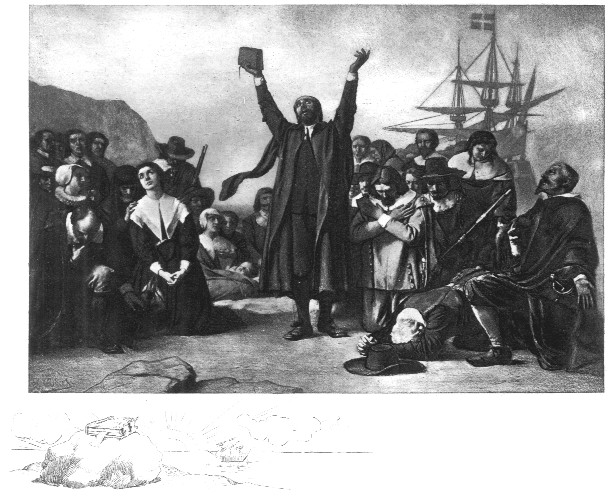 Landing of the Pilgrim Fathers at Plymouth Rock
"Land-ho!" This welcome cry was not heard until two months had elapsed, and the sandy cliffs of Cape Cod were the first points which greeted the eyes of the exiles. Yet the appearance of these cliffs "much comforted them, and caused them to rejoice together, and praise God, that had given them once again to see land." Their destination, however, was to "the mouth of the Hudson," and now they were much farther to the north, and within the bounds of the New England Company. They therefore "tacked to stand to the southward," but "becoming entangled among roaring shoals, and the wind shrieking upon them withal, they resolved to bear up again for the Cape," and the next day, "by God's providence, they got into Cape harbor," where, falling upon their knees, they "blessed the Lord, the God of heaven, who had brought them over the vast and furious ocean, and delivered them from all perils and miseries, therein, again to set their feet on the firm and stable earth, their proper element."
Morton, in his memorial, asserts that the Mayflower put in at this cape, "partly by reason of a storm by which she was forced in, but more especially by the fraudulency and contrivance of the aforesaid Mr. Jones, the master of the ship; for their intention and his engagement was to Hudson's river; but some of the Dutch having notice of their intention, and having thoughts about the same time of erecting a plantation there likewise, they fraudulently hired the said Jones, by delays, while they were in England, and now under the pretence of the sholes, etc., to disappoint them in their going thither. Of this plot betwixt the Dutch and Mr. Jones I have had late and certain intelligence." The explicitness of this assertion has caused charge of treachery—brought by no one but Morton—to be repeated by almost every historian down to the present period; and it is only within a few years that its correctness has been questioned by writers whose judgment is entitled to respect. But notwithstanding the[Pg 107] plausibility of the arguments urged to disprove this charge, and even the explicit assertion that it is a "Parthian calumny," and a "sheer falsehood," we must frankly own that, in our estimation, the veracity of Morton yet remains unimpeached. Facts prove that the Dutch were contemplating permanent settlement of New Netherland, and the early Pilgrim writers assert that overtures were made to the Leyden Church by the merchants of Holland to join them in that movement, and the petition to the States-General, when presented by those merchants, was finally rejected, and the Mayflower commenced her voyage intending to proceed to the Hudson. Is it improbable that steps may have been taken to frustrate their intention, and that arrangements may even have been made with the captain of that vessel by Dutch agents in England, to alter her course, and land the emigrants farther to the north?
We are aware that one to whose judgment we have usually deferred has said that had the intelligence been early it would have been more certain. But every student of history knows that late intelligence is often more reliable and authentic than early; and if it be asked from what source did Morton obtain his information, we can only suggest that, up to 1664, New Netherlands remained under the dominion of the Dutch, and the history of that colony was in a great measure secret to the English. But several of the prominent settlers of Plymouth had ere this removed to Manhattan—as Isaac Allerton and Thomas Willet—and after the reduction of the country and its subjection to England, from these persons the late and certain intelligence may have been received, or from access to documents which were before kept private.
The harbor in which the Mayflower now lay is worthy of a passing glance. It is described by Major Grahame as "one of the finest harbors for ships of war on the whole Atlantic coast. The width and freedom from obstructions of every kind, at its entrance, and the extent of sea-room upon the land side, make it accessible to vessels of the largest class in almost all winds. This advantage, its capacity, depth of water, excellent anchorage, and the complete shelter it affords from all winds render it one of the most valuable harbors upon our coast, whether considered in a commercial or a military point of view."[Pg 108]
If to the advantages here enumerated could have been added a fertile soil, and an extensive back country, suitably furnished with timber and fuel, the spot to which this gallant bark was led would have proved as eligible a site for a flourishing colony as could possibly have been desired. But these advantages were wanting; and though our fathers considered it an "extraordinary blessing of God" in directing their course for these parts, which they were at first inclined to consider "one of the most pleasant, most healthful, and most fruitful parts of the world," longer acquaintance and better information abundantly satisfied them of the insuperable obstacles to agriculture and commerce.
The Pilgrims were now ready to pass to the shore. But before taking this step, as the spot where they lay was without the bounds of their patent, and as signs of insubordination had appeared among their servants, an association was deemed necessary, and an agreement to "combine in one body and to submit to such government and governors as should by common consent" be selected and chosen. Accordingly, a compact was prepared, and signed before landing by all the males of the company who were of age; and this instrument was the constitution of the colony for several years. It was as follows:
"In the name of God, Amen. We whose names are underwritten, the loyal subjects of our dread sovereign lord, King James, by the grace of God, of Great Britain, France, and Ireland, King, defender of the faith, etc., having undertaken, for the glory of God, and the advancement of the Christian faith, and honor of our King and country, a voyage to plant the first colony in the northern parts of Virginia, do, by these presents, solemnly and mutually, in the presence of God and one another, covenant and combine ourselves together unto a civil body politic, for our better ordering and preservation, and furtherance of the ends aforesaid, and by virtue hereof to enact, constitute, and frame such just and equal laws, ordinances, acts, constitutions, and offices, from time to time, as shall be thought most meet and convenient for the general good of the colony; unto which we promise all due submission and obedience. In witness whereof we have hereunder subscribed our names, at Cape Cod, the 11th of November, in the year of the reign of our sovereign[Pg 109] lord, King James of England, France, and Ireland, the 18th, and of Scotland the 54th, a.d. 1620."
While on the one hand much eloquence has been expended in expatiating on this compact, as if in the cabin of the Mayflower had consciously and for the first time been discovered in an age of Cimmerian darkness the true principles of republicanism and equality; on the other hand, it has been asserted that the Pilgrims were "actuated by the most daring ambition," and that even at this early period they designed to erect a government absolutely independent of the mother-country. But the truth seems to be that, although the form of government adopted by the emigrants is republican in its character, and remarkably liberal, at the same time its founders acknowledged suitable allegiance to England, and regarded themselves as connected with the land of their nativity by political and social ties, both endearing and enduring. Left to themselves in a wilderness land, apart from all foreign aid, and thrown upon their own resources, with none to help or advise, they adopted that course which commended itself to their calm judgment as the simplest and best; and if, under such circumstances, their compact was democratic, it seems chiefly to intimate that self-government is naturally attractive to the mind, and is spontaneously resorted to in emergencies like the present. It is as unwise to flatter our ancestors by ascribing to them motives different from those which they themselves professed as it is unjust to prefer charges against them to which they are not obnoxious. They were honest, sincere, and God-fearing men; humble in their circumstances, and guided by their own judgment; but endowed with no singular prophetic vision, and claiming no preternatural political sagacity. They could penetrate the future no farther than to confide in the justice of God and the power of truth. The latter they knew must ultimately prevail, for the former was pledged to secure its triumph.
The first care of the exiles, having established their provisional government, was to provide for their shelter. Cautiously, therefore, for fear of harm, on the same day that the compact was signed, fifteen or sixteen men, well armed, were set ashore at Long Point to explore the country; and returning at night with a boat-load of juniper, which delighted them with its fragrance,[Pg 110] they reported that they had found "neither persons nor habitations."
The stillness of the Sabbath was consecrated to worship—the first, probably, ever observed by Christians in Massachusetts—and on the morrow the shallop was drawn to the beach for repairs, and for the first time the whole company landed for refreshment. As the fitting of the shallop promised to be a difficult task, the adventurous, impatient of delay, were eager to prosecute a journey by land for discovery. "The willingness of the persons was liked, but the thing itself, in regard of the danger, was rather permitted than approved." Consent, however, was obtained, and sixteen were detailed under Captain Standish, their military leader, who had served in the armies both of Elizabeth and James; and William Bradford, Stephen Hopkins, and Edward Tilly, being joined with him as "advisers and counsellors," the party debarked at Stevens' Point, at the western extremity of the harbor, and marching in single file, at the distance of about a mile, five savages were espied, who, at their approach, hastily fled.
Compassing the head of East Harbor Creek the next day, and reaching a deep valley, fed with numerous springs, the exhausted travellers, whose provisions consisted but of "biscuit and Holland cheese, with a little bottle of aqua vitæ," eagerly halted by one of these springs, and "drank their first draught of New England water with as much delight as ever they drunk drink in all their lives." Passing thence to the shore, and kindling a beacon-fire, they proceeded to another valley, in Truro, in which was a pond, "a musket-shot broad and twice as long," near which the Indians had planted corn. Further on graves were discovered; and at another spot the ruins of a house, and heaps of sand filled with corn stored in baskets. With hesitancy—so scrupulous were they of wilfully wronging the natives—an old kettle, a waif from the ruins, was filled with this corn, for which the next summer the owners were remunerated. In the vicinity of the Pamet were the ruins of a fort, or palisade; and encamping for the night near the pond in Truro, on the following day they returned to the ship "weary and welcome" and their "Eschol" was added for their diminishing stores.
Ten days after, another expedition was fitted out, in which[Pg 111] twenty-five of the colonists and nine or ten of the sailors, with Jones at their head, were engaged; and visiting the mouth of the Pamet, called by them "Cold Harbor," and obtaining fresh supplies from the aboriginal granaries, after a brief absence, in which a few unimportant discoveries were made, the party returned. Here a discussion ensued. Should they settle at Cold Harbor or seek a more eligible site? In favor of the former it was urged that the harbor was suitable for boats, if not for ships; the corn land was good; it was convenient to their fishing-grounds; the location was healthy; winter was approaching; travelling was dangerous; their provisions were wasting; and the captain of the Mayflower was anxious to return. On the other hand, it was replied that a better place might be found; it would be a hinderance to move a second time; good spring-water was wanting; and lastly, at Agawam, now Ipswich, twenty leagues to the north, was an excellent harbor, better ground, and better fishing. Robert Coppin, their pilot, likewise informed them of "a great and navigable river and good harbour in the other headland of the bay, almost right over against Cape Cod," which he had formerly visited, and which was called "Thievish Harbor."
A third expedition, therefore, was agreed upon; and though the weather was unfavorable, and some difficulty was experienced in clearing Billingsgate Point, they reached the weather shore, and there "had better sailing." Yet bitter was the cold, and the spray, as it froze on them, gave them the appearance of being encased in glittering mail. At night their rendezvous was near Great Meadow Creek; and early in the morning, after an encounter with the Indians, in which no one was wounded, their journey was resumed, their destination being the harbor which Coppin had described to them, and which he assured them could be reached in a few hours' sailing. Through rain and snow they steered their course; but by the middle of the afternoon a fearful storm raged; the hinges of their rudder were broken; the mast was split, the sail was rent, and the inmates of the shallop were in imminent peril; yet, by God's mercy, they survived the first shock, and, favored by a flood tide, steered into the harbor. A glance satisfied the pilot that it was not the place he sought; and in an agony of despair he exclaimed: "Lord be[Pg 112] merciful to us! My eyes never saw this place before!" In his frenzy he would have run the boat ashore among the breakers; but an intrepid seaman resolutely shouted, "About with her, or we are lost!" And instantly obeying, with hard rowing, dark as it was, with the wind howling fiercely, and the rain dashing furiously, they shot under the lee of an island and moored until morning.
The next day the island was explored—now known as Clarke's Island—and the clothing of the adventurers was carefully dried; but, excusable as it might have been under the circumstances in which they were placed to have immediately resumed their researches, the Sabbath was devoutly and sacredly observed.
On Monday, December 11th, O. S., a landing was effected upon Forefather's Rock. The site of this stone was preserved by tradition, and a venerable contemporary of several of the Pilgrims, whose head was silvered with the frost of ninety-five winters, settled the question of its identity in 1741. Borne in his arm-chair by a grateful populace, Elder Faunce took his last look at the spot so endeared to his memory, and, bedewing it with tears, he bade it farewell. In 1774 this precious boulder, as if seized with the spirit of that bustling age, was raised from its bed to be consecrated to Liberty, and in the act of its elevation it split in twain—an occurrence regarded by many as ominous of the separation of the colonies from England, and the lower part being left in the spot where it still lies, the upper part, weighing several tons, was conveyed, amid the heartiest rejoicings, to Liberty-pole Square, and adorned with a flag bearing the imperishable motto, "Liberty or Death." On July 4, 1834, the natal day of the freedom of the colonies, this part of the rock was removed to the ground in front of Pilgrim Hall, and there it rests, encircled with a railing, ornamented with heraldic wreaths, bearing the names of the forty-one signers of the compact in the Mayflower. Fragments of this rock are relics in the cabinets of hundreds of our citizens, and are sought with avidity even by strangers as memorials of a pilgrimage to the birthplace of New England.
On the day of landing the harbor was sounded and the land explored; and, the place inviting settlement, the adventurers returned with tidings of their success; the Mayflower weighed anchor to proceed to the spot; and ere another Sabbath[Pg 113] dawned she was safely moored in the desired haven. Monday and Tuesday were spent in exploring tours; and on Wednesday, the 20th, the settlement at Plymouth was commenced—twenty persons remaining ashore for the night. On the following Saturday the first timber was felled; on Monday their storehouse was commenced; on Thursday preparations were made for the erection of a fort; and allotments of land were made to the families; and on the following Sunday religious worship was performed for the first time in their storehouse.
For a month the colonists were busily employed. The distance of the vessel—which lay more than a mile from the shore—was a great hinderance to their work; frequent storms interrupted their operations; and by accident their storehouse was destroyed by fire, and their hospital narrowly escaped destruction. The houses were arranged in two rows, on Leyden street, each man building his own. The storehouse was twenty feet square; the size of the private dwellings we have no means of determining. All were constructed of logs, with the interstices filled with sticks and clay; the roofs were covered with thatch; the chimneys were of fragments of wood, plastered with clay; and oiled paper served as a substitute for glass for the inlet of light.
The whole of this first winter was a period of unprecedented hardship and suffering. Mild as was the weather, it was far more severe than that of the land of their birth; and the disease contracted on shipboard, aggravated by colds caught in their wanderings in quest of a home, caused a great and distressing mortality to prevail. In December six died; in January, eight; in February, seventeen; and in March, thirteen; a total of forty-four in four months—of whom twenty-one were signers of the compact. It is remarkable that the leaders of the colony were spared. The survivors were unwearied in their attentions to their companions; but affection could not avert the arrows of the Destroyer. The first burial-place was on Cole's Hill; and as an affecting proof of the miserable condition of the sufferers it is said that, knowing they were surrounded by warlike savages, and fearing their losses might be discovered and advantage be taken of their weakness to attack and exterminate them, the sad mounds formed by rude coffins hidden beneath the earth were carefully levelled and sowed with grain![Pg 114]
However rapidly we have sketched, in the preceding pages, the history of the Pilgrims from their settlement in Holland to their removal to America, no one can fail to have been deeply impressed with the inspiring lessons which that history teaches. As has been well said: "Their banishment to Holland was fortunate; the decline of their little company in the strange land was fortunate; the difficulties which they experienced in getting the royal consent to banish themselves to this wilderness was fortunate; all the tears and heartbreakings of that ever-memorable parting at Delfthaven had the happiest influence on the rising destinies of New England. All this purified the rank of the settlers. These rough touches of fortune brushed off the light, uncertain, selfish spirits. They made it a grave, solemn, self-denying expedition, and required of those who were engaged in it to be so too."
Touching also is the story of the "long, cold, dreary autumnal passage" in that "one solitary, adventurous vessel, the Mayflower, of a forlorn hope, freighted with the prospects of a future state and bound across the unknown sea." We behold it "pursuing with a thousand misgivings the uncertain, the tedious voyage. Suns rise and set, and winter surprises them on the deep, but brings them not the sight of the wished-for shore. The awful voice of the storm howls through the rigging. The laboring masts seem straining from their base; the dismal sound of the pumps is heard; the ship leaps, as it were, madly from billow to billow; the ocean breaks, and settles with engulfing floods over the floating deck, and beats with deadening, shivering weight against the staggering vessel."
Escaped from these perils, after a passage of sixty-six days, and subsequent journeyings until the middle of December, they land on the ice-clad rocks of Plymouth, worn out with suffering, weak and weary from the fatigues of the voyage, poorly armed, scantily provisioned, surrounded by barbarians, without prospect of human succor, without the help or favor of their king, with a useless patent, without assurance of liberty in religion, without shelter, and without means!
Yet resolute men are there: Carver, Bradford, Brewster, Standish, Winslow, Alden, Warren, Hopkins, and others. Female fortitude and resignation are there. Wives and mothers,[Pg 115] with dauntless courage and unexampled heroism, have braved all these dangers, shared all these trials, borne all these sorrows, submitted to all these privations. And there, too, is "chilled and shivering childhood, houseless but for a mother's arms, couchless but for a mother's breast."
But these sepulchres of the dead!—where lie Turner, Chilton, Crackston, Fletcher, Goodman, Mullins, White, Rogers, Priest, Williams, and their companions—these touch the tenderest and holiest chords. Husbands and wives, parents and children, have finished their pilgrimage, and mingled their dust with the dust of New England. Hushed as the unbreathing air, when not a leaf stirs in the mighty forest, was the scene at those graves where the noble and true were buried in peace. "Deeply as they sorrowed at parting with those, doubly endeared to them by the remembrance of what they had suffered together, and by the fellowship of kindred griefs, they committed them to the earth calmly, but with hope." No sculptured marble, no enduring monument, no honorable inscription, marks the spot where they were laid. Is it surprising that local attachments soon sprung up in the breasts of the survivors, endearing them to the place of refuge and their sorrows? They had come "hither from a land to which they were never to return. Hither they had brought, and here they were to fix, their hopes and their affections." Consecrated by persecutions in their native land, by an exile in Holland of hardship and toil, by the perils of the ocean voyage and its terrible storms, by their sufferings and wanderings in quest of a home, and by the heartrending trials of the first lonely winter—by all these was their new home consecrated and hallowed in their inmost thoughts; and forward to the future they looked with confidence in God and a cheerful reliance upon that beneficent Providence which had enabled them with patience to submit to his chastenings, and, Phœnix-like, to rise from the ashes of the dead and from the depths of the bitterest affliction and distress, with invincible courage, determined to subdue the wilderness before them, and to "fill this region of the great continent, which stretches almost from pole to pole," with freedom and intelligence, the arts and the sciences, flourishing villages, temples of worship, and the numerous blessings of civilized life, baptized in the fountain of the Gospel of Christ.
Three centuries of modern thought have not sufficed to settle the dispute as to its own origin. Many Englishmen still claim insistently that Lord Bacon, in his Advancement of Learning, and still more positively in his later and greater work, the Novum Organum (1620) started modern scientific method. Present scientists themselves seem inclined to smile somewhat scornfully at the laurels thus placed on Bacon's brow. And as for Frenchmen, they simply refuse to hear the pompous Lord Chancellor mentioned at all. To them René Descartes is the only genuine originator of all modern philosophy. The publication of his Discourse on Method (1637) marks for them the epoch which separates two worlds of thought.
Fortunately, George Henry Lewes, himself a celebrated English critic and the author of a system of philosophy, presents us the two rivals side by side, seeking to explain and balance the honors due to each.
It is very certain that somewhere about this period did originate that mathematical exactitude of method in both thought and experiment which has produced modern science. And modern science has, in its brief but marvellous career of three centuries, altered the face of the globe. It has taught man more than ancient science did in all the preceding centuries; it has touched even our deepest faiths.
Whether its success has been due mainly to the abstract reasoners like Copernicus and the philosophers, or to the practical experimenters like Galileo and Harvey, is perhaps scarcely a practical question.
In the evolution of philosophy, as in the evolution of an organism, it is impossible to fix with any precision a period of origin, because every beginning is also a termination, and presumes the results of a whole series of preceding evolutions. As Mr. Spedding felicitously says, our philosophy "was born about Bacon's time, and Bacon's name, as the brightest which presided at the time of its birth, has been inscribed upon it:[Pg 117]
"Not that Hesperus did actually lead the other stars; he and they were moving under a common force, and they would have moved just as fast if he had been away; but because he shone brightest, he looked as if he led them." Bacon and Descartes are generally recognized as the "Fathers of Modern Philosophy," though they themselves were carried along by the rapidly swelling current of their age, then decisively setting in the direction of science. It is their glory to have seen visions of the coming greatness, to have expressed in terms of splendid power the thoughts which were dimly stirring the age, and to have sanctioned the new movement by their authoritative genius. The destruction of scholasticism was complete. They came to direct the construction of a grander temple.
There are in these two thinkers certain marked features of resemblance, and others equally marked of difference. We see their differences most strikingly in their descendants. From Bacon lineally descended Hobbes, Locke, Diderot, D'Alembert, Condillac, Cabanis, and our Scotch school. From Descartes descended Spinoza, Malebranche, Leibnitz, Fichte, Schelling, and Hegel. The inductive method predominated in one school, the deductive in the other. These differences we shall recognize more fully later on; at present we may fix our minds on the two great points of resemblance: 1st, the decisive separation of philosophy from theology; 2d, the promulgation of a new method.
The separation of philosophy from theology is made emphatic in the rejection of final causes by both Bacon and Descartes. Perhaps the most effective of their novelties was the effort of Descartes to explain the system of the world by matter and motion only, thus quietly setting aside all causes and metaphysical entities which had hitherto been invoked. The hypothesis of vortices was indeed soon disclosed to be untenable; but the scientific attitude from which that hypothesis proceeded was never afterward relinquished. It was a bold attempt at the application of the objective method, and was only defective in its restriction to cosmology, and its exclusion of biology, which was still left to the subjective method, as I shall presently notice.[Pg 118]
The second point on which Bacon and Descartes resemble each other is in their conception of the results to be achieved by a totally new method. Coming as they did on the top of the revolutionary wave which had washed away the old methods, seeing as they saw the striking results of physical research, and foreseeing yet more glorious conquests from the spirit which achieved those results, they yielded themselves to the pleasant illusion that a new method would rapidly solve all problems. Bacon, as the more magnificent and imaginative mind, had grander visions and more enthusiastic faith; but Descartes also firmly believed that the new method was to do wonders. Indeed, it is interesting to note how these great intellects seem quite unconscious of their individual superiority, and are ready to suppose that their method will equalize all intellects. It reminds us of Sydney Smith maintaining that any man might be witty if he tried. Descartes affirms that "it is not so essential to have a fine understanding as to apply it rightly. Those who walk slowly make greater progress if they follow the right road than those who run swiftly on a wrong one." To the same effect Bacon: "A cripple on the right path will beat a racer on the wrong one." This is true enough, but is beside the question. Equipped with good or bad instruments, the superiority of one worker over another is always made manifest; and it is precisely in the right use of a good method that the scientific genius is called upon for its delicate and patient skill.
Into the vexed questions of Bacon's conduct, both with regard to Essex and with regard to bribery, I cannot enter here; but referring the curious to his biographers and critics, I will simply note that he was born in 1561; was educated at Trinity College, Cambridge, where he learned to distrust the Aristotelianism of his masters, and planned his own vast scheme of reform; went to Paris; sat in Parliament as member for Middlesex; was successively appointed of the Privy Council, and lord chancellor; was created Viscount Verulam; was impeached and condemned for corruption as a judge; and died in the spring of 1626. "For my name and memory," said the dying man, "I leave it to men's charitable speeches, and to foreign nations, and the next age."
Posterity has been generous; the fame of Bacon is immense. Admirers have not always been unanimous as to his special[Pg 119] claims; but there has been no lack of enthusiasm, no questioning of his genius. He has been lauded for achievements in which he had no part, and has been adorned with titles to which he had doubtful pretensions; while his most important services have been overlooked. But the general recognition of his greatness, and our national pride in it, have not prevented certain attacks on his reputation, which have been answered in a rather angry spirit; and thus from one cause and another there is great difficulty in arriving at any candid and thorough appreciation of the work he did. It seems to some persons that Bacon did very little in rising against the philosophy of his day, and pointing out a new path; and to others it seems that he did nothing of the kind. But whoever looks closely into the writings of Bacon's predecessors will see that what now seems obvious and trivial was then startling and important. As M. Rémusat felicitously says, "Il fallait du génie pour avoir ce bon sens." And to those who deny that Bacon did head the revolution, I would oppose not simply the testimony of nearly three centuries, but the testimony of Gassendi, who, both as contemporary and as foreigner, was capable of judging the effect then produced. It is indeed apparent to anyone familiar with the writings of some of Bacon's immediate predecessors, especially Galileo, that there was little novelty in his denunciations of the erroneous method then popular, or in his exhortations to pursue observation, experiment, and induction. But it is not less apparent that he had wider and profounder views of the philosophy of method than any of them, and that the popular opinion does not err in attributing to him the glory of heading the new era.
In England he is commonly regarded as the "Father of Experimental Philosophy" and the originator of the inductive method. Men profess themselves followers of the "Baconian philosophy," sometimes confounding that with a servile attention to facts and a most unscientific scorn of theories; at other times implying that by the Baconian method is to be understood the one on which science has successfully been pursued. A rigorous investigation of Bacon's claims will disclose the truth of his own statement, that he was rather one who sounded the trumpet-call than one who marshalled the troops. He insisted on the importance of experiment, but he could not teach what[Pg 120] he did not himself understand—the experimental method. He exhorted men to study nature; but he could not give available directions for that study. He had fervent faith in the possible conquests of science; but never having thoroughly mastered any one science, he was incapable of appreciating the real conditions of research. He saw clearly enough the great truth that the progress of research must be gradual, but he did not see what were the necessary grades, he did not see the kind of inquiries, and the order they must follow before discoveries could be made.
That he had really but vague and imperfect conceptions of scientific method is decisively shown by his contemptuous rejection of Copernicus, Galileo, and Gilbert, and by his own plan of investigation into heat. One sentence alone would suffice to show this, namely, his sneer at Copernicus as "a man who thinks nothing of introducing fictions of any kind into nature, provided his calculations turn out well." Bacon did not understand, what Copernicus profoundly saw, that the only value of an hypothesis was its reconciliation of calculations with observations. In his plan for an inquisition into the nature of heat, we see a total misconception of the scientific process; not only does he set about in a laboriously erroneous way, but he seeks that which science proclaims inaccessible, the nature of heat. It is true that he arrives at a hypothesis which bears some resemblance to the hypothesis now accepted, namely, that heat is a mode of motion—"an expansive and restrained motion, modified in certain ways, and exerted in the smaller particles of the body." But those who have been eager to credit him with an anticipation of modern views on the strength of this definition, have overlooked the fact that it is incapable of explaining a single process, includes none of the ascertained laws of phenomena, and is itself an example of the illicit generalization which Bacon elsewhere condemns. It was with some justification, therefore, that Harvey, who knew what science was, and knew better than most men how discoveries were made, said of him that he wrote of science like a lord chancellor.
Indeed, it is to mistake his position and his greatness altogether to attribute his influence on philosophy, which is undeniable, to an influence on science which is more than questionable.[Pg 121] Bacon was a philosopher; but because with him philosophy, separating itself from the bondage of theology, claimed to ally itself with science, and sought its materials in the generalities of science, those writers who have never made a very accurate distinction between the two, but have confounded philosophy with metaphysics, and science with physics, have naturally regarded Bacon as the precursor of Newton, Laplace, Faraday, and Liebig. It is in vain that critics oppose such a claim by asserting what is undeniable, that the great discoveries in modern science were neither made on Bacon's method nor under any direct guidance from him—that Copernicus, Galileo, and Kepler preceded him, that Harvey and Newton ignored him—stanch admirers have their answer ready; they know that Bacon was the herald of the new era, and they believe that it was his trumpet-call which animated the troops and led them to victory.
Having thus indicated his position, it will be necessary to give a brief outline of the method which he confidently believed was to be infallible and applicable in all inquiries. This was imperatively needed: "for let a man look carefully into all that variety of books with which the arts and sciences abound, he will find everywhere endless repetitions of the same thing, varying in the method of treatment, but not new in substance, insomuch that the whole stock, numerous as it appears at first view, proves on examination to be but scanty. What was asserted once is asserted still, and what was a question once is a question still, and, instead of being resolved by discussion, is only fixed and fed."
He proposes his new method, that thereby "the intellect may be raised and exalted and made capable of overcoming the difficulties and obscurities of nature. The art which I introduce with this view (which I call the 'Interpretation of Nature') is a kind of logic, though the difference between it and the ordinary logic is great, indeed immense. For the ordinary logic professes to contrive and prepare helps and guards for the understanding, as mine does; and in this one point they agree. But mine differs from it in three points: viz., in the end aimed at, in the order of demonstration, and in the starting-point of inquiry.
"But the greatest change I introduce is in the form itself of[Pg 122] induction and the judgments made thereby. For the induction of which the logicians speak, which proceeds by simple enumeration, is a puerile thing; concluded at hazard, is always liable to be upset by a contradictory instance, takes into account only what is known and ordinary, and leads to no result. Now, what the sciences stand in need of is a form of induction which shall analyze experience and take it to pieces, and by a due process of exclusion and rejection lead to an inevitable conclusion."
"Now, my method, though hard to practise, is easy to explain; and it is this: I propose to establish progressive stages of certainty. The evidence of sense, helped and guarded by a certain process of correction, I retain; but the mental operation which follows the act of sense I for the most part reject; and instead of it I open and lay out a new and certain path for the mind to proceed in, starting directly from the simple sensuous perception."
The same dissatisfaction with mediæval philosophy expressed itself in Descartes. The incompetence of philosophers to solve the problems they occupied themselves with—the anarchy which reigned in the scientific world, where no two thinkers could agree upon fundamental points—the extravagance of the conclusions to which some accepted premises led, determined him to seek no more to slake his thirst at their fountains.
"And that is why, as soon as my age permitted me to quit my preceptors," he says, "I entirely gave up the study of letters; and resolving to seek no other science than that which I could find in myself, or else in the great book of the world, I employed the remainder of my youth in travel, in seeing courts and camps, in frequenting people of diverse humors and conditions, in collecting various experiences, and above all in endeavoring to draw some profitable reflection from what I saw. For it seemed to me that I should meet with more truth in the reasonings which each man makes in his own affairs, and which, if wrong, would be speedily punished by failure, than in those reasonings which the philosopher makes in his study, upon speculations which produce no effect, and which are of no consequence to him, except perhaps that he will be more vain of them the more remote they are from common-sense, because he would then have been forced to employ more ingenuity and subtlety to render them plausible."[Pg 123]
For many years he led a roving, unsettled life; now serving in the army, now making a tour, now studying mathematics in solitude, now conversing with scientific men. One constant purpose gave unity to those various pursuits. He was elaborating his answers to the questions which perplexed him; he was preparing his method.
When only twenty-three he conceived the design of a reformation in philosophy. He was at that time residing in his winter quarters at Neuburg, on the Danube. His travels soon afterward commenced, and at the age of thirty-three he retired into Holland, there in silence and solitude to arrange his thoughts into a consistent whole. He remained there eight years; and so completely did he shut himself from the world that he concealed from his friends the very place of his residence.
When the results of this meditative solitude were given to the world in the shape of his celebrated Discourse on Method, and his Meditations—to which he invented replies—the sensation produced was immense. It was evident to all men that an original thinker had arisen; and although this originality could not but rouse much opposition, from the very fact of being original, yet Descartes gained the day. His name became European. His controversies were European quarrels. Charles I of England invited him over, with the promise of a liberal appointment; and the invitation would probably have been accepted had not the civil war broken out. He afterward received a flattering invitation from Christina of Sweden, who had read some of his works with great satisfaction, and wished to learn from himself the principles of his philosophy.
He accepted it, and arrived in Stockholm in 1649. His reception was most gratifying, and the Queen was so pleased with him as earnestly to beg him to remain with her, and give his assistance toward the establishment of an academy of sciences. But the delicate frame of Descartes was ill fitted for the severity of the climate, and a cold, caught in one of his morning visits to Christina, produced inflammation of the lungs, which carried him off.
Christina wept for him, had him interred in the cemetery for foreigners, and placed a long eulogium upon his tomb. His remains were subsequently (1666) carried from Sweden into[Pg 124] France, and buried with great ceremony in Ste. Geneviève du Mont.
Descartes was a great thinker; but having said this, we have almost exhausted the praise we could bestow upon him as a man. In disposition he was timid to servility. When promulgating his proofs of the existence of the Deity, he was in evident alarm lest the Church should see something objectionable in them. He had also written an astronomical treatise; but hearing of the fate of Galileo, he refrained from publishing, and always used some chicane in speaking of the world's movement. He was not a brave man, nor was he an affectionate man. But he was even-tempered, placid, and studious not to give offence.
It has already been indicated that the great work performed by Descartes was, like that of Bacon, the promulgation of a new method. This was rendered necessary by their separation from the ancient philosophy and their exclusion of authority. If inquiry is to be independent, if reason is to walk alone, in what direction must she walk? Having relinquished the aid of the Church, there were but two courses open: the one to tread once more in the path of the ancients, and to endeavor by the ancient methods to attain the truth; or else to open a new path, to invent a new method. The former was barely possible. The spirit of the age was deeply imbued with a feeling of opposition against the ancient methods; and Descartes himself had been painfully perplexed by the universal anarchy and uncertainty which prevailed. The second course was therefore chosen.
Uncertainty was the disease of the epoch. Scepticism was widespread, and even the most confident dogmatism could offer no criterion of certitude. This want of criterion we saw leading, in Greece, to scepticism, Epicureanism, Stoicism, the New Academy, and finally leading the Alexandrians into the province of faith, to escape from the dilemma. The question of a criterion had long been the vital question of philosophy. Descartes could get no answer to it from the doctors of his day. Unable to find firm ground on any of the prevalent systems, distracted by doubts, mistrusting the conclusions of his own understanding, mistrusting the evidences of his senses, he determined to make a tabula rasa, and reconstruct his knowledge. He resolved to examine the premises of every conclusion, and to believe nothing[Pg 125] but upon the clearest evidence of reason; evidence so convincing that he could not by any effort refuse to assent to it.
He has given us the detailed history of his doubts. He has told us how he found that he could plausibly enough doubt of everything except of his own existence. He pushed his scepticism to the verge of self-annihilation. There he stopped; there in self, in his consciousness, he found at last an irresistible fact, an irreversible certainty.
Firm ground was discovered. He could doubt the existence of the external world, and treat it as a phantasm; he could doubt the existence of a God, and treat the belief as a superstition; but of the existing of his thinking, doubting mind no sort of doubt was possible. He, the doubter, existed if nothing else existed. The existence that was revealed in his own consciousness was the primary fact, the first indubitable certainty. Hence his famous "Cogito, ergo sum" ("I think, therefore I am").
It is somewhat curious, and, as an illustration of the frivolous verbal disputes of philosophers, not a little instructive, that this celebrated "Cogito, ergo sum," should have been frequently attacked for its logical imperfection. It has been objected, from Gassendi downward, that to say, "I think, therefore I am," is a begging of the question; since existence has to be proved identical with thought. Certainly, if Descartes had intended to prove his own existence by reasoning, he would have been guilty of the petitio principii Gassendi attributes to him, viz., that the major premise, "that which thinks exists," is assumed, not proved. But he did not intend this. What was his object? He has told us that it was to find a starting-point from which to reason—to find an irreversible certainty. And where did he find this? In his own consciousness. Doubt as I may, I cannot doubt of my own existence, because my very doubt reveals to me a something which doubts. You may call this an assumption, if you will: I will point out the fact as one above and beyond all logic; which logic can neither prove nor disprove; but which must always remain an irreversible certainty, and as such a fitting basis of philosophy.
I exist. No doubt can darken such a truth; no sophism can confute this clear principle. This is a certainty, if there be none other. This is the basis of all science. It is in vain to ask for a[Pg 126] proof of that which is self-evident and irresistible. I exist. The consciousness of my existence is to me the assurance of my existence.
Had Descartes done no more than point out this fact he would have no claim to notice here; and we are surprised to find many writers looking upon this "Cogito, ergo sum" as constituting the great idea in his system. Surely it is only a statement of universal experience—an epigrammatic form given to the common-sense view of the matter. Any clown would have told him that the assurance of his existence was his consciousness of it; but the clown would not have stated it so well. He would have said, "I know I exist, because I feel that I exist."
Descartes therefore made no discovery in pointing out this fact as an irreversible certainty. The part it plays in his system is only that of a starting-point. It makes consciousness the basis of all truth. There is none other possible. Interrogate consciousness, and its clear replies will be science. Here we have a new basis and a new philosophy introduced. It was indeed but another shape of the old formula, "Know thyself," so differently interpreted by Thales, Socrates, and the Alexandrians; but it gave that formula a precise signification, a thing it had before always wanted. Of little use could it be to tell man to know himself. How is he to know himself? By looking inward? We all do that. By examining the nature of his thoughts? That had been done without success. By examining the process of his thoughts? That, too, had been accomplished, and the logic of Aristotle was the result.
The formula needed a precise interpretation; and that interpretation Descartes gave. Consciousness, said he, is the basis of all knowledge; it is the only ground of absolute certainty. Whatever it distinctly proclaims must be true. The process, then, is simple: examine your consciousness, and its clear replies. Hence the vital portion of his system lies in this axiom: All clear ideas are true: whatever is clearly and distinctly conceived is true. This axiom he calls the foundation of all science, the rule and measure of truth.
The next step to be taken was to determine the rules for the proper detection of these ideas; and these rules he has laid down as follows:[Pg 127]
1. Never accept anything as true but what is evidently so; to admit nothing but what so clearly and distinctly presents itself as true that there can be no reason to doubt it.
2. To divide every question into as many separate questions as possible; that each part being more easily conceived, the whole may be more intelligible—(Analysis).
3. To conduct the examination with order, beginning by that of objects the most simple, and therefore the easiest to be known, and ascending little by little up to knowledge of the most complex—(Synthesis).
4. To make such exact calculations and such circumspections as to be confident that nothing essential has been omitted.
Consciousness, being the ground of all certainty, everything of which you are clearly and distinctly conscious must be true; everything which you clearly and distinctively conceive exists, if the idea of it involves existence.
In the four rules, and in this view of consciousness, we have only half of Descartes' system; the psychological half. It was owing to the exclusive consideration of this half that Dugald Stewart was led—in controverting Condorcet's assertion that Descartes had done more than either Galileo or Bacon toward experimental philosophy—to say that Condorcet would have been nearer the truth if he had pointed him out as the "Father of the Experimental Philosophy of the Mind." Perhaps the title is just; but Condorcet's praise, though exaggerated, was not without good foundation.
There is, in truth, another half of Descartes' system, equally important, or nearly so: we mean the deductive method. His eminence as a mathematician is universally recognized. He was the first to make the grand discovery of the application of algebra to geometry; and he made this at the age of twenty-three. The discovery that geometrical curves might be expressed by algebraical numbers, though highly important in the history of mathematics, only interests us here by leading us to trace his philosophical development. He was deeply engrossed in mathematics; he saw that mathematics were capable of a still further simplification and a far more extended application. Struck as he was with the certitude of mathematical reasoning, he began applying the principles of mathematical reasoning to the subject[Pg 128] of metaphysics. His great object was, amid the scepticism and anarchy of his contemporaries, to found a system which should be solid and convincing. He first wished to find a basis of certitude—a starting-point: this he found in consciousness. He next wished to find a method of certitude: this he found in mathematics.
"Those long chains of reasoning," he tells us, "all simple and easy, which geometers use to arrive at their most difficult demonstrations, suggested to me that all things which came within human knowledge must follow each other in a similar chain; and that provided we abstain from admitting anything as true which is not so, and that we always preserve in them the order necessary to deduce one from the other, there can be none so remote to which we cannot finally attain, nor so obscure but that we may discover them." From these glimpses of the twofold nature of Descartes' method, it will be easy to see into his whole system: consciousness being the only ground of certitude, mathematics the only method of certitude.
We may say therefore that the deductive method was now completely constituted. The whole operation of philosophy henceforth consisted in deducing consequences. The premises had been found; the conclusions alone were wanting. This was held to be true of physics no less than of psychology. Thus, in his Principia, he announces his intention of giving a short account of the principal phenomena of the world, not that we may use them as reasons to prove anything; for he adds: "we desire to deduce effects from causes, not from effects; but only in order that out of the innumerable effects which we learn to be capable of resulting from the same causes, we may determine our minds to consider these rather than others."
Through the work which Cardinal Richelieu, chief minister of Louis XIII, performed for that monarch and for France, the country was lifted from a state of comparative disorganization and weakness, and started on a fresh career, which led her to the foremost position among European nations.
At the death of Henry IV, in 1610, his son Louis XIII was but nine years old, and from 1624 to the end of the reign, in 1643, Richelieu directed the policy of France. By crushing the Huguenots as a political party he prepared the way for building up the power of the King. The Huguenots were aiming at an independent Protestant commonwealth within the kingdom. When Richelieu had defeated this project by his victory at La Rochelle he was free to undertake a readjustment of the relations between the throne and the grasping nobles. After accomplishing this he could turn his attention to foreign affairs.
In the last stage of the Thirty Years' War France under Richelieu played her part so well that the house of Austria was humbled, and, although the great Cardinal died before the end of the war, in the final settlement France received territorial and political benefits which greatly added to her prestige.
White, our eminent historian, educator, and diplomatist, has given to the world, in the following narrative and analysis, the best account of Richelieu's administration to be found in English.
Thus far the struggles of the world have developed its statesmanship after three leading types.
First of these is that based on faith in some great militant principle. Strong among statesmen of this type, in this time, stand Cavour, with his faith in constitutional liberty; Cobden, with his faith in freedom of trade; the third Napoleon, with his faith that the world moves, and that a successful policy must keep the world's pace.
The second style of statesmanship is seen in the reorganization[Pg 130] of old states to fit new times. In this the chiefs are such men as Cranmer and Turgot.
But there is a third class of statesmen sometimes doing more brilliant work than either of the others. These are they who serve a state in times of chaos—in times when a nation is by no means ripe for revolution, but only stung by desperate revolt. These are they who are quick enough and firm enough to bind all the good forces of the state into one cosmic force, therewith to compress or crush all chaotic forces; these are they who throttle treason and stab rebellion; who fear not, when defeat must send down misery through ages, to insure victory by using weapons of the hottest and sharpest. Theirs, then, is a statesmanship which it may be well for the leading men of this land and time to be looking at and thinking of, and its representative man shall be Richelieu.
Never perhaps did a nation plunge more suddenly from the height of prosperity into the depth of misery than did France on May 14, 1610, when Henry IV fell dead by the dagger of Ravaillac. All earnest men, in a moment, saw the abyss yawning—felt the state sinking—felt themselves sinking with it. And they did what in such a time men always do: first all shrieked, then every man clutched at the means of safety nearest him. Sully, Henry's great minister, rode through the streets of Paris with big tears streaming down his face; strong men whose hearts had been toughened and crusted in the dreadful religious wars sobbed like children; all the populace swarmed abroad bewildered—many swooned—some went mad. This was the first phase of feeling.
Then came a second phase yet more terrible. For now burst forth that old whirlwind of anarchy and bigotry and selfishness and terror which Henry had curbed during twenty years. All earnest men felt bound to protect themselves, and seized the nearest means of defence. Sully shut himself up in the Bastille, and sent orders to his son-in-law, the Duke of Rohan, to bring in six thousand soldiers to protect the Protestants. All unearnest men, especially the great nobles, rushed to the court, determined now, that the only guardians of the state were a weak-minded woman and a weak-bodied child, to dip deep into the treasury which Henry had filled to develop the nation, and to wrench away the power which he had built to guard the nation.[Pg 131]
In order to make ready for this grasp at the state treasure and power by the nobles, the Duke of Épernon—from the corpse of the King by whose side he was sitting when Ravaillac struck him—strides into the Parliament of Paris and orders it to declare the late Queen, Marie de' Medici, regent; and when this Parisian court, knowing full well that it had no right to confer the regency, hesitated, he laid his hand on his sword, and declared that, unless they did his bidding at once, his sword should be drawn from its scabbard. This threat did its work. Within three hours after the King's death the Paris Parliament, which had no right to give it, bestowed the regency on a woman who had no capacity to take it.
At first things seemed to brighten a little. The Queen Regent sent such urgent messages to Sully that he left his stronghold of the Bastille and went to the palace. She declared to him before the assembled court that he must govern France still. With tears she gave the young King into his arms, telling Louis that Sully was his father's best friend, and bidding him pray the old statesman to serve the state yet longer.
But soon this good scene changed. Mary had a foster-sister, Leonora Galligai, and Leonora was married to an Italian adventurer, Concini. These seemed a poor couple, worthless and shiftless, their only stock in trade Leonora's Italian cunning; but this stock soon came to be of vast account, for thereby she soon managed to bind and rule the Queen Regent—managed to drive Sully into retirement in less than a year—managed to make herself and her husband the great dispensers at court of place and pelf. Penniless though Concini had been, he was in a few months able to buy the Marquisate of Ancre, which cost him nearly a half a million livres; and, soon after, the post of first gentleman of the bedchamber, and that cost him nearly a quarter of a million; and, soon after that, a multitude of broad estates and high offices at immense prices. Leonora also was not idle; among her many gains was the bribe of three hundred thousand livres to screen certain financiers under trial for fraud.
Next came the turn of the great nobles. For ages the nobility of France had been the worst among her many afflictions. From age to age attempts had been made to curb them. In the fifteenth century Charles VII had done much to undermine their power,[Pg 132] and Louis XI had done much to crush it. But strong as was the policy of Charles, and cunning as was the policy of Louis, they had made one omission, and that omission left France, though advanced, miserable. For these monarchs had not cut the root of the evil. The French nobility continued practically a serf-holding nobility.
Despite, then, the curb put upon many old pretensions of the nobles, the serf-owning spirit continued to spread a network of curses over every arm of the French government, over every acre of the French soil, and, worst of all, over the hearts and minds of the French people. Enterprise was deadened, invention crippled. Honesty was nothing, honor everything. Life was of little value. Labor was the badge of servility; laziness the very badge and passport of gentility. The serf-owning spirit was an iron wall between noble and not noble—the only unyielding wall between France and prosperous peace.
But the serf-owning spirit begat another evil far more terrible: it begat a substitute for patriotism—a substitute which crushed out patriotism just at the very emergencies when patriotism was most needed. For the first question which in any state emergency sprang into the mind of a French noble was not, How does this affect the welfare of the nation? but, How does this affect the position of my order? The serf-owning spirit developed in the French aristocracy an instinct which led them in national troubles to guard the serf-owning class first and the nation afterward, and to acknowledge fealty to the serf-owning interest first and to the national interest afterward.
So it proved in that emergency at the death of Henry. Instead of planting themselves as a firm bulwark between the state and harm, the Duke of Épernon, the Prince of Condé, the Count of Soissons, the Duke of Guise, the Duke of Bouillon, and many others, wheedled or threatened the Queen into granting pensions of such immense amounts that the great treasury filled by Henry and Sully with such noble sacrifices, and to such noble ends, was soon nearly empty.
But as soon as the treasury began to run low the nobles began a worse work. Mary had thought to buy their loyalty, but when they had gained such treasures their ideas mounted higher. A saying of one among them became their formula, and became[Pg 133] noted: "The day of kings is past; now is come the day of the grandees."
Every great noble now tried to grasp some strong fortress or rich city. One fact will show the spirit of many. The Duke of Épernon had served Henry as governor of Metz, and Metz was the most important fortified town in France; therefore Henry, while allowing D'Épernon the honor of governorship, had always kept a royal lieutenant in the citadel, who corresponded directly with the ministry. But on the very day of the King's death D'Épernon despatched commands to his own creatures at Metz to seize the citadel, and to hold it for him against all other orders.
But at last even Mary had to refuse to lavish more of the national treasure and to shred more of the national territory among these magnates. Then came their rebellion.
Immediately Condé and several great nobles issued a proclamation denouncing the tyranny and extravagance of the court—calling on the Catholics to rise against the Regent in behalf of their religion—calling on the Protestants to rise in behalf of theirs—summoning the whole people to rise against the waste of their state treasure.
It was all a glorious joke. To call on the Protestants was wondrous impudence, for Condé had left their faith and had persecuted them. To call on the Catholics was not less impudent, for he had betrayed their cause scores of times; but to call on the whole people to rise in defence of their treasury was impudence sublime, for no man had besieged the treasury more persistently, no man had dipped into it more deeply, than Condé himself.
The people saw this and would not stir. Condé could rally only a few great nobles and their retainers, and therefore, as a last tremendous blow to the court, he and his followers raised the cry that the Regent must convoke the States-General.
Any who have read much in the history of France, and especially in the history of the French Revolution, know in part how terrible this cry was. By the court, and by the great privileged classes of France, this great assembly of the three estates of the realm was looked upon as the last resort amid direst calamities. For at its summons came stalking forth from the foul past the[Pg 134] long train of Titanic abuses and satanic wrongs; and came surging up from the seething present the great hoarse cry of the people; then loomed up, dim in the distance, vast shadowy ideas of new truth and new right; and at the bare hint of these, all that was proud in France trembled.
This cry for the States-General, then, brought the Regent to terms at once, and, instead of acting vigorously, she betook herself to her old vicious fashion of compromising—buying off the rebels at prices more enormous than ever. By her treaty of Ste. Ménehould, Condé received a half a million of livres, and his followers received payments proportionate to the evil they had done.
But this compromise succeeded no better than the previous compromises. Even if the nobles had wished to remain quiet, they could not. Their lordship over a servile class made them independent of all ordinary labor and all care arising from labor; some exercise of mind and body they must have; Condé took this needed exercise by attempting to seize the city of Poitiers, and, when the burgesses were too strong for him, by ravaging the neighboring country. The other nobles broke the compromise in ways wonderfully numerous and ingenious. France was again filled with misery.
Dull as Regent Mary was, she now saw that she must call that dreaded States-General, or lose not only the nobles, but the people. Undecided as she was, she soon saw that she must do it at once; that if she delayed it, her great nobles would raise the cry for it again and again just as often as they wished to extort office or money. Accordingly, on October 14, 1614, she summoned the deputies of the three estates to Paris, and then the storm set in.
Each of the three orders presented its "portfolio of grievances" and its programme of reforms. It might seem, to one who has not noted closely the spirit which serf-mastering thrusts into a man, that the nobles would appear in the States-General, not to make complaints, but to answer complaints. It was not so. The noble order, with due form, entered complaint that theirs was the injured order. They asked relief from familiarities and assumptions of equality on the part of the people. Said the Baron de Séneccé, "It is a great piece of insolence to pretend to[Pg 135] establish any sort of equality between the people and the nobility": other nobles declared, "There is between them and us as much difference as between master and lackey."
To match these complaints and theories, the nobles made demands; demands that commoners should not be allowed to keep firearms, nor to possess dogs unless the dogs were ham-strung; nor to clothe themselves like nobles, nor to clothe their wives like the wives of nobles; nor to wear velvet or satin under a penalty of five thousand livres. And preposterous as such claims may seem to us, they carried them into practice. A deputy of the Third Estate having been severely beaten by a noble, his demands for redress were treated as absurd. One of the orators of the lower order having spoken of the French as forming one great family in which the nobles were the elder brothers and the commoners the younger, the nobles made a formal complaint to the King, charging the Third Estate with insolence insufferable. Next came the complaints and demands of the clergy. They insisted on the adoption in France of the decrees of the Council of Trent, and the destruction of the liberties of the Gallican Church.
But far stronger than these came the voice of the people: first spoke Montaigne, denouncing the grasping spirit of the nobles. Then spoke Savaron, stinging them with sarcasm, torturing them with rhetoric, crushing them with statements of facts.
But chief among the speakers was the president of the Third Estate, Robert Miron, provost of the merchants of Paris. His speech, though spoken across the great abyss of time and space and thought and custom which separates him from us, warms a true man's heart even now. With touching fidelity he pictured the sad life of the lower orders—their thankless toil, their constant misery; then with a sturdiness which awes us, he arraigned, first, royalty for its crushing taxation; next, the whole upper class for its oppressions, and then, daring death, he thus launched into popular thought an idea:
"It is nothing less than a miracle that the people are able to answer so many demands. On the labor of their hands depends the maintenance of your majesty, of the clergy, of the nobility, of the commons. What without their exertions would be the[Pg 136] value of the tithes and great possessions of the Church, of the splendid estates of the nobility, or of our own house-rents and inheritances? With their bones scarcely skinned over, your wretched people present themselves before you, beaten down and helpless, with the aspect rather of death itself than of living men, imploring your succor in the name of Him who has appointed you to reign over them—who made you a man, that you might be merciful to other men—and who made you the father of your subjects, that you might be compassionate to these your helpless children. If your majesty shall not take means for that end, I fear lest despair should teach the sufferers that a soldier is, after all, nothing more than a peasant bearing arms; and lest, when the vine-dresser shall have taken up his arquebuse, he should cease to become an anvil only that he may become a hammer."
After this the Third Estate demanded the convocation of a general assembly every ten years, a more just distribution of taxes, equality of all before the law, the suppression of interior custom-houses, the abolition of sundry sinecures held by nobles, the forbidding to leading nobles of unauthorized levies of soldiery, some stipulations regarding the working clergy and the non-residence of bishops; and in the midst of all these demands, as a gold grain amid husks, they placed a demand for the emancipation of the serfs.
But these demands were sneered at. The idea of the natural equality in rights of all men—the idea of the personal worth of every man—the idea that rough-clad workers have prerogatives which can be whipped out by no smooth-clad idlers—these ideas were as far beyond serf-owners of those days as they were beyond slave-owners of our own days. Nothing was done. Augustin Thierry is authority for the statement that the clergy were willing to yield something. The nobles would yield nothing. The different orders quarrelled until one March morning in 1615, when, on going to their hall, they were barred out and told that the workmen were fitting the place for a court ball. And so the deputies separated—to all appearance no new work was done, no new ideas enforced, no strong men set loose.
So it was in seeming; so it was not in reality. Something had been done. That assembly planted ideas in the French mind which struck more and more deeply, and spread more and more[Pg 137] widely, until, after a century and a half, the Third Estate met again and refused to present petitions kneeling; and when King and nobles put on their hats, the commons put on theirs, and when that old brilliant stroke was again made, and the hall was closed and filled with busy carpenters and upholsterers, the deputies of the people swore that great tennis-court oath which blasted French tyranny.
But something great was done immediately. To that suffering nation a great man was revealed; for when the clergy pressed their requests they chose as their orator a young man only twenty-nine years of age, the Bishop of Luçon, Armand Jean du Plessis de Richelieu.
He spoke well. His thoughts were clear, his words well pointed, his bearing firm. He had been bred a soldier, and so had strengthened his will; afterward he had been made a scholar and so had strengthened his mind. He grappled with the problems given him in that stormy assembly with such force that he seemed about to do something; but just then came that day of the court ball, and Richelieu turned away like the rest.
But men had seen him and heard him. Forget him they could not. From that tremendous farce, then, France had gained directly one thing at least, and that was a sight of Richelieu.
The year, after the States-General, wore away in the old vile fashion. Condé revolted again, and this time he managed to scare the Protestants into revolt with him. The daring of the nobles was greater than ever. They even attacked the young King's train as he journeyed to Bordeaux, and another compromise had to be wearily built in the Treaty of Loudun. By this Condé was again bought off—but this time only by a bribe of a million and a half of livres. The other nobles were also paid enormously, and on making a reckoning it was found that this compromise had cost the King four millions and the country twenty millions. The nation had also to give into the hands of the nobles some of its richest cities and strongest fortresses.
Immediately after this compromise Condé returned to Paris, loud, strong, jubilant, defiant, bearing himself like a king. Soon he and his revolted again; but just at that moment Concini happened to remember Richelieu. The young bishop was called and set at work.[Pg 138]
Richelieu grasped the rebellion at once. In broad daylight he seized Condé and shut him up in the Bastille; other noble leaders he declared guilty of treason and degraded them; he set forth the crimes and follies of the nobles in a manifesto which stung their cause to death in a moment; he published his policy in a proclamation which ran through France like fire, warming all hearts of patriots, withering all hearts of rebels; he sent out three great armies: one northward to grasp Picardy, one eastward to grasp Champagne, one southward to grasp Berri. There is a man who can do something! The nobles yield in a moment; they must yield.
But just at this moment, when a better day seemed to dawn, came an event which threw France back into anarchy and Richelieu into the world again.
The young King, Louis XIII, was now sixteen years old. His mother the Regent and her favorite Concini had carefully kept him down. Under their treatment he had grown morose and seemingly stupid; but he had wit enough to understand the policy of his mother and Concini, and strength enough to hate them for it.
The only human being to whom Louis showed any love was a young falconer, Albert de Luynes, and with De Luynes he conspired against his mother's power and her favorite's life. On an April morning, 1617, the King and De Luynes sent a party of chosen men to seize Concini. They met him at the gate of the Louvre. As usual he is bird-like in his utterance, snake-like in his bearing. They order him to surrender; he chirps forth his surprise, and they blow out his brains. Louis, understanding the noise, puts on his sword, appears on the balcony of the palace, is saluted with hurrahs, and becomes master of his kingdom.
Straightway measures are taken against all supposed to be attached to the regency. Concini's wife, the favorite Leonora, is burned as a witch; Regent Mary is sent to Blois, and Richelieu is banished to his bishopric.
And now matters went from bad to worse. King Louis was no stronger than Regent Mary had been; King's favorite, De Luynes, was no better than Regent's favorite, Concini, had been. The nobles rebelled against the new rule as they had rebelled[Pg 139] against the old. The King went through the same old extortions and humiliations.
Then came also to full development yet another vast evil. As far back as the year after Henry's assassination, the Protestants, in terror of their enemies, now that Henry was gone and the Spaniards seemed to grow in favor, formed themselves into a great republican league—a state within the state—regularly organized; in peace, for political effort, and in war, for military effort, with a Protestant clerical caste which ruled always with pride, and often with menace.
Against such a theocratic republic war must come sooner or later, and in 1617 the struggle began. Army was pitted against army; Protestant Duke of Rohan against Catholic Duke of Luynes. Meanwhile Austria and the foreign enemies of France, Condé and the domestic enemies of France fished in the troubled waters, and made rich gains every day. So France plunged into sorrows ever deeper and blacker. But in 1624 Marie de' Medici, having been reconciled to her son, urged him to recall Richelieu.
The dislike which Louis bore Richelieu was strong, but the dislike he bore toward compromises had become stronger. Into his poor brain at last began to gleam the truth that a serf-mastering caste, after a compromise, only whines more steadily and snarls more loudly; that at last, compromising becomes worse than fighting, Richelieu was called and set at work.
Fortunately for our studies of the great statesman's policy, he left at his death a Political Testament, which floods with light his steadiest aims and boldest acts. In that Testament he wrote this message:
"When your majesty resolved to give me entrance into your councils and a great share of your confidence, I can declare with truth that the Huguenots divided the authority with your majesty, that the great nobles acted not at all as subjects, that the governors of the provinces took on themselves the airs of sovereigns, and that the foreign alliances of France were despised. I promised your majesty to use all my industry, all the authority you gave me, to ruin the Huguenot party, to abase the pride of the high nobles, and to raise your name among foreign nations to the place where it ought to be."[Pg 140]
Such were the plans of Richelieu at the outset. Let us see how he wrought out their fulfilment.
First of all, he performed daring surgery and cautery about the very heart of the court. In a short time he had cut out from that living centre of French power a number of unworthy ministers and favorites, and replaced them by men on whom he could rely. Then he began his vast work. His policy embraced three great objects: First, the overthrow of the Huguenot power; secondly, the subjugation of the great nobles; thirdly, the destruction of the undue might of Austria.
First, then, after some preliminary negotiations with foreign powers, he attacked the great politico-religious party of the Huguenots. These held, as their great centre and stronghold, the famous seaport of La Rochelle. He who but glances at the map shall see how strong was this position; he shall see two islands lying just off the west coast at that point, controlled by La Rochelle, yet affording to any foreign allies, whom the Huguenots might admit there, facilities for stinging France during centuries. The position of the Huguenots seemed impregnable. The city was well fortressed, garrisoned by the bravest of men, mistress of a noble harbor open at all times to supplies from foreign ports, and in that harbor rode a fleet, belonging to the city, greater than the navy of France. Richelieu saw well that here was the head of the rebellion. Here, then, he must strike it.
Strange as it may seem, his diplomacy was so skilful that he obtained ships to attack the Protestants in La Rochelle from the two great Protestant powers—England and Holland. With these he was successful. He attacked the city fleet, ruined it, and cleared the harbor.
But now came a terrible check. Richelieu had aroused the hate of that incarnation of all that was and is offensive in English politics—the Duke of Buckingham. Scandal-mongers were wont to say that both were in love with the Queen, and that the Cardinal, though unsuccessful in his suit, outwitted the Duke and sent him out of the kingdom; and that the Duke swore a great oath that if he could not enter France in one way, he would enter in another; and that he brought about a war and came himself as a commander. Of this scandal believe what you will, but—be the causes what they may—the English policy[Pg 141] changed, and Charles I sent Buckingham with ninety ships to aid La Rochelle.
But Buckingham was flippant and careless; Richelieu careful when there was need, and daring when there was need. Buckingham's heavy blows were foiled by Richelieu's keen thrusts, and then, in his confusion, Buckingham blundered so foolishly and Richelieu profited by his blunders so shrewdly that the fleet returned to England without any accomplishment of its purpose. The English were also driven from that vexing position in the Isle of Ré.
Having thus sent the English home, for a time at least, he led King and nobles and armies to La Rochelle, and commenced the siege in full force. Difficulties met him at every turn; but the difficulty of all was that arising from the spirit of the nobility.
No one could charge the nobles of France with lack of bravery. The only charge was that their bravery was almost sure to shun every useful form, and to take every noxious form. The bravery which finds outlet in duels they showed constantly; the bravery which finds outlets in street fights they had shown from the day when the Duke of Orleans perished in a brawl, to the days when the "Mignons" of Henry III fought at sight every noble whose beard was not cut to suit them. The pride fostered by lording it over serfs, in the country, and by lording it over men who did not own serfs, in the capital, aroused bravery of this sort and plenty of it. But that bravery which serves a great good cause, which must be backed by steadiness and watchfulness, was not so plentiful. So Richelieu found that the nobles who had conducted the siege before he took command had, through their brawling propensities and lazy propensities, allowed the besieged to garner in the crops from the surrounding country, and master all the best points of attack.
But Richelieu pressed on. First he built an immense wall and earthwork, nine miles long, surrounding the city, and to protect this he raised eleven great forts and eighteen redoubts. Still the harbor was open, and into this the English fleet might return and succor the city at any time. His plan was soon made. In the midst of that great harbor of La Rochelle he sank sixty hulks of vessels filled with stone; then, across the harbor—nearly a[Pg 142] mile wide and, in places, more than eight hundred feet deep—he began building over these sunken ships a great dike and wall; thoroughly fortified, carefully engineered, faced with sloping layers of hewn stone.
His own men scolded at the magnitude of the work; the men in La Rochelle laughed at it. Worse than that, the ocean sometimes laughed and scolded at it. Sometimes the waves, sweeping in from that fierce Bay of Biscay, destroyed in an hour the work of a week. The carelessness of a subordinate once destroyed in a moment the work of three months.
Yet it is but fair to admit that there was one storm which did not beat against Richelieu's dike. There set in against it no storm of hypocrisy from neighboring nations. Keen works for and against Richelieu were put forth in his day: works calm and strong for and against him have been issuing from the presses of France and England and Germany ever since; but not one of the old school of keen writers, or of the new school of calm writers, is known to have ever hinted that this complete sealing of the only entrance to a leading European harbor was unjust to the world at large or unfair to the besieged themselves.
But all other obstacles Richelieu had to break through or cut through constantly. He was his own engineer, general, admiral, prime minister. While he urged on the army to work upon the dike, he organized a French navy, and in due time brought it around to that coast and anchored it so as to guard the dike and to be guarded by it. Yet daring as all this work was, it was but the smallest part of his work. Richelieu found that his officers were cheating his soldiers in their pay and disheartening them; in the face of the enemy he had to reorganize the army and to create a new military system. He made the army twice as effective and supported it at two-thirds less cost than before. It was his boast in his Testament that, from a mob, the army became "like a well-ordered convent."
He found also that his subordinates were plundering the surrounding country, and thus rendering it disaffected; he at once ordered that what had been taken should be paid for, and that persons trespassing thereafter should be severely punished. He found also the great nobles who commanded in the army half-hearted and almost traitorous from sympathy with those of their[Pg 143] own caste on the other side of the walls of La Rochelle, and from their fear of his increased power should he gain a victory. It was their common saying that they were fools to help him do it. But he saw the true point at once. He placed in the most responsible positions of his army men who felt for their cause, whose hearts and souls were in it—men not of the Dalgetty stamp, but of the Cromwell stamp. He found also—as he afterward said—that he had to conquer not only the kings of England and Spain, but also the King of France. At the most critical moment of the siege Louis defeated him, went back to Paris, allowed courtiers to fill him with suspicions. Not only Richelieu's place, but his life, was in danger, and he well knew it; yet he never left his dike and siege-works, but wrought on steadily until they were done; and then the King, of his own will, in very shame broke away from his courtiers and went back to his master.
And now a royal herald summoned the people of La Rochelle to surrender. But they were not yet half conquered. Even when they had seen two English fleets, sent to aid them, driven back from Richelieu's dike, they still held out manfully. The Duchess of Rohan, the Mayor Guiton, and the minister Salbert, by noble sacrifices and burning words, kept the will of the besieged firm as steel. They were reduced to feed on their horses; then on bits of filthy shellfish; then on stewed leather. They died in multitudes.
Guiton, the mayor, kept a dagger on the city council-table to stab any man who should speak of surrender; some, who spoke of yielding, he ordered to execution as seditious. When a friend showed him a person dying of hunger, he said: "Does that astonish you? Both you and I must come to that!" When another told him that multitudes were perishing he said, "Provided one remains to hold the city gate, I ask nothing more."
But at last even Guiton had to yield. After the siege had lasted more than a year, after five thousand were found remaining out of fifteen thousand, after a mother had been seen to feed her child with her own blood, the Cardinal's policy became too strong for him. The people yielded and Richelieu entered the city as master.
And now the victorious statesman showed a greatness of soul to which all the rest of his life was as nothing. He was a Catholic[Pg 144] cardinal; the Rochellois were Protestants; he was a stern ruler; they were rebellious subjects who had long worried and almost impoverished him; all Europe, therefore, looked for a retribution more terrible than any in history.
Richelieu allowed nothing of the sort. He destroyed the old franchises of the city, for they were incompatible with that royal authority which he so earnestly strove to build. But this was all. He took no vengeance; he allowed the Protestants to worship as before; he took many of them into the public service, and to Guiton he showed marks of respect. He stretched forth that strong arm of his over the city and warded off all harm. He kept back greedy soldiers from pillage; he kept back bigot priests from persecution.
Years before this he had said, "The diversity of religions may indeed create a division in the other world, but not in this." At another time he wrote, "Violent remedies only aggravate spiritual diseases." And he was now so tested that these expressions were found to embody not merely an idea, but a belief. For when the Protestants in La Rochelle, though thus owing tolerance—and even existence—to a Catholic, vexed Catholics in a spirit most intolerant, even that could not force him to abridge the religious liberties he had given.
He saw beyond his time, not only beyond Catholics, but beyond Protestants. Two years after that great example of toleration in La Rochelle, Nicholas Antoine was executed for apostasy from Calvinism at Geneva. And for his leniency Richelieu received the titles of "Pope of the Protestants" and "Patriarch of the Atheists." But he had gained the first great object of his policy, and he would not abuse it: he had crushed the political power of the Huguenots forever.
Let us turn now to the second great object of his policy. He must break the power of the nobility: on that condition alone could France have strength and order, and here he showed his daring at the outset. "It is iniquitous," he was wont to tell the King, "to try to make an example by punishing the lesser offenders; they are but trees which cast no shade: it is the great nobles who must be disciplined."
It was not long before he had to begin this work—and with the highest—with no less a personage than Gaston, Duke of Orléans,[Pg 145] favorite son of Mary, brother of the King. He who thinks shall come to a higher idea of Richelieu's boldness when he remembers that for many years after this Louis was childless and sickly, and that during all those years Richelieu might awake any morning to find Gaston—king.
In 1626 Gaston, with the Duke of Vendôme, half-brother of the King, the Duchess of Chevreuse, confidential friend of the Queen, the Count of Chalais, and the Marshal Ornano, formed a conspiracy after the old fashion. Richelieu had his hand at their lofty throats in a moment. Gaston, who was used only as a makeweight, he forced into the most humble apology and the most binding pledges; Ornano he sent to die in the Bastille; the Duke of Vendôme and the Duchess of Chevreuse he banished; Chalais he sent to the scaffold.
The next year he gave the grandees another lesson. The serf-owning spirit had fostered in France, through many years, a rage for duelling. Richelieu determined that this should stop. He gave notice that the law against duelling was revived, and that he would enforce it. It was soon broken by two of the loftiest nobles in France—by the Count of Bouteville Montmorency and the Count des Chapelles. They laughed at the law: they fought defiantly in broad daylight. Nobody dreamed that the law would be carried out against them. The Cardinal would, they thought, deal with them as rulers have dealt with serf-mastering lawbreakers from those days to these—invent some quibble and screen them with it. But his method was sharper and shorter. He seized both, and executed both on the Place de la Grève—the place of execution for the vilest malefactors.
No doubt that under the present domineering of the pettifogger caste there are hosts of men whose minds run in such small old grooves that they hold legal forms not a means, but an end; these will cry out against this proceeding as tyrannical. No doubt, too, that under the present palaver of the "sensationist" caste, the old ladies of both sexes have come to regard crime as mere misfortune: these will lament this proceeding as cruel. But for this act, if for no other, an earnest man's heart ought in these times to warm toward the great statesman. The man had a spine. To his mind crime was not mere misfortune: crime was crime.[Pg 146]
Crime was strong; it would pay him well to screen it: it might cost him dear to fight it. But he was not a modern "smart" lawyer to seek popularity by screening criminals; nor a modern soft juryman, to suffer his eyes to be blinded by quirks and quibbles to the great purposes of law; nor a modern bland governor, who lets a murderer loose out of politeness to the murderer's mistress. He hated crime; he whipped the criminal; no petty forms and no petty men of forms could stand between him and a rascal. He had the sense to see that this course was not cruel, but merciful. In the eighteen years before Richelieu's administration, four thousand men perished in duels; in the ten years after Richelieu's death nearly a thousand thus perished; but during his whole administration, duelling was checked completely. Which policy was tyrannical? Which policy was cruel?
The hatred of the serf-mastering caste toward their new ruler grew blacker and blacker, but he never flinched. The two brothers Marillac, proud of birth, high in office, endeavored to stir revolt as in their good days of old. The first, who was keeper of the seals, Richelieu threw into prison; with the second, who was a marshal of France, Richelieu took another course. For this marshal had added to revolt things more vile and more insidiously hurtful: he had defrauded the government in army contracts. Richelieu tore him from his army and put him on trial. The Queen-Mother, whose pet he was, insisted on his liberation. Marillac himself blubbered that it "was all about a little straw and hay, a matter for which a master would not whip a lackey." Marshal Marillac was executed. So, when statesmen rule, fare all who take advantage of the agonies of a nation to pilfer a nation's treasure.
To crown all, the Queen-Mother began now to plot against Richelieu because he would not be her puppet, and he banished her from France forever.
The high nobles were now exasperated. Gaston fled the country, first issuing against Richelieu a threatening manifesto. Now awoke the Duke of Montmorency. By birth he stood next the King's family: by office, as constable of France, he stood next the King himself. Montmorency was defeated and taken. The nobles supplicated for him lustily: they looked on crimes of nobles resulting in deaths of plebeians as lightly as the English[Pg 147] House of Lords afterward looked on Lord Mohun's murder of Will Mountfort, or as another body of lords looked on Matt Ward's murder of Professor Butler: but Montmorency was executed. Says Richelieu in his Memoirs, "Many murmured at this act, and called it severe; but others, more wise, praised the justice of the King, who preferred the good of the state to the vain reputation of a hurtful clemency."
Nor did the great minister grow indolent as he grew old. The Duke of Épernon, who seems to have had more direct power of the old feudal sort than any other man in France, and who had been so turbulent under the regency, him Richelieu humbled completely. The Duke of Valette disobeyed orders in the army, and was executed as a common soldier would have been for the same offence. The Count of Soissons tried to see if he could not revive the good old turbulent times, and raised a rebel army; but Richelieu hunted him down like a wild beast. Then certain court nobles—pets of the King—Cinq-Mars and De Thou, wove a new plot, and, to strengthen it, made a secret treaty with Spain; but the Cardinal, though dying, obtained a copy of the treaty, through his agent, and the traitors expiated their treason with their blood.
But this was not all. The Parliament of Paris—a court of justice—filled with the idea that law is not a means, but an end, tried to interpose forms between the master of France and the vermin he was exterminating. That Parisian court might, years before, have done something. They might have insisted that the petty quibbles set forth by the lawyers of Paris should not defeat the eternal laws of retribution set forth by the Lawgiver of the Universe. That they had not done, and the time for legal forms had gone by. The Paris Parliament would not see this, and Richelieu crushed the Parliament. Then the court of aids refused to grant supplies, and he crushed that court. In all this the nation upheld him. Woe to the courts of a nation when they have forced the great body of plain men to regard legality as injustice! Woe to the councils of a nation when they have forced the great body of plain men to regard legislation as traffic! Woe thrice repeated to gentlemen of small pettifogging sort when they have brought such times, and God has brought a man to fit them![Pg 148]
There was now in France no man who could stand against the statesman's purpose. And so, having hewn through all that anarchy and bigotry and selfishness a way for the people, he called them to the work. In 1626 he summoned an assembly to carry out reforms. It was essentially a people's assembly. That anarchical States-General, domineered by great nobles, he would not call; but he called an "Assembly of Notables." In this was not one prince or duke, and two-thirds of the members came directly from the people. Into this body he thrust some of his own energy. Measures were taken for the creation of a navy. An idea was now carried into effect which many suppose to have sprung from the French Revolution; for the army was made more effective by opening its high grades to the commons.
A reform was also made in taxation, and shrewd measures were taken to spread commerce and industry by calling the nobility into them.
Thus did France, under his guidance, secure order and progress. Calmly he destroyed all the useless feudal castles which had so long overawed the people and defied the monarchy. He abolished also the military titles of grand admiral and high constable, which had hitherto given the army and navy into the hands of leading noble families. He destroyed some troublesome remnants of feudal courts, and created royal courts; in one year, that of Poitiers alone, punished for exactions and violence against the people, more than two hundred nobles. Greatest step of all, he deposed the hereditary noble governors, and placed in their stead governors taken from the people—"Intendants"—responsible to the central authority alone.
We are brought now to the third great object of Richelieu's policy. He saw from the beginning that Austria and her satellite Spain must be humbled if France was to take her rightful place in Europe.
Hardly, then, had he entered the council, when he negotiated a marriage of the King's sister with the son of James I of England; next he signed an alliance with Holland; next he sent ten thousand soldiers to drive the troops of the Pope and Spain out of the Valtelline district of the Alps, and thus secured an alliance with the Swiss. We are to note here that fact, which Buckle wields so well, that, though Richelieu was a cardinal of the Roman[Pg 149] Church, all these alliances were with Protestant powers against Catholics. Austria and Spain intrigued against him, sowing money in the mountain districts of South France which brought forth those crops of armed men who defended La Rochelle. But he beat them at their own game. He set loose Count Mansfeld, who revived the Thirty Years' War by raising a rebellion in Bohemia; and when one great man, Wallenstein, stood between Austria and ruin, Richelieu sent his monkish diplomatist, Father Joseph, to the German Assembly of Electors, and persuaded them to dismiss Wallenstein and to disgrace him.
But the great Frenchman's masterstroke was his treaty with Gustavus Adolphus. With that keen glance of his he saw and knew Gustavus while yet the world knew him not—while he was battling afar off in the wilds of Poland. Richelieu's plan was formed at once. He brought about a treaty between Gustavus and Poland; then he filled Gustavus' mind with pictures of the wrongs inflicted by Austria on German Protestants, hinted to him probably of a new realm, filled his treasury, and finally hurled against Austria the man who destroyed Tilly, who conquered Wallenstein, who annihilated Austrian supremacy at the battle of Lutzen, who, though in his grave, wrenched Protestant rights from Austria at the treaty of Westphalia, who pierced the Austrian monarchy with the most terrible sorrows it ever saw before the time of Napoleon.
To the main objects of Richelieu's policy already given, might be added two subordinate subjects. The first of these was a healthful extension of French territory. In this Richelieu planned better than the first Napoleon; for while he did much to carry France out to her natural boundaries, he kept her always within them. On the south he added Roussillon, on the east Alsace, on the northeast Artois.
The second subordinate object of his policy sometimes flashed forth brilliantly. He was determined that England should never again interfere on French soil. We have seen him driving the English from La Rochelle and from the Isle of Ré; but he went further. In 1628, on making some proposals to England, he was repulsed with English haughtiness. "They shall know," said the Cardinal, "that they cannot despise me."[Pg 150] Straightway one sees protests and revolts of the Presbyterians of Scotland and Richelieu's agents in the thickest of them. And now what was Richelieu's statesmanship in its sum?
1. In the political progress of France his work has already been sketched as building monarchy and breaking anarchy. Therefore have men said that he swept away old French liberties. What old liberties? Richelieu but tore away the decaying, poisonous husks and rinds which hindered French liberties from their chance of life and growth. Therefore also have men said that Richelieu built up absolutism. The charge is true and welcome. For evidently absolutism was the only force in that age which could destroy the serf-mastering caste. Many a Polish patriot, as he to-day wanders through the Polish villages, groans that absolutism was not built to crush that serf-owning aristocracy which has been the real architect of Poland's ruin. Anyone who reads to much purpose in De Mably, or Guizot, or Henri Martin knows that this part of Richelieu's statesmanship was but a masterful continuation of all great French statesmanship since the twelfth century league of the king and commons, against nobles, and that Richelieu stood in the heirship of all great French statesmen since Suger. That part of Richelieu's work, then, was evidently bedded in the great line of divine purpose running through that age and through all ages.
2. In the internal development of France, Richelieu proved himself a true builder. The founding of the French Academy and of the Jardin des Plantes, the building of the College of Plessis, and the rebuilding of the college of the Sorbonne, are among the monuments of this part-statesmanship. His, also, is much of that praise usually lavished on Louis XIV for the career opened in the seventeenth century to science, literature, and art. He was also a reformer, and his zeal was proved, when in the fiercest of the La Rochelle struggle he found time to institute great reforms not only in the army and navy, but even in the monasteries.
3. On the general progress of Europe, his work must be judged as mainly for good. Austria was the chief barrier to European progress, and that barrier he broke. But a far greater impulse to the general progress of Europe was given by the idea of toleration which he thrust into the methods of European statesmen.[Pg 151] He, first of all statesmen in France, saw that in French policy—to use his own words—"A Protestant Frenchman is better than a Catholic Spaniard"; and he, first of all statesmen in Europe, saw that, in European policy, patriotism must outweigh bigotry.
4. His faults in method were many. His underestimate of the sacredness of human life was one; but that was the fault of his age. His frequent workings by intrigue was another; but that also was a vile method accepted by his age. The fair questions, then, are: did he not commit the fewest and smallest wrongs possible in beating back those many and great wrongs? Wrong has often a quick, spasmodic force, but was there not in his arm a steady growing force, which could only be a force of right?
5. His faults in policy crystallized about one; for while he subdued the serf-mastering nobility, he struck no final blow at the serf system itself.
Our running readers of French history need here a word of caution. They follow De Tocqueville, and De Tocqueville follows Biot in speaking of the serf system as abolished in most of France hundreds of years before this. But Biot and De Tocqueville take for granted a knowledge in their readers that the essential vileness of the system, and even many of its most shocking outward features, remained. Richelieu might have crushed the serf system, really, as easily as Louis X and Philip the Long had crushed it nominally. This Richelieu did not.
And the consequences of this great man's fault were terrible. Hardly was he in his grave when the nobles perverted the effort of the Paris Parliament for advance in liberty and took the lead in the fearful revolts and massacres of the Fronde. Then came Richelieu's pupil, Mazarin, who tricked the nobles into order; and Mazarin's pupil, Louis XIV, who bribed them into order. But a nobility borne on high by the labor of a servile class must despise labor; so there came those weary years of indolent gambling and debauchery and "serf-eating" at Versailles.
Then came Louis XV, who was too feeble to maintain even the poor decent restraint imposed by Louis XIV; so the serf-mastering caste became active in a new way, and their leaders in vileness unutterable became at last Fronsac and De Sade.[Pg 152]
Then came "the deluge." The spirit of the serf-mastering caste, as left by Richelieu, was a main cause of the miseries which brought on the French Revolution. When the Third Estate brought up their "portfolio of grievances," for one complaint against the exactions of the monarchy there were fifty complaints against the exactions of the nobility.
Then came the failure of the Revolution in its direct purpose; and of this failure the serf-mastering caste was a main cause. For this caste, hardened by ages of domineering over a servile class, despite 4th of August renunciations, would not, could not, accept a position compatible with freedom and order; so earnest men were maddened, and sought to tear out this cancerous mass, with all its burning roots.
But for Richelieu's great fault there is an excuse. His mind was saturated with ideas of the impossibility of inducing freed peasants to work; the impossibility of making them citizens; the impossibility, in short, of making them men. To his view was not unrolled the rich newer world history, to show that a working class is most dangerous when restricted; that oppression is more dangerous to the oppressor than to the oppressed; that if man will hew out paths to liberty, God will hew out paths to prosperity. But Richelieu's fault teaches the world not less than his virtues.
At last on December 3, 1642, the great statesman lay upon his death-bed. The death-hour is a great revealer of motives, and, as with weaker men, so with Richelieu. Light then shot over the secret of his whole life's plan and work. He was told that he must die: he received the words with calmness. As the host, which he believed the veritable body of the Crucified, was brought him, he said: "Behold my Judge before whom I must shortly appear! I pray him to condemn me if I have ever had any other motive than the cause of religion and my country." The confessor asked him if he pardoned his enemies: he answered, "I have none but those of the state."
So passed from earth this strong man. Keen he was in sight, steady in aim, strong in act. A true man, not "non-committal," but wedded to a great policy in the sight of all men; seen by earnest men, of all times, to have marshalled against riot and bigotry and unreason, divine forces and purposes.
Whatever might have been the historic development of New England had it proceeded from the single plantation at Plymouth, it is certain that the growth and character of the new community were vitally affected by the large influx of English Puritans who ten years later followed the Pilgrims to these shores.
Soon after the departure of the Pilgrims from England, in 1620, King James I incorporated a successor to that Plymouth Company under whose patent Plymouth colony was founded. This new company is known as the Council for New England. The territory granted to the council extended from 40° to 48° north latitude, and from the Atlantic to the Pacific. The land was conferred in absolute property, with unlimited powers of legislation and government. Emigrants to New England were placed wholly under the authority of this corporation. The great privileges conferred upon the monopoly caused indignation among James' subjects, but nevertheless the council made numerous grants to settlers in New England.
Meanwhile, dissatisfaction in England increased; in 1625 James was succeeded by his son, Charles I; at Plymouth the Pilgrim colony was struggling for existence; at home the Puritans chafed under the growing despotism of Charles. Out of this unrest came the movement leading to the larger emigration to New England which Palfrey, the New England historian, describes.
The emigration of the Englishmen who settled at Plymouth had been prompted by religious dissent. In what manner Robinson, who was capable of speculating on political tendencies, or Brewster, whose early position had compelled him to observe them, had augured concerning the prospect of public affairs in their native country, no record tells; while the rustics of the Scrooby congregation, who fled from a government which denied them liberty in their devotions, could have had but little knowledge[Pg 154] and no agency in the political sphere. The case was widely different with the founders of the Colony of Massachusetts Bay. That settlement had its rise in a state of things in England which associated religion and politics in an intimate alliance.
Years had passed since the severity of the government had overcome the Separatists, forcing them either to disband their congregations or flee from the kingdom. From the time when Bishop Williams was made keeper of the great seal, four years before the death of King James, the high-commission court again became active, and the condition of Puritans in the Church was day by day more uneasy. While some among them looked for relief to a happy issue of the struggle which had been going on in Parliament, and resigned themselves to await and aid the slow progress of a political and religious reformation in the kingdom, numbers, less confident or less patient, pondered on exile as their best resource, and turned their view to a new home on the Western continent. There was yet a third class, who, through feeble resolution or a lingering hope of better things, deferred the sacrifices which they scarcely flattered themselves they should ultimately escape, and, if they were clergymen, retained their preferments by a reluctant obedience to the canons. The coquetry of Buckingham with the Puritans, inspiring false hopes, was not without effect to excuse indecision and hinder a combined and energetic action.
Among the eminent persons who had reconciled themselves to the course of compromise and postponement was Mr. John White, an important name, which at this point takes its place in New England history. White, who since the second year of King James' reign had been rector of Trinity Church in Dorchester, was a man widely known and greatly esteemed, alike for his professional character and his public spirit. The subject of New England colonization, much canvassed everywhere among the Puritans, who were numerous in the part of the kingdom where he lived, was commended to his notice in a special form. Dorchester, near the British Channel, the principal town of the shire, furnished numbers of those who now made voyages to New England for fishing and trade; and they were often several months upon the coast without opportunity for religious worship and instruction. Mr. White interested himself with the ship-owners[Pg 155] to establish a settlement where the mariners might have a home when not at sea, where supplies might be provided for them by farming and hunting, and where they might be brought under religious influences. The result of the conferences was the formation of an unincorporated joint-stock association, under the name of the "Dorchester Adventurers," which collected a capital of three thousand pounds.
The Dorchester company turned its attention to the spot on Cape Ann where now stands the town of Gloucester. The Council for New England, perpetually embarrassed by the oppugnation of the Virginia Company and the reasonable jealousy of Parliament, had recourse to a variety of expedients to realize the benefits vainly expected by its projectors. In carrying out one scheme, that of a division of the common property among the associates, the country about Cape Ann was assigned to Lord Sheffield, better known as a patriot leader under his later title of Earl of Mulgrave. Of him it was purchased for the people of New Plymouth by Edward Winslow, when in England on the business of that colony; and they in turn conveyed to White and his associates such a site as was wanted for their purposes of fishing and planting.
The Dorchester company had probably anticipated this arrangement by despatching a party of fourteen persons to pass the winter. They carried out live stock, and erected a house, with stages to dry fish and vats for the manufacture of salt. Thomas Gardner was overseer of the plantation, and John Tilley had the fishery in charge. Everything went wrong. Mishaps befell the vessels. The price of fish went down. The colonists, "being ill chosen and ill commanded, fell into many disorders and did the company little service." An attempt was made to retrieve affairs by putting the colony under a different direction. The Dorchester partners heard of "some religious and well-affected persons that were lately removed out of New Plymouth, out of dislike of their principles of rigid separation, of which number Mr. Roger Conant was one, a religious, sober, and prudent gentleman."
He was then at Nantasket, with Lyford and Oldham. The partners engaged Conant "to be their governor" at Cape Ann, with "the charge of all their affairs, as well as fishing and planting."[Pg 156] With Lyford they agreed that he should "be the minister of the place," while Oldham, "invited to trade for them with the Indians," preferred to remain where he was and conduct such business on his own account. The change was not followed by the profits that had been hoped, and the next year "the adventurers were so far discouraged that they abandoned the further prosecution of this design, and took order for the dissolving of the company on land, and sold away their shipping and other provisions." Another seemed added to the list of frustrated adventurers in New England.
But Mr. White did not despair of its renewal. All along, it is likely, he had regarded it with an interest different from what had yet been avowed. At his instance, when "most part of the land-men returned," "a few of the most honest and industrious resolved to stay behind, and to take charge of the cattle sent over the year before. And not liking their seat at Cape Ann, chosen especially for the supposed commodity of fishing, they transported themselves to Nahumkeike, about four or five leagues distant to the southwest from Cape Ann."
White wrote to Conant, exhorting him "not to desert the business, faithfully promising that if himself with three others, whom he knew to be honest and prudent men, viz., John Woodbury, John Balch, and Peter Palfrey, employed by the adventurers, would stay at Naumkeag, and give timely notice thereof, he would provide a patent for them, and likewise send them whatever they should write for, either men, or provision, or goods wherewith to trade with the Indians." With difficulty Conant prevailed upon his companions to persevere. They "stayed to the hazard of their lives." Woodbury was sent to England for supplies.
"The business came to agitation afresh in London, and being at first approved by some and disliked by others, by argument and disputation it grew to be more vulgar; insomuch that some men, showing good affection to the work, and offering the help of their purses if fit men might be procured to go over, inquiry was made whether any would be willing to engage their persons in the voyage. By this inquiry it fell out that among others they lighted at last on Master Endicott, a man well known to divers persons of good note, who manifested much willingness[Pg 157] to accept of the offer as soon as it was tendered, which gave great encouragement to such as were upon the point of resolution to set on this work of erecting a new colony upon the old foundation."
The scheme on foot was no longer one of Dorchester fishermen looking for a profitable exercise of their trade. It had "come to agitation in London," where some men had offered "the help of their purses," and a man of consequence, Humphrey, probably from a county as distant as Lincoln, was already, or very soon after, treasurer of the fund. Matters were ripe for the step of securing a domain for a colony, and the dimensions of the domain show that the colony was not intended to be a small one. A grant of lands extending from the Atlantic to the Western Ocean, and in width from a line of latitude three miles north of the River Merrimac to a line three miles south of the Charles, was obtained from the Council for New England by "Sir Henry Roswell and Sir John Young, knights, and Thomas Southcote, John Humphrey, John Endicott, and Simon Whitcomb, gentlemen," for themselves, "their heirs, and associates." Roswell and Young were gentlemen of Devon, Southcote was probably of the same county, and Whitcomb is believed to have been a London merchant.
Gorges, though not in the counsels of the patentees, supposed himself to understand their object. Having mentioned the angry dissolution by King Charles of his second Parliament, and his imprisonment of some of the patriot leaders, he proceeds to say that these transactions "took all hope of reformation of church government from many not affecting episcopal jurisdiction, nor the usual practice of the Common Prayers of the Church; whereof there were several sorts, though not agreeing among themselves, yet all of like dislike of those particulars. Some of the discreeter sort, to avoid what they found themselves subject unto, made use of their friends to procure from Council for the affairs of New England to settle a colony within their limits; to which it pleased the thrice-honored Lord of Warwick to write to me, then at Plymouth, to condescend that a patent might be granted to such as then sued for it. Whereupon I gave my approbation, so far forth as it might not be prejudicial to my son Robert Gorges' interests, whereof he had a patent under the seal of the Council.[Pg 158] Hereupon there was a grant passed as was thought reasonable."
After three months Endicott, one of the six patentees, was despatched, in charge of a small party, to supersede Conant at Naumkeag as local manager. Woodbury had preceded them. They arrived at the close of summer. The persons quartered on the spot, the remains of Conant's company, were disposed to question the claims of the new-comers. But the dispute was amicably composed, and, in commemoration of its adjustment, the place took the name of Salem, the Hebrew name for peaceful. The colony, made up from the two sources, consisted of "not much above fifty or sixty persons," none of them of special importance except Endicott, who was destined to act for nearly forty years a conspicuous part in New England history.
Before the winter, an exploring party either began or made preparations for a settlement at Mishawum, now Charlestown. With another party, Endicott, during Morton's absence in England, visited his diminished company at Merry-Mount, or, as Endicott called it, Mount Dagon, "caused their Maypole to be cut down, and rebuked them for their profaneness, and admonished them to look there should be better walking." The winter proved sickly; an "infection that grew among the passengers at sea, spread also among them ashore, of which many died, some of the scurvy, others of an infectious fever." Endicott sent to Plymouth for medical assistance, and Fuller, the physician of that place, made a visit to Salem.
The New Dorchester Company, like that which had preceded it, and like the company of London Adventurers concerned in that settlement at Plymouth, was but a voluntary partnership, with no corporate powers. The extensive acquaintance of Mr. White with persons disaffected to the rulers in church and state was probably the immediate occasion of advancing the business another step. Materials for a powerful combination existed in different parts of the kingdom, and they were now brought together for united action. The company, having been "much enlarged," a royal charter was solicited and obtained, creating a corporation under the name of the "Governor and Company of the Massachusetts Bay in New England."
This is the instrument under which the colony of Massachusetts[Pg 159] continued to conduct its affairs for fifty-five years. The patentees named in it were Roswell and his five associates, with twenty other persons, of whom White was not one. It gave power forever to the freemen of the company to elect annually, from their own number, a governor, deputy-governor, and eighteen assistants, on the last Wednesday of Easter term, and to make laws and ordinances, not repugnant to the laws of England, for their own benefit and the government of persons inhabiting their territory. Four meetings of the company were to be held in a year, and others might be convened in a manner prescribed. Meetings of the governor, deputy-governor, and assistants were to be held once a month or oftener. The governor, deputy-governor, and any two assistants were authorized, but not required, to administer to freemen the oaths of supremacy and allegiance. The company might transport settlers not "restrained by special name." They had authority to admit new associates, and to establish the terms of their admission, and elect and constitute such officers as they should see fit for the ordering and managing of their affairs. They were empowered "to encounter, repulse, repel, and resist by force of arms, as well as by sea as by land, and by all fitting ways and means whatsoever, all such person and persons as should at any time thereafter attempt or enterprise the destruction, invasion, detriment, or annoyance to the said plantation or inhabitants." Nothing was said of religious liberty. The government may have relied upon its power to restrain it, and the emigrants on their distance and obscurity to protect it.
The first step of the new corporation was to organize a government for its colony. It determined to place the local administration in the hands of thirteen counsellors, to retain their offices for one year. Of these, seven besides the governor—in which office Endicott was continued—were to be appointed by the company at home; these eight were to choose three others; and the whole number was to be made up by the addition of such as should be designated by the persons on the spot at the time of Endicott's arrival, described as "old planters."
A proposal had just been accepted from certain "Boston men" to interest themselves in the adventure to the amount of five hundred pounds, being a hundred pounds in addition to[Pg 160] what, it appears, they had previously promised, "and to provide able men to send over."
Unfortunately, no letter had been preserved of those sent by Endicott to England at this interesting juncture. There are, however, two letters addressed to him by the company, and one by Cradock, appointed in the charter to be its first governor. With various directions as to the details of his administration, they speak of the "propagation of the Gospel" as "the thing they do profess above all to be their aim in settling this plantation." They enjoin the keeping of "a diligent eye over their own people, and they live unblamable and without reproof." They forbid the planting of tobacco, except under severe restrictions. They order satisfaction to be given to the "old planters" by the offer of incorporation into the company and of a share in the lands. They speak of unsuccessful negotiations with Oldham, who asserted a claim under the patent of Robert Gorges, and give orders for anticipating him in taking possession of Massachusetts Bay. They direct that persons who may prove "not conformable to their government," or otherwise disagreeable, shall not be suffered "to remain within the limits of their grant," but be shipped to England. They prescribe a distribution of the servants among families, with a view to domestic order and Christian instruction and discipline. They enjoin a just settlement with the natives for lands. And they transmit a form of oaths to be taken by the governor and members of the council.
After the organization under the charter, no time was lost in despatching a reënforcement of colonists. Six vessels were prepared, and license was obtained from the lord treasurer for the embarkation of "eighty women and maids, twenty-six children, and three hundred men, with victuals, arms, and tools, and necessary apparel," and with "one hundred forty head of cattle, and forty goats." A committee of the company were careful "to make plentiful provision of godly ministers." Mr. Skelton, Mr. Higginson, and Mr. Bright, members of the Council, with Mr. Smith, another minister, sailed in the first three vessels, which reached Salem about the same time, and were soon followed by the residue of the fleet. Mr. Graves, another of the counsellors, was employed by the associates as an engineer.[Pg 161] Immediately on arriving, he proceeded with "some of the company's servants under his care, and some others," to Mishawum, where he laid out a town. Bright, who was one of his party, returned to England in the following summer, dissatisfied, probably, with the ecclesiastical proceedings which had taken place. Smith went for the present to the fishing-station at Nantasket.
Higginson wrote home: "When we came first to Naumkeag we found about half-score houses, and a fair house newly built for the Governor. We found also abundance of corn planted by them, very good and well-liking. And we brought with us about two hundred passengers and planters more, which, by common consent of the old planters, were all combined together into one body politic, under the same Governor. There are in all of us, both old and new planters, about three hundred, whereof two hundred of them are settled at Naumkeag, now called Salem, and the rest have planted themselves at Masathuset's Bay, beginning to build a town there, which we do call Charleston, or Charlestown. But that which is our greatest comfort and means of defence above all other is, that we have here the true religion and holy ordinances of Almighty God taught among us. Thanks be to God, we have here plenty of preaching and diligent catechizing, with strict and careful exercise and good commendable orders to bring our people into a Christian conversation with whom we have to do withal. And thus we doubt not but God will be with us; and if God be with us, who can be against us?"
Meanwhile, a movement of the utmost importance, probably meditated long before, was hastened by external pressure. The state of public affairs in England in the spring and summer of this year had brought numbers to the decision which had been heretofore approached with sorrowful reluctance, and several persons of character and condition resolved to emigrate at once to the New World. It was necessary to their purpose to secure self-government as far as it could be exercised by British subjects.
Possibly events might permit and require it to be vindicated even beyond that line. At any rate, to be ruled in America by a commercial corporation in England, was a condition in no sort accordant with their aim. At a general court of the company,[Pg 162] Cradock, the Governor, "read certain propositions conceived by himself, viz., that for the advancement of the plantation, the inducing and encouraging persons of worth and quality to transplant themselves and families thither, and for other weighty reasons therein contained (it is expedient) to transfer the government of the plantation to those that shall inhabit there, and not to continue the same in subordination to the company here, as now it is."
The corporation entertained the proposal, and, in view of "the many great and considerable consequences thereupon depending," reserved it for deliberation. Two days before its next meeting, twelve gentlemen, assembled at Cambridge, pledged themselves to each other to embark for New England with their families for a permanent residence, provided an arrangement should be made for the charter and the administration under it to be transferred to that country. Legal advice was obtained in favor of the authority to make the transfer; and on full consideration it was determined, "by the general consent of the company, that the government patent should be settled in New England." The old officers resigned, and their places were filled with persons of whom most or all were expecting to emigrate. John Winthrop was chosen governor, with John Humphrey for deputy-governor, and eighteen others for assistants. Humphrey's departure was delayed, and on the eve of embarkation his place was supplied by Thomas Dudley.
Winthrop, then forty-two years old, was descended from a family of good condition, long seated at Groton, in Suffolk, where he had a property of six or seven hundred pounds a year, the equivalent of at least two thousand pounds at the present day. His father was a lawyer and magistrate. Commanding uncommon respect and confidence from an early age, he had moved in the circles where the highest matters of English policy were discussed, by men who had been associates of Whitgift, Bacon, Essex, and Cecil. Humphrey was "a gentleman of special parts, of learning and activity, and a godly man"; in the home of his father-in-law, Thomas, third earl of Lincoln, the head in that day of the now ducal house of Newcastle, he had been the familiar companion of the patriotic nobles.
Of the assistants, Isaac Johnson, esteemed the richest of the[Pg 163] emigrants, was another son-in-law of Lord Lincoln, and a land-holder in three counties. Sir Richard Saltonstall of Halifax, in Yorkshire, was rich enough to be a bountiful contributor to the company's operations. Thomas Dudley, with a company of volunteers which he had raised, had served, thirty years before, under Henry IV of France; since which time he had managed the estates of the Earl of Lincoln. He was old enough to have lent a shrill voice to the huzzas at the defeat of the armada, and his military services had indoctrinated him in the lore of civil and religious freedom. Theophilus Eaton, an eminent London merchant, was used to courts and had been minister of Charles I in Denmark. Simon Bradstreet, the son of a Non-conformist minister in Lincolnshire, and a grandson of "a Suffolk gentleman of a fine estate," had studied at Emanuel College, Cambridge. William Vassall was an opulent West-India proprietor. "The principal planters of Massachusetts," says the prejudiced Chalmers, "were English country gentlemen of no inconsiderable fortunes; of enlarged understandings, improved by liberal education; of extensive ambition, concealed under the appearance of religious humility."
But it is not alone from what we know of the position, character, and objects of those few members of the Massachusetts Company who were proposing to emigrate at the early period now under our notice, that we are to estimate the power and the purposes of that important corporation. It had been rapidly brought into the form which it now bore, by the political exigencies of the age. Its members had no less in hand than a wide religious and political reform—whether to be carried out in New England, or in Old England, or in both, it was for circumstances, as they should unfold themselves, to determine. The leading emigrants to Massachusetts were of that brotherhood of men who, by force of social consideration as well as of the intelligence and resolute patriotism, moulded the public opinion and action of England in the first half of the seventeenth century. While the larger part stayed at home to found, as it proved, the short-lived English republic, and to introduce elements into the English Constitution which had to wait another half-century for their secure reception, another part devoted themselves at once to the erection of free institutions in this distant wilderness.[Pg 164]
In an important sense the associates of the Massachusetts Company were builders of the British, as well as of the New England, commonwealth. Some ten or twelve of them, including Cradock, the Governor, served in the Long Parliament. Of the four commoners of that Parliament distinguished by Lord Clarendon as first in influence, Vane had been governor of the company, and Hampden, Pym, and Fiennes—all patentees of Connecticut—if not members, were constantly consulted upon its affairs. The latter statement is also true of the Earl of Warwick, the Parliament's admiral, and of those excellent persons, Lord Say and Sele and Lord Brooke, both of whom at one time proposed to emigrate. The company's meetings placed Winthrop and his colleagues in relations with numerous persons destined to act busy parts in the stirring times that were approaching—with Brereton and Hewson, afterward two of the Parliamentary major-generals; with Philip Nye, who helped Sir Henry Vane to "cozen" the Scottish Presbyterian Commissioners in the phraseology of the Solemn League and Covenant; with Samuel Vassall, whose name shares with those of Hampden and Lord Say and Sele the renown of the refusal to pay ship-money, and of courting the suit which might ruin them or emancipate England; with John Venn, who, at the head of six thousand citizens, beset the House of Lords during the trial of Lord Strafford, and whom, with three other Londoners, King Charles, after the battle of Edgehill, excluded from his offer of pardon; with Owen Rowe, the "firebrand of the city"; with Thomas Andrews, the lord mayor, who proclaimed the abolition of royalty.
Sir John Young, named second in the original grant from the Council for New England, as well as in the charter from King Charles, sat in Cromwell's second and third Parliaments. Others of the company, as Vane and Adams, incurred the Protector's displeasure by too uncomplying principles. Six or seven were members of the high court of justice for the King's trial, on which occasion they gave a divided vote. Four were members of the committee of religion, the most important committee of Parliament; and one, the counsellor, John White, was its chairman.
A question had been raised, whether the company had a right, and was legally competent, to convey the charter across[Pg 165] the ocean, and execute on a foreign soil the powers conferred by it. Certain it is that no such proceeding is forbidden by the letter of the instrument; and a not disingenuous casuistry might inquire, If the business of the company may be lawfully transacted in a western harbor of Great Britain, why not under the King's flag in a ship at sea or on the opposite shore? It cannot be maintained that such a disposition of a colonial charter would be contrary to the permanent policy of England; for other colonial charters, earlier and later, were granted—Sir William Alexander's, William Penn's, Lord Baltimore's, and those of Rhode Island and Connecticut—to be kept and executed without the realm.
As to the purpose of the grantor, those were not times for such men as the Massachusetts patentees to ask what the King wished or expected, but rather how much of freedom could be maintained against him by the letter of the law or by other righteous means; and no principle of jurisprudence is better settled than that a grant is to be interpreted favorably to the grantees, inasmuch as the grantor, being able to protect himself, is to be presumed to have done so to the extent of his purpose. The eminent Puritan counsellor, John White, the legal adviser of the company in all stages of this important proceeding, instructed them that they could legally use the charter in this manner. Very probably it had been drawn by his own hand, in the form in which it passed the seals, with a care to have it free from any phraseology which might interfere with this disposition of it. Certainly Winthrop and his coadjutors may be pardoned for believing that it was legally subject to the use to which they put it, since such was the opinion of the crown lawyers themselves, when, in the second following generation, the question became important. In the very heat of the persecution which at length broke down the charter, the Chief Justices, Rainsford and North, spoke of it as "making the adventurers a corporation upon the place," and Sawyer, attorney-general in the next reign, expressed the same opinion—"The patent having created the grantees and their assigns a body corporate, they might transfer their charter and act in New England."
He who well weighs the facts which have been presented in connection with the principal emigration to Massachusetts, and[Pg 166] other related facts which will offer themselves to notice as we proceed, may find himself conducted to the conclusion that when Winthrop and his associates prepared to convey across the water a charter from the King which, they hoped, would in their beginnings afford them some protection both from himself and through him from the powers of Continental Europe, they had conceived a project no less important than that of laying, on this side of the Atlantic, the foundations of a nation of Puritan Englishmen, foundations to be built upon as future circumstances should decide or allow. It would not perhaps be pressing the point too far to say that in view of the thick clouds that were gathering over their home, they contemplated the possibility that the time was near at hand when all that was best of what they left behind would follow them to these shores; when a renovated England, secure in freedom and pure in religion, would rise in North America; when a transatlantic English empire would fulfil, in its beneficent order, the dreams of English patriots and sages of earlier times.
If such were the aims of the members of the Massachusetts Company, it follows that commercial operations were a merely incidental object of their association. And, in fact, it does not appear that, as a corporation, they ever held for distribution any property except their land; or that they ever intended to make sales of their land in order to a division of the profits among the individual freemen; or that a freeman, by virtue of the franchise, could obtain a parcel of land even for his own occupation; or that any money was ever paid for admission into the company, as would necessarily have been done if any pecuniary benefit was attached to membership. Several freemen of the company—among others the three who were first named in the charter as well as in the patent from the Council for New England—appear to have never so much as attended a meeting. They were men of property and public spirit, who, without intending themselves to leave their homes, gave their influence and their money to encourage such as were disposed to go out and establish religion and freedom in a new country.
The company had no stock, in the sense in which that word is used in speaking of money corporations. What money was needed to procure the charter, to conduct the business under it,[Pg 167] and carry out the scheme of colonization was obtained neither by the sale of negotiable securities nor by assessment, but by voluntary contributions from individuals of the company, and possibly from others, in such sums as suited the contributors respectively.
These contributions made up what is called in the records the joint stock, designed to be used in providing vessels and stores for the transportation of settlers. It is true that these contributors, called Adventurers, had more or less expectation of being remunerated for their outlay; and for this purpose two hundred acres of land within the limits of the patent were pledged to them for every fifty pounds subscribed, in addition to a proportional share of the trade which the government of the company was expecting to carry on. But a share of the profits of trade, as of the land, was to be theirs, not because they were freemen, but because they were contributors, which many of the freemen were not, and perhaps others besides freemen were.
When the transfer of the charter and of the government to America had been resolved upon, it was agreed that at the end of seven years a division of the profits of a proposed trade in fish, furs, and other articles should be made among the Adventurers agreeably to these principles; and the management of the business was committed to a board consisting of five persons who expected to emigrate, and five who were to remain in England. But this part of the engagement appears to have been lost sight of; at least never to have been executed. It is likely that the commercial speculation was soon perceived to be unpromising; and the outlay had been distributed in such proportions that the loss was not burdensome in any quarter. The richer partners submitted to it silently, from public spirit; the poorer, as a less evil than that of a further expense and risk of time and money.
From the ship Arbella, lying in the port of Yarmouth, the Governor and several of his companions took leave of their native country by an address, which they entitled "The Humble Request of his Majesty's Loyal Subjects, the Governor and the Company late gone for New England, to the Rest of their Brethren in and of the Church of England." They asked a favorable construction of their enterprise, and good wishes and prayers for its success. With a tenacious affection which the hour of parting made more tender, they said: "We esteem it our honor[Pg 168] to call the Church of England, from whence we rise, our dear mother, and cannot part from our native country where she specially resideth, without much sadness of heart, and many tears in our eyes. Wishing our heads and hearts may be as fountains of tears for your everlasting welfare, when we shall be in our poor cottages in the wilderness, overshadowed with the spirit of supplication, through the manifold necessities and tribulations which may not altogether unexpectedly nor, we hope, unprofitably, befall us, and so commending you to the grace of God in Christ, we shall ever rest your assured friends and brethren." The address is said to have been drawn up by Mr. White, of Dorchester.
The incidents of the voyage are minutely related in a journal begun by the Governor on shipboard off the Isle of Wight. Preaching and catechizing, fasting and thanksgiving, were duly observed. A record of the writer's meditations on the great design which occupied his mind while he passed into a new world and a new order of human affairs, would have been a document of the profoundest interest for posterity. But the diary contains nothing of that description. On the voyage Winthrop composed a little treatise, which he called A Model Christian Charity. It breathes the noblest spirit of philanthropy. The reader's mind kindles as it enters into the train of thought in which the author referred to "the work we have in hand. It is," he said, "by a mutual consent, through a special overruling Providence, and a more than an ordinary approbation of the churches of Christ, to seek out a place of cohabitation and consortship under a due form of government both civil and ecclesiastical." The forms and institutions under which liberty, civil and religious, is consolidated and assured, were floating vaguely in the musings of that hour.
The Arbella arrived at Salem after a passage of nine weeks, and was joined in a few days by three vessels which had sailed in her company. The assistants, Ludlow and Rossiter, with a party from the west country, had landed at Nantasket a fortnight before, and some of the Leyden people, on their way to Plymouth, had reached Salem a little earlier yet. Seven vessels from Southampton made their voyage three or four weeks later. Seventeen in the whole came before winter, bringing about a thousand passengers.[Pg 169]
It is desirable to understand how this population, destined to be the germ of a state, was constituted. Of members of the Massachusetts Company, it cannot be ascertained that so many as twenty had come over. That company, as has been explained, was one formed mainly for the furtherance, not of any private interests, but of a great public object. As a corporation, it had obtained the ownership of a large American territory, on which it designed to place a colony which should be a refuge for civil and religious freedom. By combined counsels, it had arranged the method of ordering a settlement, and the liberality of its members had provided the means of transporting those who should compose it. This done, the greater portion were content to remain and await the course of events at home, while a few of their number embarked to attend to the providing of the asylum which very soon might be needed by them all.
It may be safely concluded that most of the persons who accompanied the emigrant members of the company to New England sympathized with them in their object. It may be inferred from the common expenditures which were soon incurred, that considerable sums of money were brought over. And almost all the settlers may be presumed to have belonged to one or another of the four following classes: (1) Those who paid for their passage and who were accordingly entitled on their arrival to a grant of as much land as if they had subscribed fifty pounds to the "common stock" of the company; (2) those who, for their exercise of some profession, art, or trade, were to receive specified remuneration from the company in money or land; (3) those who paid a portion of their expenses, and after making up the rest by labor at the rate of three shillings a day, were to receive fifty acres of land; (4) indented servants, for whose conveyance their masters were to be remunerated at the rate of fifty acres of land for each. All Englishmen were eligible to the franchise of the Massachusetts Company; but until elected by a vote of the existing freemen no one had any share in the government of the plantation or in the selection of its governors.
The reception of the new-comers was discouraging. More than a quarter part of their predecessors at Salem had died during the previous winter, and many of the survivors were ill or feeble. The faithful Higginson was wasting with a hectic fever, which[Pg 170] soon proved fatal. There was a scarcity of all sorts of provisions, and not corn enough for a fortnight's supply after the arrival of the fleet. "The remainder of a hundred eighty servants," who, in the two preceding years, had been conveyed over at heavy cost, were discharged from their indentures, to escape the expense of their maintenance. Sickness soon began to spread, and before the close of autumn had proved fatal to two hundred of this year's emigration. Death aimed at the "shining mark" he is said to love. Lady Arbella Johnson, coming "from a paradise of plenty and pleasure, which she enjoyed in the family of a noble earldom, into a wilderness of wants," survived her arrival only a month; and her husband, singularly esteemed and beloved by the colonists, died of grief a few weeks after. He was a holy man and wise and died in sweet peace.
Giving less than a week to repose and investigations at Salem, Winthrop proceeded with a party in quest of some more attractive place of settlement. He traced the Mystic River a few miles up from its mouth, and, after a three days' exploration, returned to Salem to keep the Sabbath. When ten or eleven vessels had arrived, a day of public thanksgiving was observed in acknowledgment of the divine goodness which had so far prospered the enterprise.
After a sufficient pause for deliberation and conference concerning the forms of organization of the new society, the subject of an ecclesiastical settlement was the first matter to receive attention. On a day solemnized with prayer and fasting, the Reverend Mr. Wilson, after the manner of proceeding in the year before at Salem, entered into a church covenant with Winthrop, Dudley, and Johnson. Two days after, on Sunday, they associated with them three of the assistants, Mr. Nowell, Mr. Sharpe, and Mr. Bradstreet, and two other persons, Mr. Gager and Mr. Colburn. Others were presently added; and the church, so constituted, elected Mr. Wilson to be its teacher, and ordained him to that charge at Mishawum. At the same time Mr. Nowell was chosen to be ruling elder, and Mr. Gager and Mr. Aspinwall to be deacons. From the promptness of these measures, it is natural to infer that they had been the subject of consideration and concert before the landing. But there was some lingering scruple respecting the innovation on accustomed[Pg 171] forms; and either for the general satisfaction or to appease some doubters, "the imposition of hands" was accompanied with "this protestation by all, that it was only as a sign of election and confirmation."
In the choice of a capital town, attention was turned to Mishawum, now Charlestown. Here, ten weeks after the landing, the first court of assistants on this side of the water was convened. The assistants present were Saltonstall, Ludlow, Rossiter, Nowell, Sharpe, Pynchon, and Bradstreet. Three others were in the country: Johnson, Endicott, and Coddington. The question first considered was that of provision for the ministers. It was "ordered that houses be built for them with convenient speed at the public charge. Sir Richard Saltonstall undertook to see it done at his plantation (Watertown) for Mr. Phillips, and the Governor at the other plantation for Mr. Wilson." Allowances of thirty pounds a year to each of these gentlemen were to be made at the common charge of the settlements, "those of Mattapan and Salem exempted," as being already provided with a ministry. Provision was also made for Mr. Gager as engineer, and Mr. Penn as beadle. It was ordained "that carpenters, joiners, bricklayers, sawers, and thatchers should not take above two shillings a day, nor any man should give more, under pain of ten shillings to taker and giver"; and "sawers" were restricted as to the price they might take for boards. The use or removal of boats or canoes, without the owner's leave, was prohibited, under penalty of fine and imprisonment. Saltonstall, Johnson, Endicott, and Ludlow were appointed to be justices of the peace, besides the Governor and deputy-governor, who were always to have that trust by virtue of their higher office. And "it was ordered that Morton, of Mount Woolison, should presently be sent for by process." Morton had lately been brought back to Plymouth by Allerton—who incurred much censure on that account—and, repairing to Mount Wollaston, had resumed his old courses.
A recital of the action of the board of assistants at their first meetings on this continent will explain the early exigencies of their administration, and the view entertained by them of their duties and powers. At a second court, held at Charlestown, the following business was transacted. It was agreed "that every third Tuesday there should be a court of assistants held at the[Pg 172] Governor's house." It was "ordered that Thomas Norton, of Mount Wollaston, should presently be set into the bilboes, and after sent prisoner to England by the ship called the Gift, now returning thither; that all his goods should be seized upon to defray the charge of his transportation, payment of his debts, and to give satisfaction to the Indians for a canoe he unjustly took away from them; and that his house should be burned down to the ground, in sight of the Indians, for their satisfaction for many wrongs he had done them from time to time." Mr. Clarke was directed to pay to John Baker the sum of thirty-eight shillings, for cheating him in a sale of cloth. A stipend was granted to Mr. Patrick and Mr. Underhill, as military instructors and officers. The names of Boston, Dorchester, and Watertown were assigned to the places which still bear them. And it was ordered that no plantation should be made within the limits of the patent, without permission from a majority of the Board of Governor and Assistants, and that "a warrant should presently be sent to Agawam (Ipswich) to command those that are planted there forthwith to come away."
At a third court, also held at Charlestown, regulations were enacted against allowing the Indians the use of firearms, and against parting with corn to them, or sending it out of the jurisdiction, without a license. Constables were appointed for Salem and Dorchester. The wages of common laborers were fixed at sixpence a day, and those of mechanics who were employed in building at sixteen pence, in addition to "meat and drink." Order was given for the seizure of "Richard Clough's strong water, for his selling great quantity thereof to several men's servants, which was the occasion of much disorder, drunkenness, and misdemeanor." The execution of a contract between certain parties for the keeping of cattle was defined and enforced. Sir Richard Saltonstall was fined four bushels of malt for absenting himself from the meeting. Thomas Gray, for "divers things objected against him," was ordered "to remove himself out of the limits of this patent before the end of March next." "For the felony committed by him, whereof he was convicted by his own confession," John Gouldburn, as principal, and three other persons, as accessories, were sentenced "to be whipped, and afterward set in the stocks." Servants, "either man or maid," were[Pg 173] forbidden to "give, sell, or truck any commodity whatsoever, without license from their master, during the time of their service." An allowance was made to Captains Underhill and Patrick for quarters and rations; and, for their maintenance, a rate of fifty pounds was levied, of which sum Boston and Watertown were assessed eleven pounds each, and Charlestown and Dorchester seven pounds each, Roxbury five pounds, and Salem and Mystic each only three pounds—a sort of indication of the estimated wealth of those settlements respectively.
The public business proceeded at the next two courts after the same manner. A restriction, which it seems had existed under Endicott's administration, on the price of beaver, was removed. A bounty was offered for the killing of wolves, to be paid by the owners of domestic animals in sums proportioned to the amount of their stock. Encouragement was given, by a legal rate of toll, to the setting up of a ferry between Charlestown and Boston. A servant of Sir Richard Saltonstall was sentenced to "be whipped for his misdemeanor toward his master"; and bonds were taken for good behavior in a case of "strong suspicion of incontinency." Sir Richard Saltonstall was fined five pounds for whipping two persons without the presence of another assistant. A man was ordered to be whipped for fowling on the Sabbath-day; another for stealing a loaf of bread; and another for breaking an engagement to pilot a vessel, with the privilege, however of buying off the punishment with forty shillings. The employers of one Knapp, who was indebted to Sir Richard Saltonstall, and of his son, were directed to apply half of their wages to the discharge of the debt. An assessment of sixty pounds was laid on six settlements for the maintenance of Mr. Wilson and Mr. Phillips, of which sum Boston and Watertown were to pay twenty pounds each, and Charlestown half as much; and Roxbury, Mystic, and Winnisimmet were charged with six pounds, three pounds, and one pound respectively.
An epidemic sickness at Charlestown was ascribed to the want of good water. An ample supply of it being found in Boston, a portion of the people removed to that peninsula; and there for the first time after their arrival on this continent, was held one of those quarterly general courts of the Company of Massachusetts Bay, which were prescribed in a provision of the charter.
No actor in the Thirty Years' War left a more brilliant name than Gustavus Adolphus, King of Sweden. His military reputation, which rests on solid achievement, was much enhanced by the victory at Luetzen, although the King early fell on the field. That triumph, which was won largely through the inspiration of his spirit and the shock of its untimely departure, contributed to the remarkable advancement of Sweden which his reign had already inaugurated.
Before the interference of Gustavus in the war, the Catholic party had defeated the Protestants in almost every engagement. The Protestant leaders, Christian IV of Denmark, Count Mansfeld, and Christian of Anhalt, had been no match for Tilly, commanding the force of the Holy League, and Wallenstein, leader of the Imperial army. When Gustavus joined in the conflict, Wallenstein had quitted the service of the Emperor Ferdinand II, and the great Swede's first opponent was Tilly, the imperial generalissimo. Tilly's ruthless sack of Magdeburg, in 1631, brought many hesitating Protestants to the side of Gustavus, and on the field of Leipsic or Breitenfeld, September 7, 1631, he completely overcame his strong enemy. In April following, Tilly, the victor in thirty-six battles, fell in another conflict with Gustavus. The Swedish King continued his campaign in Germany, and November 16, 1632, he met Wallenstein, who again commanded the Imperial forces, and his lieutenant, Count Pappenheim, on the fatal but glorious field of Luetzen. The King had gathered his forces at Erfurt, and there he bade farewell to his Queen, tenderly commending her to the care of the city magistrates.
On October 30th Gustavus sent Bernhard, Duke of Saxe-Weimar, forward with eleven thousand men to observe Pappenheim. The Duke took the road by Buttstadt to Freiburg, and from thence, after crossing the Saale, to Naumburg, where he arrived just in time to anticipate the enemy.
The next day the King gave the military command at Erfurt to Dupadel, and proceeded himself to Naumburg. Here the[Pg 175] joy and confidence which his presence inspired, "as if he had been a god," far from elating him, awakened only in his mind a feeling of humility and a sorrowful presentiment that some disaster to himself would soon convince the Naumburgers of the frailty of the idol in whom they trusted.
On Sunday, November 14th, he learned, by an intercepted letter, that Pappenheim had been sent to Halle, and that the next day the Imperial army was to leave Weissenfels. He would now have attacked Wallenstein at once; but the dissuasions of Kniphausen—it is said—prevailed, and he agreed to defer the hazard of a battle until he should have been reënforced by Duke George of Luneburg and the Elector of Saxony.
Accordingly, having written to the Elector, who lay at Torgau, to meet him at Eilenburg, he was himself marching to Pegau, in that direction, when some gentlemen and peasants of the neighborhood brought him word that Wallenstein's troops were still quartered in the villages around Luetzen, and that he was not aware of the King's army being on the march. "Then," exclaimed Gustavus, "I verily believe the Lord has delivered him into my hand," and instantly darted toward his prey.
Luetzen was now in sight; the peasants said it was close at hand. But it proved more distant than this indefinite expression, or the measure of their own eager gaze, had led the Swedes to calculate. Moreover, a small river, the Rippart, that lay between the King and Luetzen, whose narrow bridge could be only passed by one or two at a time, impeded the advance full two hours—a skirmish with Isolani's cavalry, who were quartered at a village near the bridge, may also have occasioned some little loss of time—so that when the Swedish army had reached the fatal field it was nightfall, and too late to begin the battle.
Wallenstein made good use of the delay. On the first intelligence of the King's approach he had written to Pappenheim—the letter is still preserved in the archives of Vienna, stained with Pappenheim's blood—apprising him of the danger, and requiring him to join at daybreak, with every man and gun. During the night and early in the morning, which proved very misty, he mustered his troops, and made his dispositions, deepening the drains by the highroads to form intrenchments for his musketeers.[Pg 176]
The King passed the night in his carriage, chiefly in conversation with his generals. Early in the morning he had prayers read to himself by his chaplain, Frabricius. The rest of the army sang Luther's hymn, "Our God is a strong tower"; and Gustavus himself led another hymn—"Jesus Christ our Saviour, he overcame death."
The King mounted his horse without having broken his fast. He wore a plain buff coat, without armor; replying, it is said, to some remark upon this deficiency, that "God was his harness." He addressed a few words of encouragement, first to the Swedes, then to Germans of his army, and to this effect: "My brave and beloved subjects!" he said to the Swedish regiments, "now is the time to prove your discipline and courage, confirmed in many a fight. Yonder is the enemy you have sought so long, not now sheltered by strong ramparts nor posted on inaccessible heights, but ranged in fair and open field. Advance, then, by God's help, not so much to fight as to conquer. Spare not your blood, your lives, for your king, your country, your God; and the present and eternal blessing of the Almighty, and an illustrious name throughout the Christian world, await you. But if, which God forbid, you prove cowards, I swear that not a bone of you shall return to Sweden. The Lord preserve you all!"
To the Germans he said: "My brave allies and fellow-soldiers, I adjure you by your fame, your honor, and your conscience; by the interests temporal and eternal now at stake; by your former exploits, by the remembrance of Tilly and the Breitenfeld—bear yourselves bravely to-day. Let the field before you become illustrious by a similar slaughter. Forward! I will this day not only be your general, but your comrade. I will not only command you, I will lead you on. Add your efforts to mine. Extort from the enemy, by God's help, that victory, of which the chief fruits will be to you and to your children. But if you shrink from the contest, remember that religion, liberty—all will be lost, and that by your remissness."
Having finished his addresses, to which both Swedes and Germans responded by hearty cheers and acclamations, the King cast up his eyes to heaven and said, "O my Lord Jesus! Son of God, bless these our arms, and this day's battle, for thine own glory and holy name's sake." Then, drawing his sword,[Pg 177] and waving it over his head, advanced, the foremost of all his army.
The numbers of the two armies at this moment were probably nearly equal. Diodati, indeed, who carried to the Emperor from Wallenstein a verbal report of the battle, which by Ferdinand's order he afterward drew up in writing, stated the Swedish army to have been 25,000 strong, the Imperial 12,000 only. This is to be understood as referring to the beginning of the engagement, before Pappenheim had come up, at which time, on the other hand, Harte and Mauvillon estimate the Imperial force at from 28,000 to 30,000 men, Gfrorer at 25,000—estimates which are as certainly exaggerations as Diodati's diminution of the truth. Gustavus would not only have departed from his avowed maxims and previous practice, he would have run counter to every sound strategical principle, had he attacked without necessity an army numerically so superior. For that the Swedish force amounted in all to not more than 18,000 men there is as much proof almost as it is possible to attain in such a matter.
A rough calculation would make Wallenstein and Pappenheim's whole united force not more than 27,000, unless any reënforcements took place which have not been recorded, or which have escaped my notice. If we estimate Pappenheim's division at 10,000, this will give 17,000 Imperialists on the field before he joined again on the day of the battle. But the Swedish Intelligencer, whose information was derived from English officers about the person of Gustavus, conceives that Wallenstein must have had at this time full 20,000, or, as he afterward modifies his opinion, that he must have had 30,000 in all, of whom 10,000 or 12,000 were with Pappenheim.
According to these estimates, then, we may conclude that there were in the Imperial camp at Luetzen, on November 5th, from 15,000 to 18,000, or perhaps even 20,000, men. Such numbers offered to Gustavus, especially under the circumstances, a strong temptation to attack them; and, the Imperial army being so divided, he had a reasonable hope—a hope by which he was justified in forcing the engagement—that he should be able to defeat successively both divisions. Even as it was, Pappenheim's foot not arriving soon enough to support contributed in no small degree to the loss of the battle.[Pg 178]
The field, which was intersected by a canal that unites the Saale and the Elster, called the Flossgraben, was almost a level; but of all the accidents afforded by such ground Wallenstein had taken advantage. Luetzen lay to his right a little in front. Between it and three windmills close to his right wing intervened some mud-walled gardens. These he made use of as forts, throwing into them little garrisons, and loopholing the walls. The mill hills he converted into batteries, and the dry ditches by the roadside into breastworks for his musketeers.
The fog having cleared off for a season, at ten o'clock the battle began. The wind and sun were in the King's favor; but Wallenstein had the advantage in weight of artillery and position. Gustavus did not long sustain the cannonade of the enemy before he gave the order to charge toward the highway and dislodge the musketeers who occupied the ditches on the side of it. This being effected, the whole line continued to advance, and the three infantry brigades of the centre took the batteries on the other side of the highroad, but, not being supported in time by their cavalry, who had been impeded by the wayside ditches, lost them again and were compelled to fall back.
When the King knew that the first battery was taken, he uncovered his head and thanked God, but soon after, learning that the centre had been repulsed, he put himself at the head of the Smaland cavalry and charged the Imperial cuirassiers, the "black lads," with whom he had just before told Stalhaske to grapple. Piccolomini hastened to support the cuirassiers; and the Swedes, being overmatched, retreated without perceiving—the fog having again come over—that they had left the King in the midst of the enemy. A pistol-ball now broke his arm; and as the Duke of Lauenburg was supporting him out of the battle, an Imperial cuirassier came behind him and shot him in the back. He then fell from his horse; and, other cuirassiers coming up, one of them completed the work of death.
It is added on the testimony of a young gentleman named Leubelfing, the son of Colonel Leubelfing, of Nuremberg, and page to the Lord Marshal Crailsham, that being near when the King fell, and seeing that his charger, wounded in the neck, had galloped away, he dismounted and offered him his own horse. Gustavus stretched out his hands to accept the offer; and the[Pg 179] page attempted to lift him from the ground, but was unable. In the mean time some cuirassiers, attracted to the spot, demanded who the wounded man was. Leubelfing evaded the question or refused to answer; but the King himself exclaimed, "I am the King of Sweden," when he received four gunshot wounds and two stabs, which quickly released him from the agony of his broken arm, the bone of which had pierced the flesh and protruded. The Imperialist soldiers about the King, each anxious to possess some trophy, had stripped the body to the shirt, and were about to carry it off when a body of Swedish cavalry, charging toward the spot, dispersed them.
His death was immediately communicated, by one of the few who were about his person when he fell, to the Swedish generals. His charger, galloping loose and bloody about the field, announced to many more that some disaster had befallen him. The whole extent of the calamity, however, was not generally known; but a burning desire ran through the ranks to rescue him, if living; to avenge him, if dead. The noble Bernhard of Saxe-Weimar sustained and animated the enthusiasm. Having whispered to Kniphausen that Gustavus was dead, he asked him what was to be done? Kniphausen answered that his troops were in good order, and that retreat was practicable; to which the fiery Duke answered that it was not a question of retreat, but of vengeance in victory. This said, he assumed the command, and, upon Stenbock's lieutenant-colonel hesitating to advance when he ordered him, passed his sword through his body, and led on to the attack three other regiments, after a few words which gave fresh fuel to their ardor. Again the lost ground is won, the lost batteries are recovered. Wallenstein's ammunition explodes, and seven of his guns are captured.
Stalhanske rallies his Finlanders, drives back the Imperial cuirassiers, and bears away the King's body—easily distinguished from the rest of the slain by its heroic stature. But many still are the vicissitudes of that memorable day. Pappenheim brings fresh masses and fresh courage into the field. He is slain; content to die, since Gustavus, the foe of the Emperor and of his faith, breathes no longer; but Piccolomini and Tershy have inherited his spirit. The Swedes are beaten back; several standards and royal banners are won by the Imperialists. Count[Pg 180] Brahé is mortally wounded; and of his division—the flower of all the army, the brave veterans "who have been so long accustomed to conquer that they knew not how to yield"—there remains but an inconsiderable fraction.
During all these vicissitudes the cool intrepidity of Kniphausen had kept the second line of the centre unbroken; and when, between three and four o'clock, the fog cleared off, and Duke Bernhard, who had expected a very different appearance, saw it standing firm and in good order, he raised his voice once more to renew the assault. This charge again changed the aspect of the battle; but the mist again spreading, again the Swedes are baffled when within a grasp of victory. The fifth and decisive charge was made just before sunset, when the arrival of Pappenheim's foot encouraged the Imperialists to make a final and desperate struggle. Kniphausen's fresh troops were now brought into action. The sharp ring of the musketry, the shouts of those full of life and hope, stifled once more the groans of the wounded comrades, in whom life was expiring and hope was dead. Both sides fought bravely, admirably; and, had strength and courage alone determined this last agony, doubtful indeed would have been its issue. But the Swedish cannon now again opened their flaming mouths upon the right flank and front of the Imperialists; and the effect was terrible: rank upon rank and file upon file fell beneath that crushing fire; so that when darkness thickened around the still contending armies, taking advantage of its cover, and leaving behind him the guns which had not been already captured, Wallenstein gave the signal to retreat, and drew off from the field.
Thus ended this day of mingled glory and sadness, the mists and confusion of which have in a great measure obscured its history. The numbers engaged, the order of battle on the side of the Imperialists, the number of the slain, the period of Pappenheim's arrival, what part of his forces were actually engaged; above all, the circumstances of the King's death, are perplexed amid the contrariety of contemporary narrations, representing partly the imperfection of human testimony and partly the different interests, jealousies, and suspicions of the times.
Among the last may be mentioned the imputation cast upon the Duke Francis Albert of Lauenburg, of having, according to[Pg 181] previous compact with the Imperialists, murdered the King on the field of battle. This he is said to have effected as he was leading him away wounded, by placing a pistol behind him, and shooting him in the back. The Duke, who was now about thirty-two years of age, had served during the Mantuan war in the Imperial army, but, from some impression that he had been neglected, joined Gustavus two or three weeks before the battle of Luetzen, as a volunteer. After the King had fallen, supposing that all was lost, he ran away to Weissenfels, and did not appear again among the Swedish ranks until next morning, when the cool reception he received from the generals induced him probably to leave and go to Dresden, where he obtained from his relation, the Elector of Saxony, the rank of field-marshal under Arnim. Wallenstein courted his friendship by restoring to him without ransom some of his attendants captured at Luetzen. The Duke was not ungrateful, and took a zealous part in the negotiations between Wallenstein and the Elector of Saxony, and Duke Bernhard of Saxe-Weimar in January and February, 1634. On the night of Wallenstein's assassination he was arrested by Gordon and sent to Vienna, where he remained a year in imprisonment, but, at the expiration of that time, by embracing the Roman Catholic faith, obtained at once his freedom and a command in the Imperial army in Silesia. In the battle of Sweidnitz, May 30, 1642, he was wounded and taken prisoner. Torstenson rescued him with difficulty from the vengeance of the Swedish soldiers; and the next day he died of his wounds.
The story that he had murdered the King had at one time taken such a hold upon the Swedes that no historian of that nation could venture to treat it as a fable. But a full examination of the facts by Forster shows upon how slight a foundation the charge has rested. The motive of personal animosity arising out of a blow given by the King to the Duke is destroyed by the fact that the quarrel in which the insult is supposed to have been given was not with Duke Francis, but with his brother. The corroboration of his guilt, that he wore the device of Wallenstein's officers in the field, a green scarf, is annihilated by the answer that Wallenstein's officers did not wear green scarfs, but crimson. And the only direct evidence of his crime falls to pieces against counter-evidence of still greater weight. Even the Swedes themselves,[Pg 182] if they still retain the convictions of their forefathers, have grown tolerant of opposite convictions; and Geijer has not scrupled to intimate, with tolerable plainness, that he considers the charge against the Duke of Saxe Lauenburg unproved.
Gustavus' body was brought on a powder-wagon to the hamlet of Meuchen, where it was placed for the night in the church, before the altar. The next day it was carried to the schoolmaster's house, until he, being joiner of the village also, constructed the simple shell in which it was conveyed to Weissenfels. There the body was embalmed by the King's apothecary, Caspar, who counted in it nine wounds. The heart, which was uncommonly large, was preserved by the Queen in a golden casket. A trooper, who had been wounded at the King's side, who remained at Meuchen until his wound was healed, assisted by some peasants, rolled a large stone toward the spot where he fell. They were unable, however, to bring the stone, now called the "Swede's Stone," to the exact spot, from which it stands some thirty or forty paces distant.
The death of Gustavus Adolphus cast a gloom over the whole of Europe. Even foes could lament the fall of so noble an enemy. To his subjects, to his allies, to the bondmen who looked to him for redress and deliverance, his loss was a heartrending sorrow. Grave and aged senators wrung their hands and sobbed aloud when intelligence reached Stockholm. In the unfortunate Frederick of Bohemia it produced, as we have seen, a depression that contributed probably to this death.
Nor was the grief shown by the many merely political or selfish, excited because the public or individual hopes centred in the King seemed to have perished with him. A heartfelt loyalty, a strong personal admiration and attachment, intermingled with other sources of regret and dignified the sorrow.
It would have been strange had it been otherwise. There were in Gustavus most of the advantages and amenities of person and character which make a popular king, a man admired and beloved. In his latter years, indeed, he no longer possessed the graceful form that had belonged to him when he was an ardent and favored suitor of Ebba Brahé; but the slight inclination to corpulency that grew with him as he advanced toward middle age detracted probably little, if at all, from the commanding dignity of[Pg 183] his person. His countenance to the last retained its captivating sweetness and expressive variety. It was a countenance of which the most accomplished pencil could give in one effort only an inadequate idea, and which Vandyke—to whose portrait of the King none of the engravings which I have seen, probably, do justice—has represented only in repose.
But in the varying play of Gustavus' features men could read his kindness of heart, his large powers of sympathy, his quick intelligence, his noble, chivalrous nature. And these were infinitely attractive. There, too—it must not be concealed—they could often discern the flash of anger, to be followed quickly by the rough speech which gave pain and offence where a little self-control and consideration might have spared a pang and prevented a quarrel.
This propensity to anger diminished in some degree both the popularity and merit of Gustavus; yet he rarely permitted his anger to rage beyond a harsh expression, and with generous instinct he knew how to open the door of reconciliation, not only by frankly confessing his irritability, and by conferring fresh favors, but also by demanding fresh services from those noble natures which in his heat and rashness he had injured or pained.
In the field he shared the dangers of his soldiers with a courage liable, doubtless, to the charge of temerity, but to which, no less than to his participation in their hardships, his sympathy with their feelings, and his great military talents, he owed, under God, his success and renown. That his military fame was well founded, that no series of accidents could have produced success, at once so splendid and so uniform, we must have believed, though all professional authorities had been silent; but the special merit of no other commander has been more generally acknowledged by those of his own craft. His most celebrated living rival and the greatest conqueror of modern times have both set their seals to it. Wallenstein on two separate occasions pronounced him the greatest captain of his age; and among the eight best generals whom, in his judgment, the world had ever seen, Napoleon gave a place to Gustavus Adolphus.
From Socrates to Galileo, as from the Church's early martyrs to its latest victims, runs the same story of conflict between the free human spirit and the repressive environment of custom acting through personal will or through constituted power.
When in 1633 Galileo, standing before the Inquisition at Rome, denied his own great work and swore that earth stood still, science staggered under the heavy blow. Galileo was being punished, not directly for the great astronomical discoveries he had made with his telescope, but for asserting that they proved, or that he believed in, the Copernican system. This declared that the earth moved, while the churchmen had interpreted the Bible to mean that it did not.
Thus science, threatened in the person of its greatest leader, terrified by his sufferings, no longer dared proclaim the thing it saw. Descartes and many another thinker, though throbbing with the eagerness of the new dawning light, hushed their voices, hid their views. They were philosophers, not martyrs. What this newly roused vigor of thought might have accomplished except for the repressive hand of the Church we cannot tell. As it was, the supremacy of intellect passed away from Catholic Italy, turned from the South to the North, from Galileo to Newton and Leibnitz. The forced recantation of the great astronomer thus stands out as one of the events which have changed the course of destiny.
In 1615 Pope Paul V wrote requesting Galileo to come to Rome to explain his views. He went, was well received, made a special friend of Cardinal Barberino—an accomplished man in high position, who became, in fact, the next Pope. Galileo showed cardinals and others his telescope, and to as many as would look through it he showed Jupiter's satellites and his other discoveries. He had a most successful visit. He talked, he harangued, he held forth in the midst of fifteen or twenty disputants at once, confounding his opponents and putting them to shame.
His method was to let the opposite arguments be stated as[Pg 185] fully and completely as possible, himself aiding, and often adducing, the most forcible and plausible arguments against his own views; and then, all having been well stated, he would proceed to utterly undermine and demolish the whole fabric, and bring out the truth in such a way as to convince all honest minds. It was this habit that made him such a formidable antagonist. He never shrank from meeting an opposing argument, never sought to ignore it or cloak it in a cloud of words. Every hostile argument he seemed to delight in, as a foe to be crushed, and the better and stronger they sounded the more he liked them. He knew many of them well, he invented a number more, and, had he chosen, could have out-argued the stoutest Aristotelian on his own grounds. Thus did he lead his adversaries on, almost like Socrates, only to ultimately overwhelm them in a more hopeless rout. All this in Rome, too, in the heart of the Catholic world. Had he been worldly-wise, he would certainly have kept silent and unobtrusive till he had leave to go away again. But he felt like an apostle of the new doctrines, whose mission it was to proclaim them even in this centre of the world and of the Church.
Well, he had an audience with the Pope—a chat an hour long—and the two parted good friends, mutually pleased with each other.
He writes that he is all right now, and might return home when he liked. But the question began to be agitated whether the whole system of Copernicus ought not to be condemned as impious and heretical. This view was persistently urged upon the Pope and college of cardinals, and it was soon to be decided upon.
Had Galileo been unfaithful to the Church he could have left them to stultify themselves in any way they thought proper, and himself had gone; but he felt supremely interested in the result, and he stayed. He writes:
"So far as concerns the clearing of my own character, I might return home immediately; but although this new question regards me no more than all those who for the last eighty years have supported those opinions both in public and private, yet, as perhaps I may be of some assistance in that part of the discussion which depends on the knowledge of truths ascertained by means of the sciences which I profess, I, as a zealous and Catholic Christian,[Pg 186] neither can nor ought to withhold that assistance which my knowledge affords, and this business keeps me sufficiently employed."
It is possible that his stay was the worst thing for the cause he had at heart. Anyhow, the result was that the system was condemned, and both the book of Copernicus and the epitome of it by Kepler were placed on the forbidden list,[33] and Galileo himself was formally ordered never to teach or to believe the motion of the earth.
He quitted Rome in disgust, which before long broke out in satire. The only way in which he could safely speak of these views now was as if they were hypothetical and uncertain, and so we find him writing to the Archduke Leopold, with a presentation copy of his book on the tides, the following:
"This theory occurred to me when in Rome while the theologians were debating on the prohibition of Copernicus' book, and of the opinion maintained in it of the motion of the earth, which I at that time believed: until it pleased those gentlemen to suspend the book, and declare the opinion false and repugnant to the Holy Scriptures. Now, as I know how well it becomes me to obey and believe the decisions of my superiors, which proceed out of more knowledge than the weakness of my intellect can attain to, this theory which I send you, which is founded on the motion of the earth, I now look upon as a fiction and a dream, and beg your highness to receive it as such. But as poets often learn to prize the creations of their fancy, so in like manner do I set some value on this absurdity of mine. It is true that when I sketched this little work I did hope that Copernicus would not, after eighty years, be convicted of error; and I had intended to develop and amplify it further, but a voice from heaven suddenly awakened me, and at once annihilated all my confused and entangled fancies."
This sarcasm, if it had been in print, would probably have been dangerous. It was safe in a private letter, but it shows us his real feelings. However, he was left comparatively quiet for a time. He was getting an old man now, and passed the time studiously enough, partly at his house in Florence, partly at his villa in Arcetri, a mile or so out of the town.
Here was a convent, and in it his two daughters were nuns. One of them, who passed under the name of Sister Maria Celeste, seems to have been a woman of considerable capacity—certainly she was of a most affectionate disposition—and loved and honored her father in the most dutiful way.
This was a quiet period of his life, spoiled only by occasional fits of illness and severe rheumatic pains, to which the old man was always liable. Many little circumstances are known of this peaceful time. For instance, the convent clock won't go, and Galileo mends it for them. He is always doing little things for them, and sending presents to the lady superior and his two daughters.
He was occupied now with problems in hydrostatics and on other matters unconnected with astronomy: a large piece of work which I must pass over. Most interesting and acute it is, however.
In 1623, when the old Pope died, there was elected to the papal throne, as Urban VIII, Cardinal Barberino, a man of very considerable enlightenment, and a personal friend of Galileo's, so that both he and his daughters rejoice greatly, and hope that things will come all right, and the forbidding edict be withdrawn.
The year after this election he manages to make another journey to Rome to compliment his friend on his elevation to the pontifical chair. He had many talks with Urban, and made himself very agreeable.
Encouraged, doubtless, by marks of approbation, and reposing too much confidence in the individual good-will of the Pope, without heeding the crowd of half-declared enemies who were seeking to undermine his reputation, he set about, after his return to Florence, his greatest literary and most popular work, Dialogues on the Ptolemaic and Copernican Systems. This purports to be a series of four conversations between three characters. Salviati, a Copernican philosopher; Sagredo, a wit and scholar, not specially learned, but keen and critical, and who lightens the talk with chaff; Simplicio, an Aristotelian philosopher, who propounds the stock absurdities which served instead of arguments to the majority of men.
The Aristotelians were furious, and represented to the Pope[Pg 188] that he himself was the character intended by Simplicio, the philosopher whose opinions get alternately refuted and ridiculed by the other two, till he is reduced to an abject state of impotence.
The infirm old man was instantly summoned to Rome. His friends pleaded his age—he was now seventy—his ill-health, the time of year, the state of the roads, the quarantine existing on account of the plague. It was all of no avail; to Rome he must go, and on February 14th he arrived.
His daughter at Arcetri was in despair; and anxiety and fastings and penances self-inflicted on his account dangerously reduced her health.
At Rome he was not imprisoned, but he was told to keep indoors and show himself as little as possible. He was allowed, however, to stay at the house of the Tuscan ambassador instead of in jail.
By April he was removed to the chambers of the Inquisition and examined several times. Here, however, the anxiety was too much, and his health began to give way seriously; so, before long, he was allowed to return to the ambassador's house; and, after application had been made, was allowed to drive in the public garden in a half-closed carriage. Thus in every way the Inquisition dealt with him as leniently as they could. He was now their prisoner, and they might have cast him into their dungeons, as many another had been cast. By whatever they were influenced—perhaps the Pope's old friendship, perhaps his advanced age and infirmities—he was not so cruelly used.
Still, they had their rules; he must be made to recant and abjure his heresy; and, if necessary, torture must be applied. This he knew well enough, and his daughter knew it, and her distress may be imagined. Moreover, it is not as if they had really been heretics, as if they hated or despised the Church of Rome. On the contrary, they loved and honored the Church. They were sincere and devout worshippers, and only on a few scientific matters did Galileo presume to differ from his ecclesiastical superiors: his disagreement with them occasioned him real sorrow; and his dearest hope was that they could be brought to his way of thinking and embrace the truth.
This condition of things could not go on. From February to[Pg 189] June the suspense lasted. On June 20th he was summoned again, and told he would be wanted all next day for a rigorous examination. Early in the morning of the 21st he repaired thither, and the doors were shut. Out of those chambers of horror he did not reappear till the 24th. What went on all those three days no one knows. He himself was bound to secrecy. No outsider was present. The records of the Inquisition are jealously guarded. That he was technically tortured is certain; that he actually underwent the torment of the rack is doubtful. Much learning has been expended upon the question, especially in Germany. Several eminent scholars have held the fact of actual torture to be indisputable—geometrically certain, one says—and they confirm it by the hernia from which he afterward suffered, this being a well-known and frequent consequence.
Other equally learned commentators, however, deny that the last stage was reached. For there are five stages all laid down in the rules of the Inquisition, and steadily adhered to in a rigorous examination, at each stage an opportunity being given for recantation, every utterance, groan, or sigh being strictly recorded. The recantation so given has to be confirmed a day or two later, under pain of a precisely similar ordeal.
The five stages are: (1) The official threat in the court; (2) the taking to the door of the torture-chamber and renewing the official threat; (3) the taking inside and showing the instruments; (4) undressing and binding upon the rack; (5) territio realis. Through how many of these ghastly acts Galileo passed I do not know. I hope and believe not the last.
There are those who lament that he did not hold out, and accept the crown of martyrdom thus offered to him. Had he done so we know his fate—a few years' languishing in the dungeons, and then the flames. Whatever he ought to have done, he did not hold out—he gave way. At one stage or another of the dread ordeal he said: "I am in your hands. I will say whatever you wish." Then was he removed to a cell while his special form of perjury was drawn up.
The next day, clothed as a penitent, the venerable old man was taken to the convent of Minerva, where the cardinals and prelates were assembled for the purpose of passing judgment upon him.[Pg 190]
The judgment sentences him: (1) To the abjuration, (2) to formal imprisonment for life, (3) to recite the seven penitential psalms every week.
Ten cardinals were present; but, to their honor, be it said, three refused to sign; and this blasphemous record of intolerance and bigoted folly goes down the ages with the names of seven cardinals immortalized upon it. This having been read, he next had to read word for word the abjuration which had been drawn up for him, and then sign it.
"I, Galileo Galilei, son of the late Vincenzo Galilei, of Florence, aged seventy years, being brought personally to judgment, and kneeling before your Most Eminent and Most Reverend Lords Cardinals, General Inquisitors of the universal Christian republic against heretical depravity, having before my eyes the Holy Gospels, which I touch with my own hands, swear that I have always believed, and now believe, and with the help of God will in future believe, every article which the Holy Catholic and Apostolic Church of Rome holds, teaches, and preaches. But because I have been enjoined by this Holy Office altogether to abandon the false opinion which maintains that the sun is the centre and immovable, and forbidden to hold, defend, or teach the said false doctrine in any manner, and after it hath been signified to me that the said doctrine is repugnant with the Holy Scripture, I have written and printed a book, in which I treat of the same doctrine now condemned, and adduce reasons with great force in support of the same, without giving any solution, and therefore have been judged grievously suspected of heresy; that is to say, that I held and believed that the sun is the centre of the universe and is immovable, and that the earth is not the centre and is movable; willing, therefore, to remove from the minds of your Eminences, and of every Catholic Christian, this vehement suspicion rightfully entertained toward me, with a sincere heart and unfeigned faith, I abjure, curse, and detest the said errors and heresies, and generally every other error and sect contrary to Holy Church; and I swear that I will never more in future say or assert anything verbally, or in writing, which may give rise to a similar suspicion of me; but if I shall know any heretic, or anyone suspected of[Pg 191] heresy, that I will denounce him to this Holy Office, or to the Inquisitor or Ordinary of the place where I may be; I swear, moreover, and promise, that I will fulfil and observe fully, all the penances which have been or shall be laid on me by this Holy Office. But if it shall happen that I violate any of my said promises, oaths, and protestations (which God avert!), I subject myself to all the pains and punishments which have been decreed and promulgated by the sacred canons, and other general and particular constitutions, against delinquents of this description. So may God help me, and his Holy Gospels which I touch with my own hands. I, the above-named Galileo Galilei, have abjured, sworn, promised, and bound myself as above, and in witness thereof with my own hand have subscribed this present writing of my abjuration, which I have recited word for word. At Rome, in the Convent of Minerva, June 22, 1633. I, Galileo Galilei, have abjured as above with my own hand."
Those who believe the story about his muttering to a friend, as he rose from his knees, "E pur si muove" ("And yet it does move"), do not realize the scene.
There was no friend in the place. It would have been fatally dangerous to mutter anything before such an assemblage. He was by this time an utterly broken and disgraced old man; wishful, of all things, to get away and hide himself and his miseries from the public gaze; probably with his senses deadened and stupefied by the mental sufferings he had undergone, and no longer able to think or care about anything—except perhaps his daughter—certainly not about any motion of this wretched earth.
Far and wide the news of the recantation spread. Copies of the abjuration were immediately sent to all universities, with instructions to the professors to read it publicly. At Florence, his home, it was read out in the cathedral church, all his friends and adherents being specially summoned to hear it.
For a short time more he was imprisoned in Rome, but at length was permitted to depart, nevermore of his own will to return.
[33] They remained there till 1835, when they were dropped.
John Amos Comenius (1592-1671) is now generally recognized as the founder of modern education. Just what his work has been is best left to Mr. Laurie, the leading authority upon his life. What the schools were before his time is almost too dreary a picture to attempt to draw. Everything was hopelessly haphazard, almost hopelessly uninteresting. Only in the schools of the Jesuits was anything approaching skill employed to stimulate the learner. If a child did not advance, the teacher held himself no way responsible. The lad was adjudged a dullard and left to remain in his stupidity with the rest of the blockhead world.
The chief work of Comenius, the Didactica Magna, was probably finished about 1638, and was shown in manuscript to many persons at that time. Its ideas as to education were widely accepted, and its influence and that of its author spread rapidly over much of Europe. The publication of his works was delayed until 1657.
In the history of education it is important to recognize the existence of the two parallel streams of intellectual and spiritual regeneration. The leaders of both, like the leaders of all great social changes, at once bethought themselves of the schools. Their hope was in the young, and hence the reform of education early engaged their attention.
The improvements made in the grammar-schools under the influence of Melanchthon and Sturm, and in England of Colet and Ascham, did not endure, save in a very limited sense. Pure classical literature was now read—a great gain certainly, but this was all. There was no tradition of method, as was the case in the Jesuit order. During the latter half of the sixteenth century, the complaints made of the state of the schools, the waste of time, the barbarous and intricate grammar rules, the cruel discipline, were loud and long, and proceeded from men of the highest intellectual standing. To unity in the Reformed churches they looked, but looked in vain, for a settlement of opinion, and to the[Pg 193] school they looked as the sole hope of the future. The school, as it actually existed, might have well filled them with despair.
Even in the universities Aristotelian physics and metaphysics, and with them the scholastic philosophy, still held their own. The reforms initiated mainly by Melanchthon had not, indeed, contemplated the overthrow of Aristotelianism. He and the other humanists merely desired to substitute Aristotle himself in the original for the Latin translation from the Arabic, necessarily misleading, and the Greek and Latin classics for barbarous epitomes. These very reforms, however, perpetuated the reign of Aristotle, when the spirit that actuated the Reformers was dead, and there had been a relapse into the old scholasticism. The Jesuit reaction, also, which recovered France and South Germany for the papal see, was powerful enough to preserve a footing for the metaphysical theology of St. Thomas Aquinas and the schoolmen. In England, Milton was of opinion that the youth of the universities were, even so late as his time, still presented with an "asinine feast of sow-thistles." These retrogressions in school and university serve to show how exceedingly difficult it is to contrive any system of education, middle or upper, which will work itself when the contrivers pass from the scene. Hence the importance, it seems to us, of having in every university, as part of the philosophical faculty, a department for the exposition of this very question of education—surely a very important subject in itself as an academic study, and in its practical relations transcending perhaps all others. How are the best traditions of educational theory and practice to be preserved and handed down if those who are to instruct the youth of the country are to be sent forth to their work from our universities with minds absolutely vacant as to the principles and history of their profession—if they have never been taught to ask themselves the question, "What am I going to do?" "Why?" and "How?" This subject is one worthy of consideration both by the universities and the state. It was the want of method that led to the decline of schools after the Reformation period; it was the study of method which gave the Jesuits the superiority that on many parts of the Continent they still retain.[34]
In 1605 there appeared a book which was destined to place educational method on a scientific foundation, although its mission is not yet, it is true, accomplished. This was Francis Bacon's Advancement of Learning, which was followed some years later by the Organum. For some time the thoughts of men had been turning to the study of nature. Bacon represented this movement, and gave it the necessary impulse by his masterly survey of the domain of human knowledge, his pregnant suggestions, and his formulation of scientific method. Bacon was not aware of his relations to the science and art of education; he praises the Jesuit schools, not knowing that he was subverting their very foundations. We know inductively: that was the sum of Bacon's teaching. In the sphere of outer nature, the scholastic saying, "Nihil est in intellectu quod non prius fuerit in sensu," was accepted, but with this addition, that the impressions on our senses were not themselves to be trusted. The mode of verifying sense-impressions, and the grounds of valid and necessary inference, had to be investigated and applied. It is manifest that if we can tell how it is we know, it follows that the method of intellectual instruction is scientifically settled.
But Bacon not only represented the urgent longing for a coördination of the sciences and for a new method, he also represented the weariness of words, phrases, and vain subtleties which had been gradually growing in strength since the time of Montaigne, Ludovicus Vives, and Erasmus. The poets, also, had been placing nature before the minds of men in a new aspect. The humanists, as we have said, while unquestionably improving the aims and procedure of education, had been powerless to prevent the tendency to fall once more under the dominion of words, and to revert to mere form. The realism of human life and thought, which constituted their raison d'être, had been unable to sustain itself as a principle of action, because there was no school of method. It was the study of the realities of sense that was finally to place education on a scientific basis, and make reaction, as to method at least, impossible.
The thought of any age determines the education of the age which is to succeed it. Education follows; it does not lead. The school and the church alike march in the wake of science, philosophy, and political ideas. We see this illustrated in every[Pg 195] epoch of human history, and in none so conspicuously as in the changes which occurred in the philosophy and education of ancient Rome during the lifetime of the elder Cato, and in modern times during the revival of letters and the subsequent rise of the Baconian induction. It is impossible, indeed, for any great movement of thought to find acceptance without its telling to some extent on every department of the body politic. Its influence on the ideas entertained as to the education of the rising generation must be, above all, distinct and emphatic. Every philosophical writer on political science has recognized this, and has felt the vast significance of the educational system of a country both as an effect—the consequence of a revolution in thought—and as a cause, a moving force of incalculable power in the future life of a commonwealth. Thus it was that the humanistic movement which preceded and accompanied the Reformation of religion shook to its centre the mediæval school system of Europe; and that subsequently the silent rise of the inductive spirit subverted its foundations.
Bacon, though not himself a realist in the modern and abused sense of that term, was the father of realism. It was this side of his teaching which was greedily seized upon, and even exaggerated. Educational zeal now ran in this channel. The conviction of the churches of the time, that one can make men what one pleases—by fair means or foul—was shared by the innovators. By education, rightly conceived and rightly applied, the enthusiasts dreamed that they could manufacture men, and, in truth, the Jesuits had shown that a good deal could be done in this direction. The new enthusiasts failed to see that the genius of Protestantism is the genius of freedom, and that man refuses to be manufactured except on suicidal terms. He must first sacrifice that which is his distinctive title to manhood—his individuality and will. That the prophets of educational realism should have failed to see this is not to be laid at their door as a fault; it merely shows that they belonged to their own time, and not to ours. They failed then, as some fail now, to understand man and his education, because they break with the past. The record of the past is with them merely a record of blunders. The modern humanist more wisely accepts it as the storehouse of the thoughts and life of human reason. In the life of man each[Pg 196] individual of the race best finds his own true life. This is modern humanism—the realism of thought.
Yet it is to the sense-realists of the earlier half of the seventeenth century that we owe the scientific foundations of educational method, and the only indication of the true line of answer to the complaints of the time. In their hands sense-realism became allied with Protestant theology, and pure humanism disappeared. They were represented first by Wolfgang von Ratich, a native of Holstein, born in 1571. Ratich was a man of considerable learning. The distractions of Europe, and the want of harmony, especially among the churches of the Reformation, led him to consider how a remedy might be found for many existing evils. He thought that the remedy was to be found in an improved school system—improved in respect both of the substance and method of teaching. In 1612, accordingly, he laid before the Diet of the German empire at Frankfort a memorial, in which he promised, "with the help of God, to give instruction for the service and welfare of all Christendom."
The torch that fell from Ratich's hand was seized, ere it touched the ground, by John Amos Comenius, who became the head, and still continues the head, of the sense-realistic school. His works have a present and practical, and not merely a historical and speculative, significance.
Not only had the general question of education engaged many minds for a century and more before Comenius arose, but the apparently subsidiary, yet all-important, question of method, in special relation to the teaching of the Latin tongue, had occupied the thoughts and pens of many of the leading scholars of Europe. The whole field of what we now call secondary instruction was occupied with the one subject of Latin; Greek, and occasionally Hebrew, having been admitted only in the beginning of the sixteenth century, and then only to a subordinate place. This of necessity. Latin was the one key to universal learning. To give to boys the possession of this key was all that teachers aimed at until their pupils were old enough to study rhetoric and logic. Of these writers on the teaching of Latin, the most eminent were Sturm, Erasmus, Melanchthon, Lubinus, Vossius, Sanctius (the author of the Minerva), Ritter, Helvicus, Bodinus, Valentinus Andreæ, and, among Frenchmen, Cœcilius Frey. Nor were[Pg 197] Ascham and Mulcaster in England the least significant of the critics of method. Comenius was acquainted with almost all previous writers on education, except probably Ascham and Mulcaster, to whom he never alludes. He read everything that he could hear of with a view to find a method, and he does not appear ever to have been desirous to supersede the work of others. If he had found what he wanted, he would, we believe, have promulgated it, and advocated it as a loyal pupil. That he owed much to the previous writers is certain; but the prime characteristic of his work on Latin was his own. Especially does he introduce a new epoch in education, by constructing a general methodology which should go beyond mere Latin, and be equally applicable to all subjects of instruction.
Before bringing his thoughts into definite shape, he wrote to all the distinguished men to whom he could obtain access. He addressed Ratich, among others, but received no answer; many of his letters also were returned, because the persons addressed could not be found. Valentinus Andreæ wrote to him in encouraging terms, saying that he gladly passed on the torch to him. His mind became now much agitated by the importance of the question and by the excitement of discovery. He saw his whole scheme assuming shape under his pen, and was filled, like other zealous men, before and since, with the highest hopes of the benefits which he would confer on the whole human race by his discoveries. He resolved to call his treatise Didactica Magna, or Omnes omnia docendi Artificium. He found a consolation for his misfortunes in the work of invention, and even saw the hand of Providence in the coincidence of the overthrow of schools, through persecutions and wars, and those ideas of a new method which had been vouchsafed to him, and which he was elaborating. Everything might now be begun anew, and untrammelled by the errors and prejudices of the past.
Some scruples as to a theologian and pastor being so entirely preoccupied with educational questions he had, however, to overcome. "Suffer, I pray, Christian friends, that I speak confidentially with you for a moment. Those who know me intimately know that I am a man of moderate ability and of almost no learning, but one who, bewailing the evils of his time, is eager to remedy them, if this in any be granted me to do, either by my own[Pg 198] discoveries or by those of another—none of which things can come save from a gracious God. If, then, anything be here found well done, it is not mine, but his, who from the mouths of babes and sucklings hath perfected praise, and who, that he may in verity show himself faithful, true, and gracious, gives to those who ask, opens to those who knock, and offers to those who seek. Christ my Lord knows that my heart is so simple that it matters not to me whether I teach or be taught, act the part of teacher of teachers or disciple of disciples. What the Lord has given me I send forth for the common good." His deepest conviction was that the sole hope of healing the dissensions of both church and state lay in the proper education of youth.
When he had completed his Great Didactic, he did not publish it, for he was still hoping to be restored to his native Moravia, where he proposed to execute all his philanthropic schemes; indeed, the treatise was first written in his native Slav or Czech tongue. In 1632 there was convened a synod of the Moravian Brethren at Lissa, at which Comenius, now forty years of age, was elected to succeed his father-in-law, Cyrillus, as bishop of the scattered brethren—a position which enabled him to be of great service, by means of correspondence, to the members of the community, who were dispersed in various parts of Europe. Throughout the whole of his long life he continued this fatherly charge, and seemed never quite to abandon the hope of being restored, along with his fellow-exiles, to his native land—a hope doomed to disappointment. In his capacity of pastor-bishop he wrote several treatises, such as a History of the Persecutions of the Brotherhood, an account of the Moravian Church discipline and order, and polemical tracts against a contemporary Socinian.
Meanwhile his great didactic treatise, which had been written in his native Czech tongue, was yet unpublished. He was, it would appear, stimulated to the publication of it by an invitation he received in 1638, from the authorities in Sweden, to visit their country and undertake the reformation of their schools. He replied that he was unwilling to undertake a task at once so onerous and so invidious, but that he would gladly give the benefit of his advice to anyone of their own nation whom they might select for the duty. These communications led him to resume[Pg 199] his labor on the Great Didactic, and to translate it into Latin, in which form it finally appeared.
Humanism, which had practically failed in the school, had, apart from this fact, no attractions for Comenius, and still less had the worldly wisdom of Montaigne. He was a leading Protestant theologian—a pastor and bishop of a small but earnest and devoted sect—and it was as such that he wrote on education. The best results of humanism could, after all, be only culture, and this not necessarily accompanied by moral earnestness or personal piety: on the contrary, probably dissociated from these, and leaning rather to scepticism and intellectual self-indulgence.
At the same time it must be noted that he never fairly faced the humanistic question; he rather gave it the cold shoulder from the first. His whole nature pointed in another direction. When he has to speak of the great instruments of humanistic education—ancient classical writers—he exhibits great distrust of them, and, if he does not banish them from the school altogether, it is simply because the higher instruction in the Latin and Greek tongues is seen to be impossible without them. Even in the universities, as his pansophic scheme shows, he would have Plato and Aristotle taught chiefly by means of analyses and epitomes. It might be urged in opposition to this view of the anti-humanism of Comenius, that he contemplated the acquisition of a good style in Latin in the higher stages of instruction: true, but in so far as he did so, it was merely with a practical aim—the more effective, and, if need be, oratorical, enforcement of moral and religious truth. The beauties and subtleties of artistic expression had little charm for him, nor did he set much store by the graces. The most conspicuous illustration of the absence of all idea of art in Comenius is to be found in his school drama. The unprofitable dreariness of that production would make a reader sick were he not relieved by a feeling of its absurdity.
The educational spirit of the Reformers, the conviction that all—even the humblest—must be taught to know God, and Jesus Christ whom he has sent, was inherited by Comenius in its completeness. In this way, and in this way only, could the ills of Europe be remedied and the progress of humanity assured.[Pg 200] While, therefore, he sums up the educational aim under the three-fold heads of Knowledge, Virtue, and Piety or Godliness, he in truth has mainly in view the last two. Knowledge is of value only in so far as it forms the only sound basis, in the eyes of a Protestant theologian, of virtue and godliness. We have to train for a hereafter.
In virtue and godliness Comenius did not propose to teach anything save what the Reformed religion taught. His characteristic merits in this department of instruction were:
1. Morality and godliness were to be taught from the first. Parents and teachers were to begin to train at the beginning of the child's conscious life.
2. Parents and teachers were to give milk to babes, and reserve the stronger meat for the adolescent and adult mind. They were to be content to proceed gradually, step by step.
3. The method of procedure was not only to be adapted to the growing mind, but the mode of enforcement was to be mild, and the manner of it kind and patient.
Had Comenius done nothing more than put forth and press home these truths he would have deserved our gratitude as an educationalist.
But he did more than this. He related virtue and godliness to knowledge. By knowledge Comenius meant knowledge of nature and of man's relation to nature. It is this important characteristic of Comenius' educational system that reveals the direct influence of Bacon and his school. To the great Verulam he pays reverence for what he owed him, but he owed him even more than he knew.
In this field of knowledge, the leading characteristic of the educational system of Comenius is his realism. We have pointed out, in contradiction of the assumptions of the modern sensationalist school, that the humanists were in truth realists, and it may be safely said that there can be no question among competent judges as to the realism which ought to characterize all rational and sound instruction. The question rather is as to the field in which the real is to be sought—in the mind of man, or in external nature. As the former may be called humanistic-realism, so the latter may be called sense- or naturalistic-realism. Of the latter, Comenius is the true founder, although his[Pg 201] indebtedness to Ratich was great. Mere acquisition of the ordered facts of nature, and man's relation to them, was with him the great aim—if not the sole aim—of all purely intellectual instruction. And here there necessarily entered the governing idea, encyclopædism or pansophism. Let all the sciences, he said, be taught in their elements in all schools, and more fully at each successive stage of the pupil's progress. It is by knowledge that we are what we are, and the necessary conclusion from this must be, let all things be taught to all.
It is at this point that many will part company with Comenius. The mind stored with facts, even if these be ordered facts, will not necessarily be much raised in the scale of humanity as an intelligence. The natural powers may be simply overweighted by the process, and the natural channels of spontaneous reason choked. In education, while our main business is to promote the growth of moral purpose and of a strong sense of duty, we have to support these by the discipline of intelligence, and by training to power and work rather than by information. On the other hand, only those who are ignorant of the history and the recognized results of education will wholly abjure realism in the Comenian sense; but it has to be assigned its own place, and nothing more than this, in the education of a human being. The sum of the matter seems to be this, that while a due place in all education is to be assigned to sense-realistic studies, especially in the earlier years of family and school life, the humanistic agencies must always remain the most potent in the making of a man.
Comenius and his followers again confound knowledge with wisdom. He affirms that "all authors are to be banished from school except those that give a knowledge of useful things." Wisdom is certainly not to be opposed to knowledge, but it depends more on a man's power of discrimination, combination, and imagination than on the extent of his mental store of facts. Were it not so, our whole secondary education, and all the purely disciplinal part of our university instruction would be very far astray. If the ancient tongues are to be learned simply with a view to the sum of knowledge they contain, it would be absurd to waste the time of our youth over them. It would be better to impose on our universities the duty of furnishing guaranteed[Pg 202] translations for the use of the public. We shall not, however, involve ourselves in controversy here, as our object is merely to point out, generally, the strong and weak points of our author.
Next in importance to pansophy or encyclopædism, and closely connected with it, is the principle that a knowledge of words and of things should go hand in hand. Words are to be learned through things. Properly interpreted, and under due limitations, this principle will, we presume, be now generally accepted. We say, under due limitations, because it is manifest that the converse preposition, that "things are learned through words," is easily capable of proof, and is indeed, in our opinion, the stronghold of humanistic teaching in its earlier or school stages.
It is in the department of method, however, that we recognize the chief contribution of Comenius to education. The mere attempt to systematize was a great advance. In seeking, however, for foundations on which to erect a coherent system, he had had to content himself with first principles which were vague and unscientific.
Modern psychology was in its infancy, and Comenius had little more than the generalizations of Plato and Aristotle, and those not strictly investigated by him, for his guide. In training to virtue, moral truth and the various moralities were assumed as if they emerged full-blown in the consciousness of man. In training to godliness, again, Christian dogma was ready to his hand. In the department of knowledge, that is to say, knowledge of the outer world, Comenius rested his method on the scholastic maxim, "Nihil est in intellectu quod non prius fuerit in sensu." This maxim he enriched with the Baconian induction, comprehended by him, however, only in a general way. It was chiefly, however, the imagined harmony of physical and mental process that yielded his method. He believed that the process of the growth of external things had a close resemblance to the growth of the mind. Had he lived in these days he would doubtless have endeavored to work out the details of his method on a purely psychological basis; but in the then state of psychology he had to find another thread through the labyrinth. The mode of demonstration which he adopted was thus, as he himself called it, the syncretic or analogical. Whatever may be said[Pg 203] of the harmony that exists between the growth of nature and of mind, there can be no doubt that the observation of the former is capable of suggesting, if it does not furnish, many of the rules of educational method.
From the simple to the complex, from the particular to the general, the concrete before the abstract, and all, step by step, and even by insensible degrees—these were among his leading principles of method. But the most important of all his principles was derived from the scholastic maxim quoted above. As all is from sense, let the thing to be known be itself presented to the senses, and let every sense be engaged in the perception of it. When it is impossible, from the nature of the case, to present the object itself, place a vivid picture of it before the pupil. The mere enumeration of these few principles, even if we drop out of view all his other contributions to method and school-management, will satisfy any man familiar with all the more recent treatises on education, that Comenius, even after giving his precursors their due, is to be regarded as the true founder of modern method, and that he anticipates Pestalozzi and all of the same school.
When we come to consider Comenius' method as applied specially to language, we recognize its general truth, and the teachers of Europe and America will now be prepared to pay it the homage of theoretical approval at least. To admire, however, his own attempt at working out his linguistic method is impossible, unless we first accept his encyclopædism. The very faults with which he charged the school practices of the time are simply repeated by himself in a new form. The boy's mind is overloaded with a mass of words—the name and qualities of everything in heaven, on the earth, and under the earth. It was impossible that all these things, or even pictures of them, could be presented to sense, and hence his books must have inflicted a heavy burden on the merely verbal memory of boys. We want children to grow into knowledge, not to swallow numberless facts made up into boluses. Again, the amount that was to be acquired within a given time was beyond the youthful capacity. Any teacher will satisfy himself of this who will simply count the words and sentences in the Janua and Orbis of Comenius, and then try to distribute these over the schooltime allowed them. Like all[Pg 204] reformers, Comenius was oversanguine. I do not overlook the fact that command over the Latin tongue as a vehicle of expression was necessary to those who meant to devote themselves to professions and to learning, and that Comenius had his justification for introducing a mass of vocables now wholly useless to the student of Latin. But even for his own time, Comenius, under the influence of his encyclopædic passion, overdid his task. His real merits in language-teaching lie in the introduction of the principle of graduated reading-books, in the simplification of Latin grammar, in his founding instruction in foreign tongues on the vernacular, and in his insisting on method in instruction. But these were great merits, too soon forgotten by the dull race of schoolmasters, if, indeed, they were ever fully recognized by them till quite recent times.
Finally, Comenius' views as to the inner organization of a school were original, and have proved themselves in all essential respects correct.
The same may be said of his scheme for the organization of a state system—a scheme which is substantially, mutatis mutandis, at this moment embodied in the highly developed system of Germany.
When we consider, then, that Comenius first formally and fully developed educational method, that he introduced important reforms into the teaching of languages, that he introduced into schools the study of nature, that he advocated with intelligence, and not on purely sentimental grounds, a milder discipline, we are justified in assigning to him a high, if not the highest, place among modern educational writers. The voluminousness of his treatises, their prolixity, their repetitions, and their defects of styles have all operated to prevent men studying him. The substance of what he has written has been, I believe, faithfully given by me, but it has not been possible to transfer to these pages the fervor, the glow, and the pious aspirations of the good old bishop.
[34] Mr. Laurie's work was written in 1881. Considerable changes have since been made along the lines which he suggests.
That a colonizing people should, almost at the moment of their arrival in a new home, proceed to enact the fundamental law of a civil state is a remarkable fact in history. The manner in which this was done in Connecticut, and the character of the constitution there made in 1639, six years after the first English settlement, render it a memorable event in the development of American government.
As the Connecticut Constitution was not only the first instrument of its kind, but also formed, in many respects, a pattern for others which became the organic laws of American States, so the first union of colonies, in 1643, is important not alone as being the first, but also as foreshadowing the later confederation and the final union of the States themselves.
This model of an American union, following so closely upon the earliest creation of an American civil constitution, is concisely described by the great Chief Justice Marshall.
We read, in treatises upon elementary law, of a time antecedent to all law, when men theoretically are said to have met together and surrendered a part of their rights for a more secure enjoyment of the remainder. Hence, we are told, human governments date their origin. This dream of the enthusiast as applied to ages past, in Connecticut for the first time and upon the American soil became a recorded verity.
Here at last we are permitted to look on and see the foundations of a political structure laid. We can count the workmen, and we have become familiar with the features of the master-builders. We see that they are most of them men of a new type. Bold men they are, who have cut loose from old associations, old[Pg 206] prejudices, old forms; men who will take the opinions of no man unless he can back them up with strong reasons; clear-sighted, sinewy men, in whom the intellect and the moral nature predominate over the more delicate traits that mark an advanced stage of social life. Such men as these will not, however, in their zeal to cast off old dominions, be solicitous to free themselves and their posterity from all restraint; for no people are less given up to the sway of unbridled passions. Indeed, they have made it a main part of their business in life to subdue their passions. Laws, therefore, they must and will have, and laws that, whatever else they lack, will not want the merit of being fresh and original.
As it has been, and still is, a much debated question, what kind of men they were—some having overpraised and others rashly blamed them—let us, without bigotry, try if we cannot look at them through a medium that shall render them to us in all their essential characteristics as they were. That medium is afforded us by the written constitution that they made of their own free will for their own government. This is said to give the best portrait of any people; though in a nation that has been long maturing, the compromise between the past and present, written upon almost every page of its history, cannot have failed in some degree to make the likeness dim. Yet, of such a people as we are describing, who may be said to have no past, who live not so much in the present as in the future, and who forge as with one stroke the constitution that is to be a basis of their laws—are we not provided with a mirror that reflects every lineament with the true disposition of light and shade? If it is a stern, it is yet a truthful, mirror. It flatters neither those who made it nor those blear-eyed maskers, who, forgetful of their own distorted visages, look in askance, and are able to see nothing to admire in the sober, bright-eyed faces of their fathers who gaze down upon them from the olden time.
The preamble of this constitution begins by reciting the fact that its authors are, "under Almighty God, inhabitants and residents of Windsor, Hartford, and Wethersfield, upon the river of Connecticut." It also states that, in consonance with the word of God, in order to maintain the peace and union of such a people, it is necessary that "there should be an orderly[Pg 207] and decent government established," that shall "dispose of the affairs of the people at all seasons." "We do therefore," say they, "associate and conjoin ourselves to be as one public state or commonwealth." They add, further, that the first object aimed at by them is to preserve the liberty and the purity of the gospel and the discipline of their own churches; and, in the second place, to govern their civil affairs by such rules as their written constitution and the laws enacted under its authority shall prescribe. To provide for these two objects—the liberty of the Gospel, as they understood it, and the regulation of their own civil affairs, they sought to embody in the form of distinct decrees, substantially the following provisions:
1. That there shall be every year two general assemblies or courts, one on the second Thursday of April, the other on the second Thursday of September; that the one held in April shall be called the court of election, wherein shall be annually chosen the magistrates—one of whom shall be the governor—and other public officers, who are to administer justice according to the laws here established; where there are no laws provided to do it in accordance with the laws of God; and that these rulers shall be elected by all the freemen within the limits of the commonwealth, who have been admitted inhabitants of the towns where they severally live, and who have taken the oath of fidelity to the new state; and that they shall all meet at one place to hold this election.
2. It is provided that after the voters have all met and are ready to proceed to an election, the first officer to be chosen shall be a governor, and after him a body of magistrates and other officers. Every voter is to bring in, to those who are appointed to receive it, a piece of paper with the name of him whom he would have for governor written upon it, and he that has the greatest number of papers with his name written upon them was to be governor for that year. The other magistrates were elected in the following manner. The names of all the candidates were first given to the secretary for the time being, and written down by him, in the order in which they were given; the secretary was then to read the list over aloud and severally nominate each person whose name was so written down, in its order, in a distinct voice, so that all the citizen voters could hear it. As[Pg 208] each name was read, they were to vote by ballot, either for or against it, as they liked; those who voted in favor of the nominee did it by writing his name upon the ballot—those who voted against him simply gave in a blank ballot; and those only were elected whose names were written upon a majority of all the paper ballots handed in under each nomination. These papers were to be received and counted by sworn officers appointed by the court for that purpose. Six magistrates, besides the governor, were to be elected in this way. If they failed to elect so many by a majority vote, then the requisite number was to be filled up by taking the names of those who had received the highest number of votes.
3. The men thus to be nominated and balloted for were to be propounded at some general court held before the court of election, the deputies of each town having the privilege of nominating any two whom they chose. Other nominations might be made by the court.
4. No person could be chosen governor oftener than once in two years. It was requisite that this officer should be a member of an approved congregation, and that he should be taken from the magistrates of the commonwealth. But no qualification was required in a candidate for the magistracy, except that he should be chosen from the freemen. Both governor and magistrates were required to take a solemn oath of office.
5. To this court of election the several towns were to send their deputies, and after the elections were over the court was to proceed, as at other courts, to make laws or do whatever was necessary to further the interests of the commonwealth.
6. These two regular courts were to be convened by the governor himself, or by his secretary, by sending out a warrant to the constables of every town, a month at least before the day of session. In times of danger or public exigency the governor and a majority of the magistrates might order the secretary to summon a court, with fourteen days' notice, or even less, if the case required it, taking care to state their reasons for so doing to the deputies when they met. If, on the other hand, the governor should neglect to call the regular courts, or, with the major part of the magistrates, should fail to convene such special ones as were needed, then the freemen, or a major part of them, were[Pg 209] required to petition them to do it. If this did not serve, then the freemen, or a majority of them, were clothed with the power to order the constables to summon the court, after which they might meet, choose a moderator, and do any act that it was lawful for the regular courts to do.
7. On receiving the warrants for these general courts the constables of each town were to give immediate notice to the freemen, either at a public gathering or by going from house to house, that at a given place and time they should meet to elect deputies to the general court, about to convene, and "to agitate the affairs of the commonwealth." These deputies were to be chosen by vote of the electors of the town who had taken the oath of fidelity; and no man not a freeman was eligible to the office of deputy. The deputies were to be chosen by a major vote of all the freemen present, who were to make their choice by written paper ballots—each voter giving in as many papers as there were deputies to be chosen, with a single name written on each paper. The names of the deputies when chosen were indorsed by the constables, on the back of their respective warrants, and returned into court.
8. The three towns of the commonwealth were each to have the privilege of sending four deputies to the general court. If other towns were afterward added to the jurisdiction, the number of their deputies was to be fixed by the court. The deputies represented the towns, and could bind them by their votes in all legislative matters.
9. The deputies had power to meet after they were chosen and before the session of the general court, to consult for the public good, and to examine whether those who had been returned as members of their own body were legally elected. If they found any who were not so elected, they might seclude them from their assembly, and return their names to the court, with their reasons for so doing. The court, on finding these reasons valid, could issue orders for a new election, and impose a fine upon such men as had falsely thrust themselves upon the towns as candidates.
10. Every regular general court was to consist of the governor and at least four other magistrates, with the major part of the deputies chosen from the several towns. But if any court happened[Pg 210] to be called by the freemen, through the default of the governor and magistrates, that court was to consist of a majority of the freemen present, or their deputies, and a moderator, chosen by them. In the general court was lodged the "supreme power of the commonwealth." In this court the governor or moderator had power to command liberty of speech, to silence all disorders, and to put all questions that were to be made the subject of legislative action, but not to vote himself unless the court was equally divided, when he was to give the casting vote. But he could not adjourn or dissolve the court without the major vote of the members. Taxes also were to be ordered by the court; and when they had agreed upon the sum to be raised, a committee was to be appointed of an equal number of men from each town to decide what part of that sum each town should pay.
This first constitution of the New World was simple in its terms, comprehensive in its policy, methodical in its arrangement, beautiful in its adaptation of parts to a whole, of means to an end. Compare it with any of the constitutions of the Old World then existing. I say nothing of those libels upon human nature, the so-called constitutions of the Continent of Europe—compare it reverently, as children speak of a father's roof, with that venerated structure, the British Constitution. How complex is the architecture of the latter! here exhibiting the clumsy work of the Saxon, there the more graceful touch of later conquerors; the whole colossal pile, magnificent with turrets and towers, and decorated with armorial devices and inscriptions, written in a language not only dead, but never native to the island; all eloquent, indeed, with the spirit of ages past, yet haunted with the cry of suffering humanity and the clanking of chains that come up from its subterranean dungeons.
Mark, too, the rifts and seams in its gray walls—traces of convulsion and revolution. Proud as it is, its very splendor shows the marks of a barbarous age. Its tapestry speaks a language dissonant to the ears of freemen. It tells of exclusive privileges, of divine rights, not in the people, but in the king, of primogeniture, of conformities, of prescriptions, of serfs and lords, of attainder that dries up like a leprosy the fountains of inheritable blood; and, lastly, it discourses of the rights of British subjects, in eloquent language, but sometimes with qualifications[Pg 211] that startle the ears of men who have tasted the sweets of a more enlarged liberty. Such was the spirit of the British Constitution, and code of the seventeenth century. I do not blame it that it was not better; perhaps it could not then have been improved without risk. Improvement in an old state is the work of time. But I have a right to speak with pride of the more advanced freedom of our own.
The Constitution of Connecticut sets out with the practical recognition of the doctrine that all ultimate power is lodged with the people. The body of the people is the body politic. From the people flow the fountains of law and justice. The governor and the other magistrates, the deputies themselves, are but a kind of committee, with delegated powers to act for the free planters. Elected from their number, they must spend their short official term in the discharge of the trust, and then descend to their old level of citizen voters. Here are to be no interminable parliaments. The majority of the general court can adjourn it at will. Nor is there to be an indefinite prorogation of the Legislature at the will of a single man. Let the governor and the magistrates look to it. If they do not call a general court, the planters will take the matter into their own hands and meet in a body to take care of their neglected interests.
One of the most striking features in this new and at the same time strange document is that it will tolerate no rotten-borough system. Every deputy who goes to the Legislature is to go from his own town, and is to be a free planter of that town. In this way he will know what is the will of his constituents and what their wants are.
This paper has another remarkable trait. There is to be no taxation without representation in Connecticut. The towns, too, are recognized as independent municipalities. They are the primary centres of power older than the constitution—the makers and builders of the State. They have given up to the State a part of their corporate powers, as they received them from the free planters, that they may have a safer guarantee for the keeping of the rest. Whatever they have not given up they hold in absolute right.
How strange, too, that in defining so carefully and astutely the limits of the government, these constitution-makers should[Pg 212] have forgotten the King. One would but suppose that those who indited this paper were even aware of the existence of titled majesty beyond what belonged to the King of kings. They mention no supreme power save that of the commonwealth, which speaks and acts through the general court.
Such was the Constitution of Connecticut. I have said it was the oldest of the American constitutions. More than this, I might say, it is the mother of them all. It has been modified in different States to suit the circumstances of the people and the size of their respective territories; but the representative system peculiar to the American republics was first unfolded by Ludlow—who probably drafted the Constitution of Connecticut—and by Hooker, Haynes, Wolcott, Steele, Sherman, Stone, and the other far-sighted men of the colony, who must have advised and counselled to do what they and all the people in the three towns met together in a mass to sanction and adopt as their own. Let me not be understood to say that I consider the framers of this paper perfect legislators or in all respects free from bigotry and intolerance. How could they throw off in a moment the shackles of custom and old opinion? They saw more than two centuries beyond their own era. England herself at this day has only approximated, without reaching, the elevated table-land of constitutional freedom, whose pure air was breathed by the earliest planters of Connecticut. Under this constitution they passed, it is true, some quaint laws, that sometimes provoke a smile, and, in those who are unmindful of the age in which they lived, sometimes a sneer.
I shall speak of these laws in order, I hope with honesty and not too much partiality. It may be proper to say here, however, that for one law that has been passed in Connecticut of a bigoted or intolerant character, a diligent explorer into the English court records or statute-books for evidences of bigotry and revolting cruelty could find twenty in England. "Kings have been dethroned," says Bancroft, the eloquent American historian, "recalled, dethroned again, and so many constitutions framed or formed, stifled or subverted, that memory may despair of a complete catalogue; but the people of Connecticut have found no reason to deviate essentially from the government as established by their fathers. History has ever celebrated the commanders[Pg 213] of armies on which victory has been entailed, the heroes who have won laurels in scenes of carnage and rapine. Has it no place for the founders of states, the wise legislators who struck the rock in the wilderness, and the waters of liberty gushed forth in copious and perennial fountains?"
About this period many evidences were given of a general combination of the neighboring Indians against the settlements of New England; and apprehensions were also entertained of hostility from the Dutch of Manhadoes. A sense of impending danger suggested the policy of forming a confederacy of the sister-colonies for their mutual defence. And so confirmed had the habit of self-government become since the attention of England was absorbed in her domestic dissensions that it was not thought necessary to consult the parent state on this important measure. After mature deliberation articles of confederation were digested; and in May, 1643, they were conclusively adopted.
By them "The United Colonies of New England"—Massachusetts, Plymouth, Connecticut, and New Haven—entered into a firm and perpetual league, offensive and defensive.
Each colony retained a distinct and separate jurisdiction; no two colonies could join in one jurisdiction without the consent of the whole; and no other colony could be received into the confederacy without the like consent.
The charge of all wars was to be borne by the colonies respectively, in proportion to the male inhabitants of each between sixteen and sixty years of age.
On notice of an invasion given by three magistrates of any colony, the confederates were immediately to furnish their respective quotas. These were fixed at one hundred from Massachusetts, and forty-five from each of the other parties to the agreement. If a larger armament should be found necessary, commissioners were to meet and ascertain the number of men to be required.
Two commissioners from each government, being church members, were to meet annually on the first Monday in September. Six possessed the power of binding the whole. Any measure approved by a majority of less than six was to be referred to[Pg 214] the general court of each colony, and the consent of all was necessary to its adoption.
They were to choose annually a president from their own body, and had power to frame laws or rules of a civil nature and of general concern. Of this description were rules which respected their conduct toward the Indians, and measures to be taken with fugitives from one colony to another.
No colony was permitted, without the general consent, to engage in war, but in sudden and inevitable cases.
If, on any extraordinary meeting of the commissioners, their whole number should not assemble, any four who should meet were empowered to determine on a war, and to call for the respective quotas of the several colonies, but not less than six could determine on the justice of the war or settle the expenses or levy the money for its support.
If any colony should be charged with breaking an article of the agreement, or with doing an injury to another colony, the complaint was to be submitted to the consideration and determination of the commissioners of such colonies as should be disinterested.
This union, the result of good-sense and of a judicious consideration of the real interests of the colonies, remained in force until their charters were dissolved. Rhode Island, at the instance of Massachusetts, was excluded; and her commissioners were not admitted into the congress of deputies, which formed the confederation.
Before the accession of Charles I, in 1625, the separation between the Church of England and the Puritans, which had been slowly widening for half a century, had become so serious as to be a menace to the peaceful stability of the kingdom. Charles began his reign with repressive measures against the Puritan influences. His use of the Star-chamber and similar tribunals is an important subject of study in connection with the preliminary steps on both sides which led at last to the great civil war.
From the first, Charles aimed at despotic power, which he was wont to seek in "dark and crooked ways." The House of Commons stood against him on the popular side. He dissolved his first Parliament and levied taxes by his own will; dissolved another Parliament, and did the same, adding other acts of usurpation and oppression. His third Parliament showed increased opposition to his methods, and accordingly he decided to change them. The Parliament passed (1628) the Petition of Right, the second English Magna Charta, and Charles ratified it. By this act the King was bound to raise no more moneys without consent of Parliament, not to imprison anyone contrary to law, not to billet the military in private houses, and to subject none to martial law. From 1629 to 1640 Charles governed without a parliament, replenishing his exchequer by various extraordinary means.
In the following accounts of the previous workings of the Star-chamber, Charles' star-chamber methods, his illegal procedures, his violations of the Petition of Rights, and of the consequent changes in the relations of his person and government to the people, a very significant period of transition in English history is summarized by the ablest hands.
The levies of tonnage and poundage without authority of Parliament; the exaction of monopolies; the extension of the forests; the arbitrary restraints of proclamations; above all, the general exaction of ship-money, form the principal articles[Pg 216] of charge against the government of Charles, so far as relates to its inroads on the subject's property. These were maintained by a vigilant and unsparing exercise of jurisdiction in the Court of Star-chamber. It was the great weapon of executive power under Elizabeth and James; nor can we reproach the present reign with innovation in this respect, though in no former period had the proceedings of this court been accompanied with so much violence and tyranny. But this will require some fuller explication.
I hardly need remind the reader that the jurisdiction of the ancient Concilium Regis Ordinarium, or Court of Star-chamber, continued to be exercised, more or less frequently, notwithstanding the various statutes enacted to repress it; and that it neither was supported by the act erecting a new court in the 3d of Henry VII nor originated at that time. The records show the Star-chamber to have taken cognizance both of civil suits and of offences throughout the time of the Tudors. But precedents of usurped power cannot establish a legal authority in defiance of the acknowledged law. It appears that the lawyers did not admit any jurisdiction in the council, except so far as the statute of Henry VII was supposed to have given it. "The famous Plowden put his hand to a demurrer to a bill," says Hudson, "because the matter was not within the statute; and, although it was then overruled, yet Mr. Sergeant Richardson, thirty years after, fell again upon the same rock, and was sharply rebuked for it." The chancellor, who was the standing president of the Court of Star-chamber, would always find pretences to elude the existing statutes, and justify the usurpation of this tribunal.
The civil jurisdiction claimed and exerted by the Star-chamber was only in particular cases, as disputes between alien merchants and Englishmen, questions of prize or unlawful detention of ships, and, in general, such as now belong to the court of admiralty; some testamentary matters, in order to prevent appeals to Rome, which might have been brought from the ecclesiastical courts; suits between corporations, "of which," says Hudson, "I dare undertake to show above a hundred in the reigns of Henry VII and Henry VIII, or sometimes between men of great power and interest, which could not be tried with fairness by the common law"; for the corruption of sheriffs and juries furnished[Pg 217] an apology for the irregular, but necessary, interference of a controlling authority. The ancient remedy, by means of attaint, which renders a jury responsible for an unjust verdict, was almost gone into disuse, and, depending on the integrity of a second jury, not always easy to be obtained; so that in many parts of the kingdom, and especially in Wales, it was impossible to find a jury who would return a verdict against a man of good family, either in a civil or criminal proceeding.
The statutes, however, restraining the council's jurisdiction, and the strong prepossession of the people as to the sacredness of freehold rights, made the Star-chamber cautious of determining questions of inheritance, which they commonly remitted to the judges; and from the early part of Elizabeth's reign they took a direct cognizance of any civil suits less frequently than before, partly, I suppose, from the increased business of the court of chancery and the admiralty court, which took away much wherein they had been wont to meddle, partly from their own occupation as a court of criminal judicature, which became more conspicuous as the other went into disuse. This criminal jurisdiction is that which rendered the Star-chamber so potent and so odious an auxiliary of a despotic administration.
The offences principally cognizable in this court were forgery, perjury, riot, maintenance, fraud, libel, and conspiracy. But, besides these, every misdemeanor came within the proper scope of its inquiry; those especially of public importance, and for which the law, as then understood, had provided no sufficient punishment; for the judges interpreted the law in early times with too great narrowness and timidity, defects which, on the one hand, raised up the overruling authority of the court of chancery as the necessary means of redress to the civil suitor who found the gates of justice barred against him by technical pedantry, and on the other, brought this usurpation and tyranny of the Star-chamber upon the kingdom by an absurd scrupulosity about punishing manifest offences against the public good.
Thus corruption, breach of trust and malfeasance in public affairs, attempts to commit felony, seem to have been reckoned not indictable at common law, and came, in consequence, under[Pg 218] the cognizance of the Star-chamber. In other cases its jurisdiction was merely concurrent; but the greater certainty of conviction and the greater severity of punishment rendered it incomparably more formidable than the ordinary benches of justice. The law of libel grew up in this unwholesome atmosphere, and was moulded by the plastic hands of successive judges and attorneys-general. Prosecutions of this kind, according to Hudson, began to be more frequent from the last years of Elizabeth, when Coke was attorney-general; and it is easy to conjecture what kind of interpretation they received. To hear a libel sung or read, says that writer, and to laugh at it and make merriment with it, have ever been held a publication in law. The gross error that it is not a libel if it be true, has long since, he adds, been exploded out of this court.
Among the exertions of authority practised in the Star-chamber which no positive law could be brought to warrant he enumerates "punishments of breach of proclamations before they have the strength of an act of Parliament; which this court hath stretched as far as ever any act of Parliament did. As in the 41st of Elizabeth, builders of houses in London were sentenced, and their houses ordered to be pulled down, and the materials to be distributed to the benefit of the parish where the building was; which disposition of the goods soundeth as a great extremity, and beyond the warrant of our laws; and yet, surely, very necessary, if anything would deter men from that horrible mischief of increasing that head which is swollen to a great hugeness already."
The mode of process was sometimes of a summary nature; the accused person being privately examined, and his examination read in court, if he was thought to have confessed sufficient to deserve sentence, it was immediately awarded without any formal trial or written process. But the more regular course was by information filed at the suit of the attorney-general or, in certain cases, of a private relator. The party was brought before the court by writ of subpœna, and, having given bond, with sureties not to depart without leave, was to put in his answer upon oath, as well to the matters contained in the information as to special interrogatories. Witnesses were examined upon interrogatories, and their depositions read in court. The[Pg 219] course of proceeding, on the whole, seems to have nearly resembled that of the chancery.
It was held competent for the court to adjudge any punishment short of death. Fine and imprisonment were of course the most usual. The pillory, whipping, branding, and cutting off the ears grew into use by degrees. In the reigns of Henry VII and Henry VIII, we are told by Hudson, the fines were not so ruinous as they have been since, which he ascribes to the number of bishops who sat in the court, and inclined to mercy, "and I can well remember," says he, "that the most reverend Archbishop Whitgift did ever constantly maintain the liberty of the free charter, that men ought to be fined, salvo contenemento. But they have been of late imposed according to the nature of the offence, and not the estate of the person. The slavish punishment of whipping," he proceeds to observe, "was not introduced till a great man of the common law, and otherwise a worthy justice, forgot his place of session, and brought it in this place too much in use." It would be difficult to find precedents for the aggravated cruelties inflicted on Leighton, Lilburne, and others; but instances of cutting off the ears may be found under Elizabeth.
The reproach, therefore, of arbitrary and illegal jurisdiction does not wholly fall on the government of Charles. They found themselves in possession of this almost unlimited authority. But doubtless, as far as the history of proceedings in the Star-chamber are recorded, they seem much more numerous and violent in the present reign than in the two preceding. Rushworth has preserved a copious selection of cases determined before this tribunal. They consist principally of misdemeanors, rather of an aggravated nature, such as disturbances of the public peace, assaults accompanied with a good deal of violence, conspiracies, and libels. The necessity, however, for such a paramount court to restrain the excesses of powerful men no longer existed, since it can hardly be doubted that the common administration of the law was sufficient to give redress in the time of Charles I, though we certainly do find several instances of violence and outrage by men of a superior station in life, which speak unfavorably for the state of manners in the kingdom.[Pg 220]
But the object of drawing so large a number of criminal cases into the Star-chamber seems to have been twofold: first, to inure men's minds to an authority more immediately connected with the crown than the ordinary courts of law and less tied down to any rules of pleading or evidence; secondly, to eke out a scanty revenue by penalties and forfeitures. Absolutely regardless of the provision of the Great Charter, that no man shall be amerced even to the full extent of his means, the counsellors of the Star-chamber inflicted such fines as no court of justice, even in the present reduced value of money, would think of imposing. Little objection, indeed, seems to lie, in a free country, and with a well-regulated administration of justice, against the imposition of weighty pecuniary penalties, due consideration being had of the offence and the criminal. But, adjudged by such a tribunal as the Star-chamber, where those who inflicted the punishment reaped the gain, and sat, like famished birds of prey, with keen eyes and bended talons, eager to supply for a moment by some wretch's ruin, the craving emptiness of the exchequer, this scheme of enormous penalties, became more dangerous and subversive of justice, though not more odious, than corporal punishment.
A gentleman of the name of Allington was fined twelve thousand pounds for marrying his niece. One, who had sent a challenge to the Earl of Northumberland, was fined five thousand pounds; another for saying the Earl of Suffolk was a base lord, four thousand pounds to him, and a like sum to the King. Sir David Forbes, for opprobrious words against Lord Wentworth, incurred five thousand pounds to the King and three thousand pounds to the party. On some soap-boilers, who had not complied with the requisitions of the newly incorporated company, mulcts were imposed of one thousand five hundred pounds and one thousand pounds. One man was fined and set in the pillory for engrossing corn, though he only kept what grew on his own land, asking more in a season of dearth than the overseers of the poor thought proper to give. Some arbitrary regulations with respect to prices may be excused by a well-intentioned though mistaken policy. The charges of inns and taverns were fixed by the judges; but even in those a corrupt motive was sometimes blended. The company of vintners, or victuallers,[Pg 221] having refused to pay a demand of the lord-treasurer, one penny a quart for all wine drunk in their houses, the Star-chamber, without information filed or defence made, interdicted them from selling or dressing victuals till they submitted to pay forty shillings for each tun of wine to the King.
It is evident that the strong interest of the court in these fines must not only have had a tendency to aggravate the punishment, but to induce sentences of condemnation on inadequate proof. From all that remains of proceedings in the Star-chamber, they seem to have been very frequently as iniquitous as they were severe. In many celebrated instances, the accused party suffered less on the score of any imputed offence than for having provoked the malice of a powerful adversary, or for notorious dissatisfaction with the existing government. Thus Williams, Bishop of Lincoln, once lord-keeper the favorite of King James, the possessor for a season of the power that was turned against him, experienced the rancorous and ungrateful malignity of Laud, who, having been brought forward by Williams into the favor of the court, not only supplanted by his intrigues, and incensed the King's mind against his benefactor, but harassed his retirement by repeated persecutions. It will sufficiently illustrate the spirit of these times to mention that the sole offence imputed to the Bishop of Lincoln in the last information against him in the Star-chamber was that he had received certain letters from one Osbaldiston, master of Westminster school, wherein some contemptuous nickname was used to denote Laud.
It did not appear that Williams had ever divulged these letters; but it was held that the concealment of a libellous letter was a high misdemeanor. Williams was therefore adjudged to pay five thousand pounds to the King and three thousand to the Archbishop, to be imprisoned during pleasure, and to make a submission; Osbaldiston to pay a still heavier fine, to be deprived of all his benefices, to be imprisoned and make submission, and, moreover, to stand in the pillory before his school in Dean's yard, with his ears nailed to it. This man had the good fortune to conceal himself; but the Bishop of Lincoln, refusing to make the required apology, lay about three years in the Tower, till released at the beginning of the Long Parliament.[Pg 222]
It might detain me too long to dwell particularly on the punishments inflicted by the Court of Star-chamber in this reign. Such historians as have not written in order to palliate the tyranny of Charles, and especially Rushworth, will furnish abundant details, with all those circumstances that portray the barbarous and tyrannical spirit of those who composed that tribunal. Two or three instances are so celebrated that I cannot pass them over. Leighton, a Scots divine, having published an angry libel against the hierarchy, was sentenced to be publicly whipped at Westminster and set in the pillory, to have one side of his nose slit, one ear cut off, and one side of his cheek branded with a hot iron; to have the whole of this repeated the next week at Cheapside, and to suffer perpetual imprisonment in the Fleet. Lilburne, for dispersing pamphlets against the bishops, was whipped from the Fleet prison to Westminster, there set in the pillory, and treated afterward with great cruelty. Prynne, a lawyer of uncommon erudition and a zealous Puritan, had printed a bulky volume, called Histriomastix, full of invectives against the theatre, which he sustained by a profusion of learning. In the course of this he adverted to the appearance of courtesans on the Roman stage, and, by a satirical reference in his index, seemed to range all female actors in the class. The Queen, unfortunately, six weeks after the publication of Prynne's book, had performed a part in a mask at court. This passage was accordingly dragged to light by the malice of Peter Heylin, a chaplain of Laud, on whom the Archbishop devolved the burden of reading this heavy volume in order to detect its offences.
Heylin, a bigoted enemy of everything Puritanical, and not scrupulous as to veracity, may be suspected of having aggravated, if not misrepresented, the tendency of a book much more tiresome than seditious. Prynne, however, was already obnoxious, and the Star-chamber adjudged him to stand twice in the pillory, to be branded in the forehead, to lose both his ears, to pay a fine of five thousand pounds, and to suffer perpetual imprisonment. The dogged Puritan employed the leisure of a jail in writing a fresh libel against the hierarchy. For this, with two other delinquents of the same class, Burton a divine, and Bastwick a physician, he stood again at the bar of that terrible tribunal. Their demeanor was what the court deemed intolerably[Pg 223] contumacious, arising, in fact, from the despair of men who knew that no humiliation would procure them mercy. Prynne lost the remainder of his ears in the pillory; and the punishment was inflicted on them all with extreme and designed cruelty, which they endured, as martyrs always endure suffering, so heroically as to excite a deep impression of sympathy and resentment in the assembled multitude. They were sentenced to perpetual confinement in distant prisons. But their departure from London and their reception on the road were marked by signal expressions of popular regard; and their friends resorting to them even in Launceston, Chester, and Carnarvon castles, whither they were sent, an order of council was made to transport them to the isles of the Channel.
It was the very first act of the Long Parliament to restore these victims of tyranny to their families. Punishments by mutilation, though not quite unknown to the English law, had been of rare occurrence; and thus inflicted on men whose station appeared to render the ignominy of whipping and branding more intolerable, they produced much the same effect as the still greater cruelties of Mary's reign, in exciting a detestation of that ecclesiastical dominion which protected itself by means so atrocious.
Now commenced a new era. Many English kings had occasionally committed unconstitutional acts; but none had ever systematically attempted to make himself a despot, and to reduce the Parliament to a nullity. Such was the end which Charles distinctly proposed to himself. From March, 1629, to April, 1640, the Houses were not convoked. Never in our history had there been an interval of eleven years between Parliament and Parliament. Only once had there been an interval of even half that length. This fact alone is sufficient to refute those who represent Charles as having merely trodden in the footsteps of the Plantagenets and Tudors.
It is proved, by the testimony of the King's most strenuous supporters, that, during this part of his reign, the provisions of the Petition of Right were violated by him, not occasionally, but constantly, and on system; that a large part of the revenue was[Pg 224] raised without any legal authority; and that persons obnoxious to the government languished for years in prison, without being ever called upon to plead before any tribunal.
For these things history must hold the King himself chiefly responsible. From the time of his third Parliament he was his own prime minister. Several persons, however, whose temper and talents were suited to his purposes, were at the head of different departments of the administration.
Thomas Wentworth, successively created Lord Wentworth and Earl of Strafford, a man of great abilities, eloquence, and courage, but of a cruel and imperious nature, was the counsellor most trusted in political and military affairs. He had been one of the most distinguished members of the opposition, and felt toward those whom he had deserted that peculiar malignity which has, in all ages, been characteristic of apostates. He perfectly understood the feelings, the resources, and the policy of the party to which he had lately belonged, and had formed a vast and deeply meditated scheme which very nearly confounded even the able tactics of the statesmen by whom the House of Commons had been directed. To this scheme, in his confidential correspondence, he gave the expressive name of Thorough.
His object was to do in England all, and more than all, that Richelieu was doing in France: to make Charles a monarch as absolute as any on the Continent; to put the estates and the personal liberty of the whole people at the disposal of the crown; to deprive the courts of law of all independent authority, even in ordinary questions of civil right between man and man; and to punish with merciless rigor all who murmured at the acts of the government, or who applied, even in the most decent and regular manner, to any tribunal for relief against those acts.
This was his end; and he distinctly saw in what manner alone this end could be attained. There was, in truth, about all his notions a clearness, a coherence, a precision, which, if he had not been pursuing an object pernicious to his country and to his kind, would have justly entitled him to high admiration. He saw that there was one instrument, and only one, by which his vast and daring projects could be carried into execution. That instrument was a standing army. To the forming of such an[Pg 225] army, therefore, he directed all the energy of his strong mind. In Ireland, where he was viceroy, he actually succeeded in establishing a military despotism, not only over the aboriginal population, but also over the English colonists, and was able to boast that, in that island, the King was as absolute as any prince in the whole world could be.
The ecclesiastical administration was, in the mean time, principally directed by William Laud, Archbishop of Canterbury. Of all the prelates of the Anglican Church, Laud had departed furthest from the principles of the Reformation and had drawn nearest to Rome. His theology was more remote than even that of the Dutch Arminians from the theology of the Calvinists. His passion for ceremonies, his reverence for holidays, vigils, and sacred places, his ill-concealed dislike of the marriage of ecclesiastics, the ardent and not altogether disinterested zeal with which he asserted the claims of the clergy to the reverence of the laity, would have made him an object of aversion to the Puritans, even if he had used only legal and gentle means for the attainment of his ends. But his understanding was narrow; and his commerce with the world had been small. He was by nature rash, irritable, quick to feel for his own dignity, slow to sympathize with the sufferings of others, and prone to the error, common in superstitious men, of mistaking his own peevish and malignant moods for emotions of pious zeal.
Under his direction every corner of the realm was subjected to a constant and minute inspection. Every little congregation of Separatists was tracked out and broken up. Even the devotions of private families could not escape the vigilance of his spies. Such fear did his rigor inspire that the deadly hatred of the Church, which festered in innumerable bosoms, was generally disguised under an outward show of conformity. On the very eve of troubles, fatal to himself and to his order, the bishops of several extensive dioceses were able to report to him that not a single dissenter was to be found within their jurisdiction.
The tribunals afforded no protection to the subject against the civil and ecclesiastical tyranny of that period. The judges of the common law, holding their situations during the pleasure of the King, were scandalously obsequious. Yet, obsequious as they were, they were less ready and less efficient instruments of[Pg 226] arbitrary power than a class of courts the memory of which is still, after the lapse of more than two centuries, held in deep abhorrence by the nation. Foremost among these courts in power and in infamy were the Star-chamber and the High Commission, the former a political, the latter a religious, inquisition. Neither was a part of the old constitution of England. The Star-chamber had been remodelled, and the High Commission created, by the Tudors.
The power which these boards had possessed before the accession of Charles had been extensive and formidable, but had been small indeed when compared with that which they now usurped. Guided chiefly by the violent spirit of the primate, and freed from the control of Parliament, they displayed a rapacity, a violence, a malignant energy, which had been unknown to any former age. The government was able through their instrumentality, to fine, imprison, pillory, and mutilate without restraint. A separate council which sat at York, under the presidency of Wentworth, was armed, in defiance of law, by a pure act of prerogative, with almost boundless power over the northern counties. All these tribunals insulted and defied the authority of Westminster hall, and daily committed excesses which the most distinguished royalists have warmly condemned. We are informed by Clarendon that there was hardly a man of note in the realm who had not personal experience of the harshness and greediness of the Star-chamber, that the High Commission had so conducted itself that it had scarce a friend left in the kingdom, and that the tyranny of the Council of York had made the Great Charter a dead letter on the north of the Trent.
The government of England was now, in all points but one, as despotic as that of France. But that one point was all-important. There was still no standing army. There was therefore no security that the whole fabric of tyranny might not be subverted in a single day; and if taxes were imposed by the royal authority for the support of an army, it was probable that there would be an immediate and irresistible explosion. This was the difficulty which more than any other perplexed Wentworth. The Lord Keeper Finch, in concert with other lawyers who were employed by the government, recommended an expedient which was eagerly adopted. The ancient princes of England, as they[Pg 227] called on the inhabitants of the counties near Scotland to arm and array themselves for the defence of the border, had sometimes called on the maritime counties to furnish ships for the defence of the coast. In the room of ships, money had sometimes been accepted. This old practice it was now determined, after a long interval, not only to revive, but to extend. Former princes had raised ship-money only in time of war: it was now exacted in a time of profound peace. Former princes, even in the most perilous wars, had raised ship-money only along the coasts: it was now exacted from the inland shires. Former princes had raised ship-money only for the maritime defence of the country: it was now exacted, by the admission of the royalists themselves, with the object, not of maintaining a navy, but of furnishing the King with supplies which might be increased at his discretion to any amount, and expended at his discretion for any purpose.
The whole nation was alarmed and incensed. John Hampden, an opulent and well-born gentleman of Buckinghamshire, highly considered in his own neighborhood, but as yet little known to the kingdom generally, had the courage to step forward, to confront the whole power of the government, and take on himself the cost and the risk of disputing the prerogative to which the King laid claim. The case was argued before the judges in the exchequer chamber. So strong were the arguments against the pretensions of the crown that, dependent and servile as the judges were, the majority against Hampden was the smallest possible. Still there was a majority. The interpreters of the law had pronounced that one great and productive tax might be imposed by the royal authority. Wentworth justly observed that it was impossible to vindicate their judgment except by reasons directly leading to a conclusion which they had not ventured to draw. If money might legally be raised without the consent of Parliament for the support of a fleet, it was not easy to deny that money might, without consent of Parliament, be legally raised for the support of an army.
The decision of the judges increased the irritation of the people. A century earlier, irritation less serious would have produced a general rising. But discontent did not now so readily, as in an earlier age, take the form of rebellion. The[Pg 228] nation had been long steadily advancing in wealth and in civilization. Since the great northern earls took up arms against Elizabeth seventy years had elapsed; and during those seventy years there had been no civil war. Never, during the whole existence of the English nation, had so long a period passed without intestine hostilities. Men had become accustomed to the pursuits of peaceful industry, and, exasperated as they were, hesitated long before they drew the sword.
This was the conjuncture at which the liberties of the nation were in the greatest peril. The opponents of the government began to despair of the destiny of their country; and many looked to the American wilderness as the only asylum in which they could enjoy civil and spiritual freedom. There a few resolute Puritans, who, in the cause of their religion, feared neither the rage of the ocean nor the hardships of uncivilized life, neither the fangs of savage beasts nor the tomahawks of more savage men, had built, amid the primeval forests, villages which are now great and opulent cities, but which have, through every change, retained some trace of the character derived from their founders. The government regarded these infant colonies with aversion, and attempted violently to stop the stream of emigration, but could not prevent the population of New England from being largely recruited by stout-hearted and God-fearing men from every part of the old England. And now Wentworth exulted in the near prospect of Thorough. A few years might probably suffice for the execution of his great design. If strict economy were observed, if all collision with foreign powers were carefully avoided, the debts of the crown would be cleared off: there would be funds available for the support of a large military force; and that force would soon break the refractory spirit of the nation.
At this crisis an act of insane bigotry suddenly changed the whole face of public affairs. Had the King been wise, he would have pursued a cautious and soothing policy toward Scotland till he was master in the South. For Scotland was of all his kingdoms that in which there was the greatest risk that a spark might produce a flame, and that a flame might become a conflagration. The government had long wished to extend the Anglican system over the whole island, and had already, with this view, made several changes highly distasteful to every Presbyterian.[Pg 229] One innovation, however, the most hazardous of all, because it was directly cognizable by the senses of the common people, had not yet been attempted. The public worship of God was still conducted in the manner acceptable to the nation. Now, however, Charles and Laud determined to force on the Scots the English liturgy, or rather a liturgy which, wherever it differed from that of England, differed, in the judgment of all rigid Protestants, for the worse.
To this step, taken in the mere wantonness of tyranny, and in criminal ignorance or more criminal contempt of public feeling, England owes her freedom. The first performance of the foreign ceremonies produced a riot. The riot rapidly became a revolution. Ambition, patriotism, fanaticism, were mingled in one headlong torrent. The whole nation was in arms. The power of England was, indeed, as appeared some years later, sufficient to coerce Scotland; but a large part of the English people sympathized with the religious feelings of the insurgents, and many Englishmen who had no scruple about antiphonies and genuflexions, altars and surplices, saw with pleasure the progress of a rebellion which seemed likely to confound the arbitrary projects of the court and to make the calling of a parliament necessary.
For the senseless freak which had produced these effects Wentworth is not responsible. It had, in fact, thrown all his plans into confusion. To counsel submission, however, was not in his nature. An attempt was made to put down the insurrection by the sword; but the King's military means and military talents were unequal to the task. To impose fresh taxes on England in defiance of law would, at this conjuncture, have been madness. No resource was left but a Parliament; and in the spring of 1640 a parliament was convoked.
The nation had been put into good humor by the prospect of seeing constitutional government restored and grievances redressed. The new House of Commons was more temperate and more respectful to the throne than any which had sat since the death of Elizabeth. The moderation of this assembly has been highly extolled by the most distinguished royalists, and seems to have caused no small vexation and disappointment to the chiefs of the opposition; but it was the uniform practice of Charles—a practice equally impolitic and ungenerous—to refuse[Pg 230] all compliances with the desires of his people, till those desires were expressed in a menacing tone. As soon as the Commons showed a disposition to take into consideration the grievances under which the country had suffered during eleven years, the King dissolved the Parliament with every mark of displeasure.
Between the dissolution of this short-lived assembly and the meeting of that ever-memorable body known by the name of the Long Parliament, intervened a few months, during which the yoke was pressed down more severely than ever on the nation, while the spirit of the nation rose up more angrily than ever against the yoke. Members of the House of Commons were questioned by the privy council touching their parliamentary conduct, and thrown into prison for refusing to reply. Ship-money was levied with increased rigor. The lord mayor and the sheriffs of London were threatened with imprisonment for remissness in collecting the payments. Soldiers were enlisted by force. Money for their support was exacted from their counties. Torture, which had always been illegal, and which had recently been declared illegal even by the servile judges of that age, was inflicted for the last time in England in the month of May, 1640.
Everything now depended on the event of the King's military operations against the Scots. Among his troops there was little of that feeling which separates professional soldiers from the mass of a nation and attaches them to their leaders. His army, composed for the most part of recruits, who regretted the plough from which they had been violently taken, and who were imbued with the religious and political sentiments then prevalent throughout the country, was more formidable to himself than to the enemy. The Scots, encouraged by the heads of the English opposition, and feebly resisted by the English forces, marched across the Tweed and the Tyne, and encamped on the borders of Yorkshire. And now the murmurs of discontent swelled into an uproar by which all spirits save one were overawed. But the voice of Strafford was still for Thorough; and he even, in this extremity, showed a nature so cruel and despotic that his own pikemen were ready to tear him in pieces.
There was yet one last expedient which, as the King flattered himself, might save him from the misery of facing another House of Commons. To the House of Lords he was less averse.[Pg 231] The bishops were devoted to him; and though the temporal peers were generally dissatisfied with his administration, they were, as a class, so deeply interested in the maintenance of order and in the stability of ancient institutions that they were not likely to call for extensive reforms. Departing from the uninterrupted practice of centuries, he called a great council consisting of lords alone. But the lords were too prudent to assume the unconstitutional functions with which he wished to invest them. Without money, without credit, without authority even in his own camp, he yielded to the pressure of necessity.
In November, 1640, met that renowned Parliament which, in spite of many errors and disasters, is justly entitled to the reverence and gratitude of all who, in any part of the world, enjoy the blessings of constitutional government.
During the year which followed, no very important division of opinion appeared in the Houses. The civil and ecclesiastical administration had, through a period of nearly twelve years, been so oppressive and so unconstitutional that even those classes of which the inclinations are generally on the side of order and authority were eager to promote popular reforms and to bring the instruments of tyranny to justice. It was enacted that no interval of more than three years should ever elapse between Parliament and Parliament, and that, if writs under the great seal were not issued at the proper time, the returning officers should, without such writs, call the constituent bodies together for the choice of representatives. The Star-chamber, the High Commission, the Council of York were swept away. Men who, after suffering cruel mutilations, had been confined in remote dungeons regained their liberty. On the chief ministers of the crown the vengeance of the nation was unsparingly wreaked. The lord keeper, the primate, the lord lieutenant were impeached. Finch saved himself by flight. Laud was flung into the Tower. Strafford was put to death, beheaded by act of attainder. On the day on which this act passed, the King gave his assent to a law by which he bound himself not to adjourn, prorogue, or dissolve the existing Parliament without its own consent.
The history of Montreal dates back to October, 1535, when Jacques Cartier first landed on the island. An Indian village, called Hochelaga, existed here at this time. Its outline was circular; and it was encompassed by three rows of palisades, or rather picket fences, one within the other, well secured and put together. A single entrance was left in this rude fortification, but guarded with pikes and stakes, and every precaution taken against siege or attack. Cartier named the place Mount Royal, from the elevation that rose in rear of the site, a little way back from the river St. Lawrence. It first began to be settled by Europeans in 1542, and exactly one century afterward the spot destined for the city was, with due solemnities, consecrated at the era of Maissoneuve and named Ville Marie, a designation which it retained for a long period. In 1760 it was taken by the English. Since then it has taken great leaps in the way of progress until to-day it is the chief commercial city in Canada and the largest city in the Dominion. Montreal has the further advantage, in its natural situation, of being at the head of ocean navigation. Its population to-day, including suburbs, is in the neighborhood of 350,000.
On the death of Champlain (on December 25, 1635), M. de Montmagny was appointed governor of New France; but so little attention was paid to the wants of the colony that its prosperity was much retarded, the fur trade alone being conducted with any spirit. But great vigor was manifested in religious matters and several institutions were erected. In 1630 the Hôtel Dieu, at Quebec, was founded by three nuns sent out by the Duchesse d'Aiguillon, and Madame de la Peltrie brought out from France at her own charge another body of nuns, who established the Ursuline convent. The peopling and fortifying of the island of Montreal, with the view of repressing the incursions of the Iroquois and the conversion of the Indians, had occupied the entire attention of the first missionaries, and in 1640 the whole of this domain was ceded to a company for that purpose.[Pg 233]
Jerome le Royer de la Dauversière, a collector of taxes at La Flêche, in Anjou, and a young priest of Paris, Jean Jacques Olier by name, having met each other, formed the idea of establishing at Montreal three religious communities: one of priests to convert the Indians, one of nuns to nurse the sick, and one of nuns to teach the children of the Indians and of the colonists. It was an easy matter to talk over these plans; but, in order to carry them out, they must first raise some money. For this purpose Olier laid the matter before some of his wealthy penitents, while Dauversière succeeded in securing the Baron de Fanchamp, a devout Christian and a wealthy man, who, considering the enterprise as one calculated to further his spiritual interests, was eager to take part in it. Shortly afterward three others were secured, and the six together formed the germ of the "Société de Notre Dame de Montréal." Among them they raised seventy-five thousand livres.
Previous to this the island of Montreal had been granted to M. de Lauson, a former president of the Company of One Hundred Associates, and his son possessed the exclusive monopoly of the fisheries on the St. Lawrence. After much persuasion Dauversière and Fanchamp succeeded in securing from him a transfer of his title to them; and to make the matter more secure they obtained, in addition, a grant of the island from its former owners, the Hundred Associates. That company, however, reserved the western extremity of the island for themselves, as a site for a fort and stores. The younger Lauzon also gave Dauversière and his company the right of fishery within two leagues of the shores of the island, which favor they were to acknowledge by a yearly donation of ten pounds of fish. These grants were afterward confirmed by the King, and thus Dauversière and his companions became "Lords of the Isle of Montreal."
They now proceeded to mature their plan, which was to send out forty men to take possession of Montreal, intrench themselves, and raise crops, after which they would build houses for the priests and convents for the nuns. It was necessary, however, that some competent person should be secured who should take command of the expedition and act as governor of the newly acquired isle. To fill this important position it was desirable that to the qualities of the statesman should be added the courage[Pg 234] of the soldier. One in whom these were combined was found in the person of Paul de Chomedey, Sieur de Maisonneuve, a devout Christian, an able statesman, and a valiant soldier. Maisonneuve at once accepted the position, while many wealthy ladies contributed toward defraying the expense of the undertaking and also became members of the "Association of Montreal." In February, 1641, the Associates, with Olier at their head, assembled in the Church of Notre Dame at Paris, and before the altar of the Virgin "solemnly consecrated Montreal to the Holy Family" and to be called "Ville-Marie de Montréal."
Maisonneuve with his party, forty-five in number, reached Quebec too late to ascend the river. On their arrival at that place they were received with jealousy and distrust. The agents of the Company of One Hundred Associates looked on them with suspicion, and Montmagny, the Governor, feared a rival in Maisonneuve. Every opposition was thrown in their way, and Montmagny tried to persuade Maisonneuve to exchange the island of Montreal for that of Orleans. But Maisonneuve was not to be deceived, and he expressed his determination to found a colony at Montreal, "even if every tree on the island was an Iroquois."
During the winter Maisonneuve employed his men in various labors for the future benefit of the colony, but principally in building a boat in which to ascend the river. While staying at Quebec the party gained an unexpected addition to their numbers in the person of Madame de la Peltrie, who joined them, and took with her all the furniture she had lent the Ursulines.
On May 8, 1642, Maisonneuve embarked from St. Michael, and on the 17th his little flotilla, a pinnace, a flat-bottomed craft moved by sails, and two row-boats, approached Montreal, and all on board raised in unison a hymn of praise. Montmagny was there to deliver the island, on behalf of the Company of One Hundred Associates; while here, too, was Father Vimont, superior of the missions. On the following day they glided along the green and solitary shores, now thronged with the life of a busy city, and landed on the spot which Champlain, thirty-one years before, had chosen as the fit site of a settlement. It was a tongue or triangle of land, formed by the junction of a rivulet with the[Pg 235] St. Lawrence. This rivulet was bordered by a meadow, and beyond rose the forest with its vanguard of scattered trees. Early spring flowers were blooming in the young grass, and the birds flitted among the boughs.
Maisonneuve sprang ashore and fell on his knees. His followers imitated his example; and all joined their voices in songs of thanksgiving. Tents, baggage, arms, and stores were landed. Here were the ladies with their servants; Montmagny, no willing spectator; and Maisonneuve, a warlike figure, erect and tall, his men clustering around him—soldiers, sailors, artisans, and laborers—all alike soldiers at need. They kneeled in reverent silence as the host was raised aloft; and when the rite was over the priest turned and addressed them: "You are a grain of mustard-seed that shall rise and grow until its branches overshadow the land. You are few, but your work is the work of God. His smile is on you, and your children shall fill the land." Then they pitched their tents, lighted their fires, stationed their guards, and lay down to rest. Such was the birthnight of Montreal. The following morning they proceeded to form their encampment, the first tree being felled by Maisonneuve. They worked with such energy that by the evening they erected a strong palisade, and had covered their altar with a roof formed of bark. It was some time after their arrival before their enemies, the Indians, were made aware of it, and they improved the time by building some substantial houses and in strengthening their fortifications.
The activity and zeal of Maisonneuve induced him to make a voyage to France to obtain assistance for his settlement. Though his difficulties were great, he yet was enabled to induce one hundred men to join his little establishment on the island. Notwithstanding this addition to his force, the progress of the colony was greatly retarded by the frequent attacks of the Indians. These enemies soon became a cause of great trouble to the colonists, and it was dangerous to pass beyond the palisades, as the Indians would hide for days, waiting to assail any unfortunate straggler. Although Maisonneuve was brave as man could be, he knew that his company was no match for the wily enemy, owing to their ignorance of the mode of Indian warfare; therefore he kept his men as near the fort as possible. They,[Pg 236] however, failed to appreciate his care of them, and imputed it to cowardice. This led him to determine that such a feeling should not exist if he could possibly remove it. He therefore ordered his men to prepare to attack the Indians, at the same time signifying his intention to lead them himself. He sallied forth at the head of thirty men, leaving D'Aillebout with the remainder to hold the fort. After they had waded through the snow for some distance they were attacked by the Iroquois, who killed three of his men and wounded several others. Maisonneuve and his party held their ground until their ammunition began to fail, and then he gave orders to retreat, he himself remaining till the last. The men struggled on for some time facing the enemy, but finally they broke their ranks and retreated in great disorder toward the fort. Maisonneuve, with a pistol in each hand, held the Iroquois in check for some time. They might have killed him, but they wished to take him prisoner. Their chief, desiring this honor, rushed forward, but just as he was about to grasp him Maisonneuve fired and he fell dead. The Indians, fearing that the body of their chief would fall into the hands of the French, rushed forward to secure it, and Maisonneuve passed safely into the fort. From that day his men never dared to impute cowardice to him.
In 1644 the island of Montreal was made over to the Sulpicians of Paris, and was destined for the support of that religious order. In 1658 Viscount d'Argenson was appointed governor of Canada, but the day he landed the Iroquois murdered some Algonquin Indians under the very guns of Quebec. The Indians seemed determined to exterminate the French. In addition to keeping Quebec in a state little short of actual siege, they massacred a large number of the settlers at Montreal. D'Argenson having resigned, the Baron d'Avagnon was appointed governor (1661), and on his arrival visited the several settlements throughout the country. He was surprised to find them in such a deplorable condition, and made such representation to the King, as to the neglect of the Company of One Hundred Associates, that M. de Monts, the King's commissioner, was ordered to visit Canada and report on its condition. At the same time four hundred more troops were added to the colonial garrison. The arrival of these troops gave life and confidence to the colonists and relieved[Pg 237] Montreal from its dangers. The representations made by M. de Monts, as well as those of the Bishop of Quebec, determined Louis XIV to demand their charter from the Company of One Hundred Associates and to place the colony in immediate connection with the crown. As the profits of the fur trade had been much diminished by the hostility of the Iroquois, the company readily surrendered its privileges. As soon as the transfer was completed, D'Avagnon was recalled and M. de Mesy was appointed governor for three years. Canada was thus changed into a royal government, and a council of state was nominated to coöperate with the Governor in the administration of affairs. This council consisted of the Governor, the Bishop of Quebec, and the intendant, together with four others to be named by them, one of whom was to act as attorney-general.
Official recognition of Presbyterianism in Great Britain marked a distinct departure in ecclesiastical affairs. The Westminster Assembly, whose confession and catechisms, while not accepted in England, became, and still remain, the doctrinal standards of the Scotch and American Presbyterian churches, was one of the most important religious convocations ever held. The Presbyterian form of church government has been adopted by various sects, whose representatives are found in many parts of the world.
The great object of the Westminster Assembly was to dictate, dogmatically, articles of faith and a form of worship that should be compulsory. It was mainly owing to the influence of Oliver Cromwell, who stood for toleration and independence, within limits, that the assembly did not have its way.
Masson, the great authority on this subject, gives in the following pages a clear and comprehensive account of the religious situation in Great Britain at the time, of the composition of the assembly, and of its labors during the five years and more of its continuance.
At the time of the meeting of the Westminster Assembly there was a tradition in the Puritan mind of England of two varieties of opinions as to the form of church government or discipline that should be substituted for episcopacy.
In the first place there was a tradition of the system of views known as Presbyterianism. From the beginning of Elizabeth's reign, if not earlier, there had been Nonconformists who held that some form of the consistorial model which Calvin had set up in Geneva, and which Knox enlarged for Scotland, was the best for England, too. Thus Fuller, who dates the use of the term "Puritans," as a nickname for the English Nonconformists generally, from the year 1564, and who goes on to say that within a few years after that date the chief of those to whom that[Pg 239] term was first applied were either dead or very aged, adds: "Behold, another generation of active and zealous Nonconformists succeeded them: of these Coleman, Button, Halingham, and Benson (whose Christian names I cannot recover) were the chief; inveighing against the established church discipline, accounting everything from Rome that was not from Geneva, endeavoring in all things to conform the government of the English Church to the Presbyterian Reformation."
Actually, in 1572, Fuller proceeds to tell us, a presbytery, the first in England, was set up at Wandsworth in Surrey; i.e., in that year a certain number of ministers of the Church of England organized themselves privately, without reference to bishops or other authorities, into a kind of presbyterial consistory, or classical court, for the management of the church business of their neighborhood. The heads of this Presbyterian movement, which gradually extended itself to London, were Mr. Field, lecturer at Wandsworth, Mr. Smith of Mitcham, Mr. Crane of Roehampton, Messrs. Wilcox, Standen, Jackson, Bonham, Saintloe, Travers, Charke, Barber, Gardiner, Crook, and Egerton; with whom were associated a good many laymen. A summary of their views on the subject of church government was drawn out in Latin, under the title Disciplina Ecclesiæ sacra ex Dei Verbo descripta, and, though it had to be printed at Geneva, became so well known that, according to Fuller, "Secundum usum Wandsworth was as much honored by some as secundum usum Sarum by others."
The English Presbyterianism thus asserting itself and spreading found its ablest and most energetic leader in the famous Thomas Cartwright (1535-1603). No less by practical ingenuity than by the pen, he labored for presbytery; and under his direction Presbyterianism attained such dimensions that between 1580 and 1590 there were no fewer than five hundred beneficed clergymen of the Church of England, most of them Cambridge men, all pledged to general agreement in a revised form of the Wandsworth Directory of Discipline, all in private intercommunication among themselves, and all meeting occasionally, or at appointed times, in local conferences, or even in provincial and general synods. In addition to London, the parts of the country thus most leavened with Presbyterianism were the shires of[Pg 240] Warwick, Northampton, Rutland, Leicester, Cambridge, and Essex.
Of course such an anomaly, of a Presbyterian organization of ministers existing within the body of the prelatic system established by law, and to the detriment or disintegration of that system, could not be tolerated; and, when Whitgift had procured sufficient information to enable him to seize and prosecute the chiefs, it was, in fact, stamped out. But the recollection of Cartwright and of Presbyterian principles remained in the English mind through the reigns of James and Charles, and characterized the main mass of the more effective and respectable Puritanism of those reigns. In other words, most of those Puritans, whether ministers or of the laity, who still continued members of the Church, only protesting against some of its rules and ceremonies, conjoined with this nonconformity in points of worship a dissatisfaction with the prelatic constitution of the Church, and a willingness to see the order of bishops removed, and the government of the Church remodelled on the Presbyterian system of parochial courts, classical or district meetings, provincial synods, and national assemblies.
During the supremacy of Laud, indeed, when any such wholesale revolution seemed hopeless, it is possible that English Puritanism within the Church had abandoned in some degree its dreamings over the Presbyterian theory, and had sunk, through exhaustion, into mere sighings after a relaxation of the established episcopacy. But the success of the Presbyterian revolt of the Scots in 1638, and their continued triumph in the two following years, had worked wonders. All the remains of native Presbyterian tradition in England had been kindled afresh, and new masses of English Puritan feeling, till then acquiescent in episcopacy, had been whirled into a passion for presbytery and nothing else. When the Long Parliament, at its first meeting (November, 1640), addressed itself to the question of a reform of the English Church, the force that beat against its doors most strongly from the outside world of English opinion consisted no longer of mere sighings after a limitation of episcopacy, but of a formed determination of myriads to have done with episcopacy root and branch, and to see a church government substituted somewhat after the Scottish pattern.[Pg 241]
Two years more of discussion in and out of Parliament had vastly enlarged the dimensions of this revived and newly created English Presbyterianism. The passion for presbytery among the English laity had pervaded all the counties; and scores and hundreds of parish ministers who had kept as long as they could within the limits of mere Low-church Anglicanism, and had stood out, in their private reasonings, for the lawfulness and expediency of an order of officers in the Church superior to that of simple presbyters, if less lordly than the bishops, had been swept out of their scruples, and had joined themselves, even heartily, to the Presbyterian current. Thus, when the Westminster Assembly met (July, 1643), to consider, among other things, what form of church government the Parliament should be advised to establish in England in lieu of the episcopacy which it had been resolved to abolish, the injunction almost universally laid upon them by already formed opinion among the parliamentarians of England, whether laity or clergy out of the assembly, seemed to be that they should recommend conformity with Scottish presbytery. All the citizenship, all the respectability of London, for example, was resolutely Presbyterian, and of the one hundred twenty parish ministers of the city, surrounding the assembly, only three, so far as could be ascertained, were not of strict Presbyterian principles.
Nevertheless, amid all this apparent prevalence of Presbyterianism, there was a stubborn tradition in England of another set of antiprelatic views, long stigmatized by the nickname of Brownism, but known latterly as Independency or Congregationalism.
Independents and Presbyterians are quite agreed in maintaining that the terms "bishop" or overseer, and "presbyter" or elder, were synonymous in the pure or primitive Church, and applied indifferently to the same persons, and that prelacy and all its developments were subsequent corruptions. The peculiar tenet of independency, distinguishing it from Presbyterianism, consists in something else. It consists in the belief that the only organization recognized in the primitive Church was that of the voluntary association of believers into local congregations, each choosing its own office-bearers and managing its own affairs, independently of neighboring congregations, though willing occasionally[Pg 242] to hold friendly conferences with such neighboring congregations, and to profit by the collective advice. Gradually, it is asserted, this right or habit of occasional friendly conference between neighboring congregations had been mismanaged and abused, until the true independency of each voluntary society of Christians was forgotten, and authority came to be vested in synods or councils of the office-bearers of the churches of a district or province.
This usurpation of power by synods or councils, it is said, was as much a corruption of the primitive-church discipline as was prelacy itself, or the usurpation of power by eminent individual presbyters, assuming the name of "bishops" in a new sense. Nay, the one usurpation had prepared the way for the other; and, especially after the establishment of Christianity in the Roman Empire by the civil power, the two usurpations had gone on together, until the church became a vast political machinery of councils, smaller or larger, regulated by a hierarchy of bishops, archbishops, and patriarchs, all pointing to the popedom. The error of the Presbyterians, it is maintained, lies in their not perceiving this natural and historical connection of the two usurpations, and so retaining the synodical tyranny while they would throw off the prelatic.
Not having recovered the true original idea of an ecclesia as consisting simply of a society of individual Christians meeting together periodically and united by a voluntary compact, while the great invisible church of a nation or of the world consists of the whole multitude of such mutually independent societies harmoniously moved by the unseen Spirit present in all, Presbyterians, it is said, substitute the more mechanical image of a visible collective church for each community or nation, try to perfect that image by devices borrowed from civil polity, and find the perfection they seek in a system of national assemblies, provincial synods, and district courts of presbyters, superintending and controlling individual congregations. Independency, on the other hand, would purify the aggregate Church to the utmost, by throwing off the synodical tyranny as well as the prelatic, and restoring the complete power of discipline to each particular church or society of Christians formed in any one place.
So, I believe, though with varieties of expression, English Independents[Pg 243] argue now. But, while they thus seek the original warrant for their views in the New Testament and in the practice of the primitive Church, and while they maintain also that the essence of these views was rightly revived in old English Wycliffism, and perhaps in some of the speculations which accompanied Luther's Reformation on the Continent, they admit that the theory of Independency had to be worked out afresh by a new process of the English mind in the sixteenth and seventeenth centuries, and they are content, I believe, that the crude, immediate beginning of that process should be sought in the opinions propagated, between 1580 and 1590, by the erratic Robert Brown, a Rutlandshire man, bred at Cambridge, who had become a preacher at Norwich.
Here and there in England by his tongue during those ten years, and sometimes by pamphlets in exile, Brown, who could boast that he had been "committed to thirty-two prisons, in some of which he could not see his hand at noon-day," and who escaped the gallows only through some family connection he had with the all-powerful Lord Burghley, had preached doctrines far more violently schismatic than those of Cartwright and the majority of the Puritans. His attacks on bishops and episcopacy were boundlessly fierce; and the duty of separation in toto from the Church of England, the right of any number of persons to form themselves into a distinct congregation, the mutual independence of congregations so formed, and the liberty of any member of a congregation to preach or exhort in it, were among his leading tenets.
At length, tiring of the tempest he had raised around him, he accepted a living in Northamptonshire; and, though he is not known to have ever formally recanted any of his opinions, he lived on in his parsonage till as late as 1630, when Fuller knew him as a passionate and rather disreputable old man of eighty, employing a curate to do his work, quarrelling with everybody, and refusing to pay his rates. Meanwhile the opinions which he had propagated fifty years before had passed through a singular history in the minds and lives of men of steadier and more persevering character. For, though Brown himself had vanished from public view since 1590, the Brownists, or Separatists, as they were called, had persisted in their course, through execration[Pg 244] and persecution, as a sect of outlaws beyond the pale of ordinary Puritanism, and with whom moderate Puritans disowned connection or sympathy. One hears of considerable numbers of them in the shires of Norfolk and Essex and throughout Wales; and there was a central association of them in London, holding conventicles in the fields, or shifting from meeting-house to meeting-house in the suburbs, so as to elude Whitgift's ecclesiastical police. At length, in 1592, the police broke in upon one of the meetings of the London Brownists at Islington; fifty-six of these were thrown into divers jails; and, some of the Separatist leaders having been otherwise arrested, there ensued a vengeance far more ruthless than the government dared against Puritans in general.
Six of the leaders were brought to the scaffold, including Henry Barrowe, a Gray's Inn lawyer—of such note among those early Brownists by his writings that they were also called Barrowists—John Greenwood, a preacher, and the poor young Welshman, John Penry, whose brave and simple words on his own hard case, addressed before his death to Lord Burghley, thrill one's nerves yet. All these were of Cambridge training, though Penry had also been at Oxford. Others died in prison; and of the remainder many were banished.
Among the observers of these severities was Francis Bacon, then rising into eminence as a politician and lawyer. His feeling on the subject was thus expressed at the time: "As for those which we call Brownists, being, when they were at the most, a very small number of very silly and base people here and there in corners dispersed, they are now—thanks be to God—by the good remedies that have been used, suppressed and worn out, so as there is scarce any news of them." Bacon, doubtless, here expressed the feeling of all that was respectable in English society. For not only was it the theory of Brownism intrinsically that the Church of England was a false church, an institution of anti-christ, from which all Christians were bound to separate themselves; but the scurrilities against the bishops that had been vented anonymously by some particular nest of Brownists, or their allies, in the famous series of Martin Marprelate Tracts (1589), had disgusted and enraged many who would have tolerated moderate Nonconformity.[Pg 245]
With respect to the theory of church government called Independency or Congregationalism, the state of the case in 1640 may be thus summed up: There was an unknown amount of traditional affection for the theory, even where it could not be articulately stated, in the native and popular antiprelacy of England itself. This vague and diffused Independency had also a few champions in known Separatist ministers, who had managed to remain in England through all difficulties, and perhaps it had well-wishers in a private opinionist or two, like John Goodwin, regularly in orders in the Church of England; but the effective mass of English-born Independency lay wholly without the bounds of England, partly in little curdlings of Separatists or Semiseparatists among the English exiles in some of the towns of Holland, but chiefly, and in most assured completeness both of bulk and of detail, in the incipient transatlantic commonwealth of New England.
One thing, however, was certain all the while. These two effective aggregations of English-born Independency beyond the bounds of England—the small Dutch scattering and the massive American extension—were not dissociated from England, had not learned to be foreign to her, but were in correspondence with her, in constant survey of her concerns, and attached to her by such homeward yearnings that, on the least opportunity, the least signal given, they would leap back upon her shores.
The opportunity came, and the signal was given, in November, 1640, when the Long Parliament met. It was as if England then proclaimed to all her exiles for opinion, "Ye need be exiles no more." Accordingly, between that date and the meeting of the Westminster Assembly in July, 1643, we have the interesting phenomenon of a return of some of the conspicuous representatives of Independency both from Holland and from New England.
The necessity of an ecclesiastical synod or convocation, to coöperate with the Parliament, had been long felt. Among the articles of the Grand Remonstrance of December, 1641, had been one desiring a convention of "a general synod of the most grave, pious, learned, and judicious divines of this island, assisted by some from foreign parts," to consider of all things relating to the Church and report thereon to Parliament. It is clear, from the[Pg 246] wording of this article, that it was contemplated that the synod should contain representatives from the Presbyterian Church of Scotland. Indeed, by that time, the establishment of a uniformity of doctrine, discipline, and worship between the churches of England and Scotland was the fixed idea of those who chiefly desired a synod. There had been express communications on the subject between the leading English Puritan ministers and the chiefs of the Scottish Kirk. Henderson[35] had strongly taken the matter to heart, and in connection with it he had made a "notable motion" in the Scottish General Assembly of August, 1641. Might it not be well, he had urged, that the Scottish Church should employ itself in "drawing up a confession of faith, a catechism, a directory for all the parts of the public worship, and a platform of government, wherein possibly England and we might agree"?
Henderson's notion was that, if such an authoritative exposition of the whole theory and practice of the Kirk of Scotland could be drawn up for the study of the English, and especially if care were taken in it not to be ultra-Scottish in mere minutiæ, the effect would be to facilitate the religious union of the two nations. The Scottish assembly, at any rate, had warmly entertained the notion, and had deputed the difficult and delicate work to Henderson himself. Henderson, however, had, on more mature thoughts, abandoned the project. He had done so for reasons creditable to his considerateness and good-sense. It had occurred to him that the English might like to think out the details of their church reformation for themselves, that it might do more harm than good to thrust an elaborated Scottish system upon them as a perfection already consummate, and that it might even be becoming in the Scots to hold themselves prepared, in the interests of the conformity they desired, to gravitate toward what might be the English conclusions on nonessential points. At all events, he had come to see that the work was too great for the responsibility of any one man. Possibly, too, he knew by that time (April, 1642) that a general synod of English divines would very soon be called.
Actually, in April, 1642, just when Henderson gave up the[Pg 247] business as too great for one man's strength, the English House of Commons were making arrangements for a synod of divines. On the 19th of that month it was ordered by the House, in pursuance of previous resolutions on the subject, "that the names of such divines as shall be thought fit to be consulted with concerning the matter of the Church be brought in to-morrow morning," the understood rule being that the knights and burgesses of each English county should name to the House two divines, and those of each Welsh county one divine, for approval. Accordingly, on the 20th, the names were given in; on that day the divines proposed for nine of the English counties were approved of in pairs; and on following days the rest of the English counties—London and the two universities coming in for separate representation—were gone over, pretty much in their alphabetical order, the Welsh counties and the Channel islands coming last, till, on April 25th, the tale of the divines "thought fit to be consulted with" was complete. It included one hundred two divines, generally from the counties for which they were severally named; but by no means always so, for in not a few cases the knights and burgesses of distant counties nominated divines living in London or near it.
In almost all cases the divines named by the knights and burgesses for their several counties were approved of by the House unanimously; but a vote was taken on the eligibility of one of the divines named for Yorkshire, and he was carried by a bare majority of one hundred three to ninety-nine, and exceptions having been taken on the 25th to the two appointed for Cumberland on the 20th, their appointment was cancelled and others were substituted. On the same day on which the list of divines was completed, a committee of twenty-seven members of the House, including Hampden, Selden, and Lord Falkland, was appointed "to consider of the readiest way to put in execution the resolutions of this House in consulting with such divines as they have named." The result was that on May 9th there was brought in a "bill for calling an assembly of godly and learned divines to be consulted with by the Parliament, for the settling of the government and liturgy of the Church, and for the vindicating and clearing of the doctrine of the Church of England from false aspersions and interpretations." On that day the bill[Pg 248] was read twice in the Commons and committed; and on the 19th it was read a third time and passed. The Lords, having then taken the bill into consideration, proposed (May 26, 1642) the addition of fourteen divines of their own choice to those named by the Commons; and, the Commons having agreed to this amendment, the bill passed both Houses, June 1st, and waited only the King's assent. It was intended that the assembly should meet the next month.
The King had other things to do at that moment than assent to a bill for an assembly of divines. He was at York, gathering his forces for the civil war; and by the time when it was expected the assembly should have been at work the civil war had begun. Nevertheless, the Parliament persevered in their design. Twice again, while the war was in its first stage, bills were introduced to the same effect as that which had been stopped. Bill the second for calling an assembly of divines was in October, and bill the third in December, 1642. In these bills the two houses kept to the one hundred sixteen divines agreed upon under the first bill, with—as far as I have been able to trace the matter through their journals—only one deletion, two substitutions, and three proposed additions.
Still, by the stress of the war, the assembly was postponed. At last, hopeless of a bill that should pass in the regular way by the King's consent, the houses resorted, in this as in other things, to their peremptory plan of ordinance by their own authority. On May 13, 1643, an ordinance for calling an assembly was introduced in the Commons; which ordinance, after due going and coming between the two Houses, came to maturity June 12th, when it was entered at full length in the Lords Journals. "Whereas, among the infinite blessings of Almighty God upon this nation"—so runs the preamble of the ordinance—"none is, or can be, more dear to us than the purity of our religion; and forasmuch as many things yet remain in the discipline, liturgy, and government of the Church which necessarily require a more perfect reformation: and whereas it has been declared and resolved, by the Lords and Commons assembled in parliament, that the present church government by archbishops, bishops, their chancellors, commissaries, deans, deans and chapters, arch-deacons, and other ecclesiastical officers depending on the hierarchy,[Pg 249] is evil, and justly offensive and burdensome to the kingdom, and a great impediment to reformation and growth of religion, and very prejudicial to the state and government of this kingdom, and that therefore they are resolved the same shall be taken away, and that such a government shall be settled in the Church as may be agreeable to God's Holy Word, and most apt to procure and preserve the peace of the Church at home, and nearer agreement with the Church of Scotland, and other reformed churches abroad. Be it therefore ordained," etc.
What is ordained is that one hundred forty-nine persons, enumerated by name in the ordinance—ten of them being members of the Lords House, twenty members of the Commons House, and the other one hundred nineteen mainly the divines that had already been fixed upon, most of them a year before—shall meet on July 1st next in King Henry VII's chapel at Westminster; and that these persons, and such others as shall be added to them by Parliament from time to time, shall have power to continue their sittings as long as Parliament may see fit, and "to confer and treat among themselves of such matters and things concerning the liturgy, discipline, and government of the Church of England, or the vindicating and clearing of the doctrine of the same from all false aspersions and misconstructions, as shall be proposed by either or both houses of Parliament, and no other." The words in Italics are important. The assembly was not to be an independent national council ranging at its will and settling things by its own authority. It was to be a body advising Parliament on matters referred to it, and on these alone, and its conclusions were to have no validity until they should be reported to Parliament and confirmed there.
Forty members of the assembly were to constitute a quorum, and the proceedings were not to be divulged without consent of Parliament. Four shillings a day were to be allowed to each clerical member for his expenses, with immunity for non-residence in his parish or any neglect of his ordinary duties that might be entailed by his presence at Westminster. William Twisse, D.D., of Newbury, was to be prolocutor, or chairman, of the assembly; and he was to have two "assessors," to supply his place in case of necessary absence. There were to be two "scribes," who[Pg 250] should be divines, but not members of the assembly, to take minutes of the proceedings.
Every member of the assembly, on his first entrance, was to make solemn protestation that he would not maintain anything but what he believed to be the truth; no resolution on any question was to be come to on the same day on which it was first propounded; whatever any speaker maintained to be necessary he was to prove out of the Scriptures; all decisions of the major part of the assembly were to be reported to Parliament as the decisions of the assembly; but the dissents of individual members were to be duly registered, if they required it, and also reported to Parliament. The Lords wanted to regulate also that no long speeches should be permitted in the assembly, so that matters might not be carried by "impertinent flourishes"; but the Commons, for reasons that are not far to seek, did not agree to this regulation.
Notwithstanding a royal proclamation from Oxford, dated June 22d, forbidding the assembly and threatening consequences, the first meeting duly took place on the day appointed—Saturday, July 1, 1643; and from that date till February 22, 1648-1649, or for more than five years and a half, the Westminster Assembly is to be borne in mind as a power of institution in the English realm, existing side by side with the Long Parliament, and in constant conference and coöperation with it. The number of its sittings during these five years and a half was one thousand one hundred sixty-three in all; which is at the rate of about four sittings every week for the whole time. The earliest years of the assembly were the most important. All in all, it was an assembly which left remarkable and permanent effects in the British islands, and the history of which ought to be more interesting, in some homely respects, to Britons now, than the history of the Council of Basel, the Council of Trent, or any other of the great ecclesiastical councils, more ancient and ecumenical, about which we hear so much.
Such was the famous Westminster Assembly, called together by the Parliament of England to consider the entire state of the country in matters of religion. The business intrusted to it was vast and complex. It was to revise and redefine the national creed, after its long lapse into so-called Arminianism and semi-popish[Pg 251] error, and to advise also as to the new system of church government and the new forms of worship that should come in place of rejected episcopacy and the condemned liturgy. For it was still, be it remembered, the universal notion among English politicians that there must be a national church, and that no man, woman, or child within the land should be permitted to be out of the pale of that church. It was still the notion that it was possible to frame a certain number of propositions respecting God, heaven, angels, hell, devils, the creation of the universe, the soul of man, sin and its remedy, a life beyond death, and all the other most tremendous subjects of human contemplation, that should be absolutely true, or at least so just and sure a compendium of truth that the nation must be tied up to it, and it would be wrong to allow any man, woman, or child, subject to the law of England, to be astray from it in any item. This was the notion, and those one hundred forty-nine persons were appointed to frame the all-important propositions, or find them out by a due revision of the old articles, and to report to Parliament on that subject, as well as on the subjects of church organization and forms of worship.
The appointment, among the original one hundred forty-nine or one hundred fifty members of assembly, of such persons as Archbishop Usher, Bishops Brownrigge and Westfield, Featley, Hacket, Hammond, Holdsworth, Morley, Nicolson, Saunderson, and Samuel Ward—all of them defenders of an episcopacy of some kind—seems hardly reconcilable with the very terms of the ordinance calling the assembly. That ordinance implied that episcopacy was condemned and done with, and it convoked the assembly for the express purpose of considering, among other things, what should be put in its stead. It may have been thought, however, that it would impart a more liberal and eclectic character to the assembly to send a sprinkling of known Anglicans into it; or it may have been thought right to give some of the most respected of these an opportunity of retrieving themselves by acquiescing in what they could not prevent. As it chanced, however, the refusal of most of these to appear in the assembly at all, and the all but immediate dropping-off of the one or two who did appear at first, saved the assembly much trouble. It became thus a compact body, fit for its work,[Pg 252] and in the main of one mind and way of thinking on some of the problems submitted to it.
In respect of theological doctrine, for example, the assembly, as it was then left, was practically unanimous. They were, almost to a man, Calvinists, or anti-Arminians, pledged by their antecedents to such a revision of the articles as should make the national creed more distinctly Calvinistic than before. Moreover, they were agreed as to their method for determining doctrine. It was to be the rigid application of the Protestant principle that the Bible is the sole rule of faith. The careful interpretation of Scripture—i.e., the collecting on any occasion of discussion of all the texts in the Old and New Testaments bearing on the point discussed, and the examination of these texts singly and in their connection and in the original tongues when necessary, so as to ascertain their exact sense—this was the understood rule with them all. Learning was, indeed, in demand, and the chief scholars, especially the chief Hebraists and rabbinists, of the assembly, were much looked up to: there might be references also to the fathers and to councils; no kind of historical lore but would be welcome: only all must subserve the one purpose of interpreting Scripture; and fathers, councils, and whatnot, could be cited, not as authorities, but only as witnesses. This understanding as to the determination of doctrine by the Bible alone, accompanied as it was by a nearly unanimous preconviction that it was the Calvinistic body of doctrines alone that could be reasoned out of the Bible, was to keep the assembly, I repeat, pretty much together from the first in matters of creed and theology. For perplexing questions as to the extent and limits of the inspiration of the Bible had not yet publicly arisen to invalidate the accepted method.
[35] Alexander Henderson, the Scottish ecclesiastic and diplomatist, was at this time most prominent among the Presbyterian leaders.
Among the various popular insurrections of which Naples has been the scene, the most memorable in violence and in effective results is that which Masaniello headed. Naples, with Sicily, was then subject to Spain, and a Spanish viceroy governed there. Popular discontent had already shown itself in tumults. These were provoked by various acts of oppression, but especially by burdensome taxation and the draining of the province of men for the Spanish service.
At the same time Naples was subject to French intrigue. It was the aim of Cardinal Mazarin, the successor of Richelieu as prime minister of France, to seize the rich Spanish possessions, Naples and Sicily. He foresaw the coming insurrection, and prepared to take advantage of it. Although his schemes added to the Neapolitan complications, he was not to profit by them as he hoped.
Finally, in Naples the half-smothered spirit of revolt broke out when Spain imposed a duty on fruits, raising the cost of productions upon which the majority of the people depended for subsistence.
Reumont, whose mastery in the field of Italian history is well known, brings out in full light the circumstances and consequences of Masaniello's rising.
In May, 1647, a rebellion broke out in Palermo among the lower class of people, which the viceroy, Don Pedro Fajardo Marquis de Los Veles, was not in a condition to resist. The constant increase of the taxes on articles of food, which, especially in the manner in which they were then raised, were the most felt and the most burdensome kind of taxation for the people, excited a tumult which lasted for many months, occasioned serious dissensions between the nobility and the people, and was only subdued by a mixture of firmness and clemency on the part of the Cardinal Trivulzio, the successor of Los Veles. The news of the disturbances in Sicily reached Naples, when everything there was ripe for an insurrection, which had for a long time been fermenting, and agitating men's minds.[Pg 254]
On all sides the threatening indications increased. Notices posted upon the walls announced that the people of Naples would follow the example of the inhabitants of Palermo if the gabelles were not taken off, especially the fruit tax, which pressed the hardest upon the populace; the better the season was, the more the poor felt themselves debarred from the enjoyment of a cheap and cooling food. The Viceroy was stopped by a troop of people as he was going to mass at the Church of Santa Maria del Carmine; he extricated himself from his difficulty as well as he could, laid the blame on the nobility who had ordered the tax, and promised what he never intended to perform. The associations of nobles assembled, but they could not agree. Some were of opinion that the tax should be kept, because the change would interfere with their pecuniary interests; others because the money asked for by the government could not otherwise be procured.
Notwithstanding these unfavorable circumstances the Duke of Arcos, the Spanish Viceroy of Naples, allowed most of the Spanish and German troops to march into Lombardy; he was deliberating how to meet the attack of the French in the North of Italy without considering that he was stripping the country of armed forces at a moment when the continuance of the Spanish rule was more than ever in jeopardy.
On the great market-place at Naples, the scene of so many tragedies and so many disturbances, stood a miserable cottage, with nothing to distinguish it from the others but the name and arms of Charles V, which were placed on the front wall. Here a poor fisherman lived, Tommaso Aniello, generally called by the abbreviated name of Masaniello. His father, Francesco or Cicco, came from the coast of Amalfi, and had married in 1620 Antonia Gargano, a Neapolitan woman.
In the Vico Rotto, by the great market, which is only inhabited by the poorest people, and where the pestilence began in the year 1656, four months later, the son was born who was destined to act so remarkable a part. Tommaso Aniello was baptized in the parish church of Sta. Catherina in Foro on June 20, 1620. On April 25, 1641, he married Bernardina Pisa, a maiden from the neighborhood of that town. Their poverty was so great that often Masaniello could not even follow up his trade of a fisherman, but earned a scanty livelihood by selling paper for the fish[Pg 255] to be carried in. He was of middle height, well made and active; his brilliant dark, black eyes and his sunburnt face contrasted singularly with his long, curly, fair hair hanging down his back. Thus his cheerful, lively conversation agreed but little with his grave countenance. His dress was that of a fisherman, but as he is, in general, considered a remarkable person—whatever may be thought of the part he performed—so he understood, in spite of the meanness of his attire, by his arrangement and his choice of colors, to give it a peculiarity that stamped it in the memory of his contemporaries. The life of this remarkable man—a nine-days' history—clearly shows us that he possessed wonderful presence of mind and a spirit that knew not fear.
It happened, once, in the midst of the discontent which was everywhere excited by the exorbitant increase of taxation, that Masaniello's wife was detained by the keepers of the gate while she was endeavoring to creep into the town with a bundle of flour done up in cloths to look like a child in swaddling-clothes. She was imprisoned, and her husband, who loved her much, only succeeded in obtaining her liberation after eight days. Almost the whole of his miserable goods went to pay the fine which had been imposed upon her. Thus hatred was smouldering in the mind of Masaniello, and the flame was stirred when he—it is not known how—quarrelled with the Duke of Maddaloni's people and was ill used by them in an unusual manner. Then the idea seems to have occurred to him to avenge himself by the aid of the people.
Many have related that instigators were not wanting. Giulio Genuino is named, formerly the favorite of the Duke of Ossuna, who, after he had encountered the strangest fate, and after wearing the chain of a galley slave at Oran on the coast of Barbary, had returned an aged man, in the habit of an ecclesiastic to his native country, meditating upon new intrigues as the old ones had failed; also a captain of banditti and a lay brother of the Carmine, who gave Masaniello money, were among the conspirators. Perhaps all this was only an attempt to explain the extraordinary fact. This much only is known with certainty, that Masaniello sought to collect a troop of boys and young people, who, among the numerous vagrant population, thronged the market and its neighborhood from the adjacent districts, as[Pg 256] whose leader he intended to appear, as had often been done before, at the feast of the Madonna of Carmel, which takes place in the middle of July.
At that festival it was the custom to build a castle of wood and canvas in the middle of the market-place, close to which, as already has been described, was the church and convent of the Carmelites, and this castle was besieged and defended by troops of the people. The great mass of the assailants was formed out of a band of lads of the lowest class, about four hundred in number, who painted the greatest part of their bodies and their faces black and red; their tattered clothes gave them an oriental appearance. They were armed with sticks, and called the company of the Alarbes, perhaps an Arabian name. They were drilled by Masaniello, and considered him as their chief.
It is easy to conceive how ill the people spoke of the tax-gatherers, who, by their severity and roughness in their daily treatment, kept up perpetual quarrels and ill-will with the equally rough populace, who therefore tried to deceive them. On one beautiful summer night the custom-house in the great market-place flew up into the air. A quantity of powder had been conveyed into it by unknown hands, and in the morning nothing remained but the blackened ruins. It had been intended by this action to oblige the Viceroy to take off the taxes; but, without loss of time, in an opposite building, a new custom-house was established. The collectors were only the more angry and unmerciful, and every day seemed to bring the outbreak nearer.
Thus the morning of July 7, 1647, approached. It was Sunday, and a number of fruit-sellers, with carts and donkeys and full baskets, came into the town very early from Pozzuoli, and went as usual to the great market. Scarcely had they reached it when the dispute began. The question was not so much whether the tax should be paid, as who was to pay it. The men of Pozzuoli maintained that the Neapolitan dealers in fruit were to pay five carlins on a hundredweight; the others said it was not their business: thus the disturbance began.
Some respectable people who foresaw the evil hastened to the Viceroy, who commissioned Andrea Naclerio, the deputy of the people, to go immediately to the market-place and restore peace. Naclerio was getting into a boat to sail to Posilipo, where he intended[Pg 257] to spend the day with his colleagues belonging to the association of nobles, when he received the order. He turned back, coasted along the shore of the Marinella, and got out by the tanner's gate, near the fort which takes its name from the church of the Carmelites. Here a different Sunday scene awaited him from that which he had promised himself in the fragrant and shady gardens.
The market was filled with riotous people, and the uproar was so much the worse because Masaniello, with his troop of Alarbes, had met them in the morning for a grand review. The people of Pozzuoli, of bad fame since the days of Don Pedro de Toledo, quarrelled and protested; the Neapolitans were not a whit behind them in fluency of speech. The tax-gatherers would listen to no remonstrances and insisted upon the payment.
Andrea Naclerio tried in all ways to obtain a hearing and to appease the tumult. He said to the Pozzuolans that they ought to pay, that the money would be returned to them. They would not. He demanded to have the fruit weighed; he would pay the tax out of his own purse: this also they refused. The tax-gatherers and sbirri now lost all patience. They fetched the great scales, and wanted to weigh the fruit by force. Then the venders pushed down the baskets, so that the fruit rolled along the ground, and called out to the people: "Take what you can get, and taste it; it is the last time that we shall come here to the market."
From all sides boys and men flung themselves upon the baskets and the fruit. The signal was given for an insurrection. The tax-gatherers drove the people back; the people made use of the fruit as their weapons. Andrea Naclerio rushed into the thickest of the crowd; the captain of the sbirri and some of the respectable inhabitants of the adjacent tan quarter hastened hither, and bore him in their arms out of the knot of men who in one moment had increased to a large mass; for idle people had flocked thither from the neighboring street, from the dirty and populous Lavinaro, as well as from the coast. The deputy was rejoiced to reach his boat, and made the rowers ply vigorously that he might bring the noise of the tumult to the palace. But the populace proceeded from fruit to stones, put to flight the tax-gatherers and sbirri, crowded into the custom-house, destroyed the table and chairs, set fire to the ruins as well as the account-books,[Pg 258] so that soon a bright flame rose up amid the loud rejoicings of the bystanders.
Meanwhile Andrea Naclerio had reached the palace. He related the whole proceeding to the Viceroy, and pointed out to him at the same time that only the abolition of the fruit tax could appease the people. The Duke of Arcos resolved to try mildness. Two men of illustrious birth, who were more beloved by the crowd than the others, Tiberio Carafa, Prince of Bisignano, and Ettore Ravaschieri, Prince of Satriano, repaired to the market-place as peacemakers. Naclerio was not satisfied with this; he feared that Don Tiberio would, in his kindness, promise more than could be performed, and so only make matters worse. What he had foreseen happened. When Bisignano reached the market and found the crowd still wild with rage, he announced that the Viceroy would not only abolish the fruit tax, but all the other gabelles: they might make merry and be satisfied.
The rioters listened. A promise from the viceroy of the abolition of all the gabelles—that was worth hearing. Masaniello had kept quiet during the assault upon the deputy and tax-gatherers, and to a certain degree had acted as mediator. "Now," he exclaimed, "we will march to the palace." The great mass of the people followed him; another troop surrounded Bisignano, who would gladly have freed himself from his wild escort, and trotted his horse when he came to the King's gate; but they soon reached him again, and so much forgot the respect due to his rank that they laid their hands on him and compelled him to accompany them to San Lorenzo, the residence of the superior town magistrate.
Arrived here, they cried out for the privileges of Charles V, an idea instilled into them by Giulio Genuino, who, disguised and with a long beard, made one of the procession, and was the soul of all the intrigues that were hidden under the wild impulses of the masses. Don Tiberio Carafa esteemed himself fortunate to escape from his oppressors; he crept into a cell and went to Castelnuovo, from whence he repaired to Rome, so exhausted from the scene he had witnessed that he died mad not long afterward.
Meanwhile, the far more numerous band was on its way to the palace. Drummers marched in advance. Masaniello had[Pg 259] mounted a horse and held up a banner, some of his followers were provided with sticks, and others armed with poles. They had, in their haste, seized upon any implements that they could find; numerous lads, old guards of the leader, accompanied the strange procession. Whistling and making a blustering noise, most of them in rags and barefooted—a genuine mob, who soon became aware how much was left to their will and discretion. The Duke was in the palace, and with him many of the nobles belonging to the town, who advised him to strengthen his Spanish guard immediately, but he would not, whether from fear of irritating the people, or because he did not consider the danger so imminent. The grand master of the horse, Don Carlo Caracciolo, with Don Luis Ponce de Leone, a cousin of the Viceroy's, and governor of the vicarial court, were standing on one of the balconies at the moment when the crowd reached the square before the palace, and Masaniello, waving his banner three times before the guard, called out, "Long life to the King of Spain! Down with the gabelles!"—a cry which was repeated by thousands of the people.
Caracciolo went down and began to talk to the people. They remained standing; they complained of the oppressive taxes; they complained of the bad bread; they held him out pieces of it; he might judge himself whether it was food for men or dogs. They urged upon all the deposition of the Eletto, on whom, as usual, the blame was laid that things were not more prosperous.
At first affairs went on tolerably well. With great dexterity Don Carlo kept the crowd away from the entrances, while he corresponded by means of his vassals with the Viceroy, who consented to Naclerio's deposition—to the abolition of the duties on fruit and on wine. Now the audacity of the crowd increased. Why not ask for more when everything was granted to them? The flour tax also! Caracciolo objected; things could not go on so. But in the same moment new masses of many thousand men crowded into the square, uttering wild noises. The negotiator was obliged to give way, and had only time to inform the Viceroy that he might withdraw into Castelnuovo.
When the people found the outer gate of the palace unguarded, they rushed into the court and forced their way up the[Pg 260] great stairs. At the end of it, at the entrance of the hall, stood the German bodyguard. They crossed their halberds to ward off the crowd, but the pressure was too violent. After a short struggle their arms were wrenched from them; ill-treated and bleeding, they could no longer defend the entrance against the assailants. Meanwhile the Duke of Arcos had made his appearance at one of the balconies, and told the crowd in the Spanish language to compose themselves; he would do their will. But they did not understand him, and cried out that he must keep to what he had promised them by the Prince of Bisignano. The Viceroy saw that he was losing time. Already the foremost of the assailants stormed at the doors of the first saloon, which had been locked in haste. Now every moment was precious. In vain did Don Carlo Caracciolo try once more to appease the people: a blow from an iron staff wounded him in the arm, and he was hit by two stones. The doors of the first saloon fell with a loud crash to the ground. Now the crowd saw no further impediment. Everything remaining in the palace was torn asunder. The Viceroy, causing the various doors to be bolted behind him, hastened to the gallery, that he might reach the spiral staircase leading into the court-yard. Now he repented that he had not followed Caracciolo's advice, who had desired him to make his escape to the castle. Andrea Naclerio concealed himself in the apartments of the Vice-queen, let himself down by a rope into the garden, and fortunately reached the fortress. But the mob broke everything that they found in the royal apartments, the panes of the high windows clattered upon the ground, and in the midst of wild rejoicings and laughter all the valuable household furniture was flung down from the balconies into the streets, including the chairs, the great parasol of the governor of the Collateral Council, and the mangled papers of the secretary. Even the balustrades of the balconies did not escape the vandal fury of the populace, and with heavy iron poles and hammers they dashed in pieces the beautifully polished works of sculpture.
The Duke of Arcos had descended the spiral staircase, when he perceived that the bridges of the castle were already drawn up, the portcullis let down. He believed that he could save himself by crossing the square to the opposite convent of the Minimi, as he imagined that the rebels were too much occupied with[Pg 261] plundering the palace to attend to him. But he miscalculated. Scarcely had he reached the square when he was recognized and surrounded. A knight of St. Jago, Don Antonio Taboada, was accidentally passing by; he succeeded in penetrating through the crowd to the Viceroy and lifted him into his carriage. The rescue of the Duke of Arcos turned upon a hair. One of the people, it is said Masaniello himself, wanted to thrust his sword into him, but the blow was parried by Don Emanuel Vaez. A runaway Augustinian monk seized him by the hair and screamed, "Abolish the taxes!" The carriage could not go on. The horses pranced; some of the people seized the reins; the coachman was on the ground. Then many of the nobles pressed through the crowd, making themselves a passage partly by violence, partly by fair words—the Count of Conversano, the Marquises of Torrecuso and Brienza, the Duke of Castile Airola, the prior of Rocella Carafa, Don Antonio Enriquez, and Carlo Caracciolo. The Viceroy was indebted to them for his rescue.
They surrounded the carriage with drawn swords. The rebels had already taken the harness off the horses; two noblemen took possession of it, put it on as well as they could, and Caracciolo jumped upon the coach-box, fastened in the loose horses, while the other nobles remained at the door. But there was no getting further—the cries, the uproar, the mass of men increased every instant. So few against so many—if there was any delay no exit would remain. Don Carlos' mind was quickly made up; he opened the doors of the carriage, dragged out the half-dead Viceroy, seized him by the arm, while the rest of the nobles surrounded them, raising high their swords and warding off the pressure of the mob. With the cry, "Make room for the King!" they got through the crowd.
Thus they reached the gates of the convent; it was shut up. The populace yelled and threatened the monks with a thousand maledictions if they opened it. The general and the provincial of the order were present, both Spaniards. They ordered the gate to be half opened to admit the Viceroy. Thus it was accomplished. Caracciolo gave the Duke a push, and he was saved. But the noblemen to whom he was indebted for his safety remained without, exposed to the fury of the mob, now become so much the more savage as they saw that their victim[Pg 262] had escaped. Carlo Caracciolo saved himself with difficulty. A stone wounded the Marquis of Brienza in the neck. The people tried to break open the gates of the convent, which the monks had barricaded in haste. "Long life to the King of Spain! Down with the bad government!" This was the cry, echoed from a thousand voices. The Duke of Arcos showed himself at the window—he repeated that he would grant what was desired—he threw down a declaration signed by himself. Nothing was of any avail. The rebels tried to get into the convent through the church; they threatened to drag the Viceroy to the market. The alarm spread through the town.
The night came—what a night! A hundred thousand men marched with loud cries through the town. The churches were open, and resounded with prayers for the restoration of peace. The Theatines and Jesuits left their convents and arranged themselves in processions, singing litanies to the Madonna and the saints, but the Ora pro nobis was overpowered by the fury of the crowd. Although the first forced their way down the Toledo to the palace, and the others penetrated to the great market-place, they were obliged nevertheless to withdraw without having accomplished their object. All the highwaymen and murderers, of which Naples was full, left their hiding-places.
The first thing done was to break open the prisons and set the prisoners at liberty—all, excepting those confined in the prisons of the vicarial court, for the castle of Capuano inspired the rebels with respect, whether because of a very large imperial eagle of Charles V fixed over the portal, or because the garrison of the old fortress, together with the sbirri, stood with lighted matches behind the crossbars, and threatened the assailants with a bloody welcome.
The prisoners in the vicarial court now sought to set themselves free, and began by destroying the crossbars with heavy beams; but some shots, which laid two of them dead on the ground, warned them to desist from their attempt. All the other prisons were cleared, and the archives and everything that could be found in them was burned; the toll-booths throughout the town were demolished. The mob went from one gate to another. Everywhere the toll-gatherers had escaped—nobody thought of making any resistance, and as there were no more prisons to be[Pg 263] broken open, no more custom-houses to be destroyed, the populace began to attack the houses of those who they knew had, by farming tolls or in any other way, become rich at the expense of the people. There was no mention of defence—the proprietors were glad to save their bare lives. Many rewarded with gold the services of the rowers who conveyed them to a villa at Posilipo or to any other place beyond the town.
But the houses were emptied; first that of the cashier of taxes, Alphonso Vagliano. Beautiful household furniture, plate, pictures, everything that could be found was dragged into the streets, thrown together in a heap and burned; and when one of the people wanted to conceal a jewel, he was violently upbraided by the rest.
Hitherto but few, comparatively, of the rebels had been armed; they felt this deficiency and wanted to procure themselves arms and artillery. With this view they attacked the convent and belfry of San Lorenzo, but the small Spanish garrison received them with sharp firing, and they were obliged to retire; they only committed the more acts of wanton cruelty. The most fearful confusion prevailed; first in one place and then in another the sky was red with the conflagration. Suddenly a lurid light illumined the towers and projecting buildings. The market-place was the principal quarter of the insurgents, who still wanted a leader. There, toward midnight, four men, masked, wearing the habit of one of the holy brotherhoods, entered a circle of men composed of the dregs of the populace—among them was Masaniello. Giulio Genuino, one of the four men, took off his mask. He had excited and fanned the flame the whole day, and now he sought, in the darkness of the night, to complete what he had begun.
They had done right, he said, to let the King of Spain live, for it was not a question of taking the crown of Spain off his head, but to put an end to the oppression of the people by his covetous ministers. They must not rest till they had obtained this; but to obtain it, it was necessary above all things to procure themselves arms, and, by the choice of a leader, to give union and steadiness to their undertaking. They all agreed with him, and that very same night they followed his advice and provided themselves with arms. They stormed the shops of the sword-cutlers,[Pg 264] and took possession of five pieces of light artillery belonging to the proprietor of a ship, and even during this first night the name of Masaniello passed from mouth to mouth.
The morning came, but it brought neither assistance nor repose. When the day dawned there was a beating of drums, a ringing of bells, and country people pouring in from all sides. The discontented vassals of the barons in the neighborhood, the banditti, and vagabonds of all kinds increased the masses of the populace of the capital, who were augmented by troops of horrible women, and children more than half naked, making the most dreadful uproar. Arms of all kinds were in the hands of the insurgents; some of them made use of household and agricultural implements both for attack and defence. Unfortunately, various powder-magazines fell into their hands.
At Little Molo they stormed a house in which ammunition had been placed; it caught fire and blew up; about forty persons were killed and double the number wounded, most of them severely. The exasperation only increased. It was soon observed that it was not blind fury alone which conducted the rebellion—clever management was evident. The Count of Monterey had given the people a sort of military constitution, as he divided them into companies according to the quarters of the town, which resembled those Hermandades which the Archbishop of Tortosa, afterward Pope Adrian VI, formed in the time of Charles V in Spain, and that afterward caused an insurrection of the Communeros. This practice in the forms of war was now of use to the insurgents, and when on the second morning some of the working classes and mechanics, and persons indeed that belonged to a higher class of citizens, joined themselves to the actual mob, thinking to obtain a better government in consequence of the insurrection, the danger increased. The two principal leaders were Domenico Perrone, formerly a captain of sbirri, and Masaniello, whom the people about the market-place and the Lavinaro and its vicinity had chosen: but Giulio Genuino conducted the whole affair by his counsel.
A formal council of war was held in Castelnuovo. The Viceroy was quite aware that the utmost he could do with his few troops would be to defend these fortresses of the town against the people, but that he could not subdue them. He was, moreover,[Pg 265] reluctant to make use of fire-arms, as the insurgents proclaimed aloud everywhere their loyalty to the King. So he resolved to open a negotiation, to regain his lost ground, or at least to gain time.
The Duke of Arcos has been accused of having, even in these early moments, conceived the plan to push the nobles forward, with the view to make them more hateful than ever to the populace, and thus to annihilate their influence completely, a policy that was so much the more knavish the more faithfully the nobles had stood by him during these last eventful twenty-four hours, at the peril of their own lives. Whatever his plan may have been, the result was the same; whether the idea proceeded from the Duke of Arcos, or his successor, the Count of Onate, the insurrection of 1647 caused the ruin of the aristocracy.
The Prince of Montesarchio was the first whom the Viceroy sent as a messenger of peace. The name of D'Avalos was through Pescara and Del Vasto closely associated with the warlike fame of the times of Charles V. His reputation had been brilliant from the period of the Moorish wars until now. Great possessions secured him great influence in many parts of the kingdom. Montesarchio rode to the market-place provided with a written promise of the Viceroy's touching the abolition of the taxes. He took an oath in the church of the Carmelites that the promise should be kept; the people refused to believe him. Then the Duke of Arcos resolved upon sending others. The general of the Franciscans, Fra Giovanni Mistanza, who was in the castle, directed his attention to the Duke of Maddaloni.
Diomed Carafa had been for some time again a prisoner in Castelnuovo. Transactions with the banditti and arbitrary conduct toward the people had brought him to captivity, which was shared by his brother Don Giuseppe. For what reason he was selected for this work of peace, who had so heavily oppressed the lower classes, and had committed such acts of violence that he had the credit of being the leader of the most licentious cavaliers, is uncertain. It was said to be because he, as a patrician of the Seggio del Nido, had most counteracted the mischief of the tax, and therefore the populace was better inclined toward him than the members of the other sedeles.
But others said, and indeed with more justice, that the acquaintance[Pg 266] which he had with Domenico Perrone was the real cause of it; for this man had been first a leader of sbirri and then of banditti, and Diomed Carafa had had a great deal to do with both. However this might be, the Viceroy summoned him: he was to go to the great market-place and try to conclude a peace with the leaders of the people. There should be no further mention of his crimes or of punishment: Don Giuseppe Carafa was also received again into favor.
The Duke mounted his horse and rode with several noblemen to the market-place. Arrived there, he employed all his eloquence. In the name of the Viceroy he promised free trade in all articles of food, and a general pardon. At first Maddaloni was well received. He was but too well known to many of the insurgents, and his mad conduct had procured him followers as well as enemies; but as he only repeated the same promises which had been made by the others, the crowd were out of humor. "No deceitful promises!" screamed a thousand voices; "the privileges, the privileges of Charles V."
These privileges had long possessed the minds of the people. During the disturbances under the Duke of Ossuna many fabulous tales had been told about them. Genuino had then, as now, brought them forward. Not only freedom from taxes was contained in them, but an equality of power between the people and the nobility in the affairs of the town, by increasing the votes of the first, and by conceding a right of veto on resolutions affecting the people through the intervention of their deputies. This privilege they would have. This the Viceroy should confirm to them. They all screamed at the same time, but at last Maddaloni obtained a hearing. He promised to bring them the document—he would ask the Viceroy for it without delay. He was glad to escape the crowd, who prevented either himself or his horse from moving.
Negotiations for peace could not check the fury of the people or its mania for destruction. As on the day before they had demolished the custom-houses, now the houses of all who had lately become rich were destroyed. They had already begun on the previous evening, but this was only a prelude. Masaniello, who had not left the market-place the whole day, drew up a catalogue, in concert with his associates, of all the houses and palaces[Pg 267] the effects of which were to be destroyed. Many noblemen who believed that they might have some influence with the mob, had ridden and driven to the market-place, but they returned home without accomplishing anything, or went again to Castelnuovo, where numbers of them took refuge from the pressure of necessity.
In the evening the flames burst forth in all parts of the town; much valuable property was sacrificed amid the rejoicings of the frantic populace, who screamed: "That is our blood; so may those burn in hell who have sucked it out of us!" As on Sunday the Jesuits and Theatines, now the Dominicans tried to appease the people. Their long processions were to be seen in the square of the obelisk, moving on to the houses of Sangro, Saluzzo, and Carafa, with burning torches; but the populace interrupted their prayers and litanies with angry words and many reproaches, and sent them home. Till late in the night the brilliantly lighted churches were filled with agonized supplicants.
Early on the morning of July 9th, a more dreadful scene took place than on either of the earlier days. The destruction began at daybreak. All the property of the counsellor Antonio Miroballo, in the Borgo de' Vergini, was burning before his palace. Andrea Naclerio had caused the best furniture to be removed. The people traced it, destroyed it, dashed to pieces everything in the house and in the adjoining beautiful garden. At Alphonso Valenzano's everything that he possessed was ruined. In a place of concealment two small casks were found full of sequins, a box containing precious pearls, and a small packet of bills of exchange—it was all thrown into the fire. All the rich and noble persons who were concerned in the farming of tolls, as well as all members of the government, saw their houses demolished. Five palaces of the secretary-general of the kingdom, the Duke of Caivano, together with those of his sons, were burned. In one of them at Santa Chiara the valuable pictures which that noble, a lover of the fine arts, had collected, were destroyed—the carpets of silk-stuff interwoven with gold, the sumptuous silver vessels, and every sort of work of art, the worth of which was valued at more than fifty thousand ducats. The mob had already become so brutal that they stabbed the beautiful horses in their stalls and threw the lapdogs into the flames, while they[Pg 268] trampled down the rare plants in the gardens and heaped up the trees for funeral piles. Above forty palaces and houses were consumed by the flames on this day, or were razed to the ground, while the unhappy possessors looked on from the forts and watchtowers of Castelnuovo upon the rapid conflagration, heard the threatening of the alarm-bells and drums, and the howlings of the unbridled populace, among which many thieves were pursuing their business and filling their pockets with plunder. News came out of the neighborhood that the peasants were rising on all sides, and that many beautiful castles belonging to illustrious noblemen were already in flames.
Stupefied by the uproar, by the advice of a hundred counsellors, by a two-days' insurrection, the Duke of Arcos did not nevertheless give up the attempt at a reconciliation. Certainly he risked nothing by it, for he had no other means in his power; but the hazard to the noblemen who delivered his messages was so much the greater. With great difficulty Montesarchio and Satriano escaped the rage of the populace. Six cavaliers were enclosed by barricades, and only regained their freedom by promising to obtain the transmission of their privileges. To oblige the Viceroy the Duke of Maddaloni rode once more into the market-place, carrying with him a manifesto according to which all the gabelles which had been introduced since the time of Charles V were abolished, and a general amnesty granted for the crimes already committed. Scarcely had Diomed Carafa read the paper when the tumult began again worse than before.
The bystanders screamed out that this was not what they wanted; he was deceiving them in concert with the Viceroy. In vain he sought to appease them. The tumult increased. Suddenly Masaniello sprang upon the Duke. It was said that he had once received blows instead of gold from one of his servants when he had sold fish at his palace. Perhaps it is only one of the many fables that are attached to the name of the fisherman of Amalfi. Amid wild imprecations he seized the reins of his horse, took hold of the knight by his belt and long hair, tore him from the saddle with the assistance of his followers, and caused his hands to be tightly bound together by a rope; then he delivered the prisoner to Domenico Perrone and his associate Bernardino Grasso, to be strictly guarded.[Pg 269]
The last remnant of personal respect for the nobility which the populace had preserved on earlier occasions in the midst of all their disturbances, had now quite disappeared. The hand of Masaniello had torn asunder the tie of centuries of habit. The Viceroy was dreadfully shocked when he knew the danger into which Maddaloni had fallen for his sake. He sent the prior of the Johannites, Fra Gregorio Carafa, brother of the Prince of Roccella, and afterward grand master of Malta to try and obtain the freedom of the Duke. The sensible and placable words of the prior were as useless as his promises: the populace only answered him by screaming for the privileges of Charles V; for the privileges, in gold characters, which Giulio Genuino affirmed that he had seen. Gregorio Carafa felt himself in the same danger as Maddaloni, and returned to the castle without having accomplished anything; but the populace swore that they would allow no parliament which did not deliver up the document.
Masaniello's prisoner did not remain long in confinement. The man into whose charge he had been committed was under old obligations to him. He conducted him into the convent of the Carmelites and confined him in one of the cells; but when the night came he favored his flight. Diomed Carafa escaped out of the convent in disguise—the fearful tumult and the drunkenness of the people were favorable to him. Unrecognized he gained his liberty; he ascended to the foot of the heights of Capo di Monte, which overlook Naples and its gulf. He wandered to the farmhouse of Chiajano, a considerable distance from the town; here he met a physician who was riding home after visiting a rich man, and he borrowed his horse.
Thus, toward the dawn of day, crossing the streets that were known to him, he reached Cardito, a place on the road leading from the capital to Caserta. Maria Loffredo, to whom the place belonged, received him, and procured him the means of escape from the imminent peril of his life by forwarding him to La Torella in Principato, where the day before the uncle of his wife, Don Giuseppe Caracciolo, had retired with his family. Here the Duke found his wife and children, who, upon the news of his imprisonment, had placed themselves under the protection of their relations. The nobility fled on all sides[Pg 270] when they not only saw their property, but even their lives, in danger.
But we must return to Naples, where one event followed another in rapid succession. When the Viceroy saw that the efforts of his messengers proved ineffectual, he resolved to invoke the aid of the Archbishop. He did it unwillingly, for the Spanish rulers never trusted the spiritual superior pastors of Naples, with whom they had perpetual disputes about jurisdiction. Moreover, Cardinal Filomarino endeavored to stand as high in the favor of the people as he was low in that of his fellow-nobles. But the Duke of Arcos had no choice, and so he followed the advice of the papal nuncio, Monsignor Emilio Altieri, afterward Pope Clement X, and sent to the Archbishop to request him to come to the castle.
Asconio Filomarino declared, in the presence of the members of the Collateral Council, that without producing the old document and the ratification of its contents any negotiation was useless, and he would only undertake it under this condition. Then an eager search was instituted, and the charter of privileges was found among the archives of the town in the monastery of San Paolo. Armed with this the Archbishop went to the Carmine, where he was received with rejoicings. The adjacent market was now the head-quarters of the leaders of the people. Here business was transacted, from here orders were issued; here Masaniello, Genuino, and their adherents took counsel together, as did the Duke of Arcos and his faithful followers in the castle. None thought of returning home this fine summer evening.
The Archbishop soon perceived that he had deceived himself in fancying that he could still the waves of this stormy sea. He became conscious that it was not this or that privilege which the tumultuous populace desired; that their minds were chiefly bent upon destruction and murder, and after that upon obtaining quite different rights. While he read to them the old charter, and announced the new concessions of the Viceroy, he perceived how orders were issued and arrangements made that were in direct contradiction to his mission of peace. He saw the mischief spreading rapidly, that every moment was precious, and that the ruin of the city was no spectral illusion. He resolved[Pg 271] not to leave the convent that night; indeed, to remain in it until the peace was entirely concluded.
The apprehensions of the prelate were but too well founded. Another fearful evening ensued. The rebellion had gained new strength from the successes of the afternoon. The people had stormed the convent of St. Lorenzo, and thereby got possession of the artillery of the town. Masaniello, with his troops, had made prisoners of war two divisions of troops which the Viceroy wished to gather round him out of Pozzuoli and Torre del Greco. All this only excited men's minds the more. The proscription-list of the day before did not appear long enough to the people; they desired the destruction of thirty-six palaces of the nobility, and many were consumed by the flames. Houses were burning in the principal streets of the town, and the squares blazed with gigantic piles of furniture, pictures, books, and manuscripts—everything that was found was cast into the flames.
The mothers ran to and fro with their children, whose little hands dragged after them what they could. As if around charcoal piles the charcoal-burners, those half-naked, half-savage inhabitants of the caves and alleys of the poisonous quarters of the poor in Naples, hovered with a fearful activity about these holocausts to the fury of the people, in perpetual motion and with unceasing cries and howlings. The entrances to the principal streets were secured by artillery; the bells were ringing incessantly, during which they carried about in procession effigies of Philip IV, proclaiming, "Long life to the King of Spain!" and planted the royal banner to wave together with that of the people, upon the lofty steeple of San Lorenzo.
In this manner passed the night. Cardinal Filomarino remained in the convent of the Carmelites in active negotiation with the heads of the people. Many were the difficulties. The insurgents went as far as to demand that the castle of St. Elmo should be delivered up to them, and a wild storm burst out when the words of pardon and rebellion were mentioned in the concessions of the Viceroy. "We are no rebels!" they roared confusedly; "we want and need no pardon."
The Archbishop was exhausted when the morning came and still no result. As the former day had ended in fire and desolation, so the present one—it was Wednesday, July 10th—commenced[Pg 272] with desolation and fire. The news of Maddaloni's flight was like pouring oil upon the flames. If he had escaped, his effects should atone for it. Already the day before they had wanted to set fire to his palace, as well as those of many of the Carafas, that of Don Giuseppe, of the Prince and of the prior of Roccella, of the Prince of Stigliano, and others belonging to the family.
Now a dense multitude moved toward the Borgo de' Vergini, where, by the Church of Santa Maria della Stella, without the then city walls, Diomed Carafa resided. But the affair turned out differently from what they had expected. Armed servants occupied the house, numerous arquebuses glittered from the windows; and the people from the market and from Lavinaro, who knew Masaniello's bravos only too well, contented themselves for the present with smashing some of the panes of glass, by flinging stones, and reserved their vengeance for a better opportunity, which did not fail them.
Masaniello had meanwhile, with a presence of mind and a dexterity to which our admiration cannot be denied, profited by the time to extend and strengthen the authority so rapidly acquired over his contemporaries and superiors. He held counsel and issued decrees with his associates—with Genuino, who continued the soul of the insurrection; with the new deputy of the citizens, Francesco Antonio Arpajo, Genuino's old accomplice in his intrigues—and some insignificant persons. If during the first three days everything had been done in wild confusion, now the insurrection was formally organized.
The people were informed that they were to assemble according to their quarters in the town, and meet in the market-place. The companies were formed immediately; more than one of them consisted of women belonging to the lowest class. It may be imagined what a band they formed when we consider the horrid race of women belonging to this class at Naples, in which corrupt blood struggles for preëminence with dirt and rags.
Masaniello now placed himself at the head of this troop of people, and marched with them in procession through the town. They were one hundred fourteen thousand in number, most of them provided with fire-arms; for all the shops and magazines for arms, as well as the houses of the nobility, had been ransacked.[Pg 273] Those among the citizens who would not march with them were obliged to stand armed before their own dwellings at the command of a fisherman, and in the name "of the most faithful people of the most faithful town of Naples, and in those who, by the grace of God and our Lord Jesus Christ and the Virgin Mary, hold in their hands the government of the same."
Oppressive decrees were issued; on one side were the royal arms, and on the other those of the people. "This Masaniello," writes Cardinal Filomarino, "has risen in a few days to such a height of authority and influence, and has known how to acquire so much respect and obedience, that he makes the whole town tremble by his decrees, which are executed by his followers with all punctuality and obedience. He shows discretion, wisdom, and moderation; in short, he has become a king in this town, and the most glorious and triumphant in the world. He who has not seen him cannot imagine him; and he who has cannot describe him exactly to others. All his clothing consists of a shirt and stockings of white linen, such as the fishermen are accustomed to wear; moreover, he walks about barefooted and with his head uncovered. His confidence in me and respect for me are a real miracle of God's, whereby alone the attainment of an end or understanding in these perplexing events is possible."
How the pious Archbishop deceived himself in thinking that he had obtained his aim! Still he subdued the first storm which interrupted the negotiation, but the following one neither he nor anyone else could get the mastery over. He had been to Castelnuovo to obtain from the Viceroy the ratification of the conditions stipulated for by the leaders of the people, and was on the point of concluding the agreement in the Carmelite monastery when in an instant the most dreadful tumult began. Domenico Perrone, who had remained near Masaniello, had showed himself but little since the flight of the Duke of Maddaloni, because the suspicion was abroad that he had favored his escape. The church was full of men, who prevented the termination of the conferences, when this Perrone stepped up to the Fisherman and took his place by his side, as if he had something to tell him. At this moment a shot was fired; Masaniello hastened to the gates and cried out, "Treason!"[Pg 274]
Many shots were fired behind him, none hit him. Things went on wildly in the market-place. From two to three hundred banditti attacked the populace, who quickly recovered themselves and easily defeated the assailants. The most horrible carnage followed. "The people," relates Filomarino, "thronged with great violence to the convent, in the belief that there banditti or their adherents were concealed. They ransacked everything, but found nothing excepting six barrels of powder. Your holiness may imagine the state of indescribable confusion of the town, while thirty thousand armed men, breathing rage and vengeance, rushed about, murdering all suspicious persons. The worst part went on in the church and convent of the Carmine, where I was staying. In my room I gave many dying persons the absolution; among them a tailor, who was shot down at my side.
"When the carnage came to an end it was suddenly rumored that the banditti had poisoned the springs at Poggio Reale, which supply the greater part of the town with water. The fury of the people was again roused. I caused a pitcher of water to be brought, and drank it in the presence of many persons, which silenced the suspicion; and as your holiness is much respected in this town, and even from the time in which you were a nuncio here, they have a pleasant recollection of you, so in the time of utmost need I bless the people in your name, and admonish them to be quiet for the love of you, which also does not fail of its effect."
The Viceroy was so much the further from coming to any agreement, the more Masaniello's power and authority increased and the more uncomfortable and dangerous the position of the Viceroy became, in the midst of a rebellious city, in the confined space in the castle, and a scarcity of provisions. He therefore thought himself obliged to discover in writing a knowledge of the unsuccessful plan of Diomed Carafa, and pressed the Archbishop to hasten the business. This was not easy, owing to the savage excitement of the victorious and drunken populace, and the intrigues of the artful advisers of the Fisherman, who were pursuing, at the same time, their own selfish aims.
The streets were become to such a degree the theatre for deeds of violence that Masaniello issued an order that each person was[Pg 275] obliged to keep a lamp or torch burning before his own dwelling. The assaults made with daggers, pocket pistols, and other short weapons were so frequent that, after the leader of the people had been twice shot at, a prohibition was issued against wearing cloaks and long clothes that could conceal such weapons. Even women were no longer allowed to wear certain articles of clothing, which on account of their size were called guard infante, and even Cardinals Filomarino and Trivulzio laid aside their robes.
In the most important positions of the city barricades were built with baskets full of earth and heavy planks for the double purpose of repelling the sallies of the Spaniards from the castle, and preventing them from receiving supplies from without. The people were masters of the whole town, with the exception of Castelnuovo, the park, and the adjoining artillery, and of the castles dell' Uovo, Sant' Elmo, and Pizzofalcone, positions which placed it in the power of the Spaniards to turn Naples into a heap of ruins if they made use of the artillery. But the Duke of Arcos wished to spare the town as long as possible, and the castles were weakly garrisoned, and still less stocked with provisions.
At length on Thursday, July 11th, on the fifth day of the insurrection, an agreement was concluded.
In the church of the Carmelites it was solemnly announced that the Viceroy had formally confirmed the old privileges of the town, and increased them by new ones, which were immediately made known. As a proof and seal of the reconciliation, Masaniello, who had now, besides the power, the title also, of a captain-general of the most faithful people, was to have a conference with the Viceroy. It was difficult to persuade the Fisherman to take this step. He owned that he saw the gallows before him; he would confess thoroughly before he went, and it required all the Archbishop's power of persuasion to decide him.
At last he consented, under the condition that the conference should be in the palace, and not in the castle. He previously issued a proclamation through the whole town to know how many armed men could be marched out. The answer was a hundred forty thousand, but three hundred thousand if there were arms ready for them. A number of men indeed poured forth from the environs, but it is easy to perceive the exaggeration of the numbers. When everything was arranged, Masaniello[Pg 276] began to dress himself; he had fasted the whole day, excepting some white bread dipped in wine after the cardinal's physician had tasted it, for he was possessed with the idea of being poisoned, and almost starved himself. His dress was of silver brocade; he wore at his side a richly ornamented sword; his head was covered with a hat with a white plume in it.
In such pomp he is represented in a remarkable picture by the hand of Domenico Garguilo—called Micco Spadone—whose paintings have represented to us many of the scenes of this revolution. The Fisherman of Amalfi is riding at the head of a tumultuous crowd, surrounded by adults and boys; his white horse is made to gallop; upon his breast is to be seen a medallion with a picture of the Madonna of Carmel. In the middle of the market-place, where the scene opens opposite to the church of the Carmelites, there are bloody heads ranged in a double row round a marble pedestal on which no statue is any longer to be seen, and the gibbet and the wheel await the new victims among those who are persecuted, or have already been dragged thither by the populace.
The afternoon was already advanced when Cardinal Filomarino got into his carriage, before the church, with his house-steward, Giulio Genuino, and two persons of his suite. Masaniello rode at his right hand, and at his left Arpaja, the deputy of the people. In the streets through which the procession passed, from the market-place to the square of the castle, the people were armed, and formed into bands of six thousand companies, who lowered their colors before the cardinal and the captain-general.
Thousands and thousands had hastened thither to witness so remarkable a spectacle. In the square of the castle were placed over the gate of the palace of the Prince of Cellamare the effigies of Charles V and Philip IV under a canopy. Masaniello stopped, drew out the charter of the old privileges, together with the new, that he carried before him on his saddle, and spoke to the assembled crowd, to whom he announced that everything was settled. The people replied that what he had done was well done, and so the procession marched on, preceded by a trumpeter, proclaiming, "Long life to the King, and the most faithful people of Naples!"[Pg 277]
The Viceroy had repaired to the palace, which had been hastily prepared. He received the deputation of the people in the saloon of Alva, where the frescoes recalled the most glorious times of Spain.
Masaniello flung himself down before him; the Viceroy raised him up, with friendly words, embraced him, went with him and the cardinal into the adjoining royal saloon, and when the throng of people filled the square and the uproar continued to increase, he entreated him to show himself on the balcony. Masaniello did it; but when he reëntered the saloon he was so overpowered by the sensations of the day that he sank unconscious on the ground. Now the Viceroy became uneasy when he thought of the vengeance of the people if anything happened to their idol. But Masaniello recovered, and the actual conference began.
The articles of the treaty were confirmed, and their publication was to take place two days afterward. Masaniello was recognized in his office as captain-general of the people, received a golden chain, and was conducted by the proud Duke to the stairs, and publicly called a faithful servant of the King and a glorious defender of the people. He kissed the hand of the Viceroy, and was dismissed by him with another embrace.
The peace was concluded, though not yet solemnly ratified; but how little did the state of the town correspond to it! In the same night, while Masaniello was entertained by Cardinal Filomarino, a cry was again raised of treason and banditti; watch-fires were kindled, and the clatter of arms heard. The captain-general of the people governed, as there was no magistrate in Naples. In the obscurity of the night he caused the heads of fourteen persons to be cut off, without trial or judgment, upon the accusation of their being banditti. He had a wooden scaffold erected before his house of the same sort as the booths of the mountebanks. Here he issued his orders, and printed decrees appeared: "By the command of the illustrious Lord, Maso Aniello of Amalfi, Captain-general of the Most Faithful People." He had memorials and petitions brought to him on the point of a halberd, and read to him by his secretary, upon which he issued his orders like an absolute ruler.
The price of oil and of corn was fixed. It was forbidden to[Pg 278] show one's self in the streets after the second hour in the night, excepting to minister the last rites of the Church, or to visit the sick and women in labor. All priests were to present themselves, that it might be investigated whether they were real ecclesiastics or banditti in disguise. A number of burdensome directions about costume were published. There was a rich harvest for spies and accusers.
What had been at the first a defence against tyranny and arbitrariness became now only worse tyranny. No families of noble rank could remain. None could trust or even order about their servants, for Masaniello summoned the domestics to arms and rewarded their treachery to their lords. Armed bands, under known leaders, had formed themselves, and went their own ways unchecked. Five days were sufficient to put an end to all discipline and order. During these wild doings no privacy could be had. If the errors of the nobility had been borne hitherto, now began the saturnalia of the populace, and they were far more bloody and horrible than those of the nobles.
This was the condition of the town of Naples at the time when King Philip's Viceroy and the Captain-general of the Most Faithful People met in the cathedral on July 17th to publish solemnly the new treaty. The venerable church had witnessed many changes in the relations and destinies of the kingdom proclaimed in her vaulted halls, with the history of which it had, so to speak, grown up; but never had it been the theatre for such a degradation of the royal power.
Before the ceremony took place, the Duke of Arcos was obliged to submit to many humiliations. No cavalier was allowed to accompany him in the procession, because Masaniello had forbidden it. The Fisherman had disarmed all persons of rank, but armed popolans stood in double rows along the streets, which were necessarily cleansed from dirt and rubbish, and the balconies were hung with tapestry. The Cardinal-archbishop, in pontifical attire, took his seat under the baldachin, while at some distance from him sat the Viceroy and Masaniello. The Knight of Alcantara, Donato Cappola, Duke of Canzano, read the articles instead of the secretary of the kingdom. The principal contents were the confirmation of the old privileges of Ferdinand of Aragon till the time of Charles V; a remission of all[Pg 279] guilt and punishment for crimes of lese-majesté, and, on account of the disturbances, an equality of the nobility and the people with reference to the number of votes in affairs of the town; the abolition of all gabelles and taxes which had been introduced since the time of the emperor Charles V, with the exception of those upon which private persons had rights; liberty of the market, and remission of punishment for the excesses committed in the destruction of houses and property. The ratification of the treaty from Madrid was to follow within the three months; till that time the people were to continue in arms.
During the reading of these articles Masaniello had been very uneasy, and had made observations first on one point and then on another. When Donato Cappola had finished reading he wanted to take off his sumptuous dress of silver brocade in the middle of the church, because he declared that he was now nobody. When he was hindered from doing this, he flung himself upon the ground and kissed the feet of the cardinal. The Duke of Arcos swore to the contract, with his hand upon the Gospels. The Archbishop sang the Te Deum, and the people shouted "Long life to the King of Spain!" The companies fired their rifles; the Viceroy returned through the streets, swarming with men, to the castle, and everywhere resounded the cry, "Long life to the King and the Duke of Arcos!" Then, as Masaniello returned home, the companies all lowered their colors as he passed.
The power of the Fisherman of Amalfi was at its height; but already he was near his ruin. The unusual way of life, the always increasing excitement, the constant speaking and watching, the small quantity of nourishment which he took from dread of poison—all this, in the most fearful heat of summer, affected him bodily and completely turned his head. His actions can only be explained by their being the beginning of insanity. If a crowd of people did not please him, he attacked and wounded them right and left. All the persons, amounting to a thousand, that lived near his cottage on the market-place he expelled from their dwellings, that these might be destroyed and he might build a large palace for himself. He lavished gold and silver with prodigality, and gave a number of prostitutes rich dowries; he distributed the titles of princes and dukes, gave great banquets at[Pg 280] Poggio Reale and at Posilipo, to which he invited the Viceroy, and sent his wife and mother in magnificent dresses to visit the Duchess of Arcos. "If your excellency is the vice-queen of the ladies," said the Fisherman's wife, "I am the vice-queen of the women of the people."
But fear of the Duke of Maddaloni haunted him like a spectre. He ordered his beautiful villa at Posilipo to be destroyed, and made his people ransack once more his pillaged palace at Santa Maria della Stella. The barber of the Duke and a Moorish slave bought their lives, the first by giving him various jewels that had been concealed, and the other told him that it was Diomed Carafa who had caused the admiral's ship to be set on fire, which had been blown into the air the preceding May. The Moor, for this lie, obtained the command of four companies of the people. The Fisherman put to death many poor musicians merely because they had been in the service of Maddaloni. The Duke's correspondence was intercepted, but as it was written in cipher it only increased the suspicion. The new master of Naples repaired himself to the palace of Carafa, and wanted to dine there; but he changed his mind, and had a dinner served up with great pomp at a neighboring convent.
While he was eating there, some of his people dragged thither two portraits of the Duke and his father, Don Marzio. Upon them he vented his childish rage; smashed the frames; cut out the heads, which he put on pikes, which he commanded to be placed on the table before him. On his return from the market he put on a suit of Carafa's clothes, of blue silk embroidered with silver; he hung on his neck a gold chain, and fastened in his hat a diamond clasp, all the property of his enemy who had escaped. Then he flung himself on a horse, drew forth his pistols with both hands, and threatened to shoot anyone who approached him, or who showed himself at the windows, galloped to the sea, where was the gondola of the Viceroy, undressed himself in it, was dried with fine Dutch linen, and put on a shirt of Maddaloni's trimmed with lace; and hearing that Maddaloni had gone toward Piedimonte d'Alife, he ordered a troop of two thousand men to march thither and seize him. But as these men, undisciplined in arms, as usual played their parts as heroes better in the streets than in the open field, they fared wretchedly.[Pg 281]
The Prince of Colobrano, a cousin of the Duke's, with some other friends, surprised them suddenly in the mountains with not more than a hundred men. Many perished in battle, others of their exertions and hunger, and, when the intelligence of Masaniello's unfortunate end reached them, the wretched remainder of the troops returned to Naples.
Masaniello's supremacy was approaching its termination—madness and cruelty strove within him. It was the worst kind of mob rule. At the entrance of the Toledo, not far from the royal palace, a high gallows was erected. Every complaint was listened to, and no defence; no one felt secure in his home or in his family; the houses of the nobility all stood empty, and the most sensible of the people saw that the continuation of this state of things could only lead to universal ruin; the churches were profaned under the pretext that treasure or banditti were concealed in them; the terrible decorations of the great market-place were increased by above two hundred heads, and spread a real plague under the scorching rays of the sun. Cardinal Filomarino had either lost his influence or else the dread of losing his popularity made him impotent. Yet he wrote to the Pope: "The wisdom, the acuteness, and the moderation first shown by this man are entirely gone since the signature of the capitulation, and are changed into audacity, rage, and tyranny, so that even the people, his followers, hate him."
Among these followers, before all, were Genuino and Arpajo; but when they saw that they could do nothing with this hare-brained man, that everything was going to ruin, and that their own ill-acquired position was therefore in the greatest danger, they came to an understanding with the Viceroy and his Collateral Council. The Viceroy, in his own person, conferred with common murderers, and the Feast of Our Lady of Carmel, on Thursday, July 16th, was fixed for the execution of the plan.
During the night all the military posts were strengthened, soldiers were concealed in different houses, and the galleys were brought near the shore. Silently and gloomily the masses filled the streets; a dull mood seemed to have taken possession of everyone. The Archbishop was celebrating high mass in the church of Santa Maria del Carmine. Scarcely was it ended and the[Pg 282] prelate gone when Masaniello, with a crucifix in his hand, mounted the pulpit. His speech was a mixture of truth and madness; he complained of the inconstancy of the people, enumerated his services, described the oppressions that would fall upon them if they deserted him; he confessed his sins, and admonished the others to do the same before the Holy Virgin, that they might obtain the mercy of God, and as he raised the crucifix to bless the people a woman called to him to be silent, that the Mother of God would not listen to such nonsense. He began to undress himself in the pulpit, to show how emaciated he was by labor and sleepless nights. A Carmelite monk then sprang upon the lunatic, compelled him to descend the steps, and dragged him, with the assistance of the rest of the monks, into the convent, where, in a complete state of exhaustion, he flung himself upon a bed in one of the cells and fell asleep.
The mercenaries hired by the Duke of Arcos and nine men belonging to the people had been for a long while in the church, armed with daggers and pistols. Scarcely was the divine service ended, which had been interrupted by this scandalous scene, when these men hastened to the convent and inquired for Masaniello. The monks wanted to defend him; an uproar took place. The sleeper awoke, believed that they were some of his followers, and hastened to the gates. At the same moment the murderers pressed into the passage and perceived their victim. Five shots were fired. Mortally wounded by one of them, he fell to the ground, while he covered his face with his hand, uttering the cry, "Ah, ye vagabonds!"
Salvatore Cattaneo cut off his head with a blunt knife, seized hold of it by the hair, and hastened out with the cry, "Long life to the King of Spain!" The populace stood there thunderstruck; no sound was heard, but none detained the murderers, who hurried off. They soon met some small bands of Spanish soldiers, whom they joined, and exclaiming "Long life to Spain!" they went on. The Viceroy, accompanied by numerous noblemen, had just left the castle to go into the park when the news of the accomplishment of the deed reached him. It is said that he showed his joy in a way unbecoming his high rank; but Don Francesco Capecelatro, who was present, only remarks that the news arrived at the moment that the Duke of Arcos had said he[Pg 283] would pay ten thousand ducats to any person who would bring him Masaniello dead or alive.
The tumult began immediately afterward. The murderers came, bearing the head upon a pike; boys seized the corpse, dragged it through the streets, and buried it outside the city walls by the gate which leads to the market-place. Many best known as partisans of the murdered man atoned by their lives for their short day of power. His relations were secured. But still the humor of the people was so little to be trusted that the Viceroy caused the fortifications to be hastily put in repair.
The news of the deed reached Cardinal Filomarino while on his way from the Carmine to his own house; he went directly to the palace, and then rode with the Duke of Arcos and many of the principal nobles to the cathedral, and from thence through the streets to the market. The armed troops of people still stood everywhere; they lowered their colors with the cry, "Long life to the King and the Duke of Arcos!" The privileges were confirmed and a general pardon proclaimed, from which only Masaniello's brother and brother-in-law were excluded.
Francesco Antonio continued to be deputy of the people; Giulio Genuino entered upon his promised office as one of the presidents of the chamber; on the very same day many of the nobles returned to their deserted mansions.
The populace was still as if stunned; but as soon as the following morning, when the price of bread was raised because the commissary-general of provisions and the bakers declared that it was quite impossible to subsist upon the hitherto low prices, the humor of the people suddenly changed. The mob complained that its hero and deliverer had been given up; they hastened to dig up the corpse; they sewed the head to the body, washed it, put on it some sumptuous clothes, and laid it with his bare sword and staff of command upon a bier covered with white silk; which was borne by the captains Masaniello had appointed. About four thousand priests conducted the procession by the order of the Archbishop, who wavered incessantly between the two parties, and excited more evil than good. The standard-bearers dragged their banners upon the ground, the soldiers lowered their arms, the dull sound of muffled drums was heard. Above forty thousand men and women followed the coffin, some[Pg 284] singing litanies, the others telling their beads. The bells pealed from all the steeples, lights were burning in all the windows. The procession had left the Carmine at the twenty-second hour of the day; it did not return till the third hour of the night. The corpse was lowered into the earth with the usual ceremonies in the vicinity of the church doors.
Never had a viceroy or a great prince been borne to the grave as was Tomaso Aniello of Amalfi.
By the arbitrary impositions of the minister, Cardinal Mazarin, an insurrection was provoked in France whereby Mazarin was temporarily driven from power. This struggle is sometimes called the "War of the Fronde," and as an episode in French history, although productive of little definite result, it has a dramatic as well as a political interest. It shows the higher French nobility and the representatives of the people arrayed against the party of the court during the early minority of Louis XIV.
"The Fronde" is the name that was given to the anticourt party. The word fronde means a sling, and the origin of its use as a party name is attributed to an epigram. Someone is said to have compared the Frondeurs, as the members of the party were called, to children with slings, who let fly stones and then hide or run away.
This outbreak followed closely upon the conclusion of the Peace of Westphalia, which ended the Thirty Years' War. To Mazarin the great advantages gained by France through that treaty were mainly due. The whole period is remarkable for its antagonisms and cross-purposes, and these are brought to view by Hassall with much subtlety of insight and felicity of observation.
The Peace of Westphalia constitutes an important epoch in the history of Europe. It marked the close of the struggle in Central and Northern Europe between the Reformation and Counter-reformation movements, and the failure of the attempts of Emperor Ferdinand III to form all Germany into an Austrian and Roman Catholic empire. After the Peace of Westphalia, commercial rather than religious motives regulated the policy of the chief states of Europe. But the peace did not merely mark a revolution in men's ways of thought; it also signalized a remarkable change in the balance of forces on the Continent. For upward of a century the Hapsburgs, supreme in Vienna and Madrid, and closely united by family ties, had[Pg 286] threatened to impose their will upon Europe. After 1648 the danger ceased. The weakness of the Emperor and the strength and independence of the German princes rendered any close union with Spain impossible, while Spain herself, though she struggled till 1659 against her impending fate, was already a declining power.
From another point of view, the Peace of Westphalia had a special interest. It affords an admirable illustration of a successful effort on the part of the German princes to strengthen their own position at the expense of the central power. All over Europe the monarchical principle was being assailed. In Holland the power of the stadtholder depended entirely on the will of the merchant aristocracy; in England a republic was shortly to be established; in Italy the revolt of Masaniello seemed at one time likely to lead to the formation of a Neapolitan government independent of Spain; and even in Russia aristocratic discontent against the Czar existed. Thus the movement in France against Mazarin, which shortly developed into the Fronde struggle, was but one of many similar manifestations of a general tendency all over Europe to attack monarchical institutions.
Mazarin was well aware of the impossibility of checking the general disaffection in France till Austria had been humbled, and therefore he devoted all his efforts to bringing the war to a successful conclusion. The actual congress was not opened at Munster till April 10, 1644, and it was not till the end of 1645 that the negotiations seriously began. The questions to be settled were many and complicated. France and Sweden demanded compensations either in land or money; the Elector of Brandenburg wished to occupy all Pomerania, which the Swedes had seized; the Elector Palatine demanded restoration to his dominions. Then there were innumerable questions dealing with the religious situation, the United Provinces, Italy, Catalonia, Portugal, the constitution of the empire, and the position of the German princes.
Early in the proceedings Mazarin brought forward France as the protector of the ancient German liberties, and so secured the friendship of the imperial towns and the German princes. The Landgrave of Hesse, the Elector of Trèves, and the Duke of Neuburg readily accepted the protection of France. It proved[Pg 287] impossible to gain the fickle Duke of Lorraine; it was equally difficult to win over the powerful Elector of Bavaria. Maximilian I of Bavaria had played an important part in the Thirty Years' War, but from June, 1644, he began to enter into periodical negotiations with Mazarin. The cardinal placed no reliance on these negotiations, which he recognized were meant to sow discord between France and her allies. Consequently it was not till after the battle of Nordlingen, followed later by the devastation of his territory by Turenne, that Maximilian made serious overtures to France. In an atmosphere of intrigue such as existed at Munster, Mazarin did wisely in pressing on military operations.
There is no doubt that the continuation of the war had completely disorganized the financial administration. Various devices such as the toisé had been employed by the government to raise funds, but each attempt had been met by fresh opposition. In 1647 recourse was had to a tax known as the édit du tarif, which modified the existing regulations upon the entry of provisions into Paris. Great opposition was raised by the Parliament, which still more violently opposed in January, 1648, a tax upon all possessors of lands. A lit de justice was necessary to provide for the requirements of the government.
The operation of the unpopular tax, or rachat, as it was termed, was postponed, and the creation of many new maîtres de requêtes provided a certain amount of money. At the lit de justice, Omer Talon, the intrepid avocat-général, delivered an eloquent oration on the condition of the French peasants. "For ten years, sire," he said, "the country has been ruined, the peasants reduced to sleep upon straw, their furniture sold to pay taxes. To minister to the luxury of Paris, millions of innocent people are obliged to live upon rye and oat bread, and their only protection is their poverty." The creation of new maîtres de requêtes was stoutly opposed, but in vain, Broussel distinguishing himself by his attack upon the government.
Thus, while victory was being prepared by Turenne, Condé, and Schomberg, a revolution was breaking out in Paris, and in many other parts of the kingdom resistance to the government was the order of the day. Brittany and Toulouse showed especial audacity in their attacks on government officials. At his wits'[Pg 288] end for money, Emery resolved to demand as a condition of the renewal of the paulette—a tax paid by those officials whose offices were hereditary—a fine of four years' salary. In the hope of conciliating the Parliament of Paris, the fine was not imposed on that body. The Parliament, however, placed itself at the head of the opposition, and on May 13, 1648, it and the sovereign courts—the chambre des comptes, the cour des aides, and the grand conseil—signed a bond in union, and the courts decided to send representatives to a conference in the chamber of St. Louis. Like Louis XVI, in 1789, the Queen mother endeavored to prevent the meeting of the deputies. Like Louis, she failed in her object, and the court was forced to yield. The Spaniards had taken Courtrai, and it was well to temporize.
Money was urgently needed, and Mazarin hoped, by appealing to the patriotism of the Parliament, to obtain the requisite supplies. He represented that the conduct of the Parliament strengthened the cause of Spain and ruined the credit of France. Unless money was forthcoming it would be impossible to keep up the French armies or to maintain order at home. Catalonia would have to be abandoned, the alliance with Sweden and Hesse would be broken off; in a word, all would be lost. The Parliament, however, was dead to all sense of patriotism, and was prepared to sacrifice the nation to its own petty interests. Orléans, who had joined the malcontents, promised that the deputies who had been imprisoned or exiled by Mazarin should be restored. Mazarin, hoping for some striking success on the frontier, determined to temporize, and on June 30, 1648, in open defiance of the orders of the government, the chamber of St. Louis was constituted as a permanent political body to carry out reforms. With its establishment the First or Parliamentary Fronde began its stormy career.
In appearance the Parliament of Paris was like the English Parliament, bent on securing valuable constitutional rights. Its members demanded proper control of the taxes, liberty for the individual, the abolition of lettres de cachet. But in doing so they were encroaching on the rights of the States-General, which was the only representative assembly of the French nation. And, moreover, it was soon evident that the Parliament aimed primarily at securing its own privileges. Each step in the struggle[Pg 289] between the Parliament and the Crown brings out more conclusively the selfishness of the lawyers and their lack of statesmanship. In the New or Second Fronde the nobles made no pretence of securing for the nation constitutional rights. They openly demanded provincial governments, pensions, and gifts of money.
Thus the principal cause of the failure of the Fronde movement was apparent from the first. The Parliament had no constitutional basis; its opposition to Mazarin, which was in many respects justified, was tainted by the egoism and selfishness of its members. It had in reality no great aims; it had no hold on the people. As time went on the movement was rapidly wrecked by the intervention of the nobles and court ladies. De Retz was under the influence of the Duchess of Chevreuse; the Duke of Beaufort was governed by the Duchess of Montbazon; Condé revealed all his plans to the Duchess of Châtillon, who conveyed them to Mazarin; Turenne was encouraged in disloyalty by the Duchess of Longueville. There was no lack of ability on the side of the opposition; Molé and De Retz represented talents of different qualities, and the latter remained the most brilliant pamphleteer of the period. Rochefoucauld, who at one time was under the sway of the Duchess of Longueville, gives ample evidence in his Maximes of consummate ability and of a profound knowledge of human nature; while Turenne and Condé, who at the period were united against the crown, were the two ablest generals of the day.
Among other conspicuous men of the day who opposed Mazarin, Chavigny and Châteauneuf were perhaps the most dangerous. But the association of most of these heroes of the Fronde with the court ladies ruined all chances of success. Love-affairs and politics became hopelessly intermingled, and the New Fronde has remained a ridiculous episode in French history. Though the Old Fronde was narrow-minded and selfish, and the New Fronde absurd, the movements were fraught with great danger to the monarchy. In 1648 Mazarin at first failed to recognize the gravity of the situation, and he thought that he had only to combat the intrigues of some of the nobles. In the later phases of the struggle he often erred through his belief in diplomacy and his tendency to follow moderate counsels. But he never faltered[Pg 290] in his determination to preserve the rights of the French monarchy; he easily outmatched his opponents in intrigue; and eventually, supported by the bourgeoisie and the mass of the nation, he triumphed over both the Parliament and the nobles.
Throughout the early months of 1648 the opposition of the Parliament was intensified by the folly and unpopularity of Emery, the superintendent of the finances, and by the failure of Mazarin to master the details of the French administrative system. Moreover, he had given some justification for the attacks made upon him by the favors which he showered upon his own relations, and by the means employed in order to secure for his brother the title of cardinal. The truth is Mazarin cared little for home affairs, and gave no thought to matters connected with the commerce and agriculture of France. Unlike Henry IV and Richelieu, he made no attempt to open up new sources of prosperity for France by founding colonies, encouraging trade, introducing manufactures, or protecting agriculture. His neglect of the internal administration was largely answerable for the financial embarrassments of France, for the misery of the people, and to a large extent for the outbreak of the First Fronde.
At the same time it must be remembered that his predecessor was in some measure responsible for the troubles which ensued after his death. Richelieu had made no efforts to reform the financial administration of France, and both the direct and indirect taxes were levied unfairly and oppressively. The financiers who farmed the indirect taxes made enormous fortunes out of the taxpayers; fraud and peculation were common; the provinces were in a state of wretchedness. The sale of offices, the system of farming the taxes, and the gabelle or tax on salt were left untouched; the enormous and harmful concessions given to the nobles during the minority of Louis XIII had not been revoked or diminished. On his accession to office Mazarin found that the revenues of the next three years had been spent. Moreover, on Richelieu's death few men of marked capacity were to be found in France. Like Frederick the Great in the next century, Richelieu was jealous of any initiative on the part of his colleagues. He gradually concentrated in his own hands all the threads of the administration and controlled the generals in the field. His system produced useful agents, but neither statesmen[Pg 291] nor able commanders. The concentration of all authority in his own hands checked reforms in the government departments, and one writer has stated that "the Fronde would never have taken place if Richelieu had thought more of securing efficiency in those departments to which he could not give sufficient personal attention, and less on concentrating all authority in his own hands."
After Richelieu's death a policy of firmness, if not severity, was required. The easy rule of Anne of Austria, with its pardons and concessions, resulted in an increase of independence on the part of the nobles, and led ultimately to the Fronde. The policy of leniency brought numerous difficulties and dangers which Mazarin in the end succeeded in overcoming. That he was able to do so was probably due partly to his own perseverance, partly to the policy of Richelieu, who had weakened the nobles and the Parliament and deprived them of all substantial power. Had Richelieu lived the Fronde could never have occurred; that it did occur "was due to Mazarin's inability to rule with the same iron hand as his more illustrious predecessor."
Rarely had a minister, occupied in carrying on a prolonged war, been so involved in internal difficulties as was Mazarin. He had to superintend the movements of French generals in Flanders, Germany, Italy, and Spain, and at the same time to keep in constant communication with his agents at Munster, who carried on complicated peace negotiations under his instructions.
During the earlier part of his ministry successes abroad strengthened the government at home and enabled it to take up a firm attitude toward its opponents. In 1643 the victory of Rocroi had aided in the establishment of Anne of Austria's regency; in 1645 the triumph at Nordlingen had enabled Mazarin to suppress the rising opposition of the Parliament of Paris; and in 1646 the capture of Mardyke, Dunkirk, Piombino, and Porto Longone had effaced the recollection of the failure at Orbitello. But in 1648 the situation at home was more critical and political passions ran high. Mazarin's neglect of the internal administration had led to the revival of the cabals suppressed in 1643, while the Parliament of Paris found in the general misery and misgovernment of the country some justification for its opposition to the court[Pg 292] and the minister. Turenne's victory of Zusmarshausen in May, 1648, passed almost unnoticed in Paris, which was then seething with discontent. Mazarin, however, hoped that a victory won by the popular Condé in Flanders would at any rate arrest attention, strike the imagination of the Parisians, and enable the Court to deal a telling blow at its opponents.
That the opposition had any real ground of complaint Mazarin never seems to have acknowledged, and he certainly at this time failed to grasp the gravity of the situation. The leaders of the Parliamentary Fronde were to a great extent men who "represented the highest type of citizen life" and who had the welfare of France at heart. In attacking a wasteful administration and a ruinous system of taxation, the Fronde movement is deserving of respect. There was much to urge against the frauds of contractors, unjust imprisonments, and the creation of new offices, and many of the suggested reforms of the chamber of St. Louis were excellent. On May 15, 1648, delegates from the four sovereign courts—the parliament, the grand conseil, the chambre des comptes, the cour des aides—had met in the chamber of St. Louis "to reform the abuses which had crept into the state." The thirty-two delegates who sat in that chamber formulated their demands, and practically claimed a share in the legislative authority. Their principal demands were:
(1) That no tax should be levied unless previously voted by the Parliament of Paris; (2) that no one should be kept in prison for more than twenty-four hours without being tried; (3) that an investigation into the extortions of the farmers of the taxes should be made; (4) that a quarter of the taille should be remitted, and that money gained from that source should be strictly appropriated to the wars; (5) that the intendants should be abolished; (6) that no new office should be created without the agreement of the Parliament of Paris.
The Parliament of Paris thus proposed to take up a position similar to that occupied by the English Parliament. But the Parliament of Paris was unfitted to be a legislative body. It was merely a close corporation of hereditary lawyers, whose claim to political functions had been summarily dismissed by Richelieu. The demand for the abolition of the intendants at once testifies to its want of statesmanship.[Pg 293]
Among Richelieu's beneficial measures none was more valuable than the appointment of the intendants. By abolishing them the Parliament of Paris was threatening the unity of the whole internal administration. Without the intendants the provinces would once again fall into the incapable hands of the nobles, feudalism would again be rampant, and general confusion and anarchy would ensue. The Parliament no doubt attacked the intendants in the hope of succeeding to their functions and thus securing a considerable voice in the administration of the provinces. The intendants, too, whose full title was "intendants of justice, police, and finance," had often infringed upon the jurisdiction of the Parliament, which was always jealous of any invasion of its judicial powers. The proposals of the chamber of St. Louis constituted a distinct attack on the royal power; they also implied on the part of the sovereign courts an invasion of the rights of the nation. The King alone had legislative power, and the States-General alone had the right to present to him their grievances. At this crisis it is evident that the Parliament wished to supersede the States-General and to take their place. Such a usurpation on the part of a body of lawyers could not be tolerated either by the government or by the nation, and the resistance of the former eventually received the full support of the French people.
Anne of Austria, in her determination to preserve for her son all the royal prerogatives intact, was furious at the demands of the sovereign courts, and was prepared to enter upon a contest with them without delay. Mazarin, however, persuaded her to temporize. Orléans, on July 7th, presided over a conference in his palace, and certain concessions were made by Mazarin to the opposition. The superintendent, Emery, was dismissed, and the incapable Marshal de la Meilleraye substituted. A chamber of justice was set up, to deal with all abuses connected with the financial administration. Over the abolition of the intendants there was much angry discussion. Eventually Anne gave a reluctant consent to the suppression of all except those in Languedoc, Provence, the Lyonnais, Picardy, and Champagne. During these conferences Orléans showed a sympathy with the Frondeurs and it was evident that he would not uphold the royal cause. Being determined at the first opportunity to resist the pretensions[Pg 294] of the Parliament, and being desirous to sound the loyalty of Condé, Anne and Mazarin summoned the Prince to Paris. It was probably arranged at some interviews which took place on July 19th and the following day that the Prince should first crush the Archduke Leopold and then return to aid the government in overcoming the resistance of the Parliament.
Till Condé had won a decisive victory the government thought it well to continue to temporize, and Anne of Austria simulated a desire to satisfy all the demands of the Frondeurs. On July 31st a royal declaration agreed to the majority of the claims made by the sovereign courts in the chamber of St. Louis. No satisfactory guarantee was, however, given with regard to the personal liberty of the subject, and Broussel and other extremists continued to agitate. The situation, which in many respects resembled that of 1792, remained critical, the Frondeurs desiring further radical changes, while the court anxiously awaited developments on the frontier. At last, on August 22, 1648, arrived the news of Condé's victory at Lens.
"Heaven has at last declared in our favor," wrote Mazarin, "in the Low Countries no less than in other places." The victories of Zusmarshausen, Tortosa, and Prague had now been crowned by the victory of Lens. The superiority of the French arms was proved, and the courts prepared to crush the opposition of the Parliament. The success at Lens would in Mazarin's opinion enable him to force Spain to make peace, and to triumph over the Parliament. By the advice of the Count of Chavigny, the King's council—which included, besides the Queen Regent and Mazarin, the Dukes of Orléans and Longueville, the chancellor, Seguier, and Meilleraye, the superintendent of the finances—decided, like the court of Louis XVI in July, 1789, to carry out a coup d'état and to arrest three members of the Parliament—Broussel, Blancmesnil, and Charton. The arrests were to take effect in August. On August 26th, the day on which a Te Deum was being sung in Notre Dame in honor of the victory at Lens, the attempt to carry out the coup d'état was made. Unlike Charles I in his attempt to arrest the five members, the action of the French government was partially successful. Charton indeed escaped, but Broussel and Blancmesnil were seized. The populace of Paris at once rose and erected barricades. The[Pg 295] whole city was in an uproar. The news that Masaniello had headed a rising in Naples against the tax-gatherers helped to excite the mob, just as the victories of the English Parliament had encouraged the aspirations of the French Parliament. At this point Paul de Gondi, better known as the Cardinal de Retz, the intriguing coadjutor of the Archbishop of Paris, became prominent. He appeared at the Palais Royal and advised the Queen Regent to yield to the popular wish and release Broussel and Blancmesnil. Having failed in his object, he set to work to inflame still more the passions of the multitude. On August 27th the situation became yet more serious, and the chancellor, Seguier, attacked by the mob, nearly lost his life.
The Parliament endeavored, at first without success, to induce Anne to release the prisoners; but at length, yielding to the advice of Orléans and Mazarin, she consented to a compromise. The Parliament agreed not to interfere in political matters, and Broussel and Blancmesnil were released. The barricades disappeared and outwardly Paris was pacified.
But all danger was by no means over. The Duke of Longueville had during the troubles held a very ambiguous attitude, and it was evident that he and other nobles were not loyal to the court. The troops had shown signs of mutiny; the days of the League seemed likely to return. On August 29th Mazarin made certain suggestions to the Regent which testified to his foresight and determination. He was resolved to restore the royal authority and to subdue the Parliament. He was determined to enforce the supremacy of the King in Paris, and till that had been accomplished the reputation of France would suffer abroad, trade would languish, the conclusion of the war would be deferred. Like Mirabeau, Mazarin recognized the necessity of removing the King and court from the influence of the capital. He therefore advised the departure of the court to Rueil, Conflans, or St. Maur, where the return of Condé could be awaited. On that general's arrival Paris could, if necessary, be coerced by force of arms. Meanwhile he urged the adoption of temporizing measures and of a policy of conciliation, with the object of dividing the enemies of the royal authority. Many of the bourgeoisie were opposed to the late seditious conduct of Paris, and the older members of the Parliament were disposed to peace. But a powerful[Pg 296] party in the Parliament was determined to regain its political powers, and on the instigation of De Retz held meetings in order to consult upon the necessary measures to be taken. Moreover, the Count of Chavigny had deserted the cause of the court and urged the Parliament to resist Mazarin to the uttermost. It was obvious that a further collision between the royal authority and the Parliament was inevitable.
Mazarin's mind was made up. On September 13th the court moved to Rueil, where it was joined by Orléans, Seguier, Meilleraye, and Condé. Two of the Cardinal's opponents, the Marquis of Châteauneuf and the Count of Chavigny, at once felt the heavy hand of the minister. The former was exiled; the latter was placed under arrest. The attempt of a deputation of the Parliament, headed by its president, Matthieu Molé, to secure the release of Chavigny and to induce the Queen Regent to return to Paris, failed, and the King's council annulled the decree of the Parliament itself. The Parliament prepared to take defensive measures, but the outbreak of hostilities was averted by the temporary triumph of a pacific spirit in the court. It is difficult to account for this sudden change; it was probably due to the fact that Mazarin could not depend upon the whole-hearted support of Condé in carrying out an energetic policy. Condé indeed stood apart from De Retz and looked with contempt upon the "long-robed" Parliament as much as he did upon the canaille. Like Napoleon he scorned mob rule and disorder. But for years he had been alienated from Mazarin, and hated him as much as he despised the Frondeurs.
Yielding to the persuasions of De Retz, Condé advocated the assembling of a conference, hoping to bring about Mazarin's exclusion from its meetings. The conference first met at St. Germain on September 25th, the royal authority being represented by Orléans, Condé, Conti, and Longueville; and it lasted ten days, till October 4th. After long discussions the members agreed to an ordinance, which was published on October 22, 1648, and known as the Declaration of St. Germain. Most of the demands of the chamber of St. Louis were conceded. The financial, judicial, and commercial administration of the kingdom was regulated, and measures were taken to check arbitrary arrests and to reform the methods of taxation. This ordinance[Pg 297] was the most important act of the First or Parliamentary Fronde, and represents the high-water mark of constitutional advance made by the Parliament and its supporters. It almost seemed that constitutional life was at last to begin in France.
But if examined closely the Declaration of October 22d bears full evidence as to the selfish and narrow aims of the Parliament, and shows how every so-called constitutional effort on its part was tainted by its determination to secure its own privileges. In the declaration it is specially stated that the charges and privileges of the Parliament should be guaranteed. Though the regular payment of the rentes of the Hôtel de Ville—a matter in which the bourgeoisie was interested—was enforced, and though there was a reference in general terms to the amelioration of the lot of the mass of the people, the declaration was principally concerned with securing and confirming the privileges of the Parliament.
So far Mazarin and Anne had been forced to yield, and the Parliament had apparently won the day. But Mazarin had only simulated a yielding spirit; in reality, he was more determined than ever to establish the royal authority, to crush all opposition in Paris by a concentration of troops under a trusted commander. By his advice Anne had made promises which she never intended to keep, and Mazarin was simply biding his time. One of his most striking characteristics was his perseverance in carrying out his plans. Having fixed upon a policy, he carried it through in the end, though compelled to adopt various and unexpected methods before success was attained. It is noteworthy that the treaty of Westphalia and the treaty with the Frondeurs were signed on the same day. It is equally noteworthy that, while the Frondeurs were seemingly triumphant, Mazarin was making careful preparations for the civil war which he regarded as inevitable.
On October 24, 1658, the Peace of Westphalia was signed between France and Sweden on the one hand and the representatives of the Emperor and the empire on the other. France secured Upper and Lower Alsace, the Sundgau, and the prefecture of ten imperial towns; in other words, the practical ownership of Alsace, though the rights of the imperial princes were for a long time a matter of difficulty. She also obtained recognition[Pg 298] of her possession of (1) Metz, Toul, and Verdun, the three bishoprics conquered by Henry III, with their districts; (2) of Old Brisach, situated on the right bank of the Rhine; while the privilege of keeping a garrison in Philippsburg was also granted to France. Further, no fortress was to be placed on the right bank of the Rhine between Basel and Philippsburg. Indirectly France gained enormously. Her ally, Sweden, secured a foothold in Northern Germany, together with a vote in the Diet; and the practical independence of the princes of the empire was recognized.
Mazarin had successfully carried on the foreign policy of Richelieu, and the situation of the great European states in 1648 speaks volumes for his skill and energy. The power of the house of Hapsburg was in many respects seriously curtailed. The Austrian branch could no longer aim at establishing a universal monarchy, and came out of the war with its resources much weakened. The Spanish branch had lost its preponderance in Italy, Portugal had regained her independence, Catalonia was in revolt. Though Spain continued the war till 1659, she only lost by doing so, and her defeats and losses strengthened the position of France. French influence remained supreme in Germany for some thirty years, and was only destroyed by the ambition and shortsightedness of Louis XIV. Mazarin had not merely advanced the boundary of France toward the Rhine; he had established French preponderance in Europe, and had insisted on the recognition of the balance of power. The Peace of the Pyrenees in 1659 completed the work of the pacification of Westphalia. The conclusion of the war between France and the Emperor was hardly noticed in Paris, and this fact in itself is a striking illustration of the want of patriotism of the Frondeurs. Moreover, De Retz, in October, 1648, was actually considering the advisability of inviting the Spaniards to march on Paris. His plan was to send St. Ibal, his friend and relation, to Brussels to engage Fuensaldaña to advance. Already the Parliamentary Fronde was falling into the hands of plotters and traitors.
On October 30th the court returned to Paris, and two months of anxiety followed. Orléans was with difficulty induced to forego his feelings of resentment toward Mazarin and to remain faithful to the royal cause. His support was all the more valuable[Pg 299] as the Parliament was disposed to harass the government at every opportunity. It complained that the promises in the Declaration of October 22d were not carried out; that the grievances of the taxpayers had not been remedied; moreover, like the National Assembly in 1789, it was much agitated at the gradual concentration of troops around Paris. Though Orléans and Condé visited the Parliament in December and promised that the Declaration of October 22d should be loyally executed, the attacks on the government, and especially on Mazarin, increased in violence.
Countless pamphlets styled mazarinades were published containing abuse of the Cardinal. "It was the fashion to hate Mazarin," is the declaration of a court lady, and the hatred was shared by the nobles and the workmen of Paris. He gained no thanks for the conclusion of the Peace of Westphalia, but was attacked for not bringing the war with Spain to a close. These attacks on the Cardinal were intensified by the support which they gained from De Retz. In the existing complications lay his chance of securing at least notoriety. Utterly unprincipled, and absolutely devoid of any patriotic feelings, De Retz hoped during the coming troubles to become the practical ruler of Paris. For five years Paris read little else but mazarinades, which, with very rare exceptions, were utterly devoid of literary merit. These attacks on his authority and position implied, in Mazarin's opinion, the growth of revolutionary views, and he warned the Queen-mother that the situation in France resembled that in England at the opening of the civil war. He thought that his own position was like Strafford's, and he was prepared to act vigorously. The encroachments on the royal power increased, and the Cardinal advocated a fresh retirement from Paris. On January 5, 1649, the court, under circumstances of haste and secrecy, moved suddenly to St. Germain, and the Parisians the following morning "saw war, siege, and famine at their gates."
The civil war had begun, and continued from January 6 to April 1, 1649. Mazarin hoped, by means of the troops, to cut Paris off from all supplies and to starve it into surrender. But the army of fifteen thousand was not large enough for carrying out so elaborate a scheme, and Mazarin had to be content with occupying the principal posts outside the city. Under Condé the[Pg 300] military operations were efficiently performed, and the Parisians, with their hastily raised army, could do little but defend themselves. Though risings took place in the North and Southeast, the war of the First Fronde concentrated itself round the capital. At first Paris adopted a bold attitude. Under the influence of the Duchess of Longueville, who now "sank to the level of a mere adventuress," the Frondeurs were joined by many princes, such as her brother the Prince of Conti, her husband the Duke of Longueville, the Marshal de la Mothe, the Duke of Bouillon, and the Duke of Beaufort. The latter, together with De Retz, became the real leaders of the resistance to the court, and were the last to be reconciled to the government. While De Retz headed the Parliamentary movement, Beaufort, "the idol of the markets," led the mob. Hoping to stir up the provinces, the Duke of Longueville proceeded to Normandy; but Mazarin at once sent the Count of Harcourt to suppress all rebellious movements. In spite of this danger, and of small risings in the Southwest, the war of the First Fronde was mainly an attempt on the part of the Parliament of Paris to remedy certain existing evils in the government, though De Retz hoped to win a decisive success by means of the treason of Turenne.
The treason of Turenne was more serious than possible rebellions in the provinces. That general, perhaps beguiled by the Duchess of Longueville, proposed to lead his army, composed mainly of Germans, to Paris. Fortunately, the German auxiliaries refused to follow him, and Turenne was compelled later to retire to Heilbronn, and thence to Holland.
Freed from all fear of any serious risings in the provinces, and for the moment from any hostile movement on the part of Turenne, Mazarin was able to devote his energies to the task of subduing Paris. There, on January 12th, the mob had seized the Arsenal, and had secured possession of the Bastille. Two days later, on January 14th, Beaufort occupied Charenton, important as facilitating the entry of provisions into Paris. Possessed of Charenton and of the town of Brie-Comte-Robert, the Parisians could feel secure from all danger of being starved into surrender.
In spite, however, of these successes, and of the continual efforts of De Retz and Beaufort, the Parisian levies proved no[Pg 301] match for Condé's regular troops, before whom they fled on January 23d and again on January 29th. These reverses, together with the loss of Charenton on February 8th, encouraged the party of moderation among the clergy and the members of the Parliament to raise their voices in favor of peace. The people in Paris were becoming weary of the war, resented the sufferings to which they were subject, and complained of the conduct of their generals. From being a determined stand for liberties and reforms, the war was already showing signs of degenerating into a mere selfish struggle on the part of the nobles against the centralization of the royal power, and especially against Mazarin.
In many respects the siege of 1649 foreshadowed that of 1870. There were the same levity and anarchy, the same endurance and courage. Condé and Moltke both experienced similar difficulties in their attempts to subdue the French capital. Through the influence of De Retz negotiations were entered into with Spain, and a Spanish envoy arrived in Paris. But a reaction had begun, and the moderate party in the Parliament protested against dealings with Spain. The clergy favored a settlement, and the news of the execution of Charles I shocked the consciences of the more reasonable men on both sides. The loss, too, on February 25th, of the town of Brie-Comte-Robert increased enormously the difficulty of securing supplies. Though De Retz remained master of the Parisian populace, and intractable, and though the nobles of the Fronde stood aloof, moderate counsels prevailed, and on February 28th the Parliament decided to send deputies, who should treat, not with Mazarin, but with the courts. The interests of the royal cause demanded a settlement, even though of a temporary character. Turenne was still anxious to march to the aid of Paris, the Archduke Leopold was ready to invade France, and some of the French governors of frontier towns were intriguing with the Spaniards. Concessions were therefore advisable. On March 11th a compromise was patched up, known as the Treaty of Rueil. But in Paris the terms were refused. The extreme members of the Parliament were furious when they realized that Mazarin was to remain in power, and that, till the end of 1649, the Parliament was not to discuss political questions. It was not till April 2d that the treaty, slightly modified, was accepted, and the twelve-weeks' war came to an[Pg 302] end. The right of the Parliament to take some part in state affairs was reluctantly allowed by Mazarin, and the treaty was registered; the Parisian troops were then disbanded. But the main object of the Frondeurs, the expulsion of Mazarin from France, remained unfulfilled, and the people and nobles regarded the treaty with no enthusiasm.
Whatever peculiar credit may belong to the first colonists in other parts of North America for their services to human rights and liberty, it remains the signal glory of the Maryland founders to have established, almost at the beginning of their enterprise, the principle and practice of religious tolerance, at least within the limits of Christian faith.
From the planting of the colony by Cecilius Calvert, an English Roman Catholic, in 1633, to the formal enactment of "Toleration" was only sixteen years, but the colonists were fully ripened for the step when it was taken. Their new settlement had, in fact, begun "with Catholic and Protestant dwelling together in harmony, neither attempting to interfere with the religious rights of the other, 'and religious liberty obtained a home, its only home in the wide world, at the humble village which bore the name of St. Mary's.'"
The charter of Maryland was a compact between a member of the English and a disciple of the Roman Church; between an Anglo-Catholic king and a Roman Catholic noble; between Charles I of England and Cecilius, the second Baron of Baltimore, and the First Lord Proprietary of Maryland. To the confessors of each faith it was the pledge of religious freedom. If not the form, it had the spirit and substance, of a concordat, in a sense quite as strong as any of those earlier charters of the English crown, to which the chief priest of Rome was, in any respect, a party. This is the inference faithfully drawn from a view of the instrument itself; from a consideration of the facts and circumstances attending the grant; and from a study of the various interpretations, essays, and histories of the many discourses and other publications which have appeared upon this prolific theme. It accounts for the prohibition of any construction of the charter inconsistent with the "true Christian religion."[36] [Pg 304]This in a grant to the Roman Catholic Proprietary is intended doubtless as a simple security for the members of the English Church.
It suggests the reason, also, why the obligation to establish the religion of Englishmen was omitted in the case of Maryland, but expressly or tacitly imposed, either by the charters or by the orders given to most, if not all, of the other Anglo-American colonies. It is not less in harmony with the supposition of King Charles' regard for the rights of his Anglo-Catholic brethren, who subsequently came to St. Mary's, than with that generally admitted sincerity of Lord Baltimore, which cannot be reconciled to the notion of his accepting a grant directly opposed to the principles or to the practice of his own faith. It is supported by the fact that the object of the Calverts, in asking for the charter, was to found a colony, including the members respectively of the English and of the Roman Church—an object which, we cannot doubt, was known to the King who signed the instrument. And it is fully confirmed by the action of the provincial Legislature—the best commentary upon the spirit of the charter—and by one of the first judicial decisions still preserved upon the records.
Such is the meaning of the charter historically interpreted, and such the earliest principle and practice of the government—freedom to the Anglican and freedom to the Roman Catholic—a freedom of conscience, not allowed, but exacted. A freedom, however, of a wider sort springs forth at the birth of the colony—not demanded by that instrument, but permitted by it—not graven upon the tables of stone, or written upon the pages of the statute-book, but conceived in the very bosom of the Proprietary and of the original pilgrims—not a formal or constructive, but a living, freedom—a freedom of the most practical sort. It is the freedom which it remained for them, and for them alone, either to grant or to deny—a freedom embracing within its range, and protecting under its banner, all those who were believers in Jesus Christ. And the grant of this freedom is that which has placed the Proprietary among the first law-reformers of the[Pg 305] world, and Maryland in advance of every State upon the continent.
Our ancestors had seen the evils of intolerance; they had tasted the bitter cup of persecution. Happy is he whose moral sense has not been corrupted by bigotry, whose heart is not hardened by misfortune, whose soul—the spring of generous impulse—has never been dried up by the parching adversities of life! The founders of Maryland brought with them, in the Ark and the Dove, the elements of that liberty they had so much desired, themselves, in the Old World, and which to others in the New, of a different faith, they were too good and too just to deny.
Upon the banks of the St. Mary's, in the soil of Maryland, amid the wilderness of America, they planted that seed which has since become a tree of life to the nation, extending its branches and casting its shadows across a whole continent. The records have been carefully searched. No case of persecution occurred during the administration of Governor Leonard Calvert, from the foundation of the settlement of St. Mary's to the year 1647. His policy included the humblest as well as the most exalted; and his maxim was, "Peace to all—proscription of none." Religious liberty was a vital part of the earliest common law of the province.
At the date of the charter (1632) toleration existed in the heart of the Proprietary; and it appeared in the earliest administration of the affairs of the province. But an oath was soon prepared by him, including a pledge from the Governor and the privy counsellors, "directly or indirectly," to "trouble, molest, or discountenance" no "person whatever," in the province, "professing to believe in Jesus Christ." Its date is still an open question; some writers supposing it was imposed in 1637, and others in 1648. I am inclined to think the oath of the latter was but "an augmented edition" of the one in the former year.
The grant of the charter marks the era of a special toleration. But the earliest practice of the government presents the first; the official oath, the second; the action of the Assembly in 1649, the third, and, to advocates of a republican government, the most important phasis, in the history of the general toleration. The oath of 1648 is worthy of attention in another particular. It contained a special pledge in favor of the Roman Catholics—a[Pg 306] feature which might have been deemed requisite, in consideration of the fact that the Proprietary had appointed a Protestant gentleman for the post of lieutenant-general or governor. Some also of the privy counsellors were of the same faith.
The little provincial Parliament of Maryland assembled at St. Mary's, in the month of April, during the year 1649. This was about fifteen years after the landing of the Pilgrims, under Governor Calvert; about thirty years later than the settlement of the Puritans at Plymouth; and more than forty subsequently to the arrival of the Anglo-Catholics at Jamestown, in Virginia. The members of the assembly at St. Mary's met in a spirit of moderation, but seldom the characteristic of a dominant party. The province was at peace with the aboriginal tribes within its limits. The unhappy contest with Colonel William Clayborne had been virtually terminated; the rebellions of Captain Richard Ingle and other Protestant enemies effectively suppressed; the reins of government recovered, and the principles of order once more established.
Governor Calvert, the chief of the Maryland Pilgrims, after a trying but heroic and honorable administration, had died, amid the prayers and blessings of his friends, without a stain upon his memory. Thomas Green had also for a short period been the governor; and the principal key of authority was then held by Captain William Stone.
The assembly was composed of the Governor, the privy counsellors and the burgesses. In many particulars its model was not unlike that of the primitive parliaments of England. The governor and the privy counsellors were appointed by Cecilius, the feudal prince or proprietary of the province; the burgesses, who were chosen by the freemen, represented the democratic element in the original constitution of Maryland. The delegates were sent by Kent and by St. Mary's, the only two counties at that time within the limits of the principality; the former upon the east, the latter upon the west, side of "the Great Bay." And while there is no reason for asserting the want of harmony upon the business of this assembly, it is a remarkable fact that for more than two centuries the most strongly marked differences have existed between the shores of the Chesapeake, not only of a geographical, but also of a political, character.[Pg 307]
Kent, in the midst of many sad reverses, had grown out of a settlement founded as early as 1630, by Colonel Clayborne, in the spirit of a truly heroic adventure, under the jurisdiction established at Jamestown, and during the administration—it is supposed—of Governor Harvey, upon an island of the Chesapeake called Kent, but then the "Isle of Kent"; a purchase—to quote the Colonel's own words—from "the kings of that country"; and the original centre of the country represented at St. Mary's, though now included within the limits of Queen Anne's—an island still noted for the beauty of its scenery and the wealth of its waters in fish and fowl; and the only dwelling-place of the colonists upon the eastern shore at the time of this assembly; the seat, also, of opulence and elegance at a period anterior to the American Revolution, and presented in the Virginia House of Burgesses before the settlement of St. Mary's;[37] but above all, distinguished as the first focal point of Anglo-American civilization within the present boundaries of the State[38] of Maryland.
St. Mary's, which also had been purchased from the Indians—how honorable to the memory of those who took part in that transaction!—and which had borne the appellation of Augusta-Carolina, included a territory of thirty miles, extending toward the mouth of the Potomac, and embracing the St. Mary's, which flows into that river. Within this country was also the small city, which had been founded upon the site of an aboriginal village, and which, like the river upon which it stood, derived its beautiful name from the Blessed Virgin. It was the chief star in a constellation of little settlements and plantations, and for a period of about sixty years was the provincial capital of Maryland; a city of which nothing now remains deserving the dignity of ruins; a few relics only are preserved, the records and everything belonging to the government having long since been removed to[Pg 308] Annapolis, but a spot still consecrated in the affections of the country.
Judging from the number of wholesome laws enacted in 1649, as well as the shortness of their session—for it did not include twenty-five days—it would seem, the assemblymen of this year were certainly not very fond of talking or speechmaking. It appears, also, that some of them, like our Saxon forefathers, could neither read nor write. It can be proved from the records that two of them, at least, were in the habit of making a signet mark. But did they not leave a mark also upon the country and upon the world?
The "Act Concerning Religion"—for that is the title of the law—forms so important a link in the aim of this narrative that its leading provisions should be stated. The design was five-fold: To guard by an express penalty "the most sacred things of God"; to inculcate the principle of religious decency and order; to establish, upon a firmer basis, the harmony already existing between the colonists; to secure in the fullest sense freedom, as well as protection, to all believers in Christianity; and to protect quiet disbelievers against every sort of reproach or ignominy. In determining the different lines and landmarks, a regard, of course, must be had to the spirit of the charter, to the theological notions of the age, and to the character of the elements which then composed the population of the province.
1. The proprietary had the right, upon all doubtful points, to construe the charter in that manner which was most favorable to himself. But no interpretation was allowed inconsistent with the "Sacrosancta Dei" and the "Vera Christiana Religio"—the former implying a prohibition of the most wicked kind of blasphemy, as well as the desecration of the most holy institutions; the latter defining or bounding the pledge of religious freedom to the Roman Catholic by securing the same liberty for the English churchman. And there cannot be reasonable doubt that among statesmen, as well as ecclesiastics, two centuries ago, the Lord's Day and the Trinity, or fundamental article of revealed religion, were two of the "most sacred" things of God. This fact accounts for the penalty against those who were guilty of violating the sanctity of the "Sabbath," or of "cursing" God; that is, denying the great doctrine of the Athanasian Creed.[Pg 309]
2. A history is not an argument. In any other place a dispute indeed upon a question of religious decency would be quite as useless as one upon a point of taste. But the world, either Roman Catholic or Protestant, is hardly yet so wise as to be prepared to condemn Lord Baltimore and the assembly of Maryland for the imposition of a fine of five pounds upon the man who should dare to speak reproachfully of "the Blessed Virgin," or of the heroic evangelists and apostolic martyrs of the primitive Church.
3. There is a striking difference between religious uniformity and social harmony. And it was an object of the law to tolerate the want of the one and to promote the growth of the other. In this particular it was but the development of the policy which had been adopted under the first governor's administration. Bounded by the preceding explanations, the law throughout breathes the spirit of peace and charity as well as harmony.
4. Freedom in the fullest sense was secured to all believers in Christianity: to Roman Catholics and Protestants; to Episcopalians and Puritans; to Calvinists and Arminians; and to Christians of every other name coming within the meaning of the assembly. A Christian was a believer in Jesus Christ. The belief in Christ was synonymous with a faith in his divinity. And the recognition of his godhead was equivalent—such is the clear intention of the act—to a confession of that article in the apostolic creed which teaches the great doctrine of the Trinity. The act of the assembly also fully explains the oath which had been imposed upon the governor and the privy counsellors. And the believer enjoyed, not only a freedom, but also a protection. He who "troubled, molested, or discountenanced" him was, according to the law, fined for his offence.
5. From the language of the act, as well as the subsequent practice of the government, it is evident that the quiet disbeliever also was protected. A case can easily be given. But it is enough for the reader to look at that section of the law which forbids the application, in a reproachful sense, to "any person or persons whatsoever," of any "name or term" "relating to matter of religion."
The act, it will be observed, covers a very broad ground. It is true, it did not embrace every class of subsequent religionists.[Pg 310] A Jew, without peril to his life, could not call the Saviour of the world a "magician" or a "necromancer." A Quaker, under the order of the government, was required to take off his hat in court, or go immediately to the whipping-post. The Mormon, who dignifies polygamy with the notion of a sacrament, who disseminates the Gospel in the propagation of his species, would not have been allowed, we may suppose, to marry more than one woman. But as early as 1659 a well-known nonbeliever in the Trinity lived here, transacted his business, and instituted without objection his suits in the civil courts. Nor were the Jewish disabilities entirely removed till a period long after the American Revolution; and this feature of the law, all things considered, was not more of a reproach to the legislators of 1649 than the constitution of the State to the reformers of 1774.
We have no evidence, indeed, that any Quakers were in Maryland at the passage of the law; and when they came, their case was misunderstood; for the dislike toward them arose from their supposed want of respect for the constituted authorities, and their refusal to take the oath of submission. A constitutional difficulty might also readily occur to anyone, as it certainly did to the Proprietary, who was bound by the charter to maintain the fundamental principles of Anglo-Saxon law, which had always regarded the instrumentality of the oath in the administration of practical justice as the corner-stone of a system. But every disposition was manifested to render them comfortable; and they soon became a flourishing and influential denomination.
Notwithstanding the imperfection which ever marks human legislation, it is wonderful to think how far our ancestors went in the march of religious freedom. The earliest policy of Maryland was in striking contrast with that of every other colony. The toleration which prevailed from the first, and fifteen years later was formally ratified by the voice of the people, must, therefore, be regarded as the living embodiment of a great idea; the introduction of a new element into the civilization of Anglo-American humanity; the beginning of another movement in the progress of the human mind.
[36] The words in the English copy of the charter are "God's holy and true Christian religion"; in the Latin, "Sacrosancta Dei et vera Christiana religio."
[37] "The Virginians," says Chalmers, "boasted, with their wonted pride, that the colonists of Kent sent burgesses to their assembly, and were subjected to their jurisdiction, before Maryland had a name." Nor was the boast without foundation. Their early legislative journals show conclusively that the island was represented by Captain Nicholas Martin.
[38] The date of the settlement cannot be accurately given. Ethan Allen supposes it was during the year 1629.
No period of English history is more crowded with important events than that of the civil war. The intolerant reign of James I had brought him into conflict, not only with the religious elements in the kingdom, but also with Parliament.
Like James, his son and successor, Charles I, was a stubborn believer in the divine right of the monarch; and as James had shown throughout his reign a flagrant disregard of law, so Charles from the outset betrayed the same disposition. He surrounded himself with advisers who supported his favorite views. In the first fifteen months of his reign he summoned two parliaments only to dissolve them in anger. Next he raised money by forced loans and other expedients which were odious to many of his subjects.
For the first time England was now divided between two great parties. Matters proceeded with constantly increasing friction, and at last the struggle developed into civil war. Macaulay's summary of it, and Knight's picture of its culmination in that most melancholy tragedy, the execution of the King, cover the subject in its essential aspects, without unnecessary dealing with minor details.
In August, 1642, the sword was at length drawn; and soon, in almost every shire of the kingdom, two hostile factions appeared in arms against each other. It is not easy to say which of the contending parties was at first the more formidable. The Houses commanded London and the counties round London, the fleet, the navigation of the Thames, and most of the large towns and seaports. They had at their disposal almost all the military stores of the kingdom, and were able to raise duties, both on goods imported from foreign countries and on some important products of domestic industry.
King Charles was ill provided with artillery and ammunition. The taxes which he laid on the rural districts occupied by his[Pg 312] troops produced, it is probable, a sum far less than that which the Parliament drew from the city of London alone. He relied, indeed, chiefly, for pecuniary aid on the munificence of his opulent adherents. Many of these mortgaged their land, pawned their jewels, and broke up their silver chargers and christening-bowls in order to assist him. But experience has fully proved that the voluntary liberality of individuals, even in times of the greatest excitement, is a poor financial resource when compared with severe and methodical taxation, which presses on the willing and unwilling alike.
Charles, however, had one advantage, which, if he had used it well, would have more than compensated for the want of stores and money, and which, notwithstanding his mismanagement, gave him, during some months, a superiority in the war. His troops at first fought much better than those of the Parliament. Both armies, it is true, were almost entirely composed of men who had never seen a field of battle. Nevertheless, the difference was great. The Parliamentary ranks were filled with hirelings whom want and idleness had induced to enlist. Hampden's regiment was regarded as one of the best; and even Hampden's regiment was described by Cromwell as a mere rabble of tapsters and serving-men out of place.
The royal army, on the other hand, consisted in great part of gentlemen, high-spirited, ardent, accustomed to consider dishonor as more terrible than death, accustomed to fencing, to the use of fire-arms, to bold riding, and to manly and perilous sport, which has been well called the image of war. Such gentlemen, mounted on their favorite horses, and commanding little bands composed of their younger brothers, grooms, gamekeepers, and huntsmen, were, from the very first day on which they took the field, qualified to play their part with credit in a skirmish. The steadiness, the prompt obedience, the mechanical precision of movement, which are characteristic of the regular soldier, these gallant volunteers never attained. But they were at first opposed to enemies as undisciplined as themselves, and far less active, athletic, and daring. For a time, therefore, the Cavaliers were successful in almost every encounter.
The Houses had also been unfortunate in the choice of a general. The rank and wealth of the Earl of Essex made him one[Pg 313] of the most important members of the Parliamentary party. He had borne arms on the Continent with credit, and, when the war began, had as high a military reputation as any man in the country. But it soon appeared that he was unfit for the post of commander-in-chief. He had little energy and no originality. The methodical tactics which he had learned in the war of the Palatinate did not save him from the disgrace of being surprised and baffled by such a captain as Rupert, who could claim no higher fame than that of an enterprising partisan.
Nor were the officers who held the chief commissions under Essex qualified to supply what was wanting in him. For this, indeed, the Houses are scarcely to be blamed. In a country which had not, within the memory of the oldest person living, made war on a great scale by land, generals of tried skill and valor were not to be found. It was necessary, therefore, in the first instance, to trust untried men; and the preference was naturally given to men distinguished either by their station or by the abilities which they had displayed in Parliament.
In scarcely a single instance, however, was the selection fortunate. Neither the grandees nor the orators proved good soldiers. The Earl of Stamford, one of the greatest nobles of England, was routed by the Royalists at Stratton. Nathaniel Fiennes, inferior to none of his contemporaries in talents for civil business, disgraced himself by the pusillanimous surrender of Bristol. Indeed, of all the statesmen who at this juncture accepted high military commands, Hampden alone appears to have carried into the camp the capacity and strength of mind which had made him eminent in politics.
When the war had lasted a year, the advantage was decidedly with the Royalists. They were victorious, both in the western and in the northern counties. They had wrested Bristol, the second city in the kingdom, from the Parliament. They had won several battles, and had not sustained a single serious or ignominious defeat. Among the Roundheads adversity had begun to produce dissension and discontent. The Parliament was kept in alarm, sometimes by plots and sometimes by riots. It was thought necessary to fortify London against the royal army, and to hang some disaffected citizens at their own doors. Several of the most distinguished peers who had hitherto remained at[Pg 314] Westminster fled to the court at Oxford; nor can it be doubted that if the operations of the Cavaliers had at this season been directed by a sagacious and powerful mind, Charles would soon have marched in triumph to Whitehall.
But the King suffered the auspicious moment to pass away; and it never returned. In August, 1643, he sat down before the city of Gloucester. That city was defended by the inhabitants and by the garrison, with a determination such as had not, since the commencement of the war, been shown by the adherents of the Parliament. The emulation of London was excited. The train-bands of the city volunteered to march wherever their services might be required. A great force was speedily collected and began to move westward. The siege of Gloucester was raised; the Royalists in every part of the kingdom were disheartened; the spirit of the Parliamentary party revived; and the apostate lords, who had lately fled from Westminster to Oxford, hastened back from Oxford to Westminster.
And now a new and alarming class of symptoms began to appear in the distempered body politic. There had been, from the first, in the Parliamentary party, some men whose minds were set on objects from which the majority of that party would have shrunk with horror. These men were, in religion Independents. They conceived that every Christian congregation had, under Christ, supreme jurisdiction in things spiritual; that appeals to provincial and national synods were scarcely less unscriptural than appeals to the court of arches or to the Vatican; and that popery, prelacy, and Presbyterianism were merely three forms of one great apostasy. In politics, the Independents were, to use the phrase of their time, root and branch men, or, to use the kindred phrase of our own time, radicals. Not content with limiting the power of the monarch, they were desirous to erect a commonwealth on the ruins of the old English polity.
At first they had been inconsiderable, both in numbers and in weight; but before the war had lasted two years they became, not indeed the largest, but the most powerful, faction in the country. Some of the old Parliamentary leaders had been removed by death; and others had forfeited the public confidence. Pym had been borne, with princely honors, to a grave among the Plantagenets. Hampden had fallen, as became him, while vainly[Pg 315] endeavoring, by his heroic example, to inspire his followers with courage to face the fiery cavalry of Rupert. Bedford had been untrue to the cause. Northumberland was known to be lukewarm. Essex and his lieutenants had shown little vigor and ability in the conduct of military operations. At such a conjuncture it was that the Independent party, ardent, resolute, and uncompromising, began to raise its head, both in the camp and in the House of Commons.
The soul of that party was Oliver Cromwell. Bred to peaceful occupations, he had, at more than forty years of age, accepted a commission in the Parliamentary army. No sooner had he become a soldier than he discerned, with the keen glance of genius, what Essex, and men like Essex, with all their experience, were unable to perceive. He saw precisely where the strength of the Royalists lay, and by what means alone that strength could be overpowered. He saw that it was necessary to reconstruct the army of the Parliament. He saw also that there were abundant and excellent materials for the purpose, materials less showy, indeed, but more solid, than those of which the gallant squadrons of the King were composed. It was necessary to look for recruits who were not mere mercenaries, for recruits of decent station and grave character, fearing God and zealous for public liberty. With such men he filled his own regiment, and, while he subjected them to a discipline more rigid than had ever before been known in England, he administered to their intellectual and moral nature stimulants of fearful potency.
The events of the year 1644 fully proved the superiority of his abilities. In the South, where Essex held the command, the Parliamentary forces underwent a succession of shameful disasters; but in the North the victory of Marston Moor fully compensated for all that had been lost elsewhere. That victory was not a more serious blow to the Royalists than to the party which had hitherto been dominant at Westminster; for it was notorious that the day, disgracefully lost by the Presbyterians, had been retrieved by the energy of Cromwell and by the steady valor of the warriors whom he had trained.
These events produced the "Self-denying Ordinance" and the new model of the army. Under decorous pretexts, and with every mark of respect, Essex and most of those who had held[Pg 316] high posts under him were removed; and the conduct of the war was intrusted to very different hands. Fairfax, a brave soldier, but of mean understanding and irresolute temper, was the nominal lord-general of the forces; but Cromwell was their real head.
Cromwell made haste to organize the whole army on the same principles on which he had organized his own regiment. As soon as this process was complete, the event of the war was decided. The Cavaliers had now to encounter natural courage equal to their own, enthusiasm stronger than their own, and discipline such as was utterly wanting to them. It soon became a proverb that the soldiers of Fairfax and Cromwell were men of a different breed from the soldiers of Essex. At Naseby took place the first great encounter between the Royalists and the remodelled army of the Houses. The victory of the Roundheads was complete and decisive. It was followed by other triumphs in rapid succession. In a few months the authority of the Parliament was fully established over the whole kingdom. Charles fled to the Scots, and was by them, in a manner which did not much exalt their national character, delivered up to his English subjects.
While the event of the war was still doubtful, the Houses had put the primate to death, had interdicted, within the sphere of their authority, the use of the liturgy, and had required all men to subscribe that renowned instrument known by the name of the "Solemn League and Covenant." Covenanting work, as it was called, went on fast. Hundreds of thousands affixed their names to the rolls, and, with hands lifted up toward heaven, swore to endeavor, without respect of persons, the extirpation of popery and prelacy, heresy and schism, and to bring to public trial and condign punishment all who should hinder the reformation of religion. When the struggle was over, the work of innovation and revenge was pushed on with increased ardor. The ecclesiastical polity of the kingdom was remodelled. Most of the old clergy were ejected from their benefices. Fines, often of ruinous amount, were laid on the Royalists, already impoverished by large aids furnished to the King. Many estates were confiscated. Many proscribed Cavaliers found it expedient to purchase, at an enormous cost, the protection of eminent members of the victorious party. Large domains, belonging to the crown,[Pg 317] to the bishops, and to the chapters, were seized, and either granted away or put up to auction. In consequence of these spoliations, a great part of the soil of England was at once offered for sale. As money was scarce, as the market was glutted, as the title was insecure, and as the awe inspired by powerful bidders prevented free competition, the prices were often merely nominal. Thus many old and honorable families disappeared and were heard of no more; and many new men rose rapidly to affluence.
But, while the Houses were employing their authority thus, it suddenly passed out of their hands. It had been obtained by calling into existence a power which could not be controlled. In the summer of 1647, about twelve months after the last fortress of the Cavaliers had submitted to the Parliament, the Parliament was compelled to submit to its own soldiers. Thirteen years followed, during which England was, under various names and forms, really governed by the sword. Never before that time, or since that time, was the civil power in our country subjected to military dictation.
The army which now became supreme in the state was an army very different from any that has since been seen among us. At present the pay of the common soldier is not such as can seduce any but the humblest class of English laborers from their calling. A barrier almost impassable separates him from the commissioned officer. The great majority of those who rise high in the service rise by purchase. So numerous and extensive are the remote dependencies of England that every man who enlists in the line must expect to pass many years in exile, and some years in climates unfavorable to the health and vigor of the European race. The army of the Long Parliament was raised for home service. The pay of the private soldier was much above the wages earned by the great body of the people; and, if he distinguished himself by intelligence and courage, he might hope to attain high commands.
The ranks were accordingly composed of persons superior in station and education to the multitude. These persons, sober, moral, diligent, and accustomed to reflect, had been induced to take up arms, not by the pressure of want, not by the love of novelty and license, not by the arts of recruiting-officers, but by religious[Pg 318] and political zeal, mingled with the desire of distinction and promotion. The boast of the soldiers, as we find it recorded in their solemn resolutions, was that they had not been forced into the service, nor had enlisted chiefly for the sake of lucre, that they were no janizaries, but freeborn Englishmen, who had, of their own accord, put their lives in jeopardy for the liberties and religion of England, and whose right and duty it was to watch over the welfare of the nation which they had saved.
A force thus composed might, without injury to its efficiency, be indulged in some liberties which, if allowed to any other troops, would have proved subversive of all discipline. In general, soldiers who should form themselves into political clubs, elect delegates, and pass resolutions on high questions of state, would soon break loose from all control, would cease to form an army, and would become the worst and most dangerous of mobs. Nor would it be safe in our time to tolerate in any regiment religious meetings, at which a corporal versed in Scripture should lead the devotions of his less gifted colonel, and admonish a backsliding major. But such was the intelligence, the gravity, and the self-command of the warriors whom Cromwell had trained that in their camp a political organization and a religious organization could exist without destroying military organization. The same men, who, off duty, were noted as demagogues and field preachers were distinguished by steadiness, by the spirit of order, and by prompt obedience on watch, on drill, and on the field of battle.
In war this strange force was irresistible. The stubborn courage characteristic of the English people was, by the system of Cromwell, at once regulated and stimulated. Other leaders have maintained order as strict. Other leaders have inspired their followers with zeal as ardent. But in his camp alone the most rigid discipline was found in company with the fiercest enthusiasm. His troops moved to victory with the precision of machines, while burning with the wildest fanaticism of crusaders. From the time when the army was remodelled to the time when it was disbanded, it never found, either in the British Islands or on the Continent, an enemy who could stand its onset. In England, Scotland, Ireland, Flanders, the Puritan warriors, often surrounded by difficulties, sometimes contending against three-fold[Pg 319] odds, not only never failed to conquer, but never failed to destroy and break in pieces whatever force was opposed to them. They at length came to regard the day of battle as a day of certain triumph, and marched against the most renowned battalions of Europe with disdainful confidence.
Turenne was startled by the shout of stern exultation with which his English allies advanced to the combat, and expressed the delight of a true soldier when he learned that it was ever the fashion of Cromwell's pikemen to rejoice greatly when they beheld the enemy; and the banished Cavaliers felt an emotion of national pride when they saw a brigade of their countrymen, outnumbered by foes and abandoned by friends, drive before it in headlong rout the finest infantry of Spain, and force a passage into a counter-scarp which had just been pronounced impregnable by the ablest of the marshals of France.
But that which chiefly distinguished the army of Cromwell from other armies was the austere morality and the fear of God which pervaded all ranks. It is acknowledged by the most zealous Royalists that, in that singular camp, no oath was heard, no drunkenness or gambling was seen, and that, during the long dominion of the soldiery, the property of the peaceable citizen and the honor of woman were held sacred. If outrages were committed, they were outrages of a very different kind from those of which a victorious army is generally guilty. No servant girl complained of the rough gallantry of the redcoats. Not an ounce of plate was taken from the shops of the goldsmiths. But a Pelagian sermon, or a window on which the Virgin and Child were painted, produced in the Puritan ranks an excitement which it required the utmost exertions of the officers to quell. One of Cromwell's chief difficulties was to restrain his musketeers and dragoons from invading by main force the pulpits of ministers whose discourses, to use the language of that time, were not savory; and too many of our cathedrals still bear the marks of the hatred with which those stern spirits regarded every vestige of popery.
To keep down the English people was no light task even for that army. No sooner was the first pressure of military tyranny felt than the nation, unbroken to such servitude, began to struggle fiercely. Insurrections broke out even in those counties[Pg 320] which, during the recent war, had been the most submissive to the Parliament. Indeed, the Parliament itself abhorred its old defenders more than its old enemies, and was desirous to come to terms of accommodation with Charles at the expense of the troops. In Scotland, at the same time, a coalition was formed between the Royalists and a large body of Presbyterians who regarded the doctrines of the Independents with detestation.
At length the storm burst. There were risings in Norfolk, Suffolk, Essex, Kent, Wales. The fleet in the Thames suddenly hoisted the royal colors, stood out to sea, and menaced the southern coast. A great Scottish force crossed the frontier and advanced into Lancashire. It might well be suspected that these movements were contemplated with secret complacency by a majority both of the Lords and of the Commons.
But the yoke of the army was not to be so shaken off. While Fairfax suppressed the risings in the neighborhood of the capital, Oliver routed the Welsh insurgents, and, leaving their castles in ruins, marched against the Scots. His troops were few, when compared with the invaders; but he was little in the habit of counting his enemies. The Scottish army was utterly destroyed. A change in the Scottish government followed. An administration, hostile to the King, was formed at Edinburgh; and Cromwell, more than ever the darling of his soldiers, returned in triumph to London.
And now a design, to which, at the commencement of the civil war, no man would have dared to allude, and which was not less inconsistent with the Solemn League and Covenant than with the old law of England, began to take a distinct form. The austere warriors who ruled the nation had, during some months, meditated a fearful vengeance on the captive King. When and how the scheme originated, whether it spread from the general to the ranks or from the ranks to the general, whether it is to be ascribed to policy using fanaticism as a tool or to fanaticism bearing down policy with headlong impulse, are questions which, even at this day, cannot be answered with perfect confidence.
It seems, however, on the whole, probable that he who seemed to lead was really forced to follow, and that, on this occasion, as on another great occasion a few years later, he sacrificed[Pg 321] his own judgment and his own inclinations to the wishes of the army. For the power which he had called into existence was a power which even he could not always control; and, that he might ordinarily command, it was necessary that he should sometimes obey. He publicly protested that he was no mover in the matter, that the first steps had been taken without his privity, that he could not advise the Parliament to strike the blow, but that he submitted his own feelings to the force of circumstances which seemed to him to indicate the purposes of Providence.
It has been the fashion to consider these professions as instances of the hypocrisy which is vulgarly imputed to him. But even those who pronounce him a hypocrite will scarcely venture to call him a fool. They are therefore bound to show that he had some purpose to serve by secretly stimulating the army to take that course which he did not venture openly to recommend. It would be absurd to suppose that he who was never by his respectable enemies represented as wantonly cruel or implacably vindictive, would have taken the most important step of his life under the influence of mere malevolence. He was far too wise a man not to know, when he consented to shed that august blood, that he was doing a deed which was inexpiable, and which would move the grief and horror, not only of the Royalists, but of nine-tenths of those who had stood by the Parliament. Whatever visions may have deluded others, he was assuredly dreaming neither of a republic on the antique pattern nor of the millennial reign of the saints. If he already aspired to be himself the founder of a new dynasty, it was plain that Charles I was a less formidable competitor than Charles II would be.
At the moment of the death of Charles I the loyalty of every Cavalier would be transferred, unimpaired, to Charles II. Charles I was a captive: Charles II would be at liberty. Charles I was an object of suspicion and dislike to a large proportion of those who yet shuddered at the thought of slaying him: Charles II would excite all the interest which belongs to distressed youth and innocence. It is impossible to believe that considerations so obvious and so important escaped the most profound politician of that age. The truth is that Cromwell had at one time meant to mediate between the throne and the Parliament, and to[Pg 322] reorganize the distracted state by the power of the sword, under the sanction of the royal name.
In this design he persisted till he was compelled to abandon it by the refractory temper of the soldiers and by the incurable duplicity of the King. A party in the camp began to clamor for the head of the traitor, who was for treating with Agag. Conspiracies were formed. Threats of impeachment were loudly uttered. A mutiny broke out, which all the vigor and resolution of Oliver could hardly quell. And though, by a judicious mixture of severity and kindness, he succeeded in restoring order, he saw that it would be in the highest degree difficult and perilous to contend against the rage of warriors, who regarded the fallen tyrant as their foe and as the foe of their God. At the same time it became more evident than ever that the King could not be trusted. The vices of Charles had grown upon him. They were, indeed, vices which difficulties and perplexities generally bring out in the strongest light. Cunning is the natural defence of the weak. A prince, therefore, who is habitually a deceiver when at the height of power, is not likely to learn frankness in the midst of embarrassments and distresses.
Charles was not only a most unscrupulous but a most unlucky dissembler. There never was a politician to whom so many frauds and falsehoods were brought home by undeniable evidence. He publicly recognized the Houses at Westminster as a legal Parliament, and at the same time made a private minute in council declaring the recognition null. He publicly disclaimed all thought of calling in foreign aid against his people; he privately solicited aid from France, from Denmark, and from Lorraine. He publicly denied that he employed papists: at the same time he privately sent to his generals directions to employ every papist that would serve. He publicly took the sacrament at Oxford as a pledge that he never would even connive at popery. He privately assured his wife that he intended to tolerate popery in England; and he authorized Lord Glamorgan to promise that popery should be established in Ireland. Then he attempted to clear himself at his agent's expense.
Glamorgan received, in the royal handwriting, reprimands intended to be read by others, and eulogies which were to be seen[Pg 323] only by himself. To such an extent, indeed, had insincerity now tainted the King's whole nature, that his most devoted friends could not refrain from complaining to each other, with bitter grief and shame, of his crooked politics. His defeats, they said, gave them less pain than his intrigues. Since he had been a prisoner, there was no section of the victorious party which had not been the object both of his flatteries and of his machinations; but never was he more unfortunate than when he attempted at once to cajole and to undermine Cromwell.
Cromwell had to determine whether he would put to hazard the attachment of his party, the attachment of his army, his own greatness, nay, his own life, in an attempt which would probably have been vain, to save a prince whom no engagement could bind. With many struggles and misgivings, and probably not without many prayers, the decision was made. Charles was left to his fate. The military saints resolved that, in defiance of the old laws of the realm, and of the almost universal sentiment of the nation, the King should expiate his crimes with his blood. He for a time expected a death like that of his unhappy predecessors, Edward II and Richard II. But he was in no danger of such treason. Those who had him in their grip were not midnight stabbers. What they did they did in order that it might be a spectacle to heaven and earth, and that it might be held in everlasting remembrance. They enjoyed keenly the very scandal which they gave. That the ancient constitution and the public opinion of England were directly opposed to regicide made regicide seem strangely fascinating to a party bent on effecting a complete political and social revolution.
In order to accomplish their purpose, it was necessary that they should first break in pieces every part of the machinery of the government; and this necessity was rather agreeable than painful to them. The Commons passed a vote tending to accommodation with the King. The soldiers excluded the majority by force. The Lords unanimously rejected the proposition that the King should be brought to trial. Their house was instantly closed. No court known to the law would take on itself the office of judging the fountain of justice. A revolutionary tribunal was created. That tribunal pronounced Charles a tyrant, a traitor, a murderer, and a public enemy; and his head[Pg 324] was severed from his shoulders, before thousands of spectators, in front of the banqueting-hall of his own palace.
In no long time it became manifest that those political and religious zealots to whom this deed is to be ascribed had committed, not only a crime, but an error. They had given to a prince, hitherto known to his people chiefly by his faults, an opportunity of displaying, on a great theatre, before the eyes of all nations and all ages, some qualities which irresistibly call forth the admiration and love of mankind, the high spirit of a gallant gentleman, the patience and meekness of a penitent Christian. Nay, they had so contrived their revenge that the very man whose life had been a series of attacks on the liberties of England now seemed to die a martyr in the cause of those liberties. No demagogue ever produced such an impression on the public mind as the captive King, who, retaining in that extremity all his regal dignity, and confronting death with dauntless courage, gave utterance to the feelings of his oppressed people, manfully refused to plead before a court unknown to the law, appealed from military violence to the principles of the constitution, asked by what right the House of Commons had been purged of its most respectable members and the House of Lords deprived of its legislative functions, and told his weeping hearers that he was defending, not only his own cause, but theirs.
His long misgovernment, his innumerable perfidies, were forgotten. His memory was, in the minds of the great majority of his subjects, associated with those free institutions which he had during many years labored to destroy; for those free institutions had perished with him, and, amid the mournful silence of a community kept down by arms, had been defended by his voice alone. From that day began a reaction in favor of monarchy and of the exiled house, a reaction which never ceased till the throne had again been set up in all its old dignity.
The drawbridge of Hurst castle[39] is lowered during the night, December 17, 1648, and the tramp of a troop of horse is heard by the wakeful prisoner. He calls for his attendant Herbert, who is sent to ascertain the cause of this midnight commotion.[Pg 325] Major Harrison is arrived. The King is agitated. He has been warned that Harrison is a man chosen to assassinate him. He is reassured in the morning, in being informed that the major and his troop are to conduct him to Windsor. Two days after, the King sets out, under the escort of Lieutenant-Colonel Cobbett. At Winchester he is received in state by the mayor and aldermen; but they retire alarmed on being told that the House has voted all to be traitors who should address the King.
The troop commanded by Cobbett has been relieved on the route by another troop, of which Harrison has the command. They rest at Farnham. Charles expresses to Harrison, with whose soldierly appearance he is struck, the suspicions which had been hinted regarding him. The major, in his new buff coat and fringed scarf of crimson silk, told the King "that he needed not to entertain any such imagination or apprehension; that the Parliament had too much honor and justice to cherish so foul an intention; and assured him that whatever the Parliament resolved to do would be very public, and in a way of justice to which the world should be witness, and would never endure a thought of secret violence." This, adds Clarendon, "his majesty could not persuade himself to believe; nor did imagine that they durst ever produce him in the sight of the people, under any form whatsoever of a public trial."
The next day the journey was pursued toward Windsor. The King urged his desire to stop at Bagshot, and dine in the forest at the house of Lord Newburgh. He had been apprised that his friend would have ready for him a horse of extraordinary fleetness, with which he might make one more effort to escape. The horse had been kicked by another horse the day before and was useless. That last faint hope was gone. On the night of December 23d the King slept, a prisoner surrounded with hostile guards, in the noble castle which in the days of his youth had rung with Jonson's lyrics and ribaldry; and the "Gipsy of the Masque" had prophesied that his "name in peace or wars, nought should bound."
But even here he continued to cherish some of the delusions which he had indulged in situations of far less danger. He was still surrounded with something of regal pomp. He dined, as the ancient sovereigns had dined, in public—as Elizabeth, and his[Pg 326] father, and he himself had dined—seated under a canopy, the cup presented to him on the knee, the dishes solemnly tasted before he ate. These manifestations of respect he held to be indicative of an altered feeling. But he also had an undoubting confidence that he should be righted, by aid from Ireland, from Denmark, from other kingdoms—"I have three more cards to play, the worst of which will give me back everything." After three weeks of comparative comfort, the etiquette observed toward him was laid aside; and with a fearful sense of approaching calamity in the absence of "respect and honor, according to the ancient practice," is there anything more contemptible than a despised prince?
During the month in which Charles had remained at Windsor there had been proceedings in Parliament of which he was imperfectly informed. On the day he arrived there it was resolved by the Commons that he should be brought to trial. On January 2, 1649, it was voted that, in making war against the Parliament, he had been guilty of treason; and a high court was appointed to try him. One hundred fifty commissioners were to compose the court—peers, members of the Commons, aldermen of London. The ordinance was sent to the Upper House and was rejected. On the 6th a fresh ordinance, declaring that the people being, after God, the source of all just power, the representatives of the people are the supreme power in the nation; and that whatsoever is enacted or declared for law by the Commons in Parliament hath the force of a law, and the people are concluded thereby, though the consent of king or peers be not had thereto.
Asserting this power, so utterly opposed either to the ancient constitution of the monarchy or to the possible working of a republic, there was no hesitation in constituting the high court of justice in the name of the Commons alone. The number of members of the court was now reduced to one hundred thirty-five. They had seven preparatory meetings, at which only fifty-eight members attended. "All men," says Mrs. Hutchinson, "were left to their free liberty of acting, neither persuaded nor compelled; and as there were some nominated in the commission who never sat, and others who sat at first but durst not hold on, so all the rest might have declined it if they would[Pg 327] when it is apparent they should have suffered nothing by so doing."
Algernon Sidney, although bent upon a republic, opposed the trial, apprehending that the project of a commonwealth would fail if the King's life were touched. It is related that Cromwell, irritated by these scruples, exclaimed: "No one will stir. I tell you, we will cut his head off with the crown upon it." Such daring may appear the result of ambition or fear or revenge or innate cruelty in a few men who had obtained a temporary ascendency. These men were, on the contrary, the organs of a widespread determination among thousands throughout the country, who had long preached and argued and prophesied about vengeance on "the great delinquent"; and who had ever in their mouths the text that "blood defileth the land, and the land cannot be cleansed of the blood that is shed therein, but by the blood of him that shed it."[40] They had visions of a theocracy, and were impatient of an earthly king.
Do we believe, as some, not without reasonable grounds, may believe, that the members of the high court of justice expressed such convictions upon a simulated religious confidence? Do we think that, in the clear line of action which Cromwell especially had laid down for his guidance, he cloaked his worldly ambition under the guise of being moved by some higher impulse than that of taking the lead in a political revolution? Certainly we do not. The infinite mischiefs of assuming that the finger of God directly points out the way to believers when they are walking in dangerous and devious paths may be perfectly clear to us who calmly look back upon the instant events which followed upon Cromwell's confidence in his solemn call to a fearful duty. But we are not the more to believe, because the events have a character of guilt in the views of most persons, that such a declared conviction was altogether, or in any degree, a lie.
Those were times in which, more for good than for evil, men believed in the immediate direction of a special providence in great undertakings. The words "God hath given us the victory" were not with them a mere form. If we trace amid these solemn impulses the workings of a deep sagacity—the union of[Pg 328] the fierce resolves of a terrible enthusiasm with the foresight and energy of an ever-present common-sense—we are not the more to conclude that their spiritualism or fanaticism or whatever we please to call their ruling principle was less sincere by being mixed up with the ordinary motives through which the affairs of the world are carried on. Indeed, when we look to the future course of English history, and see—as those who have no belief in a higher direction of the destiny of nations than that of human wisdom can alone turn away from seeing—that the inscrutable workings of a supreme power led our country in the fulness of time to internal peace and security after these storms, and in a great degree in consequence of them, can we refuse our belief that the tragical events of those days were ordered for our good? Acknowledging that the overthrow of a rotten throne was necessary for the building up of a throne that should have its sole stable foundation in the welfare of the people, can we affirm that the men who did the mightier portion of that work—sternly, unflinchingly, illegally, yet ever professing to "seek to know the mind of God in all that chain of Providence"—are quite correctly described, in the statute for their attainder, as "a party of wretched men, desperately wicked, and hardened in their impiety"?
On January 19th Major Harrison appeared again at Windsor with his troop. There was a coach with six horses in the court-yard, in which the King took his seat; and, once more, he entered London, and was lodged at St. James' palace. The next day the high court of justice was opened in Westminster hall. The King came from St. James' in a sedan; and after the names of the members of the court had been called, sixty-nine being present, Bradshaw, the president, ordered the sergeant to bring in the prisoner. Silently the King sat down in the chair prepared for him. He moved not his hat, as he looked sternly and contemptuously around. The sixty-nine rose not from their seats and remained covered. It is scarcely eight years since he was a spectator of the last solemn trial in this hall—that of Strafford. What mighty events have happened since that time!
There are memorials hanging from the roof which tell such a history as his saddest fears in the hour of Strafford's death could scarcely have shaped out. The tattered banners taken from his[Pg 329] Cavaliers at Marston Moor and Naseby are floating above his head. There, too, are the same memorials of Preston. But still he looks around him proudly and severely. Who are the men that are to judge him, the King, who "united in his person every possible claim by hereditary right to the English as well as the Scottish throne, being the heir both of Egbert and William the Conqueror"? These men are, in his view, traitors and rebels, from Bradshaw, the lawyer, who sits in the foremost chair, calling himself lord-president, to Cromwell and Marten in the back seat, over whose heads are the red cross of England and the harp of Ireland, painted on an escutcheon, while the proud bearings of a line of kings are nowhere visible.
Under what law does this insolent president address him as "Charles Stuart, King of England," and say: "The Commons of England being deeply sensible of the calamities that have been brought upon this nation, which are fixed upon you as the principal author of them, have resolved to make inquisition for blood"? He will defy their authority. The clerk reads the charge, and when he is accused therein of being tyrant and traitor he laughs in the face of the court. "Though his tongue usually hesitated, yet it was very free at this time, for he was never discomposed in mind," writes Warwick. "And yet," it is added, "as he confessed himself to the Bishop of London that attended him, one action shocked him very much; for while he was leaning in the court upon his staff, which had a head of gold, the head broke off on a sudden. He took it up, but seemed unconcerned, yet told the Bishop it really made a great impression upon him." It was the symbol of the treacherous hopes upon which he had rested—golden dreams that vanished in this solemn hour.
Again and again contending against the authority of the court, the King was removed, and the sitting was adjourned to the 22d. On that day the same scene was renewed; and again on the 23d. A growing sympathy for the monarch became apparent. The cries of "Justice, justice!" which were heard at first were now mingled with "God save the King!" He had refused to plead; but the court nevertheless employed the 24th and 25th of January in collecting evidence to prove the charge of his levying war against the Parliament. Coke, the solicitor-general, then[Pg 330] demanded whether the court would proceed to pronouncing sentence; and the members adjourned to the Painted Chamber.
On the 27th the public sitting was resumed. When the name of Fairfax was called, a voice was heard from the gallery, "He has too much wit to be here." The King was brought in; and, when the president addressed the commissioners, and said that the prisoner was before the court to answer a charge of high treason and other crimes brought against him in the name of the people of England, the voice from the gallery was again heard, "It's a lie—not one-half of them." The voice came from Lady Fairfax. The court, Bradshaw then stated, had agreed upon the sentence.
Ludlow records that the King "desired to make one proposition before they proceeded to sentence; which he earnestly pressing, as that which he thought would lead to the reconciling of all parties, and to the peace of the three kingdoms, they permitted him to offer it: the effect of which was that he might meet the two Houses in the Painted Chamber, to whom he doubted not to offer that which should satisfy and secure all interests." Ludlow goes on to say, "Designing, as I have been since informed, to propose his own resignation, and the admission of his son to the throne upon such terms as should have been agreed upon."
The commissioners retired to deliberate, "and being satisfied, upon debate, that nothing but loss of time would be the consequence of it, they returned into the court with a negative to his demand." Bradshaw then delivered a solemn speech to the King, declaring how he had through his reign endeavored to subvert the laws and introduce arbitrary government; how he had attempted, from the beginning, either to destroy parliaments or to render them subservient to his own designs; how he had levied war against the Parliament, by the terror of his power to discourage forever such assemblies from doing their duty, and that in this war many thousands of the good people of England had lost their lives. The clerk was lastly commanded to read the sentence, that his head should be severed from his body; "and the commissioners," says Ludlow, "testified their unanimous assent by standing up." The King attempted to speak, "but, being accounted dead in law, was not permitted."[Pg 331]
On January 29th the court met to sign the sentence of execution, addressed to "Colonel Francis Hacker, Colonel Huncks, and Lieutenant-Colonel Phayr, and to every one of them." This is the memorable document:
"Whereas Charles Stuart, king of England, is and standeth convicted, attainted and condemned of High Treason and other high Crimes: and Sentence upon Saturday last was pronounced against him by this Court, to be put to death by the severing of his head from his body; of which Sentence execution remaineth to be done:
"These are therefore to will and require you to see the said Sentence executed, in the open street before Whitehall, upon the morrow, being the thirtieth day of this instant month of January, between the hours of ten in the morning and five in the afternoon with full effect. And for so doing, this shall be your warrant.
"And these are to require all Officers and Soldiers, and others the good people of this Nation of England, to be assisting unto you in this service.
"Given under our hands and seals.
The statements of the heartless buffoonery, and the daring violence of Cromwell, at the time of signing the warrant, must be received with some suspicion. He smeared Henry Marten's face with the ink of his pen, and Marten in return smeared his, say the narratives. Probably so. With reference to this anecdote it has been wisely observed, "Such 'toys of desperation' commonly bubble up from a deep flowing stream below." Another anecdote is told by Clarendon; that Colonel Ingoldsby, one who signed the warrant, was forced to do so with great violence, by Cromwell and others; "and Cromwell, with a loud laughter, taking his hand in his, and putting the pen between his fingers, with his own hand writ 'Richard Ingoldsby,' he making all the resistance he could."
Ingoldsby gave this relation, in the desire to obtain a pardon[Pg 332] after the Restoration; and to confirm his story he said, "if his name there were compared with what he had ever writ himself, it could never be looked upon as his own hand." Warburton, in a note upon this passage, says, "The original warrant is still extant, and Ingoldsby's name has no such mark of its being wrote in that manner."
The King knew his fate. He resigned himself to it with calmness and dignity; with one exceptional touch of natural human passion, when he said to Bishop Juxon, although resigning himself to meet his God: "We will not talk of these rogues, in whose hands I am; they thirst for my blood, and they will have it, and God's will be done. I thank God, I heartily forgive them, and I will talk of them no more." He took an affectionate leave of his daughter, the Princess Elizabeth, twelve years old; and of his son, the Duke of Gloucester, of the age of eight. To him he said: "Mark, child, what I say: they will cut off my head, and perhaps make thee king; but thou must not be king so long as thy brothers Charles and James live." And the child said, "I will be torn in pieces first."
There were some attempts to save him. The Dutch ambassador made vigorous efforts to procure a reprieve, while the French and Spanish ambassadors were inert. The ambassadors from the states nevertheless persevered, and early in the day of the 30th obtained some glimmering of hope from Fairfax. "But we found," they say in their despatch, "in front of the house in which we had just spoken with the general, about two hundred horsemen; and we learned, as well on our way as on reaching home, that all the streets, passages, and squares of London were occupied by troops, so that no one could pass, and that the approaches of the city were covered with cavalry, so as to prevent anyone from coming in or going out. The same day, between two and three o'clock, the King was taken to a scaffold covered with black, erected before Whitehall."
To that scaffold before Whitehall Charles walked, surrounded by soldiers, through the leafless avenues of St. James' Park. It was a bitterly cold morning. Evelyn records that the Thames was frozen over. The season was so sharp that the King asked to have a shirt more than ordinary when he carefully dressed himself. He left St. James' at ten o'clock. He[Pg 333] remained in his chamber at Whitehall for about three hours in prayer, and then received the sacrament. He was pressed to dine, but refused, taking a piece of bread and a glass of wine. His purposed address to the people was delivered only to the hearing of those upon the scaffold, but its purport was that the people "mistook the nature of government; for people are free under a government, not by being sharers in it, but by due administration of the laws of it." His theory of government was a consistent one. He had the misfortune not to understand that the time had been fast passing away for its assertion. The headsman did his office; and a deep groan went up from the surrounding multitude.
It is scarcely necessary that we should offer any opinion upon this tremendous event. The world had never before seen an act so daring conducted with such a calm determination; and the few moderate men of that time balanced the illegality and also the impolicy of the execution of Charles, by the fact that "it was not done in a corner," and that those who directed or sanctioned the act offered no apology, but maintained its absolute necessity and justice. "That horrible sentence upon the most innocent person in the world; the execution of that sentence by the most execrable murder that was ever committed since that of our blessed Saviour," forms the text which Clarendon gave for the rhapsodies of party during two centuries. On the other hand, the eloquent address of Milton to the people of England has been in the hearts and mouths of many who have known that the establishment of the liberties of their country, duly subordinated by the laws of a free monarchy, may be dated from this event: "God has endued you with greatness of mind to be the first of mankind, who, after having conquered their own king, and having had him delivered into their hands, have not scrupled to condemn him judicially, and, pursuant to that sentence of condemnation, to put him to death."
In these times in England, when the welfare of the throne and the people are identical, we can, on the one hand, afford to refuse our assent to the blasphemous comparison of Clarendon—blasphemy more offensively repeated in the church service for January 30th; and at the same time affirm that the judicial condemnation which Milton so admires was illegal, unconstitutional,[Pg 334] and in its immediate results dangerous to liberty. But feeling that far greater dangers would have been incurred if "the caged tiger had been let loose," and knowing that out of the errors and anomalies of those times a wiser revolution grew, for which the first more terrible revolution was a preparation, we may cease to examine this great historical question in any bitterness of spirit, and even acknowledge that the death of Charles, a bad king, though in some respects a good man, was necessary for the life of England, and for her "teaching other nations how to live."
We must accept as just and true Milton's admonition to his countrymen in reference to this event, which he terms "so glorious an action," with many reasonable qualifications as to its glory; and yet apply even to ourselves his majestic words: "After the performing so glorious an action as this, you ought to do nothing that is mean and little, not so much as to think of, much less to do, anything but what is great and sublime. Which to attain to, this is your only way: as you have subdued your enemies in the field, so to make appear, that unarmed, and in the highest outward peace and tranquillity, you of all mankind are best able to subdue ambition, avarice, the love of riches, and can best avoid the corruptions that prosperity is apt to introduce—which generally subdue and triumph over other nations—to show as great justice, temperance, and moderation in the maintaining your liberty, as you have shown courage in freeing yourselves from slavery."
[39] Charles I had been confined here for nearly three weeks.
[40] Ludlow uses this text, from Numbers xxxv, in explaining his convictions.
Alike on account of its effect upon the Irish people and by reason of the historical debate of which it has continued to be the subject, Cromwell's Irish campaign is a matter of much moment to students of British policy and conquest.
Cromwell had already won a complete victory for the Parliamentary forces over the Royalists of England and Scotland, and had suppressed an insurrection in Wales. As a member of the High Court he had signed the death-warrant of Charles I, and on the establishment of the Commonwealth, early in 1649, his preëminence in both military and political leadership gave him almost absolute control of the English government.
In 1641 there had been a Catholic uprising in Ireland which was attended with considerable success, won at the cost of slaughter often characterized as massacre. Although Charles I made peace with the insurrectionists in 1643, and soon afterward most of them became Royalists, disorders in Ireland still continued. At last the English Parliament resolved to put an end to these tumults, and in March, 1649, Cromwell was appointed to the supreme command in Ireland.
Among the many able writers on Oliver Cromwell none has treated this portion of his career with greater clearness and impartiality than Frederic Harrison, whose history of the campaign in Ireland has been selected, particularly for the sake of these merits, for presentation here.
The reconquest of Ireland was by all felt to be the most urgent interest of the young commonwealth; there was almost as much agreement to intrust Cromwell with the task; and after some consideration, and prayerful consultations in the army, he accepted the duty. The condition of England was precarious indeed; service in Ireland was not popular in the army; and an ambitious adventurer would have been loath to quit England while the first place was still unoccupied. It was at great risk to the cause, and at much personal sacrifice, that Cromwell accepted the difficult post in Ireland as his first duty to his country and to religion.[Pg 336]
His campaign and the subsequent settlement in Ireland are among those things which weigh heaviest on Cromwell's memory, and which of his stoutest admirers one only has heartily approved. Fortunately, there is no part of his policy where his conduct is more simple and his motives are more plain. The Irish policy of Cromwell was the traditional policy of all Englishmen of his creed and party, and was distinguished from theirs only by his personal vigor and thoroughness. He was neither better nor worse than the English Puritans, or rather all English statesmen for many generations: he was only keener and stronger. When he, with Vane, Fairfax, Whitelocke, and other commissioners, went to the Guildhall to obtain a loan for the campaign, they told the common council that this was a struggle not between Independent and Presbyterian, but between papist and Protestant; that papacy or popery was not to be endured in that kingdom; and they cited the maxim of James I: "Plant Ireland with Puritans, root out papists, and then secure it."
To Cromwell, as to all English Puritans, it seemed a self-evident truth that one of the three realms could not be suffered to become Catholic; as little could it be suffered to become independent, or the open practice of the Catholic religion allowed there, any more than in England; finally, that peace and prosperity could never be secured in Ireland without a dominant and preponderating order of English birth and Protestant belief. By Cromwell, as by the whole Puritan body—we may fairly say by the whole body of Protestants—the Irish rebellion of 1641 was believed to have opened with a barbarous, treacherous, and wholesale massacre, followed during nine years by one prolonged scene of confusion and bloodshed, ending in an almost complete extinction of the Protestant faith and English interests.
The victorious party, and Cromwell more deeply than others, entered on the recovery of Ireland in the spirit of a religious war, to restore to the Protestant cause one of the three realms which had revolted to the powers of darkness. Such was for centuries the spirit of Protestant England.
Five months were occupied in the preparations for this distant and difficult campaign. Cromwell's nomination was on March 15, 1649. On the same day Milton was appointed Latin secretary to the council. During April Cromwell arranged the marriage[Pg 337] of his eldest son with the daughter of a very quiet, unambitious squire. On July 10th he set forth from London with much military state. His lifeguard was a body of gentlemen "as is hardly to be paralleled in the world." He still waited a month in the West, his wife and family around him; and thence wrote his beautiful letter to Mayor about his son, and the letter to "my beloved daughter Dorothy Cromwell, at Hursley."
At length all was ready, and he set sail on August 13th with nine thousand men in about one hundred ships. He was invested with supreme civil, as well as military, command in Ireland; amply supplied with material and a fleet. Ireton, his son-in-law, was his second in command.
On landing in Dublin, the general made a speech to the people, in which he spoke of his purpose as "the great work against the barbarous and bloodthirsty Irish, and all their adherents and confederates, for the propagating of the gospel of Christ, the establishing of truth and peace, and restoring that bleeding nation to its former happiness and tranquillity." His first act was to remodel the Irish army, making "a huge purge of the army which we found here: it was an army made up of dissolute and debauched men"; and the general issued a proclamation against swearing and drunkenness, and another against the "wickedness" that had been taken by the soldiery "to abuse, rob, and pillage, and too often to execute cruelties upon the country people," promising to protect all peaceable inhabitants, and to pay them in ready money for all goods. Two soldiers were shortly hanged for disobeying these orders.
Having made a general muster of his forces in Dublin, and formed a complete body of fifteen thousand horse and foot, he selected a force of ten thousand stout, resolute men, and advanced on Drogheda (in English, Tredagh). Drogheda is a seaport town on the Boyne, about twenty-three miles due north of Dublin. It was strongly fortified, and Ormonde,[41] as Clarendon tells us, had put into it "the flower of his army, both of soldiers and officers, most of them English, to the number of three thousand foot, and two or three good troops of horse, provided with all things." Sir Arthur Ashton, an English Catholic, an officer "of[Pg 338] great name and experience, and who at that time made little doubt of defending it against all the power of Cromwell," was in chief command.
Cromwell's horse reached Drogheda on September 3d, his memorable day; some skirmishes followed, and on the 10th the batteries opened in earnest, after formal summons to the garrison to surrender. A steeple and a tower were beaten down the first day; all through the 11th the batteries continued, and at length effected "two reasonable breaches." About five in the evening of the second day the storm began. "After some hot dispute we entered, about seven or eight hundred men; the enemy disputing it very stiffly with us." But a tremendous rally of the garrison—wherein Colonel Castle and other officers were killed—drove out the column, which retreated disheartened and baffled. Then the general did that which as commander he was seldom wont to do, and which he passes in silence in his despatches.
"Resolved," says Ludlow, "to put all upon it, he went down to the breach; and calling out a fresh reserve of Colonel Ewer's men, he put himself at their head, and with the word 'our Lord God,' led them up again with courage and resolution, though they met with a hot dispute." Thus encouraged to recover their loss, they got ground of the enemy, forced him to quit his intrenchments, and poured into the town. There many retreated to the Millmount, a place very strong and difficult of access; "exceedingly high and strongly palisaded." This place commanded the whole town: thither Sir Arthur Ashton and other important officers had betaken themselves. But the storming party burst in, and were ordered by Cromwell to put them all to the sword. The rest of the garrison fled over the bridge to the northern side of the town; but the Ironsides followed them hotly, both horse and foot, and drove them into St. Peter's Church and the towers of the ramparts.
St. Peter's Church was set on fire by Cromwell's order. He writes to the speaker: "Indeed, being in the heat of action, I forbade them to spare any that were in arms in the town: and I think that night they put to the sword about two thousand men." Next day the other towers were summoned, and the work of slaughter was renewed for two days, until the entire garrison was annihilated. It was unquestionably a massacre. "That night[Pg 339] they put to the sword about two thousand men." In St. Peter's Church "near a thousand of them were put to the sword, fleeing thither for safety." "Their friars were knocked on the head promiscuously." "I do not think we lost a hundred men upon the place." Such are a few passages from Cromwell's own despatches.
The slaughter was indeed prodigious. The general writes: "I believe we put to the sword the whole number of the defendants. I do not think thirty of the whole number escaped with their lives." "The enemy were about three thousand strong in the town." "I do not believe, neither do I hear, that any officer escaped with his life, save only one lieutenant." He subsequently gives a detailed list of the slain, amounting to about three thousand. Hugh Peters, the chaplain, reports as follows:
"Sir, the truth is, Drogheda is taken, three thousand five hundred fifty-two of the enemy slain, and sixty-four of ours. Ashton the governor, killed, none spared." It is also certain that quarter was refused. "I forbade them to spare any that were in arms in the town." It is expressly told us that all officers and all priests taken were killed. From the days of Clarendon it has been repeated by historians that men, women, and children were indiscriminately slaughtered, and there is evidence of an eye-witness to that effect; but this is not believed to have been done by the order, or even with the knowledge, of the general. The Royalist accounts insist that quarter was promised at first; and that the butchery of men in cold blood was carried on for days. Here again the act must have been exceptional and without authority.
To Cromwell himself this fearful slaughter was a signal triumph of the truth. "It hath pleased God to bless our endeavors." "This hath been a marvellous great mercy." "I am persuaded that this is a righteous judgment of God upon these barbarous wretches, who have imbrued their hands in so much innocent blood; and that it will tend to prevent the effusion of blood for the future. Which are the satisfactory grounds to such actions, which otherwise cannot but work remorse and regret." "It was set upon some of our hearts, That a great thing should be done, not by power or might, but by the Spirit of God." In the same sense it was received by Parliament and council of state, by some of the noblest spirits of their age.[Pg 340]
Ludlow says simply that this "extraordinary severity was used to discourage others from making opposition." It had always been the policy of Cromwell in battle to inflict a crushing defeat; at Marston, at Naseby, and at Preston he had "taken execution of the enemy" for hours and over miles of country. At Basing and elsewhere, after a summons and a storm, he had slaughtered hundreds without mercy. And such was the law of war in that age, practised on both sides without hesitation. But the item of numbers and of time tells very heavily here. The killing of hundreds in hot blood differs from the massacre of thousands during days.
There was no such act in the whole civil war as the massacre—prolonged for days—of three thousand men enclosed in walls entirely at the mercy of their captors, to say nothing of the promiscuous slaughter of priests, if not of women and unarmed men.
In England such a deed could not have been done; and not in Ireland, but that they were Catholics fighting in defence of their faith. The fact that the garrison were Catholics, fighting on Irish soil, placed them, to the Puritan Englishman, out of the pale. No admiration for Cromwell, for his genius, courage, and earnestness—no sympathy with the cause that he upheld in England—can blind us to the truth, that the lurid light of this great crime burns still after centuries across the history of England and of Ireland; that it is one of those damning charges which the Puritan theology has yet to answer at the bar of humanity.
The tremendous blow at Drogheda struck terror into Ormonde's forces. Dundalk and Trim were abandoned in haste. O'Neil swore a great oath that as Cromwell had stormed Drogheda, if he should storm hell he should take it. One fort after another yielded; and in a fortnight from the taking of Drogheda Cromwell was master of the country north of Dublin. Marching from Dublin south, on September 23d, his army took forts in Wicklow, Arklow, and Enniscorthy; and on October 1st the general encamped before Wexford, an important seaport at the southeastern corner of the island. The town was strong, with a rampart fifteen feet thick, a garrison of over two thousand men, one hundred cannon, and in the harbor two ships armed with fifty-four guns.[Pg 341]
Cromwell summoned the governor to surrender, not obscurely threatening him with the fate of Drogheda. "It will clearly appear," he said, "where the guilt will lie if innocent persons should come to suffer with the nocent." His terms were quarter and prison to the officers, quarter and freedom to the soldiers, protection from plunder to the town. These terms were refused, and both sides continued the fight. Suddenly, some breaches being made in the castle, the captain surrendered it, and by a surprise the whole army of the Commonwealth poured into the town. The townsmen took part in the defence; and townsmen and garrison together were forced into the market-place.
There, as at Drogheda, a promiscuous massacre ensued. Upward of two thousand were slain, and with them not a few of the citizens; and the town was delivered over to pillage. It is asserted by the Catholic writers that a body of women, who had taken refuge round the cross, were deliberately slaughtered, and that a general massacre took place without regard to sex or age. Priests were killed at once, and in the sack and pillage undoubtedly some noncombatants, it may be some women and children. But these things were incidents of such a storm, and were not done by design or order of the general. This is his own story:
"While I was preparing of it; studying to preserve the Town from plunder, that it might be of the more use to you and your Army—the Captain, who was one of the Commissioners, being fairly treated, yielded up the Castle to us. Upon the top of which our men no sooner appeared, but the Enemy quitted the Walls of the Town; which our men perceiving, ran violently upon the Town with their ladders, and stormed it. And when they were come into the market-place, the Enemy making a stiff resistance, our forces brake them; and then put all to the sword that came in their way. Two boatfuls of the Enemy attempting to escape, being overprest with numbers, sank; whereby were drowned near three hundred of them. I believe, in all, there was lost of the Enemy not many less than Two-thousand; and I believe not Twenty of yours from first to last of the Siege. And indeed it hath, not without cause, been deeply set upon our hearts, That, we intending better to this place than so great a ruin, hoping the Town might be of more use to you and your Army, yet God[Pg 342] would not have it so; but by an unexpected providence, in His righteous justice, brought a just judgment upon them; causing them to become a prey to the Soldier—who in their piracies had made preys of so many families, and now with their bloods to answer the cruelties which they have exercised upon the lives of divers poor Protestants!
"This Town is now so in your power, that of the former inhabitants, I believe scarce one in twenty can challenge any property in their houses. Most of them are run away, and many of them killed in this service. And it were to be wished that an honest people would come and plant here."
The blow that had desolated Drogheda and Wexford did not need to be repeated. Ross was taken; the Munster garrisons—Cork, Kinsale, and others—joined the Commonwealth. And within three months of Cromwell's march from Dublin, the whole of the towns on the eastern and southern sides of Ireland, except Waterford and some others, were reduced to the Parliament. Waterford resisted them; a wet winter set in; and with the wet, dysentery and fever. Cromwell fell ill; many officers sickened; General Jones died. "What England lost hereby is above me to speak," wrote the general. "I am sure I lost a noble friend and companion in labors. You see how God mingles out the cup to us. Indeed we are at this time a crazy company: yet we live in His sight; and shall work the time that is appointed us, and shall rest after that in peace."
After a short rest, on January 29th Cromwell was again in the field. He passed into the heart of the island—into Kilkenny and Tipperary; Clogheen, Castletown, Fethard, Callan, Cashel, Cahir, Kilkenny, Carrick, were taken after a short defence; and Clonmel at last surrendered after a desperate attempt at storm, which cost Cromwell, it is said, two thousand men. This was his last great fight in Ireland. He had now crushed opposition in the whole east and south of the island; the north had returned to the Protestant cause; Waterford fell soon after; and except Limerick, Galway, and a few fortresses, the Parliament's forces were masters of the island. Cromwell had been nine months in Ireland, and at no time possessed an army of more than fifteen thousand men. Within that time he had taken a score of strong places, and in a series of bloody encounters had dispersed or annihilated[Pg 343] armies of far greater number than his own. An official summons to England had been sent in January; and it was not till the end of May that he actually obeyed it.
As Cromwell's practice in warfare in Ireland differed somewhat from what he observed elsewhere, and as from that day to this it has been the subject of furious invective, a few words thereon are plainly needed. Cromwell had gone to Ireland, at imminent risk to his cause, to recover it to the Parliament in the shortest possible time, and with a relatively small army. He had gone there first to punish, as was believed, a wholesale massacre and a social revolution, to restore the Irish soil to England, and to replace the Protestant ascendency. In the view of the Commonwealth government, the mass was by law a crime, Catholic priests were legally outlaws, and all who resisted the Parliament were constructively guilty of murder and rebellion. Such were the accepted axioms of the whole Puritan party, and of Cromwell as much as any man.
In such a war he held that where a place was stormed after summons, all in arms might justly be put to the sword, though no longer capable of resistance, and though they amounted to thousands. "They," he writes, "refusing conditions seasonably offered, were all put to the sword." Repeatedly he shot all officers who surrendered at discretion. Officers who had once served the Parliament he hanged. Priests, taken alive, were hanged. "As for your clergymen, as you call them," wrote Oliver to the governor of Kilkenny, "in case you agree for a surrender, they shall march away safely; but if they fall otherwise into my hands, I believe they know what to expect from me." At Gowran the castle surrendered. "The next day the colonel, the major, and the rest of the commission officers were shot to death. In the same castle also he took a popish priest, who was chaplain to the Catholics in this regiment; who was caused to be hanged."
The Bishop of Ross, marching to save Clonmel with five thousand men, was defeated by Broghill, captured, and hanged in sight of his own men. The Bishop of Clogher was routed by Coote and Venables and shared the same fate. "All their friars were knocked on the head promiscuously," Cromwell wrote at Drogheda—as the Catholic martyrologies assert, with torture.[Pg 344] Peaceable inhabitants were not to be molested. But all who had taken part in or supported the rebellion of 1641 were liable to justice.
For soldiers he found a new career. By a stroke of profound policy he encouraged foreign embassies to enlist Irish volunteers, giving them a free pass abroad. And thus it is said some forty thousand Irishmen ultimately passed into the service of foreign sovereigns. With great energy and skill the Lord-Lieutenant set about the reorganization of government in Ireland. A leading feature of this was the Cromwellian settlement afterward carried out under the Protectorate, by which immense tracts of land in the provinces of Ulster, Leinster, and Munster were allotted to English settlers, and the landowners of Irish birth removed into Connaught.
Cromwell has left on record his own principles of action in the famous declaration which he issued in January in reply to the Irish bishops:
"Ireland," he says, "was once united to England. Englishmen had inheritances and leases which they had purchased: and they lived peaceably. You broke this Union. You, unprovoked, put the English to the most unheard-of and most barbarous massacre (without respect of sex or age) that ever the sun beheld. It is a fig-leaf of pretence that they fight for their king: really it is for men guilty of blood—helium prelaticum et religiosum—as you say. You are a part of Anti-Christ, whose kingdom the Scripture so expressly speaks should be laid in blood, yea, in the blood of the saints.
"You quote my own words at Ross," he says, "that where the Parliament of England have power, the exercise of the mass will not be allowed of; and you say that this is a design to extirpate the Catholic religion. I cannot extirpate what has never been rooted. These are my intentions. I shall not, where I have power, suffer the exercise of the mass. Nor shall I suffer any Papists, where I find them seducing the people, or by overt act violating the laws. As for the people, what thoughts they have in matters of religion in their own breasts I cannot reach."
But as to the charge of massacre, destruction, or banishment he says: "Give us an instance of one man since my coming into Ireland, not in arms, massacred, destroyed or banished; concerning[Pg 345] the massacre or the destruction of whom justice hath not been done, or endeavored to be done."
This very pointed and daring challenge could hardly have been publicly made by such a man as Cromwell, if, to his knowledge, a slaughter of women and unarmed men had occurred. On the other hand, it is certain that priests and others had been killed in cold blood; and a general who delivers over a city to pillage, and forbids quarter, can hardly say where outrage and massacre will cease. As to banishment, the "Cromwellian settlement" was necessarily based on the banishment of those whom the settlers displaced.
With regard to the policy of confiscation and resettlement, Cromwell warmly justifies it. It is the just way of meeting rebellion, he says. You have forfeited your estates, and it is just to raise money by escheating your lands. But apart from the land forfeited, which is but a part of the account, if ever men were engaged in a just and righteous cause it was this, he asserts:
"We are come to ask an account of the innocent blood that hath been shed; and to endeavor to bring to an account—by the presence and blessing of the Almighty, in whom alone is our hope and strength—all who, by appearing in arms, seek to justify the same. We come to break the power of lawless Rebels, who having cast off the Authority of England, live as enemies to Human Society; whose principles, the world hath experience, are, To destroy and subjugate all men not complying with them. We come, by the assistance of God, to hold forth and maintain the lustre and glory of English Liberty in a Nation where we have an undoubted right to do it;—wherein the people of Ireland (if they listen not to such seducers as you are) may equally participate in all benefits; to use liberty and fortune equally with Englishmen, if they keep out of arms."
Such was the basis of the famous "Cromwellian settlement"—by far the most thorough act in the long history of the conquest of Ireland; by far the most wholesale effort to impose on Ireland the Protestant faith and English ascendency. Wholesale and thorough, but not enough for its purpose. It failed like all the others; did more, perhaps, than any other to bind Ireland to the Catholic Church, and to alienate Irishmen from the English rule. On the Irish race it has left undying memories and a legend of[Pg 346] tyranny which is summed up in the peasants' saying of the "Curse of Cromwell."
Cromwell, not worse than the Puritans and English of his age, but nobler and more just, must yet for generations to come bear the weight of the legendary "curse." He was the incarnation of Puritan passion, the instrument of English ambition; the official authority by whom the whole work was carried out, the one man ultimately responsible for the rest; and it is thus that on him lies chiefly the weight of this secular national quarrel.
[41] James Butler, first Duke of Ormonde, was now head of the Irish Royalists.—Ed.
The seventeenth century was the period of a very remarkable literary outburst in France, an outburst which has done much to mould French genius of more recent times. The latter part of the century, which has been called the Augustan age of France, the age of Louis XIV, has certainly been but seldom equalled in the number and variety of the writers who adorned it. Yet it owes much of its brilliancy, much of its rapid development, to the training of the decades previous to 1650, and especially to the enthusiastic patronage of that great statesman Richelieu. Were a Frenchman seeking for a single event, a single date to mark the most striking moment of this literary era, he would probably select the foundation of the French Academy by Richelieu, in 1635. Or perhaps he might turn to the production of Corneille's most famous tragedy, Le Cid, in 1633. Neither of these events, however, has quite what we would recognize as a world-wide significance. The Academy has done much for France, but it has always remained a French academy, and the forty "immortal" Frenchmen who constitute its membership have not always owed their election solely to literary eminence. Neither have Corneille's tragedies been accepted as models by the world at large.
But under Corneille's influence the French stage developed from a state of buffoonery and wooden imitation of the ancients to a state where a greater artist than Corneille gave it really world-wide prominence. Molière is not only the most celebrated of French actor-managers; he is the greatest of all character-comedy writers, the teacher of all future generations, and the satiric scourge of his own. When in 1659 his comedy Les précieuses Ridicules took Paris by storm, it did more than make a reformation of the manners of its own. It taught the world what true comedy should be, and it sent ringing through the universe forever a mighty trumpet-note against hypocrisy and folly.
The drama attained its highest excellence and repute in the age of Louis XIV, and we should not be making a very hazardous assertion if we were to say that the literature of that epoch in France attained its height of glory in the drama. No French dramatist has excelled Molière, Corneille, and Racine; no group of authors in the seventeenth century were more brilliant, more[Pg 348] powerful, more originative. When we turn our eyes upon the stage for which these three wrote, we find ourselves in the full splendor of the Augustan age, in all its refinement and culture, its luxury and elegance, its strength of wit and justness of expression, its social polish and gorgeous display.
Great as was the advance made by the audience of Jodelle upon the audience of the "moralities" and "sotties," the advance of the court and society under the Valois was equally great. The Grand Monarque, listening to a masterpiece of Corneille, Molière, or Racine, surrounded by his brilliant circle of lords and ladies, represented an almost incalculable development of ceremonious culture, in idea, in apparel, and in general surroundings, since the day when, about a hundred years before, while the blossom of the Renaissance was barely expanded, the popinjay King Henry II looked on at the first crude sketch of a French classical play. Stage, scenery, appointments, audience, critic, music, actors, and authors, all now bore witness to and adorned, as they were in fact the most elaborate product of, an Augustan age.
Paris up to this time had had little opportunity of knowing what true comedy was. It had had farces in abundance, not only of home growth, but imported, and from Italy in particular. When Molière came before the public with his homogeneous and well-trained company, and his repertory of excellent character-sketches and comic situations, the prevailing sentiment was expressed by a member of the audience which listened to the first production of his Précieuses Ridicules: "Courage, Molière; this is genuine comedy!"
France had long been waiting for genuine comedy; waiting rather by an instinctive requirement of the national genius, and with an aptitude to appreciate the highest comic art as soon as it might be manifested, than with any definite conception of the exact thing that was lacking on the stage. The French nature was precisely fitted to produce and to enjoy the loftiest style of character-comedy, but no modern literature had hitherto exhibited that which Molière was to provide. The author of the Précieuses Ridicules and Tartuffe was essentially the outcome of his age, the dramatist of drawing-room life, whose genius enabled him to web the foibles of the salon with elegant phraseology, and[Pg 349] scenic effect with admirable poetic expression; and the contrast between his lofty and conscientious work and the puerilities and license of the Spanish and Italian models was as marked as it was readily recognized.
Yet it was no easy matter to acclimatize in France even the high style of comedy introduced by Molière, and he had to inter-mix it with a good many farces to make it go down. For twelve long years, leading the life of a strolling player, Molière observed and studied character; and when at last he thought himself safe from opposition, under the powerful patronage of Louis XIV, the Church, the University, the Sorbonne, and the bigotry of the statesmen—once more united as in the age of Francis I—conspired to cast stumbling-blocks in the way of literary freedom. It was the authorities of the Church which, shocked and jealous at the enthusiasm which greeted the appearance of Tartuffe, brought the veto of the King to bear against the company of the Palais Royal; and though Molière believed that his private intercession had obtained the removal of this veto, his enemies were bold and powerful enough during the absence of Louis, on the further representation of the play, to prevent its production a second time. Molière was able to cope with his adversaries; yet it is a noteworthy fact that the decree of excommunication passed against comedians in France was not absolutely rescinded until the present century.
We do not forget that Corneille wrote comedies before Molière; and indeed there is no doubt that the younger of the two dramatists owed something, even in comedy, to the older. Molière began by adapting from and imitating the Italian and Spanish comedy-writers, upon whom many of his first farces were founded, and it is not at all unlikely that he even remodelled some of the earlier sotties. It was perhaps due to Corneille's influence as much as to anything else that his genius at last discovered its true level. He confessed to Boileau his great indebtedness to Le Menteur. "When it was first performed," he says, "I had already a wish to write, but was in doubt as to what it should be. My ideas were still confused, but this piece determined them. In short, but for the appearance of Le Menteur, though I should no doubt have written comedies of intrigue, like L'Etourdi, or Le Dépit Amoureux, I should perhaps never have written the[Pg 350] Misanthrope." Eliminate the generosity from this confession, and no doubt the truth remains that Molière did form his best style of comedy upon the master of French tragedy.
Jean Baptiste Poquelin, who subsequently assumed the name of Molière, was born in the year that François de Sales died, one year after the birth of La Fontaine, four years before the birth of his friend Chapelle and of Madame de Sévigné. When Le Cid was first performed he was fourteen years old, and twenty-two at the time of the first representation of Le Menteur. The son of a valet-de-chambre tapissier of Louis XIII, he succeeded in due course to the emoluments and honors, such as they were, of his father; but he had early conceived a passion for the stage, and in 1643 he attached himself to the Illustre Théâtre of Madeleine Béjart, a woman four years his senior. With her were already associated her brother Joseph, her sister Geneviève, about two years younger than Molière, and eight others, most of whom had dropped out of the company before its final settlement in Paris.
For a year or two the Illustre Théâtre tempted fortune in the capital without success, and in 1646 they commenced a tour through the provinces which was destined to continue for twelve years. The debts which they had incurred weighed upon them during the whole of this time, and principally upon Molière, who was once imprisoned and several times arrested at the suit of the company's creditors. No doubt these latter had discovered that the young actor had friends who would rescue him from durance, which was done on several occasions, but as late as 1660 we read of Molière's discharging probably the last of the debts for which at this period he made himself responsible.
The plays first acted by Molière and his friends were, of course, the farces then most in vogue; among others the comedies of Scarron and the yet inferior productions of Denis Beys and Desfontaines. The former had written a ridiculous piece called L'Hôpital des Fous. The latter was the author of Eurymédon ou l'Illustre Pirate, l'Illustre Comédien ou le Martyre de Saint-Genes, and of several other inflated pieces. It would be difficult to fix the exact date at which Molière's earliest plays were produced, but it is probable that he began to write for his company as soon as he had enlisted in it. He seems, like[Pg 351] Shakespeare, to have, in part at least, adapted the plays of others; but in 1653, if not earlier, he had produced L'Etourdi, and in 1656 Le Dépit Amoureux.
The Illustre Théâtre is heard of at Nantes, Limoges, Bordeaux, Toulouse, Narbonne, and Lyons, where Molière produced his first serious attempt at high comedy in verse, L'Etourdi. In 1653 they played by invitation at the country seat of the Prince de Conti, the schoolfellow of Molière. Three years later they played the Dépit Amoureux at Béziers during the meeting in that town of the Parliament of Languedoc. At Grenoble, in 1658, the painter Mignard, with other of his admirers, persuaded him to take his company—for he was joint manager with Madeleine Béjart—to Paris; and this he did, after a concluding trip to Rouen. In Paris they began by playing before Philippe, Duke of Anjou, the brother of Louis XIV, who took them under his protection and introduced them to the court.
At this time the company was considerably stronger, as well as richer, than when it left Paris. There were now four ladies, Madeleine Béjart, Geneviève Béjart, Duparc, and Debrie; the two brothers Béjart—the youngest, Louis, had joined at Lyons—Duparc, Debrie, Dufresne, and Croisac making, with Molière himself, eleven persons. It may be concluded that their tour, or, at all events, that part of it which dated from Lyons, had been very successful; for we find that Joseph Béjart, who died early in 1659, left behind him a fortune of twenty-four thousand golden crowns. So at least we are told by the physician Guy-Patin in a letter dated May 27, 1659; and he adds, "Is it not enough to make one believe that Peru is no longer in America, but in Paris?"
The condition of the drama in Paris at the time when Molière returned to the capital was anything but satisfactory. There were in 1658 five theatres in Paris: One at the Hôtel de Bourgogne; one at the Marais; one under the patronage of Mademoiselle, daughter of Gaston, Duke of Orléans; a Spanish company; and an Italian company at the Petit Bourbon, under the managership of Torelli. It was with the first and last of these that Molière came chiefly into conflict; and it is probable that the other three were of no great account, at all events as competitors for the favor of the general public. Torelli soon found that the[Pg 352] newcomer commanded his hundreds where he himself could only count by scores, and he gave up the Petit Bourbon to Molière in 1659.
Molière's company called themselves "Comédiens de Monsieur"; and after Torelli had left them full possession of the Petit Bourbon, their greatest rivals in public favor were the company at the Hôtel de Bourgogne, who played Corneille, Scudéry, Scarron, and other authors of less note. In 1659 Molière took the town by storm with his Précieuses Ridicules, a satire in one act on the exaggerations of the Hôtel de Rambouillet. This was followed in the succeeding year by Sganarelle ou le Cocu Imaginaire; in the beginning of 1661 appeared Don Garcie de Navarre, a heroic piece in five acts, intended to delineate the evils of passionate jealousy; and in the same year were produced L'École des Maris, a satire on unreasonable jealousy, and Les Fâcheux, a court sketch of several kinds of bores; in 1662 L'École des Femmes—an attempt to show the danger of bringing girls up in too strict a manner—with its sequel, the Critique de l'École des Femmes, in the year after.
Boursault, an amiable man but a mediocre playwright, envious of Molière's growing fame, wrote for the Hôtel de Bourgogne, which eagerly accepted, if it did not bespeak, his piece, Le Portrait du Peintre ou la Contrecritique de l'École des Femmes, in which he attempted to bring his brother-author into ridicule; but Molière took ample revenge in his Impromptu de Versailles, in which he soundly lashed his rivals, though it may be mentioned to his honor that it was never printed during his lifetime. In 1664 he wrote the Mariage Forcé, a one-act piece with eight entrées de ballet, specially designed for court representation, in which the King himself was pleased to dance, and, a month or two later, the Princesse d'Elide, a cumbrous and comparatively inferior production, done in great haste at the command of Louis XIV, who had determined upon an eight-days' festival in honor of Louise de la Vallière.
It was during these festivities that for the first time was represented the first three acts of Molière's masterpiece, Tartuffe ou l'Imposteur, a play well worthy of the best and most legitimate subject which satire can have to deal with. Nothing can be fairer or more appropriate than that the art which consists in[Pg 353] feigning a representation of real life on the stage should take, as the butt of its ridicule and the object of its skill, the man whose whole life and character are engaged in feigning the possession of virtue and seeming to be that which he is not. The earliest satirists and dramatists have seized on the topic with avidity; and to go no further out of our way than Molière's predecessors in France, we may mention the authors of the romance of Reynard the Fox, Rutebœuf; Jean de Meung, the author of the Farce des Brus, Regnier, Scarron, even Pascal.
Very various, no doubt, are the hypocritical types encountered in the works of these and other satirists; but all must necessarily have a certain amount of family likeness, and many a hereditary trait is recognized as common to at least two, if not to all, of the race. "Molière gives us the hypocrite by nature, the man who would be a canting scoundrel even if it did not 'pay'; who cannot help being so; who is a human being, and therefore not perfect; who is a man, and thus sensually inclined; who employs certain means to subdue his passions and to become a 'whited sepulchre,' but who gives way all the more to them when he imagines that he can do so with impunity." Tartuffe, who ought to be bound to Orgon by the strongest ties of gratitude, allows the son to be turned out of the house by his father, because the latter will not believe the accusations brought against the hypocrite—tries to seduce his benefactor's wife, to marry his daughter by a first marriage; and finally, after having obtained all his dupe's property, betrays him to the king as a criminal against the state. The dénouement of the play is that Tartuffe himself is led to prison, and that vice is for the nonce punished on the stage as it deserves to be.
Tartuffe made many enemies for Molière, especially among the clergy, who were not afraid of being twitted with their too ready application to themselves of the moral of the play. It was prohibited in 1664; and some zealous clergymen even went so far as to write treatises which they hoped would counteract the effects of the dramatist's works. For their own sakes we may hope that they did not succeed. The King was not strong enough to withstand the influence of the clergy, and did not venture at once to remove the interdict. The relaxation did not take place until five years later. But it was at this time that[Pg 354] Louis XIV bestowed on Molière's company the name of "Comédiens du Roi"; and the troop was subsidied by a yearly pension of seven thousand livres.
Don Juan ou le Festin de Pierre, a piece in which a nobleman—who is a libertine as well as a sceptic and a hypocrite—is brought upon the stage, was first acted in February, 1665, and raised such an outcry that it was also forbidden to be played. In spite of failing health and serious depression of spirits, Molière continued to produce play after play; and some of his best and most admired were the fruits of his most unhappy moments.
Early in 1662 he had married Armande Béjart, the youngest sister of Madeleine Béjart, who was about twenty years younger than her husband. It was apparently a marriage of mutual affection, but it can hardly be said to have been a fortunate one for either. Armande loved admiration from whatever source, and indulged in pleasures which her husband could not share. The breach between them gradually widened, and it was not till 1671 that their friends brought about a better understanding between them. Meanwhile, in September, 1665, appeared L'Amour Médecin, a comedy in three acts, in which a lover appears disguised as a physician, to cure the object of his love, pretends to be dumb, and in which Molière makes his first serious attack against the doctors.
It was acted only a few times when the theatre had to be closed on account of the author's illness; and the death of Anne of Austria, in the spring of 1666, delayed its reopening until June of that year. It was then that the Misanthrope was introduced to the public—a play which has been ranked as high in comedy as Athalie is ranked in French tragedy. The circumstances under which it was written were such as might almost warrant us in calling it a tragedy; for the great satirist, who had spent his life in copying the eccentricities of others, had now employed the season of his illness to commit to paper a drama in which he was himself the principal actor. The misanthrope Alceste loves the coquette Célimène, almost against his will; and we can imagine the feelings with which Molière himself took the rôle of Alceste to his wife's Célimène.
In 1669 the King, growing more independent of his advisers, sanctioned the production of Tartuffe; but this strengthening of[Pg 355] his repertory did not prevent Molière producing Monsieur de Pourceaudnac, a farcical comedy in three acts, in which there is a masterly and not exaggerated sketch of a consultation of doctors in Molière's time; and, in 1670, the Bourgeois Gentilhomme, in which the folly of aping noblemen is delineated, as well as the Amants Magnifiques, a comedy-ballet for the particular behoof of the court. In 1671 he combined with Corneille and Quinault in the production of Psyche, a tragedy-ballet, and wrote, or rather, perhaps, remodelled from among his earlier efforts, the Fourberies de Scapin and the Comtesse d'Escarbagnas.
His two last works were among the highest and happiest creations of his genius—the Femmes Savantes, a sort of sequel to the Précieuses Ridicules, though of a more general application—and the Malade Imaginaire. In the latter, he insisted on playing the part of Argan upon the first representation, February 10, 1673; but it was the crowning act of his energetic mind. He became ill during the fourth representation of the play, and died that same evening, February 17th, exactly one year after Madeleine Béjart, with whom, seven-and-twenty years ago, he had set out from Paris with little more ambition than that of earning a livelihood by the pursuit of a congenial career.
Molière placed upon the stage nearly all human passions which lend themselves to comedy or farce. Sordid avarice, lavish prodigality, shameless vice, womanly resignation, artless coquetry, greed for money, downright hypocrisy, would-be gentility, self-sufficient vanity, fashionable swindling, misanthropy, heartlessness, plain common-sense, knowledge of the world, coarse jealousy, irresolution, impudence, pride of birth, egotism, self-conceit, pusillanimity, ingenuity, roguery, affectations, homeliness, thoughtlessness, pedantry, arrogance, and many more faults and vices, find their representatives. The language which they employ is always natural to them, and is neither too gross nor over-refined. His verse has none of the stiffness of the ordinary French rhyme, and becomes in his hands, as well as his prose, a delightful medium for sparkling sallies, bitter sarcasms, and well-sustained and sprightly conversations.
And how remarkable and delicate is the nuance between his different characters, though they may represent the same profession or an identical personage. None of his doctors are alike;[Pg 356] his male and female scholars are all dissimilar. Mascarille is not Gros-Réné, Scapin is not Sbrigani, Don Juan is not Dorante, Alceste is not Philinte, Isabelle is not Agnes, Sganarelle is not always the same, Ariste is not Béralde nor Chrysalde; while even his servants, Nicole, Dorine, Martine, Marotte, Toinette, Claudine, and Lisette; his boobies, such as Alain and Lubin, and his intriguants in petticoats, such as Nérine, Lucette, Frosine, vary in character, expression, and conduct. They exemplify the saying, "Like master, like man."
A remarkable characteristic of Molière is that he does not exaggerate; his fools are never overwitty, his buffoons too grotesque, his men of wit too anxious to display their smartness, nor his fine gentlemen too fond of immodest and ribald talk. His satire is always kept within bounds, his repartees are never out of place, his plots are but seldom intricate, and the moral of his plays is not obtruded, but follows as a natural consequence of the whole. He rarely rises to those lofty realms of poetry where Shakespeare so often soars, for he wrote not idealistic, but character, comedies; which is, perhaps, the reason that some of his would-be admirers consider him rather commonplace. His claim to distinction is based only on strong common-sense, good manners, sound morality, real wit, true humor, a great, facile, and accurate command of language, and a photographic delineation of nature.
It cannot be denied that there is little action in his plays, but there is a great deal of natural conversation; his personages show that he was a most attentive observer of men, even at court, where a certain varnish of overrefinement conceals nearly all individual features. He generally makes vice appear in its most ridiculous aspect, in order to let his audience laugh and despise it; his aim is to correct the follies of the age by exposing them to ridicule.
Brief as was the duration of the Protectorate under Oliver Cromwell, it was one of the most extraordinary periods in English history. It is now commonly admitted that Cromwell was England's greatest ruler. After his first appearance in Charles' third parliament (1628), at the age of twenty-nine, Cromwell returned to the obscurity of his Huntingdon home. Not until he entered the Long Parliament (1640) did he really begin his marvellous career.
However variously judged by his contemporaries and by later generations, Cromwell's part in the world's affairs was of unquestioned magnitude. The very greatness of his career, the power and extent of his influence, and the combination of various elements in his character have made adequate judgment of him difficult, and general agreement concerning him wellnigh impossible. But that he was, at all events, "the most typical Englishman of his time" is now generally acknowledged.
In the three views here presented, Cromwell's character and career and the Restoration are set forth from quite different points of view. Carlyle shows us in Cromwell one of his most admired heroes; Green gives us the modern historian's dispassionate conclusions; while the contemporary narrative of the old diarist, Pepys, preserves the personal observations of a participator in the scenes which he describes. Charles II had spent years in exile on the Continent. He was finally proclaimed King of England at Westminster, May 8, 1660. Pepys describes his convoy from Holland to Dover, and his reception by the people who had invited him to return to his country and his throne.
We have had many civil-wars in England; wars of Red and White Roses, wars of Simon de Montfort; wars enough which are not very memorable. But that war of the Puritans has a significance which belongs to no one of the others. Trusting to your candor, which will suggest on the other side what I have not room to say, I will call it a section once more of that great universal war which alone makes-up the true History of the World,—the war of Belief against Unbelief![Pg 358]
The struggle of men intent on the real essence of things, against men intent on the semblances and forms of things. The Puritans, to many, seem mere savage Iconoclasts, fierce destroyers of Forms; but it were more just to call them haters of untrue Forms. I hope we know how to respect Laud and his King as well as them. Poor Laud seems to me to have been weak and ill-starred, not dishonest; an unfortunate Pedant rather than anything worse. His "Dreams" and superstitions, at which they laugh so, have an affectionate, lovable kind of character. He is like a College-Tutor, whose whole world is forms, College-rules; whose notion is that these are the life and safety of the world. He is placed suddenly, with that unalterable, luckless notion of his, at the head not of a College but of a Nation, to regulate the most complex, deep-reaching interests of men. He thinks they ought to go by the old decent regulations; nay, that their salvation will lie in extending and improving these. Like a weak man, he drives with spasmodic vehemence toward his purpose; cramps himself to it, heeding no voice of prudence, no cry of pity: He will have his College-rules obeyed by his Collegians; that first; and till that, nothing. He is an ill-starred Pedant, as I said. He would have it the world was a College of that kind, and the world was not that. Alas! was not his doom stern enough? Whatever wrongs he did, were they not all frightfully avenged on him?
It is meritorious to insist on forms; Religion and all else naturally clothes itself in forms. Everywhere the formed world is the only habitable one. The naked formlessness of Puritanism is not the thing I praise in the Puritans; it is the thing I pity—praising only the spirit which had rendered that inevitable! All substances clothe themselves in forms: but there are suitable true forms, and then there are untrue unsuitable. As the briefest definition, one might say, Forms which grow round a substance, if we rightly understand that, will correspond to the real nature and purport of it, will be true, good; forms which are consciously put round a substance, bad. I invite you to reflect on this. It distinguishes true from false in Ceremonial Form, earnest solemnity from empty pageant, in all human things.
There must be a veracity, a natural spontaneity in forms. In the commonest meeting of men, a person making what we[Pg 359] call "set speeches," is not he an offence? In the mere drawing-room, whatsoever courtesies you see to be grimaces, prompted by no spontaneous reality within, are a thing you wish to get away from. But suppose now it were some matter of vital concernment, some transcendent matter (as Divine Worship is), about which your whole soul, struck dumb with its excess of feeling, knew not how to form itself into utterance at all, and preferred formless silence to any utterance there possible—what should we say of a man coming forward to represent or utter it for you in the way of upholsterer-mummery? Such a man—let him depart swiftly, if he love himself! You have lost your only son; are mute, struck down, without even tears: an importunate man importunately offers to celebrate Funeral Games for him in the manner of the Greeks!
Such mummery is not only not to be accepted—it is hateful, unendurable. It is what the old Prophets called "Idolatry," worshipping of hollow shows; what all earnest men do and will reject. We can partly understand what these poor Puritans meant. Laud dedicating that St. Catherine Creed's Church in the manner we have it described, with his multiplied ceremonial bowings, gesticulations, exclamations: surely it is rather the rigorous formal Pedant, intent on his "College-rules," than the earnest Prophet, intent on the essence of the matter!
Puritanism found such forms insupportable; trampled on such forms;—we have to excuse it for saying, No form at all rather than such! It stood preaching in its bare pulpit, with nothing but the Bible in its hand. Nay, a man preaching from his earnest soul into the earnest souls of men: is not this virtually the essence of all Churches whatsoever? The nakedest, savagest reality, I say, is preferable to any semblance, however dignified. Besides, it will clothe itself with due semblance by and by, if it be real. No fear of that; actually no fear at all. Given the living man, there will be found clothes for him; he will find himself clothes. But the suit-of-clothes pretending that it is both clothes and man—!—We cannot "fight the French" by three-hundred-thousand red uniforms; there must be men in the inside of them! Semblance, I assert, must actually not divorce itself from Reality. If Semblance do—why, then there must be men found to rebel against Semblance, for it has become a lie! These two Antagonisms[Pg 360] at war here, in the case of Laud and the Puritans, are as old nearly as the world. They went to fierce battle over England in that age; and fought-out their confused controversy to a certain length, with many results for all of us.
In the age which directly followed that of the Puritans, their cause or themselves were little likely to have justice done them. Charles Second and his Rochesters were not the kind of men you would set to judge what the worth or meaning of such men might have been. That there could be any faith or truth in the life of a man, was what these poor Rochesters, and the age they ushered-in, had forgotten. Puritanism was hung on gibbets—like the bones of the leading Puritans. Its work nevertheless went on accomplishing itself. All true work of a man, hang the author of it on what gibbet you like, must and will accomplish itself. We have our Habeas-Corpus, our free Representation of the People; acknowledgment, wide as the world, that all men are, or else must, shall, and will become, what we call free men;—men with their life grounded on reality and justice, not on tradition, which has become unjust and a chimera! This in part, and much besides this, was the work of the Puritans.
And indeed, as these things became gradually manifest, the character of the Puritans began to clear itself. Their memories were, one after another, taken down from the gibbet; nay a certain portion of them are now, in these days, as good as canonized. Eliot, Hampden, Pym, nay Ludlow, Hutchinson, Vane himself, are admitted to be a kind of Heroes; political Conscript Fathers, to whom in no small degree we owe what makes us a free England: it would not be safe for anybody to designate these men as wicked now. Few Puritans of note but find their apologists somewhere, and have a certain reverence paid them by earnest men. One Puritan, I think, and almost he alone, our poor Cromwell, seems to hang yet on the gibbet, and find no hearty apologist anywhere. Him neither saint nor sinner will acquit of great wickedness. A man of ability, infinite talent, courage, and so forth; but he betrayed the Cause. Selfish ambition, dishonesty, duplicity; a fierce, coarse, hypocritical Tartuffe; turning all that noble Struggle for constitutional Liberty into a sorry farce played for his own benefit: this and worse is the character they give of Cromwell. And then there come contrasts with[Pg 361] Washington and others; above all, with these noble Pyms and Hampdens, whose noble work he stole for himself, and ruined into a futility and deformity.
From of old, I will confess, this theory of Cromwell's falsity has been incredible to me. Nay I cannot believe the like, of any Great Man whatever. Multitudes of Great Men figure in History as false selfish men; but if we will consider it, they are but figures for us, unintelligible shadows; we do not see into them as men that could have existed at all. A superficial, unbelieving generation only, with no eye but for the surfaces and semblances of things, could form such notions of Great Men. Can a great soul be possible without a conscience in it, the essence of all real souls, great or small? No, we cannot figure Cromwell as a Falsity and Fatuity; the longer I study him and his career, I believe this the less. Why should we? There is no evidence of it. Is it not strange that, after all the mountains of calumny this man has been subject to, after being represented as the very prince of liars, who never, or hardly ever, spoke truth, but always some cunning counterfeit of truth, there should not yet have been one falsehood brought clearly home to him? A prince of liars, and no lie spoken by him. Not one that I could yet get sight of. It is like Pococke asking Grotius, Where is your proof of Mahomet's Pigeon? No proof!—Let us leave all these calumnious chimeras, as chimeras ought to be left. They are not portraits of the man; they are distracted phantasms of him, the joint product of hatred and darkness.
Looking at the man's life with our own eyes, it seems to me, a very different hypothesis suggests itself. What little we know of his earlier obscure years, distorted as it has come down to us, does it not all betoken an earnest, affectionate, sincere kind of man? His nervous melancholic temperament indicates rather a seriousness too deep for him. Of those stories of "Spectres;" of the white Spectre in broad daylight, predicting that he should be King of England, we are not bound to believe much—probably no more than of the other black Spectre, or Devil in person, to whom the Officer saw him sell himself before Worcester Fight!
But the mournful, over-sensitive, hypochondriac humor of Oliver, in his young years, is otherwise indisputably known. The Huntingdon Physician told Sir Philip Warwick himself, He had[Pg 362] often been sent for at midnight; Mr. Cromwell was full of hypochondria, thought himself near dying, and "had fancies about the Town-cross." These things are significant. Such an excitable, deep-feeling nature, in that rugged stubborn strength of his, is not the symptom of falsehood; it is the symptom and promise of quite other than falsehood!
The young Oliver is sent to study Law; falls, or is said to have fallen, for a little period, into some of the dissipations of youth; but if so, speedily repents, abandons all this: not much above twenty, he is married, settled as an altogether grave and quiet man. "He pays-back what money he had won at gambling," says the story;—he does not think any gain of that kind could be really his. It is very interesting, very natural, this "conversion," as they well name it; this awakening of a great true soul from the worldly slough, to see into the awful truth of things;—to see that Time and its shows all rested on Eternity, and this poor Earth of ours was the threshold either of Heaven or of Hell! Oliver's life at St. Ives and Ely, as a sober industrious Farmer, is it not altogether as that of a true and devout man? He has renounced the world and its ways: its prizes are not the thing that can enrich him. He tills the earth; he reads his Bible; daily assembles his servants round him to worship God. He comforts persecuted ministers, is fond of preachers; nay, can himself preach,—exhorts his neighbors to be wise, to redeem the time. In all this what "hypocrisy," "ambition," "cant," or other falsity? The man's hopes, I do believe, were fixed on the other Higher World; his aim to get well thither by walking well through his humble course in this world. He courts no notice: what could notice here do for him? "Ever in his great Taskmaster's eye."
It is striking, too, how he comes-out into public view; he, since no other is willing to come: in resistance to a public grievance. I mean, in that matter of the Bedford Fens. No one else will go to law with Authority; therefore he will. That matter once settled, he returns back into obscurity, to his Bible and his Plough. "Gain influence?" His influence is the most legitimate; derived from personal knowledge of him, as a just, religious, reasonable, and determined man. In this way he has lived till past forty; old age is now in view of him, and the earnest[Pg 363] portal of Death and Eternity; it was at this point that he suddenly became "ambitious"! I do not interpret his Parliamentary mission in that way!
His successes in Parliament, his successes through the war, are honest successes of a brave man; who has more resolution in the heart of him, more light in the head of him, than other men. His prayers to God; his spoken thanks to the God of Victory, who had preserved him safe, and carried him forward so far, through the furious clash of a world all set in conflict, through desperate-looking envelopments at Dunbar; through the death-hail of so many battles; mercy after mercy; to the "crowning mercy" of Worcester fight: all this is good and genuine for a deep-hearted Calvinistic Cromwell. Only to vain unbelieving Cavaliers, worshipping not God but their own "lovelocks," frivolities, and formalities, living quite apart from contemplations of God, living without God in the world, need it seem hypocritical.
Nor will his participation in the King's death involve him in condemnation with us. It is a stern business killing of a King! But if you once go to war with him, it lies there; this and all else lie there. Once at war, you have made wager of battle with him: it is he to die, or else you. Reconciliation is problematic; may be possible, or, far more likely, is impossible.
It is now pretty generally admitted that the Parliament, having vanquished Charles First, had no way of making any tenable arrangement with him. The large Presbyterian party, apprehensive now of the Independents, were most anxious to do so; anxious indeed as for their own existence; but it could not be. The unhappy Charles, in those final Hampton-Court negotiations, shows himself as a man fatally incapable of being dealt with. A man who, once for all, could not and would not understand:—whose thought did not in any measure represent to him the real fact of the matter; nay worse, whose word did not at all represent his thought. We may say this of him without cruelty, with deep pity rather: but it is true and undeniable. Forsaken there of all but the name of Kingship, he still, finding himself treated with outward respect as a King, fancied that he might play-off party against party, and smuggle himself into his old power by deceiving both. Alas, they both discovered that he was deceiving them. A man whose word will not inform you at all what he means or will do,[Pg 364] is not a man you can bargain with. You must get out of that man's way, or put him out of yours! The Presbyterians, in their despair, were still for believing Charles, though found false, unbelievable again and again. Not so Cromwell: "For all our fighting," says he, "we are to have a little bit of paper?" No!—
In fact, everywhere we have to note the decisive practical eye of this man; how he drives toward the practical and practicable; has a genuine insight into what is fact. Such an intellect, I maintain, does not belong to a false man: the false man sees false shows, plausibilities, expediences: the true man is needed to discern even practical truth. Cromwell's advice about the Parliament's Army, early in the contest, How they were to dismiss their city-tapsters, flimsy riotous persons, and choose substantial yeomen, whose heart was in the work, to be soldiers for them: this is advice by a man who saw. Fact answers, if you see into Fact! Cromwell's Ironsides were the embodiment of this insight of his; men fearing God; and without any other fear. No more conclusively genuine set of fighters ever trod the soil of England, or of any other land.
Neither will we blame greatly that word of Cromwell's to them; which was so blamed: "If the King should meet me in battle, I would kill the King." Why not? These words were spoken to men who stood as before a Higher than Kings. They had set more than their own lives on the cast. The Parliament may call it, in official language, a fighting "for the King;" but we, for our share, cannot understand that. To us it is no dilettante work, no sleek officiality; it is sheer rough death and earnest. They have brought it to the calling forth of War; horrid internecine fight, man grappling with man in fire-eyed rage—the infernal element in man called forth, to try it by that! Do that therefore; since that is the thing to be done.—The successes of Cromwell seem to me a very natural thing! Since he was not shot in battle, they were an inevitable thing. That such a man, with the eye to see, with the heart to dare, should advance, from post to post, from victory to victory, till the Huntingdon farmer became, by whatever name you might call him, the acknowledged Strongest Man in England, virtually the King of England, requires no magic to explain it![Pg 365]—
Precisely here, however, lies the rub for Cromwell. His other proceedings have all found advocates, and stand generally justified; but this dismissal of the Rump Parliament and assumption of the Protectorship, is what no one can pardon him. He had fairly grown to be King in England; Chief Man of the victorious party in England: but it seems he could not do without the King's Cloak, and sold himself to perdition in order to get it. Let us see a little how this was.
England, Scotland, Ireland, all lying now subdued at the feet of the Puritan Parliament, the practical question arose, What was to be done with it? How will you govern these Nations, which Providence in a wondrous way has given-up to your disposal? Clearly those hundred surviving members of the Long Parliament, who sit there as supreme authority, cannot continue forever to sit. What is to be done?—It was a question which theoretical constitution-builders may find easy to answer; but to Cromwell, looking there into the real practical facts of it, there could be none more complicated. He asked of the Parliament, What it was they would decide upon? It was for the Parliament to say. Yet the Soldiers too, however contrary to Formula, they who had purchased this victory with their blood, it seemed to them that they also should have something to say in it! We will not "For all our fighting have nothing but a little piece of paper." We understand that the Law of God's Gospel, to which He through us has given the victory, shall establish itself, or try to establish itself, in this land!
For three years, Cromwell says, this question had been sounded in the ears of the Parliament. They could make no answer; nothing but talk, talk. Perhaps it lies in the nature of parliamentary bodies; perhaps no Parliament could in such case make any answer but even that of talk, talk! Nevertheless the question must and shall be answered. You sixty men there, becoming fast odious, even despicable, to the whole nation, whom the nation already calls "Rump" Parliament, you cannot continue to sit there; who or what, then, is to follow? "Free Parliament," right of election, constitutional formulas of one sort or the other—the thing is a hungry fact coming on us, which we must answer or be devoured by it! And who are you that prate of constitutional formulas, rights of Parliament? You have had to[Pg 366] kill your king, to make pride's purges, to expel and banish by the law of the stronger whosoever would not let your cause prosper: there are but fifty or threescore of you left there, debating in these days. Tell us what we shall do; not in the way of formula, but of practicable fact!
How they did finally answer, remains obscure to this day. The diligent Godwin himself admits that he cannot make it out. The likeliest is, that this poor Parliament still would not, and indeed could not, dissolve and disperse; that when it came to the point of actually dispersing, they again, for the tenth or twentieth time, adjourned it—and Cromwell's patience failed him. But we will take the favorablest hypothesis ever started for the Parliament; the favorablest, though I believe it is not the true one, but too favorable.
According to this version: At the uttermost crisis, when Cromwell and his officers were met on the one hand, and the fifty or sixty Rump Members on the other, it was suddenly told Cromwell that the Rump in its despair was answering in a very singular way; that in their splenetic, envious despair, to keep-out the Army at least, these men were hurrying through the House a kind of Reform Bill—Parliament to be chosen by the whole of England; equable electoral division into districts; free suffrage, and the rest of it! A very questionable, or indeed for them an unquestionable, thing. Reform Bill, free suffrage of Englishmen? Why, the Royalists, themselves, silenced indeed but not exterminated, perhaps outnumber us; the great numerical majority of England was always indifferent to our cause, merely looked at it and submitted to it. It is in weight and force, not by counting of heads, that we are the majority! And now with your Formulas and Reform Bills, the whole matter sorely won by our swords, shall again launch itself to sea; become a mere hope, and likelihood, small even as a likelihood? And it is not a likelihood; it is a certainty, which we have won, by God's strength and our own right hands, and do now hold here. Cromwell walked down to these refractory Members; interrupted them in that rapid speed of their Reform Bill;—ordered them to begone, and talk there no more.—Can we not forgive him? Can we not understand him? John Milton, who looked on it all near at hand, could applaud him. The Reality had swept the Formulas away[Pg 367] before it. I fancy, most men who were realities in England might see into the necessity of that.
The strong daring man, therefore, has set all manner of Formulas and logical superficialities against him; has dared appeal to the genuine Fact of this England, Whether it will support him or not? It is curious to see how he struggles to govern in some constitutional way; find some Parliament to support him; but cannot. His first Parliament, the one they call "Barebones' Parliament," is, so to speak, a Convocation of the Notables. From all quarters of England the leading Ministers and chief Puritan Officials nominate the men most distinguished by religious reputation, influence, and attachment to the true cause: these are assembled to shape-out a plan. They sanctioned what was past; shaped as they could what was to come. They were scornfully called Barebones' Parliament, the man's name, it seems, was not Barebones, but Barbone—a good enough man. Nor was it a jest, their work; it was a most serious reality—a trial on the part of these Puritan Notables how far the Law of Christ could become the Law of this England. There were men of sense among them, men of some quality; men of deep piety I suppose the most of them were. They failed, it seems, and broke-down, endeavoring to reform the Court of Chancery! They dissolved themselves, as incompetent; delivered up their power again into the hands of the Lord-General Cromwell, to do with it what he liked and could.
What will he do with it? The Lord-General Cromwell, "Commander-in-chief of all the Forces raised and to be raised"; he hereby sees himself, at this unexampled juncture, as it were the one available Authority left in England, nothing between England and utter Anarchy but him alone. Such is the undeniable Fact of his position and England's, there and then. What will he do with it? After deliberation, he decides that he will accept it; will formally, with public solemnity, say and vow before God and men, "Yes, the Fact is so, and I will do the best I can with it!" Protectorship, Instrument of Government;—these are the external forms of the thing; worked out and sanctioned as they could in the circumstances be, by the Judges, by the leading Official people, "Council of Officers and persons of interest in the Nation": and as for the thing itself, undeniably enough, at[Pg 368] the pass matters had now come to, there was no alternative but Anarchy or that. Puritan England might accept it or not; but Puritan England was, in real truth, saved from suicide thereby!—I believe the Puritan People did, in an inarticulate, grumbling, yet on the whole grateful and real way, accept this anomalous act of Oliver's; at least, he and they together made it good, and always better to the last. But in their Parliamentary articulate way, they had their difficulties, and never knew fully what to say to it!—
Oliver's second Parliament, properly his first regular Parliament, chosen by the rule laid-down in the Instrument of Government, did assemble, and worked;—but got, before long, into bottomless questions as to the Protector's right, as to "usurpation," and so forth; and had at the earliest legal day to be dismissed. Cromwell's concluding Speech to these men is a remarkable one. So likewise to his third Parliament, in similar rebuke for their pedantries and obstinacies. Most rude, chaotic, all these Speeches are; but most earnest-looking. You would say, it was a sincere, helpless man; not used to speak the great inorganic thought of him, but to act it rather! A helplessness of utterance, in such bursting fulness of meaning. He talks much about "births of Providence": All these changes, so many victories and events, were not forethoughts, and theatrical contrivances of men, of me or of men; it is blind blasphemers that will persist in calling them so! He insists with a heavy sulphurous, wrathful emphasis on this. As he well might. As if a Cromwell in that dark, huge game he had been playing, the world wholly thrown into chaos round him, had foreseen it all, and played it all off like a precontrived puppet-show by wood and wire! These things were foreseen by no man, he says; no man could tell what a day would bring forth: they were "births of Providence." God's finger guided us on, and we came at last to clear height of victory, God's Cause triumphant in these Nations; and you as a Parliament could assemble together, and say in what manner all this could be organized, reduced into rational feasibility among the affairs of men. You were to help with your wise counsel in doing that. "You have had such an opportunity as no Parliament in England ever had."
"Christ's Law, the Right and True, was to be in some measure[Pg 369] made the Law of this land. In place of that, you have got into your idle pedantries, constitutionalities, bottomless cavillings and questionings about written laws for my coming here;—and would send the whole matter in Chaos again, because I have no Notary's parchment, but only God's voice from the battle-whirlwind, for being President among you! That opportunity is gone; and we know not when it will return. You have had your constitutional Logic; and Mammon's Law, not Christ's Law, rules yet in this land. "God be judge between you and me!" These are his final words to them: Take you your constitution-formulas in your hand; and I my informal struggles, purposes, realities, and acts; and "God be judge between you and me!""
We said above what shapeless, involved chaotic things the printed Speeches of Cromwell are. Wilfully ambiguous, unintelligible, say the most: a hypocrite shrouding himself in confused Jesuitic jargon! To me they do not seem so. I will say, rather, they afforded the first glimpses I could ever get into the reality of this Cromwell, nay into the possibility of him. Try to believe that he means something, search lovingly what that may be: you will find a real speech lying imprisoned in these broken, rude tortuous utterances; a meaning in the great heart of this inarticulate man! You will, for the first time, begin to see that he was a man; not an enigmatic chimera, unintelligible to you, incredible to you. The Histories and Biographies written of this Cromwell, written in shallow, sceptical generations that could not know or conceive of a deep, believing man, are far more obscure than Cromwell's Speeches. You look through them only into the infinite vague of Black and the Inane. "Heats and jealousies," says Lord Clarendon himself: "heats and jealousies," mere crabbed whims, theories, and crotchets; these induced slow, sober, quiet Englishmen to lay down their ploughs and work; and fly into red fury of confused war against the best-conditioned of Kings! Try if you can find that true. Scepticism writing about Belief may have great gifts; but it is really ultra vires there. It is Blindness laying-down the Laws of Optics.—
Cromwell's third Parliament split on the same rock as his second. Ever the constitutional Formula: How came you there? Show us some Notary parchment! Blind pedants:—"Why,[Pg 370] surely the same power which makes you a Parliament, that, and something more, made me a Protector!" If my Protectorship is nothing, what in the name of wonder is your Parliamenteership, a reflex and creation of that?—
Parliaments having failed, there remained nothing but the way of Despotism. Military Dictators, each with his district to coerce the Royalist and other gainsayers, to govern them, if not by act of Parliament, then by the sword. Formula shall not carry it, while the Realty is here! I will go on protecting oppressed Protestants abroad, appointing just judges, wise managers, at home, cherishing true Gospel ministers; doing the best I can to make England a Christian England, greater than old Rome, the Queen of Protestant Christianity; I, since you will not help me; I while God leaves me life!—Why did he not give it up; retire into obscurity again, since the Law would not acknowledge him? cry several. That is where they mistake. For him there was no giving of it up! Prime Ministers have governed countries, Pitt, Bombal, Choiseul; and their word was a law while it held: but this Prime Minister was one that could not get resigned. Let him once resign, Charles Stuart and the Cavaliers waited to kill him; to kill the Cause and him. Once embarked, there is no retreat, no return. This Prime Minister could retire no-whither except into his tomb.
One is sorry for Cromwell in his old days. His complaint is incessant of the heavy burden Providence has laid on him. Heavy; which he must bear till death. Old Colonel Hutchinson, as his wife relates it, Hutchinson, his old battle-mate, coming to see him on some indispensable business, much against his will—Cromwell "follows him to the door," in a most fraternal, domestic, conciliatory style; begs that he would be reconciled to him, his old brother-in-arms; says how much it grieves him to be misunderstood, deserted by true fellow-soldiers, dear to him from of old: the rigorous Hutchinson, cased in his Republican formula, sullenly goes his way.—And the man's head now white; his strong arm growing weary with its long work! I think always, too, of his poor Mother, now very old, living in that Palace of his; a right brave woman; as indeed they lived all an honest God-fearing Household there: if she heard a shot go-off, she thought it was her son killed. He had come to her[Pg 371] at least once a day, that she might see with her own eyes that he was yet living. The poor old mother!—What had this man gained; what had he gained? He had a life of sore strife and toil to his last day. Fame, ambition, place in History? His dead body was hung in chains; his "place in History"—place in History, forsooth!—has been a place of ignominy, accusation, blackness, and disgrace; and here, this day, who knows if it is not rash in me to be among the first that ever ventured to pronounce him not a knave and liar, but a genuinely honest man! Peace to him. Did he not, in spite of all, accomplish much for us? We walk smoothly over his great rough heroic life; step-over his body sunk in the ditch there. We need not spurn it, as we step on it!—Let the Hero rest. It was not to men's judgment that he appealed: nor have men judged him very well.
Cromwell saw that Puritanism had missed its aim. He saw that the attempt to secure spiritual results by material force had failed, as it always fails. It had broken down before the indifference and resentment of the great mass of the people, of men who were neither lawless nor enthusiasts, but who clung to the older traditions of social order, and whose humor and good-sense revolted alike from the artificial conception of human life which Puritanism had formed, and from its effort to force such a conception on a people by law. It broke down, too, before the corruption of the Puritans themselves. It was impossible to distinguish between the saint and the hypocrite as soon as godliness became profitable. Ashley Cooper, a sceptic in religion and a profligate in morals, was among "the loudest bagpipes of the squeaking train." Even among the really earnest Puritans prosperity disclosed a pride, a worldliness, a selfish hardness which had been hidden in the hour of persecution. What was yet more significant was the irreligious and sceptical temper of the younger generation which had grown up amid the storms of the civil war. The children even of the leading Puritans stood aloof from Puritanism. The eldest of Cromwell's sons made small pretensions to religion. Milton's nephews, though reared in his house, were writing satires against Puritan hypocrisy and contributing to collections of filthy songs. The two daughters of the great[Pg 372] preacher, Stephen Marshall, were to figure as actresses on the infamous stage of the Restoration. The tone of the Protector's later speeches shows his consciousness that the ground was slipping from under his feet. He no longer dwells on the dream of a Puritan England, of a nation rising as a whole into a people of God. He falls back on the phrases of his youth, and the saints become again a "peculiar people," a remnant, a fragment among the nation at large.
But with the consciousness of failure in realizing his ideal of government the charm of government was gone; and now to the weariness of power was added the weakness and feverish impatience of disease. Vigorous and energetic as Cromwell's life had seemed, his health was by no mean as strong as his will; he had been struck down by intermittent fever in the midst of his triumphs both in Scotland and in Ireland, and during the past year he had suffered from repeated attacks of it. "I have some infirmities upon me," he owned twice over in his speech at the reopening of the Parliament in January, 1658, after an adjournment of six months; and his feverish irritability was quickened by the public danger. No supplies had been voted, and the pay of the army was heavily in arrear, while its temper grew more and more sullen at the appearance of the new constitution and the reawakening of the royalist intrigues.
Cromwell had believed that his military successes would secure compliance with his demands; but the temper of the Commons was even more irritable than his own. Under the terms of the new constitution the members excluded in the preceding year took their places again in the House; and it was soon clear that the Parliament reflected the general mood of the nation. The tone of the Commons became captious and quarrelsome. They still delayed the grant for supplies. Meanwhile, a hasty act of the Protector in giving to his nominees in "the other House," as the new second chamber he had devised was called, the title of "Lords," kindled a strife between the two Houses which was busily fanned by Haselrig and other opponents of the government. It was contended that the "other House" had under the new constitution simply judicial, and not legislative, powers. Such a contention struck at once at Cromwell's work of restoring the old political forms of English life: and the reappearance of[Pg 373] parliamentary strife threw him at last, says an observer at his court, "into a rage and passion like unto madness."
What gave weight to it was the growing strength of the Royalist party, and its hopes of a coming rising. Such a rising had in fact been carefully prepared; and Charles, with a large body of Spanish troops, drew to the coast of Flanders to take advantage of it. His hopes were above all encouraged by the strife in the Commons, and their manifest dislike of the system of the Protectorate. It was this that drove Cromwell to action. Summoning his coach, by a sudden impulse, the Protector drove on, February 4th, with a few guards to Westminster; and, setting aside the remonstrance of Fleetwood, summoned the two Houses to his presence. "I do dissolve this Parliament," he ended a speech of angry rebuke, "and let God be judge between you and me."
Fatal as was the error, for the moment all went well. The army was reconciled by the blow levelled at its opponents, and a few murmurers who appeared in its ranks were weeded out by a careful remodelling. The triumphant officers avowed to stand or fall with his highness. The danger of a Royalist rising vanished before a host of addresses from the counties. Great news, too, came from abroad, where victory in Flanders, and the cession of Dunkirk in June, set the seal on Cromwell's glory. But the fever crept steadily on, and his looks told the tale of death to the Quaker, Fox, who met him riding in Hampton Court Park.
"Before I came to him," he says, "as he rode at the head of his lifeguards, I saw and felt a waft of death go forth against him, and when I came to him he looked like a dead man." In the midst of his triumph Cromwell's heart was heavy in fact with the sense of failure. He had no desire to play the tyrant; nor had he any belief in the permanence of a mere tyranny. He clung desperately to the hope of bringing over the country to his side. He had hardly dissolved the Parliament before he was planning the summons of another, and angry at the opposition which his council offered to the project. "I will take my own resolutions," he said gloomily to his household; "I can no longer satisfy myself to sit still, and make myself guilty of the loss of all the honest party and of the nation itself." But before his plans could be realized the overtaxed strength of the Protector suddenly[Pg 374] gave way. Early in August, 1658, his sickness took a more serious form. He saw too clearly the chaos into which his death would plunge England to be willing to die. "Do not think I shall die," he burst out with feverish energy to the physicians who gathered round him; "say not I have lost my reason! I tell you the truth. I know it from better authority than any you can have from Galen or Hippocrates. It is the answer of God himself to our prayers!"
Prayer indeed rose from every side for his recovery, but death grew steadily nearer, till even Cromwell felt that his hour was come. "I would be willing to live," the dying man murmured, "to be further serviceable to God and his people, but my work is done! Yet God will be with his people!" A storm which tore roofs from houses, and levelled huge trees in every forest, seemed a fitting prelude to the passing away of his mighty spirit. Three days later, on September 3d, the day which had witnessed his victories of Worcester and Dunbar, Cromwell quietly breathed his last.
So absolute even in death was his sway over the minds of men, that, to the wonder of the excited Royalists, even a doubtful nomination on his death-bed was enough to secure the peaceful succession of his son, Richard Cromwell. Many in fact who had rejected the authority of his father submitted peaceably to the new Protector. Their motives were explained by Baxter, the most eminent among the Presbyterian ministers, in an address to Richard which announced his adhesion. "I observe," he says, "that the nation generally rejoice in your peaceable entrance upon the government. Many are persuaded that you have been strangely kept from participating in any of our late bloody contentions, that God might make you the healer of our breaches, and employ you in that Temple work which David himself might not be honored with, though it was in his mind, because he shed blood abundantly and made great wars."
The new Protector was a weak and worthless man; but the bulk of the nation were content to be ruled by one who was at any rate no soldier, no Puritan, and no innovator. Richard was known to be lax and worldly in his conduct, and he was believed to be conservative and even Royalist in heart. The tide of reaction was felt even in his council. Their first act was to throw[Pg 375] aside one of the greatest of Cromwell's reforms and to fall back in the summons which they issued for a new Parliament on the old system of election. It was felt far more keenly in the tone of the new House of Commons when it met in January, 1659. The republicans under Vane, backed adroitly by the members who were secretly Royalists, fell hotly on Cromwell's system. The fiercest attack of all came from Sir Ashley Cooper, a Dorsetshire gentleman who had changed sides in the civil war, had fought for the King and then for the Parliament, had been a member of Cromwell's council, and had of late ceased to be a member of it. His virulent invective on "his highness of deplorable memory, who with fraud and force deprived you of your liberty when living and entailed slavery on you at his death," was followed by an equally virulent invective against the army. "They have not only subdued their enemies," said Cooper, "but the masters who raised and maintained them! They have not only conquered Scotland and Ireland, but rebellious England too; and there suppressed a malignant party of magistrates and laws."
The army was quick with its reply. Already in the preceding November it had shown its suspicion of the new government by demanding the appointment of a soldier as general in the place of the new Protector, who had assumed the command. The tone of the council of officers now became so menacing that the Commons ordered the dismissal of all officers who refused to engage "not to disturb or interrupt the free meetings of Parliament." Richard ordered the council of officers to dissolve. Their reply was a demand for the dissolution of the Parliament; and with this demand, on April 22d, Richard was forced to comply. The purpose of the army, however, was still to secure a settled government; and setting aside the new Protector, whose weakness was now evident, they resolved to come to a reconciliation with the republican party, and to recall the fragment of the Commons whom they had expelled from St. Stephen's in 1653.
The arrangement was quickly brought about; and in May, of the one hundred sixty members who had continued to sit after the King's death, about ninety returned to their seats and resumed the administration of affairs. The continued exclusion of the members who had been "purged" from the House in 1648,[Pg 376] proved that no real intention existed of restoring a legal rule; and the soldiers trusted that the "Rump" which they had restored to power would be bound to them by the growing danger both to republicanism and to religious liberty. But not even their passion for these "causes" could make men endure the rule of the sword. The House was soon at strife with the soldiers.
In spite of Vane's counsels, it proposed a reform of the officers and though a Royalist rising in Cheshire during August threw the disputants for a moment together, the struggle revived as the danger passed away. A new hope indeed filled men's minds. Not only was the nation sick of military rule, but the army, unconquerable so long as it held together, at last showed signs of division. In Ireland and Scotland the troops protested against the attitude of their English comrades; and Monk, the commander of the Scottish army, threatened to march on London and free the Parliament from their pressure. The knowledge of these divisions encouraged Haselrig and his coadjutors in the Commons to demand the dismissal of Fleetwood and Lambert from their commands. They answered in October by driving the Parliament again from Westminster, and by marching under Lambert to the north to meet the army under Monk.
Lambert, however, suffered himself to be lured into inaction by negotiations, while Monk gathered a convention at Edinburgh, and strengthened himself with money and recruits. His attitude was enough to rouse England to action. Portsmouth closed its gates against the delegates of the soldiers. The fleet declared against them. So rapidly did the tide of feeling rise throughout the country that the army at the close of December was driven to undo the work by recalling the Rump. But the concession only aided the force of resistance by showing the weakness of the tyranny which England was resolute to throw off. Lambert's men fell from him, and finding his path clear, Monk, without revealing his purport, advanced rapidly to Coldstream, and crossed the border in the first days of 1660. His action broke the spell of terror which had weighed upon the country. The cry of "A free Parliament" ran like fire through the country. Not only Fairfax, who appeared in arms in Yorkshire, but the ships on the Thames and the mobs which thronged the streets of London, caught up the cry.[Pg 377]
Still steadily advancing, but lavishing protestations of loyalty to the Rump, while he accepted petitions for a "Free Parliament," Monk on February 3d entered London unopposed. From the moment of his entry the restoration of the Stuarts became inevitable. The army, resolute as it still remained for the maintenance of "the cause," was deceived by Monk's declarations of loyalty to it, and rendered powerless by his adroit dispersion of the troops over the country. At the instigation of Ashley Cooper, those who remained of the members who had been excluded from the House of Commons in 1648 again forced their way into Parliament, and at once resolved on a dissolution and the election of a new House of Commons.
The dissolution in March was followed by a last struggle of the army for its old supremacy. Lambert escaped from the Tower and called his fellow-soldiers to arms; but he was hotly pursued, overtaken, and routed near Daventry; and on April 25th the new House, which bears the name of the "Convention," assembled at Westminster. It had hardly taken the solemn "league and covenant" which showed its Presbyterian temper, and its leaders had only begun to draw up terms on which the King's restoration might be assented to, when they found that Monk was in negotiation with the exiled court.
All exaction of terms was now impossible; a declaration from Breda, in which Charles promised a general pardon, religious toleration, and satisfaction to the army, was received with a burst of national enthusiasm; and the old constitution was restored by a solemn vote of the convention, "that according to the ancient and fundamental laws of this kingdom, the government is, and ought to be, by King, Lords, and Commons." The King was at once invited to hasten to his realm; and on May 25th Charles landed at Dover, and made his way amid the shouts of a great multitude to Whitehall. "It is my own fault," laughed the new King with characteristic irony, "that I had not come back sooner; for I find nobody who does not tell me he has always longed for my return."
In his progress to the capital Charles passed in review the soldiers assembled on Blackheath. Betrayed by their general, abandoned by their leaders, surrounded as they were by a nation in arms, the gloomy silence of their ranks awed even the careless[Pg 378] King with a sense of danger. But none of the victories of the "new model" were so glorious as the victory which it won over itself. Quietly and without a struggle, as men who bowed to the inscrutable will of God, the farmers and traders who had dashed Rupert's chivalry to pieces on Naseby field, who had scattered at Worcester the "army of the aliens," and driven into helpless flight the sovereign that now came "to enjoy his own again," who had renewed beyond sea the glories of Cressy and Agincourt, had mastered the Parliament, had brought a king to justice and the block, had given laws to England, and held even Cromwell in awe, became farmers and traders again, and were known among their fellow-men by no other sign than their greater soberness and industry.
And, with them, Puritanism laid down the sword. It ceased from the long attempt to build up a kingdom of God by force and violence, and fell back on its truer work of building up a kingdom of righteousness in the hearts and consciences of men. It was from the moment of its seeming fall that its real victory began. As soon as the wild orgy of the Restoration was over, men began to see that nothing that was really worthy in the work of Puritanism had been undone. The revels of Whitehall, the scepticism and debauchery of courtiers, the corruption of statesmen, left the mass of Englishmen what Puritanism had made them—serious, earnest, sober in life and conduct, firm in their love of Protestantism and of freedom. In the Revolution of 1688 Puritanism did the work of civil liberty which it had failed to do in that of 1642. It wrought out, through Wesley and the revival of the eighteenth century, the work of religious reform which its earlier efforts had only thrown back for a hundred years. Slowly but steadily it introduced its own seriousness and purity into English society, English literature, English politics. The history of English progress since the Restoration, on its moral and spiritual sides, has been the history of Puritanism.
May 22, 1660. News brought that the two dukes are coming on board which, by and by, they did, in a Dutch boat, the Duke of York in yellow trimmings, the Duke of Gloucester in gray and[Pg 379] red. My Lord[42] went in a boat to meet them, the captain, myself, and others standing at the entering port. So soon as they were entered we shot the guns off round the fleet. After that they went to view the ship all over, and were most exceedingly pleased with it. They seem to be very fine gentlemen. After that done, upon the quarter-deck table, under the awning, the Duke of York and my Lord, Mr. Coventry, and I, spent an hour at allotting to every ship their service, in their return to England; which being done, they went to dinner, where the table was very full; the two dukes at the upper end, my Lord Opdam neat on one side, and my Lord on the other. Two guns given to every man while he was drinking the King's health, and so likewise to the Duke's health.
I took down Monsieur d'Esquier to the great cabin below, and dined with him in state along with only one or two friends of his. All dinner the harper belonging to Captain Sparling played to the dukes. After dinner, the dukes and my Lord to sea, the vice and rear admirals and I in a boat after them. After that done, they made to the shore in the Dutch boat that brought them, and I got into the boat with them; but the shore was full of people to expect their coming. When we came near the shore, my Lord left them and come into his own boat, and Pen and I with him; my Lord being very well pleased with this day's work. By the time we came on board again, news is sent us that the King is on shore; so my Lord fired all his guns round twice, and all the fleet after him. The gun over against my cabin I fired myself to the King, which was the first time that he had been saluted by his own ships since this change; but holding my head too much over the gun, I had almost spoiled my right eye. Nothing in the world but giving of guns almost all this day.
In the evening we began to remove cabins; I to the carpenter's cabin, and Dr. Clerke with me. Many of the King's servants came on board to-night; and so many Dutch of all sorts came to see the ship till it was quite dark, that we could not pass by one another, which was a great trouble to us all. This afternoon Mr. Downing (who was knighted yesterday by the King) was here on board, and had a ship for his passage into England,[Pg 380] with his lady and servants. By the same token he called me to him when I was going to write the order, to tell me that I must write him Sir G. Downing. My Lord lay in the roundhouse to-night. This evening I was late writing a French letter by my Lord's order to Monsieur Wragh, Ambassador de Denmarke à la Haye, which my Lord signed in bed.
23d. In the morning come infinity of people on board from the King to go along with him. My Lord, Mr. Crewe, and others go on shore to meet the King as he comes off from shore, where Sir R. Stayner, bringing his majesty into the boat, I hear that his majesty did with a great deal of affection kiss my Lord upon his first meeting. The King, with the two dukes and Queen of Bohemia, Princess Royal, and Prince of Orange, come on board, where I in their coming in kissed the King's, Queen's, and Princess' hands, having done the other before. Infinite shooting off of the guns, and that in a disorder on purpose, which was better than if it had been otherwise. All day nothing but lords and persons of honor on board, that we were exceeding full. Dined in a great deal of state, the royal company by themselves in the coach, which was a blessed sight to see.
After dinner the King and Duke altered the name of some of the ships, viz., the Nazeby, into Charles; the Richard, James; the Speaker, Mary. That done, the Queen, Princess Royal, and Prince of Orange took leave of the King, and the Duke of York went on board the London, and the Duke of Gloucester the Swiftsure. Which done, we weighed anchor, and with a fresh gale and most happy weather we set sail for England. All the afternoon the King walked here and there, up and down (quite contrary to what I thought him to have been) very active and stirring. Upon the quarter-deck he fell into discourse of his escape from Worcester, where it made me ready to weep to hear the stories that he told of his difficulties that he had passed through, as his travelling four days and three nights on foot, every step up to his knees in dirt, with nothing but a green coat and a pair of country breeches on, and a pair of country shoes that made him so sore all over his feet that he could scarce stir. Yet he was forced to run away from a miller and other company, that took them for rogues.
His sitting at table at one place, where the master of the[Pg 381] house that had not seen him in eight years, did know him, but kept it private; when at the same table there was one that had been of his own regiment at Worcester, could not know him, but made him drink the King's health, and said that the King was at least four fingers higher than he. At another place he was by some servants of the house made to drink, that they might know that he was not a Roundhead, which they swore he was. In another place at his inn, the master of the house, as the King was standing with his hands upon the back of a chair by the fireside, kneeled down and kissed his hand, privately, saying, that he would not ask him who he was, but bid God bless him whither he was going. Then the difficulties in getting a boat to get into France, where he was fain to plot with the master thereof to keep his design from the foreman and a boy (which was all the ship's company), and so get to Fecamp in France.
At Rouen he looked so poorly, that the people went into the rooms before he went away to see whether he had not stole something or other. In the evening I went up to my Lord to write letters for England, which we sent away, with word of our coming, by Mr. Edw. Pickering. The King supped alone in the coach; after that I got a dish, and we four supped in my cabin, as at noon. About bedtime my Lord Bartlett (who I had offered my service to before) sent for me to get him a bed, who with much ado I did get to bed to my Lord Middlesex in the great cabin below, but I was truly troubled before I could dispose of him, and quit myself of him. So to my cabin again, where the company still was, and were talking more of the King's difficulties: as how he was fain to eat a piece of bread and cheese out of a poor body's pocket; how, at a Catholic house, he was fain to lie in the priest's hole a good while in the house for his privacy. After that our company broke up. We have the lords commissioners on board us, and many others. Under sail all night, and most glorious weather.
24th. Up, and made myself as fine as I could, with the linen stockings on and wide canons that I bought the other day at Hague. Extraordinary press of noble company, and great mirth all the day. There dined with me in my cabin (that is, the carpenter's) Dr. Earle, and Mr. Hollis, the King's Chaplains, Dr. Scarborough, Dr. Quarterman, and Dr. Clerke, Physicians, Mr.[Pg 382] Daray, and Mr. Fox (both very fine gentlemen), the King's servants, where we have brave discourse. Walking upon the decks, were persons of honor all the afternoon, among others, Thomas Killigrew (a merry droll, but a gentleman of great esteem with the King), who told us many merry stories.
At supper the three doctors of physic again at my cabin; where I put Dr. Scarborough in mind of what I heard him say, that children do, in every day's experience, look several ways with both their eyes, till custom teaches them otherwise. And that we do now see but with one eye, our eyes looking in parallel lines. After this discourse I was called to write a pass for my Lord Mandeville to take up horses to London, which I wrote in the King's name, and carried it to him to sign, which was the first and only one that ever he signed in the ship Charles. To bed, coming in sight of land a little before night.
25th. By the morning we were come close to the land, and everybody made ready to get on shore. The King and the two dukes did eat their breakfast before they went, and there being set some ship's diet they ate of nothing else but pease and pork, and boiled beef. Dr. Clerke, who ate with me, told me how the King had given fifty pounds to Mr. Shepley for my Lord's servants, and five hundred pounds among the officers and common men of the ship. I spoke to the Duke of York about business, who called me Pepys by name, and upon my desire did promise me his future favor. Great expectation of the King's making some knights, but there was none. About noon (though the brigantine that Beale made was there ready to carry him), yet he would go in my Lord's barge with the two dukes. Our captain steered, and my Lord went along bare with him. I went, and Mr. Mansell, and one of the King's footmen, and a dog that the King loved, in a boat by ourselves, and so got on shore when the King did, who was received by General Monk with all imaginable love and respect at his entrance upon the land of Dover.
Infinite the crowd of people and the horsemen, citizens, and noblemen of all sorts. The mayor of the town came and gave him his white staff, the badge of his place, which the King did give him again. The mayor also presented him from the town a very rich Bible, which he took, and said it was the thing that he loved above all things in the world. A canopy was provided for[Pg 383] him to stand under, which he did, and talked awhile with General Monk and others, and so into a stately coach there set for him, and so away through the town toward Canterbury, without making any stay at Dover. The shouting and joy expressed by all is past imagination. Seeing that my Lord did not stir out of his barge, I got into a boat and so into his barge. My Lord almost transported with joy that he had done all this without any the least blur or obstruction in the world, that could give offence to any, and with the great honor he thought it would be to him.
[42] Sir Edward Montagu, afterward Earl of Sandwich, Pepys' patron. He was in command of the English fleet.
Events treated at length are here indicated in large type; the numerals following give volume and page.
Separate chronologies of the various nations, and of the careers of famous persons, will be found in the Index Volume, with volume and page references showing where the several events are fully treated.
A.D.
1609. Settlement of Somers on the Bermudas; the English give them his name.
The Catholic League in Germany formed.
Twelve years' truce arranged between Spain and the Netherlands.
Discovery by Samuel Champlain of the lake bearing his name.
Ascent of the Hudson River by Henry Hudson. See "Henry Hudson Explores the Hudson River," xi, 1.
Publication of the English version of the Bible at Douai.
Galileo constructs the first telescope. (Date uncertain.)
Another false Demetrius appears in Russia; Sigismund, King of Poland, and the Cossacks support him.
Copper coin first issued in England.
1610. Assassination of Henry IV of France; his son, Louis XIII, succeeds; regency of Marie de' Medici.
Discovery and exploration of Hudson Bay.
Shakespeare's Macbeth first acted.
Discovery by Galileo of the Satellites of Jupiter. See "Galileo Overthrows Ancient Philosophy," xi, 14.
1611. Settlement of English and Scotch Protestants in Ulster Province, Ireland.
Completion and publication of the King James version of the Bible.
1612. Liberation of Russia from its Polish invaders.
First settlement of the English in India. See "Beginning of British Power in India," xi, 30.[Pg 388]
1613. Founding of the Romanoff, the present, dynasty in Russia, by the accession of Michael II.
Argall, of Virginia, destroys the French colony at Port Royal, Acadia.
1614. Erection, by the Dutch, of a fort on Manhattan Island. See "Dutch Settlement of New York," xi, 44.
Last convocation of the States-General in France before the Revolution.
Invention of logarithms by Lord Napier, England.
1615. Marriage of Louis XIII with Anne of Austria, daughter of Philip III of Spain.
At Frankfort-on-the-Main is published the first known weekly newspaper.
1616. Beginning of war between Sweden and Poland.
Discovery of the circulation of the blood by Harvey. See "Harvey Discovers the Circulation of the Blood," xi, 50.
Exploration of the bay, to which his name has been given, by Baffin.
Death of Shakespeare and Cervantes.
1617. Assassination of Maréschal d'Ancre, favorite of Marie de' Medici; Marie is exiled.
Peace of Stolbova between Russia and Sweden; territory on the Baltic ceded to Sweden.
1618. Execution of Raleigh.
Beginning of the Thirty Years' War. See "The Defenestration at Prague," xi, 62.
Union of the Duchy of Prussia with the Electorate of Brandenburg.
Arminianism condemned by the Synod of Dort.
1619. Death of Emperor Matthias; succession of his cousin, Ferdinand II, for some years his imperial colleague, and also King of Hungary and Bohemia. The Bohemians depose him and elect Frederick to the throne.
Colonial Assembly at Jamestown, Virginia. See "First American Legislature," xi, 76.
Foundation of Batavia by the Dutch as the seat of their power in the East Indies.
"Introduction of Negroes into Virginia." See xi, 81.
1620. Battle of the White Mountain; decisive defeat of the Protestants of Bohemia; flight of Frederick, the newly elected king.
Landing of the Pilgrim Fathers at Plymouth, New England. See "English Pilgrims Settle at Plymouth," xi, 93.
Massacre of Protestants in the Valtelline; occupation of the territory by the Spaniards.
Publication of Bacon's Novum Organum See "Birth of Modern Scientific Methods," xi, 116.
1621. Bacon, Lord Chancellor of England, confesses his acceptance of bribes; his downfall.
Dissolution of the Evangelical Union; continuation by Mansfield of the war for the Elector Frederick V.[Pg 389]
Introduction of cotton culture in Virginia.
Institution of Thanksgiving Day in New England.
War of the Huguenots, led by Rohan and Soubise, against Louis XIII.
1622. Founding of the Propaganda by Pope Gregory XV.
Publication of the first known regularly issued newspaper, The Weekly Newes, in England.
Grant of a province containing parts of New Hampshire and Maine, to Sir Ferdinando Gorges and John Mason.
New Netherland taken possession of by the Dutch West India Company.
Indian massacre in Virginia.
1623. Conquest and transfer of the Palatinate to the Duke of Bavaria, Maximilian.
Building by the Dutch of Fort Orange, on the present site of Albany.
1624. Discordant factions in the French court prepare the way for Richelieu to become prime minister to Louis XIII.
England, Holland, and Denmark form an alliance to support the Protestants of Germany.
Massacre of the English in Amboyna by the Dutch.
1625. English settlers occupy the islands of Barbados and St. Kitts.
Charles I of England succeeds his father, James I; he prorogues his first Parliament. See "Abolition of the Court of Star Chamber," xi, 215.
Renewal of insurrection by the French Huguenots. See "Siege of La Rochelle," xi, 129.
1626. Purchase of Manhattan Island from the Indians by the Dutch.
Impeachment of the Duke of Buckingham; Charles I dissolves his second Parliament.
Peace of Louis XIII and the Huguenots.
1627. A part of Brazil seized by the Dutch.
Accession to the Mogul throne of Shah Jahan, builder of the Taj Mahal, Agra, India.
Alliance of England with the Huguenots; renewal of the war; siege of La Rochelle; Buckingham makes an unsuccessful attempt on the Isle of Ré.
1628. Compulsion of Charles I to assent to the Petition of Right, limiting the abuse of the royal authority. Buckingham assassinated.
Unsuccessful siege by Wallenstein of Straslund.
Fall of La Rochelle. See "Siege of La Rochelle," xi, 129.
1629. End of the Huguenot wars. Richelieu becomes prime minister of Louis XIII. See "Siege of La Rochelle," xi, 129.
Quebec captured by the English.
Edict of Restitution by Ferdinand II demanding the surrender to the Catholic Church of all sees and secularized property in the possession of Protestants. He concludes peace with Denmark.[Pg 390]
1630. Foundation of Boston, Massachusetts. See "Great Puritan Exodus to New England," xi, 153.
Dismissal of Wallenstein by Emperor Ferdinand II. Gustavus Adolphus of Sweden wages war on behalf of the Protestants in Germany.
1631. Escape from France of Marie de' Medici, after being imprisoned for intrigues against Richelieu.
Magdeburg captured and sacked by Tilly, the imperial general.
Gustavus Adolphus advances to the Rhine; the Elector of Saxony, John George, occupies Prague with his forces.
Settlement of Kent Island, Maryland, by William Clayborne.
First newspaper printed in France, Gazette de France; still existing.
Reform of education by Comenius. See "The Educational Reform of Comenius," xi, 192.
1632. Charles I of England grants a charter to Cecilius Calvert, second Lord Baltimore, for a colony in Maryland.
Forcing of the passage of the Lech by Gustavus Adolphus; Tilly defeated and slain; Munich occupied by the Swedes.
Battle of Luetzen; victory of the Swedes over Wallenstein by Gustavus Adolphus, who is slain. His daughter, Christina, succeeds. See "Triumph and Death of Gustavus Adolphus at Luetzen," xi, 174.
Restoration of Canada and Nova Scotia to France by England.
1633. Union of Heilbronn; consolidation of the Protestant interests by Oxenstierna.
Wentworth appointed Lord Lieutenant of Ireland.
Laud becomes Archbishop of Canterbury.
Richelieu fails in his attempt to unite the Italian states in a confederacy.
Under compulsion Galileo rejects the Copernican system. See "Recantation of Galileo," xi, 184.
1634. Assassination of Wallenstein, the result of a conspiracy. Battle of Noerdlingen; the German and Swede Protestant army annihilated.
Writ for the levying of ship money in England. Arbitrary proceedings of the Star-chamber.
A windmill for sawing timber prohibited in England.
Leonard Calvert settles St. Mary's, Maryland.
The town on Manhattan Island is named New Amsterdam.
Connecticut settled by the English.
1635. Partition of New England territory, following the dissolution of the Council.
Under Richelieu France actively engages in a contest against Austria and Spain in Italy.
Richelieu takes a hand in the Thirty Years' War.
Foundation of the French Academy.
1636. France invaded by the Imperialists, Spaniards, and Charles of Lorraine.
Banishment of Roger Williams from Massachusetts; he makes a settlement at Providence.[Pg 391]
Hartford, Connecticut, founded.
Establishment of Harvard College.
John Hampden resists the payment of ship-money; the judges of England declare the impost to be lawful.
1637. Continued severities of the Star chamber in England; Prynne a second time its victim, together with Burton, Bastwick, and Lilburne.
Resistance of the Scots against the introduction of the English liturgy.
War of the New England colonies with the Pequots.
1638. Publication of the National Covenant by the Scots; they declare Episcopacy abolished.
John Harvard, Cambridge, England, bequeaths his library and the half of his fortune to Harvard College, which takes his name.
Alsace occupied by the French.
A settlement made on the island of Aquidneck (Rhode Island) by William Coddington.
Founding of New Haven colony.
Settlement of Swedes and Finns in Delaware.
Bagdad besieged and captured by the Turks; a horrible massacre of the inhabitants follows.
1639. In Scotland the Covenanters take up arms; Pacification of Berwick.
Capture and destruction of two Spanish fleets by Van Tromp, the Dutch admiral, in the English Channel.
In Connecticut the people adopt a constitution. See "First Written Free Constitution in the World," xi, 205.
First observance of the transit of Venus, by Jeremiah Horrox.
1640. Invasion of England by the Scots.
Meeting of the Long Parliament; impeachment of Strafford; Laud is impeached. Iniquities of the Star chamber.
Death of George William, Elector of Brandenburg and Duke of Prussia; his son, Frederick William, succeeds; he regains his states by an alliance with Sweden, and prepares the eminence of Prussia.
Madras, India, settled by the English.
Portugal recovers independence; John, Duke of Braganza, proclaimed king as John IV.
1641. Archbishop Laud committed to the Tower of London; execution of Strafford. See "Abolition of the Court of Star-chamber," ix, 215.
Alleged massacre of Protestants in a rising of Catholics in Ireland.
The title of Roundheads given to the popular party in England.
1642. Conspiracy of Cinq Mars in France; he and De Thou are executed.
Revolt against Charles I in England. He raises his standard at Nottingham.
Battle of Breitenfeld; the Swedes are victorious.
Condemnation of Jansen's work on the doctrine of Augustine, by Pope Urban VIII.[Pg 392]
Tasman, the Dutch navigator, discovers Tasmania (Van Diemen's Land) and New Zealand.
"Founding of Montreal." See xi, 232.
1643. Convention of the Westminster Assembly of divines. See "Presbyterianism Established," xi, 238.
Establishment of a confederacy by the United Colonies of New England.
Death of Louis XIII; succession of Louis XIV to the French throne; Anne of Austria regent; Mazarin prime-minister.
Battle of Rocroy; defeat of the Spaniards by the Duc d'Enghien. The French are defeated by the Imperialists at Tuttlingen.
Invention, by Torricelli, of the barometer.
1644. Battle of Marston Moor.
Denmark overrun by Torstenson; battle at Freiburg between French and Germans; at Jueterbog Torstenson defeats Gallas.
Establishment of the Manchu dynasty in China; end of the Ming line.
A patent obtained from the English Parliament by Roger Williams for the united government of the settlements of Rhode Island.
1645. Execution of Laud; Battle of Naseby in England, defeat of the Royalists.
Death of Michael, Emperor of Russia; Alexis succeeds.
1646. Charles I delivers himself to the Scots; the Marquis of Montrose, who had been operating in Scotland against the Covenanters, capitulates to the Roundheads.
Battle of Jankau; victory of Torstenson; Hatzfeld, the Imperial general, captured. The Duc d'Enghien and Turenne near Noerdlingen.
1647. Insurrection of Masaniello in Naples. See "Masaniello's Revolt at Naples," xi, 253.
Charles I, being handed over to the Parliamentarians by the Scots, imprisoned.
A truce arranged between the Elector of Bavaria and the Swedes and French.
Peter Stuyvesant appointed governor of New Amsterdam.
Huygens invents and applies the pendulum to clocks.
Founding of the Society of Friends, or Quakers, by George Fox, England.
1648. Rising of the Royalists in England; the Scots, who had taken up arms for Charles, are defeated by Cromwell. The Long Parliament driven from its chambers by Cromwell.
Recognition of the independence of Holland by Spain.
End of Thirty Years' War. See "Peace of Westphalia," xi, 285.
Insurrection in Paris against Prime-Minister Mazarin: Day of the Barricades.
1649. Execution of Charles I. His son Charles proclaimed king in Scotland. England becomes a commonwealth; Cromwell Lord Lieutenant of Ireland. See "Great Civil War in England," xi, 311.[Pg 393]
Imprisonment of George Fox, founder of the Society of Friends, at Nottingham.
Civil war of the Fronde; the Treaty of Reuil ends it.
"Cromwell's Campaign in Ireland." See xi, 335.
Passage of the Act of Toleration in Maryland. See "Religious Toleration Proclaimed in Maryland," xi, 303.
1650. Montrose lands in Scotland to aid the Scot forces of Charles II; he is defeated, taken prisoner, and hanged. Cromwell passes the Tweed; Battle of Dunbar, victory of Cromwell.
Mazarin orders the princes of Condé and Conti and the Duke of Longueville to be imprisoned.
Invention of the air-pump by Otto von Guericke. (Date uncertain.)
Possession of the Cape of Good Hope taken by the Dutch.
Settlement of North Carolina.
1651. Battle of Worcester; defeat of Charles II; flight of the King. See "Great Civil War in England," xi, 311.
Passage of the Navigation Act, which was disastrous to the trade of England's American colonies.
Mazarin banished France; peace ensues.
Massachusetts adopts the Cambridge Platform, a declaration of principles respecting church government.
1652. War between the two republics of England and Holland; Blake, commanding the English fleet, defeats De Witt and De Ruyter; he is in turn surprised by Van Tromp, who captures six English ships, drives the others up the Thames, and sails the Channel with a broom at the masthead.
Complete suppression of the Irish rebellion.
Rhode Island legislates to restrict slavery in the Province.
1653. A three-days' naval engagement between the English fleet, under Blake, and that of the Dutch, under Van Tromp; great victory of the former.
Cromwell expels the Rump Parliament; assembling of the Barebones Parliament. Cromwell becomes Protector of the English Commonwealth.
1654. Peace between England and Holland.
Scotland incorporated with the English Commonwealth.
Revolt of the Cossacks against Poland; their leader, Chmielnicki, places himself under the Russian crown; war ensues between Russia and Poland.
First meeting in London of the Society of Friends.
Nova Scotia conquered by the New England colonists.
Abdication of Queen Christina of Sweden in favor of her cousin, Charles X.
1655. Dispossession of the Swedish settlers on the Delaware by Peter Stuyvesant.
The island of Jamaica captured from the Spaniards by the English.
1656. First persecution of Quakers in Massachusetts.[Pg 394]
Charles X is joined by Frederick William, Elector of Brandenburg, against the Poles; the Cossacks resume their allegiance to Poland. Battle of Warsaw, overthrow of the Poles.
An end put to the Portuguese power in Ceylon by the Dutch.
1657. Declination of the English crown by Oliver Cromwell.
Alliance between Austria and Poland against Sweden.
Death of Emperor Ferdinand III; his son, Leopold, inherits Austria, Bohemia, and Hungary.
1658. Battle of the Dunes; defeat of the Spaniards by the English and French; Dunkirk, captured from the Spaniards by the French, is secured to England.
Aurungzebe the Great seizes the Mogul throne in India.
Death of Cromwell; his son Richard becomes Protector.
Election of Leopold I as Emperor of Germany.
1659. Production of Molière's first comedy. See "Molière Creates Modern Comedy," xi, 347.
Resignation of Richard Cromwell; formation of a provisional government by the army in England.
Peace of the Pyrenees between France and Spain.
Conventions of The Hague between England, Holland, and France.
1660. End of Puritan rule in England; restoration of the Stuarts. See "Cromwell's Rule in England," xi, 357.
Death of Charles X; Charles XI succeeds to the Swedish throne.
Foundation of the Royal Society, London, for the promotion of mathematical and physical science.
Marriage of Louis XIV of France with Maria Theresa, daughter of Philip IV of Spain.
End of the Project Gutenberg EBook of The Great Events by Famous Historians,
Volume 11, by Various

*** END OF THIS PROJECT GUTENBERG EBOOK THE GREAT EVENTS, VOLUME 11 ***

***** This file should be named 25821-h.htm or 25821-h.zip *****
This and all associated files of various formats will be found in:
        https://www.gutenberg.org/2/5/8/2/25821/

Produced by The Online Distributed Proofreading Team at
https://www.pgdp.net.


Updated editions will replace the previous one--the old editions
will be renamed.

Creating the works from public domain print editions means that no
one owns a United States copyright in these works, so the Foundation
(and you!) can copy and distribute it in the United States without
permission and without paying copyright royalties.  Special rules,
set forth in the General Terms of Use part of this license, apply to
copying and distributing Project Gutenberg-tm electronic works to
protect the PROJECT GUTENBERG-tm concept and trademark.  Project
Gutenberg is a registered trademark, and may not be used if you
charge for the eBooks, unless you receive specific permission.  If you
do not charge anything for copies of this eBook, complying with the
rules is very easy.  You may use this eBook for nearly any purpose
such as creation of derivative works, reports, performances and
research.  They may be modified and printed and given away--you may do
practically ANYTHING with public domain eBooks.  Redistribution is
subject to the trademark license, especially commercial
redistribution.


*** START: FULL LICENSE ***

THE FULL PROJECT GUTENBERG LICENSE
PLEASE READ THIS BEFORE YOU DISTRIBUTE OR USE THIS WORK

To protect the Project Gutenberg-tm mission of promoting the free
distribution of electronic works, by using or distributing this work
(or any other work associated in any way with the phrase "Project
Gutenberg"), you agree to comply with all the terms of the Full Project
Gutenberg-tm License (available with this file or online at
https://gutenberg.org/license).


Section 1.  General Terms of Use and Redistributing Project Gutenberg-tm
electronic works

1.A.  By reading or using any part of this Project Gutenberg-tm
electronic work, you indicate that you have read, understand, agree to
and accept all the terms of this license and intellectual property
(trademark/copyright) agreement.  If you do not agree to abide by all
the terms of this agreement, you must cease using and return or destroy
all copies of Project Gutenberg-tm electronic works in your possession.
If you paid a fee for obtaining a copy of or access to a Project
Gutenberg-tm electronic work and you do not agree to be bound by the
terms of this agreement, you may obtain a refund from the person or
entity to whom you paid the fee as set forth in paragraph 1.E.8.

1.B.  "Project Gutenberg" is a registered trademark.  It may only be
used on or associated in any way with an electronic work by people who
agree to be bound by the terms of this agreement.  There are a few
things that you can do with most Project Gutenberg-tm electronic works
even without complying with the full terms of this agreement.  See
paragraph 1.C below.  There are a lot of things you can do with Project
Gutenberg-tm electronic works if you follow the terms of this agreement
and help preserve free future access to Project Gutenberg-tm electronic
works.  See paragraph 1.E below.

1.C.  The Project Gutenberg Literary Archive Foundation ("the Foundation"
or PGLAF), owns a compilation copyright in the collection of Project
Gutenberg-tm electronic works.  Nearly all the individual works in the
collection are in the public domain in the United States.  If an
individual work is in the public domain in the United States and you are
located in the United States, we do not claim a right to prevent you from
copying, distributing, performing, displaying or creating derivative
works based on the work as long as all references to Project Gutenberg
are removed.  Of course, we hope that you will support the Project
Gutenberg-tm mission of promoting free access to electronic works by
freely sharing Project Gutenberg-tm works in compliance with the terms of
this agreement for keeping the Project Gutenberg-tm name associated with
the work.  You can easily comply with the terms of this agreement by
keeping this work in the same format with its attached full Project
Gutenberg-tm License when you share it without charge with others.

1.D.  The copyright laws of the place where you are located also govern
what you can do with this work.  Copyright laws in most countries are in
a constant state of change.  If you are outside the United States, check
the laws of your country in addition to the terms of this agreement
before downloading, copying, displaying, performing, distributing or
creating derivative works based on this work or any other Project
Gutenberg-tm work.  The Foundation makes no representations concerning
the copyright status of any work in any country outside the United
States.

1.E.  Unless you have removed all references to Project Gutenberg:

1.E.1.  The following sentence, with active links to, or other immediate
access to, the full Project Gutenberg-tm License must appear prominently
whenever any copy of a Project Gutenberg-tm work (any work on which the
phrase "Project Gutenberg" appears, or with which the phrase "Project
Gutenberg" is associated) is accessed, displayed, performed, viewed,
copied or distributed:

This eBook is for the use of anyone anywhere at no cost and with
almost no restrictions whatsoever.  You may copy it, give it away or
re-use it under the terms of the Project Gutenberg License included
with this eBook or online at www.gutenberg.org

1.E.2.  If an individual Project Gutenberg-tm electronic work is derived
from the public domain (does not contain a notice indicating that it is
posted with permission of the copyright holder), the work can be copied
and distributed to anyone in the United States without paying any fees
or charges.  If you are redistributing or providing access to a work
with the phrase "Project Gutenberg" associated with or appearing on the
work, you must comply either with the requirements of paragraphs 1.E.1
through 1.E.7 or obtain permission for the use of the work and the
Project Gutenberg-tm trademark as set forth in paragraphs 1.E.8 or
1.E.9.

1.E.3.  If an individual Project Gutenberg-tm electronic work is posted
with the permission of the copyright holder, your use and distribution
must comply with both paragraphs 1.E.1 through 1.E.7 and any additional
terms imposed by the copyright holder.  Additional terms will be linked
to the Project Gutenberg-tm License for all works posted with the
permission of the copyright holder found at the beginning of this work.

1.E.4.  Do not unlink or detach or remove the full Project Gutenberg-tm
License terms from this work, or any files containing a part of this
work or any other work associated with Project Gutenberg-tm.

1.E.5.  Do not copy, display, perform, distribute or redistribute this
electronic work, or any part of this electronic work, without
prominently displaying the sentence set forth in paragraph 1.E.1 with
active links or immediate access to the full terms of the Project
Gutenberg-tm License.

1.E.6.  You may convert to and distribute this work in any binary,
compressed, marked up, nonproprietary or proprietary form, including any
word processing or hypertext form.  However, if you provide access to or
distribute copies of a Project Gutenberg-tm work in a format other than
"Plain Vanilla ASCII" or other format used in the official version
posted on the official Project Gutenberg-tm web site (www.gutenberg.org),
you must, at no additional cost, fee or expense to the user, provide a
copy, a means of exporting a copy, or a means of obtaining a copy upon
request, of the work in its original "Plain Vanilla ASCII" or other
form.  Any alternate format must include the full Project Gutenberg-tm
License as specified in paragraph 1.E.1.

1.E.7.  Do not charge a fee for access to, viewing, displaying,
performing, copying or distributing any Project Gutenberg-tm works
unless you comply with paragraph 1.E.8 or 1.E.9.

1.E.8.  You may charge a reasonable fee for copies of or providing
access to or distributing Project Gutenberg-tm electronic works provided
that

- You pay a royalty fee of 20% of the gross profits you derive from
     the use of Project Gutenberg-tm works calculated using the method
     you already use to calculate your applicable taxes.  The fee is
     owed to the owner of the Project Gutenberg-tm trademark, but he
     has agreed to donate royalties under this paragraph to the
     Project Gutenberg Literary Archive Foundation.  Royalty payments
     must be paid within 60 days following each date on which you
     prepare (or are legally required to prepare) your periodic tax
     returns.  Royalty payments should be clearly marked as such and
     sent to the Project Gutenberg Literary Archive Foundation at the
     address specified in Section 4, "Information about donations to
     the Project Gutenberg Literary Archive Foundation."

- You provide a full refund of any money paid by a user who notifies
     you in writing (or by e-mail) within 30 days of receipt that s/he
     does not agree to the terms of the full Project Gutenberg-tm
     License.  You must require such a user to return or
     destroy all copies of the works possessed in a physical medium
     and discontinue all use of and all access to other copies of
     Project Gutenberg-tm works.

- You provide, in accordance with paragraph 1.F.3, a full refund of any
     money paid for a work or a replacement copy, if a defect in the
     electronic work is discovered and reported to you within 90 days
     of receipt of the work.

- You comply with all other terms of this agreement for free
     distribution of Project Gutenberg-tm works.

1.E.9.  If you wish to charge a fee or distribute a Project Gutenberg-tm
electronic work or group of works on different terms than are set
forth in this agreement, you must obtain permission in writing from
both the Project Gutenberg Literary Archive Foundation and Michael
Hart, the owner of the Project Gutenberg-tm trademark.  Contact the
Foundation as set forth in Section 3 below.

1.F.

1.F.1.  Project Gutenberg volunteers and employees expend considerable
effort to identify, do copyright research on, transcribe and proofread
public domain works in creating the Project Gutenberg-tm
collection.  Despite these efforts, Project Gutenberg-tm electronic
works, and the medium on which they may be stored, may contain
"Defects," such as, but not limited to, incomplete, inaccurate or
corrupt data, transcription errors, a copyright or other intellectual
property infringement, a defective or damaged disk or other medium, a
computer virus, or computer codes that damage or cannot be read by
your equipment.

1.F.2.  LIMITED WARRANTY, DISCLAIMER OF DAMAGES - Except for the "Right
of Replacement or Refund" described in paragraph 1.F.3, the Project
Gutenberg Literary Archive Foundation, the owner of the Project
Gutenberg-tm trademark, and any other party distributing a Project
Gutenberg-tm electronic work under this agreement, disclaim all
liability to you for damages, costs and expenses, including legal
fees.  YOU AGREE THAT YOU HAVE NO REMEDIES FOR NEGLIGENCE, STRICT
LIABILITY, BREACH OF WARRANTY OR BREACH OF CONTRACT EXCEPT THOSE
PROVIDED IN PARAGRAPH F3.  YOU AGREE THAT THE FOUNDATION, THE
TRADEMARK OWNER, AND ANY DISTRIBUTOR UNDER THIS AGREEMENT WILL NOT BE
LIABLE TO YOU FOR ACTUAL, DIRECT, INDIRECT, CONSEQUENTIAL, PUNITIVE OR
INCIDENTAL DAMAGES EVEN IF YOU GIVE NOTICE OF THE POSSIBILITY OF SUCH
DAMAGE.

1.F.3.  LIMITED RIGHT OF REPLACEMENT OR REFUND - If you discover a
defect in this electronic work within 90 days of receiving it, you can
receive a refund of the money (if any) you paid for it by sending a
written explanation to the person you received the work from.  If you
received the work on a physical medium, you must return the medium with
your written explanation.  The person or entity that provided you with
the defective work may elect to provide a replacement copy in lieu of a
refund.  If you received the work electronically, the person or entity
providing it to you may choose to give you a second opportunity to
receive the work electronically in lieu of a refund.  If the second copy
is also defective, you may demand a refund in writing without further
opportunities to fix the problem.

1.F.4.  Except for the limited right of replacement or refund set forth
in paragraph 1.F.3, this work is provided to you 'AS-IS' WITH NO OTHER
WARRANTIES OF ANY KIND, EXPRESS OR IMPLIED, INCLUDING BUT NOT LIMITED TO
WARRANTIES OF MERCHANTIBILITY OR FITNESS FOR ANY PURPOSE.

1.F.5.  Some states do not allow disclaimers of certain implied
warranties or the exclusion or limitation of certain types of damages.
If any disclaimer or limitation set forth in this agreement violates the
law of the state applicable to this agreement, the agreement shall be
interpreted to make the maximum disclaimer or limitation permitted by
the applicable state law.  The invalidity or unenforceability of any
provision of this agreement shall not void the remaining provisions.

1.F.6.  INDEMNITY - You agree to indemnify and hold the Foundation, the
trademark owner, any agent or employee of the Foundation, anyone
providing copies of Project Gutenberg-tm electronic works in accordance
with this agreement, and any volunteers associated with the production,
promotion and distribution of Project Gutenberg-tm electronic works,
harmless from all liability, costs and expenses, including legal fees,
that arise directly or indirectly from any of the following which you do
or cause to occur: (a) distribution of this or any Project Gutenberg-tm
work, (b) alteration, modification, or additions or deletions to any
Project Gutenberg-tm work, and (c) any Defect you cause.


Section  2.  Information about the Mission of Project Gutenberg-tm

Project Gutenberg-tm is synonymous with the free distribution of
electronic works in formats readable by the widest variety of computers
including obsolete, old, middle-aged and new computers.  It exists
because of the efforts of hundreds of volunteers and donations from
people in all walks of life.

Volunteers and financial support to provide volunteers with the
assistance they need, is critical to reaching Project Gutenberg-tm's
goals and ensuring that the Project Gutenberg-tm collection will
remain freely available for generations to come.  In 2001, the Project
Gutenberg Literary Archive Foundation was created to provide a secure
and permanent future for Project Gutenberg-tm and future generations.
To learn more about the Project Gutenberg Literary Archive Foundation
and how your efforts and donations can help, see Sections 3 and 4
and the Foundation web page at https://www.pglaf.org.


Section 3.  Information about the Project Gutenberg Literary Archive
Foundation

The Project Gutenberg Literary Archive Foundation is a non profit
501(c)(3) educational corporation organized under the laws of the
state of Mississippi and granted tax exempt status by the Internal
Revenue Service.  The Foundation's EIN or federal tax identification
number is 64-6221541.  Its 501(c)(3) letter is posted at
https://pglaf.org/fundraising.  Contributions to the Project Gutenberg
Literary Archive Foundation are tax deductible to the full extent
permitted by U.S. federal laws and your state's laws.

The Foundation's principal office is located at 4557 Melan Dr. S.
Fairbanks, AK, 99712., but its volunteers and employees are scattered
throughout numerous locations.  Its business office is located at
809 North 1500 West, Salt Lake City, UT 84116, (801) 596-1887, email
business@pglaf.org.  Email contact links and up to date contact
information can be found at the Foundation's web site and official
page at https://pglaf.org

For additional contact information:
     Dr. Gregory B. Newby
     Chief Executive and Director
     gbnewby@pglaf.org


Section 4.  Information about Donations to the Project Gutenberg
Literary Archive Foundation

Project Gutenberg-tm depends upon and cannot survive without wide
spread public support and donations to carry out its mission of
increasing the number of public domain and licensed works that can be
freely distributed in machine readable form accessible by the widest
array of equipment including outdated equipment.  Many small donations
($1 to $5,000) are particularly important to maintaining tax exempt
status with the IRS.

The Foundation is committed to complying with the laws regulating
charities and charitable donations in all 50 states of the United
States.  Compliance requirements are not uniform and it takes a
considerable effort, much paperwork and many fees to meet and keep up
with these requirements.  We do not solicit donations in locations
where we have not received written confirmation of compliance.  To
SEND DONATIONS or determine the status of compliance for any
particular state visit https://pglaf.org

While we cannot and do not solicit contributions from states where we
have not met the solicitation requirements, we know of no prohibition
against accepting unsolicited donations from donors in such states who
approach us with offers to donate.

International donations are gratefully accepted, but we cannot make
any statements concerning tax treatment of donations received from
outside the United States.  U.S. laws alone swamp our small staff.

Please check the Project Gutenberg Web pages for current donation
methods and addresses.  Donations are accepted in a number of other
ways including including checks, online payments and credit card
donations.  To donate, please visit: https://pglaf.org/donate


Section 5.  General Information About Project Gutenberg-tm electronic
works.

Professor Michael S. Hart was the originator of the Project Gutenberg-tm
concept of a library of electronic works that could be freely shared
with anyone.  For thirty years, he produced and distributed Project
Gutenberg-tm eBooks with only a loose network of volunteer support.


Project Gutenberg-tm eBooks are often created from several printed
editions, all of which are confirmed as Public Domain in the U.S.
unless a copyright notice is included.  Thus, we do not necessarily
keep eBooks in compliance with any particular paper edition.


Most people start at our Web site which has the main PG search facility:

     https://www.gutenberg.org

This Web site includes information about Project Gutenberg-tm,
including how to make donations to the Project Gutenberg Literary
Archive Foundation, how to help produce our new eBooks, and how to
subscribe to our email newsletter to hear about new eBooks.