Project Gutenberg's Hunters Out of Space, by Joseph Everidge Kelleam

This eBook is for the use of anyone anywhere at no cost and with
almost no restrictions whatsoever.  You may copy it, give it away or
re-use it under the terms of the Project Gutenberg License included
with this eBook or online at www.gutenberg.org


Title: Hunters Out of Space

Author: Joseph Everidge Kelleam

Release Date: May 1, 2008 [EBook #25270]

Language: English

Character set encoding: ISO-8859-1

*** START OF THIS PROJECT GUTENBERG EBOOK HUNTERS OUT OF SPACE ***


Produced by Greg Weeks, Andrew Wainwright and the Online
Distributed Proofreading Team at https://www.pgdp.net
By JOSEPH E. KELLEAM
ILLUSTRATED by FINLAY
IN KANSAS, spring usually falls on the day before summer. It
had been such a day, and now at midnight I was sitting at my
desk. Both hands of the clock were pointing to the
ceiling—and to the limitless stars beyond. My wife and
daughter had long been asleep. I had stayed up to write a
few letters but it was not a night for working. Although it
was a bit chilly outside, the moon was bright and a bird was
singing a glad and plaintive song about the summer that was
coming and all the summers that had passed and all that
would be. Adding, here
[Pg 47]
[Pg 48]
and there, a bit of melody about all the good things that
happen to birds and men without their knowing why.
Both hands of the clock were pointing upward. And I was half-asleep, and half-dreaming. Remembering all the friends I had—most of them scattered to the four winds by now. And that best friend of all, Doctor Jack Odin! I wondered where he was and how he had fared since he disappeared into that dark cave in Texas.
Suddenly I became aware of a flickering light above me. I looked up. I had thought that the lights were winking, but they were not. The room was lit by a reading lamp, and the ceiling was so shadowy that at first I could see nothing at all. Then I saw the light—or the ghost of a light—gleaming faintly upon—or through—the ceiling. It was the faintest yellow, neither a bull’s eye nor a splotch. Instead, it seemed to be a tiny whirlpool of movement—the faintest nebula in miniature with spirals of light swiftly circling a central core. For a second I thought I could see through the roof, and the stars swarmed before me. It was as though I was at the vortex of a high whirlwind of dancing, shining specks of light. Then that sensation was gone, and there were two faint coiling spirals of yellow light upon the ceiling.
The lights began to whisper.
“We are Ato and Wolden,” they said. “Remember us?”
I remembered them from the notes that I had pieced together to tell the story of my old friend, Doctor Jack Odin, and his adventure in the World of Opal. It seemed impolite to tell them that we had never met. So I listened.
“Wolden’s work has succeeded,” the whispering continued. “We have reduced time and space to nothing. You see us as lights, or as we once put it, ‘as flame-winged butterflies,’ but we are neither. We are Ato and Wolden. By adding ourselves to another dimension we are hardly recognizable to you. Actually, we are at our starting point billions of miles away! We are traveling through space toward you at a speed which would make the speed of light look like a glow-worm crawling across the dark ground; and at the same time, we are there in your room. Do you understand?”
I didn’t, but I have learned that a man can live quite comfortably by merely keeping his mouth shut. So I kept still.
My little daughter had been playing in the room before she had unwillingly gone to bed. She had left a red rubber ball upon my desk.
“Look at the ball,” the voices whispered. “We will give you an idea of the time-space in which we live.”
I looked. Suddenly the little ball twitched, vanished and reappeared. I gazed in wonder. It had been red. Now it was white. I picked it up and a white powder [Pg 49] rubbed off upon my fingertips.
“See.” The lights whispered. “We have turned it inside out—”
The whispering continued.
“We are bringing you a gift. Our last gift, probably, because we are weary of your world and the affairs of men. Pygmies! Now, stand back from your desk—”
It was such a command that I fairly leaped out of my chair and drew away from the desk. Still leaning upon it I stared in wonder at the shadow which was forming itself upon the cleared space by the side of my typewriter. At first it was merely a dark square. Then it was a shadowy cube, growing denser all the time until it became a dim shape. The shape grew brighter. There was a tiny spitting sound, like two hot wires being touched together. There was a smell in the room, not unpleasant but not pleasant either—a completely alien smell. A wave of cold air struck me, and passed by, leaving me shivering. Our furnace came on with a start.
Then the lights were gone and I was looking in wonder at a leaden box, about a foot square. It had a hinged lid, and around the middle of it the figure of a snake was excellently carved. It held its tail in its mouth, locking the box securely. Its eyes were two great moonstones that appeared to look up at me with half-blind amusement—winking at the wisdom they had forgotten and the fear that I was feeling.
I touched the box and drew my hand away in pain. It was colder than cold. Desolate, burning cold.
It was two hours before the box became warm enough—or cool enough—to touch. Then, after several experiments I got the snake’s mouth open and the lid swung upward on chilled hinges.
Within it was a manuscript. As soon as I looked at it I recognized the handwriting of my old friend, Doctor Jack Odin.
Well, it was just as before. It was more of a series of notes and jottings than a story. It took months to piece it together. Several pages were badly burned and spotted. It was hard work and slow work—
And this is the tale that Jack Odin sent me—from Somewhere.
JACK ODIN descended into the cavern—or what Keefe had called the Hole—for less than a hundred yards before his strong flashlight sent its lancing beam into a stone wall. At his feet was a crevice which went straight down as though it had been measured by a giant square. He got to his knees and looked over. Playing his light around he detected a few ledges like narrow steps far below. It was pitch-dark down there, and not even his strong light could reach to the bottom. He tried tossing a few pebbles into it; listening he [Pg 50] heard the faint rattle of their fall, but could not be sure whether they had landed on one of the ledges or had reached bottom.
Looking about him, he found a weathered bit of limestone that thrust itself up like a small table. It did not look very substantial but it was his only hope. Odin had crammed his ammunition, food and canteen into a knapsack. Looping the rope through it and his rifle strap, he lowered them over until he felt the rope slacken as his gun and supplies rested upon the first ledge. Releasing one end of the rope he carefully drew it back.
Now he knotted the rope about the stone and let the two lengths of it trail down toward the ledge. He had kept his flashlight which he thrust into his belt. One other thing, a little miner’s cap and light, now came into use. It was warm down there, and as soon as the cap with its lighted lamp was on his head, sweat began to pour down his neck. Suddenly he remembered a scene he had witnessed one morning in West Virginia—so long ago that it should have been forgotten. His car had stalled in a tiny town one evening. He had slept in the only hotel, but had got up before daybreak so he could start an early search for a mechanic. Looking up toward the hills he had seen a silent procession of lights going upward to some unknown mine. There was something grotesque about those climbing lights; the identity of the men was lost, and this was a crawling thing up there on the hillside. For a moment he felt himself feeling infinite pity for all the men everywhere who spent their days in the dark.
Then he laughed. Better feel a bit sorry for Jack Odin too. Getting ready to lower himself over a precipice, and not having the slightest idea when he would reach bottom. Or whether there was any bottom at all. The blackness beat at the little light. A startled bat left its upside-down perch and fluttered against his face, clicking its teeth in warning.
Well, one could stay here and think until doomsday. So, with a shrug of his big shoulders, he got a firm grip on his doubled rope and slid over the edge. He went down and down until his shoulders ached. Once he got his feet down on an outcropping but dared not brace himself there for fear of loosening his rope from its unsteady mooring above. Then, at last, he came to the ledge with only a few feet of his doubled rope to spare.
After resting the little cap and lamp in a secure cranny he lay flat on his stomach for a few minutes, gulping great draughts of air and trying to rub some feeling back into his aching shoulders. Then he got up and started looking about for some anchorage. Some twenty feet away, he found a little spur of rock.
The second ledge was negotiated in the same fashion as the [Pg 51] first. It was scarcely four feet in width. Leaning over it, with his powerful flashlight spraying a beam of light downward, he saw that there were no more ledges between him and the floor of the crevice below. Not even a single out-cropping. The wall was smooth and glassy as though at one time, for ages and ages, water had flown down it and had left a glossy coating upon its face.
Moreover, when he awkwardly dangled his rope into the abyss with one hand, and kept his light upon it with the other, he found to his disappointment that not even a single length would reach to the dimly-seen floor below.
He sat there for a while, chewing at a bit of jerked beef, trying to get his strength back, racking his brains for a plan. But he could think of nothing except getting back to Opal. Then, at last, with a sigh and maybe a curse at the things that happen and maybe a bit of a prayer, he began to tie a loop, lasso fashion, in his rope. Finding another spur of rock became a problem. This ledge was smooth. But in time he found one and drew his loop tightly about it. Rolling the knapsack up into a ball and tying it securely, he threw it over the brink. Listening, he heard it land and bounce two or three times. The gun was slung over his shoulder. The miner’s cap and lamp went back upon his head. He stuffed his pockets full of ammunition and slid over the edge. Once he nearly lost his grip on the single strand and slid downward for a yard or two with the rough coils taking the hide off his palms. But he held on. And at last he was dangling at the end of the rope like a plumb-bob. Carefully he tightened his grip with his right hand and let go with the left. His shoulder creaked, and fangs of pain struck at his wrist and elbow.
But he hung on. Playing the flashlight below him, he saw that the floor of the crevice was still many yards away. It seemed to be of sand, but he was not sure. Limestone could be deceiving. Putting the light back in his belt, he began feeling along the wall. It was smooth. Finally, reaching down as far as he could, he found a little hole scarcely large enough for one hand. There was no time left to consider. Getting his fingers into it he turned loose of the rope and dropped down. It felt as though his left shoulder was tearing loose, but he held his grip. Kicking about he found a toe-hold in the wall—and finally another grip for his hand.
In this way, Odin went down for nearly a dozen yards. But at last he could find neither a grip for his hands nor a rest for his feet. He did not care now. The pain in his shoulders was becoming unbearable. Taking one great gulp of air, he released his hold on the wall and thrust his body out into space. The little light in his cap went out. Odin fell [Pg 52] through darkness. He fell into soft sand, doubling up as his feet touched it. Odin rolled over and over, losing both flashlight and gun as he tumbled. Then he came up against hard rock, with most of the wind knocked out of him, and lay there gasping, feeling about him with frantic hands for the light and the gun.
The old terror of the dark swept over him as he clutched this way and that and found nothing. Then he got a grip on himself and laughed at his fears—remembering that he had matches in his pockets.
The spurt of a match showed him his miner’s cap not five feet away. He must have missed it by inches as he was clutching about in the dark. He lit it and soon found gun and flash.
Pointing his light upward, he could faintly see the knotted end of his rope swinging back and forth up there against the precipice. It was his only link with the outside world, and it was far out of reach. He shrugged and played the light about the cavern into which he had ventured.
The walls of the crevice into which he had fallen were never over ten feet apart and in spots were less than three. But the sandy bed sloped noticeably downward, so downward he went. Only pausing occasionally to take a mouthful of water from his canteen or eat a bite or two. His watch had been broken in that last fall. He threw it away.
The air grew hotter. So hot at last that Odin had to pause more often and rest upon the sand. But it too was hot, as though it had never known anything but this one temperature.
Stumbling along, his nostrils and chest burning, and something thumping in his ears, he finally fell to his knees. Jack Odin lay there for a long time. But the floor of the cavern still led downward. So, with nothing else left in his mind, he got to his knees and crawled on.
That last determination saved him. A cool breath of air struck him in the face. He toiled downward and was soon in a wider cavern that was so cold that he was shivering. He rested again and then went on. The cold grew worse.
Odin came to a tunnel of ice. The faint smell of ammonia set him to coughing. It was nearly as uncomfortable here as the heat had been a few hours before. But he kept on. Finally, there was no ice left on the walls about him. The air grew warmer.
Soon the walls opened out until he could scarcely see them with his flashlight. Playing it upward he could only get a faint reflection from the stalactites hundreds of feet away.
At length Odin came to a vast room where his light could reach neither walls nor ceiling. But in the center of it was a tiny pool, rimmed by white sand and a shell-like lip of limestone. He got to his knees and tested the water. It was clean—but old and old and old. Filling his canteen, he opened [Pg 53] his knapsack and prepared a hearty meal. He was dog-tired but before he slept he walked around the little pool. He had heard of fish being found in underground caverns—or even the fossils of things that had once been there. But here Odin found no sign of life. Nothing except traces of the vast underground river that must have once swept through here long ago.
It was a desolate feeling to stand there with his beam of light pushing the dark away. Alone in a place which apparently had never known the beat of life before. And then Odin saw it—
A footprint. A small footprint which must have been made by someone who wore moccasins or sandals. He recognized it at once. He had seen hundreds of those footprints!
A Neebling had been there. How long before he did not know. But, certainly, Odin’s theory had been right. The cavern led the way to Opal. Jack Odin was not sure how many times he ate and slept as he toiled his way downward. The long dead river had carved cunningly and beautifully upon the walls of the tunnel. And the dripping waters of centuries had fashioned pedestals, carvings, and statues that were beautiful indeed. Ordinarily he would have been interested in these, for Jack Odin was a man who loved beautiful things, but now he had but one idea: To go on.
Occasionally he found more footprints. But always near the scattered pools. The dwarfs must have kept against the walls and come out upon the sand only to quench their thirst. He wondered about that. And a possible answer came to him. They had been there without a light—feeling their way, almost—although he knew that they could see in the dark to a certain extent. He wondered at their courage. Here, with two lights, the staring darkness and the silent empty spaces were making him shaky.
The descent became sharper. At times he slid down long grades of limestone. Now and then he came to sharp drops where little waterfalls had once been. But there was usually sand below and he was able to leap down without much harm, other than a jolt or two.
But once he came to one of these drops that must have measured a hundred feet. He found a few rocky steps where the little precipice met the wall and clambered down, but it was rough going, and he had to make a jump for it at the last.
Picking himself up and dusting the sand from his clothes he thought he saw a white gleam over against the wall. His light found a squat skeleton sitting there grimacing at him. He touched the skull and it fell to powder. Here was one of the dwarfs—a Neebling—but the bones did not belong to this age; the poor fellow must have lain there for centuries.
Doctor Jack Odin was never able to get all of his medical training out of his mind. Examining the skeleton he found that both legs had been broken. Apparently, the little man had been climbing up or down the precipice Odin had just negotiated and had slipped and fallen. His legs shattered, and infection setting in, the Neebling had crawled against the wall to die. Odin could imagine him doing that last task silently. They were akin to the animals that they loved, the Neeblings. They did not complain.
Hours and hours later, as Odin toiled his way downward, he became aware of a growing stench in the stale air. Even this was welcome, for he was becoming obsessed with the idea that the cavern had not changed since the long-ago river had died, and that nothing in it could change. It was an odor of rottenness. Where there was decay, life had also been.
By the time he reached the next pool the putrescence which hung on the stale air was almost sickening. There he made his second discovery. A saurian of some sort, with squat legs and long, fanged mouth, had died there. Half-decayed, it made a little phosphor glowing in the dark and its long teeth flashed as he played a beam of light over it.
Noisome as it was, the sight of it made his heart quicken, for here was one of the things of Opal. It must have crawled up here from that silent sea. Then a feeling of gloom and dread swept over him. What had happened down there to make this thing leave its home and crawl here to die!
Odin went on and on, and the smell of the thing behind him slowly faded from the air.
Then, as he rounded a corner, Odin blinked his eyes. Far ahead of him was a red glow. Taking a deep breath, he thought he smelled smoke. Or was it sulphur? He had never been able to get one grim possibility out of his mind. What if some of the fires and lava streams of inner earth should lie between him and the world of Opal?
He had gone too far to turn back. So Odin went on cautiously. As he neared the red glow, he saw that it was only a campfire dying down to coals. But from the darkness came such a clamoring of hisses, groans, and screeches that he could feel goose-pimples popping out on his arms.
His rifle held a clamp for his flash. Making gun and light ready, he advanced cautiously, still unable to determine what was happening except that one hell of a fight was going on. Then a coal burst into quick flame and he could see the struggle. A broad-shouldered man, stripped to the waist, was fighting with one of the saurians. He had closed its long mouth with a huge hand and was striking again and again at the white throat with a broad-bladed knife. The thing was screeching and clawing at the man’s arm. Its razored tail was lashing forward—and the man was dodging it as he kept backing in a circle and thrusting the head upward and backwards. Both brute and man were streaming blood. The man made no sound other than an occasional savage grunt as his blade struck deep through the horny hide of the thing. The Saurian became wilder with each blow.
It was a long shot. But Jack Odin made it. Both man and reptile quickened into momentary stone as his light centered its beam upon them. Odin aimed and fired. The heavy bullet shattered the top of the saurian’s head.
Then Odin was running forward, calling out in the language of Opal. The broad-shouldered man kicked the wriggling carcass of the thing out of the way and threw a few sticks upon the coals. They flamed up. The man sat down calmly, though still gasping for breath, and began to wipe the blade of his knife upon his thigh.
He had regained some of his breath when Odin reached him. Rubbing a gashed forearm and smiling as though such a meeting were an every-day occurrence he called out cheerfully.
“Ho, Nors-King. I knew you would come. Sooner or later you would be here and we would go hunting together.”
The man was Gunnar, successor to Jul, and Chief of the Neeblings!
GOING to the pool, Gunnar began to wash his bleeding arms. “Yes, Old Gunnar knew you would be here, Jack Odin, for it was writ in runes of silver long ago that a man will go to the gates of death and brave Old Nidhug the dragon there to find his maid.”
“And how is she, Gunnar? Where is she?”
But the dwarf did not answer for a few minutes. He stared moodily into the coals, and then feeling behind him in the dark he found a bright shirt and struggled into it. “I was getting ready to take a bath when the thing came at me,” he explained simply.
“Gunnar! Where is Maya?”
Gunnar’s big hand squeezed Odin’s shoulder.
“Steady, lad. I wish I knew. I wish I knew. But you are here now, and we will go hunting together. For you are my friend and Maya is my friend. And I swore by my sword, the Blood-Drinker, to her father I swore it. And to Jul. That I would look after her. But I failed. And is my word no stronger than a puff of wind? I have sworn a new oath. I will find her. Even though we go farther than the graveyard of stars—or beyond the gates of hell, maybe—I will find her.”
There was a sob in the squat man’s throat and Jack Odin could see by the light of the flickering coals that Gunnar had [Pg 56] aged. His face was more seamed. The knots of muscle at each jaw were larger. His hair was gray-streaked and thinner. But those huge shoulders were huger still, and the big gnarled hands kept closing and unclosing as though they were grasping at a throat.
“We will go together, then,” Odin said. “But tell me—”
“Then swear it by my blade.” And Gunnar took the long sword and harness up from the sand where he had left it.
“My people do not swear by the sword.”
Gunnar cursed. “The tongues of your people are like two-edged knives. I have had enough of them. But you are not like them, Odin. I said before that you were a throwback to the men of old-time, when they went berserker together, or followed the whale’s path in their dragon-headed ships. Here, swear by the sword, my sword.”
And Jack Odin reached forward and touched the sword and swore that he would go with Gunnar even to the edge of the stars—
“Now,” Odin pleaded. “Tell me what happened down there.”
“It is a long story. And not a pretty one, either. Have you anything to eat?”
Odin produced some bread and jerked beef. As they sat there, with the coals winking red eyes at them, Gunnar told his tale between wolfish bites.
“Grim Hagen planned well.” (So Gunnar began). “He planned well, and even yet I hope to kill him.
“That was an evil day when you and Maya decided to go back to outer-earth. An evil day. Some of Grim Hagen’s men snared Maya with their thons. There was much fighting. We killed many but many got away.
“I should have known from the black scowl which Grim Hagen had worn those many months that he would not be stopped by one defeat. You will remember, Odin, how I told you of the little flying machines that we strapped on our backs in the old days and went sailing through the air. They were outlawed. But during the time that Grim Hagen held the tower he must have found the plans for the flying machine, or maybe even one of the machines. For when his men attacked us, each one had such a machine. And each man carried dozens of little glass eggs. When they threw them they exploded and dissolved nearly everything for twenty foot around.
“Oh, we fought. We killed many. But it is hard to fight the hawk. One by one they blew up our ships. Then, carrying Maya and a few other prisoners with them, they flew out to sea like a flight of evil birds—no, not birds, for not even the hawk is evil. What was the word that you used for the leather-winged, toothy things that live in the forest?”
“Dactyls,” Jack Odin prompted.
“Yes, that’s it,” Gunnar said as he stared into the fire. “Dactyls. I like that word. It has an evil, bloody ring to it.”
He stopped talking to take a huge bite of stale bread that nearly choked him. Then he continued his story.
“Meanwhile, in the city of the Scientists, the same kind of fighting had been going on. We learned later that when Grim Hagen’s men winged their way in from the sea, his army had already retaken the Tower. Ato and his soldiers were scattered. Half of them were dead. So, after scattering their explosive eggs across the city, and killing the very old and the very young, Grim Hagen and his men took refuge in the Tower and prepared to withstand our siege. They had learned much from their first defeat, and this time they held it well.
“As soon as we could patch up our ships, we came a-following and joined forces with Ato’s soldiers. We assaulted the Tower day after day. Until the ground and the walks around it were black with our dried blood. But they held out. Not once did they try a counter-attack. We should have guessed at what Grim Hagen was planing. But we didn’t until one of the prisoners escaped. His name was Zol, and he was a friend of Maya’s father. Poor fellow, he is dead now, but if we of Opal went in for monuments we would build one a mile high for Zol. He told us that Grim Hagen was readying the Old Ship for flight into space. Also, he planned to leave the sea gates open.
“Zol saved us. Or saved some of us and a part of Opal. Ato began training divers against the day when the tunnel would be flooded. We moved as many people as we could onto the ledges high up on the walls of Opal. We got our great pumps ready to cope with the flooding.
“Also, Ato and I renewed our assault upon the Tower. But they bested us. They had learned too many of the old secrets. Most of the young men of the Neeblings died there against the walls. That is how we keep our promises, Nors-King.
“But Old Gunnar had a trick or two left. Remember the tale that I read to you in the throne-room of Baldar. The first of the Brons to enter the world of Opal were soldiers sent from some blasted planet in outer space to find a new home. They could fly their ship, but they knew nothing of the science and the magic that had gone into it. We of the Neeblings learned that. And we Neeblings were their historians for a thousand years. Also, it was we who pieced together what little is known of their trip through space. And this is why:
“We of Opal have always kept up with the world above us. About thirty years ago there were some popular stories in your land about Tani of Ekkis* whose people came through the void in a spaceship. They traveled slow, and this is how they made the trip. They had discovered something which kept most [Pg 58] of the crew under suspended animation for years upon years. That tale was not far from right. For the Brons too had a capsule, red like a ruby, which made them sleep for a score of years. There was an antidote, a yellow liquid like curdled flames. Three drops into the veins and the sleeper would awake. That is how they made the trip. Only a pilot, a co-pilot, a navigator, and a chief engineer were ever awake at one time. Their log-books were brief. But we of the Neeblings have them.
*Amazing Stories, c. 1929.
“So,” (Gunnar continued, drawing a huge forearm across his moist blue eyes) “I persuaded Zol to go back to the Tower. I might as well have run him through, but he was our best and last hope. Wolden gave him a tiny cube, no larger than a ring-case. In it was a crystal with a number of silver wires woven into it, but it was a good transmitter. Better than yours, Jack Odin. For a week we heard from him daily.
“I say it was a week. We were working the clock around and our little sun was misbehaving again. It was a feverish week, not measured by day and night, for the sun would wink on and off as though it were getting ready to give up.
“For a week we heard from Zol. He gave the ruby capsule to Maya. She sleeps and will continue to sleep for twenty years unless the antidote which looks like curdled yellow flame is given to her. I have it. Grim Hagen may kill her or cast her adrift in space, but he cannot awaken her. That hound of hell can taunt her no more. She sleeps, until Gunnar stands by her side.
“Then Zol sent us his last message. Maya was sleeping. He was barricaded in one of the rooms of the Tower, and Grim Hagen and his men were battering down the door. From what we heard in the next few minutes, I suppose that the door gave way and Zol died. Then Grim Hagen’s voice came to us, screaming in rage. He had all that he wanted. Even though our princess slept, he would take her into space with him. And she would awaken some day with the smoke of plundered worlds in her nostrils. Yes, she would awaken—to be his slave, even as he had promised us that night in Maya’s home when we fought. And I wish I had killed the beast then. But Zol was dead and there was no sense in listening to this man’s ravings, so we turned off our radio. And that is the last we ever heard from Grim Hagen.
“It was the next day when he opened the sea-gates and trundled the ship out upon the floor of the sea. We had done all that we could to be prepared. But it was not enough.
“The water came pouring in upon Opal. Half of the people died. Many had taken refuge in ships, and I doubt if a single ship survived that night. Yes, just as the water came flooding in, our little sun went out. We fought. [Pg 59] The waters flooded both Valla and the Scientists’ City. Here it rose nearly to the top of the Tower. There were only a few forests and meadows in the land that were not flooded. These were high up against the walls. As for the creatures of the deep, the reptiles and amphibians, most of them were dead. Many crawled into the ancient caves and fled upward. Most of them died.
“That is nearly all. We know now that Grim Hagen and his ship, with all his prisoners and loot, took off from the bed of the sea with a flourish which was just like Grim Hagen.
“Meanwhile, Ato and his crews got the gates closed and started the pumps. Only a few men of that crew are alive today, for the tunnel was radio-active at that time. It was weeks before the pumps could force the water back into the Gulf. Most of our plants were lost. My men and I have been foraging in the world above for these—and have helped ourselves to your cattle when we could.
“The waters are back to their old level, but they left a soggy, ruined world behind them. There is a deal of work to be done before it will be like the world that you knew. And our sun is of so little use that it can scarcely dry out the sloughs.
“Meanwhile, Wolden and his men are working on another ship. Even a larger ship than the one which Grim Hagen stole. They work day and night. Grim Hagen took his choice of our treasures. He stole our princess, and he killed millions. We are going after him, even if he drives to the edge of space. And I am going because of a promise I made long ago, and because of the love that I have for Maya. And because of you, Jack Odin. The sword is forged now. It is white-hot upon the anvil. The sparks leap out like stars as the hammer of the smith clangs down. And I will follow Grim Hagen as far as a man can go—even a league beyond the outer shell of space—or a day’s journey beyond the grave.” (So Gunnar’s tale was ended. And the two sat there in silence, watching the coals wink out, and feeling the all-devouring dark coming back into the cavern.)
“Then I will go with you,” Jack Odin told Gunnar. “To fight at your right side until we find my princess—”
“And until Grim Hagen is dead,” Gunnar added. “For he is a noisome leaven that will pollute all of space that he touches.”
The last coal went back to ashes. Odin turned on his light, and Gunnar blinked in pain at the sudden glare. Then they went onward and downward, past columns of limestone that were already old when the world was young.
SOON the floor of the cavern was slippery beneath their feet.
“The waters came up to here,” Gunnar said. “Now, take a deep breath, Nors-King, for the air gets worse before it gets better.”
He was right. The stench of dead things came crawling upward to meet them. Soon the floor was littered with the things from Opal’s sea that had crept here to die. Huge, fanged saurians, lizards, toads, snakes. The cave was strewn with their carcasses, some half-decayed, others drying into hardened shells, others already reduced to stinking bones and sinew.
Gunnar kicked several out of the way as he made a trail for Odin to follow.
The short man did not tire. He went on and on at his steady shuffling gait which left the miles behind, while Odin’s pack and rifle grew heavier and heavier. But Gunnar did not stop. So Jack gritted his teeth and stumbled after him, while the dead things grinned at them from the dark.
At last they saw a reddish light ahead.
Gunnar paused and pointed with a gnarled forefinger. “Opal ahead. All that is left of it.”
They came out upon a narrow ledge high up in the cliff wall. Odin filled his lungs with clear air and gasped at the changes. Above them the little sun had dwindled to a red coal. The crimson-flecked clouds of Opal steamed and boiled beneath it. The sluggish sea was black now, and the long low waves were crested with bloody foam.
Something was choking in his throat. All the wealth of June-land had spilled over into the night. Gone, all gone! And for what reason? It was not enough to say that time, and gravity worked against the things of men’s hands. It was not enough to say that all good things must pass. No, here was Old Loki the Mischief-maker at work. The one who destroyed for no reason at all—who ran through space like quicksilver and laughed as blossoms and leaves, towers and trees, the old and the young, fell before his senseless jests.
Tears came to Odin’s eyes as he looked out there at the ruins and remembered the splendor that had been. As he thought of all who had died there, his hands were begging for the feel of Grim Hagen’s throat. Darkling he stood there on that narrow ledge and thought how strange he and Gunnar must seem. Like two trolls peering out of Hell’s Gate.
As though fanned by a tiny wind the red coal of a sun flamed up. Out there, far away, its red beams flashed upon the topmost turrets of the Tower. They bathed it in reddish light, and it loomed halfway out of the slate-black sea like something left alone in a ruined world. An emblem of man’s pride and his love for beautiful things, it stood there bravely and held back the night.
There were tears in Gunnar’s eyes also. Nearly two heads shorter than Odin, he stood beside him and clutched the taller man’s forearm with a huge, gnarled hand.
“Over there,” he said, pointing in a direction opposite from the Tower, “is where I was raised. Ah, it was good in those days, Odin. Very good. We of the Neeblings do not care for cities, but our farms and pastures were so arranged that there were several houses close together. And what fun the boys had hunting and fishing. Then I would straggle home for supper—and my mother, who wasn’t old then, would be at the back door with a laugh and a joke to see that her Gunnar had come home whole, and to make him wash his hands properly. And the supper table, Odin! You ought to have seen it. It groaned. There was no end to our food in those days. And after supper, the younguns of the neighborhood would play outside until dark. One of our games was like one of yours. Some lad shut his eyes and counted while all of us hid. And then, after the counting was done, he came hunting us. And toward the last he would sing out for those who were still hiding: ‘Bee, bee, bumblebee, all’s out’s in free.’ It was a great game, and then the night would fall and we would hurry home. One had no trouble sleeping in those days.” Gunnar paused to sigh a great sigh. “But it didn’t work out. No one got in free. The homes, the pastures, the players, most of them are gone—and time took a heavy price. And only Gunnar is left to toss the last coin upon the counter. Well, I am ready to pay, so long as I get my hands on Grim Hagen.”
Jack Odin gave him a playful punch on the shoulder, for Gunnar’s thoughts seemed to be growing more dismal by the minute. “Well, little man, it was all a bright dream that went too fast. And are we to stay here on this ledge ’til doomsday while you try to re-spin the broken threads of the past?”
So Gunnar’s thoughts came back to the present and his big shoulders heaved when he laughed. “Eh! Spoken like a Nors-King, Odin. I must be getting old. Well, there’s a way from here to the sea. If we were cliff-swallows we could make it easily. But being men we had better trudge—”
He led the way along the ledge which did not appear to have much of a descent until they came to a place where a rocky slide had taken trail and all into the sea. The avalanche that had made it must have been a granddaddy of avalanches, for there was a steep slope of rocks and rubble from here to the water below. There, the stones had spilled out in all directions and the waves moiled over and about them for several hundred yards. Far out, the rocks had piled up into a little sea-wall, with gaps here and there where the breakers foamed through.
“We go down here now,” Gunnar instructed. “But don’t start anything rolling. The stones are loose, and we might end up in the water with a hundred feet of granite over us for a tombstone.”
Gunnar led the way. Crawling backwards like a crab, he felt his way down the precarious slope. Odin followed. Once his foot slipped and he sent a shower of stones down upon the dwarf. Gunnar caught them like a juggler and held them in place so comically that Jack Odin laughed for the first time since he had started on this journey.
“And could you do better?” Gunnar grumbled. “Maybe I let you go first and we all go tumbling into the sea—”
“Oh, Gunnar, you did fine. But you reminded me of a cartoon back home where the cat’s in the kitchen and has upset some pots and pans and is trying to catch them before they fall and make a clatter.”
“And is this a time to talk about cats? A cat’s place is in the woods. Tell me about dogs, maybe, but I have no time for cats. Besides, if you would throw that gun away you wouldn’t be so clumsy. It’s no good.”
“No. I was here once without a rifle, and I needed it badly. One bullet between Grim Hagen’s eyes and none of this would have happened.”
Gunnar retorted: “I doubt if you could have changed one thread of the Spinners—”
“But didn’t I save you back there in the tunnel with this same rifle?” Jack Odin answered.
“And nearly deafened me, too. Oh, well, I would probably have killed that thing anyway.”
Odin shrugged. Gunnar’s philosophy couldn’t be shaken.
But the dwarf was serious about the rifle. “One shot would bring the rocks down upon us, Odin. Throw the thing away. It’s no good.”
“Not until I find a better weapon.” Jack Odin shook his head.
At last they struggled through to the water’s edge. It could not be called a beach, or even a landing, for the rocks came down at a sixty-degree angle.
“I have a boat over here,” Gunnar said, and led the way.
Going parallel to the water was nearly as hard as coming down to it. Then Gunnar, who by now was a score of yards ahead, stopped and held up his hand.
When Odin came up he whispered, “We have a visitor.”
Peering behind a huge rock Odin saw a tiny motorboat moored in a little inlet that was barely large enough to fit it. But the boat, curious as it was in Opal, was not the attraction.
A great sea-serpent had coiled up in it and was taking a nap. The thing was nearly a foot thick. Though it was coiled closely its tail hung over into the water. Its head looked very much like the head of an enlarged moccasin, except that there were long barbels about its mouth. And just below the throat were two limbs that were a bit like forearms, but were made up of long spikes joined by pulsing white skin.
Gunnar reached back of his [Pg 63] shoulder and drew his huge broadsword from its scabbard. Then, with sword upraised, he advanced cautiously toward the sleeping snake.
A rock must have grated beneath his feet, for suddenly the snake awoke and its ugly head rose nearly ten feet into the air. It looked down upon the advancing dwarf with a hungry look and its long red tongue flicked in and out. Then with a devilish hiss it swept toward him, nearly capsizing the boat. Gunnar’s sword went halfway through the thick, scaly neck, but with a leap it was upon him, its fore-limbs spread out fan-wise, flogging and clawing. The head opened. Long fangs gleamed as it struck. Gunnar ducked and dodged and the striking fangs missed. The head flashed over Gunnar’s shoulder. The weight of it sent him to his knees, and his broadsword buried itself in the snake again. Blood spouted, but it seemed as alive and vicious as ever.
Jack Odin had unslung his rifle as Gunnar, went forward. Now he knelt and took aim at the swaying head that was rising above the dwarf.
The sound of the shot was deafening. Its backbone drilled just beneath the skull, the snake dropped upon Gunnar, burying him beneath its writhing folds. Then Gunnar was loose, and running to the boat. Above them the cliff was groaning as though it were tired of hanging there.
“Hurry, Nors-King, hurry! The rocks tremble.”
The snake’s writhing tail still lay athwart the boat. Gunnar swung his sword and severed it. It slid into the water and something that was mostly triangular teeth and mouth hit the water and seized it. Then it was gone, leaving a fading trail of froth and blood.
The boat was half-full of water. Gunnar climbed in and Odin came right behind him.
Gunnar struggled with the controls. The boat sputtered, moved, and then stopped. Odin was staring at the cliff above them. A huge layer of stone was cracking and leaning outward. The boat came to life. Gunnar swung it crazily through the rock-strewn water.
Looking back, Jack Odin watched the cliff coming down. Slowly, as though in a dream, the cracks grew larger—and then with a roar of pain the rocks parted and one huge section of the wall leaned outward, tore itself loose, and came at them like a waterfall of rumbling stones.
The rocks fell just a few feet short of the fleeing, sputtering boat. The huge wave that followed the settling of thousands of tons of stone into the water swiftly picked them up and hurled them through one of the gaps in the sea-wall.
Long after, while Odin was bailing water from the boat, and Gunnar was fiddling with the motor that had conked out again, the dwarf looked back at the cliff. It was shadowy now. Dust [Pg 64] was still rising as it shook loose an occasional, crumbling ledge.
“Eh, Nors-King, we fight again,” the squat man laughed. “You saved Gunnar’s life once more—and you almost killed him, too.” He paused to wipe sweat from his dripping face.
Odin grinned back at him. Then, without another word, he took up the expensive rifle and let it slip overboard. The ammunition that cost him so much trouble and pain as he lugged it all the way to Opal followed after. He watched the copper shells as they gleamed like a school of minnows and plunged out of sight.
“There, Gunnar. I have nothing left to fight with but my hands.”
“Good-riddance to that thing,” Gunnar smiled. “I will make you a blade that will slice through an anvil.”
The motor coughed, sputtered—and began to purr.
The boat churned a wide arc in the water as Gunnar turned it and headed toward the Tower, which now loomed far ahead like a beacon.
AS THE the boat sped over the water, leaving a churning wake behind it, Jack Odin remembered that first sea-voyage he had made on the seas of Opal. It was June-time then, and Maya had been with him. Perhaps they had thought that June would last forever. Perhaps they had thought that all of life would go by at five miles per hour. Remembering that slow, wonderful trip—almost like a voyage in a dream—he sighed as he held on to the skipping boat. They were now going well over sixty.
Gunnar seemed to sense his thoughts. “Wolden has ordered speed and more speed, my friend,” he called over the roar of the motor. “The governors are all gone from the old machines. The smiths are turning out newer and faster ones all the time. Sometimes I think even the hands of the clocks are going faster.”
Odin muttered a curse. What he had loved about this world was its leisure. What he had hated about his own world above was its constantly increasing speed. Like a squirrel caught in a cage, his world had gone faster and faster until reality had vanished into a mad blur of turning wheels and running feet. Oh, well, he thought, a man is like a pup. Contented enough until life takes him by the scruff of the neck and shakes him up and proves to him that things change and a pup’s world changes and he had better accustom himself to new standards or be shaken up again.
So they sped on through the low waves while the Tower loomed nearer and taller before them. Gunnar was guiding with one hand while he talked into a little square box of gleaming metal.
He turned his head, and the boat careened into a trough that set it to shaking. “I have contacted Wolden and Ato,” he called cheerfully. “They are meeting us at the dock. Not the old dock—it is still under water. The new one is farther up the street.”
As they neared Orthe-Gard, Gunnar slowed the boat. Looking down into the murky water, Jack Odin could detect, now and then, the faintly-traced shadow of a roof or tower. Once as he looked down at a finely-carved weather-vane, a huge fang-fish rolled between him and his view. A white belly gleamed through the water, and a serrated mouth opened wide. Its jaws bent out of proportion by the refraction of the water, it reminded Odin of the old story of the Monster of Chaos rushing with gaping mouth to swallow the works of men.
Then they were at the dock, which was scarcely a dock at all but a place where the waters ended halfway up the sloping streets of the city.
One thing had not changed. To the last the people of Opal refused to take part in any governmental excitement. A car was there. A driver. Wolden was there looking much thinner and grayer. Beside him was his son, Ato, inches taller and perhaps a bit thicker in the shoulders and a bit thinner at the waist. These were all.
He had nearly broken his neck half a dozen times to get there, but Jack Odin was glad that the old idea had survived. Being reared so near to Washington, he had been puzzled for years over his country’s mile-long processions and the spectacle of thousands rushing to watch a parade for some visiting celebrity or some current politician who would be forgotten before the next snow.
He and Wolden shook hands. Odin was surprised at the change in him. When last seen, Wolden had been a man just leaving the prime of life. Too much of a brain, perhaps. A bit too curious and a bit too fearful of the affairs of the world. But now the hand was weak—the face was thinner and grayer, although even nobler than it had been, but the eyes were sad and pained as though they had seen too much and had dreamed dreams beyond the comprehension of his fellows. Somehow, Odin found himself remembering a lecture about Addison, who probably knew as much as anyone about the hearts of men, but upon being made second-high man in his government could only stand tongue-struck in the presence of Parliament.
Then there was Ato. The months had changed him too. He stood tall and lean, and there was a deep line running from each cheekbone down his face. He looked older, but his eyes were piercing now, while his father’s were somber. Strife and hard work had sweated all the fat from his bones. He seemed much stronger than when Odin had first met him. But here was something more than strength. Ato had developed into a first-class [Pg 66] fighting man. Wolden could never have been a fighter.
There was something both terrifying and sad in the comparison. Ato looked like a man who could calmly send a hundred-thousand to their deaths for one objective, while Wolden would have theorized and rationalized until the objective was lost. The old comparison between the impulsive executive and the liberal arts man who has learned that there are only one or two positive decisions available in all the world of thinking.
But each in his own way was glad to see Odin, and welcomed him back to the ruins of Opal.
Then, just before the reunion was over, the clouds grew grayer and it began to rain. As they got into the little car, Wolden told Odin that they would have to circle the bay before going to the Tower on a ferry, since the lower stories were still under water. The city had once been beautiful with trees. Now they stood like gaunt skeletons, drowned by the sea water. Here and there a few limbs struggled to put out their leaves. The rain was cold, colder than Odin had ever felt in Opal before. He shivered, but there was something more than the cold dankness of the air to make him shiver.
Then they came to the ferry, and the ferryman was so old and bent that Odin looked twice at him to make sure that he wasn’t one-eyed. He wasn’t. So the ferry creaked its way out to the Tower—to an improvised landing just below the sixth-story windows. They climbed through the windows into a huge room that seemed to be carved of fairy-foam, and behind them the rain grew heavier and the thunder rolled in the distance and the lightning flashed like witch-fires across the jaded sky.
Three days had passed since Gunnar and Odin had returned to Opal. Doctor Jack Odin stretched out on a huge bed and felt the strength of the ultra-violet light upon the ceiling pour into his shoulders. In the next room, Gunnar was bathing and complaining about the sea water. Drinking-water in Opal was now at a premium.
Odin had been in the dumps. Now he was feeling better, although memory of the sodden ruins that he had seen in the last three days would never leave him.
“And are you howling, my strong little man?” he called out cheerfully. “In Korea I once bathed in a mud puddle and enjoyed the bath.”
Gunnar’s first few words were unprintable. “There was a river close to my house where the water ran silver over the stones of the ford. And there Gunnar used to bathe. This is slop, Nors-King. Nothing but slop.”
Odin laughed again. “You are getting old, Gunnar. Did anyone ever guarantee that ford to you for always?”
Gunnar, dripping water, and with a towel wrapped around his middle, came dashing into the room. He stood there, his arms and shoulders flexed. “And does Gunnar look too old to fight?” he asked.
Odin blinked. Gunnar’s muscular development had always amazed him. The short man stood an inch less than five feet. His chest and shoulders must have measured more than that, his muscles writhed like iron snakes as he moved. His biceps and forearms were those of a smith—which indeed Gunnar had been, for Gunnar had been many things. The huge torso slanted down to narrow waist and hips. Then his short legs propped him up like carved things of oak. Gunnar had once killed a bull with one blow of his fist. He had once snapped a man’s back across those bulging, stubby thighs.
Gunnar disappeared in search of fresh clothing. Odin lay there, thinking of all the things he had seen since returning to Opal.
Although the water level was still high up on the Tower, the lower floors had been made water-tight and had been pumped dry. On his first trip to the Tower, Odin had little chance to survey the rooms. Now he knew something of what Opal had lost. Curtains, paintings, rugs, statues, the finest furniture. All these had been ruined or damaged by the flood. Each room of the Tower had been a work of art. Both Brons and Neeblings had contributed to it, back in the days when they were working shoulder to shoulder.
In spite of his thoughts for Maya, he could not help thinking that the Brons had brought this on themselves. When they tried to put the Neeblings in second place, that was when the bell had sounded. Even so, why had this splendor been reduced to ruin? Oh, there were jewels that could be salvaged. And statues. But the Tower was a work of art from top to bottom. The finest lace. China as thin as paper. Paintings. These were gone. One might as well salvage Mona Lisa’s eyes and swear that they were the original. Higher up, where the water had not reached, the machines had been stored along with other treasures. But Opal’s best had been water-logged.
And the trip that Odin had made with Wolden into the tunnel. That was the most heart-breaking of all. The Brons and the Neeblings had saved the treasures from the warring civilizations of the world above. The statues could be preserved. Some of the machines might possibly be restored. But the paintings, the art, and the books. All gone. Wolden especially mourned a Navajo sand-painting, which he compared to Goya. Not a trace was left of it.
Wolden had taken him into the tunnel, just as he had once before. It was dripping now, and the sound of the pumps throbbed through the ruins like the struggling heart of a wounded thing. [Pg 68] Their little car moved slowly down the old tracks. Occasionally it had to stop, where some disintegrating pile of treasures had spilled out. One sack of diamonds had broken. Wolden stopped and kicked the stones away. An ancient Ford, with its back seat piled high with rotting and sprouting sacks of prize-winning oat seed, was both heart-breaking and ludicrous.
The Brons and the Neeblings had been the true antiquarians of the world. And they had taken centuries to gather their collection. A dinosaur skeleton stared at them. The salvaged carved prow of a galleon leaned against a gaping whale’s jaw. A model of the first atomic pile supported a score of leaning spears, but the feathers and artwork on those spears were now stains and shreds. An English flag, delicately embroidered, drooped beside the dripping tatters of the Confederacy. A Roman eagle was lifted high beside the crudely beautiful banner of the Choctaws—on which Odin could barely make out the three arrows and the unstrung bow.
Chinese vases, thin as egg shells, most of them broken, lay in a tumbled pile beside ancient cradles and spinning wheels.
A Neanderthal skull was staring hungrily at a twelve foot skeleton of a giant bird. And a restoration of a tiny little equus was looking up like an inquisitive mouse at a huge ruined painting by Rosa Bonheur.
Thousands upon thousands of relics of the world above—some taken from the jetsam of the sea and others taken by exploring parties from Opal during those long glad years when the inner-world was as comfortable as Eden and almost as happy. Gems by the millions, gold and silver coins, trappings inlaid with diamonds, furs, silks, bone instruments and ivory carvings. A Stradivarius was warping apart, and a Gutenberg was swollen to twice its size, its moldy pages curling away from the parent-book. The books had fared worse. Great stacks of leather-covered libraries were turning into moldy, starchy mounds. Papyrus and lambskin scrolls were falling apart. Once, when they stopped for Wolden to thrust some moldy folds of Hindu thread-of-gold weaving from their path, Odin stopped and picked up the cover of a book. It was soggy and faded. But he could make out the title: “Poems by a Bostonian.”
So they had gone on, but slower now than on their first journey into the tunnel which led to the floor of the Gulf. An odor of dankness and decay hung over everything. The air was cold and damp. And everywhere were the footprints and handprints of Death who had spared this galley for so long, but who had come back with his flashing scythe to claim his own. The stinking carcass of a hammer head shark, washed in by the flood, lay sprawled across the [Pg 69] sodden sarcophagus of an Egyptian princess.
And a gloomy sickness fell upon Jack Odin there in the tunnel as he thought of all the splendor that had died here, and the ages and ages of sweat and blood that had gone into these treasures. A thousand, thousand treasures were trying to whisper their stories to him, but the dripping water was drowning them out. Thousands of men, some slaves and some kings, were trying to tell him what the jewels and books, and swords and cradles had meant to them—but the drip-drip-drip of the water choked the echoes of their voices. The darkness that was ever crowding in seemed to be filled with the shadows of beautiful women in fine laces, with flashing jewels about their throats, and pendants brushing their half-covered breasts. They were trying to smile out of the dark, but a cold fog was creeping from the walls of the tunnel, settling about the shadows, and driving them back, farther and farther into all pervading nothingness.
Seeing his misery, Gunnar had clutched Odin’s arm. “These were things of the past, Nors-King, and the things of the past belong to the old dragon. Let us not complain if he has taken them at last. We have things to do and we cannot do them if we are sick at heart. Did I tell you that four of my children died in the flood?” The voice of the broad-shouldered dwarf sounded husky and far away.
“No, Gunnar. You never told me. Indeed, old friend, I am sorry. Very sorry. And ashamed that I sit here mourning the past and forgetting your troubles.”
“Yes. They died. My Freida and the other three are coming here. And we will eat at the same table again—and I will tell them that their grand-sire and their great-grand-sires were men among men. And that Gunnar himself has often sat high at the councils. Then we will go out to find Grim Hagen—and Freida and the three will go back to rebuild the farm. For that is the way of things—and as long as there are strong ones left to rebuild, Loki cannot altogether destroy us.”
The car moved slowly forward. The dismal fog grew heavier. Until at last they came to the place where the Old Ship had stood.
Now there was a new ship taking form within its huge cradles. Lights were everywhere. The red lights of the forge. The blue lights of the welding torches, the white light of the workbenches. The yellow lights that surrounded the high scaffolds went up and up to the top of the hour-glass figure.
“This is our second,” Wolden explained. “Our first was much smaller. We had been working on a smaller model long before Grim Hagen got ambitious. Some of our scientists have already gone into space. We are in touch with them. They went quietly and noiselessly. There was no need for all the destruction and havoc that Grim Hagen worked. But this model is larger even than the Old Ship, and all the improvements that we once dreamed of are here. You see, Odin,” Wolden continued, “the Old Ship was ours for centuries. We of Orthe-Gard have exploring minds. We went over the ship thousands of times. We knew where every bolt and pin was located. We improved it. In the beginning, when it brought our ancestors here, it must have been comparatively slow. But during the past forty years we learned much from your scientists about space. Einstein was the only thinker in a century gone mad from bickering. About ten years ago we perfected what I call The Fourth Drive. It would take days to explain it, but it can throw a ship into Trans-Einsteinian Space. We had equipped the Old Ship with the new invention. Our experimental ship was so equipped. And this newer, larger one will also have The Fourth Drive. But we have made a few improvements at the last.”
It was all too deep for Odin. And there was so much to see that he did not ask any questions.
Workers and smiths were everywhere. They crawled over the scaffolding like ants. They hammered and pounded at the framework. They were bent over the furnaces and the anvils. The presses and the shapers were pounding away. Never before had Jack Odin seen so much activity in Opal.
“We are wrecking our buildings for this ship,” Wolden mourned. “Given time, my experiments would have made worlds and space unnecessary. But it has been voted that we go after Maya and punish Grim Hagen, even though we drive to the edge of space. So be it. We are now building in weeks what it would once have taken years to do. Those on our experimental ship who have already gone out into space, they have helped us immensely. Daily they report the results of their tests to us. The good points—the bad ones—the improvements. Oh, when this is finished it will be a greater ship than we ever dreamed of. I did dream of such a ship when I was young. But now I find that I do not want it. Even so, I will go out among the stars. Wolden was never a coward, nor his fathers before him.”
“So be it,” Odin answered and he leaned his head back and looked high up at the scaffolding where the welders’ torches flashed like stars. “So be it, Wolden. But I would have gone anyway.”
And Gunnar spoke: “I would have gone beside you. My sword is thirsty.”
High up on the hour-glass shape a bit of magnesium caught [Pg 71] fire and burned brilliantly for a second, its sparks flashing out and down. A worker, who was no more than a shadow, smothered the flame.
The sparks drifted downward like lost suns seeking a course that they could find no more. They sparkled and burned. Then they winked out, and there was nothing left upon the scaffolding but lancing flames and scurrying shadows.
All about them now, the smiths were beating out old chanteys on the ancient anvils and the newer, clashing machines.
IN THE days that followed there was no time for rest. Thanks to the smaller prototype which had already gone into space, no elaborate tests were required of the new ship. Moreover, the scientists had taken centuries to go over the Old Ship, bolt by bolt, part by part, wire by wire. Improvements had been made, but these had been incorporated into the little prototype which was now successfully berthed within a cavern somewhere on the moon. Over thirty men and women had gone with it. Wolden was constantly in touch with them and daily growing more envious of their position.
Odin knew little of such matters, but he sat daily at the council table where progress reports and squawk-sheets were examined and discussed. The speed with which they were developing the new ship was amazing. There was one innovation to be noted.
Wolden referred to it as the Fourth Drive. Odin gathered that the Old Ship had been equipped with such a drive, but new principles and new mechanics had been added. Odin showed him a little book, which had been privately printed in the world above some fifteen years before. It was entitled: “Einstein and Einsteinian Space, with Conjectures upon a Trans-Einsteinian concept.” Wolden said it had been written by a young refugee from the Nazis, and he doubted if over two or three copies of the manuscript were now in existence. Memories of concentration camps, poverty, and the internecine battles of the professors in a small college where the refugee was an assistant in the Physics Department, had finally driven the poor fellow to suicide.
“He was grasping at something new,” Wolden explained. “His concept was only nascent. But such a mind! The book has been invaluable. Still, it is nothing but a starting point—but such a starting point!”
Time passed. It was like working in a dream, where no sooner was one task done than another was ready. Odin ached. His head spun with all the information that Wolden had given him—the basic principles behind those [Pg 72] machines that had gone into the ship.
Then, at last, it was finished. A young girl who reminded him of Maya was hoisted up on a scaffold to the highest bulge of the hour-glass shaped craft. Workers and visitors stood below by the thousands while she spoke into a tiny microphone and swung a ruby-colored bottle against the ship.
“You are christened The Nebula,” she cried. “Go out into space—”
They had used a bottle of red wine for the christening. A shower of ruby-glass and winedrops came sprinkling down. They fell slowly—like drops of blood, and the onlookers, who were by nature opposed to crowds, began to disperse.
“That girl,” Odin grasped Gunnar’s arm “Who is she?”
Gunnar looked at him curiously. “Her name is Nea. A distant cousin of Maya’s. Also, a distant cousin to Grim Hagen.”
Nothing else was said. But Odin suddenly realized that since the day he had been unwillingly carried back to the world above in the elevator he had not noticed any girl at all.
That night Jack Odin could not sleep, although he had never slept more than five hours at a time since returning to Opal. Getting up he found a little radio and turned it to a frequency which occasionally caught some of the stations above. A hill-billy band was playing, and a comic was singing: “So I kissed her little sister and forgot my Clementine.”
He turned off the radio with a curse and finally got to sleep, and dreamed of star spaces and emerald worlds ruled by beautiful Brons girls who looked like Maya—or maybe a bit like Nea. Until the worlds streaked across the dark sky like comets. And Gunnar was shaking him by the arm and a streak of light was coming in at the window.
“Ho, sluggard. We start to load the ship today. How long have you waited for this? We were going to savor each moment, remember! And you lie here like a turtle in the sun.”
Odin yawned. “The lists are ready. Everything is packed. I, myself, have checked the lists.”
Gunnar laughed. “How much time have your people spent checking lists? You are the world’s best list-checkers. And the worst. I wish we were just a handful of warriors going out for a fight. But whole families are coming along. Apparently the Brons intend to sow their seed among the stars. And with families. I’ll wager that your lists are not worth a darning needle. Something will be left behind. A slice of some bride’s wedding cake. Little Nordo’s favorite toy. Papa’s best pocket-knife. Mama’s button-box.” The strong little man made a wry face. “Bah, this is no trip for families. They want too much. They are never satisfied. With warriors it is much different. They can take things as they are and grumble a bit—or if they grumble too much, Gunnar can slap them silly. But families—on a trip like this. No!”
“Well, they’re going,” Odin retorted. “From what I hear, you were the only one who voted against them. So you had better get ready to listen to the patter of little feet, and squalling babies, and Mamas and Papas arguing over whose idea it was to make the trip anyway.”
“Oh, well, it does not matter. I am not of the Brons, but I go because of a promise.” Gunnar shrugged and his face appeared sad and seamed. “My Freida and the boys will be here today. I want you to meet them. I have spent over half my days a-wandering, Jack Odin, but now I have a sick feeling inside me. And I think to myself if I could go back to the farm with Freida and the boys, I could work there, and die an old, old man—as my father and his father did before me. But the wanderlust is heavy upon me. Freida understands. And I swore that I would go after Grim Hagen—and after Maya. But this way, I die up there among the stars some day, and no one unless it be you and Maya will think of Gunnar.”
Odin slapped his arm across Gunnar’s shoulders. “You are chief among the Neeblings. Stay here with your family. I will go out there to the stars, and I will always remember Gunnar. Faith, man, you owe us nothing. The debts are ours—”
But Gunnar shook his head. “I swore by my sword. And I go.”
A few hours later, they stood at the water’s edge and waited for Freida and the boys. It was not long before a boat hove into sight. And soon Gunnar was helping Freida and the three sons upon the landing.
Family meetings always made Odin ill at ease. He stood there, shuffling his feet.
Freida was a short, broad woman, with big breasts and broad hips. Her eyes, the palest blue, were still beautiful. Odin guessed that when she was young her face had matched her eyes. But the face was worn and the hand that she offered him was calloused. She was dressed in linsey-woolsey, and the overalls of the three sons were also home-spun.
The three lads, miniature copies of Gunnar, stood there solemnly. Each wore a new straw hat with a black and red band around it. They were barefooted. Odin guessed that the hats had been bought special for the occasion.
For the next three days Odin was kept busy by Ato. There were a million things to go on the ship. The Brons had done a wonderful job of warehousing. All was packaged and tagged. [Pg 74] A place for each box or machine was already marked and numbered on the prints of The Nebula. The tunnel had been cleared for two lanes of trucks and tractors. Steadily the line of laden cars moved down to the ship and steadily another line came back for more supplies.
Odin was assigned to superintend one of the warehouses, and he was both annoyed and pleased to find that the girl Nea was his assistant. She was a hard worker and pleasant enough, though she said little to him. And the only time he saw her flustered was when she ordered a young man of the Brons out of the building. Jack felt a bit sorry for the fellow. He was scarcely out of his teens and was all shook up because Nea was going out there into space instead of staying here in Opal with him.
So the work went on at a furious pace, and before he realized that three days had gone he was back at the improvised docks with Gunnar and his family.
The parting was a quiet one. Gunnar told the boys to mind their mother and not stay out late at night. “Get strong muscles on your legs and shoulders,” he told them. “A man is not too good at thinking, and he never knows what will happen next. The muscles will keep him going, and after the muscles are gone a fighting heart will carry him a little farther.”
No tears were shed. They talked of little things, and laughed at old jokes that Gunnar’s grandfather had told them. One of those family jokes that never seem very funny to an outsider.
After that, Freida worked the conversation around to the voyage that Gunnar would soon be making.
“They say it is cold out there,” she ventured cautiously.
“Oh, yes. Very cold.” Gunnar agreed.
“Then you wrap up good, Gunnar. We wouldn’t want you to have a chill.”
Gunnar scoffed, “I never had a chill in my life.”
“Oh, such talk. Don’t pretend to be so big. I have nursed you through many a chill.” Then she produced her parting gift—a muffler that would have swathed poor Gunnar from chin to belt.
“You promise you wear this if it gets cold,” she urged.
“I tell you, mama, I don’t need such things. You don’t know how tough old Gunnar is.”
“Yes, I know. You promise to wear the muffler—”
Gunnar took it as he cast a sheepish look at Odin. “All right. All right. I’ll take it—”
After Freida’s boat had disappeared, Gunnar tried to joke about the muffler. But he was a bit proud of it too, and put it around his neck. The ends almost brushed the ground, but it was so warm that he soon had to roll it up and carry it with him.
The two went for a meal. But [Pg 75] Gunnar ate little, grumbling at the food. Once he assured Odin that he had never had a chill in his life—that Freida was too thoughtful about him—
“Sure. Sure.” Odin agreed.
Then, finally, Gunnar cleared his throat and spoke the things that were in his mind.
“Friend Odin,” he began, looking down at his plate as though he expected to see an answer there. “I fear that I have seen my family for the last time. We are in for a trip beyond the dreams of men. Beyond Ragnarok—to the edge of the night where the mad gods make bonfires of worn-out suns—where space itself serves the mad squirrel.”
Gunnar paused to mutter a few words to himself and then looked up at Odin with the old smile on his broad face. “Oh, well, a man must go as far as his heart will take him—”
But for all his big talk, Gunnar tossed and muttered that night. And once, Odin heard him cry out—“So, Hagen, the stars swing right at last, and you are mine for the taking. Oh, my lost little boys and my lost little girl—”
And Gunnar, the strong one, sobbed in his sleep.
The ship was loaded at last. The time for departure was near. The crew of The Nebula—over two hundred men, women and children—went quietly into the tunnel. Thousands of relatives and friends had come to the Tower to see them off. There was little weeping though most of the faces were sad and lined.
Ato and Wolden had some last words with the captains who were working upon the rebuilding of Opal.
“We can talk to you from the moon,” Wolden was saying. “Beyond that, when we swing into the Fourth Drive, we cannot. May your work prosper.”
The last man had filed up the ramp to the sphere at the center of the hour-glass shaped craft. The door was finally closed and sealed.
There were no portholes in the Nebula. But at least a dozen screens were mounted at convenient locations. These showed the outside world as clearly as a window.
The ship moved along its rails to the Great Door. The door opened. Then it closed behind them. The second door—the one that opened upon the sea—slowly parted and slid back into the walls of the tunnel. The water poured in. For a second or two, all that Odin could see was swirling bubbling water. Then water was all around them. Seaweed still swirled in mad little whirlpools. A fish swam close to an outside scanner, and seemed to peer closer and closer at them until there was only one great staring eye upon the screen. Then it flirted its tail at them and sped away.
The ship moved on. Far out upon the floor of the Gulf, it [Pg 76] paused. There were twenty minutes of last-minute checking.
Then, swiftly, as a cork bobs upward, the Nebula arose through the parting waters.
Then the sea was below them and they were still rising. The scanner showed the sea receding. They were looking down at a segment of a curved world. Far away was land, and Odin saw two dark specks in the distance which he thought were Galveston and Houston. The world below them became half of a sphere that filled the viewer. And then it was a turning globe, growing smaller and smaller. As it diminished, the stars winked out on the screen’s background.
The sensation of rushing upward was no worse than being in a fast elevator. And yet, as Odin watched the earth recede, he realized that they must have risen from the water at a speed much faster than a bullet.
Soon the earth appeared no larger than a basketball. The viewers were changed. The moon appeared upon it—a growing sphere, with its mountains and craters all silver and black in the reflected light.
Wolden turned to Odin. “See how it is done. We left there quietly. Not a drop of water entered Opal. We left so fast that I doubt if your world even noticed us. Grim Hagen always loved the sensational. There was no need for the havoc that he made—”
In less than an hour, the onrushing moon filled the screens. And with scarcely a quiver of excitement the Nebula circled it swiftly—and landed.
WOLDEN and Ato, acting as pilot and co-pilot, set The Nebula down with as much ease as a housewife putting a fine piece of china upon the drainboard.
There was no fuss and no noise. Jack Odin had seen B-47’s come in with a great deal more hubbub and dithers than the Nebula had caused.
The screens were still on. Out there all was dark, and a wealth of stars was in the purple-black sky. They seemed larger and brighter. Wolden touched a knob and the stars on the screen before them slowly grew larger and larger. “An astronomer’s paradise,” he said to Odin. “Look closely and you can see Centauri’s binary suns. Here, with no refraction, a small telescope can do as well as the best that your people have made. There is no telling what your large ones could do. Ah, the riddles that could be answered.”
Odin shrugged. Like almost everyone else, he had often fancied how it would be to land on the moon. Now he was here, and the surface of the moon was blacker than the blackest night he had ever seen. Moreover, there had been no change in gravity. The Nebula had been built to take care of that.
As though sensing his thoughts, Wolden began to explain. “We are less than fifty miles from a spot where the earth could be seen. Not over a degree below the curvature. In fact, if the moon were full, there would be a bit of light here, for a strong light playing upon any globe always lights up over half of it. We are not far from the Heroynian Mountains and the Bay of Dew. Just a few miles within that other side of the moon which none of your people have ever seen before.”
Odin remembered Jules Verne’s account of a volcano spouting its last breath of life in that zone, but out there was nothing but the dark and the stars that smoldered like sapphires, rubies, and diamonds upon a black velvet sky. There were no shadows. The darkness was solid, as though it had frozen there since old and no spark had ever invaded it.
“Be patient, my friend,” Wolden had sensed his thoughts again. “Before long, you will see more of the moon than men have ever known. We sent a smaller ship into space. Remember! Our scientists are here. In a place beyond your dreams. Look. They are coming now.”
Wolden was adjusting the screen again. Far off, something like a long jointed bug with a single glaring light in its head was crawling toward them.
It drew nearer. Jack Odin saw that it was no more than a huge caterpillar tractor with several cars attached, armored and sheathed with sort of a bellows-type connection at each joint. As it neared the Nebula, it played its light around so that Odin got his first glimpse of the moon. Barren, worn, cindered. An ash-heap turned to stone. Puddles and splashes shaped like great crowns, as though liquid rock had congealed at the very height of its torment. Needles of rock, toadstools of rock, bubbles of rock, and glassy sheets of rock—this was the surface of the moon.
Then the crawling tractor with its cars lumbering along behind it on their endless tracks was below them and playing its single light upward.
An air-lock in the Nebula opened and a huge hose came slowly down. Odin watched it on the screen. It seemed to have been pleated and shoved together like an accordion. Now it opened out in little jerking movements, extending itself about two feet at each writhing twitch. As it grew longer it expanded and was nearly three feet across when it reached the top of the first car. A round door opened. Unseen hands reached the end of the big hose and fastened it securely.
Odin had often dreamed of landing on the moon. There, in the traditional space-suit, with a plastic bubble about his head, he would leap twenty feet into the air, and maybe even turn a somersault as a gesture of man’s escape from the tiring tyranny [Pg 78] of gravity. Compared to this dream, his arrival upon the moon was just a bit ridiculous. He and over a score of others simply slid down the inside of the long, slanting hose like a group of third-graders practicing on the fire-escape at the school house.
Larger than the others, Odin landed awkwardly upon the floor of the car. Before he could jump aside, another passenger piled upon him. It was a girl, and the perfume in her hair was the same that Maya had always used. He helped her to her feet and drew her aside just as another voyager came sliding down. The girl was Nea. Somehow, he had an odd feeling that Maya was here. He was just a bit annoyed at Nea, and wished to himself that she wasn’t making the trip. She shook her black curls and thanked him softly.
“How awkward of me,” she explained. “It wouldn’t have happened if I had not been carrying this—”
She held up a little round satchel. It was exactly like the cases that people used in his country for carrying bowling balls. Odin was puzzled. And he assured himself that he would never understand women. Why would the girl be carrying a bowling ball with her into outer space?
Odin joined Wolden, Ato, and Gunnar in the “engine” of the bumpy little train. Here were real windows of quartz, and he could see more of the moon’s surface as the tractor and its jointed cars wheeled about in a great circle and headed off in the direction from whence it had come.
Once there was a loud Ping upon the roof above them. The tractor shook.
“A meteorite,” the driver explained. “They’re thick tonight. Don’t worry. There’s a screen upon the roof that slows them down and melts ’em. The larger ones never reach us. Some of the tiny ones get through.”
They came to a sheer mountain which in the beams of the tractor looked like a silver pyramid painted across a jet-black canvas.
As though answering an unheard vibration, a door opened and they lumbered in. The door closed behind them. For a moment they were in such darkness that even the beam from the tractor seemed alien. Then another door started to open before them and a widening shaft of light was there to greet them.
Odin was thinking that each race must have some craft at which it excels all others. If so, then the building of air-locks was certainly the Brons’ highest art.
Then they advanced into a cavern where five tiny atomic suns were strung out at equal distances upon the ceiling. The cavern was geometrical. Roughly, it was a mile long, half a mile wide, and half a mile high. The floor was smooth; the walls were sheer. “As though they had been shaped by human hand,” Odin [Pg 79] thought, but he soon learned that other hands had sheered those walls.
In the very middle of the cavern was a little lake, shaped in the same proportion as the floor. It was surrounded by green grass, and at one corner was a profusion of water-lilies and cat-tails. There were no trees, but flowers were everywhere. A few small bushes. Here and there were great clumps of vines. Odin guessed them to be wild cucumber and trumpet vines, for they had grown riotously.
It was beautiful indeed, but there were other things to catch the eye. At least a hundred hemispheres—little igloos of porcelain—were scattered about the floor of the cave. Each one was a different color. They shimmered and glittered. Scarlet, mauve, mother-of-pearl, the blue Capri, and the blue of cobalt. Pinks, yellows, oranges. Every possible shade had gone into those porcelain igloos. And the lighted walls of the cavern were covered from floor to ceiling with numberless figures, marching, fighting, working, playing. At first, Odin thought it was a vast procession of armored knights with huge chests and closed visors. But none of them stood completely erect—and each of them had two sets of arms.
Straining his eyes at the windows to look up, Odin learned that the vast ceiling was completely covered by similar figures.
In contrast to these was one huge tower of rough stone which Odin guessed to be new.
So they came to the moon, and disembarked. And at last Odin felt the lightened pull of the moon’s gravity. He felt so free that he laughed and leaped into the air and turned a somersault just as he had dreamed of doing. Then one of the Brons’ scientists gave him a heavy pair of shoes—as if to remind him that no man can be altogether free.
As he glumly strapped the heavy shoes to his feet, Jack thought of something his father had told him: “No man was ever really free, unless it was Robinson Crusoe. Then Friday showed up and became Crusoe’s servant, and Crusoe’s freedom flew away.”
Forty-eight hours had passed since they came to the cavern. Odin and Gunnar had gone with Wolden to visit the Scientist who had led the first expedition to the moon. The Scientist, whose name was Gor, was explaining: “—They were hardly out of the Iron Age. That was how we found this place. Our instruments detected a surplus of iron in this area. They must have developed fast—for life did not last long. Insectival, beyond a doubt. Also, they had what we call The Moon Metal. Their houses, practically everything they used, are made of that. It must have been an accident. In cooling, the moon spewed this new alloy out upon its surface. Yes, it looks like porcelain—but it is as hard as steel. It has [Pg 80] strange vibrations. They had musical instruments—although they may have produced tingling vibrations instead of sound. When these people saw that all was lost, they retreated here and closed the cave.
“For over a thousand years, theirs was an economy of death and rottenness. Mushrooms and toadstools were their food. Banks of rotting mushrooms made their light. Also, it appears they had some rocks which gave out a dim glow. Even their dead went to feed the mushrooms. And so they lived. With time on their hands they covered the walls with paintings. Also, we think they must have developed their music to a high degree—though we may never know about that. Then their water and air gave out and they died.”
Good heavens, Odin thought, what a cold-blooded obituary for any race!
“And so, Wolden,” the Scientist continued, “it has worked out well. We were lucky to find this spot. We fashioned the two doors first, for the cave was open when we reached it—I think a meteor must have crashed here long after these people died. After that, it was easy to build the lights and to draw moisture and air from the rocks. We have struck a balance now. I said all along that it could be done, if we could escape the constant interference from those ruffians above us—uh, Odin, I beg your pardon.”
Odin always resented these cracks at his people so he ignored the request by asking another question. “But how did you do all this in so short a time? Those vines look like they have been growing for years.”
“Just as they do in Alaska during the growing season. We kept our suns burning all the time. Soon we may be able to afford both day and night, but not yet.
“And after that,” the Scientist went on, “we were able to get back to your work on the Time-Space Continuum. We have made some wonderful advances. I would like to show you—but Gunnar and Odin, I am boring you.”
“Wouldn’t you care to look at the new lake?” Wolden urged.
“I can take a hint,” Gunnar grumbled. “Nobody wants a fighting man about until the swords are flashing—”
As Odin and Gunnar went down the front steps of the tower, they met the girl Nea. She was swinging the bowling-ball-shaped satchel at her side.
When they greeted her, Odin felt that he could hold back his curiosity no longer. “Are you a bowler, Miss Nea?” he asked.
“A bowler!” Then she laughed a silvery laugh. “Oh, no. This is an invention of mine. My father and I were working on it. He died in the tunnel when it was flooded.” For a second her dark eyes appeared infinitely sad. Then she laughed again. “But it is not perfected. It may not ever be perfected now. I thought that perhaps Wolden and Gor might help me with it.”
Gunnar muttered some words that might be roughly interpreted as “Fat Chance” and he and Odin left the girl on the steps.
As they walked around the little lake which was as smooth as a mirror, Gunnar explained. “Her mother was a cousin to Maya’s mother. You know how the Brons number their kin to the seventh generation. Her father was one of the Scientists. A brilliant man—but a poor provider. However, he died nobly. Remember, Nors-King, Nea’s branch of the family is a strange group. They have done brilliant things, but they have thought up some hare-brained schemes, too. As I said before, she is also kin to Grim Hagen—”
Another day had passed. The voyagers had been summoned to a council hall within the tower. A screen was set up for the convenience of those who had been left upon the Nebula.
Wolden arose to speak. “My friends, a troubled question has entered my mind. As you know, I am a man of peace. My entire life has been spent in developing theories upon what I call this subject before me. I had thought it to be something that could be developed within three generations—if we were left at peace. But we were not left at peace. And I accepted your decision that we go forth into space and find Grim Hagen. But now I have learned new things. This discovery of the Moon Metal has advanced my work by fifty years. Gor here has advanced it farther. We are upon the brink of perfecting my life’s work. Now, I ask that I be relieved of command. Look, you have my son Ato. A much better commander than I could ever be. Let me stay here with my work, I beg of you.”
So the votes were taken, following a century-old ritual. Wolden was relieved of command and Ato was given his place.
Hours later Gunnar and Odin sat with Ato in his quarters, making some last-minute decisions.
There was a knock at the door. Wolden entered, carrying a strange-looking slug-horn that glimmered like mother-of-pearl. “I want you to take this with you,” he begged his son. “It is made of the Moon-Metal. I think I know its secret now. A vibration that defies a vacuum. I hope to perfect my work, but I may not. Here,” he offered the tiny horn to his son. “Blow it if you need me. It is soundless, but it defies time and space just as my work does. I carry a ring to match it. I may not succeed. But blow it when you need me, son, and if I can I’ll be there—”
Tears were in the eyes of both when Ato took the slug-horn from his father.
AT THEIR request, eight couples and their children were brought from The Nebula to the cavern. For the crew of the first ship had been old men—and the cavern had never known a child’s laughter.
Then Ato led his group back to the moon’s surface.
As a little conveyor belt hoisted him through the tube into the central core of the ship, Jack Odin found himself worrying a bit about Nea. She had decided to go on with them. Due to her experimental interests, Jack had supposed that she would stay with Wolden. But there she was, still carrying that perplexing case of hers. Quiet and sad-eyed, a little smaller than Maya, her face a little sharper, she still looked so much like Maya that Odin couldn’t get his thoughts away from her.
There was one last period of final check-outs. Then Ato gave the signal, standing lean and tall in the control room, with a tight belt about his narrow waist, and Wolden’s slug-horn fastened securely to it.
The Nebula leaped toward the star-studded skies.
Odin watched the moon disappear below them. Mars with its canals and mossy deserts loomed ahead—swerved aside, and was behind them, Jupiter with its red clouds and its protean “eye” reached out for them and was left behind. The planets became smaller. They winked at them and cheered them on with a far halloo. Then Pluto loomed ahead, lost and forgotten up there in the night. And to Odin’s surprise, one last tiny planet, frozen to the color of a moonstone, looked at them like a dead thing that could not even remember life—and asked them what they were—and wearily bade them goodbye.
When the planets were no more than seed-pearls floating in the vast behind them, Ato gave the signal for all to make ready. There was a scurrying aboard ship for couches and over-stuffed chairs. And after the warning bell had ceased clanging, Ato muttered to Odin and Gunnar: “This has been tested enough. It ought to work.”
With one last shrug of his lean shoulders, Ato pulled the lever that threw them into the Fourth Drive.
The stars and the planets became streamers of light. They burst like sky-rockets and a million sparks fell into the void. The sparks winked out and the ship hurtled on through a darkness that seemed to take form before them. It was as though they burrowed through swathes of black cotton.
Once before, Jack Odin had experienced a feeling akin to this. It was the time when he had used Ato’s belt, and Gunnar had flung him into space as though he had been a minnow at the end of a snapping line. But that experience had been momentary. This built itself up—until Odin felt himself expanding and contracting at each pulse beat. His heart seemed to beat slower and slower. Waves of smothering [Pg 83] pain struck him when they passed the speed of light. Then the pain diminished. He gasped for air, and it seemed to take years to reach his chest. The pain and the feeling of speed went slowly away. They were merely drifting now, as though in a dream, with a feeling of high exhilaration flooding over him. He remembered feeling that way once as a boy when a heavy storm had passed, taking its wracks of clouds with it, and the sinking sun had come out to turn all the trees to emeralds.
And now, beyond life, and beyond death, with eternity curving like a rainbow of light around them, they dashed on and on into the unknown.
Time did not exist. Space had a new concept. Speed was something that advanced them. It was little more than a sensation until Alpha Centauri began to loom larger upon their screens. From their vantage point in Trans-Einsteinian space, it did not look like a star at all. It was two intertwined circular spirals of light, and at the intervals where the two coils met were little nodules of gold.
The crew was given instructions on the anticipated sensations that were to follow.
“It will be like plunging back from immortality to mortality,” Ato told Odin. “Over four years have passed, as light is measured. We have not eaten more than twenty meals.”
He pulled the lever that slowed them out of the Fourth Drive into three-dimensional space. There was the same sickening sensation when they dropped lower than the speed of light. And, braking all the while, they zoomed swiftly down upon the binary suns and their seven worlds.
Odin had been watching the screens for three hours. He felt sick and old over the things that he had seen. Seven worlds—all blackened and burned out. Life had been there, but what form of life only Grim Hagen might have told them. They were cindered—their atmosphere, which had not been oxygen, had burned away. Ato’s probing instruments found neither liquid nor gas. His screens found an occasional shattered city, where broken spires reached twisted fingers into the vacant sky.
Ato was watching the needles upon another machine. “The Old Ship has been here. What happened I do not know. They may have defied Grim Hagen. Maybe they refused to join him. Certainly, in all the worlds, billions of them, there must be many where conflict and submission are unknown. These people might not have been able to understand Grim Hagen’s ultimatum. They may have died trying to figure out what the strange voice from the sky was talking about. On the other hand, he may not have given them an ultimatum at all. This may have been a practice assault—like Hitler’s attack upon Poland, just to see how much death could be inflicted. We shall never know.”
They flashed away into space. Ato threw them into the Fourth Drive again. And once more the lights from the far-off stars circled like fireflies. And eternity curved in a rainbow of light about them.
Hours no longer existed, but it seemed to Jack Odin that many hours passed while he tried to get that sick, cold feeling out of his chest. Time crawled by while he tried to resolve his thoughts. Perhaps Wolden had been right. Men did not belong here. Man and Brons were orphans of the stars. Was there some element upon the earth that made them vicious? Was there any way that they could come out here into space on equal terms with living things? Or must they always come as conquerors, eager to fight, or refugees who soon became resentful of the natives. Would the worlds out there become mere plundered planets with a portion of the aborigines’ land grudgingly set apart for reservations?
Of course, Grim Hagen was a Bron—one of the worst of them. But Brons and men had lived so close together for so long that there was little difference between them. Odin knew some men who, given the ship and the weapons, would have done as Grim Hagen had done. And would have arrogantly demanded a medal, besides.
Oh, well, there was no sense in staying in the doldrums forever. Out there, time was on the side of the stars. If a demon of discord stole in, time could wait—
They readied themselves for combat. Ato’s instruments were probing space for a sign of the Old Ship. The ancient weapons and some new ones were now in place. Each man took his turn at practice.
But Gunnar, although he was put in charge of one of the needle-nosed guns, took the service lightly. In his spare time he busied himself with his and Odin’s swords.
“Grim Hagen has all of these. We have defenses for such weapons. So has Grim Hagen. The total of all such endeavor will be zero. And then, when the chips are down, it will be the old swords and the knives and the strong arms. Wait and see—”
However, Odin soon learned that there was one new weapon aboard ship. At the request of Nea, Ato called a meeting of his ten captains.
The girl was dressed neatly in a white skirt and blouse. She wore a red ribbon in her hair. Odin had not known her to take any interest in clothes. Ordinarily she was the poorest dressed woman on the ship.
Now, she produced her invention with a proud toss of black curls and a flush of excitement on her pale face.
“My father’s work is finished,” she told them proudly. “The Scientist back there within the moon gave me the last idea. But, all in all, it is my father’s invention. Had he lived, he would have perfected it. Just as I have done.” Her eyes flashed. “Yes, some who are within this room thought that he wasted his time away. He washed beakers in the labs because some of you said that he produced nothing—”
Ato’s face was thin. “Nea, the past is behind us. Why carry your resentment with you? Your father died a hero’s death. We have honored him.”
Again Nea’s dark eyes flashed. “Oh, once he was dead you thought very well of him. And as for resentment, isn’t this whole trip being made because you resent Grim Hagen—”
Ato’s face was growing darker. “You signed the ship’s articles, Nea. We go to rescue our friends and loved ones. We go as a police force to punish one who has done much evil—”
A grizzled Bron nodded in agreement. “Yes, Nea, this talk serves no purpose. Get along with your invention.”
“Very well. I asked for a live thing, but Ato would not agree.”
Again Ato was on the defensive. “There are not a dozen pets on the ship. I do not approve of such experiments. Besides, the batteries are already set up.” He pointed to a row of dry-cells, connected together and wired to a large volt-meter upon the wall.
“All right.” Nea threw a switch that put the batteries in circuit. The needle of the gauge moved over to its farthest point. “Now,” she told them. “You shall see. But be still. I am sure I can control it—”
Odin thought there was just a bit of doubt in her voice. If so, it would only be natural.
She opened the case and took out something which still looked to Jack Odin like a bowling ball—except that it was studded with little brads of copper and a swatch of fine, silky wires was wrapped around it.
She pressed a button upon its surface. It began to hum. Slowly it rose into the air. The silky wires drooped down. They writhed and probed about.
“This is as near as man has ever come to making a living thing,” Nea explained. “It moves. It reacts to sensations. It makes its own energy. Watch!”
Slowly the globe with its trailing tentacles moved about the room. It whined hungrily when it found the batteries. It hovered above them and the silky wires fanned out. Then it darted down. The wires felt over the batteries and their connections—softly—eagerly. The whine changed to a purr of enjoyment. The thing fed. And slowly the pointer upon the volt-meter moved over to zero.
Nea raised a tiny whistle to her mouth. There was no sound, but the copper-studded globe seemed to hear. It raised itself back into the air. The silken wires wrapped themselves about the round body. It came back to Nea—slowly—almost defiantly—and settled into her arms like a [Pg 86] plump cat returning to a doting mistress.
Nea pressed the button again and put it back into its case.
“Wonderful,” Ato applauded. “I move that we give Nea a vote of thanks.”
“But what earthly good is it?” Gunnar asked. “I could have swatted it with a broom.”
“And you would have died.” Nea turned upon him like a tigress. “It feeds upon electricity and it can discharge a lightning bolt. Don’t you see? There are few weapons that can resist it. But that is not all. In your own brain, Gunnar, there is a charge of electricity. It may be the only real life that you have within you. This can take it all away. That was why I asked for a live thing to demonstrate—”
The grizzled Bron who had spoken once before now laughed good-humoredly. “Demonstrate it on Gunnar,” he suggested.
“And I will thump your skull—” Gunnar was ready to go for him, but Odin grabbed the little giant’s arm.
“He jokes. Besides, you are ruining the girl’s show. This means much to her.”
Nea gave him a grateful glance. The council voted their thanks to Nea and a tribute to her father. She was assigned a half-dozen helpers to fashion as many of the globes as she could. They adjourned.
As The Nebula drove on, it became harder and harder for Odin to judge time. He could only gauge it by some event such as the council meeting and say “before this” or “after that.”
He and Gunnar were with Ato in the control room when suddenly warning bells began to jangle and red lights flashed on and off.
Ato adjusted the largest screen. And there, slowly revolving like an hour-glass of gold amid uprushing sparks of sun and flame, was The Old Ship.
Ato pointed to a bright star. “Aldebaran. They are headed there.”
His voice was shaking just a bit when he called into the speaker: “Battle stations, everyone!”
Gunnar took off for the needle-nosed instrument which he had grown to hate. Odin stood by to help with the screens.
“Watch forward now!” Ato warned. “Sight at thirty degrees above the equator of The Nebula. Adjust for Doppler—X over Y. We have him on the screens now. This means that he can get a fix on us. Careful now—”
As he watched the screen, Jack Odin saw three tiny sparks leap from Grim Hagen’s ship. They danced toward them, growing as they came. At first they were blue, but as they filled the screen, almost hiding the Old Ship from his vision, they changed to amber and topaz.
Bells and klaxons shrieked their warnings.
Ato watched and waited. Just as the three growing lights filled the screen he touched a lever. The Nebula danced away. Breathless, Jack Odin altered the [Pg 87] screens and watched the three globes of flame hurtle past them.
Far away now, they slowed like living things, puzzled at having lost their prey.
Slowed they merged together—
And turned back upon their quarry!
THE three sunlets of flame merged together and dripped yellow blobs of light into the darkness. They grew into a great soap bubble that turned to topaz.
Like something moving in a dream it gained upon The Nebula, until it was pacing beside them—a little larger now and still growing—dwarfing them and filling half the screen.
A shadow—no, two shadows—were growing within it, Odin tried to make them out. But they were dark and wavering. Still, they looked something like a high priest standing above a prone victim stretched out upon some sacrificial altar.
Odin was working the screens like mad. Keeping their entire crew before his and Ato’s eyes and at the same time watching the topaz bubble.
The bubble cleared. Over the loudspeakers came Grim Hagen’s shriek of wild laughter.
Odin turned another knob and the bubble loomed larger.
Grim Hagen stood there, one lean hand rubbing his chin as he laughed at them.
And the figure lying prone upon a couch beside him was swathed by a sheet which came almost to its eyes. But the shadows were leaving the bubble now. And Odin saw that it was Maya. Asleep. Statuesque. Like a carving upon a tomb—but it was Maya.
Then he cried out in alarm. For upon another screen he saw Gunnar and his crew swing their weapon into action. Shell after shell of greenish fire burst about the globe. Green flame thrust out tiny rootlets that crawled over it, outlining it in garish light. Another shell seemed to burst upon Grim Hagen’s chest, tearing the bubble of light apart. And as Jack watched, horrified and sick, the shards of flame came back together. And there was the globe again—with Grim Hagen and Maya as whole as ever. And a green streak of fire—one of Gunnar’s misses—went careening off into space until it shrank to a pinpoint of light and then vanished.
At a signal from Ato, the firing stopped.
Grim Hagen was still laughing.
“You are wasting your energy, Ato. I am only a projection. And so is this that is with me. I have Maya.” He bowed mockingly. “See, Odin. Come and get her, Odin, so I can kill you. I had thought I was done with you but it is just as well. Out here, somewhere, somewhen, I can kill you slowly. Look, she sleeps.”
Shrouded there within a bubble [Pg 88] of changing light, Maya looked like a bronze statue. Lying upon her back with her arms folded across her breasts, and with half of her face covered by the flowing folds of a coverlet, she was like a bride of death, waiting the end of eternity.
Hagen laughed again. “Here in Trans-Einsteinian space there is neither size nor time as we once knew it. I could leave her on a giant planet, a statue ten miles long for the ages to marvel at. Or I could cast her adrift to make the trillion-mile-long trip with the suns until the last explosion when space will dissolve and be born again. So give up now. Bother me no more. Space and its treasures are mine for the taking, and I have waited too long.”
Then the topaz globe twitched as a bubble vanishes. And it was gone. Out there was nothing but the night.
Ato set a course for Aldebaran. His watch finished, Jack Odin sat alone in the lounge and watched the star upon the screen. It did not seem to be much larger. A single brilliant jewel of flame that beckoned them on.
Gunnar had long since gone to bed, grumbling that the way order and military discipline were maintained aboard ship they probably couldn’t whip their way out of a child’s wading pool. Odin was thinking of all the things that had happened to him since that night when Maya and the dwarfs had brought the helpless Grim Hagen to the old Odin homestead. Lord, how long had it been? Out here, where time could not be measured, and perhaps did not exist at all, it seemed futile to count the weeks and the months.
He stared at the single star upon the screen until he was half asleep. Behind it Maya’s face, outlined in black curls, seemed to peer at him—and her pouting lips parted as she smiled.
He stared and shook his head. The dream-vision vanished from the screen. Someone had entered the room.
It was Nea. Dressed in slacks once more, she slouched over to his chair and drew a hassock up beside it. As she looked at him, Jack Odin saw that her eyes were tired—tired—tired. As though they had not rested for months.
“You ought to be asleep,” he warned. “Now that your work is finished—”
“And is it finished?” she asked. “Is anything ever finished?” Nea drooped upon the hassock. Resting her chin upon her hands she looked up at the screen.
“That is where we are going?” she asked.
“Ato is certain that Grim Hagen is headed for Aldebaran,” Odin answered.
“One star out of millions. What difference does it make?”
“You have been working too hard—”
“Oh, damn!” she said angrily. “There is more to the work than you and the others guessed. Now, we are going to rescue a cousin of mine and to punish another cousin. The old rat-race. Tell me why don’t people just go sit in a corner and enjoy themselves. So far, we have done nothing but increase our scurrying a thousand-fold.”
He tried to make a joke of the matter. “You sound like a beatnik.”
“Perhaps,” she answered slowly, still looking up at the screen. “They considered my father beat—dead-beat. But I know more of this science than you do, Jack Odin. What if I told you there was little chance of finding Maya. Or, if you found her, she might be an old, old lady.”
“Well, I’d say ‘Nuts.’ We would keep on looking. But why such gloomy thoughts?”
“You do not understand. Here, flashing through Trans-Space, we are in another time. Oh, it goes by. But not as the clocks of Opal. Once a ship slides out of here to a planet it is caught in a web of time and space. The clocks resume their old work of grinding the minutes and the hours to bits. The black oxen of the sun take up their measured march. Oh, I could show you the mathematical formula to prove this, but it would take a blackboard larger than the screen. Don’t you see! While we search through Trans-Space, it is highly possible that Grim Hagen, Maya, and all their crew are growing old on some planet that you might never find.”
Odin drew his hand across his face in dismay. “You make all this sound like a mad voyage. Why, this is insane!”
“Check with Ato if you wish.” Her sad smile was almost a sneer. “And men talk of going to the stars. Where is the clock they will use? Where is their yardstick? Where is the concept? Why, out there, for all you know, Huckleberry Finn is still floating down the river, and Macbeth walks through the halls of Dunsinane. And the last man, in the year one-million AD, may be squatting over a fire, watching his last stick of wood turn to ashes.”
Lithely she got to her feet and reached a dial upon the screen. The lone star vanished. A thousand pinpoints leaped out.
“There is but a segment,” she said, sitting back upon the hassock again. “I have known Maya all my life. I was the poor relation. I envied her, but I did not hate her. And so with Grim Hagen. I should hate him, but I remember him as a frustrated cousin who always ran second in the races. And all that—even my father—seems far away and long ago. Why do you bring love and hate with you out here to the stars, Jack Odin?”
“Because I am a man, I suppose.”
She sighed again. “There is much more to this invention of mine that I showed you. Upon that screen there must be ten thousand worlds. Let us pick one, you and I. We can glide out of here at any time. And we can make that world over as we please. We might even eat of the fruit of life and become as gods—”
As though it came from the dark corridor of the years, Jack Odin seemed to hear the resounding echo of slow footsteps, and a deep voice that thundered: “For I, thy God, am a jealous God—”
She had almost hypnotized him with her weary, earnest voice. For a moment, it had seemed that all this frantic quest was nothing. That it would be far, far better to find a home with Nea and build a world of his own than to go on searching the stars.
Then he answered slowly, trying to measure his words, for he did not want to hurt her feelings. “No, Nea. If I go wandering forever, it will be no worse than my fathers did before me. For a man is vagrant and restless. What he gets, he loses. And if he is lucky, he can hold fast to his dreams.”
For a moment dark anger blazed in her eyes. Then they were calm and sad again. She got to her feet, as though she were very tired.
She smiled. “If I followed all the books, I would make a scene now. I have offered myself and a world to you and have been refused. But I wish you and your dreams well, Jack Odin.”
She bent over him, and her lips brushed his. Faintly, like the touch of a rose petal, and the perfume of her hair seemed to fill the room.
Then she was gone.
Jack Odin sat there, looking long and long at the swarm of stars upon the screen, thinking of the unseen worlds about them—the worlds that he had just renounced.
Until finally he got up and went to bed.
ATO’S probing instruments still pointed the way to Aldebaran. In a surprisingly short time, the warning signals were flashing and jingling throughout The Nebula. There was that same sick feeling as it moved slower than the speed of light.
And there was a glowing sun with nine planets circling stately about it. Slower The Nebula moved, and slower, until the outermost planet sparkled in the light of its sun below them. They swooped down.
Not a single blast was fired at them. Every man was at his post, while Ato guided them in, and Odin worked the screens.
Once more, Jack was disappointed. He had looked forward to some alien—even exotic—civilization. Here were fields and streams. And there were cities—looking very much like the cities of his world and of Opal.
Those other worlds which he had seen had been blasted. So there was no way of knowing how their cities had looked. But these were too recognizable. He was certain that he had seen several of the taller buildings before.
Was space no more creative [Pg 91] than this? Had the worlds dedicated themselves to the same monotonous pattern? He had caught a glimpse of conventional, rocket-shaped spaceships, plying their courses back and forth among the planets. He saw boats and cars and a few long-nosed airplanes, with the merest trace of vestigial wings far back near the empennage, streaking through the sky in high arcs, leaving curling trails of fog and smoke behind them. But there was little here that his world had not already mastered—or at least had on the drawing board.
The Nebula came to rest upon a bare plain not far from the nearest city. As he turned to the scanner upon it, Odin saw that while it looked familiar enough there was one exotic thing about it. Toward the outskirts of the city, in the bend of a wide river, was the Taj Mahal.
He felt nearly as bewildered as he had been when Nea explained her theories of the Time-Space Concept to him.
They had hardly landed before one of Ato’s scientists announced that there was good clean air outside. Oxygen and nitrogen with good old water held as moisture within it.
The city sat there upon the plain and stared at them. The Nebula looked back.
At length a procession of cars moved toward them.
Grim Hagen’s voice came thundering over the loud-speakers.
“A truce, Ato. I offer you a week’s truce in return for a few meetings. This world has seen enough destruction—”
Gunnar and his crew leveled their death-gun at the advancing party. Odin kept them on the screen. Ato and a few of his captains got ready to disembark.
As Odin watched, he kept puzzling over that voice. It certainly was Grim Hagen’s. But it was different. Perhaps it was a bit lower, a bit more commanding. But there was just a bit of weariness in it. And the answer came to him suddenly—although he never knew why.
The voice was older!
Then Grim Hagen and his staff were below The Nebula. They were dressed in white and gold uniforms. That was not surprising, either. Ato and his men advanced for a parley. Odin watched and listened.
At first he could not get a clear look at the man for Ato’s broad shoulders. Then Ato turned aside, and Grim Hagen’s head and shoulders filled the screen.
Odin gasped in amazement. Grim Hagen was nearly twenty years older than when he had seen him last.
The shoulders and arms were larger although there appeared to be little fat upon Grim Hagen. The dark hair was streaked with gray. The face was seamed, and though the black eyes still blazed they now burned with a fanatic hate and desperation. Where pride and ambition had once made a face coldly handsome, [Pg 92] there was now nothing but seamed lines like scars and blazing eyes. It was an evil face. Grim Hagen had become a devil.
Hagen looked at the much younger Ato and laughed. “So, the cub comes to fight with the tiger? Didn’t you know? Didn’t you guess? While you came galloping after me, I had already landed within this system. And time began its old alnage. These were a peaceful people. We wrecked them. We enslaved them and built the nine worlds in our own fashion. Nearly nineteen years, Ato! No Caesar ever dreamed of a larger kingdom. I even gave them a new goddess—for I did not want them to do much thinking. Yonder.” He pointed to the duplicate Taj Mahal in the distance. “She sleeps. My only failure. No older. And sometimes I go there and look at her, and my youth seems to walk beside me—”
“We want the people that you brought with you, Grim Hagen,” Ato answered coldly. “And the treasures.”
Grim Hagen laughed again. “Those that came with me willingly are dukes and kings beyond their wildest dreams. Those who would not take oath to serve me are still slaves. Except for Maya, who sleeps. As for the treasures, my treasure houses are so full now that I doubt if I could separate one thing from the other. So youth grows old. But you must admit that this is better than cringing in a hole in the ground—”
“None of us cringed, unless it was you,” Ato retorted angrily. “We have come beyond time and space—for Maya and her friends—for the treasures—and for you—”
The mad light flamed in Grim Hagen’s eyes as he laughed again. “You could not get a thousand feet into the air unless I permitted it. Come, now, I have given a week’s truce. Relax and enjoy yourselves. After all, we are kinsmen in a far country.” He rubbed his chin thoughtfully and repeated. “A far country.”
Three days had passed since they had landed on Grim Hagen’s planet. Ato, Gunnar, Odin, and a score of others had gone into the city where they had been given quarters in a palace that made Windsor look like a second-class lodging.
Odin and Gunnar shared a suite. As he dressed that morning, Odin looked about him at the splendor. Every bit of woodwork was hand-carved. The walls were covered with frescoes. The chandeliers were jeweled masterpieces and the carpets were thick crimson piles. The lace curtains must have ruined the eyes and hands of a dozen women.
He had heard that the planets of Aldebaran had been peopled by a blond peaceful race who were on a par with the culture of the Middle Ages when Grim Hagen arrived. Lord, how he must have worked himself and [Pg 93] them to bring them this far along in nineteen years. There was a peaceful air of prosperity about the planet; and trade, he understood, was flourishing with the other worlds of the system. But the people were no more than slaves—beaten and cowed into submission. Oh, they worked hard. But Odin wondered what had been their punishment in years past for not working. There was something in their eyes—a stunned, unhappy look—that made him wonder what would happen some day when they learned as much as their masters and turned upon them. Moreover, he had been told that the planets were over-crowded when Grim Hagen arrived. They did not seem so now. How many graves throughout those nine planets were dedicated to the conquerors?
Only once had he seen one of them mistreated. That was at a dinner the night before. The banquet hall had been a combination of medieval, modern, and Brons’ splendor. The dishes, the food, and the music had been superb. But a fair-skinned girl had spilled a few drops of wine when she was serving Grim Hagen. His face had grown dark. Half arising from his high-backed chair at the head of the table, he had doubled up his fist and struck her below the cheek-bone. She reeled back, her face crimsoning from the blow and the shame. The other servants pretended to see nothing. But in the girl’s eyes and in the eyes of the others he saw the old promise that had been written in the eyes of slaves since time began: “Some Day! Some Day!”
Then, with perfect calm, Grim Hagen had sat down, wiping his lips with a lacy napkin. “Pardon me, gentlemen, but they have so much to learn in so short a time.” Then he looked down the long table at Odin and could not resist one gibe. “You don’t know how happy I was to find that these planets were peopled by a light-skinned race.”
That was all. True to his promise, Grim Hagen had given them the run of the city. But there was always one of Hagen’s men or some native in uniform to politely assure them that there was little to see down the off streets. The main squares were a tourist’s paradise. Beautiful buildings—in all colors and styles, black marble and silver. Tracings of gold. Clocks, bells, statues, fountains. All the architecture of the world they had left, with fine selections and matching, with daring improvisations. And everything new. Odin had to admit that the squares were beautiful. Some day this conquered race might even owe a debt to Grim Hagen and his crew. But right now they did not seem to be bubbling over. The natives were polite—too meek for comfort. Some of the women were beautiful; most of the men were too slight of build, almost effeminate.
But once Jack Odin and Gunnar [Pg 94] managed to stroll down a narrow street without anyone noticing them. It was the cry of the birds that caused them to turn aside into even a narrower one. So they came to a little run-down park that looked old enough to have survived the conquest. Then they saw the scaffoldings. And there were twelve shapes hanging from ropes and meat-hooks. As they neared, a flock of fat revolting-looking birds arose and complained as they fluttered away.
Gunnar and Odin had stood there looking up at the half-dried mummies that swung slowly about and grimaced at the tiny wind that perplexed them. The gibbets were spotted with blood and filth. Flies swarmed about them.
“So,” Gunnar remarked. “The leopard does not change his spots. Grim Hagen still gives lessons to these people. And knowing Grim Hagen I would say he is a rough schoolmaster.”
They did not stay long. And a guard opened his mouth in surprise when he saw them entering the square from the dark, little street.
Today Grim Hagen had invited them to another conference. Gunnar and Odin dressed carefully. But Gunnar took a last look at harness and sword as he complained: “He wants something. And Grim Hagen can be mean when he doesn’t get what he wants. We should have started wrecking this world before we landed. The people would be no worse off. And maybe we could have rid ourselves of a snake. Ato needs a big drink of tiger milk—”
“Oh, quit complaining, little giant. We still have some bargaining power.”
“Yes, our swords. This meeting reminds me of the conference that a king once held to decide upon another conference which would decide what the next conference would be about. Bah!”
“Quit worrying. One of us will kill Grim Hagen, sooner or later.”
But Gunnar went on with his complaining. “You had better stay close to me, you understand, or you will be hanging from one of Grim Hagen’s meat-hooks.”
So they went to the conference. All of Ato’s men and at least fifty of Grim Hagen’s were there. Contrary to Gunnar’s prediction, Grim Hagen got to the point at once.
“Kinsmen,” he began mockingly. “You may have wondered why I called a truce when I could just as well have destroyed you—”
“That I doubt,” Ato answered him. “We have defensive weapons. Even now the guns from our ship are trained upon the city.”
Grim Hagen shrugged. “Let us not quibble, Ato. Your father was a quibbler before you.”
Ato flushed in anger.
Grim Hagen continued with an apologetic smile. “I’m only joking. But I do know certain things. Your father, Wolden, is a brilliant man, Ato.” He bowed slightly as he admitted this. “From time to time, as you hurtled through the star spaces, I picked up scraps of conversation with my instruments. Also, I knew something of what Wolden has been working on all these years.”
“Now, you’re quibbling,” Gunnar jeered. “Get on with your speech, Grim Hagen.”
Grim Hagen bowed to the broad-shouldered little man. “Some day, Gunnar, I may have to kill you—”
“Now. Now.” Gunnar urged, fairly jumping in rage. “Just the two of us, Grim Hagen. Just the two of us with bare hands—”
“Not yet.” Grim Hagen sneered. “Now, I will continue. From what I have learned, it appears that Wolden’s work has been a success. It is possible for men to master both time and space. I have mastered space, but time is turning everything to dust and ashes. What good is it to be an old emperor? No better than to be an old herdsman.” Again he tossed a sneer in Gunnar’s direction—
“That’s easy,” Gunnar retorted. “The old herdsman sleeps well at night.”
“Bah. Who wants to sleep? Please quit interrupting, Gunnar.”
“Even before we came to Aldebaran,” Hagen went on, “I was in contact with a dying world out there at the edge of space. Those people are desperate. And they are weary of life, having seen too much of it. They have agreed to go with me. Why, this sun and these worlds are piddling trifles. With that invention we could go from sun to sun. Space would be ours to play with—”
“Loki, the Mischief-Maker, running through creation—” Gunnar muttered.
Grim Hagen may not have heard him for he continued in that same desperate, pleading voice. “So here is my proposition, Ato. Give me your father’s secret. In return, I give you the treasures, the Old Ship, the prisoners, and even Maya. Is not that complete surrender?” He smiled disarmingly.
Ato stood tall and proud as he answered. His eyes were blazing now, as he saw through Grim Hagen’s plan. “So, you thought I would bargain away Wolden’s secret, did you? Well, your surmises were wrong. When last I saw him his work was not finished. I know so little about it that I could tell you nothing of any value. But if I did,” Ato’s voice was trembling in disgust. “If I did, Hagen, would I turn you and your hells’ spawn loose upon the stars to perplex them forever?”
Grim Hagen’s face was almost blue with rage. “You have said enough. And there are other ways to make you talk. Make these swine prisoners,” he screamed.
A dozen knives flashed. A dozen death-tubes were pointed toward Ato and his followers.
But one of Grim Hagen’s lieutenants, a Bron who was now silver-haired, intervened. “No, Grim Hagen. They are under truce. The week is not yet up. I will not see you go back on your own word—”
Grim Hagen flamed. “You will die on the hook for this—”
“Maybe so. One thing is certain: I will die. And I can face it. But you can’t, can you, Grim Hagen? You would prefer to be some sort of eternal devil, working its fury upon the stars. Now, where is the new thinking that you used to preach? That dream is as old as the incantations beside the cave-fires—”
“Arrest them all,” Grim Hagen screamed. “Arrest Rama too,” he added with rage.
But the knives and swords were back in their holsters. The guns were lowered. One by one his men filed out of the council room. Grim Hagen’s face was so dark that Odin feared a stroke. But with a curse at Ato and Odin, Hagen lifted his chin high and followed his men from the room. Only the one called Rama remained.
“I will do what I can, Ato,” he said quietly. “I was nearly fifty when we started this journey. And we lived hard and fast. I am old now. I married one of the slave-girls. We have children. Were it not for that, I would go with you. But I am tired. God, I’m tired—”
He saluted them as he went out the door.
They never saw Rama again.
ALTHOUGH Gunnar had spent most of the past four days in grumbling and polishing his sword, there had been hours and hours when Odin had not seen him. The little man had a secret, but what it was he would not tell. “For,” he said to Odin, “then it would not be my secret. It would be mine and yours, and I would own but half of it. Does a man give half of his flocks away?”
Odin was a bit hurt over his friend’s behavior. He even wondered if Gunnar had taken a liking to one of the white-skinned slave-girls—for they were beautiful. Still, that did not seem like Gunnar. But you could never tell. After all, he found himself quoting, there’s no fool like an old fool.
Mixed up in this secret was a buckskin bag that Gunnar had brought with him from the ship. When Odin had inquired about it, Gunnar had replied: “Magic. A very old magic.”
That too was not like Gunnar. He relied upon his sword, since the Norse gods were usually busy with their own affairs. Those gods ate their rejuvenating apples every day and then went out like healthy boys to see what was happening; and though they meant well they usually were somewhere else when they were needed. Therefore, the use of magic bags and incantations was a lot of foolishness. But here was Gunnar fondling a tightly-drawn buckskin bag as though it held eternity’s secrets.
“You ought to get yourself a witch-doctor’s mask and a couple of hollowbones to whistle through,” Odin had told him scathingly.
“Never mind. Never mind. Old Gunnar will be there when they put out the fire and call the dogs. Now, you stay here in this room, Odin. And don’t go looking after any of these slave-girls. They are too pretty. And you are young. After all, there’s no fool like a young fool. So don’t go wandering off. Just stay here and polish your sword and wait until I return. I think my magic will do a great deal this afternoon.”
“Touché!” Jack Odin thought as Gunnar departed. “So he’s been worrying about me and the girls, has he?”
Odin polished his sword and looked at the paintings. But the entire palace seemed to be whispering. An air of tension hung over it. The halls were quiet, where servants usually were busily going back and forth.
Once he heard shouts and the sound of fighting far off. There was a loud shot and a scream of pain. After that, the unusual quiet returned.
This was the sixth afternoon that he had spent on this enslaved world. Odin did not enjoy it. He tried to make plans to rescue Maya, but he had gone over those same plans many times before. The Taj Mahal was well-guarded. There was an unshaded road that went from the city to it. Also, the road was usually crowded with pilgrims. He never knew whether they went out there in some strong belief that here was a goddess from outer space, or whether they were forced to go. After all, Grim Hagen was clever—
He took a bath and changed clothes. Then Jack Odin read one of those books that Grim Hagen had stolen. It was a first edition of the Rubaiyat, the one with the jeweled peacock cover, and it would have been worth a fortune back home. But here it was just another of Grim Hagen’s treasures—it was dusty and neglected, and Odin wondered if he were not the first to take a look at it since Hagen had brought it here.
The windows were dark when Gunnar returned. Jack Odin sat by a single tiny light, and greeted his old friend in a glum and sour fashion. But Gunnar was in a gay mood.
“Look, I told you that my magic would do great tricks. See, the bag is nearly empty.” He held the buckskin bag high and it was much thinner than before. “You waited, did you? Good, Nors-King. I had to make sure that no one came here while I was gone.”
“Just myself,” Odin replied. “Now what—”
“Oh, I told you I had great magic in that bag. You shall see.” Gunnar returned to the door, opened it, and led a tall white-skinned slave into the room. A man of about thirty dressed in white uniform with some sort of insignia upon his shoulders. Odin had never bothered to learn the different gradations in Grim Hagen’s slave-world.
“This man goes by the name of Piper,” Gunnar announced simply.
The man bowed and smiled nervously.
“And he is a Bro-Stoka among the slaves,” Gunnar continued.
Odin was about to reply that he didn’t give a damn if the man were a colonel or a two star general. But Gunnar hurried on to explain. “A Stoka is a captain of a hundred. But a Bro-Stoka is a captain over ten Stokas and all their men. Not often does one advance so at an early age—”
Gunnar seemed to be buttering up the man for some reason or other so Jack Odin decided to go along. “I have never seen a Bro-Stoka so young,” he admitted. This was true, Odin thought, since this was the first Bro-Stoka who had ever been identified to him. And he wondered if maybe Bro-Stoka were not a local term for “Ninety Day Wonder.” God knows he had seen too many of them.
Gunnar seated himself comfortably and swung the nearly empty bag to and fro. “Ah, I told you that I carried great magic in the bag. With Piper’s help, Maya will be ours before midnight.”
Odin’s lethargy was gone now. “Gunnar, old friend! What magic was in that bag of yours?”
“The oldest magic in the world. Pieces of gold, diamonds, and rubies. When we left the Nebula I said to myself that if Grim Hagen owned everything here, it was quite possible that many would be eating very little. Knowing Grim Hagen, I said to myself, there will be a mad scramble for money and position. It would be the only kind of a world that Grim Hagen could fashion.”
Odin slapped him on the back. “Gunnar, you are a genius, a sheer genius.”
“Not at all. When I was a young man I learned such strategy from studying the world above me.”
Odin winced.
Gunnar continued. “Well, it has turned out even as I figured. Only more so. When traveling in far countries you should try to learn how the people live, Odin. It is enlightening. I had an old uncle who always said that travel broadens one. It must have, for he weighed nearly two-hundred when he died.”
“Please, Gunnar. When will we see Maya—”
“So, I have been working ever since we arrived. A jewel here. A bit of gold there. It is amazing how a diamond can make a man see just what you tell him to see. Much better than ordinary glasses. Then I found Piper here. And Piper is ambitious. Do you know what it costs to become head-man and chief tax-gatherer of a town of five-thousand, Odin?”
“Gunnar, I know nothing of these matters. Tell me about Maya—”
“Well, Piper has been paid. The town will be his if our plan works out tonight. Otherwise, I will twist his neck.” And Gunnar paused to scowl at the young man in the white uniform until poor Piper began sweating.
“Many others have been paid. They are to stay away from their posts. They will see nothing and hear nothing at certain times tonight. Here, hand me your book.”
Odin obliged and Gunnar produced a ragged bit of pencil and started drawing a map upon the fly-leaf. “Here,” he said, “is the city. And here is the river. Now, if you remember, there is a deep bend in the river, and this tomb that Grim Hagen has built is within the bend of the river. There is a good road that goes from the city to the tomb, but it is guarded. The Nebula is on the other side of the bend. So the answer is quite simple. We go up the river. Piper has a boat waiting for us—”
“I have already paid many and have sworn them to silence,” Piper interrupted. “But it will be a dangerous business. I would not dare it at all except that it will be five years before I am eligible for tax-gatherer, and the waiting is killing me. A city of my own—”
Piper, Jack Odin gathered, was a very ambitious man.
The boat moved up-river in darkness. There were beacons upon the shore, turning this way and that, but they seemed to be trained a bit high this night.
Once a motor-boat passed them, going at a fast clip, and somebody called out that he saw a shadow over toward the far side of the river. And another voice answered. “You’re always seeing things. A log, maybe. Didn’t I tell you that I found some money in the street? And aren’t we going to have the best meal that money can buy? Do you want to stay here with an empty belly on this cold river all night? Our watch is nearly over. I’m tired. Let’s get along—”
Later, some one hailed them from the bank and threatened to shoot if they did not pull in. Then there was a loud scream that died in a weltering gurgle. They heard a splash as something hit the water—and then all was still. They waited. A peculiar little whistle sounded three notes from the darkness.
As though reassured, Piper took up his oars.
“That was the last guard,” Gunnar whispered. “It took a ruby the size of a sparrow’s egg to get him killed. Oh, well, blame Grim Hagen. He shouldn’t have gouged these people so hard—” And then, to Piper: “You’re bright enough, I guess, but you don’t know how to row a boat. Give me the oars.”
He took them and slid them into their hole-pins. “Now, give Gunnar room.” He bowed his broad head, leaning forward almost to his toes. Then he dug the oars into the water and straightened up and bent backward like a machine. Noiselessly the oars came up again. He bent forward and dipped them into the river again. And as he worked faster he began to count to himself in a panting whisper: “Huh—huh—huh—huf!”
The boat streaked across the river’s surface like a water-bug.
At last they slid into some thick cat-tails. Gunnar got a hand-hold and propelled them forward until the prow grounded in the shallows.
“This is as far as I can go,” Piper told them in a sweating voice. “Over there is the tomb.”
Odin and Gunnar scrambled ashore. Piper pushed the boat back into the river and was gone. Three thin sickles of moons were cleaving their way across the sky. A few unfamiliar stars were out. There was enough light now for them to see Maya’s tomb not far away. It seemed to be fashioned of moonbeams. It was such a perfect copy of the Taj Mahal that here both death and sleep were brothers—and a nirvana of peace hung over it in an aura of silver light.
“That Piper is a smart lad,” Gunnar whispered. “He knows what he wants. He’ll go far—maybe.”
They approached. Odin knew that four guards were stationed here at all times. They were all gone. The two went in, Gunnar turned on a little flash.
Had there been time, Odin might have grudgingly given Grim Hagen a few kind words for the work he had done and the tribute he had paid Maya. The best of a planet’s treasures and art had been brought here. But all he could see was Maya, lying upon a golden, diamond-set couch. A silk embroidered coverlet was drawn over her, and it too seemed to have been spun from moonbeams. She looked no older. Odin could see no sign of breath. But he touched her hand and it was warm. He knelt beside her.
“Here,” Gunnar handed him the light. “Hold this while I get busy. Here now, Nors-King. No blubbering.”
He opened his buckskin bag and took out the last of its treasures—a small hypodermic case. He filled the hypodermic from a little vial that glittered in the light of the lamp. “Turn the light upon her forearm, now,” he instructed.
Gunnar slowly counted to sixty after he had given her the shot. Maya’s breasts moved. She sighed and raised a hand to her dark curls. Then her eyes opened—in fear and wonder as a child opens its eyes in a strange place.
Then her vision cleared and she recognized them.
“Jack—Gunnar—” she gasped. Then she was in Odin’s arms. And Gunnar, the strong one, was standing over them—sniffling.
It was one of those moments that seem to last forever. And then it was over and she drew her hand through his light hair, “What happened? Where are we? I dreamed the strangest dreams.”
“Never mind,” Odin comforted. “We will explain later. Can you walk now?”
“Walk? Of course I can walk.” But when Maya tried to sit up, she moaned in pain. “My whole body is stiff and sore. Have I been sick?”
Odin helped her to her feet. As he did so, hundreds of precious stones that had been heaped upon the couch rolled unnoticed to the floor.
Maya winced as she stood up. Reaching down, she rubbed the calves of her legs and then stood straight with a little gasp of pain.
“Carry her, Nors-King,” Gunnar muttered. “The night grows old and we must make our way to the Nebula.”
Odin lifted her easily. She put her arms around his neck and clung to him. The perfume of her hair was as faint as the ghost of autumn flowers. Her breath was warm and caressing against his throat.
Then the mausoleum turned into a blinding glare of lights. Gunnar dropped the flash and his broadsword shrieked against the scabbard as he drew it. Odin set Maya’s feet upon the floor. Still holding her with one arm, he drew his sword and made ready to stand beside Gunnar.
A dozen cloaked figures came into the room. The first was Grim Hagen, smiling sardonically. The others were Brons. The last to enter was carrying poor Piper’s dripping head by a handful of hair.
“So.” Grim Hagen bowed. “The Princess awakens. And here is Prince Charming. And here is the last Neebling that I shall ever kill. I would like to kill you very slowly, but I am afraid I do not have time. Hell is bubbling over in that fair city of mine tonight. I thought I paid my captains well, but some of them wanted more. Or they wanted what I could not give them. It doesn’t matter. Let them fight it out. We have the Old Ship with the New Drive. Out there at the edge of space a desperate people are waiting for me. And now I have Maya. Gunnar, that was a mean trick. You used the science that your people stole from us to cheat me of my bride and my slave.”
Gunnar had heard enough. The huge sword flashed in a circle as he swung it above his head with both hands. A Bron stepped forward and Gunnar slashed him from shoulder to stomach-pit.
Odin thrust Maya to the couch as he came forward to help.
But Grim Hagen had merely stepped back. Now he was holding a deadly little tube in his hand. A cold light winked on and off. Odin felt his muscles harden as though a hundred charley-horses had struck him at once. [Pg 102] He froze, and out of the corner of his eye he saw Gunnar standing like a statue, his sword still upraised, a look of agony upon his face.
“One more flash and you will be dead.” Grim Hagen mocked. “But before you plunge into the night, remember that I watched you so I could get Maya back. You were not clever at all, Gunnar. Ato can have these worlds if he wants them. I have the ship and Maya. And space is mine to ravage as I please.”
Then, at last, while Maya watched with fear-struck eyes, the tube flashed once more. Gunnar and Odin stood there for a second. They fell like unbalanced things of stone.
A Bron stepped forward and drew his sword. But Grim Hagen waved him aside as he bent over the two silent forms. “Put up your sword,” he said quietly. “They are dead.”
HE HAD been drowned. He was floating in a sea of light, and now and then shining little fishes swam inquisitively up to him and stared. They would look at him with wide, cold eyes and then dart off into space, leaving a flashing wake behind them. They hurtled through the murky light like shooting stars. And once two of them dashed together and burst like a rocket. The sparks came falling down through a billion miles of space, and as they fell they built up planets and systems of their own. Until a dark coil that had the shape of a dragon slithered across the milky way and began to devour them one by one. The sparks disappeared into its dark maw. Then it turned about and came snuffling the air as it looked for him. It found him and buried its long fangs in the back of his skull.
Jack Odin groaned in pain and awoke. The pain hit him again and he thrust out with his arms. But strong hands were holding him down.
He became conscious of a buzzing, murmuring sound. It was neither sad nor glad. Something like the sound that the last bee of autumn makes as it hovers above the last ball of clover.
Something was falling across the back of his neck and spreading out across his shoulders. Like a woman’s hair, he thought. Perhaps it was a bit coarser. But not much. But then, just as the strange soothing feeling was putting him back to sleep, the hairs changed their soft caress and a dozen of them plunged into his spinal cord and upward into that small old-brain where all the bogies of the stone age still cowered.
Odin yelled in pain and fought. But the hands held him tight. In his ears he could hear someone else screaming and cursing—threatening all sorts of vengeance. The voice was Gunnar’s.
Three times more the soft mane of hair caressed him and three times more just as he was [Pg 103] getting ready to go back to sleep the torture began. And all the while he was lying upon his belly, his face thrust into a pillow. He could see little as he writhed from one side to the other. The hands held him securely. And once when he almost struggled clear, a strong knee was thrust into his back and forced him down.
At intervals, he could hear Gunnar’s voice—and his own—crying, pleading, threatening.
Then at last it was over. The hands turned Odin upon his back and he lay there, gasping and hurting, like one who has just come up from deep water.
The lights were so bright that at first he could see nothing. Then his vision cleared and he knew where he was—in the surgery room of the Nebula.
Ato was standing nearby, trying to reassure him. Beside Odin on another bed was Gunnar, lying flat on his back and stripped to the waist. Gunnar was howling curses and kicking like a frog.
A doctor and a nurse were there. And completing the group was Nea holding a round object in each hand—round things with unkempt, trailing hair. He was not completely conscious—and for a second she looked like a high priestess of the Amazon, holding two mummified heads before her—
The pain left him. His mind cleared and he lay there gasping from the ordeal.
Ato and Nea smiled at them. So cheerfully that he almost expected them to write out a bill for surgical fees.
“God, that was a close one,” Ato said, and wiped his forehead. “Five hours of it. And it was touch and go all the time.”
“What happened?” Odin asked. He remembered something about a glittering tomb and Maya awakening from her long sleep and Grim Hagen. He even remembered the Bron carelessly swinging Piper’s head by the hair. But these were mere scenes that flashed before his mind. He could not fit them together, as yet.
“Tell him, Nea,” Ato said.
She smiled proudly. “It was my invention that saved you. You see, I have two of them now. I told you that they are as near as we can get to making living things. And I also told you that there is much more to them than you saw. They are destroyers and they are builders. We found you dead—or nearly so. Hagen had sent volt after volt through your bodies. You were electrocuted.”
“We hurried you back to the ship. And all this time, while Ato steered us back into space, the Kalis and I—for that is what I have decided to call them—have been working over you. You might say that we are master electronicians, rebuilding circuits, repairing transistors and condensers—”
“You were plenty rough,” Gunnar grumbled.
“We had to be. Do you remember a story about the bush-men dying from a curse? Here.” She held her two precious Kalis in one arm while she tapped the base of her skull. “In here is a bulb, the old brain, not even an idiot’s brain, that brought you up from the jungle. It is a simple, worrying brain. Easily frightened. Easily convinced. It was convinced that you were dead. We had to arouse it.”
Odin fancied that he could hear the two Kalis purring contentedly like cats. Well, they had done a good job. Let them purr. He would like to have thanked them, but how can you thank two bowling balls with scalps of cat’s whisker wire?
Gunnar sat up and began grumbling anew: “Well, thanks. Now, get me some clothes. Freida would not like it if I sat here half-undressed before a young lady. And tell me where we are?”
It was Ato’s turn to talk. “I threw The Nebula into the Fourth Drive some time ago. That may have helped to save your lives too. We should check on that, Nea.”
“Will you please tell me where we are?” Gunnar demanded.
“Give me time, little man,” Ato retorted. “We are back in Trans-Einsteinian space, and Aldebaran and its worlds are far behind us. Ahead of us is Grim Hagen and the Old Ship. Maya is with him. So are at least a hundred of the white-skinned captains from the planet we just left. Also, a dozen Brons. Maybe more, but not many. What we saw at the council that day when Rama defied Grim Hagen was just a sample of what was to follow. The people were bled white. Graft, corruption, and patronage had taken its toll. Some of the Brons were older and wanted to rest. But injustice couldn’t stop until the last tear had washed away the last drop of blood. A few of the Brons and most of the slaves revolted. They won, of course. Grim Hagen should have known the result. He and his men were in flight when they found you and took Maya. They gathered at the Old Ship and took off. Meanwhile, we fought our way out of the city. We decided to have one last try for Maya. But we found you two and a dead Bron and the head of a native. We brought you here and took off. All this time I have had a fix on Hagen.”
“Can’t we overtake him?” Odin asked.
“We are trying to. He seems to be heading for a huge dust-cloud. He also sent us a message. Some nonsense about having contacted some race at the edge of creation who would go with him to plunder the stars. He demanded the secret of Wolden’s invention again. I think his mind is going fast.”
“Not as fast as he will go if I ever get my hands on him,” Gunnar promised.
“But Maya is awake now,” Ato explained. “We had time on our side before. Now, if he gets away from us he can live out his days on some obscure planet. The years will pass like a whirlwind—while we go dashing this way and that, and in a surprisingly short time our willing and unwilling fugitives will have lived out their lives. They have the vagaries of time, space, and speed upon their side.”
Nea laughed. “Even as I said before.” She gave Jack Odin a searching look, but Odin avoided her gaze—
“Then, what have you done?” Odin asked.
“All that I could do under the circumstances. I have a fix upon him. We sapped all the energy from Aldebaran that we could. We have power enough, but there are no stars nearby. As I said before, he is heading for a dust-cloud. There, both ships can replenish their energy. After that we will have to stick close by him and see what happens. After all, we are behind him. By the old Airmen’s rule of thumb, a ship with another upon its tail is a hundred percent loss.”
“Only at that moment,” Odin corrected. “If not destroyed, it has a chance to improve its percentage when the pursuer has made its pass.”
“True enough,” Ato admitted. “That is why I propose to stay close behind it. I can’t seem to find that dust cloud on any map. It must be far, far away.”
Nea laughed again. “What is far? What is near? You do not even have catch-words for Trans-Space. You are looking into the books of the advanced classes, and you have not yet opened the primers of space.”
Ato flushed in anger. “Nea, I was my father’s helper for years and years. I know as much about space as any man.”
She shrugged. “Oh, you can cover blackboards with formulas, and I don’t doubt that they will be right. But living things and living emotions demand something to cling to. A measuring stick. Grim Hagen tried to give them something substantial back there: A system of brutality and graft that worked for the last-minute Caesars. He even threw in a goddess. Did he succeed?”
She paused to caress the two things she held in her arms. “My pets know more about time and space and energy than all of you, don’t you, dears?” She kissed one of them and gave Odin a mysterious smile.
The Kalis began purring contentedly, as though space were no more than a huge living room, and they were beside a comfortable fireplace, looking up at their all-powerful mistress.
THE dust-cloud was farther away than Ato had guessed. Long before they reached it, his instruments began to waver.
He looked at a star-map. Meanwhile, Nea fed rows of figures into a humming calculator.
“We’ll never make it this way,” Ato said. “Not even the emergency storage would help us. Here,” he pointed to a pinpoint of light upon the map. “A white star. We can reach it, I think.”
Nea sighed. “That dust-cloud is beyond our calculations. We should be nearly there, but it’s still far-off. I think it is shrinking and expanding. At the same time it’s dashing off into space at a terrific rate of speed. You’ll have to swing toward that star, Ato. I’ll try to probe the cloud some more. My father would have liked this problem—”
“I don’t like the problem at all—” Gunnar complained. “Just where is Grim Hagen?”
“He must be having as much trouble beating his way to that dust-cloud as we are,” Ato assured him. And then, doubtfully, he added. “But he has more energy. The Old Space Ship was sitting there below Aldebaran for years and years. He surely took advantage of the time to replenish his fuel. All the while, we were using ours up in an effort to find him.”
Jack Odin’s science did not go far enough to pursue the conversation. He knew that their power was something like a solar battery. When in gear, the current that went through the “frame” of the hour-glass-shaped craft turned it into a huge blob of plasma, a miniature nebula, and hurled it into space. As for the Fourth Drive, he hadn’t the slightest idea how it worked. Ato had said that the scientists who developed it were not sure—just as men had developed generators long before they knew the laws that governed them. Ato had a theory that the Fourth Gear slid the ship from plane to plane. If a bug were crawling along a million mile spiral of wire, he might go on until he died before getting anywhere—but if he simply lumbered across the intervening space to the next coil, would he have traveled a short distance, or a million miles? Ato had also told Odin that the ship took energy from the gravitational field that it created when traveling at tremendous speeds, so that the motors were 99% efficient.
Ato set a course for the distant star, and in a short while it was looming upon the screen with sheets of atomic flame leaping out like the teeth of a circular saw. One huge explosion flicked a long tongue of heat at them. The corona of the sun gleamed and writhed like a thin band of quicksilver.
“We’re going in there,” Ato decided. “It’s the quickest way.”
Warnings were sounded all through the ship. The screens were turned off now, as no eye could have survived the sight of that flaming ball which was rushing toward them at such extraordinary speed.
The ship groaned as it hit the corona. Vast whirlwinds of flame shook it. The motors coughed and spat. Then the gyroscopes took over. It steadied itself and went through. Like a moth fluttering through a candle-flame, The Nebula drew away from the star. But this moth was unharmed—and a million cells had drunk so much [Pg 107] energy that the ship reeled with its power.
On and on. In zig-zag pursuit of Grim Hagen, they crashed through Trans-Space. The dust-cloud loomed larger now upon their screens. It was still no larger than a baseball, though it must have been millions of miles across.
Three times they had to sweep from their course to renew their energy from straggling suns that seemed to be farther and farther apart. The first was a tiny blue sun that burned its way through the emptiness. The second was a huge nebula that pulsed and spouted flame and protean worlds into space—enveloped them again as it breathed, scared them, and cast them out once more. And Odin wondered if in such a furnace and such torment his own world had been born. He had now seen as much of space as any man, with the exception of Grim Hagen, and so far it had been a tumultuous creation that he had watched. Nothing was still. The forges of space were white-hot. As they sped toward this sun, they passed two planets, perilously close together, pelting each other with splashing gobs and spears of flame and slag. The third was a red sun with lonely burned-out planets circling wearily about it. As they skimmed above its surface Odin slid a dark plate over the screen and watched. Here were molten lakes of metal rimmed by red flames that looked like writhing trees. The surface was splitting and bubbling. A mountain of molten ooze swiftly grew to a height of thirty miles. Then it burst into red flame from its own weight and came toppling down.
As they hurled away from the red star, Ato turned to Odin and Gunnar and said: “I’m afraid that will be the last. Even the stars are behind us—”
The screens now showed nothing but the dust-cloud, with specks of light and coils of darkness threaded through it. It loomed larger and larger until it filled the screen.
“Ragnarok,” Gunnar growled in his throat. He adjusted the shoulder strap that harnessed his broadsword to his back and looked at Odin curiously.
“You should have rest, Nors-King. You look gaunt and tired—but stronger too. I wonder if I have changed as much as you since we started this trip. Eh, Nors-King,” he chuckled, “if you had but one eye, I would swear that you were old Odin himself, rushing out to the edge of space to start that last bonfire of suns.”
“Quiet,” Nea pleaded as she worked with the calculator. “So far this has defied computation. It’s unstable, Ato. Before I can identify it, a factor is added or taken away.”
“Grim Hagen went in there,” Ato replied as he studied his instruments. “If he can, we can.”
“Perhaps,” she answered. “But space out there is curdling in his wake.” She shivered. Nea’s shoulders were beautifully shaped, and Odin found himself thinking that they were made for a man’s arms instead of bending over calculators and machines.
“Oh, well!” he thought. “They are not for my arms, but why doesn’t Ato wake up and claim her? Then there wouldn’t be distractions like this—”
With one warning blare, The Nebula plunged into the fringe of the dust-cloud.
The boat rocked. A spattering sound like the falling of heavy sleet filled the control room. Needles jumped and wheeled. Dials turned madly, spun back and forth, and jammed.
The lights flickered on and off. For a time they were in darkness. Then the lights came back, but continued their flickering. The screens were dark.
Nea worked with the instruments. When power enough was available she began probing the dust-cloud as though nothing had happened. Then she fed more figures into the calculator and handed the result to Ato.
“Try this,” she said in a tremulous voice. “It may work.”
Ato took the tape from her hands and set the controls accordingly.
The lights dimmed again—came on—and remained steady. The expanses of dim yellow light through which coils and ellipses of darkness crawled like black worms.
Odin knew that such a feeling was impossible out here, but it seemed to him that The Nebula leaped forward.
Ato cried out in triumph. “I’ve got another fix on Grim Hagen. He’s much nearer now.”
“Hurry, Ato. Hurry,” Nea was pleading.
They drove on and on. The screens remained as before. Yellow light and crawling shadows. Then, suddenly, the screens were filled with dancing circles of flame. They blazed brightly, and thrust out little fiery arms and took their neighbors’ hands. They danced. They gleamed and glistened. They became circles of flame. They grew toward each other and ran together into little puddles of light.
“Ato. Hurry,” Nea screamed. One of her instruments melted as she stared into it and she jumped back, her hands to her eyes—
Then they were out of the cloud, and space lay empty and free before them, with only one tiny sun in view.
Jack Odin twisted the controls to take a look at what was happening back there in the cloud.
Just as he got it in view, the moiling space out there coalesced into one smoldering ember. Crushed by the awful weight, that single giant of flame suddenly burst into a thousand pieces. Comets streaked away. Dripping suns streamed across the mad sky. Worlds spewed out—and moons dripped tears of light as they followed after their mothers. They crashed and wheeled. They merged in gigantic splashes of fire. Pinwheels [Pg 109] rushed across the screen. Rockets flashed. And fountains of flame spilled sun after sun into the sparkling void. Odin stood transfixed by the sight.
Then, momentarily, the holocaust of flame was over. New suns and new worlds drifted calmly, with only a few erratic meteors and some settling dust-clouds left to tell of the explosion that had shaped them.
All was as bright and calm out there as the day after creation. But only for a while. For a very short time the new suns sparkled clean and fresh. Then one by one they guttered and winked out. They drew closer together as though afraid of the dark. Then smoldered and flickered. Then they were gone. And all that was left was one dark cloud that slowly drifted away.
“It was an artificial explosion,” Nea murmured in a puzzled voice. “Grim Hagen’s ship and ours destroyed the balance and caused a premature burst. There must be some law—some time and weight factor that governs these things. I would judge that the explosion was not violent enough.”
“Not violent enough,” Odin exclaimed. “How violent can an explosion be?”
Her eyes were still wide and creamy with wonder when she replied. “I don’t know. Something went wrong. Relatively speaking, it may have been a mild explosion. At any rate, that new galaxy was unstable. I wish we had time to go back and make some tests—”
Gunnar shivered. “Not back there. I have seen enough. Now, Ato, what lies ahead?”
Ato shrugged his lean shoulders. “I still have a fix on Grim Hagen. And there seems to be but one place for him to go.”
He turned a dial and the screens picked up one lone red sun far away. One tiny black dot slowly circled it.
That was all. Space itself was wrapped in primeval darkness. And the sable wings of nothingness spanned the void. Odin’s eyes ached at sight of the awful emptiness. His heart felt heavy as the weight of dread distances pressed upon him. Could space itself reach some limit and curve wearily back upon itself? Like folds of black silk, the emptiness out there shimmered and flowed away—
One other speck now appeared upon the screen. A pinpoint of light that crawled toward the lone sun and its single huge planet.
Grim Hagen and the Old Ship!
Time, if time existed at all, went slowly by. They ate and slept. Nea and her workers were busy with the Kalis, as she called them. Four were now finished. A fifth had been fashioned, but Nea had sent it through the locks into space and it had been lost. It had simply sailed out there and disappeared.
“Sunk from sight,” were Gunnar’s words, and this explained [Pg 110] the disappearance as well as anything. It was as though they had been on a boat and the thing had dived overboard.
Nea, who had been trained to scientific thinking since she was knee-high, had to think up an answer. Her explanation was that it had slid down a plane into three-dimensional space. Even now, it might be on some planet, puzzling and worrying the natives. For the Kalis were almost like living things—and almost like gods.
That was like Nea, Odin thought. A scientist, always. Anything unexplainable must be immediately attached to a theory—whether the theory were right or wrong. Just as long as there was an explanation to hang upon a phenomenon she was happy enough. She might blithely think up a new theory tomorrow and throw the old one away, but that was of no consequence. Odin had grown skeptical of such thinking when he was a medical student. Each doctor had his own pet diagnosis—and too many tried to fit the patient to the cure instead of working out a cure for the patient. Oh, well, that was far away and long ago.
How far away and how long ago!
Meanwhile, the red sun and its planet were looming large upon the screen. The shining light that was the Old Ship was crawling nearer to them. Twice Grim Hagen had hurled sheets of flame at them. And once he contacted The Nebula on the speaker—and cursed everyone fluently in three languages. He assured them that he now had a fighting crew and would soon join up with others. He had a dozen new weapons. So why didn’t they simply get lost?
Sleep after sleep went by and still the two ships crawled toward that last port on the edge of space.
Until, finally, they saw the Old Ship leave Trans-Space and glide down to the huge planet. And with a last burst of speed, Ato came in behind it.
THE two ships landed a few miles apart at almost the same time.
They settled to the plane’s surface like whirling hour-glasses. Fire spouted from them in all directions. Then their movement stopped. Smoke shrouded them and slowly drifted away.
They were upon a reddish plain. Above them, the red sun filled a twelfth of the sky. That sky was one vast swirl of crimson. Even the few clouds seemed to be on fire. And yet their instruments showed that the temperature of the thin air outside was in the sixties.
There were no mountains or valleys. The giant planet had weathered down to one great curving plain. It was mostly red sandstone, but here and there were reddish carpets of moss and grass. In the distance were a few gaunt trees. They had seen no [Pg 111] rivers or seas before they landed. Odin learned later that there were many muddy ponds left upon the surface from the remains of stagnant seas. He also learned later that huge reservoirs were underground.
With the exception of the trees, the only thing that broke the monotonous line of the horizon was one great dome of violet stone or metal. It flashed like an amethyst in the red glare of the sun—and it was certainly man-made.
But on that occasion Jack Odin had little time to look at the scenery. They had hardly settled to the planet’s surface before Grim Hagen trained his guns upon them and began to fire. Flame enveloped them. Bombs of acid and steel shook The Nebula. The battle-stations were already manned, and Ato gave orders to return fire. For nearly an hour, the holocaust continued. Both ships rocked upon their steady foundations. They were bathed in flame, acid streamed down their sides, and rockets tore at them. Shells burst upon them. And then it was over.
The two ships, scarred and blackened; glared at each other across a three-mile expanse that had now turned to cinders. And that was all. Practically indestructible, and evenly matched, they had fought to a standstill. Neither ship had lost a man.
“See how it is, Nors-King?” Gunnar said as he drew his fingers across the shaft of his sword. “It is as I told you before. We have the same weapons. The same defenses. I will use the Blood-Drinkers yet, before this is over.”
There was a demanding buzz from the loudspeaker.
Ato turned the dial. A strange, harsh voice was calling. “You there, on the Second ship. You on the second ship. Answer.”
“Yes!” Ato replied gruffly. “Who are you?”
“I am the head man of the city—the city within the dome.”
“How did you know our language?”
“We have known it for thirty years. For that long have we been in contact with Grim Hagen.”
Jack Odin was never quite able to cope with the passing of time on these planets, while the ships scurried through Trans-Space in what appeared to be a matter of a few days.
The voice continued. “We invited Grim Hagen to our world. We did not invite you. Go away.”
“I don’t think I like his tone,” Gunnar interrupted. “Some day I will catch the owner of that voice and make him eat his ears.”
“We are not going away,” Ato told the voice stubbornly.
“Then you can stay where you are. We have just witnessed the battle. We do not have weapons such as yours. But we do have a defense. An electric screen nearly half a mile across has been placed about you. Watch.”
They looked at the screen, and a tiny drone-torpedo came winging [Pg 112] its way from the violet dome. It came to within a thousand yards of them and suddenly crashed into an unseen barrier. Broken and blazing, it came falling down like a crippled bird.
“There,” the voice said triumphantly. “That is what will happen to you. Why don’t you leave us? You are not wanted. Leave us.”
“Faith, he’s a hospitable soul,” Odin murmured.
Ato’s voice was shaking in wrath when he answered. “We can find a way to smash that curtain. We want Grim Hagen and his prisoners. When we have them we will depart.”
“Grim Hagen is our ally. We have already sworn our allegiance. I have no more words for you.”
There was a clicking sound and the loudspeaker died with a sputter of static.
It sputtered again, and this time Grim Hagen’s voice mocked them. “There, Ato. You have your answer. You are wasting your time. But I am a reasonable man. You can have Maya. You can have the ship. You can have the prisoners—the few that are left. I will trade all these for Wolden’s secret.”
“Greed has you in its hand, Grim Hagen. I know nothing of my father’s secret. I do not even know if he succeeded—”
“Then summon him and let him decide for himself. You are young, but two-thirds of my life is gone now—”
“Your calculation is wrong,” Gunnar shouted. “You life is nearly all gone, Grim Hagen.”
“The dwarf still lives,” Grim Hagen answered with a curse. “But so does Maya, my slave. I had to beat her the other day. My boots were not polished very well—”
“Talk on, Grim Hagen,” Odin growled. “I am here. And I intend to kill you—Just as I promised.”
“Like most of your race, you talk too loud, Odin. Well, Ato, Gunnar, and Odin, I am going now. Please don’t get in my way or I will hatchet the flesh from your bones.”
Another click and the loudspeaker was silent.
They had landed on the giant, worn planet very early in the day. Now, as time went on, they watched Grim Hagen’s ship and tried to make plans.
Gunnar was in favor of hazarding an attack on the barrier and then going on to the city.
Ato and Odin voted in favor of waiting, although they admitted that they could think of no better plan. Ato was sure that The Nebula could plunge through any curtain, but he wanted to try that as a last resort.
Meanwhile, a steady stream of tractors and men was going back and forth from the Old Ship to the city. Odin watched them on the screen. They were mostly the white-skinned people of Aldebaran. The Brons who had gone out into space with Grim Hagen had dwindled away. Odin saw a few white-headed ones. And once he saw a captain stop to lash a worn, gray-haired Bron who must have been one of the original prisoners. The poor fellow looked so old and frazzled that Odin could not recognize him. His heart grew heavy as he thought of those prisoners. They had done no harm. Their lives had been wasted away because of their loyalty to Maya. And the words of an old poet came to his mind: “Think of man’s inhumanity to man and write your poem if you can.”
The day passed wearily by.
Odin felt that it was one of the worst days of his life. They had spanned thousands of light-years and time had slid by like a stream of quicksilver while they hunted through space. And now, at the last, they were pinned down on a gaunt planet while a triumphant Grim Hagen went back and forth from the Old Ship to the violet dome. Welcomed like a conqueror, and holding every card, Grim Hagen was the man of the hour.
Yes, it was certainly Grim Hagen’s day.
Night fell quite suddenly. But the sky above them turned to the faintest mauve, and there was still a pale ghost of a light hovering over the plain. There were no stars. No moon. Jack Odin learned later that the people of this planet had fed their moon to the dying sun long before.
They ate supper—as Gunnar called it—and then Ato and Odin studied some photo-maps which they had taken just before they landed. Meanwhile, Gunnar busied himself with the sword. And Nea, who stayed in her lab most of the day, brought in a few calculations on the barrier that prisoned them.
“It’s an old idea,” she told them quietly. “It can be broken by a steadily increasing force. Twenty days, perhaps, after I rig up the machine—”
Odin groaned. “In twenty days Grim Hagen will be back among the stars—”
She smiled quietly. And now he saw how tired her face and eyes were. Like the face of a child that has worked too hard. “I think not,” she answered him simply. “Gunnar is always talking about fate. I do not believe in such. But all day I have felt that the end is drawing near. Remember, I still have my Kalis. With them I could have been a huntress on some greener planet—another Diana, perhaps. Oh!” She stamped her foot in worriment. “We held creation in our grasp out here. We could have forced the last secrets from her. Yes, I will say it! We could have been as gods. And where is it ending? A mad chase after a madman. And for all the years and all the lives that have been spent on these two ships, time and space are the only winners.”
Nea went back to the lab. Odin and Ato continued their study of the maps. Gunnar was putting a fine edge to his broadsword.
Then the warning buzzer sounded its alarm. Odin dived for the screen and turned on the controls.
A long procession of mauve shadows was approaching. Already inside the barrier, they came single-file and slowly circled The Nebula.
Even in the pale weird light, they certainly seemed to be men.
Ato ordered “Battle-Stations” and sirens sounded all over the ship.
But the circling host made no offer to attack. Odin turned the receiver up to its highest point, and speaking brokenly in the language of the Brons a voice came through.
“Men of the strange ship. Men of the strange ship—”
“Yes,” Odin answered.
“Good. You hear me. We are those who have been driven out of the city. We would visit you in peace. We are called Lorens.”
Within a few minutes, a dozen of the strangers had been brought aboard The Nebula. Ato summoned Nea and the rest of the captains.
The leader of the visitors was a man by the name of Val. He was a tall, lean man with a Norman nose and his dark skin was drawn so tightly about his face that he looked a bit like a mummy. Val was over sixty, Odin judged, and though his wrists were skinny the tendons and muscles on his arms stood out like taut lengths of cable. He and his men were dressed alike—a sleeveless shirt of walnut-brown plastic, dark peg-bottomed trousers of corduroy, and footgear that looked like engineer’s boots with rippled soles. The tops of the boots were tight-fitting and the peg-bottomed trousers were drawn snugly over them. Odin learned later that what had appeared to be green moss out there on the weathered plain was a kind of thistle with cat-claw thorns.
Each man wore a heavy black belt about his waist. Attached to the belt were at least a dozen weapons: several grenades, a pistol, another pistol with a flaring muzzle, a long knife, a glassy looking tube fitted to a pistol-butt, and a blue-black ugly thing which was shaped like an over-sized toadstool.
In addition to this odd assortment of gear, each man carried something in his hand which greatly resembled the frame of an old-fashioned umbrella—except that half a dozen vari-colored buttons were set into the handles.
“It was nearly thirty years ago,” Val was explaining, “that the voice of Grim Hagen began to interfere with our broadcasting system. Some said it was a god. Some said it was a devil. It came from space. It came from almost anywhere. We have been an intelligent race, but we were sore beset. Our sun was dying. All that we had was our sun and a huge dust-cloud in the distance. In times past, our astronomers had seen the glow of millions of [Pg 115] suns, millions upon millions of miles away. But we were never able to perfect a telescope that could bring a single sun into view.
“Nor did we ever have a chance to do this. The dust-cloud surged out toward us every twenty years, and our scientists were able to use a gravitational beam to deflect a part of it toward our sun. In this way we kept it alive and might have been able to do so for ages. But now the dust-cloud is gone.”
Val paused to sigh, and then resumed his story. “The voice—I mean the voice of Grim Hagen—promised my people that if they would accept him he would take them forth into the stars. They would plunder thousands of worlds and they would live for centuries while generations died. Also, he said, he was on the brink of discovering eternal life—”
“He was playing at being the eternal Loki—the old mischief-maker—” Gunnar interrupted and went on edging his sword.
“Well,” Val continued, “I cannot blame my people too much for believing this story. Our plight was desperate. But there were those of us who did not believe him. He seemed to know too much, when according to our philosophy the only wise man is the one who admits that he knows nothing—”
“I am not a philosopher,” Gunnar interrupted again. “I only know that once you have thrust a foot of steel into a man he does not bother you again.”
“Please, Gunnar,” Ato begged. “Let Val go on with his story.”
“The rest of the story I do not understand at all,” Val said with a shake of his grizzled head. “This Grim Hagen said that he did not age until he stopped to conquer a planet and replenish his ship’s energy. It was thirty years ago when he first spoke to us. He looks like a man of forty-five now. Could he have been an upstart of fifteen when he first spoke into our receivers?”
“I will try to explain that later,” Ato answered.
“Well, there were those of us who could not agree with the general idea. There are even some of the Lorens in the Violet Dome who think he is a god. We think he is an evil man. We have no desire to plunder the stars. If he is so great, why doesn’t he give new life to our feeble sun? That is what we really need. Meanwhile, the people of the Dome are building five new ships, as Grim Hagen directed. They have been working upon them for years—”
“Good God,” Jack Odin was thinking, “what a hideous propaganda machine these ships are? To condition and instruct a whole generation while you flash through space in the twinkling of an eye!”
“And that is all,” Val finished with a shrug of his lean shoulders. “Those of us who had never agreed with the idea were thrown out of the city as soon as Grim Hagen arrived. We have come to join forces with you.”
“How did you get through the barrier?” Nea asked.
Val lifted the umbrella-frame. “We have had the barrier for years. There are strange beasts out there on the plain. This instrument allows us to go through the barrier when we please.”
“Then we can go to the city?” Gunnar exclaimed with a joyful war-whoop. “To kill, and kill, and kill—”
“You are right,” Ato admitted. “Delay will only increase Grim Hagen’s advantage. To the city—as fast as we can—”
VAL and his men had brought along enough of the umbrella-shaped defenses to get them through the barrier.
They held a short council of war. It was agreed that every able-bodied man would go into the city. Nea and a few of the older men were detailed to stay by The Nebula and take care of the women and children.
Nea had screamed and protested against that. She had only agreed to stay upon one condition: That she be left one of the umbrella-skeletons.
The nights, Odin learned, were about sixteen hours long on this dying planet. It was toward midnight when they started out from the ship toward the violet dome. The strange half-light still hovered over the ground. In the sky, splinters of mauve tore at curtains of purplish flame. Something like northern lights, they glinted and gleamed, wrestled and writhed. There was no peace up there in that abandoned sky. But there was enough of that unearthly light glimmering below for him to watch his footsteps.
They had brought every kind of weapon that they could lug with them. Atomic machine-guns. Needle-nosed things that spat blobs of flame. Anti-gravitational bombs. Bombs that swirled slowly toward the enemy and cut him down with scythe-blades.
Gunnar had laughed at that. “Hang on to your sword and knife, Nors-King. We will need them yet.”
With the umbrella frames held over them, as though protecting them from a flood, they went through the barrier. Beyond it, thousands of men rose up from the scarred plain to join them. Val had a much larger following than Odin had ever guessed. These men were swathed in long coats and capes. Similar items of apparel were hastily furnished the crew of The Nebula—for when they were through the barrier the temperature dropped to about thirty. Once they passed through a thin swirl of snow.
Then something screamed at them out there in the night and came at them like a juggernaut. It must have stood nearly fifty feet high, and came rushing at them on a score of legs, with dozens of eyes flashing green as it hurtled forward.
The men of Loren were not greatly worried. They began to fire at it with the pistol-shaped weapons. There was only a popping noise, but Odin could hear the bullets smashing into the onrushing thing. Others used the tulip-flared guns, which made no noise at all, but bolts of lightning sank into the sides of the behemoth.
After it was dead its furious drive sent it nearly a score of yards forward. It slid into a clump of twisted trees and tore them to splinters before it stopped quivering. Finally the way was clear.
They waited there for a time to see if they had attracted any attention from the city of the violet dome. Nothing happened, so they advanced again. At least five thousand men now made up this little army. Val guessed that there were a hundred thousand fighters left in the city, not counting the experienced ruffians that Grim Hagen had brought with him.
They had advanced not over half a mile before the pale glow of the night turned to utter darkness. Something that looked like a vast sea-nettle was slowly sinking down toward them from the sky. Its tentacles glowed faintly as it fell—and it must have been a hundred yards across at the top. Once more bullets, lightning bolts and sheets of flame were hurled at the descending thing. It fell apart and came writhing down. Men rushed to get away from the reach of those flailing arms. They laid low and watched while the thing died.
“Listen,” Gunnar warned.
From far away came the sound of shots and an eerie whine that seemed faintly familiar. The shots died down. The whine continued, louder and louder, almost to the top peak of sound, as though a tiger was growling to itself as it feasted.
Then all was still.
“It was from the Old Ship,” Gunnar said. “I wonder—”
But there was no time left to wonder. As the thing died, the phosphor glow faded from its lashing tentacles. Finally it was still. They picked themselves up and went on toward the dome.
The dome was propped upon miles of forty-foot columns, all carved and decorated like those from the Hall of Kings. Below the dome, the same barrier came pouring down like an unseen waterfall. Again they used their protective umbrella-frames. Then, sweating and cursing and grunting, they hauled their weapons of war into the city.
Val the Loren had explained that the city was not a city as Ato and Odin understood the words. Being domed, there was no use for rooms of any kind. The temperature stayed constant. There were wide streets, paved with blocks of pink and black marble. These streets were flanked by sidewalks and walls. At intervals of a hundred feet the huge columns were placed. They were minutely decorated and [Pg 118] carved. These supported a silver and clear-plastic framework that held up the violet dome. Looking upward, Odin had the impression that he was standing beneath a vast spider-web.
There were many hedges, all neatly trimmed. Some resembled privet, but most of them were like pomegranate with larger reddish blossoms that seemed to drip blood.
Here and there were railings with steps going down. Like subway entrances, Odin thought, except they were more elaborately carved. These steps went down to tier after tier of labyrinths. It was a skyscraper-city turned upside down, Odin gathered from Val’s explanations. The first level below the city was made up of factories and machine shops. The next was where plants, flowers, and trees were forced, producing the city’s food. Below that, for nearly a thousand feet, were the living quarters of the people.
The ground-level of the city was in reality a beautiful park. During the day, Val explained, it was busy with street-vendors, open-air schools, theaters, and thousands who came up from underground to drink the air and the sun.
Now, it was nearly empty. The columns were evenly spaced and at a spot exactly between each two columns was a great cresset of stone. At the top of each cresset were flickering flames that burned without leaving any smoke. “Like stone tulips with petals of flame,” Gunnar said as he looked at them. They stood nearly twelve feet high. Their pedestals were broad; their stems were nearly a foot thick, nearly a yard across. Their flames were violet, tipped with blue. They made a beautiful sight, but it did not matter. For within less than an hour this lovely park with its carved columns and tulip-shaped cressets of fire was turned into a shambles.
They had not gone a quarter of a mile before a guard hailed them. A score of guns popped like opened bottles and the guard died before the echo of his voice was gone. But his cry was taken up by others. And now Odin saw that up there in the spider-web framework that held the dome were hundreds of little cubicles—all manned.
Shafts of flame darted through the dim-lit area. Bullets whizzed. Ato’s needle-nosed machines began to whine and the metal in the guards’ cubicles grew red-hot and melted. Charred bodies came tumbling down. Men came pouring out of the subway entrances. There was a crashing and grinding as hidden elevators brought weapons of death to the surface. The fires in the cressets danced higher. They fought now in mid-day light.
There was a blast nearby that nearly burst Odin’s eardrums. A crash of flame that half-blinded him. A gun-crew screamed and died as one of the needle-nosed [Pg 119] machines melted into puddles of steel. One by one these guns exploded, taking their crews with them. But even as they died, they littered the streets with the bodies of those who were pouring up from the depths of the city. Even as one melted, its needle-nose swung upward and its beam cut through girders as though they were soft cheese. There was an awful grating sound as the heavy dome sagged a few inches. Splinters of glass and plastic rained down upon invader and defender alike.
Guns burst in men’s hands—or turned to soft wax. The machine guns grew red-hot and melted. Ato sent his swirling bombs toward the enemy. The scythe-blades dripped as they cut swaths through massed rows of human flesh. But from far down the street a swarm of red sparks came rushing at the bombs like hornets. They swirled about them, humming angrily. And then the bombs and the hornet-sparks were gone.
Odin learned that the toadstool-shaped weapon which Val’s men carried was a defense against the lancing beams from the glassy tubes. So one by one the weapons of offense and the weapons of defense fell apart. Sirens were screaming within the city. Hordes were still arriving from the depths below.
Ato had set up a huge, slowly-whirling globe that was studded with spines. As it turned upon its axis, it emitted a strange pulsing light. As the defenders came rushing up the stairways to the upper world, the guns at their belts exploded in furious heat. They died by the hundreds at those entrances. They filled the stairways and the halls below. Screams from seared throats drowned out the noise of battle. The stench of burned flesh and blood was now so heavy that it was hard to breathe. Another wild shell crashed into the spider-web framework of the dome. It sagged again with a shriek and a groan of protest. And once more a rain of glass showered down upon them.
The defenders cleared the choked stairways and came on—dying at the entrances and falling back and blocking the stairs again.
At the last they unbuckled their belts and their weapons and threw them aside. Then they plunged through the entrances in a flood, armed with only knives and clubs.
Meanwhile, Ato’s guns were going out. The last became a white torch when a magnesium blob struck it.
The side-arms were all gone.
They fought now with sword and knife.
Jack Odin felt a heavy hand upon his arm. Gunnar was at his side. “It is even as I foretold you, Nors-King. The weapons are all gone. Stay close by Gunnar’s side now. We will fight together, as we fought before. Eh, they are coming up from underground like ants. I think we have lost the advantage. Hagen’s dead lie thick, though. And now it is our turn. The old swords and the swinging chant. Ah, Old Blood-Drinker will not be thirsty tonight. Brace yourself. Here comes the first assault.”
And with his huge short legs spread wide apart, Gunnar swung his broadsword. The first wave of attackers went down like ripe wheat. Gunnar and Odin cut their way through them, and came out against a smoking hedge. Behind them, Ato and his Lorens strewed the streets with dead.
Gunnar and Odin went through a hole in the hedge. A defender was making for it from the other side, and Gunnar broke the man’s neck. Clinging to the thin shadow of the hedge they moved forward, killing as they went.
GUNNAR and Odin followed the hedge for a long way, until they came out against the far side of the dome. The noise of fighting still continued. It was back of them, but drawing nearer. Odin guessed—or hoped—that Ato and Val were driving the defenders before them.
They came out upon a lane that was flanked by the beautiful colonnades. Near them was one of the entrances to the tunnels below, and beside it was one of the stone cressets with a high-flaring flame. At the end of the lane was a dais. Upon this dais stood Grim Hagen, shouting instructions to a crew of white-skinned, soldiers below him who were trying to set up a strange machine. It looked like a model of Saturn balanced upon a tripod. Except that it had three concentric rings about it.
Grim Hagen’s shirt was scorched and tattered. It was falling from his lean shoulders. His face was seamed and lined. The muscles upon his neck stood out in cords. His hair was gray now. His left arm was gashed from elbow to wrist, and blood was dripping down his fingers. He dashed the drops aside as he screamed orders. His black eyes still blazed with that old feral hate, and though the years had wasted him, his hips were still as thin as an Apache’s and he looked iron-hard.
Odin and Gunnar knelt beside the railing that marked the entrance to the tunnels below. Neither Hagen nor his men saw them.
Gunnar grasped Odin’s shoulders and pulled him down. “Listen,” he whispered in Odin’s ear. “Do you hear anything strange?”
Odin listened. Above the tumult behind them came that same sound which he had heard out on the plain. A whining, purring sound. The purring of a tiger feeding contentedly.
Then screams drowned out the whining sound, and Odin wondered if he had not imagined it.
Nearly a hundred of the defenders came running toward Grim Hagen. They were in mad flight now. Most of them were [Pg 121] weaponless. Grim Hagen cursed them, rallied them about him, and urged them to pick up new weapons and fight.
Now, Ato and Val and another hundred men came charging forward.
Leaving three men to set up the strange machine, Grim Hagen’s trained Aldebaranians met them. They clashed head-on—blade against blade, fist against bone. They held there, like two wrestlers evenly matched. For a moment Grim Hagen’s men were forced back. Then some new defenders swarmed out of the side-alleys and joined them. A head was poked up from the stairway below, Gunnar split the man’s skull and sent him tumbling down upon some new replacements.
Now Grim Hagen spied Odin and Gunnar as they advanced to help Ato.
Standing upon the dais, his face livid with rage, Hagen pointed to them and screamed—as mad as any of the last Caesars who had gone insane from too much power.
“Look, men of the Lorens,” Hagen cried, still pointing. “I will give immortality to the men who bring me those two alive.”
The first two to reach Gunnar and Odin died at the end of Gunnar’s and Odin’s swords.
“Your immortality does not last very long, Grim Hagen,” Gunnar shouted as he wiped his blade.
Then another man came up the stairway. Odin killed him and flung him back upon the men who followed.
But reinforcements were pouring in from other lanes. Grim Hagen and his men now numbered over a thousand.
Seeing Odin and Gunnar, Ato swung his men over against the subway entrance. They rallied there. Grim Hagen’s soldiers came at them. Ato, Gunnar, and Odin stood side by side and led the counter-attack that forced them back upon Grim Hagen’s strange machine.
But Hagen’s men rallied and drove them back again—almost to the stairway.
“The next drive will get us,” Ato groaned. “Brace yourselves, men.”
But the next drive did not come. Suddenly a dozen screaming wretches—they could no longer be called soldiers—came running up the street. They joined Grim Hagen’s men and gibbered in fear as they pointed back.
From down there came a sudden burst of music. Odin’s heart leaped when he heard it. It was the old song of the Brons. But the lights were burning low back there and as yet he could see nothing.
Then they came. Nea and Maya, walking side by side. Behind them were half a dozen women, playing fifes and horns. One was carrying a tattered flag. Behind the musicians came a motley crowd. Old women, young women, half-grown children, and [Pg 122] dozens of old men. All were armed. And they came forward like the wrack of a surviving army at judgement day.
Oh, there was something noble about them, and pitiful too. And something terrible. For before them, floating upon the air like bobbing heads were Nea’s four fantoms, the Kalis, whining hungrily as they came, their copper hair trailing about them.
One caught a fugitive as he lagged behind—and he died screaming.
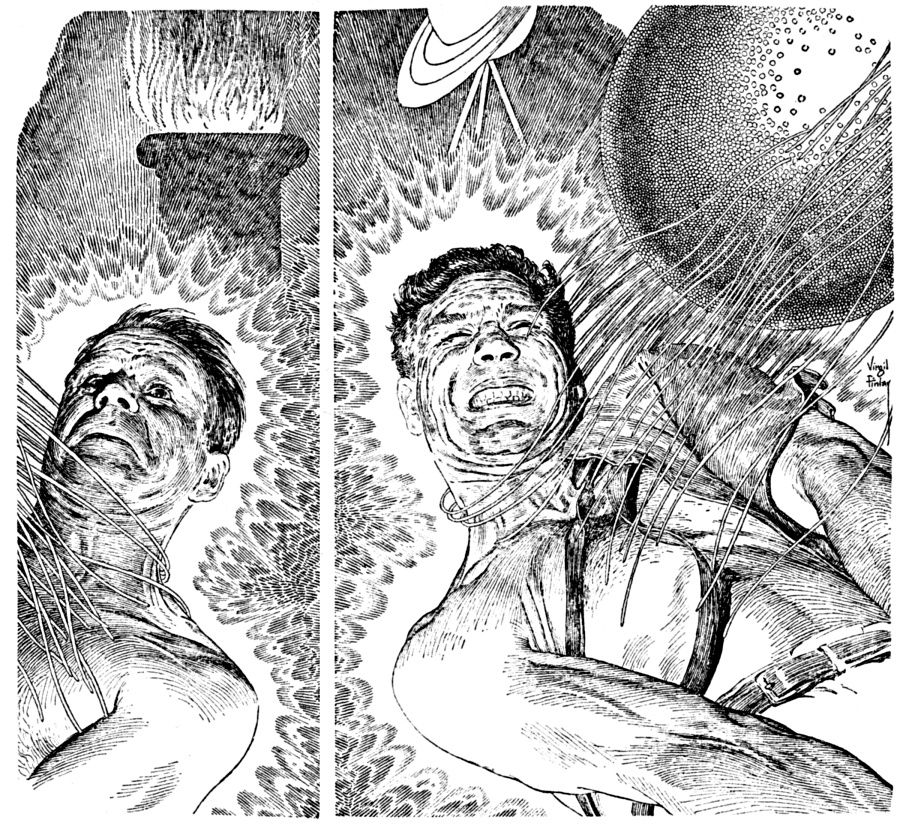 Grim Hagen’s men writhed helplessly in the grip of the Kalis’ deadly copper hairs!
The Kalis darted this way and that and Grim Hagen’s men writhed. Their muscles clenched. Their jaws set as though tetanus had struck them. They slid to the marble street and died.
And the Kalis laughed and whined and screamed as they fed. Even above their feeding-song and the screams of their victims came the shrill, triumphant cry of Nea urging them on.
Nor was the rest of Maya’s army still. One old Bron who had been a slave of Grim Hagen for too long had found a shotgun among Hagen’s treasures and was blasting away. They were armed with everything from staves, blunderbusses, old forty-fours and Sharps rifles to machine guns. They fired and fired. Grim Hagen’s men went down. But though dozens of ill-aimed shots were fired at him, Grim Hagen still lived, dodging here and there, rallying his men, and urging his gun-crew to finish setting up that odd weapon.
Few were left of the thousand that had rallied to Grim Hagen. But another thousand were coming through the hedges from other lanes and streets. Although it was a gallant, ragged little army that Nea and Maya led, it would have lasted no longer than a straw in a whirlwind had it not been for the Kalis. They appeared to be enjoying themselves, even as Grim Hagen’s men were not. They zig-zagged this way and that. They purred. They fed. They were stronger now and their movements were quicker. Their victims died faster.
And as they forged forward, Nea was growing in strength. She leaped after them, leaving Maya to command the small army. She screamed. She urged them on with a “Kill, kill, kill!” that froze the back of Odin’s neck. Here was no girl trained to work in a laboratory. This was a high-priestess, long derided and forgotten, come back from the stars to wreak her vengeance.
“Good God,” Odin was thinking. “What unexplored labyrinths are left in the human brain?”
Then there was no time for thinking. The Lorens who were trying to gain the stairway had finally dislodged the two bodies that Odin and Gunnar had flung down upon them. They came up like a surging tide, and for the next few minutes Odin and Gunnar were busy.
Gunnar had never been any happier in his life. He talked to his sword and he growled at those that he killed. He yelled at Ato’s and Maya’s wearying armies, urging them to go on and account themselves well. He stood by Odin’s side, and the two hacked and thrust until the stairway was chocked with bodies and no one was left to assail them.
He and Odin were splashed with blood. The tumult was deafening. The tiger-screams of the Kalis, the agonized torment of their prey. The gun-blasts from Maya’s army, the cry of Ato who had hacked his way almost to Gunnar and Odin, the victory-scream of Nea, the broken music! And even above this, the mad curses and commands of Grim Hagen!
Some of Grim Hagen’s Lorens were in flight. Most of them were dead. But his white-skinned warriors held firm. Not over a dozen were left at Grim Hagen’s side. Two were still working with the odd-shaped weapon.
There were other Lorens coming out of the hedges, but they held back. They had seen enough.
Had fortune favored Ato then, his army would have won.
But at the precise moment when the balance was swinging toward the Brons, Grim Hagen’s gun-crew got the strange weapon unlimbered. The globe started turning. Unseen motors roared within it. As though spun out like gleaming strands of cobwebs, coils of light came flickering toward the attacking Brons. Like blue-white ripples they went across the fore-running Kalis. The ripples of light went on expanding. The shotgun in the hands of the old Bron suddenly burst to pieces. The old rifles fell apart. The newer machine-guns talked briefly, and then disappeared in a burst of flame that took their masters with them.
The first coil of light struck Odin. There was a tingling sensation, neither painful nor pleasant. But it went through his body like a mild opiate. He did not want to sleep. He merely wanted to relax and forget this slaughter. He fought against it. Gunnar leaned against him, suddenly weak and shaken.
More widening circles of light swept out upon them. Ato’s and Maya’s troops fell back. Those who had been armed with explosive weapons had died. Odin was almost too weak to lift his sword. From the stairway below came a scrabbling sound, as men pulled the corpses away from the stairs.
Nea’s Kalis reeled back. She urged them on and they advanced like corks bobbing on ripples of light. Three moved slowly toward Grim Hagen’s machine. A fourth faltered and fell back.
The Kalis were no longer screaming their frightful song. The purr of victory was gone. Instead they yowled a savage, tormented scream as though they [Pg 124] had been cornered by an enemy they could not understand.
But the three moved forward, while the fourth hesitated behind them. As though struggling against a heavy flood they came on. The gun-crew died defending their whirling weapon. The three Kalis swarmed over it—like bees smothering the enemy, Odin thought. The pulsing coiling light died. There was a burst of flame. The weapon and the three Kalis suddenly became one immense sardonyx that blazed huge and grand for a brief moment. Then the jewel-blaze burned out, and a handful of ashes sifted to the ground.
The fourth Kali was undone. It tried to go forward against that jewel-fire. Then it hesitated and darted back. With a shrill cry of fear it flung itself into Nea’s arms, its coppery tentacles holding her close in a last effort to escape destruction.
She had said before that the Kalis were the nearest things to human that could be made. She had been the poor relation, the daughter of a dreaming failure. Perhaps something of the fear and doubt which Nea had known all her life had gone into the making of the Kalis. She screamed once—more in bewilderment than pain, as though a favorite cat had suddenly clawed her. She must have been dead before she fell, and the last Kali clung to her bosom and spread its copper-wires about her face. It emitted one weak purr—then it stopped purring and moving forever.
Grim Hagen’s Lorens who had been clinging to the hedges now came forward triumphantly. Strength came back to Gunnar and Odin. The attackers had cleared the stairway again. And once more Gunnar and Odin threw them back.
By now both Ato and Maya had swung their shattered little armies over to the subway entrance.
Hagen had retreated from the dais. Meeting the advancing Lorens, he led them forward.
Those on the stairway retreated as they saw that they were no longer against two warriors.
Gunnar rested his sword against his leg and reached out with huge arms and pulled Ato and Odin toward him. “Down there,” he pointed toward the stairway. “There is plenty of room to fight, and those who have been coming up don’t seem to be so strong. Force your way down there and make another stand. Make a barricade if you can. Up here you will soon be surrounded.”
“But Grim Hagen will be at our heels—” Odin protested.
Gunnar laughed deep in his throat. “Oh, no. The stairway is narrow. A strong man could hold the entrance for some time—perhaps a long, long time. And Gunnar is strong. To get at you, Grim Hagen would either have to go down this stairway or take another entrance. These entrances, are few and far apart.”
“Go with Maya, Ato,” Odin said, “and I will stay here with Gunnar.”
“No. The entrance is narrow. You would be in the way,” Gunnar protested. “Now, go! Oh, but the valkyries will be busy tonight!”
Ato and Odin led the rush down the stairs. There were only a dozen men below and they had already tired of warfare. Three fell and the others rushed off into the shadows.
Ato’s and Maya’s fighters tumbled after them. There were only a few of the old people and children left.
Now they found themselves in a huge room which was filled with benches and small machines. It was evidently a wood-working shop. The room was lit by several of the high-flaring cressets of stone. It was rectangular, about the size of a football field. They were fortunate that there was no heavy machinery left here. From each side, dim-lighted tunnels led off into the distance. While Odin and the strongest soldiers guarded, Ato and his people shoved benches, tables and chairs to the four tunnels and set them afire. There were still quite a number of benches left, and some of these were stacked close together into one corner of the room, making a sort of rude balcony that looked down upon the littered floor. More benches and machines were left. These were made into a barricade a few yards in front of the balcony.
All was done now that could be done. So Odin rushed back to the stairway to help Gunnar. But his heart sank as he stood at the foot of the stairs. Up there was nothing but swirling, violet flame. Some liquid was burning furiously at the entrance-way, and blazing rivulets were pouring down the steps. There was no way to go through those flames. There was now no way to go around. Gunnar, if he lived at all, must fight alone. And Odin’s eyes filled with tears as he cursed himself for deserting his old comrade.
The attackers were almost upon Gunnar before the last of Maya’s rag-tag army had gone down the stairs. There were high bannisters around the entrance-way. These afforded plenty of protection to his back and flanks unless someone scaled them, which he doubted. One of the heavy cressets was burning nearby. It seemed to be no more than a huge, open lamp. Standing upon a circular base about three feet across, the twelve-inch stem went up nearly eight feet and then flared out into a tulip-shaped bowl that was filled with flickering violet fire. Bending low, Gunnar grasped the bottom of the stem and moved it a little closer to the stairway entrance. It took all of his strength, but it moved, complaining as it slid along the flagging. Now he was almost under it. The light was in his opponents’ faces, and it gave a little added protection to his left side.
Gunnar braced himself, his long blade high over his shoulder, both hands locked to the long carved haft.
“Grim Hagen,” he called mockingly. “Here we are at the edge of the stars. Just you and I left on top of this world. Just you and I of the two crews that sailed from Opal. The mad gods have made bonfires of the suns. Ragnarok has come and passed. I have no quarrel with these people, Grim Hagen. Come forward now and let the two of us end what should have been ended long ago—”
Grim Hagen silenced his men and screamed back: “Gunnar, what I say now I have said before. I promised you death. But I will let you go free—and all the frightened rats below can go free—if you will give me Wolden’s secret—”
“I know nothing of Wolden’s secret. It may be nothing but a twitch in your mad brain. The old Blood-Drinker and I know but one secret, Grim Hagen, the secret of death. Step forth like a man now and I promise you more peace than even Wolden’s secret could give you.”
Grim Hagen said no more to Gunnar. He sent four companies in the direction of other entrances to the underground city. Then he martialled his remaining men and threw them toward Gunnar in threes.
Three by three they came, and three by three they went down. Braced on his strong, short legs Gunnar flailed them like wheat. Screams and curses filled the night. And Gunnar piled the dead before him.
One by one the companies returned to Grim Hagen and reported that for the present there was no other way into the room below.
Grim Hagen held a short council of war. He had less than a score of the white-skinned soldiers left. These he sent at Gunnar in a body, and came following after with the remaining Lorens.
Gunnar cut them down, but a leaping soldier died as he buried his knife in Gunnar’s side. The Lorens were throwing sticks and stones when they could. They closed in like dogs upon a wolf. Gunnar reeled back and then advanced once more as he swung his broadsword.
He cleared a path and sent his attackers back until they stood about him in a circle, their fangs ready.
And then Gunnar reached forth and took the stem of the huge torch high up in his hands and bowed his back. The lamp rocked upon its pedestal and then came crashing forward. Its fuel spilled down and caught fire as it fell. Flames leaped up and lashed out at the Lorens.
The fierce flames drove the attackers farther back. But in falling, the great lamp careened and half of its liquid had splashed across the entrance to the tunnel. It caught fire. Gunnar gasped as it struck him. Then he strode [Pg 127] forward, like a dwarf-king advancing from Hell.
A thrown knife caught him in the chest. Gunnar took another step, and another knife caught him below the throat. He stood there, trying to go on, and a mace thudded against his temple.
Gunnar reeled back into the flames.
A DEADENING quiet fell over the huge room where Maya’s and Ato’s little armies were making their last stand. The flames were dying out in the tunnels and on the stairway. They fed more fuel to the fires and waited.
Maya was at Odin’s side now. They clung together. Jack Odin kissed her and swore that they would never be parted again.
“Until death—” Maya said and raised her lips to his.
He shivered. It was a promise and an assurance that might be kept too soon. The fires could not burn much longer. Grim Hagen’s power over the Lorens might be questioned after the havoc that had been wreaked in the city above. But Hagen and his white-skinned soldiers could still fight. And Grim Hagen’s hate was hotter than the fires that were now dying out in the tunnels.
Ato joined them. He had proven himself a general. Outnumbered all the way, he had broken Grim Hagen’s lines time and again during that awful night.
“I think we had better wait behind the barricades and make our last stand upon the balcony,” he said. “We can’t defend five entrances at the same time.”
Odin agreed.
“Some of Maya’s people are unarmed. We still have a few of the Lorens who joined us. They are good fighters. Better than the Lorens who are with Grim Hagen. Apparently, he drew his following from the weakest among them.”
“Aye,” Val the Loren agreed. He had fought near Ato’s side all through the night, and his lean left hand was rubbing two deep cuts across his chest. “They have already had enough. But they have asked the wild things of the moss-country to dine with them, and now they can’t get rid of their guests. If Grim Hagen and his soldiers should die, they would give up in a minute.”
“Are your men still armed, Val?” Odin asked.
“Aye. They know to hang on to their weapons.”
“Not all of Maya’s people are,” Odin said. “I don’t like the idea of the children and old men fighting.”
“Children and old men have fought before,” Ato answered simply. “If this should be the last time, then the battle would be worth the blood. Anyway, I have set them to fashioning lances and staves from wood that we saved from the fires.”
They waited. All the troops and all the weapons were moved behind the barricade.
Some of the best throwers were mounted upon the improvised balcony. They had rigged up a rude catapult from some lumber and ropes. They had barrels of nails and spikes for ammunition. Odin wished for some good bowmen, but the bow was as foreign to the Lorens as it was to the Brons. There was nothing left to do except move all the workshop’s water-pails and sand-buckets behind the barricade in case of fire.
Soon they heard the sound of war-cries and the splashing of water from the tunnels. Smoke poured into the room from the quenched and dying fires. It disappeared almost as fast as it came. Evidently the Lorens were masters of air-conditioning. Odin was thankful. Knowing Grim Hagen, he had been fearful of gas. Now that seemed unlikely. Even as Gunnar had predicted, this last fight would be with knife and sword and spear. Or, if it lasted long, with clubs and bare hands.
They had spanned space and had mocked at time. Now time was triumphant as always. Would they end up as pre-stone-age men throwing sticks at one another? And was this a sample of the end of all the thinking men who would follow after into space? If so, what a hollow, foolish end to such high endeavor. Odin remembered an old professor who had said that all races carry their own seeds of destruction with them wherever they go. The bees who steal the honey soon die, the old man had said, but the flowers are pollinated anew and life goes on forever.
But such bleak thoughts were short-lasting. For as soon as the tunnels and the stairway were cleared of smoke, Grim Hagen’s army came pouring into the room. Grim Hagen had mustered at least two-thousand men. He had divided these into five groups, and they came through the five entrances at the same time. Yelling and brandishing swords and flares, they rushed the barricade.
Jack Odin had underestimated the catapult. The crew released it. And a shower of spikes tore the invading ranks apart. Odin saw a white-skinned warrior go to his knees and scream as he tried to pull a six-inch spike from his eye.
Ato had ordered his men to try for Grim Hagen’s trained soldiers first. Odin saw an old Bron cast a home-made spear with as much ease as a trained javelin-thrower back home. A soldier tried to pull it out of his chest until his legs buckled beneath him and he tumbled over backwards.
Then a white-skinned warrior leaped at the barricade and Odin thrust him through.
Torches began to rain down upon them. Half the defending forces were now busy with water and sand, beating out the flames.
Then, after what seemed to be hours, the catapult crew cranked their awkward weapon to the trigger-point again and sent another rain of spikes into Grim Hagen’s ranks.
The floor beyond the barrier was littered with dead and slippery with blood before Grim Hagen’s men broke the barrier.
There were only two hundred to meet the charge of two thousand. The end was inevitable.
As the barrier went down, Jack Odin and Maya urged their men to climb upon the balcony. Odin was the last to retreat. A soldier caught at him as he scrambled upward and Odin turned and slashed him across the face.
Ato was calling his men around him. They drew back to a corner where two thick walls met. Ato had placed one bench there. This he stood upon, calling out orders and cheering them on as the attackers climbed the unsteady tiers of benches and tables to reach them. The defenders gathered around. There were not over fifty of them left now. Odin thrust Maya behind him. A body fell at his feet. He bent and lifted up a twelve-year-old boy who was streaming from wounds. He handed the lad to Maya.
Grim Hagen led the attack. Odin braced himself. He took one step forward and waited. Seeing him, Grim Hagen veered toward him, screaming a mad battle-cry—his eyes wild with hate. Even in what appeared to be the last moment, Jack Odin saw that only three or four of the white-skinned soldiers were left; and not over a dozen of the Brons who had stayed with Grim Hagen during all those wasting years remained.
He did not take his eyes from Grim Hagen. He was conscious only of a sudden flickering, as of many lights twinkling on and off. But he did not know what was happening. Maya told him later.
Ato was already bleeding badly from a deep slash in his shoulder. As he rallied his men around him, someone threw a knife that buried itself in the right side of his chest. He stumbled and went down to his knees. Then he struggled up, and as he stood straight he reached down to his waist and clutched the little slug-horn of moon-metal that his father had given him. His head went back as he raised the horn to his lips. Like Childe Roland, who came at last to the Dark Tower, he blew one unheard blast.
Suddenly the room was filled with lights, flashing and dancing everywhere. Whispering.
A stillness fell upon the room and the shambles. Men paused as they lifted their knives or braced themselves for a last thrust.
For a single breath, all was in silence.
Then a light began to whisper. “Ato, it is I, your father, Wolden. We have learned the secret of time and space and we have come for you, my son. But before we go, we must rid ourselves of the mischief-makers.”
The lights darted down upon Grim Hagen’s men. And as they touched them, the cold of space [Pg 130] came flowing through. They fell one by one. And the hoar-frost covered them like spiderwebs across the faces and bodies of long-dead mummies.
There was a spattering sound, as of sleet falling against a distant roof. A strange smell filled the air.
And one by one Grim Hagen’s men went down.
ALL this happened while Grim Hagen was rushing toward Odin and Maya. A thin trickle of blood was flowing down the corner of Hagen’s mouth. Odin heard the voices. Out of the corner of his eye he saw some men go down. The room felt cold now, and a thin breeze was going through it, as though blown gently across the star-spaces.
He saw a light dart down toward Grim Hagen.
But at that instant Grim Hagen reached him and swung his sword. Jack Odin stepped aside. His foot slipped upon the unsteady planking of the improvised balcony. He thrust for Grim Hagen’s throat, but his blade went high and wide. It gashed Grim Hagen from the lower corner of his chin clear back to the jawbone. Blood streamed and as Odin slipped to his knee Grim Hagen swung again.
Then Maya was between them, both hands grasping Hagen’s sword-arm. Hagen’s free hand closed about her wrists. He swung her aside and the point of his sword came down to rest upon her throat.
“Now,” Grim Hagen screamed, and his voice was the shriek of a man who has nothing left to lose. “Let no light come near me and Maya or we die together. Wolden, I caught scattered words about your work as I fled through space. I held the stars and planets in my hands and I flung them away, for they were no more than the sparks that fly out from flint. They were worthless and I flung them away. And there was nothing to match my desire. Not even Maya. Now, listen, if you care for her life.”
The descending lights hesitated and drew back. Jack Odin righted himself and chanced a thrust at Hagen. The thrust failed as Grim Hagen moved Maya between them.
“No more of that, Odin. Drop your sword or she dies. Drop it now!”
And Odin lowered his hand and let his sword fall to the table beneath him.
Grim Hagen continued: “The ship is yours. This world is yours. Let me have your secret, Wolden. I would not care to be with such as you. I would laugh at space with the comets. I would make the stars cringe. I would watch the generations go by like falling snow. I would—”
“No, you would be like Lucifer, wreaking his vengeance upon the planets,” the voice of what had been Wolden interrupted in a whisper. “No, Grim Hagen, even if I gave you what you asked, all space would seem as hell to you.”
Grim Hagen smiled an evil smile. “So. But it is I who make the bargain. Even yet. Maya goes with me. Remember!”
But at that instant Maya got one hand free and thrust the sword aside.
It was all the time that Jack Odin needed. Reaching forward he grasped Grim Hagen’s sword with his bare hand. It cut to the bone. And then he had Hagen’s wrist with his free hand. He twisted. A bone cracked and he shook the blade from Hagen’s grasp. Maya leaped to one side. Then Hagen’s fingers were pushing Odin’s face back and Odin was clutching at Hagen’s throat.
They stood there swaying. Then they tumbled down the rude stairway of tables that Ato had fashioned for his last stand.
They rolled to the blood-stained floor beneath. And Odin never knew how either of them survived the fall.
The lights hovered above them, waiting for an opening. Maya took up a fallen sword and came following after.
Grim Hagen’s fingers were feeling for Odin’s eyes. Odin got a bloody fist against Hagen’s face and shoved him back. Then he rolled on top of him and got the man’s throat between his hands. Hagen’s fists worked like pistons as he beat at Odin’s face. Odin felt the blood dripping down upon his hands and upon Hagen’s throat but he held on. At the last, Grim Hagen screamed and clawed like an animal. And then it was over. The hands stopped clawing. There was one last sob of pain and hate that was cut off in the middle. Then Grim Hagen was still. And Odin, with his face dripping blood, held on while Maya and the others struggled to tear his hands free from the man he had killed.
With the death of Grim Hagen the fight was over. None of Hagen’s Brons or Aldebaranians were left. The Lorens threw down their arms and swore loyalty to Val.
A cot was improvised for Ato. The lights hovered around him, whispering cheerfully and ignoring all others.
Val, Odin and Maya tried to count the survivors. Of the fifty who had lived through the fighting, only eighteen were Brons. The rest were Val’s men.
“There are a hundred more on the two ships,” Maya told Odin. “Oh, Jack, we have Nea to thank for most of this. Nea and Wolden. After you and your men left, Nea took her Kalis, as she called them, and some of her people. They came through the barrier and made their way to the Old Ship. They surprised the few guards that Grim Hagen had left. They freed me and the other prisoners. Then we got our little army together and came to help. Without Nea, it could never have been done.” She buried her face on Odin’s shoulder. “Oh, Jack, when we were kids together we used to laugh at her.”
He patted her shoulder comfortingly, for he could think of nothing to say. He had seen soldiers like Nea—cast-offs from their home-towns gallantly going to their deaths. It was something that he could not understand. And being honest, he had nothing to say.
Clean-up was begun. Jack Odin left Val of the Lorens to take over. Then he rushed to the stairway where last he had seen Gunnar. The fires had burned out. The steps were blackened. A few smoking corpses were still upon the stairs.
Odin’s face was covered with blood. His strength was nearly gone. But he went up the stairs two steps at a time, his spent breath whistling through his bloody nostrils.
There at the top of the stairs he found Gunnar. And Gunnar’s dead lay thick about him.
Gunnar had moved himself to a sitting position against one of the railings. His chin was upon his great chest and his eyes were closed as though he slept. But when Odin knelt beside him, he opened one eye and looked up with a twisted smile upon his broad face. One side of his face was barely recognizable. Gunnar was badly burned. He had been thrust through at least a dozen times. But Gunnar lived.
“Eh, Nors-King,” he whispered, sitting up straight as Odin steadied him in his arms. “It was a long time to wait. And I thought sometimes that I would not make it. But I held on, for I knew you would come. Oh, it has been a long wait—and it took all my strength.”
“As fast as I could,” Odin answered in a choking voice. “As fast as I could, O Chief of the Neeblings. For Ragnarok is past, and the tree of life still reaches into the stars. The twilight is past and new suns and new earths are quickened. And Gunnar still lives.”
“Part of him.” Gunnar blinked his good eye. “What happened down there? Oh,” he gasped in pain, “to have missed the fighting!”
“Maya lives and I live. Ato is wounded. Wolden came at the last to help us, Gunnar. We won. And I have killed Grim Hagen with my bare hands, even as I promised.”
“Good, Nors-King. I knew always that one of us would kill him. Oh, it was a grand fight. But Gunnar will sharpen his sword no more. There was a ford near my father’s house where the clear water ran fresh over the stones. That might help me. But it is far away. And my father too. You tell Freida that we did not make the long trip in vain.”
“If I can,” Odin promised.
“Oh, you can. For we have won the stars and nothing is beyond us—except youth, maybe.”
Gunnar closed his eyes and slept for a few minutes while Odin held him in his arms. Then Gunnar awoke.
He smiled at Jack Odin and murmured:
“To awake on the sea of the stars—”
Jack Odin had heard Gunnar sing those words before. They belonged to an old Norse lullaby that Gunnar’s mother had crooned to him when he was a little boy.
Then Gunnar died.
And Odin knelt over him, tears streaming down his broken face.
SIX months had passed since the battle.
The city of the violet dome was rebuilt. The ashes of the dead had been strewn upon the mossy plains. The two ships now stood in peace and gazed at each other across the expanse of moss and grass that had replaced the cinders left from the fighting.
Another city was being built a few miles away.
Ato had soon recovered from his wounds, and as ship’s captain had married Maya and Odin.
So it was over. But Odin and Maya had asked for Gunnar’s ashes, and had buried them out there on the plain, beneath a gaunt tree which was something like a mesquite. Gunnar would have liked that. Twisted, gnarled, and tough, the tree spread out its branches above him; and a bird had built its nest there and sang its old song of stars and men and time.
The Lorens were a happier people. One of the first things that the lights had done was to plunge back into space. Within a few days they returned, trailing a huge dust-cloud behind them. It must have been the last salvage from the explosion that Odin had witnessed back there in space. The cloud trailed out in one great streamer and slowly circled the ancient sun. Slowly the spirals came nearer to the fires. The sun fed. Its old warmth returning, it smiled at its lone child. The air of the planet of the Lorens grew warmer and fresher. The plains seemed to shake themselves as a new spring returned to enliven the land and take up its old work of helping life to begat new life. Out there in empty space, Odin fancied, Death lowered his scythe and smiled and shrugged his lean shoulders as he went away to harvest other suns.
Oh, it was a wonderful spring. The trip was over, but what a haggard few had beached the boats at the vast edge of space!
The few surviving Brons were happy now. Those who had been Grim Hagen’s slaves out of their loyalty to Maya were offered anything that they wished. However, it turned out that most of them wanted little except peace and rest.
The families of Brons that survived were now building their houses above ground—although the Lorens had generously offered them quarters below the city. The Brons wanted no more of caves or tunnels. They preferred to live up there on this world’s surface and take their chances with frost and flood.
Opal had been beautiful and wonderful. It had been like living eastward in Eden, but Eden’s gardens were no more. And perhaps it would be better to face the elements and meet them head-on instead of seeking shelter. For time and chance were working everywhere—even in Eden—and as Gunnar had always said, a fighting heart could carry a man to the last.
The days and the nights were longer than on earth. The work was long and hard. But the world of the Lorens was being rebuilt. And at night, Odin usually set an hour aside to work on his notes.
At times he talked with Wolden, although he could never be completely at ease when talking to a light. Nor could he understand half the things that Wolden told him. Wolden quoted formulas on time and space, mass and speed. Odin guessed that the belt which he had once used so briefly embodied a No-Time and No-Space factor. But this was beyond him.
As for Ato, he grew moodier every day. At last he came to see Maya and Odin one evening. Sitting by the fire—for the nights there were chilly—he talked to them of his decision.
“It was a great fight,” he said. “And I will always remember it. If Nea had lived, I might have felt differently. But Wolden and the others say that they will not stay here much longer. I have decided to go with them. Theirs is a sort of Nirvana, a timeless, dimensionless existence. Yesterday and tomorrow, near and far, are one—”
Maya shivered. “It sounds like a frightening existence. I don’t understand it at all. It is as though they had become spirits without dying.”
“Perhaps,” said Ato thoughtfully, looking into the fire. “You may be right. But they say it is wonderful to be freed from the shackles of space and time. You remember the belt, Odin? Wolden has merely improved upon it. Soon, I think, I will put on the belt that they brought for me and go forth with them like Laelaps to invade the night.”
He paused a minute and then added cautiously, “They have brought two more belts with them. For you two, if you should decide—”
Maya shivered. Odin laughed, as he shook his head. “No. I am a man. Just flesh and blood, Ato. And I choose to stay here and take the blows of time. To endure to the end—even as my fathers before on earth—”
Maya snuggled against his shoulder as she nodded her agreement.
Ato smiled. “I thought so—But we will say no more about it. There is one thing that you may not understand. Wolden has tried to tell you. But he is a scientist, and his words are different and difficult to follow. You and I have fought shoulder to shoulder. Perhaps I can explain—”
Then he talked for nearly an [Pg 135] hour about the passing of time—and how a ship could circle the universe at the speed of light—and upon returning it might find its home-port nothing but dust and memories. For while their hearts were beating once a month out there in space tide after tide of years had flowed over their homes and their loved ones.
It was a sad, bewildering speech. It reduced time to nothing—and both Maya and Odin felt a lump of ice in their throats as Ato talked.
But even after he had finished, they shook their heads and clung together. A chill wind from space seemed to be blowing through the room, whispering of time’s vagaries, and how space had different clocks, and how the affairs of men were swept by time and chance down to a sunless sea.
For the last time Jack Odin and Maya refused Ato’s offer. Eden was behind him. Immortality was lost. But Adam and Eve held close to each other there at the edge of space—and as they left Eden behind an old sad nobility clung to them. Something brave and beautiful, like the last leaves of autumn glinting in the setting sun.
The notes that Doctor Jack Odin sent me are ended. But even as before he wrote a short letter and added it to the package at the last.
Dear Joe: (he began)
Wolden and Ato have agreed to deliver this message and the attached notes. Wolden says that it is a terrible experience to go from the fourth-dimensional light of his into a time-bound world. He will not again obligate himself as a messenger boy.
I promised to let you know how we fared. And here is the tale, if you can piece it together. And I suppose you can, for you always liked to monkey around with words. (From this distance, I would say that putting words together has been both the curse and the blessing of your entire life.)
I fear that I cannot understand Ato’s and Wolden’s talk. But let me put it this way. We traveled fast and furiously through space. And all the while, Father Time was laughing at us. You will remember how Grim Hagen aged on Aldebaran while we sped after him in what seemed to be only a few weeks. Well, if we left in The Nebula now and plunged back to earth we would arrive there two hundred years from the day that we took off. And from what I saw of your civilization at the last, I have no desire to see it two hundred years later.
Bewildering, isn’t it? Nea always said that we would have to use new concepts and develop new mores if we ever conquered space. She was right.
Theoretically, you are gone and forgotten for two centuries. And yet, Wolden assures me that he can deliver this to you in short order. Therefore, time does not [Pg 136] exist as we know it. Or is it a river that can be navigated?
Our home is finished. Maya and I are happy. This is a peaceful planet. Val’s people are philosophers. They only fought out of desperation.
My sword and Gunnar’s are growing rusty upon the wall. I have a small office now, and will probably end up as a country doctor. The two ships are still out there on the plain. Our children, if they wish, can man them and go out into space. But as far as we are concerned we go no more a-hunting.
The notes that I am sending you are fairly complete. It is nearly midnight and the fire is burning low. Maya is nodding beside me. So—happy at last—parsecs away and years away—I wish my old friend a hearty fare-thee-well—and
it is a tale that is told.
Best wishes,
Jack Odin, M. D.
THE END
Transcriber's Notes
This etext was produced from Amazing Science Fiction Stories May 1960. Extensive research did not uncover any evidence that the U.S. copyright on this publication was renewed.
The following corrections have been made to the text:
Page 48: Both hands of the clock were pointing upward{original had uward}.
Page 51: Rolling the knapsack up into a ball and tying it securely{original had securly}, he threw it over the brink.
Page 52: The spurt of a match showed him his miner’s cap{original had cape} not five feet away.
Page 55: Even though we go farther than the graveyard of stars—or beyond the gates of hell, maybe—I will find her.”{original omitted quotation mark}
Page 59: We know now that Grim Hagen and his ship, with all his prisoners and loot, took off from the bed of the sea with a flourish which was just like Grim Hagen{original had Hagin}.
Page 70: They hammered and pounded at the framework.{original omitted the period}
Page 71: It was entitled: “Einstein and Einsteinian Space, with Conjectures upon a Trans-Einsteinian concept.{original had a comma here}”
Page 73: She was dressed in linsey-woolsey{original had lindsey-woolsey}, and the overalls of the three sons were also home-spun.
Page 75: And once,{original had a period} Odin heard him cry out
Page 78: Larger than the others, Odin landed awkwardly{original had awkardly} upon the floor of the car.
Page 79: It was surrounded by green grass, and at one corner was a profusion of water-lilies{original had water-lillies} and cat-tails.
Page 80: “{original omitted this quotation mark}For over a thousand years, theirs was an economy of death and rottenness. Mushrooms and toadstools were their food.
Page 82: Jupiter with its red clouds and its protean{original had portean} “eye” reached out for them and was left behind.
Page 83: “It will be like plunging back from immortality{original had imortality} to mortality,” Ato told Odin.
Page 84: “My father’s work is finished{original had finisheded},” she told them proudly.
Page 86: Don’t you see?{original had a period instead of the question mark}
Page 91: He saw boats and cars and a few long-nosed airplanes, with the merest trace of vestigial{original had vestigeal} wings far back near the empennage,
Page 95: Again he tossed a sneer in Gunnar’s direction—{original had a superfluous quotation mark here}
Page 95: “If I did, Hagen, would I turn you and your hell’s{original had hells’} spawn loose upon the stars to perplex them forever?”
Page 97: “Touché{original had Touche}!” Jack Odin thought as Gunnar departed.
Page 98: This was true,{original omitted the comma} Odin thought, since this was the first Bro-Stoka who had ever been identified to him.
Page 98: “And he is a Bro-Stoka among the slaves,{original omitted this comma}” Gunnar continued.
Page 100: “Turn the light upon her forearm{original had fore-arm, but all other occurrences were spelled forearm}, now,” he instructed.
Pages 103-104: Do you remember a story about the bush-men dying from a curse?{original had a period instead of the question mark}
Page 106: {original had a superfluous quotation mark here}Here,” he pointed to a pinpoint of light upon the map.
Page 107: "Perhaps," she answered.{original had a comma} "But space out there is curdling in his wake."
Illustration caption (Page 122): Grim Hagen’s men writhed helplessly in the grip of the Kalis’{original had Kali’s} deadly copper hairs!
Page 128: The bees who steal the honey soon die, the old man{original had men} had said,
Page 134: Soon, I think, I will put on the belt that they brought for me and go forth with them like Laelaps{original had laelaps} to invade the night.”
The following words were inconsistently hyphenated, and have been left as in the original:
cheek-bone/cheekbone
fore-arm/forearm
loud-speakers/loudspeakers
motor-boat/motorboat
out-cropping/outcropping
End of Project Gutenberg's Hunters Out of Space, by Joseph Everidge Kelleam

*** END OF THIS PROJECT GUTENBERG EBOOK HUNTERS OUT OF SPACE ***

***** This file should be named 25270-h.htm or 25270-h.zip *****
This and all associated files of various formats will be found in:
        https://www.gutenberg.org/2/5/2/7/25270/

Produced by Greg Weeks, Andrew Wainwright and the Online
Distributed Proofreading Team at https://www.pgdp.net


Updated editions will replace the previous one--the old editions
will be renamed.

Creating the works from public domain print editions means that no
one owns a United States copyright in these works, so the Foundation
(and you!) can copy and distribute it in the United States without
permission and without paying copyright royalties.  Special rules,
set forth in the General Terms of Use part of this license, apply to
copying and distributing Project Gutenberg-tm electronic works to
protect the PROJECT GUTENBERG-tm concept and trademark.  Project
Gutenberg is a registered trademark, and may not be used if you
charge for the eBooks, unless you receive specific permission.  If you
do not charge anything for copies of this eBook, complying with the
rules is very easy.  You may use this eBook for nearly any purpose
such as creation of derivative works, reports, performances and
research.  They may be modified and printed and given away--you may do
practically ANYTHING with public domain eBooks.  Redistribution is
subject to the trademark license, especially commercial
redistribution.


*** START: FULL LICENSE ***

THE FULL PROJECT GUTENBERG LICENSE
PLEASE READ THIS BEFORE YOU DISTRIBUTE OR USE THIS WORK

To protect the Project Gutenberg-tm mission of promoting the free
distribution of electronic works, by using or distributing this work
(or any other work associated in any way with the phrase "Project
Gutenberg"), you agree to comply with all the terms of the Full Project
Gutenberg-tm License (available with this file or online at
https://gutenberg.org/license).


Section 1.  General Terms of Use and Redistributing Project Gutenberg-tm
electronic works

1.A.  By reading or using any part of this Project Gutenberg-tm
electronic work, you indicate that you have read, understand, agree to
and accept all the terms of this license and intellectual property
(trademark/copyright) agreement.  If you do not agree to abide by all
the terms of this agreement, you must cease using and return or destroy
all copies of Project Gutenberg-tm electronic works in your possession.
If you paid a fee for obtaining a copy of or access to a Project
Gutenberg-tm electronic work and you do not agree to be bound by the
terms of this agreement, you may obtain a refund from the person or
entity to whom you paid the fee as set forth in paragraph 1.E.8.

1.B.  "Project Gutenberg" is a registered trademark.  It may only be
used on or associated in any way with an electronic work by people who
agree to be bound by the terms of this agreement.  There are a few
things that you can do with most Project Gutenberg-tm electronic works
even without complying with the full terms of this agreement.  See
paragraph 1.C below.  There are a lot of things you can do with Project
Gutenberg-tm electronic works if you follow the terms of this agreement
and help preserve free future access to Project Gutenberg-tm electronic
works.  See paragraph 1.E below.

1.C.  The Project Gutenberg Literary Archive Foundation ("the Foundation"
or PGLAF), owns a compilation copyright in the collection of Project
Gutenberg-tm electronic works.  Nearly all the individual works in the
collection are in the public domain in the United States.  If an
individual work is in the public domain in the United States and you are
located in the United States, we do not claim a right to prevent you from
copying, distributing, performing, displaying or creating derivative
works based on the work as long as all references to Project Gutenberg
are removed.  Of course, we hope that you will support the Project
Gutenberg-tm mission of promoting free access to electronic works by
freely sharing Project Gutenberg-tm works in compliance with the terms of
this agreement for keeping the Project Gutenberg-tm name associated with
the work.  You can easily comply with the terms of this agreement by
keeping this work in the same format with its attached full Project
Gutenberg-tm License when you share it without charge with others.

1.D.  The copyright laws of the place where you are located also govern
what you can do with this work.  Copyright laws in most countries are in
a constant state of change.  If you are outside the United States, check
the laws of your country in addition to the terms of this agreement
before downloading, copying, displaying, performing, distributing or
creating derivative works based on this work or any other Project
Gutenberg-tm work.  The Foundation makes no representations concerning
the copyright status of any work in any country outside the United
States.

1.E.  Unless you have removed all references to Project Gutenberg:

1.E.1.  The following sentence, with active links to, or other immediate
access to, the full Project Gutenberg-tm License must appear prominently
whenever any copy of a Project Gutenberg-tm work (any work on which the
phrase "Project Gutenberg" appears, or with which the phrase "Project
Gutenberg" is associated) is accessed, displayed, performed, viewed,
copied or distributed:

This eBook is for the use of anyone anywhere at no cost and with
almost no restrictions whatsoever.  You may copy it, give it away or
re-use it under the terms of the Project Gutenberg License included
with this eBook or online at www.gutenberg.org

1.E.2.  If an individual Project Gutenberg-tm electronic work is derived
from the public domain (does not contain a notice indicating that it is
posted with permission of the copyright holder), the work can be copied
and distributed to anyone in the United States without paying any fees
or charges.  If you are redistributing or providing access to a work
with the phrase "Project Gutenberg" associated with or appearing on the
work, you must comply either with the requirements of paragraphs 1.E.1
through 1.E.7 or obtain permission for the use of the work and the
Project Gutenberg-tm trademark as set forth in paragraphs 1.E.8 or
1.E.9.

1.E.3.  If an individual Project Gutenberg-tm electronic work is posted
with the permission of the copyright holder, your use and distribution
must comply with both paragraphs 1.E.1 through 1.E.7 and any additional
terms imposed by the copyright holder.  Additional terms will be linked
to the Project Gutenberg-tm License for all works posted with the
permission of the copyright holder found at the beginning of this work.

1.E.4.  Do not unlink or detach or remove the full Project Gutenberg-tm
License terms from this work, or any files containing a part of this
work or any other work associated with Project Gutenberg-tm.

1.E.5.  Do not copy, display, perform, distribute or redistribute this
electronic work, or any part of this electronic work, without
prominently displaying the sentence set forth in paragraph 1.E.1 with
active links or immediate access to the full terms of the Project
Gutenberg-tm License.

1.E.6.  You may convert to and distribute this work in any binary,
compressed, marked up, nonproprietary or proprietary form, including any
word processing or hypertext form.  However, if you provide access to or
distribute copies of a Project Gutenberg-tm work in a format other than
"Plain Vanilla ASCII" or other format used in the official version
posted on the official Project Gutenberg-tm web site (www.gutenberg.org),
you must, at no additional cost, fee or expense to the user, provide a
copy, a means of exporting a copy, or a means of obtaining a copy upon
request, of the work in its original "Plain Vanilla ASCII" or other
form.  Any alternate format must include the full Project Gutenberg-tm
License as specified in paragraph 1.E.1.

1.E.7.  Do not charge a fee for access to, viewing, displaying,
performing, copying or distributing any Project Gutenberg-tm works
unless you comply with paragraph 1.E.8 or 1.E.9.

1.E.8.  You may charge a reasonable fee for copies of or providing
access to or distributing Project Gutenberg-tm electronic works provided
that

- You pay a royalty fee of 20% of the gross profits you derive from
     the use of Project Gutenberg-tm works calculated using the method
     you already use to calculate your applicable taxes.  The fee is
     owed to the owner of the Project Gutenberg-tm trademark, but he
     has agreed to donate royalties under this paragraph to the
     Project Gutenberg Literary Archive Foundation.  Royalty payments
     must be paid within 60 days following each date on which you
     prepare (or are legally required to prepare) your periodic tax
     returns.  Royalty payments should be clearly marked as such and
     sent to the Project Gutenberg Literary Archive Foundation at the
     address specified in Section 4, "Information about donations to
     the Project Gutenberg Literary Archive Foundation."

- You provide a full refund of any money paid by a user who notifies
     you in writing (or by e-mail) within 30 days of receipt that s/he
     does not agree to the terms of the full Project Gutenberg-tm
     License.  You must require such a user to return or
     destroy all copies of the works possessed in a physical medium
     and discontinue all use of and all access to other copies of
     Project Gutenberg-tm works.

- You provide, in accordance with paragraph 1.F.3, a full refund of any
     money paid for a work or a replacement copy, if a defect in the
     electronic work is discovered and reported to you within 90 days
     of receipt of the work.

- You comply with all other terms of this agreement for free
     distribution of Project Gutenberg-tm works.

1.E.9.  If you wish to charge a fee or distribute a Project Gutenberg-tm
electronic work or group of works on different terms than are set
forth in this agreement, you must obtain permission in writing from
both the Project Gutenberg Literary Archive Foundation and Michael
Hart, the owner of the Project Gutenberg-tm trademark.  Contact the
Foundation as set forth in Section 3 below.

1.F.

1.F.1.  Project Gutenberg volunteers and employees expend considerable
effort to identify, do copyright research on, transcribe and proofread
public domain works in creating the Project Gutenberg-tm
collection.  Despite these efforts, Project Gutenberg-tm electronic
works, and the medium on which they may be stored, may contain
"Defects," such as, but not limited to, incomplete, inaccurate or
corrupt data, transcription errors, a copyright or other intellectual
property infringement, a defective or damaged disk or other medium, a
computer virus, or computer codes that damage or cannot be read by
your equipment.

1.F.2.  LIMITED WARRANTY, DISCLAIMER OF DAMAGES - Except for the "Right
of Replacement or Refund" described in paragraph 1.F.3, the Project
Gutenberg Literary Archive Foundation, the owner of the Project
Gutenberg-tm trademark, and any other party distributing a Project
Gutenberg-tm electronic work under this agreement, disclaim all
liability to you for damages, costs and expenses, including legal
fees.  YOU AGREE THAT YOU HAVE NO REMEDIES FOR NEGLIGENCE, STRICT
LIABILITY, BREACH OF WARRANTY OR BREACH OF CONTRACT EXCEPT THOSE
PROVIDED IN PARAGRAPH F3.  YOU AGREE THAT THE FOUNDATION, THE
TRADEMARK OWNER, AND ANY DISTRIBUTOR UNDER THIS AGREEMENT WILL NOT BE
LIABLE TO YOU FOR ACTUAL, DIRECT, INDIRECT, CONSEQUENTIAL, PUNITIVE OR
INCIDENTAL DAMAGES EVEN IF YOU GIVE NOTICE OF THE POSSIBILITY OF SUCH
DAMAGE.

1.F.3.  LIMITED RIGHT OF REPLACEMENT OR REFUND - If you discover a
defect in this electronic work within 90 days of receiving it, you can
receive a refund of the money (if any) you paid for it by sending a
written explanation to the person you received the work from.  If you
received the work on a physical medium, you must return the medium with
your written explanation.  The person or entity that provided you with
the defective work may elect to provide a replacement copy in lieu of a
refund.  If you received the work electronically, the person or entity
providing it to you may choose to give you a second opportunity to
receive the work electronically in lieu of a refund.  If the second copy
is also defective, you may demand a refund in writing without further
opportunities to fix the problem.

1.F.4.  Except for the limited right of replacement or refund set forth
in paragraph 1.F.3, this work is provided to you 'AS-IS' WITH NO OTHER
WARRANTIES OF ANY KIND, EXPRESS OR IMPLIED, INCLUDING BUT NOT LIMITED TO
WARRANTIES OF MERCHANTIBILITY OR FITNESS FOR ANY PURPOSE.

1.F.5.  Some states do not allow disclaimers of certain implied
warranties or the exclusion or limitation of certain types of damages.
If any disclaimer or limitation set forth in this agreement violates the
law of the state applicable to this agreement, the agreement shall be
interpreted to make the maximum disclaimer or limitation permitted by
the applicable state law.  The invalidity or unenforceability of any
provision of this agreement shall not void the remaining provisions.

1.F.6.  INDEMNITY - You agree to indemnify and hold the Foundation, the
trademark owner, any agent or employee of the Foundation, anyone
providing copies of Project Gutenberg-tm electronic works in accordance
with this agreement, and any volunteers associated with the production,
promotion and distribution of Project Gutenberg-tm electronic works,
harmless from all liability, costs and expenses, including legal fees,
that arise directly or indirectly from any of the following which you do
or cause to occur: (a) distribution of this or any Project Gutenberg-tm
work, (b) alteration, modification, or additions or deletions to any
Project Gutenberg-tm work, and (c) any Defect you cause.


Section  2.  Information about the Mission of Project Gutenberg-tm

Project Gutenberg-tm is synonymous with the free distribution of
electronic works in formats readable by the widest variety of computers
including obsolete, old, middle-aged and new computers.  It exists
because of the efforts of hundreds of volunteers and donations from
people in all walks of life.

Volunteers and financial support to provide volunteers with the
assistance they need, is critical to reaching Project Gutenberg-tm's
goals and ensuring that the Project Gutenberg-tm collection will
remain freely available for generations to come.  In 2001, the Project
Gutenberg Literary Archive Foundation was created to provide a secure
and permanent future for Project Gutenberg-tm and future generations.
To learn more about the Project Gutenberg Literary Archive Foundation
and how your efforts and donations can help, see Sections 3 and 4
and the Foundation web page at https://www.pglaf.org.


Section 3.  Information about the Project Gutenberg Literary Archive
Foundation

The Project Gutenberg Literary Archive Foundation is a non profit
501(c)(3) educational corporation organized under the laws of the
state of Mississippi and granted tax exempt status by the Internal
Revenue Service.  The Foundation's EIN or federal tax identification
number is 64-6221541.  Its 501(c)(3) letter is posted at
https://pglaf.org/fundraising.  Contributions to the Project Gutenberg
Literary Archive Foundation are tax deductible to the full extent
permitted by U.S. federal laws and your state's laws.

The Foundation's principal office is located at 4557 Melan Dr. S.
Fairbanks, AK, 99712., but its volunteers and employees are scattered
throughout numerous locations.  Its business office is located at
809 North 1500 West, Salt Lake City, UT 84116, (801) 596-1887, email
business@pglaf.org.  Email contact links and up to date contact
information can be found at the Foundation's web site and official
page at https://pglaf.org

For additional contact information:
     Dr. Gregory B. Newby
     Chief Executive and Director
     gbnewby@pglaf.org


Section 4.  Information about Donations to the Project Gutenberg
Literary Archive Foundation

Project Gutenberg-tm depends upon and cannot survive without wide
spread public support and donations to carry out its mission of
increasing the number of public domain and licensed works that can be
freely distributed in machine readable form accessible by the widest
array of equipment including outdated equipment.  Many small donations
($1 to $5,000) are particularly important to maintaining tax exempt
status with the IRS.

The Foundation is committed to complying with the laws regulating
charities and charitable donations in all 50 states of the United
States.  Compliance requirements are not uniform and it takes a
considerable effort, much paperwork and many fees to meet and keep up
with these requirements.  We do not solicit donations in locations
where we have not received written confirmation of compliance.  To
SEND DONATIONS or determine the status of compliance for any
particular state visit https://pglaf.org

While we cannot and do not solicit contributions from states where we
have not met the solicitation requirements, we know of no prohibition
against accepting unsolicited donations from donors in such states who
approach us with offers to donate.

International donations are gratefully accepted, but we cannot make
any statements concerning tax treatment of donations received from
outside the United States.  U.S. laws alone swamp our small staff.

Please check the Project Gutenberg Web pages for current donation
methods and addresses.  Donations are accepted in a number of other
ways including including checks, online payments and credit card
donations.  To donate, please visit: https://pglaf.org/donate


Section 5.  General Information About Project Gutenberg-tm electronic
works.

Professor Michael S. Hart was the originator of the Project Gutenberg-tm
concept of a library of electronic works that could be freely shared
with anyone.  For thirty years, he produced and distributed Project
Gutenberg-tm eBooks with only a loose network of volunteer support.


Project Gutenberg-tm eBooks are often created from several printed
editions, all of which are confirmed as Public Domain in the U.S.
unless a copyright notice is included.  Thus, we do not necessarily
keep eBooks in compliance with any particular paper edition.


Most people start at our Web site which has the main PG search facility:

     https://www.gutenberg.org

This Web site includes information about Project Gutenberg-tm,
including how to make donations to the Project Gutenberg Literary
Archive Foundation, how to help produce our new eBooks, and how to
subscribe to our email newsletter to hear about new eBooks.