The Project Gutenberg EBook of Twenty Years of Hus'ling, by J. P. Johnston

This eBook is for the use of anyone anywhere at no cost and with
almost no restrictions whatsoever.  You may copy it, give it away or
re-use it under the terms of the Project Gutenberg License included
with this eBook or online at www.gutenberg.org


Title: Twenty Years of Hus'ling

Author: J. P. Johnston

Illustrator: Denslow

Release Date: April 18, 2008 [EBook #25087]

Language: English

Character set encoding: ISO-8859-1

*** START OF THIS PROJECT GUTENBERG EBOOK TWENTY YEARS OF HUS'LING ***


Produced by Suzanne Lybarger, Charles Aldarondo, Martin
Pettit and the Online Distributed Proofreading Team at
https://www.pgdp.net
Copyright, 1887,
by J. P. Johnston.
All Rights Reserved.
——
Copyright, 1900,
by Thompson & Thomas.
After finishing all that I had intended for publication in my book entitled "The Auctioneer's Guide," I was advised by a few of my most intimate friends to add a sketch of my own life to illustrate what had been set forth in its pages.
This for the sole purpose of stimulating those who may have been for years "pulling hard against the stream," unable, perhaps, to ascertain where they properly belong, and possibly on the verge of giving up all hope, because of failure, after making repeated honest efforts to succeed.
The sketch when prepared proved of such magnitude that it was deemed advisable to make it a separate volume. Hence, the "Twenty Years of Hus'ling."
J. P. Johnston.
Date and place of birth—My Mother's second marriage—A kind step-father—Raising a flock of sheep from a pet lamb—An established reputation—Anxious to speculate—Frequent combats at home—How I conquered a foe—What a phrenologist said—A reconciliation—Breaking steers—Mysterious disappearance of a new fence—My confession—My trip to New York—The transformation scene—My return home with my fiddle.
My mother wishes me to learn a trade—My burning desire to be a live-stock dealer—Employed by a deaf drover to do his hearing—How I amused myself at his expense and misfortune.
Selling and trading off my flock of sheep—Co-partnership formed with a neighbor boy—Our dissolution—My continuance in business—Collapse of a chicken deal—Destruction of a wagon load of eggs—Arrested and fined my last dollar—Arrived home "broke."
Borrowing money from Mr. Keefer—Buying and selling sheep pelts—How I succeeded—A co-partnership in the restaurant business—Buying out my partner—Collapsed—More help from Mr. Keefer—Horses and Patent rights.
Swindled out of a horse and watch—More help from Mr. Keefer—How I got even in the watch trade—My patent right trip to Michigan and Indiana—Its results—How a would-be sharper got come up with.
My new acquaintance and our co-partnership—Three weeks' experience manufacturing soap—The collapse—How it happened—Broke again—More help from Mr. Keefer—A trip to Indiana—Selling prize soap with a circus—Arrested and fined for conducting a gift enterprise—Broke again.
Eleven days on a farm—How I fooled the farmer—Arrived at Chicago—Running a fruit stand—Collapsed—My return home—Broke again—A lucky trade.
Three dollars well invested—Learning telegraphy—Getting in debt—A full-fledged operator—My first telegraph office—Buying and selling ducks and frogs while employed as operator—My resignation—Co-partnership in the jewelry and spectacle business—How we succeeded—Our dissolution.
Continuing the jewelry and spectacle business alone—Trading a watch chain for a horse—Peddling on horseback—Trading jewelry for a harness and buggy—Selling at wholesale—Retiring from the jewelry business.
Great success as an insurance agent—Sold out—Arrived at Chicago—Selling government goods—Acquiring dissipated habits—Engaged to be married—Broke among strangers—How I made a raise—My arrival home.
More help from Mr. Keefer—Off to see my girl—Embarked in the Agricultural-implement business without capital—Married—Sold out—In the grocery business—Collapsed—Running a billiard hall—Collapsed again—Newspaper reporter for a mysterious murder.
More help from Mr. Keefer—Six weeks as a horse-trainer—A mysterious partner—Collapsed—How I made a raise—Home again—Father to a bouncing boy.
Engaged in the Patent-right business—My trade with Brother Long—The compromise—My second trade with a deacon—His Sunday honesty and week-day economy—A new partner—The landlord and his cream biscuits—How we headed him off—A trade for a balky horse—How we persuaded him to go—Our final settlement with the landlord.
Our trip through Indiana—How I fooled a telegraph operator—The old landlord sends recipe for cream biscuit—Our return to Ohio—Becoming agents for a new patent—Our valise stolen—Return to Ft. Wayne—Waiting six weeks for Patent-right papers—Busted—Staving off the washerwoman for five weeks—"The Kid" and 'de exchange act'—How the laundry woman got even with us—The landlord on the borrow—How we borrowed of him—Replenishing our wardrobe—Paying up the hotel bill.
Our visit to La Grange, Ind.—Traded for a horse—Followed by an officer, with a writ of replevin—Putting him on the wrong scent—His return to the hotel—The horse captured—Broke again—How I made a raise.
Arriving at Elmore, Ohio, stranded—Receiving eight dollars on a Patent right sale—Dunned in advance by the landlord—Changing hotels—My visit to Fremont—Meeting Mr. Keefer and borrowing money—Our visit to Findlay—A big deal—Losing money in wheat—Followed by officers with a writ of replevin—Outwitting them—A four-mile chase—Hiding our rig in a cellar.
Visiting my family at Elmore—How we fooled a detective—A friend in need—Arriving at Swanton, Ohio, broke—How I made a raise—Disguising my horse with a coat of paint—Captured at Toledo—Selling my horse—Arrived home broke.
Mr. Keefer called from home—My mother refuses me a loan—Peddling furniture polish on foot—Having my fortune told—My trip through Michigan—Arrested for selling without license—"It never rains but it pours"—Collapsed—A good moral—Making a raise.
My co-partnership with a Clairvoyant doctor—Our lively trip from Ypsilanti to Pontiac, Michigan—Poor success—The doctor and his Irish patient—My prescription for the deaf woman—Collapsed, and in debt for board.
Engaged to manage the hotel—The doctor my star boarder—Discharging all the help—Hiring them over again—The doctor as table waiter—The landlady and the doctor collide—The arrival of two hus'lers—How I managed them—The landlady goes visiting—I re-modeled the house—My chambermaid elopes—Hiring a Dutchman to take her place—Dutchy in disguise—I fooled the doctor—Dutchy and the Irish shoemaker.
The doctor swindled—How we got even—Diamond cut diamond—The doctor peddling stove-pipe brackets—His first customer—His mishap and demoralized condition—The doctor and myself invited to a country dance—He the center of attraction—The doctor in love with a cross-eyed girl—Engaged to take her home—His plan frustrated—He gets even with me—We conclude to diet him—The landlady returns—Does not know the house.
Out of a position—Moved to Ann Arbor—How I made a raise—A return to furniture polish—Selling experience—Hauling coke—My summer clothes in a snow-storm—A gloomy Christmas—An attack of bilious fever—Establishing an enforced credit—The photograph I sent my mother—Engaged as an auctioneer at Toledo, Ohio—My first sale.
A successful auctioneer—Playing a double role—Illustrating an auction sale.
My employer called home—I continue to hus'le—An auctioneering co-partnership—Still in a double role—A neat, tidy, quiet boarding-house—We move to a hotel—A practical joke—Auctioneering for merchants—Making a political speech—Getting mixed.
I continue to sell for merchants—Well prepared for winter—Trading a shot-gun for a horse and wagon—Auctioneering for myself—Mr. Keefer needing help—How I responded—Turning my horse out to pasture—Engaged to sell on commission—How I succeeded—Out of a job—Busted—How I made a raise—A return to the Incomprehensible—Peddling with a horse and wagon—Meeting an old friend—Misery likes company—We hus'le together—Performing a surgical operation—A pugilistic encounter—Our Wild-west stories—Broke again—A hard customer—Another raise.
Helping a tramp—We dissolve partnership—My auction sale for the farmer—How I settled with him—I resume the auction business for myself—My horse trade—I start for Michigan.
Auctioneering at the Michigan State Fair—Three days' co-partnership with a showman—My partner's family on exhibition—Our success—Traveling northward—Business increases—Frequent trades in horses and wagons—The possessor of a fine turn-out—Mr. Keefer again asks assistance—How I responded—Traveling with an ox-team and cart—A great attraction—Sold out—Traveling by rail—My return to Ohio—Meeting the clairvoyant doctor—How I fooled him—Quail, twelve dollars a dozen—The doctor loses his appetite.
A co-partnership formed in the auction business—How it ended—A new friend—His generosity—Exhibiting a talking machine—It failed to talk—How I entertained the audience—In the role of a Phrenologist.
In the auction business again—A new conveyance for street sales—My trip through the lumber regions—A successful summer campaign—A winter's trip through the south—My return to Grand Rapids, Mich.—A trip to Lake Superior—Selling needles as a side issue—How I did it—State license demanded by an officer—How I turned the tables on him—Buying out a country store—A great sale of paper-cambric dress patterns—A compromise with the buyers—My return to Chicago—Flush and flying high.
Buying out a large stock of merchandise—On the road again—Six weeks in each town—Muddy roads and poor trade—Closing out at auction—Saved my credit but collapsed—Peddling polish and jewelry—Wholesaling jewelry—Fifty dollars and lots of experience my stock in trade—Tall "hus'ling" and great success—An offer from a wholesale jewelry firm—Declined with thanks—Hus'ling again—Great success.
Robbed of a trunk of jewelry—Only a small stock left—A terrible calamity—Collapsed—An empty sample-case my sole possession—Peddling polish again—Making a raise—Unintentional generosity breaks me up—Meeting an old partner—The wholesaler supplies me with jewelry—Hus'ling again with great success—Making six hundred dollars in one day—My health fails me—I return to Ohio—A physician gives me but two years to live—How I fooled him.
A friend loans me twenty-five dollars—My arrival in Chicago—Forty dollars' worth of goods on credit—I leave for Michigan—Effecting a sale by stratagem—Great success during the summer—Enforcing a credit—Continued success—Opening an office in the city—Paying my old debts, with interest—My trip to New York—Buying goods from the manufacturers—My return to Chicago—Now I do hus'le—Immense success.
Employing traveling salesmen—Depression in trade—Heavily in debt—How I preserved my credit—I take to the road again—Traveling by team—Deciding a horse-trade—My book-keeper proposes an assignment—I reject the proposition—Collecting old debts by stratagem.
Another horse trade—A heavy loss—Playing detective—My visit home—A retrospect—Calling in my agents—A new scheme—It's a winner—Mr. Keefer and my mother visit Chicago—His verdict, "It does beat the devil."

I was born near Ottawa, Illinois, January 6th, 1852, of Scotch-Irish descent. My great-great-grandfather Johnston was a Presbyterian clergyman, who graduated from the University of Edinburg, Scotland. My mother's name was Finch. The family originally came from New England and were typical Yankees as far as I have been able to trace them. My father, whose full name I bear, died six months previous to my birth. When two years of age my mother was married to a Mr. Keefer, of Ohio, a miller[Pg 14] by trade and farmer by occupation. Had my own father lived he could not possibly have been more generous, affectionate, kind-hearted and indulgent than this step-father.
And until the day of his death, which occurred on the 10th of July, 1887, he was always the same. This tribute is due him from one who reveres his memory.
He had a family of children by his former wife, the youngest being a year or two older than myself. Two daughters were born of this marriage.
A mixed family like the Keefer household naturally occasioned more or less contention. More especially as the neighborhood contained those who took it upon themselves to regulate their neighbors' domestic affairs in preference to their own.
Consequently, in a few years, Mr. Keefer was severely criticised for not compelling me to do more work on the farm, and for the interest he took in schooling me.
As for myself, had I been hanged or imprisoned as often as those neighbors prophesied I would be, I would have suffered death and loss of freedom many times.[Pg 15]
The farm life was distasteful to me from my earliest recollection. I cannot remember ever having done an hour's work in this capacity except under protest.
From this fact I naturally gained the reputation for miles around, of being the laziest boy in the country, with no possible or probable prospect of ever amounting to anything.
But they failed to give me credit for the energy required to walk three miles night and morning to attend the village school, which afforded better advantages than the district school.
When but a small lad my step-father gave me a cosset lamb which I raised with a promise from him to give me half the wool and all of the increase.
This, in a few years, amounted to a flock of over one hundred sheep. The sale of my share of the wool, together with the yield from a potato patch, which was a yearly gift from Mr. Keefer, was almost sufficient to clothe me and pay my school expenses.
I should here add, that the potatoes above mentioned were the product of the old gentleman's labor in plowing, planting, cultivating, digging and marketing.[Pg 16]
While I was expected to do this work, I was seldom on hand except on the day of planting to superintend the job and see that the potatoes were actually put into the ground, and again on market day to receive the proceeds. During all my life on the farm, one great source of annoyance and trouble to my step-father was my constant desire to have him purchase everything that was brought along for sale, and to sell everything from the farm that was salable.
In other words, I was always anxious to have him go into speculation. I could not be too eager for a horse trade or the purchase of any new invention or farm implement that had the appearance of being a labor-saving machine.
Even the advent of a lightning-rod or insurance man delighted me, for it broke the monotony and gave me some of the variety of life.
The rapid growth and development of my flock of sheep were partially due to my speculative desires. I was persistent in having them gratified, and succeeded, by being allowed the privilege of selling off the fat wethers whenever they became marketable, and replacing them with young ewes, which increased rapidly. These could be bought for much less than the wethers would sell for.[Pg 17]
My step-father was a man of more than ordinary common sense, and often suggested splendid ideas, but was altogether too cautious for his own good, and too slow to act in carrying them out.
While he and I got along harmoniously together, I am forced to admit that my mother and myself had frequent combats.
There, perhaps, was never a more affectionate, kind-hearted mother than she, and I dare say but few who ever possessed a higher-strung temper or a stronger belief in the "spare the rod and spoil the child" doctrine. At least, this was my candid, unprejudiced belief during those stormy days. Why, I had become so accustomed to receiving my daily chastisement, as to feel that the day had been broken, or something unusual had happened, should I by chance miss a day.
The principle difficulty was, that I had inherited a high-strung, passionate temper from my mother, and a strong self-will from my father, which made a combination hard to subdue. In my later days I have come to realize that I must have tantalized and pestered my mother beyond all reason, and too often, no doubt, at times when[Pg 18] her life was harassed, and her patience severely tried by the misconduct of one or more of her step-children, who, by the way, I never thought were blessed with the sweetest of all sweet tempers, themselves. At any rate, whenever I got on the war path, I seldom experienced any serious difficulty in finding some one of the family to accommodate me. Notwithstanding, I usually "trimmed" them, as I used to term it, to my entire satisfaction, and no matter whether they, or I were to blame, it was no trouble for them to satisfy my mother that I was the guilty one, despite my efforts to prove an "alibi." For this I was sure to be punished, as I was also for every fight I got into with the neighbor boys, whose great stronghold was to twit me of being "lazy and red-headed."
I was, however, successful at last in convincing my mother that those lads whom I was frequently fighting and quarreling with, were taking every advantage of her action in flogging me every time I had difficulty with them. They could readily see and understand that I was more afraid of the "home rule" than I was of them, and would lose no opportunity to say and do things to provoke me.
One day I came home from school at recess in the afternoon, all out of sorts, and greatly incensed at one of the boys who was two years older than myself, and who had been, as I thought, imposing upon me. I met Mr. Keefer at the barn, and declared right there and then that I would never attend school another day, unless I could receive my parents' full and free consent to protect myself, and to go out and fight that fellow as he passed by from school that evening.
"Do you think you can get satisfaction?" he asked.
"I am sure I can," I answered.
"Well, then," he said, "I want you to go out and flog him good this evening, and I'll go along and see that you have fair play."
"All right, I'll show you how I'll fix him," I answered.
About fifteen or twenty minutes later Henry and one of his chums came from school to our barn-yard well for a pail of water.
I came to the barn door just in time to see them coming through the gate. Mr. Keefer's consent that I should "do him up" gave me courage[Pg 20] to begin at once. I went to the pump, and throwing my cap on the ground, said:
"See here, my father tells me to trim every mother's son of you that twits me of being lazy and red-headed. Now, I'm going to finish you first."
He was as much scared as he was surprised.
I buckled into him, and kick, bite, scratch, gouge, pull hair, twist noses, and strike from the shoulder were the order of the day. I felt all-confident and sailed in for all I was worth, and finished him in less than three minutes, to the evident satisfaction of Mr. Keefer, whom, when the fight was waxing hot, I espied standing on the dunghill with a broad smile taking in the combat. I had nearly stripped my opponent of his clothing, held a large wad of hair in each hand, his nose flattened all over his face, two teeth knocked down his throat, his shins skinned and bleeding, and both eyes closed. After getting himself together he started down our lane, appearing dazed and bewildered. I first thought he was going to a stone pile near by, but as he passed it I began to realize his real condition, when I hurried to his rescue and led him back[Pg 21] to the water trough, and there helped to soak him out and renovate him. After which his comrade returned to school alone with the water, and he proceeded homeward.
After that I had no serious trouble with those near my own age, as it was generally understood and considered that I had a license to fight and a disposition to do so when necessary to protect my own rights.
When my mother heard of this she said I was a regular "tough."
Mr. Keefer said I could whip my weight in wild cats anyhow.
She said I deserved a good trouncing.
He said I deserved a medal and ought to have it.
My mother never seemed to understand me or my nature until the timely arrival of an agent selling patent hay-forks, who professed to have a knowledge of Phrenology, Physiognomy, and human nature in general. In course of a conversation relative to family affairs, my mother remarked that, with but one exception, she had no trouble in managing and controling her children. He turned suddenly to me and said, "I see, this is the one."
At this he called me to him and began a delineation of my character. The very first thing he said was:
"You can put this boy on a lone island with nothing but a pocket knife, and he will manage to whittle himself away."
From this, he went on to say many more good things for me than bad ones, which, of course, gratified me exceedingly.
But it was hot shot for others of the family who were present, and who had never lost an opportunity to remind me of my future destiny.
This gentleman said to my mother, that the principle trouble was her lack of knowledge of my disposition. That if she would shame me at times when I was unruly, and make requests instead of demands when she wanted favors from me, and above all, never to chastise me, she would see quite a change for the better.
He also ventured the remark that some day, under the present management, the boy would pack up his clothes, leave home, and never let his whereabouts be known.
This opened my mother's eyes more than all else he had said, for I had often threatened to do this very thing. In fact I had once been thwarted[Pg 23] by her in an effort to make my escape, which would have been accomplished but for my anxiety to get possession of "the old shot gun," which I felt I would need in my encounter with Indians, and killing bear and wild game. I might add that one of our neighbor boys was to decamp with me, and the dime novel had been our guide.
From this time on there was a general reformation and reconciliation, and my only regrets were that "hay forks" hadn't been invented several years before, or at least, that this glorious good man with his stock of information hadn't made his appearance earlier.
The greatest pleasure of my farm life and boyhood days was in squirrel hunting and breaking colts and young steers.
My step-father always said he hardly knew what it was to break a colt, as I always had them under good control and first-class training by the time they were old enough to begin work.
Whenever I was able to match up a pair of steer calves, I would begin yoking them together before they were weaned. I broke and raised one pair until they were four years old, when Mr. Keefer sold them for a good round sum. I shall never forget an incident that occurred, about the[Pg 24] time this yoke of steers were three years old, and when I was about twelve years of age.
One of my school mates and I had played truant one afternoon, and concluded to have a little fun with the steers, as my parents were away from home that day. We yoked them together, and I thought it a clever idea to hitch them to a large gate post which divided the lane and barn-yard, and see them pull. From this post Mr. Keefer had just completed the building of a fence, running to the barn, and had nailed the rails at one end, to this large post and had likewise fastened the ends of all the rails together, by standing small posts up where the ends met, and nailing them together, which made a straight fence of about four or five rods, all quite securely fastened together.
I hitched the steers to it, stepped back, swung my whip, and yelled, "Gee there," and they did "gee." Away they went, gate post and fence following after. I ran after them, yelling "whoa," at the top of my voice, but they didn't "whoa," and seemed bent on scattering fence-rails over the whole farm. One after another dropped off as they ran several rods down the lane, before I was able to overtake and stop them. Realizing that[Pg 27] we were liable to be caught in the act, we unhitched them on the spot, and after carrying the yoke back to the barn, went immediately to school so as to be able to divert suspicion from ourselves.
On the arrival home of my folks, which occurred just as school was out, Mr. Keefer drove to the barn, and at once discovered that his new fence had been moved and scattered down the lane—which was the most mysterious of anything that had ever occurred in our family. He looked the ground all over, but as we had left no clue he failed to suspect me.
The case was argued by all members of the family and many theories advanced, and even some of the neighbors showed their usual interest in trying to solve the mystery.
Of course it was the generally accepted belief that it was the spite-work of some one, but who could it be, and how on earth could anyone have done such a dare-devil thing in broad day light, when from every appearance it was no small task to perform, was the wonder of all. The more curious they became the more fear I had of exposure.
A few days later while Mr. Keefer and I were[Pg 28] in the barn, he remarked, that he would like to know who tore that fence down.
I then acknowledged to him that I knew who did it, and if he would agree to buy me a "fiddle," I would tell him all about it. He had for years refused to allow the "noisy thing in the house," as he expressed it, but thinking to clear up the mystery, he agreed, and I made a frank confession.
After this, he said he would buy me the fiddle when I became of age, and as I had failed to make any specifications in my compromise with him, he of course had the best of me.
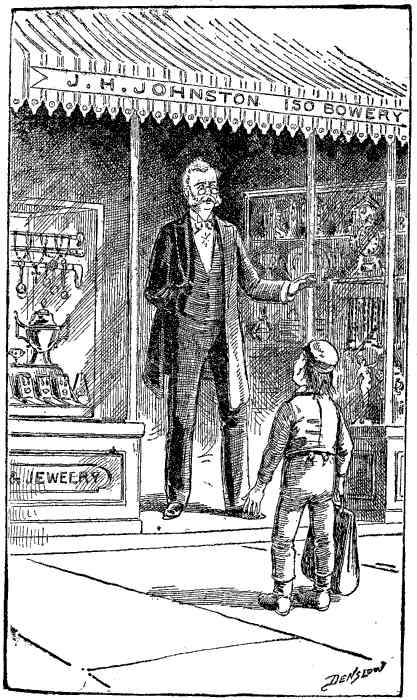
I was not long, however, in getting even with him. I had a well-to-do uncle (my own father's brother) J. H. Johnston, in the retail jewelry business, at 150 Bowery, N. Y., (at which place he is still located). I wrote him a letter explaining my great ambition to become a fiddler, and how my folks wouldn't be bothered with the noise. I very shortly received an answer saying, "Come to New York at once at my expense; have bought you a violin, and want you to live with me until you are of age. You can attend school, and fiddle to your heart's content."
He also said, that after I had attended school eight years there, he would give me my choice of three things; to graduate at West Point, learn the jewelry business, or be a preacher.
When this letter was read aloud by my mother, in the presence of the family and a couple of neighbor boys, who had called that evening, it created a great deal of laughter.
One of the boys asked if my uncle was much acquainted with me, and when informed he had not seen me since I was two years old, he said that was what he thought.
My mother fixed me up in the finest array possible, and with a large carpet bag full of clothes, boots, shoes, hats, caps and every thing suitable, as she supposed, for almost every occasion imaginable. After bidding adieu forever to every one for miles around, I started for my new home.
On arriving at my uncle's store, he greeted me kindly, and immediately hustled me off to a clothing establishment, where a grand lightning change and transformation scene took place. I was then run into a barber shop for the first time in my life, and there relieved of a major portion of my crop of hair.
When we reached his residence I was presented to the family, and then with the fiddle, a box of shoe blacking and brush, a tooth brush, clothes brush, hair brush and comb, the New Testament and a book of etiquette.
I was homesick in less than twenty-four hours.
I would have given ten years of my life, could I have taken just one look at my yoke of steers, or visited my old quail trap, down in the woods, which I had not failed to keep baited for several winters in succession and had never yet caught a quail.
Whenever I stood before the looking glass, the very sight of myself, with the wonderful change in appearance, made me feel that I was in a far-off land among a strange class of people.
Then I would think of how I must blacken my shoes, brush my clothes, comb my hair, live up to the rules of etiquette and possibly turn out to be a preacher.
I kept my trouble to myself as much as possible, but life was a great burden to me.
My uncle was as kind to me as an own father, and gave me to understand, that whenever I needed money I had only to ask for it. This was a new phase of life, and it was hard for me[Pg 33] to understand how he could afford to allow me to spend money so freely. But when he actually reprimanded me one day for being stingy, and said I ought to be ashamed to stand around on the outside of a circus tent and stare at the advertising bills when I had plenty of money in my pocket, I thought then he must be "a little off in his upper story." Of course I didn't tell him so, but I really think for the time being he lowered himself considerably in my estimation, by trying to make a spendthrift of me. I had been taught that economy was wealth, and the only road to success. I thought how easily I could have filled my iron bank at home, in which I had for years been saving my pennies, had my folks been like my uncle.
Altogether it was a question hard to solve, whether I should remain there and take my chances of being a preacher and possibly die of home-sickness, with plenty of money in my pockets, or return to Ohio, where I had but a few days before bidden farewell forever to the whole country, and where I knew hard work on the farm awaited me, and economy stared me in the face, without a dollar in my pocket.
Of the two I chose the latter and returned home in less than three weeks a full fledged New Yorker. I brought my fiddle along and succeeded in making life a burden to Mr. Keefer, who "never was fond of music, anyhow," and who never failed to show a look of disgust whenever I struck up my tune.
Before I left New York, my uncle very kindly told me that if I would attend school regularly after getting home, he would assist me financially.
He kept his promise, and for that I now hold him in grateful remembrance.
I made rather an uneventful trip homeward, beguiling the time by playing my only tune which I had learned while in New York—"The girl I left behind me." It proved to be a very appropriate piece, especially after I explained what tune it was, as there were some soldiers on board the cars who were returning home from the war. They were profuse in their compliments, and said I was a devilish good fiddler, and would probably some day make my mark at it.
I felt that I had been away from home for ages, and wondered if my folks looked natural, if they would know me at first sight, and if the town had changed much during my absence.
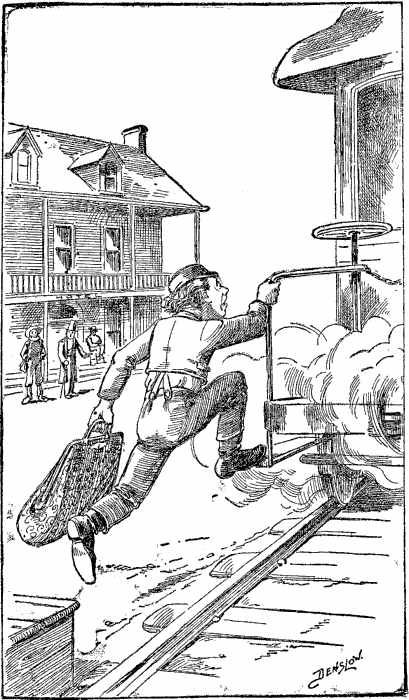
When I alighted from the train at Clyde, I met several acquaintances who simply said, "How are you Perry? How are the folks?"
Finally I met one man who said, "How did it happen you didn't go to New York?"
Another one said:
"When you going to start on your trip, Perry? Where'd you get your fiddle?"
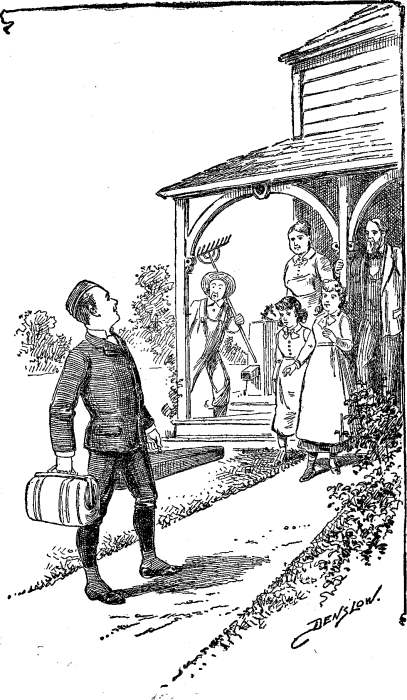
I then started for the farm, and on my arrival found no change in the appearance of any of the family.
My mother said I looked like a corpse.
Mr. Keefer said he was glad to see me, but sorry about that cussed old fiddle.
MY MOTHER WISHES ME TO LEARN A TRADE—MY BURNING DESIRE TO BE A LIVE-STOCK DEALER—EMPLOYED BY A DEAF DROVER TO DO HIS HEARING—HOW I AMUSED MYSELF AT HIS EXPENSE AND MISFORTUNE.
I then began attending school at Clyde, Ohio, boarding at home and walking the distance—three miles—during the early fall and late spring, and boarding in town at my uncle's expense during the cold weather.
At the age of sixteen I felt that my school education was sufficient to carry me through life and my thoughts were at once turned to business.
My mother frequently counseled with me and suggested the learning of a trade, or book-keeping, or that I take a position as clerk in some mercantile establishment, all of which I stubbornly rebelled against.
She then insisted that I should settle my mind on some one thing, which I was unable to do.
My greatest desire was to become a dealer in[Pg 39] live stock, which necessitated large capital and years of practical experience for assured success.
This desire no doubt had grown upon me through having been frequently employed by an old friend of the family, Lucius Smith, who was in that business.
He was one of the most profane men in the country, as well as one of the most honorable, and so very deaf as to be obliged to have some one constantly with him to do the hearing for him.
He became so accustomed to conversing with me as to enable him to understand almost every thing I said by the motion of my lips. For these services he paid me one dollar per day and expenses. I used to amuse myself a great deal at his expense and misfortune. He owned and drove an old black mare with the "string-halt" and so high-spirited that the least urging would set her going like a whirlwind.
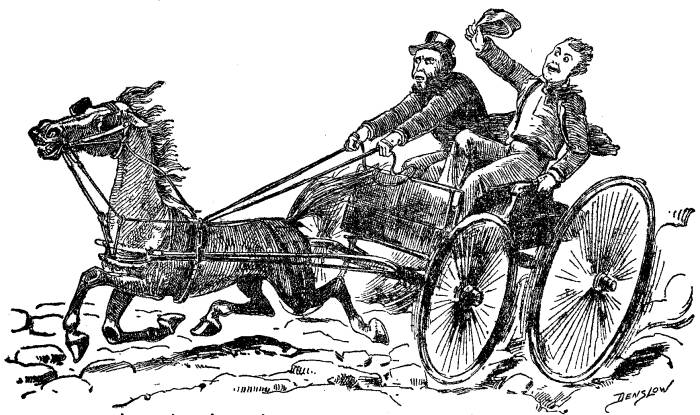
Whenever we came to a rough piece of road I would sit back in my seat and cluck and urge her on in an undertone, when she would lay her ears back and dash ahead at lightning speed.
Mr. Smith unable to hear me or to understand the reason for this, would hang on to the reins[Pg 40] as she dashed ahead, and say: "See 'er go! See 'er go! The —— old fool, see 'er go! Did you ever see such a crazy —— old fool as she is? See 'er go! See 'er go! Every time she comes to a rough piece of road she lights out as if the d——l was after her. See 'er go! The crazy old fool. See 'er go!"
It was alone laughable to see the old mare travel at a high rate of speed on account of lifting her hind feet so very high in consequence of her "string-halt" affliction.
As soon as the rough road was passed over I would quit urging her, and she would quiet down to her usual gait.
Then Lute, with a look of disgust, would declare that he would trade the —— crazy old fool off the very first chance he had "if he had to take a goat even up for her."
One day we drove up to a farmer who was working in the garden, and Lute inquired at the top of his voice if he had any sheep to sell.
The man said he did not, and never had owned a sheep in his life. I waited until Mr. Smith looked at me for the man's answer when I said:
"Yes, he has some for sale."
Then a conversation about as follows ensued:
Smith—"Are they wethers or ewes?"
Farmer—"I told you I had none for sale."
Interpreter—In undertone, "Wethers."
Smith—"Are they fat?"
Farmer—"Fat nothing. I tell you I have no sheep."
Interpreter—"Very fleshy."
Smith—"About how much will they weigh?"
Farmer—"Oh, go on about your business."
Interpreter—"Six hundred pounds each."
Smith—"Great Heavens! Do you claim to own a flock of sheep that average that weight?"
Interpreter—"He says that's what he claims."
Smith—"Where are they? I would like to see just one sheep of that weight."
Farmer—Disgusted and fighting mad—"O, you are too gosh darn smart for this country."
Interpreter—"He says you had better not call him a liar."
Smith—"Who in thunder called you a liar?"
Farmer—"Well, you had better not call me a liar, either."
Interpreter—"He says you can't beat him out of any sheep."
Smith—"Who wants to beat you out of your sheep, you chump? I can pay for all I buy."
Farmer—looking silly—"Well that's all right. When did you get out of the asylum?"
Interpreter—"He says he wouldn't think so judging from your horse and buggy."
Smith—"Well, I'll bet five hundred dollars you haven't a horse on your cussed old farm that can trot with her."
Farmer—"Who said anything about a horse, you lunatic?"
Interpreter—"He says if you have so much money you'd better pay your debts."
Smith—"You uncultivated denizen of this God-forsaken country, I want you to distinctly understand I do pay my debts and I dare say that is more than you do."
Farmer—"Well, you are absolutely the crankiest old fool I ever saw."
Interpreter—"He says you don't bear that reputation."
Smith—"The dickens I don't. I don't owe you nor any other man a cent that I can't pay in five seconds."
Farmer—to his wife—"Great Heavens! What do you suppose ails that 'ere man?"
Interpreter—"He says he knows you, and you can't swindle him."
Smith (driving off)—"I think you are a crazy old liar anyhow, and I'll bet you never owned a sheep in your life."
The reader will be able to form a better idea of the ridiculousness of this controversy as it sounded to me, by simply reading the conversation between Smith and the farmer, omitting what I had to say.
The need of capital would of course have prevented me from going into the live stock business, and the very thought of my being compelled to work for and under some one else in learning a trade or business, was enough to destroy all pleasure or satisfaction in doing business. This caused my mother much anxiety, as it was a question what course I would pursue.
SELLING AND TRADING OFF MY FLOCK OF SHEEP—CO-PARTNERSHIP FORMED WITH A NEIGHBOR BOY—OUR DISSOLUTION—MY CONTINUANCE IN BUSINESS—COLLAPSE OF A CHICKEN DEAL—DESTRUCTION OF A WAGON LOAD OF EGGS—ARRESTED AND FINED MY LAST DOLLAR—ARRIVED HOME "BROKE."
I became very anxious to sell my sheep in order to invest the money in business of some kind, but could not find a buyer for more than twenty-five head. This sale brought me seventy-five dollars in cash, and I traded thirty-five head for a horse and wagon.
Thus equipped, I concluded to engage in buying and selling butter, eggs, chickens and sheep pelts. Not quite satisfied that I would succeed alone, I decided to take in one of our neighbor boys as a partner.
He furnished a horse to drive with mine, and we started out, each having the utmost confidence in the other's ability, but very little confidence in himself.
We made a two weeks' trip, and after selling out entirely and counting our cash, found we had eighteen cents more than when we started. We had each succeeded in ruining our only respectable suit of clothes, and our team looked as if it had been through a six months' war campaign.
My partner said he didn't think there was any money in the business, so we dissolved partnership.
I then decided to make the chicken business a specialty, believing that the profits were large enough to pay well. Mr. Keefer loaned me a horse, and after building a chicken-rack on my wagon, I started out on my new mission.
There was no trouble in buying what I considered a sufficient number to give it a fair trial, which netted me a total cost of thirty-five dollars.
Sandusky City, twenty miles from home, was the point designed for marketing them.
I made calculations on leaving home at one o'clock on the coming Wednesday morning, in order to arrive there early on regular market day.
The night before I was to start, a young acquaintance and distant relative came to visit me. He was delighted with the idea of accompanying me to the city when I invited him to do so.
During the fore part of the night a very severe rain storm visited us. I had left the loaded wagon standing in the yard.
Little suspecting the damage the storm had done me, we drove off in high spirits, entering the suburbs of the city at day-break.
Then Rollin happened to raise the lid on top of the rack, and discovered very little signs of life.
We made an immediate investigation and found we were hauling dead chickens to market, there being but ten live ones among the lot, and they were in a frightful condition. Their feathers were turned in all directions, and their eyes rolling backwards as if in the agonies of death. This trouble had been caused by the deluge of water from the rain of the night before, as I had neglected to provide a way for the water to pass through the box. The chickens that escaped drowning had been suffocated. We threw the dead ones into a side ditch, and hastened to the city. No time was lost in disposing of the ten dying fowls at about half their original cost.
We held a consultation and agreed that the chicken business was disagreeable and unpleasant anyhow. Then and there we decided to [Pg 49]withdraw from it in favor of almost any other scheme either might suggest. While speculating on what to try next, the grocer to whom we had sold the chickens remarked that he would give eighteen cents per dozen for eggs delivered in quantities of not less than one hundred dozen. I felt certain I could buy them in the country so as to realize a fair profit. After demolishing the chicken rack and loading our wagon with a lot of boxes and barrels, we started on our hunt for eggs. We soon learned that by driving several miles away to small villages, we could buy them from country merchants for twelve cents per dozen.
We bought over three hundred dozen and started back with only one dollar in cash left to defray expenses.
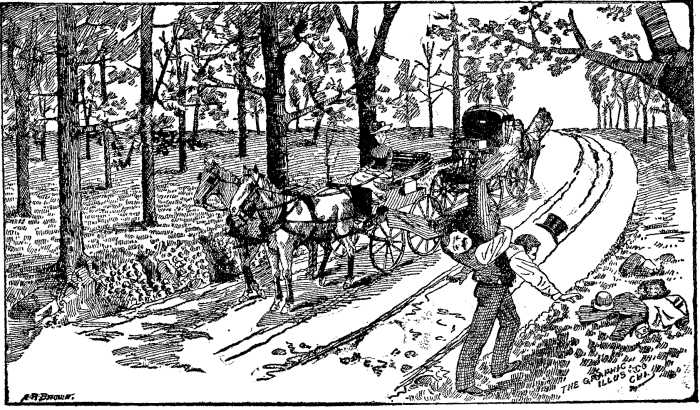
On the way our team became frightened at a steam engine and ran fully two miles at the top of their speed over a stone pike road. We were unable to manage them, but at last succeeded in reining them into a fence corner, where we landed with a crash, knocking down about three rods of fence, and coming to a sudden halt with one horse and half of the wagon on the opposite side, and the eggs flying about, scattered in all directions.
I landed on my head in a ditch, while the wagon-seat landed "right side up with care" on the road side, with Rollin sitting squarely in it as if unmolested. The mishap caused no more damage to horses and wagon than a slight break of the wagon pole and a bad scare for the horses.
But it was a sight to behold! The yelks streaming down through the cracks of the wagon box.
I felt that my last and only hopes were blasted as I gazed on that mixture of bran and eggs.
We were but a short distance from the city, whither we hastened and drove immediately to the bay shore.
There we unloaded the boxes and barrels and began sorting out the whole eggs and cracked ones. After washing them we invoiced about twenty-six dozen whole, and four dozen cracked. The latter we sold to a boarding house near by, and the former we peddled out from house to house. We counted our money, which amounted to five dollars and seventy-two cents. We then held another consultation, and decided that "luck had been against us." We also decided that we had better start at once for home, if we expected to reach there before our last dollar was lost. In [Pg 53]our confusion and excitement we prepared to do so, but happened to think we ought to feed our team before making so long a journey.
We returned to a grocery store, and after buying fifteen cents' worth of oats, drove to a side street, unhitched our horses, and turned their heads to the wagon to feed, after which we went to a bakery and ate bologna sausage and crackers for dinner.
On returning to the wagon we found a large fleshy gentleman awaiting us. He wore a long ulster coat and a broad-brimmed hat, and carried a large cane. After making several inquiries as to the ownership of the team, where we hailed from, and what our business was, he politely informed us that he was an officer of the law, and would be obliged to take us before the Mayor of the city. We asked what we had done that we should be arrested.
He simply informed us that we would find out when we got there.
We protested against any such proceedings, when he threw back his coat-collar, exposing his "star" to full view, and sternly commanded us to follow him. On our way to the Mayor's office I urged him to tell us the trouble, but in vain. I thought of every thing I had ever done, and [Pg 54]wondered if there were any law against accidentally breaking eggs or having chickens die on our hands. We arrived there only to find that the Mayor was at dinner.
The suspense was terrible!
The more I thought about it, the more guilty I thought I was.
In a few moments he returned, and I am certain I looked and acted as though I had been carrying off a bank.
When his Majesty took his seat, the officer informed him that we had been violating the city ordinance by feeding our horses on the streets. The Executive asked what we had to say for ourselves.
We acknowledged the truth of the statement, but undertook to explain our ignorance of the law.
He reminded us that ignorance of law excused no one, and our fine would be five dollars and costs, the whole amount of which would be seven dollars and fifty cents.
At this juncture we saw the necessity for immediate action towards our defense, as the jail was staring us in the face.
Rollin, who was older and more experienced[Pg 55] than myself, and withal a brilliant sort of lad, took our case in hand and made a plea that would have done credit to a country lawyer.
It resulted in a partial verdict in our favor, for after explaining our misfortunes and that all the money we had left was five dollars and thirty-seven cents, and as proof of our statement counted it out on his desk, he remitted what we lacked, but said as he raked in the pile, "Well, boys, I am very sorry for your misfortunes and will let you down easy this time, but you must be more careful hereafter."
I replied that he needn't have any fears of our ever violating their city ordinance again, as it was my impression that would be our last visit there.
We left for home without any further ceremony, neither seeming to have anything particular to say. I don't believe half a dozen words passed between us during the whole twenty miles ride.
On arriving home my mother anxiously inquired how I came out with my chicken deal.
"Well, I came out alive," I replied.
"How much money did you make?" she asked.
"How much money did I make? Well, when I got to Sandusky I discovered all my chickens were dead but ten," and explained the cause.
"Where have you been that you did not return home sooner?" she asked next.
I explained my egg contract and my trip in the country to procure them.
"Well, how was that speculation?" she asked.
"About the same as with the chickens," was my answer. When I entered into particulars concerning the wreck she became greatly disgusted, and sarcastically remarked:
"I am really surprised that you had sense enough to come home before losing your last dollar."
"Well," I replied, "I am gratified to know that such a condition of affairs would be no surprise to you, as it is an absolute fact that I have been cleaned out of not only my last dollar but my last penny."
I then rehearsed the visit to the Mayor and its results.
She gave me an informal notice that my services were required in the potato patch, and to fill the position creditably I should rise at five o'clock on the following morning.
BORROWING MONEY FROM MR. KEEFER—BUYING AND SELLING SHEEP PELTS—HOW I SUCCEEDED—A CO-PARTNERSHIP IN THE RESTAURANT BUSINESS—BUYING OUT MY PARTNER—COLLAPSED—MORE HELP FROM MR. KEEFER—HORSES AND PATENT RIGHTS.
I hardly complied with my mother's five o'clock order. When I did arise I sought Mr. Keefer, to whom I told the story of my misfortunes. He listened attentively and said he could easily see that it was bad luck, and he believed I would yet be successful. I explained to him that if he would lend me fifteen dollars, I could engage in buying sheep pelts, which could neither drown, suffocate nor break.
He complied with my request, and I started out that morning with only my own horse hitched to a light wagon.
Rollin, having finished his visit, left for home the same day.
I bought several pelts during the day, and sold[Pg 58] them to a dealer before returning home, making a profit of three dollars.
This was the first success I had met with during my three weeks' experience, and was certainly very encouraging. I continued in the business until cold weather, when I had cleared one hundred dollars.
I then began looking about for a chance to invest what I had made, as the weather was too cold to continue traveling in the country.
I was not long in finding an opportunity to invest with an old school mate in a restaurant.
It took about sixty days to learn that the business would not support two persons. As he was unable to buy me out, I made him an offer of my horse for his share, I to assume all liabilities of the firm, which amounted to about one hundred dollars.
He accepted my proposition. I sold the remainder of my flock of sheep, and paid the debts. I kept on with the business, meeting with splendid success in selling cigars and confectionery and feeding any number of my acquaintances, for which I received promises to pay, and which up to the present writing have never been collected.
When spring came, my liabilities were two hundred and fifty dollars, and no stock in trade. My available assets were a lot of marred and broken furniture which I peddled out in pieces, receiving in cash about one hundred dollars which I applied on my debts.
I called on Mr. Keefer with a full explanation of "just how it all happened," and he said he could see how it occurred, and without hesitation endorsed a note with me to raise the balance of my indebtedness.
Now I began looking for something else to engage in.
It was the wrong time of year for buying sheep pelts. My funds exhausted and in debt besides, I felt anxious to strike something very soon.
My mother still insisted that I should learn a trade or get steady employment somewhere. I told her there was nothing in it. She claimed there was a living in it, which I admitted, but declared if I kept "hustling" I would accomplish that much anyhow.
She gave me to distinctly understand that Mr. Keefer would sign no more notes nor loan me a dollar in money thereafter. Mr. Keefer held a note of fifty dollars against a man, not yet due,[Pg 60] which he handed to me that same morning, saying if I could use it I could have it.
A young in our village had just patented an invention for closing gates and doors. He offered me the right for the State of Illinois for this note, which I readily accepted.
In a few days I traded my right in this patent for six counties in Michigan and Indiana in a patent pruning shears, an old buck sheep, a knitting machine, an old dulcimer, a shot-gun and a watch.
I traded all of the truck except the watch, for an old gray mare. Then commenced a business of trading horses and watches.
In this I was quite successful during the summer and fall. I had paid my board and clothed myself comfortably, and was the owner of a horse which I had refused a large sum for, besides an elegant watch which I valued highly.
My mother said it was a regular starved-to-death business.
Mr. Keefer said he knew I would make it win.
SWINDLED OUT OF A HORSE AND WATCH—MORE HELP FROM MR. KEEFER—HOW I GOT EVEN IN THE WATCH TRADE—MY PATENT RIGHT TRIP TO MICHIGAN AND INDIANA—ITS RESULTS—HOW A WOULD-BE SHARPER GOT COME UP WITH.
One day as I was passing the house of a neighboring farmer he came out and hailed me.
"How's business?" he asked.
"O, first-class," I answered.
"Don't you want to trade your horse and watch for a very fine gold watch?" he asked, confidentially.
"Why, I don't know."
"Well," he remarked, "I have owned such a watch for three years, and have no use for one of so much value. A cheaper one will do me just as well, and I am ready to give you a good trade."
I entered the house with him, and he said: "Wife, bring me that gold watch from the other room."
"All right," she said, and brought the watch and handed it to me, saying as she did so, "I have been in constant fear for three years of having that watch stolen from us, and I hope my husband will trade it off, and relieve me of so much anxiety."
I took it, examined it and discovered a small rusty spot in the inside of one of the cases. I called their attention to it and said, "I don't really like the looks of that spot."
"Well, sir," said he, "if you don't like the looks of that rusty spot, just leave it right where it is. But if you like it well enough to give me your horse and watch and chain for it, all right. If not, there will be no harm done."
His independence caught me, I traded at once.
I walked back home with much pride, and showed my new watch to the folks.
My mother looked at it suspiciously and said, in rather a sneering tone, "Why, it looks like a cheap brass watch, and I believe it is."
"O, I think that watch is all right," said Mr. Keefer, in an assuring manner, "and I believe he has made a good trade. We'll hitch up the team and go down to Geo. Ramsey (the jeweler) and see what he has to say about it."
So we started off and handed the watch to Mr. Ramsey. He looked it over carefully and said:
"Well, Perry, it is so badly out of repair that it would not pay you to have it fixed."
"What would be the expense?"
"About five dollars."
"After being put in good order what would it be worth?" I confidently asked again.
"Well, Mr. Close, the auctioneer down street, has been selling them for three dollars and a half apiece."
I put the watch in my pocket, and thanking him, left the store, and explained to Mr. Keefer "just how it all happened."
He said he thought "it was enough to fool any one."
I then borrowed fifteen dollars of him, to "sort of bridge me over," until I could get on my feet again.
I kept quiet about my trade. In fact, I had nothing to say. I simply told two or three of my acquaintances who I thought might help me out.
A few days after this a gentleman from Kentucky made his appearance on the streets with a patent rat trap.
One of the men to whom I had shown the[Pg 64] watch, happened to be talking to him as I passed by, and remarked:
"That red-headed fellow owns a watch which he traded a horse and nice watch for a few days ago, and I believe you can trade him territory in your patent for it."
"I'll give you ten dollars if you will help me put it through," said the rat trap man.
"All right, I'll help you," said my friend.
It was not long before I was found and induced to look at the rat trap.
I was immensely pleased with it, and felt certain I could sell a rat trap to every farmer in the country, if I had the right to do so.
"What is the price of Sandusky County?"
"One hundred dollars."
"Well, I guess the price is reasonable enough," I said, "but I haven't got the money."
"What have you got to 'swap'?"
"I don't think I have anything," I answered.
"Haven't you got a horse, town lot or watch? I am in need of a good watch and I would give some one an extra good trade for one."
I replied: "I have a watch, but I don't care to trade it off."
"Let me see it," said he. After looking it over, he said:
"It suits me first-rate. How will you trade?"
"I'll trade for one hundred dollars and Sandusky County."
"No," he said, "I'll give you fifty dollars in cash, and the County."
"I won't take that," I said, "but I'll tell you what I will do. I'll take seventy-five dollars."
"I'll split the difference with you."
"All right, make out the papers."
He did so, and handed me over sixty-two dollars and fifty cents and the patent, (which I still own), for my watch.
An hour afterwards I met the Kentuckian who excitedly informed me that the watch was not gold. I frankly admitted that I knew it was not, and that I didn't remember of ever saying it was. He had paid my friend five dollars of the ten he had promised, and his reason for not paying the balance was because he had been obliged to pay cash difference to make the trade.
He looked crest-fallen and discouraged and took the first train out of town, "a sadder and a wiser man."
With my sixty odd dollars and a sample pair[Pg 66] of pruning shears, I left for Michigan, to take orders, and if possible, to sell some portion or all of my six counties. In that invention I owned Branch, Hillsdale and Leneway Counties in Michigan, and Steuben, La Grange and St. Joseph in Indiana.
I arrived at Bronson, Michigan, from which point I started out taking orders. My success was immense, but I was somewhat handicapped for the reason that none of the farmers wanted the shears delivered to them before the coming spring.
At last I found a customer for the Michigan counties, and traded them for a handsome bay horse which I bought a saddle for, and rode through to Ohio. On arriving home I explained my success in taking orders.
My mother said I was a goose for not staying there and working up a nice business, instead of fooling away the territory for a horse.
Mr. Keefer said he would rather have the horse than all the territory in the United States.
I traded the horse to one of our neighbors for a flock of sheep and sold them for one hundred and twenty-five dollars. I then started for La Grange, Indiana, to dispose of my other three[Pg 67] counties. I took several orders on the following Saturday, as many farmers were in town that day.
The next Monday I received word from one of the wealthiest men of the town that he would buy some territory in my patent if satisfactory terms could be made. I called upon him and we were not long in striking a bargain.
He agreed to give his note payable in one year for three hundred dollars, for my three counties.
We made out the papers, and as he was about to sign the note he demanded that I write on the face of it the following: "This note was given for a patent right." I refused at first, but when informed it was according to law I complied.
When I called upon a money loaner he laughed and said he wouldn't give me one dollar for such a note, as he wouldn't care to buy a lawsuit. He said when the note came due it would be easier for the maker of it to prove the worthlessness of the patent than it would for him to prove it was valuable.
I saw the point, and realized that I had been duped.
I made preparations to leave for home on the morning train. During the night I conceived an idea which I thought if properly manipulated would bring me out victorious.
The next morning I called on my customer at his office, and in the presence of his clerks said:
"Mr. ——, I have been thinking over my affairs, and find I will be very much in need of money six months from now, and if you will draw up a new note, making it come due at that time, I will throw off twenty-five dollars, and give you back this note."
He agreed, and after I drew up the note for two hundred and seventy-five dollars I handed it to him to sign, and then stepped back out of reasonable reach of him, when he looked up and said:
"Well, here, you want to add that clause."
"That's all right," said I, "go on and sign it. It can be added just as well afterwards."
He did so and I picked it up, folded it and put it into my pocket, as I passed the old note to him.
"But you must add that clause," he remarked.
"O, no," said I, "I guess I must not. This last note was not given for a patent right. It was given for the old note, the same as if you had discounted it."
Then he saw the point, and I had the pleasure of receiving two hundred and sixty-five dollars cash from him for his paper. With this I started for home, highly elated with my success.
MY NEW ACQUAINTANCE AND OUR CO-PARTNERSHIP—THREE WEEKS' EXPERIENCE MANUFACTURING SOAP—THE COLLAPSE—HOW IT HAPPENED—BROKE AGAIN—MORE HELP FROM MR. KEEFER—A TRIP TO INDIANA—SELLING PRIZE SOAP WITH A CIRCUS—ARRESTED AND FINED FOR CONDUCTING A GIFT ENTERPRISE—BROKE AGAIN.
On my way home, I formed the acquaintance of a young man, Fleming by name, who had been employed in a soap factory in Chicago, and was on his way to Toledo, where his parents resided. He said he had a new recipe for making a splendid toilet soap, which could be put on the market for less money and with a larger profit than any other ever manufactured.
With a little capital and an enterprising salesman on the road, a fortune could be made very soon.
I stated the amount of my cash capital, and assured him of my ability as a salesman, and my desire to engage in a good paying business.
When we arrived at Toledo, and before we separated, we had nearly completed arrangements for forming a co-partnership, I agreeing to return in a few days for that purpose. I hastened home and notified my folks of my success.
My mother said "it was merely a streak of good luck." Mr. Keefer said "he didn't know about that."
She said I had better leave enough with them to pay that note of one hundred and fifty dollars, which would soon come due, but Mr. Keefer said it wasn't due yet and there was no hurry about it anyhow, and that I had better invest it in that soap business.
I returned to Toledo, where I met Mr. Fleming, who had rented a building and contracted for materials and utensils. We started our business under the firm name of "Johnston & Fleming, Manufacturers of Fine Toilet Soap."
I advanced the necessary money to meet our obligations, after which we made up a sample lot, and I started on the road.
My orders were taken on condition that the goods were to be paid for promptly in ten days.
I sold to druggists and grocers, and made enough sales in one week to keep our factory[Pg 73] running to its "fullest capacity" for at least four weeks. I then returned to Toledo and began filling orders.
As soon as ten days had expired, after having sent out our first orders, we began sending out statements, asking for remittances.
We received but two small payments, when letters began pouring in from our customers condemning us and our soap.
The general complaint was that it had all dried or shriveled up, and as some claimed, evaporated.
One druggist wrote in, saying the soap was there, or what there was left of it, subject to our orders. He was thankful he had not sold any of it, and was glad he had discovered the fraud before it had entirely disappeared and before he had paid his bill!
Another druggist stated that he had analyzed it and would swear that it was made of "wind and water;" while still another declared that his wife had attempted to wash with a cake of it, and was obliged to send down town for some "soap" to remove the grease from her hands.
After reading a few of these letters, I opened my traveling case, took out my original sample box, and discovered at once that in shaking it, it[Pg 74] rattled like a rattle-box. I raised the cover and found my twelve sweet-scented, pretty cakes of soap had almost entirely withered away, and the odor was more like a glue factory than a crack toilet soap. We made strenuous efforts to satisfy them, by making all manner of excuses and apologies but to no purpose. In every instance "the soap was there subject to our orders."
My partner was much chagrined at the outcome and sudden collapse of our firm, and no doubt felt the situation more deeply than myself, although I was the loser financially.
After borrowing money enough from an old school-mate, I paid my board bill and bought a ticket for home. I had been away less than four weeks.
I first met Mr. Keefer at the barn and explained to him "just how it all happened," and how the soap dried up, and how I had become stranded at Toledo and borrowed money to get home with.
He said he guessed he would have to let me have the money to pay the fellow back, as I had promised, which he did, and a few dollars besides.
I then went to the house and explained matters to my mother.
She said I might have known just how that[Pg 75] soap business would end, and reminded me of the request she made about leaving money enough to pay the note and informed me that I needn't expect any help from Mr. Keefer, for he should not give me a penny.
The next day while in town, I met and got into conversation with a friend who was on his way to Huntington, Ind., to take a position as an agent for selling fruit trees. He showed me a letter from the General agent of an Eastern nursery, who stated that there were vacancies at Huntington for half a dozen live, enterprising young men. I had just about cash enough to pay my fare there, and decided to go.
We arrived there the next day, only to find that the fruit tree men had gone to the southern part of the State.
I explained to Charlie that I was rather low financially, when he informed me that he was a little short himself, but that I could rest assured that so long as he had any money he would divide.
Forepaugh's Menagerie was advertised to be at Huntington two days later, and we decided to await its arrival and see what might turn up in our favor.
The menagerie arrived and drew an immense crowd of people.
I had frequently seen men sell prize packages at fairs, and conducting almost all kinds of schemes to make money, and it occurred to me that with such a large crowd, and so few street salesmen, there was a good opportunity for making money, if one could strike the right thing.
I consulted with Charlie, who said he would be able to raise about two dollars after paying our board.
I suggested my plan, which he considered favorably.
We purchased a tin box and three large cakes of James S. Kirk's laundry soap, and some tinfoil.
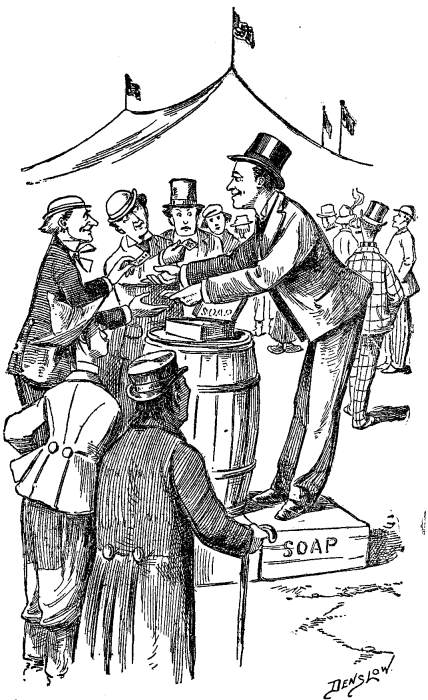
We cut the soap into small, equal sized cakes about three inches long, and a half inch square at the ends. We then cut small strips of writing paper, and after marking 25c on some of them and 50c, 75c, and $1.00 and $2.00 on an occasional one, we pasted a strip of this paper on each cake of soap, some prizes and many blanks. We then cut the tinfoil and wrapped it nicely around the soap and put it into the tin box. Then after borrowing a couple of boxes and a[Pg 79] barrel from a merchant, put them out on the street and turned the barrel bottom side up on top of one of the boxes.
I then mounted the other box, and soon gathered an immense crowd by crying out, at the top of my voice:
"Oh yes! oh yes! oh yes! Gentlemen, every one of you come right this way; come a running; come a running, everybody come right this way!
"I have here, gentlemen, the erasive soap for removing tar, pitch, paint, oil or varnish from your clothing. Every other cake contains a prize from twenty-five cents to a two-dollar note."
We found no trouble in making sales and but little trouble in paying off those who were lucky. Our profits were sixteen dollars that day.
The next day we opened at Fort Wayne, Ind., where the show attracted a large crowd, and our profits were thirty-six dollars.
From there we went to Columbia City, where our profits were twenty-two dollars. Our fourth and last sale was made at Warsaw, where we were having excellent success, when a large, portly gentleman (whom I afterwards learned was Mr. Wood, the prosecuting attorney), came up to our stand, and after listening awhile and watching[Pg 80] the results, went away, and in a few moments returned with the city marshal, who placed me under arrest for violating a new law just passed, to prohibit the running of gift enterprises. They took me before the Mayor, who read the charges against me, and asked what I had to say.
I informed him I had taken out city license, which I supposed entitled me to the privilege of selling.
He then read the new law to me, I plead ignorance, and asked the Mayor to be lenient. He imposed a fine of twenty-five dollars and costs, which altogether amounted to thirty-two dollars and fifty cents, which we paid.
The prosecuting attorney then explained to me, that such a law had recently been passed in almost every State.
This satisfied me that there was absolutely no money in the soap business. My partner and I divided up what little money we had left and there separated. He returned to Ohio and I visited a daughter of Mr. Keefer's, who had married a wealthy farmer, Smith by name, and was residing in Branch County, Michigan.
ELEVEN DAYS ON A FARM—HOW I FOOLED THE FARMER—ARRIVED AT CHICAGO—RUNNING A FRUIT STAND—COLLAPSED—MY RETURN HOME—BROKE AGAIN—A LUCKY TRADE.
I was anxious to go to Chicago, but was a "little short" financially, and asked Mr. Smith to give me a job on the farm. He asked if I could plow. I assured him that I was a practical farmer, and he then hired me at one dollar per day.
He had a sixty acre field, in which his men had been plowing, and after hitching up a pair of mules instructed me to go over in the field and go to "back furrowing."
I wondered what the difference could be between back furrowing or any other furrowing, but rather than expose my ignorance, said nothing, preferring to trust to luck and the "mules." As there was no fault found, I must have struck it right.
Mr. Smith made a practice of visiting his men[Pg 82] and inspecting their work, always once and often twice a day.
He gave me orders to go to breaking up a new piece of ground, which he had recently finished clearing, and which of course was a hard task.
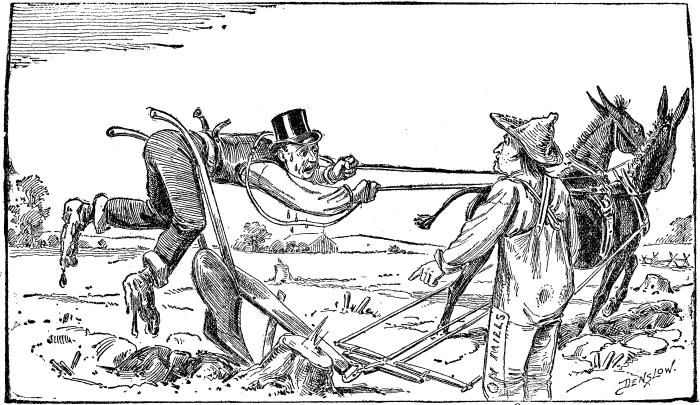
One day he came to the field at noon, and after looking the work over, instructed me to take the "coulter" off before I commenced work again in the afternoon, adding that it would be easier for the mules as well as myself.
I looked the plow over carefully and wondered what the "coulter" was. After dinner I began work, hoping that some one might come along who could post me. In this I was disappointed. Realizing that there must be something done before Smith visited me in the evening, I decided he must have meant the wheel at the end of the beam, and consequently took it off and waited his coming.
When he arrived he looked at the plow a moment and said, in an impetuous manner:
"Where is that wheel? I thought I told you to take the coulter off."
"Well, I did," I quickly replied. "I did take the coulter off, and as it didn't work well I put it back on, and thought I would take the wheel off."
"Where is the wheel?" he asked. I pointed to a stump some distance away, and said:
"It's over there."
He said: "You take that coulter off and I'll get the wheel."
"No," I said, "you take the coulter off; I am younger than you and will go after the wheel." And before getting the words out of my mouth was half way there. When I returned he was taking the coulter off.
I worked eleven days, and after receiving that many dollars left for Chicago, where I had an uncle residing.
He gave me a cordial welcome and said I was just the lad he wanted to see, as he had traded for a fruit stand the day before, and wanted me to take charge of it.
The next morning he took me to the stand, which was a small frame building—size, about eight by ten—which stood on the northwest corner of Halsted and Harrison Streets.
This was a very slow business, and too slow to suit me, yet I continued to run it about three months, when by repeated losses on decayed fruit, and the too frequent visits of relatives and friends, we found the business in an unhealthy[Pg 86] condition and lost no time in looking up a buyer, which we were fortunate in finding and successful in getting a good price from.
After receiving my share of the profits, which was about enough to pay my expenses back to Ohio, I decided to go there.
On arriving home, my mother said she hoped I was satisfied now that I couldn't make money, and that I was only fooling my time away. She said she had told Mr. Keefer just how that fruit business would end.
I took Mr. Keefer to one side and explained just "how it all happened" and how the fruit all rotted, and how my relatives and friends helped themselves. He said they ought to be ashamed and it was too bad.
I borrowed a few dollars from him for incidental expenses, until I could "strike something."
My mother wanted to know what I expected to do, and said I needn't ask Mr. Keefer for money, because he shouldn't give me a penny.
Of course I could give her no satisfaction. She finally said was going to take me to a jeweler, with whom she had talked, and have me learn the jeweler's trade. I disliked the idea and rebelled against it. She was determined, however, and compelled me to accompany her.
The jeweler had a talk with me and told my mother he thought he could make quite a mechanic out of me.
I thought I was destined to stay with him, until my mother happened to leave the store for a few minutes, when he asked me if I thought I would like the business. I told him no, I knew I would dislike it. He said he wouldn't fool his time away with a boy who had no taste for the business, and so informed my mother.
I returned home with her, and that evening she and Mr. Keefer and myself had a long conference.
We talked about the past, and my mother suggested all kinds of trades, professions and clerkships, all of which I objected to, because I would not work for some one else.
Mr. Keefer said he believed I would strike something "yet" that I would make money out of.
My mother said she couldn't understand why he should think so; everything had been a failure thus far.
He explained his reasons by reminding her that with all my misfortunes, not one dollar had been spent in dissipation or gambling, but[Pg 88] invariably in trying to make money, and with no lack of energy.
I remained idle a few days until the few dollars Mr. Keefer had loaned me were spent, when one day I called upon a friend in town. Kintz by name, who was engaged in the bakery business.
In conversation with him I learned that he owned two watches and wanted to exchange one of them (a small lady's gold watch) for something else. I asked him to let me carry it and try and find a customer for it.
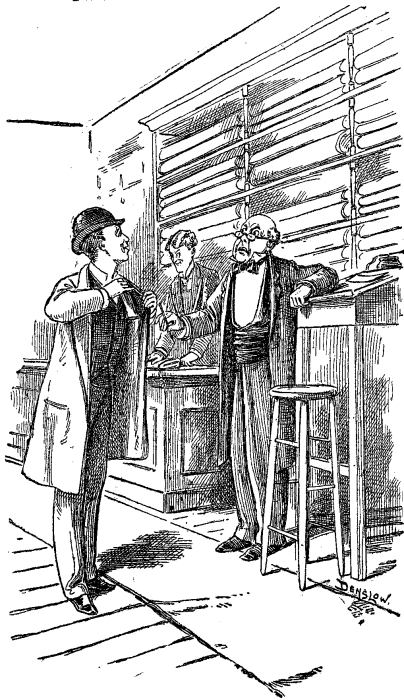
I called that evening on the night telegraph operator, Andy Clock, and bantered him to trade watches. He owned a large silver watch and gold chain.
"How will you trade?" I asked, showing him the lady's gold watch.
"Oh, I'll leave it with you."
"You ought to give your watch and chain and ten dollars," I said.
"I'll make it five."
"Let me take your watch and chain a few minutes."
"All right," he answered.
I immediately called on Mr. Kintz and said: "John, are you willing to give your gold watch[Pg 89] and five dollars for Mr. Clock's silver watch and gold chain?"
He replied by simply handing me five dollars. I then returned to Mr. Clock, made the trade and also received from him five dollars.
Although the amount I made was small, it came in a very opportune time, and afforded me much satisfaction, as I argued in my own mind, that if I was able to drive those kind of trades in a small way, while young, I might be able some day to make similar deals on a larger scale.
The next day, when I met Mr. Keefer, I explained how I had made ten dollars. He laughed and said: "Well, if they are both satisfied I suppose you ought to be."
The next Sunday after I had made the trade, several of the boys, including Mr. Kintz, Clock and myself, were sitting in the hotel. I was reading a paper when Mr. Kintz and Clock began a conversation about the watch trade, when Kintz remarked:
"If that gold watch had not been a lady's size I never would have paid any difference on the trade."
"Did you give any boot?" quickly asked Clock.
"Why, I gave five dollars," answered Kintz.
"The d——l you did; so did I," replied Clock.
They immediately demanded an explanation, which I gave, by declaring as the "middleman" I was entitled to all I could make; and this was the universal opinion of every one there, including the landlord, who insisted that it was a good joke and well played.
THREE DOLLARS WELL INVESTED—LEARNING TELEGRAPHY—GETTING IN DEBT—A FULL-FLEDGED OPERATOR—MY FIRST TELEGRAPH OFFICE—BUYING AND SELLING DUCKS AND FROGS WHILE EMPLOYED AS OPERATOR—MY RESIGNATION—CO-PARTNERSHIP IN THE JEWELRY AND SPECTACLE BUSINESS—HOW WE SUCCEEDED—OUR DISSOLUTION.
The next day after making this trade and procuring the ten dollars, I bought an old silver watch from a stranger who had become stranded, paying him three dollars for it. This I traded for another watch and received five dollars as a difference. From this I continued to make trades until I was the owner of ten head of fine sheep, three pigs, a shot-gun, violin, watch, and a few dollars in money, besides having paid my board at the hotel and bought necessary clothing.
When I found a buyer for my sheep and pigs, my mother said of course I couldn't be contented until I sold them and lost the money. I [Pg 92]explained to her that, in order to speculate, it was necessary to keep re-investing and turning my money often.
Mr. Keefer said I was right, but advised me to be very careful, now that I had quite a nice start from simply nothing.
After selling out, I one day called on the day telegraph operator, Will Witmer, and while sitting in his office, asked him to explain the mysteries of telegraphy. He did so, and I then asked him to furnish me with the telegraph alphabet, which he did. I studied it that night, and the next day called at his office again, and began practicing making the letters on the instrument.
He paid me a very high compliment for my aptness, and said I was foolish for not learning the business.
I asked what the expense would be.
He said his charges would be fifteen dollars, and it would take four months anyhow, and possibly six, before I would be able to take an office.
Two days later, after giving special attention to the business, I had become quite infatuated with it, and paid over the fifteen dollars to him and two weeks' board at the hotel.
My intentions were to try and sustain myself[Pg 93] by speculating and trafficking, but I very soon became so absorbed in my new undertaking as to be unfit for that business.
My mother was immensely pleased at the turn affairs had taken. Mr. Keefer was both surprised and pleased, and said he would help me pay my board, although he couldn't see how I ever happened to take a liking to that business.
During this winter, my associates and habits of life differing wholly from those of former years, I became what would now be considered "quite a dude." And having no income from business, and a limited one from Mr. Keefer, with a fair future prospect, I took advantage of my good credit in town, and bought clothes, boots, shoes and furnishing goods, and borrowed money occasionally from my friends, who never refused me.
Three months from the very day I began learning the alphabet, through the advice and recommendation of Mr. Witmer, I called on Wm. Kline, Jr., General Superintendent of Telegraph, and made application for an office. He sent me to Whiting, Indiana, sixteen miles from Chicago, with instructions to take charge of the night office, at a salary of forty dollars per month.
On arriving there I found only a small station, and one family, with whom I was to take board, and who were living in an old abandoned water-tank.
The young man whom I relieved from night duty was promoted to day operator, and as he was thoroughly disgusted with the place he kept continually writing to the Superintendent's secretary, who was a friend of his, to get him a better office, which he did in just six weeks afterwards.
I was then promoted to his position, with no raise of salary, but which I gladly accepted.
There was plenty of duck hunting and frog catching among the settlers there, but they didn't seem to understand how to find a market for them. I at once took advantage of this by getting a day off and a pass to Chicago, where I bargained with a commission merchant to handle all I could send him. I then returned to Whiting and arranged to have the settlers consign all their game to me, which I in turn consigned to the commission merchant. I had plenty of business and made money fast.
One day the Division Superintendent happened to get off the train, as we were loading on a lot of frogs, when he asked me who was shipping[Pg 97] from that point. I told him I was. He looked at me a moment and asked, in a gruff tone:
"Does this R. R. Co. pay you to buy frogs?"
I answered: "No, they pay my board to watch the station, and I buy and sell frogs to make my salary."
The conductor and other employees who heard our remarks laughed heartily, and the Superintendent returned to his car with a broad grin.
As soon as the frog and duck season was over I began urging Mr. Kline to give me a better paying office. I also wrote home expressing my dissatisfaction with the business, and my contempt for the small salary it paid, and closed by saying I could make more money swapping jackknives than I could telegraphing, and that I never would be able to pay my debts were I to continue at it.
My mother answered; saying, that if I threw up that position and came back home she would leave the country.
In a few days I was transferred from Whiting to Swanton, Ohio, with no raise of salary, but better facilities for spending what I did get.
I remained there until the following spring, and managed to spare about five dollars per month[Pg 98] towards reducing my home liabilities, and tight squeezing at that.
While there I made frequent visits to Toledo, where Mr. Kline's office was located, and never failed to call on him or his secretary, with a request for a better position. One day I wanted to be extra operator, and another day I would insist upon being placed in the train dispatcher's office, and again thought I would like the general freight office, either of which was considered a fine position.
Finally the secretary asked, one day, how I would like to have Mr. Kline resign in my favor.
I told him I would like it first-rate if the salary was sufficient.
As soon as the green grass and flowers of spring commenced to show themselves, I began to get nervous and anxious to make a change.
One day while several people were sitting in the depot waiting for a train, a young enterprising looking fellow came in with a small sample-case in his hand, and began talking to an old gentleman about spectacles, and very soon made a sale for which he received two dollars and fifty cents, spot cash.
After the train had come and gone, carrying[Pg 99] with it the old gentleman, I entered into conversation with the young man, and finally asked him, confidentially, what that pair of spectacles cost him. He laughed and said they could be bought for one dollar per dozen.
"That settles it right here," I said, and added:
"That settles the telegraph business with me. I'll send my resignation to Mr. Kline forthwith, by telegraph." And I did so.
After about ten days he accepted it and sent me a pass for home and the amount due me, which was sixty-five dollars.
On my arrival home a stormy scene ensued.
My mother said it was just like me to leave a sure thing and traffic around over the country, with no future prospects whatever.
Mr. Keefer said the business was too slow for me, anyhow, and he had thought so from the beginning. I explained that the experience was worth a great deal to me.
My mother replied that I had for years been getting nothing but experience.
Mr. Keefer said he'd bet I would come out all right yet.
"Yes," my mother said, "he will come out in the poorhouse, and drag you and me with him."
She then what I expected to do next, and I told her about the immense profits made in the spectacle business.
She laughed, and with much sarcasm remarked, that a dozen pair of spectacles and an old tin box to carry them in, would probably be the height of my ambition.
I told her that remained to be seen; but I would some day convince her differently, and show her how to make money fast.
The next day I received a letter from an acquaintance residing at Kirkersville, Ohio, in answer to one I had written him, in which I stated my intention of going into the spectacle business.
He informed me that he was the owner of a fine horse and carriage, and suggested that I take him in partnership with me; he to furnish the traveling conveyance and I the money. This I agreed to, and wrote him my intentions to start for Kirkersville on a certain day, where I would expect to meet him, and we would drive to Columbus, a distance of twenty miles, and buy our stock.
On my arrival at Kirkersville I found him ready to start. We drove to Columbus and called on a wholesale jewelry firm.
After looking their stock over I decided that there was more money in cheap jewelry than spectacles. I had about forty dollars in cash, and after buying one dozen pairs of spectacles, for one dollar, invested the balance in jewelry, after which I prevailed on the firm to give me a traveling sample case. In this we displayed our jewelry nicely and started down the Portsmouth pike.
My first effort to make a sale was at the toll-gate, a short distance from the city. Finding an old lady in attendance, I introduced the spectacles. She declared she never would buy another thing from a peddler.
I told her I had not asked her to buy, and said: "Madam, I have here a stereoscopic lens."
"A stereo-what?" she quickly asked.
"A stereoscopic lens," I repeated.
"Well, my!" she ejaculated, "they ought to be good ones, if the name has anything to do with them," and began trying them on.
She very soon found a pair which suited her and pleased her exceedingly.
While she was looking my glasses over, I picked up her old ones, and while examining them the thought occurred to me, that as my[Pg 102] stock of spectacles consisted only of a dozen pairs it would be a good idea to try and trade spectacles each time instead of selling outright, and by so doing always keep my stock up to the original number.
Acting on the suggestion, I remarked to the old lady that her glasses must have cost at least three dollars, and if she so desired I would give her a trade.
She asked the price of my glasses.
"Four dollars," was my reply.
She said she didn't just remember how much she did pay for hers, but it was about the price I had mentioned.
She then asked me how I would trade. I offered to allow her two dollars for her glasses on the deal.
She said she would if she had the money. On counting it she found but one dollar and thirty-two cents, all in pennies. We made the trade, as I had a great deal of sympathy (?) for her, and knew she had never before found a pair of glasses so well suited to her eyes.
The third house we stopped at I found a young lady who was very anxious to see my jewelry.
After opening my case she selected a very[Pg 103] showy set, ear-drops and pin, which I sold her for one dollar. When she paid me I noticed she had more money left, and said to her:
"See here, my young miss, I hardly think the set you have selected is good enough for you. Let me show you a handsome set of jewelry such as you would be proud to wear at a fashionable ball, or entertainment of any kind. It will of course cost you more money, but I know it will please you better."
I then took from the bottom of the case a set which was nicely put up in a small paste-board box (although they all cost the same), and offered it for inspection. She was at once infatuated with it, and after asking the price (which was five dollars), expressed her regret that she had made her purchase before taking notice of that particular set. I then very kindly offered to exchange for the set she had just bought, and allow her the same as she paid, when she remarked, after reflecting a moment, that she couldn't do that as she hadn't money enough within one dollar to pay the difference. But when I offered to trust her for the other dollar until I came around again, she traded, remarking, as she counted out her last three dollars:
"All right, I'll do it, and if you never come again I'll have a dollar the best of you anyhow."
We had excellent success during the first ten days, after which we experienced four days of probably as poor success as ever attended a "Yankee peddler."
We stopped at every house, and never sold a dollar's worth during the four days. Doors were slammed in my face, and dogs were set upon us. Yet I insisted that success must necessarily follow, sooner or later.
My partner, however, was not so hopeful. He became impatient and disagreeable in the extreme. At every house we would come to he would sullenly remark that there was no use stopping, they didn't want to buy anything; and finally went so far as to insist that we make no more stops.
As I considered myself the senior member of the firm, I ordered a stop made at every house.
This led to unpleasantness, and brought out a few personal characteristics of his which induced me to think he had been raised a "pet" and was accustomed to having his own way in everything.
But as I was not one of the "petting" kind,[Pg 105] and rather inclined to have my way about things in general, we gradually grew into a controversy.
He declared the horse and carriage was his, and he had a right to stop when and where he pleased.
I gave him that privilege, but also gave him notice that I owned the goods and carried the money, and as "the walking was not all taken up" he could drive as fast and as far as he pleased, but I was going to stop at every house, even though I might lose a piece of my unmentionables by every dog on the road.
At last I was successful in trading spectacles with an old lady, receiving two pairs of old glasses and two dollars in cash for the pair I let her have.
This enlivened things up for a while, but only temporarily. We drove back to his home at Kirkersville, where, after invoicing and dividing profits, we dissolved partnership.
CONTINUING THE JEWELRY AND SPECTACLE BUSINESS ALONE—TRADING A WATCH CHAIN FOR A HORSE—PEDDLING ON HORSEBACK—TRADING JEWELRY FOR A HARNESS AND BUGGY—SELLING AT WHOLESALE—RETIRING FROM THE JEWELRY BUSINESS.
After dissolving partnership I returned to Columbus, replenished my stock, and started out alone. I took the first train out from the city and stopped about ten miles distant, at a small country village, and commenced operations. My success was gratifying. I walked through the country, peddling from house to house.
After my third day out, I came to a spacious looking farm house just at nightfall, and asked the lady if she would keep me over night. She said she had no objections, but her husband was prejudiced against keeping peddlers or agents, and she was sure he would object. I asked where he was, and she said he was away on a horse trade.
While we were talking he drove up with a handsome bay mare, and called his wife out to show her what a "bang up" trade he had made, adding with much ardor and excitement that if the fellow he had traded with was horseman enough to get the other horse to pull a pound he would do more than any one else had ever done.
I asked him to keep me over night, when he turned on me with a volley of oaths sufficient to color the atmosphere blue for some distance around.
I assured him, in the blandest manner possible, that I was no horse thief nor burglar, and that I had plenty of money and expected to pay my bills.
His wife reminded him that they had plenty of room, and as it was late he had better let me stay.
He then consented, asking at the same time if I was a good "story teller." This of course gave me an "inkling" as to the best means of getting in his good graces. During the evening I lost no time in arriving at a point in our conversation where I could relate a few of my latest stories, which pleased him greatly. He became so much interested in me and my business as to[Pg 108] propose to go into partnership with me, he to furnish the traveling conveyance and half the money, and I to do the selling.
His wife ridiculed the idea and laughed at his foolishness.
He then leaned forward in a very familiar, friendly manner, and took hold of a long neck chain I was wearing, and asked what I would take for that chain.
"Oh," I answered, "I don't want to sell it."
"Well, but you would sell it, wouldn't you?" he asked.
"A man would be a fool to refuse to sell anything he owned, if he got enough for it," I replied, "but I have no desire to sell this particular chain."
The next morning, while I was trading with his wife, he again mentioned the chain, and remarked that he would rather have that than all the jewelry in the box.
I said: "I should think you would."
He then said: "Look here, young feller, I'll tell you what I'll do. I'll give you that bay mare I traded for last night, even up, for that chain."
I asked if she was sound. He assured me that she was.
"Well, then," said I, "oughtn't she to fetch two hundred and fifty dollars?"
"Yes sir, you can bet on that," he answered, excitedly.
"Well then," said I, "if you will throw in a saddle and bridle I'll trade."
"I have no saddle," said he, "but I will give you a blanket and bridle."
"All right, it's a trade."
We bridled and blanketed the mare, I delivered the chain to him and mounted, ready for a start.
"Now, young feller," said he, "the trade is made and there must be no 'kicking' on either side. You agree to that do you?"
"Yes sir," I answered, "I'll never kick if the old mare dies in five minutes from now."
"That's right," said he, "you're a dandy, and just the sort of feller I like to deal with."
"Well, I'll bid you good day"—tipping my hat.
"See here, one moment," he yelled, as I had gotten well on my way. "Say! the trade is made and no squealing on either side. How much is this chain actually worth?"
"Well," I answered, in a loud tone, "those[Pg 112] kind cost me ten dollars per dozen, or eighty-odd cents each."
He staggered and fell back against the fence. His wife yelled in a high pitched voice:
"Well there, John, you have been taken in for once in your life." I raised my hat and cantered away.
I traveled on horse-back all day, and found it up-hill business, as it was difficult to mount and dismount, and very hard to carry my sample case and valise on horse-back.
That evening I arrived in a small burg where I put up, and determined to turn my horse out to pasture, until I could deal for a buggy and harness.
That night while in conversation with some men at the hotel, I learned that one of them was a carriage and wagon maker. I asked if he had anything in the way of a light second-handed buggy, which he could sell at a low price.
He said that he had one that he had just been repairing and it was all ready to run out. I prevailed upon him to take me to his shop and show it by the light of a lantern.
I asked his price which was forty-five dollars.
On re-entering the hotel, I took him into the sitting room and showed him my jewelry. He was pleased with it, and I asked him how he would like to trade his buggy for some of it. He said he wouldn't care to take it all in jewelry, but if I had any good watches he would take one, and some jewelry on a trade.
I then showed him the watch I was carrying, and was not long in making a trade. I gave him a bill of sale for the watch and jewelry, and took one from him for the buggy.
I retired that night feeling that I had made fair progress towards procuring a traveling conveyance of my own. When morning came, my only desire was to deal for a harness. As soon as breakfast was over, I took my jewelry case and "hus'led" around among the business men, as well as at different residences in the town. I gave but little thought to selling goods, but inquired, wherever I called, if they knew of any one who had a harness for sale.
At last I called upon an old couple who were in need of spectacles. I succeeded in fitting both of them, when I suggested the idea of taking their old glasses in exchange for mine, and [Pg 114]letting them pay the difference. The old gentleman said I would have to trust them for the difference, as they had just paid out the last money they had.
Almost the last thing I thought of, was to ask them if they knew of any who had a harness for sale, as I had become so interested in the spectacle deal.
"Why bless you," the old man replied, "I have got a nice single harness up stairs that I will sell cheap." He brought it down, and I traded the spectacles, a very nice pair of sleeve-buttons, and a handsome set of jewelry for it.
I was now ready to start with my newly completed torn-out, which I lost no time in doing.
I traveled in the direction of Kirkersville, where I arrived a few days later and promptly exhibited my horse, harness and buggy to my late partner and his acquaintances.
After a careful scrutiny of the turn-out, and a look at the goods I had left in stock, he remarked that "some one must have been taken in."
I continued peddling for some time, meeting with splendid success on the average, with occasionally a poor day.
I never lost an opportunity of trading horses, and as a rule, preferred to keep trading for a better one each time where I would be obliged to pay boot, which I invariably manipulated so as to pay the difference in jewelry, instead of the cash. I also traded buggies frequently in this way, and in a very short time I was driving a first-class turn-out.
My early boyhood experience with horses had given me a fair knowledge of them, and the blemishes they were subjected to, which enabled me to pass reasonable judgment on them, when making trades.
My best deals were always made with professional horse-men, who generally seemed to think they had a "soft snap," and I never attempted to convince them differently, except when I could do so at their expense.
Peddling jewelry and spectacles was the business I gave my special attention to for sometime, and it proved a very satisfactory one. With the exception of a few disagreeable features which are sure to attend any business of that nature, I found it very pleasant.
One day I drove into a small country village and stopped at a blacksmith's shop to have my[Pg 116] horse shod. While waiting, I happened to drop into a large general store, and very soon entered into conversation with the proprietor, who was a jovial, good-natured fellow. He told me his latest story, when I thought to try and amuse him with one or two of mine, which I was very successful in doing.
In a few moments I mentioned that I was in the jewelry business, and before I had time to ask him to look at my goods, he said: "Bring in your truck, let's see what you've got, anyhow."
I brought them in and began quoting prices. He began picking out and laying to one side. I was worried to know whether he expected to buy on credit or pay cash.
He kept picking out and I told another story. He laughed heartily and said that was "the boss" and laid out more goods.
Finally he said: "What are your terms anyway or haven't you got any."
I answered: "No, I have no terms, everything net spot cash."
"What! Don't you give any cash discount?"
"I never have given any yet," was my reply.
"Well then, I suppose there is no use in my trying to get any."
In a few moments he directed me to make out my bill, which I did on a piece of brown paper. It amounted to a little over eighty-two dollars.
I threw off the extra few cents and he paid me the cash, after which I receipted the bill.
This particular sale was the ruination of my jewelry business for the time being, but as will be seen, proved to be the key-note to a very successful business in after years.
Having turned wholesaler, I was wholly and entirely unfitted for the business of peddling. My thoughts were completely turned from the latter and absorbed in the former.
Although I readily understood that it must necessarily take large capital to conduct such a business, I yet determined to give it a trial with my little stock.
I therefore telegraphed for more goods, and began driving from town to town making a few sales to the merchants, but none equal to my first one. I never found another merchant so anxious to look at my goods, nor so ready to buy. However, I readily understood that I must be persistent in showing to them the same as I had always been at private houses, and in many cases more so. I came in contact with one merchant whom I failed to understand perfectly well.
I called at his store and found him reading the paper. After introducing myself and explaining my business, he simply said he didn't want any jewelry.
"Well," said I, "I don't suppose you will object to looking at it, will you?" He made no reply. I then began laying my trays out on his counter.
After displaying them nicely, I stepped back to where he was sitting and still reading, and said to him: "I have them ready now, sir."
He stepped behind the counter, gathered up the trays, piled them in a heap, stepped to the front door, pitched the entire outfit into the middle of the street, and returned to his newspaper without a word.
My first impulse was to "have it out with him, then and there," but I suddenly thought of my stock in trade lying in the middle of the street, and "hus'led" to gather it up.
It took me a whole day to clean and re-card and get it in good shape, which work I did at the hotel, in the same town. I remained there over night and prepared for a new start the following morning.
The more I thought of the treatment I had[Pg 119] received at his hands, the more I felt like having the matter settled before leaving. So after making all preparations for a start, I drove to his store, and just as I stepped from my buggy, he came around the corner from his residence and was about to enter the door.
I headed him off and said, "Mr. ——, I am about to leave this town, and before doing so, I propose to have a little settlement with you. Now, sir, you can have your choice of three things. Either make an apology for your beastly conduct yesterday, take a good thrashing or look my goods over in a gentlemanly manner. Now which do you prefer?"
At this I began laying off my coat.
He said he had no desire to look at my goods and didn't crave a thrashing, and guessed he would rather apologize, which he did, and I went on my way rejoicing, and I dare say in much better shape than I might have been in, had he shown as much fight as he did meanness the day before.
On account of my extremely small stock I found it up-hill work to succeed as a wholesaler. My first large sale had so completely turned my head, that I was unable to return to my[Pg 120] former successful plan of peddling from house to house and continued on as a wholesaler, wending my way homeward.
On arriving there I drove to the old farm, and with much pride related my experience and success to the folks.
My mother said she wouldn't give fifty cents for all the jewelry in the box, and in all probability the horse would die or something happen to him sooner or later.
Mr. Keefer said he didn't know about the jewelry, but one thing was sure, the horse and buggy were fine.
I saw the utter foolishness of trying to be a wholesaler, and began searching about for a customer for my entire lot of jewelry, whom I soon found in the person of a young man, whose note I took for two hundred and fifty dollars, and his father as signer, payable six months after date.
The next day I drove down town, and as was my custom after arriving home from a trip, my creditors were the very first persons I called on, and as usual, assured them that I was still alive and "hus'ling."
I also showed them the note I had and offered to turn it over to either of them who would pay[Pg 121] me the difference between its face value and what I owed them.
They said they would rather take my individual note for the amount of my indebtedness, which I gave, drawing interest at eight per cent., all of which footed up to several hundred dollars. Now I was ready for other business.
GREAT SUCCESS AS AN INSURANCE AGENT—SOLD OUT—ARRIVED AT CHICAGO—SELLING GOVERNMENT GOODS—ACQUIRING DISSIPATED HABITS—ENGAGED TO BE MARRIED—BROKE AMONG STRANGERS—HOW I MADE A RAISE—MY ARRIVAL HOME.
One day I met James Forster, an old acquaintance, who was engaged in the insurance business. He asked me if I didn't think I would make a good insurance agent.
I told him I had never tried it, but I knew I would.
He asked how I knew so much, if I had never tried it.
"Because I am no good at anything else," I answered.
He asked how I would like it. I assured him I ready to try it, and that I owned a horse and buggy to travel over the country with.
He then took me to his office and after giving me a few instructions, gave me the necessary papers and sent me out.
The very first day I took three applications. The company insured on the installment plan, by issuing a policy for five years, the first payment of forty cents a hundred per year, was to be paid when the application was taken, and the balance made payable in equal annual installments.
The agent's commission was the first installment, or twenty per cent. of the gross amount.
I was not long in learning that the rate charged by this company was just double that of any other in existence, but the people readily fell in with the idea of paying their insurance by installments.
I gave it a week's trial and was immensely successful, and turned my applications over to Mr. Forster, but was careful to sign my name to them in full, as sub-agent.
He made an equal division of commission with me, which I was not satisfied with. I then quit, when Mr. Forster called in about a week to see why I didn't keep "hus'ling," as I had been doing so nicely.
"Well," said I, "Mr. Forster, it's against my principles to steal and give some one else half. I can't afford to go out and rob my neighbors and acquaintances, and give you any part of it."
He had no more to say. A few days later, I received a letter from the secretary of this company, asking if I would like to become their agent. I answered that I would, and on receipt of my certificate went to work in earnest.
Before two weeks had elapsed, I was the agent for three other first-class fire companies, whose rates were as low as the lowest. I also had a first-class life and accident company. I commenced in the morning, and worked until late at night.
The first intimation I had that I was doing an extra good business, was when I received a letter from the secretary of one of the companies saying: "Go for them, Johnston, you have sent in more applications under one date, and made a larger thirty days' average, than has ever been made by any agent of our company," and added that I might consider that as a compliment, as they always had hundreds of agents, and in all parts of the United States. This letter was received from him after I had been working at the business some months. And I decided at once to quit the business forthwith.
As soon as I read it I said to myself:
"Now it is certain I can never get rich [Pg 125]working at the insurance business." At least, I could not recall to my mind a single instance, where anyone had ever made more than a living, especially in a country town, and I argued, that if I had proved myself so far superior to all other insurance agents, I couldn't see why it wasn't possible for me also to excel in a better paying business.
I therefore desired to sell out, the first chance I got, which I soon did, receiving five hundred dollars for my business, horse and buggy.
I also had four hundred dollars' worth of notes I had taken for insurance, which belonged to me as commissions. These I got discounted, receiving in cash three hundred and twenty-five dollars. I then collected my note against the man to whom I had sold the jewelry.
Now I had over one thousand dollars in cash, and was ready to start for Chicago. I called on those creditors who held my notes, which were not yet due, and assured them I was on the right road to success, and that with the use of the money I then had, I was certain to win, as I thought of investing in jewelry as a jobber, which business, I had from my first experience, always determined to try again if I ever succeeded in getting money enough.
During this same summer, Mr. Keefer traded his fine farm three miles from town for a house and lot in town, and a small fruit farm one mile out, and received some cash besides. They had moved in town about the time I was ready to start for Chicago.
My mother said, that while I had so much money, it would be a good to pay back some I had borrowed of them, before I lost it all.
Mr. Keefer said there was no hurry about that, he knew I would pay it all back some day, because I had always told him I would, and he believed now I was going to make lots of money.
I bade them good-bye, and left for Chicago, where I arrived the following morning, when I immediately set out to investigate the jewelry business. I very soon became satisfied that the few wholesalers I had called upon were "wolves," and convinced that there was a wolf for every lamb, I "hus'led" away "to try the jewelry another day."
I then began scanning the "wants" and "business chances" in the different daily papers, when I noticed an advertisement from Colonel O. Lippencott, who was the United States agent for the sale of government goods, such as guns,[Pg 127] saddles, harnesses, blankets, soldiers' clothing, etc., which had been left over after the late war.
I called on him, and he convinced me that with a stock of twenty-five hundred dollars, I could make money fast.
I asked how about one thousand dollars' worth. He said it wouldn't pay with so small a stock, and said I could pay one thousand dollars down, and give a bond for the other fifteen hundred dollars. I told him about Mr. Keefer, and he very soon ascertained that his bond would be good. He then filled one out and I sent it to him marked "confidential," along with a letter explaining "just how it was."
It was promptly returned to me with his signature attached.
The goods were soon packed and shipped to a point in Michigan. I hired a young man to go with me as clerk.
Our success was better than I anticipated.
I would rent a room in a fair-sized town and advertise extensively, and remain three or four weeks.
The young man I had with me was about my own age, a jolly good fellow, a sharp salesman and hard worker, but he had many extravagant habits which I had never yet fallen into.
He was fond of billiards, and insisted that I should learn the game, which I was foolish enough to do. In less than one week I was dreaming every night of ivory balls of all sizes and colors, of billiard cues of all weights and shapes, and tables of all styles. My clerk declared I had gotten up in the night and walked round and round our bed, with an old broom in my hand, trying to play billiards and talking in my sleep about carrom and masse shots and pocketing balls.
I had no reason to doubt his statement, for it was a fact that I had become so infatuated with the game that it was almost impossible to resist it, and in fact I had no desire to do so.
I enjoyed it greatly, so much so that I got into the habit of leaving the store during business hours to indulge in it. And there never was an evening that we were not in the billiard room till it closed for the night. My clerk was a good player, and enjoyed playing with me no doubt, because he could easily beat me, and because I had plenty of money with which to pay the bills.
He was fond of balls and parties, and like myself, enjoyed ladies' society, and we were both susceptible to their influence. We soon fell in with[Pg 129] the "jolly good fellows" of every town, many of whom were able to indulge in a lavish expenditure of money, while by rights neither of us could afford anything better than a plain, comfortable living; but as we had joined them, we must be "good fellows" also. Consequently I very soon found my business running behind.
There was no day when the profits were not large, but my expenses were enormous. I realized that the billiard game was dragging me down, and every night after settling my bills I would say that I didn't think I would ever play any more. I was very careful however, not to declare myself against it entirely, because I loved it too well.
We traveled from town to town constantly running behind. Towards spring we made a stop at Bronson, Michigan, where we continued to "fly high," as we used to express it, and at this place while attending a ball, I met a young lady who afterwards became my wife. We remained there six weeks, when my clerk left for home.
As my contract with Colonel Lippencott would expire on March first, at which time I was to return all unsold goods, for which I would receive[Pg 130] credit, or cash refunded, I packed and shipped my remaining stock to him, with instructions to send me a statement of account to White Pigeon, Michigan. There I went with a view to meeting an old friend, who I found had left for the West a few days prior to my arrival. Finding, however, a comfortable stopping place, I remained there to await the statement from Colonel Lippencott.
I of course realized, from my rude system of book-keeping, and the way the goods invoiced, that I was a considerable loser. The way I figured it, I would have at least one hundred dollars my due on settlement. But imagine my surprise, when I received a statement showing a shortage of seventy-five dollars, which Mr. Keefer would be obliged to pay. I was then owing a week's board bill, and had not a cent to my name.
After carefully examining Colonel Lippencott's statement, I was satisfied that he was correct.
I saw where I had failed to charge myself up and credit him with nearly two hundred dollars' worth of goods, at a time, no doubt, when I had an engagement with some "dude" to play billiards.
I immediately wrote Colonel Lippencott that I[Pg 131] would return home soon, when the deficit would be made good.
I was now at a loss to know how to "make a raise." While sitting in the hotel office one afternoon contemplating matters most seriously, and feeling silly and foolish over my winter's exploit, a young, despondent-looking chap came into the office carrying a valise and bag, about half filled with something. He registered, and after making rates with the landlord, took a seat near me. He had a woe-begone look, and seemed nervous and anxious.
I immediately opened up conversation with him, and learned he was from a small town in Illinois, whence he had started as a canvasser, selling nutmeg-graters.
I asked how he was doing. He said he had been out three days, and hadn't sold a grater.
I asked if he had worked hard, and he said yes, but he hadn't "nerve" enough for that business.
I asked him to show me one, which he did.
They were a very novel, ingenious thing, and I asked him about the price.
He said he could sell them for twenty-five cents, and make money. I told him he could sell[Pg 132] more at fifty cents each, than he could at twenty-five.
He said he couldn't see how that could be, and I reminded him of what Barnum said about the American people.
To this he replied: "By gol, I'll be gosh durn glad to sell all I have fer just what they cost me."
"How much would that be?"
"One dollar and fifty cents per dozen," he answered.
"How many have you?"
"Twenty dozen."
I took the one he was showing me and putting it into my pocket, started out. I called at a general store and enquired for the proprietor, and when pointed out to me, stepped up to him briskly, and said:
"Mr. ——, do you want to make some money?"
"Why yes, that's what I am here for."
"Well then, sir," producing the novelty, "how would you like the exclusive sale of this, one of the fastest-selling and most useful articles ever manufactured. I have only twenty dozen left, and some one in this town is going to have them. You can put a basket full on your[Pg 133] counter, sir, and sell one or more to every lady visiting your store."
"What do they retail at?" he asked.
"Fifty cents each."
"What is the wholesale price?"
"Three dollars a dozen, but as I have only twenty dozen left, you can have them at two dollars and seventy-five cents per dozen."
"I'll give you fifty dollars spot cash for the lot," he said, after figuring a moment.
"All right, I guess you can have them." And I quickly delivered them and received the cash.
Thirty dollars of this the young man received with much satisfaction, while with the other twenty I felt quite comfortable myself.
After paying my hotel bill I departed for Ohio.
On my arrival home I explained to my folks "just how it all happened." My mother said "she always thought I would turn out a gambler anyhow, and didn't expect anything else when I left home, only that I would lose all I had before getting back."
Mr. Keefer said "it was too bad, and I ought to have knocked the whole top of that clerk's head off for getting me into such habits."
MORE HELP FROM MR. KEEFER—OFF TO SEE MY GIRL—EMBARKED IN THE AGRICULTURAL-IMPLEMENT BUSINESS WITHOUT CAPITAL—MARRIED—SOLD OUT—IN THE GROCERY BUSINESS—COLLAPSED—RUNNING A BILLIARD HALL—COLLAPSED AGAIN—NEWSPAPER REPORTER FOR A MYSTERIOUS MURDER.
The next day I called Mr. Keefer to one side, informed him—on the quiet—about my shortage of seventy-five dollars and suggested going to the bank and borrowing about a hundred dollars, as it would be necessary for me to have a few dollars to "sort of bridge me over" till I could get on my feet again. He said he guessed that would be all right, so we borrowed the money.
The next day I received a very affectionate letter from my girl and started forthwith for Michigan, arriving there in time to escort her to the last and grandest ball of the season, at an expense of more than half the amount of my last loan.
I was very anxious to get married at once, but being a little short financially, concluded to postpone it a few days at least. A couple of days later I received a letter from my uncle, A. S. Johnston, who was then living at Three Rivers, Michigan, and who had previously started me in the fruit business in Chicago. He informed me that he was general agent in Southern Michigan for C. H. & L. J. McCormick's reapers and mowers, and if I would come there he would make me their local agent at that place.
Bidding my girl an affectionate farewell I departed, and arrived at my uncle's with forty cents in cash and six dirty shirts.
On my way there I fell in company with two gentlemen traveling together, one of whom was selling horse-rakes and the other threshing-machines.
I explained to them that I was on my way to Three Rivers, where I expected to become an agent for my uncle. They then remembered having met him somewhere on the road, and one of them suggested that I might also be able to sell horse-rakes and threshing-machines. I told them I had thought some of putting in a few later on. They then became anxious to have me take the agency for their implements, but as I[Pg 138] had in my mind the goods of other manufacturers which I believed had a better reputation, I hesitated about handling theirs.
They became very much interested and urged me to let them send on consignment a car-load of horse-rakes and four threshing-machines. I finally consented on condition that they prepay the freight, which they agreed to do.
I informed my uncle of my intentions of starting in the agricultural-implement business. He asked how I expected to do so on forty cents capital.
I answered that all I needed was a sign over some good shed, and a boarding house where they would be willing to wait till after harvest for their pay.
Sign-painting had been his trade, so he said he would furnish the sign, and I could live with them until I got returns.
That afternoon I arranged to have the use of a vacant lot which was in a good locality, and as soon as possible erected a sign as large as the broad-side of a barn, which read as follows:
"J. P. JOHNSTON, DEALER IN ALL
KINDS OF AGRICULTURAL IMPLEMENTS.
C. H. & L. J. McCORMICK'S
REAPERS AND MOWERS FOR SALE."
In less than two months I had several thousand dollars' worth of all kinds of implements, which had been consigned to me, freight prepaid.
I very soon made the acquaintance of a young man who owned a good horse, which he kindly offered to loan me to canvass the farmers with. I then began looking about to find some one who would loan me a harness and carriage, when my attention was called to the advertisement of a lot of carriages to be sold at auction that very day. I called on the owner and told him I needed a carriage, and asked what the terms of the sale would be.
He said a note payable in one year, would be acceptable from responsible parties, and then asked my name. I said: "I am J. P. Johnston, the agricultural man."
"What! the man with the big sign across the street?"
I replied: "The same."
"O, well," he said, "your note is good."
I bid in a fine carriage, giving my note, which, by the way, was paid in less than six months. I then borrowed a harness and began a general raid on the farmers, and succeeded fairly well.
The only unpleasantness I experienced in the sale of implements was that of a check-row corn-planter, which was new to the farmers in that section as well as to myself. I, of course, assumed to know all about it, when in fact, I was unable to in the least comprehend the method of operating it, even after studying the directions carefully, and committing them to memory so as to give a glowing description of it and its great advantages.
One day a farmer came driving up to my "office" in a great hurry and informed me of his intention to buy a corn-planter, and stated that he had a piece of ground all prepared, and asked me to go and show him "how the thing worked." Of course there was nothing else for me to do but to go. So we loaded one on to the wagon and started.
Arriving at the farm we hitched one of the old mares on and started for the field, when I very soon learned that the farmer had a much better idea of the "machine" than I did. But in order to make him conscious of my importance it was necessary for me to oppose him in many things, some of which were no doubt injurious to the job.
After he had set the stakes and drawn the line across the field, we were ready for a start. I was to hold the "machine," and he to drive the horse. As we were about to start he suggested that I had better take off my coat, vest, boots and stockings, and roll up my pants. I did so.
The wisdom of this move will be seen later. The old mare started on a gait equal to that of the "deaf drover" over the rough roads. I held tight to the handles, making lofty jumps from one step to another, sinking into the plowed ground almost to my knees each time. Before we were half through the field I was in a profuse perspiration, and had succeeded in knocking one of my great toe-nails entirely off, which afterwards laid me up for two weeks. When we reached the other end he looked solemnly at me and said: "By gosh! you can run like a racehorse can't you?"
"Yes," I replied, almost out of breath, "and you are no slouch yourself."
I then took a comfortable seat on a fence-rail and asked him if that was the fastest horse he owned. He answered: "No, by gosh, I own one that can out-trot this one."
"Yes," I said, "but trotters won't do here. We must have a running horse to do this right."
After skimming over a couple of acres which took but a few minutes, we concluded to make an investigation to see how evenly the kernels were being distributed.
Although it seemed to us that we were using up a large quantity of corn we found but few hills containing more than the average number of kernels.
Of course we only examined along the line opposite each check, having no thought of finding any corn between them.
I then suggested that he finish it alone, as I must return to town to attend to important business.
This he agreed to and I left at once. In about ten days he drove up in front of the office and beckoned me out, when he said:
"Get in here young man, I want to show you something."
I climbed in the wagon and he started for home.
On the way he asked me how long I had been in that business, adding that he "didn't suppose I had ever worked in a shop where they made corn-planters."
I assured him that my time had always been too valuable for that.
He said he "supposed so."
When we arrived at the corn-field he drew a long breath and said:
"Now sir, you have done a deal of blowing about your old check-row corn-planters. As you see, this corn is high enough to judge, and if you can find a single row in this whole field, I'll buy you out."
I admitted that there were no rows, and said to him in a confidential way: "My dear sir, I supposed you understood that this machine was intended to sow broadcast."
"Broadcast the d——l!" he replied, and flew into a rage, declaring he would sue me for damages. I then said to him as I motioned towards the house: "Come inside, I want to show you something."
He followed me in, and I took an old slipper and a woolen sock off my foot, and without unwrapping the toe, said, pointing to it: "Sir, if I have that toe taken off, I shall be obliged to compel you to pay for it."
His wife, a silly-looking mortal, stared vacantly for a moment and then said: "I can't see what use he would have for the toe, if you did have it taken off."
We then compromised, he agreeing to stand the results of the corn crop, and I the consequences of the sore toe. As soon as a new nail grew out, I made a trip through the country, and brought up one Saturday evening at Bronson, where "my girl" lived.
I couldn't give up the idea of getting married, and as my prospective mother-in-law quite agreed with me that it would be the best thing to do, we lost no time in arranging matters. The marriage took place the following week, and I immediately returned to Three Rivers with my bride.
We remained but a short time, until my uncle expressed a desire to become interested in the business. I then turned it all over to him, as I felt it was too slow to suit me. I had been there six months, and left with about that many hundred dollars.
We proceeded to Ohio, and explained to my folks "just how it all happened." My mother said "she couldn't see how I had managed to live so long without a wife." Mr. Keefer said "he'd bet it was the best thing that ever happened to me."
My mother wanted to know what next, and how I expected to support a wife and pay my[Pg 147] debts, when I had never yet shown enough ability to support myself?
I frankly confessed that during my courtship I absolutely forgot that I owed any one, and that it seemed to have been a secondary consideration with me.
However, I called on all my creditors, and, after showing them a nice roll of money as evidence that I had been "hus'ling," I received their sanction to my investing the money in jewelry, and going on the road as a wholesaler. I then opened correspondence with a firm in Chicago who had been recommended to me as headquarters on jewelry, arranging to call on them in a few days. They informed me that five hundred dollars would buy a fair stock, to start with.
We returned to the home of my wife's parents; and the day before I was to start for Chicago, her father, who was engaged in the grocery business, called me one side and explained that he had become involved, and that the money I had would bridge him over; and if I would put it in his business and help him run it he would give me half the profits and board myself and wife.
This I consented to do, and had no sooner settled down to business than his creditors began[Pg 148] crowding him, and in a very short time the business "collapsed." The only thing I had from the wreck was an old billiard-table which he turned over to me. As I had had quite a sad experience in the billiard business only a year before, I now thought I saw my only chance to get even. I therefore rented a room and opened a billiard hall.
This was a regular bonanza, for about three weeks. Indeed, too much so, for then, to my regret, the "City dads" passed an ordinance prohibiting the running of billiard rooms. As I had commenced housekeeping about the time I opened the billiard room, and had gone in debt for my furniture, I found myself in a sad plight. The sale of the outfit enabled me to pay but a small portion of my indebtedness.
I was now stranded, and ready for something else, but was completely non-plussed to know what to do next. Of course I realized by this time that I had a wife, and a "mother-in-law," and it began to look as though there must be some genuine "hus'ling" done.
About this time the whole country thereabouts was thrown into the wildest excitement over the supposed mysterious murder of Almeda Davis, for[Pg 149] which a young man named Bunnell was arrested, tried and acquitted. Deputy-sheriff Dennis, who made the arrest, came to me the next day after the young lady's death, and asked me to write it up for some of the leading City Dailies. I agreed to do so, and to always give him a good "send off," if he would furnish me with the minutest facts during the whole case. He did so, and I guess would be surprised to learn that I made more money out of that trial than he did, if it was a new business to me. But it made us a comfortable living until about the middle of winter, when I decided to move back to Ohio. Before arranging to leave, I called on my creditors at Bronson—there were five of them—and explained my position. They each agreed that I could do nothing there, and might better make a change, and that they would gladly wait till I could make a raise before asking or expecting me to pay.
We then proceeded to Ohio, arriving home "broke," where I explained to my folks "just how it all happened."
My mother said she thought I had done splendidly "for a married man."
Mr. Keefer said "It did beat the d——l!"
MORE HELP FROM MR. KEEFER—SIX WEEKS AS A HORSE-TRAINER—A MYSTERIOUS PARTNER—COLLAPSED—HOW I MADE A RAISE—HOME AGAIN—FATHER TO A BOUNCING BOY.
Soon after my arrival home I received a letter from a horse-trainer then located at Springfield, Ohio, saying I had been recommended to him as a splendid horse-back rider, a general "hus'ler" in business, and possibly a good advertiser. As these were the requirements needed in his business, he would give me a half interest in the same if I would join him. He then went on to state the marvelous works he could do.
When I read this letter to my folks, my mother said she thought it a splendid chance to get my neck broke, and leave a young widow.
Mr. Keefer said he'd bet I could ride any horse the fellow had.
I then gave Mr. Keefer the wink, and he followed me to the barn, when I began negotiations for a small loan to take me to Springfield. He then explained to me for the first time, that his[Pg 153] affairs had become somewhat embarrassed, through a bad investment, and it was almost impossible for him to make both ends meet; "but," he added, "I have never yet refused you, because I have always had faith in you; and I believe in your ability to some day make lots of money, and I will see what I can do to help you once more."
That day he called on a friend who loaned him the few dollars I needed, and as he handed it to me he said: "I know it will all come right some day."
I now began to realize what a pleasure it would be could I embark in a well-paying business, just at the time when Mr. Keefer was in adverse circumstances.
As there was no other opening for me, I immediately started for Springfield, where I met the young horse-trainer, Prof. De Voe, with whom I at once proceeded to form a co-partnership. He was a conundrum to me, from the very outset. A short, thick-set young man, not over eighteen years of age, with bushy, black hair, and dark eyes, a large Roman nose, and extremely small hands and feet.
He was thoroughly posted in the science of Horse-training, first-class in giving instructions,[Pg 154] but poor in execution. I immediately wrote some advertising matter, and after having it printed we started on our trip.
Our plan was to break unruly horses, and teach the method of doing it. We would select one of the handsomest horses in the town where we were operating, and I would first break him to ride under the saddle without a bridle; then we would teach him to drive to the carriage without reins, by the motion of the whip.
We had a splendid trade for about two weeks, and worked into the State of Kentucky. We very soon learned that the people there knew more about horses than we ever knew.
My partner and myself were frequently compelled to occupy the same room at the hotels, and he would often frighten me half out of my wits, in the middle of the night, by breaking out with a beautiful song, in a sweet soprano voice; and at other times would get up in his sleep and, after taking his position on a foot-stool, would strike out in a splendid lecture on either the anatomy of the horse, or the art of training him.
I would frequently wait and let him close his speech; after thanking his supposed audience, he would again retire, without ever waking, or[Pg 155] realizing what he had done. There was no time when I ever heard him do half so well in his lectures as when asleep.
He wore a boot three sizes too large, and gave as a reason for this, that if a horse happened to step on his feet it wouldn't hurt his toes.
I often laughed at this foolish whim, and failed to quite understand him. We remained together until we "collapsed," at Bowling Green, when we decided to dissolve partnership.
He pawned a small lady's gold watch, which he said his deceased wife had left him, and with the money bought a ticket for Cincinnati. I was undecided whether to continue horse-training, or try and strike something else.
After Prof. De Voe left, I remained at the hotel but a few days, when a gentleman arrived there from the East, selling County rights for a patent gate.
I remembered having had a conversation with a gentleman the day before, who said he wanted to invest a hundred dollars in a good paying business.
I asked the patent-right man what commission he would allow if I would find a customer. He said twenty-five per cent. In less than two hours[Pg 156] I had sold a county for one hundred dollars. I received the twenty-five dollars, and after settling my board bill, started for home.
On my way I stopped off a day in Cincinnati. While passing by a cheap second-class hotel, a voice came from an upper window: "Halloo, Johnston!" I halted, looked up and "hallooed" back. A lady, with her head projecting out of the window, said: "Come up in the sitting-room." I did as requested.
As I opened the door, she stepped forward and extended her hand, with the remark: "How are you, Prof. Johnston? Where did you leave Prof. De Voe?" I answered the question, adding: "Madam, you know me, but I can't place you, although your countenance looks familiar."
She then stepped to a door leading into a bedroom, and asked me to look inside and see if I saw anything that looked natural.
The very first article my eyes fell upon was a familiar-looking valise, with the name, "Prof. De Voe," printed on it, and the same one that I had frequently carried and had checked, on our recent horse-training trip.
I then turned to the lady, and at once saw every expression of the Professor's face in hers, and[Pg 157] realized for the first time how I had been deceived. Standing there before me, with the form and countenance of Prof. De Voe, was one of the handsomest and most graceful young ladies I had ever met. Instantly there came to mind the small feet, and the flimsy excuse for wearing large boots. I also called to mind the sweet soprano voice while singing, the lady's gold watch that was pawned, the fact of the Professor having always persisted in looking under the bed before retiring, and the timidity shown at the sudden appearance of a mouse in the room; and one time in particular, when the landlord where we stopped asked if we would occupy the same room and bed, I objected seriously, telling him that I didn't like to sleep with any man.
The incident just related is very unusual, and far from the range of most people's experience.
The old adage, "Truth is stranger than fiction" is ably illustrated here. And to prove its authenticity, I will say that I have letters in my possession from Prof. De Voe, who is living with her second husband, in Cincinnati, in which mention is made of our experience.
I of course felt humiliated that I had traveled six weeks with a lady as partner without [Pg 158]discovering the fact, but felt nevertheless that it was not due to my stupidity, as I could readily see how perfect her disguise was.
She explained to me that her husband—Prof. De Voe—had skipped to Canada, through having financial trouble, and had left her with but little money, several suits of clothes which fitted her nicely, and a fair knowledge of horse-training, in which she felt certain to succeed. I will here add that since my residence in Chicago I purchased a very handsome balky horse for ninety dollars, which I succeeded in breaking within ten days by Prof. De Voe's method, and afterwards sold him for five hundred dollars.
While at Cincinnati I received a message summoning me home, where I arrived the following morning, and two days later became the father of a bouncing eleven-pound boy.
On my arrival home I explained to my folks "just how it all happened."
My mother said it showed just how bright I was, to travel six weeks with a man and not know he was a woman.
Mr. Keefer said he guessed there was no harm done.
ENGAGED IN THE PATENT-RIGHT BUSINESS—MY TRADE WITH BROTHER LONG—THE COMPROMISE—MY SECOND TRADE WITH A DEACON—HIS SUNDAY HONESTY AND WEEK-DAY ECONOMY—A NEW PARTNER—THE LANDLORD AND HIS CREAM BISCUITS—HOW WE HEADED HIM OFF—A TRADE FOR A BALKY HORSE—HOW WE PERSUADED HIM TO GO—OUR FINAL SETTLEMENT WITH THE LANDLORD.
The next day I received a letter from an old gentleman living at Bronson, Mich., who had just patented a dropper for a reaping-machine, and wanted me to sell County rights for him, and establish agencies. As a drowning man clutches at a straw, so did I embrace this opportunity, and instructed him to send on his papers at once, with the model. He did so. On the day I received it my mother and myself were walking down street, when I noticed her bowing to an elderly gentleman driving a handsome pair of bay horses. I asked his name. She said it was Brother Long.
"Brother Long," said I; "and who is Brother Long?"
"Why, he is a deacon in our church."
"Oh, I see. I wonder if he wouldn't like to trade those horses for patent rights?" I ventured to remark.
She sarcastically observed that she would like to see me trade him out of those beautiful horses.
That afternoon I called at his house with my model, and as I stepped in, said: "How-do-you-do, Brother Long?" He smiled pleasantly, and extending his hand inquired my name. "Why," said I, "I am a son of your sister Keefer. Johnston is my name. Mr. Keefer is my step-father." "O, I understand. Take a chair; lay off your hat. Aren't you the young man who led in prayer the other evening?"
I told him I didn't remember just what evening I did attend prayer-meeting last, but didn't think I was the one he alluded to.
I then said: "Brother Long, I am representing Warner's patent dropper for a reaping-machine, and am desirous of making you agent for this County. I don't ask you to invest anything, nor to give your signature; neither do I give you mine. I simply leave you a model, and you are[Pg 161] to sell as many as possible, on which we allow you a regular commission of twenty-five per cent. Or, if you see fit to buy a few counties, you can then make fifty per cent. on all you sell in your own territory; and should you sell any County rights for us we would allow you all over one hundred dollars that you got for them." He said he wouldn't care to invest the cash, although he would like to own enough County rights to make him a nice business.
I then told him I would trade for a good team of horses. He said he owned a first-class team, which he held at six hundred dollars.
I at once saw that he wasn't very slow himself in dealing, as I had been informed that he had offered his team for three hundred dollars. He said he didn't think he would care to let the team go and take it all in County rights; but he would take two counties and four hundred dollars in cash.
I looked the horses over, and liked them first rate; and thought they would make a fine pair on the road. I then said: "Brother Long, I am anxious to get you interested in this invention, and I'll make you an offer, although I may not be able to carry out my part of the contract; but if I don't, you will be one county ahead anyway."
He asked what my proposition would be. I told him I would give him Sandusky County and four hundred dollars, provided I could induce Mr. Warner, the inventor, to advance that amount. And as evidence of my good faith and to bind the bargain, I would deed him the County then and there, and he was to keep the team till the fifteenth of the next month, when, if I didn't take them and pay over the four hundred dollars, we would forfeit the County. He said that was perfectly satisfactory. Before leaving him I remarked that I felt certain that just as soon as he saw what a good thing he had, he would gladly take County rights for the balance due on the horses.
He said: "Possibly."
He commenced operations at once. In a very few days he came rushing up to Mr. Keefer's house, and with much excitement demanded a deed for four more counties. I made it out for him, and asked if he wanted to pay currency or give a check for it.
"O, no," he said; "Neither. I want to sell them to a customer of mine, and then I'll bring you the money."
I informed him that such a proceeding would[Pg 163] be contrary to my orders and custom of doing business.
He then suggested that I take the horses and give him the deed, as I had bargained for them anyhow.
I agreed to this, and he delivered them to me on presentation of the deed.
As he left the house he smiled triumphantly, and holding up the deed, said: "I'll clear just five hundred dollars on this!"
I enjoyed a few rides, and was about to trade for a carriage and harness, when one evening a day or two after our deal, I came into the dining room from the back door of Mr. Keefer's house, and heard the sound of a familiar voice issuing from the sitting-room. It said: "Sister Keefer, I have made a great mistake. Will you induce your son to trade back?"
I stepped inside, and Brother Long came forward in his usual solemn, prayerful manner, and taking me by the hand, said: "Brother Johnston, may the Lord have mercy upon us."
I said: "Amen, Brother Long; what can I do for you? How many counties do you want this time?"
"My dear young brother, I have more counties than I need, more than I can use."
"But," I said, "you haven't any more than you bargained for."
"Indeed, Brother Johnston, I can never sell it all. Will you please trade back? This is my first experience in the patent-right business, and pray to the Lord it shall be the last."
I asked what had become of his customer, and inquired his name.
Brother Long went on then to explain how an Irishman, living neighbor to him, had called at his house and, after seeing the model, went half crazy over it, and wanted to buy ten counties. He agreed to pay in the neighborhood of a thousand dollars, and in his enthusiasm made a deposit of "tin dollars, as ividence of me good faith." On the strength of that sale he had made the trade.
"Well, Great Heavens!" said I, "aren't you satisfied with five or six hundred dollars profit, on a little deal like that?"
"Yes," he answered; "had I sold the counties the profits would have suited all right."
"But you just told me you had sold them, and the Irishman had deposited ten dollars to bind the bargain."
"True, he did," said Brother Long, "but he[Pg 165] came back the next day after I had traded, and said: 'A divil a bit of a county can I take at all, at all. Me old wife threatens to scald me, if I bring even one county into the house!'"
"Well, but you kept his ten dollars, didn't you?"
"Of course I did," he yelled out.
"Well, then, you ought to be satisfied," I ventured to remark.
"What! Satisfied with ten dollars?"
"Yes; with all these County rights besides."
"Brother Johnston," said he, "will you trade back, and give me the team for the counties?"
I answered: "I am not trading for territory, Brother Long. I am selling it."
About this time the greater portion of Brother Long's family appeared on the scene, and were re-inforced by my mother in their entreaties to me to trade back. She said it was too bad for Brother Long, and I must do it.
Mr. Keefer said: "It did beat the d——l!"
I then told Brother Long that I was like him in this respect, that I wasn't doing business exclusively for glory; and that a few dollars, just at that stage of the game, would be a matter of great consideration with me.
He then offered me two dollars if I would trade back.
"Well, Brother Long," said I, "you begin to talk now as I want to hear you, except that your figures are a little below my idea of a fair compensation for my trouble."
He then anxiously inquired what my ideas were of what would be right.
"About one hundred and fifty dollars," I answered.
"O, Heavens! what shall I do? Sister Keefer, what shall I do? Shall we engage in prayer? What shall I do? What shall I do?"
Then they surrounded me, and made a general clamor for a compromise.
I dropped to a hundred dollars.
He offered twenty-five.
I fell to seventy-five.
He offered to split the difference, and he to return all the territory except one county.
After thinking the matter all over, and considering that he was a nice old gentleman and a Methodist brother, I concluded to trade back.
A few days later Brother Long and I met in the Post-office just when the mail was being distributed, and the place crowded. We were the center of attraction.
He smiled grimly at me, and while passing by said: "The fools are not all dead yet, are they, Johnston?"
"No, Brother Long," I answered; "and there is no fool like an old fool."
About three weeks later I started on a tour through Ohio, making several agents and selling a few Township and County rights.
Another little experience with a Methodist deacon will come in here, and I will tell it. He was a farmer, living a few miles south of Marion, Ohio.
I had hired a rig, in the above town, to drive into the country to meet a gentleman with whom I had previously made an engagement. When our business was finished and I was about to leave, he bantered me to call on his neighbor, Deacon ——, who had a notorious reputation for his hatred of agents and peddlers.
As I always considered it good practice to meet such men, I was glad of the chance to make this particular visit. I reached the house just as the deacon and his sons came in for dinner.
I hitched my horse, and when about to pass through the gate the front door opened, and the man's voice, at its highest pitch, shouted out:[Pg 168] "Stop right where you are sir. Stop; stop, I tell you. Stop!"
I put my hand to my ear, as if hard of hearing, and imitating as nearly as I could the tone peculiar to deaf persons, said: "No, no, thank you; I don't care to put my horse out. I can feed her after I get to Marion. No, no; never mind; just as much obliged." By this time I had reached the door, and passed directly inside.
I had the floor.
And I did all the talking for the first half hour.
The old gentleman concluded that I was an exception to the general run of agents. He then began talking religion, as soon as I quit talking Patent rights. He said I ought to make my peace with God; and when I replied that God and I had always been on splendid terms, he became almost frantic, and said that I was worse than any lightning-rod agent, and added that there never was an agent of any kind who ever pretended to tell the truth, and he wouldn't believe any of them under oath. I then said I wouldn't expect him to believe my statements, so would leave the question entirely with him and his sons whether they would deal or not. They soon began talking business to the point.
I figured on paper, and showed how one son could make more money in a single year, with one County right, than they could all make on the farm in two years.
My price for the County was one hundred dollars.
They proposed to give fifty, and I offered to split the difference and take seventy-five.
This was satisfactory, provided I would take half cash, and a note for the balance payable in one year. I agreed to it, if the old gentleman would go to Marion with me and help negotiate the note.
He said he had got to go to town anyhow, and would ride with me; and the boys could drive over after him that evening.
After making out the necessary papers and receiving my cash, we started on the turn-pike road towards Marion.
While riding along, the old gentleman gave me some very wholesome advice, saying he didn't do it because he really thought me to be a very bad fellow, but he wanted to see every young man grow up to be truthful, moral, honorable and upright. I thanked him, and told him I believed he was a mighty nice man. He said that was the reputation he bore thereabouts.
While driving leisurely along, conversing on different topics, we came to a blacksmith's shop on a three-corners, and the old gentleman remarked that when we came to the toll-gate, if I would tell the old lady gate-keeper that I came in at that shop, I could save some toll; adding, that she needn't know but I picked him up somewhere on the road.
"Yes, that's so," I answered. "That's a mighty good scheme."
He seemed to feel highly elated at suggesting such a brilliant idea.
As we were approaching the toll-gate, I said: "I wish you would pay my toll, and when we get to town I will get some change and hand it back to you."
When we stopped at the gate he asked: "How much?"
The old lady says: "How far have you come on the pike?"
He turned to me as if expecting me to answer; but I was suddenly taken with a severe fit of coughing.
The deacon said: "This gentleman came in at the blacksmith shop."
"Four cents," said the gate-keeper. We drove[Pg 171] on, and when I began to laugh he asked what was up.
"Well, I'll tell you; I was just laughing to think how much more I am like Jim Fisk than you are."
"How so?"
"Well, sir, I might possibly tell eight lies for a dollar, but I wouldn't tell one for a shilling."
He seemed much chagrined, when I put the matter before him as I did. He said, in explanation, that he never believed in toll-gates, anyhow, had always advocated free turn-pikes, and thought it little harm to economize at their expense.
After discounting his note at the bank, I returned home to see how "the boy" was getting on.
A few days later I took the agency for another Patent, and gave up the dropper, which was too hard to sell. An acquaintance joined me, when we started on what proved to be a red-hot Patent-right campaign, and with the usual results of all Patent-right schemes.
When ready for a start, we had just about money enough to pay our expenses to Napoleon, Ohio, where we had decided to go. On arriving there we took quarters at a first-class hotel, and[Pg 172] began "hus'ling" to find a customer. When we had been there about ten days, the landlord, a very pleasant little gentleman, called my partner one side, and said he guessed he would have to ask us for a little money.
"Well," said Frank, "all right, sir; all right, sir. Make out your cussed old bill. I am not in the habit of being asked for money before I am ready to leave. However, you can make out your bill, and receipt it in full, sir!"
"Oh, no, no!" he remonstrated; "I'll do nothing of the kind, sir. It was not my intention to insult you, Let it go. Let it go. It's all right. I meant nothing out of the way."
Frank cooled down; and as he passed by me said, sotto voce; "I guess we can stay all summer now, if we want to."
While at Napoleon, we had been in correspondence with several parties in different towns, who were known to me as traders. After spending two weeks there, we received a letter requesting us to visit a neighboring town, where there was a prospect for a good trade. We had succeeded in selling one Township right, which brought us cash enough for incidental expenses.
Hence we were unable to pay our hotel bill,[Pg 173] and as the landlord was not in the office when we were ready to go, we simply left a note saying we would return later.
We were gone two weeks, barely paying expenses, and returned to Napoleon. Rushing into the hotel office, we grasped the landlord by both hands, saying: "Did you think we had jumped our board bill, landlord?"
"Well, by golly, I didn't know what to think of it."
"Oh, pshaw! You ought to know us by this time. How are the nice cream biscuit? Suppose you've got some for tea, haven't you? Guess we'll wash. Put us down for a good room, landlord. How are the folks, landlord?"
He said he had thought all the time we would turn up again, some day. We then explained the nature of our business, and told him he needn't be surprised if we left suddenly at any time; but he could always look for us back, sooner or later. We remained two weeks longer, with about the same success that had attended us before.
One day the landlord pulled a chair up by me, in the office, and said very mildly and pleasantly,
"Mr. Johnston, I have never yet asked you for money, and——"
"No," I quickly interrupted, "you never have, and I certainly respect you for it. If there is anything on this earth I dislike, it is a penurious, suspicious, narrow-minded landlord—always dunning his guests, and treating them like tramps. And I'd leave a man's house as soon as I could settle up and get out, if I was ever dunned by him."
"Well, I going to say, I never make a practice of dunning gentlemen who stop with me, and——"
"Well, that's right, landlord, that's right, and you'll make friends, in the long run, by not doing so. When I get ready to quit a hotel for good, I've got sense enough to ask for my bill, and then settle in full—and that is all anyone can ask for. How about the cream biscuit for supper, landlord?"
He said he guessed they were going to have some; and then asked how business was, anyway.
I told him our business had almost frightened us.
He said that was good.
Frank, who was sitting behind the stove listening to the conversation, said, as I passed by him a moment later: "I guess he'll lay still now."
About this time we received a letter from a sewing-machine agent at Hicksville, saying he would trade a machine for a County right. We left forthwith, without even bidding the landlord good-bye.
It took us four days to trade for the machine, and money enough to pay our expenses for that time.
We shipped the machine to Napoleon, and returned there ourselves on the first train. When we entered the hotel, we both rushed for the proprietor, saying, as we grasped his hands:
"How are you, landlord? How is everything? Did you think we had left for good, landlord? Hope you didn't think we had jumped our board-bill? Guess we'll take a wash. Put us down for a good room, landlord. How are the cream biscuit? Suppose we'll have some for supper. How are all the folks?"
He looked a little woe-begone, and said he was glad to see us back; and he knew we would turn up soon.
The next morning we had the sewing-machine set up in the hotel office. This seemed to console the landlord somewhat, as it was a brand new machine.
However, he appeared crest-fallen, a day or two later, when we sold it for forty dollars cash, and pocketed the money, saying nothing.
In a couple of days we took another sudden departure, for Bryan, Ohio, where we traded for an old horse, harness and wagon.
The horse proved to be an obstreperous, balky thing, and as contrary as a mule. I used all of my knowledge of horse-training, with no effect. One day, just when he had balked, we met some boys near a corn-crib, on their way home from fishing. One of them had a long fishing-rod and a stout line, I gave him twenty-five cents for it and asked him to bring an ear of corn from the field. He did so, and after tying the corn to the end of the line, I held the pole over the horse's head, and let the corn hang about two feet from his nose. He started right off, and we had no further difficulty in persuading him to go.
If we failed to hold the corn in plain sight he would stop at once.
We hacked around over the country, first one holding the pole and then the other, becoming so accustomed to it that we often wondered what people were laughing at, as we passed them.
In a few days we arrived at Napoleon, drove[Pg 179] up in front of the hotel, jumped out, ordered our horse put out, rushed in, grabbed the proprietor by the hands, with—"How are you, landlord? Did you think we had jumped our board bill this time? How are the folks? Guess we'll take a wash. Put us down for a good room, landlord. Any cream biscuit for supper to-night?"
He said: "By gol, I didn't hardly know what to think of it, this time; but I thought perhaps you would turn up, after a while."
He seemed delighted that we had brought a horse and wagon with us, and we tried to sell it to him. He would have bought, only that the fish-pole-and-corn scheme had to be kept up, to make the horse go.
After about three days we again left; and then succeeded in making a very fair trade, coming into possession of a handsome pair of horses, harness and carriage, and two hundred and fifty dollars in cash, for six County rights.
We then traded the old horse for a small pony, which we sold for twenty dollars, and started for Napoleon, arriving there after an absence of about ten days.
We drove up to the hotel, ordered our horses put out, rushed in as usual, took the proprietor by the hand, and said:
"You just about thought we had quit you for good, this time, didn't you? Guess we'll take a wash, landlord. Put us down for a good room. How about the cream biscuit? Folks all well? Landlord, did you notice our team? It's the finest in the land. Have 'em taken good care of. By Jove! We're glad to get home once more. You're looking fine, landlord. Have a cigar?"
He put on a sickly smile, and after lighting a cigar, said he knew we would come back; and asked how our business was.
We told him it had been a little slack, on account of its being so hard to get money. We staid there a week longer, and tried every conceivable plan to force the landlord to ask us for money, but he never mentioned it during our stay. We sold our team and carriage for three hundred dollars cash, and put the money in our pockets, without ever mentioning our hotel bill, or acting as though we considered ourselves his debtors.
Then we made returns to the patentees for their share of the profits on the sales we had made.
The landlord proved himself the "sort of mettle" for our business; and at last one day I [Pg 181]stepped up to him, reached out my hand, and said: "Well, landlord, I guess we'll have to leave you for good."
He shook my hand warmly, but looked uneasy and bewildered.
He talked, undertaking to let his conversation drift towards the matter of our indebtedness. Finally I got the floor, and talked at lightning speed, paying him so many compliments, in the presence of his guests, that he was completely non-plussed, and at a loss to know how to act.
Suddenly, seeming to realize that something of much importance had escaped my memory, I said: "By the way, landlord, we haven't settled our bill, yet. How much do we owe you? Make out the bill. Mighty lucky I thought of it."
"By gracious, that's so! That's a fact. You haven't paid your bill yet, have you? Oh, well, I knew it would be all right, anyhow."
After paying up in full, we received loud praise from him, and his assurance that the best his house afforded would never be too good for us, whenever we saw fit to stop with him; and said if we would stay a week longer he would have cream biscuit every meal.
OUR TRIP THROUGH INDIANA—HOW I FOOLED A TELEGRAPH OPERATOR—THE OLD LANDLORD SENDS RECIPE FOR CREAM BISCUIT—OUR RETURN TO OHIO—BECOMING AGENTS FOR A NEW PATENT—OUR VALISE STOLEN—RETURN TO FT. WAYNE—WAITING SIX WEEKS FOR PATENT-RIGHT PAPERS—BUSTED—STAVING OFF THE WASHERWOMAN FOR FIVE WEEKS—"THE KID" AND 'DE EXCHANGE ACT'—HOW THE LAUNDRY WOMAN GOT EVEN WITH US—THE LANDLORD ON THE BORROW—HOW WE BORROWED OF HIM—REPLENISHING OUR WARDROBE—PAYING UP THE HOTEL BILL.
We then made a trip through Indiana, and met with virtually no success at all; and very soon paid out almost our last dollar for actual expenses.
One day we had occasion to go to a small station to take the cars for Fort Wayne, when the telegraph operator left his office for a few minutes to go after the mail.
I stepped to the instrument, called the Toledo office, and sent a message to our late landlord at Napoleon, as follows:
"Send to my partner and me two dozen cream biscuit to Fort Wayne, express prepaid. We need them."
After checking the message dead head, signed my name, and returned to the waiting-room.
When the operator returned, the Toledo office, whose duty it was to transfer the message to Napoleon, called him up and asked who Johnston was; and wanted to know further, why his message should be dead-headed. The operator answered that he knew nothing about it, and didn't think it was his business to inquire into other people's affairs. They told him he had better wake up and know what he was doing; and said it was his duty to collect pay for messages, and not send them for nothing. I listened attentively to what passed between them; but finally our side won by his saying that he wanted them to understand he was running that office himself, and needed no advice.
The next day after reaching Fort Wayne, we received a letter from the landlord, in which he stated that it would be impossible for him to send[Pg 184] cream biscuit by express, but said: "Please find enclosed the recipe for making them." We gladly accepted it, and had the pastry cooks at different hotels make them for us, which greatly pleased every one else who partook of them, besides ourselves. Later on, I made use of the recipe by presenting it to my aunt, Mrs. Frances E. Owens, and it has long been one of the favorite recipes of Mrs. Owens' Cook Book.
From Fort Wayne we went back through Ohio and stopped at Findlay, where, just as we were about to close a trade, I received a letter from the patentee saying he had bargained to sell out all his right to one man, and requested me to return the papers at once, and not to make another sale under any circumstances.
I complied with his request. The next day we met on the streets of Findlay a gentleman having a sample band-cutter—an attachment for a two-tined fork, to be used when threshing.
The man who pitched the bundles from the stack to the machine cut the bands on each bundle at the same time he pitched them. This had just been patented, and he was anxious to have us take the agency for the United States. We concluded to do so, and went to a lawyer's office[Pg 185] and fixed up a Power of Attorney for the whole United States from him to me.
Profiting from my experience in losing a good sale, as just related, I had the following clause added: "This Power of Attorney is revocable upon thirty days notice from the said patentee."
The attorney then informed me that according to the United States laws we would be compelled to have our Power of Attorney recorded at Washington, D. C. We therefore sent it on for that purpose, with instructions to the Recorder to mail it to Fort Wayne, Ind., as soon as possible.
On our way back to Fort Wayne we stopped off at Lima one day, and at that place had our valise stolen from the depot. It contained all the shirts and collars and cuffs belonging to both of us, except those we had on, besides other articles of value to us.
This left us in hard luck, as we had only about money enough to buy each of us another shirt, a box of paper collars and cuffs, and some cheap socks upon arrival at Fort Wayne.
It was economy to wear paper, so as to lighten our laundry bills.
Another exceedingly bad feature of our loss was the absence of a piece of baggage to help convince the landlord of our responsibility.
However, we ventured to a very respectable hotel, where we engaged a first-class room, and waited patiently for the return of our Power of Attorney from Washington. The landlord was a very pleasant, agreeable gentleman, quite suitable to our convenience. We made it as pleasant as possible for him. A stranger might easily have mistaken one of us for the proprietor and him for the guest.
By telling innumerable good stories, and constantly reminding him of his excellent qualities as a hotel-keeper, and the wide reputation he bore as such, we managed to "hold him down," as we termed it, very satisfactorily.
In the meantime we were constantly on the alert for some one who would like to speculate, so we could make a deal without delay, after the arrival of our papers from Washington. After being there about three days, we concluded to change shirts, which brought our new ones into requisition. We then sent the ones we took off to a washerwoman, a few doors away. These we left with her until obliged to make another change. When that time came, three or four days later, we were at our wits' end to know how to get possession of the clean ones, as we were completely stranded.
We held a consultation, and almost every imaginable scheme suggested itself. At last we hit upon one that seemed feasible.
A bright young boot-black frequented the hotel corner, and had taken quite a fancy to us, and given us an occasional complimentary shine.
We asked him to our room, and informing him that we had a great plot that needed his assistance, we required him to make an oath never to "give it away," nor to betray us in any way, shape, form or manner. He agreed to swear.
I then procured a Bible from the landlord, and "the kid," as we called him, placed his left hand on the Book, and raised his right, as I administered the oath.
He swore by all the Gods in Israel, and all the people in Indiana, that he would be true to his trust.
Frank and I then took off our shirts, and wrapping them in paper, informed "the kid" of our predicament, and of the fact that we would be obliged to remain shirtless in our room while he took the bundle to the washerwoman and left them as security for the laundered, without money and without price.
We gave him special instructions, just how to manipulate matters in order to be successful.
He said: "Oh, what cher giv'n us? Don't yer s'pose I know how to 'fake de ole hen'?"
He scampered off, and returned very shortly with our laundry, when we hastened to make our toilet for the six o'clock dinner.
We expected our papers from Washington inside of ten days from the time we sent them. In this we were disappointed, and were compelled, to use "the kid" several times to carry out "de exchange act" "wid de ole hen," as he called it.
After repeating it several times, he came in one evening very much excited, and said:
"Yer can bet yer life it was by de skin o' my teeth I ever collar'd der wash dis time. De ole gal's gittin' dead on, an' says if de gemmen are such big-bugs dey better settle; but I gin' her a great song an' dance, an' squeared her up."
We asked if he had any idea she would stand another deal of that kind.
"Yer can bet I'll fix 'er," he replied.
Frank then said: "Well, you young rascal, you can bet you'd better 'fix 'er.' Don't you ever be guilty of leaving the dirty shirts unless you get the clean ones in their stead. If you ever come back here without any shirts, I'll throw you out this window, as sure as you're a live kid."
The next Saturday, late in the afternoon, we called "the kid" in to do "the exchange act" again. We gave him some special instructions, desiring him to distinctly understand that it wouldn't be healthy for him to venture back to us without two shirts of some kind.
He didn't seem to have the same assurance and confidence as usual, but said "he'd fix 'er." We remained in our room, sitting on the bed without shirts about the usual length of time, when, "the kid" not returning, we began to feel a little shaky.
Directly the door flew open, and in came the chambermaid, and rushed to the commode with clean towels. We had forgotten to lock the door. Frank, with his fund of ready wit, instantly jumped to the floor, and sang out: "Well, put on your gloves again; I'll try you one more round before supper!"
When the door closed on us we had a good laugh, as we had frequently indulged in, when sitting there in that awkward, shirtless, expectant predicament.
Our laugh, although hearty, was of short duration, for we suddenly became serious and anxious about the return of "the kid." An hour passed and no kid, and—still worse—no shirts.
We walked the floor, opened the door and looked towards the stair-way, then raised the window curtain and peeked out upon the street, hoping to get a glimpse of him.
Another half hour passed, and no "kid." We imagined everything that could have befallen him.
Two hours passed; another half hour—and we had been imprisoned two hours and-a-half—and it was now about supper time.
A few moments later I opened the door, and looking towards the stair-way, discovered "the kid," leaning over the bannister, gazing vacantly in the direction of our room.
I yelled:
"Come here, kid! For Heaven's sake, what's up?"
"Yer never'll git me inter de room, ter be pitched out de winder," he replied.
"No, no," we said, "come in; come in and explain. We won't harm you. Come in."
He then ventured in, very cautiously, and explained:
"Well, sir gemmen, de ole gal nailed 'em all, spite of eb'ry ting I could do; she got de whole shootin' match, and I didn't know whedder to come back or not."
"Heavens and earth! Frank; what are we going to do now?" I asked.
"Well," said he, "this has been a great scheme of yours. That's a great head, yours. Guess we're stuck for good, this time."
"The kid" said he guessed he'd have to go to supper.
We told him we guessed he'd not go to supper till he got us out of that shirt scrape. "Remember your oath, you young hyena," I said.
He answered: "That's so; guess I'll have to go without my supper, to-night."
At last, after many schemes had been devised and rejected, we hit upon one that helped us out. We demanded of "the kid" that he take off his shirt; and after donning his coat and vest, instructed him to throw back his coat-collar, and go down street to some furnishing-goods dealer, and either beg, or buy on credit, a shirt. We began telling him what to say, when he headed us off with:
"Oh, whatcher givin' us? I guess I know how ter give 'em der stiff," and started.
He called on several dealers; and after giving "De song and dance," finally made a raise of a new shirt.
We asked what the man said when he called for such a large size?
"Oh, de ole hoosier neber tumbled at all, but just planked 'er out, and said: 'If yer eber git any money, come an' pay fer it.'"
We asked if he thought he could manage to get another one in the same way.
He said he was afraid to try, because an officer was going to run him in "'cause he hadn't any shirt on, and looked so tough."
I then donned the shirt, also a paper collar and cuffs, and went down to supper, leaving Frank to silent meditation.
After eating, I returned to the room, took off the shirt, and Frank put it on and went to supper, while I remained and did the meditation act.
He staid away more than two hours, which worried me considerably.
I wondered what upon earth had become of him, but felt certain he was too true a friend to abscond with my half of the shirt.
Even if it wasn't paid for, I knew by right that I owned half of that shirt.
When he did return he brought good news.
He had spent over an hour with a furnishing-goods dealer, "squaring him up" so as to buy some things on credit.
When asked with what luck, he answered:
"Well, I ordered six shirts, six pairs of socks, two dozen linen collars, one dozen pairs linen cuffs, and one dozen handkerchiefs, with instructions to send them to the hotel office, and Mr. Johnston would send them a check in a day or two," and added that the goods would be delivered that evening.
"But, Frank," I said, "you will get us into trouble. How can we fix the check business? You know I can't send them one. It'll make us trouble, sure."
"Very well, it can't make us any worse trouble than we are having. As for myself, I'd rather go to jail with a shirt on, than to sit here in this dingy, gloomy old room half of my time without any."
"Yes," I said, "that's so. I'd rather go on the chain-gang for thirty days, than go through another such an ordeal as this."
The goods were not sent as promised, and we spent a very restless night.
I dreamed of arriving home without any shirt on, and in my dream heard my mother's voice saying: "Well, I am really glad you reached home with your pants on," while Mr. Keefer remarked: "It does beat the d——l!"
Frank dreamed he was in attendance at a swell entertainment, and suddenly discovered the absence of his shirt.
I insisted that Frank should not sleep in the shirt, in order to keep it clean as long as possible, and to keep peace he laid it off when retiring. In the morning I was the first one up, and proceeded to put it on.
As I was passing through the hall on my way to breakfast, I met the chambermaid. She smiled and asked if we made a practice of sparring every day.
I replied: "We always take our regular exercises."
She said: "How nice it is to be rich. Just see how much pleasure you gentlemen take in your every-day amusements, while people like us have to work hard, and never have any pleasure."
I told her that we always had great times, wherever we were. She said she guessed that was so.
After breakfast I returned to the room, and let Frank have the shirt to wear to breakfast; after which he came in with a large package containing his order.
I lost no time in getting into a shirt, and, in[Pg 197] fact, to tell the truth, we each put on three shirts, for fear that some unforeseen accident might occur. I might also add that we resolved when we put those shirts on, that no outside one should ever be taken off unless it was actually soiled.
The old adage, "Misfortunes never come singly," was well illustrated in our case; for before night I was interviewed by the landlord in quite an unexpected manner. While standing near the wash-room he came rushing up to me, and calling me to one side, said:
"Johnston, I want to ask a little favor of you."
"Very well, landlord; I'll be glad to grant it, if I can. What is it?"
"Well, I want to ask you to loan me twenty-five dollars for just two days, and I will——"
"Well, landlord," I interrupted, "I'd let you have it, but——"
"Well, now, look here, Johnston, don't think I am dunning you,—don't think I am afraid of you," he hurriedly explained.
"Oh, no," said I. "I understand that, landlord, but I'll tell you how it is; you see——"
"Don't think I am dunning you, Johnston, don't think that, for I'll hand it right back to you in a day or two," he again assured me.
"That's all right," I said, "that's all right. I was going to say, I'd let you have it in a minute, if I had it; but I haven't got it."
"Well! how much have you?" He asked in a much-surprised manner.
"I'll tell you all about it," I answered. "When we arrived here, nearly six weeks ago, we had about two dollars left, after buying each of us a shirt; and I don't think we have over twenty cents between us, just at present."
He gazed at me in silence for a moment, and then said:
"What on earth am I going to do?"
"Well, indeed, I don't know; but perhaps you can borrow it from some friend of yours; at any rate, it won't do any harm to try."
"No, but, I mean what am I going to do about your board bill?"
"Oh, I see. Oh, well, landlord, you needn't worry about that. We are well pleased with your accommodations, and haven't the slightest thought of quitting you."
"Yes; but the longer you stay the worse I am off," said he.
"Well, I can't see how you make that out. The longer we stay the more we will owe you."
"Exactly so, and that's where the trouble lies."
"Well, the more we owe you the more you will have coming," I suggested; "and I'll just say this: That we have been traveling over a large scope of country, and yours is one of the best hotels we have ever stopped at; and I'll give you my word as a gentleman that we'll never leave till our bill is settled."
"But, —— it!" He ejaculated. "I tell you the longer you stay the worse I am off, and the harder it will be to settle."
"But," said I, "you don't understand the nature of our business. If you did you would know that it would be as easy for us to pay a large bill as a small one." I then added:
"Rest assured, landlord, that until this bill is paid in full—one hundred cents on the dollar—you can always count on two Star boarders."
We then stared at each other for about two minutes, when he began to laugh, and said:
"Well, you're a dandy! Come and take a drink."
"No, thank you; I never drink."
"Take a cigar, then."
"I never smoke, landlord."
"Well, what on earth do you do? I'd like to[Pg 200] show my appreciation of the style of man you are, by treating or doing something to please you."
"Then I'll tell you what you can do, landlord; while you are out borrowing the twenty-five dollars, suppose you make it about forty, and let us have the fifteen to settle up our wash bill, and pay a little bill we owe across the road."
And to show him the necessity of helping us out, I plainly told him the facts about how we had been getting our laundry, and our experience of the previous day.
He laughed till he fell on the floor; and then took me to his wife's apartments and asked me to relate the circumstances to her two lady friends.
He borrowed the fifteen dollars for us, and said we should make ourselves comfortable, which we were glad to do. We then relieved ourselves of the two extra shirts each, and again settled down to business.
Our papers at last arrived from Washington, and we began closing up a few trades we had been working up. They were mostly small ones, however, and usually for collaterals which we were obliged to convert into money at a sacrifice.
Finally we dealt for a horse and carriage, which was turned over to the landlord as settlement for board, and which he was just then in need of. After paying back the fifteen dollars he had loaned us, we took our departure.
OUR VISIT TO LA GRANGE, IND.—TRADED FOR A HORSE—FOLLOWED BY AN OFFICER, WITH A WRIT OF REPLEVIN—PUTTING HIM ON THE WRONG SCENT—HIS RETURN TO THE HOTEL—THE HORSE CAPTURED—BROKE AGAIN—HOW I MADE A RAISE.
Our next trade was made near La Grange, Ind., with a man by the name of Dodge. I remember the name on account of having read an article in a Sturgis, Mich., paper, wherein it stated that two patent-right men had recently dodged into La Grange, and after dodging around Mr. Dodge had dodged him out of a valuable horse, with which they dodged over to Michigan. This statement was perhaps correct enough, with the exception of its reference to our dodging over into Michigan, as though we did it to evade the Indiana laws. This was by no means the case, for we were authorized agents for the patentee, and always did a strictly legitimate business, even if we were, at times, "a little short financially."
We took the horse over to Sturgis to try and sell him, stopping at the Elliott House. Mr. Elliott, Proprietor, has since become one of my most intimate friends, and is now running a hotel at Ludington, Michigan.
As we were sitting out in front of the Hotel, talking, one morning, I noticed a stranger coming towards us, carrying a pitch-fork and band-cutter in one hand, and in the other a large paper.
Mr. Elliott remarked:
"There comes Mr. Dodge's son, now. Guess he is going out peddling your patent."
I "supposed so."
This was not the case, however, for as he stepped up to Mr. Elliott he inquired for Johnston, and when I was pointed out to him he made a tender of the deed and model, and demanded the horse in turn.
I of course refused, whereupon he threatened to replevy, and at once returned to his lawyer's office.
At that moment a lawyer came up where we were, and Mr. Elliott helped me to lay the case before him as quickly and plainly as possible, when he advised that the best way for me, was to[Pg 206] get the horse out of the county, where their papers would be of no avail. I immediately saddled the animal and started towards Branch County, taking a rather circuitous route for Burr Oak. I took dinner at Fawn River, with a Mr. Buck, an old acquaintance of my "mother-in-law."
Of course "mother-in-law" acquaintances were just as good as any, at this stage of the game. I rode into Burr Oak just at dark, supposing it to be in Branch County. After registering at the hotel and putting my horse out, I took supper; and then began looking about for a buyer. I very soon discovered that I was being shadowed, by a gentleman wearing a wooden leg.
Upon inquiry, I learned that he was the Honorable Marshal of the town. To note his manner one would have thought that he had corralled a Jesse James. I didn't worry much, however, because I knew I could out-run any wooden-legged man in Michigan.
I then went over to the telegraph office and introduced myself to its occupant as a brother operator. He invited me inside the office, and asked me to make myself at home.
A few moments later the ten-o'clock train [Pg 207]arrived from the west, and immediately after its departure the operator said he would have to go down the track and attend to his switch-light, and requested me to remain there till he returned.
During his absence a gentleman came to the office window, and very excitedly inquired if I was the operator. I said:
"Don't I look like one? What can I do for you, sir?"
"Well, see here: Has there been a young fellow here this evening by the name of Johnston, sending messages to his wife, or to any one else?"
"Yes, sir, he was telling me about a patent-right trade he had made for a horse. Guess he told me all about it."
"Where is he now, I wonder?" was his next query.
"Come with me. I'll show you right where to find him."
I then led the way up street, and in the meantime questioned him as to his business. He said he wanted to serve a writ of replevin and take the horse. I then asked if he had papers that would do for Branch County. He said he didn't need Branch County papers, as Burr Oak was in St. Joseph County.
This was most depressing news to me; but I walked along till I came to a street running north, when I stopped, and pointing in that direction, said:
"Now you go to the very last house on the left-hand side of this street, and inquire for Johnston. If they say he isn't there, you force your way into the house. Don't leave till you get in; and there's no one here who wouldn't be only too glad to see that family come up with by a good sharp detective. Now don't fail to get in, for there you will find your man."
He thanked me several times, and after shaking hands with me, started on the run.
I then hurried to the hotel and ordered my horse, which the landlord refused to let me have, saying that notice had been served on him to keep it locked up.
I sat down to await the coming of the great detective.
He soon made his appearance, and more resembled a tramp than the polished official of a few moments before. It was plainly evident to me that he had made a desperate attempt to follow my instructions. One-half of the skirt of his Prince Albert coat was entirely missing; no hat,[Pg 211] a piece torn from the seat of his pants, only half of his linen collar left to grace his neck, and a single linen cuff to decorate his two wrists; one sleeve of his coat in rags, one of his pant legs fringed out, the perspiration running off him like rain-water, and one eye closed. He came in panting and puffing and roaring like a lion.
"Find me a Justice of the Peace, at once! I'll arrest the whole gang!"
"Arrest what gang? Who are you alluding to?" asked the landlord.
"Why, that gang up north here. I'll arrest the whole mob, and shoot that dog if I get killed for it!"
"Well, I supposed you were looking for Johnston?"
"Well, so I am; but they have him down there stowed away, and a whole regiment of soldiers wouldn't be able to get in, unless that dog is put out of the way. And that pesky old woman looks more like the devil than a human being. I wouldn't venture back there alone for the whole north half of Michigan!"
"But isn't this the man you want?" pointing to me.
"The devil, no. What do I want of the [Pg 212]telegraph operator? I want Johnston, but I'd give more for that —— old woman's scalp and that dog's life than I would for a dozen Johnstons and all the horses in the state, and I——"
"But," interrupted the landlord, "this isn't the operator; this is Johnston,—or at least, he's the man who rode the horse here."
"The dickens he is!" shrieked the officer. "This is the man who sent me up there, and—"
"Did you get in?" I asked, insinuatingly.
"Get in? I want you to understand this is no joke, sir!" said he, as he came towards me in a threatening manner. "And if you're Johnston you ought to have your heart cut out. Look at me, look at me, sir: Do you think there is anything funny about this?"
"Well, I thought I'd give you a little sharp detective work to do before capturing my horse, so you would have something wonderful to relate when you arrived home."
"Then you're the man I want, are you?"
"Yes, sir, I suppose I am; but really, my friend, I didn't suppose you were going to lose all your clothes, and get completely knocked out and so thoroughly demoralized. How did it all happen?"
"Oh, you're too —— funny! It's none of your —— business how it all happened. I'll get even with you. I'm sorry I haven't a warrant for your arrest, instead of a writ of replevin for a horse, —— you!"
"See here; don't you —— me, sir, or I'll finish you up right here, in less than one minute!"
He then quieted down, and after serving the writ, took possession of the horse, before leaving for Sturgis. However, he spent nearly an hour in mending his clothes, patching up his nose and face, and dressing the slight flesh-wounds on his hands and arms, after which he borrowed a hat, and as I supposed, returned to Sturgis with the horse.
I remained over night at the hotel, although I was completely stranded, and wondered what I should do to make a raise. I realized fully that I would be obliged to lose several days' valuable time were I to remain there to contest the ownership of the horse, as return day had been set six days ahead. Hence I considered it folly to lose so much time for the value of a horse.
The next morning I arose early, and after breakfast began to search for an opportunity to make a few dollars.
I happened into a drug store and entering into conversation with the proprietor found him a very agreeable gentleman and explained to him that I was a "little short," and inquired if he had any patent medicines, pills, or anything in that line that a good salesman could handle. He replied that the only thing he had was about a gallon of lemon extract which he had made himself from a recipe he had been foolish enough to pay ten dollars for, and had never yet sold ten cents' worth of the stuff.
I asked to see it and on tasting it found an excellent article. I then asked if he would let me take the glass jar and a small graduate to measure it with, and he said: "Certainly."
With the flavoring extract and measure I started for a general canvass, going from house to house and introducing "The finest grade of lemon extract, twenty-five cents per ounce or five ounces for one dollar."
Each purchaser must furnish her own bottle to hold it.
I returned at noon with seven dollars sixty cents, when I took the balance of the dope back to the druggist and asked how much I owed him. He said:
"Well, I'll tell you, I'd like to sell the whole of it out to you. I'll take fifty cents and you own all the flavoring extract there is left, and I'll sell you the jar and graduate cheap if you want them."
"All right sir," handing over the fifty cents, "I'll return after dinner and try it again."
This little experience about convinced me that there was more money in that business than in patent rights.
As I was on my way to the hotel I met a man with a small flour-sifter for the sale of which he was acting as general agent in appointing sub-agents.
I asked his terms.
He said he required each new agent to buy four hundred sifters at twenty-five cents each, which he could retail for fifty cents. Unless a man could buy this number he could not have agency.
After dinner I started out again with the flavoring extract. At the third house I entered, an old gentleman asked if I could get him the agency for it. He said it wasn't necessary for him to do anything of the kind, as he owned a nice home and a small farm and had some money[Pg 216] on interest, but he didn't like to spend his time in idleness. I told him that our house had no vacancies, but I could intercede in his behalf in making him an agent for a patent flour-sifter.
He asked what terms he could make. I told him they retailed for fifty cents each, but in order to secure the exclusive sale in his town he would have to pay the regular retail price for the first four hundred, after which he could have all he wanted at half that price.
He said he wouldn't care to invest more than one hundred dollars anyhow, and expressed a desire to see one of them.
"Well," said I, "I am always glad to do a man a favor, and I will run down town and bring one up to you."
I went immediately to where the gentleman was unpacking his sifters, and asked if he would be willing to sell two hundred and give the exclusive sale.
He refused to do so, and I saw there was little use in trying to persuade him, when I explained the nature of my case.
He said it wouldn't pay him to sell so few.
"Then I'll tell you what I'll do," said I. "You see if I was to sell two hundred at the price I[Pg 217] have quoted, I'd make fifty dollars. Now if you will let me make the sale I'll give you half of my profits."
He agreed, and I returned to my victim and put the deal through in less than an hour, and pocketed twenty-five dollars—my share of the profits. I then returned at once to my flavoring extract and sold over three dollars' worth that afternoon, making a clear profit of thirty-five dollars for my day's work.
I then joined Frank at Sturgis, and after settling up our affairs there, he left for Ohio with the understanding that I would meet him at Elmore three days later.
ARRIVING AT ELMORE, OHIO, STRANDED—RECEIVING EIGHT DOLLARS ON A PATENT-RIGHT SALE—DUNNED IN ADVANCE BY THE LANDLORD—CHANGING HOTELS—MY VISIT TO FREMONT—MEETING MR. KEEFER AND BORROWING MONEY—OUR VISIT TO FINDLAY—A BIG DEAL—LOSING MONEY IN WHEAT—FOLLOWED BY OFFICERS WITH A WRIT OF REPLEVIN—OUTWITTING THEM—A FOUR-MILE CHASE—HIDING OUR RIG IN A CELLAR.
I stopped at Bronson, where my wife and boy were visiting her people and in a couple of days we all started for Elmore, where we arrived bag and baggage without a cent.
My wife said she couldn't see why I should want her to accompany me when I was meeting with such poor success. I explained that it would possibly come very handy to have her Saratoga trunk along occasionally to help satisfy the landlords of our responsibility.
"O, I see you want to sort of pawn us, occasionally for hotel bills, don't you?"
"Well, yes," I answered, "it might be convenient to do so should we get cornered."
She said she didn't think she cared to be detained for hotel bills.
"Well, you wouldn't see a fellow starve would you?"
"No," she replied, "but if ever we are pawned I want you to try and redeem us as soon as possible."
We took quarters at one of the best hotels, and the next day after our arrival a young man came there selling ornamental stove-pipe hole covers made of plaster of paris.
I made his acquaintance at once and learned that he was from Battle Creek, Mich., where his father resided and owned a good property.
I asked his reason for engaging in that business. He said his father suggested it so that he would gain experience.
"Oh, I see, you are looking for experience."
"Yes, that's what I want."
"Well sir," I said, "you are in a poor business to get experience. You ought to get into the business I am in if you want experience."
"What is your business?" he asked. I then introduced my model and explained its merits.
He said he would like Calhoun County, Mich., and asked the price. I looked the map over and set the price at one hundred and fifty dollars. He said he would like it, but hadn't money enough.
I asked how much he had.
After counting what he had he said eight dollars was all he could spare.
"Well, I will take the eight dollars and your note for one hundred and forty-two dollars, payable three months after date."
He agreed, and I made out the papers, receiving the cash and note.
This amount of money, though small, came just in the nick of time, because of the Saratoga-trunk scheme not proving a success. In less than one hour after I had made the deal, the landlord asked me to pay in advance. I immediately flew into a rage and demanded him to make out my bill for what we had had and receipt it in full, which he did, and I paid it with a flourish and with the air of a millionaire!
There was another hotel just across the street, and when our landlord happened to step out in front of his house and I noticed the landlord of[Pg 221] the opposite house also standing outside of his door I at once took advantage of the situation and began to abuse my landlord at a terrible rate for his impertinence and cussed meanness and gave him to distinctly understand that he would lose boarders by the means.
I then called on the other landlord and explained how his competitor had shown his narrow ideas of running a hotel and how quickly he secured his pay after demanding it and then asked if he could give us accommodations. He said he could, and we moved at once.
The new proprietor proved to be our kind of a landlord. The next day Frank, who had stopped off at Toledo, came on and joined us.
We left my family there and went over to Fremont, where by accident we met Mr. Keefer and my mother.
They asked how we were progressing.
I explained everything and "just how it all happened."
My mother said she thought we had done splendidly. Mr. Keefer said: "It did beat the d——l."
I then called him one side and began negotiations for a hundred-dollar loan.
He explained that he was absolutely hard up, but would be glad to help me if he could.
I then reminded him that his signature at the bank would be all that was needed.
"Well," said he, "I believe you will come out all right some day, and I guess I'll sign with you if you think you can meet it."
We stepped into the bank and procured the money.
The next day Frank and I went over to Findlay where we met a man selling a patent washing machine. We there succeeded in effecting a trade in our patent, and also found a customer for a large sale on the washing machine, for which the agent paid us liberally.
The two trades netted us thirteen hundred dollars in cash and a fine horse, harness and carriage.
We then drove over to Elmore, where I had left my wife and boy. After leaving her money enough to convince her that she would not be pawned that week we started the next day eastward, stopping at Fremont for supper about six o'clock.
We had traded the State of Illinois in our patent to a gentleman in the lightning-rod [Pg 223]business, and that night while walking up street we noticed a large crowd of men standing on the corner talking.
We stepped across the street to see what the excitement was.
On looking over the shoulders of the men we saw our customer, the lightning-rod man, standing there holding his pitchfork in one hand and valise in the other. We were about to crowd in when we heard him say:
"Well, if I can find them I shall have them arrested and replevin the horse."
Frank and I then held a short consultation. Our first idea was to go to him and ascertain what he meant by saying he would arrest us. We felt certain we had violated no law, or at least had no intention of doing so. But after reconsidering the matter we concluded that he was simply a "squealer," and as we had made a square, fair trade with him we decided to let him find us instead of our looking for him.
Our experience of a few days before with the writ of replevin had been a very good lesson. We didn't consider it worth while to deliberately turn our stock over to "squealers," when they were taking so much pains to hunt us up, and[Pg 224] especially when we stopped to realize that in dealing with a lightning-rod man it was simply a case of "diamond cut diamond." We therefore started East that evening, arriving at Cleveland a few days later.
On reading the late daily papers which we always made a practice of doing, we found several long articles about two men visiting Findlay with a patent right and how they had taken a handsome horse and carriage and several thousand dollars in cash for which they gave worthless deeds.
We also read a full description of ourselves and the horse and buggy and that a liberal reward would be paid for our capture and return to Findlay.
We were at a loss to understand the meaning of all this, and called on one of the best lawyers in Cleveland and paid him ten dollars to examine our Power of Attorney.
He pronounced it perfect, and said we had complied with the law in having it recorded, in our method of deeding, and in every other respect; and said that the patentee was powerless to annul the Power of Attorney, except by giving me thirty days' notice.
We then concluded to give them a good chase, before giving up the horse and carriage; for though they had spent considerable money in trying to capture us, we realized that the horse and buggy were all we had to look out for, so far as concerned any loss.
We stopped at a first-class hotel, and enjoyed life hugely.
While there, we met an acquaintance who had been speculating in wheat, and had made a lot of money in a very short time.
He assured us that if we would let him invest a portion of our cash the same as he was intending to invest his own, we would leave Cleveland with a barrel of money. Of course we hadn't thought of scooping it in by the barrel, and the idea rather caught us.
Neither Frank nor myself had the slightest conception of the method of speculating in that way. And to this day, I am still as ignorant as then regarding it, and have no desire to learn it.
Well, we let our friend invest five hundred dollars, and in less than three days he called on us for three hundred more, saying he must have it to tide us over. Two days later he announced to us the crushing fact that all was lost! His cash as well as ours.
He then began urging us to try it once more. Anxious to get back what we had lost, we needed but little persuasion; and in less than one week found ourselves about cleaned out. We had speculated all we cared to; and after settling up with the landlord, started west again with the horse and buggy, to continue our patent-right business.
Wherever we stopped, we imagined every time we saw a person approaching us, that it was an officer with papers for our arrest, or a writ of replevin for the horse and carriage. We cared more for the writ than we did for the arrest, as we had by this time posted ourselves as to the trouble and annoyance it would cause us to allow them to get possession of the rig. Besides, it had already become a question whether we would out-general them or they us.
We realized that their reasons, whatever they were, for demanding our arrest, were groundless. So our only desire was to sell the whole outfit at a good figure.
It would have paid us better in every way to have turned it over to the men we had traded with, and to have come to an understanding with them; but we were too anxious to win, in the race we had begun.
We had a great scare and narrow escape, at a small inland town where we stopped just at dusk, intending to remain over night.
While sitting in front of the hotel, about nine o'clock that evening, several gentlemen scrutinized us very sharply as they passed by. Among them happened to be an old friend whom we had known at Clyde. He asked what we had been doing that the authorities had a right to arrest us, adding that two men were at that very moment looking up an officer for that purpose.
We gave immediate orders for our horse to be hitched up, and hastily informed our friend of the facts. He said there must be some reason for the Findlay authorities wanting us, as they had offered a reward of a hundred dollars for us, and twenty-five for the horse and buggy.
We started west at a rapid gait.
It was a beautiful moonlight night, and we had not traveled far till we saw coming after us two men on horseback, riding rapidly. We drove but a few rods farther when we came to a steep hill, at the bottom of which was a cross-road extending in both directions through the woods, and a large bridge crossing a river just west of the road-crossing. We drove down the [Pg 230]embankment and under the bridge into the river, and there awaited the coming of the two men. They stopped on the bridge, and there held a consultation We heard one of them say:
"I wonder which way the devils went, anyhow?"
"Well," the other remarked, "they are traveling west, and it's quite likely they have crossed the bridge."
Just as they were about to start again our horse pawed in the water, and at once attracted their attention.
One of them stopped, and said; "Wait a minute. I heard a noise under the bridge."
At this they both stopped, and, as we supposed, were about to make an investigation, when I dropped the reins, and raising my hands to my mouth, made a noise like the bellowing of a "critter." One of them said:
"Oh, come on. It's nothing but a —— old cow!"
They then started across the bridge, greatly to our relief and satisfaction.
After a few moments' delay we returned to the cross-roads, and started south, traveling but a short distance when we again turned west.
We now began to realize that they were making it quite lively for us, and decided to sell the whole rig at any price.
We drove to within about a mile of Norwalk, when I alighted and walked into the town for the purpose of finding a buyer.
Frank drove to a small inland town eight miles south of Norwalk, where I agreed to meet him the next day.
The following morning I met a middle-aged gentleman on the streets, and asked him if there were any horse-buyers in town. He asked what kind of horses I had for sale. I told him I only had one, and gave a description of the animal.
He said he was buying horses, and would drive out with me and see if we could deal.
He hitched up a pair of horses, and taking another gentleman with us, started south. Upon arriving at our destination, we found Frank quartered at a nice country hotel.
The two men looked our whole outfit over, scrutinizing it very closely, and showed no signs of wanting to buy, and did not even ask our price.
I then said:
"Gentlemen, we will sell you this whole rig cheap, if you wish it."
Finally, after I had repeated several times that I would sell it dirt-cheap, the old gentleman ventured to ask what I considered cheap?
"Well, sir," said I, "you can have the whole outfit for twelve hundred dollars."
"Great Heavens!" he exclaimed. "Do you call that cheap?"
"Well," I answered, "you needn't buy unless you want to."
They then drove off, when I said:
"Frank, those men have had a full description of us and our rig, and we'd better skip."
Frank said he had a trade about worked up with the landlord's father, who lived three miles from there. He wanted to trade a fine horse for our carriage, and thought it best to take our chances of staying to close it up.
After dinner the landlord accompanied us to his father's farm. We had to travel one mile west and two north. On our way there, and about a half mile from town, we had a conversation with a young farmer acquaintance of the landlord, who said if we didn't make a deal as we expected, he would give us a trade of some kind on our way back. On reaching the farm we found a handsome four-year-old colt unbroken, but as we could see, a valuable animal.
We traded our carriage for it and a cheap saddle and bridle. When we came to look the carriage over we found an iron brace broken, and the bargain was, that we were to take it back to town and pay for getting it repaired, and then leave it in care of the landlord.
We started back, the landlord and myself walking and leading the colt, while Frank drove our horse and buggy.
When we reached the young farmer's place above-mentioned, he came out to the gate; and after we were several rods past the house, called to the landlord, who went back.
I noticed that the farmer talked in a very loud tone till the landlord got close to him, when he then spoke very low.
Just then Frank came driving up, when I said:
"There's something in the wind. I'll bet that farmer has talked with some one since we went up there, who has told him about the patent-right deal."
I then explained the actions of the farmer. Frank said it did look a little suspicious, but thought it might possibly be a mistake. As a matter of caution Frank drove on to the hotel, where he unhitched the horse, and prepared to[Pg 234] start on horseback as soon as we arrived with the colt, which I was to ride.
As soon as the landlord returned to where I was, he showed considerable anxiety and nervousness, which convinced me more than ever that I was correct in my surmises.
He talked but little, on our way to the hotel. When we arrived there his wife came out and had a private talk with him, I then said:
"Well, landlord, we will allow you one dollar for the carriage repairs and you can have it done yourself."
At that I reached out for the halter-strap, to take possession of the colt.
"Well, see here," said he, excitedly, "there is something wrong. Two men have been here looking for you."
"Where are they?" I asked.
"Well," said he, "they have no doubt gone one mile too far west, in trying to get to my father's farm, and have missed us."
I stepped to the middle of the road, and looking west, saw in the distance a team with two men coming. I called for Frank to hitch up again, at once, fully realizing the uselessness of trying to take the colt and leave the buggy, and[Pg 237] that there was no time to argue or explain matters to the satisfaction of the landlord.
When I had paid our hotel bill, and gotten the valise containing our shirts—(which we clung to with a bull-dog tenacity, owing to our late shirtless experience)—I hurried to the barn, where I found Frank had the horse between the shafts, and we hitched him up in a space of time that would have done credit to an expert Fire-engine Company.
Only one side of the shafts was supported by the harness, and we did not stop to fasten the hold-back straps, nor to put the lines through the terret, nor tie the hitching strap. But the instant the traces were fastened and the lines were in the buggy, we jumped in, and none too soon, either, for just as we turned our horse in the road the two men came driving around the corner. We started south, with our horse on a dead run and under the whip, followed by them with their horses under full speed, and also under the whip.
The race was indeed exciting, on a Macadamized road as smooth and hard as a floor. I drove, using the whip freely, while Frank stood up in the carriage, facing the men, swinging his hat and yelling like a wild Indian. They kept up[Pg 238] the chase for about four miles, we making a turn at every cross-road, first west then south, and kept it up till we saw they were slacking their gait, when we also gave our horse a rest.
We then proceeded west, driving till very late that night, and arriving at the house of a farmer acquaintance of mine, five miles from Clyde, about midnight. I called him up and explained matters. He said we should put the horse in the barn, and stay with him two or three days, till we saw how things were.
We told him that his neighbors would very soon learn that he had a horse and carriage there, and would necessarily have to have an explanation as to the ownership.
We then suggested putting the whole rig, horse and all, into the cellar, which we did; and then remained there three days, eating spring chickens and new potatoes. We paid our friend's wife three dollars per day for keeping us and our horse, besides fifty cents apiece for young chickens which were about one-third grown. This was twenty-five cents more than she could have gotten for them had she kept them till they were full grown. Yet she worried a great deal about killing off her young chickens. Every time she[Pg 239] cooked one for us she would declare that she didn't believe it paid, and she wouldn't kill any more till they grew to full size.
We undertook to argue her out of the idea, by showing how many bushels of corn each chicken would eat before fall, and the low price it would bring at that time.
She said: "It didn't make any difference. Common sense taught her that a chicken wasn't worth as much when it was one-third grown as when full grown, and she didn't care to sell us any more."
VISITING MY FAMILY AT ELMORE—HOW WE FOOLED A DETECTIVE—A FRIEND IN NEED—ARRIVING AT SWANTON, OHIO, BROKE—HOW I MADE A RAISE—DISGUISING MY HORSE WITH A COAT OF PAINT—CAPTURED AT TOLEDO—SELLING MY HORSE—ARRIVED HOME BROKE.
Three days later I borrowed a saddle and started on horseback toward the west, leaving Frank to dispose of the buggy and harness.
I returned to Elmore the second night out, about nine o'clock. After putting my horse out, called at the hotel to visit my wife and see the boy.
The next day, while we were sitting in our room, the landlord, Mr. Hineline, came up, saying that a detective was down in the office, or at least a man claiming to be one, making all sort of inquiries about us.
I instructed the landlord, who was a sharp, shrewd little gentleman, how to act and what to[Pg 241] say, and instructed my wife to enclose a letter in an envelope, and, after addressing it "J. P. Johnston, Mt. Vernon, O. If not called for in 5 days forward to Columbus; if not called for in 5 days forward to Dayton," she slipped down to the office and asked the landlord to please mail it for her. He carelessly laid it down on the desk near the detective, who lost no time in jotting down the full directions.
The last we saw of him he had bought a ticket and was taking the first train for Mt. Vernon.
In a couple of days I started towards the west.
I came very near making two or three horse-trades, and no doubt would have succeeded, if I hadn't felt every minute that some one was going to swoop down upon me, and capture me and my horse.
I didn't feel as if I ought to stop a minute anywhere. I could look ahead to certain places where I thought no detective on earth could discover me till I could make a deal; but when I would reach there I invariably felt the same as at all other places, and was constantly on the alert watching the corners, which alone was enough for any one man to busy himself at.
I arrived the following Sunday at Grand [Pg 242]Rapids, Ohio, a small town on the Maumee River, and also on a canal. I put my horse up, and took dinner at the hotel; after which a very hard-looking character, claiming to have lost all his money gambling with his chums, the river men, stepped up to me in the barn and asked if I would give him money to pay for his dinner.
"Certainly," I said, handing him twenty-five cents, saying, as I did so, "I'll give you half of all I possess." He thanked me, and said:
"Say, you're a gentleman, and I'll give you a pointer: There's an officer here after you."
That was all he had to say. I then said:
"Here, help saddle and bridle my horse, quick!"
He did so, and helped me to mount, and with a long stick which he picked up, struck my horse across the hip and yelled:
"Now you're all right!" as I passed out on a full gallop. Just as I was leaving the barn I heard a voice cry out:
"Stop that man! Stop that man!"
"Go it, you son-of-a-gun!" my new friend yelled; and I did "go it."
I steered my course toward Swanton, arriving there that night, with just twenty-five cents in my pocket.
I had an old friend living there who was a painter by trade, besides numerous acquaintances. It will be remembered that it was at this same town I had resigned my position as Telegraph operator a few years before.
I very soon called on my old landlord, who gave me a hearty welcome. After putting my horse out, I settled down for the night.
The next morning I called on my friend, who had just finished a job of painting, but could not collect his bill at once, and being a little short himself, was unable to assist me.
I asked if he had a good credit there, and he replied that he could buy anything he wanted on time.
I then asked if he could hire a horse and buggy on those terms, and he said he could.
"Well then, you come to a drug store with me and we will buy some patent medicine, or something that we can sell to the farmers, and we will travel through the country with your hired rig, leading my horse behind, and peddle from house to house on our way to Adrian, Mich., where I can possibly sell my horse, and you can then return home."
He then suggested that it would be a good[Pg 244] scheme to take a pot of copal varnish and brush along, and take jobs of the farmers to varnish pieces of furniture, charging a certain price for each piece.
"Well," said I, "why not sell them the varnish, and let them do the work themselves?"
"But they can buy all the varnish they want right here where we buy it."
"That's true," I answered, "but they can't buy our kind at any drug store."
He laughed, and said he guessed I'd find people in that country up to the times.
"Very well, then, so much the better, if they are, for they'll want something new; and I don't think there has been any one along selling them ounce bottles of copal varnish for fifty cents!"
No, he said he hadn't heard of any one doing so, and didn't think it could be done.
I insisted it could be done.
We then called on the druggist, who had plenty of varnish, but only four empty bottles in stock.
We got a tin pail, and bought one gallon of varnish and the four bottles.
The druggist exhibited some brushes, saying we would have to use one to apply the varnish while showing it up.
"No, thank you," I replied. "All I want is a piece of Canton flannel. It won't do to apply it with a brush. I understand your people here are up with the times. If so, they want something new."
He said he thought it extremely new to apply varnish with a cloth.
We started immediately after dinner, and commenced operations one mile out of town.
The very first house we stopped at—and an old log one, at that—I sold the lady three bottles for one dollar, one each for herself, her mother and her sister.
When I delivered them out of my coat pocket (we had no valise or sample case), I said to her:
"Madam, I put up this preparation myself, and I have run short of bottles. Can't you empty the polish into something else and let me retain these?"
"Certainly," she answered, and stepping to the pantry, she opened the door, when I noticed several bottles on the shelf.
"Now, I'll tell you what I'll do. I will trade you some more of my preparation for a few of those bottles."
"All right. It's a trade."
I returned to the buggy loaded down with bottles of all sizes, shapes and colors, and a dollar bill, which looked the size of a barn door to both of us.
I then carried our pail of varnish into the house and paid her liberally for the bottles.
I called at every house thereafter, and never missed making a sale till the eighth was reached, when the old lady declared emphatically that she didn't have fifty cents in the house.
Then I asked if she had any eggs. She said she had.
"Very well; I'll allow you twenty cents per dozen for them, but you must give me an old box of some kind to put them in."
She was anxious to trade, and when I started off with two and one-half dozen, she said she believed I might have the other five dozen if I'd give her two more bottles. I accommodated her, and as I left she said she was sorry John hadn't gathered the eggs the night before, so she could let me have more of them, as I was paying more than they had been getting.
I told her I'd wait while she gathered them.
She started to do so, but suddenly changed her mind, saying she thought I had sold her enough of my patent staff, anyhow.
When I rejoined my new partner and friend he was delighted, and asked why I didn't trade for the chickens.
We met with flattering success, making frequent trades as well as many cash sales. Among other trades was one I made with a lady for a sheep-pelt. Although I had not dealt in them since my early experience, I ventured to make an offer of one bottle of my preparation, which was accepted.
We staid that night with a German farmer, who looked suspiciously at our extra horse; and when we retired to a little six-by-eight room, way up in the garret, he took the pains to lock us in.
My partner said he guessed the old Dutchman took us for horse-thieves.
"Well," I answered, "I guess he will take us for wholesale varnish peddlers before I get through with him."
The next morning, after we were liberated, I began at once to ingratiate myself in the confidence of the old lady, in order to effect a sale.
Immediately after breakfast I introduced the patent furniture lustre, and before I had half finished my story the old lady cried out:
"I take 'em, I take 'em; how much?"
I then said:
"How much do I owe you?"
"How many oats did your horses eat?"
"Oh, about a bushel."
"One dollar," she said.
"Very well," said I, "my price is one dollar, but you have been very kind to lock us up for the night, and I'll give you two bottles for your trouble."
Before leaving, I traded her some extra lustre for some empty bottles; and this plan I kept up during the day.
We arrived at Blissfield, Mich., where we disposed of our eggs at ten cents per dozen, and realized forty cents for the sheep-pelt, after which we replenished our stock of varnish.
I had now become more interested in my new business than in the sale of my horse; and concluded to abandon the trip to Adrian, and return to Swanton, where I could dissolve partnership with my friend, and continue the business alone, on horseback if necessary.
On our return trip to Swanton I continued to trade for eggs, where customers were short of cash; and one lady said she couldn't understand how I could afford to pay twenty cents per dozen when the market price was but ten cents.
"Well, madam, you see, that's the trick of the trade."
"But," said she, "the merchant we deal with is as tricky as any one; but he won't pay only ten cents a dozen for eggs."
"Yes," I answered, "and he makes you take groceries and dry goods for them, too, while I give you something you need in exchange for them."
She said, "That's so."
When we returned to Swanton we had nearly twenty dollars in cash, and that many dollars' worth of stock on hand at retail price.
I now felt very anxious to sell my horse, as my patent-right experience was quite sufficient to convince me that such a business was no business at all.
My horse was a handsome dapple grey, and my friend said he could paint him a dark color, and so completely disguise him that no man could detect him.
I suggested that it might also be a good idea to paint me, or at least my auburn hair.
He said he wouldn't undertake that job, but he knew he could fix the horse.
"Very well," said I, "go ahead and paint him."
He did so, and a first-class job it was.
I then started for Toledo on horse-back, but before I had traveled far, was caught in a heavy rain-storm. I hitched my horse in front of a school-house and went inside for shelter, by permission of the teacher.
The rain continued for about two hours, and when I returned to my horse he was absolutely the homeliest and oddest-colored brute I ever saw. The paint had run down his legs in streaks, and had formed a combination of colors more easily imagined than described. On arriving at Toledo I put my horse in a sale stable and ordered him to be sold.
The proprietor looked us both over with much suspicion, and asked from which direction I had come.
"From the west, sir," I answered.
"From the far west?" he still further inquired.
"You'd think so, if you'd followed me," I replied.
"Well, what in the d——l ails your horse?"
"Well, sir, he fell in the Chicago River," was my answer.
Stepping to the animal, he rubbed his fingers over the rough, sticky hair, and then placing them to his nose, said:——
"Don't smell bad,—looks's though he'd been dyed."
"Well, I wish to —— he'd died before I ever saw him."
Upon registering at a hotel to await results, I met an old acquaintance who was boarding there, and explained to him my predicament.
He said he didn't think I would ever be able to sell my horse with all that daub on him, unless I explained just how I had traded for him. I replied that to make a full statement would surely result in a writ of replevin being served and the horse being taken from me.
A couple of days later, my friend came rushing into the hotel and informed me that two men, one a policeman, were at the barn carefully scrutinizing the horse.
I waited a few moments, when I walked leisurely to the barn, and after paying for his keeping, ordered him saddled, and immediately started out on the jump. Just as I passed from the barn I noticed a man coming on the run towards me. I put spurs to the animal, when the man yelled, "Halt! halt!" but I wasn't halting, and kept on down the street, looking back at the gentleman as my horse sped rapidly along.
He then yelled: "Stop that man! stop that man!"
I kept looking back, and had just begun to congratulate myself on my success, when suddenly my horse came to a full stop, and I landed forward astride his neck, hanging on by his mane. I then discovered a large policeman holding him by the bit.
I dismounted, and as the gentleman who had been running behind came up to where we were, the police officer said to him:
"Mr. Cavanaugh, what shall I do with the horse?"
"Take him back to the stable, for the time being," was the answer.
I then said:
"I now recognize you as the gentleman and detective whom I was introduced to a few weeks ago by an acquaintance from Bronson, Mich., at which place I believe you formerly resided, and where I married my wife."
"Sure enough," he answered. "Your wife and I were school children together. Johnston is your name."
"Yes, sir."
"Well, great Heavens! you're no horse-thief!"
"Well, who in thunder said I was? I am sure I never said so," was my reply.
"What have you painted this horse for?" he inquired.
"Well, I guess I'll have to tell you privately," I answered.
We then walked along together, and I explained everything.
"Well, this case," said he, "has been reported to the Captain of Police; and I guess you'd better go over to his office and explain matters, and a note from him to the proprietor of the sale-stable will help you to dispose of the horse."
We visited the Captain, to whom I explained, and as proof of my statement produced my papers and some newspaper clippings.
The Captain said if I was sleek enough to trade a lightning-rod agent out of a horse with a patent right, I ought to be pensioned. He said he'd send word to the stable-man that it was all right, which I suppose he did. At any rate, I sold out to the proprietor inside of an hour.
I then decided to go immediately to Findlay and see what grounds they had for wanting to arrest us.
On arriving there I spent about three hours in[Pg 256] trying to find an officer who would recognize me, and possibly place me under arrest. Not successful in this, I looked for and found an officer, with whom I managed to get into conversation, and was obliged to tell him plainly who I was, before he would "take a tumble," as the saying is.
He then said he knew all about the trade, and was acquainted with the men, and the circumstances of their offering the reward.
"Well, now," said I, "you arrest me, and we'll get the reward."
"But," said he, "the men you traded with have left town."
I asked if he knew why they had offered a reward for us.
He said it was because the Patentee had arrived on the scene the day after our trade, and had remarked that Johnston had no authority to deed away territory in his patent; for the reason that the Power of Attorney had a clause in it which read as follows: "This Power of Attorney is revocable in thirty days from the day it is given by the said Patentee." They then concluded to try and arrest us, and if successful possibly make us pay handsomely, or prosecute us.
This bit of information was relished by me,[Pg 257] for I at once saw that the Patentee had gotten things badly mixed. The clause he referred to, which was the one mentioned in another chapter, read as follows: "This Power of Attorney is revocable on thirty days' notice from the said Patentee."
Having satisfied myself, and several acquaintances of the men we had dealt with, that we had not violated the law, I returned to Toledo, where I met Frank, who had disposed of the carriage and harness.
He left me there; and one evening at the supper table I entered into conversation with several gentlemen, one of whom related a few incidents of his experience, when I also related my late experience in selling copal varnish.
An old gentleman across the table from me then said that he had a recipe for making a furniture and piano polish that was immense. He said it would leave a beautiful hard lustre, was not sticky or gummy to the fingers, and would remove all white stains from furniture, and become perfectly dry in less than one minute from the time it was applied.
"Well, sir," I said, "I am looking for some thing of that kind, and——"
"Very well," he interrupted; "it will cost you twenty-five dollars."
I said: "I'll you five dollars before testing it."
"No, sir; not one dollar less than my price."
But he would make up a small bottle, and show me how it worked. He did so, and I was at once convinced.
I then dickered a while with him, and after satisfying myself that I could buy it for no less than his price, purchased it; and have always considered it a good investment. An Incorporated Manufacturing Company of this city now use the same recipe, supplying agents in all parts of the country.
I immediately visited Elmore, where my wife and boy still remained. After paying their board and a doctor's bill for the boy, I took a run down to Clyde, arriving there "broke."
I had a long talk with my folks, and explained "just how it all happened."
My mother said she thought I had made a splendid record for a boy with a family.
Mr. Keefer said, "It did beat the devil."
MR. KEEFER CALLED FROM HOME—MY MOTHER REFUSES ME A LOAN—PEDDLING FURNITURE POLISH ON FOOT—HAVING MY FORTUNE TOLD—MY TRIP THROUGH MICHIGAN—ARRESTED FOR SELLING WITHOUT LICENSE—"IT NEVER RAINS BUT IT POURS"—COLLAPSED—A GOOD MORAL—MAKING A RAISE.
I remained at home but a day or two, during which time Mr. Keefer was called away on business, leaving my mother and myself to discuss the future together. I told her of my varnish experience, and about my recipe for the piano and furniture polish, and assured her that I had made a firm resolution never to sell another patent right.
She said she was glad to hear that, as it had worried her night and day during the whole time I was in that business.
I then suggested that she loan me money enough to invest in a few bottles of polish.
"Not one cent, sir."
"Well," said I, "it won't take but about—"
"No matter," she interrupted, "if it won't take but ten cents you will not get it from me. You have had the last cent from us you will ever get."
I remarked that I was sorry pa had gone away.
She said it wouldn't matter, anyhow, for she had laid down the law to him, and he would never let me have another dollar.
"Well," I asked, "won't you give me money enough to get out of town?"
"No, sir; if five cents would take you to California, you should walk it before I'd give you that amount."
I then asked if she didn't think I was getting in rather close quarters?
"Well," she exclaimed, "you have always been determined to 'hus'le,' so now keep 'hus'ling.'"
I then called on an old friend whom I had been owing for several years, and after explaining my circumstances, borrowed three dollars, with which I repaired to a drug store and procured a stock of ingredients and bottles required for my Furniture and Piano Polish.
I then returned home, and after explaining to my mother that it would take till the next day to prepare it, asked her if she would care if I staid at her house one more night.
She laughed, and said she guessed she could stand it that long.
I then said:
"By gracious, you will have to give me money enough to get to the next town, for I won't dare commence peddling polish where I am acquainted."
"Indeed I'll not give you a penny, even though you have to commence at our next-door neighbor's," she answered.
The next day, when my bottles were filled ready for a start, I discovered that I had no valise.
My mother said I could have that old carpet-bag that I took to New York when I was a boy, and which had been expressed back to me with my old clothes. I told her I thought it would be about what I needed, but if she had the slightest idea she could sell it, or would ever need it to make me a visit in the far west when I got rich, that I might possibly get along without it.
She said I could rest assured that she wasn't quite so hard up as to be obliged to sell it, and if she had to wait for me to get rich before using it, she probably would never have occasion to do so.
I then visited the garret, where my mother said I would find the old bag.
As I entered the dark, gloomy place, my vision encountered innumerable relics of my past life, in the shape of toys, books, papers, skates cart-wheels, pieces of hobby-horses, and remnants of garments made by my mother and worn by me years before.
I thought of the days gone by, and the many pleasant hours I had spent at the old farm house. While I was occupied with play and enjoyment, my mother busying herself with family cares, and endeavoring to draw from me my ideas of the business or profession I would adopt when I reached manhood.
There flitted through my mind the many kind things she had said and done for me, in trying to gratify my desires and boyish whims. I was reminded that although she had often opposed me in my ideas of "hus'ling," and was at that very time refusing to aid me, she had always been a devoted mother, with a kind and forgiving disposition, and had never ceased to show her anxiety for my welfare.
I realized that there must be a reason, best known to herself, for withholding aid from me at this time.
I then began rummaging about for the old carpet-bag, which I found hanging in a remote corner, amongst cobwebs and bunches of balm and sage. As I gazed on the companion of my first railroad trip, there flashed through my mind, with lightning-like rapidity, the three weeks of joys and sorrows we had shared together while in New York. The many ups and downs I had experienced since that time, forced themselves upon my memory, while it had been silently resting and apparently awaiting my return to accompany me on another search for fortune.
Among other things I saw hanging there was a half-worn-out, dried-up bunch of blue-beech switches.
How many times had they tickled my young hide for a breach of home discipline!
I took them in my hand, and as I gazed upon those silent reminders of the past, I said triumphantly:
"You clung to me like a brother. Your reign is over. Your day is past, while mine is just dawning. Farewell; I cherish you not. No fond memories cling around my recollections of you. The lessons you endeavored to convey were no doubt good, but, alas! they fell on barren soil. Farewell, farewell."
And heaving a heavy sigh, I hung them on the nail, picked up my carpet-bag, and descended from the garret.
After packing the old carpet-bag with bottles, I announced my readiness for the grand start. My mother commenced crying, and asked if I didn't think I'd better take a lunch along, in case of necessity. I said I guessed not, as she might be robbing herself to give me so much all at one time.
I bade her good bye, and I when I had gotten to the front gate she called me back, and said if I would hitch one of the horses to the carriage she would take me to Green Creek bridge, five miles out, where I could begin operations among strangers.
This me pleased me immensely, and I lost no time in carrying out her suggestion.
She drove west on the pike to the bridge, when I announced my readiness and anxiety to commence business, as it was then four o'clock and I must make a raise of a few shillings for expenses for the night.
I shall never forget the expression of solicitude and determination shown in her face as she bade me good bye, and turned to leave me; and I have since congratulated her for the firm, decisive[Pg 267] stand she took. I have often related this incident as one of the best things that ever happened to me.
As soon as she started homeward I took the other direction.
I was mad; and the more I thought of her treatment of me the madder I got, and the more I 'hus'led.'
At the first house I called, the old lady said she hadn't any money, but would tell my fortune for a bottle of polish.
"Well, great Heavens!" I yelled, "go ahead, you never can tell my fortune at a better time."
She shuffled the cards, and said I'd never do manual labor, and I was going to be rich. I would have two wives, and no telling how many children. I had had a great many ups and downs, and would have some more; but would eventually settle down. I asked if I would ever be hung. She said, "No, sir."
During the interview she learned from me of my father's dying before I was born. That, she said, was always a sure sign of good fortune, and a bright future was always in store for a child born under such circumstances.
I finally asked her if she could tell where I[Pg 268] was going to stay that night. She said she couldn't, but would wager that I wouldn't sleep in a freight car, nor go without my supper.
I gave her a bottle of polish, and made another start, calling at the next house just as the family were about to take supper.
I rushed in, set my carpet-bag down, and laying off my hat, said in a jocular manner:
"By gracious, I'm just in time, for once."
"Yes, you are," said the gentleman, as he was about to take his seat at the table. "Take that seat right over there," pointing to the opposite side of the table.
I thanked him and accepted his kind invitation. After supper I showed them my preparation, which pleased them much.
His wife asked the price. I told her fifty cents, and said:
"I want to allow you half that amount for my supper, therefore you will owe me but twenty-five cents."
She paid me, and I started on, much elated with my success, and convinced that the old fortune-teller knew her business, as the supper part had already come true.
I called at every house until too dark to operate, making a sale at nearly every one.
I walked on to Fremont, reaching there in time for the seven-thirty train bound west.
After buying a ticket for Lindsay, I had three dollars and fifty cents in cash, and plenty of stock on hand.
I remained there over night, and am almost certain there wasn't a housekeeper in that burgh who didn't get a bottle of my polish the next day.
After finishing the town, I learned that the westbound train was not due for an hour. As life was short, business brisk and time valuable, I started out on foot, walking to the next town, (meeting with fair success), where I took the train for Adrian, Michigan, arriving there the next day. A very impressive fact, to me, connected with this particular trip, was my traveling over five miles of road, peddling furniture polish at twenty-five and fifty cents per bottle, that a few weeks before I had driven over with the horse and buggy, and several hundred dollars in my pocket, during our patent-right experience.
Before leaving the subject of Patent Rights, I want to say a few words for the benefit of those who may be inclined to speculate in them. Although the selling of territory or State and County rights may be considered legitimate, it is[Pg 270] by no means a suitable business for a reputable person to follow. The deeding of territory in a Patent Right is about equivalent to giving a deed to so much blue sky. At least, the purchaser usually realizes as much from the former as he would from the latter.
Those who invest in Patent Rights invariably do so at a time when their imagination is aroused to a point where all is sunshine and brightness.
But as soon as their ardor cools off their energies become dormant, and by the time they are ready to commence business they are as unfit to do so as they were visionary in making the purchase.
An invention of merit will never be sold by County or State rights. There are any number of capitalists ready and willing to invest in the manufacture of an invention of practical use. In such cases any territory would be considered too valuable to dispose of.
Hence it should be borne in mind that, as a rule, to invest in specified territory is to purchase an absolutely worthless invention.
The man who consummates the sale will seldom have the satisfaction of realizing that he has given value received.
And without giving value received, under all circumstances, (whether in Patent Rights or any other business), no man need look for or expect success.
As experience is a dear teacher, let the inexperienced take heed from one who knows, and give all business of this character a wide berth.
Upon reaching Adrian, I discarded the carpet-bag and bought a small valise, with which I at once began business; and that night prepared more stock for the next day.
I commenced by taking the most aristocratic portion of the city, canvassing every street and number systematically, with good success.
One day, after I had succeeded in making enough money to buy a baby carriage, which I forwarded to my wife, and had a few dollars left, I was arrested for selling from house to house without a license. I explained to the officer that I hadn't the slightest idea that I was obliged to have one. He said I must go before the city magistrate, and demanded that I should accompany him, which I did.
The old wolf lectured me as if I had been a regular boodler, and then imposed a fine which exceeded the amount in my possession by about three dollars.
I asked what the penalty would be if I didn't pay.
He said I would have to go to jail.
"Well," said I, "I haven't money enough to pay my fine, and guess you might as well lock me up for the whole thing as a part of it."
In answer to the query "how much cash I had," I laid it all on his desk; and as he counted and raked it in, he said:
"Very well, I will suspend your sentence."
I then asked if I could have the privilege of selling the balance of the day, so as to take in money enough to get out of town with.
He said I could.
I invoiced my stock in trade and found I had just thirteen bottles of polish on hand, and immediately went to work.
The second house at which I called was a new and unfinished one, and I was obliged to enter from the back way. I found three or four very polite and pleasant ladies, to whom I showed my polish,—without effecting a sale, however.
When ready to leave the house I noticed three doors in a row, exactly alike. I was certain that the middle one was the one through which I had entered. Accordingly, facing the ladies and [Pg 273]politely thanking them for their kind attention, and when just about saying good-bye, I opened the door and stepped back to close it after me, when I heard one of the ladies scream at the top of her voice.
It was too late.
I had disappeared—gone out of sight—where, I didn't know. But I realized when I struck that I had alighted full weight on my valise of furniture polish. It was total darkness, and I heard voices saying:
"What a pity! What a shame! Do send for some one."
Then the outside cellar door opened, letting in daylight as well as a little light on the situation.
The lady of the house had quickly come to my rescue by this entrance.
She hastily explained that the house was unfinished, and that they had not yet put stairs in their cellar-way, from the inside.
I thanked her for the kind information, but reminded her that it was unnecessary to explain, as I fully comprehended the situation.
I then picked up a shovel standing by, and after digging a deep hole in the very spot where I had struck in a sitting posture, I emptied the[Pg 274] broken bottles and polish into it. After covering it up, and shaping and rounding the top dirt like a grave, I said to the ladies, as they stood by watching the proceedings:
"Not dead, but busted. Here lie the remains of my last fortune. If you wish to erect a monument to the memory of this particular incident you have my consent to do so. Good day, ladies, good day."
With my empty valise I then returned to Mr. Hart's drug store, where I had previously bought my stock, and at once ordered a small lot put up, to be ready the next morning.
From there I went to the hotel, and in conversation with a scholarly looking gentleman, learned that he was a lawyer. I told him of my arrest, and the reasons assigned for it, when he informed me that no town in the United States had any legal right to exact a license from me if I manufactured my own goods.
I then decided to remain there as long as I could do well. The lawyer said if I would do so he would defend me gratuitously if I were molested again.
I thanked him, and said:
"My dear sir, it is very kind of you to offer[Pg 275] your services should I need them—very kind indeed; and as one good turn deserves another, suppose you loan me two dollars to pay the druggist for my stock in trade?"
"Certainly, sir, certainly. Glad to do so," he answered, as he handed me a two-dollar bill.
He then asked me to "take something."
"No, thank you; I never drink."
"Well, take a cigar won't you?"
"I never smoke, either," I answered.
"The devil you don't! Well, this certainly isn't your first experience in business, is it?" was his next query.
"Hardly; but why should a man drink or smoke just because he may have been in business for some time?"
"True enough," said he, "and had I always let drink alone I could have been a rich man; and I'll never take another drop."
"I hope you won't," I replied.
He then stepped forward, and taking me by the hand, said:
"Young man, I can't remember of ever before asking a man to drink with me who abruptly refused; and I consider yours an exceptionally rare case, considering that I had just done you a[Pg 276] favor, and would hardly expect you to refuse. Now, sir, although you are a much younger man than I am, your conduct in this particular instance will do me a world of good; and although you are not worth a single dollar to-day, if you will always refrain from drinking, keep your head level and attend to business, you will be a rich man some day. Now, remember what I tell you."
I told him if I met with the same success in the future as in the past, I felt certain of the need of a level head to manage my business.
He assured me that no matter what the past had been,—the more rocky it had been, the smoother the future would be.
I worked in Adrian about two weeks, meeting with splendid success, which of course enabled me to return the two dollars to my newly-made friend. From there I went to Hillsdale, and at a drug store kept by French & Son, I bought the ingredients for the manufacture of my polish.
It was my custom to take down the names of every housekeeper who patronized me, and read them to the next person I called upon.
When I started out in the morning, on my first day's work, Mr. French's son laughed at me, and said he guessed I wouldn't sell much of my dope in that town.
On returning to the store at noon he inquired with considerable interest how business was.
I reported the sale of over a dozen bottles,—small ones at fifty cents and large ones at one dollar. He seemed to doubt my word, and asked to see my list of names. I read them to him, and as we came to the name of Mrs. French he threw up both hands and said:
"I'll bet you never sold her a bottle. Why, she is my mother!"
"No matter if she is your grandmother; I sold her one of the dollar bottles."
He cried out:
"Great Heavens! father, come here and see what this man has done. He has sold mother a four-ounce bottle of dope for a dollar, that he buys from us by the gallon!"
Mr. French, Sr. said he guessed there must be some mistake about that. I assured him it was true.
Then the young man suddenly exclaimed:
"See here, I wish you would go to my house and see if you can sell my wife a bottle. She always prides herself on getting rid of agents."
"Well, I wonder if your mother doesn't think she can 'fire them out' pretty well, too?" inquired the father.
"Yes, but I'll bet he can't sell to my wife," ejaculated the young man.
"Tell me where you live."
He pointed out the house, and said he would not go to dinner till I reported.
I made the call, and returned in about thirty minutes with two dollars of his wife's money. She had taken one bottle for herself and one for her mother-in-law, Mrs. French.
This greatly pleased both the young man and his father; and the latter said it was worth ten times the price to them, as they would now have a case to present to their wives that would ever after cure them of patronizing agents.
I assured them that their wives had actually purchased an article superior to anything they could produce. They said it didn't matter—it had all come from their store, if they didn't know how to make it.
MY CO-PARTNERSHIP WITH A CLAIRVOYANT DOCTOR—OUR LIVELY TRIP FROM YPSILANTI TO PONTIAC, MICHIGAN—POOR SUCCESS—THE DOCTOR AND HIS IRISH PATIENT—MY PRESCRIPTION FOR THE DEAF WOMAN—COLLAPSED, AND IN DEBT FOR BOARD.
I remained at this town about a fortnight, when I received a letter from an old acquaintance then in Toledo, Ohio, but who had formerly practiced medicine in Bronson, Michigan.
He urged me to join him at once, to take an interest in the most gigantic scheme ever conceived.
The Doctor was a veritable Colonel Sellers.
His hair and moustache were snowy white.
He wore a pair of gold spectacles, and carried a gold-headed cane; and altogether, was quite a distinguished-looking individual.
He was of a nervous temperament—quick in action and speech; and would swear like a pirate, and spin around like a jumping-jack when agitated in the least.
I took the first train for Toledo, and was soon ushered into the Doctor's private room at the hotel. Without any preliminaries he said to me:
"Well sir, Johnston, I'm a Clairvoyant—a Clairvoyant, sir. By laying my hands on the table, in this manner, I can tell a lady just how old she is, how long she has been married, how many children she has, and if she is ailing I can tell just what her complaint is, and how long she has been sick, and all about her."
"Can't you tell as much about a man as you can about a woman?"
"Well, —— it, I s'pose I can, all but the children part of it."
He wanted me to act as his agent, and I should have half the profits.
We decided to go through Michigan. I wrote up a circular, and sent a notice to a couple of towns to be printed in their local papers.
The Doctor said he would pay all expenses till we got started; consequently I sent what money I had to my wife.
We visited several towns, meeting with no success and constantly running behind—principally on account of the Doctor's lack of proficiency as a Clairvoyant.
I was anxious to return to my furniture polish, but the Doctor would have nothing of the kind. He declared himself a gentleman of too much refinement and dignity to allow a man in his company to descend to peddling from house to house.
I concluded to stay with him till his money gave out.
At Ypsilanti our business, as usual, was a total failure. The Doctor said he knew of a town where we would be sure to meet with the grandest success. The name of the town was Pontiac.
I at once sent notices to the papers there, and some circulars to the landlord of one of the hotels, announcing the early arrival of the celebrated Clairvoyant physician, Doctor ——.
The Doctor was so very sanguine of success in this particular town, that we built our hopes on making a small fortune in a very short time. Consequently we talked about it a great deal.
Whenever it became necessary to speak of Pontiac, I found it almost impossible to remember the name; but the name Pocahontas would invariably come to my mind in its stead.
This caused me so much annoyance that I proposed to the doctor that we call it thus. This he agreed to, and thereafter Pontiac was dead to us,[Pg 282] and Pocahontas arose from its ashes. We very soon became so accustomed to the change as to be unable to think of the right name when necessary to do so.
When we were ready to leave Ypsilanti we walked to the depot, not, of course, because it expensive to ride, but just for exercise, "you know."
On our way, the Doctor happened to think that we must leave orders at the post office to have our mail forwarded.
I accompanied him there. He stepped up to the delivery window and said:
"My name is Doctor ——. If any mail comes for me here, please forward it to Pocahontas."
"Pocahontas?" the clerk queried.
"Yes sir, Pocahontas, Michigan."
"I guess you're mistaken, Doctor,—at least I——"
"Not by a dang sight! I guess I know where I am going," was the Doctor's answer.
I began laughing, and started to leave, when the Doctor saw his blunder and said, excitedly:
"No, no! My mistake; my mistake, Mr. clerk. I mean—I mean—dang it!—Dod blast it! what do I mean?—Where am I going?[Pg 283] Where the devil is it? Why you know, don't you? Dang it! where is it? Johnston, you devilish fool! come and tell this man the name of that cussed town. Why it's Poca—no, no; here, Johnston, I knew you would make consummate fools of us. I knew it all the time."
By this time several people had gathered about, and were interested listeners, while the clerk gazed through the window with a look of sympathy for the man he no doubt thought insane.
I couldn't, to save me, think of the right name, and immediately started towards the depot, leaving the Doctor to settle the mail matter.
Directly he came tearing down the street, up to where I stood.
I was laughing immoderately at his blunder. He threw down his old valise, and said:
"You are a —— smart man, you are! Just see what a cussed fool you made of yourself and——"
"Well," I interrupted, "never mind me, Doctor, how did it happen that you didn't make a fool of yourself?"
"I did; I did, sir, until I explained what an infernal fool you were."
"Did you finally think of the right name?"
"Think of it? No! Of course I didn't think of it, you idiot. I have no idea of ever getting it right again."
We had to go to Detroit, and there change cars for our destination. On our way there the Doctor took matters very seriously, and said I was just one of that kind that was always doing something to make an everlasting fool of myself and every one else.
When we arrived at Detroit he handed me the money for our fare.
We walked to the ticket office, and I laid down the money and said: "Two tickets to Pocahontas."
"Poca—what?" said the agent, "Where in the deuce is that?"
I turned to the Doctor and said:
"Great Heavens! Where are we going? Tell me the name."
"Oh, you cussed fool, you ought to be dumped into the Detroit River! See what you have done!"
At this he began to prance around, tearing backwards and forwards and swearing at the top of his voice, calling me all manner of names, and at last said to the agent:
"We are both infernal fools, and don't know where we are going; but no one is to blame but that idiot over there," pointing to me.
I then said to the people gathered around, looking on with a mixture of surprise and curiosity:
"Gentlemen, we are on our way to some town with an Indian name."
One man suggested Ypsilanti.
"Oh, Ypsilanti!" the Doctor shrieked. "That's where we came from."
Another said Pontiac.
"There, there, that's it!" the Doctor cried. "Now buy your tickets, and let's go aboard the train before we get locked up!"
I secured the tickets, making sure that they read Pontiac, and we boarded the train.
The Doctor took a seat by himself, and while sitting there, looked at me over his spectacles, with his plug hat on the back of his head, and his chin resting on his cane. He continued to make the atmosphere blue, in a quiet way, and repeatedly referred to the fact that we must certainly have appeared like two very brilliant traveling men.
I was beginning to feel that I had caused considerable trouble and humiliation.
Suddenly the Doctor jumped to his feet, and starting from the car on a run, cried out:
"Good ——! I haven't re-checked my trunk."
I ran after him. He made a bee line for the baggage room, and rushing up to the counter, threw down his check and yelled:
"For ——'s sake, hurry up and re-check my trunk before the train leaves."
"Where to?" asked the baggage-man.
"To Pocahontas!" screamed the Doctor.
"Poca-the-devil!" said the agent.
Then began a genuine circus. Neither of us could think of the right name, and the train was to leave in less than three minutes.
The Doctor began to hop up and down, swearing like a trooper, swinging his cane and looking at me, and cried out at the very top of his voice:
"Tell the man where we're going, you idiotic fool! You're to blame, and you ought to have your infernal neck broken. Why don't you tell the man? Tell him—tell him, you idiot! Great ——! if that train leaves us, I'll——"
The threat was interrupted by the baggage-man putting his head through the window and saying:
"There's an Insane Asylum being built at Pontiac. Perhaps that's where—"
"That's the place—that's where we want to go. Check 'er, check 'er, check 'er quick!" the Doctor yelled. Then turning to me said:
"There! you infernal fool, now I hope you feel satisfied," and in a low tone said:
"Look at this crowd of people you have attracted here."
"Well, what's the difference? They'll think I am taking you to the Insane Asylum, so that lets us out."
"The devil they will! They'll think it's you that's crazy. Didn't I tell them you were a fool?"
The trunk was put on none too soon, and the Doctor continued to abuse me to his heart's content during nearly the whole distance.
I was too much pleased to do anything but laugh; and what made it more ridiculous to me, was that the Doctor could see nothing funny about it, and never cracked a smile. He kept harping on the undignified position it had placed him in. I remained quiet, and let him cuss, till at last he quieted down. A few moments later the conductor passed through the car, and the Doctor, looking up over his spectacles, said:
"Conductor, aren't we almost to Pocahantas?"
"Almost where?"
"I mean—I mean, well dang it! never mind, never mind," he stammered.
At this, he jumped to his feet, starting for[Pg 288] the front car, turned and looked at me, and while shaking his cane, yelled as he passed out:
"Laugh! you infernal fool, laugh!" And the door slammed.
On arriving at Pontiac, just as the train was stopping I looked into the front car and saw the Doctor rising from his seat. I opened the door, and changing the tone of my voice, sang out, "Pocahontas!" and dodged back into the car and took my seat.
The Doctor came out onto the platform, and looking in, saw me sitting there, apparently asleep.
He opened the door and said:
"Come on, Johnston; we are at Poca—come on—come on, you dang fool; don't you know where we are?"
I jumped to my feet and went out sleepily, rubbing my eyes, and told him I was glad he woke me up.
"Yes, I should think you would be; but I was a fool that I didn't let you stay there. The devil knows where you would have landed."
I suggested that I might have brought up at Pocahontas.
"Great Heavens! don't mention that name to me again."
After registering at the hotel and settling in a room we began discussing our prospects. But in a few minutes the Doctor said:
"Johnston, we have simply raised the devil."
"How so?"
"Why, do you know, the whole dang Railroad company have got to calling this town Pocahontas!"
"I guess not."
"But, by the Eternal Gods! I know it is so. When our train stopped at the depot, the brake-man opened the door and yelled, 'Pocahontas!' at the top of his voice."
"O, thunder! Doctor; you have been so excited all night that you couldn't tell what he called."
"I couldn't?" he thundered out. "Don't you s'pose I could tell the difference between Pocahontas and—and—well, Johnston, you cussed fool, I'll never be able to call this infernal town by its right name again. I am going to retire."
We remained at that hotel but one day, not being able to make satisfactory rates, besides being dunned for our board in advance.
We then called on an elderly widow lady who was running a fourth-class hotel. She seemed[Pg 290] favorably impressed with the Doctor, which fact made us feel quite comfortable, for the time being.
I "hus'led" out with a lot of hand-bills, which I scattered over the town, and returned to the hotel to await results.
The first afternoon there came a middle-aged Irish woman to consult the doctor while in a Clairvoyant state. He seated her opposite himself, put his hands on the table, looked wise, and began:
"Madam you have been married several years, and have three children. You are forty-six years of age, have been afflicted several years, and have a cancer in the stomach. It will cost you twenty dollars for medicine enough to last you——"
"To last me a life-time, I s'pose," she cried out, and continued: "Docther, me dear old man, you're an old jackass! a hombug, a hypocrite and an imposcher! Sure, I niver had a married husband, and a divil of a choild am I the mither of. I am liss than thirty-foive, and a healthier, more robust picture of humanity niver stood before your domm miserable gaze! The cancer in me stomick is no more nor liss than a pain in me left shoulder, which any domn fool of[Pg 293] a docther wud know was the rheumatics. To the divil wid yer domned impostorousness and highfalutin hombuggery! Good day, Docther, darlint; good day. May the divil transmogrify you into a less pretentious individual, wid more brains and a domm sight less impecuniosity!"
Our landlady had converted the up-stairs sitting room into a reception room and private office for the Doctor, by drawing a heavy curtain as a partition. It was my duty to remain in the reception half of the room to entertain the callers, while the Doctor was occupied in the consultation half, with the patient. Therefore I had a grand opportunity to witness the scene with our Celtic patient, by peeking between the curtains.
The Doctor was fairly paralyzed, and had a ghastly, sickening expression of countenance during the interview.
He made no attempt to speak further.
As she passed out and slammed the door behind her, I opened the curtains and cried out:
"Change Cars for Pocahontas!"
The Doctor began to rave and plunge and swear by note.
He said I had no better sense than to try to make a curiosity of him, and I would make a[Pg 294] —— sight better blower for a side-show than traveling agent for a celebrated physician; and that if I had the pluck of a sick kitten, I would have thrown that old Irish woman out, rather than sit there and snicker at her tirade and abuse of him.
In a few minutes a lady of German extraction called. The Doctor was in no very fit condition of mind to go into a state of Clairvoyance.
With the excuse that business was too pressing to take time to do so, he asked the lady to explain her affliction. In broken English she said:
"Obber you don't kan do vat you vas advertisement, I go."
"Well, dang it, sit down, then," growled the Doctor; and placing a chair for her, came to the partition and said to me, in an undertone:
"Now, you blamed fool, if you can't be dignified you had better leave."
"All right, Doctor; but you may need me to throw her out, so I'll stay."
He rejoined his patient and went through with his usual mysterious performances, and said;
"Madam, you are of German descent."
"Yah, yah, das ish so," she answered.
"Your weight is about two hundred pounds," was his next venture.
"Yah, yah; das ish so too," she replied. "How you vas know all dem tings?"
"You are not married——"
"Vas?" she began, almost terror-stricken.
"—— long," he interposed.
"Oh, you mean not married long time, Doctor? Das ist schust right."
"You are twenty-two years of age, and the mother of one child," he next ventured.
"How you vas know all dot?" she asked, excitedly.
"You can be cured, madam; but it will take some little time to do it, and you must take my medicine exactly as I direct you."
"How mooch costen?"
"Twenty dollars for the first lot of medicine, and when that is gone I'll see you again."
She then said:
"Vel, Doctor, I youst got ten dollar. You take dot, und I pay you de undter ten last week."
"Not much," said the Doctor, firmly. "Twenty dollars or nothing."
I then looked in, and calling him to me, whispered:
"Great Heavens! don't let her leave with that ten dollars. Take it; take it quick!"
"Well, but the fool wants to pay the balance last week instead of next week."
"But suppose she never pays? You haven't even told her what her complaint is yet; and it's worth ten dollars to get out of that."
"Thunderation! haven't I told her that yet?" he asked, in great excitement.
I assured him in the negative. He immediately returned to the patient and said:
"Well, I guess I'll let you pay me the ten dollars."
"But, Doctor," she ejaculated; "you no tell me yet where am I sick."
"Indeed I did tell you, and I'll not tell you again unless you pay me."
"Nix, Doctor; I pays no monish till I knows where am I sick," and she abruptly left the room.
Then ensued another stormy scene. The Doctor said if I hadn't called him to me and commenced whispering around, he would have got her twenty dollars, sure.
"But you had better take half and trust for the other half than to get nothing at all," I remonstrated.
"Yes," said the Doctor, still unconvinced, "and it wouldn't be but a few days till everybody[Pg 297] would be owing us; and we never could collect a cent."
I saw the utter uselessness and foolishness of an argument with him, and said no more and let him swear it out.
Among other ills that the Doctor claimed to be an expert at treating, was deafness, and we so advertised.
In a day or two an old lady called while the Professor was out.
She asked if I were the Doctor, and turned her left ear to catch my reply.
I answered in a professional manner: "Madam, you are deaf."
"Well, you are right, Doctor, so I am; and I thought I would run in and see if you could help me."
I stepped to the Doctor's instrument case, and picking up some sort of a weapon, returned to the old lady, and stretching first one ear open and then the other, after making sure that she always turned her left ear to me to hear, I said:
"Madam, the drum of your right ear is almost entirely destroyed, and I am certain there is no help for it; but I can surely help your left ear."
"Well, Doctor, I think you know your [Pg 298]business, for I certainly can scarcely hear with my right ear. How much will it cost?"
"Ten dollars."
"Well, I don't want to pay out so much now, as I have already been to so much expense with it."
"Well, you pay me five dollars, and owe me the balance, to be paid on condition that I help you."
She agreed to this, and handed me that amount. I was at a loss to know what to give her, and in a constant fear that the Doctor would make his appearance and spoil it all.
I excused myself, and stepping back to the "laboratory," began searching for something. At last I happened to think of a French moustache wax I had in one of my pockets, with which to train my young and struggling moustache. I quickly brought forth the box, soaked the paper label, and after removing it, smoothed the top of the pomade nicely over, wrapped it in paper, and gave it to her with directions for use; and invited her to call again and let me know how she got along. (As I recall this experience, my only cause for self-congratulation is, that what I gave her would do her no harm, if it did no good.)
She had no sooner made her exit than the Doctor "bobbed up serenely." I explained to him how I had manipulated things, and showed him my five dollars.
He began to rip and tear and swear, and declared he would dissolve partnership with me.
He said I would ruin his reputation, and get us both in jail.
I said: "Well, Doctor, I of course wouldn't want either of your patients, the Irish or Dutch woman, to hear of this, but——"
"Never mind, never mind about my patients. You take care of your own, and I'll do the same."
"Oh, thunder! all that ails you is that you are jealous because I am doing more business than you are."
"Holy Moses!" he quickly replied, flying into another rage, "you think now, you know more than all the profession, don't you?"
"Well, I feel that I have something to be proud of. We have been out nearly three weeks, and I have taken the only money that we have received."
He then wanted to know if I didn't expect to turn the five dollars into the business. I told him I did, but thought it a good idea for us to[Pg 302] get out some special circulars advertising myself, and see if we couldn't raise a few dollars.
This was too much for the Doctor, and he went off "like shot out of a gun." He declared me a perfect ass. I said further:
"But, Doctor, I think I am superior to you in one respect."
"In what?"
"Well, I have more brains than impecuniosity, anyhow."
This was the signal for another stampede.
We remained there several days, and finally became completely stranded.
The Doctor worried, fretted, stormed, fumed, and declared I was to blame for the whole cussed thing.
I then, began to talk about going out "hus'ling" again.
"Oh, yes; it's well enough for you to talk. You can 'hus'le,' but what can I do? I'd look nice running around peddling your cussed old dope, wouldn't I?"
I remarked that I thought he would do well among the Dutch and Irish, if he didn't use too much impecuniosity, and would learn to take their money when they offered it.
He said I hadn't the sense of a young gosling, and if I didn't quit twitting him of those things, he would pack up and leave, if he had to walk out of town. I said to him:
"Well, Doctor, if you do start out on foot, I'd advise you to take a few bottles of my Incomprehensible Compound, double-distilled furniture and piano lustre."
He gazed at me over his spectacles with a sickly smile, then jumping to his feet, began his customary tirade, and pranced back and forth like a caged animal.
ENGAGED TO MANAGE THE HOTEL—THE DOCTOR MY STAR BOARDER—DISCHARGING ALL THE HELP—HIRING THEM OVER AGAIN—THE DOCTOR AS TABLE WAITER—THE LANDLADY AND THE DOCTOR COLLIDE—THE ARRIVAL OF TWO HUS'LERS—HOW I MANAGED THEM—THE LANDLADY GOES VISITING—I RE-MODELED THE HOUSE—MY CHAMBERMAID ELOPES—HIRING A DUTCHMAN TO TAKE HER PLACE—DUTCHY IN DISGUISE—I FOOLED THE DOCTOR—DUTCHY AND THE IRISH SHOEMAKER.
We held frequent consultations, and discussed the situation with a feeling that our prospects were not the brightest. I again ventured to suggest that I ought to get out and "hus'le," as winter would soon be upon us, and my family would need money.
This threw him into a frenzy at once, and he reminded me that to leave him there in that predicament would be a violation of faith and true[Pg 305] business principles. He seemed determined that we should live or die together.
One day I said to him:
"Doctor, the old landlady ought to have some one to manage her business, and——"
"Well," he quickly answered, "I'd make a devilish fine appearance trying to run this dizzy old house, wouldn't I?"
"No, but why couldn't I run it, and you be my 'star' boarder?"
"Well, that'll do, that'll do; that's different, quite different."
"You know, Doctor," said I, "we are in debt for board, and whatever we undertake must be done with much care and precision. Now, you go to the old landlady and tell her I am a practical hotel man, and the most trustworthy, energetic, economical and pushing sort of fellow you ever knew; and that she ought to hire me to take full charge of the house."
This idea pleased him mightily, and he said he believed he could fix it, and would try.
"Yes, I believe you can, if it can be done, for I know the old lady is a little bit gone on you, any how. I remember of seeing you and her in the up-stairs hall, the other day, talking in a way that showed pretty plainly how things stand."
"Well there!" he screamed, "that's the latest. Now you'll have something else to harp on, you young scapegrace, and without the slightest foundation for it. Do you think I am a fool? Do you think I'd recommend you to that old lady, when you are on the verge of scandalizing both her and myself? Not much—not much, sir; and I'll sue you for slander if you ever hint such a thing; and I'll get judgment, too, and——"
"Yes," I interrupted, "and I suppose you would attach my dozen bottles of Incomprehensible Compound to satisfy the judgment."
I then convinced him that I was only joking. Shortly afterwards he called on the old lady, and did as I requested.
She called me into the sitting-room and asked how I thought I would like to take charge of her house.
I told her I would take the position provided I could have full charge of everything, the same as if I owned the house.
She said that was just what she would like, and inquired what salary I wanted. I told her one hundred dollars per month, and board for family. She offered me seventy-five, and agreed to sign papers.
I accepted, and the next morning took possession.
My first move was to call the help all together and promptly discharge them. The old lady came running down stairs, as soon as she heard of this, and demanded an explanation.
I reminded her that I was landlord, and that if she would retire to her room and remain there quietly, all would come out right. The Doctor said I knew less about running a hotel than I did about medicine, or I never would have done such a trick as that.
I waited till the discharged help were ready to leave, and had called at the office for their pay, when I began a compromise, and succeeded in hiring all over again except two dining-room girls, at less than their regular wages. But I promised an increase to those who took an interest and worked for an advancement.
The Doctor was elated with the prospects, and fairly danced with delight.
"And now, Johnston, for some of those cream biscuit you have told us about. Now you have a chance to see how it is yourself, to be landlord."
The second day of my experience, we had about forty extra come to dinner—men in attendance[Pg 308] at a Convention. I was short of help in the dining room, and also short of prepared victuals.
I immediately visited the Doctor in his apartment, explained the situation, and asked why he couldn't come into the dining room and help wait on table. He protested against it, but I gave him to understand that it was a case of absolute necessity.
He swore a few oaths, and said it showed how much sense I had, to discharge my help the first thing.
As an incentive for him to act, I ventured the remark that the landlady was going to help, and would like him to do so if he could.
"Is she going to help? Well, then, all right. I'll help you out this one time, but never again."
I took him to the dining room, and after he took his coat off, put a large white apron on him and gave him a few instructions. We had five kinds of meat, and I posted him thoroughly as to what he should say to the guests.
Directly I called dinner, and the tables were soon filled.
The Doctor watched from the kitchen for the cue from me to make a start. When I gave it he entered in his shirt-sleeves, with the large apron[Pg 311] on, carrying an immense tray in one hand and his gold-headed cane in the other, and had forgotten to take his plug hat off. It was setting on the back of his head, and his appearance was grotesque in the extreme.
He gave me a look of disgust as he marched in, and faltered for a moment, as though not quite certain where to commence. Then he made another start, and stepping up to the nearest man, rested the tray on the back of his chair, and stood partially leaning on his cane; and looking over his glasses, said:
"Roast beef, roast mutton, roast—well, roast mutton, roast meat, roast— —— it! we have twenty-one different kinds of meat. What'll you have?"
By this time I had been forced to leave the room for laughter, returning as soon as I could command myself. The Doctor was up to his ears in business. Perspiring profusely, and much excited, he still hung to his cane and plug hat. He was absolutely the most comical sight I had ever witnessed.
When I met the Doctor at the kitchen door, with the tray piled up with several orders, he took time to say:
"—— it! I thought you said the landlady was going to help."
For fear he would quit, I ran to the stair-way and called her. She came down, and I explained as quickly as possible, and she said she would help; and putting on an apron, began work immediately.
We had Lima beans for dinner, and being a little short on them, were obliged to dish them out in small quantities. The Doctor served one man who, with one swoop, took into his mouth all he had, in one spoonful, and immediately handed his dish back to the Doctor, saying:
"Here, waiter, bring me another bean!"
The Doctor struck a dramatic attitude, and glared over his spectacles—one hand clasped the middle of his cane, and his plug hat poised side-wise on the back of his head, and he shouted excitedly:
"Sir, I want you to understand we know how many beans there was in that dish. Besides, I'm—I'm—I'm no —— table waiter, and I demand that you address me differently. In short, I demand satisfaction for your cussed insolence, sir!"
Every man in the dining room dropped his knife and fork and looked on in astonishment.[Pg 313] The gentleman addressed by the Doctor apologized to his entire satisfaction, and matters went on smoothly until just as the Doctor was making for the dining room with a tray full for two newcomers. The landlady, with a tray full of dirty dishes, met him at the kitchen door. She had attempted to pass back through the wrong passage-way, and a general collision was the result. The Doctor had gotten just far enough along so that every dish on his tray went crashing on the dining-room floor, and a cup of hot tea went into the top of one shoe. Before he fairly realized whom he had collided with, he broke out with a volley of oaths sufficient to turn the old lady's hair white in a few seconds.
I hastened to the rescue, and instantly reminded him of the awful fact that he was cussing the landlady. He lost no time in apologizing politely, and assured her that he alone was to blame for the mishap.
The man who had been forced to make an apology to the Doctor a few moments before, was immensely pleased, and when about to leave the table, cried out:
"Professor, had you counted those beans before you dropped the dishes?"
The Doctor then said he guessed the rush was over now, and he would leave it for us to finish; after which he repaired to his room, and after making his toilet preparatory to eating dinner, sent for me and requested that I arrange with the landlady to dine with him, which of course I did, and also promised him that I would have my favorite cream biscuit for tea that night.
Matters went on very nicely, with the exception of experiencing considerable trouble in getting good chambermaids and table-waiters. The Doctor declared point blank that he would never, under any circumstances, wait on table again; so I saw the necessity of securing suitable help at once.
A few days later, two young men came to the hotel, registered, and began hus'ling around in a manner that reminded me of my late patent-right partner and myself in Indiana.
I spotted them at once and began taking notes on their manners. We had had cream biscuit for supper twice; and as all were unanimous in pronouncing them very fine, I had given orders to have them again on the day of the arrival of my two hus'lers. I gave my opinion of them to the Doctor, and remarked that they would have to settle in advance before I would give them a room.
He reminded me that I should not forget how convenient I had found it to be confided in by the different landlords, and that I should not be too rough on them. I fully agreed with him; but I had experienced the truth of the fact that only a small percentage of men were ever able to pay such bills, after getting behind, even though they had a disposition to do so. Consequently, I determined to commence right, and try and keep right.
That night, while the Doctor and several others were in the office, and while I was behind the counter, one of the young men came in from up town, having just visited the barber shop; and with his silk hat slightly tipped to one side of his head, and one kid glove on, stepped over near me, and after telling the latest story in his blandest and most fascinating manner, turned to me and said:
"Landlord, how about cream biscuit for supper? I hear you have——"
He was interrupted right then and there; for laying my hand gently on his shoulder, I said in a firm voice:
"You have got to pay in advance, sir."
"What's up?" he asked, excitedly.
"There is nothing up, sir," I answered, "but you have got to settle right off. The cream biscuit racket don't go, with me. Pay up, or you can't stay."
He said he would pay up till the next day, which he did, and then went in to supper.
During this interview the Doctor had commenced to laugh, and almost danced the Highland Fling in his gleeful excitement, and attempt to leave the room. As soon as the door had closed on the young man, he returned, and laughed and hopped around in his characteristic manner, and said:
"Why the cussed fool might have known that he couldn't have said a thing on earth that would have put you onto him as quick as to flatter the cream biscuit."
In less than three minutes the other hus'ler came in, and rushed up to the wash-stand to make his toilet. The Doctor looked at him over his specs, with a broad grin on his countenance.
After washing and combing his hair, he told a funny story, and said:
"Put us down for a good room, landlord. You have a nice hotel, landlord. It's everything in knowing how to run a house."
He then placed his hands behind him and backed up to the stove.
I glanced over towards the Doctor, who by this time was in the farther corner of the office, with one hand over his mouth, and the other holding his hat and cane; and one foot in the air, ready to make a break for out of doors.
I answered the young man by saying:
"Yes, sir, it's everything in knowing how to run a hotel; and you have got to pay in advance if you stay here."
"Well, I am surprised, landlord; but I supposed you were a good enough judge of character to know the difference between a gentleman and a dead beat."
I assured him that I didn't doubt his honesty, but I was willing to wager that he hadn't money enough to pay one week in advance. And as it took money to keep things running and——
"And buy cream biscuit," shouted the Doctor,——
—— I had got to have my pay in advance.
He then acknowledged that he was a little short, but would probably be able to pay the next day. I told him he could have his supper, lodging and breakfast, but nothing more.
The next morning they both came to me and owned up that they were "broke."
I then hired one of them for hostler and the other for clerk.
About this time I succeeded in getting the landlady's consent to re-model a part of the house. She said she didn't care to be bothered with it, nor to remain there and listen to the noise; so she would go and visit her friends in Detroit, and leave me to fix things to suit myself. She said also she had all confidence in me, and felt certain I would do even better than she could.
Before leaving, she instructed me to go ahead and get what I wanted, as her credit was good anywhere.
By the time had fairly reached the depot to take the train, I had engaged several carpenters, painters, plasterers, bricklayers, and teams to do our hauling.
I very soon had the old hotel in a condition suitable for business, by tearing down old partitions, building up new ones, papering and painting thoroughly, and adding a lot of new furniture and carpets.
I had the whole outside of the old shell painted, a portion of which I ordered done in brick-color, and penciled.
The latter part, the neighbors claimed, fooled the landlady so badly, when she returned a few weeks later, that she didn't know when she arrived home, and kept right on up street, making inquiries and looking for her hotel. How much truth there was in this statement I do not know, but I well remember the expression on her countenance when I answered her query of how much the whole thing would cost, by informing her that I didn't think it would amount to over fifteen hundred dollars. I remember how she fell back on the sofa in a sort of swoon, and when she recovered herself, faltered out that she was ruined forever.
I very soon convinced her, however, that the improvements had greatly enhanced the value of her property; and she seemed to appreciate my services more than ever.
During her absence of several weeks, the Doctor and I had some very interesting times.
The day after her departure our chambermaid eloped with one of the boarders. I advertised for help immediately, but without success.
About this time a young Teutonic fellow came along, and asked for something to eat. After giving him his dinner, I asked if he was looking[Pg 322] for work. He said he was, and would work mighty cheap.
I asked if he would like to be a chambermaid, and make up beds, and sweep. He exclaimed:
"Oh, yah, yah; I youst so goot a shampermait as notting else."
"Well then, Dutchy, I'll give you four dollars per week, provided I can find a coat and vest for you to wear, as yours is too rough-looking for that business."
I then took him up-stairs and made a vigorous search for second-hand clothes, but found none. I next entered the room previously occupied by the late runaway maid, and found three old dresses and a hoop skirt left by her. I took a dress from the nail, and picking up the hoop skirt said:
"Here, Dutchy, put these on."
He shook his head slowly, and indicated to me that he wouldn't do it. I reminded him that he was in my employ, and must obey me.
Then he took off his coat and vest, and was about to divest himself of his other garments, when I instructed him to leave them on, and told him how nice the dress would be to keep his comparatively new pants clean.
After donning the dress, which fitted him well and was quite becoming to him, I borrowed the Doctor's razor, and he shaved himself clean, and parted his fair, bushy hair in the middle; and there, before me, to all appearances was a typical German girl. He entered upon his duties at once. The Doctor said he guessed we would have no more serious trouble with chambermaid elopements. I told him I wasn't so certain about that, and invited him up-stairs to see Dutchy.
When we came to the room where I had left him, I said: "Go right in, Doctor; you will find Dutchy there. I'll be back in a minute."
The Doctor bolted in, and immediately dodged back, and cried out:
"Johnston, there is a woman in there!"
"Oh, thunder! you have lost your head, since the landlady left."
This was enough; and he opened up on me with several volleys of oaths, and offered to bet me the price of a new hat that there was a woman in that room making up beds. I took the bet and entered the room, the Doctor following, and immediately crying out:
"There, smarty, there! Guess you will learn to believe what I tell you, once in a while."
"But I have won, Doctor."
"Johnston, do you claim now you bet there was a woman in here?"
"No, sir; but I'll bet the price of another hat that I can prove to you that I have won."
"All right, sir; I'll take you."
We shook hands on it, and I said:
"Dutchy, come around here and show the Doctor your pants."
He did so; and the Doctor didn't know whether to believe his own eyes or not. I asked when he would buy me the two hats. He said: "Never! I'll be —— if I will be taken in on any confidence game."
I agreed to let it go, if he would keep still about Dutchy's dress, and furnish a razor for him to shave with every morning. He promised, and we had a hearty laugh over the matter.
The next day, as I was passing through the hall-way, Dutchy came to the door of the room where he was working, and said:
"Mr. Johnston, I find a pair of pants here youst exactly like mine."
I stepped in, and sure enough, there hung a pair in the Irish shoemaker's room, the exact counterpart of Dutchy's.
I explained to Dutchy that we would have a little fun with the Irishman, and told him to wait for instructions from me before he attempted to play his part.
I then took the pants down to the office, and let the Doctor into the secret.
The next Saturday the Irishman came rushing down stairs in great excitement, and reported the loss of his pants. I said:
"Well, Irish, if you don't find them, I'll go with you to pick out another pair."
"But, be the Howly Moses! will yez pay for thim?"
I told him I'd see that he paid for them. He threatened to leave, but the Doctor helped to quiet him down.
I then found Dutchy and told him to try and call at the Irishman's room the next day when he was in, and manage in some way to raise his dress, so that the Irishman would get a glimpse of his pants. He assured me he would fix that all right.
On Sunday morning, about ten o'clock, Irish came rushing down stairs on the jump, rushed up to me, and said:
"Be the Howly St. Crispin and Moses in the bulrushes! May the divil fly away wid me if I haven't found moy pants!"
"Good! Good! Where were they?"
"Howly Moses! come wid me to wan side. I'll tell yez on the quiet."
"Never mind about the quiet, Irish. Sing out; tell everybody."
"Oh, be jabers! ye'd laste expect to find thim where I seed thim."
"Well, tell us."
"Yes, tell us," said the Doctor.
"Well," he hesitatingly said, "be the howly shmoke, the ould chambermaid has thim on, as sure as I'm a loive Irishman!"
"Oh, nonsense!" I replied. "You ought to be ashamed of yourself, to come down here in the presence of these men and try to injure the character of that poor chambermaid."
"By the great horned spoon! but she has the pants on, and Oi'll have thim, charackther or no charackther, Misther Landlord!"
"Well, now, see here, Irish, I'll bet the cigars for the crowd, that she hasn't got your pants on."
"All right, sir, all right, sir; I'll take that bet."
While we were shaking hands on the bet, the Doctor took a bundle from under the counter containing the pants and ran up to the Irishman's room, and hung them up.
We then went up-stairs, accompanied by several bystanders, and after reaching the Irishman's room, I called to the chambermaid to come in.
Irish stood waiting for me to introduce the subject to the maid, and I waited for him. I then turned to him and said:
"Well, Irish, prove your case."
"Well, be jabers! d'ye s'pose I am going to insult this lady? Not by a dang sight, pants or no pants."
I turned to Dutchy and said:
"Have you got Irish's pants on?"
"Nix; I youst got my own pants."
"Well, come around here, Dutchy, and show Irish your pants."
Obeying my order, the dress was raised, exposing the pants to view.
Irish straightened himself up, and in a very triumphant manner, said:
"Well, there, Misther Landlord, I giss yez are quite well satisfied. I'll take the cigars, and the pay for thim pants, if yez plaise."
I turned round and said:
"Whose pants are these hanging here, Irish? Did you have two pair alike?"
He looked at them and said:
"Be gobs! she took thim off while me back was turned."
I then offered to bet him the cigars that she didn't.
He said he'd bet no more, but he knew there was some chicanery, or dom hy-pocritical prognostication, somewhere.
I then asked the chambermaid to raise the dress again, which was done, and Irish left the room disgusted, and muttering a few oaths to himself. Afterwards he paid the cigars for the crowd.
He then asked if I wud explain what the divil right any chambermaid had to wear pants, anyhow.
I answered that it was none of my business, and I hoped I was too much of a gentleman to meddle with other people's private affairs.
This last assertion offended him very much, and he quickly gave me to understand that he was as much of a gintleman as I was and niver failed to moind his own business.
I told him that might be, but it was very strange to me how he should make such singular discoveries.
He then made a full explanation, and I overlooked it all.
THE DOCTOR SWINDLED—HOW WE GOT EVEN—DIAMOND CUT DIAMOND—THE DOCTOR PEDDLING STOVE-PIPE BRACKETS—HIS FIRST CUSTOMER—HIS MISHAP AND DEMORALIZED CONDITION—THE DOCTOR AND MYSELF INVITED TO A COUNTRY DANCE—HE THE CENTER OF ATTRACTION—THE DOCTOR IN LOVE WITH A CROSS-EYED GIRL—ENGAGED TO TAKE HER HOME—HIS PLAN FRUSTRATED—HE GETS EVEN WITH ME—WE CONCLUDE TO DIET HIM—THE LANDLADY RETURNS—DOES NOT KNOW THE HOUSE.
One day while I was up-town, marketing, the Doctor traded his old English gold watch and chain to a professional horse-trader, for another watch with all modern improvements. Immediately on my return he called me up-stairs, and said:
"Johnston, I have made enough on a single trade to pay me a good month's salary." And[Pg 333] handing me the watch, said: "Look and see what an elegant thing it is. It cost the infernal fool three hundred and fifty dollars, and I got it even-up for my old-fashioned gold watch and chain."
I asked him what he valued his old watch and chain at. He said the chain would bring sixty dollars for old gold, and he didn't know what value to put on the watch. After examining it, I said:
"Well, Doctor, you made a big hit."
"Well, that's what I think," he shouted, as he hopped about in his usual frisky manner.
I again remarked:
"Yes sir, you did well. I once traded a horse and watch for a twin brother to this very watch, and mighty soon discovered that the auction price on them was three dollars and fifty cents each!"
He then flew into a rage, and cussed me and my judgment. I prevailed on him to accompany me to a jeweler, who placed the retail price at five dollars, and said it was a brass watch.
The Doctor declared he would have the fellow arrested; but I urged that the best way was to keep still, and not even let him know that he was[Pg 334] sick of his bargain. He agreed to this, provided I would help him to get even with him in some way.
I promised I would.
The horse-trader didn't come near the hotel for a few days, and not until the Doctor had met him and treated him very nicely, thus entirely disarming him of suspicion.
One day a circus came to town, and with it a street-salesman carrying a stock of the very cheapest jewelry manufactured. He was unable to procure a license, and made no sales there. I bought from him twenty-five cents' worth of his goods. The Doctor took about half of my purchase, and wrapping them in tissue paper, put them carefully in his valise; and we awaited the arrival of our friend Sam, the horse-trader.
One evening we saw him hitching his horse outside, and made ready for him by beginning a very heated discussion concerning a deal we had been having in jewelry. As he entered we were in the hottest of it. The Doctor abused me, and I accused him of not living up to his agreement, and peremptorily demanded one hundred and sixty dollars in cash, or the return of the jewelry.
The Doctor said he couldn't pay the money [Pg 335]under ten days, and refused to return the jewelry. Then I declared there would be a fight, unless he did one thing or the other on the spot. The Doctor then said he wouldn't disgrace himself by fighting, if he had to turn all the jewelry over to me, and got his valise at once and produced it, and my original bill to him. Sam stepped forward to examine it as I was taking a careful inventory to make sure it was all there.
I then casually remarked that I was going to see a certain man the next day, and trade it for a horse and buggy. Sam said:
"I'll trade you a nice horse and buggy for it."
"Where is your rig?" I asked.
"Outside here."
I stepped out, and after looking the horse and wagon over, said:
"I think that whole rig is worth one hundred and fifty dollars, and I'll trade for ten dollars boot."
Sam said he would look the jewelry over again, which he did. He then offered to trade even.
I refused to do that, but told him I would trade, if he would let me keep two of the rings. He offered to let me keep one ring. The trade hung for a few moments, and at last, seeing his [Pg 336]determination, we consummated the trade and I drove the outfit to the barn.
The Doctor didn't sleep a wink that night, and the next morning wanted me to sell out at once, and divide the money.
But, seeing a chance to tantalize him, I said:
"Doctor, who do you want me to divide with?"
"With me," he shouted. "Whom do you suppose?"
"Well, thunderation! Doctor; it was my property we traded off. Why should I give you half the profits?"
"Great Heavens!" he screamed. "Think of it! One shilling's worth of property!"
Then he sizzled around for awhile, and said I was worse than Sam, the horse-shark; because Sam didn't practice beating his friends, and I did, according to that deal.
I offered the harness to the Doctor as his share of the deal. He refused, and abused me roundly, till I took him in as full partner on the whole thing.
The next day Sam came in the hotel, and handing me one of the rings that had turned perfectly black, asked me if that was one I traded him. I told him it looked like it in shape, but not in[Pg 337] color. He asked if I had any more like it, but assured me that he was no squealer, and would never "kick" if I had traded him brass jewelry for his farm, only he simply wanted to know how badly he had been "done up." I showed him what I had, and gave them to him. He said he would take better care of that lot than he did the first, and would try and get even in some way.
A day or two later he came in, and asked what I had to trade. I told him I had a note of one hundred and forty-two dollars, past due, against a young man in Battle Creek, Michigan, which I had traded patent rights for, and I would trade it for a horse. He looked it over, and said he would think of it. A few days later he came in again and asked how I would trade the note for his horse standing outside. After looking the animal over, I offered to trade for twenty-five dollars. He said he would trade even, and a few minutes later we made the deal, and I took the animal to the stable.
The Doctor was more pleased over this trade than I was, and so much so that I began to think he expected a half interest in it, and asked him if he did.
He said he did not; but it pleased him to see me get the best of Sam, the horse-shark.
About ten days later, as the Doctor and I were going into the post office together, we met Sam just as he had opened a letter from Battle Creek, containing a draft for the full amount of the note with interest, all amounting to something near one hundred and fifty dollars. Sam said he had written to a banker there before he traded for the note, and ascertained it was all right.
The Doctor turned ghastly pale, and I came near fainting. To think that I had traded such a note for an old plug of a horse was sickening, especially when considering our circumstances.
One day a gentleman stopped at the hotel selling wire stove-pipe brackets. They were so constructed as to fasten around the pipe of the cook-stove, and make a very convenient shelf to set the cooking utensils on.
The Doctor took a particular liking to the man selling them, and lost no opportunity to speak a good word for the invention. One day he ventured the assertion that he could sell six dozen a day to the housekeepers of that town. I suggested that he start out at once.
He was insulted, and said he was in other [Pg 339]business. I said a poor excuse was better than none and offered to wager the price of a new hat that he couldn't sell one in a week. He then offered to bet the cigars for the crowd that he could sell one to his washerwoman.
"Yes," I replied, "I suppose she would be glad to take cats and dogs for what you owe her."
That settled it, and he raked me right and left. He said I needn't judge him from my shirtless experience at Fort Wayne (which I had related to him), and that he always paid his wash bill. He then reminded me that only for him and his money a few weeks before, I would have gone without laundered shirts many a day.
"Yes," said I, "and only for me where would you be eating now?"
"Great ——!" he ejaculated. "You cussed, impudent Arab! Who got you this job?"
"You did," I replied; "but only for your beautiful figure and winning ways catching the eye of the land——"
"Shut up! shut up!" he yelled. "Don't you open your infernal head again."
Then I apologized, and said:
"Well, Doctor, you have satisfied me that you don't owe your washerwoman, so I'll take the bet[Pg 340] you offered to make. And," I added, "I'll bet another cigar she won't let you in the house unless you have a bundle of washing along, and show her that you have a legitimate right to call on her."
This exasperated him again, and made him more determined than ever to show us what he could do.
He selected a bracket, and started for the washerwoman, who lived directly back of the hotel, on another street. It fifteen minutes to twelve o'clock when he started.
About noon one of the kitchen girls came running to the office, and called me to come quick to the back door. I hastened, and to my astonishment found the Doctor, under the greatest excitement. No spectacles on, his hat gone, a large piece torn from his fine swallow-tailed coat, and to all appearances he had just emerged from the sewer.
"Great Heavens! Doctor; what is up?" I asked.
"Don't say a word! don't say a word!" he cried. "Get me to my room, quick, before any one sees me."
"Where is your hat?" I asked.
"Over to the washerwoman's," he gasped.
"And your cane—what has become——"
"Great Heavens! sure enough," he interrupted. "I forgot that. It's on her table. And my spectacles—the Lord knows where they are! But get me out of this, quick; and hurry over there and fix it."
"Fix what?" I asked. "What did she say, Doctor?"
"Good! all I heard her say was: 'What will my poor Mike do for his dinner?' and then she—never mind what she said, but hurry up."
I then said to him:
"Doctor, you go right through the dining room and on up-stairs to your room, and I'll go over and see if I can find what there is left of you."
He asked if there were no back stairs. I said yes, but they were very dark. I then led him to the back stair-way, and offered to accompany him to his room. But he said I should hurry over there and fix things. So, after explaining to him the back-stair route to his room, I was about to close the door on him, when he placed his hand on his head and said:
"My! just feel of this bunch. And I[Pg 342] guess my hat is ruined, Hurry over and see about it, quick."
I closed the stair-way door and started across the back yard. When not more than six or eight rods away, I heard a noise at the house that startled me. One of the girls came running out, and screamed for me to come back, quick.
By the time I arrived there they had succeeded in hauling the Doctor out from the entrance to the stair-way, and he was completely deluged with slops.
He began swearing and cursing the chambermaid, and cursed me for hiring a Dutchman to do the work.
He then explained that after getting about two-thirds up the stairs, he had concluded to give it up and go the front way; and while descending he had come on the opposite side from that which he had ascended, and had stepped on a bucket filled with slops; and as a result he had landed at the very bottom of the stairs, with the contents all over him.
"Well, Doctor," said I, leading him to his room, "you are the most horrible-looking sight I ever beheld. It will be terrible, if the landlady comes home on the noon train."
"Good ——!" he faltered, "do you expect her home on this train? Here, let me go alone. You hurry over there. —— that lazy Dutchman! Why didn't he empty the slops?"
I then made a fresh start for the Doctor's washerwoman. On the way I found his spectacles in a ditch, which had no water in, but plenty of mud. He had gotten out of the regular path, and in his excitement had waded into the ditch.
Upon reaching the house, I found the old lady under a high pressure of exasperation and excitement. When I asked if Doctor —— had been there,
"Howly Moses!" she shrieked, "I shud think he had been here, wid his dommed old stove-pipe demolisher. Be jabbers! he got a good whack over the head wid me mop-stick to pay for his flabbergasted stubbornness. And I think he'll have to sell more nor wan of thim pesky wire flumadoodles before he can replace the ould plug hat, which yez'll foind layin' theer in the wud-box."
I asked for an explanation.
She showed me how the Doctor had come in without any authority, and insisted on putting "wan of thim dom things on her stove-poipe."[Pg 344] After fastening it on and explaining its purpose, he asked her to set her kettle of boiled dinner on, and see how stout and strong it was. This she refused to do, not believing it to be safe.
But the Doctor, "wid his dom jackass stubbornness," as she termed it, had forcibly taken the kettle from her hands and lifted it to the bracket.
No sooner was it done than the whole thing, bracket, stove-pipe, and kettle of dinner went crashing to the floor; and without further ceremony she grabbed the nearest weapon to her, which happened to be the mop-stick, and assailed the intruder. She first struck his hat, knocking it off and bruising it badly, and next gave him a good whack over the head.
I asked how he tore his coat. She said, as he passed out on the jump his coat caught on a nail, but it didn't lessen his speed one bit.
I returned to the hotel with the Doctor's hat, cane, spectacles, and the wire bracket, which the irate woman declared she wouldn't give house-room to.
The Doctor was in quite a critical condition. His head was badly swollen, several bruises were on his body from the fall down stairs, and a high[Pg 345] fever had set in, compelling him to take to his bed.
His first question, when I entered his room, was: "What did she say?" and the second was: "Did the landlady come on the train?"
I answered both, and gave him all the aid and consolation in my power. Among other things, I promised if he ever recovered we would have his favorite pie and coffee every meal for two weeks. This pleased him greatly, for his appetite for apple pie and Java coffee was seldom if ever satisfied.
He recovered in a few days, and said he was glad the landlady didn't return in the midst of that fracas.
A few days later he came rushing into the hotel from up town, and said:
"I just met an old friend and former patron, who used to live in the southern part of the State. He now lives five miles from here, and they are going to have a dance at his house next Friday night. He wants me to come out, and bring you with me, as I told him all about you, and whose daughter you married. He has always known John Higgins, your father-in-law.[Pg 346] I told him we would be there, so you must make calculations to go."
"All right, Doctor; we'll drive our horse out."
"That's what we'll do, that's what we'll do," he laughingly remarked.
If there was any one thing the Doctor prided himself in more than another, it was his gracefulness in "tripping the light fantastic toe."
He talked of nothing else from that time till Friday, and made more preparations for the occasion than the average person would for his own wedding.
When the hostler drove our rig to the front door, the Doctor with his highly polished boots, his heavy-checked skin-tight pants (then the height of fashion), his swallow-tailed coat—renovated and mended for the occasion, his low-cut vest, and his immaculate shirt-front with a large flaming red neck-tie, his face cleanly shaven, his ivory-white moustache waxed and twisted, his gold-headed cane and gold spectacles, and lastly, his newly ironed hat—standing there, as described, he certainly made a very striking appearance.
On our way out he became very impatient to make faster time, and declared that we got cheated[Pg 347] when we traded the jewelry for such an infernal horse, and wanted to sell his half to me. I told him I would buy him out if he would take his pay in board. He became excited at once, and said he would be an idiot to do that, as it was just the same as understood that I was to board him, if I got the hotel to run.
"But suppose I should remain here for five years," said I, "what then?"
"What then?" he quickly ejaculated, "why then I suppose you'd find me here to the end of that time. I started out with you, and I intend to stay with you."
We were royally received at the farmer's residence, and the Doctor at once became the center of attraction for those already assembled, and continued so during the evening. He told his latest stories, and I told one occasionally, bringing in "Pocahontas," "Stove-pipe bracket," "Irish patient," "Brass watches," etc., etc., any one of which had the tendency to keep the Doctor "riled up," and in constant fear lest I should dwell on facts or go into particulars.
At last he called me out on the porch, and said:
"Now sir —— you, I am among aristocratic[Pg 348] friends, who have always honored and respected me; and you have come about as near telling some of your cussed miserable stories about me as I want you to to-night. So now be guarded, sir. Remember I am among my friends, and not yours; so I warn you to be careful."
I assured him that I meant no reflection on him, and would be guarded.
Directly the musicians came, and all was ready to begin. The Doctor was one of the first to lead out, with the hostess for a partner.
Everything went on smoothly. Hard cider flowed freely, and the Doctor indulged often. The gentlemen all kept their hats on, including the Doctor and myself, as etiquette didn't seem to require their removal.
More cider, plenty of music and constant dancing, warmed up everybody; and very soon the gentlemen removed their coats, the Doctor and myself following suit. The more we danced, the more we wanted to dance; and the Doctor never missed a single set.
We were both introduced to the belles of the neighborhood. The Doctor was a general favorite with them, which fact caused considerable[Pg 351] jealousy among not a few of the young gentlemen present.
Taking in the situation, I took special pains to say to all the boys that the Doctor was a nice old fellow, and meant no harm.
Finally, about ten o'clock, the Simon-pure aristocracy appeared on the scene. This was a young lady who had a very handsome face and a beautiful figure. But she was very cross-eyed. In spite of this defect she was very attractive, and being a graceful dancer, had no lack of offers to dance. I received an introduction to her, and soon after, the Doctor was introduced as per his request.
He became much infatuated with her, and she didn't seem to dislike him very much. At any rate, they danced nearly every set together. When supper was announced he waited upon her. It so happened that the Doctor sat at the end of the table, she to his left at the side of the table, and I to his right, opposite her.
The first thing I said was:
"All I care for is pie and coffee."
The Doctor looked sober and enraged.
After all were nicely seated, I told one or two[Pg 352] old chestnuts, when the Doctor ventured on one of his latest. Then I said:
"Doctor, we are all alike. It simply shows our 'impecuniosity' to sit here and tell stories, when we ought to finish our meal and make room for others."
Nobody laughed, so I told another. It was about an old gentleman going out to sell stove-pipe brackets. Everybody laughed but the Doctor. I then said:
"Doctor, let's hear from you, now."
He was too full for utterance, and as I very well knew, would have given considerable for a chance to express himself.
After supper he called me out on the porch and said he just expected every minute that I was going to mention his name in connection with that peddling story, and it was well I didn't.
"Well, Doctor, I didn't mean you at all."
"The d——l you didn't! I wonder who you meant, if not me."
I then said:
"I see you are having a nice time. Nice girl, you have taken a fancy to; but I was introduced to her before you were."
"Well, it doesn't make any difference about[Pg 353] that," he answered. "She will have nothing to do with you."
"Why not?"
"Because I told her you were a married man, and that settled it."
"Oh, ho! I see, Doctor. I see you were afraid I would out-shine you, weren't you?"
"Not much, sir; not much. I know what she thinks of me, and just how well I stand in her estimation. She is a rich man's daugh——".
"Yes," I interrupted, "and she will never speak to you, after to-night."
"She will, unless you tell some of your infernal yarns and connect me with them; and if you do, I'll—I'll——"
"But, Doctor," I said, hastily, "what will the landlady say, when she gets home and sees how things are going?"
"Oh, you cussed idiot!" he screamed. "Do you think she has a string tied to me? What do you s'pose I care for her? Is she any comparison to this young lady?"
"No, I suppose not; but, Doctor, you are fooled in this girl; and I'll bet you didn't tell her about my being married till after supper."
"What makes you think that?"
"Well, I noticed that she kept looking at me all the time we were eating."
"No such a —— thing. I know she was looking at me. I know she was. And another thing I know——"
"Yes," I put in, "and another thing I know."
"What's that?"
"Well, sir, while we were at the table she kept her feet pressing against my feet all the time."
"Oh, you idiot! Those were my feet that were pressing against yours."
"Then if you knew they were mine, why did you keep pushing yours against them all the time?"
Under much excitement he answered:
"Because—because, sir, I—I—I thought I would have a little fun with you. That's why."
"Yes; because you thought they were the girl's feet. That's why."
Then assuming his usual dramatic attitude, and striking his breast with his clinched fist, he cried out:
"Johnston, if you cast any imputation against the character of this young lady, you will have to answer to me, sir. Now remember what I tell you."
"Well, Doctor, you had better go in and resume dancing. You are losing lots of fun."
"Yes," he quickly answered. "I know I am; I know I am. This is what I get for introducing you into society."
We then returned to the dancing room, and the Doctor found no difficulty in getting the attention of the cross-eyed belle.
By this time the boys were jealous, anyway, and would have nothing to do with her.
About two o'clock in the morning the Doctor came to me and said:
"Johnston, I am going to take this young lady home."
"How far does she reside from here?"
"About six miles."
"Have you ordered a livery team?"
"Not by a dang sight. Why should I? Can't I use our horse and buggy?"
I replied that I thought not.
"I think I can, I know I can, and I know I will. The half of that rig belongs to me. I have agreed to take her, and I must do it."
"Well, I should think you had better be starting, if you are going with our horse, and expect to return before morning."
"We will not start till the dance breaks up, Mr. Johnston," was his defiant answer.
"Where am I to stay?" I asked, "What am I going to do while you are traveling six miles and back, with that old plug of a horse, after everybody has gone home?"
"That, sir, is a matter of no concern to me; but that young lady must be taken home by me to-night, and no disappointment."
Then he and the cross-eyed girl took their places for another quadrille.
By this time I was not in the best of humor myself, and began to feel that the Doctor was getting the best of me.
My first thought was to hitch up and drive home, leaving him in the lurch. But while considering the matter, my opportunity came; and I was not slow to take advantage of it.
During the progress of the dance, when "Gents to the right and balance" was called, the Doctor left his cross-eyed partner to make the round of the set. I rushed up to her immediately and said as quickly as possible:
"My dear Miss, you must not dance the Doctor so hard. He has fits, and is liable to fall over in one at any moment. Why, in driving along in[Pg 357] a carriage he is liable to drop right out in the middle of the road, leaving the horse to go to destruction."
"Thank you, thank you," she said.
I then stepped back to await results.
While talking with her, I noticed the Doctor eying me with suspicion, but my interview was so very short that he appeared relieved on my leaving her.
By this time he came balancing around, with his plug hat on the back of his head, his spectacles hanging over his nose, and grasping his gold-headed cane about the center with his left hand, and still retaining in his right hand a soiled napkin which he had brought from the table and mistaken for his handkerchief, he came balancing up to his partner with a regular Highland-fling step, a most fascinating and bewitching smile on his countenance, and looked her straight in the face.
She looked completely dumbfounded, seemed to have instantly lost interest in all worldly affairs, and stood stock still, staring cross-eyed at the Doctor, as if expecting to see him frothing and foaming at the mouth.
He then seized her about the waist, fairly[Pg 358] lifting her from the floor; after swinging her two or three times around, again stood her up where he found her, when he seemed to suddenly comprehend that something was wrong, and instantly changed countenance.
The young lady then turned to him and said very reluctantly:
"Doctor, I wish to ask you to excuse me from our engagement this evening."
Suddenly remembering my interview with her, he said:
"What did that —— red-headed hyena say to you? What did he say? What did he say? Tell me; tell me, quick! What did he say? I must know—I must know."
"Oh, nothing much, Doctor."
"I demand to know immediately. Tell me—tell me now."
"Well, Doctor, he says you have fits."
"Fits? fits? What! I have fits? Gracious Heavens! What—when—how—where is he? Where is the infernal red-headed liar? Bring him to me and let me paralyze him."
While saying this he was plunging and spinning around in his usual jumping-jack manner, swinging his cane in one hand and slamming his plug hat on the floor with the other.
The floor-manager stepped up and asked what the matter was. The Doctor shrieked out:
"Good ——! do I look like a man who has fits? Would you think, to look at me, that I ever had fits?"
The floor-manager placed his hands on his shoulders, and said, sympathetically:
"Never mind, Doctor, you are not going to have a fit. Keep cool, Doctor. Keep perfectly quiet. You will soon get over it. Step outside into the cool air, and you will soon get over it."
"Get over what?" said the exasperated man. "You infernal fool, what are you talking about? Do you think I don't know enough to take care of myself?"
About a second later I stepped into an adjoining room, and there met the cross-eyed girl with her things on ready to leave. She said she didn't know how she would get home, as her friends had gone and left her, expecting the Doctor to act as her escort.
I confessed that I was only joking, and we had better fix it up and let the Doctor take her home.
She nearly went into spasms when I suggested it, and said she wouldn't dare ride a rod with such a man.
The Doctor's farmer friend, our host, came to me and said I had better take the young lady home, and let the Doctor remain with them all night, and he would take him to town the next afternoon. This was satisfactory to the young miss, so we immediately slipped away, without consulting the Doctor, or even bidding him good night.
On our way, I asked her if she would be willing to consent to a meeting with the Doctor, or open a correspondence with him. She refused emphatically to do either, despite the fact that I declared the whole thing a joke.
She said his actions at the last were enough to convince her that it was no joking affair. I was anxious to do something in the Doctor's behalf to atone for the injury to his feelings that I was the cause of, but the matter had gone too far.
I certainly had every reason to regret that things had turned out as they had, for the seventeen miles of travel in taking the girl home and returning to town proved too much for the old nag, and I did not reach my hotel until after nine o'clock that morning. I was at a loss to know how to fix things with the Doctor so as to make matters smooth, and have him cherish no hard feelings.
I had decided that my moustache was a failure, and had concluded to have it cut off. A plan came into my mind by which I felt certain I could manage to please the Doctor so well as to be able to bring about a feeling of harmony.
I arranged with my clerk that when we saw the Doctor coming I would lean back in one of the office chairs, apparently asleep, and when he came in the clerk should pick up a pair of shears from the window-sill and suggest that he (the Doctor) should clip one side of my moustache off, and let me run around during the evening a laughing-stock to every one.
It worked to a charm. The Doctor jumped at the chance, and cut one side close to my lip, after which I was routed up, and was received by him with much coolness.
The clerk had posted every one to say nothing to me; and as I appeared as ridiculous as possible, and everybody laughed heartily, the Doctor felt that he had perpetrated a huge joke on me.
He was more than pleased when I happened to glance in the mirror, and discovered my predicament, as he was sitting in the office.
The cross-eyed girl was not referred to for several days; and when I did mention her, the [Pg 362]Doctor changed color, and immediately became dejected. Everything moved along smoothly for several days thereafter.
The Doctor, as before stated, was very fond of pie and coffee, especially apple pie, and generally preferred them the first thing before his regular meal, instead of waiting to have them served as a dessert.
Becoming dissatisfied with my dining-room and kitchen help, I had discharged them and hired an entire new force. When giving them instructions I gave the dining-room girls a description of the Doctor, and pointed out the seat he usually occupied; and cautioned them in particular not under any circumstances to give him pie or coffee.
They seemed curious to know the reason, and I explained that he was crazy, and the very moment he drank a swallow of coffee or ate a mouthful of pie he became raving at once, and would be liable to murder the whole lot of them; and the doctors had given strict orders never to let him have either.
That day we had apple pie for dinner, and I managed to have one of the boarders, who always sat at the same table with the Doctor, get into the[Pg 363] dining room a little ahead of him, and to have some apple pie and a cup of coffee by his plate. The Doctor entered as usual, and after looking over the table, said:
"Bring me some apple pie and coffee."
"We have no pie or coffee, Doctor," was the girl's weak and trembling reply.
"Do you claim you have none at all?" was his quick inquiry.
"None at all, Doctor," she answered.
"And haven't you had any for dinner?" was his next question.
"No, sir," she replied.
"The d——l you say! What's that over there?" he asked, pointing to his neighbor's plate. The girl stammered a moment, and said:
"Doctor, we are instructed not to give you pie or coffee."
"Who the d——l gave you such instructions?" demanded he.
"Well," said she, evidently wishing not to compromise me, "the doctor says you mustn't have either."
"Great ——! what doctor said so? Who told you the doctor said so? Why did he say I should not have pie or coffee?" he shouted.
"Because he says you are crazy," she hesitatingly answered.
"Great Heavens! girl; it's you that's crazy!" and slamming his fist on the table, and jumping to his feet, he demanded an explanation instantly.
The girl ran to the kitchen, and the Doctor after her. The rest fled for their lives, screaming at the top of their voices and scattering in all directions. Some ran into the yard, some up stairs, and the poor frightened girl who had attempted to take his order took refuge in the cellar, the Doctor after her, yelling at the top of his voice, still demanding an explanation. He barricaded the cellar-way by swinging his cane and banging it against a tin wash-boiler near the entrance, and declared that the girl never should see daylight again unless she revealed the source of her information.
It was now about one o'clock, and the landlady had arrived on the noon train; and, after locating her newly painted hotel, came in just in time to catch us in the heat of the excitement, and the Doctor in the cellar in the midst of his controversy.
She demanded an explanation, and became very[Pg 365] nervous when the cook excitedly told her that the Doctor had gone raving crazy, and had driven one of the girls down cellar.
She asked me why I didn't go down after him. I told her I didn't dare to.
Directly he came stamping up the stairs, swearing at the top of his voice, and said he just expected it was the work of that cussed red-headed d——l.
As he emerged from the cellar-way, with his wild defiant look and an oath on his lips, and saw the landlady standing in the doorway, he looked the picture of despair.
He faltered for a moment, during which time there was another general stampede. I was the first to start on the run, with the old lady following after, leaving the Doctor by himself. He tried to find some one to listen to him, but the moment he would venture near any one about the house, they would fly away at lightning speed.
The landlady asked how long he had been so and suggested calling a physician, or having him sent to an asylum.
After the matter had gone as far as I thought it should, and farther than I had any idea it ever[Pg 366] would go, I began to explain that it was only a joke. But again the thing had gone too far. My dining-room girls immediately quit work, declaring that I couldn't fool them, as they had seen enough.
With considerable difficulty I satisfied the landlady that it was only a joke.
It then became necessary to satisfy her that the extensive improvements on the house had been a good investment. While up stairs showing her the changes I had made, I noticed the Doctor's door was opened, and that he was inside.
Suddenly we came to a room directly opposite his, which I had had papered and re-furnished, and she remarked that it suited her exactly, and that it showed good taste. I said, in a loud tone:
"Well, landlady, the Doctor suggested this, and I have depended largely on his taste and judgment."
We then stepped to the Doctor's door, and were invited in. She aided me as much as possible in keeping up a conversation, and complimented the Doctor on his exquisite taste.
He was immensely pleased, and after she left I remained with him a few moments.
He jumped up and closed the door, and was[Pg 367] about to give me a tongue-lashing, when I anticipated him by saying:
"Doctor, don't it beat thunder about that girl? Great Heavens! Had I known she was just out of the Asylum I never would have hired her. And isn't it strange that she twits every one else of being crazy? I wouldn't have her around ten days for the price of the hotel. But you will not be bothered any more, Doctor, for she is gone."
He gave me a very searching look, and said:
"Johnston, was it she or I that was considered crazy?"
"Well Doctor, I understand that she was crazy and you followed her down cellar to prevent her from committing suicide. At least that is the way the matter has been represented to the landlady and me."
"Well, I understood," said he seeming much relieved, "that they considered me crazy."
"O, my! Doctor! the landlady considers you one of the bravest and most courageous men she ever saw, to follow a raving maniac down cellar the way you did."
He said he was really surprised to learn that such was the case, as he had gotten quite a different idea.
A few days later my wife and boy arrived, as I had sent for them some days before.
The Doctor and I sold off our personal property and things moved on very harmoniously.
One day a lady called to consult him professionally and paid him five dollars in cash. This gave him renewed courage and he declared his intention of locating there permanently, as he not only believed it to be a good point, but he was rapidly becoming known and could very soon establish himself in a lucrative practice.
The business of the hotel increased, and to the landlady's astonishment, was making money. She could not understand how it had cleared so much, till I explained to her that I had raised the rates from one dollar to one dollar fifty and two dollars per day. She became much frightened and declared I would ruin her business.
I declared it would be run on those terms, or not at all if I run it. She became reconciled, and in a few weeks found a responsible party who paid her a good rental for the house and furniture, and leased it for a term of years.
OUT OF A POSITION—MOVED TO ANN ARBOR—HOW I MADE A RAISE—A RETURN TO FURNITURE POLISH—SELLING EXPERIENCE—HAULING COKE—MY SUMMER CLOTHES IN A SNOW-STORM—A GLOOMY CHRISTMAS—AN ATTACK OF BILIOUS FEVER—ESTABLISHING AN ENFORCED CREDIT—THE PHOTOGRAPH I SENT MY MOTHER—ENGAGED AS AN AUCTIONEER AT TOLEDO, OHIO—MY FIRST SALE.
The leasing of the hotel by the landlady threw me out of a position, and at a time when cold weather had set in, and I had spent all the money I had received for the horses, besides the salary I had drawn, in clothing my wife and boy comfortably. I had intended to provide myself with winter clothing with my next month's salary, but the change came too suddenly for me. Consequently I was left with my summer clothes, and a dozen bottles of Furniture and Piano Polish as stock in trade.
As soon as I saw there was going to be a change in the hotel, I wrote to an old lady in Ann Arbor, whose name was given me by a medical student, making inquiries about furnished rooms for light housekeeping.
She wrote in reply that she could rent me one room suitable for that purpose, at one dollar per week. We decided to go there, as we could not procure furnished rooms in Pontiac for light housekeeping, besides I considered Ann Arbor a good town to operate in.
I had just money enough to pay our traveling expenses, and explained to my wife we had better leave on the morning train, which would get us into Ann Arbor at two o'clock in the afternoon. And as that day would be Saturday, I could "hus'le" out and sell polish enough to pay our rent and buy provisions for over Sunday.
She agreed with me and we started accordingly. But our train was belated by a freight train being ditched, so we did not reach our destination till six o'clock that night without a single cent in our pockets.
The night was dark and gloomy and the snow flying, while I hus'led around in my low-cut shoes, high-water pants, summer ulster and a[Pg 371] straw hat. We walked nearly all over the town, following directions given by first one fool and then another, lugging the boy and our baggage, searching for Mrs. Hogan, corner of Second and Ann streets. At last we reached the place and I introduced myself as the one who had engaged a room of her by letter. After explaining to the old lady that we had just arrived from Pontiac, she looked us over carefully and remarked:
"You didn't walk did you?"
I replied that we had come part of the way on the cars, and then I told her of our march around town.
I noticed at once that she was anxious about her rent, as we had taken possession. So I said to my wife:
"Well I must go out instantly to find those parties, or I wont be able to see them till Monday. I will be back just as soon as I possibly can, so you must not worry. Mrs. Hogan will you direct me to a wood yard?"
"Never mind the wood Mr. Johnston. It will be impossible to get a load delivered to-night. I will let you have enough to last over Sunday."
We thanked her and she left the room.
Then my wife said she had often told her[Pg 372] parents that she was sure of three meals a day as long as I lived, but she guessed I was cornered for once in my life.
"But," said I "if it were only one meal that we were liable to miss it would not be so terrible, but here it is late Saturday and if I can't raise enough for supper, I certainly can't for over Sunday. But this is what the preacher termed a 'wood-chuck case' and something must be done at once."
She didn't understand what the wood-chuck case meant, till I told her that it simply meant we were "out of meat."
I picked up my little valise, containing twelve bottles of Furniture Polish and started out. I walked down town, not knowing what to do. The snow was flying through my straw hat and the wind whistling around me at a terrible rate as I stood on the corner wondering where to go next. I looked up street and saw a meat market to which I was naturally attracted. Although the gentleman in attendance was very busy, I rushed in with:
"How are you this evening sir? I am glad to find you when you have time to look at my wonderful preparation for renovating furniture,[Pg 373] I'll show you how nicely it operates right here on your desk."
Then as I began polishing it up, I rattled on at lightning speed, explaining how perfectly dry it would become in less than a minute from the time it was applied leaving no chance for dust or dirt to settle and stick upon the furniture it was not in the least sticky or gummy to the fingers giving no displeasure in using a cloth—any lady could apply it and easily renovate her own furniture it would remove all fly specks from picture frames and brackets as well as stained furniture caused by hot dishes hot water cologne camphor or medicine and——
"And for goodness sake, what else?" cried he. "Will it make you stop talking if I'll take a bottle?"
"Yes sir, I always stop then."
"How much is it a bottle?" he asked.
"One dollar, and I want but fifty cents in cash and the balance in steak."
He was about to say he would take it, when he asked who in thunder I was, anyhow, and if I had ever patronized him, and stated that he didn't remember ever seeing me before.
I now realized that the moment had arrived[Pg 374] when to decide the meat question. I had got to be equal to the occasion. Looking up at him, I confidently said:
"Well, for Heaven's sake! Don't you remember my little red-headed brother that comes in here after meat every day?"
"Oh, yes, that little hair-lipped cuss," said he. I laughed, said:
"Well, he isn't a bad sort of a lad, when you get acquainted with him."
He then cut off four pounds of steak and gave me, with fifty cents cash, and I departed in much better spirits than when I called. I then made a bee-line for the nearest grocery store; and although I found the proprietor very busy I managed to get his attention, and after showing him my preparation on one of his show-cases, succeeded in selling him a bottle for one dollar.
I offered to take it in groceries, but he said he preferred to pay cash, and let me do the same when I patronized him. I invested seventy-five cents in potatoes, coffee, sugar, etc., and then started for a bakery, where I came in contact with a lady. She fought me very hard, but I needed bread, and worked like a trooper to get it without parting with the few shillings I had.[Pg 375] I at last succeeded in getting her so far interested as to ask the price.
Realizing that her intuitive quickness and shrewdness surpassed that of my two gentlemen patrons, and that she evinced but little interest, anyhow, I reduced the price to fifty cents, and offered to take half in trade and the balance in cash. This she agreed to, and I very soon departed with my arms full of provisions, and one dollar in cash.
I then visited Tremain's drug store, and ordered more Polish put up, to be ready the following Monday.
I went directly home, more pleased with my success than anything I had ever before accomplished. Nor can I now remember of ever succeeding in anything since, that gave me more satisfaction. As I entered the room, about nine o'clock, with my arms loaded with packages, my wife sang out:
"Little late, but still in the ring."
With grim irony I replied: "And the villain still pursued her."
However, I appreciated the joke as much as she did; and we were but a few moments in preparing a meal that each pronounced the best we had ever partaken of.
Our landlady looked in upon us again that night, when I handed her the dollar due for rent, saying as I did so, that I might as well pay it then as to wait till Monday.
We felt quite comfortable, and congratulated ourselves on our success in pulling through, and making such a narrow escape.
My wife's faith in the three-meals-a-day theory was strengthened more than ever after this; and I felt myself that I had come about as near missing a meal as I would probably ever again experience.
When Monday morning came I was ready for business with my nine bottles of Polish.
The first house I visited was a large stone front, showing the owner to be a man of wealth. I noticed the front window blinds were closed, and as it was Monday morning I concluded that the lady of the house would likely be found at the side door, or possibly overseeing in the laundry. The latter I found to be the case, and when I rang the bell she answered it herself. Upon seeing me with my valise, she slammed the door in my face, and I heard the bolt shove, as though expecting me to attempt to break in.
This exasperated me more than the rebuff,[Pg 377] and I could feel my hair standing straight up almost piercing my straw hat. I started around toward the front of the house, expecting to try the next neighbor. When I neared the front steps, I was seized with a determination to either get into that house or make the old lady some trouble for her impudence. So I ran up and pulled the bell vigorously several times. Directly I heard the doors opening and closing and a general rustling about through the rooms, when suddenly the front door opened just far enough to admit me and I landed in the hall-way with a single bound. The lady recognized me and said:
"Here you are again."
"Yes'm here I am and I am here to convince you that I am no house-burglar nor highway robber I am here with a valuable article which you can not afford to be without nor can any other housekeeper and were I to leave without showing it you would always pride yourself on getting rid of one impostor I must insist on showing you the value of my preparation which I can do on the hat-tree here in the hall."
I then began polishing, and kept up a ceaseless run of talk, much to the disgust of her [Pg 378]highness, who insisted that all peddlers and agents were tramps, virtually speaking. I managed however, to do most of the talking and at last convinced her from its rapid drying qualities that it was almost indispensable. I then closed a sale with her, and as she had been so very courteous and complimentary in her opinion of agents and peddlers, I let her have two bottles for three dollars.
The third house I visited was that of a middle-aged gentleman who, after purchasing a bottle of my renovator, expressed a desire to become an agent for its sale. I informed him that I was sole proprietor and could give him a very good chance. He asked what I would take for Washtenaw County, Michigan. I saw at once that he was anxious to invest in territory, and as my preparation was not patented, I decided to accommodate him by letting him have the exclusive sale of it in that county for a reasonable consideration. I proposed to let him have the agency for that county for fifty dollars. The idea pleased him, but he thought the price rather high. He had raised a very fine garden and had a nice lot of vegetables in his cellar, which he showed me with a good deal of pride.[Pg 379] While looking them over I took a careful inventory of every thing and became satisfied that he had enough stowed away for two families, and as soon as we returned from the cellar I began negotiating for a portion of each kind. His wife as well as himself was elated with the prospect of trading some of the products of their garden for a good paying business, and in less than an hour I closed a deal, immediately ordered a team and after loading up with potatoes, beets, turnips, apples, cabbage, etc., and receiving ten dollars in cash drove home with vegetables enough to last us several weeks.
I gave the gentleman a written agreement that he could have the exclusive sale for the polish in the said County. After the trade was made he asked me where he was going to get the polish, and wanted me to give him the recipe for making it. This I refused to do but explained that I could furnish it to him at a certain price per dozen. He then wanted to know if I had any other agents traveling. I told him I had not.
He then asked if I cared if he sold in other Counties. I answered him that I did not.
"Well," he next asked, "what in Heaven's name have I been paying you for, any how?"
"Experience," I answered.
He became excited, and said he didn't need experience.
I told him I thought he did, and that I considered the price very low for the amount I had let him have.
After chaffing him a few moments and getting him exceedingly nervous, I gave him the recipe with full instructions in the manner of making sales. This pleased him, and he began preparations for canvassing outside of town.
I then visited a wood-yard with a view to purchasing a load, but found it would cost about as much for a cord of wood in Ann Arbor as it would for a farm in Dakota. I then inquired of the proprietor how other poor devils managed to keep warm in the town.
I was told that many of them used coke at ten cents per bushel, procured at the gas works.
My landlady informed me that she could furnish us with a stove (in place of the one we were using) that would burn coke. I consented to allow her to make the exchange, and borrowing a wheel-barrow started for the gas factory where I bought a bushel.
When I returned the new stove was ready and I began starting a fire. It took about two hours[Pg 381] time and the whole bushel of coke to start it, and I was obliged to "hus'le" back after another load forthwith. We were successful in getting a good fire started, but very soon discovered that it required a full bushel of coke at a time in the fire-box to keep it up, even during moderate weather.
We were quite well satisfied, however, for several days, or until the extreme cold weather set in, when by being obliged to open the drafts of our stove to get sufficient heat, we discovered it took about two bushels at a time constantly in the stove to keep it running, and to my disgust I found at such times that the old stove would burn about a bushel a minute. Thus I had the poor satisfaction of seeing my money float up the chimney at the rate of about ten cents a minute. I didn't even have the satisfaction of enjoying this expensive luxury, as I was compelled to divide my time between hauling coke with the old wheel-barrow and "hus'ling" out with the polish to raise money to pay for it and our provisions. However I was not a continual sufferer from cold, although still wearing my summer clothes, as this constant "hus'ling" kept me in a sultry condition both mentally and physically.
Time passed on bringing very little change to my straitened circumstances. I was illy prepared to withstand the severity of a Michigan winter. I had no hose except half worn cotton ones, no warm underwear or over-shoes which I sorely needed in my endless tramping from house to house, and no overcoat until February. The only articles of winter apparel I had were a pair of woolen mittens and a pair of ear mufflers, both of which I got from an old lady in exchange for furniture polish, and which will be seen illustrated in the photograph I sent to my mother while in this sorry condition.
It was the night before Christmas, and the contents of my pocket-book were meager indeed. Pedestrians were hurrying to and fro, arms and pockets filled with packages to gladden the hearts of the loved ones at home. My naturally buoyant spirits fell to zero as I thought of my wife and baby boy and realized that I had nothing for them with which to make merry on the morrow.
I turned my steps homeward well-nigh disheartened. My sales had been slow that day owing to the universal purchasing of holiday goods and the scarcity of money left in the family[Pg 383] purse. However, I suddenly determined to make one more effort, and see what might be my success in effecting another sale before going home. I therefore called at a spacious stone front mansion, was admitted by the servant and ushered into the handsomely furnished parlor to await the coming of the mistress.
It was a home of luxury, evidenced by the rich carpets, elegant pieces of furniture, paintings of well-known artists and beautiful bric-a-brac in an expensive cabinet.
There was no biting chill from Jack Frost in this home. In the short time I sat there I wondered if the occupants appreciated the good things around them. How could they, if they had never known hunger and cold and discomfort?
These queries kept entering my mind:
"Will such furniture as this ever be mine? Will I ever be the owner of a stove as nice as that base-burner? Will carpets as luxurious as these ever belong to me? Will I ever be able to dress comfortably and genteelly?"
It would be a very difficult matter to describe to the reader my thoughts on that occasion. (I will add that I made a sale.)
In these later years when my income has been sufficient to warrant me in buying any thing I desire for personal comfort, I often think of the cheerless experiences of that winter. And I can truthfully say that my heart goes out to the homeless and destitute, and I am always willing to extend a helping hand to those who show a willingness to help themselves.
That was a long winter, take it all in all; but we managed to get three meals a day, notwithstanding I had an attack of bilious fever which made matters look very gloomy.
For several years I had never failed to have one of these attacks in the winter.
Realizing what to expect when the usual symptoms—chills—began to overpower me, I decided at once to make some sort of provision for my family.
I called at a butcher shop, and after ordering twenty pounds of beef-steak and getting it in my possession I asked the butcher to charge it. He said he didn't care to do business in that way. I told him I didn't care to either but——
"But," he interrupted "I don't have to do business that way."
"Well sir, I do. So you see that's the [Pg 385]difference between you and me, and as possession is about ten points of law I guess you will do better and will no doubt get your pay more quickly if you will quietly submit to my proposition."
I then explained to him my circumstances.
He asked why I didn't explain in the first place.
I replied "because I needed the meat."
Then he asked my name and said he hoped I would be honest with him.
I next called at a grocery and gave quite an extensive order to be delivered at our room.
In about an hour the groceries and a sack of flour were brought to the door. I ordered them inside, and then the bill was presented. I folded it and put it my pocket, saying:
"Just tell Mr. —— to charge this."
"All right sir," the boy replied and drove off.
In less than twenty minutes the proprietor came rushing down fairly frothing at the mouth, and in a high state of exasperation rapped at the door, and when admitted asked excitedly what in thunder I meant.
I coolly explained that we simply meant to try and exist another day or two if buckwheat flour and coffee and sugar would keep us alive.
He said I couldn't live on his flour and coffee.
I politely informed him that I had no use for his, as I had plenty of my own just then.
"Well, why in thunder did you come and 'stand me off' in this way if you had plenty of your own?"
"But my dear sir, I had none of my own before I called on you."
"The devil you hadn't. And do you claim sir, that you own the things just delivered from my store?"
"Of course I do, but I don't deny that I owe you, and am willing to confess judgment if you wish me to do so."
After he had cooled off a little I stated my condition, when he too asked why I didn't explain in the beginning.
I answered that I had been on earth too long to take any such chances.
I had a siege of about ten days' sickness, after which I "hus'led" out, and by extra exertion managed to accumulate money enough to pay up my grocery and butcher bills. This greatly pleased the proprietors, and proved the means of making them my best friends, and just such as might come very convenient to have, in case of absolute necessity.
During my several months' absence from home my correspondence with my mother had been more limited than usual. I felt that during my entire career I had never shown a disposition to loaf or to sponge my living. While I had frequently been assisted, I had kept a strict account of every dollar, and had regarded it, in each instance, as a business loan, expecting to pay it back some day; and had never asked for assistance except when I actually needed it. It was impossible at that time for me to understand my mother's policy in abruptly refusing me aid, when I felt that she was at least able to assist me a little.
At any rate, I was immensely "red-headed" all the time, and declared that I would fight it out on that line, if I had to wear my summer clothes all winter. I had declared that I would never return home till I was comfortably well fixed, or at least in a fair way to prosper. How well I kept my word will be seen farther on.
I remember during that siege, a coal and wood-dealer offered me a position in his office at fifteen dollars per week, which I declined with thanks, explaining that I had started out in life to "hus'le," and try and accomplish something of[Pg 388] my own accord; and to go to work in a stupid, quiet business on a salary, at that late day, would be a disgrace to the profession. He argued that I would be sure of a comfortable living, anyhow. I agreed with him, but declared that I would never be sure of anything beyond that; and I would rather live from hand to mouth till such time as I could better my condition and possibly make money rapidly.
I felt that to settle down on a salary in such a business would be the means of falling into a certain rut, from which it would be hard to extricate myself. And I have thus far never had occasion to regret having taken that position.
About this time I received a letter from my mother anxiously inquiring what business I had engaged in after quitting the hotel, and if we were all comfortably fixed for the winter.
She closed by saying that as she had no picture of me since I was eighteen years of age she wished I would have my photograph taken and sent to her.
On reading this letter I remarked to my wife that I would send her a likeness that would make her sick. I replied to her, agreeing to send it as soon as I could have some taken. I also [Pg 391]answered her questions as to my business engagements and how we were situated, by saying that I occasionally fell back on the furniture polish and did considerable canvassing with it, but my principal business was hauling coke, and had been all winter; and as for comfort, we had never before experienced any thing equal to it.
After mailing my letter to her I wrote to the landlord at Adrian, where I had left the old carpet-bag which had been my companion to New York as well as on my first polish tour, and asked him to get it from the attic of his hotel, and forward to me by express. He did so immediately.
I then borrowed a long linen duster about three sizes too small for me from the "man Friday" employed in the drug store, and repaired to a photograph gallery. I pulled my suspenders up as much as possible in order to make my pants ridiculously short. I donned the linen duster and with tight squeezing managed to button it around me, and turning up the collar pinned it over with a long black shawl-pin. I put on my straw hat, ear muffs, and heavy woolen mittens, struck as awkward an attitude as possible with my toes turned in, and with the old carpet-bag in hand was duly photographed.
While they were being printed I received another letter from my mother congratulating us on our splendid success in making ourselves comfortable during such a hard winter, and said we ought to be thankful that the Lord had blessed us with so many comforts. But one thing in my letter puzzled them all, and that was, what in the world I meant by saying that my principal business was hauling coke. They couldn't imagine that I had hired out as a teamster, and if I had, they couldn't see how I could work for some one else and sell polish too. She said when she read my letter Mr. Keefer declared that "that boy would keep hustling and die with his boots on before he would ever hire out as a teamster or any thing else." And he wanted her to find out at once what on earth it meant. I answered in a few days, stating that I had spent the greater portion of the winter hauling coke a distance of about a mile in a wheel-barrow for our own use and that it took about a bushel a minute to keep us comfortable. I enclosed my photograph, saying that I had stopped on my way home from canvassing one afternoon and had it taken just as I appeared on the street.
I also explained that at the last house where I[Pg 393] had stopped they had set the dog on me and he had torn a piece out of my linen ulster and I hadn't noticed it till after the picture was taken.
I received an immediate reply to this letter acknowledging the receipt of the photograph and making a few comments.
About the first thing she said was that her advice to me would be never to let another winter catch me in Michigan, but to start South and try to reach a locality where linen ulsters and straw hats were more adapted to the climate.
She said she thought the mittens and ear mufflers were very becoming and her first impulse was to send me a pair of Mr. Keefer's old rubber boots, but on second thought had made up her mind that the tops would hardly reach the bottom of my pants and had concluded that the shoes I was wearing would be more becoming and much easier to walk in.
She concluded her remarks by saying she didn't see what objection I had to burning wood or nice hard coal, instead of hauling coke so far in a wheel-barrow; and asked how I liked "hus'ling" by this time. She also said that I had carried the old carpet-bag so long that it bore a strong resemblance to myself; and advised me to[Pg 394] hang to it, as it might some day be considered a valuable relic, especially if I should ever get rich by "hus'ling," or become a member of Congress.
Although I felt that she had shown herself equal to the occasion, by replying as she did, my answer to this letter was sufficient to let her know that I asked no favors, and had no intention of doing so.
As soon as spring opened and moving and house-cleaning became the order of the day, my business began to improve, and I made money fast. I bought myself a nice suit of clothes, and other necessary wearing apparel; and I moved my family back to Bronson, where I paid their board and left them sufficient means to procure clothing and pay incidental expenses.
I went to Toledo, expecting to canvass with my polish, and very soon called on an old acquaintance who was telegraphing. While chatting with him a gentleman came in and wrote a message to be sent to an auctioneer at Cleveland, asking him to come to Toledo and travel with him. The operator asked me if I would like to send the message, for a little practice. I told him I would, and stepped inside the office to do so. After reading it, I stepped forward and accosted the[Pg 395] stranger with: "What kind of an auctioneer do you wish to employ, sir?"
He replied that he was traveling with a large wagon that cost him fifteen hundred dollars, drove four fine horses, employed two musicians, was selling Yankee Notions, and needed a good man who could sell goods on the down-hill plan, or "Dutch Auction," as some termed it. I told him that I was an auctioneer, and would engage with him.
He asked me to step out and take a drink. I said: "Thank you, I don't care for anything to drink."
"Well, come and take a cigar."
"Thank you. I never smoke, either."
He asked if there was anything I did to pass the time pleasantly. I said:
"Yes, sir. I attend to business, when I have any to attend to."
He inquired what I was engaged in at the present time. I opened my valise and showed him, and several others standing by, what I was selling, and polished up an office desk to show its superior qualities. He asked the price, and on being told, handed me a dollar and took two bottles, after which I sold three more bottles to different gentlemen in the office.
The auction man looked at me a moment, and then laughingly inquired if I could talk as well on Yankee Notions as I could on polish. Then he added that he couldn't understand how any man could make a living with such a thing, and foolishly asked if I ever sold any of it.
I answered his question by asking if I had not sold him two bottles, as well as three other men in his presence; and asked if he was in the habit of buying everything he saw, whether he needed it or not. He said he bought it because he thought it a valuable article to have in the house, and was going to send it to his wife.
He asked what my price would be per week to work for him. I told him it was strictly against my principles to work on a salary and would prefer to engage on commission even if I didn't make as much money.
He explained that he usually remained in a town from three days to a week and sold on the street during the evening and Saturday afternoons. He offered me twenty-five dollars per week and all expenses, or five per cent. on all my gross sales and all expenses. I accepted the latter, provided he would not expect me to do anything but sell goods at the times specified.[Pg 397] This suited him and I started with him that afternoon for the West. He informed me that the auctioneer he had been employing drank too much liquor and was in consequence unfit for duty half the time. I assured him that he would experience no such trouble with me.
He said that was one reason why he concluded to take me, and confessed that had I accepted his invitation to take a drink he would never have given me the position.
During our first ten miles' ride I was racking my brain for something to say when I should jump up to make my first sale. I had never sold a dollars' worth of goods of any kind at auction, and the only experience of a similar nature that I had ever had was the four days' sale of prize soap.
However, I valued that four days' experience very highly at that juncture as I felt that it was experience, at any rate, and would no doubt help me in the way of giving me self-confidence.
Fortunately for me, the first town we stopped at had the license so very high that we could not afford to pay it, and decided to continue westward and postpone our first sale till the next night. This gave me an opportunity for further study, which I grasped eagerly.
I slept but little that night, but spent the time in manufacturing a line of talk on the different kinds of goods handled by my employer, and the preparation of a suitable opening speech.
At any rate, the next evening when we drove into Blissfield, Michigan, I determined that it should be a success, although I dreaded the opening of my first sale.
After supper we seated our musicians at the rear end of the wagon-box and started on our parade around town.
Loud singing and the sweet strains of music routed every body in town.
I remember one song they used to sing that always took immensely. It was to the tune of "Marching Through Georgia." The chorus was:
When we drove back to a convenient corner and lighted our immense torches it seemed to me that the towns-people had turned out en masse and gathered around us.
After one or two more pieces by the musicians[Pg 399] my proprietor handed me the keys and directed me to open up. I removed the covers from the top of the goods and then began sorting them over carefully. I then laid off my coat and again went through the goods.
Next I threw off my vest and sorted over more goods, till at last realizing that the time had come when something must be said, I looked knowingly over the vast concourse of people and then removed my hat.
A death-like stillness prevailed.
The cold perspiration stood out on my forehead in big drops.
Something about the size of a watermelon appeared to be in my throat.
I feared the sound of my own voice. My knees were weak, and knocking together.
I looked over my audience the second time, and was about to venture to say something, when I happened to think that I hadn't taken off my cuffs and collar, and proceeded to do so, when to my horror I heard a young man in the audience say, in a tone loud enough for all to hear:
"You bet yer life he is fixing to give us the biggest game of talk we ever heard."
It was then I realized that the great [Pg 400]preparations I had been making, and the knowing looks I had been giving, had only confirmed their supposition that I was certainly capable of doing credit to such a complete and pretentious turn-out.
Could I have lassoed and hung that fellow to the nearest tree, I would gladly have done so; for it seemed to almost completely demoralize me and unfit me for the occasion. And I would have given ten times the price of the whole outfit could I have been spirited away forty miles.
I again discovered myself perspiring more freely than ever. I had fixed the torches several times, had gone through the entire stock of goods three or four times, and had taken off every article of clothing that I dared to, all with the vain hope that something would occur to break the horrid stillness. Such was not the case, however. The eyes of every one were centered upon me—those of the proprietor and musicians as well as the audience.
When finally ready to begin my speech, I suddenly discovered that I couldn't recall a single word that I had so carefully prepared for the occasion.
At all events the very last moment had arrived[Pg 403] when I had got to either open up and say something, or desert the whole paraphernalia.
At last I broke out in a low husky voice; and in less than two minutes I was rattling away with an introductory speech, which my employer afterwards complimented me on, and said that from it, alone, my sale was half made before offering a single dollar's worth of goods for sale.
I continued to use that same speech for years, with an occasional slight variation, but was never able to improve on it very much.
I then began my sale, and very soon felt perfectly at home, and made a great hit, much to the evident satisfaction of my employer, and entirely so to myself.
A SUCCESSFUL AUCTIONEER—PLAYING A DOUBLE ROLE—ILLUSTRATING AN AUCTION SALE.
My success as an auctioneer was assured from the result of my first sale. I soon learned that it required only hard study and close application to make it a profitable business.
I did not give up my furniture polish, but as soon as possible bought an extra suit of clothes, a silk hat and a wig with which to change my appearance from a polish-vender to an auctioneer. I would peddle from house to house during the day in a dark suit and Derby hat, with my hair clipped close to my head, while in the evening I would appear on the auction-wagon attired in a flashy, plaid suit, a blonde wig and silk hat. In no instance was my identity ever discovered.
We used to have a great deal of sport at the hotels, where I invariably registered and represented myself as a polish vender, and never intimated that I was connected with the auction party.
As soon as the time drew near to open the sale I would go to my room, dress for the occasion and suddenly appear at the hotel office ready for business; and as soon as the wagon was driven to the door ready for the parade, I would climb in and perform my part of the programme.
It was usually a query with hotel clerks and porters, who the auctioneer could be and where he slept and took his meals.
My reason for thus disguising myself was to satisfy my employer, who feared that the polish business would in some degree injure the auction sales.
I made auctioneering my constant study, jotting down every saying that suggested itself to me, and giving it a great deal of thought at odd times. In the morning, at noon, and while walking from house to house I conjured up all sorts of expressions.
Consequently I manufactured a large variety of comical descriptive talk on all lines of goods we handled, besides an endless variety of funny sayings and jokes with which to hold and entertain my audiences.
By reading a good deal and carefully listening to every thing that was said in my presence I[Pg 406] was constantly catching on to something new which I combined with something original. I very soon found myself not only rated equal to the average auctioneer, but almost invariably on my daily trips selling polish I would be asked if I "had heard that auctioneer the night before," and then would follow the highest commendation of his ability.
This of course had a tendency to elevate me in my own estimation, and was no doubt a motive power to urge me on to success. But under the circumstances of not daring to make my identity known, I was unable to share in the glory that my egotism would naturally crave for.
I became satisfied, at any rate, that I had "struck my gait," and at once became wrapped up soul and body in the business.
In a few weeks my employer suggested that we let the musicians go, as he was convinced that I was able to entertain my audiences sufficiently without them. I agreed with him and we very soon learned that our sales were better than with them.
The music seemed to divide the attention of the people, besides suggesting more pleasure than business.
My commission was increased from five to seven per cent. as soon as this fact was demonstrated.
Before quitting the business I was successful in acquiring a general line of talk on suspenders, shoe-laces, combs, brushes, handkerchiefs, hose, pocket-knives, razors, pencils, pins, stationery, towels, table-cloths, and in fact everything belonging to this line of goods, together with an endless variety of jokes and sayings used during and immediately after each sale.
My sales were made on what is termed the down-hill plan, or Dutch Auction, instead of to the highest bidder, as is common in selling farm implements and stock. I would first describe the quality of the article for sale, and after placing its price as high as it usually sold at, would then run it down to our lowest bottom price, and as soon as a sale was made, proceed to duplicate and sell off as many of them as possible in a single run; and then introduce something else.
To give the reader a more definite knowledge of the manner of conducting this business and describing the goods, I will give an illustration on one or two articles, including a few sayings frequently used between sales. It should be[Pg 408] borne in mind that as soon as I opened my sale I began talking at lightning speed, and talked incessantly from that moment till its final close, which usually lasted two to four hours. I have talked six hours, incessantly, but it is very exhausting and wearing, and could not be kept up.
To hold the people and keep them buying, it was necessary to entertain them with a variety of talk. Whenever a sale was made, I would cry out at the top of my voice:
"Sold again;" and would not lose a chance then to add some joke or saying that would be likely to amuse the crowd, before offering another lot.
I will now illustrate a sale on "Soap:"
"My friends, the next article I will offer for your inspection is the homa jona, radical, tragical, incomprehensible compound extract of the double-distilled rute-te-tute toilet soap.
"T-a-l-k about your astronomical calculation and scientific investigation, but the man who invented this soap, studied for one hundred years. As he d-o-v-e into the deep, d-a-r-k mysteries of chemical analysis, he solved the problem that n-o man born could be an honest Christian without the use of soap.
"Take a smell of it, gentlemen, eat a cake of it, and if you don't like it, spit it out. I'll guarantee it to remove tar, pitch, paint, oil or varnish from your clothing; it will remove stains from[Pg 409] your conscience, pimples from your face, dandruff from your head, and whiskey from your stomach; it will enamel your teeth, strengthen your nerves, purify your blood, curl your hair, relax your muscles and put a smile on your face an inch and-a-half thick; time will never wear it away; it's a sure cure for bald heads, scald heads, bloody noses, chapped hands, or dirty feet. * * *
"Now, gentlemen, I have here an extra fine toilet soap that you can't buy in your city for less than ten cents a cake. But I'm here my friends, to give you bargains." (Then counting them out, one cake at a time):
"I'll give you one cake for ten, two for twenty, three of 'em for thirty, four for forty, five for fifty and six for sixty cents. Yes, you lucky cusses, I'll see if there's a God in Israel. Here, I'll wrap them up for fifty-five—fifty—forty-five—forty—thirty-five, thirty. There! I hope never to see my Mary Ann or the back of my neck if a quarter of a dollar don't buy the whole lot. Remember, twenty-five cents; two dimes and-a-half will neither make nor break you, buy you a farm, set you up in business or take you out of the poor-house.
"Is there a gentleman in the crowd now who will take this lot for twenty-five cents?"
(When some one cries out, "I'll take 'em,")—
"Take 'em, I should think you would take 'em. I took 'em, too; but I took 'em when the man was asleep, or I never could sell 'em for the money. Will it make any difference to you, sir, if I give you six more cakes in the bargain?—(throwing in six more.) All right, my friends.
"You can't give in vain to a good cause.[Pg 410] Remember, 'God loveth a cheerful giver.' Now gentlemen, who'll have the next, last, and only remaining lot for the money? Here's one, another makes two, one more are three, another makes four, one more are five and one are six, and six more added make another dozen, the only remaining lot for the money. And sold again.
"Not sold, but morally and Christianly given away; where Christians dwell blessings freely flow; I'm here to dispense blessings with a free and liberal hand. Ah, you lucky sinners, I have just one more lot—the last and only remaining one. Who'll have it? And sold again. The fountains of joy still come rushing along, the deeper we go the sweeter we get and the next song will be a dance. Well, dog my riggin', if here ain't another dozen cakes. And who'll take them along for the same money? Sold again! Not sold, but given away. He that giveth to the poor lendeth to the Lord and when he dies he'll go to Georgetown by the short-line.
"Well, there, gentlemen, I've soaped you to death. The next article I'll call your attention to is a fine Eagle rubber-tipped pencil with the lead running all the way through it and half way back again, and a pencil you can't buy in the regular way for less than ten cents. Now, gentlemen, after sharpening this pencil to a fine point, I propose to give you a specimen of my penmanship. I presume I'm the finest penman who ever visited your city.
"And I will wager one hundred dollars to fifty that I can beat any man in your town writing two different and distinct hands." (Then hold up a piece of paper or paste-board and commence writing on it.)
"You will notice, my friends, that I write one hand that no man in the world can read but myself, and another hand that myself nor any other man can read. Now, gentlemen, I'm going to supply the wants of yourself and family, and all your relatives." (Then picking them up one at a time, and exposing them to view):
"Here is one for dad and one for mam,Two for the cook and the hired man,One for your daughter and one for your son.As true as I tell you, I have only begun.For there is one for your wife and one for yourself;I'll give you another to lay on the shelf.Here's one for your sister and one for your brother,For fear they'll need three I'll throw in another.Here is one for your uncle and one for your aunt.I would give them another, but I know that I can't,For there's just two left for grandfather and grandmother.If you'll take them along and make me no bother,You may have the whole lot for a quarter of a dollar."And who'll have the entire lot for the money?
"And sold right here. This gentleman takes them. I should think he would take 'em. Any man that wouldn't take 'em, wouldn't take sugar at a cent a pound. He'd want to taste off the top, taste from the bottom and eat out the middle and then he'd swear it wasn't sugar. And who'll have the next, last, and only remaining lot for the money? And sold again. Luck is a fortune gentlemen. The man that is here to-night is bound to be a winner. And who'll have the next lot for the money?"
The foregoing will give the reader a slight idea of the variety of talk that it was necessary for me to keep conjuring up and manufacturing in order to entertain my buyers, and to continually spring something new on them.
MY EMPLOYER CALLED HOME—I CONTINUE TO HUS'LE—AN AUCTIONEERING CO-PARTNERSHIP—STILL IN A DOUBLE ROLE—A NEAT, TIDY, QUIET BOARDING HOUSE—WE MOVE TO A HOTEL—A PRACTICAL JOKE—AUCTIONEERING FOR MERCHANTS—MAKING A POLITICAL SPEECH—GETTING MIXED.
I remained with my late employer several weeks, having almost uninterrupted success, when he was notified of his wife's serious illness and was obliged to leave his horses and wagon with a liveryman and return at once to his home in Ohio.
I continued selling furniture polish as though nothing had happened, but never ceased making auctioneering a continual study.
Shortly after this I received a letter from an old acquaintance who had recently married a widow about forty years older than himself, expressing a desire to go into the auction business with me.
He said he was well fixed now (or at least his wife was) and if I would do the auctioneering he would furnish the capital and we would travel together and divide the profits.
I telegraphed him to have his money ready, as I was coming.
On my arrival Johnny showed me a large roll of bills and said "there was plenty more where that come from."
We ordered a nice stock of goods and started at once taking in the Western and Southwestern States.
Johnny was exceedingly gay and chipper from the start and seemed possessed with the idea that he had found a gold mine.
He led about the same life I did the winter I was selling government goods—only a little more so, and I frequently reminded him of the results of my experience and tried hard to convince him that his would result the same, but without success.
He was a jolly, good natured fellow, a true friend, kind and generous to a fault, which with his expensive habits made serious inroads on his capital and it diminished rapidly.
I saw how things were shaping, and lost no[Pg 415] time in making a new contract with him, which gave me a certain commission, and required him to defray all hotel bills.
I kept up the sale of polish as usual, during the time when we were not selling at auction, and by so doing was steadily gaining ground.
I suggested to Johnny when we first started out that he also sell polish.
He laughed at the idea and said he "didn't have to."
After we had been out a few weeks I asked him one day if he didn't think we had better invoice. He thought we had, and we did so. He seemed less gay after this and showed frequent signs of having the blues.
We could show good sales, but he couldn't show where the money had gone, although he had had the exclusive handling of it himself.
He began to show an inclination to make improvements, but still clung to a few expensive notions, so much so that his expenses far exceeded his profits.
In a few weeks I suggested another inventory, to which he submitted, and was fairly paralyzed at the result.
We then decided to go to Kansas City, [Pg 416]Missouri. On our way there Johnny asked me what I thought of going to some nice, quiet boarding-house instead of paying the usual high rates at hotels.
I agreed, and again suggested that he go to selling polish, which he was almost tempted to do, but finally said he guessed he wouldn't yet a while.
When we got to Kansas City I said:
"Now Johnny, I will stay at the depot while you 'hustle' up town and find a boarding-house."
He started on the hunt immediately.
In about two hours he came rushing back with a broad grin on his countenance, and informed me that he had found one of the nicest places in town, where every thing was neat and clean, and nice and tidy, the old lady was a good conversationalist, she had a nice family of well-bred children, and it was so home-like, and at a cost of only two dollars and a half each.
"But Johnny, two dollars and a half a day apiece at a boarding-house is too much."
"Good —— Johnston, I don't mean by the day. I mean by the week."
At this he grabbed a piece of baggage and bounded away, I following closely.
On our arrival at the boarding-house we found the landlady to be a widow with seven children. The house was furnished with the very commonest of furniture, no carpets on any of the floors, no paper on the walls, and the plastering off in many places.
We were both very hearty eaters, and were in the habit of taking our heartiest meal at six o'clock in the evening.
When supper was called we went in to the dining-room, took seats and waited to be served.
In about two minutes the children began flocking in. The majority of them took their position along one side of the room and stared at us with half-starved looks, while the others were climbing over the backs of our chairs, and turning summersaults under the table and in the middle of the floor.
Directly the old lady came in with a cup of tea for each of us, and then brought in a molasses cake, with a couple of slices of bread and a small piece of butter.
Johnny glanced at me as if expecting a grand "kick;" but, although I had no fondness for molasses cake, I took hold and ate with as much relish as if it had been roast turkey. I kept up[Pg 420] a pleasant conversation with the old lady, and never failed to laugh heartily whenever one of the older boys happened to kick a cat up the chimney or break a lamp or two.
When bed-time came, the old lady showed us to the spare-room, which contained nothing but a small stand and an old-fashioned bedstead with a straw tick resting on ropes instead of slats. The straw was nearly all on one side, which discovery I happened to make before retiring, and forthwith took advantage of it by hurrying to bed first, and occupying that side.
Although I had always before insisted on sleeping alone, I didn't in this instance raise any objection, but on the contrary, appeared as happy as could be.
As soon as Johnny struck the bed he began to roll and tumble, and in a very short time succeeded in breaking the rope on his side, making it very uncomfortable for both of us. We kept sinking gradually, till at last our bodies were resting on the floor, with our feet and heads considerably elevated.
I felt the consciousness of getting the best of it, as the straw still remained on my side; and made up my mind to find no fault, but wait and see what Johnny would have to say.
Hardly a word had passed between us since supper. Finally, discovering that I was awake, he asked me if I was comfortable. I assured him that I was resting splendidly.
He then asked, in a low tone, how I liked the supper, and what I thought of the boarding house.
I replied that I thought the supper was fine, and that everything was neat and clean and nice and tidy, the old lady a splendid cook, a good conversationalist, and had a nice family of well-bred children; and as for myself, I liked it, it was so home-like. Johnny made no reply, but as I could see, was doing considerable thinking.
For breakfast we had hominy and coffee. If there was ever one thing I detested more than another, it was hominy. But I partook of it heartily, and conversed as pleasantly as possible with Johnny and the old lady.
For dinner we had a small piece of tainted beef-steak with some warmed over sour potatoes and warm biscuit and butter.
I praised the dinner and especially the biscuit. The children never failed to occupy their customary places nor to perform their usual evolutions.
For supper the cup of tea and molasses cake were again brought out.
The third day Johnny once more asked me how I liked the boarding-house. I said:
"Well, Johnny, I think it is nice. Every thing is neat and clean and nice and tidy. The old lady is a splendid cook, a good conversationalist and has a nice family of well-bred children, and as for myself I like it, it's so home-like."
We made several successful auction sales, and I kept canvassing with the polish.
Johnny found considerable difficulty in passing the time pleasantly at the boarding-house. Having previously stopped at first-class hotels, the contrast was far from agreeable, and I could see he was getting restive and dissatisfied.
I had determined to use every effort in trying to keep him there as long as possible. My experience had taught me that a cheap boarding-house was no place to stop at, and I thought the sooner he learned the lesson the better it would be for him.
On the fifth day, when he asked how I liked it by that time, I again repeated:
"Why, Johnny, I think it's nice. Everything is neat and clean and nice and tidy, the old lady[Pg 423] is a splendid cook and a good conversationalist, and has a nice family of well-bred children; and as for myself, I like it, it's so home-like."
I noticed he eyed me very closely this time, but as I managed to get through without a smile, and appeared thoroughly in earnest, he seemed to consider it best not to express his opinion; and as I asked no questions he said nothing, but looked pale and haggard, and appeared nervous and anxious.
Matters went on as usual, with no improvement at the boarding-house, except on Sunday for dinner we had flour gravy, which I was very fond of, and complimented the old lady on her way of making it.
Johnny had nothing to say; and as he cared nothing for gravy, ate but little, and looked silly.
As we passed into the sitting-room together I remarked:
"That's the kind of a dinner I like; it's so home-like."
He eyed me closely, said nothing, but looked bewildered.
On the seventh day at noon, as I was coming in from canvassing, I met him down town. He looked haggard and hungry. When I came up[Pg 424] and said "it's about dinner-time, isn't it?" he answered: "Great Cæsar! it's about time to eat, anyhow, and I have got to have a square meal once more."
"Well, come with me, Johnny, I'll take you to a nice place."
He followed, and as we passed into the restaurant the cashier said:
"How are you to-day Mr. Johnston?"
We took a seat at one of the tables, when Johnny began watching me closely. Directly one of the waiters came to us and said:
"Mr. Johnston, we have your favorite dish, to-day, and it's very fine."
"Very well, then bring me a New England dinner."
At this Johnny's eyes fairly glistened, and he turned ghastly pale. Then jumping to his feet and pounding the table with his fist, he cried out:
"Johnston, you're a —— fraud! and have nearly succeeded in starving me to death, and —— me if I——"
"But, sit down—sit down; let me explain—let me explain."
He resumed his seat, when I began with:
"You see, Johnny, I thought you were partial to boarding-houses, and as everything was neat and clean and nice and tid——"
"Oh, tidy be ——! Cuss your nice old lady, and her good conversation, and all the —— well-bred kids. I'll be cussed if you'll ever come any such smart tricks on me again. The best will be none too good for me, hereafter. I thought all the while that you were feeling mighty gay for a man living on wind and water, and sleeping on a bunch of straw. And I suppose, if the truth were known, you slipped off up to some hotel every night after I got to sleep, and staid till five o'clock in the morning, and then returned in time to make a —— fool of me. But look out for breakers hereafter. No more clean, nice, tidy boarding-houses for me, no matter how home-like it is, nor how good a talker the old woman is. I am through—through forever, even though all the well-bred children in Missouri starve for the want of income from boarders, I am going to move to-day."
We then moved to a respectable hotel, where both were delighted with the wonderful change.
After leaving Kansas City we remained together for some time, but Johnny made no [Pg 426]improvement in his manner of living till finally his money was gone and his stock was reduced to a mere handful of goods. At last one Saturday afternoon we went out to make a sale and I cleaned out the last dollars' worth and then sold the trunks and declared the business defunct.
Johnny protested, but I argued with him that the sooner he sold out entirely and spent the money the sooner he could call on his wife for more.
He said that was so, and he guessed he would telegraph her to sell another house and lot and send him the proceeds immediately, with which he would purchase more goods.
I laughed at the idea and little thought he would do so till about two weeks later he opened a letter one day containing a draft for several hundred dollars, and said:
"Johnston there is nothing like striking it rich;" and then queried in an under tone: "If a man has nothing and his wife has plenty who does the property belong to?"
He liked the auction business and immediately ordered more goods and also began showing more extravagance than ever in buying clothing and a disposition to go out with "the boys" at every town we visited.
I kept "hus'ling" with my polish and let Johnny pay my hotel bills and the commission due me on auction sales.
I soon saw that all arguments were lost on him so long as his wife owned another house and lot, so concluded to stay with him as long as there was anything in it.
He was not long, however, in again bringing the business to a focus. It happened in this way: One afternoon while I was out selling polish he engaged in a quiet game of cards "with just enough at stake to make it interesting," and when the game ended he had not only lost all his ready cash, but had borrowed about twice as much on the goods as they were worth, and had also lost that.
He then asked me to loan him some money which I refused to do, but assured him that I would not see him want for the necessaries of life as long as he was with me.
I now thought it a good time to urge him to try to sell polish, and lost no time in doing so. When pressed he declared he wouldn't be caught going to a house with a valise in his hand for fifty dollars a day.
But he said he had often wished he could be[Pg 428] sitting in some one's house some time when I entered and see how I managed.
I then proposed that he should make some plausible excuse for visiting a certain house that we should agree upon, and I would call while he was there.
The next day was Sunday, and when we were out walking he located a house, and we fixed the next day as the time.
I asked him what excuse he would make few calling.
He said he would make believe he wanted to buy their house and lot, and the lots adjoining them, and that his intentions were to build a stave and barrel factory. He had been foreman in such a factory, and could talk it right to the point.
The next day, after dinner, I asked him if he was going to make that call and hear me sell polish.
He said yes, he was ready to start then.
He started, and I followed closely after him; and in a very few minutes after he was admitted, I rang the bell and was also admitted by the servant, and ushered into the parlor where Johnny was sitting alone. The girl informed me that her mistress would be down very soon.
I asked Johnny, in a low tone, if he had met the lady of the house yet. He said he had not, but she had sent word that she would see him in a few moments.
I stepped across the room near him and began looking at some pictures, then carelessly set my valise down by his chair, and after looking at a few more pictures, returned to my own chair, near the hall door, and awaited the lady's coming.
She soon entered the parlor, her two grown daughters accompanying her. As they glanced from one of us to the other, I arose and said:
"Madam, I am informed that you have offered your property here for sale. I am desirous of purchasing a property of this description, as I want a house with several vacant lots adjoining on which to build a stave and barrel factory."
She said they had often spoken about selling out if they had a good chance; but didn't know that their neighbors, or any one else, had ever been informed of it. I then asked her if she would show me the house. She said she would, and as we were about to leave the room I turned to her and said:
"Madam, perhaps this gentleman would like[Pg 430] your attention before we leave the room. I see he has something for sale in his valise."
She turned to him and said:
"What is it sir?"
Johnny sat there deathly pale, his eyes fairly popping out of his head and his whole body shaking like a poplar leaf. He first glanced at the valise, then at the lady, and after giving me a wistful, weary, woe-begone look, carefully picked up the valise and rising from his chair faltered out:
"Madam, you don't want to buy any varnish, do you?"
"No sir, indeed I do not and——"
"Well that is what I thought. I'll bid you good day, ladies," and he bowed himself out.
After being shown through the house and answering innumerable questions about stave and barrel-making, and where I had formerly been in business, I left for the hotel where I found Johnny patiently waiting my return.
As I entered the hotel office he met me near the door and said:
"Johnston I'd rather have been caught stealing chickens than in that horrible predicament; don't you ever do it again."
I assured him I had no idea of ever being able to do it again, or to perpetrate a similar joke on him, even though I were ever so anxious to do so.
After it was all over he seemed to appreciate the joke, but made me all sorts of offers if I would not tell it to his wife when we got home.
I asked for the valise and he said he had paid a small boy to bring it to the hotel, and he supposed it was at the office, for he wouldn't carry it through town under any circumstances, and if those people where he called would deed him their house and lot he wouldn't again go through what he did during those few awful seconds. He said that when I began talking about the house and lot he thought at first I had either got things badly mixed up or had gone crazy; and then when he suddenly thought of himself and the predicament it had left him in, he thought he would go crazy. The very first thing he thought of was that I had up and told the same identical story that he was to tell, and that he was actually left without a sign of an excuse for calling on those people. It never occurred to him that he could possibly introduce himself as a polish vender although he fully realized that[Pg 432] the valise had been saddled on to him; and he was sitting there in a dazed condition wondering how he should get out of a scrape when I called the lady's attention to him. And only for the fact that I mentioned him as a man with something for sale he possibly never would have came to his senses again, and would no doubt have been arrested or kicked out of the house.
I asked him why he didn't ask the lady if she didn't wish to buy instead of saying, "Madam, you don't want to buy do you?"
"Great Heavens, I was afraid as it was that she would say that she wanted to buy and if she had I would have fainted dead away."
This satisfied me that Johnny would never make a polish vender and I advised him to return home, which he did.
I then went to Clyde, Ohio, where my family were keeping house. I had sent them there from Bronson, Michigan a few weeks before. It had taken the greater portion of the money I had been making to get them comfortably settled at housekeeping and to buy necessary clothing for them. I had now begun to hand over a few dollars to Mr. Keefer occasionally to help him out at times when he was badly in need of money.
I lost no time in getting out canvassing again and had set my mind on some day having a nice stock of auction goods.
It occurred to me about this time that I might possibly prevail upon merchants doing business in country towns to advertise and make an auction sale and clean out their old hard stock. I suggested the idea to one of the leading merchants of a town where I was canvassing. He readily fell in with it, and after I convinced him of my ability to sell the goods, he advertised a sale which brought large crowds of people from all directions, and our success was more than gratifying.
He acknowledged that we had converted hundreds of dollars' worth of goods into money that had been in his store for years and probably would have remained there for years to come.
With a strong letter of recommendation from this merchant, I found no trouble in persuading the leading merchant in each and every town I visited to make an auction sale. I was to receive a regular commission on all sales made, and to sell only during the evenings and Saturday afternoons. This afforded me a very nice income, but I still clung to my polish, and kept hus'ling when I wasn't selling at auction.
It is not generally known by auctioneers that this plan of operating is a practical one. Nevertheless it is, and there is not only a wide field for them, but it is a fact that the average merchant can well afford to and will give a good live auctioneer a large percentage for clearing out his odds and ends, as often as once a year, and this can be continued from place to place the year round.
Many a young man, who has the ability and might easily learn the profession and adapt himself to it, could as easily establish himself in a well-paying business in that way as to plod along in the same old rut year in and year out, without any future prospect for obtaining either money or experience.
As for the latter, I have always considered every year's experience I had as an auctioneer equal to any three years of other business.
On my new plan of operating, I at once saw that success, especially during the fall and winter season, was assured me.
This was in the fall of 1876, when Hayes and Tilden were candidates for the Presidency. I had never interested myself in politics in the least, up to this time, and hardly knew which side[Pg 435] either man was running on. But Mr. Hayes being from my own county, and I might add the fact that I then had in my possession a history of one branch of my father's family which contained his name, and enabled me to prove him at least a fourteenth cousin, I at once became interested in him and anxious to see him in the Presidential chair.
I likewise began reading up on politics; and seeing the necessity of familiarizing myself with the party platforms, so as to be able to score every Democrat I met in good shape, I took the precaution to preserve every good Republican speech I read, and at my leisure cut such extracts from them as I considered good.
After getting a lot of these together I arranged them so as to read smoothly, and pasted in a scrap book; and discovered that I had a "bang up" political speech. I lost no time in committing it to memory, and was thereby successful in carrying everything by storm.
As I could talk louder, longer and faster than the average person, I usually experienced little trouble in making the Democrats "lay still."
At last, however, I came in contact with one landlord who was a Democrat and who made it[Pg 436] so very unpleasant for me that I concluded to manufacture a Democratic speech also, in order to be prepared for another such occasion.
Therefore I did the same as I did with the Republican speech; and although I rather preferred Hayes, I didn't think my own prospects for a post office were so flattering but that, when I considered it a matter of policy, I could deliver a Democratic speech as well. This I often did, with as much success as with the Republican.
Whenever I registered at a strange hotel, the first inquiry I made was about the landlord's politics; and he always found me with him.
Before the campaign was over I had argued about equally for both parties, and the day before election I felt that I ought to go into mourning, because whichever was elected I knew I would be sorry it wasn't the other.
I had been a red hot Democrat at Gallion, Ohio, and had made a great many hotel-office speeches there, greatly to the satisfaction of the landlord and his friends.
From there I went to Crestline, where I felt obliged to be a Republican, and immediately made the acquaintance of two professional men, one a doctor and the other a lawyer. Both were [Pg 437]Republicans, and frequented the hotel where I boarded. Neither of them could read very easily, on account of having what I used to call "slivers in their eyes," caused by excessive drinking. They enjoyed politics, however, and used to ask me to read aloud to them. In order to flatter me and keep me interested in the reading, every time I would finish an article the old lawyer would jump up and down in his chair, and say:
"He's a good reader, a Jim-dandy reader."
"Damfeain't, damfeain't," the doctor would chime in, also jumping up and down in his chair.
"Read some more, Johnston; read some more, you're a bully good reader."
I of course had frequent occasions to deliver my Republican speech while there, or at least extracts from it; and as I also established quite a reputation as an auctioneer, the two professional gentlemen said I ought to have been making political speeches during the entire campaign.
The lawyer said he frequently went out to different points and made speeches, and wanted me to go along the next time he went.
In a few days he asked me to accompany him fifteen miles to a cross-roads school house the [Pg 438]following evening. He was to make a speech, and expected to meet a man from Gallion who would also speak; and he wanted me to go with him, and get up and bury the Democratic party forever, in that part of the country.
I at first hesitated, on account of having been a Democrat while at Gallion, as I feared that the gentleman from there might have heard me arguing at the hotel, and would give me away.
Fortunately, however, he failed to put in an appearance. The lawyer delivered his speech, and after informing his audience that the Gallion man was unable to come, introduced me as a substitute sent by him, and represented me as a very promising young lawyer from Fremont, Ohio, the very town where Mr. Hayes had always resided. I could tell them more of his personal characteristics than any politician in the field.
I opened up on them like a thunderbolt, and succeeded in fairly mopping the floor with the Democratic party.
After talking a full half hour, and relating many a little story which I had picked up for the occasion, and was carrying my audience along under full sail, with almost a full string counted up for the Republican party, the old lawyer who[Pg 441] sat behind me, pulled my coat-tail, and began to laugh slightly. I noticed also a few intelligent-looking gentlemen looking suspiciously at one another and laughing immoderately.
I became conscious that something was wrong, and suddenly realized that I had unconsciously switched off onto my Democratic speech.
I hesitated a moment, and on a second's reflection realized that I had been talking Democracy several minutes, and had said several things that I couldn't take back. I became flustered, and hesitated and stumbled more or less till I heard the lawyer say, in a low voice:
"Dang it, get out of it the best you can, and close 'er up—close 'er up quick."
I then said:
"Gentlemen, I am compelled to make an honest, frank confession to you. In the first place I must admit that my politics have become somewhat tangled up in this particular speech; and as an apology for it must honestly confess that I am a Democrat, and have been traveling all over the country making Democratic speeches.
"But I was paid an extra stipulated price this evening to come over here as a substitute and make a Republican speech; and dang me if I[Pg 442] haven't got fogged up. So, gentlemen, you must take the will for the deed; and if you are able to unravel my speech, you are welcome to whichever portion pleases you best."
Everybody laughed and yelled, and the majority of them wanted to shake me by the hand and congratulate me.
The old lawyer said one good thing about it was, that the biggest part of my speech was Republican, anyhow; and that I told them a good many plain truths, too, while I was at it.
I asked how about the Democratic part. Weren't they facts, too?
"Well, yes, I guess they were; but, thank God, there wasn't much of it."
He said he couldn't see how on earth I could have gotten my politics so badly mixed, and only for the fact that he positively knew me to be engaged in selling polish and auctionering he would surely take my word for it that I was a Democratic stump speaker. He said further, if I had politics down a little bit finer, he couldn't see anything to prevent me from striking a job in almost any town, as I would be sure to find either a Democratic or Republican meeting wherever I went.
CONTINUE TO SELL FOR MERCHANTS—WELL PREPARED FOR WINTER—TRADING A SHOT-GUN FOR A HORSE AND WAGON—AUCTIONEERING FOR MYSELF—MR. KEEFER NEEDING HELP—HOW I RESPONDED—TURNING MY HORSE OUT TO PASTURE—ENGAGED TO SELL ON COMMISSION—HOW I SUCCEEDED—OUT OF A JOB—BUSTED—HOW I MADE A RAISE—A RETURN TO THE INCOMPREHENSIBLE—PEDDLING WITH A HORSE AND WAGON—MEETING AN OLD FRIEND—MISERY LIKES COMPANY—WE HUS'LE TOGETHER—PERFORMING A SURGICAL OPERATION—A PUGILISTIC ENCOUNTER—OUR WILD-WEST STORIES—BROKE AGAIN—A HARD CUSTOMER—ANOTHER RAISE.
I kept up my plan of engaging with merchants to sell out their accumulated hard stocks, and never lost an opportunity to put in my spare time selling polish. I was determined that old Jack Frost should not catch me again with my summer clothes on and no coal in the bin; and when winter came, my family and myself were[Pg 444] well provided for. We had plenty of coal and wood, a cellar well filled with all kinds of winter vegetables, a half barrel of corned beef, a barrel of flour, a tub of butter, and I was still "hus'ling." Snow storms could not be severe enough to keep me from peddling; and although I called on many ladies who plainly showed their disgust at me for tracking the snow over their carpets, I knew I was working for a good cause, and that they had only to see to be convinced.
I was obliged to spend considerable money for additional furniture for housekeeping and the general comforts of life; and when spring came again I was a little short financially, but determined, now that my family were comfortably situated, to make an earnest effort to procure a stock of auction goods for myself.
One day while canvassing with the polish, a young man wanted to trade for the recipe so he could travel with it. I soon struck a deal with him and received seventeen dollars in cash and an old shot-gun. I laid the money away carefully, thinking I would try and sell the gun and have that much towards a stock of goods. I did not succeed, however, in making this sale, and so took it home with me.
One day as I was walking down town I met two men leading a poor, old, bony horse out of town and carrying a gun.
I learned from their conversation that they were going to kill the old nag. I asked the reason and they said he was so old he couldn't eat and was starving to death. I examined his mouth and found his front teeth were so very long that when the mouth was closed there was a considerable space between the back teeth, which of course, would prevent him from grinding the feed.
I inquired of the owner if he also owned a wagon or harness. He said he did. I next asked what he would take for the whole rig, horse, harness and wagon.
He wanted twenty-five dollars. I told him about my shot-gun and offered to trade with him. He accompanied me to my house and I very quickly closed a trade, receiving the whole outfit for the gun.
I was not long in filing the old horse's front teeth down, by which he was enabled to eat, much to his satisfaction and to my gain.
I then ordered seventeen dollars' worth of notions, bought an old second hand trunk, had a couple of tin lamps made to use for street [Pg 446]illumination, and started on my first trip as proprietor and auctioneer.
The old horse I think meant all right enough, that is if he meant any thing at all, but he wasn't much good. He couldn't have been built right in the first place, for though he could eat more than three ordinary horses and seemed willing enough to make a good showing, yet I was always obliged to get out and push whenever we came to the least incline; and at the slightest noise sounding like the word "whoa" he would stop instantly. But with him, stopping was one thing and starting another.
I made a practice of commencing early in the morning and selling polish among the farmers during the day-time, and driving into some country town just at night-fall and making an auction sale on the street by torch light.
I had small packages of notions sent on ahead C.O.D. from the wholesale house with which I was dealing. In this way I was able to carry on quite a business.
I bantered every one I met to trade horses, but no one seemed to take a particular fancy to my animal.
I kept up this system of auctioneering and [Pg 449]selling polish till into the summer, and had succeeded in getting a trunk full of goods, and began to feel that I was in a fair way to make money rapidly.
One day I received a letter from Mr. Keefer saying he must have help from some source. His note was coming due at the bank besides other obligations which he must meet, and if it were possible for me to assist him in any way he wished I would do so.
This was the first time he had ever asked me for assistance, and not once could I remember that he had ever refused me aid when I asked it of him.
It was not necessary for him to make any explanations to convince me that he really needed help, for the many times he had so generously handed out to me was sufficient proof that he would more willingly give to, than take from me. Consequently I was not long in deciding to close out my goods at once and send him the proceeds.
The next morning after making my evening sale I sent him what money I had, with a promise of more as soon as I could sell out. I made two more sales before I was able to close out the last of my stock, and sent him the money.
The next town I stopped at was Bodkins; and[Pg 450] the landlord of the hotel, Mr. Lehman, informed me that his father, living in another town, owned a large stock of general merchandise, and wanted to sell it out; and asked what I thought about selling it at auction. I explained it would be the proper caper. He telegraphed for his father, who came up, and they wanted to hire me by the day or week.
I told them it was against my principles to work on salary, but I would take ten per cent. and all my expenses. This they agreed on. After turning the old horse out to pasture, we started for the old gentleman's home, and began making arrangements for an auction sale there, preparatory to starting out on the road.
We advertised extensively; and as the stock consisted of almost everything, including a lot of ready-made clothing, we drew an immense crowd, and made a sale of over twelve hundred dollars on Saturday afternoon and evening.
I remember when Sunday morning came I was unable to above a whisper; but I had one hundred and twenty dollars in cash as my commission, ready to send to Mr. Keefer on Monday morning.
We moved the balance of the stock to another[Pg 451] town, where our sales ran from one to three hundred dollars per day. I had a settlement every night, as soon as the receipts were counted, and on the following morning sent the money to Mr. Keefer, reserving only enough to pay my family expenses, which I practiced sending home every Friday.
We succeeded in closing out the bulk of this large stock of goods, when one day, at St. Mary's, Ohio, after I had sent my last dollar to Mr. Keefer, the proprietor made a trade with a real-estate agent, receiving a farm for the remainder of the stock. I was notified that my services were no longer required. My board was paid up to the following day, but I hadn't a dollar to my name.
Of course, the first thing that entered my mind was the "Incomprehensible" and the only thing needed was a dollar or two with which to invest in a few bottles.
That day at noon, when I came out of the dining-room from dinner, my light-colored Derby hat was missing; and as another one was there which resembled mine very closely, and fitted me exactly, I put it on, keeping a look-out for the wearer of my own. As it had a large grease-spot on one side, from the dripping of oil from my street lamps I knew I could tell it easily.
Directly in came a drummer for a grocery house, and began telling how much his sales had been in that town: To one grocer a car-load each of rice, nutmegs, cinnamon and pepper, besides several hundred barrels of flour and as many chests of tea. I told him I didn't doubt his word, but would thank him to give me back my hat. He discovered his mistake, and was about to trade back, when I happened to think of what a splendid chance I had for making a little raise. As he handed me my hat I said:
"Thunderation! Do you suppose I am going to let you give me back my hat with that big grease-spot on it? Not much, sir. Have you been down in some grocer's cellar with my hat on? Now, sir, you can either give me five dollars to buy a new hat, or give me one dollar and we'll trade hats."
He willingly handed over the dollar, and after apologizing, offered to treat in order to quiet me down.
I then made a bee-line for the nearest drugstore, where I ordered a half gallon of the "Incomprehensible" to be prepared for the next day.
The old valise I had was a large-sized one, in which I carried my clothing; but I made room[Pg 453] for the polish, and started out the next day on foot, arriving at a small town late that night, with four dollars in cash, and some stock on hand.
The following morning I started back to where I had left the old horse and wagon. Arriving there, I hitched up and started through the country, selling polish to the farmers. It took about all I could rake and scrape to keep my family, myself and the old horse eating.
While on this trip as I was passing through Wapakanetta, Ohio, a familiar voice came from a crowd of lookers-on saying:
"Halloo, Johnston, where you going?"
And an old acquaintance of mine came running to the wagon and hastily explained that he had the agency of a valuable patent which he was then trying to sell County and State rights in and wanted me to join him. I told him that I had promised my mother never to sell another Patent right, and then asked what success he had met with. He said not any yet, but——
"But," I interrupted, "I suppose you have succeeded in spending what money you had, and are now broke."
"Yes, that's it exactly."
"Well, Frank, misery likes company. Get in here and we'll travel together."
He did so and we had quite a siege of it. We bought another valise and I immediately began educating him in selling polish. He made a very fair salesman and as I was to furnish him with the polish at a stipulated sum, I felt that I could very soon be deriving an income from his services. My idea was to keep him with me till he could get acquainted with the business and then arrange with some drug house to ship him what he wanted and pay me my profits.
Our third day out we drove into a small hamlet, and after hitching the old nag to a post began operations. I called at a house where there was considerable excitement and learned that an old lady had fallen down stairs and either broken or badly sprained her ankle. The principal cause for excitement was the fact that no Doctor could be found. As I passed from the house I saw Frank crossing the street a block or two away and called to him. He came right up and I explained to him the critical condition of the old lady and suggested that he should go in and play surgeon as they were unable to find a doctor at home. He consented and we went in [Pg 457]together. Frank looked wise, and I did the talking. Finally one of the women in attendance beckoned us to the bedside. Frank made a hasty examination, and with my assistance helped her to a chair and began pulling the victim around the room by her crippled leg. She yelled and kept yelling, we pulled and kept pulling, her son swore and kept swearing, while the dog barked and kept barking. Everything was in a hubbub and every one excited. The neighboring women soon left in disgust. The more we pulled the more excited we all became and the more assurance Frank seemed to have that pulling was the only remedy. We were very soon rewarded with success, for a moment later the joint went back into place, snapping like a pistol, which gave the old lady immediate relief. Then Frank did look wise and I dubbed him Doctor Frank at once.
They inquired where he was practicing, and he told them he was a traveling Doctor. I suddenly spoke up and said:
"Why, ladies, this gentleman graduated at Whiting, Indiana. You've all heard of that place?"
"O, yes, we've all read of it," they answered in chorus.
When asked what his charges would be he glanced at me as if undecided what to make it. I raised both hands intimating ten dollars as the proper figure. He said:
"Well, the usual charge for a case of this kind is twenty dollars, but I'll charge you only ten."
They hesitated, and grudgingly paid the price, but were well satisfied with the operation. We had many a hearty laugh over the ridiculous manner in which the ten dollars was obtained.
We continued to peddle around over the country, taking in small inland towns.
The old horse was an elephant on my hands, but he was all I possessed in the world; and being unable to find a buyer, I could do no better than to stick by him unless I chose to give him away, which I hardly considered business-like. But I would have made money and saved trouble had I done so, for he was the means of getting me into two or three little fights. One in particular I will relate.
Doctor Frank and myself were driving into New Baltimore one Saturday evening, and as the old horse went heaving and crippling along we seemed to be the attraction for every one on the street. Suddenly a young man who was sitting[Pg 459] out in front of a store on the cross-railing between two hitching posts cried out at the very top of his voice:
"Whoa!"
The old nag, as usual, came to a sudden halt, and every one of a large crowd of men standing near by began to laugh.
I realized that if their risibilities were so easily aroused at seeing him stop, it would be a regular circus for them to see me get him in motion again; so I coolly handed the lines to Doctor Frank, and said:
"Here, hold these, and I'll make believe I have business in that store; and after this crowd has dispersed, I'll come out and we'll try and make another start."
I climbed out and walked toward the store. As I got even with the young chap who had stopped us, and noticed him still sitting there, with his feet swinging backward and forward and a look of triumph on his face, I suddenly changed my course, and stepping up to him, quickly dealt him a right-hander straight from the shoulder. He received the blow directly under the chin, and it set him spinning around the rail like a trapeze performer on a horizontal bar.[Pg 460] I then returned to the wagon, climbed in, picked up my club and made preparations for another move.
Before making the start we had the pleasure of witnessing several revolutions by the young gentleman, after which he was helped to the ground by some friends; and as we were moving away, under the strong pressure of my club and the hard pushing of the lines by Doctor Frank, our smart youth looked more silly and terror-stricken than he did gay and frisky a few moments before, when the laugh was all on his side.
As we passed along down street everything was as quiet as a funeral; and although every man may have wanted to laugh, they all looked sober and sanctimonious, and as we imagined, took extra precautions to look sorrowful and sympathetic, as we rode along, looking savagely at them, apparently ready to spring from the wagon and pounce upon them at a second's warning.
We then drove to the hotel, where we took quarters.
The next day, Sunday, while we were standing out in front, a man came up and began interrupting us in our conversation, and became rather abusive when we asked him to go away and not[Pg 461] interfere with our affairs. He then said he was a lawyer and a gentleman, if he had been drinking a little, and he could whip half-a-dozen such men as we were; and so saying he shook his fist under Doctor Frank's nose. He soon discovered his mistake, for no sooner had he done so than he received a straight left-hander from Frank, right on his big red nose. I shall never forget his looks, as he began backing up, in a dazed condition, and kept backing round and round in a circle, with the blood spurting and his nose flattened all over his face, and finally, not being able to keep on his feet any longer, landed squarely, in a sitting posture, right in the middle of a puddle of water that had been made by a severe rain-storm that morning.
He had no sooner landed in the water, than not less than two dozen men came running from a saloon across the street; and the leader of the mob, a man about as large again as either of us, and who, we afterwards learned, was the pugilist of the town, came rushing up to us and said:
"Any man that will strike a drunken man is a coward."
From this we inferred that the whole thing was a put-up job, and our only way out was to assert our rights and fight our way through.
He was coolly informed that we were not looking for fights, but we never been placed on the list of cowards yet. He said:
"Well, I am here to clean both you fellows out."
"Very well, I guess you can commence on me," said Doctor Frank; and they opened up. The crowd gathered closely around, and I became a little excited, and fearful lest some one should assist the stranger by kicking or hitting Frank. While they were scuffling on the ground I stuck close by them, and realizing that my little escapade of the day before would have a tendency to give me considerable prestige, I continued to cry out, at the top of my voice:
"Gentlemen, stand back, stand back; the first man who interferes here to-day will get knocked out in less than a second, and I'm the boy that can do it."
Every one was yelling for the pugilist but myself; and I continued talking encouragingly to Frank at the very top of my voice:
"Stay by him, Doctor, old boy, stay by him, stay by him, never give up, stay by him, make him lay still. I can whip any man that dares to interfere."
For a few moments when the pugilist was on top of the Doctor it looked rather dubious, but I knew the sort of stuff Frank was made of and kept yelling:
"Never quit, Frank, die on the spot. Stay by him."
A second later the pugilist had not only been turned, but the fight had also turned, for Frank was on top and it was not long till the pugilist screamed:
"Take him off, take him off."
I said to Frank: "Let the poor devil up now, he has enough."
Frank raised up, looking a little the worse for the battle, but victory was plainly written in his countenance. When he went into the hotel office to wash, the landlord informed him that he had whipped the bully of the town. About this time I felt considerably like having a little brush myself, with some one, and stepping outside I asked in a loud tone of voice if there was any one there who was not quite satisfied, and if there was I would like to try any one of them a round or two just to accommodate them. No one responded.
During my several years' experience I had learned to avoid any such scenes as this one, and[Pg 464] fully realized how easy it was to become involved in trouble through a fracas. But at this particular time I was really anxious to show fight and willing to take a whipping if I couldn't hold my own. We were not molested in that town again.
I remember that Sunday night the office of the hotel was filled with men who came in and expressed themselves as in sympathy with us; and I well remember, too, the number of Wild West stories we related of our experience on the frontier with wild Indians and Polar bears, and when we finished relating them, how surprised many seemed to be that they had all escaped with their lives during the late combat.
I remember one very exciting story I told about an encounter I had with seven Indians and how I killed five of them and took the other two prisoners after receiving thirteen wounds, and as evidence of my assertion took off my coat and vest, and was about to remove my shirt, to show the scars when Frank and the landlord stopped me and said:
"Never mind, Johnston, you showed us those scars last night, and remember this is Sunday night and people are passing by going to church[Pg 465] and will see you; wait till to-morrow night and then show them."
Of course I took their advice and put my coat and vest on again, and was amused to hear three or four old I-told-you-so-fellows say: "I knew it, I knew you fellows were good ones, I knew no common ordinary fellows had any business with you men."
Doctor Frank and I were sworn friends from this time on and continued with the polish for some time.
One day I received a letter from my wife demanding an extra amount of money from what I had been accustomed to sending her, and I borrowed all Frank had, and with it sent all I had, leaving us without a cent, but with plenty of polish. As we had from three o'clock in the afternoon till sundown to operate, we hadn't the slightest doubt of being able to make at least enough sales to procure money sufficient to pay expenses over night; but in spite of every effort we were unable to even sell a single bottle, and when darkness came we made arrangements with a farmer for supper, lodging and breakfast.
In the morning of course the only thing we could do was to trade him polish and I began[Pg 466] negotiations with him, but in vain. I had polished up two or three pieces of furniture, but neither himself nor his wife seemed to care for it at all, and as we could plainly see were bent on receiving a little pin-money from us. I then polished up another piece of furniture and kept talking it up, perspiring freely, and noticed great drops of perspiration standing out on Frank's forehead. Then I polished more furniture and gave a more elaborate explanation of the merits of the polish, Doctor Frank of course putting in a word now and then. But we had struck a Tartar—in fact, two Tartars. They were as firm as adamant.
We were at last cornered and looked at each other as though we had an idea that a private consultation would be the thing to hold about that time.
I felt that I would rather forfeit the old horse and wagon than acknowledge that we had no money. I then said:
"Mr. ——, is the gentleman living in the second house south of here a responsible and enterprising man?"
He answered that he was, and asked why.
"Well I have been thinking of making him a[Pg 467] General Agent in this County for my polish."
The lady of the house then said:
"John, why don't you take the agency? you have always wanted to travel."
He asked what kind of a show I'd give him.
I told him we charged ten dollars for the General Agency for each county and we would supply him with the polish, or he could have the recipe for making it by paying twenty-five dollars. He said he had no money and there was no use talking.
I asked how much our bill would be for staying over night.
"Two dollars," was his reply.
"Very well, then, we can fix the money part. Which do you prefer, the General Agency or the recipe?"
He said he wanted the recipe.
"You can just give us credit then, for the two dollars and pay us fifty cents in cash and you will owe us twenty-two and one-half dollars which you can pay after you have made it."
His wife said that was fair. He said he hadn't the fifty cents, but they would give us a chicken for the difference.
As we had been accustomed to trading [Pg 468]anything and everything we explained that the fowl was right in our line, and immediately closed the deal and left with it. The reader may be assured that we congratulated ourselves on our narrow escape. The man still owes the balance,—in fact I forgot to leave him my address, so he could send it.
We had consumed nearly a half day wrestling with our farmer friend to effect a deal, and immediately started out with renewed vigor and the chicken with its legs securely tied and under the wagon seat.
HELPING A TRAMP—WE DISSOLVE PARTNERSHIP—MY AUCTION SALE FOR THE FARMER—HOW I SETTLED WITH HIM—I RESUME THE AUCTION BUSINESS FOR MYSELF—MY HORSE TRADE—I START FOR MICHIGAN.
We were then but a short distance from Fostoria, to which place we drove, arriving there at noon with seventy-five cents and the chicken, which we sold for twenty-five cents. When we received the cash for it, a rather seedy-looking individual stepped up and asked us if we couldn't give him money enough to buy his dinner, as he had had nothing to eat for several days. We figured that as we had a dollar we could afford to give the fellow twenty-five cents, and have the same amount left for dinner for each of us, including the old horse. When we handed the tramp his quarter, I remarked:
"We will divide equally with you, which is the best we can do."
He thanked us, and passed out of the store, when a very sorry-looking individual with a deacon-fied appearance who stood by said:
"Young man, I think you make a mistake by giving such characters money. How do you know what he will do with it? He may spend it for liquor, and may hoard it up; there is no telling what he will do with it. I believe in charity, but I believe prayers are better than money for such people."
"Well, if you believe in prayers you believe in God?"
"Of course I do."
"Then, sir, you must admit that God keeps the books; and if the tramp is an impostor this little transaction will be recorded against him, and in our favor—especially if His system of book-keeping is double entry."
The old gentleman laughed and said he didn't know but I was right, and that he would give the matter a little extra thought. We then left the store and immediately satisfied ourselves that the old gentleman was right, in this particular instance, for we saw the tramp across the street going into a saloon and followed him, reaching there just in time to hear him order a glass of beer. I stepped up to him and said: "Are you hungry?"
"No, sir, I am not; but I am thirsty."
"Well, sir, you've got to eat anyhow; we gave you twenty-five cents a few moments ago to eat with, and, dang you, you have got to eat, and eat twenty-five cents' worth, too, or be kicked out of town. Which do you prefer?"
He thought he'd rather eat.
I took him by the neck and marched him forthwith to a restaurant, and demanded of him that he order twenty-five cents' worth and eat every mouthful of it, and assured him of our intention of returning a few minutes later to see that he followed our instructions.
In about twenty minutes we passed by the restaurant and saw him sitting at a table facing the door eating with as much energy and vigor as a harvest hand. We turned back, and dropping in, explained the facts to the restaurant-keeper, who informed us that he had ordered twenty-five cents' worth. He soon finished the meal and came to the cashier to settle. I asked if he had eaten everything brought him. He said not everything, but all he wanted.
"Then, sir," said I, "you march back there and finish eating everything, to the very last morsel."
He obeyed, but with an effort, as was plainly[Pg 472] seen, for eating seemed to be out of his line. But we felt satisfied. At any rate we didn't feel that we had been absolutely swindled out of our money; so, after giving the fellow a good sound lecturing, we let him go.
Doctor Frank and I kept together several weeks, and, although we worked like troopers, were unable to lay up any money.
Finally he received a letter from an acquaintance in Northern Michigan, wanting him to come there and engage in business with him. Stocked with a valise full of polish, he bade me good-bye and started.
I continued on as usual until one night I stopped with a farmer who had sold his farm and advertised an auction sale of his live stock and farming utensils to take place the following day. I was anxious to remain and hear his auctioneer, (who, he said, was a good one,) and concluded to do so.
About ten o'clock the next forenoon a large crowd had gathered, and a few moments later the auctioneer, in company with three other men, arrived on the scene, all so intoxicated as to be scarcely able to sit in their wagons.
The farmer was very indignant, and came to[Pg 473] me and asked if I had an idea I could sell off his property. I had spoken of my experience in that line the night before, and now told him I thought I could do as well as a drunken man, any how. In answer to his question of salary I told him I never worked on salary, but sold on commission. He said the other fellow had agreed to make the sale for ten dollars, and asked what commission I would want. I told him I had always received from ten to twenty per cent. on merchandise, but as he had horses and cattle which would run into money fast, and was going to sell on a year's time, I would charge him five per cent., to be paid in cash when the sale was over. He agreed, and I laid off my coat and went to work.
I saw at once from his actions that he was satisfied, and after the sale had progressed a while he said:
"Young man, you were a God-send to me this day sure," and added: "The Lord will provide."
"Yes, either that or the devil takes care of his own," I answered.
"How so?"
"Well, while the Lord has taken care of you in furnishing you an auctioneer, I have been[Pg 474] favored considerably myself, for Heaven knows I needed the job, and, as I feel I am one of the devil's kind, I guess I'll have to give him the preference."
He said: "We'll decide that matter after the sale."
Every thing went on smoothly, and, as the sale was large it took till late in the evening before the last article was sold. The next morning we footed up the sales, and, to the farmer's utter astonishment, it amounted to over eleven hundred dollars. After reflecting a while he said:
"Why, hang it all, we figured in the first place that we had about a thousand dollars' worth, but I never thought of that yesterday morning when I offered you five per cent. Why, great guns, young man, are you going to charge me fifty-five dollars?"
"Of course I am, and I think I've earned it."
"What! Earned fifty-five dollars in one day? Gracious Peter! I can hire good men on my farm for seventeen dollars per month."
"Yes, but I didn't see any of them around yesterday who were handy enough to do your auctioneering."
He became quite excited, and declared he[Pg 475] wouldn't pay me more than fifteen dollars. I argued with him till about ten o'clock, when several men had come to take away their purchases and settle for them. After I had resorted to all sorts of methods and arguments to make him pay me, I said:
"Well, sir, I am going to spoil all the sales made to these men."
He anxiously inquired how I intended to do it.
"Well, I don't suppose it has occurred to you that I am not a licensed auctioneer, and under the laws of the State you have no right to deliver or give a bill of sale for goods sold by an auctioneer not licensed."
His eyes fairly popped out of his head, and turning to his wife with much excitement, said:
"Mary, give him fifty-five dollars, and let him go."
After receiving the money, I said:
"I suppose you would be silly enough to believe me if I should tell you you ought to have a license to eat when you are hungry."
As his boy had hitched up my old horse, I took my departure at once; and driving to the nearest town, sent the money to a wholesale notion house and ordered a stock of auction goods, which was promptly sent.
I began business, working my way back north with a view to striking into Michigan in time for the County Fairs.
During the whole time I had been skirmishing around with my old horse, after closing out my stock at Bodkins, I had clung to the old trunk and my street lamps.
The second day after receiving my goods, while driving along, wondering what would happen next, I noticed a farmer coming from his house to the barn, and after looking down the road at me a moment, climbed up on the board fence and sat there apparently waiting my coming. As I drove up, he yelled:
"Halloo, stranger whatcher got to swap?"
"I'll swap anything I've got. What have you to trade?"
"Well, sir, I've got as handsome a little brown mare as you ever saw. She is too small to work on a farm, and as you've got a big bony cuss there that would make a good plow hoss, I'll give you a big trade."
"Bring 'er out; let's see 'er."
"Here, boy, lead that little brown mare out and let the gentleman see her."
As the boy led her from the stable she came[Pg 479] out with her ears laying back and her short tail switching; and I said to myself, "here will be a job breaking a kicker and balker."
"How will you trade?" I asked, not leaving my seat in the wagon, but simply looking through and over the fence at her.
Without leaving his seat on the fence, the man said:
"I'll trade for five dollars to boot."
"I'll trade even."
"No, sir," he said, "I'm expecting threshers to-morrow, and have got to have some money to buy meat and groceries with."
"Well, then, I'll give you two dollars and fifty cents, and no more."
"All right; it's a trade. The boy will change them for you."
The lad then led the mare around, and after unhitching the old horse, changed the harness, and after hitching the mare to the wagon I handed him the amount agreed upon, and started on.
I expected to have a little "circus" with her, but to my surprise and delight she started off on a full trot. The sensation was certainly invigorating, as it was the first time I had ridden faster than a walk in all summer.
The idea of our making the trade without either of us leaving our seats, or asking a single question, rather amused me, and seemed like trading "sight unseen."
I felt that two dollars and-a-half was all I had to risk, anyhow, and if he could afford to be reckless just because he was out of meat, I could afford to take equal chances with him.
This, I think, so far as real value was concerned, was the best horse trade I ever made; the animal was not only sound and kind, but an extra good roadster and a good-looking beast.
The next day when I drove into Plymouth, Ohio, to my surprise I met Doctor Frank. He had concluded to stop there and sell polish for a few days before going to Michigan, and in the meantime write up there and learn more about his friend's offer.
I shall never forget his looks as he came walking up to the wagon just as I was lighting my lamps to open a sale. He had been attracted by the lights and the gathering crowd, and when he saw the new horse and discovered me with a stock of goods, he could hardly believe his own eyes.
I took time to explain how I had made a raise, and about the horse-trade.
He was as much pleased as I was, and started out with me again the next day. We kept our course towards Michigan, and while in Ohio visited several towns in which we had previously sold polish, and where we now made auction sales. In a few days he again left me. I staid in Ohio several weeks, then went into Michigan, meeting with good success and making money quite fast.
AUCTIONEERING AT MICHIGAN STATE FAIR—THREE DAYS CO-PARTNERSHIP WITH A SHOWMAN—MY PARTNER'S FAMILY ON EXHIBITION—OUR SUCCESS—TRAVELING NORTHWARD—BUSINESS INCREASES—FREQUENT TRADES IN HORSES AND WAGONS—THE POSSESSOR OF A FINE TURN-OUT—MR. KEEFER AGAIN ASKS ASSISTANCE—HOW I RESPONDED—TRAVELING WITH AN OX-TEAM AND CART—A GREAT ATTRACTION—SOLD OUT—TRAVELING BY RAIL—MY RETURN TO OHIO—MEETING THE CLAIRVOYANT DOCTOR—HOW I FOOLED HIM—QUAIL, TWELVE DOLLARS A DOZEN—THE DOCTOR LOSES HIS APPETITE.
The Michigan State Fair was to be held at Jackson that year, and I managed to reach there on the opening day and commenced business at once. I sold on the grounds during the day, and on the streets down town in the evenings, doing a splendid business.
On the second day of the Fair a gentleman came up to my wagon, while I was getting ready to make a sale, and remarked that he had heard me down town the evening before, and was glad to see me doing so well; and told me that he had a business that he could make lots of money at if he could get started; but as he was completely stranded, he was unable to procure a license, or anything else.
In answer to my inquiry as to the nature of his business, he said he had a side-show.
I didn't ask what he had to show, but as I had been in almost every other business but that, I concluded to venture, and asked how much money he would need.
"Twenty-five dollars."
"Anything in it for me, if I'll furnish the money?"
"Yes; there will be half we make for you, after paying expenses."
"All right, sir; I'll help you to get a start."
We called on the Secretary, and after paying for our permit, sent for his canvas and very soon had it up.
I accompanied him down town at noon, and on our way asked what he had to show. He answered:
"The Fat Woman, the Dwarf, the Albino and the Circassian Girl."
When we came to his hotel he asked me in and introduced me to his wife, two sons and a daughter.
I asked him where the show people were.
"I have introduced you to all of them."
"But where is your Fat Woman?"
He pointed to his wife.
"Why, Great Heavens," I shouted, "she is not fat; she is as thin as a match and as long as a wagon track; how are you going to make her fat? And the Circassian Girl—where is she?"
He pointed to his daughter, whose hair was all done up in tins, and said to me:
"Never mind about the show. Every thing will be all right. You get there by one o'clock, and we'll be there ready for business."
Sure enough, they were there. The Fat Woman in her long silk robe, and as big as a hogshead.
The Dwarf in his swallow-tailed coat and wearing a plug hat, and his face deeply furrowed with wrinkles.
The Albino boy with his white hair, but lacking the pink eyes.
The Circassian Girl with her dark bushy hair standing out in all directions from her head.
The Albino played the fife, the Dwarf the snare drum, the Circassian lady the cymbals, and the Fat Woman the base-drum.
The first thing to be done was to erect a small stage on the outside, and the entire party came out, and after stationing themselves in proper order, opened up with music.
While this unique band was thus engaged, my new partner mounted the box and began talking at lightning speed. Crowds of people gathered, and after viewing the pictures of the living wonders on the canvas, and listening to the glowing description given of the "Greatest of living curiosities," they began pouring in and kept it up till the tent was packed full. Then the music ceased and the performers went inside, and the Professor singled them out and delivered a lecture on each one, telling their age, nationality, etc., after which he immediately announced the conclusion of the performance and motioned every one out.
As soon as the tent was cleared the band again made its appearance on the outside, and after attracting a crowd and filling the tent again, would[Pg 488] step inside to be exhibited, and this was repeated with immense success till the last day and last hour of the Fair.
It was amusing to see the people gather around and stare at the band of musicians while they were playing on the outside, and then step up and buy tickets to go inside and take another look at them; and, as there was no fault-finding, I suppose they were all satisfied.
I drove my auction wagon as close to the tent as possible, and as fast as I could work the crowd with my goods I would turn them over to my side-show partner, recommending it as absolutely the most singular and remarkable show I had ever seen.
I took the precaution to hire a man to take the tickets, so I had no occasion to interfere with the show; but the last day, in the afternoon, the Professor became almost exhausted; and leaving my wagon I took the blower's stand and relieved him, and through the excitement, soon discovered myself talking Curiosities with as much earnestness as if Barnum's whole menagerie had been inside the tent.
When we figured up and had deducted all expenses, we found ourselves six hundred dollars[Pg 489] ahead, which was divided between us; but I had talked so much that I couldn't speak above a whisper.
I wrote home to my wife narrating my success in the show business exhibiting another man's wife and children, and suggested that she get herself and the little boy ready to start at a moment's notice, as I was liable to send for them very soon and start a circus of our own.
As I had no particular taste for that sort of business, however, I thought it best to quit while I was ahead. Consequently I stuck to auctioneering.
My business increased so rapidly as to render me unable to do any thing more with the polish, for which I was very glad. I made several horse and wagon trades, paying boot whenever it was necessary, as I made it a practice of always trading for something better, till at last a nice pair of horses and carriage became my property, with two trunks of goods.
I then worked north through Michigan, and began making regular street parades prior to opening my sale. I would drive around town ringing an auction bell and crying:[Pg 490]
"Auction, auction! Everybody turn out upon the streets to-night! Bargains, bargains and no impositions!"
My success was almost invariably splendid.
Mr. Keefer wrote me about this time, that he was in need of assistance. His crops had been almost a total failure that year, through which he was unable to meet the payments due on a piece of land he had purchased.
I began an immediate search for a buyer for my horses and carriage, but without success, till one day an old gentleman bantered me to trade the entire outfit for a yoke of oxen and a two-wheeled cart, and was somewhat surprised when I showed my readiness to "swap" for five hundred dollars to boot.
He offered three hundred.
I fell to four.
He offered to split the difference, and I took him up before he had time to draw another breath.
He paid me three hundred and fifty dollars, and I transferred my trunks of goods and other baggage to the cart. When I did so the old gentleman and several others began to laugh, and said they guessed I'd have to hire a teamster, as I[Pg 493] would find considerable difference between horses and oxen. I told them of my early boyhood experience in breaking steers, and to prove the truth of my assertion, took up the ox-whip and "gee-d" them around on the streets several times before starting out.
I remitted to Mr. Keefer, took my seat in the cart and continued north, reaching a small village just at sundown, where I made my usual parade, ringing the bell and crying out for everybody to come on Main street and witness the great performing feats of trained oxen. I think everybody must have responded; at any rate I actually made the best two hours' sale I had ever made in the auction business.
The next day I had a pair of blankets made for my team, and had them lettered, "Free Exhibition of Trained Oxen on the Streets this Evening."
On arriving at the next town I hired two small boys each to ride an ox, and ring a bell and halloo at the top of their voices, while I stood up between the trunks in the cart, also yelling and ringing a bell.
We succeeded in getting every one in town out and made a grand sale.
When about to close for the evening, I was asked to give an exhibition of my oxen. I replied that the oxen were there on exhibition, and no charge would be made to those who wished to look at them.
I was asked what they were trained to do.
I replied that among other things they were trained to stand without being hitched!
The fact had been fairly demonstrated that a yoke of trained oxen and cart paid better than a five-hundred-dollar team of horses with a carriage; but as winter was coming on, I saw the necessity of getting rid of them as soon as possible, and found a lumber-man who made me an offer which I accepted.
Then I began traveling by rail, and hiring a livery team in each town.
A few weeks later I returned to Ohio. On my way there I had to change cars at Jonesville, Michigan; and when I boarded the train on the Main Line I noticed, sitting in the second seat from the front door, my old friend the Clairvoyant Doctor. He looked as natural as the day I bade him good-bye at Pontiac, and was wearing the same old silk hat, swallow-tailed coat and plaid pants. There he sat, in his usual position,[Pg 495] chin resting on his gold-headed cane, the plug hat poised on the back of his head, and eyes staring vacantly over his gold spectacles, which as usual were balancing across the end of his nose.
My first impulse was to grasp him by the hand, but on second thought I passed on to the third seat behind him, and settled down.
The train was soon under head-way, and I began wondering what I could do to have a little fun at his expense.
Just as I was about to give up the idea for the want of an opportunity, the train slackened up at the next station. As it came to a halt and everything was quiet, I yelled out at the top of my voice: "Change cars for Pocahontas."
The last word had scarcely left my lips when the old Doctor as quick as lightning jumped to his feet, and turning round with the speed of a cat, placed his cane on his seat, and with both hands resting on top of it and his hat on the back of his head, gave a wild, searching look over the car with his spectacles still hanging on the end of his nose. I held a newspaper up in front of me as if interested in reading. A great many people laughed, but of course they could[Pg 496] not appreciate the joke as I could. The Doctor then resumed his seat, when I said in a loud tone of voice:
"If the majority of people had more brains and less impecuniosity they would be better off in this world."
At this the Doctor instantly jumped to his feet again and cried out:
"Johnston, you —— red-headed hyena, where are you?"
I then shook him by the hand, and, after quickly relating a part of my experience since leaving him, was informed that he had located in a thriving town in Northern Indiana and was doing well, but had abandoned Clairvoyance. As he was on his way to Toledo we had quite a chat. I referred to our late experience at Pocahontas, a portion of which he enjoyed immensely.
When we arrived at Toledo he said he believed he would eat his supper at the lunch-counter in the depot. Having about thirty minutes' time before my train left, and being a little hungry myself, besides wanting to prolong my visit with the Doctor, I decided to keep him company. He was very hungry and ordered a cold roasted quail with dressing, cold boiled eggs, biscuit, butter[Pg 497] and coffee; while I ordered a ham sandwich and coffee.
He ate with a relish and spoke several times about the quail being so very fine, and suggested that I try one.
I told him I wasn't very hungry and didn't care for it.
When we had about half finished our meal another gentleman came rushing up to the counter, and noticing several nicely roasted whole quail ready to serve said:
"Give me one of those quail."
As the waiter handed it over he produced some change and asked how much it was.
"One dollar, sir," replied the waiter.
"Don't want it, don't want it, sir. I'll go up town and eat," and off he went.
"Great ——!" screamed the Doctor, hopping about in his customary frisky, jumping-jack style, and dropping the piece of quail he held in his fingers. "I shouldn't think he would want it. Why, Great Heavens! Great ——! Who ever heard of such a —— outrage. Think of it, Johnston, a dollar for one of those —— little quail, and they are hardly fit to eat. See here, waiter, do you think I am going to pay one [Pg 498]dollar for a quail? I want you to understand I am from Indiana, and I know what quail are worth by the dozen. Why, you infernal robbers, they can be bought not a hundred miles from here for one dollar a dozen, and they won't have been dead three months, either. Gentlemen, you have struck the wrong man for once, indeed you have. I am no —— fool; besides——"
"Yes," I interrupted, addressing the waiter, "besides, this gentleman used to wait on table himself in a hotel in Michigan, didn't you, Doctor?"
By this time several people had gathered around. He looked somewhat embarrassed for a moment, but instantly recovering himself and striking the lunch-counter with his fist, very excitedly cried out:
"No, sir; not by a —— sight I don't have to wait table; if I did I'd not work for a man who would dish up a tainted old quail worth eight cents and charge a dollar for it. Why, —— it, Johnston, just think of it—a dollar a dozen in Indiana and a dollar apiece here."
"But, Doctor, go on and finish your meal. You seemed to be enjoying it a little while ago, and spoke of the quail being very nice; and I[Pg 499] am certain you haven't more than half finished. Go ahead and eat."
"Oh, eat be ——! I'm not hungry, and if I were I'd eat something besides quail at twelve dollars a dozen. Good ——! If a quail comes to a dollar what in —— nation do you suppose they'll charge for a full meal? It's —— robbery, and I'll not be robbed by them. I'll go down town and eat, as that other man did."
"But, Doctor, what are you going to do? You have eaten about half of that quail, and I can't see how you expect to fix it."
"Well, if quail are in such great demand as to be worth a dollar apiece, they will surely have use for any part of one, and if they wish to take back what I have not eaten, and give me credit for it, I'll settle for the balance. Otherwise I'll stand a lawsuit; for, —— it, Johnston, I tell you I can buy them by the car-load in Indiana for one dollar a——"
"All aboard going east!" shouted the conductor, and, quickly settling my bill and bidding the Doctor good-bye, I left him and the waiter to settle the quail question.
A CO-PARTNERSHIP FORMED IN THE AUCTION BUSINESS—HOW IT ENDED—A NEW FRIEND—HIS GENEROSITY—EXHIBITING A TALKING MACHINE—IT FAILED TO TALK—HOW I ENTERTAINED THE AUDIENCE—IN THE ROLE OF A PHRENOLOGIST.
On my return home I met an old acquaintance who had just sold out his grocery and was anxious to invest with me in the auction business. We very soon formed a co-partnership, he furnishing one thousand dollars and I five hundred.
We opened at Upper Sandusky, in a store room, with a stock of notions, hosiery and underwear, but from the very first began losing money. The roads were very muddy, and it rained day in and day out. The weather was warm and there was no demand for our goods. We moved from one town to another with but poor success, hoping for cold weather and a demand for sox and underwear. However, "luck," as we called it, was against us, and when spring[Pg 501] came we invoiced and found ourselves with about six hundred dollars' worth of stock on hand.
I then made clear to him that at the rate we had been losing money, we would probably have about five hundred dollars cash after winding up provided we commenced at once and sold out as soon as possible. I suggested that we do so, and I would turn that amount over to him, which would leave us each just five hundred dollars out of pocket for the winter's work.
Hank said he was perfectly satisfied, and I should go on and close out, and he would go home and attend to other business.
I worked into Indiana, and succeeded in finishing just about as we had figured on, for after sending him the last remittance to make up the five hundred dollars, I had about four dollars in cash and an old trunk left.
Elkhart, Indiana, was the town I closed out in, and while stopping there at the hotel I became acquainted with a physician and surgeon from Chicago, Dr. S. W. Ingraham, whose office is now on South Clark Street.
He had been called there to perform a surgical operation, and being obliged to spend an hour or two in the hotel office before taking a return[Pg 502] train, he became an interested listener to several stories told by a couple of drummers and myself. He finally told one or two which convinced us that we had struck an old-timer. After we had related some personal experiences I learned, to my great delight, that the Doctor's experience had been almost as varied as my own. He began by relating the different kinds of business he had engaged in while a young man; but he was unable to mention a single thing that I hadn't embarked in and of which I could show up a smattering of knowledge.
Finally he said:
"Now, Johnston, I am going to head you off right here."
"What is it, Doctor? I am anxious to know what it is."
"Well sir, I'll bet you never made a political speech, and I stumped Ohio during one campaign and made one speech a night for ten consecutive weeks."
"I can beat that. I stumped Ohio for Hayes and Tilden, and made two speeches on the platform for one consecutive night."
"But how could you speak for Hayes and Tilden? One was a Democrat and the other a Republican."
"No matter, I did it anyhow, and all in the same speech, too."
And to prove the correctness of my statement, as the Doctor seemed a little incredulous, I jumped to my feet and delivered a part of my Republican speech and then a part of the Democratic, and then headed him off by relating my experience running a fruit stand, the three days with a side-show, besides one or two other ventures. When I told him I was an auctioneer he at once became interested in me, as he had been one himself in his younger days. I quickly satisfied him that I could sell at auction, and he likewise convinced me that he "had been there." I then narrated the ups and downs I had had, and showed up my books for the winter's losses, and how I had just sent my late partner about all the money I had. He asked my plans for the future. I told him about my furniture polish, and that it was always a sure thing. He listened attentively, and after a moment's reflection said:
"But the time of year is just coming when you could make money fast if you had a nice auction stock."
"I know that; and another thing I know is just how to do it now, as I have paid well for my experience."
"Well," said the Doctor, surprising me as he reached down into his pocket and produced a roll of bills, "I am going to loan you one hundred dollars, and I know you will pay it back before three months."
I thanked him, but told him fifty dollars would answer, as I could get along nicely and would prefer to commence as low down as I dared. He insisted that a hundred would be none too much, but I declined to accept more than fifty, and immediately sent to Chicago for a stock of just such goods as I felt certain would sell well and not be too bulky.
I assured the Doctor that if I were successful I would pay him back, and if I was not I would never cross the street to shun him when I came to Chicago, but would surely call on him and acknowledge the debt, anyhow.
I had heard and read of men like Doctor Ingraham, but he was the first of his kind that I had ever met; and realizing that such friendship could not be valued too highly, I determined to not only repay him, but to let him have the satisfaction of knowing sooner or later that the start he gave me had developed into something of consequence.
After he bade me farewell and started for home, I was at a loss to know what to do while waiting for my goods, and had almost concluded to have a few bottles of polish made up with which to make a few dollars, when a young man appeared at the hotel with a very peculiar-looking cylindrical instrument in a box. I was curious to know what it was, and as he looked rather tired and sorry, I ventured to inquire what he had in there. He answered:
"Oh, it's nothing but a 'talking machine.'"
I was fairly dumfounded, and thought perhaps he was casting a slur, as I had been doing considerable talking. At any rate I felt that whether he was telling the truth or not, I had a right to take exceptions.
If he had meant to slur me, I would be insulted.
If he had told the truth, I had a right to oppose unfair competition.
I then demanded an explanation, and assured him that I did nothing else but talk, and considered I had a perfect right to investigate any sort of a machine that would be at all likely to monopolize the business.
He then took the cover off the box and showed[Pg 506] me an Edison phonograph, which he had gotten in exchange for a horse. He had come on there expecting to meet his cousin, who was to furnish the money, and they were going to travel and exhibit it.
I asked him to "set 'er going" and let me hear it spout an hour or two. He said it would take several minutes to arrange it, besides he didn't like to use up any more tin foil than was necessary, as he hadn't much on hand.
I asked him what he thought of doing. He said he didn't know, but guessed he'd go back home if his cousin didn't come.
"Why can't you and I give an exhibition?" I asked.
"Where will we give it?"
"Suppose we go to some country school-house a few miles out and give a show to-morrow evening?"
"All right, I'm willing. I have plenty of small hand-bills."
"Then we'll hire a team to-morrow morning and drive out to some thickly-settled neighborhood and advertise it. You're sure it'll talk, are you?"
"Talk? You bet it'll talk!"
The next morning we were up and ready for business, and, after hiring a horse and wagon, started out.
After driving several miles, we found a place where we thought it would pay to stop, and upon inquiring for the school directors, were referred to a farmer living near by.
We called on him, and after stating our business and promising himself and family passes, were given an order on the school-teacher for the key, when she had locked up for the day. We drove directly there, where we found nearly forty scholars in attendance.
After making the teacher's acquaintance and explaining our business, she gave us permission to deliver a circular to each one present, and to make an announcement.
This I managed to do, and stated to them that if I had time after the performance with the talking machine, I would deliver a lecture on Telegraphy, and explain the manner of sending messages, and how batteries were made, and how long it would take a message to travel from New York to San Francisco.
My idea, of course, was to represent as much of an attraction as possible, as I felt certain that[Pg 508] if we got them there, and got the machine to talking once, they would forget all about Telegraphy.
On our way out my partner had drilled me on what to say to the Phonograph in order to have the words reproduced distinctly. He said it was necessary to use a certain set of words that I could speak very distinctly, and that would be penetrating, and recommended the following:
After making arrangements at this school-house, we started out and visited two other districts and advertised our performance. The result was that people came from all directions, in carriage and wagon loads. They had all heard or read of Edison's talking machine, and were anxious to see and hear it.
The house was packed, and we took in over forty dollars at the door.
At eight o'clock I announced everything ready for the exhibition, and requested all to remain as quiet as possible throughout the performance.
Of course I was as ignorant of the manner of[Pg 509] manipulating the talking machine as any one of the audience.
I didn't know whether the thing had to be "blowed up" or "wound up," and was obliged to leave it all with my partner, who seemed perfectly confident of its success.
After arranging the tin foil he took hold of the crank, began turning, and instructed me to place my mouth over the instrument and speak my little piece about the mouse and clock. After finishing, I stepped back to await results.
He turned the crank, and the thing gave just one unearthly, agonizing groan and, I imagined, rolled its eyes back, and gasping for breath, died a natural death.
The audience showed a look of disappointment. I endeavored to convince them by my careless, indifferent manner that it was only a common occurrence, and that all would soon be right.
My partner tried to laugh it off and make believe it was a good joke, but I noticed very quickly large drops of perspiration standing on his forehead as he busied himself in trying to fix the machine.
At last he was ready to try it again, and [Pg 510]instructed me to speak louder and more distinctly than I did before. I was determined that he should not lay the blame to me for not talking loud enough, and therefore used all the strength and power of lungs and voice that I could command. The result was less satisfactory than before, for not a sound could we get from it.
The audience began to show impatience, and from different words and expressions that came from them we were convinced that they were not going to submit easily to anything but an exhibition of some kind.
By this time my partner had taken off his coat and vest, although it was really cold enough for an overcoat, and the perspiration was fairly dripping from him. He was much excited and I wasn't feeling any too gay myself.
We began working on the machine together, which gave us a chance to converse in an undertone. I asked if he had ever tried to run it before. He said no, but he was certain he knew how.
I told him it really looked as though he must have boarded and roomed with Edison when he conceived the idea of making the thing.
"Are you positively certain it ever did talk?"
"I know it has talked."
"Did you ever hear it?"
"No, but my cousin did."
"Great Scott, man! you don't know whether this is a Phonograph or a washing-machine; and I am certain it looks more like the latter. What are we going to do?"
He said he guessed we'd better give back the money and let them go.
"Yes, that would be a bright thing! Do you suppose I'd give back this money? Not much."
"Well, but we'll have to. What can we do?"
"What can we do? Well sir, we've got to do something to entertain these people and hold their money, if you and I have to give them a double song and dance."
"My gracious, Johnston, I can't dance!"
"But you have got to dance. I can't dance either, but this is a 'ground-hog case,' and we've got to dance and sing too."
"I guess I'll announce to them that you will favor them with a song and single clog, and then we will appear together."
As I stepped to the table I heard him say:
"I'll take my hat and run!"
Then, stepping to the front, I said:
"Ladies and gentlemen, I hope you will be patient with us a few moments. The trouble is just this: We brought the Phonograph over here in an open wagon, and as the weather has been cold and damp, and we forgot to keep the thing blanketed, it took a severe cold, which seems to have settled on its lungs, rendering it unable to speak above a whisper. But with your kind indulgence we hope to doctor it up and be ready to give you a nice exhibition in a few moments."
Of course I expected our audience to laugh at and ridicule the idea of its taking cold, and was surprised that not a single person cracked a smile, but, on the contrary, every one seemed to gaze at the instrument with a look of sympathy.
When I returned to my partner, who was still trying to fix it, he was nervous and showed much agitation, and said:
"Oh, what a relief. I would have sunk through the floor if you had announced what you said you were going to."
"Do you think you can fix it?"
"It don't look like it. Say, Johnston, suppose you deliver that lecture on Photography?"
"On Telegraphy, you mean."
"Oh yes, Telegraphy. Go ahead."
"But it won't take three minutes to tell all I know about that."
"Well then, by Jove, we've got to give back the money."
"Not much! No giving back the money with me; and as I sold the tickets and have the cash, you can rely on that. You have got to do something to entertain these people. You can sing can't you?"
"Indeed I can not."
"Can you whistle?"
"No, sir."
"Can you do anything? Can you speak a piece?"
"Johnston, if my life was at stake I couldn't do a thing! —— the old talking machine anyhow! I wish—"
"Say, I'll tell you what we'll do. I'll announce to them that the Phonograph is too sick to talk, and will give them a choice of three things: Either a lecture on Phrenology or Telegraphy, or an imitation of a Yankee peddler selling his wares at auction; and the moment I say 'auction' you look up and begin to laugh and clap your hands and say, 'Johnston, give them the Yankee peddler; that's the best of all.'"
He agreed, and when I made the announcement he had no sooner carried out my instructions than the whole house cried as with one voice:
"Yes, yes, give us the Yankee peddler!"
Then I felt relieved and knew we had them. I then explained that Yankee peddlers usually carried handkerchiefs, sox, hosiery, shears, shoe-laces, suspenders, soap, pencils, pins, razors, knives, etc., and if some one of the crowd would name any article, I would go through the formality of selling it on the down east Dutch auction style.
A lad sitting near me on a front seat cried out:
"Here, Mister, play you are selling my knife," and reaching out and taking it in my hand, after making a few preliminary remarks, I began with the twang of the almost extinct down east Yankee, and in a high-pitched voice and at lightning speed, rattled off:
"Now, ladies and gentlemen, the first article I am going to offer for your inspection is a fine silver-steel blade knife with a mother-of-pearl handle, brass lined, round-joint tapped and riveted tip top and bottom a knife made under[Pg 517] an act of Congress at the rate of thirty-six dollars per dozen there is a blade for every day in the week and a handle for your wife to play with on Sunday it will cut cast-iron steam steel wind or bone and will stick a hog frog toad or the devil and has a spring on it like a mule's hind leg and sells in the regular way for—"
I then went on with my usual plan of selling, and introduced the endless variety of sayings and jokes which I had been two years manufacturing and collecting, and then went on through the whole list of Yankee notions, giving my full description of everything, to the great satisfaction of my audience and the surprise of my partner, who was in ignorance of the fact of my ever having been in the auction business.
I kept this up for over two hours and kept the crowd laughing almost constantly. This, I considered, was about as much as any show could do, and felt that I was not only entitled to their money, but that I had struck quite a novel way of utilizing my knowledge of auctioneering.
After closing the entertainment the people gathered around, and many of them wanted me to stay in the neighborhood and deliver a lecture[Pg 518] the next night on Phrenology. But as we were billed at Elkhart for that date, it was impossible to do so. We remained over night with the school director, and the next morning he requested me to delineate the character of his son by an examination of his head.
I had always been interested in the study of human nature, and consequently had taken considerable pains to read up and post myself on Physiognomy. I had a fair knowledge of temperaments, and altogether was enabled to pass fair judgment on the lad. While I hadn't the slightest knowledge of Phrenology, I was more or less familiar with the terms used by them, such as benevolence, veneration, firmness, self-esteem, approbativeness, caution, combativeness, ideality, etc., etc., and began at once to delineate the boy's character.
When I placed my fingers on the front part of the boy's head and looked wise, saying "large combativeness," the father said:
"Great Cæsar! do you locate combativeness in the front of the head?"
"Who in thunder said it was in the front of the head?"
"But you put your fingers on the front part of the head."
"Yes, possibly so, but if I did my thumb was at the same time resting on the bump of combativeness. My gracious, any one knows where that is!"
This satisfied him, and the whole family were delighted with the boy's prospects when I had finished.
We were then ready to leave, and when I asked how much our bill would be, he said he guessed two dollars would be about right, and then inquired what my charges would be for examining the boy's head. I told him two dollars and a half was the usual price, but we'd call it square on our board bill. He said he thought it would be about right to call it even.
My partner thought it the most wonderful thing he had ever heard of that I should be able to jump up before that large crowd of people, as I did the night before, and conjure up such a lot of talk on notions, and he couldn't see how I did it. He said he believed I was inspired.
On our return to Elkhart we divided our cash and dissolved partnership.
IN THE AUCTION BUSINESS AGAIN—A NEW CONVEYANCE FOR STREET SALES—MY TRIP THROUGH THE LUMBER REGIONS—A SUCCESSFUL SUMMER CAMPAIGN—A WINTER'S TRIP THROUGH THE SOUTH—MY RETURN TO GRAND RAPIDS, MICH.—A TRIP TO LAKE SUPERIOR—SELLING NEEDLES AS A SIDE ISSUE—HOW I DID IT—STATE LICENSE DEMANDED BY AN OFFICER—HOW I TURNED THE TABLES ON HIM—BUYING OUT A COUNTRY STORE—A GREAT SALE OF PAPER CAMBRIC DRESS PATTERNS—A COMPROMISE WITH THE BUYERS—MY RETURN TO CHICAGO—FLUSH AND FLYING HIGH.
As my goods had arrived at Elkhart, I started out immediately, selling from a trunk, and met with splendid success. I concluded to make a trip north, through the lumber country. As my facilities were going to be poor for hiring livery teams in the majority of those towns, with which[Pg 523] to drive out upon the streets to make a sale, I began trying to invent something to take with me on which to put my trunks when selling.
One day I saw a gentleman pushing a two-wheeled cart, and it occurred to me that I could put end-boards on it, and after placing a trunk on each end I could stand up very nicely in the center, which would bring me at just about the proper height above my audience.
Acting accordingly, I bought the cart, and after having the end-boards put on and a standard made to fasten at the rear end of the box to keep the thing from tipping backward, I bought another trunk and made "a pitch" with it.
It was just the thing. I could give the baggage-men on the trains from twenty-five to fifty cents each time I made a trip and when I arrived at my destination it would be thrown off with my trunks. I was thereafter troubled no more with the annoyance of procuring a suitable conveyance to sell from.
I traveled through the lumber country in Michigan and very soon remitted my new friend, Doctor Ingraham, the full amount of my indebtedness, and explained to him my new plan which was saving me lots of money in livery hire.
His reply, acknowledging the receipt of the money, did me more good than the making of a small fortune would have done. He assured me that if I ever needed assistance I could always depend on him, as he liked a good "hus'ler" and liked to favor them all he could, when he knew they were square.
My wife joined me a few weeks later, leaving little Frankie with my mother. She traveled with me all summer and business kept fairly good. We continued on till fall, when she returned to Ohio and I went South to the climate my mother had previously recommended as adapted to straw hats and linen dusters.
I remained there during the winter, meeting with fair success, and returned to Grand Rapids, Michigan, where I remained a few weeks.
On May first my wife met me there, when we started on a trip to the Lake Superior country, visiting all the mining towns and meeting with unusually good success.
During the entire trip I paid all our traveling expenses with the sale of needles. This I managed by employing four small boys each day in every town to peddle them for me. I put the needles up in twenty-five cent packages, and[Pg 525] gave each boy five cents commission per package on his sales, and always made it a point to select not more than one boy from any particular neighborhood or locality, and instructed him to call on every relative and neighbor he had, and if possible make a sale; and for every extra day I remained in town I would employ a new set of boys. In this way I managed to reach almost every house in every town I visited, and although my time was almost wholly occupied in keeping my auction stock in shape, I was able to manage this little scheme so as to net me a regular profit of from three to ten dollars per day.
I still kept my two-wheeled cart, which I could hardly have dispensed with in a country where horses and carriages were scarce. We pushed our way toward the north, with but few incidents worthy of mention.
At Sault St. Marie we were obliged to remain five days before getting a boat to Marquette, and the first night I opened my sale there was called upon by an officer who demanded a State license. This was the first time I had ever been asked for State license, and the first intimation I had ever had that there was a law requiring it. But as [Pg 526]Governor Crosswell and staff were then visiting the town and were at that moment sitting on the porch of the hotel witnessing my sale, it instantly occurred to me that the gentleman was making himself over-officious, with a view to making a favorable impression upon the State officials.
And as he showed considerable awkwardness in demanding a license by inquiring if I had State license to sell, I quickly "sized him up" and said:
"No sir, I have no license to sell, but I have soap and fine tooth combs for sale, and the Lord knows you need them more than you do a license."
He appeared considerably offended and displaying his star said:
"I demand your license, sir!"
"Do you understand the laws regarding your duty as an officer?"
"I think I do, sir."
"Then, sir, you know you have no right, under the law, to ask me for a license. Your only course is to make inquiries of the Secretary of State, and as that official is sitting right there on the porch, not more than twenty feet from here, I'll refer you to him; but unless you are [Pg 527]prepared to pay damages don't you interrupt me again, for I want you to distinctly understand that my license entitles me to the privilege of doing all the talking there is done here to-night, and I propose to do it. If you have anything to say, you must go outside the corporation."
I resumed business immediately, when I heard the officer say (as he passed out, amid the hisses and laughter of my audience):
"I'll see a lawyer about this."
The next day I interviewed the Governor and the State Secretary and Treasurer, and was informed that there was a law requiring the payment of fifteen dollars per annum for State license.
I prevailed upon them to allow me to pay the amount to them and receive a receipt for it to show I had acted in good faith, and they were to forward my license to me at Marquette.
The next night, just as I had gotten nicely started with my sale, the same officer came up again and demanded my license, saying he had spent some time with a good lawyer in looking up the law, and he knew it was his duty to demand a license of me direct. I said:
"Well, if you'll jump up here and hand out[Pg 528] these boxes of soap, so as not to interfere with my sale, I'll go inside and get my license."
He agreed, and climbed into the cart, when I stepped back in the crowd and began urging every one about me to patronize him as much as possible, and explained to them that I intended to stay away and let him worry it out till he got tired. He made several sales and then began to look anxious and silly. I still kept in the background and he sent a boy into the hotel to learn my whereabouts. The lad returned with the information that I had not been there since I opened my sale.
After the crowd had laughed at him and the small boys had "guyed" him till he was ready to quit, I stepped up briskly and said:
"Mister, have you got either State or city license to act as an auctioneer, or to hawk goods upon the street at public sale?"
He said he didn't need any.
"Very well, sir," I said as I climbed in the cart and forced him out, "as this is America, where one man's rights are as good as another's, I guess I can get along without license if you can."
The crowd laughed again and he stepped off[Pg 529] without molesting me further. The only satisfaction I experienced was that of beating him at his own game, and I had gotten rid of him without having to show up my receipt.
When it was given to me by one of the State officials, he remarked that while he didn't think I would be likely to get into any difficulty so long as I could show it up, he was certain that by law I had no authority to sell till I had procured the license. I therefore thought best to avoid showing my receipt till the very last resort. I made several other sales there, but was not molested again.
Our next town was Marquette, where our success was far beyond our expectation. I remember the first night I sold there, just as I had started in and was having a big run, a tall, slim man with a very intelligent face and a large, red nose, but rather roughly dressed, came rushing through the crowd, swearing at the top of his voice and calling me all manner of names. I shouted at the very top of my voice:
"Stop, sir! Stop right where you are!" And as he obeyed me I said:
"Don't you advance another step, sir! If you open your mouth again I'll have you arrested!"
"Hic—hic—what for?"
"For violating the revenue law," I quickly answered, discovering he was intoxicated.
"Hic-for-hic-for violating the revenue law, did you say?"
"Yes sir, that's what; and as sure as you open your mouth again I'll have you arrested. You are old enough and have had experience enough to know better than to come out here on Main Street and open a rum-hole without paying license!"
The crowd yelled and screamed and whooped and shouted with unusual enthusiasm, which at once convinced me that I had struck something different from the ordinary, and my opinion was fully confirmed when he commenced to laugh, and stepping within my reach began buying my goods as fast as I could hand them to him. He never opened his mouth, but kept reaching for the goods as fast as I could count them and pass them out, and handed me a dollar for each sale, as I was selling in dollar lots. This he kept up till he had loaded himself and several friends, and started off, saying he would be back the next night.
After he left I was informed that he was worth several millions, which he had made in iron and copper mines.
The next night I went out with my cart rather early, as usual, and lighted my torches and returned to the hotel to await the regular time for opening. When I came out again I was surprised to see every window in every building around me occupied by nicely dressed ladies, and the streets filled with handsome horses drawing carriages occupied, as I could see, by a well-to-do class of people.
It was remarked by many the next day that there never had been as large a crowd gathered on the street at one time before, and the result of my sale, which was three times larger than any I had ever before had, proved to me what a little free advertising could do.
I looked in vain, as did also many of my audience, for the rich miner, but he didn't come.
We continued on towards the copper country, working the iron mining towns on our way, arriving at Houghton the middle of July.
The next day after making my first sale there, I was walking down street, and when passing a store room a gentleman came to the door and said:
"You're just the man that ought to buy me out and sell the goods at auction."
"What have you got?"
"I have everything—boots, shoes, suits of clothes, overcoats, dishes, notions and I don't know what I haven't got."
I asked his reason for selling. He replied that it was a stock that had gone through a fire, and he had bought it for a few hundred dollars and was then six hundred dollars ahead, and would sell the balance cheap. I stepped inside and after glancing over the stock asked his price.
"Six hundred dollars."
"I'll give you just twenty-five per cent. of that, and no more," and started to walk out.
"I'll take two hundred fifty."
"No sir," taking a roll of money from my pocket and showing it to him, "one hundred and fifty, and your cash in your fingers."
"All right, count it out."
"But step to the Recorder's office and assure me that there is no mortgage on your stock and that it belongs to you, and after giving me a bill of sale your money is ready."
He did so, and I made the purchase.
In this stock was a quantity of paper cambric of all colors, and when the firemen were trying to put out the fire they had deluged it,[Pg 533] and the result was that the water had soaked through it and had carried with it all the colors, leaving each piece variegated.
I was at a loss to know what to do with it, and finally concluded to cut it up into dress patterns of sixteen and two-thirds yards and then give one pattern away with each dollar sale that evening when I sold at auction.
That night, before opening my sale, I picked up one of the pieces, and handing one end of it to a boy, requested him to run down the street with it till he got it all straightened out. While the boy was holding to one end and I to the other, I went on and explained that I had that day bought out Mr. ——, and as I had no knowledge of the dry-goods business and couldn't tell a piece of calico from an Irish tarpaulin, that they must not blame me if I sold them silk for Canton flannel.
Besides the paper cambric I had a lot of other pieces of dress goods, which were in good shape and which I intended to sell to the highest bidder.
Just as I was about to inaugurate my gift enterprise scheme, some gentleman of German descent cried out in broken English:
"Swei dollar."
I at once yelled:
"Sold for two dollars, and who will have the next sixteen and two-thirds yards for two dollars?"
"I'll take 'em," "I'll take 'em," "Here," "Here," "Give me one," "Give me one," they all shouted at once, and the two-dollars were as thick as hailstones in less than a second. I stood there and tossed out the dress patterns and caught their two-dollar bills and silver pieces like a Chinese juggler. After I had cleaned out every dollar's worth of the cambric I said:
"Gentlemen, I am going to be frank with you now, and advise you not to represent to your wives that you have any great bargain in these dress patterns, for they may be better posted than any of us are. But I'll tell you what I'll do, boys. If you are dissatisfied now I'll give you two dollars' worth of any other goods I have, and take the dress patterns back; or if your wives are not satisfied they can come to the store to-morrow at ten o'clock and I'll give them two dollars' worth of any goods I have in exchange for the patterns."
They agreed that that was fair, and all stayed and I made a splendid sale of notions.
The next day, at two o'clock, I went down to the store and found a crowd of women large enough to fill a small circus tent. Each one had a dress pattern, and as I passed by to unlock the door each had something to say. The crowd was composed of all classes—Polish, Norwegian, Irish, German, Cornish, etc. The Irish, with their sharp tongues and quick wit, were predominant, and all together they had considerable sport in relating what their husbands had to say when they brought home the dress patterns and learned that those same goods had been offered for one-fourth of a cent a yard ever since the fire. I took every piece back and allowed them to trade it out. I employed two young men to help me that afternoon and took down each lady's name and then jumped up and made an auction sale to them. We kept each lady's purchase by itself, and after the sale had a final settlement with them, many of whom had bought enough to bring them considerably in my debt.
This was one of the very best advertisements for me, as it convinced the people that I would do by them as I agreed; and they all considered it a good joke, and the afternoon sale having made me acquainted with many women, I had[Pg 536] no trouble in getting a large crowd every night who bought freely.
After making several sales at Houghton I packed up and went over to Hancock and Red Jacket, where I met with flattering success. As nearly as I could estimate it, I cleared about twelve hundred dollars on my investment of one hundred and fifty.
I sold nearly everything at an advance on the regular first cost, but when I came to look through the boxes and drawers and sort all the goods contained in my new stock, I was much surprised and greatly pleased.
I remained at Red Jacket six weeks, making sales every night.
On the first of September, as it had begun to get cold up there, and in fact had twice snowed a very little the last of August, we returned to Chicago, when I immediately called on my friend Doctor Ingraham. He didn't recognize me until I took a large roll of bills, containing over three thousand dollars, from my pocket and said:
"Doctor, I would be pleased to loan you a hundred dollars and I'll bet you will pay it back in less than three months."
"O-ho, Johnston, you have got to the front, haven't you? How are you?—how are you?" shaking me warmly by the hand.
BUYING OUT A LARGE STOCK OF MERCHANDISE—ON THE ROAD AGAIN—SIX WEEKS IN EACH TOWN—MUDDY ROADS AND POOR TRADE—CLOSING OUT AT AUCTION—SAVED MY CREDIT BUT COLLAPSED—PEDDLING POLISH AND JEWELRY—WHOLESALING JEWELRY—FIFTY DOLLARS AND LOTS OF EXPERIENCE MY STOCK IN TRADE—TALL "HUS'LING" AND GREAT SUCCESS—AN OFFER FROM A WHOLESALE JEWELRY FIRM—DECLINED WITH THANKS—HUS'LING AGAIN—GREAT SUCCESS.
Now that I had made considerable money and had it in cash I determined on doing two things.
The first, was to arrange with some wholesale jewelry house to furnish me with what stock I needed, at a small advance above the manufacturers' price, to travel on the road and supply the retail trade—as I had never given up the idea of some day becoming a wholesale jeweler.
The second, was to return immediately to Bronson, Michigan, and Clyde, Ohio, and pay all of my debts, which had been running a long time.[Pg 539] With the first object in view I set out to find headquarters for purchasing my jewelry, and succeeded in finding a dealer who offered me satisfactory prices. After looking his goods over and coming to an understanding with him, I informed him that I was going east for a few days, and on my return would select a stock of goods and start out.
My wife and I then packed our trunks, and had bought our tickets ready for a start, when I happened to pick up a paper and read an advertisement offering four thousand dollars' worth of goods for two thousand dollars. I thought it a good idea to make a couple of thousand more before starting east, if I could just as well as not, and called on the advertiser.
I first demanded to know if the stock was clear of incumbrance; and when convinced that it was, I looked it over, and although it looked to me like ten thousand dollars' worth, I laughed at the fellow for having cheek enough to ask two thousand dollars for it.
He asked how much I thought it was worth.
I offered five hundred dollars.
He offered to take eighteen hundred.
"Well, sir, we are only thirteen hundred [Pg 540]dollars apart, and I'll split the difference with you and pay the cash."
So saying, I "flashed" my roll of money, when he agreed to my proposition.
After I had made the purchase I asked the gentleman (who was a German) why he had sold so cheap. He informed me that his uncle had recently died in Germany, and left him a large fortune; and he was anxious to go there and spend the balance of his life.
His explanation satisfied me, and I began packing up the goods ready for shipment.
We gave up our trip east, and after buying nearly two thousand dollars' worth of almost all kinds of goods, such as tin-ware, glass-ware, crockery, woolen goods, etc., to put with the miscellaneous line I had just bought, we started out for the country towns with a large stock, and advertised to sell at private sale only, and to remain but six weeks in each town. My reason for giving up the auction sales was this: I had begun to have some trouble with my throat, and was advised by the doctor to do no more auctioneering for at least six months.
We continued on with our large stock of goods and traveled through a section of country where[Pg 541] the mud was so deep during the fall and winter that it took four horses to haul an empty lumber wagon.
We tried to get into a country where the farmers could occasionally get to town, but the farther we traveled the deeper the mud kept getting. It usually took about all the money I could take in at one town to pay freights and the expense of moving to the next.
I had established a very good commercial standing with several wholesale houses in Chicago with whom I had been dealing, and felt anxious to make a success, if for no other reason than to sustain my credit. This I realized was an important feature in building up a business of any kind.
After remaining in Illinois and Indiana till spring, I decided to work my way back into Michigan, where I felt certain of finding good roads, if nothing else.
The first day of April found us at Plainwell, Michigan, with a very light stock of goods and a small roll of money. After taking a careful inventory of my stock, and figuring up my liabilities, I at once saw that if I could sell out and receive one hundred cents on the dollar at what I had invoiced, I could just about pay my debts to[Pg 542] the wholesale houses, and I decided to make an auction sale and close out immediately, and thus save my credit.
By the first of May I had succeeded in selling out everything I possessed; and after paying up all of my Chicago debts, had but a few dollars left.
Of course my first thought was Furniture Polish. But on the very day when I was about to order some of the preparation put up, I happened into the express office, and there saw on the shelf a package of jewelry addressed to my name.
It was an order I had given before deciding to close out, and when it came I refused to take it, instructing the agent to return to the shipper. He had neglected to do this, and when I asked him why, he laughed and said he thought best to hold it awhile and see if I wouldn't conclude to take it.
At this simple suggestion it instantly occurred to me that I could make good use of such goods by selling to the people about the hotels where I traveled. I therefore accepted the package, and after looking it over, which in all amounted to less than fifty dollars' worth, I hired a carpenter to make me a sample case, for which I paid him five dollars. After arranging my goods nicely[Pg 543] in the trays, we started on the road. I had with me also two dozen bottles of the "Incomprehensible" as a sort of stand-by.
We visited several towns where I "hus'led" out with the polish, meeting with fair success as usual, and managed to sell a piece of jewelry occasionally, which netted a fair profit.
At White Cloud, Michigan, I called at the drug store of A. G. Clark & Co. to make a small purchase. When in conversation with Mr. Clark I mentioned that I was in the jewelry business and would be pleased to show him my goods. He said he had never handled jewelry in connection with his drugs, and had no idea it would pay. I persisted, however, in showing him my line, till he at last consented, when I hastened to the hotel for my sample case and returned at once.
When I opened the case, containing about two dozen empty trays and only three trays of goods, Mr. Clark looked rather disgusted, and asked where I hailed from. I reported myself on my way in, and was closing out my samples and delivering on the spot.
"Oh, I see; that accounts for your empty trays."
"Certainly."
He began picking out a few pieces, and kept it up till he had selected what he considered enough for a fair stock, and asked me to make out a bill.
I did so, and billed it on a piece of brown paper, calling to mind my jewelry experience of years before. The amount was twenty-nine dollars, which he paid and I receipted in full.
If Mr. Clark reads this book it will no doubt be the first intimation he has ever had that he was my first customer; and as he is still in business there, and has a large show-case full of jewelry, which he takes pride in keeping replenished often, and always favors me when placing his orders, I take it for granted that he has never had occasion to regret his first investment in that line.
I then called on another dealer and sold eight dollars' worth.
When I returned to the hotel I made known my success to my wife, and declared my intention of sticking to it. She reminded me that I had always contended that it required large capital; and wondered how I could expect to succeed with a fifty-dollar stock then, when I was unable to get along with several times that amount years before.
I told her I thought she was mistaken about my stock in trade, and assured her that my present stock was fifty times larger than when I tried it before. In considerable astonishment she asked me what I meant.
"I mean that experience should be invoiced as stock in trade; and as I have had lots of it since my first experiment, I am going to fill up two trays in my sample case with jewelry, and in each one of the empty trays I'll put a card with the word 'experience' written on it; and if a merchant laughs at my goods I'll explain that my stock consists of jewelry and experience, but that I am only selling the jewelry, and keeping the experience for my own use."
This plan was carried out; and in every instance when I called on a merchant and displayed all of my trays on his counter, he would take the cards up one after the other, and after reading the word "experience" on each and every one, would ask its meaning. I always explained that I had more experience than capital, and as I valued it very highly, I considered it perfectly legitimate to figure it as stock in trade. This generally brought a smile from them, and as a rule seemed to work to my benefit. At any rate, I sold jewelry to almost every dealer I called upon.
As I was then owing my wholesaler fifty dollars for the first bill, I at once ordered several small packages sent on ahead of me C.O.D. to different towns, and as I came to them would take them up.
This gave me a chance for some "tall hus'ling," and I made the most of it.
I began by showing up my jewelry early in the morning to clerks or porters at the hotel, and in the evening before retiring, to the hotel girls.
As soon as the stores were opened I visited every merchant in town, and sold to Jewelers, Grocers, dealers in Dry Goods and Hardware, Druggists, Restaurants, Milliners, in short, to every one who had a show-case.
At noon I would open up in the hotel office, ostensibly to arrange my jewelry, but for no other purpose than to attract the attention of boarders or guests to my stock of goods.
Whenever they asked to buy I would assume an air of independence and indifference, and quote the price of every article by the dozen, and was sure to mention that it was the wholesale price. Of course almost every one was anxious to buy at wholesale, and I had no trouble in disposing of goods.
When at the depots awaiting trains I always got into the good graces of the Telegraph Operator by convincing him that I could read readily from his instrument, and usually sold him an article of jewelry, and often several dollars' worth. I might add here that in traveling about the country it was quite entertaining to listen to every telegraph instrument, while waiting for trains, and consequently I kept in fair practice. As I still cling to that habit, I find little difficulty, even now, in reading rapidly.
When going from place to place on the cars, I made it a point to "spot" my man as soon as I entered the car, and managed to either get into the same seat with him or one very near; and before I was fairly settled I would find it necessary to open my sample case, and if possible would ask my would-be victim to hold some of the trays while I arranged a few goods in the bottom of my case. It was never necessary for me to offer to sell to them, as they were usually eager to look through my stock, and very anxious to buy when informed that I was a wholesaler.
It used to amuse me to come in contact with the high-salaried drummers, upon whose [Pg 548]personal sales their houses solely depended for success, and see them spend a large share of their valuable time in "getting acquainted" with some prominent merchant prior to inviting him to the hotel to see their samples, which only for the disgrace of carrying their cases from store to store they would have had with them. It was always an easy matter for me to frustrate this class of salesmen in their schemes of getting acquainted, as I always had my sample case ready to spring open at the very first opportunity; and as I usually managed to get the floor, and almost invariably did all the talking, the "box," as a rule, was opened up to the merchant on short notice; and although I considered a sale half made when this was accomplished, I never quit talking or quit pushing sales, and always hurried my customer through as fast as possible, and as soon as finished bade him good-bye and left his store.
Many a good sale I made in this way while my modest, sleek, forty-dollar-a-month friend stood by and wondered how long I had been acquainted with the proprietor.
We traveled through Michigan, visiting the same towns we had sold auction goods in the year before; and wherever I traveled, the moment I[Pg 549] would step off the cars I would hear such remarks as these from men and boys:
"There's the auction man. We'll have a circus to-night; he can talk a man to death in five minutes. Wonder what he's got in that box."
In about thirty days from the day I made my first sale of jewelry I arrived at Cheboygan, Michigan; and upon taking an inventory of stock and cash, found I had cleared just six hundred and twenty-five dollars over and above all our expenses.
On calling for my mail at this place I received a letter from the proprietor of the wholesale house I had been dealing with, requesting me to come to Chicago at once, as they had a very important proposition to make to me. When I returned to the hotel I met my wife in the hall and said: "Flo., I guess G. & S. want to take me in partnership with them; at any rate they have written me to come to Chicago, and I think we'd better start at once."
We boarded a small steamer for Traverse City, where we took the steamer "City of Traverse," and after about forty-eight hours' ride arrived in Chicago, and I immediately called on the firm with a feeling of almost absolute assurance that thirty[Pg 550] minutes later would find me a member of the concern. After shaking hands and passing the time of day, one of the firm called me into his private office and informed me that they had concluded to put me on the road at a stipulated salary.
"But I never work on a salary. It's against my principles and ideas of business."
"Yet you would certainly prefer a sure thing, wouldn't you, Johnston?"
"No, sir; not a bit of it. I wouldn't snap my finger for a sure thing. There is no fun, excitement or satisfaction in a sure thing, and worse still, no money in it."
"Well, you wouldn't refuse an extra good offer, would you?"
"Yes, sir, I think I would."
"Do you mean to say that money wouldn't hire you?"
"Oh, no. I don't say that."
"Well, now just stop to consider, Johnston, how many years you have been working for yourself; and how much are you worth?"
"Indeed, Mr. S., I am worth more than you are, to-day."
"How so?"
"Experience."
"Experience? Do you claim that as capital?"
"Indeed I do, sir, and worth more than all your store. I have been several years getting ready to make money, while you have been making it before you got ready. I have had too many ups and downs in my early life not to be able to profit by at least some of them sooner or later; and I can't afford now to go to work for you on a salary, and give you the benefit of all these years' experience. Not much, sir, and I'll just keep 'hus'ling.' If I can't win, I can die in the cause."
"But the probabilities are, you will never get enough ahead to start a business of your own, and will always keep in the same old rut."
"But I am not the 'rutty' kind, Mr. S. Besides, I dislike to work for any one but Johnston."
"Well, let's see how much it will take to hire you for a year."
"Very well; you mark on a piece of paper how much you will give, and I'll mark how much I'll take."
He agreed, and assured me he was going to[Pg 552] make me an extra good offer for a new-beginner. When we had both put down our figures we threw our papers on the desk. He had marked six hundred dollars a year and expenses, and I had put down thousand dollars and expenses.
I asked, with much astonishment, if he didn't mean thousands, and he, with equal astonishment, asked if I didn't mean hundreds.
On my assuring him that I meant just what I had put down, he asked on what basis I figured. I answered, on the basis of having cleared over six hundred dollars the first month, on a capital of fifty dollars' worth of goods and one million dollars' worth of experience.
"Great Heavens! have you cleared that much since you commenced?"
I convinced him by showing my stock and cash on hand. He said he knew, of course, that I had been selling a great many goods, but he supposed I had done so by cutting prices.
I at once made arrangements to start out again.
The firm offered me a limited credit of one hundred dollars, which I accepted, realizing that some day I would find it convenient to have some one to refer to in case I should get in shape to begin business for myself.
My wife again accompanied me, and we returned to Northern Michigan and began with excellent sales. I delivered all my goods on the spot, and sold exclusively for cash.
We continued on in this manner till fall, visiting almost every town in Northern Michigan and Wisconsin, when I had increased my stock to several hundred dollars, and was making money fast.
ROBBED OF A TRUNK OF JEWELRY—ONLY A SMALL STOCK LEFT—A TERRIBLE CALAMITY—COLLAPSED—AN EMPTY SAMPLE-CASE MY SOLE POSSESSION—PEDDLING POLISH AGAIN—MAKING A RAISE—UNINTENTIONAL GENEROSITY BREAKS ME UP—MEETING AN OLD PARTNER—THE JOBBER SUPPLIES ME WITH JEWELRY—HUS'LING AGAIN WITH GREAT SUCCESS—MAKING SIX HUNDRED DOLLARS IN ONE DAY—MY HEALTH FAILS ME—I RETURN TO OHIO—A PHYSICIAN GIVES ME BUT TWO YEARS TO LIVE—HOW I FOOLED HIM.
As cold weather was approaching, my wife concluded to return to Chicago, and I proceeded towards the Northwest. At Duluth I received two large packages of new goods, which came C.O.D., and which took nearly my last dollar.
I carried with me a leather trunk in which to keep my reserved stock, and as I had but a few[Pg 555] moments' spare time, after receiving the goods at Duluth, before the train left for Aiken, Minnesota, I put all of my new goods in the leather trunk, leaving but a small stock in my sample case. I then checked the trunk to Aiken, where I arrived at one o'clock in the morning.
From force of habit I had become accustomed to stepping forward towards the baggage car, whenever I alighted at a depot, to see that my baggage was taken off; and this time not being an exception, I remained standing by till I saw my trunk taken off and set to one side, when I proceeded to the hotel.
I expected to have a porter return to the depot and assist me in carrying it to the hotel, but on reaching there found a cheap fourth-rate house, with not less than fifty or sixty drunken woodsmen, and at once decided that the jewelry would be safer at the depot than there, and retired without it.
The next morning I presented my check and was informed that there was no piece of baggage there with a corresponding number. I told the baggage-man that I saw him take it off and set it on the platform.
He was sure he had never seen it, and at once[Pg 556] accompanied me to Brainerd, where the general baggage-agent's report showed that the trunk had been reported taken off at Aiken; the agent at this place then produced the duplicate to my check, and stated that the conductor of the train on which I had come from Duluth had found it on the rear end of the hind car, just after leaving Aiken. The superintendent took immediate steps towards having the matter ferreted out, and very kindly gave me a pass over the road.
It was plain to be seen that the baggage-man at Aiken had gathered up some other pieces of baggage and carried them inside, and left mine on the outside, when a couple of men picked it up, and putting it on the rear end of the car, rode a mile or two upgrade to an Indian camp, where they threw it off and then jumped off themselves. These men were traced to the head of the Mississippi River, where they took a canoe and started down stream. Nothing more was ever heard of them or the goods; and as the State laws made the Railroad Company responsible for wearing apparel only, I could collect nothing from them. But as the trunk happened to contain a small compartment in which I carried my shirts, underwear, handkerchiefs, socks, etc., I made Mr.[Pg 557] Superintendent smile, a few weeks later, when I handed in my bill for them, at Fargo. He laughed, and said he had never happened to meet a man before who wore such high-priced shirts and underwear.
After giving up my trunk and goods as lost, I looked over my stock of jewelry in the case; and although it was badly in need of a few extras to make it complete, I considered it enough to commence with again, and started out to see what I could do.
I was unable to do anything at Brainerd, and concluded to visit smaller towns, where my little stock would look larger. I took an evening train, arriving at a small hamlet a few miles west, in time to work the town that evening. But fate seemed to be against me, for I couldn't make a sale, and to make time I would have to get up the next morning about half past two to get a local freight train going west.
The landlord called me, and after making my toilet I started for the depot, a few rods distant across the track. He had cautioned me about the fast express, which would be due in a few minutes going west, and which did not stop there, but passed through at lightning speed.[Pg 558] On passing out I discovered that a terrible snow and wind storm was raging, and with much difficulty found my way towards the depot. Just as I was crossing the Railroad track the lock on my case gave way and the side lid fell down, and the top cover to which the handle was fastened raised up, letting every tray of jewelry fall in a heap in the middle of the track. I stopped to pick it up, but at that instant heard the engine whistle close by, and had no sooner gained a foothold on the platform of the depot than the engine came dashing along, with its bright head-light, and the sparks flying from it in all directions, and the steam whistle blowing and screeching like a demon, and struck my pile of trays and jewelry and sent them skyward and entirely out of existence.
A million things ran through my mind in an instant, but I think about the first I thought of was the "Incomprehensible."
I saw the utter foolishness of trying to find any of the jewelry, as the storm was raging furiously; besides, it was long before daylight. But I decided to return to the hotel and remain till morning.
When I walked into the office with my sample[Pg 561] case still in the shape as when it "busted," the landlord gazed at me a moment, and asked what in thunder I'd been doing with my jewelry. I explained, and he said he supposed the jewelry, trays and all were still flying through the air, and if the storm kept up they probably would never stop.
His idea was about correct, I think. At any rate I never saw one dollar's worth of my goods afterwards. Of course the heavy fall of snow would very soon cover it up any how, but it is very doubtful if any of it was ever found any where in the vicinity of the depot.
The next day after satisfying myself that my stock of jewelry had vanished and that I was again "busted," I took the train for Brainerd, where I once more resorted to selling furniture polish.
While at this town I called at a house, rang the door bell and was admitted by a person whom I at once recognized as an old school teacher who had taught our district school at Galetown Corners years before. As he did not recognize me I thought I would have a little fun with him, and after introducing my polish, I produced a small book containing the names of my patrons at Brainerd, and said:
"Mister, I have here the names of those who have been buying, which I will read, to show you that it is an article of value and one that is appreciated by almost every housekeeper."
So saying I began to read off the names of people living in the old Galetown school-district, such as Mrs. M. Keefer, Mrs. John Bartlett, Mrs. Curt Dirlam, Mrs. R. E. Betts, Mrs. Alfred Hutchinson, Mrs. James Drown, Mrs. John Lefever, Mrs. Dave Ramsey, Mrs. Sidney Tuck, Mrs. Calif Luce, Mrs. Samuel Chapin, Mrs.——
"Great Scott! Do all those people live in this town?"
"Why not?" I asked.
"Why not? Cæsar-ation! I used to teach school in Ohio. In a neighborhood which contained the sir names, given names, initials and all, of every person you have mentioned."
I slipped the book into my pocket and told him I could not help that, and then began to show the polish to him and the lady of the house. He was too much excited to give any attention to it, but as he was only a visitor, that did not signify much. He soon asked me to read those names over again. When I had finished he inquired of his hostess if she knew any of those people.[Pg 563] She said no, but as she had not lived there long she would not be likely to know them. He became more excited than ever, and putting on his overcoat and hat declared his intention of calling on some of them.
Then I said to him:
"Well, this Mr. Keefer, who lives over here on the back street has a step-son by the name of Johnston. Perry, I believe, is his given name."
"Yes sir, yes sir, that's right. He was a red-headed lad and came to school to me. Say, show me where they live."
"And," I remarked, "another name I remember; the son of one of these families is Willard."
"Was it Willard Luce?" he asked.
"That's it?"
"My ——, is it possible all those families have moved here?"
I then said:
"Do I look any like that Perry Johnston?"
He looked me over carefully and said he believed I did.
I then explained that I had recognized him at first sight and decided to have a little sport with him. After a short visit I went on my way rejoicing.
After one week's time I left Brainerd for Fargo, Dakota, where I had requested my mail to be sent. I had cleared thirty-three dollars over and above expenses during that time. After sending ten of it home to my wife I reached Fargo with twenty-three dollars, having made the trip with my pass. Here I received a letter from the wholesaler expressing sympathy for my loss, and saying he had sent me a large package of goods on sixty days' time.
After spending two dollars for a few necessaries which left me just twenty-one dollars, I accompanied three traveling men to the theatre, one of whom had a pass admitting himself and friends to a box. During the evening this gentleman mentioned the fact that an actress who would shortly sing was an old school-mate of his, and as she had had all her wardrobe burnt at Bismarck, a few days before, suggested that we each throw a silver dollar on the stage when she appeared. We all agreed.
I had forgotten that I had that day accommodated a gentleman by giving him four five-dollar bills for a twenty-dollar gold piece, and when the time came I carelessly reached my hand in my pocket and taking out the gold piece, threw it on[Pg 565] the stage and was unconscious of what I had done till I saw it bound and heard it ring and received a bow of recognition and thanks from the actress. It was too late, however, and managing to instantly recover myself from the shock of having fully realized the awful fact that I was again totally collapsed, I shook hands with my three friends who were very enthusiastic over my generosity, remarking that they hadn't the slightest idea of my intention of giving so much. I told them I didn't believe in doing things by halves.
At the hotel the next day I was introduced to the pretty actress who thanked me for my generous gift, and declared that success was sure to reward men of such liberal principles, but added that she had always noticed, however, that those who gave the most freely were those who had the most to give, or at any rate, those who experienced but little difficulty in making money fast.
I had but little to say in reply to her assertion, but took special pains to jingle the last three twenty-five cent pieces I had in my pocket, and assumed an air of independence sufficient, no doubt, to convince her that I possessed my share of this world's goods.
When I took the train at Brainerd for Fargo, who should make his appearance as conductor but my old friend Johnny, whom the reader will remember as being my partner and companion at the neat, nice, tidy boarding-house while selling auction goods.
The moment I discovered his identity I pulled my hat down over my eyes and turned up my coat collar so he would not recognize me, and as he approached me I began talking very loud as though in conversation with some one near me and said: "Well sir, the place where I stopped was a neat, nice, clean, tidy boarding-house, the children were well-bred, the old lady a good conversationalist, a mighty good cook, and everything was so home-like."
Johnny seemed almost paralyzed on hearing these remarks and instantly began to scrutinize me very closely, but as I had raised quite a moustache and goatee since our dissolution, he failed to recognize me. He then demanded my ticket, and without turning my face towards him, but rather turning it from him I declared I had no ticket. He asked where I was going. I answered: "Well sir, I am going to Fargo, and if I can prevail upon my wife to sell another[Pg 567] house and lot and send me the money, I am going to either start a stave and barrel factory, or go into the auction business."
At this he began laughing, and taking hold of my hat and raising it from my head, said: "Well you infernal vender of the Incomprehensible compound, double-distilled furniture and piano luster, what are you giving me? Produce your ticket, or off you go, bag and baggage."
We had a nice visit, and when I related my experience of a few days before about the stolen trunk and the final collapse, he said he had heard all about it, but was surprised to hear that I was the unfortunate loser. He frankly confessed that the last house and lot had been sold and the money spent before he had settled down to business. The last I heard of him he was still holding his position and working hard for a promotion.
A few days after my arrival at Fargo, I received over two hundred dollars' worth of goods from Chicago, which came at a very opportune time.
The few days I had to wait there I put in with the "Incomprehensible," with good results.
The holiday trade was now approaching and I[Pg 568] made money fast. I again adopted my old tactics of opening up to every one, from the hotel porter and chambermaids to the merchant of the highest standing; and I never lost an hour or even a minute when there was the slightest prospect for making a sale. The result was, that after closing out my stock just before Christmas and returning to Chicago, I brought back over nine hundred dollars, which left me six hundred clear after paying the wholesale house the last bill of two hundred and an old account of one hundred dollars.
A few weeks after my arrival in Chicago, I made over six hundred dollars in one day in a way that will perhaps be worth relating. An old acquaintance of mine who was in the auction business was in the city buying goods. I accompanied him to a large wholesale house to buy notions, and while picking out the stock, a messenger-boy delivered a telegram to the manager of that department. After reading it he said to us that it conveyed the information that the manufacturers of cheap shears had formed a combination and had advanced the price nearly one half. I excused myself immediately and started on the run to the different wholesale[Pg 569] houses with which I had previously dealt, and bought all the shears they had at the old prices, and after making a payment down took a receipt as payment on a certain number of dozen shears at a certain price to be delivered on a certain day. I made the rounds as rapidly as possible and bought out several dealers before they had received their telegrams. The next day all I had to do was to call at their stores and sell out to them at the advanced price, receiving my money back and a good round profit besides.
It was my intention to start out on the road again as soon as the dull season after the holidays was over; but I began having chills and fever and night sweats which very soon reduced me several pounds in weight, and I could plainly see was fast reducing my physical strength.
My wife and I then visited her parents at Bronson, Michigan.
And now I am obliged to make mention of one fact that heretofore has not been necessary to speak of. My domestic life had not proved a success, and a separation occurred on the nineteenth of March, 1881, my wife remaining with her parents. Our little boy had been living with my mother at Clyde, during the preceding two[Pg 570] years, where we mutually agreed to have him remain; and he has continued to reside there up to the present time. In due course of time the Courts annulled the marriage.
I reached Clyde on the evening of the day of our final separation, and was so ill that my physical system seemed about prostrated.
Our old family physician, Dr. Brown, was at that time down sick, and I chanced to call on a physician who had recently moved there. He seemed much pleased with my condition, and after a thorough examination, informed me that one of my lungs was entirely destroyed and the other one almost gone; and if I had good luck I might live a couple of years.
When I went home and reported my bright prospects my mother began to cry, and said she always thought I would die with consumption. Mr. Keefer looked sad and solemn, and said: "It does beat the devil."
A FRIEND LOANS ME TWENTY-FIVE DOLLARS—MY ARRIVAL IN CHICAGO—FORTY DOLLARS' WORTH OF GOODS ON CREDIT—I LEAVE FOR MICHIGAN—EFFECTING A SALE BY STRATAGEM—GREAT SUCCESS DURING THE SUMMER—ENFORCING A CREDIT—CONTINUED SUCCESS—OPENING AN OFFICE IN THE CITY—PAYING MY OLD DEBTS, WITH INTEREST—MY TRIP TO NEW YORK—BUYING GOODS FROM THE MANUFACTURERS—MY RETURN TO CHICAGO—NOW I DO HUS'LE—IMMENSE SUCCESS.
A few days later our old Doctor was up and around, and called to see me. He diagnosed my case, and pronounced my lungs perfectly sound; and declared that if I should live an hundred years I'd never have lung trouble. He informed me that I was suffering from a complication of diseases, and general debility caused by over-work and the general excitement and hus'ling naturally attending my business; and assured me[Pg 572] that with the energy and determination I showed in my disposition to get well, he would bring me out all right. He was much surprised, however, when called a few days later, to find me completely floored and suffering terribly. His action showed that the case was more serious than he thought. But he brought me out in very good shape in about three months.
I had previously used a part of my money in paying old debts, and part in supplying my family with suitable clothing; and after paying my doctor and druggist bills, found myself again without a dollar, when ready to start out on the fifteenth of June.
I then wrote to a young man who had lived with my parents several years, and whom I had educated in the polish business and who was then selling it through Indiana, and asked him to loan me twenty-five dollars, if he could spare it.
He immediately sent a draft for that amount, and stated in his letter that he had just eighty-five cents left, but was glad to accommodate me. In reply to his letter I assured him that I was certain of success in the jewelry business, and that as soon as I again established myself in it, and could see a chance for him, I would send for him and give him the benefit of my experience.
About a year later I brought this about; and having established a fair credit myself I had no difficulty in also establishing a credit for Albert, which he used to good advantage by hus'ling and selling lots of goods.
Later on, after I had opened a store of my own, I supplied him with goods for some time, extending all the credit he needed. This same young man is now proprietor of a wholesale jewelry house in Chicago; and I dare say that only for his prompt and liberal action in responding to my request for a loan of twenty-five dollars, there would be no such firm in existence at the present time. Therefore it illustrates how a single instance will prove the turning point in a man's life.
Albert came to our house while we were living at the old homestead on the farm, when he was but a small boy. He was an orphan, and had left a farmer living a few miles away, whom he had lived with for some time.
The night he came there I happened home from one of my speculative trips, and after talking with the lad, asked my folks what they were going to do with him. They said he could stay over night, and after breakfast they would send him on his way rejoicing.
I urged them to let him stay, convinced that he would be of great assistance on the farm. They concluded to give him a trial, with the satisfactory result as stated above.
If the reader will pardon me more for digressing from the subject, I will here relate a little incident that occurred on the day of Albert's arrival in the city. It only goes to show how the average young man will wriggle and tax his brain in order to get out of a tight box.
It often afforded us much amusement when narrating it, as being his initiation into the great city of Chicago. He had written me in answer to my letter, that he was ready to start at any time; and as I had received an invitation to attend a ball to be given in the city on the South Side on a certain day, I wrote him to be on hand at that time and I would meet him.
By this time I had begun selling goods on credit, and very often run a little short for cash; and it so happened that in this particular instance I arrived in the city at seven o'clock in the evening, with less than five dollars in my pocket with which to visit the barber, and pay for our suppers and tickets for the ball.
He had written me that he would have about[Pg 575] seventy-five dollars cash, and I felt perfectly secure to start out with him, knowing I could borrow till I could raise it the next day and pay him back.
At the ball we met a couple of young ladies, daughters of a gentleman I had become acquainted with; and as he and his wife were talking of going home early and taking the girls with them, we suggested that they leave them in our care and we would escort them home later.
This was agreed to all around, and about two o'clock, when ready to leave, I said to Albert:
"Let me have five dollars to pay for a carriage."
"I haven't got five dollars, nor even fifty cents."
"But you told me in your letter that you had seventy-five dollars."
"So I have, but it's in a draft."
"Well, what on earth are we to do? I have spent my last dollar. Guess we'll have to take them home in a street-car."
We started, and reached the corner of Randolph and Clark just as it set in to rain. Upon inquiry we learned to our dismay that all-night cars were not running on Randolph street, and that none would be running before daylight.
Just across the street, standing around the Court House as usual, were any number of hack-men.
I was completely non-plussed, and I don't recollect ever having been placed in closer quarters, or in a position where I felt more humiliated. I thought of Albert's draft, and stepping up to him said in a low tone as quickly as possible:
"Give me your draft and I'll get it cashed at the Sherman House."
He replied that it was in the hotel safe. I came near fainting, then finally said:
"Ladies, please excuse me one moment. I'll call a carriage."
So saying I stepped across the street, wondering on the way what I would do. I had no watch to leave as security, nor a piece of jewelry of any kind. Every thing of this sort was used by me as stock in trade. I knew better than to ask for credit, and realized that my life would be in danger to hire a carriage and undertake to "stave them off" afterwards.
So the reader will readily understand that I was at my wits' end; but at the last moment my senses came to me, and I instantly thought of a[Pg 577] scheme to help us out. I asked a hack-man what he would charge to take us to a certain street and number on the West Side. He said two dollars. He might as well have said two hundred. I at once found fault with the price, and managed to get into an altercation with him and three or four others, and talked loud enough for Albert and the young ladies to hear.
As I approached them I did so in a very excited manner, with my hat in one hand and a large empty pocket-book in the other, and roundly cursing all the cab-men in Chicago.
"What's the matter?" asked one of the girls.
"Matter? Great Heavens! Do you suppose I'll give seven dollars to one of these robbers to carry us over on the West Side?"
"Indeed you will not," shouted the brave little lady. "We'll walk."
"That's just what we will do," I cried, as I took her by the arm and hus'led her down street, fearing she might change her mind, followed by the other couple; and we made a rapid trip, pattering through the rain and mud, congratulating ourselves on our shrewdness and courage in getting even with the Chicago cab-men.
And now, after this digression, to resume:
After receiving the twenty-five dollars from Albert, I bought a few necessaries, and a ticket for Chicago, where I arrived June fifteenth, 1881, with but a few dollars. I called immediately on a firm I had dealt with a little the year before, and of whom I could buy goods at twenty-five per cent. less than from the one I first began dealing with.
After explaining my circumstances, giving references and asking the proprietor if he would sell me some stock on credit, he said he would limit me to fifty dollars, to begin with; and would increase it as my capital increased. I considered this reasonable, and selected forty dollars' worth. I made it a point to select just this amount on account of it having exactly the amount of my very first jewelry investment years before at Columbus, Ohio, when I started out peddling.
I then a Goodrich steamer for Muskegon, Michigan, arriving there the following morning.
I started out with a determination to sell a bill of goods; and although every merchant laughed me in my face when I showed up my stock, I kept "hus'ling," and finally struck one man who bought twenty dollars' worth. This enabled me to take a fifteen-dollar package from the express[Pg 579] office which I had ordered C.O.D. from the wholesaler, after buying my first stock on credit.
I now began traveling over precisely the same territory and visiting the same towns and merchants that I had called upon the year before, when on my first trip.
On my second day out, at Holton, Michigan, while sitting in the hotel, a traveling man remarked that the firm across the street was the best in the country to do business with, if a drummer could only manage to show his goods to them; but as they visited the Chicago market every two weeks they would not under any circumstances look at a drummer's goods.
Owing to the fact that I very much enjoyed calling on those who were the hardest to be convinced, I took special delight in making this firm a visit. I carried my case with me, and after setting it on the counter in front of the proprietor, asked permission to show him my goods. He flew into a rage, and declared he would not buy from any drummer. I still persisted, and he continued to sizzle around at a fierce rate. The more he did so the more I insisted on showing him my goods.
Finally, seeing the utter uselessness of trying[Pg 580] to get his attention, I very quietly put the key in the lock of my case and unlocked it, and returned the key to my pocket. I then took hold of the case and as I bade him good-bye swung it around off the counter as if to leave the store. Of course the top raised up and the side lid fell down, letting the trays fall out on the floor, the same as occurred on the railroad track. The jewelry scattered all over the floor, and I began to apologize, and told him of my wretched disaster once before with the same case. I was very sorry to annoy him with such an accident. He saw at once that I was to all appearances very much embarrassed, and in a sympathetic manner assured me that there was no harm done, so far as he was concerned, and began helping me to gather up the goods.
As I picked up one piece after another I would call his attention to them, and say: "That is one of the best sellers I ever saw;" "this is the latest style;" and "here is an article of the most peculiar design I ever saw."
In the meantime he became interested, and began asking prices; and finally gave me an order for from one-half to a dozen each of a nice assortment of goods. I at once saw that he supposed[Pg 581] I was selling by sample, and took his order for about three times the amount of my stock in trade. I sent the order in to the house, and they filled it and gave me my commission, which amounted to nearly fifty dollars.
When I returned to the hotel and informed the gentleman whom I had gotten my information from that I had taken such an order, he was much surprised. Of course I was not so indiscreet as to relate how I had accomplished it. After I had become better acquainted with this firm, and they had become regular customers, I related the facts to them, much to their amusement.
I continued to hus'le, as before. My health was not first-class, but I improved rapidly, and was very soon in a better condition physically than I had been for years. My success was fair during the summer. I visited Chicago frequently, and succeeded in establishing a limited credit of two hundred dollars with my new firm, but found it a hard matter to accomplish that much. I made good use of it, however, and when the busy season was approaching for the fall and holiday trade I determined to strike for a larger credit. This was not only with a view to extending my business, but I realized that at the rate I was[Pg 582] progressing, I would soon want to establish a business of my own, and unless there was some wholesale jeweler to whom I could refer the Eastern manufacturers, I would have a hard time to get a start.
When I asked the manager of the concern for an extension of credit he said I could extend it a little. I therefore began selecting a stock of goods, which I insisted on having billed as fast as I picked them out. That night, when I had finished and had the goods in my cases (I now carried two), and had them charged on the books and the bills for them in my pocket, and was about ready to start for the train, the proprietor chanced to discover that I had bought nearly one thousand dollars worth. He threw up both hands in holy horror and declared I should never leave the store with all those goods.
I informed him that the goods had been properly billed and charged to me, and I had legal possession of them; and as my train was to leave soon it was my intention to take my departure.
I pointed to the front windows and reminded him and about twenty clerks who stood looking on, that we were about three stories up, and the first man who laid a hand on me or my goods[Pg 583] would land through one of those windows on the sidewalk below, if I had to go down with him.
Saying which, I grabbed my cases, and with the further remark: "Gentlemen, make room for me now; I am ready to start," passed out with not a word spoken, and everything as quiet as death.
Two or three of the clerks were good friends of mine, and were only too glad to see me force a credit for myself; and I doubt if they could have been induced to interfere had Mr. Streicher demanded it.
The first town I visited on this trip was Oconto, Wisconsin, which I reached the following morning; and before nine o'clock I had made a cash sale of one hundred and fifty dollars, and went immediately to the express office and remitted it to the house. And as business was brisk I remitted from one to three hundred dollars per day to them. In a few days I received a letter from Mr. S. offering me a credit of two or three thousand dollars, if I needed it.
I congratulated myself, and no one else, for this much-needed and desirable credit, realizing that had I let him have his way I would have been ten years gaining his confidence to this extent.
I now began to "turn myself loose," and with my nice line of goods there was no such thing as failure. I found it as easy to make a hundred dollars now, as one dollar at any previous time in my life. I visited Chicago often to buy new stock.
While speaking of Mr. Streicher (pronounced Striker), a little incident connected with his name occurred about this time, which may prove interesting to the reader.
He was about to make a trip to New York, and as Albert and myself were contemplating a visit home we concluded to accompany him that far on his journey. My folks had often heard us speak of the gentleman, so when we arrived at Toledo, Albert said he would telegraph them to meet us at the depot, as they would no doubt be glad to see him. He therefore sent a message as follows: "Meet us at the noon train with Streicher."
The telegraph operator at Clyde "bulled" the message, and copied it, "Meet us at the noon train with stretcher."
It so happened that I met some friends at Toledo who persuaded me to remain there till the next day. Albert and Mr. Streicher went on,[Pg 585] and when they alighted from the train at Clyde the platform was packed with people. It being Sunday, every one had turned out. The undertaker, Mr. Terry, with his ambulance, and a stretcher placed on the platform near where the express car usually stopped, Mr. Keefer and my half-sisters greatly agitated, and my mother crying, as Albert and Mr. S. approached them, both wondering at the unusual excitement.
"Where is Perry? What has happened to Perry? Is he dead, or only hurt?"
These inquiries were made hurriedly, and when informed that nothing had happened they asked why he had telegraphed for a stretcher.
"Stretcher," said Albert, "you're crazy! I didn't telegraph for a stretcher, but said meet Streicher and me at the noon train."
When the facts became known, the assemblage seemed to look upon the matter as a good joke upon themselves, and wended their way homeward looking disgusted and disappointed, plainly showing that their morbid curiosity had not been quite satisfied.
The next day, when I arrived and had been told of the occurrence, I asked Albert what my mother said.
"Well, she said she expected Perry would be killed sooner or later any how."
"What did Mr. Keefer say?"
"Oh, he said, 'It beat the devil.'"
We spent a few days pleasantly at home, then returned to Chicago and to business.
I continued to travel over the same territory, visiting my old customers, whom I soon became better acquainted with, and secured as regular patrons. I visited them about once every sixty days, and at the same time worked up as much new trade as possible.
I will here tell how I made my first sale to a merchant who was notorious for "firing agents out," and who has been my customer ever since.
I was traveling through Minnesota, and when at the hotel in a small town, became engaged In conversation with several drummers, who were all loud in their condemnation of one of the leading merchants there, who had never treated any one of them civilly. I remarked that I believed I could sell him a bill of goods. One of them said if I could he would buy me a new hat.
I went out on the street and stepped up to the first country fellow I met, and handing him a two-dollar bill, said:
"I want you to go down to Mr. ——'s store and wait till I come in, and as I am about to leave the store, you ask me to sell you a finger ring, and when I offer to do so you select one and pay for it with this money, and I will give you the ring for your trouble."
He agreed to my proposition and immediately went over to the store.
With my two cases I followed directly after him, and setting them down stepped up to the proprietor and asked permission to show my goods. He was very gruff, and refused to listen to me at all. I picked up my cases saying, "Good-bye sir," when my country friend stepped up and said: "Mister, you are selling jewelry, I see. Can't you sell me a ring?"
"Well, yes, I can if Mr. —— is willing to let me show it to you in his store."
The merchant said he had no objection, as he had no jewelry to sell and never expected to have.
I then opened the case that contained all of my carded goods, and spread all the trays out on his counter. Not finding any rings in that case, I was obliged to open the other; and as the rings were at the very bottom I was compelled to take[Pg 588] out every tray before reaching them. These I also spread out on his counter, and finally sold the young man a ring.
In the meantime nearly all of his customers—and the store was crowded—were looking at my goods and handling them over. I stepped up to the merchant, and thanking him for his kindness handed him one dollar, merely mentioning the fact very quietly that I had only one price, and that I had sold the ring at just twice the wholesale price, and the dollar belonged to him. He cried out, as he took the money:
"Good gracious! I hope you didn't charge the man that much profit."
I assured him that such a thing was a very common occurrence; and to further satisfy him I made several sales right then and there, and in each instance gave him half the receipts.
Again thanking him for his kindness, I began packing up when he said:
"Just wait a moment," and stepping to the stair-way, opened the door and called to his wife to come down. She did so, and in less than two hours I had sold and delivered to them nearly three hundred dollars worth, and had the cash in my pocket.
When I reported this sale to the traveling men at the hotel they could hardly believe me, and were not wholly convinced till they called at the store and saw the jewelry.
My trade continued to be first-class during the holidays, clearing me considerable money.
I lost no time after the holidays, but kept on traveling while other drummers were laying off for the dull season, and succeeded well.
When the following spring trade opened, my business increased, and continued to be good till late in the summer, when I began to think some of opening an office in Chicago, and buying direct from the manufacturers, who are almost exclusively located at Providence, Rhode Island, and Attleboro, Massachusetts.
In July I was at Escanaba, Michigan, and happened to meet Mr. Weil, of Henry Weil & Co., wholesale jewelers of Chicago; and after half an hour's conversation with him he showed me a line of gold rings, and sold and delivered to me right on the spot, nearly five hundred dollars' worth on four months' time.
I then made known to him my anxiety to open an office in Chicago, and buy direct. He said he could and would help me to do so, and offered me[Pg 590] desk room in his office till I could afford to rent a room of my own.
The following month I visited the city and called on him, and he gave me a letter of recommendation to the eastern manufacturers. I also procured letters from several others, with whom I had had either a business or social acquaintance, and started for New York, where the manufacturers all had representatives.
On my way there I stopped at Bronson, Michigan, and at Clyde, Ohio, and paid all of my old debts, with eight per cent. per annum interest for the whole time I had owed them. I paid one man two hundred and nine dollars for a note of one hundred and forty dollars, and another man one hundred and seventy-five dollars for a note of one hundred and twenty-two; and still another ninety dollars for a note of fifty, besides various open accounts for merchandise bought, and for borrowed money; in all amounting to nearly one thousand dollars.
One gentleman I called on had almost forgotten me as well as the debt I owed him, and when I said:
"I believe you have an account against me," he looked up over his spectacles and remarked, as though he considered me foolish to refer to it:
"Yes, but it has been outlawed for some time."
"Did the law balance your books?" I asked.
"No sir, but it canceled the debt."
"Indeed it did not, so far as I am concerned; and for once I'll prove myself more powerful than the law by balancing up your books, which is something it can't or at least won't do."
So saying I produced a roll of bills, and after figuring up and adding eight per cent. per annum for the entire time the account had been running, paid the amount over to him.
He said he had often censured himself for having trusted me to so much; but he was now only too sorry that it hadn't been a great deal more, as it was the first and only money he had ever drawn interest on, and in consequence had never realized how fast it accumulated.
After settling everything up in full, I let Mr. Keefer have, at his request, one hundred and fifty dollars, and proceeded on to New York. I called at my uncle's store immediately, for the first time since my three weeks' stay with him when a boy. He was away on a business trip, but "the old stand," with all its fixtures, looked exactly as they did the day I left, seventeen years before.
There seemed to be no necessity, however, for any change, as trade appeared to be more brisk than ever. I was anxious to meet my uncle and have him go with me to the manufacturers' offices and introduce me, but as he would not be home for a couple of days I considered life too short to wait, and concluded to introduce myself.
I went down town, and the first man I met in Maiden Lane was a traveling agent, a Mr. Medbury, who visited Chicago regularly, and who recognized me while I was standing on the corner, reading signs and looking for numbers. He came up and asked if I wasn't the fellow who carried off the bulk of Mr. Streicher's store in my endeavor to establish a credit. I told him I was. He then took me into the office of his firm, S. & B. Lederer, and after introducing me, went on to recount what Mr. Streicher used to say whenever I visited his store.
This man, Streicher, was a little sharp Hebrew, who was always looking for the best end of the bargain, but would sell goods cheaper than any other wholesaler in the country. I saw his nature at once, and immediately became as aggressive as possible, and always ready to take my own part. The result was, it seems, that I succeeded[Pg 593] in making it very unpleasant for him. The boys used to relate that whenever my name was mentioned, he would throw up both hands and say:
"Oh, mine Gott! Every time dot fellow come in mine store he drive me crazy. I lose my head. He carry off all my nice goods and tell me to charge; and when I say I don't do it, he say, 'I trow you out dot tree-story window;' and if my clerks don't suit him he discharge them and hire new ones; if I don't buy to suit him when agents call, then he buy to suit himself and charge to me. To the devil with such a man!"
After receiving an introduction to this firm, I presented my letters, and explained what I wanted.
They assured me that my reference was perfectly satisfactory, and they would be glad to sell me all the goods I needed in their line, and thereupon sold me the first bill of goods I purchased from the manufacturers.
During the interview I mentioned that Johnston the jeweler, on the Bowery, was an uncle of mine. One of the firm replied that that was in my favor. Thereafter I did not forget to mention him to every manufacturer I called upon; and soon learned that his original scheme of[Pg 594] buying "Duplicate Wedding Presents" had made him widely known. I was then ready to forgive him for not having made any changes in his store during my seventeen years' absence.
I found no difficulty in buying all the goods I needed on credit, amounting to several thousand dollars' worth, to be shipped at once, and to be paid for in from sixty days to four months.
After receiving my stock from New York, I opened up with headquarters at Mr. Weil's office, Number 57 Washington street, and was ready to start out on the nineteenth of September. Now came the necessity for greater hus'ling than ever, as I must be prompt in the payment of my bills, if I expected to establish myself in the confidence of the manufacturers.
With this thought uppermost in my mind I worked almost day and night, and I believe I sold as many, if not more, goods in my special line in one month than was ever sold by any one man before or since. At any rate, later on, when I had seven agents on the road, not a single one of them ever sold as many goods in a whole year as I sold the first month I traveled, after establishing business for myself.
The result was, that before my bills were due[Pg 595] I had paid up half of my indebtedness, and when the balance came due I had the money to pay up in full, and did so. Thereafter my trade was catered for by the best of manufacturers.
To give the reader a better understanding of the hard work put in by me during that first month, I will relate one instance in which I called one of my customers out at a very dubious hour and sold him a bill of goods.
It was at Boyne City, where I had arrived at one o'clock in the morning, after having worked hard all the day and evening before in selling a couple of very large bills. On reaching there I learned that the only boat leaving for Charlevoix within the next twenty-four hours was to leave at six o'clock in the morning; and as I must make that town next, I determined to rout my Boyne City customer up at once, sell him what he needed, and take the first boat.
He lived over his store, and as there was an outside stair-way, I went up and called and rapped loudly on the door.
The dog barked furiously, and judging from the noise, must have knocked the cook-stove down, and the cat got covered up in a tin boiler and made a terrible racket; the children began[Pg 596] screaming, and my customer's wife shouted "murder!" at the top of her voice. I stood my ground, and kept rapping. He grabbed the old shot-gun and yelled:
"Who is there?"
"Johnston."
"Johnston the fisherman?"
"No."
"Johnston from the lumber camp?"
"No sir, Johnston the jewelry-man."
"From Chicago?"
"Yes sir, from Chicago; and I want to sell you a bill of jewelry right away."
"Goodness' sakes! Can't you call to-morrow?"
"No sir; business is too brisk. I must sell to you to-night so I can leave on the morning boat."
The whole family got up and came down stairs in the store, and I finished up with them about five o'clock in the morning, after selling a large bill of goods.
On my arrival at Charlevoix I found several traveling men at the hotel, and among them one who was traveling for a wholesale grocery house. While I was busy arranging my jewelry before calling on my customers, I heard this man say:
"I had big sales yesterday. I sold a car-load[Pg 597] each of rice, nutmegs, cinnamon and pepper, besides three hundred barrels of flour, and as many chests of tea."
On hearing this statement I immediately recognized the voice, and remembered having heard the same story before, somewhere. Upon looking at the speaker I also recognized his face, and turning to those present, said:
"Gentlemen, I know this man sold that many goods, for I heard him tell the same story at St. Mary's, Ohio, about four years ago, and I know it's true or he wouldn't keep telling it."
Of course he was offended and insulted, and denied the charge; but when I recalled to his mind the hat trade I made with him and the dollar he paid me to boot, he laughed, and said he remembered it; but he laughed more heartily when I told him it was a put-up job, and how glad I was to get the dollar. I then gave him a nice rolled-plate vest-chain—an article he very much needed, and which made him feel that his dollar had been well invested.
When the first of January came I found myself in very good shape, with a satisfactory profit for my year's work.
I now began thinking about opening an [Pg 598]establishment of my own. About this time Mr. Weil, with whom I still made my headquarters, informed me that he was going to retire from the jewelry business, and offered to sell his large safe, all the office fixtures and a large stock of jewelry, to me, and give me all the time I needed to pay for them. As his prices were low enough, and terms all that could be desired, I jumped at the chance, and in a few days found myself in his debt several thousand dollars.
When I saw his shrewdness in picking me up—a total stranger—and helping to push me "to the front," and to where he could make good use of me himself, I could but admire him for it, and felt more than ever like patronizing him, as it seemed to me like encouraging enterprise to do so. I have never had reason to regret my dealings with him, and as he is a man of large means and wide influence, and has repeatedly given me to understand that he stood ready to back me for any amount, I have reason to believe that he has no complaints to make of my business transactions.
After buying him out I rented an office and store room of my own at 243 State street where I am still located, and began a genuine wholesale jewelry business.
EMPLOYING TRAVELING SALESMEN—DEPRESSION IN TRADE—HEAVILY IN DEBT—HOW I PRESERVED MY CREDIT—I TAKE TO THE ROAD AGAIN—TRAVELING BY TEAM—DECIDING A HORSE-TRADE—MY BOOK-KEEPER PROPOSES AN ASSIGNMENT—I REJECT THE PROPOSITION—COLLECTING OLD DEBTS BY STRATAGEM.
While traveling in Northern Michigan I came across a young man clerking in a dry-goods store in a small iron-mining town, who expressed a desire to go on the road for me as traveling agent. His employer said:
"Oh, Bert is thoroughly honest and trustworthy, and naturally a capable fellow; but I think he is rather too unsophisticated to act in that capacity, as I don't believe he has ever visited a town of over three hundred inhabitants in his life."
I replied that he was just the sort of chap I was looking for. I wanted a man who would be[Pg 600] likely to listen to my advice and instructions, and a man of wide experience would not be apt to do so.
I made arrangements with the young man to return to Chicago with me. His manner at once convinced me that he meant business, and was determined to succeed. But for all that, and with the most kindly feelings towards him, I must admit that every move he made, after arriving in the city, reminded me of myself on my first trip to New York. In fact, with the exception of the difference in ages, he was a regular Joshua Whitcomb. I felt almost obliged to lasso him to prevent him from following off band wagons and chasing fire engines around town. He was particularly fond of dime museums and the "knock-'em-down and drag-'em-out" Wild-western plays; and I saw the necessity of getting him started on the road as soon as possible, before he should become stage-struck. I had two sample-cases made, and took him on the road with me through Michigan. I took particular pains to impress upon his mind the necessity of curtailing expenses, and often reminded him that the occasional saving of 'bus and carriage fares from the hotel to the depot, when he had plenty[Pg 601] of time to walk, would be no disgrace to him or his House. I also pointed out the foolishness of spending money with merchants in treating, or in other words, attempting to bribe them by treating, as that was something I had never yet done myself, and would not be responsible for any such expense. I fully believed that the average salesman lost as often as he gained by this practice. (I still believe it.)
He was rather inclined to rebel against this, and said he was certain that it would often become almost necessary to spend a little money in that way in order to hold trade. I persisted that business should be conducted on business principles only, and not socially or on the strength of friendship; and it would only be necessary to call on a merchant, introduce his business at the very earliest possible moment, get through as soon as possible, and immediately take his departure; and if he had any loafing to do, do it at the hotel; and above all, to spend very little time in trying to become better acquainted. By these methods, if he didn't make a good impression he would be quite certain not to make a bad one.
His penchant for telling funny stories made him known to those with whom he came in [Pg 602]contact as "the man of infinite but unpointed jest," so as a matter of precaution I requested him to always defer telling stories till his next trip.
I convinced him that all successful salesmen worked from early morning till late at night, and that a dollar-a-day hotel, in a small country town, would not be a disgraceful place to spend a Sunday. The result was, he traveled the first year at a wonderfully light expense, and sold more goods than the average high-salaried salesman.
He was not long, however, in becoming sophisticated, and was soon able to roll up as nice an expense account as any of the boys.
The second year after I began business for myself who should call at my office one day and apply for a position as traveling agent but my old friend, Dr. Frank, who, it will be remembered, traveled through Ohio with me selling the "Incomprehensible," and whom I dubbed Doctor after we set the old lady's ankle. I had not heard from him for years, but he had been in Michigan all the time since he left me; and in consequence of having received a letter from me addressing him as Dr. Frank he had been called Doctor by every one, and so concluded to become a physician, and had spent one winter at[Pg 603] Ann Arbor, in the Medical College, attending lectures. I hired him at once, and sent him on the road. I also engaged five other men, later in the season, and sent each of them out with a large stock of goods. They were all certain of an immense holiday trade, and were extravagant in their demands for a large stock to supply it.
I had been prompt in the payment of all bills, and had become quite well acquainted with all the manufacturers. They called on me in large numbers, urging me to buy, and wouldn't take no for an answer. Each was positive that I could not run another month without their special styles, and as I could buy on long time and sell on short time I could easily see my way out.
About two months before the holidays, the bottom fell completely out of the fall trade. My agents began to complain, and each advised me not to buy any more goods. They were too late, however, as I had bought goods enough to supply a dozen agents. Their sales amounted to simply nothing. A day or two before Christmas they began straggling in, one after another, with their trunks and sample-cases full of goods.
My safe, and every nook and corner of my office, were all filled with goods; and when my[Pg 604] bills became due I had nothing but goods. Two weeks after the holidays I sent my men out again and kept them hus'ling. Of course they were bound to sell more or less goods, but it was up-hill work.
I gave my particular attention to satisfying Eastern creditors, and managed to do so more by writing letters and acknowledging my indebtedness, and promising fair dealing, than by making remittances. As fast as any one of the last five agents I had hired would sell off his goods I would order him in and discharge him. In this way I reduced my stock without having to buy but few new goods, and very soon had but two men on the road. These two were Dr. Frank and Bert, who were both good men, and perfectly reliable.
On the seventeenth of January, this same year—1884—I was married to Miss Anna H. Emmert, of Chicago, (my present wife), having long since been legally separated from my first, and she already married again.
My second wife had received a thorough business education, although but eighteen years of age, and immediately began taking an interest in the management of my office affairs; and from[Pg 605] that time until the present has been of incalculable help to me.
I had no knowledge whatever of book-keeping, while she was an expert; and since my force of clerks, book-keepers and type-writers has run up to between thirty and fifty, there has never been a time when she couldn't more than acceptably fill any of their positions; and during our last holiday trade in our busiest season she took the place and kept up the work of three different employees during their temporary absence. And this in addition to a general oversight of the entire force, which she makes her regular line of duty.
The summer following our marriage my wife's health began failing. As I had already become convinced that it was necessary that I should again go on the road, I decided to buy a pair of horses and carriage and travel with them, and let my wife accompany me. Our physician said nothing could be more beneficial to her than such a campaign.
So after employing competent help to take charge of our office, we were ready to start out. Soon after our decision to travel I traded a diamond ring for a horse, harness and buggy, and[Pg 606] not being able to buy a mate to the animal in Chicago at a satisfactory price, we shipped our stock of goods and horse and buggy to Grand Haven, Michigan, by boat. I also bought a double harness in Chicago and shipped with the rig, and we crossed on the same boat.
On our arrival there I began searching for another horse, and succeeded in finding one to suit me, which I bought in less than ten minutes after the owner showed him to me. I then had a pole fitted to my carriage, and by noon of that day we were under full sail for Northern Michigan.
The first excitement I furnished my wife on that trip occurred about an hour after our departure from Grand Haven, and, was in the shape of a horse trade. We were traveling through a thick, heavy wood, when we met a sewing-machine agent. I saw at once that he was driving an animal that exactly matched the one we brought from Chicago.
I bantered him for a trade.
He stopped, and after looking over the horse I had just bought, said he'd trade for seventy-five dollars.
"I'll give you fifty dollars."
He then offered to trade for sixty. I still offered fifty.
"Make it five dollars more, and it's a trade," said he.
"I'll tell you what I'll do. I'll wrestle you, run a foot-race, or spit at a mark, to see whether I shall pay five dollars extra or not."
He "sized me up" for a moment, and said he guessed he'd wrestle with me; and asked me to name my hold. I proposed "rough-and-tumble."
We then laid off our coats and took hold, and in much less time than it takes to tell it my heels and hat were flying in the air, and a second later I found myself sprawling in the middle of the road on my back.
After rising to his feet he was about to put his coat on, when I asked if he was going to give up.
"Give up? Great Cæsar! didn't I throw you fair and square?"
"Yes, you did that time; but the best three in five is what wins where I came from."
"All right, sir. Three in five goes, then."
By this time we had gotten rested, and took hold again. I felt in my bones that my five dollars was a goner, but determined to do my best, and managed to make it pretty lively for him.[Pg 610] Finally, however, he landed me again squarely on my back.
While taking a rest he remarked that "side-hold" was his favorite way to wrestle.
I told him that I also preferred "side-hold."
The fact was, I preferred almost anything for a change. I couldn't see that I was likely to lose much, at any rate, and was glad to accept almost anything. A moment later my wife called time, and we took "side-hold."
For some unaccountable reason I felt more confident, and in less than two seconds I had him on his back. I then began laughing and told him I had only been fooling with him, and asked how he'd like to divide the five dollars and call it a draw. He was extremely good-natured, and seemed to enjoy the sport as much, if not more, than I did, but said he wasn't the "draw" kind; and if I expected to get any part, or the whole of that five dollars I'd have to do some tall wrestling. I have often thought since that the fellow must have known what he was talking about, for when he took hold of me the fourth round, one would have thought he was about to decide a bet of thousands of dollars.
I took in the situation at once, and the thought[Pg 611] uppermost in my mind was to try to save my neck, regardless of the five dollars.
I was not mistaken when I thought I saw "blood in his eye," for sure enough he proved himself a terror, and in less time than any previous round he again had my heels in the air and landed me on my back the third time.
I acknowledged myself vanquished, and after paying him the fifty-five dollars, we exchanged horses and separated on the best of terms.
A few moments later, after my wife and I had started on with our new horse, I asked her how she liked traveling. She laughed heartily at the absurdity of our plan for deciding the trade, and replied that with the recreation, excitement and change of climate, she thought that I would improve in health whether she did or not.
I soon discovered that my scheme of traveling by team was going to be just the thing to help me sell off the large surplus of goods which I still had on hand. I had always done the bulk of my business with general-store merchants.
On this trip we learned that there was a general stagnation in trade, and especially with this class of goods; and to undertake to push more jewelry on those who then had more than they[Pg 612] needed and more than they could pay for, would be foolish and unbusiness-like. I also found that my agent who had been traveling through that section, had sold to anybody and everybody, regardless of credit-standing, or responsibility.
I quickly decided to adopt a new system of operation.
On referring to my map and commercial book I found any number of what are termed Cross-Road stores,—that is, merchants residing and doing business off the railroads, and in very small towns where traveling agents were not likely to stop. I could find any number of these right on the lines of roads where my agents had been traveling, and where I had considerable money due me, which I was anxious to collect.
I began at once by calling on this class of trade. Business was exceedingly dull with all of them, and as I hardly ever found a single one who had experimented with the sale of jewelry, I found but little difficulty in convincing the majority that the only thing they lacked to boom their trade was a stock of my goods. At any rate, I found my sales running four or five times as high as any one of my agents had been making. I managed to keep in range of the[Pg 613] larger towns where money was due me from old customers, and would make it a point to call on them and demand an immediate settlement of some kind. If they couldn't pay cash, I would take notes, which could be used as trade paper with my creditors, by endorsing the same.
About this time I received a long confidential letter from my book-keeper, saying he had been looking over the books carefully, and found that I was owing twenty-six thousand dollars which was past due, besides what was not yet due; and as there wasn't a dollar in the bank, and the majority of our customers were not prompt in the payment of their bills, he couldn't see how I ever expected to pull through; then after apologizing for offering me advice, suggested that I return at once, and make a clean breast of it by making an assignment; and after settling up for from twenty-five to fifty cents on the dollar, I could commence on a new and firmer basis.
I replied to this letter as soon as I could get hold of pen and paper. I reminded him that I had never thus far received an unpleasant communication from a single one of my creditors.
In other words, I had never yet received what might be considered a dunning letter, but on the[Pg 614] contrary nearly every one of them had, in one way or another, given me to understand that they had implicit confidence in me, and were willing and glad to favor me all they could. I also explained to him my new system of operating, and showed him how I expected to sell goods and collect money too.
I then closed my letter by saying that in the future, if he entertained an idea that I had got to fail in business, I wished he would kindly keep it to himself, as there would be time enough for me to consider the matter after my creditors had become dissatisfied; and added that as far as I was personally concerned, I intended to stick to the wreck as long as there was a hand-hold left; and that I'd pay one hundred cents on the dollar if I had to collect my bills at the muzzle of a shot-gun. I then cautioned him about keeping up my plan of letter-writing, and assured him that at that particular stage of the game a good letter would often take the place of a small check; and that I should depend upon him to "hold them down," while I would keep hus'ling and turn our stock into cash, as well as to collect up closely; and with this system properly manipulated there would very soon be a perceptible change.
In answer to this he said he was going to treat it as a personal letter, and intended to keep it for future reference, in case he or any of his friends should ever get in close quarters; he believed that as I had now hit on a plan for unloading our large stock of goods, and with my determination and bull-dog tenacity, he felt certain of success.
This was the last time I ever heard the word "assignment" used in connection with my business, and I hope circumstances will never bring it up again.
My wife and I continued on through the northern part of the lower peninsula of Michigan, and I must say, that although my business affairs were considerably muddled, I never made a more enjoyable trip than this. After my separation with Flo. I had often declared that I would never marry again; and I now saw where I might have made a serious mistake, had I adhered to that declaration. With a wife full of hope, and a determination to do all in her power for my comfort and happiness, and a particular faculty for working hand in hand with me, I could see a bright future, even in the darkest days of my financial trouble.
We continued to trade horses occasionally, or at least often enough to break the monotony; and after we had been out a few weeks, I traded jewelry for a handsome pair of ponies, harness and carriage. My wife's health improved rapidly; she found considerable amusement at first in driving this team, following after me. Very often, when we would find it convenient to do so, I would give her a case of goods and let her drive to some distant store and make a sale while I would drive to another town, and we would meet at still another point at night.
I agreed to give her ten per cent. on all the goods she could sell to any new customer, and on all they would buy in the future. She made several customers in this way, and as we are still selling them lots of goods, they are known to our book-keepers as Anna's customers, and she never fails to call regularly for her commissions. When she became tired of driving the ponies I traded them off.
We had some queer experiences that summer in making collections. One firm had been owing me one hundred and twenty dollars for a long time, and at last the entire establishment was turned over to the man's wife and the business[Pg 617] carried on in her name. This was at Farwell, Michigan.
We drove up in front of the store, and I went in to see what the chances were for collecting.
I was informed by the wife that her husband was absent from the store. I told her my name, and called her attention to the fact that she had in her show-case a lot of jewelry my agent had sold her husband on credit.
She said that didn't make any difference; she had bought him out, and those goods were hers.
I then said:
"Madam, I am going to have you arrested."
"What for?"
"For grand larceny."
Her clerk laughed me in the face; but she changed color, and calling me into the back room, said:
"Where did you ever know me before? Were you ever in Pittsburg?"
"Where did I know you? Were I ever in Pittsburg? Well, you'll find out where I knew you, and whether I was ever in Pittsburg, before you get through with me. I'll have you locked up inside of ten minutes if you don't settle with me," saying which I started out.
She called me back, and in much agitation said:
"Now see here; there is not a soul in this town knows that I have ever been married before, and if I have committed larceny by not getting a divorce from my first husband, it will do you no good to have me arrested, and will only make me lots of trouble."
I saw that I had her cornered, and immediately took advantage of it, and said:
"Madam, just think of it! a woman with two husbands! Don't you know that larceny is one of the worst offenses a person can be guilty of, in this state? I am surprised that a woman of your intelligence should take the desperate chance of committing larceny, and grand larceny at that."
She asked what the difference was between larceny and grand larceny, in a case. I replied:
"Grand larceny is a case where a woman leaves her first husband in one state and marries her second in another without a divorce; and twenty years in the penitentiary is a very common sentence for grand larceny in Michigan."
By this time she was trembling with fear, and said she would pay me in full if I would agree[Pg 619] never to mention her name in connection with that larceny affair.
I assured her that all I wanted was my pay, and I would never molest her again.
She then returned to the store and paid me the cash. I had just given her a receipt in full when her husband made his appearance and asked what she was doing.
She replied that I was Johnston, the proprietor of the wholesale jewelry house that he had been dealing with.
He turned to me and said:
"See here! I paid your agent for those goods when I bought them."
"Did you? Well, your wife has been kind enough to pay for them again, and I guess the receipt I just gave her is about the only one you can produce."
She then called her husband and myself to the adjoining room, and quickly turning to him, said very excitedly:
"See here, John. This man knows me, and knows that I committed larceny, and grand larceny at that, and was going to have me arres—"
"Larceny, did you say?" he interrupted, "what in —— have you been stealin'?"
"Well, I hain't stole nothin', John; but you know I hain't got no divorce from Uriah," she answered.
"Oh, divorce be ——! you infernal fool. That's bigamy, you idiot; not larceny."
I then began to laugh, and said to him:
"Mr. ——, do you remember writing me a letter, once upon a time, telling me to go to the devil for that account, and that it would be a cold day when I got my pay; and I answered you, saying that I would some day catch you napping and get even with you?"
His wife saw her mistake at once, and looked and acted silly enough.
He ripped and tore and swore, and threatened to throw me out; but I told him he needn't be to that trouble, as I was ready to leave, and would go out alone.
The next hard case I had came up a few days later. We drove into Reed City, and soon learned that our customer had sold out three days before. We then went to the hotel, and after putting our team out I began a search for my man, and was informed that he was carrying about two thousand dollars around in his pocket, and had refused to pay any one. There were any number[Pg 621] of creditors at the hotel, who had been trying to collect, but were not successful.
I called on the man who had bought him out, and was assured that he had paid him eighteen hundred dollars cash, and furthermore, that he carried that money in his pocket.
Half an hour later I met the delinquent, and said:
"How are you, Mr. ——? Come into the hotel and take a cigar."
He did so, and I said:
"It's too bad you have had such poor success. What are you going to do now?"
He looked very serious, and said he didn't know.
I then invited him up to my room, where I was going to fix up some trays of jewelry. He followed me, and as soon as we were inside I closed the door, locked it, put the key in my pocket, threw off my hat and coat, took out my watch, and holding it in my hand, said:
"Mr. ——, I'll give you just two minutes by my watch to pay me ninety-nine dollars, and if you don't do so within that time I'll not promise that there will be a grease-spot left of you when I get through. I want you to distinctly[Pg 622] understand that I am out on a collecting tour, and I mean money or blood; so now, sir, take your choice: either settle or the consequences; you have less than two minutes to decide in."
He turned pale, and became much excited and declared he hadn't a cent with him.
"Then it's your misfortune, sir. I'm going to 'do you up' or collect ninety-nine dollars right now, whether you have a cent with you or not; you deserve it anyhow."
"Johnston, what can I do?" said he.
"Settle; settle, of course; and you now have but one minute to do it in, and I'm not certain but it will be your last minute on earth if you don't."
"Well, Johnston, suppose I settle with you, will you agree not to let my other creditors know it?"
"No sir, I'll not agree to anything of the kind; on the contrary, I shall tell every one just how I brought you to terms, and you have but a half minute left."
He then produced a leather pocket-book filled with bills of large denomination, and counted me out ten ten-dollar bills.
I thanked him, and told him I'd just keep the extra dollar for interest, and then wrote him a receipt in full. He said he intended to pay me, anyhow. I told him I intended he should, and asked how he liked my system.
He looked foolish, and said he thought I'd come out winner, if I didn't get killed some day in trying to collect. He further said that he'd bet I'd run across some one some day who would give me a good trouncing.
I told him I had it all figured out that I could afford to take one good threshing for every five dead beats, provided I could collect from the other four.
ANOTHER HORSE TRADE—A HEAVY LOSS—PLAYING DETECTIVE—MY VISIT HOME—A RETROSPECT—CALLING IN MY AGENTS—A NEW SCHEME—IT'S A WINNER—MR. KEEFER AND MY MOTHER VISIT CHICAGO—HIS VERDICT, "IT DOES BEAT THE DEVIL."
We continued to travel by team, and my great stronghold was to collect bad debts, many of which I collected almost by force.
On this trip one of our horses became lame, and one morning just as we were ready to start out from the hotel a gentleman came driving up with a fine-looking span of horses, that, although appearing rather green and awkward, made a very handsome and stylish pair. He stopped near our carriage, and I inquired how old his horses were. He said four years. I asked:
"How will you trade teams with me?"
After looking my horses over carefully, and without leaving his carriage, he replied:
"For one hundred and twenty-five dollars to boot."
"All right, sir. Here is your money," and I counted it out and handed it over to him.
"But what sort of a team are you trading me?"
"No matter, sir. You have got your money, so unhitch, and I'll do the same."
He hesitated a moment, but when the crowd of men standing by began laughing at him, he commenced to unhitch.
Before leaving him I remarked that I had too much business on hand to spend any time with a lame horse, nor did I care to dicker a minute on a horse trade.
Ten minutes later we were driving off with a pair of colts that had never been hitched or driven but three times.
We finished our business in Northern Michigan, and drove this team home, where I broke them to drive tandem.
The following spring I started on the road with my team hitched tandem to a two-wheeled cart with my advertisement on the side and back.
A few weeks later I hired a Mr. Rhodes to travel for me, and he took charge of the tandem team and traveled with them. They made a[Pg 628] splendid advertisement for my business and it was looked upon by our customers as quite a novel way to travel.
I now remained at home and had my hands full looking after the failures that were coming thick and fast. It seemed to me that every other man who failed was owing me.
Dr. Frank was still with me and rendered very valuable service in the collection of hard accounts. He had not entirely gotten over his pugilistic propensities, and whenever I found it necessary to instruct him to call on a dead beat and "bring something back with him," he generally returned with a wad of money or a wad of hair.
About this time I had a little experience myself, at a town in Ohio, which might be worth mentioning. One of my customers, a retail jeweler, was owing me over eleven hundred dollars. As we could get no word from him in answer to our request for a remittance, we made a draft on him, and were informed by the banker that the firm had "gone up" three or four weeks before; also that the store was being run by a man who had bought it at sheriff's sale to satisfy a chattel mortgage. Only two months before, I had received a statement from the proprietor, who[Pg 629] claimed that the stock was free from incumbrance, and everything in good shape. So I concluded that an open swindle had been perpetrated.
I took the train for the town where he was doing business, and on my arrival learned that the other creditors had been there ahead of me, and not one had succeeded in getting the least satisfaction. I visited the store, and could not see a single article in the show-cases that I could identify as goods I had sold him. This alone convinced me more than ever that I had been swindled completely out of my goods.
I instituted a vigorous search for a clew of some kind which might lead to their discovery, but without success; and was just about to leave town when I inquired if the late jewelry firm had employed any clerks or errand boys before collapsing.
Upon learning that they had employed a small boy then residing with the ex-manager, and realizing that my chances for getting information from that quarter would be pretty slim, I inquired if the lad had any relatives living there. The hotel clerk told me that his father and sister were living but a short distance away, and pointed out[Pg 630] the house to me. I called at once, but with not an inkling of an idea of what I would say or do when I should be admitted; and trusting implicitly to the inspiration of the moment.
When I rapped at the door, it was opened by a tall, lank, angular and cadaverous-looking young woman of about eighteen, who by the way was big enough to peddle grind-stones.
I was surprised to learn that she was a sister of the lad referred to, as I had gotten the impression that she was much younger.
The instant I saw the style of person I had to deal with, it occurred to me that a little stratagem might be worth several hundred dollars to me, if properly directed, just at that particular time. Without a moment's reflection, and before she had time to offer me a chair, I stepped back as if greatly amazed, and said:
"Miss ——, I never was more surprised—I never saw anything like it—I can't believe my own eyes—it seems like a dream."
"What do you mean?"
"Why, do you know, you are the exact image of a young lady I was once engaged to; and she died on the very day set for the wedding. I never saw anything like it!"
I then told her my name and business. She had often heard her brother speak of such a wholesale jewelry house; and I could see that she was on her guard, and probably knew more than she intended to convey. Convinced of this, I felt certain that I had made a good beginning, and that the first thing for me to do was to pour love into her ear, and win her over to my side if possible. So I returned to my former subject without delay, and after repeating the statement that she was the image of my deceased love, I told her that she was the first and only person I had ever met since that sad day, who interested me.
She smiled serenely, and did not seem displeased.
I next asked her if she was married.
She was not, and declared there was no favorable prospect.
I replied that perhaps her prospects were better than she supposed.
She smiled again, and seemed even less displeased than before, and moved her chair nearer mine.
I then began talking at a rapid rate, giving her no chance whatever to express herself, and [Pg 634]directing my remarks in a way that would cause her to think I matrimonially inclined. By this time she had finished chewing off one corner of her apron and had tackled the other. Her eyes were fairly dancing with delight.
Her cheeks had flushed considerably, and she seemed at a loss to know what to do with her brawny hands and ponderous feet.
I quickly observed that my scheme was working to a charm and continued my love-making, asserting myself boldly; then to test her feeling in the matter, I asked her to express herself freely, without hesitation, as I didn't care to have my affections trifled with.
Then drawing her chair nearer mine, she remarked, in her most fascinating manner, that the only feller she ever did like had red hair and a large red moustache; then, having finished up the apron, she blurted out:
"How many times you ben married? Mebbe you got one or two wives neow."
"For gracious' sake! do you think I look as though I'd ever been married? I guess I'll leave."
"Well, I don't know's you do; but you look like you'd make an awful nice man."
She moved her chair still closer to mine.
I now thought it the proper time to spring a little tragedy on her. Suddenly changing the subject by referring to the late jewelry firm's failure, I confidentially informed her of my great loss. Then I jumped to my feet, and a moment later began prancing around the room, raving like a maniac. After that I related to her how I had placed confidence in those scoundrels, and as my loss was so severe unless I should be fortunate enough to get my goods back, I would soon be a ruined man financially.
Her sympathies were at once aroused, and she began to show signs of a desire to say or do something in my behalf, when suddenly she changed her mind and became silent. I talked more love, and immediately got another spell on, and pranced around but a few times when she made a dash for me; and as I caught her before she had time to make a complete fall, she straightened up, and placing her hands on my shoulders, said:
"Mr. Johnston, dare I tell you what I know?"
"Yes, you dare."
"Well, I'll tell you something; but please don't give me away."
I assured her that her name would never be[Pg 636] mentioned. So she told me that I would find several packages of jewelry and watches in the bureau drawers, at the house of a certain family then in town. Her brother had told her this. I thanked her, and would have kissed her had she not been so beastly homely.
I bade her good-bye, promising to return soon, and started for my lawyer's office, consoling myself as I went with the thought that an hour and a half courtship would not be likely to break her heart or drive her crazy, when she should learn the facts of the case.
After detailing to the lawyer the information I had gained, we decided to proceed to a Justice of the Peace and get out a search warrant for the goods and a State warrant for the arrest of the ex-manager. My legal adviser explained to me that the searching of a person's residence without finding what we were after, might result seriously, as the owner could enter suit against me for damages.
While I was not desirous of getting into trouble by such procedure, I was nevertheless anxious to procure my goods, and determined to risk it.
While the lawyers were making out the [Pg 637]papers I went to the hotel, and while there, was called upon by the ex-manager, who apparently realized that there was something in the wind, and showed plainly that he was nervous and excited.
He asked my intentions, telling me he would aid me all he could in finding the former proprietor.
I requested him to accompany me to the Justice's office; and there I showed him the warrants, and told him they would be ready to serve in about one minute. As we had an officer present to serve the papers, he began to feel himself getting into close quarters. So calling me to one side he asked if I would be willing to drop the matter if he would turn over to me eleven hundred dollars' worth of goods.
"I'll take fifteen hundred dollars' worth, and drop it; that amount will pay me for all my trouble and expense."
"But I haven't got only thirteen hundred and fifty dollars' worth. I'll give you all I have, and the stock consists of the choicest line of solid gold jewelry and watches."
I accepted his offer, of course. The goods were as he represented, the very choicest line of watches and jewelry.
I then selected a handsome present for my new girl, and returned with it to her house. Before letting her know just how I had fooled her, I determined to ascertain, if possible, the whereabouts of the former proprietor of the store, as I wanted a bill of sale from him fearing that the ex-manager's title might not be good, and the acceptance of a bill of sale from him would be taking chances.
Upon arriving at the girl's house I told her of my success, and asked if she would not see her brother at once, and try and get the information desired. She surprised me by saying that her brother had left the house but a few moments before, and had told her that the man I wanted was at Salina, Kansas. I then surprised her by the information of the fact that I had been playing detective.
After assuring her that no one in town knew or should know from what source I got my information, I atoned for all the deception used, and for what prevaricating I had done, by handing her the gift of jewelry, which made her eyes fairly pop out of her head. She seemed to have instantly forgotten all about our previous love-making, which convinced me that she was better[Pg 639] satisfied with the present than she would have been with me.
On my way home I stopped off at Clyde to visit my folks, staying one night. I carried the watches and jewelry with me; and having telegraphed that I was coming, Mr. Keefer met me at the train with a horse and carriage, and we took the goods to the house. I had a nice visit with the old folks and my little son; and after showing them the watches and jewelry, related the incidents of my trip, how I got possession of the goods, and "just how it all happened."
My mother said she had always thought I would make a better detective than anything else. Mr. Keefer said "it did beat the devil."
That night we reviewed the past eighteen years, with much interest. We recalled the many ups and downs I had met with; and my parents congratulated me, not only on the pluck and energy I had persistently shown, but also for being able to stand prosperity.
Mr. Keefer repeated what I had often heard him say years before, that "he knew I'd make it win some day." He said he had always contended that as long as I kept from spending money foolishly, and only lost it in trying to[Pg 640] make money, that I must certainly some day profit by my experience, and come out ahead.
He evinced great interest in my affairs by wanting to talk continually with reference to my business, and would converse about nothing else the whole evening.
My mother didn't know what to say.
On my arrival home I wrote to the Salina, Kansas, man, telling him that I had a lot of goods in my possession turned over to me by his ex-manager; and unless he came on to Chicago within five days, and gave me a bill of sale for them, I would have him brought back by officers. He came, and did as I requested.
This late experience, in connection with several other large losses I had sustained through the sales of traveling agents, convinced me more than ever that my business was being constantly jeopardized by their carelessness in conducting sales.
I had for some time been figuring on an original plan of advertising, by which I felt certain of success. So I decided to call my agents in and discharge them. Then I began at once to spend time and money liberally in advertising. The result was that my business grew rapidly, and[Pg 641] to such an extent that I was compelled to increase my force of clerks, and to keep renting and adding on more room every few months, till at present I employ a very large force of help, and occupy ten times as much room as when I first commenced at my present location, and am supplying jewelry to the leading merchants in all parts of the United States.
When I called my agents in to discharge them, with a view to experimenting with my advertising scheme, Bert, (who by this time had become thoroughly sophisticated, and had proved himself a competent and trustworthy young man,) said that, as he had laid up a few hundred dollars, he would like to buy goods from me and sell for himself, the same as I had done, and the same as Albert was then doing. I agreed to sell to him on similar terms.
He began at once, and was very successful—so much so that on the first of January of the present year he also opened an office of his own in the same building where I am located; he buys direct from the manufacturers, and conducts a wholesale business for himself. So much for the unsophisticated country lad who had pluck and energy enough to strike out upon the world,[Pg 642] and aim for something better than a clerkship in a country store.
Dr. Frank was still traveling for me when I ordered the agents in, and was the last to respond, being about three days late. When I inquired the reason, he replied that the last man he called upon to collect from had shown a disposition to get out of paying the bill; and as that was to be his last chance, he concluded to stay till he got either the fellow's scalp or the amount due me. He got the latter. He then remarked that while traveling through Dakota he had found a quarter-section of Government land which he had taken as a homestead. He then returned there.
The following fall who should turn up again but Dr. Frank, from Pierre, Dakota, and on arriving here found himself "broke." He called on me and said:
"Now, Johnston, you were the first to get me mixed up in this Doctor business, and but for our experience in setting the old woman's ankle and your dubbing me Doctor, I never would have thought of becoming a physician. As it is, I am anxious to remain here during the winter and attend medical lectures at Hahnemann College, and I know of no one better able to loan me the money to do it with, than you."
"All right, Dr. Frank; you can call around every Saturday, when we are paying off our help, and draw enough to meet your weekly expenses."
It is not necessary to say that he never missed a pay day.
It will be remembered that he had previously spent one winter attending lectures at Ann Arbor. The following spring myself and wife by invitation attended the commencement exercises of the college, and had the pleasure of seeing him graduate, a full-fledged Doctor.
As I witnessed this little scene, the picture of Frank while pulling the old woman's leg, and the knowing look he gave her after the ankle popped back into its socket, came vividly before me. It seemed more like a dream than a reality, when I shook him by the hand and congratulated him on being a genuine M. D. He is now a successful practitioner at Baldwin, Michigan, and has made an especially good record as a surgeon. Experiencing but little difficulty in building up a lucrative practice, he was not long in repaying me the amount borrowed for college expenses.
About this time Mr. Keefer made his first and only visit to Chicago, accompanied by my mother[Pg 644] and my son Frankie. Mr. Keefer had been desirous for some time of visiting the city, to see how "that boy" managed his business. On their arrival, I escorted them to my store, when, after looking over the several clerks and book-keepers, Mr. Keefer asked:
"Who are all these people working for?"
"Why, they are working for me."
Just then the postman came in with a large package of letters, and when I began opening them, and extracting money orders, drafts, checks and currency, he gazed steadily for a few moments and said:
"Is that all money, Perry?"
"Certainly; checks and drafts are as good as cash."
"But where do you get it from?"
"From Maine to California, and from Manitoba to Mexico."
He looked on quietly for a few moments, and turning to my mother, said:
"Well, it does beat the devil."
I took a great deal of pleasure in showing him the city, and escorting him to the many places of interest and amusement. My mother had often visited the larger cities, and was not so much interested as he was.
Although it was his first visit, I paid him the compliment of appearing more accustomed to city life than any person I had ever seen who had never before been away from his own neighborhood. From his cool, unexcitable, matter-of-fact way, one would have supposed that he had always been inured to the excitement and bustle of the city.
On the first pleasant day after their arrival, I took Mr. Keefer a whirl down the boulevard, behind a handsome pair of chestnut-sorrel horses which I had dealt for a few days before. As we went dashing along at a lively rate he hung to his hat with one hand and to the buggy with the other, and asked what such a team cost me. When I answered his question, he said:
"That team is worth more than all the horses we ever had on our farm at any one time. Well, I always said you'd 'get there' some day, Perry."
A few days prior to his visit, I had made a trade for a half interest in a livery and sale stable, owned and run by an old acquaintance named Kintz, who is mentioned in the seventh chapter of this book. He is the man who was running a bakery at Clyde, and whose gold watch I traded to the Telegraph Operator, receiving five dollars[Pg 648] to boot from each of them, which I placed to my own credit as middleman.
John had come on to Chicago and opened this stable, after several years' experience in a Michigan town in the same business, and I had made a deal with him for a half interest.
After Mr. Keefer and I had finished our ride, I drove the team to our barn, and jumping out, ordered them taken care of; and as my partner was away, I also began giving orders about the general business, and reprimanded one of the hostlers for neglecting his work.
Mr. Keefer was unable to understand the meaning of this, and finally asked what right I had to be ordering those men around.
I told him I owned a half interest in the business.
He gazed at me a moment, and in his usual good-natured manner, said:
"Well it does beat the devil."
The recollection of this visit affords me a great deal of satisfaction now, as he died about a year afterwards. When visiting me he showed the keenest interest in my success, and declared that since his own had not been what he had desired, he was now only anxious to live long[Pg 649] enough to see what the outcome of my business would be, and he continued to evince this same interest up to the very day of his death.
After the Physicians had given him up he requested them to telegraph me at once, which they did, and he fought for forty-eight hours against falling asleep, fearing, as he claimed, that he might not arouse sufficiently to recognize "that boy" when he should arrive.
A few months after Mr. Keefer's visit to Chicago my wife and I were out riding one Saturday evening, and drove to Woodlawn Park—a Chicago suburb. She casually remarked that she would like to own a home out there, and go to housekeeping, as she was tired of boarding. Just as she had finished expressing herself, we met a gentleman on the street, and I asked him if he knew of any property for sale there.
He replied: "My name is W. D. True; I am a real estate man and have three houses right near by for sale," and though it was then quite dark, he offered to show us one of them if we would drive over on Sheridan avenue.
We did so and he showed us through the house, to a great disadvantage, however, as we had no[Pg 650] light except an occasional match which he would strike when calling our attention to some special feature.
I asked his price and terms, and in less than fifteen minutes from the time I first met him, I had bargained for the property, and instructed him to call at my office Monday morning with papers to sign, and get a check for the amount of the first payment.
He appeared rather incredulous, and seemed doubtful of my sincerity, and when he called on Monday morning as requested, and closed the deal as agreed upon, he looked me over carefully as though not quite certain of my sanity, and finally said:
"Well, Mr. Johnston, I have been in the real estate business for a long time and have transacted business with many different men, but there are two things I have done with you that I never did before."
"What are they?" I asked.
"Well, I never sold a house in the dark before, nor have I ever closed a deal of this kind in fifteen minutes before, and never heard of a similar case, especially with entire strangers."
We took possession on the first of September,[Pg 651] and immediately began the building of a barn which was completed in due time.
We very soon became dissatisfied with suburban life, and anxious to return to the city; but having expended considerable money in building the barn, and other improvements, we decided to remain at all hazards.
Six months later one of my most valuable horses was taken sick, and died on a Saturday morning. On the following Monday, just as I had gotten settled down to business in my office, I received a telephone message from a friend at Woodlawn Park, to the effect that my barn was on fire, but that my horses, harnesses and carriages were all safe.
I immediately said to my wife:
"Well, you can get ready to move now. A horse died Saturday, the barn burned Monday and we'll move Tuesday."
So saying, I called up my printer, Mr. G. M. D. Libby, by telephone, and dictated a hand-bill to be printed immediately, advertising all of our household furniture to be sold at auction.
The bills were run off at once, and before the fire engines and crowds had left the scene of the fire, I was on the ground distributing circulars.
The question was frequently asked, who was going to be the auctioneer. I would reply that I thought of trying it myself. This amused the questioners and I had a large crowd in attendance, many of whom no doubt came to hear me in my first effort at auctioneering. The evening after the sale I called at of the grocery stores in the town, and several men were discussing me as an auctioneer, and all agreed that for a beginner I did mighty well. One man said that a person would naturally suppose that the fellow had had years of experience as an auctioneer.
We moved immediately after making the sale, and found a tenant for the house without any trouble; and as I have been offered an advance of several hundred dollars on the price I paid for the place, I have had no reason to regret my hasty purchase. I lost but little on the sale of my household goods, and collected insurance for a portion of the loss on the barn, so I came out pretty well after all.
We were glad enough, however, to get back to the city, and rented a suite of rooms at the Pullman Building, which we still occupy; and being located near my place of business, we find it[Pg 653] much pleasanter, and waste no time running after and waiting for, suburban trains.
During our residence at Woodlawn Park, we became so accustomed to running to catch trains, that through force of habit, no matter where we were, or how far from a Railroad track, the moment we would hear the sound of a bell ringing, or a steam whistle blowing, our first impulse was to start on the dead run.
I will here mention the particulars of a trade I made for the barber's shop, while residing in the suburb.
One day I traded for a small, handsome horse, and the following morning saddled him and went out for a horse-back ride. On my return I happened to stop in front of the barber shop, when the tonsorial artist asked how I'd trade my horse for the shop.
"I'll leave it with you," was my reply.
"I'll trade even."
"All right, sir; it's a bargain. Come and get the horse, and give me the keys."
So saying, I dismounted and took possession. After mounting the animal, he said he'd take it to the barn, and return in a few moments and continue to run the shop for me till I could hire[Pg 654] another barber. He then left me in charge. No sooner had he done so than a well-dressed stranger came rushing into the shop, threw off his hat and coat, took a seat in the chair, and said:
"Please hurry up, Mr. Barber, as I want to catch the next train for the city."
Expecting the barber to return at once, I thought it a good idea to try and hold my first customer till he should arrive. I therefore threw off my hat and coat, grabbed the mug, made a lot of lather, and began daubing it on as thick as possible all over his face. I then wiped it off, and lathered him again, expecting the barber in every minute to take the job off my hands.
As he did not come, I was obliged to resort to the towel the second time, and lather him once more. Then stepping to the door to see if the barber was visible, and discovering that he was not I returned to my customer, and wiping off his face began lathering him again. I now saw that he was getting nervous and anxious, and concluded to try and entertain him with some sort of a "ghost story." Just as I was trying to conjure up something to "spring on him" he remarked that I wasn't very sparing of my soap.
"No, sir. I am not stingy with soap; and by the way, this soap is different from any you ever saw before. This, sir, is the homa-jona, radical, tragical, incomprehensible compound extract of the double-distilled rute-te-tute shaving soap."
I then went on with my auction talk on soap already familiar to the reader, and spun it out to him as rapidly as I could, without a pause, or the least hesitation.
While doing so, instead of making my usual gestures, I kept the brush full of lather, and with increased enthusiasm slashed it on, first on one side and then on the other, till I had gone through a large part of my auction talk.
Meanwhile I had been constantly thinking of a story told me, when but a small boy, of a young man in a country town who had been placed in almost exactly the same predicament that I was in at that moment. I made up my mind, if worse came to worse, I would get out of my scrape the same as the other fellow did.
Therefore, having nearly finished my soap talk, I wiped his face once more, and had made up a lot of new lather to give him one more round, when I squared myself in front of him in a confidential way, and said:
"And another thing about this soap that I haven't told you about, is——"
"Well, by Heavens! man," he interrupted, "you have got to hurry."
I saw that the poor fellow was fairly paralyzed, and didn't know whether to try and make his escape or not.
"Sure enough," I replied, as I lathered him up again, and went on with more talk about my soap. I felt certain that the barber would return before I could finish lathering him this time; but he did not and I was obliged to wipe off his face again, and had succeeded in giving one more coat of lather, when he raised up in the chair and said:
"Great guns! ain't you ever going to shave me?"
"Oh!" I answered, with apparent surprise, "do you want to get shaved?"
"Why, of course I do, you infernal fool! What do you suppose I——?"
"Oh, well," I replied, recalling the aforesaid story to mind, "you get shaved across the street. We only lather, here."
He jumped from the chair, snatched a towel from the rack, wiped off part of the lather, seized[Pg 657] his hat and coat, and was swearing like a pirate, as he rushed out with his ears and neck full of lather.
Just as he passed out the barber came in, and I called, "Next!" at the top of my voice. After crossing the street he started for the depot, but continued to gaze towards the barber shop with a look of vengeance, as he wiped off the lather with his handkerchief.
The barber was at a loss to understand the meaning of such actions on the part of a customer; but I readily explained to him that the fellow was mad because he didn't like our kind of soap.
A few moments later one of the regular customers came in, and had just taken his seat in the chair, when I noticed marked on the mirror in front of him, "Shaving, 10 cents."
I stepped to the glass and wiping the cipher off, made a 5 in its place. Our customer quickly asked what that meant. I replied:
"That means that this shop has changed hands, and from this time on, prices on all work done here will be sufficient to warrant success."
He jumped to his feet, declaring that he would not allow any man to come such a game on him,[Pg 658] and that he'd never pay fifteen cents for a shave. He left the shop in high dudgeon, and the barber declared I'd ruin the business in less than ten days.
I kept the price up, however, and after hiring a man to run it, made it a paying investment. A few months later I sold out to the man who now runs it. About a week after my experience in the barber shop, my horses and carriage had been driven around in front of my place of business, and myself and wife were about to take a drive. Two or three acquaintances happened along, and we conversed with them for a few moments before driving away. I noticed my late victim standing on the sidewalk staring at me with all the eyes he had. We drove away, leaving him still staring.
Not long after this, one of these friends just referred to came to my office, and asked if I had anything to do with a barber shop at Woodlawn Park.
With apparent surprise, I asked the meaning of the inquiry. He said the day we went out for a drive a strange gentleman stepped up to him and asked what that man's name was, and what he was doing with such a team. My friend[Pg 659] answered, "Why, that is Johnston, the wholesale jeweler, and he owns that team."
"Wholesale nothing!" was the reply. "He is the barber at Woodlawn, or thinks he is, at least, and I'll bet he never owned a dog, to say nothing of a team like that."
He was assured that he was mistaken.
He became excited, and offered to bet any amount that that fellow was the barber at Woodlawn, and he guessed he knew what he was talking about, and that he would know that fellow among a million.
Before bringing this volume to a close I wish to say for the benefit of those who may have met with reverses, and are possibly on the verge of giving up all hope of achieving success, that during my "twenty years of hus'ling" I found the great secret of every success I met with was energy. Never quit, never give up, never look on the dark side, and no matter how dismal the prospects seemed, or how rocky the past had been, I never allowed myself to become disheartened or in any way discouraged. The average man is too willing to let well enough alone. Instead of making his business a constant study[Pg 660] with a view of devising some new method of conducting it, he is liable to sit down with a self-satisfied conviction that so long as he is holding his own he should be satisfied. No man can make a greater mistake than to adopt these old-fogy ideas. The idea of being satisfied with their lot, I believe has kept many men from progressing; it requires no energy whatever to conclude to let well enough alone; it is a very easy resolution to make and not a hard one to keep, and like the bad-luck excuse, is likely to afford much satisfaction to those who are not ambitious to push ahead.
I believe every man should build up his hopes and aspirations, not to extremes, but so far as to elevate his ideas to a realization that a mere living should not satisfy him through life, and nothing short of the best paying and most prominent position would gratify him.
The young man starting out in life who for a while only succeeds in holding his own or possibly meets with reserves, should be manly enough to find no fault, but he should be too much of a man to remain satisfied with a bare living.
It pays to be reasonably aggressive in all things. The man who shows a disposition to[Pg 661] look out for his own welfare and not be imposed upon by others, will invariably receive the most attention and be taken the best care of under all circumstances. He should not allow false pride or dudish notions to interfere in the least with his business.
He should realize that the mere comforts of life with a respectable appearance is sufficient for one starting out, and that a few years hence when he has established for himself a lucrative business with a reputation for honesty and business integrity, there will be no likelihood of any one ever reminding him of his former humble circumstances.
He should never attempt to mingle in a social way with those whose financial standing and expensive habits of living far exceed his own. While he should cultivate the acquaintance of business men of the highest standing, it should only be done in a business way.
When his business shows an increase of profits, he should improve in his mode of living, as a matter of social advancement.
The young man as a beginner should avoid stingy and penurious methods. This is as often an acquired habit as it is a natural one, and will[Pg 662] always work more or less detrimental to a business. No man can afford to be close and trifling in his deal. It not only belittles him in the eyes of the world, but he very soon recognizes in himself a person of narrow ideas; and the man with a poor opinion of himself will surely not prove a success in the business world. While I believe in judicious economy, I despise penuriousness.
If a man has but a dollar to spend, I believe he should spend it in as princely a style as though he had a million left. But if he hasn't the dollar to spare, he should make no pretensions whatever.
Opportunity has no doubt frequently played a large part in man's success. In my opinion, however, the most acceptable theory in the science of commercial success is that every man takes his own.
That is, the man who is the most sagacious and energetic will never lose a chance to take advantage of opportunities, and there is no doubt that what many complain of as being ill luck, is simply the result of their failure to grasp the situation that a shrewder man would have taken advantage of and thereby gained success.
The average young man in starting out usually endeavors to form a co-partnership with his best friend or nearest neighbor, regardless of capital or ability, the result of which is, that each will depend on the other to make the business a success, and neither will be likely to develop his fullest capacity for doing business.
The man who has force of character enough to assert his own rights and to carry out his own independent thoughts will usually be the most successful without a partner.
The old adage, "A rolling stone gathers no moss," has not in my experience always proved a true saying. Nor have I found it to be so in the experience of many successful men with whom I have come in contact.
My observation of others has shown me that in many instances men have lost their last dollar in the vain endeavor to successfully carry out a business that a short experimental trial should have convinced them would be a failure.
As for myself, I am always willing to investigate and experiment, but not to the extent of risking my last dollar on what a reasonable test proves unprofitable, simply through fear of being [Pg 664]considered "a rolling stone."
I have at present, and have had for some time what might be considered many irons in the fire, and have thus far never had any of them seriously burned, owing no doubt to the fact that I always endeavor to surround myself with competent help, and especially with a good lieutenant at the head of each business.
And I have adopted the plan of pushing to its utmost capacity that which, after a reasonable test, showed elements of success, and dropping as I would a hot coal that which proved the reverse.
My latest business enterprise—although still running the jewelry business with more force than ever—is my connection with the Johnston Car-seat Company, manufacturing the Emmert Coach and Reclining Car-seat, which has been adopted by many of the leading Railroad companies.
I mention this to show that I do not believe in the old-fogy theory of our forefathers, to "let well enough alone;" and were I the possessor of fifty times the wealth of Crœsus I would never quit, but still keep hus'ling.
End of Project Gutenberg's Twenty Years of Hus'ling, by J. P. Johnston

*** END OF THIS PROJECT GUTENBERG EBOOK TWENTY YEARS OF HUS'LING ***

***** This file should be named 25087-h.htm or 25087-h.zip *****
This and all associated files of various formats will be found in:
        https://www.gutenberg.org/2/5/0/8/25087/

Produced by Suzanne Lybarger, Charles Aldarondo, Martin
Pettit and the Online Distributed Proofreading Team at
https://www.pgdp.net


Updated editions will replace the previous one--the old editions
will be renamed.

Creating the works from public domain print editions means that no
one owns a United States copyright in these works, so the Foundation
(and you!) can copy and distribute it in the United States without
permission and without paying copyright royalties.  Special rules,
set forth in the General Terms of Use part of this license, apply to
copying and distributing Project Gutenberg-tm electronic works to
protect the PROJECT GUTENBERG-tm concept and trademark.  Project
Gutenberg is a registered trademark, and may not be used if you
charge for the eBooks, unless you receive specific permission.  If you
do not charge anything for copies of this eBook, complying with the
rules is very easy.  You may use this eBook for nearly any purpose
such as creation of derivative works, reports, performances and
research.  They may be modified and printed and given away--you may do
practically ANYTHING with public domain eBooks.  Redistribution is
subject to the trademark license, especially commercial
redistribution.


*** START: FULL LICENSE ***

THE FULL PROJECT GUTENBERG LICENSE
PLEASE READ THIS BEFORE YOU DISTRIBUTE OR USE THIS WORK

To protect the Project Gutenberg-tm mission of promoting the free
distribution of electronic works, by using or distributing this work
(or any other work associated in any way with the phrase "Project
Gutenberg"), you agree to comply with all the terms of the Full Project
Gutenberg-tm License (available with this file or online at
https://gutenberg.org/license).


Section 1.  General Terms of Use and Redistributing Project Gutenberg-tm
electronic works

1.A.  By reading or using any part of this Project Gutenberg-tm
electronic work, you indicate that you have read, understand, agree to
and accept all the terms of this license and intellectual property
(trademark/copyright) agreement.  If you do not agree to abide by all
the terms of this agreement, you must cease using and return or destroy
all copies of Project Gutenberg-tm electronic works in your possession.
If you paid a fee for obtaining a copy of or access to a Project
Gutenberg-tm electronic work and you do not agree to be bound by the
terms of this agreement, you may obtain a refund from the person or
entity to whom you paid the fee as set forth in paragraph 1.E.8.

1.B.  "Project Gutenberg" is a registered trademark.  It may only be
used on or associated in any way with an electronic work by people who
agree to be bound by the terms of this agreement.  There are a few
things that you can do with most Project Gutenberg-tm electronic works
even without complying with the full terms of this agreement.  See
paragraph 1.C below.  There are a lot of things you can do with Project
Gutenberg-tm electronic works if you follow the terms of this agreement
and help preserve free future access to Project Gutenberg-tm electronic
works.  See paragraph 1.E below.

1.C.  The Project Gutenberg Literary Archive Foundation ("the Foundation"
or PGLAF), owns a compilation copyright in the collection of Project
Gutenberg-tm electronic works.  Nearly all the individual works in the
collection are in the public domain in the United States.  If an
individual work is in the public domain in the United States and you are
located in the United States, we do not claim a right to prevent you from
copying, distributing, performing, displaying or creating derivative
works based on the work as long as all references to Project Gutenberg
are removed.  Of course, we hope that you will support the Project
Gutenberg-tm mission of promoting free access to electronic works by
freely sharing Project Gutenberg-tm works in compliance with the terms of
this agreement for keeping the Project Gutenberg-tm name associated with
the work.  You can easily comply with the terms of this agreement by
keeping this work in the same format with its attached full Project
Gutenberg-tm License when you share it without charge with others.

1.D.  The copyright laws of the place where you are located also govern
what you can do with this work.  Copyright laws in most countries are in
a constant state of change.  If you are outside the United States, check
the laws of your country in addition to the terms of this agreement
before downloading, copying, displaying, performing, distributing or
creating derivative works based on this work or any other Project
Gutenberg-tm work.  The Foundation makes no representations concerning
the copyright status of any work in any country outside the United
States.

1.E.  Unless you have removed all references to Project Gutenberg:

1.E.1.  The following sentence, with active links to, or other immediate
access to, the full Project Gutenberg-tm License must appear prominently
whenever any copy of a Project Gutenberg-tm work (any work on which the
phrase "Project Gutenberg" appears, or with which the phrase "Project
Gutenberg" is associated) is accessed, displayed, performed, viewed,
copied or distributed:

This eBook is for the use of anyone anywhere at no cost and with
almost no restrictions whatsoever.  You may copy it, give it away or
re-use it under the terms of the Project Gutenberg License included
with this eBook or online at www.gutenberg.org

1.E.2.  If an individual Project Gutenberg-tm electronic work is derived
from the public domain (does not contain a notice indicating that it is
posted with permission of the copyright holder), the work can be copied
and distributed to anyone in the United States without paying any fees
or charges.  If you are redistributing or providing access to a work
with the phrase "Project Gutenberg" associated with or appearing on the
work, you must comply either with the requirements of paragraphs 1.E.1
through 1.E.7 or obtain permission for the use of the work and the
Project Gutenberg-tm trademark as set forth in paragraphs 1.E.8 or
1.E.9.

1.E.3.  If an individual Project Gutenberg-tm electronic work is posted
with the permission of the copyright holder, your use and distribution
must comply with both paragraphs 1.E.1 through 1.E.7 and any additional
terms imposed by the copyright holder.  Additional terms will be linked
to the Project Gutenberg-tm License for all works posted with the
permission of the copyright holder found at the beginning of this work.

1.E.4.  Do not unlink or detach or remove the full Project Gutenberg-tm
License terms from this work, or any files containing a part of this
work or any other work associated with Project Gutenberg-tm.

1.E.5.  Do not copy, display, perform, distribute or redistribute this
electronic work, or any part of this electronic work, without
prominently displaying the sentence set forth in paragraph 1.E.1 with
active links or immediate access to the full terms of the Project
Gutenberg-tm License.

1.E.6.  You may convert to and distribute this work in any binary,
compressed, marked up, nonproprietary or proprietary form, including any
word processing or hypertext form.  However, if you provide access to or
distribute copies of a Project Gutenberg-tm work in a format other than
"Plain Vanilla ASCII" or other format used in the official version
posted on the official Project Gutenberg-tm web site (www.gutenberg.org),
you must, at no additional cost, fee or expense to the user, provide a
copy, a means of exporting a copy, or a means of obtaining a copy upon
request, of the work in its original "Plain Vanilla ASCII" or other
form.  Any alternate format must include the full Project Gutenberg-tm
License as specified in paragraph 1.E.1.

1.E.7.  Do not charge a fee for access to, viewing, displaying,
performing, copying or distributing any Project Gutenberg-tm works
unless you comply with paragraph 1.E.8 or 1.E.9.

1.E.8.  You may charge a reasonable fee for copies of or providing
access to or distributing Project Gutenberg-tm electronic works provided
that

- You pay a royalty fee of 20% of the gross profits you derive from
     the use of Project Gutenberg-tm works calculated using the method
     you already use to calculate your applicable taxes.  The fee is
     owed to the owner of the Project Gutenberg-tm trademark, but he
     has agreed to donate royalties under this paragraph to the
     Project Gutenberg Literary Archive Foundation.  Royalty payments
     must be paid within 60 days following each date on which you
     prepare (or are legally required to prepare) your periodic tax
     returns.  Royalty payments should be clearly marked as such and
     sent to the Project Gutenberg Literary Archive Foundation at the
     address specified in Section 4, "Information about donations to
     the Project Gutenberg Literary Archive Foundation."

- You provide a full refund of any money paid by a user who notifies
     you in writing (or by e-mail) within 30 days of receipt that s/he
     does not agree to the terms of the full Project Gutenberg-tm
     License.  You must require such a user to return or
     destroy all copies of the works possessed in a physical medium
     and discontinue all use of and all access to other copies of
     Project Gutenberg-tm works.

- You provide, in accordance with paragraph 1.F.3, a full refund of any
     money paid for a work or a replacement copy, if a defect in the
     electronic work is discovered and reported to you within 90 days
     of receipt of the work.

- You comply with all other terms of this agreement for free
     distribution of Project Gutenberg-tm works.

1.E.9.  If you wish to charge a fee or distribute a Project Gutenberg-tm
electronic work or group of works on different terms than are set
forth in this agreement, you must obtain permission in writing from
both the Project Gutenberg Literary Archive Foundation and Michael
Hart, the owner of the Project Gutenberg-tm trademark.  Contact the
Foundation as set forth in Section 3 below.

1.F.

1.F.1.  Project Gutenberg volunteers and employees expend considerable
effort to identify, do copyright research on, transcribe and proofread
public domain works in creating the Project Gutenberg-tm
collection.  Despite these efforts, Project Gutenberg-tm electronic
works, and the medium on which they may be stored, may contain
"Defects," such as, but not limited to, incomplete, inaccurate or
corrupt data, transcription errors, a copyright or other intellectual
property infringement, a defective or damaged disk or other medium, a
computer virus, or computer codes that damage or cannot be read by
your equipment.

1.F.2.  LIMITED WARRANTY, DISCLAIMER OF DAMAGES - Except for the "Right
of Replacement or Refund" described in paragraph 1.F.3, the Project
Gutenberg Literary Archive Foundation, the owner of the Project
Gutenberg-tm trademark, and any other party distributing a Project
Gutenberg-tm electronic work under this agreement, disclaim all
liability to you for damages, costs and expenses, including legal
fees.  YOU AGREE THAT YOU HAVE NO REMEDIES FOR NEGLIGENCE, STRICT
LIABILITY, BREACH OF WARRANTY OR BREACH OF CONTRACT EXCEPT THOSE
PROVIDED IN PARAGRAPH F3.  YOU AGREE THAT THE FOUNDATION, THE
TRADEMARK OWNER, AND ANY DISTRIBUTOR UNDER THIS AGREEMENT WILL NOT BE
LIABLE TO YOU FOR ACTUAL, DIRECT, INDIRECT, CONSEQUENTIAL, PUNITIVE OR
INCIDENTAL DAMAGES EVEN IF YOU GIVE NOTICE OF THE POSSIBILITY OF SUCH
DAMAGE.

1.F.3.  LIMITED RIGHT OF REPLACEMENT OR REFUND - If you discover a
defect in this electronic work within 90 days of receiving it, you can
receive a refund of the money (if any) you paid for it by sending a
written explanation to the person you received the work from.  If you
received the work on a physical medium, you must return the medium with
your written explanation.  The person or entity that provided you with
the defective work may elect to provide a replacement copy in lieu of a
refund.  If you received the work electronically, the person or entity
providing it to you may choose to give you a second opportunity to
receive the work electronically in lieu of a refund.  If the second copy
is also defective, you may demand a refund in writing without further
opportunities to fix the problem.

1.F.4.  Except for the limited right of replacement or refund set forth
in paragraph 1.F.3, this work is provided to you 'AS-IS' WITH NO OTHER
WARRANTIES OF ANY KIND, EXPRESS OR IMPLIED, INCLUDING BUT NOT LIMITED TO
WARRANTIES OF MERCHANTIBILITY OR FITNESS FOR ANY PURPOSE.

1.F.5.  Some states do not allow disclaimers of certain implied
warranties or the exclusion or limitation of certain types of damages.
If any disclaimer or limitation set forth in this agreement violates the
law of the state applicable to this agreement, the agreement shall be
interpreted to make the maximum disclaimer or limitation permitted by
the applicable state law.  The invalidity or unenforceability of any
provision of this agreement shall not void the remaining provisions.

1.F.6.  INDEMNITY - You agree to indemnify and hold the Foundation, the
trademark owner, any agent or employee of the Foundation, anyone
providing copies of Project Gutenberg-tm electronic works in accordance
with this agreement, and any volunteers associated with the production,
promotion and distribution of Project Gutenberg-tm electronic works,
harmless from all liability, costs and expenses, including legal fees,
that arise directly or indirectly from any of the following which you do
or cause to occur: (a) distribution of this or any Project Gutenberg-tm
work, (b) alteration, modification, or additions or deletions to any
Project Gutenberg-tm work, and (c) any Defect you cause.


Section  2.  Information about the Mission of Project Gutenberg-tm

Project Gutenberg-tm is synonymous with the free distribution of
electronic works in formats readable by the widest variety of computers
including obsolete, old, middle-aged and new computers.  It exists
because of the efforts of hundreds of volunteers and donations from
people in all walks of life.

Volunteers and financial support to provide volunteers with the
assistance they need, is critical to reaching Project Gutenberg-tm's
goals and ensuring that the Project Gutenberg-tm collection will
remain freely available for generations to come.  In 2001, the Project
Gutenberg Literary Archive Foundation was created to provide a secure
and permanent future for Project Gutenberg-tm and future generations.
To learn more about the Project Gutenberg Literary Archive Foundation
and how your efforts and donations can help, see Sections 3 and 4
and the Foundation web page at https://www.pglaf.org.


Section 3.  Information about the Project Gutenberg Literary Archive
Foundation

The Project Gutenberg Literary Archive Foundation is a non profit
501(c)(3) educational corporation organized under the laws of the
state of Mississippi and granted tax exempt status by the Internal
Revenue Service.  The Foundation's EIN or federal tax identification
number is 64-6221541.  Its 501(c)(3) letter is posted at
https://pglaf.org/fundraising.  Contributions to the Project Gutenberg
Literary Archive Foundation are tax deductible to the full extent
permitted by U.S. federal laws and your state's laws.

The Foundation's principal office is located at 4557 Melan Dr. S.
Fairbanks, AK, 99712., but its volunteers and employees are scattered
throughout numerous locations.  Its business office is located at
809 North 1500 West, Salt Lake City, UT 84116, (801) 596-1887, email
business@pglaf.org.  Email contact links and up to date contact
information can be found at the Foundation's web site and official
page at https://pglaf.org

For additional contact information:
     Dr. Gregory B. Newby
     Chief Executive and Director
     gbnewby@pglaf.org


Section 4.  Information about Donations to the Project Gutenberg
Literary Archive Foundation

Project Gutenberg-tm depends upon and cannot survive without wide
spread public support and donations to carry out its mission of
increasing the number of public domain and licensed works that can be
freely distributed in machine readable form accessible by the widest
array of equipment including outdated equipment.  Many small donations
($1 to $5,000) are particularly important to maintaining tax exempt
status with the IRS.

The Foundation is committed to complying with the laws regulating
charities and charitable donations in all 50 states of the United
States.  Compliance requirements are not uniform and it takes a
considerable effort, much paperwork and many fees to meet and keep up
with these requirements.  We do not solicit donations in locations
where we have not received written confirmation of compliance.  To
SEND DONATIONS or determine the status of compliance for any
particular state visit https://pglaf.org

While we cannot and do not solicit contributions from states where we
have not met the solicitation requirements, we know of no prohibition
against accepting unsolicited donations from donors in such states who
approach us with offers to donate.

International donations are gratefully accepted, but we cannot make
any statements concerning tax treatment of donations received from
outside the United States.  U.S. laws alone swamp our small staff.

Please check the Project Gutenberg Web pages for current donation
methods and addresses.  Donations are accepted in a number of other
ways including including checks, online payments and credit card
donations.  To donate, please visit: https://pglaf.org/donate


Section 5.  General Information About Project Gutenberg-tm electronic
works.

Professor Michael S. Hart was the originator of the Project Gutenberg-tm
concept of a library of electronic works that could be freely shared
with anyone.  For thirty years, he produced and distributed Project
Gutenberg-tm eBooks with only a loose network of volunteer support.


Project Gutenberg-tm eBooks are often created from several printed
editions, all of which are confirmed as Public Domain in the U.S.
unless a copyright notice is included.  Thus, we do not necessarily
keep eBooks in compliance with any particular paper edition.


Most people start at our Web site which has the main PG search facility:

     https://www.gutenberg.org

This Web site includes information about Project Gutenberg-tm,
including how to make donations to the Project Gutenberg Literary
Archive Foundation, how to help produce our new eBooks, and how to
subscribe to our email newsletter to hear about new eBooks.