The Project Gutenberg EBook of Allison Bain, by Margaret Murray Robertson

This eBook is for the use of anyone anywhere at no cost and with
almost no restrictions whatsoever.  You may copy it, give it away or
re-use it under the terms of the Project Gutenberg License included
with this eBook or online at www.gutenberg.org


Title: Allison Bain
       By a Way she knew not

Author: Margaret Murray Robertson

Illustrator: G.H. Edwards

Release Date: March 30, 2008 [EBook #24963]

Language: English

Character set encoding: ISO-8859-1

*** START OF THIS PROJECT GUTENBERG EBOOK ALLISON BAIN ***


Produced by Nick Hodson of London, England
Margaret Murray Robertson
"Allison Bain"
Chapter One.
“Was she wrong?
Is it wrong in the bird to escape from the snare of the fowler?
Is it wrong in the hunted deer to flee to the screening thicket?”
Mr Hadden was standing at the open door of the manse, waiting patiently, while his housekeeper adjusted his grey plaid on his shoulders in preparation for a long ride over the hills. His faithful Barbara was doing her part protesting, but she was doing it carefully and well.
“Such a day as it is!” said she. “Such a time of rain! Indeed, sir, I canna think it right for you to go so far. Mightna ye just bide still at home till they come to the kirkyard?”
But the minister shook his head. “I will need to go, Barbara. Think of poor Allison Bain on this sorrowful day.”
“Ay, poor Allie! I’m wae for her this sorrowful day, as ye say. Greatly she’ll need a good word spoken to her. But in a’ the rain—and at your age—”
“Ay! I am a good ten years older than the man we are to lay in the grave. I might, as ye say, meet them at the kirkyard, but I must see that desolate bairn. And I think it may be fair.”
It was June, but it looked more like November, so low lay the clouds, and so close hung the mist over all the valley. For a week the sun had hidden his face, and either in downpour or in drizzle, the rain had fallen unceasingly, till the burn which ran down between the hills had overflowed its banks and spread itself in shallow pools over the level fields below. The roads would be “soft and deep,” as Barbara said, and the way was long. But even as she spoke there was an opening in the clouds and the wind was “wearing round to the right airt,” for the promise of a fair day, and it was early yet.
“And rain or shine, I must go, Barbara, as ye see yourself. The powney is sure-footed. And my son Alexander is going with me, so there is nothing to fear.”
And so the two men set out together. “My son Alexander,” whose name the minister spoke with such loving pride, was the youngest and best beloved of the many sons and daughters who had been born and bred in the manse, of whom some were “scattered far and wide” and some were resting beside their mother in the kirkyard close at hand. In his youth, Alexander had given “some cause for anxiety to his father and mother,” as outside folk put it delicately, and he had gone away to America at last, to begin again—to make a man of himself, or to perish out of sight of their loving and longing eyes. That was more than fifteen years before this time, and he had not perished out of sight, as so many wanderers from loving homes have done. He had lived and struggled with varying fortunes for a time, but he had never failed once to write his half-yearly letter to his father and mother at home. The folk of the olden time did not write nor expect so many letters as are written and sent nowadays, and the father and mother lived hopefully on one letter till another came. And for a while the lad wrote that he was making a living, and that was all, and then he wrote that he was doing well, and just when he was almost ready to tell them that he was coming home to show them his young wife, there came word to him that his mother was dead. Then he had no heart to go home. For what would the manse be without his mother to welcome them there?
So he sent home to his father a gift of money for the poor of the parish, and stayed where he was, and did well still, with fair prospects of some time being a rich man, and then—after more years—God touched him, not in anger, but in love, though He took from him his only son and best beloved child. For then he remembered his father who had loved him, and borne with him, and forgiven him through his troubled youth, and had sent him away with his blessing at last, and a great longing came upon him to see his father’s face once more. And so he had made haste to come, fearing all the way lest he might find the manse empty and his father gone. It was a homecoming both sad and glad, and the week of rain had been well filled with a history of all things joyful and sorrowful which had come to them and theirs, in the years that were gone. And to-day father and son were taking their way over the hills, so familiar to both, yet so strange to one of them, on a sorrowful errand.
They kept the high-road for a while, and then turned into a broken path over the higher ground, the nearest way to the farm of Grassie, where the “goodman” who had ploughed and sowed and gathered the harvests for fifty years and more lay dead of a broken heart.
Slowly and carefully they moved over the uneven ground which gradually ascended and grew less wet as they went on, the son keeping by his father’s side where the roughness of the way permitted, in silence, or only exchanging a word now and then. The clouds parted as they reached the hilltop, and they turned to look back on the wide stretch of low land behind them, which “looked in the sunshine,” the minister said, “like a new-made world.” They lingered for a while.
“We need not be in haste. It takes the folk long to gather at such a time, for they will come from far, and it is weary waiting. But I must have time for a word with Allison, poor lassie, before they carry her father away,” added he with a sigh.
“But the sun may shine for Allison yet, though this is a dark day for her and a most sad occasion. Though her father’s hearthstone be cold, let us hope that she may yet see good days in the home of her husband.”
But the minister shook his head.
“She must see them there if she is ever to see good days again, but my fears are stronger than my hopes, Oh! man Alex! I’m wae for bonny Allie Bain.”
“Is her husband such a wretch, then?”
“A wretch? By no means. I hope not. But he is a dour man of nearly twice her years. An honest man? Well, I have never heard him accused of dishonesty. A hard man he has been called, but he suits our thriftless laird all the better for that. He has kept his place as factor at Blackhills for fifteen years and more, and has grown rich, they say—as riches are counted among folk who for the most part are poor. And he is respected—in a way.”
“Well, if I had been asked about it, I would have said that it was a rise in the world for Allie Bain to be made the mistress of the factor’s fine house over yonder. I suppose he might have looked for a wife in almost any of the better families of the countryside, without much chance of being refused.”
“Yes, but he is said to have set his heart on Allison Bain years ago when she was only a child—a strange-like thing for such a man to do. He went to work warily, and got her father and even her mother on his side—or so it is said. But Allie herself would have naught to say to him. She laughed at first, and then she scoffed at his advances, and Willie, her only brother, upheld her in her scorning—for a while. But Willie went wrong—and from bad to worse; but now he is in the tollbooth at Aberdeen, as you have heard. But I believe that even now the poor lassie would have a fairer chance of a peaceful life if they were to get away to begin again together, when his time is over, than ever she can hope for in the house of her husband. And the lad would be stronger, and have a better chance with his sister’s help. I fear—though I would say it to none but you—I fear that Allison’s consent was won at last by no fair means.”
“I mind Willie, a nice little lad, merry and frank and well-doing. I should never have thought of such a fate for him.”
“Yes, frank he was, and a fine lad in many ways; but he was not of a strong will, and was easily led away. Allison was far the stronger of the two, even when they were children. It breaks my heart to think what a woman she might have become in favourable circumstances, and now, I fear, she has much suffering before her. Her mother’s helplessness—she was bedridden for years before she died—laid too much on Allison, and she has grown changed, they say, and hard. She was ay more like her father than her mother, except for her sweet looks.”
“And how came the marriage about at last? And where was her brother?”
“He had fallen into trouble by that time. He had got in with ill folk that made use of him for their own purposes. There had been much meddling with the game on the Blackhills estate, and one night one of the gamekeepers got a sore hurt in a fight with some of those who had been long suspected. His life was despaired of for a time, and it was on Willie Bain that the blame was laid. At any rate he kept out of the way. It was said afterward that Brownrig had wrought on his fears through some of his companions, and in the meantime to save her brother, as she thought, Allison’s consent was won.”
“It will be an ill day for Brownrig when Allison shall hear of that.”
“I doubt she has heard of it already. All I know is soon told. Brownrig came to me one night, saying that Allison Bain had promised to marry him, and that the marriage must be in haste for this reason and for that, and chiefly because the mother was near her end, and would die happier knowing that her dear daughter was in good keeping. This was for me, it seemed—for I was told afterward that the mother was in no state for days before that to know what was going on about her.
“As for me, I had many doubts. But I had no opportunity to speak to her or her father till after their names had been cried in the kirk, and I thought it was too late to speak then. But oh, man! I wish I had. For when he brought her down to the manse with only two friends to witness the marriage, and I saw her face, my heart misgave me, and I had to say a word to her whatever might happen. So, when Brownrig’s back was turned for a minute, I took her by the hand, and we went into my study together; and I asked her, was she a willing bride? Then there came a look on her face like the shadow of death; but before she had power to utter a word, the door opened, and Brownrig came in. An angry man was he, and for a minute he looked as if he would strike me down, as I stood holding her hands in mine.
“‘Allison,’ I said, ‘you must speak to me. Remember this thing which you are to do will be forever. When once the words are spoken there can be no escape. May God help you.’
“She wrung her hands from mine, and cried out:—
“‘There is no escape now. And God has forgotten us.’ And then she looked round about her like a caged creature seeking for a way out of it all. When Brownrig would have put his hand on her, though he did it gently, she shrank from him as if she feared a blow. The man’s eyes were like coals of fire; but he was a strong man, and he put great constraint upon himself, and said calmly:—
“‘I am at a loss to understand what you would be at, sir. You heard the banns published. Was there any in the kirk that day who had a word to say against it? I think you can hardly refuse to do your part.’
“I said, ‘Allie, where is your brother? What does he say to all this? What says he to his sister’s marriage to a man old enough to be her father?’
“Brownrig’s face was an ill thing to see, but he said quietly enough, ‘Yes, Allie, my woman, tell him where your brother is,—if ye ken, and where he is like to be soon if he gets his deserts. Speak, lassie. Tell the minister if you are going to draw back from your word now.’
“A great wave of colour came over her face, and it was not till this had passed, leaving it as white as death, that she said hoarsely that it had to be, and there was no use to struggle against it more.
“‘He has promised one thing,’ said she, ‘and he shall promise it now in your presence. I am to go straight home to my father’s house, and he is not to trouble me nor come near me till my mother is safe in her grave.’
“And then she turned to him: ‘You hear? Now you are to repeat the promise in the minister’s hearing, before we go out of this room.’
“He would fain have refused, and said one thing and another, and hummed and hawed, and would have taken her hand to lead her away; but she put her hands behind her and said he must speak before she would go.
“‘And is not a promise to yourself enough? And will you draw back if I refuse?’ But he did not persist in his refusal to speak, for she looked like one who was fast losing hold of herself, and he must have been afraid of what might happen next. For he said gently, always keeping a great restraint upon himself, ‘Yes, I have promised. You shall stay in your father’s house while your mother needs you. I promise—though I think you might have trusted to what I said before.’
“Alex, my lad, I would give all I have in the world if I had but held out another hour. For the words that made them man and wife, were hardly spoken, when that happened which might have saved to them both a lifetime of misery. They had only passed through the gate on their way home, when down the hillside, like a madman, came Willie Bain. And far and hard he must have run, for he was spent and gasping for breath when he came and put his hand upon his sister. ‘Allie!’ he said, ‘Allie!’ and he could say no more. But oh! the face of his sister! May I never see the like look on face of man or woman again.
“‘Willie,’ she said, ‘have you made what I have done vain? Why are you here?’
“‘What have you done, Allie? And why shouldna I be here? Stone is well again, even if it had been me that struck the blow—which it was not—though I might have had some risk of no’ being just able to prove it. Allie, what have you done?’
“But she only laid her white face on his breast without a word.
“‘Allie,’ gasped her brother, as he caught sight of Brownrig, ‘you havena given yourself to yon man—yon deevil, I should better say? They told me over yonder that it was to be, but I said you scorned him, and would stand fast.’
“‘Oh! Willie! Willie!’ she cried, ‘I scorned him, but for your sake I couldna stand fast.’
“Then Brownrig took up the word. ‘Young man, if you ken what is good for your ain safety, you’ll disappear again, and keep out o’ harm’s way. But that may be as pleases you. Only mind, you’ll have nothing to say to my wife.’
“‘Your wife! You black-hearted liar and villain!’ and many a worse word besides did the angry lad give him, and when Brownrig lifted his whip and made as if he meant to strike him, Willie turned from his sister and flew at him like a madman, and—though I maybe shouldna say it—Brownrig got his deserts for once, and he will carry the marks the lad left on him that day, to his grave. He was sore hurt. They put him into the gig in which he had brought Allison down to the manse, and carried him home, and the brother and sister walked together to their father’s house.
“Their mother was nearer her end than had been supposed, for she died that night, and before she was laid in her grave there came an officer with a warrant to arrest poor Willie on a charge of having done bodily harm to one of Blackwell’s keepers months before. Two of his cousins stood surety for him till after his mother’s burial. No evidence could be got against him in the matter and he was allowed to go free. And then like a daft man, Brownrig had him taken up again on a charge of assault with intent to kill. It was a mad thing for him to do, if he ever hoped to win the good-will of Allison, but it was said to me by one who knew him well, that he was afraid of the lad, and that he had good reason to fear, also, that as long as Allison was under the influence of her brother, she would never come home to him as his wife. But he might have waited to try other plans first.
“Poor John Bain, Allison’s father, you ken, had had much to bear what with one trouble and another, for many a day, and the last one fell heavier than them all. On the day when his son was condemned to an imprisonment for eighteen months, he had a stroke and he never looked up again, though he lingered a while, and Allison refused to leave him. Brownrig is a man who cares little what may be his neighbours’ opinion with regard to him, but he could hardly venture to insist on his wife’s coming home while her father needed her, for there was no one else to care for the poor old man.
“He came to the house while Mr Bain lived, but one told me who saw him there often, that since the day of their marriage Allison has neither given him good word nor bad, nor touched his hand, nor lifted her eyes to his face. Doubtless the man must have his misgivings about her and about what is to happen now. It is a sad story thus far, with no possible good ending as far as can be seen.”
“Ay! a most sad story. Poor Allie! There seems little hope for her, whatever may happen. As to her brother, I should like to see him, and I assuredly shall if it be possible. I should like to take him home with me when I go, and give him another chance.”
“Ah! that is a good word of yours, my son. It would be well done indeed to help the poor lad who is not bad at heart. I never will believe that. But I fear he will do no good here, even if he can keep the land, which is doubtful now, for things have gone ill with them this while, and Brownrig, even for Allie’s sake, would never forgive her brother.”
“And it is as likely that her brother would never forgive him. Allison may in time forgive her husband, and may end in loving him after all. Time and change work wonders.”
But the minister could not agree with his son.
“Another woman might forgive and love him, but never Allison Bain. She can never honour him, unless he should greatly change, and then I doubt it might be too late for love.”
They were drawing near the house by this time, where many neighbours had already gathered to do honour to the dead. They stood about in groups of two or three, speaking to one another gravely about their old friend, and the troubles which had fallen so heavily on him and on his of late. And doubtless, also, of other matters, that had to do with themselves and their own affairs, and the times in which they lived; but it was all said and done with a decent and even solemn gravity suitable to the occasion, and it ceased as the minister drew near.
Another gleam of sunshine broke out between the clouds as the pony stopped of his own accord. The minister took off his hat and said solemnly:
“As a cloud is consumed and slowly vanishes away, so he that goeth down to the grave shall come up no more.
“He shall return no more to his house, neither shall his place know him any more.”
At the first sound of his voice every “blue bonnet” was lifted and every head was bowed, and then, pausing for no greetings, the minister and his son passed into the house.
But the younger man saw there no “kenned face,” so he did not linger within, but came out again to stand with the rest.
The house was a long, low-roofed cottage, with a wide door and narrow windows. The door opened on the side which faced the barns and outbuildings, and the first glimpse of the place was dreary and sad. For the rain had left little pools here and there on the ground, and had made black mud of the rest of it, not pleasant to look upon. After a glance to ascertain whether there were any of his old friends among the waiting people, Mr Hadden turned toward the garden, which lay on the other side of the house.
There was a hawthorn hedge on two sides of it, and a beech-tree, and many berry-bushes, and tall rose-trees covered with “drooket” roses, and the ground beneath was strewn with their scattered petals. The garden had a dreary look also, but he was not left to it long. For though he had recognised no one about the door, many a one had recognised him, and in a little time one man slowly followed another to the garden-gate, where he leaned, and hands “with a strong grip in them” were held out and grasped, and not one but said how glad they were to see him home again for his father’s sake. And by and by as they waited, one after another had something to say and a question to ask.
There was time enough. The minister had to rest awhile and refresh himself, and the burial-bread had to be passed round, and that which usually accompanied it as well. Besides, there was no haste, for they had given the day to do honour to the occasion; and if they got safely home before it was very late, it was all that they expected or desired.
The questions were asked with lowered voices and in softened tones, but they were asked eagerly and anxiously, and with a purpose. For one had a Jock, and another had a Tam, and a third had a Jock and a Tam and a Sandy as well, who were all pushing up fast, and who had their own bread to win. And it was “whiles no’ just that easy to get work the laddies were fit for, or which was fit for them.”
“And you’ve done weel out there yourself, sir.”
“And was it land ye were on?”
“Oh, man! it’s the land I would like.”
“And is the cold as bad as folk have whiles said: and the heat in summer?”
“And would there be a chance for the laddies out there? Would they be made welcome if they were to pack their kists and go?”
Mr Hadden answered all questions kindly and fully, making no such rosy picture of life in America as some wandering lecturers on the subject had been doing of late through all the countryside. Yes, there was good land, and there was plenty of it, and in some places it was cheap. A man could get good land and time to pay it in, and when it was paid for it belonged to him and his forever. Yes, of course they would have taxes to pay and roads to keep up, and all that. And they would have to work, hard at first, and they would always have to work if they were to succeed. They would be welcome there, no fear of that. No well-doing lad from Auld Scotland but would find work and friends, and a home of his own after a while, in that free country. Would they like it? Scotch folk mostly liked it. One that would do well at home would be able to do far better for himself out there. And some who had failed to do anything at home, had succeeded there. It was not a country where gold grew on the trees, as some would like; but no man need be afraid to go there if he had a will to work—and so on for a long time; and so close grew the crowd and so eager the questioning, there was some danger that the solemnity of the occasion might be forgotten in the growing interest, for more people were coming in by twos and threes, and not one of them all but was glad of a word with the minister’s son.
In the meantime the minister was standing beside the dead master of the house, with his hand resting on the bowed head of poor Allison Bain. She had lifted her face once, when the first sound of his kind voice had reached her ear—a face weary and worn, and utterly woebegone. But kind as voice and words were, they had no power to reach her in the darkness and solitariness of that hour. Her face was laid down again upon the coffin-lid, and she took no heed of all that was going on around her.
Now and then a friend or neighbour came and stood a while looking at the closed coffin and the motionless figure of the desolate girl, but not a word was spoken in the room, till the minister rose and said:
“The time is come.”
Then there was a movement in the house, and those who were without came toward the door. Two or three kinsmen of the dead man drew near and stood ready “to lift the body.” At the head, where the son of the house should have been, Allison still sat mute and motionless, with her face hidden on her arms, which rested upon the coffin. There was a minute’s silence, so deep that the ticking of the clock seemed to smite with pain upon the ear. The minister prayed, and then he touched the bowed head and said gently:
“Allison Bain, the time has come.”
The girl rose and, still leaning on the coffin-lid, turned herself to the waiting people. There was a dazed look in her eyes, and her face was so white and drawn—so little like the face of “bonny Allie Bain”—that a sudden stir of wonder, and pain, and sympathy went through the throng. Her lips quivered a little as she met their sorrowful looks, and the minister hoped that the tears, which had been so long kept back, might come now to ease her heavy heart, and he laid his hand on hers to lead her away. Then a voice said:
“This is my place,” and Brownrig’s hand was laid upon the coffin where Allison’s head had lain.
At the sound of his voice a change passed over the girl’s face. It grew hard and stern; but she did not, by the slightest movement of eye or lip, acknowledge the men’s presence or his intent.
“Now,” said she, with a glance at those who were waiting. And with her face bowed down, but with a firm step, she “carried her father’s head” out of the house which was “to know him no more.” In breathless silence the friends and neighbours fell into their places, and she stood white and tearless gazing after them till the last of the long train had disappeared around the hill. Then she went slowly back toward the house. At the door she stopped and turned as if she were going away again. But she did not. When her aunt—her mother’s sister—put her hand on her shoulder, saying softly, “Allie, my woman,” she paused and put her arms round the old woman’s neck and burst into bitter weeping. But only for a little while. Her aunt would fain have spoken to her words which she knew must be said soon; but when she tried to do so, Allie held up her hand in entreaty.
“Wait, auntie. Wait a wee while—for oh! I am so spent and weary.”
“Yes, my dearie; yes, I ken weel, and you shall rest—but not there!—surely not there!”
For Allie had opened the door of the room where her father died and where his coffin had stood, where her mother had also suffered and died. She would not turn back. “She was tired and must rest a while and there was nowhere else.” And already, before she had ceased speaking, her head was on the pillow, and she had turned her face to the wall.
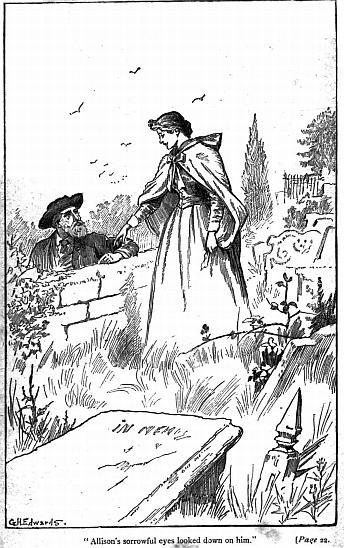
In the early morning of the next day the minister’s son, the returned wanderer, stood leaning over the wall which separated the manse garden from the kirkyard. He was looking at the spot where the grass waved green over the graves of his mother and his two brothers who slept beside her. As he stood, a hand touched his, and Allison Bain’s sorrowful eyes looked down upon him. Looked down, because the many generations of the dead had filled up the place, and the wall which was high on the side of the garden was low on the side of the kirkyard.
“The minister is not up yet?” she asked without a pause. “Was he over-wearied? I had something to say to him, but I might say it to you, if you will hear me?”
“My father will be up soon, and he will see you almost immediately if you will come into the manse and wait a little while.”
“Yes, I could wait. But he is an old man and it might spare him trouble—afterwards—not to know that I passed this way. Are ye Mr Alex who once took our Willie out of the hole in the moss?”
“Yes; I mind poor Willie well. Poor laddie.”
“Poor laddie ye may well say,” said Allison, and the colour came to her pale face, and her eyes shone as she added eagerly: “You will be in Aberdeen—will you go to see Willie? I canna go to see him because—one might think o’ looking for me there. You are a good man, I have always heard, and he needs some one to speak a kind word to him, and I sore misdoubt that he’s in ill company yonder.”
“I am going to see him soon. My father was speaking about him yesterday. I shall certainly go.”
“And you’ll be kind to him, I’m sure,” said Allison, wistfully. “He is not bad, though that has been said. He is only foolish and not wicked, as they tried to make him out. And ye’ll surely go?”
“That I will. Even if you hadn’t asked me, I would have gone. And, afterwards, if he has a mind to cross the sea, he shall have a fair chance to begin a new life over there. I will be his friend. He shall be like a young brother to me.”
Allison uttered a glad cry and covered her face with her hands.
“I mauna greet. But oh! you have lightened my heavy heart.”
“I only wish you could come with him,” said Mr Hadden sadly. “It would be well for you both.”
“But I cannot—for a while—because I am going to lose myself, and if I were with Willie I would be found again. But you will tell him that I will ay have him in my heart—and sometime I will come to him, maybe. I’ll ay have that hope before me.”
“But, Allison—where are you going?—I hope—”
“I must tell no one where I am going. Somebody might ask you about me, and it is better that you should not ken even if I could tell you. Even Willie mustna ken—for a while.”
There was time for no more words. A little bowed old woman with a great mutch on her head, and a faded plaid upon her shoulders, came creeping through among the graves.
“Allie, my woman,” she whispered, “ye’ll need to lose no time. I hae seen the factor riding round the hill by the ither road. He lookit unco angry-like, and his big dog was wi’ him. Lie laich for a whilie till he’s weel by, and then tak aff ye’re hose and shoon and step into the burn and gae doon beyont the steppin’-stanes till ye get in to the hallow and ye’ll bide safe in my bit hoosie till the first sough be past.”
Allison took a bundle of papers from beneath her shawl.
“They are for the minister. It is about the keepin’ o’ the place till Willie comes home,” said she.
But the little old woman interposed:
“You maun gie them to me. The minister maun hae nae questions to answer about them, but just to say that auld Janet Mair gie’d them to him, and he can send the factor to me.”
She took the papers and put them in her pocket and went her way. Allison looked after her for a moment, then drew nearer to the wall.
“Sir,” said she in a whisper, “I have something to give your father. He will ken best what to do with it. I had something to say to him, but maybe it is as well to say nothing. And what could I say? Tell him not to think ill of me for what I must do.”
“Allison,” said Mr Hadden gravely, “my father loves you dearly. It would break his heart to think of harm coming to you. I am afraid for you, Allison.”
“Can anything worse come to me than has come already? Tell him I will ay try to be good. And he will tell my mother, if he goes first where she has gone—” Her voice failed her.
“Have you friends anywhere to whom you can go?”
“I’ll go to Willie some time, if you take him home with you. Only it must be a long, long time first, for he will keep his eye on Willie, and he would find me. And Willie himself mustna ken where I am, for if he came to me he might be followed. I must just lose myself for a while, for if he—that man—were to find me—”
Her colour had come back, and her eyes shone with feverish brightness. What could he say to her? He tore a leaf from his note-book, and wrote his name and his American address upon it.
“Come to me and you shall have a safe home with my wife and children. Come now, or when you feel that you can come safely, though it be ten years hence. You shall have a welcome and a home.”
She gave him her hand, and thanked him, and prayed God to bless him, and then she turned to do as Janet Mair had bidden her. But first she knelt down beside the new-made grave, and, at the sight, Alexander Hadden bared and bowed his head. When he raised it again she was gone.
When the minister opened the parcel which Allison Bain had sent him, he found folded within it her marriage lines and a plain gold ring.
Chapter Two.
“Martinmas dowie did wind up the year.”
The little town of Nethermuir stands in the shire of “bonnie Aberdeen,” though not in the part of it which has been celebrated in song and story for beauty or for grandeur. But in summertime the “gowany braes” which lie nearest to it, and the “heather braes” into which they gradually change as they rise higher in the distance, have a certain beauty of their own. So have the clear brown burns which water its narrow fields, and the belts of wood which are planted here and there on the hillsides.
In summertime, even the little town itself, as it was fifty years ago and more, might be called a pretty place, at least the lanes about it were pretty. There were many lanes about it, some of them shaded by tall firs or spreading beeches, others shut in by grassy dikes which inclosed the long, narrow “kail-yards” running back from the clusters of dwellings which fronted the narrow streets. There were tall laburnums here and there, and larch and rowan trees, and hedges of hawthorn or elder, everywhere, some of them shutting in gardens full of such fruits and flowers as flourish in the north.
Yes, in summer the place might have been called a pretty place; but under low, leaden skies, when the reaches of sodden grass-land and rain-bleached stubble had to relieve their grey dreariness only a newly ploughed brown ridge, or the long turnip fields, green still under the rain and sleet of the last November days, even the hills were not beautiful, and the place itself had a look of unspeakable dreariness.
On such a day the Reverend Robert Hume was leading his horse down the slope which looks on the town from the south, and though his eyes had the faculty of seeing something cheerful even in dismal things, he acknowledged that, to eyes looking on it for the first time, the place might seem a little dreary.
It did not look dreary to him, as he came into one of the two long streets which, crossing each other at right angles, made the town. Though he bowed his high head to meet the bitter wind, and plashed through the muddy pools which the rain had left in the hollows here and there, he was glad at heart to see the place, and to be at home; and he smiled to himself as he came in sight of the corner, beyond which lay the house which held his treasures.
All the town seemed like home to him. As he went slowly on, he had a thought to give to many dwellers on the street. Was “auld Maggie’s” thatch holding out the wet? And surely there was danger that the water of that pool might find its way in beneath “Cripple Sandy’s” door. There were friendly faces regarding him from some of the narrow windows, and “welcome hame,” came to him from more than one open door. The town pump was by no means a beautiful object in itself, but his eye rested with great satisfaction upon it. It stood on the square where the houses fell back a little, at the place where the two streets crossed, and it could be seen from the furthest end of either of them. It had not long stood there, and as it caught his eye, the pleasant thought came freshly to him, how the comfort and cleanliness of the homes might be helped, and how much the labour of busy housewives must be lightened by it.
But it was no Nethermuir woman who so deftly plied the heavy handle, and lifted her full buckets as if they had been empty, and who walked before him down the street with a step which made him think of the heather hills and the days of his youth. There was no woman of that height in Nethermuir, nor one who carried herself so freely and so lightly. It was no one he had ever seen before. But some one crossed the way to speak to him, and he lost sight of her, and a few steps brought him to his own door. His house was close upon the street. It was of grey stone, and only looked high because of the low thatched cottages near it, on both sides of the way. On the left, a little back from the street, stood the kirk, hardly higher than the house. It had no special features, and was not unlike in appearance to the low outbuildings of the manse, which extended behind it.
Its insignificance alone saved it from positive ugliness, but the minister gave it as he passed, a fond admiring glance. He knew every grey stone in its walls, and every pane of glass in its narrow windows. He had not built it with his own hands but his heart had been in the laying of every stone and the driving of every nail in it. And that was true of the house as well. He had only time for a glance. For through the close there came a shout, and his boys were upon him.
“Steady, lads. Is all well? Where is your mother, and how is your sister? Robert, you’ll take good care of Bendie and rub her well down. She’s quite done out, poor beast; and John, you’ll help your brother. She must go to the smithy on Monday. There is something wrong with one of her shoes. I’ve been leading her for the last miles.”
And so on. Not a spoken word of tenderness, but Davie leaned against his father in utter content, and little Norman clasped his arms round his knee. Jack eagerly helped to unsaddle the tired mare, not caring to speak, though as a general thing he had plenty to say. And Robert had enough to do with the lump that rose in his throat when he met his father’s eye. The father ended as he began:
“Where is your mother?”
The mother was standing at the kitchen-door with a child in her arms.
“Well, dearie?” said the one to the other—their eyes said the rest. It was the child that the minister stooped to kiss, but the touch of his hand on his wife’s shoulder was better to her than a caress. Fond words were rare between these two, who were indeed one—and fond words were not needed between them.
Mrs Hume set down the child and helped her husband off with his wet coat, and if he would have permitted it, she would have helped him off with his boots also, since the wet and the chill had made him helpless. But it was not needed this time. For a woman with a step like a princess crossed the floor and bent down to the work.
“Thank you, my lassie. You have both strength and skill, and you have a good will to use them, though I may have no right to demand it at your hands. It is perhaps your way of doing the Lord’s bidding. ‘If I, your Lord and Master, have washed your feet!’ Do you not mind?”
The smile which rose to Mrs Hume’s face had a little surprise in it. For it was not the minister’s way to meet strangers with a text like that.
“It is Allison Bain,” said she.
“Oh! it is Allison Bain, is it? So you are come already. I have seen your friend Dr Fleming, since you left.”
“Dr Fleming was kind to me when I sore needed kindness.”
Her eyes searched wistfully the minister’s face, and it came into his mind that she was wondering how much of her story had been told to him.
“Dr Fleming said many kind things about you, and I trust it may prove for the good of us all, that we have been brought together,” said he.
In his esteem it was no small thing that this poor soul who had suffered and perhaps sinned—though looking in her face he could not think it—should have been given into their care. But nothing more could be said. A soft, shrill voice came from a room on the other side of the house.
“Are you coming, father? I am here, waiting for you.”
“Ah, yes! Ay waiting, my bonny dooie (little dove).”
When his wife entered the room, he was sitting in silence with the pale cheek of his only daughter resting against his. A fair, fragile little creature she was, whose long, loose garments falling around her, showed that she could not run and play like other children, whatever might be the cause. It was a smile of perfect content which met her mother’s look.
“Well, mother,” said she softly.
“Well, my dear, you are happy now. But you are not surely going to keep your father in his damp clothes? And tea will soon be ready.”
“Ah, no! I winna keep him. And he is only going up the stair this time,” said the child, raising herself up and fondly stroking the grave face which was looking down upon her with love unutterable. He laid her upon the little couch by the fireside and went away without a word.
“Come soon, father,” said the child.
It was not long before he came. The lamp was lighted by that time, and the fire was burning brightly. The boys had come in, and the mother went to and fro, busy about the tea-table. The father’s eyes were bright with thankful love as he looked in upon them.
It was not a large room, and might have seemed crowded and uncomfortable to unaccustomed eyes. For all the six sons were there—the youngest in the cradle, and the little daughter’s couch took up the corner between the window and the fire. The tea-table was spread with both the leaves up, and there was not much room certainly between it and the other table, on which many books and papers were piled, or the corner where the minister’s arm-chair stood.
The chair was brought forward in a twinkling, and he was seated in it with his little white dove again on his knee. This was the usual arrangement for this hour evidently. To-night the brothers stood before them in a half circle looking on.
“Well, and how has my Marjorie been all this long time?”
“Oh! I have been fine and well, father, and the time has not been so very long. Do you ken what Mrs Esselmont has sent me? A doll. A fine doll with joints in her knees, and she can sit down. And her clothes come off and on, just like anybody’s. Jack has made a stool for her, and he said he would make me a table and a chair if you brought a knife to him when you came home. Did you bring Jack a knife, father?”
“Well—I’m not just sure yet. I will need to hear how Jack has been behaving before we say anything about a knife,” said her father; but his smile was reassuring, though his words were grave.
“I think Jack has been good, father. And mother was here, ye ken, and she would settle it all, and not leave anything over till you come home, unless it were something serious,” added the child gravely.
Jack hung his head.
“So I am to let bygones be bygones?” said his father.
“And, father,” said the child again, her sweet, shrill voice breaking through the suppressed noise of her brothers—“Allie has come!” And even the introduction of the wonderful doll had brought no brighter look to the little pale face. “Allie has come, and I like Allie.”
“Do you, love? That is well.”
“Yes, father. Eh! but she’s bonny and strong! When she carried me up the stair to my bed, I shut my een, and I thought it might be father himself, Robin is strong, too, and so is Jack, but I’m not ay just so sure of them,” said Marjorie, looking deprecatingly at her brothers, “and I ay feel as if I must help mother when she carries me, because she’s whiles weary. But it is almost as good as having you, father, when Allie takes me in her arms.”
Marjorie was “whiles weary” also, it seemed. She had talked more than all the rest of them put together, which was not her way in general; so she laid her head down on her father’s shoulder, and said no more till tea was brought in. It was the new maid who brought in the bright tea-kettle at last, and set it on the side of the grate. Marjorie raised her head and put out a hand to detain her.
“Father, this is Allison Bain. And, Allie, ye must tell father about the lady. Father, Allie kenned a lady once, who was like me when she was little, and hardly set her foot to the ground for many a year and day. I think she must have been even worse than me, for once they had her grave-clothes made,” said the child in an awed voice, “and when she didna die, they were hardly glad, for what was her life worth to her, they said. But she was patient and good, and there came a wise woman to see her and whether it was the wise woman that helped her or just the Lord himself, folk couldna agree, but by and by she grew strong and well and went about on her own feet like other folk and grew up to be a woman, and was the mother of sons before she died.”
Jack and his brothers laughed at the climax, but the child took no notice of their mirth.
“It might happen to me too, father, if a wise woman were to come, or if the Lord himself were to take me in hand.”
“Ay, my lammie,” said her father softly.
“The mother of sons before she died,” repeated the child. “But she did die at last, father. It ay comes to that.”
“Ay, dear, soon or late, it ay comes to that.”
“But, father, I wouldna like it to be soon with me. And if only a wise woman would come here— But never mind, father,” added she, laying her soft little hand on his as his kind eyes grew grave; “I can wait. I’m only little yet, and there’s plenty of time, and now Allie has come, and she is strong and kind. I like Allie,” she added, caressing the hand which she had been holding fast all the time. “Allie says that maybe the best thing that could happen to me would be to die, but I would like to live and go about like other folk a whilie first.”
“I am sure Allie will be good to you,” said her father.
“Ay, that will I,” said Allie, looking gravely down upon the child.
“Come, now, tea is ready,” said the mother’s cheerful voice. And rather quietly, considering their number, the boys took their places at the table.
There were five of them; the sixth was asleep in the cradle. Robert, the eldest, just fifteen, was a “good scholar,” and dux in the parish school. He was ready for the university, and was going there when the way should be made clear for him. As a general thing, he had a book in his hand while he munched the oaten bannocks, which formed the chief part of the boys’ evening meal. But to-night he listened and put in his word with the rest. And there were words in plenty, for their father had been away ten whole days, and he had much to hear.
The others were handsome, hardy boys, with dark eyes and sun-browned faces, and the fair hair of so many Scottish laddies, darkening a little already in the elder ones. They were seen at their best to-night, for their father had been expected, and clean hands and faces had been a matter of choice, and not, as was sometimes the case, of compulsion, and “the lint white locks,” longer and more abundant than we usually see them on boyish heads nowadays, were in reasonable order.
If a hundredth part of the pride and delight which filled their father’s heart, as he looked round on them, had been allowed to appear on his face, it would have astonished them all not a little. His eyes met those of their mother with a look in which was thankfulness as well as pride, but to the boys themselves he said quietly enough:
“I am glad to hear from your mother that you have been reasonably good boys while I have been away. If there is anything that any of you think I ought to hear of, you’ll tell me yourselves.”
A look was exchanged among the older lads.
“The nicht, father?” said one of them.
“Well, to-morrow may do, unless it be something more than usual. Is it Jack?”
Of course it was Jack. He looked at his mother and hung his head, but said nothing.
“Hoot, man! get it over the nicht,” whispered Robin.
And so he did. But poor Jack’s mischief need not be told. It was not really very serious, though his father listened seriously, and kept his smiles till he was alone with the boy’s mother. Mischief is a generic term in the Scottish tongue, including some things bad enough, but also some things in which fun is one of the chief elements, and Jack’s mischief was mostly of this kind. Sometimes his father laughed in private, even when he found it necessary to show displeasure to the culprit.
But he was reasonable in his punishments, which was not invariably the case with even good men and good fathers, in that land, in those days. There were whispers among some of the frequenters of the little kirk, to the effect that the minister’s laddies needed sharper discipline than they were like to have at home, and there were prophecies that they would be likely to get their share of discipline of one kind or another when they should be out of their father’s hands.
Jack got easily off, whatever his fault had been, and had his knife besides. They all grew a little noisy over their father’s gifts. As it was Saturday night, his first thought had been that they should not be distributed till Monday. But their mother said they might, perhaps, think all the more about them if they had not seen them. So each got his gift, and their delight in them, seeing there was so little to rejoice over, was in the eyes of the father and mother both amusing and pathetic.
But little and great are comparative terms when applied to money’s worth as to other things, and considering the amount which must be made to stand for all that was needed in the home, the presents were not so trifling. Still, the minister was a rich man in the opinion of many about him, and it cannot be said that he was a poor man in his own opinion. At any rate, between them, his wife and he had made their comparative poverty answer a good many of the purposes of wealth, not to their children only, but to many a “puir bodie” besides, since they came to Nethermuir.
“And now, my lads, we’ll to worship and then you’ll to your beds, for I have my morrow’s sermon to look at yet, and I see your mother’s work is not done.”
So “the Books” were brought out and Allison Bain was called in from the kitchen. The minister asked God’s blessing on the reading of the Word and then he chose a Psalm instead of the chapter in Numbers which came in course. It was the thirty-fourth:
“I will bless the Lord at all times; His praise shall continually be in my mouth,” and so on to the end.
“The Lord redeemeth the soul of His servants, and none of them that trust in Him shall be desolate.”
“He believes it all,” said Allison Bain to herself, lifting once again her sad eyes to his face. And then they sang:
“Oh! God of Bethel, by whose hand
Thy people still are fed—”
which was their family song of thanksgiving, as it was of many another family in those days, on all special occasions for rejoicing. It was the mother who led the singing with a voice which, in after years, when her sons were scattered in many lands, they remembered as “the sweetest ever heard.” The father sang too, but among the many good gifts which God had given to him, music had been denied. He did not know one tune from another, except as it might be associated with some particular Psalm or Hymn, and his voice, both powerful and flexible in speaking, had in singing only two unvarying tones. But he was never silent when the time came “to sing praises,” and truly his voice did not spoil the music to those who loved him. The boys had their mother’s gift and they all sang with good will to-night. Allie’s voice was mute, but her lips trembled a little, and her head drooped low as they sang—
“God of our fathers be the God
Of their succeeding race.”
She was not forgotten in the prayer which followed. It was not as “the stranger within our gates” that she was remembered, but as one of the household, and it was reverently asked that the casting in of her lot with theirs might be for good to her and to them for all time and beyond it. But there was no brightening of her face when she rose and passed out from among them.
The minister’s sermon was not his first thought when he returned to the parlour, after carrying his little daughter up-stairs. By and by his wife sat down with her stocking-basket by her side. They had many things to speak about, after a ten days’ separation, which had not occurred more than twice before in all their married life, and soon they came round to their new servant.
“Well, what do you think of her?” said the minister.
“I cannot say. I cannot quite make her out,” said Mrs Hume gravely.
“You have not had much time yet.”
“No; I mean that I do not think she intends that I should make her out.”
“She says little?”
“She says nothing. She has passed through some sore trouble, I am quite sure. She looks, at times, as if she had lost all that she cared for, and had not the heart to begin again.”
“I think you have made her out fairly well,” said the minister smiling.
“Why was Dr Fleming so anxious to send her here? Had he known her long? And how did he come to know her?”
“He had not known her very long. This is the way he came to know her: She was brought to the infirmary, ill of fever. She had gone into a cottage on the outskirts of the town ‘to rest herself,’ she said. But she was too ill to leave the place, and then she was sent to the infirmary. She had a struggle for life, which none but a strong woman could have won through, and when she began to grow better, she made herself useful among the other patients, and was so helpful, that when one of the nurses went away, they kept her on in her place. But evidently she had not been used with town life, or even indoor life, and she grew dowie first, and then despairing, and he was glad at the thought of getting her away, for fear of what might happen. It was change which she needed, and work such as she had been used with.”
“But it was a great risk to send her here.”
“Yes, in one way. And I hardly think he would have ventured to do so, but that, quite by accident, he had heard about her from an old college friend. It seems that this gentleman came to see Dr Fleming at the infirmary, and getting a glimpse of the young woman’s face, he betrayed by his manner that it was not for the first time. He was bound, he said, for her sake, not to seem to know her, nor would he say anything about her home or her station in life. But he said that he knew well about her, that she was an orphan who had suffered much, that she was a good woman, one to be trusted and honoured, and he begged his friend to ask her no questions, but to get her out of the town into some quiet country place where she might outlive the bitterness of the past. And his last words were, ‘Fortunate will they be who can have her as a helper in the house.’”
“It is a pity for her sake that she should refuse to trust us.”
“Yes. There is one thing which you ought to know, though Dr Fleming rather betrayed it than expressed it openly. I think, from what he said, and also from what he did not say, that there had been some fear that her mind might give way under the strain of her trouble, whatever it is. She seemed to have lost the power of turning her thoughts away from it, and yet she had never uttered a word with regard to it. She was sometimes, he said, like one walking in her sleep, deaf and blind to all that was going on about her. She had a dazed look, painful to see.”
“I ken the look well.”
“She had been used with country life, he thought, for in the town she was like a creature caged and wild to get out. Her best chance was, he said, an entire change of scene and of work, and he thought it providential that we were to lose our Kirstin at this time. Our house, he thought, would be a good place for her. She will have plenty to do, and will have every allowance made for her, and she will be kindly and firmly dealt with. And then, there are the bairns, and our bonny Maysie. I confess the glimpse I have gotten of her has already greatly interested me.”
“I acknowledge I have felt the same. But others will be interested in her also. Does she really think that she can keep a secret in a place like this? What she will not tell, others will guess. Or worse, they will imagine a story for her.”
“We must do what we can to guard her from ill or idle tongues.”
“Yes, and if she were just a commonplace servant-lass, like our Kirstin, it might be easy to do so. But with a face and eyes like hers, to say nothing of her way of carrying herself, every eye will be upon her.”
“She is a stately woman truly. But her dark, colourless face will hardly take the fancy of common folk. They will miss the lilies and roses. She has wonderful een,” added the minister.
“Yes, like those of a dumb creature in pain. Whiles I feel, looking at her, that I must put my arms about her and let her greet (weep) her heart out on my breast. But she has hardly given me a chance to say a kind word to her yet. That may come in time, however.”
“It will be sure to come,” said the minister heartily. “What sorrowful soul ever withstood you long? And you have reason to trust her? She has done well thus far?”
“I have had no cause to distrust her. Yes, she has done wonderfully well. Though I doubt whether she has ever occupied a servant’s place before. And she gets on well with the lads. Jack has once felt the weight of her hand, I believe. I do not think he will be in a hurry again to vex her with his nonsense.”
“I must have a word with Jack, and with them all.”
“As for our Marjorie, her heart is taken captive quite.”
“My precious darling! She may do Allison good. And we must all try to help the poor soul as we may, for I fear she is in an evil case.”
Chapter Three.
“For the highest and the humblest work had been given them to do.”
Yes, Allison Bain was in an evil case, but if an entire change of scene and manner of life, and hard work and plenty of it, were likely to have a beneficial effect upon her, she had come to the right place to find them. And she had come also to the right place to get faithful, patient, and kindly oversight, which she needed as much as change.
When she had been longing to get away—anywhere—out of the great town, which was like a prison to her, Dr Fleming had spoken to her about taking service at the manse of Nethermuir, and she had said that she would go gladly, and at once.
The only manse which she knew much about was in her mind when she made the promise,—a house apart, in a sheltered, sunny spot, having a high walled fruit garden behind it, and before, a broad, sloping lawn, with a brown burn running at the foot. Yes, she would like to go. She would get away from the din and closeness of the town. In a place like that in which the old minister lived alone among his books, with only his children or his grandchildren coming home to see him now and then, she would be at peace. She would be away from the curious eyes that were ay striving, she thought, to read her sorrowful secret in her face. Yes, she would be glad to go.
But it was a very different place in which she found herself when she reached Nethermuir. Anything more unlike the ideal Scottish manse than the house to which she had come could not well be imagined. There was no walled garden or lawn, or “wimplin burn” to see. If it had even a right to be called “The Manse,” might be doubted.
For it was only the house of the “Missioner Minister,” a humble abode, indeed, in comparison with the parish manse. It was a narrow, two-storied house, with but the causey (pavement) between it and the street. Across the close, which separated it from a still humbler dwelling, came the “clack, clack” of a hand-loom, and the same sound, though the night was falling, came from other houses near.
“A poor place, indeed,” was Allison Bain’s first thought, as she stood regarding it from the darkening street, with a conscious, dull sinking of the heart, which had already fallen so low. Not that the place mattered much, she added, as she stood looking at the lights moving here and there in the house. She was too weary to care for anything very much that night. The morning stars had lighted her way the first two hours of her journey, and there had been little time for rest during the short November day. Footsore and exhausted after her thirty miles of travel, she went slowly and heavily in. She could only listen in silence to the kindly welcome of her new mistress, and then go silently to the rest and quiet of her bed.
Morning came. Rest and quiet! These were not here, it seemed. The sound of many voices was filling the house when Allie, having long overslept herself, awoke at last and lifted her heavy head from the pillow. There were shrill, boyish voices, laughing, shouting, wrangling, without pause. There was racket on the stairs, and wrestling in the passage, and half-stifled cries of expostulation or triumph everywhere, till a door opened, and closed again, and shut it all out.
And so Allison’s new life began. She had not come to seek an easy time. And as for quiet, if she had but known it, the noise and bustle and boyish clamour, the pleasant confusion of coming and going about the homely little manse, and the many claims upon her attention and patience and care, were just what she needed to help her. Whether she knew it or not, she set herself to her work with a will, and grew as content with it, after a while, as she could have been anywhere at this time of her life.
Mr Hume belonged to the little band of remarkable men, to whom, on their first coming North, was given the name of “Missioners.” Some people say the name was given because these men were among the first to advocate the scheme of sending missionaries to the heathen. Others say they were so named because they themselves came, or were sent, to preach the Gospel of Christ to those who were becoming content to hear what the new-comers believed and declared to be “another Gospel.” In course of time the name given to the leaders fell also to those who followed—an honourable name surely, but in those days it was spoken contemptuously enough sometimes, by both the wise and the foolish, and Mr Hume, during the first years of his ministry in Nethermuir, had his share of contumely to meet or to ignore as well as the rest.
But all that had been long past before Allison Bain came with her spoiled life, and her heavy heart, to seek shelter under his roof. By that time, to no minister—to no man in all the countryside—was a truer respect, a fuller confidence given, by those whose good word was of any value.
He had not been over-eager to win the good word of any one. The courage and hopefulness of youth and an enthusiastic devotion to the work to which he had been set apart, carried him happily through the first troubled years, and when youthful courage and hopefulness had abated somewhat, then natural patience, and strength daily renewed, stood him in good stead. He loved his work not less, but more as time went on, and it prospered in his hands. His flock was only “a little flock” still; but the gathering in of these wanderers to the fold had given him, as one by one they came, a taste of such perfect satisfaction, as few of the great ones of the world—be they heroes or sages—have claimed to be theirs, even in the moment of their highest triumphs.
This kind of success and his satisfaction in it might not be appreciated by those who looked on from the outside of his circle of influence; but there was another kind, both of success and of satisfaction in it, which they could appreciate, and at which they might well wonder.
By means of the pennies and sixpences and shillings slowly gathered among themselves, though few among them had many pennies to spare, and with the help of occasional pounds, which by one hand and another found their way into the treasury from abroad, first the kirk had been built and then the manse. They were humble structures enough, but sufficient for their purpose, and indeed admirable in all respects in the eyes of those who had a part in them.
Then out of a low stretch of barren clay, which was a slimy pool, with a green, unhealthy margin for some months of the year, the minister had made such a garden as few in the town could boast. The hawthorn hedge around it, as well as every tree and bush in it, was planted by the minister’s own hand, or under his own eye. It might not have seemed a very fine garden to some people. There were only common flowers and fruits in it, and still more common vegetables; but the courage, the skill, the patience which had made it out of nothing, must have been appreciated anywhere. To the moderately intelligent and immoderately critical community of Nethermuir, the visible facts of kirk and manse, of glebe and garden, appealed more clearly and directly than did the building up of “lively stones into a spiritual house,” which was his true work, or the flourishing of “trees of righteousness” in their midst, which was his true joy.
And, perhaps, this was not so much to be wondered at, considering all things. For some of the “trees” looked to be little other than “crooked sticks” to their eyes; and of some of the “stones” it might well be said, that they “caused many to stumble.” And since it was halting, and shortcoming, and inconsistency that some of their critical neighbours were looking for among “folk that set themselves up to be better than their neebors,” it is not surprising that it was these that they should most readily see.
Even the minister himself saw these things only too often. But then, he saw more. He saw the frequent struggle and resistance, as well as the rare yielding to temptation, and he saw also, sometimes, the soul’s humiliation, the repentance, the return.
And even the “crooked sticks” were now and then acknowledged to be not altogether without life. Saunners Crombie might be sour and dour and crabbed whiles, readier with reproof and rebuke than with consolation or the mantle of charity. But even Saunners, judged by deeds rather than by words, did not altogether fall short of fruit-bearing, as many a poor soul, to whose wants, both temporal and spiritual, he ministered in secret, could gladly testify.
And on many of the folk who had “ta’en up wi’ the little kirk,” a change had passed, a change which might be questioned and cavilled at, but which could not be denied. In more than one household, where strife and discontent had once ruled, the fear of God and peace and good-will had come to dwell. To another, long wretched with the poverty which comes of ill-doing, and the neglect which follows hopeless struggle, had come comfort, and at most times plenty, or contentment with little when plenty failed.
There were lads and lassies among them, of whom in former days, evil things had been prophesied, who were now growing into men and women, earnest, patient, aspiring—into such men and women as have made the name of Scotland known and honoured in all lands. They were not spared a sneer now and then. They were laughed at, or railed at, as “unco gude,” or as “prood, upsettin’ creatures, with their meetings, and classes, and library books,” and the names which in the Scotch of that time and place stood for “prig” and “prude,” were freely bestowed upon them. But, all the same, it could not be denied that they were not “living to themselves,” that they were doing their duty in all the relations of life, and of some of them it was said that “they might be heard o’ yet” in wider spheres than their native town afforded.
Neither could it be denied that some who had set out with them in life, with far fairer promise than they, had “gaen the wrang gait,” with an ever-lessening chance of turning back again. And what made the difference?
Was it just the minister’s personal influence teaching, guiding, restraining, encouraging? Or was it that a change had really passed upon them—the change in which, at least, the minister believed, and which he preached—which, according to him, must pass on each man for himself, before true safety or happiness, either in this world or the next, could be assured—the change which can be wrought by the Power of God alone?
Converted! The word had long been a scoff on the lips of some in Nethermuir, but even the scoffers had to confess that, to some of the missioners at least, something had happened.
There was Peter Gilchrist. If an entire change of heart, and mind, and manner of life meant conversion, then Peter was converted. And that not through the slow process of reading the Bible on the Sabbath-day, or by learning the catechism, or by a decent attendance upon appointed ordinances—not even “under the rod”—the chastising hand of Him who smites the sinner for his good—which would have been reasonable enough. It had happened to others.
But Peter had been converted by one sermon, it was said, a sermon preached at the house-end of Langbarns in the next parish. No great sermon, either. At least many a one had heard it without heeding it. But it had “done” for Peter.
The very last thing that Peter had been thinking about was listening to the sermon. He, with some of his chosen friends, had gone to the meeting—held out of doors, because there was no other place in which to hold it—for the help and encouragement of the constable, who, it was said, had a warrant to seize and carry before a magistrate “the missioner minister” for a breach of the law, in holding a preaching meeting at Langbarns without the consent of the parish minister. The presumption was that the sight of the constable, and the announcement of his errand, would be enough to silence the minister and disperse the meeting. But that did not follow. If he were to be meddled with, “it should not be for nothing,” the minister declared to a rather timid friend and adviser. And his courage stood him in good stead. He gave the folk assembled such a sermon as probably few of them had ever heard before. The constable had not, he acknowledged, nor Peter; and the worst of it—or the best of it—for Peter was, that having heard it, he could not forget it.
When the meeting was over, Mr Hume went silently and swiftly away with the departing crowd, and he never would have been quite sure that anything serious had been intended if he had not afterward had Peter’s word for it.
Returning home from a similar meeting, held in another direction, a week or two afterward, he was waylaid by that unhappy man, and in a rather unexpected manner called to account for his sermon, and for the misery it had caused. They went home to the manse together, and spent a good part of the night in the minister’s study, and more nights than one before Peter “came to himself” and “went to his Father,” and so was made ready to begin a new life indeed.
It was a new life. There was no gainsaying that. He had been a reckless character, a drunkard, a swearer, an ill husband and a worse father, in the sight of all men. But from the day when at last he came out of the minister’s study with a face which shone, though there were tears upon it, all that was over.
For days and months his wife watched him and wondered, and rejoiced with trembling, never sure how it all might end. His children, with something of the dogged indifference with which in former days they had come to bear the effects of his drunken anger, took the good of his changed ways “while they lasted,” they said to one another, hardly daring to hope that they would last “for ay.”
But though he had had a stumble or two since then he had, on the whole, during thirteen years walked warily and wisely, even in the unwilling judgment of those who had watched for his halting. Even they were compelled to allow that “to be converted” meant something to the purpose, at least in the case of Peter Gilchrist.
There were many besides him whose lives illustrated the power of the Gospel as held forth by Mr Hume, and there were but a few in the place who went beyond a grumble of dissent or disapproval of him and his doings now. Even the most inveterate of the grumblers, or the most captious of the fault-finders, could not withstand the persistent friendliness which never resented an injury nor forgot a favour, and which was as ready, it seemed, with a good turn for those who wished him ill as for those who wished him well.
According to some folk, the minister ought to have been “sour, and dour, and ill-conditioned,” considering the belief he held and the doctrines he preached. These were the folk who never went to hear him. But even they acknowledged that he was friendly and kindly, cheerful and forbearing, even when vexation or indignation on his part might have been excusable. And they also acknowledged that “he wasna a man who keepit a calm sough, and slippet oot o’ things just to save himself trouble.” He could be angry—and show it, too—where cruelty, or dishonesty, or treachery came under his eye, or where blasphemous words were uttered in his hearing. And there were two or three of the evildoers of the place who had been made to feel the weight of his words, and the weight of his hand also on occasion, and who were in the way now of slipping down the lanes, rather than meet the minister in the light of day.
And he was “a weel learnt man,” and fair in an argument, and willing to look at all the sides of a subject. This was Weaver Sim’s opinion of the minister, and he was an oracle in a small way among his neighbours.
“He has his ain notions and opinions, as is to be expectet o’ the like o’ him. But he’s a weel learnt man, and on the whole fair and liberal. And whiles he has a twinkle in his e’e that tells that he sees some things that ither folk canna see, and that he enjoys them.”
All this had been conceded during the early years of the minister’s life in Nethermuir. He had made his own place among the town’s folk since then, and so had his wife. It was a good place, and they were worthy of it. And it is possible that, in all Scotland, poor Allison Bain could have found no safer refuge than she was likely to find with them.
She filled her place well—was indeed invaluable in it. But when weeks and months had passed, her master and mistress knew nothing more of her heart or her history than on the day when she first came among them. But they had patience with her, and watched her with constant and kindly oversight, and they trusted her entirely at last.
“Her trust in us will come in time,” said her mistress; “and in the meanwhile I can only be thankful that she has been sent to us, both for her sake and ours.”
It was indeed “a great relief and comfort” for Mrs Hume to know that a wise head and capable hands were between her and many of her household cares. For what with her husband, and her six sons, and her frail little daughter, and the making, and mending, and thinking for them all, her days were sometimes over-full.
To the minister his wife was hands, and eyes, and sometimes head. She had to keep her heart light and her face bright, and now and then she had to “set it as a flint” for his sake. She had to entertain many a wearisome visitor, and to listen to many a tale of care or trouble or complaint, that the quiet of his study need not be broken in upon. She stood between him and some vexations which he might have taken seriously, and from which he might have suffered, but which yielded under the influence of her smiles and soft words, or disappeared in the presence of her indifference or her anger, as the case might be.
She had slow, dull natures to stir up, and natures hard and crabbed to soften and soothe, and in numberless other ways to hold up her husband’s hands, and maintain his honour in the little community to which he stood as God’s overseer.
There were “puir bodies” in every street, into whose dim little rooms the face of the minister’s wife came like sunshine. She was a kind of Providence to some of them, having made herself responsible to them for cups of tea, or basins of soup, or jugs of milk in their time of need. And for better help still. To the suffering and sorrowful she came with words of comfort and consolation, and with words of chiding or of cheer to the “thraward” and the erring, who had helped to make their own trouble. She was mindful of all and kind to all as they had need and she had power.
She had other uses for her time also, duties and pleasures which she could not neglect. A new book found its way to the manse sometimes, and she had the Evangelical Magazine to read—it would be thought dry reading nowadays—and the weekly paper as well, for great interest was taken in public affairs at that time. These books and papers were to be thought over, and considered, and then discussed with her husband, and sometimes with the two or three hard-handed farmers or artisans of their flock, who had, under their teaching, learned to care for books, and even for “poyms,” and for all that the great world in the distance was trying to say and to do.
It was well for her that she had learned to do two things at once, or even three,—that she could enjoy her book quite as well with her knitting-needles glancing busily in her skilful fingers, and her foot on her boy’s cradle, and withal never forget to meet and answer the smile of her patient little daughter, or by glance or word or touch to keep her restless lads in order.
Her brown eyes seldom looked troubled or weary, and her voice, though at times imperative enough, never grew sharp or fretful. Her steps went lightly up and down the stair, and through the streets of the town, and her smile was like sunshine at home and abroad.
And the help that Allison’s willing and efficient service was to her mistress cannot be told. It would have helped her more if the girl had been happier in the giving of it.
“But,” said her hopeful mistress, “that will come in time.”
Chapter Four.
“She crept a’ day about the house
Slow fitted and heart-sair.”
Truly there was enough to do in the house. Allison’s day began long before the dawn of the winter morning, and ended when there was nothing more to do, and night had come by that time. All was done deftly and thoroughly, as even the faithful Kirstin had not always done it, but silently and mechanically. She took no satisfaction, that her mistress could see, in a difficult or tiresome piece of work well ended—in a great washing or ironing got through in good time, or in a kitchen made perfect in neatness. When the lads came home from school to put it all in disorder, with bats and balls, and sticks and stones, she made no remonstrance, but set to work to put it in order again. It made no difference, her downcast face seemed to say.
With the lads themselves—tiresome and vexatious often—she was, for the most part, patient and forbearing, but it was not a loving patience, or a considerate forbearance, as old Kirstin’s had been. Kirstin had been vexed often, and had sometimes complained of their thoughtlessness and foolishness. But nothing seemed to make much difference to the silent ruler of the kitchen. Everything but the work of the moment was allowed to pass unheeded.
The lads, cautioned by their father, and kept in mind by their mother, did not often go beyond the bounds of reasonable liberty in the use they made of her domain. When they did so, a sharp word, like a sudden shot, brought them to their proper place again and set matters right between them. The lads bore no malice. They never complained to their mother at such times, and if they had, she would have paid little attention to such complaints. That “laddies must be kept in order,” she very well knew.
And thus the early weeks of winter passed, doing for Allison some of the good which work well done is sure to do for the heavy-hearted. But the good which the busy days wrought, the nights, for a time, seemed to destroy.
In the long evenings, when Marjorie and the younger brothers were asleep, and the elder lads were at their books, there came a time of quiet to all the house, when Allison had the kitchen to herself and she could sit in silence, undisturbed, but not at rest. Then her trouble came back upon her, and night after night she sat gazing into the fire till it fell into red embers, and then into grey ashes, thinking of the painful days of the year now drawing to a close. And, poor soul! the anguish of pain and shame which, months ago, had touched her and hers, was as sharp and “ill to bide” as when the blow had fallen. Nay, in a sense it was worse. For in the first amazement of a sudden shock, the coming anguish seems impossible, and the natural resistance of the soul against it gives a sort of courage for the time.
But with Allison, the fear had changed to certainty. Trouble had fallen on her and hers, and had darkened for her all the past and all the future, she believed, for as yet time had not lightened the darkness.
It was not that she was thinking about all this. She was living it all over. She saw again the home she had left forever—the low house, with the sunshine on it, or the dull mist and the rain. A vision of a beautiful, beloved face, drawn with terror, or fierce with anger, was ever before her. Or a grey head moving restlessly on its last pillow—a face with the shadow of death upon it, and of an anguish worse than death. In her ears was a voice uttering last words, with long, sobbing sighs between.
“O! Willie, Willie!” the broken voice says. “Where are ye, Willie? Mind, Allison, ye hae promised—to watch for his soul as ane that maun gie account. And the Lord deal—wi’ you, as—ye shall deal wi’ Him.”
And in her heart she answers:
“Father, be at peace about him. I’ll be more mindfu’ o’ him than the Lord himself has been.”
She sees the anguish in the dying eyes give place to darkness, and sitting there by the grey ashes on the hearth, cries out in her despair. Thus it has been with her since her father was laid in the grave, and the prison-doors shut upon her only brother. Their faces are ever before her, their voices in her ears.
She cares for nothing in the wide world at such times. She does not even care for herself, or her own life, though a shadow dark and dread lies on it. If her life could come to an end, that Would be best, she thinks. But it must not come to an end yet. Oh! if she and Willie could die together, or get away anywhere and be forgotten. If they could only pass out of all men’s minds, as though they had never been! But all such thoughts are foolish, she tells herself. Nothing in their lives can be changed, nor mended, nor forgotten.
And having got thus far, it all begins again, and she lives over the happy days when, bairns together, they played among the heather, or followed the sheep on the hills; when their father was like God to them, ay loving them, and being kind to them; but not ay seeming just so mindful of them as their mother was. Their mother was ill whiles, and took less heed of things, and needed much done for her, but they loved their mother best. At least they never feared her, as they sometimes feared their father, who yet loved them both—Willie best, as did all who ever saw his face.
And thus on through all the weary way, her thoughts would travel through days of still content, through doubt, and fear, and anguish, to the end, only to begin again.
If Dr Fleming had known what good reason there was for the fears which he had unconsciously betrayed to the minister, he would hardly have ventured to send Allison Bain to the house of his friend. But he could have done nothing better for her. A change was what she needed—something to take her out of herself, to make her forget, even for a little while, now and then, what the last year had brought her. With new scenes and faces around her, new duties and interests to fill up her time and thoughts, she had the best chance of recovering from the strokes which had fallen upon her, and of “coming to herself” again.
For nothing had happened to her that is not happening to some one every day of the year. Sin and sorrow and terrible suffering had touched her and hers. One had sinned, all had suffered, and she was left alone to bear the burden of her changed life, and she must bear it for her brother’s sake. And she had no refuge.
For her faith in God had been no stronger than her faith in her brother, and her brother had failed her. And God had not put out a hand to help him—to save him from his sin and its consequences, and nothing could be changed now.
Yet the first months of winter did something for her, though her mistress hardly discovered it, and though she did not know it herself. Her day’s work tired her in a natural, healthy way, so that after a time her sleep at night was unbroken, and she had less time for the indulgence of unhappy thoughts. But she did not, for a good while after three months were over, take much conscious pleasure in anything that was happening around her.
She had much to do. The short days of winter were made long to her. For hours before the slow coming dawn she was going softly about the kitchen in the darkness, which the oil-lamp that hung high above the hearth hardly dispelled. When she had done what could be done at that hour within the house, there was something to do outside. For cripple Sandy, whose duty it was to care for the creatures, did not hurry himself in the winter mornings; and Allison, who knew their wants and their ways, and who all her life had had to do with the gentle creatures at home, would not let them suffer from neglect. By the dim light of the lantern hung from the roof, she milked the cows and fed them, and let in the welcome light upon the cocks and hens; and went to all corners of the place, seeing at a glance where a touch of her hand was needed. And she was conscious of a certain pleasure in it after a time.
Then there was the house “to redd up,” and the porridge to make, for the elder lads had to set out early to their school, and their breakfast must be over when their father came down to have worship before they went away. Then came the parlour breakfast, and then the things were to be put away, and dinner-time was at hand, and so on till the day was over. Truly there was enough to do, washing and ironing, cleaning and cooking, coming and going—the constant woman’s work which is never done.
As for the cooking, there was no time for the making of dainty dishes in the manse, even if there had been no better reason for dispensing with them. Oatmeal was the staple of the house, of course—the food which has made bone and muscle for so many who stand in high places on both sides of the sea. There was the invariable porridge in the morning, supplemented by the equally invariable cakes. Not the sweet morsels which the name may suggest to some folk—but, broad discs of meal and water, cut into quarters for the sake of convenience, and baked on a griddle—solid but wholesome.
There was a variety of them. There were soft cakes, and crisp cakes, and thick bannocks, and sometimes there were “scones” of barley-meal. The “loaf-bread” came from the baker’s; so did the rare buns and baps, and the rarer short-bread for great and special occasions. Beef and mutton were not for everyday use. They had fowls and they had fish of the best, for in those days the London market did not devour all that the sea produced, and the fishwives tramped inland many miles, with their creels on their backs, glad to sell their fish to the country folk. They had soup often, and always potatoes and some other vegetables; but milk and oatmeal, prepared in various ways, was the principal food for the bairns of the manse, and for all other bairns as well.
Were they to be commiserated, the lads and lassies, who in manse and farmhouse and cottage had to content themselves with such simple, unvarying fare? They did not think so, for except in books, they knew nothing of any other way of life. I do not think so, because I have seen other ways and their results. Besides, luxury is a comparative term, like wealth, or a competence; and the occasional slice of loaf-bread, with jelly or even treacle on it, probably gave greater satisfaction to the children of that country, and that time, than the unlimited indulgence in cakes and pastry, or creams and ices can give to the experienced young people of the present day, in some other countries, who, taking the usual comprehensive survey of the luxuries prepared for the frequenters of city hotels or watering-places, are sometimes obliged to confess themselves “disappointed in the fare!”
One thing is sure, plain food made strong men and women of most of them; and no lingering dyspepsia of childhood spoiled the pleasure of those of them who won their way to the right to live as they pleased in after-life.
During Allison’s reign in the manse kitchen, the bairns were exceptionally fortunate in their daily fare. For though she seemed to go about in a maze, like the man in the ballad, as Robin said, “whose thoughts were other-where,” she never burned the porridge, nor singed the broth, nor put off the weekly baking of “cakes,” till they were obliged to content themselves, now and then, with less than the usual portion.
It was wonderful how well the work was done, considering how little her heart seemed to be in the doing of it, her mistress sometimes thought. She would have been better pleased had an opening been left now and then for the “putting in mind,” which had been necessary sometimes, even in the case of the much-valued Kirstin. She would have liked to see whether a sharp word or two would have moved the silent Allison for a moment out of the dull, mechanical performance of her duty.
Praise did not do it, and she had been lavish of praise at first. Allison heard it, as she heard all else, without heeding, as though doing well were a matter of course, needing no words about it. She did not respond, by ever so little, to her mistress’ kindly attempts to make friends, till something else had moved her.
The tact and patience of her mistress in dealing with her were helped by the belief which gradually came to her, that this silent withdrawal of herself from all approaches of kindliness or sympathy was hardly voluntary on Allison’s part. It was not so much that she refused help as that she had ceased to expect it. Under some terrible strain of circumstances her courage had been broken, and her hope. She was like one who believed that for her, help was impossible.
Of course she was wrong in this, her mistress thought. She was young and time brings healing. If her trouble had come through death, healing would come soon. If it were a living sorrow, there might still be more to suffer; but her strong spirit would rise above it at last—of that she was sure.
All this she had said to the minister one night. He listened in silence a while, then he said:
“And what if sin, or the love of it, makes her trouble? There are some things which cannot be outlived.”
“Tell me what trouble touches any of us with which sin—our own, or that of other folk—has not to do. Yes, there has been sin where there is suffering such as hers, but I cannot think that she has been the sinner. Allison is an honest woman, pure and true, or my judgment is at fault. It is the sin of some one else which has brought such gloom and solitariness upon her. Whether she is a real Christian, getting all the good of it, is another matter. I have my doubts.”
All this time the minister’s “new lass” had not been overlooked by those who worshipped in the little kirk, nor by some who did not. The usual advances had been made toward acquaintance—friendly, curious, or condescending, as the case might be, but no one had made much progress with the stranger. Her response to each and all alike was always perfectly civil, but always also of the briefest, and on a second meeting the advances had to be made all over again.
When business or pleasure brought any of the cottage wives to the manse kitchen, as happened frequently, their “gude-day t’ye” was always promptly and quietly answered, but it never got much beyond that with any of them. Allison went about her work in the house or out of it, and “heeded them as little as the stools they sat on,” some of them said, and their husbands and brothers could say no more.
When she was discussed, as of course she was at all suitable times and occasions, the reports which were given of her were curiously alike. Friendliness, curiosity, condescension—the one had sped no better than the other. The next-door neighbours to the manse had no more to tell than the rest. There was no lingering at the kitchen-door, or at the mouth of the close in the long gloaming, as there used to be in Kirstin’s time.
“Ceevil! ay, if ye can ca’ it civeelity. She maistly just says naething and gaes by as gin she didna see ye,” said the weaver’s wife.
“For my pairt, I hae nae feast o’ sic civeelity,” said Mrs Coats from the other side of the street. “I should like to ken mair aboot her ere I hae muckle to say to her.”
“It winna trouble her though you sae naething,” said the weaver. “She’s valued in the manse, that’s weel seen.”
“Ay, she is that,” said his wife. “I never thought they would soon get one to step so readily into auld Kirstin’s shoon. She gets through far mair than ever Kirstin did in the course of the day, and the hoose is like a new preen (pin).”
“I daursay. New besoms sweep clean,” said Mrs Coats with a sniff.
“There’s a differ in besoms, however, be they auld or new,” said the weaver.
“She’s the kin’ o’ lass to please the men it seems. We’ll need to keep a calm sough the lave o’ us,” said Mrs Coats.
“It’s ay safe to keep a calm sough,” said the weaver. “Gin she suits the minister’s wife that’s the chief thing. The warst we ken o’ her yet is that she’s no’ heedin’ ony o’ us, and she micht hae waur fauts.”
“That may be. But something must ail a young lass like yon when she is sae slow to open her lips, and goes by a body—even a young lad, as gin there was naebody there.”
“That’s her loss,” said the weaver with a laugh.
That she went about “without heeding” was a more serious matter in the case of the new lass than might at first be supposed. If she had not lived at the manse, which was so much frequented by all sorts of people, or if she had been plain, or crooked, or even little, it would have mattered less that she was so preoccupied and so difficult to approach.
Fewer people, in that case, might have noticed her. As it was, many eyes were on her when she went down the street with her water-buckets, or sat in the kirk in a dream. She would have been called a beautiful woman anywhere. In the street of this dull little town, where men had eyes as well as in larger places, it was not surprising that she should be watched and wondered at.
Her face was beautiful, but it wanted the colour and brightness which made “a bonny face” to the eyes of most of the folk of Nethermuir. It was thin and sallow when she first came there, and the gloom upon it, and “the dazed look” which came when she was suddenly spoken to, did much to mar and shadow its beauty. And so did the great mutch, with its double “set-up” border of thick muslin, which was tied close around it, covering the ears, and the round throat, and hiding all the beautiful hair, which after the fever was beginning to grow again. But nothing could disguise the firm, erect form, which might have been thought too tall, perhaps, if it had not been round and full in proportion; and the short gown confined at the waist by the long strings of her apron, and the rather scant petticoat of dark winsey that fell beneath it, are not such unbecoming garments as might be supposed by those accustomed to garments of a more elaborate fashion.
Her strength was quite as highly appreciated by the stooping weavers and shoemakers of Nethermuir as was her beauty, and the evidences which she unconsciously gave of it were much admired and often recounted among them. When “Auld Maggie” fell on the slide which the town laddies had made in the street, and tailor Coats ran to get some one to help to carry her home, “the minister’s lass” lifted her in her arms, and had her in her bed with a hot-water bottle at her feet before he came back again. And while every other woman in the street needed to take at least one rest, at a neighbour’s door, between the pump and her own, “the minister’s lass,” turning neither head nor eye, moved on without a pause, till she disappeared round the close that led to her kitchen-door.
“And, for that matter, except for the way her face is turned, ye wud never ken whether her buckets were fou or toom” (full or empty), said an admiring observer, as he watched her steady and rapid steps along the street.
So poor Allison, for one reason and another, could not be overlooked. Her name—or rather the name which her place gave her—“the minister’s lass,” was on many lips for a time. Absolutely nothing was known about her except what the kindly and guarded letter of Dr Fleming had conveyed; yet much was supposed and said concerning her, and some things were repeated till they were believed, which she might have resented had she heard of them. They might have angered her, and so have helped to shake her out of the heaviness and dulness that had fallen upon her. But she “never heeded.” She saw neither the hand which was held out to her in friendliness nor the face that turned away in indifference or anger.
And perhaps, on the whole, it was as well that she heeded nothing. For as weeks and months passed on, and other folk came or went, and new events—which would have hardly deserved the name elsewhere—happened to give subject-matter for discussion at proper times and places, Allison became just “the minister’s lass,” tolerated, if not altogether approved, among the censors of morals and manners in the town, and she still went her way, for the most part, unconscious of them all.
Chapter Five.
“He wales a portion with judicious care, And ‘Let us worship God,’ he says with solemn air.”
In the minister’s home on Sabbath morning, the custom was for the two eldest lads to take turns with the “lass” in keeping the house, while all the rest, except Marjorie and the two youngest, went to the kirk. It cannot be said that this was felt to be a hardship by the lads—rather the contrary, I am afraid—when the weather and the season of the year permitted them to spend the time in the garden, or when a new book, not in the “Index expurgatorious” of Sabbath reading was at hand, or even a beloved old one.
Of course there were Sabbath-day tasks to learn. But the big boys were by this time as familiar with the catechism as with the multiplication table, and a psalm, or a paraphrase, or a chapter in the New Testament, hardly was accounted by them as a task. Frequent reading, and constant hearing at family worship, and at the school, had made the words of many parts of the book so familiar to them that only a glance was needed to make them sure of their ground. It needed, perhaps, a second glance if another repetition was suddenly required. It was “licht come, licht go” with them—easily learned, easily forgotten—in the way of tasks. But in another way it was not so. The Word thus learned “in the house and by the way,” and so associated with all else which their young, glad lives held, could never be quite forgotten; nay more, could never—in theory and opinion at least—cease to be authoritative as the law by which, wherever they might wander, their steps were to be guided. But the chief thing to them at present was, that even with “tasks” to learn, there was still time to enjoy their books.
The lads had the firmest belief in their father’s power as a preacher. But it must be remembered that those were the days when a full two hours were not considered, either by preacher or hearers, too long to give to a discourse. And the minister’s sons were expected so to listen that they should be able to give to their mother, at evening worship, all the “heads and particulars”—and they were usually many—and a good deal besides of the sermon. In those circumstances it is not surprising that their turn in the summer garden, or even at the kitchen fireside, should sometimes be preferred to going to the kirk.
So when it began to be noticed that Allison quietly made her arrangements to be in the house every second Sabbath, instead of every third, as would have been fair, Robin remonstrated.
“It’s my turn at home to-day, Allie. No, Maysie, you mustna grumble. It’s but fair that Allie should have her turn at the kirk as weel as the rest of us. You must just content yourself with me. I’m to bide to-day.”
“I’m no’ carin’ to go to the kirk to-day,” said Allison.
“But that’s no’ the question. I’m carin’ to bide at home,” and as his mother had already gone, and no appeal could be made to her, bide he did, and so did Allison.
When this had happened two or three times, it was considered necessary to take notice of it, and Mrs Hume did so, telling her, quietly but firmly, how necessary it was that the minister’s household should set a good example in the place. And, beyond that, she sought to make it clear that it was the duty of all to avail themselves of the privilege of worshipping with God’s people on His day, in His house. If Allison—being the daughter of one who had been in his lifetime an elder in the established kirk, as Dr Fleming had informed them—had any doubts of the propriety of worshipping with dissenters, that was another matter. But she should go to her own kirk, if she could not take pleasure in coming to theirs.
“It’s a’ ane to me,” said Allison.
But on the next fine Sabbath morning she availed herself of the permission, and took her way to the parish kirk. She would like the walk, at any rate, she told herself, and she did enjoy the walk down the lanes, in her own sad fashion; but the lanes took her out of the way a little, and made her late.
That night, at worship-time, when Allison’s turn came to be questioned as to what she had heard at the kirk, she could tell the text. But she did not tell that she had learned it by overhearing it repeated by an old man to his neighbour, as they came after her up the road. Nor did she tell that, being late at the kirk door, and shrinking from the thought of going in alone among so many strange folk, she had passed the time occupied by the preaching sitting on a broken headstone in the kirkyard.
She never went there again. It was truly “a’ ane” to one whose mind, the moment her hands and her head were no longer occupied with the round of daily work, went back to brood over the days and joys that could never return, or over the sorrow which could never be outlived.
“I see no difference. It’s a’ ane to me,” repeated she when Mrs Hume, not wishing to seem to influence her against her will, again suggested that, if she preferred it, she should go to the kirk.
“Difference!” There was all the difference between truth only dimly perceived and truth clearly uttered, in what she would be likely to hear in the two kirks, in the opinion of the minister’s wife. And if that might be not altogether a charitable judgment, it might at least be said that it would be but a cold exposition of the Gospel that old Mr Geddes would be likely to give, either in the pulpit or out of it. But she did not enter into the discussion of the matter with Allison. She was well pleased that she should decide the matter for herself.
“For though she sits in the kirk like a person in a dream, surely some true, good word will reach her heart after a time,” said her kindly mistress. She had a good while to wait before it came to that with Allison. But it came at last.
“Allison,” said Mrs Hume, coming into the kitchen one afternoon, “we’ll do without the scones at tea to-night, in case the baking them should make you late with other things. You mind you did not get to the meeting at all last time, and the minister wishes all his own family to be present when it is possible.”
Allison raised herself up from the work which was occupying her at the moment, and for once gave her mistress a long look out of her sad brown eyes.
“It was not that I hadna time. I wasna carin’.”
“I am sorry to hear you say that. The meetings are a means of grace which have been blessed to many; and though there may be some things said now and then which—are not just for edification, yet—”
Allison shook her head.
“I didna hear them. I mean I wasna heedin’.”
“Well, I will not say that my own attention does not wander sometimes. Some things are more important than others,” said the minister’s wife, a name or two passing through her mind, which it would not have been wise to utter even to the silent Allison; “but,” added she, “we can all join in the Psalms and in the prayers.”
Allison’s answer was a slow movement of her head from side to side, and a look sadder than words. A pang of sympathy smote through the soft heart of her mistress.
“Allie,” said she, laying her hand on her arm, “you pray also?”
“Lang syne—I used to pray—maybe. I’m no’ sure.”
She had left her work and was standing erect, with her hands, loosely clasped, hanging down before her. Her eyes, with the same hopeless look in them, were turned toward the window, through which the relenting sun was sending one bright gleam before he went away, after a day of mist and rain.
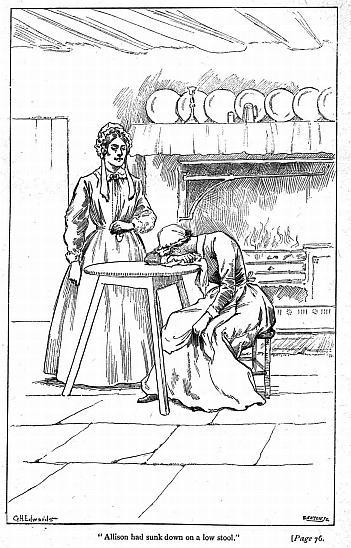
“I do not understand you, Allison,” said Mrs Hume.
“It could not have been right prayer, ye ken, since it wasna answered.”
“But the answer may be to come yet. It may come in God’s way, not in yours.”
“Can the dead live again?” said Allison with dilating eyes.
“Surely, they will live again. Is it your father, Allie? or your mother? They served the Lord, you said yourself, and they are now in His presence. Death is not a dreadful thing to come to such as they, that you should grudge it.”
Allison had sunk down on a low stool, and laid her face on her arm, but she raised it now as she answered:
“But they didna just die. They were killed. Their hearts were broken by the one they loved best in the world. That cannot be changed. Even the Lord himself cannot blot out that and make it as if it had never been.”
“The Lord himself! Was there sin in it, Allie? But do you not mind? ‘The blood of Jesus Christ His Son cleanseth us from all sin.’ It can be blotted out. It is never too late for that.”
But Allison made no answer. Rising with a cry she turned and went out without a word.
Mrs Hume was greatly moved, wishing earnestly that she had not spoken. If the minister had been in his study, she would have gone to him with her trouble. But he was out. So she went into the parlour, where she had only little Marjorie for company. She had not even Marjorie for the moment, for the child had fallen asleep in her absence. As she thought about it, she was not so sure that she had made a mistake, or that there was anything to regret. Better to be moved to anguish by sorrowful memories, or even by remorse, than to live on in the dull heaviness of heart, which had been Allison’s state since she came to them, she thought at last, and she was sure of it when, after a little, the door opened, and Allison said, without showing her face:
“I think, mem, if ye please, I will hae time for the scones I promised wee Marjorie.”
“Very well, Allison,” said her mistress quietly and with a sudden lightening of the heart, she bent down and kissed the lips of her little sleeping daughter. She was greatly relieved. She could not bear the thought that she had hurt that sore heart without having helped it by ever so little. When the time came for the meeting, Allison was in her place with the rest.
The kirk, which could not be heated, and only with difficulty lighted, was altogether too dismal a place for evening meetings in the winter-time. So the usual sitting-room of the family was on one evening of the week given up to the use of those who came to the prayer-meeting. This brought some trouble both to the mistress and the maid, for the furniture of the room had to be disarranged, and a good deal of it carried into the bedroom beyond; and the carpet, which covered only the middle of the room, had to be lifted and put aside till morning.
The boys, or it might be some early meeting-goer, helped to move the tables and the chairs, and to bring in the forms on which the folk were to sit, and sometimes they carried them away again when the meeting was over. All the rest fell on Allison. And truly, when morning came, the floor and the whole place needed special care before it was made fit for the occupation of the mother and Marjorie.
But to do all that and more was not so hard for Allison as just to sit still through the two hours during which the meeting lasted. It was at such times, when she could not fill her hands and her thoughts with other things, that her trouble, whatever it might be, came back upon her, and her mistress saw the gloom and heaviness of heart fall on her like a cloud. It was quite true, as she had said, at such times she heard nothing of what was going on about her, because “she wasna heedin’.” But to-night she heeded.
She had Marjorie on her lap for one thing, for the child’s sleep had rested her, and her mother had yielded to her entreaty to be allowed to sit up to the meeting. Allison could not fall into her usual dull brooding, with the soft little hand touching her cheek now and then, and the hushed voice whispering a word in her ear. So for the first time her attention was arrested by what was going on in the room, and some of the folk got their first good look at her sad eyes that night.
And if Allison had but known it, it was well worth her while both to look and to listen. The minister was the leader of the meeting, but it was open to all who had anything to say.
It was something else besides a prayer-meeting on most nights. There was usually a short exposition of some passage of Scripture by the minister, and frequently a conversational turn was given to this part of the exercise. The minister had “the knack” of putting questions judiciously, to the great help and comfort of those who had something to say, but who did not well know how to say it. And though it must be acknowledged, as Mrs Hume had admitted to Allison, that there were now and then things said which were not altogether for edification, on the whole, this method, in the minister’s hands, answered well. It kept up the interest of the meeting to some who would hardly have cared to listen to a sermon out of the kirk, or on a week night. A few who were only occasional hearers on the Sabbath liked these informal discussions of precept and doctrine, as they would have liked the discussion of any other matter, for the mere intellectual pleasure to be enjoyed, and, as may be supposed, opportunities for this kind of enjoyment did not often occur in Nethermuir.
And there were a few men of another stamp among them—men to whom Mr Hume and “his new doctrines,” as they were called, had come, as sunlight comes into a day of darkness. Even in that time which was already passing away when these men were children, the time which its friends have called “the dark days of the kirk of Scotland,” the Bible had been read and reverenced in all well-ordered households, and it was as true then as in the day when our Lord himself had said it: “The words which I speak unto you, they are spirit and they are life.” And so, through much reading of the Word, had come a sense of sinfulness and ill-desert which a vain striving to work out a righteousness for themselves could not quiet or banish, a longing for pardon from Him whom they had offended, and for a sense of acceptance and friendship with Him who had promised to save.
With regard to all this, it was but “an uncertain sound” which was uttered by the greater number of the teachers of the day; and so when men like Mr Hume came preaching a free and full salvation through Jesus Christ, not only from the consequences of sin, but from the power and the love of it, there were many through all the land who “heard the word gladly.”
There were some in Nethermuir who had heard and heeded, and found the peace they sought, and who showed by their new lives that a real change had been wrought in them. These were the men who rejoiced the minister’s heart and strengthened his hands both in the meeting and elsewhere; and though some of them were slow of speech, and not so ready with their word as others who spoke to less purpose, yet it was from them that the tone of the meeting was taken.
It cannot be said that this privilege of speech was often abused. As for the sisters, they rarely went beyond a question, or a token of assent or approval, given in one word, when something which recommended itself to their taste and judgment had been well said. Mr Hume refused to acknowledge that he did not sufficiently encourage them to do their part for mutual edification in the semi-privacy of these meetings in the manse parlour, and he did acknowledge that two or three whom he could name among them had all the right which a high intelligence, deep spirituality, and sound common sense could give, to lift their voices when the right time came, to “reprove, rebuke, exhort, with all long-suffering and doctrine.” But his observation had taught him that these qualifications did not make a woman more ready or willing, but rather less, to put in her word at such times.
The teaching of the kirk by law established had been in past years vague and indefinite enough on several points of importance, it was truly said. But in the pulpit and out of it, on one point it had been full, clear, and definite. A man must rule (well) his own household. “The husband is the head of the wife,” who is not suffered “to usurp authority over the man,” but who is to listen in silence, being “the weaker vessel”—and so on.
All this had been taught by word and deed for many a year and day—not always, it was to be feared, in the way or in the spirit that Saint Paul would have approved. But it was still true that the best women and the wisest had best learned the lesson. So when the “missioners” came with new light on the matter—no longer insisting upon silence where a few of the brethren and sisters were met to edify one another—it was not, as the minister said, those who were best fitted for it who were the readiest to claim the right or the privilege, whichever it might be called; and as for him, he was not urgent about the matter, either to encourage or restrain.
The brethren, as a rule, were ready enough to fill up the time with exhortation or discussion, and might have been in danger sometimes of becoming too eager and energetic in their utterances if Mr Hume had not, with equal gentleness and firmness, exercised his right to rule among them. To-night the folk had their Testaments open at one of the chapters of Galatians, and when Allison’s attention was first caught, the word was being passed backward and forward between Peter Gilchrist, one of the staunchest supporters of the little kirk, and old Saunners Crombie, staunch, too, in his way. Peter had grown both in knowledge and in grace since the day when he had become a friend of the minister, and he could take his part with the rest. He had “grown mair in gress than in knowledge, if sic a thing were possible,” his friendly opponent, Saunners, declared.
And in Saunners’ sense it was perhaps true. For “hair-splitting” and the art of finding and formulating distinctions where no real difference exists, to be learned well, must be learned young, and Peter’s simplicity and common sense, which did him good service at other times, were rather apt to be at fault when “tackled by auld Saunners and his metapheesics.”
The subject under discussion to-night was the “old law” (la, like the sixth musical note), and its relation to the life and duty of those who had the privilege of living under the new dispensation of grace, and it had fallen, for the most part, to these two to discuss it. The minister’s turn would come next; but in the meantime auld Saunners, with his elbows on his knees, and his Bible held faraway from his too youthful horn spectacles, laid down the law in a high, monotonous voice, never for a moment suffering himself to be disturbed by the frequent but timid interruptions of Peter, till his own say should be said. Peter fidgeted on his seat and appealed to the minister with his eyes. But the minister only smiled and nodded and bided his time.
How earnest they were, Allie thought. It was a great matter to them, apparently. Yes, and to the rest as well. For all the folk were looking and listening, and some nodded an approval of the sentiments of one, and some of the other. Even Robert sat with a smile on his face and his eye on the speakers, as though he were enjoying it all—as indeed he was—and waiting till a few words from his father should reconcile common sense and metaphysics again.
What did it all mean? And what did it matter what it might mean? And where was the use of so many words about it? Allison looked from one face to another in amaze. Then Marjorie’s little hand touched her cheek.
“Which side do you take, Allie?” said she softly.
But Allie shook her head, and the ghost of a smile parted her lips for an instant.
“I ken naething about it,” said she.
“Well, I’m no’ just sure about it myself to-night. But wait you, till my father takes them in hand. He’ll put them both right and bring them to see the same way. At least they’ll say nae mair about it this time,” said Marjorie, and then she added gravely, a little anxious because of her friend’s indifference. “It’s very important, Allie, if we could understand it all.”
“Oh! ay, I daur say,” said Allie with a sigh, coming back to her own sad thoughts again.
But the gloom had lightened a little, Mrs Hume thought, for she had not lost one of the changes on Allison’s face, as she looked and listened, nor the smile, nor the doubtful lock with which she had answered the child.
Chapter Six.
“Do thy duty, that is best,
Leave unto the Lord the rest.”
That year there was through all the North an open winter, and the “green yule,” which is said to make “a full kirkyard.” The weather was mild and moist, with heavy fogs in the morning, which sometimes stayed all day, and all night as well. There was serious illness in many houses, and much discomfort in others, even where there was not danger.
Poor old folk who had sat by the door, or “daundered” about the streets and lanes in comfort during the summertime, now sat coughing and wheezing in the chimney-corner, or went, bowed and stiff, about the work which must not be neglected, though pain made movement difficult. Some who had lingered beyond the usual term of life “dropped away,” and their place knew them no more. And death, the Reaper, not content with the “bearded grain,” gathered a flower or two as well.
Measles came first among the bairns, and whooping-cough followed, and Mrs Hume would have liked to wrap up her little daughter and carry her away from the danger which threatened her. For, that the child should escape these troubles, or live through them, the mother, usually cheerful and hopeful in such times, could not believe. “And her father!” thought she, with a sinking heart, while the father was saying to himself, “Alas for her poor mother;” and out of all their anxious thoughts, nothing better could come than this; “We must submit to God’s will, whatever it may be.”
As for wrapping her up and carrying her away, that was out of the question. If it had been summertime they might have sent her to a friend of theirs, who would have cared for the child tenderly and faithfully. But on the whole it seemed wiser to keep her at home.
“We must just leave her in God’s hand,” they said to one another, and they did so entirely. Mrs Hume was kept away from no sick or suffering household by the thought of possible danger to her little daughter. Many needed both help and comfort who could not come to the manse to find them, and to them the minister and his wife went gladly. But the strain of all she had to do told on Mrs Hume. She also had her turn of illness, which kept her in the house for a while, and then a part of her duties to the sick poor in the neighbourhood fell to Allison.
“It is not always that the Lord lets us see at once the good which He has promised to bring out of what seems to be evil to us; but He has done so this time,” said Mrs Hume, after a little.
For what she had lost in being laid aside from helping others, Allison had gained in taking her place. It was at some cost to herself, because of her shyness, and because of other folk’s curiosity, not always kept within bounds when a chance to gratify it came in the way. But on the whole she held her own among the neighbours, whom she had kept at arm’s-length so long, and won the good opinion of many, and their good words also, which were, however, oftener spoken behind her back than before her face, because she would not stay to listen. Her way was to bring the medicine, or the broth, or the jug of tea, and set it down without a word, and then go at once, if there was no more needed from her. But occasionally she put her strong, expert hands to the doing of some good turn—the firm and gentle lifting of some weary, pain-worn creature, while the bed was put right, or to the setting in order of the confusion which soon befalls in a sickroom, where nurses are unaccustomed, and have besides other cares to fill their time.
Whatever she did was done in silence. No one in telling of the help she gave, could tell a word that she had uttered beyond the message which her mistress had sent. But though she had few words for any one, she had many thoughts about other people’s troubles, which helped her to turn from the constant brooding over her own. So she got more good than she gave, which is oftener the case with the doers of kindly deeds than is always known.
It was in this way that her acquaintance began with Mrs Beaton, who lived in a house at the end of the street, close by the green. Allison had sometimes seen her in the kirk, and had noticed her at first for no better reason than that she wore a bonnet. Of course there were other bonnets in the kirk—many of them. The times were changing for the worse, it was thought, and even the servant-lassies were getting to wear bonnets. But of the elderly women who came there, not many had so far changed the fashion of their youth as to cover the white “mutch” with anything but a handkerchief in the summertime, or with a shawl, or with the hood of the mantle of scarlet or grey duffel, when the weather was cold.
Mrs Beaton wore a bonnet always at the kirk, and when she went to other places, also, as if she had been used with it all her life. And she had some other fashions, as well, which made her seem different from her neighbours in Allison’s eyes. She was small and fair, and over her grey hair she wore a widow’s cap which was not at all like the thick mutches of the other women, and her shawls and gowns were of a texture and form which told of better days long past. She “kept herself to herself,” the neighbours said, which meant that her door did not always stand open for all comers, though she was neighbourly enough in other ways when there was occasion. But though Allison had seen her, she had never spoken with her till the night when the minister, hearing from one of the neighbours that Mrs Beaton was but poorly, sent her over to inquire about her.
“Just go down and see if you can do anything for her. I cannot have your mistress disturbed to-night. You will know what to do. Mrs Beaton is not just like the rest of them, as you will see yourself.”
So, Allison went down the dark street, thinking a little about the sick woman, but quite indifferent as to the welcome she might receive. The house stood by itself, a little back from the road, and a wooden paling enclosed a piece of garden ground before it. The gate yielded to her hand, and so did the door. Allison felt her way to the inner door in the dim light, and then she spoke:
“I’m the minister’s lass. Mistress Hume is no’ weel, or she would have come herself. Will I licht your lamp?”
“Ay, might ye, if there is fire enough left,” said a voice from the darkness.
The lamp was lighted, and holding it high above her head, Allison turned toward the bed. Mrs Beaton raised herself up, and regarded her for a moment.
“And so you are wee Marjorie’s bonny Allie! I am glad to see you.”
“You’re not weel. The minister said I was to do what ye needed done.”
“It was kind of him to send you, and it is kind in you to come. I’m not just very well. I was trying to settle myself for the night, since there seemed nothing better to be done. Maybe ye might make my bed a wee bit easier for me, if ye were to try.”
“I’ll do that,” said Allison.
“Mrs Coats would have come in, I suppose; but her bairns are not well, and she has enough to do. And Annie, the lassie that comes in to make my fire and do other things, has gone to see her brother, who has just come home from a long voyage. I’m more than glad to see you. It’s eerie being quite alone.”
“I’m glad I came. Will I make you some gruel or a cup of tea? When had you your dinner?”
“If you have the time to spare—”
There was time enough. In a minute or two the fire was burning brightly. Allison knew what to do, and where to find what was needed without a question; and Mrs Beaton lay, following her movements with great interest.
“I was once young and strong like you,” said she, with a sigh.
Allison said nothing, but went on with the making of the gruel.
“You have done that before,” said Mrs Beaton.
“Ay, many a time.”
She left the gruel to simmer by the fire, and taking the coverlid from the bed, spread it over the arm-chair, then she lifted the sick woman as if she had been a child, and placed her in it. Then she put a pillow behind her, and wrapped her warmly round.
“And you have done this before.”
Allison answered nothing.
“Was it your mother, my dear?” said Mrs Beaton, laying her small, wrinkled hand on hers.
Allison turned toward her with startled eyes.
“Yes, it was my mother,” said she.
“Ah! what a thing it must be to have a daughter!” went on Mrs Beaton; and it was on her lips to ask if her mother were living still, but the look on Allison’s face arrested the words. There was silence between them till Mrs Beaton was laid in her bed again. Allison washed the dishes she had used, and put the room in order. Then she swept the hearth and covered the fire, and then she said good-night. After she had shut the door, she opened it again and said:
“I might look in on you in the morning, but it would need to be early, and I might disturb you.”
“You wouldna disturb me. But I doubt you would have ill leaving.”
“Oh! I can come, but I canna bide long.”
She went next day and for several days, and their friendship grew in a silent way. And then Mrs Beaton was better, and the little lass who came in the mornings to make the fire and do what else was to be done returned, and Allison’s visits ceased for a while.
Indeed she had little time for anything but the work of the house, and the care of the bairns as the winter wore on. The little boys and Marjorie had their turn of the cough, but happily much less severely than had been feared for them. Still there was enough to do for them, and as their mother was not very strong, Allison took Marjorie in charge by night as well as by day, and the child got bravely through it all. Allison made a couch of her high kitchen-dresser, when it could be done without interfering with the work of the moment, and Marjorie lay there for hours among her pillows, as content as if she had been with her mother in the parlour.
It was good for the child to have such constant and loving care, and it was good for Allison to give it. For many a word of childish wisdom did she get to think about, and sometimes foolish words to smile at, and in listening to Marjorie, and caring for her comfort at all times, she forgot for a while to think of her own cares.
In the long evenings, when the rain or the darkness prevented the usual run, after the next day’s lessons had been prepared, the elder boys used to betake themselves to the kitchen fireside, and on most such nights some of their companions found their way there also. Then there was story-telling, or the singing of songs and ballads, or endless discussions about all things under the sun. Now and then there was a turn of rather rough play, but it never went very far, for the sound of their father’s step, or a glimpse of their mother’s face at the door, made all quiet again, at least for a time.
They were rather rough lads some of those who came, but they were mostly “laddies weel brocht up,” and rarely was there a word uttered among them which it would have harmed the youngest child to hear. There was Scotch of the broadest in their songs and in their talk, and the manse boys, who were expected to speak English in the presence of their father and mother, among their companions made the most of their opportunities for the use of their own more expressive tongue. But there was no vulgarity or coarseness in their talk.
As silent here as elsewhere, the presence of “the new lass,” as the visitors, long accustomed to old Kirstin, called her, did not interfere in the least with the order of things. She might have been blind or deaf for all the difference it made to them, and, except on the rare occasions when little Marjorie was permitted to be there, for all the difference their coming made to her. When Marjorie was there, Allison’s wheel, or the stocking she was knitting, was put aside, and the child rested at ease and content in her arms. No one of them all took more pleasure at such times than Marjorie. She liked the stories and the songs and the quaint old ballads, of which Robin and some of the others had a store, and she was a sympathetic little creature, and could not be happy unless Allie enjoyed them also, so her attention was never allowed to wander when the child’s hand could touch her cheek.
But better than either song or story, Marjorie liked to hear about all that was going on in the town. Nothing came amiss to her that any one had to tell. She liked to hear about their neighbours, and the bairns, their goings and comings, their sickness and recovery. Even their new gowns and their visits to one another interested the friendly little child, who could not visit herself, nor wear new gowns, and the lad who had the most to say about them all was the one who pleased her best. All they used to tell her made her a little sad sometimes, for she could not come and go, or run and play, as those happy children could, and her chief desire was to be strong and well and “to go about on her own feet like other folk.”
January was nearly over before there came any frost to speak of, and the first bright, sharp weather, it was said, did much good to the sick folk in the town. Then they had snow—not just a shower to excite first expectation and then disappointment among the lads and lassies who rejoiced in its coming, as they mostly delighted in any change that came—but a heavy fall, and then a high wind which drifted it here and there between the hills and made some of the roads impassable for the time. Many of the lanes were filled full, and some of the folk had to be dug out, because the snow had covered their doors.
There was no end to the great balls which were rolled along the streets. A strong fort was built on the square beside the pump, which was fiercely attacked and bravely defended, and battles were fought through all the streets before the snow was trodden into black slush beneath the feet of the combatants. Even the dreaded “kink-hoast” (whooping-cough) failed to keep some of the bolder spirits out of the fray, and those of them who took the fun in moderation were none the worse, but rather the better for the rally.
But Marjorie saw none of this, and she longed to see it all; and though she had been less ill with the cough than some of the others had been, she lost ground now, refused her food, and grew fretful and listless as Allison had never seen her before.
It was hard for the eager little creature to listen quietly to all her brothers had to tell of what was going on among the young folk of the town. They boasted of Robin’s strength and skill, and of Jack’s unequalled prowess when “snawba’ing” was the order of the day, and she wanted to see it all. And she longed to see the rush of the full burn and the whiteness of all the hills. Allison looked at her with a great longing to comfort her, but what could she say? Even the mother thought it wisest to listen in silence to the child’s murmurs.
“But it’s no’ just the snawba’ing and the white hills I am thinking about, mother. This is the way it will ay be, all my life long. I must just sit still and hear the sound of things, and never be in the midst of them like other folk. All my life, mother! Think of it!”
“My dear,” said her mother gravely, “all your life may not be a very long time.”
“But, mother, I would like it to be long. There is Robin going to be a great scholar and astonish the whole world; and Jack is going in search of adventures; and Davie’s going to America to have a farm of a thousand acres, all his own. And why should I have to stay here, and not even see the snawba’ing, nor the full burn, nor the castle that the boys made?”
As a general thing Mrs Hume left her little daughter’s “why” unanswered, only trying to beguile her from such thoughts to the enjoyment of what was left to her in her quiet life. To-day her heart was sore for the child, knowing well that her lot would not seem more easy to bear as the years went on.
“My darling,” said she, “it is God’s will.”
“Yes, mother; but why should it be God’s will just with me? Surely when He can do anything, He might give me a chance with the rest. Or else He should just make me content as I am.”
“And so He will, dear, in time. You must ask Him, and leave all in His hand.”
“Oh! yes. I must just leave it. There is nothing else to do. As to asking—I ay ask to be made strong, and to walk about on my ain feet. And then—wouldna I just serve Him!”
The last words were spoken to Allison, whose kind, sad eyes had been resting on her all the time. And Allison answered:
“But surely it may be His will that you should see the full burn and the snawy braes, if it be your mother’s will! A’ the bairns are better since the frost came, and I might carry wee Marjorie as far as the fit o’ the Wind Hill for a change.”
“Oh! mother! mother! Let me go. Allie carries me so strong and easy. And I might have Mrs Esselmont’s warm shawl round me, and the soft little hat, and I would never feel the cold. Oh! mother! mother!”
“I might at least take her to the end o’ the lane; and if she should be cauld, or weary, or if the cough came on, I could be hame with her in a minute.”
Though only half convinced of the wisdom of such a plan, her mother consented; and by and by the happy child, wrapped warmly, her pale face looking very bright and sweet in the soft little hat, laid herself back in Allison’s arms with a sigh of content.
“Yes, I’m going to heed what Robin says, and fall into raptures and weary myself. I’m just going to be quiet and see it all, and then I will have it all to think about afterward.”
The snow was all trodden down in the street through which they passed first, to see the snow castle which the boys had made, and the castle itself was a disappointment. It was “past its best,” Allison said. It was battered and bulging, and the walls had lost their whiteness; and the snow about it was trampled and soiled, and little pools of dirty water had collected at its base. But even “at its best,” it must have fallen far short of the beauty of the castle which the child’s imagination had built, as she lay in the dark, wishing so eagerly to be like the rest.
But the rush of the full burn did not disappoint her, nor the long level fields, nor the hills beyond. The only blink of sunshine which came that day rested on them as they crossed the foot-bridge and came into the broken path which led to the farm of Wind Hill. A hedge bordered the near fields, and a few trees rose up bare and black on the hillside; and all the rest of the land, as far as they could see, lay in unsullied whiteness.
“A clean, clean world!” said Marjorie. “It looks like a strange country. It’s bonny; but I think I like the green grass best, and the gowans.”
“Weel, ye may take a good look o’ it this day, for it winna lie long clean and white like this,” said Allison, as a soft warm wind met them as they turned. They went up and down where the snow lay lightest, and then crossed the burn at the end of the green.
“Are you sure ye’re nae cauld?” said Allison.
“That I am not. And, Allie, I havena given a cough since I came out.”
“But we’ll need to gae hame now. If we dinna make your mother anxious this time, she will be the readier to let us take another turn some fine day.”
Marjorie’s face fell for an instant.
“No, Allie, I’m no’ going to be fractious. But we might just look in and ask for Mrs Beaton, as we are so near. And Robin says John is coming home, and we might ask about it.”
But Allison shook her head.
“We got no leave to go and see anybody. And if we take the street we’ll hae twa or three idle folk glowerin’ an’ speerin’ this and that at us. I like the bonny quiet lane best.”
Marjorie’s shrill laugh rang out at that.
“Are ye feared at the folk, Allie? They ay mean it for kindness. But I like the lane, too. And maybe my mother will let us come and see Mrs Beaton next time.”
The end of Mrs Beaton’s house skirted the green, and so did the narrow strip of garden which was behind it. The road home was as short the one way as the other. If they crossed the green toward the right it took them to the street, and if they turned the other way they took the path behind the gardens, or rather the kail-yards of the houses on the street. Before they entered this path they turned to take a last look of the long, snowy slope of the hills with the sunshine on them.
“The snow is pleasanter just to look at than to wade about in,” said Allison.
“But, Allison, that is because ye dinna ken. O! I would like weel to wade about in it, as the other bairns do.”
“O! I ken fine what it is like. I have been in far deeper snaw whiles, following the sheep—”
“Have ye, Allie? But ye dinna ken what it would be like never to have put your foot in the snaw all your life. Think of that, Allie. But never mind. Tell me about following the sheep through the drifts.”
But the shadow, which the child had learned to know, had fallen on Allison’s face, and she answered nothing.
“Never mind, Allie dear, I’ll tell you something. Do ye ken what that little housie is? It has neither door nor window. There is a hole on this side that is shut with a board. But it is a nice place. I have been in it whiles. That is the place where John Beaton makes headstones when he’s no’ away building houses on the other side of Aberdeen.”
“Do ye mean stanes for the kirkyard?”
“Just that. He’s a clever lad, John. He can do many things, Robin says. He’s Robin’s friend.”
“It maun be dreary wark.”
“But that wouldna trouble John. He’s strong and cheerful, and I like him weel. He’s wise, and he’s kind. He tells me about folk that he has seen, and places and things. And whiles he sings to me, and I like him best after my father and mother and my brothers—and you,” added Marjorie, glancing up at Allison. “I’m no’ sure which o’ the two I like best. I’ll ken better when I see you together. Ye’re the bonniest far!” said the child, fondly patting the cheek, to which the soft wind blowing upon it had brought a splendid colour. “Did Mrs Beaton never tell you about ‘My John’?”
“Oh! ay. But I dinna mind about it. I wasna heedin’.”
“But ye’ll like him when ye see him,” said Marjorie.
The mother was watching for them when they reached home, and Robin was there too. It was Robin who took the child from Allison and carried her in.
“Oh, mother! I have been over the burn, and I’ve seen the hills all covered with snow and the sun shining on them, and it was beautiful. And I’m not just so very tired. Are ye tired, Allie?”
“What would tire me? I would like to carry ye ilka (every) day to the top o’ Win’hill. It might do ye good.”
Robin had never heard Allison say so many words at a time before.
“It has done Allie good, at any rate,” said he as he seated himself by the parlour fire and began to take off his little sister’s wraps. Then he took off her shoes and stockings “to warm her bonny wee footies,” as he said.
“Has it done her good? I’m glad o’ that,” said Marjorie, “for Allie has had sore trouble, I’m nearly sure. She forgets me whiles, even when she has me in her arms, and her face changes, and her een look as if she were seein’ things no’ there.”
“My dear!” said her mother. “It might vex Allie for you to be watching her face, and speaking about it, since she has never said a word about her troubles to you.”
“Oh, mother! It is only to you and Robin. Do you think I would speak about my Allie to other folk?” and the tears came into the child’s eyes.
“Now, Maysie,” said her brother, “when ye begin to look like that, I ay ken that ye’re tired and likely to grow fractious and ill to do with. So you must just lie still in my arms, and I’ll sing ye to sleep. What shall I sing? The Lass o’ Glenshee? or The Lord’s my Shepherd?”
It was not long before the child was sleeping sweetly on her little couch, nor did the flush which her mother so dreaded to see, and which too often followed any unusual excitement, come to her cheeks as she slept. She slept well at night also, and nothing could be clearer than that the long walk had done her no harm, but good.
So, a precedent being established, Marjorie had many a walk after that.
Sometimes she was allowed to spend an hour with Mrs Beaton, or auld Maggie, or some other friend, and at such times Allison would leave her and return for her again. It cannot be said that her limbs grew much stronger, or that the dull pain in the weary little back troubled her no more. But the change gave her new thoughts and new interests, and rested her when she grew weary of her doll, and her books, and of the quiet of the parlour, and sometimes even of her mother’s company.
But when the days grew long and warm, there were even better things in store for her, and for Allison also, through her tender care of the child.
Chapter Seven.
“The spring cam’ o’er the Westlin hill,
And the frost it fled awa’,
And the green grass lookit smilin’ up
Nane the waur for a’ the snaw.”
The winter had been so long in coming and so moist and mild when it came, that weatherwise folk foretold a spring late and cold as sure to follow. But for once they were all mistaken. Whatever might come later, there came, when April had fairly set in, several days which would have done credit to June itself, and on one of these days the schoolmistress made up her mind that she would go down to the manse and speak to the minister’s wife about the bairns.
She was standing at her own door, looking out over the hills, which were showing some signs of coming summer. So were the birch-trees in the distance, and the one laburnum which stood in a corner of Mistress Beaton’s garden. She sighed as she gazed.
“The simmer will soon be here, and it’ll soon be over again. It’s but a blink noo,” she said to herself, “but if the morn is like this day, we’ll mak’ the best o’ it. I’se hae the bairns up to the Stanin’ Stanes. The wind there will blaw awa’ what’s left o’ the kink-hoast among them. They’ll be a’ keen eneuch to get there for the sake o’ the ploy, and if they’re weel eneuch for the like o’ that, their mithers will hardly hae the face to keep them langer frae the school. And it is high time they were comin’ back again,” added she, thinking less, perhaps, of their loss of lore than of the additional penny a week which each returning one would bring to her limited housekeeping.
She was a tall, gaunt woman, with a wrinkled, unhappy-looking face and weary eyes. Her grey hair showed a little under the mob cap, closely bound round her head with a broad, black ribbon, and her spectacles, tied with a string for safety, rested high on her furrowed forehead. She wore the usual petticoat of dark winsey, and her short gown of some dark-striped print fell a little below the knee. A large cotton kerchief was spread over her shoulders and fastened snugly across her breast. Her garments were worn and faded, but perfectly neat and clean, and she looked, as she was, a decent, but not very cheery old woman. She had an uncertain temper, her friends allowed, and even those who were not so friendly acknowledged that “her lang warstle wi’ the bairns o’ twa generations, to say nothing of other troubles that had fallen to her lot, might weel account for, and even excuse that.”
She turned into the house at last, and began gathering together the dog-eared Bibles and Testaments, and the tattered catechisms, and “Proverbs of Solomon,” which were the only books approved or used in her school, and placed them in a wooden tray by the door. She gave a brief examination to the stockings which the lassies had been knitting in the afternoon, muttering and shaking her head as she held them up to the light. The mistakes in some of them she set right, and from some of them she pulled out the “wires,” sticking them into the balls of worsted, with some anticipatory pleasure at the thought of the consternation of the “careless hizzies” to whom they belonged.
Then the forms were set back, and “the tawse,” a firm belt of leather, cut into strips at one end—by no means the least important of the educational helps of the time and place—was hung in its usual conspicuous position, and then the school-room, which was also the whole house, was supposed to be in order for the night.
It was a dismal little place, having a small window on the side next the street, and a still smaller one on the other. There was the inevitable box-bed on the side opposite the fireplace, and the equally inevitable big brown chest for clothing, and bedding, and all other household valuables that needed a touch of “the smith’s fingers” for safety. There was the meal-chest, and a tiny cupboard for dishes and food, and on a high dresser, suggestive of more extensive housekeeping operations than the mistress had needed for many a year and day, were piled a number of chairs and other articles not needed in the school.
A dismal place, but it was her own, till morning should bring the bairns again. So she mended the peat fire into a brighter glow, and seated herself beside it, to take the solace of her pipe, after the worries and weariness of the day.
A pleasant sound put an end to her meditations. From under the chair which stood near the little window at the head of the box-bed, came, with stately step, a big, black hen, announcing, with triumphant cackle, that her duty was done for the day also. The mistress rose and took the warm egg from the nest.
“Weel dane, Tappie! Ye’se get your supper as ye deserve, and then I maun awa’ to the manse.” So she scattered her scanty supply of crumbs about the door, and then prepared herself for her visit.
If she had been going to the manse by special invitation, she would have put on her Sabbath-day’s gown and shawl, and all the folk would have known it as she went up the street. But as she was going on business, she only changed her mutch, and her kerchief and apron, and putting her key in its accustomed hole in the thatch, she went slowly down the street, knitting, or, as she would have called it, “weaving,” as she went.
She had not very far to go, but two or three greetings she got and returned as she passed. “Mistress Jamieson,” the neighbours called her to her face, but she knew quite well that behind her back she was just called Bell Cummin, her maiden name, as was the way among the humbler class of folk in these parts. They all paid her a certain measure of respect, but she was not a favourite among them, for she was silent and sour, and sometimes over-ready to take offence, and her manner was not over-friendly at the best of times.
At the entrance of the close which led to the back door of the manse stood the weaver’s wife from next door, and with her a woman with whom the mistress was not always on speaking terms. This was the wife of tailor Coats, who spent, as the schoolmistress had once told her, more time on the causey (pavement) than was good either for herself or her bairns. She would fain have passed her now without speaking, but that was not the intention of Mistress Coats.
“The minister’s nae at hame, nor the mistress,” said she, “and since ye hae lost your journey, ye micht as weel come in and hae a crack (talk) with Mistress Sim and me, and gie’s o’ your news.”
“I dinna deal in news, and I hae nae time for cracks and clavers.”
“Dear me! and sae few bairns as ye hae noo at the schule. Gin ye could but learn them their samplers noo, or even just plain sewing, ye might keep the lassies thegither for a whilie langer. But their mithers man hae them taucht to use their needles, and it canna be wonnered at.”
This was a sore subject with the mistress, who was no needle-woman, and she turned, ready with a sharp answer. But the smile on the woman’s face, and the look of expectation on the more friendly face of Mistress Sim, served as a warning, and calling her discretion to her help, she turned at once into the manse.
It was peaceful enough there. No one was in the kitchen, and after a moment’s hesitation she crossed the little passage and knocked at the parlour-door. No response being given, she pushed it gently open and looked into the room. The two youngest boys were amusing themselves with their playthings in a corner, and Marjorie lay on her couch with her doll and her doll’s wardrobe, and a book or two within reach of her hand. The tiny little face brightened at the sight of the mistress.
“Come away in, Mistress Jamieson. I am very glad to see you,” said she, with a tone and manner so exactly like what her mother’s might have been, that the mistress could not but smile a little with amusement as well as with pleasure. “My father and mother are both away from home to-day; but they will soon be back now, and you’ll just bide till they come, will you not?”
Mistress Jamieson acknowledged herself to be in no special haste, and sitting down, she made advances toward an interchange of greetings with the little boys. Wee Wattie, not quite four years old, came forward boldly enough, and submitted to be lifted to her knee. But Norman, aged five, had been once or twice sent to the school, with his brothers, when his absence was convenient at home, and certain unpleasant recollections of such times made him a little shy of meeting her friendly advances. Even Robin and Jack had been in their day afraid of the mistress and her tawse. But Marjorie had never been at the school, and had always seen her in her best mood in the manse parlour. She had had rather a dull afternoon with but her little brothers for company, for Allie was busy, and had only looked in now and then to see that the little ones had got into no mischief. So the child was truly pleased to see the mistress, and showed it; and so Mistress Jamieson was pleased, also, and in the best of humour for the afternoon.
And this was a fortunate thing for Marjorie. For she had many questions in her mind which no one could answer so well as the mistress—questions about the reading of one child and of the “weaving” of another, and of the well-doing or ill-doing of many besides. For though she did not see the bairns of the town very often, she knew them all, and took great interest in all that concerned them.
She knew some things about the bairns of the school which the mistress did not know herself, and which, on the whole, it was as well she should not know. So when, in the case of one of them, they seemed to be approaching dangerous ground, and Mrs Jamieson’s face began to lengthen and to take the set, which to Marjorie, who had only heard about it, looked ominous of trouble to some one, the child turned the talk toward other matters.
“I must show you my stocking,” said she, opening a basket which stood within reach of her hand. “It is not done so ill for a beginner, my mother says. But it is slow work. I like the flowering of muslin better, but mother says too much of it is no’ good for the een. And it is quite proper that every one should ken how to make stockings, especially one with so many brothers as I have.”
The stocking was duly examined and admired. It had been the work of months, done in “stents” of six or eight times round in a day, and it was well done “for a beginner.” There were no mended botches, and no traces of “hanging hairs and holey pies,” which so often vexed the very heart of the mistress in the work of some of the “careless hizzies” whom she was trying to teach. She praised it highly, but she looked at the child and wondered whether she would live to finish it. There was no such thought in the mind of Marjorie.
“Mother says that making stockings becomes a pleasant and easy kind of work when one grows old. And though I canna just say that I like it very well. I must try and get on with it, for it is one of the things that must be learned young, ye ken.”
“Ay, that’s true. And what folk can do weel, they ay come to like to do in course o’ time,” said the mistress encouragingly. “I only wish that Annie Cairns and Jeannie Robb could show work as weel done.”
“Oh! but they are different,” said the child, a sudden shadow falling on her face. “If I could run about as they can, I would maybe no’ care about other things.”
“Puir wee lammie!” said the mistress.
“Oh! but I’m better than I used to be,” said Marjorie, eagerly; “a great deal better. And I’ll maybe be well and strong some day, our Allie says.”
“God grant it, my dear,” said the mistress reverently.
“And I have some things to enjoy that the other bairns havena. See, I have gotten a fine new book here,” said Marjorie, mindful of her mother’s warning about speaking much of her trouble to other folk. “It’s a book my father brought home to my mother the last time he was away. I might read a bit of it to you.”
“Ay, do ye that. I will like weel to hear you.”
It was “The Course of Time,” a comparatively new book in those days, and one would think a dreary enough one for a child. It was a grand book to listen to, when her mother read it to her father, Marjorie thought, and she liked the sound of some of it even when she read it to herself. And it was the sound of it that the mistress liked as she listened, at least she was not thinking of the sense, but of the ease and readiness with which the long words glided from the child’s lips. It was about “the sceptic” that she was reading—the man who had striven to make this fair and lovely earth.
“A cold and fatherless, forsaken thing that wandered on forlorn, undestined, unaccompanied, unupheld”; and the mistress had a secret fear that if the child should stumble among the long words and ask for help, she might not be able to give it without consideration.
“Ay, it has a fine sound,” said she, as Marjorie made a pause. “But I wad ken better how ye’re comin’ on wi’ your readin’ gin ye were to tak’ the New Testament.”
There was a tradition among the old scholars that, in the early days of her experience as a teacher, the mistress used to make a little pause before committing herself in the utterance of some of the long words in the Bible; if it were so, that time was long past. But before Marjorie had opened the book, Allison came in, to mend the fire and put things to rights; and as the books had only been intended as a diversion from unpleasant possibilities, they were gladly and quickly put aside.
“This is our Allie, mistress,” said Marjorie, putting out her hand to detain her friend as she passed.
“Ay, ay. I ken that. I hae seen her at the kirk and elsewhere,” said the mistress, rather stiffly.
“And she is so strong and kind,” said the child, laying her cheek on the hand that had been put forth to smooth her pillow, which had fallen aside.
Mistress Jamieson had seen “the new lass” often, but she had never seen on her face the look that came on it at the loving movement of the child.
“Are ye wearyin’ for your tea, dear? It’s late, and I doubt they needed to go on all the way to Slapp, as they thought they might, and maybe they winna be home this while.”
A shadow fell on the face of the child. Allison regarded her gravely.
“Never heed, my lammie. I’ll take the wee laddies into the kitchen, and ye can make tea for the mistress and your brothers if they come in. You’ll like that, dear.”
Marjorie brightened wonderfully. She ay liked what made her think she was able to do as other folk did. The mistress rose, excusing herself for having been beguiled into staying so long.
“And what would my mistress say if we were to let ye away without your tea?” asked Allison, with great respect and gravity.
Then Robin came in, and he added his word, and to tell the truth the mistress was well pleased to be persuaded. She and Robin were on the friendliest terms now, though there had been “many a tulzie” between them in the old days. For Robin, though quieter than Jack, and having the reputation of being “a douce and sensible laddie” elsewhere, had been, during the last days of his subjection to Mistress Jamieson, “as fou o’ mischief as an egg is fou o’ meat,” and she had been glad enough to see the last of him as a scholar. But all that had been long forgotten and forgiven. Robin behaved to her with the greatest respect and consideration, “now that he had gotten some sense,” and doubtless when he should distinguish himself in college, as he meant to do, the mistress would take some of the credit of his success to herself, and would hold him up as an example to his brothers as persistently as she had once held him up as a warning.
To-night they were more than friendly, and did not fall out of conversation of the most edifying sort, Marjorie putting in her word now and then. All went well till wee Wattie took a fit of coughing, and Norman followed in turn; and then Mistress Jamieson told them of her proposed expedition to the Stanin’ Stanes, for the benefit of all the bairns, if the day should prove fine.
Marjorie leaned back in her chair, clasping her hands and looking at her brother with eager entreaty in her eyes. But Robin would not meet her look. For Marjorie had a way of taking encouragement to hope for the attainment of impossible things when no encouragement was intended, and then when nothing came of it, her disappointment was as deep as her hopes had been high.
Then she turned her eyes to the mistress, but resisted the impulse to speak. She knew that her words would be sympathetic and encouraging, but that it must end in words as far as she was concerned.
“And it’s ay best to go straight to my mother,” said Marjorie to herself, remembering past experiences; “and there will be time enough to speak in the morning if the day should be fine.”
So she wisely put the thought of the morrow away, and took the good of the present. And she had her reward. Warned by Robin, Allie said not a word of what awaited the school bairns next day, though the little boys discussed it eagerly in the kitchen. So, when the mother came home, she found her little daughter quietly asleep, which was not often the case when anything had happened to detain her father and mother from home later than was expected.
But though Allison said nothing, she thought all the more about the pleasure which the child so longed to enjoy with the rest. Before she slept, she startled her mistress not a little, entering of her own free will into an account of the schoolmistress’ plan to take the bairns to the hills for the sake of their health, and ending by asking leave to take little Marjorie to “the Stanin’ Stanes” with the rest. She spoke as quietly as if she had been asking a question about the morning’s breakfast, and waited patiently for her answer. Mrs Hume listened doubtfully.
“I hope she has not been setting her heart upon it. It will be a sad disappointment to her.”
“If it must be a disappointment. No, we have had no words about it. But she heard it from the mistress. It wad be as good for her as for the other bairns.”
“I fear it would not be wise to try it. And she can hardly have set her heart upon going, or she would not be sleeping so quietly.”
“It would do her good,” persisted Allison.
“And you could trust her with Allison, and Robin might meet them and carry the child home,” said the minister.
Mrs Hume turned to him in surprise. When the minister sat down in the parlour to take a half-hour’s recreation with a book, he became, as far as could be observed, quite unconscious of all that might be going on around him, which was a fortunate circumstance for all concerned, considering the dimensions of the house, and the number of people in it. But never a word, which touched his little daughter, escaped him, however much his book might interest him.
“You would take good care of her, Allison?” repeated he.
“Ay, that I would.”
“If it were a possible thing that she could go I would not be afraid to trust her with Allison. But the risk of harm would be greater than the good she could get, or the pleasure.”
“It is a long road, and I doubt ye might weary, Allison,” said the minister.
“I hae carried hame lost lammies, two, and whiles three o’ them, a langer road over the hills than the road to the Stanin’ Stanes. Ay, whiles I grew weary, but what of that?” said Allison, with an animation of face and voice that astonished them both.
“Well! We’ll sleep on it. A wise plan at most times when doubtful questions are being considered.”
And who could measure the delight of the child when it was told her that she was to go to the hills with the rest? If her mother were still only half convinced of the wisdom of the measure, she did not suffer her anxiety to appear in a way to spoil her little daughter’s pleasure. And Marjorie moderated her raptures and was wonderfully quiet and unexcited while all preparations were going on. Nor did she show impatience when she had still some time to wait after her little brothers had set out to join the other bairns at the school.
The mistress was to have the help of some of the elder girls in marshalling the little lads and lassies, and in encouraging them through the rather long, tramp up the hills. Allison, who had been busy from early morning, and had still something to do, assured the child that it would only be a weariness for them both if she were obliged to measure her steps by those of the bairns, and that they would reach the Stanin’ Stanes before them; though they gave them a whiles start.
“They are doing one another good,” said the minister, as they stood at the door, following with their eyes the stately figure of Allison as she went steadily down the street, looking neither to the right hand nor the left. But it was “lanesome like” to go back into the parlour and look at Marjorie’s empty couch.
And Marjorie was moving on, as she sometimes did in her dreams, down the street, and past the well on the green, and over the burn, and up the brae, first between hedges that would soon be green, and then between dikes of turf or grey stone, till at last Allison paused to rest, and then they turned to look at the town, lying in a soft haze of smoke in the valley below.
They could see the manse and the kirk and the trees about the garden, and all the town. They could see the winding course of the burn for a long way, and Burney’s Pot, as they called the pond into which the burn spread itself before it fell over the dam at Burney’s mill. A wide stretch of farming land rose gradually on the other side of the valley beyond. Some of the fields were growing green, and there were men ploughing in other fields, and everywhere it looked peaceful and bright, “a happy world,” Marjorie said. They could see Fir Hill, the house where Mrs Esselmont lived in summertime—at least they could see the dark belt of firs that sheltered it from the east and half hid it from the town.
“It’s bonny over yonder. I was there once, and there is such a pretty garden,” said Marjorie.
Then they went on their way. It was the loveliest of spring days. The sun did not shine quite all the time, because there were soft white clouds slowly moving over the sky which hid his face now and then. But the clouds were beautiful and so was their slow movement over the blue, and the child lay in Allison’s arms, and looked up in perfect content.
Spring does not bring all its pleasant things at once in that northern land. The hedges had begun to show their buds a good while ago, but they had only buds to show still, and the trees had no more. The grass was springing by the roadside, and here and there a pale little flower was seen among it, and the tender green of the young grain began to appear in sheltered and sunny spots. Oh! how fair and sweet it all was to Marjorie’s unaccustomed eyes!
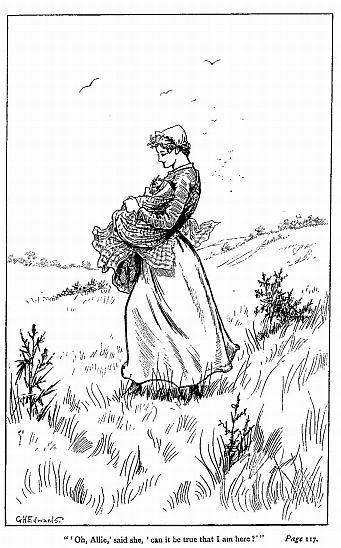
“Oh, Allie!” said she, “can it be true that I am here?”
She could not free her arms from the enveloping shawl to clasp Allie’s neck, but she raised herself a little and laid her cheek against hers, and then she whispered:
“I prayed the Lord to let me come.” Then they went on in the soft warm air their pleasant way. By and by they left the road and went over the rougher ground that lay between them and the end of their journey. In a hollow where there was standing water, Allison took the wrong turning, and so going a little out of the way, came suddenly on the mistress and her noisy crowd of bairns, who were looking for them in another direction.
It was a day to be remembered. But it was not all pleasure to every one, though every moment was full of delight to Marjorie. The bairns were wild and not easily managed, and the mistress “had her ain adoes among them.” Of course the tawse had been left at home, and the sternness of countenance which was the right and proper thing in the school, the mistress felt would be out of place among the hills, even supposing the bairns would heed it, which was doubtful. As for setting limits beyond which they were not to wander, that was easily done, but with all the treasures of the hills awaiting discovery, was it likely that these limits would be kept in mind?
The mistress strode after the first wandering group, and called after the second, and then she declared that “they maun gang their ain gait, and tak’ their chance o’ being lost on the hills,” and she said this with such solemnity of countenance as to convince the little ones who remained that they at least had best bide where they were. It was not likely, after all, that anything more serious than wet feet or perhaps torn clothes would happen to them—serious enough troubles in their own way, and likely to be followed by appropriate pains and penalties without the intervention of the mistress. At any rate they must just take their chance.
So, she “put them off her mind,” and with the other bairns, and Allison carrying Marjorie in her arms, wandered for a while among “the Stanes.”
Seven great stones there were, arranged around another greater still; and they might well wonder, as many had wondered before them, how they had been brought there, and by whom, and for what purpose. That is, Marjorie wondered, and told them what her father thought, and Robin; and Allison listened and smiled, and wondered too, since she was called to think about it at all.
As for the mistress, the “Stanin’ Stanes” were just the Stanin’ Stanes to her. She accepted them as she did the hills themselves, and the heather, and the distant mountains; and she objected decidedly to the minister’s opinion as announced by his little daughter.
“We are maybe standing in a temple where, hundreds and hundreds of years ago, the folk worshipped an unknown God,” said Marjorie.
The mistress vehemently dissented.
“What should put the like o’ that in the minister’s head? It’s an ill thing for ane to try to be wise aboon what’s written.”
“But it’s all in a book,” said the child eagerly. “Robin read it to my mother and me. And in the Bible ye ken there were folk seeking Him, ‘if haply they might feel after Him and find Him.’ And maybe they were doing that here.”
But the mistress would not hear such a thing said.
“Think ye the Lord wad hae letten stan’ a’ these years in a Christian land like Scotland sic monuments o’ will worship and idolatry? Na, na, lassie, I couldna believe that, though your father should preach it out o’ the poopit.”
“But, Mistress Jamieson, the Lord lets ill men (evil men) live in Scotland, and has patience with them, and whiles saves them from their sins. And maybe the folk were ‘feeling after Him’ in those faraway days.”
“John Beaton told my father that these muckle stanes are quite different from the rest o’ the stanes upon the hills hereaboot,” said Annie Cairns.
“John Beaton nae less!” said the mistress scornfully. “As gin the Lord couldna put what kin’ o’ stanes He liket wherever it was His will to put them. And what kens John Beaton mair than the lave?”
“Grannie thinks it was the fairies that brocht them up the brae. But John kens weel about stanes.”
It was Annie Cairns, one of the older lassies, who had made the last two ventures. It was certainly a bold thing for a lassie, who was every day convicted in the school of lost loops in her stocking, to put in her word with her betters on such a matter. The mistress answered her with a look which she knew well, and heeded little. But it startled Marjorie, who had only heard about such looks from her brothers. Her face warned Allison that enough had been said.
“Ye’re growing tired, my lammie, and ye’ll need to lie down and rest for a while.”
“Yes, I’m tired, now that I think about it,” said the child, lying back in her kind arms again.
The wind had grown a little sharp by this time, and they found a sheltered spot on which the sunshine fell, on the south side of one of the great stones; here Allie made a couch, and the child rested on it in perfect content. Some of the little ones were tired also, and fell asleep, and were well happed by Allison and the mistress, and the rest went away to amuse themselves for a while.
Marjorie did not mean to go to sleep. She could see a wide stretch of sky, over which the white clouds were wandering still, and the tops of the faraway hills, and she thought she could see the sea. But she was asleep and dreaming when it came to that.
In the meantime, soothed by a whiff of her pipe, Mistress Jamieson was getting on quite friendly terms with Allison, who had her good word from that day forth. For with the most respectful attention she sat listening to the all-embracing and rather dismal monologue of the old woman, as few were accustomed to do. Did she listen? She certainly did not understand all that was said, and she could not afterward have repeated a word of it. But she saw a face, wrinkled and grey, and not very happy—an old, tired face. And if she was thinking of troubles that had made deep lines in other faces, rather than of the cares and vexations which had saddened the lot and soured the temper of the schoolmistress, her silence and the softening look in her beautiful, sad eyes, and the grave “ay” or “no” that came in response to some more direct appeal, pleased and soothed the heart of the lonely old woman to a sense of comfort which came seldom enough to her.
And though Allison’s answers were of the briefest, when the mistress began to question her about herself and her life before she came to Nethermuir, they were civil, and they were quietly and readily given, and fortunately there was not much time for questions; for the bairns came straggling back by twos and threes as they had gone away. Each brought some treasure found in their wanderings, and Marjorie would have been buried beneath the offerings of flowers, and tender green bracken, and “bonny stanies” that were brought to her, if Annie Cairns had not taken possession of them all, promising to carry them safe to the manse.
There were still some stragglers for whom they must wait. There would have been little good in going to search for them, and there was no need to hurry home, for the afternoon was not far over—at least there would have been no need if the bairns had not been all so ravenously hungry. The “piece” which each had brought from home had been made away with by the greater number, before even the “Stanes” were in sight, and the additional supply which Allison had provided did not go very far among so many.
In these circumstances, imagine the shout of welcome which greeted the appearance of Robin with a bag upon his back—Robin’s bag, the bairns called it; but the treat of baps and buns was John Beaton’s, who took this way to celebrate his homecoming. And it is to be doubted whether he ever in all his life spent many other crown-pieces to better purpose, as far as the giving or the getting or pleasure was concerned.
Chapter Eight.
“Love sought is good, but love unsought is better.”
John Beaton came slowly up the height which hid for the moment the spot where the bairns had gathered, and Robin followed with his bag on his shoulder. Confusion reigned triumphant. Some of the little ones had become tired and fretful, and the elder girls were doing what they could to comfort and encourage them. But by far the greater number were as lively as when they set out in the morning, and by no means in haste to end their day of pleasure. Up the shelving side of one of the great grey stones they were clambering, and then, with shrill shrieks and laughter, springing over the other side to the turf below. Not the slightest heed was given to the voice of the mistress, heard amid the din, expostulating, warning, threatening “broken banes and bluidy noses, ere a’ was dane.” This was what Robin saw, and it was “a sight worth seeing.”
What John Beaton saw was Allison Bain standing apart, with Marjorie in her arms, and he saw nothing else for a while. Even Robin, with his bag on his shoulder, stopped a moment to gaze at “our lass,” as he called her in a whisper to his friend. She looked a very different lass from “our Allie” in the manse kitchen, with her downcast eyes, and her silence, and her utter engrossment with the work of the moment. Her big mutch had fallen off, and a mass of bright hair lay over the arm which the child had clasped about her neck. The air had brought a wonderful soft colour to her cheeks, and her lips were smiling, and so were her eyes, as she watched the wild play of the bairns, and her darling’s delight in it. There was not a sign of stooping or weariness.
“Though Davie says she carried Maysie every step of the way,” said Robert to his friend. “Man! John! It might be Diana herself!”
But John said nothing, and Robin had no time for more, for the bairns had descried him and his bag, and were down on him, as he said, like a pack of hungry wolves.
So John shook hands with the mistress, “in a dazed-like way,” she said afterward, and at the first moment had scarce a word for Marjorie, who greeted him with delight.
“John, this is my Allie,” said she, laying her hand on her friend’s glowing cheek, “and, Allie, this is Mrs Beaton’s John, ye ken.”
Allie glanced round at the new-comer, but she was too busy gathering back the wisp of hair that the wind was blowing about her face to see the hand which he held out to her, and the smile had gone quite out of her eyes when she raised them to his face.
“They minded me o’ Crummie’s een,” John told his mother long afterward.
The schoolmistress sat down upon a stone, thankful that her labours were over, and that the guiding home of the bairns had fallen into stronger hands than hers. And as she watched the struggle for the booty which came tumbling out of the bag, she was saying to herself:
“I hae heard it said o’ John Beaton that he never, a’ his days, looket twice in the face o’ a bonny lass as gin there were onything to be seen in it mair than ordinar. But I doot, after this day, that can never be said o’ him again. His time is come or I’m mista’en,” added she with grim satisfaction. “Noo we’ll see what’s in him.”
“And now, Maysie,” said Robin, coming back when the “battle of the baps” was over, “I’m to have the charge o’ you all the way home, my mother said. Allie has had enough o’ ye by this time. And we have Peter Gilchrist’s cart, full o’ clean straw, where ye can sit like a wee queen among her courtiers. So come awa’, my bonny May.”
But Allison had something to say to that proposal.
“No, no! I’ll not lippen her to you and your cairt; your mother could never expect such a thing o’ me,” said she, clasping the child.
“Well, all I can say is, these were my orders, and ye maun take the responsibility of disobedience. What say ye, Maysie?”
“Oh! Allie, it would be fine to go with the ither bairns in the cairt.”
“But, my dearie, your mother never could have meant anything like that. It would never, never do. Tired! No, I’m no’ tired yet. And if I were ever so tired—”
“Will ye lippen her to me? I have carried Marjorie many a time,” said John Beaton, coming forward and holding out his arms.
Allison raised her eyes to his for an instant, and then—not with a smile, but with a sudden faint brightening of the whole face, better to see than any smile, John thought—she put the child in his arms.
“Ay, I think I may lippen her to you, since ye have carried her before.”
So the child was wrapped warmly, and was well content.
“And as ye have the cairt, and I’m not needed with the bairns, I’ll awa’ hame, where my work is waiting me,” said Allison to Robin, and she lost no time.
They saw her appearing and disappearing, as she kept her way among the heather for a while; and then John Beaton said, with a long breath, that they would need to go. So the mistress was made comfortable in the cart with as many of the little ones as could be packed into it, and Robin took the reins. The rest of them went down the hill in a body, and all got safely home at last. And the happiest of them all was Marjorie when John laid her tired, but smiling and content, upon her little couch.
“Oh, mother! it’s fine to be like the other bairns. I have had such a happy day. And, mother,” she whispered, as her mother bent over her, undoing her wraps, “you’ll need to ask John to stay to tea.”
But John would not stay. He must take tea with his mother this first night, he said, which Marjorie owned was but right. So he went away. He came back again to worship, however, after Marjorie was in bed.
Peter Gilchrist was there too, and Saunners Crombie. It was a way the folk o’ the little kirk had, to time their business at the smithy or the mill, so as to be able to drop in at the usual hour for family worship at the manse. At such times there was rather apt to be “lang worship,” not always so welcome to the tired lads as to the visitors, and to-night Jack and Davie murmured audibly to their mother when the chapter was given out.
For the chapter was about Jacob seeking for his father’s blessing, and the lads felt that Peter and Saunners might keep on to any length about him. And so it proved. Decided opinions were expressed and maintained as eagerly as though each one present had a personal interest in the matter. Peter Gilchrist had his misgivings about Jacob. He was “a pawkie lad” in Peter’s estimation—“nae just fair forth the gait in his dealings with his brother, and even waur (worse) with his old blind father, to whom he should have thought shame to tell lees in that graceless way.”
Saunners, on the other hand, was inclined to take Jacob’s part, and to make excuses for him as being the one who was to inherit the promise, and the blame was by him laid at the door “of the deceiving auld wife, Rebekah, by whom he had evidently been ill brocht up”; and so they “summered and wintered” the matter, as Jack said they would be sure to do, and for a while there seemed little prospect of coming to the end of it. But it mattered less to Jack or to Davie either, as they soon were fast asleep.
The minister put in a word now and then, and kept them to the point when they were inclined to wander, but the two had the weight of the discussion to themselves. As for John Beaton, he never opened his lips till it was time to raise the psalm; and whether he had got the good of the discussion, or whether he had heard a word of it, might well be doubted, judging by the look of his face when Mrs Hume put the psalm-book into his hand.
It was time to draw to an end, for there were several sleepers among them before the chapter was done. Allison had made a place for Davie’s sleepy head upon her lap, and then after a little her Bible slipped from her hand, and she was asleep herself. It had been a long day to her, and her walk and the keen air of the hills had tired her, and she slept on amid the murmur of voices—not the uneasy slumber of one who sleeps against her will; there was no struggle against the power that held her, no bowing or nodding, or sudden waking up to a sense of the situation, so amusing to those who are looking on. Sitting erect, with the back of her mutch just touching the angle made by the wall and the half-open door, she slumbered on peacefully, no one taking heed of her, or rather no one giving token of the same.
After a time her mistress noticed her, and thought, “Allison has over-wearied herself and ought to be in her bed,” and she wished heartily that the interest of the two friends in Jacob and his misdeeds might speedily come to an end, at least for the present. And then, struck by the change which slumber had made on the beautiful face of the girl, she forgot the talk that was going on, and thought only of Allison. The gloom which so often shadowed her face was no longer there, nor the startled look, half fear and half defiance, to which the gloom sometimes gave place when she perceived herself to be observed. Her lips, slightly apart, had lost the set look which seemed to tell of silence that must be kept, whatever befell. The whole expression of the face was changed and softened. It looked very youthful, almost childlike, in its repose.
“That is the way she must have looked before her trouble came upon her, whatever it may have been,” thought Mrs Hume with a sigh. And then she said softly to the minister: “I doubt it is growing late, and the bairns are very weary.”
“Yes, it is time to draw to a close.” So he ended the discussion with a few judicious words, and then read the remaining verses of the chapter and gave out the psalm.
Sometimes, on receiving such a hint from the mother, it was his way to “omit the singing for a night.” But this was John Beaton’s first night among them, and the lads and their mother would, he thought, like the singing. And so he read the psalm and waited in silence for John to begin, and then Mrs Hume turned toward him.
A little withdrawn from the rest, John sat with his head upon his hand, and his eyes fixed on the face of Allison Bain. His own face was pale, with a strange look upon it, as though he had forgotten where he was, and had lost himself in a dream. Mrs Hume was startled.
“John,” said she softly, putting the book into his hand.
And then, instead of the strong, full tones which were naturally to be expected when John Beaton opened his lips, his voice rose, full, but soft and clear, and instinctively the tones of Robin and his mother were modulated to his. As for the others, they did not sing at all. For John was not singing the psalm which the minister had read, nor was he even looking at the book. But softly, as a mother might sing to her child, the words came:
“Jehovah hear thee in the day
When trouble He doth send,
And let the name of Jacob’s God
Thee from all ill defend.
“Oh! let Him help send from above
Out of His sanctuary,
From Sion His own holy hill,
Let Him give strength to thee.”
Allison’s eyes were open by this time. She seemed to be seeing something which no one else saw, and a look of peace was on her face, which Mrs Hume had never seen on it before. “She must have been dreaming.” Then the singing went on:
“Let Him remember all thy gifts,
Accept thy sacrifice,
Grant thee thy heart’s wish, and fulfil
Thy thoughts and counsels wise.”
And then John’s voice rose full and clear, and so did the voices of the others, each carrying a part, in a way which made even the minister wonder:
“In thy salvation we will joy,
In our God’s name we will
Lift up our banner, and the Lord
Thy prayers all fulfil.”
Then the books were closed, and the minister prayed, and without a word or a look to any one, except only sleepy Davie, Allison rose and went away. But in her heart she was repeating:
“Grant thee thy heart’s wish and fulfil
Thy thoughts and counsels wise.
In thy salvation we will joy—”
“Maybe the Lord has minded on me, and sent me this word. I will take it for a sign.”
The two friends went out into the dark, as Saunners said, “strengthened by the occasion,” but it was not of Jacob, nor his blessing nor his banishment that they “discoorsed” together as they jogged along, sitting among the straw in Peter’s cart. Peter was inclined to be sleepy after the long day, and had he been alone he would have committed himself to the sense and judgment of his mare Tibbie, and slept all the way home. But his friend “wasna ane o’ the sleepy kind,” as he said, and he had something to say.
“What ailed John Beaton the nicht, think ye? He’s ready eneuch to put in his word for ordinar, but he never opened his mouth through a’ the exerceese, and was awa’ like a shot ere ever we were off our knees, with not a word to onybody, though he’s but just hame.”
“Ay, that was just it. He would be thinkin’ o’ his mither, puir bodie, at hame her lane.”
“Ay, that micht account for his haste, and it micht weel hae keepit him at hame a’thegither, to my thinkin’. But that needna hae keepit his mouth shut since he was there. It’s no’ his way to hide his licht aneath a bushel as a general thing.”
“It wad be a peety gin he did that. Licht is needed among us,” said Peter, who admired in his friend the gift of easy speaking, which he did not possess himself.
“Oh! ay, that’s what I’m sayin’. And what for had he naething to say the nicht? I doot it’s nae just as it should be with him, or he wad hae been readier with his word.”
“There’s sic a thing as being ower-ready wi’ ane’s word. There’s a time to keep silence an’ a time to speak, according to Solomon. But word or no word I’m no’ feart for John Beaton.”
“Weel, I canna just say that I’m feart for him mysel’; and as ye say, he’s maybe whiles ower-ready to put in his word wi’ aulder folk. But gaein’ here and there among a kind o’ folk, he has need to be watchfu’ and to use his privileges when he has the opportunity.”
“We a’ need to be watchful.”
“Ay, do we, as ye say. But there are folk for whom ower-muckle prosperity’s nae benefit.”
“There’s few o’ us been tried wi’ ower-muckle prosperity of late, I’m thinkin’. And as for John, if a’ tales be true, he has had his share o’ the ither thing in his day.”
“Weel, I hae been hearin’ that John Beaton has had a measure o’ prosperity since he was here afore, and if it’s good for him it will bide wi’ him. He kens Him that sent it, and who has His e’e on him.”
“Ay, ay; it’s as ye say. But prosperity or no prosperity, I’m no’ feart for John.”
“Weel, I canna just say that I’m feart for him mysel’. Gin he is ane o’ His ain, the Lord will keep a grip o’ him, dootless. It’s no’ that I’m feart, but he has never taken the richt stand among us, as ye ken. And ye ken also wha says, ‘Come oot from among them and be ye separate.’ He ay comes to the kirk when he’s here. But we’ve nae richt hold on him. And where he gaes, or what he does at ither places, wha kens? I hae ay fear o’ folk that are ‘neither cauld nor het.’”
Fortunately the friends had reached the spot where their ways parted, and Peter, being slow of speech, had not his answer ready, so Saunners went home content at having said his say, and more content still at having had the last word.
All this time John Beaton was striding about the lanes in the darkness, as much at a loss as his friend, Saunners Crombie, as to what had happened to him. He had not got the length of thinking about it yet. He was just “dazed-like,” as the schoolmistress would have said—confused, perplexed, bewildered, getting only a glimpse of what might be the cause of it all, and the consequences.
If he had known—if it had come into his mind, that the sorrowful eyes which were looking at him out of the darkness—the soft, brown eyes, like Crummie’s, which had met his first on the hilltop, might have power over him to make or to undo, as other eyes had wrought good or evil in the lives of other men, he would have laughed at the thought and scorned it.
He had had a long day of it. Since three in the morning he had walked the thirty miles that lay between Nethermuir and Aberdeen, to say nothing of the rumble in Peter Gilchrist’s cart to the Stanin’ Stanes, and the walk home again with little Marjorie in his arms. No wonder that he was a little upset, he told himself. He was tired, and it was time he was in his bed. So with a glance at the moon which was showing her face from behind a cloud—she had a queer look, he thought—he turned homeward.
He stepped lightly, and opened the door softly, lest his mother should be disturbed so late. A foolish thought of his, since he knew that “his very step had music in’t” to her ears.
“Well, John?” said she, as he paused a moment at her door. And when he did not answer at once, she asked, “Is it well with you, John?”
“Surely, mother. Why should you ask?”
“And they were glad to see you at the manse?”
“Oh! yes, mother. They’re ay kind, as ye ken.”
“Ay, they’re ay kind. And did you see—Allison Bain?”
“Allison Bain!” repeated John, dazed-like still. “Ay, I saw her—at the Stanin’ Stanes, as I told you.”
“Yes, you told me. And all’s well with you, John?”
“Surely, mother,” repeated John, a little impatiently. “What should ail me?” And then he added, “I’m tired with my long tramp, and I’ll away to my bed. Good-night, mother.”
He touched with his strong, young fingers the wrinkled hand that lay on the coverlid, and the touch said more to her than a kiss or a caress would have said to some mothers.
“Sleep sound!” said she.
But the charm did not work, for when daylight came he had not closed his eyes.
Chapter Nine.
“The honest man, howe’er so poor,
Is king of men for a’ that.”
John Beaton’s father had been John Beaton also, and so had his father before him. The first John had farmed a three-cornered nook of land, which had found a place among the grey stones scattered closely over a certain part of the high coast that looks down upon one of the narrow bays setting in from the North Sea.
He must have been a strong man, this John, for on this bit of land he lived and laboured for sixty years and more, and on it he brought up, and then sent out, to make a place for themselves, in their own, or in other land’s, five strong sons and four fair daughters. And he had so brought them up that never, as long as he lived, did he, or any one else, hear aught of son or daughter to cause him to bow his good grey head before the face of man.
One son, neither the eldest nor the youngest, stayed near home. First he had broken stones on one of the great highways which they were stretching through Scotland about that time. Then he learned to cut and dress the grey granite of his native hills, and then to build it into houses, under another man’s eye, and at another man’s bidding. After a time he took his turn, first as overseer, and then as master-builder, and succeeded, and men began to speak of him as a rising man, and one well-to-do in the world. All this was before he had got beyond middle life.
Then he married a woman “much above him,” it was said, but that was a mistake. For though Marion Sinclair came of a good stock, and had all her life lived in a home well placed and well plenished, among folk who might have thought themselves, and whom others might have thought to be John Beaton’s superiors, yet no man or woman of them all had a right to look down on John Beaton. He stood firm on his own feet, in a place which his own hand had won. No step had he ever taken which he had needed to go back upon, nor had he ever had cause to cast down his eyes before the face of man because of any doubtful deed done, or false word spoken.
And Marion Sinclair, no longer in her first youth, might well go a proud and happy bride to the home of a man wise and strong, far-seeing, honest, and successful—one who loved her dearly, as a man of middle age may love, who in his youth has told himself that he had neither will nor time for such sweet folly.
With all his strong and sterling qualities he was regarded by the world in general, as, perhaps, a little hard and self-opinioned. But he was never hard to her, or to the one son who was born to them. He exacted what was his due from the rest of the world, but he was always soft and yielding to them in all things. He was proud of his success and of his good name in the countryside, and he offended some of those who came into contact with him by letting his pride in all this be too plainly seen. But he was prouder far of his wife, and his happy home, and of his young son, with whom, to his thought, no prince in all the land could compare.
And so it went well with him, till one day the end came suddenly. A broken bank, a dishonoured name, scathe and scorn to some—to him among the rest—who was, God knows, neither in deed nor in thought guilty of the sin which had brought ruin upon thousands.
He made a gallant stand for his good name and his well-earned fortune, and for his fellow-sufferers; but he was an old man by this time, and he died of it.
Mrs Beaton had never all her life been a strong woman, and had never needed to think and act for herself in trying circumstances. She had not the skill to plan nor the strength to execute, and it was too late to begin now. But she could endure, and she did so, with long patience; and though her face grew thin and white, she gave no sign of anger, or discontent, or of breaking down under her troubles, as all her little world had believed she would surely do.
Amid the din and dulness of the great town in which they first took refuge for a while, she made a home for her son, and waited patiently to see what his young strength might do for them both, and never, by word or look, made his struggle for standing room in the crowd harder for him, or his daily disappointment worse to bear.
He fought his way to standing room at last—standing room at a high desk in a dark office, at work which he had still to learn, and which, though he loathed it, he might have learned to do in time if it had not “floored him” first.
“Mother,” he cried one night in despair, “let us get away from this place—anywhere, where there is room to breathe. I will work with my hands as my father did before me. There are still surely stones to break somewhere up there in the north. We’ll get fresh air at least.”
So, without a word of doubt or of expostulation, she made haste to get ready, while they had yet the means of going, and they went north together, where they found, indeed, fresh air, and for a time they found nothing else. But fresh air was something to rejoice in, since it brought back the colour to the lad’s cheeks and lightened the heart of the mother, and they kept up one another’s courage as well as might be.
A chance to earn their bread, that was all John wanted, and it came at last; but it was dry bread only for a while.
“What can you do? And what are you willing to do?” said a man who was the overseer of other men, and whom John had seen several times at the place where his work was done. John answered:
“I am willing to do anything. And I think I could break stones.”
“I think I see you!” said the man with a shrug.
“I only wish I had a chance to show you. I think I might even chip awa’ at cutting them, to as good purpose as some of those lads yonder.”
“Here, Sandy,” said the overseer. “Gie this lad your hammer, and let him try his hand, for the fun o’ the thing.”
The man laughed, but John Beaton was in earnest. In a minute his coat was off, and he set to work with a will. He needed a hint or two, and he got them, with a little banter thrown in. The lad stuck to his work, and could, as his friend said, “do no’ that ill.” He had perhaps inherited the power to do the work, since he could do it, he thought, and he asked leave to come again in the morning.
“Ye hae earned your shilling,” said the overseer, when it was time to go, and he held one out to John. He hardly expected the lad to take it, but he took it gladly, and looked at it, the man thought, in a curious way.
“Is it the first shilling ye ever earned?” said he.
“The very first! May I come back to-morrow?”
“O, ay! gin ye like; but I should think that this is hardly the kind o’ work ye’re best fitted for.”
“One must take what one can get,” said John.
That was the beginning. He went again, and as hands happened to be scarce at the time, he was kept on, and his wages were raised as his skill and his strength increased. By and by he was offered permanent work on a mill that was to be built in a country place at some distance. It would take months to build, and he would be sure of work for that time; so he took his mother with him, and what household stuff they had left, and lived in a tiny room in a cottage for a while.
Not very far from the new mill was Nethermuir, a quiet place, out of the way, where they might live, they said to one another, unknown and forgotten. And here, after many thoughts about it, they resolved to make themselves a home.
At the end of the street on which stood the missionary kirk and manse, was a small house which had once been of the better sort, but which had been vacant for some time, and had fallen into disrepair. The thatch was rotten and the roof had partly fallen in, but the foundation was firm, and the walls were thick and strong. This house John leased for seven years, at a very small rent, and by his own strength, and skill, and will, with some help from his fellow-workmen, he made of it such a house as was not unworthy of being a home for his mother; and in it, while her son went here and there as his work called him, she lived content.
Terrible as the blow was which took from them husband and father and home, it might have been worse in the end had John Beaton died a rich man. So said some of the lookers-on, who long before that time had declared that his son, having all his life long got more of his own will than was good for him, was in a fair way to become a “spoiled laddie” at last.
Some said it who envied the lad, and others said it who loved him well, and it is possible that they were not far wrong in the belief. John the younger was a “bonny lad,” tall and strong, sweet-tempered and light-hearted, a favourite with all. But he was open to temptation like the rest of his kind, even more so than many, and not all of those who gathered round him in his prosperous days were of the sort likely to influence him for good. He went through the first years at the university without getting much good from it, it was said. He had disappointed his father greatly, as well as his teachers; but though he had been foolish and idle, he had not disgraced himself by anything beyond idleness and folly. Whether he would have gone through the course without doing worse, might be questioned.
The chance was not given him. His father died, and instead of inheriting what would have been called wealth among those who were his friends, he found himself penniless, having his own bread, and possibly his mother’s also, to win. And seeing there was good stuff in the lad, his mother’s helplessness and desolation might be the saving of him, said one of his mother’s humble friends.
They had friends—yes, many of them—but some of them had suffered loss as they themselves had suffered, and had no power to help except with kind words. Others who had the power to help had not the will, or only the will to help in their own way. Others added to their offers advice that could not be followed, or they hurt the sore hearts of the lad and his mother with words which implied censure on the dead, because he had not foreseen and provided against the coming of evil days. And so, seeing no help among “kenned folk,” the two went out, “not knowing whither they went.”
They had gone away bravely enough, and even through the dark days which came first, it cannot be said that they quite lost heart or hope. As long as his mother was content, John told himself, he did not care what fell to him to do or to endure; and as long as John was well, and within reach of hand or voice, it was well with the mother. It was not till the first months were over that John’s heart seemed to fail. When the mill was finished, instead of going with the men to other work in another direction, he remained in Nethermuir, hoping to find something to do in the neighbourhood, so that he might be near his mother. He found enough to do for a time in making the little house a comfortable and even beautiful home for her. Then he prepared the neglected bit of ground around it for a garden and took pleasure in doing it. It was work which he liked, and which he knew how to do, but it put nothing into the family purse, which was getting low, and something must be done to replenish it.
He worked for a few weeks in harvest in the narrow fields of Peter Gilchrist, and to good purpose, though the work was new to him; and he made friends with Peter himself, which was something. But the harvest wore over and winter was coming on, and then he wrote to Jamie Dunn, his first friend, saying he was now ready and willing to go wherever he should be sent.
But in his heart he knew that for the only work which was left to him to do, he was neither ready nor willing, nor for the kind of life which he saw stretching a long, weary way before him.
He could do as his father had done before him, he told his mother cheerfully, and who had done better than he? But to himself he owned that this was to be doubted. He could never do as his father had done; he was not the man his father had been, or he could never have played the fool, wasting his time and losing his opportunities, as he had done. He had been spoiled with softness, with idle days, and the pleasant things of life, which he could not forget, and which, like a weakling, he was in his secret heart longing for still. And even his father had not won what men called success, and a firm footing among his fellows, till the best part of his life was over.
But his father had been content through all his days as they came, and with his day’s work and his day’s wages. And his father had known his own strength and could bide his time. As for his son, John told himself that he was neither strong nor wise. He knew, or he feared at this time, that only the thought of his mother and her need of him kept him from despair.
He called it despair, poor lad, not knowing what he said. The depths of despair came to him with the thought of enlisting as a common soldier, to go away and live his life with as little exercise of his own will as the musket he carried, and to death and a nameless grave. Or it meant to sail away before the mast, a slave to some tyrant who held the power of life and death, because he held the power of the lash. And it might have come to one or other of these possibilities with him, if it had not been for his mother and her need of him.
For the dead level of the life which he saw stretching out before him seemed even worse to him than that—the life of ceaseless, ill-remunerated labour, the companionship of men grown dull through a changeless routine of toilsome days, or debased through ignorance or self-indulgence, a life and a companionship with which he might at last grow content, being no stronger or wiser than other men.
These were dark days for the young man. At last he took his mother’s gently spoken words of counsel to heart, and opened the box in which she had secretly packed his college-books, and where they had lain hidden all this time. But the sight of them, and the associations they called up, made him heartsick and ashamed, and it was only by the exercise of strong self-restraint that he made himself pretend to take some interest in them for his mother’s sake. After this he fell into the way of taking long walks in all directions, and did a turn of work here and there as he could get it, and generally came home hungry, and tired, and ready for his bed, so that no reading could be expected of him.
But the days were growing short, and the dark hours many and long, and the mother’s heart “grew wae” for her son many a time. By and by something happened.
It was a good thing for the minister’s Davie that John Beaton was within sound of the voices of the lad’s terrified companions the day that he fell into “Burney’s Pot,” and it was a good thing also for John. The little lad was nearly gone when he was pulled out of the water, and having no knowledge of his home or name, since his young companions had taken to their heels as soon as they saw Davie safe, John took him home to his mother, and together they did what could be done for his help.
This was the beginning. Davie was allowed to fall asleep in Mrs Beaton’s bed, and in the gloaming John carried him home wrapped in a blanket, and then he saw the minister and his wife and Marjorie. It was the beginning for John of more than can well be told.
His manner of life from that time was changed. Not that he went often to the manse at first, though the door was always open to him, and a welcome awaiting him. But the life he saw there, the words he heard, and the spirit that showed in all that was done, or said, or planned, in great things and in small, came like a new revelation to him; and the more he saw and thought of it all, the less he thought about his own loss and his changed life and his unhopeful prospects.
He had more days of leisure that winter than well pleased him, but not one of them was spent in wandering aimlessly about the dreary hills. He had company, most days, wherever he went. If he had not Robin or Jack, there was always Davie, who seemed to think he had a special claim upon him. Davie had not yet been promoted to a seat in the parish school, but was beginning to think himself, at eight, too big a boy for Mistress Jamieson’s rule, since he could say the Catechism from end to end, proofs and petitions and all. With Davie trotting along at his side, John had little chance for brooding. Besides, he had taken to his books again, and meant to employ his leisure and make up for lost time if such a thing might be. It was not likely that he would have much use for Latin or Logic in the life that lay before him, he told himself; but he might as well make the most of the idle days, and keep his mind from stagnation.
And he had less of leisure after a while. It was about this time that he began to try his hand at the making of “headstones” for the kirkyard. Chance put such work in his way, and being ready of hand and quick of eye, and having long patience and much need of a job, he set to work with a will. He did not succeed in pleasing himself, but he pleased his employer, which answered the purpose; and he did more at the work, at odd times, when he could get nothing else to do.
The life which he saw lived in the manse did something for him, and the Word as it was held forth in the little kirk did more; but that came long afterward. The minister was the busiest of men, either among his books or among his people, or in his garden or his land; but he was never too busy for a cheery word to John, or for help or counsel to any one who needed them. And the same might be said of the minister’s wife. She was active and had enough to do at home, but she was glad to help those who needed help anywhere. She had good sense and good judgment, and was ready with sweet words or sharp words, as the case presented seemed to demand. She was firm where firmness seemed to be required, but had long patience and unfailing gentleness in her dealings with the weak and even with the wilful; and as the days passed, John took heed of her words and ways with ever-growing interest.
She had not an easy life, but she had usually firm health and she had a cheerful nature, and the peace of God was in her heart. So she “stood in her lot” strong and unafraid, whatever might befall.
She was a loving mother to her sons, but her rule was firm as well as gentle. There was no need in that house to appeal to the father’s stronger will where obedience was not promptly given. It was a serious matter indeed that needed an appeal to their father. To the lads their mother’s word was law. Not that the law was not forgotten sometimes, or even wilfully broken in times of strong temptation. But confession of sins, though not always prompt, was, in course of time, quite certain. She had their confidence entirely. It was an unhappy boy, indeed, who carried about, for even a few days, a sinful or sorrowful secret hidden from his mother.
In among these lads John came as another brother, and Mrs Hume was kind and gracious in her intercourse with him. She was faithful also, and told him of faults and failings which his own mother never acknowledged, and helped him to correct them, as, even had she seen them, his own mother might have hesitated to do. It was, indeed, a good day for John when the door of the manse was opened to him.
And then there was Marjorie, poor little soul, who was nearly nine, and who looked like six, a fair, weak little creature, who could only walk a step or two at a time, and who was yet as eager to know, and to do, and to be in the midst of things as the strongest of them all. “Another brother,” she called their new friend, who had more sense and patience than Robin or Jack, and who could carry her so easily and strongly without being tired. It was a happy day for Marjorie when John came in to see her. It was better than a new book, she thought, to hear him talk.
“And a new book is so soon done with,” said Marjorie, who did not see very many new books, and who had usually learned them by heart before she had had them many days. But John had always something to tell her. He told her about new places and new people, and he had seen the sea, and had sailed on it. He had been in London and had seen the king and the queen, “like the travelled cat,” as Robin said. And there was no end to the stories he could tell her that she had never heard before. She was never tired of listening to him, and hailed his coming with delight, and long before he had come to feel quite at ease with the mother, John had learned to love dearly the eager, gentle little creature, from whose eyes the joy at his coming chased the look of pain and weariness.
As for the friendship which grew more slowly, but quite as surely, between John and the elder boys of the manse, it cannot be said whether he or they benefited most by it. To Robin and Jack, John seemed a far wiser and stronger man than he knew himself to be—a man of wider experience, higher aims, and firmer purpose. And their belief in him, their silent yet evident admiration of all his words and ways, their perfect trust in his discretion and sympathy, did as much for him as for them, and helped him to strive for the attainment of all the good gifts which they believed him to possess.
He helped them in many ways. He helped them at their work and kept them back from taking part in many a “ploy,” which, though only foolish, and not so very wrong, were still both foolish and wrong to them, because in engaging in them they would waste their time, and—being the minister’s sons—set a bad example to the rest of the lads, and, worst of all, vex their father and their mother. And they could bear to be restrained by him, because, in the carrying out of all harmless fun, they profited by many a hint from John, and sometimes even by his help. But they all agreed that the less said about this matter among the neighbours the better for all concerned.
John had been in Nethermuir several months before he saw the inside of the little kirk. He knew little about the folk who worshipped there, except that they were said to be “a queer kin’ o’ folk, who set themselves up as better than their neebors, and wiser than a’ their teachers.” Differing, as they seemed to do, both in preaching and in practice, from the kirk of the nation, they were doubtless wrong, thought John. But whatever they were, they were folk in whom he took no interest, and with whom he had nothing at all to do. So when he had gone to the kirk at all, he had gone to the parish kirk to please his mother, who was not always able to go so far herself. Sometimes he had permitted himself to go even farther than the kirk, coming back when the service was half over to sit for a while on a fallen headstone, as Allison did afterward when her turn came.
On fine days his mother went with him, and then it was different. He sat with the rest and listened to what the minister had to say, with no inclination to find fault. Indeed there was no fault to be found from John’s point of view or from the minister’s. It cannot be averred that in what was said there was either “food or physic for the soul of man.” But not knowing himself to be in especial need of either the one or the other, John missed nothing to which he had been accustomed all his days to listen in the kirk.
“We had a good discourse,” his mother would say, as they went slowly home together, and John always assented. “Yes, mother, we had a good discourse.”
So John went most days to please his mother. But there came a day of rain, and sleet, and bitter east wind, when, if her conscience would have permitted, Mrs Beaton would have refrained from making her usual suggestion about the propriety of honouring the Sabbath-day by going to the kirk. As for John, he was no more afraid of the rain, and the sleet, and the east wind than he was afraid of the summer sunshine; but when he proposed to go to hear Mr Hume, the sound of the sleet and the rain on the windows silenced any objection she might have had to his going “once in a way, the day being wild and wintry,” and she even added a hope that he might “hear something to do him good.”
This was at the very beginning of his acquaintance with the minister and his family. If he had waited for a while, till the charm of their friendliness and genuine kindness had wrought, till the time came when he had seen with his own eyes, and heard with his own ears that which proved his new friend to be different in some ways from the most of those to whom he had all his life looked up as leaders and teachers, yet not unworthy also to teach and to lead, John might have been better prepared to get the good which his mother hoped for him. And yet he might not. At any rate, it was to that dark day in the little kirk that, in the years which came afterward, he looked back as the beginning of “good” to him.
“A dismal hole,” he called it, as he went in among the first and sat down in a corner. It was scarcely barer or more dingy and dim than the rest of the kirks in country places were in those days; but it was very small, and it had windows only on one side. On that dark day it was dismal, and it could not have been beautiful at any time. The chill of the sleet and the wild east wind had got into it, and John wondered at the folk who should choose, of their own free will, to pass two hours, or even three, in the damp and gloom and dreariness. “There will be few here to-day,” thought he.
But they came one after another, and by twos and threes, and there was the stamping of wet shoes, and the shaking out of wet plaids, and many a sneeze, and many a “hoast” (cough). And still more came, some of them with familiar faces from the neighbouring streets, and some from beyond the hills, miles away. Peter Gilchrist was there, of course, and Saunners Crombie, and an old woman or two, who would better have kept the house, John thought, on such a day. And by and by the kirk was well filled. John would have liked to see the minister’s seat. It was close to the door, and so was the one in which he sat; but a little porch, which protected the door, came between. He heard the clatter of the boys’ feet as they came in, and once he heard their mother’s “quietly, boys,” gently but firmly uttered, and by that time the minister was in the pulpit, and the service began.
It was just to be like other services in other kirks, John thought at first. There was a psalm read, and a remark was made on a verse here and there, and then they sang. He had a certain enjoyment in the singing, because he had never heard anything like it before. The sleet or something else had kept the usual precentor at home, and Saunners Crombie filled the office for the time. He had the singing mostly to himself for the first verse, because no one knew what tune he meant to sing, and some of those who joined, trying to do their best, “went out of it a’thegither,” as Saunners said angrily afterward. The second verse went better. The minister’s boys took it up and their mother, and were joined by “the discordant crowd,” as John called them while he listened; and though he might have done good service on the occasion, he never opened his lips.
Then came the “long prayer,” in which John certainly did not join. But he listened, and after a little he wondered. It was “like all the prayers,” he said to himself at first—confession, petition, thanksgiving. Yet it was a little different. The words came with a certain power. It was as if he who prayed saw the face of Him whom he addressed, a living Person whom he knew and had proved, and not an awful unknown Being hidden in light unapproachable, or in dimness or darkness. He was speaking to One whose promise had been given, and many times made good unto those who trusted Him. And to him who was asking, evidently the promise was sure, the Word unchangeable.
“All good things! Why, a man who believed that need be afraid of nothing,” said John to himself.
Then a chapter from the New Testament was read. It was the one in Corinthians about charity, from every verse of which a sermon might be preached, the minister said; but he only lingered a minute on the verse which speaks of the charity “which thinketh no evil,” and by the little stir that went through the congregation, John thought that perhaps a word on that subject might be specially needed.
Then came the sermon, and John listened intently. But he did not like it. He told his mother, when he went home, that he had heard the folk saying about the kirk door that they had had a grand sermon. “And they should ken,” said John with a shrug.
“The text? Oh! it was a fine text: ‘Christ the power of God, and the wisdom of God unto salvation.’ It was like no sermon I ever heard before,” said John, “and I am not sure that I ever wish to hear another of the same kind.”
John did not go to the manse that week, and he had no intention of going to the kirk on Sunday, but when Sunday came he changed his mind and was there with the rest. He sat in his corner and listened, and wondered, and grew angry by turns.
“Is not my Word like as a fire? saith the Lord, and like a hammer that breaketh the rock in pieces?”
That was the text and that was the way in which the Word came to John Beaton, and he would have none of it—for a time.
To his mother, who went to the kirk with him after a while, it came in another way. It was not new to her. It was just what she had been hearing all her life, she said, only the minister made it clearer and plainer than ever it had been made to her before. Or it might be that her heart was more open to receive the Word than it used to be in former days, when both heart and hands were full of the good things of this life, which, she said, had contented her to the forgetting of the Giver’s greater gifts.
She had never been a woman of many words, and even to her son she rarely spoke of these things. But as time went on she grew sweeter and gentler day by day, he thought. He left her with less anxiety when he went away, and he found her always when he came home peaceful and content. For the peace of God was with her.
Chapter Ten.
“O! love will venture in where it daurna weel be seen;
O! love will venture in where wisdom ance has been.”
Saunners Crombie had not been mistaken when he told his friend that “a measure of prosperity” had, of late, come to John Beaton. A debt long due to his father had been paid to him, and the story which the debtor had to tell was worth many times the money to John and his mother.
It was not the first good deed done in secret by the father which had since his death come to the knowledge of the son. Other stories had been told by friends and neighbours, and even by comparative strangers, of kind words spoken by him, and generous help given, which had healed sick hearts, and opened the way out of depths of despair to some who were sinners, and to some who were only sufferers. And now this man came to tell how he also had been helped—saved, he called it, and he told it with tears in his eyes, though more than a generation had passed since then.
David Cunningham was the son of the minister of the parish where the first of the three Johns had lived, and where the second John and his brothers and sisters had been born. He had fallen into foolish ways first, and then into evil ways, and through some act of inexcusable folly, or worse, had, it seemed, shut upon himself the last door of hope for a life of well-doing. An offer of a clerkship in an East Indian house had been given him by a friend of his family, and a sum sufficient for his outfit had been advanced. This sum he had lost, or rather it had been claimed for the payment of a debt which he could not have confessed to his father without breaking the old man’s heart. It would have been utter ruin to the lad if John Beaton had not come to the rescue.
This was before John was a rich man, or even had a prospect of riches, but he gave the money willingly, even gladly, to save the son of his father’s friend.
“When you come home a rich man you can pay me, if I be living; and if I be dead, you can pay it to them who may come after me,” said he. And now David Cunningham had come home to pay his debt.
“Every month from the very first,” he told John, “I put something away toward it, and a good many months passed before the full sum was saved. Then, when I wrote to your father that it was ready for him, he told me to invest it for him, and let it grow till I should come home again. That was five-and-thirty years ago, and it has grown well since then. It is yours now, and much pleasure and profit may you get out of it.”
“There is no fear of that,” said John.
“And I have a better wish than that for you,” said Mr Cunningham gravely. “May you have the chance and the heart to help to save some poor fellow as your father saved me.”
“Thank you for the good wish. I will try to follow in my father’s steps,” said John. “But the money is my mother’s, and the pleasure of doing good with it will be hers.”
“And if all I have heard of her be true, her pleasure will be to give pleasure to her son,” said his friend.
“Yes; that is true, too,” said John.
But as the money was well invested, it was to be allowed to remain where it was for the present. The income from it would secure to his mother a home more like that to which she was born than the one in which she had lived since her husband’s death, “though, God bless her, she has never murmured,” said her son.
And John was triumphing in his heart. He saw, or he thought he saw, his way clear to the carrying out of several plans, which he had been dreaming about, but which he had hardly suffered himself to regard as possible till now. He had been in Aberdeen all the winter, working both with his head and his hands. He had fallen in with an old schoolfellow, who was in the second year of his university course, a cripple lad, who was altogether unfit for the kind of life enjoyed most by lads of his age when set free from their lectures and their hours of study. He was living a lonely life till John found him, and his visits to the lad’s rooms were good for them both.
John had been reading steadily during the winter leisure of the years he had been in Nethermuir, and now he enjoyed greatly going over the ground with his friend, and gradually the knowledge came to him that he had grown in mind as well as in stature since the days when he had trifled with, or utterly neglected, the opportunities which had been given him. He could do now with ease and pleasure that which in those idle days had been a task and a burden. Gradually that which had been a vague longing, a half-acknowledged desire, became a settled purpose.
It was to consult with his mother as to the carrying out of this purpose that he had come to Nethermuir at this time, and he had not meant to sleep until all his plans were laid before her. But when three days had passed—on the fourth he was to return to Aberdeen—not a word with regard to them had been uttered. John had not got out of the maze into which he had fallen when he first caught sight of Allison Bain, standing with loosened hair and smiling eyes, watching the mad play of the bairns, with little Marjorie in her arms.
He had not forgotten his plans or his purposes. There were moments when he would have been willing to forget them, when he even tried to forget them and to smile at his thought of them, as he had sometimes smiled at a foolish dream in the light of the morning. He was not quite sure that he needed to speak to his mother at all. He might at least wait a while. Why should he trouble her by speaking about changes which might never come?
And yet, had he not told his mother all his plans and even his thoughts all his life? Her word would make clear what course he should take. Her “single eye” would see the fine scheme he had been dreaming about in its true light. He could trust his mother’s wise simplicity more than his own ambitious desires, which could hardly be worthy, he thought, since they were the outcome of discontent.
And why should he not be content as he was? He had fallen from no high estate. His father and his father’s father had wrought with their hands, and had been honoured of all who knew them. Why should he not be content to live as they lived, or to work his way upward to an easier life, as his father had done?
“At any rate, I will have it out with my mother to-night,” said he.
He was standing, when he came to this resolve, on the very spot where he first caught sight of Allison Bain. It was the second time he had stood there since that day, for no reason that he could have told to any one. He had come to the spot in the early morning after that first sleepless night. He needed a walk to stretch his legs, which were rather stiff after the long tramp of yesterday, he told his mother, when he came home to the breakfast he had kept waiting, and he told himself that he only chanced to take that road rather than another.
He said nothing about it to Robert Hume. They had the night before agreed to take an early walk together. Robin was late; but happily, as he thought, he caught sight of John as he was disappearing over the first hilltop, and followed with no thought of finding himself in the way.
But when he came to the head of the last hillock, and saw John standing where he had stood the day before, “looking at nothing,” as Robin told his mother afterward, he was seized with sudden 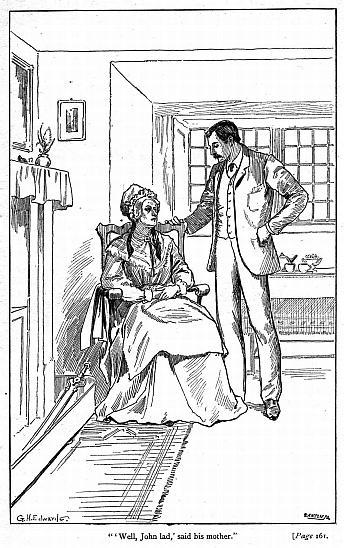 shamefaced-ness, and turning, shot like an arrow down the brae.
John had been less at the manse than he usually was while visiting his mother. He was to go there in the evening, and he must speak to his mother before he said anything about his half-formed plans to the minister or Mrs Hume, as he came home fully intending to do. So he turned homeward on the last afternoon; and as he walked he was saying to himself, with indignant contempt of his indecision, that after all he must be a poor creature, a fool, though he had never been in the way of thinking so till now.
“Well, John lad,” said his mother, looking up as he came in.
Her little maid had gone home for the day, and Mrs Beaton was sitting in her arm-chair “just waiting,” as she said.
It was a nice little room. A bright fire burned in the grate, and a shining tea-kettle was steaming on the hob. The carpet on the floor was faded and worn, and the furniture was of the plainest; but there were a few pretty things in the room to brighten it, and over the mantel-piece was a portrait of John’s father, “taken at his best.” For some strange reason, which he himself did not understand, John paused at the door, and looked up at the strong, good face.
The picture was not much as a work of art perhaps, but it was a striking likeness. There was the firm mouth, and the kind grey eyes, and the broad shoulders, rounded and stooping a little, after long years of labour, and the abundant dark hair, which had showed no silver threads until the last blow came to end all. A sudden pang smote John’s heart as he looked.
“I was but a lad,” he said to himself. “I didna ken what he was till I lost him.”
“You are growing like him, John,” said his mother softly.
“Am I, mother? I doubt it is only your loving een that can see it.”
“Are ye troubled, John?” were the words that rose to the mother’s lips, but they were not spoken. “Ye’re needing your tea, John,” said she instead.
John laughed. “I’m needing something, and I’ll be glad of my tea in the meantime. No, you are not to rise. You are to sit still in your chair and tell me what to do.”
Not that he needed telling. The skill, and the will, and the gentleness natural to a loving daughter had come to this mother’s son through long and loving service. So the little table was brought forward, on which all things were already arranged. The tea was “masket,” and the teapot covered with the “cosie,” and during the three minutes necessary and sufficient for its proper infusion, John went to his room, and the mother’s face grew grave while she waited.
“He’s no’ at peace with himself. But he’ll tell me if he’s needing my help. God bless him and keep him this day—and forever and ay.”
Then John came in and they had their tea, and spoke about other things, about the visit she had had in the afternoon from little Marjorie, whom Allison Bain had carried in her arms to see her, as she often did, and of how the child was growing stronger every day. And then they agreed together that little Annie Thorn, who had been coming in to help Mrs Beaton all these years, should come now to stay always, because it would be better in many ways for both mistress and maid. They spoke of other things besides; but it must be acknowledged that John said little, and was not so ready with assent or with response as he was wont to be when his mother had anything to say to him.
After a time they fell into silence for a little, and then John said:
“I have something to tell you, mother.”
“Is it good news, John?” said his mother with a little flutter at her heart.
“Part of it is good, surely. As for the rest—that may be good or bad, as you shall take it.”
“I’m waiting, John.”
For John’s head had drooped on his hand, and he sat thinking.
“And you’re a wee anxious? But there is no occasion, mother dear. I have good news. I meant to tell you the night I came home. I could hardly wait till I got home to tell you. I dinna ken how I put it off,” added John hurriedly. “Mother, did you ever hear my father speak of a good turn he once did to one David Cunningham, a long time ago it must have been?”
“No. He wasna one who was in the way of telling o’ the good turns he did, as ye ken. But I mind the name of Cunningham.”
“This must have been before your day. Maybe a good while before it.” And John went on to tell the story of his father’s timely help to a foolish lad, and of the debt which the man wished to pay, according to his friend’s desire, to those who came after him. And when he had told all he knew about it, and how the money which his father had given had been increasing during all these years till it had become a sum so large that the interest alone would keep his mother in comfort for the rest of her life, his mother only said softly:
“Well, John?” as though the something which he had had to say was still to be told.
“Well, mother, I think it is your turn now. Wasna that grand of my father?”
“It was like him. And is this David Cunningham able to spare all that money? It would be an ill thing to harm or harass him now after so long a time.”
“I cannot say whether he be rich or poor; but I am certain sure that nothing will hinder him from paying his debt. He told me that the sight of my face had given him more pleasure than anything he had seen in Scotland yet,” said John laughing. “I would have brought him out to see you, if the doctor would have let him come. He is but a frail man, and must go south again till summer is fairly here. He said little about himself, but I know he is a married man.”
“And he would be sorry to hear of your father’s losses at the last.”
“Ay, that was he, and angry at the ill done him. If he had but known, he said, he could have helped to tide him over the worst of his troubles, and it might have prolonged his life.”
“It was God’s will, and we must submit,” said Mrs Beaton softly.
“Yes, it was God’s will.” Then John rose and set the table back into its place, and stirred the fire and sat down again.
“Well, John?” said his mother in a little.
“Well, mother! You are a rich woman again, in a small way.”
“I have ay been a rich woman. If I had been asked would I have more, I would have said I am content. I am glad of this for your sake, John, if you are glad. But I think the message from your father, as it seems, is more to me than the money.”
“Yes, mother, and to me as well.”
“You had something to tell me, John,” said his mother, in a little.
“I thought I had when I came home. Now I am not sure. There is something that we may speak about together, and you will help me to make up my mind one way or the other.”
Mrs Beaton listened in silence as John went on to tell her what he had been doing and thinking for a while. He had not been idle since the building season ended. He had been in the employment of one of the builders of the town. He had been able to make himself useful to him—first by going over and putting to rights the books of the business, which had fallen into confusion, and afterward at more congenial work, where his knowledge of drawing, to which he had given much time when he was a boy, was brought into account with a success which had surprised himself. And now his employer had offered him a permanent place, with an opportunity to acquire the kind of knowledge of his work which would come but slowly to him while he worked only with his hands.
He owned that he liked Mr Swinton, and that they got on well together. Yes, the prospect of success seemed reasonably certain if he were to give himself wholly to the work. And then he came to a pause.
“Yes. It looks like that,” said his mother. She missed the eager hopefulness with which her son was wont to bring forward any new plan or prospect of his, and she thought it wiser to let him go on of his own accord to say his say than to question him. “Do you think well of it, mother? But there is one thing to be said which will please neither you nor me. I doubt in such a case we will need to say farewell to Nethermuir, and take up house in the town.”
“Ay, we should both be sorry for that, but it could be done. You have more to say yet, John?”
“I thought I might have more to say, but since you are content with things as they are, it might be as well to say nothing.”
“Tell me what is in your mind, John. You needna doubt but I’ll take it reasonably, whatever it may be.”
John laughed.
“I have no fears for you, mother. It is for myself and my own discontents that I fear.”
“Tell your mother, laddie.”
Then he went on with his story. How he had taken to college work in earnest with Sandy Begg, how he had enjoyed it and been successful with it, and how the thought had come into his mind that after all he might go on again and redeem his character by doing now what he had failed to do when the way was made easy to him.
“I think my father would be pleased, mother, if he could ken. When I think of him I canna forget that I gave him a sore heart at the time when his troubles were coming thick upon him. I would like to do as he wished me to do, now that the way seems open.”
“Is the way open?” asked his mother gravely. “If you take that way, all that you have been doing and learning for the last years will be an utter loss. I have ay liked to think of you as following in your father’s steps to overtake success as he did.”
“I am not the man my father was, as no one should ken better than my mother.”
“But if you were to fall in with this man’s offer, you could take the road your father took with fewer steps and less labour, and I might see you a prosperous man yet before I die. And all the good your father did, whether openly or in secret, would begin again in his son’s life, and some of it, at least, your mother might see. I canna but long for the like of that, John.”
“I would try to do my best, mother. But my best would fall far short of what my father did.”
“Oh, fie! John, laddie! What ails ye at yourself the nicht, man? Do I no’ ken my ain son by this time, think ye? Ay, do I. Better, maybe, than he kens himsel’.”
“There can be small doubt of that, mother. Only your kind eyes see fewer faults and failings than he kens of himself. And, mother, I am afraid the man who had my father for his good friend has done me an ill turn. He has, in a measure, taken away the motive for my work, and so I can have little pleasure in it.”
“But, John, you will have your ain life to live and your ain work to do when your mother is dead and gone. I have been pleased and proud to have my son for breadwinner, and to ken that he was pleased and proud for the same reason. But for all that, I am glad that you are set free to think of your ain life. You are wearing on, lad, and it would be a great gladness for me to see you in your ain house with wife and bairns about you before I die. Ye can let yourself think of it now, since I am off your hands.”
“May ye live to see all you wish, mother. It winna be this while, though. There’s time enough for the like of that.”
“Well, that’s true. There’s no’ to say much time lost at four-and-twenty. But I am growing an old Woman and frail, and I mayna have so very many years before me. And ye needna put marriage off till middle life as your father did. Though he ay said had we met sooner it might have been different even with him. And it would be a wonderful thing for me to see my son’s wife and bairns before I die,” repeated she softly.
John rose and moved about the room. He had to do it with caution, for there was no space for more than two or three of his long, impatient strides between the four walls. His impulse was to rush out to the darkening lanes or even to the more distant hills, that he might have it out with himself there.
For his mother’s words had moved him and a pair of wistful, brown eyes were looking at him from the dying embers and from the darkness without. He was saying to himself that the way lay straight before him if he chose to take it—the way to moderate success in life, a competence before his youth was past, and, as his mother had said, a wife and a happy home.
And would all this content him? Who could say? No thought of these things had troubled him, or even come into his mind till now. And no such thoughts would have come now, he told himself, if it had not been for his mother’s words and a pair of bonny een. Should he let himself be influenced by a dream—a mere fancy?
It would pass away, this folly. It must pass away. Would it be wise to let circumstances guide him to take the course which seemed for the time to be the easiest, the most direct to insure a measure of success? Should he be wise in putting out of his thoughts the hopes and plans which had been occupying him lately? No, he was fit for higher work than cutting stones or building or planning houses. He could not go back to such work now. Even his mother’s desire must be put aside when the work of his life was in question.
And yet!—and yet his mother’s simple wisdom had never failed him since the day they had gone forth together from what had been the happiest of homes. She might be right, and he might be putting away the substance to please himself by chasing a shadow. So he said to himself, as she waited quietly with folded hands. He was anxious, uncertain, bewildered, as unlike himself, or as unlike his own idea of himself, as could well be. He was amazed and angry at his foolishness, and eager only to get away from his mother’s eyes.
“I promised to go to the manse a while to-night, mother,” said he with his hand upon the door.
“Yes, and quite right. The minister has clear vision and good sense, and will give you none but good advice. But bide a wee. You have told your mother nothing yet. Sit down and let me hear what you are thinking to do. Since we have begun, it will be wise to go through to the end. So that you truly ken your ain mind, I shall be content.”
John was far from knowing his own mind. That was what ailed him. And he had been so sure of himself before he came home. And so sure also that he could persuade his mother to see as he did about that which he desired to bring to pass! He did not feel that he could do justice to himself of his plans and prospects at this moment.
He sat down, however, and went over the matter from the beginning. He said something also about his hopes and plans for the future. He by no means meant to give up his work at present. He meant to work in the summer as he had hitherto done, and go on with his reading in the winter. If he and Mr Swinton were to come to an agreement, it would be all the easier for him. He had no fear but that he could get on with both work and reading till he had got through with the college at least.
“But, O John! it will be a lang look to the end! I can hardly hope to see it, though that would matter little if it were the best thing for you. But what is to come after?” asked his mother with a sigh.
John could not tell her that. But there was nothing more certain than that when he should be “thoroughly furnished,” the right work would be found—the very highest work—and a kind of life which would suit him, though he might not grow rich in it.
“John,” said his mother gravely, “I hardly think all that would help you to live a better life than your father lived. It is not the kind of work that matters; it is the way it is done. Your father did his duty in the sight of God and man, and went far beyond what folk whiles call duty, never letting his left hand ken what his right hand was doing. And I have ay hoped that ye might follow in his steps. It is like a slight on your father, John, when ye speak of higher work.”
“Mother! you cannot really think that of me! And, mother, you must mind that my father meant me to do as I wish to do. It is only to begin a little later than he hoped. And there is no fear but I shall see my work when I am ready for it.”
“And yet there is many a man in Scotland with a store o’ book learning who has done little work, or only ill work, for God and man. And even with a good-will the opportunity doesna ay come.”
“Well, never mind, mother. There is no pressing need to decide now, at least till summer is over. We will wait to see what may happen.” He did not speak cheerfully, however.
“John,” said his mother earnestly, “are ye sure that your heart is set on this? What has come to you? Has anything happened to unsettle you, lad? Tell your mother, John.”
John laughed as he rose and then stooped down and kissed her.
“Nothing has happened. It is quite possible that you are right and that I am wrong. We will just wait and see, and decide the matter later. Even if we have to leave Nethermuir, it need not be till summer is over. I am sorry that I have troubled you with this now. You will vex yourself thinking about it all.”
“’Deed I’ll do nothing of the kind. I’ll just leave it all in better hands than either yours or mine. And as to your troubling me— Who has a lad a right to trouble if it be not his ain mother? And when a’ is said, our way is laid out before us by Him who kens a’ and cares for a’. Why should I trouble myself taking thought to-day for the things o’ to-morrow? Go your ways to the manse, John, and I’ll bide still and think about it all.”
But the visit to the manse was not so satisfactory as usual. There were other people there, and though John had a few minutes alone with Mr Hume in the study, there was no time to enter fully into the matter which he had at heart, and on which, he sincerely believed, he wished for the minister’s opinion and counsel, and so he said nothing about it.
Robin went down-stairs with him, and while he was making ready the lantern to light the way to an outhouse, where Davie had a puppy which his friend must see, John stood waiting by the kitchen-door. In her accustomed corner sat Allison, spinning in the light of the lamp which hung high above her head. She raised her eyes and smiled when John came in, but she gave no other answer to his greeting, and went on with her spinning, apparently quite unconscious of his presence. As for him, he found nothing to say to her, though the lighting of the lantern seemed to take a good while. To himself he was saying:
“I am glad I came. Of course I knew it was but a fancy and utterly foolish, and that: it would pass away. But it is well to know it. Yes, I’m glad I came in.”
Could this be the stately maiden he had seen smiling in the sunshine on the hill, with wee Marjorie in her arms? There she sat in the shadow, with the accustomed gloom on her face, wearing the disguise of the big mutch with the set-up borders, tied with tape under the chin. An apron, checked in blue and white, held with its strings the striped, short gown close over the scanty petticoat of blue. John wondered whether her thoughts ever wandered away from the thread she was drawing from the head of flax so silently.
“A decent, dull servant-lass, strong and wholesome, invaluable doubtless in her place, but just like any other lass of her kind.” That is what he said, and then he added:
“She has bonny een.” Ay, wonderful soft een, with a world of sorrow and sweetness in them; and he waited with impatience till she should lift them to meet his again. But she did not. And though he let the lads pass out before him, and turned at the door to look back, there she sat, busy with her thread and her own thoughts, with never a thought of him.
“A good lass,” he repeated as he followed the lads; but he could not quite ignore the sense of discomfiture that was on him, as he went down the lane with Robin at his side. He had enough to say to Robin. He had something to tell him about his winter’s work, and without meaning to do so, he gave him “an inkling,” as Robin called it to his mother, of the plans he had been making, and of the new course which was opening before him.
But John said no more to his mother. It was late when, he came home that night, and there was no time for many words in the morning, for he had a long journey before him.
Chapter Eleven.
“Oh! the happy life of children still restoring joy to ours!
Back recalling all the sweetness.”
Summer came slowly but happily to Marjorie this year, bringing with it, oh! so many pleasures to which she had hitherto been a stranger. She had had the early spring flowers brought into the parlour many a time, and ferns and buds and bonny leaves, for all the bairns of the place were more than glad to be allowed to share their treasures with her; and the one who came first and brought the most of these, thought herself the happiest, and great delight in past summers had all this given to the child. She had watched, too, the springing of the green things in the garden, the wakening of pale little snowdrops and auriculas, and the gradual unfolding of the leaves and blossoms on the berry-bushes, and on the one apple-tree, the pride of the place.
But she had never with her own hands plucked the yellow pussies from the saughs (low willows) by the burn, nor found the wee violets, blue and white, hiding themselves under last year’s leaves. She had never watched the slow coming of, first the buds, and then the leaves on the trees along the lanes, nor seen the hawthorn hedges all in bloom, nor the low hills growing greener every day, nor the wandering clouds making wandering shadows where the gowans—the countless “crimson-tipped flowers”—were gleaming among the grass. All this and more she saw this year, as she lay in the strong, kind arms of Allison. And as the days went on it would not have been easy to say whether it was the little child, or the sad and silent woman, who got the greater good from it all.
For Allison could no longer move along the lanes and over the fields in a dream, her inward eyes seeing other faraway fields and hills and a lost home, and faces hidden for evermore, when a small hand was now and then laid upon her cheek to call her back to the present. The little silvery voice was ever breaking in upon these dreary memories, and drearier forebodings, with cooing murmurs of utter content, or with shrill outbursts of eager delight, in the enjoyment of pleasures that were all of Allie’s giving. And so what could Allie do but come out of her own sorrowful musings and smile and rejoice in the child’s joy, and find a new happiness in the child’s love.
There was much to be done in the house, but there was no day so busy or so full of care but that Allison could manage to give the child a blink of sunshine if the day were fair. There was much to do out of the house also, what with the cows and the garden and the glebe. Cripple Sandy, who was the minister’s man-of-all-work, had all that he could do, and more, in the narrow fields. So Allison rose early and milked her cows, and led them out herself, to no wide pasture, but to one of those fields where she tethered them first and flitted them later in the morning when they had cropped their little circle bare. And both at the tethering and the flitting Marjorie assisted when the day was fine, and it was a possible thing. She woke when Allison rose, and being first strengthened by a cup of warm milk and a bit of bread, and then wrapped warmly up in a plaid to keep her safe from the chill air of the morning, she was ready for a half-hour of perfect enjoyment. When that was over, she was eager for another cup of milk and another sleep, which lasted till breakfast was over and her brothers had all gone to school.
And when the time for the afternoon flitting of the cows came, Marjorie was in the field once more, sitting on a plaid while the placid creatures were moved on, and she and Allie went home again as they came, through the lanes in which there were so many beautiful things.
Sometimes a neighbour met them, who had something to say to the child, and sometimes they met the bairns coming from the school. When they came home by the longest way, as Marjorie liked best to do, they would have a word with the schoolmistress, as she was taking the air at her door when the labours of the day were over, and sometimes a smile and a flower from Mrs Beaton in her garden over the way. This was the very best summer in all her life, Marjorie told her father one day, as Allie laid her down on her couch in the parlour again.
All this was beginning to do the child good. Even the neighbours noticed the change after a little, and were glad also. Some of them meant that the coming and going passed the time and contented her. Others said that it was well that her mother’s heart was set at rest about her, and that she got more time for all else that she had to do; and all thought well of the new lass for her care of little Marjorie.
The mother, who had consented to these new doings with misgiving, began, after a little, to see the change for the better that was being wrought in the child. Long before midsummer there was dawning a soft little gleam of colour on Marjorie’s cheek, not at all like the feverish tints that used to come with weariness or fretfulness or excitement of any kind. The movements of the limbs and of the slender little body were freer and stronger, and quite unconsciously, it seemed, she helped herself in ways on which she had never ventured before.
Her father saw the change too, though not so soon as her mother; but having seen it, he was the more hopeful of the two. And by and by they spoke to one another, saying if this thing could be done, or that, their Marjorie might be helped and healed, and grow strong and tall like the other bairns, and have a hopeful and happy life before her. But they paused when they had got thus far, knowing that the child was in God’s hands, and that if it were His will to bring about the fulfilment of their desire, He would also show a way in which it was to be done. Whether this might be or not, their little gentle darling would ay be, as she had ay been, the dearest blessing in their happy home.
“And may God bless Allison Bain, however it is to be.”
“Yes,” said the mother. “I think a blessing is already coming to her through the child.”
“Is she less sad, think you? She seems more at home among us, at least.”
“I cannot say that she is lass sad. But her sadness is no longer utter gloom and despair, as it seemed to be at first. And she says her prayers now, Marjorie tells me. I see myself that she listens to what you say in the kirk. I think it may be that she is just coming out of the darkness of some great sorrow which had at first seemed to her to end all. She is young and strong, and it is natural that her burden of trouble, whatever it may be, should grow lighter as the time goes by. Oh! she is sad still, and she is sometimes afraid, but she is in a better state to bear her trouble, whatever it may be, than she was when she came first among us. I sometimes think if some good and pleasant thing were to come into her life, some great surprise, that might take her thoughts quite off the past, she might forget after a little and get back her natural cheerfulness again.”
Mrs Hume ceased suddenly. For a moment a strong temptation assailed her. If ever man and wife were perfectly one in heart and thought and desires, these two were. As for the wife, no thought or wish of hers, whether of great things or of small, seemed quite her own till she had also made it his. Seeing the look which had come to her face, her husband waited for her to say more. But she was silent. She had no right to utter the words which had almost risen to her lips. To tell another’s secret—if indeed there were a secret—would be betrayal and a cruel wrong. Even to her husband she might not tell her thoughts, and indeed, if she had but known it, there was, as far as Allison Bain was concerned, no secret to tell.
But Robin, who was in the way of sharing with his mother most things which greatly interested himself, had told her about his morning run over the hills after John Beaton, and how he had found him “looking at nothing” on the very spot where, the day before, he had got his first look at Allison Bain, and how he had turned and run home again without being seen. Robin only told the story. He drew no inference from it, at least he did not for his mother’s hearing.
His mother did that for herself. Remembering John’s dazed condition at worship on the first night of his homecoming, it is not surprising she should have said to herself that “the lad’s time had come.”
And what of Allison? She had asked herself that question a good many times since John’s departure; but she owned that never, either by word or look, had Allison betrayed herself, if indeed she had anything to betray, and of that she was less assured as the days went on. But whether or not, it was evident, Mrs Hume assured herself, that Allison was “coming to herself” at last.
And so she was. Young and naturally hopeful, it is not to be supposed that Allison’s sorrow, heavy and sore though it was, could make all the future dark to her, and bow her always to the earth. She had lost herself for a time in the maze of trouble, into which death, and her enforced marriage, and her brother’s sin and its punishment, had brought her. But she was coming to the end, and out of it now. She was no longer living and walking in a dream. She was able to look over the last year of her life at home with calmness, and she could see how, being overwrought in mind and body, spent with work and watching and care, she had fallen under the mastery of blind terror for her brother’s safety, and had yielded where she ought to have stood firm.
She had no one to blame for what had befallen her. Her mother had hardly been in a state to know what was going on around her, except that her “bonny Willie”—as she called him in her prayers, and in her murmured longings for him—was faraway, and might not come home in time to see her die, or to help to lay her in her grave. Her father grieved for his son, but, angry at him also, had uttered no word either to help or to hinder the cause of the man who had made Allison’s promise the price of her brother’s safety. But he went about with bowed head, listening, and looking, and longing, ay longing, for the coming of the lad. So what could she do but yield for their sakes, and take what seemed the only way to bring him back again?
But one wrong was never righted by the doing of another, and her sacrifice had come to worse than naught. Though she had sinned blindly, she had suffered for her sin, and must suffer still. But gradually the despair which darkened all the year was passing. There was hope in her heart now, and a longing to throw off the dead-weight which had so long held her down. And the lightening of her burden showed now and then in eye, and voice, and step, so that all could see the change. But with all this the thought of John Beaton had nothing to do.
She had seen him just as she had seen other folk and he had come into her thoughts once or twice when he was not in her sight. But that was because of the good understanding there was between him and little Marjorie. The child had much to say about him when he was at home; and when she was carried out in Allison’s arms on those days, she was always wishing that they might meet him before they went home again.
One day they met, and Marjorie being gently and safely transferred to John’s arms, Allison turned and went back into the house without a word of explanation or apology.
“It’s ironing day,” explained Marjorie, a little startled at the look on John’s face.
“Oh! it’s ironing day, is it? Well, never mind. I am going to take you to the very top of Windhill to give you a taste of the fresh air, and then I shall carry you home to take tea with my mother and me.”
“That will be delightful,” said Marjorie with a sigh of pleasure.
No. In those days Allison was thinking nothing at all about John. When she went about the house, with no gloom, but only a shadow of softened sadness on her face, and a look of longing in her eyes, it was of her brother that she was thinking. She was saying in her heart:
“God help him in that dismal place—he who should be free upon the hills with the sheep, or following the plough on his ain land at home.”
And when a sudden smile came, or a bright glance, or a murmur of song, she was telling herself that his time was nearly over; that he would soon be free again to go faraway over the sea, where, with kind help from Mr Hadden, he would begin a new life, and all would be well with him once more. Yes, and they might be together again.
But this could not be for a long time. She must not even try to see her brother. For Brownrig would be sure to have a watch set on him when he was free. And Brownrig—having the law on his side, as he had said in the hearing of many, on the night of the dark day on which her father was buried, raising his voice that she too might hear him, the door being locked and barred between them—Brownrig would come and she would be found, and then lost forever.
“For,” said Allison to herself, “I should have to drown myself then, and make an end of it all.”
She was standing on the edge of Burney’s Pot, near the mill-dam, when she said this to herself, and she shuddered as she looked down into the grey water.
“But it will never come to that! Oh! no, mother, it will never come to that. But to save myself from that man, even to end all would surely be no sin.”
But these thoughts did not haunt and terrify her now, as her doubts and dreads had done during the winter. She had no time for brooding over the past. Every hour of the day was more than full with all she had to do, and there were no long, dark evenings, when she had only her wheel and her own thoughts for company.
And there was Marjorie. Marjorie had something to do with her thoughts through all the hours of the day. She was always there to lift or to lay down, to carry here or to carry there, to speak to or to smile upon. And she grew sweeter and dearer every day. Above all, the time was hastening, and Willie would soon be free. That thought made all the days bright to Allison.
And so she grew, not light-hearted, but reasonable and patient in her thoughts of all that had befallen them, and, at most times, hopeful as to all that might lie before them.
The neighbours who, at her first coming among them, had been inclined to resent her gloom and her silence, were ready now, for the sake of her friendly looks, to forgive the silence which she kept still. Even in the kirk she was like another woman, they said, and didna seem to be miles awa’, or dreaming, or in fear.
Of this change Allison herself was conscious, when she thought about it. The minister’s words did not seem “just to go by” her as they used to do. She listened and took her portion with the rest of the folk, and was moved, or glad, or doubtful, or afraid, as they were, and thought about all she had heard afterward, as doubtless some of the rest did also.
She was not desirous now, as she had been at first, for more than her own turn of staying at home from the kirk. This was partly because little Marjorie was sometimes able to go there; and when she went she was carried in Allison’s arms, where she rested, sometimes listening to her father’s voice, and sometimes slumbering through the time. But it was partly, also, because there came now and then a message to Allison there.
For some of the good words spoken must be for her, she thought, since the minister said they were for all. Allison was not good at remembering sermons, or even “heads and particulars,” as Robin was. For a long time she had heard nothing but the minister’s voice, and carried away no word of his, either for correction or instruction. His sermons were “beyond her,” as she said. They meant nothing to her. But now and then a good word reached her out of the Book; and sometimes a word of the minister, spoken, as was the way in those days, as a comment on the psalm that was to be sung, or on the chapter that was read, touched her, strangely enough, more even than the words of the Book itself, with which she had been familiar all her life.
One day in early summer she carried her wee Marjorie to the kirk with a sad heart. For the Sabbath-days were the worst to bear, since she had least to do, and more time for thinking. All the morning her thoughts had been with “her Willie,” shut in between stone walls, away from the sunshine and the sweet air, and she was saying to herself: Would the shame and the misery of it all have changed him, and would he come out, angry and reckless, a lost laddie? Oh! if she could only go to meet him at the very door, and if they could get away together over the sea, to that country so great and wide that they might easily lose themselves in it, and so pass out of the sight and out of the thoughts of all who had known them in their happy youth, before trouble had come! Might it not be? And how could it be? Might she not set Brownrig and his wicked wiles at naught, and go with her brother to save him?
And then the minister’s voice was heard: “Fret not thyself because of evildoers.” And so on: “Commit thy way unto the Lord. Trust also in Him and He shall bring it to pass.”
“Bring it to pass!” In the midst of her trouble and longing, Allison had almost uttered the words aloud, as though they had been spoken to her alone of all the listening people, and then Marjorie stirred in her slumber and brought her to herself again.
“Rest in the Lord. Wait patiently for Him. Fret not thyself because of him who prospereth in the way, because of the man who bringeth wicked devices to pass.”
Surely those words were for her! And she heard no more till he came to the good man whose “steps are ordered of God.”
“Though he fall, he shall not be utterly cast down, for the Lord upholdeth him with His hand.
“I have been young, and now am old; yet have I not seen the righteous forsaken, nor his seed begging bread.”
And then Robin touched his mother’s hand. For Allison had drawn her big black bonnet over her face to hide from the folk in the kirk the tears which were falling fast on the bright hair of the little sleeper. Mrs Hume made no sign that she saw them, but she prayed silently for the sorrowful woman who all the long winter had kept her sorrow to herself.
“Say nothing, Robin,” said she, when they rose to go out together. “She will be the better for her tears, or rather for that which made them flow.”
To herself Robin’s mother said:
“She will surely speak now, and open her heart to comfort.”
She had a while to wait for that, but a change came over Allison as the summer days went on. She was restless sometimes, and anxious and afraid. She had an air of expectation as though she were waiting for something, and sometimes she had the look of one eager to be up and away.
One night when Mrs Hume went up to see her little daughter in her bed, she found Allison writing. She said nothing to her and did not seem to see, and waited in expectation of hearing more. But she never did.
For Allison’s courage failed her and the letter was never sent. It was written to Dr Fleming, who had been kind to her in the infirmary, and it told him of her brother who was in prison, and asked him to visit him and to be kind to him, as he had been to her. But after it was written she was afraid to send it.
No. She must wait and have patience. Willie must go away alone over the sea, as they had agreed together in the only letters that had passed between them since he was a prisoner. Mr Hadden would befriend him as he had promised, and she would follow him when the right time came.
“But it is ill waiting,” said Allison to herself. “It is ill waiting.”
In those days many a word came to her as she sat in the kirk or in the parlour at worship-time, which set her thinking. Some of them strengthened her courage and gave her hope, and some of them made her afraid. For she said to herself:
“Are these good words for me?”
They we’re for the minister and for the minister’s wife, doubtless, every promise of them all, and for many more who heard them spoken. But were they for her?
“For,” said she, “‘if I regard iniquity in my heart, the Lord will not hear my prayer.’ And I’m no’ sure of myself. ‘Love your enemies,’ the Book says, and I doubt there’s hatred in my heart to one man.
“Or maybe it is only fear of him and anger. I think if I could only get well away from him, and safe from the dread of him, I would hate him no longer. I would pity him. I pity him now, even. For he has spoiled his own life as well as mine, and what with anger and shame, and the pity of some folk and the scorn of others, he must be an unhappy man. Yes, I am sorry for him. For the fault was partly mine. I should have stood fast whatever befell. And how is it all to end?”
Chapter Twelve.
“A man may choose to begin love, but not to end it.”
The spring passed quickly and summer came on, and then something happened which made a little stir of pleasure in the manse, and in the pleasure Allison shared, because of little Marjorie. Mrs Esselmont came home.
Mrs Esselmont had been, in former days, one of the great ladies of the shire, and, with a difference, she was one of its great ladies still. Marjorie had been “kirstened after her,” as they used to call it in that country. The child was “Marjorie Esselmont Hume,” and she was right proud of her name.
But Mrs Esselmont did not come back this time to Esselmont House, which had been the home of the Esselmonts for many a year and day. Her husband was dead and her sons also, and the great house, and the wide lands which lay about it, had passed to another Esselmont, a stranger, though of the same blood. She came back, as indeed she had gone away, a sorrowful woman, for she had just parted from her youngest and dearest daughter, who was going, as was her duty, to Canada with her soldier husband.
The acquaintance of Mrs Esselmont and the minister had commenced soon after the coming of Mr Hume—then little more than a lad—a “missioner” to Nethermuir. At the bedside of one whom the lady had long befriended, they met by chance—if one may so speak of a meeting which was the beginning of so much to them both. The poor woman in whom both were interested was drawing nigh to the end of all trouble, and these two did not meet again for years.
The next meeting was in no sense by chance. In a time of great sorrow Mrs Esselmont came to the minister for help, because she remembered how his words, spoken in God’s name, had brought peace to one who had sinned and suffered, and who was sore afraid as the end drew near. And that was the beginning of a lasting friendship between them.
They had not met often during the last few years. Mrs Esselmont had lived much in England with her daughters, and had only once returned to her own house during the summer. Now she said she must look upon Firhill as her permanent home, and she did not speak very cheerfully when she said it.
For though she was a good woman, she was not of a cheerful nature, and she had had many a trouble in the course of her life. Some of them had been troubles to which, at the time, it seemed wrong for her to submit, but which it was in vain, and worse than in vain, to resent. They were troubles which could only be ignored as far as the world was concerned, but which, she told herself, could never be forgotten or forgiven. They were all over now, buried in graves, forgiven and forgotten. But the scars were there still of wounds which had hurt sorely and healed slowly, and now she was looking sadly forward to a solitary old age.
She had been long away, but Marjorie had not been allowed to forget her. Gifts and kind wishes had come often to the child from her friend, and her name had often been named in the household. But her coming was a shock to Marjorie. What she had imagined of the writer of the letters which she had heard read, and of the giver of the gifts which she had received, no one could say. But the first glimpse which she got of the tall form, shrouded in trailing, black garments, and of the pale face, encircled by the border of the widow’s cap, and shaded by the heavy widow’s veil, struck her with something like terror, which must have ended in tears and sobs and painful excitement, if her mother had not seen the danger in time and carried her away.
“Poor darling! I fear she is no stronger as time goes on,” said the lady gently.
“Yes, we think her a little stronger. Indeed we think there is a decided change for the better since spring opened. She is able to stand now, and even to walk a little in the garden. But she is very frail still, our poor little girl,” said the mother with a sigh.
“What has helped her, do you think?”
“Nature, it must be, and Allison Bain. The doctor has done nothing for her for more than a year, but even he acknowledges that there is a change for the better, though he does not give us much reason to hope that she will ever be very strong.”
“It is God’s will,” said Mrs Esselmont with a sigh.
“We can only wait and see what God will send her. As it is, she is a blessing in the house.”
“Yes. Still with your large family and your many cares, she must be a constant anxiety to you both night and day.”
“Well, we get used with even care and anxiety. And she is a happy little creature naturally. Allison has helped us greatly with her. She is very kind and sensible in all her ways of doing for her.”
“And who is Allison?”
It was on Mrs Hume’s lips to say, “We do not know who she is,” but she did not say it.
“She came to fill Kirstin’s place. Poor Kirstin was called home to nurse her mother, who is lingering still, though she was supposed to be dying when her daughter was sent for.”
And then Mrs Hume went on to speak of something else.
Allison was “coming to herself,” growing “like other folk,” only bonnier and better than most. There was no need to call attention to her as in any way different from the rest. Allison had been good to Marjorie, and Marjorie was fond of Allison. That was all that need be said even to Mrs Esselmont. But the lady and Allison were good friends before all was done.
For many of Mrs Esselmont’s lonely days were brightened by the visits of the child Marjorie. And though the pony carriage was sometimes sent for her, and though she enjoyed greatly the honour and glory of driving away from the door in the sight of all the bairns who gathered in the street to see, she owned that she felt safer and more at her ease in the arms of “her own Allie,” and so when it was possible, it was in Allison’s arms that she was brought home.
If there had been nothing else to commend her to the pleased notice of Mrs Esselmont, Allison’s devotion to the child must have done so. And this stately young woman, with her soft voice, and her silence, and her beautiful, sorrowful eyes, was worth observing for her own sake. But Allison was as silent with her as with the rest of her little world, though her smile grew brighter and more responsive as the days went on.
Mrs Esselmont’s house stood on the hillside, facing the west. Behind it rose the seven dark firs which had given to the place its name. The tall firs and the hilltop hid from the house the sunshine of the early morning, but they stood a welcome shelter between it and the bleak east wind which came from the sea when the dreary time of the year had come.
The house was built of dull grey stone, with no attempt at ornament of any kind visible upon it. All its beauty was due to the ivy, which grew close and thick over the two ends, covering the high gables, and even the chimneys, and creeping more loosely about the windows in the front. Without the ivy and the two laburnums, which were scattering their golden blossoms over the grass when Allison saw it first, the place would have looked gloomy and sad.
But when one had fairly passed up the avenue, or rather the lane, lying between a hedge of hawthorn on one side and the rough stone dike which marked the bounds of the nearest neighbour on the other, and entered at the gate which opened on the lawn, it was not the dull grey house which one noticed first, but the garden.
“The lovely, lovely garden!” Marjorie always called it. She had not seen many gardens, nor had Allison, and the wealth of blossoms which covered every spot where the green grass was not growing, was wonderful in their eyes.
The place was kept in order by an old man, who had long been gardener at Esselmont House, and it was as well kept in the absence of the mistress as when she was there to see it. The garden was full of roses, and of the common sweet-smelling flowers, for which there seems little room in fine gardens nowadays, and it was tended by one who loved flowers for their own sake.
It was shut in and sheltered by a high stone wall on the east, and by a hawthorn hedge on the north, but the walls on the other sides were low; and sitting beneath the laburnums near the house, on the upper edge of the sloping lawn, one could see the fields, and the hills, and a farmhouse or two, and the windings of the burn which nearly made an island of the town. From the end of the west wall, where it touched the hawthorn hedge, one could see the town itself. The manse and the kirk could be distinguished, but not very clearly. Seen from the hill the place looked only an irregular group of little grey houses, for the green of the narrow gardens behind was mostly hidden, and even the trees along the lanes seemed small in the distance. But Marjorie liked to look down over it now and then, to make sure that all was safe there when she was away.
It was a strange experience for her to be for hours away from her own home, and even out of the town.
Poor little Marjorie had passed more time on her couch in her mother’s parlour, during her life of eleven years, than in all other places put together. She was happy in the change, and enjoyed greatly the sight of something new, and there were many beautiful things for her to see in Mrs Esselmont’s house. But she needed “to get used with it,” and just at first a day at a time was quite enough for her strength. The day was not allowed to be very long, and the pleasure of getting home again was almost as great as the pleasure of getting away had been. But the best of all was, that the child was getting a little stronger.
There was much besides this to make it a good and happy summer at the manse. The younger lads were busy at school under a new master, who seemed to be in a fair way to make scholars of them all, Robin was full of delight at the thought that at last he was to go to college, and he fully intended to distinguish himself there. He said “at last,” though he was only a month or two past sixteen, and had all his life before him.
“Ay, ye hae a’ ye’re life afore ye, in which to serve the Lord or the Deevil,” Saunners Crombie took the opportunity to say to him, one night after the evening meeting, when he first heard that the lad was to go away.
Robin looked at him with angry eyes, and turned his back on him without a word.
“Hoot, man Saunners! There is no fear o’ the laddie,” said his more hopeful crony, Peter Gilchrist.
“Maybe no, and maybe ay. It’ll be nae haflin course that yon lad will tak’. He’ll do verra well or verra ill, and I see no signs o’ grace in him so far.”
“Dinna bode ill o’ the lad. The Lord’ll hae the son o’ his father and mother in His good keeping. And there’s John Beaton, forby (besides), to hae an e’e upon him. No’ but that there will be mony temptations in the toon for a lad like him,” added Peter, desirous to avoid any discussion with his friend.
“John Beaton, say ye? I doubt he’ll need himsel’ all the help the Lord is like to give to ane that’s neither cauld nor het. It’s wi’ stumblin’ steps he’ll gang himsel’, if I’m no mista’en.”
But to this Peter had nothing to say. They had been over the ground before, and more than once, and each had failed to convince the other. Crombie went on:
“He carries his head ower-heich (over-high), yon lad. He’s nae likely to see the stanes at his ain feet, to say naething o’ being a help to the like o’ Robert Hume.”
“Hae ye had ony words wi’ him of late?” asked Peter gravely.
“Nae me! He’s been here often eneuch. But except in the kirk, where he sits glowerin’ straecht afore him, as gin there was naebody worthy o’ a glance within the four walls, I havena set my een upon him. It’s inborn pride that ails him, or else he has gotten something no’ canny upon his mind.”
“His mother’s no’ just so strong. It’s that which brings him hame sae often. His heart is just set on his mother.”
“It’s no’ like to do his mother muckle gude to be forced to leave her ain house, and take lodgin’s in a toon. But gin he be pleased, that’ll please her,” said Saunners sourly.
“Hae ye ony special reason for thinkin’ and sayin’ that the lad has onything on his mind? He’s dull-like whiles, but—”
“I’m no’ in the way o’ sayin’ things for which I hae nae reason,” said Saunners shortly. “As to special—it’s nae mair special to me than to yoursel’. Has he been the same lad this while that he ance was, think ye? Gude-nicht to ye.”
“Gude-nicht,” said Peter meekly. “Eh! but he’s dour whiles, is Saunners! He is a gude man. Oh! ay, he’s a gude man. But he’s hard on folk whiles. As for John Beaton—I maun hae a crack (a little talk) with himsel’.”
But Peter did not get his crack with John at this time, and if he had had, it is doubtful whether he would have got much satisfaction out of it.
John was not altogether at ease with regard to the state of his mother’s health, but it cannot be said that he was especially anxious. For though the last winter had tried her, the summer “was setting her up again,” she always told him cheerfully when he came. And she was always at her best when her son was with her.
Her little maid, Annie Thorn, to whom she had become much attached, and whom she had trained to do the work of the house in a neat and orderly manner, was permitted to do many things which had until now been done by the careful hands of her mistress. She was “little Annie” no longer, but a well-grown, sensible lass of sixteen, who thought: herself a woman, able to do all that any woman might do. She was willing even to put on the thick muslin cap of her class if her mistress would have consented that she should so disguise herself and cover her pretty hair.
No, John was not anxious about his mother. He was more at ease about her than he had been since he had been obliged to leave her so much at home alone. But he came home more frequently to see her. He had more time, and he could bear the expense better. Besides, the office work which he had to do now kept him closer, and made change and exercise more necessary for him, and so he came, knowing that he could not come too often for his mother’s pleasure.
This was what he said to her and to himself, but he knew in his heart that there was another reason for his coming; he called himself a fool for his pains, but still he came.
He knew now that it was the thought of Allison Bain which would not let him rest, which drew him ever to return. For the thought of her was with him night and day. Her “bonny een” looked up at him from his papers, and his books, and from the waves of the sea, when his restlessness urged him forth to his nightly wanderings on the shore.
But even when he turned his face toward Nethermuir, he scorned himself for his weakness. It was a kind of madness that was on him, he thought—a madness that would surely come to an end soon.
“Few men escape it, at one time or another of their lives, as I have heard said. The sooner it comes, the sooner it is over. It has gone ill with many a one. But I am a strong man, and it will pass. Yes! It shall pass.”
This was what he said to himself, and he said also that Allison’s indifference, which he could not but see, her utter unconsciousness of him and his comings and goings, his words and his ways, was something for which he might be glad, for all that would help him through with it and hasten his cure.
But he was not so sure after a while—sure, that is, that Allison’s indifference and unconsciousness of him and his feelings made it easier for him to put her out of his thoughts. There were times when with a sort of anger he longed to make her look at him, or speak to him, even though her words might hurt him. He was angry with her, and with himself, and with all the world; and there was truth in old Crombie’s accusation that he carried his head high and neglected his friends.
It was all that he could do sometimes to endure patiently the company of Robert Hume or his brothers. Even Davie, who was not exacting in the matter of response to his talk, missed something in his chief friend, and had serious misgivings about it.
And Davie’s mother had her own thoughts also, and she was not well pleased with John. That “his time was come” she knew by many a token, and she knew also, or guessed, the nature of the struggle that was going on in him. She acknowledged that his prudence was praiseworthy, and that it might not be the best wisdom for him to yield to impulse in a matter so important; but she also told herself scornfully that if his love were “true love,” he would never have waited for prudence or for ambition to put in a word, but would have gladly taken his chance whatever might befall.
“Though indeed he might have cause to repent afterward,” she acknowledged with a sigh.
And since Allison was not thinking at all about him, little ill would be done. The lad would get his discipline and go his way, and might never know what a chance of happiness he had let slip out of his hands.
“For he could make her learn to love if he were to try,” said Mrs Hume to herself. “But he must not try unless— And if he should say or do anything likely to bring watchful eyes or gossiping tongues upon Allison, I shall have something to say to the lad myself.”
Some one else was having her own thoughts about these two. Mistress Jamieson had seen the lad when “his een first lichted on the lass,” and she had guessed what had happened to him. Now she waited and watched with interest expecting more. She had not counted on the blindness or long-continued indifference of Allison.
Was it indifference on her part? Or was it prudence, or a proper pride? And the conclusion the mistress came to was this:
“She’s no’ heedin’ him. Ay, ye’re a braw lad, John Beaton, and a clever; but it’ll do ye nae ill to be neglecit for a wee while, or even set at naucht. Ye thocht to tak’ her captive wi’ a smile and a few saft words! And ye’ll do it yet, I daursay, since it’s the nature o’ woman to be sae beguiled,” added the mistress with a sigh.
But her interest was a silent interest. She never named their names together in a neighbour’s hearing.
It was of her brother that Allison was thinking all this time—of poor Willie, who, as she believed, had never seen the sunshine, or even the light of all these summer days. Every night and every morning she counted the days that must pass before he should be set free to go to his own house; and she rejoiced and suffered beforehand, as he must rejoice and suffer when that time came.
It would be November then. She knew just how Grassie would look to him under the grey sky, or the slanting rain, with the mist lying low in the hollows, and the wind sighing among the fir-trees on the height. She could see the dull patches of stubble, and the bare hedges, and the garden where only a touch of green lingered among the withered rose-bushes and berry-bushes, and the bare stalks of the flowers which they used to care for together.
She saw the wet ricks in the corn-yard, and the little pools left in the footmarks of the beasts about the door. She heard the lowing of the cows in the byre, and the bleating of the sheep in the fold, and she knew how all familiar sights and sounds would hurt the lad, who would never more see the face or hear the voice of kith or kin in the house where he was born. How could he ever bear it?
“Oh! God, be good to him when that day comes!” was her cry.
And since they had agreed that they must not meet on this side of the sea, was there no other way in which she might reach him for his good? She had thought of many impossible ways before she thought of John Beaton. It was in the kirk, one Sabbath-day, that the thought of him came.
The day was wet and windy, and Marjorie was not there to fill her thoughts, and they wandered away to Willie in the prison, and she fell to counting the days again, saying to herself: “How could he ever bear it?”
She was afraid for him. She strove against her fears, but she was afraid—of the evil ways into which, being left to himself, or to the guidance of evil men, he might be tempted to fall. Oh! if she might go to him! Or if she had a friend whom she might trust to go in her stead!
And then she lifted her eyes and met those of John Beaton. She did not start, nor grow red, nor turn away. But her whole face changed. There came over it a look which cannot be described, but which made it for the moment truly beautiful—a look hopeful, trustful, joyful.
Allison was saying to herself:
“Oh, Willie! if I might only dare to speak and bid him go to you.”
Chapter Thirteen.
“She wakened heavy-hearted
To hear the driving rain,
By noon the clouds had parted,
And the sun shone out again.
‘I’d take it for a sign,’ she said,
‘That I have not prayed in vain.’”
That night while Mrs Beaton and her son sat by the fireside, exchanging a word now and then, but for the most part in silence, a knock came to the door. Allison had given herself no time to reconsider the determination to which she had come when she met John’s eyes in the kirk, being bent on abiding by it whatever might befall.
It had not come into her mind that her courage might fail her at the last moment. It was not that her courage was failing, she told herself, as she stood waiting. It was because she had run down the lane so quickly that her heart was beating hard. It was like the thud of a great hammer against her side; it frightened her, and she was tempted to turn and run away. But she did not.
“I would be sorry when it was too late,” thought she, and knocked again.
There was a pause of a minute or two, and then the door opened, and John Beaton appeared, carrying a light.
“I was wishing to say a word to Mrs Beaton, if she will let me,” said Allison, making a great effort to speak as usual.
“Surely,” said John. “Come in.”
“Come away in, Allison,” said Mrs Beaton’s kind voice out of the darkness.
When John had shut the door and come into the parlour with the light, he was surprised to see that the two women had clasped hands, and that on his mother’s face was the look which he had hitherto believed it had worn for him alone. He moved a chair forward from the wall.
“Sit down, Allison,” said he.
“No,” said she; “I will say first what I came to say.”
John set down the candle and turned to go. But Allison put out her hand to detain him.
“’Bide still,” said she. “I have to ask your mother to ask her son to do something for me—something which I cannot do for myself, but which must be done, or I think my heart will break.”
“’Bide still, John,” said his mother.
John moved the light again, so that it fell on Allison’s face, and then went and stood in the shadow, leaning on the back of his mother’s chair. Allison stood for a moment silent, and both mother and son regarded her with interest and with surprise as well.
This was quite a different Allison, Mrs Beaton thought, from the one who went up and down the street, heeding no one, seeing nothing unless the child Marjorie was in her arms to call her attention to whatever there might be to see. She seemed eager and anxious, full of determination and energy. She had not at all the air of one who had been accustomed to go and come at the bidding of other folk.
“It is the true Allison at last,” said John to himself.
“Her gown has something to do with it,” thought Mrs Beaton, and perhaps it had. Her gown was black, and hung in straight folds about her. A soft, white kerchief showed above the edge of it around her throat, and her Sunday cap, less voluminous and of lighter material than those which she wore about her work, let her shining hair be seen.
“A strong and beautiful woman,” John said to himself. His mother was saying it also; but with a better knowledge of a woman’s nature, and a misgiving that some great trouble had brought her there, she added:
“May God help her, whatever it may be. Allison, sit down,” she said after waiting a minute for her to speak.
“It is that my heart is beating so fast that I seem to be in a tremble,” said Allison, clasping her hands on her side.
“Sit down, my dear,” said Mrs Beaton kindly. “Not yet. It is only a few words that I must say, I have had great trouble in my life. I have trouble yet—that must be met. And it came into my mind when I was sitting in the kirk that you might maybe help me, and—keep my heart from breaking altogether,” said she; then lifting her eyes to John’s face she asked, “Have ye ever been in the tollbooth at Aberdeen? It is there my Willie is, whom I would fain save.”
John’s mother felt the start her son gave at the words. Even she uttered a word of dismay.
“I must tell you more,” said Allison eagerly. “Yes, he did wrong. But he had great provocation. He struck a man down. At first they thought the man might die. But he didna die. My mother died, and my father, but this man lived. Willie was tried for what he had done, and though all in the countryside were ready to declare that Brownrig had gotten only what he well deserved, they sentenced the lad to a long year and a half in the tollbooth, and there he has been all this time. A long time it has been to me, and it has been longer to him. It is near over now, thank God.”
“And have you never seen him nor heard from him since then?” asked Mrs Beaton.
“I wrote one letter to him and he wrote one to me. That was at the first. I wrote to him to tell him what I was going to do, and to warn him what he must do when his time was over. I dared not write again, for fear that—and even now I dare not go to him. When we meet it must be on the other side of the sea. But I must hear from him before then. He wasna an ill lad, though ye might think it from what I have told you. He was only foolish and ill advised.
“And think of him all these long days and months alone with his anger and his shame—him that had ay had a free life in the fields and on the hills. And there is no one to speak a kind word to him when he comes out of that weary place—”
“And you would like my John to go and see him?” said Mrs Beaton.
“Oh! if he only would! Think of him alone, without a friend! And he is easily led either for good or ill.”
“Is it likely that he would listen to anything that an utter stranger would say to him?” said John.
He spoke coldly, as his mother noticed with pain. Allison did not notice it.
“But you would not seem like a stranger to him if you came from me. And anyway, ye wouldna be strangers long. You would like Willie, or you would be the first one who didna, all his life. And oh! he needs one wise, and strong, and good like you. The very touch of your hand would give him hope, and would keep him from losing heart—and, it might be, from losing himself—”
She stood, bending slightly toward him, her eyes, which in spite of his will and his reason had all these months haunted him by night and by day, looking into his. She stood in utter unconsciousness of herself or of him, save as one whose strength might help the weakness of another who was in sore need. No spoken words could have made clearer to him that he—John Beaton—was not in all her thoughts, save as a possible friend to the unknown criminal, who, doubtless, had well deserved his fate.
And to think of the life which lay before this woman, with this weak fool to share it—a woman among ten thousand!
“She will need strength for two, and her love will give it to her,” thought John, a dull pain at his heart with which some self-contempt was mingled. But it was no time to consider himself with Allison’s eyes on his face.
“I could trust him to you,” said Allison, trying to smile, “because ye have a kind heart, though folk say ye’re a wee hard whiles. But I ken what you have been to the lads at the manse to win them, and to warn them, and to keep them out of mischief. It would be the saving o’ my Willie if you would but take him in hand.”
“I would gladly help him, or any one in trouble,” said John, “but how could I do it in secret?”
“But you needna do it in secret. It’s not Willie that needs to hide. When the prison-door opens to him he will be free to go where he likes—to his own house, and his own land, to bide there at his pleasure. But he will have a sore heart in going to a desolate house. And the thought of going alone to a far-off land will dismay him. The help of such a friend as you is what he needs, though it may seem a strange thing in me to ask it from you.”
“You have a right to all the help that I can give you, as has any one in trouble. But why should you not go to him yourself?”
“But that is what I cannot tell you. I would never be suffered to go with him if I were to be found. I have been asking you to help my Willie, but indeed it is myself that you will help most. I cannot go with him for both our sakes, but I will follow him. He will be watched through every step of the Way, and I would be brought back again from the ends of the earth. And then,” added Allison her face falling into the gloom of which John had seen but little, but which his mother had seen often during the first days of their acquaintance, “then I should just lie down and die.”
John made a sudden, impatient movement, and then he said:
“And what am I to say to this man from you?”
“Willie his name is—Willie Bain,” said Allison, smiling faintly. “Oh! ye’ll ken what to say to him when ye see him. And ye are not to let him know that ye are sent from me till ye are sure of him. He is a lad who is moved by the first thought that comes, and his first thought when he hears of me will be to try to see me. And he must not try,” repeated she, “for he will be watched, and then we will be parted forever.”
There was a pause, and then John said:
“I will go to him, at any rate, and do what I can. I will faithfully help him, if he will let me—so help me God.”
“I’m not feared for him now. You’re strong and wise, and you can do what you like with Willie.”
John did not seem to see the hand she held out to him. Allison went on:
“When he speaks of me, as he’ll be sure to do, just hear him and say nothing till you are sure that he’ll listen to reason—till he promises not to try to see me, but to have patience and wait. I can trust him to you, John Beaton, and I must go now.”
He could not this time refuse to see the hand she held out to him. He took it in his and held it fast, while she looked at him with eyes full of light and longing. “John,” said she softly, “ye’ll mind what is said in the Book: ‘I was in prison and ye came unto me.’” And then she turned to go.
It must be owned that was a sore moment to John Beaton. He neither spoke nor moved while she stood thus, nor when she bent down, kissed his mother’s hand, and then without a word went away. For a time, which he did not measure, but which seemed long to his mother, he stood leaning on the back of her chair. His face was hidden in his hands, but happily she did not know that, and she waited till the first word should be spoken by him. In a little he “pulled himself together,” and came forward into the light, which was but dim at the best. He snuffed the solitary candle, and then fell to stirring the fire, which, never very large, was in danger of disappearing under his hand. He added a dry peat, however, and it soon blazed up again.
“Yon’s a strange story, mother,” he said at last. “I hardly see the good of my meddling in it. I suppose I must go and see the man, anyway.”
“Yes, ye canna do less than that,” said his mother. “I’ll do more. I’ll do my best to help one who seems much in need of help, but I cannot say that I am very hopeful as to what may come of it.”
“Ye’ll see when ye go what can be done. Poor lassie. Her heart is in it.”
“Yes,” said John, “her heart is in it.” And then they sat silent till another knock came at the door.
It was Robin Hume this time, who had been sent to ask for Mrs Beaton, who had not been at the kirk, and no one had got a chance to speak to John.
“My mother said I wasna to stay,” said Robin. But he came forward into the room, now bright with firelight, and he stayed a good while, and had much to say about various matters, and the interest with which John seemed to listen and respond comforted Mrs Beaton concerning her son.
Of course there was something to be said about the coming winter and its work, and some other things came in as well. Then there was a little sparring and laughter between them, which, with a lightened heart, Mrs Beaton gently reproved, as not suitable for the Sabbath night. Then Robin rose to go, and John went with him to the door. But he did not linger there, or go out for a turn in the lane as he sometimes did, and as his mother thought he would be sure to do. He came in and fell to mending the fire again “for a last blaze,” as he said.
“And, mother, is not it near time that we were beginning to think of the flitting that is before us?”
“It’s early days yet, John,” said his mother.
“And you will be loth to leave your little home, mother dear?”
“It has been home to us both, John, and I like the place. But any place will be home to me where you are, and if you think it wise to go I’ll soon be ready. And so ye have made up your mind to go to the college, John?”
“I am not sure yet, but it is likely. Whether I do or not, I must be in Aberdeen all the winter, and I will be happier and safer in my mother’s house than anywhere else. But I am sorry to disturb you, mother. Ye have got used with the place and are happy here.”
“I can be happy anywhere where it is wise and right for you to be. But it is only August yet, and there is time enough to think about it.”
“Yes, there is no hurry. But there are arrangements to be made. And mother I have been thinking, how would it do for us to have Robin with us for the winter? It would be a satisfaction to his father and mother, and a safeguard to him.”
“Surely, if you wish it. It will make a difference, but only a cheerful difference. And it is a small thing to do for them who have been ay so friendly.”
“Well, that is settled then, and I will look out for rooms, or for a wee house—that will be better wouldna it, mother dear?”
He did not need to ask. Anything that would please him would please his mother also. But she was not so cheerful and eager about this as she generally was about new plans and arrangements, John thought, and after a little they fell into silence.
John woke his mother out of her morning sleep when he came to bid her good-bye. She had only a single word to say to him:
“Dinna be long in coming home again, John,” said she. And he promised that he would not be long.
He kept his promise, coming even sooner than he was expected, and when his mother saw his face she was glad. For there was on it no sign of either gloom or grieving. It was John, “at his best and bonniest,” she said to herself with a glad heart, as he sat for a little while beside her bed, for his coming was late, as usual. She asked no questions. It was well with him, that was enough for her. As he rose to go, she said:
“I hope you have good news for Allison Bain.” Then John sat down again.
There was not much to tell. John had not seen the man himself. He had been set at liberty before his time was out. As to what sort of a man he was, John had been told that after a month or two, when he had been first wild with anger and shame, and then sullen and indifferent, a change had come over him. A friend had come to visit him more than once, and had encouraged him to bear his trouble patiently, and had given him hope. But he had never spoken about himself or his affairs to any one else. The chances were he had gone home to his own place; but nothing, which his informant could repeat, had been heard from him since he went away.
“Poor Allison Bain!” said Mrs Beaton with a sigh.
“Surely it will be good news to her that he has been free all the summer days, and in his own house,” said John.
“Yes, but of her he can ken nothing. And he must go to America, if he should go, with only a vague hope of some time seeing her on the other side of the sea. And she kens his weak will, and must fear for him. She will likely be here in the Sabbath gloaming to hear what ye have to tell.”
But it was otherwise ordered. John rose early, as was his custom, intent on getting all the good from the country air which could be got in a single day. It was a fair morning, clear and still. Only a pleasant sound of birds and breeze was to be heard. There was no one visible in the street. Most of the tired workers of the place were wont to honour the day of rest by “a lang lie in the mornin’,” and the doors and windows of the houses were still closed. While he stood hesitating as to the direction he should take, out of the manse close sedately and slowly 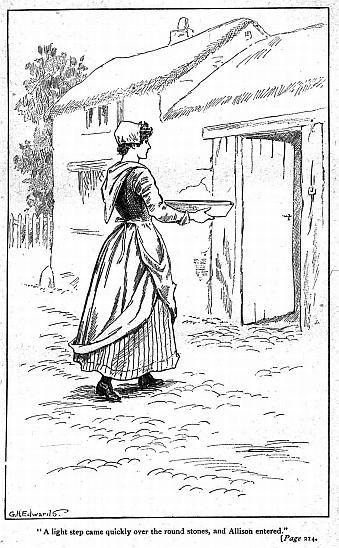 walked Fleckie and her companions, each dragging the long chain by which she was to be tethered; and after them limped cripple Sandy, whose Sunday duty at all times it was to see them safely afield.
John did not quicken his steps to overtake him, as he had now and then done at such times, for the sake of getting the news of all that had happened while he was away. He turned and went down the green, and round by the lane and the high hedge which sheltered the manse garden, and giving himself no time to hesitate as to the wisdom of his intention, stopped at last at one of the doors of the long, low outbuildings of the manse. He had been in the place before with the lads, and knew it well. There was no one there; but the foaming milk-buckets indicated that some one would be there soon, and he waited.
He did not wait long. A light step came quickly over the round stones of the causey, and Allison entered, carrying the great earthen milk-dishes in her arms. It was a dark little place, and she had set them safely down before she saw the intruder. Then she did not utter a word, but stood looking at him with all her heart in her eyes. John held out his hand and took hers in a firm clasp, and “like a fool,” as he told himself afterward, said that which it had never come into his mind to say until he saw her face.
“Allison,” said he, with his eyes on hers, “why did you not tell me that it was your brother for whom your heart was sore?”
Her look changed to one of wonder.
“Surely I told you it was my brother. Who else could it be but my Willie?”
She grew pale, and would have withdrawn her hand, but he held it fast.
“I did not see him, but I have good news for you. Your brother has been a free man for two months and more. It must have been that they repented of their hard sentence, and when the summer came again he wearied, and was like to fall sick, and they let him go home. The man I saw had only good words to say of him. After the first he was patient and quiet. It was hard on him at first.”
“My poor Willie!” said Allison.
“It seems that a friend went to see him in the early summer, a year ago, and he took heart after that and waited patiently.”
“That must have been Mr Hadden,” said Allison. “It was kind of him, and Willie would take hear when he heard that I had gotten safe away.”
“You have not heard from your brother since?”
“Oh! no. How could I hear? He does not even know where I am.”
“But you will write to him now?”
Allison’s face fell.
“I darena do it. No letter can reach him but may first pass through our enemy’s hand. He will be on the watch more than ever now. No, it will be ill waiting, but we can only wait.”
“Do you mean that you must wait till you see him in America?” said John wondering.
“Yes, that must be the way. He will go to Alexander Hadden, and I will find him there. Yes, it may be a long time,” and Allison’s eyes filled with tears. “But now that I have heard that he is free, and that it is well with him, I can wait. Oh! yes, I can wait.”
Allison held out her hand, and John knew it was time to go.
“I havena thanked you yet, but—”
“You have nothing to thank me for yet. If I only could do something for you!”
“You have done this. You have told me he is free and at his own home. I have all the summer days grudged myself the sweetness of the light and the air, because I thought of him sitting in the darkness. And he has had it all, and now he may be on the sea! It has happened well, and I take it for a sign that the Lord is on our side.”
“And you will not be troubled and anxious any more?”
“I will have hope now. And I thank you in my heart though I havena the words ready.”
And then John went away.
Allison sat in the kirk that day a happy woman. Every one there must have noticed the change in her looks, only she sat in the end of the seat near the door, and the little porch hid her from a good many of the folk, and the side of her big bonnet was mostly turned toward the rest. Little Marjorie saw her happy look, and raised herself up to ask her what she was thinking about that made her look so glad. Allison was thinking that her Willie might be sitting in the kirk at home listening to Dr Hadden’s kind, familiar voice, and that in the afternoon he might be walking over his own land with Uncle Sandy, to see the sheep and get the air of the hills. She bowed her head and whispered softly, “Whisht, my lammie”; but she “smiled with her een,” as Marjorie told her mother afterward, and the child was content.
Chapter Fourteen.
“Into the restful pause there came
A voice of warning, or of blame,
Which uttered a beloved name.”
More than once since she had first seen her, Mrs Esselmont had asked, “Who is Allison Bain?”
Mrs Hume had not much to tell her. Of her family and friends she knew absolutely nothing. Of Allison herself she knew only what she had seen since she became an inmate of the manse, except that she had been Dr Fleming’s patient in the infirmary, and afterward for a short time a nurse there. Dr Fleming probably knew more of her history than he had told to them.
“A good woman who had seen sorrow, he called her, and a good woman she is in every way, and a good servant, now that she seems to be growing content and cheerful. I own that she was a weight upon my mind at first. She is faithful, patient, true. Her only fault seems to be her reserve—if it can be called a fault to keep to herself what others have no right to ask her to disclose. She has greatly helped our Marjorie, and the child loves her dearly.”
“Yes, that is easily seen. As to her reserve, there are some troubles that can be best borne in silence,” said Mrs Esselmont. “And she has grown more cheerful of late.”
“Much more cheerful. She is always quiet, and sometimes troubled with anxious thoughts, as one can see, but there is a great change for the better since the spring. It is, of late, as though some heavy weight had been taken from her heart.”
In her lonely life, with little to interest her, either in her own home or in the neighbourhood, it was natural enough that the lady should give some thought to the strong, gentle, reticent, young woman, who seemed to her to be quite out of place as a servant in the manse. She would have greatly liked to win the girl’s confidence, so that she might be the better able to give her help and counsel if the time should come when she should acknowledge her need of them. Until that time came, she told herself, she could offer neither help nor counsel. It was not for her to seek to enter into the secret of another woman’s sorrow, since she knew from her own experience how vain are words, or even kindest deeds, to soothe the hurt of a sore and angry spirit.
“I might only fret the wound I fain would heal. And she is young and will forget in time whatever her trouble may be. And, when all is said, how can I think she is not in her right place, since she fills that place so well? God seems to be giving her the opportunity and the power to do for the child what has long seemed beyond hope, even to the mother, who is not one inclined to despond. I will not meddle in her concerns hastily, but oh! I would like if this Allison were ever in sore need of a friend, that she would come to me.”
It was astonishing to herself when she considered the matter, how many of the lady’s thoughts were given to this stranger.
“We are curious creatures,” she mused. “It is little to my own credit to say it, but I doubt if this Allison had been just a decent, plain lass like Kirstin, I might have been left to overlook her and her sorrows, though I might have helped her when I knew her need. I will bide my time, and when it comes I will do what I can for Allison Bain, whatever her need may be.”
Almost every week Marjorie spent a day at Firhill, and she was usually carried there, or home again, in the arms of Allison; but there could be no lingering there because of all that was to be done at home. Marjorie needed no one to stay with her. If it were “a garden day,” as she called it when it was fair and the wind blew softly, she was content to be quite alone for hours together. She could be trusted to walk no farther and make no greater exertion than was good for her.
In the house she had a book, or her doll, or the stocking she was knitting, to pass the time. In the garden she did not need these. She had the flowers first of all, the trees and the changing sky, the bees and the birds. The crows, which came and conversed together on the great firs beyond the wall, had much to say to her as well as to one another. She put their speech into words for her own pleasure, and looked with their eyes on the distant hilltops and into the valleys between, and saw what they saw there. A late laverock springing up now and then thrilled her with his song and set her singing also, or the cooing of the doves soothed her to peaceful slumber and happy dreams.
But there came a day when all did not go so well with the child. The sky was overcast and rain threatened; and Marjorie fretted and was “ill to do with,” while her mother hesitated as to the propriety of her going to Firhill. The coming of the pony carriage decided the matter, however, and the child went away, a little ashamed of herself, but never doubting that all would be as usual when she reached the garden.
But she did not have a happy day. The weather was warm and close, and as the afternoon wore on the sky darkened, so that it was gloomy even in the garden, and a sudden pang of homesickness smote the child when they carried her into the deeper gloom of the house. She struggled bravely against it for a while, telling herself how foolish she was, and how ungrateful Mrs Esselmont would think her if she were to cry, or even seem to wish to go home before the time.
Poor little girl! She was ill and uncomfortable, and did not know it. She thought herself only naughty and ungrateful; and when she could no longer keep back her tears, and in spite of a determination not to do so, cried out that she wanted her mother, she believed that the end of her happy days had come.
Into the confusion which all this caused, Allison came, earlier than usual, in the hope of getting the child home before the rain. At the sight of her, Marjorie’s tears flowed faster than ever, but not for long. Allison’s touch, and her firm and gentle words, soothed and quieted her. The broth which she had refused at dinner was brought her, and was eaten, and the worst was over.
But the rain was falling in torrents by this time, and while they waited, Marjorie fell asleep in Allison’s arms.
It had not been a very good day for Mrs Esselmont. She was not strong, the heat and gloom had depressed her, and she sighed now and then as she sat beside Allison and the child in the darkening room. Allison wondered whether she had any new sorrow to trouble her.
“She is nearly done with all sorrow now. She must be glad of that,” thought Allison.
“I hope they will not be anxious about you at home,” said Mrs Esselmont, speaking softly not to waken Marjorie.
“No, madam, I don’t think it. And Mrs Hume will be sure to send one of the lads with a lantern if the rain should keep on.”
“They know you are to be trusted with the child. You have done her much good, poor wee lammie.”
“She has done me much good,” said Allison.
“I am sure of it. In the way of kindness done, as in other ways, ‘It is more blessed to give than to receive.’ You are a good nurse, Allison.”
“I love the child. It is a great pleasure to do for her.”
“It is your love for her that makes you wise and firm in dealing with her. And you have been a sick-nurse, I hear.”
Mrs Esselmont was thinking of the time which Allison had passed in the infirmary, but Allison had for the moment forgotten that. Her thoughts had gone back to her home and her mother, who had needed her care so long.
“My mother was long ill, and there was no one but me to do for her. I learned to do many things to ease and help her first, and my father afterward.”
“Have they been long dead?” asked Mrs Esselmont gently.
“A long while it seems—but it is not so very long. There was little time between them, and all things seemed to come to an end when they were gone.”
Mrs Esselmont listened in wonder to the low, pathetic voice which told her this. Was this the girl who had never spoken of her past life in the hearing of any one—who had never named father or mother or home, except perhaps to little Marjorie? Mrs Esselmont was a wise woman. She would have liked well to hear more, but she asked no question to startle her into silence again. After a little she said:
“They were happy in having a loving daughter to close their eyes.” And she sighed, thinking of her own dearest daughter who was faraway.
Marjorie stirred in Allison’s arms, and there was no need to answer. By and by Jack came with the lantern, and it was time to go home.
After this, in their brief intercourse—during a few minutes in the garden, or by the parlour fire, while the child was being wrapped up to go home—Mrs Esselmont had many a quiet word with Marjorie’s faithful nurse and friend, and their friendship grew slowly but surely. Allison’s revelation of herself, and of her past life, was for the most part quite unconsciously made. Mrs Esselmont listened and made no comments; but in her own thoughts, when she “put this and that together,” she owned that not often in the course of a long life had she come into contact with one in whose character, strength and gentleness, firmness and patience, were more happily combined. Without being aware of it, she was beginning to regard this strong and silent young woman not as a mere maid-servant in the manse, who came and went, and worked for wages like the rest, but as one who, for reasons not to be revealed, had chosen, or had been forced by an untoward fate, to begin a new life in a sphere in which she had not been born. But much as she desired to know more about her, she waited for Allison herself to speak.
Summer passed all too quickly and the “dowie fall o’ the year” was drawing on. There was no more going through the lanes to follow or to flit the cows for Marjorie. The harvest was over, and the patient creatures had the range of all the narrow fields, and cripple Sandy had leisure to do his duty toward them without the help of any one. But whenever a bright day came, or even a gleam of sunshine when the day was dark, the child had still a turn in the lanes, or round the garden in Allison’s arms. All the days were busy days, but none of them were so full of work or care as to hinder Allison in this labour of love, which indeed was as good for herself as for Marjorie.
For there were times as the days began to grow dark and short when Allison needed all the help which her love for the child could give her to keep her thoughts from the cares and fears which pressed upon her. No word came from Willie, though she had written to Mr Hadden to tell him that her brother was free, and that she hoped he would soon be in America, and that he might safely write to her now.
It was time for a letter unless Willie had lingered longer at home than he had promised. Was he there still? or had any ill happened to him? She could wait with patience for the sight of him, even for years, if she could but be sure that he was safe and well. And she could only strive to wait with patience whether she heard or not.
She was saying something like this to herself as she sat in the silent house one night, when the kitchen-door opened and Saunners Crombie came in. The minister was not at home, and Mrs Hume, who was not very well, was up-stairs with her little daughter. All this Allison told him, and asked him to sit down, with no thought that he would do so, for few words had ever passed between them. He sat down, however, and leaned over the fire with his hands spread out, for “the nicht was cauld,” he said.
Allison brought dry peats and mended the fire, and then took to her stocking-mending again. It would not have been easy for her to begin a conversation with Crombie under any circumstances. It seemed impossible to do so now, for what could she say to him? Saunners had been in deep affliction. His wife was dead, and he had just returned from her burial in a distant parish, and it seemed to Allison that it would be presumption in her to utter a word of condolence, and worse still to speak about indifferent things.
She stole a glance at him now and then as she went on with her work. How old, and grey, and grim he looked! And how sad and solitary the little house at the edge of the moss must be, now that his wife was not there! His grey hair and his bowed head ’minded her of her father; and this man had no child to comfort him, as she had tried to comfort her father when her mother died. She was very sorry for him.
Her sympathy took a practical turn, and she rose suddenly and went out. The tea-kettle was singing on the hearth, and when she returned she went to the dresser and took the teapot down.
“Ye’re chilled and weary, and I am going to make you a cup of tea,” said she. Saunners looked up in surprise.
“There’s nae occasion. I’ll get my supper when I gae hame.”
He made a little pause before the word, as though it were not easy to say it.
“Ay, will ye. But that will be a while yet. And I must do as I am bidden. The mistress would have come down, but she’s no’ just very well the night, and is going to her bed. The minister may be in soon.”
So the tea was made and butter spread upon the bannocks, and then Allison made herself busy here and there about the kitchen and out of it, that he might have his tea in peace. When his meal was finished and the dishes put away, she sat down again, and another glance at the bowed head and the wrinkled, careworn face, gave her courage to say:
“I am sorry for your trouble.”
Saunners answered with a sigh.
“Ye must be worn out wi’ that lang road and your heavy heart.”
“Ay. It was far past gloaming o’ the second day ere I wore to the end o’ the journey. The langest twa days o’ a lang life they were to me. But it was her wish to be laid there wi’ her ain folk, and I bid to gie her that last pleasure. But it was a lang road to me and Girzzie, too, puir beast.”
“And had ye no friend to be with ye all that time?”
Saunners shook his head.
“Peter Gilchrist offered to go wi’ me. But he was ahind with his farm work, an’ I wasna needin’ him. Twa folk may shorten a lang day to ane anither, but it’s no ay done to edification. But the warst o’ a’ was coming hame to a forsaken hoose.”
The old man shivered at the remembrance and his grey head drooped lower.
“I’m sorry for your trouble,” repeated Allison. “It’s the forsaken home that at first seems the worst to bear.”
“Ay, do ye ken that? Weel, mine’s a forsaken hoose. She was but a feckless bodie, and no’ ay that easy to deal wi’, but she’s a sair miss in the hoose. And I hae but begun wi’t,” added Saunners with a sigh. Then there was a long silence. “It’s a bonny place yon, where I laid her down,” said he at last, as if he was going on with his own thoughts. “It’s a bonny spot on a hillside, lying weel to the sun, wi’ a brown burn at the foot. I got a glimpse over the wall of the manse garden. The minister’s an auld man, they say. I didna trouble him. He could hae dane nae gude either to her or to me. It’s a fine, quiet spot to rest in. I dinna wonder that my Eppie minded on it at last, and had a longing to lie there with her kin. It is a place weel filled—weel filled indeed.”
Allison’s work had fallen on her lap, and she sat with parted lips and eager eyes gazing at him as he went on.
“I saw the name o’ Bain on a fine new headstane there. An only son had put it up over his father and his mother, within a few months, they said. I took notice of it because o’ a man that came in and stood glowering at it as we were finishing our job. It was wi’ nae gude intent that he cam’, I doubt. He was ane that middled with maist things in the parish, they said. But I could hae proved that my Eppie belonged to the parish, and had a gude right to lie there wi’ her kin. We were near dane ere he took heed o’ us, and it was ower late to speak then. He only speired a question or twa, and then gaed awa’.”
Then there was a long pause. Saunners sat looking into the fire, sighing now and then, and clearing his throat as if he were ready to begin again. When he turned toward her, Allison took to her stocking-darning. She longed to ask him a question—but she dared not do it, even if she could have uttered the words. Saunners went on:
“I thocht it queer-like of the man, but I would hardly have heeded it but for that which followed. When his back was fairly turned there came a wee wifie out o’ the corner, where she had been watchin’, and shook her neive (fist) at him and ca’ed him ill names. It was like a curse upon him. And she bade him go hame to his fine house, where he would have to live his leefu’ lane a’ his days as a punishment for his wickedness. I had a few words with her after that. She was unco curious to hear about my Eppie, and how I came to lay her there. We gaed through among the stanes thegither, and she had plenty to say about ane and anither; and whiles she was sensible enough, and whiles I had my doubts about it. Many a strange thing she told me gin I could only mind.”
Then Saunners sat silent again, thinking. Allison turned her face away from the light.
Was the terrible old man saying all this with a purpose? Did he know more than he told, and did he mean it for a warning? For it must have been in the parish of Kilgower where he had laid down the body of his wife. And it must have been Brownrig whom the “wee bowed wifie” had cursed. She grew sick at the thought of what might be coming upon her; but she put force upon herself, and spoke quietly about other matters. Then the old man rose to go.
“I thocht maybe I might see John Beaton the nicht. Is he at hame, think ye?” Allison shook her head.
“I havena heard of his being here, but he may have come for all that.”
“Ye would be likely to ken,” said Saunners, and then he went away.
Allison listened till the sound of his footsteps died in the distance, then she rose and did what was still to be done in the house. She barred the door, and covered the fire, and put out the lights, and went softly up-stairs to the little room where Marjorie slumbered peacefully. Then she sat down to think of all that she had heard.
It was not much. Crombie had seen two names on a headstone in the kirkyard of Kilgower. That they were the names of her father and mother she did not doubt. She had been greatly startled by all she had heard, but she had not betrayed herself; and after all, had she not more cause to be glad and thankful than to be afraid? Willie had put up that stone! Was not that enough to make it sure that he had been at home, and that all had been well with him? He might be at home yet, on his own land. Or he might be on the sea—on his way to a new country which was to give a home to them both. Glad tears came to Allison’s eyes as she knelt down and laid her face on Marjorie’s pillow.
“I am glad and thankful,” she said, “and I will not vex myself thinking about what the old man said. It might just be by chance that he spoke with no thought about me, except that the name was the same. I will be thankful and have patience and wait. I am sure he would not wish to harm me. Only if he were to speak of all that in the hearing of other folk it might end in my having to go away again.”
But the thought of having to go away did not seem so terrible to her as it would have done a few months ago. Her courage had risen since then. She had “come to herself,” and she was reasonable both in her fears and her hopes, and so she repeated, as she laid her head on her pillow:
“I will be thankful and have patience and wait. And I will put my trust in God.”
Chapter Fifteen.
“She courtsied low, she spoke him fair,
She sent him on his way;
She said as she stood smiling there,
You’ve wealth, and wiles, and wisdom rare,
But I have won the day.”
Crombie did not leave the manse with an easy mind, and the more he thought of what he had said, and what he had not said there, the more uneasy he became. He was in a quandary, he told himself, putting the accent on the last “a.” To his surprise and consternation he found himself in doubt as to the course he ought to pursue.
He had gone to the manse with the full intention of asking the minister’s lass whether she were the wife of the man whom he had seen “glowering at the new headstane” in the kirkyard of Kilgower, and of putting it to her conscience whether she was not breaking the laws of God and man by keeping herself hidden out of his way.
But he had not asked her. He could not do it. He had come away without a word, and now he was saying to himself that the man who through soft-heartedness, or through the influence of carnal affection, suffered sin in another, thus being unfaithful to a sinful soul in danger, was himself a sinner. He ought to have spoken, he told himself. He could not be called upon to tell the story to another, but to Allison herself he should have spoken. If her conscience needed to be wakened, he sinned against her in keeping silence. It might have been to prepare him for this very work that he had been sent to lay his Eppie down in that faraway kirkyard.
Saunners stood still on the hillside when he got thus far. Ought he to go back again? He could not be sure. The thought of the first glimpse he had got that night of Allison sitting quiet and busy with her work, with a look of growing content upon her face that had once been so gloomy and sad, came back to him, and he moved on again.
“I’ll sleep on it,” said he, “and I’ll seek counsel.”
It was a wise resolution to which to come. Saunners was a good man, though, perhaps, he did not always do full honour to his Master or to himself in the sight of those who were looking on. He was “dour, and sour, and ill to bide,” it was said of him, even by some among his friends.
But there was this also to be said of Saunners. It was only when a life of struggle and disappointment and hard, wearing work was more than half over, that he had come to see the “True Light,” and to find the help of the Burden-Bearer. A man may forsake the sins of his youth and learn to hate the things which he loved before, and to love the things which he hated, and in his heart long, and in his life strive, to follow the Perfect Example in all things. But the temper which has been indulged for half a lifetime cannot be easily and always overcome, and habits which have grown through the years cannot be cast aside and put out of sight in a moment, like an ill-fitting garment which will never trouble more. Life was, in a way, a struggle to Saunners still.
But though he lost his temper sometimes and seemed to those who were too ready to judge him to fail in the putting on of that Charity which “thinketh no evil” and which is “the bond of perfectness,” he was still a good man, honest, conscientious, just, and he could never willingly have sought to harm or to alarm any helpless or suffering creature. But then neither would his conscience let him consent to suffer sin in one whom he might, through faithful dealing, save from loss and ruin, and whom he might bring back to the right way again.
“She doesna look like a sinfu’ woman,” he thought, recalling the glimpse he had got through the open door, of Allison sitting at peace and safe from harm. “She is like a woman who has seen sorrow, and who is winning through wi’t. And yon man had an evil look.
“And after a’, what hae I to go upon? A name on a headstane in a farawa’ kirkyard! A’ the rest came frae the wee wud wifie (the little mad woman), who micht have made up the story, or only believed it true because o’ the ill-will she bore to yon dark, angry-lookin’ man. And even if the story be true, what call have I to mak’ or meddle in it?
“No’ an ill word that ever I hae heard has been spoken of the lass since she came to the manse. She’s at peace, and she’s doing the duty that seems to be given her to do, and—I’ll bide a wee and seek counsel. And after a’, what hae I to go upon?” repeated Saunners.
But there was plenty to go upon, as he knew well, 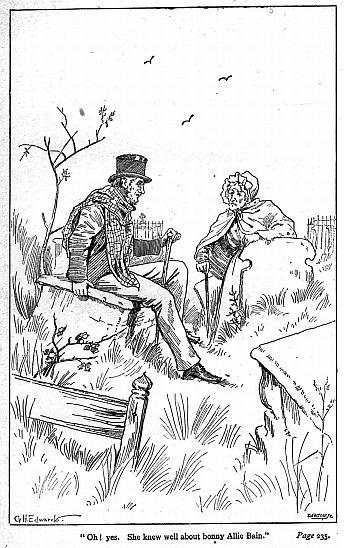 if he had only been sure that it would be wise to do anything, or meddle at all in the matter. He had only spoken a word to Allison; but the wee wifie, while they sat together on a fallen gravestone, had told him, not the whole story—she was hardly capable of doing that—but all of it that she had seen with her own eyes.
Oh! yes. She knew well about bonny Allie Bain. She was in the kirk when she was married—“sair against her will. It was like a muckle black corbie carrying off a cushat doo. But the cushat got free for a’ that,” said the wee wifie, with nods and smiles and shrill laughter.
But she said nothing of the brother’s part in that which followed, though she told with glee how Brownrig had gotten his deserts before all was done, and how the bride went one way and the bridegroom went another, “carried hame wi’ sair banes in his gig.” She told how first Allison’s mother, and then her father, were put in the grave, where they both lay with the new stone at their heads, and how “bonny Allie” had come to say farewell to them there. She grew eager and eloquent when she came to her own part in the story.
“I was here mysel’, as I am maist days, for it’s a bonny place and halesome, though ye mightna think it here among the dead folk. I like to hae a crack with them that’s been awa’ for mony a year and day. My mother lies ower in yon nook, and the man I should hae marriet. My father and my brother were lost at sea.
“Oh! ay—and about bonny Allie. Weel, she lay down wi’ her face upon the sod, and lay lang there, and when she lifted it again it was white as the snaw, but there wasna a tear upon it. Then there came the bark o’ a dog that I kenned weel. He was sent after me once, though Brownrig denies it. So I made free to go in by; and says I, ‘Miss Allie dear, I hear the bark o’ the black dog, Worry, and I doubt his maister’s nae farawa’.’
“She was speakin’ ower the wa’ to the minister’s son by that time, and after a minute or twa she came awa’, put her face down on the grave again, and then she followed me. And when we came near to the foot o’ the brae, I garred (made) her take off her hose and shoon, and wade doon the burn a bittie that the dog mightna follow the scent, and I laid doon peats that she might step on them a bit o’ the way between the burn and my ain door.
“When she came in she sat still like ane dazed and spent, and never a word spake she. But I stirred up the fire and boiled the kettle, and said I:—
“‘Did ye break your fast afore ye came awa’?’
“‘There wasna time,’ said she.
“‘And ye had nae heart for your supper yestreen, and ye forgot ye’re denner, and nae wonder. But if ye’re thinkin’ o’ winning awa’ to Aberdeen this day, or even the morn, ye’ll need to tak’ something to make ye strong for the journey.’
“So she ate her bread and drank her tea, and then she lay down in my bed and sleepit the hale day. I was unsettled mysel’ that day, and I thocht I would gang up the brae to the Meikles and get some buttermilk that the mistress had promised me. So I darkened the window and locket my door. But I didna leave my key in the thecking (thatch) as I do whiles, in case any o’ the neebors micht send a bairn wi’ a sup o’ milk, or a bit from a new cut cheese. It’s weel to gie them a chance to open the door.”
“And what then?” said Crombie, fearful of another digression. “What happened then?”
“Oh! naething happened. I only thocht I would be as weel awa’, in case Brownrig sent or came himsel’ to see what there was to see. So I gaed awa’ for a while, and when I cam’ back I just set mysel’ doon at the door to wait for what would come next. Allie sleepit on, and had nae appearance o’ having moved when the sun was near set, which wasna early, for the days were near their langest. But I made the fire burn up, and b’iled the kettle to be ready, and made the tea. And then wha’ should I see but Brownrig himsel’, riding on his black horse and followed by his uncanny tyke. I had only time to draw thegither the doors o’ my press-bed ere he was upon me.
“I was feared at the sicht o’ the dog, and the man saw it; but it wasna for mysel’ that I was feared, and that he didna see.
“‘Ye needna gang white like that at the dog. He’ll do ye no harm,’ said he.
“‘No, unless ye bid him,’ said I.
“He gaed me a dark look, and said he: ‘I’m not like to do that, though I hear ye have accused me of it.’
“So I saw he was gaen to speak me fair, and I cam’ to the door, and a’ at once I saw the twa cups that I had set on the table for Allie and me.
“‘Ye’re to hae a veesitor the nicht?’ said he.
“‘Wha’ kens?’ said I. ‘I’m ay ready, and it is to be you the nicht. Come ye away in and take a cup o’ tea, and maybe I’ll find a drappie o’ something stronger, gin ye’ll promise no’ to tell the gauger. No’ that I’m feared at him. He’s a frien’ o’ mine, and that’s mair than I would mak’ bauld to say o’ ye’re-sel’,’ said I, giein’ another feared look at the dog. ‘Come in by, and sit doon.’
“But it was growing late, he said, and he must awa’. He had only a question to speir at me. Had I, by ony chance, seen his wife passing by that day? And in whose company?
“‘Ye’re wife?’ said I, as gin I had forgotten. I whiles do forget.
“‘Ay, my wife, Mistress Brownrig—her that was Allison Bain!’
“‘Oh!’ said I then; ‘bonny Allie Bain? Ay, I did that! In the early, early mornin’ I saw her ower yonder, lying wi’ her face on the new-made grave.’
“I spak’ laich (low) when I said it.
“‘And did ye no’ speak to her?’ said he.
“‘I daured na,’ said I.
“‘And which way went she?’ said he.
“‘She stood up on her feet, and looked about her like one dazed, and then somebody spoke to her from ower the wall. And in a wee while I cam’ round and said a word, but she never answered me.’
“‘And wha was the man? Or was it a man?’
“‘Oh! ay. It was a man. It was the minister’s son wha has come lately frae America. But I heard na a word he said.’
“‘Hadden?’ he said. ‘I’ll hae a word wi’ him.’ And he gaed off in a hurry, and I was glad enow. Then I cried after him: ‘Take ye’re dog wi’ ye, and the next time ye come leave him at hame.’ But he never heeded, but hurried awa’.”
“And what happened then?” asked Saunners, trying to hide the interest he took in the story, lest she should suspect that he had a reason for it.
“Doubtless Mr Hadden told him the truth. There was little to tell. But naething came o’ it, nor of a’ the search which he has keepit up since then near and far. It gaes me lauch when I think about it. He was mad wi’ the love of her, and the last time he touched her hand was when he put the ring upon it in the kirk. Her lips he never touched—that I’ll daur to swear. And a’ this time he has been livin’ in the house that he made sae grand and fine for her. And doesna he hate it waur than pain or sin by this time? Ay! that does he,” said she with her shrill laughter. “He has had a hard year o’ it. He gaes here and there; and when a new-comer is to be seen among us, his een is upon him to mak’ sure that he mayna hae something to say to the folk that bides in Grassie—that’s the Bains’ farm. And gin he thocht one had a word to say about Allie, he would gar his black dog rive him in bits but he would get it out o’ him.”
Then a change came over the old woman’s face.
“And how did she get awa’ at last?” asked Crombie, growing uneasy under her eye.
“Oh! she won awa’ easy eneuch in a while. She was far frae weel then, and I’m thinkin’ that she’s maybe dead and a’ her troubles ower by this time.”
“And her name was Allie Bain, was it?”
“Ay, ay! her name was Allie Bain.”
“Weel, I need to be goin’ now. I thank ye for yer story. And if ever I happen to see her, I’se tell her that I saw a frien’ o’ hers wha spak’ weel o’ her. And what may ye’re ain name be?”
“My name’s neither this nor that, that ye should seek to ken it. And, man! gin ye’re een should ever licht on ane that ca’s hersel’ Allie Bain, gae by her, as gin she wasna there. It’s better that neither man nor woman should ken where she has made her refuge, lest ane should speak her name by chance, and the birds o’ the air should carry the sound o’ it to her enemy ower yonder. Na, na! The least said is soonest mended, though I doubt I have been sayin’ mair than was wise mysel’. But ye seem a decent-like bodie, and ye were in sair trouble, and I thocht I micht hearten ye with friendly words ere ye gaed awa’. But hae ye naething to say about Allison Bain neither to man nor woman, for ill would be sure to come o’ it.”
She was evidently vexed and troubled, for she rose up and sat down, and glanced sidewise at him in silence for a while. Then she said:
“I daursay ye’re thinkin’ me a queer-like crater. I’m auld, and I’m crooket, and whiles my head’s no richt, and there are folk that dinna like to anger me, for fear that I micht wish an ill wish on them. I read my Bible, and say my prayers like ither folk. But I’m no sayin’ that I haena seen uncanny things happen to folk that hae gaen against me. There’s Brownrig himsel’ for instance.
“I’m no’ sayin’ to ye to do the lass nae ill. Ye seem a decent man, and hae nae cause to mean her ill. But never ye name her name. That’s gude advice—though I havena ta’en it mysel’. Gude-day to ye. And haste ye awa’. Dinna let Brownrig’s evil een licht on ye, or he’ll hae out o’ ye a’ ye ken and mair, ere ye can turn roond. Gude-day to ye.”
“Gude-day to you,” said Saunners, rising. He watched her till she passed round the hill, and then he went away.
But the repentant wee wifie did not lose sight of him till he had gone many miles on his homeward way. She followed him in the distance, and only turned back when she caught sight of Brownrig on his black horse, with his face turned toward his home.
Though Saunners would not have owned that the woman’s words had hastened his departure, he lost no time in setting out. It was not impossible that, should Brownrig fall in with him later, he might seek to find out whether he had ever seen or heard of Allison Bain, since that seemed to be his way with strangers. That he should wile out of him any information that he chose to keep to himself, Saunners thought little likely. But he might ask a direct question; and the old man told himself he could hold up his face and lie to no man, even to save Allison Bain.
So he hastened away, and the weariness of his homeward road was doubtless beguiled by the thoughts which he had about the story he had heard, and about his duty concerning it. His wisdom would be to forget it altogether, he told himself. But he could not do so. He came to the manse that night with the intention of telling Allison all he had heard, and of getting the truth from her. But when he saw her sitting there so safe, and out of harm’s way, he could not do it.
And yet he could not put it altogether out of his thoughts. He would not harm a hair of the lassie’s head. A good woman she must be, for she had been doing her duty in the manse for nearly a year now, and never a word to be spoken against her. And who knew to what straits she might be driven if she were obliged to go away and seek another shelter? There were few chances that she would find another home like the manse. No, he would utter not another word to startle her, or to try to win her secret.
“But there is John Beaton to be considered. I would fain hae a word wi’ John. He’s a lad that maybe thinks ower-weel o’ himself, and carries his head ower-high. But the root o’ the matter’s in him. Yes, I hae little doubt o’ that. And if I’m nae sair mista’en there’s a rough bittie o’ road before him. But he is in gude hands, and he’ll win through. I’ll speak to him, and I’ll tak’ him at unawares. I’ll ken by the first look o’ his face whether his heart is set on her or no.”
Chapter Sixteen.
“Love will venture in where it daurna weel be seen.”
But John had been taken by surprise before Crombie’s turn came to speak. Some one else had spoken.
It was Saturday night. The work of the week was over Marjorie was safe asleep, and restless with the thoughts which always came with leisure, Allison threw a shawl over her head and went out into the lane. It was dark there, where the hedge was high, and the branches hung low from the trees in the manse garden; but beyond the lane, the fields and the faraway hills lay clear in the moonlight. With lingering steps she turned toward the green, along the path which skirted the cottage gardens. When she came to the last of them she heard her name called softly.
It was John Beaton’s voice. She could not see him where he stood, but he saw her clearly. He saw on her face, as she drew near, the shadow which told of the old sadness and gloom; and he saw it pass, like the mist before the sunshine, as she stood still to listen. In a moment he had leaped the dike, and stood by her side.
“Allison!” said he eagerly, as he took her hand.
John was young, and he had had but small experience of woman and her ways, or he never would have mistaken the look on Allison’s face for the look of love which he longed to see. He never would have clasped and kissed her without a word.
In the extremity of her surprise and dismay, Allison lay for a moment in his embrace. Then she struggled to get free.
“Allison, forgive me—because I love you. Allison, say that you will be my wife.”
A low cry of anguish came from her white lips.
“Oh! may God pity me. I have been sorely wrong, or this would not have come to be my punishment.”
She drew herself away from him, but she made no movement to leave him. John hung his head before her.
“Allison, forgive my presumption, and give me a chance to win your love. Allison, I love you dearly.”
“Hush!” she whispered. “Come with me. I must speak to you. I have done wrong, but how could I ever have dreamed that you would give a thought to me?”
She laid her hand upon his arm.
“I am in sore trouble. Come with me somewhere—to your mother—for I must speak to you.”
“Not to my mother, if you have anything to say which will grieve her,” said John huskily.
“It might grieve her, but she would understand. She might be angry for a moment; but she is kind and good, and she would not think evil of me.”
They stood in silence for a minute or two. Then she said:
“Come into the manse. No one will be there till I have time to say what I must say.”
They moved on till they came to the lane that led thither, and passed out of the moonlight into the shadow.
“Allison,” said John, pausing, “you cannot surely mean to cut me off from all hope? You might come to—care for me in time.”
“Care for you? Oh, yes! I care for you. You are my friend, and Willie’s. But I have done you a wrong, and with no will to do it.”
Instead of going into the house they turned aside at the end of the hedge, and entered the garden. On the summer-seat, under the tall fir-trees, they sat down in silence. After a time Allison rose, and stood before her friend.
“John,” said she, “when I heard your voice to-night I was glad. My heart has been heavy with a great dread all the week; and when I heard your voice I said to myself, here is a friend who will help me. John,” she said after a moment’s silence, “it is my secret I am going to tell you—my secret that I have kept all these long months. I trust you, John. You will tell me what I must do.”
“Well,” said John, as she paused again.
“John—I am a wife already. It is from—from the man who married me against my will that I have been hiding all this time. You must not think ill of me, for I was like a lost creature when my father died, and I knew not what to do. I came away hoping that God would let me die, or keep me hidden till my brother should get away to the other side of the sea. And God has kept me safe till now. John, will you forgive me and help me?”
The hands she held out to him trembled. She was shaking with excitement and the chill of the night. He rose and wrapped her shawl close about her.
“Allison, sit down. Or shall we go into the house? I will do all that I can to help you—so help me God!” said John with a groan, fearing that he was past help.
“No, I will not sit down. Sometime I will tell you all my story, but not to-night. This is what I must tell you. It was in our parish of Kilgower where Mr Crombie laid down his wife. There he heard something of Allison Bain. He saw the man who married me against my will—who has sworn to find me and to take me home to his house, alive or dead. It was in my hearing that he took that oath. But whether Mr Crombie really knows about me, or whether he was only speaking for the sake of saying something, or whether it was to find me out, or to warn me, I cannot say. And oh! I have been so safe here, and I have come to myself among these kind people.”
“What do you wish me to do?” said John, as she paused.
“If Crombie should know who I am, and should speak of me to any one, you would hear of it. He may even speak to you. You are his friend. Then will you warn me, and give me time to go away? I should be sorry, oh! so sorry, to leave the kind folk here and go away again among strangers. But I will never go with that man, never.”
“I will help you if I can. I hope you may be mistaken in thinking that Crombie knows your story. I think, at the worst, it is only a guess he has made.”
Allison shook her head.
“He saw the names of my father and mother on the headstone that their son has set up over their grave. Willie may be at home still, but I hope he has gone away to America. Oh! if I were only sure that he were I would go to him at once. I could hardly be brought back so far. And I might hide myself in that great country so that I could never be found.”
“Allison,” said John gently. “Think of me as a friend, who will help you whatever may happen.”
“I thank you kindly, and I trust you. I will bide still where I am while I may, for oh! I dread the thought of these first dark days coming on me again.”
“I do not think you need to be afraid of Crombie. He would not willingly injure you. He is a good man, though his sense of duty makes him sometimes say or do what looks hard.”
“Yes. He might think it right to betray me—not that it would be betrayal, since I have not trusted him or any one else.”
She made a great effort to quiet herself and to speak calmly. But she was anxious and afraid, and she grew sick at heart at the thought that all the dreariness and misery of the first days of her stay in Nethermuir might come back upon her again, of that she might have to go away among strangers.
“But I will not go to yon man’s house whatever befall,” she said in her heart.
The cloud which had hidden the moon for a while passed and showed the trouble in her face, and John’s heart smote him as he saw it. To whom might this poor soul turn in her distress? And why should she tell her story to any one? Since she had kept it so long to herself, it could not be an easy one to tell. Why should she tell it? Whether she had been right or wrong in her flight and her silence, it could not be helped now, and if she could be saved from her present fear and pain, it would be right to help her.
“Allison,” he said in a little, “you say you trust me. I also trust you. You do not need to tell your story to me. Some day, perhaps, you may tell it to my mother. No one can give you wiser counsel or warmer sympathy than she will. And I think you need not fear Saunners Crombie. At any rate, he would speak first to yourself, or to one whom he knows to be your friend. He would never betray you to your—enemy.”
“Well, I will wait. I will not go away—for a while at least. And you will be my friend?”
“I will try to help you,” said John.
But all the thoughts which were passing through John Beaton’s mind would not have made a pleasant hearing for his mother. A sudden, strong temptation assailed him, at which he hardly dared to look, and he strove to put it from him.
“As to Crombie,” said he, “he is an old man, and growing forgetful. It may all pass out of his mind again. That would be best.”
“Yes,” said Allison, “that would be best.”
They walked down to the gate together.
“And you will forgive me, Allison, and—trust me?”
“I will ay trust you. And it is you who need to forgive me,” said she, holding out her hand. “But it never came into my mind—”
John held her hand firmly for a moment.
“Allison!” said he, and then he turned and went away.
It was his mother who should befriend Allison Bain. But how to tell her story? If it had to be told, Allison must tell it herself. As to speaking with Saunners Crombie about Allison Bain and her troubles—
John uttered an angry word, and hurried down the lane and past the gardens and the green, and over the fields and over the hills, till he came to himself standing in the moonlight within sight of the “Stanin’ Stanes.” And being there he could only turn and go home again, carrying his troubled thoughts with him.
He had many of them, and the thought which pressed upon him most painfully for the moment was one which need not have troubled him at all. How was he to meet his mother and speak to her about Allison Bain with all this angry turmoil in his heart? He was angry with himself, with Crombie, even with Allison.
“How could I have thought—” she had said, looking at him with entreaty in her lovely eyes. While she had been in his thoughts by day and in his dreams by night, he “had never come into her mind!”
“But I could have made her think of me if I had not been a fool, with my fine plans about rising in the world! I could make her care for me yet,” said John to himself, quite unconscious that from the window of her room his mother’s kind, anxious eyes were watching him.
“Something has happened to vex him,” said she to herself. “I will not seem to spy upon him. He will tell me, if he needs my help, in his own time.”
But she waited and listened long before his footstep came to the door, and he went to his room without coming to say good-night as he passed.
“He is thinking I am asleep,” said she with a sigh.
There was nothing to be said. That was the conclusion to which John came that night. What could he say to his mother about Allison Bain? If he were to speak a word, then nothing could be kept back. His mother had a way of knowing his thoughts even before he uttered them, and why should she be vexed at seeing the trouble which, if he spoke at all, could not be concealed from her?
If the story must be told to his mother, Allison herself must tell it. But why need it be told? If only that meddling old fool, Crombie, had had the sense to hold his tongue. What good could come of speaking? Why should not the poor soul be left to forget her troubles and to grow content? Even his mother could only warn her and help her to get away if it ever came to that with her. But until then silence was best.
He would have a word with Saunners to find out what he knew and what he only suspected, and he would do what might be done to keep him silent.
John had his word with Crombie, but it did not come about in the way which he had desired and planned. While he was the next day lingering about the kirk in the hope of getting a word with him, Crombie was asking for John at his mother’s door.
“Come away in, Mr Crombie,” said Mrs Beaton when she heard his voice. “I have been wishing to see you this while.”
Then there were a few words spoken between them about the sorrow which had come upon him, and of his wife’s last days, and of the long journey he had taken to lay her in the grave. Saunners told of the bonny, quiet place on the hillside, where he had laid her down, and before he had taken time to consider, the name of Allison Bain had been uttered.
“I saw the names of her father and her mother—‘John Bain and Allison his wife’—on a fine, new headstane that had been put over them by their son. They hae been dead a year and more. Decent folk they seem to hae been. He farmed his ain land. I heard about it from a wee bowed wifie who was there in the kirkyard. She had something to say o’ Allison Bain as well.”
And then Crombie came to a pause. Mrs Beaton was startled by his words, but kept silence, for she saw that he had not meant to speak. But in a little he went on.
“It was a queer story that she told altogether, and I hae been in a swither as to what I was to do with it, or if I was to do anything with it. I cam’ the day to speak to your son aboot it, but taking a’ the possibeelities into consideration, I’m no’ sure but what I hae to say should be said to a prudent woman like yoursel’. I would be loth to harm the lass.”
“I will never believe an ill word of Allison Bain till she shall say it to me with her own lips,” said Mrs Beaton, speaking low.
“Weel, I have no ill to say o’ her. There was no ill spoken o’ her to me. That is, the woman thought no ill, but quite the contrary—though mair micht be said. Ye’re her friend, it seems, and should ken her better than I do. I’se tell ye all I ken mysel’, though it was to ye’re son I meant to tell it.”
“And why to my son?” asked Mrs Beaton gravely.
It is possible that Crombie might have given a different answer if the door had not opened to admit John himself. The two men had met before in the course of the day, and all had been said which was necessary to be said about the death and burial of Crombie’s wife, and in a minute Crombie turned to Mrs Beaton again.
“As to the reason that I had for thinkin’ to speak to your son, there was naebody else that I could weel speak to about it. No’ the minister, nor his wife. It would be a pity to unsettle them, or to give them anxious thoughts, and that maybe without sufficient reason. And John’s a sensible lad, and twa heads are better than ane.”
John laughed and mended the fire, and asked “whether it was Robin or Jack this time, and what was ado now?”
“It’s aboot neither the one nor the other,” said Saunners, with a touch of offence in his voice. “It’s aboot the lass at the manse—Allison Bain.”
It had been a part of Crombie’s plan “to take the lad by surprise” when he mentioned Allison’s name, and he peered eagerly into his face “to see what he could see.” But the peats, which John had put on with a liberal hand, had darkened the fire for the time, and he had taken his place beside his mother’s chair and was leaning on it, as he had a way of doing when anything special was to be said between them, and Saunners saw nothing. “Begin at the beginning,” said Mrs Beaton. So Saunners began again, and getting into the spirit of the affair, told it well. They listened in silence till he came to a pause.
“It is a curious story,” said John, by way of saying something.
“It was a curious story as I heard it,” said Saunners. “Is the wee wine ‘a’ there’?” asked John quietly. “I’m by no means sure o’ it. She looked daft-like when she shook her neive (fist) at the man Brownrig behind his back and called him ill names. And her lauch when she told me that the man had never touched his wife’s hand since the day he put the ring upon it, and when she swore that never had he touched her lips, was mad enow.”
John’s mother felt the start which her son gave when the words were spoken.
“And is it true, think ye?” said she. “There seems to be truth in the story, but where it lies I canna say. And whether it be true or no, I am beginning to think that I have no call to make or meddle in it.”
“There is just one thing that I must say again,” said Mrs Beaton—“I’ll never believe an ill word of Allison Bain till with her own lips she gives me leave to do it! She is a good woman, whatever trouble may have been brought into her life by the ill-doing of others.”
“What think ye, John?” said Saunners.
“I think ye did a wise thing when ye came to consult with my mother. She kens a good woman when she sees her.”
“There may be truth in the story. It may be a’ true. But the question for me to decide with your advice is whether a word o’ mine will help or hinder the richt thing’s being done?”
“Yes, that is the question,” said Mrs Beaton. She hesitated to say more. For she knew that to set one side of a matter in a strong light was the surest way to let Crombie see more clearly all that might be said on the other side.
“She’s a weel doin’ lass,” said Crombie.
“She is invaluable in the manse,” said Mrs Beaton.
“It would unsettle them sadly to lose her, or even to have a doubtfu’ word spoken o’ her,” said Saunners.
“Especially just now, when Mrs Hume is not quite well,” said Mrs Beaton.
“And what say ye, John?” asked Saunners.
“Do ye feel responsible to this man—whatever his name may be—that ye should wish to take up his cause? I mean, had ye any words with him about her?” added John, as his mother touched his hand in warning.
“No’ me! The wifie said he was ay waitin’, and watchin’, and speirin’, and there was a chance that he would have a word wi’ me. I didna bide to be questioned. I just took the road without loss o’ time, whether it was wise to do it or no.”
“To my mind it was both wise and kind,” said Mrs Beaton. “As ye say, there may be truth in the story; but the telling of it here will be the same thing to Allison Bain, whether it be true or false. She is alone and friendless, it seems, and that a young lass should be spoken about at all is a harm to her, and a word might be the means of sending her out into the world without a friend. Surely the Lord was keeping His eye on her for good when He sent her to the manse, and into the hands of such a woman as Mrs Hume.”
“Ay, that’s the truth. And what say ye, John?”
“I say that my mother seldom makes a mistake when she lets herself speak strongly about any matter. I agree with her that ye took the right course when ye made up your mind to say nothing about the matter.”
Crombie fidgeted in his chair, and was silent for a minute or two.
“I said nothing to the man himsel’, but I did drop a word to Allison Bain. She said nothing, but I saw by her face that she understood. I only hope I may na hae done ill in speakin’.”
The others hoped the same with stronger emphasis, and not without some angry thoughts on John’s part. But to speak the old man fair was the wisest way. There was no time for many words, for Annie brought in the tea, and Saunners was prevailed upon to stay and share their meal. When it was over it was beginning to grow dark, and he rose to go, and John rose also, saying he would go with him a bit of his way.
The talk between them as they went on was not of Allison, but of quite other persons and matters, and it was kept steadily up and not suffered to turn in that direction. When Saunners spoke of the strange things that might be happening under “our very een,” John listened in silence, or brought him back to the kirk, and the new members, and the good that was being done, till they came to the little house by the side of the moss, out of whose narrow window no welcoming light was gleaming.
“I’m no’ used wi’t yet,” said Saunners with a groan, as he fumbled awkwardly trying to put the clumsy key into the lock. “It’s the hardest part of my day’s work, this coming hame to a dark house. But folk maun bide what’s sent, and be thankful it’s nae waur. Gude-nicht to be. Ye hae shortened my road, and mony thanks. I winna ask ye to come in.”
“No. I must be early up and awa’ in the morning, and it may be long ere I be home again. Ye might look in on my mother whiles, when ye’re down our way. She’s much alone.”
If John had planned his best to win Saunners to friendliness, and to silence concerning the affairs of Allison Bain, he could have said nothing more to the purpose than that. Saunners accepted the invitation, and came now and then to inquire for the health of Mrs Beaton, and “heard only good words from her,” as he said.
He had something to say to most of his friends about the place where he had laid down his wife to her rest beside her own folk, and even spoke of the “daft wifie” that he had seen there; but he never uttered a word as to the story she had told him, and in course of time, as he thought less about it, it passed quite out of his remembrance—which was best for all concerned.
Chapter Seventeen.
“Fear hath a hundred eyes that all agree
To plague her beating heart.”
As for Allison, the thought of going away from Nethermuir to escape the threatened danger, did not stay long with her. It would be wrong to go away now, she told herself. For another little daughter came to the manse about this time, and Allison’s strength and skill were tried to meet all demands upon them for a while. Yes, it would be wrong to leave these good friends who had been kind to her, and above all, wrong to steal away, as in her first alarm it had come into her mind to do.
And besides, even if that which she feared were to come upon her, and if by means of Crombie, or by any other means, she were discovered, the times had gone by when force could be used and a woman carried away secretly against her will. There would be a good many words to be said before she could be forced to go with Brownrig, even though he might, as he had said, have “the law on his side.”
She would wait patiently till Mr Hadden should answer the letter she had sent him when she had first heard that her brother was set free, and when she should hear that Willie was safe in America, then would be her time to go away.
“I must wait patiently; I must not let myself fall into blackness and darkness again. Whether I have done wrong, or whether I have done right, there’s no turning back now.”
As far as Saunners was concerned it soon was seen that she had nothing to fear. He had only kindly looks for her now, and though his words of greeting were few, they were kindly also. The words of caution and counsel which it was “his bounden duty” to let drop for the benefit of all young and thoughtless persons when opportunity offered, had reference chiefly to the right doing of daily duty, and the right using of daily privileges and opportunities, as far as Allison was concerned.
And so the days passed till November was drawing near. Then something happened. Auld Kirstin came home to the manse. “Home,” it must be, thought the neighbours, who saw the big “kist” and the little one lifted from the carrier’s cart. And Allison, to whom Mrs Hume had only spoken in general terms as to the coming of their old servant, could not help thinking the same, and with a little dismay. But her year’s experience had given her confidence in the kindness and consideration of her mistress, and she could wait patiently for whatever might be the decision with regard to her.
The minister’s wife and the minister himself had had many thoughts about the matter of Kirstin’s coming home long before she came. For as the summer days drew to a lingering end, Mrs Esselmont had fallen sick and had appealed to them for help.
She was not very ill, but her illness was of a nature which made her residence at Firhill during the winter not altogether impossible, but undesirable and unwise, as she told them, since she had the power to go elsewhere. She could spend the winter with her eldest daughter, she said, but as her home lay in one of the cold, English counties, washed by the same sea from which the bleak winds came moaning through the firs on her own hill, she would hardly better herself by the change. What she wished was to go further south to a place by the sea, where she had already spent more than one winter, and some of the winter days there, she told them, might well pass for the days of a Scottish summer. What she could not endure was the thought of going away alone.
“I had my Mary with me when I was there last, and I dread the thought of the long days with no kenned face near me. Milne is growing old and frail like myself, and I will need to spare her all I can. And now will you let me have your Allison Bain for a while?”
“We can tell you nothing about her except what we have seen since she came into our house,” said Mrs Hume gravely. “It was a risk our taking her as we did, but we were sorely in need of some one.”
“But you are not sorry that you took her into your house?”
“Far from that! She has been a blessing in our house, as doubtless she would be in yours should she go with you.”
“There is no doubt but it would be to her advantage to go with you. And we could not prevent her if she wished to go when her year with us is at an end,” said Mr Hume.
“Yes, it would be better for her to go. We ought not to hinder her,” said his wife; but they looked at one another, thinking of Marjorie.
“I thank you both gratefully for your kindness in being willing to spare her to me,” said Mrs Esselmont. “But that is only the beginning of my petition. The child Marjorie! Would it break your heart to part with her for a while? Wait, let me say a word more before you refuse to hear me. The child is evidently growing stronger as she grows older. Allison has helped her, but there is more in the change than that. I am certain—at least I have hope—that she might be helped by one who has been proved to have skill in dealing with such cases. Let me take Marjorie to Dr Thorne in London. He is a great physician and a good man. He is my friend, and I know that whatever can be done for the child he can do, and will be happy in doing it. Think of your gentle, little darling grown strong and well, with a useful and happy life before her!”
A rush of tears came to the eyes of Mrs Hume. The minister went to the window and looked long on the swaying branches of the firs, which were only just visible through the mist and the rain. Mrs Esselmont laid herself back on her pillow and waited.
“Well?” said she after a little.
“Well, mother?” said the minister, sitting down again.
“Speak for us both,” said his wife.
“Well,” said he, after a pause, “I have only this to say to-night. We thank you for your kind thoughts for the child. We desire to say yes, we long to say it. But it is a great thing to decide, and we must ask counsel.”
“Surely. I will wait patiently for your decision. But the sooner we can go, the better.”
There was much more said than this, and counsel was asked before they parted. Mrs Esselmont’s last words were these:
“It was because of the child that I first thought of Allison Bain. Should you decide that you cannot let Marjorie go, then I will not take Allison. And remember, my dear,” said she to Mrs Hume, “you have another little daughter now to comfort you. And when you have made up your mind, whatever it may be, say nothing to Allison. I would like myself to ask her to go with us if you should decide to let the child go.”
There was not long time needed in which to come to a decision. The father and mother had taken counsel together, and had asked counsel often. There was only one thing to be said at the last. Marjorie must go; and though it was said with sorrow, it was also with thankful gladness that they committed their darling to the care and keeping of the Great Healer of the bodies and souls of the creatures whom He came to save. And they agreed with Mrs Esselmont that, the decision being made, there was no time to lose.
Kirstin had been coming to visit them before this change was spoken about. The only difference that this made was, that now she came home to stay, bringing all her gear with her. After her coming, Allison was not long kept in suspense as to what her own winter’s work might be.
“Allison,” said her mistress, “I would like you to go to Firhill this afternoon. No, Marjorie is better at home to-day. And, Allison, as you will be likely to see the lady herself, you should change your gown and put on your bonnet.”
Which Allison did, wondering a little, for she had hitherto gone to Firhill with only her cap on her head, as she had gone elsewhere. Other folk wondered also. On the stone seat at the weaver’s door sat the weaver’s wife, busy with her stocking, and beside her sat her friend Mrs Coats, “resting herself” after her work was over.
Allison did not pass by them now without a word, as used to be her way during the first days of their acquaintance; but she did not linger to say more than a word or two, “as would have been but ceevil,” Mrs Coats said. Allison had a message to deliver at the school, and she did not come back again, but went, as she liked best, round by the lanes.
“She has gi’en warning. She was ay above the place,” said Mrs Coats.
“Ye can hardly say the like of that, since she has filled the place weel,” said her friend.
“But I do say it. She goes her ways like ane that hasna been used with doin’ the bidding o’ anither.”
“She doesna need to be bidden. She kens her work, and she does it. What would ye have?” said the weaver, who had stopped his loom to hear through the open window what was to be said.
“That’s true,” said his wife; “but I ken what Mistress Coats means for a’ that.”
“Ye may say that! It’s easy seen, though no’ just so easy shown. Is she like the ither lassies o’ the place? Who ever saw her bare feet? It’s hose and shoon out and in, summer and winter, with her.”
“And for that matter who ever saw her bare arms, unless it was in her ain kitchen, or in the milk-house? Even gaen to the well her sleeves are put doon to her hands.”
“I should like to ken the folk she belongs to.”
“They’re decent folk, if she’s a specimen o’ them. Ye needna be feared about that,” said the weaver.
“It’s no’ that I’m feared, but ane would think that she was feared herself. Never a word has passed her lips of where she came from or who she belongs to.”
“Never to the like o’ you and me. But the minister’s satisfied, and Mrs Hume. And as to the folk she cam’ o’, we hae naething to do wi’ them.”
“That may be; but when there is naething to be said, there’s maistly something to be hid.”
“And when ye can put your hand on ane that hasna something to hide frae the een o’ her neebors, ye can set her to search out the secrets o’ the minister’s lass. It winna be this day, nor the morn, that ye’ll do that same,” said the weaver, raising his voice as he set his loom in motion again.
“Eh, but your man is unco hard on the women,” said Mrs Coats, with a look which implied sympathy with the weaver’s wife as well as disapproval of the weaver. But her friend laughed.
“Oh! ay; he’s a wee hard whiles on women in general, but he is easy eneuch wi’ me.”
For some reason or other Allison had to wait a while before she saw Mrs Esselmont, and she waited in the garden. There were not many flowers left, but the grass was still green, and the skilful and untiring hands of old Delvie had been at work on the place, removing all that was unsightly, and putting in order all the rest; so that, as he said, “the last look which his mistress got of the garden might be one to mind on with pleasure.”
“It’s a bonny place,” said Allison with a sigh. The old man looked up quickly. “Do ye no’ ken that it’s ill for a young lass to sigh and sech like that? Is it that this ’minds ye o’ anither bonny place that ye would fain see?” Allison smiled, but shook her head. “I never saw a garden like this. But I ay liked to care for my own—”
“And ye have none now. Is that the reason that ye sigh?”
“Maybe I may have one again. If I do, I would like to have your advice about it,” said Allison, wondering a little at herself as she said it.
“Oh! I’ll gie you advice, and seeds, and slips, and plants as weel, gin ye are near at hand.” Allison shook her head.
“I doubt if I ever have a garden of my own again, it will be on the other side of the sea.”
“In America? They have grand flowers there, I hear. But before ye go there ye can ask me and I’ll give ye seeds to take wi’ ye, and maybe slips and roots as well. They’ll ’mind you o’ hame in that far land. I once heard o’ a strong man over yonder that sat down and grat (wept) at the sicht o’ a gowan.”
“Thank you,” said Allison. There were tears in her eyes though she smiled.
“Here’s my lady,” said Delvie, bending to his work again.
Mrs Esselmont came slowly toward them, leaning on the arm of her maid, a woman several years older than herself.
“You may leave me here with Allison Bain,” said she; “I will take a turn or two and then I will be in again.”
She had the minister’s note in her hand, but she made no allusion to it as they moved slowly up and down. They spoke about the flowers, and the fair day, and about Marjorie and the new baby for a while, and then Mrs Esselmont said:
“You have a strong arm, Allison, and a kind heart. I am sure of it. I have something to say to you which I thought I could best say here. But I have little strength, and am weary already. We will go into the house first.”
So into the house they went, and when Milne had stirred the fire and made her mistress comfortable, she went away and left them together.
“Allison,” said Mrs Esselmont, after a moment’s silence, “I have something to say to you.”
And then she told her that she was going away for the winter because of her ill-health, and spoke of the plan which she had proposed to Marjorie’s father and mother for the benefit of the child. This plan could only be carried out with Allison’s help, because Mrs Hume would never trust her child to the care of a stranger. The mother thought that she would neither be safe nor happy with any other. And then she added:
“I could only ask them to let me take her if I could have you also to care for her. I cannot say certainly that she will ever be strong and well, but I have good hope that she may be much stronger than she is now. Think about it. You need not decide at once, but the sooner the better. We have no time to lose.”
Allison listened with changing colour and downcast eyes.
“I would go with you and the child. I would be glad to go—but—”
She rose and came a little nearer to the sofa on which Mrs Esselmont was lying.
“But I cannot go without telling you something first, and you may not wish me to go when you have heard.”
“Allison,” said Mrs Esselmont, “stand where I can see your face.”
She regarded her a moment and then she said gravely:
“I cannot believe that you have anything to say to me that will change my thoughts of you. You have won the respect and confidence of your master and mistress, who ought to know you well by this time. I am willing to trust you as they have done without knowing more of you than they have seen with their own eyes. I think you are a good woman, Allison Bain. You have not knowingly done what is wrong.”
“I did not wait to consider whether I was right or wrong, but I should have done what I did even if I had known it to be wrong. And I would not undo it now, even if you were to tell me I ought to do so. I could not. I would rather die,” said Allison, speaking low.
There was a long silence and Allison stood still with her eyes fixed on the floor.
“Sit down, Allison, where I can see you. Put off your shawl and your bonnet. You are too warm in this room.”
Allison let her shawl slip from her shoulders and untied the strings of her black bonnet.
“Take it off,” said Mrs Esselmont, as Allison hesitated.
Her hair had grown long by this time and was gathered in a knot at the back of her head, but little rings and wavy locks escaped here and there—brown, with a touch of gold in them—and without the disguise of the big, black bonnet, or of the full bordered mutch, a very different Allison was revealed to Mrs Esselmont.
“A beautiful woman,” she said to herself, “and with something in her face better than beauty. She can have done nothing of which she need be ashamed.”
Aloud she said:
“Allison, since you have said so much, if you think you can trust me, you should, perhaps, tell me all.”
“Oh! I can trust you! But afterward folk might say that you did wrong to take me with you, knowing my story. And if I tell you I would need to tell Mr and Mrs Hume as well, since they are to trust me with their child. And though you might be out of the reach of any trouble because of taking my part, they might not, and their good might be evil spoken of on my account, and that would be a bad requital for all their kindness.”
“And have you spoken to no one, Allison? Is there no one who is aware of what has befallen you?”
Allison grew red and then pale. It was the last question that she answered.
“It was in our parish that Saunners Crombie buried his wife. One night he came into the manse kitchen, and he told me that he had seen my name on a new headstone, ‘John Bain and Allison his wife’—the names of my father and mother. And he had some words with one who had known me all my life. But I never answered him a word. And whether he was trying me, or warning me, or whether he spoke by chance, I cannot say. I would like to win away from this place, for a great fear has been upon me since then. I might be sought for here. But I would never go back. I would rather die,” repeated Allison, and the look that came over her face gave emphasis to her words.
“And has he never spoken again?”
“Never to me. I do not think he would willingly do me an ill turn, but he might harm me when he might think he was helping me into the right way. Oh! I would like to go away from this place, and it would be happiness as well as safety to go with you and my Marjorie.”
Mrs Esselmont sat thinking in silence for what seemed to Allison a long time. Then she raised herself up and held out her hand.
“Allison, I understand well that there are some things that will not bear to be spoken about. Tell me nothing now, but come with me. I trust you. Come with me and the child.”
The tears came into Allison’s eyes, and she said quietly:
“I thank you, madam. I will serve you well.”
Chapter Eighteen.
“God be with thee,
Else alone thou goest forth,
Thy face unto the north.”
Before he went away on the morning after they had heard the story which Crombie had to tell, John Beaton had said to his mother:
“If Allison Bain seems anxious or restless, you must find some way of letting her know that she has nothing to fear from the old man. He will say nothing to harm her.”
But he did not tell her that he had already heard the story of Allison’s marriage from her own lips. And not knowing this, after considering the matter, his mother decided to say nothing, believing that it would not be well for Allison’s peace of mind to know that the sad story of her life had been told to them.
And even if she had wished to do so, it would not have been easy to find a chance to speak. For Allison was shy of Mrs Beaton at this time, and went no more to see her in the gloaming, as she had sometimes done of late, and was not at ease with her when they met.
For she said to herself, that Mrs Beaton might know, or might suspect that her son had of late been giving too many of his thoughts to one of whom they knew nothing; and though she was not to blame, Mrs Beaton might still blame her for her son’s folly.
Allison was indeed troubled. Since the night on which Crombie had so startled her, she had never been quite at rest. She had striven to be reasonable and to put away her fears; but there never came a step to the door, that she did not pause from her work to listen for the words that might be spoken. She looked on every unfamiliar face that came into the kirk, or that she passed on the street or in the lanes, with a momentary terror, lest she should meet the eyes of one whom her enemy had sent in search of her.
She had said to herself many times, “I will wait quietly. I will stay where I am, and I will not yield to my fears.”
But when Mrs Esselmont spoke to her, and a way of escape appeared, she knew that she had been sore afraid, and that she could not long have borne the strain which had been upon her.
“Six days!” she said to herself, as she came down from Firhill that night, in the darkness. “Only six days and nights, and I shall be away, and safe for a year at least; and then!—but I will not look beyond the year. I will care for the child, and be at peace.”
As for John, he had written to his mother that he was to be sent north on business that might keep him there some days. He did not tell where he was going, and she did not hear again for a good while after that. When he did write he said nothing about his journey or its results, as he was usually in the way of doing, and he said nothing about coming home. His mother’s heart was sore for her son. No word concerning Allison Bain had passed between them, but she knew that his heart had gone from him and that he must suffer for a time.
“But he’ll win through,” she said, hopefully, to herself, “as other men have won through the same trouble in all the generations of men, since ever the world began; and may he be the wiser and the better for the pain! He will be sorry not to see her again,” added she, with a sigh.
So she wrote a letter telling him, among other things, that wee Marjorie was to be sent away with Mrs Esselmont for the good of her health; that she was likely to be away a year at least. She said some hopeful words as to the benefit the child might receive, and then she added: “It is Allison Bain who is to have the care of her.” Of Allison herself she only said that she was one to be trusted, and that the child would be happy in her care. But to this there came no word in reply.
On the last day at home Marjorie was carried down the street by Jack, that she might say good-bye to Mrs Beaton and the schoolmistress, and the neighbours generally. Jack had been warned by his mother that if there should be any signs of weariness or excitement, there must be no lingering. The child must be brought home at once. But Marjorie took it all very quietly.
“Yes, I’m going away. Yes, I’m sorry, and I’m glad, but I’m not afraid, because our Allison is going with me. Oh! yes, I’m glad. I’m going to see new things and places—me that was never ten miles away from home in all my life! And I’m going to come home strong and well, like the other bairns to help my mother and them all. And my mother has my sister now to take my place. It’s my father that I’m sorriest for. But I’ll come home strong and well, and then he’ll be glad that he let me go.”
She said the same to the bairns who lingered on their way home from the school to speak to her as they passed. She was coming home again well and strong, and she would be happy, having Allison all to herself; and though she was sorry to leave them, she was not afraid.
Allison had no formal leave-takings. She had been very busy all day, and came down-stairs after seeing Marjorie quietly asleep, doubtful whether she should go to say good-bye to Mrs Beaton and the schoolmistress or not. The question was decided for her.
“Allison,” said Mrs Hume, as she passed the parlour-door, “I think it would be but kind to ask Mrs Beaton if she has any message to send to her son. You could leave it with Robin if you should not chance to see him yourself in the town. Are you very tired?”
“I am not so very tired. Yes, I will go now,” said Allison.
So she turned down the lane and went round by the green, as she had gone so many times before, not without some troubled thoughts of her own. She found Mrs Beaton sitting alone in the firelight.
“Come away in, Allison. I have been expecting you,” said she.
Allison sat down at her bidding, and gave Mrs Hume’s message.
“I hope you may see him. But I have nothing to say or to send. He will be home soon. And you are glad to be going, Allison, for the sake of the child?”
“Yes, I am glad to be going.”
“But you are not sorry that you came here? You have been content?”
“No. I had to go away from home. I am not sorry I came here. Everybody at the manse has been kind.”
“And you have been good to them and to me. I am glad to have kenned you, Allison Bain,” but Mrs Beaton sighed as she said it.
What could Allison answer? Indeed, what was to be said between these two? Nothing, unless all might be said. A word might have broken the spell of silence between them, but the word was not spoken.
“It would make her unhappy to know that her secret had been told to us,” thought Mrs Beaton. And Allison thought: “His mother would be grieved, if she knew all; and she never need know. He will forget me when I am gone away.”
And so, after a few quiet words about other matters, they said “good-bye” to one another. Allison lingered a moment, looking down with wistful eyes on the gentle old face of her friend.
“Have you anything to say to me, Allison Bain?”
But Allison shook her head. “Nothing that it would please you to hear; and it is all over now, and I am going away.”
“Yes, you are going away. I may not be here when you come back again, and I must say one thing to you. I trust you, Allison Bain. I believe you to be good and true, whatever trouble may have come into your life by the ill-doing of others. May the Lord have you in His keeping, and bring you safe through all trouble ‘into a large place.’ Kiss me, my dear.”
Allison stooped and kissed her, and went away without a word. As she turned from the door a hand was laid upon her arm, and a voice said:
“Is it you, Allison Bain? I would like a word wi’ ye. I’ll no’ keep ye lang.”
Allison was tired and sad at heart, and she longed to be alone. She could not but yield, however, to the entreating voice of the mistress, and she crossed the street to her door. The lamp was lighted, and a small, bright fire burned on the hearth, and one of the chairs had been taken down from the high dresser for the expected visitor.
“Sit ye doon, Allison,” said the schoolmistress. “I saw ye when ye gaed into Mistress Beaton’s, and I waited for you, but I winna keep ye lang. And ye’re going farawa’? Are ye glad to go? And are ye ever comin’ back again?”
“I must come back with Marjorie. Whatever happens, I must bring home the child to her father and her mother,” said Allison, gravely.
“Ay, ye must do that, as ye say, whatever should happen. And may naething but gude befall ye. I’ll miss ye sairly; ye hae been a great divert to me, you and the minister’s bairn thegither—especially since the cloud lifted, and ither things happened, and ye began to tak’ heart again. Do ye mind the ‘Stanin Stanes’ yon day, and a’ the bairns, and John Beaton wi his baps? Oh! ay. I’ll miss ye mair than ye ken.”
The old woman sat for a time looking in silence at Allison, then she said:
“Eh! woman! It’s weel to be the like o’ you! Ye’re young, and ye’re strong, and ye’re bonny; and ye hae sense and discretion, and folk like ye. It’s nae ance in a thousand times that a’ these things come to a woman thegither. Ye mind me o’ mysel’ when I was young. I had a’ that ye hae, except the sense and discretion. But that’s neither here nor there, at this late day,” added she, rising.
Allison sat watching her as she took a key from its hiding-place and opening the big chest in the corner, searched in it for a while. When the old woman raised herself up and turned toward Allison again, there lay on the palm of her hand a gold ring. It was large and massive, and had evidently been rubbed and polished lately, for it shone bright in the light as she held it up to the lamp.
“Look ye at it,” said the mistress. “Until this day I have never, for forty years and mair, set e’en upon it. I hae been twice marriet—though folk here ken naething about that—and this was my first marriage ring. It was my mother’s before me, and her mother’s before her. It held a charm, they said, to bring happy days, but it brought none to me—he died within the year. The charm was broken, maybe, because I was a wilfu’ lassie—an undutifu’ daughter. But it may work again wi’ you. Take it, and put it on your finger.”
But Allison refused it, and put her hands behind her.
“And what for no’? It’s my ain to give or to keep as I like. Ye needna be feared,” said Mistress Jamieson, with offence. “But why should ye wish to give it to me?”
“Because I hae naebody else to gi’e it to. There’s not, to my knowledge, one living that ever belonged to me. I may be dead before ye come back again. And I like ye, Allison Bain. And the ring may keep evil from ye, if ye wear it on your hand.”
Allison looked anxiously into the old woman’s eager face. What did she mean? Why did she offer to her a marriage ring? Did she know more than others knew about her? Was a new danger coming upon her? She must not anger her, at any rate. So when the old woman took her hand again she did not resist.
“There is the charm written on the inside of it, ‘Let love abyde till death devyde.’ Ye’ll see it by the daylicht.”
But the ring was far too large for Allison’s finger. It slipped from it and fell to the ground.
“Eh! me! is that an ill sign, think ye?” said the mistress.
“It is a sign that your grandmother was a bigger woman than me,” said Allison with an uncertain smile. “It is very kind of you, Mistress Jamieson, to think of giving it to me, but—”
“It’s a pity. But it’s yours. On your hand it would hae keepit awa’ evil. Ye must put it on a ribbon and hang it roun’ ye’re neck, and it may do the same. It will keep ye in mind yoursel’, if it minds naebody else.”
Allison gazed at her with eyes full of trouble. But in the face so deeply marked with the cares and sorrows and discontents of many years, she saw nothing to awaken distrust or fear. There were tears in the pale, sunken eyes, and the tremulous movement of the lips told only of kindly interest. Whatever she knew or suspected, Allison felt that the old woman did not mean her harm.
“Why should you be so kind to me—a stranger?” said she gently.
“I hardly ken mysel’, except that I wish ye weel. And then ye mind me o’ my ain youth, partly that ye’re sae like what I once was, and partly that ye are sae different. I can see now where I gaed wrang. And ye hae your life afore ye. Hae patience, and make the best of it that ye may.”
“I’ll try,” said Allison humbly. And so they parted.
Allison got a glimpse of the grim old face among those who were standing about the door to see them set off in the morning. And she never saw it more. Before Allison came back to Nethermuir again the schoolmistress was done with her toils, and troubles, and discontents, and was at rest. And Allison never knew what the old woman might have known or guessed of her life before she came to the manse.
There were a good many others there to see the travellers away. Marjorie was in the “gig” with her father and mother, who were to take her to join Mrs Esselmont at Firhill, so her time for tears was not come, nor was theirs. The child looked round on the faces of her friends and smiled and nodded, and was sorry, and glad, at the same time, but she was not, as she had told them, in the least afraid of what might be before her.
The same might be said of her father and mother—with a difference. They were glad, and they were sorry, and the mother was a little fainthearted for them both at the thought of the long days, that lay before them. But they were not afraid. They trusted their child in the Good Hand which had “led them all their life long until now,” and they had confidence in Allison Bain.
Allison herself wondered a little at their perfect faith in her. The night before, when worship was over, she had stayed behind the others to hear a few last words which were yet to be spoken. When the father and mother had said all they had to say and Allison was at the door to go away, she paused a minute or two, then coming back again she said gravely:
“I think if you had known me all my days,—if you had seen all my life till now,—I think you would still be willing to trust me with your Marjorie. But I cannot tell you. There is a reason—it is better to say nothing. Some day, I hope, I may be able to tell you all.”
“We can wait till then,” said the minister heartily. The child’s mother said the same.
They had trusted her from the first, and any doubts which might have arisen as to the wisdom of committing their child to the care of one of whom they really knew very little, were put aside at the remembrance of all that she had already done for her. The few words which Mrs Esselmont said to them as to her interview with Allison encouraged them also, and they, too, agreed with her in thinking that it was as well not to seek to know more than Allison was willing to reveal.
Allison was glad, and more than glad, to get away. But still when the travellers reached the last point where a glimpse could be caught of the valley in which the little town lay, she told herself that thankful as she was to leave it for a while, she was more thankful still that in her time of need she had been guided to find a refuge there.
Chapter Nineteen.
“Unless you can swear for life or for death
Oh! fear to call it loving.”
Business made it necessary for Mrs Esselmont to remain one day in Aberdeen. She stayed with a friend, but Allison and Marjorie found a place prepared for them in the house where Robin, now a student in the university, had taken up his abode.
It was a dark and rainy day, and Robin was greatly disappointed that he could not take them out to see all that was to be seen in the town, and Marjorie was disappointed also. But in her heart Allison was glad of the rain and the grey mist which came when the rain was over. For how could she be sure of those whom she might see in the streets, or of those who might see her? Every hour that passed helped to lighten the dull weight on her heart, and gave her courage to look forward with hope.
Dr Fleming came to see Marjorie in the afternoon, as her father had asked him to do. He looked at Allison with astonished eyes.
“You owe me thanks for sending you out yonder,” said he.
“And so do we,” said Robin.
“It was a good day for me,” said Allison, and her eyes said more than that.
“Yes, better than you know,” said the doctor. “And for you, too, my wee pale lily, if all I hear be true. And so Allison Bain is going to carry you away and to bring you home again a bonny, blooming rose, is she? May God grant it,” added the doctor reverently.
“I will try to take good care of her,” said Allison.
“I am sure of that.”
When the visit was over, Allison followed the doctor to the door.
“I would be glad if I were sure that my name would not be named over yonder,” said she, casting down her eyes.
“Be glad then, for your name shall not be spoken. Yes, one man has come to inquire about you, and more than once. When I saw his face and heard his voice, I understood how you might well wish to keep out of his sight. Stay in the house while you remain here. There may be others who would speak, though I keep silence. God bless you.” And then he went away.
“I may be doing the man a wrong, since he says she is his lawfully wedded wife, but I cannot—I have not the heart to betray her into his hands.”
In the evening John Beaton came in. Marjorie was already in her bed, but she was not asleep; and they wrapped her in a plaid, and brought her into the parlour again to see her friend. She had the same story to tell. She was glad, and she was sorry; but she was not afraid, since Allison was with her.
“I will have her all to myself,” said Marjorie.
John stooped to touch with his lips the little hand that lay on his arm.
“Happy little Marjorie,” he whispered in her ear.
She soon fell asleep, and was carried away to bed again. While Allison lingered beside her, John said to his friend:
“Robin, my lad, go up to your books for a while. I must have a word with Allison.”
Robin nodded his head, but he did not move till Allison returned. Then he started up in great haste.
“I must see Guthrie for a minute. Don’t go till I come back, John,” said he. “Can I do anything for you, Allison?”
“Nothing more,” said Allison; and Robin disappeared.
There was nothing said for a while. Allison took up her work. She was taking a few necessary stitches for the student, she said. They spoke about the child, and about those at home who would miss her greatly, and about other things.
“Did you see my mother before you came away?” said John.
“Yes, I went to bid her good-bye on the last night.”
And then she added that she thought his mother was “wearying” to see him, and that he should go home soon.
“Yes, I have been busy of late, and I have been away. Allison, I have been in the parish of Kilgower.”
Allison laid down her work and fixed her eyes on his face, growing very pale.
“It was a business journey. A letter came asking that some one should be sent to make an estimate as to the cost of repairing a farmhouse. It was asked that John Beaton might be the man sent, and when I turned the leaf, and saw the name of Brownrig, I guessed the reason why.”
Allison asked no question, but sat regarding him with troubled eyes. All the story was not told to her, and John spoke very quietly. But it had been an unpleasant visit to him, and had moved him greatly.
He found Brownrig waiting for him at the inn of the town, but John refused his invitation to go to his house, saying to himself:
“If I have any lies to tell him, they would be none the easier to tell after I had eaten his bread.”
Brownrig did not take offence at the refusal, as at first he had seemed inclined to do. He came in the morning, and was quite civil, even friendly, as they went away together to attend to their business. He told John about the country folk, and about the various farms which they passed; and at last they came round by Grassie.
“‘It is a good farm, but it has fallen back of late, and will likely soon be in the market. John Bain was a good farmer and a good man, much respected in the countryside. He died lately. His son William Bain had gone wrong before that. An idle lad he was, and hastened his father’s death.’
“I kenned by this time what he was to be at,” said John to Allison, when he had got thus far. “And I thought it wiser to take the matter into my own hands. So I said that I thought I had heard the name of William Bain before. Where could it have been?
“‘In the tollbooth, likely,’ said Brownrig, losing hold of himself for a minute, for his eyes gleamed with eagerness or with anger, I could not say which. ‘Yes, it might. I have been there,’ I said. ‘I had a friend who went there now and then on Sunday afternoons, and once or twice I went with him. But I never saw Bain. He must have been out before ever I went there.’
“I saw the change in the man’s face when I said this.
“‘He was here in June,’ he said. ‘He’s off to America now, and I would give much to ken who went with him. There are few men that one can trust. Truth may be so told as to make one believe a lie; but I’ll win to the end o’ the clue yet,’ he said. He had an evil look when he said it.
“I made haste over my work after that,” went on John, “for I could not trust myself to listen. If he had named your name—”
John rose and went to the window, and stood there long, looking out into the darkness.
The unhappy story did not end here, but Allison heard no more. Brownrig appeared again in the early morning, and John was asked to go with him to see what repairs might be required on the outbuildings of a farm that was soon to pass to a new tenant. Something would need to be done, and the matter might as well be considered at once.
On their way they passed by the manse, and Dr Hadden’s name was mentioned.
“He has a son in America who has done well there. There are two or three lads from this parish who have gone out to him, Willie Bain among the rest”; and then Brownrig muttered to himself words which John could not hear, but he answered:
“I have heard of several who have done well out there. Land is cheap and good, and skilled labour is well paid,” and so on.
But Brownrig came back again to Bain.
“That will not be the way with him. An idle lad and an ill-doing was he. Folk said I was hard on him. He thought it himself. I would have been glad to help him, and to be friends with him before he went away, but he didna give me the opportunity. I respected his father and would gladly have helped him for his sake. If you should hear word of him, ye might let me know.”
“I might possibly hear of him,” said John; “but it is hardly likely.”
He was glad to get away from the man. If by any chance he had uttered the name of Allison, John could not have answered for himself. But he was not done with him yet. Late at night Brownrig came again to the inn and asked for him. John had gone to his room, but he came down when the message was brought to him. The man had been drinking, but he could still “take care of himself,” or he thought so. He made some pretence of having something more to say about business, but he forgot it in a little, and went off to other matters, speaking with angry vehemence about men and things of which John knew nothing. It was a painful sight to see, and when two or three men came into the room John rose and wished him good-night. Brownrig protested violently against his “desertion,” as he called it, but John was firm in his refusal to stay.
He was afraid, not of Brownrig, but of himself. He was growing wild at the thought that this man should have any hold over Allison Bain—that the time might come when, with the help of the law, he might have her in his power. But he restrained himself, and was outwardly calm to the last.
“Ye’re wise to go your ways,” said the innkeeper, as John went into the open air. “Yon man’s no easy to do wi’, when he gets past a certain point. He’ll give these two lads all the story of his wrongs, as he calls it, before he’s done. He’s like a madman, drinking himself to death.”
John would not trust himself to speak, but he stood still and listened while the man went on to tell of Brownrig’s marriage and all that followed it, and of the madness that seemed to have come upon the disappointed man.
“She has never been heard of since, at least he has never heard of her; and it’s my belief he would never hear of her, though half the parish kenned her hiding-place. It is likely that she’s safe in America by this time. That is what he seems to think himself. I shouldna wonder if he were to set out there in search of her some day.”
John listened in silence, catching every now and then the sound of Brownrig’s angry voice, growing louder and angrier as time went on.
It was of all this that John was thinking now, as he stood looking out long into the darkness. Then he came and sat down again, shading his eyes with his hand.
“I am glad to be going away,” said Allison, after a little; “and I thank you for—all your kindness.”
“Kindness!” repeated John. “I would like to be kind to you, Allison, if you would let me. Allison I think I could make you a happy woman.”
He rose and stood before her. Allison shook her head sadly.
“I cannot think of myself as being a happy woman any more;” and then she added: “But when I am fairly away, and not afraid, I can be content. I have my Marjorie now, and when she does not need me any more, I can go to Willie. Oh! if I were only safe away.”
John went to the window again. When he came back his face was very pale, but his eyes were gleaming. He sat down on the sofa beside her.
“I am glad—yes, I am glad you are going away. That will be best for a time. And I am glad you have Marjorie. But, Allison, what is to come after? You have your brother? Yes, but he may have some one else then, and may not need you. Oh! Allison, will you let me speak?”
Allison looked up. She grew red, and then pale, but she did not withdraw her eyes from his.
“Speak wisely, John,” said she.
“Allison! You cannot think that you owe duty to that man—that brute, I should rather say? Is there anything in the laws of man or of God to bind you to him? Would it be right to let him claim you as his wife? Would it be right for you to go to him?”
“Even if it were right, I could not go to him,” said she.
“And will you let him spoil your life? Will you let him make you a servant in another woman’s house—a wanderer on the face of the earth?”
“He cannot spoil my life if I can only get safe away.”
“And do you not hate and loathe him for his sin against you?”
“I do not hate him. I would loathe to live with him. I think—that I pity him. He has spoiled his own life, though he cannot spoil mine—if I only get safe away. It was my fault as well as his. I should have trusted in God to help Willie and me. Then I would have been strong to resist him.”
John bent toward her and took her hand.
“Will you use your strength against me, Allison?”
“No, John. If I have any strength, I will use it in your behalf.”
“Allison, I love you dearly. Let me speak, dear,” he entreated, as she put up her hand to stop him, “Yes, let me tell you all. From the first moment that my eyes lighted on you I loved you. Do you mind the day? Wait, dear; let me confess all. I did not wish to love you. I was in love with myself, only seeking to satisfy my own pride and vain ambition by striving to win a high place in the world. The way had opened before me, and some day I was to be wise and learned, and a great man among men. I fought against my love. Are you angry with me. Do you despise me? But love conquered. Love is strong and true.”
Allison’s colour changed; and, for a moment, her eyes fell before his; but she raised them again, and said, gravely and firmly:
“John, when a good man loves a woman whom he believes to be good, what is due from him to her?”
“Ah! Allison. Let me have a chance to show you! It will take a long life to do it.”
“John, let me speak. Does he not honour her in his heart? And does he not uphold her honour before the world?”
“We would go away together across the sea.”
“Hush! Do not say it. Do not make me sorry that you love me. Do not make me doubt it.”
“Ah! but you cannot doubt it. You will never be able to doubt that I love you. Allison, do you love me, ever so little? I could teach you, dear, to love me.”
He sought to take her hand, but she would not yield it to him.
“And your mother, John?”
“She would forgive us, if it were once done.”
“And my mother, up in heaven? What would she think if she were to know? No, John, it cannot be.”
“You do not love me. You would not hesitate if you loved me.”
“Do I not love you? I am not sure. I think I might learn to love you; but I could not go with you. No, I could not.”
“Allison, I could make you a happy woman,” said John, ending where he had begun.
“And would you be a happy man? Not if you are the good man that I have ay believed you to be. You would be wretched, John; and seeing it, could I be happy, even if my conscience slumbered?”
“Allison, do you love me, ever so little? Whatever else is to be said, look once into my face and say, ‘John, I love you.’”
She looked into his face as he bade her, and her own changed, as she met his eyes. But she did meet them bravely.
“I think I might have learned to love you—as you said—but I will not do you that wrong. You may suffer for a while, but your life will not be lost. God be with you, and fare ye well.”
She rose as she spoke. John rose also, pained and angry. He did not take the hand which she held out to him.
“Is that all you have to say to me?”
“We shall be friends always, I hope.”
“Friends! No. We have got past that. It must be all or nothing between us. You must see that.”
She looked at him with wet, appealing eyes.
“It cannot be all,” said she, speaking low.
John turned and went away without a word.
That was not the very last between them. John came in the morning in time to carry Marjorie to the carriage, and to place her in Allison’s arms. Something was said about letters, and Marjorie exclaimed:
“Oh! Allison, will it not be fine to get letters from Robin and John?”
John looked up to see the tears in Allison’s sad eyes, and his own softened as he looked.
“Good-bye, my friend,” said she. “Good-bye.”
Even if he had wished he could not have refused to take her hand this time, with Marjorie and Robin looking on. But he did not utter a word, and in a moment they were gone.
John stood on the pavement looking after the carriage till it disappeared around a corner of the street, “And now,” said he, “I must to my work again.”
Chapter Twenty.
“Will I like a fule, quo’ he,
For a haughty hizzie dee?”
There was work enough waiting him, if he were to carry out the plans he had pleased himself with making, before ever he had seen the face of Allison Bain. In one year more he had hoped to get to the end of his university course. If not in one year, then in two. After that, the world was before him and hard work.
“It has happened well,” he was saying to himself, as he still stood looking at the corner of the street. “Yes, it has happened well. I am glad she is gone away. If she had been staying on in Nethermuir, it might not have been so easy for me to put her out of my thoughts. It has happened well.”
And then he turned and went down the street “with his nose in the air,” as was said by a humble friend of his who saw him, but whom he did not see.
“I must have my turn of folly like the lave (the rest), as auld Crombie would say. And ‘it’s weel over,’ as he would also say, if he kenned all. I must to my work again.”
Then he turned the corner and came face to face with the husband of Allison Bain. John’s impulse during the space of one long-drawn breath was to knock the man down and trample him under his feet. Instead of this, in answer to Brownrig’s astonished question, “Have you forgotten me?” John met his extended hand and stammered:
“I did not expect to see you. And for the moment—certainly—”
“I have been at Mr Swinton’s office to see him or you. You are late this morning.”
“I am on my way there now. Have you time to go back again? That is, if I can do anything for you!”
“I’ll go back with you. It is business I came down about. I am sorry to hear from Mr Swinton that you are thinking of leaving his employment. I was hoping that ye might have the overseeing of a job that the laird has nearly made up his mind to.”
“Oh! as to that, the matter is by no means settled yet, though I have been thinking about it. I may stay on.”
“A place in the employ of a man like Swinton, and I may add, after what I have heard him say,—a place in his confidence also, must make good stepping-stones to fortune for a young man. Where were you thinking of going, if one may ask? To America, I suppose, like so many other folk in these days.”
“To America! Oh! no; I have no thought of leaving Scotland at present, or even of leaving Aberdeen. I intend taking a while at the college. I began it when I was a lad. But my plans may fall through yet.”
“It would take time and it would take money,” said Brownrig.
“That’s true, but I have plenty of time before me.”
“Well, ye may be up our way after all. The laird has ta’en it intil his head to have a new wing put to the house. It has as muckle need of a new wing as a Collie dog has o’ twa tails,” said Brownrig—falling into Scotch, as some folk have a way of doing when they wish to be contemptuous or jocose, or indeed are moved in any way. “But if it is to be done, it is to be done well, and Swinton is the man, with you to oversee.”
“There could be little done this year,” said John.
“Plans and preparations could be made. The work must be done in the summer.”
Brownrig seemed to be thinking of something else, for when they came to the corner of the street, he stood still, looking out toward the sea. John paused also for a moment, but he grew impatient and moved on. All this time he had been saying to himself:
“In some way I must keep this man in sight through the day and through the night as well, as long as he shall stay in the town. If he were to see her now! If he were to follow her!”
John drew his breath hard at the thought.
There was a long stair to go up before Mr Swinton’s rooms could be reached, and when they came to the foot of it Brownrig paused.
“I am not quite myself this morning,” he said. “I’ll wait till later in the day before I try to see Mr Swinton again. There’s no special hurry.”
“You are not looking very well,” said John gravely. “It would be as wise for you to wait a while and refresh yourself. I’ll go with you a bit of the way.”
They went back together till they came to the door of the inn. John refused Brownrig’s invitation to enter, and left him there. Then he took his way to Robert’s lodgings. Robert had not returned.
“Can they be lingering yet?” said John to himself. “I must see that they are fairly away.”
In the street opposite the house where Mrs Esselmont had stayed, no carriage was standing. John slowly passed the house and turned again, waiting for a while. Then he went toward the office. Looking in at the inn parlour on his way thither, he saw Brownrig sitting with a friend. There were a bottle and glasses between them, and judging that he was “safe enough for the present,” John went to his work. Brownrig paid another visit to Mr Swinton the next day, but nothing was definitely arranged between them as to the work which was to be done, and in a day or two he went away.
It must be owned that it went ill with John Beaton about this time. He had been in the way of saying to himself, and of saying to others also, whom he wished to influence, that the thing which a man desired with all his heart to do, that he could do. Of course he meant only such things as were not in their nature impossible to be done. But after a while he was not so sure of himself.
While Brownrig had lingered in the town, John had been more or less occupied with thoughts of him. He had kept sight of him at most times. He had known where he was and what he was doing, and in what company. He had done this for the sake of Allison Bain, declaring to himself that whatever might be done to prevent her falling into the hands of the man who called her his wife, it was right for him to do.
But Brownrig showed no sign of knowing that Allison had been in the town, and in a few days he turned his face homeward again.
Then John had time to attend to his own affairs, and it went ill with him for a while. He faced his trouble like a man, and “had it out with himself,” as he might have “had it out” with friend or foe, with whom a battle was to be fought for the sake of assured peace to come after.
Yes, he loved Allison Bain—loved her so well that he had been willing to sacrifice a hopeful future at home, and begin a life of labour in a strange land, so that she might share it with him. He had not tried to shut his eyes as to the right and wrong of the matter. He had seen that which he had desired to do as other men would see it, and he had still spoken.
But Allison Bain did not love him. At least she did not love him well enough to be willing to do what was wrong for his sake. And now it was all past and gone forever.
What, then, was his duty and interest in the circumstances?
To forget her; to put her out of his thoughts and out of his heart; to begin at the work which he had planned for himself before ever he had seen her face; to hold to this work with might and main, so as to leave himself no time and no room for the cherishing of hope or the rebelling against despair, and he strengthened himself by recalling the many good reasons he had seen for not yielding when the temptation first assailed him.
He ought to be glad that she had refused to listen to him. She had been wise for them both, and it was well. Yes, it was well. This momentary madness would pass away, and he had his work before him.
And so to his work he determined to set himself. So many hours were to be given to Mr Swinton and so many to his books. In these circumstances there would be no leisure for dreams or for regrets, and he would soon be master of himself again.
And he must lose no time. First he must go and see his mother. He hung his head as he owned to himself how few of his thoughts had been given to her of late.
All this while she had had many thoughts concerning him; and when, one night, he came at last, wet and weary, through the darkness of a November night, she welcomed him lovingly, and uttered no word of reproach or even of surprise at his long silence, or at his seeming forgetfulness of the plan which he had himself proposed. She was just as usual, more glad to see him than she had words to tell, and full of interest in all that he had to say.
And John flattered himself that he was “just as usual” also. He had plenty to say at first, and was cheerful over it. Of his own accord he told her about the travellers, as he called them; how he had seen them at Robin’s lodgings at night, and when they went away in the morning; and of how content little Marjorie seemed to be in Allison Bain’s care, and how sure she was that she was coming home strong and well.
“You’ll need to go and tell her mother about it to-morrow,” said Mrs Beaton. “She will be glad to hear about her, though I daresay they have had a letter by this time.”
“Surely, I’ll go to tell them,” said John.
But he grew silent after that. He said a few words about how busy he had been of late, and then he owned that he was very tired, and bade his mother good-night cheerfully enough.
“For,” said he, “why should my mother be vexed by any trouble of mine, that is so sure soon to pass away?”
And his mother was saying, as she had said before:
“If he needs me, he will tell me, and if I cannot help him, silence is best between us. For oh! I fear if all were told, there might be some things said that his mother would grieve to hear.”
The next day passed as Sabbath-days at home usually passed. They went to the kirk together in the morning, and John went alone in the afternoon. He led the singing, and shook hands with a good many people, and was perhaps more friendly with some of them than was usual with him.
He went to the manse in the gloaming to tell them how he had seen the last of Marjorie, how she had been happy and bright, and how she had promised to write a letter to him and to many more; but he never mentioned Allison’s name, Mrs Hume noticed, nor did she.
He found his mother sitting by the light of the fire. She gave him her usual greeting.
“Well, John?” said she, cheerfully.
“Well, mother?” said he cheerfully also.
There was not much more said for a while. John’s thoughts were faraway, his mother saw, and she sat waiting with patience till they should come back again—with a patience which might have failed at last.
“He maybe needs a sharp word,” she thought.
It could wait, however; and in a little she said gently:
“You are looking tired, John; you have been overworking yourself, I doubt.”
John laughed.
“Oh! no, mother; far from that. I have plenty of work before me, however, and must buckle to it with a will. You are thinking of coming with me, mother? I hope your heart is not failing you at the thought of the change?”
“Failing me! by no means. Surely, I have been thinking of it and preparing for it, and it is full time the change were made, for the winter is drawing on.”
“Yes, the winter is drawing on.”
“But, John, I have been taking a second thought about the house. I must go to the town with you for the winter, and that for various reasons. Chiefly because you cannot come here often without losing your time, and I weary for you whiles, sorely. I did that last year, and this year it would be worse. But I would like to be here in the summer. If I have to part from you I would rather be here than among strangers.”
“But, mother, what has put that in your head? It is late in the day to speak of a parting between you and me.”
“Parting! Oh, no. Only it is the lot of woman, be she mother or wife, to bide at home while a man goes his way. You may have to seek your work when you are ready for it; and I am too old and frail now to go here and there as you may need to do, and you could ay come home to me here.”
John’s conscience smote him as he listened. He had been full of his own plans and troubles; he had been neglecting his mother, who, since the day he was born, had thought only of him.
“You are not satisfied with the decision I have come to—the change of work which I have been planning.”
His mother did not answer for a minute.
“I would have been well pleased if the thought of change had never come into your mind. But since it has come, it is for you to do as you think right. No, I would have had you content to do as your father did before you; but I can understand how you may have hopes and ambitions beyond that, and it is for you to decide for yourself. You have your life before you, and mine is nearly over; it is right that you should choose your way.”
John rose and moved restlessly about the room. His mother was hard on him, he said to himself. His hopes and ambitions! He could have laughed at her words, for he had been telling himself that such dreams were over forever. It mattered little whether he were to work with his head or his hands, except as one kind of work might answer a better purpose than the other in curing him of his folly and bringing him to his senses again.
“Sit down, John,” said his mother; “I like to see your face.”
John laughed.
“Shall I light the candle, mother?”
“There is no haste about it. I have more to say. It is this. You may be quite right in the decision to which you have come. You are young yet, and the time which you may think you have lost, may be in your favour. You have a stronger body than you might have had if you had been at your books all these years; and you have got experience, and I hope some wisdom, that your books could not have given you. I am quite content that you should have your will.”
“Thank you, mother. That is a glad hearing for me. I could have had little pleasure in my work, going against your wish and will.”
“Well, take pleasure in it now. If I held back for a while, it was only that I thought I saw a chance of a better kind of happiness for you. The sort of work matters less than we think. If it is done well, that is the chief thing. And you have been a good son to your mother.”
“Thank you, mother. I hope you will never have to say less of me than that. And now is it settled?”
“Now it’s settled—as far as words can settle it, and may God bless you and—keep you all your days.”
She had almost said, “comfort you!” but she kept it back, and said it only in her heart.
Though Mrs Beaton’s preparations were well advanced, there was still something to do. It could be done without John’s help, however, and he left as usual, early in the morning. It was a good while before he saw Nethermuir again.
In a few days his mother was ready to follow him. The door was shut and locked, and the key put into the responsible hand of cripple Sandy for safe keeping. It must be owned that John’s mother turned away from the little house where her son had made a home for her, with a troubled heart. Would it ever be her home again? she could not but ask herself. It might be hers, and then it would also be his in a way—to come back to for a day or a week now and then for his mother’s sake. But it could never more be as it had been.
It was nothing to grieve for, she told herself. The young must go forth to their work in the world, and the old must stay at home to take their rest, and to wait for the end. Such was God’s will, and it should be enough.
It was, in a sense, enough for this poor mother, who was happier in her submission than many a mother who has seen her son go from her; but she could not forget that—for a time at least—her son must carry a sad heart with him wherever he went. And he was young, and open to the temptations of youth, from which his love and care for his mother, and the hard work which had fallen to his lot, had hitherto saved him. How would it be with him now?
“God guide him! God keep him safe from sin,” she prayed, as she went down the street.
Mrs Hume stood at the door of the manse, waiting to welcome her, and the sight of her kind face woke within the mother’s heart a momentary desire for the easement which comes with the telling of one’s anxious or troubled thoughts to a true friend. Loyalty to her son stayed the utterance of that which was in her heart. But perhaps Mrs Hume did not need to be told in words, for she gave silently the sympathy which was needed, all the same, and her friend was comforted and strengthened by it.
“Yes,” said she, “I am coming back again in the spring. It is more like home here among you all than any other place is likely to be now; and John will ay be coming and going, whatever he may at last decide to do.”
Perhaps the silence of the minister as to John’s new intentions and plans implied a doubt in his mind as to their wisdom. Mrs Beaton was silent also with regard to them, refusing to admit to herself or to him, that her son needed to have his sense and wisdom defended.
But they loved John dearly in the manse, and trusted him entirely, as his mother saw with a glad heart. So her visit ended happily, and no trace of anxiety or regret was visible in her face when John met her at her journey’s end.
Chapter Twenty One.
“The very rod,
If we but kiss it as the stroke descendeth,
Distilleth oil to allay the inflicted smart.”
And so their new life began, and long before the first month was over, Mrs Beaton was apparently as content with the state of affairs as could well be desired. She had no trouble as to household matters, and sat with her book or her needle at one side of the table, while her son sat with his books and his papers at the other side, very much as they had done during those evenings which John had spent at home in Nethermuir.
Robert Hume lived in the same house, and their meals were served together. But Robert pursued his college work in his own room, and only came as a visitor to Mrs Beaton’s parlour when his books were put aside. John still spent several hours daily in Mr Swinton’s office, and all the rest of the time he was busy also with his college work. To see her son content, was enough for Mrs Beaton.
To give the history of one day would be giving the history of nearly all the days of the winter, except as the Sabbath made a break among them, Robin was reasonably industrious, but he could not be expected to satisfy himself with the unbroken routine into which John readily fell. He had his own companions and his amusements, and their meals were enlivened by his cheerful accounts of all that was happening in the world around them. At his books Robert did fairly well, but he was not likely to overwork himself.
They heard often from Marjorie by the way of the manse, and several times during the winter a little letter came to Robin or to John, written with great care and pains by her own hand. She was very happy, she said, and she had not forgotten them; and by and by she hoped to be able to tell them that she was growing strong and well.
Twice or thrice during the winter Brownrig made his appearance at the office of Mr Swinton. He had, each time, something to say about business, but apparently the laird had changed his mind about the building of the new wing, for nothing more was to be done for the present.
John could not help thinking that his chief reason for coming there was to see him, in the hope that he might hear something about William Bain. More than once he brought his name into their talk, asking if Mr Beaton had heard anything of him, and hoping that he was doing well. On his second visit, meeting John in the street, he turned and walked with him, and told him that one of the lads who had sailed with Bain had been heard from by his friends. The ship had been disabled in a storm before they were half-way over, and had gone far out of her course, but had got safely into a southern port at last.
The passengers had gone their several ways probably, and lost sight of one another, for this lad could tell nothing of Bain, though he had himself safely reached the town where Mr Hadden, the minister’s son, lived, and to which Bain had also intended to go. “I thought perhaps you or your friend might have had some word from him, as you had taken some trouble to help him,” said Brownrig.
“No, that is not at all likely,” said John, “at least as far as I am concerned. Neither likely nor possible. He never saw me, nor I him. He never, to my knowledge, heard my name, and it was only by chance that I ever heard his. But I will give you the name of the man who used to go to the tollbooth on Sunday afternoons. It is just possible, though not very likely, that he may have heard from him.”
John wrote the name and address, and gave it to him.
“Have you been at the shipping office for news?” said he.
Yes, Brownrig had been there, and had been told that the ship was refitting in the American port, and would soon be home, but that, was all he had heard. Whenever it was possible to do so, John kept out of the man’s way. He had spoken to him nothing but the truth, yet he could not help feeling like a deceiver. And though he told himself that he was ready to lie to Brownrig, rather than say anything that might give him a clue by which the hiding-place of Allison Bain might be discovered, still lying could not be easy work to unaccustomed lips, and he said to himself, “the less of it the better.” So he did not encourage Brownrig when they met, and he kept out of his way whenever it was possible for him to do so. But he pitied the man. He was sorry for the misery for which there could be no help, since Allison Bain feared him, even if she did not hate him. He pitied him, but he could not help him to gain his end. Whether it were right or whether it were wrong, it was all the same to John. He could not betray to her enemy the woman who had trusted her cause in his hands.
But while he pitied him, Brownrig’s persistence in seeking him irritated him almost beyond his power to endure. And the worst of it to John was, that he could not put it all out of his thoughts when Brownrig had turned his back upon the town, and had gone to his own place.
He grew restless and irritable. He could not forget himself in his work as he had been able to do at first, nor fix his attention upon it at all, at times. He read the same page over and over again, and knew not what he read; or he sat for many minutes together, without turning a leaf, as his mother sometimes saw, with much misgiving as to how it was all to end. And when it came to this with him, it was time for her to speak.
“John, my lad,” she said suddenly one night, and in her voice was the mother’s sharpness which is so delightful to hear and so effectual when it is heard only at long intervals; “John, my lad, shut your book and put on your coat, and take Robin with you for a run on the sands, and then go to your bed.”
John’s dazed eyes met hers for a moment. Then he laughed and rose, yawning and stretching his arms above his head.
“You are right, mother, as you always are. We’ll away to the links;” and his cheerful voice calling up-stairs for Robin to come down at once, was music to the ears of his mother.
“There’s not much wrong with him,” she said to herself hopefully. “He’ll win through, and begin again, when once he is fairly free.”
She meant that when “those weary examinations” were all over, he would have time to rest and come to himself, and be ready for his work, whatever it was to be. And—hopeful old mother that she was—she meant more than that. She meant, that before this son of hers, who was wiser and stronger and better than the sons of most mothers, lay a fair future. “The world was all before him where to choose.” He would only be the stronger for the weight of the burden which had fallen so early on his young shoulders. In time he would forget his dream, outlive his disappointment, and be not the worse, but the better for the discipline. He would go his way and serve his Master, and win honour among good men. “And I’ll bide at home and hear of him whiles, and be content,” said the anxious, happy mother, with tears in her loving eyes.
In the meantime John was on the sands, facing the wind, which drowned his voice as he sang:
“Will I like a fule, quo’ he,
For a haughty hizzie dee?”
But it was not the wind which silenced his song, for Allison Bain was no “haughty hizzie” of the sort, “Who frown to lead a lover on,” but a sad and solitary woman, who might have a sorrowful life before her.
“To whom may the Lord be kind!” said John, with a softened heart. “I love her, and it is no sin to love her, since I may never see her face again.”
And many more thoughts he had which might not so well bear the telling; and all the time Robin was bawling into his inattentive ears an account of a battle of words which had taken place between two of his friends, who had agreed, since neither would acknowledge defeat, to make him umpire to decide between them.
When they, turned their backs to the wind and their faces homeward, hearing and answering became possible. They had the matter decided to their own satisfaction before they reached the house, and their merry sparring and laughter, and the evidence they gave of an excellent appetite when supper-time came, might have been reassuring to Mrs Beaton, even had she been more anxious than she was about her son.
After that John was more careful of his looks and words and ways, when in his mother’s presence. All tokens of weariness or preoccupation or depression were kept out of her sight; and, indeed, at all times he felt the necessity of struggling against the dullness and the indifference to most things, even to his work, which were growing upon him.
He did his best against it, or he thought he did so. He forced himself to read as usual, and when he “could make nothing of it,” he took long walks in all weathers, so as to keep his “helplessness” out of his mother’s sight, believing that when the necessity for exertion should be over—when he could get out of the groove into which it would have perhaps been better that he had never put himself, all would be as it had been before. And said he grimly:
“If the worse comes to the worst, I can but fall to breaking stones again.”
It ended, as it generally does end, when a man sets himself to do the work of two men, or to do in six months the work of twelve, in order to gratify a vain ambition, or to lighten a heavy heart. It took no more than a slight cold, so it was thought to be at first, to bring the struggle to an end, and the work of the winter.
There was a night or two of feverish restlessness, of “tossing to and fro until the dawning of the day,” a day or two of effort to seem well, and to do his work as usual, and then Doctor Fleming was sent for. It cannot be said that there ever came a day when the doctor could not, with a good conscience, say to John’s mother, that he did not think her son was going to die; but he was very ill, and he was long ill. The college halls were closed, and all the college lads had gone to their homes before John was able, leaning on Robert’s arm, to walk to the corner of the street; and it may be truly said, that the worst time of all came to him after that.
He had no strength for exertion of any kind; and worse than that, he had no motive, and in his weakness he was most miserable. It was a change he needed, they all knew, and when the days began to grow long and warm, something was said about returning to Nethermuir for a while.
“To Nethermuir, and the lanes where Allison used to go up and down with little Marjorie in her arms, to the kirk where she used to sit; to the hills which hid the spot where his eyes first lighted on her!”
No, John could not go there. He had got to the very depths of weakness when it came to that with him—and of self-contempt.
“There is no haste about it, mother,” said he. “The garden? Yes, but I could do nothing in it yet. Let us bide where we are for a little.”
Robert, who had refused to leave while John needed him, went home now, and Mr Hume came in for a day. Robert had “had his own thoughts” for a good while, indeed ever since the day when John had gone to his morning walk without him; but Robert had been discreet, and had kept his thoughts to himself for the most part. During John’s illness the lad had been about his bed by night and by day, and he had now and then heard words which moved him greatly—broken words unconsciously uttered—by turns angry, entreating, despairing. Foolish words they often were, but they brought tears to Robin’s “unaccustomed eyes,” and they turned his thoughts where, indeed, all true and deep feeling turned them, toward his mother.
Not that he had the slightest intention of betraying his friend’s weakness to her. How it came about he did not know—it had already happened more than once in his experience—before he was aware the words were uttered.
They were going together, by special invitation from Delvie, to see the tulips in the Firhill garden. They went slowly and rested on the way, not that they were tired, but because the day was warm and the air sweet, and the whole land rejoicing in the joy of the coming summer; and as they sat in the pleasant gloom which the young firs made, looking out on the shadows of the clouds on the fields beyond, it came into Robin’s mind that there could be no better time than this to tell his mother some things which “by rights” ought never to have happened, but which, since they had happened, his mother ought to know. They should never happen again, he said to himself, and he swore it in his heart, when he saw her kind eyes sadden and her dear face grow grave as he went on.
Then when she had “said her say,” and all was clear between them again, he began to speak about John Beaton; and before he was aware, he was telling her what he knew, and what he guessed of the trouble through which his friend was passing; then he hung his head.
“I never meant to speak about it,” said he. “It is only to your mother, Robin. And I have had my own thoughts, too. Oh! yes, many of them. I am sorry for John, but he needed the discipline, or it would not have been sent, and he’ll be all the wiser for the lesson.”
But there was no comfort in that for Robin. “It is like betraying him, mother,” said he. And when it was one night made known in the house that his father was going to Aberdeen, and that his chief reason for going was to see how it was with John Beaton, Robin’s eyes sought those of his mother in doubtful appeal. His mother only smiled. “Cannot you trust your father, Robin?” said she. “I canna trust myself, it seems,” said Robin. “There’s no harm done yet, my lad. You need not fear that ill will come from speaking your secret thoughts to your mother.”
“But other folk’s secret thoughts?” said Robin.
No ill came of it this time. Of course Mrs Hume had told her husband of Robert’s words, and of some thoughts of her own, which she had kept to herself hitherto. Her husband’s first idea was that it was a pity that she should not have a chance of a few words with John. But that was not her idea; and, besides, it was not possible, for various reasons.
“He needs a kind word from some one, but not from me. I am not well pleased with John at present. And it would hardly be wise to give him ‘a piece of my mind,’ now that he is down-hearted. It is you who must go.”
It must be remembered that at this time Mrs Hume did not know all that was to be known of John and his troubles. As for the minister, he was scarcely as much moved as his wife thought he ought to have been by the tale she had told.
“There is no fear of him, if that is all that ails him,” said he.
Still he loved John and longed to help him, and a visit might do both him and his mother good. So he made up his mind to go and see them without loss of time.
It all happened well, though it happened without forethought or planning on his part or on theirs. They rejoiced at his coming. “You have done him good already,” Mrs Beaton’s eyes said to the minister, when she came in and found them together. John sat erect and cheerful, taking his part in the conversation, and though after a little he grew weary and bent his head on his hand as the talk went on, he was more like himself than he had been yet, his mother told the minister, when she went to the door with him, as he was going away. Though he had already said good-night to John, he turned back to say it once more.
“I am afraid I have wearied you, lad,” said he; “and you were weary enough before I came—weary of time and place, and of the words and ways of other folk, and of your own thoughts. I would like well to have the guiding of you for the next month, and I have but a day. Will you put yourself into my hands, John, for one day?”
“Ay, that I will, and for as many as you like.”
“We’ll take one day of it first, if to-morrow be fair.”
The day was all that could be desired; clear, but with clouds now and then, moving before the breeze, to make shadows for their delight, upon land and sea.
They took a boat at the wharf and sailed away toward the north, having a mutual friend—“auld Boatie Tamson”—for captain and pilot and crew. There was health in the smell of the sea, strength in every breath of the salt air, and rest and peace alike in their talk and in their silence, and all went well.
After a time, when they had left the town far behind them, they turned landward to a place which Mr Hume had known in the days of his youth, and which he had sought with pleasure, more than once since then. Auld Boatie knew it also, and took them safely into the little cove which was floored with shining sands, and sheltered on three sides by 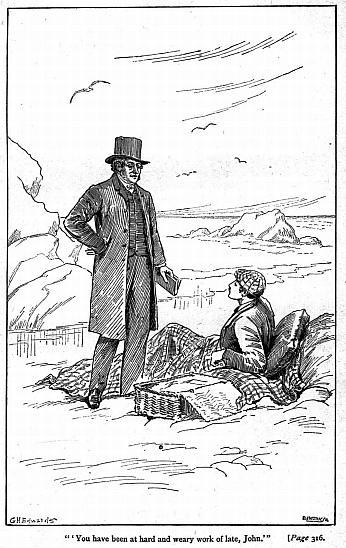 great rocks, on which the sea birds came to rest; on the other side it was open to the sea. Here he left them for the day.
They had not many appliances for the comfort of the invalid, but they had all that were needed. A pillow and a plaid spread on the sand made his bed, and another plaid covered him when the wind came fresh. In the unexplored basket which Mrs Beaton had provided they had perfect faith for future needs, and so they rested and looked out upon the sea.
They had not much to say to one another at first. Mr Hume had brought a book in his pocket, from which he read a page now and then, sometimes to himself and sometimes to his friend; and as John lay and listened, looking away to the place where the sky and ocean met, he fell asleep, and had an hour and more of perfect repose.
How it came about, I cannot tell, but when he opened his eyes to meet the grave, kind eyes of the minister, looking down upon him, there came to him an utter softening of the heart—a longing unspeakable for the rest and peace which comes with the sympathy, be it voiced or silent, of one who is pitiful and who understands.
The minister put forth his hand and touched the hand of his friend.
“You have been at hard and weary work of late, John, or shall I say, you have been fighting a battle with a strong foe? and it has gone ill with you.”
John had no words with which to answer him. His lips trembled and the tears rose to his eyes.
That was the beginning. They had enough to say to one another after a little time; but not a word of it all is to be written down. Of some things that passed between them neither ever spoke to the other again. Before all was said, John “had made a clean breast of it” to the minister, and had proved in his experience, that “faithful are the wounds of a friend,” and that “a brother is born for adversity.” They had been friends before that day. Thenceforth they were brothers by a stronger tie than that of blood.
When John was brought home to his mother that night, she could not but be doubtful of the good which their day had done him. But he was rested and cheerful in the morning, and she was not doubtful long. As time passed, she could not but see that he was less impatient of his weakness and his enforced idleness; that he was at peace with himself, as he had not been for many a day, and that he was looking forward to renewed strength with a firmer purpose and a more hopeful heart.
Chapter Twenty Two.
“And so, taking heart, he sailed
Westward, not knowing the end.”
Dr Fleming was by no means satisfied with the progress which his patient was making. He had called at the house with Mr Hume, and had expressed himself very decidedly as to the desirableness of a change for the young man, but he did not approve of Nethermuir, and he startled them all by saying:
“What you need is a sea voyage. It will take time and it will take money, but it is the very thing you need to make a new man of you. And the sooner you go the better.” And then he went away.
“You should go to America, John, where so many are going these days,” said the minister.
Mrs Beaton looked from one to the other with appealing eyes; and seeing this, John said nothing. Not a word more was spoken on the subject that day nor the next. On the third, as they sat together by the fireside in the gloaming, Mrs Beaton said:
“Well, John, what do you think?”
“Well, mother, I think the worst is over. I am growing stronger every day.”
His mother smiled and shook her head.
“You havena won far on yet,” said she. “But it was about the voyage to America that I was wishing to hear.”
“It might do me good, but it is not absolutely necessary, I suppose.”
“You might take a voyage without going so far as America.”
“Yes, that is true.”
“And the sooner the better for us both,” said his mother, after a pause.
“A voyage to America would be as safe as any other, though it would be a long one.”
“Yes, it would be a long voyage. America is far, faraway. And when you were once there, you might take it in your head to bide there.”
“And you wouldna like that, mother?”
“I mightna like it, but it might be for your good, for all that.”
“It wouldna be for my good to go away anywhere and leave my mother behind me,” said John gravely. “Would you come with me, mother?”
“No, lad; no. I couldna do that for several reasons. But if you were to go there, and should see a prospect of prosperous days, I might follow you.”
“Would you, mother dear?”
John rose and walked up and down the room a good many times. His mother waited with patience till he sat down again.
“Well, John?” said she.
“Do you mean it, mother?”
“Surely I mean it, or I wouldna say it. I should like better that you should content yourself at home. But it would be a new beginning.”
“Yes, it would be a new beginning,” said John gravely.
“It would need to be that, even here, in some ways, I suppose, and a new beginning might be easier there.”
“Have you been thinking about all that, mother?”
“Surely! What else have I to think about but that which concerns you, who have your life before you?”
“And wouldna you be afraid of the long voyage, and the going to a strange land and leaving all behind you?”
“I would have my fears, I daresay, like other folk; but I would have few to leave if you were away; and I would have you to welcome me.”
“I might come home for you in the course of a year or two.”
“You could hardly do that without interfering with your work, whatever it might be. But I might come to you with some one else. I feel strong and well now.”
“You are none the worse for the winter, mother?”
“None the worse, but much the better,” said she cheerfully. And then she paused to consider whether it would be wise to say more.
“It will hurt him, but it may help him as well,” she thought; and then she said aloud:
“I am far stronger than I was when I came here, and in better health every way. I may tell you now, since it is over, that all the last summer I was afraid—ay, sore afraid, of what might be before me. But I had a few words with Dr Fleming about myself, and he bade me put away my fears, for I had mistaken my trouble altogether. It was a great relief to my mind, and he helped my body as well. I am a stronger woman to-day than I ever thought to be.”
John, remembering the lingering illness of an aunt, knew or guessed what her fear had been, and he grew white as he met her eyes.
“Are you sure, mother,” said he hoarsely, “that you are now safe from all fear?”
“As sure as the word of a skillful doctor and honest man can make me. Yes, I think I may say I have no fear now.”
“And you kept this dread to yourself! Oh! mother! mother!” said John, covering his face with his hands.
She had been enduring this trial—this great dread, in one way worse to meet than suffering itself would have been; while he, full of himself and his own plans and disappointments, had been taking no heed.
“I have great reason to be thankful,” said Mrs Beaton softly; “and, John lad, what could I do, but keep my fears to myself till I was quite sure? You had your own trouble to bear, as I could well see, and it would have made mine none the less to add to your pain.”
“Oh! mother! mother!” was all her son could say.
“John,” said Mrs Beaton, after a time, “I think you might tell your mother!”
John raised his head and laughed, but there were tears in his eyes as he came over to her, and stooping, he softly kissed her. “Do you need to be told, mother?” said he.
These were the very first words which had passed between them concerning the sorrow which had come to them both through Allison Bain, and they were nearly all that were ever spoken.
“I grieved for you, John, and I feared for you; but I trusted Allison Bain. If she does not love him, he is in no danger, I said. If she loves him, she will withstand him for his own sake.”
“Be content, mother. She withstood me, whether she loved me or not.”
“I thank God for you both. May He ever lead you in His own way!”
Of course a voyage was to be taken. There was some hesitation as to whether John should avail himself of the opportunity offered by a ship which was to sail at once to bring home timber from Norway, or wait a little longer for the Griffin, an emigrant vessel, bound for Quebec. There were already great steam vessels crossing the ocean—not many of them, however, at this time, but the long voyage would be rather an advantage in John’s case, and he made up his mind to go by the Griffin. But he said nothing to make any one suppose that he did not intend to return with her. There would be time enough to decide as to the length of his stay, when he had seen the country.
So the mother and son bade one another farewell for a while, and Mrs Beaton was the more courageous of the two when it came to the last words between them. But they did not linger over last words. Robert Hume had come to say good-bye to his friend, and to take care of Mrs Beaton on her homeward journey to Nethermuir, and he was amazed at John’s “down-heartedness.”
“Oh! man! if I only had your chance! Or if I were going with you!” said he, and John echoed his wish.
He had been a good many days out of sight of land, before he began to take himself to task for his utter inability to feel, or to profess an interest in that which was going on about him. He was, indeed, very down-hearted, as Robert had said. He said in his foolishness:
“My days are past. My purposes are broken off, even the thoughts of my heart.”
And he told himself that, except for his mother’s sake, it did not matter whether he made his home in America or in Scotland, or whether he should ever make a home at all. But this melancholy did not continue long. Little by little the salt winds brought him health and strength. They blew away his foolish fancies, and soothed the smart of a pain real, and ill to bear. Then he began to see and to interest himself in that which was going on in the little world around him.
There were all sorts of people in it—fathers and mothers, and little children, young men and maidens. There were doubtful characters among them, it is to be supposed; some of them seemed to be poor enough, and some were evidently “well-to-do.” All were alike cheerful and not afraid of the future, for they were all looking forward to having land of their own and a fair chance in the new world.
John made acquaintance with many, and made friends with a few, and got good, and tried to do good among them. There is time to make acquaintance during a voyage which lasts for weeks, and the seventh week was over before they anchored within sight of the citadel of Quebec.
There are letters still in existence in John’s handwriting—great sheets, larger than common foolscap, written in small, even characters, like “copper-plate,” and so written that every available hairbreadth of space is covered, except that part which, when the elaborate process of folding was accomplished, was left blank for the address. There are a good many of these letters, and there is great variety both as to matter and to manner among them, some of them being addressed to his mother and others to the minister and to Robert. Altogether, they might afford material for a very full account of John’s first impression of the scenery, the climate, the character of the people, the state of morals and manners, of education and religion in the new country to which he had come.
When they fell into John’s hands many years after they were written, he enjoyed the reading of them greatly. He was very proud of the handwriting for one thing, and pleased with the evidence they gave of his patient and faithful efforts to satisfy his correspondents, both as to the quantity and the quality of the information conveyed.
His descriptions of natural scenery, of the grand river Saint Lawrence, the mountains, the islands, the great falls of Niagara, were very fine—“perhaps a little too fine”—he acknowledged. But his opinions as to the state of morals and manners, education and religion, and American institutions generally, were greatly modified by the time he read his letters again; his “first impressions” may therefore be omitted in his story, and his adventures also, which were not of extraordinary interest, even to himself, until he came to the town of Barstow in the United States, the only town in all America which at that time had any special attraction for him.
In those days Barstow used to be spoken of as a Western town; but so many new States have been made since then, and so many towns and cities have risen up far to the westward, that it is now regarded as belonging to the eastern part of the great republic. It was not a large town when John Beaton first saw it. It had a few long, tree-shaded streets, where the great square, white houses, stood far apart, with pleasant lawns and gardens about them. Even the business streets were wide and clean, and had trees growing in them; and, altogether, “the place gave one the idea of plenty of elbow room,” as John told Robert Hume in the first letter which he wrote there.
But he did not tell Robert or any one else why he had turned his face thitherward.
Before Dr Fleming had ended the sentence which declared that a sea voyage would be the best thing for his patient, John was saying to himself, that to the town of Barstow, where Alexander Hadden lived, and where William Bain was likely to go at last, wherever he might be lingering now, he should first direct his steps when his voyage was ended. If such a thing were possible, Allison’s heart should be set at rest concerning her brother.
But now that he was there, for a reason which he could not well have declared to any one, he hesitated to apply to Mr Hadden for the information which he desired. It would be more natural and more agreeable to them both, he thought, that meeting William Bain as it were by chance, he should claim him as a countryman, and strive to win his confidence first of all. Afterward, he might be able to help and influence him. And it was too likely that he would need both help and influence.
That this lad who, not through wickedness perhaps, but through weakness and folly, had brought sorrow on all who loved him, would have strength and wisdom to resist all temptation, and begin a new life in a new land, was hardly to be believed. Alone, homesick, remorseful, there was little hope of his doing well without help from some one.
“And whatever else I may do, I must first find Willie Bain and help him as he may need, for Allison’s sake.”
But time was precious, and John’s purse was not very deep; and if he were to see anything of this wonderful country, he told himself, he must not linger long in Barstow. But he did linger day after day. He did not seem to care so very much for seeing the country. He was growing well and strong, and to get health and strength was his motive for crossing the sea. He was as well here as elsewhere, and here he must stay. It seemed to be “borne in upon him,” that there was something for him to do in the place.
When several days had passed, he made up his mind that he would go to the bank and see Mr Hadden, and he went. It was too late to see him that day. Mr Hadden had gone home. On that night something happened. John met the man whom he was seeking, face to face.
It could be no one else, he said to himself. For the eyes which met his for a moment were the beautiful, sad eyes of Allison Bain. “Now, God guide me!” said John in strong entreaty, and then he followed the lad. He followed him down one street and up another, and out into the country along the lake shore. The stranger moved more slowly as he went on and stopped at last; and, leaning upon a broken fence, looked out long upon the water.
“I’m not so very strong yet,” said John to himself, as he paused also, for his heart was beating hard and his hands trembled.
While he hesitated whether he should speak at once or wait a while, the lad turned and began to retrace his steps. John addressed him as he passed. “Can you tell me if I am on the right road to—to—Jericho?” said he, at a loss for a name. “No, I cannot tell you. I am a stranger here.”
“A stranger? So am I. And you are a Scotchman, I ken by your tongue. So am I. We are both strangers in a strange land.”
If John had had time to think, he might not have spoken in this way, but it is very likely he might have said nothing which would have answered a better purpose. The lad turned and looked at him.
“Yes, I am a stranger. I have no friends—no one,” he said huskily, and the tears came into his eyes.
“I have no friends on this side of the sea, and not so very many beyond it—besides my mother.”
This, also, was a stupid sort of thing to say, he owned, when he came to think of it, and then he added:
“I have heard that this is a fine country to get on in.”
“Yes, so they say.”
They went on in silence, and very slowly, the stranger walking wearily, as John could see.
“I am done out,” said he at last, stopping and leaning against a tree.
“Yes, so I see. Have you far to go? I will go with you.”
“I have nowhere to go. I came here yesterday, and I slept last night in a boat by the wharf.”
“Then ye’ll just come with me,” said John heartily, giving him his arm to lean upon. He would have liked to ask his name, but he did not. They walked on slowly, till they came to the house where John was staying.
“I have brought a friend,” said he to the mistress of the house. “He will share my room, and I will be responsible for him.”
“He looks sick,” said the woman gravely. “I hope you realise what you are undertaking?”
John thought he “realised” it, but he did not. It would have made no difference, however, if he had. His new friend tossed and muttered all night, and in the morning was unable to raise his head from the pillow, and that was but the beginning. Many days passed before he was able to do so. He was light-headed much of the time, and uttered a great many names, some of them angrily enough, and some of them with love and longing unspeakable. It was, “Oh! mother! mother!” Or, “Oh! Allie! Allie! where are you gone?” through the whole of one painful night when he was at the worst, till the dawn brought sleep at last, and a respite.
He grew better after a while, and the visits of the doctor ceased, but his strength came slowly and his spirits failed him often. The house in which they lodged stood near the water’s edge. The heat was great in the middle of the day, and at night the wind which came from the lake was damp and chill. John saw that a change of place was needed, and he would fain have carried him away to get the fresh air of the country.
“A change is what he needs. We can manage it for a day now and then, to get somewhere,” said John to himself; “and then—I must to work again.”
He knew, or he supposed, that if he applied to Mr Hadden, who had the reputation of being a rich man who did much good with his money, all would be made easy to this stranger; but he himself had the best right to have the pleasure of helping Allison’s brother; and he said to himself:
“I’ll bide a wee. He has not mentioned Mr Hadden’s name, nor his own, for that matter. Yes, I’ll bide a wee, and we’ll manage it in some way.”
Chapter Twenty Three.
“Let us be content to work—
To do the thing we can, and not presume
To fret because ’tis little.”
And it was managed very much to John’s satisfaction, and very easily managed. One morning John hailed an early market-man, returning home with his empty waggon, and asked him if he would take passengers for a little way into the country. The man hesitated only for a minute.
“Well, yes, I guess so—just as well as not. Glad of your company,” said he, after a second glance at John’s face, and away they went together. It paid to have their company their new friend told them, as he took his leave of them.
“If you think of walking back to town to-night, I guess you’ve come far enough,” said he, when they came to the top of the hill.
He left them on a little knoll, sheltered by a few great maple-trees, and having a sloping, stony pasture between it and the lake, and here they spent the morning. John had a book, and he enjoyed it, while his patient slept. But he could not quite put away all anxious thoughts, and he laid it down at last to face them.
What was to be done with this silent lad, who had fallen into his hands? Since the night of their meeting, he had spoken no word about himself, except as he had muttered or cried out unconsciously while the fever was upon him. He had not asked a question or hesitated a moment in letting John do with him as he would, accepting all help and tendance as quietly and naturally as they were cheerfully given.
And John liked all this, in a way. But it could not continue. For the lad’s sake something must be said, something must be done.
“He must be made stronger, and put in the way of doing for himself, before I leave,” said John, thinking rather of the lightness of his purse than of any desire he had to see the country or even to get home again.
“Yes, we must lose no time,” he repeated, and looked up to meet the lad’s eyes fixed on him.
“You have never told me your name,” said he gravely.
John laughed.
“Have I not? Well, it is John Beaton. Did you ever hear it before?”
“No, I have never heard it.”
“And you have not told me yours. It is rather queer, too. The name is usually the first exchange made between men meeting as strangers, when they wish to become friends.”
There was no answer to this. “Well?” said John, after a little.
“I have been thinking—I mean I call myself William Leslie.”
“And is that your name?” asked John gravely.
“Yes, it is my name. It is not all of my name. But what does it matter in this new country? My name is nothing to any one.”
“But it is something to yourself. I havena a fine name, but it was my father’s before me, and my grandfather’s, and I wouldna change it to be called a lord,” said John gravely. “My lad, I hope you have done nothing to make you afraid or ashamed to own your name?”
“I have done nothing that I wouldna do again, ten times over, if it would give me my revenge!” he cried, raising himself up, while his eyes flashed angrily. “It is not for shame, but for safety that I wish to have my name forgotten, and—for Allie’s sake.”
He lay down again, and after the anger, the tears came. Then John did an extraordinary thing. When he stooped to arrange the plaid over his friend, he kissed him on his lips and on his closed eyelids. Then he rose and turned his back upon him.
While he stood thus the rain began to fall, the first drops of a summer shower, which promised to be a heavy one. What was to be done now? Where were they to find shelter? John ran up the hill to the other side of the grove and looked northward toward the threatening clouds, and down over a wide landscape, which even the glooming clouds could not make otherwise than fair. There were fields of grass and grain stretching as far as the eye could reach. There were men at work among the hay, piling high the long wagons, in haste to get it to shelter before the rain came on. A white farmhouse, half hidden by trees, stood near, and great barns with doors wide open, waiting for the coming of the wagons. It did not need a minute for John to take all this in, and in another he was speeding down the hill and over the meadow with his friend in his arms, nor did he pause till he had laid him in one of the barns on a bed of fragrant hay.
“I must go back for the plaid and the basket,” said he; and stooping down, he added gently: “My lad, if any one should ask your name, mind that you are Willie Bain.”
He came back as a great load of hay drew up at the barn door.
“Drive right in under cover, Sam,” said the farmer, who followed. “I expect we’ll have to leave it here. We can’t unload in time to do much more. Hurry up and cock up as much of the rest as you can. If it had only held up another hour!”
The man slid down from the load and made for the field.
“Well how, it begins to look as though it might hold up,” soliloquised the farmer. “I ’most wish I had let him stay. Halloo, Sam!”
But Sam was out of hearing by this time, though he was not making the greatest possible haste to the field.
“Perhaps I might help you to unload,” said John from the dimness of the barn floor. The farmer did not hesitate a second.
“I don’t know who you be, but I expect you are to be trusted to pitch the hay back as fast as I pitch it down. Go ahead.”
John could be trusted, it seemed. The farmer did not succeed in embarrassing him with the abundance of the great forkfuls which he threw down into the mow, and the team was backed out into the yard in what the farmer called “pretty considerable quick time.” And then he saw William Bain sitting with John’s plaid about him, on a bundle of hay in the corner.
“Well! it seems to me that we’re goin’ to have company,” said he.
“We have been enjoying the fresh air up among your trees yonder. But I was afraid of the rain for the lad, who has been ill of late, so we ventured to take possession of your barn.”
“All right. It’s nothing catching he’s had, is it? He’d better go right into the house, hadn’t he?”
But Bain preferred to stay where he was, among the hay. John took his place on the hay-cart, and set out with the farmer to the field.
“Well, I shouldn’t wonder if we saved most of it now. It’s just possible—with your help,” added he, nodding in a friendly way to John. As they passed the door of the farmhouse he called out:
“See here, Myra; there’s company out there in the south barn. You tell grandma she’d better have him in, and see to him. There’s nothing catching, you say? Well, the old lady will fix him up, and make him comfortable; and she’ll like nothing better.”
The rain “held up” for a while, and the farmer and his two men, with the help of John, wrought wonders. When, at last, the rain came down in torrents, the fragrant hay was all safe under cover, and the farmer was triumphant.
Of course John came to the house with him, and there he found Willie Bain sitting in a rocking-chair, content and smiling, under the guardianship of a lovely old woman, whose face told that her pleasure all her life had been found in pleasing and helping others. It was a good sight for John to see.
“He’ll do now,” said he to himself. “He has fallen into good hands. I only wish I might leave him here for a day or two. It would set him up again.”
“Be you brothers?” said the farmer, as he caught the satisfied look with which John regarded the lad sitting at his ease among them.
“We are fellow-countrymen,” said John, “and that makes brothers of us here in a strange land.”
The evening was one to be remembered by these brothers, who had been strangers less than a month ago. A good many times in the course of his life has John told the story of that first evening in Jacob Strong’s house. He has forgotten many things, and times, and places better worth remembering, perhaps, but he will never forget his first coming into that long, low room, through whose open windows shone in the afterglow from the west, when the first heavy shower was over.
There was a wide fireplace, and on high, brass andirons a bright wood fire was burning. Over it was a mantel-shelf on which were arranged candlesticks of brass and snuffer-trays, and various other things quaint and pretty. There was a tall clock in the corner, and a tall looking-glass between the windows. There was a secretary in another corner, with a book-case above it, and some pictures on the walls. The table was laid for tea, and the room and all that was in it was perfect in neatness. Grandma Strong was there waiting for them, and the farmer’s wife and his “little daughter,” as Jacob Strong called a slender girl of sixteen, who was leaning shyly on her grand mother’s chair. He might well remember it, and his friend also, for it was a good day for them both which brought them there, and Jacob Strong and his household proved true friends to them.
Jacob Strong! John told his mother long afterward, that if the Bible had been searched from end to end to find a good name for a good man, none better than that could have been found for their new friend. Not that either of the patriarch’s names fitted him exactly. He was not a “supplanter,” and though he was on the right side, as no one who knew him well would deny or even doubt, yet if one had wished to tell his character in two words, it would not have been as “a soldier of God” that one would have described him. But he was in many ways very like the patriarch, as we see him in the Bible story. He was wise, he was wily, he was patient. He could bide his time and secure his chance, and when it came to that, that he had to yield, of to humble himself, to meet loss, or to dispense beyond what was pleasing to a man who took reasonable satisfaction in getting and in holding, he could yet do it without wincing visibly. He was fortunate in being in the hands of two good women, his mother and his wife, who knew him well, and loved him well, and who were jealous for his honour before men, and for his singleness of heart before God.
Of course John’s knowledge of his character came later, and by slow degrees. But even on this first night he was greatly interested in his talk, which was at once “worldly wise and heavenly simple,” as he afterward heard one of his neighbours say. And Jacob was strong in nature as in name. He could “hold on.” He had paid every dollar which his farm had originally cost him, by the work of his own hands on other men’s farms. And with the help of his mother first, and then of his wife, “who each carried a good head on her shoulders,” as he told John, he had made it pay. By and by he added another hundred acres to the first hundred, and later, when “the Western fever” set in, and people began to talk about prairie lands, and great wheat farms to be made out there in the Far West, one of his neighbours sold out to him, and Jacob’s two hundred acres became four.
“And that is about as much as I want to have on my hands, till labour comes to cost less, which won’t be for a spell, as things look now,” said he.
All this he told to John while a second heavy shower kept him waiting. Before the rain was over, Willie Bain was at rest for the night, in Mrs Strong’s south chamber. Then John told all that was necessary for them to know about the lad,—how, though he had known friends of his at home, he had never seen the lad himself until he had met him by chance on the lake shore. Finding him alone and ill, he had taken him home and cared for him. Bain was better now, and would soon be well. Yes, he meant to stay in the country. As to himself, John could not say whether he would stay long or not; the chances were he would remain for a time.
Then when the rain seemed over, John rose to go. The folk where they lived might be troubled about them. He had something to do in the morning, but in the course of the day he would come back for his friend. And with many thanks for their kindness to the lad, he took his departure.
Since William Bain had acknowledged his name, John thought it right that Mr Hadden should be informed of his arrival in the town, and next morning he went again to see him, at his place of business. He was a good deal surprised at the manner in which Mr Hadden received him. It was not at all as one receives a stranger, he thought, but the reason was soon made clear to him.
John Beaton was not altogether a stranger to Mr Hadden. His name had been mentioned in both letters which Allison had written, as one who had been willing to befriend her brother while he was in prison, and who wished still to befriend him since he was set free. John told of his meeting with the lad, of his illness, and his good fortune in falling into the hands of the kind people out at the farm.
“It must be the Strongs you are speaking of. Certainly he could be in no better hands, if he still needs to be taken care of. And the longer he is there, the better it will be for him.”
“I would like well to leave him there for a while, if they were willing to keep him. I will see how things look when I go out for him to-night.”
Of his own affairs or intentions John said nothing. He spent the rest of the morning in looking about him, in order to ascertain what sort of work there was to be done in the town, to which he might put his hand with a hope of success. There was building going on, and he came at last to a wide yard, where stone-cutting was done, and he said to himself, that if they would but give him a chance, he would fall to, and do his best for a while at least.
But he did not go to inquire at once. He stood thinking of the day when he first tried his hand on the granite of Aberdeen, and earned his shilling before he laid the hammer down again.
“I might have done better, but then I might have done worse,” he admitted with not unreasonable satisfaction. “And if I take it up again, it need not be ‘for a continuance,’ as auld Crombie would say. I must see the lad fairly set to honest work, and then I may go my way.”
He offered himself at the place, and was taken on at once. His wages were to be decided upon when his first day’s work should be done, and it need not be said that his wages were of the best.
When he went to the Strong farm that night, he found that Mr Hadden had been there before him. Willie Bain’s first word to him was:
“Why did you never tell me that ye had seen our Allie?”
“Do ye no’ mind that, till last night you never told me your name? How was I to ken?” added John, as Willie hung his head. “I did ken you as soon as ever I saw your face. Yes, I have seen your sister. She is safe where she is. No evil hand can touch her, and in a while she is coming out here to you.”
Poor Willie Bain was but weak yet, and the tears were running down his cheeks, while John told him in few words what his sister had been doing, how she had won the respect of all who had known her, and how she had now gone away from Scotland with a good friend, but was looking forward to the time when she might join her brother, so that they might have again a home together.
“And, Willie, my lad,” added John, gravely, “if I had a sister like yours, I would make a man of myself for her sake.”
“You are a man already,” said Willie, with a sound which might have been either a laugh or a sob. “As for me—yes, I ken I havena been taking right care of myself for a while. I fell into ill hands down yonder. But now I have you, and I will be a man for Allie’s sake.”
There had been tokens visible of the fact that the young man had not been “taking care of himself,” but John had spoken no word which betrayed his knowledge.
They were in the garden at this time, sitting in a wide, green walk, between high rows of currant-bushes, a great apple-tree making a grateful shade around them. By and by they rose and walked up and down, John lending his strength to help his friend’s weakness; and he asked:
“Would you not like to stay here a little while?”
“Till I get my strength back again? Yes, I would like it well. I mean sometime to have land of my own, and could begin to learn here the new ways that are needed in a new country. Yes, I would like well to bide here for a while.”
He spoke eagerly and hopefully.
“I wish Allie were here. There would be no fear then,” said Willie, looking up at John with Allie’s wistful eyes.
“She cannot come for a time. It is likely that she might be sought for here—in Mr Hadden’s neighbourhood, I mean. But, Willie man, I think it is as well that she should not come just now, even for your sake. It is you who would be looking up to her, because she is wiser than you, and maybe stronger. She would lead, and you would follow. That might be well, in a way. But it would be better, it would be far more manly for you to learn to stand by your own strength—to walk by your own wisdom. Of course, I mean by the help of God, in all things,” said John, gravely.
“Do ye ken Allie well?” asked Willie, looking up into his friend’s face.
John hesitated a moment.
“I cannot say that I have known her long, or seen her often. But I know that she has borne much trouble well and bravely, and that she must be strong. And I know that she has walked warily and done wisely in difficult places, so that all those who do know her well, respect her, and some few people love her dearly—my mother among the rest.”
“You must tell me all about her some time,” said Willie, with glistening eyes.
“Yes,” said John. Then he paused before he added:
“I think, Willie, in speaking of your sister to any one here, you should say nothing about her marriage, since it has not been a happy one.”
Willie withdrew his hand from John’s arm, and turned upon him with a face white with anger.
“Married! Happy! I’ll swear that he has never touched her hand, nor looked in her face, since that cursed day. Call you that marriage?”
“Thank God!” said John; “and may he never touch her hand, nor look upon her face. Gently, my friend, she is safe from him now.”
Then he led him back to the shadow of the apple-tree, and told him more about his sister. He told how she had lived at the manse, and how they had valued her there. He told of little Marjorie, whom her father and mother had intrusted to Allison’s care, and of the child’s love for her, and how Allison had been helped and comforted through her love for the child. She was quite safe now, so faraway in the South, and no one would harm her while she was in Mrs Esselmont’s care. John talked on till the lad had grown quiet again, and then they were called to tea.
The first words that Grandma Strong said when they came in together were:
“You don’t think of taking that boy back to that hot place to-night, do you? I don’t think you had better—for a day or two, at least.”
It was all very easily settled after that. John was glad to agree with the dear old woman. Willie was to stay at the farm till he was a little stronger.
“We’re glad to have him stay. Don’t you say a word about it,” was the younger Mrs Strong’s answer, when John tried to thank her for all their kindness to his friend, for whom he felt responsible, he said, until he should be strong and well.
“You had better stay and help us through with haying and harvesting. You could pay your way and his too, and have something over,” said Mr Strong.
But John had his own work laid out before him, and intended to make long hours, so that he could hardly hope to come out to see his friend for a while.
“Come Saturday night and spend Sunday. You can go to meeting here as well as there.”
And John answered:
“Yes, I will be glad to come.”
Does this sudden friendship, this acceptance of utter strangers, without a word spoken in their behalf, except what they spoke for themselves, seem strange, unlikely, impossible? It did not seem strange to John, till he came to think of it afterward as he walked home. Face to face with these kind people, their mutual interest seemed natural enough. In thinking about it, as he went swiftly on in the moonlight, he did wonder a little. And yet why should he wonder? he asked himself.
“Honest folk ken one another, with few words about it. It has happened well, and—not by chance,” added he, reverently, recalling many a one at home who would have him often in their thoughts at the best place—and thinking especially of two, who, in all quiet moments, would be “remembering” both him and his friend there.
It must not be forgotten that all this happened many years ago, before all the nations of the earth had turned their faces toward the West, in search of a refuge from poverty or tyranny, disgrace or despair. There was room enough, and land enough for all who were willing to work and to live honestly. Every strong and honest man who came, while he bettered himself and those who belonged to him, did good also to his neighbours, and to the country at large. And so in those days, as a rule, new comers were well received. But beyond this, John and his friend were liked for their own sakes, and might well rejoice at the welcome which they got at the farmhouse, for a great many good things and happy days came to them through the friends they found there, before all was done.
It is possible that if John had not met in with William Bain in those circumstances, he might have travelled about for a while till he was strong again, and then he might have turned his face homeward. If he had found the lad well, and doing well, he might have contented himself with leaving him to the kindly care, or the unobtrusive supervision of Mr Hadden, who had known his family, and who had promised to befriend him. But John could not quite free himself from a sense of responsibility with regard to Willie Bain. He must keep sight of him for a while. He liked the lad from the first and soon he loved him. He would not be losing time by remaining for a few weeks. He meant to travel by and by, and see the country, and in the meantime he might do something toward helping Willie to make a man of himself for Allison’s sake.
So he went to the stone-yard, and did his day’s work with the rest. It was hard work for a while. He had got out of the way of it somewhat, and he had not got back his strength altogether. The day was long, and he was glad when night came. After the first week, however, he was himself again, and then he grew strong and brown, and was as fit for his work as ever he had been, he told his mother in the second letter which he sent her, after he began.
He told her about William Bain. But that was for herself alone. As no one else in Nethermuir had ever heard of the lad, it was not necessary to speak of him there, lest his name might be mentioned in the hearing of some who might not wish him or his sister well. He did not write to Allison about her brother. Mr Hadden did that, and the story of John’s kindness to the lad lost nothing in being told by him.
Before the summer was over, John had begun to consider the question, whether, after all, it might not be as well for him to stay where he was, and take up a new life in a new land. His mother had more than once in her letters assured him of her willingness to come out to him should he decide to remain in America. But there was to be no haste about it. He must be quite certain of himself and his wishes, and he must have won such a measure of success, as to prove that he was not making a mistake, before she joined him. It might be better for him to be alone for a while, that he might be free to come and go, and do the very best for himself. The best for himself, would be best for his mother. And in the meantime she was well and strong, in the midst of kind friends, and content to wait. And she would be more than content to join him when the right time came.
And so John followed his mother’s counsel. He kept his eyes open and “worked away,” and by the end of the first year, he began to see his way clear to “the measure of success” which his mother desired for him. He had proved himself, as a workman, worthy of the confidence of those who had employed him, and as a man, he had won the esteem of many a one besides. That he worked with his hands, did not in that country, at that time, necessarily exclude him from such society as the town of Barstow offered. But it made him shy of responding to the advances of some of the people who lived in the big white houses among the trees along the street, and who went to the same church in which, after a few weeks of wandering, here and there, John settled down.
The only people whom he came to know very well during his first year, were the Strongs at the farm, and the Haddens. Mr Hadden was friendly with him from the first, because he was a fellow-countryman, and because he was a friend of William Bain’s. Afterward, they were more than friendly, for better reasons. Mr Hadden had no cause to feel surprise in finding in a skilled workman from his native land, a man of wide reading and intelligence. He had found many such among his countrymen who had come to seek a home in his own adopted country. But John Beaton was different from most of those with whom he had come in contact, in that it was not necessary in his case, that allowance should be made for unconscious roughness of manner or speech, or for ignorance of certain ways and usages of society, which are trifles in themselves, but of which it is desirable that one should be aware.
But at this time John did not care much for society of any kind. He never had cared much for it. In Nethermuir he had “kept himself to himself,” as far as most of the townsfolk were concerned, and it must be owned, that beyond his own small circle of friends in the manse, and in one or two other houses, he had not been a very popular person. He had no time to give to anything of that sort, he had always said, but he might have found the time, if he had had the inclination. He had not much leisure in Barstow. Still, in the course of the first two years, he came to know a good many people in the way of business; and in connection with the work undertaken by the church to which he belonged, he also made friends whom he valued, but his first friends were his best friends.
All that need be told of the first three years of his residence in Barstow, may be gathered from a letter which he wrote to his mother about that time.
“You ought to be a happy woman, mother, for you have gotten the desire of your heart. Do you not mind once saying to me, that you desired for me nothing better in this life, than that I should do as my father had done, and make my own way in the world? Well, that is just what I am doing. There is this difference between us—that I have got ‘a measure of success’ on easier terms than my father did. I am not a rich man, and I have no desire to be one—though even that may come in time. But I stand clear of debt, and I see a fair way to success before me. I have ‘got on’ well even for this country, where all things move more rapidly than with us at home.
“I have had two friends who have stood by me all these years. They have helped me with their money, with their names, and with their influence. I might, in the course of time, have gotten on without their help, but they have taken pleasure in standing by me, like true friends.
“Yes, I have liked my work, and my way of life, though to you I will own that I have sometimes wearied of them—and of everything else. But one’s life must go on till God’s will brings it to an end, and I know of no other way that would suit me better now. And between whiles, as I have told you before, I find higher work which I am able to help along.
“And now, dear mother—when are you coming home?—For this is to be your home, is it not? You say you are able to come alone. But if you can wait a few months longer I will go for you. I have building going on in different parts of the city, and the foundation of your own house is laid, on the knowe (knoll), which I have told you of, beneath the maple-trees, and full in sight, the great lake into which the sun sinks every night of the year. In six months it will be ready for you, and I shall be ready to cross the sea to bring you home.
“I long with all my heart to have my mother here. I think I shall be quite content when that time comes.
“William Bain had told me about his sister before your letter came. He was wild with anger, and said, some things which he has taken back since then. I heard from Mr Hume and from Mrs Hume, as well. I cannot blame them for their advice—or rather, for their silence. And I cannot blame Allison Bain for what she has seen right to do. God bless her—Amen.”
And so the letter ends, without even his name.
Chapter Twenty Four.
“Oh! Blessed vision! happy Child.”
“Are you sure you are glad to come home, Allie dear?” said Marjorie Hume, looking up rather doubtfully into her friend’s face, for Allison had said not a word in answer to her exclamations for some time.
They were walking together through a wide street in Aberdeen, and Marjorie had been amusing herself looking at the people whom they met, and at the pretty things in the shop windows, and had been enjoying it all so much that, for a while, she had never doubted that Allison was enjoying it also. But Allison was looking away to the sea, and her face was very grave, and there was a look in her eyes that Marjorie had not seen in them for a long time now. The look changed as the child repeated the question:
“Allie, you are surely glad to be going home?”
“I am very glad to be bringing my darling home strong and well to her father and mother and them all. They will be more than glad to see us again.”
“And, Allie dear, it is your home too, till Mrs Esselmont wants you again. And you will try to be happy there? And you will not be ay wishing to win away to your brother in America—at least for a while?”
“No, not for a while. But I must go when he sends word that he needs me. That may be sooner than we ken. When he gets his own land, and has his house built, then I will go. But I am in no hurry,” said Allison, after a pause. “And now let us go and take a look at the sea. It is too early yet to see Dr Fleming.”
“But it is not the same sea that we have been looking at so long—the sea that has helped to make me strong and well.”
“It is a grand sea, however, and it is our own. And to-day it is as bonny, and smooth, and blue, as ever the Southern Sea was, and the same sun is shining upon it. And we must make haste, for we have no time to lose.”
They did not go at once, however. As they turned into the next street, a hand was laid on Allison’s arm, and looking up she met the eyes of one whom she had not seen for many a day. She had last seen him looking sorrowfully down on the face of her dying father.
“Mr Rainy!” cried she, faintly, thinking of that day.
“Eh! woman, but I am glad to see you after all this time. Where have you been since that sorrowful day? I was just thinking about you as I came down the street. I must believe in a special Providence after this. I was just saying to myself that I would give a five-pound note, and maybe twa, if I could but put my hand on Allison Bain. And lo! here ye are. And, Allison, my woman, if your father could speak to you, he would say, ‘Put yourself into my old friend’s hand, and be advised and guided by him, and ye’ll never have cause to repent it.’ And now I say it for him.”
Allison shook her head.
“I cannot do that—blindly. I need neither the help nor the guidance that you would be likely to give me. I must go my way with the child.”
“The child! Ah! yes, I see, and a bonny little creature she is,” said Mr Rainy, offering his hand to Marjorie. “And whose child may she be?”
“She is the child of my master and mistress. I have been in service all this time, and I need help from no one.”
“In service! Yes, and among decent folk, I’ll be bound! Well! well! And doubtless you will be able to account for every day and hour that has gone by since you—were lost sight of. That is well.”
“It might be well if there were any one who had a right to call me to account,” said Allison, coldly.
Mr Rainy had turned with them, and they were walking down the street together.
“A right? The less said about rights the better. But this I will say, you have a right to look upon me as a friend, as your father did before you. And I have a right to expect it from you. Your father trusted me, and it will be for your good to trust me likewise.”
“Yes, he trusted you. And if I needed help that you could give, I might come to you for it. But I have only to ask that you forget that you have seen me. Not that it matters much now; I have got over my first fear. I must bid you good-day. We are on our way to see Doctor Fleming. But first we are going down to the sands.”
And then Allison made him a courtesy which minded Marjorie of Mrs Esselmont. Then they went down another street together, and left him standing there.
Mr Rainy had been for many years the friend and legal adviser of the laird of Blackhills, and more than once, in his visits to the great house on the laird’s business, he had given counsel to Allison’s father with regard to his affairs. He had been with him when he was drawing near his end, and had done, what, at that late day, could be done, to set his affairs in order, and to secure, that which he possessed, for the benefit of those he left behind. He had known all the circumstances of Allison’s unfortunate marriage. He had not spared Brownrig when the matter was discussed between them, but in no measured terms had declared his conduct to have been cowardly, selfish, base.
But when Allison disappeared so suddenly, he had done his utmost to find her. That a woman might begin by hating a man, and yet come to love him when he was her husband, he believed to be possible. At the least Allison might come to tolerate her husband if she did not love him. She might come, in time, to take the good of her fine house and of the fine things, of which there was like to be no stint in it, and live her life like the rest, when her first anger at his treacherous dealing was over. For her own sake, for the sake of her good name, and the respect he owed to the memory of her father, Mr Rainy left no means untried, that might avail to discover her. He never imagined it possible that she would remain within a short day’s journey of the place where all her life had been spent.
Of late he had come to believe that she was dead. And he said to himself, that if she could have been laid to her rest beside her father and her mother, no one need have grieved for her death. For her marriage could hardly have been a happy one. All her life long she had forgotten herself, and lived only for her father and mother, because she loved them, and because they needed her. For the same reason she would have laid herself down in the dust, to make a way for her young scamp of a brother to pass over to get his own will. But for the man who had married her she had professed no love, and even in his fine house it might have gone ill with them both.
“But it is different now,” he said to himself, as he went down the street. “Brownrig is a dying man, or I am much mistaken, and he has known little of any one belonging to him for many a year and day. And his heart is softening—yes, I think his heart must be softening. He might be brought to make amends for the ill turn he did her when he married her. As for her, she will hear reason. Yes, she must be brought to hear reason. She seemed to ken Dr Fleming. I will see him. A word from a man like him might have weight with her. I will see him at once.”
Mr Rainy lost no time. He needed to say his say quickly, for the doctor had much before him in his day’s work. The patience with which he listened, soon changed to eager interest. “It is about Brownrig—the man whose horse fell with him in the street—that I want to ask. He was brought to the infirmary lately. You must have seen him.”
Then in the fewest possible words that he could use, Mr Rainy told the story of Allison Bain.
“I met her in the street, and the sight of me hurt her sorely, though she did not mean that I should see it. I came to you because she named your name, and I thought you might help in the matter.”
Dr Fleming listened in silence. He had never forgotten Allison Bain. He had never been told her story before; but through some words spoken by Mr Hadden, and later by Mr Hume, he knew that she had a story, and that it was a sad one. It was not necessary for him to say all this to Mr Rainy, who ended by saying:
“What I want you to tell me is, whether the man is likely to live or to die.” And then he added, with an oath, “If I thought he might live, I would not lift my finger to bring a woman like her, into the power of a man like him. Certainly I would not do so against her will. But if he is to die—that is another thing.”
Doctor Fleming was not the kind of man to be taken altogether into his confidence as to the motive he had in desiring to bring these two together, and he said no more.
“I will see the man to-day,” said the doctor, gravely.
As one door opened to let Mr Rainy out, another opened to admit Allison and Marjorie. It was Marjorie who spoke first.
“My father said I was to come and see you, doctor. I am little Marjorie Hume. You’ll mind on me, I think.”
Doctor Fleming laughed, and lifting the little creature in his arms, kissed her, “cheek and chin.”
“My little darling! And are you quite well and strong?”
“Oh! yes. I’m quite well and strong now—just like other bairns. I’m not very big yet,” added she, as he set her down again. “But I am well. Allie will tell you.”
Allison, who had remained near the door, came forward smiling.
“She is much better indeed,” said she.
“You should say quite well, Allie dear,” urged Marjorie, in a whisper.
“Yes, I may say quite well. Her father wished us to come and see you before going home. Or rather, he wished you to see the child. But your time is precious.”
“Where are you staying? At the old place with Mrs Robb? Well, I will come round and see you this evening. I have a good many questions to ask. You were not thinking of leaving to-day?”
No, they were to remain a day to rest, and some one was to meet them when they left the mail-coach to take them home. The doctor asked a question or two and let them go, but his eyes followed them with interest till they passed round the corner out of sight.
When he came to see them in the evening, he found Marjorie sleeping on the sofa, while Allison sat by her side with her work in her hand. It happened well, for the doctor had some questions to ask which could be answered all the more clearly and exactly, that the child need not be considered in the matter. They spoke softly, not to disturb her, and in answer to the doctor’s questions Allison told briefly and directly all that he wished to know. Indeed, he could not but be surprised at the fulness and the clearness of the account which she gave, of all that the doctor had done. The minutest details of treatment were given; and sometimes the reason, and the result, almost as fully and effectively as they were written down, in a letter which had been sent him by Dr Thorne. To this letter he referred for a moment, and as he folded it up, he said:
“The child fell into good hands. Dr Thorne is a skilful doctor and a wise man. That is well seen in his works and his words.”
“Yes,” said Allison. “You are right there.”
She had spoken very quietly and gravely up to this time. Now the colour came into her cheeks, and her eyes shone as she went on.
“I could never tell you all his goodness. At first he seemed just to wish to please his friend, Mrs Esselmont. I doubt whether he had much hope of helping the child at first. And then he took up the case in full earnest, for the sake of science, or just for the pleasure of seeing what wonderful things skill and patience could do for help and healing. But in a while, it was not just a case with him. He soon came to love her dearly. And no wonder he loved the gentle little creature, ay patient and cheerful and making the best of everything, even when they hurt her, or wearied her, with this thing or that, as whiles they had to do. Not a child in a thousand would have borne all she has come through, to have health and strength at last. And not a doctor in a thousand could have brought her through, I hope, sir, you will excuse my saying so much,” said Allison, pausing suddenly, as she caught the look with which Doctor Fleming was regarding her.
“Oh! yes. I understand well.” And then he opened his letter and read a line or two.
“‘It is a remarkable case altogether. The pleasure I have taken in it has paid me ten times over for my trouble.’”
“I am sure of it,” said Allison, speaking low and eagerly. “I could never tell you all his kindness. You see it was not just saving a life. It was a far greater thing to do than that. It would not have been so very sad a thing for a child like her to have died, to have been spared the trouble that comes into the life of even the happiest, though many would have missed her sorely. But she might have lived long, and suffered much, and grown weary of her life. It is from that that she has been saved, to happy days, and useful. It will be something to see her father’s face when his eyes light upon her. And the doctor speaks in earnest, when he says he took pleasure in helping the child.”
Doctor Fleming looked up from his letter and smiled, and then read a few words more from it.
“‘You will understand and believe me when I say, that her firm and gentle nurse has done more for the child than I have done. Without her constant, wise and loving care, all else could have availed little. She is a woman among a thousand—a born nurse—’”
Allison laughed softly though the tears came to her eyes.
“Did he say that? He is kind. And I am glad, because—if a time should come when—”
And then she paused as she met Marjorie’s wondering eyes. The doctor had something to say to the child, but he did not linger long. He had come with the intention, also, of saying something to Allison of Brownrig’s condition. But he could not bring himself to do it.
“I will wait for a day or two, to see how it is like to be with him. He is not in a fit state to be moved, as the sight of her would be likely to move him. And even if I knew he were able to bear it, I could not by any words about him, spoil her happy homecoming.”
“A happy homecoming!” It was that truly. When they came to the mill, where the houses on that side of the town begin, Marjorie would have liked to leave the gig, with which Robert had gone to meet them, at the point where they left the mail-coach, that all the folk might see that she could walk, and even run, “like the other bairns.” And then everybody would see how wise her father and mother had been in sending her away to a good man’s care. But Robert laughed at her, and said there would be time enough for all that in the days that were coming, and Allison bade her wait till her father and mother might see her very first steps at home.
The time of their homecoming was known, and there were plenty of people to see them as they passed down the street. Every window and door showed a face which smiled a welcome to the child. As for Marjorie she smiled on them all, and nodded and called out many a familiar name; and there were happy tears in her eyes, and running down her cheeks, before she made the turn which brought the manse in sight.
And then, when they stopped at the door, her father took her in his arms, and carried her into the parlour where her mother was waiting for her, and set her on her own little couch which had never been removed all this time, and then the door was shut. But not for very long.
For there were all the brothers waiting to see her, and there was the little sister, who, when she went away, had been a tiny creature in a long white frock, whom Marjorie longed to see. She was a little lass of two years now, rosy and strong as any brother of them all. She was in Allison’s arms when the door was opened to admit them, and the pleasant confusion that followed maybe imagined, for it cannot be described.
That was but the beginning. During the next few days, many a one came to the manse to see the little maiden who had suffered so patiently, though she longed so eagerly to be strong and well like the rest. And now she was “strong and well,” she told them all, and the eager, smiling face was “bonnier and sweeter than ever,” her admiring friends agreed.
And those who could not come to see her, she went to see—auld Maggie and the rest. The schoolmistress was come to the end of all her troubles, before this time, and was lying at peace in the kirkyard. So were some others, that Marjorie missed from the kirk and from the streets, but there was room only for brief sorrow in the heart of the child.
In the course of a few days Marjorie and Allison were invited to drink tea at Mrs Beaton’s, which was a pleasure to them both. Mrs Beaton read to them bits out of her John’s last letters, which told a good many interesting things about America, and about John himself, and about a friend of his, who was well and happy there. Marjorie listened eagerly and asked many questions. Allison listened in silence, gazing into her old friend’s kindly face with wistful eyes.
That night, when the child was sleeping quietly, Allison came back again to hear more. There was not much to hear which Allison had not heard before, for her brother wrote to her regularly now. She had some things to tell John’s mother, which she had not heard from her son, though she might have guessed some of them. He had told her of his growing success in his business, and he had said enough about Willie Bain to make it clear that they were good friends, who cared for one another, and who had helped one another through the time when they were making the first doubtful experiment of living as strangers in a strange land. But Willie had told his sister of his friend’s success in other directions, and he gave the Americans credit for “kenning a good man when they saw him.”
“For,” said Willie, “it is not just an imagination, or a way of speaking, to say, that in this land ‘all men are free and equal.’ Of course, there are all kinds of men—rich and poor, good, bad, and indifferent—here as in other lands. All are not equal in that sense, and all are not equally successful. But every man has a chance here, whether he works with his head or his hands. And no man can claim a right to be better than his neighbour, or to have a higher place than another because of his family, or his father’s wealth. It is character, and intelligence, and success in what one has undertaken to do, that bring honour to a man here. At least that is the way with my friend. If he cared for all that, he might have pleasure enough, and friends enough. He is very quiet and keeps close at his work.
“He has been a good friend to me—better than I could ever tell you, and nothing shall come between us to separate us, that I say, and swear. Sometimes I think I would like to go back to Grassie again, that I might give myself a chance to redeem my character there. But still, I do not think I will ever go. And so, Allie, the sooner you come the better. There is surely no danger now after nearly three years.”
All this Allison read to John’s mother, and there was something more which, for a moment, she thought she would like to read that might give pleasure to her kind old friend. For Willie in his next letter had betrayed, that the “something” which was never to be permitted to come between the friends to separate them, was the good-will of pretty and wayward Elsie Strong, who since she had come home from the school, where she had been for a year or more, “has been as changeable as the wind with me,” wrote poor Willie, and greatly taken up, and more than friendly with Mr Beaton whenever he came out to the farm. And then he went on to say, that he thought of going to look about him farther West before he settled down on land of his own. And he had almost made up his mind to go at once, and not wait till the spring, as he had at first intended to do.
The letter went on to say that John Beaton had bought land, and was going to build a house upon it.
“It is the bonny knowe with the maples on it, looking down on the lake, where John brought me that first day to breathe the fresh air. John saved my life that time, and I will never forget it, nor all his goodness to me since then. Of course, Mr Strong would not have sold a rod of it to any one else. But Elsie is an only child, and it would be hard for him to part from her.
“The more I think of it, the more I wish to go farther West before I take up land of my own—and you must come when I have got it—”
All this Allison glanced over in silence, but she could not bring herself to read it to Mrs Beaton.
“He has told her himself, doubtless, though she has no call to tell it to me. I am glad—or I would be glad but for the sake of Willie, poor lad.”
And then, as she rose to go, the door opened, and Saunners Crombie came stumbling in.
Chapter Twenty Five.
“Show me what I have to do,
Every hour my strength renew.”
“Mistress Beaton,” said the old man, “it is a liberty I am taking to trouble you at this late hour. But I hae been at the manse to get speech o’ Allison Bain, and if I dinna see her the nicht I kenna when I may see her, and it is of importance.”
Allison came forward, and offered her hand with a smile.
“I am sorry that you have had the trouble of seeking for me,” said she.
“That’s neither here nor there. I am glad to see you safe hame again. Ye hae been doin’ your duty down yonder they tell me. May ye ay hae the grace to do it. I hae some words to say to ye. Will ye go with me, or will I say them here? I am just come hame from Aberdeen.”
“And you are done out. Sit you down and rest yourself,” said Mrs Beaton, as she rose. Allison put out her hand to stay her as she was about to leave the room.
“Bide still with me. Mr Crombie can have nothing to say to me, that you may not hear.”
The old man was leaning forward with his hands on his knees, looking tired and ready to fall asleep where he sat. He roused himself as Allison spoke.
“That is as ye shall think yoursel’. This is what I hae to say to you. I hae heard o’ yon man again. I hae seen him. And I hae come to say to you, that it is your duty to go to him where he lies on his dying bed. Ay woman! ye’ll need to go. It’s no’ atween you and him now, but atween you and your Maker.”
“It has come at last,” said Allison, growing pale.
Mrs Beaton sat down beside her, and taking her hand, held it firmly in both hers.
“It was an accident,” went on Crombie. “He had been drinking too freely, they say. He was in the town, and he set off late to go home, and was thrown from his horse. How it happened canna be said, but they found him in the morning lying by the dike-side, dead—it was supposed at first. But they carried him to the infirmary, and he is living yet. He is coming to himself, and kens folk, and he may live to leave the place, but it’s less than likely.”
“And who bade you come to Allison Bain with all this?” asked Mrs Beaton, gravely. “And are you quite sure it is true?”
“Oh! ay, it’s true. I didna come to her with hearsays. I gaed mysel’ to the infirmary and I saw him with my ain een. And who bade me come here to her, say ye? It was the Lord himself, I’m thinking. The man’s name wasna named to me, nor by me. I kenned him because I had seen him before. And it was borne in upon me that I should tell Allison Bain o’ his condition. Or wherefore should the knowledge of it have come to me who am the only one here beside yoursel’ who kens how these twa stand to ane anither?”
But Mrs Beaton’s heart sickened at the thought of what might be before Allison.
“What could she do for him if she were to go there? He is in good hands doubtless, and is well cared for. Has he been asking for her?”
“That I canna say. But ye may ken without my telling you, that there is no saying ‘wherefore?’ to a message from the Lord. And it is between the Lord and this woman that the matter is to be settled now.”
But Mrs Beaton shook her head.
“I canna see it so. If he really needed her—if it were a matter of life and death—”
“A matter of life and death! Do ye no’ see, woman, that it is for more than that? It is the matter of the saving of a soul! Do ye not understand, that a’ the evil deeds o’ a’ his evil life will be coming back now on this man, and setting themselves in array against him, and no’ among the least o’ them the evil he brought on her and hers? And what kens he o’ the Lord and His mercy? And what has he ever heard of salvation from death through faith in the Son of God?”
Mrs Beaton had no words with which to answer him, and they all were silent for a while. Then Crombie began again, more gently:
“And if he were to come out of his fever, with all the dreads and doubts upon him that hae been filling his nights and days, and if he were to see her face with a look of forgiveness on it, and the peace of God, it might encourage him to hope in God’s mercy, and to lippen himsel’—sinner as he kens himsel’ to be—in the hands of Him who is gracious, and full of compassion and tender mercy. Think of the honour of being the means, in the Lord’s hand, of saving a sinner like that!”
The old man had risen, and with his eyes on Allison’s face, spoke earnestly, almost with passion. But as he ended, he sank back into his chair again silent and exhausted. At a word now from Mrs Beaton, Allison rose and went out into the kitchen.
“Mr Crombie,” said Mrs Beaton, softly, “it is a great thing that you are asking of Allison Bain. I know not what to say. I can speak no word to bid her go. I pray that she may be guided aright.”
The old man answered nothing. He seemed utterly spent and helpless.
“You have had a long journey. You are quite worn out,” said Mrs Beaton.
“Ay, have I. And it’s no’ just done yet, and there is a dark house and a silent at the end o’t. But I’ll win through it.”
In a few minutes Allison came in quietly.
“Mr Crombie, you are to come with me to the fire. I have made some tea for you, and you must eat and drink before you try to go home.”
He looked at her without a word. She took his hand, and he rose and went with her to the kitchen, where a table was spread and a small fire burned on the hearth. She put food before him, and though at first he refused it, after a little he ate, and was refreshed. Then he leaned back and seemed ready to fall asleep again.
“Mr Crombie,” said Allison, stooping and speaking low, “I will think of what you have said. I wish to do right, and I pray that God may guide me. Wait here till I come back again.”
She had seen one of Peter Gilchrist’s men on his way to the mill with his cart, at a late hour, and she hoped to find him still lingering about the place. Crombie must be committed to his care, for in his present state he could not be allowed to take his way home alone. Before she could begin to think of what he had said, he must be safely sent on his way. Fortunately, she met the man coming down the street, and Crombie went with him. Then the two women sat down and looked at one another in silence. For the moment, Mrs Beaton was more troubled and anxious than Allison herself.
“My dear,” said she, “it looks as if all these years that you have been kept safe from his hands, had been in vain.”
“No,” said Allison, “much good has come to me in those years. They have not been in vain. Mrs Beaton, I wish to do what is right. Tell me what I ought to do.”
“My dear, I cannot tell you. It is you yourself who must decide. Allison, are you strong enough, or patient enough, to think of what may be before you? Think of living your life—ten—twenty years with a man like that! Yes, it is said that he is dying, but that is what no one can really know. And if you go to him now, it must be till death comes to part you. May God guide you. It is not for me to say what it is right for you to do.” Allison sat silent.
“It is not as though all the blame had been his. I should have stood firm against him. And his life has been ruined as well as mine—far more than mine. God has been very good to me. If I were sure of His will in this thing, I wouldna be afraid.”
“But, Allison! Think of your brother.”
“Yes, it was of him I thought before, and I did a great wrong.”
“Allison, it would be to sacrifice yourself a second time. My dear, at least take time to think, and to seek counsel. You have been taken by surprise. In your great pity for this man, you must not let yourself do what can never be undone.”
“No, I have not been taken by surprise. I have been expecting something to happen ever since I came back again.” And then Allison told of her meeting with Mr Rainy on the street in Aberdeen, and how he had spoken to her of Brownrig.
“He said nothing of his being hurt or in danger. But what he did say, has never been out of my thoughts since then. I seem to have been preparing myself for some great change, all this time. It would be far easier for me to lose myself out of the sight and knowledge of all who know me, than it was when I left my home. I was hardly myself then. My only thought was, how I was to get away. I knew not where I was going. Yet I believe I was guided here.”
Allison spoke with perfect quietness. Mrs Beaton could only look and listen, astonished, as she went on.
“Yes, I was guided here, and much good has come to me since then. And I think—I believe, that I wish to follow God’s wul in this, whatever it may be. And I have only you to help me with your counsel.”
“You have the minister—and Mrs Hume.”
“Yes, I might speak to them—I must speak to them,” said Allison, with a sigh. “I must say something to them. They know nothing of me, except what they have seen with their own eyes. But I do not think they will blame me much, when they know all.”
Mrs Beaton said nothing. Little had ever been said to her, either by the minister or his wife, concerning Allison or her affairs. But in seeking to comfort the mother in her first loneliness, when her son went away, the minister had almost unconsciously shown her that he knew even more of John’s disappointment and remorse than she herself knew. She had made no response, for she believed that for all concerned, silence was best.
As for Brownrig, whether he were dying or not, how could he be helped or comforted by the sight of the woman against whom he had so deeply and deliberately sinned? As to the saving of his soul, God was gracious, and full of compassion. He had many ways of dealing with men, whether in mercy or in judgment. Could it be God’s will that Allison’s life should be still one of sacrifice, and pain, and loss, because of him? Surely, surely not.
Meanwhile Allison was repeating to herself Crombie’s words:
“Life and death! It is the matter of a soul’s salvation! It is not between you and that bad man any more. It is between you and the Lord himself, who is ever merciful, and ready to forgive. Forgive and it shall be forgiven unto you—”
Over and over again, the words repeated themselves to her as she sat in silence, till Mrs Beaton said gently:
“Allison, you have been greatly moved and startled by that which you have heard. You are in no state to decide anything now. Sleep upon it, my dear. Take time to look upon this matter in all lights, before you suffer yourself to be entangled in a net from which there may be no escape for many a year and day—from which you may never, all your life, escape. Allison, do you think the Lord has kept you safe these years, to let you lose yourself now? No, I will say nothing to influence you against your conscience. Do nothing hastily, that is all I ask. Seek counsel, as I shall seek it for you.”
But when the old woman had kissed her, and blessed her, and bidden her good-night, she held her fast and could not let her go, till Allison gently withdrew herself from her clasp.
“Pray to God to guide me in the right way,” she whispered, and then she went away.
Mrs Beaton slept little that night—less than Allison did, though she had much to do before she laid herself down beside little Marjorie. “Seek counsel,” Mrs Beaton had said. And this in the silence of the night, she herself tried to do. And gradually and clearly it came to her that better counsel was needed than that which she would fain have given to her friend.
Was it of Allison she had been thinking in all that she had said? Not of Allison alone. Her first thought had been of her son, and how it might still be God’s will that he should have the desire of his heart. And oh! if Allison could but go to him as she was, without having looked again on that man’s face, or touched his hand, or answered to his name. Surely, for this woman who had suffered much, and long, and in silence, to whom had come the blessed “afterward” and “the peaceable fruits of righteousness,” surely, for her it could not be God’s will that the worst was yet to come. Who could say?
“And yet, ah me! our worst is whiles His best for us and ours! I doubt I have been seeking to take the guidance of their affairs into my ain hand. No, no, Lord! I would not have it for them nor for myself. She is in Thy hand. Keep her there safe. And a soul’s salvation—that is a great thing—”
That was the way in which it ended with Mrs Beaton. But the day was dawning before it came to that. And as the day dawned, Allison was once more standing on the hilltop to take a last look of her place of refuge, and then she turned her face toward Aberdeen.
When she left Mrs Beaton and went round by the green, and the lanes, where she had gone so many times, and in so many moods, she was saying to herself:
“I will speak now, and I will take what they shall say to me for a sign.”
It was later than she had thought. Worship was over, and all the house was quiet, as she knocked at the parlour-door with a trembling hand. The minister sat in his usual seat with an open letter before him, and Mrs Hume’s face was very grave as she bade her sit down. But Allison was in haste to say what must be said, and she remained standing with her hands firmly clasped.
“I have something to tell you, and it must be told to-night. You will try to think as little ill of me as you can. I did wrong maybe, but I could see no other way. But now I am not sure. I think I wish to do God’s will, and you will tell me what it is.”
She spoke low, with a pause at the close of every sentence, and she was very white and trembling as she ceased. Mrs Hume rose, and leading her to a chair made her fit down, and sat beside her, still holding her hand.
“We shall be glad to help you if we can,” said the minister.
Then Allison told her story briefly, so briefly that it is doubtful whether her listeners would have understood it, if they had heard it then for the first time. They had not heard it all, only bits here and there of it, but enough to enable them to understand something of the morbid fear and the sense of utter desolation from which she had suffered, when she first came among them. Her voice grew firm as she went on, and she spoke clearly and strongly, so that many words were not needed. She hesitated a little, when she came to the time when she had asked John Beaton to befriend her brother, but she went on gravely:
“He did not see my brother. He had gone. I had been months away with the child, before I heard that Willie was in America safe and well. It was a friend who wrote to me—Mr Hadden, our minister’s son. Willie is doing well, and some time I am to go out to him—if I can.”
She paused, withdrew her hand from Mrs Hume’s clasp, and rose, saying:
“Now, I must tell you. All this time I have been afraid that—the man who married me would find me and take me to his house in spite of me. But it is I who have found him. It was Mr Crombie who told me about him. He said he had seen him—on his dying bed, and in God’s name he bade me go to him, and tell him that I forgave him for the ill he did me. He said it was not between me and the man who had sinned against me, but it was between me and the Lord himself, and that I must forgive if I would be forgiven. And if you shall say the same—”
Allison sat down and bent her head upon her hands. Mrs Hume laid her hand upon the bowed head, but she did not speak. Mr Hume said:
“I do not see how Crombie has had to do with this matter.”
Allison looked up.
“I should have told you that it was in our parish that Mr Crombie buried his wife. He saw the names of my father and mother on their headstone, and some one there—meaning me no ill—told him about me. And when he came home again, he thought it his duty to point out to me that I might be in the wrong. But I think it must have gone out of his mind, for he never spoke to me again till to-night.”
“And to-night he spoke?”
“Yes. To-night he came to me in Mrs Beaton’s house, and warned me that it was my duty to go to a dying man. And if you tell me the same, I must go.”
She let her face fall again upon her hands.
Mr Hume did not answer her at once. He opened again the letter which he held and read it from beginning to end. It was a letter from Doctor Fleming, of Aberdeen, telling him of the state in which Brownrig was lying, and of his relations with Allison. He left it to Mr Hume to decide whether or not Allison should be told of Brownrig’s condition, and to advise her what she ought to do. He said that Mr Rainy, who had long been a friend of the Bain family, strongly advised that she should come at once to Aberdeen, and added, at Mr Rainy’s request, that as Mr Brownrig had kept up no close intercourse with any one belonging to him, it might be much for Allison’s interest to respond in a friendly spirit to this call. Dr Fleming, for himself, said that it might be for Allison’s future peace of mind, if she could tell this man that she had forgiven his sin against her. The disclosure of Crombie rendered it unnecessary to discuss this letter with her.
“Allison,” said Mr Hume, after some time of silence, “no one can decide this matter for you. You need not fear him any more, and it is well that he should know that you have forgiven him. And it would be well also for you.”
“Have I forgiven him? I do not know. I wish him no ill. I never wished him any ill, even at the worst, and if he is dying—”
Allison paused, and a look of something like terror passed over her face, but she did not utter her thought.
“Allison,” said Mrs Hume, “I think there is much in what Crombie said. If you are able truly to forgive his sin against you, it might help him to believe—it might open his eyes to see that the Lord also is willing to forgive and receive him.”
“You must trust in God, and do not try to look beyond the doing of present duty. The way is dark before you. But one who loves you sees it all, and He will lead you to the end, whatever it may be. I cannot see the end, but, Allison, I dare not bid you not to go,” said Mr Hume, solemnly.
Allison looked from one to the other, and over her face for a moment came the lost look—the look helpless and hopeless, which they had wondered at and grieved over, in the first days of her coming among them. But it passed away, and she rose, Saying:
“Then the sooner I go the better, and I need my time.”
“And, Allison, remember, whatever happens, we are not to lose sight of one another. There is no need for many words between us. This is your home. Come back again as soon as you are able.”
Mr Hume said the same as he shook her hand, Mrs Hume went with her to the room where little Marjorie was sweetly sleeping. The two women had something to say to each other. They spoke very quietly, and when she said good-night, the minister’s wife kissed and blessed her with a full heart.
Strangely enough, Allison fell asleep as soon as her head touched the pillow. The dawn found her up, and ready for the long walk to the point where she was to take the mail-coach to Aberdeen. It cannot be said that she had no misgivings, no faintness of heart, as she turned on the hilltop, and looked back on the house which had been first her refuge, and then her home for so long. For even when she was faraway from Nethermuir, and from Scotland, it was to the manse her thoughts turned as home.
“Shall I ever see it again?” she asked herself, sadly. “And how will it be with me then?”
But her courage did not fail her. She remembered distinctly, or rather, she saw clearly the forlorn creature, who on that drear November day, nearly three years ago, stood looking down on the little town.
“Poor soul!” said she pitifully, as if it had been some one else who stood helpless and fearful there. “Ay! poor soul! But was she not well welcomed, and mercifully dealt with there, till she came to herself again? And has not goodness and mercy followed her all her days since then? Why should I be so sore afraid?”
And so on the strength of that she went peacefully, till she came to the place where she was to take the coach, for which she had to wait a while. When she was seated in it she was sorry that she had not sent on her bundle with it, and walked the rest of the way. For the ceaseless droning talk of two old men, who sat beside her, wearied her, and the oaths and bluster of two younger men, who came in later, made her angry and afraid. And altogether she was very tired, and not so courageous as she had been in the morning, when she was set down at the door of the house where Robert lived when his classes were going on. It was better to go there where she was known, than to seek to hide herself among strangers. And why should she hide herself? She had nothing to fear now.
Ah! had she nothing to fear? What might be waiting her in the future? A life which she might loathe perhaps—
“But I must not look beyond this night, or how can I go on? I am trying to do God’s will. I am not seeking my own. And surely, His will is best.”
But she did not say it joyfully, or even hopefully now, and she had a bad half-hour before the darkness fell, and she could go out unseen. She had another while she waited to see Dr Fleming, and if his coming had been delayed much longer, her courage might have failed her altogether.
He came at last. He had been expecting her, he said, which surprised her, for Mr Hume had said nothing of Dr Fleming’s letter to him. He had, however, sent a note by her to the doctor.
“Well?” said she, when he had read it. “Does he tell you what I am to do? I must have come to you even if he had not sent me. I must tell you—only you may not have time. But if you understood all, I think you would wish to help me,—and—my courage is like to fail.”
“Mistress Allison, you need tell me nothing that it will trouble you to tell. I ken enough of your story to make me wish to help you to do what you believe to be right. And what I can do, I will do with all my heart.”
Allison’s answer was a sudden burst of weeping such as no one had ever seen from her before. While it lasted, the doctor turned away and occupied himself at his desk.
“I hope you will excuse me, sir,” said Allison in a little; “I am tired, for one thing, and—you are so kind. And I am not sure—though I thought I was sure—that I am doing right in coming here—”
“I think I know what you would say. And—I think you are right in what you desire to do. Mistress Allison, it is a blessed thing to be able to forgive. And the greater the sin against us, the greater the blessedness. And to attain to this, our sacrifice must be entire. Nothing can be kept back.”
“But I cannot but keep something back. I dare not look beyond—I think I desire to do God’s will, but—”
“Ah! do not say ‘but.’ Be patient, if you cannot be joyful. You will be brought through. And then—you may help to save a sinful soul. Can you seek to look beyond that?”
Allison shook her head.
“If I were wise and good. But it is only a little since—since I came to trust Him, and whiles I doubt whether I do trust Him right, so fearful and fainthearted am I. I have ay been willing to forgive if I could be kept safe from him. Oh! yes. It was my fault too. I should have trusted God and stood firm,” said Allison, as she had said so many times before. “And besides, it was his own life he ruined, as well as mine. Nay, he did not ruin mine. I have had much to make me content with my life since then. If there had only been the child Marjorie, who loves me dearly, and whom I love. And my brother is doing well. Oh! no, my life has not been spoiled. And the best of all I cannot speak of. Forgiveness! Yes, it is easy to forgive—if that were all.”
“Well, having got thus far, be content for the present. And now, Mistress Allison, let me take the guiding of your works and ways, for a time. I am older than you, and in some things, wiser. You shall be drawn into no net, and you shall make no vain sacrifice at the bidding of any one, if I can prevent it. I believe you are striving to do right. Now, go away to Mrs Robb’s, and try to sleep well, and wait till you hear from me. It may be in the morning, but it may not be for several days. Have you any woman’s work to keep you busy till then?”
“I can find some, I daresay. I give you many thanks for your kind words. My heart is lighter since I have seen your face. Yes, I will be patient and wait.”
“That is the right way. Be sure and keep yourself busy about some kind of work till you hear from me again.”
Chapter Twenty Six.
“What we win and hold, is through some strife.”
Allison waited patiently through one day, and a little anxiously through the second. On the third day there came a note from Doctor Fleming, formal and brief, offering her the place of nurse in the infirmary, which she had held for a short time three years before. Allison was a little startled as she read it, but she did not hesitate a moment in deciding to accept it, and in the evening she went to see him, as he had requested her to do.
“Yes,” said the doctor as she entered, “I was sure you would come; you are wise to come. It will be better for you to have something to take up your time and your thoughts for a while at least, and you will be at hand. You must keep strong and well, and you must take up your abode with Mistress Robb. And, my dear,” added the doctor gravely, “I would advise you when you come to wear a mutch, and if it is big and plain it will answer the purpose none the worse for that. You’ll be better pleased with as little notice as may be for the present.”
Allison smiled and assented. She came to the place the next day in her straight black gown and holland apron, a cap of thick muslin covering all her pretty hair.
And then a new life began for her. The former time of her stay there came back very vividly, but the memory of it did not make her unhappy. On the contrary, she was glad and thankful that strength and courage had come to her since then.
“I will trust and not be afraid,” she said to herself as she came in at the door, and she said it many times as she went from one bed to another. Before the day was over, she had for the time forgotten her own care, in caring for the poor suffering creatures about her.
There were no “bad cases” in the room in which she had been placed. There were some whose chief complaint was the aches and pains of age, brought on before their time by hard labour and exposure; poor folk who were taking a rest after a season of sharper suffering, and making ready for another turn or two of hard work before the end should come.
“It is no’ that I’m sae ill. I hae done mony a day’s work with more suffering on me than I have now. But oh! I’m weary, weary, I hae lost heart, and it’s time I was awa’,” said one old woman who held Allison’s hand, and gazed at her with wistful eyes.
“What brings the like o’ you here?” said another, “to such a place as this. Ay, ay, ye look pitifu’ and ye can lift a head and shake up a pillow without gieing a body’s neck a thraw. But I doubt it’s just that ye’re new to it yet. Ye’ll soon grow hardened to it like the lave (the rest).”
“Whisht, woman,” said her neighbour, “be thankful for sma’ mercies. Ye would be but ill off at hame.”
“And be ye thankfu’ that ye are an auld wife and near done wi’t,” said the neighbour on the other side. “As for mysel’, I’m bowed with rheumatics, and me no’ fifty yet. I may live many years, says the doctor, and what’s to ’come o’ me, the Lord alone kens.”
“But,” said Allison, speaking very softly, “He does ken. Dinna you mind, ‘Even to your old age I am He, and even to hoar hairs will I carry you.’”
“Ay, but ye see, I’m no’ sae sure that He’s with me now, or that He has ever been with me. That mak’s an awfu’ differ.”
“But He is willing to come,—waiting to be asked.”
“It may be; I dinna ken,” said the woman gravely.
They looked at Allison with a little surprise. She was surprised herself. She had no thought of speaking until the words were uttered. She was only conscious of being very sorry for them, and of longing to help them. But she had spoken many a word of comfort among them before her work there was done.
A little child with a face like a snowdrop came and looked up at her, touching her hand. Allison took her up in her arms, and carried her with her as she went on.
“Dinna be troublesome, Nannie,” said a voice from a distant bed.
“Come and see my mother,” said the child.
Her mother was a woman who had been badly burned by her clothes taking fire, while she was in a drunken sleep. She was recovering now, and her little girl was allowed to come and see her now and then.
“Ye can do naething for me,” she said as Allison set down the child beside her.
“No, I fear not, except that I might ease you a little, by shaking up your pillow and putting the blankets straight. Are ye in pain?”
“Ill enough. But it’s no’ the pain that troubles me. It’s the fear that I mayna get the use o’ my hand again.”
“Oh! I hope it mayna be so bad as that,” said Allison, shaking up the pillows and smoothing the woman’s rough hair, and tying her crumpled cap-strings under her chin. “What does the doctor say about it?”
“Ye’ll need to speir at himsel’ to find that out. He says naething to me.”
“We will hope better things for you,” said Allison.
She took the child in her arms again. A fair, fragile little creature she was, with soft rings of golden hair, and great, wistful blue eyes. She was not in the least shy or frightened, but nestled in Allison’s arms in perfect content.
“Come and see Charlie,” said she.
Charlie was a little lad whose right place was in another room; but being restless and troublesome, he had been brought here for a change.
“What ails you, my laddie?” asked Allison, meeting his sharp, bright eyes.
“Just a sair leg. It’s better now. Oh! ay, it hurts whiles yet, but no’ so bad. Have you ony books?”
“No, I brought no book with me except my Bible.”
“Weel, a Bible would be better than nae book at a’.”
“Eh! laddie! Is that the way ye speak of the good Book?” said a voice behind him. “And there’s Bibles here—plenty o’ them.”
“Are ye comin’ the morn?” asked the lad.
“Yes, I am,” said Allison.
“And could ye no’ get a book to bring with you—a book of ony kind—except the catechis?”
“Heard ye ever the like o’ that! Wha has had the up-bringin’ o’ you?”
“Mysel’ maistly. What ails ye at my up-bringin’? Will ye hae a book for me the morn?” said he to Allison.
“If I can, and if it’s allowed.”
“Oh! naebody will hinder ye. It’s no’ my head, but my leg that’s sair. Readin’ winna do that ony ill, I’m thinkin’.”
And then Allison went on to another bed, and backwards and forwards among them, through the long day. There were not many of them, but oh! the pain, and the weariness!—the murmurs of some, and the dull patience of others, how sad it was to see! Would she ever “get used with it,” as the woman had said, so that she could help them without thinking about them, as she had many a time kept her hands busy with her household work while her thoughts were faraway? It did not seem possible. No, surely it would never come to that with her.
Oh! no, because there was help for all these poor sufferers—help which she might bring them, by telling them how she herself had been helped, in her time of need. And would not that be a good work for her to do, let her life be ever so long and empty of all other happiness? It might be that all the troubles through which she had passed were meant to prepare her for such a work.
For the peace which had come to her was no vain imagination. It had filled her heart and given her rest, even before the long, quiet time which had come to her, when she was with the child beside the faraway sea. And through her means, might not this peace be sent to some of these suffering poor women who had to bear their troubles alone?
She stood still, looking straight before her, forgetful, for the moment, of all but her own thoughts. Her hopes, she called them, for she could not but hope that some such work as this might be given her to do.
“Allison Bain,” said a faint voice from a bed near which she stood. Allison came out of her dream with a start, to meet the gaze of a pair of great, blue eyes, which she knew she had somewhere seen before, but not in a face so wan and weary as the one which lay there upon the pillow. She stooped down to catch the words which came more faintly still from the lips of the speaker.
“I saw you—and I couldna keep mysel’ from speaking. But ye needna fear. I will never tell that it is you—or that I have seen you. Oh! I thought I would never see a kenned face again.”
The girl burst into sudden weeping, holding fast the hand which Allison had given her.
“Is it Mary Brand?” whispered Allison, after a little.
“No, it is Annie. Mary is dead and—safe,” and she turned her face away and lay quiet for a while.
Allison made a movement to withdraw her hand.
“Wait a minute. I must speak to some one—before I die—and I may die this night,” she murmured, holding her with appealing eyes. “I’m Annie,” she said. “You’ll mind how my mother died, and my father married again—ower-soon maybe—and we were all angry, and there was no peace in the house. So the elder ones scattered,—one went here and another there. We were ower young to take right heed,—and not very strong. Mary took a cold, and she grew worse, and—went home to die at last. As for me—I fell into trouble—and I dared na go home. Sometime I may tell you—but I’m done out now. I’m near the end—and oh! Allie—I’m feared to die. Even if I were sorry enough, and the Lord were to forgive me—how could I ever look into my mother’s face in Heaven? There are some sins that cannot be blotted out, I’m sair feared, Allie.”
Allison had fallen on her knees by the low bed, and there were tears on her cheeks.
“Annie,” said she, “never, never think that. See, I am sorry for you. I can kiss you and comfort you, and the Lord himself will forgive you. You have His own word for that. And do you think your own mother could hold back? Take hope, Annie. Ask the Lord himself. Do ye no’ mind how Doctor Hadden used to say in every prayer he prayed, ‘Oh! Thou who art mighty to save’? Mighty to save! Think of it, dear. ‘Neither shall any man pluck them out of my hand.’ Jesus said that Himself. Ah! ye are weary and spent—but ye have strength to say, ‘Save me, I perish.’ And that is enough.”
“Weary and spent!” Yes, almost to death. The parched lips said faintly, “Come again,” and the blue, beseeching eyes said more. Allison promised surely that she would come, and she kissed her again, before she went away.
She came often—every day, and many times a day, and she always had a good word to say to the poor sorrowful soul, who needed it so much. Annie lingered longed than had seemed possible at first, and there came a day when every moment that Allison could spare was given to her, and then a long night of watching, till at the dawning she passed away—sinful, but forgiven; trembling, yet not afraid. Allison kissed the dead mouth, and clipped from the forehead one ring of bright hair, saying to herself: “To mind me, if ever I should grow faithless and forget.”
But many things had happened before this came to pass. For at the end of the first week of Dickson’s stay among the sick and sorrowful folk, there came to her the message for which she had through all the days been waiting. It was Doctor Fleming who brought it, saying only, “Come.”
“Is he dying?” she found voice to say, as they passed into the room together.
“No. Oh! no. But he has come to himself, in a measure, and needs to be roused. Your coming may startle him. That is what I wish. It cannot really harm him.”
And so with little outward token of the inward trembling which seized her when she saw his face, Allison stood beside her husband. Yes, her husband! For the first time, scarcely knowing what she did, she said to herself, “My husband.”
The doctors had something to do for him, and something to say to one another, and she stood looking on in silence, pale, but calm and firm, at least as far as they could see. They spoke to him and he answered sensibly enough, and muttered, and complained, and begged to be let alone, as sick folk will, and told them at last that little good had all their physic done him yet.
They let in the light, and his eye followed Allison and rested on her face for a moment; then he sighed and turned away. No one moved, and in a little he turned his head again, and his colour changed. Then they let down the curtain, and the room was in shadow.
“A dream—the old dream, ay coming—coming—only a dream,” they heard him say with a sigh.
Doctor Fleming beckoned to Allison, and she followed him from the room.
“He will sleep now for a while, and when he wakens he will be more himself. You are not afraid to be left with him? He may know you when he wakens again.”
“I am not afraid,” said Allison, speaking faintly, and then she added with a firmer voice, “No, I am not afraid.”
“You have but to open the door and call, and his man Dickson will be with you in a minute. Do not speak to him unless he speaks to you. Even if he should speak, it may be better to call Dickson, and come away.”
Doctor Fleming spoke gravely and briefly, letting no look or tone of sympathy escape from him. “I’ll see you again before I leave the place,” said he.
So she sat down a little withdrawn from the bed and waited, wondering how this strange and doubtful experiment was to end. He neither spoke nor moved, but seemed to slumber quietly enough till Doctor Fleming returned. He did not come in, but beckoned Allison to the door.
“That is long enough for to-day. Are you going to your poor folk again? If it should suit you better to go home, you can do so. Old Flora has returned, and I will speak to her.”
“I will go out for a little, but I will come back. They will expect me. Yes, I would like better to come back again.”
And so she went out for a while, and when she returned she brought an odd volume of the History of Scotland to restless Charlie, and a late rose or two tied up with a bit of sweet-briar and thyme, to poor Annie Brand.
The next day passed like the first. Allison went when she was called, and sat beside the sick man’s bed for an hour or two. He followed her with his eyes and seemed to know her, but he did not utter a word. He was restless and uneasy, and muttered and sighed, but he had no power to move himself upon the bed, and he did not fall asleep, as Allison hoped he might do after a while. For the look in his troubled eyes hurt her sorely. There was recognition in them, she thought, and doubt, and a gleam of anger.
“If I could do something for him,” thought she. “But to sit here useless! And I must not even speak to him until he speaks to me.”
She rose and walked about the room, knowing that the dull eyes were following her as she moved. When she sat down again she took a small New Testament from her pocket, and as she opened it he turned his face away, and did not move again till a step was heard at the door. Then as some one entered, he cried out with a stronger voice than had been heard from him yet:
“Is that you, Dickson? Send yon woman away—if she be a woman and not a wraith (spirit),” he added, as he turned his face from the light.
It was not Dickson. It was the doctor who met Allison’s startled look as he came in at the door.
“You have had enough for this time. Has he spoken to you?” said he.
“He has spoken, but not to me. I think he knew me, and—not with good-will.”
“You could hardly expect that, considering all things. He has made a step in advance, for all that. And now go away and do not show your face in this place again to-day. Wrap yourself up well, and go for a long walk. Go out of the town, or down to the sands. Yes, you must do as I bid you. Never heed the auld wives and the bairns to-day. I ken they keep your thoughts on their troubles and away from your own. But you may have a good while of this work yet,—weeks it may be, or 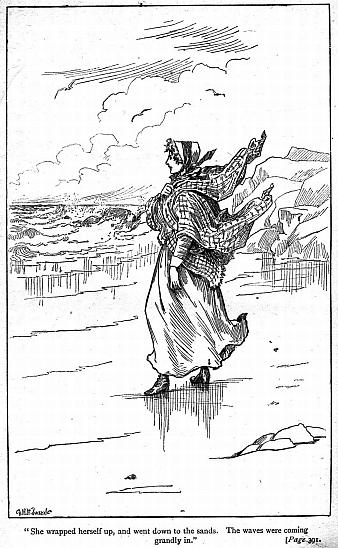 months,” and in his heart he said, “God grant it may not be for years.”
“Yes, I will go,” said Allison faintly.
“And you must take good care of yourself. Mistress Allison, you have set out on a road in which there is no turning back now, if you would help to save this man’s soul.”
“I have no thought of turning back,” said Allison.
“That is well. And to go on you will need faith and patience, and ye’ll also need to have a’ your wits about you. You’ll need perfect health and your natural strength, and ye’ll just do my bidding in all things, that you may be fit to meet all that is before you—since it seems to be God’s will that this work is to fall to you.”
Allison went at the doctor’s bidding. She wrapped herself up and went down to the sands, to catch the breeze from the sea. It was more than a breeze which met her. It was almost a gale. The waves were coming grandly in, dashing themselves over the level sands. Allison stood and watched them for a while musing.
“And each one of them falls by the will of the Lord. A word from Him could quiet them now, as His ‘Peace, be still,’ quieted the waves on the Sea of Galilee so long ago. ‘Oh! ye of little faith!’ said He, ‘wherefore do ye doubt?’ As He might well say to me this day, for oh! I am fainthearted. Was I wrong from the beginning? And is my sin finding me out? Have I undertaken what I can never go through with? God help me, is all that I can say, and though I must doubt myself, let me never, never doubt Him.”
And then she set herself to meet the strong wind, and held her way against it till she came to a sheltered spot, and there she sat down to rest. When she turned homeward again, there was no strong wind to struggle against. It helped her on as she went before it, and it seemed to her as if she had come but a little way when she reached the place where she had stood watching the coming in of the waves. The weight was lifted a little from her heart.
“It is only a day at a time, however long it may be,” she told herself. “It is daily strength that is promised, and God sees the end, though I do not.”
Yes, daily strength is promised, and the next day, and for many days, as she went into the dim room where the sick man lay, Allison felt the need of its renewal. It was not the silence which was so hard to bear. It was the constant expectation, which was almost dread, that the silent lips might open to speak the recognition which she sometimes saw in the eyes, following her as she moved. There were times when she said to herself that she could not long bear it.
“In one way he is better,” said the doctor. “He is coming to himself, and his memory—his power of recalling the past—is improving. He is stronger too, though not much, as yet. With his loss of memory his accident has had less to do, than the life he had been living before it. He has had a hard tussle, but he is a strong man naturally, and he may escape this time. From the worst effects of his accident he can never recover. As far as I can judge from present symptoms, he will never walk a step again—never. But he may live for years. He may even recover so as to be able to attend to business again—in a way.”
Allison had not a word with which to answer him. The doctor went on.
“I might have kept this from you for a while, but I have this reason for speaking now. I do not ask if you have ‘counted the cost.’ I know you have not. You cannot do it. You have nothing to go upon which might enable you to do so. Nothing which you have ever seen or experienced in life, could make you know, or help you to imagine, what your life would be—and might be for years,—spent with this man as his nurse, or his servant—for it would come to that. Not a woman in a thousand could bear it,—unless she loved him. And even so, it would be a slow martyrdom.”
Allison sat silent, with her face turned away.
“What I have to say to you is this,” went on the doctor. “Since it is impossible—if it is impossible, that such a sacrifice should be required at your hands, it will not be wise for you to bide here longer, or to let him get used to you, and depend upon you, so that he would greatly miss you. If you are to go, then the sooner the better.”
Allison said nothing, but by her changing colour, and by the look in her eyes, the doctor knew that she was considering her answer, and he waited patiently.
“No,” said Allison, “I do not love him, but I have great pity for him—and—I am not afraid of him any more. I think I wish to do God’s will. If you do not say otherwise, I would wish to bide a while yet,—till—it is made plain to me what I ought to do. For I was to blame as well as he. I should have stood fast against him. I hope—I believe, that I wish to do right now, and the right way is seldom the easy way.”
“That is true. But many a sacrifice which good women make for men who are not worthy of it, is made in vain. I do not like to think of what you may have to suffer, or that such a man should have, as it were, your life at his disposal. As for you, you might leave all this care and trouble behind you, and begin a new life in a new land.”
“That was what I meant to do. But if the Lord had meant that for me, why should He have let me be brought here, knowing not what might be before me?”
“I doubt I am not quite free from responsibility in the matter, but I thought the man was going to die.”
“No, you are not to blame. When Mr Rainy touched my arm that day in the street, I seemed to know what was coming, and I would not wait to hear him. And when Saunners Crombie spoke his first word to me that night, I kenned well what I must do. But like you, I thought he was going to die. And so I came, though I was sore afraid. But I am not afraid now, and you might let me bide a little longer, till I see my way clearer, whether I should go or stay.”
“Let you stay! How could I hinder you if I were to try? And I am not sure that I wish to hinder you. I suppose there may be a woman in a thousand who could do as you desire to do, and come through unscathed, and you may be that woman. My only fear is—no, I will not say it. I do believe that you are seeking to do God’s will in this matter. Let us hope that during the next few days His will may be made clear to you, and to me also.”
But Mr Rainy had also a word to say with regard to this.
“If I had thought it possible that the man was going to live, I would never have spoken to you, or let my eyes rest upon you that day. Yes, I was sure that he was going to die. And I thought that you might do him some good maybe—pray for him, and all that, and that his conscience might be eased. Then I thought he might make some amends at last. But well ken I, that all the gear he has to leave will ill pay you for the loss of the best years of your youth, living the life you would have to live with him. I canna take upon myself to advise you, since you havena asked my advice; but really, if ye were just to slip away quietly to your brother in America, I, for one, would hold my tongue about it. And if ever the time should come when you needed to be defended from him, I would help you against him, and all the world, with right good will.”
Allison thanked him gently and gravely, but he saw that she was not to be moved. A few more days, at least, the doctor was to give her, and then she must decide. Before those days were over something had happened.
One day, for some reason or other, she was detained longer than usual among her “auld wives,” and it was late when she came into Brownrig’s room.
“What has keepit you?” said he impatiently.
It was the first time he had ever directly addressed her.
“I have been detained,” said Allison quietly. “Can I do anything for you, now that I am here?”
“Detained? Among your auld wives, I suppose. What claim have they upon ye, I should like to ken?”
“The claim they have on any other of the nurses. I am paid to attend them. And besides, I am sorry for them. It is a pleasure to be able to help them—or any one in distress—my best pleasure.”
To this there was no reply, and Allison, who of late had brought her work with her to pass the time, went on knitting her little stocking, and there was silence, as on other days.
“What do you mean by saying that you are paid like the other nurses?” said Brownrig after a little.
“I mean just what I said. Doctor Fleming offered me the place of nurse here. I held it once before, and I like it in a way.”
No more was said to Allison about it then or afterward. But Brownrig spoke to Doctor Fleming about the matter, on the first opportunity, declaring emphatically that all that must come to an end. He grew more like his old self than he had been yet, as he scoffed at the work and at the wages.
“It must end,” said he angrily.
“Mr Brownrig,” said the doctor gravely, “you may not care to take a word of advice from me. But as you are lying there not able to run away, I’ll venture to give it. And what I say is this. Let weel alane. Be thankfu’ for sma’ mercies, which when ye come to consider them are not so very sma’. Yes, I offered her the place of nurse, and she is paid nurse’s wages, and you have the good luck to be one of her patients. But ca’ canny! (Be moderate). You have no claim on Mistress Allison, that, were the whole story known, any man in Scotland would help you to uphold. She came here of her own free will. Of her own free will she shall stay—and—if such a time comes,—of her own free will she shall go. In the meantime, take you all the benefit of her care and kindness that you can.”
“Her ain free will! And what is the story about Rainy’s meeting her on the street and threatening her with the law, unless she did her duty? I doubt that was the best reason for her coming.”
“You are mistaken. Rainy did not threaten her. He lost sight of her within the hour, and would have had as little chance to find her, even if he had tried, as he had last time. No, she came of her own free will. She heard from some auld fule or other, that you had near put an end to yourself at last, and he told her that it was her duty to let bygones be bygones, and to go and see what might be done to save the soul of her enemy.”
“Ay, ay! her enemy, who wasna likely to live lang, and who had something to leave behind him,” said Brownrig, with a scowl.
“As you say,—who has something to leave behind him, and who is as little likely to leave it to her, as she would be likely to accept it, if he did. But that’s neither here nor there to me, nor to you either, just now. What I have to say is this. Take ye the good of her care and her company, while ye have them. Take what she is free to give you, and claim no more. If she seeks my advice, and takes it, she’ll go her own way, as she has done before. In the meantime, while she is here, let her do what she can to care for you when the auld wives and the bairns can spare her.”
And with that the doctor bade him ‘good-day,’ and took his departure.
Chapter Twenty Seven.
“God liveth ever,
Wherefore, soul, despair thou never.”
Brownrig was better in mind and in body than when Allison first came, but he was far from strong. His mind was not quite clear, and it was not easy for him “to put this and that together,” in a way to satisfy himself, when the doctor went away. He was already “muddled,” as he called it, and he did the best thing he could have done in the circumstances, he shut his eyes and fell asleep.
Before he woke Allison came in, and when he looked up, he saw her sitting with her work on her lap, and yesterday’s newspaper in her hand, reading: and smiling to herself as she read.
“Weel, what’s the news the day?” said he.
Allison did not start or show the surprise she fell at being thus addressed.
“Will I read it to you?” she asked.
She read about the markets and the news of the day; but whether he were getting the good of it all or not, she could not say. When she thought she had read enough, she laid down the paper and took up her work as usual.
That was the beginning. All the days passed like this day for a while, except that a book took the place of a newspaper sometimes. And by and by, the best of books had a minute or two given to it—rarely more than a minute or two. Brownrig listened to that as he listened to the rest, willingly, and sometimes with interest, when she chanced to light on a part which had not been quite forgotten in the long careless years which had passed since the time his dead mother used to read it with him and his little sisters, when they were children at home. When he looked interested, or made a remark on any part of what she read, Allison went over it again, and now and then took courage to speak a word or two of Him who “bore our griefs and carried our sorrows,” and who died that we might live. He listened always in silence. Whether he was ever moved by the words could not be told, for he gave no sign.
While all this went on, summer was passing, and the dull November days were drawing near. Allison had her own thoughts, and some of them were troubled thoughts enough. But she waited, always patiently, if not always hopefully; and even at the worst, when she had little to cheer her, and when she dared not look forward to what the future might hold for her, she still strove to live day by day, and hour by hour, waiting to learn God’s will, whatever it might be.
Little change came to the sick man as far as Allison could judge, or any one else. Was he getting better? If so, his progress toward health was more slowly made than had been hoped. At times he was restless and irritable, and spared neither nurse, nor doctor, which was taken as a good sign by some who were looking on. But for the most part he was quiet enough, taking little heed of the passing hours.
When Mr Rainy came to speak to him on any matter of business, he seemed to rouse himself, and gave tokens of a clear mind and a good memory with regard to those matters which were put before him, whether they pertained to his own private business, or to that of the estate of Blackhills. But of his own accord he rarely alluded to business of any kind, and seemed, for the most part, forgetful of all that had hitherto filled his life. His friends came to see him now and then, and while any one was with him, he seemed moved to a certain interest in what they had to tell, in the news of the town, or in the events which were taking place in the world beyond it, but his interest ceased when his visitor left him.
Except from weariness, and restlessness, and inability to move, he suffered little, and he had been so often told that the best hope for him, the only chance for restoration to a measure of health in the future, lay in implicit obedience to all that doctor and nurse required of him, that he learned the lesson at last, and was obedient and patient to a degree that might well surprise those who knew him best.
It did not always come easy to him, this patience and obedience. There ere times when he broke bounds, and complained, and threatened, and even swore at his man Dickson; nor did Allison herself escape from the hearing of bitter words. But Dickson took it calmly, and bore it as part of his duty and his day’s work.
“I’m weel used with it,” said he. “His hard words maybe ease him, poor man, and they do me nae ill.”
And they did Allison “no ill,” in one way. She was too sorry for him to be angry on her own account, and listened in silence. Or, if he forgot himself altogether and gave her many of them, she rose quietly and went out of the room. She expected no apology when she returned, and none was ever offered, and his ill words made her none the less patient with him, and none the less ready at all times to do faithfully the duties which she had undertaken of her own free will.
But they made her unhappy many a time. For what evidence had she that her sacrifice was accepted? Had she been presumptuous in her desires and hopes that she might be permitted to do some good to this man, who had done her so much evil? Had she taken up this work too lightly—in her own strength which was weakness—in her own wisdom which was folly? Had she been unwise in coming, or wilful in staying? Or was it that she was not fit to be used as an instrument in God’s hand to help this man, because she also had done wrong? She wearied herself with these thoughts, telling herself that her sacrifice had been in vain, and her efforts and her prayers—all alike in vain.
For she saw no token that this man’s heart had been touched by the discipline through which he had passed, or that any word or effort of hers had availed to move him, or to make him see his need of higher help than hers. So she grew discouraged now and then, and shrunk from his anger and his “ill words” as from a blow. Still she said to herself:
“There is no turning back now. I must have patience and wait.”
She had less cause for discouragement than she supposed. For Brownrig did, now and then, take to heart a gently spoken word of hers; and the words of the Book which his mother had loved, and which brought back to him the sound of her voice and the smile in her kind eyes, were not heard altogether in vain. He had his own thoughts about them, and about Allison herself; and at last his thoughts took this turn, and clung to him persistently.
“Either she is willing to forgive me the wrong which she believes I did her, or else she thinks that I am going to die.”
Dickson did not have an easy time on the morning when this thought came first to his master. When Allison came in she had utter silence for a while. Brownrig took no notice of the newspaper in her hand, and looked away when she took up the Book and slowly turned the leaves. But that had happened before, and Allison read on a few verses about the ruler who came to Jesus by night, and who, wondering, said, “How can a man be born when he is old?”
“Ay! how indeed?” muttered Brownrig. “Born again. Ah! if that might be! If a man could have a second chance!”
And then his thoughts went back to the days of his youth, and he asked himself when and where he had taken the first step aside from the right way, and how it came about that, having had his mother for the first thirteen years of his life, he should have forgotten her. No, he had not forgotten her, but he had forgotten her teachings and her prayers, and his own promises made to her, that he would ever “hate that which is evil, and cleave to that which is good,” and that he would strive so to live and serve God that he might come at last to meet her where she hoped to go. Was it too late now? He sighed, and turned his head uneasily on the pillow. The angry look had gone out of his eyes, and they met Allison’s with a question in them. But he did not speak till she said very gently:
“What is it? Can I do anything for you?”
“Has the doctor been saying anything to you of late?” he asked. “Does he think that my time is come, and that I am going to die?”
Allison’s face showed only her surprise at the question.
“The doctor has said nothing to me. Are you not so well? Will I send for the doctor?” and she laid her cool fingers on his hand. But he moved it away impatiently.
“What I canna understand is, that you should have come at all. You must have thought that I was going to die, or you wouldna have come.”
“Yes, I thought you might be going to die. I dinna think I would have come but for that. I was sorry for you, and I had done wrong too, in that I hadna withstood you. But I wished to be at peace with you, and I thought that you might be glad that we should forgive one another at the last.”
“Forgive—at the last! There’s sma’ comfort in that, I’m thinking,” and not another word was spoken between them that day. And not many were spoken for a good many days after that.
But one morning, when Allison had been detained among her “auld wives” a little longer than usual, she came softly into the room, to find, not Dickson, but an old man with clear, keen eyes and soft white hair sitting beside the bed. His hands were clasped together on the top of his staff, and his face, benign and grave, was turned toward the sick man.
“He seems to be asleep,” said Allison softly, as she drew near.
“Yes, he seems to be asleep,” said the old man; “but I have a message to him from the Master, and I can wait till he wakens. And who may you be? One who comes on an errand of mercy, or I am greatly mistaken.”
“I am a nurse here. And—I am—this man’s wife.”
She said it in a whisper, having had no thought a moment before of ever uttering the words.
“Ay! ay!” said the old man, in tones which expressed many things—surprise, interest, awakened remembrance. And then Allison turned and met the eyes of her husband.
“It is the minister come to see you,” said she, drawing back from his outstretched hand.
“Stay where you are,” said he, taking hold of her gown. “Bide still where you are.”
“Yes, I will bide. It is Doctor Kirke who has come to see you.”
“You have had a long and sore time of trouble and pain,” said the minister, gravely.
“Yes, but the worst is over now,” said Brownrig, his eyes still fixed on Allison’s half-averted face.
“Let us hope so,” said the old man, solemnly. “If the Lord’s dealing has been taken to heart and His lesson learned, the worst is over.”
But he had more to say than this. He was by no means sure that in his sense, or in any sense, the worst was over for this man, who had all his life sinned with a high hand, in the sight of his fellow-men, as well as in the sight of his Maker. His heart was full of pity, but he was one of those whose pity inclines them to be faithful rather than tender.
“Man, you have been a great sinner all your days,” he said, slowly and solemnly. Many changes passed over the face of Brownrig as the minister went on, but he never removed his eyes from the face of Allison, nor loosened his firm clasp of her hand.
Faithful! Yes, but yet tender. How full of pity and of entreaty was the old man’s voice when he spoke of One who, hating sin, yet loves the sinner; One who is slow to anger, full of compassion and of great mercy, not willing that any should perish, but that all, even the worst, should come unto Him and live.
“And, O man! ye need Him no less, that you may be going back to your life again. The Lord could do wonderful things for the like of you, if ye would but let Him have His will o’ ye. Able! ay, is He, and willing as able, and surely He has given you a sign. Look at this woman against whom, it is said, ye woefully sinned! If she, who is but a weak and sinful mortal, has forgiven you, and is caring for you, and would save you, how can there be doubt of Him who gave His life a ransom for you?”
A glance at Allison’s face stayed his words. Then he knelt down and prayed—not in many words—not as if entreating One offended or angry, but One waiting, looking, listening, loving; One “mighty to save.” And then he rose and touched the hand of each, and went silently away.
Had Brownrig fallen asleep? Allison slowly turned her face toward him. He lay with closed eyes, motionless, and there were tears on his cheeks. As Allison tried gently to withdraw her hand from his clasp his eyes opened.
“Is it true, Allie? Have you forgiven me?”
“I—was sorry for you long since, even before you were hurt. I never wished ill to you. I came when I heard that you were like to die, so that we might forgive one another—”
Allison had gone almost beyond her power of speech by this time, but he held her fast.
“Oh! Allie, ye micht hae made a good man o’ me, if ye had but had the patience and the will to try.”
But Allison said:
“No, that could never have been. I wasna good myself, and I was dazed with trouble.”
“Ay, poor lassie, ye hae much to forgive. But I will make amends, I will make amends. Yes, in the sight of God and man, I will make full amends.”
Allison could bear no more. Where was it all to end? Surely she was in the net now, and it was drawing close upon her, and she could not bear it. For a moment it came into her mind to flee. But the temptation did not linger long, nor did it return.
In his accustomed place Dickson was waiting.
“Your master requires you,” said Allison, and then she passed on to her refuge among the auld wives, and puir bodies in the wide ward beyond. But it was not a refuge to-day.
“And how is your patient the day, puir man?” said she who was bowed with rheumatism being ‘no’ fifty yet.
“We heard that the minister had been sent for to see him,” said another. “It is to be hoped that he will do him some good.”
Allison answered them both quietly: “He is just as usual. Yes, the minister has been there,” and moved on to some one else.
It was the hour which she usually spent among them, and she went from one bed to another, saying and doing what was needed for the suffering or fretful poor souls among them, answering kindly and firmly, with never-failing patience, the grateful looks of some, and the dull complaining of others, till the time came which set her free to go her own way again.
She was the better for the hour which she had dreaded when she first came in. She no longer felt the touch of that hot hand on hers, or the gaze of the eager eyes, which she had met with such sinking of heart. She was herself again.
“To think that I should grow fainthearted this day of all days, when for the first time he seemed to be touched by a good man’s words. I should be rejoicing and thankful. And whatever else is true, it is true that He who brought me here, kens the end, though I do not.”
And so she went home to her rest, and the next day was like all the days, except that the sick man, as Dickson put it, “wasna sae ill to do wi’.” It became evident to both doctor and nurse, that Brownrig had at last taken in the thought that he might be going to die. He said nothing for a while, but he marked their words and watched their ways, and when Dr Kirke came, which he did every few days, he listened with patience which grew to pleasure as time went on. When at last he repeated to Doctor Fleming himself, the question which he had put to Allison, the doctor’s rather ambiguous answer did not satisfy him.
“I see you have your own thoughts about it,” said Brownrig. “I think you are mistaken. I do not mean to die if I can help it. I wish to live, and I mean to live—if such is God’s will,” he added, after a pause. “I’m no’ going to let myself slip out o’ life without a struggle for it. I have a strong will, which hasna ay been guided to good ends, ye’ll say, and I acknowledge it. But ‘all that a man hath will he give for his life,’ the Book says, And I will do my best to live.”
The doctor said nothing.
“It is not that I’m feared to die. If all is true that Doctor Kirke has been saying to me, why should I fear? ‘More willing to forgive, than ye are to be forgiven,’ says he. And I can believe it. I do believe it. If Allison Bain can forgive, surely He will not refuse, who is ‘merciful and full of compassion’. And I hope—I believe—that I am forgiven.”
Looking up, Doctor Fleming saw the tears on the sick man’s cheek. That was all he was permitted to say for the time, for his strength was not great though his will was strong. The rest of the day was passed between sleeping and waking, while Allison sat working in silence by the window. But he returned to his declaration in the morning.
“Yes, I mean to live, but for a’ that I may as well be prepared for death. And you’ll send Mr Rainy to me this very day. He must just come while I need him—and when I’m at my best and able for him. I’ll die none the sooner for setting all things in order to my mind.”
So the next day Mr Rainy came, and for a good many days, and went through with him many matters of business, which must be attended to whether he lived or died. He was quite fit for it—a little at a time—Mr Rainy declared. But the doctor wondered that his strength held out through it all. There was no evidence of failure in sense or judgment in all he said or planned, though his memory sometimes was at fault.
There was much to do, and some of it was not of a nature to give either peace or pleasure to the sick man. But it came to an end at last, and there were a few days of quiet till he was rested. Then he began again.
“I may be going to die, or I may be going to live. Who can say? It must be as God wills. But I have settled with myself one thing. Whether I am to live or to die, it is to be in my own house.”
This was said to Dickson, who was ready with an answer to please him.
“And the sooner the better, sir, say I. The fine fresh air o’ the hills would set you up sooner than a’ their doctor’s bottles is like to do. If it were only May instead of November, I would say the sooner the better.”
“And I say the sooner the better at this time. Yes, it’s late, and it’s a lang road, and I have little strength to come and go upon. But there are ways o’ doing most things—when the siller (money) needna be considered, and where there is a good will to do them.”
“Ay, sir, that’s true. And I daresay the laird micht send his ain carriage, and ye micht tak’ twa days to it, or even three.”
“No, no. The sooner the journey could be gotten over the better. But that’s a good thought o’ yours about the laird’s carriage. He’ll send it fast enough, if I but ask it. But I’m done out now, and I’ll need to lie still a while, to be ready and at my best, when the doctor comes.”
But when the doctor came, Brownrig had forgotten his intention to speak, or he did not feel equal to the effort needed for the assertion of his own will in a matter which was of such importance to him. So it was Allison to whom he first spoke of his wish to go home. He said how weary he had grown of the dull room, and the din of the town, and even of the sight of the doctors’ faces, and he said how sure he was that he would never gather strength lying there. It would give him new life, he declared, to get home to his own house, and to the free air of the hills.
Allison listened in silence, and when he would be answered, she murmured something about the coming of the summer days making such a move possible, and said that the doctors would have to decide what would be the wisest thing to do.
“They will be the wisest to decide how it is to be done, but it is decided already that the change is to be made. You speak of the summer days! Count ye the months till then, and ask if I could have the patience to wait for them? Yes, there is a risk, I ken that weel, but I may as well die there as here. And to that I have made up my mind.”
Allison did not answer him, and he said no more. He had grown wary about wasting his strength, or exciting himself to his own injury, and so he lay quiet.
“You might take the Book,” said he in a little.
Yes, there was always “The Book.” Allison took the Bible, and as it fell open in her hand, she read: “I will lead the blind by a way they know not,” and her head was bowed, and the tears, which were sometimes very near her eyes, fell fast for a single moment. But they fell silently. No sound of voice or movement of hand betrayed her, and there was no bitterness in her tears.
“Yes, it is for me—this word. For surely I am blind. I canna see my way through it all. But if I am to be led by the hand like a little child, and upheld by One who is strong, and who cares for me, who ‘has loved me,’ shall I be afraid?”
And if her voice trembled now and then as she read, so that at last Brownrig turned uneasily to get a glimpse of her face, he saw no shadow of doubt of fear upon it, nor even the quiet to which he had become accustomed, but a look of rest and peace which it was not given to him to understand. Allison took her work and sat as usual by the window.
“I may have my ups and downs as I have ay had them,” she was saying to herself, “but I dinna think I can ever forget—I pray God that I may never forget—that I am ‘led.’”
Brownrig lay quiet, but he was not at his ease, Allison could see. He spoke at last.
“Are you sure that you have forgiven me—quite sure—in the way that God forgives? Come and stand where I can see your face.”
Allison in her surprise at his words neither answered nor moved.
“For ye see, if ye were to fail me, I doubt I could hardly keep hold of the Lord himself. If there is one thing that the minister has said oftener than another, it is this, that when God forgives He also receives. You believe this surely? Come and stand where I can see your face.”
Allison laid down her work, and came and stood not very near him, but where the light fell full upon her.
“I cannot but be sorry for—what happened, but I bear no anger against you for it now. Yes, I have forgiven. I wish you no ill. I wish you every good. I am far sorrier for you than I am for myself. God sees my heart.”
She did not need to prove her words. He knew that they were true. If she had not been sorry for him, if she had not forgiven him, and had pity upon him, why should she have come to him at all? But God’s way went beyond that. He not only pitied and pardoned, He received, loved, saved. But he was afraid to say all this to her.
“In sickness and trouble she has been willing to stand by me, as she stands by all suffering creatures. That is all. And she is not one of those women who long for ease and prosperous days, or for anything that I could offer her to tempt her. I must just content myself with what she freely gives, nor ask for more.”
Then he turned away his face, and Allison did not move till he spoke again.
“You could help me greatly with the doctor, if ye were to try.”
Allison made a gesture of dissent.
“That is little likely,” said she.
“He thinks much of you, and ye ken it well.”
“Does he? It must be because he thinks I am kind to all the poor folk yonder—not because he thinks me wise,” added she with a smile.
“As to wisdom,—that’s neither here nor there in this matter. I am going hame to my ain house. That’s decided, whatever may be said by any doctor o’ them a’. As for life and death—they are no’ in the doctors’ hands, though they whiles seem to think it. I’m going hame, whether it be to live or to die. But I want no vexation about it; I’m no’ able to wrangle with them. But if you were to speak to Doctor Fleming—if you were to tell him that you are willing to go with me—to do your best for me, he would make no words about it, but just let me go.”
Allison’s colour changed, but she stood still and said quietly:
“Do you think Doctor Fleming is a man like that? And don’t you think he will be only too glad to send you home when you are able for the journey? Your wisest way will be to trust it all to him.”
“At least you will say nothing against it?”
“I shall have nothing to say about it—nothing.” She spoke calmly and was quite unmoved, as far as he could see. But she was afraid. She was saying in her heart that her time was coming. Beyond the day! Surely she must look beyond the day. But not now. Not this moment. Even in her dismay she thought of him, and “pitied” him, as he had said.
“You are wearing yourself out,” said she gently. “The doctor will not think well of what you have to say, if you are tired and feverish. Lie quiet, and rest till he come.”
He did not answer her except with his eager appealing eyes, which she would not meet. She sat by the window sewing steadily on, till the doctor’s step came to the door.
Chapter Twenty Eight.
“Look not at thine own peace, but look beyond,
And take the Cross for glory and for guide.”
It was Allison’s way when the doctor came, to answer such questions as he had to ask, and then to call Dickson, and betake herself to the long ward beyond. But to-day Brownrig’s first words were:
“I have something to say to you, doctor, and I wish my wife to hear it. Bide ye still, Allison.”
“My wife!” Neither the doctor nor Allison had ever heard him utter the word before. Allison took her usual seat by the window, and the doctor placed himself beside the bed. It was the same story over again which Brownrig had to tell. He was going home to his own house. It might be to die, and it might not. But whether he were to live or die, home he must go. He had something to do which could only be done there. The doctors had owned that their skill could do nothing more for him. His cure, if he were to be cured, must be left to time. He would never improve in the dreary dullness of the place, and there were many reasons why he should be determined to go—reasons which would affect other folk as well as himself; go he must, and the sooner the better. He said it all quietly enough, speaking reasonably, but with decision. Doctor Fleming listened in silence, and did not answer immediately. To himself he was saying, that it might be well to let the man have his way. He did not think it would make much difference in the end. There was a chance for him—not for health, but for a few years of such a life as no man could envy, as few men could endure. Staying here, or going there, it would be all the same in the end.
Doctor Fleming had in his thoughts at the moment a life long sufferer, who was happy in the midst of his suffering, and who made the chief happiness of more than one who loved him—one strong in weakness, patient to endure, a scholar, a gentleman; a simple, wise soul, to whom the least of God’s works was a wonder and delight; a strong and faithful soul, who, in the darkness of God’s mysterious dealings, was content to wait His time—willing to stay, yet longing to go—full of pain, yet full of peace.
“Yes,” said the doctor, unconsciously uttering his thought aloud, “full of pain, yet full of peace.”
And here was this man, so eager to live—this drunkard and liar and coward! What could life hold for him that he should so desire to prolong it? And what would life with such a man be to such a woman as Allison Bain?
“Yes, I know God can change the heart. He is wise to guide and mighty to save, and they are both in His good hands. May His mercy be vouchsafed to them both.”
“Well,” said the sick man, as the doctor suddenly rose to his feet.
“Well—it would be a risk, but it would not be impossible for you to be taken home, as you seem to desire it—if only the summer were here.”
“Yes, I have been waiting to hear you say that—like the rest,” said Brownrig, with the first touch of impatience in his voice; “but the summer days are faraway, and winna be here for a while. And ye ken yourself what chance I have of ever seeing the summer days, whether I bide or whether I go, and go I must.”
Then he went on to say how the laird would be sure to send the Blackhills carriage for him—the easy one, which had been made in London for the auld leddy, his mother, and how the journey might be taken slowly and safely.
“And if I were only once there!” he said, looking up with anxious eyes. Then he lay still.
“If you were once there, you think you would be yourself again?”
A sudden spasm passed over the eager face.
“No—not that. I ken, though you have never said it in my hearing, that it is your belief that, be my life long or short, I can never hope to bear my own weight again. My life’s over an’ done with—in a sense, but then—there is—Allison Bain.”
His voice sank to a whisper as he uttered her name.
“Yes,” said the doctor to himself, “there is Allison Bain!”
Then he rose and moved about the room. He, too, had something to say of Allison Bain—something which it would be a pain for the sick man to hear, but which must be said, and there might come no better time for saying it than this. And yet he shrunk from the task. He paused by the window and took out his watch.
“Mistress Allison,” said he, speaking, as was his way when addressing her, with the utmost gentleness and respect, “I have half an hour at my disposal to-day. Go your ways down to the sands, and breathe the fresh air while I am here. The days are too short to put it off later, and you need the change.”
“Yes, I will go,” said Allison.
“And do not return to-night, neither here nor to the long ward. Mind, I say you must not.”
As her hand was on the latch Brownrig called her name. When she came and stood beside the bed he looked at her, but did not speak.
“Were you needing anything?” she asked, gently.
“No. Oh! no, only just to see your face. You’ll come early in the morning?”
“Yes, I will come early.”
But as she moved away there came into her eyes a look as of some frightened woodland creature, hemmed in and eager to escape. There was silence for a moment, and just as the doctor was about to speak, Brownrig said:
“Yes, it was well to send her away to get the air, and what I have to say may as well be said now, for it must not be said in her hearing. And it may be better to say it to you than to Rainy, who is but a—no matter what he is. But to you I must say this. Think of Allison Bain! Think of my wife,—for she is my wife, for all that’s come and gone. It is for her sake that I would fain win home to Blackhills. It is to help to make it all easy for her afterward. If I were to die here, do you not see that it would be a hard thing for her to go and lay me down yonder, in the sight of them who canna but mind the time, when she seemed to think that the touch of my hand on his coffin would do dishonour to her father’s memory among them? It would hurt her to go from my grave to take possession of her own house, with the thought of all that in her mind, and with all their een upon her. But if they were to see us there together, and to ken all that she has done and been to me for the last months, they would see that we had forgiven one another, and they would understand. Then she would take her right place easily and naturally, and none would dare to say that she came home for the sake of taking what was left.”
He paused exhausted, but Doctor Fleming said nothing in reply, and he went on.
“It would be better and easier for her to be left in her ain house. And even though my days were shortened by the journey, what is a week or two more or less of life to me? You’ll just need to let me go.”
In a little he spoke again, saying a few words at a time.
“No, my day is done—but she may have a long life before her. Yes, she has forgiven me—and so I can believe—that God will also forgive. And I am not so very sorry—that my end is near,—because, though I would have tried, I might have failed to make her happy. But no one can ever love her as I have done. Or maybe it was myself I loved—and my own will and pleasure.”
There was a long pause, and then he went on speaking rather to himself than to him who sat silent beside him.
“Oh! if a man could but have a second chance! If my mother had but lived—I might have been different. But it’s too late now—too late! too late! I am done out. I’ll try to sleep.”
He closed his eyes and turned away his face. Greatly moved, Doctor Fleming sat thinking about it all. He had spoken no word of all he meant to say, and he would never speak now. No word of his was needed. He sat rebuked in this man’s presence—this man whom, within the hour, he had called boaster and braggart, liar and coward.
“Truly,” he mused, “there is such a thing as getting ‘a new heart.’ Truly, there is a God who is ‘mighty to save!’ I will neither make nor meddle in this matter. No, I cannot encourage this woman to forsake him now—at the last—if the end is drawing near—as I cannot but believe. He may live for years, but even so, I dare not say she would be right to leave him. God guide and strengthen her for what may be before her. It will be a sore thing for her to go home and find only graves.”
“Doctor,” said Brownrig suddenly, “you’ll no’ set yourself against it longer—for the sake of Allison Bain!”
“My friend,” said the doctor, bending forward and taking his hand, “I see what your thought is, and I honour you for it. Wait a day or two more before you make your plans to go, and then, if it is possible for you to have your wish, you shall have it, and all shall be made as easy and safe for you as it can possibly be made. You are right in thinking that you will never—be a strong man again. And after all, it can only be a little sooner or later with you now.”
“Av, I ken that well. It is vain to struggle with death.”
“And you are not afraid?”
“Whiles—I am afraid. I deserve nothing at His hand, whom I have ay neglected and often set at naught. But, you see, I have His own word for it. Ready to forgive—waiting to be gracious—I am sorry for my sins—for my lost life—and all the ill I have done in it. Do you think I am over-bold just to take Him at His word? Well—I just do that. What else can I do?”
What indeed! There was nothing else to be done—and nothing else was needed.
“He will not fail you,” said the doctor gently.
“And you’ll speak to—my wife? for I am not sure—that she will wish to go—home.” And then he closed his eyes and lay still.
In the meantime Allison had taken her way to the sands, and as she went she was saying to herself:
“I can but go as I am led. God guide me, for the way is dark.”
It was a mild November day, still and grey on land and sea. The grey sea had a gleam on it here and there, and the tide was creeping softly in over the sands. Allison walked slowly and wearily, for her heart was heavy. She was saying to herself that at last, that which she feared was come upon her, and there was truly no escape.
“For how can I forsake him now? And yet—how can I go with him—to meet all that may wait me there? Have I been wrong all the way through, from the very first, and is this the way in which my punishment is to come? And is it my own will I have been seeking all this time, while I have been asking to be led?”
There was no wind to battle against to-day, but when she came to the place where she had been once before at a time like this, she sat down at the foot of the great rock, and went over it all again. To what purpose!
There was only one way in which the struggle could end,—just as it had often ended before.
“I will make no plan. I will live just day by day. And if I am led by Him—as the blind are led—what does it matter where?”
So she rose and went slowly home, and was “just as usual,” as far as Mrs Robb, or even the clearer-eyed Robert, could see. Robert was back to his classes and his books again, and he took a great but silent interest in Allison’s comings and goings, gathering from chance words of hers more than ever she dreamed of disclosing. And from her silence he gathered something too.
A few more days passed, and though little difference could be seen in Brownrig’s state from day-to-day, when the week came to an end, even Allison could see that a change of some kind had come, or was drawing near. The sick man spoke, now and then, about getting home, and about the carriage which was to be sent for him, and when the doctor came, he asked, “Will it be to-morrow?” But he hardly heeded the answer when it was given, and seemed to have no knowledge of night or day, or of how the time was passing.
He slumbered and wakened, and looked up to utter a word or two, and then slumbered again. Once or twice he started, as if he were afraid, crying out for help, for he was “slipping away.” And hour after hour—how long the hours seemed—Allison sat holding his hand, speaking a word now and then, to soothe or to encourage him, as his eager, anxious eyes sought hers. And as she sat there in the utter quiet of the time, she did get a glimpse of the “wherefore” which had brought her there.
For she did help him. When there came back upon him, like the voice of an accusing enemy, the sudden remembrance of some cruel or questionable deed of his, which he could not put from him as he had done in the days of his strength, he could not shut his eyes and refuse to see his shame, nor his lips, and refuse to utter his fears. He moaned and muttered a name, now and then, which startled Allison as she listened, and brought back to her memory stories which had been whispered through the countryside, of hard measure meted out by the laird’s factor, to some who had had no helper—of acts of oppression, even of injustice, against some who had tried to maintain their rights, and against others who yielded in silence, knowing that to strive would be in vain.
Another might not have understood, for he had only strength for a word or two, and he did not always know what he was saying. But Allison understood well, and she could not wonder at the remorse and fear which his words betrayed. Oh! how she pitied him, and soothed and comforted him during these days.
And what could she say to him, but the same words, over and over again? “Mighty to save!—To the very utmost—even the chief of sinners,—for His name’s sake.”
Yes, she helped him, and gave him hope. And in helping him, she herself was helped.
“I will let it all go,” she said to herself, at last. “Was I right? Was I wrong? Would it have been better? Would it have been worse? God knows, who, though I knew it not, has had His hand about me through it all. I am content. As for what may be before me—that is in His hand as well.”
Would she have had it otherwise? No, she would not—even if it should come true that the life she had fled from, might still be hers. But that could never be. Brownrig helpless, repentant, was no longer the man whom she had loathed and feared.
Since the Lord himself had interposed to save him, might not she—for His dear name’s sake—be willing to serve him in his suffering and weakness, till the end should come? And what did it matter whether the service were done here or there, or whether the time were longer or shorter? And why should she heed what might be said of it all? Even the thought of her brother, who would be angry, and perhaps unreasonable in his anger, must not come between her and her duty to this man, to whom she had been brought as a friend and helper at last.
And so she let all go—her doubts, and fears, and cares, willing to wait God’s will. Her face grew white and thin in these days, but very peaceful. At the utterance of some chance word, there came no more a sudden look of doubt or fear into her beautiful, sad eyes. Face, and eyes, and every word and movement told of peace. Whatever struggle she had been passing through, during all these months, it was over now. She was waiting neither for one thing nor another,—to be bound, or to be set free. She was “waiting on God’s will, content.”
They all saw it—Mistress Robb, in whose house she lived, and Robert Hume, and Doctor Fleming, who had been mindful of her health and comfort all through her stay. Even Mr Rainy, who had little time to spare from his own affairs, took notice of her peaceful face, and her untroubled movements as she went about the sickroom.
“But oh! I’m wae for the puir lassie,” said he, falling like the rest into Scotch when much moved. “She kens little what’s before her. He is like a lamb now; but when his strength comes back, if it ever comes back,—she will hae her ain adoes with him. Still—she’s a sensible woman, and she canna but hae her ain thochts about him, and—and about—ahem—the gear he must soon—in the course o’ nature—leave behind him. Weel! it will fall into good hands; it could hardly fall into better, unless indeed, the Brownrig, that young Douglas of Fourden married against the will o’ his friends some forty years ago, should turn out to be the factor’s eldest sister, and a soldier lad I ken o’, should be her son. It is to a man’s own flesh and blood, that his siller (money) should go by rights. But yet a man can do what he likes with what he has won for himsel’—”
All this or something like it, Mr Rainy had said to himself a good many times of late, and one day he said it to Doctor Fleming, with whom, since they both had so much to do with Brownrig, he had fallen into a sort of intimacy.
“Yes, she is a sensible woman, and may make a good use of it. But it is to a man’s ain flesh and blood that his gear should go. I have been taking some trouble in the looking up of a nephew of his, to whom he has left five hundred pounds, and I doubt the lad will not be well pleased, that all the rest should go as it’s going.”
The doctor had not much to say about the matter. But he answered:
“As to Mistress Allison’s being ready to take up the guiding of Brownrig’s fine house when he is done with it, I cannot make myself believe it beforehand. She has no such thought as that, or I am greatly mistaken. By all means, do you what may be done to find this nephew of her husband’s.”
“Is it that you are thinking she will refuse to go with Brownrig to Blackhills?”
“I cannot say. I am to speak to her to-morrow. If he is to go, it must be soon.”
“She’ll go,” said Mr Rainy.
“Yes, I think she may go,” said the doctor; but though they agreed, or seemed to agree, their thoughts about the matter were as different as could well be.
The next day Doctor Fleming stood long by the bed, looking on the face of the sleeper. It had changed greatly since the sick man lay down there. He had grown thin and pale, and all traces of the self-indulgence which had so injured him, had passed away. He looked haggard and wan—the face was the face of an old man. But even so, it was a better face, and pleasanter to look on, than it had ever been in his time of health.
“A spoiled life!” the doctor was saying to himself. “With a face and a head like that, he ought to have been a wiser and better man. I need not disturb him to-day,” said he to Allison, as he turned to go.
He beckoned to her when he reached the door.
“Mistress Allison, answer truly the question I am going to put to you. Will it be more than you are able to bear, to go with him to his home, and wait there for the end?”
“Surely, I am able. I never meant to go till lately. But I could never forsake him now. Oh! yes, I will be ready to go, when you shall say the time is come.”
She spoke very quietly, not at all as if it cost her anything to say it. Indeed, in a sense, it did not. She was willing now to go.
The doctor looked at her gravely.
“Are you able—quite able? I do not think he will need you for a very long time. I am glad you are willing to go, though I never would have urged you to do so, or have blamed you if you had refused.”
In his heart he doubted whether the journey could ever be taken. Days passed and little change appeared. The sick man was conscious when he was spoken to, and answered clearly enough the questions that were put to him by the doctors; but he had either given up, or had forgotten his determination to get home to die. Allison stayed in the place by night as well as by day, and while she rested close at hand, Robert Hume or the faithful Dickson took the watch. She would not leave him. He might rouse himself and ask for her, and she would not fail him at the last. She did not fail him. For one morning as she stood looking down upon him, when the others had gone away, he opened his eyes and spoke her name. She stooped to catch his words.
“Is it all forgiven?” he said faintly.
“All forgiven!” she answered, and yielding to a sudden impulse, she bent her head and touched her lips to his.
A strange brightness passed over the dying face.
“Forgiven!” he breathed. It was his last word.
He lingered still a few days more. Long, silent days, in which there was little to be done but to wait for the end. Through them all, Allison sat beside the bed, slumbering now and then, when some one came to share her watch, but ready at the faintest moan or movement of the dying man, with voice or touch, to soothe or satisfy him. Her strength and courage held out till her hand was laid on the closed eyes, and then she went home to rest.
Chapter Twenty Nine.
“Choosing to walk in the shadow,
Patient and not afraid.”
Allison had need of rest, greater need than she knew. The first days after her long watch and service came to an end were passed in utter quiet. No one came to disturb her, either with question or counsel. Mr Rainy, of course, took the management of affairs into his hands; and if he could have had his own way, everything which was to be done, and the manner of doing it, would have been submitted to her for direction or approval. It would, to him, have seemed right that she should go at once to Blackhills, to await in the forsaken house the coming home of its dead master.
But Doctor Fleming had something to say about the matter. He would not allow a word to be spoken to her concerning any arrangement which was to be made.
“You know that you have full power to do as you think fit with regard to the burial, and all else that may require your oversight. Any reference which you would be likely to make to Mistress Allison, would be a mere matter of form, and I will not have her disturbed. Man! ye little ken how ill able she is to bear what ye would lay upon her. As to her even hearing a word about going up yonder, it is out of the question. Leave her in peace for a while, and you will have the better chance of getting your own way with her later.”
“As you say, doctor, it is a mere matter of form. But forms and ceremonies cannot ay be dispensed with. She might like to have her ain say, as is the way with women. However, I can wait till later on, as you advise.”
So Allison was left in quiet. Brownrig was carried to his own house, and for a few days his coffin stood there in the unbroken silence of the place.
Then his neighbours gathered to his burial, and “gentle and simple” followed him to his grave. As the long procession moved slowly on, many a low-spoken word was exchanged between friends concerning the dead man and his doings during the years he had been in the countryside. His strong will, his uncertain temper, his faithful service to an easy and improvident employer, all were discussed and commented upon freely enough, yet with a certain reticence and forbearance also, since “he had gone to his account.”
It was a pity that he had become so careless about himself of late, they said. That was the mild way in which they put it, when they alluded to “the drink” which had been “the death of him.” And who was to come after him? Who was to get the good of what he had left?
Allison Bain’s name was spoken also. Had she been wrong to go away? Had she been right? If she had accepted her lot, might she have saved him, and lived to be a happy woman in spite of all? Who could say? But if all was true that his man Dickson was saying, she had helped to save him at last.
In silence they laid him down within sight of the grave where Allison had knelt one sorrowful day, and there they left him to his rest.
Allison was worn and spent, but she was a strong woman and she would soon be herself again, she said, and her friends said so also. They did not know that Doctor Fleming had, at this time, some anxiety about her. He remembered the first days of his acquaintance with her, and the dull despair into which she had fallen, before he sent her to Nethermuir, and he would not have been surprised if, after the long strain upon mind and body through which she had passed, the same suffering had fallen upon her again. Therefore it was that he used both his authority as a physician and his influence as a friend, to prevent any allusion to business matters; and though he was guarded in all that he said to Mr Rainy on the subject, he yet said enough to show him the propriety of letting all things remain as they were, for a time.
So Allison was left at peace,—in the quiet little house which she was beginning to call her home. She had been asked, and even entreated by Mrs Hume, to come to the manse for a while. Mrs Beaton had written to say how glad it would make her if Allison would come to her for a week or two. But remembering the misery of her first months in Nethermuir, Allison hesitated at first, and then refused them both. She was better where she was, she said, and in a few days she would be ready for her work again.
She did not say it to them, and she hardly confessed it to herself, but she shrank from the thought of the eyes that would be looking at her, and the tongues that would be discussing her, now that her secret was known. For of course it could not be kept. All her small world would know how who she was, and why she had come to take refuge in the manse. They would think well of her, or ill of her, according to their natures, but that would not trouble her if she were not there to hear and see. So she stayed where she was, and as she could not do what she would have liked best, she made up her mind to go back to the infirmary again.
She would have liked best to go away at once to her brother in America, and some of her friends were inclined to wonder that she did not do so. But Allison had her reasons, some of which she was not prepared to discuss with any one,—which indeed she did not like to dwell upon herself. She had been asked to come to the home of the Haddens to stay there till her brother was ready for her. When she was stronger and surer of herself, she would accept their kind invitation, and then she would go to Willie—it did not matter where. East or West, far or near, would be all the same to her in that strange land, so that she and Willie might be able to help one another.
“And, oh! I wish the time were only come,” said she.
Since this must be waited for, she would have liked well to ask kind Doctor Thorne, who had called her “a born nurse,” to let her come to him, that she might be at his bidding, and live her life, and do some good in the world. The first time that Doctor Fleming had come to see her, after her long labour and care were over, it had been on her lips to ask him to speak to the good London doctor for her. But that was at the very first, and the fear that Doctor Fleming might wonder at her for thinking of new plans, before the dead man was laid in his grave, had kept her silent. After that she hesitated for other reasons. London was faraway, and the journey was expensive, and it would only be for a year at most, and possibly for less, as whenever her brother said he was ready for her she must go. So there was nothing better for her to do than just to return to her work in the infirmary, and wait with patience.
“And surely that ought to be enough for me, after all I have come through, just to stay there quietly and wait. I ought to ken by this time—and I do ken—that no real ill can come upon me.
“Pain? Yes, and sorrow, and disappointment. But neither doubt, nor fear, nor any real ill can harm me. I may be well content, since I am sure of that. And I am content, only—whiles, I am foolish and forget.”
She was not deceiving herself when she said she was content. But she must have forgotten—being foolish—one night on which Doctor Fleming came in to see her. For her cheeks were flushed, and there were traces of tears upon them, as he could see clearly when the light was brought in. She might have causes for anxiety or sorrow, of which he knew nothing. But he would have liked to know what had brought the tears to-night, because he, or rather Mr Rainy, had something to say to her, and he at least was doubtful how she might receive it.
Was he doubtful? Hardly that. But he was quite sure that what was to be said, and all which might follow, would be a trouble to Allison, and the saying of it might be put off, if she had any other trouble to bear.
“Are you rested?” said he. “Are you quite strong and well again?”
“Yes, I am quite well and strong.”
“And cheerful? And hopeful?”
“Surely,” said Allison, looking at him in surprise.
“Oh! I see what you are thinking. But it is only that I had a letter to-night. No, it brought no ill news. It is from—my Marjorie. I don’t know—I canna tell why it should—”
“Why it should have made the tears come, you would say. Well, never mind. I am not going to ask. You are much better and stronger than you were, I am glad to say.”
“Yes, I am quite well and cheerful,—only—”
But a knock came to the door, and Allison rose to open it.
“It is Mr Rainy. He has come to speak about—business. But he will not keep you long to-night.”
Mr Rainy had never come much into contact with Allison Bain. She was to him “just a woman, like the lave.” He had no wife, and no near kin among women, and it is possible that he knew less of the sex than he thought he did. He did not pretend to know much about Allison, but he knew that several people, whose sense and judgment he respected, thought well of her. She was tall and strong, and had a face at which it was a pleasure to look, and, judging from all that he had heard about her, she might be freer than most, from the little vanities and weaknesses usual to her kind. She was a reasonable woman, he had heard, and that he should have anything to do to-night, except to explain how matters stood, and to suggest the time and the manner of certain necessary arrangements, he had not imagined.
He came prepared to be well received, and he did not for a moment doubt that he should make good his claim to be heard and heeded in all that concerned the affairs which Brownrig had left in his hands. So he greeted Allison with gravity suited to the occasion, yet with a cheerfulness which seemed to imply that he had pleasant news to tell. Allison received him with a quietness which, he told himself, it cost her something to maintain. But he thought none the less of her for that.
“No woman could stand in her shoes this night, and not be moved, and that greatly. And not one in ten could keep a grip of herself as she is doing—no, nor one in fifty,” said he to himself. Aloud he said: “I ought, perhaps, to have given you longer time to consider when you could receive me. But the doctor informed me that you had been at the infirmary to-day, and as he was at liberty he suggested that you would doubtless be willing to see us to-night. There are certain matters that must be attended to at once.”
“For the present I come home early,” said Allison. “The evening is the only time I have to myself.”
“Yes. For the present, as you say. Ahem! You are aware, perhaps, that for years I was employed by—by Mr Brownrig in the transaction of so much of his business as was in my line. And you know that during his last illness I was often with him, and was consulted by him. In short, the arrangement of his affairs was left to me.”
This was but the introduction to much more. Allison listened in silence, and when he came to a pause she said quietly:
“And what can I have to do with all this?”
Mr Rainy looked a little startled.
“You are not, I should suppose, altogether unaware of the manner in which—I mean of the provisions of your husband’s will?”
“I know nothing about it,” said Allison.
“Then let me have the pleasure of telling you that by this will, you are, on certain conditions, to be put in possession of all of which Mr Brownrig died possessed. There are a few unimportant legacies to friends.” He mentioned the names of several persons, and then went on with his explanations.
Allison understood some things which he said, and some things she neither understood nor heeded. When he came to an end at last, she did not, as he expected, ask what was the condition to which he had referred, but said:
“And what will happen if I say that I can take nothing?”
Mr Rainy looked at her in astonishment.
“That is easily told,” said he, with a queer contortion of his face. “The property of the deceased would go to the next of kin.”
Then Mr Rainy waited to hear more,—waited “to see what it was that she would be at,” he said to himself.
“And it is your place to settle it all, to see that all is put right as it should be?”
“Yes, that is my place, with the help of one or two others. Your friend Doctor Fleming has something to do with your affairs, under the will.”
“What you have to do will be to put the will aside, as if it had never been made. I hope it will not add to the trouble you must have to settle everything without it.”
“Are you in earnest?” asked Mr Rainy gravely.
“Surely, I am in earnest.”
“Do you mean to say that you refuse to receive the property which your husband left to you? Is it because of the condition? No, it cannot be that, for I named no condition. And indeed it is hardly a condition. It is rather a request.”
Allison asked no question, though he paused expectant.
“The condition—if it can be called a condition—is easy enough to fulfil. It is to take possession of a fine house, and live in it—a while every year, anyway, and to call yourself by your husband’s name. Is that a hard thing to do?”
Allison grew red and then pale.
“I have nothing to say about any condition. With no condition my decision would have been the same. What you have to do must be done with no thought of me.”
“But what is your reason? What would you have? You were friends with him. You were good to him all those long months. You had forgiven him before he died.”
“I think I had forgiven him long before that time. I came to him because I was sorry for him, and he, too, had something to forgive. I wished to be at peace with him before he died, for his sake and for my own.”
“What more need be said? You had forgiven one another, and he wished to make amends. Give me a reason for this most astonishing resolution.”
“I can give you no reason, except that I cannot take what you say he has left to me. I have no right to it. It should go to those of his own blood.”
There was more said, but not much, and not another word was spoken by Allison. Doctor Fleming, who had been silent hitherto, said something about taking longer time to consider the matter—that there was no need for haste. She should take time, and consult her friends. But he did not seem surprised at her decision, and indeed “spoke in a half-hearted kind of a way, which was likely to do little ill, little good in this strange matter,” Mr Rainy declared, with an echo of reproach in his voice, as they left the house together.
“Is she a’ there, think ye? It canna surely be that she refuses to be beholden to him, because of the ill turn he did her when he married her? She forgave him, and that should end all ill thoughts. Yes, she had forgiven him; no one could doubt that who saw her as you saw her. And no one would think of casting up to her that she served him with any thought of what he had to leave behind him. But she might think so, and I daresay she has her ain pride, for all her gentle ways. You must have a word with her, doctor. It is easy seen that your word would go far with her. As for me, I canna follow her, nor understand her, unless it is that she has a want or a weakness about her somewhere.”
“No,” said the doctor, “it cannot be explained in that way.”
“Well, what would she have? Man! think ye what many a woman would give for her chance! A house of her own, and wealth, no responsibilities, no incumbrances, and not a true word to be spoken against her. Why! it would be the beginning of a new life to her. With her good looks, and the grip she has of herself (her self-possession), she would hold her own—no fear of that. And no one has a right to meddle with her. There is her brother, but it is hardly likely he will trouble her. And she is the stronger of the two, and she has had experience since the old days. I canna fathom it—unless there be somebody else,” said Mr Rainy, standing still in the street. “Doctor, can you tell me that? I think I would have heard of him, surely. And he would be a queer lad that would object to her coming to him with her hands full. And there is not a word said about her not marrying again. No, it must just be that she is a woman of weak judgment.”
They had walked a long way by this time, and now they turned into another street, and soon came to Mr Rainy’s door.
“Come in, doctor, come in. You surely must have something to say about this strange freak, though I own I have not given you much chance to say it. Come in if you can spare the time. It’s early yet.”
The doctor went in with him, but he had not much to say except that he was not altogether surprised at Mistress Allison’s decision. Indeed he owned that he would have been surprised had she decided otherwise.
“But what, I ask, in the name of common sense, is the reason? You must know, for you seem to have foreseen her refusal.”
“I do not believe she herself could find a reason, except that she cannot do this thing. The reason lies in her nature. She came to him, as she says, because she was sorry for him, and because she wished that they might forgive one another before he died. And I daresay she thought she might do him some good. And so she did. May God bless her! But as to what he had, or what he might do with it, I doubt if the thought of it ever came into her mind, till you spoke the word to-night.”
Mr Rainy shook his head.
“I don’t say that it is altogether beyond possibility. She seems to be a simple-minded creature in some ways, but she’s a woman. And just think of it! A free life before her, and all that money can give—I mean of the things dear to women—even to good and sensible women—gowns and bonnets and—things. It couldna but have come into her mind.”
“But even if she has thought of all these things, she refuses them now.”
“Yes, she does that, but why? It may be that she hasna confidence in herself. But that would come. There is no fear of a fine, stately woman like her. It is a pity that the poor man didna get to his own house to die.”
“Yes, it was Brownrig’s sole reason for wishing to go, that all might be made easier for her. He was eager to see her in the possession of all he had to give. It was too late, however. He failed rapidly, after he told me his wish. Still, I do not think that her being there would have made any difference in the end.”
“Do you mean that she would have said the same in those circumstances, and that she will hold out now? That she will go her own ways, and earn her bread, and call herself Allison Bain to the end of her days? No, no! she will come round. We’ll give her time, and she’ll come round, and ken her ain mind better. A year and a day I’ll give her, and by that time she will be wiser and less—less, what shall I call it? Less scrupulous.”
“There are, doubtless, folk ready to put in a claim for a share of what is left, should she refuse.”
“There is one man, and he has a family. I have had my eye on him for a while. He knows his connection with Brownrig. I don’t think he is proud of it. But he will have no scruples about taking all that he can get, I daresay. The will, as it stands, is not to be meddled with. I hope he may have to content himself with his five hundred pounds.”
Doctor Fleming smiled.
“I should say that he stands a fair chance of taking that and all else besides. Time will show.”
“I think, doctor,” said Mr Rainy gravely, “if you were to give your mind to it, you could make her see her interest, and her duty as well.”
“I am not so sure of that. Nor would I like to say, that to take your way, would be either her interest or her duty.”
“Nonsense, man! Consider the good a woman like that might do. I think I’ll send a letter to her friend Mr Hume. He can set her duty before her, as to the spending of the money. They are good at that, these ministers. And there is Mrs Esselmont! If she were to take up Allison Bain, it would be the making of her. And she might well do it. For John Bain came of as good a stock as any Esselmont of them all. Only of late they let slip their chances—set them at naught, I daresay, as Mistress Allison is like to do. Yes, I’ll write to Mrs Esselmont. She has taken to serious things of late, I hear, but she kens as weel as anither the value of a competence to a young woman like Allison Bain.”
“Does Mistress Allison know anything of this nephew of Brownrig’s?”
“All that she knows is that there are folk who can claim kinship with her husband.”
“Well, I hope he is a good man if this money is to go to him, as I cannot but think it may.”
Mr Rainy said nothing for a moment, but looked doubtfully at the doctor.
“He is an unworldly kind of a man,” said he to himself, “and though he has not said as much, I daresay he is thinking in his heart that it is a fine thing in Allison Bain to be firm in refusing to take the benefit of what was left to her. And if I were to tell who the next of kin is, it might confirm her in her foolishness. But I’ll say nothing to him, nor to Mrs Esselmont.”
Then he added aloud:
“Speak you a word to her. She will hear you if she will hear any one. Make her see that it is her duty to give up her own will, and take what is hers, and help other folk with it. She is one of the kind that thinks much of doing her duty, I should say.”
Doctor Fleming smiled.
“Yes, that is quite true; if I were only sure as to what is her duty, I would set it before her clearly. I will speak to her, however, since you wish it, but I will let a few days pass first.”
That night Robert Hume looked in upon Allison, as was his custom now and then. Marjorie’s letter lay on the table.
“There is no bad news, I hope?” said he as he met Allison’s glance.
“No. Marjorie would like me to come ‘home,’ as she calls it. Or, if that canna be, she would like to come here.”
“She could hardly come here, but you should go to the manse. You must go when spring comes.”
“I would like to go for some reasons. But—I would like to see my Marjorie, and the sight of your mother would do me good, and yet I canna think of going with any pleasure. But I may feel differently when the spring comes.”
“You went back to your auld wives too soon,” said Robin.
“No, it is not that. If I am not fit to go to them, what am I fit for?” And, to Robert’s consternation, the tears came into her eyes.
“Allie,” said he, “come away home to my mother.”
But when Allison found her voice again, she said “no” to that.
“I havena the heart to go anywhere. My auld wives are my best friends now. I must just have patience and wait.”
“Allison,” said Robert gravely, “would you not like to come with me to America?”
Allison looked at him in astonishment.
“With you! To America!”
“Yes, with me. Why not? They have fine colleges. I could learn to be a doctor as well there as here, at least I could learn well enough. And then there is your brother, and—John Beaton. The change is what you need. You wouldna, maybe, like to go by yourself, and I could take care of you as well as another.”
This hold and wise proposal had the effect of staying Allison’s tears, which was something.
“And what would your father and mother say to that, think ye?” said Allison with a smile.
“I dinna—just ken. But I ken one thing. They would listen to reason. They ay do that. And a little sooner or later, what difference would it make? For it is there I am going some time, and that soon.”
“And so am I, I hope—but not just yet. I couldna go to a strange land, to bide among strange folk, until—I am fitter for it. If my brother had a house of his own, I might go.”
“But when your brother gets a house of his own, he’ll be taking a wife,” said Robert gravely.
“Surely! I would like that well.”
“Oh! it will come whether you like it or no. If he canna get one, he’ll get another—there’s no fear.”
“Ah! but if he canna get the right one, he should take none. And he would ay have me.”
Robin might have had his own thoughts about that matter. He said nothing, however, but that night he wrote a letter to his mother. He wrote about various matters, as once every week it was his duty and pleasure to do. And when he had said all else that was to be said, he added, that Allison Bain whiles looked as she used to look in her first days in Nethermuir—as though she had lost all her friends, and as though she might lose herself next.
“I told her to-night that her best wisdom would be to come away with me to America. I meant, of course, that I would go with her if she was afraid to go by herself. For they say there are fine colleges in America, and I could keep on with my work there. Allison is getting no good here, among her auld wives.”
Mrs Hume smiled at Robert’s proposal, and so did the minister, but they both looked grave at his account of Allison.
“It is a pity that she refuses to come here for a few weeks,” said Mr Hume.
“Yes, it might do her good. Still it would not be as it was at first. It was because her hands were busy and her days full, that she was helped then. It would be different now. And more than that, she seems quite to shrink from the thought of it. We will wait a while, and all that may pass away.”
Chapter Thirty.
“Then fare ye weel, my ain true love,
And fare ye weel a while.”
But Allison was in no such evil case as her friends were inclined to believe. She was growing strong again, and she had enough to do, and a will to do it, which to reasonable folk means content, if it does not quite mean happiness. She still lived in Mrs Robb’s house, and went to the infirmary every day, and took pleasure in her work, the best of pleasure,—knowing that she was doing something to soothe the pains of those whose portion in life seemed to be only suffering and sorrow.
In helping these, she helped herself also. She forgot her own sadness, when she saw the weary, pain-drawn faces brighten as she came near, and she felt her own courage revived, and her strength renewed, when any weak and hesitating word of hers had power to comfort the hearts of some whom care or poverty or ill-requited affection had made sick, or sour, or hopeless.
There were complaining and ingratitude to meet now and then, from some of them. But, poor souls! they needed help and comfort all the more, because of their unreasonable anger, or their querulous discontent. Her kindest words, and softest touches, and longest patience were for these. And when the cloud parted, and a light from Heaven shone in upon one sitting in darkness, or when, for a moment, the troubled and angry spirit was made to feel what the coming of God’s grace into the heart is like,—was not that enough to make her content?
Doctor Fleming, though he said little to her about herself or her health, still kept his eye upon her, and soon became quite satisfied about her. Mr Rainy, who sometimes saw her passing through the street, wondered when she would begin to tire of her self-imposed labour, and of getting her own will and be ready to listen to reason. But he acknowledged to himself, that, if one could judge by her look, she seemed well pleased with her work and her own ways thus far.
“She goes by, not seeming to see me or any other body, but her thoughts are good and pleasant thoughts, or I am mistaken. Still, I doubt, when she comes to stand face to face with ‘the next of kin,’ she may have a qualm of repentance for her foolishness. But a last will and testament is no’ to be lightly meddled with, and I will do my best for her.”
So he wrote to Mr Hume, asking him to use his influence with Allison. He wrote also to Mrs Esselmont, whom he had known long and well. He had known her best in her youth, when, as he said to himself, she had kept as firm a grip of the good things of this life as most folk. He assured her that there was no reason, either in law or in morals, why Allison Bain should not have and hold, and make a good use of all that her husband had left to her, and he believed that no one would be so well able to set all this before her as Mrs Esselmont, since, as he had heard, she had for some time taken an interest in the young woman; and then he added:
“She has both sense and discretion, except with regard to this one matter She has been living a repressed sort of life of late,—indeed from all that I can gather, she never has had any other kind of life, which goes far to account for her hesitation—I will not say refusal—to receive what is rightfully hers. I think that she is afraid of the responsibility, and that she is not sure of herself, or of doing well the duties of a higher station. But she would soon learn to have confidence in herself; and with the friendship and the countenance of Mrs Esselmont, she need care little for the favour or disfavour of any of the rest.”
Mrs Esselmont smiled as she read. If such a letter had come to her in the days when Mr Rainy knew her best—when she was young—when she had influence in her own circle, and liked well to exercise it, she might have been moved by it even more than it moved her now. For she was moved by it. She had seen and known enough of Allison Bain to cause her to assent willingly to Mr Rainy’s opinion, that under favourable circumstances she might hold her own in a position very different from that which she had hitherto occupied.
She had not known Allison during her first months at the manse, when, under the terrible strain of sorrow and fear, she had seemed to break down and lose herself. It was the sight of her beautiful, sad face as she sat in the kirk, that had first touched Mrs Esselmont, and afterward, her firm and gentle dealing with the child Marjorie. Later on she had learned to know well and to admire,—yes, and to love dearly, this reticent, self-respecting, young woman who was living under her roof, a child’s nurse—a servant,—yet who in all her words and ways showed herself to be a true lady.
Such help as she could give, she would gladly give to Allison, should she of her own free will choose wealth and a higher position in life. But to seek to influence her choice,—that was quite another matter. No one but Allison herself could take the responsibility of deciding what her future was to be. None knew better than Mrs Esselmont, how little, wealth and the esteem of the world had to do with peace of mind or enduring happiness. She therefore answered Mr Rainy’s letter without committing herself. But she told him, that a journey to Aberdeen which she was intending to make, should be hastened, in order that she might the sooner see Allison.
As for the minister, he did with Mr Rainy’s letter, what he was in the way of doing with all important matters on which he was called to decide. He considered it well for a night and a day, and then he laid it before his wife. She did not wait long to consider it. She said as she laid it down:
“John Beaton!”
“Well,” said the minister, “what of him?”
“He would never wish it. At least I hope he would never wish it.”
“And has that anything to do with her refusal, think you?”
Mrs Hume was silent a moment. Then she said:
“No. I do not think so. I am sure it has not. There is no use searching for reasons as far as Allison is concerned. She simply cannot do the thing they are wishing her to do. It is not a matter for reason with her, but a matter of feeling. And I quite understand it, though I could not hope to make this clear to Mr Rainy, perhaps not even to you.”
There was more said about John Beaton and his hopes and wishes, but the advice which was to be given to Allison was not to be influenced by any thought of him, or what he might desire. What would be best for Allison herself?
Knowing her well, the minister could not but believe that she would be “a faithful and wise steward” of whatever was committed to her hand. And he could not but have a thought also, as to the direction which her liberality might take under judicious guidance. But for Allison herself, was the possession of so much money desirable? Would she be a happier woman because she lived in a fine house, and had fine folk about her? And would these fine folk ever fully accept her as one of themselves, and give her what was her due,—not as a rich woman, but as a good woman,—one possessing rare qualities of heart and mind, one in herself worthy of high regard and honour? All this was, in Mr Hume’s opinion, more than doubtful.
There was this to be said. A measure of happiness cannot but be theirs to whom is given the heart as well as the power to dispense wisely and liberally, and surely Allison would be one of these. Still, the conclusion to which Mr Hume came, was that Allison must be left to decide for herself.
So Mr Hume’s reply to Mr Rainy’s letter was not very satisfactory to that gentleman, and he could only hope, that as the months went on, something might occur which would suggest more reasonable views to them all.
Mrs Esselmont went to Aberdeen, and it so happened that she had an interview with Mr Rainy before she saw Allison. She owned herself impressed by what he had to say. Therefore when she met Allison, her first words to her were not those which she had intended to use. She spoke very gently and kindly, but it was with the desire to convince Allison that though it might not be for her pleasure, it might still be her duty to yield to wise guidance, and accept the lot which she had not chosen for herself, but which seemed to be the lot appointed for her. She dwelt on the advantages which would naturally follow such an acceptance,—the good which in so many ways Allison might do, the position which she would have, and which she would hold with credit and honour.
There was more said than this, and Allison listened in silence, with a look in her eyes which brought Mrs Esselmont to a pause at last.
“Were these your first thoughts about me when you heard what had befallen me? And do you think that I would be a happier woman or a better, for being a richer woman?” asked Allison quietly.
“Not happier or better, perhaps, but you might be more useful. No, I must own that my first thought was, that you did well to refuse to receive anything from him from whom you had fled, and from whom you had hidden yourself so long. But you owe something to his memory. Do you not see how it would quiet the evil tongues which are raised against him, if you were to take your rightful place and do there the duties which he, I fear, neglected sometimes to do?”
“I could not go there,” said Allison.
That was all she had to say. She had no reasons to give, and she had nothing to answer to all the good reasons which Mrs Esselmont had heard from Mr Rainy, and which she tried to set before her.
Mrs Esselmont kept her best argument till the last. It was not one which had been suggested to her by Mr Rainy.
“Allison, I can understand why you may shrink from the responsibility which the acceptance of your husband’s will would bring upon you. But in a way, the responsibility would remain, even were you to refuse. You do not know into whose hands this money may fall. Think of the evil influence which a bad rich man might exert through all the countryside. What is known of this stranger who is putting in his claim as next of kin?”
“Mr Rainy knows that he is the man that he declares himself to be. He has long known about him, and has always kept him in view. Doctor Fleming told me that. Yes, I have thought of what you say. But if Mr Rainy is satisfied, I think I am free to do as I desire to do—as I must do.”
“Is it your brother who is seeking to influence you in this matter, Allison?”
“No. I have thought of what might be his wish. But I have had no word from him since—I do not even know whether he has heard of—what has happened. No one has influenced me. I am sure I am right in refusing; but right or wrong, I must refuse. Oh! say no more, for I cannot bear it.”
She was doing her best to keep herself quiet, but the constant dwelling on this matter had vexed and wearied her, and Mrs Esselmont was startled by the look which came to her face, as she rose and took a step toward the door.
“Allison, my dear,” said she, “you are worn out and need to be taken care of and comforted. Leave it all for the present, and come home with me.”
The ready tears came to Allison’s eyes.
“You are very kind, but I think I am better here. Mrs Hume has asked me to come to the manse, and Mrs Beaton would like me to go to her. You are all very kind, but I think it is better for me just to bide where I am, and keep myself busy for the present.”
Mrs Esselmont sat thinking earnestly for several minutes. Then she said gravely:
“Allison, listen to me for a moment, and put out of your thoughts all that I hose been saying. You have been long enough under my roof to know something of me. You know that I am growing an old woman now, and that I am much alone, having no one very near to me who could be with me always. I am often very lonely. One daughter is taken up with the care of her large family, and has other claims upon her besides, and my Mary is over the sea. Will you come to me, Allison? Not as a servant,—as a companion and friend. I like you greatly, my dear. I may say I love you dearly. Will you come to me?”
She held out her hand. Allison took it in both hers, and stooping, she kissed it, and her tears fell upon it.
“If my brother did not need me I would come with good will. But I must go to him when he is ready for me.”
“Will you come to me till he sends for you? If he were to marry he would not need you. You would be happy with me, I am sure, my dear.”
“That you should even wish me to come, makes me very glad, but I can say nothing now.”
“Well, think about it. We would suit one another, my dear. And we might have our Marjorie with us now and then.”
Mrs Esselmont went back to Firhill, and Allison went daily to the infirmary again. She kept herself busy, as was best for her, and no one came to trouble her any more with counsel or expostulation. She did her work and thought her own thoughts in peace.
“I will wait patiently till this troublesome business is settled, and then I will know what I may do. I am not losing my time and I can wait.”
Having quite made up her mind as to her duty with regard to “this troublesome business,” she put it out of her thoughts and grew cheerful and content, and able to take the good of such solace or pleasure as came in her way.
Robert Hume was a help to her at this time. He looked in upon her often, and gave her such items of news as came to him from the manse or from Nethermuir. He brought her books now and then, to improve her mind and pass the time, he told her, and Allison began, to her own surprise, to take pleasure in them, such as she had taken in books in the days of her youth, before all things went wrong with them, and all the world was changed.
A letter came from her brother at last. It was dated at a strange place in the West, and it was not a cheerful letter.
“It is a long time since I wrote to you,” he said. “I had no heart to write. I was grieved and angry, and I would only have hurt you with my words. But I have not made so much of my own life that I should venture to find fault with what you are doing with yours. As to my plans that you asked about, I have none now. I may wait a while before I think of getting a home of my own, since I am not like to have any one to share it with me. Oh! Allie, how is it that all our fine hopes and plans have come to nothing? It was your duty, you thought, to take the step you have taken. I cannot see it so. Having once gone to him, you can never leave him till death comes to part you. You might as well have gone at the first as at the last, and you would have saved yourself the trouble of years. But it is useless to say more—”
Then he went on to tell her that he had come West to see the country—and a fine country it was, grand for growing grain. He had not made up his mind to stay in it. “It is a fine country, but it has a dreary look to me. There is not a hill to be seen far or near, and in some parts, not a tree for scores of miles. I hardly think I will stay here long.”
Allison read all this with painful misgivings. Willie alone and discouraged, and alas! open to temptation, perhaps, as he had been before—how would it end? Her heart sank within her, and she said to herself, that there was no need for her to wait for a settlement of that troublesome business. There were those who could settle it without her help, and she would away to her brother.
His name was signed at the end of the page, but she turned the leaf over and read a few lines more.
“I have gotten a letter from John Beaton, and I have made up my mind to go back to Barstow. John says he is going home to bring out his mother, and he will give you all the news—so no more at present.”
Allison’s heart was lightened as she read.
“There cannot be much wrong with him since he is going back again,” she thought, “and I can wait patiently till his friend comes, to hear more.”
She had not long to wait. One night, when she came home in the early gloaming, she found Mrs Robb standing at the door.
“Mr Robert is in the room,” said she, “and a friend with him. He asked for you, and I thought ye might maybe like to take off your cap and change your gown before you went in to them.”
“I may as well,” said Allison. “It is some one from Nethermuir, I suppose,” she thought as she went up the stair.
So she came down quite unprepared to find John Beaton standing in the middle of the room, with his eyes fixed on the door. They stood for a moment looking at one another, and then their hands met, but not a word of greeting passed between them. Then Allison sat down, and John took a turn up and down the room.
“I heard from my brother that you were coming home for your mother, but I did not think it was to be so soon,” said Allison.
“It is the best time for me to leave my work. It is rather early in the season for my mother, I am afraid. But the voyage is shorter than it used to be, and she can have every comfort.”
“She will be glad to go,” said Allison.
“Yes, for some reasons. But at her age, changes are neither easy nor welcome. Still, I am sure she will be glad to go.”
“You have something to tell me about my brother,” said Allison.
“Yes, I have much to tell you—and nothing but good.”
“I was thankful when I heard that he was to go back again to Mr Strong’s house. It has been like home to him a long time. Did he send a letter to me?”
“Yes—but it is a very little one. I am to tell you all the news,” said John, taking from his pocketbook a tiny, folded paper. Allison opened it and read:
“Dear Allie, it was all a mistake; it was me she cared for all the time. Oh! Allie, you must love her dearly for my sake.”
It seemed to take Allison a good while to read it, short as it was. When at last she looked up and met John’s eyes, a sudden rush of colour made her hide her face in her hands.
“Don’t be sorry, Allie; you would not if you knew all,” said John.
“Oh! no. It is not that I am sorry. But—he will not need me now. Oh! I am not sorry. I am glad for him.” But her voice trembled as she said it.
“Will he not need his sister? You would not say so if you knew what the thought of you has been to him all these years. You have not seen your brother for a long time, but it is you who have made a man of him, for all that.”
“Have I made a man of him? It has been with your good help then.”
“Yes, I think I may have helped him. We have been friends, and more, ever since we met that night by the lake shore.”
“Ah! he needed a friend then. I seemed to forget my fears for him, after I heard that you had found him. I do not know how to thank you for all you have been to him.”
“I will tell you how,” said John. But he did not. He rose and walked up and down again. After a little he sat down beside her, and had more to say. He spoke of his first meeting with her brother, of Willie’s illness, and of the good fortune that came to them both on the day when they took shelter from the rain in Mr Strong’s barn. He told her much more than that. Some things she had heard before, and some things she heard now for the first time. She listened to all with a lightened heart, and more than once the happy tears came to her eyes. And when John ended thus, “You will be proud of your brother yet, Allison,” she put out her hand, and John took it, and, for a moment, held it closely.
Before Allison came in John had said to Robert:
“You are not to go away; I have nothing to say to Allison Bain to-night that all Nethermuir might not hear.”
But for the moment he wished the words unsaid. A wild desire “to put all to the touch” and know his fate assailed him. He spoke quietly enough, however, when he went on to tell, in answer to Allison’s questions, why Willie had gone away so suddenly to the West.
He had always intended to go out there some time, but with the suddenness of his going Mr Strong had something to do. It never seemed to have come into the father’s mind that his little Elsie was not a child any longer, and when he began to notice the look that came into Willie’s eyes when they lighted on her, he was startled first, and then he was angry, and he let his anger be seen, which was foolish. I am afraid he spoke to Elsie herself, which was more foolish still. For she became conscious, and shy, and ill at ease, and these two, who up to that time had been like brother and sister, had little to say to one another. When Elsie was sent away to visit an aunt, Willie grew restless and angry, and, in a moment when something had vexed him, he told Mr Strong that he had made up his mind to go West.
“Mr Strong said ‘all right’ a little too readily perhaps, and gave the lad no time to reconsider his decision, and so Willie went away. It happened when I was in another town, where I had building going on. I heard of the matter first from a letter which Willie sent me, and hurried back as soon as possible, hoping to induce him to wait for a while, that I might go with him, as I had always meant to do. I was too late. But it has all ended well. Willie was glad to get home again, and they were all glad to have him home. Mr Strong had missed the lad more than he had been willing to confess, even to himself.”
“And is that what you call ending well? Is that to be the end?” said Robert, speaking for the first time.
John laughed. “That is as far as it has gone yet, and it as well as well can be. We must wait for the rest.”
“Tell me about Elsie,” said Allison.
John had a good deal to tell about Elsie, and about other people. He had much to say about Mr Hadden and his family, and about their great kindness to both Willie and himself. He had something also to say of his own business and of his success in it, and Robin drew him out to describe the house he had built for himself among the maples, by the lake. A pleasant place he said it was, but it would have to wait a while yet before it could be called a home.
Then Robin challenged him to say truly, whether, after all, he was quite contented with his life in the new world, and whether he had not had times of being homesick, repentant, miserable?
No, John had never repented. He had succeeded in every way, far better than he had had any reason to expect or hope. Miserable? No. No one need be miserable anywhere, who had enough to do, and a measure of success in doing it.
“As to homesickness—it depends on what you call homesickness. My heart was ay turning homewards, but not with any thought that I had been wrong or foolish to leave Scotland. No, I am not sorry I went to America when I did.”
And then, turning to Allison he added:
“And yet I had no intention of staying there when I went. If it hadna been the thought of finding Willie, I would never have turned my face to Barstow. Indeed, I think your Willie and his trust in me, and perhaps also my care for him, has had more to do with my contentment, yes, and with my success, than all else together.”
“I am glad,” said Allison, and her impulse was to put out her hand again. But she did not. She only said:
“How long do you think of staying in Scotland?”
“Only as long as my mother needs to make ready for the journey.”
“And when you go will you pass this way? I should like well to see your mother, and say good-bye before she goes away.”
“You must go borne for a while to the manse, Allie. That is what you must do,” said Robert.
“No,” said Allison, “I would like a quiet day with her here far better.”
“And you shall have it,” said John heartily. “That will be far better than to be there in the confusion of leaving.”
Then John rose, saying it was time to go, and Robert, who was to see him a few miles on his journey, remembered that there was still something to be done, and hurried away.
He might as well have stayed where he was, for the parting between these two was as undemonstrative as their meeting had been. But when the young men had gone a few steps down the pavement, John turned back again to the door where Allison was still standing.
“Allie,” said he, “say a kind word to me before I go. Tell me you have forgiven the presumption of that night.”
“I have had none but kind thoughts of you since then, John,” said she, giving him her hand.
He stooped and kissed it.
“I am not going to ask anything from you just now, because— But I must tell you—that I love you dearly,—so dearly, that I can wait patiently till you shall bid me come again.”
Laying her hand upon his shoulder, Allison whispered softly:
“Will you wait till the year is over, John?”
Chapter Thirty One.
“And I will come again, my love,
Though ’twere ten thousand mile.”
A year and a day Mr Rainy had given to Allison Bain, in which to reconsider her decision as to her refusal to be benefited by the provisions of Brownrig’s will, and now the year was drawing to a close. “The next of kin” had signified his intention of returning to Scotland immediately, and as he was an officer in the army, who might be sent on short notice to any part of the empire, it was desirable that he should know as soon as might be, what chance there was of his inheriting the property which his uncle had left.
Mr Rainy had written cautiously to this man at first. He had had little doubt that Brownrig’s widow, as he always called Allison in his thoughts, would be brought to her senses and hear reason, before the year was out. So he had not given the next of kin much encouragement to believe that more than his five hundred pounds would fall to his share.
It was a matter of conscience with Mr Rainy. Whatever any one else might think or say, or whatever his own private opinion might be, it was clearly his duty to use all diligence in carrying out the expressed wishes of the testator. In the meantime he left Allison to herself, believing that frequent discussion would only make her—womanlike—hold the more firmly to her first determination.
But after all was said and done, this “troublesome business,” which had caused care and anxiety to several people besides Allison, was brought to a happy end. Mr Rainy’s house was the place appointed for the meeting of all those who had anything to do with the matter, either officially or otherwise; and on the day named, shy and anxious, but quite determined as to what she was to say and do, Allison took her way thither. She told herself that she would have at least one friend there. Doctor Fleming had promised not to fail her, and though he had never spoken many words to her about the will, she knew that he would stand by her in the decision to which she had come. She had confidence in his kindness and consideration. No word to deride her foolishness would fall from his lips, and even Mr Rainy’s half-contemptuous expostulations would be restrained by the good doctor’s presence.
She reached the house at the appointed hour, and found all who had a right to be present on the occasion, already there. It was her friend Doctor Fleming who came forward to the door, and led her into the room.
“Mrs Esselmont!” said Allison, as the lady advanced to meet her.
“Yes, Allison, I am here,” said she gravely.
There were a number of gentlemen present, and voices were heard also, in the room beyond. Mrs Esselmont’s presence and support were just what Allison needed to help her self-possession, as Mr Rainy brought one after another to greet her; and she went through the ceremony of introduction with a gentle dignity which surprised only those to whom she was a stranger. The last hand that was held out to her was that of “the next of kin,” as Mr Rainy announced gravely.
He was a tall man, with a brown face and smiling eyes, and the grasp of his hand was firm and kindly. They looked at each other for a moment, and then Allison turned a triumphant glance on Mr Rainy.
“Mistress Allison,” said the new-comer, “I have been hearing strange things about you.”
“But only things of which you are glad to hear,” said Allison eagerly. “I have heard of you too, though I do not remember ever to have heard your name.”
“I am Allan Douglas, the son of Mr Brownrig’s eldest sister.”
He had not time to say more. Allison put her other hand on the hand which held hers.
“Not Captain Douglas from Canada? Not Miss Mary’s husband?” said Allison, speaking very softly.
She saw the answer in his smiling eyes, even before he spoke, “Yes, the husband of Mary Esselmont,—the daughter of your friend.”
Allison turned with a radiant face to those who were looking on.
“And is not this the best way? Is not this as right as right can be?” said she, still speaking low.
Not one of them had a word to answer her. But they said to one another that she was a strange creature, a grand creature, a woman among a thousand. Allison might well laugh at all this when it was told her afterward. For what had she done? She had held to her first determination, and had taken her own will against the advice and even the entreaty of those who were supposed to be wiser than she. She had only refused to take up a burden which she could not have borne. What was there that was grand in all that?
“As right as right can be,” she repeated, as she went over to the sofa where Mrs Esselmont was sitting. “And now you will have your Mary home again,” said she.
Her Mary was there already. A fair, slender woman with a delicate face, was holding out her hand to Allison.
“I am glad to see the Allison of whom my mother has so often told me,” said she.
“And I am glad you are come home for her sake,” said Allison.
There was no long discussion of the matter needed after this. Mr Rainy might be trusted to complete all arrangements as speedily as might be, and it was with a lightened heart that Allison saw one after another of those concerned take their departure.
Captain Douglas had still something to say to Allison, and he came and sat down by the side of his wife.
“Have you heard from your brother lately? Do you know that I went to see him before I left America?”
“No,” said Allison in surprise. “I have had no letter for a month and more. Was it by chance that you met in that great country?”
“Oh! no. When Mr Rainy told me of your decision, he also told me that you had a brother in America, and gave me his address. The place was not very faraway from the town where we were stationed, and I made up my mind to see him before I returned home. Mr Rainy could not tell me whether you had consulted with your brother or not, and I thought it was right for your sake as well as for my own, that I should see him and learn his opinion of the matter.”
“Well?” said Allison anxiously.
“Well, he answered me scornfully enough, at first, and told me I was welcome to take possession of a bad man’s ill-gotten gains, and more angry words he added. But that was only at first. He had a friend with him who sent me away, and bade me come again in the morning. From him I heard something of the cause of your brother’s anger against my uncle. We were on better terms, your brother and I, before I left.”
“And was he angry with me? I mean, was he angry that I was with your uncle at the end?”
“He did not speak of that. You must let me thank you for all you did for my uncle in his last days.”
“Oh! no. You must not thank me. It was only my duty; I could not have done otherwise,” said Allison. “And did Willie not speak of me at all?”
“Yes. He said that there was not in all Scotland another woman like his sister Allie, nor in America either.”
Allison, smiled at that.
“And did he send no letter to me?”
“Yes, he sent a letter. I have it with me. No, I gave it to a friend, who said he would put it into your own hand.”
“It was to your brother’s friend that he gave the letter,” said Mrs Esselmont in a whisper.
So when Allison came home to see a light in the parlour window, and a tall shadow moving back and forth upon the blind, she knew who was waiting for her there.
An hour later Robert Hume came to the house.
“Mistress Allison must have gone to the inn with Mrs Esselmont and her friends,” said Mrs Robb, “and here has the poor lad been waiting for her in the parlour an hour and more. What can be keepin’ her, think you? And I dinna just like to open the door.”
Robert laughed. “Poor fellow, indeed!” said he. “I suppose we may at least knock and ask leave to open it.”
They had seen each other already, but the hands of the two young men met in a clasp which said some things which neither would have cared to put into words for the other’s hearing. Then Robert turned to Allison, who was sitting there “just as usual,” he thought at first. But there was a look on her face, which neither he nor any one else had seen there till now.
“No. I am not going to sit down,” said Robert. “But I promised my mother that I would write to-night, to tell her how it all ended, and I need my time.”
“Ended! It is only beginning,” said John.
“Robert,” said Allison gravely, “does John ken?”
Robert laughed.
“There are few things that John doesna ken, I’m thinking. What I mean is this. How did old Rainy and you agree at last?”
“Yes, Allison, I ken,” said John, as she turned to him, “and I say as you said: The end is as right as right can be.”
“Were you there, John?” said Allison wondering.
“Surely, I was there as Captain Douglas’ friend. He had a right to ask me, you see.”
“You know him, John, and Miss Mary?”
“We sailed together, and I had seen Captain Douglas before that time.”
“Yes, when he went to see my brother. A friend helped him, he told me, a friend of Willie’s, and I knew it must be you.”
John told something of the interview between them, and when a pause came, Robert, who had been standing all this time, said:
“There is just one thing more which I must tell my mother. When are you coming home to the manse? and—when is it to be?”
“You are a bold lad, Robin. I have not dared to ask that yet,” said John.
But when Robert was gone he asked it, and Allison was kind and let him “name the day.”
“A week hence! But is not that very soon, considering all you have to do?”
“Oh, no! All that I have to do can be done after,” said John. “Will it be too soon for you?”
Allison’s modest “providing” had been growing under her own busy hands, during the brief leisure which her daily duties left her. It was all of the plainest and simplest, but it was sufficient in her esteem.
“Yes,” said she after a moment’s hesitation, “I can be ready, and—whatever more you think I need—you will have to give me, John.”
John laughed and kissed her hand. Then he said gravely:
“And, dear, I made a promise once, for you and for myself. I said, if this happy day should ever come, I would take my wife, first of all, to the manse of Kilgower—to get an old man’s blessing.”
Kilgower! At the name, a shadow of the old trouble fell on Allison’s face—for the last time.
“I will go anywhere with you, John,” said she.
The next day Allison went home to the manse—another “happy homecoming,” as Marjorie called it,—though she was to be there only a little while. There were few changes in the manse since the old days. There was a gleam of silver on the dark hair of the minister, and the face of the minister’s wife showed a touch of care, now and then, when she fell into silence. But in the home there were cheerfulness and content, and a hopeful outlook as there had always been, and the peace which comes as the fulfilment of a promise which cannot be broken.
The boys had grown bigger and stronger, and they had three sisters now. Jack was not at home. Jack was in the South learning to make steam engines, and when he had learned, he was going to America to make his fortune, like John Beaton. And so was Davie. Only Davie was to have land—a farm of a thousand acres. To America the thoughts and hopes of all the young people of the manse were turning, it seemed, and the thoughts of a good many in the town, as well.
John Beaton’s success in the new country to which he had gone, was the theme of admiring discussion among the townsfolk, and when John came to Nethermuir, before the week was over, he found that all arrangements had been made for a lecture about America, which was to be delivered in the kirk. John saw at once that he could not refuse to speak. But it would be no lecture that he could give, he declared. If any one had any questions to ask, he would answer them as well as he could. And this he did, to the general satisfaction.
As to his own success—yes, he had been successful in so far, that he had made a beginning. That was all he had done as yet. It was a beginning indeed, which gave him good reason for thankfulness and for hope.
“Oh! yes. America is a fine country. But after all, the chief thing is, that there is room for folk out there. When one comes to speak about success, courage and patience and strength and hard work are as necessary to ensure it there as they are here in Scotland. But there is this to be said. When a man’s land is his own, and he kens that every stroke of his axe and every furrow of his plough is to tell to his own advantage, it makes a wonderful difference.” And so on, to the pleasure and profit of all who heard it.
Allison did not hear the lecture, nor Marjorie. They were at Mrs Esselmont’s. Marjorie enjoyed the visit and had much to say of it, when she came home. Allison did not enjoy it so well. She was a little doubtful as to how John would be pleased when he came to hear all. That was what troubled Allison,—that, and the fear that Mrs Esselmont and Mrs Douglas might see her trouble.
For it seemed that it was not to be left to John to supply all the rest that was needed in the way of Allison’s “providing.” For a glimpse was given her of a great many beautiful things,—“naiprie,” and bed linen, and gowns and shawls, and other things which a bride is supposed to require. And something was said of china and silver, that were waiting to be sent away to the ship when the time for sailing came. And Allison was not sure how John might like all this. But she need not have been afraid.
Mrs Esselmont had a word with John that night, when he came after his “lecture” to take Allison home. On their way thither, he said to her:
“What did Mrs Esselmont mean when she said to me, that she had at one time hoped that you would come home to her, to be to her a daughter in her old age?”
“Did she say that? It was friend and companion that she said to me. It was at the worst time of all, when Willie had written to me that he was going away to the far West. I was longing to get away, but I couldna go, not knowing that Willie wanted me, and because—until— Oh! yes, I was sad and lonely, and not very strong, and Mrs Esselmont asked me. But it was not daughter she said to me, but companion and friend.”
“And what answer did you give her?”
“I thanked her, but I couldna promise, since I must go to my brother sooner or later.”
“And was it only of your brother that you thought, Allison?”
“I had no right to think of any one else then, and besides—”
“Well, besides?” said John after a pause.
“It was you that Elsie liked best, Willie thought—and that her father liked best, as well—”
“Did the foolish fellow tell you that?”
“He said that Elsie was ay friendly with you, and that she had hardly a word or a look for him, and he was afraid that it might break friendship between you if he stayed on, and he said he was going away.”
“And he did go, the foolish lad. Friendly! Yes, Elsie and I were friendly, but it was Willie who had her heart. But his going away did no harm in the end.”
Allison sighed.
“It was ay Willie’s way to yield to impulse, and ill came of it whiles.”
“It is his way still—whiles. But it is good that mostly comes of it now. And in Elsie’s hands, a thread will guide him. You will love Elsie dearly, Allison.”
“I love her dearly already.”
They had reached the manse by this time, and as they lingered a moment in the close, John said:
“And were you pleased with all the bonny things that Mrs Esselmont has been speaking to me about?”
Allison started, and laid her hand on his arm.
“Are you pleased, John? I was afraid—”
“Yes, I am pleased. She is very kind.”
John kept her hand in his, and led her on till they came to the garden-gate.
“Now tell me of what you are afraid, Allie,” said he.
“Oh! not afraid. But I was glad to come to you with little, because I knew you would be glad to give me all. And I thought that—perhaps—you— But Mrs Esselmont is very kind.”
“My dear, I would be ill to please indeed, if I were not both pleased and proud to hear the words which Mrs Esselmont said of you to-night. Yes, she is more than kind, and she has a right to give you what she pleases, because she loves you dearly.”
Allison gave a sigh of pleasure.
“Oh! it was not that I was afraid. But I was, for so long a time, troubled and anxious,—that—whiles I think I am not just like other women—and that you might—”
John uttered a little note of triumph.
“Like other women? You are very little like the most of them, I should say.”
“It is not of you—it is of myself I am afraid. You think too well of me, John. I am not so good and wise as you believe, but I love you, John.”
That ought to have been enough, and there were only a few words more, and this was one of them:
“Allie,” said John gravely, “I doubt that I am neither so wise nor so good as you think me to be. You will need to have patience with me. There are some who say I am hard, and ower-full of myself, and whiles I have thought it of myself. But, Allie, if I am ever hard with you, or forgetful, or if I ever hurt you by word or deed, it will not be because I do not love you dearly. And you will ay have patience with me, dear, and trust me?”
“I am not afraid, John.”
The happy day came, and the marriage in the manse parlour was a very quiet affair, as those who were most concerned desired it to be. But in the opinion of Nethermuir generally, a great mistake had been made. The marriage should have been in the kirk, it was said, so that all the town might have seen it.
Robert was best-man, and Marjorie was best-maid. Mrs Esselmont and her daughter and son-in-law were there, and one other guest.
“Think of it!” folk said. “Only one asked to the marriage out of the whole town, and that one auld Saunners Crombie!”
There was a good reason for that in John’s esteem, and in Allison’s. Saunners appreciated the honour which was done him. He also did honour to the occasion—pronouncing with unction over the bride and bridegroom the blessings so long ago spoken at the gate of Bethlehem.
It was not quite springtime yet, but the day was like a spring day, with a grey sky, and a west wind blowing softly, when John and Allison came in sight of the kirk of Kilgower. Only the voice of the brown burn broke the stillness, murmuring its way past the manse garden, and the kirkyard wall, and over the stepping-stones on which Allison had not dared to rest her tired feet, on the morning when she saw it last, and she said in her heart:
“Oh! can it be that I am the same woman who would fain have died on that day?”
They went into the kirkyard first. The tears which fell on the white headstone were not all tears of sorrow. They told of full submission, of glad acceptance of God’s will in all the past, and of gratitude for all that the future promised.
“John,” said she softly. But her voice failed her to say more.
“We will come again, dear,” said he gently, and he led her away.
And so they went on to the manse, and Allison bowed her head while the good old man blessed her, and was glad, though the tears were very near her eyes. John had much to tell the minister about his son and his happy family, and of their way of life, and the good which they did in the town; and after a little Allison smiled as she met her husband’s kind eyes, and was ready with her answers when Dr Hadden turned to her.
They were to stay over the Sabbath. Surely they must stay over the Sabbath, the minister said, and the reason which he gave for their staying was the one which John would have given for wishing to go away.
“There will be so many at the kirk who will like to see Allison Bain’s face again,” said he.
But when he added reverently, “And doubtless it is in her heart to thank God in His own house, for all the way by which He has led her since that sorrowful day,” what could they do but promise to remain?
In the gloaming they went down by the burn side, and past the stepping-stones, and round the hill to the cottage of Janet Mair. It was a dark little place. The tiny peat fire on the hearth cast only a faint light, and it was some moments before they caught a glimpse of the wee bowed wifie, who had befriended Allison in her time of need.
“Come ye awa ben,” said she. “Is it Betty, or is it the minister’s Barbara? Bide still till I licht my bit lampie.”
But when the lamp was lighted, she “wasna just sae sure,” even then, who it was that had come in.
“Dinna ye mind Allie Bain, and how good ye were to her, the day she gaed awa?”
“Ay do I. Weel that. Eh, woman! Are ye Allie Bain?”
The lamp did not cast a very bright light, but it fell full on Allison’s face.
“Eh! but ye’re grown a bonny woman! Sit ye doon and rest yersel’. And wha is this? Is it witless Willie, as I’ve heard folk ca’ him?”
She did not wait for an answer, but wandered away to other matters. She seemed quite to have forgotten the events of the last years. But she told them about her mother, and about the man she should have married, who were both lying in the kirkyard doon by, and about her father and her brothers who were lost at sea.
“I’m sair failed,” said she. “It has been an unco hard winter, and I hae had to keep the hoose. But I’ll be mysel’ again, when the bonny spring days come, and I can win out to the kirkyard. It’s a bonny place, and wholesome.”
And so on she wandered. They did not try to bring her thoughts back to later days. “It was as well not,” Allison said sadly.
Yes, she was sore failed, but she brightened wonderfully at the touch of a golden piece which John put into her hand.
“I’ll tak’ it to the manse and get it changed for the bawbees and pennies that are gaithered in the kirk. It’ll tak’ twa or three Sabbaths o’ them, I daursay, to mak’ it out. Eh! but ye’re a braw lad, and a weelfaured,” added she, holding up the lamp and peering into his face. “And muckle gude be wi’ ye a’ ye’re days,” she added as they went away.
“You have never told me of all the help she gave you,” said John as they went down the burn side together.
“Sometime I will tell you; I would fain forget it all just now.”
The next day they went to Grassie, to see the two or three with whom Allison could claim kindred in the countryside. She had seen them last on her father’s burial-day. Then they went to many a spot where in their happy childhood Allison and her brother used to play together. John had heard of some of these before, he said. He knew the spot at the edge of the moor, where young Alex. Hadden had rescued Willie from the jaws of death, and he recognised the clump of dark old firs, where the hoodie-crows used to take counsel together, and the lithe nook where the two bairns were wont to shelter from the east wind or the rain. And he reminded Allison of things which she had herself forgotten. At some of them she wept, and at others she laughed, joyful to think that her brother should remember them so well. And she too had some things to tell, and some sweet words to say, in the gladness of her heart, which John might never have heard but for their walk over the hills that day.
They went to the kirk on the Sabbath, and sat, not in the minister’s pew, but in the very seat where Allison used to sit with her father and her mother and Willie before trouble came. And when the silence was broken by the minister’s voice saying: “Oh! Thou who art mighty to save!” did not her heart respond joyfully to the words? The tears rose as she bowed her head, but her heart was glad as she listened to the good words spoken. When they came out into the kirkyard, where, one by one, at first, and afterward by twos and threes, the folk who had known her all her life came up to greet her, there were neither tears nor smiles on her face, but a look at once gentle, and firm, and grave—the look of a strong, patient, self-respecting woman, who had passed through the darkness of suffering and sorrow into the light at last.
John stood a little apart, watching and waiting for her, and in his heart he was saying, “May I grow worthy of her and of her love.” When there had been “quite enough of it,” as he thought, and he was about to put an end to it, there drew near, doubtful, yet eager, an old bowed man, to take her hand, and then John saw his wife’s face, “as if it had been the face of an angel.”
She had waited for all the rest to come to her, but she went forward to meet this man with both hands held out to him, and they went aside together. Then, Allison stooped toward him, speaking softly, and while he listened, the tears were running down his withered cheeks, but he smiled and prayed God bless her, at the end.
“Who was your last friend?” said John when they had left the kirkyard, and were drawing near the manse.
“It was—the father of Annie Brand. She died—over yonder—”
She could not say more, and she did not need to. John had heard the story of Annie Brand and of others, also, from her friend Doctor Fleming, and in his heart he said again:
“O God! make me worthy of her love.”
They did not linger long after the Sabbath, though their old friend asked for all the time which they could freely give. They were not specially pressed for time, John acknowledged, but there were several places to which they meant to go—to some of them for business, to all of them for pleasure. He had left all his affairs “on the other side” in good hands, so that they need not be in haste to return, and they were free to go about at their leisure.
“And it is quite right you are,” said Doctor Hadden. “It is wonderful what a bonny world it is that happy eyes look out upon. And you will have the sight of many a fair picture, that you will recall together in the years that are to come. And with all this, and the voyage that lies before you, you will have time to get acquaint with one another, before the warstle of common life begins.”
And so they went away. And their “happy eyes” saw many a fair picture, and day by day they “got acquaint” with one another, as their dear old friend had said.
And in due time they sailed away in to the West, to begin together a new life in a new land.
End of Project Gutenberg's Allison Bain, by Margaret Murray Robertson

*** END OF THIS PROJECT GUTENBERG EBOOK ALLISON BAIN ***

***** This file should be named 24963-h.htm or 24963-h.zip *****
This and all associated files of various formats will be found in:
        http://www.gutenberg.org/2/4/9/6/24963/

Produced by Nick Hodson of London, England

Updated editions will replace the previous one--the old editions
will be renamed.

Creating the works from public domain print editions means that no
one owns a United States copyright in these works, so the Foundation
(and you!) can copy and distribute it in the United States without
permission and without paying copyright royalties.  Special rules,
set forth in the General Terms of Use part of this license, apply to
copying and distributing Project Gutenberg-tm electronic works to
protect the PROJECT GUTENBERG-tm concept and trademark.  Project
Gutenberg is a registered trademark, and may not be used if you
charge for the eBooks, unless you receive specific permission.  If you
do not charge anything for copies of this eBook, complying with the
rules is very easy.  You may use this eBook for nearly any purpose
such as creation of derivative works, reports, performances and
research.  They may be modified and printed and given away--you may do
practically ANYTHING with public domain eBooks.  Redistribution is
subject to the trademark license, especially commercial
redistribution.


*** START: FULL LICENSE ***

THE FULL PROJECT GUTENBERG LICENSE
PLEASE READ THIS BEFORE YOU DISTRIBUTE OR USE THIS WORK

To protect the Project Gutenberg-tm mission of promoting the free
distribution of electronic works, by using or distributing this work
(or any other work associated in any way with the phrase "Project
Gutenberg"), you agree to comply with all the terms of the Full Project
Gutenberg-tm License (available with this file or online at
http://gutenberg.org/license).


Section 1.  General Terms of Use and Redistributing Project Gutenberg-tm
electronic works

1.A.  By reading or using any part of this Project Gutenberg-tm
electronic work, you indicate that you have read, understand, agree to
and accept all the terms of this license and intellectual property
(trademark/copyright) agreement.  If you do not agree to abide by all
the terms of this agreement, you must cease using and return or destroy
all copies of Project Gutenberg-tm electronic works in your possession.
If you paid a fee for obtaining a copy of or access to a Project
Gutenberg-tm electronic work and you do not agree to be bound by the
terms of this agreement, you may obtain a refund from the person or
entity to whom you paid the fee as set forth in paragraph 1.E.8.

1.B.  "Project Gutenberg" is a registered trademark.  It may only be
used on or associated in any way with an electronic work by people who
agree to be bound by the terms of this agreement.  There are a few
things that you can do with most Project Gutenberg-tm electronic works
even without complying with the full terms of this agreement.  See
paragraph 1.C below.  There are a lot of things you can do with Project
Gutenberg-tm electronic works if you follow the terms of this agreement
and help preserve free future access to Project Gutenberg-tm electronic
works.  See paragraph 1.E below.

1.C.  The Project Gutenberg Literary Archive Foundation ("the Foundation"
or PGLAF), owns a compilation copyright in the collection of Project
Gutenberg-tm electronic works.  Nearly all the individual works in the
collection are in the public domain in the United States.  If an
individual work is in the public domain in the United States and you are
located in the United States, we do not claim a right to prevent you from
copying, distributing, performing, displaying or creating derivative
works based on the work as long as all references to Project Gutenberg
are removed.  Of course, we hope that you will support the Project
Gutenberg-tm mission of promoting free access to electronic works by
freely sharing Project Gutenberg-tm works in compliance with the terms of
this agreement for keeping the Project Gutenberg-tm name associated with
the work.  You can easily comply with the terms of this agreement by
keeping this work in the same format with its attached full Project
Gutenberg-tm License when you share it without charge with others.

1.D.  The copyright laws of the place where you are located also govern
what you can do with this work.  Copyright laws in most countries are in
a constant state of change.  If you are outside the United States, check
the laws of your country in addition to the terms of this agreement
before downloading, copying, displaying, performing, distributing or
creating derivative works based on this work or any other Project
Gutenberg-tm work.  The Foundation makes no representations concerning
the copyright status of any work in any country outside the United
States.

1.E.  Unless you have removed all references to Project Gutenberg:

1.E.1.  The following sentence, with active links to, or other immediate
access to, the full Project Gutenberg-tm License must appear prominently
whenever any copy of a Project Gutenberg-tm work (any work on which the
phrase "Project Gutenberg" appears, or with which the phrase "Project
Gutenberg" is associated) is accessed, displayed, performed, viewed,
copied or distributed:

This eBook is for the use of anyone anywhere at no cost and with
almost no restrictions whatsoever.  You may copy it, give it away or
re-use it under the terms of the Project Gutenberg License included
with this eBook or online at www.gutenberg.org

1.E.2.  If an individual Project Gutenberg-tm electronic work is derived
from the public domain (does not contain a notice indicating that it is
posted with permission of the copyright holder), the work can be copied
and distributed to anyone in the United States without paying any fees
or charges.  If you are redistributing or providing access to a work
with the phrase "Project Gutenberg" associated with or appearing on the
work, you must comply either with the requirements of paragraphs 1.E.1
through 1.E.7 or obtain permission for the use of the work and the
Project Gutenberg-tm trademark as set forth in paragraphs 1.E.8 or
1.E.9.

1.E.3.  If an individual Project Gutenberg-tm electronic work is posted
with the permission of the copyright holder, your use and distribution
must comply with both paragraphs 1.E.1 through 1.E.7 and any additional
terms imposed by the copyright holder.  Additional terms will be linked
to the Project Gutenberg-tm License for all works posted with the
permission of the copyright holder found at the beginning of this work.

1.E.4.  Do not unlink or detach or remove the full Project Gutenberg-tm
License terms from this work, or any files containing a part of this
work or any other work associated with Project Gutenberg-tm.

1.E.5.  Do not copy, display, perform, distribute or redistribute this
electronic work, or any part of this electronic work, without
prominently displaying the sentence set forth in paragraph 1.E.1 with
active links or immediate access to the full terms of the Project
Gutenberg-tm License.

1.E.6.  You may convert to and distribute this work in any binary,
compressed, marked up, nonproprietary or proprietary form, including any
word processing or hypertext form.  However, if you provide access to or
distribute copies of a Project Gutenberg-tm work in a format other than
"Plain Vanilla ASCII" or other format used in the official version
posted on the official Project Gutenberg-tm web site (www.gutenberg.org),
you must, at no additional cost, fee or expense to the user, provide a
copy, a means of exporting a copy, or a means of obtaining a copy upon
request, of the work in its original "Plain Vanilla ASCII" or other
form.  Any alternate format must include the full Project Gutenberg-tm
License as specified in paragraph 1.E.1.

1.E.7.  Do not charge a fee for access to, viewing, displaying,
performing, copying or distributing any Project Gutenberg-tm works
unless you comply with paragraph 1.E.8 or 1.E.9.

1.E.8.  You may charge a reasonable fee for copies of or providing
access to or distributing Project Gutenberg-tm electronic works provided
that

- You pay a royalty fee of 20% of the gross profits you derive from
     the use of Project Gutenberg-tm works calculated using the method
     you already use to calculate your applicable taxes.  The fee is
     owed to the owner of the Project Gutenberg-tm trademark, but he
     has agreed to donate royalties under this paragraph to the
     Project Gutenberg Literary Archive Foundation.  Royalty payments
     must be paid within 60 days following each date on which you
     prepare (or are legally required to prepare) your periodic tax
     returns.  Royalty payments should be clearly marked as such and
     sent to the Project Gutenberg Literary Archive Foundation at the
     address specified in Section 4, "Information about donations to
     the Project Gutenberg Literary Archive Foundation."

- You provide a full refund of any money paid by a user who notifies
     you in writing (or by e-mail) within 30 days of receipt that s/he
     does not agree to the terms of the full Project Gutenberg-tm
     License.  You must require such a user to return or
     destroy all copies of the works possessed in a physical medium
     and discontinue all use of and all access to other copies of
     Project Gutenberg-tm works.

- You provide, in accordance with paragraph 1.F.3, a full refund of any
     money paid for a work or a replacement copy, if a defect in the
     electronic work is discovered and reported to you within 90 days
     of receipt of the work.

- You comply with all other terms of this agreement for free
     distribution of Project Gutenberg-tm works.

1.E.9.  If you wish to charge a fee or distribute a Project Gutenberg-tm
electronic work or group of works on different terms than are set
forth in this agreement, you must obtain permission in writing from
both the Project Gutenberg Literary Archive Foundation and Michael
Hart, the owner of the Project Gutenberg-tm trademark.  Contact the
Foundation as set forth in Section 3 below.

1.F.

1.F.1.  Project Gutenberg volunteers and employees expend considerable
effort to identify, do copyright research on, transcribe and proofread
public domain works in creating the Project Gutenberg-tm
collection.  Despite these efforts, Project Gutenberg-tm electronic
works, and the medium on which they may be stored, may contain
"Defects," such as, but not limited to, incomplete, inaccurate or
corrupt data, transcription errors, a copyright or other intellectual
property infringement, a defective or damaged disk or other medium, a
computer virus, or computer codes that damage or cannot be read by
your equipment.

1.F.2.  LIMITED WARRANTY, DISCLAIMER OF DAMAGES - Except for the "Right
of Replacement or Refund" described in paragraph 1.F.3, the Project
Gutenberg Literary Archive Foundation, the owner of the Project
Gutenberg-tm trademark, and any other party distributing a Project
Gutenberg-tm electronic work under this agreement, disclaim all
liability to you for damages, costs and expenses, including legal
fees.  YOU AGREE THAT YOU HAVE NO REMEDIES FOR NEGLIGENCE, STRICT
LIABILITY, BREACH OF WARRANTY OR BREACH OF CONTRACT EXCEPT THOSE
PROVIDED IN PARAGRAPH F3.  YOU AGREE THAT THE FOUNDATION, THE
TRADEMARK OWNER, AND ANY DISTRIBUTOR UNDER THIS AGREEMENT WILL NOT BE
LIABLE TO YOU FOR ACTUAL, DIRECT, INDIRECT, CONSEQUENTIAL, PUNITIVE OR
INCIDENTAL DAMAGES EVEN IF YOU GIVE NOTICE OF THE POSSIBILITY OF SUCH
DAMAGE.

1.F.3.  LIMITED RIGHT OF REPLACEMENT OR REFUND - If you discover a
defect in this electronic work within 90 days of receiving it, you can
receive a refund of the money (if any) you paid for it by sending a
written explanation to the person you received the work from.  If you
received the work on a physical medium, you must return the medium with
your written explanation.  The person or entity that provided you with
the defective work may elect to provide a replacement copy in lieu of a
refund.  If you received the work electronically, the person or entity
providing it to you may choose to give you a second opportunity to
receive the work electronically in lieu of a refund.  If the second copy
is also defective, you may demand a refund in writing without further
opportunities to fix the problem.

1.F.4.  Except for the limited right of replacement or refund set forth
in paragraph 1.F.3, this work is provided to you 'AS-IS' WITH NO OTHER
WARRANTIES OF ANY KIND, EXPRESS OR IMPLIED, INCLUDING BUT NOT LIMITED TO
WARRANTIES OF MERCHANTIBILITY OR FITNESS FOR ANY PURPOSE.

1.F.5.  Some states do not allow disclaimers of certain implied
warranties or the exclusion or limitation of certain types of damages.
If any disclaimer or limitation set forth in this agreement violates the
law of the state applicable to this agreement, the agreement shall be
interpreted to make the maximum disclaimer or limitation permitted by
the applicable state law.  The invalidity or unenforceability of any
provision of this agreement shall not void the remaining provisions.

1.F.6.  INDEMNITY - You agree to indemnify and hold the Foundation, the
trademark owner, any agent or employee of the Foundation, anyone
providing copies of Project Gutenberg-tm electronic works in accordance
with this agreement, and any volunteers associated with the production,
promotion and distribution of Project Gutenberg-tm electronic works,
harmless from all liability, costs and expenses, including legal fees,
that arise directly or indirectly from any of the following which you do
or cause to occur: (a) distribution of this or any Project Gutenberg-tm
work, (b) alteration, modification, or additions or deletions to any
Project Gutenberg-tm work, and (c) any Defect you cause.


Section  2.  Information about the Mission of Project Gutenberg-tm

Project Gutenberg-tm is synonymous with the free distribution of
electronic works in formats readable by the widest variety of computers
including obsolete, old, middle-aged and new computers.  It exists
because of the efforts of hundreds of volunteers and donations from
people in all walks of life.

Volunteers and financial support to provide volunteers with the
assistance they need, is critical to reaching Project Gutenberg-tm's
goals and ensuring that the Project Gutenberg-tm collection will
remain freely available for generations to come.  In 2001, the Project
Gutenberg Literary Archive Foundation was created to provide a secure
and permanent future for Project Gutenberg-tm and future generations.
To learn more about the Project Gutenberg Literary Archive Foundation
and how your efforts and donations can help, see Sections 3 and 4
and the Foundation web page at http://www.pglaf.org.


Section 3.  Information about the Project Gutenberg Literary Archive
Foundation

The Project Gutenberg Literary Archive Foundation is a non profit
501(c)(3) educational corporation organized under the laws of the
state of Mississippi and granted tax exempt status by the Internal
Revenue Service.  The Foundation's EIN or federal tax identification
number is 64-6221541.  Its 501(c)(3) letter is posted at
http://pglaf.org/fundraising.  Contributions to the Project Gutenberg
Literary Archive Foundation are tax deductible to the full extent
permitted by U.S. federal laws and your state's laws.

The Foundation's principal office is located at 4557 Melan Dr. S.
Fairbanks, AK, 99712., but its volunteers and employees are scattered
throughout numerous locations.  Its business office is located at
809 North 1500 West, Salt Lake City, UT 84116, (801) 596-1887, email
business@pglaf.org.  Email contact links and up to date contact
information can be found at the Foundation's web site and official
page at http://pglaf.org

For additional contact information:
     Dr. Gregory B. Newby
     Chief Executive and Director
     gbnewby@pglaf.org


Section 4.  Information about Donations to the Project Gutenberg
Literary Archive Foundation

Project Gutenberg-tm depends upon and cannot survive without wide
spread public support and donations to carry out its mission of
increasing the number of public domain and licensed works that can be
freely distributed in machine readable form accessible by the widest
array of equipment including outdated equipment.  Many small donations
($1 to $5,000) are particularly important to maintaining tax exempt
status with the IRS.

The Foundation is committed to complying with the laws regulating
charities and charitable donations in all 50 states of the United
States.  Compliance requirements are not uniform and it takes a
considerable effort, much paperwork and many fees to meet and keep up
with these requirements.  We do not solicit donations in locations
where we have not received written confirmation of compliance.  To
SEND DONATIONS or determine the status of compliance for any
particular state visit http://pglaf.org

While we cannot and do not solicit contributions from states where we
have not met the solicitation requirements, we know of no prohibition
against accepting unsolicited donations from donors in such states who
approach us with offers to donate.

International donations are gratefully accepted, but we cannot make
any statements concerning tax treatment of donations received from
outside the United States.  U.S. laws alone swamp our small staff.

Please check the Project Gutenberg Web pages for current donation
methods and addresses.  Donations are accepted in a number of other
ways including checks, online payments and credit card donations.
To donate, please visit: http://pglaf.org/donate


Section 5.  General Information About Project Gutenberg-tm electronic
works.

Professor Michael S. Hart is the originator of the Project Gutenberg-tm
concept of a library of electronic works that could be freely shared
with anyone.  For thirty years, he produced and distributed Project
Gutenberg-tm eBooks with only a loose network of volunteer support.


Project Gutenberg-tm eBooks are often created from several printed
editions, all of which are confirmed as Public Domain in the U.S.
unless a copyright notice is included.  Thus, we do not necessarily
keep eBooks in compliance with any particular paper edition.


Most people start at our Web site which has the main PG search facility:

     http://www.gutenberg.org

This Web site includes information about Project Gutenberg-tm,
including how to make donations to the Project Gutenberg Literary
Archive Foundation, how to help produce our new eBooks, and how to
subscribe to our email newsletter to hear about new eBooks.