![[i]](images/i.png)
The Project Gutenberg EBook of The Rich Little Poor Boy, by Eleanor Gates

This eBook is for the use of anyone anywhere at no cost and with
almost no restrictions whatsoever.  You may copy it, give it away or
re-use it under the terms of the Project Gutenberg License included
with this eBook or online at www.gutenberg.org


Title: The Rich Little Poor Boy

Author: Eleanor Gates

Release Date: February 21, 2008 [EBook #24663]

Language: English

Character set encoding: ISO-8859-1

*** START OF THIS PROJECT GUTENBERG EBOOK THE RICH LITTLE POOR BOY ***


Produced by Suzanne Lybarger, Brian Janes and the Online
Distributed Proofreading Team at http://www.pgdp.net and
and the Booksmiths at http://www.eBookForge.net
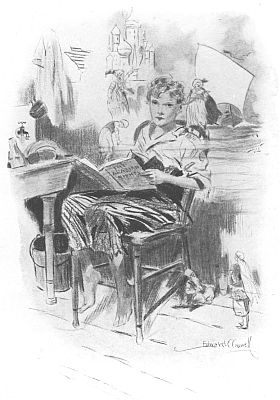 WHAT HE SAW THERE HELD HIM SPELLBOUND IN HIS CHAIR
| CHAPTER | PAGE | |
| I. | The Wicked Giant | 1 |
| II. | Pride and Penalty | 10 |
| III. | A Feast and an Excursion | 17 |
| IV. | The Four Millionaires | 24 |
| V. | New Friends | 36 |
| VI. | The Dearest Wish | 52 |
| VII. | A Serious Step | 60 |
| VIII. | More Treasures | 68 |
| IX. | One-Eye | 79 |
| X. | The Surprise | 93 |
| XI. | The Discovery | 108 |
| XII. | A Prodigal Puffed Up | 117 |
| XIII. | Changes | 122 |
| XIV. | The Heaven that Nearly Happened | 138 |
| XV. | Scouts | 144 |
| XVI. | Hope Deferred | 153 |
| XVII. | Mr. Perkins | 160 |
| [viii]XVIII. | The Roof | 172 |
| XIX. | A Different Cis | 183 |
| XX. | The Handbook | 190 |
| XXI. | The Meeting | 201 |
| XXII. | Cis Tells a Secret | 212 |
| XXIII. | Roses that Tattled | 219 |
| XXIV. | Father Pat | 233 |
| XXV. | An Ally Crosses a Sword | 241 |
| XXVI. | The End of a Long Day | 247 |
| XXVII. | Another Gift | 255 |
| XXVIII. | Another Story | 275 |
| XXIX. | Revolt | 290 |
| XXX. | Disaster | 300 |
| XXXI. | The Vision | 318 |
| XXXII. | Help | 330 |
| XXXIII. | One-Eye Fights | 345 |
| XXXIV. | Sir Algernon | 357 |
| XXXV. | Good-bys | 363 |
| XXXVI. | Left Behind | 373 |
| XXXVII. | Ups and Downs | 379 |
| XXXVIII. | Another Good-by | 391 |
| XXXIX. | The Letter | 400 |
| XL. | "The True Way" | 407 |
HE was ten. But his clothes were forty. And it was this difference in the matter of age, and, consequently, in the matter of size, that explained why, at first sight, he did not show how thin-bodied he was, but seemed, instead, to be rather a stout little boy. For his faded, old shirt, with its wide sleeves lopped off just above his elbows, and his patched trousers, shortened by the scissors to knee length, were both many times too large for him, so that they lay upon him, front, back and sides, in great, overlapping pleats that were, in turn, bunched into heavy tucks; and his kitchen apron, worn with the waistband about his neck, the strings being tied at the back, also lent him—if viewed from the front—an appearance both of width and weight.
But he was not stout. His frame was not even fairly well covered. From the apron hem in front, the two legs that led down to the floor were scarcely larger than lead piping. From the raveling ends of his short sleeves were thrust out arms that matched the legs—bony, skinny arms, pallid as to color, and with hardly any more shape to them than there was to the poker of the cookstove. But while the lead-pipe legs ended in the sort of hard, splinter-defying boy's feet that could be met with on any stretch of pavement outside the tenement, the bony arms did not end in boyish hands. The hands that hung, fingertips touching halfway to the knee, were far too big for a boy of ten. They were red, too, as if all the blood of his thin shoulders had run down his arms and through his[2] wrists, and stayed there. And besides being red, fingers, palms and backs were lined and crinkled. They looked like the hands of a hard-working, grown girl. That was because they knew dish washing and sweeping, bed making and cooking, scrubbing and laundering.
But his head was all that a boy's head should be, showing plenty of brain room above his ears. While it was still actually—and naturally—large for his body, it looked much too large; not only because the body that did its bidding was undersized, but because his hair, bright and abundant, added to his head a striking circumference.
He hated his hair, chiefly because it had a hint of wave in it, but also because its color was yellow, with even a touch of green! He had been taunted about it—by boys. But what was worse, women and girls had admired it, and laid hands upon it—or wanted to. And small wonder; for in thick undulations it stood away from forehead and temples as if blown by the wind. A part it had not, nor any sort of neat arrangement. He saw strictly to that. Whenever his left hand was not busy, which was less often than he could wish, he tugged at his locks, so that they reared themselves on end, especially at the very top, where they leaned in various directions and displayed what appeared to be several cowlicks. At every quarter that shining mop was uneven, because badly cut by Big Tom Barber, his foster father, whose name belied his tonsorial ability.
Below that wild shock of colorful hair was a face that, when clean, could claim attention on its own account. It was a square-jawed little face over which the red was quick to come, though, unhappily, it did not stay. Its center was a nose that seemed a trifle small in proportion to its surroundings. But the top line of it was straight, and the nostrils were well carved, and had a way of lifting and swelling whenever his interest was caught.[3]
Under them was a mouth that was wide yet noticeably beautiful—not with the soft beauty of a baby's mouth, or a girl's, and not because it could boast even a touch of scarlet. It had been cut as carefully as his nose, the lips full yet firm, their lines drawn delicately, but with strength. It was sensitive, with a little quirk at each corner which betrayed its humor. Above all things, its expression was sweet.
Colorless as were his cheeks and lips, nevertheless he did not seem a pale boy, this because his brows were a misty yellow-white, and his thick lashes flaxen; while his eyes were an indescribable mixture of glowing gray and blue plentifully flecked with yellow. Perfectly adjusted were these straight-looking eyes, and set far apart. By turns they were quick, and bold, and open, and full of eager inquiry; or they were thoughtfully half covered by their heavy lids, very still, and far sighted. And when he laughed, what with the shine of his hair and brows and light lashes, and the flash of his eyes and his teeth, the effect was as if sunlight were upon his face—though the sun so seldom shone upon him that he had not one boyish freckle.
Such was Johnnie Smith.
Just now he was looking smaller and less sunlit than usual. This was because Big Tom bulked in front of him, delivering the final orders for the day before going down the three flights of stairs, out into the brick-paved area, thence through a dank, ground-floor hall which bored its way from end to end of another tenement, and into the crowded East Side street, and so to his work on the docks.
Barber was a huge-shouldered, long-armed slouch of a man, with a close-cropped head (flat at the back) upon which great hairy ears stood out like growths. His eyes were bloodshot and bulging, the left with an elusive cast in it that showed only now and then, when it testified to the[4] kink in his brain. His nose, uneven in its downward trend, was so fat and wide and heavy that it fairly sprawled upon his face; and its cavernous, black nostrils made it seem to possess something that, to Johnnie, was like a personality—as if it were a queer sort of snakish thing, carefully watched over by the bulging, bloodshot eyes.
For Barber's nose had the power of moving itself as Johnnie had seen no other nose move. Slowly and steadily it went up and down whenever Barber ate or talked—as even Johnnie's small, straight nose would often do. But whenever Big Tom laughed—sneeringly or boastfully or in ugly triumph—the nose would make a sudden, sidewise twist.
But something besides its power to move made it seem a live and separate thing: the longshoreman troubled himself to shave only of a Sunday morning, when, with all the stiff, dark growth cleared away to right and left—for Barber's beard grew almost to his eyes—his nose, though bent and purplish, was fairly like a nose. But with Monday, again the nose took on that personality; and seemed to be crouching and writhing at the center of its mat of stubble.
But Barber's mouth was his worst feature, with its great, pushed-out underlip, which showed his complete satisfaction in himself. So big was that lip that it seemed to have acquired its size through the robbing of the chin just beneath—for Big Tom had little enough chin.
But his neck was massive, and an angry red, sprinkled with long, wiry hairs. It fastened his flat-backed head to a body that was like a gorilla's, thick and wide and humped. And his arms gave an added touch of the animal, for they were so long that his great palms reached to his knees; and so sprung out at the shoulder, and so curved in at the wrist, that when they met at the fingers they formed a pair[5] of mammoth, muscled tongs—tongs that gave Barber his boasted value in and out of ships.
His legs were big, too. As he stood over Johnnie now, it was plain to see where the boy's shaggy trousers had come from (the grotesquely big shirt as well). Each of those legs was almost as big as Johnnie's skimped little body. And they turned up at the bottom in great broganned feet that Barber was fond of using as instruments of punishment. More than once Johnnie had felt those feet. And if he could ever have decided how pain was to be inflicted upon him, he would always have chosen the long, thick, pliant strap that belted in, and held together, his baggy clothes. For the strap left colorful tracks that stung only in the making; but the mark of one of those feet went black, and ached to the bone.
Johnnie hated Big Tom worse than he hated his own yellow hair. But he feared him, too. And now listened attentively as the longshoreman, his cutty pipe smoking in one knotted fist, his dinner pail in the other, his cargo hook slung to his burly neck, glowered down upon him.
"Git your dishes done," admonished Barber. "Don't let the mush dry on 'em, and draw the flies."
There being no question to answer, Johnnie said nothing. Final orders of a morning were the usual thing. If he was careful not to reply, if he waited, taking care where he looked, the longshoreman would have his say out and go—pressed by time. So the boy, almost holding his breath, fastened his eyes upon a patch of wall where the smudged plaster was broken and some laths showed. And not a muscle of him moved, except one big toe, which he curled and uncurled across a crack in the rough, worn kitchen floor.
"Git everything else done, too," went on Big Tom. "You don't scrub till to-morrow, so the day's clear for stringin' beads, or makin' vi'lets. And don't let me come[6] home t'night and find no hot supper. You hear me." He chewed once or twice—on nothing.
Johnnie continued silent, counting the laths—from the top down, from the bottom up. But his toe moved a shade faster. For there was a note of rising irritation in that You hear me.
"I say, you hear me!" repeated Big Tom (replies always angered him: this time silence had). He thrust the whole of the short stem of his "nose-warmer" into his mouth. Then, with the free hand, he seized Johnnie by one thin shoulder and gave him a rough, forward jerk.
"Yes," acknowledged the boy, realizing too late that this was one occasion when speech would have been safest. He still concentrated on the laths, hoping that matters would go no further.
But that single jerk, far from satisfying Barber's rancor, only added to it—precisely as if he had tasted something which had whetted his appetite for more. He gripped Johnnie's shoulder again, this time driving him back a step. "Now, no sass!" he warned.
The blood came rushing to Johnnie's face, darkening it so that the misty yellow-white brows stood out grotesquely. And his chest began to heave. He loathed the touch of Barber's hand. He despised the daily orders that only turned him against his work. But most of all he shrank from the indignity of being jerked when it was wholly undeserved.
Big Tom marked the boy's rising color. And the sight spurred his ill-humor. "What do you do for your keep?" he demanded. "Stop pullin' your hair!" He struck Johnnie's hand down with a sweaty palm that touched the boy's forehead. "Pullin' and hawlin' all the time, but don't earn the grub y' swallow!"
Just as one jerk always led to another, so one blow was usually the prelude to a thrashing. Johnnie saw that he[7] must stop the thing right there; must have instant help in diverting Barber. Taking a quick, deep breath, he sounded his call for aid—a loud, croupy cough.
It was instantly answered. The door beside the cookstove swung wide, and Cis came hurrying in from the tiny, windowless closet—this her "own room"—where she had been listening anxiously. "Oh, Mr. Barber," she began, trying to keep her young voice from trembling, "this week can I have enough out of my wages for some more shoe-whitening?"
There were several ways in which to take Big Tom's mind from any subject. The surest of these was to bring up a question of spending. And now, answering to his stepdaughter's subterfuge as promptly as if he were a mechanism that had been worked by a key, he turned from glowering down upon Johnnie to scowl at her.
"More?" he demanded harshly.
Her blue eyes met his look timidly. Out of the wisdom of her sixteen-year-old policy, she habitually avoided him, slipping away of a morning to her work at the pasteboard-box factory without a word; slipping back as quietly in the late afternoon; keeping out of his sight and hearing whenever that was possible; and speaking to him seldom.
Cis looked at every one timidly. She avoided Big Tom not only because it was wise to do so but because she was naturally shy and retiring, and avoided people in general. She had a quaint face (framed by straight, light-brown hair) that ended in a pointed, pink chin. Habitually she wore that expression of mingled understanding and responsibility common to all children who have brought up other children. So that she seemed older than she was. But her figure was that of a child—slim, frail, and still lacking a woman's shapeliness, notwithstanding the fact that it had long carried the burdens of a grown-up.[8]
Facing her stepfather now, she did not falter. "Yes, please," she answered. "The last, I got a month ago."
His pipe was in his fist again, and he was chewing wrathfully. "I'll see," he growled. And waved her to go.
From the hall door, she glanced back at Johnnie. Not only had she and he a system of communication by means of coughs, humming, whistles, taps and other audible sounds; and a second system (just as good) that depended upon wall marks, soap-inscribed hieroglyphics on the bit of mirror in Cis's room, or the arrangement of dishes on the kitchen table, and pots and pans on the stove, but they had a well-worked-out silent system—by means of brow-raisings, eye and lip movements, head tippings and swift finger pointings—that was as perfect and satisfactory as the dumb conversation of two colts. Such a system was necessary; for whenever the great figure of Barber came wedging itself through the hall door, and his presence, like a blighting shadow, darkened the already dark little flat, then the two young voices had to fall instantly silent, since Barber would brook no noise—least of all whispering.
Now by the quick, sidewise tip of her small, black-hatted head, Cis inquired of Johnnie whether she should stay or go. And Johnnie, with what amounted to an upward fling of his eyelids, answered that she need not stay. With Barber's cutty once more in his right fist, and with his mind veered to a fresh subject, Johnnie knew the crisis was past.
With a swift glance of affection and sympathy, not unmixed with triumph over the success of her interruption, Cis fluttered out—leaving the door open at Barber's back.
The longshoreman turned heavily as if to follow her, but came about with a final caution, lowering his voice to cheat any busy ear in the other flat on the same floor. "Don't you neglect the old man," he charged. "Face—hair—fix him up—you know."[9]
At the stove, an untidy heap of threadbare, brown blanket, in a wheel chair suddenly stirred. In several ways old Grandpa was like a big baby, but particularly in this habit of waking promptly whenever he was mentioned. "Is that you, Mother?" he asked in his thin, old voice. (He meant Big Tom's mother, dead now these many years.)
A swift change came over Barber's face. His great underlip drew in, what chin he had was thrust out with something like concern, and his eyes rolled away from Johnnie to the whimpering old man. "It's all right, Pa," he said soothingly. "It's all right. Jus' you sleep." Then he turned, tiptoed through the door, and shut it after him softly.
Johnnie did not move—except to shift his look from the laths to the door knob, and take up his toeing of the crack at his feet. The door itself moved, and rattled gently, as the area door three flights below was opened by Cis, and a gust from the narrow court was sent up the stairs of the tenement, as a bubble forces its way surfaceward through water, to suck at the Barber door.
But Big Tom was not yet gone. And a moment later, the boy was looking at the outer knob, now in the clutch of several great, grimy, calloused fingers.
"Let your hair alone!" ordered the longshoreman. Then the door closed finally, and the stairs complained with loud creakings as Barber descended them.
Johnnie waited till the door in front of him moved and rattled again, then[10]—
HIS toe stopped working across the crack in the floor. His left hand forsook his tousled hair and fell to his side. His eyes narrowed, and his chin came up. Then his lips began to move, noiselessly. "I'll pay him up for that!" he promised. "I'll make him wish he didn't shove me! This time, I'll think a' awful bad think about him! I'll think the worst think I can! I'll—I'll——"
He paused to decide. He had many "thinks" for the punishing of Big Tom, each of them ending in the desertion of that gentleman, who was always left helplessly groveling and pleading while Johnnie made a joyous, triumphant departure. Which of all those revenges would he select this morning? Would he go, after handing the longshoreman over to the harshest patrolman in New York? or would it be a doctor who would remain behind in the flat with the tyrant, assuring Johnnie, as the latter sauntered out of the kitchen for the very last time, that no skill on earth could entirely mend the hurts which he had so bravely inflicted upon his groaning foster father? or would he set sail grandly from the Battery for some port at least a million miles away, his last view of the metropolis including in its foreground, along with a brass band and many dignitaries of the city, the kneeling shape of a wretched dock-worker who had repented of his meanness too late?
Suddenly Johnnie caught his breath, his eyes dilated,[11] his fingers began to play against his palms. He had decided. And in that same instant, a change came over him—complete, satisfactory, astonishing.
Now, instead of the ragged, little boy upon whom Big Tom had glowered down—a meek boy, subdued, even crestfallen, whose eyes were lowered, and whose lashes blinked fearsomely, he was quite a good deal taller, boldly erect, proud in his poise, light on his neatly shod feet, confident and easy in his manner, with a charming smile to right and left as ringing cheers went up for him while he awaited the lessening of the pleasant tribute, his composure really quite splendid, his hands stuffed into the pocket of his absolutely new, light-gray suit, which had knee pants.
A change had also taken place in the Barber kitchen. Now the walls were freshly papered in a regal green-and-gold pattern which, at the floor line, met a thick, red carpet. Red velvet curtains hung at either side of the window. Splendid, fat chairs were set carelessly here and there; and a marble-topped table behind Johnnie was piled with a variety of delectable dishes, including several pies oozing juice.
And the crowd that pressed up to the hall door! It was worthy of his pride, for it was a notable gathering. In it was no tenant of the building, no neighbor from other, near-by flats, and not a single member of that certain rough gang which haunted the area, the dark halls leading into it, and all the blocks round about.
Indeed, no! Even in his "thinks" Johnnie was most careful regarding the selection of his companions, his social trend being ever upward. And he was never small about any crowd of his, but always had everybody he could remember who was anybody—a riot of famous people. On this occasion he was reaching into truly exclusive circles. Naturally, then, this was a well-dressed assemblage, strikingly equipped with silk hats (there were no ladies present)[12] and gold-headed canes; and every gentleman in the gathering wore patent-leather shoes, and a vest that did not match his coat. All were smart and shaven and wealthy. In their lead, uniformed in khaki, and wearing the friendliest look possible to a young man who is cheering, was His Royal Highness, the Prince of Wales.
Like all the others in that wildly enthusiastic gathering, the young heir apparent was turned toward Johnnie as toward a hero. And small wonder. For there, between the distinguished crowd and the boy, lying prone upon the red carpet, in his oldest clothes, and unshaven, was none other than Big Tom Barber, felled by the single, overwhelming blow that Johnnie had just given him, his nose bleeding (not too much, however) and the breath clean knocked out of him.
Now the shouting died away, and Johnnie addressed the admiring throng. But his lips moved without even a whisper. "I made up my mind a long time ago," he began, "to give Tom Barber a good thrashin'. So this morning, I done it."
Despite his ungrammatical conclusion, the speech called forth the resounding hurrahs of the Prince and his gentlemen, and once more Johnnie had to wait, striving to appear properly modest, and twirling a gold watch chain all of heavy links. But he could not keep his nostrils from swelling, or his eyes from flashing. And his chest heaved.
It was now that he made Cis one of his audience, dressing her in a becoming pink gown (her favorite color). Old Grandpa was standing beside her, no longer feeble and chair bound, but handsomely overcoated and hatted, and looking as formidable as any policeman. These two, naturally enough, had only proud glances for the young champion of the hour.
But Johnnie's task of subduing Barber was not finished. The brave boy could see that the big longshoreman was[13] making as if to rise. Johnnie could still feel the touch of Big Tom's perspiring hand on his forehead, and the pinch of those cruel fingers on his shoulder. Taking a forward step, he gave Barber's shoulder a wrenching jerk, then thrust the longshoreman backward by a spanking blow of the open palm full upon that big, ugly, bristling face.
Again Barber fell prostrate. He was purple with mortification, and leered up at Johnnie murderously.
"Ha! ha! Y' got enough?" Johnnie inquired. He was all of a glow now, and his face fairly shone. But he was not done with the tyrant. A sense of long-outraged justice made him hand Barber the big, black, three-legged, iron kettle that belonged on the back of the cookstove. There was some cold oatmeal in the bottom of the kettle, and Johnnie also handed the longshoreman a spoon—with a glance toward the Prince, who seemed awed by Johnnie's complete mastery of the enemy. "Here!" the boy directed, giving the pot a light kick with a new shoe (which was brown). "Go ahead and eat. Eat ev'ry bite of it. It's got kerosene in it!"
Now Barber got to his knees imploringly. "Oh, don't make me eat it!" he begged. "Oh, don't, Johnnie! Please!"
"Y' made me eat it once," said Johnnie quietly. "And y' need a lesson, Tom Barber, and I'm givin' y' one."
Barber choked down the bad-tasting food. But there was no taunting of him. Johnnie kept a dignified silence—as did also the Prince and the gentlemen. But when the last spoonful was swallowed, and Barber was cowering beside the empty kettle, the boy felt called upon to go still further, and make away finally with that strap which was the symbol of all he hated—that held up and together the too-large clothes which had so long mortified his pride; that stood for the physical pain dealt out to him by Big Tom if he so much as slighted a bit of his girl's work.
The strap was around him now, even over that new suit.[14] It circled him like a snake. He took it off, his lips working in another splendid speech. "And I don't wear it ever again," he declared, looking down at Barber. "Do y' understand that?" He flicked a big arm with the leather, though not hard enough to give pain.
"Yes," faltered the longshoreman, shrinking.
"Well, I'm glad y' understand it," returned Johnnie. "And now you just watch me for on-n-ne second! You won't never lay this strap across me> again!"
He whipped out a long, sharp, silver-handled bread-knife. Then turning to the table, he laid the strap upon the beautiful marble; and, in sight of all, cut it away to the very buckle—inch by inch!
"Now!" he cried, as he scattered the pieces upon the carpet.
The punishment was complete; his triumph nothing less than perfect. And it occurred to him now that there was particular gratification in having present this morning His Royal Highness. "Mister Prince," he said, "I'm awful tickled you was here!"
The Prince expressed himself as being equally pleased. "Mister Smith," he returned, "I don't know as I ever seen a boy that could hit like you! Why, Mister Smith, it's wonderful! How do y' do it?" He shook Johnnie's hand warmly.
"Well, I guess I'm like David, Mister Prince," Johnnie explained modestly. "O' course you know David—and his friend, Mister Goli'th?—Oh, y' don't? Y' mean y' ain't never met neither one? Oh, gee! I'm surprised! But that's 'cause y' don't know Mrs. Kukor, upstairs. They're both friends of hers. Well, I'll ask 'em down."
An upturned face and a beckoning arm accomplished the invitation, whereupon there entered at once the champion Philistine and that youth who was ruddy and of a fair countenance. And after a deal of hand-shaking all[15] around, Johnnie told the tale of that certain celebrated fight—told it as one who had witnessed the whole affair. He turned his face from side to side as he talked, gesticulating with easy grace.
"And now I guess we're ready t' start, ain't we?" he observed as he concluded. "David, would you and your friend like t' come along?—Only Big Tom, he's got t' stay behind, 'cause——"
At the stove, the untidy heap of brown blanket in the wheel chair stirred again. Out of the faded folds a small head, blanched and bewhiskered, reared itself weakly. "Johnnie," quavered old Grandpa. "Johnnie! Milk!"
The boy's lips ceased to frame words. His right arm fell to his side; the left went up again to resume that tugging at his hair. He swayed slightly, shifting his weight, and his big toe began once more to curl and uncurl. Then, as fancy was displaced by reality, as dreaming gave place to fact, Barber disappeared from the floor. The silk-hatted gentlemen with the gold canes went, too—along with the gallant young English Prince, that other Prince who was of Israel, and a tall person with a sore, red bump on his forehead. The gold-and-green walls faded; so did the carpet, the curtains, and that light-gray suit (which was precisely like the one Johnnie had worn when he first came to the Barber flat—except, of course, that it was larger). The marble-topped table and the fat chairs folded themselves up out of sight. And all those delicious fruit pies dissolved into thin air.
But one thing did not go: A sense of satisfaction. Having met his enemy before the world, and conquered him; having spent his own anger and loathing, and revenged the other's hated touch, his gray eyes held a pleased, proud look. Once more in the soiled big shirt and trousers, with the strap coiled about his middle, he could put Barber[16] aside for the day—not brood about him, harboring ill-will, nor sulk and fret.
Now he was ready for "thinks" of a different sort—adventures that were wholly delightful.
A feeling of joy surged through him. Ahead lay fully nine unhampered hours. He pivoted like a top. His arms tossed. Then, like a spring from which a weight has been lifted, like a cork flying out of a charged bottle, he did a high, leaping hop-skip straight into the air.
"Wow-ow-ow-ow-ow!" he sang out full-throatedly. "Rr-r-r-r! ree-ee-ee!"—and explosively, "Brt! brt! brt! bing!"[17]
NINE free hours!—or, to be exact, eight, since the best part of one would have to be devoted to the flat in order to avoid trouble. However, Johnnie never did his work any sooner than he actually had to; and that hour of labor should be, as always, the last of the nine, this for the sake of obeying Big Tom at the latest possible time, of circumventing his wishes, and thwarting and outwitting him, just to the degree that safety permitted.
So! For eight hours Johnnie would live his dreams. And, oh, the things he could do! the things!
But before he could begin the real business of the day, he had to put Grandpa to sleep again. This was best accomplished through tiring the little old man with a long, exciting train trip. "Oo, Grandpa!" cried Johnnie. "Who wants to go ride-ride on the cars?"
"Cars! cars! cars!" shrilled Grandpa, his white-lashed, milky-blue eyes dancing. At once, impatiently, he fell to tapping on the floor with his cane, while, using his other hand, he swung the wheel chair in a circle. Across his shrunken chest, from one side of the chair to the other, was a strand of rope that kept him from tumbling out of his seat. To hasten the promised departure, he began to throw his weight alternately against the rope and the back of the chair, like an excited baby.
"Wait now!" admonished Johnnie. He took off his apron and wadded it into a ball. Then with force and[18] fervor he sent the ball whizzing under the sink. "Where'll we go?" he cried. The bottoms of his trouser legs hung about his knees in a fringe. Now as he did another hop-skip into the air, not so much because of animal spirits as through sheer mental relief, all that fringe whipped and snapped. "Pick out a place, Grandpa!" he bade. "Where do y' want t' go?"
"Go! go! go!" chanted the old man. Not so long ago he had been able to call up a score of destinations—most of them names that had to do with the Civil War campaigns which, in the end, had impaired his brain and cost him the use of his legs.
Johnnie proceeded to prompt. "Gettysburg?" he asked; "Shiloh? Chick'mauga? City of Washingt'n? Niaggery Falls?"
"Niaggery Falls!" cried Grandpa, catching, as he always did, at whatever point was named last. "Where's my hat? Where's my hat?"
He never remembered how to find his hat, though it always hung conveniently on the back of the wheel chair. It was the dark, broad-brimmed, cord-encircled head covering of the Grand Army man. As he turned his head in a worried search for it, Johnnie set the hat atop the white hair.
Johnnie had named Niagara last because he liked best to visit that Wonder of Nature. He did not know why—except that the name seemed curiously familiar to him. It was familiar to Grandpa, too, in a dim way, for he had visited "the Falls" on his wedding trip. And every repetition of the imaginary journey thrilled him.
"Chug! chug! chug!" he began, the moment he felt the hat. His imitation of a starting engine was so genuine that it shook his spare frame from his head to his slippered feet. "Chug! chug! chug!"
But Johnnie was not ready to set off. The little, old[19] soldier had not yet eaten his breakfast, and if he did not eat he would not go to sleep promptly at the conclusion of the trip, nor stay asleep.
"Oh, Grandpa," began the boy coaxingly, as he hastily dished up a saucer of oatmeal, another saucer of prunes, and poured a glass of milk, "before we start we got t' eat our grand banquet! It's a long way to Niaggery, y' know. So here we both are at the Grand Central Station!" (The Station was situated on or about the center of the kitchen.)
"Station!" echoed Grandpa. "Chug! chug! chug!"
"No, Grandpa,"—Johnnie's manner of handling the old man was comically mature, almost motherly; his tone, while soothing, was quietly firm, as if he were speaking to a younger child. "See! Here's the fine table!"
Up to this table, still strewn with unwashed dishes and whatever remained of breakfast, the pair of travelers drew. Then Johnnie, with the air and the lavishness of a millionaire, ordered an elaborate and tasty breakfast from a waiter the like of whom was not to be found anywhere save in his own imagination.
This waiter's name was Buckle, and he had served Johnnie faithfully for the past several years. In all ways he was an extraordinary person of his kind, being able to furnish anything that Grandpa and Johnnie might call for, whether meat, vegetable or fruit, at any time of the year, this without regard to such small matters as seasons, the difficulties of importing, adverse hunting laws, and the like. Which meant that Grandpa could always have his venison, and Johnnie his choice of fruits—all from the deft hand of a man quick and soft-footed, and full of low bows, who wore a suit of red velvet fairly loaded with gold bands and brass buttons.
"Mister Buckle," began Johnnie (for such an august creature in red velvet could not be addressed save with a courteous title), "a turkey, please, an' some lemon pie, an'[20] some strawberry ice cream an' fifteen pounds of your best candy."
"Candy! candy! candy!" clamored Grandpa, impatiently beating on the table with his spoon like a baby.
Buckle was wonderful. As Johnnie's orders swept him hither and thither, how he transformed the place, laying down the articles called for upon a crisp red tablecloth that was a glorious full brother to one that belonged to the little Jewish lady who lived upstairs. But Grandpa took little interest in Buckle, though he picked eagerly enough at the viands which Johnnie urged upon him.
"Here's your turkey," pointed out the boy, giving the old man his first spoonful of cereal. "My goodness, did y' ever see such a drumstick! Now another!—'cause, gee! you'll be starved 'fore ever we git t' Niaggery! Mm! but ain't that turkey fine?"
"Mm! Mm!" agreed the veteran.
"Mister Buckle, I'll take some soda and some popcorn," went on Johnnie, spooning out his own saucer of oatmeal. "And some apples and oranges, and bananas and cherries and grapes."
Fruit was what he always ordered. How almost terribly at times he yearned for it! For the only fruit that ever Barber brought home was prunes. Johnnie washed them and put them over the fire to boil with a regularity due to his fear of the strap. But he hated them. (Likewise he pitied them—because they seemed such little, old creatures, and grew in that shriveled way which reminded him somehow of Grandpa.) What he longed for was fresh fruit, which he got only at long intervals, this when Cis carried home to him a few cherries in the bottom of a paper bag, or part of an apple which was generously specked, and so well on its way to ruin, or shared the half of a lemon, which the two sucked, turn about, all such being the gifts of a certain old gentleman with a wooden leg who[21] carried on a thriving trade in the vicinity of the nearest public school. But the periods between the contributions were so long, and the amount of fruit consumed was so small, that Johnnie was never even a quarter satisfied—except at one of his Barmecide feasts.
Grandpa's oatmeal and milk finished, Johnnie urged the prunes upon him. "Oo, lookee at the watermelon!" he cried. "The dandy, big watermelon!—on ice!"
The mere word "watermelon" always stirred a memory in old Grandpa's brain, as if he could almost recall when he, a young soldier of the North, had taken his fill of sweet, black-seeded, carnation-tinted pulp at some plantation in the harried South. And now he ate greedily till the last prune was gone, when Johnnie had Buckle throw all of the green rinds into the sink. (It was this attention to detail which invested his games with reality.) Then, the repast finished, Grandpa fretted to be away, whirling his chair and whimpering.
Johnnie had eaten through a perfect menu only as an unfillable boy can. So he dismissed Buckle with a thousand-dollar bill, and the two travelers were off, Johnnie making a great deal of jolly noise as he fulfilled the duties of engineer, engine and conductor, Grandpa having nothing to do but be an appreciative passenger.
To the old man the dish cupboard, which was Carthage, in "York State," never lost its interest, he having lived in that town long years ago, before he marched out of it with a company of men who were bound for the War. But the morris chair with its greasy cushions, which was the capital, Albany, and the cookstove, which was very properly Pittsburgh (though the surface of the earth had to be wrenched about in order to put Pittsburgh after Albany on the way to "the Falls"), both of these estimable cities also won their share of attention, the special train bearing the pair making a stop at each, though the passengers,[22] boy and man, longed quite naturally for a sight of the Marvel of Waters which awaited them at the end of the line.
But Pittsburgh left behind, and Buffalo (the woodbox) all but grinding under their wheels, neither Grandpa nor Johnnie could withstand longer the temptation to push forward to wonderful Niagara itself. With loud hissings, toot-toots, and guttural announcements on the part of the conductor, the wheel chair drew up with a twisting flourish—at the sink.
And now came the most exciting moment of all. For here imagination had to be called upon least. This Niagara was liquid. And held back its vast flood—or poured it—just as Johnnie chose. He proceeded to have it pour. With Grandpa's cane, he rapped peremptorily twice—then once—on the big lead pipe which, leading through the ceiling as a vent to Mrs. Kukor's sink, debouched in turn into the Barber sink.
A moment's wait. Then some one began to cross the floor overhead with an astonishing sound of rocking yet with little advance—in the way that a walking doll goes forward. This was Mrs. Kukor herself, who was motherhood incarnate to Johnnie; motherhood boiled down into an unalloyed lump; the pure essence of it in a fat, round package. The little Jewish lady never objected to this regular morning interruption of her work. And so the next moment, the miracle happened. Lake Erie began to empty itself; and with splashes, gurgles and spurts, the cataract descended upon the pots and pans heaped in the Barber sink.
The downpour was greeted by a treble chorus of delight from the tourists. "Oh, Grandpa!" cried Johnnie, jumping up and down. "Ain't it fine! Ain't it fine!" And "Fine!" chimed in the old man, swaying himself against his breast rope. "Fine! Fine!"[23]
One long half-minute Niagara poured—before the admiring gaze of the two in the special. Then the great stream became dammed, the rush of its waters ceased, except for a weak trickle, and the ceiling gave down the sound of a rocking step bound away, followed by the squeaking of a chair. Mrs. Kukor was back at work.
The train returned silently to Pittsburgh, the Grand Army hat was taken off and hung in its place, the blanket was pulled up about Grandpa's shoulders, and this one of the pair of travelers was left to take his rest. Comfortable and swift as the whole journey was, nevertheless the feeble, old soldier was tired. His pale blue eyes were roving wearily; the chair at a standstill, down came their lids, and his head tipped sidewise.
He looked as much like a small, gray monkey as his strapping son resembled a gorilla. As Johnnie tucked the blanket about the thin old neck, Grandpa was already breathing regularly, the while he made the facial grimaces of a new-born child.[24]
JOHNNIE always started his own daily program with a taste of fresh air. He cared less for this way of spending his first fifteen free minutes than for many another. But as Cis, with her riper wisdom, had pointed out, a short airing was necessary to a boy who had no red in his cheeks, and too much blue at his temples—not to mention a pinched look about the nose. Johnnie regularly took a quarter of an hour out of doors.
He took it from the sill of the kitchen window—which was the only window in the Barber flat.
This sill was breast-high from the kitchen floor, Johnnie not being tall for his age. But having shoved up the lower sash with the aid of the broom handle, he did not climb to seat himself upon the ledge. For there was no iron fire escape outside; the nearest one came down the wall of the building to the kitchen window of the Gamboni family, to the left. And so Johnnie denied himself a perch on his sill—a dangerous position, as both Mrs. Kukor and Cis pointed out to him.
Their warnings were unnecessary. He could easily realize what a slip of the hand might mean: a plunge through space to the brick paving far below; and there an instant and horrible end. His picture of it was enough to guard him against accident. He contented himself with laying his body across the sill, with the longer and heavier portion of his small anatomy balanced securely against a shorter and lighter upper portion.[25]
He achieved this position and held it untiringly by the aid of the old rope coil. This coil was a relic of those distant times when there was no fire escape even outside the kitchen window of the Gambonis, and the landlord provided every tenant with this cruder means of flying the building. The rope hung on a large hook just under the Barber window, and was like a hard, smudged wheel, so completely had the years and the climate of the kitchen colored and stiffened it. And Johnnie's weight was not enough to elongate its set curves.
It was a handy affair. Using it as a stepping-place, and pulling himself up by his hands, he brought the lower end of his breastbone into contact with the sill. Resting thus, upon his midriff, he was thoroughly comfortable, due to the fact that Big Tom's shirt and trousers thoroughly padded his ribby front. Then he swelled his nostrils with his intaking of air, and his back heaved and fell, so that he was for all the world like some sort of a giant lizard, sunning itself on a rock.
Against the dingy black-red of the old wall, his yellow head stood forth as gaudily as a flower. The flower nodded, too, as if moved by the breeze that was wreathing the smoke over all the roofs. For Johnnie was taking a general survey of the scenery.
The Barber window looked north, and in front of it were the rear windows of tenements that faced on a street. There was a fire escape at every other one of these windows—the usual spidery affair of black-painted iron, clinging vinelike to the bricks. And over each escape were draped garments of every hue and kind, some freshly washed, and drying; others airing. Mingling with the apparel were blankets, quilts, mattresses, pillows and babies.
Somehow Johnnie did not like the view. He glanced down into the gloomy area, where a lean and untidy cat[26] was prowling, and where there sounded, echoing, the undistinguishable harangue of the fretful Italian janitress.
Now Johnnie's general survey was done. He always made it short, wasting less than one minute in looking down or around. It was beauty that drew him—beauty and whatever else could start up in his mind the experiences he most liked. His face upturned, one hand flung across his brows to shield his eyes, for the light outside the sill seemed dazzling after the semidark of the flat, he scanned first the opposite roof edges, a whole story higher than he, where sparrows were alighting, and where smoke plumes curled like veils of gossamer; next he scanned the sky.
Above the roofline of the tenements was a great, changing patch which he called his own, and which he found fascinating. And not only for what it actually showed him, which was splendid enough, but for the eternal promise of it. At any moment, what might not come slipping into sight!
What he longed most to catch sight of was—a stork. Those babies across on the fire escapes, storks had brought them (which was the main reason why all the families kept bedclothes out on the barred shelves; a quilt or a pillow made a soft place on which to leave a new baby). A stork had brought Cis—she had had her own mother's word for it many times before that mother died. A stork had brought Johnnie, too—and Grandpa, Mrs. Kukor, the Prince of Wales, the janitress; in fact, every one.
"I wonder what kind of a stork was it that fetched Big Tom!" Johnnie once had exclaimed, straightway visioning a black and forbidding bird.
Storks, according to Cis, were as bashful as they were clever, and did not come into sight if any one was watching. They were big enough to be seen easily, however, as[27] proven by this: frequently one of them came floating down with twins!
"Down from where?" Johnnie had wanted to know, liking to have his knowledge definite.
"From their nests, silly," Cis had returned. But had been forced to confess that she did not know where storks built their nests. "In Central Park, I guess," she had added. (Central Park was as good a place as any.)
"Oh, you guess!" Johnnie had returned, disgusted.
He had never given up his watching, nor his hope of some day seeing a big baby-bringer. He searched his sky patch now. But could see only the darting sparrows and, farther away, some larger birds that wheeled gracefully above the city. Many of these were seagulls. The others were pigeons, and Cis had told him that people ate them. This fact hurt him, and he tried not to think about it, but only of their flight. He envied them their freedom in the vast milkiness, their power to penetrate it. Beyond the large birds, and surely as far away as the sun ever was, some great, puffy clouds of a blinding white were shouldering one another as they sailed northward.
Out of the wisdom possessed by one of her advanced age, Cis had told him several astonishing things about this field of sky. What Barber considered a troublesome, meddlesome, wasteful school law was, at bottom, responsible for her knowing much that was true and considerable which Johnnie held was not. And one of her unbelievable statements (this from his standpoint) was to the effect that his sky patch was constantly changing,—yes, as frequently as every minute—because the earth was steadily moving. And she had added the horrifying declaration that this movement was in the nature of a spin, so that, at night, the whole of New York City, including skyscrapers, bridges, water, streets, vehicles and population, was upside down in the air[28]!
"Aw, it ain't so!" he cried, though Cis reminded him (and rather sternly, for her) that in doing so he was questioning a teacher who drew a magnificent salary for spreading just such statements. "And if they pay her all that money, they're crazy! Don't y' know that if we was t' come upside down, the chimnies'd fall off all the buildin's? and East River'd spill?"
Cis countered with a demonstration. She filled Big Tom's lunch pail with water and whirled it, losing not a drop.
But he went further, and proved her wrong—that is so far as the upside-down of it was concerned. He did this by staying awake the whole of the following night and noting that the city stayed right-side up throughout the long hours. Cis, poor girl, had been pitifully misinformed.
But the changing of the sky he believed. He believed it because at night there was the kind of sky overhead that had stars in it; also, sometimes, a moon. But by dawn, the starred sky was gone—been left behind, or got slipped to one side; in its place was a plain, unpatterned stretch of Heaven which, in due time, was once more succeeded by a firmament adorned and a-twinkle.
When Cis returned home one evening and declared that the forewoman at the factory had asserted that there were stars everywhere in the sky by day as well as by night, and no plain spots at all anywhere; and, further, that if anybody were at the bottom of a deep well he—or she—could see stars in the sky in the daytime, Johnnie had fairly hooted at the tale. And had finally won Cis over to his side.
Her last doubt fled when, having gone down into a dark corner of the area the Sunday following, she found, as did he, that no stars were to be seen anywhere. After that she believed in his theory of starless sky-spots; starless, but not plain. For in addition to the sun, many other[29] things lent interest to that field of blue—clouds, rain, sleet, snow, and fog, all in their time or season. Also, besides the birds, he occasionally glimpsed whole sheets of newspapers as they ambitiously voyaged above the house tops. And how he longed for them to blow against his own window, so that he might read them through and through!
Sometimes he saw a flying machine. The first one that had floated across his sky had very nearly been the death of him. Because, forgetting danger in his rapturous excitement, he had leaned out dangerously, and might have fallen if he had not suddenly thought of Grandpa, and thrown himself backward into the kitchen to fetch the wheel chair. The little old soldier had only been mildly diverted by the sight. Johnnie, however, had viewed the passing of the biplane in amaze, though later on he came to accept the conquest of the air as just one more marvel in a world of marvels.
But his wonder in the sky itself never lessened. About its width he did not ponder, never having seen more than a narrow portion of it since he was big enough to do much thinking. But, oh, the depth of it! He could see no sign of a limit to that, and Mrs. Kukor declared there was none, but that it reached on and on and on and on! To what? Just to more of the on and on. It never stopped.
One night Cis and he, bent over the lip of the window, she upholstered on a certain excelsior-filled pillow which was very dear to her, and he padded by Big Tom's cast-offs, had attempted to realize what Mrs. Kukor had said. "On—and on—and on—and on," they had murmured. Until finally just the trying to comprehend it had become overpowering, terrible. Cis declared that if they kept at it she would certainly become dizzy and fall out. And so they had stopped.
But Johnnie was not afraid to think about it, awful as[30] it was. It was at night, mostly, that he did his thinking. At night the birds he loved were all asleep. But so was Barber; and Johnnie, with no fear of interruption, could separate himself from the world, could mentally kick it away from under him, and lightly project his thin little body up to the stars.
Whenever fog or clouds screened the sky patch, hiding the stars, a radiance was thrown upon the heavens by the combined lights of the city—a radiance which, Johnnie thought, came from above; and he was always half expecting a strange moon to come pushing through the cloud screen, or a new sun, or a premature dawn!
Now looking up into the deep blue he murmured, "On—and—on—and on," to himself. And he wondered if the gulls or the pigeons ever went so far into the blue that they lost their way, and never came back—but just flew, and flew, and flew, till weariness overcame them, when they dropped, and dropped, and dropped, and dropped!
A window went up in front of him, across the area, and a voice began to call at him mockingly: "Girl's hair! Girl's hair! All he's got is girl's hair! All he's got is girl's hair!"
He started back as if from a blow. Then reaching a quick hand to the sash, he closed the window and stepped down.
The voice belonged to a boy who had once charged Mrs. Kukor with going to church on a Saturday. But even as Johnnie left the sill he felt no anger toward the boy save on Mrs. Kukor's account. Because he knew that his hair was like a girl's. If the boy criticized it, that was no more than Johnnie constantly did himself.
The second his feet touched the splintery floor he made toward the table, caught up the teapot, went to lean his head over the sink, and poured upon his offending locks the whole remaining contents of the pot—leaves and all.[31] For Cis (that mine of wisdom) had told him that tea was darkening in its effect, not only upon the lining of the tummy, which was an interesting thought, but upon hair. And while he did not care what color he was inside, darker hair he longed to possess. So, his bright tangles a-drip, he set the teapot in among the unwashed pans and fell to rubbing the tea into his scalp.
And now at last he was ready to begin the really important matters of the day.
But just which of many should he choose for his start? He stood still for a moment, considering, and a look came into his face that was all pure radiance.
High in the old crumbling building, as cut off from the world about him as if he were stranded with Grandpa on some mountain top, he did not fret about being shut in and away; he was glad of it. He was spared the taunts of boys who did not like his hair or his clothes; but also he had the whole flat to himself. Day after day there was no one to make him do this, or stop his doing that. He could handle what he liked, dig around in any corner or box, eat when he wished. Most important of all, he could think what he pleased!
He never dwelt for any length of time upon unhappy pictures—those which had in them hate or revenge. His brain busied itself usually with places and people and events which brought him happiness.
For instance, how he could travel! And all for nothing! His calloused feet tucked round the legs of the kitchen chair, his body relaxed, his expression as rapt as any Buddhist priest's, his big hands locked about his knees, and his eyes fastened upon a spot on the wall, he could forsake the Barber flat, could go forth, as if out of his own body, to visit any number of wonderful lands which lay so near that he could cross their borders in a moment. He could sail vast East Rivers in marvelous tugs. He[32] could fly superbly over great cities in his own aeroplane.
And all this travel brought him into contact with just the sort of men and women he wanted to know, so politely kind, so interesting. They never tired of him, nor he of them. He was with them when he wanted to be—instantly. Or they came to the flat in the friendliest way. And when its unpleasant duties claimed him—the Monday wash, the Tuesday ironing, the Saturday scrubbing, or the regular everyday jobs such as dishes, beds, cooking, bead-stringing, and violet-making—frequently they helped him, lightening his work with their charming companionship, stimulating him with their example and praise.
Oh, they were just perfect!
And how quiet, every one of them! So often when the longshoreman returned of an evening, his bloodshot eyes roving suspiciously, a crowd of handsomely dressed people filled the kitchen, and he threaded that crowd, yet never guessed! When Big Tom spoke, the room usually cleared; but later on Johnnie could again summon all with no trouble whatever, whether they were great soldiers or presidents, kings or millionaires.
Of the latter he was especially fond; in particular, of a certain four. And as he paused now to decide upon his program, he thought of that quartet. Why not give them a call on the telephone this morning?
He headed for the morris chair. Under its soiled seat-cushion was a ragged copy of the New York telephone directory, which just nicely filled in the sag between the cushion and the bottom of the chair. He took the directory out—as carefully as if it were some volume not possible of duplication.
It was his only book. Once, while Cis was still attending school, he had shared her speller and her arithmetic, and made them forever his own (though he did not realize it yet) by the simple method of photographing each on[33] his brain—page by page. And it was lucky that he did; for when Cis's brief schooldays came to an end, Big Tom took the two textbooks out with him one morning and sold them.
The directory was the prized gift of Mrs. Kukor's daughter, Mrs. Reisenberger, who was married to a pawnbroker, very rich, and who occupied an apartment (not a flat)—very fine, very expensive—in a great Lexington Avenue building that had an elevator, and a uniformed black elevator man, very stylish. The directory meant more to Johnnie than ever had Cis's books. He knew its small-typed pages from end to end. Among the splendid things it advertised, front, back, and at the bottom of its pages, were many he admired. And he owned these whenever he felt like it, whether automobiles or animals, cash registers or eyeglasses. But such possessions, fine as they were, took second place in his interest. What thrilled him was the list of subscribers—the living, breathing thousands that waited his call at the other end of a wire! And what people they were!—the world-celebrated, the fabulously wealthy, the famously beautiful (as Cis herself declared), and the socially elect!
Of course there was still others who were prominent, such as storekeepers, prize fighters, hotel owners and the like (again it was Cis who furnished the data). But Johnnie, as has been seen, aimed high always; and he was particular in the matter of his telephonic associations. Except when shopping, he made a strict rule to ring up only the most superior.
There was a clothesline strung down the whole length of the kitchen. This Johnnie lowered on a washday to his own easy reach. At other times it was raised out of the way of Big Tom's head.
He let the line down. Then pushing the kitchen chair to that end of the rope which was farthest from the stove[34] and the sleeping old man, he stood upon it; and having considered a moment whether he would first call up Mr. Astor, or Mr. Vanderbilt, or Mr. Carnegie, or Mr. Rockefeller, decided upon Mr. Astor, and gave a number to a priceless Central who was promptness itself, who never rang the wrong bell, or reported a busy wire, or cut him off in the midst of an engrossing conversation.
This morning, as usual, he got his number at once. "Good-mornin', Mister Astor!" he hailed breezily. "This is Johnnie Smith.—'Oh, good-mornin', Mister Smith! How are y'?'—I'm fine!—'That's fine!'—How are you, Mister Astor?—'Oh, I'm fine.'—That's fine!—'I was just wonderin', Mister Smith, if you would like to go out ridin' with me.'—Yes, I would, Mister Astor. I think it'd be fine!—'Y' would? Well, that's fine! And, Mister Smith, I'll come by for y' in about ten minutes. And if ye'd like to take a friend along——'"
There now followed, despite the appointment set for so early a moment, a long and confidential exchange of views on a variety of subjects. When this was finished, Johnnie rang, in turn, Messrs. Vanderbilt, Carnegie and Rockefeller, sparing these gentlemen all the time in the world. (When any one of them did indeed call for him, fulfilling an appointment, what a gorgeous blue plush hat the millionaire wore! and what a royally fur-collared coat!)
Now Johnnie put aside the important engagement he had made with Mr. Astor, and, being careful first to find the right numbers in the book, got in touch with numerous large concerns, and ordered jewelry, bicycles, limousines, steam boilers and paper drinking cups with magnificent lavishness.
He had finished ordering his tenth automobile, which was to be done up in red velvet to match the faithful Buckle, when there fell upon his quick ear the sound of a step. In the next instant he let go of the clothesline, sent[35] the telephone book slipping from the chair at his feet, and plunged like a swimmer toward that loose ball of gingham under the sink.
And not a moment too soon; for scarcely had he tossed the tied strings over his tea-leaf-sprinkled hair, when the door opened, and there, coat on arm, great chest heaving from his climb, bulgy eyes darting to mark the condition of the flat, stood—Barber![36]
IT WAS an awful moment.
During that moment there was dead silence. Johnnie's heart stopped beating, his ears sang, his throat knotted as if paralyzed, and the skin on the back of his head crinkled; while in all those uneven thickets of his tawny, tea-stained hair, small, dreadful winds stirred, and he seemed to lift—horribly—away from the floor.
Also, a sickish, sinking feeling at the lower end of his breastbone made him certain that he was about to break in two; and a sudden wobbling of the knees threatened to bring him down upon them.
Barber closed the hall door at his back—gently, so as not to waken his father. His eyes were still roving the kitchen appraisingly. It was plain that the full sink and the littered table were having their effect upon him; for he had begun that chewing on nothing which betokened a rising temper.
Johnnie saw, but he was too stunned and scared to think of any way out of his difficulty. He might have caught up the big cooking spoon and rapped on that lead pipe—five times in rapid succession, as if he were trying to clear the spoon of the cereal clinging to its bowl. The five raps was a signal that he had not used for a long time. It belonged to that dreadful era to which Cis and he referred as "before the saloons shut up." Preceding the miracle that had brought the closing of these, Barber,[37] returning home from his day's work, had needed no excuse for using the strap or his boot upon either of the children. And once he had struck helpless old Grandpa—a happening remembered by Cis and Johnnie with awesome horror, so that they spoke of it as they spoke of the Great War, or of a murder in the next block.
It had not been possible in those days for Big Tom to overlook the temptation of drink. To arrive at his own door from any direction he had to pass saloons. At both of the nearest street crossings northward, three of the four corners had been occupied by drinking places. There were two at each of the street crossings to the south. In those now distant times, the signal, and Mrs. Kukor's prompt answering of it, had often saved Cis and Johnnie from drunken beatings.
But now the boy sent no signal. Those big-girl's hands were shaking in spite of all effort to control. His upturned face was a ghastly sallow. The gray eyes were set.
Barber's survey of the room finished, he stepped across the sagging telephone line, placed the cargo hook and his lunch pail on the untidy table, and squared round upon Johnnie.
"Now, say!"
"Yes?" It was a whisper.
"What y' done in here since I left two hours ago?"
Johnnie drew a quick breath. He was not given to falsehood, but he did at times depend upon evasion—at such times as this. And not unnaturally. For he was in the absolute power of a bully five times his own size—a bully who was none the less cruel because he argued that he was disciplining the boy properly, bringing him up "right." Discipline or not, Big Tom did not know the meaning of mercy; and to Johnnie the blow of one of those great gorillalike fists was like some cataclysm of nature.
"What y' done?" persisted Barber, but speaking low,[38] so as not to disturb the sleeper in the wheel chair. He leaned down toward Johnnie, and thrust out that lower lip.
The boy's own lips began to move, stiffly. But he spoke as if he were out of breath. "Grandpa f-f-fretted," he stammered. "He—he wanted to be run up and down—with his hat on. And—and so I filled the m-m-mush-kettle t' soak it, and then we—we——"
His lips went on moving; but his words became inaudible. A smile was twisting Barber's mouth, and carrying that crooked, cavernous nose sidewise. Johnnie understood the smile. The fringe about his thin arms and legs began to tremble. He raised both hands toward the longshoreman, the palms outward, in a gesture that was like a silent prayer.
With a muttered curse, Barber straightened, turned on his heel, strode to the door of his bedroom, threw it wide, noted the unmade beds, and came about, pushing at the sleeve of his right arm. "Come here," he bade, and the quiet of his tone was more terrible to the boy than if he had shouted.
Johnnie did not obey. He could not. His legs would not move. His feet were rooted. "Oh, Mister Barber," he pleaded. "Oh, don't lick me! I won't never do it again! Oh, don't! Oh, don't! Oh, don't!"
"Come here." The great arm was bared now. The voice was lower than before. In one bulging, bloodshot eye that cast showed and went, then showed again. "Do what I say—come here."
"Oh! oh! oh!" Again Johnnie was gasping.
Barber burst out at him like some fierce storm. "Don't y' try t' fool me!" he cried. He came on. When he was within reach, that great, naked, iron arm shot out, seized the boy at his middle, swept him up from the floor with a violence that sent the tea leaves flying from the yellow hair, held him for a second in mid-air, the small body[39] slouched in the big clothes as in the bottom of a sack, then shook him till he fairly rattled, like a pea in a pod.
In a terror that was uncontrollable, Johnnie began to thrash about and scream. And as Barber half dropped, half flung him to the floor, old Grandpa roused, and came round in his chair, tap-tapping with the cane. "Captain!" he shrilled. "The right's falling back! They're giving us grape and canister!—Oh, our boys! Our poor boys!" Frightened by any trouble, his mind always reverted to old scenes of battle, when his broken sentences were like a halting, squeaky record in some talking machine that is out of order and running down.
As Grandpa rolled near to Johnnie, the latter caught at a wheel, seeking help, in his extremity, of the helpless, and thrust his hands through the spokes to lock them. So that as Barber once more bent and dragged at him, the chair and the old man followed about the kitchen.
"Let go!" commanded the longshoreman. He tried to shake Johnnie free of the wheel.
But Johnnie held on, and his cries redoubled. The kitchen was in a tumult now, for old Grandpa was also weeping—not only in fear for Johnnie, but in terror lest he himself be overturned. And Big Tom was alternately cursing and ordering.
The trouble was heard elsewhere. To right and left there was movement, and the sound of windows being raised. Voices called out questioningly. Some one pounded on a wall in protest. And overhead Mrs. Kukor left her chair and went rocking across her floor.
Muttering a savage exclamation, Big Tom let go of the boy and flung himself into the morris chair, not wanting to go so far with his punishment as to invite the complaints of his neighbors and the interference of the police. "Git up out of that!" he commanded, giving Johnnie a rough nudge with a foot; then to quiet his father, "Now, Pa![40] That'll do. Sh! sh! It's all right. The battle's over, and the Yanks've beat."
But Johnnie was still prone, with the wheel in his embrace, and the old veteran was sobbing, his wrinkled face glistening with tears, when Mrs. Kukor opened the door and came doll-walking in.
She was a short little lady, with a compact, inflexible figure that was, so to speak, square, with rounded-off corners—square, and solid, and heavy. She had eyes that were as black and round and bright as a sparrow's, a full, red mouth, and graying hair, abundant and crinkly, which stood out around her countenance as if charged with electricity. It escaped the hairpins. Even a knitted brown cap of some weight did not adequately confine it. Every hair seemed vividly alive.
Her olive face was a trifle pale now. Her birdlike eyes darted from one to another of the trio, quickly taking in the situation. Too concerned to make any apology for her unannounced entrance, she teetered hastily to Big Tom's side.
"Oy! oy!" she breathed anxiously. "Vot iss?"
"Tommie home," faltered old Grandpa. "Tommie home. And the color sergeant's dead!" He reached his arms out to her like a frightened child who welcomes company.
Like her eyes, Mrs. Kukor's lips never rested, going even when she listened, for she had the habit of silently repeating whatever was said. Thus, with lips and eyes busy, head alternately wagging and nodding eloquently, and both hands waving, she was constantly in motion. Now, "The color sergeant's dead!" her mouth framed, and she gave a swift glance around almost as if she expected to see a fallen flag bearer.
"It's this lazy little rascal again," declared Barber, working his jaws in baffled wrath.
"So-o-o-o!" She stooped and laid a gentle hand on[41] Johnnie's shoulder. "Come," she said. "Better Chonnie, he goes in a liddle by Cis's room. No?" And as the boy, still trembling, got to his knees beside the chair, she helped him to rise, and half led, half carried him past the stove.
Barber began his defense. "I go out o' here of a mornin'," he complained, "to do a hard day's work, so's I can pay rent and the grocer. I leave that kid t' do a few little things 'round the place. And the minute my back's turned, what does he do? Nothin'! I come back, and look!"
Mrs. Kukor, having seen Johnnie out of the room, turned about. Then, smoothing her checked apron with her plump hands, she glanced at Barber with a deprecating smile. "I haf look," she answered. "Und I know. But—he wass yust a poy, und you know poys."
"I know boys have t' work," came back Barber, righteously. "If they don't, they grow up into no-account men. When his Aunt Sophie died, I promised her I'd raise him right. The work here don't amount to nothin',—anyhow not if you compare it with what I done when I was a boy. Why, on my father's farm, up-state, I was out of my bed before sunup, winter and summer, doin' chores, milkin', waterin' the stock, hoein', and so on. What's a few dishes to that? What's a bed or two? and a little sweepin'? And look! He ain't even washed the old man yet! And I like to see my father clean and neat. That's what makes me so red-hot, Mrs. Kukor—the way he neglects my father."
"Chonnie wass shut up so much," argued Mrs. Kukor.
That cast whitened Big Tom's eye anxiously. He did not want Johnnie to hear any talk about going out. He hastened to reply, and his tone was more righteous than ever. "No kid out of this flat is goin' to run the streets," he declared, "and learn all kinds of bad, and bring it home to that nice, little stepdaughter o' mine! No, Mrs. Kukor,[42] her mother'd haunt me if I didn't bring her up nice, and you can bet I'll do that. That kid, long's he stays under my roof, is goin' t' be fit t' stay. And he wouldn't be if he gadded the streets with the gangs in this part of town." While this excuse for keeping Johnnie indoors was anything but the correct one, Big Tom was able to make his voice fervent.
"But Chonnie wass tired mit always seeink the kitchen," persisted the little Jewish lady. "He did-ent go out now for a lo-ong times. I got surprises he ain't crazy!"
"That's just what he is!" cried Big Tom, triumphantly. "He's crazy! Of all the foolishness in the world, he can think it up! And the things he does!—but nothin' that'll ever git him anywheres, or do him any good! And lazy? Anything t' kill time—t' git out of honest work! Now what d'y' suppose he was doin' with this clothes line down? and talkin' out loud to himself?"
"Niaggery! Niaggery!" piped old Grandpa, smiling through his tears, and swaying against the rope that crossed his chest. "Niaggery! Niaggery! Chug! chug! chug!"
Mrs. Kukor spread out both hands in a comprehensive gesture. "See?" she asked. "Oh, I haf listen. The chair goes roundt and roundt, und much water wass runnink in the sink. It wass for Grandpa, und—it takes time."
Barber's dark face relaxed a little. It could not truthfully be said of him that he was a bad son; and any excuse that offered his father as its reason invariably softened him. He pulled himself to his feet and picked up the lunch pail and the cargo hook. "Well—all right," he conceded. "But I said t' myself, 'I'll bet that kid ain't workin'.' So havin' a' hour, I come home t' see. And how'd he git on yesterday, makin' vi'lets for y'?"
"Ach!"—this, an exclamation of impatience, was aimed at herself. "I wass forgettink!" Under her apron hung[43] a long, slender, black bag. Out of it she took a twenty-five-cent piece and offered the coin to Barber. "For yesttady," she added.
"Thank y'." He took the quarter. "Glad the kid done his work."
"Oh, sure he do!" protested Mrs. Kukor. "Pos-i-tiv-vle!" (Mrs. Kukor could also be guilty of self-deception.)
Now, Barber raised his voice a little: "Johnnie, let's see how quick you can straighten this place up."
At that, Mrs. Kukor waved both hands in eloquent signals, urging Big Tom to go; tapped her chest, winked, and made little clicking noises with her tongue—all to denote the fact that she would see everything straightened up to perfection, but that for old Grandpa's sake further conversation with Johnnie might be a mistake, since weeping all around would surely break out again. So Barber, muttering something about leaving her a clear coast, scuffed his way out.
As the hall door closed, Johnnie buried his small nose in Cis's pillow. He was wounded in pride rather than in body. He hated to be found on the floor at the toe of Big Tom's boot. He had listened to the conversation while lying face downward on Cis's bed but with his head raised like a turtle's. However, it seemed best, somehow, not to be found in that position by Mrs. Kukor. He must not take his ill-treatment lightly, nor recover from his hurts too quick. He decided to be prone and prostrated. When the little Jewish lady came swaying in to him, therefore, he was stretched flat, his yellow head motionless.
The sight smote Mrs. Kukor. In all the five years he had lived at the Barber flat, she had continually watched over him, plying him with medicine, pulling his baby teeth, mending his ragged clothes, teaching him to cook and do[44] housework, feeding him kosher dainties, and—for reasons better hinted at than made plain—keeping a sharp lookout in the matter of his bright hair.
In the beginning, when trouble had assailed him, her lap had received him like the mother's lap he could not remember; her arms had cradled him tenderly, her kisses had comforted, and he had often wept out his rage and mortification on her bosom.
However, long since he had felt himself too big to be held or kissed. And as for his hair, she understood what a delicate subject it had come to be with him. She would have liked to stroke it now; but she contented herself with patting gently one thin arm. Behind her was old Grandpa, peering into the dim closet.
"Oy! oy! oy!" mourned Mrs. Kukor, wagging her round head. "Ev'rytink goes bat if some peoples lives by oder peoples w'ich did-ent belonk mit. Und how to do? I can't to say, except yust live alonk, und see if sometink nice happens maype."
Johnnie moved, with a long, dry sob, and very tenderly she leaned down to turn his face toward her. "Ach, poor Chonnie!" she cried. "Come! We will wash him, und makes him all fresh und clean. Und next—how do you t'ink? Mrs. Kukor hass for you a big surprises!"
He sat up then, wearily, but forbore to seem curious, and she coaxed him into the kitchen, to bathe the dust and tears from his countenance, and stitch up some rents in the big shirt, where Big Tom had torn it. All the while she talked to him comfortingly. "Ach, mine heart it bleets over you!" she declared. "But nefer mind. Because, oh, such swell surprises!"
Now Johnnie felt he could properly show interest in things outside the morning's trouble. "What, Mrs. Kukor?" he wanted to know. "Is it—is it noodle soup?"[45]
And now both burst out laughing, for it was always a great joke between them, his liking for her noodle soup. Old Grandpa laughed loudest of all, circling them, and pounding the floor with his cane. "What say?" he demanded. "What say?" Altogether the restoration to the flat of peace and happiness was made so evident that, to right, left, and below, windows now began to go down with a bang, as, the Barber row over, the neighbors went back to their own affairs.
"It wass not noodle soup," declared Mrs. Kukor. "It wass sometink a t'ousand times so goot. But not for eatink. No. Much better as. Und! Sooner your work wass finished, make a signals to me alonk of the sink, und see how it happens!"
More she would not say, but rocked out and up.
Johnnie went at his dishes hard. The table cleared, the sink empty, and the cupboard full, he tied the clothesline out of the way, then with broom and dustpan invaded Big Tom's bedroom, which Grandpa shared with his hulking son. Here were two narrow, iron bedsteads. Between them was barely room for the wheel chair when it rolled the little old man in to his night's rest. To right and left of the door, high up, several nails supported a few dusty garments. That was all.
If Johnnie stooped in the doorway of this room, he could see every square foot of its floor, and every article in it. Yet from the very first he had feared the place, into which no light and air came direct. Whenever he swept it and made the beds, his heart beat fast, and he felt nervous concerning his ankles, as if Something were on the point of seizing them! For this reason he always put off his bedroom work as long as he could; then finished it up quickly, keeping the door wide while he worked. At other times, he kept it tight shut. Often when old Grandpa was[46] asleep by the stove, Johnnie would tiptoe to that door, lean against the jamb of it, and listen. And he told Cis that he could plainly hear creakings!
But this morning he felt none of his usual nervousness, so taken up was his mind with Mrs. Kukor's mystery. Swiftly but carefully he made the two beds. As a rule, he contented himself with straightening each out, but so artfully that Barber would think the sheets had been turned. Sometimes Barber threw a bit of paper or a sock into one bed or the other, in order to trap Johnnie, who found it wise always to search for evidence.
Now he pulled each bed apart, turned the old mattresses with the loudest thumps, snapped the sheets professionally (Cis had taught him that!), whacked the pillows with might and main, and tucked in the worn blankets like a trained nurse. Then with puffs and grunts he swept under as well as around the beds, searching out the deep cracks with the cornstraw, and raising a prodigious cloud.
When he came out of the bedroom it was to empty his garnerings into the stove and repeat the dust-gathering process in Cis's room, that cubby-hole, four-by-seven, which had no window, and doubtless had been intended for a storage place, or a bathroom free from draughts. It held no furniture at all—only a long, low shelf and a dry-goods box. Cis slept on a narrow mattress which upholstered the shelf, and used the box both as a dressing-table and a wardrobe. Johnnie was not expected to make up the shelf; and was strictly forbidden to touch the box. He scratched the floor successfully, not having attended to it for some days.
By the time he was ready to do the kitchen, his face was streaked again, and glistening with perspiration. And he could not help but wish, as he planted the wheel chair at the open window, that Barber, if he intended to[47] make another unexpected return, would come at such a time as this, when things that he liked were happening.
The kitchen floor lay in great splintering hummocks and hollows. Its wide cracks were solid with the accumulations of time, while lint and frayings, and bits of cloth and string, were fairly woven into its rough surface everywhere, and tenaciously held. It was lastingly greasy in the neighborhood of the table, as steadily wet in the region of the sink, and sooty in an ever-widening circle about the stove.
Sprinkling it thoroughly, he swept even the two squares on which were set the fuel boxes; gave the stove what amounted to a feverish rubbing, then turned his attention to old Grandpa.
The morning routine of caring for the aged veteran included the bathing of the wizened face and hands and the brushing of the thin, straggling hair. Johnnie hastened to collect the wash basin, the bar of soap (it was of the laundry variety), and a square of once-white cloth, which it must be confessed was used variously about the flat, serving at one time to polish the lamp chimney, and again for any particular dusting.
Grandpa had all of a small boy's dislike for water. The moment he spied Johnnie's preparations, he began to protest. "No! no!" he objected. "It's cold! It's cold!" He whirled his chair in an attempt to escape.
But Johnnie had a fine device for just this problem. "Oh, Grandpa!" he reminded coaxingly as he filled the wash basin with warm water out of the teakettle, "don't you remember that you jus' was in a big battle? And there's mud on your face!"
Grandpa capitulated at once, and allowed himself to be washed and combed. The old man clean, Johnnie gave him a glass of warm milk, wheeled him as far away from the window as possible, then trundled him gently back[48] and forth, as if he were a baby in a carriage. And all the while the boy sang softly, improvising a lullaby:
Grandpa dozing, Johnnie did not pause to eat the cold potato and bread spread with the grease of bacon trimmings which made his usual noon meal. Curiosity dulled his hunger. Gently he tapped upon that convenient pipe—once, then twice, then once again.
As he leaned at the window to wait, his small nose curled in a grin. There was no movement up above. He half suspected a joke. But he had got off easy with Big Tom. Also, the housework was done, and in fine style. Except for a little violet-making—not too much—more than a whole half-day still lay ahead of him. And what an automobile trip he could take with Mr. Astor! Idly he followed the changing contours of a cloud in an otherwise empty sky.
Then of a sudden something came dropping between him and the cloud. He started back. It was a shallow basket, suspended from each of its four corners by a string. As it lowered inch by inch, he stood up in the rope coils; and what he saw in it fairly took his breath. For there on the bottom of the basket was—a book!
"Gee!" he gasped.
He brought the basket to a safe landing. Then, forgetting that some one was at the other end of the four strings, he slipped to the floor, turned on the water in the sink, and, like a Moslem holy man who is about to touch his Koran, washed both grimy hands.
To look at, it was not much of a book. In the first[49] place, it had not the length, width or thickness of the telephone directory, while its corners were fully as dog-eared. Yet he took it from the basket with something like reverence. It had one cloth cover—the back. This was wine-red, and shiny. The front one had been torn out of its binding. However, this seemed to him no flaw. Also, there were several pictures—in colors! And as he looked the volume over still more closely, he made a wonderful discovery: on the front page was written a name—J. J. Hunter.
It was a man's book!
"Oh, my goodness!" he whispered. "Oh, Mrs. Kukor!"
The basket danced inquiringly, tipped, and began to heave upward. A voice began to whisper to him, coming down along those four strings: "I finds him by a secont-hant store-mans. I gets him almost for notink. He wass olt, und very fine. Haf you open him? Reat, Chonnie!"
He opened the book at the first page; and knew how different this one was from the directory, with its solid lines of names; from the speller, printed in columns of words, or the arithmetic, which was all hit-or-miss. Here was a page divided into paragraphs, as in the newspapers which Cis sometimes smuggled in. Before and after many of the paragraphs were those strange little marks, larger at one end than at the other, which showed that some one was speaking.
"It's a story!" he whispered back.
Indeed, as he read that first page, it so informed him. Across its top, in capital letters, ran those words: THE STORY OF ALADDIN; OR, THE WONDERFUL LAMP. All his life he had had to make up his own stories, get acquainted with the people in them, dress them, and even give them speech. But here was a story belonging to some one else—a story as important as that one about[50] his friends David and Goliath, this proven by the fact that it had been written down, letter for letter.
He began it: In the capital of one of the large and rich provinces of the Kingdom of China, the name of which I do not recollect, there lived a tailor, named Mustapha, who was so poor, that he could hardly, by his daily labor, maintain himself and his family, which consisted of a wife and son.
His son, who was called Aladdin——
Something came into Johnnie's throat when he got that far. He gulped. And he could not read any further just then because something had come into his eyes. He laid the book against his breast, and crossed both arms upon it. He did not know how to pray. Mrs. Kukor had never dared teach him, fearing the wrath of Big Tom. As for Cis, she knew how from her mother; but she had all of a child's natural shyness regarding sacred subjects.
To Johnnie, Sunday was not a day set apart for sacred matters. It was a day to be dreaded. And not only because on that day Barber was likely to be about at any hour, but because for Johnnie it meant uninterrupted work. The noon meal had to be put on the table instead of into lunch pails. And when dinner was cleared away there was always bead-stringing or violet-making to do—Cis helping when she returned from church. On account of his clothes, Johnnie never went to church himself. What he knew about churches, therefore, was only what Cis told him; and of her information the most striking bit was this: red carpets led into them under gay awnings whenever people were getting married.
But as he stood with the book clasped to his breast, what he felt was thanksgiving—to his very toes. "Aladdin,"—he spoke aloud to that other boy, who was so poor; "you're goin' t' be a dandy friend of mine! Yes, and your Pa[51] and Ma, too! And I'll introduce you to Buckle, and Mr. Rockefeller, and a lot of nice folks!"
Presently he brought the book up to where, by lowering his head, he could lay a thin cheek against that front page. Then, "Oh, Mister J. J. Hunter," he added huskily, "I hope you ain't never goin' to want this back!"[52]
HE read—and the shining Orient burst upon him!
It was as if the most delicate of gossamer curtains had been brushed aside so that he could look at a new world. What he saw there rooted him to his chair, holding him spellbound. Yet not so much because it contrasted sharply with his own little world, this bare flat of Barber's in the lower East Side, as that it seemed to fit in perfectly with his own experiences.
Aladdin was a boy like himself, who was scolded, and cuffed on the ears. The African magician was just another as wicked and cruel as the longshoreman. As for that Slave of the Ring, Johnnie considered him no more wonderful than Buckle. In fact, there was nothing impossible, or even improbable, about the story. It held him by its sheer reality. Its drama enthralled him, too. And he gloried in all its beauty of golden dishes, gorgeous dress, fountain-fed gardens, jewel-fruited trees and prancing steeds.
He read carefully, one forefinger traveling to and fro across the wide pages, while his lips moved silently, and he dragged at his hair. Sometimes he came to words he did not understand—chastisement, incorrigible, physiognomist, handicraft, equipped, mosques, liberality. He went over them and pressed on, just as he might have climbed one wall after the other if these barred his way. He could come back to the hard words later—and he[53] would. But first he must know how things fared with this other boy.
When Grandpa wakened, Johnnie fairly wrenched his look from beautiful Cathay to face the demands which the Borough of Manhattan made upon him. Tucking his book under the wide neckband of the big shirt, he let it slip down to rest at his belt. The old soldier was hungry. He was supplied with milk toast so speedily that it was the next thing to magic. Then Johnnie discovered a hollow feeling which centered in his own anatomy, whereupon he ate several, cold boiled potatoes well spiced with mustard.
Their late lunch over, Grandpa was strong in his appeals for a journey as far south as Island Number 10. But now Johnnie had no heart for any trip into distant country. The realm of China was about him. He wheeled the chair up and down, but he sang to soothe Grandpa to sleep. And this time his song was all of his great new happiness:
On and on he caroled, like a bird on a branch. At last Grandpa, after some mild protesting, was lulled by the rhapsody, and dozed once more; when Johnnie adroitly tapered off his song, brought the chair to a cautious stop, drew the book from its warm hiding place, sank into the morris chair, and again there swept into the kitchen, as[54] on the crest of a stream, the glorious, the enchanting East.
He saw the dull, old lamp rubbed for the first time, and the genie come. And he rejoiced with Aladdin as the poor Chinese boy attained the knowledge of the lamp's peculiar virtue. Only once did he emerge from the thralldom of the tale by his own will. That was when he read of the wonderful Buddir al Buddoor: "The princess was the most beautiful brunette in the world; her eyes were large, lively, and sparkling; her looks sweet and modest; her nose was of a just proportion and without a fault, her mouth small, her lips of a vermilion red and charmingly agreeable symmetry——"
Here he paused, lifting farseeing, shining eyes. Many a time he had spied a slim little girl who came out upon one of the fire escapes opposite. The little girl's hair was black and wavy, and the wind tossed it upon her shoulders as she looked around. She seldom glanced over at Johnnie, and to gain her attention he had to Hoo-hoo to her. Once he had shown her that pillow so cherished by Cis, which was covered with bright cretonne. He had seen the little girl's white teeth flash then, and knew that she was smiling.
She was like the Princess Buddir al Buddoor, dark, and red-lipped. And how kind she was! For she had never seemed to notice anything wrong with either his hair or his clothes. He could understand how Aladdin felt about the sultan's daughter, who was so lovely—all but her name!
He was deep in the story again when a plump hand interrupted by covering his page. So shut were his ears against every sound, inside and out, that he had not heard Mrs. Kukor enter. Now she held up something before his face. It was the alarm clock.
Next after Big Tom and his own hair he hated the clock most. It was forever rousing him of a morning when he[55] longed to sleep. Also, the clock acted as a sort of vicar to Barber. Its round, flat, bald face stared hard at Johnnie as its rasping staccato warned him boldly. More than once he had gone up to the noisy timepiece, taken it from its place on the cupboard shelf, and given it a good shaking.
"So!" exclaimed Mrs. Kukor. She set the clock down and reached for the book. "I keeps him by me. To-morrow, sooner you wass finish mit your work, he comes down again by the basket."
"Oh, but I can hide it!" urged Johnnie, illustrating his argument at the same time. "And, oh, gee, Mrs. Kukor! I'm the luckiest kid in N'York!"
"Supper," pronounced Mrs. Kukor, seeing that the book was indeed well hidden and would bring no fresh troubles upon that yellow head that day.
And it did not. For at suppertime, when Barber loomed in the doorway once more, the teakettle was on the stove, and waddling from side to side very much in the manner of Mrs. Kukor, the kitchen was filled with the fruity aroma of stewing prunes, and Johnnie, with several saucers of bright-hued beads before him, was busy at his stringing—a task which, being mechanical, could be performed without conscious effort. And he was so engrossed over his saucers that Barber had to speak to him twice before the boy started up from his chair, letting the beads impaled on his long needle slip off and patter upon the floor like so much gay-colored sleet.
Barber gave a satisfied look around. "All right—set your table," he commanded.
Johnnie obeyed. But this was a task which was not mechanical. And with his thoughts still on the high hopes and plans of that other boy, he put two knives at one plate, two forks at another. But it was all done with such promptness, with such a quick, light step and eager,[56] smiling eye, that Barber, remarking the swiftness and the spirit Johnnie showed, for once omitted to harangue him for his mistakes.
Cis was more discerning than her stepfather. When she came slipping in, the boy's rapt expression told her that his thoughts were on something outside the flat. She was not curious, being used to seeing him look so detached. However, supper done with, and Barber out of the kitchen, putting his father to bed, she gleaned that something unusual had happened. For as they were washing and setting away the dishes, he leaned close to ask her the strangest question.
"Cis," he whispered, "what's p-h-y-s-i-o-g-n-o-m-i-s-t?"
She turned her head to stare; and knit her young brows, wondering and puzzled, not at the question itself, but at what lay behind it. The bedroom door was open. She dared not venture a counter question. "Start it again," she whispered back.
He named the letters through a second time. "It's a long word," he conceded. "It takes all of my fingers, and then one thumb and two fingers over. What does it spell?"
Cis's lips were pressed tight. They twitched a bit, to keep back with some effort what she had on her mind. When they parted at last, she nodded wisely. "You never got that word out of my speller," she declared; "nor off of any paper bag from the grocer's." Which was to say that she did not know what all those letters spelled, but that she was fully aware he had a good deal to tell her.
Johnnie had already made up his mind that he would not share his precious secret with her. He feared to. Barber had never allowed Cis to bring home books, regarding all printed matter as a waste of time. And Cis had a way of obeying Barber strictly; also she often pleaded conscience and duty in matters of this kind. And to Johnnie any consideration for Barber's wishes or opinions, except[57] the little that was forced by fear of the strap, was silly, girlish, and terribly trying.
He admired Mrs. Kukor's stand. Backed by her, he meant to keep the book and read it every minute he could. So with Big Tom once more in the kitchen, having an after-supper pipe in the morris chair, Johnnie ignored Cis's silent invitation to join her in the window, and brought his bedding from her room, spreading it out ostentatiously beside the stove. Then having filled the teakettle and stirred the breakfast cereal into the big, black pot, he flung himself down upon his mattress with a weary grunt.
Barber smiled. The boy was tired. For once some real work had been done around the place. "You better git t' bed early, too," he remarked to Cis. As advice from him always amounted to a command, she disappeared at once. Presently Big Tom got up, stretched his gorilla arms, yawned with a descending scale of Oh's, and went lumbering to bed.
A wait—which to Johnnie seemed interminable, while dusk thickened to darkness; then snores. The snoring continued all the while he was counting up to four hundred. Also it achieved a regularity and loudness that guaranteed it to be genuine. Still Johnnie did not open his eyes. There were little movements in Cis's room, and he felt sure she was not asleep. Soon he had proof of it. For peering up carefully from under lowered lids, he saw her door slowly open; next, she came to stand in it, dimly outlined in her faded cotton kimono.
She had something white in one hand. This she waved up and down in a noiseless signal. He did not stir. She stole forward, bent down, and touched him. He went on breathing deep and steadily. She tiptoed back to her bed.
As patiently as possible he waited till the sound of her regular breathing could be heard between Barber's rasping[58] snores. Then he sat up. So long as he had been able to read, he had thought of nothing but reading. But with the book put away there had come to him a wonderful plan—a plan that made his bony little spine gooseflesh: He would rub Barber's old kitchen lamp!
Seldom used, it stood on a cupboard shelf beside the clock. Fairly holding his breath, he got to his feet and crept across the floor. Inch by inch, cautiously, his hand felt its way to the right shelf, found the lamp, grasped the glass standard. But the table was the only proper place for the experiment. He carried the lamp there and set it down, his heart beating hard under the pleats of his shirt.
Then he considered what his course of action should be. If Big Tom's old lamp chanced to possess even a scrap of that power peculiar to the lamp of Aladdin: if, when he rubbed the none too clean glass base, some genie were to appear, asking for orders—what should he command?
It came to him then that what he wanted most in all the world was not bags of money, not dishes of massy gold, or rich robes, or slaves, but only freedom. He wanted to get away from the flat; to leave behind him forever the hated longshoreman.
"If the great big feller comes when I rub," he told himself, "I'll say t' him, 'Take Grandpa and Cis and me as far away as—as Central Park'" (this a region of delight into which he had peeped when he was three or four years old, under escort of his Aunt Sophie). "'And leave us in a flat as good as this one.'"
With Big Tom out of his life, oh, how he would work!—violet-making, bead-stringing, and, yes, boarders! He could fetch Grandpa's bed out into the new kitchen, and put three roomers into the little bedroom, just as several tenants in this building did. And what he could earn,[59] added to Cis's wages at some factory, and Grandpa's pension (this a princely income which was now regularly drawn and spent by Big Tom) would take care of the three splendidly.
Having settled upon the supreme wish, and fairly holding his breath, he reached out in the darkness and rubbed the lamp.
Nothing happened.
He waited a little. In this lamp business perhaps time figured prominently; though his own friends—Buckle, the four millionaires, David, Goliath, the Prince, and any number of others always appeared in the kitchen promptly.
But no genie of the lamp arrived. To make sure that his test was fair, he rubbed the lamp a second time, all the way around. Still no huge, hideous, helpful figure loomed out of the dark.
He grinned sheepishly, tugged at his hair a few times, then went back to his mattress and sat down. He was not disappointed, for though he had been hopeful, he had not been over-sure. And, anyhow, he had his book. He lifted it out, placed it upon his knees, and rested his forehead upon it. And the next moment, as if whisked to him by a genie all his own, Cathay was about him; and he was with the boy, Aladdin, plunging down a flight of steps on his way to a garden that yielded fruit which was all diamonds and rubies and pearls.[60]
HE awoke with such a feeling of happiness—a fluttery feeling, which was in his throat, and also just at the lower end of his breastbone, where he seemed to have so many kinds of sensations. For a moment he did not remember what made him so happy. But as he moved, something hard pressed against his ribs, whereupon the fluttery feeling suddenly spread over the whole of him, so that the calves of those lead-pipe legs got creepy, and his shoulder-blades tingled. Then he knew it was all because of the book.
The process of getting up of a morning was always a simple one. As he slept in his big clothes, all he had to do was scramble to his feet, roll up his bedding, splash a little water upon the central portion of his countenance, dry it away with the apron, and put the apron on.
As a rule he never so much as stirred till Barber or the alarm clock sounded an order. But on this happy morning he did not wait for orders, but rose promptly, though it still wanted more than half an hour to getting-up time. He did yet another unusual thing; noiselessly, so as not to wake any one, he set his bedding roll on end just outside the door of Cis's room, then returned to the table, drew out the drawer, chose a saucer of rose-colored beads, and fell to threading them swiftly. He had two ideas in mind: first, after yesterday's unpleasant experience, he was anxious to make a good impression upon Big Tom;[61] second, and principally, he was stringing now, when he dared not read, in order that, later on, he might be free to enjoy his book.
He held the long needle in his right hand. He poked the beads to the needle's tip with the forefinger of his left. He used his tongue, too, after a fashion, for if a bead was obstinate his tongue tip sometimes helped—by curling itself noseward over his upper lip. Before now he had always thought of rose-colored beads as future rose-colored roses in the beautiful purses that Mrs. Kukor made. But now the beads reminded him of nothing less than that strange garden laying under the horizontal stone in China.
He took out all of his saucers—the pink, the green, the brown, the gold, the blue, the burgundy, the white, the black, the yellow—and found that they gave him a new pleasure. They were the fruit of Aladdin's garden, and he planned to offer them in a yellow bowl to that certain dark-haired little girl. "'What wouldst thou have?'" he quoted. "'I am ready to obey thee as thy slave,'"—a statement that he considered highly appropriate. His whispering was accompanied by gesticulations that bore no relation to bead-stringing, and by tossings of his yellow head.
"Now what y' mumblin' about?" demanded Big Tom. He was watching from the bedroom door, and his look denied that Johnnie, though at work, was making anything like a good impression; quite the contrary—for Barber's bloodshot eyes were full of suspicion. Should a boy who always had to be watched and driven suddenly show a desire to keep busy? "Breakfast on?" he asked.
Johnnie sprang up. "I didn't want to make no noise," he explained. The next moment lids were rattling and coal was tumbling upon some blazing kindling as he started the morning fire.[62]
"A-a-a-ah! What y' got this lamp down for?"—it was the next question, and there was triumph in Big Tom's voice. "Been wastin' oil, have y'? Come! When did y' light it? Answer up!"
"I didn't light it," replied Johnnie, calmly glancing round, his chin on his shoulders.
"No? Then what did y' do? Hey? What?"
"Just took it down 'n' rubbed it."
"M-m-m!—Well, y' made a poor job of your rubbin'. I'll say that!"
"I'll rub it again," said Johnnie. He caught up the dish towel with which he had dried his own face and set to work on the lamp. There was a faint smile on his lips as he worked. There was a smile in his eyes, too, but he kept his lids discreetly lowered.
His whole manner irritated Barber, who sauntered to the table, took a careful survey of it, drew out the drawer, looked it over, then dropped into the morris chair to pull on his socks. Now he sensed, as had Cis the day before, that the air of the flat was charged with something—something that was strange to it. He did not guess it was happiness. But as Johnnie moved quickly between sink and stove, between cupboard and table, Big Tom watched him, and thrust out that lower lip.
While the business of breakfast was on, instead of standing up to the table for his bowl of oats, Johnnie made sandwiches for the two lunches. Hot tea, well sugared, went into Barber's pail. Another tin compartment Johnnie packed with the cooked prunes. A third held slabs of corned-beef between bread. Sour pickles were added to these when he filled Cis's lunchbox, which closely resembled a camera. And now the wide-open, fixed look of his eyes, the uplift at the corners of his mouth, his swelled nostrils and his buoyant step told Cis that he was engaged in some adventure, high and stirring.[63]
But Barber, still watching the boy sharply, made up his mind that the punishment of the day before had done a lot of good. In fact, it seemed to have brought about a complete transformation. For during the two or three minutes that Big Tom allowed himself after eating for the filling of his pipe, Johnnie swept the table clear, washed, dried and put away the dishes, and was so far along with his morning's work that he was wiping off the stove.
Leaving, Barber omitted his usual warnings and directions; and did not even wait outside the door for a final look back, but went promptly down, as the creaking stairs testified, and out, as told by the sucking move and gentle rattle of the hall door.
It was Cis who lingered. When the flat was clear of her stepfather, she fairly burst from her tiny room, and halted face to face with Johnnie, from whose strong right hand the stove rag was even then falling. Her eyes both questioned and challenged him. And the sudden breaking of his countenance into a radiant grin, at one and at the same time, answered her—and confessed.
"Johnnie!" she whispered.
He stretched up to her pink ear to answer, for Grandpa was at the table, still busy over his bowl. "A book," he whispered back, his air that of one who has seen the dream of a lifetime realized.
"What? What kind of a book? And where'd you get it? Show it to me."
He went into the little closet. When he came out, she went in. And presently, as she sauntered into the kitchen once more, he plunged past her and the tiny room received him a second time—all of which was according to a method they had worked out long ago. He was up-headed, and his eyes sparkled as he unpinned a towel from under Grandpa's chin and trundled the wheel chair back from[64] the table. His look said that he defied all criticism.
She reached for the camera-box. Her manner wholly lacked enthusiasm. "I guess it's a good story," she conceded kindly. "I heard about it lots when I was in school. But, my! It's so raggy!"
"Raggy!" scoffed Johnnie. "Huh! I don't care what it looks like!"
When she, too, was gone, he omitted his usual taking of the air at the window. He even denied himself the pleasure of calling up his four millionaires and telling them of his good fortune. The main business of the day was the book. Would Aladdin's order for a palace, complete, be carried out? Would that ambitious Celestial marry the Princess of his choice? Johnnie could scarcely wait to know.
Following a course that he had found good these several years past, he wound the alarm clock a few times and set it to ring sharp at four in the afternoon—which would give him more than a full hour in which to wash Grandpa, make the beds and sweep before Big Tom's return. This done, he opened the book on the table, dug a hand into his tousled mop, and began to read—to read as he might have drunk if thirst were torturing him, and a cool, deep cup were at his lips. For the book was to him really a draught which quenched a longing akin to thirst; it was a potion that gave him new life.
As the story of stories unfolded itself, step by step, the ragged street urchin whose father had been a poor tailor, attained to great heights—to wealth and success and power. Johnnie gloried in it all, seeing such results as future possibilities of his own, and not forgetting to remark how kind, through all the upward trending of fortune, Aladdin had been to his mother (though he, himself, did not pause in his enjoyment of the tale to take the regular train trip with Grandpa).
Twice during the morning the old soldier, by whimpering[65] insistently, brought himself to Johnnie's attention. But the moment Grandpa was waited upon, back Johnnie went to his book, and page was turned upon page as the black magic of the hateful African wafted that most perfect of palaces many a league from its original site, and separated for his own wicked purposes the loving Aladdin and his devoted Buddir al Buddoor.
And then—all of a sudden—and for no reason that Johnnie could name, but as if some good genie of his own were watching over him, and had whispered a warning, he cast off the enthrallment of Asia, stopped dragging at his hair, started to his feet, slid the book under his collar-band, and took stock of the time.
It was twelve. Indeed, the noon whistles were just beginning to blow. But they and the clock did not reassure him. He had been dimly aware, the past hour or so, of a strange state of quiet overhead. That awareness now resolved itself into a horrible fear—the fear that, in spite of lunches put up and a clock wound to clang at four in the afternoon, the day was—Saturday!
"Gee!" breathed Johnnie, and paled to a sickly white.
His first thought was to make sure one way or another. Scurrying to the window, he pushed it up, hung out of it toward the Gamboni casement, and called to a sleek head that at this time of the day was almost certain to be bobbing in sight. There it was, and "What day is this, Mrs. Gamboni?" he demanded. "Quick! Is it Saturday?"
"Si!"
Saturday! A half-day! Barber!
He threw himself backward, then stood for a moment, panic-stricken. Of course it was Saturday. Which explained why Mrs. Kukor was out. Oh, why had she not stopped by on her way to church? Oh, why had he left any of his work undone? Oh, for some genie to finish it[66] all up in a second! Oh, for some Slave of a Ring or a Lamp!
"Gee!" he breathed again. "This was the shortest Saturday mornin' in the world!"
There now came to the fore the practical side of his nature. He knew he must do one of two things: stay, and take the whipping that Big Tom would surely give him, or—go.
What had heretofore kept him from going was the fact that he had no clothes. By the end of his first year in the flat, the little suit he had been wearing when he came was in utter rags. Big Tom had bought him no new suit, declaring that he could not afford it. So Johnnie had had to decide between putting on some of Cis's old garments or Barber's mammoth cast-offs. He chose the latter, which Mrs. Kukor offered to alter, but Barber refused her help. And she knew at once what Johnnie did not guess: the longshoreman wanted the boy to appear ridiculous.
The plan worked. The first time Johnnie had ventured into the area wearing his baggy breeches and a voluminous shirt, the boys who had from the first called "Girl's hair!" at him changed their taunt to "Old clothes!" It had sent him scurrying back into the flat, and it had kept him there, so that Big Tom had some one to look after Grandpa steadily, and bring in a small wage besides.
But now not even the likelihood of being mocked for his ragged misfits could keep Johnnie back. Darting into the hall, he crouched in the dark passage a moment to listen, his heart pounding so hard that he could hear it; then certain that the way was yet clear, he straddled the banisters and, with his two strong hands to steady him and act as a brake to his speed, took the three flights to the ground floor.
As Big Tom usually entered the area by the tunnel-like hall that led in from the main street to the south, Johnnie[67] headed north, first taking care to glance out into the area before he charged across it, blinded by its glare after the semidark of the Barber rooms. He was hatless. His hair and his fringe flew. His feet flew, too, as if the longshoreman were at their horny little heels.
The north tunnel gained, he scampered along it. As he dodged out of it, and westward, again the glare of the outdoors blinded him, so that he did not see a crowd that was ahead of him—a crowd made up wholly of boys.
He plunged among the lot. Instantly a joyous wrangle of cries went up: "Girl's hair! Girl's hair! Old clothes! Old clothes!" A water-pistol discharged a chill stream into his face. Hands seized him, tearing at his rags.
Savagely he battled at the center of the mob, hitting, kicking, biting. His sight cleared, and he made the blows of his big hands tell. "Leave me alone!" he screamed. "Leave me alone!"
The crowd doubled as men and women rushed up to see what the excitement was all about. Then hands laid hold of Johnnie's tormentors, hauling them back, and suddenly he found himself free. Once more he took to his heels, and panting, dripping, scarlet and more ragged than before, he fled ignominiously.[68]
WHEN he had put half a dozen blocks behind him, he slackened his pace, took a quick look into several doorways, chose one that promised seclusion, dove into it, got his breath back, made sure that the precious book was safe, and then indulged himself in a grin that was all relief.
The grin narrowed as he remembered that Grandpa was alone in the flat. "Oh, but Big Tom or Mrs. Kukor'll be home soon," he reflected; and comforted his conscience further by vowing that, given good luck, he would in no time be in a position to return for the purpose of enticing away both Cis and the old soldier (men are men, and in the stress of the moment he did not give a thought to that slim, little, dark-haired girl). He could not help but feel hopeful regarding his plans. Had not just such adventuring as this accomplished wonderful results for his new friend, Aladdin, a boy as poor as himself?
He did not stay long in the doorway. He felt sure that the moment Barber returned a search of the neighborhood would be made, during which people would be questioned. Discretion urged that more blocks be put between the flat and that small back which so dreaded the strap. So off he went once more—at a lively trot.
Though during the last five years he had not once been so far away from the area as this, he was not frightened. A city-bred boy, he felt as much at ease, scuttling along,[69] as a fish in its native waters, or a rabbit in its own warren. He had taken a westward direction because he knew that the other way East River lay close, shutting off flight. Now he began to read the street signs. Cis had often talked of a great thoroughfare which cut the city into two unequal parts—a one-time road, she said it was, and so long that it ran through other cities. This was the street Johnnie wanted—being the one he had heard most about. It was a street called Broadway.
As he traveled, he passed other dirty, ragged, little boys. His head was the yellowest of them all, his clothes were the poorest. But he was scarcely noticed. The occasional patrolman did not more than glance at him. And he was fully as indifferent. At his Aunt Sophie's, a policeman—by name Mike Callaghan—had been a frequent visitor, when he was wont to lay off not only his cap but his coat as well, and sit around bareheaded in his shirt-sleeves, smoking. This glimpse of an officer of the law, shorn, as it were, of his dignity, had made Johnnie realize, even as a babe, that policemen are but mortals after all, as ready to be pleased with a wedge of pie as any youngster, and given to the wearing of ordinary striped percale shirts under their majestic blue. So Johnnie was neither in awe of, nor feared, them.
What he did keep a fearsome eye out for was any man who might be an African magician. That he would know such a man he felt sure, having a fair idea from a picture in his book of the robe, headdress, sandals and beard proper to magicians in general. But though he was alert enough as he traveled, the only unusual-looking person he met up with was a man with a peg leg and a tray of shoelaces.
That peg leg frightened him. For a moment he was inclined to take to his heels, certain that this was the same wooden-legged man who gave Cis fruit. Then the tray[70] reassured him. Shoelaces were one thing; fruit was another. And even if this one-legged man were full brother to the one-legged man of the fruitstand (Johnnie took for granted a whole one-legged family), he himself would be far away before any member of that family could get in touch with Barber.
It was while he was boldly inspecting the shoe-lace man's peg leg that he discovered he was in Broadway, this by reading the name of the street on the front of a passing car. "Gee!" he exclaimed, taking a good look up and down the thoroughfare.
Now he began really to enjoy himself. He pattered leisurely along, stopping at this window and that, or leaned against a convenient water plug to watch the traffic stream by.
He was resting, and gazing about him, when the wagon driver came up. The driver was a colored youth in a khaki shirt and an overseas cap, and his wagon was a horseless affair, huge and covered. The colored man, halting his truck to let a cross current of vehicles pass, dazzled Johnnie with a good-natured smile.
Johnnie grinned back. "You goin' up Broadway?" he asked, with a jerk of his head toward the north.
"All the way up t' Haa'lem," answered the black man, cordially. "Climb aboa'd!"
There was a loop of chain hanging down from the end-board of the truck. Johnnie guided a foot through it stirrup-wise and reared himself into an empty wagonbed. Then as the wheels began to turn, he faced round, knelt comfortably, and let Broadway swiftly drop behind.
He could not see all the new and engrossing sights that offered themselves in the wake of the truck and to both sides. His ears were packed with strange noises. Yet entertained as he was, from time to time he took note of[71] the cross streets—Eighth, then Tenth, next, busy Fourteenth.
From time to time the colored man took note of him. "You-all thay yit?" he would sing out over a shoulder; or, "Have Ah done los' you, kid?" Upon being reassured, he would return to his problem of nosing a way along with other vehicles, large and small, and Johnnie would once more be left to his fascinating survey.
At Twentieth, he very nearly fell out on that shining head, this at catching sight of a mounted patrolman. No figure in his beloved book seemed more splendid to him than this one, so noble and martial and proud. Here was a guardian of the peace who was obviously no common mortal. Then and there, as the mounted dropped gradually into the background, Johnnie determined that should he ever be rich enough, or if hard work and study could accomplish it, he would be a mounted policeman.
At Twenty-third Street, Broadway suddenly took a sharp turn—toward the right. Also, it got wider, and noticeably cleaner. More: suddenly confronted with the gigantic, three-cornered building standing there, a structure with something of the height and beauty of his own dream edifices, he realized that he was now entering the true New York. This was more like it! Here was space and wealth and grandeur. Oh, how different was this famous street from either of those which gave to the building in the area!
Then he discovered that he was not traveling a street at all! He was skimming along an avenue. And it was none other than Fifth Avenue, for the signs at corners plainly said so. Fifth Avenue! The wonderful, stylish boulevard which Cis mentioned almost reverently. And he was in it!
The next moment he was truly in it. For at sight of a window which the truck was passing, and without even[72] stopping to call to the driver, Johnnie dropped himself over the end-board to the smooth concrete. The window was no larger than many a one he had glimpsed during the long drive northward. What drew him toward it, as if it were a powerful magnet, was the fact that it was full of books.
"My!" he whispered as he gained the sidewalk in front of the window. There were books standing on end in curving rows. There were others in great piles. A few lay flat. It had never occurred to him, shut up so long in a flat without any book save the telephone directory, that there could be so many books in the whole of New York. And all were so new! and had such fresh, untorn covers!
He had stood before the window quite some time, his eyes going from book to book thoughtfully, while one hand tugged at his hair, and the other, thrust into his shirt front, caressed his own dear volume, when he became conscious of the near presence of two people, a man and a woman. The woman was the nearer of the two. On glancing up at her, he found her looking down. That embarrassed him, and he stopped pulling at his hair.
She smiled. "Do you like books, little boy?" she asked.
He nodded. "More'n anything!" he declared fervently.
A pause; then, "Would you like to have a book?" she asked next.
At that, pride and covetousness struggled for first place in him. Pride won. He straddled both feet a bit wider and thrust a thumb into his belt. "I've got a book," he answered.
So far as he was concerned, he thought his remark commonplace, ordinary—certainly not at all amusing. But there was never any telling how this thing or that would strike a grown-up. The man's mouth popped open and he exploded a loud laugh, followed by a second and louder.[73]
"Sh! sh!" admonished the woman, glancing at Johnnie.
"It's old, but it's always good," protested the man, half apologetically.
Along with his boasting, Johnnie had drawn Aladdin forward to the opening in his shirt. Evidently the man had caught a glimpse of that torn cover. Now the boy hastily poked the book to a place under one arm. "It is old," he conceded. "But that don't hurt it—I don't mind."
"Of course, you don't!" chimed in the woman, heartily. "A book's a book as long as it holds together. Besides some books are more valuable as they get older."
"Sure!" agreed Johnnie.
She left them and went inside. And Johnnie found himself being stared at by the man.
The man was a millionaire. Johnnie noted this with a start. He had a way of recognizing millionaires. When he lived with his Aunt Sophie, his Uncle Albert was the chauffeur of one. On the two occasions when that wealthy gentleman showed himself at his red-brick garage in Fifty-fifth Street, he wore a plush hat, dark blue in color, and an overcoat with a fur collar. This short, stout stranger before the window wore the same.
But he was as friendly as possible, for he continued the conversation. "Nice looking lot of books," he observed. "Don't you think so?"
Johnnie nodded again. "What kind of a place would y' call this?" he inquired.
"A store," informed the other. Now he stared harder than ever, so that Johnnie grew uneasy under the scrutiny, and began to consider rounding the nearest corner to get away. "Never seen a bookstore before, eh?"
Johnnie shook his head. "Don't have 'em where I live," he explained.
"No? And where do you live?"[74]
Johnnie felt more uneasy than ever. He determined to be vague. "Me? Oh, just over that way," he answered, with a swing of the arm that took in a full quarter of the horizon—including all territory from Beekman Place to the Aquarium.
The woman rejoined them. In one hand she carried a book. It was a blue book, not quite so large as the story of Aladdin, but in every way handsomer. She held it out to Johnnie. "Here's another book for you," she said. "You'll love it. All boys do. It's called Robinson Crusoe."
Afterwards he liked to remember that he had said "Thank you" when she placed the book in his hands. He was too overcome to look up at her, however, or smile, or exclaim over the gift. He stood there, thrilled and gaping, and holding his breath, while the ends of his red fingers went white with holding the new book so tight, and his pale face turned red with emotions of several kinds, all of them pleasant. At last, when he raised his eyes from the book to her face, that face was gone. The millionaire was gone, too.
Johnnie opened the book. It did not open easily, being so new. But how good it smelled! And, oh, what a lot of it there was, even though it was smaller than the other! For the letters were tiny, and set close together on every page. Twenty to thirty pages Johnnie turned at a time, and found that there were six hundred in all. Also, there was one picture—of a man wearing a curious, peaked cap, funny shoes that tied, and knee trousers that seemed to be made of skins.
It was while he was turning the pages for a second time that he chanced upon the dollar bill. It was between two pages toward the back of the book, and he thought for a moment that it was not there, really, but that he was just thinking so. But it was there, and looked as crisply[75] new as the book. He ran to the corner and stared in every direction, searching for the millionaire and the woman.
Then he felt sure that she had not known the money was in the book. Instead, it belonged to the store, and had somehow got tucked between the leaves by mistake. A revolving door gave to the bookshop. He entered one section of it and half circled his way in.
Never in his boldest imaginings had he thought of such a place as he saw now. It was lofty and long, with glistening counters of glass to one side. But elsewhere there were just books! books! books!—great partitions of them, walls solidly faced with them, the floor piled with them man-high. He forgot why he had come in, forgot his big clothes, his bare feet, his girl's hair, the new blue book, and the dollar.
"Yes? Well? What d' you want?"
It was a man speaking, and rather sharply. He was a red-headed man, and he wore spectacles. He came to stand in front of Johnnie, as if to keep the latter from going farther into the shop.
Johnnie held up the new book. "A lady bought me this," he explained; "and when I opened it I found all this money." Now he held out the dollar.
There were many people in the store. Some of them had on their hats, others were bareheaded, as if they belonged there. A number quietly gathered about Johnnie and the red-haired man, looking and listening. Johnnie gave each a swift examination. They were all so well-dressed, so different from the tenants in the area building.
"The lady slipped the dollar into the book for you," declared the red-headed man. "Wasn't that mighty nice of her?"
Johnnie silently agreed. A dozen pairs of eyes were watching him, and so many strange people were embarrassing.[76] He began slowly to back toward the revolving door.
"What're you going to buy with your dollar, little boy?" asked a man in the group—a tall man whose smile disclosed a large, gold tooth.
The question halted Johnnie. Such a wonderful idea occurred to him. The dollar was his own, to do with as he liked. And what he wanted most——
"I'm goin' to buy some more books with it," he answered. And turned aside to one of the great piles.
There was more laughter at that, and a burst of low conversation. Johnnie paid no attention to it, but appealed to the red-headed man. "What's the best book y' got?" he inquired, with quite the air of a seasoned shopper.
Again there was laughter. But it seemed to be not only kind but complimentary—as if once more he had said something clever or amusing. However, Johnnie kept his attention on the red-headed man.
"Well, I'm afraid no two people would ever agree as to which is our best book," said the latter. "But if you'll tell me what you like, I'll do my best to find something that'll suit you."
Johnnie, glancing about, reflected that, without question, Cis's speller had come from this very room! The arithmetic, too!
"Got any spellers to-day?" he inquired casually—just to show them all that he knew a thing or two about books.
"In several languages," returned the man, quite calmly.
"I like Aladdin better," announced Johnnie. Then trying not to sound too proud, "I got it here with me right now." Whereupon he reached into the baggy shirt and drew forth Mrs. Kukor's gift.
"Bless his heart!" cried a woman. "He does love them!"
To Johnnie this seemed a foolish remark. Love them?[77] Who did not? "If you got another as good as this one," he went on, "I'd like t' buy it."
The red-headed man took Aladdin. Then he shook his head. The group was moving away now, and he and Johnnie were to themselves. "I'm afraid this book would be hard to equal," he said earnestly. "They aren't writing any more just like it—which is a pity. But you stay here and I'll see what I can find." He gave Aladdin back, and hurried off.
There was a chair behind Johnnie. He sat down, his two precious books and the dollar on his knees. Then once more he looked up and around, marveling.
He was aware that several of those who had been in the group were now talking together at a little distance. They seemed a trifle excited. The red-headed man joined them for a moment, listened to what they had to say, and took some money from each of them (Johnnie concluded that all were bookbuyers like himself) before hurrying on between two high walls of books. In anticipation of more literary possessions, Johnnie now slipped his two volumes inside the shirt, one to the right, one to the left, so that they would not meet and mar each other.
When the red-headed man came back, he brought three books, all new and handsome. "I think you'll like these," he declared. "See—this one's called The Legends of King Arthur and his Knights, and this one is The Last of the Mohicans, and here's Treasure Island."
"Much obliged," said Johnnie, heartily. His eyes shone as he gathered the books to him. His one thought now was to get away and read, read, read. Quickly he proffered the dollar bill.
"Oh, you keep the money," said the red-headed man "You'll need it for something else. Take the books—compliments of the house!"
"No!" Johnnie was aghast. He was used to paying[78] for what he got—his food, his bed, his rent. "Oh, gee! I want to pay, Mister. I want 'em to be all mine.—But is there any change comin' back t' me?"
Once more he heard laughter—from behind the pile of books nearest him; then that woman's voice again: "Oh, the darling! The darling!" Even as she spoke, she moved into sight.
Johnnie had heard ladies speak about him in just that way before. He knew that if they came near to him it was to lay hands on his yellow mop. He wanted none of that sort of thing here, in this glorious house full of books, before all these men.
"Your books came out just a dollar even," replied the red-headed man.
"Thank y', Mister!" Johnnie, his new purchases clasped tight, sidled quickly toward the street.
"Sha'n't I wrap 'em up for you?" called the other.
Johnnie was already revolving in his quarter-section of the remarkable door. He shook his head. Going sidewise, he could see that quite a few of those inside were still watching him. He flashed at them one of his radiant smiles. Then the door disgorged him upon a step, the great Avenue received him, and he trotted off, dropping his books into his shirt, one by one, as he went, precisely as Aladdin had stuffed his clothes with amethysts, sapphires and rubies.
Before he reached the next block he was fairly belted with books; he was armored with them, and looked as if he were wearing a life preserver under his folds and pleats.
The sun was still high, the air warm enough for him—if not for a fur-collared millionaire. And Johnnie did not feel too hungry. His one wish was to absorb those five books. He began to keep an eye out for a vacant building.
"My goodness!" he exclaimed. "Think of me runnin' into the place where all the books come from!"[79]
HE left the Avenue, turning east. Now all plans concerning Broadway were given up; also, he felt no anxiety about getting lost. For he went at random.
Yet he was businesslike, and walked rapidly. No window, however beautiful, lured him to pause. He did not waste a single minute. And soon he was gazing up at a really imposing and colossal structure which, big as it looked (for it seemed to occupy a whole block), was plainly not in use. At one corner the building mounted to a peak. On going all the way around it, he discovered smaller peaks at each of the other corners. There were any number of entrances, too; and, of course, fire escapes.
It suited him finely. On one side of this old palace—for he was sure it could be nothing short of a palace—was a flight of steps which led up to a small door. This entrance was an inconspicuous one, which could not be said of the several porticoed entrances. Beside the steps, in the angle made by the meeting of the wall with them, was conveniently set a small, pine box. Johnnie had hunted a vacant building with the intention of entering it. But now he decided to read first, and steal into the palace later, under cover of the dark. Down he sat upon the box, out of the way of a breeze that was wafting a trifle too freshly through the street.
One by one he took out the three books he had just[80] bought, this in order to give them a closer scrutiny than the store had afforded him; and to start with he met that "glorious company, the flower of men," who made up the Table Round, and who, if the colored pictures of them were to be believed, made his mounted policeman of an hour before seem a sorry figure. And their names were as splendid as their photographs—Launcelot, and Gawain, Gareth and Tristram and Galahad. Remembering that he was called Johnnie, he felt quite sick.
When, after poring over the half-dozen illustrations, he was forced to the conclusion that nothing could surpass the knights of King Arthur, he opened The Last of the Mohicans and found himself captured, heart and soul, by the even more enticing Uncas and his fellows, superb bronze creatures, painted and feathered, and waving tomahawks that far outshone any blunt lance.
He had to change his mind again. For bringing himself to tuck away his Indians and fetch forth Treasure Island, he was rewarded by the sight of a piratical crew who easily surpassed even the redmen. The fiercest of these pirates, a gentleman by the name of Long John Silver, was without question the pick of the lot. To begin with, Mr. Silver undoubtedly belonged to the New York family of peg legs, which, of course, brought him nearer than his brother pirates. However, what especially recommended him was a pistol-filled belt.
"Gee! I'm glad I got mine!" Johnnie declared, since the chief-pirate's belt was strikingly like the one binding in Big Tom's cast-off clothes; and he willingly forgot what the strap of leather had done to him in the past in realizing its wonderful possibilities for the future.
Finally he was ready to begin reading. He was loyal to his friend Aladdin then, whom he had left, on the fatal stroke of twelve, in rather dire straits. The Oriental wonder book on his knees, he resumed the enthralling story,[81] his lips and fingers moving, and—in the excitement of it all—his misty eyebrows twisting like two caterpillars.
Pedestrians hurried past him, motor vehicles and surface-cars sped by—for Fourth Avenue lay in front; but what he saw was Aladdin in chains; Aladdin before the executioner; Aladdin pardoned, yet aghast over the loss of his palace and the beloved Buddir al Buddoor, and ready to take his own life.
The afternoon went swiftly. Evening came. But the nearest street lamp was lighted in advance of the dark. Engrossed by the awful drama transpiring in Africa, where Aladdin and his Princess were plotting to rid themselves of the magician, Johnnie did not know when lamplight took the place of daylight.
The Princess, who began to be tired with this impertinent declaration of the African magician, interrupted him and said, "Let us drink first, and then say what you will afterwards;" at the same time she set the cup to her lips, while the African magician, who was eager to get his wine off first, drank up the very last drop. In finishing it, he had reclined his head back to show his eagerness, and remained some time in that state. The Princess kept the cup at her lips, till she saw his eyes turn in his head——
"Hurrah!" cried Johnnie, relieved at this fortunate end of the crisis, for his very hair was damp with anxiety. "His eyes've turned in his head!"
"Wal, by the Great Horn Spoon!"
This strange exclamation, drawled in a nasal tone, came from the steps at his back. He started up, jerking sidewise to get out of reach of the hands that belonged to the voice, and clutching his book to him. But as he faced the speaker, who was peering down at him from the top of the steps, wonder took the place of apprehension.
For to his astonished and enraptured gaze was vouchsafed a most interesting man—a man far and beyond and[82] above anybody he had ever before beheld in the flesh. This person was tall and slender, and wore a blue shirt, a plaid vest hanging open but kept together with a leather watchchain, a wide, high, gray hat, and—most wonderful of all—a pair of breeches which, all down the front, were as hairy as any dog!
It was the breeches that gave the stranger his startling and admirable appearance—the breeches and his face. For directly under the hat, which was worn askew, was one round, greenish eye, set at the upper end of a nose that was like a triangle of leather. The eye held the geographical center of the whole countenance, this because its owner kept his head tipped, precisely as if he had a stiff neck. Under the leathery nose, which seemed to have been cut from the same welt as the watchchain, was a drooping, palish mustache, hiding a mouth that had lost too many teeth. As for the other eye, it was brushed aside under the band of the hat.
"Gee!" breathed Johnnie. Wearing fur trousers instead of a fur collar, here, without doubt, was a new kind of millionaire!
The latter took a cigar out of an upper vest pocket and worried one end of it with a tooth. "It's half-pas' seven, sonny," he said.
Johnnie backed another step. Half-past seven gave him a swift vision of the flat—Grandpa asleep, Barber pacing the splintery floor in a rage, Cis weeping at the window, Mrs. Kukor waddling about, talking with tongue and hands. He had no mind to be made a part of that picture. He resolved to answer no questions, while with a dexterous movement he slipped Aladdin into his shirt and got ready to run.
The other now sat down, scratched a match nonchalantly on a step, and let the light shine into that single green eye as he set an end of the cigar afire; after which[83] he proceeded to blow smoke through his nose in a masterly fashion, following up that feat with a series of perfect smoke rings.
Still on his guard, Johnnie studied the smoker. The big gray hat came to a peak—like the highest corner of the empty palace. Below the hairy trousers the lower parts of a pair of black boots shone so brightly that they carried reflections even at that late hour. The boots were tapered off by spurs.
What was there about this man that made him seem somehow familiar? Johnnie puzzled over it. And decided at last, correctly enough, as it turned out, that the explanation lay in those shaggy trousers.
He was not afraid to make an inquiry. "Mister," he began politely, "where did y' buy your pants?"
The effect of this question was startling. The man pushed back his hat, threw up his head, rescued the burning cigar, then emitted an almost catlike yowl. For some minutes several people had been watching him from a respectful distance. Now, hearing the yowl, these onlookers drew near. He rose then, instantly sober, set the hat forward, descended the steps, and held out a friendly left hand to Johnnie.
"Come on, sonny," he coaxed. "Ain't it eatin' time? Let's go and pur-chase some grub."
Johnnie, for all that he had been practically a recluse these past several years, had, nevertheless, the metropolite's inborn indifference to the passerby. He had scarcely noticed the steadily increasing group before the steps. Now he ignored them all. He was hungry. That invitation to partake of food was welcome.
He advanced and held out a hand. The one-eyed man grasped it, descended the last step or two, pushed his way through the crowd without looking to right or left, and led Johnnie down the street at such a pace that the bare[84] feet were put to the trot—which was not too fast, seeing that supper lay somewhere ahead.
Johnnie felt proud and flattered. He made up his mind to be seen talking to his tall companion as they fared along. "Guess you're not a longshoreman," he said, to begin the conversation.
"Me?" drawled the other; then, mysteriously, "Wal, sonny, I'll tell y': if I am, I ain't never yet found it out!"
Then silence for half a block. Johnnie studied his next remark. The direct way was the most natural to him. He tried another query. "And—and what do y' do?" he asked.
"Do?"—this stranger seemed to have Grandpa's habit of repeating the last word. "Oh, I val-lay a hoss."
Johnnie was no wiser than before, but he felt it good manners to appear enlightened. "You—you do that back there?" he ventured next.
"Yeppie. In the Garden."
Now Johnnie was hopelessly lost. Val-lay meant nothing, hoss even less; as for a garden, he vaguely understood what that was: a place where beans grew, and potatoes; yes, and wizen-faced prunes. But though he had circled about the neighborhood considerably since leaving the bookstore, he had caught no glimpse of any garden—except that one belonging to Aladdin. Ah, that was it! This strange man's garden was down a flight of steps!
"Do you grow cabbages in your garden?" he asked, "or—or diamonds?"
"How's that?" demanded the other; then as if he had recovered from a momentary surprise, "Oh, a little of both."
"Both!"
"But—but this ain't what you'd call a good year for diamonds. Nope. Too many cutworms."
Johnnie wanted to ask if all gardeners wore hairy[85] trousers. Then thought of a subject even more interesting. "Mister,"—he put a note of genuine sympathy into his voice—"how'd you come t' lose your eye?"
"My eye?"—Grandpa's habit again. "Wal, this is how"— He frowned with the eye he had left, and pursed his lips till his mustache stood out fearsomely.
"Yes?" encouraged Johnnie, whose mind was picturing all sorts of exciting events in which the tall man, as the hero, fought and was injured, yet conquered his enemies.
"Sonny," the other went on sadly, "I jes' natu'lly got my eye pinched in the door."
Pinched in the door! Johnnie stared. Pinched in the door? How could that happen? What might a man be doing that such an accident should come to pass? He put his free hand to one of his own eyes, fingering it inquiringly.
Before he could come to any conclusion, the one-eyed man had halted before the blazing, glassed-in front of a restaurant that fairly dazzled the sight. It was, as Johnnie saw, such a place as only millionaires could afford to frequent. In the very front of it, behind that plate window, stood men in white, wearing spotless caps, who were cooking things in plain view of the street. And inside—for the one-eyed man now boldly opened a door and entered, drawing Johnnie after him—were more men in white, and women similarly garbed. The high walls of the great room were white too, like the hall of a sultan's palace. And seated at long tables were splendidly attired men and women, enjoying their supper as calmly as if all this magnificence were nothing to them—nothing, though the tables were of marble!
However, every man and woman in the wonderful place showed marked excitement on the appearance of Johnnie and his escort. They stopped eating. And how they stared! They bent to all sides, whispering. For a mo[86]ment, Johnnie felt sure that, ragged as he was, the palace did not want him, and that he was about to be ordered out. He hung back, wishing with all his heart that he had done his hanging back earlier, outside the door, for instance.
Then, relief; for he recognized that all the interest was kindly. One of the ladies in white—a beautiful, stately person—showed them grandly to chairs at either side of a table; a second lady brought them each a glass of ice water, and condescended to listen to their wants in the supper line. About them people smiled cordially.
The one-eyed man was now bareheaded. And Johnnie, just as he was leaning back, prepared to enjoy himself to the full, suddenly noted, and with a pang, that his host, shorn of his headgear, was far less attractive in appearance than when covered; did not seem the strange, rakish, picturesque, almost wild figure of a moment before, but civilized, slick, and mild.
For one thing, that shut eye was in full view, which subtracted from the brigandish look of his countenance; for another, the shaggy trousers were—naturally—in total eclipse. Then he had mouse-colored hair which matched his mustache, whereas it should have been black—or bright red. To make matters worse, the hair had recently been wet-combed. It was also fine and thin, especially over the top of the head, from where it had been brought straight down upon the forehead in a long, smooth, shining bang which (and this not a quarter-inch too soon) turned to sweep left. Contrasting with the oily appearance of the bang were some hairs at the very crown of the head. These—a few—leaned this way and that, making a wild tuft.
Johnnie wished with his whole heart that the stranger would again put on his hat.
Another feature thrust itself upon Johnnie's notice.[87] Out from the front of his host's throat, to the ruination of such scant good looks as he had, protruded an Adam's apple that was as large and tanned and tough-looking as his nose. On that brown prominence a number of long pale hairs had their roots. These traveled now high, now low, as the one-eyed man drank deep of the ice water. And Johnnie felt that he understood the sad quiet of this queer, tall person. In his case the stork had been indeed cruel.
The hat was swinging from a near-by hook—one of a double line of hooks down the long room. Under the hat was a sign. Johnnie read it; then centered his stare on the hat. At any moment he expected to witness something extraordinary. That was because across the placard, in neat, black letters, were the words: Watch your Hat and Coat.
He reached to touch the one-eyed man. "Say, Mister!" he whispered, "Y' see what it says? Well, what'll happen if we watch?"
"Huh!" ejaculated the other, slewing that one green eye round to glance upward. "That's jes' it! If y' watch, nuthin'll happen!"
It was a good thing to know at the moment. For the second lady was back, bringing supper with her—a smoking dish of mingled meat and vegetables, another of pork and beans, a cup of coffee, a glass of milk, an orange, and bread and butter.
Butter! Johnnie could scarcely believe his eyes. He almost thought this was one of Buckle's meals, and that the butter would melt, figuratively speaking, before his longing look. But it stayed, a bright pat, as yellow as his own hair, on a doll's dish of a plate. And as Johnnie had not tasted butter for a very long time, he proceeded now, after the manner of the male, to clear that cunning little dish by eating the choicest thing first.[88]
As for the one-eyed man, his knife, held in his left hand, was going up and down between the dish of beans and his mouth with mechanical regularity. At the bean dish, he covered the long blade with a ruddy heap. Then balancing it all nicely, he swung it ceiling-ward, met it half-way by a quick duck of the mouse-covered head, and swept it clean with a dextrous, all-enveloping movement.
Johnnie was hungry too. The butter gone, along with its complement of bread, he attacked his share of the meat and vegetables, using, however (which was to Cis's credit), a fork. The dish was delicious. He forgot even the placard.
So far the one-eyed man had proven to be anything but a talkative person. Under the circumstances this was just as well. Johnnie could not have shared just then in a conservation. Twice during the meal he reached down and let out the strap a hole or two. And for the first time in his life he was grateful for the roominess of Barber's old clothes.
Half an hour, and Johnnie was, as he himself expressed it, "stuffed like a sausage." The orange, he dropped into his shirt-band to find a place with the books, there being no space for it internally.
"Full up, eh?" demanded the one-eyed man, mopping at his mustache so hard with a paper napkin that Johnnie expected to see the hairy growth come away from its moorings under the leathery nose.
"It was a feast!" pronounced Johnnie, borrowing from the language of his friend Aladdin. A moment later he gasped as he saw his host carelessly ring a fifty-cent piece upon the gorgeous marble of the table top. Then the meal had cost so much as that! As he trotted doorward in the wake of the spurred heels, his boy's conscience faintly smote him. He almost felt that he had eaten too much.[89]
"My goodness!" he murmured, his glance missing the variegated mosaic of the floor.
But still another moment, and the one-eyed man had halted at a desk which stood close to the front door, and was throwing down a one-dollar bill, together with some silver.
Johnnie knew something was wrong. His host was forgetful, absent-minded. He realized that he must interfere. "You jus' paid the lady!" he warned in a hasty whisper.
The other nodded sadly as he settled the big hat. "Yeppie," he returned. "But y' see, sonny, it's this-away: if you got jes' one eye, w'y, they make y' pay twicet!"
Another gasp. It was so grossly unfair!
However it had all proved to him beyond a doubt that here was a man of unlimited wealth. On several occasions Uncle Albert's millionaire had treated Johnnie to candy and apples. But now the riches of that person seemed pitifully trivial.
They fared forth and away in the same order as they had come.
But not so silently. Food, it seemed, was what could rouse the one-eyed man to continued speech. He began to ask questions, all of them to the point, most of them embarrassing.
"Say, what in the name o' Sam Hill y' got cached inside that shirt?"—this was the first one.
"Books," returned Johnnie, promptly, "and the orange."
"Y' kinda cotton t' books, eh?" the other next observed.
"Not cotton," replied Johnnie, politely. "They're made of paper."
"Y' don't tell me?—And what y' want me t' call y'?"
"My—my—my," began Johnnie, trying to think and speak at the same time, with small success in either di[90]rection. Then feeling himself pressed for time, and helpless, he fell back upon the best course, which was the simple truth. "My name's Johnnie Smith," he added.
The truth was too simple to be believed, "Aw, git out!" laughed the one-eyed man, with a comical lift of the mustache. "And I s'pose y' live with the Vanderbilt fambly, eh?"
Johnnie's eyes sparkled. There was in the question a certain something—an ignoring of bare facts—which made him believe that this man and he were kindred souls.
"No, I don't live with 'em," he hastened to say. "But I talk to Mister Vanderbilt ev'ry day on the tel'phone."
The stranger seemed neither doubtful nor amazed. Johnnie liked him better and better. Taking a fresh hold of the other's horny hand, he chattered on: "I talked to Mister Astor yesterday. He asked me t' go ridin' with him, but I had t' take a trip t' Niagarry."
"Hope y' didn't hurt his feelin's none,"—the tone was grave: that one green eye looked anxious.
Johnnie only shook his head. He did not care to go further with the discussion of the Astor-Smith friendship.
However, the one-eyed man himself turned the conversation, "Goin' back home t'night?" he wanted to know.
Johnnie raised startled eyes. "N-n-no," he returned. "I-i-if I was to, I'd have to take a terrible lickin'."
"Mm." The one-eyed man seemed to understand; then, presently, "Your paw?—or your maw?"
"No relation at all," protested Johnnie. "Just the man where I live."
"He feeds y' O. K.," put in the other. "I was noticin' back yonder in the chuck-house how plump y' are."
Johnnie said nothing. There were things he could tell, if he wanted to, which had to do with comparisons between Aunt Sophie's table and Big Tom's. But these things[91] would contradict the one-eyed man; and Johnnie knew from experience that grown-ups do not like to be contradicted.
Just ahead was that great palace, lifting dark towers against the glowing night sky. If the one-eyed man lived there, if the palace actually contained a garden (and it seemed large enough to contain any number of gardens), Johnnie wanted, if possible, to spend some time under that vast roof. So it was wise not to say anything that might bring him into disfavor; especially when what he wanted most now was shelter and a reading light.
He grasped the other's hand firmly and flashed up what was intended for a beguiling smile. "He don't ever feed me like you do," he declared, with dazzling diplomacy.
The compliment was grandly passed over. "But he shore dresses y' tiptop!" was the next assertion.
At that, some inkling of the other's real meaning came to Johnnie. He tried, but in vain, to catch that single eye. But even in the half light it was busy taking in every detail of Big Tom's shirt and trousers. "Y'—y' think so?" Johnnie ventured, ready to laugh.
"Think so!" cried the one-eyed man, spiritedly. "W'y, he must jes' about go broke at it! Lookee! Twicet as much shirt as y' need, and at least five times as much pants!"
Certainly there was no denying the statement. However, there was another side to Barber's generosity that Johnnie longed to discuss. Yet once more he decided to invite no argument. "It'll be worse if I had t' wear girl's clothes," was what he returned, philosophically.
The street was dark just there. He was not able to mark the facial expression which now accompanied a curious sound from the region of the Adam's apple. But when the light at the palace corner was reached, a quick glance showed a stern visage, with mouth set hard and[92] that green eye burning. And Johnnie's heart went out of him, for now he doubted again.
They paused at the foot of those steps. "Do y' go t' school?" asked the one-eyed man.
Johnnie shook his head. "He don't let me," he declared. But he was as careful as ever to speak with no bitterness. Without question, in this tall stranger Big Tom had an ally.
"He don't let y'," drawled the other. "Don't let y' go t' school. Hm!—Say, y' know, I think I'd like that feller!"
He must get away! Suddenly throwing all the weight of himself and his books into the effort, Johnnie tried to pull free of his companion, using both hands.
The one-eyed man held on. His grasp was like steel—yes, even like Big Tom's grasp. "Aw, sonny!" he cried, as if suddenly repentant. Then seizing Johnnie under both arms, he swung him to the top of those steps.
That same moment wide doors opened before them, and a vast, dim place was disclosed to the boy's astonished view. "Why—! What—! Oh—!" he marveled.
The one-eyed man shut the doors by retreating and giving them a push with his back. Then he thrust Johnnie toward a second flight of steps. These led down to a basement only partly lighted, full of voices, tramplings, and strange smells. Frightened, Johnnie made out the upraised heads of horses—lines of them! He could see a group of men too, each as big-hatted and shaggy-trousered as this one who still had him about his middle.
A great cry went up from that group—"Yip! yip! yip! yip! yee-e-e-e-eow! One-Eye!"
"Oh, Mister," breathed Johnnie, "is it the circus?"[93]
"GIT on t' the size of it! . . . . Oh, my Aunt Sally! . . . . Lookee what the cat brung in! . . . . Boys, ketch me whilst I faint! . . . . Am I seein' it, or ain't I—w'ich? . . . . Say! they's more down cellar in a teacup!"
Johnnie understood that it was all about himself, and even guessed that he looked a little queer to these men who appeared so strange to him. They were gathered around in a boisterous circle, exclaiming and laughing. He revolved slowly, examining each. Some were stocky and some spindling. Two or three were almost boyish; the others, as old as One-Eye. But in the matter of dress, one was exactly like every other one—at least so far as could be judged by a small boy in a moment so charged with excitement.
He felt no resentment at their banter, sensing that it was kindly. He liked them. He liked the great, mysterious basement. He felt precisely like another Aladdin. No magical smoke had gone up, and no stone had been lifted. Yet here he was in a new and entrancing world!
He would have liked to stay right there at the foot of the stairs for a long time, in order to give adequate study to every one of the shaggy men. But One-Eye suddenly grasped him by the hand again and led him away—down a long, curving alley that took them past a score of horses. Each horse was in a stall of its own, and under[94] each was straw as yellow as Johnnie's own hair. Electric bulbs lit the whole place grandly, disclosing saddles and straps and other horse gear, hung at intervals along the alley.
In one of his swift visions, he now saw himself as a member of this fascinating crew, wearing, like them, long, hairy breeches, a wide hat, spurs, and a neckerchief, and setting gaily forth in a cavalcade to be admired by a marveling city!
Far along, where the alley swerved sharply, One-Eye halted him. Here was a vacant stall, except that it was half-filled with straw. A coat hung in it, and in the iron feed box in one corner nested a pair of boots. Plainly this was a camping place, and Johnnie thrilled as they turned into it, and he stood almost waist deep in clean bedding.
"Have a chair," insisted One-Eye, with a gentle shoulder pat.
Johnnie sat. Even as he went down he felt that he really was coming to understand this new friend better. Of course there was no chair. It was just the other's way of saying things—an odd, funny way. His back braced against a stall side, he grinned across at One-Eye, now squatted opposite him, and smoking, this in splendid disregard of a sign which read plainly: No Smoking.
Johnnie did not speak. His experience with Big Tom had taught him at least one valuable lesson: to be sparing with his tongue. So he waited the pleasure of his companion, sunk in a trough of the straw, ringed round with books, his thumbs in his palms and his fingers shut tight upon the thumbs through sheer emotion, which also showed in two red spots on his cheeks.
"Reckon y' don't want t' go out no more t'night," observed One-Eye, after a moment.[95]
"No." Johnnie held his breath, hoping for an invitation.
It came. "Thought y' wouldn't. So camp right here, and to-morra we'll powwow."
"All right." Johnnie's voice shook with relief and delight; with pride, too, at being thus honored. He rolled up the coat for a pillow when One-Eye rose and threw it down to him; and being offered a horse blanket, pulled it up to his brows and lay back obediently, to the peril of the orange, which was under him, and so to his own discomfort.
"So long, sonny." The single green eye gleamed down at him almost affectionately from under the wide brim.
"Thank y'," returned Johnnie.
For a long time he lay without moving, this for fear One-Eye might come back. When he took his books out of his shirt, he did not read, though the stall was brightly lighted, only watched a pair of nervous brown ears that kept showing above the stall-side in front of him. Something was troubling him very much. It seemed to be something in his forehead; but it was in his throat most of all; though that spot at the end of his breastbone felt none too well.
Whatever it was, it had a great deal to do with Cis (the mere thought of her made his eyes smart) and with Grandpa. Freedom and new friends he had; more books, too, than he could read in a year—or so it seemed to him as he measured the pile under the orange. Then why, having the best bed he had known since the one with the blue knobs at Aunt Sophie's, why could he not go to sleep? or, if he was not sleepy, why did he not want to read? or summon to him Aladdin, or David with Goliath, or Mr. Rockefeller?
He pulled hard at his hair.
The truth was, he was learning something about him[96]self. He was finding out that to get away from danger was only part of his problem: the other part was to get away from his own thoughts, his feelings—in short, his conscience. For try as he might, as he lay there, he could not keep the wheel chair out of his sight!
It stood before him in the yellow bedding, and the little old man seated in it kept holding out trembling hands. The thin, bearded face was distorted pathetically, and tears streamed from the faded eyes. If Johnnie turned his head away from the chair, he met other eyes—eyes young and blue and gentle. Poor Cis, so shy always, and silent; so loving and good!
Down into One-Eye's coat went Johnnie's small nose, and so hard that to this unfreckled feature was instantly transferred the pain in his forehead and throat and breast; and his hurt was for a moment changed into the physical, which was easier to bear. Yes, they were left behind alone, those two who were so dear to him.
Even with the horse blanket over both ears he could hear the wheel chair going from the stove to the window, from the window to the hall door, while the old soldier whimpered and called. He could hear Cis call, too—his name. But it was Grandpa who hurt him the most. Cis was quite grown-up, and had girl friends, and her work, and the freedom to go to and from it. But Grandpa!—his old heart was wrapped up in his Johnnie. So childish that he was virtually a little boy, he had for Johnnie the respect and affection that a little boy gives to a bigger one.
Next, bright, shining, birdlike eyes were smiling at him—Mrs. Kukor! The horse blanket shook. At either side of Johnnie's nose a damp spot came on One-Eye's coat.
But fortunately the trembling and the tears were seen by no human eyes, only by a brown pair that belonged to those brown ears. And presently, when the nearest[97] lights went out, leaving Johnnie's retreat in gloom, the pictures that smote him changed to those of a sleeping dream, and he wandered on and on through a vast white garden that grew hats and coats—in a double row.
When he wakened, the lights were on again. As he rose he made up his mind to win One-Eye's consent to his remaining in this big palace—which had turned out to be a horse palace. "'Cause I dassn't go back!" he decided. The enormity of what he had done in leaving the flat and staying away a whole night, he now realized. A creepy feeling traveled up and down his spine at the thought of it, and he shook to his calloused heels.
Then with a grin, he remembered that no one knew where he belonged. Furthermore, as One-Eye did not believe that Johnnie Smith was his real name, he had only to hint that he was somebody else, which would throw his new friend completely off the track.
He leaned against the stall and pulled at his hair, considering that problem of staying on. To his way of thinking, there was only one good scheme by which to win the approbation of anybody, and that scheme was work. So when he had tugged at his hair till the last straw was out of it, he pattered off down the runway, determined to find some task that needed to be done.
The great place appeared strangely deserted as to men. So he came across no one whom he could help. As for the occupants of the giant circle of stalls, he did not know what service he could offer them. He felt fairly sure that horses' faces were not washed of a morning. And they had all been fed. But why not comb their hair? Searching up and down for a possible comb, he spied a bucket. Then he knew what he could do.
The job was not without its drawbacks. For one thing, the horses were afraid of him. They wrenched at their hitching-chains when he came close to their heels,[98] or blew noisily, or bunched themselves into the forward ends of their stalls, turning on him startled, white-rimmed eyes. He offered the dripping bucket only to the more quiet ones.
He worked his way down the long line that stood nearest the spigot, now staggering and splashing as he lugged a full pail, now scampering back happily with an empty one. And he was beside a stairway, and on the point of taking in a drink to the horse stalled closest to the entrance, when he heard several voices, the creak of doors, and footsteps. So he paused, the bucket swinging from both hands, until half a dozen pairs of shaggy legs appeared just above him. Then as the big hats were bobbing into view, so that he knew his labors could be seen and appreciated, he faced round with the pail and entered the stall.
The next moment there sounded a dull bang, followed by the loud ring of tin, a breathless cry, and the swish of flying water—as Johnnie came hurtling headlong out of the stall, the bucket preceding him, a shod hoof in his immediate wake, and the contents of the pail showering in all directions. There was a second bang also dull, as he landed against the bottom step of the stairs at the very feet of the horrified men.
A chorus of cries went up. But Johnnie's voice was not a part of it. Hurt, winded, and thoroughly scared, he lay in a little ragged heap, a book thrusting up the big shirt here and there, so that he looked to have broken not a few bones.
"That flea-bit mare!" charged One-Eye, dropping Johnnie's breakfast and picking up the boy.
"Pore kid! . . . . And he was workin'! . . . . Is he hurt bad? . . . . That ongrateful bronc'! . . . . Totin' the blamed thing water, too!"—thus they sympathized with him as he swayed against One-Eye, who was steadying him on his feet.[99]
Breath and tears came at the same moment—the latter in spite of him. But he wept in anger, in disappointment and chagrin and resentment, rather than in pain. The books having now fallen into place in the pouch of the shirt, it was evident there were no fractures.
"Shore of it," pronounced One-Eye. "I've felt him all over."
Furthermore, a book had undoubtedly received the full force of the implanted hoof; and save for a darkening patch on Johnnie's left arm, he was as good as ever, though slightly damp as to both spirits and clothing. For it was his feelings that were the more injured. His proffer of a drink had been repaid by an ignominious kick that had landed upon him under the very eyes of those whom he most wanted to impress.
"Now what'd Mister Vanderbilt say if he knowed!" mourned One-Eye; "or Mister Astor! They'd be plumb sore on me!—My! my! my!"
These remarks shifted Johnnie's inner vision to other scenes, and having already guessed that he was not broken in two, he considered One-Eye's plaint with something of a twinkle in his eyes, and fell once more to dragging at his hair.
Willing hands now refilled the battered bucket and washed his tear-wet face. After which One-Eye recovered the breakfast—an egg sandwich and a banana—and proceeded to lay down the law.
"With that hurt arm o' your'n, sonny," he began, "it's back to home, sweet home. And if that feller, Tom, licks y', w'y, I'll jes' nat'ally lick him."
"You couldn't lick him," informed Johnnie, turning his sandwich about in search for a location thin enough to admit of a first bite. "He's the strongest longshoreman in N'York. He can carry five sacks of flour on his back, and one under both arms."[100]
Disdainfully One-Eye lifted his lone brow, and he passed over the remark. "The point is," he continued, "that if y' ever figger t' go back, now's the time."
Johnnie saw the argument. And to his own surprise he found himself willing to go. "Prob'ly Big Tom'll only pull my ear," he said philosophically. "And he won't do that much, even, if—if you'll go along."
"Will I!" cried One-Eye. "Wal, it'd take a twenty-mule team t' holt me back!"
"Honest?" For this fellow was a wag, and there was no telling what he really meant to do.
"If I don't, I'll eat my shaps!" promised One-Eye.
"Then I guess you better tie up my arm," went on Johnnie, which bit of inspired diplomacy sent the whole sympathizing group into whoops of laughter.
"Ain't he the ticket?" demanded one man.
One-Eye 'lowed that he was.
The tying was done. First the purplish spot was swathed in white; and as the injury was below the raveling edge of the sleeve, the bandage was in plain sight, and carried conviction with it. Next a sling was made out of a blue-patterned handkerchief of One-Eye's. Proudly Johnnie contemplated the dressing. Here was not only insurance against a whipping, but that which lent him a peculiar and desirable distinction.
"You'll go all the way up with me?" he asked One-Eye. (Now was the time to make sure of the future.) "Y' see it's Sunday. He'll be home."
"Up and in," vowed the latter. "Come along!"
There were hearty good-bys to be said, and Johnnie had his well arm thoroughly shaken before One-Eye helped him climb the stairs. He would gladly have prolonged his leave-taking. For one thing, he had not half inspected that mammoth basement—not to mention the huge, dim place overhead. And the horse that had kicked him[101] merited a second look. But "Let's go whilst the goin's good," counseled One-Eye. So Johnnie fell in beside him, holding well to the front that interesting bandage.
"Y' live far?" One-Eye wanted to know. This was when they were out by that lamp post which had lighted Johnnie's reading.
"Clear 'way down to the other end of Broadway almost," boasted Johnnie. "'N' then you go over towards the Manhattan Bridge."
"That so! Clear way down!—And how'd y' git up this far?" That green eye was as keen as a blade.
"Rode up—in a' automobile." Johnnie did not like to spoil the picture by explaining that the automobile was a truck, and that he had found it strewn with chicken-feathers.
"All right," returned One-Eye. "Then we'll ride down." Inserting a knuckle into his mouth between two widely separated teeth that were like lone sentinels, he blew a high, piercing summons. At the same time, he swung his arm at a passing taxicab, stopping it almost electrically. And the thing was done.
As the taxicab rolled to the curb, Johnnie turned his back upon it for a last look at the palace. How huge it was! "And I'll bet the Afercan magician couldn't even move it," he decided. He promised himself that one day he would come back to it, and climb to its several towers.
"A-a-a-a-all aboard!" One-Eye lit a large, magnificently banded cigar. He handed a second, fully as thick and splendid, to the staring, but respectful, individual who was to drive them—a young, dark man, very dirty, and in his shirt-sleeves (he was seated upon his coat), who seemed so impressed by the elder of his passengers as to be beyond speech. "Over t' Broadway, and down," instructed One-Eye. "We'll tell y' when t' whoa."
Calmly Johnnie climbed into the taxicab, and carelessly[102] he took his seat. Then the car plunged westward before a reeking cloud of its own smoke. Under way, he elevated that small nose of his and drank deep of the—to him—good smell of gasoline. Had not his Aunt Sophie often pronounced it clean and healthy?
However, despite this upward tilting, he did not appear to be at all proud of the fact that he was riding; and One-Eye fell to watching him, that green eye round with wonder. For here was this little ragamuffin seated high and dry in a first class taxi, and speeding through the city in style, yet with the supreme indifference of a young millionaire!
"City younguns shore take the bak'ry!" One-Eye observed admiringly, aiming the remark at his driver, who sat somewhat screwed about on his seat in such a way that he could, from block to block, as some other car slowed his machine, regale his astonished eyes with those fur-fronted breeches.
"Oh, this banana'll be enough," politely returned Johnnie, having caught the word bakery but missed the real meaning of the statement. Calmly as ever, he divested the fruit of its skin and cast the long peelings upon the floor of the cab. In his time he had sat for hours at a stretch in the regal limousines of Uncle Albert's rich man; and he regarded a taxicab without awe.
One-Eye chuckled.
Presently Johnnie was dragging at his mop as he ate. Which was proof that he was meditating. Indeed he was thinking so hard that he failed to note the large amount of attention which he and his companion were attracting. So far he had not mentioned Grandpa to this friendly stranger—this for fear of harming his own case, of hastening his return home. Now the omission somehow appeared to be almost a denial of the truth. Nor had he[103] spoken of Cis. All this called for correction before the flat was reached.
By way of clearing up the whole matter, he began with an introduction of Cis. "There's a girl lives where I do," he announced casually.
"Y' don't say! Sister? Cousin? She must 'a' missed y'."
"No relation at all. But she's awful nice—I like her. She's sixteen, goin' on seventeen, and I'm goin' t' steal her away soon's ever I grow up."
"I git y'.—Say, Mister, go slow with this gasoline bronc' of your'n! Y' know I'd like t' see little old Cheyenne oncet more before I check in,"—this to the chauffeur, as the taxicab shaved the flank of a street car going at high speed, then caromed to rub axles with a brother machine.
"You'll meet her," promised Johnnie, who did not think they were going too fast, and who had completely forgotten it was Sunday, which meant that Cis would be at home without fail; "'cause once before, when I burnt my hand, she stayed away from work two whole days. Big Tom never lets Grandpa be alone." (He thought that rather a neat way to bring in the old man.)
With a sidewise tipping of the big hat, One-Eye directed a searching look to the bare head at his elbow. "Other days, you take care of said ole man," he returned.
Johnnie nodded. "I like him."
The silence that followed was embarrassing. He knew One-Eye was watching him. But not liking to glance up, he was unable to judge of his companion's attitude. So he began again, changing the subject. "Cis is awful pretty," he confided. "Once she was a May Queen in Central Park for her class at school, only it wasn't in May, and she had all the ice cream she could eat. Mrs. Kukor made her a white dress for that time, and I made some art'ficial vi'lets for 'round her hair. Oh, she looked[104] fine! And she saw the Prince of Wales when he was in N'York and ever since she's liked just him."
One-Eye took the cigar from his mouth. "It'd be a grand match for her," he conceded. His tone implied that the alliance with Royalty was by no means a remote possibility.
"A-a-a-aw!" scoffed Johnnie, flashing up at One-Eye a wise smile. "All the girls at Cis's fac'try seen him, too, and they all like him just the same as she does. But the Prince, he's got t' marry a Princess."
One-Eye agreed. "Pretty tough," he observed sympathetically, and went back to his cigar.
"So Cis'll have t' marry a movin'-picture actor," concluded Johnnie; "—or a cowboy."
At that the cigar fairly popped from One-Eye's countenance. "A cowboy!" he cried, the green eye dancing. "W'y, that'd be better'n a Prince!"
"It would?" Johnnie considered the idea.
"Certainly would—t' my way of thinkin'." In their brief acquaintance One-Eye had never before shown such interest, such animation.
"How d' you mean?"
"I mean," answered One-Eye, stoutly, "that cowboys is noble fellers!"
Before Johnnie could argue the matter further, or ask any one of the thousand questions that he would have liked to get explained regarding cowboys, the driver interrupted to demand how much farther southward he was expected to go; and as Chambers Street was even then just ahead, the eastern turn was made at once, which set Johnnie off along a new line of thought—his coming ordeal.
And this ordeal was not the meeting with Big Tom, which he dreaded enough, but which he believed would not have to be endured for at least some hours; it was the[105] having to face, in company with this rich and important acquaintance, that gang of boys who so delighted to taunt him.
Anxiously his gray eyes searched ahead of the taxicab, which was now picking its way too swiftly through streets crowded with children. This ability to invest the present with all the reality of the future, how wonderful it could be!—but how terrible! For he was suffering greatly in advance, and writhing on the leather-covered seat, and all but pulling out his yellow hair.
"Arm ache y'?" One-Eye wanted to know.
"Guess so," faltered Johnnie. Then his face turned a sickly pale, and he shouldered a bit closer to his escort. A feeling of suffocation meant that his breath had stopped. And upon his untanned forehead oozed the perspiration of dismay. Also, his cheeks mottled. For just before them were two of those boys whom he feared!—as if they had sprung from a seam in the sidewalk! They were staring at the taxicab. They were looking at Johnnie (who stole a nervous look back). Now they were following on!
Johnnie's jaw set; his teeth clenched. He steeled himself to bear public insult.
Too many children had now brought the taxicab down to a crawling gait. Slowly it rolled on through shouting, Sunday-garbed youngsters. And fast grew the crowd which kept pace with it. But it was a silent crowd, as Johnnie's ears told him, for his chin was on his breast and his eyes were fixed upon the meter—in agony, as if he, and not One-Eye, would have to pay a charge which had already mounted high in three figures. Why was that crowd silent? And what were those boys preparing to do—two were now several—who held all things in scorn? who made even the life of the patrolman on the beat a thing to be dreaded?[106]
The uncertainty was crushing.
"Home in a jiffy," soothed One-Eye, who felt sure the ride had been too much of a strain.
"Stop here," whispered Johnnie, catching sight, after a turn or two, of one of those entrances which gave to the area.
The taxicab stopped. In a hush that actually hurt, One-Eye rose and descended, flipping a five-dollar bill to the driver. "But don't you go," he directed. "I'll want y' t' tote me back uptown."
Johnnie rose then—feebly. Once more he held that bandaged arm to the front. His faltering eyes said that the injury was a plea—a plea for courteous treatment before this distinguished stranger. Oh, he knew he was a girlish-headed ragbag, but if they would only spare him this once!
One-Eye took his hand. "Step careful, sonny," he advised, almost tenderly. Then to those pressing round, "Back up, won't y'? Give this boy room? Don't y' see he's hurt?"
This was what so emboldened Johnnie that he decided, even as a bare foot sought the running-board of the machine, to take one good look around. He paused, therefore, lifted his head, and let his glance deliberately sweep the crowd.
What he saw fairly took his breath; brought a flush to his sober little face, and strengthened him, body and soul—but especially spine. For before him was a staring, admiring, respectful, yes, and fascinated, even awe-struck, assemblage. There were grown people in it. There were more above, to both sides, leaning out of windows. And every mouth was wide!
Was it One-Eye in his startling garb? or the professional touch to his own appearance, in the shape of that dramatic, handkerchief-slung arm? or was it both?[107]
No matter. Instantly reacting to this solemn reception, Johnnie managed a pale smile. "Much obliged!"—this he said gaily as his feet touched the concrete. He was experiencing such pride as had been his before only in his "thinks."
This was a moment never to be forgotten!
"Now maybe I better lead—ha?" What satisfaction there was in addressing One-Eye thus familiarly in the teeth of the enemy!
"Break trail!" said One-Eye. Then, "Gangway!" he sang out to the crowd. Next, with a swift circular fling of an arm, he scattered a handful of small coins to right and left upon the street.
The crowd swayed, split, and scattered like the money. A path cleared. One-Eye at his side, Johnnie stepped forward.
Now he would have liked to hang back, to loiter a bit, delaying their disappearance, and enjoying the situation. But One-Eye, ignoring every one, as if crowds bored him, was headed for the hall like a fox to its hole, taking long, impressive, shaggy-legged strides.
Behind, the boys Johnnie had feared scrambled without shame for One-Eye's small silver. While he, the "Old clothes," the "Girl's hair," the mocked and despised, was walking, as man with man, beside the wonderful One-Eye before whom those same boys had not dared to utter a single slur!
His satisfaction was complete!
"Home again!" he cried, feeling ready to do a hop-skip except that it would take away from the effect they had made.
Oh, he could stand a whipping in the privacy of the flat if a whipping was waiting for him at the top of those three flights—now that this public part of the return had gone so magnificently![108]
AND yet, after all, there was no sense in taking a strapping if it could just as well be avoided.
In the area he halted One-Eye, and they talked the matter over. The latter had no trouble at all in seeing Johnnie's attitude. "Was a boy myself oncet," he declared. "Used t' git the end of a rope ev'ry little while—yeppie, the knot-end, and that's how——"
But here Johnnie interrupted the story which seemed to be under way in order to urge some plan of action. However, it did not take long to fix upon one, this while One-Eye was finishing his cigar, the last inch of which, he asserted, was the best part, since in the process of smoking he had drawn into it all "the good" of the whole outward-extending portion. And while One-Eye smoked, Johnnie, who felt much better, went over their plan in detail, talking gaily between giggles.
"But, say! You be solemn!" warned One-Eye.
"We don't want t' make 'em all feel too bad, though," argued Johnnie.
"Sonny," counseled the other, "we'll savvy how we oughta behave after we see how the hull proposition strikes the bunch."
Johnnie agreed. But he already knew just how their entrance (which was nothing short of inspired) would "strike" the flat. He foresaw it all: first, glad cries of "Johnnie!" from Cis and Grandpa, and a frightened ex[109]clamation from Big Tom, whose anger would instantly melt; next, tears would flow as those two who were dearest hastened to the prodigal, and there would be anxious questions, and words of sweet consolation. On the strength of the return perhaps Barber would even buy pop!
After that, what an affecting picture!—the patient on his bed of pain—the maiden with cooling cloth and wash basin—the loving and much-troubled old man who did not dare wheel about for fear of jarring the hurt arm—a certain square-built lady, rocking this way and that (on her toes), her face all motherly solicitude—the stranger, with the gravest possible bedside manner—and, lastly, hovering somewhere in the offing, the outstanding figure of the whole composition, the humbled bully.
When Johnnie asked for his bed (which was part of the plan, for those books must be concealed under the quilt till dark), how they would all jump to fetch it; and when he asked for tea what an eager bustling, Barber rattling the stove lids, and—for once!—getting his huge fingers smudged, and Cis filling the kettle at the Falls of Niagara. The tea brewed, and Johnnie propped to drink it, with Mrs. Kukor to hold the cup to his lips, he would smile across at One-Eye as he sipped—but smile only faintly, as befits the very ill.
And then! One-Eye, urged by all the others, would tell his tale of the boy, weary and hungry, whom he chanced upon wandering some street (he had promised not to say which one!), and escorted to supper, and afterward to the great horse palace. He would relate how he had insisted that Johnnie sleep in the palace that night, though—no doubt of it!—the latter had fretted to return home. "But I jes' couldn't leave him do it, no matter how much he begged," One-Eye was to declare; "he was that tuck[110]ered. And this mornin', here he was, workin'! Say, but he's a A-1 worker!"
What a chorus would interrupt him!—a chorus of agreement. Then would follow a description of that terrible flea-bitten mare, and of Johnnie's bravery; of the fierce kick, and the boy's quiet bearing of his agony, all closing with a word about the wound and its seriousness.
Next, it would be Big Tom's turn. And he would tell of a home bereft, of an old man's pitiful grief (oh, dear, loving Grandpa!), and of two broken-hearted ladies. Doubtless the longshoreman would touch also upon the fact that he was considerably out of pocket, but Johnnie would not mind that.
Cis, likely, would have nothing to say, but would look all she felt; and Grandpa would sandwich a few words in between other people's. But Mrs. Kukor! Hers would be the story worth hearing! Oh, that volume of broken-English! Johnnie counted upon it.
With such pleasing thoughts he occupied himself as he and One-Eye stole up the stairs. But when they were just outside the door of the flat, the chimes of Trinity began to ring, sounding above the grinding of the nearest Elevated Railroad. Those clanging summons reminded Johnnie that Big Tom would surely be at home, and he suffered a sudden qualm of apprehension. He looked longingly over a shoulder, wishing he might turn back. He had a "gone" feeling under his belt, and a tickling in his throat (it was very dry), as if his heart had traveled up there and got wedged, and was now going like Uncle Albert's watch.
But of course there could be no turning back—not now. They must go in. And quickly, for a few of the curious had followed them up from the area and were making too much noise in the halls. So One-Eye bent and scooped Johnnie up in his arms, holding him in a horizontal[111] position—yellow head hanging down to one side, both feet ditto to the other, body limp, the bandaged arm well forward, the eyes closed, all toes still, and—most important—an expression of bravely endured pain.
"Look as pale as ever y' can!" whispered One-Eye.
All this preparation was the work of a moment. Then One-Eye gave the door a vigorous and imperative kick. At the same time he began to talk to Johnnie, anxiously, soothingly: "It's all right, sonny! It's all right! Keep a stiff upper lip! 'Cause y're home now. Pore kid! My! That was a lucky 'scape!"
This last was spoken into the kitchen, for Cis had sped to answer the kick, and swung the door wide.
And now Johnnie, eyes tight closed, but with ears cocked, waited for that expected burst of greeting—that mingling of glad cries and so forth. But—there was dead silence.
In astonishment up went the flaxen lashes. And Johnnie saw that while Cis was looking with all her might, it was not at him! And Grandpa, mouse-still, was not looking at him either! Nor was Big Tom, putting down his pipe at the table.
Furthermore there were no tears from any quarter, and no pitying glances, and not a sign of relief! The trio before him, in what seemed to be amazed fascination, were staring at One-Eye!
It was Big Tom who spoke first. His face, after its Sunday shave, wrinkled into a really bright smile. "Well, by thunder!" he cried.
"Oh, my!"—this was Cis, whose hands were clasped in what to Johnnie seemed a very silly way. And she was wearing her exalted, Prince-of-Wales expression.
He was irritated, and resentful, and stung to the quick. What was the matter with them? Oh, none of them cared! They were acting precisely like that crowd around the[112] taxi! And, oh, there would be no pop! And, oh, what—what would One-Eye think.
Johnnie burst into tears.
One-Eye was already thinking. With Johnnie held tight in his arms, he had been staring at each of the trio in turn, that single eye getting harder and harder, till it looked as if it were made of glass; till it resembled a green marble; and his mustache, as he puckered up his mouth in astonishment, had been lifting and falling, lifting and falling.
But as Johnnie's sobs came, One-Eye half turned, as if to go, then spied the kitchen chair, and sat heavily, in sheer disgust. "Wal, I'll be jig-sawed!" he vowed. "The kid's right? And I might 'a' knowed it!"
But things got better. For now there swelled forth a high, thin wail from old Grandpa, whose pale eyes had been roving in search for the one who was weeping, had discovered Johnnie, and was echoing his grief.
"Oh, shut up, Pa!" ordered Barber harshly; while Cis, for fear the neighbors would hear, unwittingly shut the hall door in the face of Mrs. Kukor, who had come out of her own place at One-Eye's kick to see what was happening.
"I'll be stop-watched and high-kaflummoxed!" continued One-Eye. Round and round rolled that green marble, gathering fire with each revolution. In fact it looked to be more fiercely glowing than any two eyes—as single eyes have the habit of looking.
Big Tom was beaming at the stranger again, unaware of One-Eye's temper. "Say, I never had a' idear of meetin' one of you," he declared heartily, "But I'm glad to, I'll say that. Yes, sir, I'm glad to! By thunder!" His look traveled up and down One-Eye, not missing a detail.
"Look-a-here!" returned One-Eye with insulting coldness. "This boy's hurt! Hurt bad! Y' savvy? Weak,[113] too—weak's a cat! And sick! Done up! Sore! Wore out!" He paused, glaring.
"Boo-hoo!"—Johnnie's heart was wrung by the pitiful description.
It was now that something of the effect Johnnie had pleasantly imagined was finally gained. With a distressful "Oh!" Cis came to him, while Grandpa began to shrill "Johnnie! Johnnie!" and tried to get away from Big Tom, who held back the chair by a wheel as he, too, gave a thought to the patient.
"What happened to the kid?" he wanted to know.
One-Eye aimed his one orb at Big Tom as if it were a bullet. "What?" he repeated. "Y' ask, do y'? Wal, it was a hoss. It was a kick." Then to Johnnie, "Could y' shift weight, sonny?" (One of the five books was stabbing One-Eye in the side.)
"I want t' know!" marveled Big Tom. "Any bones broke?" He leaned to feel of the unwrapped part of Johnnie's hurt arm.
The indifferent tone, the hated, ungentle touch, and the nearness of the longshoreman, all worked to unman Johnnie, who gave way again. He did not fear a whipping any longer. It was, as Mrs. Kukor might have put it, "somethink yet again." Over him had swept the realization that soon this kind, free-handed, lovable One-Eye would be taking his leave, and with him would go—well, about everything!
Oh, his dear millionaire! His soul of generosity! The giver of the best supper ever! A man who could command such respect that he had struck the whole of the East Side dumb! The source of one boy's sweet glory!
And how Johnnie hated the thought of being left behind! He blamed himself for returning. "O-o-o-o-oh!" he moaned miserably. How mean and greedy and cruel[114] and awful Big Tom seemed now, measured alongside this superb stranger!
Yet what Johnnie did not guess was that Barber was overjoyed at his return; was more relieved at having an excuse for not whipping than Johnnie was over not being whipped, since punishment might decide the latter, on some future occasion, to stay away. Indeed, Big Tom had had a scare.
"Not a bone!" answered One-Eye, almost proudly. "Neat a kick as ever I seen. Reckon the bucket took up most of it. But it's bad enough. Yas, ma'am. And it'll be a week afore he oughta use it."
"I want my bed!" quavered Johnnie, remembering that part of the plan.
Cis brought the bedding, and her own snowy pillow, fragrant with orris root. As she straightened out the clothes and plumped the pillow, Big Tom stayed in front of the visitor, staring as hard as ever, his great underlip hanging down, and that big nose taking a sidewise dart every now and then.
"Well! well! I'm glad y' happened t' bring the kid home," he began again. "Must be grand country out where you come from. How far West d' y' live, anyhow? And I'd like your name."
"This is Mister One-Eye," introduced Johnnie, his well arm twined proudly about the stranger's leathery neck. It was plain that the longshoreman was powerfully impressed. And Johnnie realized better than ever that he had brought home a real personage.
"Yep, call me One-Eye and I'll come," declared the personage. "But now the bed's ready, sonny." He rose and gently deposited Johnnie upon the pallet. "Now keep quiet," he advised kindly, "so's t' git back some strength." And to Cis, "Reckon we better give him a swaller o' tea."[115]
Mrs. Kukor, who had been waiting all the while in the hall, and could stand it no longer, now came rocking in, her olive face picked out with dimples, it was working so hard, and all her crinkly hair standing bushily up.
"Is that you, Mother?" cried old Grandpa. "Is that you?"—which misled One-Eye into the belief that here was another member of the family, one whom Johnnie had omitted to mention. So the green eye focused upon the mattress in sorrowful reproof.
But the next instant a burst of dialect set Johnnie right in his new friend's eye. "Ach, Chonnie!" cried the little Jewish lady. "Vot iss? Vot iss?"
Her concern pleased One-Eye. He sat down, crossed his knees, and swung a spur.
Mrs. Kukor had not yet seen him. She had stationed herself at the foot of Johnnie's bed, from where she looked down, her birdlike eyes glistening with pity, her head wagging, her hands now waving, now resting upon a heart that was greatly affected by the sight of Johnnie in pain.
But Johnnie, looking up at her, knew that his hurt arm was not the whole of her grief; knew that she was thinking how much to blame she was herself for all that had happened. Guilt was on her round face, and remorse in her wagging. That book! That Alattin! Ach, that she had never given him that present. Oy! oy! oy!
Big Tom was making conversation. "Guess all of you work pretty hard out where you live," he declared, "—even if you do jus' set on a horse. But you bet you'd find my job harder. I tell y', I do my share when it comes to the heavy work." His tongue pushed out one cheek, then the other, a habit of his when boasting. "Why, there ain't a man workin' with me that can do more'n two-thirds what I do! They all know it, too. 'Barber's the guy with the cargo-hook,' is what they say. And Furman admits himself that I'm the only man's that's really earnin'[116] that last raise. Yes, sir! 'Tom Barber's steel-constructed,' is what he tells the boys."
Meanwhile, Mrs. Kukor, still unaware of a strange presence, had been whispering excitedly with Cis, from whom she had got the facts concerning the wound. But even as she had listened, she had been aware that Barber was talking, quietly, politely, good-naturedly. Surprised, she came half-about ("goin' exac'ly like a spud with tooth-pick laigs," as One-Eye said afterwards, though not unkindly), and took a look in the longshoreman's direction. And—saw the visitor.
Her hands dropped, her eyes fixed themselves upon those fur-faced breeches, her bosom stopped heaving as she held her breath. Then, "Ach!" she cried. "Could I believe it if so I did-ent saw it?—Mister Barber, how comes here a cowpoy?"
A cowboy?
Then it was Johnnie who experienced sensations: Surprise—bewilderment—doubt—staggering belief—awe—joy—more joy—pride—triumph!
He sat up.
Now he understood why the shaggy breeches had struck him as somehow familiar. Of course! He had seen just such a pair pictured on the billboard across from the millionaire's garage. Now he realized how he had seared the sight of his enemies as he and the Great One arrived side by side in a taxicab!—Yet no one must ever know that he had been in the dark! "Why, yes, Mrs. Kukor!" he cried. "My goodness! This is a reg'lar one!" (At which One-Eye colored, blending his bronze with a bashful purple.)
"A cowpoy!" whispered Mrs. Kukor, as if in a daze. "Pos-i-tivvle! Mit furs on hiss pants, und everythink!"[117]
LEANING on his well elbow, Johnnie related to Mrs. Kukor and Cis and Grandpa the whole story of what had happened to him; and they paid such rapt attention to him that at the most they did not interrupt him more than fifteen or twenty times. "And, oh, didn't everything turn out just fine?" he cried in ending. "T' be found by a cowboy and fetched home in a' auto! and—all?"
Mrs. Kukor vowed that she dass-ent to deny how everytink about it wass both stylish und grand!
Next, he had to hear what had transpired after his departure; how every one had taken his going, especially Big Tom—now gone out to escort One-Eye to the taxi.
"I tells to him, 'Sure does Chonnie go for sometink'," declared Mrs. Kukor. But Barber had known better, and contradicted her violently. "Und so I tells to him over that, 'Goot! Goot! if he runs away! In dis house so much, it ain't healthy for him!' Und I shakes my fingers be-front of hiss big nose!"
Mrs. Kukor had to go then, remembering with a start that she had a filled fish cooking. She rushed out at a thumping gallop. Then the whole adventure was told a second time, Johnnie sitting up with Grandpa's hat cocked over one eye, and drawling in fine imitation of their late guest.
When Barber came back, he was not able to let matters[118] pass without a brief scolding for Johnnie, and a threat. "Y' go and git yourself laid up," he complained, coming to stand over the pallet on the floor; "so's you can't do your work, and earn your keep. Well, a good kick was the right pay for runnin' away. And now let me tell y' this, and I mean it: if y' ever run away again, y' won't git took back. Hear me?"
"Yes," answered Johnnie, almost carelessly.
Barber said no more, realizing that if Johnnie could run away once he could again. Even without grumbling the longshoreman helped Cis to put the wash to soak in the round, galvanized tub that stood on its side under the dish cupboard—a Sunday night duty that was Johnnie's, and was in preparation for the hated laundry work which he always did so badly of a Monday.
Late that night, in the closet-room, with the door shut and a stub of candle lighted, Johnnie heard Cis's story of what had happened in the flat following her return from the factory, her lunch still in its neat camera-box.
"I—I just couldn't believe it was so!" she whispered, ready to weep at the mere recollection of her shock and grief. "And, oh, promise me you won't ever go away again!" she begged, brown head on one side and tears in her eyes; "and I'll promise never to leave you—never, never, never, never!"
Johnnie would not promise. "I'm goin' to be a cowboy," he declared calmly; "but after I go, why, I'll come back soon's as I can and take you. And maybe, after the Prince is married, you'll forget him, and like a cowboy."
Cis shook her head. Hers was an affection not lightly bestowed nor easily withdrawn from its dear object. "I saw HIM go into the Waldorf-Astoria by the floor on the Thirty-third Street side," she recalled tenderly. Recollec[119]tion brought a sweet, far-away look into those violet-blue eyes.
Johnnie took this moment to fish from his shirt his five books, laying them one by one on the bed-shelf at Cis's feet, from where she caught up the new ones, marveling over them.
"I thought there was something funny about your looks," she declared. "I kept still, though.—Oh, Johnnie Smith, have you been robbing somebody?"
When he had enjoyed her excitement and anxiety to the full, she was told all about the book shop and the millionaire, and the lady, and the book with the dollar bill, after which he again showed those books which he had purchased with the money.
"Oh, you silly!" she cried. "You didn't do anything of the kind! They bought 'em for you—all those nice people!"
It was hard to convince him, but at last she did, this by pointing out to him the price marked in each book, a sum that took his breath away. Three dollars and a half apiece they were! More than ten altogether! ("Und in kesh-money!" Mrs. Kukor marveled afterward, when she knew.) His eyes got a far-away expression as he thought about the generosity of those strangers. Oh, how good strangers were to a person! It almost seemed that the less you knew somebody— But, no, that was not true, because Mrs. Kukor——
"Tell me more about Mr. One-Eye," whispered Cis. "But what a name for a man! He can't be called just that! How could you write him a letter? Don't you know the rest of it, Johnnie? It's One-eye What?"
"Just One-Eye," returned Johnnie. "That's what they all called him. Maybe cowboys don't have two names like common men. What's the good of two names, anyhow?"
Cis was shocked. "Everybody has to have two names,"[120] she told him, severely. "The first is yours, and is your mother's fav'rite, and the other shows who your father is. Or maybe, if you're a second child, your mother allows your father to name you. But it's civilized to have two names, and not a bit nice if you don't—unless you're a dog or a horse."
Johnnie lifted an inspired finger, pointing straight at her. "Everybody?" he asked. "Well, what about the Prince of Wales? His name is Eddie. Eddie What?"
"Why—why—" She was confused.
"Horse or dog!" scoffed Johnnie. "Don't you b'lieve it? You mean Princes and cowboys!"
Cis had to admit herself wrong.
"When I heard One-Eye speak, that first time," he informed her, "I was afraid he was J. J. Hunter, come for Aladdin."
They laughed at that, fairly rocking. After which they returned to the more personal aspects of One-Eye. "What makes him keep his hat on?" she wanted to know. "That isn't good manners at all. I just know the Prince wouldn't do it. Why, every time I saw the Prince he kept taking his hat off. My!"
"Cowboys always keep their hats on," Johnnie asserted stoutly. "Maybe if they didn't, their horses wouldn't know 'em. Anyhow, they all do. Don't I know? I saw dozens!"
Well, if they did, then Cis thought them a strange lot. "And do all of them chew tobacco?" she persisted. "Because I'm sure he does."
Johnnie was insulted. He denied anything of the kind. He grew heated, resenting this criticism of one who held that cowboys were noble. One-Eye smoked—even when signs said he might not. And could any man smoke and chew at the same time? He did not believe it, though he was willing to admit that if any man could perform these[121] two feats simultaneously, that man was certainly the incomparable One-Eye.
"Anyhow, he's awful homely," continued Cis, who could be as irritating as most girls at times.
Johnnie rose then, cold and proud. "Honest, Cis, you make me sick!" he told her. "Homely! Huh!" He would have liked to cast an aspersion upon a certain Royal countenance, just to get even, but feared Cis might refuse to hide his books for him. However, he decided that he would never again be as nice as formerly to King George's son. He left the tiny room, nose in air.
She did not follow him with apologies. And presently he stole back to her door and moved the knob softly. "Cis!" he whispered. "What's a vallay?"
She peeped out. "What's a what?"
"A v-a-l-l-a-y?"
"Oh!—A valley's a scoopy place between two hills."
A scoopy place between two hills! How like a girl's was the answer! Her candle was out, her tone sleepy. He did not argue. Flat upon his pallet once more, with both hands under his yellow head, he smiled into the black of the kitchen, telling himself that he would not change places with any boy in the whole of the great sleeping city.[122]
IT was a blue Monday. In fact, it was the bluest Monday that Johnnie had ever spent in the flat. The urge of unrest was upon him. He had been out once, and far into the great world. And, oh, how he yearned to go out again! And just wander up Broadway to Fifth Avenue, the morning sun on his back, and the wind in his hair, while he gave more strangers an opportunity to do those pleasant and generous things which it seemed the privilege of strangers to do. A second trip, and there was no telling but that he might come back to the flat fairly bowed under a load of things!
He took a peep at his books; but he could not settle down to read. And he was able to get through with a hasty trip to Chickamauga by forcing himself to be patient with Grandpa. Also, that morning was a bad one for millionaires. He called up none of the four. If a millionaire had chanced by and offered to adopt him, Johnnie would have said a flat No. Cowboys! Rivals, these were, of the famous quartette. And the moment Grandpa was asleep, Johnnie got on the telephone, called up one of the larger stores, and ordered a complete cowboy outfit—from hat to spurs. And having received his order with lightning rapidity, he put it on at once, and began to stride to and fro, gesturing and talking bad grammar in his best possible imitation of One-Eye. He ended this fascinating game by trying to pinch his eye in the door.[123]
Naturally the door led to the idea of taking a walk.
And the walk made him think of the dog. He had seen a handsome dog while he was riding in the truck—a black dog with a brown spot over each eye. At once he determined to have one like it. "Here! Boof! Boof!" he called. And the dog came to him across the kitchen, wagging a bushy tail, and was warmly greeted, and fed. A fine, shining dog collar was then ordered and presented, after which Johnnie made a hasty toilet by splashing his face with his well hand and drying it on the cup towel, and the two started off.
There was no fire in the stove, and Johnnie told himself that there was nothing to worry about in leaving Grandpa behind for a little while. Without haste, this time, and without even a thought of Big Tom, Johnnie sallied forth, the dog at his side.
He had no misgivings as to the treatment he would receive from the boys of the neighborhood. The question of his social standing had been settled. He even got ready to whistle a tune, so that if any boy's back was turned, and there was danger of Johnnie's not being seen, he could call attention to himself—he, the intimate friend of a real cowboy.
But every one saw him. That was because he took his time. On the other hand, he saw no one; but paid the closest attention to signs, and windows, to carts, and the contents of shops, and he halted to pet an occasional horse, or to shy a bit of brick at a water plug. Thus he traveled the four sides of his block. Whenever he met boys, they were too impressed to be saucy. He sauntered past them, his hands in his big pockets, his chin in the air.
"Well, y' see how it is," he observed to Boof as they turned homeward. And he swaggered.
Back in his area, he found a small gathering—several children, a few women, and one old man. He blushed out[124] of sheer happiness, believing them to be drawn up to see the Friend of a Cowboy pass in. And he climbed the stairs, whistling as he went, and smiling to himself in the dusk of the poorly lighted halls.
Entering the flat, he found One-Eye. At first he could not trust his eyes, for his new dog had followed in, and was wagging a black tail, and he could see the dog as plainly as he could see his friend. But noting that Grandpa was playing with a red apple, he knew that the cowboy was really there.
So that was why there had been a crowd in the area!
But he did not rush to One-Eye. For some reason or other his feet were stone, and he felt shame—and guilt. He said a low-spoken Hello!
There was no warmth in One-Eye's greeting, either. "Knocked," informed the Westerner. "Got no answer. Then I heard the ole gent kinda whinin', and so I come in." While he talked, that single green eye was peering out of the kitchen window. The tanned face wore a curious, stern look.
"Yes, sir," said Johnnie, swallowing. "He always is like that if I go out t' walk a little." His heart was sorer than ever. He felt helpless, and forlorn. A wall had risen between himself and his wonderful friend. And he wished that One-Eye would burst out at him as Barber would have done, and give him a piece of his mind—oh, anything but this manner so polite yet so full of cool displeasure!
However, One-Eye had a second apple, which he presented to Johnnie, and this helped to clear the air. And the latter, hoping to win back One-Eye's good opinion, wiped off a table knife, halved the apple, and scraped it, giving the juicy scrapings to the toothless old soldier.
At once One-Eye became less absent-minded. "Wal, how's the arm?" he asked. "The boys tole me t' shore find out."[125]
"Oh, it hurts a little," declared Johnnie, "but I don't mind. Say, how's the cross horse?" One half of the apple scraped, Johnnie ate the red shell of it. "And have y' been to the rest'rant again? And I s'pose all them white-dressed men and ladies, they can eat all they want to of ev'ry kind of de-licious things!"
One-Eye 'lowed they could. That lone orb of his was roving about the flat as if he was looking for some one. And presently, clearing his throat, "The young lady, she don't seem t' be at home," he observed, with studied carelessness.
"Not till six," reminded Johnnie. "She works."
It was then that One-Eye drew from a pocket under those furry trousers a third, and a mammoth, apple. "Wal, when she comes," he suggested, "y' might jes' give her this."
"Oh, gee!" cried Johnnie. It was the largest apple he had ever seen. "She'll like it. And she thinks you're grand!"
This proved to be such a master stroke of diplomacy as Johnnie had not imagined. One-Eye glowed under the compliment, and went various shades of red, and blew smoke from his cigar furiously. Now the last trace of hardness went from the weathered countenance, the drooping mustache lifted to show toothy gaps, and even the marble of that eye softened. "Now, say!" exclaimed the cowboy. "Y' ain't stringin' me, are y'? She said that? Wal, this world is a shore funny place! Right funny! Jes' recent I paid a lady here in town six-bits t' read the trails in my hands. And she tole me, 'Y're going t' meet a high-toned gal.' And now——!"
He said no more after that, only smoked, and stared at Johnnie's sky patch, and twiddled a spurred boot. The cigar finished, he rose and shook hands solemnly, first with[126] Grandpa, who giggled like a delighted child; then with a somewhat subdued Johnnie.
"My!" breathed the latter as the clump, clump of the spurred boots died away on the stairs. He felt more regret and sorrow over being found lacking by One-Eye than ever he had felt over a similar discovery made by Big Tom. He realized that he would do more to win just the smile of the one than he would to miss the punishment of the other. And there was a sting in his little interior, as if some one had thrust a needle into him, and left a sore spot; or as if he had swallowed a crust or a codfish bone, and it had lodged somewhere.
He gave over thinking about wearing a cattleman's outfit, and began once more to turn his thoughts inward upon the flat. He sought out Aladdin from the precious pile of books and opened it at the page he had been reading when One-Eye's voice had fallen for the first time upon his ears. And at once he was again living with the Chinese boy that story of stories.
The day sped. Whenever Grandpa interrupted him, Johnnie would go to look at Cis's apple. He would take it up, and turn it, and smell it. He looked at it affectionately, remembering who had bought it, had had it in his hands, and carried it. It brought that dear one close.
"Good One-Eye!" murmured Johnnie, and first making certain that even Grandpa was not watching, he laid the apple against one of his pale cheeks. Somehow it comforted him. He pictured Cis's surprise and joy when, having been told to shut her eyes and put out her hands, she would see the crimson-skinned gift.
About this he received a cruel shock. For when Cis came slipping in, with an anxious look around, as if she feared Johnnie might not be there, and had gone through the—to her—annoying preliminary of shut eyes and outstretched palms, there was plain disappointment on her[127] face as she saw what Johnnie had to give her. And when he told her whose gift it was, far from changing her attitude, and showing the pride he expected, what she did was to burst into peals of laughter!
It was like a slap in the face. He stared at her, not able to comprehend how she could belittle a present from such a source. And all at once he felt himself more in sympathy with Big Tom than he did with her, for Big Tom at least held One-Eye in high honor, and considered his visit to the flat a compliment.
Now she added insult to injury. "What a funny thing to give a girl!" she cried. Then daintily taking a whiff of the fruit, "But then it'll scent up my box fine." She went to tuck it among her belongings.
Not a word of gratitude! And she was crossness itself when, her dress changed, she sallied forth to set to work on the wash. That this task had something to do with her lack of sweet temper never occurred to Johnnie, whose opinion of girls had received another setback. As he watched her drag forward the tub and fall to rubbing, he half-way made up his mind to wait his chance, take the apple out of that old box, and eat it! He sat at the window, counting the stars as they came into his rectangle of faded blue, and was glad that he now had a dog. A girl around the house was so unsatisfactory!
Next day, with Cis's wash swinging overhead in a long, white line, he finished Aladdin and took up Robinson Crusoe. And with the new book there opened to him still another life. Swiftly the palaces of Cathay melted away. And Johnnie, in company with several fighting men, was pacing the deck of a storm-tossed ship, with a savage-infested shore to lee. Gun in hand, he peered across the waves to a spit of sand upon which black devils danced.
By nightfall, what with fast reading, and by skipping many a paragraph which was pure description, the oil[128]cloth table was a lonely island inhabited by no human being, the morris chair was the good ship stranded, with all on board lost except Crusoe and Johnnie, who, while the seas dashed over them, roaring, breathlessly salvaged for their future use (Johnnie's hurt arm was out of its sling all this time) the mixed contents of the kitchen cupboard.
Big Tom interrupted this saving of provender. And Crusoe's friend was curtly ordered to wash some potatoes for supper, and lay the plates, and not leave everything for Cis to do. The order was accompanied by that warning flash of white in Barber's left eye. It brought to an end Johnnie's period of convalescence.
That night he did more pondering as he lay on his mattress beside the cookstove, his eyes looking far away to the three stars framed by the window sash, and the dog asleep at his side. He had always done much thinking, being compelled to it by loneliness. Now he took stock of himself, and came to the conclusion that he was not like other boys.
Being the only blond-haired boy in the area building had something to do with it. Having to do housework had more. Then he had none of the possessions which the other boys of his own age treasured—bats, and balls, "scooters," roller skates, yes, even water pistols.
Being different from other boys, he could not, he decided, do as they did. They had freedom: he was shut in. Once he had thought that this shut-in condition was due to the strange views of Big Tom. But now, all at once, he realized that One-Eye agreed with the longshoreman. So did the Chinese tailor, Mustapha!
He made up his mind that hereafter he would stay close to home.
He spent nearly the whole of the next day most contentedly with Robinson Crusoe. It was ironing day, but when he had finished the small pieces, Mrs. Kukor took[129] the rest upstairs. Then Johnnie, dressed from head to toe in peltry, moored at his elbow that lonely isle. And for him the wrecked ship gave up the last of its stores, cannibals danced, beacons were lighted, stockades built, and there swept in upon that East Side kitchen a breeze that was off the Southern Seas.
Shortly after the evening meal a night or two later, One-Eye knocked, finding Johnnie up to his elbows in the dishpan, while Barber smoked and Cis dried the supper plates. The cowboy seemed much embarrassed just at first, and avoided Cis's smiling look as she thanked him for the apple. Her little speech over, however, he soon warmed into quite a jovial mood.
"Jes' had t' see sonny, here, t'night," he declared. "Y' know it's so seldom a feller meets up with a kid that's worth botherin' about. Now this one strikes me as a first-class boy"—praise that instantly and completely wiped out that hurt somewhere in Johnnie's interior.
One-Eye had not come empty-handed. He had cigars for Big Tom, a paper bag of pears for every one, and a carefully wrapped box tied with glistening string which turned out to be candy. As a chorus of delight greeted all these gifts, he became by turns the leathery saffron which, for him, was paleness, and the dark reddish-purple that made onlookers always believe that he was holding his breath. "Aw, shucks!" he cried to the thanks. "It ain't nuthin'. Don't mention it. It's all right. Eat!"
Then happened the almost unbelievable: Big Tom, who never made visitors welcome, and never wasted kerosene, actually lifted down the lamp and lighted it, and would not hear of One-Eye's taking an early departure. The cowboy's importance was making him welcome; also, his gifts. For greed was the keynote of Barber's character. The latter haw-hawed at everything One-Eye said. And[130] Johnnie gazed in amazement at the unusual spectacle of Big Tom's face wrinkled by laughter.
He talked about himself. He had been moving barrels all day; doing prodigious things. Furman had all but fallen dead when he surveyed what that one pair of hands had accomplished. "And he bet me I couldn't take up two barrels at a time," he boasted. Then pushing out his cheeks, "But say! It was duck-soup!"
"Barrels of duck-soup?" One-Eye wanted to know. And the kitchen resounded with such unwonted laughter that a window or two went up outside, to right or left, some neighbor thinking a row was under way.
Hearing the noise, Barber stalked to his own window, flung it high, leaned out, and glared about. The other windows went down then, and Big Tom slammed his own shut, begrudging any family in the building the sound of One-Eye's voice. "That Gamboni!" he growled. "Can't mind his business t' save his life! But you bet he didn't open his mouth when he seen me lookin'! No, sir! They all shut up their sass when they spy yours truly! Ha-ha-a-a-a! I could break 'em in two!"
Johnnie felt a chill travel down his spine. He compared One-Eye to his foster father again. Oh, what would have happened if these two had not met on friendly terms? had on his account come to blows? How would it have fared with the cowboy in the grasp of those hands which were steel-constructed?
"Y' look consider'ble strong," admitted One-Eye, rolling the green marble the length of Barber appraisingly. "But I ain't such a slouch myself. Can throw my steer yet, slick as that!" Which was going far for One-Eye in the boasting line.
He came to the flat often after that—and never again found Johnnie away, though occasionally Big Tom was. He always brought cigars for the longshoreman, and fruit[131] or candy, or both, for the others. He never had a great deal to say, but being something more than a common man, he would dry dishes if there were dishes to dry, or help split kindling for the morning fire; and once he scrubbed the sink.
If he said little, nevertheless he inspired others to talk. For some reason he was anxious to get from Johnnie the story of the boy's past life, which was not so complete as One-Eye would have liked, since Johnnie had forgotten the surname of his Aunt Sophie. He remembered her as a tall woman with big teeth and too much chin who wore plaid-gingham wrappers and pinched his nose when she applied a handkerchief to him.
He remembered Aunt Sophie's living rooms above the rich man's garage—rooms warm, clean, and brightly lighted, with pictures, and crisp curtains, and a thick, rose-patterned rug in the parlor. In her kitchen was a great cookstove called "The Black Diamond," which seemed like some live thing, for it had four claw-shaped feet, and seven isinglass eyes ranged in a blazing row upon a flat face. Under the eyes were toothlike bars forming a grate. These seemed always to be grinning hotly. Often when the stove was fed with the ebony lumps that Aunt Sophie said it loved, its burning breath was delicious. Then Johnnie's aunt, half doubled above it, drew out of it rich, brown roasts, and pies that oozed nectar; or ladled up fragrant soups and golden doughnuts.
Johnnie described how grandly he had lived at Aunt Sophie's. He had slept in soft, white night clothes. Always, when he waked, Aunt Sophie had pulled him out of these and dropped him into a big tub of warm water, then rubbed him pink with a large, shaggy towel. Sometimes Uncle Albert took him for a run in one of the millionaire's huge, glistening cars.
His last memory of the garage had to do with the clang[132]ing ambulance that took Aunt Sophie to the hospital. Johnnie never saw her again, for she died there; and it was after her death that Tom Barber clambered up the straight, steep flight of stairs that led from the street door. When he went down it, Johnnie was with him, clinging to one of Big Tom's thumbs.
"Then I reckon Mister Barber's a relative," said One-Eye.
"Only by marriage," declared Cis. She was certain of that.
"But why'd he bother takin' a kid that is no relation?" persisted the Westerner.
Cis smiled wisely. "Work," she answered laconically.
One-Eye understood. "And who was the rich gent?" he asked.
Johnnie could not remember the name. "But once," he told proudly, "he left a' orange for me, and I used it like a ball till the skin busted."
"Y' know what street that was on, don't y'?" inquired the cowboy.
Yes, Johnnie knew that. The street was West Fifty-fifth.
"And what about your mother?" One-Eye wanted to know.
"Well, I had one—once," declared Johnnie. "I'm sure of that. And she's dead." Also at one time he had possessed a father, who was dead, too. "My father and my mother," he informed the cowboy, "died the same day."
That single eye opened wide at this news. "The same day?" One-Eye demanded.
"Drownded," said Johnnie. Though how and where he could not tell, and did not even know his father's name, which Cis felt sure was not Smith.
"I thought as much!" remarked their visitor, wisely. "And what about your Paw and Maw?" he inquired of Cis,[133] who knew names and dates and facts about her parents, but was completely in the dark as to the whereabouts of any living kinspeople. She had lived in a flat in the next block till her father died. When her mother married Tom Barber, she had moved out of her birthplace and into the area building. And that was all there was to tell, except that her own full name was Narcissa Amy Way.
"Cute!" declared One-Eye, going a beet-red.
"Have you got a mother?" asked Cis.
"Both dead," answered One-Eye, knowing that the two would understand what he meant.
"Three orphans," returned Cis. The blue eyes misted, and the pointed, pink chin quivered. And the others knew what she meant.
Indeed, at the sight of her brimming eyes One-Eye felt so keenly that, without warning, he put his head back in a most surprising fashion, opened his mouth, shut that one eye, and broke into a strange plaint. The others concluded that One-Eye was making a curious, hoarse noise ceilingward for some reason. Presently, however, Cis made out that the noise was a tune: a tune weird but soul-stirring. Music, as Cis could see, was One-Eye's medium of expressing his emotions. And then and there it became her firm conviction that he was bearing a great and secret sorrow.
It was Johnnie who first learned the words of the tune. And when he could repeat them to Cis, both realized how appropriate they had been under the circumstances, for they ran:
Having got to the end of a verse, One-Eye sat up, smiled[134] feebly, darted a bashful glance at Cis, and went on with his questions. "What was Uncle Albert's name?" he wanted to know.
But as Johnnie could not remember Aunt Sophie's name, naturally enough he could not remember his Uncle Albert's, both names being one and the same. His Uncle was a figure that this small nephew had greatly admired—straight, be-capped like a soldier, and soldierly, too, in his smart, dark livery.
"They's somethin' mysterious about the hull proposition!" pronounced One-Eye.
That night when One-Eye was about to leave, he asked Cis what he might buy her for Christmas. Cis was shy about answering, and declared that he need not buy her anything: he had bought her so much candy, and that was enough—more than enough. But One-Eye pressed the question. "Aw, name somethin'!" he pleaded. "Can't y' think of a pritty that y'd like awful?"
Cis thought. And having taken some time to turn the suggestion over, while One-Eye watched her, and Johnnie mentally made up a long list of possible gifts, "I'd like very much," she faltered, "if I could have a nice doll."
What was there about the request that seemed to stagger One-Eye? Looking at him, Johnnie saw that big Adam's-apple move convulsively, while the green eye swam, and the lantern jaw fell. "A—a doll?" the cowboy repeated feebly.
Cis knew that somehow she had said the wrong thing, and hastened to ease the situation. "Oh, just a teeny, weeny one," she compromised. "You see, Mr. One-Eye, I've never had but one, and I thought before I got too big—because I've seen small dolls that were so sweet!—and I—and I——"
But there she stopped, blushing painfully. To cover her embarrassment, she dashed into her closet room and[135] brought out Letitia, ragged dress and all, as if the sight of the poor beloved would speak for her more eloquently than she could for herself.
Which proved to be the case. For One-Eye stared at Letitia till that single eye fairly bored through her sawdust frame. Next he took her up and turned her about, his lips shut tight. His mustache stood up, he gulped, and his hand trembled.
Then suddenly he rose. "Got t' go," he announced.
He went. He forgot to shake hands. He pulled the big hat far down across his forehead. He stubbed his toe on the doorsill.
Cis and Johnnie hung out of the window a long time after, talking low together, so as not to be overheard by the Gambonis, for the early December night was surprisingly warm, and the building had all its windows up. They speculated upon One-Eye's conduct. Johnnie was distressed—and on two scores: first, that One-Eye should have gone so abruptly; second, that Cis, when given a chance to ask for something, had not named a gift worth having, such as another book.
"But you've got more books now than you've had time to read!" she protested. "And anyhow One-Eye is sure to give you a Christmas present." She was not cast down, but smiled at the sky, and talked of the new doll, which she intended to name—Edwarda.
"Should think you'd name her after One-Eye," went on Johnnie; "long's he's givin' her to you."
"How could I name her after him?" she retorted. "What would I call her?—Two-Eyes? I'm not going to spoil her by giving her a crazy name." Eager to have her dreams to herself, she forsook the window for her own room, and shut the door.
The next morning, while Johnnie and Grandpa were returning from the field of Gettysburg, here, ascending from[136] the area came the shrill voice of the Italian janitress: "Johnnie Smith! Johnnie Smith!"
That meant the postman. And the postman was an event, for he came not oftener than once in three months, this to fetch a long, official envelope that had to do with Grandpa's pension. But the pension was not due again for several weeks. So what did the postman have to leave?
Bursting with curiosity, excitement and importance, Johnnie very nearly broke his neck between his own door and the brick pave. And here was a letter addressed to himself: Johnnie Smith, in Mr. Thos. Barber's flat. Then the street and the number, the whole having been written on a typewriter.
"Why—! Why—! Who can it be from?" Johnnie muttered, turning the letter over and over, while heads popped out of windows, and sundry small fry gathered about Johnnie and the postman.
"Maybe you'd find out if you opened it," suggested the latter, who was curious himself.
Johnnie opened; and drew forth a single large page, white and neat, when it was unfolded. Upon it was written a short, polite note which read:
"Dear Johnnie, I'm going away for a few days. Cannot tell just when I shall be back. Take care of yourself. Yours very respectfully,—" Here One-Eye had signed his name.
The signature was hard to make out. Not only because it was badly written but because there was something the matter with Johnnie's eyes. "One-Eye's goin' away," he told the postman, not ashamed of the tears he wiped on the back of a hand. "Oh, my goodness!" He climbed the stairs with his square little chin on his breast.
Cis made him feel worse when she came home. Because instead of being equally cast down, she was full of criti[137]cism. "My! One-Eye never wrote that!" she declared. "A stenographer fixed that all up for him. Sure as you live."
This was too much. Johnnie jerked the letter out of her hand. He caught up Letitia by one dwindling arm and cast her headforemost into Cis's room. And there is no telling what else might not have happened if, at that moment, the janitress had not begun to call again, though this time it was Cis she wanted. And what she had for Cis was a heavy pasteboard box that was nearly as long as the table. In the box, wearing a truly gorgeous dress and hat and shoes, was—Edwarda.
"A Princess of a doll!" cried Cis, dancing with happiness.
Later on, when she had put Edwarda to bed for at least the tenth time, she came to comfort Johnnie. "Never mind," she said, "he'll be back. And while he's gone, you can play he's here." Then with a far-away look in her blue eyes, "What would I do if I didn't pretend HE was here!"
Johnnie groaned. The idea of her bringing up the Prince in the face of such grief as his! It made him sick. He pinned the letter inside his shirt. He dragged out the mattress and flung himself down. He would not let her light the lamp. He yearned for the dark, where he could hide his tears.
Oh, everything was swept away! Everything!
And even the dog, crowding close against him comfortingly, could not lessen his pain.[138]
JANUARY came in furiously, peppering with sleet, bombarding with hail, storming with snow-laden winds. Day after day the sun refused to show himself, and the kitchen was so dark that, whenever work had to be done, the lamp was lighted.
In such weather Johnnie was cut off from the outside world; was almost like another Crusoe. Having no shoes and no overcoat, he would not venture out for a walk with his dog. Fuel was so costly that he could not even open the window to take his taste of the outdoors. His feet were wrapped up in bits of blanket, and his thin arms were covered by footless, old stockings of Cis's, which he drew on of a morning, keeping them up by pinning them to the stubby sleeves of the big shirt.
Many a day Big Tom stayed at home, dozing away the time on his bed. Such days were trying ones for Johnnie. Seated at the kitchen table, his large hands blue with the cold, hour upon hour he twisted cotton petals on wire stems to make violets—virtually acres of them, which he fashioned in skillful imitation, though he had never seen a violet grow. Violet-making tired him, and often he had a stabbing pain between his shoulder blades.
But when Barber was away, the gloomiest hours passed happily enough. He would finish his housework early, if none too well, scatter the oilcloth with petals and stems, as if this task were going forward, then pull the table[139] drawer part way out, lay his open book in it, and read. It was The Last of the Mohicans which claimed all of his interest during the first month of that year. And what the weather was outside mattered not a jot to him. He was threading the woods of spring with Cora and Alice, Uncas and Heyward.
It was later on, during February, when The Legends of King Arthur were uppermost in Johnnie's mind, that the flat had a mysterious caller, this a bald-headed, stocky man wearing a hard black hat, a gray woolly storm coat, and overshoes. "You Johnnie Smith?" he asked when the door was opened to his knock.
"Yes, sir."
The man came in, sat without waiting to be asked, and looked around him with a severe eye. Johnnie was delighted at this unusual interruption. But Grandpa was scared, and got behind Johnnie. "Is that the General?" he wanted to know, whispering. "Is that the General?"
"Is your father home?" asked the strange man finally.
"My father's dead," replied Johnnie.
"Ah. Then Mr. Barber's your uncle, eh?"
"He ain't no relation," declared Johnnie, proudly.
The clock alarm announced the hour of five. Johnnie fed the fire and put the supper over. Still the man stayed. Once he got up and walked about, stared into the blackness of Big Tom's bedroom, and held the lamp so that he might have a look at Cis's closet. He grumbled to himself when he put the lamp down.
All this made Johnnie uneasy. He could think of only one reason for such strange and suspicious conduct. The books! Could this by any chance be Mr. J. J. Hunter?
When Barber came in, it was plain to Johnnie that the longshoreman knew instantly why the man had come. At least he showed no surprise at seeing him there. Also, he was indifferent—even amused. After nodding to the visi[140]tor, and flashing at him that dangerous white spot, he sat and pushed at first one cheek and then the other with his tongue.
"My name's Maloney," began the man, using a severe tone. "I'm here about this boy."
Johnnie started. The man's visit concerned himself! He felt sure now that it was about the book. He wondered if there would be a search.
Barber thrust out his lip. "You're a long time gittin' here," he returned impudently. And laughed.
At that the man seemed less sure of himself. "Don't know how I've missed him," he declared, as if troubled.
"Seein' he's been right here in this flat for five years," said the other, sneeringly.
Maloney rose, and Johnnie saw that he was angry. "You know the law!" he asserted. "This boy ought to be in school!"
School! Johnnie caught his breath. Mr. Maloney was here to help him! Had not Cis declared over and over that some day Big Tom would be arrested for keeping Johnnie home from public school? Mrs. Kukor had agreed. And now this was going to happen! And, oh, school would be Heaven!
"Sure," assented Big Tom, smoothly. "But who's goin' t' send him? 'Cause I don't have t' do anything for him."
"You'll have to appear before a magistrate," declared the other. "For I'm going to enter a complaint."
Barber began to swell. With a curse, he rose and faced Maloney. "Look here!" he said roughly. "This kid is nothin' t' me. I fetched him here when his aunt died. I didn't have t'. But if I hadn't, he'd 've starved, and slept in the streets, or been a cost t' the city. Well, he's been a cost t' me—git that, Mister Maloney? T' me! A poor man! I've fed him, and give him a place t' sleep—instead[141] of takin' in roomers, like the rest of the guys do in this buildin'."
Again the man looked about him. "Roomers?" he repeated. "Why, there's no ventilation here, and you get no sun. This flat is unfit to live in!"
"You tell that t' the landlord!" cried Big Tom, his chest heaving. "He makes me pay good rent for it, even if it ain't fit t' live in!"
Maloney shook his head.
"Oh, yes, I know all about your city rules," went on the longshoreman. "But the Dagoes in this tenement pack their flats full. I don't. Jus' the boy sleeps in this kitchen. And if it wasn't for me, where'd he be right now? Out in the snow?"
Maloney shrugged, sat down, and leaned back, thinking. And in the pause Johnnie thought of several matters. For one thing, now he had a new way of considering his being in the flat. Sure enough, if Barber had not fed and housed him where would he have been? With Uncle Albert? But Uncle Albert had never come down to see him; had not—as Big Tom had often taken the pains to point out—even written Johnnie a postcard. Now the boy suddenly found himself grateful to Barber.
Mr. Maloney's manner had lost much of its assurance. "But the boy must be taught something," he declared. "He's ignorant!"
Ignorant! Johnnie rose, scarcely able to keep back a protest.
Barber whirled round upon him. "Ignorant!" he cried. "Y' hear that, Johnnie? This gent thinks you don't know nothin'!—That's where you're off, Maloney!—Johnnie, suppose you read for him. Ha? Just show him how ignorant y' are!"
Johnnie made an involuntary start toward the drawer[142] of the table, remembered, and stopped. "What—what'll I read?" he asked.
The man looked around. "Exactly!" he exclaimed. "What'll he read? What have you got in this flat for him to read? Where's your books? or papers? or magazines? You haven't a scrap of printed matter, as far as I can see."
"Give us that paper out of your overcoat," suggested Big Tom, ignoring what the other had said. "Let the kid read from it."
As Johnnie took the paper, he was almost as put out at the man as was Barber. "I've read ever since I was a baby," he declared. "Aunt Sophie, she used to give me lessons." Then he read, easily, smoothly, pausing at commas, stopping at periods, pronouncing even the biggest words correctly.
"All right," interrupted Maloney, after a few paragraphs. "That'll do. You read first rate—first rate."
"And I know dec'mals," boasted Johnnie; "and fractions. And I can spell ev'ry word that was in Cis's spellin' book." Yes, and he knew much more that he dared not confess in the hearing of Barber. He longed to discourse about his five books, and all the wonderful people in them, and to say something about the "thinks" he could do.
"There y' are!" exclaimed the longshoreman, triumphant. "There y' are! D' y' call that ignorant? for a ten-year-old boy?"
Maloney looked across at Johnnie and smiled. "He's a mighty smart lad!" he admitted warmly.
"Knows twice as much as most boys of his age," went on Barber. (He had come to this conclusion, however, in the past five minutes.) "And all he knows is good. He behaves himself pretty fair, too, and I don't have much trouble with him t' speak of. So he's welcome t' stay on far's he's concerned. But"—his voice hardened, his nose[143] darted sidewise menacingly—"if you stick your finger in this pie, and drag me up in front of a Court, I'm goin' t' tell y' what'll come of it, and I mean just what I say: I'll set the kid outside that door,"—indicating the one leading to the hall, "and the city can board and bed him. Jus' put that in your pipe and smoke it!"
Evidently Mr. Maloney did not smoke, for though Johnnie watched the visitor closely, the latter drew out no pipe. "Wouldn't know where I could send him," he confessed, but as if to himself rather than to Big Tom; "not just now, anyhow. But"—suddenly brightening—"what about night school?"
"Have him chasin' out o' nights?" cried Barber, scandalized. "Comin' in all hours off the street? I guess not! So if you and your Court want this kid t' go t' night school, out he gits from here. And that's my last word." He sat down.
Mr. Maloney got up, a worried expression on his face. "I'll have to let the matter stand as it is for a while," he admitted quietly. "This year the city's got more public charges than it knows what to do with—so many men out of work, and so much sickness these last months. And as you say, the boy isn't ignorant."
When he went, he left the paper behind; and that evening Johnnie read it from the first page to the last, advertisements and all. Big Tom saw him poring over it, but said nothing (the boy's reading on the sly had proved a good thing for the longshoreman). Johnnie, realizing that he was seen, but that his foster father did not roar an objection, or jerk the paper from his hands, or blow out the light, was grateful, and felt suddenly less independent.
But what he did not realize was that, by reading as well as he had, he had hurt his own chances of being sent to public school.[144]
WHEN, toward the latter part of March, the days were so warm that Johnnie was able once more to take short, daily walks, he never went without bringing home a box to split up for kindling. The box was an excuse. And he wanted the excuse, not to ease his conscience about leaving Grandpa alone, but to save himself should Big Tom happen home and find him gone.
So far as Grandpa was concerned, the feeble veteran scarcely seemed to know any more whether he was alone or not, there being small difference between the flat without Johnnie and the flat with Johnnie if Johnnie had a book. But also Grandpa always had some one else with him now—some one who comforted his old heart greatly. This was Letitia.
Grandpa had always shown much fondness for the old doll. And one day—soon after Cis received the new one—when Johnnie chanced to give Letitia into the hands of the old man, the latter was so happy that Johnnie had not taken Letitia away, and Cis had not. Instead, she gave the old doll to Grandpa. And so it came about that Letitia shared the wheel chair, where she lay in the crook of Grandpa's left arm like a limp infant (she was shedding sawdust at a dreadful rate, what with the neglect she was suffering of late), while her poor eyes fixed themselves on distance.
"She don't look like she's happy," Johnnie had declared[145] to Cis more than once. "She looks like she's just standin' it."
"Why, Johnnie!" Cis had reproved, "And here you've always said that I was silly about her!"
"Who's silly?" Johnnie had demanded, defensive, and blushing furiously.
"Grandpa's tickled to have her," Cis had continued.
There the matter was dropped. Nevertheless, Johnnie had then formed a certain firm conviction, which he continued to hold. It was that Cis was lacking in loyalty to the old doll (forgetting that only recently he had hurled Letitia headfirst into the tiny room).
By the end of March Johnnie had begun to fret about One-Eye. He missed the cowboy sadly; and what made the latter's absence seem all the harder to bear was the belief that his friend was back in New York again, yet was not visiting the flat because he was, for some reason, displeased. With Cis?—about that new doll—or what?
"He's mad about somethin',"—Johnnie vowed it over and over. "He said he'd be gone a few days. But that was months ago."
Cis denied that she had anything to do with One-Eye's staying away. She missed him, too; or, rather, she felt the loss of those almost nightly gifts of fruit and sweets. As for Barber, he had no more good cigars to smoke before his fellow longshoremen. And his lunch pail lacked oranges and bananas at noontime, and had to be filled with prunes. Altogether, the cowboy's failure to return worked a general hardship.
"Oh, why don't he write me again?" mourned Johnnie. These days he secretly enjoyed any glimpse of Edwarda, and would even steal into Cis's room sometimes to peep at her. She made him feel sure that One-Eye had really once been there with them—as did also the letter and the blue handkerchief.[146]
Johnnie lightened his heart with all this testimony. For it was often difficult for him to feel any more certain about the cowboy than he did about his four millionaires, or Sir Galahad, say, or Uncas, or Goliath, or Crusoe. He could revel gloriously in make-believe, yes; but perhaps for this very reason he found himself terribly prone to doubt facts! And as each day went by, he came to wonder more and more about the reality of One-Eye, though the passing time as steadily added romantic touches to the figure of the Westerner.
Often at night Johnnie held long conversations with him, confessing how much he missed him, thanking him for past favors, begging him to return. "Oh, One-Eye, are y' mad at me?" he would implore. And if there were stars framed by the window, they would dance as the gray eyes swam.
Whenever he roved hither and thither, hunting for boxes, he was really hunting his friend. He kept close watch of the men who passed him, always hoping earnestly that one day he might catch sight of One-Eye.
He brought home only one box at a time. At first if some grocer gave him a large one, so that he had more wood than was needed to start the morning fire, he burned his surplus, so that he would have to go out again the following day. Later on he gave the extra sticks to Mrs. Kukor, tying them into a Robinson Crusoe bundle, like fagots, and sending them up to the little Jewish lady via the kitchen window when she let down a string. The two had a special signal for all this; they called it the "wood sign."
One morning as Johnnie was strolling along New Bowery, alert as ever for the sight of a pair of fur-faced breeches, his heart suddenly came at a jump into his throat, and his head swam. For just ahead of him, going in the same direction, was a tall man wearing a One-Eye hat![147]
Without a doubt in his mind that here was some one who knew his dear friend, Johnnie let fall a small box he was carrying under one arm and rushed forward, planting himself, breathless, in the man's way. "Oh, Mister!" he cried. "Oh, where's One-Eye? Would y' tell him for me that I want t' see him?—awful bad! I'm Johnnie—Johnnie Smith!"
The man had long hair that covered his collar like Grandpa's. Also he plainly had a temper much like Big Tom's. For after staring down at the boy for a moment, he kicked out at him. "On your way!" he ordered angrily. "Ske-daddle!—you little rat!"
Johnnie obeyed. He was stunned—that any man having on a One-Eye hat could act so bad. His pride was hurt, too, at being kicked at in public, and called a rat—he, the intimate of the famous Westerner. And his sense of justice was outraged; he had done nothing to deserve attack and insult.
This was not a matter for one of those "think" revenges. He might never see the man again, and whatever he did must be as plain to all passersby as had been the other's performance. So when Johnnie was well out of reach of the long-haired man, he halted to call back at him. "You ain't no real cowboy!" he declared. "Girl's hair! Girl's hair!"
But a pleasant experience came treading on the very heels of the unpleasant. This was under the Elevated Railroad in Second Avenue. At the moment, Johnnie chanced to be a great, champing war horse, grandly drawing, by a harness made all of the finest silk, a casket (that small box) filled with coins and bars of gold from Treasure Island. Being a war horse of Camelot, and, therefore, unused to New York and train tracks on stilts, he was prancing and rearing under his gay trappings in wild style when—[148]—
Up the stone-paved avenue they came, two and two, two and two, two and two, and behind those twos still others, all boys of Johnnie's own age, all dressed just alike, wearing clean khaki uniforms, new flat-brimmed hats of olive-drab, leggings, and polished brown shoes. What they were he did not know, though he guessed them to be rich, noting how proud was their carriage—chins up, backs straight. Beside them walked their leader, a grown young man, slender, and with a tanned face plentifully touched with red.
The war horse shrank into his rags. He would have darted out of sight so as not to be seen; would have hid behind a pillar of the Elevated, dreading looks of scorn, and laughter, and cat calls, but the sight of that marching column thrilled and held him. Once before he had seen a number of boys whom he had envied. They had had on sweaters and caps, the caps being lettered. They had carried baseball masks, and bats. But were such—a noisy, clamorous crew—worthy to be compared with these young gods?
Tramp! tramp! tramp! tramp!—they passed him, their look high. But the eyes of all were kind and friendly as they caught sight of Johnnie. Yet—could they know who he was? of his friendship with the great cowboy? Hardly. And still the column did not mock at him. There was not a taunt, not a hoot!
When they were gone, he stood staring after them, so entranced that he was in danger of being run down by a surface car, or an automobile. Presently, however, on being ordered off the rails by an irate truck driver, he made on homeward slowly, his yellow head lowered thoughtfully, the box scraping along behind him at the end of a piece of rope.
"Guess they're some kind of soldiers," he told himself,[149] and reflected that they were small to have been sent to war.
A hand touched his shoulder, stopping him. He glanced up. And could scarcely believe his eyes. For here, as surprising as lightning out of a sunny sky, was that leader, that grown young man. "Say, boy!" he panted, breathing hard from a run. "I saw you just now as we went by. Would you like to be a scout?"
"A—a scout?" faltered Johnnie, and did not know whether or not he could trust his ears; because only recently he had come to know all about scouts, regarded them as far beyond even the most distinguished among men (always barring cowboys), and had decided that, next after being one of One-Eye's company, he would like to be a scout. And here——
"Yes. Would you?" What had brought the leader back was the look of heartrending yearning in the gray eyes of a tattered little boy. He smiled, seeing that look swiftly change to one of joy, of awe.
"A scout!" repeated Johnnie. Suddenly beside him there was standing a figure that was strange to Second Avenue. The figure was that of a sunburned, lanky individual wearing a hunting shirt of forest-green, fringed with faded yellow, and a summer cap of skins which had been shorn of their fur. Under the smock-frock were leggings laced at the sides, and gartered above the knees. On his feet were moccasins. There was a knife in his girdle, and in his hands a long rifle. This was one of Johnnie's new friends, that slayer of bad Indians, that crack shot, the brave scout of The Last of the Mohicans. "And y' say I can be one? One just like Hawkeye?"
"Hawkeye?"—the young man was puzzled.
Johnnie was disappointed. "Oh, y' don't know him," he said. "But he's a scout."
"I mean a boy scout," explained the other, kindly.[150] "Like my troop there"—with a jerk of the head toward the khaki-clad column, now halted a block away on the edge of the sidewalk.
Now that radiant, sunlit look—the glowing eyes and the flashing teeth adding to the shine of hair and brows and lashes. "Boy scout!" cried Johnnie. Hawkeye was gone. Another vision stood in his place. It was Johnnie himself, gloriously transformed. "Oh, gee! Oh, my goodness! Oh, Mister! Oh, could I? I'm crazy to! Crazy!"
The usual crowd of the curious—boys mostly—was now pressing about the leader and Johnnie, the two or three grown people in it peeping over the heads of the younger ones. But the young man seemed not to mind; and as for Johnnie, if honors were coming his way on the open street, what could be better than to have a few onlookers?
"Of course you'll be one," declared the leader, heartily. He produced a pencil and a businesslike notebook. There was a pair of glasses hanging against his coat on a round, black cord. These he adjusted. "Name and address?" he asked; "—then I'll drop in to see you, and we'll talk it all over with your father."
Johnnie gave the information. "Only I ain't got a father," he corrected, as the pencil traveled. "But y' can tell the boy scouts, if y' want t', that I got a cowboy friend named One-Eye, and he lives in a garden that's down in a terrible big cellar, and wears fur all up his pants in front, and a bigger hat'n yours, and spurs. And I got five books—Aladdin, and The Mohicans, and Treasure Island, and King Arthur and Crusoe!"
The crowd listened, ready to laugh if the young man did, which was what the young man did not. On the contrary, what Johnnie had said seemed to have wrought the considerable effect Johnnie had desired. For the young man opened his eyes so big at Johnnie that the glasses fell[151] off, and hit a button of his tunic with a clear ring. "You—you read?" he inquired.
"I should say so!" returned Johnnie, cheeks going red with pride. "Most all the time! But I'm goin' t' write a lot next—goin' t' copy all my books out, 'cause Cis says that's the way I can learn t' spell the big words. And lookee!—the handkerchief One-Eye give me!"
"Did you say One-Eye or Hawkeye?" asked the young man, feeling of the handkerchief with evident respect for its appearance and quality.
"Oh, One-Eye!" declared Johnnie. "'Cause that's all the eyes he's got. But he owns miles and miles of land, and hunderds of cattle, and he's so rich that he rides ev'rywheres he goes in the city in a taxi, all the time!"
"Well! well!" exclaimed the leader. There was just the flicker of a smile in his eyes now (Johnnie noted that those eyes were exactly the color of ground coffee).
"I've got a dog, too,"—talking as fast as possible in order to get a great deal said. "But I jus' think him, like I do Mister Buckle, and Mister Astor, and Mister Rockefeller, and Mister Carnegie, and the Prince of Wales, and Mister Van——"
At that the leader laughed, but he patted Johnnie on the shoulder. "Tell me all about 'em when I come," he said. "I must go now. But I'll see you soon. Good-by!" As he backed, his hand went to the brim of his hat—in a salute!
"Goo-good-by!" Johnnie faltered. His own right hand moved uncertainly, for he would have liked to make the salute in return, only he did not know how.
The other started off at a run, following the rails up the Avenue, while some of that crowd turned away, scattering. What remained of the group began to aim questions at Johnnie, rooted to the pavement beside his box.[152] "Who's 'at, kid? What's he want? What y' goin' t' do?"
To answer, Johnnie had to lower himself down from the skies, to which he had been lifted by that salute. "You kids don't know One-Eye," he said, a trifle loftily. "Well, do y' know Aladdin? or Long John Silver? or—or Jim Hawkins? or Uncas? or King Arthur?"
The last name proved to be an error in selection. Instantly the half-dozen boys about Johnnie set up a derisive shout: "He knows a King! Aw, kids! He knows a King! Whee!"
A faint smile, betokening pity, curved Johnnie's lips. Oh, but they were ignorant! and had no stylish friends! "That gent, he come back t' ask me t' be a scout," he explained calmly. "Didn't y' hear what he said? And maybe I'll be one—that is till I go out West t' be a cowboy."
The shouting and the laughter broke forth again, redoubling. "And he's goin' t' be a cowboy!" they yelled. "Look at 'im! Old rags! Yaw!"
Johnnie put the rope over a shoulder and again started for home. He scarcely heard the screeching urchins. And he did not heed them. He was in khaki and leggings now, and had on a wide hat held in place by a thong which came just short of his chin. A haversack was on his back, hanging from lanyards that creased a smart coat. He was also equipped with a number of other things the names of which, as yet, he did not know.
Tramp! tramp! tramp! tramp!—he was as military as a major-general.[153]
"BOY SCOUTS," explained Mrs. Kukor, "wass awful stylish. Say you wass a scout, so you go in beautiful gangs for makink picnic und seeink birds, mit eatinks from goot foods, und such comes healthy for you."
Cis added to that when she arrived home that evening. "Boy scouts help the police sometimes," she declared, "and march in parades, and hunt babies that get lost, and don't let bad boys hurt cats, or girls, and they do nice things for grown people—just the way Sir Gawain did, and Sir Kay. And I shouldn't wonder, at the Table Round, when King Arthur's knights were little, if they weren't all boy scouts. But, oh, Johnnie, what would he say if you told him when he gets in that you want to be a scout?"
Johnnie laughed. "He'd have a fit!" he declared, the thought of Barber's consternation and anger amusing him far more than it made him fearful.
He was still in this happy state of mind when Cis chanced to remark that there were girl scouts as well as boy scouts. At once he was shocked, and wrathy, and quite disgusted. For it spoiled the whole boy scout idea for him if girls could be scouts.
"Aw!" he cried, getting red with annoyance, "I don't believe it! How could girls be scouts? If knights was scouts when they was little, well, anyhow girls never could be knights!"[154]
Cis did not know how it was, only that it was so; and she reminded him, with appeal in the violet-blue eyes, that she was not a particle to blame for it. "Girls can march," she said; "and they can be kind to cats and people a lot better than boys can."
"One thing sure," Johnnie went on, firmly, "girls can't be cowboys." He determined to think twice before he became a scout since, apparently, the organization was not so exclusive as he had thought.
"Oh, but girls can be cowgirls," went on Cis. "I've seen pictures of cowgirls lots of times. They wear divided skirts."
At that, Johnnie turned pale. "Well, I bet girls can't be pirate-killers," he retorted angrily, "like Jim Hawkins. Or a p'liceman on horseback, or a millionaire, or own islands all by theirselves, or ride el'phants like Aladdin, or poke other girls off horses with spears!"
As Big Tom now came scuffing into the kitchen, nothing more could be said on the subject. But later on Johnnie again complained to Cis about the intrusion of girls into ranks where they could not fail to be both unwelcome and unsuited. "They don't belong," he urged, "and they ought t' keep out! They spoil ev'rything!"
"Well, men do the same things," she argued. "Just to-day I saw a man running a sewing machine."
"But he's got t' do it for some reason," Johnnie declared, "like I have t' make vi'lets—and cook."
"But if all the boy scouts don't care because girls are girl scouts, why should you care?" she wanted to know, hurt at his attitude toward her sex. "You know you don't belong yet. And if that young man thinks it's all right, why it must be, and he'll think you're funny if you scold about it."
The next morning Johnnie had but one thought: The promised call of the leader. Naturally he did not take his[155] usual trip to search for One-Eye and bring home a box. Instead he made elaborate preparations looking toward the arrival of his visitor. With One-Eye, somehow it had not mattered how the flat appeared. Hero though he was, style counted little with the cowboy, who dwelt in a cellar along with horses. And anyhow One-Eye thought the flat was all right "far's it goes." Those had been his very words.
But with that leader, Johnnie felt it was different. He proceeded at once, mentally, to establish the gallant young stranger in a most luxurious apartment, with big windows, lace curtains, a figured carpet and shining morris chairs. And though across this attractive bachelor habitation he stretched a clothesline for the drying of expensive laundry, he was careful to think this line as a brand new one which was never used as a telephone, since right at hand was the genuine instrument.
How Johnnie went to work! When all of the duties of the flat were done, he pulled off the apron and hid it in the wash boiler. He did not want that leader to catch him wearing any garment that belonged to a woman. Neither did he want his newest friend even to guess that he (Johnnie) did any sort of girl's work—in particular any cooking.
"My goodness!" he exclaimed to himself. "If he was t' know what I do—well, maybe he wouldn't ask me t' be one of his scouts!"
Now he went at himself. He washed his face so that it glistened. He scrubbed his neck and ears till they were scarlet. And still using the soap liberally, even contrived to get rid of a coal smudge of long standing, situated down along his thin left calf.
But the morning passed, and the afternoon went by, and—no one came.
No one, that is, but Mrs. Kukor, who looked in toward[156] five o'clock. In amazement she noted the neatness of the kitchen and the cleanliness of his face. "Ach, Levi!" she exclaimed. "How you gits a runnink jump mit yourselluf!"
"Prob'ly that gentleman, he's been awful busy to-day," said Johnnie, "and so he'll be here first thing in the mornin'."
"Pos-i-tivvle!" comforted Mrs. Kukor.
But late that night, when the whole flat was abed, he admitted to himself not only his disappointment but his keen chagrin. And he said to himself, independent now, that perhaps, after all, he did not care to be a scout!—there were so many other wonderful things he could be.
This is how it came about that, lying in the dark, he thought a most curious thing—one that had to do with the years ahead—the future that would find him grown-up.
The thing was this: he held himself away from himself to look at himself—precisely as he might have looked at Cis, or Big Tom, or Grandpa. But this was not all. For he did not look at himself as he was, in the big, old clothes; and he did not look at himself singly. He looked at six himselves, all ranged in a wonderful row!
Remembering what Cis had said about girl scouts and cowgirls, there was no Johnnie Smith either in khaki or in fur-trimmed breeches. The first Johnnie Smith of the row was a policeman (mounted!); the second, a millionaire, wearing his fur on his collar; then there was a Johnnie Smith dressed like Jim Hawkins, and he had two pistols in his belt; beside this pirate-slaying Johnnie was a Johnnie who inhabited a lonely island with a gentleman who owned a parrot and had a man Friday; and not too close to the Johnnie who was Crusoe's friend was a Johnnie who rode about with Aladdin on a great fighting elephant covered with blankets of steel which could turn the arrows[157] of all enemies; last of the six, and perhaps the most glorious, too, was Sir Johnnie Smith, helmeted, and in knightly dress, sitting a curveting gray, lance and shield in hand.
Which of them all would he be?
There was plenty of time to decide. A thin cheek cupped in a too-large hand, he slept, dreaming that the leader was at the hall door, knocking, knocking, knocking, but that for the life of him, Johnnie could not move to answer the knock, being fixed to the floor, and helpless. He called to the young man, though, with his whole might, which woke Big Tom and Cis, and Cis woke Johnnie, by telling him to turn over, for he was having a nightmare.
Next morning, hope buoyed Johnnie up from the moment he opened his eyes. He rose joyously; and by nine o'clock everything was in readiness for the coming of the leader, and Johnnie was waiting eagerly, ears cocked.
But when, shortly before noon, he realized that a stranger was climbing the tenement stairs, not his ears but his small nose gave him the information. Charging the air from the hall was perfume so strong and delightful that, sniffing it in surprise and pleasure, he hastened to open the door and glance up and around in the gloom for what he felt sure would be like a smoke.
He saw nothing; but heard lively breathing, and a swish, swish, swish; next, a weak, mewlike cry. Then here was Mrs. Kukor herself, dropping down volubly, step by step, from her floor, aided by the banisters. "Eva?" she cried as she came; "wass it mine Eva?"
Now, coming up the stairs to Johnnie's level, appeared a young lady with red cheeks on a marvelously white face. She had on a silk dress (it was the silk which was doing the swishing), a great deal of jewelry, and a heavy fur coat fairly adrip around its whole lower edge with dozens of little tails.
But this was not all. Slung under one arm, she carried[158] a fat baby!—and what a rosy, what a spotlessly clean, baby!
The baby was Mrs. Kukor's grandson, the lady was Mrs. Kukor's daughter, for "Mama!" cried the young mother; and as they met just in front of Johnnie there was an explosive outburst of talk in a strange tongue, and much of what Johnnie afterwards described to Cis as "double kissin'," that is, a kissing on both cheeks, the baby coming in for his share and weeping over it forlornly.
Greeting done, Mrs. Kukor introduced Johnnie. "Eva," she beamed, "from long you have hear Mama speakink over Chonnie Schmitt. Und—here wass!"
Fortunately Johnnie's right hand was clean. So was his smiling face. "Oh, Mrs. Reisenberger, I thank you for the tel'phone-d'rect'ry," he began gratefully, as the two shook hands.
Mrs. Reisenberger was staring at his rags. Also, she was now holding the baby well up and back. "Oh, I don't like it that my Mama should live down here," she declared. "She can live swell in the Bronx with Jake and me."
Now Johnnie stared—miserably. For her words were like a sickening blow. What if Mrs. Kukor were to leave? What would he do without her?
"I like I should live always by mine own place," asserted Mrs. Kukor. And to Johnnie, as she plucked a bit of Mrs. Reisenberger's skirt between a thumb and finger, "Look, Chonnie! All from silks!"
Then she led the way higher, while heads popped out of doors all up and down the house; and Mrs. Reisenberger puffed after her, like some sort of a sweet-smelling, red-and-white engine. "Oh, Mama," expostulated the other between breaths as she toiled to that last floor, "how I wish you should come to live with Jake and me!"
Mrs. Reisenberger was excitement enough for one day. But on the day following nothing happened, nor on the[159] day after that. And gradually Johnnie's hope began to lessen, his faith to ooze.
By the end of a week, the young man with the eyeglasses scarcely seemed real, so that when Cis gently suggested that Johnnie had never met any leader, he was hardly able to protest that he had. By the end of a fortnight, his newest friend merged with that unsubstantial company made up of David, Aladdin, Uncas and all the rest. Then Johnnie took to telephoning him over the clothesline. Also, when Cis was home, the scout leader had a part in all those elaborate social functions she enjoyed, such as dances, and calling, and shopping.
These days, Johnnie again wore the apron, and neglected the soap and the comb and the brushing. Ah, it had all been too good to come true!
Two or three times, with a nubbin of chalk, he tried to draw the face of the young man on that handy bit of kitchen wall where the smooth plaster showed. But what unpracticed hand could trace such a splendid countenance? and what bit of white crayon could give any idea of a cheek all tan and red? It was one thing, and easy, to suggest Big Tom, with his bulging eyes, his huge, twisted nose, his sloping chin and his Saturday night bristles. But regular features were quite another matter.
Then one morning as he stood writing the big word "landscape" on the plaster, this word being out of The Last of the Mohicans, which he held in his left hand, his attention was caught by a sound in the hall. Some one seemed to be walking about aimlessly, as if uncertain where to knock.
Johnnie dropped his book into the big shirt, reached the door in a few long jumps, jerked it wide, and—looked straight into a smiling, ruddy face.[160]
HE was real! He had come! In a uniform, too, and boots, and a hat!—looking, in fact, even more wonderful than he had under the Elevated.
"Oh!" breathed Johnnie, so glad and proud all at once that he forgot the apron and his hair, or that the table was still strewn with the breakfast dishes. He fell back a step. "Oh, Mister Leader!"
The young man entered, lifting his hat from his head as he came, and displaying short, smooth, dark hair that glistened even in that poorly lighted room. "How are you, Johnnie!" he said heartily. They shook hands.
"I'm fine!" answered Johnnie, smiling his sunniest.
"Good!" The other gave a swift glance round. And certainly he was neither shocked nor delighted with the kitchen, for he acted as if he was seeing the sort of place he had expected to see—until he spied the wheel chair. Then he seemed surprised, and greatly interested. He laid his hat among the breakfast cups and crossed the room softly to look down at the little old man crumpled, sleeping, in the folds of the moth-eaten coat, the doll on one arm.
"Grandpa Barber," explained Johnnie, speaking low. "I took him on a long trip down the Miss'sippi this mornin', and he's awful tired."
The young man nodded. A curious wrinkle had come between his brows, as if some thought were troubling him.[161] Also, even his forehead was red now. Suddenly he took out a handkerchief, turned, and walked to the window, where he used the handkerchief rather noisily, shaking his head. When he came about once more, and emerged from behind the square of white linen, not only did he look as if he were blushing violently, but even his eyes were a little red.
"Are you going to ask me to sit down?" he asked, smiling.
"Oh, I am! I do! Oh, what's the matter with me t'day! I forgit ev'rything!"
The young man chose the morris chair.
It was then that Johnnie realized how untidy the kitchen was, remembered that he had not washed the old soldier's face, or his own, or got rid of that apron. With fumbling fingers and mounting color, he slipped the apron strings over his tangled hair. "How'd I come t' have this thing on!" he exclaimed, and looked at the apron as if he had never seen it before.
The young man seemed not to notice either Johnnie's confusion or the soiled badge of girlish service. "You can call me Mr. Perkins, if you like," he said pleasantly. "And tell me—what've you been doing with yourself since I saw you?"
Again sunlight focused upon Johnnie's face. "Well, mostly," he replied, "—mostly, I been jus' waitin' for you." He seated himself on the kitchen chair.
"Now, you don't mean it!" cried Mr. Perkins, blushing again. "Well, bless your heart, old fellow! Waiting for me! I wish I could've come sooner. But I've been, pretty busy—up to my ears!"
"Oh, that's all right," Johnnie assured him. "'Cause I filled in the wait good 'nough. I jus' kept thinkin' you here, and ev'ry mornin' Grandpa and me'd have you 'long with us when we went t' Niaggery, or anywheres[162] else; and ev'ry night, Cis'd take you with us, callin' on the Queen, or buyin' at the stores, or goin' t' grand balls."
After that, Mr. Perkins did not have anything to say for as much as a whole minute, but sat looking earnestly at his small host, and blinking a good deal. Then, "I see," he said finally. "That's nice. Mighty nice. I'm glad. And—and I hope I conducted myself all right."
"Oh, you was fine! Always!" declared Johnnie, his voice breaking, he was so emphatic. "Cis never could dance with One-Eye, and not jus' 'cause he wears spurs, neither. No, she thinks One-Eye's too homely to dance, or go callin', or take t' Wanamaker's. But, oh, she says you're jus' fine! Maybe not as grand as the Prince of Wales, she says, but then she's awful silly about him."
More steady looking; more blinking. "Well,—er—what did you say the little girl's name is?"
"Her full name's Narcissa Amy Way," answered Johnnie. "It's pretty long, ain't it? And if Grandpa and me called her that, Big Tom'd think we was wastin' time, or tryin' t' be stylish, and he hates ev'rything that's stylish—I don't know why. So round the flat, for ev'ry day, we call her Cis—C-i-s."
"Well, Miss Narcissa is right about me," said Mr. Perkins. "I'm not as grand as the Prince of Wales—not by a good deal! But now suppose you tell me all about yourself, and—and the others who live here."
Johnnie did so. And since he spoke low, and evenly, Grandpa did not wake, to interrupt. At the end of an hour, Mr. Perkins knew all that Johnnie was able to tell—about himself, his parents, his Uncle and Aunt, Mike Callaghan, the policeman, and the Fifty-fifth Street millionaire; about Cis and her mother, Barber and his father, Mrs. Kukor, One-Eye and the other cowboys, Buckle, Boof, David, Goliath (mingling the real, the historical, the visionary and the purely fictional), young[163] Edward of England, that Prince's numerous silk-hatted friends, the four millionaires, the janitress, Mrs. Reisenberger and her baby, the flea-bitten mare, the postman, Edwarda (he showed the new doll), then, in quick succession, his favorite friends out of his five books.
Mr. Perkins listened, sitting on the small of his back, with his elbows on the arms of the morris chair, and his fingers touching. And when Johnnie came to the end of his story (with King Arthur, and those three Queens who kneeled around the king and sorely wept and wailed), all the visitor said was, "Good boy! And now tell me more about your reading."
Johnnie's eyes danced. He stood up, fairly quivering with happy excitement. Enthusiastically he explained that directly under Mr. Perkins was his oldest book, whereat Mr. Perkins got up, lifted the old chair cushion, and discovered the telephone directory. However, astonishing as it may seem, he had one just like it, so Johnnie did not lift the big book out to show its chief points of interest. Instead, he brought forth from Cis's closet his other treasures in binding, laying them very choicely on the table, and handing them over one by one—the best-looking of the lot first.
The books were put away again very soon, Johnnie explaining why. "But y' can keep the newspaper out," he declared. "Big Tom's seen it, and didn't try even t' tear it up."
"That was nice of him!" asserted Mr. Perkins, as he noted the date on the paper. "But what about school?"
"Oh, gee! I forgot all about Mister Maloney!" regretted Johnnie. He filled in the gap promptly, including night school, and the matter of his not having suitable clothes. "But when Mister Maloney heard how I can read," he concluded, "he seen I didn't need t' go t' school the way other kids do. Or anyhow"—remarking a curi[164]ous light in those coffee-colored eyes—"that's what Big Tom says. And I can write good. Watch me, Mister Perkins! I'll write for you on the plaster—big words, too!"
"Oh, I'm sure you write well," Mr. Perkins agreed. "So I'd rather you'd talk. Tell me this: what do you eat?"
Johnnie answered, and as correctly as possible, being careful all the while not to give so much as a hint of the shameful truth that he, himself, did most of the cooking. As he talked, he kept wishing that the conversation would swing round to scouts and uniforms. He even tried to swing it himself. "Mrs. Kukor says that scouts make picnics," he said, "and have awful good things t' eat."
But Mr. Perkins passed that over, hint and all. He wanted to know whether or not Johnnie got plenty of milk.
"Oh, the milk we buy is all for Grandpa," Johnnie protested. "A big kid like me——"
Mr. Perkins interrupted. "I take a quart a day," he said quietly, "and I'm a bigger kid than you are; I'm twenty-one. Milk's got everything in it that a man needs from one end of his life to the other. Don't forget that."
"No, sir,"—fixing upon his visitor a look that admitted he was wrong. "I wish I could drink a lot of milk," he added regretfully.
"And what about exercise? and baths? Out-door exercise, I mean," said Mr. Perkins.
"I hang out o' the window 'most ev'ry mornin' that I don't go after boxes," answered Johnnie, so glad that he could give a satisfactory account of the matter of fresh air. "And bathin', well, I bathed ev'ry day when I was at my Aunt Sophie's, but down here——"
"Yes?" Mr. Perkins smiled encouragement.
"We ain't got no tub," said Johnnie, "so my neck's 'bout as far as I ever git."[165]
Then the moment for which he had been waiting: "And you think you'd like to be a scout?" inquired Mr. Perkins.
"Oh, gee!" sighed Johnnie. He relaxed from sheer excess of feeling. His head tipped back against his chair, and he wagged it comically. "Wouldn't I jus'! And wear clothes like yours, and—and learn t' s'lute!"
Mr. Perkins laughed, but it was a pleasant, promising laugh. "We'll see what can be done," he said briskly. "And to begin with, how old are you?"
Johnnie opened his mouth—but held his tongue. He guessed that age had something to do with being a scout. But what? Was he too old? But the boys who had marched past him were as tall as he, if not taller. Then was he too young? Taken unaware, he was not able quickly to decide what the trouble might be. But he had not lived five years at Tom Barber's without learning how to get himself out of a tight corner. This time, all he had to do was tell the absolute truth. "I don't 'xac'ly know," he answered.
"Mm!" Mr. Perkins thought that over. Presently, adjusting his glasses, he looked Johnnie up and down, while anxious swallows undulated Johnnie's thin neck, and about his knobs of knees the long fringe of the big trousers trembled. "But we can find out how old you are, can't we?" Mr. Perkins added, with a sudden smile.
"I guess I'm ten goin' on 'leven," capitulated Johnnie.
"Ten going on eleven! That's splendid! It's the best age to begin getting ready to be a scout! The very best!"
"Gee! I'm glad!"
"So am I! You see, it takes some time to be a scout. It'll take every spare minute you've got to get ready. It's something that can't be done in a hurry. But here you've got more than a year to prepare yourself."
"More'n a—a year?"[166]
"All scouts are twelve."
"Oh!" A shadow clouded the gray eyes.
"But a year means that you can get yourself in dandy condition. And would you mind showing me how fit you are now?"
Johnnie spread out his hands deprecatingly. "That's the trouble," he declared, looking down at his big, old clothes. "They don't fit."
But when he understood just what Mr. Perkins meant, in a twinkling he had slipped Barber's shirt over his head and was standing bared to the waist, all his little ribs showing pitifully, and—as he faced square about—his shoulder blades thrusting themselves almost through a skin that was a sickly white. "Ain't I fine?" he wanted to know. "Don't I look good'n strong?"
The glasses came tumbling off Mr. Perkins's nose. He coughed, and pulled out the white handkerchief again, and fell to polishing the crystal discs. "Fair," he said slowly. "But there's room for improvement."
Johnnie sensed a compassionate note in the answer. "Course I ain't fat," he conceded hastily. "But when Mrs. Kukor gives me filled fish I can see a big diff'rence right away!"
"Fat isn't what a boy wants," returned Mr. Perkins. "He wants good blood, and strong muscles, and a first-class pair of lungs!"
"Oh!" Raising the big shirt on high, Johnnie disappeared into it, fixing upon Mr. Perkins as he went a look that was full of anxiety. As he emerged, his lip was trembling. "You—you don't think I look all right, do you?" he asked. "Maybe you think I can't ever—you mean I—I can't be——"
"Oh, nothing of the kind!" laughed Mr. Perkins. "Fact is, Johnnie, you're way ahead as far as your mind is concerned. I'm mighty pleased about your reading. I[167] certainly am, old fellow! And in no time you can get some blood into your cheeks, and cultivate some muscle, and straighten out your lungs. Once there was a boy who was in worse shape than you are, because he had the asthma, and could hardly breathe. And what do you suppose he did?"
"Et lots?" hazarded Johnnie.
"He said he would make over his own body, and he made it over."
"But, Mister Perkins, I'll do it, too! I'll make mine over! Tell me how!"
"Fresh air, proper breathing, exercises—day after day, that boy never stopped. And when he grew up, he found himself a strong man even among very strong men. That was the great American, Theodore Roosevelt."
"Oh, I know about him!" cried Johnnie. "He was President once, and he was a soldier. Cis knows a girl, and the girl's father, he worked in a big, stylish hotel, and once he carried Mister Roosevelt's trunk on his own back! Cis could name the girl, and prove it!"
But Mr. Perkins had no doubt as to the truth of the account. "The motto of the Boy Scouts is Be Prepared," he went on. "That means, be ready—in mind and body—to meet anything that happens. Now, as I said a bit ago, Johnnie, you've got a good brain. And when your body's strong, it'll not only be a promise of long life for you, but you can defend yourself; better still, you can protect others."
"Yes, sir!" Johnnie was bubbling with eagerness. "Please let me start now. Can I? What'll I do first?"
"Bathe," answered Mr. Perkins. "Every day. Scrub yourself from head to foot. Give your skin a chance to breathe. You'll eat better and sleep better. You'll pick up."
One, two, three, and the dishes were cleared from the[168] table. Then with the hall door locked as a precaution, Johnnie spread the oiled table-cloth on the floor (though Mr. Perkins demurred a little at this), planted the washtub at the center of the cloth, half filled the tub from the sink spigot, warmed the water with more from the teakettle, and took a long-deferred, much-needed rub down. It was soapy, and thorough. And he proved to himself that he really liked water very much—except, perhaps, in the region of his neck and ears!
When he was rinsed and rubbed dry, and in his clothes again, Mr. Perkins took off his own coat. Under it was a khaki-colored shirt, smart and clean and soldierly, that seemed to Johnnie the kind of shirt most to be desired among all the shirts of the world. Mr. Perkins pushed up the sleeves of it, planted his feet squarely, and fell to shooting his arms up and out, and bending his solid figure this way and that. Next, he alternately thrust out his legs. And Johnnie followed suit—till both were breathless and perspiring.
"To-morrow, exercise first and bathe afterward," instructed Mr. Perkins. "To-night, be sure to sleep with that window open. And now I'll give you a lesson in saluting."
It was then that Grandpa wakened. And perhaps something about the lesson stirred those old memories of his, for he insisted upon saluting too, and tossed poor Letitia aside in his excitement, and called Mr. Perkins "General."
When the latter was gone, with no pat on the head for Johnnie, but a genuine man-to-man hand shake, and a promise of his return soon, the boy, for the first time in his short life, took stock of the condition of his own body. Slipping out of the big shirt once more, and borrowing Cis's mirror, he contrived, by skewing his head around, chinning first one shoulder, then the other, to get[169] a meager look at his back. He appraised his spindling arms and legs. He thumped his flat chest.
"Gee! Mister Perkins is dead right!" he admitted soberly. "I'm too skinny, and too thin through, and my complexion's too good." In the back of his head, always, was that dream of leaving the flat some day, never to return. "But like I am, why, I couldn't work hard 'nough, or earn good," he told himself now, and very earnestly. "So I'll jus' go ahead and make my body over the way Mister Roosevelt did."
While he was doing his housework he stopped now and again to shoot out an arm or a leg, or to bend himself from the waist. His skin was tingling pleasantly. His eyes were bright. A new urge was upon him. A fresh interest filled his heart. His hopes were high.
Cis, when she was told that the leader had actually called, not only believed the statement but shared Johnnie's enthusiasm. Realizing how much his training to be a scout would help him, she even tried to do away with that certain objection of his. "Maybe they don't have girl scouts any more," she suggested.
"Aw, I don't care a snap 'bout girl scouts!" he answered. "Cis, he called me 'old fellow'—I like it! And he's twenty-one. And you just ought t' see the shirt he wears!—not with little flowers on it, like Mike Callaghan's. And, oh, Cis, he never even s'pected that I cook, or wash, or do anything like that! And while he was here I took a bath!"
"No!" Her enthusiasm went. She was horrified. "Oh, Johnnie! Oh, my!" She grew pink and pale by turns. "And you so dirty!"
"Well, I did! What's the matter with y'! I wouldn't need t' bathe if I wasn't dirty!"
"Oh,"—tears of mortification swam in the violet-blue eyes—"but you were extra dirty!"[170]
"Oh, I don't know," returned Johnnie, refusing to get panic-stricken.
"I'd like to see your bath water," she persisted. "Where is it?"
"Gone down the sink."
"How did it look! Pretty bad? Dark? Just how?"
"Well, it looked kind of riley if you got under the soap that was floatin' on top," Johnnie admitted. "'Cause I give myself a dandy one! Oh, a lot of skin come off!"
"Oh, my! And did he see under the soap? And what did you use for a towel?"
Johnnie had used a pillowcase. "'Cause what else could I use?" he implored.
But Cis did not answer, for she was in tears. And she would not look up even to see him salute.
Big Tom had his turn at being appalled—this at the supper table, when he observed Johnnie's appetite. "As you git bigger," pointed out Barber, "you eat more and more. So, understand me, y' got t' make more—work more."
"Yes," agreed Johnnie, helping himself to fried mush and coffee for the third time, and breaking open his second baked potato. But to Cis, later on, he confided his intention to work no harder, yet to "stuff." "I can't make myself over jus' on fresh air," he declared.
She warmly upheld his determination. Yet she flatly refused to take Mr. Perkins shopping with them, pleading that she felt ashamed.
"About what?" Johnnie asked, irritated. "About your cryin'?"
"About that bath you took," she answered. "Oh, gracious!"
He was not in the least bothered about it. And when the rest of the household were asleep, he had a splendid think about himself. He was twenty-one, and tall and[171] strong, so that he was able to ignore Big Tom. He was well-dressed, too, and did no more girl's work. Instead, he was the head and front of some great, famous organization which numbered among its members all the millionaires in New York. Just what this organization was all about, he did not pause to decide. But he had his office in a building as large as the Grand Central Station, and was waited upon by a man in a car-conductor's cap.
Cis had once peeped into the huge dining rooms of the Waldorf Astoria, this while walking along Fifth Avenue. She had described to Johnnie the lofty, ornate ceilings, and the rich, heavy hangings, which description thereafter had furnished him with a basis whenever he transformed the kitchen for one of his grandest thinks. Upon his new office he lavished, now, a silver ceiling, velvet curtains, a marble desk and gold chairs.
The thing finished, he rose, shed his clothes, and, standing on his mattress, white and stark against the black of the stove, filled his lungs from the open window, wielded his arms, bent his torso, and kicked up his heels.
In due time, by faithfully following Mr. Perkins's instructions, he would be plump, well-muscled, red-faced, and rounded as to chest. Then in a beautiful uniform and a broad hat, with his right hand at salute, he would burst, as it were, upon the neighborhood—the perfect scout!
That night the whole world seemed to him khaki-colored. That day marked the beginning of a new Johnnie Smith.[172]
IN the morning, he was very stiff. When he discovered this, he made up his mind that he was ill enough to stay in bed, which (it being Saturday) would let him out of having to do the scrubbing. But when, on second thought, he consulted Cis, he changed his mind, instantly scrambled up, put the scrubbing water on to heat, and started breakfast. For he dared not allow Big Tom to know the truth about his condition. And the truth was, he gathered, that his stiffness was due to those exercises—also to the baleful effects of the bath!
"Maybe I lost too much skin," he suggested. "Y' think I'm any worse off for it, with all that skin gone?"
"Oh, you keep it up!" returned Cis. "You won't be stiff as soon as you've moved around a little. And, oh, Johnnie, don't ever, ever, ever wait so long before you bathe again! I'm just sick about what happened yesterday! I dreamed about it!—though, of course"—catching at a straw of comfort—"it would've been a lot worse if He had been here instead of the scout man."
Deep-breathing and exercises regularly punctuated, or, rather, regularly interrupted, the morning program of work. And bath water took the place of the scrubbing water in the tub directly the floor was mopped up. Then Johnnie could not deny himself the pleasure of showing himself to Mrs. Kukor while he still bore evidences of his unwonted, and unspotted, state. Blowing and excited,[173] and looking yellower than usual, he displayed his freshly washed neck, a fringe of wet hair, and a pair of soapy ears. "And ain't I shiney as a plate?" he demanded. "It's my second in two days!"
She turned him round and round, marveling. "Pos-i-tivvle!" she declared.
For a very long time Johnnie had been making a point of skimping the Saturday noon meal, this because Barber came home to eat it. Furthermore, as hot biscuits and gravy made a combination dish of which the longshoreman was particularly fond, Johnnie had seen to it that hot biscuits and gravy did not appear on the table except rarely. But this Saturday his inner man was demanding more food than usual. His appetite was coming up, exactly as Mr. Perkins had said it would! So Johnnie set about preparing a good dinner.
He used a cup of Grandpa's milk for biscuit-dough. And when the biscuits—two dozen of them—were browning nicely in the oven, he concocted a generous supply of bacon-grease gravy, and set it to boiling creamily. There were boiled potatoes, too, and two quarts of strong tea. Not only because he was hungry, but also because he dreaded to let Big Tom know just how hungry he was, Johnnie ate half of his dinner before the others returned. At the regular meal, he ate his ordinary amount.
"Gee! Water and air'll fix me all right!" he boasted to Cis. "Who'd ever b'lieve it!" He was too happy even to fret about One-Eye.
"Haven't I advised you lots of times to wash yourself all over?" she reminded him. "My! I'd bathe if all I had to bathe in was a teacup! And now I've a mind to start in on the exercises!" She was too pleased over the change in him to bring up just then the matter of that first bath.
There was no mistake about Johnnie's improving. Mr. Perkins noted it the moment he stepped through the door[174] one morning early in the next week. He had brought with him a quart-bottle of delicious, fresh milk, and Johnnie drank it, slowly, cup by cup, as they talked. What had helped most, Mr. Perkins declared, was the open window at night, the fresh air. And Johnnie must have even more fresh air.
"But how're we going to manage it?" Mr. Perkins wanted to know. "Because you can't very well go out for long walks and leave Grandpa alone"—which showed that Mr. Perkins felt as One-Eye did about it. "If there was a fire, say, what could the poor, old, helpless man do?"
"I never thought of that!" admitted Johnnie. "But"—with clear logic—"when Big Tom's home, and Grandpa's safe's anything, why, even then I ain't ever 'lowed to go for a walk. Big Tom and Mustapha, they're both against me and Aladdin playin' in the street."
"What about the roof?" asked Mr. Perkins.
Strangely enough, Johnnie had never thought of that, either. "But Aunt Sophie wouldn't 'low me to go up on her roof," he remembered. "And I don't b'lieve the jan'*-tress would on this one."
He was right. Though Mr. Perkins called personally upon that lady, and laid before her the question of Johnnie's health, she was adamantine in her refusal. Even the sight of a two-dollar bill could not sway her, offered, as Mr. Perkins explained, not in the hope of bribing her to do anything that was forbidden, but as pay in case Johnnie proved to be any trouble; for she had explained, "Kids is fierce for t'rowin' trash 'round, and I can't swip the roof only once a year."
Mr. Perkins was keenly disappointed. But he tried to make light of their set-back, and distracted Johnnie's thoughts from the roof by producing two wonderful presents. One was an unframed picture of Colonel Theodore Roosevelt, looking splendid and soldierlike in a uniform[175] and a broad hat turned up at one side, and a sword that hung from his belt. The second gift was a toothbrush.
Johnnie pinned the picture above Cis's dressing-table box in the tiny room. The toothbrush (it had a handle of pure ivory!), he slipped inside his shirt. Mr. Perkins suggested delicately that, when it came to the care of the teeth, there was no time like the present. But Johnnie begged for delay. "I want Cis t' see it while it's so nice and new," he argued, "—before it's all wet and spoiled."
Cis was fairly enraptured when he showed her the brush. "Oh, I've been wanting to own a good one for years!" she cried; "and not just the ten-cent-store kind! Oh, Johnnie—!" She tipped her sleek head to one side entreatingly.
Johnnie had foreseen all this. He bargained with her. "I'll swop y' the brush," he declared.
"Swop for what?—Oh, Johnnie! Oh, isn't it sweet!"
Grandpa was in the room. Johnnie raised on his toes to whisper: "For you not t' tell Mister Perkins n'r anybody else when I sneak up on the roofs of nights."
"You wouldn't lean over the edge, Johnnie, and go all dizzy, and fall?"—the brush was a sore temptation.
Johnnie belittled her fears. "Couldn't I jus' as easy fall out of our window?" he demanded.
The bargain was struck; the brush changed hands.
In the face of those two gifts, Cis could never again doubt the existence of a real Mr. Perkins. "I didn't care awfully whether he was a truly person or not," she confided to Johnnie now. "But as long as he is alive, I think I'd like to meet him. So the next time he comes, you get him to come the time after that between twelve and one, and I'll run home. I can eat my lunch while I'm walking."
Johnnie considered the suggestion. "You won't give 'way on me 'bout the swop, though."
"Cross my heart!"[176]
After she had used the brush (thoroughly, too), and could not, therefore, retreat out of her bargain, he offered an argument which he felt sure would clinch her silence. "You wouldn't want Mister Perkins t' find out that y' didn't have a good brush of your own," he reminded her, "and that y' took mine away."
"Oh, I wouldn't!"—fervently. Then, recalling how she had already been mortified in the matter of his first bath, and returning, girl-like, to that worn-out subject, "Johnnie, are you positive Mr. Perkins didn't see you empty the tub that day? and did he see the bottom of it when the water was all out? and in the bottom wasn't there a lot of grit?"
He reassured her. "But, my goodness, Cis, you're terrible stuck-up," he declared.
Certainly she felt more comfortable. For at once, with a haughty and precise air, which was her idea of how the socially elect bear themselves, with a set smile on her quaint face, and modulating her voice affectedly, she took Mr. Perkins's arm and went for a walk around Seward Park (the table), discussing the weather as she strolled, the scenery, and other impersonal subjects. And there was much bowing and hand shaking to it all, while Johnnie stood by, scarcely knowing whether to be pleased or cross.
"When you come home, and Mister Perkins is here, what'll I say?" he asked; "—just at first?"
"You introduce us," instructed Cis. "You tell him what my name is, and you tell me what his name is."
"But you know his name!" argued Johnnie. "And he knows yours."
"I can't help it," she returned. "It sounds silly, but everybody does it that way, and so you must, or he'll think you're funny."
"Well, all right." It was important that Mr. Perkins[177] should not think him funny, lest that invitation to become a scout be withdrawn.
That night, so soon as Big Tom was asleep, Johnnie made his first trip to the roof; and understood, the moment he emerged from the little house which was built over the top of the stairs, why Mr. Perkins had recommended it as being more desirable than the street. Of course it was! The confinement of the past week or more helped to emphasize its good points. Ah, this was a place to breathe! to exercise! Above all, what a place from which to see! With the night wind in his hair, and swelling the big shirt, Johnnie stood, high and lonely, like Crusoe on his island, looking up and around, enchanted.
How much sky there was!—joined to his own square. The clouds, enormous and beautiful, had plenty of space in which to drift about, by turns hiding and uncovering the stars. Lifted almost into those clouds were the spars of ships, the tallest of the city's buildings, the black lace-work of two bridges. Oh, how big, how strange—yes, and even how far removed—seemed this New York of the night!
When he could say good-by to the flat for the last time, could leave it behind him forever, oh, how many sights there would be for him to see in this great city! "I'll just go and go!" he promised himself. "In ev'ry direction! And look and look and look!" Going had brought him One-Eye's friendship, and Mr. Perkins's. Somewhere in all those miles of roofs were other friends, just waiting to be found.
The cold in the night wind cut short his reflections. He fell to exercising, and drinking in big draughts of the sea air; then hastened down on soft foot to his bed. Cis was waiting in her door to see him come, and he knew she had been anxious, and thoroughly resented it.
"I didn't hurt the old roof," he whispered. But he felt[178] very happy, in spite of his irritation, and genuinely sorry for any boy who did not have a roof.
Every morning now he enjoyed his splash in the tub; every night he glorified in his taste of the real outdoors. On the following Sunday, he combined the two pleasures. Big Tom was in and out all day, making it impossible for Johnnie to bathe even in the seclusion of Cis's tiny room, which she generously offered to loan him for the ceremony. He did not accept her offer. He was as sure as ever that Barber would not only put a stop to all baths if he discovered they were being taken (on the ground that they used up too much soap), but the longshoreman might go further, and administer punishment which would be particularly trying—with Johnnie in a clothesless condition.
He waited for nightfall. The day was unseasonably warm. By sundown the patch of sky framed by the window was solidly overlaid with clouds, among which the thunder was rolling. A shower was brewing, and Johnnie had an idea. He took the soap and a wash rag to bed with him.
The others were asleep when the storm broke. But Johnnie was just inside the little house on the roof, shedding his clothes under cover. As the rain came lashing upon the warm, painted tin, he rushed forth into it, letting it whip his bare skin as he soaped and rubbed.
It was glorious! And though he dared not shout, he leaped hither and thither in an excess of joy, and did his calisthenics, the lightning flashing him into his own sight. And he took in from the rain, through tossing arms and legs, the electricity that he lacked—cut off as he had been so long from even the touch of a pavement.
Next, naked though he was, he played scout; and as he romped other scouts came to romp with him, dropping over the edge of the roof in all directions, or popping[179] out from behind the chimney and the little house. And all were as naked as he, and as full of joy, and they danced in a circle with him, and marched, and went through the exercises.
When at last his yellow hair was streaming, and his breath was spent, he dried himself, standing on the stairs, and using the long tails of the big shirt; then, trousered once more, he crept down and in, to sleep an unbroken, dreamless sleep, wrapped from head to toe in just nothing but his quilt. Only his small unfreckled nose showed, drawing in the rain-washed breeze that came swirling upon his bed through the open window.
"It's my beach!" he told Cis proudly the next morning. "I waded—honest, I did! And I pretty near swimmed!"
He felt stronger, and consequently did not hate his housework so much. As for his appearance, Mr. Perkins was more than ever struck with its improvement when he saw Johnnie again; also, the leader was a trifle puzzled. But other things than breathing and bathing and exercises were helping Johnnie. He had something to look forward to now—a goal. Indeed, the greater part of his betterment was the result of that fresh interest Mr. Perkins had given him, his pride, and his hope.
"But I'd like t' learn more things 'bout scouts," he told the leader. "Is all I have t' do jus' git strong and grow t' be twelve?"
"Steady, old man!" counseled Mr. Perkins.
He failed to see, he said, that Johnnie's teeth looked any whiter. He acted almost as if he doubted Johnnie's use of the brush. Luckily Johnnie remembered that meeting which Cis had proposed, and this served to change the subject. By advice from Cis, later on, he was insured against Mr. Perkins's being so disappointed again. Cis gave him some powder; and he got fair results from her old brush.[180]
So far as he was concerned, the meeting between Cis and Mr. Perkins proved utterly profitless. To begin with, in his pride and excitement, he forgot to follow out her instructions regarding the introduction. Instead of pronouncing the two names politely, he ran to Cis, and "Here he is!" he cried. "This is him! Mister Perkins!"
She stood against the hall door, smiling shyly. Mr. Perkins rose, looking more red than brown, and gave her a soldierly bow, though that day he was not wearing a uniform, but a gray business suit.
"I'm so glad to meet you," he said. "Johnnie's told me so much about you."
"I—I've got to go right back," was what she said. "Two of the girls 're waiting for me downstairs."
"Aw, Cis!" pleaded Johnnie. "Wait! Ain't y' goin' t' exercise with us?"
She went. And though she darted a smile at their visitor, to Johnnie she seemed all indifference, and he was staggered by it; only to be more than gratified by her complete change of attitude when she got home at suppertime. "Oh, he's handsome!" she declared. "My! The girls wouldn't believe how noble and splendid he is! He just can't be as young as you say, Johnnie, because he's been a soldier in the big war! I know it by that little button-thing in his coat! Oh, Johnnie, he's nicer than you said! Thousands and thousands of times!"
Johnnie swaggered a bit over that. "All my friends is nice," he observed. "Only I wish I could have One-Eye and Mr. Perkins here both at the same time!"
He had to give a minute account of Mr. Perkins's visit, and not once, but as often as he could manage to go over the subject before Big Tom came in. After supper, as they hung in the window together, looking up at the night sky, he had to review all previous visits, as well as that memorable, history-making meeting under the Elevated.[181]
"He's like a young gentleman in a story!" she whispered. "And he's awful stylish! Did you notice?—his handkerchief to-day had a teeny brown edge to it!"
In the morning, she did an unprecedented thing: rose earlier than usual and helped Johnnie set the flat to rights. The dish cupboard came in for the most of her attention, a fact which brought loud protests from him, for she used up the whole of Mr. Maloney's precious newspapers, this in making fancifully cut covers for the shelves.
"Oh, let's look civilized!" she cried.
She came home at noon, her girl friends accompanying her, but waiting, as before, in the area. She was not so shy as she had been the first day; instead, she was dignified as she viewed the arm- and leg-work, praised Johnnie with sweet condescension, and thanked Mr. Perkins for all his trouble with quite a grown-up air.
The noon following, she arrived alone (Mr. Perkins had remarked the day previous that he would be coming regularly now). As he had appeared early, and the exercising was over and done, he and Cis went down the stairs together. Johnnie stood outside the door to watch them, and marveled as he watched. When had he ever seen Cis smile so much? chatter so freely? Now she did not seem afraid of Mr. Perkins at all!
In the hall overhead some one else was watching—Mrs. Kukor. As he looked up, she nodded at him. "Ah-ha-a-a-a!" she whispered, and laid one finger along her nose mysteriously. Johnnie understood that she was thinking of Big Tom. He nodded back, and put a finger to his lips.
All that afternoon he was so proud, just thinking of Cis threading the crowds with Mr. Perkins at her side. Yet she herself was evidently not impressed by the great compliment the leader had paid her. For the next day she did not invite a similar experience by coming home at noon; nor the next. In fact, she never again dropped in[182] to see the drill. She had lost interest in it, she told Johnnie—which was natural enough, seeing that she was a girl.
But! She seemed also to have completely lost all interest in Mr. Perkins![183]
BUT for some reason which Johnnie could not fathom, Cis suddenly began to show a great deal of interest in the flat. Indeed, she was by way of making his life miserable, what with her constant warnings and instructions about keeping the rooms neat and clean. And she proved that her concern was genuine by continuing to rise early each day in order to help him with the housework.
In her own tiny closet she brought about a really magnificent improvement. This took place mainly on Decoration Day, a day which, just because of its name, Johnnie regarded as particularly suitable for the happy task in hand. Cis's ceiling and walls had never been papered (she explained this by pointing out that paper would only have made the little cubby-hole just that much smaller, and there was not even a mite of room to spare). By dint of extra violet-making, she bought a can of paint and a brush. Then borrowing a ladder from the janitress, she first cleared her bedroom of its contents, and next wiped every inch of plaster—sides and top—by means of a rag tied over the end of the broom. After that, in her oldest dress, with her head wrapped up, she tinted her retreat, the mop-boards included, a delicate blue.
Now, however, she was far from done. The paint dry, she restored her two pieces of furniture to their rightful places. The dressing-table box she skirted with cheese[184]cloth dipped in blued starch; and covered the top of it with a roll of crinkly, flower-sprinkled tissue paper. To the general effect, her cretonne-encased pillow gave the final touch. It was Johnnie's opinion that the pillow was one of the most beautiful things in New York. When it was stood up stiffly against the wall at the end of the narrow bed shelf; when the picture of Colonel Roosevelt was again in its place of honor beside the bit of mirror, with the handsome Edwarda leaned negligently just beneath; and when Cis had lavished upon her bed and box the delicious scent of a whole nickel's-worth of orris root, Johnnie, wildly enthused, signaled the flat above.
"I'll bet there ain't any room that's nicer'n this in the whole Waldorf 'Storia!" he vowed to the little Jewish lady when she came rocking down to marvel over the transformation, hands uplifted, head wagging. "Don't you think it's fine, Mrs. Kukor? and don't it smell 'zac'ly like Mrs. Reisenberger?"
"Pos-i-tivvle!" agreed Mrs. Kukor.
Next, in her housewifely zeal, Cis started in to improve the kitchen. Keeping the ladder an extra day by special permission she climbed it to wash the eight small panes of the window, after which she hung at either side of them a strip of the blue-tinted cheesecloth. But when Barber saw the curtains, he called them "tomfoolery," and tore them down. So nothing happened to the rest of the flat.
That rebuke of Barber's seemed to deflect Cis's interest from the rooms to herself. For now upon her own person she wrought improvements. These did not escape Johnnie, who accepted them as a part of the general upheaval—an upheaval which she informed him was "Spring cleaning." Each night before retiring she pressed her one dress, and freshened its washable collar; she also brushed her hair a full hundred times, conscientiously counting the strokes. As for her teeth, Johnnie warned her that she would wear[185] out both them and the ivory-handled brush in no time, since, night and morning, she used the brush tirelessly. Also she wasted valuable hours (in his opinion) by manicuring her fingernails when she might better have been threading a kitchen jungle all beast-infested.
Next, another, and the most startling change in her. She came out of her blue room one morning looking very tall, and odd. At first Johnnie did not see what was wrong, and stared, puzzled and bewildered.
But Barber saw. "What's the idea?" he wanted to know, and none too pleasantly.
"I'm almost seventeen," Cis answered.
Almost seventeen! Johnnie looked at her closer, and discovered the thing that made her different. It was her hair. Usually she wore it braided, and tied at the nape of her neck. But now that shining braid was pinned in a coil on the back of her head!
"Y' look foolish!" went on Barber. "And y' can't waste any more money 'round here, buyin' pins and combs and such stuff. Y' can jus' wear it down your back for another year or so."
"All the other girls have their hair up," she argued. "And I've got to have mine out of the way."
She did not take that coil down. Yet she was by no means indifferent to the attitude of Big Tom. Johnnie, who understood so well her every expression, noticed how, when the longshoreman sometimes entered unexpectedly, Cis would go whiter than usual, as if frightened; she would start at the mere sound of his voice, and drop whatever happened to be in her hand.
When Big Tom was out she would walk about aimlessly and restlessly; would halt absentmindedly with her face to a wall and not seem to see it. She did not want to talk; she preferred to be let completely alone. She was irritable, or she sighed a good deal. She took to watching[186] the clock, and wishing it were to-morrow morning. And if, giving in to Johnnie's entreaties, she consented to take part in a think, all she cared to do was bury the unhappy Cora, or watch lovely, and love-smitten, Elaine breathe her last.
At other times she laughed as she had never laughed before in all the five years or more that Johnnie had lived in the Barber flat; and broke out in jolly choruses. If Big Tom came in, she did not stop singing until he bade her to, and the moment he was gone, she was at it again, with a few dance steps thrown in, the blue eyes sparkling mischievously, and dimples showing in cheeks that were pink.
She also had dreamy spells; and if left undisturbed would sit at the window by the hour, her eyes on the sky, her slender hands clasped, a smile, sweet and gentle, fixing her young mouth. And Johnnie knew by that smile that she was thinking thinks—that the kitchen was occupied by people whom he did not see. He guessed that one of these was of Royal blood; and came to harbor hostile thoughts toward a certain young Prince, since never before had Cis failed to share her visions with Johnnie. For the first time he found himself shut out.
Once he caught her talking out loud. "I wish," she murmured, "I wish, I wish—"
"Who're you talkin' to?" he asked.
She started, and blushed. "Why—why, I'm talking to you," she declared.
"Well, then, what is it y' wish?" he persisted. "Go ahead. I'm listenin'."
But it had slipped her mind, she said crossly. Yet the next moment, in an excess of regret and affection, "Oh, Johnnie, you're so dear! So dear!" she told him, and gave him a good hug.
He worried about her not a little those days; and though[187] from a natural delicacy he did not discuss her with Mr. Perkins, he did ask the leader an anxious question: "Could a girl be hurt by pinnin' a hot wad of braid right against the back of her brain?"
Mr. Perkins looked surprised. "They all do it," he pointed out. (Evidently he did not surmise whom Johnnie had in mind.)
"But s'pose a girl ain't used to it," pressed Johnnie.
"They get used to it," assured Mr. Perkins.
But Cis got worse and worse. One day soon after this, Johnnie came upon Edwarda, face down on the blue-room floor, and in a harrowing state of dishevelment—Edwarda, the costly, the precious, the not-to-be-touched! And when, on Cis's return, he tested her affection for the new doll by swinging it unceremoniously by one leg in Letitia fashion, "Don't break her," Cis cautioned indifferently; "because I'm going to give her away one of these days to some poor little girl."
He gasped. She was going to give away His namesake!
Then his eyes were opened, and he found out the whole sad truth—this one Sunday afternoon. Big Tom was out, and Cis was more restless than usual. She would not hunt in goat skins with Johnnie and Crusoe, nor capture the drifting Hispaniola along with Jim Hawkins. She had no taste even for a lively massacre. And as Johnnie was equally determined neither to bury Cora again nor float upon a death barge with the Maid of Astolat, they compromised upon Aladdin and the Princess Buddir al Buddoor.
The occasion selected was that certain momentous visit to the bath, with Aladdin and Johnnie placed behind a door in order to catch a glimpse of the royal lady's face as she came by. Cis was in attendance upon the Princess, the dismantled blue cotton curtains trailing grandly behind her and getting trodden upon by the Grand Vizier (in a[188] wheel chair). A great crowd of ladies and slaves surrounded these celebrities as they wound through silent streets, between shops filled with silks and jewels and luscious fruits. The air was heavy with perfume. David, Goliath and Buckle bore aloft palms with which they stirred this scented breeze. Going on before, were the four millionaires, likewise a band dispensing music——
It happened—even as the Princess lifted the mist of her veil to display her sweet, pale beauty. Cis came short unexpectedly. A strange, sorrowful, and almost frightened look was in her blue eyes. She held out helpless, trembling hands to Johnnie. "Oh, what's the use of my trying to pretend?" she cried. "Johnnie, I can't see them any more! I can't see them! I can't see them!"
Then, a burst of weeping. Old Grandpa also began to weep. At that Cis stumbled toward the door of her room, colliding on the way with the end of the cookstove, since one slender arm was across her eyes, and shut herself from sight. For some minutes after that the sound of her muffled sobbing came from that closet over which she had so recently been proudly happy.
Johnnie first quieted the little old soldier by rolling him to and fro between Albany and Pittsburgh. Then he went to stand at Cis's door, where he listened, his head bent, his heart full of tender concern. Very wisely he said nothing, asked no questions. It was not till the sobbing ceased that he strove to comfort her by his loving, awkward, boyish attentions.
"Cis, can't I fetch y' a cup of nice, sugared cold tea?" he called in. "'R a saucer with some hot beans?"
"Oh, no," she quavered.
Now he knew what had brought about all those differences in her; he understood what her grief was about. It was indeed the hair. Yet the hair was only an outward[189] sign of the hidden tragedy—which was that, for good and all, for ever and ever, she was to be shut out from all wonderful, living, thrilling thinks.
"She's gittin' grown-up," he told himself sorrowfully.[190]
OUT of a hip-pocket one morning Mr. Perkins produced a book—a small, limp, gray-colored volume upon the cover of which were two bare-kneed boy scouts, one of whom was waving a pair of flags. Also on that cover, near its top, were the words, Boy Scouts of America. "I wonder if you wouldn't like to look through this," he observed.
"Oh, gee!" Up from the sagging neckband of the big shirt swept the red of joy, and out leaped Johnnie's hands. "Does this tell all 'bout 'em, Mister Perkins? And, my goodness, don't I wish you could leave it here over night!" For some time he had been feeling that there was a lack of variety in his long program of preparation to be a scout; but here was something more definite than just the taking of a bath or the regular working of his muscles.
"I'm giving it to you," explained Mr. Perkins.
"Oh!" Johnnie pinched the gray book hard. "It's my own? Aw, thank y'! And ain't I lucky, though! This is seven I got now, countin' the d'rect'ry! And I'll learn ev'ry word in this one, Mister Perkins!"
To emphasize this determination to be thorough, before they started to look through the handbook he had to know all there was to tell about the picture on the front cover. "What's this one kid standin' on?" he asked. "And what's the scraggly thing behind him? And what's the[191] other boy holdin' against his eyes? And what country do the flags belong t'?"
When at last Mr. Perkins began to turn the pages, he went too fast to suit Johnnie, who was anxious not to pass over any scrap of scout knowledge, hated to skip even a sentence, and wanted full time on each engrossing picture. They touched on the aim of the scout movement, the knowledge all scouts should have, their daily good turns (an interesting subject!), their characteristics, how troops are formed and led, the scout oath, and the laws. This brought them to merit badges, which proved so attractive a topic, yet discouraged Johnnie so sadly at the first, that they got no farther.
Johnnie was cast down because, on looking into the badge question, he believed he could never qualify for merit in any particular line. For certainly he knew nothing about Agriculture, or Angling, Archery, Architecture, Art, Astronomy, Athletics, Automobiling, or Aviation. "And so I don't see how I'll ever be a merit-badger," he told Mr. Perkins wistfully, when he had gone through the list of the A's.
Sometimes of late, in Johnnie's opinion, the scout leader had seemed to be as absentminded as Cis; and now he was evidently not thinking of the matter in hand, for he asked a question which appeared to have nothing whatever to do with merit badges. Also, it was a most embarrassing question, since it concerned a fact which Johnnie had been careful, all these past weeks, to suppress. "Can you cook?" he inquired.
For a moment Johnnie did not answer, being divided in his mind as to what to say, but sat, his very breath suspended, searching a way out of his dilemma. Then he remembered the laws Mr. Perkins had just read to him—in particular he remembered one which deplored the telling of lies. He understood that he must live up to that[192] law if he were ever to hold any badge he might be able to earn. "I—I help out Cis sometimes," he admitted. "Y' see, she goes t' the fac'try awful early. And—and if I didn't know how t' cook, why, maybe—if I was t' go 'way from here—maybe I'd almost starve t' death."
"At the same time," reminded Mr. Perkins, "you're doing Miss Narcissa a daily good turn."
That aspect of the matter had not occurred to Johnnie, who at once felt considerably better. "And also I earn my keep," he added proudly.
"Earning your keep comes under the ninth law," pointed out Mr. Perkins. "A scout is thrifty. He pays his own way."
Now the leader seemed to be in the proper mood to hear even the worst, and this Johnnie decided to admit. "I—I sweep, too," he confessed; "and make beds, and—and wash dishes." Then he set his small jaws and waited, for the other was again thoughtfully turning the pages of the book. He could hear the hard thump-thumping of his own heart. He began to wish that he had not been tempted to tell. He saw himself forever barred out of those ranks he so yearned to join just because he had been guilty of doing girl's work.
Mr. Perkins stopped turning pages and looked up with a smile. "With some study, you might be able to get the Personal Health Badge," he said; "but I guess, after all, that the easiest one for you will be the merit badge for cooking."
The merit badge for cooking? Then without a doubt cooking was something which boy scouts deigned to do! And it was not just girl's work! Nor did he have to be ashamed because he did it! On the contrary, he could be proud of his knowledge! could even win honors with it! Oh, what a difference all this made!
Something began to happen to the amazed Johnnie. Re[193]lieved at the thought that he was neither to be dropped nor despised for his kitchen work, happy with the realization that he was not unlike those boys of the never-to-be-forgotten marching twos, suddenly he felt a change of attitude toward cooking. What he had hated so long now did not seem hateful. "I can cook mush," he boasted with satisfaction, "and meat, and beans, and potatoes, and cabbage, and biscuits and gravy, and tea and coffee, and—and prunes."
"Great!" said Mr. Perkins. "I don't believe one of my scouts can cook as well as you can. Why, you're sure to get your badge on that list of yours!" And pointing to a small and very black picture at the middle of a page, "This is the device," he explained. "When a boy gets it, he's allowed to wear it on his blouse."
Johnnie looked. And looked closer. Next, to make certain that he was not mistaken, he pinned the picture with a calloused forefinger. "A—a kettle?" he asked incredulously. "Scouts wear a pitcher of a—a kettle?"
"Dandy idea, isn't it?" returned Mr. Perkins; "—the big, black, iron kettle that soldiers and miners and hunters have used for hundreds of years! Like yours over there!"
Slowly Johnnie faced round. On the back of the stove was the bean-kettle, big, black and of iron, heavy to lift, hard to wash, and for years—by Cis as well as Johnnie—cordially loathed. "Soldiers and miners and hunters," he repeated, as if to himself; "and scout kids wear pitchers of 'em." That remarkable change of attitude of his now included the kettle. He knew that he would never again hate it. When he turned back to the leader, he was his old confident self. "Do boy scouts ever wear aprons?" he inquired. "And does anybody laugh at 'em?"
"Laugh?" said Mr. Perkins. "They do not! When a scout's round the house like you are, helping his mother,[194] perhaps, he puts on an apron if he's smart. Remember that thrifty law? Well, a boy mustn't ruin his clothes. Out on the hike, of course, where there aren't any aprons, he generally uses a piece of sacking—especially when he's washing dishes." Then, opening the little book again, "Here are directions for dish washing," he added.
As before Johnnie stared while he used a forefinger. Directions for dish washing? in the scouts' own book? Would wonders never cease? Then without a doubt this newest possession of his contained many another unsuspected salve to his pride. "My goodness!" he exclaimed happily, "what all more is there in here 'bout cookin'?"
"Well, there's a recipe for griddle cakes, and bacon, and salmon on toast," said Mr. Perkins; "also roast potatoes, and baked fish, and hunter's stew. But eggs and biscuits, of course, you know."
After an hour of that kind, it was quite natural that Johnnie, when he found himself alone again, should straightway devise a cooking think—and this for the first time in his life. He saw himself in the center of a great group of splendidly uniformed scouts, all of whom were nearly famished. He was uniformed, too; and he was preparing a meal which consisted of everything edible described in the Scouts' book. And as he mixed and stirred and tasted, his companions proclaimed him a marvel, while proudly upon his breast he displayed that device of the kettle.
Till the clock warned him at five that it was time to get ready for Big Tom, the Handbook was not out of his hands. To a boy who had made easy reading even of The Last of the Mohicans, Mr. Perkins's present offered few problems. There was not a little in what he read that, cooped up as he had been during the last five years, he did not understand. But starting at the first page, and eating his way through the first chapter, not missing one[195] of the paragraphs skipped during the morning, studying each illustration thoroughly, and absorbing both pictures and print like a sponge, he got a very real glimmering of what it meant to a boy to be a scout; and not only so far as the body, its strength and its growth, was concerned, but also in relation to character. And just that first chapter made him understand that there was, indeed, something more to scouting than looking plump-chested, having good blood, and cultivating strong muscles.
That evening supper achieved a dignity and a pleasure. Glad now that he knew how to get a meal, he baked potatoes, made biscuits and gravy, and boiled coffee. He realized that Big Tom would enjoy such a good supper, and this, of course, was a decided drawback. Yet the fact remained that if he (Johnnie) was to win a badge by his cooking, the longshoreman must profit. It could not be helped. He set about preparing a dessert—an unheard-of climax to any previous evening meal. Fashioning small containers of some biscuit dough, he first put the pulp of some cooked prunes through the tea strainer—then filled the containers with the sweetened fruit and baked them. All the while he visioned Cis's surprise and delight over the tarts. He even anticipated some complimentary remark from Big Tom.
"I'll get a merit badge," he vowed, "even if I have t' do a lot o' things I hate!"
Luckily Cis arrived ahead of her stepfather. Having borrowed Grandpa's Grand Army hat, Johnnie greeted her, first with a snappy salute; after that he bowed and bared his head as if to the Queen or the Princess Buddir al Buddoor—all this as per an illustration in his book which showed a scout uncovering to an elderly lady in a three-cornered shawl. "A scout's always p'lite t' women and children," he explained as he offered her the kitchen chair. "And some day Boof is goin' t' go mad, and I'm goin' t'[196] protect y' from him! There's a pitcher in my new book that shows how t' do it!"
He showed her his new present. However, she gave it only a glance, exactly as if she had seen it before. She rarely even mentioned Mr. Perkins any more, and now only remarked that to have given Johnnie the book "was nice of him," adding that sport socks which showed a boy's knees (she was referring to the cover of the Handbook) were "as stylish as Fifth Avenue."
With Johnnie bustling hither and thither in a proud and entirely willing manner, the longshoreman could not fail to remark a new spirit in the flat. But in spite of the well-cooked, tasty meal, Big Tom was not moved to speak any appreciation.
After a time, Johnnie decided to invite a comment. "I made y' biscuits and gravy again," he pointed out.
"It's about time," returned Barber.
Biscuits and gravy, however, were an established combination. The desired effect, then, might better be gotten with something never before served. "And I fixed somethin' for y' t' finish up on," he announced. Then opening the oven door to display the browning prune tarts, "Lookee! Baby pies!"
"Mm!" breathed Big Tom, suspicion flashing whitely in that left eye. "You're gittin' too good t' live! What y' been doin' t'-day? Breakin' somethin'?" But later he ate four of the little confections with loud smacks.
Johnnie, standing at his plate (as he had always stood at it since coming to the flat, for there was no chair for him), ate his own small pie and cogitated philosophically. Big Tom had not repaid a good turn with gratitude. But then at least he had been no uglier than usual; had not stormed about wasting biscuit dough and sugar, as he might easily have done. He had been just his ordinary self, which was something to be thankful for.[197]
"Would y' bring home a can of salmon fish for t'morrow supper when y' come in t'night?" Johnnie asked. (He longed to try that scout recipe!)
To that, Barber did not commit himself.
When Johnnie and Cis were left alone, old Grandpa being already abed, Johnnie did not try to win her interest in the Handbook, or share with her the new and absorbing thinks it inspired. Since that unhappy ending to the procession of the bath, with its wailing protest, and its tears, with nice consideration he had not again so much as broached a pretend to her. She sat at the window in the warm twilight, busy—or so it seemed—with her fingernails, which these days consumed a great deal of her time. Johnnie took down the clothesline and fell to making Knots Every Scout Should Know.
But that night on the roof! What a revel there was of brave scout doings, of gentlemanly conduct!—all witnessed by a large, fat moon. He wigwagged messages of great portent to phantom scouts who were in dire need. He helped blind men across streets that ran down the whole length of the roof. He held back pressing crowds while the police were rendered speechless with admiration. He swept off his scout headgear to scores of motherly ladies in three-cornered shawls; wrapped up the sore paws of stray dogs; soothed weeping children; straightened the blankets on numbers of storm-blown horses standing humped against the bitter wind and rain; and pointed out the right road to many a laden and bewhiskered traveler.
But when his bed claimed him, and he was free to do a little quiet thinking, it occurred to him that he had not strung a single bead that day, nor made one violet. Did this not number him among the breakers of that first law?—"by not doing exactly a given task." There was not the least doubt of it! "My!" he exclaimed. "I'm 'fraid them laws 're goin' t' be a' awful bother!"[198]
Nevertheless, the following day, he did not fail to keep them in mind. Though Barber had so ill repaid his efforts to please, though no can of salmon had been forthcoming as requested, he did not punish the longshoreman that morning. Life seemed very full to him now, what with his regular duties and the fresh obligations laid upon him by the Handbook.
He skimped nothing. What did the housework amount to, now that he felt a sudden liking for it? And he found that he could memorize the laws while he was stringing beads. When he paused, either in one line of effort or the other, it was to do a good turn: put crumbs on the window sill for the sparrows, feed Boof, take Mrs. Kukor up one of the small pies (lifting off Grandpa's hat to her at the door), and give the little old veteran not one, but several, short railway journeys. And all the while he made sure, by the help of Cis's mirror, that his mouth was turned up at each end like a true scout's mouth should be.
"I got t' git my lips used to it," he declared, "so's they'll stay put."
And the things he did not do! For example, he discontinued his clothesline telephone service; for another, he wasted no minute by introducing into the kitchen territory either foreign or domestic. For he was experiencing the high joy of being excessively good. Indeed, and for the first time in his life, he was being so good that it was almost painful.
Finding Johnnie in this truly angelic state of mind when he arrived, Mr. Perkins grasped his opportunity, skipped all the chapters of the Handbook till he came to that one touching upon chivalry, and sat down with Johnnie to review it. And what a joy it proved to the new convert to find in those pages his old friends King Arthur and Sir Launcelot, together with Galahad, Gareth, Bedivere and all the others! and to make the acquaintance of[199] Alfred the Great, the Pilgrim Fathers, the pioneers, and Mr. Lincoln!—especially Mr. Lincoln, that boy who had traveled from a log cabin to the White House!
"And I'll tell y' what!" he vowed, when Mr. Perkins rose to take his leave, "I've made up my mind what I'm goin' t' be when I grow up. I've thought 'bout a lot of things, but this time I'm sure! Mister Perkins, I'm goin' t' try t' be President of the United States!"
Later on, he made a second vow to himself. "Good turns for Grandpa don't 'mount t' much," he declared. "He's so handy as a good-turner. So I'm goin' t' do one that'll count. I'm goin' t' good-turn Big Tom!"
He took down the bag of dried beans from the cupboard and searched out certain nine small buttons. From time to time, in the past, he had, on what he felt was just provocation, subtracted these nine buttons from Big Tom's shirts. Now with painstaking effort, pricking his fingers many times, he sewed the buttons back where they belonged. The task finished, he was in nothing short of an exalted state of mind. So that again for supper he made biscuits and gravy.
Then came the bombshell. It was Big Tom who cast it, figuratively speaking, among the supper plates. He had come scuffing his way in, his look roving and suspicious—if not a little apprehensive. But what he had to say he had saved, as was his habit, for meal time. "Sa-a-ay!" he began, helping himself to a generous portion of his favorite dish; "who's that dude that's been hangin' 'round here lately?"
Johnnie's tongue felt numb, and his throat dry. He thought of the laws, hoping he might remember one that would help him. He could remember nothing. There was a spy in the house—a spy as evil as Magua. And that spy deserved to be killed. He resolved that, later on, up on the roof, he would have a splendid execution.[200]
Meanwhile Cis had come to the rescue. "You mean Mr. Perkins, the scoutmaster?" she asked. She was white, Johnnie noticed, and did not look at Barber.
"Scoutmaster!" repeated the longshoreman. "So that's it, is it? I guessed you was up to some deviltry!"—this to Johnnie. "And let me tell you somethin': none of them crazy idears 'round here! D' y' understand?" (This was how much he appreciated biscuits and gravy!)
"Yes, sir," murmured Johnnie. But he thought what a pity it was that some one had not made a scout out of Big Tom.
"None o' that foolish business," went on Barber; then to Cis, noticing her paleness, perhaps. "What's eatin' you?"
"Nothing. I feel tired to-night," she answered weakly.
"Go t' bed."
She went, and as if she was grateful to get away, though the sun was still shining on the roofs of the houses opposite. She did not even glance at Johnnie, and shut herself in.
"What time t'morrow will that guy come?" the longshoreman wanted to know as soon as Cis was gone.
"'Bout 'leven." Johnnie could not help but wonder how he was ever to get on if the laws bound him so tight to the truth, and the truth would prove the undoing, the wrecking of all his dearest plans.
"'Leven," mused Barber. "Hm!—Well, y' needn't t' put up no lunch for me in the mornin'. I'll come home for it. I jus' want t' take a look at that scout gent."[201]
A TERRIBLE dread filled Johnnie's heart—that heart which had always known so much dread. It took away his desire to go upon the roof; it kept him awake long into the night, tugging at his hair, twisting and turning upon his mattress, sighing, even weeping a little out of sheer helplessness. Having his normal amount of the reserve, dignity and pride that is childhood's, his dread was not that Big Tom, when he returned to meet Mr. Perkins, would be rude to the scoutmaster (it did not occur to him that the longshoreman would dare to go that far); it was that, in the presence of the new friend whose good opinion Johnnie longed to keep, Barber would order him around, jerk him by a sleeve, or shove him rudely—treat him, in fact, with that lack of respect which was usual, and thus mortify him.
The full moon was again lifting above the city and touching all the roofs with silver. From where he lay he looked out and up, trying to forget his wretchedness, but living the coming encounter again and again. His ears grew hot as Barber seized one of them and wrung it, or brushed his face with a hard, sweaty hand. Imagining insult upon insult, his chest heaved and his wet eyes burned.
"Oh, One-Eye!" he whispered to a dear image that seemed to fill the morris chair, "if you was only here! Gee, Big Tom never dast treat me bad before you!" It was not that he felt for a moment that the cowboy was the better[202] friend of the two whom he revered and loved; they held equal places in his affections. But Mr. Perkins was too much of a gentleman to be awe-inspiring. The Westerner, in his big hat and his hairy breeches, was the man to be feared!
At breakfast he was given no chance to talk matters over with Cis. And she neither saw his signals nor heard them, though he arranged both the stove and the table to warn her that something had happened, and coughed croupily till Barber told him roughly to shut up. He comforted himself with reflecting that it would have done him no good had they threshed the coming crisis out.
It was a shaken, hollow-eyed, miserable, unbathed little boy that greeted Mr. Perkins when the scoutmaster rapped. And the sight of the latter only made Johnnie's spirits sink lower. He had hoped with all his heart that the leader would come in all the grandeur and pride of his uniform; and here was Mr. Perkins in a light suit, a straw hat, and white socks. The fact that he had on a lavender tie and was carrying brown gloves made things just that much worse. Steadily, during the past fortnight, the scoutmaster had been dressing better and better. This morning he was finer than ever before. It was awful.
"You'll see," mourned Johnnie, his eyes on the clock as he talked. "He'll be awful mean t' me. Here he says I can't listen t' scoutin' no more! N'r nothin'! Say, Mister Perkins, if he shoves at me, would y' ever give him biscuits and gravy again?"
Mr. Perkins thought it over. "Well, under the same circumstances," he said finally, "what do you think Theodore Roosevelt would do?"
Johnnie could not decide. He felt that a look at the picture would help. Hunting a match, he disappeared into the blue room, struck a light, and gave the likeness[203] a searching look. "I don't 'xac'ly know," he declared when he came out; "but, Mister Perkins, I b'lieve maybe he'd just lick him!"
A queer gleam came into those eyes which were a coffee-brown. "I shouldn't be surprised," said Mr. Perkins, "if that isn't precisely what the Colonel would do."
The door opened. It was Big Tom. His cargo hook hung round his great neck. His hat was pushed back, uncovering a forehead seamed and sweaty. To Johnnie he looked bigger and blacker than usual—this in comparison with Mr. Perkins, so slim, if he was fully as tall as Barber, and so immaculate, even dainty!
The older man had an insolent smile in those prominent eyes of his, and a sneer bared his tobacco-stained teeth. Slamming the door, he came sauntering toward the scoutmaster, who had risen; he halted without speaking, then deliberately, impudently, he stared Mr. Perkins from head to foot.
The latter glanced back, and with much interest, not staring, yet seeing what sort of looking man the longshoreman was. To judge by the expression in the brown eyes he did not like the kind. For suddenly his eyelids narrowed, and the lines of his mouth set. "Introduce me, Johnnie," he said.
Anxious, alert, and not hopeful, Johnnie had been watching the two, this from the farther side of the table, so that he should not be handy in case his giant foster father wanted to maul him. "This is Mister Barber," he began, speaking the name as politely as he could, but forgetting to complete the introduction.
"Tommie's home! Tommie's home!" piped up old Grandpa, suddenly waking from his morning nap, and evidently not happy over his discovery.
"My name is Perkins," said the scoutmaster to Barber.[204] He spoke courteously, but there was no cringing in his manner.
"Perkins, huh?" returned Barber, grinning. He was so close to the other that they all but touched. "And when did the cat bring you in?"
In very horror those lead-pipe legs of Johnnie's almost gave way beneath him, so that he clung to the table for support. "Oh!" he breathed.
But Mr. Perkins was smiling. "The cat brought me in just before he brought you in," he answered quietly.
The reply wrought an instant and startling change in Big Tom. The smile went from the bloodshot eyes, giving place to that white flash of rage. The heavy nose gave a quick twist. Every hair in the short beard seemed to bristle. "Now there's somebody in this room that's gittin' fresh," he observed; "and freshness from a kid is somethin' I can't stand. I don't mention no name, but! If it happens again"—he paused for emphasis—"I'll slap the fancy eyeglasses right off his face!"
There was a tense pause. The two at the center of the room were gazing straight at each other; and it seemed to Johnnie, wavering weakly against the table, that he would die from fear.
However, Mr. Perkins was not frightened. His hat was in his left hand. He let it drop to the floor. But he did not move back an inch, while those well-kept hands curled themselves into knots so hard that their knuckles were topped with white. "You wanted to see me?" he said.
"Y're wrong!" declared Big Tom. "I didn't want t' see y'. I had t' see y'."
"I note the distinction," returned Mr. Perkins.
"Y' do! Well, just listen t' me a second," counseled Barber, "before we git started on to what I've got t' say." Now his anger flamed higher. He began to shake a big[205] finger. "Don't you put on no fancy airs with me! Y' git that? For the good and simple reason that I won't stand for 'em!" He chawed on nothing.
"I was not aware that I was putting on any fancy airs," answered Mr. Perkins. "Airs are something that I don't—waste."
"Any high-falutin' stuff would be wasted 'round here," went on Barber. "We're just plain, hard-workin', decent people.—And now we'll git down to brass tacks." He passed in front of Mr. Perkins and settled himself heavily in the morris chair.
The scoutmaster faced about, found the kitchen chair, and sat. "I'm listening," he said. He was businesslike, even cordial.
"You seem t' hang 'round here about two-thirds of your time," commented Big Tom, hunting his pipe.
"No," contradicted Mr. Perkins, easily. "Lately, I've been coming here one hour a day."
"And just what's the idear?" The big fingers plucked blindly at the strings of a tobacco-bag, for Big Tom did not take his eyes from the younger man.
"I've been giving the boy setting-up exercises," explained Mr. Perkins.
"Y' have!"—sarcastically. "Ain't that sweet of y'!" Then with an impatient gesture that scattered tobacco upon the floor, "Exercises!" Big Tom cried wrathfully. "Exercises! As if he can't git all the exercises he needs by doin' his work! I have t' feed that kid, and feed costs money. He knows that. And he earns. Because he ain't no grafter."
In sheer amazement, Johnnie's look strayed to Mr. Perkins. He had expected mistreatment and insult for himself, and here he was receiving praise!
"There's a difference in exercising," said Mr. Perkins. "Johnnie gets one kind while he's doing his work. But his[206] work is all inside work, out of the fresh air that every boy needs. And certain of his muscles are not developed. I've been correcting that undevelopment by giving him the regular setting-up that we give all boy scouts."
"Shucks, your boy scouts!" sneered Big Tom. "We got no time for 'em. We're poor, and we're busy, and we got a' old, sick man on our hands. That's scoutin' enough!"
"Many men who have boys think as you do," acknowledged Mr. Perkins, serenely. "That is, at first."
"I think it first and second," returned Big Tom, raising his voice. "And also I know it."
"I promise you that it won't hurt Johnnie," urged the scoutmaster.
"Yeh? But I know what would hurt Johnnie, and that's growin' up t' look like you!"
At that, Mr. Perkins burst out in a laugh. It was both good-natured and amused. "Well, my looks suit me," he declared.
"Which is more'n I can say of 'em," retorted Barber. "They don't suit me a little bit!"
Mr. Perkins laughed again. "Sorry," he said, but his tone entirely contradicted his assertion.
Barber kept on: "Your looks don't suit me, and neither does your talk. You're altogether too slick, too pink-and-whity, too eye-glassy, and purple-shirty, and cute-socky, and girl-glovy."
"I see."
"T' put it plainer, y' don't look t' me like a real man." Out now came the underlip, threatening, aggressive.
"Indeed?" Dire as the insult was, Mr. Perkins was still smiling, was even a trifle bored. "And what kind of a chap do you think is a real man?"
"Somebody," answered Big Tom, "that's ev'rything you ain't. Why, honest, you look too nice t' me t' be out in[207] bad weather. Y' know, one of these days you'll melt, 'r git streaked."
"Mm! Perhaps I'm too clean." Those coffee-colored eyes were cool. With one swift up and down they examined Big Tom's apparel.
The longshoreman squirmed under the scrutiny. "Y' don't look like y've ever done a lick of honest work in your whole life!" he declared hotly. "Y' look like your pink face was made o' dough, and the balance of y' out o' putty! Y' look as if the calf'd licked y'!"
Again that amused, bored smile. "No," said Mr. Perkins, "that hasn't happened yet."
"No? Well, y' never can tell. Y' might git licked by somethin' besides a calf."
Another of those pauses which seemed so terribly long to Johnnie, and so fraught with direful possibilities. Then, "I might," agreed the scoutmaster, carelessly; "but again I—might not."
Now Barber showed that he did not possess the self-control that distinguished the younger man. His heavy, hair-rimmed mouth working as if with unspoken words, he rose, pocketed the pipe, and took a long step toward the table, upon which he planted both his huge hands. As he leaned there, it was plain that he longed for trouble. "I might not!" he mocked, disgusted. "Sure, y' might! For the reason that you ain't the kind that's got a wallop in your fist!"
Mr. Perkins got up, too. But only as if it were the well-bred thing to do. The bronze of his face was considerably darker than usual; and his eyes were black, and shone like great beads. "Ah!" he exclaimed, as amused as ever. "Now I think I know what it is that you respect most in men. Brute force. Am I right? Muscle! The power to give a hard blow."
"Dead right!" answered Barber, striking the table with[208] his open hand. "I hate a mollycoddle! a cutie! a reg'lar pill!"
Mr. Perkins nodded in the friendliest way. "So do I," he declared heartily. "And that's just why I want to train Johnnie's muscles, and teach him how to use his hands."
Big Tom straightened and went round the table. "I'll train Johnnie's muscles," he said; "and I'll teach him what t' do with his hands, too. And you keep your nose out of it. Understand?" Then deliberately reaching out, with one finger he gave Mr. Perkins a poke in the chest.
That chest swelled under the neatly buttoned light coat. Yet Mr. Perkins continued to smile. But he did not move back by so much as an inch. And presently, with a low "Bah!" of anger and disgust, the longshoreman loafed away. "All right," he drawled, in a tone of dismissal; "and now I'll ask for your room."
"My room?" The scoutmaster did not appear to understand.
"Yes! Yes!"—loudly, and facing round. "I'm askin' y' not t' bother us any more this mornin' with your ever-lastin' talk!"
"Oh. You wish me to go." Mr. Perkins took up his hat and gloves.
"My, but you're smart!" exclaimed Barber, sarcastically. "You can understand plain English!—Yes, dear Mister Perkins, I mean that I don't want y' round." With that he continued on to the hall door, and opened it. "This way out," he said flippantly. The brown teeth showed again.
Mr. Perkins gave Johnnie a cheery smile. "Good-by, old chap," he said. He went to the wheel chair and laid a gentle hand on Grandpa's shoulder. "Good-by, Grandpa!"
"Good-by, General!" quavered the old man. "Good-by!" A shaking hand lifted in a salute.[209]
Mr. Perkins gave Barber a courteous nod as he passed him. "Good-by," he said pleasantly.
"Good-by," returned Barber. "And good riddance!" He slammed the door.
Then something strange happened—something that had never happened before. Without giving Johnnie a look, Barber lifted down the lamp, lighted it, carried it into Cis's room, and closed the door.
Rooted to the floor, alert as any frightened mouse, Johnnie listened. He could hear the longshoreman moving about, and the scrape of the dressing-table box as it was lifted from its place, then shoved back. What was Barber hunting? Fortunately the books were wound up in Johnnie's bedding, a precaution taken by their owner in view of Barber's spoken determination to return and take a look at Mr. Perkins. By any chance did the longshoreman know about the Handbook? If he did, and if he found it, what would happen then?
After what seemed a long time, Barber appeared. Except for the lamp, his hands were empty. He blew into the top of the chimney and set the lamp back in its place. "Tea," he ordered.
Startled, Johnnie fairly rose into the air. When he touched the floor again, he was halfway to the stove. He set the table for one, mustering the food which Big Tom was to have had in the lunch pail. Barber ate, occasionally growling under his breath; or blew fiercely at the full saucer from which he was drinking. His look roved the room as if he were still searching. His meal finished, he found his hat, hung the cargo hook about his neck, and slouched out.
Then for the first time Johnnie relaxed, and slumped into the morris chair. He was not only weak, he was sick—too sick with bitterness and hate and shame and rage even to care to go into Cis's room to see in what condition[210] Big Tom had left it. He knew now that the rough handling that he had feared for himself, though it would have been hard enough to endure, was less than nothing when compared with what he had suffered in seeing Mr. Perkins insulted, and ordered out.
He began to talk to himself aloud: "Good turns don't work! I'm sorry I ever done him one! I'll never do him another, y' betcher life!" Black discouragement possessed him. What good did it do any one to treat a man like Barber well? "Why, he's worse'n that mean Will Atkins that Crusoe hates!" he declared. "And the first time I git a chance, away I'll go, Mister Tom Barber, and this time I won't never come back!"
"Sh!" whispered old Grandpa. "Sh!" The faded blue eyes were full of fear.
Johnnie fed the old soldier and got him to sleep. Then he tapped the basket signal up to Mrs. Kukor's. He had found the bed roll undisturbed, and knew that Big Tom had not discovered his treasures. But he would not take any further chances. When the basket came swinging slowly down, he called a brief explanation to the little Jewish lady. When the basket went up, it swung heavily, for his six precious books were in it.
Now he had no time, and no inclination, for reading. And he had no patience for any law that aimed to stand in his way. (Big Tom had driven Mr. Perkins from the flat; also, he had just about swept the place clean of every good result that the scoutmaster had worked.) What Johnnie felt urged to do seemed the only thing that could lessen all that rage and shame, that hate and bitterness, which was pent up in his thin little body.
"So I can't ever be a scout, eh?" he demanded. "Well, you watch me!" He planted the kitchen with a trackless forest through which boomed a wind off Lake Champlain. The forest was dark, mysterious. Through it, stealing[211] on soft, moccasined feet, went Johnnie and the cruel Magua, following the trail of the fleeing and terrified longshoreman.
They caught him. They bound him. And now the Hispaniola came into sight across the Lake, her sails full spread as she hurried to receive her prisoner. Johnnie and Magua put Barber aboard. The latter pleaded earnestly, but no one listened. Again the ship set sail, bound for that Island which had yielded up its treasure to Captain Smollet's crew. On this Island, Big Tom was set down. And as the Hispaniola set sail once more, her prow pointed homeward, Johnnie looked back to where the longshoreman was kneeling, hands appealingly upraised, beside those certain three abandoned mutineers.
"And there y' stay," called Johnnie; "—for life!"[212]
CIS was seated on her narrow pallet, her back against the prized excelsior cushion, her knees drawn up within the circle of her slender arms. About her shoulders tumbled her hair, its glossy waves framing a face, pale and tense, in which her eyes were wide pools of black.
Johnnie was just below her on the floor, his quilt spread under him for comfort, a bare foot nursed in either hand. The combined positions were such as invariably made for confidences. And he guessed that what she had to tell him now was something unusually important and exciting.
"Johnnie," she whispered, and he saw himself dancing in those dark pools; "—oh, if I don't tell it to somebody, I'll just die! Oh, Johnnie, what do you think? What do you think?"
He thought; then, "New shoes?" he hazarded. "A new dress? A—a—more money at the fact'ry? Or"—and in an excited rush—"another book!"
"Oh!" She lifted her face to the ceiling, wagging her head helplessly. "Shoes! or a dress! or money! or a book! They're nothing, Johnnie, alongside of the truth—just nothing!"
"Well, then, what?" he asked, leaning forward encouragingly. "Go on, Cis! Tell me!"
"Johnnie Smith,"—impressively—"you're sitting beside a young lady that's going to be married!"[213]
Johnnie gasped. "Married?" He fell back from her, the better to stare. He had expected an important communication; but he was not prepared for anything so astounding as this.
She nodded. "Right away."
Going to be married! So that was why she seemed so different, so changed! that was why she had been wearing her hair up, and fussing so often with her nails! why she cared no longer for Edwarda! why she could not see the people of his thinks! It was simple enough, now that he understood. Of course with a wedding in view, naturally she was grown-up; and a girl, whenever she got grown-up, could not let her braids hang down her back. And as for fine hands— "Y' mean y've heard from the Prince?" he demanded.
She laughed. "No-o-o-o! Oh, Johnnie, you silly!"
He knit his brows and regarded her reprovingly. "Well," he argued, "y' always told me how much y' love him."
"But I didn't ever know him even! And that was a long time ago!—No, it's some one else, and really a Prince, because he's so splendid! Oh, Johnnie, guess! Guess the most wonderful person ever! Guess a knight! Like Galahad! Oh, he's exactly like Galahad!" Now she gazed past him. There were tears on her eyelashes. Her parted lips were trembling. "I'm too happy almost to live!" she added. Then down went her forehead to rest on her knees, and he saw that she was trembling all over.
There was a long silence. Just at first he had felt inclined to taunt her a little for being so changeable in her affections, so flighty; and it had hurt his opinion of her, this knowledge that she could be disloyal. But now he was curious. Who was really a Prince? and splendid? and like Galahad?
He saw a figure, tall and dark, majestically seated upon[214] a great, bay horse. A cap shaded proud, piercing eyes. A uniform set the rider wholly apart from all the ordinary men hurrying by in both directions. Who in the city of New York was so like a knight as one of those brave, superb, unapproachable, almost royal, creatures, a mounted policeman? ("Fine Irishers," as Mrs. Kukor called them.)
Then Johnnie was reminded of something. "Cis, will y' be married with a red carpet?" he whispered.
She looked up, turning on him a smile so sweet and glowing that it was like a light. "I don't know," she whispered back. "Maybe—if I want one—I think so." Down went her head again.
Now another picture. The carpet was laid. It stretched across the smooth pavement under a long, high, gray canopy. A red carpet and a gray canopy meant just one thing: great wealth. And Johnnie saw Cis following where that carpet led, beside her one of the four richest men in the world. This man was Mr. Astor (or Mr. Vanderbilt, or Mr. Rockefeller, or Mr. Carnegie—any one of the quartette would do). The mounted policeman was still a part of the happy scene, but only in an official capacity, since from the back of his prancing bay he was keeping off the vast crowd that was swarming to see the bridal couple.
And, naturally, the policeman, in spite of his fine uniform, was not to be compared for a moment to the bridegroom. New York had many policemen; it had only one Mr. Astor (or Mr. Vanderbilt, or Mr. Rockefeller, or Mr. Carnegie). Also, the future surroundings of a Mrs. Policeman—what were they when put alongside what Cis would have when she was Mrs. Any-one-of-the-Four? A house as big as the Grand Central Station—that was a certainty. With it would go silk dresses and furs with dozens of little tails to trim them; jewels of the sort Aladdin had sent the Sultan for the Princess Buddir al[215] Buddoor; books in as great a number as Cis cared to buy, all from that store in Fifth Avenue; automobiles like those owned by the Fifty-fifth Street rich man; dishes of massy gold.
"And I betcher I'll ride in one of her cars," he thought; "and I'll read her books!" And at once the future looked rosy and promising.
She began to whisper again, her chin on a knee: "He's got a place for me all picked out! I won't have to go to the factory any more! I'll have pretty clothes, and good things to eat every meal, and see plays and moving-pictures every week, and just have nothing to do but keep house, and sew, and——"
The startled expression on Johnnie's face stopped her. "Keep house?" he repeated, disgusted. "Sew?" These were not matters which should trouble the bride of a millionaire! "What're y' goin' t' do things like that for?"
She blinked at him, rebuffed and puzzled. "Why not? I like to sew."
"Aw,"—the palace of his vision was down now, had vanished like Aladdin's own—"what's your new name goin' t' be?" He felt unaccountably cross.
"Johnnie! What's the matter with you? And you mean you don't know? you can't guess? You haven't noticed? And you right here all the time?"
Surprise stiffened Johnnie's countenance. "Oh!" he cried, amazed and glad. "Oh, Cis, I know now! You're goin' t' marry One-Eye!"
Girls, as he knew, were very strange; and surely this one was not the least so. It was a conclusion that came to him now, and forcibly. For at his solemn, heart-felt, happy question, what this girl did was to fall back against her pillow, shouting with laughter, waving both arms, even kicking out her feet in the craziest manner. And "One-[216]Eye!" she repeated; "One-Eye!" Then was swept into another paroxysm of mirth.
Presently, "Well, go on! Tell me!" Johnnie said with proper masculine severity.
"Oh, Johnnie, you are so funny!" she declared breathlessly. "One-Eye! That old man! Oh, never, never, never, never!" The last never was only a squeak.
"When y' git done laughin'—" he prompted; and waited, lips set, and lids lowered with displeasure.
"Somebody a thousand times nicer than One-Eye!" she went on. "A million times nicer! And, oh, Johnnie, how I love him!"
Johnnie's heart sank, heavy with the great pity that now welled up in his heart. He knew whom she meant; but he knew, too, that, sweet and pretty and lovable as she was, and no doubt capable of winning the affections of a mounted policeman or a millionaire, she had not the slightest chance in the world of marrying the handsome, the good, the wise, the peerless and high-born Mr. Perkins. "St! st! st!" he mourned. He sighed, leaned against the side of the shelf, propped his yellow head on a big hand, and watched her sadly.
"Mrs. Algernon Godfrey Perkins!"—Cis spoke as if in an ecstatic dream. "A. G. P.! Oh, but they're lovely initials!"
He was glad when she leaned her head on her knees again, for then she could not see his face. "Gee!" he murmured.
"It was you brought him to me!" went on Cis. "I'll never forget that, Johnnie! It means my whole life! Just think of that! A whole, long, wonderful life with him!"
"Aw, but, Cis! Are y' sure y' got a chance?"—his voice was tender with sorrowful concern.
She sat up. "Johnnie Smith, what're you talking about?" she demanded. "A chance! Why, he loves me! He says so! Over and over and over! And look here!"[217] She thrust a finger under the collar of her dress and drew out a length of white ribbon, narrow and shining. Mid-way of it, playing along the satin, was a ring—a gold ring set all the way round with tiny, white, glistening stones. "Mr. Perkins, he gave me this," she added, and caught the ring to her lips.
"Mrs. Perkins!" Now his eyes were big with the wonder of it all! That Waldorf-Astoria apartment—Cis was to live in it! There could no longer be any doubt of it. The ring was solid proof. Almost reverently he reached to take it in his fingers. "The same as Aladdin loved the Princess!" he said slowly.
Cis gave a toss of her brown head. "Oh, Aladdin!" she scoffed. "This is really and truly, Johnnie! There's no make-believe about it!"
What all this meant to her, to Mr. Perkins, and to him, he realized then. But he could not be happy over it because of a new fear. "Oh, Cis!" he cried, leaning close to speak low. "Don't y' know what's goin' t' happen? If y' tell Big Tom 'bout this, he'll kill y'! And, oh! oh! He'll kill him! Mister Perkins!"
"Sh! Sh!" She put an arm about him. "It's going to be all right! Who'll tell Big Tom? Don't you worry. I don't. I'm not his daughter. Mr. Perkins is going to find me a guardian. It'll be a lady, I think. Anyhow then I'll do just what the guardian says. You know, guardians 're awfully stylish. Girls have them in books, and in the movies. Yesterday somebody was telling at the factory about——"
She had caught his interest, taking it from that fresh worry. His arms about her, his head resting against her shoulder, they talked on and on, in whispers. When Barber came stomping in, and ordered them to be quiet, Johnnie forsook the little blue room; but he could not sleep, and stole to the roof for a breath of fresh air.[218]
The night was the most beautiful he had ever seen. Or was it the joy in his own heart that made everything seem so perfect? How deeply blue were the patches of star-sprinkled sky showing between clouds of dazzling white! How sweet and live was the air driving cityward from the sea! And the moon! As it came slipping from cloud to cloud, as round as the washtub, and nearly as large, it seemed to Johnnie to have a face that he could see plainly. And that face, full and fat, was laughing![219]
"CIS BAR-R-BER-R-R! Cis Bar-r-r-ber-r-r! Cis Bar-r-r-ber-r!"
It was the shrill voice of the Italian janitress, calling up from the area, and the summons was peremptory and impatient.
The day was Sunday, so that Cis, as well as Big Tom, was at home. At the moment the longshoreman was humped over the sink, rinsing his bluish jowls after a shave. Cis was beside him, standing at the kitchen window. The day before she had been told by a girl friend that one side of every person's face is always better-looking than the other side; and now she was holding up in front of her the broken bit of mirror while, as she turned her head delicately, now this way, now that, she tried to decide between the merits of the two views.
"Cis Bar—rber!" sounded the call again, this time with an added note of annoyance.
Cis transferred her attention to her nose. Recently a certain somebody had told her one or two things about that nose. She was considering this, aided by the glass. "My! That janitress is getting bossier and bossier!" she remarked somewhat languidly.
Johnnie, bent over his violets, paused with a flower half done. He marveled at her lack of curiosity, envying her for it. How grandly grown-up she was! As for him, he was fairly on pins and needles to know what it was the[220] janitress wanted. "St! st!" he hissed cautiously (Barber's head being just then buried in the roller towel). He tried hard to catch her eye.
"Cis BAR-BER!"—it was a shriek.
"I've told that woman, over and over, that my name isn't Barber," went on Cis, touching her hair with deft fingers.
Barber took his head out of the towel. "Go and see what she wants," he commanded irritably. "She'll wake the old man."
"She wants me to be running up and down three flights of stairs," returned Cis, calmly. (It was astonishing the attitude she took these days with Big Tom, the tone of equality she used.) "She thinks I'm still one of the youngsters in this building, and that she can order me around like she used to do. But I'm going to remind Madam Spaghetti that I'm seventeen to-day." She gave a toss of her head as she went out.
Seventeen! Sure enough! Johnnie pondered her good fortune. It would be quite a little more than six years before he would be seventeen. How remote that fortunate day seemed! And how the time would drag! Oh, if there were only some scheme for making it go faster!
"Let your hair alone!" scolded Big Tom, who was raking his own at the window, his legs spraddled wide in order to lower himself and thus bring his head on a level with Cis's mirror.
A scout is obedient. Down came Johnnie's hand. Also, a scout is cheerful when obeying; so up went the corners of his mouth. And there was one more point to cover: courtesy. "Yes, sir," he answered politely. He proceeded with his petals of violet cotton and his little length of stem. For what had Mr. Perkins said so often about all these matters of conduct?
"Get the habit of doing them, old fellow. If being a[221] scout means anything, it means living up to the laws, sticking close to the spirit of the whole scout idea, and following out what the Handbook teaches. Put the question of Big Tom out of your mind. Whether he likes what you do or not; and whether or not you please him when you live by the laws, those aren't the main considerations. No! It's yourself you must think of! your character! Remember that you're not trying to make over Tom Barber. Body and soul, you're making over Johnnie Smith!"
And these days Johnnie Smith was getting on by leaps and bounds with his preparation, his training to be a scout. Fortunately that meeting between Mr. Perkins and Big Tom had made no difference whatever in his program. The morning after it took place, the scoutmaster had made his appearance as usual at eleven o'clock. "I can't let Mr. Barber drive me away," he explained. "Why, that would be deserting you, old fellow, and you're counting on me, aren't you? No, we'll go right ahead."
"But if he finds out!" Johnnie ventured, happy, yet somewhat apprehensive.
"He'll order me out again probably," returned Mr. Perkins, calmly. "Of course, if he could understand what I'm trying to do for you, I'm sure he'd look at the whole matter in a friendlier way." (Mr. Perkins never came closer than this to a criticism of the longshoreman.) "Well, he can't understand, because, you see, the poor chap never had the right thing done for him.—Yes, we'll go right ahead."
However, as Johnnie continued to feel nervous on the score of what his foster father might do to this good friend if the latter was again discovered at the flat, the scoutmaster, for Johnnie's sake, and to make the boy's mind more easy, agreed to change the time of his call to a little after one o'clock of each afternoon, it being decided that this hour was the safest.[222]
Johnnie had wanted to say something about the ring, and the engagement—something to the effect that he was happy over the news, only Mr. Perkins was taking his (Johnnie's) job away from him, since he had planned, when he grew up,—yes, and even before—to take care of Cis himself. But for some reason he did not find it easy to broach the subject; and since the scoutmaster did not begin it (he looked ruddier and browner than ever before, Johnnie thought), the upshot of it was that the engagement did not get discussed at all.
Instead, the Handbook took up the whole of the hour. A mysterious signal on the sink pipe brought all of the books down to them, descending in the basket as if out of the sky. Mrs. Kukor had to be thanked then, from the window, after which Mr. Perkins and Johnnie settled down to a chapter treating of the prevention of accidents, first-aid, and lifesaving. And that afternoon, when the scoutmaster was gone, Letitia was several times rescued from drowning, and carried on a stretcher; and that evening Cis, on coming in from work, found Grandpa's old, white head bandaged scientifically in the dish-towel, this greatly to the veteran's delight, for he believed he had just been wounded at the Battle of Shiloh.
The chapter for the next day after proved even more exciting. It was all about games—the Treasure Hunt, and Let 'er Buck, Capture the Flag, and dozens more, but each as strange to Johnnie as another, since he had never played one of them. Mr. Perkins added his explanations to those in the Handbook, and showed Johnnie and Grandpa how cock-fighting was done, gave a demonstration of skunk tag, and proved that the soft, splintery boards of the kitchen floor were finely adapted to mumbly peg.
That night on the roof, Johnnie hailed to him a score of scouts, along with Jim Hawkins and David, Aladdin, and several of the younger Knights of King Arthur. Then[223] went forward a great game of duck on a rock, followed by a relay race and dodge-ball. The roof had come to mean more and more to Johnnie of late, but now he felt especially glad that he had it to go to. During the past few weeks he had frequented it under every sort of summer-night sky. It was his weather station, his observatory, his gymnasium, his park, his highway, his hilltop, his Crusoe's Island. In the thinks he conjured up there, it was also his railroad station, for he traveled far and wide from it on trains that went puffing away from that little house built at the top of the stairs; and it was his wharf, to which tall-masted ships came with the swift quiet of so many pigeons. But now the roof was for him still another place—besides a health resort: it was his playground for all those scout games.
But he and Mr. Perkins had not stopped at that chapter on Games. From cover to cover Johnnie absorbed the Handbook, reading even the Appendix and the Index! He read the advertisements, too, and came to own a kodak, a junior rifle, a watch, a scout axe, and various other desirable things. But the merit badge he did not own. He meant to earn that, to have it really—not just as a think; for which reason he never lagged in the matter of his meal getting.
Big Tom profited through this determination of Johnnie's. Night after night he had biscuits and gravy. He had apple sauce where formerly Johnnie would have let the longshoreman eat his green apples uncooked. Barber profited, too, in the amount of work Johnnie did every day, promptly and thoroughly, and in those good turns which served to make old Grandpa happier.
Now as Johnnie waited for Cis to return from the area, he pondered on the difference between Big Tom and Mr. Perkins. The latter had often pointed out to Johnnie that it did not cost anything to be either polite or cheerful, and[224] the boy liked being both. Why was Big Tom neither? "Mister Barber, what does 'Birds of a feather flock t'-gether' mean?" he inquired.
Barber had on a white collar and his best coat. His shoes were laced, too. This was the Sunday-morning longshoreman that was the pleasantest to look at. "Where d' y' git hold of such stuff?" was his retort. (Yet Barber smiled as he put on his hat. The boy was coming to time in great shape these days, behaving himself, doing his work, learning to answer a man right. A blind person could see the improvement. Who could say truthfully that he was not raising the boy first-class?)
As the hall door shut behind Barber, Johnnie could scarcely keep himself down in his chair. He wanted to look out of the window to try if he could not see Cis. But he stayed where he was, and twisted away busily. Barber might be at his old tricks; might open the door at any moment. But also, just so many violets must be made of a Sunday, and just that many would be made. A scout is trustworthy.
Yet just so many violets were not to be made, thus proving how uncertain life is. For here came Cis, switching her way in importantly. She was panting. She was flushed. Cautiously she shut the door behind her. "I've been up on Mrs. Kukor's stairs, waiting," she half whispered. Under one arm she was carrying a long, satiny-white box.
"Another doll?" demanded Johnnie, astonished and disappointed. To him any long, white box could mean nothing else. However, he rose, unable to be entirely indifferent even to a new doll.
"Doll!" cried Cis, scornfully. She dropped the box on the table.
Then Johnnie saw that it was not a doll; for out of one end of the box—an end that was open—extended a[225] handful of long, slender, green stems. The gift was flowers, tied, not with common string, but with a flat, green tape which looked fully as expensive as ribbon, and nearly as handsome. "Oh, gee!"—this as he seized the stems, not being able to wait, he was so excited, and tried to draw the flowers from the box. "Oh, Cis, d'y' s'pose these 're from One-Eye? D'y' think maybe One-Eye is back?—Oh, hurry!"
"Wait!"—speaking gently, yet with something of a high-and-mighty air. "Johnnie, you've got One-Eye on the brain." The cord untied, she slipped the cover off the box. Next she swept aside a froth of crisp tissue-paper which was still veiling the gift. Then together they looked down.
"O-o-o-o-h!" It was a chorus.
Roses! Pink roses! A very pile of them, snuggling in the cool, delicate greenery of ferns! Up from them lifted a fragrance that rivaled even that of orris root. Cis leaned to breathe. Next, Johnnie leaned, all but swelling to the bursting point that flat little chest of his to take in the delicious perfume. Thus for a while, and without speaking, they dipped their heads, alternating, to the box.
Presently, Cis lifted the bouquet—almost with reverence. The cups of the flowers were narrow, looked into from directly above, as if each flower had just opened. And, oh, how young each seemed! and how beautiful! When, in all the years since the tenement had been built, had it sheltered such loveliness! Bravely enough the dark, smudgy kitchen, with its scabby walls and its greasy, splintery floor, grew knots of violets. But here were flowers not made by hands: flowers which had come up out of the earth!—yet with a perfectness which was surely not of the earth; certainly not, at any rate, of this particular corner of it situated in the Lower East Side.[226]
"My first roses!" Cis said. Her tone implied that they were not her last.
"They're fine!" pronounced Johnnie, solemnly.
"Fine? They're darling! They're precious! They look as if they'd just come down from Heaven!" Out of the long, white box Cis now took a small, square envelope. She handed it to Johnnie. "Open it, please," she bade, and rather grandly, her air that of one who has been receiving boxes of roses all her life. Then once more she buried that complimented nose among her flowers.
The envelope was not sealed. That was because, Johnnie concluded, there was no letter in it. What it contained was a narrow, stiff card. On the card, written in ink, was "Many happy returns of the day!" This Johnnie read aloud. "But there's no name," he complained. "So how d'y' know these didn't come from One-Eye? I'll just bet they did! I'll——"
"Read the other side," advised Cis calmly. She fell to counting the roses.
Over went the card. "Oh, yes; you're right—Mister Algernon Godfrey Perkins, it says. Gee! but he must've spent a pile of money! And what day's he talkin' about? How can a day return?"
"Your birthday can return—every year, the way Christmas does. To-day is seventeen times my birthday has returned; and there's just seventeen roses here. That's one for each year I've lived." She began to whisper into the buds, touching in turn each pink chalice with her pink lips. "This is the rose for the year I was one, and this is the rose for the year I was two, and this is the rose——"
Johnnie proceeded, boylike, to acquire some intimate and practical knowledge of her gift. He opened one flower a little, carefully spreading its petals. "My! ain't they soft!" he marveled. "Gee! I'd like t' make some 'xac'ly like 'em out o' silk! And, ouch! What's this?"[227]
"This" was a thorn, the first he had ever seen. Learning that the roses had many thorns, he begged hard for one, whereupon Cis broke off for him that particular needlelike growth which was the farthest down on any stem. He received it gratefully on a palm, carried it to the window, and there split it open with a thumb-nail; and having been assured by Cis that it was a safe enough thing to do, he finally put the divided thorn into his mouth and chewed it up. And found it good!
Next, he begged a bit of stem. At first, Cis demurred, arguing that to cut a stem might injure the rose at its top; but was won over when Johnnie pointed out that all of the stems had been already cut once—"and maybe it was good for 'em!" But then the question was, which of the seventeen stems could best spare a bit of its length? This took consideration; also, measuring—with a string. At last the longest stem of all was found. Cis held it tenderly while Johnnie did the cutting. Snip! He got a quarter-inch of the growth. This, also, he split, examined, smelled, and ate. And discovered that it tasted even better than the thorn!
Meanwhile, Cis was parading, her bouquet clasped to her breast. He went over and walked to and fro beside her, studying the flowers. "Those come up out o' the dirt, didn't they?" he mused. "But they're pink and green. And dirt ain't, is it? So how can the roses be like they are? 'R else the ground ought t' be pink on top—that's t' make the flowers—and green 'way down, so's t' grow the stems. And how does the roses know not t' git green up top and pink all up and down? And how——"
"Oh, do hush!" implored Cis. "Don't you see that I'm trying to think? Don't talk aloud, Johnnie, please!"
It was then they heard the stairs creak, and a heavy step in the hall. And thought of Big Tom for the first time—having been too enthralled by the roses, until now,[228] to remember anything else. "Oh, quick!" Johnnie was between Cis and the door of her room. He moved aside to let her pass. "Oh!"—but, being panic-stricken, she stepped in the same direction, so that she stumbled against him. Finding himself again blocking her path, "Hurry!" he urged, and dodged the other way. She also dodged that way. Thus they did a kind of frightened side-to-side dance there in the middle of the kitchen floor—as the door opened and Barber appeared, his coat on his arm.
Face to face, with the roses between them, Cis and Johnnie stayed where they were, as if stricken into helplessness by the sight of the longshoreman, toward him turning their beseeching, anxious look. Each reached blindly to touch the other, for strength and sympathy. And the roses, lifted to the level of their lips, swayed to their hard breathing.
Barber lumbered closer. "What y' got there?" he demanded. He flung his coat from him, to light upon the table, where it covered those other flowers which were of cotton.
"R—roses," faltered Cis, her voice scarcely audible.
Now the longshoreman came to loom over them. "Where 'd y' git 'em?" he asked next, staring at the bouquet almost wildly. ("He'll jerk it," thought Johnnie.)
"You—you remember the—the Mr. Perkins?" Cis began, not taking her eyes from Big Tom's face.
Barber did not "jerk" the roses. Instead, he pointed one of those long arms toward the window. "Walk over there," he commanded, "and pitch 'em out!" His arm stayed outstretched.
Cis tried to speak, made as if to plead, but could only swallow. As for Johnnie, he was petrified, mesmerized, and remained in her path, watching those eyes which were bulging so furiously, while that white flash in the left one[229] darted into sight and disappeared, then came and went again.
"Out!" repeated Barber.
Cis lowered her look to her roses, as if she were seeing them for the last time. Even in the dusk of the kitchen their bright color was reflected upon her face, which, but for the flowers, would have been a ghastly white. A quick catching of the breath, like a sob. Then, her chin sunk among the blossoms, she half-circled Johnnie, and slowly started windowward.
"Git a move on!" Barber spoke low.
At that, she turned, holding the roses toward him. "Oh, Mr. Barber!" she begged. "Don't make me! Don't! The first roses I've ever had! The first! Oh, don't hurt 'em!"
The wheel chair began to swing around. It was curious how quickly a note of dissension could rouse the old soldier from sleep, though with any amount of excitement of the happy kind he napped undisturbed. "Johnnie? Johnnie?" he called. The faded, weak eyes peered about.
Barber acted quickly. With a muttered curse, he lunged across the room to Cis, snarled into her face as he reached her, and wrenched the roses out of her hand. "I'll hurt 'em all right!" he promised savagely.
"Tommie! Tommie!"—it was a joyous cry. The bright flowers had caught Grandpa's eye. "Oh! Oh, Tommie!" Now the chair started in Barber's direction. "Oh, Mother! Oh, go fetch Mother!" He let Letitia drop as he turned at the wheels.
The roses were half way out of the window; Barber drew them back, as if his father's delight in the bouquet had made him change his mind. But he did not give them to Grandpa. Instead, he hid the flowers behind him. "Git the old man some milk," he told Johnnie; and to Cis, "You put on your hat and take these out, and don't you come back with less'n a dollar."[230]
"A—a dollar?" She began to weep. Though she did not yet understand what he meant her to do.
"Yes, a dollar." Barber stayed beside the window, the roses still at his back. "You heard me! Sell 'em."
She turned toward her room. "Sell my birthday present!" she sobbed. "The first bouquet I've ever had! The first!" But instinctively her hands went up to smooth her hair.
That told Johnnie that she was getting ready to put on her hat and obey a wicked command. He fumbled with the milk bottle and a cup, spilling a little of the drink. "All right, Grandpa," he soothed. But his tone was not indicative of his real feelings. Other words were boiling up in him that he did not speak: "I wouldn't sell 'em, y' betcher life! He could go out and sell 'em himself! And I'd tell him so, y' betcher life! And he could lick me if he wanted t'! He could pound me till I died! But I wouldn't mind him!"
Something came driving up into his throat, his eyes, his pale, strained face. It was the blood of hate. It choked and blinded him, sang in his ears, swelled his thin neck, reddened his unfreckled cheeks. Oh, this was more than he could bear, even if he was to be a scout some day! The laws, the good resolutions, the lessons taught by Mr. Perkins, they were not helping him now when this fearful thing was being done. He began a terrible think—of Big Tom down on the floor, helpless, bleeding, begging for mercy, while Johnnie struck his cruel tormentor again and again—trampled him—laughed—shouted——!
Cis came from the tiny blue room. Her head was lowered. The tears were making wet tracks between eyes and pitifully trembling mouth. She walked as far as the table, which checked her, and she halted against it blindly.
"There you are," said Big Tom. He tossed the roses upon his coat. "Go on, now! Hurry! Don't wait round[231] till the old man gits t' fussin'; and"—as she gathered the roses up and made slowly toward the door—"don't do no howlin' on the street, or folks'll think y're crazy."
She halted and turned her tear-stained face toward him. "People will think I'm crazy!" she sobbed. "A girl like me selling flowers on the street of a Sunday morning!"
"Wait!" That had changed his mind. "Give 'em t' Johnnie."
Johnnie went to her. But for a moment he did not take the roses, only looked up, twisting his fingers, and working a big toe. His teeth were set hard. His lips were drawn away from them in a grimace of pure agony. Scouts were brave. Did he dare to be brave? Cis had not held out against the order, and he had blamed her in his heart for her weakness as he vowed to himself that he would rebel. But now—! Could he turn and speak out his defiance? Could he tell Barber that he would not sell the flowers?
The next thing, he had taken the bouquet into his hands. He did not mean to; and he did not look at Cis after he did it, because he could not. His head was bowed like hers now; his heart was bursting. But not solely on account of the roses. He was thinking of himself. He was a little coward—there was no use denying it! Yes, he was as cowardly as a girl! Here he had been given his chance "to face danger in spite of fear," "to stand up for the right"—and he had failed! He understood clearly that this was not the time to be obedient, and that he could not offer obedience as an excuse. No boy should carry out an order to do what was wrong.
"Git along!" It was Big Tom again, fuming over the delay.
Hatless, barefooted, in his flopping, too-big clothes, and with seventeen rosebuds clasped to his old, soiled shirt, Johnnie went slowly out, black shame in his soul.
"I—I couldn't say it!" he mourned. "I wanted t', but[232] it jus' wouldn't come out! I s'pose it's 'cause I ain't a reg'lar scout yet." Going down the stairs, he saw no one, though several of the curious (having learned about the big box that had gone up) saw him. But, strangely enough, they watched him in silence, their speech stayed by the misery in his lowered face and bent shoulders. "After a while I'll be better, maybe," he told himself hopefully. "But now 'bout all I can do, seems like, is keep my teeth clean."[233]
AN energetic, hot, and dust-laden wind caught at Johnnie as he came out upon the street, whipping strands of his yellow hair into his eyes and about his ears, blowing the fringe at his knees and elbows, billowing the big shirt till his ribs were fanned, and setting to wave gayly all those pink rosebuds and their green leaves.
The wind did more: warm as it was, it calmed his thoughts and steadied his brain, so that he was able to see the whole matter of the birthday bouquet clearly, and reach a new and better decision in regard to the flowers. Now he understood perfectly that in spite of whatever might happen to him when he got home, he could not sell Mr. Perkins's gift. No boy who intended to be a scout could do such a things—then return, even with the large sum of one whole dollar, and expect Cis to speak to him again. And how could he ever bear to admit such a sale to Mr. Perkins? or to One-Eye?
"I'd rather fall down and die!" he vowed. "'Cause it'd show 'em all that I ain't gittin' made over a bit!"
But if he did not dispose of the flowers to some one, as the longshoreman had ordered, what then? Should he turn around and go straight back to the flat—now? He halted for a moment, thinking. To go back would, of course, mean a beating, perhaps with the buckle end of the strap! (A thought that made him shiver as he stood there, on a hot pave, in the summer sun.) Oh, was there not[234] some way by which he could keep the bouquet and yet not suffer punishment? Suppose he gave the roses away? to the first old lady he met? and then reported to Big Tom—with tears!—that a gang of boys had snatched the flowers out of his hands? But that would be telling a lie, and a lie would be as bad, almost, as taking money for Cis's blossoms. No, he would not lie, though not so long ago, before he met the scoutmaster, and read the Handbook, he would not have hesitated; indeed, he would have rejoiced in cheating Barber, and complimented himself on thinking up such a clever story.
Suppose, however, that he were to sell the flowers for a dollar, keep the money, and not return to the flat at all? For a moment this plan seemed such a good one that he started off briskly, his look searching the faces of passersby. Another moment, and he came short again. How could he cut himself off from Mr. Perkins? For if he did, his hope of being a scout, when he was twelve years old, would be gone. Also, there was that wedding; he had set his heart on attending it, and walking the red carpet between lines of envious onlookers. No, this was no time to be leaving the flat.
Then, a splendid idea! And he made up his mind instantly that he would carry it out, so on he started, though more slowly than before. His new plan was this: He would walk, and walk, and walk, enjoying the buds all the while, their delicate fragrance, the silken touch of their petals against his chin. As he walked, he would not look at any one—just at the scenery; so that when he returned home he could truthfully say that he had seen no one even so much as look at the roses. No matter what any stranger might say to him, he would not stop, and then he could declare that nobody had stopped him. Also, should a lady or gentleman hail him, asking to buy, he would not an[235]swer, and so he would be able to say that he had not refused to sell.
He would stay out till it was late—till it was dark, and the three at home were grown anxious. Then when he felt sure that Grandpa was abed, back he would go, taking the roses to Cis. He would enter the flat "staggerin', like I can hardly stand up." And mourn over his ill-luck as a salesman. And if he had to take a whipping, "Well, I'll yell as hard's I can" (everybody's window was open these soft June nights) "even if I scare Grandpa a little, and I'll make Big Tom quit quick. And anyhow I'd feel awful for a long time if I done what he wants me to, but a lickin', why, it don't last."
He felt a return of pride and self-respect. On he rambled, looking at the scenery, and particularly at the higher portions of it, this so as to avoid the eyes of passing people. Luckily for his peace of mind, he did not know that cut flowers need water, or that they would wilt, and be less fresh and beautiful than they were now. So, considering the circumstances, his thoughts were cheerful, for while the coming evening might bring him trouble and tears, the future not so immediate promised praise and love and a clear conscience. "By mornin'—by this time t'-morrow, the hurt'll be over," he reflected, and then without regrets he could go in and look at Mr. Roosevelt, could face Aladdin, too, and Galahad, Jim Hawkins, Mr. Lincoln, Daniel Boone and all his other friends. (He had not read and studied that chapter on Chivalry without results!)
Every one stared at the strange little figure in the big, ragged clothes with a sumptuous bouquet of pink rosebuds held so high against his breast, under his folded arms, that only his tousled hair and his gray eyes showed. Some were curious, and swung round as he went by to look after him. Others smiled, for the contrast between the boy and his armful of blossoms was comical. A few looked severe,[236] as if they suspicioned that he had not come by the bouquet honestly. Now and then a boy called to him, or ran alongside. At a corner, two girls caught at one of the buds, missed it, then scampered out of reach, squealing. His chin up, his eyes up, he ignored them all.
On and on he sauntered—west, then north. Perhaps he might go as far as that store where New York bought all of its books. Being Sunday, of course, the store would be closed. But it would be fine to have a look in at the windows. From the book shop he would swing east again, for a glimpse of the horse palace. It might just happen that One-Eye would be back! Oh, if only——!
"Hey there!"
Somehow he knew that the call was at him. And though it was a man who was hailing him, he pretended that he did not hear. But a whistle blew—a police whistle. Instantly he brought up. According to one of those twelve laws in the Handbook, a scout is obedient to "all other duly constituted authorities," and Mr. Perkins had explained that "constituted authorities" is simply a big word way, and a nice way, of saying "cops." Johnnie turned about; and there was the large figure in official blue, from whose gray mustache a whistle was at that moment descending.
The policeman was standing in front of a grocery store. Shoulder to shoulder with him was another man who was even larger—taller, and wider, and thicker through. About this man's dress there was something strange. He had on no tie. Instead, laid neatly below the narrow line of his white collar was a smooth triangle of black.
Johnnie marched straight up to the two. "Yes, sir?" he said to the patrolman. (He would have saluted if he had had a free hand.)
The patrolman stared, open-mouthed. Naturally enough he had jumped to the conclusion, as some others[237] had, that this boy in cast-off clothes had not come by a valuable bouquet through purchase. He had expected that Johnnie, when challenged, would promptly take to his heels. And here——!
The gentleman who had on no tie was also staring in amaze. Externally this boy with the roses was a guttersnipe. But—who in all his life ever before saw a guttersnipe with eyes so lacking in cunning and roguery? eyes, clear, honest, fearless, manly? "And that bright," the gentleman declared, but as if he were talking only to himself, "that ye could fair light a candle at 'em!"
Johnnie guessed that the candle-lighting eyes were his own. His ears moved perceptibly backward and his cheeks lifted in a grin. He was himself looking into a pair that were jolly and keen and kind—and Irish. A soft straw hat shaded them; and short, flaming-red hair, which filled in at either side of the head between hat and ear, served to accentuate the green that tinged their mild gray. Below the eyes was a nose unmistakably pugged. Lower still, a long upper lip gave to a mouth (generous in size) that, smiling, showed itself to be full of dental bridges made entirely of gold.
"Massy gold!" Johnnie reflected admiringly, "like the dishes Aladdin's got." And he made up his mind, then and there, that when he was grown-up, and could afford it, he would have gold bridges.
"And where d' ye think ye're goin' wid th' roses?" inquired the giant in the blue uniform, managing a smile for this rarity among city urchins.
"No 'xact where," replied Johnnie.
"Well, then, little lad, dear," said the other man, "is it lost ye are? or are all those sassy roses just coaxin' ye out into the sun?"
Now here was a thought that appealed! Johnnie's eyes twinkled. "Wouldn't y' both like t' have a smell of 'em?"[238] he asked, and lifted the bouquet temptingly. "I was sent out to sell 'em."
Now witness a stern guardian of the peace, who but a moment ago had in his mind the thought of "landin' a bit of a thief," leaning forward to take a breath of the flowers. "Grand," he agreed. The larger man took off his hat before he bent to inhale. "Dain-tee!" he cried, with an enthusiastic shake of his red head; then to a half-dozen small loiterers who were straining to hear, "There! there! Run along now, children dear! Ye're wanted at the telephone!"
"I'll be tellin' certain folks a few things relatin' t' the sellin' o' this or that on the street," now observed the policeman, vaguely. "Eh, Father Pat?"
"I'll be glad t' go along with ye," returned the other, "and if things 're as bad as they look t' be, then it's Patrick Mungovan that'll do a bit o' rakin'!" He settled the straw hat.
"Just where d' y' live, young man?" asked the policeman.
Johnnie had guessed from the tone of the priest that a "rakin'" was something not altogether pleasant; had concluded, too, that it would fall to the lot of Big Tom. So he gave the address gladly, and as his two new friends stepped forward, was himself ten feet away in a flash, and—going in the wrong direction!
"Here, now! Here!" called the officer after him, at once stern and suspicious. "Don't ye be leadin' me no wild goose chase!" Johnnie having halted, the other came up to him and seized him by one big sleeve. "Ye tell me one thing, and ye start the opp'site! How's that?"
"I guess I don't know where I am," admitted Johnnie. "Y' see, I don't git out much, and so I don't know my way good."
"Now, what could be honester, Clancy?" chided the big[239]ger man. "Shure, ye can see by the color o' his skin that he's a shut-in.—So, now, square about, little flower peddler, but, oh, go easy! easy! That is, if ye want me t' go along, or, shure, big as I am, and fat——"
"Ye're not fat, Father!" denied Clancy. They were all under way now, with Johnnie in the middle.
"Well, solid then," amended the other, breathing hard. "Shure, it's me that cuts up a big piece of cloth when it comes t' clothes, which is deceivin' enough, since I'm back from the war. For what's a man—and never mind his size—if his lungs is gone? or goin'?"
Johnnie turned upward a troubled look. "Did y' git hurt in the war?" he asked.
"Well, maybe ye wouldn't call it hurt, exactly," answered the Father. "Shure, they didn't let out anny of the blood of me, but 'twould've been better, I'm thinkin', if they had. No, lad dear, they sent me over a whiff of the gas, the wind bein' right for the nasty business, and I had the bad taste t' swallow it."
As they fared along, Johnnie kept up a steady chatter in a manner that was obviously friendly and cheerful, this in order to make passersby understand that his return was in the nature of another triumph, and that he had not been arrested. As for his look and carriage, they were those of a proud boy.
By the time his companions had learned how matters stood in the flat, the three had reached the stairs and begun a slow climb. With the caution of his kind, the policeman did not allow Johnnie to lead the way. The latter came second in the procession, the priest toiling last, with much puffing and many a grunt.
The progress of the three being so leisurely, there was time for the inhabitants of the building to hear of the interesting pair that were ascending with Johnnie Smith, and to assemble in groups at the landings, while excited chat[240]ter wafted the dust which the visitors raised, and the stairs creaked alarmingly.
When the Barber door was reached, the representative of the law paused—as if waiting for the priest to come up. In reality, standing sidewise, one ear close to a panel, he listened to what was going on inside. As Johnnie, with the bouquet waving against his breast, came to a halt at the official heels, he heard it all, too—a roar of threats and curses, loud stamping to and fro across a squeaking floor, while like a sad accompaniment to a harsh tune there sounded a low, frightened weeping.
Johnnie peered up into the policeman's face. Dark as was the hall, he could see that Mr. Clancy's visage was stern. Father Pat was beside them now, steadying himself by a hand on the rickety banister, while he laid the other upon his breast as if to ease his panting. His look was horrified.
The youngest of that trio rejoiced that Big Tom was acting so badly just at this time. It meant that the "rakin'" would surely happen; and after Father Pat had done his part, Johnnie hoped that the policeman would arrest the longshoreman, drag him away to prison, and perhaps even whack him a time or two with his polished stick.
These possibilities were comforting.[241]
OFFICER CLANCY did not wait even to knock once upon the Barber door, but pushed it open sharply—discovering Big Tom and Cis, face to face on the far side of the kitchen table, the latter with wet cheeks, while her shrinking, wilted young figure was swayed backward out of reach of the huge finger which the longshoreman was shaking before her eyes. Beside her, crouched down in his chair, was old Grandpa, peering out between the folds of his blanket like a frightened kitten.
The interruption halted Big Tom halfway of a stormy sentence, and he turned upon the entering officer a countenance dark and working. (As Father Pat said afterward, "Shure, and 'twas as black as anny colored babe's in Cherry Street!") However, that newly shaved visage lightened instantly, paling at sight of the police-blue and the shield.
The officer spoke first. "This kid belong here?" he asked.
"Lives here," admitted Barber, swallowing.
"I take it ye're not a florist," went on Clancy.
"I ain't."
"Ah! In that case,"—firmly—"ye'll not be sendin' anny boy out on to the street t' sell roses: leastways, not without the proper license, which ye can ask for up at City Hall." Next, the patrolman gave Johnnie a friendly[242] shove toward the middle of the room. "Hand the posies t' yer sister, young man," he commanded.
Johnnie darted to obey, and Cis made a joyous start toward him. Their hands touched, and the roses changed keeper.
Meanwhile Barber had gained back a little of his usual self-confidence. "Oh, all right," he remarked. "But we need money a lot more'n flowers."
"That's as it may be," conceded Clancy, dryly. "But—the law's the law, and I'll just tell ye this much":—he emphasized his statement by pointing the stick—"ye're lucky t' 'scape a fine! Seein' ye're so short o' cash!"
Most men, as Barber liked to boast, did not dare to give the longshoreman any of their "lip." But now he was careful to accept the ultimatum of the officer without a show of temper. "Guess I am," he assented.
Clancy nodded. "And I'll see ye later, Father Pat?" he inquired, giving the priest a meaning glance.
"Please God," replied the Father, settling himself in the morris chair. (He knew when young eyes implored.)
"I'll say good-day t' ye all," went on the policeman. He gave Johnnie a wink and Cis a smile as he went out.
Father Pat now took off his hat. In such cases it was well to "set by" till the storm blew over. "I'm thinkin' I met ye on the docks one day," he observed cordially enough to Big Tom. "'Twas the time there was trouble over the loadin' of the Mary Jane."
Barber was chewing. "Y' had that honor," he returned, a trifle sarcastic.
"Ha-ha!" laughed the Father. But there was a flash of something not too friendly in his look. "Honor, was it? I'm glad ye told me! For meself, shure, I can't always be certain whether 'tis that—or maybe just the opp'site!"
"I can be sure," went on the longshoreman. He sucked[243] his teeth belligerently. "I know when I'm honored, and also when I'm not."
"Is it like that?" retorted Father Pat smoothly. "Then I'll say ye're smarter than I judged ye was from seein' ye put a lad on to the street t' sell flowers of a Sunday mornin'."
To Cis this passage between the men was all pure agony. She dropped down beside Grandpa's chair, and stayed there, half hidden. But it was not misery for Johnnie. He had rightly guessed what the "rakin'" would be, and for whom. And now it was going forward, and he welcomed it.
It was then that it came over him how different was this newest friend from his other two! One-Eye always left Johnnie puzzled as to his real opinion of the longshoreman, this through saying just the opposite of what he meant. Mr. Perkins, on the other hand, did not express himself at all; in fact, almost ignored Barber's existence. But Father Pat! Not even old Grandpa could be in doubt as to how the priest felt toward the longshoreman.
"Oh, don't you worry about this kid," advised Big Tom. "I git mighty little out o' him."
Father Pat stared. Then, bluntly, "Shure, now, don't tell me that! Ye know, I can see his big hands."
Johnnie's hands, at that moment, were hanging in front of him, the fingers knotted. He glanced down at them. He had never thought of them as being large, but now he realized that they were. What was worse, they seemed to be getting bigger and bigger all of a sudden! The way they were swelling made him part them and slip them behind his back.
"When I was a shaver, I didn't have no time t' be a dude!" asserted Big Tom. "And this kid ain't no better'n me!"
"As a man," answered the Father, "shure, and I hope[244] he'll be better than the two o' us put t'gether! Because if the boys and girls don't improve upon the older folks, how is this world t' git better, t' advance?" As he spoke, his look went swiftly round the room.
Barber laughed. "Well, I can tell y' one thing about him," he said. "He won't never make a longshoreman—the little runt!"
At that, Father Pat fairly shot to his feet, and taking a forward step, hung over Big Tom, his green eyes black, his freckled face as crimson as his hair. "Runt is it!" he cried. "Runt! And I'll ask ye why, Mr. Tom Barber? Because ye've kept him shut up in this black place! Because ye've cheated him out o' decent food, and fresh air, and the flirtin' up o' his boy's heels! Does he find time t' play? Has he got friends? Not if ye can help it! Oh, I can read all the little story o' him—the sad, starved, pitiful, lonely, story o' him!"
Barber got up slowly, laying down his pipe. "I guess I know a few things I've done for him," he answered angrily. "And I don't want abuse for them, neither! He's got a lot t' be thankful for!"
"Thankful, yer Grandmother!" raged the Father, but somewhat breathlessly. "I don't want t' hear yer excuses, nor what ye've done! I can see through ye just as if ye was a pane o' glass! It's the carin' for the old man without a penny o' cost that ye've thought about! It's the makin' o' a few flowers for a few cents!"—he pointed to the table—"when the lad ought t' be at his books! Greed's at the bottom o' what ye do—not only workin' the lad too hard for his strength, but cheatin' him out o' his school!"
"I guess that's all," said Barber, quietly. "I'll ask y' t' cut it."
"I'll cut nothin'!" cried the priest. "These five years ye've been waitin' for a man t' come and tell ye the truth.[245] Well, I'm only what's left o' a man, but the truth is on me tongue! And it's comin' off, Tom Barber,—it's comin' off! Shut up another lad like ye've shut him, thrash him, and half starve him in his mind and his body, and see what ye'd get! Ye'd get an idiot, that's what ye'd get! The average lad couldn't stand it! Not the way this boy has! Because why? I'll tell ye: ye've made his home a prison, and ye've dressed him like a beggar, but ye've never been able t' keep his brain and his soul from growin'! Ye've never been able t' lock them up! Nor dress them badly! And God be thanked for it!"
"A-a-a-w!" snarled Barber. "I wish all I had t' do was t' go from flat t' flat and talk sermons!"
"Ye wish that, do ye?" cried the Father, rumpling his red hair from the back of his neck upward. "Well, shure, ye don't know what ye're talkin' about! For there isn't annything harder than talkin' t' folks that haven't the sense or the decency t' do what's right. And also—no rascal pines t' be watched!"
Barber stared. "What's y're grudge?" he demanded.
"A grudge is what I've got!" replied Father Pat. "It's the kind I hold against anny man who mistreats children! And while I live and draw breath, which won't be long, I'll fight that kind o' a man whenever I meet him! And I'll charge him with his sin, so help me God, before the very bar o' Heaven!"
Big Tom shrugged. "Y' ain't a well man," he said; "and then again, y' happen t' be a priest. For both which reasons I don't want no trouble with y'. So I'll be obliged if y'll hire a hall, or find somebody else t' scold, and let up on me for a change. This is Sunday, and I'd like a little rest."
Father Pat went a foot nearer to the longshoreman. "Because I'm a priest," he answered, "I'll not be neglectin' me duty. Ye can drive away scoutmasters, and others[246] that don't feel they've got a right t' tell ye the truth in yer own house, but"—he tapped his chest—"here's one man ye won't drive away!"
Big Tom reached for his pipe and his hat. "Well, stay then!" he returned.
"Stay? That I will!" cried the Father. "The lad and the girl, they've got a friend that's goin' t' stick as long as his lungs'll let him."
"Good!" mocked the longshoreman. "Fine!" He pushed his hat down over the stubble of his hair, and went out, slamming the door.[247]
A LONG moment of breathless silence—while four pairs of eyes fixed themselves upon the hall door, and as many pairs of ears strained to follow the creak and clump of Big Tom's departure. The sound of his steps died away. Another, and a longer, wait, and the door moved and rattled, that signal which marked the opening and shutting of the area door three flights below. The longshoreman was really gone. Cis laid her forehead against an arm of the wheel chair, and burst into tears, clinging to old Grandpa, and trembling, and frightening him into weeping; whereupon Johnnie hurried to them, and alternately patted them comfortingly, and Father Pat came to stand over the three.
"Dear! dear! dear!" exclaimed the priest. "But ain't I glad that I came, though! Shure, the big baboon was ugly! Ha-ha-a-a! And when he's like that, faith, and how he throws the coconuts!"
That fetched the smiles, even from Cis. And, "Oh-ho! Here comes the sun!" cried the Father, beaming joyously at them all. "Shure, we've had the thunderstorm, and the air's clear, and so all the kittens dear can come out o' their corners, and frisk a bit! Faith, I wasn't half as mad as I sounded. No, I wasn't, old gentleman! (And what's that he's holdin' on to? Bless me soul, is it a doll?)" Then having taken up Letitia, and turned her about, and chuckled over her, and given her into Grand[248]pa's outstretched hands again, "It's only that our rampin' Mr. Barber," he explained, "wouldn't understand me if I didn't give him a bit o' the rough edge o' me tongue—no, nor respect me, neither! So I laid it on a mite thick!—Oh, that man! Say, he'd sell the tears right out o' yer eye! Yes, he would! He'd sell yer eyelashes t' make a broom for a fly!"
"Big Tom, he makes me awful 'fraid sometimes," confessed Johnnie. "But he makes Cis lots 'fraider, 'cause she's only a girl."
"A girl!" cried the Father. "And ye think bein' a girl is anny good reason for bein' afraid? Faith, little friend, have ye not got hold o' a wrong notion entirely about girls?" Then seeing that here was an opportunity to take the thoughts of these two harried ones away from themselves, "Children dear," he went on, "all this about girls who are afraid reminds me o' a certain story. 'Twas in Belgium it happened, a few years back, and in the city o' Brussels, which is the capital. Oh, 'tis a grand and a sorrowful story! So! Come now!" He wheeled Grandpa to a place beside the morris chair, signed Cis to take the kitchen chair, helped Johnnie to a perch on the table, and sat again, the others drawn about his red head like so many moths around a cheerful lamp.
It was just as the tale of Edith Cavell ended that, most opportunely, who should come stealing in but Mrs. Kukor, pushing the door open with a slippered foot, for each hand held a dish. The exciting events which had transpired in the Barber flat being common property up and down the area building, naturally she knew them; also, leaned out of her own window, she had heard more than enough. The paleness of her round face told how anxious she was.
The priest stood up. "I'm Father Patrick Mungovan, at yer service, ma'am," he said, bowing gravely.
Mrs. Kukor first wiped both plump hands upon a black[249] sateen apron. Then she extended one of them to the priest. "Glat to meet!" she declared heartily. "Und glat you wass come!"
The Father shook hands warmly. "Shure, ma'am," he declared, "our two young folks is likely not t' suffer for lookin' after from now on, I'm thinkin', what with our little League o' Nations."
Tears welled into Mrs. Kukor's black eyes. "Over Chonnie und Cis," she declared, "all times I wass full of love. Only"—she lifted a short, fat finger—"nefer I haf talk my Hebrew religions mit!"
Father Pat gave her another bow, and a gallant one. "Faith, Mrs. Kukor," said he, "the good Lord I worship was a Hebrew lad from the hills o' Judea."
Next, Mrs. Kukor had a look at the roses, whose fragrance she inhaled with many excited exclamations of delight. After that, there was ice cream and raisin cake, enough for all. Every one served, the priest and Mrs. Kukor were soon chatting away in the friendliest fashion.
It was then that a regrettable accident occurred. In spite of the fact that the ice cream was in a melting condition, and the cake deliciously soft and crumbling, one of those several dental bridges of the Father's suddenly became detached, as it were, from its moorings, and had to be rolled up in one corner of a handkerchief and consigned to a pocket. Amid general condolences then, the priest explained that the happening was not wholly unexpected, since, in choosing a dentist, he had let his heart, rather than his head, guide his selection, and had given the work to an old and struggling man whose methods were undoubtedly obsolete. "But ye see," he concluded, "I knew at the time that the work would far outlast the necessity for it, since I'll not be needin' anny teeth very long"—a statement the full meaning of which fortunately escaped the comprehension of his two young hearers. "But[250] ye might say," he went on, "that neither the cake nor the cream have put a strain on that bridge, so I'll not be blamin' the dentist. For ye see, it's like this: when I've somethin' betwixt me teeth that's substantial, the danger to the bridges is far less. It's when I've nothin' that I do them the most damage, havin' so much grip t' me jaws, and not annything t' work it out on."
Mrs. Kukor now rose to take her leave, explaining how it happened that she did not want to have Mr. Barber discover her there, since, if the longshoreman were to decide that she was interfering in any way—too much—he might, she feared, remove his household to some other, and distant, flat, where she could not be near the children—oy! oy! oy!
Father Pat gave her his address. "Some day," he declared, "ye might be wantin' t' send me a picture post card, in which case ye'd need t' know where I live"—a remark which made Johnnie believe that the Father must be particularly fond of picture post cards! "But now and again, I'll drop in t' see ye," promised the priest, "and t' have a cup o' kosher tea! Shure, ma'am, in anny troublesome matter, two heads is better than one, even if one has been gassed!"
Mrs. Kukor gone, Father Pat began to take thought of his own leaving. But first he set about cheering up his new, young friends, who were subdued, to say the least, this in spite of the refreshments. "Now, shure, and there's things about this place which could be far, far worse," he asserted. "In this shady bit o' flat, ye're shut up, I grant it. But consider what ye're shut away from—ugly things, like fightin' and callin' names"—his argument being intended chiefly for Johnnie.
"And I don't mind about my old clothes," declared the latter stoutly. "Anyhow, I don't mind 'cause they're raggy. All I'm sorry for is that my rags don't fit."[251]
Afterward he concluded that there must have been something rather sensible about this remark of his—something calculated to win approval. For the Father suddenly reached out and took Johnnie into his arms, and gave him a bearish hug, and laughed, and wiped the green eyes (which were brimming), and laughed again, finally falling into a coughing fit that sent Johnnie pell-mell for a cup of water and made Cis wait in concern beside the morris chair.
The cough quieted soon, and again Father Pat was able to talk. "Did ye ever hear another lad like him?" he inquired of no one in particular. "Ah, God love him! He doesn't mind his rags, only he wishes that they fit! Dear, dear, rich, little, poor boy!"
After he was gone, Johnnie and Cis sat in silence for a good while, their young hearts being too full, and their brains too busy, for speech. But at last, "Oh, why didn't we ever know him before!" mourned Cis. "He lives close by, and he's not afraid of anything!"
"He's my friend for life!" vowed Johnnie. "And, oh, Cis, this is who's like Galahad!—not Mister Perkins at all! Mister Perkins is like—like Sir Percival, that's who he's like. But Father Pat (don't y' love the name!) he could sit on the Per'lous Seat, y' betcher life!—Oh, if only his hair wasn't red!"
When she had assured him that red was a most desirable color for hair, since it meant a splendid fighting spirit, he had to know all she could tell him about priests, which was a good deal. "They can marry you, and they can bury you," she began. "And they preach, and pray about a hundred times as much as anybody else, and that's one reason why he's so good. If you've done anything wicked, though, you've got to tell a priest about it, and——"
"I'll tell him about the toothbrush," promised Johnnie.[252] "I won't mind tellin' him, some way or other, anyhow, and it's bothered me, Cis, quite a lot—oh, yes, it has!"
Cis did not mind the Father's knowing about their bargain; provided, however, that she herself be allowed to tell Mr. Perkins. She felt better already in her conscience, she declared, and even sang as she set about rearranging her roses. Each one of these she named with a girl's name, Johnnie assisting; and the two were able, by the curl of a petal, or the number of leaves on a stem, or some other tiny sign, to tell Cora from Alice, and Elaine from Blanchefleur, and the Princess Mary from Buddir al Buddoor, as well as to recognize Rebecca, and Julia, and Anastasia, and Gertie, and June—and so on through a list that made little godmothers to the rosebuds out of Cis's favorite acquaintances at the paper-box factory.
Big Tom had little to say when he returned, but that little was pleasant enough. When he went to bed, he left his door wide. Grandpa had been allowed to stay beside the kitchen window, and there Cis brought a quilt and pillow, her own room being unbearably close and hot. As for Johnnie, quite openly and boldly he shouldered his roll of bedding and took it to the roof! (For after what Father Pat had told them that day, could he, being a boy, fail to do the daring thing? Also, were they not now under the protecting care of a red-headed fighter?)
Arrived on the roof, he did not lie down, but walked to and fro. A far-off band was playing in the summer night, at some pier or in an open space, and its music could be faintly heard. Children were shouting as they returned from the Battery. The grind of street cars came in low waves, not unlike the rhythmic beat of the seas which he had never seen. He shut his ears to every sound. Eastward loomed up the iron network of the bridges, delicate and beautiful against the starlit sky. South, and near by, clustered the masts of scores of ships. North and West[253] were the sky-piercing tops of the city's highest buildings. Sights as well as sounds were softened and glorified by the night, and by distance. But he saw—as he heard—nothing of what was around him. He felt himself lifted high above it all—away from it.
That was because his spirit was uplifted. Just as Big Tom, with his harsh methods, his ignorance, his lack of sympathy and his surly tongue, could bring out any trait that was bad in him, and at the same time plant a few that did not exist, just so could Father Pat, kindly, wise, gentle, gracious and manly, bring out every trait that was good. And for a while at least, the priest had downed and driven out every vestige of hatred and bitterness and revenge from the boy's heart.
Johnnie did not even think of Barber, or what the longshoreman had done that day. In his brain was a picture which thrilled and held him, if at the same time it tortured him—a picture that he saw too keenly, and that would not go away. It was of that brave Englishwoman, face to face with her executioners.
What a story!
He shook his head over it, comparing it with Treasure Island and all the others, and wishing he had it written down, and marveling again over the rare courage of its heroine. To be scolded and whipped was one thing; it was quite another to be stood up against a wall in front of a line of guns. And he remembered that he—a boy—had not been able, this very day, to take even a strapping! What if he had been asked to accept death?
How far away—yes, as if it were days and days ago!—seemed that order of Big Tom's to go out and sell Cis's flowers! That was because this wonderful, heart-moving tragedy of Edith Cavell's had happened in between! As the sky slowly became overcast, and the darkness deepened,[254] he set himself to think the nurse there on the roof beside him—a whiteclad, slender figure.
He had done her a wrong in questioning the bravery of girls, and she had died with her hands tied! "Oh, my!" he breathed apologetically to the picture which his imagination made of her, "if I was only half as brave as you!"
He could keep her there before him not longer than a moment. Then she wavered and went, and he found himself standing beside his blanket roll. Though he covered his eyes to make his pretend more vivid, she would not return.
However, she was to come again one day—to come and sustain him in an hour of dreadful trial that was ahead, though now, mercifully, he did not know it. And there was to be another story, just as thrilling, if not more so, which also would help him in that hour; and, later on, would carry him through darker ones.
With new visions in his brain, and new resolutions in his boy's heart, he took up the bedding bundle and went back to the flat. There he fell asleep in a room where seventeen pink rosebuds spread their perfume.[255]
NEXT morning it was plain that the roses had brought about certain differences in the flat. Not that there were any blunt orders, or quarrels. Barber did not bring up the subject of Mr. Perkins and his gift; in fact, he did not even address Cis once, though he eyed her covertly now and again. But the good breakfast which Johnnie had risen early to prepare was eaten in a quiet that was strained, as if a storm were about to break. Johnnie could not keep his heart from thumping unpleasantly. And he was limp with relief when, a moment or two after Cis took her departure, the longshoreman went scuffing out.
Then Johnnie's recovery was swift. On waking he had whisked the flowers into Cis's room, guessing that the mere sight of them would annoy Barber. Now he fetched them out, let Grandpa enjoy a whiff of their perfume, poured them fresh water (they held it like so many cups!), and carried them to the window so they might breathe some outdoor air. As it happened, that little girl with the dark hair was sitting on her fire escape. Spying her, Johnnie waved the blossoms at her, receiving in return a flashing smile.
He did not tarry long at the window. A scout does not fail to do a given task; and on this summer day, with the early sky already a hot gray-blue, the task to be done was the washing. Heat or no heat, the boiler had to[256] take its place on the stove. The soapy steam of the cooking drove out the roses's scent of course, but that did not greatly matter so long as, every minute or so, Johnnie was able to turn from his washboard and enjoy their pink beauty.
By eleven o'clock he had the washing on the line. The flat was straightened up, too, and Grandpa was looking his best. About noon, Father Pat, coming slowly up the three flights, heard a series of slam bangings coming from the direction of the Barber flat—also, sharp toot-toots, and heavy chugs. And when the priest opened the hall door and peeped in, a conductor's bell was ding-dinging, while the empty wood box was careening madly in the wake of the wheel chair.
"Ha-ha-a! Johnnie lad!" he hailed. "And, shure, is it a whole battery in action that I'm seein'?"
Johnnie turned a pink and perspiring face which was suddenly all smiles. To the joy of living a fascinating think was now added the joy of finding still another person who was ready to share it. "It's the biggest N'York S'press!" he declared. "And we're takin' our vacation trip!"
"Ah, little pretender!" exclaimed the Father, fondly, and with something like a note of pity. "But, oh, the idea o' me not recognizin' a train! And especially the Twentieth Century Limited when I look her right in the headlight!"
"We been t' the Ad'rondacks," informed Johnnie, "and we got a load o' ice."
"Ah, and that's treasure, truly," agreed the Father, "on this scorchin' day! And ye've put the same into a grand casket, if I'm not mistaken"—indicating the box.
"A casket o' wood."
"But precious, what with coal so high!"
When the priest had settled himself in the morris chair,[257] Johnnie came to lean close to this new friend who was both an understanding and a sympathetic soul. "Want t' hear a secret?" he half whispered.
Father Pat was as mysterious as possible. "Shure, and 'tis me business t' hear secrets," he whispered back. "And what's more, I never tell!"
"Well," confided Johnnie, "there's a lot o' my friends—Jim Hawkins, and Galahad, and Uncas, and, oh, dozens o' others—all just ready t' come in!"
"No-o-o-o!"
"Honest!"
"Galahad, too!—him with the grand scarlet robe, and the chain mail t' the knees, and the locks as bright as yer own! Well, I'm that glad t' hear it! and that excited!"
Breathing a warning, Johnnie sped to the sink, rapped once, then twice, then once again. A short wait, followed by soft pad-pads on the floor overhead. Next down into sight at the window came the basket, filled to the top with books.
At sight of the basket, for some reason Father Pat suddenly seemed anxious; and as Johnnie drew it to the window sill, the priest pried himself up out of the big chair. "Shure, 'tis divvlement!" he pronounced. "Yet still 'tis grand! Only keep 'em all right there, lad dear, and I'll come over t' be introduced."
Proudly and impressively Johnnie proffered first his Aladdin. Nodding delightedly, the Father took it. "Yes, 'tis the very same Aladdin!" he declared. "Ye know, I was afraid maybe the Aladdin I know and this one were two diff'rent gentlemen. But, no!—Oh, in the beginnin' weren't ye afraid, little reader dear, that this friend o' ours would end up wrong? and be lazy and disobedient t' the last, gaddin' the streets when he ought t' be helpin' his mamma?"
"But he turned out fine!" reminded Johnnie.[258]
Now the other precious volumes had their introduction. And, "All bread—rale bread!" said the Father as he looked at them. "Not stones! No!" But he handed them back rather too quickly, according to Johnnie's idea. However, the latter was to know why at once; for with a sharp glance toward the hall door, "Now, who d' ye think was sittin' on a step in front o' the house as I came in—his dinner pail 'twixt his two feet?" asked the priest. "The big ogre himself!"
"Oh!" The pipe rang to Johnnie's hurried knockings, which he repeated in such a panic that Mrs. Kukor could be heard rocking about in excited circles. And it seemed minutes (though it was not half of one) before the basket-strings tightened and the books went jerking up to safety. Then, "My! What if he'd walked in while they was down!" Johnnie exclaimed. "And why didn't he go t' work? What's he waitin' for?"
They had the same explanation at the same moment. Mr. Perkins! So what might not happen, down there in the area, when the longshoreman, lying in wait for his victim, stopped the giver of bouquets?
Something besides the heat of midday made Johnnie feel very weak of a sudden, so that he had to sit down. "Now, shush! shush!" comforted the Father. "Shure, and the ogre'll not be eatin' up anny scoutmaster this day. No, no. There'll be nothin' more than a tongue-lashin', so breathe easy, lad dear!"
"But Mister Perkins won't come any more!" argued Johnnie, plaintively. "And so how'll I finish learnin' t' be a scout? Oh, Father Pat!"
While the next hour went by, it was an anxious little figure that sat opposite the priest, listening, listening—for some loud angry words out of the area, or heavy steps upon the stairs. That entrance below could not be seen from the window. And Johnnie could not bring himself to go[259] down. One o'clock came and passed. But Mr. Perkins did not come. So, undoubtedly, Big Tom had seen the scoutmaster. But whatever had happened, all had been quiet. That was some consolation.
"It's funny about my friends," observed Johnnie at last. He shook a discouraged head. "Some way, I never have more'n one at a time."
The Father set about cheering him up. "Ah-ha, now, and let's not worry a bit more!" he urged. "Shure, and I've climbed up here this day t' ask ye a question, which is: if Father Pat was t' say t' ye that he'd bring ye a new book the next time he chanced by, why, then, little lover o' readin', just what kind o' a book would ye best like t' have?"
Here was something to coax the mind away from concern! "Oh, my!" said Johnnie. "Another book? A new one?" Getting up to think about his answer, he chanced to glance out of the window. And instantly he knew what he should like. "Oh, Father Pat!" he cried. "Has—has anybody ever made up a book about the stars?"
"The stars!" the Father cried back. "Shure, lad dear, certain gentlemen called astronomers have been writin' about the stars for hundreds o' years. And they've named the whole lot! And weighed and measured 'em, Johnnie,—think o' the impudence o' that! Yes, and they've weighed the Sun, and taken the measure o' the Moon! Also, there's the comets, which're called after the men who first find 'em. And, oh, think what it's like t' have yer name tied t' the tail o' a comet for a million years! Ho-ho! ho-ho! That's an honor! Ye never own the comet, still 'tis yours!"
"My! I'd like t' find a Johnnie Smith comet!" declared Johnnie. "And after all"—solemnly—"I think I won't try t' be President; nope, I'll be a 'stronomer."
"Faith," rejoined the Father, the green eyes shining[260] roguishly, "and there's points o' resemblance 'twixt the two callin's. Both o' them, if I ain't mistaken, are calculated t' keep a conscientious man awake o' nights!"
"I'll be awful glad t' have a star-book," decided Johnnie. "Thank y' for it."
The priest smiled fondly at the ragged little figure silhouetted against the window. "Shure, and that's the book I'll be buying for ye," he promised. "And in the crack o' a hen's thumb!"
The Father ended his visit to the building by going upstairs, which fact Johnnie knew because of the walking around he could hear overhead, and the chair scrapings. But before Father Pat left the Barber flat Johnnie told him about going up on the roof (though he did not confess that Cis knew about it, or that he had bought her silence with the toothbrush). His new friend listened without a word of blame, only looking a trifle grave. "And what do ye think ye ought t' do for Madam, the janitress?" he asked when Johnnie had finished his admission. "For as I see it, she's the one entitled t' complain."
"I'll tell y'," answered Johnnie, earnestly; "I've swept off the roof twice, good's I could, and I've swept the stairs that go up t' the roof. And once I swept this hall."
"A true scout!" pronounced the Father. "And I'm not doubtin' that if ye'd promise t' go on doin' the same, Madam'd be glad t' let ye go up. Suppose ye try the suggestion."
Johnnie promised to try.
Late that afternoon the saddest thing happened: the roses died. They had been looking sick, and not at all like themselves, since before noontime. As Johnnie, preparing to set his supper table, lifted the quart milk bottle which held the bouquet, intending again to place it on Cis's dressing-box, the flowers, with a sound that was almost like a soft sigh, showered their crumpling petals[261] upon the oilcloth. Shocked, Johnnie set the bottle quickly down. But only seventeen bare stalks were left in it. The last sweet leaf had dropped.
He stood for a little looking down. The first shock past, his whole being became alive with protest. Oh, why should beautiful flowers ever have to die? It was wrong! And there swept over him the hated realization that an end comes to things. He could have wept then, but he knew that scout boys do not give way to tears. For the first time in his life he was understanding something of life's prime tragedy—change. Girls grow up, dolls go out of favor, roses fade.
He could not bear to throw the petals away. Very gently he gathered them up in his two hands and put them into a shallow crockery dish, and sprinkled them with a little cool water. "Gee! What'll Cis say when she sees them!" he faltered. (How live and sturdy they had seemed such a little while ago!)
"Cis," he told her sadly when she came in (just a moment before Big Tom returned from work), "Blanchfleur, and Cora, and Elaine, and Gertie, and all—they fell t' pieces!"
She was not cast down by the news or the sight of the bowl. She had, she said, expected it, the weather being warm and the flat hot. After that, so far as he could see, she did not give the flowers another thought. When he told her that Father Pat had discovered the longshoreman waiting for Mr. Perkins in the area, she was not surprised or concerned. In the usual evening manner, she brushed and freshened and pressed, smiling as she worked. She seemed entirely to have forgotten all the unhappy hours of the day before. True, she started if Barber spoke to her, and her quaint face flushed. But that was all.
"Clear grown-up!" Johnnie told himself as he put the[262] petals out of sight on a cupboard shelf, laying the stems beside them.
"Everything's going to be all right," she assured him when she told him good night, "now that we've got Father Mungovan." (So that was why she was so happy! Or was it because she was engaged? Johnnie wondered.)
In the days that followed Father Pat became a familiar figure in and about the area building. (And this was fortunate for Johnnie, since Mr. Perkins's visits had suddenly come to an end.) Almost at any hour the priest might be seen slowly crossing the brick pavement, or more slowly climbing the stairs on his way to the Barber flat. When he was not at Johnnie's, reading aloud out of the book on astronomy while Johnnie threaded beads, he might be found overhead in Mrs. Kukor's bright kitchen, resting in a rocker, a cup of tea nursed in both hands, and holding long, confidential and (to Johnnie) mysterious conversations, which the latter wished so much he might share, though he always discouraged the wish, understanding that it was not at all polite to want to be where he was not invited.
He and the priest, of course, had their own lengthy and delightful talks. Sometimes it would be Johnnie who would have the most to say. Perhaps he would tell Father Pat about one of his thinks: a vision, say, of high roof-bridges, built far above the crowded, noisy streets—arched, steel bridges, swung from the summit of one tall building to another like the threads of a spider's web. Each bridge was to be lighted by electricity, and "I'll push Grandpa's wheel chair all across the top o' N'York!" he declared.
Father Pat did not laugh at this think. On the contrary, he thought it both practical and grand. Indeed, he laughed at none of Johnnie's ideas, and would listen in the gravest fashion as the boy described a new think-bicycle which had arrived from Wanamaker's just that[263] minute—accompanied by a knife with three blades and a can opener. The Father agreed that there were points in favor of a bicycle which took up no room in so small a flat, and required no oiling. And if Johnnie went so far as to mount the shining leather seat of his latest purchase and circle the kitchen table (Boof scampering alongside), the priest would look on with genuine interest, though the pretend-bicycle was the same broomstick which, on other occasions, galloped the floor as a dappled steed of Aladdin's.
As a matter of fact, Father Pat entered into Johnnie's games like any boy. Unblushing, he telephoned over the Barber clothesline. More than once, with whistles and coaxings and pats, he fed the dog! He even thought up games of his own. "Now ye think I'm comin' in alone," he said one morning. "That's because ye see nobody else. But, ho-ho! What deceivin'! For, shure, right here in me pocket I've got a friend—Mr. Charles Dickens!"
On almost every visit he would have some such surprise. Or perhaps he would fetch in just a bit of news. "I hear they're thinkin' o' raisin' a statoo o' Colonel Roosevelt at the Sixth Avenoo entrance to Central Park," he told Johnnie one day. "And I'm informed it's t' be Roosevelt the Rough Rider. Now at present the statoo's but a thought—a thought in the minds o' men and women, but in the brain o' a sculptor in particular. However, there'll come a day when the thought'll freeze into bronze. Dear me, think o' that!"
At all times how ready and willing he was to answer questions! "Ask me annything," he would challenge smilingly. He was a mine, a storehouse, yes, a very fountain of knowledge, satisfying every inquiry, settling every argument—even to that one regarding the turning of the earth. And so Johnnie would constantly propound: How far does the snow fall? Why doesn't the rain hurt when[264] it hits? Do flies talk? What made Grandpa grow old?
Ah, those were the days which were never to be forgotten!
There came a day which brought with it an added joy. So often Johnnie had mourned the fact that he did not have more than one friend at a time. But late on a blazing August afternoon, just as the Father was getting up to take his leave, the hall door squeaked open slowly, and there on the threshold, with his wide hat, his open vest, watchchain, furred breeches and all, was One-Eye! ("Oh, two at a time, now!" Johnnie boasted to Cis that night. "Two at a time!")
Yet at first he was not able to believe his own eyes. Neither was Father Pat. The priest stared at the cowboy like a man in a daze. Then he looked away, winking and pursing his lips. Once more he stared. At last, one hand outstretched uncertainly, he crossed to One-Eye and cautiously touched him.
Not understanding, One-Eye very respectfully took the hand, and shook it. "How are y'?" he said.
"Ah! So ye do exist!" breathed the Father, huskily. Then shaking hands again, "Shure, I've heard about ye for this long time, but was under the impression that ye was only a spook!"
Warm were the greetings exchanged now by the cowboy and Johnnie. One-Eye was powerfully struck by the improvement in the latter's physical appearance. "Gee-whillikens, sonny!" he cried. "W'y, y're not half as peeked as y' used t' be! Y're fuller in the face! And a lot taller! Say!" And when Johnnie explained that it was mostly due to a quart of milk which a certain Mr. Perkins had been bringing to him six days out of seven (until the supply had been cut off along with the visits of the donor), without another syllable, up got One-Eye and tore out, leaving the door open, and raising a pillar[265] of dust on the stairs in the wake of his spurs. He was back in no time, a quart of ice-cold milk in either hand. "If he likes it," he explained to Father Pat, "and if it's good for him, w'y, they ain't no reason under the shinin' sun w'y he can't have it.—Sonny, I put in a' order for a quart ev'ry mornin'. And I paid for six months in advance."
His own appearance was not what it had been formerly. He looked less leathery, and lanker. In answer to Johnnie's anxious inquiry, he admitted that he had been sick, "Havin' et off, accidental, 'bout half a' inch o' mustache;" though, so far as Johnnie could see, none of the sandy ornament appeared to be missing. And where had he been all this long time? Oh, jes' shuttlin' 'twixt Cheyenne and the ranch.
His sickness had changed him in certain subtle ways. He had less to say than formerly, did not mention Barber, did not ask after Cis, and jiggled one foot constantly, as if he were on the point of again jumping up and taking flight. Father Pat gone, he brightened considerably as he discussed the departed guest. "Soldier, eh!" he exclaimed. "Wal, young feller, I'll say this preachin' gent ain't no ev'ryday, tenderfoot parson! No, ma'am! He's got savvy!"
He was politely attentive, if not enthusiastic, when Johnnie told him more about Mr. Perkins, the future scout dwelling especially upon that rosy time which would see him in uniform ("but how I'm goin' t' get that, I don't know"). Johnnie did all the setting-up exercises for the Westerner, too; and, as a final touch, displayed for his inspection an indisputably clean neck!
But Johnnie had saved till the last the crowning news of all. And he felt certain that if the cowboy had shown not more than a lively interest in Father Pat, and had been only politely heedful regarding boy scouts, things[266] would be altogether different when he heard about the engagement.
"One-Eye," began Johnnie, impressively, "I got somethin' else t' tell y'. Oh, it's somethin' that'll su'prise y' awful! What d' y' think it is?"
One-Eye was in the morris chair at the time, his hat on, his single organ of vision roving the kitchen. In particular, it roved in the direction of the tiny room, where, through the open door, could be seen dimly the gay paper flounces bedecking Cis's dressing-table. "Aw, I dunno," he answered dully.
"But, guess, One-Eye!" persisted Johnnie, eager to fire the cowboy's curiosity. "Guess! And I'll help y' out by tellin' y' this much: it's 'bout Cis."
Ah! That caught the interest! Johnnie could tell by the way that single eye came shooting round to hold his own. "Yeh?" exclaimed the Westerner. "Wal—? Wal—?" He leaned forward almost impatiently.
"Cis and Mister Perkins 're goin' t' be married."
One-Eye continued to stare; and Johnnie saw the strangest expression come into the green eye. Anger seemed a part of that expression, and instantly Johnnie regretted having shared the news (but why should the cowboy be angry?) Also there was pain in the look. Then did One-Eye disapprove?
At this last thought, Johnnie hastened to explain how things stood in the flat. "Big Tom, he don't know they're goin' t' be married," he said, "and we'd be 'fraid t' tell him."
"I—I savvy." Now One-Eye studied the floor. Presently, as if he were busy with his thoughts, he reached up and dragged his hat far down over his blind eye. The hat settled, he settled himself—lower and lower in the big chair, his shoulders doubling, his knees falling apart,[267] his clasped hands hanging between his knees and all but touching his boots. Thus he stayed for a little, bowed.
All this was so different from what Johnnie had expected that again he suspected displeasure—toward Cis, toward himself; and as with a sinking, miserable heart he watched his visitor, he wished from his soul that he had kept the engagement to himself. "Y' ain't g-g-glad," he stammered finally.
However, as Johnnie afterward remarked to Cis, when it came to judging what the cowboy felt about this or that, a person never could tell. For, "Glad?" repeated One-Eye, raising the bent head; "w'y, sonny, I'm tickled t' death t' hear it!—jes' plumb tickled t' death!" (And how was Johnnie to know that this was not strictly the truth?)
The next afternoon, while Father Pat was reading aloud the story of the Sangreal, here entered One-Eye again, stern purpose in the very upturning of that depleted mustache. "Figgered mebbe I could ask y' t' do somethin' fer me," he told the priest. "It's concernin' that scout proposition o' Johnnie's. Seems like he'll be needin' a uniform pretty soon, won't he? Wondered if y'd mind pur-chasin' it." Then down upon the kitchen table he tossed a number of crisp, green bills.
Stunned at sight of so much money, paralyzed with emotion, and tongue-tied, Johnnie could only stare. Afterward he remembered, with a bothersome, worried feeling, that he had not thanked One-Eye before the latter took his leave along with Father Pat. That night on the roof he walked up and down while he whispered his gratitude to a One-Eye who was a think. "Oh, it just stuck in my throat, kind of," he explained. "Oh, I'm sorry I acted so funny!" (Why did the words of appreciation simply flow from between his lips now? though he had not been able to whisper one at the proper time!)
That night, wearing the uniform he had not yet seen,[268] he took a long pretend-walk; but not along any street of the East Side; not even up Fifth Avenue. He chose a garden set thick with trees. There was a lake in the garden; and wonderful birds flew about—parrots, they were, like the ones owned by Crusoe. For a new suit of an ordinary kind, any thoroughfare of the city might have done well enough. But the new uniform demanded a special setting. And this place of enchantment was Mr. Rockefeller's private park!
It seemed as if the night would never go! Next morning, it seemed as if Big Tom would never go, nor the Father come. But at an early hour the latter did appear, panting, in his arms a large pasteboard box. At sight of that box, Johnnie felt almost faint. But when the string was cut, and the cover taken off, disclosing a crisp, clean, khaki uniform, with little, breathless cries, and excited exclamations, yes, and with wet lashes, he caught the gift up in his arms and held it against him, embracing it. It was his! His! Oh, the overwhelming joy of knowing it was his!
Though there was, of course, a chance that another strike might happen, and Big Tom come trudging home, nevertheless Johnnie could not resist the temptation of donning the precious outfit, seeing himself in it, and showing himself to the Father. But first he took a thorough hand-wash, this to guard against soiling a new garment; to insure against surprise while he was putting the clothes on, he scurried into Cis's room with the armful, leaving Father Pat in the morris chair, from where the latter called out advice now and again.
On went everything. Not without mistakes, however, and some fumbling, in the poor light, over strange fastenings (all of Johnnie's fingers had turned into thumbs). The Father had done his part particularly well, and the suit fitted nicely. So did the leggings, so soon as Johnnie,[269] discovering that he had them on upside down, inverted them. The buttoning and the belting, the lacing and the knotting, at an end, he put on the hat. But was undecided as to whether or not he should wear it at a slant of forty-five degrees, as One-Eye wore his, or straight, as was Mr. Perkins's custom. Finally he chose the latter fashion, took a long breath, like a swimmer coming up out of the depths, and—walked forth in a pair of squeaking brown shoes.
How different from the usual Johnnie Smith he looked! He had lost that curious chunky appearance which Barber's old clothes gave him, and which was so misleading. On the other hand, his thin arms and pipelike legs were concealed, respectively, by becoming cloth and canvas. As for his body, it was slender, and lithe. And how straight he stood! And how smart was his appearance! And how tall he seemed!
The priest threw up astonished hands. "Shure," he cried, "and is this annybody I know?"
"Oh, it is! I am!" declared Johnnie, flushing under the brim of the olive-drab hat. "It's me, Father Pat! Oh, my! Do I look fine? D' y' like it?"
Grandpa did, for he was circling Johnnie, cackling with excitement. "Oh, go fetch Mother!" he pleaded. "Go fetch Mother!—Oh, Mother, hurry up! Come and see Johnnie!"
The Father walked in circles too, exclaiming and admiring. "It can't be a certain little lad who lives in the Barber flat," he puzzled. "So who can it be? No, I don't know this small soldier, and I'll thank ye if ye'll introduce me!"
"Oh," answered Johnnie, "I ain't 'zac'ly sure I'm myself! Oh, Father Pat, isn't it wonderful?—and I know I've got it 'cause I can take hold of it, and smell it! Oh, my goodness!" A feeling possessed him which he had never had before—a feeling of pride in his personal ap[270]pearance. With it came a sense of self-respect. "And I seem t' be new, and clean, and fine," he added, "jus' like the clothes!"
"Ye're a wee gentleman!" asserted the Father; "—a soldier and a gentleman!" And he saluted Johnnie.
Johnnie returned the salute—twice! Whereupon Grandpa fell to saluting, and calling out commands in his quavering old voice, and trying to stand upon his slippered feet.
In the midst of all the uproar, "Oh, One-Eye! One-Eye! One-Eye!" For here, piling one happiness upon another, here was the cowboy, staggering in under the weight of a huge, ice-cold watermelon.
"That's my name!" returned the Westerner, grinning. "But y' better take the eggs outen my pockets 'fore ye grab me like that. Y' know eggs can bust."
When the eggs were rescued, along with a whole pound of butter, Johnnie saluted One-Eye. Next, he held out his hand. "Oh, I—I think you're awful good," he declared (he had thought up this much of his speech the night before on the roof).
One-Eye waved him away as if he were a fly, and said "Bosh!" a great many times as Johnnie tried to continue. Finally, to change the subject, the cowboy broke into that sad song about his mother, which stopped any further attempt to thank him.
"I'll tell y' what," he declared when Johnnie's mind was at last completely diverted from his polite intention; "they's jes' one thing shy. Yeppie, one. What y' need now is a nice, fine, close hair cut."
"At a—at a barber's?" Johnnie asked, already guessing the answer.
"Come along!"
"Oh, One-Eye!" gasped Johnnie. (Oh, the glory of going out in the uniform! and with the cowboy! And how[271] would he ever be able to take the new suit off!) "But if I wear it out, and he sees me, and——"
One-Eye was at the door, ready to lead the way. (Father Pat would stay behind with Grandpa.) The cowboy turned half about. "If Barber was t' find out," he answered, "and so much as laid a little finger on that suit, he'd have t' settle matters with me. Come!"
Like one in an enchanted dream, Johnnie followed on in his stiff, new shoes. It was noon, and as they emerged from the dark hallway which led into the main street to the north, the sidewalks were aswarm. Indeed, the doorstep which gave from the hall to the pave was itself planted thick with citizens of assorted sizes. To get out, One-Eye lifted his spurred boots high over the heads of two small people. But Johnnie, doffing the scout hat with practiced art, "'Scuse me, please," he begged, in perfect imitation of Mr. Perkins; and in very awe fully six of the seated, having given a backward glance, and spied that uniform, rose precipitately to let him by.
"Johnnie Barber!" gasped some one. "What d' y' know!" demanded another. From a third came a long, low whistle of amazement.
Johnnie's ears stung pleasantly. "Hear 'em?" he asked One-Eye. "Course they mean me!"
"Ad-mi-ra-tion," pronounced the cowboy, who always took his big words thus, a syllable at a time. "Sonny, y've knocked 'em all pie-eyed!"
The barber shop was not nearly so regal as that restaurant of fond and glorious memory. Yet in its way it was splendid; and it was most interesting, what with its lean-back chairs, man-high mirrors, huge stacks of towels, lines of glittering bottles, and rows of shaving mugs (this being a neighborhood shop). And how deliciously it smelled!
It was a little, dark gentleman in a gleaming white coat[272] who waved Johnnie into one of the chairs—from which, his eyes wide and eager, the latter viewed himself as never before, from his bare head to his knees, and scarcely knew himself!
One-Eye came to stand over the chair. "Now, don't y' give the boy one of them dis-gustin', round, mush-bowl hair cuts!" he warned, addressing the small, dark man. "Nope. He wants the reg'lar old-fashioned kind, with a feather edge right down t' the neck."
When one travels about under the wing of a millionaire, all things happen right. This was Johnnie's pleased conclusion as, with a snip, snip, snip, the bright scissors did their quick work over his yellow head. He had a large white cloth pinned about his shoulders (no doubt the barber had noted the uniform, and was giving it fitting protection), and upon that cloth fell the severed bits of hair, flecking it with gold. In what One-Eye described afterward as "jig-time," the last snip was made. Then Johnnie had his neck dusted with a soft brush, the white cloth was removed, and he stood up, shorn and proud.
Outside, several boys were hanging against the window, peering in. As Johnnie settled his hat he recalled something Father Pat had once said about the desirability of putting one's self in another person's place. Johnnie did that, and realized what a fortunate boy he was—with his wonderful friend at his side, his uniform on his back, and "a dandy hair cut." So as he went out in One-Eye's wake, "Hullo!" he called to the boys in the most cordial way.
"And I reckon we look some punkins?" the cowboy observed when they were back in the flat once more.
"Shure," replied Father Pat, "and what's more civilizin' than a barber shop!"
And now the question was, how could Cis view Johnnie in all his military magnificence without putting that new[273] uniform in danger? One-Eye had the answer: he would be down in the area when Big Tom arrived from work, "And off we'll go for see-gars," he plotted, "so the field'll be clear."
However, as he waited for Cis, Johnnie could not bring himself to take too many chances with One-Eye's superb gift, and hid it, though he felt hot enough, beneath Barber's big clothes (and how fortunate it was that the longshoreman's cast-offs were voluminous enough to go over everything). Thus doubly clad, he looked exceedingly plump and padded. That was not the worst of it. The sleeves of the new coat showed. But all he had to do was draw up over them that pair of Cis's stockings which had kept his thin arms warm during the past winter. Of course his leggings and the shoes also showed, so he took these off. Then perspiring, but happy, he watched his two friends go, giving them a farewell salute.
Cis came in promptly. "Oh, all day I've hardly been able to wait!" she declared. Then with upraised hands, "Oh, Johnnie, how beautiful you are! Oh, you're like a picture! Like a picture I once saw of a boy who sang in a church! Oh, Johnnie, you're the best-looking scout in all New York! Yes, you are! And I'm going to kiss you!"
He let her, salving his slight annoyance thereat with the thought that no one could see. "But don't say anythin' t' the Father 'r One-Eye about me bein' beautiful," he pleaded. "Will y'? Huh?"
She promised she would not. "Oh, Johnnie," she cried again, having taken a second view of him from still another angle, and in another light, "that khaki's almost the color of your hair!"—which partly took the joy out of things!
Yet, under the circumstances, no pang of any sort could endure very long. Particularly as—following the proper signal—Johnnie went to Mrs. Kukor's, Cis at his[274] brown heels. Arrived, he saluted an astonished lady who did not at first recognize him; then he took off the new hat to her. She was quite stunned (naturally), and could only sink into a rocker, hands waving, round head wagging. But next, a very torrent of exclamations, all in Yiddish. After that, "Soch stylish!" she gasped rapturously. "Pos-i-tivvle!"
Back in the flat again, Johnnie took off the uniform. That called for will power; but he dared not longer risk his prized possession. Late that night, when Big Tom had eaten to repletion of the watermelon, and smoked himself to sleep on one of One-Eye's cigars, Johnnie reached in around the jamb of Cis's door and cautiously drew that big suit box to him. In the morning it would have to join the books upstairs. However, for a happy, dark hour or two he could enjoy the outfit. How crisp and clean and strong it felt! Blushing at his own foolishness, he lifted the cowboy's gift to his lips and kissed it.[275]
THE first Sunday in September was a day that Johnnie was never to forget. Big Tom, Grandpa, Cis, and he—all were gathered about the kitchen table for the noon meal when Father Pat and One-Eye came in, the Father without his usual cheery greeting, though there was nothing downcast in his look or manner. On the contrary, something of pride was in his step, slow as that step was, and also in his glance, which instantly sought out Johnnie. The face of the cowboy, however, was stern, and that single eye, greener than either—or both—of the Father's, was iron-hard and coldly averted.
As the hall door shut at their backs, the priest raised his right hand in a gesture which was partly a salutation, partly a blessing. "Barber," he began solemnly (the longshoreman, having given the visitors a swift and surly look, had gone on busily with his eating), "we've come this mornin' about the Blake matter."
Startled, Big Tom threw down his knife and rose, instantly on the defensive; and Johnnie and Cis, watching, understood at once that "the Blake matter" was one known to the longshoreman, not welcomed by him, though most important. "Oh, y' seen that guy, Davis, eh?" he demanded.
"Not one hour ago," answered the priest, quietly.
"Tuh!"—it was an angry sneer. "And I s'pose he whined 'bout me takin' the kid?—though he could do[276] nothin' for Johnnie. Sophie was dead, and the kid was too little t' be left alone."
"Ye took the lad the day Albert Davis was half crazed over his wife," charged the Father; "—hurried him off without a word or a line! A bad trick altogether! Oh, Davis guessed ye had the boy—the wee Johnnie he loved like a father. But he had small time t' hunt, what with his work. And at last he had t' give up."
All that told Johnnie a great deal. He shot a look at Cis. Barber had taunted him often with his Uncle Albert's indifference—with the fact that not even a post card had ever come from the rich man's garage to the lonely little boy in the area building. But how could Uncle Albert send a post card to some one if he did not know that some one's address?
Barber kicked the morris chair out of his way. "That's the thanks I git for supportin' a youngster who ain't no kin t' me!" he stormed.
Father Pat drew himself up. The red stubble on his bare head seemed stiff with righteous wrath. "Then I'll ask ye why ye kidnapped the lad?" he cried. "No kin t' ye, eh? And ye knew it, didn't ye? Then! So why didn't ye leave the boy with Davis?—Because ye wanted his work!"
"Work!" repeated Barber, and broke into a shrill laugh. "Why, he wasn't worth his feed! I took him jus' t' be decent!"
"Barber," returned the Father, firmly, "the tellin' o' a lie against annybody is always a bad thing. But there's another kind o' lie that's even worse, and that's lying t' yerself—that ye was thinkin' o' his good when ye rushed him away, and not o' yer own pocket!" Then, nodding wisely as he took the chair Big Tom booted aside, "If ye wanted t' be so decent, why didn't ye take the lad when his father and mother died? Ha-a-a! He was too tiny t'[277] be useful then, wasn't he? So ye let Sophie Davis bring him up; ye let his uncle support him."
"Oh, all right," rejoined the longshoreman, resentfully. "I guess when y've made up your mind about a man, there ain't no use talkin' t' y', is there?"
"No use, Mr. Barber," answered the other. "And this very mornin', while I've still got the breath and the strength t' do it, I mean t' tell the lad the truth!"
"I been intendin' t' tell him myself," asserted Barber. "But up t' now, it wasn't no story t' be tellin' a little kid—leastways, not a kid that's got a loony way o' seein' things, and worryin' over 'em. And I warn y'! Y're likely as not t' make him sick!"
The priest chuckled. "Y' ought t' know about that," he agreed. "Seein' that ye've made him sick yerself, often enough."
At that, with a backward tip of his head, so that the wide hat fell off, and with the strangest, rasping, strangling sound in his skinny throat (his great, hairy Adam's-apple leaping, now high, now low), One-Eye began to laugh, at the same time beginning a series of arm-wavings, slapping first one thigh and then the other. "Har! har! har!" he ejaculated hoarsely.
With a muttered curse, Big Tom walked to the door. "Go ahead!" he cried. "But I don't set 'round and listen t' the stuff!" Black, fuming, he slammed his way out.
One-Eye pointed out the kitchen chair to Cis; and when she was seated, got the wood box and set it on its side. "Come and roost along with me," he bade Johnnie, the single eye under the wet-combed, tawny bang smiling almost tenderly at the boy.
When they were all comfortably settled, "Our good friend here got most o' the information," informed Father Pat. "So, One-Eye, wouldn't ye like t'——"
"Oh, not me! Not me!" the Westerner answered quick[278]ly. "I ain't no hand for tellin' nothin'! No, Father! Please! I pass!"
"Johnnie," began the priest, "it's likely ye've guessed, after hearin' all I said t' Mr. Barber, that ye was (what I'll be bold enough t' call) stolen from yer Uncle, who wasn't ever able t' locate ye again."
"Yes, sir,"—with a pleased smile. His Uncle Albert was not more than an hour away. That was the best of news!
"And ye noted me use the name o' Blake," continued the other. "Well, it happens t' be yer own name."
"Blake!" Cis was amazed.
"Y' mean—y' mean my name ain't Smith," faltered Johnnie, who had, for a moment, been too stunned by the news to speak.
"Smith was the first name Mr. Barber could think up," explained Father Pat, "when he made up his mind t' take ye, Mr. Davis bein' gone t' the hospital."
One-Eye burst out. "Never liked the name!" he declared. "Knowed a feller oncet—Jim Smith—a snake! a bald-haided buzzard! a pole-cat!"
Johnnie was staring at the floor. "John Blake!" he said under his breath. "O' course! Me! 'Cause it sounds all right, some way, and Smith never did!—Not John Smith, but John Blake!"
"Johnnie," went on the Father, "I told the dear two o' ye the story o' Edith Cavell. And ye thought that story grand, which it is. But t'day I'm tellin' ye another—one which, in its way, is equally grand. But this time the story's about a man—a wonderful man, gallant and brave, that ye'll love from this hour on."
"Please, what does he look like?" asked Johnnie, wanting a definite picture in his mind.
"A proper question!—And, see! The old gentleman's asleep again! Good! Wheel him a mite away, would ye mind, Miss Narcissa? He'll dream a bit better if he isn't[279] under me voice. Thanks!—Well, then, first o' all, I'll have ye take note o' this man's general appearance, like. He was young, as men go, bein' only thirty-one; though"—with a laugh and a shake of the head—"ye think him fairly old, don't ye? Ha! But the day'll come when thirty-one'll seem t' ye like a baby right out o' the cradle! Yes, indeed!—But t' go back t' the man: thirty-one he was——"
"Was?" inquired Johnnie. "Is he dead? Or—or maybe now he's thirty-two?"
"He'll be thirty-one," said Father Pat, "to the very end o' time. For he is dead, lad dear, though God knows I wish I could tell ye otherwise, but we'll not be questionin' His mercy nor His judgment. And when all is said and done, his brave death is somethin' t' give thanks for, as ye'll admit fast enough when ye've heard.—Well, thirty-one, he was, and about me own height. But not me weight. No, he was a lighter-weighing man. He had sandyish hair, this gentleman, and a smooth face. His eyes were gray-and-blue. And from what I hear about him, he smiled a good deal, and was friendly t' ev'rybody, with a nice word and cheery how-dy-do. His skin was high-colored like, and his chin was solid and square, and he had a fine straight nose, and—but have ye got it all?"
"Yes, sir!" Johnnie scarcely remembered that any one else was with them. "Slim, and light-haired (like me), and no whiskers, and kind of gray eyes, and all his face nice. But I can't see it 'xac'ly as I'd like t', 'cause maybe what I see and what he looked like ain't just the same."
"In that case," replied the Father, "it's a good thing, I'm thinkin', that I brought along a photograph!"
There it was in his hand. He held it (small and round, it was) cupped by a big palm; and Johnnie, leaning for[280]ward, studied the pictured countenance carefully. "That's right," went on the priest; "look at it close—close!"
"I—I like him," Johnnie said, after a little. "And I'm awful sorry he's dead.—But please go on, Father Pat. I want t' hear 'bout him. Though if the story's very sad, why, I'm 'fraid that Cis'll cry."
"I won't," promised Cis. "But—but if the story tells how he died, I don't think I'll look at the picture—not just yet, anyhow."
The priest laid the photograph, face down, upon the table. "It isn't that Miss Narcissa'll cry," he argued; "but, oh, what'll we say t' this young lady when she sees us weep?—for, little lad dear, this is a tale—" He broke off, then and there, as if about to break down on the spot. But coughed, and changed feet, thus getting control of himself once more, so that he was able to go on.
"This young man I'm tellin' about lived in Buffalo," continued the Father. "Now that city is close t' the noble Falls that ye're so fond o' visitin' with Grandpa. Well, one day in the Spring——"
"Scuse me! Last spring?" Johnnie interrupted.
"Eight long springs ago," answered the Father. "Which would make ye about two years o' age at the time, if me arithmetic is workin' fairly well t'day."
"Two is right," declared Johnnie, with the certainty of one who has committed to memory, page by page, the whole of a book on numbers.
"But as ye were all o' four years old at the time," corrected the priest, "eight springs ago would make ye twelve years old at this date——"
"Twelve?"
"Ha-ha-a-a-! Boy scout age!" reminded the Father.
At that, Johnnie, quite overcome by the news, tumbled sidewise upon One-Eye's hairy knees, and the cowboy mauled the yellow head affectionately. When the West[281]erner set Johnnie up again, "So ye see Mr. Barber shoved yer age back a bit when ye first came here," explained the priest. "And as ye was shut in so much, and that made ye small for yer years, why, he planned t' keep ye workin' for him just that much longer. Also, it helped him in holdin' ye out o' school."
One-Eye's mustache was standing high under the brown triangle of his nose. The single eye was burning. "Oh, jes' fer a good ex-cuse!" he cried. "Fer a chanst! Fer a' openin'! And—it'll come! It'll come! I ain't goin' t' leave Noo York, neither, till I've had it!"
If Cis caught the main drift of all this, Johnnie did not. "I'd like t' be able t' send word t' Mister Perkins!" he declared. "Oh, wouldn't he be tickled, though!—Cis, I can be a scout—this minute!" Then apologetically, "But I won't int'rrupt y' again, Father Pat. I know better, only t' hear what you said was so awful fine!"
"Ye're excused, scout dear," declared the priest. "Shure, it's me that's glad I can bring a bit o' good news along with the sad—which is the way life goes, bein' more or less like bacon, the lean betwixt the fat. And now I'll go on with the story o' the young man and his wife, and——"
"There's a lady in the story?" asked Cis.
"A dear lady," answered the Father. "Young and slim, she was—scarce more than a girl. With brown hair, I'm told, though I'm afraid I can't furnish ye much more o' a description, and I'm sad t' say I've got no photograph."
"Guess I won't be able t' see her face the way I do his," said Johnnie.
"She must've been very sweet-lookin' in the face," declared Father Pat. "And bein' as good as she was good-lookin', 'tis not hard t' understand why he loved her the way he did. And that he did love her, far above anny[282]thing else in the world, ye'll understand when ye've heard it all. So think o' her as beautiful, lad dear, and as leanin' on him always, and believin' in what he said, and trustin'. Also, she loved him in the same way that he loved her, and we'll let that comfort us hereafter whenever we talk about them—the strong, clean, fine, young husband, and the bit o' a wife.
"Well, it was Spring, and they, havin' been kept in all winter, had a mind one day t' visit the Falls. That same day was lovely, they tell me, sunny and crisp. And she wore a long, brown coat over her neat dress, and a scarf of silk veilin' about her throat. And he wore his overcoat, there bein' some snap in the air.
"Quite a lot o' folks was goin' out upon the ice below the Falls, for the thawin' and the breakin' up was not goin' forward too much—they thought—and a grand view was t' be had o' the monster frozen floor, and the icicles high as a house. So this gentleman and his wife——"
"My father and mother!" cried Johnnie. "Oh, Father Pat, y're goin' t' tell me how they both got drownded!"
"Now! now! now!" comforted One-Eye, with a pat or two on a shoulder. "Y' want t' know, don't y'? Aw, sonny, it'll make y' proud!"
Johnnie could only nod. The Father went on: "They went out upon the ice with all the others, and stood gazin' up at the beautiful sight, and talkin', I'll venture t' say, about how wonderful it was, and sayin' that some day they'd bring the boy t' see it."
"Me,"—and Johnnie drew closer to One-Eye.
"Only a bit o' a baby, ye was, lad dear, safe at home with yer Aunt Sophie, but big enough t' be put into ev'ry one o' their dreams and plans. —So when they'd looked long, and with pleasure, at the fairy work o' the frozen water, they turned and watched downstream. There was a vast floor o' ice in that direction, all covered still with[283] snow. At the far edge o' the floor showed open water, flowin' in terrible wildness, so that no boat ever rides safely in it, nor can anny man swim through it and live.
"The rapids lay below there, but these were a long way off from the sightseers at the Falls. They could see the tumblin', perhaps, and maybe hear the roar. But what was under their feet was firm as the ground, and they felt no fear."
"But—but was it safe?" Johnnie faltered. "Oh, Father Pat, I'm 'fraid it wasn't!"
"Where they stood, it was," declared the Father. "But all at once, a smart puff o' wind caught that pretty wisp o' veilin' from the young wife, and wafted it away. And as quick as the wind itself after it she darted; but when she was close to it, up and off it whirled again, and she followed it, and he after her, and—shouts o' warnin' from all!"
Johnnie took his underlip in his teeth. By that power of his to call before him vividly the people and places and things he heard, or read, about, and to see everything as if it were before him, now he was seeing the snow-covered flooring of the river, the hastening figure headed toward danger, and the frightened one who pursued, while the sun shone, and voices called, and the river roared below.
"There was good reason t' shout," continued the priest. "For by a bitter chance the ice had cracked clear across 'twixt where the two were hastenin' and where they had stood before."
Now Johnnie suddenly grew white, and his lip quivered out from its hold. "But they must go back, Father Pat!" he cried, his breast heaving. "Oh, they must go back!"
"They can't," answered the Father, speaking very low. "Oh, dear lad, they're cut off from the shore. There's a big rift in the ice now, and it's growin' each moment big[284]ger, and they're on the wrong side o' it, and—floatin' down river."
One-Eye slipped an arm about Johnnie, drawing the bright head to a shoulder. "Are y' all right, sonny?" he asked huskily. "Can y' hear the rest? Or——"
"Yes,"—but it was scarcely a whisper, and the flaxen lashes were shuttering the gray eyes tight. "I—I ought t' be able t' stand just hearin' it, if—if they could stand the really thing."
"I don't want t' break the wee heart o' ye," protested the Father, tenderly. "And so maybe we'll wait?"
"No, sir." Johnnie opened his eyes. "I'm goin' t' feel b-bad. But please don't mind me. I'm thinkin' of Edith Cavell, and that'll help."
"God love the lad!" returned the Father, choking a little. "And I'll go on. For I'm thinkin' it's better t' hear the truth, even when that truth is bitter, than t' be anxiously in doubt." Then, Johnnie having assented by a nod, "That rift grew wider and wider. As they stopped runnin' after the veil, and turned, they saw it, the two o' them. 'Tis said that the young wife gave a great cry, and ran back towards the Falls, and stood close t' the rim o' the ice, and held out her two hands most pitiful. But all who were on the ice had scattered, the most t' hurry t' do somethin' which would help."
"Oh, they must hurry!"—it was Cis this time, the pointed chin trembling.
"Ropes—they got ropes, for there was a monster bridge below, which the two will pass under before long, as the ice-cake floats that far. And the ropes must be ready, and let down t' save 'em.—Yes, rods o' rope were lowered, as fast as this could be managed, and as close as possible t' where the men on the bridge judged the pair on the ice would go by. There was a big loop in the end that trailed t' the river. But long as that rope was, shure, it wasn't[285] long enough, though the man was able t' catch it—and what a shout o' joy went up!—and he could've slipped it over his own head as easy as easy, but he would not do it—no, not without her. But, oh, as he leaned to drop the big loop around her (another rope was comin' down at the same time for him), she weakened, and fainted in his arms, and lay there in the snow.
"He lifted her—quick! But before he could pass the loop over her head, the current swept her on. Now there was still time for him t' spring back and save himself—save her, he could not. But he would not leave her lyin' there and save himself, and so—and so——"
"Oh, has he got t' die?" pleaded Johnnie, brokenly.
"Johnnie," went on the Father, gently, "we're not on this earth just t' have a good time, or an easy time,—no, or a safe time. We're here t' do our duty, and this is how yer father thought. Lad, dear, some day ye'll come t' a tight place yerself. And ye'll have t' decide what ye're t' do: go this way, which is the easiest, or that, which is the hard path o' duty, a path which'll take all the pluck ye've got, but the right one, nevertheless—the fine, true way. And when such a time comes, shure, ye'll remember what he did that day——"
Johnnie's eyes were closed again. From under his shining lashes the tears were beginning to creep, finding their way in long letter S's down his pale cheeks. "I'll think o' what my father did!" he answered. "Oh, I will, Father Pat! My fine, wonderful father!"
"Could he have chosen t' be saved, and leave the young wife there? O' course, he could not—if ever he wanted t' have a peaceful thought again, or the respect o' men and women. But maybe he didn't even think o' all this, but just did the brave act naturally—instinctively. No, he would not be saved without her. And—the ropes were both[286] out o' reach, now, and the ice cake was floatin' swifter, and swifter, and, dear! dear! breakin' at one side.
"His wife in his arms, he faced about, holdin' the slim, brown figure against his heart. He was talkin' to her then, I'll be bound, sayin' all the tender, lovin' things that could ease her agony, though as, mercifully enough now, she was limp in his hold, likely she could not even hear."
"Oh, I hope so!" said Cis. "Then she wouldn't be suffering!"
"From the shore the people watched them, and from the bridge. But manny could not watch, for, ah, 'twas a tragic sight. Some o' these prayed; some hid their faces. But others shouted—in encouragement, maybe, or just terror. Annyhow, the young husband, hearin' the calls, lifted his face t' that high bridge. And 'twas then he called—just once, but they heard. And what he called was a single name, and that name was—Johnnie."
Down went Cis's head then, and she wept without restraint. But Johnnie was somehow uplifted now, as by pride. "I can see him!" he cried. "My father! Just as plain!" He sat up straight again, though his eyes were still shut. "I can see his face, smilin', and his light hair! Why, it's as if he was lookin' straight at me!" Then trembling again into One-Eye's hold, "But I can't see my mother's face, 'cause it's turned away, hidin' on my father's shoulder. I can see just her back. Oh, my—poor—m-mother!"
"He was thinkin' o' the baby he was leavin' behind," went on the priest, "in that last moment o' his life. And if she was, too, then it's no wonder the gentle thing couldn't lift her head."
"Oh! Oh, Father Pat!"—while One-Eye stroked the yellow hair he had ruffled, and whispered fondly under that dun mustache.
"The ice was near the rapids now, so there isn't a great[287] deal more t' tell," continued the Father. "He put up one hand, did yer father, wavin' it in a last salute—thankin', maybe, the men who had worked so hard with the ropes.—O God o' Mercy, wast Thou not lookin' down upon Thy servant as he gave his life cheerfully just t' comfort hers one minute longer?
"The agony was short. The rapids caught the cake, which whirled like a wheel—once. Then it tipped, breakin' again, crumblin' t' bits under them, and they sank. There was just a glimpse, a second's, o' his head, shinin' in the sun. Then they were gone—gone. God rest his soul—his brave, brave soul! And God rest her soul, too!" The Father crossed himself.
After awhile, having wiped his own eyes, he went on once more: "Behind them swayed the rope as the men on the bridge slowly dragged it up and up. And the people everywhere turned away, and started slowly home. Not alt'gether sadly, though. For they'd seen a beautiful thing done, one which was truly sublime. And later in yer life, lad dear, when ye hear tell, manny a time, how this boy or that has had somethin' left t' him by his father—land, maybe, or a great house, or money—then don't ye fail t' remember what was left t' yerself! For yer father left ye more than riches. He left ye the right t' be proud o' him, and t' respect and honor him, and there's no grander inheritance than that! And the sweetness which was yer mother's, along with the bravery o' yer father, all are yer own, comin' t' ye in their blood which courses through yer own veins. Inheritance! What a lot is in the word! Manny's the time I've wondered about ye—how ye love what's decent and good—good books, and right conduct, and t' be clean, and all the rest o' it. But now I understand why. Come t' me, little son o' a good mother! Little son o' a brave father!" The priest held out his hand.
As Johnnie came, Father Pat took from a pocket a[288] leather case which, when opened, disclosed—was it a piece of money? or an ornament? Johnnie could not decide. But it was round, and beautiful, and of gold. Taken from its case, it was heavy. On the obverse side it bore the likeness of a man as old, nearly, as Grandpa; on the reverse, cut in a splendid circle, were the words, Greater love hath no man than this, that a man lay down his life for his friends. In the center, in lasting letters of metal, were other words: Awarded to William Blake.
"'Tis a medal," explained the Father, "and 'twas awarded to that husband who would not save himself if he could not save his wife."
"Is—is that my father's picture?" Johnnie asked, under his breath.
"No, lad dear. 'Tis Andrew Carnegie, that—the founder of the Carnegie Hero Fund. He was a poor boy when he came to America from Scotland. And, Johnnie, dear, books was what he loved, and when he was a little telegraph messenger, he'd read when he could, in betwixt scamperin' here and there with messages. He lived to make a fortune, and much of that fortune he spent in buildin' libraries for those who can't afford to buy their own books. And he did manny other things, and one o' 'em was—t' leave an educational award t' the wee son o' a certain hero I could name, so that the lad, as soon as he was big enough, could go t' school and college. Now, who d' ye think I mean?"
Johnnie knew; yet it was all so sudden that he could not wholly realize it. "Money for school, lad dear," repeated the priest. "It's been waitin' for ye this long time. But Mr. Tom Barber didn't happen t' know about it, and we'll not be sayin' a word t' him just yet. No; I'm thinkin' the news would be the end o' the dear man—so much money in the family, and him not able t' put his hands on a cent!"[289]
When Father Pat was gone, One-Eye with him, he left behind, not a sorrowing little boy, who blamed Fate for having robbed him of both father and mother in one terribly tragic hour, but a boy who was very proud. There was this about him, too: he did not feel fatherless and motherless any longer, but as if the priest had, somehow, given him parents.
"And, oh, wasn't it a beautiful story?" Cis asked, as they put the medal in a pocket of the new scout coat. (The picture Father Pat had carried away to have copied.) "Johnnie, I feel as if I'd been to church! It's like the passing of Arthur—so sad, but so wonderful! Oh, Johnnie Blake, think of it! You're twelve! and you can go to school! and you're the son of a hero!"
"Yes," said Johnnie. As he had not done the work which he knew Big Tom expected of him that Sunday, now he got out the materials for his violet-making and began busily shaping flowers. "And I'm goin' t' be a scout right off, too," he reminded. "So I mustn't shirk, 'r they won't give me a badge!"[290]
"'TAKE two cupfuls of milk,'" read Johnnie, who was bent over his newest possession, a paper-covered cookbook presented him only that morning by his good friend overhead; "'three tablespoonfuls of sugar, one-half saltspoonful of salt' (only, not havin' a saltspoon, I'll just put in a pinch), 'one-half teaspoonful of vanilla' (and I wonder what vanilla is, and maybe I better ask Mrs. Kukor, but if she hasn't got any, can I leave vanilla out?), 'the yolks of three eggs'—" Here he stopped. "But I haven't got any eggs!" he sighed. And once more began turning the pages devoted to desserts.
This sudden interest in new dishes had nothing whatever to do with the Merit Badge for Cooking. The fact was, he was about to make a pudding; and the pudding was to be made solely for the purpose of pleasing the palate of Mr. Tom Barber.
Johnnie had on his scout uniform. And it was remarkable what that uniform always did for him in the matter of changing his feelings toward the longshoreman. The big, old, ragged clothes on, the boy might be glad to see Barber go for the day, and even harbor a little of his former hate for him; but the scout clothes once donned, their very snugness seemed to straighten out his thoughts as well as his spine, the former being uplifted, so to speak, along with Johnnie's chin! Yes, even the buttons of the khaki coat, each embossed with the design of the scout[291] badge, helped him to that state of mind which Cis described as "good turny." Now as he scanned the pages of the cookbook, those two upper bellows pockets of his beloved coat (his father's medal was in the left one) heaved up and down proudfully at the mere thought of to-day's good deed.
He began to chant another recipe: "'One pint of milk, three tablespoonfuls of sugar, two heapin' tablespoonfuls of cornstarch'——"
Another halt. The cupboard boasted no cornstarch. Nor was there gelatine in stock, with which to make a gay-colored, wobbly jelly. As for prune soufflé, he could make that easily enough. But—the longshoreman did not want to lay eyes on another prune soufflé before Washington's Birthday, at least, and the natal anniversary of the Father of His Country was still a long way off.
Apple fritters, then? But they took apples. And brown betty had the boldness to demand molasses on top of apples!
He turned more pages.
Then he found his recipe. He knew that the moment his eye caught the name—"poor man's pudding." He bustled about, washing some rice, then making the fire. All the while he hummed softly. He was especially happy these days, for only the week before he had been visited by his Uncle Albert, looking a trifle changed after these five years, but still the kindly, cheerful Uncle Albert of the old days in the rich man's garage.
He fell to talking aloud. "I got milk," he said, "and I got salt, and sugar, and the rinds o' some oranges. They're dry, but if I scrape 'em into the puddin', Mrs. Kukor says they'll make it taste fine! I'll give Mister Barber a bowl t' eat it out of. My! how he'll smack!"
At this point, the wide, old boards of the floor gave a telltale snap. It was behind him, and so loud that it shat[292]tered his vision of Big Tom and the pudding bowl. Some one was in the room! Father Pat? Mrs. Kukor? One-Eye?
He turned a smiling face.
What he saw made him even forget that he had on the beloved scout suit. In the first shock, he wondered how they could have come up and in without his hearing them; and, second, if he was just thinking one of his thinks, and had himself lured these two familiar shapes into the kitchen. For there, in arm's length of him, standing face to face, were—Big Tom and Cis.
They were real. In the next breath, Johnnie knew it. No think of his would show them to him looking as they now looked. For Barber's heavy, dark countenance was working as he chewed on nothing ferociously; while Cis—in all the past five years Johnnie had never before seen her face as it was now. It was set and drawn, and a raging white, so that the blue veins stood out in a clear pattern on her temples. Her hat hung down grotesquely at one side of her head. Her hair was in wild disarray. And her eyes! They were a blazing black!
What had happened?
"Let go of me!" Cis demanded, in a voice that was not hers at all. Barber had hold of her arm. With a sudden twist she freed herself.
"Here!" Her stepfather seized her again, and jerked her to a place beside him. "And none o' y'r loud talk, d' y' understand?"
"Yes, I understand!" she answered defiantly, yet without lowering her voice. "But I don't care what you want! I'll speak the way I want to! I'll yell—Ee-e-e——"
But even as she began the shriek, one of his great hands grasped the whole lower half of her face, covering it, and stopping the cry.
The next moment she was gasping and struggling as she[293] fought his hold. She tried to pull backward. She dragged at his hand as she circled him.
It was a strange contest, so quiet, yet so fierce. It was not like something that Johnnie was really seeing: it was like one of those thinks of his—a terrible one. Bewildered, fascinated, paralyzed, he watched, and the matches dropped, scattering, from his hands.
The contest was pitifully unequal. All at once the girl's strength gave out. Her knees bent under her. She swayed toward Big Tom, and would have fallen if he had not held her up—by that hand over her mouth as well as by the grasp he had kept on her elbow. Now those huge, tonglike arms of his caught her clear of the floor and half threw, half dropped, her upon the kitchen chair.
"You set there!" commanded Barber.
Too spent for speech, but still determined not to obey him, Cis tried to leave the chair, and drew herself partly up by grasping the table. But she could not stand, and sank back. At one corner of her mouth showed a trickle of blood, like a scarlet thread.
The sight of it brought Johnnie to her in an agony of concern. "Oh, Cis!" he implored.
With one flail-like swing of a great arm, Barber swept the boy aside. "Stay where y' are!" he said to Cis (he did not even look at Johnnie). Then he crossed to the hall door, which was shut, and deliberately bolted it. The clash between him and Cis had been so quiet that Grandpa had not even been wakened. Now Barber went to the wheel chair, and gently, slowly, began to trundle it toward the bedroom. "Time t' go t' s'eep, Pa," he said coaxingly. "Yes, time for old man t' go s'eepy-s'eepy." When the chair was across the sill, he closed the door upon it.
Meanwhile, Johnnie had again moved nearer to Cis. Now was his chance to get away in his uniform and change into his old clothes; to gather up his old, big shirt and[294] trousers from where they lay on the morris chair, unbolt the door, and make for that flight of stairs leading up to the roof. But—he did not even think of going, of leaving her when she needed him so. He wanted to help her, to comfort. "Oh, Cis!" he whispered again.
She seemed not to hear him, and she did not turn her burning eyes his way. Breathing hard, and sobbing with anger under her breath, she stared at Barber. Her lip was swelling. Her face was crimson from her fight. Drops of perspiration glistened on her forehead.
Barber's underlip was thrust out as he came back to her. "Y' ain't got the decency t' be quiet!" he charged, "in front o' that poor old man!"
Now she had breath to answer. She straightened in her chair, and met him with a boldness odd when coming from her. "Grandpa isn't the only person in this flat to be considered," she returned.
"Jus' the same"—Big Tom shook a finger in her face—"he's the first one that's goin' t' be considered!"
"Johnnie and I have our rights!" she cried.
As she spoke his name, Johnnie's heart leaped so that it choked him—with gratitude, and love, and admiration.
"Never mind y'r rights!" the longshoreman counseled. "I begin t' see through you! Y're a little sneak, that's what y' are! Look at the crazy way y're actin', and I thought y' was a quiet girl! Y' been pretty cute about hidin' what y're up to!"
"Hiding!" she answered, resentful. "What do I have to hide from you? What I do is none of your business! I'm not a relation of yours! and I'm seventeen! And from now on——"
"Oh, drop that!" interrupted Barber. "Y' waste y'r breath!" Then with another shake of the finger, "What I want t' know—and the truth, mind y'!—is how long has[295] this been goin' on?" He leaned on the table to peer into her eyes.
Going on? Johnnie's look darted from one to the other. Had Cis been staying away from the factory? Had she been taking some of her earnings to see a moving-picture? or——
"I don't have to tell you!" Cis declared.
"I'm the man that feeds y'!" Barber reminded. "Jus' remember that!"
"You've taken my earnings," she returned. "You've taken every cent I've ever got for my work! And don't you forget that!"
"Ev'ry girl brings home her wages," answered the longshoreman. "And don't y' forgit that I fed y' many a year before y' was able t' work——"
"While my mother was living, she earned my food!" Cis cried. "And I've worked, just as Johnnie has, ever since I was a baby!"
"Have y'? Bosh! Y' been a big expense t' me, that's what y' been, for all these past ten years! And now, jus' when y're old enough t' begin payin' me back a little, here y' go t' actin' up! Well, you was left in my hands. I'm only stepfather to y'. All right. But I'm goin' t' see that y' behave y'rself."
"You've got nothing to say about me!" she persisted.
"No? I'll show y'! But what I want t' know now is, how many times have you met this dude at the noon hour?"
Then Johnnie understood what had happened.
"Ha-a-a-a!" Cis threw back her head with a taunting laugh. "Dude! So he's a dude, is he? But I notice, big as you are, that you didn't let Mr. Perkins know you'd been watching us! You didn't come up to the bench and speak to him! No! You waited till he was gone! You were only brave enough to do your talking in front of a lot of girls! Ha-a-a-a!" Then her anger mounting, "You[296] talk about sneaking! That's because you've sneaked and followed us!"
"Y're too young t' have any whipper-snapper trailin' 'round with y'—noons, 'r any other time," declared Barber.
"My mother married when she was seventeen!" retorted Cis.
"It'll be time enough for y' t' be thinkin' o' beaus when y're twenty," went on Big Tom, quietly.
She stood up. "You hate to see anybody happy, don't you?" she asked scornfully. "You're afraid maybe Mr. Perkins will like me, and want me to marry him, and give me a good home!"
"You can put that Perkins out o' y'r head," commanded the longshoreman. "When y're old enough, o' course, y're goin' t' marry; but I plan t' have y' marry a man."
"Mr. Perkins is a man," she answered, not cowed or frightened in the least.
"Not my notion o' a man," said Big Tom.
"I like him all the better for that!" she returned—an answer which stung and angered him anew, for he caught her roughly once more and hurled her back into her chair.
She stayed there for a moment, panting. Then, "I'm going to marry Mr. Perkins," she told him. "To-morrow—if I live!"
"T'morrow!" He shouted the word. "What're y' talkin' about? I'll kill y' first! I'll——"
"Oh, don't!" As Barber reached to seize Cis again, Johnnie dragged at his sleeve.
But the longshoreman did not notice him. It was Cis who cried out to Johnnie, still defying Big Tom. "Oh, let him do what he wants!" she said. "Because he won't have a chance even to speak to me after to-day! Let him! Let him!"[297]
Barber shook her, and stepped back. "After t'-day," he told her, "y'll work right here at home!"
"Home! Home!" She laughed wildly. "Do you call this a home?"
"I'll see that y' behave y'rself!" he vowed.
"You'd better see that you behave yourself!" she retorted. "Because Johnnie doesn't belong to you—you haven't any rights over him! And he's gone once, and he'll go again—after I go! And I'm going the minute I can stand on my feet! I've stayed here long enough! Then you can try it alone for a change!"
"Oh, can I?"
"I'll never do another thing for you!" she went on; "—in this flat or out! No, not in all the rest of my life! Oh, I'm not like Johnnie! I can't pretend it's beautiful when it's awful! and imagine good clothes, and decent food, and have my friends driven away, and insulted! I won't stand it! I know what's wrong! I see things the way they are! And I'm not going to put up with them! No girl could bear what you ask me to bear! This flat! My room! The way I have to work—at the factory, and then here, too! And no butter! No fruit! And the mean snarling, snarling, snarling! And never a cent for myself!"
It had all come pouring out, her voice high, almost hysterical. And if it surprised Johnnie, who had never before seen Cis other than quiet and gentle and sweet, modest, wistful and shrinking, it appalled Barber. Those eyes of his bulged still more. His great mouth stood wide open.
Presently, he straightened and looked up and around. "Well, I guess I see what's got t' be done," he remarked casually.
The strap—it was Johnnie's first thought; Barber was getting ready to whip Cis! Never before had the boy seen her threatened, and the mere idea was beyond his enduring.[298] "Oh, Mister Barber!" he protested. "Oh, what y' goin' t' do?"
For an answer, the longshoreman swung a big arm over his own head and gave such a mighty pull at the clothesline that it came loose from its fastening at either end.
"Cis! He'll kill y'!" cried the boy, suddenly terror-stricken.
Girls could be brave! Father Pat had said it, and Edith Cavell had proved it. Cis was proving it, too! For now she rose once more, and though she was trembling, it was only with anger, not with fear. "He can kill me if he wants to!" she cried defiantly. "But he can't make me mind him, and he can't make me stay in this flat!"
Then Johnnie knew what he must do: bear himself like the scout he was so soon to be. Also, was he not the son of his father? And his father had been braver than any scout. So he himself must be extra brave. He flung himself against Barber, and clung to him, his arms wound round one massive leg. "Oh, Mister Barber!" he entreated. "Don't hurt Cis! Lick me! Lick me!"
But Barber could not be easily diverted from his plan. "You git out o' my way!" he ordered fiercely. A heave of one big leg, and he slung the boy to one side—without even turning to look at him as he fell. Then again he turned to Cis.
"You keep your hands off of me!" she warned. "If you touch me, you'll be sorry!—Oh, I hate you! I hate you! I hate you!"
Barber laughed. "So y' hate me, do y'?" he demanded. "And y' ain't goin' t' stay one more night! Well, maybe y'll change y'r mind! Ha! ha! ha! ha! ha!" Then suddenly his look hardened. With a grunt of rage, rope in hand, he swooped down upon her.
"You brute! You brute!"
It was not till then that Johnnie understood what Big[299] Tom meant to do. Crying out to him, "Oh, y' mustn't! Y' mustn't!" he rushed across to catch at the rope, and clung to it with all his might.
Barber caught him up, and once more he threw him—so that Johnnie struck a wall, and lay for a moment, half stunned. Meanwhile, with his other hand, the longshoreman thrust Cis down into her chair. Then growling as he worked, he wound her in the rope as in the coils of a serpent, and bound her, body, ankles, and arms, to the kitchen table.
Johnnie came crawling back, bruised, but scarcely knowing it; thinking only of Cis, of saving her from pain and indignity. "No, Mister Barber!" he pleaded. "Not Cis, Mister Barber! Please! It's all my fault! I fetched Mister Perkins here! I did! So blame me!"
Barber straightened. He was breathing hard, but there was a satisfied shine in his bloodshot eyes. "All right, Mister Johnnie," he answered. His voice was almost playful, but still he did not look at the boy. "It's y'r fault, is it? Well, I guess maybe it jus' about is! So y' needn't t' worry! I'll attend t' y'—no mistake!"[300]
BARBER took his time. He even prepared to have a smoke before "attending" to Johnnie. He fumbled through his coat pockets to find his pipe, grinning all the while at Cis.
Being bound had not subdued her. She looked back at him, her face quivering, her cheeks streaming with angry tears. "Oh, yes, he'll go after you!" she sobbed. "You needn't be afraid he won't! He likes to take somebody that's little and weak, and abuse him, just as he's abused me, because I'm a girl! You don't think, Johnnie, that he'd ever take anybody his own size!"
"That'll do!" warned Big Tom. He had found the pipe, and now came a step nearer to her. "Y'd better keep y'r mouth shut, young lady!"
"Don't talk, Cis! Don't!" begged Johnnie, half whispering.
"I will talk!" she declared. "All the years I've been here I've wanted to tell him what I think of him. And now I'm going to!—I am a young lady. You great, big coward!"
He struck her with the flat of one heavy hand. But as she instantly struggled, and frantically, throwing herself this way and that, and almost overturning the table upon herself, the longshoreman thought better of continuing the punishment, and crossed to the sink to empty his pipe.
Again Cis fell to sobbing, and talking as she wept. "I'm[301] going to see that Father Pat knows about this," she threatened. "And everybody in the whole neighborhood, too! They'll drive you out of this part of town—you see if they don't! And, oh, wait till One-Eye knows, and Mr. Perkins!"
It was just then, as she paused for breath, that something happened which was unexpected, unforeseen, and terrible in its results. The longshoreman, to empty his pipe, rapped once on that pipe leading down into the sink from Mrs. Kukor's flat—then twice more—then once again.
It was the book signal!
Johnnie gasped. And Cis stopped crying, turning on him a look that was full of frightened inquiry. He tipped back his head, to stare at the ceiling as if striving to see through it, and he held his breath, listening. During the quarrel, he had not thought of Mrs. Kukor, nor heard any sound from above. Was she at home? Oh, he hoped she was not! or that she had not heard!
But she was at home, and was preparing to obey the raps. Her rocking steps could be heard, crossing the floor.
"Johnnie!" warned Cis. She forgot herself now, in remembering what might be threatening.
They heard the scrape of the book basket as it left the upper sill. Johnnie got to his feet then, watching Barber, who was leaning over the sink, cleaning out the bowl of the pipe with the half of a match. Oh, if only the longshoreman would leave the window now, before—before——
Almost gayly, and as jerkily as always, the basket with its precious load came dropping by quick inches into full view, where it swung from side to side, waiting to be drawn in. And as it swung, Big Tom caught the movement of it, faced round, and stood staring, seeing the books, but not comprehending just yet how they came to be outside[302] his window, or for whom they were intended. And Johnnie, his face distorted by an agony of anxiety, kept his eyes on Barber.
"Ha-a-a-a!" Cis broke in, scornfully. "He's been asking old Grandpa questions, Johnnie! He's been spying on you, too! He ought to make a fine detective! All he does is spy!"
It was this which told Barber that the books belonged in his flat, and to Johnnie. "So-o-o-o!" he roared triumphantly, and grabbed the four strings. But now his anger was toward Mrs. Kukor.
His jerk at the basket had told her something: that all was not right down below. And the next moment she was pulling hard at the strings, dire amazement, and alarm, and dismay in her every jerk.
Big Tom, holding firmly to the basket, leaned out to call. "Hey, there!" he said angrily.
"Vot?"
"I say, what y' sendin' books down here for?"
An exclamation—in that strange tongue which she spoke—smothered and indistinct, but fervent! Then more jerks.
"Oh, yes!" called out Cis. "Now abuse her! Insult that poor little thing! She's only a woman!"
Barber had no time to answer this. He was pulling at the strings, too, trying to break them. "Let go up there!" he shouted.
"It wass my basket!"
With a curse, "I don't care whose basket it is! Let go!" he ordered, and gave such a wrench at the strings that all parted, suddenly, and the basket was his. "Y' think y're pretty smart, don't y'?" he demanded, head out of the window again; "helpin' this kid t' neglect his work!"
"I pay you always, Mister Barber," she answered, "if so he makes his work oder not!"[303]
"Yes, and he knows it, Mrs. Kukor!" Cis called out.
"Don't you ever set foot in this here flat again!" ordered Big Tom.
"That's right!" retorted Cis, as fearless as ever. "Drive her away!—the best friend we've ever had!"
"You been hidin' these here books for him!" Barber went on, his head still out of the window, so that much of what Cis was saying was lost upon him.
"Ja! Ja! Ja! Ja!"
"Don't y' yaw me!"
But Mrs. Kukor's window had gone down.
Now every other window in the neighborhood was up, though the dwellers round about were hidden from sight. However, they launched at him a chorus of hisses.
"A-a-a-a!" triumphed Cis. "You see what people think of you? Good! Good! Why don't you go out and get hold of them? why don't you throw them around?—Oh, you're safe in here, with the children!"
Still Barber did not notice her. Leaning farther out across the window sill, he shook a fist into space. "Bah!" he shouted. "Ain't one o' y' dares t' show y'r face! Jus' y' let me see who's hissin', and I'll give y' what for! Geese hiss, and snakes! Come and do y'r hissin' where I can look at y'!"
More hisses—and cat calls, yowls, meows, and a spirited spitting; raucous laughter, too, and a mingling of voices in several tongues.
"Wops!" cried Big Tom again. "Wops, and Kikes, and Micks! Not a decent American in the whole lot—you low-down bunch o' foreigners!"
Cis laughed again. She was like one possessed. It was as if she did not care what he did to her, nor what she said to him; as if she were taunting him and daring him—even encouraging him—to do more. "Decent Americans!" she repeated, as he closed the window and came toward her,[304] the books in his hands. "Do you think you're a decent American? But they're foreigners! Ha! And you call them names! But they don't treat children the way you've always treated us! You'd better call yourself names for a change!"
"And I s'pose that dude left these!" Barber had halted at the table. Now he turned to Johnnie, looking directly at him for the first time. The next moment, an expression of mingled astonishment and rage changed and shadowed his dark face, as he glared at the uniform, the leggings, the brown shoes. Next, "Where did y' git them?" he demanded, almost choking. He leveled a finger.
Johnnie swallowed, shifting from foot to foot. To his lips had sprung the strangest words, "There's people that're givin' these suits away—to all the kids." (The kind of an explanation that he would have made promptly, and as boldly as possible, in the days before he knew Father Pat and Mr. Perkins.) But he did not speak the falsehood; he even wondered how it had come into his mind; and he asked himself what Mr. Roosevelt, for instance, would think of him if he were to tell such a lie. For a scout is trustworthy.
Once more Cis broke in, her voice high and shrill. "Oh, now he's got something else to worry about! A second ago he was mad because he found out you had a few books! But here you've got a decent pair of shoes to your feet—for once in your life! and a decent suit of clothes to your back—so that you look like a human being instead of the rag bag! And you've got the first hat you've had since you were five years old!"
The hat was lying on the floor—to one side, where it had fallen from Johnnie's head when Barber had thrown the boy off. Now the latter went to pick it up, and hold it at his side. Then, standing straight, his sober eyes on the longshoreman, he waited.[305]
"Where'd y' git 'em?" questioned Barber. He slammed the books on the table.
The big-girl hands worked convulsively with the hat for a moment. Then, "The suit was—was give t' me," Johnnie faltered.
"Gi-i-ive?" echoed Big Tom, as if this were his first knowledge of a great and heinous crime.
"Think of it!" shrilled Cis. "Johnnie's got a friend that's willing to spend a few dollars on him! Isn't that a shame!"
Barber did not look at her; did not seem to know that she was talking. "Who give it?" he persisted.
"It—it was One-Eye," said Johnnie.
"Oh, was it!" exclaimed the longshoreman. His tone implied that in all good time he would reckon with the Westerner.
"Yes, One-Eye!" cried Cis. "So you can take your temper out on him! Only you better look out! One-Eye's a man—not just a kid! And cowboys carry pistols, too! So you better think twice before you go at him! You'll be safer to stick to abusing children!—Ha! ha! ha! ha! ha!"
While he was waiting for silence, Barber fell to examining the scout uniform, article by article—the hat, the coat, the trousers, the leggings, the shoes, his look full of disgust, and fairly withering. When he was done, he sank leisurely into the morris chair, a big hand on each knee, and the flat back of his head rested against the old soiled cushion. And now he concentrated on Johnnie's countenance. "So Mister One-Eye fitted y' out," he resumed, and his mouth lifted at one corner, showing a brown, fanglike tooth worn by his pipe stem.
"Y—yes, sir," replied Johnnie.
"Oh, be sure to sir him!" mocked Cis. "He deserves politeness!"[306]
Big Tom showed all of his teeth. But not at what Cis had been saying; it was evident that some new and pleasant thought had occurred to him. He nodded his head over it. "I thought maybe it was that dude again," he remarked cheerfully. "But it was One-Eye fitted y' out! Hm! And when I'm off at work, instead o' doin' what y' ought t', y' fix y'rself up, don't y'?—soldier boy stuff!"
"I—I do my work in these," pleaded Johnnie. "I do! Honest! See how nice the place is! I don't shirk nothin'! 'Cause y' see, a scout, he——"
Big Tom let him get no further. "Take them rags off!" he commanded. The last trace of that smile was gone. The bulging eyes looked out through slits. That underlip was thrust forward wrathfully.
"Take your suit off, Johnnie," counseled Cis. "Don't you see he hates to have you look nice?"
"My—my scout suit!" faltered the boy. The light in those peering, bloodshot eyes told him that the longshoreman would mistreat that beloved uniform; and Johnnie wanted to gain time. Something, or some one, might interrupt, and thus stave off—what?
Barber straightened. "Take—it—off," he said quietly, but with heat; and added, "Before I tear it off."
Johnnie proceeded to carry out the order. He put the beautiful olive-drab hat on the table. Next he unfastened the neat, webbed belt, and unlaced the soldierly leggings. The emblemed coat came off carefully. The khaki shirt followed. Last of all, having slipped his feet out of the wonderful shoes, he pulled off the trousers, and stood, a pathetic little figure, in an old undershirt of Grandpa's, the sleeves of which he had shortened, and a pair of Grandpa's underdrawers, similarly cut—to knee length.
Barber stared at the underclothes. "Who said y' could wear my old man's things?" he asked.
"N—nobody."[307]
"They're too small for Grandpa," declared Cis, stoutly. "Johnnie might as well wear them. If he didn't, I'd throw them away, or use them for dishcloths."
Barber did not notice the girl. "Nobody," he repeated. "But y' go ahead and use the scissors on 'em!"
"Your shirts 're so big," reminded Johnnie; "and the pants, too. And if I didn't wear nothin', why, I'd dirty the new uniform, wearin' it next my skin, and so——"
"Fold that truck up!" came the next command.
Under Grandpa's old, torn undershirt, Johnnie's heart began to beat so hard that he could hear it. But quietly and dutifully he folded each dear article, and placed all, one upon another, neatly, the hat topping the pile. Finished, he stood waiting, and his whole body trembled with a chill that was not from cold or fear, but from apprehension. Oh, what was about to happen to his treasured uniform?
Cis was silent now, refraining from angering Big Tom at a time when it was possible for him to vent his rage on Johnnie's belongings. But she watched him breathlessly as he rose and went to the table, and reached to take the books.
"So y' keep 'em upstairs?" he said to Johnnie.
"Yes, sir,"—it was a whisper.
"She's accommodatin', ain't she, the old lady?"
"She—she—yes."
"A-a-ah!" The longshoreman placed the books atop the olive-drab hat, crushing it flat with their weight.
"Oh! Oh, don't hurt 'em!" pleaded Johnnie. He put out a hand.
"Oh, I won't hurt 'em," answered Big Tom. But his tone was far from reassuring.
"I won't ever read 'em 'cept nights," promised the boy. "Honest, Mister Barber! And y' know y' like me t' read good. When—when Mister Maloney was here, why, y'[308] liked it. And y' can lock 'em all away in the bedroom if y' don't b'lieve me!"
Big Tom leered down at him. "Oh, I'll lock 'em up, all right," he said. "I'll do it up so brown that there won't be no more danger o' this scout business 'round the place, and no more readin'." With that, he took up both the books and the suit and turned.
At the same moment Cis and Johnnie understood what was impending—the same terrible moment; and they cried out together, the one in renewed anger, the other in mortal pain:
"NO!"
For Barber had turned—to the stove.
Johnnie rushed to the longshoreman and again clung to him, weeping, pleading, promising, asking to be whipped—oh, anything but that his treasures be destroyed. And at the table, Cis wept, too, and threatened, calling for help, striving to divert Big Tom from his purpose, trying to lash him into a rage against herself.
"Oh, Mister Barber, y' wouldn't!" Johnnie cried. "They're ev'rything I got in the world! And I love 'em so! Oh, I'll stay forever with y' if y' won't hurt 'em! I'll work so hard, and be so good——!"
Barber uncovered the fire—that fire which Johnnie had built for the baking of Big Tom's pudding.
"The medal!" Cis shouted, straining at the rope which bound her. "Don't let him burn that! Johnnie! Johnnie!"
Johnnie caught at the coat. "In a pocket!" he explained. "My father's! Look for it! Let me!"
"A—what?" inquired Big Tom, lifting books and uniform out of the boy's reach. "What're y' talkin' about?"
"Don't you dare burn it!" Cis stormed. "They'll arrest you! See if they don't! You give it to Johnnie! If you don't, I'll tell the police! I will! I will!"[309]
"Ha! ha! ha! ha! ha!" laughed Barber. Holding everything under one arm, he took off a second stove lid, as well as the hour-glass-shaped support between the two front lids. The whole of the firebox was uncovered. It was a mass of coals. As the longshoreman hung over the fire, his dark face was lit by it. And now lifted in a horrid smile!
Cis's voice rose again. Nothing could save Johnnie's books and suit: there was no need to keep silent. "He's a devil!" she cried. "He isn't a man at all! Look! He's enjoying himself! He's grinning! Oh, Johnnie, look at his face!"
Johnnie fell back. And into his own face, twisted and wet with grief, there came an expression of a terrible wonder—the wonder that Big Tom, or any one, could be so cruel, so heartless, so contemptible. And there flashed into his mind something he had once heard Father Pat say: "There's not so many grown-up people in the world; there's plenty of grown-up bodies, but the minds at the top o' them, they're children's minds!" And, oh, how true it was! For Barber was like that—had a mind younger than Johnnie's own—the boy knew it then. Further, it was as mean and cruel and little as the minds of those urchins who shouted "old clothes," and "girl's hair." Yes, Barber had a man's body, but the brain of an ignorant, wicked boy!
"Look at my face all y' want t'!" he was saying now. "But there's one thing sure: after this we'll know who's boss 'round here!"
"This is the only place you can boss!" retorted Cis, turning wild, defiant eyes upon him. "A crippled old man, and a couple of young folks! But you bet you mind Furman!"
"A-a-a-a-a-ah!"
The cry was wrung from Johnnie. For with another[310] loud laugh, Big Tom had dropped the scout hat upon the flames.
"Coward!" charged the girl, again writhing in her ropes. "Low, mean coward!"
It was beyond Johnnie's strength to watch what was happening. He threw up an arm to shut out the sight of Big Tom, and faced the other way. "Oh, don't!" he moaned weakly. "Oh, don't! Don't!" A strange, unpleasant odor was filling the room. He guessed that was the hat. Smoke came wafting his way next—a whole cloud of it—and drifted ceilingward. "Oh, Cis! Cis!" he moaned again.
Some one was in the hall—Mrs. Kukor, for the steps rocked. "Chonnie?" she called now. "Chonnie! Talk sometink!"
It was Big Tom who talked. "Oh, you go home, y' busybody!" he answered.
"Mrs. Kukor! Mrs. Kukor! He's burning everything of Johnnie's!" shouted Cis.
"Ha! ha! ha! ha! ha!" burst out Barber, as if this had delighted him. Into the fire he thrust the khaki breeches and the coat, poking them down upon the coals with a hand which was too horny to be scorched by the fire.
"The medal!" mourned the girl. "Oh, I hope they'll punish you for that! And there's something you don't know, but it's the truth, and it'll mean a lot that you won't like!"
"Ye-e-e-eah?" Barber was waiting for the breeches and coat to burn.
"Yes! Johnnie's rich! He's got money! Lots of it! You'll see! You won't have so much to say to-morrow!"
Big Tom laughed. "T'morrow," he said good-humoredly, "I'm goin' t' have y'r brain examined." The room was half full of smoke now; he fell to coughing, and went over to pull down the upper half of the window. When[311] he came back he thrust the leggings into the stove.
Peering round through the smoke, Johnnie saw that. "Oh!" he whispered. "Oh!" He went forward a few steps, weakly; then all his strength seemed suddenly to go out of him, and he dropped to his knees beside a wall, brushing it with his hands as he went down. There he stayed, his forehead pressed against his knuckles.
Once more Cis began to weep, in pity for his suffering. "Oh, don't you feel so bad!" she pleaded. "Just try to remember that we're going away, Johnnie! Mr. Perkins'll take us both, and Big Tom'll never see us again! And I love you, Johnnie, and so does Mrs. Kukor, and Father Pat, and One-Eye, and Mr. Perkins!"
"I know!" groaned the boy. "I—I'll try t' think."
"Mister Perkins!" scoffed the longshoreman. "Who cares about that tony guy? If he ever pokes his head into this flat again, I'll stick him into the stove!" The shirt followed the leggings, after which, with a dull clanking of the stove lids, he covered the firebox.
"But my jacket's burnin'," Johnnie sobbed. "My nice jacket! And the medal! Oh, the beautiful medal!"
"He'll pay for it!" vowed Cis. "You'll see! I know one person that'll make him pay!—for hitting me, and tying me up, and burning your things! Just you wait, Johnnie! It'll all come out right! This isn't over yet! No, it isn't!"
Barber was laughing again. The top of the stove was a reddening black. Upon it now he threw all the books; whereupon little threads of smoke began to ascend—white smoke, piercing the darker smoke of the burning hat and uniform.
As the books struck the stove, Johnnie had once more turned his head to look, and, "Oh, my Robinson Crusoe!" he burst out now. "Oh, Aladdin! And dear Galahad!"[312] This was more than the destruction of stories: this was the perishing of friends.
"Never mind, dear Johnnie! Never mind!" The voice of the comforter was strong and clear.
Once more a stove lid rattled. Big Tom was putting the first book upon the fire. It was the beloved Last of the Mohicans. Johnnie's tearful eyes knew it by the brown binding. He groaned. "Oh, it's Uncas!" he told Cis. "Oh, my story! I'll never read y' again!"
"He'll wish a hundred times he'd never done it!" declared Cis. "It'll cost him something, I can tell you! He'll pay for them all, over and over!"
"Is that so?" Barber was amused. Now he threw the other books after the first. After that, he lounged to and fro, waiting till it was certain that even no part of the volumes would fail to be consumed. As he sauntered, he found his sack of smoking tobacco and refilled that pipe which had been the innocent cause of all Johnnie's misfortune.
With Big Tom away from the stove, the boy rose and crossed the room. They were turning into ashes, all his books and the other things, and he wanted one last look at them before they were wholly gone. He picked up the poker, lifted a lid, and gazed down.
"Don't y' touch anythin'!" warned the longshoreman, fussing with the matches as he strolled.
"I won't." Layers of curling black leaves were lying uppermost in the stove. And they were moving, as if they were living and suffering things. On some of the leaves Johnnie could see lettering. But as, at the sight, his tears burst forth again, the force of his breath upon those blistered pages broke them, and they crumbled.
He covered the stove and stumbled away. An odd thought was in his tortured brain: What Scout Law of the Twelve covered the burning of a uniform? of the books[313] that all scouts should love? "Trustworthy," he repeated aloud; "loyal, helpful, friendly, courteous, kind, obedient——"
"Oh, shut up!" ordered Barber.
"Yes, shut up, Johnnie," advised Cis. "Because those are all things this man doesn't know about—he's never heard, even, of anybody's being kind, or friendly." Then as there came from the stove a sudden snapping and blowing, she turned her face toward the longshoreman, and it was strangely unlike her face, so changed was it by hate. "Oh, you vile, vile thing!" she cried.
"Now I guess that'll about do," said Barber. "Understand me. I've heard enough."
"Nothing'll do," she returned firmly. "You won't ever stop my talking again! I sha'n't ever obey you again—no, about anything! And there are some things I'm going to tell about you. You think I don't know them—or that I've forgot. But my mother told me what she knew about you, and I remember it all. And to-morrow I'm going to hunt a policeman, and——"
In one long step he was beside her. "You—you—you!" he raged, choking. His face was blue, and working horribly, and there was fear in the bulging eyes. "What're y' talkin' about? Have y' gone clean crazy?" With a half-bend, he caught up a length of the clothesline from the floor and doubled it. "You open your mouth to anybody," he told her, fiercely, "and I'll break ev'ry bone in y'r body!"
"Cis!" Johnnie rushed to her, clung to her bound arms, and warned her to silence.
But she would not be still. She was triumphant, seeing how afraid he was of her threat. She straightened, moving the table as she moved, and broke into a shout of defiance. "Break my bones!" she challenged. "Kill me, if you want to! But I'm going to tell—tell—TELL!"[314]
"I will kill y'!" he vowed, and doubled the rope into a short, four-ply whip.
Johnnie forgot everything then but Cis's danger. Once more he came to put himself, thinly clad though he was now, between her and Big Tom. "Oh, don't y' see she's half crazy?" he cried to the latter. "She don't know what she's sayin'! Oh, Mister Barber! Mister Barber!"
"They'll arrest him! They'll send him to jail! To the chair!" Cis was shouting, almost joyously, remembering only that now she was torturing their tormentor. "But I'll tell! I'll tell!"
Barber did not answer her. "Git out o' my way!" he growled to Johnnie. "'R I'll lick you, too!"
Facing Barber, Johnnie leaned back against Cis, half covering her body with his own. "Lick me," he begged. "Oh, but don't touch her!"
Barber bared his teeth, turning a look of hate upon the boy. "You!" he cried, and cursed. "I'll lick y', all right! I'll lick y' so's it'll be a week before y' leave y'r bed!" Taking a firmer hold of the looped strands, he swung them above his head; then with a deep breath, and with all the power of his right arm, brought them down.
A shriek—from Cis.
But Barber had not struck her. The blow had reached only the upraised face and breast of the boy, driving him against Cis with terrible force. Even in his agony Johnnie knew that, as he was pressing against her, she might be inadvertently struck as Big Tom struck at him; so, staggering sidewise, his arms held, crossed, above his head to keep the rope from his eyes, he got away from the table and the bound girl. But as he went he continued to clutch with all of his fingers at the rope which was now descending with awful regularity.
Shrieking, Cis covered her eyes by laying her head upon the table; and now she tried to cover one ear, then the[315] other, to shut out the sound of the blows. And to her screams was added the voice of old Grandpa, whimpering in the bedroom, while he beat feebly at the door.
Johnnie, however, made no sound. Each stinging blow of the rope whip knocked the breath out of him, sending him farther and farther away from the table. Sometimes he reeled, sometimes he spun, so that as Barber drove him with lash after lash, he went as if performing a sort of grotesque dance. And all the while his face was purpling in two long stripes where had fallen that first cruel scourge.
With each swing of the strands Barber gasped out a word: "There!—Now!—Take!—Lazy!—Sneak!" Sweat dripped from among the hairs on his face. That white spot came and went in his left eye like an evil light.
Some one fell to pounding upon the hall door, and some one else upon a dividing wall. Then, with a crash, a bottle came hurtling through a pane of the window.
But Big Tom was himself half crazed by now, and seemed not to hear. "I'll learn y'!" he shouted, and rained blow after blow—till the small figure, those old undergarments almost in rags as the rope strands cut into his back, could stand up to no more punishment. Of a sudden, with an anguished sigh, the boy half pivoted, and a score of red bands showing angrily upon his bare, thin arms, gave a lurch, bent double, and went down, his limp body in a half circle, so that his yellow head touched his knees.
A hoarse shriek of terror and grief from Cis; she tried to rise, and dragged the table part way across the kitchen, her chair with it, striving to get to Johnnie. "Oh, you've killed him!" she cried. "You've killed him!"
Outside in the hall, the stairs creaked to the steps of several. Voices called. Doors opened and shut. Win[316]dows went up and down. From top to bottom the old building was astir.
Big Tom strode to the door and listened. Gradually, as quiet prevailed in the Barber flat, the other flats fell into silence, while the watchers in the hall stole away. Presently the longshoreman gave a chuckle. Nobody cared to interfere with him. He came sauntering back to Johnnie.
The boy was lying prone now, his eyes shut, his breast heaving. As Big Tom stood over him, his whole little ragged figure shivered, and he sucked in his breath through his clenched teeth.
"Ha-a-a!" laughed Barber. "So y' will stick in y'r nose! Well, I'll learn y'!" Catching Johnnie up in one big hand, he carried him to the table and laid him over its edge, arms outstretched, the yellow head between them, and the thin legs hanging down toward the floor. Then taking up that length of rope with which he had beaten the boy, he tied the spent body beside that of the well-nigh fainting girl.
"Now there the two o' y'll stay till mornin'," he announced when he was done. "Then maybe y' won't be so fresh about runnin' this place."
The sun was now below the tops of the houses to the west, and the kitchen was beginning to darken. Big Tom got down the lamp, lighted it, and carried it to the bedroom. "All right, Pa," he said cheerfully, "I'm comin' t' put y' t' bed now. Y' want y'r milk first, don't y'? Well, Tommie'll git it for y'." He returned to the cupboard for the milk bottle, gave a smiling look at the two heads leaned on the table, and disappeared to bed.
Presently some one tapped timidly on the hall door; but as there was no reply, the caller went softly away. A bit later, a gruff voice was heard on the landing, speaking inquiringly, and there were whispered answers. But the[317] gruff voice died away on the stairs, along with heavy footsteps. Then only the distant rumble of the Elevated Railroad could be heard occasionally, or the far, seaward whistle of some steamer, or the scrape and screak of a street-car.
And so night settled upon the flat.[318]
AS life came back into his body, Johnnie's first thought was a grateful one: how cool to his cheek was the old, crackled oilcloth on the table if he rested that cheek a moment, now here, now there! His second thought, too, was one of thankfulness: How good it was to be lying there so quietly after those rending blows which had driven the breath out of his lungs!
He would have liked to tug at his hair; but as his hands were tied fast together, and held a little way beyond where lay his head, being secured almost immovably by a length of clothesline which came up to them from around a farther leg of the table, he could not comfort himself with his old, odd habit.
Presently, "Cis!" he whispered. "Cis!"
A moan, feeble and pitiful, like the complaint of a hurt baby.
It was pitch dark in the kitchen, and though he turned his look her way, he could not see her. Yet all at once he knew that this was not the wild, fighting, bold Cis, with the strange, changed face, who had stormed at the longshoreman; this was again the Cis he knew, gentle, wistful, leaning on him, wanting his affection and sympathy. "Aw, Cis!" he murmured fondly.
"Oh, Johnnie, I want a drink! I'm thirsty!"
He pulled at his hands. But Big Tom had done his tying well, and Johnnie could not even loosen one of them.[319] "I wish I could bring you some water," He answered. "But my legs 're roped down on this side, and he's got my hands 'way over my head on the other, so the most I could do would be t' fall sideways off the table, and that wouldn't help y' one bit."
"Oh!" she mourned. "Oh!"
"Can't you git loose?" he asked.
"No! I'm tied just as tight!"
Then for a little they were quiet, while Johnnie tried to study out a way of helping her. But he failed. And soon she began to fret, and move impatiently, now sobbing softly, as if to herself, again only sighing.
He strove to soothe her. "It won't be long till mornin'," he declared. "If y' could make b'lieve y' was in bed, and count sheep——"
"But the ropes hurt me!" she complained. "I want them off! They hurt me awfully, and I feel sick!"
"Well," he proposed, "let's pretend y're so sick y' need a nurse, and——"
But she would not wait for the rest of his plan. "Oh, that kind of thinking won't help me!" she protested. "And I don't want anybody but my mother!" Then sobbing aloud, "Oh, I want my mother! I want my mother!"
The cry smote his heart, bringing the tears that had not come when Barber was beating him. Never before, in all the years he had known her, had she cried out this longing. Saying scarcely anything of that mother who was gone, leaving her so lonely, so bereft, always she herself had been the little mother of the flat.
"Course y' do!" he whispered, gulping. "Course y' do!"
"If she'd only come back to me now!" she went on. "And put her arms around me again!"
"Don't, Cis!" he pleaded tenderly. "Oh, please don't! Ain't y' got me? That's pretty nice, ain't it? 'Cause[320] we're t'gether. Here I am, Cis! Right in reach, almost. Close by! Don't cry!"
But she was not listening. "Oh, Mother, why did you go and leave me?" she wept. "Oh, Mother, I want you so much!"
Johnnie began to argue with her, gently: "But, Cis, think how Mister Perkins likes y'! My! And he wants t' marry y'! And y'll have such a nice place t' live in. Oh, things'll be fine!"
That helped a little; but soon, "I want to lie down!" she complained. "Oh, Johnnie, it hurts to sit like this all the time! Can't you reach me? Oh, try to untie me!"
"Cis, I can't," he protested, once more. "But it'll be mornin' before y' know it! W'y, it's awful late in the night right now! I betcher it's twelve—almost. So let's play a game, and the time'll pass so quick!"
"I can't wait till morning for a drink!" she cried. "I'm so thirsty! And I want to lie down!"
"Now," he started off cheerily, "—now, we'll play the way we used t' before y' got grown-up. Remember all the nice things we used t' do? Callin' on the Queen, and dancin' parties, and——"
"My back hurts! Awful!"
"Let's try t' think jus' o' all our nice friends," he coaxed. "Mister Perkins, and One-Eye, and Mrs. Kukor, and——"
"Let's call to Mrs. Kukor!" she pleaded. "Let's try to make her hear!"
"He'll whip us again if we do!" Johnnie cautioned. "And, Cis, I don't think I could stand any more whippin'. Oh, don't holler, Cis. Let's rest—jus' rest!" A weakness came over him suddenly, and he could not go on.
But she was sobbing again. "I'm thirsty!" she lamented. "I'm thirsty! I'm thirsty! I'm thirsty!"
Presently he roused himself, and remembered his faithful Buckle. He summoned the latter now, speaking to him[321] in that throaty, important voice which he used when issuing commands. "Mister Buckle," he said, "bring the young lady a lemon soda jus' chock-full o' ice."
"No! No!" Cis broke in petulantly. "Oh, that makes it all the harder to bear!—Oh, where's Mrs. Kukor? She knows something's wrong! Why hasn't she helped us?" She fell to weeping irritably.
At his wits' end, Johnnie racked his brain for something to tell her—something which might take her thoughts from her misery. But his own misery was now great, for the clothesline was cutting into his wrists and ankles; while across the front of his body, the edge of the table was pressing into him like the blade of a dull knife. "But I'll stand it," he promised himself. "And I'll try t' be cheerful, like the Handbook says."
However, there was no immediate need for his cheerfulness, for Cis had quieted. A few moments, and he heard her deep breathing. He smiled through the dark at her, happy to think that sleep had come to help her over the long night hours. As for himself, he could not sleep, weak as he was. His heart was sore because of what he had lost—his new, wonderful uniform, and all his dear, dear books. What were all these now? Just a bit of gray dust in the cooling stove! Gone! Gone forever!
Ah, but were they! The suit was. Yes, he would not be able ever again to wear that—not actually. But the books—? They were also destroyed, as completely as the khaki uniform. And yet—had Big Tom really done to them what he wanted to do? Had he wiped them out?
No!
And as Johnnie answered himself thus, he realized the truth of a certain statement which Father Pat had once made to him: "The only possessions in this world that can't be taken away from ye, lad dear, 're the thoughts, the ideas, the knowledge that ye've got in yer brain." And[322] along with his sudden understanding of this there came a sense of joyous wonder, and a feeling of utter triumph. His precious volumes were burned. True enough. Their covers, their pictures, their good-smelling leaves, these were ashes. But—what was in each book had not been wiped out! No! The longshoreman had not been able to rob Johnnie of the thoughts, the ideas, the knowledge which had been tied into those books with the printed letter!
"I got 'em yet, all the stories!" he cried to himself. "The 'stronomy, too! And the things in the Handbook! They're all in my brain!"
And the people of his books! They were not destroyed at all! Fire had not wiped them out! They were just as alive as ever! As he lay, stretched over the table edge, they took shape for him; and out of the black corners of the room, from behind the cupboard, the stove, and the chairs, they came trooping to him—Aladdin, the Sultan, the Princess Buddir al Buddoor, Jim Hawkins, Uncas, King Arthur, Long John Silver, Robinson Crusoe, Lincoln, Heywood, Elaine, Galahad, Friday, Alice, Sir Kay!
"Oh!" he exclaimed in a whisper. "Oh, gee, all my friends!" Oh, yes, the people in stories did live on and on, just as Father Pat had said; were immortal because they lived in the minds of all who loved them!
His eyes were shut. But he smiled at the group about him. "He didn't hurt y'!" he said happily—but whispering as before, lest he disturb Cis. "Say! He didn't hurt y' a teeny-weeny bit!"
Pressing eagerly round him, smiling back at him fondly, those book people whom he loved best replied proudly: "Course he didn't! Shucks! We don't bother 'bout him!"
"Oh, fine! Fine!" answered Johnnie.
Next, he understood in a flash why it was that Father Pat could feel so satisfied about Edith Cavell. That general (whose name was like a hiss) could shoot down a[323] brave woman, and hide her body away in the ground, but he could not destroy her! No! not with all his power of men and guns! She would live on and on, just as these dear ones of his lived on! And the fact was, her executioner had only helped in making her live!
Yes, and here she was, right now, standing in white beside scarlet-clad Galahad! In the darkness her nurse's dress glimmered. "I'm better 'cause I know you," Johnnie said to her. His tied right hand closed as if on the hand of another, and he bent his head on the oilcloth, as if before a Figure. "Oh, thank y' for comin'!"
Then came another wonderful thought: what difference did it make—really—whether he was on his back on his square of old mattress, or here on his face across the table if he wished to think some splendid adventure with all these friends? "Not a bit o' difference!" he declared. "Not a bit!" Big Tom had been able to tie fast his feet and hands; but in spite of that Johnnie could go wherever he pleased!
His wound-darkened, tear-stained face lit with that old, radiant smile. "Big Tom can't tie my thinks!" he boasted. He was out of his body now, and up on his feet, looking into the faces of all those book friends. "So let's take a ship—your ship, Jim Hawkins! Ye-e-eh, let's take the Hispaniola, and sail, and sail! Where? The 'Cific Ocean? 'R t' Cathay? 'R where?" Then he knew! "Say! we'll take a 'stronomy trip!" he announced.
In one swift moment how gloriously arranged it all was! Halfway across the kitchen floor, here were wonderful marble steps—steps guarded on either side by a stone lion! The steps led up to a terrace that was rather startlingly like Father Pat's description of the terrace below the great New York Public Library; yet it was not the Library terrace, since there was no building at the farther[324] side of it. No, this wide, granite-floored space was nothing less than a grand wharf.
Up to it Johnnie bounded in his brown shoes—and a new think-uniform fully as handsome as the one Big Tom had thrust into the stove. On the step next to the top one, some one was waiting—a person dressed in work-clothes, with big, soiled hands, and an unshaven face. This individual seemed to know that he was out of place and looking his worst, for his manner was apologetic, and downcast. He implored Johnnie with sad eyes.
It was Big Tom!
How beautiful the terrace wharf was, with its balustrades, and its fountains, and its giant vases, these last holding flowers which were as large as trees! And how deliciously cool was the breeze that swept against Johnnie's face from the vast air ocean stretching across the roofs! At the very center of the terrace was the place of honor. There Johnnie took his stand.
He glanced round at the longshoreman. "No, we don't want y' on this trip," he said firmly. He felt in a pocket for a five-cent piece, found it, and tossed it to Barber. "Go and buy y'rself a lemon soda," he bade kindly. "Hurry and git away, 'cause some folks is comin'."
Poor Barber! In spite of all he had done, it was almost pitiful to observe how disappointed he was at this order, for he yearned to be included in the approaching, and thrilling, adventure. He got to a knee, holding out both hands. "Johnnie," he said, "I'll work! I'll do the loadin' and unloadin'!" (The cargo hook was round his thick neck.)
"Nope," answered Johnnie, carelessly. "Don't need y'. Got Aladdin's slaves." He waved a hand, motioning the suppliant off.
Below Big Tom scores of Johnnie's friends were waiting—his book friends, his real friends, and his think-[325]acquaintances. Ignoring the longshoreman, Johnnie called down to them. "Come on up!" he invited. "Come ahead! The wind's fine! The ship, she's headin' this way!"
Music sounded, for just that second Johnnie had ordered a band. With the music there was plenty of dandy drumming—Rumpety! rumpety! rump! rump! rump!
Then, ushered by Buckle, the guests began to stream up the steps. One-Eye was first, attended by all of his fellow cowboys; and there was some yip-yipping, and ki-eying, in true Western fashion, Johnnie saluting each befurred horseman in perfect scout style. On the heels of all these came Long John Silver, stumping the granite with his wooden leg, and bidding his fellow buccaneers walk lively. Of course Jim Hawkins was of this party, carrying the pieces-of-eight parrot in one hand and leading Boof with the other.
David and Goliath were the next, and each was so pleasant to the other that no one would have guessed they had ever waged a fight. The two, like all who had gone by before, gave Barber a withering look as they passed the drooping figure, after which Mr. Buckle, acting as a sort of Grand Introducer, planted himself squarely in front of Big Tom, turning upon him that gorgeous red-plush back, and wholly cutting off his view.
"Glad t' see y'!—It's fine y' could come!—How-d'y'-do!" Johnnie's hand went from side to hat brim like a piston.
Another parrot! This was Crusoe's, borne by the Islander's servant, Friday, who strode in the wake of his master along with any number of man-eating savages, all, however, under perfect control. And on the heels of these, having just alighted from mammoth, armored and howdahed elephants, advanced Aladdin, escorting his Princess and her father, the Sultan, and accompanied by fully a hundred slaves, all fairly groaning under trays of pearls[326] and rubies, diamonds and emeralds. The slaves and the savages mingled with one another in the friendliest fashion; and as Uncas and his painted and feathered braves now appeared, yelling their war cry and swinging their tomahawks, there was, on hand, as Johnnie remarked to Mr. Buckle, quite an assortment of kitchen and other help for the voyage.
"But y're the boss o' 'em all," Johnnie hastened to add. "So don't y' let one o' 'em run y'."
Of course Mr. Perkins could not be left out of this extraordinary voyage. He came with Cis, the latter wearing such a pretty pink dress. Grandpa walked with them, looking straight and strong and happy. The first two, as might have been expected, paid not the slightest attention to the longshoreman beyond making a slight detour in passing him. But the old veteran shook a stern head at his son.
Rumpety! rumpety! rumpety! rump!
Small wonder that the music was blaring forth again! For here were guests of great distinction—Mr. Carnegie (looking older than formerly), Mr. Rockefeller, Mr. Astor and Mr. Vanderbilt. There was no mistaking them, for they wore millionaire hats, soft and velvety, and coats with fur collars. All were strolling as leisurely and jauntily as only true plutocrats can afford to do.
When they reached Big Tom, they halted; and at the same moment they turned their four heads to stare at him, and showed him their four countenances in four cold frowns. Then—they turned their heads away, all snubbing him at once, and sauntered up the last step to the terrace, and so forward to where their young host stood.
"Gee, he hated what y' done t' him!" exclaimed Johnnie. After shaking hands with them, he passed them on to Uncas and his braves, the Indians receiving them with every indication of cordiality.[327]
Bling-ell! bling-ell! bling-ell-dee-dee!—a fresh burst of melody.
This time the Prince and his gentlemen were approaching, all silk-hatted, and frock-coated, and gold-caned. His Royal Highness led—naturally—and was assisting dear, little Mrs. Kukor as he came, and she was beaming up at Royalty, and talking at him with both pudgy hands, and rocking madly in her effort to keep step.
Following on the proper salutations, the English Prince and Aladdin very properly got together, treating each other like old friends, while Johnnie faced about to greet Father Pat, who was puffing and blowing as he made the last step, and pointing back over a shoulder to where King Arthur was approaching with Guinevere, the former in royal robes, with four kings walking before him, bearing four golden swords; while the Queen had four queens ahead of her, bearing four white doves. There was a choir in this majestic train, and after the choir came fully two dozen knights whose chain mail shone in the sunlight like gold.
"Here she comes!"
Now hats waved wildly, and handkerchiefs fluttered—as into sight, her many rosy, silken sails filled to stiffness with the breeze, her scores of flags snapping in the glorious air, and all her lovely lines showing in sharp beauty against a violet-blue sky, came Jim Hawkins's superb ship, crewless, and unguided, but moving evenly, slowly, majestically, as if she were some living thing!
Roses garlanded her—pink roses by the thousands. They circled her rail like a monster wreath. They hung down from her yardarms, too, in mammoth festoons. And her cargo—forward, it was of watermelons, which were arranged in a huge heap at the prow; aft, her load was books! There were books in red bindings, and books in brown and green. Here and there on the piles of volumes[328] a book would be open, showing attractive illustrations. To judge of the size of the consignment it was evident that not one book had been left in that certain Fifth Avenue store!
Cheers—as softly the Hispaniola came to a stop.
"All aboard!" shouted Johnnie. "All but Thomas Barber, who's goin' t' be left behind 'cause he was so mean!"
What a blow! The longshoreman, plainly crushed by it, sank lower on his step and covered his face.
But the company cared little how he felt. Shouting gayly, chatting, smiling, waving to one another, all swarmed across the rose-bordered rail to embark at Johnnie's bidding. Last of all stalked the haughty Buckle—to begin passing melon.
"Ready! Let 'er go!"
Now a soul-inspiring blending of choir and instruments—just as Johnnie gave his command, and the ship of his dreams moved off across the roofs of the city, with no rolling from side to side. Skillfully she steered her own way among the chimneys till she was lifted above them, all the while tossing the blue air to either side of her prow exactly as if it were water, so that it rose up in cloud-topped waves, and curled, and broke along her rose-trimmed sides in crystal, from where it fell to lay behind her in a long, tumbled, frothy path.
"Oh, Cis, we're sailin' the sky!" Johnnie shouted. His yellow hair was blowing straight back from his eager, happy face as he peered forward (as a good captain should) into the limitless, but astronomer-charted, leagues ahead. "We're floatin' in the ocean o' space!"
Here, close at hand, was a cloud, monster, dazzlingly white, and made all of dew which was heavenly cool. Gallantly the Hispaniola plunged into it, sending the bits of cloud from her in a milky spray, but catching some of them upon her sides and sails, so that as she came forth[329] into the sun again, she seemed set with all of Aladdin's diamonds!
"On, and on, and on, and on!" Johnnie commanded. (He had no time even for a slice of watermelon!) Oh, how wonderful to think that there was no shore ahead upon which Jim Hawkins's ship would need to beach! that Johnnie and his friends could go on sailing and sailing for as long as they chose!
"Look out for the Great Bear and the Bull!"—another command for the Hispaniola, for now that the ship was higher, she was passing among the stars, all as perfectly round as so many toy balloons, all marvelously luminous, and each most accommodatingly marked across its round, golden face (in great, black, capital letters!) with its name—MARS, JUPITER, SATURN, VENUS.
It seemed to Johnnie as if he were meeting old friends. "Oh, Arcturus!" he hailed. "Aldebaran! Neptune!"
"Johnnie, don't bump the Moon!" cried the Prince and his gentlemen, waving their canes.
"Y' betcher life I won't!"
Any large body, the good ship most considerately avoided. As for the small ones, which had no names on them, if she struck one, it glanced off of her like a red-gold spark.
"Aw, gee!" cried Johnnie, easing his tortured little body by a shift of his weight across the table edge; "this is jus' fine!"[330]
KNOCK! knock! knock! knock!
At the first knock of the four, a sparrow to whom Johnnie had, for this long while, been giving good-turn crumbs, made a scrambling get-away from the window sill, followed in the same instant by a neat, brown mate who was equally startled at such a noise from somewhere just within. For dawn was only now coming upon the thousands of roofs that shelter the people of the Greatest City, the sun being still far down behind a sea-covered bulge of the world. And this was an hour when, usually, only early birds were abroad.
Rap! rap! rap! rap! rap! The summons was louder, more insistent, and quite unmistakably cross.
It roused Cis, and she lifted her head, and drew in a long, fluttering breath; but she was too stiff and weary and sore even to realize that a visitor was at the hall door. Once more she laid a pale, tear-stained cheek upon the table.
Bang! bang! bang! BANG!
Now she started up, understanding that help had come. And there was a creaking in the bedroom, where Barber was preparing to rise, while he swore and grumbled under his breath. Only Johnnie did not stir. Between his outstretched arms his yellow head lay as still as if it were stone. Tied as he was, after all the long night hours his legs, held straight down, had completely lost their feeling; and his arms were as dead as his legs.[331]
BANG! BANG! BANG!
"Aw, that'll do!" cried the longshoreman. He came slouching out of his room. He was fully dressed, not having taken off his clothes the night before. For it had been his intention to leave Cis and Johnnie tied for an hour or two, then to get up and set them free. Now, seeing that it was morning, he first gave a nervous glance at the clock, then hurriedly dug into a pocket, fetched out his jack-knife, opened a blade, and cut the ropes holding Cis; next, and quickly, he severed those tighter strands which bound the boy.
Another bang, followed by an imperious rattling of the doorknob. Then, "Tom Barber, are ye in? If ye are, open this second, or I'll break down yer door!" It was Father Pat's voice, lacking breath, but deep with anger.
It was plain to Big Tom that the priest knew of the trouble. "Now, who's been runnin' t' you?" he snarled. "Never seen such a buildin' for tattle tales!—Here! Set up!" (This to Cis, who wavered dizzily in her chair as the longshoreman shoved her roughly against the back of it.)
"Let me in, I tell ye!" ordered the Father, "or I'll go out and find a policeman!"
"All right! All right!"—impatiently. "Wait one minute!" Now Big Tom hastened to lift Johnnie off the table and stand the boy upon his feet.
But the moment the support of Barber's hand was taken away, Johnnie collapsed, going down to the floor in a soft, little heap, from the top of which his blue-marked face looked up sightlessly at Big Tom.
Frightened, the latter lifted the boy and laid him in the morris chair. The small, cold body, partially covered by the rags of Grandpa's old undersuit, was so white and limp that it seemed lifeless. Hastily the longshoreman threw his own coat over Johnnie, after which he swept together[332] the several lengths of clothesline and flung them out of sight under the stove.
"Barber!"
The admitting of the priest could be put off no longer. For even as he called, Father Pat had put his shoulder to the door, so that an old panel was bending inward; next, he fell to kicking at the bottom rail with a stout shoe.
Barber gave a quick glance round the kitchen, then went to pull aside the bolt. "Hold on!" he ordered roughly; and as he swung the door open, "Nice time t' be hammerin' a man out o' his bed!"
There was another in the hall besides the Father—Mrs. Kukor, in her street clothes, and wearing her best hat. Her face looked drawn, her black eyes weary. Her hard breathing proved that she had just come up three flights instead of descending one.
As Barber caught sight of her, he thrust his big frame into the doorway, blocking it. "There she is!" he declared hotly. "The tattler! The busybody! Hidin' books for a lazy kid! Helpin' him t' waste his time! She can't come in here!"
"Stand out o' me way!" cried the Father. "I'm comin' in, and this lady with me!"
"Don't y' try t' tell me what y're goin' t' do!" replied Big Tom. "Y' can't take the runnin' o' this flat out o' my hands—neither one o' y'! I ain't goin' t' stand for it!"
"Ha-a-a-a!" retorted the priest. "And is the abusin' o' two children what ye call runnin' a flat? And we can't take that out o' yer hands, can't we? Well, God be praised, there's police in this city, and there's societies t' handle such hulkin' brutes as yerself, and—and—!" Words failing him, he shook a warning finger in Barber's face.
Down the hall a door opened, and several heads appeared in it. This, as well as the priest's words, decided[333] Big Tom (more gossip in the house would be a mistake). He stood aside and let his visitors enter, instantly slamming the door at their backs. "I won't have no girl out o' this flat settin' in a park with some stranger!" he declared. "I promised her ma I'd look after her!"
He got no answer. There being no movement in the morris chair, under Big Tom's coat, the Father and Mrs. Kukor had rushed past it to Cis, for the moment seeing only her. Now they were bending over her, and "Girl, dear! Girl, dear!" murmured the priest anxiously; and "So! so! so!" comforted the little Jewish lady.
Cis seemed not to know who was beside her. "He's dead!" she wept. "And it's my fault! All my fault! O-o-o-oh!" A trembling seized her slender body. Once more she swayed, then toppled forward upon the table, all her brown hair falling over her arms.
"Vot wass she sayink?" demanded Mrs. Kukor, frightened. Falling back to the big chair, she sat upon one arm of it, stared in horror at Cis for a moment, then began to cry and rock, beating her hands.
"Barber, ye've a right t' be killed for this!" cried Father Pat. "And where's the lad? What've ye done t' him? God help ye if ye've worked him rale harm!"
Cis turned her face, and spoke again. "Poor Johnnie died in the night!" she sobbed. "He couldn't talk to me! I tried! He couldn't get water! Oh, I want water! Give me a drink, Mrs. Kukor!"
Mrs. Kukor had risen as Cis talked, and Father Pat had come to her. There was horror in the faces of both. Standing, his back against the hall door, Barber began to laugh at them. "Aw, bosh!" he said, disgusted. "Dead nothin'! He's in the big chair there. Plenty o' kick in him yet, and plenty o' meanness!"
His lips moving prayerfully, the priest turned and looked down, then lifted the longshoreman's coat. As he[334] caught sight of the rope-marked face and shut eyes of the boy, "Oh, little lad, dear!" he cried, heart stricken at the sight. "Oh, what's the crazy man done t' ye? Oh, God help us!"
Together, Father Pat and Mrs. Kukor brought out Johnnie's square of mattress, dropped it beside the morris chair, and laid the half-conscious boy upon it. Then kneeling beside him, one at each side, they began to rub the life back into his numbed limbs. "He's breathin', girl dear," the priest told Cis, who could not bring herself to look at Johnnie. Mrs. Kukor said not a word. But down the round, brown face the tears flowed steadily.
Having made a quick fire with kerosene and some kindling, Barber lounged at the stove, warming some milk for his father, setting his own coffee to boil, having a pull at his pipe, and keeping a scornful silence. Grandpa's breakfast ready, he carried it into the bedroom and fed the old man. After that, shutting the bedroom door, he helped himself to a slice of bread and some dried-apple sauce. His manner said that a great fuss was being made in the kitchen over nothing.
It was Cis who spoke next—when Mrs. Kukor, leaving Johnnie for a little, came to bring the girl a drink, and bathe her face. "I'm never going to lie down in this place again, Mrs. Kukor," she declared. "I'm going to leave here this morning, and I'm never coming back—never! Can you brush my hair right now, please? Because I know Mr. Perkins will be here soon."
At that, Big Tom launched into a sneering laugh. "Oh, is that so?" he demanded. "Fine! I'd like t' see Perkins, all right!" His great shoulders shook, and a horrible leer distorted his hairy face.
The Father glanced up from where he was kneeling. "Ye itch t' make trouble, don't ye?" he charged. "When ye ought t' be thankful that this young woman has found[335] such a good man for a husband. I've watched the Perkins lad pretty close. I've been t' see him, and he's called t' see me. And by ev'ry way that a man who's a priest can judge another man, I find no fault in him."
"Well, s'pose y' don't," answered Big Tom. "It jus' happens that I do."
"Ye can't!" cried the other. "Not and be honest! Ye can't find fault where there isn't fault! Why, he served in France, and him far under age. And I'll ask ye, where was yerself durin' the late War? Supportin' a pensioned father, eh? And a girl that was earnin' her own livin'! And a boy who's never cost ye a cent!—Ah, don't answer me! Don't stain yer soul with anny more falsehoods! Money's what's irkin' ye—the girl's earnin's. They're more t' ye than her happiness, and a good home, and a grand husband!" Then to Johnnie, "Wee poet, won't ye wink a bright lash at the Father who loves ye?—or me heart'll split in two pieces!"
Johnnie sighed, and winked two bright lashes, whereupon the priest lifted the boy's head and gave him a sip from Cis's cup of water. "Aw, a drink o' tea'll fix him all right," asserted Barber. "He ain't half as bad off as he pretends."
"Don't talk t' me at all, Tom Barber!" commanded the priest. "For I've no temper for it as I look at the face and shoulders o' this lad that ye've whipped so cruel! Or at the girl that ye've tied up this whole long night!"
By now, Cis, wrapped in her own quilt, was combed and in the big chair, and was being plied with milk by Mrs. Kukor. She was out of pain now, and her concern was mostly for Johnnie. She watched him constantly, smiling down at him lovingly. And as he opened his eyes and looked back at her, she saw the stiff muscles of his face twist as if in a spasm, and at the sight of that twisting was frightened.[336]
"Oh, Johnnie!" she faltered. "Oh, what's the matter?"
Johnnie's lips moved. "Noth—nothin'," he whispered back. "I—I'm jus' tryin' t' smile."
"Ah, there's a brave lad for ye!" exclaimed the Father, the tears shining in the green eyes. "Not a whine! Not a whimper! Where'd ye find another boy, Tom Barber, that'd take yer heavy hand in the spirit o' this one? Shure, there's not a look out o' him t' show that he's hatin' ye for what ye did t' him! Ha-a-a! It's a pearl, he is, cast under the feet o' a pig!"
"Y' can cut that out!" said the longshoreman. Putting down his pipe, he crossed the room to the priest.
Father Pat got to his feet, but he did not retract. "Ye old buzzard!" he stormed. "Do ye dare t' lift yer hand against the servant o' God?"
Big Tom fell back a step then, as if remembering who the man before him was. "Jus' the same, y' better go," he returned. "From now on, y' better keep out o' this!"
"I'll go," answered the priest, calmly, "when I'm tossed out o' the windy—or the door. But I'll not go by me own choosin'. I'm not lastin' long annyhow, so ye can drop me into the court if ye like. Then the law will take ye out o' the way o' these dear children."
Barber clenched and unclenched his fists, yearning to strike, yet not daring. "Go home and mind y'r own affairs," he counseled.
"Me own affairs is exactly what I'm mindin'," retorted the Father. Then, mournfully, "Oh, if only I had me old strength! If me lungs wasn't as full o' holes as a sieve! I'd say, 'Tom Barber, come ahead!' And as God's me witness, I'd thrash ye within' a inch o' yer black life!" And he shook a finger before the longshoreman's nose.
Mrs. Kukor was giving Johnnie some milk. He whispered to her, fearing from the look in her dark eyes that she was blaming herself bitterly for what had happened[337] to his books. "Don't y' worry," he pleaded; "it wasn't nobody's fault. And if y' hadn't kept 'em upstairs long as y' did, he'd 've burned em 'fore ever I learned 'em."
"Chonnie!" she gasped. Concerned for the safety, yes, even the lives, of the two she loved, she had forgotten to inquire the fate of that basketful. Now she knew it! "Oy! oy! oy! oy!"
"Aw, shut up y'r oy-oy's," scolded Big Tom.
Father Pat had heard Johnnie, and understood him. "But we'll not be carin' about anny crazy destruction," he announced cheerfully; "for, shure, and there's plenty more o' 'em on sale in this town."
Johnnie stared up, trying to comprehend the good news. "The 'xact same ones?" he asked.
"Little book lover, I'll warrant there's a thousand o' each story—if a man was t' take count."
"Oh!"
The Father knelt. "Lad, dear!" he exclaimed tenderly. "Faith, and did ye think that ye owned the only copies in the world o' them classics?"
Now Johnnie fully realized the truth. "Oh, Father Pat!" he cried, and fell to laughing aloud in sheer joy.
"God love the lad!" breathed the priest, ready to weep with happiness at restoring that joy. "Was there ever such another? Why, in one hour, and without spendin' a penny, I could be readin' all seven o' yer books! Yes, yes! In that grand book temple I told ye about—the one with the steps that lead up (oh, but they're elegant), and the lions big as horses."
"I know," said Johnnie. "I remember. I—I was there 'way late last night—in a think."
"Why, little reader dear, in that temple, and out o' it, shure and there's enough Aladdins t' pave half a mile o' Fifth Avenue! and it's likely ye could put up a Woolworth Building with nothin' but Crusoes and Mohicans!"[338]
"I'm so glad! So glad! My!"
"And Father Pat's glad," added the priest. As he stood once more, he lifted a smiling face to the ceiling; and up past the kitchen of the little Jewish lady he sent a prayer of gratitude to his Maker for the blessing of that instrument of man's genius, the printing press.
Then he fell to pacing the floor, now glancing at the clock, again taking out his watch and clicking its cover. Between these silent inquiries regarding the time, he played impatiently with the cross which hung against his coat on a black ribbon. It was plain that he was expecting some one.
Big Tom understood as much, and finally was moved to speech. "Y' won't bring no doctor in here," he announced. "I won't have no foolishness o' that kind."
Father Pat ignored him. But to Mrs. Kukor, "Shure, and ye could boil a leg o' mutton while ye wait for that gentleman," he observed.
After that, for a while, the kitchen was quiet. Mrs. Kukor left on an errand to her own flat, coming back almost at once with two eggs deliciously scrambled on toast, and some stewed berries, tart and tasty. These delicacies had a wonderfully reviving effect upon both Cis and Johnnie, and the latter even found himself able to sit up to eat.
"Now I'm so weak," he told Father Pat, "wouldn't this be a' awful fine time t' play shipwreck with Crusoe, and git washed on shore more dead'n alive?"
"Now, then, it just would!" agreed the priest. "But as ye've been near dead once this day, shure, ye'd best think o' stayin' alive for a change."
The last bit of egg was eaten, the last nibble of toast, too, and the fruit. "Oh, yes, I'm too tired t' think 'bout a wreck," admitted Johnnie.[339]
"Rest, lad dear! Rest!" The quilt was tucked round the weary limbs.
One of those big-girl hands reached up and drew the priest's head lower. "I guess where I been is on the danger line, all right," Johnnie whispered. "And the Handbook said a scout don't flinch in the face o' danger, and this time, gee, I didn't!"
A rest and some good food had made Cis feel like her former self by now. Presently she walked into the little room, lit a nubbin of candle, and changed into her best clothes. While she was gone, Johnnie drew on his old, big trousers, and donned Barber's shirt, then moved to the morris chair. As for Mrs. Kukor, she was gone again, her face very sober, and the line of her mouth tight and straight. As she teetered out, it was plain that she was all but in a panic to get away.
For evidently things were to happen in the flat before long. The air of the room proclaimed this fact. And plainly Barber was uneasy, for he stalked about, starting nervously whenever Father Pat shut the watch, or when a footfall sounded beyond the hall door.
All at once a loud tramping was heard on the stairs—a determined tramping, as if half a dozen angry men were setting down their feet as one. Doors flew open, voices hailed one another up and down the building, and Mrs. Kukor could be heard pattering in a wide circle beyond the ceiling. All of this disturbance brought Cis out of her tiny room, pink-faced once more, and eager-eyed.
The next moment, with a stomp and a slam, and without knocking, One-Eye made a whirlwind entrance into the kitchen, and halted, his wide hat grotesquely over one ear, a quid of tobacco distending that cheek which the hat brim touched, a score of questions looking from that single eye, and every hair on the front of those shaggy breeches fairly standing out straight.[340]
"Wal?" he demanded, banging the door so hard behind him that all the dishes in the cupboard rattled. He had on gauntlets. Their cuffs reached half-way to his elbows. These added mightily to his warlike appearance.
"A-a-a-a-h!" greeted Father Pat, joyously.
So this was the person whose arrival had been awaited! Nonchalantly Big Tom shifted his weight from foot to foot, and chuckled through the stubble of his beard.
"One-Eye!" cried Cis. "Oh, I'm so glad you've come! Oh, One-Eye, he tied us to the table all night! And he whipped Johnnie with the rope!"
That lone green eye began to roll—to Cis's face, seeing the truth written there, and the story of her long hours of suffering; to the countenance of the priest, to ask, dumbly, if any living man had ever heard anything more outrageous than this; then, "By the Great Horn Spoon!" he breathed, and again stomped one foot, like an angry steer.
Big Tom's smile widened.
Now, the Westerner crossed to Johnnie, bent, and with gentle fingers held under the boy's chin, studied those welts across the pale cheeks. "Crimini!" he murmured. "Crimini! Crimini!"
"Look at his chest, and his back!" Cis advised.
The cowboy lifted Johnnie forward in the morris chair, and held away the big shirt from breast and shoulders. What he saw brought him upright like a pistol shot, his face suddenly scarlet, his mustache whipping up and down, and that eye of his glowering at the longshoreman ferociously. "Cæsar Augustus, Philobustus, Hennery Clay!" he burst out. "Bla-a-ack a-a-and blu-u-ue!"
"And, oh, listen what else he did!" Cis went on. "The uniform you gave to Johnnie——"
"Yas?"
"He put it in the stove!"[341]
One-Eye stared. "He put it in the stove?" he repeated, but as if this really was quite beyond belief.
"My—my scout suit," added Johnnie, who was too worn out to weep.
"The priceless brute!" announced Father Pat.
"Yes, and all of Johnnie's books, he burned them, too," Cis added.
But One-Eye's mind dwelt upon the uniform. "He put it in the stove!" he drawled. "That khaki outfit I give t' the boy! He burned it! And it fresh outen the store!"
"The medal, too, One-Eye! Johnnie's father's medal! It was in the coat. So all that's left is the shoes!"
"All that's left is the shoes," growled One-Eye. "He burned the hat, and the coat, and—and all. After I'd paid good money fer 'em! The gall! The cheek! The impydence!" He drew a prodigious breath.
"Go ahead! Sing about it!" taunted Barber.
One-Eye was in anything but a singing mood. Spurred by that taunt, of a sudden he began to do several startling things: with a gurgle of rage, he snatched off the wide hat, flung it to the floor with all his might, sprang upon it, ground it into the boards with both heels; jerked off his gauntlets and hurled them down with the hat; next wriggled out of his coat and added it to the pile under his boots; then ran his hands wildly through his hair, so that it stood up as straight as the hair on his breeches stood out; and, last of all, fell to pushing back his sleeves.
Fascinated the others watched him. Was this the good-natured, shy, bashful, quiet One-Eye, this red-faced, ramping, stamping madman?
He addressed Barber: "Oh, y' ornery, mean, low-down, sneakin' coyote!" He took a long, leaping step over the things on the floor—a step in the direction of the longshoreman. As he sprang, he shifted his tobacco quid from one cheek to the other. "Say! I'm plumb chuck-full o'[342] y'r goin's-on! I'm stuffed with y'r fool pre-form-ances! I'm fed up t' the neck with 'em! and sick o' 'em! and right here, and now, you and me is a-goin' t' have this business O-U-T!"
"He knows how t' spell it," remarked Barber, facetiously.
"Heaven strengthen the arm o' ye!" cried the Father.
Head ducked, hands out like a boxer, One-Eye again began an advance toward Big Tom, doing a sort of a skating step—a glide. And as he came on, Barber threw back his head and guffawed. "Oh, haw! haw! haw! haw! haw!" he shouted. "Y' don't mean y're goin' t' finish me! Oh, haw! haw! haw!"
"A haw-haw's aig in a hee-hee's nest!" returned One-Eye, and spat on his hands. "Finish y' is what I aim t' do! I been waitin' and waitin'!" (The cowboy was saying more in these few minutes, almost, than he had during all of his former visits to the flat!) "I've waited since the first time I clapped my eye on y'! I'm the mule that waited seven years! I been storin' up my kick! And now it's growed to a humdinger! Y've whaled this here boy, and tied up this here girl! His face is cut, and his back is black, and raw, and bleedin'! Wal, it's Tom Barber's turn t' git a hidin'!—the worst hidin' a polecat ever did git! So! Where'll y' take it? In this house, 'r outside?" The question was asked with a final, emphatic stomp, an up-throw of the disheveled head, a spreading outward of both gartered arms.
"That's the way t' talk!" vowed the Father. "Shure, a coward needs his own punishment handed t' him!—Take yer whippin', Tom Barber, and take it like a man! For it's a whippin' that's justly comin' t' ye this mornin', as all the neighborhood'll agree!"
"Where?" One-Eye insisted, for the longshoreman had[343] not replied to the question. "Let's don't lose no time! I'm a-goin' t' hand y' a con-vul-sion! That's it! A con-vul-sion! I'm goin' t' pull the last, livin' kink outen y'! Two shakes o' a lamb's tail, and I'll show y' a civy-lized massacree! Yip-yip-yip-yee-ow!"
"Goin' t' wipe me out, eh? Goin' t' put me t' bed?" Barber laid down his pipe.
"Goin' t' ship y' t' the Hospital!" Side gliding to the stove, the cowboy delivered up his quid.
"Hee! hee!" giggled the longshoreman. "Guess I'll jus' knock that other eye out!"
One-Eye was waltzing back. "Don't count y'r chickens 'fore they're hatched!" he warned. "'Cause here y're gittin' a man o' y'r own size, y' great, big, overbearin' lummox!"
Barber held up a hand. "This ain't no place t' fight," he protested. "The old man'd hear."
"Y' can't git outen it that-a-way!" shouted One-Eye, arms in the air. "They's miles o' room outside! Come down into the yard! Mosey! Break trail! Vamose!" He waved the other out.
Buoyed up by so much excitement, Johnnie managed to stand for a moment. "One-Eye!" he cried, all gratitude and pride; and, "One-Eye!" Cis echoed, her palms together in a dumb plea for him to do his best.
The Westerner gave her a look which promised every result that lay in his power. Then with a jerk of the head at Father Pat, and again "Yip-yipping" lustily, he bore down upon the grinning longshoreman, who was filling the hall doorway.
They met, and seized each other. Big Tom took One-Eye by either shoulder, those great baboon hands clamping themselves over the top joints of the Westerner's arms. The latter had Barber by the front of his coat and by an[344] elbow. For a moment they hung upon the sill. Then, pivoting, they swung beyond it. As Father Pat closed the door upon them, at once there came to the ears of the trio in the kitchen, the sounds of a rough-and-tumble battle.[345]
THOSE sounds of combat which penetrated to an anxious kitchen were deep, rasping breathings, muttered exclamations and grunts, a shuffling of feet that was not unlike a musicless dance, a swish-swishing, as if the Italian janitress were mopping up the hall floor, and a series of soft poundings.
Yet the battle itself was not amounting to much. In fact, to speak strictly, no fight was going on at all.
In the first place, the hall was narrow, and gave small scope for a contest on broad, generous lines—even had One-Eye and Big Tom known how to wage such a bout; and both men knew little concerning the science of self-defense. What happened—without any further abusive language—was this: the longshoreman and the cowboy (while using due caution against coming too close to the flimsy railing of the stairs) each set about throwing his antagonist.
One-Eye sought to trip the longshoreman, but was unsuccessful, finding those two massive pillars, Big Tom's legs, as securely fixed to the rough flooring as if they were a part of the building itself. With his tonglike arms, Barber pressed down with all his might on the shoulders of the Westerner; and that moment in which One-Eye weakened the firmness of his own stand by thrusting out a boot to dislodge his enemy, the longshoreman had his chance; with a smothered voicing of his disgust (for One-[346]Eye wished to make as little noise as possible in that semi-public place), down went the cowboy to his knees.
Several brunette heads were thrust out of doors above and below. Melodious Italian voices exclaimed and questioned and replied, mingling with cries in Yiddish and East Side English. All the while One-Eye clasped Big Tom about the legs, and held on grimly, and received, on either side of his weather-beaten countenance, a score of hard slaps.
These were skull-jarring, and not to be endured. So One-Eye thrust his head between Big Tom's spraddled legs; then, calling upon every atom of his strength, he forced his shoulders to follow his head, loosening the longshoreman's clutch; and with a grunt, down came the giant, falling upon the cowboy (which accounted for another grunt), and pinning him to the dusty floor.
Sprawled, as it were, head and tail, a contest for upper place now began. One-Eye writhed like a hairy animal (this the swish-swishing). Being both slender and agile, he managed to wriggle out from beneath Big Tom, who instantly turned about and caught him, and once more laid upon him the whole of his great, steel-constructed bulk.
The pair strained and rolled. After several changes of position, in which neither man was at all damaged except in his appearance, Barber came to the top and stayed there, like the largest potato in a basket. Then straddling the lighter man, who was blowing hoarsely, Big Tom cuffed him leisurely.
As Father Pat listened to all this, leaned against the door with his ear cocked, he hoped with all his heart for the triumph of right over might. "And I can but stand by t' give consolation and bear witness!" he mourned, though how he was bearing witness was not apparent.
"Oh, stop them! Stop them!" pleaded Cis, a hand over each ear, for her courage was lessening. "Oh, I'm afraid[347] he's hurting One-Eye awful! Oh, Barber'll kill him, Father! And what good'll that do us?"
Thus implored, the priest took a swift survey of the hall. But, "Oh, don't go!" Cis begged. "And shut it! Shut it!"
"Who's on top?" Johnnie wanted to know.
"They're wrastlin'," announced the Father. "So don't be alarmed. And Mr. Gamboni's out there, and he'll not see bloodshed!"
"I don't worry!" boasted Johnnie. "Cis, what makes y' talk the way y' do? Barber, he can't lick a cowboy!"
"Y' pesky critter!"—this from the hall, in unmistakable westernese.
"Y' hear?" joyously demanded Johnnie, recognizing One-Eye's voice. "Y' hear, Father Pat? Oh, I don't have t' look! I know how it's goin'! I can see it! One-Eye's got him down! He's hammerin' him good!—Oh, go for him, One-Eye! Go for him! Go for him!"
Slap! slap! slap!
To judge from these sounds, the cowboy was carrying out Johnnie's wish. So with that rapt look, and that moving of the nostrils which betokened excited day-dreaming, Johnnie gladdened himself with a soul-satisfying picture of the contest: Big Tom prone on his face, spent, helpless, cowering, pleading, bleeding, while the dashing One-Eye rained blow after blow upon him—bing! bing! bing! ("Makin' a meal outen him," as the man from the West would say). Next, he saw the longshoreman stretched upon a bed of pain, admitting all of his shortcomings to Father Pat in weak whispers.
It was all so real to Johnnie that he fell to pitying Big Tom!
He pitied him more as the scene changed swiftly to that of a funeral (Barber's, of course), at which he—Johnnie—in a new suit, with Cis beside him, made one carriage[348]ful in an extended line of carriages, all rolling circumspectly along. That One-Eye's plight, under such circumstances, might be trying, to say the least, Johnnie forgot to consider, wholly passing over the small matter of an inquiry on the part of the police authorities! What he did anticipate, however, was a flat that, in the future, would be a peaceful, happy, quiet place—the home of just Grandpa, Cis, and himself.
"Oh, Father Pat, by now One-Eye's dead!" wailed Cis. "Oh, why didn't some one stop them! Oh! Oh, dear!"
This interruption to Johnnie's visioning was followed by a loud laugh, and the turning of the hall doorknob. Johnnie raised himself on an elbow, lifting a hopeful face. "One-Eye!" he cried. "Hooray! Hooray!"
But it was Barber who strode into the room.
He was grinning from one huge, outstanding ear to the other. "Ha! ha! ha! ha! ha!" he chortled triumphantly. "Guess I'll have t' go t' the Hospital! Look how I'm all beat up! Ha! ha! ha! ha! ha!"
As he stood laughing, his bristling face split across by the brown line that was his teeth, his bulging eyes shut with merriment, his wide, fat nose giving its sidewise jerk with each guffaw, Johnnie, staring up at him, thought of the terrible African magician: of the murderous, cruel Magua: of wicked Tom Watkins and all the man-eating savages whom the valiant Crusoe fought.
Here was a man worse than them all! Also—there was no doubt of it—here was the victor!
But what about One-Eye?
"One-Eye!" wailed Johnnie, in terror. For suddenly his imagination furnished him with a new picture, this time of the Westerner. And, oh, it was a sadly different picture from that other! It showed the cowboy, torn, broken, beaten, stretched dead in his own lifeblood.[349]
"Oh, Dio mio!—Oy! oy! oy! oy! oy!—He oughta be pinched!"
The opening door let in this much of the heated opinion of a portion of the building. The opening door also admitted the cowboy. Slowly, soberly, almost crawling, he came.
He was mournfully changed. That single eye was puffing redly. His straw-colored hair was almost dark with sweat, and inclined to lie down. From either shoulder hung woefully a half of his vest, which had ripped straight down its back! And, yes, there was blood in evidence!—on the knuckles of both hands! This bright decoration was from a nose which dripped scarlet spots upon the front sections of the vest.
"Oh, One-Eye!" moaned Cis, yet not without relief. At least he was alive—could stand—could walk!
"Goodness!" Johnnie's exclamation had in it a note of pure chagrin. His cowboy had not won! "What did he do t' y'?" the boy wanted to know, almost blamefully.
"Do?" repeated the cowboy, wrathfully. "Say! He went and busted my fountain pen!" He began feeling his way toward the stove. When he got as far as the mattress, he first hunted his handkerchief and applied it to the stopping of that nasal stream, then, grunting painfully, he lay down.
"Git all y' wanted?" inquired the longshoreman.
"My land!" returned the Westerner. "I got a hay-wagonful!"
"Man dear!" gasped Father Pat, making for the wash basin.
Johnnie felt suddenly heartsick. Would not the tale of One-Eye's defeat scatter in the neighborhood? and if it did, would not his own proud position be threatened along with the cowboy's? Whipped by Tom Barber![350] That was all right for a kid! But for a man who wore hair on his breeches——!
The boy sank back in the morris chair. "I'd sooner Big Tom'd whip me again!" he declared under his breath.
Barber was mocking One-Eye. "Yes, man dear!" he said. "Heaven didn't make y'r arm as strong as y' wanted it, eh?" He was very cocky, and pushed out either cheek importantly with his tongue.
Father Pat was now washing a rapidly closing eye on a sadly battered countenance. "Shure, Heaven'll deal with ye in its own good time!" he promised, nodding a portentous head.
Big Tom snorted. "He's been waitin' and waitin'," he observed; "—ever since he first met me. That's why he give me such a hidin'!"
One-Eye, the stains of carnage wiped from lip and chin, peered up through a tiny slit between those puffing lids. "Big as a barn," he asserted, but without temper. "Big as a Poland Chinee pig! All beef! All fat!" And to Johnnie, sunk in his quilt, "Don't y' beller, sonny, I ain't got no grunt comin'. I done my best. But he's stronger'n me, that's all they is to it, and heftier. But it all goes to show that if I ain't no match for him, he's lower'n a sheep-eatin' greaser t' go hit a kid—'r a girl!" Before that eye slit closed, he crawled to where his hat, coat and gauntlets were, took them up, and fell to warping them into shape again. "But y'r time'll come, sonny!" he vowed. "Y'r time'll come! Jes' y' wait!"
"Well, I didn't keep you waitin'," bragged Barber, with another loud laugh. "And if there's anybody else—" His look sought the priest. "Why, say! You're a fighter, ain't y', Father Pat? Wasn't y' in the trenches? I wonder y' don't lick me y'reself. Ho! ha! ha! ha! ha!"
At that, the red anger spread itself among the stubble of the same hue on the Father's still unshaved jaws. "No,"[351] he answered grimly, speaking with the thicker brogue that always came into his English along with his wrath. "No, Oi can't give ye the dustin' that's comin' t' ye, Barber."
"It'll take a man t' lick me," declared the longshoreman proudly. He thumped his chest. "Yes, sir, a reg'lar-sized man! Now, Furman, he says that, barrin' the World Champion, 'r some guy like that, there ain't a man standin' on two feet in this whole country that can down me!" He thrust out his lower lip.
"Ha-a-a-a!" breathed the priest, scornful. He helped guide One-Eye to the kitchen chair. "Well, the man Oi once was, Oi presinted him t' me counthry. So here's what's left av me. But, Barber, punishment's comin' t' ye! Mar-rk me wor-r-rd!"
Suddenly Big Tom gave a shout. "Say!" he cried. "Maybe here's a gent that'd like t' try his hand at lickin' me!" For the hall door had opened again, and another visitor was entering—breathlessly, anxiously, swiftly. "What'd d' y' say, Mister Eye-Glassy, White-Spatty, Pinky-Face?"
"Yes, sir! I'll try to do just that! In fact, that's why I've come. Can't have you strike a girl, you know, Mr. Barber, or a little chap like Johnnie; not without trying to punish you. So if you'll oblige me——"
Thus, with one wave of a gloved hand, was Big Tom once more bidden to fight, this time by Mr. Perkins.
"Oblige?" repeated the longshoreman, delighted. "Dear Mister Perkins, y're one person that I'm jus' achin' t' spank!" Then once more showing his pipe-stained teeth in a grin, "Oh, but I hate awful t' muss y' up! I hate t' spoil y', Perksie! Y' look so nice and neat and sweet! Almost like a stick o' candy! And, nobody'll want t' look at y' after I git done with y'!"
Mr. Perkins was not ruffled by the longshoreman's attempt at humor. "Don't waste your breath on com[352]pliments, Mr. Barber," he advised; "you may need it." He laid a new, black bowler hat on the kitchen table, and proceeded to draw off his gloves.
"God grant he will!" cried Father Pat, fervently. "For besides what he's done to these children, look how he's treated our poor friend from Kansas!" And the priest stepped from between the scoutmaster and One-Eye.
The Westerner waved protesting hands. "Wy-o-ming!" he corrected, with more than a shade of irritation. "Not Kansas! Wy-o-ming!" He held up a countenance that was now wholly—if temporarily—blind.
"Wyoming," repeated Father Pat, hastily. "And here's Mr. Perkins, One-Eye, and he's wishin' t' shake yer hand."
At that, out shot the cowboy's right. It was still bloody over the knuckles, the Father having confined his washing to One-Eye's face. "Put 'er there!" invited the sightless one.
"How are you!" greeted Mr. Perkins, heartily; yet his tone carried with it just the right amount of sympathy.
"Jes' so-so," answered One-Eye. "Look how he slapped me in the eye!"
"Cis, my sweetheart, are you all right?" inquired Mr. Perkins.
She ran to him, and he took her hands. "Oh, yes!" she cried happily. "But, oh, I'm so glad you've come!"
As Father Pat said afterward, it was the sweetheart that did it. As those young hands met, of a sudden Barber's good humor went. "That'll do!" he ordered. "Jus' y' shut up on them pretty names!"
"Ah! You don't believe in affection, do you?" rejoined Mr. Perkins. His countenance wore an exasperating smile.
"I don't b'lieve in puppy love!" answered Big Tom. "I don't b'lieve in the soft, calf stuff! And I'd jus' like t'[353] know how it happens that you two guys 're here at this time in the mornin'! How does it come? Some one must 've fetched y'! And I'm goin' t' know, 'r else I'm goin' t' break ev'ry last bone in y'r dude body!"
"Oh, my goodness!" quavered Johnnie. He turned and twisted in the big chair. And he wished with all his might that he was having either a very bad think, or a torturing nightmare. Seeing this second friend come, he had felt an awful sinking of the heart. If the Westerner, rough and ready and leathery as he was, could not conquer Big Tom, what would the young scoutmaster be able to do?—and he so slender and light when compared to the giant longshoreman! And now the latter was working himself into a rage! Johnnie, head thrust from the folds of the quilt, told himself that the whole world was coming to an end.
But Mr. Perkins did not seem to be disturbed by Barber's threats. "Fancy that!" he said calmly. "Every bone! But where will you take it, Mr. Barber?"
"Take what?" asked the longshoreman.
"Your whipping," answered Mr. Perkins; "—the good, sound, punching that I'm going to give you." He began to get out of his coat.
A shout of laughter—from Big Tom, who next addressed the ceiling. "Oh, listen t' this cute baby boy!" he cried. "He thinks he can lick me! Me!—one o' the strongest men on the whole water front! One-Eye, tell him how far you got! Oh, save his life, One-Eye! Save his life!"
"Wisht I had a chunk o' fresh beefsteak fer this lamp!" declared the cowboy, too miserable to care about what was going forward.
"Well," continued Mr. Perkins, "if you're so certain on the score of what you're going to do to me, Mr. Barber, then, of course, you'll be willing to make a bargain with me. Yes?"[354]
Barber was in fine spirits. "Go ahead! Course I'll bargain! Anything y' like! Git it out o' y'r system!" He sucked his teeth noisily.
"If I come out winner," began the scoutmaster, very deliberately, "then I'm to have Narcissa for my wife—and you'll sign your consent. And we shall go at once—this morning—and be married."
"So that's y'r bargain, is it?" said Big Tom. "Well, I'll say this: if y' can lick me, which y' can't, then I'll make y' a present o' Cis——"
"Don't give away what isn't yours!" Cis interrupted sharply. "And please understand, bargain or no bargain, that I'm leaving here this morning. If I can't marry Mr. Perkins without your consent, then I'll just wait till I can."
The longshoreman ignored her. "I stick by what I've jus' said, Perksie," he went on, impudently. "BUT—if I lick you, and I'm goin' t', then out y' trot, and down, and y' lose her! Y' understand?"
"I understand that I lose her until she is old enough to do as she chooses," amended Mr. Perkins.
"After t'day, y' don't see her again," insisted Big Tom, "till she's growed up."
"I'll see him every day!" cried Cis. "Every day!—Don't agree to that, Algy! The marriage part, yes, because we can't help ourselves. But he's not going to part us! I'm leaving, but wherever I am, I'm going to see you!"
The longshoreman turned toward her now, and his look was full of hate. "I guess y'll do jus' about what I tell y' to," he said significantly. "Algy's goin' t' be too sick t' look after y'."
Johnnie emitted a woeful little peep. "Oo-oo! Mister Perkins!" he pleaded. "Couldn't y' put off fightin' till—till some other time?"[355]
Johnnie's anxious demand amused Big Tom. It amused Cis, too, but for a wholly different reason. As they laughed together, each challenged the other with angry eyes.
Johnnie, feeling fainter every moment, marveled as he stared at Cis. There was no question as to her perfect confidence regarding the outcome of the fight. And he marveled even more when he looked at Mr. Perkins. The latter was cheerful—even gay! He forgot nothing. First, he shook hands with Father Pat; next with One-Eye. "Maybe you'd like to have me put you into a taxicab before this row starts," he said to the cowboy.
"Nope," was the answer. "I'm goin' t' stay fer the concert."
Mr. Perkins went to Cis, took her fingers in his, bent gallantly, and kissed them. "Wish me good luck!" he bade her.
"It won't be luck," she answered.
"Ain't his hands nice and clean!" mocked Barber. "Ain't his nails shiny!" There was an ugly glitter in the bulging eyes once more. A moment later, as he found himself close to Mr. Perkins (for the latter had come to join him), he acted upon a sudden temptation. Reaching out, with an impudent grin he tweaked the younger man lightly by the nose.
Biff!
The blow was so sudden, so powerful and straight to its mark (which was a jaw), that Big Tom's breath went—as his toes tipped up, and he began to reel backward, fanning the air with both arms.
"Ha-a-a-a!" cried the priest. "No wonder ye stand t' yer feet, Johnnie lad! Shure, that puts the faith into ye, don't it!"
Barber was against a wall, choking, spluttering. "You[356]—you—you—!" he panted. "The idear o' hittin' a man without warnin'!"
"I know," agreed Mr. Perkins, good-naturedly. "Also, the idea of pulling a man's nose without warning."
Now Big Tom was in the proper frame of mind for the fight. "You go on downstairs!" he ordered. "And let me tell y' this: When I git done with y', they'll pick y' up on a quilt! Git that?—on a quilt!"
Mr. Perkins opened the hall door. "You lead the way downstairs," he said. "I trust you, Mr. Barber, but somehow I don't trust your feet."
Then the two went out, the longshoreman trembling with rage.[357]
TO the right, at the rear end of the long, black hallway that connected the area with the street on the north, was a good-sized room which had once been used by a job printer—as proven by the rubbish in it: strips of wood, quantities of old type, torn paper, and ragged, inky cloths. The room had a pair of large windows looking out upon the brick pavement; but as these windows were smeared and dust-sprinkled, the place offered privacy. And Barber, leading the way down from his own flat, did not halt until he stood in the center of it.
"I'm not goin' t' have no cop stop this fight," he declared grimly.
Mr. Perkins, entering, shut the door at his back. "Neither am I," he answered quietly.
There was a moment's pause, as the two men, separated by several feet, gazed at each other. Physically, the contrast between them was horrific. Slight, neat, dapper, showing even no ill-temper, Mr. Perkins seemed but a poor match for Barber, whose appearance was more gorillalike than usual (hair disheveled, heavy shoulders humped, teeth grinding savagely under puffed and bristling lips, huge hands at the ends of long, curving arms, spreading and closing with the desire to clutch and rend). Yet Big Tom was plainly not so cocksure of himself as he had been, while the scoutmaster wore an air of complete confidence.[358]
Suddenly, muttering a curse, the longshoreman lurched forward and reached for the younger man. In the same instant, Mr. Perkins clenched his own fists and held them before him on guard. But also he advanced, though elusively, slipping to one side of those great paws. As he side stepped, with a duck of the head he gathered himself together, snapped forward, and landed a jab square upon Barber's right eye.
"Ow-oo!" It was a bellow, mingling surprise with rage and pain. Involuntarily, the longshoreman fell back a pace, and lifted a hand to his face. As he did so, with another down-jerk of the chin, and another leap, once more the scoutmaster rammed him—upon the left eye. And followed this up with a lightning stroke on that big, twisted nose.
At this, Big Tom made a rush. So far, the fight was not of the kind he had waged with One-Eye—a rough-and-tumble affair in which brute strength and weight counted in his favor. But pounds, combined with lack of training, slowness, and awkwardness, put him at a sad disadvantage when facing this smaller, lighter man who had speed, and science, and was accustomed to bouts. Since Barber could not change his own method of fighting, he understood that he must change the tactics of his adversary; must grab the scoutmaster, bear him to the floor, and beat him. This he determined to do. Wildly he churned the air with those knuckles of steel.
"If I git my hands on y'," he stormed, "I'll tear y' in two!" The taste of his own blood was in his mouth now, for a warm stream of it was spreading from his nostrils to his lips and chin.
"You won't get your hands on me," promised Mr. Perkins. He dodged nimbly from side to side as the longshoreman came on, and kept just beyond the latter's grasp. Watching his chance, he darted in and landed a[359] fourth blow—under an eye; then got away again, carefully preserving himself against being struck while doing the greatest amount of damage possible to the enemy.
All the time he watched to see that he was not cornered. A moment, and the junction of two walls came over close to his back; so under one of those flesh-and-blood flails he slipped; and, coming up behind Big Tom, struck the latter a whanging blow on an ear. "You're going to spank me, are you?" he taunted. "Well, come on and do it! Come on!"
More maddened than ever, and swearing horribly, the longshoreman whirled and started a second pursuit. He blew the blood from his lips, the better to breathe, spattering the scarlet countenance of Mr. Perkins with scores of dots which were a deeper red. And as he blew, he cut the air with his arms, hitting nothing.
"Why don't y' stand up and fight!" he raged. "Stop that jumpin' 'round!"
"Oh, you want to wrestle, don't you!" mocked Mr. Perkins. "But this time you've got to box!"
"Y' won't git ev'rything y'r own way!" vowed Big Tom, panting curses, and still whirling his arms like the fans of a windmill.
Changing his steps like a dancer, the scoutmaster fell back. But now he was at a disadvantage, for his face was toward those windows, and the light was in his eyes. As he flitted and shied, tiring Barber and shortening the big man's wind, he watched his chance to bolt under and by as before. Foot on foot the space between him and the rear wall of the room lessened. He sprang, now right, now left, on the alert for his opening. It came. He shot forward——
A staggering clout from a heavy hand hurled him against a side wall like a battering-ram. The breath was[360] driven out of his lungs. Dizzily he plunged forward to his hands and knees among the débris on the floor.
"Ha-a-a-a-a!" It was a shout of triumph from the longshoreman.
But that wallop, hard as it was, had been delivered accidentally. And as Barber, whose eyes were now swelling from the scoutmaster's initial blows, scarcely knew where his opponent was, he failed to seize Mr. Perkins, who was up like a cat, and on, and facing round.
"Now I'll git y'!" cried Barber. As he, in turn, faced about, he began to kick out furiously, now with one foot, now with the other.
Each moment was passing in painful anxiety to the group in the Barber flat. Mrs. Kukor made one of that group, having teetered in directly Big Tom and Mr. Perkins were gone. Now her hat was off and her apron on; with the latter she constantly fanned a face which, its color sped, was a sickly shade of tan. All the while she murmured strange words under her breath, only breaking out every now and then with an "Ach! poor poy! Poor poy!" As she did not look at either Johnnie or One-Eye, it was evident that she had Mr. Perkins in mind.
As for Father Pat, he complained about himself. "If I only had me lungs!" he mourned. To and fro he walked, to and fro. "If only I could do annything except talk! Dear! dear! dear! dear!"
The cowboy, blinder than ever, comforted himself with praising the absent scoutmaster. "That young feller's O. K.," he asserted. "I can tell it by the way he grabbed my paw. Yas, ma'am! I liked the way he shook hands. He'll come out better'n me. Watch if I ain't right! I ain't worryin'!"—this though the sweat of concern was even then dampening his countenance![361]
Johnnie, listening and watching, curled himself farther and farther into his quilt, and feebly groaned. He was seeing, seeing, seeing, and what he saw was agonizing. "Oh, Mister Perkins'll be licked!" he faltered. "Oh, I wish I could've went along. But I'm weak! Oh, Father Pat, the next time I git licked, I'll keep it t' myself!"
"Oh, don't be silly!" admonished Cis, apprehensive, but calm, being buoyed up by hope based upon solid information. "Didn't I tell you, Johnnie, to 'wait till Mr. Perkins finds out'? Well, we waited, tied to the table like two thieves, or something. And Mr. Perkins has found out, and he's giving Tom Barber a sound thrashing! So I'm not worrying!"
"I can see y' ain't," declared One-Eye, admiringly. He was back at the sink once more, allowing Niagara to lave that injured eye, now a shining purplish-black. "Bully fer the gal! That's the stuff! Y' got backbone! And spirit, by thunder! And sand! Jes' paste that in yer sunbonnet! But, Cis, w'y don't y' skedaddle right now? Go whilst the goin's good! Gosh, I'm 'feard that some one's likely t' git hurt pretty bad, and it won't be Barber! So whoever it is will need t' be nursed."
"Oy! oy! oy! oy!" lamented Mrs. Kukor.
"I'll nurse him!" cried Johnnie, hardly able to keep back the tears. "I'll go with him, and take care of him, and cook for him."
"Don't you understand, Johnnie? I'm going with him! I'm to be Mrs. Perkins! And—I'll be right here when Algy comes in."
"But—but—!" whispered Johnnie. What he was thinking made allowance for no such charming event as a wedding; rather for the same sort of doleful procession he had pictured before, only now Big Tom was in the carriage with him, while poor Mr. Perkins——!
One-Eye had something of the sort in his own mind, for[362] as he forsook the sink, Mrs. Kukor leading him, he shook a rumpled head at her. "Barber's bigger'n a barn!" he observed grimly.
"Pos-i-tivvle!"
Cis laughed, tossing her head. "I don't care how big he is," she declared, "or how mad! Algy can take care of himself."
Looking at her, Johnnie felt both pity and disgust—pity for the grief she would undoubtedly suffer soon, disgust for her girl's lack of understanding. Was not the young, boyish, slender scoutmaster fighting this very moment for his life, and that with a steel-constructed giant? "Aw, jus' look at One-Eye!" he counseled argumentatively, and groaned again.
"Wait for Algy," returned Cis, crossing to slip an affectionate arm about Mrs. Kukor's shoulders. "And don't fret. Because Algy's the amateur light-heavyweight champion of his club, and it's an athletic club, and——!"
"What-a-a-at?" roared Father Pat. "He's the—he's the—oh, say it again!"
But even as Cis opened her lips to speak, swift steps were heard on the stairs outside. She knew them. She rushed to the door and flung it wide. And the next moment, fairly bouncing in, and looking as pink-faced, and white-spatted, and dapper as ever, was none other than Mr. Perkins.
The dude had whipped his man.[363]
A CHORUS of happy cries greeted him: "Dearest!"—"Oh, gee!"—"Satan's defeated!"—"Goli'th wass licked, und David wass boss!"—"Whoopee!"
Then, great excitement. Cis ran to Mr. Perkins, laughing, "Oh, you're safe! You're safe!" Whereupon he kissed her fingers again; and Johnnie, on his feet now, felt that here, indeed, was a young knight come from defending his lady. And he asked himself why he had ever thought that Mr. Perkins was too much of a gentleman to be awe-inspiring.
Meanwhile, Father Pat and Mrs. Kukor were shaking hands like mad, and mingling their broken English in a torrent of gratitude. To their voices, Grandpa, out of sight beyond the bedroom door, added his, not knowing what the celebration was about, yet cackling hilariously.
As for One-Eye, his conduct was extraordinary. Suddenly showing new life, once more he took off his coat, found his hat and gauntlets, flung all under him, and upon them did a grotesque dance of joy. And "Yip! yip! yip! yip!" he shouted. "Y' tole him he'd need his breath! Oh, peaches-'n'-cream! Oh, cute baby boy! Oh, who's on the quilt now?"
"One-Eye, did ye ever see annything like it in Kansas?" demanded the Father triumphantly.
"Wy-o-ming! Wy-o-ming!" roared the cowboy. "Yip! yip! yip! yee-ow!"[364]
Johnnie was no less delighted, but he was still too weak to do very much. He contented himself with taking a turn up and down the room, walking like Mr. Perkins, holding his head like Mr. Perkins (so that an imaginary pince-nez should not fall off), and talking to himself in true scoutmaster style—"To insure a long life, to defend oneself, to protect others. Training, that's the idea! Be prepared!"
Next, he lost himself in a glorious think. This time it was far in the future. He was big and strong and brown. And he saw himself rising quietly in the very teeth of some stalwart villain to say that the matter of the beautiful young lady concerned (dimly she was a larger, but a perfect, copy of the little girl on the fire escape) would be taken up downstairs, where a fight would not disturb poor, old Mr. Tom Barber.
At that he fell to doing his exercises; first, the arm-movements—up, down! up down! then the leg—out, back! out, back! adding a bend or two of his sore body by way of good measure, and resolving to do better and better along these lines every morning of his life from now on.
Mr. Perkins was the only person who was perfectly calm. He found his coat and put it on; he adjusted his glasses. In fact, the scoutmaster, returned unscathed from his battle, might have been taken as a model for all victors. For he did not smile exultantly, did not swagger one step, but was grave and modest. "Put on your hat, sweetheart," he said to Cis. His voice was deep and tender.
At once there was hurry and bustle. Mrs. Kukor gave one prodigious doll-rock which turned her square about, and she disappeared into the tiny room, evidently to help with the packing. "Oh, but I'm all ready!" declared Cis, following the little Jewish lady. "And, Father Pat, you won't mind coming with us?" asked Mr. Perkins. "I'll do that with pleasure," answered the priest, heartily.[365]
Johnnie felt a touch on his arm. "Sonny!" One-Eye whispered. "Can't y' hear somethin'? Listen!"
All listened. From the area below unmistakable cheers were rising, and taunting shouts. They came booming through the kitchen window. Barber was crossing the brick pavement to the door of the building, and his neighbors were triumphing in his defeat.
Father Pat came to Johnnie. "Lad dear," he said, "tell me: as ye hear 'em yell at him, and all on account o' what he did t' Cis and yerself, and because they're glad he's been whipped,—tell me, scout boy, how d' ye feel towards him in yer own heart?"
"We-e-ell,—" began Johnnie; "we-e-ell—" and stopped. Countless times he had punished Big Tom in his own way; and had looked ahead to the hour when, grown-up, and the longshoreman's physical equal, he could measure out to the latter punishment of a substantial kind. Yet now that Mr. Perkins had done just this, where was the overwhelming satisfaction? He was glad, of course, that Mr. Perkins had come out victor, and had not been beaten as One-Eye had been beaten; but so far as he himself was concerned, the truth was that Big Tom's mortification was dust in his mouth, and ashes, though, somehow, he shrank from admitting it. "Well, Father Pat," he added faintly, "I—I guess I—I'm not—er—what y'd call glad."
"Ah, me grand lad!" exclaimed the priest. "Ye feel like I want ye t' feel! Because that's how a fine, decent lad ought t' feel! Not glad! Not gloryin' over a bully that's had his desert! Not holdin' on t' hate once the fight is done! Lad dear, ye don't ever disappoint Father Pat! And, oh, he thanks God for it!"
Johnnie felt boyishly shy and awkward then, looking at the floor and wriggling his toes, and taking back into his cheeks quite a supply of color in the form of blushes.
One-Eye also broke forth with commendations. "That's[366] the ticket!" he cried. "No crowin'! Aw, Johnnie, y're a blamed white kid!" Whereupon, feeling around close to the floor till he located one of Johnnie's ankles, he made his way up to those narrow—and sore—shoulders, and gave them such a hearty slap of approbation that tears started in a certain pair of yellow-gray eyes.
"I'm glad, too, that you feel as you do about it," said Mr. Perkins, earnestly. "And, Johnnie, have you done your good turn yet to-day?"
"No, sir," answered Johnnie, apologetically. "But y' see, I been tied t' the table, and also I jus' only come to, and——"
"I understand," broke in the scoutmaster quickly. "But perhaps when Mr. Barber comes in—his face, you know. Could you wash it up a bit?"
"Ye-e-e-es, sir,"—reluctantly; for young as he was, Johnnie realized that whatever his own feelings toward the longshoreman might be, they were no gauge of the feelings of the longshoreman toward him. However, dutifully he went to find the wash basin, and fill it; and he accepted from Mr. Perkins a most immaculate wash cloth, this one of those wonderful handkerchiefs which had colored borders.
He was prepared for his good turn not a moment too soon. For the stairs outside were creaking under slow and heavy steps. "The conq'rin' hero!" announced One-Eye, with a blind, but sweepin' bow in the general direction of the on-comer.
"Sh!" cautioned Mr. Perkins.
One-Eye did a comical collapse upon the mattress, his reinhand, as he chose to term his left, well stuffed into his mustached mouth. The others were silent, too—as the door opened and Big Tom came crawling in.
This was a woefully changed Big Tom. His great, hairy face was darker than usual, what with the battering[367] it had received, and the blood which was drying upon it. There was a scarlet gap across one of those prominent ears, the lobe of which was as red as if set with a ruby. As he swung the door and advanced unsteadily, he tried to keep his face averted from those in the room, and hitched petulantly at a sleeve of his shirt, which had been ripped from end to end by a blow. Spent, bent, beaten, half-blind, puffing pink foam from his mouth at each breath, he stumbled toward the bedroom. The back of one hand was cut and raw, where he had driven it with all his might against a side of the old printing shop, hoping to strike the scoutmaster. From it fell drops which made small, round, black spots on the dusty floor.
At sight of the big man, so cowed and helpless, "God save us!" breathed Father Pat, astounded, and sat down.
"Mister Barber!" It was Johnnie, timidly. Yet he forced himself to go close to the longshoreman, and held the brimming basin well forward. "Can I—will y' let me wash y'r face?"
"Lemme alone!" almost screamed Big Tom. With a curse, and without turning his head, he made one of those flail-like sweeps with an arm, struck the basin, and sent it full in the face of the boy. It drenched the big, old shirt, emptied out the wet handkerchief, and whirled to the floor with a clatter.
Then, mumbling another curse, the longshoreman spat, and a large, brown tooth went skipping across the room. Its owner lumbered against the bedroom door, bumping it with knees and forehead, opened it awkwardly against himself, half fell upon the wheel chair as he crossed the sill, swore louder than ever, and slammed the door at his heels, shutting from the sight of the others his wounds and his injured pride.
For a little, no one said anything. Johnnie, with the water dripping from his yellow hair, was no longer in that[368] generous, good-scout state of mind. On the contrary, he was enjoying some satisfaction over Big Tom's plight. How like a bully was his foster father acting!—bellowing with delight when he overcame a man smaller than himself, and one who had poor sight; and raging when a second smaller man met and bested him in a fair fight. But Johnnie made no comment as he picked up the handkerchief and the basin, wrung out the linen square and methodically hung it up to dry, and put away the pan.
"Man dear," whispered Father Pat to the scoutmaster, "don't ye ever be visitin' here agin! For, shure, Barber'll kill ye!"
"Oh!"—Johnnie was frightened. "And maybe he'll have y' 'rested!"
"No, old fellow," said Mr. Perkins, reassuringly. "He's lost out, and he's not likely to advertise it. —But I'm sorry about that tooth." He hunted it, found it, and examined it carefully. "It's a front tooth, too." He dropped it into the stove.
"Too-ooth?" drawled One-Eye, suddenly sitting up. Not being able to see, he had not been able to note the effect of the scoutmaster's art upon Big Tom. But now, understanding a little of the damage Mr. Perkins had done, the cowboy began to giggle like a girl, wrapped his arms about his fur-covered knees, laid his head upon them, and set his body to rocking hilariously. "Oh, gosh, a tooth!" he cried. "Oh! Ouch! And he begged me t' save this young feller's life!"
Mrs. Kukor came stealing out of the tiny room. "He wass fierce!" she declared, under her breath. "Nefer before wass he soch-like!"
"Oh, Mister Perkins, hurry up and git away!" begged Johnnie. (Suppose Big Tom should come bursting out of the bedroom to renew the trouble?) "It's been awful[369] here ever since yesterday and it seems like I jus' couldn't stand no more!"
"All right, scout boy." Mr. Perkins took a paper from an inner pocket of his coat, and from another a fountain pen which Barber had not damaged. He handed both to Father Pat, who rose at once and boldly entered the bedroom. "That's the consent," the scoutmaster explained to Johnnie. He got One-Eye into a chair and bandaged his swollen eye in the masterly manner one might logically expect from the leader of a troop. This addition to the cowboy's already picturesque get-up gave him an altogether rakish and daring touch.
By the time the bandaging was done, here was Father Pat again, all wide, Irish smiles. "Signed!" said he. "And, shure, Mr. Perkins, he paid ye a grand compliment! Faith, and he did! It was after he scratched his name. 'That dude,' said he, 'if he was t' work on the docks,' said he, 'would likely out-lift the whole lot of us.' Think o' it! Those were his very words!"
Cis came forth from her room now, hatted, and carrying what she was taking—a few toilet articles and one or two cherished belongings of her mother's, all carefully wrapped in a shoe box. That it was pitiful, her having to go with so little, occurred neither to her nor to Johnnie. But it was just as well that they did not understand, as the older people in the kitchen did, how tragic that shoe box was.
She was carrying something which she was not taking: Edwarda, until recently so treasured and beloved. She laid the doll upon the oilcloth, glanced at One-Eye, and put a finger to her lips. "You can give it to some little girl, Johnnie," she said; "—some real poor little girl."'
"All right." (He had decided on the instant who should have Edwarda!) "But I'd go 'long fast, if I was you," he added, with a fearsome look toward the bedroom.[370]
Cis came to him. "Mrs. Kukor'll be right upstairs," she reminded (the little Jewish lady was trotting out and away, not trusting herself to look on at their farewells).
"And I'll drop in often," interposed Father Pat; "—please God!"
One-Eye divined what was going forward. He got up uneasily. "Dang it, if I ain't sorry I'm goin' West so soon again!" he fretted. "But I'll tote y' back with me some day, sonny—see if I don't! Also, I'll peek in oncet 'r twicet afore I go—that is, if my lamp gits better."
"All right," said Johnnie again. He had but one idea now: to get every one safely away. So he was not sad.
"You—you can have my room now," Cis went on, swallowing, and trying to smile.
"Thank y'."
They shook hands, then, both a little awkwardly. Next, she bent to kiss him. Boylike, he was not eager for that, with Father Pat and Mr. Perkins looking on. So he backed away deprecatingly, and she succeeded only in touching her lips to a tuft of his bright hair. But at once, forgetting manly pride, he wound his arms about her, and laid his hurt cheek against her shoulder; and she patted his sore back gently, and dropped a tear or two among the tangles brushing her face.
When he drew away from her, he saw that neither Father Pat nor Mr. Perkins were watching them. The former had a hand across his eyes (was he praying, or just being polite?); while the scoutmaster, hands behind him, and chin in air, was staring out of the window.
"I'm ready, Algy,"—Cis tried to say it as casually as if she were going only to the corner. She joined Father Pat and One-Eye at the door.
Now it was Mr. Perkins's turn. He came over and held out a hand. "Well, John Blake," he said (he had never used "John" before), "you'll be in our thoughts every hour[371] of the day—you, and Grandpa. You know you're not losing a sister; you're gaining a brother."
They shook hands then, as men should. But a moment later, by an impulse that was mutual, each put his arms about the other in a quick embrace.
"My little brother!"
"My—my big brother!"
"Hate to leave you, scout boy."
"Aw, that's all right. Y' know me, Mister Perkins. I don't mind this old flat. 'Cause,—well, I don't ever have t' stay in it if I don't want t'. I mean, I can be wherever I want t' be. And—and I'm with Aladdin most o' the time, 'r King Arthur. And this next day 'r so, I'm plannin' t' spend on Treasure Island." All this was intended to make them feel more cheerful. Now he smiled; and what with the shine of his tow hair, his light brows and his flaxen lashes, combined with the flash of his yellow-flecked eyes and white teeth, the effect was as if sunlight were falling upon that brave, freckleless, blue-striped face.
The four went then, the Father guiding One-Eye, and Cis with Mr. Perkins. They went, and the door closed upon them, and a hard moment was come to test his spirit—that moment just following the parting. Fortunately for him, however, Grandpa demanded attention. Beyond the bedroom door the little, old soldier, as if he guessed that something had happened, set up a sudden whimpering, and tried to turn the knob and come out.
Johnnie brought him, giving not a glance to the great figure bulking on Barber's bed, and shutting the door as soft as he could. He fed the old man, talking to him cheerily all the while. "Cis is goin' t' be married," he recounted, "and have, oh, a swell weddin' trip. And then some day, when she gits back, she'll pop in here again, and tell us a-a-all about it! So now you go s'eepy-s'eepy, and when y' wake, Johnnie'll have some dandy supper f'r y'!"[372]
His boy's spirit buoyed up by this picture of great happiness for another, he began to sing as he wheeled Grandpa backward and forward—to sing under his breath, however, so as not to disturb Big Tom! He sang out of his joy over the joy of those two who were just gone out to their new life; and he sang to bring contentment to the heart of the little, old soldier, and sleep to those pale, tired eyes:
And so, caroling on and on, he put old Grandpa to sleep.
But how his song would have died in his throat if he could have guessed that, of the four who had just left,—those four whom he loved so sincerely—one, and oh, what a dear, dear one, was never to pass across the threshold again![373]
EMPTY!
He did not enter the tiny room. Now, all at once, it seemed a sacred place, having for so long sheltered her who was sweet and fine. And he felt instinctively that the blue-walled retreat was not for him; that he should not stretch himself out in his soiled, ragged clothes on that dainty couch-shelf where she had lain.
He stood on the threshold to look in. How beautiful it was! From to-day forward, would she truly have another any handsomer? The faint perfume of it (just recently she had acquired a fresh stock of orris root) was like a breath from some flower-filled garden—such a garden as he had read about in The Story of Aladdin. And yes, the little cell itself was like one of Aladdin's caskets from which had been taken a precious jewel.
Just now it was a casket very much in disarray, for Cis had tumbled it in wind-storm fashion as she made ready to leave, carelessly throwing down several things that she had formerly handled delicately: the paper roses, the sliver of mirror, the pretty face of a moving-picture favorite. As for that box flounced with bright crepe paper, it was ignominiously heaved to one side. And that cherished likeness of Mr. Roosevelt was hanging slightly askew.
But Johnnie did not set straight the photograph of his hero, or stoop to pick anything up. He could think of just one thing: she was gone![374]
And she would never come back—never, never, never, never! He began to repeat the word, as he and Cis had been wont to repeat words, trying hard to realize the whole of their meaning: "Never! never! never! never." And once more there came over him that curious lost feeling that he had suffered after Aunt Sophie was gone in the clanging ambulance. Once more, too, he grew rebellious. "Oh, why does ev'rything have t' go 'n' bust up!" he questioned brokenly, voicing again the eternal protest of youth against an unexpected, pain-dealing shift in Life's program.
That time he had run away, she had promised that she would never leave him!—had said it with many nevers. "And she ain't ever before stayed out in the evenin' like this," he told himself. No, not in all the years he had been at the Barber flat.
However, he felt no resentment toward her for going. How could he? Now that she was away, she seemed unspeakably dear, faultlessly perfect.
But, left behind, what was he? what did he have? what would become of him? To all those questions there was only one answer: Nothing. He was alone with a helpless, childish, old man and that other. "And I've tried 'n' tried!" he protested (he meant that he had tried to please Barber, tried to do his work better, tried to deserve more consideration from the longshoreman). And this was what had come of all his striving: Cis had been driven away.
"Oh, nothin' worse can happen t' me!" he declared despairingly. "Nothin'! nothin'!" What a staff she had always been, and how much he had leaned upon that staff, he did not suspect till now, when it was wrenched from under his hand. He had a fuller understanding, too, of what a comfort she had steadily been—she, the only bright and beautiful thing in the dark, poor flat! And to think that, boylike, he had ever shrunk out from under her car[375]essing fingers, or fled from her proffered kiss! O his darling comrade and friend! O little mother and sister in one!
"Cis!" he faltered. "Cis!"
An almost intolerable sense of loss swept him, like a wave brimming the cup of his grief. His forehead seemed to be bulging, as if it would burst. His heart was bursting, too. And something was tearing, clawlike, at his throat and at his vitals. Just where the lower end of his breastbone left off was the old, awful, aching, gnawing, "gone" feeling. Much in his short life he had found hard to bear; but never anything so appalling as this! If only he might cry a little!
"Sir Gawain, he c-cried," he remembered, "when he found out he was f-fightin' his own b-brother. And Sir G-Gareth, he c-cried too." Also, no law of the twelve in the Handbook forbade a scout to weep.
His eyes closed, his mouth lengthened out pathetically, his cheeks puckered, his chin drew up grotesquely, trembling as if tortured; then he bent his head and began to sob, terribly, yet silently, for he feared to waken Grandpa. Down his hurt face streamed the tears, to fall on the big, old shirt, and on his feet, while he leaned against the door-jamb, a drooping, shaking, broken-hearted little figure.
"Oh, I can't git along without her!" he whispered. "I can't stand it! Oh, I want her back! I want her back!"
When he had cried away the sharp edge of his grief, a deliciously sad mood came over him. In The Legends of King Arthur, more than one grieving person had succumbed to sorrow. He wondered if he would die of his; and he saw himself laid out, stricken, on a barge, attended by three Queens, who were putting to sea to take him to the Vale of Avilion.
The picture brought him peace.
There followed one of his thinks. He brought Cis back[376] into the little room, seated her on her narrow bed, with her slender shoulders leaned against the excelsior pillow which once she had prized. In her best dress, which was white, she showed ghostily among the shadows. But he could see her violet eyes clearly, and the look in them was tender and loving.
He held out his arms to her.
Somewhere, far off, a bell rang. It was like a summons. The wraith of his own making vanished. He wiped his eyes, now with one fringed sleeve, now with the other, stooped and felt round just inside the little room for his scrap of mattress and the quilt, took them up, softly shut the door, and turned about.
That same moment the hall door began slowly to open, propelled from without by an unseen hand. "St!" came a low warning. Next, a dim hand showed itself, reaching in at the floor level with a large yellow bowl. It placed the bowl to one side, disappeared, returned again at once with a goodish chunk of schwarzbrod, laid the bread beside the bowl, traveled up to the outside knob, and drew the door to.
He knew that the dim hand was plump and brown, and that it belonged to the little Jewish lady, who never yet had been forgetful of him, who was always prompt with motherly help. He knew that; and yet, as he watched it all, there was something of a sweet mystery about it, and he was reminded of that wonderful arm, clothed in white samite, which had come thrusting up out of the lake to give the sword Excalibur to great King Arthur.
He did not go to get what had been left (noodles, he guessed, tastily thickening a broth). Grandpa was already fed for the night, and asleep in the wheel chair, where Johnnie intended to leave him, not liking to rap on the bedroom door and disturb Big Tom. As for his own appetite, it seemed to have deserted him forever.[377]
Noiselessly he put down his bedding beside the table. And it was then that he made out, by the faint light coming in at the window, the two dolls, Letitia and Edwarda, huddled together on the oilcloth. Letitia, small, old, worn out in long service to her departed mistress, had one sawdust arm thrown across Edwarda. And Edwarda, proud though she was, and beautiful in her silks and laces, had a smooth, round, artfully jointed arm thrown across Letitia. It was as if each was comforting the other!
Johnnie picked up the old doll. Somehow she seemed closer and dearer to him than the new one. Perhaps—who knew?—she, also, was mourning the absent beloved. (If there was any feeling in her, she had been inconsolable this long time, what with being cast aside for a grander rival.) "Well, Letitia," he whispered, "here we are, you and—and me!"
It was growing dark in the kitchen. Besides, no one was there to mark his weakness and taunt him with it. He put his face against faithful Letitia's faded dress—that dress which Cis herself had made, pricking her pink fingers scandalously in the process, and had washed and ironed season after season. That was it! He loved the old doll the better because she was a part of Cis.
"Oh, dear Letitia!" he whispered again, and strained the doll to his heart.
Then he took up Edwarda, who opened her eyes with a sharp click. Edwarda, favorite of her young owner, smelled adorably—like the tiny room, like the birthday roses, like apples. And her dainty presence, exhaling the familiar scent of the dressing-table box, brought Cis even nearer to him than had Letitia. With a choking exclamation, he caught the new doll to him along with the old, and held both tight.
Then dropping to the mattress, he laid the pair side by side before crumpling down with them, digging his nose[378] into one of Edwarda's fragrant sleeves. The instant her head struck the bed, Edwarda had clicked her eyes shut, as if quite indifferent to all that had happened that day (not to speak of the previous night), and had fallen asleep like a shot. Not so the sterling Letitia, who lay staring, open-eyed, at the ceiling.
But Johnnie, worn with emotion, weak from yesterday's whipping, sick and weary from last night's long hours across the table edge, sank into a deep and merciful and repairing sleep.[379]
HE awoke a changed boy. How it had come about, or why, he did not try to reason; but on opening his gray eyes at dawn, he felt distinctly two astonishing differences in himself: first, his sorrow over Cis's going seemed entirely spent, as if it had taken leave of him some time in the night; second, and more curious than the other, along with that sorrow had evidently departed all of his old fear of Big Tom!
The fact that Johnnie no longer stood in dread of Barber was, doubtless, due to the fact that he had seen the giant outmatched and brought to terms. He hated him still (perhaps even more than ever); yet holding him in contempt, did not indulge in a single revenge think. He understood that, with Cis away, the longshoreman needed him as he had never needed him before. So Barber would not dare to be ugly or cruel again, lest he lose Johnnie too. "If I followed Cis where'd he be?" the boy asked himself. "Huh! He better be careful!"
As to Cis, now that he had had a good rest, it was easy for him to see that this change which had come into her life was a thing to be grateful for, not a matter to be mourned about. After her trouble with Barber, she could not stay on in the flat and be happy. Granting this, how fortunate it was that she could at once marry the man she loved. (And what a man!)
He saw her in that splendid, imaginary apartment in[380] which he had long ago installed Mr. Perkins. And was he, John Blake, wishing that she would stay in a tiny, if beautiful, room without a window?
"Aw, shucks, no!" he cried. "I don't want y' back! I miss y', but I'm awful glad y'r gone! And I don't mind bein' left here."
He felt hopeful, ambitious, independent.
He rose with a will. He was stiff, just at first, but strong and steady on his feet. As in the past he had never made a habit of pitying himself, he did not pity himself now, but took his aches and pains as he had taken them many a time before, that is, by dismissing them from his mind. He was hungry. He was eager for his daily wash. He wanted to get at his morning exercises, and take with them a whiff of the outdoors coming in at the window. By a glance at his patch of sky he could tell that this whiff would be pleasant. For how clear and blue was that bit of Heaven which he counted as a personal belonging! And just across the area the sun was already beginning to wash all the roofs with its aureate light.
Three sparrows hailed him from the window ledge, shrilly demanding crumbs. Crumbs made him think of Mrs. Kukor's stealthy gift. Sure enough, the yellow bowl held soup. In the soup was spaghetti—the wide, ribbony, slippery kind he especially liked, coiled about in a broth which smelled deliciously of garlic. As for the black bread, some nibbling visitor of the night had helped himself to one corner of it, and this corner, therefore, went at once to the birds.
"My goodness!" soliloquized Johnnie. "How the mice do love Mrs. Kukor's bread!" And he could not blame them. It was so good!
Then, a trifle startled, he noted that the wheel chair was not in the kitchen; but guessed at once that Barber had quietly rolled Grandpa into the bedroom at a late hour.[381] Next, his roving glance dropped back to the old mattress, and he caught sight of the dolls. Forgetting what a comfort they had been to him the evening before, this while feeling boyishly ashamed and foolish at having had them with him, in a panic he caught them up and flung them, willy-nilly, out of sight upon Cis's couch; after which, looking sheepish, and wondering if Big Tom had, by any chance, seen them, he put away his bedding, filled the teakettle, and reached down the package of oatmeal.
It was not till he started to build a fire that he remembered! In the fire box still was all that remained of his uniform, his books, and the Carnegie medal. He lifted a stove lid; then as a mourner looks down into a grave that has received a dear one, so, for a long, sad moment, he gazed into the ashes. "Oh, my stories!" he faltered. "Oh, my peachy suit o' clothes!"
But it was the medal he hunted. On pressing the ashes through into the ash-box, something fell with a clear tinkle, and he dug round till he found a burned and blackened disk. Fire had harmed it woefully. That side bearing the face of its donor was roughened and scarred, so that no likeness of Mr. Carnegie survived; but on the other side, near to the rim, several words still stood out clearly—that a man lay down his life for his friends.
After more poking around he found all the metal buttons off the uniform, each showing the scout device, for, being small, the buttons had dropped into the ashes directly their hold upon the cloth was loosened by the flames, and so escaped serious damage. Also, following a more careful search, he discovered—the tooth.
The clock alarm rang, and he surmised that Big Tom had wound it when he came out for Grandpa.
"John!"
Somehow that splintered bit of Barber's tusk made Johnnie feel more independent than ever. With it between[382] a thumb and finger, he dared be so indifferent to the summons that he did not reply at once. Instead, he took the buttons to the sink and rinsed them; rinsed the tooth, too. Then he put the medal into the shallow dish holding the dead rose leaves, filled a cracked coffee cup with the buttons, and tossed the tooth into the drawer of the kitchen table.
"John!"—an anxious John this time, as if the longshoreman half feared the boy was gone.
"I'm up."
"Wish y'd come here."
Johnnie smiled grimly as he went. That "wish" was new! Always heretofore it had been "You do this" and "You do that." Evidently something of a change had also been wrought in Big Tom! The bedroom door was ajar an inch or two. Through the narrow crack Johnnie glimpsed Grandpa, in his chair, ready to be trundled out. But Barber was lying down, his face half turned away.
"Wheel the old man into the kitchen," said the latter as he heard Johnnie. He spoke with a lisp (that tooth!), and his voice sounded weak. "And then bring me somethin' t' eat, will y'?"
Having said Yes without a Sir, Johnnie wagged his head philosophically, the while he steered the chair skilfully across the sill. "Plenty o' good turns t' do now," he told himself; "and all o' 'em for him!"
But—a scout is faithful. He built the fire and cooked a tasty meal—toast, with the grease of bacon trimmings soaking it, coffee, and rolled oats—and placed it on Grandpa's bed, handy to the longshoreman. Then he shut the bedroom door smartly, as a signal that Big Tom was to have privacy, and returned to his own program.
He scampered downstairs for Grandpa's milk and his own, taking time to exchange a grin with the janitress, to whom Barber's defeat of yesterday was no grief. Then[383] back he raced, washed, combed and fed the little, old soldier, helping him to think the gruel a "swell puddin'," and the service Buckle's best. After that there was a short trip to Madison Square Garden where, despite all facts to the contrary, a colossal circus had moved in. Johnnie summoned lions before the wheel chair, and tigers, camels, Arab steeds and elephants, Cis's room serving admirably as the cage which contained these various quadrupeds. And, naturally, there was a deal of growling and roaring and kicking and neighing, while the camels barked surprisingly like Boof, and the elephants conversed with something of a Hebrew accent. All of which greatly delighted Grandpa, and he cackled till his scraggly beard was damp with happy tears.
When he was asleep there was sweeping to do (with wet, scattered tea leaves, and a broom drenched frequently at Niagara falls, all this to help keep down the dust). A few dishes of massy gold needed washing, too. The stove—that iron urn holding precious dust—called for the polishing rag. Of all these duties Johnnie made quick work.
Then, without a thought that Big Tom might come forth, see, and seeing, disapprove, Johnnie switched to the floor that square of oilcloth which so often covered the Table Round, rolled the wash-tub into place at the cloth's center, and partly filled it. At once there followed such a soaping and scrubbing, such a splashing and rinsing! Whenever the cold water struck a sore spot there were gasps and ouches.
A close attention to details was not lacking. Ears were not forgotten, nor the areas behind them; nor was the neck (all the way around); nor were such soil-gathering spots as knee-knobs and elbow-points; nor even the black-and-blue streaks across an earnest face. And presently, the drying process over, and Cis's old toothbrush[384] laid away, a pink and glowing body was bending and twisting close to the window, and shooting out its limbs.
When Johnnie was dressed, and stood, clean and combed and straight on his pins, his chest heaving as he glanced around a kitchen which was shipshape, and upon his aged friend, who was as presentable as possible, it occurred to him that when a caller happened in this morning—Mrs. Kukor, Father Pat, or Cis; or when he, himself, fetched King Arthur, or Mr. Roosevelt, or Robinson Crusoe, no excuses of any kind would have to be made. He and his house were in order.
Mrs. Kukor. So far he had not noticed a sound from overhead. When the brown shoes were on, he rapped an I'm-coming-up signal on the sink pipe. There was no answer. He rapped it again, and louder, watching the clock this time, in order to give the little Jewish lady a full minute to rise from her rocking chair. But she did not rise; and no steps went doll-walking across the ceiling. At this early hour could Mrs. Kukor be out? He went up.
Another surprise. Another change. Another blow. At her door was her morning paper, with its queer lettering; on the door, pinned low, was what looked like a note. Feeling sure that it had been left for him, Johnnie carried it half-way to the roof to get a light on its message, which was sorry news indeed:
Der Jony my rebeka has so bad sicknus i needs to go by hir love Leah Kukor.
He was so pained by the explanation, so saddened to learn that his devoted friend would be gone all day, that he descended absentmindedly to the flat directly below Barber's, where he walked in unceremoniously upon nine Italians of assorted sizes—the Fossis, all swarmed about their breakfast in a smoke-filled room.
With a hasty excuse, he darted out; then, his heart as lead, climbed home. Poor Mrs. Kukor! Poor daughter[385] Rebecca! Poor baby, whose mamma had a "bad sicknus!" And, yes, poor husband, Mr. Reisenberger!—even though he was "awful rich."
The broom had swept from under the stove those lengths of clothesline. With more philosophical wags of the head, Johnnie fastened them end to end with weaver's knots, and rehung the rope, knowing as he worked that he could never again bear to telephone along that mended line.
"Gee! Barber spoils ev'rything!" he declared.
After the rope was up he felt weak. He sat down at the table, thin legs curled round the rungs of the kitchen chair, clean elbows on the restored oilcloth, a big fist propping each cheek; and presently found himself listening, waiting, his eyes on the hall door. At every noise, he gave a start, and hope added its shine to that other shine which soap had left on his face.
And so the long morning passed. Shortly after noon, he carried dinner in to Big Tom, and took away the breakfast dishes. Grandpa went as far as the door with him, and opened grave, baby eyes at sight of his prostrate son. "Oh, Tommie sick!" he whispered, frightened. "Poor Tommie sick!"
"Shut up!" growled "poor Tommie," roughly, and Grandpa backed off quickly, with soft tap-taps.
"Maybe y' better have a doctor," essayed Johnnie, practically, and as calmly as he might have said it to Cis.
"You mind your business."
The afternoon was longer than the morning. Johnnie sat at the table again. His face was hot, and he kept a dipper of water in front of him so that he could take frequent draughts. Sometimes he watched his patch of sky; sometimes he shut his eyes and read from the burned books, or looked at their pictures; now and then he slept—a few minutes at a time—his head on his arms.
Toward evening, though rested physically, he found his[386] spirits again drooping. Bravely as he had started the day, its hours of futile waiting had tried him. (Could it be possible that grief was a matter of the clock?) As twilight once more moved upon the city it brought with it the misery, the loneliness and the pain which had been his just twenty-four hours before. Oh, where, he asked himself, was the light step, the tender voice, the helpful hand of her who had hurried home to him every nightfall of the past?
He understood then what a difference there could be between bodily suffering and mental suffering. His whipping, severe as it had been, was over and done, and all but forgotten. But this sorrow—! "Gee!" he breathed, marveling; "how it sticks!"
No; he had not realized when Cis left how hard it would be to stay on at the flat without her. And ahead of him were how many days like this one? He seemed there to stay for a time that was all but forever!
That night it was Boof who shared the mattress with him. He whispered to the dog for a long while, recounting his troubles. Afterward, he said over the tenth law, that one having to do with bravery. "Defeat does not down him" the Handbook had said; and he was not downed. He thought of every valiant soul he knew—Aladdin, Heywood, Uncas, Jim Hawkins, Lancelot, Crusoe. He fought the tears. But he felt utterly stricken, wholly deserted.
—By all save Polaris, now risen above the roofs. "Oh, you can see ev'rything!" Johnnie said to the star, enviously. "So, please, where is Father Pat?"
But Polaris only stared back at him. Bright and hard, calm and unchanging, what difference did it make to so proud a beacon—the woe of one small boy?
Joy cometh with the morning. This time Joy wore the disguise of a cowboy who had a black eye, a bag of apples,[387] a newspaper, and two cigars. Also he carried a couple of businesslike packages, large ones, well wrapped in thick brown paper and wound with heavy string.
The excitement and happiness that One-Eye roused when he shuffled in came very nearly being the end of Johnnie, who could not believe his own eyes, but had to take hold of a shaggy trouser leg in order to convince himself that this was a real visitor and not just a think.
The Westerner appeared to have changed his mind about Big Tom in much the same way that Johnnie had changed his (and, doubtless, for the same reason). Dropping all of his packages, and fishing the cigars from a top vest-pocket, he stalked boldly into the bedroom. "Say!" he began, "here's a couple o' flora dee rope. Smoke you' blamed haid off!" Then, as Barber, grunting, reached a grateful hand for the gift, "An', say! I've brung the kid some more of all what y' burned up. So tell me—right now—if y' got any objections."
"No-o-o-o!"—crossly.
"If y' have, spit 'em out!"
"Gimme a match!"
It was a victory!
"That feller's lost his face!" One-Eye confided to Johnnie when the bedroom door was shut. He winked emphatically with that darkly colored good eye.
"L—lost his face?" cried Johnnie, aghast. "What y' mean, One-Eye? But he had it this mornin'! I saw it!"
"Aw, y' little jay-hawk!" returned the cowboy, fondly.
Then, excitement! In a short space of time which the Westerner described as "two shakes o' a lamb's tail," Johnnie was garbed from hat to leggings in a brand-new scout uniform, and was gloating and gurgling over another Robinson Crusoe, another Treasure Island, another Last of the Mohicans, another Legends of King Arthur, and another Aladdin. Each had tinted illustrations. Each[388] was stiff with newness, and sweet to the smell. "And the sky-book, 'r whatever y' call it, and the scout-book, w'y, they'll come t'morra, 'r the day after, I don't know which. —Wal, what d' y' say?"
"I say 'Thanks'—with all of me!" Johnnie answered, trembling with earnestness. They shook hands solemnly.
"Oh, our books!" cried Grandpa. "Our nice, little soldier!" To him, the cowboy's presents were those which had gone into the stove.
There was something in that newspaper for Johnnie to read. It was a short announcement. This had in it no element of surprise for him, since it told him nothing he did not already know. Nevertheless, it took his breath away. In a column headed "Marriages" were two lines which read, "Perkins-Way: April 18, Algernon Godfrey Perkins to Narcissa Amy Way."
"It's so!" murmured Johnnie, awed. "They're both married!" Seeing it in print like that, the truth was clinched, being given, not only a certainty, but a dignity and a finality only to be conveyed by type. "One-Eye, it's so!"
One-Eye 'lowed it was.
"And, my goodness!" Johnnie added. "Think o' Cis havin' her name in the paper!"
They sat for a while without speaking. Grandpa, having been generously supplied by the cowboy with scraped apple, slept as sleeps a fed baby. Johnnie stacked and restacked his five books, caressing them, drawing in the fragrance of their leaves. One-Eye studied the floor and jiggled a foot.
"Sonny," he said presently (it was plain that he had something on his mind); "y' won't feel too down-in-the-mouth if I tell y'—tell y'—er—aw—" The spurred foot stopped jiggling.
"What? Oh, One-Eye, y're not goin' away right off?"[389]
"T'night."
"Oh!"
"But, shucks, I'll be sailin' back East again in no time! These Noo York big-bugs is jes' yelpin' constant fer my polo ponies."
"I'm glad." But there was a shadow now upon a countenance which a moment before had been beaming. Things were going wrong with him—everything—all at once. It was almost as if some malign genie were working against him. "Mrs. Kukor's away, too," he said. "And with Cis gone—" He swallowed hard.
One-Eye began to talk in a husky monotone, as if to himself. "They's nobody else jes' like her," he declared; "that's a cinch! She's shore the kind that comes one in a box! Whenever I'd look at her, I'd allus think o' a angel, 'r a bird, 'r a little, bobbin' rose." He sighed, uncrossed his shaggy knees, crossed them the other way, shifted his quid of tobacco to the opposite cheek, and pulled down the brim of the wide hat till it touched his leathery nose. "Such a slim, little figger!" he added. "Such a pert, little haid! And—and a cute face! And she was white! Plumb white!"
Johnnie, as he listened, understood that the cowboy was talking of Cis—no one else. He was not mourning his own departure, nor regretting the fact that a small, lonely boy was to be left behind. Which gave that boy such a pang of jealousy as helped him considerably to bear this new blow.
"Wal," went on One-Eye, philosophically, "I never was a lucky cuss. If the sky was t' rain down green turtle soup, yours truly 'd find himself with jes' a fork in his pocket."
What was the cowboy hinting? How had luck gone against him, who was grown-up, and rich, and free to[390] travel whither he desired? And, above all, what connection was there between Cis and green turtle soup?
Johnnie could not figure it out. With all his power of imagination, there was one thing he never did understand—the truth concerning One-Eye's feeling toward a certain young lady.[391]
JOHNNIE could hear a fumbling outside in the hall, as if some one was going slowly to and fro, brushing a wall with gentle, uncertain hands. Cautiously he tiptoed to his own door and listened, his heart beating a little faster than the occasion warranted, this because he had just been scooting about the deck of the Hispaniola again with Jim Hawkins, eluding that terrible Mr. Hands; and he was still more or less close in to the shore of Treasure Island, rather than in New York City, and hardly able to realize that in the gloomy, old kitchen he was reasonably safe from a pirate's knife.
The noise in the hall traveled away from the Barber door to another on the same floor. Johnnie concluded that the Italian janitress was giving the dark passage its annual scrub. As he had no wish to exchange words with her, much preferring the society of the rash, but plucky, Jim, he stole back to the table, and once more projected himself half the world away.
Three days had passed since One-Eye's departure. They had been quiet days. Mrs. Kukor was still gone. Big Tom ventured forth from his self-imposed imprisonment only late at night. Cis and Mr. Perkins, save for a cheery greeting scribbled on a post card that pictured the Capitol at Washington, seemed utterly to have cut themselves off from the flat. As for Father Pat, of course he had not forgotten Johnnie, not forsaken a friend; nevertheless, there had been no sign of him.[392]
But having again his seven beloved books (the two extra ones had arrived by parcel post), Johnnie had not fretted once. What time had he for fretting? He was either working—cooking, washing, ironing, cleaning, waiting on the longshoreman or the aged soldier, going out grandly in his scout uniform to fetch things from the grocer's, smartening Grandpa's appearance or his own—or else he was reading. And when he was reading, his world and all of its cares dropped magically away from him, and the clock hands fairly spun.
One-Eye bidden a brave good-by, one of Johnnie's first jobs had been the rearranging of Cis's closet room. Though he still felt that he could not take over for his own use the little place which was sacred to her, nevertheless he had considered it a fit and proper spot in which to enshrine his seven volumes. So he had set the dressing-table box back against the wall, straightened its flounces, and placed the books in a row upon this attractive bit of furniture, flanking them at one end with the lamp, at the other with the alarm clock. Then he named the tiny room the library.
The lamp was for use at night, so that he could prolong his hours of study and enjoyment, seated on his mattress which, folded twice, made a luxurious seat of just the right height to command a good view of Mr. Roosevelt. The clock, on the other hand, was for daylight use only. When he was seated at the kitchen table, an elbow at either side of a book, his head propped, and his spirit far away, the clock (having been set with forethought, but wound only one turn) sounded a soft, short tinkle for him, calling him from Crusoe's realm, or from those northern forests through which he followed after Heywood, or from China, from Treasure Island, from Caerleon; and warning him it was time to prepare Big Tom a meal.
The fumbling about the hall door began again. Next,[393] the knob was turned, slowly and uncertainly, as if by a child. Once more cutting short that enthralling hunt for gold, Johnnie hurried back to the door and opened it—and looked into the beady, bright black eyes of an exceedingly old lady.
She had on a black dress which was evidently as old as herself, for in spots it was the same rusty color as the few faded hairs, streaked with gray, which showed from under her ancient headshawl. In one shaking hand she held a stout cane; in the other, a slip of paper. This latter she offered him. And he found written on it his own name and Barber's, also brief directions for locating the building in the area.
"What's this for?" asked Johnnie. "What d' y' want me t' do? I can't give y' anything 'cept a cup o' tea. I'm sorry, but I'm broke."
"Mm-mm-mm-mm," mumbled the old lady; then showing a double line of gums in a smile, she plucked at his sleeve. "Father Mmmmm!" she said again. "Ah-ha? ah-ha? ah-ha?" With each ah-a, she backed a step invitingly, and nodded him to come with her.
Father Mungovan! A shiver ran all down him. For instantly he knew why she had come. Running to the stove, he wet down the fire with some hot water out of the teakettle, put away his book, brought out his own quilt to cover Grandpa's knees, swiftly laid Big Tom's place at the table, cut some bread, made the tea, then knocked on the bedroom door to explain that supper was ready on the oilcloth, but that he had to go out.
If Barber made any reply or objection to that, Johnnie did not hear it. "Father Mungovan's sick?" he asked the old lady as he followed her, a step at a time, down the three flights.
"Sick," she assented, nodding the shawled head. "Ah-ha! ah-ha! ah-ha!"[394]
She hobbled, and even on the level sidewalk her pace was slow. He tried to help her, but she would not have his hand under her elbow, pulling away from him, muttering, and pointing ahead with her stick.
"Where d' we go t'?" he asked, for it was in his mind to set off by himself at a run. However, he could not understand what she replied; and soon gave up trying, feeling that, after all, a boy who intended to be a scout should not leave such a weak, aged soul behind, all alone, but should stay to help her over the crossings. "I'm 'xac'ly like that picture in the Handbook!" he reminded himself.
But it was little assistance the old lady needed. At every crossing she went stumping boldly forward, her cane high in the air and shaken threateningly, while she looked neither to the right nor the left, paying no attention to on-coming vehicles, whether these were street-cars, motors or teams, only warning each and all with a piping "Ah-ha! ah-ha! ah-ha!"
People smiled at her. They smiled also, and admiringly, at the freshly uniformed, blond-haired boy scout striding beside her, whose face, by the fading marks upon it, indicated that lately he had accidentally bumped into something.
But Johnnie saw no one, so completely were his thoughts taken up. Of course Father Pat was sick. That was why he had not been back to the flat. Was there, the boy wondered, anything a scout could do for the beloved priest? Johnnie thought of all those instructions in the Handbook which concerned the aiding and saving of others. "Oh, I want t' help him!" he cried, and in his eagerness forged ahead of the old lady, whereupon she poked him sharply with the stick.
"Slow! Slow!" she ordered, breathing open-mouthed.
The distance seemed endless. Johnnie began to fear[395] that he might not reach the Father before he died. "Oh, all that fightin' was bad for him!" he concluded regretfully. "That's what's the matter! It wore him out! I wish Mrs. Kukor didn't go for him! But, oh, he mustn't die! He mustn't! He mustn't!"
And yet that was precisely what Father Pat was about to do. When Johnnie had climbed the steps of a brownstone house and been admitted by a strange priest; and between long portières had entered a high, dim room where there was a wide, white bed, he realized the worst at once. For even to young eyes that had never before looked upon death, it was plain that a great, a solemn, and a strangely terrible change had come into that revered, homely, kindly face. Its smile was not gone—not altogether; but still showed faintly around the big, tender Irish mouth. But, ah, the dear, red hair was wet with mortal sweat, and lay in thin, trailing wisps upon a brow uncommonly white.
Yes, Father Pat had been right; the bridges made for him by the elderly dentist "who needed the work" were to outlast the necessity for them. And the big, young, broad-shouldered soldier-priest was going out even before little, feeble, old Grandpa!
"Father Pat!" whispered the boy.
The green eyes, moving more slowly than was their wont, traveled inquiringly from place to place till they found their object, then fixed themselves lovingly upon Johnnie's face. Next, out stole a hand, feebly searching for another.
"Little—golden—thing!"
Ah, how hard he was breathing! "If I could jus' give him my breath!" thought Johnnie; "'r my lungs!" He took the searching hand, but turned his face away. There was a small, round table beside the bed. Upon it were some flowers in a glass, a prayer book, a rosary, a goblet of water, a fan. Mechanically he counted the things[396]—over and over. He was dry-eyed. He felt not the least desire to weep. The grief he was enduring was too poignant for tears. It was as if he had been slashed from forehead to knees with a sword.
"I'm not actin' like a scout," he thought suddenly. And forced himself to turn again to that friend so heart-rendingly changed. Then aloud, and striving to speak evenly, "Father Pat, y're not goin' t' die, are y'? No, y're not goin' t' die!"
He felt his hand pressed. "Die?" repeated the Father, and Johnnie saw that there was almost a playful glint in the green eyes. "Shure, scout boy,"—halting with each word—"dyin's a thing we all come t', one time or another. Ye know, ev'ry year manny a man dies that's never died before."
"I couldn't have y' go," urged the boy. "Oh, Father Pat, Cis, she's gone, but I can stand it, 'cause she's happy. But you—you—you—!" Words failed him.
"Lad dear,"—and now the Father's look was grave and tender—"God's will be done."
"Oh, yes! I—I know. But, oh, Father Pat, promise me that—that y' won't—go far!"
"Ah!"—the dimming eyes suddenly swam in pity.
"Jus' t' the nearest star, Father Pat! Jus' t' the nearest star!"
"Little star lover!" Then after a pause for rest, "Johnnie, ye've loved Father Pat a good bit?"
"Oh, so much! So much!"
"And I've loved the little poet—the dreamer! And I've faith—in him—as I go."
Johnnie knelt—yes, the same Johnnie who had always felt so shy when any one spoke of God, or prayer, or being religious. How natural the act of kneeling was, now that he was face to face with this tragedy which no earthly power could avert! It was quite as the Father had once[397] predicted: "Ah, when the day comes, lad dear, that ye feel bad enough, when grief fair strikes ye down, and there's nobody can help ye but God, then ye'll understand why men pray." Well, that day had come. Now everything was in His hands.
Yet Johnnie could not shape a prayer—could only beg dumbly for help as he clung to Father Pat's hand, and laid his cheek against it.
It was while he was kneeling that he saw, entering between those portières, some one dressed in white—a woman. White she wore, too, upon the silky white of her hair. The snowy headdress framed a face pale, but beautiful, with the beauty that comes from service and self-sacrifice and suffering.
The instant Johnnie glimpsed that face, and looked into the sad, brave eyes, he knew her!—knew her though she wore no red cross upon her sleeve. Of course, among all the souls in the great universe, she would be the one to come now, just when he, Johnnie, needed the sight of her to make him more staunch!
He remembered how she had stood before the firing-squad, not shrinking from her fate, not crying out in terror of the cruel bullets. And now how poised she was, how fearless, in this room where Death was waiting! Awe-struck, adoring her, and scarcely daring to breathe lest she vanish, he got slowly to his feet.
"Edith Cavell!" he whispered.
"Edith—Cavell!" echoed Father Pat. "'Twas her dyin'—that helped—manny——"
"It's time to go," she said softly. "Tell the Father good-by."
Dutifully he turned to take that last farewell. But now that he had the martyred nurse at his side, he determined to endure the parting manfully. He knelt again, and tried to smile at the face smiling back at him from the[398] pillow. He tried to speak, too, but his lips seemed stiff, for some reason, and his tongue would not obey. But he kept his bright head up.
He heard a whisper—Father Pat was commending this scout he loved to the mercy of a higher power. Next, he felt himself lifted gently and guided backward from the bed. He did not want to go. He wanted to keep on seeing, seeing that dear face, to hold on longer to that weak hand. "Oh, don't—don't take me!" he pleaded.
The dying eyes followed, oh, how affectionately, the small, khaki-clad figure. "God's—own—child!" breathed the priest, and there was tender pride in the faint tones. "God's—blessed—lad!"
"Father!"
Then the folds of the portières brushed Johnnie's shoulders, and fell between his eyes and the wide, white bed.
He had taken his last look.
He was nearly home when he discovered the letter—a thick letter in a long envelope. It was in his hand, though he could not remember how it came to be there. But it was undoubtedly his, for both sides of it bore his name in Father Pat's own handwriting: John Blake.
He did not open it. He could not read it just yet. Thrusting it into a coat pocket, he stumbled on. Had he complained and cried just because Cis was to live in another part of this same city? Had he actually thought the loss of a suit and some books enough to feel bad and bitter about? Was it he who had said, after Cis went, that nothing worse could happen?
Ah, how small, how trivial, all other troubles seemed as compared to this new, strange, terrible thing—Death! And how little, before this, he had known of genuine grief![399]
Now something really grievous had happened. And it seemed to him as if his whole world had come suddenly tumbling down in pieces—in utter chaos—about his yellow head.[400]
"LAD DEAR, I was saying to myself the other day, 'Patrick Mungovan, when you go home to God, what will you be leaving—you that haven't a red cent to your name—to that mite of a boy, John?' 'Well,' Patrick Mungovan answered back, 'to be truthful, I've nothing to leave but the memory of a sweet friendship and, maybe, a letter.'
"So down I sat, and started this. Just at the beginning of it, where it can help to ease any pain in your heart, let me say a word about my going, for I want you to be happy always when you're thinking of me. So believe what I say: though we can't sit and talk together, as we have, still we'll never be parted. No! For the reason that I'll live on, not only in the spirit, but also in that fine brain of yours! And whenever you'll be wanting me, you'll think me with you, and there I'll be, never a day older, never a bit less red-headed, or dear to your loving eyes. So! We're friends, you and I, as long as memory lasts!
"Lad dear, I called you rich once. You didn't understand all I meant by it, and I'm going to explain myself here. And I'll start the list of your riches with this: though you've been shut in, and worked hard, and fed none too well, and dressed badly, and cheated by Tom Barber out of the smiles, and the decent words of praise, and the consideration and politeness that's every child's honest due—in spite of all this, I say, you've gone right on,[401] ignoring what you couldn't help, learning what you could, improving yourself, preserving your sense of humor (which is the power to see what's funny in everything), and never letting your young heart forget to sing.
"'But,' you'll ask, 'how is it that not caring too much about food and clothes may be counted as a valuable possession?' And I'll answer, 'That man is strong, John, whose appetite is his servant, not his master. And that man is stronger yet if, wearing ragged, old clothes, all the same he can keep his pride high. For "Is not the life more than meat, and the body than raiment?" Well, that's how it's been with you!
"Some of your riches consist of things which you haven't got—now that sounds strange, does it not? And I don't mean the scarlet fever which you haven't, or a hair lip, or such like. No. You're rich in not being morbid, for instance,—in not dwelling on what's unpleasant, and ugly. Also because you don't harbor malice and ill-will. Because you don't fret, and sulk, and brood, all these goings-on being a sad waste of time.
"And now let's count over the riches that you've got in your character. In the back of your Handbook, Mr. Roosevelt, writing about boy scouts, named four qualities for a fine lad: unselfish, gentle, strong, brave. They're your qualities, lad dear. And you proved the last one when you took that whipping with the ropes—ah, is a boy poor when he's got the spunk in him? He is not! Well, along with those four qualities I can honestly add these others: you're grateful, you're clean (in heart and in mouth, liking and speaking what's good), you're merciful, you're truthful, you're ambitious, you've got decent instincts—inherited, but a part of your riches, just the same.
"As for the way you like what helps you (and queer as it may seem, too many boys don't like what helps them),[402] that has astonished and pleased me many a day. I remember your telling me once that you got tired of prunes and potatoes. And I said to you, 'Prunes are good for you, and nothing could be better than baked potatoes,'—I knowing how you relished them mashed! Well, after that, never another mashed potato dared to show its eyes! And, oh, how you did make away with the prunes!
"It's the good things you've got in your character, and the bad things that you haven't got, which explain how it comes that you're loved the way you are—by Narcissa, and Grandpa (ah, it's handsome, is that old soldier's love for you! it's grand!), and Mrs. Kukor, and the Western gentleman, and Mr. Perkins, and me! With so much love as all that, could you ever think of yourself as poor? Now you just couldn't!
"And then consider the way you love each of us in return! And no lad can say he's poor when he's got the power to love in him! and the sweet sacrifice! And you know the kind of love that all sound young hearts give to the crippled and the helpless and the dumb. Grandpa would say Yes to that if he could. And so would the sparrows on the window sill!
"But, of course, we'll not be forgetting that you've got your youth, and most precious it is, and two rows of teeth which don't need bridging! Also, you're as good-looking as any boy ought to be, you're improving in strength, and you're healthy. Why, there's many a millionaire who'd give his fortune if he had that grand little tummy of yours, which can digest the knobs off the doors!
"Already—at twelve!—you've got the habit of work, and, oh, what a blessing that habit is, and what an insurance against Satan! And you've got the book habit, a glorious one, since it gives you information, entertains you, and teaches you to think, to argue things out for yourself. Yes, it's reading which makes a lad strong in himself.[403] You don't need racket, and the company of other lads, in order to have a good time. And, John, you know how to listen, and that's uncommon, too.
"But thinking is your greatest blessing. You get your joy, not out of what you have, for God in His wisdom knows how little that is, but out of what you think. If there's something you haven't, you go ahead and supply it with your thoughts, creating beauty where there isn't any, building a world of your own. Never before have I met a lad who could dream as you can dream. Ah, and what it's done for you—in that dark, dirty, little flat!
"Dreams! Behind every big thing that's ever happened was a dream! The Universe itself was first of all just an idea in the mind of Almighty God. In His wisdom and love He left it to man to work out other plans less grand. And who's ever been great that didn't dream? First you dream a thing; then you do it. Take Samuel Morse, for instance. He had a wonderful thought. Next, with his telegraph, he'd constructed the nerves of the world! And there's Mr. Marconi. Not so long ago, they'd have burned him as a gentleman witch!
"Imagination! I've no doubt you've often envied Aladdin his wonderful lamp? (They're not making so many of those lamps these days!) But, boy dear, every lad's got a lamp that's just as wonderful! The lamp of knowledge. Get knowledge, John. Then—rub it with your imagination.
"And look at all the marvels that lie about you waiting to help! The books, the paintings, the schools, the churches, the universities, the music, the museums, the right kind of plays—they're all right here in New York City. Why, lad dear, even the shops are an education, with their rugs, and their fine weaves, and furniture, and crystal, and china, and all the rest of it. Think of hav[404]ing such a city just to go out and walk around in! And you'll not cast aside a single opportunity!
"So what of your future? Here! Take Father Pat's hand, and shut your eyes, and we'll go on an Aladdin trip together, this to see what became of certain other poor little boys. Here's a wonderful office, and a man is sitting at his desk. He heads one of the biggest concerns in the world, he's cultured, and generous, and a credit to his country. Suppose we go back with him thirty years. Oh, look, lad! He's selling newspapers!
"We're off again. We're in a room that's lofty and grand. And looking at a man in a solemn mantle. He's high in our nation's counsels, he's honored, and known by the whole world. He's a Justice of the Supreme Court of the United States of America. Let's go back with him thirty years. Dear! dear! what do we see! A poor, little, tattered youngster who's driving home the cows!
"Ah, Johnnie, lads don't get on by having things soft. Give a lad a hundred thousand dollars, and it's likely you'll ruin him. Let him make a hundred thousand, honestly, and—you've got a man!
"Seldom do the sons of rich men distinguish themselves. Theodore Roosevelt did (he that said, 'Don't go around; go over—or through'). And, yes, I recall another—that fine gentleman who was a great electrical engineer, Peter Cooper Hewitt. But most of the big men in this country were poor boys. Having to struggle, they grew strong.
"For instance, there were the Wright brothers, who turned men into eagles! Their sister was called 'the little schoolma'am with the crazy brothers!' Robert Burns, the Scotch poet, was the son of a laboring man. Charles Dickens earned money by sticking labels in a shoe-blacking factory. William Shakespeare's father made gloves. Benjamin Franklin was the son of a candlemaker. Daniel Defoe, who wrote that Robinson Crusoe you love so much,[405] helped his father around the butcher shop. John Bunyan was a traveling tinker. And Christopher Columbus was the son of a wool comber, and himself worked before the mast.
"They're gone, but their thoughts live on, as busy as ever, whirling about us like the rain out of Heaven. Each of them dreamed, and what they dreamed is our heritage. When such men pass, we must have lads who can take their places. And I believe that you are one of these lads. For nobody can tell me that the power you have of seeing things with your brain—things you've never seen with your eyes—won't carry you far and high among your fellowmen. And some day, you'll be one of the greatest in this dear land. And it'll be told of you how you lived in the East Side, in a scrap of a flat, where you were like a prisoner, and took care of a weak, old soldier, and did your duty, though it came hard, and began the dreaming of your dreams.
"Thinking about the big ones that won out against long odds will help you—will give you the grit to carry on. And grit makes a good, solid foundation, whether it's for a house or a lad. And when you've accomplished the most for yourself, then I know you'll remember that doing for yourself is just a small part of it; the other part—the grand part—is what you can do for your fellowmen.
"There's a true saying that 'God helps them who help themselves.' But, suppose you lived where it wasn't possible for you to help yourself? And there are countries just like that. But here, in the United States, you can help yourself! Ah, that's a great blessing, my yellow-head! Oh, Johnnie, was there ever a land like this one before? Boy dear, this United States, this is the Land of Aladdin!
"Young friend, as I close I want to thank you for what you've done for a smashed-up priest—gladdened his last[406] days with the sight of a grand lad, a good scout. And I've got just a single warning for you, and it's this: Watch your play! For it's not by the work that a man does that you can judge him. No; I'll tell you what a man is like if you'll tell me how he plays.
"One thing more: do you remember the vow the knights used to take in the old days?—'live pure, speak true, right wrong, follow the king.' Father Pat knows he can trust John Blake to keep that vow. And his last wish, and his dying prayer is, O little, little lad, that you put your trust in God—just that, and everything else will come right for you—put your trust in God.
Thus it ended. There the hand of that faithful friend had stopped. But below the name, separated from it and the body of the letter, was a short paragraph which was a prayer:
"I entreat the Saints to watch over him, to guard him and keep him all the days of his life, and when that life is ended, to bring him in joyful safety to the feet of Almighty God."[407]
JOHNNIE went through his regular duties in the flat, but he went through them in a daze. Whenever his work was done, he sat down. Then, his body quiet, his brain registered sounds—a far-off voice, the slam of a door, the creak of the stairs, whistles, bells. But his thoughts fixed themselves upon nothing. Aimlessly they moved from one idea to another, yet got nowhere, like chips on currentless water. If he remembered about Father Pat, that memory was dull—so dull that he could not recall the Father's face; and he did not even dream about him at night. He endured no suffering. As for his tears, they seemed to have dried up.
The truth was that, within the last week, he had had a great deal too much to bear, and was all but prostrated from shock. When that condition bettered, and he began to feel again, he was nervous and jumpy. In the night, the drip of a faucet, or the snap of a board, would set his heart to bounding sickeningly. And, even by day, every little while his body would shake inside that new uniform.
No Father Pat left in the world! The realization came next, and with it a suffocating sense of loss. His friend was gone, never to return, just as Johnnie's father and mother were gone, just as Aunt Sophie was gone. From the cupboard shelf he took down that bowl of rose leaves, and pondered over them. "Roses die," he told himself, "and people die." There was an end to everything.[408]
"A dove," Cis had told him once, "if its feathers 're all pulled out, or it's got a lead shot in its breast, just the same it doesn't make a sound. It stands the pain." And that was how it was with Johnnie. He was wounded—sorely; but with quiet resignation he bore his anguish.
He began to do things outside his daily round of tasks. This followed a second reading of the letter, a reading which soothed and strengthened him, made him resolute, and awakened his habit of work. His first extra proceeding was the burning of the old, big clothes, by which he added their ashes to ashes far dearer; his second was the presenting of Edwarda to the little fire escape girl with the dark hair.
The new doll concealed in a pillowcase (he could not bear to crumple and tear for his purpose that precious marriage newspaper), he made his way to the door of the little girl's home. "This is yours," he told her, stripping off the case and holding out the gift. She heard him, but looked only at Edwarda. "Gratzia!" she gasped, seizing the doll in both hands. He lifted the scout hat, faced about, and marched home.
He found that he did not want to read anything but the letter—that he could not concentrate on story or star book. But he did not sit and tug at his hair. Action—he fairly craved it. And continued those out-of-the-ordinary jobs. The cupboard shelves had not been cleaned this long time. He scrubbed them, and turned Cis's fancifully scissored shelf-papers. He washed the chairs, including the wheeled one.
Each day, he worked till dark, then went to the roof. There, as he walked about, taking the air, he invariably thought about Cis. But that thought did not make him unhappy. She did not seem farther away than the Fifth Avenue bookstore, or Madison Square Garden. And he[409] amused himself by trying to pick out the very roof under which she was, among all the roofs that stretched away and away toward the west and the north.
Soon he was down in the flat again, because he was physically tired, and ready for sleep. However, long before dawn he was awake once more, and watching the small, dark, ticking thing which was the clock he had formerly hated. Now of a morning it did not tick fast enough to suit him! When the light crept in, up he got, brushed his teeth and his uniform, took his bath and his exercises, dressed, and had a few minutes of outdoors across the window sill, where he re-read his letter, and remembered to be glad that he was living in the Land of Aladdin.
After that he ate an extra large helping of prunes, and put potatoes into the oven to bake. Then came good turns—Grandpa, Big Tom, the sparrows, and, yes, even Letitia, whose clothes he washed and ironed and mended. On the heels of the good turns, work again. "Lads don't get on by having things soft," and he would not live one soft day.
Thus, by degrees, he put together his shattered world.
One afternoon, as he sat stringing beads, he heard a familiar rap. Before he could reach the hall door, it opened, and there stood Mr. Perkins, looking happy, yet grave. He entered on tiptoe. He spoke low, as if not to disturb Big Tom.
"How are you, Johnnie?" holding out an eager hand.
"I'm all right."
"Narcissa sends her love."
How modest Mr. Perkins was!—he, the strongest man, almost, in the whole world! And how he lighted, and filled, the room! New life and hope and interest surged into Johnnie at the mere sight of him.
Mr. Perkins spoke of Father Pat. "We came the mo[410]ment we heard," he explained. "The account of his death was in the papers." He had a newspaper with him, and spread it out upon the table. "The Father gave his life for his country," he added proudly, "so they gave him a military funeral. It's told about right here. Would you like—that is, could you bear to read about it?"
Johnnie could not; instead, he opened the drawer of the table and slipped the paper out of sight along with that other one—and the tooth.
"But you'll want to wear this in mourning for him," went on the scoutmaster. Now out of a pocket he took a wide, black, gauzy band. "On your left sleeve, Johnnie." And he pinned the band in place.
It was Johnnie's turn to be proud. "It'll show 'em all that he belonged t' me," he said.
"He did! He did!"
The letter came next. Mr. Perkins took it to the window to read it. "I'll get you a blank book," he announced when he came back, "and we'll paste the letter into it carefully, so that you can keep it always. And that book will be your best, Johnnie. Say, but that's a letter to treasure!"
"And there was somethin' else wonderful happened," the boy declared. And told about Edith Cavell. "She was jus' like she was alive! All in white. And white hair. Only I couldn't see where she'd been hit by the bullets."
"No, dear old fellow," returned Mr. Perkins. "That wasn't Edith Cavell. That was the trained nurse, or maybe a Sister of Mercy—anyhow, some one who was waiting on the Father."
"Oh!" To recall that which had moved and grieved and shocked made Johnnie's face so white that those fading marks showed plainly upon it. And there was a look of pain and strain in the gray eyes.[411]
"I'm afraid you've been alone too much," said the scoutmaster anxiously.
"Maybe. Still, y' remember, Robinson Crusoe, he was, too, for a long time, but it all turned out fine for him."
"Things are turning out better for you right now," asserted Mr. Perkins. "To begin with, Narcissa and I have worked out a plan that will make it possible for you to leave here to-morrow."
"Leave?" But Johnnie did not yet comprehend what the other meant.
"Yes, for good and all," added the scoutmaster. "Go away—just as Narcissa has gone—to stay."
Johnnie wavered to his feet dizzily. "Me—go," he repeated. "Away—to stay." Then as the full meaning of it swept over him, "Oh, Mister Perkins! Oh! Oh!" That old, dear dream of his—to put behind him the ugly, empty, sunless flat: the tiring, hateful, girl's work: the fear, the mortification, the abuse, the wounded pride, and, yes, Big Tom: to go, and stay away, never, never coming back—that dream had suddenly come true!
Leaning on the table, weak from the very excitement and joy of it, slowly he looked around the kitchen. "My!" he breathed. "My!"
"The Carnegie money is ready for you now," Mr. Perkins went on. "I went to Pittsburgh to see about it."
"It is? Father Pat, he says in the letter that I'm rich. But he didn't count in that Carnegie money at all."
"You can go to a good school," continued the scoutmaster; "and have the books and clothes that you need. Before school starts, there's the country—you ought to go into it for a few weeks, then to the seashore. Of course, when vacation is over, Narcissa and I want you to live with us. There's a room all ready for you.—Johnnie, you're holding your breath! Don't! It isn't good for you."[412]
Half-laughing, half-crying, Johnnie bent his head to the table. "Oh, gee!" he gasped. "School! And new books! And the country! And the beach! And then with both of you! And my own room!"
"And a bed—not the floor."
Johnnie was seeing it all. But particularly was the vision of his new home clear to him. "I'll take my father's medal with me, too," he declared; "and Mister Roosevelt's pitcher. Oh, it's goin' t' be fine! Fine! And I'll be ready, Mister Perkins! I'll be ready earl——"
Tap! tap! tap! tap!
He straightened; and stood as rigid as a little statue; and once more he held his breath. While the flushed and happy look on his face faded—faded as did his vision of peace and happiness and luxury. He stared wide-eyed at Mr. Perkins, questioning him dumbly, pathetically. Then every atom of strength began to leave him. It went out of his ankles, under those smart and soldierly leggings; and out of his knees. Slowly, and with a wobble, he sank into his chair.
Old Grandpa!
Now another picture: the dark, little, dismal flat, locked from the outside, deserted within; on the kitchen table, where Big Tom's breakfast dishes are strewn about, is the milk bottle and a cup; the beds are unmade, the sink piled high, and circling the unswept floor wheels Grandpa, whimpering, calling softly and pleadingly, "Johnnie! Little Johnnie! Grandpa wants Johnnie!" And tears are dimming the pale, old eyes, and trickling down into the thin, white beard.
"Oh!" breathed the boy. Old Grandpa forsaken! He, so dear, so helpless! Old Grandpa, who depended upon his Johnnie! And—what of that "kind of love that all sound young hearts give to the crippled and the helpless?"[413]
He began to whisper, hastily, huskily: "That time I run away and met One-Eye, I felt pretty bad when I was layin' awake in the horse stall—so bad I hurt, all inside me. And in the night I 'most cried about Grandpa, and how he was missin' me."
"I see."
"And, oh, Mister Perkins, that was before I knew anything about scouts. But, now, I am one, ain't I? And so I got t' act like a scout. And a scout, would he go 'way and leave a' old soldier? I got t' think about that." He began to walk. Presently, he halted at the door of the tiny room, and looked in, then came tiptoeing back. "He's in there," he explained. "He went in t' see if Cis wasn't home yet, and he fell asleep. He misses her a lot, and she wasn't here much when he was awake. But that jus' shows how he'd miss me."
Before the scoutmaster could reply, Johnnie went on again: "I'm thinkin' ahead, the same way I think my thinks. When y're ahead, why, y' can look back, can't y'?—awful easy! Well, I'm lookin' back, and I can see Grandpa alone here. And it's a' awful mean thing t' see, Mister Perkins—gee, it is! And I'd be seein' it straight right on for the rest of my life!"
"But I wouldn't have old Grandpa left alone here," protested Mr. Perkins. "You see, there are institutions where they take the best care of old people—trained care, and suitable food, and the attention of first-class doctors. In such places, many old gentlemen stay."
"But Grandpa, would he know any of the other old gentlemen?"
"He would soon."
Johnnie shook his head. "He'd feel pretty bad if he didn't have me."
"You could go to see him often."[414]
"He'd cry after me!" urged Johnnie. "And go 'round and 'round in circles. Y' see, he's used t' me, and if I was t' let him go t' that place, he'd miss me so bad he'd die!"
Mr. Perkins looked grave. "Narcissa and I would be only too glad to have him with us," he said, "but his son wouldn't let us."
"Big Tom wouldn't let Grandpa go away nowheres," asserted Johnnie. "I'm sure o' that. Why, Grandpa's the only person Big Tom cares a snap about! And if Grandpa stays here, and Big Tom's sure t' keep him, why, o' course, he can't stay—alone." He paused; then, "No, he can't stay alone." Perhaps never again in all his life would he meet a temptation so strong as this one—as hard to resist. "My! what'll I do?" he asked. "What'll I do?"
"You must decide for yourself," said Mr. Perkins. How he felt, Johnnie could not tell. The face of the scoutmaster was in the shadow, and chiefly he seemed taken up with the polishing of his pince-nez.
"Y' know, I thank y' awful much," Johnnie declared, "for plannin' out 'bout me goin' and—and so on."
"You're as welcome as can be!"
Johnnie drew those yellow brows together. "I wonder what Mrs. Kukor would think I ought t' do," he continued. "And—and what would Mister Roosevelt do if he was me? And that boss of all the Boy Scouts——"
"General Sir Baden-Powell."
"Yes, him. What would he think about it, I wonder? And then Edith Cavell, what would she say?"
Mr. Perkins went on with his polishing.
"Father Pat, he said somethin' once t' me about the way y' got t' act if y' ever want t' be happy later on, and have folks like y'. Oh, if only the Father was alive, and[415] knew about it! But maybe he does know! but if he don't, anyhow God does, 'cause God knows ev'rything, whether y' want Him to or not. My! I wouldn't like t' have God turn against me! I'd—I'd like t' please God."
Still the scoutmaster was silent.
"You heard about my father, didn't y', Mister Perkins?" Johnnie asked presently. "He wouldn't be saved if my mother couldn't be, and jus' stayed on the ice with her, and held her fast in his arms till—till——" How clearly he could see it all!—his father, his feet braced upon the whirling cake, with that frailer body in his arms, drifting, drifting, swift and sure, toward destruction, but going to his death with a wave of the hand. His father had laid down his life; but his son would have to lay down only a small part of his.
"It didn't take my father long t' make up his mind about somethin' hard," Johnnie said proudly.
"No."
"Well, then, bein' his boy, I'd like t' act as—as fine as I can."
He pressed his lips tight together. He still felt his lot a bitter one in the flat; he still yearned to get away. But during these last few months a change had come over him—in his hopes, his aspirations, his thinks—a change fully as great as the change in his outward appearance. In a way, he had been made over, soul as well as body, that by taking in, by a sort of soaking process, certain ideas—of honor, duty, self-respect, unselfishness, courage, chivalry. And whereas once his whole thought had been to go, go, go, now he knew that those certain ideas were much more important than going. Also, there were the Laws. One of these came into his mind now—the first one. It came in a line of black letters which seemed to be suspended in[416] the air between him and Mr. Perkins: A scout is trustworthy.
The moment he saw that line he understood what he would do. This new-old tempting dream, he would give it up.
"Mister Perkins," he began again, "I can't go 'way and leave old Grandpa here alone. I'm goin' t' stay with him till he dies, jus' like my father stayed with my mother. Yes, I must keep with Grandpa. He's a cripple, and he's old, and—he's a baby." His jaw set resolutely.
And then—having decided—what a marvelous feeling instantly possessed him! What peace he felt! What happiness! What triumph! He seemed even taller than usual! And lighter on his feet! And, oh, the strength in his backbone! in those lead-pipe legs! (Though he did not know it, that look which was all light was on his face, while his mouth was turned up at both ends like the ends of the Boy Scout scroll.)
"I'm not terrible bad off here no more," he went on. "I got this suit, and my books, and One-Eye's quart o' milk. Also, Mrs. Kukor, she'll be back 'fore long, and you'll bring Cis home t' see me, won't y'?"
"I will."
"Things'll be all right. Evenin's, I'm goin' t' night school, like Mister Maloney said. And all the time, while I'm learnin', and watchin' out for Grandpa, why, I'll be growin' up—nobody can stop me doin' that."
Tap! tap! tap! tap!—the wheel chair was backing into sight at the door of the tiny room.
Johnnie began to whisper: "Don't speak 'bout Cis, will y'? It'd make him cry."
Grandpa heard the whispering. He looked round over a shoulder, his pale eyes searching the half-dark kitchen. "Johnnie, what's the matter?" he asked, as if fearful. "What's the matter?"[417]
Johnnie went to him, walking with something of a swagger. "Nothin's the matter!" he declared stoutly. "What y' talkin' 'bout? Ev'rything's fine! Jus' fine!"
The frightened look went out of the peering, old eyes. Grandpa broke into his thin, cackling laugh. "Everything's fine!" he cried. He shook a proud head. "Everything's fine!"
Johnnie pulled the chair over the sill, this with something of a flourish. Then, facing it about, "Here's Mister Perkins come t' see y'," he announced, and sent the chair rolling gayly to the middle of the room, while Grandpa shouted as gleefully as a child, and swayed himself against the strand of rope that held him in place.
"Niaggery! Niaggery!" he begged.
"Sh! sh! Mister Barber's asleep!"
"Sh! sh!" echoed the old man. "Tommie's asleep! Tommie's asleep! Tommie's asleep! That's what I always say to mother. Tommie's asleep!"
Johnnie came to the wheel chair. Then, for the first time in all the years he had spent in the flat, the tender love he felt for Grandpa fairly pulled his young arms about those stooped old shoulders; and he dropped his yellow head till it touched the white one. Tears were in his eyes, but somehow he was not ashamed of them.
Grandpa, mildly startled by the unprecedented hug, and the feel of that tousled head against his, stared for a moment like a surprised infant. Then out went his arms, hunting Johnnie; and the simple old man, and the boy who loved him past a great temptation, clung together for a long moment.
If there are occasions, as Father Pat and Mr. Perkins had once agreed there were, when it was proper for a good scout to cry, Johnnie now understood that there are occasions when good scoutmasters may also give way to their[418] feelings. For without a doubt, Mr. Perkins, grown man and fighter though he was (and a husband to boot!), was weeping—and grinning with all his might as he wept! It was a proud grin. It set all his teeth to flashing, and lifted his red-brown cheeks so high that his pince-nez was dislodged, and went swinging down to tinkle merrily against a button of his coat; and his brimming eyes were proud as he fixed them upon Johnnie.
"Great old scout!" he said.
When Grandpa had had a glass of milk, and been trundled gently to and fro a few times, Johnnie stowed him away near the window. "He ain't much trouble, is he?" he asked, carefully tucking the feeble old hands under the cover. He nodded at the sleeping veteran, sunk far down into his blanket, his white head, with its few straggling hairs, tipped sidewise against the tangled, brown head of Letitia.
"No," answered Mr. Perkins. "And you're going to be glad, Johnnie, when the day comes that Grandpa closes his eyes for the last time, that you decided to do your duty. And you'll never have anything selfish or sad or mean to try to forget." He held out his hand and gave Johnnie's fingers a good grip.
With Mr. Perkins gone home to Cis, Johnnie stayed beside the wheel chair. Those yellow-gray eyes were still burning with earnestness, and the bright head, haloed by its hair, was held high. Dusk had deepened into dark. As he looked into the shadows by the hall door, he seemed to see a face—his father's. A moment, and he saw the whole figure, as if it had entered from the hall. It was supporting that other, and more slender, figure.
"I'm your son," he told them. "I'm twelve, and I know what y' both want t' see me do. It's stick t' my job. It'll be awful hard sometimes, and I'll hate it. But I'm goin' t' try t' be jus' as brave as you was."[419]
It seemed to him that his father smiled then—a pleased, proud smile.
At that, Johnnie straightened, his heels came together, and he brought his left arm rigidly to his side. Then he lifted his right to his forehead—in the scout salute.
Obvious punctuation errors repaired.
On page 361, a section of text was missing and replace with repeated text from the paragraph below. The original read:
"But--but--!" whispered Johnnie. What he was Johnnie? I'm going with him! I'm to be Mrs. Perkins! And--I'll be right here when Algy comes in."
"But--but--!" whispered Johnnie. What he was thinking made allowance for no such charming event as
As noted in the Transcriber's Note at that point, the first line was presumed as far as was possible.
The remaining corrections made are indicated by dotted lines under the corrections. Scroll the mouse over the word and the original text will appear.
End of Project Gutenberg's The Rich Little Poor Boy, by Eleanor Gates

*** END OF THIS PROJECT GUTENBERG EBOOK THE RICH LITTLE POOR BOY ***

***** This file should be named 24663-h.htm or 24663-h.zip *****
This and all associated files of various formats will be found in:
        http://www.gutenberg.org/2/4/6/6/24663/

Produced by Suzanne Lybarger, Brian Janes and the Online
Distributed Proofreading Team at http://www.pgdp.net and
and the Booksmiths at http://www.eBookForge.net


Updated editions will replace the previous one--the old editions
will be renamed.

Creating the works from public domain print editions means that no
one owns a United States copyright in these works, so the Foundation
(and you!) can copy and distribute it in the United States without
permission and without paying copyright royalties.  Special rules,
set forth in the General Terms of Use part of this license, apply to
copying and distributing Project Gutenberg-tm electronic works to
protect the PROJECT GUTENBERG-tm concept and trademark.  Project
Gutenberg is a registered trademark, and may not be used if you
charge for the eBooks, unless you receive specific permission.  If you
do not charge anything for copies of this eBook, complying with the
rules is very easy.  You may use this eBook for nearly any purpose
such as creation of derivative works, reports, performances and
research.  They may be modified and printed and given away--you may do
practically ANYTHING with public domain eBooks.  Redistribution is
subject to the trademark license, especially commercial
redistribution.


*** START: FULL LICENSE ***

THE FULL PROJECT GUTENBERG LICENSE
PLEASE READ THIS BEFORE YOU DISTRIBUTE OR USE THIS WORK

To protect the Project Gutenberg-tm mission of promoting the free
distribution of electronic works, by using or distributing this work
(or any other work associated in any way with the phrase "Project
Gutenberg"), you agree to comply with all the terms of the Full Project
Gutenberg-tm License (available with this file or online at
http://gutenberg.org/license).


Section 1.  General Terms of Use and Redistributing Project Gutenberg-tm
electronic works

1.A.  By reading or using any part of this Project Gutenberg-tm
electronic work, you indicate that you have read, understand, agree to
and accept all the terms of this license and intellectual property
(trademark/copyright) agreement.  If you do not agree to abide by all
the terms of this agreement, you must cease using and return or destroy
all copies of Project Gutenberg-tm electronic works in your possession.
If you paid a fee for obtaining a copy of or access to a Project
Gutenberg-tm electronic work and you do not agree to be bound by the
terms of this agreement, you may obtain a refund from the person or
entity to whom you paid the fee as set forth in paragraph 1.E.8.

1.B.  "Project Gutenberg" is a registered trademark.  It may only be
used on or associated in any way with an electronic work by people who
agree to be bound by the terms of this agreement.  There are a few
things that you can do with most Project Gutenberg-tm electronic works
even without complying with the full terms of this agreement.  See
paragraph 1.C below.  There are a lot of things you can do with Project
Gutenberg-tm electronic works if you follow the terms of this agreement
and help preserve free future access to Project Gutenberg-tm electronic
works.  See paragraph 1.E below.

1.C.  The Project Gutenberg Literary Archive Foundation ("the Foundation"
or PGLAF), owns a compilation copyright in the collection of Project
Gutenberg-tm electronic works.  Nearly all the individual works in the
collection are in the public domain in the United States.  If an
individual work is in the public domain in the United States and you are
located in the United States, we do not claim a right to prevent you from
copying, distributing, performing, displaying or creating derivative
works based on the work as long as all references to Project Gutenberg
are removed.  Of course, we hope that you will support the Project
Gutenberg-tm mission of promoting free access to electronic works by
freely sharing Project Gutenberg-tm works in compliance with the terms of
this agreement for keeping the Project Gutenberg-tm name associated with
the work.  You can easily comply with the terms of this agreement by
keeping this work in the same format with its attached full Project
Gutenberg-tm License when you share it without charge with others.

1.D.  The copyright laws of the place where you are located also govern
what you can do with this work.  Copyright laws in most countries are in
a constant state of change.  If you are outside the United States, check
the laws of your country in addition to the terms of this agreement
before downloading, copying, displaying, performing, distributing or
creating derivative works based on this work or any other Project
Gutenberg-tm work.  The Foundation makes no representations concerning
the copyright status of any work in any country outside the United
States.

1.E.  Unless you have removed all references to Project Gutenberg:

1.E.1.  The following sentence, with active links to, or other immediate
access to, the full Project Gutenberg-tm License must appear prominently
whenever any copy of a Project Gutenberg-tm work (any work on which the
phrase "Project Gutenberg" appears, or with which the phrase "Project
Gutenberg" is associated) is accessed, displayed, performed, viewed,
copied or distributed:

This eBook is for the use of anyone anywhere at no cost and with
almost no restrictions whatsoever.  You may copy it, give it away or
re-use it under the terms of the Project Gutenberg License included
with this eBook or online at www.gutenberg.org

1.E.2.  If an individual Project Gutenberg-tm electronic work is derived
from the public domain (does not contain a notice indicating that it is
posted with permission of the copyright holder), the work can be copied
and distributed to anyone in the United States without paying any fees
or charges.  If you are redistributing or providing access to a work
with the phrase "Project Gutenberg" associated with or appearing on the
work, you must comply either with the requirements of paragraphs 1.E.1
through 1.E.7 or obtain permission for the use of the work and the
Project Gutenberg-tm trademark as set forth in paragraphs 1.E.8 or
1.E.9.

1.E.3.  If an individual Project Gutenberg-tm electronic work is posted
with the permission of the copyright holder, your use and distribution
must comply with both paragraphs 1.E.1 through 1.E.7 and any additional
terms imposed by the copyright holder.  Additional terms will be linked
to the Project Gutenberg-tm License for all works posted with the
permission of the copyright holder found at the beginning of this work.

1.E.4.  Do not unlink or detach or remove the full Project Gutenberg-tm
License terms from this work, or any files containing a part of this
work or any other work associated with Project Gutenberg-tm.

1.E.5.  Do not copy, display, perform, distribute or redistribute this
electronic work, or any part of this electronic work, without
prominently displaying the sentence set forth in paragraph 1.E.1 with
active links or immediate access to the full terms of the Project
Gutenberg-tm License.

1.E.6.  You may convert to and distribute this work in any binary,
compressed, marked up, nonproprietary or proprietary form, including any
word processing or hypertext form.  However, if you provide access to or
distribute copies of a Project Gutenberg-tm work in a format other than
"Plain Vanilla ASCII" or other format used in the official version
posted on the official Project Gutenberg-tm web site (www.gutenberg.org),
you must, at no additional cost, fee or expense to the user, provide a
copy, a means of exporting a copy, or a means of obtaining a copy upon
request, of the work in its original "Plain Vanilla ASCII" or other
form.  Any alternate format must include the full Project Gutenberg-tm
License as specified in paragraph 1.E.1.

1.E.7.  Do not charge a fee for access to, viewing, displaying,
performing, copying or distributing any Project Gutenberg-tm works
unless you comply with paragraph 1.E.8 or 1.E.9.

1.E.8.  You may charge a reasonable fee for copies of or providing
access to or distributing Project Gutenberg-tm electronic works provided
that

- You pay a royalty fee of 20% of the gross profits you derive from
     the use of Project Gutenberg-tm works calculated using the method
     you already use to calculate your applicable taxes.  The fee is
     owed to the owner of the Project Gutenberg-tm trademark, but he
     has agreed to donate royalties under this paragraph to the
     Project Gutenberg Literary Archive Foundation.  Royalty payments
     must be paid within 60 days following each date on which you
     prepare (or are legally required to prepare) your periodic tax
     returns.  Royalty payments should be clearly marked as such and
     sent to the Project Gutenberg Literary Archive Foundation at the
     address specified in Section 4, "Information about donations to
     the Project Gutenberg Literary Archive Foundation."

- You provide a full refund of any money paid by a user who notifies
     you in writing (or by e-mail) within 30 days of receipt that s/he
     does not agree to the terms of the full Project Gutenberg-tm
     License.  You must require such a user to return or
     destroy all copies of the works possessed in a physical medium
     and discontinue all use of and all access to other copies of
     Project Gutenberg-tm works.

- You provide, in accordance with paragraph 1.F.3, a full refund of any
     money paid for a work or a replacement copy, if a defect in the
     electronic work is discovered and reported to you within 90 days
     of receipt of the work.

- You comply with all other terms of this agreement for free
     distribution of Project Gutenberg-tm works.

1.E.9.  If you wish to charge a fee or distribute a Project Gutenberg-tm
electronic work or group of works on different terms than are set
forth in this agreement, you must obtain permission in writing from
both the Project Gutenberg Literary Archive Foundation and Michael
Hart, the owner of the Project Gutenberg-tm trademark.  Contact the
Foundation as set forth in Section 3 below.

1.F.

1.F.1.  Project Gutenberg volunteers and employees expend considerable
effort to identify, do copyright research on, transcribe and proofread
public domain works in creating the Project Gutenberg-tm
collection.  Despite these efforts, Project Gutenberg-tm electronic
works, and the medium on which they may be stored, may contain
"Defects," such as, but not limited to, incomplete, inaccurate or
corrupt data, transcription errors, a copyright or other intellectual
property infringement, a defective or damaged disk or other medium, a
computer virus, or computer codes that damage or cannot be read by
your equipment.

1.F.2.  LIMITED WARRANTY, DISCLAIMER OF DAMAGES - Except for the "Right
of Replacement or Refund" described in paragraph 1.F.3, the Project
Gutenberg Literary Archive Foundation, the owner of the Project
Gutenberg-tm trademark, and any other party distributing a Project
Gutenberg-tm electronic work under this agreement, disclaim all
liability to you for damages, costs and expenses, including legal
fees.  YOU AGREE THAT YOU HAVE NO REMEDIES FOR NEGLIGENCE, STRICT
LIABILITY, BREACH OF WARRANTY OR BREACH OF CONTRACT EXCEPT THOSE
PROVIDED IN PARAGRAPH F3.  YOU AGREE THAT THE FOUNDATION, THE
TRADEMARK OWNER, AND ANY DISTRIBUTOR UNDER THIS AGREEMENT WILL NOT BE
LIABLE TO YOU FOR ACTUAL, DIRECT, INDIRECT, CONSEQUENTIAL, PUNITIVE OR
INCIDENTAL DAMAGES EVEN IF YOU GIVE NOTICE OF THE POSSIBILITY OF SUCH
DAMAGE.

1.F.3.  LIMITED RIGHT OF REPLACEMENT OR REFUND - If you discover a
defect in this electronic work within 90 days of receiving it, you can
receive a refund of the money (if any) you paid for it by sending a
written explanation to the person you received the work from.  If you
received the work on a physical medium, you must return the medium with
your written explanation.  The person or entity that provided you with
the defective work may elect to provide a replacement copy in lieu of a
refund.  If you received the work electronically, the person or entity
providing it to you may choose to give you a second opportunity to
receive the work electronically in lieu of a refund.  If the second copy
is also defective, you may demand a refund in writing without further
opportunities to fix the problem.

1.F.4.  Except for the limited right of replacement or refund set forth
in paragraph 1.F.3, this work is provided to you 'AS-IS' WITH NO OTHER
WARRANTIES OF ANY KIND, EXPRESS OR IMPLIED, INCLUDING BUT NOT LIMITED TO
WARRANTIES OF MERCHANTIBILITY OR FITNESS FOR ANY PURPOSE.

1.F.5.  Some states do not allow disclaimers of certain implied
warranties or the exclusion or limitation of certain types of damages.
If any disclaimer or limitation set forth in this agreement violates the
law of the state applicable to this agreement, the agreement shall be
interpreted to make the maximum disclaimer or limitation permitted by
the applicable state law.  The invalidity or unenforceability of any
provision of this agreement shall not void the remaining provisions.

1.F.6.  INDEMNITY - You agree to indemnify and hold the Foundation, the
trademark owner, any agent or employee of the Foundation, anyone
providing copies of Project Gutenberg-tm electronic works in accordance
with this agreement, and any volunteers associated with the production,
promotion and distribution of Project Gutenberg-tm electronic works,
harmless from all liability, costs and expenses, including legal fees,
that arise directly or indirectly from any of the following which you do
or cause to occur: (a) distribution of this or any Project Gutenberg-tm
work, (b) alteration, modification, or additions or deletions to any
Project Gutenberg-tm work, and (c) any Defect you cause.


Section  2.  Information about the Mission of Project Gutenberg-tm

Project Gutenberg-tm is synonymous with the free distribution of
electronic works in formats readable by the widest variety of computers
including obsolete, old, middle-aged and new computers.  It exists
because of the efforts of hundreds of volunteers and donations from
people in all walks of life.

Volunteers and financial support to provide volunteers with the
assistance they need, is critical to reaching Project Gutenberg-tm's
goals and ensuring that the Project Gutenberg-tm collection will
remain freely available for generations to come.  In 2001, the Project
Gutenberg Literary Archive Foundation was created to provide a secure
and permanent future for Project Gutenberg-tm and future generations.
To learn more about the Project Gutenberg Literary Archive Foundation
and how your efforts and donations can help, see Sections 3 and 4
and the Foundation web page at http://www.pglaf.org.


Section 3.  Information about the Project Gutenberg Literary Archive
Foundation

The Project Gutenberg Literary Archive Foundation is a non profit
501(c)(3) educational corporation organized under the laws of the
state of Mississippi and granted tax exempt status by the Internal
Revenue Service.  The Foundation's EIN or federal tax identification
number is 64-6221541.  Its 501(c)(3) letter is posted at
http://pglaf.org/fundraising.  Contributions to the Project Gutenberg
Literary Archive Foundation are tax deductible to the full extent
permitted by U.S. federal laws and your state's laws.

The Foundation's principal office is located at 4557 Melan Dr. S.
Fairbanks, AK, 99712., but its volunteers and employees are scattered
throughout numerous locations.  Its business office is located at
809 North 1500 West, Salt Lake City, UT 84116, (801) 596-1887, email
business@pglaf.org.  Email contact links and up to date contact
information can be found at the Foundation's web site and official
page at http://pglaf.org

For additional contact information:
     Dr. Gregory B. Newby
     Chief Executive and Director
     gbnewby@pglaf.org


Section 4.  Information about Donations to the Project Gutenberg
Literary Archive Foundation

Project Gutenberg-tm depends upon and cannot survive without wide
spread public support and donations to carry out its mission of
increasing the number of public domain and licensed works that can be
freely distributed in machine readable form accessible by the widest
array of equipment including outdated equipment.  Many small donations
($1 to $5,000) are particularly important to maintaining tax exempt
status with the IRS.

The Foundation is committed to complying with the laws regulating
charities and charitable donations in all 50 states of the United
States.  Compliance requirements are not uniform and it takes a
considerable effort, much paperwork and many fees to meet and keep up
with these requirements.  We do not solicit donations in locations
where we have not received written confirmation of compliance.  To
SEND DONATIONS or determine the status of compliance for any
particular state visit http://pglaf.org

While we cannot and do not solicit contributions from states where we
have not met the solicitation requirements, we know of no prohibition
against accepting unsolicited donations from donors in such states who
approach us with offers to donate.

International donations are gratefully accepted, but we cannot make
any statements concerning tax treatment of donations received from
outside the United States.  U.S. laws alone swamp our small staff.

Please check the Project Gutenberg Web pages for current donation
methods and addresses.  Donations are accepted in a number of other
ways including checks, online payments and credit card donations.
To donate, please visit: http://pglaf.org/donate


Section 5.  General Information About Project Gutenberg-tm electronic
works.

Professor Michael S. Hart is the originator of the Project Gutenberg-tm
concept of a library of electronic works that could be freely shared
with anyone.  For thirty years, he produced and distributed Project
Gutenberg-tm eBooks with only a loose network of volunteer support.


Project Gutenberg-tm eBooks are often created from several printed
editions, all of which are confirmed as Public Domain in the U.S.
unless a copyright notice is included.  Thus, we do not necessarily
keep eBooks in compliance with any particular paper edition.


Most people start at our Web site which has the main PG search facility:

     http://www.gutenberg.org

This Web site includes information about Project Gutenberg-tm,
including how to make donations to the Project Gutenberg Literary
Archive Foundation, how to help produce our new eBooks, and how to
subscribe to our email newsletter to hear about new eBooks.
![[ii]](images/ii.png)
![[iii]](images/iii.png)
![[iv]](images/iv.png)
![[v]](images/v.png)
![[vi]](images/vi.png)
![[vii]](images/vii.png)
![[viii]](images/viii.png)
![[ix]](images/ix.png)
![[1]](images/001.png)
![[2]](images/002.png)
![[3]](images/003.png)
![[4]](images/004.png)
![[5]](images/005.png)
![[6]](images/006.png)
![[7]](images/007.png)
![[8]](images/008.png)
![[9]](images/009.png)
![[10]](images/010.png)
![[11]](images/011.png)
![[12]](images/012.png)
![[13]](images/013.png)
![[14]](images/014.png)
![[15]](images/015.png)
![[16]](images/016.png)
![[17]](images/017.png)
![[18]](images/018.png)
![[19]](images/019.png)
![[20]](images/020.png)
![[21]](images/021.png)
![[22]](images/022.png)
![[23]](images/023.png)
![[24]](images/024.png)
![[25]](images/025.png)
![[26]](images/026.png)
![[27]](images/027.png)
![[28]](images/028.png)
![[29]](images/029.png)
![[30]](images/030.png)
![[31]](images/031.png)
![[32]](images/032.png)
![[33]](images/033.png)
![[34]](images/034.png)
![[35]](images/035.png)
![[36]](images/036.png)
![[37]](images/037.png)
![[38]](images/038.png)
![[39]](images/039.png)
![[40]](images/040.png)
![[41]](images/041.png)
![[42]](images/042.png)
![[43]](images/043.png)
![[44]](images/044.png)
![[45]](images/045.png)
![[46]](images/046.png)
![[47]](images/047.png)
![[48]](images/048.png)
![[49]](images/049.png)
![[50]](images/050.png)
![[51]](images/051.png)
![[52]](images/052.png)
![[53]](images/053.png)
![[54]](images/054.png)
![[55]](images/055.png)
![[56]](images/056.png)
![[57]](images/057.png)
![[58]](images/058.png)
![[59]](images/059.png)
![[60]](images/060.png)
![[61]](images/061.png)
![[62]](images/062.png)
![[63]](images/063.png)
![[64]](images/064.png)
![[65]](images/065.png)
![[66]](images/066.png)
![[67]](images/067.png)
![[68]](images/068.png)
![[69]](images/069.png)
![[70]](images/070.png)
![[71]](images/071.png)
![[72]](images/072.png)
![[73]](images/073.png)
![[74]](images/074.png)
![[75]](images/075.png)
![[76]](images/076.png)
![[77]](images/077.png)
![[78]](images/078.png)
![[79]](images/079.png)
![[80]](images/080.png)
![[81]](images/081.png)
![[82]](images/082.png)
![[83]](images/083.png)
![[84]](images/084.png)
![[85]](images/085.png)
![[86]](images/086.png)
![[87]](images/087.png)
![[88]](images/088.png)
![[89]](images/089.png)
![[90]](images/090.png)
![[91]](images/091.png)
![[92]](images/092.png)
![[93]](images/093.png)
![[94]](images/094.png)
![[95]](images/095.png)
![[96]](images/096.png)
![[97]](images/097.png)
![[98]](images/098.png)
![[99]](images/099.png)
![[100]](images/100.png)
![[101]](images/101.png)
![[102]](images/102.png)
![[103]](images/103.png)
![[104]](images/104.png)
![[105]](images/105.png)
![[106]](images/106.png)
![[107]](images/107.png)
![[108]](images/108.png)
![[109]](images/109.png)
![[110]](images/110.png)
![[111]](images/111.png)
![[112]](images/112.png)
![[113]](images/113.png)
![[114]](images/114.png)
![[115]](images/115.png)
![[116]](images/116.png)
![[117]](images/117.png)
![[118]](images/118.png)
![[119]](images/119.png)
![[120]](images/120.png)
![[121]](images/121.png)
![[122]](images/122.png)
![[123]](images/123.png)
![[124]](images/124.png)
![[125]](images/125.png)
![[126]](images/126.png)
![[127]](images/127.png)
![[128]](images/128.png)
![[129]](images/129.png)
![[130]](images/130.png)
![[131]](images/131.png)
![[132]](images/132.png)
![[133]](images/133.png)
![[134]](images/134.png)
![[135]](images/135.png)
![[136]](images/136.png)
![[137]](images/137.png)
![[138]](images/138.png)
![[139]](images/139.png)
![[140]](images/140.png)
![[141]](images/141.png)
![[142]](images/142.png)
![[143]](images/143.png)
![[144]](images/144.png)
![[145]](images/145.png)
![[146]](images/146.png)
![[147]](images/147.png)
![[148]](images/148.png)
![[149]](images/149.png)
![[150]](images/150.png)
![[151]](images/151.png)
![[152]](images/152.png)
![[153]](images/153.png)
![[154]](images/154.png)
![[155]](images/155.png)
![[156]](images/156.png)
![[157]](images/157.png)
![[158]](images/158.png)
![[159]](images/159.png)
![[160]](images/160.png)
![[161]](images/161.png)
![[162]](images/162.png)
![[163]](images/163.png)
![[164]](images/164.png)
![[165]](images/165.png)
![[166]](images/166.png)
![[167]](images/167.png)
![[168]](images/168.png)
![[169]](images/169.png)
![[170]](images/170.png)
![[171]](images/171.png)
![[172]](images/172.png)
![[173]](images/173.png)
![[174]](images/174.png)
![[175]](images/175.png)
![[176]](images/176.png)
![[177]](images/177.png)
![[178]](images/178.png)
![[179]](images/179.png)
![[180]](images/180.png)
![[181]](images/181.png)
![[182]](images/182.png)
![[183]](images/183.png)
![[184]](images/184.png)
![[185]](images/185.png)
![[186]](images/186.png)
![[187]](images/187.png)
![[188]](images/188.png)
![[189]](images/189.png)
![[190]](images/190.png)
![[191]](images/191.png)
![[192]](images/192.png)
![[193]](images/193.png)
![[194]](images/194.png)
![[195]](images/195.png)
![[196]](images/196.png)
![[197]](images/197.png)
![[198]](images/198.png)
![[199]](images/199.png)
![[200]](images/200.png)
![[201]](images/201.png)
![[202]](images/202.png)
![[203]](images/203.png)
![[204]](images/204.png)
![[205]](images/205.png)
![[206]](images/206.png)
![[207]](images/207.png)
![[208]](images/208.png)
![[209]](images/209.png)
![[210]](images/210.png)
![[211]](images/211.png)
![[212]](images/212.png)
![[213]](images/213.png)
![[214]](images/214.png)
![[215]](images/215.png)
![[216]](images/216.png)
![[217]](images/217.png)
![[218]](images/218.png)
![[219]](images/219.png)
![[220]](images/220.png)
![[221]](images/221.png)
![[222]](images/222.png)
![[223]](images/223.png)
![[224]](images/224.png)
![[225]](images/225.png)
![[226]](images/226.png)
![[227]](images/227.png)
![[228]](images/228.png)
![[229]](images/229.png)
![[230]](images/230.png)
![[231]](images/231.png)
![[232]](images/232.png)
![[233]](images/233.png)
![[234]](images/234.png)
![[235]](images/235.png)
![[236]](images/236.png)
![[237]](images/237.png)
![[238]](images/238.png)
![[239]](images/239.png)
![[240]](images/240.png)
![[241]](images/241.png)
![[242]](images/242.png)
![[243]](images/243.png)
![[244]](images/244.png)
![[245]](images/245.png)
![[246]](images/246.png)
![[247]](images/247.png)
![[248]](images/248.png)
![[249]](images/249.png)
![[250]](images/250.png)
![[251]](images/251.png)
![[252]](images/252.png)
![[253]](images/253.png)
![[254]](images/254.png)
![[255]](images/255.png)
![[256]](images/256.png)
![[257]](images/257.png)
![[258]](images/258.png)
![[259]](images/259.png)
![[260]](images/260.png)
![[261]](images/261.png)
![[262]](images/262.png)
![[263]](images/263.png)
![[264]](images/264.png)
![[265]](images/265.png)
![[266]](images/266.png)
![[267]](images/267.png)
![[268]](images/268.png)
![[269]](images/269.png)
![[270]](images/270.png)
![[271]](images/271.png)
![[272]](images/272.png)
![[273]](images/273.png)
![[274]](images/274.png)
![[275]](images/275.png)
![[276]](images/276.png)
![[277]](images/277.png)
![[278]](images/278.png)
![[279]](images/279.png)
![[280]](images/280.png)
![[281]](images/281.png)
![[282]](images/282.png)
![[283]](images/283.png)
![[284]](images/284.png)
![[285]](images/285.png)
![[286]](images/286.png)
![[287]](images/287.png)
![[288]](images/288.png)
![[289]](images/289.png)
![[290]](images/290.png)
![[291]](images/291.png)
![[292]](images/292.png)
![[293]](images/293.png)
![[294]](images/294.png)
![[295]](images/295.png)
![[296]](images/296.png)
![[297]](images/297.png)
![[298]](images/298.png)
![[299]](images/299.png)
![[300]](images/300.png)
![[301]](images/301.png)
![[302]](images/302.png)
![[303]](images/303.png)
![[304]](images/304.png)
![[305]](images/305.png)
![[306]](images/306.png)
![[307]](images/307.png)
![[308]](images/308.png)
![[309]](images/309.png)
![[310]](images/310.png)
![[311]](images/311.png)
![[312]](images/312.png)
![[313]](images/313.png)
![[314]](images/314.png)
![[315]](images/315.png)
![[316]](images/316.png)
![[317]](images/317.png)
![[318]](images/318.png)
![[319]](images/319.png)
![[320]](images/320.png)
![[321]](images/321.png)
![[322]](images/322.png)
![[323]](images/323.png)
![[324]](images/324.png)
![[325]](images/325.png)
![[326]](images/326.png)
![[327]](images/327.png)
![[328]](images/328.png)
![[329]](images/329.png)
![[330]](images/330.png)
![[331]](images/331.png)
![[332]](images/332.png)
![[333]](images/333.png)
![[334]](images/334.png)
![[335]](images/335.png)
![[336]](images/336.png)
![[337]](images/337.png)
![[338]](images/338.png)
![[339]](images/339.png)
![[340]](images/340.png)
![[341]](images/341.png)
![[342]](images/342.png)
![[343]](images/343.png)
![[344]](images/344.png)
![[345]](images/345.png)
![[346]](images/346.png)
![[347]](images/347.png)
![[348]](images/348.png)
![[349]](images/349.png)
![[350]](images/350.png)
![[351]](images/351.png)
![[352]](images/352.png)
![[353]](images/353.png)
![[354]](images/354.png)
![[355]](images/355.png)
![[356]](images/356.png)
![[357]](images/357.png)
![[358]](images/358.png)
![[359]](images/359.png)
![[360]](images/360.png)
![[361]](images/361.png)
![[362]](images/362.png)
![[363]](images/363.png)
![[364]](images/364.png)
![[365]](images/365.png)
![[366]](images/366.png)
![[367]](images/367.png)
![[368]](images/368.png)
![[369]](images/369.png)
![[370]](images/370.png)
![[371]](images/371.png)
![[372]](images/372.png)
![[373]](images/373.png)
![[374]](images/374.png)
![[375]](images/375.png)
![[376]](images/376.png)
![[377]](images/377.png)
![[378]](images/378.png)
![[379]](images/379.png)
![[380]](images/380.png)
![[381]](images/381.png)
![[382]](images/382.png)
![[383]](images/383.png)
![[384]](images/384.png)
![[385]](images/385.png)
![[386]](images/386.png)
![[387]](images/387.png)
![[388]](images/388.png)
![[389]](images/389.png)
![[390]](images/390.png)
![[391]](images/391.png)
![[392]](images/392.png)
![[393]](images/393.png)
![[394]](images/394.png)
![[395]](images/395.png)
![[396]](images/396.png)
![[397]](images/397.png)
![[398]](images/398.png)
![[399]](images/399.png)
![[400]](images/400.png)
![[401]](images/401.png)
![[402]](images/402.png)
![[403]](images/403.png)
![[404]](images/404.png)
![[405]](images/405.png)
![[406]](images/406.png)
![[407]](images/407.png)
![[408]](images/408.png)
![[409]](images/409.png)
![[410]](images/410.png)
![[411]](images/411.png)
![[412]](images/412.png)
![[413]](images/413.png)
![[414]](images/414.png)
![[415]](images/415.png)
![[416]](images/416.png)
![[417]](images/417.png)
![[418]](images/418.png)
![[419]](images/419.png)
![[x]](images/x.png)
![[xi]](images/xi.png)